Wisconsin Weekly Advocate
Thursday, February 2, 1905
Milwaukee, Wisconsin
Page text (machine-generated)
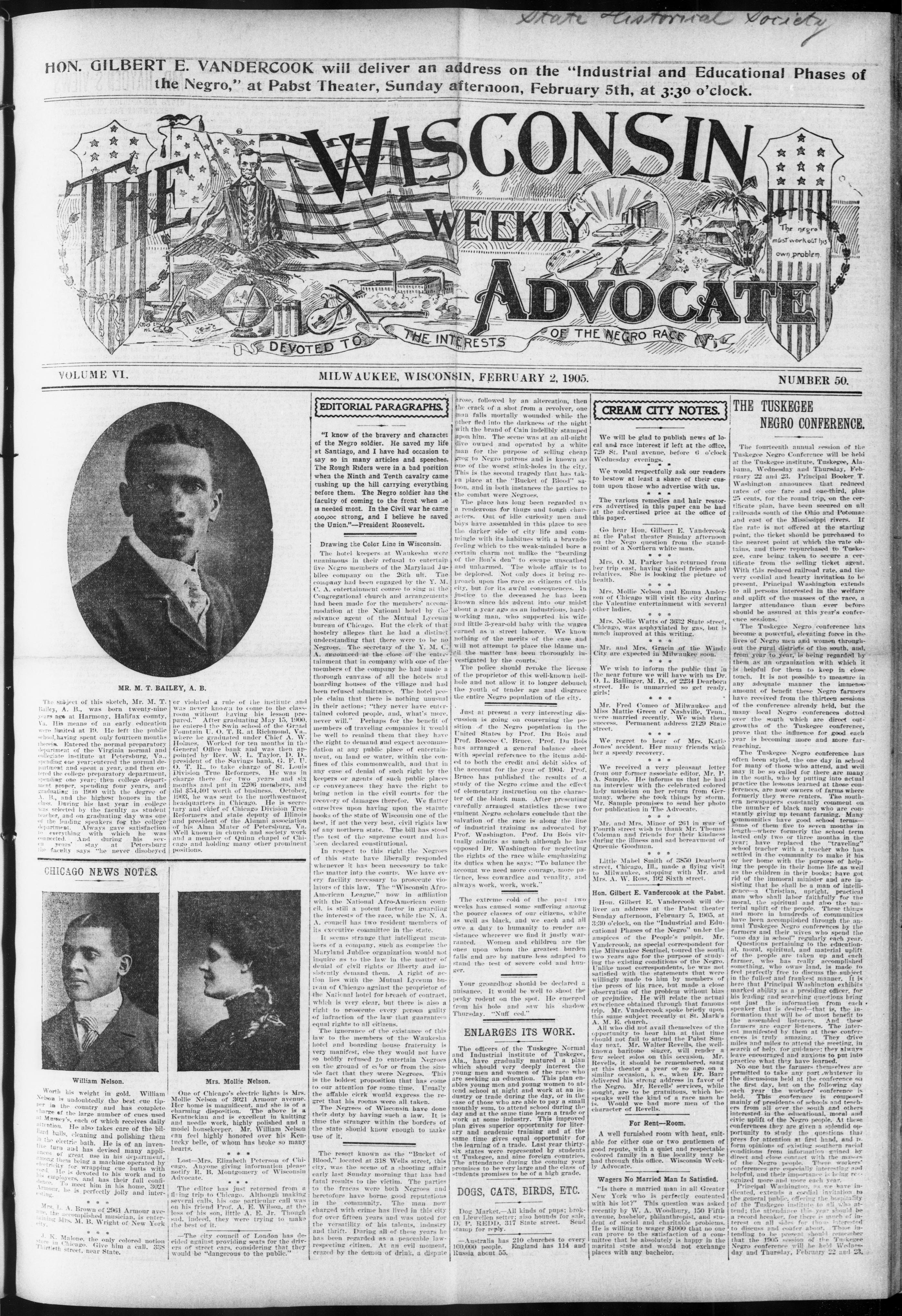
HON. GILBERT E. VANDERCOOK will deliver an address on the "Industrial and Educational Phases of the Negro," at Pabst Theater, Sunday afternoon, February 5th, at 3:30 o'clock.
WISCONSIN
WEEKLY
Advocate
DEVOTED TO THE INTERESTS OF THE NEGRO RACE
```markdown
```
[Name not visible in the image]
MR. M. T. BAILEY, A. B.
The subject of this sketch, Mr. M. T. Bailey, A. B., was born twenty-nine years ago at Harmony, Halifax county, Va. His means of an early education were limited at 19. He left the public school, having spent only fourteen months therein. Entered the normal preparatory department of the Virginia normal and collegiate institute at Petersburg, Va., spending one year; entered the normal department and spent a year, and then entered the college preparatory department, spending one year; then college department proper, spending four years, and graduating in 1900 with the degree of A.B., and the highest honors in the class. During his last year in college was selected by the faculty as student teacher, and on graduating day was one of the leading speakers for the college department. Always gave satisfaction to everything with which he was connected. And during his seven years' stay at Petersburg the faculty says "he never disobeyed
CHICAGO NEWS NOTES.
J.
Worth his weight in gold. William Nelson is undoubtedly the best cue tipper in the country and has complete charge of the large number of cues used at Mussey's, each of which receives daily attention. He also takes care of the billiard balls, cleaning and polishing them in the electric bath. He is of an inventive turn and has devised many appliances of great use in his department, among them being a machine operated by electricity for wrapping cue butts with cord. He is devoted to his work and to his employers, and has their full confidence. To meet him in his home, 3021 Armour, he is perfectly jolly and interesting.
Mrs. L. A. Brown of 2961 Armour avenue, the accomplished musician, is entertaining Mrs. M. B. Wright of New York city.
J. K. Malone, the only colored notion store in Chicago. Give him a call. 338 Thirtieth street, near State.
VOLUME VI.
William Nelson.
or violated a rule of the institute and was never known to come to the classroom without having his lesson prepared." After graduating May 15, 1900, he entered the Swin school of the Grand Fountain U. O. T. R. at Richmond, Va., where he graduated under Chief A. W. Holmes. Worked for ten months in the General Office bank and was then appointed by Rev. W. L. Taylor, D. D., president of the Savings bank, G. F. U. O. T. R., to take charge of St. Louis Division True Reformers. He was in charge there for two years and six months and put in 2206 members, and did $54,401 worth of business. October, 1903, he was sent to the northwestmost headquarters in Chicago. He is secretary and chief of Chicago Division True Reformers and state deputy of Illinois and president of the Alumni association of his Alma Mater of Petersburg, Va. Well known in church and society work and a member of Quinn chapel of Chicago and holding many other prominent positions.
M.
One of Chicago's electric lights is Mrs. Mollie Nelson of 3021 Armour avenue. Her home is magnificent, and she is of a charming disposition. The above is a Kentuckian and is excellent in knitting and needle work, highly polished and a model housekeeper. Mr. William Nelson can feel highly honored over his Kentucky belle, of whom has broke so many hearts.
* * *
Lost—Mrs. Elizabeth Peterson of Chicago. Anyone giving information please notify R. B. Montgomery of Wisconsin Advocate.
The editor has just returned from a flying trip to Chicago. Although making several calls, his one particular call was on his friend Prof. A. E. Wilson, at the loss of his son, little A. E. Jr. Though sad, indeed, they were trying to make the best of it.
The city council of London has decided against providing seats for the drivers of street cars, considering that they would be "dangerous to the public."
Mrs. Mollie Nelson.
自 求 焦
MILWAUKEE, WISCONSIN, FEBRUARY 2, 1905.
EDITORIAL PARAGRAPHS.
"I know of the bravery and character of the Negro soldier. He saved my life at Santiago, and I have had occasion to say so in many articles and speeches. The Rough Riders were in a bad position when the Ninth and Tenth cavalry came rushing up the hill carrying everything before them. The Negro soldier has the faculty of coming to the front when he is needed most. In the Civil war he came 400,000 strong, and I believe he saved the Union."—President Roosevelt.
Drawing the Color Line in Wisconsin.
The hotel keepers at Waukesha were unanimous in their refusal to entertain five Negro members of the Maryland Jubilee company on the 26th ult. The company had been engaged by the Y. M. C. A. entertainment course to sing at the Congregational church and arrangements had been made for the members' accommodation at the National hotel by the advance agent of the Mutual Lyceum bureau of Chicago. But the clerk of that hostelry alleges that he had a distinct understanding that there were to be no Negroes. The secretary of the Y. M. C. A. announced at the close of the entertainment that in company with one of the members of the company he had made a thorough canvass of all the hotels and boarding houses of the village and had been refused admittance. The hotel people claim that there is nothing unusual in their actions; "they never have entertained colored people, and, what's more, never will." Perhaps for the benefit of members of traveling companies it would be well to remind them that they have the right to demand and expect accommodation at any public place of entertainment, on land or water, within the confines of this commonwealth, and that in any case of denial of such right by the keepers or agents of such public places or conveyances they have the right to bring action in the civil courts for the recovery of damages therefor. We flatter ourselves upon having upon the statute books of the state of Wisconsin one of the best, if not the very best, civil rights law of any northern state. The bill has stood the test of the supreme court and has been declared constitutional.
In respect to this right the Negroes of this state have liberally responded whenever it has been necessary to take the matter into the courts. We have every facility necessary to prosecute violators of this law. The "Wisconsin Afro-American League," now in affiliation with the National Afro-American council, is still a potent factor in guarding the interests of the race, while the N. A. A. council has two resident members of its executive committee in the state.
It seems strange that intelligent members of a company, such as comprise the Maryland Jubilee organization would not inquire as to the law in the matter of denial of civil rights or liberty and insistently demand them. A right of action lies with the Mutual Lyceum bureau of Chicago against the proprietor of the National hotel for breach of contract, which is very clear, but there is also a right to prosecute every person guilty of infraction of the law that guarantees equal rights to all citizens.
The ignorance of the existence of this law to the members of the Waukesha hotel and boarding house fraternity is very manifest, else they would not have so boldly refused to entertain Negroes on the ground of color or from the simple fact that they were Negroes. This is the boldest proposition that has come to our attention for some time. Usually the affable cierk would express the regret that his rooms were all taken. The Negroes of Wisconsin have done their duty by having such a law. It is time the stranger within the borders of the state should know enough to make use of it.
The resort known as the "Bucket of Blood," located at 318 Wells street, this city, was the scene of a shooting affair early last Sunday morning that has had fatal results to the victim. The parties to the fracas were both Negroes and heretofore have borne good reputations in the community. The man now charged with crime has lived in this city for over fifteen years and was noted for the versatility of his talents, industry and thrift. During all of these years he has been regarded as a peaceable law-respecting citizen. At an evil moment, crazed by the demon of drink, a dispute
arose, followed by an altercation, then the crack of a shot from a revolver, one man falls mortally wounded while the other fled into the darkness of the night with the brand of Cain indelibly stamped upon him. The scene was at an all-night dive owned and operated by a white man for the purpose of selling cheap grog to Negro patrons and is known as one of the worst stink-holes in the city. This is the second tragedy that has taken place at the "Bucket of Blood" saloon, and in both instances the parties to the combat were Negroes.
The place has long been regarded as a rendezvous for thugs and tough characters. Out of idle curiosity men and boys have assembled in this place to see the darker side of city life and commingle with its habitues with a bravado feeling which to the weak-minded bore a certain charm not unlike the "bearding of the lion's den" to escape unscathed and unharmed. The whole affair is to be deplored. Not only does it bring reproach upon the race as citizens of this city, but for its awful consequences. In justice to the deceased he has been known since his advent into our midst about a year ago as an industrious, hardworking man, who supported his wife and little 3-year-old baby with the wages earned as a street laborer. We know nothing of the merits of the case and will not attempt to place the blame until the matter has been thoroughly investigated by the courts.
The police should revoke the license of the proprietor of this well-known hell-hole and not allow it to longer debauch the youth of tender age and disgrace the entire Negro population of the city.
Just at present a very interesting discussion is going on concerning the position of the Negro population in the United States by Prof. Du Bois and Prof. Roscoe C. Bruce. Prof. Du Bois has arranged a general balance sheet with special reference to the items added to both the credit and debit sides of the account for the year of 1904. Prof. Bruce has published the results of a study of the Negro crime and the effect of elementary instruction on the character of the black man. After presenting carefully arranged statistics these two eminent Negro scholars conclude that the salvation of the race is along the line of industrial training as advocated by Prof. Washington. Prof. Du Bois virtually admits as much although he has opposed Dr. Washington for neglecting the rights of the race while emphasizing its duties when he says: "To balance the account we need more courage, more patience, less cowardice and venality, and always work, work, work."
The extreme cold of the past two weeks has caused some suffering among the poorer classes of our citizens, white as well as black, and we each and all owe a duty to humanity to render assistance wherever we find it justly warranted. Women and children are the ones upon whom the greatest burden falls and are by nature less adapted to stand the test of severe cold and hunger.
---
Your groundhog should be declared a nuisance. It would be well to shoot the pesky rodent on the spot. He emerged from his hole and saw his shadow Thursday. "Nuff ced."
ENLARGES ITS WORK.
The officers of the Tuskegee Normal and Industrial institute of Tuskegee, Ala., have gradually matured a plan which should very deeply interest the young men and women of the race who are seeking an education. This plan enables young men and young women to attend school at night and work at an industry or trade during the day, or in the case of those who are able to pay a small monthly sum, to attend school during the day and at the same time learn a trade or work at some industry. This improved plan gives superior opportunity for literary and academic training and at the same time gives equal opportunity for the learning of a trade. Last year thirty-six states were represented by students at Tuskegee, and nine foreign countries. The attendance during the coming year promises to be very large and the class of students promises to be of a high grade.
DOGS, CATS, BIRDS, ETC.
DOGS, CATS, BIRDS, ETC.
Dog Market.—All kinds of pups; broken Llewellen setter; also hounds for sale. D. P. REDD, 317 State street. Send stamp for reply.
Australia has 210 churches to every 100,000 people. England has 114 and Russia about 55.
CREAM CITY NOTES.
We will be glad to publish news of local and race interest if left at the office, 729 St. Paul avenue, before 6 o'clock Wednesday evenings.
We would respectfully ask our readers to bestow at least a share of their custom upon those who advertise with us.
The various remedies and hair restorers advertised in this paper can be had at the advertised price at the office of this paper.
Go hear Hon. Gilbert E. Vandercook at the Pabst theater Sunday afternoon on the Nego question from the standpoint of a Northern white man.
Mrs. O. M. Parker has returned from her trip east, having visited friends and relatives. She is looking the picture of health.
Mrs. Mollie Nelson and Emma Anderson of Chicago will visit the city during the Valentine entertainment with several other ladies.
Mrs. Nellie Watts of 3632 State street, Chicago, was asphyxiated by gas, but is much improved at this writing.
Mr. and Mrs. Gracin of the Windy City are expected in Milwaukee soon.
We wish to inform the public that in the near future we will have with us Dr. O. L. Ballinger, M. D., of 2234 Dearborn street. He is unmarried so get ready, girls!
Mr. Fred Comeo of Milwaukee and Miss Mattie Green of Nashville, Tenn., were married recently. We wish them success. Permanent address 2129 State street.
☆ ☆ ☆
We regret to hear of Mrs. Katie Jones' accident. Her many friends wish her a speedy recovery.
* * *
We received a very pleasant letter from our former associate editor, Mr. P. A. Sample. He informs us that he had an interview with the celebrated colored lady musician on her return from Germany, where she took things by storm. Mr. Sample promises to send her photo for publication in The Advocate.
* * *
Mr. and Mrs. Minor of 261 in year of Fourth street wish to thank Mr. Thomas Coleman and friends for their kindness during the illness and sad bereavement of Queenie Goodman.
* * *
Little Mabel Smith of 3850 Dearborn street, Chicago, Ill., made a flying visit to Milwaukee, stopping with Mr. and Mrs. A. W. Ross, 192 Sixth street.
Hon. Gilbert E. Vandercook at the Pabst
Hon. Gilbert E. Vandercook will deliver an address at the Pabst theater Sunday afternoon, February 5, 1905, at 3:30 o'clock, on the "Industrial and Educational Phases of the Negro" under the auspices of the People's pulpit. Mr. Vandercook, as special correspondent for the Milwaukee Sentinel, toured the south two years ago for the purpose of studying the existing conditions of the Negro. Unlike most correspondents, he was not satisfied with the statements that were willingly made to him by members of the press of his race, but made a close observation of the problem without bias or prejudice. He will relate the actual experience obtained through that famous trip. Mr. Vandercook spoke briefly upon this same subject recently at St. Mark's A. M. E. church.
All who did not avail themselves of the opportunity to hear him at that time should not fail to attend the Pabst Sunday next. Mr. Walter Revells, the well-known baritone singer, will render a few select solos on this occasion. Mr. Revells, it should be remembered, sang at this theater a year or so ago on a similar occasion, i. e., when Dr. Barr delivered his strong address in favor of the Negro. Mr. Revells' services, while sought, are to be gratuitous, which be speaks well the kind of a race man he is. Would we had more men of the character of Revells.
For Rent—Room.
A well furnished room with heat, suitable for either one or two gentlemen of good repute, with a quiet and respectable colored family in a fine locality may be had through this office. Wisconsin Weekly Advocate.
Wagers No Married Man Is Satisfied
"Is there a married man in all Greater New York who is perfectly contented with his lot?" This question was asked recently by W. A. Woodbury, 150 Fifth avenue, bachelor, philanthropist, and student of social and charitable problems. He is willing to wager $1000 that no one can prove to the satisfaction of a committee that he absolutely is happy in the marital state and would not exchange places with any bachelor.
TUSKEGEE
NEGRO CONFERENCE.
The fourteenth annual session of the Tuskegee Negro Conference will be held at the Tuskegee institute, Tuskegee, Alabama, Wednesday and Thursday, February 22 and 23. Principal Booker T. Washington announces that reduced rates of one fare and one-third, plus 25 cents, for the round trip, on the certificate plan, have been secured on all railroads south of the Ohio and Potomac and east of the Mississippi rivers. If the rate is not offered at the starting point, the ticket should be purchased to the nearest point at which the rate obtains, and there repurchased to Tuskegee, care being taken to secure a certificate from the selling ticket agent. With this reduced railroad rate, and the very cordial and hearty invitation to be present, Principal Washington extends to all persons interested in the welfare and uplift of the masses of the race, a larger attendance than ever before should be assured at this year's conference sessions.
The Tuskegee Negro conference has become a powerful, elevating force in the lives of Negro men and women throughout the rural districts of the south, and, from year to year, is being regarded by them as an organization with which it is helpful for them to keep in close touch. It is not possible to measure in any adequate manner the immense amount of benefit these Negro farmers have received from the thirteen sessions of the conference already held, but the many local Negro conferences dotted over the south which are direct outgrowths of the Tuskegee conference, prove that the influence for good each year is becoming more and more far-reaching.
The Tuskegee Negro conference has often been styled, the one day in school for many of those who attend, and well may it be so called for there are many in the south, who by putting into actual practice the lessons learned at these conferences, are now owners of farms where formerly they were renters. The southern newspapers constantly comment on the number of black men who are constantly giving up tenant farming. Many communities have good school terms—some of them five to seven months in length—where formerly the school term lasted only two or three months in the year; have replaced the "traveling" school teacher with a teacher who has settled in the community to make it his or her home with the purpose of helping the people in their home life as well as the children in their books; have got rid of the immoral minister and are insisting that he shall be a man of intelligence—a Christian, upright, practical man who shall labor faithfully for the moral, the spiritual and also the material uplift of the people. These things and more in hundreds of communities have been accomplished through the annual Tuskegee Negro conferences by the farmers and their wives who spend the "one day in school" regularly each year.
Questions pertaining to the educational, moral, spiritual, and material uplift of the people are taken up and each farmer, who has really accomplished something, who owns land, is made to feel perfectly free to discuss the subject in the fullest and frankest manner. It is here that Principal Washington exhibits marked ability as a presiding officer, for his leading and searching questions bring out just the information from each speaker that is desired—that is, the information that will be of most benefit to the assembled listeners. And these farmers are eager listeners. The interest manifested by them at these conferences is truly amazing. They drive miles and miles to attend the meeting, in search of help, for guidance; they always leave encouraged and anxious to put into practice what they have learned.
No one but the farmers themselves are permitted to take any part whatever in the discussions held at the conference on the first day, but on the following day each year the workers' conference is held. This conference is composed mainly of presidents of schools and teachers from all over the south and others interested in the educational, moral and civic uplift of the Negro people. At these conferences they are given a splendid opportunity to study the questions that press for attention at first hand, and to form opinions of existing southern racial conditions from information gained by direct and close contact with the masses of the Negro people. These workers' conferences are especially interesting and helpful, and their importance is being recognized more and more each year.
Principal Washington, as we have indicated, extends a cordial invitation to the general public, offering the hospitality of the Tuskegee institute to all who attend; the attendance this year should be a record breaker, for there is much of interest on all sides for those interested to discuss and confer about. Those intending to be present should remember that the 1905 session of the Tuskegee Negro conference will be held Wednesday and Thursday, February 22 and 23.
OYSTER EXCELS AS A FOOD.
Easily Digestible and Highly Beneficial to the Nerves.
Recent experiments show the great digestive ability of the oyster. When the oyster was crushed and placed in cold water about half of the solid matter was dissolved. When the oyster was placed uncrushed in the same medium one-fourth of its solid matter was dissolved. It is believed that if the oyster be chewed more than half of it is dissolved in the mouth. Cold water appears to be the best thing to drink with oysters. But chablis is good, dissolving 38 per cent. of the solid matter of the oyster.
What are the solids of the oyster? They are the proteids corresponding to the lean of meat or the white of an egg, fat, starchy matters and glycogen. This last means the substance which the liver manufactures for future use. It is very like sugar, and when wanted for use is changed into sugar. It is the substance which makes the oyster sweet in the mouth.
But there are other valuable constituents of the oyster—what are called the glycero-phosphoric compounds. Medical men prescribe these for improving the nervous system, so that a diet of oysters is unquestionably good for the nerves. They also contain common salt, a little copper and several phosphates. And taking the whole contents of the oyster shell, one finds almost everything necessary for the food of the body.
SPREADING THE NEWS BROADCAST.
That Dodd's Kidney Pills Cured His Diabetes-After Long Suffering Mr. G. Cleghorn Found a Permanent Relief in the Great American Kidney Remedy. Port Huron, Mich., Jan. 30th.—(Special.)—Tortured with Diabetes and Bladder Disease from which he could apparently get no relief, Mr. G. Cleghorn, a bricklayer, living at 119 Buttler St., this city, has found a complete and permanent cure in Dodd's Kidney Pills and in his gratitude he is spreading the news broadcast.
"Dodd's Kidney Pills made a man of me," Mr. Cleghorn says. "I was a sufferer from Diabetes and Bladder Disease. I was so bad I could do no work and the pain was something terrible. I could not get anything to help me till I tried Dodd's Kidney Pills. They helped me right from the first and now I am completely cured. I have recommended Dodd's Kidney Pills to all my friends and they have found them all that is claimed for them." Dodd's Kidney Pills cure all Kidney Ils from Backache to Bright's Disease. They never fall to cure Rheumatism.
SAVAGE BRIDE IN SILK DRESS
Rhodesian Natives Celebrate Nuptials in Garments of Civilization
A recent marriage of natives at Francistown, South Africa, was described, according to the Rhodesia Herald, as "smart, pretty, fashionable and chic. The wedding ceremony was carried out in the European way, and a white minister officiated. The bride, a daughter of the chief of the Bechuana warriors, wore a white silk dress with a two foot train, a bridal veil and a wreath of orange blossoms. The bridegroom was the son of a Matabele chief living in Matoppos. He was resplendent in a black suit, linen collar and cuffs, silk tie, white felt hat, orange blossom buttonhole, flowered pecks and patent strapped slippers.
The ceremony over, the register was signed and a choir of fourteen sang "Blessed Is the Man" and "Peace and Good Will." The minister then took two snap shots of the wedding group, and gave them good advice, after which they left for the kraal of the bridegroom's father. There four bullocks were killed, and the wedding festivities were kept up with much feasting and merriment.
CUTICURA OINTMENT
The World's Greatest Skin Care and Sweetest Emollient - Positively Unrivaled.
Cuticura Ointment is beyond question the most successful curative for torturing, disfiguring humors of the skin and scalp, including loss of hair, ever compounded, in proof of which a single anointing with it, preceded by a hot bath with Cuticura Soap, and followed in the severer cases by a dose of Cuticura Resolvent Pills, is often sufficient to afford immediate relief in the most distressing forms of itching, burning and scaly humors, permit rest and sleep, and point to a speedy cure when all else fails. It is especially so in the treatment of infants and children, speedily soothing and healing the most distressing cases.
Hog Lifters.
The other day we heard two men talking about hogs. One of them said: "There is no telling how much a man can lift with one hand. Yesterday I sold a hog that weighed 350 pounds, and I could lift him from one pen into another easily with one hand. I commenced to do that when he was a little pig, lifting him every day from one pen into the other by the ear with one hand." Said the other: "I do not doubt it, for I have done the same thing, and I will tell you another thing I did. I built two pens close together and put a pig in one of them. I fixed up that pen for a bedroom and fed him in the other. I made a hole in the partition just large enough for him to crawl through comfortably, and every time he was fed he had to go through that hole. Well, yesterday I sold that pig, and he weighed just 400 pounds. He seemed to get through the hole on the last day as easily as he did on the first." Liar No. 1 hung his head a minute and then said: "I don't believe a danged word of that!"—Bolton (Tex.) Democrat.
introduced by the U. S. Dept. of Agr. It is a tremendous cropper, yielding in good land in Wis., Ill., Ia., Mich., Ind., O., Pa., N. Y., 80 bu. per acre, and on dry, arid lands, such as are found in Mont., Idaho, the Dakotas, Colo., etc., it will yield from 40 to 60 bu. This Wheat and Speltz and Hanna Barley and Bromus Inermis and Billion Dollar Grass, makes it possible to grow and fatten hogs, sheep and cattle wherever soil is found.
JUST SEND 10C AND THIS NOTICE to the John A. Salzer Seed Co., La Crosse, Wis., and they will send you free a sample of this Wheat and other farm seeds, together with their great catalog, alone worth $100.00 to any wide-awake farmer. [C. N. U.]
Mr. Chamberlain says there are 1,000,000 fewer farm laborers in England now than in 1851 and 13,000,000 laborers are underfed.
Curious Condensations.
The per capita drink bill of the United States is increasing.
The government of Venezuela has decided to give no titles to coal mines in the future, but to exploit all such mines under its own supervision and ownership.
American salesmen have joined the Commercial Men's union, which is recognized by the railroads of Canada, and thereby receive a reduction in carfare.
The final spike in the railroad from Canton to Samshui was driven the other day. But before it had been driven down twenty-four hours it was stolen by the Chinese.
The disproportion of the sexes is still very great in some parts of Australia. In West Australia, for example, there are only 54,000 women in a population of 168,000.
Nearly 40 per cent, more women are working this year at men's labor than worked ten years ago; while the increase of male workers is only a trifle over 25 per cent.
An eccentric old bachelor named Bron, who died recently at Porrentruy, left a legacy of £140 to the bears of the well known bear pit at Berne. The municipality has accepted the legacy "in the name of the bears."
Two-thirds of the coal extracted from the mines of St. Etienne is consumed in the department; the remaining third is exported to the neighboring departments, to Switzerland and to Italy. The mines employ about 19,000 men.
Several large new hotels are being built in Rome. The natives complain that the city is being modernized and Anglicized. Several bars, with barmaids, have recently been opened, and the Cafe de Roma now has a grill room.
A Birmingham tinworker attempted to commit suicide the other day by drinking some hydrochloric acid. A policeman concocted an emetic by scraping some whitening from the ceiling and mixing it with water. It saved the man's life.
-It is estimated that to collect one pound of honey from clover 62,000,000 heads of clover must be deprived of nectar, and 3,750,000 visits from the bees must be made.
-Of sixty-eight samples of sausages examined by the government analyst at Melbourne, Australia, not one was found unadulterated. In the so-called pork sausage not a particle of pork could be discovered.
-The agricultural department has rented twenty acres near Yula City, Cal., and the University of California will experiment there with all kinds of wheat, barley, oats and rye. Two other experimental stations will be established north and south.
A price has been put on the head of the American eagle in Tehama county, Cal. The board of supervisors offers a reward of $1 for the head of each of the great birds on the petition of the sheep men, who have lost many lambs by eagles.
About a million telegrams are sent over the world's wires daily. In 1903 the total was 364,848,474. England sent 92,471,000. United States was second, with 91,391,000. Germany, Russia, Austria, Belgium and Italy followed in the order named.
A bank with an Indian chief as its president has been organized to do business at Skiatook, I. T. The institution opens next week, with Chief W. C. Rogers of the Cherokees at its head. The bank is incorporated for $10,000 and is located in a town that is only three months old. A plan is afoot to establish near Honolulu a native village in all respects as near as possible like the now extinct villages which existed during the old missionary days, and where all the old customs "fit to show" will be shown. It is considered that such a village would be an attraction for tourists.
Picture postcards are subjected to a stern censorship in some continental countries. In Russia those bearing the portrait of Tolstoi have been suppressed. Turkey forbids any postcard bearing the name of Allah or Mohammed or the portrait of a Mussulman. France will not permit the designer to ridicule the corpulence of the King of Portugal.
The cold storage of fruit has grown to large proportions, nearly 3,000,000 barrels of apples having been stored in the United States during the last winter as a result of investigations during the last year. It is found that the condition in which the fruit is grown and the manner of handling it determine to a large extent its keeping quality and ultimate value.
A curious question has arisen in the Maine courts. Last winter several important cases were tried at the January session for Androscoggin county and marked "law court." Immediately after the term ended the court stenographer died, and no one can be found who can translate his notes, because of his peculiar system of shorthand. Must they be retried, and, if so, at whose expense?
At a recent conference held at Paris of English, Dutch, French and German steamship companies which have steamers plying between European ports and Brazil and La Plata and attempt was made to reach an agreement regarding an increase in the freight rates. This, however, was unsuccessful, as the French companies would not acquiesce. The loss they might incur is provided for by subventions.
Removing snow in New York city is a large item in the city's annual expense bill. It costs about $35,000 for every inch of recorded snowfall. Last year it cost the city $755,000 to remove the snow from the streets. The average fall in New York is 30 inches, but though the snow season hardly has begun 23 inches have fallen this winter, and the cost this season promises to reach considerably over $1,000,000.
The act imposing a tax of $500 upon every Chinaman entering Canada has had a prohibitive effect. Since January 1, 1904, not a single Chinaman has arrived, with the exception of two who escaped from steamships. In each case the steamship company had to pay the poll tax of $500. The exclusion of Chinaman has derived the province of British Columbia of a handsome revenue. Last year British Columbia received from the poll tax $225,000 and the year before $258,000.
The total coal production of the United States is now at the rate of 1,000,000 tons a day, and the consumption of coal by railroads is equal to 40 per cent. of this, or 400,000 tons a day. The fuel bill of a railroad contributes about 10 per cent. of the total expenses of operation, and 30 to 40 per cent. of the total cost of running the locomotives. A locomotive will consume on an average $5000 worth of coal per annum, and for a read having an equipment of 1000 locomotives the coal bill is approximately $5,000,000.
Cautious.
"Yes, ma'am, the percentage of mistakes made is very small. What would you like?"
"Did you ever sell any one poison by mistake?"
"No, madam, what will you have?"
"Well, you needn't be so uppity! Gimme a 2-cent stamp."—Houston Post.
THE KISS.
Last night I had to go to bed
All by myself, my mother said,
'Cause I'd been naughty all day through.
She wouldn't kiss me good night, too.
I didn't want to let her know
How much I cared 'bout that, and so
I dropped my clothes right on the floor—
A thing I never did before—
And put each stocking in a shoe—
She just hates that—and didn't do
My hair, or wash my face, or brush
My teeth, and left things in a squish
All 'round the room; and then I took
Her picture, and my fairy-book
She gave me on my last birthday
In June, and hid 'em both away.
I put my father's picture right
Up in the middle of the light,
To show 'em just the way I feel.
'Cause he said, "Kiss the child, Lucille,
Don't let her go to bed like this
Without your useral good-night kiss."
But she just shook her head and turned
Her back, and then my eyes they burned
Like fire. . . It's been a horrid day. . .
And then, of course, I didn't say
My prayers at all, but went to bed
And wished and wished that I was dead.
Well, I don't know just how it was,
For I'd been half-way sleeping, 'cause
I was so 'pletely tired out—
When I heard something move about
So quiet, and the next I knew
The door moved back and she came through
And put her arm around me so.
And said, a-whispering very low,
"My poor, dear child," and was so sad.
And kissed me twice.—My! I was glad.
—Louise Morgan Sill, in Harper's Magazine
A DENSE FOG.
London had broken its own record. For three whole days a dense fog had lain on the town like a yellow charity blanket. Traffic in the streets and on the railroads had been in a state of impotent chaos. Business men got to their places of business little before it was time to close for the day. Society, venting its spleen upon the climate of England in picturesque language, remained at home, or ventured as far as the nearest club and devoted its days and nights to bridge. Theaters closed because even deadheads scoffed at the offer of seats, and the only people who regarded the fog as an ill wind, to speak Hibernially, were pickpockets and martyrs of asthma.
It may be said that on the third day there was one man, at least, in London who cared not a jot whether it was wet or fine, clear or foggy, and that was Everhard Heswell, the man who had stroked the Oxford boat in the last race. The reason of this sublime indifference was not far to seek. Heswell was in love. And when a man is in love he does the most foolish as well as the most irremediable things in his life—among them, proposing and being accepted. For the fifth time during those three regrettable days Heswell had found his way to the steps of Maggie Weybourne's house. It was in Berkeley square. It might, for all he could tell, for the little that could be seen of it, be any other square—or, for the matter of that, it might not have been a square at all, but a circle or an oblong. He had discovered S1B five times, but he had not managed to pump up sufficient pluck to ring the bell and march in to bully Miss Weybourne into being his wife. From little things that she had said loudly with her eyes during a visit to Oxford he had felt certain that she loved him. But from little things that she had left unsaid since he felt equally certain that she didn't.
He had groped his way about for some minutes when suddenly he stumbled into a slight figure muffled to her eyes. "1—I beg——" he began.
The muffled figure raised her hands be-secchingly. "Take my purse, take my bangles, take my rings; but oh, don't, don't take me!" With a queer feeling that he had heard the voice before, Heswell peered into her face. "I don't go in for making collections either of jewelry or young women. I haven't the least intention of making myself obnoxious. I bumped you, I am afraid, but, I hope, not severely. Good morning, or good afternoon, or whatever it is." He could hear the girl crying softly. Me imagined that she was a girl; he could see nothing of her face. "It's hopeless; utterly hopeless!" she sobbed. "I shall never never get home—n-p-never!"
Heswell had determined to go to his club and there write a passionate appeal to Miss Weybourne. His ancestors had, however, entered the lists against Brian de Bois-Guilbert, and the little knighthood that modern life had left in him broke into flower at the sound of a woman's tears.
"I will do my best to guide you home, if you will let me." he said.
"It's very kind of you," she said; "but——"
"Don't worry about your bangles and rings," said Heswell. "Honestly, I don't care tuppence about 'em."
The girl was still uncertain. "Thank you so much!" she replied. "At any rate, it's a great relief to know that. Perhaps you can tell me where we are now?" "Sahara, most likely; or Trafalgar square, perhaps." "But I want to find Berkeley square," she went on, still examining him as closely as she dared. "Do you know Berkeley square?" Heswell uttered a kind of laugh. "Just a little!" he said, in what is generally described as a bitter tone. "When I'm not actually hanging on to the bell of 81B——"
"S1B!" cried Miss Weybourne. She had recognized the man she had been in love with for almost three months and who was her ideal of all that an Englishman should be. She was about to tell him who she was, when a sudden tactical thought seized her. At Oxford she had been quite certain that he had loved her. Since then she had seen him in London and had not been quite so certain. It was obvious that he was in a more dismal mood than usual. Being a young woman who had enjoyed her first season for all that it was worth, and who had not gone about with closed eyes, she well knew that when men are in dismal moods they are bound to confide in the first young woman they meet. She therefore determined to let him see her home under the impression that she was a stranger. She drew her fur more closely over her mouth. "So you know S1B?"
"Know it? I could find my way blindfolded to it. I have found my way blindfolded to it several times during the last few days."
"Really!" she said, with a quickening pulse.
"I'm on my knees in the bow window of the drawing room all day long," he added.
"Why?" asked Miss Weybourne, with much polite interest.
They had been making their way slowly along. "Take my arm," said
Hesweil. "We snall lose one another if we walk like this."
She took it willingly, with a sense of comfort.
"Thanks," he said. "I was in Berkeley square ten minutes ago. I don't think we can have wandered far.
Miss Weybourne felt a little more certain. "You're sure I'm not taking you out of your way!"
Heswell's depression became horrible. "I haven't got a way, thanks. If I had I couldn't find it. I love this fog. It suits the frame of my mind exquisitely."
Just for a moment our young friend Maggie, who came of a race of sportsmen, wondered if it were quite fair not to tell him who she was. By the tone of his voice she knew that he was on the verge of making a confidence, and she decided it as fair. She had never pined for anything so much in her life as to get to the real state of his feelings for her. "Yes?" she encouraged. "By the way, are you sure we are on the pavement?"
"At present, yes. I'm whacking the railings with my stick. Personally, I shouldn't be in the least surprised if we came to the edge of the earth pretty soon."
The girl gave a gasp. "And we shall go headlong into space? How awful! But I don't think your geography can be quite right. My cabman put me down in Brook street. I don't think the edge of the earth is within the four-mile radius."
A misty form loomed under their noses. "Look out!" cried Heswell. "By Jove, it's a man! Hi, sir, can you tell me where——?"
"Don't be an idiot!" was the bronchial reply, and the figure faded away.
"Some men are such gentlemen!" said Heswell. "Hard with your left! * * * Good. By Jove, we might have spilt the boat on that pillar-box."
Miss Weybourne was very comfortable, but she disliked tangents.
"I wish I knew where we were," she said, with a touch of petulance. "We shall arrive eventually, I suppose."
"Do you mind my saying," asked Heswell. "that your voice is rather like the most delicious voice the world has ever heard?"
"Not at all," she replied, not in the least afraid of blushing. "Delighted, I'm sure. But we're off the path."
"You're the same height, too," he said.
"As the owner of the most delicious—"
"How very jolly!" She began to be afraid that he would discover her identity. A sudden fright took possession of her. "Is this Berkeley square, do you think?"
"It's pretty certain to be," he said, with a kind of fatalism.
"Why?"
"When I'm anywhere it's generally Berkeley square. I go out to ride in the morning and, find myself in Berkeley square. I wire to my mother to say I'm coming to tea at 4, and find myself at 4:10 in Berkeley square. I take seats for a theater and agree to dine first at the Carlton and find myself at the moment when the curtain is ringing up in Berkeley square. Oh, yes, this is Berkeley square! It's inevitable. * * * Forgive my verbosity. It's a novel thing to confide in some one one has never seen before and will never see again."
"Is it?" asked Maggie, now quite perfectly certain. Don't you think it would be as well for you to finish confiding in me? For instance, why do you find yourself so often in Berkeley square? In short, why Berkeley square? "Oh, the old, old reason, you know!" he replied, with a weighty attempt at lightness. "The love of an idiot for an angel. Every man has his Berkeley square." "And every woman has her idiot who is the sanest man in the world," she said enthusiastically. "I agree with love. And, for that reason, I should advise you to go once more to Berkeley square."
"I shall go fifty million times more." "Yes," she said softly, "but by that time you will be an old idiot, and the house in Berkeley square may have changed hands. No. Go to Berkeley square today and say all you have said to me." "I couldn't." said Heswell. "I haven't got the pluck. "Hullo!" He looked up suddenly and gazed round him.
"What?" she asked. "The fog's lifting. One can see the numbers of the houses. I thought so-I would have betted on it!" "On what?" "I have been going round and round, and have stopped, as usual, at S1B. Already the butler, frugal person, has turned off the electric light." The wind that had crept up unnoticed had blown the greater part of the fog away. Heswell and Maggie Weybourne had been far too much occupied to see its gradual shifting. As they stood at the bottom of the steps it was possible for them to see one another plainly.
"Why do you stop here?" asked Heswell. "Do you know the Weybournes?" Maggie undid her fur and put up her face for an instant. "Pretty well," she said. "Won't you come in?" The fog in Heswell's brain lifted, too. He caught hold of Maggie with the bravery of a coward. "Maggie!" She drew herself away with a little laugh and opened the door with her key. "Look out," she said. "The fog's all gone—people can see. Come into the dark!"—Cosmo Hamilton in the Sketch.
Sailors' Identification Rings.
"Corpse rings, eh?" said the visitor. "It's a curious, a gruesome name. What are corpse rings?" "Corpse rings," the collector answered. "are rings found on the dead bodies of drowned sailors—identification rings. "Look at this thick gold one. Running around it on the outside, you see, there is carved in big, plain letters, 'William Ratline, born in Camden, Me., 1865. Home, Malabar.' Ratline was lost off the Needles in the big storm of 97. Malabar was communicated with, but it appeared that he had no relations there.
"Nearly every sailor, when the blues overtake him, imagines he will die with drowning. He hates to think of his body washing up on a strange shore, of his manneless grave, and of the anxiety of his friends when he doesn't return and no news comes of him, and therefore he buys himself an identification, or corpse ring.
"Some of these rings are costly, beautiful, strange. Here is an antique Egyptian one—a ring of green bronze from a rifled tomb. Here is a wooden one, carved with little demons, for the thumb; it came, I think, from Senegambia. This ring of ivory is Japanese; it is of beautiful workmanship; the monkeys, holding each other's tails, that go around it in a circle, are quite perfect."
—Baltimore Herald.
HELEN KELLER AT OLD HOME.
Deaf, Dumb and Blind Girl Dances at Ball for First Time.
For the first time in twelve years Helen Ketner spent Christmas at home this year with her mother and sister and little brother at Florence, Ala. She reached Florence the week before Christmas with her traveling companion, Miss Villa Curren, to take a complete rest until April, when she will return to her home in Rentham, Mass.
Miss Keller, whose life since she first commenced her education under Miss Sullivan fifteen years ago, has been one of arduous labor, has completely relaxed since she came south, and the last three weeks she has given over to the social side of life. Up to this time she had never danced, except with the girls at college, and great was her delight when the day following Christmas she attended a real ball and danced like the other girls. Miss Keller is a graceful dancer, and as she glided around the room, keeping perfect time to the music, it was hard to realize her movements were not inspired by the strains of the orchestra.
She was specially interested in the german given by the Rosebuds, the set to which her sister Mildred belongs, and took the greatest delight in helping to make the favors.
Skill of the Guide.
Mr. Miller tells of an incident that occurred one afternoon while he and Mrs. Miller were out hunting, that illustrates the wonderful instincts which the guides have for finding their way over mountain and through forest. A pause was made early in the afternoon on the particular occasion referred to in order that the guide might scour the surrounding country for game with Mr. Miller's fine bonicular. A herd of elk was finally discovered several miles off, and the three turned their horses in that direction and proceeded to go after the game.
About 6 o'clock when the party started to return to camp, the guide discovered that the field glass which he had been carrying was missing. As the last time it had been used was when a stop had been made several hours before Mr. Miller mentally bade good-bye to it. The guide had been leaning against a tree while using the glass, a tree that differed in no wise from thousands of others that covered the mountains. There was no traveled road to follow to regain the valuable binocular; no particular attention had been paid to the locality, and yet when some distance from camp the guide informed Mr. Miller that he thought by switching off the road he might be able to find the spot. This was done, and a few minutes later the guide was sure that he could see the tree. A ride to this spot was rewarded, the glass being found where it had been left on the ground after being removed from its case.—Salt Lake Herald.
Courage of Wild Boar
The wild boar never loses his head—or his heart; such courage I have never beheld in any four-footed creature. He has all the cunning commonly accredited to the devil, and in his rage is a demon that will charge anything of any size. I have seen a small boar work his way through a pack of dogs, and his smaller brother, the peccary, in Brazil, send a man up a tree and keep him there.
The board looks ungainly, but the Indian species is as fleet as a horse for about three-quarters of a mile. He begins with flight, shifts to cunning and finally stands to the fight with magnificent courage, facing any odds. As, riding upon him, you are about to plant your spear he will dart—"jink," as they call it in India—to one side, repeating the performance several times, until he finds he cannot shake you, when, turning suddenly, with ears cocked and eyes glittering, he will charge furiously. If not squarely met with a well aimed and firmly held spear, he will upset both horse and rider. Hurling himself again and again against the surrounding spears, he will keep up his charge until killed, when he dies without a groan.—Outing.
From Stork to Undertaker
The stork disappears, and we look into the cradle and behold a male child. After running the gauntlet of measles, mumps and chicken pox he enters school. At the age of 10 he is a redheaded, freckle-faced boy, and the terror of the neighborhood. At 12 he is an apprentice in a printing office. At 18 he has acquired two cases of long primer and an army press, and is the editor of a country newspaper. At 20 he is married. At 30 he is bald-headed, stoopshouldered and the father of a large family. At 35 he is a corpse in a cheap pine coffin, and as 500 delinquent subscribers file past his bier for the last look, they are heard to say: "He was a good fellow, but he couldn't save his money."—Lockwood (Mo.) Times.
The Editor's Job in Oklahoma.
To run a newspaper all a fellow has to do is to be able to write poems, discuss the tariff and money questions, umpire a baseball game, report a wedding, saw wood, describe a fire so that the readers will shed their wraps, make $1 do the work of $10, shine at a dance, measure calico, abuse the liquor habit, test whisky, subscribe to charity, go without meals, attack free silver, defend bimetallism, sneer at snobbery, wear diamonds, invent advertisements, overlook scandals, appraise babies, delight pumpkin raisers, minister to the afflicted, heal the disgruntled, fight to a finish, set type, mould opinions, sweep the office, speak at prayer meetings, stand in with everybody and everything.—Center News.
Measuring Space.
James Whitcomb Riley, who occasionally visits country schools in the Hoosier state, once gave a brief address on the subject of the stars. At the conclusion of his interesting talk he said: "Can any of you boys tell me what space is?"
"Well, my lad," said the poet, "what do you think space is?"
"Twenty-five cents an agate line for display matter, sir," he piped out. Saturday Evening Post.
The Game for Him.
Mildred, who had a, small friend to spend the afternoon with her, found that the care of her little brother interfered sadly with their plans. John showed a tiresome persistence in joining their games. Meeting but little encouragement, he asked at last, somewhat wistfully: "Milly, can't I play something?"
"Yes, John," she replied, firmly: "go into the back room and play you're dead for an hour and a half."—London 'Eit-Bits.
The execution of two of their leaders has put a temporary check to the machinations of a new Chinese sect named Esai-Yuan, in Honan, whose programme was to destroy all railways and all foreigners on a day to be announced. They hate the present ruler of China, declaring that the real Emperor is now residing on the "Mountain of Nine Dragons," and will make his appearance in due time.
France has issued a new 25-centime piece of nickel, struck off in polygonal form, to avoid the resemblance to silver coins of about the same size.
MR. HAYDEN'S VIEWS
GIVES HIS OPINION OF THE BEST TREATMENT FOR PARALYSIS. Declares That Dr. Williams' Pink Pills Restored the Use of His Limbs When All Other Remedies Failed. The premonitory symptoms of paralysis are: trembling of the hands; sudden loss of power in arms or legs, frequently affecting one whole side of the body; staggering; partial or entire inability to use the fingers distortion of the features, sometimes an uncontrollable quivering of the chin; severe pains; difficulty in speech. Frequently the first warning is a vague feeling of headache, vertigo and muscular weakness.
In a recent interview Mr. W. J. L. Hayden said: "I truly think that Dr. Williams' Pink Pills are a great medicine for they cured me when physicians and other remedies had failed to give me the slightest relief. Too close attention to business brought on an attack of nervousness which finally developed into paralysis. There were times when it was impossible for me to move my hands or to get up from a chair. At other times I had partial control of my limbs, but I was afraid to go far from the house for fear I mlght suddenly become helpless and have to be carried home.
"While I was in this miserable condition, I was stricken with malarial fever and confined to bed for four months. I had the best physicians, but while they relieved my fever, their treatment did not entirely drive the malaria from my system, and they did not help my paralysis in the least.
"I was well nigh despairing when a friend persuaded me to try Dr. Williams' Pink Pills When I had finished one box I could see results that encouraged me. My condition kept steadily improving, and when I had taken seven boxes I was cured of paralysis and the malaria was completely driven out of my system. For two years now I have enjoyed the best of health and have attended to business without any interruption."
Mr. Hayden's home is at No. 252 West 39th street, New York. Dr. Williams' Pink Pills have cured many similar cases of paralysis, also locomotor ataxia. They are sold by all druggists. A treatment so simple, inexpensive and successful should be tried by every sufferer from partial paralysis in any of its stages.
THE HOUSE OF TRAGEDY.
Cripe Homestead at Rochester, Ind., Has Earned a Gruesome Renutation.
The old Cripe homestead, known as "the house of tragedy," is to be torn down. For forty years the ill-fated house, which is situated three miles south of Rochester, Ind., has been regarded as a place of ill omen. Children, who have heard of the gruesome happenings in the homestead, have been afraid to go near the place even in the daytime, and older people have shunned the house by night, declaring that it was haunted.
Only December 6 last four persons met death in the homestead. Wilson Burns, crazed by jealousy, on that date murdered his wife, Joseph Cripe and Mrs. Margaret Braham, and then committed suicide. Here is a list of the tragedies at the homestead:
Mrs. Abraham Cripe, committed suicide. Abraham Cripe's sister, fell dead. Loran Cripe, became insane. Loran Cripe, choked to death. Ellas Cripe, mysteriously murdered. George Ford, suicide. George Cripe, accidentally killed. Jay Cripe, became insane and dled. Clark Cripe, now in an insane asylum. Joseph Cripe, murdered last December. Mrs. William Burns, murdered. Mrs. Margaret Braham, murdered. Wilson Burns, committed suicide. The house is to be entirely destroyed and all traces of it either burned or carried away. The lot on which the house stands will be converted into a corn field in the spring.
A WOMAN'S MISERY.
Mrs. John LaRue, of 115 Paterson Avenue, Paterson, N. J., says: "I was troubled for about nine years, and what I suffered no one will ever know. I used about every known remedy that is said to be good for kidney complaint, but without deriving permanent relief. Often
A woman seated at a desk, reading a newspaper.
when alone in the house the back ache has been so bad that it brought tears to my eyes. The pain at times was so intense that I was compelled to give up my household duties and lie down. There were headaches, dizziness and blood rushing to my head to cause bleeding at the nose. The first box of Doan's Kidney Pills benefited me so much that I continued the treatment. The stinging pain in the small of my back, the rushes of blood to the head and other symptoms disappeared." Doan's Kidney Pills for sale by all dealers. 50 cents per box. Foster Milburn Co., Buffalo, N. Y.
Tobacco Cargo for China.
Three million pounds of leaf tobacco in one shipment will go to China from Portland, Ore., on the steamer Aragonia. This is the largest consignment of tobacco that has ever left the Pacific coast. Considering that the western portion of the United States raises no tobacco, the increase of the coast's exportation in leaf has been wonderful. This enlargement of the market will mean a great thing to the tobacco raisers of the United States, as it is all domestic leaf.
A Wonderful Cow.
"There is a cow," says Prof. L. H. Bailey in Country Life in America, "who is now 11 years old. Last year her record was 17,400 pounds of milk, with a maximum daily yield of 77% pounds. This year she has given as high as 98 pounds a day and she will probably exceed her former record. In other words, here is a cow that every month produces her own weight in milk. She is a most efficient milk-producing machine."
TO CURE A COLD IN ONE DAY
Take Laxative Bromo Quinine Tablets. AR drugstores refund the money if it fails to cure. E. W. Grove's signature is on each box. 250.
—Windsor castle has been used as a royal residence for 790 years.
GOSSIP FOR THE LADIES.
The Apostle.
Love came so near to me that I
Felt the air stir as he went by;
And for a space his garment's hem
Touched me, the while with rapid feet
He went his way. Am I not one of them,
Therefore, to tell all men that Love is
sweet?
Love came so near to me awhile
I saw the wonder of his smile
Albeit he smiled not on me.
I, who have seen his godlhood,
May not my voice 'mongst his apostles be
To cry unto all men that Love is good?
Love came so near to me.—ah me!—
That still I feel what bliss might be
Had he but paused a little space.
Ah, longing that has no relief.
Am I not one of those whose tears have
Am I not one of those whose tears have
grace
To cry unto all men that Love is grief?
—Theodore Garrison in Harper's Bazar.
Mistakes of the Visiting Girl
"Mary has been here on a visit," explained Mary's friend's mother with a look of apology, "and we have not yet cleared up the house. She is the dearest girl in the world, but I can't help thinking that she has been badly brought up. From the moment she arrives she tramples rough-shod over all my traditions. She ignores every one of my rules and sets a bad example to my children. We are fond of her, but Jane and I draw a breath of relief whenever her visits are over."
"Now, mother," pleaded the young daughter of the house. "don't you think that you and Aunt Jane are a little too old-fashioned? You really are not quite modern. Mary is like most of the girls I know, and when I visit her the whole family are amazed at my particular ways, though here at home you are not impressed with them."
"My dear," said the mother with energy, "if I ever imagined that you, when visiting in a strange house, could leave a trail of your gloves, pocket handkerchiefs and stocks marking your path from your own room to the other rooms of the house; if you turned on gas and electric lights and left unnecessary burners blazing for hours in the evening, when you were not needing them; if you came late to breakfast and late to dinner, and generally ran amuck through every civility, I should be ashamed to have you go out as a representative of my home straining. I really do like most of your friends, and I am fond of Mary, but the next time she comes here I shall put her in the second best bedroom, and not in the guest chamber. She is too destructive, too exasperating. She has ruined the cover of the dressing bureau by spattering it with ink, and cracked the soap dish, so that I will have to buy another, which spoils the set."
"Poor Mary," sighed Elsie. "She must have fallen into those careless ways while she was at college."
Here Aunt Jane interrupted the conversation in her usual strenuous manner. Aunt Jane is an energetic spinster who has convictions on every subject under the sun, but who is especially pronounced in her judgment when it comes to bringing up girls. She spoke severely:
"I knew her mother before the child was born. Not one of the tribe ever had the ghost of an idea of tidiness. Mary was not well started. Consequently she is not an ideal guest in a fastidious house. Nevertheless, for the sake of her breeziness and sweetness and the fun she brings, we must take her as she is. I do hope that the fashion of bringing up girls to be neat will one of these days come back."
I wonder if girls who are something like Mary ever stop in their progress through the world to reflect that, while everybody likes a zephyr, few people can tolerate a cyclone. Just a little thought, a little time and a little consideration for others often make the difference between an agreeable guest and the reverse.
If you are going on a visit, the first thing of which you have to think is whether or not you are to take a trunk. If the visit is to extend over a week or more it is well to be provided with clothes for every emergency, and these cannot be so easily packed into a small suit case as into the larger compass of a small sized steamer trunk. If a girl is invited either by herself or as one of a house party there will presumably be occasions when she will require a pretty evening dress, and when she should be properly gowned for a luncheon or an afternoon tea. Her traveling dress will meet the requirements of walking, driving, skating or going about in street cars if it be short and smart, without elaborate trimming. It is a good plan, when convenient, to send a trunk by express the day before one goes, thus insuring its arrival on the same day with its owner. This cannot be depended upon as certain in times of crowded summer travel or in the winter when storms and drifts may delay trains.
A visitor should arrive promptly at the hour which has been fixed. Once in the house of her friend she should unobtrusively familiarize herself with the ordinary ways of the house. Every home has its little peculiarities which belong to itself. A young girl should not neglect the older people whom she finds in a family, and she should be careful not to interrupt conversation, nor monopolize it, nor take the lead when older people are present. All this should go without saying in the case of well-bred young girls, yet they sometimes need a word of caution.
For instance, if you have been spending the evening out and come in late, it is thoughtful for you to go quietly to your room, not chatting loudly or laughing on the stairs and disturbing the rest of those at home who are already in bed. Another good point for the visiting girl is to be pleased with everything that is done for her and not to be afraid to express her thanks. Never economize thanks. It is better to say too much than too little in the way of acknowledging kind attentions. If a guest wishes to carry books or magazines from the family living room to her own especial domain, which the guest chamber is while she occupies it, she should meation her desire to do so, as some one may possibly be in the middle of a novel, or still be reading some article in the magazine. Neither should a girl express extravagant liking for one member of the family and treat another with indifference. A girl I knew once paid a visit in a home where there were twin sisters, a little older than herself. She was much attracted to Miss Elizabeth and equally repelled from Miss Cynthia, not through any act on the part of either sister. The girl was very young. She thought Miss Elizabeth the prettier of the two and took a tremendous fancy to her music, lingering to hear her play the piano, while when Miss Cynthia sang she ostentatiously left the room. Her preference and her dislike were both so marked that they aroused surprise and comment, and she was not invited to that house again for years.
A girl going from home should not forget that she is an advertisement to everyone she meets of the home she comes from. If she is rude and noisy, if she drops into slang or indulges in any practice not quite becoming a gentlewoman the natural inference is that in her home offenses against good manners are common and readily condoned. A visit should always be concluded, un-
less there is excellent reasons to the contrary, at the time which was indicated when the invitation was sent. Unless one is very urgently entreated to extend it the part of wisdom is to go away before anyone can be in the least tired of your presence. In hospitable homes, where the visiting list is long, your room might be desired for your successor, and if you linger beyond the time allotted to your stay you may be the cause of embarrassment and inconvenience to your hostess. The visiting girl must not forget promptly to send what is called her bread-and-butter letter after her return to her home. This is simply a pleasant, informal note telling that her homeward journey has been safely accomplished and repeating her cordial thanks for the pleasure she has had, though she has already verbally expressed them when taking leave of her entertainers.—Pittsburg Dispatch.
Can Husbands and Wives See Too Much of Each Other?
By answering the above query in the affirmative we hear the wrath of every honeymoon couple, but as there is nothing like having the courage of one's convictions, let us try to find out exactly what those convictions have to say about the matter.
There is no doubt about it that change and variety are great adjuncts in keeping existence stimulating and full of interest, while monotony and sameness go a long way toward engendering discontent. This fact is quite undeniable, and to a close observer the same rules appear to hold good when applied to married life.
"The absent is always ideal," says Goethe; therefore, as all real things are likely to be rendered more beautiful by a touch of the ideal, why not so with the happy realities of love and marriage?
To any one who has studied this question carefully it is an indisputable theory that occasional short separations prove giant factors in strengthening the mutual appreciation of husband and wife.
When apart each realizes the desperate need of the other as companion and confidant; the need is always there, of course, but absence brings the realization of what is usually an accepted fact, and accepted facts are apt to lose their value by being "taken for granted."
In those three words lies the secret of humdrum marriages, which, though happy and without actual jars, have become devoid of the glamor of romance.
Harry gets used to those gold-gleams on Madge's brown hair, the charm of bright blue eyes shaded by dark lashes, while Madge becomes unemotionally accustomed to the delightful cultured "curve" in Harry's voice and the breadth of his shoulders. What a difference to the time when those gold-gleams were never-ending sources of rapturous admiration, and when that tender voice sounded like new music every time they met. Only three years ago, and yet happy monotony and unbroken association have changed those charms to fully recognized and uncommentable attributes. — Philadelphia, Inquirer.
A Word of Advice to Mothers.
The baby girl of three is already old enough to take pride in picking up the toys she scatters, and putting her chair where it belongs. Make it a part of your hour of sport with her to help her do these things. She will not know she is being taught order.
I learned this lesson from a famous author whose baby son was anxious to play about the library where his father was at work.
The first act of the toddler was to toss all the books in sight upon the floor and to sit down and turn the leaves, hunting for pictures. This performance interested him for half an hour, when he proceeded to seek new fields of action.
"But now let us have great fun putting all the books back just where we found them," cried the tactful father, with a wink and a laugh, which made the child believe he was to enjoy the sport of his life. And it was made sport by the foolish pranks of the father who knew how little it took to interest a child. The next day, and the next, the same fall and rise in the book market took place, but on the fourth day the father was too deeply engrossed in work to assist in the replacing of the books; when, lo! the small lad, after a wistful waiting and unanswered call, proceeded to put the books all back alone. The first important brick in the foundation wall of order was laid.
So you can teach your little girl all the womanly habits of method, and order, and neatness, and system, if you have the patience to act the part of playmate with her a few moments daily.
Be her confidant, her adviser, her friend, and let her find pride and happiness in doing things for you.
Never act as maid or domestic to your daughter.
Be the queen and make her your first lady-in-waiting, and show her the courtesy and appreciation her position demands from royalty. She will be the better daughter, and a better wife and mother, later in life if you do not make the mistake of the average American mother of serving her and waiting upon her from the cradle to the altar.
The daughter who has a whole household sacrificing and toiling for her pleasures is spoiled for a wife and woman. The most admirable young women I have known—and I have known many—are those who were taught to take it as a matter of course that the mother was first to be considered, and looked after, and lovingly served. Do not be afraid of making your daughter vain by telling her the attractive features she may possess.
Some one else will tell if you do not, and it is well for her to hear it from lips which may more successfully offer counsel afterward. A certain confidence in her own charms gives a sensibly reared young woman a poise and self-possession which is to be desired. A touch of feminine vanity renders a woman more anxious to please, and more alert to keep always at her best.
But beware of having her acquire egotism. Silly conceit is the death blow to higher attainments and to all charm.
Teach your daughter early the accomplishment of listening well. She will be sure to please if she understands its value.
A woman who looks the converser in the eyes, and does not allow her glance to wander and become distrait, and who does not interrupt before the recital is finished with ideas of her own, can be sure of popularity with both men and women.
Give both your son and daughter confidence in themselves and a belief in their power to achieve. There is a tremendous influence in the early inoculation in the home, of self-confidence, when it is tempered by modesty and consideration for others.—Ella Wheeler Wilcox in Philadelphia Evening Bulletin.
Who Would You
Rather Be Then Yourself?
If you couldn't be yourself, who would you rather be? A London paper recently gave prizes. The prize letters are real revelations of the human heart. A young girl wrote: "I would be like my mother. She has finished growing and her education is over. She can go
into a crowded room with dignity and grace without treading on anyone's toes or upsetting silly little tables and getting red, as I do. She has learnt to play golf and bridge, and I am just beginning and my enemies are fast increasing. Then I try to do my hair stylishly, but hairpins fall out. I never know what to wear and my clothes will not set, somehow. Altogether it is not great fun being only 15, and I would much rather be mother."
An elderly woman wrote: "If I had to be somebody else I would be my own great-great-granddaughter, in position not unlike my present circumstances, yet living a life as much fuller than this as is mine than my grandmother's—fuller because body and mind would be educated to grasp and understand the whole life. Inheritor of another century of progress; space and time bridged by wonderful new ways of locomotion, aerial and terrestrial, by perfection of telegraphy, and perhaps telepathy. Life made easier by means now undreamt of; pain and sickness conquered—yes, inheriting our present grit and muscle, may I in a hundred years reappear as my own descendant."
A man paid a nice tribute to his wife in the following verse:
Had I the choice, my wife I'd choose to be, (Forgive the tribute to her worth I pay)
If but to fathom all her love for me.
And filch the secret of her winsome way.
The tender hopes, the trust that never fails,
The faith, the constancy, the patient care,
The steadfast heart, the courage that avails,
Life's tears and tolls and sorrowings to bear.
To live with such sweet fortitude the space
Of one brief day were task enough for man;
Yet she inherits but the simple grace
Bestowed on womanhood when earth began.
Everybody remembers the reply of Ambassador Joseph Choate, when asked,
"Who would you rather be, if not yourself?" He answered immediately, "Mrs.
Choate's second husband."
Probably each of us would like to have another shot at life, vexatious as it sometimes is. But the wisest wish of all was that of the man who desired to be himself over again, with the power to profit by past experiences and turn his life to better account.
Ready-Mades.
"I had always heard," said a girl from out of town, "that New York women dressed in ready-mades. I supposed that the reason was, of course, because they could choose from so infinite a field, could buy things that our provincial eyes would never see; now I know it isn't that."
"Why, then?"
"It's because they haven't time. They do everything in such a hurry that small pleasures like gossips with their dressmakers are cut from their busy minds. They haven't time to go and see their friends, let alone their dressmakers. They never dally in the shops. They know what they want and proceed to get it. It is well they waste not time at indecision, for even that proceeding after knowing their minds is a day's task and hard on endurance where so many are buying and in a hurry."
"Your cause for our being ready-made is unique," said the New York woman. "It may be that; of course, I suppose we do rather live in a bustle, but we are so used to it we're not conscious of it. Naturally, it is less trouble to go into a shop, buy a gown ready to wear, have it fitted, and home again in a day. But that isn't, to my mind, the real reason we are ready-made. It's because we can't afford anything else. You get into the hands of the best dressmakers in New York and see what it costs! Why, you couldn't have a gown made like one of those you women bring from the middle west for less than a hundred dollars.
"Expenses are less in smaller cities. Dressmakers can afford to work for you for less, and to take time to make your design individual. Why, I saw a gown on a woman from Columbus, O., the other day; any eastern woman would have declared it was imported. It was ordered from a modiste there for fifty dollars! Just stay here two seasons! You'll have the ready-made habit, too. It's fatal. Perhaps hurry is the cause, but money has something to do with it; money has a way of slipping by and taking wings in New York, and unless you belong to the class of the very rich you won't aspire to but one gown made to order a year. You'll go trotting around in a blouse and suit like the rest of us."—Globe and Commercial Advertiser.
Moral Training.
Moral training begins the first year of the child's life. As he absorbs the home atmosphere, it should be healthful and clean in appearance and practice. Love the child, study the child. Speak, act and be a living example to him. See that his associates, the company you entertain, the literature in your home, do not antagonize your teaching, but is rather supplementary to it. The child should live where the stamina of fields and forests, hills or prairies, may put iron and staying power in his blood to circulate in his veins. Let the home be as attractive as possible wherein he is a factor—where there is room for his belongings; a place for work, study, rest and recreation; where his confidences are sacred, and his friends welcome; where he is always sure of sympathy, dearth of blame, and praise when due. Have him see that earth's royalty are those who have made the world better by taking upon themselves work and personal responsibility, and that happiness comes only through purity of life and an approving conscience. Teach in every way that innocence because of ignorance of evil is weakness, but that innocence because of knowledge is strength in armor. Never attempt to break his will, but acquaint him with justice and self-control, thus helping him to retain his individuality.
Stress may be put upon truthfulness, honesty and other virtues when the child is quite young. The child's moral training depends as much upon example as precept. Parents may, by example, impress upon their children truthfulness, self-control and unselfishness. Children should be trusted, and should not be discouraged. A child's veracity or integrity should never be doubted until he is proved guilty, and even when guilty should not be too harshly punished. Some children are naturally very sensitive, and require much patience and tenderness in their training. Each child should be morally trained to distinguish right from wrong. Parents and teachers should study the natural tendencies of children to yield to wrong in special ways. Children should be inspired with the thought that their physical, mental and spiritual faculties are God-given.-I. W. in Woman's Home Journal.
The Restful Woman.
"She is the cleverest woman of my acquaintance." was the verdict of one neighbor on another, "because she is not in the least dull, and yet manages to be restful. I know so many bright women—bright in all sorts of different ways, but all alike in one thing. They are never reposeful. They are strung up to concert pitch. They amuse you, charm you, stimulate you, dazzle you—but they never, never rest you by any chance. It takes ability to be restful. Dull, placid, stolid women are more apt to be exasperating than soothing. The full life that flows smoothly is hard to attain. And yet the greatest service a modern mother can do her children is to bring them up free from nerve-strain, which she cannot hope to accomplish if she is always on the strain herself. The
YOUNG FOLKS' COLUMN.
```markdown
```
A Dreadful Quarrel
The three were next door neighbors—
Bobby and Bessie and Kate;
And a tale that is truly shocking
Of them I'll now relate.
Bessie and Kate were sisters.
And each was a "darling pet;"
Kate a dainty blond was,
And Bessie a gay brunette.
Bobby lived at the house next door;
A frolicsome little fellow
With roguish eyes of golden brown,
And curls so soft and yellow:
He went to the home of the two one day,
Before they had finished their dinner.
And greedily drank their bowl of milk—
The naughty little sinner!
The sisters were very angry then,
And fought him shamefully.
Till little Bob, in fright and dread,
Kan hastily away.
But next day he returned again,
And chased them spitefully.
And frightened them until they climbed
To the top of the maple tree.
Now Bessie and Kate, you see, were cats
Belonging to Winnifred Bogg:
And Bobby, of course you understand,
Was the next door neighbor's dog.
—Margaret B. Ramsey in the Housekeeper.
An Example of Horse Sense.
The domestic animals of the Cumberland valley lay claim to the greatest sagacity. Last summer a lad living on the road to Brown's Mills, near Greencastle, was seated on the wayside beneath a cherry tree, eating cherries, when he heard the thud of an approaching horse trotting. As this was no unusual incident, Johnnie Terry straightened himself to see who was coming. Shortly the horse appeared without a rider, though he carried saddle and bridle. The horse stopped right over Johnnie and began to paw the ground and snort, which the boy regarded as an invitation to take a ride and climbed on his back. The horse immediately galloped back in the direction from which he had come, and some two miles away stopped beside the prostrate figure of a man stretched on the ground with blood flowing from his head. Johnnie dismounted, got some water from an adjacent brook, and made the victim of the accident as comfortable as possible before going for assistance. Meantime the horse had trotted off once more, subsequently returning with a local physician driving in his buggy, who knowing the horse and his master, carried the latter to his home. The horse's name is "Goodfellow." The sufferer had had a mild stroke of apoplexy, which was relieved by the blood flowing from his head. Though it is not claimed that this horse put the stone where his master would fall on it, yet he has been brevetted by the ladies as "Assistant Surgeon Goodfellow."
"Goodfellow" is the great-great-great-grandson of a famous horse called "Naseby." which belonged to Gen. Simpson, who was a warrior and also a strict Presbyterian. No work was permitted to be done in Gen. Simpson's house on Sunday, and all the family rode ten or twenty miles to preaching. Within the ten-mile limit Naseby carried his master to preaching for many years, but with advancing age his master would no longer mount him, but as soon as the family procession got started Naseby would follow and walk the distance sedately, arriving an hour or so late, and browse around the meeting house door until the congregation came out. Naseby was known as a devout horse, and more than once was referred to by preachers as an example of consistent attendance upon ordinances.—Lippincott's.
The Wonderful Paper—A Tale of Old Japan
Long, long ago there lived in Japan two sweet little maidens, named O Ume and O Momo.
They were sisters, and when they were scarcely 16 years old they married two brothers, and, as all Japanese wives must do, they went to live with their mother-in-law.
Here they would have been perfectly happy if their new home had been nearer their old one, but it was far away. And they could not see their family or friends.
"We will ask our honorable mother-in-law to let us visit our old home," said O Ume.
So together they went, and bowing very low, they said:
"Most honorable mother, it has been long since we have seen our old friends. We pray you, therefore, to let us visit them."
But the mother was selfish and wished them to stay with her, so she answered: "You may not go yet, O Ume and O Momo." O Ume and O Momo said no more, but bowing politely they went away. But when several months had passed they asked again to visit their old home, and again their mother-in-law said:
mother who radiates peace radiates strength also. The restlessness, the noise, the rush of the life of today, make it all the more necessary to maintain within the home an atmosphere of serenity and sweetness, so that, the threshold once crossed, the outside noise and clatter and strife are left securely behind. This is, perhaps, an old-fashioned conception of home. Many women nowadays want to turn the home out into the street, so to speak, and make "the world's work" everything and the home life nothing. But a restful home, once experienced, is a joy above the promises of progress to disturb; and a restful—and intelligent—woman alone can make it.—Harper's Bazar.
ROMANCE IN COLD STORAGE.
She wrote her name upon an egg:
A simple country girl was she.
"Go, little egg, go forth," she said.
"And bring a sweetheart back to me."
Into the wide, wide world it went.
Upon its shell the message plain.
The maiden waited, waited on.
With throbbing heart—but hope was vain
With throbbing heart—but hope was vain.
The days, the weeks, the months, flew past,
A year, another year rolled by,
Alas! no lover ventured near
To dry the teardrops in her eye.
Sad at her casement in the night
She wondered where the egg could be.
"O voiceless moon, dost thou behold,
Somewhere, my true affinity?"
Somewhere, indeed, there was a man
Whom fate had made for her to own;
Somewhere, and waiting for the egg,
He led his loveless life alone.
* * * * * *
The years sped on, till gray and bent,
She looked adown the road one day,
And, trembling, saw an aged man
Approaching slowly on the way.
His locks were white, his shoulders bowed
He feebly leaned upon a cane.
She looked—and in her faded cheeks
The blush of roses glowed again.
'Twas he, her lover, come at last!
"Are you Miss Mary Jones, I pray?
I found your name upon an egg
I bought in market yesterday."
* * * * * *
Cheated of youthful life and love,
"They love me not," she told herself, "or they would not wish to leave me." Now, when O Ume and O Momo came to her the third time, bowing as politely and asked their favor as sweetly as before, she could no longer refuse.
"You may go if you wish," she said, "and you may stay for three whole months, but you must not return unless you, O Ume, bring me fire wrapped in paper, and you, O Momo, bring me wind wrapped in paper."
"Now," she thought to herself, "I will surely test them. If they truly love me they will search far and near for the paper that will hold fire and wind."
So O Ume and O Momo went away, and were very happy for three whole months. At last it was nearly time to return to their husbands and their mother-in-law.
"We must not forget our gifts," said O Ume, "for without them we can never go back."
So they asked their friends where they might find paper that would carry fire and wind.
"There is no such paper," was the answer. "Fire would burn any paper and wind would blow it away."
Then the two young wives asked a wise man. "There is no such paper in all Japan," he told them.
he told them.
At this they were sorely troubled.
Of all the wise men they asked the same question:
"Where, oh great one, may we find the paper that will cary fire and wind?"
And always the answer was: "There is no such paper in all Japan."
Then, with sorrowful hearts, they left their friends, and wandered far into the forest. They scarcely knew where they walked, but soon the night came on and it grew dark.
They felt so sad and lonely that they sat down on the soft moss and cried bitterly.
"Alas!" sighed O Ume, "if we might only find that wonderful paper."
"If we only might," O Momo repeated, with a little sob.
Then all at once the place grew bright, with a soft silvery radiance, and from the flowers sweet perfumes, like loving messages, were wafted to the sad young wives.
Presently a soft voice asked: "Why grievest thou, O Ume and O Momo?"
And O Ume and O Momo looked up in wonder. They could see no one.
"Nay, thou canst not see me," said the voice, "but I am thy friend, so speak thy trouble and fear not. Why dost thou weep?"
"How can we help weeping?" answered O Ume. "Unless I find paper that will carry fire, and O Mono finds paper that will carry wind, we cannot go back to our husbands or our mother-in-law again. Yet we love them much. Everywhere we have searched, but we have not found this wonderful paper. And the wise men say there is none such in all Japan."
"Those that are wiser than they know this paper," spoke the voice. "Now, watch."
Then the strangest thing in all the world happened right before their eyes. A piece of paper appeared on the ground and folded itself into a Japanese lantern.
"Now put a lighted candle inside," said the voice. "and thou shalt have paper holding fire."
Then O Ume was happy, but O Momo was still sad.
"Sigh not, dear O Momo," begged the tender hearted O Ume. "The dear voice will help you, too."
"It is even easier to carry wind in paper than to carry fire," the voice answered, "for wind does not burn holes, Watch again."
Another piece of paper came all by itself and lay on the ground between them. On it was the picture of a beautiful peach tree, full of pink blossoms, and while they still looked some light twigs flew down and the paper folded itself over, under and together. Then it opened, closed, opened again, and waved itself before the tearful face of O Momo.
"Does not the wind come to thy face?" asked the voice, "and is it not the fan that has brought it? The lantern carries fire wrapped in paper and the fan carries wind wrapped in paper, and all Japan shall be glad because thou shalt bring them these two." Then, indeed, were O Ume and O Momo more happy than they could say. Many times they thanked the kind voice and then all in a moment the forest was gone and they found themselves close by their old home.
Their husbands and mother-in-law were very glad to see them and gave them many beautiful presents. The lantern and fan were shown to everybody and soon the people learned to make others like them. Those that O Ume and O Momo had brought her the mother-in-law kept very carefully, because, as she said, they always spoke to her of the love of her two dear daughters, and nothing in all the world was more precious to her than that. Louise Jamison in Brooklyn Eagle.
Kept parted till the journey's end,
The evening of their wasted day
Together now they sadly spend.
O, Egg Trust cold, how many crimes
Are done in thy disgraceful name?
Gaze, gaze upon thy cruel work
And hide thy hydra head in shame.
—Newark News.
BILLY PATTERPAT.
O'Neil stepped to the door of the saloon, holding his glass so he could see the colors of the sunlight through the liquor. "Hike here, you fellers!" he yelled suddenly. "Yonder's Bill Patterpat turning the corner. Let's cover the street and corral him and then make him dance."
"Huh!" drawled another cowboy, who was leaning against the counter, emptying glasses and flinging them at whoever he thought might not be able to dodge, and holding his revolver in readiness to meet possible objection to his playfulness. "Patterpat won't dance. He's joined the little party of Mennonites up country and gone plain. Ain't you heard? Billy ain't frivolous any more."
"We're goin' to give him a drink first." significantly. "There won't be trouble then. You used to know Billy."
As they filed out, a newcomer from Texas looked discontentedly at O'Neil. "Any special inducement 'bout that Patterpat's feet?" he inquired. "I've been pretty comfortable sitting on the counter. We have dancing down to Texas." "Better go back there," curtly, "or go sit on the counter if you like. As to inducement, there ain't only one dancer, and that's Patterpat. I've been to 'Frisco and to Kansas City and to Chicago, and I've seen dancin'—leastways what they call dancin'. But I've never seen but one Patterpat. Only he has to be limbered up with great jags of whisky first. Then his legs are all wheels and parabolas and ricoshays an' scintillates. Now, you stand right here an' I'll santer out to the middle of the street. That's him
coming yonder and beginning to dodge already. That's the way he used to do, and we had to round him like we would a wild mustang and then fill him up."
Billy Patterpat was a block and a half away, coming on slowly and looking from side to side for some avenue of escape. The gradual spreading of the cowboys across the street brought up memories of past experiences and his eyes had begun to grow troubled and full of apprehension. At length he stopped and looked back; but it was too late now. Several of the cowboys were near their mustangs, and, as he turned, they swung into their saddles and dashed up the street. In a few moments he was in their midst, struggling and protesting, his eyes big with terror of what he felt was coming.
"Don't you give it to me, gentlemen." he pleaded. "I'm plain now, and it wouldn't be right. Ain't danced in six months and ain't tasted a drop. Don't you make me now."
"Look at that, Billy," said O'Neil, holding up a bottle between Billy's eyes and the sun. "Don't that look good? Just see how it smiles! It's the very best in town, and we've got more bottles in waiting. There's ten whole glasses for you, Billy, just for you. Think how it'll feel running down your throat, an' remember how it smells. Lordy! I do feel almost like drinking the whole thing myself. But here, Billy."
He reached out the bottle suddenly and Billy's hands, both of them, went hungrily toward it. His eyes were shining, his lips trembling, his whole form in a quiver; but even then, with an almost superhuman effort, he forced his arms back to his sides.
"Don't, O'Neil!" he implored, "don't, don't, don't!" his voice rising quaveringly. "You know how 'tis with me. Please don't. I don't want it."
"It'll do you good," inflexible. "You're getting thin from going without it so long and it's better to enjoy the stuff trickling down your throat slow than to have it poured down in bottlefuls. You know what we say goes, Billy, and you must drink the whole thing."
Dilly dropped upon his knees.
"Don't," he repeated dully, "I don't want to. If I smell it I can't stop then. You and me's been good friends, O'Neil, and I've danced and—and drunk a lot for you. Let me off this time. And—and if you don't mind I'd like to say why."
"Oh, let the poor devil make his confession, O'Neil," interposed one of the cowboys good naturedly. "You know how 'tis with Patterpat. If he smells, as he says, he won't stop easy. It'll be two months before he sobers up. Let him start in right."
"Billy shot him a grateful look. "It's like this," he said, with a pathetic eagerness in his voice. "Six months ago I happened to be up in the country and I saved a girl's life. She was caught by a bear, and—and I suppose I acted some brave. Anyhow, she and her folks thought so and took me in. Since then I've been up there, and I ain't tasted a drop and I've been feelin' that mebbe I could make something of myself some time, like I used to think a—a long while ago."
There was a little catch in his voice, then he went on in lower tones: "Me and the girl was to be married. I came down today for a ring and license. They believe in me up there, and I've joined in with them, and," his eyes suddenly became steady and aggressive at a giggle from one of the cowboys, "if 'twant for the whisky I believe I could be a good man again: a better one than you could ever be, Danny. But, of course," his voice again dropped and his hand reached mechanically toward the bottle, "this will finish it all. Up there they don't have anything strong to drink, and—and they never suspected I was that way. When they find this out it'll be over with us. I'll run through myself soon's I can, and—and the girl and they'll feel sorry; but you'll have your dance carnival. So we won't all lose. Now you can give me the bottle, O'Neil."
But O'Neil was holding the bottle up between his own eyes and the sun.
"Seems a pity to spill such good stuff," he said regretfully, "but it's got to be." Then, in a louder voice: "Here, you fellers, see that stone over t'other side the street? Well, every one who's got a bottle shy at that, and the one who breaks into the most pieces will go with Billy to see about the ring and license. Then we'll all club in for a present and——"
Billy's head went up suddenly. His eyes were moist.
"No, no," he protested. "I don't want no present, gentlemen. I've been working hard up there and have got some ahead. I'm all right long's I can keep away from that stuff."
"Shut up, Billy!" O'Neil retorted ungraciously. "Tain't you; it's a present for the bride. And I reckon we'd better make it two of our best ponies. They'll be handy's anything up among them Mennonite farmers. Now, fellers! one, two, three and crash!" and with the last word a half dozen or more bottles, delivered from as many unerring hands, crashed against the stone.—Frank H. Sweet in San Francisco Call.
The Rented Babies of Paris
The written law provides for every child in France that the government supplements the home education, and when necessary replaces it entirely, but as a matter of fact there are scores of children, in Paris, especially, who have shaken free of their parents, or been cast off by them, and who live a vagabond existence, playing hide-and-seek with the officers of the law. Among this band the commonest offense is begging, though generally there is some older person back of the whining specimens one meets on the streets. The fruitful incomes in this profession are obtained only through children. During the nights between New Year's and Christmas a baby in long clothes, especially if it be delicate looking, rents for as high as $5 or $6. His brothers and sisters from 1 to 5 years old bring $2, while those still older are worth $1 on the coldest days.—Harper's Magazine.
Point of View.
Senator Penrose says that a friend of his residing in Wilkesbarre recently engaged as nurse a Scotch girl just come to this country.
It appears that one Sunday the lady induced the nurse, who is the strictest sort of Presbyterian, to attend a beautiful church just erected in Wilkesbarre.
When the girl returned her mistress asked her if she had not found the church a fine one.
"Yes, ma'am," responded the girl, "it is very beautiful."
"And the singing," said the lady, "wasn't that lovely?"
"Oh, yes," replied the nurse, "it was very lovely, ma'am, but don't you think it's an awful way to spend the Sabbath?"
—Lippincott's.
a MOTHER’S LOVE
when 2 boy is far away from home,
What pleases him the most?
Why, it’s when & letter comes to him
From mother thro’ the post!
No matter if the silver hairs
‘Appear upon his head, ‘
He's still his mother’s boy as when
His hair was carrot red!
Tho’ thirty years have set their marks
‘And seared his careworn face,
In mother’s eyes he’s yet a lad
Without Time’s telltale trace!
Her letter thus begins: “Dear boy”;
It sets his heart athrill
To think that mother knows him as
‘A little shaver still!
A mother’s love is as a charm
The sesame of youth! ?
One feels that age has naught to do
With Love or Life or Truth,
Wheneer he gets a letter from
His mother far away,
Who sees naught but the guileless child.
Behind the man grown gray.
—Roston Journal.
A Woman’s Way
eee
ACK WETMORE ruefully check-
Ja the long line of figures before
him.
mee a smash—utterly and absolute-
ly asmash. Well, it's no good whining
_I'm done for.”
Jack gave a sigh, for there was
something more than financial loss im-
pending, and he knew it.
Throughout the seven and twenty
years of his life, he had been accus-
lomed to regard himself, and had been
segarded by others, as a rich man's son.
Wetmore & Wetmore had always been
held above suspicion. As he sat in
his comfortably furnished rooms he
‘ould hear the cries of the newsboys
with the special edition of the evening
papers
, ssparthien details of the Wetmore fail-
; He rose from the table and pushed
the papers wearily from him. Stroll-
ng into the dressing room adjoining
te exchanged his smoking jacket for a
jress coat and arranged his tie with a
sritieal air.
“If it is to be my last appearance,”
fe said, “at least I'M make it as out-
wardly respectable as I can.”
‘hen he frowned and looked
thoughtfully at the fire, his hands un-
»onsciously moving toward the mantle-
ylece till it touched a massive silver
frame containing a portrait, a recent
one evidently, of a particularly hand-
some girl.
“It's no good, Bessie—no good, my
jear. I dare not speak to you now.
'm done for.”
Twenty minutes later the butler at
Blansford’s announced Mr. Wetmore,
and after a few words with © Mrs.
Blansford, his hostess, he passed into
the ballroom. In all the brilliant crowd
there was only one face he looked for,
one well-known figure for the sigh of
which he yearned.
At last, after wandering through
several rooms, he saw her. She was
sitting under a shaded lamp, appar-
ently paying but little attention to the
man who was talking to her. But the
Instant Mr. Wetmore passed through
the door she beckoned to him.
“Come and sit here, Jack,” said she,
pointing to the yacant seat just left
by the other man.
She regarded him with an amused
little smile and a nod of approval. She
was a young woman with ideas of her
own, and she appreciated the light,
careless manner with which he seemed
to carry his misfortune.
“You don’t look very doleful, Jack,
under the circumstances.”
He laughed a little.
“My dear Miss Blansford, do you
think it would help matters if I went
about looking like a mute at a fu-
neral?”
“And pray, my dear Jack,” she re-
torted mockingly, “since when have I
become ‘Miss Blansford? ”
“Since I heard the news last night.”
he answered grimly,
“Oh, very well, if you are going to
fo and quarrel with your friends just
because you've lost a little money——”
“It may be a little, but unfortunate-
fy it happens to be all I’ve got. I owe
a good deal besides.”
Wetmore rose and held out his hand.
lle was fast losing his self-control.
“LT must be off. I came only to say
g00d-by to you.”
Miss Blansford closed her fan with
& snap.
“Sit down, Jack, at once, and don't
be an idiot.”
Taken aback at this sudden and per-
emptory command, he obeyéd.
“Now, then, what was it you really
came to say to me?”
“To say good-by, and ask you to
wish me good luck,” he answered.
“What would you have said if things
had—had been different? Shall I tell
you?” she whispered. “You would
have said, ‘Bessie, I love you.” And
now, just because you're a goose and
an idiot, and I happen to possess more
money than I know what to do with,
you would rather die than say four
simple little words like that.”
“Oh, Bessie.”
“Yes. ‘Oh, Bessie,’” she continued,
Mockingly. “It's always, ‘Oh, Bessie.’
ae yet through sheer obstinacy you
é aoe poor Bessie to the trouble
ae tee a formal proposal for the
¥ your hand in marriage.”
Detar Sprang to his feet.
i noe listen,” said he. “It is not
‘r of you, Bessie.”
ieee do you think I am go-
fetises my whole life spoiled for a
Bia retched conventions and a
wry ts dowager or two?”
ey] vd laugh at you, Bessie, and
swartied you for your money.”
SAPPING METHODS OF THE JAPANESE.
1G We ee ee ear
Pe. ee
Bee OC tN SOs hs oe eee re Roses
ti <n ee CRIES Ths ee ert
ost apt amen eg Sh A CTR ae ee es ee
BERS ste ee arte sare eee Be cg
ROI Re 4 Cian ta hehe eres a Rs Fer ee eS RS
Pern ee Ee a
Pe ee ee
oe ee Oar MS ee go 5
bee oe 7 Bc Cy ees << Bk goes ee co
Ce eg alee 2
Se 3 ie
Pee Re Sey ck ee me Pe
Rk inthe teeta ees oe ime. cae ee AER Eee 3 eek
oe ro oe 7 J ee ee
Ce oe ee es A ee ok Re
fs oe aS :Cti~C—<“‘“‘
ee i I
i ee
Beer ees Nae sage Bete See eons Reet eee ce bee em Sg Le Fig
Sr aN
eg OS ee oe
Re ee eee
A oe ae ee
ee CSE ks eee feet
ee ge, or
Ee eae Cate Saar OR ee see ae ee ee
eras. ~ = sae Se ee ee ae Bees Ses Se eae
HTS: A ete ee
a A ee me a, Oe
By os eae G eae en oe een
ee ee i : : oe a
PS ONS Lr eee
oe a : Bes e oe
bie eee : ri ———— Tipe Heer ates hea. Be ee:
ee Ea eg we oe
eS Bae De eae eee EE Re a
Recs: er ape ea Se TSE GRY Sule et Sk Maas. EL
te ok i oi ‘ eo: es
eae) rest ote Deas me Btpeas gee an ’ ot Se c? Se
ON ah ee eve Re ee gio eae SER See ee
ae 3 OF ogee rere as és gees So ogee
i Lek SA emer > cree ee
Fe RE: a CO ae See pee IL oS. ee
a oe ee, he ee 8
ea ee
HOW THE JAPS APPROACHED DEADI.Y FORTRESSES AROUND
PORT ARTHUR.
A correspondent of the London Sphere has attempted to visualize here
the appearance of one of the later attacks on Port Arthur by means of
the sapping trenches. The drawing shows Japanese troops marching for-
ward to the deadly fighting angle of the trench, beyond which is the Rus-
sian fort. Hand grenades of a very explosive character were extensively
used, and in fact the capture of some of the forts was effected by their use.
“Let them laugh. And as to your
marrying me, I would beg to remind
you that the positions are reversed
and that it is I, Elizabeth Blansford,
commonly known as Bessie, who here-
by asks you, Jack——”
“I am no fortune hunter, and marry
you I won't.”
— “Do T not knew it is your pride that
prevents you from speaking? And that
‘is why L have done what I have.”
- “L should be a cur if I took you at
your word.” he said. “Bessie, have a
little mercy. “Don't tempt me.”
“Jack, is your love for me so small a
thing that you cannot sacrifice a little
of, your pride for it? Do you think
my part has been so easy?”
For a moment there was & pause.
Then Jack said:
“You've won, Bessie,” drawing her
to himself, “and heaven give me the
power to make you happy.”
“Well, then, there’s one thing you
must not do, Jack.”
“And that?”
“You mustn’t make me ught so hard
to get my own way again.”—Indian-
apolis Sun.
TRICKS TO GET DEER.
Sometimes Stop When You Call, and
Red Attracts Them.
aoe Asa ea
There are some tricks in woods
hunting that are common property.
For instance, most hunters who pot
partridges while the covey are sitting
on a pine or spruce tree know that the
lowest bird should be shot first. if
this is done, nearly all of the covey
will sit still to be butchered, but if
the highest bird be shot the survivors
will fly instantly. They are disturbed
not only by the noise of the dead bird
coming down through the branches,
but they see it fall and take warning.
- Not many hunters know, however,
that a deer under full headway, speed-
‘ing down a runway as if a legion of
hounds were after it, will often stop
) still and instantly if It hears a shrill
whistle. The whistle is the deer’s sig-
nal of warning, of challenge, and of so-
ciability, and it always attracts atten-
tion from them.
Similarly a running deer will often
stop if it hears an unusual, but not ter-
rifying, noise. A half-breed Chippewa
of the Flambeau Reservation named
Sam Pogon asserts that deer under-
stand the meaning of the English
word “Stop!” and always obey it.
Whether this is true or not, and it
isn’t, Sam says always says “Stop!” in
a clear, mild tone instead of using the
whistle, and his deer generally stop.
He does a good deal of guiding, and
it gives hig patron rather an eerie
feeling to lie hidden by a runway with
him and hear him give his brief com-
mand.
The brown deer of the woods is as
much attracted by a red handkerchief
or any other bit of scarlet cloth as is
the antelope. Red sometimes angers
animals and sometimes arouses their
curiosity, but it never terrifies them.
That is one of the reasons why most
Indian hunters wear red cloth bound
around their foreheads; the other rea-
son is that it is a distinguishing mark
of a human being and brother Indians
or amateurs are less apt to mistake
them for game and pot them as they
move slowly through the trees.
It is a fact not commonly within
the knowledge of sportsmen that a
wounded deer, shot while speeding by
a stand, will always come back to that
stand if it has strength enough. More
deer are finally bagged by men, who
simply inspect the bloodmarks and sit
down and wait than by men who take
up the blood trail.
| Of course, it is wise to follow the
blood for a half-mile on a chance that
the deer has gone down, but if it goes
beyond that distance it is pretty much
ofa certainty that it will continue for
some time longer, and in that case the
best place for another shot is at the
old stand. Why the deer does this is
hot positively known, but it is prob-
ably because if fs best acquainted with
that runway and in its hurt condition
likes to be near its haunts.
_ Some men in the woods will not
shoot a doe at any time of year, no
mmatter how tempting the shot, and
they earn credit as self-restrained
sportsmen. Others are not so con-
scienceful and take deer of either sex
as they come.
A few of these men are wise enough
to know that in case a buck and doe
are together and it it wished to bag
both, the one to shoot first is the doe,
If the buck be shot, the doe will flash
away, never to return; if the doe is
shot, the buck will probably make half
a dozen jumps going out of sight, but
if no nolse be made will always return
to sniff at the body of his companion.
This may be because the male has
more affection than the female, or
merely because his courage is higher
and he has less caution—New York
Sun.
No Trust in Horses.
I have spent much of a long life in
the observation of horses. I have
reared them,» broken them, trained
them, ridden them, driven them in
every form from the plow to four-in-
hand. The result of these years of
study is summed up in one sentence:
I believe the horse to be part maniac
and part idiot. Every horse at some
time in his life develops into a homi-
eidal maniac. I believe any man who
trusts himself or his family to the
power of a horse stronger than him-
self to be lacking in common sense
and wholly deyoid of ordinary pru-
dence, writes a Kentuckian to Har-.
per’s Weekly. I have driven one com-
monplace horse every other day for
six years over the same road, and then
had him go crazy and try to kill him-
self and me because a leaf fluttered
down in front of him. I have known
scores of horses, apparently trust-
worthy, apparently creatures of rou-
tine, go wild and insane over equally
regular and recurring phenomena. No
amount of observation can tell when
the brute will break out. One mare
took two generations of children to
school over the same quiet road, and
then in her nineteenth year went crazy
because a rooster crowed alongside the
road. She killed two of the children.
If anyone can tell me of one good rea-
son why man should trust a horse |
should be glad to know.
Good Enough Reason.
“Lillian is not sure that she loves
Walter. Sometimes she thinks she
does and at other times she’s con-
-vinced she doesn’t.”
“and yet she is going to marry
bim?”
- “Ob, yes—that’s all settled.”
“But if she isn’t sure she loves him
way doesn’t she break the engage-
ment?”
| “Because she's 27.”—Kansas City
Journal.
| Expected.
| Landlady—The coffee, I am sorry to
say, is exhausted, Mr. Smith.
_ Mr. Smith—Ab, yes, poor thing, I
was expecting that. I’ve noticed that
| for some time it hasn’t been strong.
| When a man makes one mistake, he
| usually follows it up with three or four
‘before he recovers his balance,
—_
THE “TURF” CAFE
=== DINNER BILL ——
Regular Dinner 25c
Dinner 11:30 to 2 p. m. and 5 to 8 Pp. m.
Sliced Tomatoes, 10c. Radishes, 10c,
Cucumbers, 10c. Green Onions, 10c.
Lettuce, 10c.
BEAN SOUP.
Boiled Trout and Mint Sauce, 25c.
Boiled Leg of Mutton, Hgg Sauce, 25c.
Roast Pork and Apple Sauce, 25c.
Short Ribs of Beef with Brown Pota-
toes, 25c.
Fricasseed Chicken, 25c.
ENTREES.
String Beans. Green Peas.
Boiled and Mashed Potatoes.
Apple and Lemon and Custard Pie.
Rice Pudding.
Coffee and Tea and Milk.
Anything ordered not mentioned on this
bill will be charged for extra.
MONROE BROS., Prop’s.
194 THIRD ST.
: 1
Made to Walk on
. FLOOR |
PAINT |
Anyoneé.can. spread. it=- :
Dries hard as iron—
Looks well till gone— E
Nine beautiful shades.
It’s the kind that makes you rfloors the envv
of your neighbors.
Milwaukee Paint and Varnish Co,
| (9i-{93 THIRD STREET. |
iS a
NORTH OR SOUTH
Always ask for tickets
via the
THE SHORT LINE BETWEEN
Chicago,
Indianapolis,
Cincinnati,
Louisville
Six trains daily between Chicago and
he Ohio river,
Por folders, rates, ete., call at any
Monon ticket office or address
FRANK J. REED,
Gen’l Pass. Agent, Chicago.
5. B. JONES,
©. P. Agent, 232 Clark St., Chicago.
re ea scl ee Oey eats ee em eS
SPECIAL NOTICE
MR. JAMES EDWARDS, of 1622 Gay St., St. Louis, Mo.,
would like to find his niece, MISS PHOEBE THOMAS, who
belonged to Bob. Thomas, of Lynchburg Va., Halifax County,
during slavery. The last account of her is that she left St.
Louis, Mo., and went west. Any information concerning her
will be rewarded. Please write us
WISCONSIN WEEKLY ADVOCATE
: 729 ST. PAUL AVENUE.
gos
a : SNES
Why Suffer from Disease?
& 8
Robinson's Alfalfa-Nutrient
Positively cures Rheumatism, Locomotor-Ataxia, all Stomach,
Liver and Kidney Troubles and all Nerve and Blood Dis-
eases. Send us your name and address and we will mail
you absolutely free a ten days’ trial treatment of this wonder-
ful medicine together with a scientific booklet, “How to
Secure Perfect Physical Health.” Address
ALFALFA-NUTRIENT CO.
Room 8, 59 Dearhorn St., Chicago.
MILWAUKEE...
GAS STOVE CO.,
MANUFACTURERS OF
a _ _
Ce
ira
ous
pooeny
PERFECTION GAS RANGES
AND SPECIALTIES
instantaneous Cleanabie Star Burners,
Adjustable Needle Valve,
Por Natural, Artificial or Gasotine Gas.
139 Burreil St., Milwaukee, Wiz
STEPHENS’
Eg ESTAR
ey,
‘Open Day and Night. For Ladies and Gentlemen
The Turf Cafe
Oysters, Game, Fish, Steaks, Chops and Every
: Delicacy the Seasons Afford,
Banquet Rooms for Dinner Parties, Etc. Cuisine Par Excellent.
Table D’Hote.
NOTE— We have neither private rooms, nor ‘private’ people, but cater to the
general public.
DINNER FROM 5:30 TO 8:00; 35¢.
MONROE BROS., Prop’s.
194 Third Street, Milwaukee, Wis.
5. F. PEAGOGK & SON
Funeral Directors
EMBALMERS
ee
NOTICE!
e
We are making a specialty of hauling Trunks to
and from ali depots for 25c. Three trips daily,
9A.M.,1P.M. and 5 P.M. Special trips 35c.
we staaenae HARD AND SOFT COAL@~
2807 ST. TE STREET.
Ww M. Cc. LOGA RY 226 E. 28th STREET.
————oeoumemmmm=es PHONE (VEEN Of oe
(wor Om © FUL)
} Curly Hair Made Straight By {
fe eae oe BEB
° % i Cie, 8
s&s .
(eas 3
o = = » «
alan Avila
TAKEN FROM LIFE
nes ae GIN TREATMENT.
@ (Copyrighted) G
‘This wonderful hair ree is the only safo
pupae ‘in the world that makes kinky or
curly hair straight ss shown above. It nour-
ishes the scalp, prevents the hairfrom falling
out or breaking off, cures dandruff and makes
fhe hair grow fong’snd sliky. Sold over forty-
five years and used by thousands. Warranted
harmless. It was the first reparation ever
haT ist straightening kinky hair. Bewere of
imitations. rember that the Sriginal
Ozonized Ox Marrow is ay tid only in
@ silty cont size and joade ‘only in Chicago and @
pe ‘See thas “Ozonized Ox pga! Co.,
¢ tcage. U. 8. A.” is print ‘on the package.
Do not be misied by substitutes that claim to
be jnstas goode but always insist upon getting
$he"*Ozonized’ ns thegenuine never fails to
keep the hair straight, soft and beactiful,
giving it that healthy, life-like appearance 80
fnueh desired, A toiles peceuslty for ladies,
@ gentlemen and children. Elegantly perfumed. @
ina its superior and lasting analitier, it
iui Yast anbaarte°ptodace a propaee ss
8 ie
equal to it. Fall dire lons with every bottle.
Only 50 cents. ld by drogeists and dealers,
send us 60 cents for one bottle, postpaid oF
$UFo forthres botties, express paid. We
@ Jay all postage and express charges, Send
Postal or express money order. Please men:
Fon name of this paper when ordering, Write
your name and address plainly to
OZONIZED OX MARROW co.,
76 Wabash Ave., Chicago, Illinois.
‘Acents wanted everywhere.
W. T. GREEN
= LAW YER=
NOTARY PUBLIC
Rooms 216-217-218 Empire Building
TELEPHONE BLACK 8633
14 Grand Ave., Milwaukee, Wis.
A LITTLE ABOUT HAM.
In France I've eaten bouillabaisse,
Chop suey in Cathay,
Tamales hot in many a spot,
And curry in Bompay.
Spaghetti in eternal Rome,
In Wales, the sweet spring lamb—
But best of all I get at home
When mother cooks the ham.
From out his tomb its rare perfume
Would draw Lucullus great,
And reconcilie with beaming smile
A man to any fate.
E'en Brillat-Savarin in joy
Would clasp his diaphragm
Could he there store a slice or more
Of mother's well-cooked ham.
New York Every Day.
Resolutions urging the ratification of the treaties of arbitration, presented by Oscar S. Straus, were adopted by the thirty-second annual meeting of the New York board of trade and transportation today.
Bishop Ethelbert Talbot of the Central Protestant Episcopal diocese of Pennsylvania has been re-elected president of the New York alumni of Dartmouth college, at the twenty-first annual dinner. Bishop Talbot presided at the banquet, but delivered no formal address.
At a meeting on the New York Religious Society of Friends a minute was adopted in the form of a memorial to the New York senators, Messrs. Platt and Depew, opposing the establishment of the state of Oklahoma unless the sale of liquor among the Indians is prohibited by the United States government as a condition for statehood.
Dr. A. H. Doty, health officer of the port of New York, announced, after a bacteriological examination into the deaths of the passengers on the Vaderland, that no evidence of contagion or infection had been discovered, and that all had died of pneumonia. The Vaderland will be released from quarantine and the steerage passengers be sent to Ellis island.
Mayer McClellan says plans have been drawn for a building for a municipal electric light plant for lighting the Williamsburg bridge. Besides the fact that it will be the first municipal lighting plant for public lighting purposes, an interesting feature of the scheme is that the city will not buy fuel for the generation of the electricity. Street refuse is to be used for fuel.
Prices for food staples are higher in New York city than in many years. At the Washington market bluefish are 20 cents a pound, an increase of 100 per cent, over prices of a few years ago. Scollops at 75 cents a quart show an increase of 200 per cent. In poultry turkeys are 22 to 23 cents, as against $12\frac{1}{2}$, and chickens 18 to 20 cents, as compared with 10 cents a few seasons ago. Shoulders of veal are 18 and 19 cents, an increase of from 9 to 11 cents. Beef is nearer to the prices of three or four years ago. About the only standard price found is beef kidneys, at two for 25 cents.
For nearly five years August Griebel, a night watchman in Williamsburg, has subsisted on three milk punches a day. They have had no evil effects on him, but have increased his weight twenty pounds. Griebel's wife left him in 1900 and he went to a restaurant for his meals. One morning he drank a milk punch, and kept it up ever since. He said he had no inclination for any other food.
On the arrival of the steamer Moltke from Hamburg, Marie Bonida, a Hungarian girl, 20 years old, was taken into custody by the immigration authorities. The Austrian consul said he had been informed by cable that the girl was wanted on a charge of murder. According to the information, the girl committed a burglary in the province of Zerper, Hungary, and while making her escape murdered an old man. A man, said to be an uncle of the girl, who came on the Moltke, also was detained.
Great enthusiasm was manifested at a meeting of Russians and Russian Jews in sympathy with the movement in opposition to the Russian government. Fully 2000 men and women, including a number of Poles, listened to denunciatory speeches and predictions of the overthrow of the Russian autocracy and the establishment of a liberal government in that country. The meeting was called to order by Jennie Horovitz, once a Siberian exile. The presiding officer of the meeting was M. Winczesky of the Russian Social Democratic party.
After having made and lost a fortune at the race track, Capt. William Carter, 68 years old, died in a furnished room in Williamsburg. Capt. Carter was originally a stevedore and had about $5000 when he began betting on the horses. In a few years he had amassed a small fortune, estimated at more than $500,-000, and when the building of the Aoueduct race track was proposed Capt. Carter was a liberal contributor, and one of the races, the Carter handicap, was named after him. He began plunging on the races and a succession of losses forced the sale of his horses and finally dissipated his wealth.
The sale of water colors and oil paintings of the art collection formed by Thomas E. Waggaman of Washington at Mendelssohn hall realized $223,225. The bidding was spirited.
The highest figure reached was $40,200 for "Sheep Coming Out of the Forest," by Anton Mauve, purchased by Herman Schaus. "Grandfather's Consolation," by Josef Israels, was bought for $18,500 by W. Macbeth. "The Old Canal at Dordecht" was sold to A. Tooth and Son for $12,600. "The Close of Day," by Jean Francois Millet, brought $13,800, and "At Sunset," by Alexander P. Wyant, $6100.
Oscar of the Waldorf frequently receives some pretty good things by express from guests who appreciate the fact that he knows how to make the best use of them. Many deer shot in the mountains are shipped to him by friends, and fish, game, etc., are sent in often without comment, so that he does not know who sends them until the person bobs up later and asks: "Did you get that crate of geese I sent you?" The other day a bison—hide, hair and all—weighing just one ton, was sent to the Waldorf, and bison steak was put on the bill for two days. It is not a delicacy exactly, but it is something new, and this appeals to any jaded appetite.
A cablegram announced the death of Gen. Christian T. Christensen of Brooklyn at Copenhagen, Denmark. Gen. Christensen served throughout the Civil war and participated in the first and last battles of that long struggle. He then went into the banking business. For two years he was cashier of the Nevada bank of San Francisco, after which he came to New York and entered the banking house of Drexel, Morgan & Co. Later he became president of the Brooklyn Trust company, and served in that capacity ten years. Since retiring from active business the general has spent much time in Denmark. He was 73 years old and is survived by eight children.
The formation of a butler's trust in New York city has been completed and
it is announced that nearly all the available supply of butlers, valets first, second, and third men, and foot men has been cornered. The main purpose of the association is to furnish indoor servants of guaranteed quality and eliminate from the field the undesirable article. It has been arranged to bond butlers and valets for $1000 each with one of the leading surety companies. In the out of town department photographs of servants, with descriptions of men on hand, together with a record of references and accomplishment are to be kept. On application an assortment of stock on hand is sent to choose from."
Every gas lamp in the streets of Greater New York is to be removed and electricity used solely in street lighting if Mayor McClellan is able to carry out certain plans on which he is working. The mayor has ordered the members of a special expert commission named by the board of estimate to prepare plans and specifications of the estimates of the cost to the city to substitute are lamps for gas lighting on the side streets, and make this report supplemental to the report of plans and specifications of the estimates of the cost for establishing a municipal electric lighting plant to supply the current simply to existing are lamps used by the city. The mayor has taken hold of this idea seriously and is urging it forcibly.
What became of Lyman S. Andrews and how much he stole in his capacity as confidential agent of the late Andrew H. Green are things as yet unknown. It is learned, however, from sources close to those most interested in the disappearance of Andrews that the loss to the estate of William B. Ogden is likely to be more than $200,000. The estate of Green is involved to a degree unknown, and the loss of the books and papers which Andrews took with him or concealed probably will cause a tangle in the conduct of the other estate. Green had charge of the estate of Samuel J. Tilden, of Oswald Ottendorfer and of William O'Brien and John O'Brien, private trustees for the Baroness Raymond Seilliere, who was Mrs. Chester F. Livermore of New York city. Since Green's death Andrews has collected $160,000 for the Ogden estate alone. The Green estate inventoried at $1,600,000, of which a little more than half was personal.
Plans contemplating the spending of $100,000,000 of New York city's money by constructing a tunnel to the Esopus river capable of bringing 400,000,000 gallons of water to this city daily, will be considered at the meeting of the board of estimate and apportionment. So pressing is the problem and so insistent are the merchants and manufacturers that immediate steps be taken to prevent a water famine that no time is to be lost by the city authorities. The Burr report declares that there are several streams on the east side of the Hudson which could very well be used by the city, but declares that if they are to be ignored the tunnel to Esopus could be turned across the Hudson at Peekskill and a much shorter route to Esopus found. This great tube, which is proposed to stretch out to the Catskill watershed, will be capable of draining 1100 square miles and bringing the water of that great stretch of territory to New York city for use.
Terrorized by a series of bold daylight hold-ups and despairing of securing police protection, residents of Fifth avenue and the upper west side have taken upon their own shoulders the work of guarding their dwellings against robbers. Hundreds of houses have been fitted with chain locked front doors and the servants have been instructed never to open the door unless the safety chain appliance is in position. This apparatus permits the door to be opened only a few inches, and an intruder under no circumstances can force his way inside. Together with the great sale of chain locks hundreds of revolvers have been made a part of the household appointments. The weapons usually are kept in the hall, and in some instances used by servants in connection with the chain lock. Although all these precautions are being taken, the "reign of terror" is precipitating a crisis in the servant problem. Scores of domestics have left good places to escape from sections of the city which they believe have been marked by robbers for plundering.
Chief Edward F. Croker of the New York fire department has recommended that steps be taken at once to prohibit the use of all fireworks except firecrackers on July 4. He makes an exception of firecrackers because he finds that great stocks of them are in the shops and aboard ships now on their way to this country, and to prohibit their use on such short notice would work a great hardship. He recommends, however, that at the end of another year the prohibition be extended to firecrackers as well. During the week of July 4, 1904, he says there were 305 fires in Greater New York, of which 128 were traceable to fireworks. Mr. Croker states that 846 persons were injured by fireworks on last Independence day. At fire headquarters it was said that Chief Croker's letter is the first step in a campaign which he proposes to wage against all fireworks at all seasons in this city. New York is the largest fireworks market in the country and the industry is said to represent an annual expenditure in this city of $2,000,-000.
The proportion of female help in all the big New York hotels is rapidly increasing. Women bookkeepers and cashiers have supplanted men almost altogether in the larger hotels. Except in such big places as the Waldorf they are rapidly gaining control of the hotel kitchens. Where efficiency is equal proprietors prefer women, claiming that they are more honest. New York hospitals, whose kitchen systems are now under the supervision of women experts, are the Roosevelt, New York, Post Graduate, St. Luke's and Bellevue. In the Presbyterian a dietary expert has charge of the nurses' classes in hospital and sickroom cooking. These young women are all graduates of such institutions as Drexel, Armour's, Pratt's or Teachers' college, Columbia. They are not mere cooking teachers. They have taken a college course in chemistry, bacteriology and the kindred branches, and are qualified teachers as well as practical chemists and cooks. In New York city alone there is a sufficiently large number of these experts holding positions of highest importance to form an association of about fifteen members.
Their Estimate
It was in the superb new Congressional library building in Washington, and one of the ever-present brides making a tour of the city had gone all over the building arm-in-arm with her rather raw-looking young bridegroom. Taking a last look at the beautiful interior, the bride said at the door:
"It don't 'mount to so turrible much after all, now do it?" to which the young Benedict replied with: "Nop; 'taint no great shakes of a building fer as I can see."—Lippincott's.
The Strangest of All.
Balty Moore—I believe the remarkable thing about that Custer fight was that every man was killed—wasn't it?
Calvert, Jr.—No, the most remarkable thing was the fact that at least 500 sole survivors of that conflict remain.—Baltimore American.
—Paris is to use automobile garbage cars in the future.
Result of Boycott.
LEAP YEAR PROPOSAL
It Reached a Philadelphian on a Christmas Tree from Maine.
John Crouse, 5310 Heiskill street, Germantown, is the recipient of a strange leap year proposal, which arrived from Maine tied tightly to the trunk of a huge Christmas tree, and if the young woman in the land of Christmas trees be in earnest the strange communication will probably culminate in a marriage. Crouse purchased the tree several days ago and upon trimming the branches discovered a neatly folded note tied fast to the trunk. The envelope was addressed "To whoever may get this tree, with wishes for a merry Christmas." The letter was written in a flowing hand as follows:
"I am a young lady, twenty years old, and am desirous of becoming the wife of a good, loving man, who will provide a home in some large city. I cut this tree down myself and with every stroke of the axe I wished that the tree might make a merry Christmas and bring a good husband to me." The name was signed and a postoffice address of a small village in Penobscot
· The only place in the United States that guarantees freedom from strikes. lockouts and labor warfare is Battle Creek, Mich.
The story? The work people, merchants, lawyers, doctors and other citizens became aroused and indignant at the efforts of the labor unions throughout the country to destroy the business of one of our largest industries—the Postum Cereal Co., Lt'd, and at the open threats in the official union papers, that the entire power of the National and State Federations of Labor was being brought to bear to "punish" the industries of Battle Creek, and particularly the Postum Co.
This sprung from the refusal of C. W. Post to obey the "orders of the unions to take the Postum advertising away from various papers that refused to purchase labor of the labor trust—the unions.
Mr. Post was ordered to join the unions in their conspiracy to "ruin" and "put out of business' these publishers who had worked faithfully for him for years, and helped to build up his business. They had done no wrong, but had found it inconvenient and against their best judgment to buy labor of the labor trust. It seems a rule of the unions to conspire to ruin anyone who does not purchase from them upon their own terms.
An ink maker or paper maker who failed to sell ink or paper would have the same reason to order Post to help ruin these publishers. So the peddler in the street might stone you if you refused to buy his apples; the cabman to run over you if you refused to ride with him; the grocer order the manufacturer to discharge certain people because they did not patronize him, and so on to the ridiculous and villainous limit of all this boycott nonsense, in trying to force people to buy what they do not want.
If a man has labor to sell let him sell it at the best price he can get just as he would sell wheat, but he has no right to even intimate that he will obstruct the business, or attempt its ruin because the owner will not purchase of him.
The unions have become so tyrannous and arrogant with their despotism that a common citizen who has some time to spare and innocently thinks he has a right to put a little paint on his own house finds he must have that paint taken off and put on again by "the union" or all sorts of dire things happen to him, his employer is ordered to discharge him, his grocer is boycotted if he furnishes him supplies, his family followed and insulted and his life made more miserable than that of a black slave before the war. If he drives a nail to repair the house or barn the carpenter's "union" hounds him. He takes a pipe wrench to stop a leaking pipe and prevent damage to his property and the plumbers "union" does things to him. He cannot put a little mortar to a loose brick on his chimney or the brick-layers, plasterers or hod carriers "union" is up in arms and if he carelessly eats a loaf of bread that has no "union" label on it the bakers "union" proceeds to make life miserable for him.
So the white slave is tied hand and foot unable to lift a hand to better himself or do the needful things, without first obtaining permission from some haughty, ignorant and abusive tyrant of some labor union. It would all seem rather like a comic opera, if it did not rob people of their freedom; that kind of work will not be permitted long in America.
Some smooth managers have built up the labor trust in the last few years, to bring themselves money and power and by managing workmen, have succeeded in making it possible for them to lay down the law in some cities and force workmen and citizens to "obey" implicitly, stripping them right and left of their liberties.
They have used boycotting, picketing, assaults, dynamiting of property and murder to enforce their orders and rule the people. They have gone far enough to order the President to remove certain citizens from office because the "Unions" weren't pleased.
That means they propose to make the law of the unions replace the law of this government and the union leaders dominate even the Chief Executive.
This is a government of and for the people and no organization or trust shall displace it. But the unions try it every now and then, led by desperate men as shown in their defiance of law and support of law breakers.
The "union" record of assaults, crippling of men and even women and children, destruction of property and murder of American citizens during the past two years is perhaps ten times the volume of crime and abuse perpetrated by slave owners during any two years previous to the Civil War. We are in a horrible period of lethargy, which permits us to stand idly by while our American citizens
county was given. Crouse immediately answered the note, asking for further details of the young woman's matrimonial views and is eagerly awaiting developments.—Philadelphia Inquirer.
Wagers No Married Man Is Satisfied.
"Is there a married man in all Greater New York who is perfectly contented with his lot?" This question was asked recently by W. A. Woodbury, 150 Fifth avenue, bachelor, philanthropist, and student of social and charitable problems. He is willing to wager $1000 that no one can prove to the satisfaction of a committee that he absolutely is happy in the marital state and would not exchange places with any bachelor.
Boiling Pot Explodes; Woman Injured.
Mrs. Augustus Klonus was injured at Manchester, Ia., by the explosion of a pot of potatoes she was cooking. The lid had been closed so tightly that the steam could not escape. She probably will lose her sight.
A watch taken to the top of Mount Blanc will gain 36 seconds in 24 hours.
are abused, crippled and murdered in dozens and hundreds by an organization or trust, having for its purpose, thrusting what it has to sell (labor) upon us whether or no.
Suppose an American in a foreign city should be chased by a mob, caught and beaten unconscious, then his mouth pried open and carbolic acid poured down his throat, then his ribs kicked in and his face well stamped with iron nailed shoes, murdered because he tried to earn bread for his children. By the Eternal, sir, a fleet of American Men of War would assemble there, clear for action and blow something off the face of the earth, if reparation were not made for the blood of one of our citizens.
And what answer do we make to the appeals of the hundreds of widows and orphans of those Americans murdered by labor unions? How do we try to protect the thousands of intelligent citizens who, with reason, prefer not to join any labor union and be subject to the tyranny of the heavily paid rulers of the labor trusts?
Upon a firm refusal by Mr. Post to join this criminal conspiracy a general boycott was ordered on GrapeNuts and Postum all over the country, which set the good red blood of our ancestors in motion, bringing forth the reply that has now passed into history: "We refuse to join any conspiracy of organized labor to ruin publishers, nor will we discharge any of our trusted employees upon the orders of any labor union. If they can make their boycott effective and sink our ship, we will go down with the captain on the bridge and in command."
This set the writers in labor papers crazy and they redoubled their abuse. Finally one of their official organs came out with a large double column denunciation of Battle Creek, calling it "a running sore on the face of Michigan," because it would not become "organized" and pay in dues to their labor leaders. The usual coarse, villainous epithets common to labor union writers were indulged in.
The result was to weld public sentiment in Battle Creek for protection. A citizen's association was started and mass meetings held. Good citizens who happened to be members of local unions, in some cases quit the unions entirely, for there is small need of them there. The working people of Battle Creek are of the highest order of American mechanics. The majority are not union members, for practically all of the manufacturers have for years declined to employ union men because of disturbances about eleven years ago, and the union men now in the city are among the best citizens.
No city in the State of Michigan pays as high average wages as Battle Creek, no city of its size is as prosperous, and no city has so large a proportion of the best grade of mechanics who own their own homes. So the work people massed together with the other citizens in the organization of the Citizen's Association with the following preamble and constitution: Whereas, From 1891 to 1894 the strikes instigated by Labor Unions in Battle Creek resulted in the destruction of property and loss of large sums of money in wages that would have been expended here; and.
Whereas, These acts caused serious damage to the city and in a marked way delayed its progress at that time; and,
Whereas, Since the year 1894 the citizens have been enabled, by public sentiment, to prevent the recurrence of strikes and Labor Union disturbances which have been prevalent elsewhere; and,
Whereas, The employers of this city have steadfastly refused to place the management of their business under the control of Labor Unions, but have maintained the highest standard of wages paid under like conditions anywhere in the United States, and hereby unanimously declared their intent to continue such policy; and the employees of this city, a large percentage of whom own homes and have families reared and educated under conditions of peace and the well-earned prosperity of steady employment, have steadfastly maintained their right as free American citizens to work without the dictation and tyranny of Labor Union leaders, the bitter experience of the past offering sufficient reason for a determined stand for freedom; and.
Whereas, The attitude of the citizens on this subject has been the means of preserving peaceful conditions and continuous prosperity in marked contrast to the condition existing in other cities suffering from the dictation of Trades Unionism; it is therefore Resolved, That the continuance of peace and prosperity in Battle Creek can be maintained, and the destructive work of outside interference avoided under the combined effort and action of all our people, by the formation of a Citizens' Association.
Soaped Pupil's Mouths.
The internal administration of soap as a remedy for swearing has brought grief to Miss Agnes Green, a rural school teacher of Nevada, In.
Several of the boys to whom she administered the remedy the last week took such a quantity of it they almost died. The parents now threaten to have the matter taken before the grand jury and will doubtless do so unless the victims recover soon.
A number of the boys at the school had caused the teacher trouble by swearing, and being opposed to whipping she resorted to the soap. It was with difficulty that violence to the teacher was prevented when the boys' mothers heard of it.
Marriage Superstition
There are many eminently practical people who, though entirely devoid of superstitious fears in general, admit to feeling certain qualms about the possibilities of ill-juck from the way the marriage service is conducted. For instance, says the "Tatler," some people always wish to face a window at the altar and
CONSTITUTION.
First-To insure, so far as possible, a permanent condition of peace, prosperity and steady employment to the people of Battle Creek. Second-To energetically assist in maintaining law and order at all times and under all conditions. Third-To protect its members in their rights to manage their property and to dispose of their labor in a legal, lawful manner without restraint or interference. Fourth-To insure and permanently maintain fair, just treatment, one with another in all the relations of life
Fifth-To preserve the existing right of any capable person to obtain employment and sell his labor, without being obliged to join any particular church, secret society, labor union or any other organization, and to support all such persons in their efforts to resist compulsory methods on the part of any organized body whatsoever. Sixth-To promote among employers a spirit of fairness, friendship and desire for the best interests of their employees, and to promote among workmen the spirit of industry, thrift, faithfulness to their employers and good citizenship.
Seventh-To so amalgamate the public sentiment of all of the best citizens of Battle Creek, that a guarantee can be given to the world of a continuance of peaceful conditions, and that under such guarantee and protection manufacturers and capitalists can be induced to locate their business enterprises in Battle Creek. Then follows articles relating to membership, officers, duties, etc., etc., etc. This constitution has been signed by the great majority of representative citizens, including our work people.
A number of manufacturers from other cities, where they have been suffering all sorts of indignities, inconvenience and losses from the general hell of labor union strikes, picketing, assaults and other interference, proposed to move, providing they could be guaranteed protection. The subject grew in importance until it has reached a place where absolute protection can be guaranteed by the citizens of Battle Creek on the following broad and evenly balanced terms which guarantees to the workman and to the manufacturer, fairness, justice, steady work and regularity of output.
The new-coming manufacturer agrees to maintain the standard rate of wage paid elsewhere for like service, under similar conditions, the rate to be determined from time to time from well authenticated reports from competing cities. The tabulated wage reports issued by the Government Department of Commerce and Labor can also be used to show the standard rate, and it is expected later on that this government bureau will furnish weekly reports of the labor market from different centers, so that the workman when he is ready to sell his labor and the employer when he is ready to buy, may each have reliable information as to the market or ruling price.
The new-coming manufacturer also agrees to maintain the sanitary and hygienic conditions provided for by the State laws and to refrain from any lockouts to reduce wages below the standard; reserving to himself the right to discharge any employee for cause.
The Citizens' Association on its part agrees to furnish, in such numbers as it is possible to obtain, first-class workmen who will contract to sell their labor at the standard price for such period as may be fixed upon, agreeing not to strike, picket, assault other workmen, destroy property, or do any of the criminal acts common to labor unionism. Each workman reserving to himself the right to quit work for cause, and the Citizens' Association further pledges its members to use its associated power to enforce the contracts between employer and employe and to act en masse to uphold the law at all times.
The new industries locating in Battle Creek will not start under any sort of labor union domination whatsoever, but will make individual contracts with each employe, those contracts being fair and equitable and guaranteed on both sides.
Thus from the abuses of labor unions and their insane efforts to ruin everyone who does not "obey" has evolved this plan which replaces the old conditions of injustice, lockouts, strikes, violence, loss of money and property, and general industrial warfare; and inaugurates an era of perfect balance and fairness between employer and employe, a steady continuance of industry and consequent prosperity. The entire community pledged by public sentiment and private act to restore to each man his ancient right to "peace, freedom and the pursuit of happiness." Other cities will be driven to protect their work people, merchants and citi-
would not get married in a church where it was not possible to do so. A clergyman in a West End parish tells a story of a very distinguished bridegroom who secretly asked him to have white paper put down before the altar rails before the ceremony, as it was an old superstition in the bridegroom's family that kuceling on white paper at the marriage service brought good luck to the wedded pair.
The Young Idea.
An aunt, instructing her small nephew, aged 5, on the subject of the creation of man, told him that "God made Adam from the dust and afterward, while Adam slept, took a rib from his side and with the rib made Eve, who was Adam's wife." A few days later the child complained of not feeling well. "What is the matter?" asked his aunt. "Where don't you feel well?" "Auntie, dear," he replied. "I have got such a pain in my side. I think I must be going to have a wife."—London Tatler.
—Argentina, with nearly one-third the area of the United States and Alaska, has a population of only 5,000,000, while it could easily support 75,000,000.
zens as well as their industries from the blight of strikes, violence and the losses brought on by labor unionism run amuck, by adopting the "Battle Creek plan," but this city offers industrial peace now with cheap coal and good water, first-class railroad facilities and the best grade of fair, capable and peaceable mechanics known. Details given upon inquiry of the "Secy. of the Citizens' Association."
Identification.
The public should remember that there are a few Labor Unions conducted on peaceful lines and in proportion as they are worthy, they have won esteem, for we, as a people, are strongly in sympathy with any right act that has for its purpose better conditions for wage workers. But we do not forget that we seek the good of all and not those alone who belong to some organization, whereas even the law abiding unions show undeniable evidences of tyranny and oppression when they are strong enough, while many of the unions harbor and encourage criminals in their efforts to force a yoke of slavery upon the American people. As a public speaker lately said: "The arrogance of the English King that roused the fiery eloquence of Otis, that inspired the immortal declaration of Jefferson, that left Warren dying on the slopes of Bunker Hill was not more outrageous than the conditions that a closed shop would force upon the community. These men burst into rebellion 'when the king did but touch their pockets.' Imagine if you can their indignant protest had he sought to prohibit or restrict their occupation or determine the conditions under which they should earn their livelihood," and to assault, beat and murder them, blow up their houses and poison their food if they did not submit.
The public should also remember that good true American citizens can be found in the unions and that they deprecate the criminal acts of their fellow members, but they are often in bad company. Salt only hurts sore spots. So, the honest, law abiding union man is not hurt when the criminals are denounced, but when you hear a union man "holler" because the facts are made public, he has branded himself as either one of the law breakers or a sympathizer, and therefore with the mind of the law breaker, and likely to become one when opportunity offers. That is one reason employers decline to hire such men.
A short time ago inquiry came from the union forces to know if Mr. Post would "keep still" if they could call off the boycott on Postum and Grape-Nuts. This is the reply: "The labor trust has seen fit to try to ruin our business because we would not join its criminal conspiracy. We are plain American citizens and differ from the labor union plan in that we do not force people to strike, picket, boycott, assault, blow up property or commit murder. We do not pay thugs $20 to break in the ribs of any man who tries to support his family nor $30 for an eye knocked out.
We try to show our plain, honest regard for sturdy and independent workmen by paying the highest wages in the State. We have a steady, unvarying respect for the law abiding peaceable union man and a most earnest desire to see him gain power enough to purge the unions of their criminal practices that have brought down upon them the righteous denunciation of a long-suffering and outraged public, but we will not fawn, truckle, bend the knee, wear the hated collar of white slavery, the union label, nor prostitute our American citizenship under "orders" of any labor trust.
You offer to remove the restriction on our business and with "union" gold choke the throat and still the voice raised in stern denunciation of the despotism which tramples beneath an iron shod heel, the freedom of our brothers.
You would gag us with a silver bar and muffle the appeal to the American people to harken to the cries for bread of the little children whose faithful fathers were beaten to death while striving to earn food for them.
Your boycott may perhaps succeed in throwing our people out of work and driving us from business, but you cannot wrench from us that priceless jewel our fathers fought for and which every true son guards with his life. Therefore, speaking for our work people and ourselves the infamous offer is declined." POSTUM CEREAL CO., LTD.
Note by Publisher:
The Postm Company have a yearly contract for space in this paper which they have a right to use for announcements of facts and principles. Such use does not necessarily carry with it any editorial opinion.
THE DISCOVERER
Of Lydia E. Pinkham's Vegetable Compound, the Great Woman's Remedy for Woman's Ills.
Yours for Health
Lydia E. Pinkham
No other female medicine in the world has received such widespread and unqualified endorsement. No other medicine has such a record of cures of female troubles or such hosts of grateful friends as has
Lydia E. Pinkham's Vegetable Compound.
It will entirely cure the worst forms of Female Complaints, all Ovarian Troubles, Inflammation and Ulceration. Falling and Displacement of the Womb, and consequent Spinal Weakness, and is peculiarly adapted to the Change of Life.
It has cured more cases of Backache and Leucorrhoea than any other remedy the world has ever known. It is almost infallible in such cases. It dissolves and expels tumors from the Uterus in an early stage of development.
Irregular, Suppressed or Painful Menstruation, Weakness of the Stomach, Indigestion, Bloating, Flooding, Nervous Prostration, Headache, General Debility quickly yield to it. Womb troubles, causing pain, weight and backache, instantly relieved and permanently cured by its use. Under all circumstances it invigorates the female system, and is as harmless as water.
It quickly removes that Bearing-down Feeling, extreme lassitude, "don't care" and "want-to-be-left-alone" feeling, excitability, irritability, nervousness, Dizziness, Faintness, sleeplessness, flatulency, melancholy or the "blues" and headache. These are sure indications of Female Weakness, or some derangement of the Uterus, which this medicine always cures. Kidney Complaints and Backache, of either sex, the Vegetable Compound always cures.
Those women who refuse to accept anything else are rewarded a hundred thousands times, for they get what they want—a cure. Sold by Druggists everywhere. Refuse all substitutes.
Over-Educated Hindus.
There exists among India's educated classes a mad desire for professional avocations. Take a walk in certain streets in India, and you will observe a perfect panorama of signboards depicting professional callings, and the business houses are principally conspicuous by their absence.—Times of India.
Mother Gray's Sweet Powders for Children.
Successfully used by Mother Gray, nurse in the Children's Home in New York, cure Construction, Feverishness, Bad Stomach, Teething Disorders, move and regulate the Bowels and Destroy Worms. Over 30,000 testimonials. At all Druggists, 25c. Sample FREE. Address A. S. OLMSTED, LeRoy, N. Y.
The Fijian fossil coral is the best building stone in the world. Soft as cheese when first cut, it hardens in the air to the consistency of granite.
The stern of the newest French submarine is shaped like a fish tail.
DO YOU
COUGH
DON'T DELAY
TAKE
KEMP'S
BALSAM
THE BEST COUGH CURE
It Gives Cold, Conghs, Sore Throat, Croup, Influenza, Whooping Cough, Bronchitis and Asthma. A certain cure for Consumption in first stages, and a sure relief in advanced stages. Use at once. You will see the excellent effect after taking the first dose. Sold by dealers everywhere. Large bottles 25 cents and 50 cents.
$25.00 Cream Separator
FOR $25.00 we sell the celebrated DUNDEE CREAM SEAR OR R, capacity 200 bus per hour; 250 pounds capacity per hour for $29.00; 300 capacity per hour for $44.00. Guaranteed the equal of Separators that retail everywhere at from $75 to $125.
OUROFFER We will ship you a Separator on our 80 days' free trial plan, with the binding understanding and agreement if you do not find it comparison, test and use that is will admirably, alike solder milk, skim easter, run lighter and skim one-half more milk than any other Cream Separator made, you can return the Separator to us at our expense and we will immediately return any money you may have paid for weight charges or otherwise. Our bills must once and mail to us, and you will receive by return mail.
SPECIAL CREAM SEPARATOR CATALOGUE.
You will get our big offer and our free trial proposition and you
will receive the most astonishingly liberal CREAM
SEPARATOR OFFER Ever Heard Of. Address
SEARS, ROEBUCK & CO., CHICAGO.
FARMS
WESTERN
CANADA
FREE
MIXED FARMING
Wheat Raising
Ranching
Three Great Pursuits have again
shown wonderful results on the
FREE HOMESTEAD LANDS
OF WESTERN CANADA
concentent climate—farmers plowing in their shirt-
tails in the middle of November. "All are bound to
be more than pleased with the final results of the past
season's harvests"—Extract. Coal, Wood, Water, Hay
in abundance, schools, churches, markets convenient.
Also for information to Superintendent of Immigration
tax, Ottawa, Canada, or to T. O. Currie, Room E. B.
Gallagan Block, Milwaukee, Wis., Authorized Govern-
ment Agents.
Please say where you saw this advertisement.
Milwaukee News Union & Madison Lists.
PHEASANTS KILL GROUSE.
Imported Birds Proving Harmful to Domestic Game Interests.
Sanguinary combats between Mongolian pheasants and ruffed grouse are reported by New England sportsmen, whose attention to the deadly enmity existing between the two birds was attracted by finding dead grouse in the covers. The Mongolian pheasant has been released in considerable numbers in western Massachusetts for propagating purposes, hunters being of the opinion that the pheasant would be able to withstand the rigors of New England winters better than quail, which are fast disappearing.
In view of the predatory tactics of the imported pheasant sportsmen fear that it will be necessary to exterminate the newcomer, with the alternative of the extinction of both quail and grouse.
The pheasant is considered less desirable than either quail or partridge, as it runs on the ground instead of taking to the wing when flushed by the hunter's dog, which in many instances overtakes and kills the pheasant. The meeting of male pheasants and grouse is invariably the signal for a fight. The females flutter angrily, but do not attack one another. The grouse, being the smaller bird, is always worsted.
Salker's Home Builder Corn
So named because 50 acres produced so heavily, that its proceeds built a lovely home. See Salzer's catalog. Yielded in Ind. 157 bu., Ohio 160 bu., Tenn. 198 bu., and in Mich. 220 bu. per acre. You can beat this record in 1905.
WHAT DO YOU THINK OF THESE YIELDS?
120 bu. Beardless Barley per acre.
310 bu. Salzer's New National Oats per A.
80 bu. Salzer Speltz and Macaroni Wheat.
1000 bu. Redigerse Potatoes per acre.
1,000 bu. Pedigree Potatoes per acre.
14 tons of rich Billion Dollar Grass Hay.
60,000 lbs. Victoria Rape for sheep—per A.
160,000 lbs. Teosinte, the fodder wonder.
54,000 lbs. Salzer's Superior Fodder Corn
—rich, juicy fodder, per A.
Now such yields you can have in 1905,
if you will plant my seeds.
JUST SEND THIS NOTICE AND 100
in stamps to John A. Salzer Seed Co., La
Crosse, Wis., and receive their great cat-
log and lots of farm seed samples. [C. N. U.]
He Never Said It.
"You say, do you, that the two shots you heard were fired simultaneously?" asked the lawyer of an old negro on the witness stand.
"No, sah; no, sah; I passed no sich remahk?"
"What did you say?"
"I done said dey was both fired at de same time, dat's what I said, sah!"— Woman's Home Companion.
The Daily Newspaper
Are you a reader of daily newspapers? If so the Evening Wisconsin is noted for its interesting special features which have anchored it in the homes of Milwaukee and the state at large: The "Spinning Wheel," a department of humorous stories and witticisms; the "Woman's World," a page devoted to the interests of women; a review of books and periodicals, and Sunshine and Christian Endeavor news. A daily short story is also a strong attraction. If you are not already reading the Evening Wisconsin you should do so. Terms, $1.00 for three months by mail.
THE EVENING WISCONSIN CO. Milwaukee, Wis.
The experience gained in the use of pressed peat as locomotive fuel in Bavaria, Austria, Sweden and Russia is stated to be very satisfactory.
A teaspoonful of salt in a paraffin lamp will make it burn better.
Tame snakes are used in Morocco to clear houses of rats and mice.
THE GOAT.
coat is an amusing beast,
circus posters nursed;
His head is the butt end of him—
He travels butt end first.
Tis true he feedeth on tin cans
And other bric-a-brac.
And wears a bored expression,
And eternally says: "Ba-a!"
When he has quit this world of sin,
Eternally stopped buttin';
We greet him in our dining room—
He comes disguised as mutton;
He has the cutest little tail,
A set of horns, also.
They're each at different ends of him—
At the butt ends, you know.
I would not care to meet a goat
And pat it on the head:
I hate trained nurses all the while
Tiptoeling round my bed;
My father and my mother, too--
It worries them like sin;
A goat's the impolitest beast--
He's always butting in.
—Houston Post.
HUMOROUS ITEMS.
A green doctor makes a fat graveyard.—Atlanta Journal.
"What is the chief end of woman?"
"Depends on whether she's from Chicago or Boston."—New Orleans Times-Democrat.
Miss O'Shea—An' phwat sart af a doctor is Dochtor O'Toole?
Mrs. Finnegan—Sure they till me he's one av thim homely pathricks.—Life.
A pupil in a Lynn (Mass.) school was asked by his teacher to give the definition of a vacuum. "I can't just describe it." said he, "but I have it in my head."—Lippincott's.
Lover—You are worth your weight in gold.
The Girl—Then you'd better hurry, for I am taking anti-fat.—Cincinnati Commercial Tribune.
Mrs. Cassidy—"Twas very natural he looked.
Mrs. Casey—Aye! shure he looked fun all the wurld loike a loive man layin' there dead.—Illustrated Bits.
Heavy Hugh (patronizingly—Why, Dora! Long frocks, eh? Grown up, I declare!
Sharp Little Dora—Why, Hugh! Mustaches! Grown down, I declare!—London Punch.
Manma — Fighting again. Willie? Didn't I tell you to stop and count 100 whenever you were angry?
Willie—But it didn't do any good, ma.
Look what the Jones boy did while I
counted!—Harper's Bazar.
He (reading about the latest society
wedding)—They have a lot to say about
what the bride wears, but they have
nothing to say about the poor bridegroom.
She—They have no need to, because it
is a well known fact that he usually
wears a worried look.—Boston Globe.
Pronunciation.
In enchere she was wont to "pass," Was sweet bowitching Floss, Until her dad went into gas And straight began to wealth amass— Since then this unaffected lass
"Mister Brown," said the old colored woman, coming into the crossroads store, "you ain't got no spool cotton number 30, is you?"
"Why, Aunt Sally, I didn't say I didn't have it, did I?"
"You go 'long, Mister Brown. I didn't ax you 'ain't you got it?' I axed you 'is you?' Ain't you?"—Lippincott's.
Nurse—Did you ring, madam?
Madam—Yes, Marie; get the incubator up out of the callar and put the baby back in for a few days.
Nurse—Oh, but, madam—
Madam—That will do, Marie; we won't argue. I am preparing a paper for the club on "The Relativeness of the Absolute," and I simply can't be bothered—Cincinnati Commercial Tribune.
USEFUL URALITE
Is Incombustible and Can Be Worked with Like Wood.
Have you ever heard of uralite? Probably not, for it is a new invention. Yet it is well worthy of your notice, since it is superior to anything of the kind that has yet been produced. It is the invention of a Russian artillery officer and chemist, named Imschenetzky, and its claim to distinction lies in the fact that it is absolutely fireproof.
Uralite is composed of asbestos fiber, with a proper proportion of silicate, bicarbonate of soda and chalk, and it is supplied in various finishes and colors, according to the purpose for which it is intended. In a soft form a sheet of uralite is like an asbestos board; when hard it resembles finely sawn stone and has a metallic ring. Besides being a non-conductor of heat and electricity, it is practically water proof (and may be made entirely so by paint), and is not affected either by atmospheric influences or by the acids contained in smoke in large towns, which rapidly destroy galvanized iron.
Moreover, it can be cut by the usual carpenters' or woodworkers' tools; it can be veneered to form panelling for walls or partitions; it can be painted, grained, polished and glued together like wood; it does not split when a nail is driven through it; it is not affected when exposed to moisture or great changes of temperature, and it can be given any desired color either during the process of manufacture or afterward.—Dietic and Hygienic Magazine.
No Room in the Safe
The Traveling Man was standing, looking disconsolately at the Floor. The Hotelkeeper was watching Him. By and by the Hotelkeeper said to the Traveling Man:
The Traveling Man.
"Lose Something?"
"Sure you had It when you came here?"
Another Nod.
Another Nod.
"Don't you see that Sign, 'House not responsible for Valuables lost unless they were put into the Office Safe?'"
Another Nod.
"Then why didn't you put it in the Safe?"
"Couldn't."
"What was it?"
"My Job."—Baltimore American.
Former Employee—And what's become of old Balemup, who used to be working in the proofroom?
Editor (sadly)—Gone. Hated to part with him, too. But the pressure became unendurable. Although he made me say that old Munnybaggs, who died, had "by industry and frugality accumulated a lonesome future," when I wrote it "hand-some fortune," I forgave him and let him stay on. But when he had me say in a society item that Miss Fitznoodle's coiffure "was frightful by reason of the awful derangement of her soft brains." instead of "delightful by reason of the careful arrangement of her soft braids," the pressure brought to bear by influential citizens was something I could no longer withstand.—Baltimore American.
---
900 DROPS
CASTORIA
A Vegetable Preparation for Assimilating the Food and Regulating the Stomachs and Bowels of
INFANTS & CHILDREN
Promotes Digestion, Cheerfulness and Rest. Contains neither Opium, Morphine nor Mineral. NOT NARCOTIC.
Recipe of Old Dr. SAMUEL PITCHER
Pumpkin Seed
Alc. Sourn
Borrelle Salm
Anise Seed
Poppermint
Dill Carbuncle Salm
Worm Seed
Cinnamon Sugar
Whipping Plum
A perfect Remedy for Constipation, Sour Stomach, Diarrhoea Worms, Convulsions, Feverishness and LOSS OF SLEEP.
Pac Simile Signature of
Charles H. Flitchers
NEW YORK.
M6 months old
35 Doses - 35 CENTS
EXACT COPY OF WRAPPER.
CASTORIA
For Infants and Children.
The Kind You Have Always Bought
Bears the Signature of
Charles H. Flitchers
In Use
For Over Thirty Years
CASTORIA
THE CENTAUR COMPANY, NEW YORK CITY.
A VANISHING QUANTITY
Influence of American Women Abroad Will Amount to but Little.
The future influence of the American woman, at home and abroad: At home, I hold it cannot change. Whatever it has been so far, such it will be in the future. It rests on American imperialism; that is, on the very life principle of the American commonwealth. The American woman cannot form that ultimate unit of the state which the French woman has long succeeded in building up, chiefly through her own exertions. The sociological unit in France is the family
as in England it is the individual. In America this unit will, as heretofore, continue to be of a commercial or political character. The woman does not enter into its composition. Hence women in America will be neither the subjects nor the inspiration of great male poets or artists. On the other hand, the coming great American poet or artist will be a woman. Much as prophecies are to be dreaded, I do not hesitate to risk this prediction. It will be poetry of a new flavor. It will cause new shivers of poetic delight. It will be as original in poetry as Chopin was in music. It will be appreciated in Europe more than in America. But the main social institutions of America will suffer no change.
Lastly, the future influence of the American woman abroad is a vanishing quantity. Continental Europe is the very reverse of America, in that it is not, and never will be, imperialized. Continental European women, therefore, being organic parts of their respective countries, firmly control the chief arteries of social life in Europe, and more lady visitors from America can no more affect continental Europe than can Europeans visiting the orient alter oriental customs. In England, on the other hand, American women change first themselves, then their English husbands.—Success.
Benedict Arnold Relic Found.
Those of us interested in early American history, whether absorbed at school or acquired by maturer reading, recall Benedict Arnold, his brilliancy and treason, perhaps more vividly than almost any prominent figure of the Revolution. The students of those times recall that Washington sent him with 1100 soldiers on the ill fated expedition to Quebec in 1775 by the way of the Kennebec river and through the forests of Maine. Two miles below Gardiner, in Colburn's yard, his command halted long enough to construct 200 bateaux with which he proposed to transport troops and supplies through the northern waters.
A week ago J. Rafter and Abbot Lord, Gardiner business men that fish the river for sport, brought up in their great sturgeon net, directly opposite where the bateaux were built, an anchor, or grapnel, which is undoubtedly a genuine Arnold relic. The stalk is some four feet long, and carries five curved arms welded to its base. It was evidently fashioned of wrought iron, over an anvil. These anchors were thrown out ahead of the bateaux, by which means they were pulled through rapids and swift water. For 129 years the anchor remained in the waters of the Kennebec, to now come to light, a mute but eloquent reminder of the man who betrayed his country.—Lewiston Journal.
His Appropriate Action.
"Sort of a natural thing happened here in the village just the other night," said the loquacious landlord of the Prunytown tavern. "A burglar broke into the house of Hi Bilds, the auctioneer, an' was ransackin' the place, when Hi woke up."
"What did the auctioneer do then?" inquired the baking powder drummer.
"Oh, he got up and knocked the burglar down."—Woman's Home Companion.
Catarrh Cannot Be Cured
with LOCAL APPLICATIONS, as they cannot reach the seat of the disease. Catarrh is a blood or constitutional disease, and in order to cure it you must take internal remedies. Hall's Catarrh Cure is taken internally, and acts directly on the blood and mucous surfaces. Hall's Catarrh Cure is not a quack medicine. It was prescribed by one of the best physicians in this country for years, and is a regular prescription. It is composed of the best tonics known, combined with the best blood purifiers, acting directly on the mucous surfaces. The perfect combination of the two ingredients is what produces such wonderful results in curing Catarrh. Send for testimonials, free.
F. J. CHENEY & CO., Props., Toledo, O.
Sold by Druggists, price 75c.
Hall's Family Pills are the best.
A correspondent of the London Times calls attention to the fact that William Pitt said "America, Canada and Louisiana are the three countries on the continent of North America."
A GUARANTEED CURE FOR PILES.
Itching, Blind, Bleeding or Protruding Piles.
Your druggist will refund money if PAZO OINTMENT fails to cure you in 6 to 14 days. 50c.
—Worn-out billiard balls are usually cut up into dice.
COL. BECKWITH SAYS:
COL. PAUL E. BECKWITH
Colonel Paul E. Beckwith, Lt. Col. letter from 1503 Vermont avenue, N.
"From the unqualified endors take pleasure in commending colds."---Paul E. Beckwith.
Colonel Paul E. Beckwith, Lt. Col., retired, 1st Reg. Minute Men, in a letter from 1503 Vermont avenue, N. W., Washington, D. C., writes:
IN FIELD OR BARRACKS PE-RU-NA IS EFFICACIOUS.
The constant exposure to the elements experienced in an out-door life is not so apt to cause coughs and colds as sedentary habits. Those who are brought face to face with the weather every day in active life are much less liable to catarrhial diseases than those who are housed up
as the civilian finds it frequently necessary to use Peruna on account of coughs and colds. No one is exempt. The strong and healthy are less liable than the weak and ill, but none entirely escape.
Sale Ten Million
THE FAMILY'S FA
CANDY C
10c.
25c, 50c.
THEY WORK WH
BEST FOR T
Sale Ten Million Boxes a Year.
THE FAMILY'S FAVORITE MEDICINE
ascarets
CANDY CATHARTIC
10c.
25c, 50c.
THEY WORK WHILE YOU SLEEP
800
All
Druggists
BEST FOR THE BOWELS
The average life of horses in the British cavalry is five years. The army draught horses last half as long again.
We are never without a bottle of Piso's Cure for Consumption in our house. Mrs. E. M. Swayze, Wakita, Okla., April 17, 1901.
Very strong tea will stop the bleeding from a cut.
CASTORIA
ALL CLASSES ARE SUBJECT TO CATARRH.
retired, 1st Reg. Minute Men, in a W., Washington, D. C., writes: sement of many of my friends, I your remedies for coughs and
Peruna has always been a great favorite with the military men, both in the army and navy.
The strongest kind of testimonials are received from officers of high rank concerning the virtues of Peruna for all catarrhal ailments.
Only a small per cent of these can be used for publication for want of space.
Mr. Harrison L. Deam, Burnside Post No. 8, Department of the Potomac, Colonel Encampment No. 69, Union Veterans Legion, Colonel Green Clay Smith Regiment No. 17, U. V. U., Department of the Potomac, Military Order Loyal Legion, Department of Columbia, Major 34th Indiana Veteran Volunteer Infantry, writes:
"There is no longer any question as to the curative qualities of Peruna in all catarrhal troubles. Its successful use by many of my friends entitles it to confidence and endorsement."
on Boxes a Year.
FAVORITE MEDICINE
carets
ATHARTIC
WHILE YOU SLEEP
800
All
Druggists
THE BOWELS
The stock of gold in the United States is $1,320,400,000, and is greater than that of any other country. It is nearly one-fourth of the total stock of gold in the world.
MRS. WINSLOW'S SOOTHING SYRUP for Children teething; softens the gums, reduces inflammation, allays pain, cures wind colic. 25 cents a bottle.
There are 12,520 boys and 4059 girls in the industrial schools of Great Britain at present.
10,000 Plants for 16c.
More gardens and farms are planted to Salzer's Seeds than any other in America. There is reason for this. We own over 5,000 acres for the production of our warranted seeds. In order to induce you to try them, we make you the following unprecedented offer:
For 10 Cents Postpaid
1000 Early, Medium and Late Cabbages,
2000 Fine Juice Ternails,
2000 Mincing Glove,
2000 Rib Nutty Latte,
1000 Splendid Onions,
1000 Rare Luscious Radishes,
1000 Gloriously Brilliant Flowers.
Above seven packages contain sufficient seed to grow 10,000 plants, furnishing bushels of brilliant flowers and lots and lots of choice vegetables, together with our great dog, telling all about flowers. Roses, Small Fruits, etc., all for 16c in stamps and this notice. Big 140-page catalog alone, so.
JOHN A. SALZER SEED CO.
ONU. La Crosse, Wis.
50 Years of Merit is the guarantee we give you that Lemke's Sabine Cough Balsam will stop your cough, and cure your cold. Get the right kind and the kind you have always had.
For Sale by All Druggists.
F. A. SABINE MEDICINE CO.
300 12th Street,
Milwaukee.
STUMP PULLERS
17.20 WE PAY THE FARM
Y. SANTH GRUBBER
W. U.S.A.
LEARN TELEGRAPHY and RAILROAD ACCOUNTING Endorsed by all railroads. Est. 20 years. Positions guaranteed; terms easy; write for cat. MORSE COLLEGE, Cincinnati, O. La Crosse, Wis. $600 to $1,200 a year
FREE THE GREAT KIDNEY AND LIVED CURE DR. DAVID KENNEDY'S FAVORITE REMEDY. World Famous. Write for free sample bottles to Dr. KENNEDY'S SONS RONDOUZ, M. K.
M. N. U. No. 5, 1905.
WHEN WRITING TO ADVERTISERS please say you saw the Advertisement in this paper.
PISO'S CURE FOR CURES WHERE ALL ELSE FAILS. Best Cough Syrup. Tastes Good. Use in time. Sold by druggists.
CONSUMPTION
---
THE POP
We are being afflicted with a partial, one-sided view of Christianity which has a tendency to exhibit it to the world as weak and sentimental. It is due, we believe, largely to the superficial, luxury loving, floating with the tide spirit of the times—which deadens the intellect, lulls into death-like slumber the conscience, and benumbs the moral faculties; which does not like to be disturbed from this deathlike lethargy by anything like serious heart searchings, serious effort, or handwritings on the wall. Steeped in self-satisfaction and self-righteousness, it feels outraged when called upon to contemplate the great realities—death and judgment—heaven and hell. It becomes peevish and querulous when called upon to believe anything which tends to make it uncomfortable.
This easy going, self-deceiving spirit of the times enters our churches and to-day holds great numbers in its sway. It has produced a superficial, sentimental type of so-called Christianity which makes people "goody" rather than good. And the world is saying that Christianity is weakness, not strength, that it is a religion for women and children, not for strong men.
This weak and sentimental Christianity of which we speak seeks to justify itself by and hide itself behind the great doctrine of the love of God. It is a result of our tendency to one sidedness in our views of the truths of God. Our Puritan forefathers emphasized the wrath of God to the obscuration of the love of God. Of course human nature revolted against such an unreasonable doctrine, and there began a movement to emphasize God's mercy and loving kindness. That movement has gone on through the passing years until to-day in many quarters it is being emphasized and pressed to the point of obscuring and denying the reality of sin and the consequent wrath of God.
Men are looking only at one side of the great truth of Christianity, and forgetting the other great sides. And human nature is weak, wilful, easily self-deceived—its tendency is to play tricks with conscience and persuade itself to believe only what it wants to believe. And so contemplating only one side, freed from the restraints of possible sin and punishment, there is evolved a conception of the great love of God which makes it appear to be only a weak, sickly sentimentalism, which goes into hysteries at a good strong expression of righteous indignation, and shrieks out its fancied belief that sin and death and hell are exploded theorles which must not be mentioned among enlightened people.
No wonder that in the minds of many to-day Christianity appears to be weakness. Whatever we may say of the religion of our Puritan forefathers, we cannot say that it produced weak characters or gave any impression that Christianity was weakness. If it did produce cold, harsh, unbending natures, it also produced an all powerful conscience and invincible devotion to principle and duty. Temper these natures with the warm and softening influences of the great love of God and you have a character which for strength stands like the rock of ages—a character which portrays Christianity in its true light—a religion not of weakness but of strength.
The doctrine of the "love of God" does not by any means interfere with the doctrine of sin and the wrath of God. In fact, the one emphasizes, and deepens, and strengthens the other—just as the great, black, ominous thunder cloud emphasizes by its strong contrast the brightness, and warmth, and beauty of the sun—so the great, black, angry clouds of sin and wickedness, ever looming up above the horizon of humanity and threatening to destroy our happiness here and hereafter, by contrast emphasize and deepen our conception of the great love and mercy of God. For in the fact of all our wickedness and wrongdoing he stands ready to forgive and pardon, and he who is forgiven most loves most, realizes most the strength and power of God's great love.
The two great doctrines of sin and punishment and love and mercy go hand in hand. There can be no true and proper understanding of one without the other. As the throne of God in heaven stands for the reality and power of goodness and its sure reward, so also the cross of Calvary stands for the reality of sin and wickedness here and its sure reward.
The one by its powerful contrast reveals and emphasizes the other. And the leaving of that heavenly home of purity, and harmony, and peace by the only begotten son—and his coming down to this world of sorrow, and suffering, and evil doing—and because he uncovered evil, and fought it, and gave it no quarter, and lived righteous was nailed to a cross of shame—his willingness, his readiness to be so crucified if only he could thus help man to see the power and awful deadliness of sin, and by himself thus suffering save his fellow men—where else in all the universe can be found so clear a
revelation of the matchless strength and greatness of the love of God—and where can be found such an exhibition of the power of that love as upon that self-same cross of Calvary as we see if working in the life of God's devoted son.
All the powers of hell raging, doing their worst; the son of God calm, devoted, constant, with never a thought of violating that love. Better the cruel nails, the crown of thorns, the cross of shame than betrayal of his father's trust. And where can be found a stronger life—such bravery, such courage, such masterful self-denial self-control? Study it, meditate upon it as it hangs there upon the cross—for there is the place to study it—standing out in violent contrast to the cowardice, the pitiful littleness and knavery of our common human nature. Is the love of God a sickly and sentimental infatuation? Is Christianity weakness? No! No! No! Christianity is nothing if not strong. The love of God is the greatest, strongest force in the universe, and works in the lives of men to make them strong.
But to know that love—to appreciate its strength and beauty, we must not be one sided—we must have the contrast, we must look on all sides, we must study it as we see it in all its workings on the cross of Calvary—in the midst of its environment of evil—and learn there the reality of God's wrath as well as the reality of God's love. Learn there why his righteous wrath kindles—why he hates sin; and learn that he hates sin because he loves the sinner—that he hates sin and evil and wickedness because it crucifies his children. The cross is the key to a true understanding and conception of Christianity. Study it, cling to it and you will find it revolting to your reason to believe in a God of love who is not a God of wrath—that he is a God of wrath because he is a God of love; that he could not love his children unless he hated the evil which works with such persistency and malice to destroy them soul and body.
Christianity is strength. It is a religion for women and children, but it is none the less strong for that. God pity the man to whom that which appeals to women and children does not appeal; God pity the nature which cannot love that which women and children love. Our Lord Jesus Christ was brave, and great, and strong because there was combined in his life the strength of noble manhood—the tenderness and devotion of true womanhood, and the faith and humility of the little child.
Christianity is strength. The love of God is a great, strong, consuming passion which blesses little children and at the same time appeals to brave women and strong men.
LABOR IN THE CHURCHES.
One of the saddest facts observable in our time is the utter indifference of workingmen in general toward the church and its services. It is an unmistakable sign of their moral and aesthetic degeneracy, their apologists to the contrary notwithstanding. The church is practically the only institution which unequivocally and always stands for all that is good and true and beautiful in life; it is the only institution which aims at the establishment of the kingdom of God on earth, and its work is, on the whole, the grandest that can enlist the energies of men.
It seems incredible that such an institution falls to attract the very class, for whom it could do the most good—the class that needs it most. It seems incredible that beings endowed with intelligence and moral sense can turn away from such an institution to give their time and support to secret and fraternal societies, labor unions, clubs or saloons exclusively.
I have no quarrel with the secret and fraternal orders, to several of which I belong, but I say that the ritualistic services of these orders, after they have been once or twice attended, become as mere acting and children's play as compared with the services of a wide-awake, progressive church. I have no condemnation to visit upon the labor union, as such, but I declare that its aim of protecting its members and advancing his material welfare is an immeasurably inferior aim to that of the organization which seeks to so influence the character and abilities of its member that he will be able to protect and advance himself, intellectually and morally, as well as materially.
I believe in clubs—with rum and tobacco and gambling and other unmitigated evils left out—but I know by experience that their fellowship is no pleasanter or more profitable than that of the average church.
Too many read "Charity weepeth long."
It is the goals we miss that make us
You cannot convince without conviction.
The gift of gab will not do the work of the grace of God.
The music of heaven does not depend on the misery of earth.
A man often shows his wisdom by keeping his wit to himself.
TEMPERANCE TOPICS
HOMES ARE RUINED BY STRONG DRINK.
Thousands of Lives, Characters and Fortunes Are Annually Wrecked Along the Gilded Pathway, Having Its Beginning in the Wine Room.
I've been thinking, I've been thinking,
What a time is coming on,
What a wondrous transformation,
When the liquor bars are gone.
There'll be such tremendous changes,
It is hard to calculate
All the glory and the greatness
That shall benefit the State.
When the poorhouses are vacant
And asylums are but few,
When a lot of grim officials
Find there’s little left to do;
Grateful hearts and joyous voices
Will acclaim the happy morn,
Though the brewers and distillers
May look doleful and forlorn.
There are heaps of rags and tatters
Which would sink a dozen ships,
Loads of broken chairs and tables
Only fit to burn as chips;
Bruised limbs and pallid faces.
Foulest deeds and meanest crime,
All to clear out from the nation
In the coming better time.
Busier will be the nation,
Trade and commerce booming then,
When the wealth on drink now wasted
Gives more work for many men.
Not a loom or workshop idle,
Not a counter bare or still
Work for all and wages plenty,
Larger faith and more good will.
What a clearing, what a cheering,
From the East to the West,
When the father’s frown has vanished
And his children are well dressed;
When the mother’s cheeks are roses,
And her voice rings with delight,
As she greets her sober husband
To his home so neat and bright.
When her heart is happy thinking Of her boy so pure and sweet,
When no law-protected net Is spread abroad to catch his feet.
When the weak may walk in safety— Safe and fearless as the strong,
When no selfish man is licensed Thus to do his neighbor wrong.
Rally, Christian men and women!
We shall conquer in this fight.
Prejudice and greed and habit Cannot check the march of right.
For the people's voice has thundered That the drinking dens must go!
They are out in line of battle,
For its final overthrow.
—National Advocate.
Temperance and the Unemployed.
A correspondent says: Some time ago I took from the street a poor victim of drink. He was covered with or clothed with, garments that had been made for some other man, just decent enough to say he was covered. I fed him, housed him, on condition that he left intoxicants alone. He dug the garden, cleaned harness and did any odd job I could find for him. Now for a fact to make the business man think.
In less than two months he bought for himself boots (that's one for the shoemaker); before three months were over he bought shirt, collar tie and hat (that's good for shirtmaker, hosier and hatter); then he paid for a suit by weekly installments (this suit made it good for some one). Now suppose instead of only one young fell low treated in this way we multiplied it by thousands, I maintain it would make it better for us all.
Just one more fact. A man came in one Friday night and said, "How much for half a dozen Windsor chairs guv'nor?" "Four dollars." said I. "Right you are," says he; "here's the money; send 'em up." I sent them. The following Friday he came in, and in the same abrupt way bought a table. On paying, he looked at me with a smile and said, "Well, what's you thinking about?" I said, "I'm pleased to see you buying furniture." "Yes," said he, "I've turned up the booze." "Bravo," said I, "I hope you'll stick to your new style." "What, Or rather," he said: "chairs last week table this, and I mean getting a new rig-out. I've fooled my money away long enough."
Merchants and tradesmen cannot get the money if the saloon gather it in.
Temperance Notes.
A writer in the Medical Temperance Review, of London, England, says: "I will tell you who cannot take alcohol with impunity, and that is very important in the present day. Of all the people I know who cannot stand alcohol it is the brain workers, and you know it is the brain workers that are increasing in number, and that the people who do not use their brains are going down, and that is a noteworthy incident."
The friends of the saloons are trying to beguile the public into giving that institution credit for being charitable by saying that the 16,000 of these institutions in New York City give away every year $12,000,000 worth of free lunches. As a free lunch implies a paid drink, worth three times as much as drink and lunch, it is impossible to discover the charity claimed.
According to a decision of the Supreme Court of Georgia, druggists must not violate the local option laws of the State by selling medicine that will produce intoxication. When selling such medicine in violation of the local option statute, the druggist is liable to prosecution. Adrian Iselin, a New York millionaire, has purchased a roadhouse near Port Slocum and turned it into a temperance tavern to prevent the soldi rs from spending their wages for liquor.
---
Laundry left before 8 a.m. can be called for at 6:30 p.m. same day, Saturdays excepted.
Beware of Impostors
of different professions soliciting money in Wisconsin for purposes unknown to any person in that state and for use elsewhere. Driven out of other states they are overrun ing this. We think it an imperative duty on us as being the only negro paper in the state, to protect its generous philanthropists. From now on, we shall warn the mayor and chief of police of every tv in Wisconsin against such adventurers.
The Oliver Typewriter ..
OUVER
GOLD MEDALS AND FIRST AWARDS.
Philadelphia, 1899. Earls Court, London, 1899. Omaha, 1899. Paris 1900
Nice, 1901. Lille (France), 1901
Buffalo, 1901.
It is displacing old style machines everywhere, and holds first place in the estimation of the majority of lead representative business and professional men. Write for Catalogue.
Wm. C. Kreul
434 Broadway, Corner Mason Street
WILWAUKEE
We Spend Money With Those Who Spend Money With Us.
L. DEUSTER & CO.
—DEALERS IN—
Fancy Groceries and Meats
GAME A SPECIALTY.
Tel. Black 8692 46 Martin Street.
COAL! COAL! COAL!
Get Your Coal from
B. M. GLASPY,
2609-13 State St.,
CHICAGO.
Best in the City.
CHR. RITTER FRED. RITTER
Christian Ritter & Son
UNDERTAKERS
AND
EMBALMERS
276 Fifth St. Milwaukee, Wis.
Telephone 1631 Main.
50 YEARS EXPERIENCE
PATENTS
TRADE MARKS
DESIGNS
Anyone sending a sketch and description may quickly ascertain our opinion free whether an invaation is probably patentable. Communications strictly confidential. Handbook on Patents sent free. Oldest agency for securing patents. Patents taken through Munn & Co. receive special notice, without charge, in the Scientific American.
A handsomely illustrated weekly. Largest circulation of any scientific journal. Terms, 53 a year, four months, $1. Sold by all newdealers.
MUNN & Co. 3G1 Broadway. New York Branch Office, 635 F St., Washington, D. C.
MR. JAMES EDWARDS, 1622 Gay St., St. Louis, Mo., would like to find his niece, MISS PHOEBE THOMAS, who belonged to Bob Thomas during slavery in Lynchburg, Va., Halifax county. The last account of her that she left St. Louis, Mo., aad went west. Any information concerning her, please write to us
WISCONSIN WEEKLY ADVOCATE
729 ST. PAUL AVENUE.
BARGAIN HUNTERS
Clothing to fit without being measured for. Prices less than you ever bought them for. Our specialty is misfit and uncalled-for custom tailormade clothing. Tailors' prices for full dress or Tuxedo Suits from $30 to $50; our price from $15 to $18. English Walking or good Business Suits made to measure by best of tailors from $18.00 to $35.00. Our price $8.00 to $18.00. Every suit bears our guarantee label. All garments bought of us are kept repaired and pressed free of charge for one year. To be convinced see our window display.
MILLER BROS.
213-15-17 West Water St., Milwaukee, Wis. Open Evenings Till 9 P.M. Sundays Till 12 M.
One-Third Saving Sale
Warranted Watches, Jewelry, Silverware, Clocks, Opera Glasses, Cutlery, etc.
A. CLARK.
When You Need Anyth
CLARK
GROCERIES
FRESH L
Cigars,
Tel. Douglas 2474.
C. J. DEWEY, 234 WEST WATER ST.
A. CLARK. J. CLARK.
When You Need Anything in Our Line Call on
CLARK BROS.
DEALERS IN
GROCERIES, SALT MEATS,
FRESH EGGS AND BUTTER
Cigars, Tobacco and Candies.
Tel. Douglas 2474. 3233 STATE ST., CHICAGO.
G. Schiller, Jr.
Not in a Trust
PEOPLE'S
JOS. P
Suits to
Leaders for Th
UNCALLED FO
...WHOLESALE...
Fish and Oysters
Green Bay, Wis.
Packing House & Freezers, Foot
LE'S TAILORING
JOS. POLACHECK, Prop.
to Order $15
for This Week
LED FOR SUITS AT HALF
PEOPLE'S TAILORING CO.
Suits to Order $15.00 Leaders for This Week UNCALLED FOR SUITS AT HALF PRICE.
M
MARDI MAY
MILWAUKEE, WIS
6
7
```markdown
```
---
T
reen Bay, Wis.
House & Freezers, Foot of N. Jefferson S
TAILORING CO.
OLACHECK, Prop.
Order $15.00
is Week
OR SUITS AT HALF PRICE.
J. MUNKO
PRACTICAL SHOEMAKER
126 2nd Street, Milwaukee.
...REPAIRS NEATLY DONE...
Milwaukee
Rubber Heels 50c
a pair a Specialty.
Orders Promptly
Attended
---
Long Distance Phone 80