Wisconsin Weekly Advocate
Thursday, February 9, 1905
Milwaukee, Wisconsin
Page text (machine-generated)
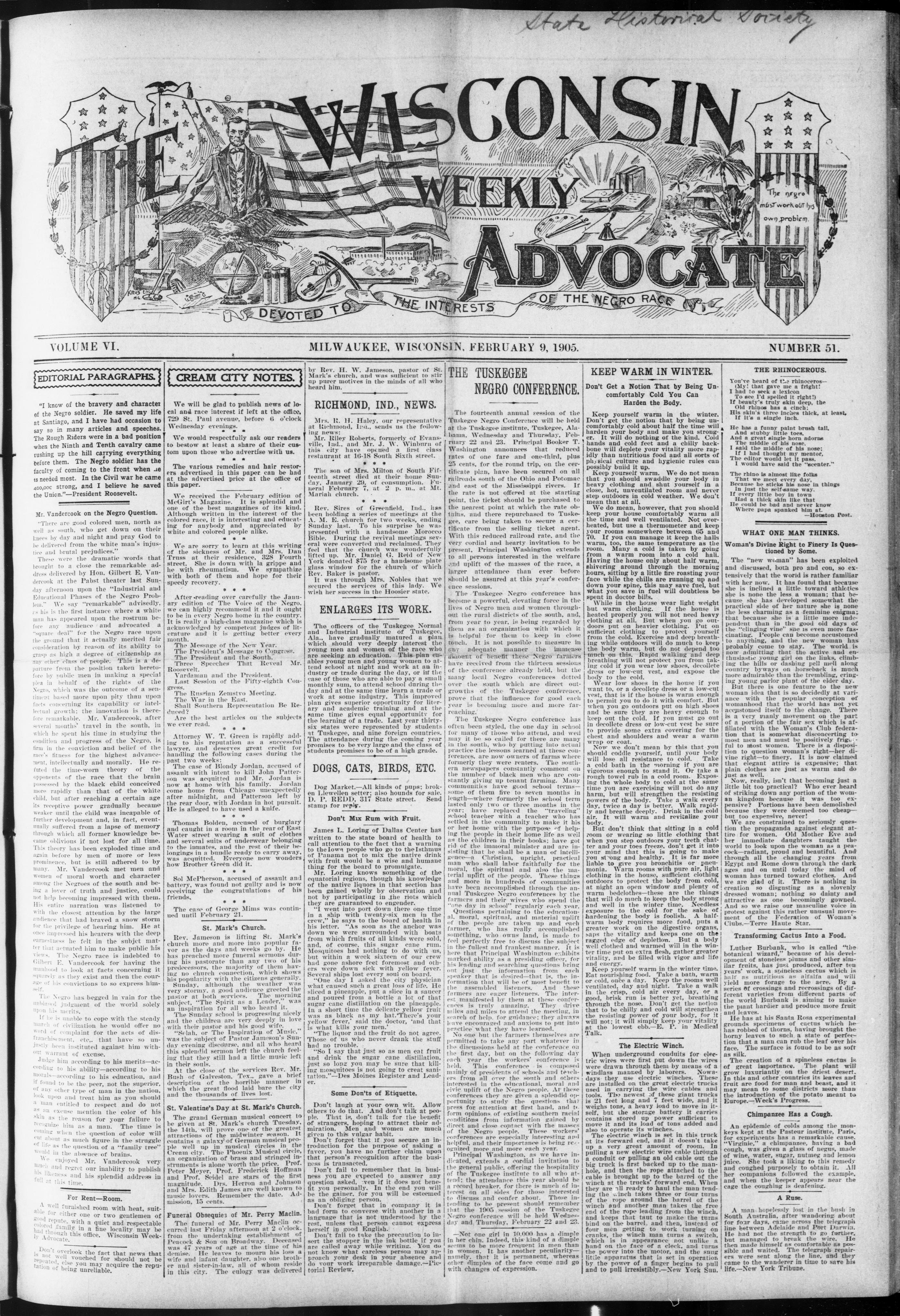
WISCONSIN
WEEKLY
ADVOCATE
DEVOTED TO THE INTERESTS OF THE NEGRO RACE
EDITORIAL PARAGRAPHS.
"I know of the bravery and character of the Negro soldier. He saved my life at Santiago, and I have had occasion to say so in many articles and speeches. The Rough Riders were in a bad position when the Ninth and Tenth cavalry came rushing up the hill carrying everything before them. The Negro soldier has the faculty of coming to the front when he is needed most. In the Civil war he came 400,000 strong, and I believe he saved the Union."—President Roosevelt.
Mr. Vandercook on the Negro Question.
"There are good colored men, north as well as south, who get down on their knees by day and night and pray God to be delivered from the white man's injustice and brutal preindices."
These were the dramatic words that brought to a close the remarkable address delivered by Hon. Gilbert E. Vandercook at the Pabst theater last Sunday afternoon upon the "Industrial and Educational Phases of the Negro Problem." We say "remarkable" advisedly, as his is the first instance where a white man has appeared upon the rostrum before any audience and advocated a "square deal" for the Negro race upon the ground that it actually merited fair consideration by reason of its ability to grasp as high a degree of citizenship as any other class of people. This is a departure from the position taken heretofore by public men in making a special plea in behalf of the rights of the Negro, which was the outcome of a sentiment based more upon pity than upon facts concerning its capability or intellectual growth; the innovation is therefore remarkable. Mr. Vandercook, after several months' travel in the south, in which he spent his time in studying the condition and progress of the Negro, is firm in the conviction and belief of the race's fitness for the highest advancement, intellectually and morally. He refuted the time-worn theory of the opponents of the race that the brain possessed by the black child conceived more rapidly than that of the white child, but after reaching a certain age its receptive power gradually became weaker until the child was incapable of further development and, in fact, eventually suffered from a lapse of memory through which all former knowledge became oblivious if not lost for all time. This theory has been exploded time and again before by men of more or less prominence, but is still adhered to by many. Mr. Vandercook met men and women of moral worth and character among the Negroes of the south and being a lover of truth and justice, could not help becoming impressed with them. His entire narration was listened to with the closest attention by the large audience that had braved a snow storm for the privilege of hearing him. He at once impressed his hearers with the deep earnestness he felt in the subject matter that actuated him to make public his views. The Negro race is indebted to Gilbert E. Vandercook for having the manhood to look at facts concerning it squarely as they exist and then the courage of his convictions to so express himself.
The Negro has begged in vain for the unbiased judgment of the world solely upon his merits. If he is unable to cope with the steady march of civilization he would offer no word of complaint for the acts of disfranchisement, etc., that have so unjustly been instituted against him without warrant of excuse.
Judge him according to his merits—according to his ability—according to his morals—according to his education, and if found to be the peer, not the superior, of any other type of man in the nation, look upon and treat him as you should a man entitled to respect and do not as an excuse mention the color of his skin as the reason for your failure to recognize him as a man. The time is coming when the question of color will cut about as much figure in the struggle of life as the question of a "family tree" would in the absence of brains. We enjoyed Mr. Vandercook very much and regret our inability to publish his likeness and his splendid address in full at this time.
For Rent—Room
A well furnished room with heat, suitable for either one or two gentlemen of good repute, with a quiet and respectable colored family in a fine locality may be had through this office. Wisconsin Weekly Advocate.
Don't overlook the fact that news that is not well vouched for should not be repeated, else you may acquire the reputation of being unreliable.
CREAM CITY NOTES.
We will be glad to publish news of local and race interest if left at the office, 729 St. Paul avenue, before 6 o'clock Wednesday evenings.
We would respectfully ask our readers to bestow at least a share of their custom upon those who advertise with us.
血 血 血
The various remedies and hair restorers advertised in this paper can be had at the advertised price at the office of this paper.
We received the February edition of McGirt's Magazine. It is splendid and one of the best magazines of its kind. Although written in the interest of the colored race, it is interesting and educating for anybody and appreciated by white and colored people alike.
☑ ☑ ☑
We are sorry to learn at this writing of the sickness of Mr. and Mrs. Dan Truss at their residence, 328 Fourth street. She is down with la gippe and he with rheumatism. We sympathize with both of them and hope for their speedy recovery.
* * *
After reading over carefully the January edition of The Voice of the Negro, we can highly recommend it and it ought to be in every Negro home in the country. It is really a high-class magazine which is acknowledged by competent judges of literature and it is getting better every month. The Message of the New Year. The President's Message to Congress
The President's Message to Congress. The President and the South.
The President and the South.
Three Speeches That Reveal Mr. Roosevelt.
Vardaman and the President.
Last Session of the Fifty-eighth Congress.
The Russian Zemstvo Meeting.
The War in the East.
Shall Southern Representation Be Reduced?
Are the best articles on the subjects we ever read.
Attorney W. T. Green is rapidly adding to his reputation as a successful lawyer, and deserves great credit for handling the following cases during the past two weeks:
The case of Blondy Jordan, accused of assault with intent to kill John Patterson was acquitted and Mr. Jordan is now at home with his family. Jordan come home from Chicago unexpectedly after midnight, and Patterson left by the rear door, with Jordan in hot pursuit. He is alleged to have used a knife.
\* \* \*
Thomas Bolden, accused of burglary and caught in a room in the rear of East Water street wearing a suit of clothes and several suits of underwear belonging to the inmates, and the rest of their belongings in a bundle ready to carry away, was acquitted. Everyone now wonders how Brother Green did it.
※ ※ ※
Sol McPherson, accused of assault and battery, was found not guilty and is now receiving the congratulations of his friends.
* * *
The case of George Mims was continued until February 21.
St. Mark's Church.
Rev. Jameson is lifting St. Mark's church more and more into popular favor as the days and weeks go by. He has preached more funeral sermons during his pastorate than any two of his predecessors, the majority of them having no church connection, which shows his popularity with the citizens generally. Sunday, although the weather was very stormy, a good audience greeted the pastor at both services. The morning subject, "The Spirit as a Leader," was an inspiration for all who heard it.
The Sunday school is progressing nicely and the children are very deeply in love with their pastor and his good wife. "Selah, or The Inspiration of Music," was the subject of Pastor Jameson's Sunday evening discourse, and all who heard this splendid sermon left the church feeling that they still had a little music left in their souls. At the close of the services Rev. Mr. Bush of Galveston, Tex., gave a brief description of the horrible manner in which the great flood laid bare the city and the thousands of lives lost.
St. Valentine's Day at St. Mark's Church.
The grand German musical concert to be given at St. Mark's church Tuesday, the 14th, will prove one of the greatest attractions of the midwinter season. It contains a galaxy of German musical people well up in musical circles in the Cream city. The Phoenix Musical circle, an organization of brass and stringed instruments is alone worth the price. Prof. Peter Meyer, Prof. Frederick Hoffman and Prof. Seidel are stars of the first magnitude. Drs. Herron and Johnson and Mrs. Edith James are well known to music lovers. Remember the date. Admission, 15 cents.
Funeral Obsequies of Mr. Perry Maclin.
The funeral of Mr. Perry Maclin occurred last Friday afternoon at 2 o'clock. from the undertaking establishment of Peacock & Son on Broadway. Deceased was 47 years of age at the time of his demise. He leaves to mourn his loss a wife and infant daughter, also one brother and sister-in-law, all of whom reside in this city. The eulogy was delivered
by Rev. H. W. Jameson, pastor of St. Mark's church, and was sufficient to stir up purer motives in the minds of all who heard him.
RICHMOND. IND., NEWS.
Mrs. R. H. Haley, our representative at Richmond, Ia., sends us the following news: Mr. Riley Roberts, formerly of Evansville, Ind., and Mr. J. W. Winburn of this city have opened a first class restaurant at 16-18 South Sixth street.
***
The son of Mrs. Milton of South Fifteenth street died at their home Sunday, January 29, of consumption. Funeral February 7, at 2 p. m., at Mt. Mariah church.
* * *
Rev. Sires of Greenfield, Ind., has been holding a series of meetings at the A. M. E. church for two weeks, ending Sunday last. To his surprise he was presented with a handsome Morocco Bible. During the revival meetings several were converted and reclaimed. They feel that the church was wonderfully lifted up. Mr. Daniel G. Reid of New York donated $75 for a handsome plate glass window for the church of which Rev. Baker is pastor. It was through Mrs. Nobles that we secured the services of this lady. We wish her success in the Hoosier state.
ENLARGES ITS WORK.
The officers of the Tuskegee Normal and Industrial institute of Tuskegee, Ala., have gradually matured a plan which should very deeply interest the young men and women of the race who are seeking an education. This plan enables young men and young women to attend school at night and work at an industry or trade during the day, or in the case of those who are able to pay a small monthly sum, to attend school during the day and at the same time learn a trade or work at some industry. This improved plan gives superior opportunity for literary and academic training and at the same time gives equal opportunity for the learning of a trade. Last year thirty-six states were represented by students at Tuskegee, and nine foreign countries. The attendance during the coming year promises to be very large and the class of students promises to be of a high grade.
DOGS, CATS, BIRDS, ETC.
Dog Market.—All kinds of pups; broken Llewellen setter; also hounds for sale. D. P. REDD. 317 State street. Send stamp for reply.
Don't Mix Rum with Fruit.
James L. Loring of Dallas Center has written to the state board of health to call attention to the fact that a warning to the Iowa people who go to the Isthmus of Panama not to mix the native drink with fruit would be a wise and humane thing for the board to promulgate. Mr. Loring knows something of the equatorial regions, though his knowledge of the native liquors in that section has been gained wholly by observation and not by participating in the riots which they are guaranteed to engender.
"I went into port down there one time in a ship with twenty-six men in the crew," he says to the board of health in his letter. "As soon as the anchor was down we were surrounded with boats from which fruits of all kinds were sold, and, of course, this sugar cane rum. Mosquitoes had nothing to do with us, but within a week sixteen of our crew had gone ashore feet foremost and others were down sick with yellow fever. Several ships lost every soul on board.
"One day I asked the city physician what caused such a great loss of life. He sliced a pineapple, put a slice in a saucer and poured from a bottle a lot of that sugar cane distillation on the pineapple. In a short time the delicate yellow fruit was as black as my hat. 'There's your yellow fever,' said the doctor, 'and that is what kills your men.'
"The liquor and the fruit do not agree. Those of us who never drank the stuff had no trouble.
"So I say that just so as men eat fruit and drink the sugar cane distillation, just so long you may be sure that killing mosquitoes is not going to creat sanitation."—Des Moines Register and Leader.
Some Don'ts of Etiquette.
Don't laugh at your own wit. Allow others to do that. And don't talk at people. That is, don't talk for the benefit of strangers, hoping to attract their admiration. Men and women are much given to this vulgar habit.
Don't forget that if you secure an introduction for the purpose of asking a favor, you have no further claim upon that person's recognition after the business is transacted.
Don't fail to remember that in business you are expected to answer any question asked, even if it does not benefit you personally. In the end you will be the gainer, for you will be esteemed as an obliging person.
Don't forget that in company it is bad form to converse with another in a language that is not understood by the rest, unless that person cannot express herself in good English.
Don't fail to take the precaution to insert the stopper in the ink bottle if you are called away while writing. You do not know what careless person may approach your desk in your absence and do your work irreparable damage.—Pictorial Review.
TUSKEGEE NEGRO CONFERENCE
The fourteenth annual session of the Tuskegee Negro Conference will be held at the Tuskegee institute, Tuskegee, Alabama, Wednesday and Thursday, February 22 and 23. Principal Booker T. Washington announces that reduced rates of one fare and one-third, plus 25 cents, for the round trip, on the certificate plan, have been secured on all railroads south of the Ohio and Potomac and east of the Mississippi rivers. If the rate is not offered at the starting point, the ticket should be purchased to the nearest point at which the rate obtains, and there repurchased to Tuskegee, care being taken to secure a certificate from the selling ticket agent. With this reduced railroad rate, and the very cordial and hearty invitation to be present, Principal Washington extends to all persons interested in the welfare and uplift of the masses of the race, a larger attendance than ever before should be assured at this year's conference sessions.
The Tuskegee Negro conference has become a powerful, elevating force in the lives of Negro men and women throughout the rural districts of the south, and, from year to year, is being regarded by them as an organization with which it is helpful for them to keep in close touch. It is not possible to measure in any adequate manner the immense amount of benefit these Negro farmers have received from the thirteen sessions of the conference already held, but the many local Negro conferences dotted over the south which are direct outgrowths of the Tuskegee conference, prove that the influence for good each year is becoming more and more far-reaching.
The Tuskegee Negro conference has often been styled, the one day in school for many of those who attend, and well may it be so called for there are many in the south, who by putting into actual practice the lessons learned at these conferences, are now owners of farms where formerly they were renters. The southern newspapers constantly comment on the number of black men who are constantly giving up tenant farming. Many communities have good school terms—some of them five to seven months in length—where formerly the school term lasted only two or three months in the year; have replaced the "traveling" school teacher with a teacher who has settled in the community to make it his or her home with the purpose of helping the people in their home life as well as the children in their books; have got rid of the immoral minister and are insisting that he shall be a man of intelligence—a Christian, upright, practical man who shall labor faithfully for the moral, the spiritual and also the material uplift of the people. These things and more in hundreds of communities have been accomplished through the annual Tuskegee Negro conferences by the farmers and their wives who spend the "one day in school" regularly each year.
Questions pertaining to the educational, moral, spiritual, and material uplift of the people are taken up and each farmer, who has really accomplished something, who owns land, is made to feel perfectly free to discuss the subject in the fullest and frankest manner. It is here that Principal Washington exhibits marked ability as a presiding officer, for his leading and searching questions bring out just the information from each speaker that is desired—that is, the information that will be of most benefit to the assembled listeners. And these farmers are eager listeners. The interest manifested by them at these conferences is truly amazing. They drive miles and miles to attend the meeting, in search of help, for guidance; they always leave encouraged and anxious to put into practice what they have learned.
No one but the farmers themselves are permitted to take any part whatever in the discussions held at the conference on the first day, but on the following day each year the workers' conference is held. This conference is composed mainly of presidents of schools and teachers from all over the south and others interested in the educational, moral and civic uplift of the Negro people. At these conferences they are given a splendid opportunity to study the questions that press for attention at first hand, and to form opinions of existing southern racial conditions from information gained by direct and close contact with the masses of the Negro people. These workers' conferences are especially interesting and helpful, and their importance is being recognized more and more each year.
Principal Washington, as we have indicated, extends a cordial invitation to the general public, offering the hospitality of the Tuskegee institute to all who attend; the attendance this year should be a record breaker, for there is much of interest on all sides for those interested to discuss and confer about. Those intending to be present should remember that the 1905 session of the Tuskegee Negro conference will be held Wednesday and Thursday, February 22 and 23.
Not one girl in 10,000 has a dimple in her chin. Indeed, this kind of a dimple seems to be more frequent in men than in women. It has another peculiarity—namely, that it is permanent, whereas other dimples of the face come and go with changes of expression.
KEEP WARM IN WINTER.
Don't Get a Notion That by Being Un comfortably Cold You Can Harden the Body.
Keep yourself warm in the winter. Don't get the notion that by being uncomfortable cold about half the time will harden your body and make you stronger. It will do nothing of the kind. Cold hands and cold feet and a chilly backbone will deplete your vitality more rapidly than nutritious food and all sorts of physical culture and hygienic rules can possibly build it up.
Keep yourself warm. We do not mean that you should swaddle your body in heavy clothing and shut yourself in a close, hot, unventilated room and never step outdoors in cold weather. We don't mean that at all.
We do mean, however, that you should keep your house comfortably warm all the time and well ventilated. Not overheated, but use a thermometer and keep your rooms somewhere between 65 and 70. If you can manage it keep the halls warm, too, the same temperature as the room. Many a cold is taken by going from a warm room into a cold hall. Having the house only about half warm, shivering around through the morning hours, sitting by a little fire roasting your face while the chills are running up and down your spine, this may save fuel, but what you save in fuel will doubtless be spent in doctor bills.
While in the house wear light weight but warm clothing. If the house is heated properly you will not need heavy clothing at all. But when you go outdoors put on heavier clothing. Put on sufficient clothing to protect yourself from the cold. Exercise and deep breathing while outdoors will do much to keep the body warm, but do not depend too much on this. Rapid walking and deep breathing will not protect you from taking cold if you wear low shoes, decollete dress or low-cut vest, and expose the body to the cold.
Wear low shoes in the house if you want to, or a decollete dress or a low-cut vest, that is if the house is warm enough to permit you to do it with comfort. But when you go outdoors put on high shoes and be sure they are heavy enough to keep out the cold. If you must go out in decollete dress or low-cut vest be sure to provide some extra covering for the chest and shoulders and wear a warm wrap or coat.
Now we don't mean by this that you should coddle yourself, until your body will lose all resistance to cold. Take a cold bath in the morning if you are vigorous enough to stand it. Or take a rough towel rub in a cold room. Exposing the whole body to cold at the same time you are exercising will not do any harm, but will strengthen the resisting powers of the body. Take a walk every day, twice a day is better. Walk rapidly and breathe deeply. Drink in the cold air. It will warm and revitalize your body.
But don't think that sitting in a cold room or wearing so little clothing that when you step outdoors your teeth chatter and your toes freeze, don't get it into your mind that this is going to make you strong and healthy. It is far more liable to give you bronchitis or pneumonia. Warm rooms with pure air, light clothing in the house, sufficient clothing outdoors to protect the body from cold, at night an open window and plenty of warm bedclothes—these are the things that will do much to keep the body strong and well in the winter time. Needless exposure to the cold for the sake of hardening the body is foolish. A half-warm body requires more food, puts a greater work on the digestive organs, saps the vitality and keeps one on the ragged edge of depletion. But a body well clothed and warmed will in the winter time put on extra flesh, gather greater vitality, and be filled with vigor and life and energy.
Keep yourself warm in the winter time. Eat nourishing food. Take a bath, warm or cold, once a day. Keep the rooms well ventilated, day and night. Take a walk in the crisp, cold air every day, or a good, brisk run is better yet, breathing through the nose. Don't get the notion that to be chilly and cold will strengthen the resisting power of your body, for it will not; it will simply keep your vitality at the lowest ebb.—E. P. in Medical Talk.
The Electric Winch.
When underground conduits for electric wires were first put down the wires were drawn through them by means of a windlass manned by laborers. Nowadays they use electric winches. These are installed on the great electric trucks used in carrying the wire cables and tools. The newest of these giant trucks is 21 feet long and 7 feet wide, and it weighs tons, a heavy load to move in itself, but the storage battery it carries contains stored up power sufficient to move it and its load of tons added and also to operate its winches.
The electric winch is set in this truck at its forward end, and it doesn't take up a very great amount of room. In pulling a new electric wire cable through a conduit or pulling an old cable out the big truck is first backed up to the manhole, and then the rope attached to the cable is brought up to the barrel of the winch at the trucks' forward end. When they are all ready to haul the man tending the winch takes three or four turns of the rope around the barrel of the winch and another man takes the free end of the rope leading from the winch, and keeps that taut to make the turns bind on the barrel, and then, instead of four men getting to work turning on cranks, the winch man turns a switch, which is in appearance not unlike a hand on the face of a clck, and turns the power into the motor, and the snug little apparatus that is set in operation by the power of a finger begins to pull and to pull irresistibly.—New York Sun.
NUMBER 51.
THE RHINOCEROUS.
You've heard of the rhinoceros—
(My! that gave me a fright!
I had to seek a lexicon
To see I'd spelled it right!)
If beauty's truly skin deep, the
Old rhinos has a cinch;
His skin's three inches thick, at least,
If it's a single inch.
He has a funny paint brush tall,
And stubby little toes.
And a great single horn adorns
The middle of his nose.
I said the middle of his nose;
If I had thought my mentor,
The editor would let it pass,
I would have said the "scenter."
The rhino is almost like folks
That we meet every day,
Because he sticks his nose in things
In just the self-same way.
If every little boy in town
Had a thick skin like that
He could be bad and never know
Where papa spanked him at.
—Houston Post.
WHAT ONE MAN THINKS.
Woman's Divine Right to Finery Is Questioned by Some.
The "new woman" has been exploited and discussed, both pro and con, so extensively that the world is rather familiar with her now. It has found that because she is inclined a little toward athletics she is none the less a woman; that because she has developed somewhat the practical side of her nature she is none the less charming as a feminine enigma; that because she is a little more independent than in the good old days of the "clinging vine" she is even more fascinating. People can become accustomed to anything, and the new woman has probably come to stay. The world is now admitting that the active and enthusiastic young girl on the links, climbing the hills or dashing pell mell along country byways on horseback is much more admirable than the trembling, cringing young parlor plant of the elder day.
But there is one feature to the new woman idea that is so decidedly at variance with the popular conception of womanhood that the world has not yet accustomed itself to the change. There is a very manly movement on the part of a portion of the fair sex which is affiliated with the Woman's Club federation that is somewhat disconcerting to most men and must be positively frightful to most women. There is a disposition to question woman's right—her divine right—to finery. It is now claimed that elegant attire is expensive; that plain clothes are just as warm and do just as well.
Now, really, isn't that becoming just a little bit too practical? Who ever heard of striking down any portion of the woman kingdom because it was too expensive? Portions have been demolished because they were deemed too cheap—but too expensive, never!
We are constrained to seriously question the propaganda against elegant attire for women. Old Mother Eve and her immediate daughters taught the world to look upon the woman as a peacock—radiant, proud and beautiful. And through all the changing years from Egypt and Rome down through the dark ages and on until today the mind of woman has turned toward clothes. And we are glad of it. There is nothing in creation so disgusting as a slovenly dressed woman; nothing so dainty and attractive as one becomingly gowned. And so we raise our masculine voice in protest against this rather unusual movement of the Federation of Woman's Clubs.—Terre Haute Star.
Transforming Cactus Into a Food.
Luther Burbank, who is called "the botanical wizard," because of his development of stoneless piums and other similar fruits, has just produced, after ten years' work, a spineless cactus which is half as nutritious as alfalfa and will yield more forage to the acre. By a series of crossings and recrossings of different varieties from different parts of the world Burbank is aiming to make the plant hardier and produce more fruit and leaves.
He has at his Santa Rosa experimental grounds specimens of cactus which he has robbed of thorns, having brought the horny leaves to such a state of perfection that a man can rub the leaf over his face. The surface is found to be as soft as silk.
The creation of a spineless cactus is of great importance. The plant will grow luxuriantly on the driest desert. In this and other countries its leaves and fruit are food for man and beast, and it may mean to some districts more than the introduction of the potato meant to Europe.—Week's Progress.
Chimpanzee Has a Cough
An epidemic of colds among the monkeys kept at the Pasteur institute, Paris, for experiments has a remarkable cause. "Virginie," a chimpanzee, having a bad cough, was given a glass of negus, made of wine, water, sugar, nutmeg and lemon juice. She took a liking to this remedy and coughed purposely to obtain it. All her companions followed the example, and when the keeper appears near the cage the coughing is deafening.
A Ruse.
A man hopelessly lost in the bush in South Australia, after wandering about for four days, came across the telegraph line between Adelaide and Port Darwin. He had not the strength to go further, but managed to break the wire. He then made himself as comfortable as possible and waited. The telegraph repairers were sent along the line, and they came to the wanderer in time to save his life—New York Tribune.
Miles—Did Croakus leave a widow?
Giles—No; she left him about a year
before he died.
Knobbs—They say poverty egged him
onto the stage.
Snobbs—Yes, and the gallery egged him
off.—Princeton Tiger.
Frenzied Finance.
Lives of great men oft remind us,
If we only owned a trust,
We could squeeze each smaller dealer
Till he'd pay our price or bust.
—Princeton Tiger.
“De trouble ‘bout a young man wif a
poetic dis’zition,” said Uncle Eben, “is
dat he pines to be pickin’ vilets when he
ought to be shovelin’ coal.”—Washington
Star.
Mazie—Who was the gentleman I saw
with you today?
Elsie—Gwacious! that wasn’t any gen-
tleman. He’s only my father.—Philade!-
phia Public Ledger.
What We Leave.
Lives of great men all remind us,
As their pages o'er we turn,
‘That we're apt to leave bebind us
Letters that we ought to burn.
London Star.
Elderly Lady (watching the dancers)—
How well Mr. Heavyweight dances! He
is so light on his feet. Young lady rhe
has had experience)—Humph! I wish be
were the same on other people’s—Smart
Set.
“I see that Mr. Zefferton is still run-
ning for office.” ‘
“No,” answered Senator Sorghum. “He
assumes to be running, but, compared to
the others, he’s only sauntering.”—Wash-
ington Star.
The Minister—My dear madam, let this
thought console you for your husband's
death. Remember that other and better
men than he have gone the same way.
Bereaved Widow—They haven't ail
gone, have they ?—Tit-Bits.
The Usual Way.
How doth the little busy bee
Thaprove each shining minute?
Selects a spot on you or me
And jabs his stinger in it.
—Philadelphia Press.
Ferdy—That tailor of yours is certainiy
a bird.
Cholly—Yes; I call him a pelican.
Ferdy—Why?
Choliy—If you'd see the size of his bill
you youldn’t ask.—Cleveland Leader.
Henry—It may seem like presumption
for me to pass upor your conduct; but
Balaam was rebuked by his ass, you
know.
Furson—Yes; and every donkey thinks
he many follow suit—Boston Transcript.
Greek Fire.
A crusty old Greek at Thermopylae
Wrote “Down with this awfu! monopylae!”
He raved and he cussed
And said “Down with the Trust!”
And he signed the old letter ‘“Vox Popylae.”
—New York Evening Mali.
Visitor—Are those real flowers in that
vawze?
Hostess—Why, certainly. Why do
you ask?
Visitor—They look so natural I
thought they must be paper ones.—Bal-
timore American,
“Pop!”
“Yes, my son.”
“Are not fleas very hard to catch?”
“Very hard, my boy.”
“How is it, then, that mamma gets ’em
so she can put ‘em in your ear all the
time?’—Yonkers Statesman.
“I wish they'd invent a new expression
occasionally,” said Top, as he perused
the account of a recent wedding. “It’s
always ‘the blushing’ bride.”
“Well,” said Mrs. Top, “when you con-
sider what sort of husbands most girls
have to marry you can’t wonder at them
blushing.”’—Tit-Bits. .
Division of Labor.
He promised to look our for her
From dawn to darkness dim
When they were wed; but did not say
She'd busy be from dark to day
A-looking out for him.
—New Orleans Times-Democrat.
SNS ASRS eee ee
Mrs. Fluffy—Bedelia writes that she is
going to bring home two of her boarding
school friends for Christmas vacation.
Mrs. Duffy—What are you going to do
to entertain them?
Mrs, Fluffy—Nothing; I’ve written to
John to bring home two of his college
chums.—Detroit Free Press.
“Mamma,” said the little girl, who was
having her first experience of riding in a
sleeper.
“Hush, dear,” whispered mamma, “you
will wahen the others.”
“But, mamma, I only want to ask on¢
question.”
“Well, what is it?”
“Who has the flat above us?’—Life.
Ruby, who was dining with her elders,
was given her choice of her favorite
desserts.
“Which will you have, Ruby, ice
cream or jam?’ her indulgent father
asked,
After a moment's hesitation she said.
“Give me a little of each and a lot of
both.” —Lippincott.
“Children, we will now have an ex-
ample in division. Tommy Tiggley, it
your father brought home $10 to divide
with your mother, what would she get ¥
“Ten dollars.”
“Tommy, you don’t know your les:
son,”
“No, ma’am, but I know my mother.”
—Cleveland Plain Dealer.
Teacher—But you should be consistent.
Henry; one day you say one thing, and
the next day something quite the con-
trary.
Henry—And don't you, Miss Horn-
hooke? For instance, yesterday you said.
“Tomorrow is Wednesday,” and only the
day before you had said, ‘Tomorrow is
‘Tuesday.’—Boston Transcript.
One Cause of Illness.
A famous physician upon being asked
recently what. is the chief cause of ill-
health, replied: “Thinking and talking
about it all the time. This ceaseless
introspection in which so many of the
rising generation of nervous folk indulge
is certainly wearing them out. When
they are not worrying as _ to whether
they sleep too much or too little they are
fidgeting over the amount of food they
take or the quantity of exercise neces-
sary for health. In short, they never
give themselves a moment's peace.”
Housekeeper.
ee
Paving the Way.
A Miss Buchanan was once rallying
her cousin, an officer, on his courage,
and rashly said:
“Now, Mr. Harry, do you really mean
to tell me you can walk up to the can-
non’s mouth without fear?”
“Yes,” was the prompt reply, “or a
Buchanan’s, either.” e s
And he at once did it!—London Tit-
Bits.
WHEN GREAT WINDS COME.
When the great gray winds come,
I can forget
How narrow is my. room,
How bier sometimes, the city’s loveless
mask,
And how my spirit, building elysiums yet
Under oon sky where the long road shal
end,
Dulls slowly to its task.
With the great wind I dream myself away
On the rough hills of the north,
Where the young fern comes forth
Greenly and line by line,
Where white storms sweep and shine
Quickly along the wood—
And there is joy to spena.
What more were there to ask
If I might stay
With the sun and cloud,
Vnehidden and all day long,
On the open hills where often the great
wind passes,
Itself my friend, and no hed but the grasses,
And for my guest the May thrush and his
song?
—Mildred I. McNeal in Lippincott’s.
——_—_
: 7
THE BiSHOP’S DAUGHTER.
NSP LES Fine eg ge
‘Martin-sur-Mer faces the sea. The sea
that it faces is brilliantly blue, glowing
through a tangle of oleander blossoms,
pink and crimson and white. When one
sits in the veranda, therefore, one does
nothing else.
I was sitting there doing nothing when
the bishop and his daughter arrived. I
glanced at them because they were nov-
‘elties, but one look was enough to con-
‘vince me that the oleanders were more
worthy of my attention. The bishop
was quite the usual sort of bishop. As
for the daughter, the idea her appearance
conveyed to me during that hasty glance
was one of pale indefiniteness, with a
general tint of yellowish drab. I could
have forgiven the color of her dust cloak
if there had been relief anywhere, but
her face was pallid, and her pale blue
beves were as uninteresting as her hay-
eolored hair. With a sigh I classified her
ee dull,” and reverted to the satis-
fying depths of color from which curiosi-
‘ty had wooed me for a moment. Later
‘in the day I discovered that the conver-
sation of the bishop’s daughter was as
colerless 2s her appearance. It was plain
that she would not add to the merriment
of the party.
There were a good many of us at the
hotel—a heterogeneous but fairly con-
genial set. Most of us were on friendly
terms, but there was one who was dis-
liked almost venomously and quite unan-
imously. I have since suspected that
Miss Tattersall had a heart of gold. She
had succeeded, however—ably assisted by
'Nature—in hiding it under a manner that
would have repelled a torpedo boat. She
was a good deal grieved by the frivolous
‘tone of her companions, and did her best
‘to elevate us, which possibly accounted
for our rancor. When we were not shock-
ag her, we were laughing at her—all
but the bishop’s daughter, who fixed her
pale eyes on the sea and said nothing.
We always believed and hoped we were
shocking her, too.
Miss Tattersall had a pet charity, and
one evening she gave us a chance of bet-
tering ourselves spiritually by contrib-
uting to it. We were, as usual, sitting
in the long veranda that faced the sea;
some gathered around coffee tables, some
lolling in wicker chairs, but all talking
and a good many laughing. There was
one exception; the bishop’s daughter sat
silently apart on the steps that led to
the garden. I could see her hay-colored
hair like a blur against the sea. Miss
Tattersall passed from group to group
with her money box, declaiming and ex-
horting. I am afraid her exhortations
produced very little result in cash, but a
great deal in irritation; we were in a
flippant mood, and wished the dear old
lady and her charity far away. She re-
turned to her seat with some very small
coins in her box, and probably with more
chagrin in her heart than I care to im-
agine. The bishop’s daughter rose, and
as she came up the steps I thought her
face almost had an expression on it.
After this incident we were all rather
ruffled. At any time when Miss Tat-
tersall spoke she created a tuflle, the
sound of her voice being enough for most
of us, but on this oecasion there was an
element of remorse that increased our
discomfort. Our jokes and laughter had
been damped, and most of us took up
books. There was a general air of sulk-
iness about us—when a diversion oc-
curred.
Wandering minstrels were not at all
uncommon trials at Saint Martin-sur-
Mer, so the distant twang of a mando-
lin ereated no disturbance beyond a
groan or two. When the owner of the
mandolin appeared in front of the ver-
anda, we set our teeth and prepared to
suffer. The dark figure that came to-
ward us through the orange trees was
slight and girlish, and moved with ecuri-
ous sliding steps, in time to the music
of the mandolin. Severai of us peered
out to see her face, but the evening was
growing dusk, and she wore some dark
drapery over her head. I was about to
bargain with her for peace, when she
suddenly glided into a dance, and afte1
that I should have throttled any one whe
had tried to stop her. But I don’t think
any one wanted to try. On the con-
trary, one by one we left our seats and
crowded round the plot of grass on which
she was dancing. She looked like a spirit
of the garden, weird and shadowlike.
with her black draperies floating round
her, and the bamboos bending over her
and behind her the mysterious crange
grove whence she had come. We watched
breathlessly. The tiny feet in theit
scarlet shoes twinkled on the grass in
ene fantastie figure after another. It
was pure witchery, and we were all be.
witched, exeept two. Miss Tattersall
turned her back to the dancer in austere
disapproval, and the bishop looked dis-
tinetly uneasy.
The magie dance ended in an outbreak
of applause and coins. The girl was posi-
tively pelted with money. We pressed
round her, anxious for a nearer view of
the sorceress, but she waved us away,
and held up a gleaming white hand to en-
join silence. Then. striking a few chords
on the mandolin, she began to sing.
1 do not know what song she sang, or
even if she sang it well; I only know
that no voice ever spoke to my heart so
impericusly. Every high emotion, every
noble passion, every heavenward aspira-
tion possible to mortals were uttered in
| it. Everything that surrounded the sing-
jer, the oleanders and the orange grove,
the sky and the sea, seemed to be sing-
lee with her; it was the voice of Nature
calling upon the heart of Humanity.
Earth was more beautiful for the sonz.
and heaven nearer. 3
WB ee me. 8 has) oe a oS
The bishop was smiling at the stars. We
‘made no sounds of applause, and, just at
first, it occurred to no one that the girl
‘might like remuneration: in fact, offering
to pay for that song seemed to be “pur-
chasing the gift of God with money.”
The young woman, however, appeared
to think otherwise, and made it quite
plain that she had no such delicate feel-
ings. In a moment her hands were full
to overflowing; then, while we were still
gasping with emotion, she had glided
away from us among the orange trees.
We were all rather quiet after that.
Some of us pretended to read, but every
one knew that was only a thin excuse for
silence. We had been sitting in this
dreamy condition for some time when
the bishop’s daughter came into the ver-
anda. I had not noticed before that she
had been absent. She walked straight
toward Miss Tattersall with a soft glid-
ing step that made me look at her nar-
rowly. Then I nearly cried out with
amazement as the truth flashed upen me,
for she had forgotten to change her shoes,
and they were scarlet.
The girl was now beside Miss Tatter-
sali, pouring a shining cascade of silver
into her lap. There was just a hint of a
smile in her faint eyes as she said:
“Miss Tattersall, here is some money
for your charity. I collected it this even-
tae? :
The old lady looked up, bewildered.
Then light gradually dawned on her, and
ker face broke into a smile that covered
a multitude of sins:
“Thank you, my dear,” she said;
“thank you for the money; but bless you
for the song!” Then we all rose to do
homage to the bishop’s daughter.—Lon-
den Free Lance. Z
Tools for Engraving Diamonds.
Diamonds can be engraved in a very
artistic manner. This development of the
diamond cutting art brings into existence
a new class of jewelry, for which a con-
siderable demand is expected. It was
long believed that the diamond could not
be engraved with safe or satisfactory re-
sults. A few stone roughly engraved
were found in India, and a diamond was
exhibited at the Paris exposition in 1878
on which a portrait of the King of Hoi-
land was scratched. But the work was
imperfect, and the stones were rather
repolished than engraved. Some of the
finest specimens of engraving on_dia-
monds are the work of Bordinet, a Paris
jeweler,
‘The most remarkable is a ring made of
one diamond, the interior surface being
polished and the exterior elaborately en-
graved. Other examples are brooches,
representing flies, of which the wings are
thin engraved diamonds, and two dia-
monds engraved with armorial bearings,
the imperial arms of Russia being used
in one instance on shirt and cuff buttons.
Formerly it was only possible to pro-
duce the polish on flat surfaces, but Bor-
dinet has been able to do this on concave
portions, as on the body and tail of a
fish and the interior of the ring. His
tools produce not only straight lines, as
in the wheel, the racquet and the flies’
wings, but a free modeling, as in the
pansy, the Russian arms and the scara-
beus. He has invented these tools him-
self, and intends that his son alone shall
have the use of them. They are exceed-
ingly delicate and difficult to handle. He
has spent thirty-five years bringing them
to perfection. It is comparatively but a
few years since it was possible to pierce
holes in diamonds. This feat made pos-
sible the placing of diamonds on a string.
alterating with pearls. This work is
done geaerally in diamond eutting estab-
jlishments.—Kansas City Star.
The Cabby Knew.
Harry Fisher of the “It Happened in
Nordland” company, now playing at the
Lew Fields theater, New York, tells this
story of his father:
“The old gentleman came down to New
York one day and, entering a cab at the
Grand Central station, told the driver to
take him at once to St. Michael's church.
The cabman didn’t know where St.
Michael's church was, but rather than
lose a fare determined to bluff it out. He
did know there was a Catholie church in
the neighborhood and so drove there, and
halted at he door, above which was the
name of the church. My father looked
eut of the door as the cabman held it
open and said:
““This isn’t. St. Michael's church.’
“‘This is where you get out just the
same, old man. This is All Saints’
chureh, and St. Michael must be in
there.”
“And my father had to get ont and
pay the fare,” concludes Mr. Fjsher.—Bill
Sill’s Stage Gossip.
SS EEE
Army Reel Cart.
The army signal corps has been ex-
perimenting with a new reel cart made
after the fashion of the artillery gun and
limber. The reel, together with coils of
wire to the extent of four miles, is
mounted on the rear section of ~the
vehicle. The cart is part of a system for
the distribution of wire for telegraphic
and telephonic purposes while the army
is in the field, and its facilities were test-
ed thoroughly at the combined manveu-
vers in California. It was found that
the cart could go wherever a horse could
travel, and it was a distinct aid to the
distribution ot wire. The cart was built
by men of the signal corps.at Benicia
barracks, on the design made by an offi-
cer of the signal corps.
—$—_+—___.
First and Last Enclish Pontiff.
An English pope has been one of the
fancies of fiction in 1904, but it is more
than doubtful whether it will ever be a
fact again. The first and last English
pontiff was elected as long ago as De-
cember 4, 1154. Nicholas Breakspeare
was born the son of a laborer at Lang-
ley, near St. Atbans, and lived, as Advi-
an IV., to be one of the most powerful
and assertive of the popes. It was he
who compelled the Emperor Frederick
Barbarossa to hold his stirrup, and when
he died in 1159 he was about to excom-
municate the Emperor. It was Adrian
TV. also who blessed and authorized by
virtue of the supposed papal jurisdiction
over all islands his old sovereign, Henry
IL’s, resolve to conquer Ireland.
The Japanese Idea of Bravery.
There is a time when death is much
easier for 2 man than to fulfill his duty,
and if he dies just for the sake of death
he cannot execute the duty that is as-
signed him. True bravery is not in
throwing away one’s life, or courting
death, but in doing one’s duty at the
hazard of one’s life. You must not for-
get that.—From “A Daughter of Japan,”
by Marui Gensai.
+
Suffered Throuch the Plav.
Miss Mamie Harris slipped on the side-
walk while on her way to the opera
house at Janesville, Wis., and dislocated
her arm. Rather than interfere with the
pleasure of her escort she attended the
performance, sitting through the show
without making complaint, and did not
inform any one of the accident until she
reached home. three hours later.
e
Premiums on Matrimony.
The Salvation army in England. with
a view to encourage matrimony, is col-
lecting clothing from rich people, and
offers to sell complete and suitable wed-
ding outfits to happy couples for 16s, and
to furnish two rooms at the same price.
TO A LITTLE CHILD.
Come, let us kiss you, Newly Seven,
Seven times and once to grow on,
For the new year may not go on
Till the lucky kiss be apis
Child of Heaven, newly seven.
Your eyce, so confidently blue.
They were the mother's eyes before you,
And the gay spirit looking through,
{t was the mother's soul that bore you;
Therefore, Seven, we adore you.
Her beauty was the gift of Heaven,
And yours, child, too, is godly-givea,
For it doth seem to me that even
Thus Jesus looked when he was seven.
—Gouverneur Morris in The Century.
New York Every Day.
John W. Griggs, W. R. McAdoo and
William Barbour are inierested in a new
elevated railroad from Paterson, N. J.,
to Weehawken, on which work will socu
be started. The cost of construction is
estimated at $10,000,000.
The jury in the case of Henry Lund-
berg, former assistant inspector of steam
vessels, charged with manslaughter in
connection with the Gen. Slocum disas-
ter, reported that they were unable to
agree and were discharged.
Police _ Commissioner McAdoo — an-
nounces that only nine of 1500 policemen
had qualified in revolver practice, which
was held in the armories recently. The
commissioner stated that in the future
drastic methods would be adopted in the
hope of making the patrolmen better
marksmen.
Joseph Pulitzer -recently announced
that the actual establishment of — the
school of journalism at Columbia univer-
sity, which he lately endowed, will be
deferred until the donor's death. The
cause ascribed for the delay is that Mr.
Pulitzer has not been able to find a suit-
able head for the school.
The Associated Building Trades has
been formed in New York city. It con-
tains thirty-three unions, with an aggre-
gate membership of 75,000, and is strong-
er than the old board of building trades,
ef which Samuel Parks was president.
Arbitration of all diffieulties is provided
for under che constitution, which states
that strikes will be a last resort.
Joseph Reilley, known to the New
York police as “Hobnail” and bearing a
long criminal record, was shot and killed
in Chinatown, the result, it is believed,
of a feud between denizens of that quar-
ter. Reilley, according to the police,
served nine years’ imprisonment at Pitts-
burg for larceny and a workhouse sen-
tence at St. Louis for pocket-picking.
Mrs. Payne Whitney, who, as Heien
Hay, daughter of Secretary of State
John Hay, gave evidence of her literary
ability, is completing arrangements fer
the publication of her iatest novel. The
scenes and incidents of the book center
around Manhasset, L. L, where the
Whitneys have been passing the winter
in their country home, where the book
las been written.
Men who think they are saving club
dues by patronizing first-class hotels in
New York have many little trials which
are calculated to wake them up. A man
may smoke a herring or a bowl of corn
silk in a club, but he is denied the priv-
ilege of smoking a pipe in practically all
the amtotn hotels and restaurants. This
embargo even extends to ‘the grill rooms
of, many of the fashionable places.
Claims for nearly $1,500,000 for dam-
ages resulting from the burning of the
excursion boat Gen. Slocum, on June 15
last, have been filed with United States
Commissioner Alexander. The‘claims are
classified under three heads: The expense
ineurred by the city in raising the hull of
the vessel and searching for the bodies
of the victims; damages alleged to have
resulted from personal injuries, and dam-
ages alleged to have resulted from the
| death of nearly 1000 persons.
Dr. W. B. Read, a graduate of Ed-
inburgh university and of the University
of Pennsylvania, is dead at Boston at
the age of 70 years. He was found sit-
ting in a chair beside a table upon which
lay a note showing that he had diag-
nosed his own case as the attack came
on, It read as follows: ‘‘Nothing sus-
picious. I died of rheumatism of the
heart. My effects go to my wife, Annie
Read, Hickory, N. C. The pain is terri-
ble. The rheumatism has reached the
vital organs.” :
Of more than 1600 steerage passengers
who arrived on the Cunard line steam-
ship Slavonia, from Fiume, the immigra-
tion authorities suspect that a large per
cent. came to this country as contract
laborers. Five hundred have been held
for examination, the largest number ever
held from a single steamship, Of these
150 have been ordered deported. The au-
thorities believe that many of the new
arrivals were destined for the coal mines
of West Virginia and some railroad con-
tractors in Ohio.
Steps to compel the remoyal of all ad-
yertising signs from the subway stations
have been taken by Mayor McClellan.
The mayor's action followed the receipt
of an opinion from Corporation Counsel
Delaney, stating that the operating com-
pany had no legal right to use the sub-
way stations for the display of advertise-
ments, and advising the mayor that be
had the right to remove the objectionable
signs by force. The subway company
was notified that the signs must immedi-
ately be removed.
Announcement of the gift of $1,100,-
000 to Union Theologieal seminary is
made by Dr. Charles Cuthbert Hall,
president of the faculty, who declined to
reveal the name of the donor. Included
in the gift are thirty-six lets between
One Hundred and Twentieth and One
Hundred and Twenty-second streets, just
off Riverside drive. It is the announced
intention of the directors to utilize the
gift as soon as possibie for the remoyal
of the seminary from the present quar-
ters to the site included in the gift.
Edward A. Goodnow, a philanthropist,
died at Worcester, Mass., aged 94
years. He leaves $103,000 in spe-
cifie bequests and the resjdue of the es-
tate, $150,000, is left_to the American
Missionary Society of New York. Among
the public bequests are the following: To
Tuskegee Normal and Industrial insti-
tute; Oberlin college, Oberlin, O.; trus-
tees of Northfield seminary; Huguenot
seminary, Wellington, South Africa;
Washburn college, Topeka, Kan., $5000
each; ‘trustees of Hampton institute,
Hampton, Va., $10,000.
Courage and coolness in the face of
grave danger was shown by En-
gineer Corley of the fire department when
the driver of 2 fire engine was thrown
from his seat by a collision and the
horses started to run away. Corley
climbed around the swaying boiler and
cown upon the pole until he got posses-
sion of the reins and brought the fright-
ened_horses to a standstill. In falling
the driver had grasped the pole between
: the horses and was being dragged along
George Buchanan of Bunnell & Bu-
Tootoanl, in which the two neophytes ac-
quired numerous new bumps on their
heads. After it was over Buchanan, who
had orders, dragged Morris, with him, in
spite of obstacles, and executed the or-
ders. Later the two were cut apart.
John Arbuckle’s “deep sea hotel,” the
ship that he fitted up to accommodate
boarders last summer, is to become a
floating hotel, for men and women who
earn low wages, and more ships similarly
equipped_are to be added for the enter-
prise. . He eee to charge 40 cents «
day, or $2.80 a week, for women, and
50 cents a day, or $3.50 a week, for
men, and added: “The poorer you are
the more cheerfully will you be received,
provided you are respectable.” So many
answers were received asking for accom-
modations that Arbuckle decided to fit
up three vessels instead of one, and an-
nounced the fleet would be moored at the
foot of Twenty-first street.
Some interesting evidence as to the
true inwardness of New York women
was furnished when the Eclectic,
“the best-dressed club in town,” dis-
cussed “Ourselves as Seen by Our Sery-
ants,” at Delmonico’s. Mrs. Simon
Bovuch testified that she had a maid who
keeps a diary in which she records the
impressions of her mistresses. One entry
tells how a woman in a controversy with
her husband playfully hurled a_ flower
pot at him with an aim so truly fem-
inine that it hit the maid over the eye,
closing both the optic and their relations.
Another mistress slapped the maid’s face
soundly because she failéd to open the
door quickly enough on a cold day when
her superior officer was freezing on the
front steps.
Price of land in the Adirondack moun-
tains has trebled within the last three
months. This condition is the result of
fortunes made out of the lands of the
late Orlando Dexter of New York, who
was shot about a year ago. Executors
of the Dexter estate sold the 5000-acre
Dexter tract of virgin forest last Octo-
ber to Franklin county men for $50,-
000, These men in December sold the
tract to a syndicate headed by Firman
Onderkirk, of Cold Brook, for $100,000.
The Browns Tract Lumber company
bought the land last week from the
Onderkirk syndicate for $142,000. Sev-
eral New Yorkers who have been here
recently looking at large estates for sum-
mer residences found the prices trebled
since last year,
O'Donovan Rossa, the Irish patriot, is
considering leaving this country to spend
his declining years in Ireland. Edmund
O'Neill, a wealthy resident of Kinsale,
has offered to give him outright a house
where he and his wife can live their re-
maining days. “There are,” said he,
“many reasons why I would like to
spend the remainder of my life on the is-
land. If I could be there I might be
of greater service to the cause of Irish
freedom. However, I have so many
friends here and haye led such an active
life that I do not know if 1 would be
contented away from New York. I can
return to Ireland now without fear, of
being thrown into prison. The sentence
of banishment »f twenty years against
me expired last year.”
A flood of money from banks in the
interior cities has swept down on_ the
great financial institutions of the Wall
street district. How to count the cur-
rency and where to store it have become
serious problems. The ability of the
clerks to count the bills, which come in
packages of $25,000 to $100,000. has
been tested to the utmost. Some banks
adopted the scheme of sending the bun-
dies at once to the subtreasury, where
there are many experts who do nothing
but count money. A few of these ex-
perts also have been lent to the largest
institutions. Various reasons are ad-
vanced for the unusualy large flow of
currency. It is generally attributed to
local trade and manufacturing conditions
in various localities.
Seif-imprisoned in her home of former
wealth and luxury in Flushing, L._L,
Mrs. John Roland Enos, formerly of San
Francisco, the young widow of a wealthy
man, was found delirious and starving.
Doctors pronounced it a case of brain
starvation. Loss of relatives by ‘death,
accompanied by loss of her. fortune, is
thought to have weakened her mind.
With all her strength she fought those
who came to assist. She had locked her-
self in a darkened parlor for nearly a
week. Fifteen years ago, as Miss
Marian Peters, Mrs. Enos was_ well
known in San Francisco society. She is
the daughter of Jason Peters, a diamond
merchant, who was at once notified. A
little more than a year ago the busband
died unidentified in Bellevue hospital.
ae .
Alfonzo Titzuco, hailing from Naples,
was found stowed away in a coal bunker
‘on the steamer Deutschland when she
reached New York. The vessel had been
at sea three days, and the young man
| Was almost starved. A purse was made
‘up by passengers and he was put to work
as a stoker. Titzuco said he was bound
for Paris, Ill., where his sweetheart, An-
gela Giascomo, lives. He had saved up
‘enough money to get from New York to
that place, but could not wait to earn,
his ocean passage, so he stowed away on
the ship. His happiness grew, as the
‘steamer neared port, but he soon learned
that his mode of travel was unlawful
‘and he will be carried back to Naples.
‘The stokers’ quarters were wet with
tears when Titzuco learned of his fate.
J. P. Morgan worships every Sunday
‘he is in New York in a free pew. St.
George’s church is a free church, the
same as the Holy Communion, at Twen-
tieth street and Sixth avenue, and the
Church of the Ascension at Tenth street
and Fifth avenue. The revenues of
these churches are so large that there
is no necessity for them to charge pew
rent. The poor are invited to atte!
and are given good seats. The Sunday
collections in Dr. Rainsford’s church are
said to average upward of $50,000 4
year. But this would not begin to pay
the running expenses of the church and
the various charities associated with it.
It is in the latter direction that Mr. Mor-
gan and other rich men, who have free
sittings in the chureh, have an oppor-
tunity to play the good Samaritan.
Absentminded.
A minister's wife, a doctor’s wife and a
traveling man’s wife met one day recent-
ly and were talking about the forgetful-
ness of their husbands. The minister's
wife thought her husband was the most
forgetful man living, because he would
go to church and forget his notes and no
one could make out what he was trying
to preach about. The dector’s Wife
thought her husband was the most for-
getful still, for he would often start out
to see a patient and forget his medicine
case and travel nine miles for nothing.
“Well,” said the traveling man wife,
“my husband beats that. He came home
the other day and patted me on the cheek
and said: “I believe I have seen you
‘before—what is your name? ”—Brown-
wood Banner Bulletin.
—$—_—_____.
THERE IS JUST ONE SURE Way.
Dodd’s Kidney Pills Build Up Run-
Down People — They Make Healthy
Kidneys and that Means Healthy Peo-
ple — What Mr. and Mrs. J. lL.
Duffey Say:
Nora, Ind., Feb. 6th.—(Special.)—
That the sure way of building up run-
down men and women is to put their
kidneys in good working order is
shown by the experience of Mr. and
Mrs. Joseph L. Duffey of this place.
Both were weak and worn and dispir-
ited. They used Dodd's Kidney Pills
and to-day both enjoy the best of
health.
Mr. Duffey’says: “I was very weak
and almost past going. I tried every-
thing which people said was good but
got no benefit till I tried Dodd’s Kid-
ney Pills. They helped me in every
way and I am strong and well now.”
Mrs. Duffey says: “I was so bad
that if anybody would lay down a
string I felt I could not step over it,
Since taking Dodd’s Kidney Pills I
can run and jump fences.”
Healthy kidneys insure pure blood;
Dodd’s Kidney Pills insure healthy
kidneys.
ARE AMERICANS POLITE?
London Press Casts Aspersions on Us as
a Nation.
A discussion has béen raging in the
London press on the question, “Does
politeness pay?” Correspondents point
out that not only have the ancient court-
ly ways fallen into disuse. but even the
commonest courtesy of daily life is fast
becoming unfashionable. Perhaps the
most novel argument advanced was that
the American nation, “notoriously the
most impolite in the world,” has man-
aged to forge to the front in business
and statesmanship, and has thereby
demonstrated that politeness does not pay,
while Spain, with its courteous grand-
ness, and France, famous for politeness,
are not such noticeable examples of suc-
cess among the nations.
Apart from the discussion of the ques-
tion, which hardly deserves to be taken
seriously, the pungent criticism of the
American nation, furnishes food for re-
flection. Are we less polite than our
neighbors? Outwardly, yes. It must be
admitted that most of us have been too
busy settling a new country, and striv-
ing for bare existence to put the utmost
degree of polish of which we are capable
upon our manners. In England th® con-
ductor of the omnibus says “Thank you.”
as he receives the fare. In France, the
gendarme on the street corner is the
-personification of courtesy, as he an-
swers the stranger’s inquiries. No such
examples of politeness are furnished by
public servants in this country. In the
native courtesy that springs from the
heart we yield to none, but our man-
ners sometimes afford room for criticism.
But we are learning fast, and, really,
“most impolite in the world” is putting
it a little too strongly. Granting that
we are already first “in business and
statesmanship,”” may we not hope some
day to attain equai precedence in cour-
tesy and come to be known as the “most
polite , nation in the world?’—Good
A FELLOW FEELING
Why She Felt Lenient Towards the
Drunkard.
A great deal depends on the point of
view. A good temperance woman was
led, in a very peculiar way, to revise
her somewhat harsh judgment of the
poor devil who cannot resist his cups
and she is now more charitable. She
writes:
“For many years I was a great suf-
ferer from asthma. Finally my health
got so poor that I found I could not
lie down, but walked the floor whilst
others slept. I got so nervous I could
not rest anywhere.
“Specialists told me I must give up
the use of coffee—the main thing that
I always thought gave me some relief.
I consulted our family physician, and
he, being a coffee fiend himself, told
me to pay no attention to their advice.
Coffee had such a charm for me that
in a restaurant and getting a whiff of
the fragrance I could not resist a cup.
I felt very lenient towards the drunk-
ard who could not pass the saloon.
Friends often urged me to try Postum,
but I turned a deaf ear, saying ‘That
may do for people to whom coffee is
harmful, but not for me—coffee and 1
will never part.’
“At last, however, I bought a pack-
age of Postum, although I was sure I
could not drink it. I prepared it as
directed, and served it for breakfast.
Well, bitter as I was against it, I must
say that never before had I tasted a
more delicious cup of coffee! From
that day to this (more than 2 years) I
have never had a desire for the old cof-
fee. My health soon returned; the
asthma disappeared, I began to sleep
well and in a short time I gained 20
pounds in weight.
“One day I handed my physician the
tablets he had prescribed for me, tell-
ing him I had no use for them. He
stayed for dinner. When I passed him
his coffee cup he remarked ‘I am glad
to see you were sensible enough not to
let yourself be persuaded that coffee
was harmful. This is the best cup of
coffee I ever drank,’ he continued; ‘the
trouble is so few people know how to
make good coffee.’ When he got his
second cup I told him he was drinking
Postum. He was incredulous, but I
convinced him, and now he uses noth-
ing but Postum in his home and has
greatly improved in health.” Name
given by Postum Co., Battle Creek,
Mich.
Look in each package for the fa-
mous little book “The Road to Well-
ville.” ‘ berbs
GOSSIP FOR THE LADIES.
You that have seen how the world and its
glory
Change and grow old like the love of a
friend.
friend;
You that have come to the end of the story;
You that were tired ere you came to the
end;
You that are weary of laughter and sorrow;
Pain and pleasure, labor and sin.
Sick of the midnight and dreading the morrow.
Ah, come in; come in.
You that are bearing the load of the ages:
You that have loved overmuch and too late;
You that confute all the saws of the sages;
You that served only because you must wait.
Knowing your work was a wasted endeavor.
You that have lost and yet triumphed therein.
Add loss to your losses and triumph for ever:
Ah, come in; come in. —Blackwood's.
Why Men Marry the
Man's a strange animal, and makes strange use
Of his own nature and the various arts;
And likes particularly to produce
Some new experiment to show his parts.
One of the most surprising illustrations of the truth of these words from one of Byron's poems which ever came under my notice was furnished by the action of a friend of mine, who six months ago married a girl who, to be candid, was regarded as the most disagreeable, unpopular and independent female of the particular social circle in which she moved. Singularly enough, when this man was first told about the girl before being introduced to her, he casually passed the remark that he "would be sorry for the man who married her."
I slyly asked him recently if he was sorry for himself, and he begged of me to let the remark sink into oblivion, for he was really the happiest married man alive.
"It is true," he continued, "that my wife is a self-opinionated woman, of independent disposition, frank to a degree, and therefore disagreeable according to many people's ideas, simply because she will not agree, for the sake of politeness and courtesy, with all they say and do. It is also true that she had the reputation of being a bit of a shrew amongst her male friends, and she has laughingly confessed to me since our marriage that she believes she frightened more than one suitor away on this account. She was, in fact, one of the few girls who did not court popularity by being as 'nice' as she possibly could on all occasions, and I believe that is why I fell in love with her almost as soon as we were introduced."
This man's explanation of his marriage affair puzzled me the more because I knew that his reputation before marriage had been quite different to that of the woman he married. He, in fact, had been voted by his women friends as the most popular man in their particular set, and I have no doubt that there were a few sighs and just a little heart-aching hidden under the congratulations which they showered upon him when his engagement was announced; and, of course, the most miserable life was predicted for him after his marriage with the odious Miss Dislike.
But they were all wrong, both in their predictions, their estimates of Miss Dislike's character, and the qualities which some men look for in the girl they would wed. A census of the opinion of half a dozen men which I was led to seek after considering the case in point revealed the astonishing fact that it is quite possible for a girl to be too nice and amiable. Said one young fellow, when I asked him what kind of a girl he liked most to meet:
"I like the original girl. Not the girl who thinks so much about appearing at her best in your company, and pleasing you by being as nice, amiable and agreeable as possible; but the spirited girl, who has opinions and views of her own, and is not afraid to express them, although they may not be in accordance with your own. It is very possible that she won't please you at first. In fact, she will probably offend, you now and again, and you will have a series of small differences; but my opinion is that you grow to like such girls after a time, and prefer their society to that of the girl who always puts on her very best manners when in the company of other people."
As a matter of fact, this was practically the opinion of the whole half dozen men whom I consulted on the subject. I learned further that so-called "nice" girls are far too common—so common, indeed, that they are frequently passed over unnoticed by men in search of a wife. The greatest drawback to the "nice" girl is that there is no originality about her. And when you come to think of it, there is no great cleverness in the art of being pleasant with every one with whom you come into contact. You have simply to conceal your own feelings and views, and agree with pretty well all they have to say, and they will go away charmed.
And there is no gainsaying the fact that some men like to wed a girl who is amiable as the day is long. But there are other men—and they are possibly the most numerous—who confess that the ways of the amiable girl begin to pall on them after a time. They get the idea into their heads that she hasn't any grit or backbone. It is so easy to be "nice." By simply sitting still, folding her hands, and smiling sweetly a girl can manage successfully to be "nice," and all her women friends will say what a charming, amiable creature she is.
Unfortunately her male acquaintances do not so estimate her attractions. Of course, men are not attracted towards a girl who is rudely disagreeable, and who has a conceited opinion of her own capabilities and shrewdness.—Selected.
Are Women More Constant Than Men?
When a man is in love, not only is he quite ready to acknowledge the fact to himself, but he is, in fact, sublimely indifferent as to the whole world knowing of his happy state of mind.
When a girl is in love, she guards the knowledge from herself as carefully as from outsiders, and would die sooner than betray her feelings.
A man would never dread of telling his friends that he did not like the girl he was falling in love with.
A girl will go to infinite pains to convince others that she does not like the man whom in her inmost heart she knows she is learning to love.
Man is much more selfish over his love than woman.
During courtship a girl probably resents the presence of others quite as much as does the man, but she at least has the grace to hide her sentiments.
The man frankly shows the intruder that he is unwelcome. A girl will sacrifice everything for the man she loves. A man will sacrifice anything and everybody but himself. A girl rarely wearies of her lovers' jealousy, while a man can be bored to death by the jealousy of his sweetheart. A man will put just as much ardor into the pursuit of a girl whom he has no idea of asking to marry him as he will when he really means business. When a girl loves all other interests are subservient to her love no matter
what she may be engaged in; there is always a running accompaniment in her heart of love, love, love.
With a man it is quite different. While he is with the girl he loves his thoughts are all of her, but once he is away from her he can become absorbed in a dozen other things. Business, sport, another girl, there is no end to the many tangents his interest may fly off at. A girl goes through a thousand agonies of mind wondering if she will be able to hold his love. She detects the first faint lessening of his interest almost before he does. Whether he is more obtuse or more conceited, I do not know, but a man is never as quick as a woman to notice the little ups and downs of love's barometer. When a woman's love is on the wane it is possible to revive it by stimulating her jealousy or wooing her in some way untried before.
But when a man's love begins to wane it is as good as gone. The chances are ten to one that his roving fancy has been caught by some new face.
He can't help it; "human love is not the growth of human will," and man is by nature inconstant.
A woman who really loves her husband is never in the slightest degree interested in another man.
But there are very few men, no matter how deeply they may love their wives, who will resist the temptation to flirt with another woman should a fitting opportunity occur.
It is simply that men and women look at love from entirely different points of view.
"Man's love is of man's life a thing apart; 'tis woman's whole existence."—Philadelphia Evening Bulletin.
Our Daughter's Callers.
From babyhood my daughters should be prepared for a young womanhood without any but nominal chaperonage. Before their babyhood was over, I am sure I should discover whether they were to be trusted, and, once satisfied, I should give them every opportunity to lead their individual lives, I should wish them to be themselves, not copies of myself.
I do not know which is the worse alternative that parents should be pushed into the background, that they should be banished to the dining room, to stiff chairs and high lights; or that daughters should be forced to receive their friends in a common family sitting room. I should feel that I had deprived my daughters one of the dearest delights of youth, that I had taken from them one of the most valuable sources of education. Parents are often positively cruel in this matter; sometimes because of their limited perceptions, sometimes because they have forgotten their own youth—if they ever were young, as one doubts with some parents. One often sees kindly but obtuse parents sitting up and entertaining their daughter's friend, when both the daughter and the friend are both sitting on the edge of their chairs quivering with impatience.
To some parents this desire to be alone means something reprehensible. Of course it may; but in many cases it is the most innocent of pleasures, the delight of it lying wholly in the exchange of long, long thoughts; in an inward, unrevealed excitement at approaching big forces imperfectly understood; at straying over the border of childhood into the world of men and women. Often the most definite sensation the girl is experiencing is wondering awe that she is at last a real young lady and talking as such with a real young man. She cannot pinch herself into realizing that the miracle has actually happened, and, figuratively speaking, expects momentarily her long-tailed gown to shrink to the calves of her legs, her twist of hair to slide down into a pigtail.
The same parents who have no understanding of the possibilities, the innocent possibilities, in the relations of girls and young men, have no knowledge of the educating influence of such relations. A woman is always incomplete who has not come into close touch with men on the mental side; there are always forces and facts that she never grasps; she lacks a certain sort of personal importance; one misses in her the self-confidence that comes from the consciousness of being able to swing an interview or a relation with a man.
If marriages are to be successful, it is absolutely necessary that a girl should have a chance to know men well before-hand—not only the particular man she marries, but others also, that she may have the means of comparing, that she may have standards by which to judge.—Good Housekeeping.
Busy Mothers.
The busy mother, that is the mother too busy to notice what her children are about, is the mother who often reaps her harvest of tears in later years. These mothers are often guilty of what might be called almost criminal neglect. So that the children are "out from under foot," that appears to be all that they require of them, no matter what they may be doing, or with what sort of companions they may be playing. The boys come and go unquestioned, and the little girls often make friendships that prove most undesirable. So that the children show up at meal time and at bed time, the careless mother thinks that she has done her duty. They are dressed, fed and put to sleep in a comfortable bed. What more do they need?
Much more, oh heedless mother. The instinctive nobility in a boy's nature may remain totally undeveloped if there is no guiding hand to lead his feet into right paths. The tenderness in the heart of the miniature woman who plays about your house remains torpid if no act of affection, no effort to gain her confidence, is offered. It is not best to be too busy when the son of the house is growing from babyhood to youth, and from youth to manhood.
"I have so much to do," pleads the "busy" mother. "I really have no time to spend trying to find out just what the children are doing or what they are thinking all of the time. They are just as good as the average child, for all I can see." Possibly this is true. But the average child is not always as good as he could and would be, if his mother gave more time to sounding the depths of his childnature. His desire for recognition of his own developing character will find response somewhere, and the mother who neglects to give that response is largely responsible for his drifting away from the home ties which should be his safe anchor.
Sometimes children whose mothers are too busy to become acquainted with their own, visit in the homes of other children where the environment is totally different in this respect. They are not slow to notice the change in the home atmosphere, nor to feel that they have been cheated out of their rightful heritage. Be careful, busy mothers, lest in the years to come your boys, in their turn, become "too busy" to pay attention to you in your declining days.—Detroit News.
About Rugs.
It is a good way to invest money recklessly unless you are an expert in judging good from bad. If you are going to buy at an auction
be sure you either know what you are about or get the advice of one who does.
American factories turn out excellent originals and many copies of the Orientals. The coloring is more beautiful than ever before for the artists who design rugs have invented many charming combinations for the dye pots. Of course, the Orientals will always lead. Persia will be the starting place for the really beautiful in color and wearing, in our generation, at least. There are odds and ends that come from there which can be picked up for not an excessive sum. Those Persian saddle bags, for instance. The pair sell for $17.50 and can be made into most effective sofa cushions.
Among the charming high-priced ones are the Shirvans. You should make a good purchase when the rug is a guaranteed Shirvan. It costs $65 to buy one, in size 5 by 4 feet.
The Royal Serapi is among the royally priced ones. One pays $375 for one 8.3 by 10.6 feet. This rug has beautiful luster.
If you want a charming table cover there are the Senna rugs, for which $28 is asked for one 3.10 by 3.5 feet.
It is quite a fashion these days to hide a not too elegant table with these bits of Oriental weaving. The color effect is brilliant.
Small couches, too, look exceedingly well covered with oblong rugs, not too heavy, as no one wants the effect of a Turkish corner. For this use the Moussul is a good choice. The usual price is about $42.50 for one 7.7 by 3.3 feet large. No one ever seems to have enough small hall rugs. Four and five can be used in one hall, if one has the money to get them. For $12 and $15 one can make a good choice in almost any color. A particularly effective weave is called the shiraz. 4 by 5 feet, which sells for $35, and which can be bought in smaller sizes. New York Globe and Commercial Advertiser.
"Green Things Growing."
I would suggest to the woman who takes a housewifely pride in making the table as attractive as possible for her own family, as well as the frequent guest, that growing plants can be used in the place of flowers with most satisfactory results, provided they are kept in good condition. Most homes, nowadays, have plants in the window, and here she can secure stock for table decoration. With fine plants to depend on, instead of cut flowers purchased from the florist, the table can always have about it the charm of "green things growing."
One of the very best plants for this purpose is the variety of asparagus catalogued as plumosus nanus. If the ends of its new shoots are nipped off before the side branches are developed, they form a broad frond, which spreads out from the center of the plant, arching gracefully over the pot, so that a plant becomes a symmetrical mass of filmy green that has a cool, airy grace that makes it as delightful to look at as a wildwood fern. Indeed, it is better adapted to table decoration than most ferns obtained from the florist, because of its light, feathery character. It imparts the decorative effect aimed at without hiding anything. A table set with fine china, whose only decoration is a touch of gold, and cut glass that sparkles against a background of immaculate napery, with the filmy fronds of this plant showing like a green mist above all, is wonderfully attractive in its chaste, pure daintiness. If a touch of bright color is desired, a very few flowers thrust among the fronds of the plant will give charming results, and the general effect, from the artistis standpoint, will be vastly more satisfactory to the woman of discriminating taste than a great mass of costly flowers.—Eben E. Rexford, in February Lippincott's.
To Remove Stains
All women may not know that vinegar and salt will remove stains from brass. Make it into a paste, and apply it, with a piece of flannel; rub off with a dry piece of flannel.
Ink spots may be successfully removed from white goods with lemon and salt; cover the stain with fine salt, squeeze the lemon juice on it, and rub between the hands. Some ink is obstinate and will require a second application. Ink may be removed from colored clothes by soaking the article in sweet milk.
Mildew will usually disappear if soaked in sour milk and then dried in the sun, then washed in the usual manner. Chloride of lime also will remove mildew stains. It must be used carefully and much diluted.
Pour boiling water on linen where tea has been spilled, or on small fruit stains. If the stain is large or obstinate, whisky will do the work; the article may seem ruined, but just pour the whisky all over it, and it will almost always disappear. Alcohol will remove grass stains. Coal oil will remove iron rust and many other stains. Soak the article in it, then wash it with the hands as though water were being used. Kerosene and a little soap used on a cloth will remove stains from an enameled bathtub. Machine oil stains are easily taken out if they are rubbed with fresh lard before being wet.
Matting on the floor may be freed from stins with oxalic acid. Dissolve teaspoonful of the crystals in a pail of clear warm water; wet a woolen cloth with this solution, and rub the spots; then take another pail of clean water, add a handful of table salt and wipe the whole floor over again. The new bright look will delight you. This same recipe will be found capital for cleaning straw hats, using aA old toothbrush instead of a cloth to apply the liquid. Dry in the sun. Lemon will remove fruit stains from the hands and discolorations from under the finger nails very quickly.
Turpentine will remove paint stains from clothing and window-glass, as well as rust marks from woolen goods. It is also a good disinfectant. Borax dissolved in warm water will remove grease stains, and another method is to put the stained article between two thicknesses of thin manila paper, and press it with a moderately hot iron. French chalk, rubbed on at once, will usually dissolve grease spots. It must be left on for some hours and then brushed off. Equal parts of water and vinegar will
Equal parts of water and vinegar will remove fly stains from furniture; apply with a soft woolen cloth and rub dry.
with a soft woolen cloth and rub dry. A damp woolen cloth dipped in dry table salt will remove all traces of egg stains from silver. A piece of flannel dampened with spirits of camphor will quickly remove stains from mirrors or window-glass and leave a brilliant polish.—L. N. in Harper's Bazar.
How to Be Popular.
Be natural. People are quick to discern affection of any kind and have a contempt for it; so give up affection. Be neat. There is great charm in neatness. Be affectionate and sympathetic and don't be self-conscious and ashamed to show either quality. Be home loving and kind to all old people, poor people and children. These are womanly qualities, and all love and admire the womanly girl. Don't have "moods." Avoid the blues. People like to know how to find a girl, not to have to renew her acquaintance every time they meet.
Be athletic, as that means health, and healthiness means wholesomeness.
Whenever you feel cross and inclined
to speak harshly to those about you, remember how cross words spoken to you by others at one time or another did sting and make you unhappy.
Whenever you have the opportunity to cheer and comfort some one in sorrow or trouble, remember how some one helped you when you were similarly situated. Remember today, tomorrow and every day to give the cheerful smile, speak the kindly word and do the helpful deed, and you will not only scatter sunshine to others, but will reap a goodly harvest to yourself.—Selected.
TYLER'S GRIP.
Story of the Introduction of a Prevalent Malady.
"There are many persons in the world who look upon 'the grip,' as we have come to call it, as a disease of modern growth, as a product of our particular brand of civilization," said the observant man, "but they are altogether mistaken about it. True, it has not always been called 'the grip.' We get this term from the French 'la grippe,' a term first used in this country by a French physician. I was reading some interesting facts about this curious ailment the other day, furnished by W. L. Morgan, who addressed a Baltimore paper on the subject. According to what he says, grip is a disease known in very ancient history by the ancient Romans, and more recently the Italians, by the name influenza, meaning influence. In 1500 an article was written in London fully describing it as we have it now, and calling it influenza, but the French-speaking people used the name of la grippe.
"The American people, following the English, used the Italian name of influenza until 1842, when John Tyler was President of the United States and vetoed the bill for renewing the charter for the United States bank, which was a pet scheme of the Whig party. A few days afterward the grip appeared, the first for several years, and spread all over the continent and 500 miles east of the Atlantic ocean in a single day, President Tyler being one of its first victims, and thought to be dangerously ill. The Whig papers declared that it was a judgment sent from heaven to punish him for his sin of vetoing their bill. A French physician in Washington called it by the name he knew-la grippe. From that time it was called Tyler's grippe till about the year 1860, when the Tyler was dropped, but la grippe continued to be used. It is a disease with many peculiarities; it belongs to all countries; it is never known where it starts from; it may not be known in a country for many years and it will appear there and spread over an entire continent in a day, as in this country in 1842, and afflict millions of persons at the same time. I suppose, after all, the people of ancient times suffered very much as we suffer now, and about the only change that has taken place is in treatment and the nomenclature of the medical profession."—New Orleans Times-Democrat.
A More Civilized Diet
There has been an enormous increase in the demand for fruits and nuts, for fish and eggs, for milk and butter and cheese, for poultry, and for proprietary cereal foods. Fifty years ago the only cereal food known, besides the products of wheat and rye flour and cornmeal, was oatmeal, and that was imported and was rare and costly. Now on breakfast table is without some form of musb or grits.
A thorough investigation of the subject shows that Americans eat 36 per cent. less meat per capita than fifty years ago. But we eat more wheat, poultry, eggs and cheese. In 1880 our consumption of eggs was 920 dozen for each 100 persons. Now it is 1700 dozen for each 100. We eat seventeen dozen apiece, and the hen has assumed an important place in economics. In 1850 we consumed 430 bushels of wheat for each 100 persons. Now the consumption is 623 bushels for the same number. Corn and potatoes show a similar increase, while in forty years the consumption of oats as human food has increased fourfold.
One of the most notable changes of diet is that in favor of fruits. They are used the year around. They are fine either fresh from the tree or cooked, and are kept dried, evaporated, canned or preserved the year around. There is no more wholesome or palatable dish for the supper table than a properly selected and prepared dish of stewed peaches or apples. The banana has gained continually for the last twenty years. Our bananas now cost us $8,000,000 a year. Dallas (Tex.) News.
Frog Culture by Millions.
The cultivation of frogs is a new industry, but it can be made profitable, as there are thousands of acres of swampland in Pennsylvania, worthless, which could be utilized. About 2,000,000 will be distributed in the state. Some of the applications received by the departments are very amusing, and they will be stored away among the state archives. A New Bedford applicant wants to know if the frogs "will flourish and do well in ponds that have been constructed for fish, but abandoned, or ponds that are made to cut ice off, as they are fed with clean water." A Breadysville, Buck's county, farmer asks for from 10,000 to 50,000 frogs with which to stock Neshaminy creek, which, he says, "seems to be run out of fish, so let us have some bull-frogs." A Tullytown man writes for a supply to stock "our millponds with, as they are excellent ponds for that purpose." A Philadelphia man writes to know if the frogs are green, and "if they will keep babies awake nights by their croakings." A Clearfield county man asks if the frogs are "good eating," and whether they are "real frogs or only hoptoads." — Pittsburg Chronicle-Telegraph.
Wolf Hunting in England.
In the wild fell country to the west of Northumberland hundreds of the inhabitants continue to follow the track of the wolf which during the past few days has laid the flocks of the farmers under heavy tribute by slaying their sheep. Two months ago a wolf escaped from a private collection at Shotley Bridge, twelve miles from Newcastle, and all trace of it was lost until about three weeks ago, when sheep worrying commenced in the Allendale district.
Raids have been organized, and the wolf chased over miles of the snow covered fells by men armed with guns and various weapons, but without result. Some of the pursuers are said to have got within range of the animal with their guns, yet the disturber of rural peace has managed to escape. In many a lonely homestead it is a source of dread to the inmates, whose imaginations run riot over the wolf as they listen to or retail the latest news concerning its whereabouts.
On Saturday a supreme effort was made to bring him down, but he never allowed himself to get within range of his pursuers' riffles. He was finally chased by horsemen over the snow covered moors via West Burnhope, and when night fell he had reached Dukesfield, a dense, wild wood covering an area of not less than 700 acres, within the solitude of which he doubtless spent the night. Intense excitement prevails in the district, and farmers are keenly anxious to see the end of their unwelcome guest.—London Daily Mail.
A. Fastidious Tennessee.
My girl invited me to eat possum and pumpkin pie with her tomorrow, but I informed her that I never eat such stuff as possum, turtle, bull-toad frogs and such like.—Sparta Expositor.
Young Folks' Column.
The Plaint of Willie Jones.
That pa will allus send me up to bed with out a light.
Sometimes when we have vls'trs an' there ain't nothin' said
The san' man's after Willie, an' its time he wuz in bed!"
Ain't no use fer me to say 'at I don't want to go.
' Cause 'tween his gran'ma, pa an' ma, a boy ain't got no show;
But when I git to be a man I'll stay up late at night.
An' when I do go up to bed, you bet I'll have a light!
—Charles Russell Taylor, in "Book of the Royal Blue."
The Evil Spirit in the Holy Water Font.
"Oh!" cried the first woman, withdrawing her fingers quickly from the basin of holy water beside the door of the church at Minnegau in Brittany.
"Saints and martyrs!" exclaimed a second, while a third cried out in fright:
"Whatever can be the matter?"
With eyes opened wide in astonishment all three gazed at something strange fluttering in the marble basin half full of holy water. The sexton, noticing the confusion, approached the group.
"Why, it is a duck!" he exclaimed, as he looked at the object which had startled the women.
"A duck! How should a duck get into the holy water?" demanded one of the women. Then drawing her cape more closely about her, she added significantly: "That is no duck."
"No, indeed," affirmed another, diving for her rosary for protection.
And the third added: "It must be an evil spirit for sure."
"But it looks like a duck," insisted the sexton, putting on his glasses. "A young duckling, I should say. Now see if you don't think so, Mother Marounotte."
And quite fearlessly the sexton started to pick up the little creature out of the water, saying softly: "Come, little duck, come."
But Mother Marounotte grasped his arm.
"Don't! Don't!" she cried. "I tell you that is not a duck!"
"What is it?" inquired the sexton, a man of little imagination.
"It's the Devil himself," cried the second of the old women. "Yes, that's just what it is," another affirmed. "You know he took the form of a serpent in the Garden of Eden in order to work his evil tricks, so why should he not be a duck in Minnegau?"
The sexton looked troubled. The logic was certainly good.
"Dear me! I saw his forged tongue!"
"Dear me! I saw his forged tongue" one of the women suddenly exclaimed.
one of the women suddenly exclaimed.
By this time a large group had gathered about the basin and exclamations of surprise and horror sounded in the little entry way.
Now the good cure of the village was a punctual man, and he was doubly so at early mass, because his doctor had insisted that he must have something to eat within an hour at most after-rising, that being the only way of overcoming the grievous pains that racked him. Therefore, seeing only one or two of his parishioners in their places when it was time for the mass to begin, he sent a choir boy to find where the others were.
The boy returned quickly, his eyes like saucers.
"Oh! Monsieur le Cure," he cried, "the Devil! He is in the holy water."
"What!" replied the astonished cure.
Just then Mother Marounotte came into the sacristy.
"Ah! Monsieur le Cure, come and exorcise the evil spirit," she cried. "He is in the holy basin! Ring the bells! Show him the cross!"
The good man doubted no longer. He hastened to the door, where a low quacking was heard proceeding from the marble basin. An excited crowd had gathered around, but as the cure drew near, little Rosette, the sexton's daughter, plucked timidly at the skirt of his coat.
"Oh! don't hurt him," she pleaded, hanging down her head and standing on tiptoe.
She reached into the basin, and grasping the mysterious animal wrapped it warmly in her apron.
"What are you doing?" demanded the cure, severely. "Do you not know it is the Devil my child?"
"Oh, no! it can not be the Devil," the little girl said, trembling in her bashfulness. "It is only my little duck."
"Your duck! But why did you put him in the holy water?"
Poor Rosette began to cry.
"I did not mean to be naughty, Monsieur le Cure," she sobbed. "My little duck was sick, and last Sunday you told us that the holy water was full of healing; so I brought my little duck to get well."
The good cure's eyes softened, while his shoulders shook under his robe.
"Very well, little Rosette," he said gently, laying his hand on her head.
"You did not mean anything wrong, I am sure, but the holy water is not good for ducks and animals. It is only for Christians. Run along now, it is time for mass."
Rosette, with a little courtesy, ran happily out of the door, her duckling in her apron.—From the French.
One of Sothern's Jokes.
The elder Sothern once saw a notice in a country inn that a convention of clergymen was to meet there the next day.
Each clergyman, upon arrival, received a note, signed with the landlord's name, requesting him to say grace at dinner, the signal to be a bell rung in the office. Sothern had noticed that the landlord sounded a bell every day as the guests seated themselves for dinner. Everything went off to Sothern's complete satisfaction. The bell rang, and up rose every clergyman and began grace, then stopped, looking askance at each other. Some began again, some sat down and got up again.
The scene for some minutes was one of confused bobbing up and down, with mutterings. The landlord stared in astonishment, and Sothern put on a look of polite anxiety and surprise. He afterward expressed sympathy with the landlord in his anger, but left the inn that day.—Birmingham (England) Post.
The Simple Life Expensive.
And, really, the simple life is frightfully expensive. At a recent entertainment in this city a great luxury in the serving of the second supper was the introduction of country sausage and buckwheat cakes with maple syrup. But the sausage came from the farm of the host and represented a small fortune, as the pigs from which the piece de resistance was made were blooded animals with
pedigrees. The buckwheat was grown in special fields which cost ever so much a foot, and the maple syrup was taken from trees in the most expensive Adirondack preserve. And thus can thousands of dollars be spent on the simple life, while truffles, pate, terrapin and such other rarebits of a former generation are left for the tables of the middle classes with moderate means.-Town and Country.
THE POET.
The poet's noblest duty is.
Whatever theme he sings.
To draw the soul of beauty forth
From unconsidered things.
That, howsoe'er despised may be
The humblest form of earth.
His kindly sympathy may weave
A halo round its birth.
For deepest in creation's midst
The rarest treasure lies.
And deeper than all science delves
May reach the poet's eyes.
WALES' WONDERFUL REVIVAL
Religious Mania Possesses the Country-
Horses Balk, Missing Profanity.
Religious mania is developing among the fervent revivalists in Wales. At Cwmdare a young man, who was the sole support of his widowed mother, has had to be removed to the Bridgend Lunatic asylum, and a painful scene was witnessed at Cwmaman.
Just before the commencement of a meeting at a chapel a woman entered the building and ascended to the pulpit. She did not address the assembly, but engaged in a long prayer, and refused to leave when the pastor arrived. All efforts to make her rise from her kneeling position proved unavailing, and at last it became necessary for four men to carry her from the pulpit and out of the building to her home.
For some weeks, says the London Mail, the tradespeople of Abercynon have refused to exhibit the Bills of the local portable theater, which before the religious wave was crowded nightly. Lately the plays have been performed to empty houses. At Mardy a football club which came to play a local "first" team found that most of the players had been "converted" and the match had to be abandoned. At one meeting two football players embraced each other cordially, and at the Hhos business was practically suspended for a whole day in favor of prayer meetings.
One of the wonderful effects of the revival is the better feeling which it has wrought among the divided Penrhyn quarrymen at Bethesda. Family feuds and differences caused by the strike are being forgotten, and peace reigns once more in that district of discord.
It is even reported that in one pit the horses cannot be got to do their work because they are unable to understand the language which is now purged of profanity.
A hauler of Abercynon was converted; a day or two later his tramway car left the road, and in his excitement the man fell back into his old habit of swearing, but he promptly dropped on his knees and prayed for forgiveness.
STRENGTH IN DARK HAIR.
Doctor Says Blondes Fall Ill Offtener Than Brunettes.
Some remarkable conclusions upon the disease-resisting qualities of light and dark haired people have been arrived at by Dr. F. C. Shrubsail, assistant medical officer at the Brompton Hospital for Consumption, says the London Express. These conclusions are based upon figures Dr. Shrubsail has gathered with the object of discovering how far the population of London is influenced by city life. In the British Medical Journal he states that his observations have included 1378 hospital patients and 846 visitors, as well as several thousand children.
Generally speaking, he finds that brunettes are stronger than blondes. His figures show that with each successive generation of city life the fair element sends an undue proportion of its members to the hospitals. Child patients are markedly fairer than the children in the district around the hospitals.
In the earlier years of child life blondes are about as numerous as brunettes, but Dr. Schurbsall shows that disease during childhood falls unduly heavily on the blondes. Throughout life blonde people are more prone to fall victims to disease than brunettes, and this leads Dr. Shrubsall to a further conclusion—that diminution of stature and increase of brunette traits are almost certainly progressive with increased heredity of an urban environment.
The conclusion is based upon the principle of the survival of the fittest. The unhealthy conditions of city life—long hours, hurried meals and insufficient ventilation—while stunting the growth of all tell more severely upon blondes, with the result that there is a predominance of the brunette type.
The Soul of the Tailor.
The soul of the craftsman can express itself more fully and clearly in tailoring than in any other trade. If the tailor's thoughts are poetic he can issue pastorals in colors that are charmingly suggestive of hillside or meadow, foliage or waving grain; he can make his overcoats speak of bleak December, his dress suits of frolic and festivities, his frock coats of dignity and wealth, his cutaways of self-content, and his sacks of strenuousness, and he can make his waistcoats jingle like limericks, his trousers sing of sunshine or of rain and mud, his spring suits chortic of hope and joy, and his summer suits prattic of flowers. If he is an artist he can make overcoat, undercoat, waistcoat or trousers seem a sensuous haze, a reverie in color, a riot of action, or a vigorous portrayal of conflicting emotions in a decimated field of desolation; and if he is a musician he can impart to his sartorial creations an expression that suggests the bleating of a lamb, the clashing of cymbals, the rat-tat of a drum, the ragtime movement of a cakewalk, the wail of despair, the shout of triumph, the roar of a lion or the bray of an ass.—Sartorial Art Journal.
Pope's Sisters to Visit Queen Mother.
The leading clerical paper, the Avanti, which is usually will informed in Vatican matters, has given circulation to a statement so extraordinary as to be almost incredible. According to that journal, the Pope has informed the cardinal vicar of Rome that he would like his sisters to have an audience with the Queen Mother. This would mean so bold a step toward conciliation between church and state that it is scarcely in accordance with the timid tentatives hitherto made by his holiness. Pius X., no doubt, would prefer a healing of the old quarrel, but his entourage would most decidedly oppose any such idea. With him it is a preference; with them a principle to be fought for to the bitter end. That Pius X. has, in a little over one year, sensibly ameliorated the relations between Vatican and Quirinal is a testimony to his tenacity of will of which any man might be proud. But will he send his sisters to the Queen Mother?—Pall Mall Gazette.
THE WISCONSIN WEEKLY ADVOCATE
R. B. Montgomery, Editor and Publisher.
The Wisconsin Weekly Advocate after three years' residence at 79 Fifth street, has moved its headquarters to 729 St. Paul Ave., where we will receive our guests and transact our business in future.
1 Representative Journal Devoted to the Interest of All the People.
ADVERTISING RATES.
ADVERTISING RATES.
One inch, one year.....$15.00
Two inches, one year.....25.00
Three inches, one year.....35.00
Four inches, one year.....42.00
For larger space, special rates.
Larges 10 cents per line.
TERMS OF SUBSCRIPTION.
One year ..... $2.00
Six months ..... 1.00
Three months ..... .50
Direct all communications to
R. B. MONTGOMERY,
729 St. Paul Avenue.
HOW TO SEND MONEY.—Post Office
Order, Express Order, Draft or Registered
Letter. R. B. Montgomery will not be
responsible for loss when sent in any other
way.
TO CONTRIBUTORS:
All communications must be sent with the name and address of the sender as an evidence of good faith, but not necessarily for publication. No manuscript returned if not accepted, unless accompanied by stamps.
The big diamond found near Pretoria, South Africa, gives the rhinestone manufacturer a new record to "top."
It may be some comfort to those who fear that we are destroying all our forests to learn that the world's forest area at present is estimated at 2,500,000,000 acres.
The United States has the only genuine horse marines. Twelve marines have been mounted at the navy yard Mare Island, Cal., and regularly patrol the island.
---
It is said that a plant has been found in Nigeria which will drive away mosquitoes. English army officers say that a branch or two placed in a tent will keep out all insects.
Last year Spain imported one-half of its coal from England. It is now proposed to form a union of the Spanish coal mines and by organizing the mining industry to cut off the English supply.
Anglomania is still increasing in Paris. Formerly one used to hear of la balle, le jeu de paume, la raquette, le ballon, etc.; today everybody says "nous faisons du sport, du rowing, du yachting, du football, du tennis, du golf," etc.
The Indian rhinoceros is slowly becoming extinct. There are only four specimens in the zoos of the continent, and the rhinoceroses in the jungles are becoming so rare that one is but seldom seen, even by the most ardent hunter.
```markdown
```
An interesting document is in the possession of the town of Royalston, Vt It is the record of conveyance of the lands of the town by the original proprietors under the grant made to them by the governor of New York in 1771. The New York Legislature passed a bill prohibiting the display of foreign flags on any public building in the state. Colorado by act of Legislature forbade the display of any foreign flag in that state, except on the buildings occupied by foreign consuls.
```markdown
```
The four-masted schooner Samuel. W. Hathaway of Bangor, Me., for New York, with lumber to Chase, Talbot & Co., vessel to A. H. Bull & Co., has one of the largest cargoes of lumber ever shipped from a Maine port for New York, 855,989 feet.
What appears to be an inexhaustible supply of fulier's earth is being opened near Akron, Colo. A large plant has been erected for drying the earth, which is used for verifying lard, clarifying sorghum, cleaning woolens and for various medicinal purposes.
```markdown
```
Mr. Carnegie gives a bonus of 10 per cent, upon their yearly wages to all employees upon the Skibo estates who are total abstainers from intoxicating drink. He believes that such are well worth their bonus, both from an economic and a social point of view.
Among the trees that are most sensitive to the wind are the cherry, the plum, the walnut, the black poplar, the service tree, the ash and certain varieties of pine. Other pines, especially the mountain varieties, and also certain firs, are very resistant to wind.
Colorado's gold statistics for the first six months of the current year show a total tonnage of 332,300, with a valuation of $10,522,800. Should there be no decrease in the production for the ensuing half year Colorado's total output of gold for 1904 will be about $22,500,000.
---
The report of the English turbine commission to determine the advantages of turbine over reciprocating engines for the 70,000-horse power new Cunarders shows that the economy of turbines on the English channel is only 2 to 4 per cent, and that the saving of weight will be only 300 tons.
The Sultan of Sulu almost ruined the pearl fisheries about his American kingdom recently. He gave the pearl fishers sieves and told them that they could have all the pearls which fell through the mesh, but he would keep the big ones. And he took care to have small meshes.
There are five great religious heads on the face of the globe. They are the Pope of the Latin church, the schismatic or orthodox pope of the Greek church, the father of the faithful, ruling at Constantinople; the pope of Thibet, and the schismatic pope of the Mahometan world, who reigns at Morocco.
PRESIDENT MAY END WAR
Mr. Roosevelt Is Urged to Make Move for Peace.
CLAIM TIME IS RIPE.
European Members of Organization Favor America Taking Lead—Russia Would Not Be Humiliated.
Washington, D. C., Feb. 9.—President Roosevelt was urged today to take some action looking to the termination of the Russo-Japanese war. The request was made by the Inter-parliamentary union through the president of the organization, Representative Bartholdt of Missouri.
Mr. Bartholdt explained to the President that the consensus of opinion among the members of the union and among European parliamentarians, with whom he is in correspondence, was that the President of the United States was the one man, with the possible exception of the Emperor of Germany, who indicated
Kaiser Says He Sees No Signs of Peace.
Berlin. Feb. 9.—An official of the foreign office here referring to the statements in the French and British press on the subject of the possibility of peace in the far east, said to the correspondent of the Associated Press today:
"I am told by an ambassador that the Emperor sees no sign of peace."
no disposition to try to bring the war to an end, who might be listened to on the subject with favor by Russia.
Right to Interfere.
Dr. Bartholdt pointed out that, although Russia had let it be understood that any offer of mediation from whatever source, would be not only unwelcome, but would be regarded as an unfriendly act, such an attitude was in violation of the plain stipulations of The Hague convention, of which Russia was not only a party, but of which the Czar was the moving power.
President Takes Up the Matter.
The President gave Dr. Bartholdt no definite assurances beyond promising to consider the matter with Secretary Hay. It is known to be quite unlikely that this government will take any action looking to mediation until some assurances have been received from both parties to the pending conflict that such action would not be unwelcome. The President told Dr. Bartholdt that the date of the proposed second conference of The Hague would depend entirely on the termination of hostilities between Russia and Japan.
Would Not Humiliate Czar.
St. Petersburg, Feb. 9.—The Bourse Gazette in a remarkable editorial goes to the length of saying that while Russia has not won a victory the luster of the Russian arms is not dimmed and therefore Russia can without humiliation discuss the possibility of a termination of the war, seeking a peaceful and honorable adjustment on the basis of a satisfactory understanding between the two countries chiefly concerned in the destinies of Asia.
Real Cause of the War
The Nashadni publishes an open letter from the secretary of M. Bezobrazoff, president of the Yalu Timber company, demanding the truth about the Yalu river concessions which he claims were the direct cause of the war. He declared that when the truth is known it will be seen how easy it was to adjust the differences with Japan.
Peace and Liberty.
Rome, Feb. 9.—In the Chamber of Deputies today Signor Socci (Republican) said: "It is now a year since hostilities between Japan and Russia began. In the name of humanity and the brotherhood of peoples I express the wish that the butchery should cease. At the same time I hope that the Russian people may reach the accomplishment of their desire for liberty and call attention to the fact the day I so express myself is the anniversary of the foundation of the Roman republic."
Speech Is Applauded.
The president of the chamber said he did not consider that this was an opportune moment for Signor Socci's statement, but he was sure all the deputies without distinction of parties would join
Fixes Responsibility for
St. Petersburg, Feb. 9.—Souverin, editor of the Novoe Vremya, in a pessimistic review of the first year of the war in today's issue of his paper, attributes the responsibility for the Russian disasters, firstly, to Foreign Minister Lamsdorf, former Vleceroy Alexieff and Baron Kosen, late Russian minister to Japan, whom he accuses of drawing Russia into a terrible war by complete ignorance of the true state of affairs in the far east. M. Souverin declares the reason for the fall of Port Arthur before the complete exhaustion of its means of resistance was the death of Maj.-Gen. Kondratenko, "who was the real hero of the defense of the fortress, and who filled both civil and military men with courage, while Lieut.-Gen. Stoessel only manifested civil courage."
him in his wishes and hopes. The president's statement was greeted with much applause from the deputies and also from those occupying the tribunes.
GREAT BATTLE BEFORE THAW.
General Engagement in Manchuria Before Winter Ends.
Tokio. Feb. 9.—The impression prevails here that the impending battle between the armies of Field Marshal Oyama and Gen. Kuropatkin will occur before any material thaw takes place, which would convert the country into a slushy bog and render the movement of guns, ammunition and stores impossible until the roads harden.
Russians Keep Up Bombardment.
A report from Manchurian headquarters says the Russians have continued their bombardment in the direction of the Shakhe river since the night of February 7. They continue intrenching in front of Linchenpao and in the vicinity of Heikoutai.
Mikado Pays for the Drinks.
The Emperor and Empress of Japan have given 100,000 yen ($49,000) to the army and navy departments to purchase wines and delicacies for the celebration of the national holiday, which will take place on Saturday next, February 11.
Fourth Japanese Loan
Vice President Takahashi of the Bank of Japan will leave for America and England via Vancouver on February 17, to hold preliminary conferences with financiers of those countries regarding terms of a fourth domestic loan. Minis-
ter or finance yoshiro is arranging to meet Japanese bankers and capitalists on February 13, to discuss the rate of interest and time for which this loan will run.
VLADIVOSTOK IS BLOCKADED.
Japanese Say It Is Impossible to Get Into That Port.
Tokio. Feb. 9.—Vladivostok is blocked. It is practically impossible for any ship to enter the port.
Entry from the sea is now limited to Yushima straits and Tsugarus straits. The Soya straits are barred by ice. Reports received here from Hokkaido and also from coasting vessels say Soya straits are not frozen over but are filled with floes and bergs, making navigation practically impossible. To further increase the difficulty of reaching Vladivostok the Japanese government announces that the lighthouses in the vicinity of Tsugarus straits will not be lighted except occasionally. The official announcement says this decision was necessary for strategic reasons and warns coasting and neutral navigators that in passing Tsugarus straits they must exercise the greatest care.
The Japanese continue to patrol Tshumi and Tsugarus straits, and it is believed that the blockade of Vladivostok is effective. It was reported from Vladivostok under date of February 1 that the Russian armored cruisers Rossia and Gromoboi had been repaired, but it is doubted whether they will emerge from the harbor on account of the extensive seizures by the Japanese of coal-laden ships bound for Vladivostok. Large stocks have been seized by Japan, which has now ceased purchasing coal.
KUROPATKIN HAS MORE MEN.
Estimates Place Superiority at 50,000— Dashes Hopes of Peace Party.
St. Petersburg, Feb. 9.—The army organ publishes official statistics of Field Marshal Oyama's forces, based on the regimental numbers on the uniforms of the Japanese killed during the engagements with Gen. Kuropatkin's force. According to this report, Gen. Kuroki, commanding the Japanese right, has seventy-six battalions, eleven squadrons and 306 guns, about 85,000 men, besides seventy to eighty reserve battalions. Gen. Nodzu, commanding the center, has sixty battalions, six squadrons and 198 guns, or 65,000 men. Gen. Oku, commanding the left, including Gen. Nogi's forces, has ninety-eight battalions, twenty-three squadrons and 342 guns, or 110,000 men.
The number of reservists with Gen. Nodzu and Gen. Oku is unknown. The total of Field Marshal Oyama's regular troops is placed at 265,000 cavalry and
Chicago, Ill., Feb. 9.—W. E. Curtis in a Washington dispatch to The Record-Herald says: "Leaving the Russian embassy out of the question, it is the unanimous opinion of the officials of the department of state and the members of the diplomatic corps at Washington that the Czar and his advisers have all the war they want and are only waiting for an opportunity to secure advantageous terms of peace. This impression is formed upon intangible evidence, however, though all the signs point that way, and where there is so much smoke there must be some fire. infantry, and 850 guns. The total number of reservists is probably 100,000.
Military men estimate Gen. Kuropatkin's superiority of about 50,000 men, without including the sixteenth army corps, which is not yet in the far east. These figures are likely to dash the hopes of the peace party, which has distinctly been acquiring influence in high quarters during the last few days. Rear Admiral Nebegatoff's warships, forming the third Russian Pacific squadron, have been painted a blacker war color. Two more transports accompanying this squadron will sail within a week.
FRANCE IS APPEASED.
Dispute with Turkey to Be Settled by Splitting Armament Contracts with Germany.
Constantinople, Feb. 9.—The France-Turkish dispute, it is now understood, will be compromised, France securing an order for a share of the new guns destined for the rearmament of Turkish artillery. The Germans, it is said, will find the money to pay the Krupps the Turkish arrears and part of the cost of the new batteries. The remainder will come from France. This, with the settlement of the Syrian railway question, will satisfy the French demands. St. Petersburg, Feb. 9.—Finance Minister Kokovsoff is reported to have said German firms had been given preference to French firms, because the prices of the latter were considerably higher. He denied that the Germans had imposed the condition that German firms should receive Russian military contracts.
ENGAGEMENT ON SAMAR
American Soldiers Have Brush with Natives in Philippines—No Casualties Reported.
Washington, D. C., Feb. 9.—The following cablegram has been received at the war department from Gen. Corbin at Manila: Brig.-Gen. William H. Carter reports engagement of scouts with Pulajanas, San Jose, Samar, February 2. Six guns captured. Second lieutenant of Philippine scouts, wounded; one scout killed, five wounded. Thousand Pulajanas located Mount Talaco. Have ordered additional battalion of infantry to Samar for emergency.
OUTLOOK IS GLOOMY
Strikers in Lodz, Russian Poland, Do Not Accept Manufacturers' Offers.
Lodz, Russian Poland, Feb. 9.—The general body of strikers did not return to work today and the men do not appear inclined to accept the manufacturers' terms. The outlook is by no means promising.
St. Petersburg, Feb. 9.—A majority of the workmen in the government's cartridge factory at Vassilli Ostroff, where 5000 workers are employed, quit work today.
CHARGES AGAINST A SENATOR
Cheyenne, Wyo., Feb. 9.—Charges of "graft" against United States Senator Francis E. Warren were made in the state Senate, but a resolution demanding an investigation by the Legislature, by the Senate of the United States, and by President Roosevelt was tabled by a party vote, 18 to 5.
BABE RECALLS MURDER TRIAL
Mrs. W. D. Scott, Once Mrs. Roland B. Molineux, a Mother. Sioux Falls, S. D., Feb. 9.—A son has been born to Mr. and Mrs. Wallace D. Scott of this city. Mrs. Scott formerly was Mrs. Roland B. Molineaux of New York.
HORSE
SWEAR
FOOT
WAUSAU LUMBER AND COAL CO.
PLEASURES OF WINTER.
When the wintry sun has vanished
From his path adown the skies,
And the sleety branches rattle,
And the rising night wind cries.
'T is the time when home is brightest,
In the rosy firelight's glow;
When within, the cheer of winter
And without, the drifting snow.
When the storm king sways his scepter,
Summons forth his mighty host
With a sound as of the surging
Of the waves upon the coast.
Then it is that shadows waver
As the dying log burns low;
All within, the cheer of winter.
And without, the drifting snow.
Though old earth a spotless mantle Of the deepest winter wears. Though each window pane is frosted, And each twig a diamond bears. On the hearth the flames are leaping. From the north the wild winds blow; Then within, the cheer of winter.
HIGHER LIFE AT HOME.
Family Life Is a Safeguard to the Nation and It Should Be Preserved.
Lovers of home, and believers in it as the greatest safeguard of the nation, must be glad to see the pendulum of public interest swinging back in that direction. For many years it has almost seemed as it the home, home life, home influence, were to be relegated to the limbo of hopelessly old-fashioned things, outside the consideration of the truly enlightened and progressive mind. It was only the other day that the home, as at present organized, was arraigned as a monstrous invention—or convention—which denied to its members all rights of privacy, individuality and independence.
This bitter outcry against the trammels of home life was ostensibly a demand for freedom for each to work out his or her best development. But to a sensitive perception it seems rather a selfish revolt from the yoke of mutual forbearance and consideration, which after all must be the basis of all true home life.
We have long been accustomed to hear discussions as to whether club women, or college women, or business women, were or were not fitted to become home makers; and not only this, but have heard weighty arguments in favor of the making of a "career," rather than of a home, as the proper sphere of multitudes of women. The inherent separation of the two things—wide education, outside interests, scholarly attainment and womanly home making has often been taken for granted, or very special pleading has been necessary to establish the contrary opinion. It has been argued that a woman must choose between home and a career, or "sacrifice" the latter to the former.
Just now there seems to be a general awakening to the idea that the home is, after all, the pivotal point, that in bending all her resources of learning and observation to making an ideal home, lies as broad and interesting a career as a woman need wish—not a sacrifice of greater to less, but a coming into the widest of opportunities.
College women are making exhaustive studies of sociological conditions and means of social betterment, from the standpoint of the home.
Clubwomen are devoting more and more of their time and thought to practical investigation and discussion of problems connected with the home and family life. Women physicians are showing how the physical, mental and moral status of the individual are modified by the character of the home.
It is significant also, that one of our large universities has just established a department of domestic science—thus raising that branch of knowledge to an academic level. Domestic service, too, is beginning to be rated as a dignified and honorable form of labor, to be encouraged and developed out of its hap-hazard form into something stable. In a word, we are coming back, albeit in our scientifically modern way, to the good old notion that the home is our best possession, and is worth our best energy and thought. There must always, alas! be those who are homeless, but each real home can hold out a hand to some of these: can, at least, shed its cheering light across the gloom of loneliness, despair, or selfish absorption.
If today there could be a crusade for home-making, home-keeping, home extension, what wonders might we not see! The foundation of the home is love, it must rest on a mutual bearing and forbearing, each must give and give up. But it needs no special inspiration to perceive that the training in reverence, obedience, restraint, consideration, which the true home gives, will ensure those qualities most needed to make nobler men and women, and a better type of citizens.—Home Magazine.
Japanese Shoe Shops.
Like all other shops in Japan, a shoe shop opens a broadside to the street. shop, a place where you can only buy It seems a misnomer to call it shoe shop, a place where you can only buy sandals or clogs, things we are not accustomed to call shoes. There is a low platform in front, upon which the customer sits and drinks tea while making his or her purchases, the shopkeeper meanwhile squatting on his heels and discussing the news of the day. The sandals worn by the rickshaw coolies are called warafi; they are woven of rice straw and are sold for a half-penny a pair. They are made in the country villages and the foreigner watches the weaving with amused interest.
The prehensile big toe of a Japanese is of great assistance, as it is used for catching and holding the straws, leaving the hands free to weave. The pack horse wears straw shoes, as well as the farmer who leads him. New pairs are strung around the high saddle and the slow-moving beast is reshod very few miles. In the Japanese shop one will find many varieties of clogs; a few with caps, others plain. A few years ago the social position of a man, woman or girl was indicated by the kind of clog worn and the decoration on it.—London Chronicle.
Don'tTrusttoLuck
when you go to buy lumber and building material, but come where you know the grades and prices are right. AND COAL CO. North Milwaukee. Wis.
WE CONTINUE TO WARN THE
THE NUMEROUS BEGGARS FOR
TIONS IN BEHALF OF THE NEGRO
DENTIALS OF SUCH MENDICANT
BLE NEGRO CITIZEN REGARDING
STATEMENTS.
ROOMS
MR. C
rented
223 S
furnis
WARN THE BENEVOLENT PUBLIC AGAINST GARS FOR ALLEGED CHARITABLE INSTITUTE THE NEGRO RACE. LOOK WELL TO THE CREMENDICANTS AND INQUIRE OF SOME REPUTA-REGARDING THE TRUTHFULNESS OF THEIR
WE CONTINUE TO WARN THE BENEVOLENT PUBLIC AGAINST THE NUMEROUS BEGGARS FOR ALLEGED CHARITABLE INSTITUTIONS IN BEHALF OF THE NEGRO RACE. LOOK WELL TO THE CREDENTIALS OF SUCH MENDICANTS AND INQUIRE OF SOME REPUTABLE NEGRO CITIZEN REGARDING THE TRUTHFULNESS OF THEIR STATEMENTS.
MR. C. C. THOMPSON, has rented the 8-room house, 223 Sixth St., beautifully furnished for roomers.
---
MOVING BRICK HOUSE BY WATER. Remarkable Feat of Engineering Which Caused a Lot of Excitement.
A few months ago we described the lifting of a large brick mansion 160 feet up, the face of the steep cliffs that border the Allegheny river, near Pittsburg. Another remarkable feat of engineering is the removal of a large two story brick building, sixty years old, weighing over 200 tons, from its former location at Sharpsburg, a suburb of Pittsburg, to Allegheny, a distance of nearly four miles. This in itself is a very clever piece of work; but to make it all the more wonderful, most of the work was performed upon the water.
From the moment the house was lifted until it was placed upon its new foundation there arose one complication after another. The long stretch of ground lying between it and the river was of such a soft, marshy nature, apparently without bottom, that the building was constantly in danger of collapsing; but even when these obstacles were overcome and the house placed upon the shore of the river, a severe flood rose, surrounding the house to a depth half way to the second story, and placing it in midstream. In order to prevent it from being washed away, the blocking and rollers had to be weighted down with immense beams and steel rails. The rushing waters abating sufficiently, the house was moved and lowered upon a large coal barge. This being done, and everything made ready, it was gradually towed down the Allegheny river, but, due to the four low bridges between it and its destination, the barge had to be scuttled before passing each bridge, the water being pumped out afterward. To add to the excitement, it had to be lowered through a lock; and even when the river trip was completed three tracks of the Buffalo, Rochester & Pittsburg railroad had to be crossed within thirty minutes.—Scientific American.
Before Starting on Your Travels
CALL ON
Geo. Burroughs & Sons
MANUFACTURERS OF
PREMIUM TRUNKS
VALISES, SAMPLE CASES, Etc.
ELK EXPRESS CO.
G. J. CHARLESTON, Mgr.
63 E. Sixth Street,
ST. PAUL, MINN.
Affections Made Test of Mental Power in New York Schools.
The development of the affections has been made the test of child's sanity in the public schools of New York city by the board of education. If dainty Flossie with her flaxen curls and laughing eyes walks past the desks of the Tom, Dick and Harry without a single mother's son of them gazing adoringly at her, then these boys are O. K.'d. But if, on the other hand, Tom is unable to subdue his increasing fondness, and in a moment of forgetfulness puts his arm about Flossie's waist and kisses her, his time has come, and it's to the "backward class" for him.
This has been the fate of scores of unfortunate youths in the New York public schools. For four years the test has been tried and the classes rapidly are increasing. It is each teacher's business to make a note of every display of this kind that she sees and report it to Dr. Brann of the board of education. Dr. Brann's sole business is testing children's sanity and classifying them.
"Affection," said Dr. Brann, "in a superficial proportion is a sure sign of feeblemindedness. If a child rushes wildly into the room and throws his arms about the teacher, declaring his most violent love for her, then that child needs watching. It is an unnatural performance.
"For this reason we have had to segregate boys and girls of the backward classes. The boys sometimes love the girls almost to distraction. In the middle of a recitation a boy will jump from his seat, for some indefinite reason, and embrace his pretty little girl neighbor. This really is one of our strongest proofs of feeble-mindedness."
The histories of Japan have been potent factors in molding the thought of the people, and to an alien this is remarkable, as many of these annals scarcely rise above the dignity of chronological tables. The Nibon Gwaishu, before the fall of Shogunate, which it did much to bring about, was read diligently by every Japanese with any pretense to education, and many of its interminable pages of births, marriages, wars and deaths were committed faithfully to memory. This huge historic Japanese catalogue, so exasperatingly uninteresting to a western reader, who expects a history to be more than a chronological tabulation, succeeded in arousing the millions of the Mikado's empire to enthusiastic, tumultuous, revolutionary patriotism.—Booklovers' Magazine.
The number of sealskins deliverable in the London market this year is about 23,000, made up as follows: Victoria, 11,400; Japan, 7000; Falkland islands, 4600.
---
---
Give him a call.
GUSHERS LACK GOOD SENSE.
Queer Japanese Histories.
Tel. White 9343
WANTED--AGENTS
We want 100 agents in every city, town and hamlet in the U. S. for the Wisconsin Weekly Advocate. It will be devoted to the interest of the Negro race and will contain the news of their sayings and doings throughout the world.
50 Per Cent. Commission
ADDRESS
WISCONSIN WEEKLY ADVOCATE
MILWAUKEE, WIS.
424 7 426 East Water St.. Milwaukee.
Calvary Baptist Church
221 Seventh St., Milwaukee Morning service, 11 a. m.; Sunday school, 1 p. m.; evening service, 7:45. B. P. Robinson, pastor.
Luke 19:13—Be busy till I come.
"Maddening Potted Phrases."
We have protested against the "faultless evening dress" of the hurried descriptive writer, since evening dress is the only male attire that excludes the possibility of error. But a long list could be made of the phrases—tinned and stale—which all writers use who write like enterprising and hurried bumbers, building with ready-made doors and window panes. For example, one never reads an account of a railway accident from the lips of the "badly shaken" passenger without finding that "all went well until"—the thing happened. But perhaps the most maddening of these potted phrases is "the rash act." You will read how Mr. Smith or Mr. Brown sat down and wrote several long letters to his relatives. How he had with great care arranged his affairs. How with the utmost deliberation he purchased poison, a revolver, a new razor, and a ball of twine. How he sent his family away for a holiday, went to his room, and consciously poisoned, strangled, sliced, and shot himself. "No reason," runs the inevitable comment, "is assigned for the rash act"—which was as deliberate as the movement of the Rhone glacier.—London Chronicle.
Man Who Did Too Well.
"A man may sell too much of the article which he is displaying to his customers, and I know of a case in point which happened to a friend of mine," said Hite Bowman.
"My friend had a fine place offered him with an organ factory, and he accepted it, the salary being up in the four figures. He went out, and to his first customer sold the entire output of the plant. The customer agreed to take all that the factory could make. Having nothing more to sell, my friend returned to the house well pleased with his success, and for several days sat around smoking good cigars, while the firm patted him on the back. One day he came in and the boss called him over, saying in this fashion:
"I will have to give you the usual thirty days' notice. You have done so well that we have no further use for you or any traveling man. We are sorry to lose you, but you sold too much at the first crack.'"—Louisville Courier-Journal.
American railways handle about $12,000,000 worth of grain a year.
HIS MA'S OWN BOY.
Dere teecher, pleze excuse my sun
Fer absents yisterday,
I hadd to have him home because
My servint went away.
He washes dishes, swepes an' dusts
As expert as cud be:
We're all soe proud of him at home,
He's such a helpp to me.
"Say, mother," he sez yisterday,
"We kids all luve Miss Drew;
She's jist ez nice ez she kin be,
An' mighty pretty, too."
An' when I maid him stay at home,
His face growed awful sadd.
"I can't see teecher then," he sez;
"Alss! ain't thatt too badd?"
My sun rites my notes fer me—
He's ritin' this to you;
I hirt my hand a wake ago,
Er maybe it was two.
But Willie's such a darlin' boy,
He's helped me all he cud;
Excuse his absents if you pleze.
Aures truly, Mrs. Wood.
An Unconditional Surrender. A STORY OF THE FRONTIER.
"May I come in, mayor?"
"Who is it? What—you Curtis? Come right in, my boy. You're just in time for my taps pipe."
Burke sank into the wicker chair the major pushed toward him, and slowly filled 1.3 pipe from the proffered jar.
"Maj. Wright," said he, at last, "I leave the post."
want to leave the post.
The old gentleman looked up quickly.
"Leave the post, man? Why, what for?"
The young officer arose and stood in front of the commandant.
front of the commu-
"You've been more than a friend and
kind commander to me, sir, and I come
to you to ask this favor."
"You did right to come to me. What's the trouble, my boy?"
Years ago, when he was a youngster, he had loved the boy's mother, and when her son had come from the "Point" he had tried to be more than "a kind commander and a friend to him." It was with the solicitude of a father for his son that he asked:
"Curtis, my dear boy, what is the matter? I thought you were content here, and you've made an old man feel like living; but now tell me, what's on your mind?" and he rested his hand on Burke's shoulder.
The lieutenant walked up and down the room twice before he began. "Margaret——"
"I though so," broke in the major; "I thought it was the little flirt."
"No, no, sir; not that. It isn't her fault;" and Burke sank into his seat again and hid his face in his hands. "It's Robinson."
The other man recalled an episode in his own youth as he gazed at the boy he loved.
"Major, listen! I'll tell you all. You're the best friend I have on earth, and you will understand. You know Margaret and I were as good as engaged for nearly a year. Well, when Robinson became sick at Fort Leavenworth and was exchanged to this post, you know how glad I was; for Ed was my chum and classmate, you know. Well, he hadn't been here long when I saw how it was. He was trying to win Margaret."
"Friend! A true friend doesn't steal away the girl you love. I saw this a month ago, and didn't say a word to Margaret or to him. Finally, Peggy"—he half smiled—"I mean Margaret, began to like him; so today I went to her, major, and released her from every obligation she had toward me."
The old man nodded musingly.
"And she told me she didn't love me any more, and she did love Ed Robinson." Burke went on; "but she flatly denied that he had ever told her his feelings, or tried to prejudice her against me in the least. She wanted to defend him, you know. So, major, I've thought it all over, and I've come to you to ask if I can't leave the post. I can't stay here and see her—" His voice half broke as he hid his face in his hands.
You'd better take a man with you. "No, sir, I want to be alone. And now, good-bye, dear sir. You've always been so good! You seem like a father. You know mine died when I was so young I never knew how it felt to have one."
A half hour later a horseman left the post by the west stockade gate. He rode at a walk with his chin on his breast, and seemed oblivious to everything. The cool mountain breeze sang softly to the tall grass as each blade bent its head to hear the music. The blue hemisphere above glistened with a thousand eyes, which with their merry twinkle tried to make the man forget his sorrow, but on he rode. Burke's was not the only note of discord; for if he had noticed the northwest sky, he would have seen the reflection of many fires, and had he listened attentively he would have heard the weird notes of an Indian song and the beat of many dancing feet. But on he rode, and as the morning sun faintly tinted the mist high on the mountains, he entered the foothills and was lost to view.
That morning, as the major returned from guard mount, a girlish voice called to him from the balcony of the post surgeon's house:
"Major, I want to see you. Come over, do."
The commandant bit his lip as he turned and saw Margaret.
"Come, that's a dear. I want to ask you something;" and as the major went up the stoop: "Where's Curtis?"
"You ought to know, Margaret."
"I? I haven't the least idea," answered the girl, with eyes wide open.
"You don't know what you've done, little girl. You've sent the best man in the world away from you."
"Curt's gone!"
"He left last night. You know, Margaret, how close Curtis and I are to each other, and he told me all."
"But, major, what——"
"I don't come as an envoy from him, my dear. All I have to say to you is that Curtis is the best boy that ever breathed, and that you've lost him. Goodbye, little girl. I once heard of a case similar to this, and—but never mind, you've done your best, no doubt."
After the major left her, Margaret sat for a long time simply repeating to herself, "Curtis gone! gone!" And then she set to thinking over their friendship; how much he had really been to her, and how good, and brave, and kind. She had really loved him once, she thought to herself; and she knew in her heart of hearts that he loved her, and loved her yet—and now he was gone, and what had he left?
The door of the officers' mess opened, and a man came out on the piazza and waved a tennis racquet. She did not see him, nor did she notice him at all until he spoke her name next her. Then she rose suddenly, "You'll
"The same, Miss Margaret. Why. I must have frightened you, you said 'You' in such a tragic way. Just like the Camille we saw at Tabor's last month in Denver. But won't you come and play tennis?" "Mr. Robinson, Curtis Burke has left the post." "Curtis gone!" That was just what she had said to herself a hundred times during the last minute.
"I's" she answered.
"Why?"
"I sent him away."
"Margaret, did you send him away on my account?" And he looked straight into her eyes. He thought she was his, for her eyes reflected his glance for a moment; then she shrank back.
"I did not send him away, Mr. Robinson. You drove him away."
"I?"
"You did, and I hate you for it."
"And you love him?" he asked, breathlessly.
"I do, Mr. Robinson, and we are your enemies after this," and she swept into the house.
Robinson hardly realized that he had left her veranda as he walked across the parade ground and sank into a chair in his own quarters.
That afternoon, as the major passed the surgeon's house, he saw Margaret on the stoop again.
"What are you doing, Margaret?"
"Why, major?" she asked, sadly.
"If you don't stop, every officer in the regiment will be leaving the post."
"Mr. Robinson——"
"Left about ten minutes ago by the west gate."
A great rapping came at the major's door, and a hurried call: "Major! Major Wright, quick, let me in!"
The major had been sleeping soundly, but awoke suddenly and hurried to the door. "Who is it? What is it?"
"It's me—MacLaughlin."
"What's the matter, sergeant?"
"Major, Black Snake and his band are off the reservation."
"What?"
"Sure, they've been dancing for the last two days, and this afternoon the Snake and about fifty bad reds took to the trail. They looted the agency and half killed Scott." The sergeant gasped out each word, he was so winded and excited.
"Which way did they go?" asked the major. He had gone back into his room and was hurriedly dressing.
"I can't tell you, sir. The rest of the Indians are so excited with the dancing and their medicine that you can't get a word from them. Cross and a couple of men from Troop B happened over to Scott's, and found him nearly dead."
Officers and men were coming out of their quarters. The bugle sounded and the call was taken up by the trumpeter of each troop. In shadowy squadrons they formed on the parade ground, and in a moment they were gone through the west gate, with the major at their head, pounding out into the darkness.
For a day Curtis Burke had been in the mountains, alone with his memory and his rifle. The keen joys of a good killing made him feel the more like facing the world again, and there was something of lightness in his heart as he descended the trail through the Stage Coach pass and came into the foothills. He had ridden hard for the last hour. A spring attracted his notice to the right, so he said, half to himself and half to the pony. "Let's take a drink." He swung off, and together man and beast drank from the same pool. He rose and stretched.
"Well, Roxy, do you want to rest? Shall I cinch off?"
As he spoke, a rifle cracked near him. He turned quickly as a bullet sang over his hat. Beyond his pony's back he saw a haze of smoke rising, and through it a figure crouching. His revolver was out at once, and a yell followed his shot. "Indians, by Jove!" He was on Roxy's back in a moment, as the echo of his would-be assassin's yell echoed down the gulch.
Up the trail he sped. "There's only one place for us, Roxy, and that's the Caldron. The reds must have jumped the reservation. I'll have to hide you, pet, in the bushes; then, if cartridges hold out, we can keep them off a while. Curse them, they're coming! Yell, you devils! Split your throats! There, Roxy, you stay there and don't make a noise, or you'll be wearing another brand at rounding up time. Good-bye, old girl;" and he crawled into a natural hollow on the top of the hill. Below him he could see the Indians breaking cover. They had left the trail and their ponies, and had formed in a half circle and were crawling up.
The Caldron was without cover within a radius of 200 yards, not even a boulder. Burke unstrapped his belt and loaded the magazine of his Winchester. He then took his Colt from the holster and laid it beside the belt.
"That'll be of use when we get thick," he murmured, and he peeped over the rim of the hollow and received a salute of yells and whizzing balls.
"You're wild, friends. I am afraid you're loaded with Scott's worst tangle-foot, instead of your rifles with his best powder." Every period of these sentences was punctuated by a pull on the trigger of his gun and a snap of the lever.
"I can hold out for some time, and then when we close in—there, Snake, That's for you—you're a mean one, you are, and I'm glad I knocked you down last month! You go to the rear and nurse that arm, young man, and don't"—bang!—"lead"—bang!—"any more war parties"—bang!
A sudden redoubling of the yelling far to his left caused Burke to turn suddenly. The sound of a falling rock swerved him around with the ejaculation, "Surrounded, by God!" He glanced through the sights on the barrel and started at what he brought into range: a gun barrel, and behind that an eye, and that eye belonging to his worst enemy, Robinson.
His heart seemed to beat a hundred times before he dropped the stock of his gun.
"Get in here, Ed, for heaven's sake, and thank God you're here! I don't mean that I want you to be killed, but two Winchesters are better than one, even if—look out, man, down! They're getting the range. Lay there till you get your wind."
"How in the world!"
"Shut up; don't talk. You'll have to take my place in a little while!" He peeped over the edge and fired three times.
Robinson was beside him now, and alternately they singled out their man and let drive. Between the shots they talked.
"How did you get here, Curtis?"
"Been after goats."
"You left suddenly."
"Yep; but what the dickens are you doing here?"
"Shooting Indians;" and Robinson smiled through the grime on his face.
"I left, Ed, because Margaret had——"
"I know; that's why I'm here, Curt."
"Did you leave because you thought Peggy'd sent me away."
"I lit out for your sake, Ed;" and on the edge of that little hollow on the hilltop the two men shook hands. Below, the reds had ceased firing for the moment, and all was still as death.
"Whatever happens, Curt, we're here to stay together—"
"Till death," answered Curtis.
A report rang out near them, and Robinson fell backward.
"I'm hit, Curt," he said, quickly.
"Oh, Lord!—where?" A red spot on his shoulder showed the place.
Burke peeped over the rim. Five Indians had tried a flank move, and his ready rifle just stopped them.
"I'm done for, old chap." Robinson crawled back and lay down on his face.
"Nonsense!" said Burke. "You're all right."
"No, Curt, it's bad. I tell you what
Put me on the rim and I'll fire as long as I can, and you get out and vamose." "And leave you here? Not much." "But I'll die, anyhow. It doesn't matter how." Curtis turned suddenly. "I have it. My pony is right down here. I'll carry you down to her, and you get on and under cover of my fire ride!"
"And leave you here? Not much." Robinsan repeated Burke's refusal. "Come on, I'll carry you, Ed." "It can't be done, Curt!" "Look—they're coming! Get up here, Ed;" and, wounded as he was, Robinson dragged himself to the edge once more.
dragged himself to the edge once more. The reds were getting braver. About twenty of them were running up the hill. Without a word, the two whites plied their Winchesters. The Indians are cowards at best, and they broke and ran at this steady fire.
"Now is out time. Ed!" exclaimed Burke. "I'll carry you."
Robinson reached out his hand and grasped Burke's Colt. He placed it to his own head.
A sorrel spot showed itself in the sight of Burke's rifle, and a wild neigh answered his shot. He kicked the revolver from Robinson's hand with, "You fool, I've killed the pony and we're both here for good!"
Colors had just been sounded, and the flag came laxily down to the boom of the major's favorite ten-pounder. Over in the shade of the wind break a hammock was stretched. A thin man lay in it, and beside him sat three persons. The girl who was fanning him half crooned a bit of a cradle song as she swayed the hammock. A young officer with his arm in a sling was playing chess with an elderly gentleman with a major's leaf on his color. The game suddenly ended and the major sat back.
The girl fanned the thin man in the hammock violently.
"I don't know," she said blushing.
"Why, I brought him back to you, and you ought to claim him. Hadn't she, Robinson?"
"She had, indeed, major. Margaret, go on. We'll coach you. I know just what to say. I've done it before; but I hope you'll have better luck than I."
Under his breath the major repeated
Under his breath the major repeated the hope, but he said aloud:
"Peggy, go on."
The girl hesitated a moment.
"Curtis," she commenced. The thin man sat up in the hammock.
"Margaret, will you take what's left of me?"
"Yes, Curtis."
"And I'll be chief mourner," said Robinson.
"And as commandant of one of the divisions engaged," said the major, "I order an unconditional surrender."—New York News.
HAS SLAVE TO GIVE AWAY
New Yorker Would Like to Get Rid of Moorish Attendant.
Gilbert White, a portrait painter in New York city, has a Moorish slave named Absalom. Any one who wants a sound Moor, 6 feet 3 inches tall, chest 48 inches, biceps 17 inches and who hits 1560 on a punching machine, should apply before it is too late to G. White, painter.
Absalom is a real slave, and in spite of the fourteenth amendment he remains a slave, he insists.
An American showman went to Morocco to get natives for the St. Louis fair. He raised quite a bunch. When the Sultan said good-bye to the showman he sent the vizier to the harmen for his finest slave. The vizier brought back Absalom. Absalom went to St. Louis with the show. When the show broke up the showman didn't want Absalom any more. Neither did he want to send him back to Morocco. So he offered him to White.
"He'll never know the difference," said the showman. "The holding of slaves is against the law, or rather it isn't sanctioned by law, but it's all right. He couldn't live any other way, and in those clothes he'd look great in a studio."
Mr. White left it to Absalom through an interpreter, and Absalom chose slavery. So Absalom abode in the studio and sewed for himself a few new Moorish clothes when the old ones wore out and became a domestic jewel. Absalom held some warped Moorish ideas about the conduct of masters toward servants and servants toward masters.
He's fond of slapping the guests on the back, but let Mr. White or any of his friends return the slap and he's shocked and angry all through. He thinks that such conduct toward a slave is unworthy of a master. In several instances where White's guests got too friendly Absalom threatened them with personal injury. That's why Mr. White thinks it is best to get rid of him.
The Opening of the Season.
A young man entered his employer's office with nervous steps and downcast mien. "I regret to inform you, sir," he faltered, "that a near relative of mine departed this life yesterday morning, and the kick-off—I mean the funeral, sir," he hastily added, stammering over the frightful mistake—"will take place this afternoon at 3 o'clock precisely. May I absent myself from the office for an hour or two, to pay my last respects to the dear departed?"
"Certainly, Brown — certainly!" exclaimed the generous employer, in an unusually enthusiastic tone of voice. "And, by the way," he added, "there will be another regretful ceremony at the end of the week. Business is dead—at any rate, as far as you are concerned—and the kick-off—I beg your pardon, I also mean the funeral—will take place at the moment you have drawn your salary. There is no necessity for me to mention the name of the dear departed in this case, I believe," he finally said, as poor Brown sadly sneaked away.—Birmingham (England) Post.
Coal in London.
"Every winter day 5,000,000 tons of smoke are poured out of London's chimneys." This is the age of statistics; but, familiar as we are with appalling figures quoted from an important London daily paper, these take the breath away, says the London Chronicle. The fact of the matter is that "only" 15,000,000 tons of coal enter London in a year, and that supplies the houses within a radius of fifteen miles of Charing Cross. There are only some 600,000 houses, with 1,700,000 fireplaces. Where do the 5,000,000 tons of smoke come from? If all the air that passes up the chimneys during the process of combustion every day is regarded as smoke, there may be a possible answer, but for such a calculation a Lord Kelvin is needed.
Salt an Extra in India
"In India," said the tourist, putting down the salt cruet, "in India your restaurateur would charge you sixpence for a serving of salt like this."
"Isn't the salt thrown in? Don't you get it for nothing?"
"Not in India. You order salt there the same as you would order a chop or a potato, and you are charged for it in your bill. It seems funny to see this charge, 'Salt, so much.'"
"Salt is costly in India on account of the enormous salt tax that the British government levies. In consequence the people are careful of the salt over there. They don't waste a grain of it."—Baltimore Herald.
The American Steam Laundry
173 SECOND STREET
HELLO, MAIN 1524.
Our wagons speed all over town,
All hours of every day,
Depositing and picking up
Big bundles on the way.
We've got the best machinery,
And expert help galore;
We make your linen glisten and gleam
Like sea-foam on the shore!
We do not slight an article,
However coarse or fine;
Oh, everything's immaculate
On The American Laundry Line.
And so we bid for patronage,
At least a wholesome share
Of collars, cuffs and shirts and gowns,
And rumpled underwear.
We set the pace and from our point
Our banner shall not fall,
We fling it to the breeze and reach
Going higher than them all.
Laundry left before 8 a. m. can be called for at 6:30 p. m. same day, Saturdays excepted.
Beware of Impostors
Beware of Impostors
of different professions soliciting money in Wisconsin for purposes unknown to any person in that state and for use elsewhere. Driven out of other states they are overrunning this. We think it an imperative duty on us as being the only negro paper in the state, to protect its generous philanthropists. From now on, we shall warn the mayor and chief of police of every city in Wisconsin against such adventurers.
The Oliver Typewriter . .
The Oliver Typewriter . .
GILVER
MACHINE
The Standard Visible Writer
Philadelphia, 1899. Earls Court, London, 1899. Omaha, 1899. Paris 1900 Venice, 1901. Lille (France), 1901 Buffalo, 1901.
It is displacing old style machines everywhere, and holds first place in the estimation of the majority of leading representative business and professional men. Write for Catalogue.
Wm. C. Kreul
434,436 Broadway, Corner Mason Street
MILWAUKEE
We Spend Money With Those Who Spend Money With Us.
L. DEUSTER & CO.
—DEALERS IN—
Fancy Groceries and Meats
GAME A SPECIALTY.
Tel. Black 8692 46 Martin Street.
COAL! COAL! COAL!
Get Your Coal from
B. M. GLASPY,
2609-13 State St.,
CHICAGO.
Best in the City.
CHR. RITTER FRED. RITTER
Christian Ritter & Son
UNDERTAKERS
AND
EMBALMERS
276 Fifth St. Milwaukee, Wis.
Telephone 1631 Main.
50 YEARS
EXPERIENCE
PATENTS
TRADE MARKS
DESIGNS
COPYRIGHTS & C.
Anyone sending a sketch and description may
quickly ascertain our opinion free whether an
invention is probably patentable. Communications strictly confidential. Handbook on Patents sent free. Oldest agency for securing patents.
Patents taken through Munn & Co. receive
special notice, without charge, in the
A handsomely illustrated weekly. Largest circulation of any scientific journal. Terms, $3 a year four months, $1. Sold by all newsdealers. MUNN & Co., 301 Broadway. New York Branch Office, 625 F St., Washington, D. C.
MR. JAMES EDWARDS, 1622 Gay St., St. Louis, Mo., would like to find his niece, MISS PHOEBE THOMAS, who belonged to Bob Thomas during slavery in Lynchburg, Va., Halifax county. The last account of her that she left St. Louis, Mo., aad went west. Any information concerning her, please write to us WISCONSIN WEEKLY ADVOCATE 729 ST. PAUL AVENUE.
BARGAIN HUNTERS
BARGAIN HUNTERS
Clothing to fit without being measured for. Prices less than you ever bought them for. Our specialty is misfit and uncalled-for custom tailormade clothing. Tailors' prices for full dress or Tuxedo Suits from $30 to $50; our price from $15 to $18. English Walking or good Business Suits made to measure by best of tailors from $18.00 to $35.00. Our price $8.00 to $18.00. Every suit bears our guarantee label. All garments bought of us are kept repaired and pressed free of charge for one year. To be convinced see our window display.
MILLER BROS.
213-15-17 West Water St., Milwaukee, Wis. Open Evenings Till 9 P.M. Sundays Till 12 M.
One-Third Saving Sale
One-Third Saving Sale
Warranted Watches, Jewelry, Silverware, Clocks, Opera Glasses, Cutlery, etc.
C. J. DEW
A. CLARK.
When You Need Any
GROCERIES
FRESH
Cigars,
Tel. Douglas 2474.
C. J. DEWEY. 234 WEST WATER ST.
GROCERIES, SALT MEATS, FRESH EGGS AND BUTTER Cigars, Tobacco and Candies. Tel. Douglas 2474. 3233 STATE ST., CHICAGO.
G. Schiller, Jr.
Not
...WHOLESALE... Fish and Oysters
Trust Packing PEOPLE'S
Green Bay, Wis.
Packing House & Freezers, Foot
LE'S TAILORING
Packing House & Freezers, Foot of N. Jefferson St
PEOPLE'S TAILORING CO.
JOS. POLACHECK, Prop.
Suits to Leaders for The UNCALLED FO
to Order $15
s for This Week
LED FOR SUITS AT HALF
Suits to Order $15.00 Leaders for This Week UNCALLED FOR SUITS AT HALF PRICE.
M
TRADE PARK
MINNABEELMIS
---
---
LA
福
Green Bay, Wis.
House & Freezers, Foot of N. Jefferson S
TAILORING CO.
Order $15.00 is Week R SUITS AT HALF PRICE.
J. MUNKO
PRACTICAL SHOEMAKER
126 2nd Street, Milwaukee.
...REPAIRS NEATLY DONE...
Milwaukee
Rubber Heels 50c
a pair a Specialty.
Orders Promptly
Attended
---
Long Distance Phone 80
Genuine Milwaukee Gas
COKE
It's daily growing in favor as a domestic fuel. It will be more widely used when people learn how to use it. GENUINE GAS COKE is cleaner, quicker to start, and lighter to handle than coal. Weight for weight, it GOES JUST AS FAR AS HARD COAL, AND COSTS 30 PER CENT. LESS.
Order from your local coal dealer. If he doesn't keep MILWAUKEE GAS COKE, drop us a postal.
(Send for our Booklet on "How to Burn Genuine Gas Coke.")
WOMEN'S NEGLECT
Health Thus Lost Is Restored by Lydia E. Pinkham's Vegetable Compound.
How many women do you know who are perfectly well and strong? We hear every day the same story over and over again. "I do not feel well; I am so tired all the time!"
Miss Kate McDonald
More than likely you speak the same words yourself, and no doubt you feel far from well. The cause may be easily traced to some derangement of the female organs which manifests itself in depression of spirits, reluctance to go anywhere or do anything, backache, bearing-down pains, flatulency, nervousness, sleeplessness, leucorrhoea. These symptoms are but warnings that there is danger ahead, and unless heeded a life of suffering or a serious operation is the inevitable result. The never-failing remedy for all these symptoms is Lydia E. Pinkham's Vegetable Compound.
eatable comp
Miss Kate McDonald, of Woodbridge,
N. J., writes:
Dear Mrs. Pinkham:
"I think that a woman naturally dislikes to make her troubles known to the public, but restored health has meant so much to me that I cannot help from telling mine for the sake of other suffering women.
"For a long time I suffered untold agony with a uterine trouble and irregularities, which made me a physical wreck, and no one thought I would recover, but Lydia E. Pinkham's Vegetable Compound has entirely cured me, and made me well and strcng, and I feel it my duty to tell other suffering women what a splendid medicine it is."
If you are ill, don't hesitate to get a bottle of Lydia E. Pinkham's Vegetable Compound at once, and write to Mrs Pinkham, Lynn. Mass., for special advice—it is free and always helpful.
$25.00 Cream Separator
FOR $25.00 we sell the celebrated DUNEED CREAM SEPARATOR, capacity 200 bs. per hour; 350 pounds capacity per hour for $9.00; 500 pounds capacity per hour for $4.00. Guaranteed the equal of separators than we pay you for $25 to $125. DUROFFER We will ship a separator on our $0 days' free trial, with the binding understanding and agreement. If you do not bind by comparison, test and use that it will skim closer, skim cooler milk, skim easier, run lighter and skin one-half more lighter, and skin one-half more. Separator made, you can return the Separator to us at our expense and we will immediately return any money you may have paid for freight charges or otherwise. Cut this ad out at once and mail to us, and you will receive by return mail,
F. brass S B lbs per cap Gus sep wh Ora pla ing fin
SPECIAL CREAM SEPARATOR CATALOGUE
you will get our big offer and our free trial proposition and you
will resolve the most catenutingly liberal CREAM
SEPARATOR OFFER Ever Heard Of. Address
SEARS. ROEBUCK & CO., CHICAGO.
Whether you keep cattle for
MEAT or MILK
you will
MAKE MONEY
by using
MUELLER'S
MOLASSES GRAINS
For Stable and Dairy
All cattle like it and thrive on it. We want
agents—hustlers, who know a good thing and
can do good work with it. We'll do our share
of the hustling. Write us for samples and
prices. E. P. MUELLER. Milwaukee, Wis.
FREE
THE GREAT KIDNEY AND LIVER OURS
DR. DAVID KENNEDY'S FAVORITE
REMEDY. World Famous. Write for free sample
bottles to DR. KENNEDY, MONS, RONDON, N.Y.
CALLS SON AFTER 40 YEARS.
Mother Forgives Illinoisan Finally for Joining Army and Summons Him.
Banished from his father's homestead for forty years because he enlisted as a volunteer soldier in the Civil war in defiance of his parents' wishes. T. T. Van Allen of Macon county, Ill., recently received the long-looked for summons to come back. There was no call from the father. The aged parent had gone to his grave still embittered against the son. The mother, however, who secretly longed for reconciliation in all the years that passed after the parting in 1863, finally wrote to her son to come home and he gladly responded.
The family resided in Elmira, N. Y., when the war broke out and the mother still lives there. When the war commenced young Van Allen decided to join a company of volunteers that was being formed at Elmira. His parents told him he would be disinherited if he disobeyed the command not to enlist. He joined the army, however, and after the war came west and has since been a resident of central Illinois. He fought his way unaided and now owns a fine farm and other property in Macon county. This he will dispose of and will live hereafter at Elmira. His mother is 84 years of age and wealthy.
New Insubmersibles.
A French master mariner, named M. Brude, has invented what he claims to be an insubmersible boat, with which he is a competitor for the prize of £4000 offered by the French government to the inventor of a vessel or boat so constructed as to reduce to a minimum the dangers of shipwreck. Several months ago he attested his faith in his little craft by undertaking to navigate it across the Atlantic, but it was so damaged by the gales in midocean that he had to make a perilous return to his starting point at Brest. The boat is eighteen feet long, eight feet wide, and eight feet deep. Capt. Brude is studying to have it fitted with a motor.—London Globe.
AN OLD MAN'S TRIBUTE
An Ohio Fruit Raiser, 78 Years Old, Cured of a Terrible Case After Ten Years of Suffering.
Sidney Justus, fruit dealer, of Mentor, Ohio, says: "I was cured by Doan's Kidney Pills of a severe case of kidney trouble, of eight or ten years' standing. I suffered the most severe backache and other pains in the region of the kidneys. These were especially severe when stooping to lift
ney trouble, or eight or ten years' standing. I suffered the most severe backache and other pains in the region of the kidneys. These were especially severe when stooping to lift anything and
SIDNEY JUSTUS. anything, and often I could hardly straighten my back. The aching was bad in the daytime, but just as bad at night, and I was always lame in the morning. I was bothered with rheumatic pains and dropsical swelling of the feet. The urinary passages were painful, and the secretions were discolored and so free that often I had to rise at night. I felt tired all day. Half a box served to relieve me, and three boxes effected a permanent cure."
A TRIAL FREE—Address Foster-Milburn Co., Buffalo, N. Y. For sale by all dealers. Price. 50 cts.
Burglar Caught by Megaphone.
An old lady who lived on the outskirts of Chicora, Pa., discovered a burglar in her home one night recently, and immediately mounted to the roof with a megaphone. This she used to such effect that she aroused the entire neighborhood, with the result that the burglar was captured.
Country Shippers.
The attention of produce shippers is called to the character of the commercial reports published in The Evening Wisconsin. They embrace the complete Milwaukee and Chicago quotations on produce, livestock and provisions and the closing figures on the New York stock exchange each day. In order to keep posted daily subscribe for The Evening Wisconsin. Terms, $1.00 for three months
Did They Burst?
A southern man, named Burst, has three children—Alice May Burst, James Wood Burst and Henry Will Burst.
The number of hogs butchered in Denmark in 1903 was 1,400,000, and 164,250,000 pounds of pork were exported. This is an increase of 23,240,000 pounds over the exportation of the preceding year.
Moles are expert swimmers. Their broad paws operate as paddles.
THE PHILOSOPHY OF PHOEBE.
When I last visited Phoebe I was struck with the change which she had made in her cozy sitting room. I know that is not the proper word, but what does it matter so long as it expresses the idea?
I have known Phoebe for—I beg her pardon. I have known Phoebe since she was 14. During that time I have been able to form a pretty accurate opinion of her.
Having known a girl for—so many years (in order to feel quite honest I have written the real figure on my blotting pad, where it will be seen by nobody), I usually feel justified in accepting a new departure without surprise. Anyone who has known Phoebe for—the same length of time—would feel the same. Still, when, as I have said, I last visited her I was really surprised to find that instead of the pale blue or old rose which she had formerly affected in her scheme of decoration, the whole room was lit with a pale gold.
The wall paper was a pale yellow picked out with full blown roses of a darker shade; the lamp shades were in the form of primroses; the white paint of the woodwork, even, caught the reflection and possessed an added delicacy. For—that number of years from when she was 14 to now, to be exact—I have never been astonished at anything she chose to do. For the first time the change staggered me.
"Isn't it charming?" said Phoebe, as I sat down with a slight gasp.
The only adjective I could remember was quite inadequate.
"Guess what it means," was her next remark.
She was surveying the room with pride, but looked back to me quickly. "What for?" she said, as ungrammatically as the jackdaw of hallowed memory.
"Yes; that the lamp should have smoked and spoiled it," I answered. "It looked so pretty."
When Phoebe looks scornful (you can take it from me) you wish you hadn't spoken. I wished I hadn't spoken then.
Suddenly realizing what was expected of me, I hazarded:
"The expectation of a future." I was so obviously flabbergasted (as she herself would say) that she never even accused me of sarcasm.
"Look at me!" she said.
It is a proceeding to which I have never had any objection. I looked. She was dressed in a dark red dress, nearly hidden with crowds of some filmy white material. She always wears filmy things. "It is a passionate soul in the icy grip of realism," she informed me gravely. If any one can tell me the correct retort to such a statement I shall be glad. Again I looked round the room, and my glance rested on the piano. Thanks, I suppose, to its iron frame, it managed to support a small florist's shop of white, yellow and bronze chrysanthemums. The back was draped to match her dress, dark red shining through white and gold.
It looked so charming that I could not suppress an exclamation of approval.
"You know Geo. Farrant?" she asked. I bowed stifly, for I do not like G. F.
"He has written a song to carry out the idea of the room," she went on, and having given me some tea, went over to the piano.
I put down by cup and listened. Dvorak himself, I believe, would have found it difficult to discover any melody in that music, and as for the words—well, they were just like George Farrant.
The first verse went something like this:
"As I sit at the edge of the flame,
Rushing, the wind goes past,
Catching, however, I strain
All of my hopes in its blast.
So would I give
All of my life
That I might live
For thee. Ah, Love!"
The "Ah, Love!" was repeated about six times at the end of each verse. I heard two, but that is no reason why everybody else should suffer.
I do not know how much more George Farrant had written like that, but the second verse proved pretty conclusively that he had exhausted his ideas when he finished the title.
As she rose from the piano I took both her hanus in mine.
"Phoebe!" I said, and if ever a man put all his soul into one word I told her then—how I hate George Farrant.
I seemed to see the whole of the room at once, the white and yellow toning down into a rich gold.
"A passionate soul in the icy grip of realism! Does it feel like that?" I asked.
Just then her mother came in, dressed in a particularly bright heliotrope.
"Yes!" gasped Phoebe.
We both looked at her mother. After the due formanties she sank back into an armchair—which she filled.
"Your new dress has come, Phoebe," she said.
I had hastily dropped "the passionate soul's" hands, and felt that some remark was needed from me to relieve the tension.
"What does it mean?" I cried.
It was Phoebe's turn to look grateful, and she did it to perfection, while her mother explained the dress as lucidly as is possible for a woman.
"It is all black," she said, "covered with sequins of gold and jet. The bodice is swathed across with white rosebuds, and there is a garland of white roses on the shoulder."
I looked at Phoebe inquiringly.
"It is the birth of golden hope from the darkness of despair," she explained solemnly. "Will you write me a song for it?"
Very guardedly I promised to try.
I really did try, but I never got any further than the study of a dressmaker's bill, which I have lately had to pay—never mind why.—London Free Lance.
A Mammoth Goose Incubator.
On a certain goose farm in the middle west, there is an incubator with a capacity for 10,000 eggs, says a writer in Country Life in America. These eggs are not, however, placed in the incubator at one time, but are so arranged that one section will hatch each day, being refilled as soon as the goslings are taken out. The geese are raised on this farm for their feathers alone, which are used in the upholstering business.
The Great Nonesuch Remedy
ST.
JACOBS
OIL
The old monk cure, strong,
straight, sure, has for a large
part of a century battled with
and conquered
Aches and Pains
the world over. Price 25c.
and 50c.
$10,000 FOR A NAME.
A Legacy Awaiting Any Massachusetts Town Calling Itself Cushman.
Through the death of Mrs. Anna F. Cushman at Saiem, Mass., an odd bequest in the will of her husband, the late Henry W. Cushman, lieutenant governor of Massachusetts under Gov. George S. Boutwell, becomes operative.
Mr. Cushman left the sum of $10,000 to his widow for life and ordered that upon her death the money was to be paid over to the first town in Massachusetts that dropped its own corporate name and adopted that of Cushman. Already two towns have been mentioned as being likely to make a bid for the money, for such a sum does not hang on every bush, even in Massachusetts.
Bernardston, a small town in the Berkshires, the birthplace of Lieut.Gov. Cushman, is considered most likely to try to get the money. Under the provisions of the will, Bernardston has first chance at the money, and in case it does not accept the conditions, then the first town of not less than 1000 inhabitants to adopt the name takes the prize. Some of the residents are in favor of taking the money, but others are strongly opposed to making the place a memorial to Lieut.-Gov. Cushman just because he was born there
Onset Bay, which is included in the old township of Wareham, has a petition on file at the state house for separation from Wareham and the Cushman offer is recognized as its chance if it can get its petition through the Legislature at the coming session. Last year the petition was referred to the next Legislature by the committee on towns. One difficulty is that the new town, providing it becomes such, may have some difficulty in fulfilling the population requirements of the testator. It will take pretty close figuring and the counting of noses later in the season than May 1 to secure a tally of 1000 bona fide residents within the lines, as now proposed, of the new town of Onset.
If no town in Massachusetts complies with the conditions of the will within five years after the death of Mrs. Cushman, any town in the United States of not less than 1000 population shall be entitled to receive the $10,000 and accumulated interest if it is willing to bear the name of Cushman in memory of the testator.
"Painless Dentistry"
"Will—will it hurt much?" she asked the dentist, when he said that the tooth must come out.
"Well, it will jar you a little, of course," he replied, with a smile.
"I—I never had a tooth pulled before," she said, as she glanced around as if seeking some avenue of escape.
"But it will be all over in a second or two. Now—"
"One moment, doctor. I am not sure I can stand the pain. Folks have died in the dentist's chair. Don't you think I would better wait until tomorrow?"
"Madam," sternly replied the dentist, as he winked at his assistant, "let me say that I am giving 300 trading stamps to every woman who has a tooth pulled today, and the offer won't hold good tomorrow! Therefore——"
"Therefore go ahead and pull it as quick as you can!" she said, as she leaned back and opened her mouth and shunt her eyes.
Raising Geese for the Feathers
On a certain goose farm in the middle west there is an incubator with a capacity for 10,000 eggs. These eggs are not, however, placed in the incubator at one time, but are so arranged that one section will hatch each day, being refilled as soon as the goslings are taken out. The geese are raised on this farm for their feathers alone, which are used in the upholstering business.—Country Life in America.
Earliest Green Onions
The John A. Salzer Seed Co., La Crosse, Wis., always have something new, something valuable. This year they offer among their new money making vegetables, an Earliest Green Eating Onion. It is a winner, Mr. Farmer and Gardener!
JUST SEND THIS NOTICE AND 16C. and they will send you their big plant and seed catalog, together with enough seed to grow
1,000 fine, solid Cabbages.
1,000 gloriously brilliant flowers.
In all over 10,000 plants—this great offer is made to get you to test their warranted vegetable seeds and
ALL FOR BUT 16C POSTAGE,
providing you will return this notice, and if you will send them 26c in postage, they will add to the above a big package of Salzer's Fourth of July Sweet Corn—the earliest on earth—10 days earlier than Cory, Peepo'Day, First of All, etc. [C.N.U.]
Self-Warming Meat Cans.
Far eastern news often contains references to the canned meats of the Russians, which are so put up that they may be heated without a fire. The device is German. It is called the "calorit." Two chambers inclose the inner can, one holding lime, the other water. Puncturing the partition causes slaking of the lime, which produces the necessary heat.
How's This?
We offer One Hundred Dollars Reward for any case of Catarrh that cannot be cured by Hall's Catarrh Cure. F. J. CHENEY & CO., Props., Toledo, O. We, the undersigned, have known F. J. Cheney for the last 15 years, and believe him perfectly honorable in all business transactions and financially able to carry out any obligations made by their firm.
West & Truax, Wholesale Druggists, Toledo, O.
Walding, Kinnan & Marvin, Wholesale Druggists, Toledo, Ohio.
Hall's Catarrch Cure is taken internally, acting directly upon the blood and mucous surfaces of the system. Price 75c. per bottle. Sold by all Druggists. Testimonials free.
Hall's Family Pills are the best.
—Siam is becoming one of the greatest rice-producing countries in the world. In the year 1903 the exports of rice from Siam exceeded $15,000,000.
A GUARANTEED CURE FOR PILES.
Itching, Blind, Bleeding or Protruding Piles.
Your druggist will refund money if PAZO OINTMENT fails to cure you in 6 to 14 days. 500.
—During last year 66 of the municipal bodies in the British isles which supply electricity showed a deficit totaling £76,201.
BISHOP OWES HEALTH AND LIFE TO PE=RU=NA.
The Bishop's Strong Tribute to Pe-ru-na.
L. H. Halsey, Bishop C. M. E. Church, Atlanta, Ga., writes:
"I have found Peruna to be a great remedy for catarrh. I have suffered with this terrible disease for more than twenty years, until since I have been using Peruna, which has relieved me of the trouble.
"I have tried many remedies and spent a great deal of hard-earned money for them, but I found nothing so effectual in the cure of catarrh as the great medicine, Peruna.
"I feel sure that Peruna is not only a triumph of medical science, but it is also a blessing to suffering humanity.
"Every individual who suffers with respiratory diseases will find Peruna a magnificent and sovereign remedy."—L. H. Halsey, Bp. C. M. E. Church.
Don't spend from $50 to $200 for a gun, when for so much less money you can buy a Winchester Take-Down Repeating Shotgun, which will outshoot and outlast the highest-priced double-barreled gun, besides being as safe, reliable and handy. Your dealer can show you one. They are sold everywhere. FREE: Our 160-Page Illustrated Catalogue.
Sale Ten Million Boxes a Year.
THE FAMILY'S FAVORITE MEDICINE
Cascarets
CANDY CATHARTIC
10c.
25c, 50c.
THEY WORK WHILE YOU SLEEP
500
All
Druggists
BEST FOR THE BOWELS
Ministers of All Denominations Join in Recommending Pe-ru-na to the People.
Public speaking especially exposes the throat and bronchial tubes to catarrhal affections. Breathing the air of crowded assemblies, and the necessary exposure to uight air which many preachers must face, makes catarrh especially prevalent among their class. Peruna has become justly popular among them.
BISHOP L.H.HALSEY.
The Bishop's Strong T
L. H. Halsey, Bishop C. M. E. Church.
"I have found Peruna to be a great r
with this terrible disease for more tha
been using Peruna, which has relieved me
"I have tried many remedies and spee
for them, but I found nothing so effectua
medicine, Peruna.
"I feel sure that Peruna is not only
it is also a blessing to suffering human
"Every individual who suffers with m
magnificent and sovereign remedy."—L. H.
Peruna is the most prompt and sure
remedy for catarrh that can be taken.
Many a preacher has been able to meet his engagements only because he keeps on hand a bottle of Peruna, ready to meet any emergency that may arise.
WINCHESTER REPEATING
Take-Down R
Don't spend from $50 t
much less money you
Down Repeating Shotg
outlast the highest-p
besides being as safe
dealer can show you one
FREE: Our 160-
Sale Ten Million
THE FAMILY'S FAVO
CANDY CAT
10c.
25c, 50c.
THEY WORK WHI
BEST FOR TH
Complexion Before Customers.
A dairymaid has been arrested at Cologne for bathing herself daily in the milk before it was sold, because she had read that milk baths were good for the complexion.—Medical Record.
Ask Your Dealer for Allen's Foot Ease, A powder. It rests the feet. Cures Chilblains, Corns, Bunions, Swollen, Sore, Callous, Aching, Sweating Feet and Ingrowing Nails. Allen's Foot-Ease makes new or tight shoes easy. At all Druggists and Shoe Stores, 25 cents. Accept no substitute. Sample mailed FREE. Address Allen S. Olmsted, Le Roy, N. Y.
—Rubber is now successfully being cultivated on the gold coast of Africa. Several companies have recently started work on a large scale.
Piso's Cure for Consumption is the best medicine I have ever found for coughs and colds.—Mrs. Oscar Tripp, Big Rock, Ill., March 20, 1901.
—The first Mormon temple ever erected in Europe has just been completed in Stockholm.
MRS. WINSLOW'S SOOTHING SYRUP for Children teething; softens the gums, reduces inflammation, allays pain, cures wind colic. 25 cents a bottle.
—The average person wears nearly fourteen pounds of clothing.
uesuch Remedy
The old monk cure, strong, straight, sure, has for a large part of a century battled with and conquered
Aches and Pains
the world over. Price 25c. and 50c.
ons
The Friends of Pe-ru-na
Despite the prejudices of the medical profession against proprietary medicines, the clergy have always maintained a strong confidence and friendship for Peruna. They have discovered by personal experience that Peruna does all that is claimed for it.
ing Tribute to Pe-ru-na.
church, Atlanta, Ga., writes:
eat remedy for catarrh. I have suffered
less than twenty years, until since I have
some of the trouble.
I spent a great deal of hard-earned money
actual in the cure of catarrh as the great
only a triumph of medical science, but
manity.
with respiratory diseases will find Peruna a
H. Halsey, Bp. C. M. E. Church.
We have on file many letters of recommendation like the one given above. We can give our readers only a slight glimpse of the vast number of grateful letters Dr. Hartman is constantly receiving, in praise of his famous catarrh remedy, Peruna.
REPEATING SHOTGUNS
50 to $200 for a gun, when for so you can buy a Winchester Take-hotgun, which will outshoot and best-priced double-barreled gun, safe, reliable and handy. Your one. They are sold everywhere.
160-Page Illustrated Catalogue.
STING ARMS CO. NEW HAVEN, CONN.
On Boxes a Year.
FAVORITE MEDICINE
ATHARTIC
WHILE YOU SLEEP.
500
ALL
Druggists
THE BOWELS
FARMS IN WESTERN CANADA FREE Twenty Bushels of Wheat TO THE ACRE
FREE HOMESTEAD LANDS OF WESTERN CANADA FOR 1904
The 150,000 Farmers from the United States, who during the past seven years have gone to Canada, participate in this
prosperity.
The United States will seen become an Importer of Wheat.
Get a free homestead or purchase a farm in Western Canada,
and become one of those who will help produce it.
Apply for information to Superintendent of Immigration,
Ottawa, Canada, or to T. O. Currie, Room 12, B.
Callahan Block, Milwaukee, Wis., Authorized Government
Agents.
Salzer's
National Oats
Greatest oat of the century.
Yielded in Ohio 187, in Michigan,
341, in Mo. 255, and in N. Dakota
310 bus. per acre.
You can beat that record in 1905.
For 10c and this notice
we mail you free lots of farm seed
samples and our big catalog, tell-
ing all about this oat wonder and
thousands of other seeds.
JOHN A. SALZER SEED CO.
La Cresse,
Wis.
---
THE “TURF” CAFE
=== DINNER BILL ——
Regular Dinner 25c
Dinner 11:30 to 2 p. m. and 5 to 8 p. m.
Sliced Tomatoes, 10ce. Radishes, 10c.
Cucumbers, 10c, Green Onions, 10c.
Lettuce, 10c.
BEAN SOUP.
Boiled Trout and Mint Sauce, 25c.
Boiled Leg of Mutton, eg Sauce, 25c.
Roast Pork and Apple Sauce, 25c.
Short Ribs of Beef with Brown Pota-
toes, 25¢.
Fricasseed Chicken, 25c.
ENTREES.
String Beans. Green Peas.
Boiled and Mashed Potatoes.
Apple and Lemon and Custard Pie.
Rice Pudding.
Coffee and Tea and Milk.
Anything ordered not mentioned on this
bill will be charged for extra.
MONROE BROS., Prop’s.
194 THIRD ST.
.3NON ROUTE
NORTH OR SOUTH
Always ask for tickets
via the
|
MONON ROUTE
THE SHORT LINE BETWEEN
Chicago,
Indianapolis,
Cincinnati,
Louisville
Six trains daily between Chicago and
the Ohio river.
For folders, rates, etc., call at any
Monon ticket office or address
FRANK J. REED,
Gen’l Pass. Agent, Chicago.
S. B. JONES,
©. P. Agent, 282 Clark St., Chicago.
MILWAUKEE...
GAS STOVE CO.,
MANUFACTURERS OF
Tecate
rere
phos hasty
PERFECTION GAS RANGES
AND SPECIALTIES
Instantaneous Cleanabie Star Burners,
Adjustable Needle Valve,
Por Natural, Artificial or Gasoline Gzs.
139 Burrell St., Milwaukee, Wis
STEPHENS’
HOTEL OM RESTRURAN!
salah li:
OF DEAGOGK & SON
Funeral Directors
EMBALMERS
(wor OZ e FUL)
Curly Hair Made Straight By 4
PEESe Cire.
ts y MOR
» & Scr, x we ¢
i a La
ft
he _
gS eS
> = T=
SF SS
fy =,
ADAIR Warn |
TAKEN FROM LIFE
BEFORE AND AFTER TREATMENT.
OZONIZED OX MARROW
> (Copyrighted) 3
‘This wonderful hair poe is the only safo
peepee in the world that makes kinky or
eurly hair straight as shown above. It nour-
ishes the scalp, prevents the hair from falling
outor preaking off, cures dandruff and makes
the hair grow ae and silky. Sold over forty-
five years and us Le thousands. Warranted
harmless. It was the first ecveresion ever
sold for s emrgnten ioe kinky hair. Beware of
imitations. member that the Original
Gzonized, Ox Marrow is put up only in
D fifty cent size and made only in Chicago Fa @
by ts. Seg thay {Ozonized Ox Marrow, Co.,
Chicago, U.S. A.” is printed on the package.
a not be misled by substitates that claim to
jnstas good—but always Saaieeepon genting
ee eeon ee a the genuine never fails to
cep the hair straight, soft and beautiful,
giving it that monies life-like appearance so
fanch desired, A toiles Becessity for Jadice,
> ntlemen and children. Elegantly perfumed. €
Swin ‘to its superior and ee senate it
{e'the best and most economical. 1eis not pos-
sible for angbody. to process = preparation
equal to it. Full directions with every bottle.
Only 50 cents. Sold by Soeeee and dealers,
r send us 50 cents for one bottle, postpaid or
SiLad for threo bottles, express pad. We @
P pay all postage and express charges, | Send
stal or express money order, Please men-
Pion name of this paper when ordering. Write
your namo end address plainly to
OZONIZED OX MARROW CO.,
76 Wabash Ave., Chicago, Illinois.
Agents wanted everywhere.
a See eS
— = zs _—
He: PA ne
Ef) SOPULAR
yy, 7 3 )
j Hf Cy WW ad 9
, La Le gS EY WX
a, ete a J
Ne a RNa
apeey //' ae Wit ARS —
1 \G i ims Ralf oy the efficiency of all, or the deficien
th ee TES \ of each will affect the deficiency of a
j We Gf RAND The church must do its work as
"ae Bie 2 I {RS whole, not as an individual. It is
Ce yy great army, with companies, regiment
6S battalions, going against the foe, a
weakness in any one of these par
Sage will make the whole army weak.
UNITY CHRISTIANITY's HOPE. | The tide of many a Gettysburg
: By Rey. B. P. Fullerton, D. D.
JCSouUs Vitis. sb is ww saeeoeee
relative pronoun of our text refers. It
is from Christ that the whole body
makes increase of itself in love.
‘rhere are three things in this Scrip-
ture which especially attract the stu-
dent. ‘he first is, the construction
of the church. Paul tells these Ephe-
sians that it is fitly framed, or nicely
fit together; that is, every part of it is
in its own place; there is no confusion,
no crowding, no overlapping and no
waste. When God looks upon it, as
He looked upon creation at the begin-
ning, he pronounced it good, and very
good. The only confusion that ever
cripples the church is caused by the
attempt of men to improve upon the
handiwork of God, and set men in
places for which God has not prepared
them.
Many of these misfits mar the build-
ing, and give to it the unfinished ap-
pearance which it sometimes presents.
This is only in the visible church. In
the invisible all things fit together
nicely, and what a great gain it would
be if we would only permit that which
is invisible to become real and vVis-
ible!
We began early in this improvement
business. When Judas fell away, the
disciples sought to supply his place,
and Matthias was elected, but we
never hear of him again, and it is
very much the same now with these
men of our choosing. Then you will
notice that it is not only nicely fit
together, but it is knit together, each
part holding some other, while it itself
is being held by another, and so the
whole is held together in the provi-
dence of God.
‘That may be a very inefficient mem-
ber, perhaps, so far as we may judge,
but if we could see the ligaments that
are formed by him to hold some one
else, we should conclude that he was
a very useful member. Andrew seems
to be a very quiet and unheard-of mem-
ber, but he held Peter to the body
while he did the great work which
is recorded of him.
This, of course, was instrumentally
done. When Carey goes down into
the mine of India they see only the
great Ambassador, but out of sight and
quite as useful were those of his coun-
trymen who held the ropes. We are
knit together, and it is of immense
importance that each one hold his
place in the great web which the Al-
mighty has woven. There can be
no place here for jealousies or conten-
tions.
The second thing which attracts us
in this text is the source of church
growth. Paul tells the Ephesians that
it is from Christ that the body, which
is the church, makes increase of itself
in love. It is well for us at a time
like this, when men are carried away
by things seen, to remember that there
is an unseen power from which this
body is to derive its power to grow.
As one looks upon one of our great
ocean steamers plowirg through the
waves he is ready to take off his hat
in admiration of it, but he should never
forget the men who are far down be-
low the waves, who, in heat and dust,
furnish the furnace with coal.
When the church loses its connection
with the Christ, then it ceases to grow.
“I am the vine, ye are the branches,”
said the Master, and as the branch
cannot bear fruit apart from the vine,
no more can the church when apart
from Christ. The power of the churcn
is not in its numbers or wealth, and
at this time when we number Israel
it is well for us to keep in mind that
the efficiency of our churches is not to
be measured by the length of their en-
rollment.
Neither is it to be estimated by the
reputed wealth of the people who com-
pose it. What is accomplished by the
enrollment of a thousand people if less
than one-third of them are all that can
be counted upon when great measures
are to be met and great enterprises are
to be manned? I am not speaking dis-
paragingly of numbers or wealth, but
I desire to guard against the mistake
that these alone are sufficient to make
the church grow or that these alone
are the best evidence of its growth.
Jesus Christ, and He alone, is the
source of power in the church else
what does Paul mean by this: “from
whom the whole body maketh increase
of itself in love?”
‘The third thing which attracts us is
the measure of the growth of the
church. This is according to the meas-
ure of the growth of each several part.
The Scriptures make much of individ-
uality. Notice these two words, “each”
and “several.” Could anything put
more emphasig upon personality or
inGividuality? The trite saying that
a chain is no stronger than its weakest
link is eminently applicable here. If
every other part is strong and you are
weak, then your weakness measures
the strength of the whole. If evervone
the efficiency of all, or the deficiency
of each will affect the deficiency of all.
The church must do its work as a
whole, not as an individual. It is a
great army, with companies, regiments,
battalions, going against the foe, and
weakness in any one of these parts
Will make the whole army weak.
The tide of many a Gettysburg or
Antietam has been changed by a dis-
covered weakness in the ranks of the
enemy. So the church has been thrown
into utter confusion by the wavering
lines of its parts at the crucial mo-
ment, and this wavering has been the
result perhaps of the failure of some
one Man or woman to do his or her
part at that critical moment in the
history of the great struggle.
Nothing encourages the commander
more than to hear the declaration of
his army that it will stand by him
and follow where he may lead, and
nothing so surely wins the victory as
this absolute loyalty to leadership. No
place in this great enterprise is, there-
fore, unimportant, nor should be es-
timated lightly.
Se eee ee
THE ONE IN THE MIDST.
“There standeth one among you
whom ye know not.”—John 1:26.
There are always a thousand blind
men to one who can see. All have
eyes, but not all have vision, The
things we most need and the things
for which we most long are often near-
est to us, while we, with eyes fast
shut, grope our way to the place where
we think they ought to be. The best
things are the things we miss. The
crowd by the fords of the Jordan
was longing to see the Messiah; yet
of them all there was only one, the
son of the desert, who saw that he
was actually with them already. John
had eyes that pierced the husk of
things. He looked on this son of
the carpenter and a thousand years
of prophecy sank into insignificance
beside its fulfillment; the multitude be-
came as nothing beside the all glo-
rious Son of Man. He alone knew his
Lord, because he alone looked with
eyes of love.
John announced the sublime central
truth that all the world’s great seers
have declared; God is in his world.
Man is an animal who seeks God; he
finds him when his eyes are opened.
Some are looking for him in the rec-
ords of his ways with men; Many are
hoping to see him in some other world;
a few see him by their side.
Some, priding themselves on their
spiritual vision, and boastingly describ-
ing God as he was or God as he will
be, have eyes of stone when it comes
to seeing God as he is. They do not
stop to think that we want a God in
the present tense—a God in our homes,
oa our streets, in our affairs. And oth-
ers say, this thing is unthinkable, for,
if you say that this is a spiritual pres-
ence, you at once remove the whole
question from touch with real things.
They forget that the most real things
lie beyond the senses. Who ever saw
mother love? Yet who will not believe
in it? Ambition, affection, pity, mem-
ory, hope; these are the real things,
the lasting things; these are the spirit-
ual things. No one ever saw these
things, and yet they can be seen ev-
erywhere; it only needs the vision; we |
all have seen them at times.
‘here are the selfish, gross, and
sensual, who tell us there is no love
in the world; and there are those to
whom every common bush is aflame
with God. So hearts that have for-
saken the good see nothing but a God-
forsaken world; and, in this same
world, hearts that are lifted up find
him everywhere, they see him in the
movements of history, in the forces of
nature, they hear him in the hum of
commerce, and in the silence of the
fields, in every human voice they catch
his tone. He is ever in the midst. And
he is more than a force, a dream, a
thought. He is to men to-day what
he was to men when he walked their
streets and touched the sick; all that
we think he would have been in that
long ago he is to-day. |
Personal? Yes, that he may reach
persons, for we cannot know imper-
sonal love or impersonal help. His per-
sonality turns the universe from an in-
stitution into an organism. Yet more
than personal; this one in the midst is
infinite; he is the whole where we are
but fractions. But he does not hide
himself in his infinity; he is “among
you,” with men. Not by descent into
the grave of the past, nor by ascent in-
to heaven do we find him; he is here,
om every hand. This it is that trans-
forms individual character to know
that he is by my side; this it is that
solves our problems, to see him link-
ing my fellow to me; this it is that
gives hope, to know he is working with
us; this it is that makes burdens bear-
able, to know that he is sympathetic
and strong. This one in the midst ex-
plains suffering, inspires heroism. The
presence of the Son of God is the
promise and the potency of the possi-
bilities of the sons of men.
Short Meter Sermons.
The work itself is the best wage.
Sorrow is the secret of happiness.
Nothing fails like a selfish success,
Whatever is is right—where God is.
The more a man puffs the less
freight he hauls.
The most unsound religion is that
which is all sound.
The nimble nickel does not make
the lively church.
God never mistakes polish of man.
ner for purity of heart.
of Stn
Made to Walk on—
FLOOR
PAINT
Anyone can spread it—
Dries hard as iron—
Looks well till cone—
Nine beautiful shades,
It’s the kind that makes you rfloors the envy
of your neighbors. |
Milwaukee Paint and Varnish Co,
191-[93 THIRD STREET. )
i ee aes tet j
seat Fic.
An old way of making “English
meat pie” is to take finely chopped
cold beef, put in a deep baking dish a
layer of the meat, stew lightly with
breadcrumbs, season highly with salt,
pepper, butter and a few drops of
onion juice; repeat the process till the
dish is full or your meat used up.
Pour over it a cup of stock or gravy,
or, lacking these, hot water with a tea-
spoonful of butter melted in it; on top
A good layer of breadcrumbs should be
put and seasoned and dotted with but-
ter. Cover and bake half an hour; re-
move’ the cover and brown.
Plum Pudding.
Cream half a cup of butter with a
cup of granulated sugar, add a half-
pound of powdered suet, five beaten
eggs, a cup of milk and a teaspoonful
of orange juice. Mix together a cup,
each, of seeded and halved raisins and
cleaned currants, and half a cupful of
minced citron. Dredge these thorough-
ly with flour, add to the batter ané
stir in a quarter teaspoonful, each, of
eloves, nutmeg and cinnamon—all
powdered. Last of all, beat in a quart
of flour, turn into a large mold and
steam for six hours.
‘ SPECIAL NOTICE
SSS OE
MR. JAMES EDWARDS, of 1622 Gay St., St. Louis, Mo.,
would like to find his niece, MISS PHOEBE THOMAS, who
belonged to Bob. Thomas, of Lynchburg Va., Halifax County,
during slavery. The last account of her is that she left St.
Louis, Mo., and went west. Any information concerning her
will be rewarded. Please write us
WISCONSIN WEEKLY ADVOCATE
729 ST. PAUL AVENUE.
Orange Marmalade.
Slice and seed, without peeling, two
dozens oranges. Mix with them two
sliced lemons, cutting all very thin.
Measure the juice and add enough wa-
ter to make a quart and a pint of
liquid. Put into a stone yessel, cover,
and stand all night. Put into a pre-
serving kettle, bring slowly to the boil,
and simmer until the peel is tender.
Stir in a pound of sugar for every pint
of juice and boil until the skin looks
clear. Take from the fire and, when
cool, put into glasses.
Why Suffer from Disease?
s a
Robinson's Alfalfa-Nutrient
Positively cures Rheumatism, Locomotor-Ataxia, all Stomach,
Liver and Kidney Troubles and all Nerve and Blood Dis-
eases. Send us your name and address and we will mail
you absolutely free a ten days’ trial treatment of this wonder-
ful medicine together with a scientific booklet, “How to
Secure Perfect Physical Health.” Address
ALFALFA-NUTRIENT CO.
Room 8, 59 Dearborn St., Chicago.
Old-Fashioned Jumbles.
Half a pound of butter, nine ounces
of flour, one teaspoonful of vanilla, half
a pound of powdered sugar, and three
eggs. Beat the butter to a cream; add
the sugar gradually, beating until very
light. Now beat the eggs all together,
add the butter and sugar, and vanilla,
and then the flour, sifted. Beat the
whole well. Drop in spoonfuls on a
lightly-buttered pan and bake in a
moderate oven.
Prune Marmalade.
Take six fine, large cooking apples,
pare, plunge in cold water, then put
over the fire together with the juice
of two lemons and a half pound of su-
gar. When stewed, split and stone
two and a half pounds of prunes and
stew with the apples, taking care that
there is sufficient water to keep them
from burning. When thoroughly cook-
ed, beat it through a strainer and turn
into jars to keep for use.
Vassar Fudge.
Two cups of granulated sugar, one
tablespoonful of butter, one cup of
cream or milk, one-quarter of a cake
of chocolate. Heat together the sugar
and cream, then add the chocolate
broken into bits, stir vigorously and
constantly. When it begins to boil put
in the butter and stir until it creams,
when beaten on a saucer, take from
the fire and beat until quite cool, then
turn into buttered tins.
'Open Day and Night. For Ladies and Gentlemen,
The Turf Cafe
Oysters, Game, Fish, Steaks, Chops and Every
Delicacy the Seasons Afford.
Banquet Rooms for Dinner Parties, Etc. Cuisine Par Excellent.
Table D’Hote.
NOTE— We have neither private rooms, nor “private” people, but cater to the
@eneral public,
DINNER FROM 5:30 TO 82005 35¢.
MONROE BROS., Prop’s.
194 Third Street, Milwaukee, Wis. ey
Sweet Potato Biscuit.
Sweet potato biscuit require half a
pound of cooked potatoes peeled and
mashed and rubbed through a sieve to
get out all the fibers, a light quart of
flour, a large spoonful of lard, a tea-
spoonful of salt, and fresh milk enough
to mix up a rather soft dough. Mix
thoroughly, mold, roll and bake in a
quick oven, and eat hot, with plenty of
fresh butter, and of course good coffee.
Steamed Brown Bread.
Sift together a cup each of graham
and wheat flour and a half-cup of corn-
meal, Add a half-cup of molasses, a
level teaspoonful of soda dissolved in
hot water and one and a half cups of
sweet milk. Pour into a buttered tin
and steam for one and a half hours.
Turn out and set in the oven for five
minutes before cutting,
9
NOTICE!
- We are making a specialty of hauling Trunks to
and from all depots for 25c. Three trips daily,
9A.M.,1P.M. and 5 P.M. Special trips 35c-.
We aie Handle HARD AND SOFT COAL &i2%
2807 STATE STREET.
Ww NM. Cc. LOGA RY 226 E. 28th STREET.
aes =O PHONE CiRE EN 010
Household Hints.
To cool off a hot oven set a pan of
cold water in it.
Kitchen floors painted with boiled
linseed oil are very easily cleaned.
Bread boards should be scrubbed
with sand or salt to keep the wood a
good color.
Covers of lard pails are useful to
put under pots and pans when the
stove is too hot.
To clean gas fixtures, rub them with
cut lemons, and then wash the juice
off with hot water.
If soot falls on the carpet cover it
thickly with dry salt. Then sweep it
up quickly and it will leave no stain.
Use soapy water for making starch.
The linen will have a glossier appear-
ance, and the iron will not be so apt
to stick.
The most satisfactory method of
sprinkling clothes is to use a good
whisk broom kept expressly for that
purpose.
To clean black cloth mix one part
of spirits of ammonia with three parts
of hot water. Apply with a sponge,
and rinse off with clean water.
If, in covering a kitchen table with
oil cloth, a layer of brown paper is put
on first, it will prevent the oil cloth
eracking, and make it wear three
times as long.
W. T. GREEN
= LAWYER
NOTARY PUBLIC
Rooms 216-217-218 Empire Building
TELEPHONE BLACK 8633
14 Grand Ave., Milwaukee, Wis.