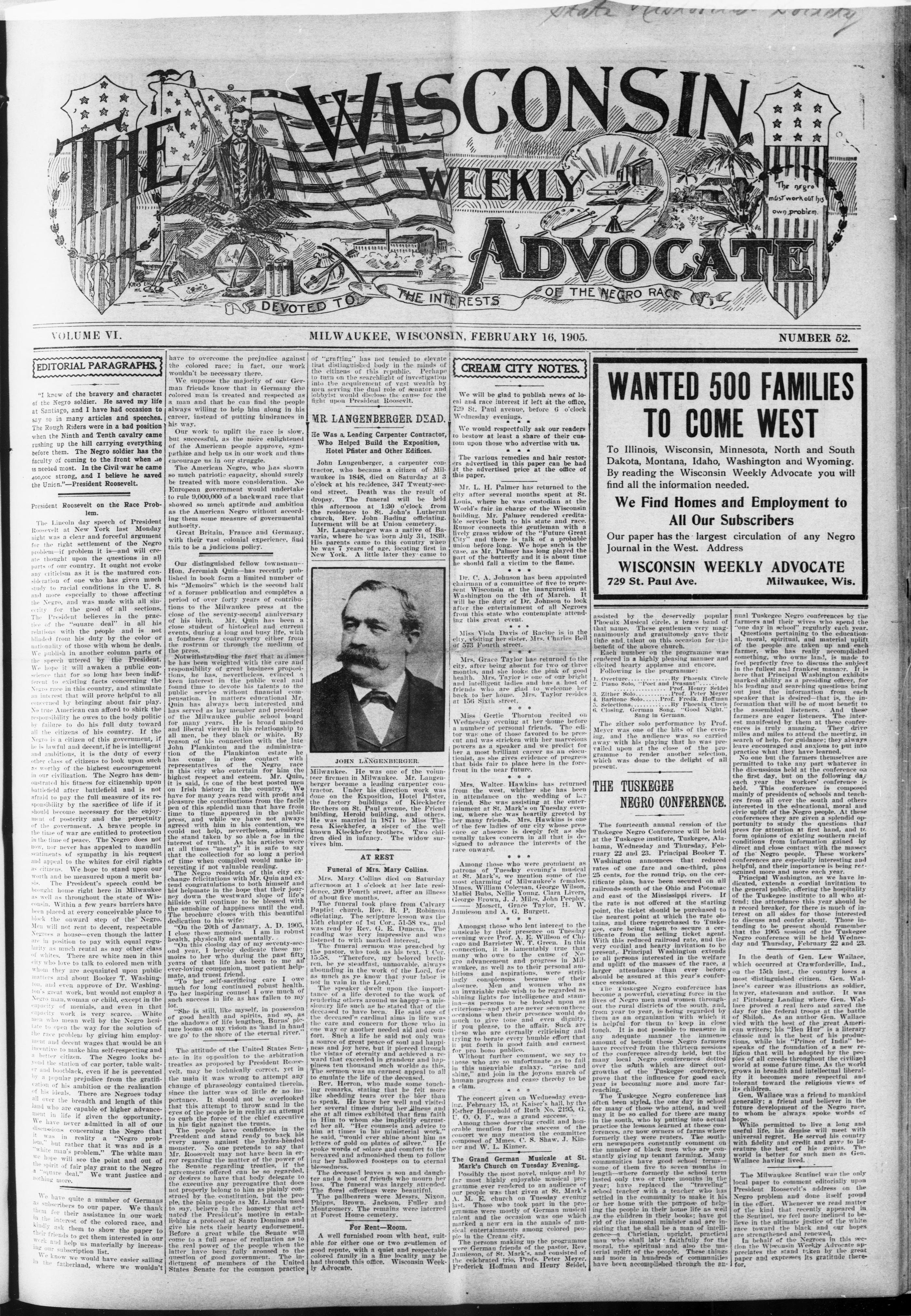
Wisconsin Weekly Advocate
Thursday, February 16, 1905
Milwaukee, Wisconsin
Page text (machine-generated)
WISCONSIN
WEEKLY
ADVOCATE
DEVOTED TO THE INTERESTS OF THE NEGRO RACE
VOLUME VI.
EDITORIAL PARAGRAPHS.
"I know of the bravery and character of the Negro soldier. He saved my life at Santiago, and I have had occasion to say so in many articles and speeches. The Rough Riders were in a bad position when the Ninth and Tenth cavalry came rushing up the hill carrying everything before them. The Negro soldier has the faculty of coming to the front when he is needed most. In the Civil war he came 400,000 strong, and I believe he saved the Union."—President Roosevelt.
President Roosevelt on the Race Problem.
The Lincoln day speech of President Roosevelt at New York last Monday night was a clear and forceful argument for the right settlement of the Negro problem—if problem it is—and will create thought upon the questions in all parts of our country. It ought not evoke any criticism as it is the matured consideration of one who has given much study to racial conditions in the U. S. and more especially to those affecting the Negro, and was made with all sincerity for the good of all sections. The President believes in the practice of the "square deal" in all his relations with the people and is not blinded from his duty by the color or nationality of those with whom he deals. We publish in another column parts of the speech uttered by the President. We hope it will awaken a public conscience that for so long has been indifferent to existing facts concerning the Negro race in this country, and stimulate an interest that will prove helpful to all concerned by bringing about fair play. No true American can afford to shirk the responsibility he owes to the body politic by failure to do his full duty toward all the citizens of his country. If the Negro is a citizen of this government, if he is lawful and decent, if he is intelligent and ambitious, it is the duty of every other class of citizens to look upon such as worthy of the highest encouragement in our civilization. The Negro has demonstrated his fitness for citizenship upon battlefield after battlefield and is not afraid to pay the full measure of its responsibility by the sacrifice of life if it should become necessary for the enjoyment of posterity and the perpetuity of the government. A brave people in the time of war are entitled to protection in the time of peace. The Negro does not now, nor never has appealed to maudlin sentiments of sympathy in his request and appeal to the whites for civil rights as citizens. We hope to stand upon our worth and be measured upon a merit basis. The President's speech could be brought home right here in Milwaukee as well as throughout the state of Wisconsin. Within a few years barriers have been placed at every conceivable place to block the onward step of the Negro. Men will not rent to decent, respectable Negroes a house—even though the latter are in position to pay with equal regularity as much rental as any other class of whites. There are white men in this city who love to talk to colored men with whom they are acquainted upon public matters and about Booker T. Washington, and even approve of Dr. Washington's great work, but would not employ a Negro man, woman or child, except in the capacity of menials, and even in that capacity work is very scarce. White men who mean well by the Negro hesitate to open the way for the solution of the race problem by giving him employment and decent wages that would be an incentive to make him self-respecting and a better citizen. The Negro looks beyond the station of car porter, table waiter and bootblack, even if he is prevented by a popular prejudice from the gratification of his ambition or the realization of his ideals. There are Negroes today all over the breadth and length of this land who are capable of higher advancement in life if given the opportunity. We have never admitted in all of our discussions concerning the Negro that it was in reality a "Negro problem," but rather that it was and is a "white man's problem." The white man we hope will see the point and out of the spirit of fair play grant to the Negro a "square deal." We want justice and nothing more.
We have quite a number of Germans as subscribers to our paper. We thank them for their assistance in our work in the interest of the colored race, and kindly ask them to show the paper to their friends to get them interested in our work and help us materially by increasing our subscription list. We know we would have easier sailing in the fatherland, where we wouldn't
have to overcome the prejudice against the colored race; in fact, our work wouldn't be necessary there. We suppose the majority of our German friends know that in Germany the colored man is treated and respected as a man and that he can find the people always willing to help him along in his career, instead of putting hindrances in his way. Our work to uplift the race is slow, but successful, as the more enlightened of the American people approve, sympathize and help us in our work and thus encourage us in our struggle.
The American Negro, who has shown so much patriotic capacity, should surely be treated with more consideration. No European government would undertake to rule 9,000,000 of a backward race that showed so much aptitude and ambition as the American Negro without according them some measure of governmental authority. Great Britain, France and Germany, with their vast colonial experience, find this to be a judicious policy.
Our distinguished fellow townsman Hon. Jeremiah Quin—has recently published in book form a limited number of his "Memoirs" which is the second half of a former publication and completes a period of over forty years of contributions to the Milwaukee press at the close of the seventy-second anniversary of his birth. Mr. Quin has been a close student of historical and current events, during a long and busy life, with a fondness for controversy either from the rostrum or through the medium of the press.
Notwithstanding the fact that at times he has been weighted with the care and responsibility of great business propositions, he has, nevertheless, evinced a keen interest in the public weal and found time to devote his talents to the public service without financial compensation. In matters educational Mr. Quin has always been interested and has served as lay member and president of the Milwaukee public school board for many years. He is broad minded and liberal viewed in his relationship to all men, be they black or white. By reason of his connection with the late John Plankinton and the administration of the Plankinton estate he has come in close contact with representatives of the Negro race in this city who entertain for him the highest respect and esteem. Mr. Quin, it is said, is one of the best posted men on Irish history in the country. We have for many years read with profit and pleasure the contributions from the facile pen of this splendid man that have from time to time appeared in the public press, and while we have not always agreed with him in his contention, we could not help, nevertheless, admiring the stand taken by so able a foe in the interest of truth. As his articles were at all times "meaty" it is safe to say that the collection for so long a period of time when compiled would make interesting if not valuable reading.
The Negro residents of this city exchange felicitations with Mr. Quin and extend congratulations to both himself and his helpmate in the hope that their journey down the westward slope of life's hillside will continue to be blessed with the sunshine of happiness until the end. The brochure closes with this beautiful dedication to his wife:
"On the 20th of January, A. D. 1905. I close these memoirs. I am in robust health, physically and mentally.
"On this closing day of my seventy-second year, I hereby dedicate these memoirs to her who during the past fifty years of that life has been to me an ever-loving companion, most patient helpmate and truest friend.
"To her self-sacrificing care I owe much for long continued robust health. To her inspiring counsel I owe much of such success in life as has fallen to my lot. "She is still, like myself, in possession of good health and spirits, and so, as the shadows of life lengthen, Burns' picture looms on my vision as 'hand in hand we go' to the shore of the eternal river."
The attitude of the United States Senate in its opposition to the arbitration treaties as proposed by President Roosevelt, may be technically correct, yet in the main it was wrong to attempt any change of phraseology contained therein, since the latter was of little or no importance. It should not be overlooked that this attempt to throw sand in the eyes of the people is in reality an attempt to curb the force of the chief executive in his fight against the trusts.
The people have confidence in the President and stand ready to back his every move against the hydra-headed monster. No one pretends to say that Mr. Roosevelt may not have been in error regarding the matter of the power of the Senate regarding treaties, if the agreements offered can be so regarded, or desires to have that body delegate to the executive any prerogative that does not properly belong to him as plainly construed by the constitution, but the people, the plain people as Mr. Lincoln used to say, believe in the honesty that actuated the President's motive in establishing a protocol at Santo Domingo and give his acts their hearty endorsement. Before a great while the Senate will come to a full sense of realization as to the real power of the people when the latter have been fully aroused to the question of good government. The indictment of members of the United States Senate for the common practice
of "grafting" has not tended to elevate that distinguished body in the minds of the citizens of this republic. Perhaps to turn on the searchlight of investigation into the acquirement of vast wealth by men serving the dual role of senator and lobbyist would disclose the cause for the fight upon President Roosevlt.
MR. LANGENBERGER DΣAD.
He Was a Leading Carpenter Contractor, Who Helped Build the Exposition, Hotel Pfister and Other Edifices.
John Langenberger, a carpenter contractor, who became a citizen of Milwaukee in 1848, died on Saturday at 3 o'clock at his residence, 347 Twenty-second street. Death was the result of dropsy. The funeral will be held this afternoon at 1:30 o'clock from the residence to St. John's Lutheran church. Rev. John Bading officiating. Interment will be at Union cemetery.
Mr. Langenberger was a native of Bavaria, where he was born July 31, 1839. His parents came to this country when he was 7 years of age, locating first in New York. A little later they came to
[Image of a man with a mustache and a bow tie, dressed in a suit and coat].
JOHN LÄNGENBERGER.
Milwaukee. He was one of the volunteer firemen in Milwaukee. Mr. Langenberger became a leading carpenter contractor. Under his direction work was done on the Exposition, Hotel Pfister, the factory buildings of Kieckhefer Brothers on St. Paul avenue, the Friend building, Herold building, and others. He was married in 1871 to Miss Theresa Kieckhefer, a sister of the well known Kieckhefer brothers. Two children died in infancy. The widow survives him.
AT REST
Funeral of Mrs. Marv Collins
Mrs. Mary Collins died on Saturday afternoon at 1 o'clock at her late residence, 209 Fourth street, after an illness of about five months.
The funeral took place from Calvary Baptist church, Rev. B. P. Robinson officiating. The scripture lesson was the 15th chapter of 1st Cor., 51-58 vs., and was read by Rev. G. E. Duncan. The reading was very impressive and was listened to with marked interest.
The funeral sermon was preached by the pastor, who took as his text, 1 Cor. 15:58. "Therefore, my beloved brethren, be ye steadfast, unmovable, always abounding in the work of the Lord, for as much as ye know that your labor is not in vain in the Lord."
The speaker dwelt upon the importance of a life devoted to the work of rendering others around us happy—a missionary life such as he stated that of the deceased to have been. He said one of the deceased's cardinal aims in life was the care and concern for those who in one way or another needed aid and comfort. Such a life he said not only was a source of great peace of soul and happiness and joy here, but it pierced through the vistas of eternity and achieved a reward that exceeded in grandeur and happiness ten thousand such worlds as this. The sermon was an earnest appeal to all to emulate the life of the deceased.
Rev. Herron, who made some touching remarks, stating that he felt more like shedding tears over the bier than to speak. He knew her well and visited her several times during her illness and she at all times exhibited that firm faith in Him to whom she implicitly entrusted her all. "Her counsels and advice to him at times in his ministerial work," he said, "would ever shine about him as letters of gold on plates of silver." He spoke words of solace and comfort to the bereaved and admonished them to follow ing her hallowed foosteps on to eternal blessedness.
The deceased leaves a son and daughter and a host of friends who mourn her loss. The funeral was largely attended. The floral offerings were beautiful.
The pallbearers were Messrs. Nixon. Phipps, Brown. Jackson, Fuller and Montgomery. The remains were interred at Forest Home cemetery.
For Rent—Room.
A well furnished room with heat, suitable for either one or two gentlemen of good repute, with a quiet and respectable colored family in a fine locality may be had through this office. Wisconsin Weekly Advocate.
CREAM CITY NOTES.
We will be glad to publish news of local and race interest if left at the office, 729 St. Paul avenue, before 6 o'clock Wednesday evenings.
We would respectfully ask our readers to bestow at least a share of their custom upon those who advertise with us.
The various remedies and hair restorers advertised in this paper can be had at the advertised price at the office of this paper.
Mr. L. H. Palmer has returned to the city after several months spent at St. Louis, where he was custodian at the World's fair in charge of the Wisconsin building. Mr. Palmer rendered creditable service both to his state and race. Rumor connects this gentleman with a lively grass widow of the "Future Great City" and there is talk of a probable union before long. We hope such is the case, as Mr. Palmer has long played the part of the butterfly and it is about time he should fall a victim to the flame.
***
Dr. C. A. Johnson has been appointed chairman of a committee of five to represent Wisconsin at the inauguration at Washington on the 4th of March. It will be the duty of Dr. Johnson to look after the entertainment of all Negroes from this state who contemplate attending this great event.
* * *
Miss Viola Davis of Racine is in the city, visiting her sister, Mrs. Charles Bell of 573 Fourth street.
Mrs. Grace Taylor has returned to the city, after being absent for two or three months, and she looks the pink of good health. Mrs. Taylor is one of our bright and intelligent ladies and has a host of friends who are glad to welcome her back to her home. Mrs. Taylor resides at 156 Sixth street.
Miss Gertie Thornton recited on Wednesday evening at her home before a number of personal friends. The editor was one of those favored to be present and was stricken with her marvelous powers as a speaker and we predict for her a most brilliant career as an elocutionist, as she gives evidence of progress that bids fair to place here in the forefront in the near future.
* * *
Mrs. Walter Hawkins has returned from the west, whither she has been in attendance on the wedding of her friend. She was assisting at the entertainment at St. Mark's on Tuesday evening, where she was heartily greeted by her many friends. Mrs. Hawkins is one of the few ladies of our city whose presence or absence is deeply felt as she usually takes concern in all that is designed to advance the interests of the race onward.
* * *
Among those who were prominent as patrons of Tuesday evening's musical at St. Mark's, we mention some of the most charming of Milwaukee's females. Mimes, William Coleman, George Wilson, Mabel Bubs, Nellie Young, Clara Livers, George Brown, J. J. Miles, John Peeples. — Mossett, Grace Taylor, H. W. Jamieson and A. G. Burgett.
Amongst those who lent interest to the musicae by their presence on Tuesday evening were Prof. A. E. Willson of Chicago and Barrister W. T. Green. In this connection, it is lamentably true that many who owe to the cause of Negro advancement and progress in Milwaukee, as well as to their personal ambitions and aspirations, were strikingly conspicuous because of their absence. Men and women who as an invariable rule wish to be regarded as shining lights for intelligence and stamina—as persons to be looked upon as criterions—and yet are never seen on these occasions when their presence would do much to give tone and even dignity, if you please, to the affair. Such are these who are eternally criticising and trying to berate every humble effort that it put forth in good faith and earnest for pro hono publico.
Without further comment, we say to those who are so unfortunate as to fail in this unenviable galaxy, "arise and shine," and join in the joyous march of human progress and cease thereby to be a clam.
The concert given on Wednesday evening, February 15, at Kaiser's hall, by the Esther Household of Ruth No. 2195, G. U. O. O. F., was a grand success.
Among those deserving credit and honorable mention for the success of the concert we may mention the committee composed of Mmes. C. S. Shaw, J. Kinner and W. L. Kinner.
The Grand German Musicale at St. Mark's Church on Tuesday Evening.
Possibly the most novel, unique and by far most highly enjoyable musical programme ever rendered to an audience of our people was that given at St. Mark's A. M. E. church on Tuesday evening last. Those who took part in the programme were mostly of German musical talent and the occasion was one which marked a new era in the annals of musical entertainments among colored people in the Cream city. The persons making up the programme were German friends of the pastor, Rev. Jamieson, of St. Mark's, and consisted of the celebrated trio, Profs. Peter Meyer, Frederick Hoffman and Henry Seidel,
WANTED 500 FAMILIES TO COME WEST
To Illinois, Wisconsin, Minnesota, North and South Dakota, Montana, Idaho, Washington and Wyoming. By reading the Wisconsin Weekly Advocate you will find all the information needed.
Our paper has the largest circulation of any Negro Journal in the West. Address
WISCONSIN WEEKLY ADVOCATE
729 St. Paul Ave. Milwaukee, Wis.
assisted by the deservedly popular Phoenix Musical circle, a brass band of that name. These gentlemen very magnanimously and gratuitously gave their time and talent on this occasion for the benefit of the above church.
Each number on the programme was rendered in a highly pleasing manner and elicited hearty applause and encore.
Following is the programme:
1. Overture.....By Phoenix Circle
2. Piano Solo, "Poet and Peasant".....Prof. Henry Seidel
3. Zither Solo.....Prof. Peter Meyer
4. Baritone Solo.....Prof. Fredk. Hoffman
5. Selections.....By Phoenix Circle
6. Closing, German Song, "Good Night."
Sang in German.
The zither solo performance by Prof. Meyer was one of the hits of the evening, and the audience was so carried away with his playing that he was prevailed upon at the close of the programme to render another selection, which was done to the delight of all present.
THE TUSKEGEE NEGRO CONFERENCE.
The fourteenth annual session of the Tuskegee Negro Conference will be held at the Tuskegee institute, Tuskegee, Alabama, Wednesday and Thursday, February 22 and 23. Principal Booker T. Washington announces that reduced rates of one fare and one-third, plus 25 cents, for the round trip, on the certificate plan, have been secured on all railroads south of the Ohio and Potomac and east of the Mississippi rivers. If the rate is not offered at the starting point, the ticket should be purchased to the nearest point at which the rate obtains, and there repurchased to Tuskegee, care being taken to secure a certificate from the selling ticket agent. With this reduced railroad rate, and the very cordial and hearty invitation to be present, Principal Washington extends to all persons interested in the welfare and uplift of the masses of the race, a larger attendance than ever before should be assured at this year's conference sessions.
The Tuskegee Negro conference has become a powerful, elevating force in the lives of Negro men and women throughout the rural districts of the south, and, from year to year, is being regarded by them as an organization with which it is helpful for them to keep in close touch. It is not possible to measure in any adequate manner the immense amount of benefit these Negro farmers have received from the thirteen sessions of the conference already held, but the many local Negro conferences dotted over the south which are direct outgrowths of the Tuskegee conference, prove that the influence for good each year is becoming more and more far-reaching.
The Tuskegee Negro conference has often been styled, the one day in school for many of those who attend, and well may it be so called for there are many in the south, who by putting into actual practice the lessons learned at these conferences, are now owners of farms where formerly they were renters. The southern newspapers constantly comment on the number of black men who are constantly giving up tenant farming. Many communities have good school terms—some of them five to seven months in length—where formerly the school term lasted only two or three months in the year; have replaced the "traveling" school teacher with a teacher who has settled in the community to make it his or her home with the purpose of helping the people in their home life as well as the children in their books; have got rid of the immoral minister and are insisting that he shall be a man of intelligence—a Christian, upright, practical man who shall labe faithfully for the moral, the spiritual and also the material uplift of the people. These things and more in hundreds of communities have been accomplished through the an
NUMBER 52.
DO FAMILIES
IN THE WEST
minnesota, North and South
Washington and Wyoming.
Weekly Advocate you will
need.
and Employment to
subscribers
circulation of any Negro
press
EKLY ADVOCATE
Milwaukee, Wis.
nual Tuskegee Negro conferences by the farmers and their wives who spend the "one day in school" regularly each year.
Questions pertaining to the educational, moral, spiritual, and material uplift of the people are taken up and each farmer, who has really accomplished something, who owns land, is made to feel perfectly free to discuss the subject in the fullest and frankest manner. It is here that Principal Washington exhibits marked ability as a presiding officer, for his leading and searching questions bring out just the information from each speaker that is desired—that is, the information that will be of most benefit to the assembled listeners. And these farmers are eager listeners. The interest manifested by them at these conferences is truly amazing. They drive miles and miles to attend the meeting, in search of help, for guidance; they always leave encouraged and anxious to put into practice what they have learned.
No one but the farmers themselves are permitted to take any part whatever in the discussions held at the conference on the first day, but on the following day each year the workers' conference is held. This conference is composed mainly of presidents of schools and teachers from all over the south and others interested in the educational, moral and civic uplift of the Negro people. At these conferences they are given a splendid opportunity to study the questions that press for attention at first hand, and to form opinions of existing southern racial conditions from information gained by direct and close contact with the masses of the Negro people. These workers' conferences are especially interesting and helpful, and their importance is being recognized more and more each year.
Principal Washington, as we have indicated, extends a cordial invitation to the general public, offering the hospitality of the Tuskegee institute to all who attend: the attendance this year should be a record breaker, for there is much of interest on all sides for those interested to discuss and confer about. Those intending to be present should remember that the 1905 session of the Tuskegee Negro conference will be held Wednesday and Thursday, February 22 and 23.
In the death of Gen. Lew Wallace, which occurred at Crawfordsville, Ind., on the 15th inst., the country loses a most distinguished citizen. Gen. Wallace's career was illustrious as soldier, lawyer, statesman and author. It was at Pittsburg Landing where Gen. Wallace proved a real hero and saved the day for the federal troops at the battle of Shiloh. As an author Gen. Wallace vied with the best of the great American writers; his "Ben Hur" is a literary classic and is the best of his productions, while his "Prince of India" bespeaks of the foundation of a new religion that will be adopted by the peoples of all creeds throughout the civilized world at some future time. As the world grows in breadth and intellectual liberality it becomes more respectful and tolerant toward the religious views of its children.
Gen. Wallace was a friend to mankind generally; a friend and believer in the future development of the Negro race, to whom he always spoke words of hope.
While permitted to live a long and useful life, his demise will meet with universal regret. He served his country with fidelity and credit and gave to literature the best of his genius. The world is better for such men as Gen. Wallace having lived.
The Milwaukee Sentinel was the only local paper to comment editorially upon President Roosevelt's address on the Negro problem and done itself proud in the effort. Whenever we read matter of the kind that recently appeared in the Sentinel, we feel more inclined to believe in the ultimate justice of the white race toward the black and our hopes are strengthened and renewed. In behalf of the Negroes in this section the Wisconsin Weekly Advocate appreciates the stand taken by the great paper and expresses its gratitude therefor.
---
Curious Condensations.
—In Bavaria, railway carriages are disinfected at the conclusion of every journey.
—In the southern part of California roof gardens are becoming features of all the new buildings.
—A French suggestion for preventing automobilists from "scorching" is to forbid the use of masks and goggles.
—A recent weighing of dandelion down has shown that 1,000,000 of the dainty parachutes are needed to make a pound.
—English chimney sweeps are out of employment and starving on account of the recent general introduction of gas stoves.
The total number of all known varieties of postage stamps issued by all the governments of the world up to the present time is 19,242.
In Germany employers of labor are compelled to grant one hour's rest at midday, and women with household cares may claim an extra half hour.
The diameter of the earth has lately been accurately ascertained, after thirty years' labor, at a cost of $500,000. It is 7926 miles at the equator, and 7899 from pole to pole.
Of the ancient pagodas of Manchuria those of the first class have seven, nine or thirteen stories, while second-class ones have from three to five. They are still erected occasionally.
The fastest train in Europe is run between Leeds, England, and Edinburgh, Scotland. The distance is 230 miles and is covered in 4 hours 19 minutes—an average of nearly a mile a minute.
Astronomers are uncertain whether the planet Mercury rotates in about twenty-four hours or in eighty-eight days. Spots now visible are expected to settle the question soon.
A writer in an English automobile paper claims that roads could be kept permanently damp by the application of strong solutions of calcium chloride or magnesium chloride, and that this would be cheaper than oils and without their objectionable odors.
It is doubtless true that Siberia is sure to go on developing its agricultural resources. Streams of colonists are pouring into its best places from all parts of the empire, particularly from the west. Hundreds of homes are being built on the banks of its fifty rivers.
Jaures and Deroulede, before leaving the locality where they fought their bloodless duel, gave money for the poor of the neighborhood. Deroulede also presented the owner of the grounds wherein the duel took place with a medal on which is a portrait of himself.
—Manchester, England, is having trouble with its police. A member of a committee appointed by the city council to investigate stated that a certain policeman was a burglar; that the police blackmailed women, and that in one case a saloon keeper was harassed to his grave by them.
—Several of the London hospitals have on their books the names and addresses of many men and women who have undertaken to sell portions of their cuticle whenever the necessity arises, and it is said that quite a regular traffic is now being done in the buying and selling of human skins.
Francis Galton has endowed in London university a fellowship for the promotion of the study of "National Eugenics," which is defined as "the study of the agencies under social control that may improve or impair the racial qualities of future generations either physically or mentally."
Writing from Damaraland about the war in German Southwest Africa an officer writes to a Frankfort paper: "In theory one German soldier is supposed to equal five Hereros, but in practice, under Southwest African conditions, it is more probable that we shall need five Germans to every Herero."
—Lieut. Zebulon Montgomery Pike, an officer in the United States army, discovered the famous peak November 15, 1806. The chamber of commerce of Colorado Springs has started a movement to honor the 100th anniversary of this event in 1906 by a celebration to be participated in by the entire state.
—Prof. Robert Baird, for thirty-five years a member of the faculty of Northwestern university, died at his home in Evanston, of anaemia. He had been ill for several months. He was 62 years old and a native of Glasgow, coming to America with his parents when 5 years old and settling on a farm near Waukegan.
A mining engineer announces that he has discovered in the town of Plymouth, Vt., deposits of platinum which are the richest he has ever seen in that part of the country. The platinum runs about an ounce to the ton, each ounce being valued at a little over $21, which is about a dollar more than the present value of an ounce in gold.
At present a fancy value attaches to old pewter, to old fire dogs and fire backs, snuffers, brass candlesticks and the like. A "find" of this kind occurred recently at a farm at Kingsworthy near Winchester, where an "old 'tub' was found to be a standard Winchester bushel of bell metal. The object, which the farmer had sold for a few shillings, was sold later for £60.
For the luncheon the Lord Mayor of London gave in honor of the King and Queen of Portugal, in the Guilhall, November 17, supplies as follows had to be laid in: One hundred turcens of soup, 90 dishes of soles, 90 dishes of lobster, 90 dishes of patridges, 80 dishes of cutlets, 60 fillets of pheasant, 40 dishes of raised pie, 60 dishes of roast chicken, 2 barons of beef (each weighing 140 pounds), 50 jellies, 50 creams, 136 dishes of pastry, 6000 plates, 1600 knives, 3000 forks and 2500 glasses.
The elephant is great as a traction power. Experiments have shown that a horse pulls about one-sixth of its own weight, whereas an elephant can pull its entire weight. This might be emphasized by the fact that an elephant is six times as big as a horse. In India, for centuries, it has been the custom to utilize elephants to push instead of pull wagons, but now it has been shown that they are unequaled as pullers. Two of them, in carefully arranged contests, raised 6500 pounds. One raised a safe weighing more than a ton.
Prefers Hell to Politics
Judge "Sam" Miller of the Mercer county (Pennsylvania) bench for twenty years past has become nettled over some reference to a political future for himself, and the famous old character in an issue of the Western Press publishes over his own signature a letter in which he says: "Every now and then some cuss uses your columns to mix me up in politics. If I'm given a choice between Pennsylvania politics and hell, I'll take hell."
The Corset in 2000 B. C.
Arthur Evans, the Oxford archaeologist, who has made so many interesting discoveries in the so-called palace of Minos, in Crete, has found in a subterranean sanctuary certain very ancient small, earthenware statues, representing some goddess and two of her servants. The dress of the figures is said to be highly modern. The goddess, we grieve to say, wears a corset—just such a corset as contemporary man shyly wonders at in the windows of a department store. Everybody's.
TO THE CZAR.
Imperial minion, swollen with a pride
That reeks to Heaven; not pride that still
may rear
Aloft an honest brow to face the world,
But pride that builds itself on craven fear,
Gnawing thy vitals like a singing worm,
That gropes a deadly way to death more
near:
Who art thou that hast dared to crown
thyself,
Now in this day of brotherly desire,
With power of a God? What gave thee
warrant
To cast strong equal men into the mire
Beneath thy foot, or pour the deadening
slime
Of tyrant power upon their sacred fire?
By what divine decree hast thou yet spurned
The long, sad yearning question of thy race?
Or cast thy fellows, oft more than thy peers.
Enchained in some dark, vermin-writhing place
Where Shame sat gaunt by women's shrink- ing breasts.
ing breasts,
Whilst thou swept on nor slacked thy wan-
ton pace.
From what high, universe-dividing power
Draw'st thou thy wondrous, ripe brutality?
Is it from Jesus, standing at thy gate
And murmuring, "Little children, come to
me"—
While babes lie bathed in gore about thy
feet,
With more than seven wounds that gape
at thee?
O horrible * * * Thou God who seest
these things
Help us to blot this terror from the earth.
Count, in Thy memory divine, the lives
That cast into this chasm their noble worth,
And grant to Russia in her dying need
From Thine own hand a radiant new birth!
—Louise Morgan Sill in Harper's Weekly.
A WALKING FEAT.
"I think," remarked Calvert, very slowly, "that I should like to go to Torquay." Miriam agreed that Torquay would be a very pleasant place in winter. She even declared that she would like to go there herself.
With Calvert it was necessary to give more than was received. He was no conversationalist. Now he pondered over Miriam's admission, as though this opened a new field for thought.
"It would be pleasant," he said, presently, "to go there on one's wedding trip."
"Yes," assented Miriam, "it would be a very pleasant trip."
"Suppose, then." he said, getting very red, "that we go there—together? You want to go. I want to go. We want to go. Very simple, isn't it?" Miriam sprang to her feet.
"Charlie Calvert!" she said, excitedly, "I could just shake you!" He started back as though he feared she would carry her threat into execution. "Is that the way to ask a girl to marry you? One would think you had been brought up in an atmosphere of personally conducted tours."
"Miriam," he stammered, "I didn't mean to offend you, don't you know. I really thought we were going to be married some day."
"We never will until you learn how to talk," she snapped back. "No woman with any self-respect would accept a proposal like that."
There was infinite scorn in the voice. Calvert blinked. He had known Miriam ever since they had gone to school together. Even then they had played at keeping house and had announced to their parents that they were going to be married shortly. They had persisted long after the usual course of boy and girl love affairs.
Miriam knew that he was not much of a talker. Why should she expect him to discover new ability simply because he wanted to suggest that it was time they were married?
He rose to his feet and regarded her uncertainly.
"I think," he drawled, "I had better be going. I don't seem to be any good here."
"Go," she said, evenly, "and don't you come back until you learn to tell a woman that you love ner as though you meant it."
She waited until she heard the door close and then burst into tears.
She was used to Calvert and his ways, but all their lives he had accepted placidly and unemotionally the fact of her love. Woman-like, she hungered for the tender words that are as manna to the heart.
Calvert apparently took her at her word. The next morning there was a bunch of violets at her place at the breakfast table with his card marked P. P. C. in one corner. That was all. There was some comment that Calvert should leave town in the middle of the season, but no one supposed that there had been any trouble between Miriam and him, and she was at least spared the infliction of curious questions.
For a few days she pretended to herself that she did not care. She flirted desperately with Jack Holworth, who made love deliciously, but his tender speeches lacked the infection of sincerity, and by the end of a week he bored her.
No word came from Calvert, and soon she began to worry. To ask questions would be to admit that she did not know where he was, and this would subject her to comment. She could only wait and hope.
Finally the family began to notice her appearance. They declared that a change of scene was what was wanted. Then her mother decided that Torquay was the place for her, not knowing what reflection that locality would bring up.
At Exeter the train was drawn up on a siding to permit the London train to pass. The passengers of the Torquay express grumbled at the delay, but Miraam slipped off the train to see if she could find any subjects for her camera, and she trudged down to get a good viewpoint just as the belated train came along. She thought it would be a good chance to try the speed of her camera by getting a snapshot of the now slow-moving train, and, stepping on one side of the track, held the little box in readiness.
But the anticipated snapshot was never taken. There on the platform of the corridor car was Calvert, as much surprised as she at the rencontre. With quicker thought than she had ever given him credit for he slipped over the rail and, hanging for a second, dropped to the track. He fell sprawling, but was up in an instant, and was coming toward her with outstretched hands.
"Miriam!" he exclaimed, joyfully, "it's awfully good to meet you. You see, I have learned my lesson, and was chafing at the time it would take me to reach home, and here you are coming to meet me."
He folded her in his arms and kissed her. She made no resistance.
"Well, you needn't have risked your life just to say you're glad to see me," she cried, saucily, as soon as speech was possible.
"The train wasn't going fast enough to make it a dangerous accomplishment, and I didn't want to lose you."
There was a new tenderness in his eyes, a new deference in his attitude, that proclaimed him the lover, not the old companion who took everything for granted.
"I believe you, dear," she said, softly, "but I shan't put you to the test. I'll accept the old proposal and take a bridal trip to Torquay."
He caught her in his arms again, and for a moment they were oblivious of everything around them. Then he looked up whimsically.
"I hope the walking's good," he said, reflectively.
She gave a cry. There in the distance the Torquay train was fast receding. No one had noticed her leave the train or had observed Calvert. "Well," said Miriam, "let's walk." Illustrated Bits.
Size of an Atom.
How large is an atom? "Perhaps the simplest, though not the most exact, way of arriving at a rough estimate of the size of atoms is by measuring the thickness of a soap bubble film, where it is as thin as possible, just before it bursts," says a writer. "such a film, if composed of atoms, must be something like a pebble wall. Now, a pebble wall would not stand if it were not several pebbles thick, and if we had reason to suppose that it was about a dozen pebbles thick we could easily make an estimate of the size of the pebble by measuring the thickness of the wall.
"That is the case with the thinnest region of a soap film. It is found to have a very definite and uniform thickness. It is the thinnest thing known, and by refined optical means its thickness can be accurately measured. It must contain not less than something like a dozen atoms in its thickness, and yet it is only about the twenty-millionth of an inch in thickness by direct measurement. So that the diameter of an atom comes out between one two-hundred-millionth and one-three-hundred-millionth of an inch. In other words, from about 200,000,000 to 300,000,000 of atoms can lie edge to edge in a linear inch."—Science.
New Card Trick.
The newest thing in card games has made its appearance under the name of Trusts and Busts, or Frenzied Finance. The game consists of eighty-six cards, ten of which are engraved to imitate the stock certificates of various trusts; sixteen are market cards, indicating the turn of the market, and include Longs, Shorts, Puts, Calls, High Spreads, Low Spreads, and a Frenzied Finance Boom and a Frenzied Finance Slump. Each remaining card has a distinct value, so that it is possible for each player to win the trick. The winner is not revealed until all have played and the market card is turned. Even then the winner is not sure of his holdings, for if a Boom strikes the market he loses all he has won on Shorts, while a Slump following takes all that he has won on Longs and the Boom.—New York Globe.
The Wrong Spirit.
Thomas Hunter, the president of the New York normal college, was addressing a band of young women.
"Young women," said Mr. Hunter, "generally make excellent teachers. But if you dislike the work, turn to anything else but teaching. We cannot succeed ever in what we hate.
"Bad teachers, when we find them, are persons who dislike their work. They are like the young girl in the country town who said to one of her friends:
"Yes, I am going to take up teach-
"Yes, I am going to take up teaching."
"The friend looked amazed.
"‘You?' she exclaimed. 'You a school teacher? Why, I'd rather marry a widower with nine children.'
"‘So would I,’ said the other. 'But where is the widower?'—New York Tribune.
Always Precise.
Del Valentine tells of a Kansas clergyman he once knew who prided himself on his precise and scrupulous use of words. One Sunday the good man was praying for elevating grace and renewed working force. "Oh, Lord," he pleaded, "waken Thy cause in the hearts of this congregation and give them new eyes to see and impulse to do. Send down Thy lev-er or leev-er, according to Webster's or Worcester's dictionary, whichever you use, and pry them into activity." This lawyer and some of his friends who happened to be there snorted just a little and the "Amen" followed quickly and with a jerk.—Kansas City Star.
Favors Games on Sunday.
In a sermon on "Child Labor" at St. Peter's cathedral Rt. Rev. M. J. Hoban, bishop of Seranton, came out unequivocally for permitting working boys to play athletic games on Sunday. After picturing the hardships to which many of the boys of this community are put in the mines and mills, day and night, six days a week, he criticised those who protest against them enjoying the Sabbath in harmless recreations, and added: "I say, let them play baseball, or football, or any other kind of ball, to their heart's content. The good Lord will be pleased to see them do it, I aver, providing they are good boys."
London Street Names.
Paddington proposes to change its Warwick road into Browning avenue, since the postmaster general has complained of too many "Warwicks" in the field of the London postman. There are thirty-four "Warwicks" of various sorts; but the "Wellingtons" surpass with forty-four, the "Yorks" with sixty-nine, and the "Victorias" with four-and-ninety. It would be a blessing if some genius with imagination, at a desk in Spring Gardens, would differentiate between our London streets and give them names of their own.—London Chronicle.
Delivers His Own Funeral Oration
Benjamin F. Goodsell, an aged resident of Ashmont, O., quite ill, has determined that he will deliver his own funeral oration. An agnostic and desiring that no minister shall comment upon his life over his dead body, he has prepared and delivered into a phonograph an obituary in which he sets forth his life's objects. The record has been placed in a safety deposit vault, to be used at his funeral.
The Restaurant "Face"
In these times we can do nothing without at once being warned that it is leaving its stamp upon us, says the London World. The most recent scare of this kind refers to the present craze for restaurant dining. We are told that the practice is completely changing the expression of our faces and working a marked change in our manner.
Faithful Dog Haunts Hospital
Shep, a collie dog belonging to Assistant Corporation Counsel Joseph G. Mathews of Jamaica, L. L. haunts the outside of St. Mary's hospital, New York city, where his master lies recovering from an operation for appendicitis. Since the day of the operation Shep has remained around the building. He has not been admitted, but on several occasions food has been sent out to him.
LAZY.
When a feller's good and hungry,
Then he cain't work no mo';
He's got to do some eatin'
To make the old wheels go;
An' when he's ben to dinner
An' stowed away a heap,
Then what's the use o' workin'?
A feller's got ter sleep.
O. when's that good time comin'
When we don't work no mo'?
I'd like to go a struttin'
To that there golden sho',
An' loosen all my buttons
An' eat a mighty heap
Of yalluh yams an' possum
An' sleep an' eat an' sleep!
I'd love to go a-fishin'
In th' everlastin' stream.
An' hook the line ter my big toe
An' perch up there an' dream ;
I'd like ter ketch a catfish
An' fry him in de pan
I'm a sleepin', eatin', sleepin',
A sleepin', eatin' man!
—The Houston Post.
New York Every Day.
"Abigail," the new play by Kellett Chalmers, was produced in Allentown, Pa., by Grace George and her company. It is an American comedy, with the scenes laid in New York, and is the author's first play. In the company are Arthur Forest, Conway Tearle, Louise Closser and Selene Johnson.
A petition in bankruptcy has been filed against Sullivan, Drew & Co., wholesale dealers in millinery, one of the largest concerns in this line in New York. The petition was entered on behalf of three creditors for small sums and alleges that the firm is insolvent. The assets are large and the estimated liabilities are $500,000.
The trustees of the public library have announced the gift by Philip Schuyler of Irvington of a collection of the letters and papers of Gen. Philip Schuyler, covering the period while he was in command of the northern department in the revolutionary war and subsequently. There are more than 3000 documents in the collection.
Mabel Hockridge, the young and beautiful daughter of a wealthy New York business man, is missing from her father's country estate, near Esopus. The day following her disappearance Hockridge received a note in which she announced she had married Frank Tone, the family coachman. The couple has eluded pursuit and detectives are on the case.
William Faversham, who is now on the road in Arthur Wing Pinero's play "Lefty," will at the conclusion of his season immediately begin rehearsals of "The Squaw Man," which is to be produced at the Garrick theater about April 1 by Liebler & Co. Mr. Faversham, by permission of Charles Frohman, will play the leading role, and the play will be given an elaborate production.
With a view to preventing a repetition of the General Slocum disaster, which cost 1000 lives, Mayor McClellan has sent a letter to all members of Congress from New York city, which he hopes will lead to the amendment of the federal statutes so that greater protection may be afforded to human life on steamers on inland waters. Increased liability of owners of vessels is the object sought.
Hannah Elias won a partial but substantial victory in the suit brought against her by John R. Platt to recover $685,385 which he said he had given her. The appellate division reversed Supreme Court Justice Truax's order appointing a receiver for all her money and property and enjoining her from in any way disposing of her property pending the result of the main action to recover the money.
Figures relating to the vital statistics in New York city made public by the department of health show that in a single quarter last year, with a total population of 3,838,024, there were 24,031 births and 21,528 deaths, a natural increase of 2506 in the population of the city. Brooklyn borough reported more deaths than births, while in Richmond the number of deaths exceeded births by 26.
Lyman S. Andrews, the secretary of the late Andrew H. Green, and who, as executor and trustee of several estates which had been looked after by Mr. Green, was recently charged with being $130,000 short in his accounts, surrendered at the district attorney's office and was placed under arrest. Later he was arraigned for forgery in the second degree. Bail was fixed at $5000, which he deposited in cash, and he was released.
President Roosevelt has been chosen an honorary member of the League of Former German University Students, an honor accorded to only one other, the Grand Duke of Baden, uncle of the Kaiser, and rector-in-chief of the University of Heidelberg. If he accepts a delegation of the leading members of the league will go to Washington to present him an engrossed memorial. In his youth the President spent a short time studying in Germany.
Joseph Jefferson will make his reappearance on the stage at the Boston theater, Boston, Mass., Easter Monday. His sons, Thomas and Joseph, Jr., will play "Rip Van Winkle" all that week, and the "Grand Old Man of the stage" will deliver an address each evening between the acts. The following week Mr. Jefferson will come over to New York and make his farewell appearance on the stage at Joseph Holland's benefit at the Metropolitan Opera house.
If a director of a banking house receives a deposit from a customer when aware his bank is in an insolvent condition he becomes personally liable for the amount under a decision handed down by the appellate division of the supreme court recently. The decision was given in the suit brought by the administrators of Martin Cassidy, one of the depositors of the defunct Madison Square bank, against Frederick Uhrman and the other directors of that institution.
As a result of the investigation by the quartermaster's department and taking stock in the storehouse in the United States reservation at Fort Hamilton, Col. Greenough, the commandant of the post, sent the provost guard to several saloons in the vicinity and raided them in search of uniforms, blankets, and other property that had been pledged for drinks by soldiers who had stolen government property valued at $5000. It is reported that property valued at $2000 was recovered.
Most of the officials and clerks of the Fourteenth Street bank suffered from shock the other day after learning that the porter and two or three junior clerks had sat up all of last night to watch $300,000 in cash that was lying about the counters because the big time safe had been accidentally closed before all of the cash and securities had been put away. The faithful watchers were on the verge of nervous prostration when the regular force arrived for the day's business.
The estate of the late Frank H. Cro-
ker, valued at about $400,000, will go to his father, Richard Croker, because of the failure of young Croker to make a will. Frank was unmarried and his father is the first lineal heir. The estate consists mainly of personal property in bonds and other securities. Surrogate Fitzgerald has named Richard Croker, Jr., brother of the deceased, as administrator, the father having waived his rights. The administrator is required to give bond amounting to $800,000.
"Mamma's Papa" leaped into favor with a bound at the Casino, Philadelphia, where the piece was presented by W. A. Brady for the first time. Among the biggest hits was the chorus of wogie bugs, impersonated by sixteen pretty girls, who formed a background for one of Joseph Hart's best songs. Another unique feature was presented with the son "My Blushing Rose." The farce was adapted from Lauf's "Aufgedreht" by Joseph Hart, and A. Baldwin Sloane composed the music. The piece is gorgeously staged.
While Dr. Francis de Nevers was at a steamship pier in New York city to meet his brother, who arrived from Europe, he received a message stating that his wife, daughter of Lord Milner, governor of South Africa, had died suddenly of heart disease in her home in Chicago. She leaves three children, two sons and a daughter. It was in London that Dr. de Nevers eight years ago met and married the daughter of Lord Milner. Dr. de Nevers was already a citizen of the United States and had begun his work as a bacteriologist in Chicago.
Alton B. Parker lost his first case before the appellate division of the supreme court in a decision in the litigation between Lorenz Reich and the William F. Cochran estate. The litigation, which begun in 1889, has been over the possession of the property of the Cambridge hotel. The hotel was owned by Reich originally, and through a series of complicated agreements Cochran became possessed of the property. Judge Parker represented Reich on an appeal from an interlocutory judgment of special term in favor of the Cochran estate.
A conference attended by 100 clergymen was held in Calvary Baptist church to devise ways and means of purifying the city and reviving the moral sense of Greater New York. The ministers represented nearly all denominations. They decided that the situation called for the united action of every moral agency, and it was determined to inaugurate a crusade of great magnitude. Besides stirring the church people to action, it was determined to hold mass meetings in Madison Square garden and elsewhere, and inaugurate an evangelical revival.
Laura Biggar Bennett, the actress, presented an amended petition in the county court at Freehold, N. J., asking a rule to compel the executors of the estate of the late Henry M. Bennett, whose property she has claimed repeatedly as Bennett's widow, to explain why they have sold certain property of the estate and committed other acts which she says were detrimental to her interests. Miss Biggar avers that Peter McNulty and James Platt, the executors of the Bennett estate, sold some land of the estate at Avon, N. J., below its actual value to a land company in which Mr. McNulty is interested.
一
The American Society for Sanitary and moral publicity was organized tonight at a meeting of thirty well-known physicians, clergymen and men of public spirit, at the New York Academy of Medicine. Members of the new society announce that they propose to treat the social evil as the community at present treats any contagious disease. Dr. James Smith presided and Dr. Prince A. Morrow, Prof. Felix Adler, Prof. Seligman of Columbia university, Dr. Ludwig Weiss and Edward L. Devine of the charities organization society made speeches. Bishop H. C. Potter and Dr. Lyman Abbott sent letters pledging their support to the society.
As a curtain raiser to "The Little Minister," in which Miss Maude Adams is appearing, "O o' Me Thumb," a one-act play by Frederick Fenn and Richard Bryce, is being given at the Empire theater, New York city. Miss Adams impersonated in it the part of a servant, in a laundry, in London; a girl from the workhouse; a being of the tribe of Dickens' "slavey." This forlorn creature cherishes visions of riches and love; fancies that a certain shirt that she has ironed, and that remains unclaimed at the laundry, is the property of a gallant youth, who will, one day, arrive and be her lover; and when its owner, a costermonger, makes his appearance, and presently disappoints her, is constrained to veil her wounded spirit beneath a piteous pretense of indifference.
A summer romance up the Hudson was brought to light in the supreme court in Brooklyn, when Mrs. George A. Williams, 71 years old, obtained a judgment for $50,000 against Miss Susie Wright, an elderly spinster of Williamsburg, whom she sued for alienating the affections of her husband. All the persons concerned are wealthy. George A. Williams is a millionaire wire manufacturer. No defense was put in by Miss Wright. Williams put in a general denial to all the allegations made against him by his wife. Miss Wright is the daughter of a millionaire lumber dealer of Williamsburg. She was an only child. Several years ago he died and left her $400,000. George A. Williams met her at a summer resort up the Hudson, where he and his wife went for their health.
John Eugene Felix, the German merchant who proved such a plastic dupe in the hands of men who claimed to be wire tappers and other New York crooks, losing altogether $96,000, has been swindled out of $1,000,000 in the last ten years, according to a statement made by his wife. "The wilder the scheme the better he seemed to like it," she said. "A man named Schwendle, at Coblentz, induced him to go into a scheme to buy up all the wool in Europe and corner the market. They were going to make millions out of it and my husband turned over $250,000 to this one schemer alone. He lost it all. A man named Newman persuaded him to put $250,000 in a South African periodical. This money also went down when the scheme foundered, my husband losing every cent of his investment."
War continues in New York city against persons who expectorate on sidewalks and other interdicted places, such as corridors of public buildings, theater foyers and bridge approaches. Policemen to the number of fifty-five are patrolling Broadway, the elevated railway platforms and other busy places, on the lookout for offenders. Many of the offenders are being fined $1 by the magistrates, while those compelled to spend a night in the station generally are discharged. In an address before the People's Institute club, Commissioner of Health Darlington has declared that 70 per cent. of perfectly healthy persons have the germs of pneumonia in their mouth and are subject to the disease. He proposed by publicity through numerous arrests to entirely stop danger from promiscuous expectoration in public.
-Compulsory education will become general in Cape Colony in three years' time.
WAS CURED RAPIDLY
RHEUMATISM IN TWO SEVERE CASES MASTERED IN FEW WEEKS.
The Remedy Used by Mr. Schroeppel and by Captain Balfour in Great Demand in Vicinity of Their Homes.
In the winter of 1902-3 Mr. Schroeppel was confined to his bed by a severe attack of rheumatism. His doctor's treatment proved unsuccessful, but he subsequently regained his health by means which he describes with great enthusiasm.
"After five or six weeks of helplessness and pain," said he, "during which I was receiving regular visits from the doctor, I felt as bad as ever. Just then my mother, a woman eighty years of age, paid me a visit. She had received great benefit from Dr. Williams' Pink Pills, and she was confident they would help me. At her solicitation I gave up the doctor's treatment and took the pills in its place." "And were you cured as the result of taking her advice?"
"Yes, quickly and thoroughly. Before the second box was finished I felt very manifest improvement, and within two weeks I was able to leave my bed and take up my neglected farm work. I continued to use the pills, however, until eight boxes had been taken, although long before that I felt that every vestige of the disease had been eradicated. "Are there no traces left?" "Absolutely none. For a year and three months there has never been the slightest return of the old trouble. For this happy result I and my family freely praise Dr. Williams' Pink Pills."
Within the bounds of China township, St. Clair county, Mich., there is no better known farmer than Mr. Henry Schroeppel. His cure has therefore naturally attracted a great deal of attention. One of Mr. Schroeppel's neighbors, Captain George Balfour, after hearing of the salutary results in Mr. Schroeppel's case, decided to try Dr. Williams' Pink Pills for an attack of rheumatism from which he was himself suffering. He took eight or ten boxes and now declares himself free from the painful ailment."
It is little wonder that Dr. Williams' Pink Pills are much in favor in the community where Mr. Schroeppel and Captain Balfour are so well and favorably known. They are sold by all druggists and are equally successful in curing neuralgia, sciatica and partial paralysis.
A New Walk Coming
A new walk is coming in with the new year. It is already here, but it will take until the dawn of 1905 to become perfect in it. It is different from any other walks that was ever seen, though in certain ways it resembles the Grecian bend, which was the ambition of our mothers and grandmothers in 1870.
The new walk requires these things:
Wide shoulders and a little waist.
High-heeled shoes with wide soles.
Big hips and a flat back.
A certain carriage which is known as the military carriage.
The girl who is getting the 1905 walk would do well to visit some near-by military station and study the soldiers. If she can get a West Point cadet to teach her so much the better. The new walk will be the military walk with certain improvements and changes.
To get ready to walk stand erect and throw back the shoulders. Now expand the chest. Next square the elbows, holding them down to your sides, not out. Now draw in the abdomen, lift the feet high, and walk.
The first time you try this you will feel like a trussed chicken. The second time it will not be quite so bad. After a while you will get the hang of it, just as you get the hang of the bicycle, and you will be able to work it all right.—Washington Times.
ACHED IN EVERY BONE.
Chicago Society Woman, Who Was So Sick She Could Not Sleep or Eat, Cured by Dorais Kidney Pills. Marion Knight, of 33 N. Ashland Ave., Chicago, Orator of the West Side Wednesday Club, says: "This winter
when I start ed to use Doan's Kidney Pills I ached in every bone and had intense pains in the kidneys and pelvic organs. The urine was thick and cloudy, and I could barely eat enough to live. I felt a
中华人民共和国国务院
change for the better within a week. The second week I began eating heartily. I began to improve generally, and before seven weeks had passed I was well. I had spent hundreds of dollars for medicine that did not help me, but $6 worth of Doan's Kidney Pills restored me to perfect health." A TRIAL FREE—Address Foster Milburn Co., Buffalo, N. Y. For sale by all dealers. Price. 50 cts.
"Violets" That Are Geraniums.
The purchaser of a bunch of Parma violets in London found that it had a strange smell, partly geranium, and partly something else. Closer examination showed that the inside of the flowers was white, and that the "violets" were white double geraniums. The enterprising flower-seller had dipped them carefully in violet ink.
New Style in Bombs.
The Japanese are using a new sausage-shaped bomb, which, when thrown into the trenches, bursts and gives forth an odor so foul that it causes all the soldiers in the vicinity to faint. The effect of the gas is, however, not fatal.
A GUARANTEED CURE FOR PILES.
Itching, Blind, Bleeding or Protruding Piles.
Your druggist will refund money if PAZO OINTMENT fails to cure you in 6 to 14 days. 500.
—Crowds of Russian refugees now wander about London, homeless, penniless and indescribably filthy, while a large number of them are suffering from contagious eye and skin diseases.
—A Welsh revivalist the other day prayed in public for a certain saloon keeper. Now the saloon keeper has sued the revivalist for libel.
The distance to the moon can be computed by astronomers in half a dozen different ways with almost absolute accuracy.
GOSSIP FOR THE LADIES.
"Snow Bound."
What matter how the night behaved?
What matter how the north-wind raved?
Blow high, blow low, not all its snow
Could quench our hearth-fire's ruddy glow
O Time and Change! With hair as gray
As was my sire's that winter day.
How strange it seems, with so much gone
Of life and love, to still live on!
Ah, brother! only I and thou
Are left of all that circle now.
Yet Love will dream, and faith will trust,
(Since He who knows our need is just),
That somehow, somewhere, meet we must,
Butter him who never sees
Childhood's Tragedies and Terrors.
Childish tears dropped upon broken teys rend the little heart as severely as a grown man's bitter sorrow tears his own. It is a mistake to suppose that children do not suffer proportionately, though, happily, their woes are not enduring. The insubstantial fabric fades and leaves but a wrack behind. If any one can, from the cold distance of his adult manhood, look back upon that age he will surely recall remarkable contrasts. The sun shines for the most part very brightly on that plain, brighter than in after years, but clouds throng the sky and around the corner there is always some unknown terror. There is no darkness like the darkness of childhood. What waits upon the stairs in the gloom ready to leap out? What horror comes punctually at dusk to haunt the defiles of the long garden? What paneless panic is it that strikes the familiar streets to the likeness of a savage, threatening wilderness when the nurse has disappeared into a shop? The child alone knows, and the child cannot tell. He suffers like the dumb animals, and has no language but a cry. But in the twinkling of an eye the sun is out and the garden is alight again, and the horrors of that small and delicate mind are gone, merged into that past from which it is slowly emancipating itself.—Buffalo News.
Practical Patience.
Is no mere passive virtue, not the inert quality which is impersonated in the old figure, gracefully and limply disposed in resigned attitude "on a monument smiling at grief."
On it is, on the contrary, bravery in its most quiet and intense form; seeing the briers of this working day world, but, undismayed by the prospect, calmly, constantly persisting until the end is attained.
Patience in its active mood, far from being synonymous with resignation, is so nearly allied to perseverance that the dividing line can scarcely be drawn. One cannot imagine perseverance as fussy, fuming over obstacles, and losing energy by fretting. Rather is it forceful purpose upheld and strengthened by that patience which is almost power."
Perseverance is really patience in action, and is composed of the same elementary attributes, the calmness of the more placid virtue developing into steadfastness which refuses to recognize defeat, while unruffled sweetness and gentle self-possession ripen into courage which goes unfinchingly to its chosen goal.
A sagacious old dame declared many years ago that everything could be done by the help of "patience, perseverance and a little sweet oil."
"To dwell together in unity" is compared to the precious ointment of consecration, into whose composition olive oil entered largely, and the oil expressed from the fruit of the tree of peace may be used as a component part of the moral recipe. Kindly ways and sympathetic words are the oil of gladness.
A drop of this often avails to undo the rusty locks behind which proud, suffering humanity confines its sorrows, its aspirations, its defeated hopes. With all friction rendered impossible by this smooth medium perseverance achieves a more gratifying success.—Chicago Tribune.
The Girl Who
Tries to Conquer New York
"I know of nothing more pathetic," said a woman to me, lately, "than the one face one is sure to find at every boarding house in New York—the face of the girl who has just come to conquer the city. To me such faces are more tragic than an army with banners. Why doesn't she go home?"
Now, why should she go home—the girl who has just come to conquer the city? The women who are at the heads of their professions did not go home, and they are not going to keep their places always. Who will take their places if that army of eager, confident young women at the boarding house tables of New York should suddenly go home?
There came a girl to New York, three years ago, who went to see one of the successful women in her profession.
"My dear young friend," said the successful woman, "go home. I have an average of ten girls a day who come to me as you have come. I know girls of refinement—college-bred and clever—who cannot earn $5 a week in this town. Go home and stay there."
"But you didn't go home," suggested the girl.
"That was because I didn't know what I was daring," replied the successful woman.
The girl did not go home, however. She stayed, and now she is earning a salary almost equal to that of the successful woman—for New York is indeed a fairy city if one knows a little magic oneself.
To every girl who has come here to make her way I should like to say two things:
First, know yourself; that bit of advice has never yet been equaled. Second, if it is not your pride, nor your desire, nor your discontent at home, but your sober judgment of your own ability and perseverance that leads you to believe honestly that you can win—then stay. Given health, and with no pressing call of duty at home, any girl who understands her own personality, and who stays in the belief I have just mentioned, holds her future in her own hands. In her own hands! There, alas, is the rub; for upon the way she juggles the future with her own clever hands everything depends far more than on the intervention of fate.—Success.
Are Women Better Than Men?
It seems to me that there is but one way to answer this question, and that is in the affirmative.
Some men and some women are, in all conscience, bad enough, but I make bold to say that there are a great many more good women in the world than there are good men.
Take a thousand, ten thousand, a hundred thousand women gathered together in a hurry from the various walks of life and the same number of men similarly gathered, and beyond a doubt, the women
will be found to average up, morally, a great deal better than the men.
To begin with, woman would seem to have a finer nature than that which is possessed by man. Her ideas are higher, her instincts purer, her desires cleaner than those of man.
Every husband who is worth mentioning is, I feel prepared to agree with this statement. I am speaking, of course, of the general run of womankind, and out of the exceptional cases.
Unquestionably the exceptional cases are to be found. To our shame it must be admitted. And it must furthermore be admitted that, sometimes, these cases reveal a depth of depravity that discounts man's most abyssal wickedness.
When a woman once fairly breaks loose from her womanhood and, burning her bridges behind her, raises the war whoop against decency and goodness, she can beat the worst man that lives.
But it is a great deal harder to get a woman started along the downward way than it is a man. Her fine instincts fight longer and harder against the thought of evil than does man's coarser nature. Something within her soul scorns and turns with horror from the temptation that would lead her on, and it is only after many a brave struggle that she capitulates to the sin that destroys her.
With man it is much oftener the case that the evil deed and the evil wish are one. Man takes to sin with somewhat of the avidity with which the duck takes to water. He likes it—until it begins to come back on him, as sooner or later it is sure to do.
Yes, sir, women are better than men—much better. Women are the moral cement of society, without which the social fabric would fall to pieces like an old adobe hut in a tropical rain.
In thousands of homes the husband is, morally speaking, a good-for-nothing; and but for the fact that the wife is as true as steel in all that is noble and good the home would not last a fortnight.
Some women drink, some women gamble, some women swear, and lie, and steal, and in various other ways degrade themselves; but the average woman, as compared with the average man, is an angel.
Heretofore woman's "sphere" has been somewhat aside from the rushing life of the world, but latterly she has begun to "butt" into publicity and to jostle against all sorts and conditions of existence; and the question is: "What effect will this have upon her?" That women are by nature better than men, and that their statistical showing is, and ever has been, more than favorable as compared with that of the men, cannot be disputed; but it "doth not yet appear what she shall be" a hundred or a thousand years from now, after the "New Woman" idea shall have borne its fruit.
"We can only hope that woman will always be womanly; and that, under the new, as under the old conditions, she will remain the priestess of the goodness which saves the world.—Rev. Thomas B. Gregory in Minneapolis Tribune.
To Make Servants Stay.
A society of women in New York, organized to grapple with the "servant problem," recently distributed a considerable sum of money among servants who had remained in their positions for a period of five years or more. The presentation was accompanied by instructive remarks emphasizing the advantages that accrue to the servant remaining a long time with one employer. The officers of the society believe they are working toward the solution of one phase of the problem, how to induce servants to stay after they have been once secured, and suggest the formation of branches of the society in other cities. It is necessary, they say, to give servants a definite incentive to remain, in the shape of a cash reward. "The ordinary life of servants is devoid of ambition for the lack of substantial recognition of their efforts. They must be provided with this inspiration."
Bribing servants to stay is one way of getting at the difficulty, says a writer in The Housekeeper. Better treatment by their employers is another. Awakening the conscience of women who steal away other women's servants is still another. Perhaps the last named would have about as much effect on the situation as any. As for the matter of cash rewards for long service, that should be entirely in the hands of the individual employer. As soon as societies begin to interfere between servant and employer there is bound to be trouble. In the cases mentioned, the recommendations for the rewards came from the employers, but it can easily be seen how servants, believing themselves entitled to such recognition against the opinion of employers, might seriously complicate the situation. While advice from outside sources may be of some value, the "servant problem" must be solved for his or herself by each individual employer. And many have thus solved it.—New Orleans Picayune.
Saving "Yes."
It is pathetic to see a family of children who wish to obtain permission to do some certain thing choose the tiniest one of the group to "go and ask mamma," feeling that she may grant the favor to the baby when she would refuse it to the older ones. It is true that a mother is forced to say "no" many times a day, for children ask for many things that are not wise. But when one stops to think the matter over, it seems as though some mothers might say "yes" oftener than they do. Then, too, to say "yes" to the youngest, or to any other certain one among the group when she would not do so to the others, reveals partiality, which is a trait to be guarded against. No mother should show more love for one child than for another, nor be unduly influenced by any special one in her little flock.
When one particular child must do all the "asking," it gives the mother the aspect of being a dreaded tyrant, who must be approached in the most discreet and tactful manner. Sometimes it even happens that some child quite outside of the family, some playmate living in the neighborhood and visiting at the home of other children, is the one chosen to "ask mamma" if they can do certain things, or go certain places. "You ask mamma; she will say yes to you." Or, "Ask mamma for us; she will be too polite to say 'no' to company." This is indeed wrong. No mother should be more kind nor more polite to other children than to her own.
A writer contributing to Children and the Home gives an excellent hint in the following:
Sometimes parents say "yes" in such a rude and grudging way that the granted pleasure is more than half spoiled.
"Yes; take it and be satisfied."
"Yes; go if you want to."
"Yes; go along. I am glad to be rid of you."
"Yes; take yourself off, do, and I'll have a little peace and quiet for a time."
Have not these sentences a familiar sound? Ah, fathers and mothers, say "yes" whenever you consistently can. The day will surely come when it will be out of your power to make your children happy any more; and when you do say "yes" say it cordially, with all your heart.
"Yes, you may go, and I hope you will have a beautiful time."
"Yes, you may take one; doesn't it taste good?"
"Yes, you may have that. Mamma loves to give it to you."
Such little sentences as these make every privilege twice joyous. They sweeten the cake, make the new dress still prettier and the party more delightful than it could be otherwise to the loving, sensitive, childish heart, and it is just such little things as these which turn the tide of good or evil in many an impetuous child nature.—Detroit Evening News.
Sham Emotions.
"If there is one thing more than another we women ought to learn," said a prominent clubwoman the other day, "it is the necessity to rest and do away with sham emotions. The nervous strain from sham emotions is more common to women than to men. Girls, for instance, will go from one morbid attachment to another. A real emotion may leave one with a new supply of strength, but a sham one or mistaken sympathy only leaves the victim weaker."
This woman was an advocate of the relaxation theory; and her healthy body and fresh countenance scouted the idea of the possibility of an attack of that nervous disease called "Americanitis" ever reaching her. Much of her beauty had been gained from her cultivation of the rest habit. As a rule the rest instinct is generally disobeyed, though a restful state of mind and body prepare one for the best effects from various health giving essentials. The trouble is not that we have nerves, but we misuse them. Rest with some is an unknown quantity. The foolish women who always feel they must be using their hands at some piece of fancy work are usually the ones who get excited if the room is not dusted properly. We put too much of ourselves into our household work and thereby narrow our lives. We do not learn to simplify; we do not always take the "forty winks" early in the afternoon, and the most of us at night have become so unsued to relaxation that we assume a strained attitude in bed and try to hold the bed up instead of letting it hold us.
The gospel of repose ought to be added to the other gospels of right living. People are not conscious of the useless contractions their bodies assume, but they are there just the same. It seems impossible for us to let go ourselves. In a thousand ways we manifest this tendency that takes the place of repose. Half the people who take the railroad journey sit in a strained position as if to help the cars along. A study of the arms, legs-and body of a sleeping child reveals the most complete relaxation, but it does not take long before useless tension begins and nervous tension follows.
Repose ought to be a fundamental law of our being, but from waiting for a railroad train to the advent of a hostess in a room women fret with impatience and assume strained and anxious attitudes, as if that hastened matters. Temper, too, is an intense strain that tends to make us lose vital force. If the feeling of anger is allowed to give way to relaxation the chances are the anger disappears altogether, and the marks of worry do not become deep-seated as well as some hasty action avoided. Surely, if we realize the effect of relaxation, we would let the petty worries go by. Bad feelings cause contraction, good ones bring expansion. Relax the muscular contraction, take a long, deep breath, face the world with a smile and the beauty doctor will soon have to take in his shingle for want of trade. The trouble is a woman does not know her own best powers, because of giving way to our nervous systemns that lead us into false emotions, useless muscular contractions and follies too numerous to mention.—Pittsburg Dispatch.
Simple Life Not for Married Women.
We hear a good deal about the simple life these days and many persons promise themselves to lead it. not being very clear in their own minds, perhaps, just what it is. Rev. Mr. Wagner has obtained much fame by his book which advocates the simple life and which has been indorsed by no less a shining light than the occupant of the white house, who, while he is a well known liver of the strenuous life, would evidently not have people follow his example, but his precept. It is easy to talk about it, but life really is not simple, unless one could become a hermit and absolutely cut himself off from humanity. For so long as we live in communities, have friends and are part of what goes on about us our lives are very complicated and becoming more so instead of less.
Take the housekeeper, for instance, the woman who has a family. She may rise in the morning with a determination to live the simple life and allow nothing to disturb her serenity. But alas, there may be grounds in the breakfast coffee and husband may make a few remarks about it. Or even if the breakfast is smoothly gotten through and it is a cold morning husband says that he thinks he will wear his sealskin cap down town. Then his wife remembers she put it away carefully done up with moth balls, but where, O where? Husband is standing first on one foot and then the other, making charming remarks about persons who put things away so carefully that they never come to light. Meanwhile his wife is going through closet shelves with a red face and wondering why in the world her lord should want that cap at this particular moment. If she does not find it he goes away cross, saying that he will probably freeze his ears, just by way of making it pleasant. When his wife can't find a thing it proves to a man that all his theories about women are true. So as soon as he has gone his wife tries to get her mind into proper shape to live the simple life, but after the children are finally gotten off to school, the buttons sewed on which mysteriously fell off the previous day without rhyme or reason, and mother again sits down with the idea of taking up the simple life, her determination has somewhat weakened. She has not sat there long before she is called to the kitchen to discover the cook has a grievance and doesn't think she can stand things another day. The simple life here becomes much tangled up and by night wife is getting the dinner herself and has no theories worth mentioning.
Now, if a man had any tact—some men have, but they never marry—he would, upon returning at night and finding his wife has had a hard day—talk about everything in general and make himself as agreeable as if she was a friend instead of his wife. But alas, the fact that she could not find the cap in the morning still rankles and his first question at night is about that. Has she found it? If not, she feels guilty and husband feels justified in holding forth upon the utter absurdity of putting things away. She asks him sarcastically if he would like the cap left underfoot in the hall, and he will probably say it would be better there than put away. No man can understand putting things away. How to live if things are not put away once in awhile he has not thought out. He only knows that when he wants a thing it should rise automatically, walk off the shelf and meet him half way. The woman who can invent that will be much sought after. If it is a gun, a book, an old coat or anything that may occur to him suddenly, he cannot comprehend that it should not be at hand in a moment, even though it may be years since he last saw it. Such is man when caught young and domesticated. He means well and is perfectly charming when everything goes his way. So if a woman—or anybody—does not live the simple life she should not be blamed.
Life is not simple for the majority,
but a hard, queer old thing, full of cross currents and contraries. To make it simple we should have to live alone in a cave and that would not be at all interesting. There are moments, however—like the one herein described in relation to husband's and caps—when one would willingly enter the cave and pull it in after one. These occasions are fortunately rare.—St. Paul Globe.
These Should Not Marry
The woman who expects to have "a good, easy time."
The woman who wants to refurnish her house every spring.
The woman who buys for the mere pleasure of buying.
The woman who thinks that cook and nurse can keep house.
The woman who would die rather than wear last season's hat.
The woman who expects a declaration of love three times a day. The woman who marries in order to have someone to pay her bills.
The woman who thinks she can get $5000 worth of style out of a $1000 income.
The woman who proudly declares that she cannot even hem a pocket handkerchief and never made up a bed in her life.—Philadelphia Record.
Thought and Disease
Thousands of people actually think themselves to death every year by allowing their minds to dwell on morbid subjects. The idea that one has some incipient disease in one's system, the thought or financial ruin, that one is getting on in life without improving prospects—any of these of a thousand similar thoughts may carry a healthy man to a premature grave. A melancholy thought that fixes itself upon one's mind needs as much doctoring as physical disease. It needs to be eradicated from the mind or it will have just the same result as a neglected disease would have.
Every melancholy thought, every morbid notion and every nagging worry should be resisted to the utmost, and the patient should be protected by cheerful thoughts, of which there is a bountiful store in every one's possession. Bright companions are cheaper than drugs and plasters. The morbid condition of mind produces a morbid condition of body, and if the disease does happen to be in the system it receives every encouragement to develop. We need more mental therapy.—Suggestion.
Caution and Care.
John Morley, in an address at Pittsburg, urged the American people to use caution and care in their busy lives—to do strenuous things, but to do them with forethought.
"The Scot," said Mr. Morley, "is noted for his forethought.
"A bald Scot, on a visit to London, paused to look at a display of hair tonic in a chemist's window. The chemist, himself a bald man, came out and tapped the Scot upon the shoulder.
"The very thing for you, my man," he said. 'Let me sell you a bottle of this tonic. It is the greatest medical discovery of the age.'
"'It is guid, eh?' said the Caledonian,
"'Good? It's marvelous. I guarantee it to produce hair on a bald head in twenty-four hours.'
"‘Aweel,’ said the Scot, in his dry, cautious way. 'Aweel, ye can gi'e the top o' yer head a rub wi' it, and I'll look back the morn and see if ye're tellin' the truth.'"—New York Tribune.
"Valentine's Day."
The St. Valentine after whom Valentine's day is named was a Roman bishop, living about the Third century of our era. He was made a saint, since he died a martyr at the hands of a mob. The old gate once called Flaminian was afterward made a monument to his memory, being called the "Porta Valentina" by Pope Julius I.
We cannot, in brief space, give a history of the observances of this saint's day. Lydgate, the English poet, about the middle of the Fifteenth century, sent a poem in true valentine fashion to Queen Catherine, the French bride of Henry V. Charles, Duke or Orleans, however, had sent a poetical valentine even earlier. Within two centuries afterward it had become the fashion to send presents instead of verses, but in the Eighteenth century the fashion changed again and the sending of verses has been customary ever since.—St. Nicholas.
Artesian Well Water a Fertilizer.
Investigations carried on during the last year by S. W. McCallie, assistant state geologist of Georgia, acting in cooperation with the United States geological survey, have revealed the presence of interesting and perhaps valuable properties in some of the artesian waters in the coastal plain of that state.
Water taken from a deep well at Baxley showed on analysis 5.5 parts per 1,000,000 of phosphoric acid, which would indicate that it might be used for fertilizing as well as for irrigating barren fields. In other words, it may be acceptable to the desert land as both food and drink. It is estimated that a layer of this phosphoric acid bearing water twelve inches deep over one acre of land would exert a fertilizing effect equal to that of 2000 pounds of commercial fertilizer. National Geographic Magazine.
The Knowledge That Pays.
If you glance round at the work of some of our big men you will be surprised to see how many have made their reputation by doing one small thing, but doing it well. If a man gets to the front in one narrow subject the world credits him with knowledge of all the rest. It is, however, even easier to acquire a large general knowledge than an advanced special knowledge of one narrow subject. The specialty must not be too narrow either. It is often said that the pursuit of knowledge has a nobility of its own. But what knowledge? No knowledge is worth obtaining for its own or any other sake, unless it is or will probably be useful to man.—James Swinburne in Electrical Review.
Valentine Hosiery.
Announcement comes from the dry goods district that Valentine hosiery is now on sale, and is expected to divide favor with pocket stockings. A Fifth avenue shop which makes a specialty of hosiery is responsible for it. Besides the allover X-ray designs and openwork in-step patterns there are hand embroidered effects in white on black grounds. Hearts predominate in the designs. Some of the lace lisle thread kind have a variety of embroidered treatments in gold and assorted colors. "To My Own Fond Love" and "To My Valentine" are favorite sentences in the embroidery "treatments." The announcement says that silk Valentine hosiery sells over the counter at $5 a pair.—New York Sun.
Had Eaten His Companions.
On the coast near San Blas, Mexico, fishermen found a small boat occupied by an unknown man, who was dying with hunger and who had in the bottom of the boat the skeletons of two men. The man was so weak that he could not speak and died in a few moments. The three men were lost and as they had nothing to eat the survivor killed the two other men to eat their flesh until he had nothing left but the skeletons. It has been impossible to identify the remains of the three men.
A Sad Loss.
Poor little Mary Geraldine,
Before the clock struck eight,
Had lost a very precious thing.
It made her breakfast late;
It made her hurry off to school,
Without one griddle cake;
It made her give dear little Ned
A really truly shake
Because the wind blew off his hat;
It made her cheeks feel hot,
And tears kept coming as she ran
And quite a lumpy spot
Was in her throat. 'Twas not her ring;
'Twas not her new gray muff,
'Twas not her skates that she had lost;
'Twas really not enough.
She thought, to trouble her so much.
She lost it in her bed;
Just one short little half an hour
Made all that fuss, she said.
—The Youth's Companion.
Baby Woodchucks
The woodchuck family best known to me was the one that lived by the old rail fence just back of the orchard on my father's farm. The mother introduced herself one morning in the latter part of May, just as old Kover and I had started out for a day's fishing. As she fled at our approach, Kover followed and disclosed to me the burrow into which she had fled.
More than one day's sport I got out of that burrow. I took care that Rover didn't go with me when I made my visits, and, instead of digging out the inmates, boy-fashion, I waited for them to come out of their own accord. Several times the old woodchuck appeared; but, feeling sure that there were "more to follow," I patiently watched and waited. Finally my patience was rewarded, for, one fine morning, five little cubs came tumbling along the narrow passage after their mother to the entrance of the burrow, and looked with their great, beautiful brown eyes upon the outside world. What a marvelous surprise it must have been to them to view the green grass and the beautiful flowers!
When satisfied that there was no danger lurking in the immediate vicinity, the mother led the way into the grass, followed by the cubs, which tumbled along in haste to keep close to her. They tried to imitate her in everything; and when she nibbled a clover leaf they followed her example, and soon the sharp little teeth had learned to cut the juice leaves.
The real object of their first outing was soon accomplished—that of filling their stomachs—and then they began playing about in the grass, very much like puppies, but the mother was careful not to let them wander far from the entrance of their home, for if her trained ear caught the sound of something approaching she would hustle the little ones into the burrow. Once the cubs had traveled only a part of the passage before they heard the deep breathing of the dog at the mouth of the tunnel. The exertion and excitement must have made their little hearts beat fast, and for the first time in their lives they learned what it was to be frightened.
This was only the beginning of their education; for day after day they came out of the burrow, and when they scrambled back something had been added to their little stock of woodchuck knowledge. A part of this knowledge was obtained by copying their mother, but by far the greater part came through instinct and experiences of their own.
Some attention was given to the art of climbing trees and fences, for from elevated position they could command a much more extended view of meadow and woodland. Yes, woodchucks really climb fences and small trees, though their first attempts are very clumsy. Never a day passed that the little woodchucks did not receive a lesson in danger signals. They soon learned to distinguish among the many seconds that came to their ears those that threatened harm from those that meant no harm at all. They learned that a dog is not a dangerous foe, as his presence is usually made known while he is some distance off; but they learned to be very wary when a fox was in the vicinity.—Silas A. Lottridge in St. Nicholas.
Lincoln and the Lake Champlain Quaker.
The people who love it will defy you to find a more beautiful lake anywhere, and, anyway, if the voyagers to the New World had discovered nothing else, it would have been worth all the trouble they took coming over. Big and gracious and commanding as some dear princess, it sweeps to the northern border, and the mountains range themselves on either side, watching and adoring.
The largest island in the lake is long and wide and has several townships of its own. Somewhere about 1785 a family of Quakers came from the south and found the place. "The Lord," they said, "has led us into ways of peace. Here we will live, and the blessing of heaven will be with us." They labored at their wholesome toil and their minds were filled with wholesome thoughts. Sun and storm succeeded sun and storm, and the years passed and they found rest unto the third generation.
In 1861, when the stricken country cried for men to save her, the note of war came to the island, and the great-grandson of the first Quaker was drafted
"But it will be no use," he said. "I shall never fight. My mother taught me it is a sin. It is her religion and my father's and their fathers'. I shall never raise my hand to kill anyone."
The recruiting officer took little notice. "We'll see about that later," he commented carelessly.
The regiment went to Washington and the Quaker boy drilled placidly and shot straight. "But I shall never fight," he reiterated.
Word went out that there was a traitor in the ranks. The lieutenant conferred with the captain, and all the forms of punishment devised for refractory soldiers were visited on him. He went through them without flinching, and there was only one thing left. He was taken before the colonel.
"What does this mean?" demanded the officer. "Don't you know you will be shot?"
The Quaker was a nice boy with steady eyes and a square chin, and he smiled a little. "That is nothing," he said. "Thee didn't think I was afraid, did thee?"
The prisoner went back to the guardhouse and the colonel went to the President, to Lincoln, who was great because he knew the hearts of men. The case was put before him—of the mutinous Quaker who talked of his religion, the soldier who refused to fight, who defied pain and laughed at the fear of death.
Lincoln listened and looked relieved. "Why, this is plain enough," he answered. "There is only one thing to do. Trump up some excuse and send him home. You can't kill a boy like that, you know. The country needs all her brave men wherever they are. Send him home."
So the Quaker went back to the island, to life and duty as he saw them, and his children tell the story.—Lippincott.
Dutch Undergraduates
For the first three weeks the life of a freshman, or "Green," as he is called in Holland, is a perfect purgatory. From 8 o'clock in the morning till 12 o'clock at night he is absolutely at the beck and call of every member of the university, and more especially of the second year men. They can send him on errands,
compel him to amuse them, bully him and tease him to their heart's desire.
A Green is easily recognizable, for he is obliged to cut his hair short and to wear a low collar and a black tie. If a boy has come to the university solely with a view to working, and without the least intention of joining in the social amusements of his fellows, he is instantly relegated to the ranks of the "Pigs" and leads a life apart.—Macmillan's Magazine.
THE RUSSIAN ADMIRAL
He "thought he saw" torpedo boats;
His heart with horror beat.
He looked again and saw it was
A British herring fleet.
He banged away with might and main,
Then signalled a retreat.
He thought he saw a man-o'-war,
A "wicked-looking cuss."
He looked again and saw it was
A hippopotamus
"Full steam ahead! Full steam ahead!
The Japs are after us."
He thought he saw a floating mine;
His nerves were in a cramp.
He looked again and saw it was
A penny postage stamp.
"We'd best dig out of here," he said.
"The nights are getting damp."
He thought he saw a giant Jap.
Who waved a dripping knife.
He looked again and saw it was
A letter from his wife.
"My nerves are getting worse," he said;
"I'll have to quit this life."
—Harper's Weekly.
An Ill-Sorted Family.
Farmer Carson looked up from his search for potato bugs into the face of a former neighbor who was visiting his old friends after an absence of ten years. "How's your son Dick getting on?" he asked, after a few preliminaries. "Dick? Oh, he's getting on first rate; he's a sort of a doctor," said the father. "How about Arthur?"
"Arthur? Oh, he's getting on all right, too. He's a sort of a lawyer." "What's Jim doing?" he continued. "Oh, Jim, he's doing fine; he's a sort a preacher," said Mr. Carson, cheerfully. "And you keep right on here," said the old neighbor, with evident regret. "Well, er, for the present," said Mr. Carson, apologetically. "You see, it seems kind of advisable for some one to be a sort of farmer and kind of feed Dick and Arthur and Jim for another ten years or so, till they get a sort of an income."—Youth's Companion.
A Long Swear-Off
Russell Sage thinks that smoking is a bad habit.
"I overheard one day," he said recently, "a conversation that delighted me. It was a conversation between a young man and his wife. He appeared to be a rather extravagant and lazy fellow. She appeared to be economical, industrious and ambitious.
"The wife was trying to urge the husband to give up smoking. She was pointing out to him how much, in the course of a year, he spent on tobacco. She was showing him that mentally, physically and financially he would be better off without his pipe.
"But all great men have smoked,' he grumbled.
"Well,' she answered 'if you'll give up smoking till you're great. I'll be quite satisfied.'"—New York Tribune.
An Easy Creditor
In a certain town of Connecticut a deacon of the church charged with soliciting subscriptions for a charity recently experienced considerable difficulty in getting the townsmen to contribute. To one of his neighbors the deacon said:
said:
"Oh, come, Richard do give something."
"Sorry, deacon," answered Richard,
"but I don't see how I can."
"Why not? Isn't the cause a good one?"
"Oh, yes, the cause is good enough; but I owe too much money."
"But, Richard, you owe God a larger debt than anyone else."
"That's true, too," drawled Richard, "but God ain't pushin' me."—Harper's Weekly.
Applied the Lesson.
A Philadelphia school mistress was giving her pupils instruction in the elements of physiology, and among other things told them that whenever they moved an arm or a leg it was in response to a message from the brain. "The brain always sends a message to your arm or your leg whenever you wish to move the particular member," she explained. At last a mischievous boy aroused her anger by his apparent inattention to her lesson. "Hold out your hand!" she exclaimed. The boy did not move. "Why don't you hold out your hand?" said the teacher. "I'm waiting for the message from my brain," the lad replied.—Philadelphia Public Ledger.
The Flag of the Vatican.
The papal flag is comparatively unfamiliar outside of the Eternal city. The war flag of the defunct temporal power of the Pope was white, and in its center stood figures of St. Peter and St. Paul, with the cross keys and tiara above them. The flag of the merchant ships owned by the subjects of the States of the Church is a curious combination, half yellow and half white, with the design of the cross keys on the white. In the banner used by the Crusader King of Jerusalem, Godfrey, the only tinctures introduced were the two metals, gold and silver, five golden crosses being placed upon a silver field. This was done with the intention of making the device unique, as in all other cases it is deemed false heraldry to place metal on metal. London Pall Mall Gazette.
He Couldn't Help Being Good.
A well known preacher recently spoke at a religious service in a jail. He noticed that one of the convicts seemed extraordinarily impressed. After the service he sought him out and continued the good work by remarking:
"My dear sir, I hope you will profit by my remarks just now and become a new man."
"Indeed, I will," was the reply. "In fact, I promise you that I will never commit another crime, but will lead an exemplary life to my dying day."
"Good," said the dominie, "but are you sure that you will be able to keep the promise?"
"Oh, yes," was the cheerful reply of the convict. "I'm in jail for life."—Philadelphia Telegraph.
Unconsciously Frank.
Mrs. Carrie Chapman Catt, the president of the National American Woman's Suffrage association, said at a dinner party:
"Men are more apt than women to reveal their faults with frankness, but this frankness is unconscious.
"For instance:
"I asked a young man of Bensonhurst to come on a certain evening to my house.
"I hope you'll come. really,' I said.
'We shall have some music, and a supper afterward.'
"Thanks,' said the young man of Bensonhurst, 'thanks. I'll come; but—er—I may be late.'"—New York Tribune.
THE WISOONSIN WEEKLY ADVOCATE.
R. B. Montgomery, Editor and Publisher.
The Wisconsin Weekly Advocate after three years' residence at 79 Fifth street, has moved its headquarters to 729 St. Paul Ave., where we will receive our guests and trans- act our business in future.
1 Representative Journal Devoted to the Interest of All the People.
ADVERTISING RATES
One inch, one year.....$15.00
Two inches, one year.....25.00
Three inches, one year.....35.00
Four inches, one year.....42.00
For larger space, special rates.
Locals, 10 cents per line.
TERMS OF SUBSCRIPTION.
One year ..... $2.00
Six months ..... 1.00
Three months ..... .30
Direct all communications to
R. B. MONTGOMERY,
729 St. Paul Avenue.
HOW TO SEND MONEY.—Post Office
Order, Express Order, Draft or Registered
Letter. R. B. Montgomery will not be
responsible for loss when sent in any other
way.
TO CONTRIBUTORS:
All communications must be sent with the name and address of the sender as an evidence of good faith, but not necessarily for publication. No manuscript returned if not accepted, unless accompanied by stamps.
Russia has a per capita investment in industrial enterprises of $4, while the United States has $125.
If it is coming into the Union as a state, people may as well note that Oklahoma is not correctly pronounced as if the first syllable were "Oak."
The last survivor of the kingdom of Poland, Dominik Lizniewicki, has died at Warsaw, aged 110. He was born in 1794, before the partition of Poland.
The production of coal in Germany in 1903 was 116,664,000 metric tons; of lignite, or brown coal, 45,956,000 tons; of coke, 11,509,000 tons, and of briquettes, 10,476,000 tons.
Bartonville, Ill., is the only incorporated town in the United States that does not have to levy municipal tax. The population of the town is 300, and $4000 is collected annually in saloon licenses.
There is a belief among the South Sea Islanders that no man can enter paradise who has lost a limb. For this reason it sometimes happens that a man will choose to die rather than submit to amputation.
What he calls "emanium" is supposed by Gisel to be a new element existing in a strongly radio-active earth, consisting chiefly of lanthanum. On a zinc blende screen this earth gives flashes brighter than radium.
Notwithstanding the frightfully high death-rate among Johann Hoch's wives, there are enough of them remaining to warrant their application for a cut rate on the railroads in case they determine to hold a convention.
The average age of the Japanese naval crews is lower than that of the men in any other navy. No one over 20 years old is accepted for enlistment. The average height is 5 feet 4 inches—less than that of any other navy.
The highest figure paid to any pro-consul in England is $100,000, which is the sum received by the viceroy of India. This seems a large sum, but it never really covers the expenses. The South African post pays $55,000.
The British admiralty has refused to grant an 18 pence a day special campaign pension to Adam Cushing, a Crimean veteran 72 years old, on the ground that marines are not eligible, so he has resorted to the almshouse.
The steamer which carried $9,130,000 from New York for Paris recently was La Champagne, of the Havre line. It was not the first instance in this country in which the champagne has been connected with a large outflow of gold.
The search for the bones of John Paul Jones, in Paris, is interesting, but the fame of the great revolutionary naval hero is secure wherever his remains may rest, and there is therefore no warrant for a large outlay in effort to find them.
At the Lewis and Clark exposition in Portland, this year, there will be a shallow lake, about 200 acres in area, which will contain all kinds of fish, and be illuminated by 125,000 electric lights, so that the fish will be visible as they swim around.
The gasoline incident at Cincinnati, where an accidental escape of the vaporous fluid filled sewers and cause explosions many blocks distant from the point where it was spilled, reveals an opening for the spread of mischief in a besieged city.
The cantonal school board of Ticino, in Switzerland, complains in a circular to parents that owing to children being allowed at home to partake too freely of the strong native liquor, boys and girls often go to school in a hopelessly intoxicated condition.
Butter color is made from aniline, and the desired shade is technically called "azo." As a very small quantity will color a large amount of butter, the presence of the chemical cannot be detected by the taste, but in large amounts it is poisonous to a degree.
A workman on the Siberian railway was accidentally locked in a refrigerator car and was afterward found dead. Imagining that he was being slowly frozen to death he had recorded his sufferings with a piece of chalk on the floor. The temperature in the car had not fallen below 50 degrees Fahrenheit throughout the journey.
T. E.
PRESIDENT THEODORE ROOSEVELT.
HAS FAITH IN SOUTH.
PEACE PROBLEM NOT SECTIONAL
Chief Magistrate Draws Broad Distinction Between Political and Social Privileges.
New York, Feb. 14.—The negro's duty to the nation and the nation's duty to the negro—the duty of the whole people to the black man and the black man's duty to the whole people—was the subject of President Roosevelt's address to the Republican club at the Lincoln dinner at the Waldorf-Astoria here last night.
The dinner was held in the main banquet hall, and in the number of guests and elaborateness of decorations is believed to have exceeded any function of its character ever held in New York.
The guests numbered more than 1300, and not only crowded the main banquet ball but the Astor gallery, the myrtle room, and even the foyer, on the second door, the whole of which was used. Among the guests were 275 women, who lined in the Astor gallery.
Does Not Scold South.
The President's address, spoken with the broad tolerance of the spirit of Abraham Lincoln, was not a lecture to the people of the south nor an arraignment of the white men for denying political equality, justice, or opportunity to the black man. On the contrary he declared at the outset of his address that "all clear-sighted and generous men of the north have the heartiest respect for those brave and earnest men of the south who, in the face of fearful difficulties, are doing all that men can do for the betterment alike of white and of black."
As if to further emphasize his belief that the south must not be unjustly criticized for its attitude toward the negro, the President declared that "the attitude of the north toward the negro is far from what it should be, and there is need that the north also should act in good faith upon the principle of giving to each man what is justly due him."
South Is Deepest Concerned.
President Roosevelt's whole contention was that, while the race problem is one for the whole nation, it is the south that really confronts it in its most perplexing form and that it is the south that has the most to do with its solution.
He gave full measure to the perplexities and difficulties of the problem. He admitted that "it is not possible, in offhand fashion, to confer the priceless boons of freedom, industrial efficiency, political capacity and domestic morality."
The President did not hesitate to draw a broad distinction between civil and social privileges. He declared:
"Full recognition of the fundamental fact that all men should stand on an equal footing as regards civil privileges, in no way interferes with recognition of the further fact that all reflecting men of both races are united in feeling that race purity must be maintained."
Negro Must Play His Part.
In the solution of the race problem the negro has his part to play. The President was incisive on this point.
"Every vicious, venal, or ignorant colored man," he said, "is an even greater foe to his own race than to the community as a whole." And again:
"Laziness and shiftlessness, these, and, above all, vice and criminality of every kind, are evils more potent for harm to the black race than all acts of oppression of white men put together." And again:
"The colored man who fails to condemn crime in another colored man, who fails to co-operate in all lawful ways in bringing colored criminals to justice, is the worst enemy of his own people, as well as an enemy to all the people."
Problem Will Be Solved.
President Roosevelt grew eloquent in declaring his faith in the ability and courage and fearlessness of the south in meeting the race problem, and in the wisdom of the people of the whole country in solving the question. For, after all, he said, the race problem, although it affects the south most vitally, is one for the whole people to solve. The north and south, he declared, must work together in reaching the solution.
"For weal or for woe," he said, "we
are knit together, and we shall go up or go down together; and I believe that we shall go up and not down, because I have an abiding faith in the generosity, the courage, the resolution, and the common sense of all my countrymen."
President's Address in Full.
President Roosevelt was introduced by Louis Stern, president of the Republican club, referring to him as having earned the right "by the quality of his administration," to be called the successor of Abraham Lincoln. The sentiment evoked a demonstration lasting many moments. There was prolonged handclapping, the women in the gallery waving their handkerchiefs and joining in the applause. When the demonstration ceased President Roosevelt began his address. It follows: In his second inaugural, in a speech which will be read as long as the memory of this nation endures, Abraham Lincoln closed by saving:
"With malice toward none; with charity for all; with firmness in the right, as God gives us to see the right, let us strive on to finish the work we are in; * * * to do all which may achieve and cherish a just and lasting peace among ourselves, and with all nations."
Immediately after his re-election he had already spoken thus:
"The strife of the election is but human nature practically applied to the facts of the case. What has occurred in this case must ever recur in similar cases. Human nature will not change. In any future great national trial, compared with the
of this, we shall have as weak and as strong, as silly and as wise, as bad and as good. Let us, therefore, study the incidents of this as philosophy to learn wisdom from, and none of them as wrongs to be revenged. * * * May not all having a common interest reunite in a common effort to (serve), our common country? For my own part, I have striven and shall strive to avoid placing any obstacle in the way. So long as I have been here I have not willingly planted a thorn in any man's bosom. While I am deeply sensible to the high compliment of a re-election, and duly grateful, as I trust, to Almighty God for having directed my countrymen to a right conclusion, as I think, for their own good, it adds nothing to my satisfaction that any other man may be disappointed or pained by the result. "May I ask those who have not differed with me to join with me in this same spirit toward those who have?"
Bind Up Nation's Wounds.
This is the spirit in which mighty Lincoln sought to bind up the nation's wounds when its soul was yet seething with fierce hatreds, with wrath, with rancor, with all the evil and dreadful passions provoked by Civil war. Surely this is the spirit which all Americans should show now, when there is so little excuse for malice or rancor or hatred, when there is so little of vital consequence to divide brother from brother.
Lincoln, himself a man of southern birth, did not hesitate to appeal to the sword when he became satisfied that in no other way could the Union be saved, for high though he put peace he put righteousness still higher. He warred for the Union; he warred to free the slave; and when he warred he warred in earnest, for it is a sign of weakness to be half-hearted when blows must be struck. But he felt only love, a love as deep as the tenderness of his great and sad heart, for all his countrymen alike in the north and in the south, and he longed above everything for the day when they should once more be knitted together in the unbreakable bonds of eternal friendship.
We of today, in dealing with all our fellow citizens, white or colored, north or south, should strive to show just the qualities that Lincoln showed: His steadfastness in striving after the right, and his infinite patience and forbearance with those who saw that right less clearly than he did; his earnest endeavor to do what was best, and yet his readiness to accept the best that was practicable when the ideal best was unattainable; his unceasing effort to cure what was evil, coupled with his refusal to make a bad situation worse by any ill-judged or ill-timed effort to make it better.
A Reunited Country.
The great Civil war in which Lincoln towered as the loftiest figure left us not only a reunited country, but a country which has the proud right to claim as its own the glory won alike by those who wore the blue and by those who wore the gray, by those who followed Grant and by those who followed Lee; for both fought with equal bravery and with equal sincerity of conviction, each striving for the light as it was given him to see the light; though it is now clear to all that the triumph of the cause of freedom and of the Union was essential to the welfare of mankind. We are now one people, a people with fallings which we must not blink, but a people with great qualities in which we have the right to feel just pride.
All good Americans who dwell in the north must, because they are good Americans, feel the most earnest friendship for their fellow-countrymen who dwell in the south, a friendship all the greater because it is in the south that we find in its most acute phase one of the gravest problems before our people: the problem of so dealing with the man of one color as to secure him the right that no one would grudge him if he were of another color. To solve this problem it is, of course, necessary to educate him to perform the duties, a failure to perform which will render him a curse to himself and to all around him.
Most certainty all clear-sighted and geni
HORSE
WAUSAU LUMBER AND COAL CO.
erous men in the north appreciate the difficulty and perplexity of this problem, sympathize with the south in the embarrassment of conditions for which she is not alone responsible, feel an honest with to help her where help is practicable, and have the heartiest respect for those brave and earnest men of the south who, in the face of fearful difficulties, are doing all that men can do for the betterment alike of white and of black. The attitude of the north toward the negro is far from what it should be and there is need that the north also should act in good faith upon the principle of giving to each man what is justly due him, of treating him on his worth as a man, granting him no special favors, but denying him no proper opportunity for labor and the reward of labor. But the peculiar circumstances of the south render the problem there far greater and far more acute.
Equality Before the Law.
Neither I nor any other man can say that any given way of approaching that problem will present in our time even an approximately perfect solution, but we can safely say that there can never be such solution at all unless we approach it with the effort to do fair and equal justice among all men; and to demand from them in return just and fair treatment for others. Our effort should be to secure to each man, whatever his color, equality of opportunity, equality of treatment before the law. As a people striving to shape our actions in accordance with the great law of righteousness we can not afford to take part in or be indifferent to the oppression or maltreatment of any man who, against crushing disadvantages, has by his own industry, energy, self-respect, and perseverance struggled upward to a position which would entitle him to the respect of his fellows, if only his skin were of a different hue.
Every generous impulse in us revolts at the thought of thrusting down instead of helping up such a man. To deny any man the fair treatment granted to others no better than he is to commit a wrong upon him—a wrong sure to react in the long run upon those guilty of such denial. The only safe principle upon which Americans can act in that of "all men up," not that of "some men down." If in any community the level of intelligence, morality, and thrift among the colored men can be raised, it is, humanly speaking, sure that the same level among the whites will be raised to an even higher degree; and it is no less sure that the de basement of the blacks will in the end carry with it an attendant debasement of the whites.
A Perplexing Problem.
The problem is so to adjust the relations between two races of different ethnic type that the rights of neither be abridged nor jeoparded; that the backward race be trained so that it may enter into the possession of true freedom, while the forward race is enabled to preserve unharmed the high civilization wrought out by its fore fathers. The working out of this problem must necessarily be slow; it is not possible in offhand fashion to obtain or to confer the priceless boons of freedom, industry efficiency, political capacity, and domestic morality. Nor is it only necessary to train the colored man; it is quite as necessary to train the white man, for on his shoulders rests a wellnigh unparalleled sociological responsibility. It is a problem demanding the best thought, the utmost patience, the most earnest effort, the broadest charity, of the statesman, the student, the philanthropist of the leaders of thought in every department of our national life. The church can be a most important factor in solving it alright. But above all else we need for it successful solution the sober, kindly, steadfast, unselfish performance of duty by the average plain citizen in his everyday dealings with his fellows.
The ideal of elemental justice meted out to every man is the ideal we should keep ever before us. It will be many a long day before we attain to it, and unless we show not only devotion to it, but also wisdom and self-restraint in the exhibition of that devotion, we shall defer the time for its relazation still further. In striving to attain to so much of it as concerns dealing with men of different colors, we must remember two things.
In the first place, it is true of the colored man, as it is true of the white man, that in the long run his fate must depend far more upon his own effort than upon the efforts of any outside friend. Every vicious, venal, or ignorant colored man is an even greater foe to his own race than to the community as a whole. The colored man's self-respect entitles him to do that share in the political work of the country which is warranted by his individual ability and integrity and the position he has won for himself. But the prime requisite of the race is moral and industrial uplifting.
Plain Talk for Negroes.
Laziness and shiftlessness, these, and above all, vice and criminality of every kind, are evils more potent for harm to the black race than all acts of oppression of white men put together. The colored man who fa's to condemn crime in another colored man, who fails to co-operate in all lawful ways in bringing colored criminals to justice, is the worst enemy of his own people, as well as an enemy to all the people. Law-abiding black men should, for the sake of their race, be foremost in relentless and unceasing warfare against law-breaking black men. If the standards of private morality and industrial efficiency can be raised high enough among the black race, then its future on this continent is secure. The stability and purity of the home is vital to the welfare of the black race, as it is to the welfare of every race. In the next place the white man, who, is only he is willing, can help the colored man more than all other white men put together, is the white man who is his neighbor, north or south. Each of us must do his whole duty without flinching, and if that duty is national it must be done in accordance with the principles above laid down. But in endeavoring each to be his brother's keeper it is wise to remember that each can normally do most for the brother who is his immediate neighbor. If we are sincere friends of the negro let us each in his own locality show it by his action therein, and let us each show it also by upholding the hands of the white man, in whatever locality, who is striving to do justice to the poor and the helpless, to be a shield to those whose need for such a shield is great.
The heartiest acknowledgments are due to the ministers, the judges and law officers, the grand juries, the public men, and the great daily newspapers in the south, who have recently done such effective work in leading the crusade against lynching in the south; and I am glad to say that during the last three months the returns, as far as they can be gathered, show a smaller number of lynchings than for any other two months during the last twenty years. Let us uphold in every way the hands of the men who have led in this work, who are striving to do all their work in this spirit. I am about to quote from the address of the Right Rev. Robert Strange, bishop coadjutor of North Carolina, as given in the Southern Churchman of October 8, 1904:
View of Noted Bishop.
The bishop first enters an emphatic plea against any social intermingling of the races; a question which must, of course, be left to the people of each community to settle for themselves, as in such a matter no one community—and indeed no one individual—can dictate to any other; always provided that in each locality men keep in mind the fact that there must be no confusing of civil privileges with social inter-
Don't Trust to Luck
when you go to buy lumber and building material, but come where you know the grades and prices are right.
LUMBER AND
AND COAL CO. North Milwaukee, Wis.
WE CONTINUE TO WARN THE
THE NUMEROUS BEGGARS FOR
TIONS IN BEHALF OF THE NEGRO
DENTIALS OF SUCH MENDICANT
BLE NEGRO CITIZEN REGARDING
STATEMENTS.
ROOMS
MR. C
rented
223 S
furnish
Give him a call.
WARN THE BENEVOLENT PUBLIC AGAINST
GARS FOR ALLEGED CHARITABLE INSTITUTE
THE NEGRO RACE. LOOK WELL TO THE CREMENDICANTS AND INQUIRE OF SOME REPUTA-REGARDING THE TRUTHFULNESS OF THEIR
WE CONTINUE TO WARN THE BENEVOLENT PUBLIC AGAINST THE NUMEROUS BEGGARS FOR ALLEGED CHARITABLE INSTITUTIONS IN BEHALF OF THE NEGRO RACE. LOOK WELL TO THE CREDENTIALS OF SUCH MENDICANTS AND INQUIRE OF SOME REPUTABLE NEGRO CITIZEN REGARDING THE TRUTHFULNESS OF THEIR STATEMENTS.
MR. C. C. THOMPSON, has rented the 8-room house, 223 Sixth St., beautifully furnished for roomers.
---
course. Civil law can not regulate social practices. Society, as such, is a law unto itself, and will always regulate its own practices and habits. Full recognition of the fundamental fact that all men should stand on an equal footing, as regards civil privileges, in no way interferes with recognition of the further fact that all reflecting men of both races are united in feeling that race purity must be maintained. The bishop continues:
"What should the white men of the south do for the negro? They must give him a free hand, a fair field, and a cordial god-speed, the two races working together for their mutual benefit and for the development of our common country. He must have liberty, equal opportunity to make his living, to earn his bread, to build his home. He must have justice, equal rights, and protection before the law. He must have the same political privileges; the suffrage should be based on character and intelligence for white and black alike. He must have the same public advantages of education; the public schools are for all the people, whatever their color or condition. The white men of the south should give hearty and respectful consideration to the exceptional men of the negro race, to those who have the character, the ability and the desire to be lawyers, physicians, teachers, preachers, leaders of thought and conduct among their own men and women. We should give them cheer and opportunity to gratify every laudable ambition, and to seek every innocent satisfaction among their own people. Finally, the best white men of the south should have frequent conferences with the best colored men, where, in frank, earnest, and sympathetic discussion they might understand each other better, smooth difficulties, and so guide and encourage the weaker race."
50 Per Cent. Commission
ADDRESS
WISCONSIN WEEKLY ADVOCATE
MILWAUKEE, WIS.
Before Starting on Your Travels
CALL ON
Geo. Burroughs & Sons
MANUFACTURERS OF
PREMIUM TRUNKS
VALISES, SAMPLE CASES, Etc.
424 Y 426 East Water St., Milwaukee.
ELK EXPRESS CO.
G. J. CHARLESTON, Mgr.
63 E. Sixth Street,
Surely we can all of us join in expressing our substantial agreement with the principles thus laid down by this North Carolina bishop, this representative of the Christian thought of the south.
I am speaking on the occasion of the celebration of the birthday of Abraham Lincoln, and to men who count it their peculiar privilege that they have the right to hold Lincoln's memory dear, and the duty to strive to work along the lines that he laid down. We can pay most fitting homage to his memory by doing the tasks allotted to us in the spirit in which he did the infinitely greater and more terrible tasks allotted to him.
Let us be steadfast for the right; but let us err on the side of generosity rather than on the side of vindictiveness toward those who differ from us as to the method of attaining the right. Let us never forget our duty to help in uplifting the lowly, to shield from wrong the humble; and let us likewise act in a spirit of the broadest and frankest generosity toward all our brothers, all our fellow-countrymen; in a spirit proceeding not from weakness but from strength, a spirit which takes no more account of locality than it does of class or of creed; a spirit which is resolutely bent on seeing that the Union which Washington founded and which Lincoln saved from destruction shall grow nobler and greater throughout the ages.
I believe in this country with all my heart and soul. I believe that our people will in the end rise level to every need, will in the end triumph over every difficulty that rises before them. I could not have such confident faith in the destiny of this mighty people if I had it merely as regards one portion of that people. Throughout our land things on the whole have grown better and not worse, and this is as true of one part of the country as it is of another. I believe in the southernner as I believe in the northerner. I claim the right to feel pride in his great qualities and in his great deeds exactly as I feel pride in the great qualities and deeds of every other American. For weal or for woe we are knit together, and we shall go up or go down together; and I believe that we shall go up and not down, that we shall go forward instead of halting and falling back, because I have an abiding faith in the generosity, the courage, the resolution, and the common sense of all my countrymen.
The southern states face difficult problems; and so do the northern states. Some of the problems are the same for the entire country. Others exist in greater intensity in one section; and yet others exist in greater intensity in another section. But in the end they will all be solved; for fundamentally our people are the same throughout this land; the same in the qualities of heart and brain and hand which have made this republic what it is in the great today; which will make it what it is to be in the infinitely greater tomorrow. I admire and respect and believe in and have faith in the men and women of the south as I admire and respect and believe in and have faith in the men and women of the north. All of us alike, northernners and southerners, easterners and westerners, can best prove our fealty to the nation's past by the way in which we do the nation's work in the present; for only thus can we be sure that our children's children shall inherit Abraham Lincoln's single-hearted devotion to the great unchanging creed that "righteousness exalteth a nation."
After the dinner the President left the Hotel Astor and entered his cab with Secretary Loeb. His escort of twelve mounted policemen surrounded the carriage, which was driven rapidly to Madison avenue and thence to the house of the President's brother-in-law, Douglas Robinson, where Mr. Roosevelt spent the night.
In accordance with their usual custom the secret service men exercised surveillance of the house throughout the night. It is said that there were members of the detective force within close call.
---
can.
Believes in Southerners.
Visits Brother-in-Law.
Tel. White 9343
WANTED--AGENTS
We want 100 agents in every city, town and hamlet in the U. S. for the Wisconsin Weekly Advocate. It will be devoted to the interest of the Negro race and will contain the news of their sayings and doings throughout the world.
ST. PAUL, MINN.
Calvary Baptist Church
221 Seventh St., Milwaukee
Morning service, 11 a. m.; Sunday school, 1 p. m.; evening service, 7:45.
B. P. Robinson, pastor.
Luke 19:13—Be busy till I come.
ENLARGES ITS WORK.
The officers of the Tuskegee Normal and Industrial institute of Tuskegee, Ala., have gradually matured a plan which should very deeply interest the young men and women of the race who are seeking an education. This plan enables young men and young women to attend school at night and work at an industry or trade during the day, or in the case of those who are able to pay a small monthly sum, to attend school during the day and at the same time learn a trade or work at some industry. This improved plan gives superior opportunity for literary and academic training and at the same time gives equal opportunity for the learning of a trade. Last year thirty-six states were represented by students at Tuskegee, and nine foreign countries. The attendance during the coming year promises to be very large and the class of students promises to be of a high grade.
DOGS, CATS, BIRDS, ETC.
Dog Market.—All kinds of pups; broken Llewellen setter; also hounds for sale. D. P. REDD, 317 State street. Send stamp for reply.
Died of Cold on Christmas Eve.
As gruesome a fate as ever was written in the pages of fiction came into the port of New York with the arrival of the Etruria of Olaf Haga of Norway, Peter Gerasola of Italy and Hands Pederson of Denmark, three of the dozen survivors of the steam dredge Texas, which founded on the trip from Dantzic for Galveston.
They had left their captain, J. A. Minot of Galveston, and five others of their shipmates in the hospital in Waterford, Ireland, and they had seen twenty more of their shipmates perish in the cold and darkness of Christmas eve. They had been thirteen days and thirteen nights adrift, crouching in a tiny boat. They had all but one gone mad, one had died and another had become a raving maniac and cannibalism had been prevented only by the strong arm of the captain, who, although 66 years old, had kept his head.
By flying 301 mils in four hours the pigeons of the Adelaide (Australia) Flying club have established a world's record
MR. JAMES EDWARDS, 1622 Gay St., St. Louis, Mo., would like to find his niece, MISS PHOEBE THOMAS, who belonged to Bob Thomas during slavery in Lynchburg, Va., Halifax county. The last account of her that she left St. Louis, Mo., aad went west. Any information concerning her, please write to us WISCONSIN WEEKLY ADVOCATE 729 ST. PAUL AVENUE.
BARGAIN HUNTERS
Clothing to fit without being measured for. Prices less than you ever bought them for. Our specialty is misfit and uncalled-for custom tailormade clothing. Tailors' prices for full dress or Tuxedo Suits from $30 to $50; our price from $15 to $18. English Walking or good Business Suits made to measure by best of tailors from $18.00 to $35.00. Our price $8.00 to $18.00. Every suit bears our guarantee label. All garments bought of us are kept repaired and pressed free of charge for one year. To be convinced see our window display.
MILLER BROS.
213-15-17 West Water St., Milwaukee, Wis. Open Evenings Till 9 P.M. Sundays Till 12 M.
One-Third Saving Sale
Warranted Watches, Jewelry, Silverware, Clocks, Opera Glasses, Cutlery, etc.
A. CLARK.
When You Need Any
CLARK
GROCERIES
FRESH
Cigars,
Tel. Douglas 2474.
C. J. DEWEY, 234 WEST WATER ST.
A. CLARK. J. CLARK.
When You Need Anything in Our Line Call on
CLARK BROS.
DEALERS IN
GROCERIES, SALT MEATS,
FRESH EGGS AND BUTTER
Cigars, Tobacco and Candies.
Tel. Douglas 2474. 3233 STATE ST., CHICAGO.
G. Schiller, Jr.
...WHOLESALE... Fish and Oysters
Packing PEOPLE'S
Packing House & Freezers, Foot LE'S TAILORING
Packing House & Freezers, Foot of N. Jefferson
PEOPLE'S TAILORING CO.
JOS. POLACHECK, Prop.
Suits to Leaders for THE UNCALLED FO
to Order $15
s for This Week
LED FOR SUITS AT HALF
M
TRADE MARK
MINNABEE, WI 5
---
---
Not in a Trust
Green Bay, Wis. ng House & Freezers, Foot of N. Jefferson S TAILORING CO.
Order $15.00 this Week OR SUITS AT HALF PRICE.
J. MUNKO
PRACTICAL SHOEMAKER
126 2nd Street, Milwaukee.
...REPAIRS NEATLY DONE...
Milwaukee
Rubber Heels 50c
a pair a Specialty.
Orders Promptly
Attended
---
Long Distance Phone 80
THE POP
THE SECRET OF ALL.
By Rev. Harris J. Harrington.
Beloved, I pray that in all things thou mayest prosper and be in health,
even as thy soul prospereth.—John
3:2.
Those three words strike you right away: prosperity, health, soul. It is easy to recognize the importance of the first two; that of the third is more remote. Some have imagined that religion emphasizes the last alone and ignores the other two. It is refreshing to find the most mystical of the New Testament writers reminding us that religion seeks both prosperity and health.
Evidently it is a legitimate thing for the Christian to pray for prosperity; and it is right for him to try to answer his own prayers. Poverty is no proof of piety. Nothing about God is or can be poverty stricken. He gives us a rich and glorious world, prolific in its resources; its life is rich and prosperous. Nature is running over, fairly rioting in splendor and wealth. The Creator has given man this garden of glory that he might enjoy it. It is a sin not to enter into its possession; he is dead already who does not desire prosperity, who no longer seeks success in life. It is an easy matter for the man who has made an all around failure to talk about the dispensations of Providence and the compensations of the future. Prosperity is always a sin to the man who lacks the pluck to secure it.
Yet many who seem to have failed may have succeeded best of all. Prosperity often comes in strange packages; it may even be labeled Adversity. Not all will succeed according to popular standards. Many will be more fortunate; they will win the riches of influence, friendship, family, thought, knowledge, love, character. It is not the things we have that make us rich; it is the amount of life we are capable of enjoying. The soul determines prosperity. It is the energizing spirit of man, stirring him out of the ignoble dust, creating the desire for more of the things of life and then for more of life itself. It determines values. It has a way of reversing things so that one man gets more out of a dollar book than another gets out of a million dollar bond. It alone gives appetite and appreciation, and, without these, though there may be many possessions, there is no prosperity.
What is true of prosperity is true also of health. Happily the days are gone when sickness passed for saintliness. No longer is red blood counted a foe of righteousness. We are getting back to the simpler, earlier thinking. It is not only right to seek health; it is wrong not to. The haggard face no longer indicates the holy heart; it is likely to evidence the opposite. We are getting over the notion that God is glorified by ruining the fair temple he has given us. Men no longer count on being beautiful angels in the skies because they have looked like walking sepulchres on our streets. It is an imperfect holiness that does not have health. Health, that is physical prosperity, is a duty.
And here, also, the soul is central. The clean heart, pure thoughts, controlled appeties, aspiring hopes, these make health. Evil temper, lust, worry, care, envy, these are soul processes that disturb the life and destroy health. Happiness is health, and happiness is wholly of the heart. The soul is but the sum of all these things within, the force that moves all things in life; if within the man looks up, then he lives up; if the soul droops, he decays. What you are within determines what you are without; he who is poor in heart, in this inner life, will be poor in prosperity and weak in health, no matter how much he possesses. But he who with his soul takes in the world of beauty, of love, of joy, who reaches out to heaven and God, all these things are his and he is rich and strong indeed.
GOSPEL OF OLD RAGS.
By Rev. Orrin R. Jenks. The new view of sin is that man is developing and ripening for the kingdom of righteousness. But the Bible and facts do not support this theory. The Bible teaches from end to end that man is a sinner and must repent. The facts show that thousands of men in Chicago are not ripening, but rotting, and that wrong-doing is the cause.
Take but one illustration—the work of rum. Sixty thousand drunkards die in our country every year. Since the first grave was dug 17,000,000,000 have perished through strong drink. This means that more than 400 nations like ours, or seventeen worlds like the one we inhabit, have been damned by rum. There are 400,000 teachers employed in the public schools of the United States and they are paid about $165,000,000 yearly. There are 1,200,000 barkeepers and saloonkeepers and the people pay to them over $1,000,000,000 a year.
But old rags can be converted into beautiful paper that goes to the ends of the world with messages that bring good cheer, blessing and salvation to
all mankind. So it is with sinful men. They can be converted, washed, cleaned, polished and made useful members of society. This is the work of Christianity. It is the mission of the church to go to the lowest members of society and rescue them.
MEDIATION OF JESUS.
"Though ye have lain among the pots, yet shall ye be as the wings of a dove covered with silver and her feathers with yellow gold."
These sickly theological dissertations, how cold and formal; to a hungry soul that wants the sweet truth, "Christ died for us." Whae does the mediation of Jesus mean in heaven? It is the truism from before the foundation of the world, that the most stupendous thought in the mind of God was the redemption of man. This is what makes an ideal Christ incomparable, because the standard of His idealism has no parallel. No such a transaction in all the history of humanity and divinity ever occurred. Such masterful utterances keeps the sacred ideal in view: "Unto a perfect man, unto the measure of the stature of the fullness of Christ." The conformity to the image of Christ cannot be perfect until the soul is born from above.
SOME HUMAN SHIPWRECKS.
Shipwrecks are the worst of all wrecks and are the result of indifference, carelessness and extravagance. They come from doing what we want rather than what we ought; from moving along the line of least resistance rather than along the line of conscientious duty. Indifference to God's claims upon the human soul, preoccupancy with other but less important matters, is stepping upon the inclined plain of ice, the descent on which is both rapid and disastrous.
The final act in the drama of human wreckage is to be swept overboard by the oncoming sea of doubt and self-indulgence and eternal rest in the depths of hardness of heart and reprobacy of mind.
GAMBLING MANIA GENERAL.
The gambling mania is well-nigh universal. Uncivilized tribes, we are told, have their rude games of chance. In civilized countries it is witnessed in the street gamins playing craps surreptitiously; in fashionable circles, where ladles are playing for money or articles of greater or less value. It is seen on the stock exchange and board of trade, where margins are dealt in. It is very evident in football contests.
It is notorious at horse racing, which seems to be one of the greatest demoralizing institutions of the country in spite of the glamor which has been thrown around it by wealth and respectability.
SERMONETTES
Ruin.—What shall I do to be damned? Nothing! The only thing in the world that requires no effort at all is ruin.—Rev. Frank Crane, Unitarian, Worcester, Mass.
Love and Obey.—It is some time since the word obey has been practically eliminated from the marriage service. With a view of relieving the parties contracting marriage from still further temptation to insincerity, I would suggest that we also strike out the word love from the marriage service. There is far more reason for this than the other.—Rev. E. J. Riggs, Congregationalist, Exeter, N. H.
Courage of Women.—Women usually exhibit far more patience and courage in their sufferings than men; but their courage is generally passive and is seldom strengthened by the cheers of an onlooking crowd. It is oftenest exhibited in the more secluded sphere of the home. Of courage there are many notable exceptions and we find women displaying a courage that is active in missionary, in red cross, moral reform and philanthropic movements.—Rev. Robert Hopkins, Congregationalist, Cleveland, O.
Piety does not turn a man into putty.
No man climbs to heaven by tall talk.
The worst sins are the ones we don't do.
A dreamy religion never disturbs the devil.
The world will not be saved by stained glass saints.
The heart does not have to be palsied to be at peace.
The virtue of religion does not depend on its vagaries.
He seldom thinks of the future who walks with the Father.
One man's hypocrisy does not excuse another's indolence.
When the Bible hides your brother it is time to dig through it to him. The people who sing most about wanting to be angels would have no trouble in getting their neighbors to indorse their applications.
It's the kind that makes you r floors the envy of your neighbors. Milwaukee Paint and Varnish Co. 191-193 THIRD STREET.
MR. JAMES EDWARDS, of 1622 Gay St., St. Louis, Mo., would like to find his niece, MISS PHOEBE THOMAS, who belonged to Bob. Thomas, of Lynchburg Va., Halifax County, during slavery. The last account of her is that she left St. Louis, Mo., and went west. Any information concerning her will be rewarded. Please write us WISCONSIN WEEKLY ADVOCATE 729 ST. PAUL AVENUE.
A.
Robinson's Alfalfa-Nutrient
Positively cures Rheumatism, Locomotor-Ataxia, all Stomach, Liver and Kidney Troubles and all Nerve and Blood Diseases. Send us your name and address and we will mail you absolutely free a ten days' trial treatment of this wonderful medicine together with a scientific booklet, "How to Secure Perfect Physical Health." Address
ALFALFA-NUTRIENT CO.
Room 8, 59 Dearborn St., Chicago.
Banquet Rooms for Dinner Parties, Etc. Cuisine Par Excellent Table D'Hote. NOTE-We have neither private rooms, nor "private" people, but cater to the general public.
MONROE BROS., Prop's. 194 Third Street, Milwaukee, Wis.
We are making a specialty of hauling Trunks to and from all depots for 25c. Three trips daily, 9 A.M.,1 P.M. and 5 P.M. Special trips 35c.
W. T. GREEN
LAWYER
NOTARY PUBLIC
Rooms 216-217-218 Empire Building
TELEPHONE BLACK 8633
14 Grand Ave., Milwaukee, Wis.
Anyone can spread it Dries hard as iron Looks well till gone Nine beautiful shades.
kind that makes you rfloors neighbors.
aukee Paint and Varni
191-193 THIRD STREET.
you rfloors the envy
nd Varnish Co.
STREET.
SPECIAL NOTICE
FREE
Any Suffer from Disease
Jason's Alfalfa-Nutrients Rheumatism, Locomotor-Ataxia, Kidney Troubles and all Nerve ailments your name and address and only free a ten days' trial treatment of together with a scientific book of Physical Health." Address
ALFFA-NUTRIENT
from 8, 59 Dearborn St., Chicago
Gay St., St. Louis, Mo., PHOEBE THOMAS, who burg Va., Halifax County, of her is that she left St. information concerning her
LY ADVOCATE
AVENUE.
REE
from Disease?
alfa-Nutrient
omotor-Ataxia, all Stomach, all Nerve and Blood Dis-address and we will mail actual treatment of this wonder-cientific booklet, "How to Address
NUTRIENT CO.
Burn St., Chicago.
FREE
For Ladies and Gentlemen
The Turf Caf
Game, Fish, Steaks, Chops
Delicacy the Seasons Afford
ns for Dinner Parties, Etc. Cuisine
Table D'Hote.
neither private rooms, nor "private" people
general public.
of Cafe
breaks, Chops and Every
seasons Afford.
Etc. Cuisine Par Excellent
note.
"private" people, but cater to the
public.
DINNER FROM 5:30 TO 8:00; 35c. ONROE BROS., Pro Street, Milwaukee, Wis. NOTICE making a specialty of hauling in all depots for 25c. Three tr
OS., Prop's. Wis. ICE! of hauling Trunks to Three trips daily,
NOW BRING OUT YOUR DIAMONDS
Some Simple Tests Whereby You May Detect Imitations.
If you have diamonds of whose genuineness you are a little doubtful, here are a few ways in which you may make tests.
Cover the stone with a little borax paste, heating it in the flame of a lamp burning spirits of wine, and then throw it in a glass of cold water. If the stone is an imitation it will break into a thousand pieces, while the true diamond will remain intact.
On a diamond which has been well cleaned and carefully dried let fall one drop of water. Touch this drop of water with the point of a needle; if the stone is false the water will spread or disperse, while with the real stone the drop of water will retain its spherical form.
Throw the stone you wish to "detect" into a glass of water. A diamond is perfectly distinct, whereas the imitation mingles with the hue, of the water in such a way as to be almost invisible. Fluorhydric acid has no action on a real diamond, but dissolves imitations. The test of making an ink-dot on paper, and looking at it through a magnifying glass with the stone held between, is also a good one.—New York Daily News.
IT'S THE TERROR OF ALL WOMEN
Backache Quickly Cured by Dodd's Kidney Pills Mrs. W. H. Ambrose Tells How Her Pains Vanished Never to Return When She Used the Great American Kidney Remedy. Dover, Ky., Feb. 13th.—(Special.)—So long has Backache been the terror of the women of America that the numerous reports of the complete and permanent cures of this allment now being made by Dodd's Kidney Pills are causing wide satisfaction and not the least remarkable of these cures is that of Mrs. W. H. Ambrose of this place. Mrs. Ambrose says:
"I had such pains in my back at times I could hardly move and other symptoms showed that my kidneys were affected. One box of Dodd's Kidney Pills drove away all the pains and I have never been troubled since."
Backache is the kidneys' first notice that they are out of order and need help. If they get that help in the form of Dodd's Kidney Pills all will be well. If they are neglected the disease may develop into Diabetes, Bright's Disease or Rheumatism.
Profits of the Dump Boss
"I get," said a Philadelphia dump boss,
"$4 a week, free rent and the disposal of any dump of value.
"Tin cans, for instance, belong to me if they are dumped here, and I make a pretty penny out of them. They are turned, you know, into tin soldiers and so forth.
"Corks are another perquisite of mine. Many and many an old broken bottle on this dump has a good big cork in it. I get 8 cents a pound for all the corks I find.
"Old shoes are never too old to be sold. They have always one good piece—the piece over the instep—that can be used again. The smaller pieces of good leather cut out of them are made into purses and wristlets.
"Egg shells also have a value. Something like 1,000,000 pounds of egg shell is used every year in the manufacture of kid gloves and print calicoes.
"Do you see those eighteen barrels behind there? Well, each of those barrels contains its own variety of assorted marketable dumpage. Each will sell, when filed, at a good price. There are, I believe, fifty-seven varieties of marketable dumpage, and some dumps yield all the varieties. Mine yields twenty-nine."—Philadelphia Press.
Water as a Nerve Cure
"If nervous people would only drink more water they would not be so nervous," remarked a trained nurse the other day. Nearly every physician will recommend a woman who is suffering from nervous prostration or nervous exhaustion to drink lots of water between meals, but many women who do not come under a doctor's care would feel better and look better if they would drink, say, a quart of water in the course of the day. Water seems to be a nerve food, like good butter. It has a distinctly soothing effect, when sipped gradually, as one can test for herself. I am not enough of a scientist to be able to tell you the reasons why it does this, but water sipped slowly and gradually has somewhat the same quieting effect as deep breathing."—New York Tribune.
READS THE BOOK.
"The Road to Wellville" Pointed the Way.
Down at Hot Springs, Ark., the visitors have all sorts of complaints, but it is a subject of remark that the great majority of them have some trouble with stomach and bowels. This may be partly attributed to the heavy medicines. Naturally, under the conditions, the question of food is very prominent. A young man states that he had suffered for nine years from stomach and bowel trouble, had two operations which did not cure, and was at last threatened with appendicitis.
He went to Hot Springs for rheumatism and his stomach trouble got worse. One day at breakfast the waiter, knowing his condition, suggested he try Grape-Nuts and cream, which he did, and found the food agreed with him perfectly.
After the second day he began to sleep peacefully at night, different than he had for years. The perfect digestion of the food quieted his nervous system and made sleep possible.
He says: "The next morning I was astonished to find my condition of constipation had disappeared. I could not believe it true after suffering for so many years; then I took more interest in the food, read the little book "The Road to Wellville," and started following the simple directions.
"I have met with such results that in the last five weeks I have gained eight pounds in spite of hot baths which take away the flesh from anyone.
"A friend of mine has been entirely cured of a bad case of indigestion and stomach trouble by using Grape-Nuts Food and cream alone for breakfast.
"There is one thing in particular—I have noticed a great change in my mental condition. Formerly I could hardly remember anything, and now the mind seems unusually acute and retentive. I can memorize practically anything I desire." Name given by Postum Co., Battle Creek, Mich.
SOME OLDEN SONG.
Come, sing to me some olden song,
Some tune that will recall
The golden days of childhood,
My mother's face, and all.
Some sweet, old-fashioned, simple air,
The crooning, soft refrain.
That mother used, in years gone by,
To soothe the aching brain.
Some olden, golden, lovelit song,
Forever fresh and young;
Some melody long handed down,
By mother lips long sung.
—New Orleans Times-Democrat.
THE corporal in charge, who had been drinking steadily, hiccoughed his anecdotes. "Yellow imps! That's what they are, with teeth as long as your finger. First they shoot and then they eat you. Ugh!"
Stepanovitch shivered. He was reviving from the stupor in which the events of the past few hours had plunged him. He had never expected to be called upon—he, a man just married. It was unfair—horrible. Why should he be sent out to this far and perilous country, called Manchuria, to be eaten by these yellow goblins? If what the corporal said was true, he would never come back alive. None of them all would come back alive. Why had he been such a fool, when the yellow card was given him, to go to the depot and be enrolled? Why had he not done as the others—crept out in the night and met the German agent who helped men to cross the frontier and go in a ship to a country where there was much gold? Was it too late?
The train rolled on through the frosty flats. It was a bitter cold night, but the carriage was stifling. The other recruits were asleep, or stupid with fright. They lay back against the wooden walls of the carriage with closed eyes, heedless of the jolting. The corporal, who had taken yet another drink from his bottle, seemed to be sleeping, too. He was a fierce-looking man in his sleep, fiercer even than when he was awake; but it was a thing to be thankful for that there was a breathing space from those monstrous stories of his. They hurt a man's inside, those stories.
To get rid of the feel of them, Stepanovitch tried to fix his thoughts on Katinka. She was a good girl and laborious, and it was a shame that she should be left—as good as widowed—so soon. How she had wept when the yellow card came! She had wept so much indeed that when the hour for his departing arrived her eyes had been quite dry. He hoped that she would not forget the instructions he had given her, in case he came back; especially with regard to any money she might save. It was not likely that she would save any. Very few did in their village, and Katinka was a hungry one always. That was perhaps why she was so plump. She was the plumpest girl for miles around, and it was for this reason that Stepanovitch had loved her. Well, it was not to be supposed that she could stay plump forever, especially with her man away. She would not have the food. That was natural enough—not to have much food when one's man is away—and Stepanovitch did not regret that he had kept secret from her the place under the floor in which his savings were stored. She might have been tempted to spend them if she had known where they lay; and then when he came back and needed them there would be nothing left.
But would he ever come back? It seemed the question would recur whatever one fixed one's mind on. The railway carriage was altogether asleep now. There was nothing but snores through the whole of it—snores that kept time with the monotonous vibration of the train. Stepanovitch, who was in the corner by the door, put his hand on the handle and turned it. He had not meant to open the door, but suddenly it was open. The train went very slow; he could see that by looking through the veriest chink that caused no draught and disturbed no sleeper. A man could drop into the snow very easily and take no harm.
Two days later, in the evening, Stepanovitch stood outside the cottage in which he had left Katinka. It seemed a year since he had left her, but it was only two nights. He had walked all the time, and run, too, except in the daylight, when he had hidden himself in a straw stack. He had eaten nothing and slept not a wink. All the time, while he walked and while he hid, he had thought of this moment and of what a surprise it would be to Katinka. He would go very cautiously in, put his hand on her lips lest she should cry out, and, taking his money from the place under the floor, beckon her to fly with him. That very night they would cross the frontier with the help of the German agent; and in the morning he would sleep—sleep all the way to the land of gold! What a morning that would be! It seemed, however, as he stood outside the cottage, that there was a noise within—quite a long and loud noise, as of some one singing. It could not be that Katinka was singing, with him away, as she thought, among the yellow imps in the Manchurian country. Nor, again, was it her voice. It was a man who was singing. What man had the right to be singing in his cottage?
Stepanovitch licked his lips, which were very red with the cold wind, and went to a crack he knew of in the
J. B. B.
Prince Gustaf, who has assumed the regency of Sweden and Norway, owing to the illness of his father, King Oscar, is the first born of the four sons of the latter monarch. June 16, 1858, is the date of his birth, and in 1881 he married Victoria, daughter of the Grand Duke of Baden. From January, 1899, to January, 1901, he also was in control of the government. When Gustaf formally ascends the throne, upon the death of his father, he will be the fifth sovereign of the house of Ponte Corvo, being a great-grandson of Marshal Bernadotte, Prince de Ponte Corvo, founder of the dynasty, who reigned from 1818 to 1844 under the title of Carl XIV. Johan, Prince Gustaf also bears the title of Duke of Wermland. He has three sons. The King of Sweden and Norway must be a member of the Lutheran church. He nominates to all the higher offices and possesses the right to preside, if he desires, in the supreme court of justice.
wall of the cottage. There was a light burning on the table—a bright, wasteful light, so bright and so wasteful that it showed everything in the room at a glance, the stone bottle of vodka on the table, the rubles he had hidden under the floor in the very handkerchief in which he had tied them up—only it was untied now, so that you could see the money quite clearly, the man—Stepanovitch knew him—standing with his back to the door singing, and Katinka looking at him with large eyes, her chin upon her hands, as she sat at the table, plump and well-looking. It did not occur to Stepanovitch to wonuder how she had discovered the place under the floor; or what she had intended to do with the money. He was aware only that the man had his back to the door, and that he, Stepanovitch, had a bayonet in his belt. He had thrown his rifle away as soon as he had leaped from the train, but he had a bayonet still. He crept round to the door very cautiously.
Ten minutes later the deserter came out from his cottage. He had not slept for two nights or more, and he rolled as he walked toward the frontier. In the morning he would sleep in the morning, when the German agent had put him on his way to the country where there was much gold. Sometimes, being very drowsy and forgetful, he would call to Katinka to hasten, before he recollected that Katinka was not with him, being already asleep.
The morning, when it came, was not so peaceful or so joyous as he expected. But it was better, he thought, than it would have been if the train had been taking him to the Manchurian country to be shot by the yellow imps instead of to the land of gold. Black and White.
Literary Style.
Colonel Frank Beard, for many years a stenographer in the General Sessions Court, was discussing with some of his colleagues the difficulties of reporting speakers given to the use of long and involved sentences Illustrations were given from speeches of William M. Evarts, Bourke Cockran and Phillips Brooks. "Why," said Colonel Beard, "none of them are in it with Judge James Fitzgerald, now of the Supreme Court. I reported a sentence of his on one occasion which, I believe, is the longest on record."
"Can you remember it?" asked one. "Why, certainly," said Colonel Beard. "It was in the Schoenhulz firebug case, and the words, as I remember them, were: 'Forty-eight years at hard labor in State prison.'"—New York Times.
Irritating Iteration
"I don't see why you call him stupid. He says a clever thing quite often." "Exactly. He doesn't seem to realize that it should be said only once." —Philadelphia Press.
A Funeral in Turkey
H. Rider Haggard in a new book of travel thus describes a funeral in Turkey "The corpse, accompanied by a
motley crowd of mourners, relatives, sightseers and children, was laid uncoffined upon a rough bier that looked like a huge mortar board and hidden from sight beneath a shroud ornamented with red and green scarves. Upon arrival at the graveyard, an unkempt place, with stones innocent of the mason's hammer marking the head and foot of each grave and serving as stands for pumpkins to dry in the sun, the dead man was carried to a primitive bench or table made of two slabs set upright in the ground about seven feet apart and the third laid on them crossways. Here, while a woman sitting on a little mound at a distance set up a most wild and melancholy wail for the departed, a priest, stepping forward, began to offer up prayers, to which the audience made an occasional response. The brief service concluded, once more the body was lifted and borne round the cemetery to its grave, that seemed to be about three feet six inches in depth. Here it was robbed of its gay-colored scarves, of which a little child took charge, and after a good deal of animated discussion lowered into the hole in a sitting posture with the help of two linen bands that one of the company unwound from about his middle."
London's First Bridge.
The first London bridge is said to have been built in 978. A bridge of wood was constructed in 1044 and was partly buried in 1136. The last old bridge was commenced about 1176 and completed in 1209. There were gatehouses and the bridge was lined with stores. It was the custom to hang the heads of criminals on London bridge. The head of Sir William Wallace was hung there in 1305: Simon Frisel, 1306; Lord Bardolf, 1408; Bolingbroke, 1440; "Jack" Cade, 1451; Fisher, bishop of Rochester, 1535; Sir Thomas More, 1535. There were many others. All the houses were taken down in 1756 and the bridge burned in 1774. In 1824 a new bridge was begun 200 feet west of the old bridge. It was opened in August, 1831.
Entangled in a Live Wire.
If a person is entangled in a live electric wire and you want to extricate him therefrom do not take hold of the victim's hands, as is often done in a case of this kind. You will be shocked if you do. Be sure to grab the clothes alone, and then you are safe, and the current cannot reach you. Do not let anything come in contact with your bare hands but his coat and trousers. Of course if you have thick leather gloves on you can handle with impunity the individual in distress.
Interference with Conjugal Rights.
"I'm opposed to these here White Caps," said the strong-minded woman of Billville.
"You air?"
"Yes, I air! I've been a-whippn' of my husband for ten year—come Christmas—an' last night they called on him an' jest took the job right out o' my hands!"—Atlanta Constitution.
The so-called new thought is merely an old thought discovered by new people.
It is gratifying to note that the present attitude of the government is rigidly to safeguard the remaining public lands, writes C. J. Blanchard, statistician of the reclamation service of the U. S. Geological Survey. Under the beneficent policy of national reclamation, the arid west is taking on a new individuality. An era of substantial development is dawning on many desert valleys now waterless and uninhabited.
The pioneer irrigator with scraper and spade has invaded the wildest and most remote sections of the intermountain country. He has turned the precious waters of a thousand streams upon 122,000 farms. More than 10,000 ditches stretch out for 50,000 miles to cover 9,000,000 acres of productive land wrested from aridity. These ditches, monuments of the indomitable industry and courage of their builders, represent an initial outlay of $93,000,000. The fertile fields and blossoming orchards, which to-day attest the wisdom of the irrigators, yield annually more than $100,000,000 in crops, while the increment by irrigation works is in excess of $374,000,000 in land values alone.
The day of the individual ditch digger is over. The irrigation systems in use require practically all the normal flow of the important streams, and agricultural development under these has reached its maximum. So precious has the water been found to be, and so abundant the rewards following its application, the irrigators in their efforts to increase the supply have not been deterred from undertaking engineering works involving millions of dollars. To-day surface water, drainage water, seepage water, water from artesian wells, from tunnels penetrating mountains, and water impounded in reservoirs are alike utilized. Such irrigation possibilities as are known to exist involve enormous expenditures and offer no attractions to investors in the way of quick returns or substantial profits. It has therefore become the duty of the government to develop these enterprises, and, backed by the millions in the reclamation fund, several great projects have been undertaken.
Although organized only two and one-half years, the reclamation service has already formulated plans which, when completed, will reclaim 1,131,000 acres. Actual construction has begun on five projects which will require an outlay of $10,400,000. Eleven others, involving nearly $20,000,000 are almost ready for the contractors. In nearly all of the arid States other projects are waiting further investigation or are held up until the reclamation fund will warrant their consideration.
An apparently feasible project in Washington which embraces the enormous area of 5,000,000 acres would require $25,000,000, a sum in excess of the whole fund, to construct it. These gigantic works, furnishing employment to thousands of men, will ultimately create homes for millions of our people. When fully inaugurated the government works, together with those now being constructed by private companies, will quadruple the irrigated area and will transform a region now the wildest and most desolate on our continent into one of the richest agricultural sections in the world.
A careful review of the preliminary work of the government indicates that there are two focal points in the west in which we may expect the largest development in the future. The first, and perhaps the more promising, is in the drainage basin of the Yellowstone River in Wyoming and Montana; the second, in the valley of the Snake River in Idaho and Oregon. In the first mentioned the important factors of irrigation—land and water—are found in enormous quantities. In the Snake Valley the irrigable land is largely in excess of the water supply, but the area which can be reclaimed is of such extent, and the soil so productive and adapted to such a wide variety of products, that it will sustain a denser population than can be cared for in the Yellowstone on the same area.
Chinaman's "Home Paper."
Chinaman's "Home Paper."
The Chinese Weekly Herald is one of the curious institutions of New York. It is not popular among Americans, for, being printed "backwards," a white man must stand on his head to read it. Outside of a similar publication in 'Frisco's Chinatown this is the sole printed medium for news from "home" for the thousands of New York's almond-eyed half-citizens. It is to be found just as regularly in Chinese laundries as the comic weeklies in an American barber shop. When the laundryman goes out of business his successor carries on the subscription. The out-of-town circulation is greater than that in New York. Scores of its subscribers cannot read it. The Herald is a four-page paper, about half the size of an ordinary news sheet, and always disconcerts Americans, because it opens at the left side instead of the right. The columns run crosswise instead of up and down, and a flash-view of the sheet gives the impression of a scrambled egg. Such things, however, are purely matters of national taste.—Pittsburg Dispatch.
Time for Both to Alight
Time for Both to Angle. Polite Gentleman (in street car)— Take my seat, madam. Lady—Never mind, thank you. I get out here, too.—New York Weekly.
SORE HANDS, SORE FEET.
Itching, Burning Palms and Painful Finger Ends - Complete Cure by Cuticura.
One Night Treatment: Soak the hands or feet on retiring, in a strong, hot, creamy lather of Cuticura Soap. Dry, and anoint freely with Cuticura Ointment, the great skin cure and purest of emollients. Wear, during the night, old, loose kid gloves, or bandage lightly in old, soft cotton or linen. For red, rough and chapped hands, dry, fissured, itching, feverish palms, with brittle, shapeless nails and painful finger ends, this treatment is simply wonderful, a single treatment affording the most grateful relief, and pointing to a speedy, permanent and economical cure. In no other ailment have Cuticura Soap and Cuticura Ointment been more effective.
Dinner with Austrian Emperor
The Emperor Francis Joseph has a rule of life which greatly perturbs some members of his court. He dines every day at half past 5, and he has done this since the beginning of his reign. As that hour does not suit everybody, it follows that the personages who are honored with invitations to dine with the Emperor find it very difficult to muster an appetite for dinner at tea time. They suffer in silence for the most part, but it is said that a certain great lady resolved to act.
She was invited to dine with the Emperor, but she sat at table and ate nothing. The kindly sovereign feared she was indisposed. No, she was quite well. Then why did she send every dish away? "Sire," she answered, "I never eat between meals." The repartee had had a success at Vienna. But the Emperor still dines at half past 5, without the society of that great lady.—London Chronicle.
Reply to Letter Came After 42 Years
W. H. Clark received a letter from a cousin today in answer to one he had written here forty-two years ago. With his answer the cousin enclosed the original letter. It was written at Monmouth, Il., March 4, 1862.
Shortly after writing the letter Mr. Clark joined the army and went to the front. His cousin was married and moved to Missouri and for years they have known nothing of each other's whereabouts. The cousin is now living in Blanchford, Ia. Near the close of the original letter is a sentence which reads: "Don't wait a year to answer this letter, but write a good long one." The answer which came today was a good long one, but it was a good long time in coming.—Ottawa Herald.
The U. S. Dept. of Agriculture
gives to Salzer's Oats its heartiest endorsement. Salzer's New National Oats yielded in 1904 from 150 to 300 bu. per acre in 30 different States, and you, Mr. Farmer, can beat this in 1905, if you will. Speltz or Emmer, above illustrated, gives 80 bushels grain and four tons hay besides per acre. It's wonderful. Salzer's seeds are pedigree seeds, bred up through careful selection to big yields.
Per Acre.
Salzer's Beardless Barley yielded 121 bu.
Salzer's Home Builder Corn... 300 bu.
Speltz and Macaroni Wheat... 80 bu.
Salzer's Victoria Rape... 60,000 lbs.
Salzer's Teosinte Fodder... 160,000 lbs.
Salzer's Billion Dollar Grass... 50,000 lbs.
Salzer's Pedigree Potatoes... 1,000 bu.
Now such yields pay and you can have
there. Mr. Farmer in 1905
SEND 10C IN STAMPS
and this notice to the John A. Salzer Seed Co., La Crosse, Wis., and you will get their big catalog and lots of farm seed samples free. [C. N. U.]
Religious Dog Dies.
"Gip" Williams, a church-going dog, died in Nontville, Conn., a Berkshire village. Many children followed the dog to its burial place. Gip, who was owned by a family named Williams, for years had attended prayer meetings and all the entertainments in the village church. After the family had gone to prayer meeting last week, Charles Richardson, who lives with the Williamses, said to the dog: "Gip, you can't go to church tonight." The dog walked into the next room and went through the window, sash and all. Arriving at the church Gip pushed the swinging door open and took his accustomed seat with the congregation.
Pe-ru-na Cures and Prevents Catarrh
Any one who wishes perfect health must be entirely free from catarrh. Catarrh is well nigh universal; almost omnipresent. Peruna is the only absolute safeguard known. A cold is the beginning of catarrh. To prevent colds, to cure colds, is to cheat catarrh out of its victims. Peruna not only cures catarrh, but prevents it. Every household should be supplied with this great remedy for coughs, colds, and so forth.
If you do not derive prompt and satisfactory results from the use of Peruna, write at once to Dr. Harttuan, giving a full statement of your case, and he will be pleased to give you his valuable advice gratis.
Address Dr. Hartman, President of The Hartman Sanitarium. Columbus, O.
—A London fireworks firm has received hundreds of orders from persons "desirous of celebrating the fall of Port Arthur."
—Switzerland's annual income from tourists is said to be $25,000,000.
CASTORIA
For Infants and Children.
The Kind You Have Always Bought
Bears the
Signature of
Charles H. Hitchcock
$25.00 Cream
Separator
FOR $25.00 we sell the celebrated DUNDEE CREAM SEPARATOR, capacity 200 lbs. per hour; 350 pounds capacity per hour for $29.00; 550 pounds capacity per hour for $54.00. Guaranteed the equal of Separators that retail everywhere at from $75 to $195.
OUR OFFER We will ship you a separator on our 80 days' free trial plan, with the binding understanding and agreement if you do not find by comparison, test and use that it will skim closer, skin colder milk, skim easier, run lighter and skim one-half more milk than any other team. Separator make, you can return the Separator to us at our expense and we will immediately return any money you may have paid for Freight charges or otherwise. Cut this ad out once and mail to us, and you will receive by return mail, free, postpaid, our LATTER.
SPECIAL CREAM SEPARATOR CATALOGUE
You will get our big offer and our free trial proposition and
will receive the most astonishingly liberal CREAM
SEPARATOR OFFER Ever Heard Of
SEARS, ROEBUCK & CO., CHICAGO.
Women in Our Hospitals
Appalling Increase in the Number of Operations Performed Each Year-How Women May Avoid Them.
Miss Ruby Mushrush Mrs Fred Seydel
Lydia E. Pinkham's Vegetable Compound Succeeds Where Others Fail.
Genuine Milwaukee Gas House
It's clean. It's light to handle. It's easy to kindle. "Keep down the drafts." There's the secret. Order from your local dealer. If he doesn't keep MILWAUKEE GAS HOUSE COKE, drop us a postal.
Going through the hospitals in our large cities one is surprised to find such a large proportion of the patients lying on those snow-white beds women and girls, who are either awaiting or recovering from serious operations.
Why should this be the case? Simply because they have neglected themselves. Ovarian and womb troubles are certainly on the increase among the women of this country—they creep upon them unawares, but every one of those patients in the hospital beds had plenty of warning in that bearing-down feeling, pain at left or right of the womb, nervous exhaustion, pain in the small of the back, leucorrhoea, dizziness, flatulency, displacements of the womb or irregularities. All of these symptoms are indications of an unhealthy condition of the ovaries or womb, and if not heeded the penalty has to be paid by a dangerous operation. When these symptoms manifest themselves, do not drag along until you are obliged to go to the hospital and submit to an operation—but remember that Lydia E. Pinkham's Vegetable Compound has saved thousands of women from surgical operations
When women are troubled with irregular, suppressed or painful menstruation, weakness, leucorrhoea, displacement or ulceration of the womb, that bearing-down feeling, inflammation of the ovaries, backache, bloating (or flatulency). general debility, indigestion, and nervous prostration, or are beset with such symptoms as dizziness, lassitude, excitability, irritability, nervous
Genuine Milwaukee
It's not merely "as good
It's the best of all fun
Why??
It contains more heat
even the best hard coat
tests made by the Univ.
IT COSTS 30 P
THAN HARD COA
It's clean. It's light
to kindle.
"Keep down the draft
Order from your local
MILWAUKEE GAS
us a postal.
Milwaukee
(Send for our Booklet on "
WET WEATHER WISDOM!
THE ORIGINAL 132
TOWER'S
TRAD
FISH BRAND
SLICKER
BLACK OR YELLOW
WILL KEEP YOU DRY
NOTHING ELSE WILL
TAKE NO SUBSTITUTES
CATALOGUES FREE
SHOWING FULL LINE OF GARMENTS AND HATS.
A. J. TOWER CO., BOSTON, MASS., U.S.A.
TOWER CANADIAN CO., LTD., TORONTO, CANADA.
TO WHOM IT MAY CONCERN!
$50 Reward and your money back for any case Piles or Catarrh that cannot be cured with one box Lenox's Australian Remedies. Order of druggists—if they have not got it, remit $2.00 postoffice money order and we will furnish it. State which you want, Pile or Catarrh Cure. Over 60,000 cases treated—not one failure. Ask Germania National Bank if our check is good for $50.
LENOX CATARRH & PILE CURE CO.
Room W. 204 Germania Building,
Milwaukee, Wis.
STUMP PULLERS
1750 WE PAY THE FREEMENT
W. SMITH GRUBBER C
MA GRAVE WIS. U.S.A.
M. N. U.... No. 7, 1905
WHEN WRITING TO ADVERTISERS
please say you saw the Advertisement
in this paper.
ness, sleeplessness, melancholy, "allgone" and "want-to-be-left-alone" feelings, they should remember there is one tried and true remedy.
The following letters cannot fail to bring hope to despairing women.
Mrs. Fred Seydel, 412 N. 54th Street, West Philadelphia, Pa., writes:
"I was in a very serious condition when I wrote to you for advice. I had a serious womb and ovarian trouble and I could not carry a child to maturity, and was advised that an operation was my only hope of recovery. I could not bear to think of going to the hospital, so wrote you for advice. I did as you instructed me and took Lydia E. Pinkham's Vegetable Compound; and I am not only a well woman to-day, but have a beautiful baby girl six months old. I advise all sick and suffering women to write you for advice, as you have done so much for me."
Miss Ruby Mushrush, of East Chicago, Ind., writes:
Dear Mrs. Pinkham:
"I have been a great sufferer with irregular menstruation and ovarian trouble, and about three months ago the doctor, after using the X-Ray on me, said I had an abcess on the ovaries and would have to have an operation. My mother wanted me to try Lydia E. Pinkham's Vegetable Compound as a last resort, and it not only saved me from an operation but made me entirely well."
Lydia E. Pinkham's Vegetable Compound at once removes such troubles. Refuse to buy any other medicine, for you need the best.
Mrs. Pinkham invites all sick women to write her for advice. Her advice and medicine have restored thousands to health. Address. Lynn. Mass.
Milwaukee Gas House
good as" this or that fuel.
els.
at units, ton for ton, than
al, according to recorded
versity of Michigan.
ER CENT. LESS
L.
t to handle. It's easy
its." There's the secret.
dealer. If he doesn't keep
HOUSE COKE, drop
Gas Light Co. ❁
(How to Burn Gas Coke.)
Charles Hawtrey, the actor who is identified with a "Message from Mars," tells the following story: Pat and Mike, a couple of newly arrived immigrants, "were much astonished at the sights of New York city, and when night came they sought lodgings in a hotel. The noise was too much for Pat, and he couldn't sleep. So he got up and sat by the window. Just then a fire engine, spouting flame and smoke, rattled noisily past. Pat looked at it in astonishment. He had never seen anything like it before. In alarm he called out to Mike. Mike snored peacefully. In a few minutes another engine clattered into view, more sparks and smoke pouring from the stack. This was too much for Pat. "Mike, Mike,' he shouted, 'get up, quick!"
"What's the matter?' growled Mike sleepily.
"Matter enough,' replied Pat. 'Shure an' they're moving hell and two loads have already gone by!"
Macaroni Wheat.
Salzer's strain of this Wheat is the kind which laughs at droughts and the elements and positively mocks Black Rust, that terrible scorch!
It's sure of yielding 80 bushels of finest Wheat the sun shines on per acre on good Ill., Ia., Mich., Wis., O., Pa., Mo., Neb. lands and 40 to 60 bushels on arid lands! No rust, no insects, no failure. Catalog tells all about it.
JUST SEND 100 AND THIS NOTICE to the John A. Salzer Seed Co., La Crosse, Wis., and they will send you free a sample of this Wheat and other farm seeds, together with their great catalog, worth $100.00 to any wide-awake farmer. [C. N. U.]
—Smokeless powder throws off a faint haze which is clearly discernible through violet glasses.
The priest at the foot of the ladder stood weeping,
The poet stood smiling at the head of the stalr;
Said the priest to the singer: "I pray you to tell me
to tell me The road that you traveled to get where you are.
THE UNMASKING OF THEODORE
Light did ye come, light did ye go,
As summer's rose, as winter's snow,
O little loves of long ago.
Your grave within my heart is made,
Death laid you deep with cunning spade,
O little loves that flowered to fade!
What cared the world? It had its wine,
Soft lips to bite, soft eyes to shine,
O little loves that once were mine!
Not vain your life, your death. Ah! no!
I mourn in songs of perfect woe
My little loves of long ago.
When he had finished there were only five dry eyes in the cabaret of the Noctambules. The patron permitted the eye that watched the door to pay hurried tribute; the other was compelled to survey the garcons. The remaining four, keen as Lecoq and dry as Sahara, twinkled below the wicked brows of Bastien and Toto.
These inquisitive gentlemen gave Theodore a good start. It was not needed, for the gentle poet had all but forgotten his adventure of a year before; such a long spell of immunity from espionage had lulled him into security: and he pursued his way toward the Louvre with a light step and a heart rejoicing over his latest success. He took the steam tram for Passy, mounting to the imperiale. Toto and Bastien found seats inside.
"He descends! I know his legs!" said Toto. "Hide your face!"
Bastien blew trumpet blasts behind his handkerchief.
"Now!" said Toto, "we've got him."
Theodore disappeared into the open door of a blanchisserie, whence a strong light poured out into the darkness.
Bastien and Toto stopped short in the shadow.
"He goes for his wash," whispered Bastien. But Bastien was wrong, as he discovered in a moment.
It was very late, but the blanchisseuse, plump and pleasing in profile, was still busy on a bunch of collars. She polished one very deliberately before she looked up. The watchers saw that her full face was as charming as her profile.
"Fh bien! Pierre," she cried at last—they could hear every word distinctly—"how did your 'Little Loves' go?"
"A triumph, Marie, a perfect triumph! But never mind my 'Little Loves'—how are ours?"
"Asleep since 9—the angels! But come, off with your coat, mon ami! These sheets must be mangled before we shut shop tonight. Quietly now—don't wake the babes."
Peering through a corner of the window, Toto and Bastien saw Theodore take his two-frane piece from his pocket and hand it to Marie, who, careful manager, examined it minutely before depositing it in her purse; saw Theodore bend to the mangle, and put all the strength of his long thin arms into the pressing of one dozen extra strong snow-white sheets.
"I have had a misfortune tonight, Marie," said Theodore.
"Was there ever such a foolish baby!" cried Marie. "What is it this time?"
"My gloves—I have lost them," he answered.
"That's the second pair within six months!" she retorted. "I wonder what you have a head for! Why don't you lose it? Some one might find it and put a little sense into it for you."
"Oh!" he laughed, "I lost my head long ago—when I lost my heart!"
And, putting his arm round her waist, he drew the pretty blanchisseuse toward him and kissed her. She put her hand on his shoulder—Toto and Bastien saw the twinkle of her wedding ring—and kissed him back.
And he is a poet!" sighed Bastien. "That's just why," said Toto. "Let's go away. This is no place for us!" And he looked up at the sign over the door. It is to be feared that Toto was at heart that sorry thing, a sentimentalist. Bastien said as much before he began predicting the fun there would be at the Noctambules when they presented their report. "There will be no report," said Toto. "Hein?"
"There will be no report. We know nothing of Theodore de Dorenavant. We mistook for him another man, one Pierre Freaudeau, husband of a pretty blanchisseuse, and him we followed to his home. Theodore sleeps below an arch of the Pont de la Concorde. Theodore will continue to sleep there."
And he did, until he went to sleep in his last bed, which happened a few weeks since, when Toto and Bastien felt themselves compelled to speak, so as to insure success for the "benefit" the Noctambules gave in aid of Mme. Freaudeau and her two little ones, "the little loves of long ago."—The Onlooker.
Tongs to Eiect Dogs from Church.
Among the many quaint customs existing in remote country parishes in Wales until early in the last century, not the least interesting was the use of the dog tongs, known as "gefail gwn" in the vernacular. These curious and somewhat formidable instruments, it need scarcely be said, were intended for ejecting quarrelsome dogs from church during divine service.
The Welsh farmer, living in his solitary home, some distance from the church, and combining his spiritual needs with his material occupations, would take his sheep dog with him to church, looking after his flocks and herds by the way. His canine friend was in some instances allowed to remain under the seat so long as he behaved himself and refrained from quarrelling with other dogs within the sacred precincts. At the slightest sign of a quarrel the parish functionary, who was provided with a stool, "sett at the church door for the officer that clears the church from dogs," forthwith ejected the offenders with the tongs, which were sufficiently strong and secure against any resistance. The intrusion of dogs in church was not
confined to Wales. As early as 1597 the farmers in the parish of Workshop took their sheep dogs with them to church while as late as 1817 the same custom prevailed at Kirton-in-Lindsey. One of Archbishop Laud's reasons for ordering the erection of communion rails is said to have originated in his desire to kee dogs away from the altar and from filing it and to prevent the recurrence of an incident where a dog ran away with the bread set apart for the holy communion. Sometimes these dog tongs were of wood, sometimes of iron.—English Country Life.
NEW WATCH IS A WONDER
French Jeweler's Work Indicates Seasons, Equinoxes, Sunrise and Sunset.
M. Leroy, the well-known watchmaker of Paris, has just completed, after seven years' work, what is considered the most complicated watch in the world. It is gold and only a little larger than the ordinary timepiece, but is made up of 975 parts, with twenty-four mechanical movements.
Besides marking the hours and seconds, it indicates the days, months and years (making automatically the necessary change in leap years), the lunar phases, the seasons, the solstices and equinoxes, the time of 125 cities of the world and the hours of the rising and setting of the sun.
It also contains a strike arrangement, a thermometer, a hydrometer, a barometer, an altimeter, good for an altitude of 15,000, a compass and all the features of a repeating chronometer, and can be regulated without opening it. In the inner case are the celestial maps of the two hemispheres, moving at the rate of 256 seconds a day, in which even stars of the fourth magnitude, represented by 650 golden dots, can be located in their exact positions in the sky. The watch is valued at $5000 and will be added to the Louvre collection.
Catching Kingfish in Winter.
During the last few years there has been no phase of local fishing more to be depended upon than the annual winter run of these "imitation yellowfins," and rodsters have, therefore, come to regard them as an annual fixture, due to appear any time between the middle of December and New Year's. Last winter the first big catches were made about Christmas, when Harry Slotterbeck and other experts caught several hundred good-sized kingfish in San Pedro bay, and this season, punctual as the clock, the run has returned.
Kingfish are not the most delicate of local marine products, nor are they worthy representatives of the croaker tribe as fighters when on the hook, but they have good points, and not the least of these is their almost incredible voracity, which often enables the veriest tyro to catch them three at a time. Taken in winter, when their flesh is fairly firm, cleaned as soon as possible after removal from the water and carefully laid away out of the sun and wrapped in damp cloths, kingfish are not to be despised, and those who throw them away only show wasteful ignorance. Their popularity with sportsmen was attested last winter by the greatest concourse of rod and reel men that ever crowded the lumber wharves of San Pedro.
Together with he kingfish invariably come the pompano. These sweet and delicate little creatures are usually preceded from one to two weeks by their coarser companions, the kingfish, but the presence of either one in the seacoast bays is proof positive that the other variety is not far off at the time.—Los Angeles Times.
Flights of the Albatross.
Of all the strange creatures seen by travelers not the least interesting is the wandering albatross. The great, feathered wanderer, sometimes measuring 17 feet from tip to tip of his wings, will follow a ship for several days at a time. Some travelers and sailors declare that they have seen a particular bird fly for weeks at a time without resting. The albatross has always been a bird of mystery, and in ancient times the people believed that these unwearying seabirds were the companions of the Greek warrior Diomedes, who were said to have been changed into birds at the death of their chief.
Though the superstition about the killing of an albatross bringing bad luck is only a foolish one, it has served a useful purpose for many years in preventing the slaughter of these beautiful and gallant birds—the sailors' friends and the landsmen's wonder. Up in dreary Kamstchatka, that, outlying part of Siberia which cuts into the North Pacific, the natives, never having heard of the superstition about the albatross, catch him and eat him. But his flesh makes makes such poor food that, after all, the lengend may be said to hold good, for he is indeed in bad luck who has to make a meal of it.—Ottawa Free Press.
Closed Salmon Season Proposed.
It is unofficially reported that the canneries of Fraser river and Puget sound will close down entirely and without exception during the season of 1905. This is an important announcement, if true. That the associations of both sides of the international boundary are considering some plan of joint action for the betterment of conditions surrounding the industry is well known. What their plans will embody is a matter of no direct information. That a closed season is necessary, however, and is urgently demanded is general knowledge. A closed year or two, with no fishing of any description for sockeye on any of the American or British fishing grounds, would restore the runs for those years. If no fishing were done for four years after next year it would be a good thing. There should be a closed weekly season, and an early closed season between the sockeye and cohoe runs, to permit the last of the sockeye run to go unmolested into and up the Fraser to spawn. There should be artificial propagation to aid nature in the perpetuation of this fish. This plan in part is generally indorsed by the cannery men of both sides.—Seattle Post-Intelligencer.
Long Engagements.
In some parts of West Africa the girls have long engagements. On the day of their birth they are betrothed to a baby boy a trifle older than themselves, and at the age of 20 they are married. The girls know of no other way of getting a husband, and so they are quite happy and satisfied, and the marriages usually turn out a success.—New York Globe. were fitted with hooks and eyes, none of the garments was of earlier manufacture than the Seventeenth century.
In Westminster Abbey Mr. Cliff came across a display of very ancient wearing apparel, which he hoped would throw further light on his researches. But the articles had been worn by royalty and the guard would not permit close inspection. Not even an offer of $5 for a look at the fastenings would tempt him. So far as Mr. Cliff could see at a distance, lacing was the method of fastening used in the garments, which were of Twelfth and Thirteenth century designs.—Philadelphia Record.
Saddling the Oxen.
Attempts are being made in France to train oxen for saddle riding, and several races have been organized to test their capacity. They have been trained not only as racers on the flat, but also as successful jumpers. The bridle and saddle used are almost similar in general design to those used for hunters.
DANGERS TO BE AVOIDED IN FEBRUARY.
Sale Ten Million Boxes a Year.
THE FAMILY'S FAVORITE MEDICINE
Cascarets
CANDY CATHARTIC
10c.
25c, 50c.
THEY WORK WHILE YOU SLEEP
500
All
Druggists
BEST FOR THE BOWELS
Intense Cold Breeds Catarrh.
WINTER SCENE IN THE NORTH
Severe Weather
February is a month of severe storms and intense cold.
Even in the South, where the prevailing temperature is much above wintry latitudes, February brings sudden changes of temperature.
Mercury sometimes drops 20 degrees in a single night.
Therefore, the following health hints are applicable to the whole of North America:
Ventilation.
The sleeping rooms should be well ventilated, but so as to avoid direct currents of air.
Those in vigorous health should take a cold water towel bath every morning before breakfast. Those in feeble health should take a brisk dry-towel-rub every morning.
Diet.
The diet should be a generous one, including meat, and occasionally fresh vegetables.
Sunshine.
The nights being long and the days short, as much sunshine as possible should be let into the house during the day.
Clothing.
The head should be kept cool at all times. The feet should be kept warm and dry, day and night.
When unavoidably exposed to cold or wet, a few doses of Peruna will avert bad consequences. Precaution. When seized with a chill, or even slight chilliness, a dose of Peruna should be taken at once.
Sale Ten Million
THE FAMILY'S FA
CANDY C
10c,
25c, 50c
THEY WORK WH
BEST FOR T
Guard Was Satisfied.
Walter B. Stevens, secretary of the Louisiana Purchase exposition, recently was down for an address of welcome before the congress of deaf and dumb held at the world's fair. Usually punctual, he was a few moments late and by way of preface apologized for his tardiness, his explanation being interpreted to his "audience" in the sign language by an instructor on the platform.
"When I reached the door," said Mr. Stevens, "I was stopped by a Jefferson guard, who told me that no one was admitted except deaf and dumb persons. I told him that I was deaf and dumb and had a right to enter.
"Oh, if that's the case, sir. pass right on,' the guard replied."—Minneapolis Journal.
$100 Reward. $100.
The readers of this paper will be pleased to learn that there is at least one dreaded disease that science has been able to cure in all its stages, and that is Catarrh. Hall's Catarrh Cure is the only positive cure known to the medical fraternity. Catarrh being a constitutional disease, requires a constitutional treatment. Hall's Catarrh Cure is taken internally, acting directly on the blood and mucous surfaces of the system, thereby destroying the foundation of the disease, and giving the patient strength by building up the constitution and assisting nature in doing its work. The proprietors have so much faith in its curative powers that they offer One Hundred Dollars for any case that it fails to cure. Send for list of testimonials.
Address. F.J. CHENEY & CO., Tolodo, O. Sold by Druggists, 75c. Hall's Family Plims are the best.
Czar's Dining House.
In the Czar's palace at Peterhof there in a summer dining house so arranged that there need not be any servants present during the meal. A bell is touched at the end of every course and the table and all its contents then descend through the floor, to reappear laden with the dishes for the next course.
Many School Children Are Sickly. Mother Gray's Sweet Powders for Children, used by Mother Gray, a nurse in Children's Home, New York, Break up Colds in 24 hours, cure Constipation, Feverishness, Headache, Stomach Troubles, Teething Disorders, move and regulate the bowels and Destroy Worms. Sold by all druggists or by mail. 25c. Sample mailed FREE. Address ALLEN S, OLMSTED, Le Roy, N. Y.
According to the St. James' Gazette it is now "smart" to be superstitious. Hence English society would regret to see an English princess married to an Alfonso XIII.
TO CURE A COLD IN ONE DAY
Take Laxative Bromo Quinine Tablets. All druggists refund the money if it fails to cure. E. W. Grove's signature is on each box. 250.
Wireless telegraph messages have been sent from Kansas City to Cleveland, O., 725 miles, without relaying. This is said to be the longest distance overland ever covered.
I find Pise's Cure for Consumption the best medicine for croupy children.—Mrs. F. Callahan, 114 Hall street, Parkersburg, W. Va., April 16, 1901.
Saxony has 281 people to the square mile, against only 104 to the mile for the rest of the empire.
MRS. WINSLOW'S SOOTHING SYRUP for Children teething; softens the gums, reduces inflammation, allays pain, cures wind colic. 25 cents a bottle.
It requires 2300 silkworms to produce one pound of silk.
Sudden Changes Breed Catarrh.
WINTER SCENE
IN THE SOUTH
Rest.
As much sleep as possible should be obtained in the forepart of the night.
Catarrh of Head.
Mr. Frank Cobb, 175 Summit street,
Deering Me, writes:
"I was troubled with catarrh in my head. I wrote to Dr. Hartman for advice and he prescribed Peruna.
"I took it and am happy to say it helped me at once. I feel better than I have for years."
Bronchial Trouble.
Mr. J. Ed. O'Brien, Pres. American Pilot Ass'n. Pensacola, Fla., writes:
"I heartily give my endorsement to Peruna as an effective cure for catarrh and bronchial trouble."
Throat and Lungs.
Frank Battle, Jr., 111 N. Market St. Nashville, Tenn., writes:
"Peruna has cured me of chronic bronchitis.
"It is the grandest discovery of the age for the throat and lungs."
Pneumonia.
Mr. A. C. Danforth, St. Joseph, Mich., writes:
"I contracted a severe cold which settled on my lungs. I was threatened with pneumonia.
"Peruna gave me relief within a couple of days. Three bottles saved me a large doctor bill and a great deal of suffering."
Thousands of Testimonials.
We have on file thousands of testimonials like the above. We can give our readers only a slight glimpse of the vast array of unsolicited endorsements Dr. Hartman is constantly receiving. Address Dr. S. B. Hartman, President of The Hartman Sanitarium, Columbus, Ohio.
on Boxes a Year.
FAVORITE MEDICINE
arets
ATHARTIC
WHILE YOU SLEEP
500
All
Druggists
THE BOWELS
FARMS
WESTERN
CANADA
FREE
IMPORTING CANADA WHEAT IS NOW A FACT
GET A FREE HOMESTEAD
IN WESTERN CANADA
or buy some of the best wheat lands on the continent, and
become a producer. The average yield of wheat this year
will be about TWENTY BUSHELS TO THE ACRE.
The oat and barley crop will also yield abundantly. Splendid
climate, good schools and churches, excellent marketing facilities
Apply for information to Superintendent of Immigration,
Ottawa, Canada, or to T. O. Currie, Room 12, B.
Callahan Block, Milwaukee, Wis., Authorized Government
Agents.
Milwaukee Newsp Union & Madison Lists.
DO YOU
COUGH
DON'T DELAY
TAKE
KEMP'S
BALSAM
THE BEST COUGH CURE
It Cures Colds, Coughs, Sore Throat, Croup, Infla-
enza, Whooping Cough, Bronchitis and Asthma.
A certain cure for Consumption in first stages,
and a sure relief in advanced stages. Use at once.
You will see the excellent effect after taking the
first dose. Sold by dealers everywhere. Large
bottles 25 cents and 50 cents.
10,000 Plants for 16c.
More gardens and farms are planted to Salzer's Seeds than any other in America. There is reason for this. We own over 5,000 acres for the production of our warranted seeds. In order to induce you to try them, we make you the following unprecedented offer:
For 16 Cents Postpaid
1000 Early, Medium and Late Cabbages,
2000 Fine Juicy Turnips,
2000 Blanching Calery,
2000 Mixed Lettuce,
1000 Spicandid Onions,
1000 Rare Lossiana Radishes,
1000 Gloriously Brilliant Flowers.
Above seven packages contain sufficient seed to grow 10,000 plants, furnishing bushels of brilliant flowers and lots and lots of choice vegetables, together with our great catalog, selling all about Flowers, Rose, Small Fruits, etc., all for 16c in stamps and this notice.
Big 160-page catalog alone, 4c.
JOHN A. SALZER SEED CO,
CNU. La Crosse, WI.
GREGORY'S
SEEDS are seeds that you can depend on. Get Catalogue.
J. J. H. GREGORY & SON, Marblehead, Nest.
FREE
THE GREAT KIDNEY AND LIVER CURE
DR. DAVID KENNEDY'S FAVORITE
REMEDY. World Famous. Write for free sample
bottle to DR. KENNEDY'S SONS RONDOUT, N. K.
PISO'S CURE FOR
CURES WHERE ALL ELSE FAILS.
Best Cough Syrup, Tastes Good. Use
in time. Sold by druggists.
CONSUMPTION
---
Our wagons speed all over town,
All hours of every day,
Depositing and picking up
Big bundles on the way.
We've got the best machinery,
And expert help galore;
We make your linen glisten and gleam
Like sea-foam on the shore!
We do not slight an article,
However coarse or fine;
Oh, everything's immaculate
On The American Laundry Line.
And so we bid for patronage,
At least a wholesome share
Of collars, cuffs and shirts and gowns,
And rumpled underwear.
We set the pace and from our point Our banner shall not fall. We fling it to the breeze and reach Going higher than them all.
Laundry left before 8 a. m. can be called for at 6:30 p. m. same day, Saturdays excepted. Beware of Impostors
of different professions soliciting money in Wisconsin for purposes unknown to any person in that state and for use elsewhere. Driven out of other states they are overrunning this. We think it an imperative duty on us as being the only negro paper in the state, to protect its generous philanthropists. From now on, we shall warn the mayor and chief of police of every city in Wisconsin against such adventurers.
The Oliver Typewriter . .
GOTO
TREASURE
Philadelphia, 1899. Earls Court, London, 1899. Omaha, 1899. Paris 1900 Venice, 1901. Lille (France), 1901 Buffalo, 1901. It is displacing old style machine everywhere, and holds first place in the estimation of the majority of leading representative business and professional men. Write for Catalogue.
484 134 Broadway, Corner Mason Street
MILWAUKEE
We Spend Money With Those Who Spend Money With Us.
L. DEUSTER & CO.
—DEALERS IN—
Fancy Groceries and Meats
GAME A SPECIALTY.
Tel. Black 8692 46 Martin Street.
COAL! COAL! COAL!
Get Your Coal from
B. M. GLASPY,
2609—13 State St.,
CHICAGO.
Best in the City.
CHR. RITTER FRED. RITTER
Christian Ritter & Son
UNDERTAKERS
AND
EMBALMERS
276 Fifth St. Milwaukee, Wis.
Telephone 1631 Main.
50 YEARS
EXPERIENCE
PATENTS
TRADE MARKS
DESIGNS
COPYRIGHTS & C.
Anyone sending a sketch and description may
quickly ascertain our opinion free whether an
invention is probably patentable. Communications strictly confidential. Handbook on Patents sent free. Oldest agency for securing patents.
Patents taken through Munn & Co. receive special notice, without charge, in the
Scientific American.
A handsomely illustrated weekly. Largest circulation of any scientific journal. Terms, $3 a year four months, $1. Sold by all newsdealers.
MUNN & Co. 361 Broadway. New York
Branch Office. 625 F St., Washington, D.C.
HOLDSTO OLD DOCTRINE.
President Submits Dominican Protocol to Congress.
POWERS MUST KEEP OUT.
United States Will Endeavor to Preserve Integrity of the South American Country.
Washington, D. C., Feb. 16. The message from the President, transmitting to the Senate a protocol of an agreement between the United States and the Dominican government, providing for the collection and disbursement by the United States of the customs revenues of the Dominican republic, was today ordered made public, together with the protocol, a letter from John B. Moore, formerly assistant secretary of state, which gives a statement regarding the award under the former protocol and the award of the commission which settled the claims of the San Domingo improvement company.
The Senate went into executive session immediately after morning business, at which time this action was taken.
Monroe Doctrine Stands Out.
The message is largely a discussion of the rights and duties of the United States under the Monroe doctrine and the President says the protocol affords a practical test of the efficiency of the United States government is maintaining the doctrine. In beginning his message the President says that conditions in San Domingo have been growing steadily worse for many years and debts have been contracted beyond the power of the republic to pay. Certain foreign countries, he adds, have felt themselves aggrieved because of the non-payment of debts due their citizens, and have felt that the only way they could ever get any guarantee of payment would be by acquisition of territory or taking charge of the customs affairs of the republic.
"It is pointed out by the President that the Monroe doctrine would prohibit any foreign government from stepping in, and he says that those who profit by this doctrine must accept certain responsibilities along with the right it confers. He says, further:
"The justification for the United States taking this burden and incurring this responsibility is to be found in the fact that it is incompatible with international equity for the United States to refuse to allow other powers to take the only means at their disposal of satisfying the claims of their creditors and yet to refuse, itself, to take any such steps."
Existing Conditions Hopeless.
The President also says: "As the result of chronic disorders, attended with a constant increase of debt, the state of things in Santo Domingo has become hopeless, unless the United States or some other strong government shall interpose to bring order out of the chaos. The ordinary resources of diplomacy and international arbitration are absolutely impotent to deal with the situation in the republic, which can only be met by organizing its finances on a sound basis and by placing the custom houses beyond the temptation of insurgent chief-rains
Suggestion from Cuban Act.
It is suggested by the President that of a plan could be adopted in regard to San Domingo similar to that in the Platt amendment for the government of Cuba, it would be practicable and a solution to the problem. The message concludes as follows:
"We on our part are simply performing in a peaceful manner, not only with the cordial acquiescence but in accordance with the earnest request of the government concerned, part of that international duty which is necessarily involved in the assertion of the Monroe doctrine. It is in the highest degree necessary that we should prove by our action that the world may trust in our good faith. If this is done a general acceptance of the Monroe doctrine will in the end surely follow."
Protocol Recites Our Position.
The protocol of the agreement follows: Whereas, the Dominican government, in view of the debts which burden the republic, the imminent peril and urgent menace of intervention on the part of nations whose citizens have claims already established or to be established, finding itself, as it does, unable peremptorily to fulfill its obligations on account of the condition to which political disturbances and other causes have brought the treasury, the result being that these obligations are falling due without its having been possible to pay them, or even the interest thereon, desires to reach an arrangement with all its creditors and the government itself succeed in assuring the regular receipt of revenues sufficient for the payment of its international administration and the maintenance of its administrative autonomy without any interruption by the exigencies of foreign creditors or by internal political disturbances, and.
Whereas, the government of the United States of American, viewing any attempt on the part of the governments outside of this hemisphere to oppress or control the destiny of the Dominican republic as a manifestation of an unfriendly disposition towards the United States, is, in compliance with the request of the Dominican government, disposed to tend its assistance towards effecting a satisfactory arrangement, agreeing to respect the complete territorial integrity of the Dominican republic.
The Dominican government represented by the secretary of state of foreign relations, citizen Juan Francisco Sanchez, and the secretary of state of finance and commerce, Citizen Federico Helasquez, and the United States government represented by its minister resident, Thomas C. Dawson, have agreed and convened as follows:
America to Adjust Affairs.
Article 1-The United States government agrees to attempt the adjustment of all the obligations of the Dominican government, foreign as well as domestic; the adjustment of the payment and of the conditions of amortization; the consideration of conflicting and unreasonable claims, and the determination of the validity and amount of all pending claims. If, in order to reach such adjustment, it shall be considered necessary to name one or more commissioners, the Dominican government shall be represented on said commissions.
Article 2—In order to enable the United States government to render the assistance above mentioned, it shall take charge of the existing custom houses and those which may hereafter be created, shall name the employees necessary to their management, and shall collect and take charge of all custom house receipts. These employees shall be subject to the civil and criminal jurisdiction of the Dominican republic. The Dominican government shall appoint in each of the custom houses an officer for the purpose of making an inspection on behalf of Dominican interests.
Article 3—Out of the revenues which shall be collected in all the custom houses of the republic, the government of the United States shall deliver to the Dominican government a sum, which shall not be less than 45 per cent. of the total amount collected, for the purpose of meeting the necessities for the public service and which the Dominican government shall receive in monthly payments from the date of the taking possession of the custom houses by the officials of the United States, divided into four installments, in the following manner: Forty-five per cent. of the total sum collected monthly in periods ending on the 5th, 15th, 22d and the last day of each month.
How Debt Will Be Paid.
How Debt Will Be Paid.
Article 4—The government of the United States will apply the 55 per cent, which it
retains towards the payment of (a) the employees of all the custom house; (b) the interest, amortization and installments of the debt, foreign and domestic, in accordance with what is hereinbefore provided, according as it shall be fixed and liquidated. The whole surplus which may remain at the end of each fiscal years shall be delivered to the government of the Dominican republic, or shall be devoted to the payment of its debts if it shall so determine.
Article 5—The collectors in the custom house shall send monthly to the Contadurla general and the department of the treasury statements of the corresponding income and outgo and annual a general statement which shall embrace the total of what has been collected and paid out
Article 6-Any reform of the system of duties and taxes shall be made in agreement with the President of the United States, and therefore the present tariff and port duties may not be reduced except with his consent, as long as the whole of the debt, which the government of the United States takes charge of, shall not have been completely paid, with the exception of the export duties upon national products which the Dominican government remains authorized to abolish or reduce immediately, but not to increase said export duties or its public debt without the consent of the President of the United States.
Will Help to Preserve Order
Article 7-The government of the United States, at the request of the Dominican republic, shall grant the latter such other assistance as the former may seem proper to restore the credit, preserve the order, increase the efficiency of the civil administration and advance the material progress and welfare of the Dominican republic.
Article 8-This agreement shall continue in force during the time required for the amortization of the debt of which the government of the United States takes charge. Article 9-This agreement shall take effect after its approval by the United States Senate and the Congress of the Dominican republic.
Done in four originals, two being in the Spanish language and two in the English, and the representatives of the high contracting parties signing them in the city of Santo Domingo. February the seventh, Nineteen hundred and five.
TWO EXPLOSIONS ON SUBMARINE BOAT.
FIFTEEN BRITISH SAILORS TERRIBLY INJURED IN ACCIDENTS AT QUEENSTOWN.
The Second Accident Occurs Just as Rescue Party Are Going Aboard to Render Aid.
Queenstown, Feb. 16.—Four men killed and four injured of whom three are in a critical condition was the result of two explosions on board the British Submarine boat "A. 5" in the harbor today.
Queenstown, Feb. 16.—An explosion of gasoline occurred on board the new submarine boat "A55" today while the officers and crew, eleven men, were engaged in charging the tanks. The crew were hurled in all directions. Nine of them were picked up by boats and taken to the hospital. Two are missing.
A number of the crew of the British gunboat Hazard volunteered to go to the rescue of the submarine boat's crew, but hardly had they got on board the submarine when a second explosion took place and all the rescuers were more or less injured. Lieut. Skinner, an officer of the submarine boat, subsequently died of his injuries. The bodies of the two missing men were found on board the "A5."
The total number of men injured was fifteen. Some of them were dreadfully mutilated. Lieut. Good, commanding the "A5," sustained terrible injuries about his head and face. It is believed that he will recover, but his eyesight is destroyed. The interior of the submarine boat is on fire, which delays a complete examination of the boat.
MASKED MEN
SHOOT AND ROB
Minneapolis Physician's Coachman Wounded and Master Fillaged.
Minneapolis, Minn., Feb. 16.—Three masked highwaymen lying in wait on the front veranda of the residence of Dr. Phillip Mueller, 1920 Second avenue, South Minneapolis, leveled their revolvers at the returning physician and his coachman, Emil Roggatz, shot the latter through the abdomen and robbed the doctor and his coachman of $50 in money.
When Mrs. Mueller, attracted by the shooting, opened the inner vestibule door to let her husband in, a big St. Bernard house dog bounded out of the vestibule at the robbers and they put two bullets into its body.
Mrs. Mueller was commanded by the robbers to stand, but she ran through the house to a back door and alarmed the neighbors.
The robbers then ransacked the house, and after securing their booty ran to the street curb, jumped into the doctor's cutter and drove away.
The coachman was taken to the city hospital, where it is feared he will die.
CRISIS IN VENEZUELA.
Castro Influences Court So as to Decide Against American Asphalt Company.
Paris, Feb. 16.—A semi-official dispatch from Caracas, Venezuela, says that upon the pressure of President Castro the court has ordered the sequestration of the landed property of the American Asphalt company. This decision, the dispatch adds, has caused excitement in the American colony at Caracas.
Washington, D. C., Feb. 16.—The state department today received a cablegram from Minister Bowen, dated at Caracas, stating that the supreme court had confirmed its former decree sequestrating the property in Venezuela of the American Asphalt company. The action of the court brings the asphalt dispute to the critical point, for it is now incumbent upon the government here to make the next move.
OVERCOME BY FUMES
Workmen and Firemen Suffer After Explosion in Brooklyn Sulphur Works.
New York, Feb. 16.—Eight workmen were badly injured by an explosion of sulphur in the Brooklyn Sulphur works. Four are believed to have received fatal injuries. Firemen and policemen who brought them out of the building were themselves much affected, and at one time ten firemen were lying on the sidewalk with ambulance surgeons administering restoratives. The explosions are supposed to have been caused by the ignition of the sulphur by a spark caused by the presence of a nail in the mechanism of one of the sulphur grinding machines. The loss was about $20,000.
TEMPERANCE TALKS.
TEMPERANCE TALKS.
THE RUM TRAFFIC SHOULD BE SUPPRESSED.
Dangers that Always Lurk in the Flowing Bowl - How Bright and Influential Men Have Been Dragged Down by the Demon Drink.
"There are three great causes of death," said Dr. Pearce Gould at a meeting of the Congregational Total Abstinence Association held recently to receive members of the British Medical Temperance Association.
The first cause, he said, was accident. Insurance companies had demonstrated to their own satisfaction that total abstainers were less liable to accidents than moderate drinkers. Accidents also occurred more often in the latter half of the day than in the former-after dinner, in fact. The second cause was disease, caused by bacteria. Experience showed that the bodies of moderate drinkers, unlike those of total abstainers, were predisposed to the attacks of these organisms.
The third cause of death was the wearing out of the bodily machine, or old age. Alcohol was one of the most potent causes of wearing out the different parts of the body. Dr. Heywood Smith hoped that when hygiene was taught in schools children would be taught to regard alcohol as a drug. In his opinion fermented wine should be banished from the communion table.
As medical officer to one of the insurance companies, which separated abstainers from non-abstainers, Dr. McAdam Eccles said that the longevity of total abstainers was far greater than that of moderate drinkers.
Dr. Claude Taylor declared the amount of liquor consumed at Christmas. The mortality rate always went up at that time. The amount of alcohol drunk in memory of the birth of Christ was something which true Christians ought to lay to heart. As for beer in the workhouses, he had been at the same workhouse with and without beer, and the happier occasion was that when no beer was given.—London Daily News.
Not a "Light" Drink.
An Easterner, riding on a mailstage in northern Colorado, was entertained by a dialogue which was sustained upon the one side by the driver and upon the other by an elderly passenger, evidently a native of the region.
"I understand you're temperance," began the driver.
"Yes, I'm pretty strong against liquor," returned the other. "I've been set against it now for thirty-five years."
"Scared it will ruin your health?"
"Yes, but that isn't the main thing."
"Perhaps it don't agree with you?"
ventured the driver.
"Well, it really don't agree with anybody. But that ain't it, either. The thing that sets me against it is a horrible idea."
"A horrible idea! What is it?"
"Well, thirty-five years ago I was sitting in a hotel in Denver with a friend of mine, and I says, 'Let's order a bottle of something,' and he says, 'No, sir. I'm saving my money to buy government land at one dollar and a quarter an acre. I'm going to buy to-morrow, and you'd better let me take the money you would have spent for the liquor and buy a couple of acres along with mine.' I says, 'All right.' So we didn't drink, and he bought me two acres.
"Well, sir, to-day those two acres are right in the middle of a flourishing town; and if I'd taken that drink I'd have swallowed a city block, a grocery store, an apothecary's, four lawyers' offices, and it's hard to say what else. That's the idea. Ain't it horrible?"—Youth's Companion.
What Saved His Hand.
A young laboring man was brought to a certain hospital with a badly lacerated hand. He had fallen upon an old cotton hook, and it had gone entirely through the palm of his hand, carrying with it rust and dirt. The wound was kept open, so it would suppurate freely, and be readily cleansed. As time passed on the hand became very much swollen, turned black, and the surgeons watched carefully for signs of blood poisoning, fearing that the entire hand would have to be amputated to save the life of its possessor. These signs not appearing, it then became a question whether more of the hand could be saved than the thumb and first two fingers. As the hand became no worse, the surgeon delayed operating on it, and after a time it began to mend, and finally healed entirely.
"Young man," said the surgeon to the patient, as the danger was passing away, "do you use alcohol in any form?"
"No, sir.?"
"Do you use tobacco?"
"No, sir.?"
With a wave of his hand, a nod of his head, the surgeon murmured.
"That is what has saved your hand."
The Worker's Reward.
An English drunkard said to a Salvation Army lassie, who spoke to him about his soul, "You must be well paid for this. I suppose you expect as much as half a crown for getting me to sign the pledge."
She replied, "I'm better paid than that. I expect to get a whole crown, and there'll be stars in it beside."
Tranquil pleasures last the longest; we are not fitted to bear long the burden of great joys.—Boyee.
THE
HOUSEHOLD
Take six large oranges, and the skin of four lemons, reserving the pulp and juice of lemons, and just covering and keeping covered with water; boil slowly for two hours; at the end of that time take them out, and boil the water down to one quart; when cool remove all seed, and chop fine the oranges, lemon skin and pulp, and boll with the quart of water and ten pounds of granulated sugar thirty minutes. Be careful not to allow it to burn, as so much sugar is apt to do. When cool pour it into jelly glasses. If it is desired to have it more solid or firm, soak one box of gelatine in the cold water to be used for an hour before placing on the stove.
Potato Dumplings.
Twelve large potatoes, six tablespoonfuls of flour, two tablespoonfuls of baking powder, one tablespoonful of butter, three eggs, salt and nutmeg; grate the potatoes, which have been boiled and skinned the day before; mix with the flour, previously sifted together with baking powder, add the melted butter and eggs one by one, and salt and nutmeg to taste; form into balls about the size of a small apple, put into boiling water, which has been well salted; boil fifteen minutes; take out with a skimmer, and serve with any kind of fricassee or pot roast.
Jelly Kisses.
Kisses to be served with dessert may be varied in the following manner: Having bought or made the kisses, put them in a moderate oven until the outside is a little hardened, then take one off carefully; take out the soft inside with the handle of a spoon and put it back with the mixture to make more; continue with the kisses until the desired number of shells have been prepared; fill with currant jelly or jam, join two together with some of the mixture and serve in a garnish of green.
Glace Covering for Fruits.
Make a syrup of a pound of sugar and a half teacup of water, boiling them together without stirring until a little dropped in ice water is brittle. Take the saucepan from the fire and set it in an outer vessel of boiling water. Add to the syrup the juice of a quarter of a lemon and the syrup will be ready for the fruit. This is impaled upon the prong of a pickle fork and dipped up and down in the syrup until well coated, then laid on platters to dry.
Salmon Bisque.
Drain the liquor from a can of salmon and turn the contents into a saucepan; cover with boiling water, add a pinch of salt and cook for ten minutes; drain thoroughly; be sure that there are no bones, then mash through a strainer and place again over the fire; add a pint of chicken stock and allow it to boil, then turn in a pint of heated milk and a cupful of cream; stir until perfectly smooth, strain again and serve. If not rightly seasoned, add more pepper and salt.
Milk Toast.
All do not know that milk toast is more tasteful if the bread is toasted evenly and more thoroughly than for dry or buttered toast, and the milk has a teaspoonful of sugar added, and the same amount of flour and butter rubbed together for thickening. In serving put one layer of toast in the hot dish and pour a little of the milk over it, and repeat until the dish is full. Do not let the toast soak, as it is not nearly so nice as when it is first made.
Plain Sponge Cake.
Beat the yolks and whites of five eggs separately. Into the yolks stir a cup of sugar and a small one of flour that has been well sifted, with a small teaspoonful of baking powder. Beat long and hard—twenty minutes, if you can. Add a teaspoonful each of lemon and orange juice and fold in lightly the stiffened whites. Bake at once in a loaf tin in a steady oven.
Short Suggestions.
Mix stove blacking with vinegar; this will make the blacking stick better and also give a better polish.
To weigh treacle, flour the scales well before pouring on the treacle and the treacle will be found to run off again quite easily.
After baking a cake, stand the tin on a cloth wrung out of hot water, leave for a few minutes, and then turn out. The cake will come out without any trouble.
When polishing mirrors, windows or picture glass with whiting, the best way to use it is to have it in muslin bags. Dampen the glass lightly, then rub with the bag, and polish off with crumpled newspapers. Dishclothes may be knitted on coarse wooden needles with the string which is tied round tradesmen's parcels. They are strong, and, having a rough surface, are capital for cleaning. They should be boiled in soda water weekly to keep them sweet.
When the oven smells badly, take a vessel of hot water and a handful of washing soda. Take the shelves out and wash well in hot water, then finish them in cold. Next wash the oven well out with whitening. It will then be clean and sweet, and bake beautifully.
SPECIAL NOTICE THE "TURF" CAFE
Regular Dinner 25c
Dinner 11:30 to 2 p.m. and 5 to 8 p.m.
Sliced Tomatoes, 10c. Radishes, 10c.
Cucumbers, 10c. Green Onions, 10c.
Lettuce, 10c.
BEAN SOUP.
Boiled Trout and Mint Sauce, 25c.
Boiled Leg of Mutton, Egg Sauce, 25c.
Roast Pork and Apple Sauce, 25c.
Short Ribs of Beef with Brown Potatoes, 25c.
Fricasseed Chicken, 25c.
ENTREES.
String Beans. Green Peas.
Boiled and Mashed Potatoes.
Apple and Lemon and Custard Pie.
Rice Pudding.
Coffee and Tea and Milk.
Anything ordered not mentioned on this bill will be charged for extra.
MONROE BROS., Prop's.
194 THIRD ST.
MONON ROUTE
NORTH OR SOUTH
Always ask for tickets
via the
MONON ROUTE
THE SHORT LINE BETWEEN
Chicago,
Indianapolis,
Cincinnati,
Louisville
Six trains daily between Chicago and the Ohio river.
For folders, rates, etc., call at any Monon ticket office or address
FRANK J. REED,
Gen'l Pass. Agent, Chicago.
S. B. JONES,
C. P. Agent, 232 Clark St., Chicago.
MILWAUKEE...
GAS STOVE CO.,
MANUFACTURERS OF
CHEF'S OVEN
AND SPECIALTIES
Instantaneous Cleanable Star Burners,
Adjustable Needle Valve,
For Natural, Artificial or Gasoline Gas.
139 Burrell St., Milwaukee, Wis.
While in city visit . . .
STEPHENS'
HOTEL and RESTAURANT
First-Class Accommodations Home Cooking a Specialty...
No. 2832 State St., CHICAGO, ILL.
S. F. PEACOCK & SON
Funeral Directors
AND
EMBALMERS
431 Broadway, MILWAUKEE, WIS
WONDERFUL
DISCOVERY
Curly Hair Made Straight By
TAKEN FROM LIFE
BEFORE AND AFTER TREATMENT.
ORIGINAL
OZONIZED OX MARROW
This wonderful hair pomade is the only safe preparation in the world that makes kinky or curly hair straight as shown above. It nourishes the scalp, prevents the hair from falling out or breaking off, cures dandruff and makes the hair grow long and silky. Sold over forty-harmless and used by thousands. Warranty sold for straightening kinky hair. Beware of imitations. Note that the Original Ozonized Ox Marrow is put up only in five cent size and made only in Chicago and by us. See that "Ozonized Ox Marrow Co., Chicago, U. S. A." is printed on the package. Do not be misled by substitutes that claim to be just as good—but always insist upon getting the "Ozonized" as the genuine never keep the hair straight, soft and beautiful, giving it that healthy look and appearance so much desired. It is the necessity for ladies, gentlemen and children. Elegantly perfumed. Go to its superior and lasting qualities is the best and most economical. It is not possible for anybody to produce a preparation to it. Full directions with eye cream. Only 50 cents. Sold by drummond and dealers, or send us 50 cents. Bottles, postpaid, or $1.00 in bottles, express paid. We all postage and express charges. Send postal or express money order. Please mention name of this paper when ordering. Write your name and address plainly to
OZONIZED OX MARROW CO.,
76 Wabash Ave., Chicago, Illinois.
Agents wanted everywhere.