Wisconsin Weekly Advocate
Thursday, February 23, 1905
Milwaukee, Wisconsin
Page text (machine-generated)
State Historical Society
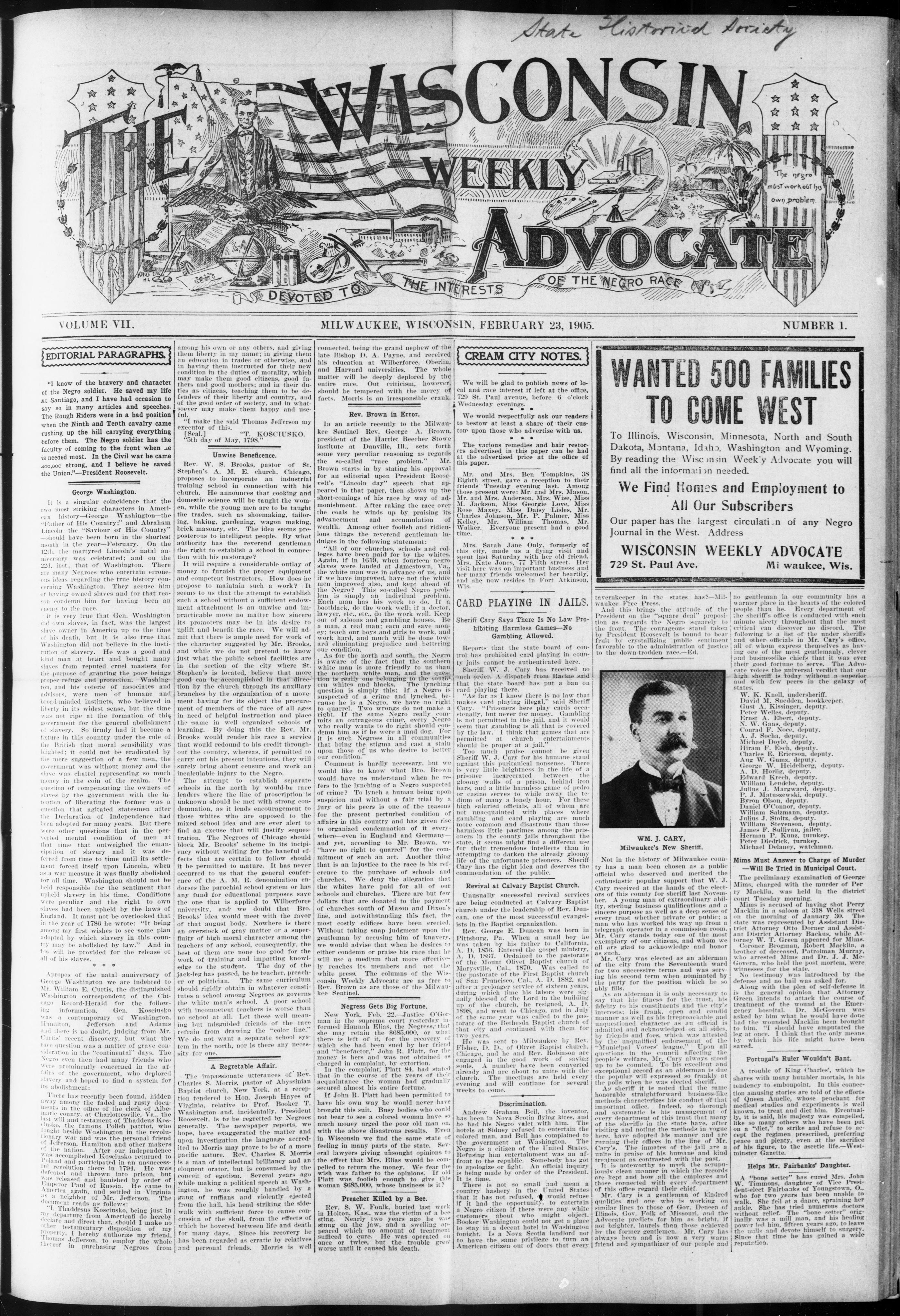
WISCONSIN
WEEKLY
ADVOCATE
DEVOTED TO THE INTERESTS OF THE NEGRO RACE
EDITORIAL PARAGRAPHS.
"I know of the bravery and character of the Negro soldier. He saved my life at Santiago, and I have had occasion to say so in many articles and speeches. The Rough Riders were in a bad position when the Ninth and Tenth cavalry came rushing up the hill carrying everything before them. The Negro soldier has the faculty of coming to the front when he is needed most. In the Civil war he came 400,000 strong, and I believe he saved the Union."—President Roosevelt.
George Washington
It is a singular coincidence that the two most striking characters in American history—George Washington—the "Father of His Country;" and Abraham Lincoln—the "Saviour of His Country"—should have been born in the shortest month in the year—February. On the 12th, the martyred Lincoln's natal anniversary was celebrated; and on the 22d. inst., that of Washington. There are many Negroes who entertain erroneous ideas regarding the true history concerning Washington. They accuse him of having owned slaves and for that reason condemn him for having been an enemy to the race.
It is very true that Gen. Washington did own slaves, in fact, was the largest slave owner in America up to the time of his death, but it is also true that Washington did not believe in the institution of slavery. He was a good and kind man at heart and bought many slaves from reputed cruel masters for the purpose of granting the poor beings proper refuge and protection. Washington, and his coterie of associates and advisors, were men of humane and broad-minded instincts, who believed in liberty in its widest sense, but the time was not ripe at the formation of this government for the general abolishment of slavery. So firmly had it become a fixture in this country under the rule of the British that moral sensibility was blighted; it could not be eradicated by the mere suggestion of a few men, the government was without money and the slave was chattel representing so much money in the coin of the realm. The question of compensating the owners of slaves by the government with the intention of liberating the former was a question that agitated statesmen after the Declaration of Independence had been adopted for many years. But there were other questions that in the perverted mental condition of men at that time that outweighed the emancipation of slavery and it was deferred from time to time until its settlement forced itself upon Lincoln, when as a war measure it was finally abolished for all time. Washington should not be held responsible for the sentiment that upheld slavery in his time. Conditions were peculiar and the right to own slaves had been upheld by the laws of England. It must not be overlooked that in the year of 1786 he wrote: "It being among my first wishes to see some plan adopted by which slavery in this country may be abolished by law." And in his will he provided for the release of all of his slaves.
* * *
Apropos of the natal anniversary of George Washington we are indebted to Mr. William E. Curtis, the distinguished Washington correspondent of the Chicago Record-Herald for the following information. Gen. Kosciusko was a contemporary of Washington, Hamilton, Jefferson and Adams and there is no doubt, judging from Mr. Curtis' recent discovery, but what the race question was a matter of grave consideration in the "continental" days. The Negro even then had many friends who were prominently concerned in the affairs of the government, who deplored slavery and hoped to find a system for its abolishment:
There has recently been found, hidden away among the faded and rusty documents in the office of the clerk of Albemarle county, at Charlottesville, Va., the last will and testament of Thaddeus Kosciusko, the famous Polish patriot, who fought beside Washington in the revolutionary war and was the personal friend of Jefferson, Hamilton and other makers of the nation. After our independence was accomplished Kosciusko returned to Poland and participated in an unsuccessful revolution there in 1794. He was defeated and thrown into prison, but was released and banished by order of Emperor Paul of Russia. He came to America again, and settled in Virginia as a neighbor of Mr. Jefferson. The document reads as follows:
"I. Thaddesus Kosciusko, being just in my departure from Americafi do hereby declare and direct that, should I make no other testamentary disposition of my property, I hereby authorize my friend, Thomas Jefferson, to employ the whole thereof in purchasing Negroes from
among his own or any others, and giving them liberty in my name; in giving them an education in trades or otherwise, and in having them instructed for their new condition in the duties of morality, which may make them good citizens, good fathers and good mothers; and in their duties as citizens, teaching them to be defenders of their liberty and country, and of the good order of society, and in whatsoever may make them happy and useful.
"I make the said Thomas Jefferson my executor of this. [Seal.] "T. KOSCIUSKO. "5th day of May, 1798."
Unwise Beneficence
Rev. W. S. Brooks, pastor of St. Stephen's A. M. E. church, Chicago, proposes to incorporate an industrial training school in connection with his church. He announces that cooking and domestic science will be taught the women, while the young men are to be taught the trades, such as shoemaking, tailoring, baking, gardening, wagon making, brick masonry, etc. The idea seems preposterous to intelligent people. By what authority has the reverend gentleman the right to establish a school in connection with his pastorage?
It will require a considerable outlay of money to furnish the proper equipment and competent instructors. How does he propose to maintain such a work? It seems to us that the attempt to establish such a school without a sufficient endowment attachment is an unwise and impracticable move no matter how sincere its promoters may be in his desire to uplift and benefit the race. We will admit that there is ample need for work of the character suggested by Mr. Brooks, and while we do not pretend to know just what the public school facilities are in the section of the city where St. Stephen's is located, believe that more good can be accomplished in that direction by the church through its auxiliary branches by the organization of a movement having for its object the procurement of members of the race of all ages in need of helpful instruction and place the same in well organized schools of learning. By doing this the Rev. Mr. Brooks would render his race a service that would redound to his credit throughout the country, whereas, if permitted to carry out his present intentions, they will surely bring about censure and work an incalculable injury to the Negro.
The attempt to establish separate schools in the north by would-be race leaders where the line of proscription is unknown should be met with strong condemnation, as it lends encouragement to those whites who are opposed to the mixed school idea and are ever alert to find an excuse that will justify sequestration. The Negroes of Chicago should block Mr. Brooks' scheme in its incipiency without waiting for the baneful effects that are certain to follow should it be permitted to mature. It has never occurred to us that the general conference of the A. M. E. denomination endorses the parochial school system or has any fund for educational purposes save the one that is applied to Wilberforce university, and we doubt that Bro. Brooks' idea would meet with the favor of that august body. Nowhere is there an overstock of gray matter or a superfluity of high moral character among the teachers of any school, consequently, the best of them are none too good for the work of training and imparting knowledge to the student. The day of the jack-leg has passed, be he teacher, preacher or politician. The same curriculum should rigidly obtain in whatever constitutes a school among Negroes as governs the white man's school. A poor school with incompetent teachers is worse than no school at all. Let these well meaning but misguided friends of the race refrain from drawing the "color line." We do not want a separate school system in the north, nor is there any necessity for one.
A Regretable Affair.
The impassionate utterances of Rev. Charles S. Morris, pastor of Abyssinian Baptist church, New York, at a reception tendered to Hon. Joseph Hayes of Virginia, relative to Prof. Booker T. Washington and, incidentally, President Roosevelt, is to be regretted by Negroes generally. The newspaper reports, we hope, have exaggerated the matter and upon investigation the language accredited to Morris may prove to be of a more pacific nature. Rev. Charles S. Morris is a man of intellectual brilliancy and an eloquent orator, but is consumed by the conceit of egotism. Several years ago while making a political speech at Washington, he was roughly handled by a gang of ruffians and violently ejected from the hall, his head striking the sidewalk with sufficient force to cause concussion of the skull, from the effects of which he hovered between life and death for many days. Since his recovery he has been regarded as erratic by relatives and personal friends. Morris is well
connected, being the grand nephew of the late Bishop D. A. Payne, and received his education at Wilberforce, Oberlin, and Harvard universities. The whole matter will be deeply deplored by the entire race. Out criticism, however, should be tempered with the mercy of facts. Morris is an irresponsible crank.
Rev. Brown in Error.
In an article recently to the Milwaukee Sentinel Rev. George A. Brown, president of the Harriet Beecher Stowe institute at Danville, Ill., sets forth some very peculiar reasoning as regards the so-called "race problem." Mr. Brown starts in by stating his approval for an editorial upon President Roosevelt's "Lincoln day" speech that appeared in that paper, then shows up the short-comings of his race by way of admonishment. After raking the race over the coals he winds up by praising its advancement and accumulation of wealth. Among other foolish and ridiculous things the reverend gentleman indulges in the following statement:
"All of our churches, schools and colleges have been paid for by the whites. Again, if in 1619, when fourteen negro slaves were landed at Jamestown, Va., the white man was in advance of us, and if we have improved, have not the white men improved also, and kept ahead of the Negro? This so-called Negro problem is simply an individual problem. Each man has his work to do. If a bootblack, do the work well; if a doctor, lawyer, etc., etc., do the work well. Keep out of saloons and gambling houses. Be a man, a real man; earn and save money; teach our boys and girls to work, and work hard, and much will be done toward eliminating prejudice and bettering our condition.
As for the north and south, the Negro is aware of the fact that the southern white man is more friendly to us than the northern white man, and the question is really one belonging to the southern whites and blacks. The lynching question is simply this: If a Negro is suspected of a crime and lynched, because he is a Negro, we have no right to quarrel. Two wrongs do not make a right. If the same Negro really commits an outrageous crime, every Negro who really wants to do right should condemn him as if he were a mad dog. For it is such Negroes in all communities that bring the stigma and cast a stain upon those of us who desire to better our condition."
Comment is hardly necessary, but we would like to know what Bro. Brown would have us understand when he refers to the lynching of a Negro suspected of crime? To lynch a human being upon suspicion and without a fair trial by a jury of his peers is one of the reasons for the present perturbed condition of affairs in this country and has given rise to organized condemnation of it everywhere—even in England and Germany—and yet, according to Mr. Brown, we "have no right to quarrel" for the commitment of such an act. Another thing that is an injustice to the race is his reference to the purchase of schools and churches. We deny the allegation that the whites have paid for all of our schools and churches. There are but few dollars that are donated to the payment of churches south of Mason and Dixon's line, and notwithstanding this fact, the most costly edifices have been erected. Without taking snap judgment upon the gentleman by accusing him of knavery, we would advise that when he desires to either condemn or praise his race that he will use a medium that more effectively reaches its members and not the white press. The columns of the Wisconsin Weekly Advocate are as free to Rev. Brown as are those of the Milwaukee Sentinel.
Negress Gets Big Fortune
New York, Feb. 22.—Justice O'Gorman in the supreme court yesterday informed Hannah Elias, the Negress; that she may retain the $685,000, or what there is left of it, for the recovery of which she had been sued by her friend and "benefactor," John R. Platt, for the money is hers and was not obtained as charged in complaint, by extortion. In the complaint, Platt 84, had stated that in the course of the years of their acquaintance the woman had gradually secured almost his entire fortune.
If John R. Platt had been permitted to have his own way he would never have brought this suit. Busy bodies who could not bear to see a colored woman have so much money urged the poor old man on, with the above disastrous results. Even in Wisconsin we find the same state of feeling in many parts of the state. Several lawyers giving unsought opinions to the effect that Mrs. Elias would be compelled to return the money. We fear the wish was father to the opinions. If old Platt was foolish enough to give this woman $685,000, whose business is it?
Preacher Killed by a Bee.
Rev. S. W. Foulk, buried last week in Holton, Kas., was the victim of a bee sting. Nearly two years ago he was stung on the jaw, and a swelling appeared which no amount of treatment sufficed to cure. He was operated on once or twice, but the trouble grew worse until it caused his death.
CREAM CITY NOTES.
We will be glad to publish news of local and race interest if left at the office, 729 St. Paul avenue, before 6 o'clock Wednesday evenings.
We would respectfully ask our readers to bestow at least a share of their custom upon those who advertise with us.
The various remedies and hair restorers advertised in this paper can be had at the advertised price at the office of this paper.
Mr. and Mrs. Ben Tompkins, 38 Eighth street, gave a reception to their friends Tuesday evening last. Among those present were: Mr. and Mrs. Mason, Mr. and Mrs. Anderson, Mrs. Wise, Miss M. Jackson, Miss Georgie Love, Miss Rose Maxey, Miss Daisy Lisles, Mr. Charles Johnson, Mr. P. Palmer, Miss Kelley, Mr. William Thomas, Mr. Walker. Everyone present had a good time.
***
Mrs. Sarah Jane Only, formerly of this city, made us a flying visit and spent last Saturday with her old friend. Mrs. Kate Jones, 77 Fifth street. Her visit here was on important business and her many friends welcomed her heartily, and she now resides in Fort Atkinson, Wis.
CARD PLAYING IN JAILS.
Sheriff Cary Says There Is No Law Prohibiting Harmless Games—No Gambling Allowed.
Reports that the state board of control has prohibited card playing in county jails cannot be authenticated here.
Sheriff W. J. Cary has received no such order. A dispatch from Racine said that the state board has put a ban on card playing there.
"As far as I know there is no law that makes card playing illegal," said Sheriff Cary. "Prisoners here play cards occasionally, but never for money. Gambling is not permitted in the jail, and it would seem that gambling is all that is covered by the law. I think that games that are permitted at church entertainments should be proper at a jail."
Too much praise cannot be given Sheriff W. J. Cary for his humane stand against this puritanical nonsense. There is very little brightness in the life of a prisoner incarcerated between the gloomy walls of a prison, behind iron bars, and a little harmless game of pedro or casino serves to while away the tedium of many a lonely hour. For these high salaried officials, all of whom are not unacquainted with places where gambling and card playing are much more common and disastrous than those harmless little pastimes among the prisoners in the county jails throughout the state, it seems might find a different use for their tremendous intellects than in attempting to darken the already gloomy life of the unfortunate prisoners. Sheriff Cary has the right idea and deserves the commendation of the public.
Revival at Calvary Baptist Church.
Unusually successful revival services are being conducted at Calvary Baptist church under the leadership of Rev. Duncan, one of the most successful evangelists in the Baptist organization.
Rev. George E. Duncan was born in Pittsburg, Pa. When a small boy he was taken by his father to California, A. D. 1856. Entered the gospel ministry, A. D. 1867. Ordained to the pastorate of the Mount Olivet Baptist church of Marysville, Cal., 1870. Was called to the pastorate of the First Baptist church of San Francisco, Cal., A. D. 1882, and after a prolonger service of sixteen years, during which time his labors were signally blessed of the Lord in the building up of the church, he resigned, A. D. 1898, and went to Chicago, and in July of the same year was called to the pastorate of the Bethesda Baptist church of that city and continued with them for two years.
He was sent to Milwaukee by Rev. Fisher, D. D., of Olivet Baptist church, Chicago, and he and Rev. Robinson are engaged in the good work of saving souls. A number have been converted already and are about to unite with the church. The meetings are held every evening and will continue for several weeks to come.
Discrimination
Andrew Graham Bell, the inventor, has been in Nova Scotia flying kites, and he had his Negro valet with him. The hotels at Sidney refused to entertain the colored man, and Bell has complained to the government at Washington. The Negro is a citizen of the United States. Refusing him entertainment was an affront to the republic. Somebody has got to apologize or fight. An official inquiry is being made by order of the President. It is time.
There is not so small and mean a country hashery in the United States that it has not refused, would refuse if it had the opportunity, to entertain a Negro citizen if there were any white customers about who might object. Booker Washington could not get a place to stay in a decent hotel in Washington tonight. Is a Nova Scotia landlord not to have the same privilege to turn an American citizen out of doors that every
WANTED 500 FAMILIES TO COME WEST
To Illinois, Wisconsin, Minnesota, North and South Dakota, Montana, Idaho, Washington and Wyoming. By reading the Wisconsin Weekly Advocate you will find all the information needed.
Our paper has the largest circulation of any Negro Journal in the West. Address
WISCONSIN WEEKLY ADVOCATE
729 St. Paul Ave. Mi waukee, Wis.
tavernkeeper in the states has?—Milwaukee Free Press. And this brings the attitude of the President on the "square deal" proposition as regards the Negro squarely to the front. The courageous stand taken by President Roosevelt is bound to bear fruit by crystallizing public sentiment favorable to the administration of justice to the down-trodden race.—Ed.
[Name]
WM. J. CARY,
Milwaukee's New Sheriff
Not in the history of Milwaukee county has a man been chosen as a public official who deserved and merited the enthusiastic popular support that W. J. Cary received at the hands of the electors of this county for sheriff last November. A young man of extraordinary ability, sterling business qualifications and a sincere purpose as well as a deep sense of every trust whether private or public; a man who has worked his way up from a telegraph operator in a commission room. Mr. Cary stands today one of the most exemplary of our citizens, and whom we all are glad to acknowledge and honor as such.
Mr. Cary was elected as an alderman of the city from the Seventeenth ward for two successive terms and was serving his second term when nominated by the party for the position which he so ably fills.
As an alderman it is only necessary to say that his fitness for the trust, his fidelity to his constituents and the city's interests: his frank, open and candid manner as well as his irreproachable and unquestioned character as an official is admitted and acknowledged on all sides, by friends and foes, which was attested by the unqualified endorsement of the "Municipal Voters' league." Upon all questions in the council affecting the people's welfare, Mr. Cary always stood up to be counted. To his excellent and exceptional record as an alderman is due the popular will expressed so frankly at the polls when he was elected sheriff.
As sheriff it is noted that the same honorable straightforward business-like methods characterizes his conduct of that important office. Indeed, so thorough and systematic is his management of every department of this trust that many of the sheriffs in the state have, after visiting and noting the methods in vogue here, have adopted his manner and are running their offices in the line of Mr. Cary's. The inmates of the jail are a unite in praise of his humane and kind treatment as contrasted with the past.
It is noteworthy to mark the scrupulously clean manner in which the records are kept and how all the employees and those connected with every department of this office regard their chief. Mr. Cary is a gentleman of kindred qualities and one who is working on similar lines to those of Gov. Deneen of Illinois, Gov. Folk of Missouri, and the Advocate predicts for him as bright, if not brighter, laurels than those achieved by the former gentlemen. Mr. Cary has always been and is now a very warm friend and sympathizer of our people and
NUMBER 1.
DO FAMILIES
THE WEST
Minnesota, North and South
Washington and Wyoming.
Weekly Advocate you will
need.
and Employment to
subscribers
circulation of any Negro
ess
EKLY ADVOCATE
Mi waukee, Wis.
no gentleman in our community has a warmer place in the hearts of the colored people than he. Every department of the sheriff's office is conducted with such minute nicety throughout that the most critical can discover no discord. The following is a list of the under sheriffs and other officials in Mr. Cary's office, all of whom express themselves as having one of the most gentlemanly, clever and businesslike chiefs that it was ever their good fortune to serve. The Advocate voices the universal verdict that our high sheriff is today without a superior and with few peers in the galaxy of states.
W. K. Knell, undersheriff.
David M. Snedden, bookkeeper.
Gust A. Kissinger, deputy.
Peter Welles, deputy.
Ernst A. Ebert, deputy.
N. W. Gans, deputy.
Conrad F. Noce, deputy.
A. J. Socha, deputy.
Michael Doyle, deputy.
Hiram F. Esch, deputy.
Charles E. Ericson, deputy.
Aug W. Gumz, deputy.
George W. Heidelberg, deputy.
A. D. Horlig, deputy.
Edward Krech, deputy.
William Leudche, deputy.
Julius J. Margward, deputy.
P. J. Matuszewski, deputy.
Byron Olson, deputy.
Daniel O'Connor, deputy.
William Salzmann, deputy.
Julius J. Stoltz, deputy.
William Stevenson, deputy.
James F. Sullivan, jailer.
Herman P. Kunz, turnkey.
Peter Diedrick, turnkey.
Michael Delaney, watchman.
Mims Must Answer to Charge of Murder Will Be Tried in Municipal Court.
The preliminary examination of George Mims, charged with the murder of Perry Macklin, was held in the district court Tuesday morning. Mims is accused of having shot Perry Macklin in a saloon at 318 Wells street on the morning of January 30. The state was represented by Assistant District Attorney Otto Dorner and Assistant District Attorney Backus, while Attorney W. T. Green appeared for Mims. Coroner Brogman, Robert Macklin, a brother of deceased, Patrolman Murray, who arrested Mims and Dr. J. J. McGovern, who held the post mortem, were witnesses for the state. No testimony was introduced by the defense and no bail was asked for.
defense and no bad was asked 101.
Along with the plea of self-defense it is the general opinion that Attorney Green intends to attack the course of treatment of the wound at the Emergency hospital. Dr. McGovern was asked by him what he would have done had the wounded Macklin been brought to him. "I should have amputated the leg at once. I think that the only means by which his life might have been saved.
Portugal's Ruler Wouldn't Bant.
A trouble of King Charles', which he shares with many humbler mortals, is his tendency to embonpoint. In this connection amusing stories are told of the efforts of Queen Amelie, whose penchant for medical studies and experiments is well known, to treat and diet him. Eventually, it is said, his majesty was compelled, like so many others who have been put on a "diet," to strike and refuse to accept the regimen prescribed, preferring peace and plenty, even at the sacrifice of his figure, to the ascetic life.—Westminster Gazette.
Helps Mr. Fairbanks' Daughter.
A "bone setter" has cured Mrs. John W. Timmons, daughter of Vice President-elect Fairbanks of Youngstown, O., who for two years has been unable to walk. She fell at a dance, spraining her ankle. She has tried numerous doctors without relief. The "bone setter" originally was a mill man, and his healing power led him, fifteen years ago, to leave the mills and devote himself to surgery. Since that time he has gained a wide reputation.
---
—A pig is usually kept in every stable in Persia; it is thought its presence is beneficial to the health of the horses.
—French captains who caused a wreck and the loss of 104 lives have been fined several francs apiece.
—Preparations are being made for the publication in London of a weekly journal written for conjurers.
—The cellar in the Bank of France resembles a large warehouse. Silver coin is stored there in 800 barrels.
—Three million song birds are killed each year for the purpose of adorning women's hats with their plumage.
—The Russian minister of finance has raised the question of the creation in Russia of chambers of commerce.
A mortality play, founded on Bunyan's "Pilgrim's Progress," has been successfully produced at Birmingham. The Glasgow city council has a 10-minute sandglass in front of each member, that he may limit his speeches to it.
A black lily, or tulip, with a flower eight inches in diameter, has been found on the island of Luzon, in the Philippines.
A gallon of water a day is drunk by every Japanese who practices, as nearly all do, the gymnastics known as jiujitsu.
Census figures just published show the population of France last year was 39,119,095, an increase of only 157,150 in two years.
The Chinese voice lacks two notes--its scale has six notes instead of eight. The fourth and seventh notes are the missing ones.
For various misdemeanors sixty-four schoolboys in Berlin were condemned last year to imprisonment for from two to ten months.
A medical authority says that in railway collisions the passengers who are asleep escape the bad effect of shaking and concussion.
Almost the entire commercial wealth of India, with its population of 300,000,000, is said to be in the hands of less than 90,000 persons.
An engineer declares that 50,000 people now do the work with the aid of machinery which needed 16,000,000 persons to do a few years ago.
There are sumptuary laws even in the Cook islands, where it is a punishable offense to eat more than 1000 cocoanuts in celebration of a death.
Argentina has nearly one-third the area of the United States, but only 5,000,000 population. Her resources could easily support 75,000,000.
If the paupers in Great Britain were arranged in a procession, four abreast, it is computed that the procession would be nearly 100 miles in length.
Living pictures—clever and finished representations of groups taken from Dresden and Sevres china—are very popular at one of the London music halls.
London has the largest proportion of insane of any English city, the number being 361 to every 100,000. Nottingham is a close second, with 342 to the 100,000.
The San Francisco police arrested the other day three men and three women in what they said was a shoplifting school. It had counters and shelves, and the women were being taught to steal. A large amount of goods stolen from department stores was recovered.
—Longwood, Bonaparte's house in St. Helena, is now a barn. The room in which he died is a stable. On the site of his former grave is a machine for grinding corn.
—There are 190,227 professional beggars in Spain, of whom 51,948 are women. In some of the cities beggars are licensed to carry on their trade. Seeking alms is recognized as a legitimate business and the municipality demands a percentage upon the collections. Seville is the only city in the kingdom which forbids begging in the streets.
A new city slaughter house, covering two acres, and to be used for the killing of horses, donkeys and mules for food, has been opened in Paris with a banquet, at which horse and donkey flesh were the only meats served. It is stated that 25,000 horses, donkeys and mules are killed annually in Paris for food. The use of their flesh is increasing.
It is estimated that the total area for farming purposes in the United States is 41,000,000 acres, an area larger than England, Scotland, Ireland, Wales, France, Germany, Austria, Spain, Japan and the Transvaal. There are 14,439,000 persons engaged in agricultural pursuits, while all other industries employ but 18,845,000.
A Hungarian blacksmith recently sent a novel present to the Austrian Emperor. It was a goose egg with a horseshoe, a pair of pincers, a file and a knife, all riveted to the shell, and the work had been so carefully done that there was not even a crack in the shell. The Emperor sent him an autograph photograph, a medal and $15 in return.
Ether and chloroform, so useful in sending men to sleep, have the very opposite effect on plants, which are stimulated to the greatest possible activity by these drugs. In Denmark and Germany advantage has been taken of this fact to force flowers in rooms and glasshouses and to make them bloom out of season. The results are said to be marvelous.
The network of canals in Flanders, which terminates at the seaports at Neuzen, in the Netherlands, and Ostend and Zeebrugge, in Belgium, offers an opportunity to use motor boats, and the demand is increasing from year to year. Several firms in this city manufacture motors for boats, but preference is given to the American motor.
The Straits settlements have the cheapest postoffice in the world. Postcards, available in the colony and to the Federated Malay states, are sold at one-fifth of a penny each; the letter rates of postage throughout the same area is slightly more than a halfpenny. The postage on letters to any place in the British empire is four-fifths of a penny to the half ounce.
The canton of Zurich in Switzerland, has taken steps to establish an annual poll tax of 85 cents, to be called the Zurich medical tax, and that from the fund thus produced, some half a hundred physicians are to be maintained, whose services are to be at the disposal of any member of the commune, free of any remuneration, whenever he may choose to call for them.
The marriage rate is higher in England than elsewhere, being 15 in 1000. In most other countries it varies from 7 to 10 in 1000. The highest birth rate, according to a volume of statistics, referring chiefly to foreign countries, issued by the British board of trade, is in Roumania-39 in 1000. That country also has the highest death rate, 27.7 in 1000. The lowest marriage rate is in Sweden, where it is .9 in 1000.
In view of the periodic discussion about the appropriate naming of warships it is of interest to learn that Japan has named her big battleships after great mountains and the small war vessels from some well known natural features of the country. It may also be mentioned that at the end of the name of every Japanese ship is either the termination "kan" or "maru." "Kan" means war vessels, and is applied, of course, only to the Emperor's fleet. "Maru," which means round, is applied to merchant vessels, why it is difficult to say.
THE HAND OF LINCOLN.
Look on this cast, and know the hand
That bore a nation in its hold:
From this mute witness understand
What Lincoln was,—how large of mould.
The man who sped the woodman's team,
And deepest sunk the ploughman's share,
And pushed the laden raft astream,
Of fate before him unaware.
This was the hand that knew to swing
The axe—since thus would Freedom train
Her son—and made the forest ring,
And drove the wedge, and toiled amain.
Firm hand, that loftier office took,
A conscious leader's will obeyed.
And when men sought his word and look,
With steadfast might the gathering
swayed.
No courtier's, toying with a sword,
Nor minstrel's, laid across a lute;
A chief's, uplifted to the Lord
When all the kings of earth were mute!
The hand of Anak, sinewed strong,
The fingers that on greatness clutch;
Yet, lo! the marks their lines along
Of one who strove and suffered much.
For here in knotted cord and vein
I trace the varying chart of years;
I know the troubled heart, the strain,
The weight of Atlas—and the tears.
Again I see the patient brow
That palm erewhile was wont to press;
And now 'tis furrowed deep, and now
Made smooth with hope and tenderness.
For something of a formless grace
This moulded outline plays about;
A pitying flame, beyond our trace,
Breathes like a spirit, in and out,—
The love that cast an aureole
Round one who, longer to endure.
Called mirth to ease his ceaseless dole,
Yet kept his nobler purpose sure.
Lo! as I gaze, the statured man.
Built up from you hand, appears:
A type that Nature wills to plan
But once in all a people's years.
What better than this volceless cast
To tell of such a one as he.
Since through its living semblance passed
That thought that bade a race be free!
—From "Poems Now First Collected." by
Edmund Clarence Stedman (Houghton,
Mifflin & Co., 1897).
THE CHORD.
It was evident that she did not love him, and yet it was announced that she was to marry him. I was only a guest in the house, but the affair troubled me and I sought long and earnestly for an explanation of it.
So far as I could judge, Mary had a distinct aversion to Ralph Weston rather than an affection for him, but nevertheless he seemed to dominate her life. She feared him, but for some reason chose to keep secret the cause of that fear. I could see her almost shrink from him when he called, but she dared not refuse to see him or break the engagement, which her father had sanctioned.
What was the secret of his power? I asked myself. Why did she not go to her father—easy-going, blind old Mark Tottenham—and tell him she could not marry this man? I could see no reason why she should sacrifice herself. Her father was wealthy and Weston was not. Surely the latter had no hold on the old gentleman that made such a marriage imperative.
On the contrary, my observation led me to believe that Mr. Tottenham thought he was acting for the best interests of his daughter. He liked Weston—who could be extremely entertaining when he wished, although usually rather taciturn—but there was nothing to indicate that he had his heart set on the match.
Yet Mary shuddered when her accepted suitor called, then greeted him with a show of cordiality, and went blindly with him to the little reception room, from which from time to time strains of music were wafted.
Weston was a musician of no mean ability, and occasionally entertained us all with selections on the piano, but the fitful way in which he played when they were alone together impressed me as rather strange.
He seldom played a selection through in those circumstances, but seemed to run over the keys idly, improvising, or giving a few bars from one air and then a few from another.
Once when he was doing this I thought I heard a wild, pleading cry of "Oh! don't," and then a half-smothered shriek, and when he played for us all the frightened look in Mary's eyes was enough to haunt a man for life. Apparently, however, I was the only one who noticed it.
Finally, overstepping even the liberty accorded to an old friend. I spoke freely to her. I told her it was plain she did not love him, and asked her why she did not go frankly to her father, tell him so and break the engagement. The bare suggestion seemed to frighten her, and she shuddered as she answered:
"I dare not—I dare not. He'd kill me."
"Kill you!" I exclaimed. "Nonsense! Your father has only your welfare at heart and—"
"No—no; not my father," she interrupted. "I mean Mr. Weston. He has the keynote."
The keynote! I was more mystified than ever, but she gave me no chance to ask for an explanation. She hurried away, as if already alarmed at what she had said, yet it seemed to me that she regarded me after that as one who was more in her confidence than others and to whom she might look for protection from some impending evil.
Still I could not understand what she meant by the "keynote," and she avoided the subject as if it were fraught with great personal danger. When I asked her to explain she trembled and shook her head.
"No one would believe me," she said. "It is so strange, so weird. And he would kill me. He has threatened to ard I know he would."
"Your nerves are overwrought," I replied. "Unless I misjudge the man, he would not know one end of a revolver from the other, and this is not the age for that sort of thing."
"But you don't understand," she insisted, laying her hand on my arm as if that gave her confidence, but nevertheless looking about her in a frightened way. "He has the keynote."
"That's what you said before," I returned, taking both her hands and holding her in front of me. "What do you mean by it? Tell me frankly. "I'll believe you and I'll help you."
"If I thought you would," she said, doubtingly.
"I will," I asserted, earnestly. "Tell me."
She seemed on the point of telling me her story, but evidently thought better of it.
"Wait," she said. "You shall see for yourself. He is coming tonight and I will hide you behind the curtains. But don't let him kill me. If he tries to do it
knock him down—brain him—drive him away from the piano at all cost."
There was a world of pathos in the earnestness with which she said that, and for the first time I began to understand the affair.
There is a keynote to everything, a science has demonstrated. Just the right chord will make a glass shiver into an nillion pieces. If the keynote of the largest building should be discovered the structure might crumble into dust, and it is not an unknown thing for articles in the vicinity of great organs to fall to pieces. Indeed, I myself have felt the sudden emotional thrill that comes from the striking of a certain chord.
That evening I was carefully concealed behind the window draperies when West-on called, and it is needless to say that my interest was intense. She shuddered as he drew her toward him, but remained passive in his embrace.
"Tomorrow," he said, "we will be quietly married."
"No." she replied, and I could see that it was only with an effort that she forced herself to say it.
"But I insist!" he exclaimed. "I will no longer run the risk of losing you, and you promised me yesterday."
"I've changed my mind," she answered shortly.
"Have a care," he returned, menacingly, releasing her and moving toward the piano. Whether it was my presence that inspired her I know not, but for the first time, as she afterward told me, her spirit was roused and she dared him.
"Kill me if you will!" she cried. "Since the fateful night you first accidentally struck that chord and saw the effect it had on me I have lived in almost constant fear of death or insanity, which is worse. I have trembled whenever you have touched the keys, even in the presence of others. You have played, as it seemed to me, on the live nerves of my body and from very fear forced me to acquiesce in whatever you proposed, but I am done with it. I will not marry you tomorrow or at any other time."
"Think again," he said, softly, but nevertheless threateningly, as he seated himself at the piano, and idly ran his fingers over the keys. "Remember! This is a power I shall have always. I have no fear that it will kill you, but wherever I may find you I can inflict upon you the excruciating torture that you dread. Even at the altar this chord——" He never finished the sentence, for as he spoke she uttered a sudden cry. Her face became deadly white and she swayed and shook like a leaf. I sprang from behind the curtains, but before I reached him he had struck the chord again, and with a moan she collapsed and sank in a heap on the floor.
I did not handle him very gently, and when the others came in, attracted by the noise, he was in a fit condition to interview a doctor. He said when he left that he would find an opportunity to carry his threat into execution, and that she never would be able to escape that chord so long as both he and she lived.
Mary and her father left for a continental trip a week later, and Weston disappeared soon after. He intimated that it was his purpose to follow them. If he did and her father remained in the same humor in which I last saw him, I am satisfied that there is one musical genius occupying a grave somewhere on the continent. But I have heard of no such tragedy.—E. F. in Illustrated Bits.
JAPANESE PATRIOTISM
Loyalty to the Emperor Is Its Great Concomitant.
The love of one's fatherland is common to the natives of all countries, but in Japanese patriotism there are certain things peculiar to itself.
When we consider Japanese patriotism we must never lose sight of its great concomitant, loyalty to the Emperor. These two passions are so closely united the breast of an ordinary Japanese that he can hardly conceive of one without the other. When a Japanese says, "I love my country," a great or even greater part of his idea of his "country" is taken up by the Emperor and the imperial family. His duty to his country, as conceived by him, includes, first of all, duty to his Emperor. Moreover, to him his country does not mean simply a group of islands with about 50,000,000 people living on them. His forefathers and descendants are also taken into account. To him the past, present and future generations are commingled into one, so that if we analyze the idea of his kuni, country, as understood by him, we find it composed of the following elements:
1. The imperial ancestors.
2. The reigning Emperor.
3. The imperial family.
4. The imperial descendants.
5. His own ancestors.
6. His own family and relations.
7. His descendants.
8. His fellow countrymen; their families and their relations.
9. Their ancestors.
10. Their descendants.
11. The extent of land or lands occupied by his race.
The Japanese knows that his own ancestors served those of his Emperor. Nay, he knows that, if his own genealogy be traced to bygone ages it will be found more or less connected with that of the imperial household. In short, the Japanese are members of one vast family with the Emperor as the head and representative of its main stock. The Emperor is by birth the head of the nation. Neither he nor any of his ancestors came to the throne by ruse or violence. Suppose Abraham had founded an empire in Palestine—that his heirs in an unbroken line ruled over the twelve tribes, themselves descendants of Abraham, and that the empire continued powerful to this day; suppose this, and you have an idea somewhat similar to that of the empire of Japan.—Nobushige Amenomori in Atlantic Monthly.
Definition.
An Englishman was asking for information about the state of education in an Irish county.
"Can they all read and write?"
"Troth they can, every mother's son of them."
"Have you no ignoramuses amongst you?"
"Niver a one."
"Do you know the meaning of the word ignoramus?"
"I do."
"What is it?"
"A shtranger like yerself."—London Tit-Bits.
A Cinch.
Johnnie was dining Sunday evening with his parents at the Hotel Baltimore, and was enjoying everything immensely. As he passed his plate for a third helping of roast turkey he said to his mother in a voice that attracted attention all around him: "Mom, here's where we don't have to leave any for the hired girl, ain't it?"
THE TIGHTWAD'S DOWNFALL.
O he surely was a tightwad; 'twas a case of pinch and save
or pinch and save
Till he'd bunched a roll o' green ones
'twould have gagged the Mammoth
Cave:
He had skinned his trusting papa, he had filimfammed manna some.
He had not a friend remaining in the circle of his home;
He had gold bricked Brother Broadcloth—fleeced him plenty unawares.
Till the man who wore the albert didn't name him in his prayers;
He had made himself go bankrupt spite of money in his sock.
And the neighbors never mentioned him without an awful knock.
Soon he'd got his ill-got ingots to proportions that were fierce—
Why, he owned bank notes in barrels, and gold bullion by the tlierce;
He had silver dollars hidden in the cellar in a bin.
Yet the way he kept on savin' was the rankest sort o' sin.
But there came his way one morning sort o' slvy an' shifty chap.
With a phony tale o' gold mines and a blue print profeel map;
Sung his warble to the tightwad, done him up, and done him good;
Then he faded from the landscape—now the tightwad's sawing wood.
—Baltimore American.
New York Every Day.
Mrs. Vance Cheney has announced the marriage of her daughter, Evelyne Hope, to Harold Hayens of Piedmont, Cali, which occurred on the evening of February 14 at the Collingswood hotel, here. Mr. and Mrs. Hayens will live in California.
Practically all the leading carpet manufacturers have announced advances in prices of from $2 \frac{1}{2}$ cents to 5 cents a yard on their goods. The advance is said to be caused by the war in the far east, which has cut off the supply of carpet wools from Russia and China.
Confessing that she had forged many checks and drawn on her employer's bank account since last October, Margaret Connolly, 15 years old, has been taken into custody. The child said she had used the money, of which $500 or $600 is missing, to play philanthropist among the poor children living near her home.
The arrest in New York of M. S. Roache and A. Debeauvoir, formerly members of the faculty of Villa Nova college, near Philadelphia, is the outcome of vandalism at the college when a professor's room was wrecked. Debeauvoir also is charged with attempting to damage the reputation of the professor by scurrilous letters.
An ordinance has been adopted by the New York board of aldermen empowering city magistrates to asses a fine of $250 on persons found carrying concealed weapons. The former penalty was $10, and had little tendency, according to the police, toward breaking up the practice. The ordinance gives the police commissioner power to issue permits for carrying concealed weapons, as at present.
"Men are always accusing women of talking a lot, but the President of the United States does more talking than any woman I ever knew," said Mrs. Lillie Deveroux Blake in her toast to the Minerva club at a dinner at the Waldorf-Astoria. "But Teddy really said something sensible the other day, when he declared there was no sex in crime, and there should be no sex in punishment. He should have said, too, that there was no sex in rights or privileges."
A highwayman attacked Mr. and Mrs. John W. Cornish in front of their home in New York city, snatched a $5000 diamond brooch from Mrs. Cornish's throat, fired two bullets through the clothing of Cornish when he remonstrated, and then escaped, after an exciting race with a policeman in which several shots were exchanged, but so far as known without effect. The robber followed Mr. and Mrs. Cornish home from a street car in which the lavish display of diamonds worn by the couple had attracted much attention.
Letters of administration were granted on the estate of George E. Smith, known in racing circles as "Pittsburg Phil." to his mother. Elizabeth Downing of Alleghany county, Pennsylvania, and to Walter Keyes. The petition stated that the decedent was possessed of $1,000,000 in personal property and of $25,000 worth of real estate in this state, and gave as his heirs and next of kin his mother, his brother, William C. Smith, who resides in New York city; his nephew, James McGill, also a resident of New York, and his niece, Eleanor A. Ewing, who lives in Pennsylvania.
Dr. Ashbel F. Grinnell, twenty years dean of the medical department of the University of Vermont, secured a verdict for $10,000 damages at the second trial of his action to recover $50,000 from Edward Weston, for false arrest and imprisonment. At a former trial Dr. Grinnell got a verdict for $12,500. As Dr. Grinnell and his wife were about to board a train at the Grand Central station in March, 1901, private detectives arrested him at the alleged instigation of Weston, who asserted Dr. Grinnell was a man named Raynor, who had swindled him out of $90.
Probably the oldest woman in Brooklyn, Miss Rachael Martense, died at the home of her sister, Mrs. William Douglas Story, Flatbush, Brooklyn. Mr. Story gained considerable fame as a captain in the United States navy during the war with England in 1812. Miss Martense was born February 3, 1801. She was the youngest of four daughters of Adrian I. Martense, who died in 1876, and it is reported left her a considerable fortune. Miss Martense died without ever having seen the Brooklyn bridge or ever having been out of the immediate confines in which she lived, and had never ridden on a trolley car. She died within a few hundred feet of the spot where she was born.
Mrs. Florence E. Maybrick, who recently was released from an English prison after serving fifteen years upon conviction for the murder of her husband, visited the Tombs and some of the courts in the criminal courts building. In the Tombs she saw Nan Patterson. They greeted each other warmly, Mrs. Maybrick elasping both of Nan's hands. "You have my deepest sympathy." Mrs. Maybrick said. "I sincerely hope the outcome for you will be better than it was for me."
Tears came to the show girl's eyes as she replied chokingly, "I thank you ever so much."
Mrs. Maybrick told Warden Flynn the Tombs is a cozy home compared with English prisons.
Rev. John L. Belford, pastor of the Church of SS. Peter and Paul, in Williamsburg, favors the plan for a model saloon, and declares he would like to see saloons like the Subway tavern in every block of his parish. Father Belford says: "The papers are sneering at the saloon in which Bishop Potter is interested. Temperance cranks and ministerial bodies are denouncing the project. Let us be honest. While we have little regard for the
---
man, we really admire his work. A good saloon is a possibility. Liquor is not the invention of the devil. Every drinking man is not on the high road to hell. What is the use of exaggerating? I wish we could have a model saloon every block. If we could have just one and run it according to law we should be doing a great thing."
Ben Clarke, watchman at Weber's music hall, has been wearing all kinds of new clothes of late. He explains his new "wealth" thus: "At 1 o'clock Thursday morning I heard a thumping at the stage door, an' I find a tall, slim gent with a silk dicer and fur lined coat. "'I want to look in the box where I sat tonight,' said the man. I told him he couldn't come in. it was against the rules of the house. 'But I left something in that box and want it.' said the man. Then he pulls out a roll and gives me a five spot and tells me to go chase meself to box L and see if I can find anything lying on the floor. I found a wallet with six yellow $1000 bills. On the wallet were the initials 'J. J. A.' 'I'm Col. John Jacob Astor,' the man said, an' as his name fitted the initials, why I turned him over the wallet. He gave me $100."
A real estate syndicate with millions of dollars behind it is seeking to buy the Vanderbilt twin mansions at Fifth avenue and Fifty-first street. New York city, and erect on their site a twenty story office building that will be the largest structure north of the Wall street district. If the deal goes through it is predicted there will not be a home left in the great avenue of fashion south of Fifty-ninth street within five years. The transformation of the thoroughfare is so remarkable and the upward march of trade into the sacred precincts of society is so rapid that it is a question if it will be possible to check it even at Fifty-ninth street. The section of the avenue between Fiftieth street and the park, where society determined to make its last stand, is doomed as certainly as is the section between Thirtieth and Fiftieth streets, which now is the center of the greatest building activity.
At the home of Mr. and Mrs. C. Griswold Bourne in New York city there was a meeting in the interest of the American Institute for Scientific Research, which seeks an endowment fund of $100,000 to start its work in abnormal psychology and psychical research. Rev. Dr. Minot J. Savage denied he was in the ordinary sense a spiritualist. "For thirty years," he said. "I have been a student in psychical research. There are thousands who contend that the individual survives the experience of death and that it is possible to establish communication between the two worlds. This is either a most lamentable delusion or a tremendously significant fact. It seems to me we should be able to decide whether humanity has been insane through all the centuries, or whether there is not reason to believe some of these things really occurred. If we could make people sure of a continued existence we should be able to lift the moral life of the world."
Tests and experiments at Gouveneur hospital on patients suffering from spinal meningitis have led the doctors there to the belief that a new and successful treatment of the dread disease has been found. The mortality of meningitis has always beer high, and especially among children, and there has been no accepted method of treatment among medical men. The new method consists of the injection of anti-toxin of diphtheria. Out of eight cases five have been absolutely cured without any subsequent complications, and two show improvement. The only uncertain case is that of a girl of 10 who was at the hospital seventeen days before she was treated with the anti-toxin. Particularly interesting were the cases of three brothers, from 9 to 14 years old. Another brother had died at home after an illness of two days. Eight thousand units of anti-toxin were given to each boy every forty-eight hours. Two of them are now entirely well and the third is rapidly improving.
Followed Instructions.
Casey and Mulligan lived in adjoining tenements. Casey was looking out of his front window one afternoon, when he saw Mulligan go through the street door on the run and, still sprinting, disappear. In a few moments he returned, still running. Casey was surprised, because it was not Mulligan's wont to run. On the next night Casey, again seated at the window, saw Mulligan repeat the performance. Casey told his wife there must be sickness in the Mulligan household, but Mrs. Casey said no, she had seen Mrs. Mulligan that day and all the affairs of the Mulligans were moving smoothly. On the third day Casey again saw Mulligan dash out of the door and return on the run. This time he followed, but, to his surprise, Mulligan's sprint was apparently for no especial purpose. He simply ran a short distance, turned and run back. On the fourth night Casey saw Mulligan leave the house with a skipping rope and go down the street skipping the rope as lightly as a child. When he returned he was still skipping the rope. This was the last straw to Casey's already overburdened curiosity. He watched, and when Mulligan was out went to his home.
"Is there anythin' I can do for you, Mrs. Mulligan?" he asked her. "What for?" asked Mrs. Mulligan. "Shure, and your husband has gone daft," said Casey. "I seen him run out of the house and run back agin three nights, and the fourth go out skippin' a rope." "Oh, that's nothin'," said Mrs. Mulligan. "The doctor was here last week, Mike bein' by way of ailin', and gave him four pills. "Take three runnin' and skip the fourth,' sez he, 'an that's what Mike has been doin'."?—New York Tribune.
Dog's Memory of a Bee Sting.
"Something must have stung your dog," said a resident of this city to a suburbanite, whom he was visiting a few days ago, as he noticed the antics of a large collie which, after snapping frantically at a flying insect, lowered his head and carefully licked his right forepaw.
"No." replied the owner of the dog, "that is only a little delusion of his. When he was a puppy a bee stung him on that foot you see him attending to, and ever since he has cherished a standing grudge against flying insects. Apparently the sight of one not only arouses his anger, but recalls most vividly his first experience with one, for each time after running after one, whether he catches it or not, he stops and tenderly licks the place where he was stung two years ago. As far as I know he has never been stung since then."—Philadelphia Press.
Large Babies
Well authenticated instances of children weighing at birth as much as 13 pounds are of extreme rarity. Among 15,166 children born in Chrobak's clinic in Vienna only one weighed 5,300 grammes (11½ pounds); while in seven years at the Clinic Baudelocque in Paris there were only six children who exceeded 5,000 grammes (11 pounds) at birth, the largest weighing 6,150 grammes (13½ pounds). Dubois in 1897 collected eight cases in which the child weighed more than 5,600 grammes (12 pounds) at birth, and stated that the heaviest children on record weighed respectively 24 pounds, 3 ounces; 24 pounds, 2 ounces, and 23 pounds, 12 ounces.
ONE TERM NEW YORK SENATORS
Men Twice Elected to the Senate Exceptions to the Rule in This State.
New York, singular among the states in this respect, has usually adhered to the policy of electing its United States senators for one term only, and though there have been some breaks in the record, they are few. Other states, and especially states of the south and New England, retain in office for many years a faithful or popular senator, and the rule in the west has generally been to promote to the Senate a congressman who has been efficient or popular as a member of the House.
In New York a senator is chosen usually for one term only. Daniel S. Dickinson, one of the most celebrated New Yorkers of his time, served only one full term, as did John A. Dix, his associate, and Hamilton Fish, his successor. Preston King served only a term, as did Ira Harris, his associate.
To King succeeded Edwin D. Morgan, the war governor of New York, and to Morgan, Reuben E. Fenton. Each served one term only.
To Fenton succeeded Francis Kernan, who served one term and was not re-elected. Warner Miller, William M. Evarts, Frank Hiscock, Elbridge G. Lapham, David B. Hill and Edward Murphy, Jr., had one term, only, each.
The exceptions in recent years to the general rule in New York have been Roscoe Conkling and Thomas C. Platt. Both of these senators resigned from the senate on the same day, May 14, 1881. Senator Platt was re-elected after an interval of many years. Senator Conkling closed his public service by his resignation.
The policy of New York has been generally, though not uniformly, to choose new senators to fill each recurring vacancy, a condition which may, perhaps, be best accounted for by the vicissitudes of New York politics. Usually New York senators have attained this honor without preliminary service in the Houss of Representatives.—New York Sun.
THE NEIGHBORS ALL USE THEM NOW.
Quick Cure of Rheumatism by Dodd's Kidney Pills—How They Saved the Shop of a Kansas Blacksmith—Cure Was Permanent, Too. Goodland, Kan., Feb. 20th.—(Special.)—So quick and complete was the cure of N. E. Albertson, a local blacksmith, that it almost seems like a miracle. He had Rheumatism so bad he feared he would have to give up his shop. One box of Dodd's Kidney Pills drove away all the pains and they have never returned. Speaking of his cure Mr. Albertson says:
"I had Rheumatism in my shoulders and arms for years. Part of the time it was so bad I could not sleep at night. My arm hurt so that it seemed I would have to give up my blacksmith shop. I went to the drug store and bought one box of Dodd's Kidney Pills and took them. I have not had the Rheumatism since. A great many of the neighbors are using Dodd's Kidney Pills since they saw how they cured me."
Lincoln's Acceptance
The New Orleans Times-Democrat reproduces Abraham Lincoln's letter of acceptance when he was first nominated for President. It reads: Springfield, Ill., May 22, 1860. Hon. George Ashman, President of the Republican National Convention
Republican National Convention.
Sir: I accept the nomination by the convention over which you presided, and of which I am formally apprised in the letter of yourself and others, acting as a committee of the convention for that purpose. The declaration of principles and sentiments which accompany your letter meet my approval, and it shall be my care not to violate it nor to disregard it in any part. Imploring the assistance of Divine Providence, and with due regard to the views and feelings of all who were represented in the convention, to the rights of all the states and territories and people of the nation, to the inviolability of the constitution and the perpetual union, harmony and prosperity of all, I am happy to co-operate for the practical success of the principles declared by the convention.
Your obliged friend and fellow-citizen,
ABRAHAM LINCOLN.
Too Many Woodchucks in Iowa
It seems that Jones county, this state, among other things, raise a good crop of woodchucks. So plentiful are these animals that the board of supervisors has offered a bounty of 20 cents per scalp for them.
At the last meeting of the board $535 was paid to citizens of that county for bounties. If you will take time to figure it up, you will say that it took a good many scalps to bring that amount of money.—Keosauqua Republican.
Too Many Wolves in Texas.
Claude Hudspeth of Ozona, member of the Legislature, who was here recently, says that wolves are becoming very numerous in portions of west Texas and that many stockmen favor the Legislature making an appropriation of $50,000 to encourage their extermination, this sum to be paid in bounties for the scalps of the animals. The wolves are killing many young stock and committing other damaging depredations.—Houston Post.
Hot Springs to Hatch Chickens.
To hatch chickens by means of the waters of the hot springs at Glenwood Springs, Colo., is the scheme projected by a wealthy Philadelphiaian. He proposes to erect eight incubators near several unused springs on the south bank of the Grand river and to employ running hot water in place of the lamps which usually supply the necessary heat. The projector of the plan hopes to hatch out from 5000 to 6000 eggs each month.
"I have used one of your Fish Brand Slickers for five years and now want a new one, also one for a friend. I would not be without one for twice the cost. They are just as far ahead of a common coat as a common one is ahead of nothing."
(NAME ON APPLICATION)
Be sure you don't get one of the common kind—this is the mark of excellence.
A. J. TOWER CO.
BOSTON, U. S. A.
(the woman's friend)
An indispensable article, simple, safe and sanitary.
It sells on sight. Liberal Terms to Agents. Write at once for terms and further information.
GOSSIP FOR THE LADIES.
oT ti aD ea ahs
4s) grasses hide the door
I) ivy-covered wall,
your dull gray steps of stone which bore
jie marks of Time—a hidden store
Oo; memories sweet which evermore
j.viors the years will call.
she child who loved to stray
\wiih book of fairy lore
ju quiet paths, the boy at play,
jie Wuntsman at the dawn of day,
ji. lovers in the time of May,
\\ill_keep their tryst no more,
snore down the old stone filght
Of steps, with mess o’ergrown,
ouce passed the bride with roses white,
ihe soldier eager for the fight,
yhe dead who, living, made our light,
‘And, dying, left us Ione.
The sunset’s fiery gold
Makes radiant the sky;
It shines upon the garden old
snd Visions come like tales re-told,
yo vanish as the night-wind cold
Lreathes out a gentle sigb.
—Pall Mall Gazette.
Why Men Mase
Becter Cooks Than Women.
(ooking is undoubtedly a fine art, and
»y accomplished chef is as much of an
writ in his particular branch of work
us a painter or a sculptor.
“raoe is as much difference between
vou! cooking and bad as between a sym-
hoy performed by a great master on. a
first-rate instrument and a so-called mel-
ody yuayed by some out-of-tune barrel
There is absolutely no question as to
who makes the better coox—a man or a
woman. If man did not excel, why
should all the chief hotels and restau-
rents of both British and continental
cities place a man at the head of their
culuary departments? 3
Women hold equally good positions’ in
most vocations as men now, but a female
chef, a woman “boss,” as you English
say, does not reign in any large kitchen.
in the ordinary domestic duties it is
yery hard to find a man equaling, much
Jess excelling, a woman—it is her sphere
in life, but cooking rises far above a
mere domestic duty, it is, as I have said
hefore, a fine art. The reason that in
cooking the palm has always _ been
awarded to a “mere man” is not far to
seek.
It is not because man is more epicurean
than woman, for this, though maintained
by women, is not a fact. Woman is
quite as fastidious over her food as the
ordinary man, and bestows as much
thorght over her meals as he does.
It is simply that man is more thorough
in his work, and thoroughness is at the
root of all good cooking, as of everything
else,
A man is more particular over the vari-
ous little details which are necessary to
make up a really perfect dish.
Take, for example, an Indina_ curry,
containing so many little trifling ingredi-
ents—all of which are equally important
to make a perfect dish when finished.
The loss of ene would mean the spoiling
of the others, and the complete ruin of
the flavor of the curry.
A man knows this, and will have them
all, None are too unimportant for his
consideration—a woman, on the other
hand, will manage with what she has got
handy. This is very nice and obliging of
her, no doubt, but it eventually spoils her
cooking, and the dish is not a success.
One of the chief faults in a woman's
cooking is her want of accuracy over the
smaller items—the exact amount of fla-
voring, the right condiments to each dish,
and that is one of the chief reasons why
her cooking pales before that of a man,
and makes his dishes preferable or all
occasions to hers.
_ Even in the case of amateurs, a man’s
is more suecessful than a woman's for
these reasons, and also because he takes
more pride in his work of preparing a
tempting repast.
A great many people think that any-
one cin cook who happens to possess a
shilling cookery book, and a few pots
and pans. What a fallacy! <A great
chef is born like any other great artist—
of course, he must learn his art as they
do theirs, but he has a natural gift for
lis work, even before he starts it.
To a chef his work is a “joy forever,”
and he invents new dishes with as much
pride and care as a modiste or a milliner
creates some new gown or hat, and he
carefully studies the trifling details of
each separate flavor before he sends his
ANG masterpiece of culinary art before
his patrons,
Women rarely care to take much trou-
ble over cooking, especially when they
are not acting as proressional cooks.
‘The housewife in England who does her
own cooking, considers it a waste of
time to spend much of the day in her
kitchen arranging for the family’s meals.
Other things, far more attractive in
themselves, claim her attention, and she
appears to forget that upon her care in
preparing and cooking the food depends
the digestion of husband and children,
and that upon their digestion hangs
much ef their health and happiness.
In France this is not so. ‘There, the
mother of a fairly well-to-do family does
not consider it a trouble to arrange all
the meals herself, and is in consequence
a far better cook than her English sister
of the same class.
When women have learnt that no trifle
is too small for their consideration in the
matter of cookery, then we may find
them at the head of the kitchens of the
chief clnbs and hotels, but until then
there will certainly be at least one place
where man can reign supreme.—Mons.
A. Escottier, Chef of the Carlton Hotel,
London, in Pearson’s Magazine.
Ella Wheeler Wilcox Talks to Mothers.
It has long been my idea that every
young ladies’ seminary, high school and
college should have a course of study on
this subject of prenatal influence, and
that it should be the post-graduate
course of every man’s college,
Time was when it would have been
considered little short of indecent to men-
Ton prenatal inuence in the presence of
youns women or young men, and the
publivter of such a tract or_ circular
woul have been regarded as immoral;
bat now that the religious organizations
‘re taking up the subjeet, we may hope
«vcuiaally to see the schools following
the same wise course and enlightening
the fathers and mothers of the future
on a most important topic in the whole
There is nothing we cannot hope for
for future generations once men and
when are awakened to a realization of
What parenthood means.
More than a year ago a discouraged
aud troubled woman wrote a friend of
ber misfortunes, The husband was out
“' employment. There were five chil-
‘ron to'feed and clothe and another child
coming,
,,,,How can I be glad of this ehild, or
‘el anything but despair at the thought
ef bringing another being into this trou-
‘ed lite?” she asked. “How can I give
iv unborn offspring prenatal influences
for anything but sorrow?”
op Try." urged the friend in reply.
Vice the inevitable with a courage
Which shall eompel the respect of the
jseen presences always about us, Se
7 4. me picture which pleases you and
yl =pen it often, thinking you would
“se sour child to resemble it.
= ‘Sele ‘t some character in history, and
“vex front your neighborhoed library ob-
jtain books about that character, and
| tead and think of the qualities which
your child may acquire by your efforts.
| “Foeus your mind upon this subject.
Whenever you become melancholy ust
your will power and say to yourself that
the Creator of all life is great and@ good
enough to care for you and protect you
through your trial, and that the work for
You to do is to mould your child into a
beautiful character and to fit it for a
comfort and joy to yourself and human-
ity.”
Meantime the friend sent the burden-
ed mother books and letters to cheer her
and made such effort as was in her pow-
| er to obtain work for the father and
clothing and fuel for the family.
Recently the friend received a_ letter
from the mother saying what changes the
last year had brought to the family. The
husband and father has a good position,
and by the most careful economy they are
able to satisfy the actual needs of the
| eight members of the household and to
pay a small sum each week to liquidate
| their debts. And -the baby which was the
cause of such despondency and almost de-
spair to the expectant mother is the glory
and joy of the household,
Already the child seems to radiate sun-
light and hope and to show unusual beau-
ty and attractiveness,
“Poor as we still are,” the mother
writes, “my heart is full of joy all day
long over our improved condition, and the
control I learned to exercise over my
mind those months and the lesson I
learned of my ability to drive away mel-
ancholy and invite cheerfulness have been
worth all they cost me.”
Time alone can tell just what will be
the result of the mother’s concentrated
effort to make her child an ideal charae-
ie but surely the present results are so
gratifying to this mother that they should
encourage thousands of other women sim-
ilarly situated who read this little story.
Every expectant mother should feel it
her first great duty to control and guide
her mind toward some desirable ideal, no
matter how difficult her position may be.
Every good thought and impulse, every
kind feeling and sweet act cultivated, ev-
ery unworthy mood and __ rebellious
thought governed at such a time means
a work done for eternity.
A woman who has liyed to see her son
reflect every mood of her mental condi-
tion before his birth writes me today that
she feels her work in the future lies in
giving talks to girls and women upon this
all-important subject.
“Before my son was born,” she writes,
“a relative asked me if I knew the power
of prenatal influence. I had been reared
by a ‘modest’ mother, one of the old-fash-
ioned kind, who had taught me that to
mention an unborn child was indelicate.
Oh, the misfortune such mothers have en-
tailed upon their children! I was indig-
nant at the relative who referred to my
condition, and of course lost my Oper
tunity to benefit by her knowledge. Not
until I lived to see my own uncontrolled
moods reflected in my child, and to suffer
for the injury I had done him when he
was helpless to defend himself, did I
‘awaken to the wonder and majesty and
‘terror of prenatal conditions.
| “And now I am going to do what I ean
to make other women realize their power
to mold their children to be what they
desire.”
| This is a great work for any woman to
undertake, and may success and joy at-
‘tend her.—Philadelphia Evening” Bulle-
tin.
Topics of the Household.
| Among the wedding presents of a bride
roca was a book with typewritten
‘yages bound in enametied cioth, from
which kitchen smears may be removed
‘with a sponge without injury to the
cover. For the book is intended primar-
ily for kitchen use. In it are recipes of
all sorts and kinds which are esteemed in
the household of the giver and which
have been collected by her during her
quarter of a century of married life. A
‘feature of the recipe part of the book is
the notes suggesting possible variations
jot various rules and occasional changes
that may be practicable. For instance,
if milk is lacking when the recipe calls
for it or if eggs are shorter than the rule
demands a hint is given for the writer's
way out of the dilemma and sometimes
a terse little story foliows of an actual
experience, Anecdotes, however, are few
in the carefully edited yolume,
Besides recipes there are careful in-
structions as to the removal of stains
of all sorts from different kinds of ma-
terials and formula for cleaning fluids
for various uses. A page or two is giv-
en to home remedies and several pages
to the care of plants or ordinary house
cultivation. The last part of the book
is devoted to paragraphs difficult to-clas-
sify, but all of which relate to household
affairs. Among these are suggestions for
exterminating insects, packing of winter
clothing during the summer, _ lists
of things that should be . done
when the house is closed fof the
summer and opened in the fall
ete. The book is, in fact, a second
edition of a work begun when its author
and compiler first went to housekeeping
and kept faithfully as a diary by het
from that day to this.
In speaking of the trouble the first
book cost, its owner said: “I early learn-
ed that it is the little helpful idea
that flits into one’s mind unealled or that
comes as a result of experience that is
|the hardest to lay hands on when one
peeenies it later for use. And I deter-
mined to treasure not only my own
worthful ideas, but those that I took
pains to glean from my friends. I keep
a journal with my account book in my
desk. When I go to the country or off
for a visit the book goes along in my
trunk, that I may record stray sugges-
tions. picked up on my way. Every
month or two I copy into my household
book everything that 1 think worth, re-
cording there. My household book is a
goodly sized blank book, with contents
arznged under various heads, such as
cakes and pastry, puddings, breads, can-
| dies, made dishes or entrees, meats, and
fish, pickles and_ preserves, and miscel-
laneous hints. Of course, for the book
which I made for my friend I selected
lonly the things that I thought would be
most useful to her. I always have a re-
liable cook book of late date in order
to keep up with the times. I accom-
panied the home made book with a copy
of one of the new cook books which I
myself have found very useful, and I
marked in it recipes which I have tried
with especial satisfaction, Had any one
started me on my home making career
with such an outfit of helps I should have
been saved many humiliating failures
and heartaches, besides a great deal of
unnecessary work. Cook hooks, excel-
lent ones, are plentiful, but to an inex-
perienced girl there are labyrinthine
wastes in the best of them through which
she needs a little guidance.”
“But what a lot of work,” is a_ first
thonght when a_bookful of helps, all to
be typewritten, is suggested. Yet not a
whit more time was actually consumed
by the task than by one of the elaborate
pieces of embroidery or lace work over
which no one once thought to eavil. And
the book will endure when they are long
past their fashion.—New York Evening
Sun.
Their Sense of Responsibilitv.
Se ne ee eS Se ee eee 5 SPE
I have found it an excellent plan with
my daughters to allow them to assist me
in my housekeeping and they are not only
‘enthusiastic, regarding it as their highest
pleasure, but the experience is most valu-
able for them. ‘The housekeeper pro tem.
is obliged to make out the menus for the
day, give the orders to the cook and wait-
ress (if there is one), superintend the dis-
position of the laundry work (when sent
out and when returned, or if done at
home), and she is also expected to make
the dessert for dinner.
When I have no servant, one of them
assists me with the cooking. while the
other does the housework; but when we
have a cook I sit still and sew or darn
stockings. Ana how rapidly they learnt
Their rivalry in such matters as blane-
mange or pie or salads is most amusing
and the results altogether gratifying. Re-
flecting that they will be fully equipped
for their new duties when the time comes
for them to assume the charge of their
own houses, I have no compunction about
utilizing their vacation time in this way.
There is scarcely any department of
houschold work that they do not under-
stand. and after they have left schoo! I
mean to have them thoroughly instructed
in_dressmaking and all sorts of sewing. |
Each week one of them assists me in
baking and I let her take some responsi-
bility on herself in this line; either to
make the bread into loaves, prepare some
cookies or a pie or cake. Last Saturday
I gave both of them an opportunity for a
cake contest, to see which could make the
nicest cake. One baked a layer cake and
the other a solid cake. I believe you
would have been surprised, as well as
was I, if you could have helped eat them.
I must say they were as nice cakes as L
have seen for parties and weddings, and
the interest they took in baking them
was delightful, and certainly would be a
pleasure to any mother. The change of
work not only breaks the monotony, but
teaches each one to do all kinds of work
and better prepares them to meet the
duties of wives, mothers and housekeep-
eas
The Rage for Filet Embroidery.
The girl who has a distaste for fine
sewing and delicate floss embroidery, and
who chooses the darning of torn linen and
family stockings as her share of the
household. duties, will find a real friend
in the new filet lace embroidery. In this
lace work the designs are woven into a
fine or coarse mesh net by darning in-
stead of by the cross stitch, as in Russian
scrim embroidery. In fact, the vogue for
cross-stitch embroidery has rather given
way to filet lace work, which closely re-
sembles filet guipure.
The real filet lace is enjoying a decided
popularity for insertions and edgings on
table covers, centerpieces, and counter-
panes. At a large dinner given this
month by a well known society woman
the long table was covered with a mag-
nificent linen cloth. Oblong insets of filet
lace in orchid design, set at regular inter-
vals, formed a square in the center of
the cover, while the same oblong inser-
tions outlined the edges of the table, and
a filet lace edging finished the borders of
the cloth.
A square tea cloth seen recently at an
afternoon reception was built from ten-
inch medallions of filet, alternating with
the same size squares of linen. The lace
showed lordly roosters and peacocks sil-
houetted in white against the linen mesh.
Collars and cuffs, medallions and bands
of filet lace will be much in evidence as
trimming for the shirtwaist and linen
frocks of the summer girl of 1905. The
girl who cannot afford the real guipure
can produce almost as striking effects in
darned lace, with the aid of her book of
cross-stitch designs. Colored laces seen
so much on evening frocks this winter
will be a feature of the washable dresses
for warm weather, and for these the
modish girl can embroider nets in the
soft shades of blue, pink, yellow, and
lavender,
In making filet lace the net should be
securely fastened to a piece of paper
cambric or thin oilcloth. The mesh is so
easily puckered and drawn out of shape
that it must be watched carefully, or the
result will be anything but satisfactory,
The weaving is effected by a dull-pointed
needle and mercerized cotton, silks, or
crewels in self-tone. or contrasting
shades may be employed for the darn-
ing. The needle is drawn over one
thread of the mesh and under the other,
as in the simple darning process, the
holes being filled in by two or three
crossings of the thread. Another method
of filling the holes is to have the threads
pass diagonally over the tiny squares,
crossing each other in the center. This
gives a more lacy effect than the straight
stitch.
An extremely pretty insertion _ for
shoulder seams, cuffs, belt, and chest
straps of a natural linen blouse shows a
star pattern darned into an eeru mesh
with a darker shade of mercerized cot-
ton. Medallions for a dimity shirtwaist
should be made from the sheerest mesh.
Any easy design is the shamrock darned
in diagonal stitch with a finely twisted
mercerized cotton.
One clever girl who works out her own
designs has her dressing table covered
with heavy mesh net in ecru, over red
sateen. Each end of the searf is inset
yith an oblong medallion, showing the
figures of a Dutch boy and girl in darned
lace. The aeons is covered with a
similar medailion.—New York Globe and
Commercial Advertiser.
The Ideal Wiie.
Perhaps I may never find my ideal
wife, but however lacking may be the
substitute I would possibly put in her
place, a little chamber in my heart sa-
cred to that not impossible she whose
image ever smiles in my _ visionary
dreams and glimmers in the rosy em-
bers of the dying fire.
And what is she like? Beautiful as
Venus? No! Strange as it may seem,
I have never had any clear idea of my
ideal’s physical attractions. She may
be dark or fair, short or tall, but above
all things she is lovable. And to be
lovable in a man’s eyes means so many
things, not of necessity any extraord-
inary beauty of face or form, certainly
not any overwhelming cleverness. Who
wants a woman to be clever, if she is
gentle and sweet tempered? And a loy-
able woman is gentle and sweet tem-
pereé sind tender hearted. Her voice is
low aad has a sweet caress in its every
accent. Her eyes look straight at a
world that seems beantifui to her, and
yet she is not wholly ignorant of its hid-
den byways and the faults and follies of
poor human nature, although in her
sweet charity he loves the sinner eve!
while she hates the sin.
Her religion is a real thing to her, al-
though she never makes any parade of
it any more than she does of her love.
It is simply a part of her daily life. She
may be as illogical as she likes and as
sweetly unreasonable as sne sees fit, vet
she will be none the less lovable. She
is willing to labor but not too good for
nature’s daily food. Above all things else
she is in love with her husband. She is
willing to labor with him in common
cause for their mutual benefit. She is
capable of making herself and her home
the two greatest and dearest attractions
on earth. She is a good housekeeper and
capable of leading to a higher and better
‘lite —Selected.
Study Yourself.
The woman who dresses attractively is
the woman who studies herself and un-
derstands the value of color, the possi-
bility of color combinations, and above
all the colors which she herself may wear
to bring out the best lights of her com-
plexion. There are certain things which
women of certain coloring may wear and
certain tints which are death to all their
beauty. Fair blondes should avoid all
the lighter shades of blue, for these give
an ashy hae to the complexion. The
darker velvety shades are theirs, how-
ever,
On the other hand, brunettes can sel-
dom wear dark blue, unless they have
a florid tint to their complexion, Green,
foo, is a dangerous color for bruneties.
Yellow belong to them, and is particular-
ly becoming by gaslight. As a rule, a
brunette can effectively wear red. How-
ever, there is no color which has such
a tendency to clear and brighten the
complexion as certain tints of yellow.
Find out what color belongs to you
and then cling to it. A good many peo-
ple will fail te find much truth in the
theory of color vibrations, but neverthe-
less, ‘there is an effect produced upon
one’s mental and physical candition by
the colors with which they constantly
surround — themselves. Choose your
gowns and your house furnishings from
those colors which are most conducive
to your beauty. Peace of mind and
physical invigoration will follow in_the
wake of such endeayor.—New York
Daily News.
- HUMOROUS ITEMS.
eee eV COME WEE Verse,
Poet—I can; I’ve got a poetic license.
_A Los Angeles lady, aged 95, is cut-
ting her third set of teeth. It’s the Cali-
fornia promotion committee’s next move.
—San Francisco News Letter.
A deputy marshal named Bat said:
“You can paste this in your hat:
Don't get nifty with me,
I'm a live one, by gee!
And now you know where I am at.”
—New York Matl.
_ Uncle Rube—And then they had the
piece de resistance.
Aunt Maria—Land sake! I s'pose
that’ at style for tough steak.—New
York Sun.
Plenty of people know how to make a
fortune look like 30 cents, but it took
the astute Mrs. Chadwick to make 30
cents look like a fortune.—San Francisco
News Letter.
“Did you buy your way to your pres-
ent position of political prominence?’
“Certainly I did,” answered Senator
Sorghum. “If there is anything I hate
it’s a deadhead.”—Washington Star.
His Kick.
There was a young man in Tangier
Who called to the waiter: “Look bier!
I just wish to say
I don’t like the way
You are piling the foam on my bier.”
—Houston Post.
De Gay—I wonder why Bilkins dresses
sv shabbily. His wife tells me she sim-
ply can’t get him to buy new clothes.
De Witt—Bilkins told me confidentially
that he dresses that way so his wife
can't drag him around to boring social
functions.—Brooklyn Life.
“My automobile has the very latest
improvements.”
“What are they?”
“See that little arrangement? That
registers the number of arrests per mile
and at the same time drops out the
amount of the fine.”—Cleveland Leader.
Time for a Wig.
If you'd know when you're getting bald,
Just take this hunch from me!
When folk say: ‘Why! your hair is thick-
Er than it used to be!
‘Vhen you may know that you will sport
A rink there presentlie.
—Houston Post.
“It is true,” said Rey. Goodley, “that
women are more regular and devout at-
tendants at church than the men.”
“So they should be,” replied the say-
age bachelor, “if they have any grat-
tude. The church aids and abets them
in committing matrimony.”—Dhiladel-
phia Ledger.
“Weary.”
“Wot is it, Willy?”
“Dat old gag about time bein’ money
ain’t so.”
“W’y ain’t it?”
“W'y, if it wuz, you an’ me’d have
Rockyfeller’s fortune lookin’ like a Chad-
wick autograph, dat’s w’y!"—Cleveland
Sie
A Lagevard in Love.
Weren't you once in love with Miss
Pinkerly 7’ said Dashaway to Cleyerton.
Cleverton sighed. “I am still,” he re-
plied.
“But,” remarked Dashaway, she re-
jected you, didn’t she?”
“Yes.”
“Well, old man, now I’m in love with
her, and I’ve come to you to know just
what to do. What's the best way to
act?”
Cleverton took him by the arm.
“Listen,” he said, “and I'll tell you the
truth. If you want to win that girl take
her to two matinees every week.
“That's easy.”
“Always go in a carriage.”
panes.
“Send her flowers every day.”
“Very well.”
“Never go near her unless you have
something in view for her pleasure.”
“Ah, yes.”
“Don’t waste any time in prelimina-
ries in—making love. Begin by throw-
ing your arms around her. If she makes
any objections kiss them promptly away.
Don’t sit and talk. Spend all the money
you have—and act.”
Cleverton gazes suspiciously at his
friend.
“I'm very anxious to win that giri,”
he said, “even if you do love her. Are
you sure that what you are telling me
is right?”
“Absolutely.”
“What makes you so sure.”
Dashaway smiled a melancholy smile.
“Because.” he said, “it is just what I
didn’t do.”—Judge.
Insulted Indian Territory Judge.
A well known attorney from Vinita
was in the courtroom at Wagoner await-
ing a case te be called and absent-mind-
edly was trimming his nails with a pen-
knife. His case was called aud he got
up before the judge and kept on using
the knife, not realizing what he was
doing.
It was more than the judge could
stand. ‘Where were you reared?” he
said. “Have you no respect for the
court, no decency and no idea of the
propriety of this court?”
“If the court pleases, I was reared in
Kentucky, and I am a southern gentle-
man. I came from a place where gentle-
men are treated as such, both in court
and_ out.”
Then there followed an attempt to
apologize to the court, but the judge
would not listen to it. He considered the
act an insult to the dignity of his court
and could not be appeased.—Muscogee
Times.
>
A Sportsman.
The teacher of a suburban school
asked: “Can any boy in the class tell
me what harness is?”
Not a single boy knew.
“Well,” continued the teacher, “is
there anyone in the class whose father
works among horses?”
One little boy shouted:
“Please, teacher, mine does.””
“Well, what is it that yeur father puts
on the horses each day?”
“Please, teacher, every halfpenny he’s
got.”—Illustrated Bits.
¢ Youne Folks’ Column. !
¢ Uncle Neises Dog.
Is you-all seen a dawg roun’ here
Dat don" belong to you?
I's huntin’ mine—he’s done been los’
For ‘bout a day or two.
What kind er ae lemme see
If I kin tell you dat;
Fust place, he’s po,’ dough he sho" eats
Enough to make ‘im fat.
His ha‘r looks lak hit wuz put on
bes any which-a-way,
De color of it sorter mixed,
Lak dus’ an’ yaller clay.
He ain’ no high-tone gent’men’s dawg,
Ner thoroughpred. but des
A ewyday bench-legged dawg
What looks lak all de res’.
Ef you-all sees him hangin’ roun’,
I hope you'll let me know,
Hit’s funny how I wants dat dawg,
1 miss him mo’ an’ mo’.
Es far as acshul value goes,
I ain't got dat in sight.
Hit’s des de wag er dat dawg’s tail
When I comes home at night.
—Elvise Lee Sherman in Lippincott's.
Wedding of the Rats.
yea eS a ee oe
rat daughter. This daughter, Chu, was
so graceful and clever that her parents
loved her dearly, and regarded her as
their most precious treasure. Great
pains they took to bring her up. They
allowed no rough wind to blow on her,
no hard food to reach her mouth. For
her studies, they let her nibble the edges
of only the most refined, classical books;
tor her accomplishment they let her
gnaw the strings of harps and guitars.
And at length she became the best edu-
cated and the most attractive girl in
the rat kingdom.
_Chu had reached the age to be mar-
ried. It was her parents’ desire to
choose for her the best and the greatest
husband in the whole world, for they
thought that there was no other girl-rat
so beautiful, so gentle, so accomplished
as their daughter, and that it would be
a pity to give her to an unworthy mate.
Every day the father and mother con-
sulted as to who should be Chu’s hus-
band.
“I think the greatest being in the uni-
yerse is either the sun or the moon. The
sun, however, is a little too bright and
dazzling to be near. The moon is mild-
er and gentler: I would have him for
our dear Chu,” said the father-rat at
last, and the mother-rat agreed.
Accordingly Chubei, the father-rat,
journeyed to the abode of the moon.
Without any delay he said: “O moon, I
presume you are still a bachelor. Will
you please take cur Chu for your bride?”
The moon looked yery much surprised.
“What an extraordinary proposal! In
this great world nobody has ever asked
me to be a bridegroom! I thank you for
your willingness to give me your daugh-
ter, but I must decline the honor, for,
you see, there is the cloud who is my
hindranee. I cannot always act as I
choose.”
Chubei, conciuding that the cloud was
greater than the thoon, then visited the
cloud immediately.
“O Cloud, I am told that you are above
the moon. Will you be our Chu’s bride-
groom?”
The cloud, after a moment's hesita-
tion, replied: ‘Well, I may seem greater
than either the sun or the moon, for I
soinetimes cross their way and intercept
their light. But I have a strong enemy,
the wind; he checks my course, blows me
often far away. I cannot consent to your
proposition.”
‘Twice refused. yet still persevering,
and nothing daunted, the father-rat made
| hig way to the wind.
| “If you are still living alone, O Wind,
please marry my daughter.”
The wind, striking his bag. said:
“Thank you, but, Chubei, I would rather
not.””
“Why do you refuse?”
“Think a moment. Every time I want
to go on and on, blowing straight ahead,
there is the wall——”
“Then you think the wall is greater
than you are?” P Ss
“Why, of course. I can’t resist him.
“Well, then, 1 will make him our
bridegroom.” Chubei was soon with
the_ wail.
“Marry our Chu, O Wall.”
“Ry no means,” the wall answered.
“Why do you object?”
“Yeu don't know the reason? While T
am guarding against the wind, don’t
you rats gnaw me and make large holes?
You are above me.”
“Oh, I see! It is just as you say. I
will go home now and think it over.”
Thus Chubei returned. At home, his
wife was waiting impatiently.
“How did the matter go? Did you
find a good bridegroom?’ she asked
eagerly.
The husband, twisting his beard with
his fingers, replied: “Be rejoiced. wife.
The rat is the greatest being in the worid
after all.”
“What? Do you mean in the whole
world?"
“Yes; it is this way: The moon, seai-
ed so high in heaven, has to retire when
the cloud comes; the cloud is blown
nway by the wind; the wind is checked
by the wall; and the wall—do we not
shaw him? So the cloud is greater than
the moon; the wind is greater than the
cloud; the wall is greater-than the wind;
the rats are greater than the wall—
greater than all things. It is better to
choose a bridegroom for Chu from our
own race.”
As the father explained the mother be-
came convinced. ‘Well—whom do we
have among us suitable for our dangi-
ter?”
“[ have been thinking about that all
the way home. How about young Chu-
maru, at Ceiling square?”
“He would do very well. But a cat
lives near his house, and [ should not
feel easy.”
“How about Chukuro at Ditch street?"
“He, too, is good. But a weasel’s
house is somewhere near bis; it might
be a dangerous neighborhood.”
“Well, there is the young priest Chu-
nen in the temple.”
“His, sect is the Monto, and I hear
oat the Monto seldom has offerings of
feod.”
“Each one has some fault! Where can
we find the perfect bridegroom!” the
father exclaimed.
Both were very much troubled. All
of a sudden, however. the wife said joy-
fully: “What do you tink of this? Give
up all those whom we have been talking
about. Have we not Chusuke right un-
der our reof? He has been with us from
his childhood, yet not once have we
found fault with him. He is ever loyal
and faithful. Moreover, he and Chu
have been playmates, they know each
other well. There could not be a bettér
husband for her.”
Chubei, clapping his hands, answered:
“O yes! Let us have Chusuke. I had
not thought of him. Indeed he is a
faithful steward, and I was planning
to make him the head of the branch
house this coming summer. He is well
suited to our Chn.”
Immediately: Chusuke, the. steward,
was sent for. He came in, heard the
proposal, and his heart was filled with
joy and grvtitude. Crying “Chu! Chu!
Chat’ he danced around the room.
The preparations for the marriage were
speedily accomplished, and at last the
day for the ceremony came. Chu, thi
bride, was beautifully dressed and placed
in a magnificent sedan chair, which was
followed by her ge relatives and
many servants. ‘he procession then
slowly marched from window sills to
eaves, from eaves to rafters, toward the
house where the bridegroom was waiting.
All the neighboring rats crept out from
the shelves, walls and screens to watch
the bridal train.
When the servants arrived with the
sedan chair at the house, the groomsman
helped the bride out and ushered her into
the parlor where the bridegroom waited
and where the marriage table and wed-
ding cups were ready. The happy bride-
groom and the shy bride were first seat-
ed; the parents and_ relatives were
grouped around them. Then the wedding
ceremony was performed amid solemn
silence.
‘Thus Chu became formally the wife of
Chusuke, and they lived eee together
all their days.—Mitsu Okada and Edith
A. Sawyer in Modern Women.
eee
INSULT TO INJURY.
I'm reatly fond of masic.
I know a tune or two,
An’ I often hum ‘em over
When Be nothing eise to doe.
But there's one that irritates me.
it is temptin’ me to crime,
When the organ grinder’s playin®
"Bout the “Good Old Summer Time.”
Shakin” at the cook stove
An’ shiverin’ at the grate;
Coaxin’ the thermometer
From morning until late.
Wishin’ that the mercury
Would turn around an’ climt—
An’ the organ grinder’s playin’
‘Bout the “Good Old Summer Time.”
I can stand the wind that’s piercin’,
I can half-way hold my own
When the grip is in my ‘system,
If I’m only let alone.
But it's clean beyond endurance
When the man expects a dime
For standin’ there an’ ee
"Bout the “Good Old Summer Time.**
—Washington Star.
—_—_—_—_————=
SHOT BIG BEAR IN A CAVE.
Experience of Three Portland Hunters
on Mount Hood.
Shooting a 400-pound black bear in the
darkness of a caye 200 feet in the side
of Mount Hoed was the experience last
week of three Portland plumbers who
bave returned to the city with the pelt.
‘The hunters are Fred H. Schindler,
Jesses S. Hayes and Roy S. Maxwell.
lt was three days out from Portland that
the party stumbled upon the bear's den,
Tust after lunch they saw behind a large
rock an penne, in the hillside. It was
a hole about 6 feet deep. Maxwell
dropped inside, the others following. A
candle was lighted, and fresh bear signs
were discovered, After going in 15 feet
they found that the cave widened out
a pitched forward. Hayes was in the
ead.
By this time the hunters were in dark-
ness, except for the flickering light of the
candle. Hayes was sure he had heard
a bear moving about, so the trio _pro-
ceeded with fear and trembling. they
had come all the way from Portland to
hunt bear, but to steal along in the semi-
darkness of the interior of Mount Hood
was not on the programme as arranged.
When the party had walked 300 feet
from the entrance and were down in the
earth at least 200 feet, at the same in-
stant all three heard the sound of claws
on the rocky floor and saw two green
eyes glaring at them, the bear fearing to
approach nearer to the light. Hayes
fired instantly. The report was deafen-
ing, but as nitro-smokeless powder was
used there was no suffecating smoke.
‘There was a half. stifled rear from the
bear, and the hair of each man went
straight up. Fearing an onslaught, all
fired a volley of three shots each and
awaited developments on the part. of
bruin. But the bear was dead. Half
the shots had been wasted.
Not only the pelt was secured, but
25 pounds of meat as well. Bear meat
at this season, however, is almost use-
less for food. “No attempt was made to
explore the remainder of the cavern.—
Portland Oregonian.
Woman Finds New Fossil Reptile.
A new marine reptile, representing a
hitherto unknown form of swimming
creature, has been discovered in the Hos-
selkus limestone in the upper triassie of
Shasta county, Cal., according to Prof,
John C. Merriam, head of the geological
department of the’ University of Califor-
nia. In a bulletin describing the strange
creature, Prof. Merriam gives the eredic
for the discovery of the reptile to Miss
A. M. Alexander, who, declares Prof.
Merriam, “has net only contributed gen-
erously to the financial support of the
work on the vertebrates of the marine
triassic, but was herself the discoverer
of the type specimen furnishing the larg-
est part of our information concerning
the group.” The find includes the an-
terior two-thirds of the skull and a por-
tion of the temporal region; also parts
of over thirty vertebrae, numerous frag-
mentary ribs, the principal elements of
the pectoral and pelvie arches, and a
considerable portion of au anterior limb.
—San Francise Call.
-_———___+____.
A New Objection to Domestic Service.
The mistress of a city flat had adver-
tised for a girl for general housework,
and was showing an applicant over the
house. She had been very liberal in her
promises of privileges, afternoons off,
evenings out, ete., and it looked as though
the two were about to come to some
agreement, when the girl suddenly asked:
“Do you do your own stretchin’?”
“Do we do our own what?’ asked the
puzzled mistress.
“Stretchin’,” repeated the new girl.
“I don’t understand.” E
“Stretchin’,” repeated the gifl a second
time. “Do you put all the stuff on the
table at mealtime and stretch for it, or
do I have to shuffle it around?”
The family are “stretchin’,’ and will
until they get a girl who is willing to
wait on the table as well as cook the
meal. Meantime the matron’s household
vocabulary contains a new word.
i
A Frozen Stunt.
An actress who plays a leading part
ix a Broadway production tells of am
amusing incident which happened in a
country theater. She was playing a
part in which she was supposed to jump
from a cliff into a river. The river lay
behind the cliff so that the audience
could not see it. A mattress was con-
veniently placed and on this the actress
landed after her leap.
One night the property man forgot to
place the mattress in position. The
actress made the leap and struck the
hard floor with a bang that was heard
by everyone in the theater.
“Oh, heavens!” came a voice from the
gallery, “the river is frozen!”"—New
York Evening Sun.
ea recipes
A Mechanical Wonder.
A recent mechanical wonder is a tele-
graphic instrument that sends a thousand
words a minute 1000 miles in length. A
human operator can transmit fifty words
a minute.
—The Hollanders are not fond of lazy
people, and they have a very good way
of curing persons who can bat won't
work. If a pauper who is able to work
refuses to do so they put him in a cis-
tern, to which a pump is attached, and
turn on a stream of water. The stream
‘flows into the cisters just slowly enough
‘to enable the lazy person, by lively pump-
ing, to keep the water from getting up
over his head.
THE WISCONSIN WEEKLY ADVOCATE
R. B. Montgomery, Editor and Publisher.
The Wisconsin Weekly Advocate after three years' residence at 79 Fifth street, has moved its headquarters to 729 St. Paul Ave., where we will receive our guests and trans-act our business in future.
A Representative Journal Devoted to the Interest of All the People.
ADVERTISING RATES.
One inch, one year.....$15.00
Two inches, one year.....25.00
Three inches, one year.....35.00
Four inches, one year.....42.00
For larger space, special rates.
For larger space, special rates.
Locals, 10 cents per line.
TERMS OF SUBSCRIPTION.
One year ..... $2.00
Six months ..... 1.00
Three months ..... .50
Direct all communications to
R. B. MONTGOMERY,
729 St. Paul Avenue.
HOW TO SEND MONEY.—Post Office
Order. Express Order. Draft or Registered
Letter. R. B. Montgomery will not be
responsible for loss when sent in any other
way.
TO CONTRIBUTORS:
All communications must be sent with the name and address of the sender as an evidence of good faith, but not necessarily for publication. No manuscript returned if not accepted, unless accompanied by stamps.
ENLARGES ITS WORK.
The officers of the Tuskegee Normal and Industrial institute of Tuskegee, Ala., have gradually matured a plan which should very deeply interest the young men and women of the race who are seeking an education. This plan enables young men and young women to attend school at night and work at an industry or trade during the day, or in the case of those who are able to pay a small monthly sum, to attend school during the day and at the same time learn a trade or work at some industry. This improved plan gives superior opportunity for literary and academic training and at the same time gives equal opportunity for the learning of a trade. Last year thirty-six states were represented by students at Tuskegee, and nine foreign countries. The attendance during the coming year promises to be very large and the class of students promises to be of a high grade.
DOGS. CATS. BIRDS. ETC.
Dog Market.—All kinds of pups; broke en Llewellen setter; also hounds for sale D. P. REDD. 317 State street. Send stamp for reply.
For Rent—Room
A well furnished room with heat, suitable for either one or two gentlemen of good repute, with a quiet and respectable colored family in a fine locality may be had through this office. Wisconsin Weekly Advocate.
HARDWARE ORNAMENTS.
H. L. Bacon Exhibits Fine Trophies of the Chase.
Two handsomely mounted deer heads arrived in North Milwaukee on Thursday for A. L. Bacon, proprietor of the Bacon House. The heads now ornament the dining room of Mr. Bacon's hotel and attract much attention. They are much prized by the owner, as both are trophies of Mr. Bacon's last deer hunt in the woods of northern Wisconsin.
When the deer season opened last fall, Mr. Bacon went to Antigo where he was joined by his father, Gilbert Bacon, his brother, Chas. Bacon, Al. Smith and Mr. Webley, all of Antigo. The party went to Langlade county and built a camp on the west bank of the Eau Claire river and eleven miles from the St. Paul railway. They spent three weeks in the woods and were remarkably successful. They killed ten fine bucks and two does, trapped two wild cats, each weighing thirty pounds, and captured a number of fur bearing animals and had a grand good time.
One night while the hunters were asleep a number of wild cats came into the camp and mutilated two of the dead bucks before they were discovered; later two of the cats were trapped and skinned. The two bucks killed by A. L. Bacon weighed about 200 pounds apiece. The weather was just right for deer hunting and when the hunt ended, the lucky sportsmen hung up ten of the deer to be photographed. The two does were frozen so that they were stood upon their feet, and, in the photograph present a very life-like appearance. The picture was taken by a member of the party and the twelve deer represented over 1,500 pounds of venison.
The party started for home at the close of the hunting season and at Taylor, Wis., Mr. Bacon arranged with John Lambert, a skillful taxidermist, to have two heads mounted. Mr. Lambert completed the work last week and he never turned out finer specimens of his skill.
Gilbert Bacon, the father of A. L., and Chas. Lambert came to Wisconsin over 60 years ago. He is now 83 years of age and expects to go deer hunting in the season of 1906. He uses a gun with a fine sight, hunts without the aid of eyeglasses and shot two deer in the last hunt. One day last fall he wanted to go to the railway station, eleven miles from the camp, and walked that distance without fatigue. He enjoyed the camp life and the hunting as much as the youngest man in the party and had two fine bucks to show that, although 83 years of age, he is still a mighty hunter.
Sleighride Party.
A number of the young people had a delightful sleighride party to Keipper's park, last Saturday evening. Among the guests were; Misses Ange and Rose Van Roo, Lydia Jahn, Tennie Luscher, Alma Stoddard, Ella Olm, Alma Schoel, Myrtle Ertlemeyer, Lizzie Langtry, Alma Schlapman, R. Miller, L. Miller and Mrs. W. E. Lund; Messrs. George Luscher, George Wille, Fred Oeflein, J. Van Roo, Alfred and Walter Maeghi, William Merkle, August and Albert Leitzke, Edward Zulacher, W. Lund, W. Meyer.
The number of Russian prisoners of war in Japan last month was about 3000.
SHOT SKIPS HIS HEAD.
Jacob Fass of Appleton Narrowly Escapes Death.
POLICE INVESTIGATING.
Secret Investigation Begun of Woman's Case Found at Roadside—Du Pont Says She Is His Wife.
Appleton, Wis., Feb. 24.—[Special.]—While sitting at the front window of his home about a mile and a half south of the city on Lake Row shortly after 8 o'clock last evening, Jacob Fass narrowly escaped death from a bullet from a 32 caliber which passed through the window and just missed his head. He hastened to the door and saw a large sleigh disappear in the darkness. He is unable to identify the occupants. The police are now investigating the matter. The occupants of the sleigh were singing when they drove past, and without a word of warning the bullet was fired.
Secret Investigation Begun.
That a secret investigation has been begun to sift down the case of the woman found on the State road, Monday night, was learned today. The investigation is not in the hands of the local police, which insists that there is nothing to the affair. Joseph V. Du Pont, at whose house the woman lives, has recently come here from Maxville Wis, with his family.
Savs It Was His Wife.
Du Pont claims the woman was his wife. He says that his wife had eaten canned peaches for supper and had become poisoned by them and was consequently violently sick. She then went outside in the air and had fainted there. He was carrying her in the house when a boy passed. He then says that he had called to the boy, telling him not to report the accident. Why he should warn the boy not to tell of this unimportant state of affairs he did not say.
Mr. Du Pont said that he was a musician and named a prominent local orchestra with which he said he was soon to be connected. The leader of this orchestra denies that he has engaged Du Pont, and that an application for a position was refused.
WHITE LABEL NO FAD.
President B. C. Gudden Reviews a Year's Work of Consumers'
Oshkosh, Wis., Feb. 24.—[Special.] With an optimistic prediction for the future, Mrs. B. C. Gudden, president of the Wisconsin Consumers' league, which is holding its annual session here today, reviewed the work of a twelve-month today in the president's address. Before the close of the session resolutions will doubtless be adopted memorializing the Legislature to further prohibit child labor, in favor of old age pensions, and similar measures, as suggested in the annual address.
The annual convention is in session in the Century on High street. The afternoon session was largely of a business character and there was a large attendance representing numerous parts of the state. At 12:30 o'clock this afternoon all the presidents of the local leagues and the state officers were entertained at dinner at the home of Mrs. B. C. Gudden. At the afternoon session the principal feature was the annual address of the president. Mrs. B. C. Gudden.
Mrs. Gudden spoke of the legislative work which the national and state leagues have accomplished, particularly in behalf of child labor and compulsory education. In this state, Mrs. Gudden said, several cities were brought around through league efforts to properly obey the law relative to the appointment of truant officers. The state league has been instrumental in returning a number of children to school from factories and has accomplished much for sanitary measures, seats for clerks in mercantile establishments, and other features.
That manufacturers were coming more and more to recognize and admit the moral and commercial value of the white label, was her prediction. The league movement is no longer treated as a fad, she said. Mrs. Gudden announced that she was deeply interested in the pension measures before the Legislature providing for a system of old age pensions for superannuated laborers, workmen, teachers and public officials.
Some of the legislative measures endorsed by the state league are: Bill prohibiting the playing in orchestras and public performances of children under 14 years of age; an increase of assistant factory inspectors from six to fourteen; making it possible to increase the number of juvenile courts in counties; prohibiting the farming out of convict labor, and an amendment giving the truant officer power and authority of factory inspection. The league showed opposition to the effort to extend the right of granting permits under the child labor law.
DISPATCHERS MUST GO SUDDENLY
North-Western Road Makes Sweeping Changes at Kaukauna.
Kaukauna, Wis., Feb. 24.—[Special.]
—A sweeping reduction in North-Western, the train dispatchers' force was made here yesterday, and one-half of the men were sent to Antigo, where a new train dispatchers' office for the Ashland division has been recently opened. The men sent to Antigo are Night Dispatcher T. McCoughlin, Dispatchers Robert Treat, Ralph McCullough, Henry Kircher and W. B. Murray and Operators Rogan and Cole, O. A. Janes of Mather is transferred to Kaukauna to fill Cole's position. T. M. Coughlin will be chief dispatcher at the Antigo office. The order came suddenly from the general offices in Chicago, and some of the men had to leave at once without having a chance to gather up their personal belongings. A change was expected, but it was not expected to be so radical in its nature.
J. E. Splon, chief tarin dispatcher at the Kaukauna offices, will remain in charge of this end of the Ashland division.
WRECK'S CAUSE UNUSUAL
Rio, Wis., Feb. 24.—[Special.]—The railway accident Thursday morning, by which Roland J. Dickey, a Milwaukee brakeman, was instantly killed and Conductor M. McQueeny injured, was the result of a slight error in an order given out by a telegraph operator, made serious by the heavy fog prevailing at the time.
The fast mail was thirty-five minutes behind time, and orders were issued to have the two trains meet at East Rio, instead of at Wyocena, the usual place. The operator at Watertown Junction, who delivered it to the fast mail, is said to have by mistake substituted the name of the usual passing place, Wyocena, for that of East Rio.
The stop signals had been displayed at East Rio by the operator there, but in the heavy fog neither engineer could see these, and the head-on collision resulted a few second later.
NO LOW RATES FOR ROUND-UP INSTITUTE
Western Passenger Association Turns Down Supt. George McKerrow's Request for General Reduction.
Eau Claire, Wis., Feb. 24.—[Special.]
—Chairman McLeod of the Western Passenger association has sent a refusal to the requests of George McKerrow, superintendent of farmers' institutes in Wisconsin, and the Eau Claire Commercial association, for a reduced rate covering the entire state for the round-up institute to be held here in March. He offers a fare and one-third for a radius of 100 miles. The Illinois round-up institute is given what is refused to Eau Claire, it is claimed.
KITTIES THRONG WOODS.
Lake Superior Lumbermen Face New Race Problem—Mousers' Descendants a Strange Animal.
Marinette, Wis., Feb. 24.—[Special.]—Domestic cats, running wild, and their descendants, born in timber, threaten to overrun the forests on the shores of Lake Superior.
Several years ago a lumber company operating in that division of the state distributed about fifty cats among the camps to kill off rats, which were doing much damage. When the camps broke up most of the cats were left to shift for themselves and the result has been that they are now running wild. The kittens born to the wild conditions are much larger and fiercer than the old Dutch mongers.
The new race of wild cats has no difficulty in making a good living in Lake county, which abounds in rabbits, wild mice and birds. With the instinct of the feline race the cats have their regular lairs for protection from wolves and cold, and for raising their litters. A lynx or a regular wild cat will not harm one of them, recognizing them as members of the same family. A Duluth timber cruiser says that within five years the Legislature will be offering a bounty for the destruction of the descendants of the staid old mousers.
PLAN NEW BERLIN LINE.
Wisconsin Capitalists Now at Head of Project Which Heretofore Failed in Other Hands.
Ripon, Wis., Feb. 24.—[Special.]—The building of an electric railroad for passenger and freight service from Berlin to Fond du Lac, via Dartford and Ripon, is being considered by Berlin and Ripon capitalists, and unless present plans fail, active operations to that end will commence this spring.
In the past few years a number of plans have been formulated for electric connections between this city and Fond du Lac and between Berlin and Oshkosh, but the present one appears the most practical.
The proposed route from Berlin to Fond du Lac passing through Dartford and Ripon would require about thirty-eight miles of track, located in a thickly populated section.
FRANTZ FAMILY OUSTED.
Held Control of Kenosha Postoffice for Twenty-seven Years—Former Deputy Game Warden Gets Place.
Kenosha, Wis., Feb. 24.—[Special.]—With the appointment of John B. Maloney as postmaster of Kenosha, which was made in Washington Thursday, Charles B. Reinardy, formerly deputy game warden for this county, was named as assistant postmaster. The appointment of Reinardy removes Charles Frantz, Jr., from the office and means that after twenty-seven years the members of the Frantz family have lost control of the Kenosha postoffice. Capt. Frantz has been postmaster for twenty-seven years and his son had been assistant for many years. It is expected that Postmaster Maloney will take charge of the office on March 1.
DRAPE SENATOR'S DESK.
McGillivray Finds Flowers at His Seat in the Legislature—Work of Democratic Jokers.
Madison, Wis., Feb. 24.—[Special.]—Senator McGillivray's desk in the Senate chamber was draped with an American flag and a large bouquet of roses was placed on top of it this morning as a recognition of his valiant speech on behalf of the taxpayers in regard to the new capitol Thursday. The senator does not know from whom the testimonial comes, but it is whispered that it is the work of Senators North and Randolph, Democratic jokers.
WATERTOWN PIONEER DEAD.
Daniel F. Kusel, One of Most Prominent Lutherans in State
Watertown, Wis., Feb. 24.—[Special.]
—Daniel Kusel, Sr., a pioneer resident and business man of Watertown, died at the home of his daughter, Mrs. H. Winkenwerder. He had been in good health up to six weeks ago. He was born in Mecklenberg, Germany, August 30, 1811, where he was a manufacturer of tin and brass goods, but owing to the war in his native country in 1848 he emigrated to the United States, locating in Watertown June 22, 1849, over fifty years ago. He soon opened a tin shop and hardware store on the present site of the store of the D. & F. Kusel company. He was one of the founders of the first Lutheran church in Watertown in 1850, and was active in the promotion of the Northwestern university, of which he was president and one of the trustees until the encroachment of age made it necessary for him to retire.
Mrs. Catherine O'Malley.
Waunakee, Wis., Feb. 24.-Mrs. Catherine O'Malley, a sister of M. P. Walsh of Milwaukee, is dead here, aged 77 years. She lived in Milwaukee in 1847 and later at Westport.
WAUKESHA MAN PROMOTED
S. R. Jacobs Now Chief of a Division in State Department.
Washington, D. C., Feb. 24.—Sidney R. Jacobs of Waukesha county, a clerk in the office of the auditor of the state department, at the head of which is Col. E. G. Timme of Kenosha, has been promoted from an $1800 clerkship to be chief of a division at $2000.
ONE YEAR FOR CHECK RAISER
Marinette Woodsman Sentenced for Raising $14 to $1400.
Marinette, Wis., Feb. 24.—[Special.]—Edward Riley, a woodsman, was sentenced to one year at Waupun today for raising a time check of the Davis & Stitt company from $14 to $1400 and cashing it.
HORSE
SPOINCHER
PET
CLUB
WAUSAU LUMBER AND COAL CO.
'Phone North 69.
NORTH MILWAUKEE NOTES.
Joseph Lavin has returned from Manistee, Mich, and is once more in the shops of the Luther Bros. Co. Frank Barth, popularly known as "Short," is on the sick list. William Riley is with the Wausau Lumber company. There are rumors of new shops coming to the village but no definite information can be obtained.
Landlord Bacon has decided to engage in the chicken business. He has made a thorough study of chicken farming and is planning to go into the business on a large scale. It is his intention to purchase a farm located near North Milwaukee. He has already purchased some fine Plymouth Rocks from Bradley Bros., the famous chicken breeders of Illinois, and expects to be a full fledged poultry raiser before another year. Sixty people from the city of Milwaukee enjoyed a masquerade ball Sunday night at the Park hall.
There was no rural mail delivery on Wednesday, Washington's birthday, and a large quantity of mail accumulated in the postoffice, which was delivered Thursday.
The ladies of the Milwaukee Liedertafel enjoyed an afternoon at Park hall.
"The Deestrick Skule" was presented Thursday evening at the Park hall. The entertainment was given for the benefit of a local church.
The schoolhouse flag floated on the breeze on Washington's birthday and the pupils had the usual holiday.
Dr. J. H. Rohr, county physician for the northern towns and villages of Milwaukee county, reports little sickness in the country.
G. Zieburske will treat his friends to a hasenpfeffer lunch March 5.
Rev. S. A. Kose of Milwaukee was the guest of A. N. Miller Tuesday.
Miss Emma Schuppert is visiting friends in Chicago and Racine.
Miss Ione Whorton returned to Appleton Wednesday.
Mrs. Charles McCally will entertain the Ladies' Aid society next Thursday afternoon.
Misses Hilda and Edna Schuck of Milwaukee spent Wednesday with their cousins Florence and Elnora Miller.
Miss Agnes Clark of Milwaukee was an over-Sunday guest of her cousins, Mr. and Mrs. P. J. Clark.
Mrs. George Wells went to Duluth on Tuesday to attend the funeral of her brother, Dr. Phalen.
Mr. Parker of S. & B. Co. spent a few days with his family at Evanston, Ill., this week.
Mr. and Mrs. Herman Klatt will occupy one of the McHenry cottages on Thirty-sixth street and Hampton avenue.
Mrs. Mahnke and Mrs. Lawye of Milwaukee spent Sunday with Mrs. Zieburske.
Martin Knuteson spent last Sunday with his sister in Chicago.
H. Gordon spent a part of the week in Poynette, Wis., with friends.
John Schultz and Miss Sallie Zieburske attended the bowling tournament at the Expo Thursday evening. Albert Seider is spending a few days in Chicago.
Miss Jessie Dowling of Milwaukee and Frank Barth of North Milwaukee will be married March 8, 1905.
On the sick list are Lillian Sandow, Mrs. Arthur Schwan, Frank Barth and Arthur Sherwood.
William Riley has accepted a position with the Wausau Lumber company.
Mrs. Ava Beatty left Saturday for a few days' visit with Chicago friends.
Otto Brandes of Lannon, Wis., is home for a visit with his parents.
P. J. Clark of Green Bay was in town for an over Sunday visit with his family.
Joseph Lavin of Manistee, Mich., came on Tuesday to visit friends.
Mr. and Mrs. S. V. Bassett of Milwaukee spent Sunday with her sister, Mrs. Peter Godfrey.
Miss Clara Jahn left Wednesday for her home in Thiensville.
John Clark and Jesse Drost left last week for Kentucky.
Frank Bauer of Mayville called on friends here Tuesday. Otto Sohoweide and lady friend were guests of Milwankee friends on Sunday.
Otto Sonowede and lady friend were guests of Milwaukee friends on Sunday. Dr. and Mrs. J. Schwendener, Sr., were Sunday guests of Mr. and Mrs. A. N. Miller. Mrs. P. J. Clark spent Thursday in Milwaukee with Mrs. C. H. Mosher. Quite a number from here attended the Arion concert in the city Tuesday evening.
Battle with Four Bear Cubs.
C. A. Angel and Jacob Miller of Black Duck, Minn., are the heroes of a battle with four bear cubs which set out to avenge their mother and were bested. While the men were passing the den, the old bear, weighing 250 pounds, came out and Mr. Angel killed it with his rifle. Union hearing the commotion outside four yearling cubs came out with a rush and made for the men, who retreated to a sleigh, where Miller got an axe. For half an hour there was "something doing every minute," and finally the cubs were all killed.
France's Rounded Nickels.
The French are having a hard time with their nickels. The old ones were so much like the silver frame piece that the people protested; they kept giving a piece worth twenty cents for one worth five. At last they have changed the shape. The new nickel will be rounded with acute corners so that by the simple touch the difference will be perceptible. About 20,000,000 will, in a few days, be thrown into the circulation.--Brooklyn Eagle.
when you go to buy lumber and building material, but come where you know the grades and prices are right. AND COAL CO. North Milwaukee, Wis.
venue Tailoring Co.
and Gents' Clothes
Pressed and Repaired
VENUE, MILWAUKEE.
TELEPHONE BLACK 8221.
WARN THE BENEVOLENT PUBLIC AGAINST
GARS FOR ALLEGED CHARITABLE INSTITUTE
THE NEGRO RACE. LOOK WELL TO THE CREMENDICANTS AND INQUIRE OF SOME REPUTA-
REGARDING THE TRUTHFULNESS OF THEIR
Grand Avenue Tailoring Co.
Ladies' and Gents' Clothes Cleaned, Pressed and Repaired 510 GRAND AVENUE, MILWAUKEE. TELEPHONE BLACK 8221.
WE CONTINUE TO WARN THE BENEVOLENT PUBLIC AGAINST THE NUMEROUS BEGGARS FOR ALLEGED CHARITABLE INSTITUTIONS IN BEHALF OF THE NEGRO RACE. LOOK WELL TO THE CREDENTIALS OF SUCH MENDICANTS AND INQUIRE OF SOME REPUTABLE NEGRO CITIZEN REGARDING THE TRUTHFULNESS OF THEIR STATEMENTS.
MR. C. C. THOMPSON, has rented the 8-room house, 223 Sixth St., beautifully furnished for roomers.
---
Carborundum One of the Marvels of the Age.
One of the new factory plants of North Milwaukee is that of the Luther Bros. company, manufacturers of hand and foot power grinders, hardware specialties, gasoline engines and milk testers. The company is prospering and their plant, situated on Western avenue, is turning out large quantities of finished products. But the wonder of this manufacturing plant is carborundum, a wonderful compound which is made into wheels, sharpening stones, carpenters' and barbers' hones, knife, axe and scythe sharpeners, and other articles used in cutting steel and other hard substances.
Geo. Burroughs & Sons
MANUFACTURERS OF
PREMIUM TRUNKS
VALISES, SAMPLE CASES, Etc.
124 7 426 East Water St., Milwaukee
ELK EXPRESS CO.
G. J. CHARLESTON, Mgr.
63 E. Sixth Street,
ST. PAUL, MINN.
The Luther Bros. company of North Milwaukee have the exclusive right from the manufacturers to use grinding wheels made from carborundum and they have a trade that reaches to all parts of the country.
Carborundum is a discovery of Edward G. Acheson, a graduate of "Edison's college of invention," who attempted to make diamonds out of clay and coke dust and discovered something of far more value to the world than diamonds or rubies—a new substance as hard as the diamond, capable of being used as a substitute for the diamond and the greatest abrasive capable of application for common use and in the arts. With sand, carbon and salt and a powerful electric heat Mr. Acheson produced a new substance in the form of crystals formed just as they are formed by nature.
Carborundum is manufactured at Niagara Falls, N. Y., by the Carborundum company. The great electric dynamos of the company are operated by power from Niagara Falls. These dynamos have a capacity of 10,000 horse power and are capable of generating 22,000 volts. Large ovens made of fire brick are used and the intense electric heat destroys the oven and a new one must be made for every fresh "batch" of carborundum. The abrasive value of carborundum is thus explained in the Saturday Evening Post:
"It is used both to polish the most delicate china and to shape the pistons on the engines of our great ocean liners. It hones the razor and puts an edge on the sword. It polishes the diamond and points the tool that punches rivet holes in the armor of the great battleships. It polishes the shoe sole and the kid glove, and smoothes down the angles of the great telescope lens."
The Luther Bros. company of North Milwaukee does not manufacture carborundum. North Milwaukee has no Niagara to operate dynamos of 10,000 horse power, and generate volcanic heat of 22,000 volts. There is but one Niagara in this country. But the Luther Bros. company have been granted the exclusive use, in the United States, of carborundum wheels when used on hand tool grinders or foot power machines. And these wonderful tools and machines are being shipped to all parts of the country, each shipment adding to the fame of carborundum or artificial diamond dust.
A jolly sleighing party of twenty North Milwaukee people went to West Allis Saturday night and took supper at the Alpen Huette, where the genial host, H. S. Berninger, made all welcome and produced the best of everything.
---
ROOMS Give him a call.
A WONDERFUL COMPOSITION.
Jolly Sleighing Party
Tel. White 9343
WANTED--AGENTS
We want 100 agents in every city, town and hamlet in the U. S. for the Wisconsin Weekly Advocate. It will be devoted to the interest of the Negro race and will contain the news of their sayings and doings throughout the world.
50 Per Cent. Commission
ADDRESS
WISCONSIN WEEKLY ADVOCATE
MILWAUKEE, WIS.
Before Starting on Your Travels
CALL ON
Calvary Baptist Church
221 Seventh St., Milwaukee Morning service, 11 a. m.; Sunday school, 1 p. m.; evening service, 7:45. B. P. Robinson, pastor.
Luke 19:13—Be busy till I come.
Shooting with King Alfonso.
When the King of Spain was at Xeres he greatly admired a horse belonging to Senor Rivero, one of the notables of the town, who at once presented him with the animal.
The King refused the gift, but the other day, at the pigeon shooting at the Casa de Campo, near Madrid, a match was arranged between the King and Senor Rivero. The stakes were, on the King's side, a gold piece of 100 pesetas, and on Senor Rivero's a souvenir of Xeres. Like a skilful courtier, Senor Rivero lost, and sent the King the horse which he had so much admired as a souvenir of Xeres. The King could not refuse to accept, but he at once sent the senor one of the best horses in the royal stable in exchange.—London Sketch.
Goats to Kill Snakes.
That useful animal, the goat, is being put to a new use on a farm ten miles northwest of Columbia. A carload of them was turned loose today on a piece of ground on the Branham-Hearn farm for the purpose of exterminating rattlesnakes. The plot of ground is thickly covered with undergrowth and there are so many rattlesnakes on it that workmen are afraid to enter it to clear it up. Goats were suggested and Hewitt brothers, the proprietors of the farm, ordered a carload at once. The experiment is being watched with much interest. Goats on the state farm at Columbia have proved their efficiency in the clearing of thickly covered ground, but some doubt if they will be able to exterminate the snakes as well—Kansas City Times.
Our wagons speed all over town,
All hours of every day,
Depositing and picking up
Big bundles on the way.
We've got the best machinery,
And expert help galore;
We make your linen glisten and gleam
Like sea-foam on the shore!
We do not slight an article,
However coarse or fine;
Oh, everything's immaculate
On The American Laundry Line.
And so we bid for patronage,
At least a wholesome share
Of collars, cuffs and shirts and gowns,
And rumpled underwear.
We set the pace and from our point Our banner shall not fall,
We fling it to the breeze and reach Going higher than them all.
Laundry left before 8 a. m. can be called for at 6:30 p. m. same day, Saturdays excepted.
Beware of Impostors
Beware of Impostors
ot different professions soliciting money in Wisconsin for purposes unknown to any person in that state and for use elsewhere. Driven out of other states they are overrunning this. We think it an imperative duty on us as being the only negro paper in the state, to protect its generous philanthropists. From now on, we shall warn the mayor and chief of police of every city in Wisconsin against such adventurers.
The Oliver Typewriter..
The Standard Visible Writer
GOLD MEDALS AND FIRST AWARDS.
Philadelphia, 1899. Earls Court, London, 1899. Omaha, 1899. Paris 1900
Venice, 1901. Lille (France), 1901
Buffalo, 1901.
It is displacing old style machines everywhere, and holds first place in the estimation of the majority of leading representative business and professional men. Write for Catalogue.
Wm. C. Kreul
484-430 Broadway, - Corner Mason Street
MILWAUKEE
We Spend Money With Those Who Spend Money With Us.
L. DEUSTER & CO.
—DEALERS IN—
Fancy Groceries and Meats
GAME A SPECIALTY.
Tel. Black 8692 46 Martin Street.
COAL! COAL! COAL!
Get Your Coal from
B. M. GLASPY,
2609-13 State St.,
CHICAGO.
Best in the City.
CHR. RITTER FRED. RITTER
Christian Ritter & Son
UNDERTAKERS
AND
EMBALMERS
276 Fifth St. Milwaukee, Wis.
Telephone 1631 Main.
50 YEARS
EXPERIENCE
PATENTS
TRADE MARKS
DESIGNS
COPYRIGHTS & C.
Anyone sending a sketch and description may quickly ascertain our opinion free whetie. an opinion is probably patentable. Communications strictly confidential. Handbook on Patents sent free. Oldest agency for securing patents.
Patents taken through Munn & Co. receive special notice, without charge, in the
Scientific American.
A handsomely illustrated weekly. Largest circulation of any scientific journal. Terms, $3 a
row, four months, $L. Sold by all newsdealers.
MUNN & Co. 361 Broadway. New York
Branch Office, 625 F St., Washington, D. C.
MEMORIES
OF THE
WAR
"The volunteers," said the Captain, "went into the army in 1861 with queer notions of military service. In the first year of the war I heard men well informed on general subjects contend that a commanding officer could not compel his men to march in the rain or to fight on Sunday or to make a campaign in winter. All these things they declared were in the army regulations, and if any General dared to disrgard them there would be trouble.
"Before our company had been six months in the service it had made several forced marches in the rain, had waded rivers on three different occasions, had fought its bloodiest engagement on Sunday, and the boys had revised their army regulations to read, 'An officer may do with his men what he pleases, providing always that he licks the enemy.'
"At Stone River a captain of the best disciplined company in the regiment ordered his men, retreating in line, to stop and pull out a gun carriage jammed in between two trees. The captain and two men stepped out and the company went on. The captain and his two helpers were prisoners in five minutes, and word came to the company that the captain had sworn he would have them all punished for disobedience of orders as soon as he was released from prison.
"In due time he was released and returned to the regiment in a new uniform. He came up with the column just as the men had been ordered to throw up intrenchments, and when he reached his company the men were as muddy as so many ditchers. They suspended work only a minute to give the captain a cheer. In that minute the wag of the company asked: 'Where is the cannon, Cap?' This forced the issue, and the captain, laughing, said the joke was on him. In fifteen minutes he was working as hard as his men, and his new uniform was a sight to behold."
"I played sapper and miner," said Dan R. Anderson, "down at Spanish Fort in 1864. I was detailed to go out with men from other regiments. I remember two men in line ahead of me were from the Thirty-third Illinois. At the entrance to the zigzag we were furnished with tools. The two Thirty-third boys were given axes. A spade was my trump, and all the rest but one drew spades or shovels. That one had a pick. We were marched to the end of the zigzag, led by a great, stout engineer. I would like to know his name, and if he is alive and sees this he will remember the incident, and me, as I tried to pull him over a big pile of dirt, thinking him badly wounded. Arriving at our destination, it was revealed to us that a large limb of a fallen pine tree was directly in the path of the zigzag, and must be cut away. No. 1 was told to get up and cut it off. He said: 'I can't chop.' Then No. 2 was asked. He made the same excuse. How could a man raised in a prairie country be supposed to know how to chop? Then it came my turn, and I was asked: 'Can you chop?' 'Not very well with a spade,' I said. And no sooner had I said it than I was proffered an ax by each of the two Thirty-third Illinois boys.
"Only a few years previously I had prided myself as being a chopper from away back in Posey County, Indiana. If only I had the ax to suit me, but these two—good Lord! One had only half of the bit left; the other was no chopping ax. I took the one with a broken bit and mounted the log. It was about a foot in diameter and within twenty yards of the rebel rifle pits. I took in the situation and wondered if I would be recognizable after I cut that limb off, for I meant to cut it off, dead or alive. I heard a rebel officer say to his men to come up this way; 'they's choppin' right out thar' close. Now, listen, an' you uns all git the sound where it is, and get ready and all fire at once.' I wished then that I was the thicknss of a sheet of writing paper. I waited till I thought it time for them to fire, when I quietly dropped down on the lee side of the log and kept pecking away at it. The ruse worked. They fired, and I up and at it again. I again heard the order to load, and kept ready to drop instantly I heard the word 'Ready.' All fired again and never touched me.
"I chopped, and as shot after shot came my way I had the limb nearly cut through when a bullet struck the handle of the ax, splintering it so badly that I called for the other one, and was delighted when I had bruised through and the limb was out of the way. I was pulled down in the pit by the engineer, and was told that my share of digging was to be done from below the danger line. The engineer climbed up and told the rest of the detail to follow, and he marked out each man's allotted space in which to dig, which took some of them right in the face of the rebel pickets, but by stooping quite low the protection of the fallen tree trunk enabled them to soon get out of danger, not, however, before one of
the Thirty-third Illinois boys got panicky and came tumbling in on top of me, knocking hard against the engineer, who had in the meantime returned. The tumbler flatly refused to return when so ordered by the engineer. The next day I saw him being escorted through the camp in a 'barrel' suit to the tune of the 'Rogue's March,' and I was glad that it was not I. What was the name of the engineer? Who knows if he is alive?
"In the rear of the Twenty-sixth Indiana was a hill over which we had to go for cimmissary supplies, for water, etc. Inside of the field works of Spanish Fort was quite a lot of large forest trees, one of which was utilized by a rebel sharpshooter, who was a good shot. He worried us not a little. He kept a steady stream of bullets playing on the thoroughfare, none of them going wide over twenty feet, and he pinked several of the boys as they were crossing over, until it was seen that he had range on a certain spot. Then a detour was made at accelerated speed, and everybody was on the lookout for the undesirable shooter. It was a couple of days before he was located in a tree far back and well concealed by other trees. When found he was made a target of for the whole of our brigade, and may be the whole line of guns; cannon were trained on him next. Little did he know of the means being used to put him out of business. He had nailed cleats to the tree up as high as forty feet to where the tree forked, and had built a platform to stand on while he rested his gun in the fork. He had fastened several pulleys to the tree, each supplied with a cord, to which was slung a gun, and operated from the ground by confederates.
"The plan for his undoing was for one of the gunners from the Milwaukee, who was considered a good shot, to have the first shot, and for all the cannons to be trained on the tree, and all the infantry that could see the spot was, in case the first shot missed, to fire.
"All eyes centered on the pot where stood the man whose destiny was certainly and speedily drawing to a close. I stood behind the gunner who was to have the first shot and watched him arrange his gun; a little higher, now lower, a little to the right—'Now look out!'—puff! bang! It was a center shot. It knocked that Johnny out of his cozy nest, and he was seen by thousands as he went whistling toward Mother Earth. What a shout went up.
"Within a few minutes all the cannon of Spanish Fort opened on us with solid shot and shell. Our guns, being trained on the aforesaid tree, could not at once respond, but when they did get ready the concussion was so great that you couldn't stand still or lie down without rolling; and you could scarcely hear yourself think. I know that I went fast asleep while it was all going on. I would like to hear from others that saw that sight, and hear their version of it."—Chicago Inter Ocean.
Stonewall Jackson's Plan
The Charlotte (N. C.) Chronicle publishes an interesting article on Stonewall Jackson's plan for conducting the Confederacy struggle. Mrs. Jackson is writing her husband's biography, and making some corrections in what Dabney says in his "Life of General Barringer, has furnished her with a report of a plan outlined by Stonewall Jackson in a council of war on July 14, 1862. General Lee approved it, but President Davis vetoed it. The plan was to organize a few independent camps at important points in the South and use the best troops as light, movable columns of not over forty or fifty thousand each, made up of the very best men, under picked officers, and lightly equipped for quick marchers. These he would hurl against the enemy as it invaded Southern territory, or use them to make rapid incursions to capture badly protected Northern towns, would levy five to ten thousand dollars on each town, and destroy places that refused the demand. If too closely pressed he would swiftly retreat. No prisoners would be taken except high civil officers, who would be held for ransom. The rank and file would be paroled on the understanding that if ever caught fighting again they would be killed. Jackson would not attempt to hold the less important points in the South. Barringer says that after Pope was whipped by Jackson, at Cedar River, Jackson expected this plan to be instituted, but Lee decided to remain inactive, and afterward invaded Maryland with his whole army, and was overwhelmed at Sharpsburg, demonstrating the superior wisdom of Jackson's idea of isolated attacks.
Disenchanted.
Clarissa—You don't seem to be a bit impressed by Mrs. Snobson's imperiousness. Estelle—Not a bit! You see, we happened to be staying at the same hotel one summer when it took fire in the night."—Detroit Free Press.
His Early Training
"If the senator never went to college where did he get his flow of language?"
"He used to break mules for a living."—Illinois State Journal.
For London's Dead.
Twenty-three acres of ground are needed to bury London's dead of one year.
Compulsory education will become general in Cape Colony in three years' time.
SHORT TEMPERANCE SERMONS.
"It's all very well for teacher to speak of influence. He may have it, and ministers, and fathers, and mothers, and grown-up people, but who minds what a boy like me does? What would it matter? How could it make anybody better or worse?" Johnnie was thinking as he left the Sunday school. The text for the night had been "No man liveth unto himself," and the teacher had been trying to impress upon the boys that every word and act and look have their consequences, far-reaching often, beyond what we can conceive.
It was little wonder, perhaps, that Johnnie thought that his doings could be of little importance. An errand boy in a big, busy shop, he was running at everybody's beck and call from early morning till night, and though the poor, overdriven little fellow did his best, he was often scolded for being late or too slow over his messages. At the evening classes his teachers often thought him stupid, and called him so, when he was really too tired to learn, so poor Johnnie had a very humble opinion of himself or anything he could do.
"Who's got any pennies?" said one of the boys next Sunday night, as they were passing an ice cream shop. "We'll club them and have a jolly spree here. They've rattling good sweeties with liquor inside, the real stuff, you bet," with a wink. Coppers were readily produced. Many of the boys indeed were too good customers for these sweets with the strong, hot liquid inside the sugar coating. "Come, Johnnie, out with your penny, if you've got one—not likely," with a laugh. "You never have."
For a wonder, Johnny had a penny. His mother could not spare him one, but a shopman had given it to him for running an errand very late on Saturday night. He flushed at the coarse laugh in which the boys joined. The penny was already in his hand. It would be grand for once to do as the other boys did. Then with a gulp he thrust it back into the empty little pocket.
"I have a penny, but I'm not going to spend it in a Sunday shop. Mother said I mustn't."
"We'll not ask you to spend your only penny then. It's so precious seldom he has a penny, eh, boys?" jeeringly. "But we're not all of us so stingy; we'll each give him a sweetie apiece, and he can tell his mammy he didn't buy them."
To poor Johnny who seldom tasted them, a sweet even offered in this fashion was a temptation. He clenched his chapped, reddened fists hard. "I won't take them. Mother says it's wrong to buy them, so it's no better to eat them, and if there's liquor in them, I can't and I won't, for I promised I would never touch it—so there!" in hot defiance, which was not far from tears.
The boys looked at each other, some laughed tauntingly, but others remembered with shame the promise which, like Johnnie, they had given, but which, unlike him, they had been afraid to keep.
"Johnnie's right," said one at last with an effort. "I promised, too, and I'll do like him this time and stick to it."
"And so will I," said another, gaining courage, too.
"I'm off for school then or we'll be late," said Johnnie, and the three walked away together, while the group left behind at the shop door lingered a little and then melted away without entering.
As Johnnie took his seat, his heart was full. He had learned that his teacher was right, that it was not only grown-up, important people who had influence, but that for good or for evil it did matter what even a little boy did, for "Even a child is known by his ways."—National Advocate.
A Temperance Lesson.
John Barleycorn, John Barleycorn,
The day that first we met,
I had a bank account, John,
I would I had it yet.
Your warmth was so engaging,
Your spirit thrilled me through,
I drew out my account, John,
And gave it all to you.
John Barleycorn, John Barleycorn,
The day that first we met,
I had a steady hand, John,
I would I had it yet.
I was the master, then, John,
But in the years somehow
You've put me on my back, John,
You are the master now.
—J. W. Foley.
Alcohol Needless.
From The Journal of Hygiene is taken the following interesting statement concerning the success of the London, England, Temperance Hospital:
The London Temperance Hospital contains nearly 100 beds, which in one year accommodated 1,036 persons. Dr. Collins, surgeon for many years, says that, although not a total abstainer, he must confess that of the 2,000 cases that have passed under his care, not one has suffered in any degree from the non-administration of alcohol. His whose systems were entirely free from it made the more rapid and satisfactory recovery.
MR. JAMES EDWARDS, 1622 Gay St., St. Louis, Mo., would like to find his niece, MISS PHOEBE THOMAS, who belonged to Bob Thomas during slavery in Lynchburg, Va., Halifax county. The last account of her that she left St. Louis, Mo., aad went west. Any information concerning her, please write to us WISCONSIN WEEKLY ADVOCATE 729 ST. PAUL AVENUE.
S. M. MINOR, President.
LA MODE
PARISIAN
573 Fourth St.
BARGAIN
Clothing to fit wi
Prices less than you
specialty is misfit an
made clothing. Ta
or Tuxedo Suits fro
$15 to $18. English
Suits made to mea
$18.00 to $35.00.
Every suit bears ou
ments bought of us a
free of charge for
see our window disp
MILLE
213-15-17 West Wa
Open Evenings Till
One-Thir
ODE IMPORTING
PRISTIAN MILLING
North St. MILWAUKEE
AGAIN HUNT
try to fit without being measure
less than you ever bought them for
try is misfit and uncalled-for custom
clothing. Tailors' prices for fur
do Suits from $30 to $50; our pri
18. English Walking or good L
ade to measure by best of tail
to $35.00. Our price $8.00 to
suit bears our guarantee label.
bought of us are kept repaired and
charge for one year. To be co
window display.
KILLER BRO
West Water St., Milwaukee
Evenings Till 9 P. M. Sundays Til
Third Saving
ON
Warranted Watches,
Silverware, Clocks, Op
Cutlery, etc.
EWEY, 234 WEST
Need Anything in Our Line Call o
ARK BRO
DEALERS IN
SERIES, SALT MEAT
FRESH EGGS AND B
ligars, Tobacco and Candie
274. 3233 STATE S
BARGAIN HUNTERS
Clothing to fit without being measured for. Prices less than you ever bought them for. Our specialty is misfit and uncalled-for custom tailormade clothing. Tailors' prices for full dress or Tuxedo Suits from $30 to $50; our price from $15 to $18. English Walking or good Business Suits made to measure by best of tailors from $18.00 to $35.00. Our price $8.00 to $18.00. Every suit bears our guarantee label. All garments bought of us are kept repaired and pressed free of charge for one year. To be convinced see our window display.
213-15-17 West Water St., Milwaukee, Wis. Open Evenings Till 9 P. M. Sundays Till 12 M.
One-Third Saving Sale
Warranted Watches, Jewelry. Silverware, Clocks, Opera Glasses. Cutlery, etc.
C. J. DEWEY
A. CLARK.
When You Need Anything
CLARK
GROCERIES,
FRESH EC
Cigars, Tol
Tel. Douglas 2474.
C. J. DEWEY, 234 WEST WATER ST.
A. CLARK. J. CLARK.
When You Need Anything in Our Line Call on
CLARK BROS.
DEALERS IN
GROCERIES, SALT MEATS,
FRESH EGGS AND BUTTER
Cigars, Tobacco and Candies.
Tel. Douglas 2474. 3233 STATE ST., CHICAGO.
G. Schiller, Jr.
Not in a Trust
PEOPLE'S
JOS. POR
Suits to 0
Leaders for This
UNCALLED FOR
...WHOLESALE...
Fish and Oysters
Green Bay, Wis.
Packing House & Freezers, Foot
LE'S TAILORING
JOS. POLACHECK, Prop.
to Order $1.50
s for This Week
LED FOR SUITS AT HALF
PEOPLE'S TAILORING CO.
JOS. POLACHECK, Prop. Suits to Order $15.00 Leaders for This Week UNCALLED FOR SUITS AT HALF PRICE.
M
TRADE FUNK
MILWAUKEE, MIS
6
7
---
---
Green Bay, Wis.
House & Freezers, Foot of N. Jefferson S
TAILORING CO.
OLACHECK, Prop.
Order $15.00
is Week
FOR SUITS AT HALF PRICE.
J. MUNKO
PRACTICAL SHOEMAKER
126 2nd Street, Milwaukee.
...REPAIRS NEATLY DONE...
Milwaukee
Rubber Heels 50c
a pair a Specialty.
Orders Promptly
Attended
---
Long Distance Phone 80
BEAUTIFUL WOMEN
HOW THEY MAINTAIN THE CHARMS OF THEIR SEX.
The Importance that Attaches to the Care of the Blood If One Wants Bright Eyes and a Clear Complexion.
Every sensible woman naturally wishes to appear attractive. She knows the value of bright eyes, delicate complexion and lively spirits. She knows also that good health is at the basis of her charms, and that good blood is the source of good health.
Miss Mamie Conway has a complexion which is the admiration of all who know her. Asked if she could make any suggestions that would be helpful to others less fortunate, she said:
"My complexion would not have pleased you, if you had seen it two years ago. It was then about as bad as it could be, and it gave me a great deal of dissatisfaction. If you want a good complexion you must take care of your health, especially of the condition of your blood. My health was at that time completely broken down. I was nervous, had frequent headaches, a torpid liver and a great deal of pain in that region. I suffered also from indigestion. It was clear that my blood was in bad condition, for pimples broke out all over my face." "It is hard to realize that, for there isn't the slightest trace of such blemishes now."
"It was unfortunately quite otherwise then, and a long time passed before I found anything that gave me any relief. I became very weak and listless. The doctor's medicine did me no good, and I took a number of highly recommended tonics with no better result. As soon, however, as I began to use Dr. Williams' Pink Pills for Pale People my complexion cleared up, and after I had taken two boxes there was not a sign of a pimple left on my face. My cheeks became rosy, I gained flesh and have had perfect health ever since."
Rosy cheeks and sparkling eyes are merely signs of healthy blood. They have come not only in the case of Miss Conway, whose home is at 1241 East Eighth street, Canton, Ohio, but to thousands of women for whom Dr. Williams' Pink Pills have made new blood. There is no surer way for you to obtain them, than to buy a box of these pills from any druggist and try them for yourself. They correct irregularities and banish weakness.
Clock That Runs Forever.
A radium clock, which will keep time indefinitely, has been constructed by an English inventor. The clock consists of a small ltube, in which is placed a minute quantity of radium supported in an exhausted glass vessel by a quartz rod. To the lower end of this tube, which is colored violet by the action of the radium, an electroscope, formed of two long leaves or strips of silver, is attached. "A charge of electricity is transmitted through the activity of the radium into the leaves and the latter thereby expand until they touch the sides of the vessel, connected to earth by wires, which instantly conduct the electric charge and the leaves fall together. This simple operation is repeated incessantly every two minutes until the radium is exhausted, which, in this instance, it is computed, will occupy 30,000 years."
TORTURING PAIN
Half This Man's Sufferings Would Have Killed Many a Person, but Doan's Cured Him.
A. C. Sprague, stock dealer, of Normal, Ill., writes: "For two whole years I was doing nothing but buying medicines to cure my kidneys. I do not think that any man ever suffered as I did and lived. The pain in my back was so bad that I could not sleep at night. I could not ride a horse,
cities to cure
my kidneys. I
do not think
that any man
ever suffered as
I did and lived.
The pain in my
back was so
bad that I could
not sleep at
night. I could
not ride a horse,
A. C. SPRAGUE. and sometimes was unable even to ride in a car. My condition was critical when I sent for Doan's Kidney Pills. I used three boxes and they cured me. Now I can go anywhere and do as much as anybody. I sleep well and feel no discomfort at all." A TRIAL FREE-Address Foster Milburn Co., Buffalo, N. Y. For sale by all dealers. Price, 50 cts.
New Spots on Sun's Face.
Prof. E. C. Pickering of the Harvard Observatory has discovered two new spots on the face of the sun, in addition to the larger one discovered by Prof. Cole of Chicago. The new spots are 30,000 to 40,000 miles narrower than the Cole spot, a little north of and to the right and left of it. They will be visible, Prof. Pickering thinks, about three days. He does not attach any particular significance to them, and said that though there are several theories to account for them science has yet to offer any certain explanation.
Violins.
The Carr-Lacy collection of 200 rare old violins is now offered for sale, ranging in price from $25.00 upward. Have had an expert repair man employed the past year putting them in saleable condition. Arrangements have been made with express companies for a ten days' trial free—to prospective buyers. If you have a good old violin that needs repairing let me quote prices on good guaranteed work. Address THOMAS W. LACY, 378 Milwaukee St., Milwaukee, Wis.
One Hundred Guineas for a Pipe
A pipe which is probably one of the costliest in the world is now being exhibited in a tobaccoist's window in London. The bowl is of meerschaum, silver mounted, and on it are beautifully carved scenes of the battle of Waterloo. The modest price asked for this pipe is $500.
The American Ankle.
Our transatlantic cousins have certainly cultivated to perfection the art of looking dainty as they cross the street. Somehow they always contrive to look attractive while engaged in this usually unbecoming action.—London World.
—A woman was one of the competitors in a plowing contest lately held in Derbyshire, England.
MRS. WINSLOW'S SOOTHING SYRUP for Children teething; softens the gums, reduces inflammation, allays pain, cures wind colic. 25 cents a bottle.
—Nearly one-fifth of the students a Swiss universities are women.
PAPERS BY THE PEOPLE
SPEAKING WELL OF OTHERS.
Probably nothing pleases a human being more than to hear that he has been well spoken of by another. It makes little difference whether he is conscious of deserving a compliment or not, it does him good to get one, and it is safe to say that the more unexpected it is the better he likes it.
There is a slang expression how deeply this is felt. When someone unkind things of another some jesters have a age of this state of feeling to observe of the attacked, "He always speaks well of you." And ever yet failed to see the person attacking man uncomfortable by this observation—which is is made.
Once in a long time the average man is his friend who makes a practice of saying kind others and with this refrains from saying up. There are not many of this sort of man—per lifetime sums up the usual experience. Yet fort comes from the knowledge that here is the least who is a self-elected guardian of "my" as he is of the good names of all his others in his single person gives the lie to that cynical statement, "God save me from my take care of my enemies."
There are always plenty of the sort of feel to you with mean things some one else has sent of you. They are the kind "who mean it" who repeat often in justification the statement are the wounds of a friend." It is only the strangers can say little to wound, friends can and relatives can—and often do—say the saying kind things the reverse appears to be.
You meet some one and come to know him highly. You hear after a little that he has express admiring you. How much more pleased you some one you know well has made the same if a kinsman of yours had said it, you would thought of it at all.
Our lives depend upon the good opinion and in this lies the explanation. The company stands more for the great world in your own those who are connected with you by ties of blood, since he is not already prejudiced in you stands a better chance of speaking the truth spoken of—that is all many of us live for cause along.
There is a slang expression which shows how deeply this is felt. When some one is saying unkind things of another some jesters have taken advantage of this state of feeling to observe of the person attacked, "He always speaks well of you." And no one has ever yet failed to see the person attacking made thoroughly uncomfortable by this observation—which is the reason it is made.
Once in a long time the average man is blessed with a friend who makes a practice of saying kind things about others and with this refrains from saying unkind things. There are not many of this sort of man—perhaps one in a lifetime sums up the usual experience. Yet what a comfort comes from the knowledge that here is one person at least who is a self-elected guardian of "my" good name, as he is of the good names of all his other friends! He in his single person gives the lie to that desperately cynical statement, "God save me from my friends; I can take care of my enemies."
There are always plenty of the sort of folk who come to you with mean things some one else has said or written of you. They are the kind "who mean it for the best," who repeat often in justification the statement, "Faithful are the wounds of a friend." It is only too true that strangers can say little to wound, friends can say more, and relatives can—and often do—say the most. But in saying kind things the reverse appears to be true.
You meet some one and come to know him very slightly. You hear after a little that he has expressed himself as admiring you. How much more pleased you are than if some one you know well has made the same remark; while, if a kinsman of yours had said it, you would hardly have thought of it at all.
Our lives depend upon the good opinion of the world, and in this lies the explanation. The comparative stranger stands more for the great world in your own idea of it than those who are connected with you by ties of friendship or blood, since he is not already prejudiced in your favor. He stands a better chance of speaking the truth. To be well spoken of—that is all many of us live for. Let's help the cause along.
DON'T OVERLOOK THE "NEXT BEST THING."
When, for good and sufficient it comes impossible to carry through in the best way, do the "next best the edge of just what this next best the emergency of the affairs of life to the business of doing it. But free the judgment has put its seal upon of the thing next to be done, the having been able to do the first stuns the individual until the opportunity for thing is irrevocably past.
A great cleaning powder was stumbled up first, who saw a fortune in it. But the prac men, upon whom it would devolve to sell the an insuperable difficulty with the market. The of a shade seemingly impossible of produc of whiteness that was the powder's chic couldn't sell that stuff without hypnotic power expert opinion of the man who knew the man manufacturer knew the "next best thing." It was so objectionable to the market was
GUPID ON THE GRIDIRON.
When, for good and sufficient reason, it becomes impossible to carry through business plans in the best way, do the "next best thing." Knowledge of just what this next best thing is in any emergency of the affairs of life is essential to the business of doing it. But frequently when the judgment has put its seal upon the necessity of the thing next to be done, the shock of not having been able to do the first thing intended individual until the opportunity for the next best irrevocably past.
A great cleaning powder was stumbled upon by a chemist, who saw a fortune in it. But the practical business men, upon whom it would devolve to sell the stuff, found an insuperable difficulty with the market. The powder was of a shade seemingly impossible of producing the degree of whiteness that was the powder's chief merit. "I couldn't sell that stuff without hypnotic powers," was the expert opinion of the man who knew the market. But the manufacturer knew the "next best thing." The shade that was so objectionable to the market was scarcely more
POLLY slid the ring back and forth on her finger, watching the reflection of the flames in the sparkling stone.
"I—I fancy you had better take this back," she said, her glance meeting that of the young man on the hassock at her feet.
"Polly!"
"And you'd better call me Miss Westcott, too—or at least Peauline," she continued.
"Polly!" Huntington did not remove his gaze from her face.
"Here," she said, handing him the ring. "If I have to go to all the dances and 'proms' and theater parties with other men, I will not wear your ring." There was an air of finality about Polly which very much amused her companion, but he had more tact than to give evidence of it.
"You had better keep it, dear," he said.
"Miss Westcott, please," Polly corrected, her eyes flashing challengingly. What right had he to take his dismissal so cooly?
Huntington took the ring and fastened it on his Kappa Sigma pin pendantwise. Polly watched him. "I hate football," she cried with vehemence. "It was at a football game that we met," reminded Huntington.
"Was it? I had forgotten."
Huntington hugged his knee and watched the flames dance. He knew she had not forgotten.
"You became engaged to me on the way home from a football game, too," he persisted.
"I had forgotten that also," she retorted, frigidly.
Huntington supressed a smile which, had it been allowed to escape, might have ended in uproarious laughter.
"And it is over football that we have become—er—disengaged — temporarily?" It was with trepidation that the big halfback added the final word.
"Temporarily, indeed!" Polly could not summon voice for further utterance. His presumption with without precedent.
Huntington nodded his head at her, and dangled the ring on his waistcoat.
"I want you to understand distinctly, Mr. Huntington, that our engagement is at an end, definitely and finally."
---
```markdown
```
I
"Polly!"
By Wallace Rice.
"And may I ask why?"
"For the good and sufficient reason that you refuse to take me to the dance on Friday night, and all because you are in training for that wretched game. O, I have plenty of friends who will be glad to go with me, but I will not put them to a disadvantage by asking them to escort an engaged girl—so now!" Polly's cheeks had taken on some of the more delicate hues of the burning logs in the fireplace.
Huntington was silent. Polly was in earnest then. She had broken their engagement because he must adhere to the rules laid down for men in training for the big game. His college team counted him among their strongest players; he could not go back on them. Surely, Polly must realize this. "See here, Polly," he began, but she interrupted him.
"I will not listen, Mr. Huntington, and I might add that you may close the present interview as soon as you like." She leaned back in her chair and hummed a snatch of song, utterly ignoring him.
Huntington rose and took his hat. "All right, Polly! When you are ready to talk sensibly and wear this ring again, let me know," and before she could look around, she heard the big door close and he was gone.
Alone, she slid from her chair and sat on the little hassock he had left so abruptly. How queer and unadorned her left hand looked and—yes—there was an odd, indescribable feeling somewhere else—on her left side. Why did anyone invent football?
And yet, Polly soliloquized, had it not been for the game, she might never have met him and loved him. It was his big, handsome presence on the field which had first attracted her, and it was after a splendidly won game that she had accepted him.
Polly buried her head in her arms on the big chair and cried—because of football, of course, and its evils.
"Huntington's playing the game of his life," said Teddy Lathrop, when time had been called on the first half of the big intercollegiate game.
"Yes?" Polly Westcott's reply was given in a far-away tone. She wished they had not called time. She did not want the players to leave the field at all. She could not see them during the intermission.
"He's been in strict training this season, and he's in fine trim," went on the innocent Lathrop, shifting about to see what Polly was staring at. He could see nothing interesting in the vacant space on which her glance was focused.
than strongly suggestive of its failure as a bleacher. The chemist was called upon for a harmless shade of artificial coloring that would so accentuate the natural shade as to allow the purchaser to see nothing else but that color. Then the cleaning powder was named to carry with it this color description as the chief distinguishing feature of the powder. To-day to change the name of the powder probably would ruin its prestige. A wise business man had done the next best thing.
The greatest problems in life continue to be expressed in the world's query. What is the next best thing? That "first" best thing will continue to be in the untried mind the easiest of determinations; it is on the rock of the "next" best thing that fortunes are wrecked or find foundations.
WHY CHINA HATES MISSIONARIES.
China nothing is more complicated than the very question. It is complicated because it is not only the question of religion but the issue of political rights and social customs. Conflict between an uncompromising faith inside and of an equally uncompromising its ethical phase on the other. It is a conducted by people in pursuance to a call to spread the light of the gospel in the heat once the proudest and the most cond, a people with a devotion to the faith yet nor cannon nor even the sacking of efficient to shake.
Believe in their Bible as sincerely as the Christian does in his. They believe it conom that is worth learning in this world. Should be anything else would be equal to that there ought to be another additionment. Yet the doctrines of the Chinese used, and other teachings are offered that into the Chinese mind as air is to fish.
The whole history of missions in China, a ray of hope until he comes to the Chi-aty of 1903. In that treaty is a clause first step toward the solution of the mission China. In that treaty is provided that it not interfere in lawsuits, and that no one made in the Chinese courts to Christian convert is exempted from contributions to idols, and the missionary may purchaseion of buildings for mission purposes, but out of the individual. Thus for the first time in China is built upon the foundation of fraud.
In China nothing is more complicated than the missionary question. It is complicated because it involves not only the question of religion but the question of political rights and social customs. It is a conflict between an uncompromising faith on one side and of an equally uncompromising faith in its ethical phase on the other. It is a conflict conducted by people in pursuance to a divine call to spread the light of the gospel in the midst of a people at once the proudest and the most conceived in the world, a people with a devotion to the faith that neither bayonet nor cannon nor even the sacking of their capital is sufficient to shake.
The Chinese believe in their Bible as sincerely as the most orthodox Christian does in his. They believe it contains all the wisdom that is worth learning in this world. To suppose there should be anything else would be equal to telling a Christian that there ought to be another addition to the New Testament. Yet the doctrines of the Chinese Bible are denounced, and other teachings are offered that are about as alien to the Chinese mind as air is to fish.
In surveying the whole history of missions in China, one does not see a ray of hope until he comes to the Chinese-American treaty of 1903. In that treaty is a clause which takes the first step toward the solution of the missionary problem in China. In that treaty is provided that missionaries shall not interfere in lawsuits, and that no distinction shall be made in the Chinese courts to Christian converts. The convert is exempted from contributions to the temples and idols, and the missionary may purchase land for the erection of buildings for mission purposes, but not for the benefit of the individual. Thus for the first time mission work in China is built upon the foundation of truth and not of fraud.
THE NEGRO'S STATUS IN BERMUDA.
By President Eliot of Harvard University. In Bermuda, with a great preponderance of negroes in the population, there is absolutely equal suffrage based on an educational and property qualification. With the whites in the minority there, they yet rule, and rule satisfactorily. Every one is taxed to support the public schools, yet all the colonial schools are occupied by negro children, while the white children go to private schools at a slight additional cost, as would be the case in the South if the Southern people would attack the whole question in a like sane and
We know how to settle the question, quickly if only our Southern brethren the courage and justice to do as the done, and so wipe out the whole "negro
but then Lathrop was a freshman and had not known.
"Now watch him," he cried as the signal for the second half was given.
As if Polly would do anything else!
Cheer after cheer went up from the grandstand as one good play after another took place on the gridiron, but Polly saw only one of the two elevens, though she cheered mechanically with the others.
How proud she was that Huntington had not gone to the old dances, but had kept in good trim. Anyway, she believed the dances were not so jolly as they had been formerly—she had not enjoyed them very much.
"Huntington's hurt!" cried Lathrop, switching Polly's train of thought suddenly.
"What?" Polly's eyes followed the little procession which was carrying a man off the field. "Take me off the stand quick!"
Lathrop took her arm and they hurried from the grandstand.
"Where shall I take you?" he asked quite at a loss to comprehend the situation.
"To—to—over there!" she cried, running in the direction of the little shed which the teams called the "hospital." Without asking permission she entered and looked at the man on the low cot.
"Is—is he much hurt?" she asked. "Let me," she insisted, rubbing Huntington's forehead, and kneeling beside him while the others stood around in blank astonishment.
"Just knocked silly, I reckon, Miss Westcott," drawled a big Kentuckian, who knew both Polly and Huntington and—Cupid. "Hello, Hunt!" he said, as Huntington opened his eyes. "Come, fellows, he's all right."
Polly flashed him a look of gratitude as the crowd left the little room.
"Mr. Lathrop, you mustn't miss the game, really," she added, as the freshman stood politely impatient.
And although Lathrop was only a freshman, he noticed that when he took Miss Westcott home after the game she was happier than she had been on the way out, and that she was wearing a diamond he had not observed on her hand before.—Indianapolis Sun.
"That Hustly seems like a plucky chap."
"Guess he is all right. He has plucked everybody in this negihborhood."—Detroit Free Press.
The "rest cure" is bound to become popular with the average man.
[Image of a man with glasses and a suit]
intelligent fashion and would do it would muster up Bermudans have question."
CRISIS IN SWEDEN.
Temporary Abdication of King Oscar May Be Sovereign's Last Public Act.
The temporary abdication of King Oscar in favor of the Crown Prince Gustave gives Sweden two kings-infact—one abdicated, the other regent.
Several times Oscar has done this, as the law requires the king shall, when incapacitated. Each time he has taken up the scepter again. But Oscar is old and feeble—a sick man—it would not surprise his world if he never reigned again.
The crown prince is Oscar's eldest son. He was born June 16, 1858, and is a strong, healthy, sensible, capable man, not well beloved by his people. He was married in 1881 to Princess Victoria of Baden, and they have three
A.
sons. The eldest of these is the heir apparent, Prince Gustavus Adolphus, who will become crown prince on Oscar's death. He is 22 years old and more popular than his father. The union of Norway and Sweden took place in 1814. By the treaty of Kiel, Jan. 14 of that year, Norway was ceded to the King of Sweden. A charter was established and this provided that the fundamental law was the irrevocable union of the two nations.
Recently there has been talk of a separation, and it is probable that Oscar felt the need of a younger mind and a stronger hand to deal with the political crisis that seems imminent. Here are some facts about the country: Population of Sweden 5198572
Population of Sweden, 5,198,572 (1902).
Population of Norway, 2,240,032 (1900).
Area of Sweden, 172,876 square miles.
Area of Norway, 124,130 square miles.
Total population, 7,438,784.
Total area, 297,006 square miles.
Population by race, 99 per cent Scandinavian. Population by religion, 98 per cent Lutheran. Education, less than 1 per cent illiterate. Chief industries, agriculture, mining fisheries, commerce, timber, manufacture.
A TUNNEL GUARD ON THE CIRCUMBAIKAL RAILWAY.
T
The cut shows a tunnel on the new railway which the Russian government has constructed around Lake Baikal, a point on its Trans-Siberian line. The lake has been a great obstacle to navigation, making a serious break in the rout to Manchuria and having to be crossed by boats in summer and by a temporary railway laid on the ice in winter. The new road around the lake, 50 miles in length, has been built at great expense, having 38 tunnels and 13 covered galleries. At the entrance and exit of every tunnel are guards who are on duty night and day. Posts are established at suitable distances.
In Pastel Colors.
Suavity of line and delicacy of tint characterize the art of advertising in Japan.
"Our silks and satins are as soft as the cheeks of a pretty woman, as beautiful as a rainbow," announces one progressive house.
"Our parcels are packed with as much care as a young married woman takes of her husband," says another.
"Our wrapping paper is as strong as the hide of an elephant. Goods forwarded with the speed of a cannon ball," boasts another merchant of the "hustler" type, oriental variety.
An "Auld Licht."
Scotch humor burns low in the church, but it is never wholly extinguished.
"Weel, friends," said the minister to his congregation, "the kirk is urgently in need of siller, and as we have failed to get money honestly, we will have to see what a bazaar will do for us."
We have noticed that when we find a really good country sausage an imitation soon appears that is just as good.
Ask
your dealer
to show you the new
Western Lady
It is a perfect shoe, the final result of years of experience in shoe making—graceful in every line, handsomely modeled after the newest patterns; very stylish, extremely comfortable and unusually durable It represents the highest type of shoe quality produced under the Mayer
name and trade-mark. If you want the most for your money get the "Western Lady."
Your dealer has or can get Mayer "Western Lady" shoes for you. Send us his name and receive our elegant new style book. We also make "Martha Washington" shoes. Our trade-mark is stamped on every sole.
F. MAYER BOOT & SHOE CO.
MILWAUKEE, WIS.
Alabastine Your Walls
THE ALABASTINE COMPANY has prepared a complete set of 50 hand-made side wall and ceiling designs—3x7 inches—done in two colors in ALABASTINE. It is the most beautiful book of tints that was ever prepared. It is done with the same material that you buy of your dealer. In order to introduce this dainty book of ALABASTINE into your home, we will send it, with full instructions, for 25c, with the understanding that if it is not entirely satisfactory when received we will promptly refund the money. The possession of this book of designs entitles you to the FREE SERVICES OF OUR ARTISTS in working out any color scheme for any building which you may desire done with ALABASTINE.
The purchase of five packages or more from any dealer entitles you to a FREE STENCIL OF ANY FRIEZE shown in the book upon presentation to us of the dealers' sales slip. This stencil sells from 50 cts. to $1.00. We send them ABSOLUTELY FREE TO YOU. charges prepaid.
ALABASTINE is the most beautiful, the most durable, the most sanitary wall finish ever prepared. It can be applied to any room, for it restores old walls and improves new ones.
THE ALABASTINE COMPANY,
Grand Av., Grand Rapids, Mich.
New York City, N. Y.
THE FARMERS
FARMS IN
WESTERN
CANADA
FREE
ON THE
FREE HOMESTEAD LANDS
carry the banner for yields of Wheat and other grains for 1904. 100,000 FARMERS receive $55,000,000 as a result of their wheat Crop alone. The returns from fares and other taxes as well as cattle and horses, and considerably to this.
at once, or purchase from some reliable dealer while lands are selling at present low prices. Apply online to Ouanda Information, to T. O. Currie, Room 12 B, Ouahah Block, Milwaukee, WI. Authorized Government Agent.
DO YOU
COUGH
DON'T DELAY
TAKE
KEMP'S
BALSAM
THE BEST COUGH CURE
It Cures Colds, Coughs, Sore Throat, Croup, Influenza, Whoooping Cough, Bronchitis and Asthma. A certain cure for Consumption in first stages and a sure relief in advanced stages. Use at once. You will see the excellent effect after taking the first dose. Sold by dealers everywhere. Large bottles 25 cents and 50 cents.
Salzer's
National Oats
Greatest oat of the century.
Visited in Ohio 187, in Mich.
251, in Mo. 265, and in N. Dakota
810 bus. per acre.
You can beat that record in 1905.
For 10c and this notice
we mail you free lots of farm seed
samples and our big catalog, tell-
ing all about this oat wonder and
thousands of other seeds.
JOHN A. SALZER SEED CO.
La Crosse,
Wis.
CNU
PISO'S CURE FOR
GURES WHERE ALL ELSE FAILS.
Best Cough Syrup, Tastes Good. Use
in time. Sold by druggists.
25 CTS
CONSUMPTION
Genuine Milwaukee Gas House
ea 3 PE 5 a ee G
: i ms . = a e 3 iS ey
f ce e ia y oe A i
(See Coe. oy
A We y ae Yas
= = Ai “Sane i Miecaatice
‘| It’s not half-burned coal.
‘| It's baked. It’s made by the same process
that makes a loaf of bread out of a lump of
dough.
{| In the retorts gas, tar and smoke-produc-
ing, volatile matter are driven off.
‘| The solid carbon is left.
{| This is Coke.
§, Ton for ton, Genuine Milwaukee Gas Coke
goes just as far as hard coal, AND COSTS
30% LESS.
| Order from your local dealer. If he doesn’t
keep GENUINE MILWAUKEE GAS COKE,
drop us a postal.
& Milwaukee Gas Light Co. &
(Send for our Booklet on “How to Burn Gas Coke.’’)
ygumt 1S THE FIRST ESSENTIAL
1t Helps Women to Win and
Men's ‘Admiration, Respect and oe
Woman's greatest gift s the power to
inspire admiration, respect, and love.
There is & beauty in health which is
more attractive tomen than mere regu-
jarity of feature.
.>
i. aie .
a oF LON “ VN
] a AY
9 >| Cé
a) =
ars he
ee . }
Ae ee ;
I = . oy i
Saeese 3) : f
pS ee fo PK
Mrs. Chas.& Brown
To be a successful wife, to retain the
love and admiration of her husband,
should be a woman’s constant ee
At the first indication of ill-health,
sinful or irregular menstruation,
Peadache or backache, secure Lydia E,
Pinkham’s Vegetable Compound and
begin its use.
Mrs. Chas. F, Brown, Vice-President
Mothers’ Club, 21 Cedar Terrace, Hot
Springs, Ark., writes:
r Mrs. Pinkham:—
Dero nine years I ragged Srongne meer:
able existence, sultans with
and falling of the womb, and worn out with
painand weariness, I oneday noticed astate-
ment by a woman suffering 96 I was, but who
had been cured by Lydia . Pinkham's Vi
bad eer mand? anv I determined to try ff
‘At the end of three months I was a different
oman. Every one remarked about it, and
my husband fell in love with me all over
again, Lydia E. Pinkham's Vegetable Com-
pound built up my entire system, cured the
womb trooile, snd © felt ee woman,
Tam sure it will make every s' fering woman
strong, well and happy, sib has me.’
Women who are troubled with pain-
ful or irregular mew#truation, back-
ache, bloating (or flatulence), Jeucor-
rhoea, falling, inflammation or ulcera-
tion of the uterus, ovarian troubles,
that “‘bearing-down” feeling, dizzi-
ness, faintness, indigestien, or nervous
rostration may be restored to perfect
Feaith and strength by taking Lydia
E. Pinkham’s Vegetable Compound,
WHAT’S THE USE OF
SAYING “GIVE ME A
5-CENT CIGAR,” WHEN
| BY ASKING FOR A: :
“CREMO”
YOU GET THEBEST
5-CENT CIGAR IN
| AMERICA
| "The Workd’s Largest Seller"
|
f MUELLER’S 1
MOLASSES GRAINS
ZX (GE
Lm Err»
Nae Vee
i NY; t i 7 RN
Nindionies, ANG Mh ZZ: RY
bie Me , \ AZ Waves
ee AY Su? UW
Say bus ky Ze
ORs SIG
make a full balanced ration, without any oats
crcorn, For Datry Cattle, Beef Cattle, Calves
or Horses thera is no finer feed in the world.
And {t's cheaper than bran.
ityow'll mall us a postéard we'll tell you
more about it and send you some samples and
Prices. We want agents.
EP MUELLER, Milwaukee, Wis.
TO WHOM IT MAY CONCERN!
and your money back
RAWAL for: any case Pites oF
Catarrh that cannot
becnred with one boz Lenox’s Australian
Remedies, Order of druggists—if they
have not got it, remit $2.00 postaftice
money order and we will furnish it. State
Which you want, Pile or Catarrh Cure.
Over 60,000 cases treated—not one failure.
Ask Govmaania National Bank if our*check
s good for $50.
LENOX CATARRH & PILE CURE CO.
Room W. 204 Germania Bullding,
Milwaukee, Wis.
FAITHS OF THE PRESIDENTS.
terians, but No Baptists.
Although the Baptist denomination is
one of the most numerous in the United
States, there has never been a Baptist
President.
There have been two Congreaations?
Presidents—John Adams, e second
President, and John Quincy Adams, his
son.
President Roosevelt is the second Pres-
ident of the Reformed Dutch church,
Martin Van Buren having been the first.
Millard Fillmore was a Unitarian, the
only Unitarian President.
Washington, William nies Harrison,
John Tyler and Zacha: ‘aylor were
Hpiscopalians, as was ‘Chester A, Ar
ur.
There have been five Presbyterian Presi-
dents—Andrew Jackson, James K. Polk,
James Buchanan, Benjamin Harrison
and Grover Cleveland.
President Garfield was a member of
the Church of the Disciples.
Prior to the Civil war there had been
no Methodist President of the United
States. Since 1861 the following Presi-
dents have been Methodists: Abraham
Lincoln, Johnson, Gen. Grant, R. B.
Hayes and William McKinley.
There has never been a Lutheran nor a
Roman Catholic President—New York
un.
BABY CAME NEAR DYING
¥rom an Awful Skin Humor—
Scratched Till Blood Ran—Wasted to
a Skeleton—Speedily Cured by Cuti-
cura.
“When three months old my boy
broke out with an itching, watery rash
all over his body, and he would
scratch till the blood ran. We tried
nearly everything, but he grew worse,
wasting to a skeleton, and we feared
he would die. He slept only when in
our arms. The first application of
Cuticura soothed him so that he slept
in his cradle for the first time in many
weeks. You don’t know how glad I
was. One set of the Cuticura Reme-
dies made a complete and permanent
cure. (Signed) Mrs. M. C. Maitland,
Jasper, Ontario.”
—<—.
A Sound Reason.
“T’d like to have the day off next
Ib ostet 6 sir,” said young Thompson
to the senior partner.
The senior partner frowned. He did
not approve of holidays.
“We don’t like to establish the pre-
cedent of giving time off,” he said.
“But I have some rather aeeec
business on hand,” urged young Thomp-
son.
“And I suppose no one possibly could
attend to this important business but
you?” sneered the senior partner.
“Well, not very well, sit, because, you
uo
“Young men are too prone to over-
rate their own importance,” interrupted
the senior partner. “It’s a common fail-
ing among, them to consider themselves
indispensab!e, when nine times out of ten
they are only blocking the way of better
man. Now, ae, no doubt, if neces-
sary, you could depute some one else to
attend to for you—some one just as able
and fare as willing as yourself.”
“Without doubt, sir,” said young
Thompson; “but as I’m to be married,
the lady has conceived the notion that 1
am indispensable to the ceremony.”—
Tit-Bits.
10,000 Plants for 160.
This is a remarkable offer te John A.
Salzer Seed Co., La Croase, |.» makes.
| SEGA Gh |
Salzer Seeds have a national reputation
as the earliest, finest, choicest the earth
produces. They will send you their big
plant and po catalog, together wit!
enough seed to grow
1,000 fine, solid Cabbages,
2,000 rich, juicy Turnips,
2/000 blanching, nutty Celery,
2,000 rich, Pee. Lettuce,
1,000 splendid ions,
1,000 rare, luscious Radishes,
1,000 gloriously brilliant Flewers.
This great offer is made in order to in-
duce Se to try their warranted seeds—
for when x once plant them you will
grow no others, and
ALL FoR BUT 160 PosTAGR,
providing you will return this notice, and
ee ii esad them 26c¢ in postage, they
ill add to the above a big package of the
earliest Sweet Corn on earth—Salzer’s
Fourth of a 10 days earlier than
Cory, Peep o’ Day, etc., ete. [C. N. U.]
—Norway’s coast line—1700 miles in
a straight line—becomes 12,000 miles if
followed around the fjords. In these
fjords are over 150,000 islands.
ss
A GUARANTEED CURE FOR PILES.
Itching, Blind, Bleeding or Protruding Piles.
Zour druggist will rotund money if PAZO OINT-
MENT fails to cure you in 6 to 14 days. 50c.
as
—By_Cape Horn the distance between
New York and San Francisco is about
14,840 miles. The Panama canal will
reduce this to something less than’ 5000.
———_>——___—
—The exports of Siam in 1903 were
valued _at So and the imports at
$17,747,632.
SHADOW EVIDENCE.
I.
Swift o'er the sunny grass
1 saw a shadow pass
With subtle charm;
So quick, so full of life,
With thrilling joy so rife,
I started lest, unknown,
My step—ere it was fown—
Had done it harm.
a IL.
Why look up to the blue?
The bird was Fone, I knew,
Far out o! spit
Steady and keen of wing
The slight, impassioned thing
Intent on a goa! unknown,
Has held its course alone
In silent flight.
Ill.
Dear little bird, and fleet,
Flinging down at my feet
Shadow for song:
More sure am I of thee—
Unseen, unheard by me—
Than ef some things felt and known,
And guarded as my own,
All my life long.
—Mary Mapes Dodge in The Century.
WHAT WILLITS DID.
[Swe PORRE Ur. “YV 3S PUL. OFS:
brass plate in the exclusive Royal avenue
there were those who said it was utter
folly. For young Willits was entirely
dependent on kis own exertions, having
‘run through most of a small capital in
the years that made up his medical
course.
| He was a thorough youth whe believed
| that he needed Vienna and its schools at
a time when all his advisers told hin
that he needed the beginnings of a prac-
tice. He took Vienna.
_ After two years there he was back in
town, ready at last in his own mind to
begin the practice of medicine.
Here again he found his crities. They
said it behooved yourg Willits, in his al-
most penniless condition, to get a small
hospital position or to go out in some
rapidly growing subirb and make a
quick start of some sort.
Cheap buildings were mentioned; part-
nerships were suggested.. In the very
teeth of his friends young Willits took 2
small but flawless West End apartment
and waited for patients—waited because
professional ethics forbid advertising.
He waited six months—nine montlis.
Then he began to allow himself to won-
der if, after all, those friends of his had
been wise and he had been foolish.
He went out walking one afternoon
simply because he could not stay indoors
On that afternoon he met for perhaps
the seventeenth time in as many days
Miss Ethel Wynne, a young woman of
much beauty, whom he remembered ix
his dancing school days, and who evi-
dently remembered him.
She greeted him this afternoon with a
shade more cordiality than she had ever
shown him before. She stopped the ear-
riage and beekoned to him, and in an-
ether moment he was whirling down the
road beside her.
Jt was on this afternoon that Miss
Wynne realized that the suit which Dr.
Wiliits was wearing then was the swen-
tical one that he had worn on every one
ot the consecutive days of the last three
weeks in which she had seen him.
Miss Ethel was a young woman of a
logical bent, and she swiftly deduced the
painful fact that it was the young dov-
tor’s only suit—a state of atiairs wich
meant to her intolerable poverty.
Now, the Willetses were an old family
which had all but died out, and in their
day they had owned the very spot where
the Wynnes’ house stcod at present. “So
Miss Wynne planned swiftly and exe-
cuted with dispatch.
Paul Willits must be helped to specdy
comfort—helped professionally, for, un-
fortunately, ne was not a chureh, to be
aided with a bazaar; nor an orphan asy-
lum, to be aided with a lawn fete.
The next day Dr. Willits received a
sudden call to the Thrashers’ home. That
Miss Maude Thrasher was Miss Wynne’s
bosom friend he could not be expected
to know. The Thrasher governess was
ill, and Dr. Willits easily rose to the oc-
casion.
That afternoon he was called to the
Caldwell mansion, to prescribe for Miss
Kadith Caldwell’s little dog, and Miss
Edith held the strangely calm animai
herself and eyed Dr. Willits with in-
terest.
Those girls worked like Trojans. Dogs,
governesses, all were grist, and when one
day Corinne Bertram happened to* put
her wrist out of joint she was incoher-
ently begged to do it again and send for
Dr. Willits.
Im six months’ time Dr. Willits had
been advanced, solely through the media
of Miss Wynne’s interested circle, from
dogs to children, and from governesses
to unimportant members of great fami-
lies.
By the end of the year he was the
lion of a select portion of Kensington.
He had become the fashionable fad, pro-
fessionally and personally. His practice
was worth his time and much money, and
his whole method of study and practice
had become justified.
Then what did young Dr. Willits do?
Not what he might have done. He went
back to Vienna again—a trip made pos-
sible only because of the dogs and gov-
ernesses that were thrown in his way—
and he brought back with him the fair
German girl who had waited for him all
those years to enjoy. the prosperity which
he owed to—
Whenever Dr. Willits told the story he
always called it simple luck.—Illustrated
Bits.
Complimentary.
At an “at home” a young man came
in and made his way to the hostess,
greeting her and apologizing for his Jate-
ness.
“Awfully glad to see you, Mr. Blank,”
said the hostess; “so good of you to
come. But where is your brother?’
“I am_commissioned to tender his re-
grets. You see, we are so busy just
now that it was impossible for both of
us to get away, so we tessed up to see
which of us should come.”
“How nice! Such an original idea!
And you won?’
“No,” said the young man, absently,
“I lost.’”—Ilustrated Bits.
ee
Reasons for Laughter.
When the young mistress of the house
entered the kitchen she carried herself
with great dignity. She had come to
eall the cook to account.
“Mary,” she said, “I must insist that
you keep better hours, and that you
have less company in the kitchen at
night. Last night I was kept awake be-
cause of the uproarious laughter of one
of your women friends.
“Yis, mum, I know,” Mary replied,
cheerfully, “but she couldn't help it. f
was telling her how you tried to make
eake yesterday. morning.”—Birmingham
(England) Post.
ANTLERS VS. HORNS.
HAD CATARRH THIRTY YEARS.
Congressman Meekison Gives Praise to
Pe-ru-na For His Recovery.
awe G25 RORCwW L126 Won-
derful Protection.
How many persons, among the many
thousands that annually visit our zoolog-
teal parks, realize, as they Pause to ad-
mire the noble bucks of the deer family—
particularly the wapiti, or American elk—
that their branching antlers are cast off
annually and renewed and well hardened
within the short period of seven months?
Before describing the manner in which
elk shed their antlers, I should tike to ex-
plain the difference ' between “antlers”
and “horns.” All the members of the
deer family—the moose, caribou, elk (in
Burope the animal which we call moose
is known as elk), and smaller deer—pos-
sess antlers, while the appendages on the
heads of goats, sheep, cattle and the like
are known as horns, and, with one ex-
ception—the American antelope, or prong-
horn—are retained by their owners
throughout life,
Blk shed their antlers about the first of
| February, though much depends upon the
locality and upon the age and health of
the animal. It often happens that one
antler is carried several days after the
other has been dropped. The new antlers
push off the old ones, and when they ap-
pear they resemble scars on the animal’s
forehad, but soon take the form of two
black velyet buttons about the size of sil-
ver dollars. As they continue to grow
a re in length only, and by the first
of July they have attained their full size.
If you could examine them now, es
would find them soft, rather flexible,
eee a pig: oF incased a a
ick, tough skin cove with velve'
BS The antlefs aré now “in ie melee?
as the hunters term it, a most critical pe-
riod for the owner, who seems to realize
it, for he is careful to avoid contact with
anything liable to injure them. Should
an accident Eeppen and the skin get brok-
en or the antler disfigured, it might re-
sult in the elk’s bleeding to death, or in
his ak a deformed antler until the
following February. age & process
of nature the blood vessels that have fed
the antlers are shut off about the middle
of July, and then they begin to harden.
A few weoks later the elk may be seen
rubbing them against trees or thrashing
them about in ‘the brush while endeavor-
ing to rid them of the velvet, and in a
few days it hangs in shreds and soon dis-
appears entirely. The elk is now lord of
the forest, and is ready to combat with
his rirals or enemies.—St. Nicholas.
CEE hay). GL je Secon
fags V4 WZ WAM oN \
ey Le EE foe EEN \
MWEE ge ZN |
} VE Se ena |
Ley T= ZE ae uy 7
! yg —
} ee VF ee w& = |
“ - =a IS Siitzs
N ES SA era ES SS
SS See =Z SS SSS |
= SSS ZZ —-\
S — = ws |
Ss ZA, iS 2
SSE A ar 7
S SSS = 3
Ss Se Se |
== —= Se . |
—— FEB A
Sass EG \ i
SS> = Fo i
7 Sa oes pe
, ES N =F) Mean ay /
ates aA Fy)
Ss SNS : So YY) KU,
7 .ARRSSES oe ee VG
VC = — YY” eo ae
Ys a SN em oe
3 RNIN mot tne
) VS
Don’t Need Hooks and Eyes.
“The hook and eye is one product of
civilization that Oriental races cannot be
educated up to,” said a manufacturer
who was discussing export trade. “Our
firm made strenuous efforts to popularize
hooks and eyes in China, Japan and
India, but we had to admit defeat and
rétire from the field.
“We sell hooks and eyes all over the
world, even to the Esquimaux; but the
Orientals don’t take to them. This is
partly due to the mode of dress prevalent
in the far east. Garments are cut to con-
form to the figure, of soft, clinging ma-
terials, and after the attire has been ad-
justed it is held in place by a sash
twisted around the waist. Unlike our
fashions, there practically has been no
change in the national costumes of China
ond Japan in centuries. The nearest ap-
proach to the hook and eye in use there
is a sort of garment fastener resembling
the frogs on a military greatcoat, and
even its use is not general.’”—Philadel-
phia Record.
CONGRESSMAN MEEKISON PRAISES PE-RU-NA.
Hon. David Meekison, Napoleon, Ohio, ex-member of Congress, Fifty-fifth
District, writes:
“(I have used several bottles of Peruna and I feel greatly benefited
thereby from any catarrh of the head, I feel encouraged to believe that it
I use it a short time longer I will be fully able to eradicate the disease of
thirty years’ standing.’’----David Meekison.
ANOTHER SENSATIONAL CURE: Mr. Jacob L. Davis, Galena, Stone county,
Mo., writes: “I have been in bad health for thirty-seven years, and after taking
twelve bottles of your Peruna I am cured.”—Jacob L. Davis.
If you do not derive prompt and satisfactory results from the use of Peruna,
write at once to Dr. Hartman, giving a full statement of your case, and he will
be pleased to give you his valuable advice gratis.
Address Dr. Hartman, President of The Hartman Sanitarium, Columbus, O.
SraTE oF ONIO, C1TY oF TOLEDO, L
trenna Cree se.
°
Truths that Strike Home
Your grocer is honest and—if he cares to do so—can tell
you that he knows very little about the bulk coffee he
sells you. How can he know, where it originally came from,
how it was blended—or with what
A —or when roasted? If you buy your |
‘ 2) Bs coffee loose by the pound, how can
E you expect purity and uniform quality?
Fal Vax, 7
ee 1 LION COFFEE, the LEADER OF
t § SES, ALL PACKAGE COFFEES, is of
4 hh Ww necessity uniform in quality,
iD a NX. Strength and flavor. For OVER A
a HORS as QUARTER OF A CENTURY, LION COFFEE
ib id BLE ‘Jf has been the standard coffee in
a CA PE millions of homes.
Lo Pee _ ff LION COFFEE 1s carctutty packed
Ee ne at our factories, and until opened in
your home, has no chance of being adul-
a terated, or of coming in contact with dust,
dirt, germs, or unclean hands.
In each package of LION COFFEE you get one full
pound of Pure Coffee. Insist upon getting the genuine.
(Lion head on every package.) |
(Save the Lion-heads for valuable premiums.)
SOLD BY GROCERS EVERYWHERE
WOOLSON SPICE CO., Toledo, Obio.
FRANK J. CHENEY makes oath that he is the
senior partner ofthe firm of F. J. CHENEY.&
Co., Going business in the City of Toledo, County
and State aforesaid, and that said firm will ey
the sum of ONE HUNDRED DOLLARS for eac!
and every case of Catarrh that cannot be curea
by the use of HALL's CATARRH CURE.
FRANK J. CHENEY.
Sworn to before me and subscribed in my pres-
ence, this 6th day of December, A. D. 1836.
ae
A. W. GLEASON,
{ sear} Notary Public.
Sone
Hall’s Catarrh Cure Is taken internally, and acts
directly on the blood and mucous surfaces of the
system. Send for testimonials, free.
F. J. CHENEY & CO., Toledo, 0.
Sold by Druggists. 75c.
Hall’s Familv Pills are the best.
panelled ahaha
Wants Garibaldi’s Body Cremated.
Ricciotti_Garibaldi, the last surviving
son of the Italian liberator, has addressed
a petition to Parliament to settle the
question of the final disposition of his
fathet’s body. It was the dying wish
of Gen. Garibaldi that his body should
be cremated and the ashes dispersed;
but the government authorities stepped
in and forbade it, although his son would
have carried out his wishes. Garibaldi,
in his petition, says he feels that his last
days are near, and so asks that the
chambers shall settle the question once
and forever, and demands that respect
be shown for his father’s desires.
i ace eeneeae
Mother Gray's Sweet Powders for
Children.
Successfully used by Mother Gray, nurse in
the Children’s Home in New York, cure Con-
stipation, Feverishness, Bad Stomach, Teeth-
ing Disopders, move and regulate the Bowels
and Destroy Worms. Over 30,000 testimonials.
At all Druggists, 25c. Sample FREE. Ad-
dress A. S. OLmsrep, LeRoy, N. Y.
— a
Capulet House Decaying.
The historic house where, according to
tradition, Juliet lived when she was
wooed by Romeo, is in danger of col-
lapse. The wall is cracked and repairs
are being made, but it is feared the
house is doomed.
Le yy
= Sale Ten Million Boxes a Year.
Z ‘THE FAMILY’S FAVORITE MEDICINE
CANDY CATHARTIC
ea THEY WORK WHILE YOU SUES aa §
e BEST FOR THE BOWELS
_ z e
TO CURE A COLD IN ONE DAY
Take Laxative Bromo Quinine Tablets. AN
druggists refund the money if it fails to cure.
E W. Grove’s signature is on each box. 25e.
—A Lawrence (Mass.) bank received a
unique deposit the other day im the form
of several hundred dollars in the 50, 15,
10 and 5 cent scrip of war days. The
bills have been kept in the home of the
depositor for forty years.
ee
1 cannot praise Piso’s Cure enough for
the wonders it has worked in curing me.
—R. H. Seidel, 2206 Olive street, St.
Louis, Mo., April 15, 1901.
—_—_—_-—____.
—Gallalithe, or ‘milk stone,” is being
much used for ceca and promises
to take the place of marble.
eS STumpPunens, . GREGORY’S
LNB rzsa'gs fq | Guaranteed SEEDS
SMT GRUBER CE) 1.1.1 Gregory & Son, Marblehead, Mass,
ee ire seme a eo
tur yon use LOMPSON'S EB WtGr | BA sins ay ne sow the ‘Adrernnmest
«“] had Inflammatory Rheumatism, but
I am, well now, thanks to Dr. David Kennedy's
Favorite Remedy. It's my best friend."" Garrett
Lansing, Troy, N. ¥.
ee a pier
—More than half of Russta’s profits
from exports come from the sale of
grain.
|
Marvel J ja easil Lumbago
| Relief OIL Sciatica
PUTNAM FADELESS DYES
Dinner 11:30 to 2 p. m. and 5 to 8 p. m.
Sliced Tomatoes, 10c. Radishes, 10c.
Cucumbers, 10c. Green Onions, 10c.
Lettuce, 10c.
BEAN SOUP.
Boiled Trout and Mint Sauce, 25c.
Boiled Leg of Mutton, Egg Sauce, 25c.
Roast Pork and Apple Sauce, 25c.
Short Ribs of Beef with Brown Potatoes, 25c.
Fricasseed Chicken, 25c.
ENTREES.
String Beans. Green Peas.
Boiled and Mashed Potatoes.
Apple and Lemon and Custard Pie.
Rice Pudding.
Coffee and Tea and Milk.
Anything ordered not mentioned on this bill will be charged for extra.
MONROE BROS., Prop's.
194 THIRD ST.
MONON ROUTE
NORTH OR SOUTH
Always ask for tickets
via the
MONON ROUTE
THE SHORT LINE BETWEEN
Chicago,
Indianapolis,
Cincinnati,
Louisville
Six trains daily between Chicago and the Ohio river.
For folders, rates, etc., call at any Monon ticket office or address
FRANK J. REED,
Gen'l Pass. Agent, Chicago.
S. B. JONES,
C. P. Agent, 232 Clark St., Chicago.
MILWAUKEE...
GAS STOVE CO.,
MANUFACTURERS OF
PERFECTION
PERFECTION GAS RANGES
AND SPECIALTIES
Instantaneous Cleanable Star Burners,
Adjustable Needle Valve,
For Natural, Artificial or Gasoline Gas.
139 Burrell St., Milwaukee, Wis.
While in city visit . . .
STEPHENS'
HOTEL and RESTAURANT
First-Class Accommodations Home Cooking a Specialty...
No. 2832 State St., CHICAGO, ILL.
S. F. PEACOCK & SON
Funeral Directors
AND
EMBALMERS
431 Broadway. MILW&UKEE. WIS
WONDERFUL DISCOVERY Curly Hair Made Straight By
TAKEN FROM LIFE
BEFORE AND AFTER TREATMENT.
ORIGINAL
OZONIZED OX MARROW
This wonderful hair pomade is the only safe preparation in the hair that makes kinky or curly hair straight as shown above. It nourishes the scalp, prevents the hair from falling out or breaking off, cures dandruff and makes the hair grow long and silky. Sold over forty-five years and used by thousands. Warranted harmless. It was the first preparation ever sold for straightening kinky hair. Beware of imitations. Remember that the Original Ozonized Ox Marrow is put up only in fifty cent shades and made for the hair in that that "zonized Ox Marrow Co. Chicago, U. S. A." is printed on the package. Do not be misled by substitutes that claim to be just as good—but always insist upon getting the "zonized" as the genuine never fails to keep the hair straight, soft and beautiful, giving it that healthy, life-like appearance so much desired. A toilless necessity for ladies, gentlemen and children. Elegantly perfumed. Owing to its superior and lasting qualities it is the best and most economical. It is not positional, but it is not equal to it. Full directions with every bottle. Only 50 cents. Sold by druggists and dealers, or send us 50 cents for one bottle, postpaid or $1.40 for three bottles, express paid. We pay all postage and express charges. Send postal or express money order. Please mention name of this paper when ordering. Write your name and address plainly to OZONIZED OX MARROW CO., 76 Wabash Ave., Chicago, Illinois.
Agents wanted everywhere.
By Dr. Emil G. Hirsch. Impatience of intervals of time and interference of space may rightly be ascribed as the salient factor in what
has come to be styled "the modern spirit." To this intolerance of slow processes the triumphs of modern civilization are openly ascribed. Technology is stimulated to giant efforts by this obsession to eliminate distance and
A.
DR. E. G. HIRSCH.inate distance and minimize time. Speculation anticipates the slow and deliberate rounding of the seasons and operating with wireless telegraphy toys even with the jealousies of the oceans. But it is not merely in the domain of commerce that this passion is enthroned. In our thinking; yea, in the realm of the spiritual, it is sceptered as well. Children of the day that has indeed made orient and occident closest neighbors so that dearth in Calcutta affects at once the quotations of the London or New York stock exchange, we begrudge and regret the hours as wasted which nature claims as her own in the development of thought and the upbuilding of character. The mere high school boy poses as a philosopher, and, what is worse, he is acclaimed as such. Immaturity marks speech and argument on the deepest themes of life as well and as pitifully.
The student of the "new" theories, hailed as the ultimate announcements on duty and destiny on the meaning, or rather the meaninglessness of life, is struck with the ravages wrought by this obsession of the day. It is not too much to claim that much of current atheism and agnosticism is directly traceable to this impatience. A pernicious fever for results is burning to ashes our very soul. And, as in the divine plan processes count for more than results, small the wonder that in the evolution of God's plans we fail to see the guiding will. In order to find once more the true focus we must ponder deeply and painfully again on the old Hebrew poet's deeper conviction that "in the sight of God a thousand years are but as yesterday."
Failing to remember this unimpeachable truth that time is a rhythm of the eternities and as such cannot be eliminated from the equation of Providence, men have declared history to be a meaningless succession of events without coherence or purpose. Of course, if one terrestrial day is expected to bring about results righteousness and justice are unrevealed in the course of human happenings. But, where the standard of the divine, the thousand years that are but as a watch in the night, is applied, the rise and fall of empires, the birth and death of nations, the tread of armies, and the trek of peaceful emigrants, the rearing of cities, and the clearing of forests cannot but be read in a light rendering visible the underlying purpose, the manifestations of a design, the revelations of a power not ourselves that makes for righteousness.
One must be abnormally constituted that may escape the pressure of this sublime confidence when standing in the forum of Rome or walking through the ruins of Pompeii, where the voice of the stones proclaim it. Yea, there is a slow working out of a divine intention through the measured lengths of the centuries. Often in the din and tumult of the strife that rages around us, in the petty rivalry of interests, in the bitter antagonism of racial or national or religious antipathies these voices may be drowned. Yet the Jewish proclamation that God reigneth is true for all that. In late decades the Jewish heart has again been sorely tried. We had been enchanted by the dream that justice and humanity had dawned above the horizon of men with the promise of the glories of the day of fulfillment. But this beautiful dream was once more disappointed by all the bitterer reality. Russia, Germany, France, yea, even America, have been showing more than passive hospitality to the Jew baiter and Jew hater. Still, within recent days, in the city where, as long as the popes ruled, Jews were forced to attend church services and hear their religion denounced, on the spot where the gates of the Ghetto barred in the sons of Jacob, right in front of the church over the portals of which in Hebrew and Latin the inscription may be read denouncing Israel as a God accursed people, a new synagogue has been erected. It is a monument to the juster spirit that at last, after a thousand years, has come to hold sway in the councils of the Italian peoples—a proclamation that the God of Israel reigneth, though men may plot and rage and kings may take council together. No, he who will learn that in the sight of God a thousand years are but as yesterday will not be tempted to place chance on the throne of the universe
or despair of the foreordained triumph of justice and the inevitable ascendency of right over wrong or truth over falsehood.
THOUGHT MUST BE FREE.
If blind acceptance of dogmatic authority is our ideal in religion, then, but then only, can free thought be regarded as one of the snares of that ever-active and most potent deity, the devil. But if we are to think we cannot be satisfied with that type of religion. Thought is not thought unless it is free. So long as it is bound to the fixed ideas of ages which we have long left behind, colored by some attempt to wrest it into conformity with anything other than the facts of present knowledge and experience as they grow, it may be prejudice or dogma, but it is not free and it is not thought
The time already dawns when reason, wholly loosed at last from prejudice and passion and fear, shall be supreme in the highest realms of life. Whenever religion comes to mean our getting into right relations with the universe then free thought is her inevitable ally. Then she may hope to lead and inspire the enlarging life of men.
The revelation of the laws of life and society opening everywhere to fuller investigation will replace the imperfect statements of any ancient volume. The religion of fear of the supernatural and unquestioning acceptance of statements of faith is slipping from us and in its place there may come if we will the fearless religion whose thought is open to every light of wider knowledge. Her calm and fearless vision, kindling within us the love of ever-growing truth and creating the eager courage and inspiration of widening outlook, will then be in truth the power and joy of life.
CENSURES MODERN DANCING.
The value of dancing must ever be a matter of private judgment. If the old Hebrew customs where the sexes danced separately were in vogue now dancing would not be so popular. The phrase, "We must have a good time" contains a fallacy. The largest draughts of pleasure do not come to those who live to have a good time, but to those who seek to give others a good time.
No young people enjoy life better than those young people in my church who give of their time to relieve the sick and the aged and the poor. They have learned the art of making others' hearts dance and that is better than dancing with the heels. Dancing butterflies are pretty, but 'tis the bee that gives honey. The mignonette lacks in brilliance, but we all love it for its sweetness.
The men and women whose memories we will not let die are those who lived to bless society. Flatulent follings and gay butterflies may foot it well at the dance, but the sweetest joy in life comes to those young people who are filled with passion for God, the fire of patriotism and the enthusiasm of humanity. Dancing hearts are better than dancing heels and toes.
WILL INHERIT THE EARTH.
Much of the preaching of the past has made death the stepping stone by which man will be borne away to some unknown, ethereal region, where sense and body and everything in the shape of an audible sound or a tangible substance are forever unknown. Paradise is pictured on the other side of death as a lofty, aerial region, where the inhabitants float on ether or are suspended upon nothing. The inhabitants are represented as spooks, phantoms, specters and ghosts. Heaven is painted as an immaterial, invisible and intangible fog bank.
But the reward that the Bible assures to the saints is an inheritance of substance, of land, of the earth and of eternal life. It will be this world of ours made new and filled with the glory, riches and righteousness of the heaven where God himself abides. The struggle has been long and the conflict fierce, but the hour is surely hastening when the right shall triumph and when this earth shall be redeemed from the curse of sin and death.
Short Meter Sermons
He who does not give does not live.
A joy unshared is always short lived.
Happiness is the harvest of helpfulness.
Worry never made anything—but wrinkles.
Making a life is greater than making a living.
Peace on earth waits for the peace from heaven.
There will be good will in all when God's will is over all.
Running in old ruts may be more risky than blazing new trails.
You cannot touch men as long as you think of them as masses.
The man who sows nothing always reaps something a good deal worse.
The man who suspects everybody is surely a suspicious character.
You can't expect a nickel's worth of religion to list you over Monday.
It is easy to preach on the benefits of walking when you are in the band wagon.
There's something wrong about a man's piety when it provokes others to profanity.
HOUSEHOLD TALKS
About one-half pound of cold cooked salmon, one-half pint white sauce, one teaspoonful of anchovy essence, browned crumbs. Remove all skin and bone from the salmon and break it into flakes. Butter some china fish shells or scallop shells, and put in a tablespoonful of the sauce which has been flavored with the anchovy essence. Then put in some flaked fish and cover again with the sauce. Shake browned bread crumbs over all. Put a for eight minutes in a moderate oven. Serve hot. For the sauce, if none is at hand, take one ounce of butter, three-quarters of an ounce of flour, one-half pint of milk. Melt the butter, stir in the flour smoothly, add the milk and stir until it boils. Season and use. If preferred, the salmon may be served in one fireproof dish or ple dish instead of shells.
Pepper Pot.
Boil two pounds of tripe slowly for six hours, take from the liquor and cut small. Make good veal stock; cut the meat from the veal bone and cut small. Put the two soups together and let them stand over-night to get very cold, then skim off every particle of fat. Return the liquid to the fire and add as many soup greens as you wish, with a bay leaf, a minced onion and two potatoes cut into dice. Add the tripe and veal, season all to taste and cook gently until the potatoes are tender. Thicken with a white roux and add a large quantity of small dumplings. Cook for ten minutes and serve.
Cream of Tomato Soup.
Four large tomatoes cut up, or one can with half a cupful of water added, two slices of onion, two sprigs of parsley, one teaspoonful of sugar, half a teaspoonful of salt, quarter of a teaspoonful of soda, one quart of milk, one tablespoonful of butter, one tablespoonful of flour. Cook the tomatoes with the onion, parsley, sugar and salt for twenty minutes. Mix in the soda, and stir well—this is to keep it from curdling the milk. Mix the milk, flour and butter as usual; strain the tomato, mix with the thickened milk and strain again.—Good Housekeeping.
Pickled Pigs' Feet.
Clean, cover with slightly salted boiling water and boil until tender. Pack while hot in a stone jar and cover while you make the vinegar ready. Into a half-gallon of vinegar stir a cup of white sugar, three dozen black peppers, a dozen blades of mace and a dozen cloves. Boil all together hard for one minute, then pour over the feet. It will be ready for use at the end of forty-eight hours, but will keep for weeks.
Apple Dumplings
Make a puff paste and cut into squares. In the center of each square lay an apple that has been cored and cut into quarters. Put a spoonful of granulated sugar in the middle of each apple with a pinch of cinnamon. Pinch the four corners of the pastry square together and put all in a baking pan. Bake in a steady oven to a rich brown. Serve hot with a hard sauce.
Beet Salad.
Cook half a dozen beets until quite tender; when cool, remove skins and cut beets into small squares; place in the salad bowl and pour the juice of a lemon over them; chop the whites of two hard boiled eggs and sprinkle in fancy shapes on top, alternating with a spoonful of the yolk mashed fine. Serve dressing in a separate bowl.
Peaches and Tapioca.
Soak a cupful of tapioca over night, and in the morning add a quart of water and cook until perfectly transparent; when done add a cupful of sugar, a teaspoonful of lemon extract and six fine peaches pared and cut in thin slices; stir lightly together and set away to harden.
Canned Tomatoes.
Scald the tomatoes and remove the skins, laying the tomatoes in a colander to drip. Put into the preserving kettle and stew for fifteen minutes. Dip out the superfluous juice, season the tomatoes with salt, pack boiling hot into jars and seal immediately.
Whipped Cream.
Have the cream and the shallow dish containing it ice-cold. Sweeten to taste, and, with a wire egg-whip, beat in long, steady stroke to a thick mass. If the room in which this is done is cool, it will not take more than five minutes. Flavor to taste as you beat it.
Ginger Cookies.
Two eggs, one cup of sugar, one cup of lard, one cup of molasses, one cup of sour milk. Add a teaspoonful of ginger, one of soda and one of cinnamon, sifted into enough flour to make a dough. Roll out and bake in a hot oven.
A Good Preserving Hint.
When making jam, if a clean half-dollar is placed in the bottom of the preserving pan the fruit will not require stirring, and it will keep beautifully whole. The coin keeps it stirred by continually moving while the water is boiling.
Made to Walk on PENINSULAR FLOOR PAINT
It's the kind that makes you rfloors the envy of your neighbors. Milwaukee Paint and Varnish Co. 191-193 THIRD STREET.
MR. JAMES EDWARDS, of 1622 Gay St., St. Louis, Mo., would like to find his niece, MISS PHOEBE THOMAS, who belonged to Bob. Thomas, of Lynchburg Va., Halifax County, during slavery. The last account of her is that she left St. Louis, Mo., and went west. Any information concerning her will be rewarded. Please write us WISCONSIN WEEKLY ADVOCATE 729 ST. PAUL AVENUE.
Positively cures Rheumatism, Locomotor-Ataxia, all Stomach, Liver and Kidney Troubles and all Nerve and Blood Diseases. Send us your name and address and we will mail you absolutely free a ten days' trial treatment of this wonderful medicine together with a scientific booklet, "How to Secure Perfect Physical Health." Address
ALFALFA-NUTRIENT CO.
Room 8, 59 Dearborn St., Chicago.
Banquet Rooms for Dinner Parties, Etc. Cuisine Par Excellent Table D'Hote. NOTE-We have neither private rooms, nor "private" people, but cater to the general public.
194 Third Street, Milwaukee, Wis.
We are making a specialty of hauling Trunks to and from all depots for 25c. Three trips daily, 9 A. M., 1 P. M. and 5 P. M. Special trips 35c.
We Also Handle HARD AND SOFT COAL Sold by the Ton or Basket.
WM. C. LOGAN 2807 STATE STREET. 226 E. 28th STREET.
W. T. GREEN
LAWYER
NOTARY PUBLIC
Rooms 216-217-218 Empire Building
TELEPHONE BLACK 8633
14 Grand Ave., Milwaukee, Wis.
A.
Anyone can spread it— Dries hard as iron— Looks well till gone— Nine beautiful shades.
kind that makes you rfloors neighbors.
ukee Paint and Varni
191-193 THIRD STREET.
and Varnish Co.
STREET.
SPECIAL NOTICE
MISS EDWARDS, of 1622 Gay St., St. Louis, to find his niece, MISS PHOEBE THOMAS, Bob. Thomas, of Lynchburg Va., Hallery. The last account of her is that she and went west. Any information com-arded. Please write us
WISCONSIN WEEKLY ADVOCATE
729 ST. PAUL AVENUE.
FREE
Any Suffer from Disease
Jason's Alfalfa-Nut
res Rheumatism, Locomotor-Ataxia, kidney Troubles and all Nerve ailments. Use your name and address and pay free a ten days' trial treatment or together with a scientific book on Physical Health." Address
ALFALA-NUTRIENT
from 8, 59 Dearborn St., Chicago
Gay St., St. Louis, Mo., PHOEBE THOMAS, who burg Va., Halifax County, of her is that she left St. information concerning her
LY ADVOCATE
VENUE.
FREE
from Disease?
Halfa-Nutrient
omotor-Ataxia, all Stomach, all Nerve and Blood Dis-address and we will mail treatment of this wonder-cientific booklet, "How to Address
NUTRIENT CO.
Brown St., Chicago.
FREE
For Ladies and Gentlemen.
The Turf Caf
Game, Fish, Steaks, Chops
Delicacy the Seasons Afford
ns for Dinner Parties, Etc. Cuisine
Table D'Hote.
neither private rooms, nor "private" people
general public.
of Cafe
kks, Chops and Every
cons Afford.
Etc. Cuisine Par Excellent.
ote.
"private" people, but cater to the
lic.
DINNER FROM 5:30 TO 8:00; 35c.
ONROE BROS., Pro
Street, Milwaukee, Wis.
NOTICE
making a specialty of hauling
in all depots for 25c. Three tr
DS., Prop's. Wis. ICE! of hauling Trunks to Three trips daily,