Wisconsin Weekly Advocate
Thursday, May 11, 1905
Milwaukee, Wisconsin
Page text (machine-generated)
State Historical Society
WISCONSIN
WEEKLY
ADVOCATE
DEVOTED TO THE INTERESTS OF THE NEGRO RACE
VOLUME VII.
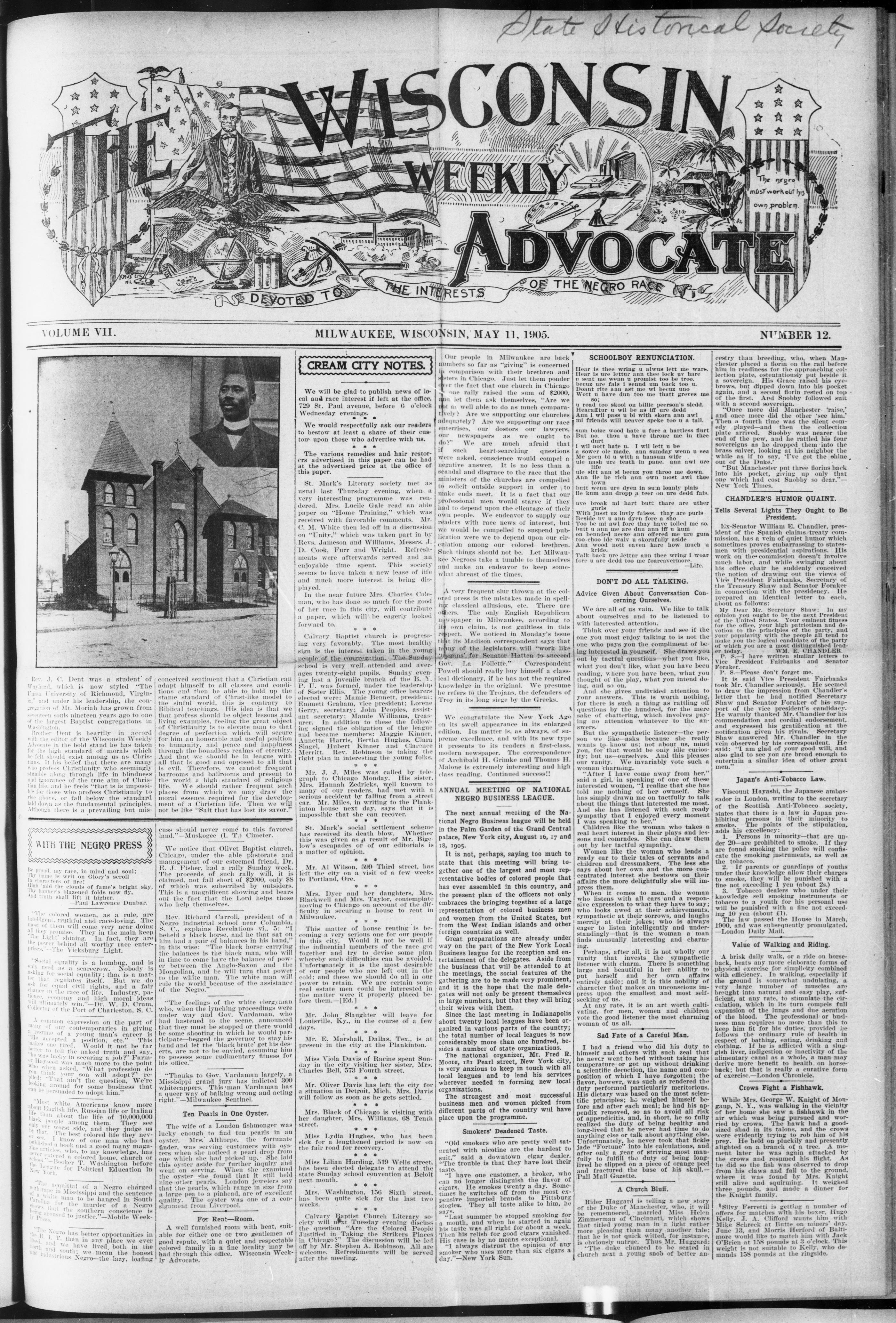
THE CHURCH OF THE LORD'S PRAYER
Rev. J. C. Dent was a student of Wayland, which is now styled "The Union University of Richmond, Virginia," and under his leadership, the congregation of Mt. Moriah has grown from seventeen souls nineteen years ago to one of the largest Baptist congregations in Washington.
Brother Dent is heartily in accord with the editor of the Wisconsin Weekly Advocate in the bold stand he has taken for the high standard of morals which he felt should exist among us as Christians. It his belief that there are many who profess Christianity who seemingly stumble along through life in blindness and ignorance of the true aim of Christian life, and he feels "that is is impossible for those who profess Christianity to rise above, or fall below the standard laid down as the fundamental principles. Although there is a prevailing but mis-
WITH THE NEGRO PRESS
Be proud, my race, in mind and soul;
Thy name is writ on Glory's scroll
In characters of fire!
High 'mid the clouds of fame's bright sky,
Thy banner's blazoned folds now fly,
And truth shall lift it higher
"The colored women, as a rule, are intelligent, truthful and race-loving. The most of them will come very near doing all they promise. They in the main keep 'The Light' shining. In fact, they are the power behind all worthy race enterprises."—The Vicksburg Light.
"Social equality is a humbug, and is only used as a scarecrow. Nobody is asking for social equality; that is a matter that regulates itself. But we do ask for equal civil rights, and a fair chance in the race of life. Industry, patience, economy and high moral ideas will ultimately win."—Dr. W. D. Crum, Collector of the Port of Charleston, S. C.
A common expression on the part of many of our contemporaries in giving a resume of a young man's career is "He accepted a position, etc." This makes one tired. Would it not be far better to tell the naked truth and say, "he was lucky in securing a job?" Farmer Hayseed was much more to the point who when asked, "What profession do you think your son will adopt?" replied: "That ain't the question. We're looking around for some business that can be persuaded to adopt him."
"Most white Americans know more about English life, Russian life or Italian life than about the life of 10,000,000 black people among them. They see only our worst side, and they judge us by that. The best colored life they never see. I know of one man who has published a book and a good many magazine articles, who, to my knowledge, has never entered a colored home, church or school."—Booker T. Washington before the League for Political Education in New York.
"The acquittal of a Negro charged with rape in Mississippi and the sentence of a white man to be hanged in South Carolina for the murder of a Negro shows that the southern conscience is being aroused to justice."—Mobile Weekly Press.
The Negro has better opportunities in the R. I. T. than in any place we ever lived, and we have lived, both in the north and south; we mean the honest and industrious Negro—the lazy, loafing
conceived sentiment that a Christian can adapt himself to all classes and conditions and then be able to hold up the stame standard of Christ-like model to the sinful world, this is contrary to Biblical teachings. His idea is that we that profess should be object lessons and living examples, feeling the great object of Christianity is to elevate man to that degree of perfection which will secure for him an honorable and useful position to humanity, and peace and happiness through the boundless realms of eternity. And that we should be in league with all that is good and opposed to all that is evil. Therefore, we cannot frequent barrooms and ballrooms and present to the world a high standard of religious life. We should rather frequent such places from which we may draw the moral essence required for the development of a Christian life. Then we will not be like "Salt that has lost its savor."
cuss should never come to this favored land."—Muskogee (I. T.) Cimeter.
We notice that Olivet Baptist church, Chicago, under the able pastorate and management of our esteemed friend, Dr. E. J. Fisher, had a rally Sunday week. The proceeds of such rally will, it is claimed, not fall short of $2000, only $8 of which was subscribed by outsiders. This is a magnificent showing and bears out the fact that the Lord helps those who help themselves.
Rev. Richard Carroll, president of a Negro industrial school near Columbia, S.C., explains Revelations vi., 5: "I beheld a black horse, and he that sat on him had a pair of balances in his hand," in this wise: "The black horse carrying the balances is the black man, who will in time to come have the balance of power between the Anglo-Saxon and the Mongolian, and he will turn that power to the white man. The white man will rule the world because of the assistance of the Negro."
"The feelings of the white clergyman who, when the lynching proceedings were under way and Gov. Vardaman, who had hastened to the scene, announced that they must be stopped or there would be some shooting in which he would participate—begged the governor to stay his hand and let the 'black brute' get his deserts, are not to be envied, assuming him to possess some rudimentary fitness for his office."
"Thanks to Gov. Vardaman largely, a Mississippi grand jury has indicted 300 whitecappers. This man Vardaman has a queer way of balking wrong and acting right."—Milwaukee Sentinel.
Ten Pearls in One Oyster
The wife of a London fishmonger was lucky enough to find ten pearls in an oyster. Mrs. Althorpe, the fortunate finder, was serving customers with oysters when she noticed a pearl drop from one which she had picked up. She laid this oyster aside for further inquiry and went on serving. When she examined the oyster she found that it still held nine other pearls. London jewelers say that the pearls, which range in size from a large pea to a pinhead, are of excellent quality. The oyster was one of a consignment from Liverpool.
For Rent—Room.
A well furnished room with heat, suitable for either one or two gentlemen of good repute, with a quiet and respectable colored family in a fine locality may be had through this office. Wisconsin Weekly Advocate
MILWAUKEE, WISCONSIN, MAY 11, 1905
CREAM CITY NOTES.
We will be glad to publish news of local and race interest if left at the office, 729 St. Paul avenue, before G o'clock Wednesday evenings.
We would respectfully ask our readers to bestow at least a share of their custom upon those who advertise with us.
The various remedies and hair restorers advertised in this paper can be had at the advertised price at the office of this paper.
St. Mark's Literary society met us usual last Thursday evening, when a very interesting programme was rendered. Mrs. Lucile Gale read an able paper on "Home Training," which was received with favorable comments. Mr. C. M. White then led off in a discussion on "Unity," which was taken part in by Revs. Jameson and Williams, Messrs. J. D. Cook, Furr and Wright. Refreshments were afterwards served and an enjoyable time spent. This society seems to have taken a new lease of life and much more interest is being displayed.
In the near future Mrs. Charles Coleman, who has done so much for the good of her race in this city, will contribute a paper, which will be eagerly looked forward to.
Calvary Baptist church is progressing very favorably. The most healthy sign is the interest taken in the young people of the congregation. The Sunday school is very well attended and averages twenty-eight pupils. Sunday evening last a juvenile branch of the B. Y. P. U. was formed, under the leadership of Sister Ellis. The young office bearers elected were: Mamie Bennett, president; Emmett Graham, vice president; Lorene Gerry, secretary; John Peoples, assistant secretary: Mamie Williams, treasurer. In addition to these the following signed the obligation of the league and became members: Maggie Kinner, Annetta Harris, Bertha Hughes, Clara Slagel, Hubert Kinner and Clarence Merritt. Rev. Robinson is taking the right plan in interesting the young folks.
* * *
Mr. J. J. Miles was called by telegraph to Chicago Monday. His sister, Mrs. Hannah Zedricks, well known to many of our readers, had met with a serious accident by falling from a street car. Mr. Miles, in writing to the Plankinton house next day, says that it is impossible that she can recover.
* * *
St. Mark's social settlement scheme has received its death blow. Whether this was given as a result of Mr. Bigelow's escapades or of our editorials is a matter of opinion.
* * *
Mr. Al Wilson, 599 Third street, has left the city on a visit of a few weeks to Portland, Ore.
* * *
Mrs. Dyer and her daughters, Mrs. Blackwell and Mrs. Taylor, contemplate moving to Chicago on account of the difficulty in securing a house to rent in Milwaukee.
* * *
This matter of house renting is becoming a very serious one for our people in this city. Would it not be well if the influential members of the race got together and try to devise some plan whereby such difficulties can be avoided. Unfortunately it is the most desirable of our people who are left out in the cold; and these we should do all in our power to retain. We are certain some real estate men could be interested in the matter were it properly placed before them.—[Ed.]
Mr. John Slaughter will leave for Louisville, Ky., in the course of a few days.
* * *
Mr. E. Marshall, Dallas, Tex., is at present in the city at the Plankinton.
* * *
Miss Viola Davis of Racine spent Sunday in the city visiting her sister, Mrs. Charles Bell, 573 Fourth street.
* * *
Mr. Oliver Davis has left the city for a situation in Detroit, Mich. Mrs. Davis will follow as soon as he gets settled.
* * *
Mrs. Black of Chicago is visiting with her daughter, Mrs. Williams, 68 Tenth street.
Miss Lydia Hughes, who has been sick for a lengthened period is now on the fair road for recovery.
* * *
Miss Lilian Harding, 519 Wells street, has been elected delegate to attend the state Sunday school convention at Beloit next month.
* * *
Mrs. Washington. 156 Sixth street, has been quite sick for the last two weeks.
Calvary Baptist Church Literary society will next Tuesday evening discuss the question "Are the Colored People Justified in Taking the Strikers Places in Chicago?" The discussion will be led off by Mr. Stephen A. Robinson. All are welcome. Refreshments will be served after the meeting.
Our people in Milwaukee are back numbers so far as "giving" is concerned in comparison with their brethren and sisters in Chicago. Just let them ponder over the fact that one church in Chicago is one rally raised the sum of $2000, and let them ask themselves, "Are we not as well able to do as much comparatively? Are we supporting our churches adequately? Are we supporting our race enterrises, our dostors our lawyers, our newspapers as we ought to do?" We are much afraid that if such heart-searching questions were asked, conscience would compel a negative answer. It is no less than a scandal and disgrace to the race that the ministers of the churches are compelled to solicit outside support in order to make ends meet. It is a fact that our professional men would starve if they had to depend upon the clientage of their own people. We endeavor to supply our readers with race news of interest, but we would be compelled to suspend publication were we to depend upon our circulation among our colored brethren. Such things should not be. Let Milwaukee Negroes take a tumble to themselves and make an endeavor to keep somewhat abreast of the times.
---
A very frequent slur thrown at the colored press is the mistakes made in spelling classical allusions, etc. There are others. The only English Republican newspaper in Milwaukee, according to its own claim, is not guiltless in this respect. We noticed in Monday's issue that its Madison correspondent says that many of the legislators will "work like 'tugans' for Senator Hatten to succeed Gov. La Follette." Correspondent Powell should really buy himself a classical dictionary, if he has not the required knowledge in the original. We presume he refers to the Trojans, the defenders of Troy in its long siege by the Greeks.
We congratulate the New York Age on its swell appearance in its enlarged edition. Its matter is, as always, of supreme excellence, and with its new type it presents to its readers a first-class, modern newspaper. The correspondence of Archibald H. Grimke and Thomas H. Malone is extremely interesting and high class reading. Continued success!!
ANNUAL MEETING OF NATIONAL NEGRO BUSINESS LEAGUE.
The next annual meeting of the National Negro Business league will be held in the Palm Garden of the Grand Central palace, New York city, August 16, 17 and 18, 1905. It is not, perhaps, saying too much to state that this meeting will bring together one of the largest and most representative bodies of colored people that has ever assembled in this country, and the present plan of the officers not only embraces the bringing together of a large representation of colored business men and women from the United States, but from the West Indian islands and other foreign countries as well.
Great preparations are already under way on the part of the New York Local Business league for the reception and entertainment of the delegates. Aside from the business that will be attended to at the meetings, the social features of the gathering are to be made very prominent, and it is the hope that the male delegates will not only be present themselves in large numbers, but that they will bring their wives with them. Since the last meeting in Indianapolis about twenty local leagues have been organized in various parts of the country; the total number of local leagues is now considerably more than one hundred, besides a number of state organizations.
The national organizer, Mr. Fred R. Moore, 181 Pearl street, New York city, is very anxious to keep in touch with all local leagues and to lend his services wherever needed in forming new local organizations. The strongest and most successful business men and women picked from different parts of the country will have place upon the programme.
Smokers' Deadened Taste.
"Old smokers who are pretty well saturated with nicotine are the hardest to suit," said a downtown cigar dealer. "The trouble is that they have lost their taste.
"I have one customer, a broker, who can no longer distinguish the flavor of cigars. He smokes twenty a day. Sometimes he switches off from the most expensive imported brands to Pittsburg stogies. They all taste alike to him, he says.
"Last summer he stopped smoking for a month, and when he started in again his taste was all right for about a week. Then his relish for good cigars vanished. His case is by no means exceptional. "I always distrust the opinion of any smoker who uses more than six cigars a day."—New York Sun.
SCHOOLBOY RENUNCIATION.
Hear is thee wring u alwus lett me ware.
Hear is ure lettur ann thee lock uy hare
u sent me wenn u promist too be troo.
becuz ure fals i send um back too u.
Doant rite ann ast me wi becuz uno
Wott u have dun too me thatt greves me
so;
u road too skool on billie peerson's sledd.
Hearaftur u wil be as if ire dedd
Ann i wil pass u bi with skorn anwl
mi friends will neaver spke too u a tall.
sum bolze wood hate u fore a hartless flurt
But no. thon u have throne me in thee
durt
Me goeh bi u with a hansum wire
ule nash ure teath in pane. ann awl ure
life
ule sitt ann si becuz you throo me down.
Ann ile be rich ann own most awl thee
town
butt wenn ure dyen in sum loanly plais
ile kum ann dropp a teer on ure dedd fais.
uve broak mi hart butt thare are uther
gurls
With jusst uz luvly faises, thay are purls
Beside uv u ann dyen fore a sho
Too be mi awl fore thay have tolled me so.
butt u ann me are dun ann iff u kum
on bennded neeze ann offered me ure gum
too choo ide waiv u skornfully aside
Ann wood nott eaven kare how much u
kride.
Talk back ure Jettur ann thee wring i woar
fore u are dedd too me fooreavermore.
DON'T DO ALL TALKING.
Advice Given About Conversation Concerning Ourselves.
We are all of us vain. We like to talk about ourselves and to be listened to with interested attention.
Think over your friends and see if the one you most enjoy talking to is not the one who pays you the compliment of being interested in yourself. She draws you out by tactful questions—what you like, what you don't like, what you have been reading, where you have been, what you thought of the play, what you intend doing, and so on.
And she gives undivided attention to your answers. This is worth nothing, for there is such a thing as rattling off questions by the hundred, for the mere sake of chattering, which involves paying no attention whatever to the answers.
But the sympathetic listener—the person we like—asks because she really wants to know us; not about us, mind you, for that would be only idle curiosity; but us—ourselves. And this pleases our vanity. We invariably vote such a woman charming.
"After I have come away from her," said a girl, in speaking of one of these interested women, "I realize that she has told me nothing of her ownself. She has simply drawn me on tactfully to talk about the things that interested me most. And she has listened with such ready sympathy that I enjoyed every moment I was speaking to her."
Children like the woman who takes a real heart interest in their plays and lessons and comrades. She can draw them out by her tactful sympathy.
Women like the woman who lends a ready ear to their tales of servants and children and dressmakers. The less she says about her own and the more concentrated interest she bestows on their affairs the more delightfully she will impress them.
When it comes to men, the woman who listens with all ears and a responsive expression to what they have to say; who looks awed at their achievements, sympathetic at their sorrows, and laughs merrily at their jokes; who is always eager to listen intelligently and understandingly—that is the woman a man finds unusually interesting and charming.
Perhaps, after all, it is not wholly our vanity that invests the sympathetic listener with charm. There is something large and beautiful in her ability to put herself and her own affairs entirely aside; and it is this nobility of character that makes an unconscious impress upon the smallest and most self-seeking of us. At any rate, it is an art worth cultivating, for men, women and children vote the good listener the most charming woman of us all.
Sad Fate of a Careful Man.
I had a friend who did his duty to himself and others with such zeal that he never went to bed without taking his temperature or got up without drinking a scientific decoction, the name and composition of which I have forgotten; the flavor, howevr, was such as rendered the duty performed particularly meritorious. His dietary was based on the most scientific principles; he weighed himself before and after each meal; he had his appendix removed, so as to avoid all risk of appendicitis, and, in short, he so fully realized the duty of being healthy and long-lived that he never had time to do anything else or talk about anything else. Unfortunately, he never took that fickle jade "Fortune" into his calculations, and after only a year of striving most manfully to fulfill the duty of being long-lived he slipped on a piece of orange peel and fractured the base of his skull.—Pall Mall Gazette.
A Church Bluff
Rider Haggard is telling a new story of the Duke of Manchester, who, it will be remembered, married Miss Helen Zimmerman of Cincinnati, which shows that titled young man in a light rather more pleasing than many another tale; that he is not quick witted, for instance, is obviously untrue. Thus Mr. Haggard: "The duke chanced to be seated in church next a young snob of better an-
cestry than breeding, who, when Manchester placed a florin on the rail before him in readiness for the approaching collection plate, ostentationally put beside it a sovereign. His Grace raised his eyebrows, but dipped down into his pocket again, and a second florin rested on top of the first. And Snobby followed suit with a second sovereign.
"Once more did Manchester 'raise,' and once more did the other 'see him.' Then a fourth time was the silent comedy played—and then the collection plate arrived. Snobby was nearer the end of the pew, and he rattled his four sovereigns as he dropped them into the brass salver, looking at his neighbor the while as if to say, 'I've got the shine out of the Duke.'
"But Manchester put three florins back into his pocket, giving up only that one which had cost Snobby so dear."— New York Times.
CHANDLER'S HUMOR OUAINT.
Tells Several Lights They Ought to Be President
Ex-Senator William E. Chandler, president of the Spanish claims treaty commission, has a vein of quiet humor which sometimes proves embarrassing to statesmen with presidential aspirations. His work on the commission doesn't involve much labor, and while swinging about his office chair he suddenly conceived the notion of drawing out the views of Vice President Fairbanks, Secretary of the Treasury Shaw and Senator Foraker in connection with the presidency. He prepared an identical letter to each, about as follows:
My Dear Mr. Secretary Shaw: In my opinion you ought to be the next President of the United States. Your eminent fitness for the office, your high patriotism and devotion to the principles of the party, and your popularity with the people all tend to make you the logical candidate of the party of which you are a most distinguished leader today. WM. E. CHANDLER. P. S.-I have written similar letters to Vice President Fairbanks and Senator Foraker.
P. S.—Please don't forget me.
It is said Vice President Fairbanks took Mr. Chandler seriously. He seemed to draw the impression from Chandler's letter that he had notified Secretary Shaw and Senator Foraker of his support of the vice president's candidacy. He warmly thanked Mr. Chandler for his commendation and cordial endorsement, and expressed his gratification at the notification given his rivals. Secretary Shaw answered Mr. Chandler in the vein observed by his correspondent. He said: "I am glad of your good will, and also glad to see you are broad enough to entertain a similar idea of other great men."
Japan's Anti-Tobacco Law
Viscount Hayashi, the Japanese ambassador in London, writing to the secretary of the Scottish Anti-Tobacco society, states that there is a law in Japan prohibiting persons in their minority to smoke. The points of the stipulation, adds his excellency:
1. Persons in minority—that are under 20—are prohibited to smoke. If they are found smoking the police will confiscate the smoking instruments, as well as the tobacco.
2. If parents or guardians of youths under their knowledge allow their charges to smoke, they will be punished with a fine not exceeding 1 yen (about 2s.)
3. Tobacco dealers who under their knowledge sell smoking instruments or tobacco to a youth for his personal use will be punished with a fine not exceeding 10 yen (about 1
The law passed the House in March, 1900, and was subsequently promulgated. London Daily Mail.
Value of Walking and Riding.
A brisk daily walk, or a ride on horseback, beats any more elaborate forms of physical exercise for simplicity combined with efficiency. In walking, especially if the ground is somewhat undulating, a very large number of muscles are brought into natural and easy play, sufficient, at any rate, to stimulate the circulation, which in its turn compels full expansion of the lungs and due aeration of the blood. The professional or business man requires no more than this to keep him fit for his duties; provided he follows the ordinary rule of health in respect of bathing, eating, drinking and clothing. If he is afflicted with a sluggish liver, indigestion or inactivity of the alimentary canal as a whole, a man may derive more benefit to health on horseback; but that is really a curative form of exercise.—London Chronicle.
Crows Fight a Fishhawk.
While Mrs. George W. Knight of Mongaup, N. Y., was walking in the vicinity of her home she saw a fishhawk in the air which was being pursued and worried by crows. The hawk had a good-sized shad in its talons, and the crows were evidently trying to rob him of his prey. He held on pluckily and presently alighted on a branch of a tree. A moment later he was again attacked by the crows and resumed his flight. As he did so the fish was observed to drop from his claws and fall to the ground, where it was found by Mrs. Knight still alive and squirming. It weighed three pounds, and made a dinner for the Knight family.
Silvy Ferretti is getting a number of offers for matches with his boxer, Hugo Kelly, J. A. Clifford wants him with Mike Schreck at Butte on miners' day, June 13, and Morris Herford of Baltimore would like to match him with Jack O'Brien at 158 pounds at 3 o'clock. This weight is not suitable to Kelly, who demands 158 pounds at the ringside.
KNEW IT LIKE A BOOK
Big Dinners Had Long Since Ceased to Be a Novelty with Him.
"Why am I down in the mouth this morning?" he repeated in reply to a question. "Oh, I'm not as bad as that, but there's a hard night before me, and I'm dreading it. I'm booked for a big dinner, if you know what that means; I do. I've been to them until I can't rest when I think of them.
"Don't suppose for a minute I'm going because I want to; I'm going because it would make trouble if I cut it. I can go through one of those banquets with one hand in my sleep. They're all alike; all on the same, monotonous level."
"To begin with, the five sad-eyed, uncommunicative, reproachful oysters, with a flick of lemon in the middle, and the waiter who says: 'Horse radish, sir?' A plate of cool soup, with two peas, a slice of carrot and three morsels of toast floating in it. The man opposite, who doesn't get out oftener than once in six months, says: 'Here's to you,' and dips into the sauterne. He's in a hurry to become exhilarated.
"Fish, with a little dab of sauce on the side, comes next, and treading on its tail is that omnipresent, everlasting fillet of beef, covered with a brown gravy and a quarter of a canned mushroom placed ostentationally on top of the meat and flanked by cold mashed potato and legumes, also canned—always the legumes.
"Intermission and Roman punch, so called because it's neither Roman nor punch. Generally it's suggestive of bay rum. Game flutters in after that—Philadelphia squab, that have been living in Olneyville during their declining years—and so on to the tablespoonful of black coffee. 'Cigars are lighted,' or 'the fragrant smoke' of Connecticut Havanas begins to ascend to the ceiling. (See the morning papers.) There's a clatter and a rattle of chairs, and everybody clears his throat, and then—then the interminable and dreary speaking."—Providence Journal.
Told by Henry H. Rogers.
Henry H. Rogers, Standard Oil magnate, copper king, and one of the foremost men in the financial world, is a newly discovered humorist, and Mark Twain, Chauncey M. Depew, Simeon Ford and others must needs look to their laurels.
Mr. Rogers has a fund of so-called funny stories on hand, mostly those that smack of the sea, but all brand new, and all his own. Here's a sample:
"Nat Osborne," said Mr. Rogers, "used to blow the organ in the brick church. He had quite an idea of his own importance, and was always proud of his job.
"I asked him once: 'How much salary do you get, Mr. Osborne, for your work?'
"Nat looked up, solemnly, and said with dignity: 'Twelve hundred dollars.' "'What,' said I, '$1200?' "'Yes,' said Nat.
"That's big pay," said I.
" 'Pretty fair,' said Nat, 'but that's for 100 years.'"—Boston Post.
Lackawanna Summer Resorts Described.
"Mountain and Lake Resorts" is the title of an attractive publication issued by the passenger department of the Lackawanna railroad. The book is intended to give readable and reliable information about vacation places along that road, and its 128 pages are filled with suggestions for those seeking summer homes. The various hotels and boarding places, their location, rates and facilities are accurately described. More than 100 half tones add to the interest of the book, and a brightly written love story entitled "A Paper Proposal" completes its contents. The book may be had by sending the necessary postage of 10 cents to T. W. Lee, general passenger agent, Lackawanna railroad, New York city.
An Ancient Anchor.
A huge anchor of extremely antiquated pattern, probably dating back to the time of the Armada, which had been hauled up from the North sea, was recently brought into Yarmouth by the mission ship Cholmondeley. Covered all over from stock to head with barnacles and live oysters, it presented a singularly fossilized appearance. It was fourteen feet long, with flukes three feet square; the shank was thirteen feet long, and an immense wood stock that had formerly been fixed to it had completely disappeared. The weight was over two tons, and its "salvage" will be of the utmost benefit to the fishermen, as it caused enormous destruction to their trawling gear.—London Engineer.
Taliest Young Soldier.
The tallest soldier that ever put in an appearance in Denver arrived Saturday in the person of Arthur W. Jaffray. Young Jaffray is just a fraction over 6 feet 10 inches tall. He is new in the army service, having become a recruit ten days ago, and is now bound for San Francisco, from which city he will go to the Philippines. Jaffray is barely past 22 and looks much younger. He weighs 190 pounds and is awkward and ungainly as if he had had much trouble in keeping up with his growth. Before visions of being a "boy in blue" took possession of him the young man was an apprentice in a bakery.—Denver Republican.
Worth of Aigrette Plumes.
The splendid snow white heron, known as the American egret, one of the few kinds which bear the aigrette plumes of millinery and commerce, is among the waning species of America—a victim to inexorable fashion.
In 1903 the price for plumes offered to hunters was $32 per ounce, which makes the plumes worth twice their weight in gold. There will always be men who would break any law for such profit. No rookery of these herons can long exist unless it be guarded by force of arms day and night.—Country Life in America.
British Foxes Made Abroad
The purchase of foreign fox cubs from importers of wild animals is attended with serious dangers. Wolves, jackals and such like creatures are easily mistaken, in the cub stages, for foxes, and now and then have been sold in England as veritable children of Br'er Fox. This is the true explanation of those sensational outbreaks of sheep worrying during the past few years.—London Daily Mail.
Uncle Sam Wants That Cent
J. W. Gilstrap and W. J. Clutch of Woodstock have been notified by the government of the United States that exPostmaster Haffenden of Woodstock is short in his accounts to the amount of one cent, and that either Mr. Haffenden or his bondsmen will have to make up the amount and send it to the postal department at Washington at once. Portland, Oregonian.
Uncover Counterfeit Money
Two boys chasing a rabbit near Williamsport, Pa., tore up several boards from the floor of a shanty under which the animal had taken refuge. They uncovered a pile of 152 silver dollars, all counterfeit. Government officers have arrested Frank J. Davidson on a charge of counterfeiting as a result of this unique means of detection.
THE FISHER OF NIPPON.
Where now the brownie fisher-lad?
His hundred thousand fishing-boats
Rock idly in the reedy moats;
His baby wife no more is glad.
But yesterday, with all Nippon.
Beneath his pink-white cherry-trees,
In chorus with his brown, sweet bees,
He careless sang, and sang right on.
Take care! for he has ceased to sing;
His startled bees have taken wing!
His cherry-blossoms drop like blood;
His bees begin to storm and sting;
His seas flash lightning, and a flood
Of crimson stains their wide, white ring;
His battleships belch hell, and all
Nippon is but one Spartan wall!
Aye, he, the boy of yesterday,
Now holds the bearded Russ at bay;
While, blossom'd steeps above, the clouds
Wait idly, still, as waiting shrouds.
—Two stanzas of a six-stanza poem by
Joaquin Miller in the Century.
COALS OF FIRE.
"It is simply monstrous!" said Betty, and she drummed nervously on the table with the ends of her pink fingers. I was so occupied with watching her hands—the soft smoothness of them, the merest suggestion of dimples at the knuckles, the delicate tint of the nails—that I did not for the moment answer. My look shifted to her face, the red flush of her cheeks and the disturbing little crinkles in her forehead. "Monstrous!" repeated Betty sharply, her blue eyes darkening.
"What's this?" I asked.
"The Chilton girl!" said Betty. "You haven't met her. They lived here only a short while."
"You say she has duplicated your frock?"
"This is how it is," said Betty, using a locution which she employs in moments of excitement. "I got the most stunning dress pattern when I was east last winter. It was a voile the color of wild June roses. There was nothing like it here."
"Vanity, vanity!" said I.
"And I was goose enough to show it to the Chilton girl and tell her how I was going to have it made."
"Pride going before a fall," said I.
"It was just that," said Betty. "You know, I was going to wear the gown tomorrow night at the assembly ball."
"You are going with me," said I, comfortably.
"But last night the Chilton girl appeared at the Hawes reception with a frock the exact pattern of mine. She must have sent to New York for it. It was deliberate. She got ahead of me."
"In the slang of the newspaper,
"In the slang of the newspaper, ' scooped' you," said I.
"Did you ever?" said Betty.
"Did you ever?" said Betty.
"So there'll be two of you with frocks alike," I mused.
"George!" ejaculated Betty, "are you quite crazy? Do you suppose I can ever wear the thing now, and have people say I copied her?"
"Most people wouldn't throw away a new frock."
"I'm not 'most people,'" said Betty.
"Gott sei Dank!" said I.
"I can never wear it," sighed Betty.
"What will you do with it?"
"Give it away."
"Extravagance," said I. "I'll send it to my Cousin Melissa, who lives in California, and who hasn't any clothes," said Betty. "That's uncharitable," said I. "She'll look as though somebody had given it to her, and her good-natured women friends will probably say as much." "Then I'll send it to Cousin Addie, and explain the whole matter. She has lots of good clothes and it'll be in place." "That's more friendly," said I. "And I did look so well in it," said Betty. "It's monstrous." "You said that before," I suggested. "What punishment couldn't I visit on her," said Betty. "I—I could see her drowned in boiling oil—"
"Too Gilbertian," said I. "Do be orig inal."
"It isn't a light matter."
"Cut her dead," I said, ferociously.
"Crude and commonplace," said Betty.
"I might wear something that would kill her frock."
"The revenge is something too peripatetic. You'd have to chase her about all the evening to get the effect."
Betty laughed. "After all," she said,
"I know it's absurd. I oughtn't to lose my temper—but it's annoying."
"She little knows what she has laid up for herself."
"What do you mean?"
"It's a serious matter to cross Betty Mallard," said I, solemnly.
"George," said she, "don't be silly. "You know I'm a perfect lamb." "I remember their chief characteristic." "What are you talking about?" she said, still drumming with her fingers on the table. "Lambs frisk," said I. Betty ceased drumming, and picked up a paper knife. "They frisk," said I. "but their chief characteristic is stupidity."
Betty's features assumed a scornful calm.
"Therefore," I added, "you are not a lamb."
Betty frowned.
"Though of course," said I, "in gentleness and innocence"——
"Do hush!" said Betty, fighting back a smile.
"Tea is soothing," said I; "after you've had a cup you'll feel better."
Over her teacup, with the fumes of the Oolong gladdening her nostrils, Betty's eyes softened. "Anyway, I shan't let it spoil tomorrow."
"Of course not. I can't have you cross."
"Come early." said Betty, "and we'll have an hour by the fire before we go."
"To plan your revenge?" I asked.
"Of course not. I shall try to forget it."
"That would be original," said I.
Up in the big ballroom at the top of the clubhouse there was the sight and sound of tempered revelry—pretty women with flushed faces; men with collars that had a suggestion of wilt; movement and color and laughter; the heavy scent of roses; the delicate odor of violets; and through it all the voices of stringed instruments singing behind the palms. Betty and I came out on the floor. We had been below stairs seeking refreshment. The supper was not yet served, but I'm one of the house committee, and I've a key to those regions below. Betty, of course, is not permitted to thirst. We stood in the doorway a moment; there was a big-leafed plant half concealing us. Betty was just in front of me. When
we stand that way I can look down at the curve of her throat. After all, I think she could not have looked better in the voile thing. Betty has that quality that whatever she wears makes you wish she'd wear just that particular frock forever. Of course, one can't help being in love with a woman who looks that way. And the pink of her cheeks and the blue of her eyes and the brown of her hair—As I say, we stood there behind the green thing.
The music slid into a waltz. In a corner opposite us sat a young woman quite alone.
"That's your Chilton girl!" said I, nudging Betty.
"Alone! How thoughtless men are." I said nothing. "She has danced very little," mused Betty. "Probably the qualities which led her to buy frocks that shouldn't belong to her are not such as attract partners." "After all, I think I'd rather wear an old frock and have dances." "What good is new plumage unless it attracts the male bird!" I philosophized. For once Betty let my weakness go unrebuked. She was looking across at the Chilton girl. "You've never been introduced to her?" she said, finally. "No," said I. "Come along," said Betty, "then you can ask her to dance."
"I feel sorry for her." explained Betty. But I've got this dance with you."
"You've already had three," said Betty, and I can get Billie Lyle to dance with me."
"I won't," said I. "George," said Betty, "if only you wouldn't stop to argue about things. In the end you always give in—why not do it gracefully in the beginning?" I smiled down at her. "You look uncommonly well when you argue," said I, and looked very steadily into her eyes.
Betty turned, and started across the room. I inevitably I followed.
I was introduced to the Chilton girl, and we danced together. She is not without eyes.
"You are a great friend of Miss Mallard's?" she asked.
"I've known her since she wore pinafores," said I.
"I suppose she asked you to dance with me."
"What could have put that into your head?"
"Something in the way she brought you over."
The thing was on the end of my tongue, but I resisted. "Of course, you know I asked her to introduce me."
The Chilton girl smiled, and then we talked of something else.
I told Betty about it on the way home.
"George," she said, "you are a genius."
"If you'll permit a vulgarity, 'there are others,'" said I, "and it was original to a wish."
"What?" said Betty.
"Coals of fire," said I.
"Coals of fire?" she repeated, with a little cluck of amusement.
"Yes."
"But not original!"
"Decidedly."
"Advice to the Romans!" said Betty.
"Why, that's nearly two thousand years old."
"Quite original," I averred.
"Coals of fire?" persisted Betty.
"From a woman," said I.
And Betty gurgled.—Frederick Smith, in Woman's Home Companion.
INTERCHANGEABLE RAZOR BLADE.
Permits the Use of the Entire Cutting Edge.
The number of devices which have been recently introduced for the convenience of the man who wants to shave himself is almost without end, and it would seem many things of this character must certainly put some of the barber establishments out of business, but the latter seem to go on increasing just the same. It often happens that a man is perfectly able to shave himself in a very satisfactory manner, but his difficulty may be in keeping the razor in proper condition, and if he is compelled
SHOWING BLADE PARTLY OUT.
INTERCHANGEABLE RAZOR BLADE. to run to the barber's or cutler's shop with the instrument every few weeks there is no advantage in the possession of the skill necessary to amputate the whiskers from his face. The interchangeable razor blade has been devised to meet this emergency. In appearance it looks like pretty much any other razor, but the blade end of the combination consists of two parts, the blade itself and the German silver holder. When it is desirable to substitute one blade for another, the operation is very readily conducted. A spring catch releases the cutter and it is then pushed from its lodging place.
Besides the advantage of always having a suitable blade in readiness and in good condition, this arrangement presents the addition of permitting the owner to strop his razor by a mechanical device which is used with the safety razors but which has not heretofore been adapted for use with the old type of instrument. It also permits the reversal of the blade so that every portion of the cutting edge may come in for its share of service.
How to Roll an Umbrella
How many men know how to roll an umbrella so that it will look as neat and compact as when it leaves the store? Not many of those you meet have the secret.
Nearly every one who rolls an umbrella takes hold of it by the handle and keeps twisting the stick with one hand and folds and rolls with the other hand. The proper way is to take hold of the umbrella just above the points of the cover ribs; these points naturally are even around the stick.
Keep hold of these, pressing them closely against the stick, and then roll up the cover. Holding the ribs prevents them from getting either twisted out of place or bent out of shape. Then the silk will fold evenly and roll smooth and as close as the first time unfolded.—Clothier and Furnisher.
IN SPORT, AND LOVE, AND DEATH.
When the herd in the sun swings round to run,
And the hour and the end's at hand,
The Law of the Wild ordains but one—
Remember, and understand!
When Life and a Third at a reckless word
Would dare what is doubly banned.
The Law of the Home is the Law of the Herd—
Remember, and understand!
When the oll ebbs low and the road we go
Holds never a light nor hand.
But one, is the Law, but one and alone,—
Remember, and understand!
Arthur Stringer in Reader Magazine.
New York Every Day.
Samuel Winfield Miller, the young farmer who voluntarily went to New York city to prove that he is not the Miller wanted in connection with the $10,000 bond stolen from the Manhattan bank, was discharged by United States Commissioner Shields.
A handsome woman, about 28 years old, who is supposed to be Mrs. J. W. Gray of New Orleans, attempted to commit suicide in a room at the Hotel Imperial by shooting. She was found in an unconscious and extremely serious condition, and was removed to a hospital, where she died without recovering consciousness.
Mrs. Leslie Carter, the actress, is confined to her apartments, reported to be suffering from a severely sprained ankle. The Belasco theater, where she has been playing, has been closed. Mrs. Carter was stepping from her carriage when the horses started and she fell to the sidewalk. She probably will not be able to appear again for some time. Three tendons of the left ankle are said to be badly wrenched.
Plans for the second Vanderbilt automobile cup race have begun to assume shape. At a meeting of the committee having the cup in charge it has been decided to hold the contest on either October 7 or 14. All the members favored using Long Island roads again this year and it is possible that the control stations will be abolished, thus allowing the racers a straight run from start to finish. Four American cars already have been named to go.
Justice Bischoff, in the supreme court confirmed a report filed by Hamilton Odell as referee, in which he decides that the Metropolitan Street railway is exempt from taxation for the year 1897. The proceeding was brought by the Metropolitan company against the city tax department to review the assessment for taxation of the sum of $10,134,950 upon its capital stock. The referee found that the taxable assets of the company were exceeded by deductible liabilities to the extent of more than $16,000,000.
"Free bathing at Coney Island" has again become the slogan of the afternoon papers. The stories and editorials printed make good reading for sane and fair-minded persons. The World remarks: There is not a place on Coney Island where a poor man or woman can sit down, no place where the poor can enjoy a free bath or even a free view of the ocean, which theoretically belongs to everybody and actually is in the clutches of certain vested interests that dole it out to the public who can afford to pay for it."
Bill Devery uttered one of his important speeches recently. He said auto speeders should not be fined, but sent to jail. "Fines!" scornfully remarks Mr. Devery. "Why, sport, the people that have got money enough to own autos don't care any more for a fine than they do for a spot of gasoline on their pants. This thing of finin' men that have fun makin' people do kangaroo jumps on street crossings is a comedy. For them, sport, jail. If these swift boys that hire French babies to run their autos was to stack up against that chuck on the island for a few days they'd put drags on their machines in the city streets."
The Third Army Corps union, at a business meeting in New York, elected the following officers: President, Sergt.- Maj. W. H. Clondman; vice president, Christopher W. Wilson; treasurer, Maj. W. P. Shreve; secretary, Capt. W. H. Howard; chaplain, Rev. William R. Eastman; directors, Rev. James Boyle, Gen. H. E. Tremain, Col. B. T. Morgan, Maj. James H. Everett, Maj. William Plimley, Lieut. Richard Cooper, Capt. Benjamin Murphy, Sergt. E. M. Tomkins and Dr. Armand Defloo. Gen. Daniel E. Sickels was instructed to cooperate with Gen. De Puyster in the publication of a history of the corps.
On account of a strike of 70 small boys, nearly 600 employees of the Standard Oil company in Long Island City are out of employment and it has been found necessary to shut down the Devoe Oil works temporarily. The plant is an important one and the boys were engaged in handling small cans with which steamers for the far east were being loaded. They quit work three days ago because two had been discharged, and at once established picket lines. Finally it became necessary to suspend operations in the plant and now the youngsters say they will not return until their pay is advanced from $1 to $1.25 a day.
The engagement is announced at Peoria, Ill., of Miss Iola Powell of that city to Robert H. Maizner of New York, whose wealth is estimated at $8,000,000. The young man is to take the young woman and her mother to Europe and the wedding is to be in Paris in June. Two years ago Miss Powell, daughter of Mr. and Mrs. J. G. Powell, residents of Peoria, left for New York city to study music. It was with great effort that her parents were enabled to supply the necessary money to send their daughter away to complete her musical education. Miss Powell secured a position in a prominent church in New York city as a soloist. Robert H. Mainzer of Peoria was an attendant there and became interested in the charming singer. They met and their friendship became love. Miss Powell has been warmly received by the New York family. The groom is the junior member of the firm of Holgotten & Maizner, bankers, and inherited $8,000,000 at the death of his father. His grandmother is said to be worth $40,000,000.
A claim against the United States for about $380,000 in favor of William K. Vanderbilt and others, as executors of the estate of the late Cornelius Vanderbilt, was approved by the acting commissioner of internal revenue in Washington. The action of the commissioner is in accordance with a decision of the United States supreme court, holding that where the right of property did not vest in the beneficiary before July 1, 1902, the property was not taxable as an inheritance. Cornelius Vanderbilt died September 12, 1899, leaving a personal estate valued at $19,000,000. The will provided that certain interests should be held in trust for the benefit of his son, Alfred G. Vanderbilt, who was to receive half the estate when he became 30 years old, and the remainder when he reached 35 years. This right of Alfred G. Vanderbilt was appraised at $5,119,-612.
The commissioner of internal revenue
ruled that the entire interest should be assessed as a vested estate. The executors contended that the estate was not vested in Alfred G. Vanderbilt until a certain time, and therefore could not be taxed. The executors paid $311,681 under protest, and then took the case into the United States courts.
FORTUNE FROM SHEEP.
Chance Showed Colorado Man the Way to Wealth.
Senator William A. Drake of Fort Collins has a record of which any man might be proud. During the past three months he has added another small fortune to his already large bank account, and has cleared $100,000 handling sheep. Drake's financial career may thus be summed up:
1890: Fed 2000 sheep; sold 10,000 sheep; owned a log hut; in debt $1000.
Lamb feeding and farming occupy the time and attention of Drake when he is not in the Legislature dictating the stock and agricultural legislation. "When to buy and when to sell is the secret of the whole thing," says Drake. "If we could learn that by reading a book everybody would be a farmer and sheep raiser, but those are things learned only by experience.
Lamb feeding as a business was first begun in this state by Drake. Fifteen years ago a trainload of sheep on the way from New Mexico to Nebraska to be fed was snowbound on the divide. The sheep were starving when they were driven to Drake's little plot of ground near Fort Collins and fed. That gave Drake ideas, and the next year he made a business of feeding sheep. The first lot he fed by accident numbered 2000. The second numbered 7000. The people of the state heard of it and awoke to the possibility of feeding sheep at home instead of shipping them to Nebraska and other states. The result is that today there are 1,000,000 sheep fed annually for market in the state. A little less than half that number, 450,000, are fed in Larimer county, where the work of feeding them in this state first began.
"We get about $2 a head a season for feeding them," said Drake. "Some years we don't make anything, some years 75 cents a head."
Twenty years ago Drake came to Colorado and lived in a one-room log hut near Fort Collins. For years he struggled along, trying to secure land and getting deeper in debt. Suddenly the light dawned when the snowboard sheep led him down a pathway that had been hidden to him.—Denver (Colo.) Fost.
Enthusiastic Bird Architect.
The process of the building of a bird's nest is always interesting, and the most wonderful of all nests, those of the weaver birds, can always be seen in the making by anyone who will buy a few males of the African red billed weaver, which cost about half a crown each. This is a little bird much like a small hen sparrow with a bright red bill, and decked in the breeding season with a pink cap and breast and a black mask. He is an enthusiastic architect, and in France is always sold as travaillleur—the worker.
Even in the cage he will weave any fibrous material in and out of the wires till they are covered, and in an aviary he will construct beautiful round nests with the greatest enthusiasm, pausing occasionally to swear at fellow craftsmen who presume to criticise his efforts or cast a larcenous eye on his materials. London Express.
Silkworm Culture in Ceylon.
From recent experiments conclusive proof has been obtained that silk of excellent quality can be raised in Ceylon, and samples of cocoons raised at Peradeniya from European seed have been classed by a European expert as second only to the best Italian silk. Hitherto all experiments have been on a small scale, limited partly by the comparative scarcity of mulberry trees. The time seems now to have arrived when more extensive operations might be undertaken with advantage, and it is proposed to create an experimental silkworm rearing establishment. A scheme is under consideration by the Ceylon board of agriculture.
Extraordinary Hand at Whist
A wonderful hand at whist was played at the St. Paul institute, Grimsby, recently.
The cards were shuffled and dealt in the usual way, but when the players looked at their hands they found that one of them (the dealer) had twelve spades, another eleven hearts, the third man twelve diamonds and the fourth eleven clubs.
Spades were trumps, and the lucky dealer simply threw in his hand and claimed the twelve tricks.—London Mail.
Deepest Haul Ever Made.
The deepest haul of a net ever made in the world was achieved by Americans off the Tonga islands in the South Pacific. The trawl struck bottom 23,000 feet below the surface; that is considerably more than four miles down, but even at that depth animal life was found. Those strange beings lived in water whose temperature was constantly just above the freezing point; and under a pressure of 9000 pounds to the square inch. To sink that net and bring it back again took a whole day of steady labor.—St. Nicholas.
- Kansas Senator an £gg King
J. E. Brewer, state senator from Dickinson county and the "egg king" of Kansas, passed through here today on the way to Kansas City, where he will attend a convention of egg dealers. Senator Brewer shipped 100 carloads of eggs last year. As there are 12,000 dozens of eggs in every car, he bought and marketed a total of 14,400,000 eggs.—Topeka Cor. Kansas City Times.
Australian Gold Yield.
Nature, of London, reports having received from the minister of mines, Victoria, a diagram, compiled and drawn by the director of the geological survey, E. J. Dunn, which shows the yield of gold and other statistics from 1851 to 1903. The gross value of the gold is stated to be £266,945,344. The greatest yield was in 1856.
What It Cost to Discover America
Columbus' whole fleet then was worth only $3000, and the admiral's salary was $300 per annum. The two captains were paid $200 a piece and the wages of the crew were $2.50 a month. It must be remembered, of course, that money in those days was worth a great deal more than it is now.—T. P.'s Weekly.
A Rational Food.
Two prizes, one of 5000 francs and the other 3000 francs, have been offered by Dr. Henride Rothschild to the Scientific Society of Alimentary Hygiene, Paris, for the best treatises written in French on the rational food for man. The prizes will be awarded in 1906 and the papers must be sent in by December 31, 1905.
Shade Trees for Denver
More than 200,000 shade and other ornamental trees have been shipped into Denver since the first of the year for local use. This exceeds the shipments for any like period within the last ten years.
THE LONGEST BRIDGE
A Steel Structure Over the St. Lawrence at Ouebec.
A steel bridge now under construction over the St. Lawrence river at Quebec is described by the United States Consul general at Halifax. The weight of this bridge will be about 35,000 tons. Its span of 1800 feet crosses the entire St. Lawrence river at such a height as not to interfere with navigation, and will be the longest in the world, the Forth bridge in Scotland being 1710 feet long, the Brooklyn bridge 1580 feet, and the new East River bridge in New York 1600 feet. There have been manufactured by the Phoenix Bridge company at Phoenixville, Penn., to date, and partly shipped to the site of the bridge, about 10,000 tons of steel. It will take about two more years to complete the structure.
The masonry piers are entirely finished, and the temporary false works, of steel, are now in place on the south shore, upon which erection will begin at the opening of spring this year. The 1800 feet of steel bridge work between the piers will be erected without any false work in the river. The bridge is to be eighty feet wide over all, carrying a double track railroad, a double track trolley and highway, and two sidewalks. Many novel features have been adopted in the design and manufacture of this bridge. The total length of the bridge will be 3300 feet; length of channel span, 1800 feet; ship clear headway, 150 feet above highest tide; height of cantalever towers, 360 feet above the river. The Phoenix Bridge company are the contractors for the superstructure.
A Tale of Suffering
Oakley, Mich., May 8.—(Special.)—"I could not sleep or rest in any place," says Florence Capen of this place in a recent interview, "I had a pain in my back and hips. If I sat down I could not get up out of my chair. I was in pain all the time. I got poor for I did not eat enough to keep a small child. I could not rest nights.
"Then I sent for a box of Dodd's Kidney Pills and went to taking them and what do you think that very night I went to bed and I slept till morning. I got up and thanked God for the night's rest and Dodd's Kidney Pills. I know that Dodd's Kidney Pills are all that is claimed for them."
This is only one of the numerous experiences that show the way to build up run down people is to cure the kidneys. Thousands of people in every State bear witness to the fact that Dodd's Kidney Pills never fail to cure the kidneys.
Find Giant Skeleton.
Workmen employed by the Pennsylvania Railroad company in the gravel bank at Trinway, Ohio, uncovered the skeleton of a mastodon, but before the nature of the find was known most of the bones had been hauled away. A fine tusk, perfect and six feet long, and a molar tooth weighing six and a half pounds were saved.
Investigation of the Packers.
Very general interest has been manifested in the government investigation now in progress into the mode of conducting business by the large packers located in Chicago and elsewhere. Much has been written upon the alleged illegal and improper modes of business procedure connected with the packing industry; but it seems that so far no definite charge of any kind has been sustained and no proof of illegal or inequitable methods has been disclosed to the public. While a wave of severe criticism of this great industrial interest is now passing over the country it might be well to remember that the packers have had as yet no opportunity to make specific denial, the many indefinite charges of wrong-doing having never been formulated so that a categorical answer could be made.
The recent report of Commissioner Garfield, which embodied the results of an official investigation undertaken by the Department of Commerce and Labor of the United States, was a vindication of the Western packers, but this result having been unexpected attempts in many quarters to discredit it were made.
In view of the situation as it now stands, however, attention may properly be called to a few facts that owing to popular clamor are now being apparently overlooked. Fair treatment in this country has heretofore been accorded to all citizens whose affairs assume prominence in the public eye and some of the facts that bear upon the relation of the packers to the commerce of the country may at this time be briefly alluded to. It would be difficult to estimate the benefits gained by the farmers of the country resulting from the energetic enterprise of the packers, for whatever is of benefit to the farmer is a gain to the entire commerce of the country. And connected with their continuous aggressive work no feature perhaps has been more important than their efforts in seeking outlets all over the world for the surplus products of the farmer. Our total exports of agricultural products have gained but little in the past twenty years, and leaving out corn, the total of all other farm products was far less in 1903 than in 1891. But in packing house products there was considerable gain during this period, because an organized and powerful force has been behind them seeking new and broader markets.
Besides the benefits reaped by farmers on account of the enterprise and energy exercised by the packers in attaining commercial results by foreign trade, the great development in the manufacture of packing house by-products has added enormously to the value of all live stock raised in the United States. The waste material of twenty years ago, then an expense to the packer, is now converted into articles of great value and, as an economic fact, this must correspondingly increase the value to the farmer of every head of cattle marketed at the numerous stock yards of the country. Let these facts be remembered while now it is so popular to regard the great packing industry as deserving of condemnation. At least it must be admitted that, so far, there is no adequate reason for the almost unanimous howl that may be heard everywhere in the face of the Garfield report above alluded to which practically exonerates the packers from the obscure and indefinite charges that have been for some time past made the subject of popular comment.
"Looping the Loop" Forbidden.
Owing to the death of a woman who was found suffering from congestion of the brain after "looping the loops" in an automobile, the prefect of police has forbidden all similar performances in Paris.
GOSSIP FOR THE LADIES.
Cooking Happiness.
Seeking Happiness.
I followed far o'er heath and desert land
The fairy gleaming of a distant light;
A shining lure, that beckoned as a nand,
And with fair promise pierced the hostile
night.
O'er rugged stones, and marshes, and slimy
clay,
And clinging tanglings of the thorny
brier;
But still the dancing light shone far away,
And at my feet lay stagnant waste and
mire.
Weary, I paused, and, turning in the track,
Glanced where the long, bleak, barren
hills declined.
And lo! athwart the trailing, ragged wrack,
The wizard beacon glimmered far behind.
—London News.
The Business
Woman's Attitude to Marriage.
Everybody is familiar with the man who tells us that the possibility of woman's marrying is in itself sufficiently a drawback to justify him in paying her less money for her work than he pays a man for exactly the same thing.
Frankly, although I am a woman, I agree with this masculine view. Most of us are neither so old nor so ugly but that the Damoclean sword in the shape of opportunity to marry may some time or other hang above us. It does lessen our value to an employer who prefers a permanent staff. So far as one may count on anything in this world, he knows he may count on a man's permanence, other things being equal, as greater than a woman's simply because under all ordinary circumstances men are breadwinners as long as they live; women only until someone wins bread for them.
I once heard the suggestion made that business men who wanted women in their offices permanently should try those who had husbands to support. "Or widows," I added. "Their zest for matrimony may have become a little dull, or—" I was interrupted by exclamations of irony and disgust from the men in our circle.
"A widow! Permanent! If there's one thing that isn't permanent it's a widow!" In spite of this state of affairs there is, however, growing up in the United States a class of expert business women who are almost immune from the dangers of matrimony. No one except the women themselves know this, nor do people believe it if told; nor do I think the immunity exactly happy. Regardless of its fascination it is essentially pathetic, in a quietly accepted fashion. The immunity comes with a few years on in the thirties, with comfortable quarters established, congenial friends, future assured, business success an accomplished fact, selfishness, perhaps, growing apace. This type of woman thinks a long time before she puts an end to the stability of her single blessedness. Moreover, I am inclined to think even the most attractive of her type are not daily given the opportunity of ending such stability. Say what you will, marriages are less frequent among those educated classes who devote little time to social life than to those who devote much. Our successful business woman, pleasant though her life may be, diversified and not without its social pleasures, makes no business of society. She meets comparatively few "eligible" men, and when she does meet them, it is quite likely that she will not appeal to them at all.
"But," you say, "if it is merely a matter of propinquity, what of her constant meetings with men in her business?" Well, it isn't merely propinquity, as I have implied in the first reasons why this business woman is almost immune. And, then, of how many business women can you think, now that I put you to it, who have married men with whom their daily work made them acquainted? I am willing to wager that you can name only a very small number. However delightful a working companion the business woman proves to a man, it is the natural impulse which makes him turn outside of business to—someone else.
Unless there is a case of unpremeditated falling in love, upon which situation I have nothing whatever to say. When the average experienced, level headed business woman in the region of 30 is sought in marriage by the average experienced, level headed business man, it's a sober, sensible question of congenial companionship, not the mad ecstasy of love.
We must remember that the race of high-salaried women, whose positions carry prestige with them, is comparatively young, and that out of it spring our class of immunes. So the future may have more to say on this phase of the business woman's relation to marriage.—New Idea Magazine.
She's a Real Hostess
"She's a perfect hostess," said the woman in the car. "She's the sort that when one rides into town on a hot morning like this to ask her about a cook that she used to have, and that one is now contemplating taking to the bosom of one's own family, asks one into a cool, cool library, places a palm-leaf fan in one's hand, and begins to talk in her nicely modulated voice until one can recover her breath and her voice, which this woozy, wet-blanket-y weather has taken from her.
Then, just as one is making up her mind, shamfacedly, to ask for a glass of water—it does seem so stupid to have to bother a casual acquaintance with one's feelings—one finds a maid standing at her elbow holding a tray on which there are a couple of glasses of water and a couple of glasses of a delicious something known as raspberry vinegar. There is, besides, a plate of dainty confection which this perfect housekeeper calls almond cakes. I don't know how they are made, but they are fit for the gods, that's certain. The ice in the glass tinkles invitingly, and one's soul grows peaceful within her, as it hasn't since August began and the cook grew obstreperous. More than that, this perfect woman answers one's questions about the cook as man to man. I have gone to any number of women to whom servants have referred me—and found out nothing. I remember now a certain Dinah who sent me to Mrs. Blank for a 'character.'
"Mrs. Blank was very sweet and apparently very frank. She said Dinah cleaned well and was not impertinent. She also said that she kept excellent hours and had no 'followers.'
"I took Dinah on the strength of this, and lo! she stole most of my stockings and handkerchiefs, a pair of shoes, four silver spoons, the goods of a broadcloth tailor gown, and a French hat. After I had had the girl arrested I met Mrs. Blank and asked her if she knew Dinah was a thief.
"'Oh, yes, she replied, lightly. 'I had to get rid of her for that very reason, but I didn't want to prejudice you against her.'
"Well, the ideal hostess I have been describing wasn't like that. After I had had the light refreshment she offered and felt comfortable and fitted to discuss the servant question, she told me about Maria. She spoke quite candidly, and I appreciated it. She said that with the exception of a habit Maria had of burning up seven or eight loaves of bread and hiding them in the most unexpected places, she was a fairly good cook. She said that she never took away all the eggs in the house to her own family at
night, but generally left enough for the household breakfast, and she explained that the butter had best be locked up." —Baltimore News.
Twelve Women's Reasons
A dozen club women of St. Louis recently reported upon "the spread of the divorce evil in the United States," assigning the following reasons: Girls marry men they know little about.
There is too much independence between husband and wife.
Young people frequently are obliged to live with their parents. Marriages are regarded as simply a contract, without the religious element. Minister's have married persons they knew were not fitted to be married. The blacksmith's son cannot live happily with the daughter of the man in a higher social sphere. Lawyers who solicit trade by guaranteeing prompt divorces are largely responsible. Elopements cause entertainment and amusement, but not the anxiety which they should. The example of New York's "Four Hundred" is bad for the rest of the country. Women of today do not show enough loyalty to their husbands.
Divorce is so easy to secure, married persons treat lightly bonds of matrimony. Young women do not heed advice of parents in regard to marriage.
The counts in the indictment seem, most of them, to be valid enough, but plenty more might be cited. As for girls marrying men they know little about, it is probable that men are often equally rash in choosing their partners for life. The influence of New York's Four Hundred is doubtless greatly exaggerated, and young men are as likely to disregard parental leading in matters matrimonial as are young women. Indeed, if the advice of some match-making mammas were disregarded, it is possible that there would be fewer unhappy marriages for money and more happy marriages for love. The divorce question is interesting enough, but one wonders sometimes whether it is not receiving more attention than it deserves. Persons who cannot live happily together ought to separate. The interests of society demand it. But it is well to remember that the vast majority of marriages do turn out happily. Let those who are alarmed at the "spread of the divorce evil" in this country examine the government statistics on the subject. The figures should put a quietus on the professional pessimist.—The Housekeeper.
The Girl Who Doesn't Care.
The girl who doesn't care is an old acquaintance. We meet her in the nursery, in the schoolyard, at the picnic, in the ballroom, but in late years we do not meet her at all, if we can help it, because she stands very much alone in the world.
When she is a wee tot and breaks her brother's favorite lead soldiers, she meets her mother's gentle reproof with, "Oh, I don't care, the horrid, ugly things!" A year later, when she reaches the tomboy stage and tears her gown climbing a fence, she reads reproof in her mother's tired face, rips off the dress, flings it across the room and mutters: "I don't care! I always hated that dress anyhow!" And her mother, sitting up far into the night, baptizes the rip she is mending with bitter tears, because its small wearer is unrepentant.
In the schoolroom twelve months later she is working out a sum on the blackboard, but she makes a mistake at the very beginning. When the teacher shows her the error, instead of slowly and painstakingly correcting this one line of figures, she rubs the whole sum off with a sweep of the eraser, and stumbling back to her seat mutters: "Well, I don't care; and I just hate sums."
Clad in her first ankle-length frock, she goes to the Sunday school picnic, and a petty quarrel arises between herself and her chum over some such trifle as the respective merit of tatting or Battenberg lace collars. There are sharp words and angry looks. Finally she flings down her basket, and darting from the surprised circle of young people, plunges home through the mist of dust and scalding tears, with the oft-repeated words: "Well, I don't care; and I just hate Minnie!"
Then love comes into her life, it softens the querulous curves about her lips and silences the ugly words—for a time. But there comes a day when the old nature reasserts itself. It is the first cloud on the honeymoon's golden sky. Her husband goes down to business without the usual morning caress, and the angry little wife flings on her street clothes, packs her satchel, and lands in her astonished mother's arms, with the old exclamation: "I don't care! Harry is unjust, and I never, never want to see him again!"
But she does; and between forgiving husband and tactful mother she is induced to return to the little home. The cloud never quite disappears from the matrimonial horizon, however. Husbands forgive, but they do not forget.—Selected.
More About Girls
It is a natural and much-to-be-commended trait in human nature that we all wish to be liked. Yes, we all do! though some may say with the miller of Dec, "I care for nobody, no, not I, and nobody cares for me." The miller probably tried to look very superior and indifferent when he gave voice to these sentiments, but if approached in the right way there is little doubt he would have been as much pleased with attention as anyone else. There may be danger that this love of approbation may lead us into insincerity, but, on the whole, it is a good thing and makes the world a pleasanter place to live in. It is often a puzzle to the observing girl to account for the popularity of some of her friends. Jane is no better looking than Susan, yet Jane has admirers by the dozen, while Susan knows what it is to be sometimes a wall-flower. Kate has no finer character than Alice, yet Kate is rich in devoted friends, while Alice seems to achieve few intimacies. Agnes is not more clever than Harriet, yet her sayings are quoted, the literary honors of her class at college are showered upon her, while Harriet remains unappreciated. Why all this should be so is one of the riddles of life, but the observing girl will notice that there are some side lights on the mystery.
Beauty quite devoid of vanity, for example, is always more captivating than when marred by self-consciousness. A fine character which is broad enough to comprehend and allow for others will always attract and keep more friends than one which demands that all must meet her standard. The brilliant girl who can listen as well as talk will find more appreciation than one absorbed (as some one has put it) "in sending off her own fireworks." Perhaps the best way to achieve popularity, in the good sense of the word, was pointed out by the Apostle Paul when he told us "to be all things of all men." This saying of his must be taken in connection with his whole life, his fearlessness, and his nobility of character. From his lips these words convey no sense of insincerity or flattery: they only mean we are to throw ourselves as much as may be into the
lives of those about us and try to see with their eyes as well as with our own. —Harper's Bazar.
Tonic for Women with "Nerves."
The best medicine which any doctor could prescribe for a woman who is a victim of "nerves" is an object in life. This will make her forget her nerves and her melancholia just as an object in walking makes one forget that he is foot-weary. The woman with a definite aim is so interested in everything she does that she does not even notice the petty little vexations that accompany her tasks. She brushes them off like gnats and goes singing along her way.
There is no more unhappy creature on earth than the woman who simply does her duty—unless, possibly, it is the woman who doesn't do her duty. Taking life as a duty which must be gotten through with somehow and for no ultimate purpose is as bad as taking it as an amusement or a pastime.
Doing things because we have to do them does not help us to do them well. The average man always has an aim in life; he wants to acquire wealth or fame, to build up a business, to originate or invent something, to paint a picture, write a book, or, in fact, to do some one thing worth while. If he does not accomplish this he accounts himself a failure, but the average woman, especially she who is a victim of the blues, has no object in life after the day that she accomplishes the great feat of walking to the altar with some man who will support her. From that day on, she is restless and unhappy, without knowing why. Life becomes one long routine of duty. It is like a piece of crocheting, full of stitches, but having no form, nor shape, nor definite purpose.
The woman with a house on her hands and no servant to do her work may sigh because she has no time for higher aims. But it is not higher aims that she needs. Any aim will do.
What better object could she have than that of making her home the most beautiful, the brightest, the most artistic and the most comfortable possible? What better study could she have than that of domestic economy? If she would do her tasks, not because she must, but because she wants to do them, she would soon find her household running on such smoothly oiled wheels that time would go all too swiftly for her and she would be the envy of all her friends. Selected.
For a Bride
At one luncheon tiny individual wedding cakes frosted with fancy border and monogram of the interlaced initials of bride and groom were served. The heart-shaped place cards were decorated with quaint heads; creamed sweetbreads were served in heart-shaped boxes; the ices were molded in hearts, each pierced by a gilded dart; the heart-shaped bonbons were tied together in twos with red ribbons matching in color the two intertwined floral hearts suspended from the chandelier. These ribbons, trimmed with smilax, reached to the four corners of the table. At another luncheon somewhat the same idea was carried out with the wedding bell for the theme.
At a charming breakfast the menu was so arranged that a cold dish followed a hot one in each succeeding course, and flowers were arranged in the shape of a lovers' knot. The bonbons were of the same design and the sweet was made of puff paste twisted into the same shape, the loops being filled with red raspberries surmounted by a dash of whipped cream. Red was the prevailing color of the breakfast, the salad being of California cherries marinated with French dressing. At a dinner to the bridal party the evening before the wedding the electric light bulbs in the dining room were covered with pink shades and from the chandeliers above the table, whose outline was concealed by a mass of smilax, a cupid gazed, on mischief bent. The table was lighted by candles placed in candlesticks of porcelain in the form of cupids holding up the light. The center decoration was a floral bow and arrow slightly raised on a small base. The place cards were hearts, painted with date, motto and dainty flowers strung together on narrow pink ribbons, arranged irregularly about the table to form a graceful border, and tied with small bows between each two places so that the cards were easily disconnected.—E. H. N. in Good Housekeeping.
Beware of Confidences.
After the schoolgirl age, heart-to-heart confidences are inexecutable. The woman who weeps on your shoulder and tells you how unappreciated she is at home, how little she cares for her family and how little she has in sympathy with them; or the one who wants to confide how she has loved and suffered and gives choking sobs and wrings her hands, is all very well upon the stage, but off it they are the sign and symbol of perverted egotism and cheap emotionalism, says the Pittsburgh Gazette.
The woman who has loved and suffered and who lives with a broken heart, and whose husband is a "mere man," to use her own phraseology, provided she does not call him an "insensate wretch," is usually eating three square meals a day, with a little after-theater supper besides, and taking considerably more interest in her frocks and her coiffure than a broken heart would warrant.
She loves to tell the story, however; loves to picture herself a misunderstood and ill-treated being, when in reality she is a selfish, vain woman, who knows nothing about real suffering—and is merely posing-after using the broken heart as an excuse for flirtation with impressionable youths.
As for the girl who cannot feel any sympathy for her family, and who is never appreciated, look closely at the situation before you hand out your condolences. Perhaps she has not tried to be in sympathy with her family, and her idea of appreciation consists of adulation and a constant bowing to her every caprice.—Exchange.
Make Home Happy.
Our times are indeed "electric" in more senses than one. It seems as though we grow staccato in our movements, in our manners, in our talk. I wonder why more people cannot be "happy thinking." I borrow the phrase from one of the most delightful of Robert Louis Stevenson's exquisite essays—on a walking tour. Read it for yourselves, and I fancy you will have an altogether new view of the possibilities of happiness that are bound up in a quiet hour alone with one's own thoughts. But to sit down deliberately to think, some may object, is more often than not to think about one's self, and surely that cannot be either wise or healthy. It depends altogether on which of two lines you start your thinking—the way of vanity or the way of wisdom. Vanity's way of thinking of self is of that self as an ornament: wisdom's way is to regard one's self merely as an instrument to be used for the good of others. I cannot believe that that thinking can be other than "happy" which blossoms in loving plans and purposes for those with whom we have been, or are going to be brought into contact. If each of you, for instance, were to be "happy thinking" for a quarter of an hour every day, of what you could make of your own home, who knows but you might find yourself very soon within hail of that ideal which some of us think we have left behind us forever—the sweet, simple life of home? I think girls and boys are apt to forget that it is they—and not their parents altogether, after all—who have the making of home in their own hands. Think it out in some quiet leisure.—Pictorial.
YOUNG FOLKS' COLUMN.
Why, the water makes him smile; And he takes his daily plunges as of course." —Ellen F. Talbot in St. Nicholas.
The Horned Owl's Nest
Work had been going on all day in the sugar bush; the sap had been gathered and drawn to the boiling place, until there remained but a few scattering trees to be visited near the swamp. The boy was softly whistling to himself, when a rabbit, with easy, graceful bounds, crossed the road but a few paces ahead of him and stopped by the side of a birch bush to nibble the tender buds. Just then a startling sound came up from the swamp.
Why did the rabbit pause in his dainty meal and squat in his very tracks until his form more nearly resembled a footprint in the snow than a living mammal? The chattering red squirrel dropped into the crotch of a tree and ceased to chatter as the ominous and almost supernatural "Whoo-hoo-hoo-wo-hooo" sounded through the dismal swamp and echoed through the maple grove. This was the hunting call of the great horned owl.
The actions of the rabbit and squirrel did not surprise the boy, who had always heard that this owl was a veritable Nero among the featherer race. As yet he had never discovered the nest of the great horned owl. It was now the first week in March. Of late he had heard the weird call frequently from the swamp, causing him to believe the birds were nesting there, and he fully determined to make a search for that nest. The next day was spent in a fruitless search, and it perplexed the boy, for often he had located the nest of the bobolink and meadow lark—nests that are not easily found.
But the second day's search ended, about noon, in rather an interesting manner. The boy stopped for lunch and a little rest under a hemlock that he knew well, for, the spring before, a pair of crows had a nest in the tree. The old nest was still there, and, just to see what condition it was in after the storms of winter, he ascended the tree. The nest was between fifty and sixty feet from the ground. Just imagine the boy's surprise when about thirty feet from the nest to see a Great Horned Owl silently glide off and wing its way through the tree tops. It was a revelation, upon reaching it, to find that the Great Horned Owl had really used the old crows' nest, which had the appearance of being slightly remodeled, and was sparsely lined with evergreen leaves and feathers. In the nest were three white eggs, about the size of a bantam's. The boy afterward learned that the usual number of eggs deposited by the Great Horned Owl is two, and that sometimes the bird constructs a nest for itself in a hollow tree or an evergreen.
On the first day of April there were two little owls in the nest, and a day later a third appeared. They were queer-looking little birds, seeming to be nearly all head and eyes, and their bodies were covered with the softest of down.
The young birds grew very slowly, although the remains of fish, mice, squirrels, rabbits and birds of various kinds furnished abundant evidence that the old birds were lavish in supplying food. They remained in the nest for about eleven weeks, which is long compared with most of our birds—many young birds leaving the nest in from twelve to fifteen days, and the woodcock, bob-white and ruffled grouse in about as many hours.—St. Nicholas.
Three Mothers.
Once upon a time three little boys were born to three couples who lived on the edge of a forest. They were very poor, but the mothers of these babies were as happy as queens. Each thought her boy the most beautiful and wonderful child in the world and planned for his future, as mothers have done since the first baby came into the world.
One morning when the babies were 3 months old, Jean, Marte and Elsa carried them to the river, where all the women of the neighborhood did their half-yearly washing. The three boys were laid in a place of safety, while the women rubbed their clothes on the stones in the water. Of course, they chatted and sang, for their hearts were light, even if they had to work hard and money was scarce.
Jean, Marie and Elsa suddenly stopped in their work. What was that old Mother Hansen was saying? That a wonderful fairy had hidden herself in a cave in the forest and would only show herself or hold conversation with mothers of young children? How intently the women listened! How soon each resolved that she would visit this wonderful being, and on this very day, too! Mother Hansen said this fairy's name was Farewell, and would give advice to all poor mothers which would make their children remarkable.
Jean, Marie and Elsa started for home in advance of the other women. Carefully inquiring the way from Mother Hansen they started on their quest for Fare-well. Their way was long and the mothers almost wished they had never heard of the fairy.
Said Jean to Marie: "My boy does not need the help of any fairy to make him remarkable, he is remarkable already. Did anyone ever see a child of his age so strong and sturdy?" Said Marie to Jean: "Nor has mine! Just look at his golden, curling locks! They are the color of sunshine itself."
Said Elsa to them both: "Nor has mine. He can already say something that sounds like 'father,' and he's not yet four months old." So the women beguiled the time until they reached the spot where Mother Hansen had said the fairy dwelt. Hearing their voices, the fairy came out and instantly won their hearts by asking to look at their little ones.
"Pray sit down," she said. "Mothers are always glad of a rest, especially when their babies are such heavy ones as yours." In a few moments Fare-well knew why these mothers had made their way through the forest's dreariness, and made their hearts glad by saying she would grant them what they asked. Leaving them for a few moments, she returned
with a laurel wreath in her hand. She plucked three leaves from this and handed one to each mother. She told them the leaves would make their sons leaders among men, if their mothers would place them upon the baby's brow, heart, or lip, according as they desired them to be great. Jean, Marie and Elsa, without consulting each other, placed the leaf as directed by Fare-well. Jean's baby bore the leaf upon his brow for Jean would be happy indeed if her baby should receive the great gift of learning. Marie placed her leaf upon the smiling, cooing lips of her boy. Beyond all else she would have him eloquent.
Elsa was the quietest and plainest of the three friends. Usually she was very slow in making a decision. On this occasion, without the slightest hesitation, she took the leaf Fare-well had given her and placed it over her baby's heart, "I shall be perfectly satisfied, good Fare-well," she said, "if my boy is good."
Time passed on and the three babies grew into boys and then into fine, handsome men. Jean's son became a great student, studying day and night. His learning became known throughout the whole kingdom until he was sent to a far-off land to teach in a great university. His poor, mother was left behind to toil in the forest and was forgotten, as far as care and thoughtfulness was concerned.
Marie's son became a great lawyer, his eloquent pleadings winning him fame and fortune. Every great case in the kingdom was referred to him and the highest honors were showered upon him. He was sent on missions to other lands across the sea, and from all that Marie knew almost forgot that his mother still lived. Elsa's gentle heart ached for Jean and Marie. While their wishes were gratified, they were very unhappy. Each worldly success took them farther from their sons.
Elsa was as happy as they were sad. Her boy had always had such a tender heart that he had refused to leave the mother who had been so devoted to him. As she grew older, he stayed at home, caring for her and working the bit of ground that surrounded their cottage. There, in the house where he had been born, lived Elsa and her son in blessed accord. His mother never regretted her choice. She realized to the fullest extent the great gift of Fare-well, whom she had begged would make her boy above all else good.—Washington Star.
The Wonderful Toad.
Have you ever seen a toad bury himself? Often, in moving a box or a flower pot which has stood in a dark and sheltered corner of the garden, you will discover a toad underneath. But he is not at all easy to see. Hit flat, rough back is perfectly level with the surface on which the box rested, for the toad is so loose and bulgy in figure that he can accommodate himself like putty to the flat bottom of the box under which he has hidden.
It is this habit of the toad, to be discovered by the merest accident in the midst of soil which has apparently formed around him, since there is no visible aperture by which he entered, that gives rise to the belief that toads can live for unlimited ages underground. When, too, miners and others—worthy men, who are evidently trying to tell you the unvarnished truth—aver that they have, with their own eyes, seen a solid block of coal split open and a live toad fall out of an hermetically sealed prison in the center, the narrative seems to be no more than a startling confirmation of your own wondering belief.
The fact is, of course, that the creature has buried himself where you found him; and so quietly and unobtrusively is the operation performed that, even if you happen to be looking in that direction, no movements catch the eye. The toad simply sinks into the soft ground backward, his long, handlike feet shoving the earth upward, around and over himself. Thus it smoothly closes over him, and, though a mere film of soil covers him, there is no sign whatever on the surface of his presence. He fills exactly the same space is before, only a fraction of an inch lower.
Consequently, our friend the toad sets out upon his little journeys with so little circumspection that it is the rule rather than the exception, when you look down a deep well, to see luckless toads straddling on the top of the water far below, hopeless prisoners for life. Arrived below, he follows Nature's rule, and finds some crevice into which he can bury himself backward, covering himself with the loose debris which his entry displaces, only coming out at intervals to search for food. Then some day there is a blow of pick or shovel above his hiding place; and as blocks fall aside, there, in a cavity exactly fitting his body, with no trace of any hole by which he could have entered, an astonished toad stares at an equally astonished miner.
A very simple geological calculation then fixes the approximate number of millions of years or so that that toad must have remained in the center of what has gradually become a block of coal.—Answers.
The Fat Drummer
At a dinner given in New York in Walter Damrosch's honor, the musician said: "The arts tend to spiritualize us."
"The arts tend to spiritualize us.
"How true that is," said Mr. Damrosch's neighbor. "Fat people, fat painters, fat musicians, fat dramatists, don't exist, do they?"
"I don't believe they do," said Mr. Damrosch. Then, smiling, he went on:
"Did you ever hear of the Dubuque drummer who was discharged?"
"No, never," said the neighbor.
"Well," began Mr. Damrosch, "there was a drummer in a Dubuque band who had drummed faithfully for over twenty years. He was never absent from his post of duty, he was never late or careless, and never, in fortissimo passages, did he spare himself in his attacks upon his drum.
"Nevertheless, the leader of the band took this faithful servitor aside one day and said:
"Brown, I'm sorry, but I shall have to dispense with your services."
"Why? he gasped.
"The leader, a lean, aesthetic chap, frowned as he answered:
"Why? You ask me why? A man who has got so fat he can no longer hit the middle of his drum asks me why?"
—Buffalo Enquirer.
Survey of Iceland.
Foreign journals state that a survey of Iceland has been undertaken by the Danish government. Iceland has never been accurately surveyed, triangulation having been carried out only on part of the island. The southern coast is the least known region, as in summer it is impassable, owing to the quicksands and the inland ice masses of the Vatna Jokull, and here the beginning has been made with the survey. During the summer of 1903 a plan of the survey was laid down by means of a preliminary expedition, and in the spring of 1904, so long as the frosts made it possible to cross the morasses and streams, a part of the southern region in the district of Skeideraasande was surveyed. A second
survey party was detailed to study the inland ice. One result of the work was to show that the highest point of the island is Hvannadalshnukr, which is 2120 meters, and not, as has hitherto been supposed, the Oraefa Jokull, which is only 1959 meters. In all about 100 Danish square miles—that is, 5700 square kilometers—have been already surveyed.
HEWOULDN'T BE A JUDGE.
The Attorney Explained Why He Didn't Wish to Wear Ermine.
"I read in the paper one morning this week that judges are overworked here in the east, and I guess that's true," said a prominent lawyer who was watching atrocious billiards in a club recently. "This article to which I'm referring explained that the duties of a judge were more exacting, if anything, than those of a physician. He has to be on time when court's in session, the soul of punctuality, whatever the soul of punctuality may be. Otherwise he couldn't consistently reprove jurymen who miss trains or be detained by croupy children. Then, again, the judge can't get out at noon or night until he adjourns himself, and he frequently forgets to adjourn himself in decent season. Besides, he must take papers home with him and study exceptions and hear arguments on the outside so that, on the whole, I'm glad I'm a plain attorney."
"Now, we understand," interrupted a listener, "why you refused a judgeship awhile ago. You're lazy and fond of those office hours of yours that stretch from 11:30 to 4 o'clock, with a long luncheon in the middle of them."
"No, you don't understand," continued the lawyer. "That isn't it at all. I declined that appointment for another reason; it's what I call the judicial dignity reason. Here in this section of the country the moment a member of the bar ascends to the bench he feels it incumbent on him to invest himself with a distant air. No matter how good a fellow may be naturally, he's convinced that the proprieties of the profession demand that he shall hold his friends and acquaintances at arms' length. He's civil and courteous enough, of course, but he doesn't mix in. That's the whole story in my case. I thought it over, and said to myself: 'How'd you look as a judge playing pin pool every Saturday night and breaking your cue on the floor to rattle your opponents? No.' said I, 'I'm too young. Pin pool and the things that go with it for mine. Let somebody else wear theermine.'"—Providence Journal.
Arnold Relics Found.
Those of us interested in early American history, whether absorbed at school or acquired by maturer reading, recall Benedict Arnold, his brilliancy and treason, perhaps more vividly than almost any prominent figure of the Revolution. The students of those times recall that Washington sent him with 1100 soldiers on the ill-fated expedition to Quebec in 1775 by the way of the Kennebec river and through the forests of Maine. Two miles below Gardiner, in Colburn's yard, his command halted long enough to construct 200 bateaux with which he proposed to transport troops and supplies through the northern waters.
A week ago J. Rafter and Abbot Lord Gardiner, business men that fish the river for sport, brought up in their great sturgeon net, directly opposite where the bateaux were built, an anchor, or grapnel, which is undoubtedly a genuine Arnold relic. The stalk is some four feet long, and carries five curved arms welded to its base. It was evidently fashioned of wrought iron over an anvil. These anchors were thrown out ahead of the bateaux, by which means they were pulled through rapids and swift water. For 129 years the anchor remained in the waters of the Kennebec, now to come to light, a mute but eloquent reminder of the man who betrayed his country.—Lewiston (Me.) Journal.
Golden Eagle's Hard Fight
A splendid specimen of the golden eagle has been captured near Ardgay, Rossshire, after an exciting encounter. Archibald Wilson, a farmer of Badnoon, Ardgay, was out on the hills gathering sheep, in company with two or three assistants, when he observed an eagle apparently in a state of great exhaustion, soaring over a neighboring hill. It gradually sank until it had to alight on the hillside, and, on being approached, it was found to have a trap attached to one of its claws. Though unable to rise, the eagle made a desperate resistance with its free claw, beak and wings, and for a considerable time succeeded in beating off its would-be captors, exhausted as it was by its embrulous flight.
It was ultimately secured by Mr. William, the owner of the ground at Dunie. The eagle proved to be an unusually fine specimen, in splendid plumage, and measured fully seven feet from tip to tip of its outspread wings. It is not known where it was trapped, but it must have been a long distance from where it was found—London Chronicle.
Kiwi. Oldest of Birds.
In New Zealand is found the kiwi, a strange bird of the ostrich family. Ostriches have two toes, but the extinct moas had three toes, so also have the existing emus, cassowaries and rheas or South American ostrich. The kiwi, however, differs from the other struthioious birds in having four toes. Further, the kiwi cannot be said to be quite ostrichlike, for in size it is not larger than the ordinary barnyard fowl. It has a small head, with a large and muscular neck and a long, slender bill, with the distinguishing feature that the nostrils are placed close to its tip. The legs are short, but the muscles on the thighs are well developed, and the feet are strong and powerful and provided with sharp claws.
The kiwi is a bird devoid of any external trace of wings, and there is no trace of tail visible, while it is covered with long, narrow, hairlike feathers, and on the fore part of the head and sides of the face are straggling hairlike feelers. Chicago Chronicle.
Monkey Arrested for Smoking.
A practical joker giving his name as John Jones swore out a warrgt before City Judge George G. Feldman at South Bend, Ind., for the arrest of Jocco Dooley, an employee of an animal show, on a charge of smoking cigarettes. The complaint later was transferred to the court of Justice J. N. Calvert and placed in the hands of Constable Carskodder to serve. On his arrival at the show grounds, after finding the manager and securing the aid of two patrolmen, the constable gained entrance to the main tent. On entering the officer was startled by a loud and angry cry, and halted, looking squarely into the face of "Mr. Dooley," a trained monkey, which even at the time held a partially smoked cigarette between its teeth. The constable insisted that "Dooley" go to jail with him, claiming that even if it were a monkey it should have better judgment than to smoke cigarettes in Indiana. It was released later when the manager paid Justice Calvert the regulation fine.
Like Old Times in Arizona.
Interest during the greater part of yesterday centered around the faro game in the St. Elmo saloon. Arthur Cordiner of the Fashion had in as much as $3800 at one time, and such high play as this was good for the eyes of the old-timers, who say it used to be common in these parts. When the play got real hot Charley Hooker took the dealer's chair.—Jerome Cor. Los Angeles Times.
THE WISCONSIN WEEKLY ADVOCATE.
R. B. Montgomery, Editor and Publisher.
The Wisconsin Weekly Advocate after three years' residence at 79 Fifth street, has moved its headquarters to 729 St. Paul Ave., where we will receive our guests and transact our business in future.
Representative Journal Devoted to the Interest of All the People.
ADVERTISING RATES.
One inch, one year.....$15.00
Two inches, one year.....25.00
Three inches, one year.....35.00
Four inches, one year.....42.00
For larger space, special rates.
Locals, 10 cents per line.
TERMS OF SUBSCRIPTION
One year ..... $2.00
Six months ..... 1.00
Three months ..... .50
Direct all communications to
R. B. MONTGOMERY.
729 St. Paul Avenue.
HOW TO SEND MONEY.—Post Office
Order, Express Order, Draft or Registered
Letter. R. B. Montgomery will not be
responsible for loss when sent in any other
way.
TO CONTRIBUTORS:
All communications must be sent with the name and address of the sender as an evidence of good faith, but not necessarily for publication. No manuscript returned if not accepted, unless accompanied by stamps.
EDITORIAL PARAGRAPHS.
"I know of the bravery and character of the Negro soldier. He saved my life at Santiago, and I have had occasion to say so in many articles and speeches. The Rough Riders were in a bad position when the Ninth and Tenth cavalry came rushing up the hill carrying everything before them. The Negro soldier has the faculty of coming to the front when he is needed most. In the Civil war he came 400,000 strong, and I believe he saved the Union."—President Roosevelt.
A man who used glue to thicken the gravy in the meat pies he cold at Oldham, England, is now serving a three months' sentence in the jail there. The court did right to stick him.
The news that Paderewski strained the cords of his neck in playing a difficult piece of music is surprising, in view of the fact that he no longer wears his traditional hay-stack pompadour.
Now that Jeffries has retired there may be a scramble for the championship between "has-beens." Don't all punch at once, or the wind will be knocked out of the game in the first round.
---
Jeffries has announced his retirement from the ring to become a miner. He believes he can use his muscle to better advantage in the digging out of gold than in digging the "other fellow's" face and ribs. Mrs. Joseph R. Hawley, widow of Gen. Hawley, has deposited with the Connecticut Historical society a large number of relics of her husband, including mementoes of the Civil war and gifts from foreign governments.
```markdown
```
The Empress of Germany has sent fifty-one diplomas, each signed by herself, to the women nurses and employees on North Brother island, who distinguished themselves in the work of rescue at the time of the disaster to the Gen. Slocum last June.
---
James J. Corbett has repeated the common remark of pugilists who were once famous by saying he will never again enter the ring as a fighter. As a rule this remark has no bearing whatever on possible action in the event of an offer of a "big purse."
Dr. Charles Henry Rammelkamp, who has been chosen president of Illinois college at Jacksonville, Ill., has been since 1902 at the head of the department of history and political science in that college. He succeeds Dr. Clifford W. Barnes, who resigned recently.
Dr. Luther Gulick, director of physical training in the New York public schools, says that facts do not bear out the conclusion of the English Moseley education commission, that the American boy is becoming effeminate because of the preponderance of woman teachers in the schools.
The young man in evening clothes who dived into the pond in Central Park, New York, is evidently an understudy of the prominent women who walked down Broadway in their best gowns, during a driving rain, and set men wild over the possibility of the imminence of an expensive fad.
Both the President and Mrs. Roosevelt are fond of sandwiches, and they form one of the chief features in the white house afternoon teas. Caviar and pate de foie gras are Mrs. Roosevelt's favorites, while Mr. Roosevelt's taste is not so delicate. It's the good old roast beef, ham or chicken sandwich for him.
Mr. Kipling, Sir Arthur Conan Doyle and a few other writers are reputed to have received something like a dollar a word for some of their writing, but this is small enough beside what was paid at an auction in London the other day for a letter by Mary Stuart. It brought $4500, and the average per word was $3.93.
Thirty-five 12-inch guns which constitute the main armament of fifteen out of thirty-seven of Great Britain's battleships are said to be useless because of their inability to withstand the shock of more than fifty full charges. The recent blowing off of the muzzle of one of the battleship Iowa's big guns was the repetition of an incident that has shaken
confidence in the integrity of the big guns on our own battleships. Perhaps the gunmakers will be compelled to strive for guns of smaller caliber with greater penetrating power.
The proposed trip from ocean to ocean of the Union Pacific railway's new motor car is evidence that railroad managers regard the innovation as something valuable. The motor-car will surely be very serviceable in interurban traffic, and it may be introduced in street railway traffic where before its advent trolley lines were the logical expectation.
The King of Wurtemburg has presented to Johns Hopkins university, Baltimore, a reproduction in bronze of Schiller by Dannecker. The wife of Prof. Henry Wood of the university, through a friend close to the King, asked that he send something to the university as an appreciation of its success in introducing into the United States the German method of scientific investigation and instruction.
Diego Mendoza, the newly appointed minister of Colombia to this country, is a prominent lawyer, a noted student of international law and political economy, and a member of Congress; he has been president of the Republican university, a professor in the leading colleges, a writer of fame, and one of the recognized leaders of the Liberal party. No man in Colombia today is so thoroughly familiar with the history of the diplomatic relations of his country with the United States.
Timorous Theorists.
Theorists are suggesting the possibility that harm may come from the irrigation of the arid region of the United States. They maintain that our arid territory has acted as a sort of oxygen apparatus for the rest of the country and that the irrigation operations will shut off a source of dry, aseptic air for which no substitute can be found. They are even disposed to believe that radical climatic changes may take place throughout the west which will unfavorably affect not only agriculture but human health. A man in Arizona has made the epigrammatic observation that "if God Almighty had wanted the desert irrigated, He would have attended to the job Himself." As for the last proposition, it may be retorted that it is susceptible of reductio ad absurdum. A crazy man, running about in stark and staring nudity, might argue that if the Creator had meant men to wear breeches He would have had them born with breeches. The argument would estop human beings from exertion of every kind, on the ground that it is impiety to interfere with the course of nature. Lazy folks may reason thus, but to those who are industrious and self-helpful this sort of logic will seem very thin. As for the fear that reclaiming the desert may impair the quality of the air over the whole continent, it is well to recognize that it is only a theory, with nothing in the line of evidence to back it. Other theorists may assert that instead of injuring the air, irrigation will improve it. Let the good work in the interest of American agricultural extension go on. Who's afraid?
Hunting Wild Turkeys in Texas.
"Some years ago I was the guest of a friend who owned a ranch away down on the Nueces river in the south, west of San Antonio," said H. J. Rice of New Orleans. "The region abounded in game, and wild turkeys were especially numerous. Never having bagged one of these birds, I was keen to go after them, and my host promised to take me.
"We started out on the hunt and I could already see a magnificent gobbler falling to my fire. After walking several miles toward the place where the game was known to be, my friend remarked that it was as well to rest a while, and threw himself down under the shade of a mesquite bush. This did not suit me at all, for I was eager to go on, and I remonstrated with him about losing valuable time. For answer, he rolled over on the grass and went to sleep, at which I was fired with anger and had half a notion to go back to the house.
"It was well along in the afternoon before he roused from his nap, and then, with an apologetic smile, he said: 'We won't have to wait long now, for this is the place the turkeys come to roost, and all we will have to do is to hide and shoot them down. It was just as he said, and about sundown here came a superb drove of wild turkeys. Unconscious of danger, they came almost upon us before we let drive at them, with the result that four of the largest were stretched upon the ground. After that I never criticised the methods of a Texas hunter."—Washington Post.
Valet Made Magnate Engage Him.
Oscar G. Murray, president of the Baltimore & Ohio road, and who is also an unmarried man, has a valet who receives a larger salary than most bank cashiers are paid. How he came to get the valet, or rather how the valet came to get him, is worth telling.
Antone is an educated Swede, and was once valet to the Pope. While wandering in Rome one day Mr. Murray ran across Antone, or rather Autone discovered Mr. Murray. The valet saw the American in a cafe and made up his mind that he would make a good master.
"Honored sir, you need a valet. I can tell that by the way you appear in public. I need a good master, and as our wants meet I am engaged into your service. This is Thursday. I will be ready to come to you on Saturday."
President Murray's breath was taken away, but Antone took the matter in such a matter of fact way that Mr. Murray fell into the humor of the situation. Glancing at his clothes he remarked:
"I hadn't noticed I looked seedy, but now you mention it I see that I do. I believe you have hit it off right, my man, and we'll sail for the States on Sunday. By the way, what salary do you want?"
"I never mention money to my employers," was the reply. Then with a deep obeisance, "I have always found their generosity exceeded my desire."
Weds Though 95 Years Old.
George Schmitt, 95 years old, a retired Newark butcher, married on Easter at his summer home in Ocean Grove, N. J., Mrs. Ellen Day Swartz, 57, of Newark. The wedding was kept secret until the marriage certificate was filed. Schmitt has never used tobacco or whisky. He has grandchildren and great-grandchildren, has never known a sick day and walks without a cane. This is the bride's third matrimonial venture and the bridegroom's second.
"FROM IN THE WET WOODS."
Here where the woods are wet. The blossoms of the dog's-tooth violet Seem meteors in a miniature firmament Of wildflowers, where, with rainy sound and scent
Of breeze and blossom, soft the April went; Their tongue like leaves of umber-mottled green
That star the diadems
Or sylvan spirits, piercing paie the glooms,
Or like the wands, the torches of the fays,
That light lone, woodland ways
With slim, uncertain rays:
(The faery people, whom no eye may see,
Busy, so legend says,
With budding bough and leafing tree,
The blossom's heart o' honey and honey
sack o' the bee.
sack of the bee.
And all dim thoughts and dreams,
That take the form of flowers, as it seems,
And haunt the banks of greenwood streams,
Showing in every line and curve,
Commensurate with our love, and intimacy,
A smiling confidence or sweet reserve.)
LUNCH BASKET A PROBLEM.
Care Should Be Used Regarding Food of Children Who Go to School.
Much has been written and said on the subject of school children's lunchcons, but still there has not been sufficient agitation of the subject to provide for the children hot midday meals, and the luncheon basket is necessarily still in force, says Dr. Sarah Walrath Lyons in the New York Evening World. A peep into some of the baskets that the little folks carry into the school room would make a careful mother cringe with terror for the health of the owners. Highly spiced and fruity cakes, pickles and sweets are the major part of the contents of these baskets.
If you would have your little boy or girl rosy and healthy, be careful to pack the luncheon basket yourself. Do not give Jack a dime to buy something on his way to school or Mollie permission to select her own luncheon from the pantry shelves. Look to it yourself, and carefully
In preparing bread for luncheons it should be buttered before being sliced and the knife used should be very sharp in order to cut the slices thin and dainty. Lined with thin slices of cold meat, or with cold hard-boiled eggs chopped fine and blended with a little sweet cream, sandwiches form a great addition to a lunch. Swiss cheese makes another tempting sandwich, and this can be purchased already sliced if desired, but it is not best to purchase too much at a time, for it rapidly loses whatever moisture it contains. With a little thought variety may distinguish the sandwiches are prepared for the lunch basket, and they will never become tiresome or undesirable.
Children are ever fond of sweets. It seems to be a crying demand of childhood, and good home-made cake and cookies appeal to the child mind as nothing else. When these are not at hand a little pure candy or a few cubes of sugar can be added to the lunch. I have yet to see the child indifferent to either candy, fruit or nuts, so by no means neglect to give them a handful of nut meats-walnuts, almonds, pecans and peanuts contain great nourishment, and it will be a pleasant duty for the child to prepare these the night before. To keep a neat little box for the meats is a good idea. Bananas, figs, dates and grapes, in fact all fruits that can be classed as sweet, are rich in nourishment. The tart, juicy fruits are usually more appetizing, and furnish not only phosphates to purify the blood, but a distilled drink.
Baked apples make a pleasant addition to a lunch, and cups of baked custard, which take but a short time to prepare, as they require but little oven heat. Cold rice puddings and tapioca should also be given as a change, and whatever a fond mother's mind can suggest that will yield benefit to her child. Then if waxed paper is used, and the baker will tell you where it can be purchased, the lunch will keep fresh and moist until used. A Japanese napkin should not be forgotten, as appearances count for much in life, and most certainly do they in the arrangement of a luncheon.—Boston Traveler.
A Remarkable Island.
In Chesapeake bay, 125 miles south of Baltimore, with which city communication by boat three times a week may be depended upon during the summer season, is the strange island of Tangier, so completely isolated from the usual lines of travel that it hardly seems possible that it can be a part of the state of Virginia. * * * Imagine, if you can, an island about five miles long and three-fourths of a mile in width, with a population of 1509, where each house is connected with Chesapeake bay by a tiny canal; an island where the population has built houses along one narrow street but nine feet in width, without sidewalks, roadbed or gutter; an island where the women go about with bare feet and calico gowns during the week, and where the men leave for their work at an early hour on Monday morning and remain away until Saturday afternoon; an island where intoxicating liquors are not sold, where billiard and poolrooms are unknown; an island where one physician and the minister constitute the professional class; an island where profanity is punished by fine; an island without a jail or lockup and where religion is the rule, and to be outside the church is to be outside the pale of the best society; an island where public cemeteries are unknown and where the dead of each home are buried in the front yard. If you can imagine all this you may have some faint idea of the peculiar surroundings of the inhabitants of Tangier.—Four-Track News.
Rich Woman Gets Fortune.
A generous share of $8,000,000 was added to the estate of Miss Marjorie Burnes, already spoken of as possessing one of the largest fortunes of any young woman in Chicago. Her mother, Mrs. Frances Byram Burnes, and her brother, Kennett Burnes, also won fortunes by the decision of a court. When Miss Burnes, of whom Sir Phillip Burne-Jones spoke as the "prettiest girl in Chicago," received a telegram at Pasadena announcing the news she said simply: "Oh, is that so?" The famous suit was begun a year ago by her mother, herself, and brother against some of their close relatives for the possession of the rich Burnes estate. It was decided in the United States circuit court of appeals at St. Paul. Judge O. N. Spencer of St. Joseph, Mo. attorney for the Burnes estate, sent the message which made known the fact that the decision of Judge Smith B. McPherson had been affirmed by the circuit court of appeals.
Remedy Against Old Age
Curdled milk of a special kind, prepared only on a Bulgarian recipe, is now supposed to be a remedy against growing old. M. Xavier Dybovski has made a communication on the subject to the Academy of Medicine. The substance is called yaghurt, and can now be obtained in tins in Paris. It is supposed to be death to all the inimical bacteria in the intestines, while those friendly microbes to which Prof. Metchnikoff pins his faith positively adore it. Hence the
property of yaghurt, to prolong human life to what is its normal span—a century or so. The substance looks very like ordinary cream cheese gone bad, and tastes similarly. The solid portion is mixed with a white, thin liquid which is exceedingly sour. People who wish to live to a hundred breakfast off yaghurt exclusively.-Chicago Journal.
CHANGES IN CONVERSATION.
Health and Poverty Are Becoming Important Topics.
It was Lady Grenville who once remarked, when the changes of the last fifty years were being discussed, that "in her younger days nobody in polite society ever mentioned either her poverty or her digestion, but that now they had become the principal topics of conversation." Sir Archibald-West, in the same vein, remarked that in the England of fifty years ago society was vigilant in ignoring all allusion to money and commerce, but that he had lived to hear everybody quoting the prices of stocks and shares, and had seen "the youthful scion of a noble and distinguished house produce from his pocket at dinner a sample bund.e of silks to show how cheaply they could be bought at his establishment."
Nowadays, in fact, everything is talked about. Young girls can be heard discussing appendicitis at dinner with young men, who in return toss the ball of a diet list into the conversational arena. Boston is said to be the only city, at present, where people of any prominence can be mentioned without the amounts of their bank accounts being added or argued over. Nobody quails at lynchings, divorces, or diseases, as subjects of social conversation. "You must excuse me," said a gray-haired and charming grandmother the other day to her grand-daughter, who insisted on bringing up a problem play for debate, "but I am too Early-Victorian to join in." Times had changed, but she had not changed enough with them to keep up with the conversational procession which is headed by the American girl today.
Whether it is good for the American girl, or for conversation, is a moot question. On one hand, a tabooed subject possesses an importance out of all proportion. People think about it because they cannot talk about it. The frankness of the modern conversation does no harm whatever to the soul. But on the side of good taste and recognition of an art of conversation, there is much to be said for a choice of pleasing and refined subjects. The wife and mother who strives to banish from her table all talk about servants, money, newspaper horrors, indigestion and scandal, is going to have a strenuous time at the start, but a pleasanter and more ideal family meal thereafter. It would certainly be a relief to return to such a home after the average lunch or dinner party of today, with its, "Did you hear about Mrs. R—and that dreadful operation she has been through?"—"Yes, they say her husband has at least twenty millions"—"Has Carrie L—told you about the new diet for rheumatism Dr. M—gave her?"—"No, it is her first divorce I mean, not her second. Don't you remember—" and so on. We have all been there. Perhaps we have all helped the conversation along. But does it not, as conversation, leave a good deal to be desired? We sigh for the French salons—but imagine Mme. de Recamier talking about appendicitis!—Harper's Bazar.
TOM FREED JERRY.
Care Taken by a Sixteen-Year-Old Horse of His Blind Mate
Tom and Jerry are 16-year-old horses owned by a Jersey City lawyer who has a farm at New Brunswick, N. J. They are greatly attached to each other and are apparently miserable unless together. Jerry has been blind for several years and Tom has appointed himself his mate's guardian. They occupy adjoining stalls and spend hours rubbing noses. For a long time after Jerry lost his sight the stableman found the blind horse in his companion's stall every morning. He couldn't understand how he managed to untie the halter, and told his employer that he guessed somebody was playing planks in the stable. But the pranks continued so long that he was directed to solve the mystery. He hid in the hay, where he could get a full view of Tom and Jerry in their stalls, and waited developments.
They came at a late hour. Tom shoved his nose over into Jerry's stall and whinnied. Jerry poked his nose close up to Tom's ear, and the man in the hay was almost certain that he saw the horse with the good eyes smile. Then Tom turned his head around and looked all over the stable as if to learn if the coast was clear. A moment later he was tugging away at the blind horse's halter with his teeth and he didn't stop until his team mate was free. Old Jerry slowly backed out of his stall and crowded in alongside Tom, who greeted him with an unmistakable neigh of delight. This trick was repeated night after night, and now the horses spend half their time in Tom's stall. The sorrels have been pensioned off and are living in ease and luxury on the farm as a reward for faithful service. New York Sun.
The Patient Camel
The patient camel is the subject of a report to the state department by United States Consul Masterlon, at Aden, Arabia. "It would be hard," said he, "for a person living in any other city in the world to conceive just what an indispensable animal the camel is to the prosperity and welfare of Aden and this part of Arabia. Even in the ordinary work done by a horse in any other place or country the camel is always used here; in fact, except for drawing a carriage, it completely takes the place of the horse. The camel is used for hauling produce in carts, for carrying freight and other articles, and for drawing the sprinkling and water carts. It makes a comfortable riding animal, and at a feast its flesh, of all meats, is considered the best. But it is as a means of transportation and as a beast of burden in passing to and from the interior of Arabia to Aden that it becomes indispensable, and it is altogether probable that without it Aden would have never become the great distribution point it now is. Articles shipped from here to points across the Gulf of Aden are also transported by camels into the interior of the African continent.
The amount of the burden varies according to the distance to be carried and to the size of the animal. In carrying goods to and from the wharves to the different warehouses, a few miles, a camel will carry a load of from 600 to 900 pounds, but for a long journey from one-third to one-half of this amount is considered a camel load."
Helen Keller's Teacher Weds.
Miss Anne Mansfield Sullivan, for years the constant companion and teacher of Helen Keller, was married at Wrentham, Mass., to John Albert Macey, instructor in English at Harvard. The wedding is the culmination of a romance began in the mutual interest in Miss Keller.
Senator Stephen B. Elkins is the latest lawmaker to fall a victim to the motoring fever, and last week he bought a Pope-Toledo touring car in Washington and now talks enthusiastically of the modern pastime.
TO A PIG.
Bards and sages, through the ages
(Winning fame instead of wages),
Have mussed up a million pages
With their outeries, small and big,
Singing wrongs that should be righted,
Causes blighted, heroes slighted,—
Yet no song have they indited
To the Pig.
Gentle Porcus, suold mammal,—
Does the thought that lard and ham 'll
Be your future, never trammel
Your fond fancies, as you dig?
Does it harrow to the marrow,
As you pace your quarters narrow,
Dreaming of the storied glory
Of the Pig?
Lated on a figure trig,
And most daimity you ate your
Food, less mingled in its nature.
Fine of face, full fair and graceful
Was the Pig.
Oh, S. P. C. A., be gracious:
If your sympathies be spacious,
Bar such treatment contumacious,—
Teach that it is infra dig.
For although some genius flighty
Has described the pen as mighty.
You'll admit a sword were fitter
For the Pig.
—Burges Johnson in Harper's Magazine.
COOKING WITHOUT FIRE.
Ingenious Idea of a Firm Manufacturing Soups.
At various recent food exhibitions there has been on show an invention for heating food without a fire and without the usual troublesome accessories of pots and pans. An innocent looking tomato soup tin has four holes punched at one end, and immediately that is done the whole thing begins to fizz and boil. It is left for five minutes, until the heating materials evaporate, turned upside down and left for another five minutes; then it is opened in the ordinary way, when thoroughly cooked soup can be poured out. The food, which is prepared by some well known firms, is of the first quality. About a dozen varieties of soup can be had, and the same number of entrees, besides coffee, cocoa and chocolate.
It is a great find for the motorist on a tour for business or camping for pleasure. Room has to be found in the car for the required number of tins of the usual tinned food size, and after a meal, of course, the used cans can be thrown away. A hundred other instances immediately suggest themselves, in which such an invention would be invaluable—as an emergency ration for the soldier on the field, while reconnoitering, on outpost duty or in bivouac; as a means of provision for the acronaut, the sportsman, the yachtsman, the sailor and the explorer, for a solitary occupant of a city flat who has grown weary of restaurant meals, as an ally of the housewife when cook is ill or non-existent. It might even be adopted by the patient member of a "first night" theater queue, or the adventurous loyalist who waits long hours in the hope of viewing some imperial procession. And the wonder of it is that no one has forestalled the ingenious American discoverer, for the secret of the process is that cold water poured on lime brings it to boiling point.—English World's Work.
Australian Immigration Declining.
The question of the want of population is being eagerly discussed in Australian circles, and proposals are being put forward for attracting suitable immigrants. But excepting in Queensland, mostly within the tropics, and to some extent in western Australia, there is hardly any land fit for cultivation that has not already been alienated. Australia, as a field for emigration, should not be regarded from the point of view of its area, for the interior is a vast desert, without even one oasis. The coastal fringe has undoubtedly great capabilities in many parts, but it has mostly passed into the hands of private owners, who, when willing to sell, want high prices. There are no attractions for the farmer with capital, and there is no land to be given away to the poor man. The town industries are already out of proportion to the rural occupations, and there is no near prospect of Australia becoming an exporter of local manufactures. Although the slow growth of the population of Australia is a serious matter, yet there is hardly warrant for the adoption of an extensive colonization or immigration scheme.—London Economist.
A Lovely Errand.
He was a cherubic youth of four, with a beautiful, blue-eyed countenance and an angelic smile—the kind of boy that honest persons long instinctively to kidnap. He sat on the fence, swinging his heels and humming a kindergarten song.
"Yop," replied the angelic boy, "got three. Me and Jack and Billy and Frank."
"Which one do you like best?" "Jack, I guess," replied the youngster after a moment of deep thought. "Yop, I like Jack best?"
"And why," asked the young woman, "do you like Jack best?"
"Cause he did such a lovely errand for me once."
"What was that lovely errand?"
"He bit Billy on the leg," replied the sweetly serious cherub.
"Why," pursued the young woman, "didn't you do your own biting?"
"Cause I hate the taste of Billy's legs," was the calm reply.—Carrol Watson Rankin, in Lippincott's.
The Mysterious Arctic.
Five relics of the Andree Arctic expedition came back, four of them being buoys dropped by the balloonist, one of them containing no letter, and the fifth was the brief message which he tied around the neck of a carrier pigeon that was shot after it had alighted on the mast of a whaler in the Arctic ocean. All these referred merely to his position, and contained no details of his journey. When Sverdrup started for Greenland he carried hundreds of bottles and postal cards specially prepared to go into them, the intention being to throw them in various parts of the Arctic ocean. Only one of them was ever recovered.
African Hospitality.
Hospitality may be considered as one of the characteristics of the whole African race. It is considered the duty of every citizen to entertain strangers without the smallest compensation. Places of rest stand always open, and when these are found occupied by strangers a man goes and tells his wife, who will send her servants with water for the strangers to wash their feet; for, as they wear no shoes, they naturally need such accommodation. Afterward rooms and cloth wrappers are given them, food is brought from all quarters, or they are invited to eat with the people. They continue to be so provided for, even if they stay for months. Their garments are also washed and returned to them. On leaving, they generally make a small gift to the wife of the host, though not more than two or three cola nuts or two or three English pennies. — Century Magazine.
Our wagons speed all over town,
All hours of every day,
Depositing and picking up
Big bundles on the way.
We've got the best machinery,
And expert help galore;
We make your linen glisten and gleam
Like sea-foam on the shore!
We do not slight an article,
However coarse or fine;
Oh, everything's immaculate
On The American Laundry Line.
And so we bid for patronage,
At least a wholesome share
Of collars, cuffs and shirts and gowns,
And rumpled underwear.
We set the pace and from our point Our banner shall not fall,
We fling it to the breeze and reach Going higher than them all.
Laundry left before 8 a. m. can be called for at 6:30 p. m. same day, Saturdays excepted.
Beware of Impostors
of different professions soliciting money in Wisconsin for purposes unknown to any person in that state and for use elsewhere. Driven out of other states they are overrunning this. We think it an imperative duty on us as being the only negro paper in the state, to protect its generous philanthropists. From now on, we shall warn the mayor and chief of police of every city in Wisconsin against such adventurers.
The Oliver
Typewriter ..
The Standard Visible Writer
Philadelphia, 1899. Earls Court, London, 1899. Omaha, 1899. Paris 1900. Venice, 1901. Lille (France), 1901. Buffalo, 1901.
It is displacing old style machines everywhere, and holds first place in the estimation of the majority of leading representative business and professional men. Write for Catalogue.
Wm. C. Kreul
434-436 Broadway, Corner Mason Street
MILWAUKEE
COAL! COAL! COAL!
Get Your Coal from
B. M. GLASPY,
2609-13 State St.,
CHICAGO.
Best in the City.
We Spend Money With Those Who Spend Money With Us.
L. DEUSTER & CO.
—DEALERS IN—
Fancy Groceries and Meats
GAME A SPECIALTY.
Tel. Black 8692 46 Martin Street.
CHR. RITTER FRED. RITTER
Christian Ritter & Son
UNDERTAKERS
AND
EMBALMERS
276 Fifth St. Milwaukee, Wis.
Telephone 1631 Main.
50 YEARS EXPERIENCE
PATENTS
TRADE MARKS
DESIGNS
COPYRIGHTS & C.
Anyone sending a sketch and description may quickly ascertain our opinion free whether an invention is probably patentable. Communications strictly confidential. Handbook on Patents sent free. Oldest agency for securing patents.
Patents taken through Munn & Co. receive special notice, without charge, in the
A handsomely illustrated weekly. Largest on- calculation of any scientific journal. Terms, $3 n. year four months, $L Sold by all newademers. MUNN & Co. 361Broadway. New York. Branch Office. 625 F St., Washington, D. C.
NO MORE HEADACHE
GENERAL WEAKNESS AND FEVER DISAPPEAR TOO.
How a Woman Was Freed from Troubles That Had Made Life Wretched for Many Years.
The immediate causes of headaches vary, but most of them come from poor or poisoned blood. In anaemia the blood is scanty or thin; the nerves are imperfectly nourished and pain is the way in which they express their weakness. In colds the blood absorbs poison from the mucous surfaces, and the poison irritates the nerves and produces pain. In rheumatism, malaria and the grip, the poison in the blood produces like discomfort. In indigestion the gases from the impure matter kept in the system affect the blood in the same way.
The ordinary headache-cures at best give only temporary relief. They deaden the pain but do not drive the poison out of the blood. Dr. Williams' Pink Pills on the contrary thoroughly renew the blood and the pain disappears permanently. Women in particular have found these pills an unfailing relief in headaches caused by anaemia.
Miss Stella Blocker recently said: "Dr. Williams' Pink Pills did me a great deal of good. I had headache nearly all the time. After I had taken three boxes of these pills I became entirely well."
"How long had you suffered?" she was asked.
"For several years. I can't tell the exact date when my illness began for it came on by slow degrees. I had been going down hill for many years."
"Did you have any other ailments?"
"I was very weak and sometimes I had fever. My liver and kidneys were affected as well as my head."
"How did you come to take the remedy that cured you?"
"I saw in a southern newspaper a statement of some person who was cured of a like trouble by Dr. Williams' Pink Pills. My physician hadn't done me any good, so I bought a box of these pills. After I had taken one box I felt so much better that I kept on until I became entirely well." Miss Blocker's home is at Leander, Louisiana. Dr. Williams' Pink Pills are sold by all druggists. Besides headache they cure neuralgia, sciatica, nervous prostration, partial paralysis and rheumatism.
Gets $20,000 for $29.
Karl Fraenckle of New York city sold an old safe for $29. The man who bought the safe and carted it away made one of the greatest bargains on record. For inside the safe was $20,000 worth of stock of the Central Brewing company, much valuable jewelry bequeathed to Mr. Fraenckle by his wife, and a collection of old coins, one a United States silver dollar of 1795, worth several hundred dollars. The forgetful Mr. Fraenckle also forgot to give the combination of the safe to the man who bought it. But from the moment the safe left in his possession Fraenckle rushed frantically around this city trying to locate it. Then, by good luck, he found the safe, and still locked in it were his stocks, jewels and coins.
SKIN-TORTURED BABIES
Instant Relief in Warm Baths with Cuticura Soap and Gentle Anointings with Cuticura Ointment. The suffering which Cuticura Remedies have alleviated among the young, and the comfort they have afforded worn-out and worried parents, have led to their adoption in countless homes as priceless curatives for the skin and blood. Infantile and birth humors, milk crust, scalled head, eczema, rashes, and every form of itching, scaly, pimply skin, and scalp humors, with loss of hair, of infancy and childhood, as speedily, permanently and economically cured when all other remedies suitable for children, and even the best physicians, fail.
Wanted Wandering Bees Restrained
A queer suit was filed in the circuit court here today which will determine the rights of bees to run at large. Abraham Hauf, living a few miles northwest of here, has several stands of bees. His neighbor, Mrs. Alstrum, claims that Hauf's bees come into her yard on each wash day and walk on the clean clothes with their muddy feet. She therefore asks the court perpetually to restrain Hauf's bees from wandering. Butler corres. Kansas City Journal.
$100 Reward. $100.
The readers of this paper will be pleased to learn that there is at least one dreaded disease that science has been able to cure in all its stages, and that is Catarrch. Hall's Catarrch Cure is the only positive cure known to the medical fraternity. Catarrch being a constitutional disease, requires a constitutional treatment. Hall's Catarrch Cure is taken internally, acting directly on the blood and mucous surfaces of the system, thereby destroying the foundation of the disease, and giving the patient strength by building up the constitution and assisting nature in doing its work. The proprietors have so much faith in its curative powers that they offer One Hundred Dollars for any case that it fails to cure. Send for list of testimonials.
Address. F. J. CHENEY & CO., Toledo, O.
Solo by Druggists, 75c.
Hall's Family Plims are the best.
India Crops Frosted.
A British army officer has received word from Delhi, India, that the first ice in 100 years formed there, killing crops. It is feared the freeze will cause a great famine.
—Carl Schurz will this coming summer participate in the celebration of the six-tieth anniversary of the Frankonia society, or Bonn university, of which he was a member.
I find Piso's Cure for Consumption the best medicine for croupy children.—Mrs. F. Callahan, 114 Hall street, Parkersburg, W. Va., April 16, 1901.
—Louis W. Mayer died recently at San Francisco. He was the last member of the artillery company commanded by Gen. Sherman during the Mexican war.
—When some men meet a creditor they either tear up the street or turn down an alley.
CASTORIA
For Infants and Children.
The Kind You Have Always Bought
Bears the
Signatu: ) of
Charles H. Hutchin.
PAPERS BY THE PEOPLE
GREAT FUTURE OF THE WEST.
The West is at its beginning! People talk of the richness of the valley of the Nile. It is nothing compared to the valley of the Mississippi. That is the greatest and richest valley on earth. It extends from the Alleghanies to the Rockies, and its resources are billions. The corn crop raised there brings in almost a billion dollars a year. A large part of our cotton comes from there, and it is a beehive of mining and manufacturing industry. We are adding enormously to the West by the new immigration works now going on
Take California. It is half again and it will raise the same products and feed Nevertheless it has now only a million tion, while Italy has thirty-two million works of California will bring in a vass. This is so in many other States. And That State could feed this whole country cotton to clothe our people for all time The West has hardly begun to be. cent of our people live east of the Misso support fully as many west of that river
Take California. It is half again as big as Italy, and it will raise the same products and feed as many people. Nevertheless it has now only a million and a half population, while Italy has thirty-two millions. The irrigation works of California will bring in a vast area of new land. This is so in many other States. And then take Texas. That State could feed this whole country and raise enough cotton to clothe our people for all time to come. The West has hardly begun to be. At present 90 per cent of our people live east of the Missouri River. We can support fully as many west of that river.
WHY WOMEN SHUN HOUSEWORK.
The problem of housekeeping, they tell me, is growing worse and worse, and yet if you were to read the correspondence written 300 or 400 years ago on this subject you would think you were listening to a conversation at an afternoon tea of yesterday. The same old trouble existed 500 years ago, the same trouble springing out of the same condition.
I do not wonder that girls do not like to work in the kitchen. I can understand perfectly why they should prefer a clerkship, even on starvation wages, where they can be mistress of their own evenings, go and come as they please, and have what company they please. Let a mistress sit down and think with herself. Would she like to go into the kitchen of the average family, have possibly one evening a week grudgingly conceded, possibly one afternoon out, no time for reading, no opportunity for music, no chances for free companions, but to be at the beck and call of tyranny, of whim, of thoughtlessness, of lack of consideration all the time?
I do not wonder that girls in the kitchen. I can understand p should prefer a clerkship, even on starv they can be mistress of their own evening they please, and have what company t mistress sit down and think with herse to go into the kitchen of the average fa one evening a week grudgingly conceded noon out, no time for reading, no opport chances for free companions, but to be call of tyranny, of whim, of thoughtless sideration all the time?
If the mistress and the maid could e a while, long enough to understand es sympathy with each other, perhaps these themselves.
If the mistress and the maid could exchange places for a while, long enough to understand each other, get into sympathy with each other, perhaps these evils would cure themselves.
IF YOU FAIL IN BUSINESS.
In many cases a man finds himself in a business or profession for which he has no aptitude before he has had experience enough to determine what line he would like to pursue; and then he hesitates to make a change, fearing the charge of failure; but experience proves that those who have recognized their mistake and have taken steps to remedy it have in many cases succeeded beyond all expectations.
A minister who had never had a pro became interested in helping a country paper. He took a real pleasure in that this was his right niche; past 40, tions—became prosperous, influential, counted one of the most successful of m P. T. Barnum was a country storeke usual storekeeper's small profit. He has
A minister who had never had a prosperous pastorate, became interested in helping a country editor get up his paper. He took a real pleasure in the work and found that this was his right niche; past 40, he changed occupations—became prosperous, influential, and is to-day accounted one of the most successful of men.
P. T. Barnum was a country storekeeper limited to the usual storekeeper's small profit. He had a restless dispo-
IN THE SUNLIGHT.
The clouds came up on a summer day,
And covered the clear blue sky;
They hid the face of the sun away,
While the sudden storm swept by;
And the stricken flowers when the fierce
wind blew
Bent low to the tempest's power;
But they smiled in spite of their tears
of dew
In the sunlight after the shower.
The clouds came up when my life was
bright,
And covered the sun away,
And my heart grew chill in the sudden
night.
And longed for the vanished day;
But the clouds passed by with the sum-
mer rain,
And then, like the storm-tossed flower,
My heart looked up and was glad again
In the sunlight after the shower.
—New Orleans Picayune.
BREAKING HER ENGAGEMENT
DEAR MR. SMITH: You see even from the first words of my letter you will gather what it is I have to say. I can no longer call you George. In fact, I never ought to have called you George at all. I was young and rash and had not taken everything into account. However, it is better that the mistake should be rectified now than when it is too late. That is what papa said last night.
Yes, George, I told papa last night all about what was then our engagement. He says that it can never, never be; or, at any rate, we had better take time to think about it. He had no prejudice against you personally; in many ways he admires you, as, of course, anybody would do who had the privilege of knowing you. I should say that he really was deeply attached to you, but it was certainly his idea that we had better not be engaged at present. He says that your income is not sufficient. I am not a strong woman and I have never been used to roughing it. Suppose I fell ill. Think of the misery of it; you would never be able to endure an invalid wife. I know I seem to be in health and that I have generally a good appetite and so on, but these things are very deceptive. Under any strain, as, for instance if I had to do any kind of work, I feel sure that I should collapse utterly. So under the circumstances, however hard it may be, I
```markdown
```
PAUL MORTON.
I
Q
sition and loved travel, change and excitement. He gave up the safe business of storekeeping and became manager of a small museum in connection with a traveling show. He eventually made a fortune in the show business and at 50 lost every cent of it, but after this he created a second fortune.
James Harper was one of the best printers and pressmen in New York. This would have satisfied many a man, but he desired to become a publisher. He saved a few hundred dollars and started the publishing house now known as Harper & Bros. He succeeded from the outset.
Think what the world would have lost had the artist Turner followed the advice given him to become a barber. Who would ever have heard of Daniel Defoe had he remained a merchant and factory manager instead of turning to literature and producing "Robinson Crusoe?"
IT PAYS TO LOOK WELL.
So great a stress does one of the large stores lay upon the details of toilet that it prints a little booklet, which it distributes to all employes, that has useful hints as to the care of hair and nails, the wearing of tasteful and fitting dress, and with many little hints as to the proper day costume of both men and women.
It is not only inside stores and offices, or with the better grade of employes now, however, that careful dress is insisted upon. A large Eastern house has recently put its boys who carry parcels from the wagon to the door in a complete and stylish uniform, matching that of the drivers upon the wagon, and which is kept in as neat and even more perfect condition.
It is not only inside stores and offices, or with the better grade of employes now, however, full dress is insisted upon. A large Eastern house partly put its boys who carry parcels from the wag-door in a complete and stylish uniform, matching the drivers upon the wagon, and which is kept in and even more perfect condition.
A peculiar outcome of this increased cultivation of appearance has become evident. In some vocations, men uniform is not actually worn, men employed in ways to wait upon the public are urged to dress only, and all more or less after the same pattern, men in the great shops this is not only obligafor the better uniformity the changes from winter wear are requested to be made upon a certain day, for instance, the change from black waists to made on the 15th of April, and back again on the October. This has resulted in such good taste being that these employes have a prestige among their both outside as well as in the store. There is a son in claiming acquaintance with people who have currently superior look, which is not lost upon their relatives of the opposite sex, whether men or women. They come to these shops to buy all they can, ordering to the superintendent of one of them, this is greatly to increase the marriage rate.
One peculiar outcome of this increased cultivation of good appearance has become evident. In some vocations, even when uniform is not actually worn, men employed in various ways to wait upon the public are urged to dress becomingly, and all more or less after the same pattern. With women in the great shops this is not only obligatory, but for the better uniformity the changes from winter to summer wear are requested to be made upon a certain date. As, for instance, the change from black waists to white is made on the 15th of April, and back again on the 15th of October. This has resulted in such good taste being followed that these employees have a prestige among their own class both outside as well as in the store. There is a satisfaction in claiming acquaintance with people who have this apparently superior look, which is not lost upon friends or relatives of the opposite sex, whether men or women. They come to these shops to buy all they can, and, according to the superintendent of one of them, this rule helps greatly to increase the marriage rate.
THE DISCONTENT IN RUSSIA.
No one knows what has taken place in Russia in the last quarter of a century. Despite oppression, the people have been quietly educated about their rights until one fine day the American people are astonished to wake up and find that all classes in Russia have risen in protest against their conditions. To those who have kept track of the movement, however, this is no revelation; they knew that the people were ready. This it is spreading to every city and village in Rusare on the eve of a revolution. The Russian peo-t want to persecute any one. It is the Russian nt which persecutes, and it is useless for the efuse the requests of his people. Such action on shows nearsightedness, and this is a critical mo-now the people are making themselves heard at of the winter palace.
No one knows what has taken place in Russia in the last quarter of a century. Despite oppression, the people have been quietly educated about their rights until one fine day the American people are astonished to wake up and find that all classes in Russia have risen in protest against their conditions. To those who have kept track of the movement, however, this is no revelation; they knew that the people were ready. This movement is spreading to every city and village in Russia. We are on the eve of a revolution. The Russian people do not want to persecute any one. It is the Russian government which persecutes, and it is useless for the Czar to refuse the requests of his people. Such action on his part shows nearsightedness, and this is a critical moment, for now the people are making themselves heard at the gates of the winter palace.
---
By Secretary Paul Morton.
#
By Rey, Minot J. Savage.
By A. S. Monroe.
feel it my duty to write and to break off our engagement.
What I am going to say now has nothing to do with the above, but as I happened to be writing I thought I had better mention it. Do you remember saying that Miss Adelaide Jones was the most perfect and complete cat you ever met? You were quite wrong. I feel that I ought to mention this in order that you may do her more justice in future. I saw her this morning and I have told her everything, and anything more considerate and angelic it would be impossible to conceive. She said that she had heard of the engagement and knew from the first that it could never come to anything. Then she told me the reason why.
Of course, George, you are not answerable to me in any way now, and it is really no concern of mine, but I think you might have told me what passed between you and Miss Brown. If I had known how far things had gone between you I should never for one moment have permitted what I did.
At the same time you must not think that I am blaming you. Of course she is not beautiful, very far from it; and I am not going to pretend that her manners are in any way pleasing. Her laugh is far too loud, and her teeth are perfectly awful. Still everybody admits that she is extremely good to her mother, and I am quite glad and rejoiced to think that this was an attraction in your eyes. So many men can only take a superficial view. You yourself, when you have been talking to me, have said lots of things about my hair and my eyes, but you have never said one word about my intellectual qualities. Yet I should really have valued that much more, because I can get any amount of men to talk about my hair and my eyes. Those are not the things that really matter.
I really honor you for having noticed Miss Smith's devotion to her mother and for having fallen in love with her in consequence. I know many men who could not have done it. Only I do think that in justice to me you might have mentioned it, and in justice to her you should not have allowed her to suppose that there was even a tacit engagement between you. Of course she did suppose it; Miss Adelaide Jones told me so distinctly, and she told me all about that week at Henley, too; in fact, she has shown herself a true friend in this trying time. I feel sure now that you will be sorry you ever called her a cat,
By Robert Modier.
By Mme. Breshkovsky.
and that you will never do it again. This had nothing whatever to do with my reasons for breaking off our engagement, and I hope you will not be small-minded enough to think that it has. I am fairly humble and am quite willing to admit that Edith Brown has very much the advantage of me in age and experience, but I am afraid I cannot regard her as a rival; she is merely one of the people that one takes no notice of.
I should like you to say what you wish me to do about your letters and presents. My instinct, of course, is to return them. I was crying over them all last night and thinking that I should much prefer to return them. It seems almost a pity now that you had the ring altered so as to fit me, but I dare say a good jeweler could put an inch or so on it and then it will fit Edith Brown just as well. She has nice plump little hands, hasn't she? I ask you to tell me what to do because I have only my instinct to guide me and do not know what is the etiquette on these occasions. You see I have never been jilted and thrown over like this before. However, I am not entitled to reproach you. I never took the thing very seriously myself, and I have no doubt that I shall soon forget all about it.
So you see, George dearest, that I must submit to papa's superior wisdom, and that we must definitely say good-by. Perhaps many years after this we may meet again when you have married Edith, and I only hope that we shall meet as friends. Faithfully yours,
JANE ROBINSON.
P. S.—Have just received invitation from the Brown's to their daughter's wedding reception. She is a dear little mouse of a thing, and I think she might have done better than a Dissenting minister, but mamma says that it is a very old engagement. I do not know if there was anything in my letter to imply that we should break off our engagement, but I never intended anything of the kind. Mamma is quite in your favor and I can always make papa do just what I like. P. S. 2.—Mamma says that Adelaide Jones is a cat too.
P. S. 3.—Forgive me. I am awfully sorry. But how was I to know?— Barry Pain, in the Tattler.
The Sword Swallower
"So Nuritch took you to lunch at the Stratview-Belford, eh? I suppose he expected to cut quite a dash."
"Well, everybody who saw him eating expected every minute to see him cut quite a gash."—Philadelphia Press.
GENERAL FITZHUGH LEE,
FAMOUS CONFEDERATE VETERAN.
A.
General Fitzhugh Lee, who died of apoplexy recently, was one of the noted soldiers of the country. He was a nephew of Robert E. Lee, the Confederate chieftain, and fought with distinction on the Confederate side. He was in command of the whole cavalry corps of the army of northern Virginia when, in 1865, he surrendered to General Meade. From 1886 to 1890 he was governor of Virginia, and was consul general at Havana prior to the declaration of war with Spain. Then he was placed in command of the Seventh Army Corps, and at the close of hostilities was made governor of Havana. Later he was in command of the department of the Missouri.
HERBS GIVE WAY TO DRUGS
Vegetable Remedies of a Former Generation No Longer Popular. In the village of Greenwich, England, in a quaint old street, where the buildings are so thick that they tangle themselves together in a knot, there is a queer little shop with a sign over the door that reads, "An Herb for Every Pain."
On the shelves of this shop are to be found hundreds of different kinds of herbs for the cure of all bodily ailments. There can be found all the old-time herbs that our grandmothers used to have hanging around the walls of the kitchen and stored away in the attic, ready to be made into the teas and sirups in case of sickness.
People who still have old-fashioned ideas about health and sickness go there for bugle weed, sumach, wintergreen, sassafras, chamomile, horehound, yellow dock, catnip, cherry bark, mullein, extract of oats, lobelia and so on, and so on. All these herbs have the reputation of being good for some one or more ailments. Catnip for nervousness, sassafras for the blood, horehound and boneset for colds, sumach for sore throat, wintergreen for rheumatism, lobelia as an emetic in case of poisoning, mullein for consumption, etc.
Nearly all of these herbs are made into teas. Sassafras tea, boneset tea and catnip tea are brewed and served either hot or cold. Among the many hundreds of herbs that are sold in this little shop are some that are deadly poisons, and they are labeled and sold under the same restrictions as other poisons.
The good old remedies that our grandfathers hunted and dug in the woods, those that our grandmothers planted and tended in the garden, have given way to harmful remedies, to drugs that leave the patient in a worse condition than when he began their use. We believe it has been a mistake to give up the old remedies.—Medical Talk.
CURIOUS LAW DEFENSES.
Lawyer Who Made Seven Different Denials and Got Client Off.
"Lawyers shape up curious defenses for their clients in many instances," said a limb of the law. "I suppose we are all familiar with the old story of the school reader, where the lawyer advised his client to play crazy, and got a sheep's baa for his fee. I was reminded of the fact by a recent publication by an English journal on the subject of 'Curious Defenses.'
"One excellent instance is supplied here in what is known as 'Codd's puzzle.' Codd was defending a client accused of stealing a duck. He set up seven defenses: (1) The accused bought the duck and paid for it; (2) he found it; (3) it was given to him; (4) it flew into his garden; (5) it was put in his pocket while he slept; 6 and 7 are not recorded; but some one suggested that there never was any duck at all. The accused was acquitted, not because they chose any particular defense, but because they did not know which to choose, and so gave the prisoner the benefit of the doubt.'
"There is a story told of an American lawyer of note who, after hearing his client's story, asked him how much money he had on him. The client told the lawyer what he had and gave it to him. 'Now,' said the lawyer, 'you want me to advise you what to do in order to get out of this trouble.' 'Yes,' the client said. 'Well,' the lawyer continued, 'do you see that window?' 'Yes,' said the client. 'Well, you can clear yourself by jumping out of that window and run, run fast, and don't stop until you get out of the country, and don't you ever come back.' Of course I do not vouch for the story, but it serves to show the resourcefulness of some lawyers when it comes to constructing a defense."—New Orleans Times-Democrat.
A Wild Guess.
"Novelist Henry James says that the American girl is attractive, but she lacks elusiveness."
"What does that mean, Henry?"
"Guess it means you can't lose her."
—Cleveland Plain Dealer.
TWO CLASSES OF OAKS
One Notable for Its Wood, the Other for Its Brilliance of Coloring
The great oak family might be divided into two classes: those that ripen their acorns in one season, such as the white, post and mossy-cup oaks, and those which require two full years, such as the red, scarlet and black oaks. To the first class belong the chestnut oak and the live oak of the south. This latter tree for generations played an important part in ship building, but has now been superseded by iron and steel. The leaf, which is an evergreen, is entirely without indentations, and is thick and leathery. The wood is very heavy and strong, has a beautiful grain, and is susceptible of taking a high polish. At one time this wood was so valuable that our government paid $200,000 for large tracts of land in the south, that our navy might be sure of a supply of live oak timber.
To the second class of oaks we are largely indebted for the gorgeous colors of our autumn leaves. The red, scarlet and pin oaks, with their brilliant reds, scarlets and browns, are close competitors with the maple in giving our American landscapes the most wonderful autumn colorings to be found anywhere in the world. These three trees have leaves which at first glance are quite similar, but by careful examination may always be distinguished.—Edwin W. Foster in St. Nicholas.
HAPPY WOMEN.
Mrs. Pare, wife of C. B. Pare, a prominent resident of Glasgow, Ky., says: "I was suffering from a complication of kidney troubles. Besides a bad back, I had a great deal of trouble with the secretions, which were
```
exceedingly variable, sometimes excessive and at other times scanty. The color was high, and passages were accompanied with a scalding sensation. Doan's Kidney Pills soon regulated the kidney secretions, making their color normal and banished the inflammation which caused the scalding sensation. I can rest well, my back is strong and sound and I feel much better in every way."
For sale by all dealers, price 50 cents per box. FOSTER-MILBURN CO., Buffalo, N. Y.
Osteopathy an Affront?
Elgin Sherman hospital, the only institution of this character in Illinois which is managed and operated entirely by women, is threatened with resignation from every physician now upon the medical staff. Two days ago Dr. Murray, an osteopathic doctor, was given the privilege to bring his patients to the hospital. The regular practitioners look upon this act as an affront to the entire medical fraternity. At a meeting of the local medical association several of the hospital staff announced that if Dr. Murray is not removed they will resign. A meeting of the board of lady managers has been called. The doctors have withheld their resignations until after the meeting, but drastic action will be taken unless the affair is adjusted.
A British Columbian Rhapsody.
British Columbia, with all its sublime scenery, its marvelous natural resources and future possibilities, is not a strange, foreign country, but is still Canada. How it warms the heart and stirs the blood of every true Canadian when it is remembered! How it broadens and enlarges one's idea of this country—destined to be one of the great nations of the earth—as we contemplate the vast extent and variety of resource, wealth, climate and scenery of our heritage which extends from ocean to ocean!—Vancouver Commercial.
Barber at 82
James Tibbets, who died in Brunswick this week, was probably the oldest barber in Maine. His age was 82, and until within a few weeks he had worked at his trade for fifty-six years. Since 1854, for a full half century, he had occupied one shop continuously. Mr. Tibbets had among his customers a great many young men who have since won national and international fame. Kennebee Journal.
COFFFF HEART
Very Plain in Some People
A great many people go on suffering from annoying ailments for a long time before they can get their own consent to give up the indulgence from which their trouble arises. A gentleman in Brooklyn describes his experience, as follows: "I became satisfied some months ago that I owed the palpitation of the heart, from which I suffered almost daily, to the use of coffee (I had been a coffee drinker for 30 years), but I found it very hard to give up the beverage.
"I realized that I must give up the harmful indulgence in coffee, but I felt the necessity for a hot table drink, and as tea is not to my liking, I was at a loss for a while what to do.
"One day I ran across a very sensible and straightforward presentation of the claims of Postum Food Coffee, and was so impressed thereby that I concluded to give it a trial. My experience with it was unsatisfactory till I learned how it ought to be prepared—by thorough boiling for not less than 15 or 20 minutes. After I learned that lesson there was no trouble. Postum Food Coffee proved to be a most palatable and satisfactory not beverage, and I have used it ever since.
"The effect on my health has been most salutary. It has completely cured the heart palpitation from which I used to suffer so much, particularly after breakfast, and I never have a return of it except when I dine or lunch away from home and am compelled to drink the old kind of coffee because Postum is not served. I find that Postum Food Coffee cheers and invigorates, while it produces no harmful stimulation." Name given by Postum Co.. Battle Creek, Mich. There's a reason. Ten days' trial proves an eye opened to many
Read the little book "The Road to Wellville" in every pkg.
A TRAINED NURSE
Mrs
Martha
Pohlman
Lydia E. Pinkham's Vegetable Compound Succeeds Where Others Fail.
Mrs. Martha Pohlman of 55 Chester Avenue, Newark, N. J., who is a graduate Nurse from the Blockley Training School, at Philadelphia, and for six years Chief Clinic Nurse at the Philadelphia Hospital, writes the letter printed below. She has the advantage of personal experience, besides her professional education, and what she has to say may be absolutely relied
upon.
Many other women are afflicted as she was. They can regain health in the same way. It is prudent to heed such advice from such a source.
Mrs. Pohlman writes:
"I am firmly persuaded, after eight years of experience with Lydia E. Pinkham's Vegetable Compound, that it is the safest and best medicine for any suffering woman to
"I immediately after my marriage I found that my health began to fail me. I became weak and pale, with severe bearing-down pains, fearful backaches and frequent dizzy spells. The doctors prescribed for me, yet I did not improve. I would bloat after
eating and frequently become nauseated. I had an acrid discharge and pains down through my limbs so I could hardly walk. It was as bad a case of female trouble as I have ever known. Lydia E. Pinkham's Vegetable Compound, however, cured me within four months. Since that time I have had occasion to recommend it to a number of patients suffering from all forms of female difficulties, and I find that while it is considered unprofessional to recommend a patent medicine, I can honestly recommend Lydia E. Pinkham's Vegetable Compound, for I have found that it cures female ills, where all other medicine fails. It is a grand medicine for sick women."
Money cannot buy such testimony as this-merit alone can produce such results, and the ablest specialists now agree that Lydia E. Pinkham's Vegetable Compound is the most universally successful remedy for all female diseases known to medicine.
When women are troubled with irregular, suppressed or painful menstruation, weakness, leucorrhoea, displacement or ulceration of the womb, that bearing-down feeling, inflammation of the ovaries, backache, bloating (or flatulence), general debility, indigestion, and nervous prostration, or are beset with such symptoms as dizzi- ludia E. Pinkhorne. Vegetable Com
Three Great Pursuits have again shown wonderful results on the
OF WESTERN CANADA
Magnificent climate—farmers plowing in their shirt sleeves in the middle of November. "All are bound to be more than pleased with the final results of the past season's harvests."—Extract. Coal, Wood, Water, Hay in abundance, schools, churches, markets convenient. Apply for information to Superintendent of Immigration, Ottawa, Canada, or to T. O. Currie, Room 12, B. Callahan Block, Milwaukee, Wis., Authorized Government Agents.
Please say where you saw this advertisement.
Milwaukee Newsp Union & Madison Lists.
AT
BED TIME
I TAKE
A
PLEASANT
HERB
DRINK
THE NEXT MORNING I FEEL BRIGHT AND NEW
AND MY COMPLEXION IS BETTER.
My doctor says it acts gently on the stomach, liver and kidneys and is a pleasant laxative. This drink is made from herbs, and is prepared for use as easily as tea. It is called "Lane's Tea" or
All drugists or by mail 25 cts, and 50 cts. Buy it to day. Lane's Family Medicine moves the bowels each day. In order to be healthy this is necessary. Address. O.F. Woodward, Le Roy, N.Y.
W. L. DOUGLAS
SHOES $3.50
UNION MADE
THE WORLD'S
GREATEST SHOEMAKER
W. L. DOUGLAS MAKES AND STYLES
W. L. DOUGLAS MAKES AND SELLS MORE MEN'S $3.50 SHOES THAN ANY OTHER MANUFACTURER IN THE WORLD. $10,000 REWARD to any one who can disprove this statement.
W. L. Douglas $3.50 shoes are the greatest sellers in the world because their excellent style, easy fitting and superior wearing qualities. They are just as good as those that cost from $5.00 to $7.00. The only difference is the price. W. L. Douglas $3.50 shoes cost more to make their shape better, wear longer, and are greater value than any other $3.50 shoe on the market-to-day. W. L. Douglas guarantees their value by stamping his name and price on the bottom of each shoe. Look for it. Take no substitute. W. L. Douglas $3.50 shoes are sold through his own retail stores in the principal cities, and by shoe dealers everywhere. No matter where you live, W. L. Douglas shoes are within your reach.
"The Best I Ever Wore."
"I write to say that I have worn your $8.80 shoes for the past five years, and find them the best I ever wore." — Rev. Frank T. Ripley, 608 East Jefferson St., Louisville, Ky.
longer than other makes. W. L. Douglas uses Corona Coltkin in his $3.50 shirt. Corona Colt is conceded to be the finest patent leather produced. Fast Color Eyellets will not wear brassy. W. L. Douglas has the largest shoe mail order business in the world. No trouble to get a fit by mail. 25 cents extra prepares delivery. If you desire further information, write for illustrated Catalogue of Spring Styles. W. L. DONOVAN
ness, faintness, lassitude, excitability, irritability, nervousness, sleeplessness, melancholy, "all-gone" and
No other female medicine in the world has received such widespread and unqualified endorsement. No other medicine has such a record of cures of female troubles.
The needless suffering of women from diseases peculiar to their sex is terrible to see. The money which they pay to doctors who do not help them is an enormous waste. The pain is cured and the money is saved by Lydia E. Pinkham's Vegetable Compound. Experience has proved this.
It is well for women who are ill to write Mrs. Pinkham, at Lynn, Mass. In her great experience, which covers many years, she has probably had to deal with dozens of cases just like yours. Her advice is free and confidential.
Return of the Snuff Box
There is no telling but what at some not far distant day the modern Beau Brummels will be tapping the gold snuff boxes, dipping the finger tips into the best of rappee and extending the fragrant powder for the use of their friends with that ineffable grace and deliberation characteristic of the gentlemen of the old school. There are now to be seen at a famous metropolitan store some marvelous mechanical devices in snuff boxes. Aside from high priced novelties, all varieties of snuff containers are being asked for at the shops—ostensibly for placing in the cabient at home, but the pinch of snuff therefrom may become as essential to the dandy of the Twentieth century as the gold tipped cigarette.—Clothier and Furnisher.
Viridescent Dream of Spring.
Here is an ideally green-clad young man for the season, according to the predictions of the tailors: Olive green Trilby hat, Lincoln green flannel suit (like Robin Hood's archers) with sea green stripes, emerald green tie, pea green striped flannel shirt with collar to match, and sage green socks relieved with pale green spots. The boots would be left to the taste of the wearer, but a green whangee cane would be effective. St. James Gazette.
Private Car Lines.
The railroads seem very willing to have the private car lines brought under the jurisdiction of the Interstate Commerce Commission. A railroad president is authority for the statement that lines are paid mileage, without discrimination, and the question of excessive charges is a matter for the shipper to settle with the car lines, so long as there is no law to govern their rates. Car mileage paying has been decided to be as legal as the payment of rental for property.
Girl Evangelist Called as Pastor.
Miss Myrtle B. Parker, the girl evangelist, who had a successful meeting at Ramsey, Ill., last fall, has been called as pastor by the Christian church there. She is a student in Eureka college.
THE GRAND PRIZE
TOWER'S FISH BRAND
THE GRAND PRIZE
WATERPROOF
OILED CLOTHING
RECEIVED THE
HIGHEST POSSIBLE AWARD
AT THE ST. LOUIS WORLD'S PAIR.
Send us the names of dealers in
your town who do not sell our
goods, and we will send you a
collection of pictures, in colors, of
famous towers of the world. 878
A. J. TOWER CO., ESTABLISHED 1836.
BOSTON. NEW YORK. CHICAGO.
TOWER CANADIAN CO., Limited, TORONTO CAN.
Heirath Bünjichen Sie glückliche, naifende Berbeirathung, io fenden Sie ihre Bechreibung an den Berein Portuna, 23, Station U, Kerien City.
PENSION JOHN W. MORRIS, Washington, D.C.
Successfully Prosecutes Claims.
Late Principal Examining, U.S. Pension Bureau.
Syrs in civil war. 15 adjudicating claims, atty since.
SALESMEN WANTED EXPERIENCE NOT SIVE territory. OUTFIT FREE. Write at once for terms, testimonials and list of what some men make. For parti-lars address THE R. G. CHASE CO., Geneva, N. Y.
WHEN WRITING TO ADVERTISERS please say you saw the Advertisement in this paper.
A RANCH BOY TALKS.
That city gal at our house; by jinks, but it was fun
To hear the awful things she said an' see the things she done!
She didn't have no savey of a ranchin' life a bit,
An' kep' us kids a-laffin' till I thought we'd have a fit!
She said the roosters' crowin' was their mornin' song, an' when
The spotted calf was bawlin' an' a-trampin' round the pen
She said it was a-grievin' for the absence of its maw—
An ignoranter creetur' than she was I never saw!
Maw caught her in the kitchen with a bowl o' cream, an' there
She stood a-stirrin' at it in a way to raise your hair.
And when maw asked what fur, she said in voice as fine as silk
She's stirrin' butter in it fur to make some buttermilk,
She talked about the horses bein' steeds with shiny coats,
An' asked me if the burros wasn't Rocky Mountain goats;
An' when the turkey gobbled I jest thought fur certain that
I'd flummix when she asked me what that goose was laughin' at!
One day she said she really would like to milk a cow.
If I'd be so obligin' as to edicate her how;
An' so I drove old Cherry in a corner of the fence
An' when the milk came squirtin' I fur honest thought I'd jist
Fall down and die a-laffin', it was sich outrageous fun
To see her grab her skirts up in her hand an' scream an' run.
But all the same I liked her, fur she said Abe Lincoln he
Was once a country rooster jist as ignorant as me,
An' in the futur', mebbe, if I tried I might be sent
To be a Congress feller or to be the President.
But I have bin a-thinkin' when it comes to ignorance
Mine stackin' up with her'n ain't a triflin' circumstance:
I tell you, honest Injun; jist as I've bin tellin' maw.
An ignoranter creetur' than she was is seldom saw. —Denver Post.
HUMOROUS ITEMS.
Discouraging.
Mr. Slowboy—I never feel as bright in the morning as I do at night.
Miss Sharp—Mercy! Don't you?—Detroit Free Press.
A Critic and His Friend.
Whimple—I'm no connoisseur in music, but I know what I like.
Bardell—But, surely, you don't mean to say you like what you know.—Boston Transcript.
His Opinion.
Remsen—Is that card club you and your wife joined a progressive bridge club?
Park Slope (wearily)—Not very.—Harper's Weekly.
Willing to Oblige.
The Cadger (with amazed alacrity)—Lor' bless yer, sir! why, that's my specialty!—The Tatler.
Agreed with Her
Clara-I can't see why people think summer is duller than winter. Harold-No, considering so many things come off in summer!-New Orleans Times-Democrat.
Problematical.
"You say your uncle was an eccentric old fellow. Do you think he was insane?" "I don't know—the will hasn't been read yet."—The Outlook.
Papa's Telegram
Bride—Here's a telegram from papa!
Bridegroom (eagerly)—What does he say?
Bride (reading)—"Do not come home, and all will be forgiven."—Black and White.
The Wise Friend.
"Yes," said the bride of a week, "Jack tells me everything he knows, and I tell him everything I know."
"Indeed." rejoined her ex-rival. "The silence when you are together must be oppressive."—Home Chat.
Heard at the Club.
Man in the Chair—Doctor, can insomnia be cured?
Doctor—Nothing easier. Anyone can fall into a sound sleep by trying to count a thousand.
Man in the Chair—Y-e-s; but our baby can't count—The Tatler.
Her Reason.
"Why did you rush up to that newly-elected officer?" said one delegate to a woman's convention. "You don't like her."
"That's true," answered the other. "I wanted a chance to help push her hat over her eyes."—Washington Star.
His Bad Memory
Mrs. Biggs—and when I caught my 'usband kissing the maid I ses to him, very 'aughty like, I ses, "John, you forget yourself!" "Well?"
Mrs. Biggs—"No!" he ses, "On the contrary, it was you I had forgotten."—Judy.
Bushman's Cave
A cave 120 feet long by 20 feet wide, which has been discovered in Alfred county, Natal, has been carefully excavated and a report made by William Bazley, in Man for January. After digging through several layers of soft soil a stratum of hard material was struck, in which were found many flint cores, flakes and other stone implements, with grinding stones and hammers. Below this, large slabs of stone were found, one of them being 16 feet long and 9 feet wide. On removing these slabs three skeletons were discovered lying side by side, all crushed flat. The height of the skeletons was 4 feet 7 inches, 4 feet 3 inches and 2 feet 11 inches respectively. The shorter one lay between the other two and is presumably that of a child. The bones crumbled to dust on being touched. The level on which these were found was 16 feet below the floor of the cave, and here were found "thousands of scrapers of all sizes, some not larger than a finger nail, also cores, chips and flakes by the carload, with a few arrowheads and knives, mostly broken."
Less Meat. More Fruit.
Director Chittenden, who has had charge of the Sheffield scientific school dietary experiments, recently reported that the men under him grew stronger the less meat they ate. The men under investigation were kept at work in the Yale gymnasium while they were on a diet of less meat and more vegetables and fruit. The gymnasium tests show a growth of muscular development of 35 to 100 per cent. Disposing of surplus meat food by the digestive apparatus is much more difficult
2
than getting rid of the surplus of vegetables and fruits. Partly digested protein frequently develops toxic qualities which either cause disease or furnish a breeding place for it. The great increase of Bright's disease and other kidney and semi-nervous troubles is attributed to the excess of meat over the normal demand of the body. These studies and investigations are valuable, and the acceptance of their conclusions would be more profitable to most families than one of Mr. Garfield's investigations of the beef trust.-New York World.
"ADS" ON THE ROCKER
Ingenious Means of Keeping Cards Before One's Eyes.
The advertising man of the present generation deserves the success he has achieved, as he is one of the most alert and observing of individuals. Taking his cue from the public, the weather, or the far-away war, he makes material out of everything that comes under his keen gray eye. Similarly there is not a spot of public property available for carrying advertisements that he does not spy out and utilize. Examples of his ingenuity in this respect are too familiar and well
ROCKING CHAIR
BUSINESS CARDS ON THE ROCKER ARMS.
known to require individual mention. Notwithstanding the broad field already covered, a southern inventor has discovered one spot that has not been requisitioned and yet that is admirably adapted for carrying an advertisement. This is the chair arm of seats used by the public in stations, parks, pleasure piers, on steamboats, etc. His idea is simple enough. A frame with a hinged lid is elapsed to the arm of a chair in any suitable manner and the space within the frame divided up into a number of advertising cards which are protected from mutilation and destruction by the elements by a glass cover. The cards can be readily changed or transposed, and usually when one occupies such a chair it is during a leisure moment, when one cannot resist reading and re-reading even the most hackneyed and stereotyped advertisements when thus thrust before the unoccupied eye.
Goat Among President's Horses
There is a goat in the presidential stables that browses about among the thoroughbreds in a homelike way. He has free entry to every part of the stable. He knows the horses and they know him. He is not there as a playfellow and beast of burden for the Roosevelt children, although the children take a deep interest in him. He is there to help train the horses in true Western style.
Away out west, where the cowboys have high spirited animals that have had little training, there is a special need for methods of bringing the steeds into subjection. It is customary simply to put a goat in the stable with the animals and allow it to roam wherever it pleases. It browses about and butts its head against everything it comes in contact with. It goes among the horses, and they get accustomed to having their sides and legs punched with a pair of horns. The high mettled steeds at first go pretty nearly wild when they feel their sides being punched with a pair of sharp horns. They prance under the discipline. But the billy goat keeps busy. He works his way around them and they get to know him. After horses have become accustomed to having a goat amble around them and under them it is said they are disciplined for almost anything.
By that same method the Roosevelt horses are disciplined. It is said they are as well trained as any horses of the country, and with the discipline given them by the officious goat they are regarded as beyond being scared in any ordinary manner.—Washington Star.
Just a Comma.
Some odd features are often encountered in the ordinarily tedious and dull forms of the law. Here is an instance in point, and all owing to the absence of a point—that is, a comma. William Buggy, on December 7, 1899, became a member of Camp No. 6888, Modern Woodmen of America, at Disco, Ill. His certificate (for $2000) was made payable to his daughter, Miss Annie Buggy. Mr. Buggy died recently from pneumonia. Peter J. McGuire was made guardian of Neighbor Buggy's minor heir, Miss Annie Buggy. The court order attesting this action was recently filed with the death proofs at the head office of the Woodmen society, in order to secure the $2000 due. Mr. McGuire's appointment as guardian bears on the back thereof the following curious file record by the clerk of the court: "In the matter of the estate of Buggy Annie," et., etc.
One on Mark Twain.
When Mark Twain lived in Hartford, Conn., he was on intimate terms with Rev. Joseph H. Twitchell. One day Mr. Twitchell sauntered over to his friend's house and said: "Mark, come and take a walk with me."
"Oh, no, Joe; I haven't time," said the great humorist.
"Well, now," said the dominie, "you come to hear me preach every Sunday and you say you believe what I read out of the Bible is true; if I could prove to you, from the Bible, that you ought to go to walk with me would you go?"
"Yes, of course," said Mr. Twain, "but it isn't in there."
"Yes, it is," said the minister, "for the Bible says, 'And whosoever shall compel thee to go a mile, go with him twain,'" and Mark went.—New York Tribune.
Oyster Makes Its Home in False Teeth.
The directors of the Smithsonian institution received a novel addition to their collection of curios the other day. It was presented by the foreman of one of the Potomac river oyster boats. As one of the big scoops unloaded its quota of oysters on the deck of the boat the foreman's eye caught something glistening white in the dark brown mass. He leaned over curiously and poked it with a stick, and out rolled a set of false teeth. Imbedded between the open jaws of a young oyster. The bivalve in its odd house was sent to the Smithsonian institution, where the teeth were cleaned and the whole thing mounted on a little stand. One of the curators put this tag on it: "Ostria Virginica, growing on artificial teeth. Dredged off Point Lookout, Maryland."
A JUDGE'S WIFE
The Secret of Good Coffee
Even the best housekeepers cannot make a good cup of coffee without good material. Dirty, adulterated and queerly blended coffee such as unscrupulous dealers shovel over their counters won't do. But take the pure, clean, natural flavored LION COFFEE, the leader of all package coffees the coffee that for over a quarter of a century has been daily welcomed in millions of homes—and you will make a drink fit for a king in this way:
HOW TO MAKE GOOD COFFEE.
Grind your LION COFFEE rather fine. Use "a tablespoonful to each cup, and one extra for the pot." First mix it with a little cold water, enough to make a thick paste, and add white of an egg (if egg is to be used as a settler), then follow one of the following rules:
1st. WITH BOILING WATER. Add boiling water, and let it boil THREE MINUTES ONLY. Add a little cold water and set aside five minutes to settle. Serve promptly.
2d. WITH COLD WATER. Add your cold water to the paste and bring it to a boil. Then set aside, add a little cold water, and in five minutes it's ready to serve.
3 {Don't boll it too long. Don't let it stand more than ten minutes before serving. DON'T S Don't use water that has been boiled before.
TWO WAYS TO SETTLE COFFEE.
1st. With Eggs. Use part of the white of an egg, mixing it with the ground LION COFFEE before boiling.
2d. With Cold Water instead of eggs. After boiling add a dash of cold water, and set aside for eight or ten minutes, then serve through a strainer.
Insist on getting a package of genuine LION COFFEE, prepare it according to this recipe and you will only use LION COFFEE in future.
(Sold only in 1 lb. sealed packages.)
Sale Ten Million Boxes a Year.
THE FAMILY'S FAVORITE MEDICINE
Cascarets
CANDY CATHARTIC
10c,
25c, 50c.
THEY WORK WHILE YOU SLEEP
500
All
Druggists
BEST FOR THE BOWELS
Cole's Carbolisalve HEALS BURNS WITHOUT SCARS
IT INSTANTLY STOPS THE PAIN. THINK WHAT THIS MEANS TO THE LITTLE ONES
Rev. A. L. Tull, pastor M. E. church, Darlington, Wis., says, "Cole's Carbolisalive is invaluable for severe burns. It acts like magic, relieving the pain almost instantly, and it cures without scars" Don't wait until someone gets burned, but keep a box handy. 25c and 50c at druggists or by mail. Write for free sample to J. W. Cole & Co., Black River Falls, Wis.
MRS. MINNIE McALLISTER
MRS. MINNIE McALLISTER.
Mrs. Carrie King, Darlington, Mo., writes:
"I have suffered for years with biliousness, and kidney and liver trouble.
"If I caught a little cold, the pains were increased and backache and headache were of frequent occurrence.
"However, Peruna cured me—twelve bottles made me a healthy woman."
The Secret of
Even the best housekeeper coffee without good material, blended coffee such as unscrew counters won't do. But take the coffee that for over a quarter welcomed in millions of homes for a king in this way:
HOW TO MAKE
Use LION COFFEE, because to get better. Grind your LION COFFEE rather finely extra for the pot." First mix it with a little add white of an egg (if egg is to be used as a minute to settle. Serve promptly. Bring it to a boil. Then set aside minutes it's ready to serve.
3 {Don't boil it too long. Don't let it stand more. Don't use water that is DONT'S}
TWO WAYS TO
1st. With Eggs. Use part of the white COFFEE before boiling.
2d. With Cold Water instead of eggs. Aside for eight or ten minutes, then serve ther
Insist on getting a pack prepare it according to this LION COFFEE in future.
(Lion-head or Save these Lion-head)
SOLD BY GROCE
Sale Ten Million
THE FAMILY'S FACTORY
CANDY CARE
10c.
25c. 50c.
BEST FOR T
Cole's Carbolisah
IT INSTANTLY STOPS THE PAIN. THINK
Rev. A. L. Tull, pastor M. E. church, Do valuable for severe burns. It acts like magic, without scars." Don't wait until someone gets druggists or by mail. Write for free sample to
Colored'Easter Eggs Fatal.
The 3-year-old daughter of S. C. Allen, a prominent business man of Washington, Ind., died from eating Easter eggs which had been boiled in coloring fluid and which had absorbed a large amount of poisonous dye.
Mother Gray's Sweet Powders for Children.
Successfully used by Mother Gray, nurse in the Children's Home in New York, cure Constipation, Feverishness, Bad Stomach, Teething Disorders, move and regulate the Bowels and Destroy Worms. Over 30,000 testimonials. At all Druggists, 25e. Sample FREE. Address A. S. OLMSTED, LeRoy, N. Y.
Cut 12,000,000 Tons of Firewood a Year.
The crown forests of Russia comprise 30,000,000 acres belonging to the Czar and 303,000,000 farmed by the national exchequer. The Czar employs 27,000 wood police, who cut 12,000,000 tons a year, chiefly for firewood.
"Dr.David Kennedy's Favorite Remedy, Rondout, N. Y., cured my serious kidney trouble. I gained 29 pounds." S. Wardell, Burnsville, N. Y. Bottles $1.00.
—Col. "Bill" Sapp, a leading Kansas Democrat, is a descendant of a French ducal house. One of the grandfathers was a teacher of Napoleon at a military academy.
MRS. WINSLOW'S SOGTHING SYRUP for Children teething; softens the gums, reduces inflammation, allays pain, cures wind colic. 25 cents a bottle.
The more worthless a man is the easier it is for some woman to marry him.
Quickly Cured by a Short Course of Pe-ru-na.
MRS. MINNIE E. McALLISTER, wife of Judge McAllister, writes from 1217 West 33rd street, Minneapolis, Minn., as follows:
"I suffered for years with a pain in the small of my back and right side. It interfered often with my domestic and social duties and I never supposed that I would be cured, as the doctor's medicine did not seem to help me any.
"Fortunately a member of our Order advised me to try Peruna and gave it such high praise that I decided to try it. Although I started in with little faith, I felt so much better in a week that I felt encouraged.
"I took it faithfully for seven weeks and am happy indeed to be able to say that I am entirely cured.
"Words fail to express my gratitude. Perfect health once more is the best thing I could wish for, and thanks to Peruna, I enjoy that now."
Pain in the back, or on the right side. How often a physician hears this complaint!
Over and over we hear women say: "I have a pain in the small of my back. I have a pain in my right side, just below the ribs."
These symptoms indicate pelvic or abdominal catarrh.
They indicate that the bowels are not acting properly—that the liver is out of order—that the pelvic organs are congested.
Pelvic catarrh—that is the name for it.
Peruna cures pelvic catarrh, when all of these symptoms disappear.
The catarrh may be all in the abdominal organs, when it would be properly called abdominal catarrh. At any rate, it is one of those cases of internal catarrh which can be reached only by a course of treatment with Peruna. We have on file thousands of testimonials similar to the above. It is impossible here to give our readers more than one or two specimens of the number of grateful and commendatory letters Dr. Hartman is constantly receiving in behalf of his famous catarrh remedy. Peruna.
Of Good Coffee
Litters cannot make a good cup of Dirty, adulterated and queerly impulous dealers shovel over their pure, clean, natural flavored reader of all package coffees—arter of a century has been daily—and you will make a drink fit
THE GOOD COFFEE.
It results you must use the best coffee.
Use "a tablespoonful to each cup, and one cold water, enough to make a thick paste, and settler), then follow one of the following rules:
Add boiling water, and let it boil little cold water and set aside five days.
Add your cold water to the paste and add a little cold water, and in five than ten minutes before serving.
Has been boiled before.
SETTLE COFFEE.
Use of an egg, mixing it with the ground LION.
After boiling add a dash of cold water, and set through a strainer.
Age of genuine LION COFFEE,
recipe and you will only use
(Sold only in 1 lb. sealed packages.)
every package.)
for valuable premiums.
ERS EVERYWHERE
WOOLSON SPICE CO., Toledo, Ohio.
In Boxes a Year.
Favorite Medicine
COWETTS
ATHARTIC
SLEEP YOU SLEEP
600
Druggists
THE BOWELS
Heals Burns Without Scars,
What This Means to the Little Ones
Burlington, Wis., says, "Cole's Carbolisalve is in believing the pain almost instantly, and it cures burned, but keep a box handy. 25c and 50c at J. W. Cole & Co., Black River Falls, Wis.
MOST PROFITABLE FARM INVESTMENT.
This is what the Cream Separator has proved to be. Twenty years of experi
ence upon the part of hundreds of thousand of users in every country of the world bear witness to the fact No one disputes it.
MILK MACHINE
There never was a better time to make this all-important farm investment than the present. Butter is unprecedentedly high in price. It is most desirable that none be left go to waste and that the quality be such as to command top prices.
If you have cream to separate you cannot afford to delay this investment a single day. If you haven't the ready cash the machine will earn its cost while you are paying for it.
THE DE LAVAL SEPARATOR CO.
Randolph & Canal Sts.
74 Cortlandt Street
CHICAGO
NEW YORK
PISO'S CURE FOR
CURES WHERE ALL ELSE FAILS.
Best Cough Syrup. Tastes Good. Use
in time. Sold by druggista.
CONSUMPTION
SPECIAL NOTICE THE "TURF" CAFE
DINNER BILL
Regular Dinner 25c
Dinner 11:30 to 2 p. m. and 5 to 8 p. m.
Sliced Tomatoes, 10c. Radishes, 10c.
Cucumbers, 10c. Green Onions, 10c.
Lettuce, 10c.
BEAN SOUP.
Boiled Trout and Mint Sauce, 25c.
Boiled Leg of Mutton, Egg Sauce, 25c.
Roast Pork and Apple Sauce, 25c.
Short Ribs of Beef with Brown Potato
toes, 25c.
Fricasseed Chicken, 25c.
ENTREES.
String Beans. Green Peas.
Boiled and Mashed Potatoes.
Apple and Lemon and Custard Pie.
Rice Pudding.
Coffee and Tea and Milk.
Anything ordered not mentioned on this
bill will be charged for extra.
MONROE BROS., Prop's.
194 THIRD ST.
MONON ROUTE
NORTH OR SOUTH
Always ask for tickets
via the
MONON ROUTE
THE SHORT LINE BETWEEN
Chicago,
Indianapolis,
Cincinnati,
Louisville
Six trains daily between Chicago and
the Ohio river.
For folders, rates, etc., call at any
Monon ticket office or address
FRANK J. REED,
Gen'l Pass. Agent, Chicago.
S. B. JONES,
C. P. Agent, 232 Clark St., Chicago.
While in city visit . . .
STEPHENS'
HOTEL and RESTAURANT
First-Class Accommodations Home Cooking a Specialty...
No. 2832 State St., CHICAGO, ILL.
S. F. PEACOCK & SON
Funeral Directors
AND
EMBALMERS
431 Broadway. MILWAUKEE, WIS
WANTED--AGENTS
We want 100 agents in every city, town and hamlet in the U. S. for the Wisconsin Weekly Advocate. It will be devoted to the interest of the Negro race and will contain the news of their sayings and doings throughout the world.
50 Per Cent. Commission
ADDRESS
WISCONSIN WEEKLY ADVOCATE
MILWAUKEE, WIS.
ELK EXPRESS CO.
G. J. CHARLESTON, Mgr.
63 E. Sixth Street,
ST. PAUL, MINN.
WONDERFUL
DISCOVERY
Curly Hair Made Straight By
TAKEN FROM LIFE BEFORE AND AFTER TREATMENT.
FORD'S ORIGINAL OZONIZED OX MARROW
This wonderful hair pomade is the only safe preparation in the world that, makes kinky or silky straight as she shan above. It morsishes the hair from the blowing out or breaking off, cures dandruff and makes the hair grow long and silky. Sold over 45 years, and used by thousands Warranted harmless. It was the first preparation ever sold for straightening kinky hair. Beware of imitations. Remember that Ford's Original Ozonized Ox Marrow is put up only in fifty cent size, made only in Chicago and by us. See that "Ozonized Ox Marrow Co., Chicago, U. S. A." is printed on the package. Do not be misled by substitutes that claim to be just as good—but always insist upon getting the genuine, as it never fails to keep the hair straight, soft and beautiful, giving it that healthy, life-like appearance so much desired. Do not need necessity for ladles, gentlemen, and children in the kitchen. Owing to its superior and lasting qualities it is the best and most economical. It is not possible for anybody to produce a preparation equal to it. Full directions with every bottle. Only 50 cents. Sold by druggists and dealers, or send us 50 cents for one bottle, postpaid, or $1.40 for three bottles, express paid. We pay all postage and express charges. Send postal or express money order. Please mention name of this paper when ordering. Write your name and address plainly to
OZONIZED OX MARROW CO.
Charles Ford Prest
76 Wabash Ave., Chicago, Illinois.
Agents wanted everywhere.
UNITY THROUGH CHARACTER.
By Rev. H. A. Harris.
Till we all attain unto the unity of the faith, and of the knowledge of the Son of God, unto a full grown man, unto the measure of stature of the fullness of Christ.—Eph. iv. 13.
The damage done by the divergencies of Christians has been too great to admit of much difference of opinion as to the desirability of unity. Practically all attempts at unification have been on creedal lines; many of them have but led to deeper divisions.
Here, however, is an entirely practicable platform for Christian unity. It sets its basis in character rather than in creed. The unity of the faith is to come by approximation to a common likeness and not by stultification of the mind to any common system of logic; by growth and not by repression; not by cutting out the divergencies but by developing the essentials held in common. And these essentials are found to be not in any statements even of the most vital beliefs, but in the realization of a certain type of character. Christly character is the common possession of all true Christians. It is their distinguishing mark. Practically a Christian man is a Christian, no matter what his creed; character is the stamp that determines this coinage.
The great world has long recognized this scriptural standard as the only worth while test of orthodoxy. It receives as Christian only the things that are Christlike. Refusing to be bothered with bickering over subtle speculations, it knows men by what they are, leaving what they think to take care of itself. Men know that the church is one not because they say the same words, but because they do the same works.
So long as the mind lives it will be impossible to conform all minds to any one idea, but lives find it easy to be conformed to some great ideal. And the greater the ideal the larger the number who can make it their type. So great is Christ that every man finds something worthy in him. Drawn to him, men are drawn to one another. Nothing leads like a life; this life leads and lifts. It is the maget of all manhood. It imparts life. Knowing him, virtue becomes vital. He sets the standard and he furnishes the inspiration to reach it. He is more than the foundation of the church; he is its force.
The churches may never present to the world asolid front of coldly formulated arguments, of metaphysical definitions, of divinity and destiny. But they must and they do present to all criticism and all opposition the unbreakable line of a common life, a life athrill with admiration of and devotion to his all glorious life, pulsating with the power of that divine life, inspired with the vision of what that life must do for the world, of the day when all men shall have his life and all men shall attain to the full grown man, when heaven shall come to earth because men have come to God, have come to Godlikeness.
Unity begins in life; where there is one life there will be but one body, and where there is one body there will soon be one mind. They who do his deeds shall know of his doctrine. One cause, one character will, at last, lead to one creed.
Let but the importance of living his life and finishing his work in a sad and lost world be once realized and men will become so engrossed in this they will forget their old conflicts of words; and at last, some day when the work is done and the kingdom has come, they shall waken and with the clearer vision of that better day shall see that living one life has led them into one creed, and that one his creed.
JESUS THE IDEAL MAN.
Christianity wants Christ himself to be seen. To see him is to love him. One preacher presses his hearers with his own marvelous personality; another makes you see nothing else but Christ himself. Would that we could all preach like the last! "Our minister," said a little girl, "is so Christ-like that he makes me think of Christ when I see him." Happy minister! How I envy you! Would that all Christians were like him!
We are to come and see him as a personal Savior, as one who loved us and gave himselffor us. To see him thus is to feel, like John Wesley, your heart strangely warmed and to realize that your sins are blotted out, even yours, and that you are reconciled to God. Strauss, the German skeptic, has said: "Christ remains the highest model of religion within the reach of our thoughts; and no perfect piety is possible without his presence in the heart."
Remember, he was a Savior who was born. He took upon himself a human body; not something like a human body, as some have taught. With a human body he walked this earth; was tired and rested and slept and hungered and thirsted like ordinary mortals. It was a human body that died upon the cross and was buried in
Joseph's new grave. It was a human body that came out of the grave. It was a glorified human body that ascended into heaven. He has taken our humanity into the very presence of his Heavenly Father. No wonder Ernest Renan said: "Whatever may be the surprises of the future, Jesus will never be surpassed; his worship will grow young without ceasing. His legend will call forth tears without end. His sufferings will melt the noblest hearts. All ages will proclaim that amongst the sons of men there is none born greater than Jesus."
In comparing Christ with those whom the world calls great, the great Napoleon said: "I think I understand somewhat of human nature, and I tell you all these were men, and I am a man, but not one is like him. Christ was more than man. Alexander, Caesar, Charlemagne and myself founded great empires; but upon what did the creations of our genius depend? Upon force. Jesus alone founded his empire upon love, and to this very day millions would die for him. I defy you to cite another life like that of Christ."
I challenge any one to find an enemy who has discovered one stain of sin upon his lofty character. He is the sinless one—the only sinless one. All the past centuries of criticism have never succeeded in finding and pointing out the least speck in that most perfect character which stands in lonely grandeur as the ideal life of all the ages.
Come and see this wonderful life for yourself. Don't take your evidence at second hand, but come and see if he cannot answer all your questionings and satisfy all your aspirations for a better life. Come and see if he cannot convince you that he is indeed the Savior of the world because he saves you from your sins. Come and see if you cannot discover in him one who will scatter your doubts and bring you the sunny certainty that he is your Savior, so that you can say with Paul: "I know whom I have believed."
POET'S EULOGY OF JESUS.
Without doubt Shakspeare was the greatest character in dramatic lore the world has ever seen. No better photograph of him can be had than that discovered in his writings. The student of the great dramatist can see at a glance that he was familiar with the Bible.
This wonderful man of dramatic nature reached his acme in religious thought in "Hamlet, Prince of Denmark." In this he has arrested the attention of the Christian world. While his famous word-painting and dramatic art may flame into a higher coloring in what has been termed his masterpiece, "The Tempest," there is no doubt that his religious conceptions rise to a greater climax in "Hamlet" when he sings his eulogistic hymn of the Lord Christ. It kindles the emotions of the heart Godward when he says: "Wherein our Saviour's birth is celebrated. The bird of dawning singeth all the night, so hallowed and so gracious is the time."
A beautiful picture of the divine manhood of our Lord. Such was the mind of Paul when he wrote "Unto a perfect man," "Unto manhood of the stature of the fullness of Christ." The thought of the incompleteness of man. Such seems the trend of humanity. Improvement is the order of redemption. Something comes into man that alienates. He is a religious animal. So Shakspeare has painted him.
INDIVIDUALISM IN SERVICE.
The law of the fisherman is one fish at a time; the law of grace is one soul at a time. Men are born singly, they are saved singly. At the ushering in of each new life in the kingdom of Christ some other life that has known the touch of the Christ life is usually responsible.
The unit of power is the distinctive and not the general; progress lies in the segregation of the man from the multitude. Each advance step in the history of the race is but the struggle of the individual. Personal effort is the specialty of the day.
All successful Christian workers are emphasizing the personal element in service. Only through this personal service can the best results be secured. Personal purity and public virtue are still at a premium in the counting house and the market place.
Short Meter Sermons.
Love makes loyal.
Reverence is the foundation of lasting love.
The sense of duty is a sign of the divine in man.
Righteousness is a lot more than respectability.
Killing time is a sure way of spoiling character.
No words of faith have force until they become flesh.
It is hard for the leek to see why people prefer the lily.
Hatred often comes from only knowing half of a man.
He can never teach a man who cannot learn of a child.
The only sure thing about a lie is that it will never die.
THE HOUSEHOLD
Put together in a saucepan a heaping tablespoonful of flour wet to a paste with a gill of cold water, a cupful of vinegar and two quarters of a cup of sugar. Stir until melted, then add three-quarters of a cup of cold water. Cook, stirring steadily until thick, then pour into an open crust and bake at once in a very hot oven. When done cover the pie with a merlingue made of the whites of eggs beaten to a stiff froth, with a tablespoonful of powdered sugar, and bake to a light brown. Serve cold.
Asparagus Omelet:
Have an asparagus omelet by all means, and when you have had one you will want twenty. Make an omelet with four eggs, and just before folding, spread over it the tops of some cold asparagus that has been heated with a bit of butter. Another way is to mix a pint of cooked dice of asparagus with a cupful of drawn butter or white sauce, put it on a buttered baking dish and pour over it three eggs, well beaten, as for an omelet, with three tablespoonfus of milk. Pour this over evenly, and bake.
Beef and Poached Eggs.
Cut some fillet steak into small rounds, brush over with salad oil and grill until done. Fry some little rounds of mashed potatoes, and place a piece of steak on top of each. Then poach some eggs, trim them round nicely and place on top of the steak. Place a little horseradish and butter on top of the egg, or a little plain butter if preferred, make a thick brown sauce, chop up the remainder of the cuttings from the eggs and put in it. Pour round each little mound, and serve.
Breakfast Stew of Beef.
Cut thin slices of cold roast beef, and lay them in a tin saucepan set in a pot of boiling water. Cover them with a gravy made of three tablespoonfuls of melted butter, one of catsup, a teaspoonful of vinegar, a little salt and pepper, a spoonful of currant jelly, a teaspoonful of made mustard, and some warm water. Cover tightly and steam for half an hour, keeping the water in the outer vessel on a hard boil. If the meat is underdone this is particularly nice.
Creamed Potatoes with Cheese. Peel about five ordinary sized potatoes and cut into small cubes. Crisp in cold water, drain and boil until tender. Drain off the water, sprinkle over them a little salt and pepper, add a generous half cup of milk, a table-spoonful of butter and cover with grated cheese. Brown quickly in the oven and serve at once.
Banana Cream.
Remove the skins of half a dozen bananas, cut in halves and set to cook in a double boiler with a cupful of milk. When tender, mash through a strainer; add two tablespoonfuls of gelatine dissolved in a little milk, one half cupful of sugar and any desired flavoring. Turn into a mould and set away to harden. Serve with whipped cream.
Cocoanut Lady Fingers.
Beat very thoroughly together a cupful of sugar and half a cupful of butter, add two eggs, previously beaten; stir in a cupful of sweet milk and a cupful of flour, a teaspoonful of cream of tartar, one-half teaspoonful of soda, and one of vanilla. Cut in lengths, roll in sugar, and bake in a quick oven. Dust with powdered sugar.
Potato Puffs.
Take two cupfuls cold, mashed potatoes, and stir into them two tablespoonfuls of melted butter, and beat to a white cream before adding anything else; then add two eggs, beaten very light; a teacupful of cream or milk, and salt to taste. Beat all together in a deep dish and bake in a quick oven until nicely browned.
Virginia Corn-Bread.
Break in a crock three eggs, beat, add a pint or more of milk, a heaping teaspoonful of yeast-powder, salt to taste, and sift in enough cornmeal to make a batter like nut cake. Have a biscuit pan warming with a generous tablespoonful of lard. Pour in the batter and the grease will work through in baking.
Canned Corn and Tomatoes.
Boil the corn on the cob for twenty minutes and cut off while hot. Scald the skin from the tomatoes and rub them to a pulp. To every quart of the corn add two quarts of the tomato pulp. Season to taste. Boil all hard for a minute, fill jars to overflowing with the mixture and seal immediately.
Graham Wafers.
Mix together one and one-half cups of graham flour and half a cup of white sugar. Rub into this two teaspoonfuls of butter and add a little salt. Mix with enough milk to make a soft dough. Turn this upon a floured pastry board and roll very thin. Cut into rounds and bake.
Dried Apple Pie.
Fill open crust of pastry with this mixture: One pint of dried apples stewed soft; rub through a colander and add a piece of butter the size of an egg, one and one-half cupfuls of sugar, one teaspoonful each of mace and cinnamon, one-half of a grated nutmeg, and bake.
Anyone Can Apply
TINTO
and get good results. Just mix it with cold water to the consistency of whitewash, and apply with any kind of a brush.
The colors are beautiful and durable and stay on the wall—not on your clothes.
A Package to a Room
35c Per Package
Milwaukee Paint & Varnish Co.
191-193 THIRD STREET.
MR. JAMES EDWARDS, of 1622 Gay St., St. Louis, Mo., would like to find his niece, MISS PHOEBE THOMAS, who belonged to Bob. Thomas, of Lynchburg Va., Halifax County, during slavery. The last account of her is that she left St. Louis, Mo., and went west. Any information concerning her will be rewarded. Please write us WISCONSIN WEEKLY ADVOCATE 729 ST. PAUL AVENUE.
Positively cures Rheumatism, Locomotor-Ataxia, all Stomach, Liver and Kidney Troubles and all Nerve and Blood Diseases. Send us your name and address and we will mail you absolutely free a ten days' trial treatment of this wonderful medicine together with a scientific booklet, "How to Secure Perfect Physical Health." Address
ALFALFA-NUTRIENT CO.
Room 8, 59 Dearborn St., Chicago.
Banquet Rooms for Dinner Parties, Etc. Cuisine Par Excellent Table D'Hote. NOTE-We have neither private rooms, nor "private" people, but cater to the general public.
194 Third Street, Milwaukee, Wis.
We are making a specialty of hauling Trunks to and from all depots for 25c. Three trips daily, 9 A. M., 1 P. M. and 5 P. M. Special trips 35c.
We Also Handle HARD AND SOFT COAL Sold by the Ton or Basket.
WM. C. LOGAN 2807 STATE STREET. 226 E. 28th STREET.
A. B.
SPECIAL NOTICE
FREE