Wisconsin Weekly Advocate
Thursday, July 20, 1905
Milwaukee, Wisconsin
Page text (machine-generated)
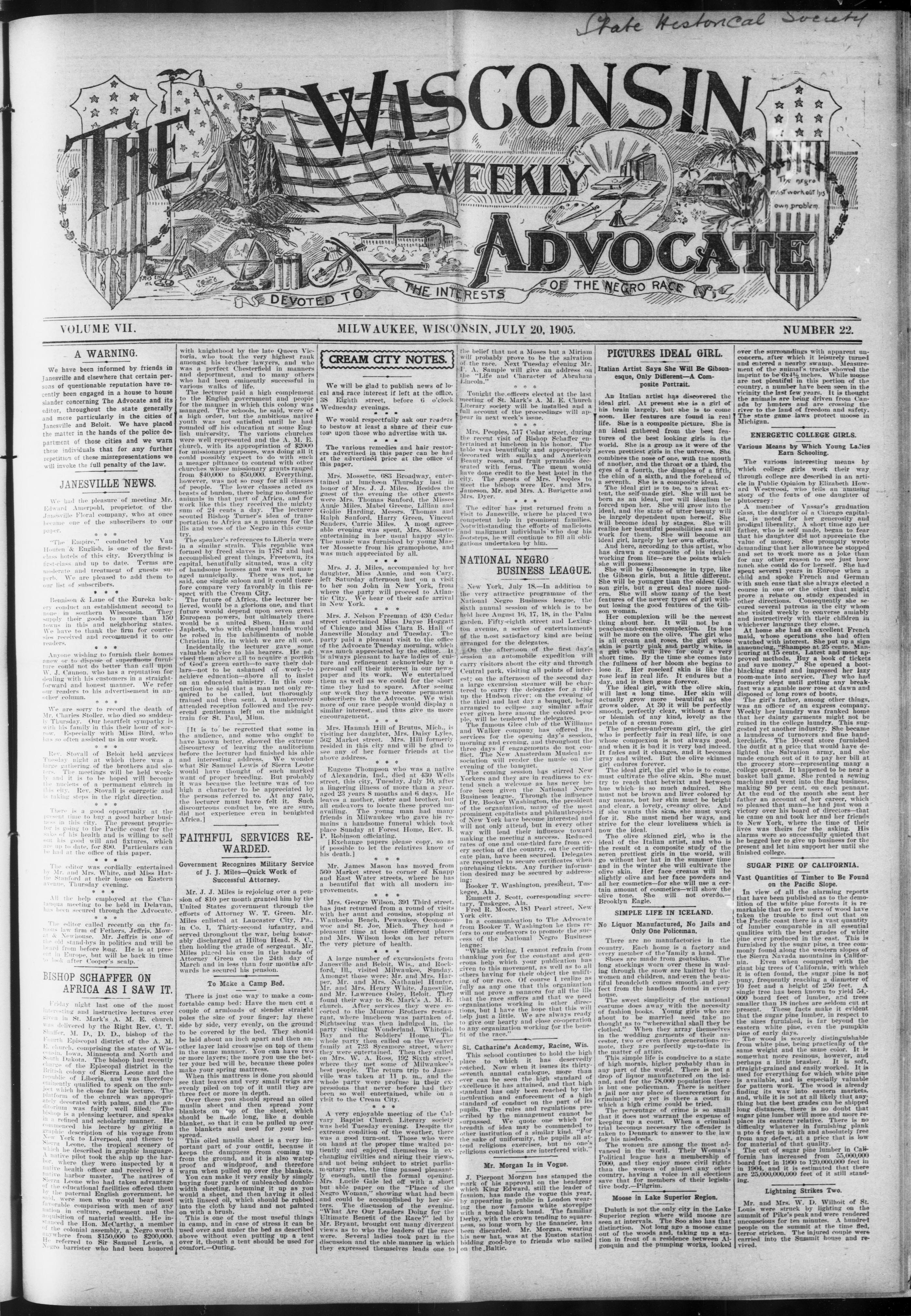
State Historical Society
WISCONSIN
WEEKLY
ADVOCATE
DEVOTED TO THE INTERESTS OF THE NEGRO RACE
A WARNING.
We have been informed by friends in Janesville and elsewhere that certain persons of questionable reputation have recently been engaged in a house to house slander concerning The Advocate and its editor, throughout the state generally and more particularly in the cities of Janesville and Beloit. We have placed the matter in the hands of the police department of those cities and we warn these individuals that for any further repetition of these misrepresentations we will invoke the full penalty of the law.
JANESVILLE NEWS.
We had the pleasure of meeting Mr. Edward Amerpohl, proprietor of the Jamesville Floral company, who at once became one of the subscribers to our paper.
***
"The Empire," conducted by Van Houten & English, is one of the first-class hotels of this city. Everything is first-class and up to date. Terms are moderate and treatment of guests superb. We are pleased to add them to our list of subscribers.
* * *
Bennison & Lane of the Eureka bakery conduct an establishment second to none in southern Wisconsin. They supply their goods to more than 150 towns in this and neighboring states. We have to thank the firm for courtesies received and recommend it to our readers.
* * *
Anyone wishing to furnish their homes anew or to dispose of superfluous furniture could not do better than call upon W. J. Cannon, who has a reputation for dealing with his customers in a straightforward and honest manner. We refer our readers to his advertisement in another column.
* * *
We are sorry to record the death of Mr. Charles Stoller, who died so suddenly Thursday. Our heartfelt sympathy is with his family in this their hour of sorrow. Especially with Miss Bird, who has so often assisted us in our work.
* * *
Rev. Stovall of Beloit held services Tuesday night at which there was a large gathering of the brothers and sisters. The meetings will be held weekly and it is to be hoped will become the nucleus of a permanent church in this city. Rev. Stovall is energetic and is taking steps in the right direction.
* * *
There is a good opportunity at the present time to buy a good barber business in this city. The present proprietor is going to the Pacific coast for the sake of his health and is willing to sell out his good will and fixtures, which are up to date, for $90. Particulars can be had at the office of this paper.
* * *
The editor was cordially entertained by Mr. and Mrs. White, and Miss Hattie Stanford at their home on Eastern avenue, Thursday evening.
* * *
All the help employed at the Chataquua meeting to be held in Delavan, has been secured through the Advocate.
* * *
The editor called recently on the famous law firm of Fethers, Jeffris, Mowat & Newhouse. Mr. Jeffris is one of the old stand-bys in politics and will be heard from before long. He is at present in Europe, but will be back in time to look after Cooper's scalp.
BISHOP SCHAFFER ON AFRICA AS I SAW IT.
Friday night last one of the most interesting and instructive lectures ever given in St. Mark's A. M. E. church was delivered by the Right Rev. C. T. Shaffer, M. D., D. D., bishop of the Fourth Episcopal district of the A. M. E. church, comprising the states of Wisconsin, Iowa, Minnesota and North and South Dakota. The bishop had recently charge of the Episcopal district in the British colony of Sierra Leone and the republic of Liberia, and was therefore enlightened qualified to speak on the subject which he chose for his lecture. The platform of the church was appropriately decorated with palms, and the auditorium was fairly well filled. The bishop is a pleasing lecturer, and speaks in a refined and scholarly manner. He commenced his lecture by giving a graphic description of his voyage from New York to Liverpool, and thence to Sierra Leone, the tropical scenery of which he described in graphic language. A native pilot took the ship up the harbor, where they were inspected by a native health officer and received by a native harbor master. The natives of Sierra Leone who had taken advantage of the educational facilities offered them by the paternal English government, he said, were men who would bear most favorable comparison with men of any nation in culture, refinement and the acquisition of material wealth. He instanced the Hon. McCarthy, a member of the colonial assembly, a Negro worth anywhere from $150,000 to $200,000. He referred to Sir Samuel Lewis, a Negro barrister who had been honored
with knighthood by the late Queen Victoria, who took the very highest rank amongst his brother lawyers, and who was a perfect Chesterfield in manners and deportment, and to many others who had been eminently successful in various walks of life.
The lecturer paid a high complement to the English government and people for the manner in which this colony was managed. The schools, he said, were of a high order, but the ambitious native youth was not satisfied until he had rounded off his education at some English university. The various churches were well represented and the A. M. E. church, with its appropriation of $2000 for missionary purposes, was doing all it could possibly expect to do with such a meager pittance to contend with other churches whose missionary grants ranged from $40,000 to $50,000. Everything, however, was not so rosy for all classes of people. The lower classes acted as beasts of burden, there being no domestic animals in that part of Africa, and for work like this they received the mighty sum of 24 cents a day. The lecturer scouted Bishop Turner's idea of transportation to Africa as a panacea for the ills and woes of the Negro in this country.
The speaker's references to Liberia were in a similar strain. This republic was formed by freed slaves in 1787 and had accomplished great things. Freetown, its capital, beautifully situated, was a city of handsome houses and was well managed municipally. There was not, he said, one single saloon and it could therefore compare very favorably in this respect with the Cream City.
The future of Africa, the lecturer believed, would be a glorious one, and that future would depend upon seven great European powers, but ultimately there would be a united Shem, Ham and Japheth, who with clasped hands would be robed in the habiliments of noble Christian life, in which we are all one.
Incidentally the lecturer gave some valuable advice to his hearers. He advised them above all to acquire a portion of God's green earth—to save their dollars—not to be ashamed of work—to achieve education—above all to insist on an educated ministry. In this connection he said that a man not only required to be called, but thoroughly trained and then sent. A numberously attended reception followed and the reverend gentleman left on the midnight train for St. Paul, Minn.
[It is to be regretted that some in the audience, and some who ought to have known better, showed the extreme discourtesy of leaving the auditorium before the lecturer had finished his able and interesting address. We wonder what Sir Samuel Lewis of Sierra Leone would have thought of such marked want of proper breeding. But probably it was because the lecture was of too high a character to be appreciated by the persons referred to. At any rate, the lecturer must have felt it. Such discourteous conduct he, we are sure, did not experience even in benighted Africa.]
FAITHFUL SERVICES REWARDED.
Government Recognizes Military Service of J. J. Miles—Quick Work of Successful Attorney.
Mr. J. J. Miles is rejoicing over a pension of $10 per month granted him by the United States government through the efforts of Attorney W. T. Green. Mr. Miles enlisted at Lancaster City, Pa., in Co. I, Thirty-second infantry, and served throughout the war, being honorably discharged at Hilton Head. S. C., then holding the grade of sergeant. Mr. Miles placed his case in the hands of Attorney Green on the 24th day of March and in less than four months aftwards he secured his pension.
To Make a Camp Bed.
There is just one way to make a comfortable camp bed: Have the men cut a couple of armloads of slender straight poles the size of your finger; lay these side by side, very evenly, on the ground to be covered by the bed. They should be laid about an inch apart and then another layer laid crosswise on top of them in the same manner. You can have two or more layers; the more you use the better your bed will be, because these poles make your spring mattress. When this mattress is done you should see that leaves and very small twigs are evenly piled on top of it until they are three feet or more in depth.
Over these you should spread an oiled muslin sheet and then spread your blankets on top of the sheet, which should be made long, like a double blanket, so that it can be pulled up over the blankets and used for your bedspread.
This oiled muslin sheet is a very important part of your outfit, because it keeps the dampness from coming up from the ground, and it is also waterproof and windproof, and therefore warm when pulled up over the blankets.
You can make it very easily by simply buying four yards of unbleached double-width sheeting, hemming it up as you would a sheet, and then having it oiled with linseed oil, which should be rubbed into the cloth by hand and not painted on with a brush.
This is one of the most useful things in camp, and in case of stress it can be used over and under the bed as described above without even putting up a tent over it, though a tent should be used for comfort.—Outing.
MILWAUKEE, WISCONSIN, JULY 20, 1905.
CREAM CITY NOTES.
We will be glad to publish news of local and race interest if left at the office, 38 Eighth street, before 6 o'clock Wednesday evenings.
We would respectfully ask our readers to bestow at least a share of their custom upon those who advertise with us.
The various remedies and hair restorers advertised in this paper can be had at the advertised price at the office of this paper.
Mrs. Mossette, 683 Broadway, entertained at luncheon Thursday last in honor of Mrs. J. J. Miles. Besides the guest of the evening the other guests were Mrs. Thomas Sanford, the Misses Annie Miles, Mabel Greene, Lillian and Goldie Harding, Messrs. Thomas and Ralph Sanford, Harry Green, Vincent Sanders, Carrie Miles. A most agreeable evening was spent, Mrs. Mossette entertaining in her usual happy style. The music was furnished by young Master Mossette from his gramophone, and was much appreciated by all.
```markdown
```
Mrs. J. J. Miles, accompanied by her daughter, Miss Annie, and son Cary, left Saturday afternoon last on a visit to her son John in New York, from where the party will proceed to Atlantic City. We hear of their safe arrival in New York.
* * *
Mrs. J. Nelson Freeman of 430 Cedar street entertained Miss Dayse Hoggatt of Chicago and Miss Clara B. Hall of Janesville Monday and Tuesday. The party paid a pleasant visit to the office of the Advocate Tuesday morning, which was much appreciated by the editor. It is always pleasant to have ladies of culture and refinement acknowledge by a personal call their interest in our newspaper and its work. We entertained them as well as we could for the short time they had to spare. After seeing our work they have become permanent subscribers to the Advocate. We wish more of our race people would display a similar interest, and thus give us more encouragement.
Mrs. Hannah Hill of Brutus, Mich., is visiting her daughter, Mrs. Daisy Lyles, 562 Market street. Mrs. Hill formerly resided in this city and will be glad to see any of her former friends at the above address.
above address.
Eugene Thompson who was a native of Alexandria, Ind., died at 430 Wells street, this city, Tuesday, July 10, after a lingering illness of more than a year. aged 23 years 8 months and 6 days. He leaves a mother, sister and brother, but all endeavors to locate these proved unavailing. The young man had many friends in Milwaukee who gave his remains a handsome funeral which took place Sunday at Forest Home, Rev. B. P. Robinson officiating.
[Exchange papers please copy, so as if possible to let the relatives know of his death.]
Mr. James Mason has moved from 560 Market street to corner of Knapp and East Water streets, where he has a beautiful flat with all modern improvements.
***
Mrs. George Wilson, 391 Third street, has just returned from a round of visits with her aunt and cousins, stopping at Waukesha Beach, Pewaukee, Oconomowoc and St. Joe, Mich. They had a pleasant time at these different places and Mrs. Wilson looks on her return the very picture of health.
***
A large number of excursionists from Janesville and Beloit, Wis., and Rockford, Ill., visited Milwaukee, Sunday. Amongst those were: Mr. and Mrs. Harper, Mr. and Mrs. Nathaniel Hunter, Mr. and Mrs. Henry White, Janesville, and Mr. Lawrence Osley, Beloit. They found their way to St. Mark's A. M. E. church. After services they were escorted to the Munroe Brothers restaurant, where luncheon was partaken of. Sightseeing was then indulged in, the party visiting Wonderland, Whitefish Bay and the Soldiers' Home. The whole party then called on the Weaver family at 723 Sycamore street, where they were entertained. Then they called on Mrs. W. A. Ross, 192 Sixth street, where they met some of Milwaukee's best people. The return trip to Janesville was taken at 11 p. m., and the whole party were profuse in their expressions that never before had they been so well entertained, while on a visit to the Cream City.
A very enjoyable meeting of the Calvary Baptist Church Literary society was held Tuesday evening. Despite the extreme condition of the weather, there was a good turn-out. Those who were on hand at the proper time waited patiently and enjoyed themselves in exchanging civilties and airing their views, and not being subject to strict parliamentary rules, the time passed pleasantly enough, until the formal opening. Mrs. Lucile Gale led off with a short but able paper on the "Place of the Negro Woman," showing what had been and could be accomplished by her sisters. The discussion of the evening, "What Are Our Leaders Doing for the Ultimate Benefit of the Race?" led by Mr. Bryant, brought out many divergent views as to who the leaders of the race were. Several ladies took part in the discussion and the able manner in which they expressed themselves leads one to
the belief that not a Moses but a Miriam will probably prove to be the salvation of the race. Next Tuesday evening Mr. P. A. Sample will give an address on the "Life and Character of Abraham Lincoln." * * *
Tonight the officers elected at the last meeting of St. Mark's A. M. E. Church Literary society will be installed and a full account of the proceedings will appear in next week's issue.
☆ ☆ ☆
Mrs. Peoples, 517 Cedar street, during the recent visit of Bishop Schaffer entertained at luncheon in his honor. The table was beautifully and appropriately decorated with smilax and American Beauty roses, and fruit pyramids decorated with ferns. The menu would have done credit to the best hotel in the city. The guests of Mrs. Peoples to meet the bishop were Rev. and Mrs. Jameson, Mr. and Mrs. A. Burigette and Mrs. Dyer.
* * *
The editor has just returned from a visit to Janesville, where he placed two competent help in prominent families. Notwithstanding the efforts of malicious and malignant individuals who dog his footsteps, he will continue to fill all obligations undertaken by him.
NATIONAL NEGRO BUSINESS LEAGUE.
New York, July 18.—In addition to the very attractive programme of the National Negro Business league, the sixth annual session of which is to be held here August 16, 17, 18, in the Palm garden. Fifty-eighth street and Lexington avenue, a series of entertainments of the n.ost satisfactory kind are being arranged for the delegates.
On the afternoon of the first day's session an automobile expedition will carry visitors about the city and through Central park, visiting all points of interest; on the afternoon of the second day a large excursion steamer will be chartered to carry the delegates for a ride up the Hudson river; on the evening of the third and last day a banquet, being arranged to eclipse any similar affair ever given here among the colored people, will be tendered the delegates. The famous Glee club of the Williams and Walker company has offered its services for the opening day's session, morning and evening, and throughout the three days if engagements do not conflict. The New Amsterdam Musical association will render the music on the evening of the banquet.
The coming session has stirred New Yorkers and they are in readiness to extend such a welcome as has never before been given the National Negro Business league. Through the influence of Dr. Booker Washington, the president of the organization, many of the most prominent capitalists and philanthropists of New York have become interested and will not only attend, but in every other way will lend their influence toward making the meeting a success. Reduced rates of one and one-third fare from every section of the country, on the certificate plan, have been secured. Delegates are requested to secure certificates when purchasing tickets. Any further information desired may be secured by addressing:
Booker T. Washington, president, Tuskegee, Ala. Emmett J. Scott, corresponding secretary, Tuskegee, Ala.
tary, Tuskegee, Ala.
Fred R. Moore, 181 Pearl street, New York
York city. In a communication to The Advocate from Booker T. Washington he thus refers to our endeavors to promote the success of the National Negro Business league:
"While writing, I cannot refrain from thanking you for the constant and generous help which your publication has given to this movement, as well as to all others having for their object the unlifting of our race. Of course I realize as fully as any one that this organization will not prove a panacea for all the ills that the race suffers and that we need organizations working in other directions, but I have the hope that this will help just a little. We are always ready to give our hearty and close co-operation to any organization working for the benefit of the race."
St. Catharine's Academy, Racine, Wis.
This school continues to hold the high place to which it has deservedly reached. Now when it issues its thirty-seventh annual catalogue, more than ever can be seen the high standard of excellence it has attained, and that high standard has only been reached by the inculcation and enforcement of a high standard of conduct on the part of its pupils. The rules and regulations prescribed by the management cannot be surpassed. We quote one which for breadth of idea may be commended to other institution of a similar kind. "For the sake of uniformity, the pupils all attend religious exercises, but no one's religious convictions are interfered with."
Mr. Morgan Is in Vogue.
J. Pierpont Morgan has stamped the mark of his approval on the headgear which King Edward, still the leader of fashion, has made the vogue this year, by appearing in public in London wearing the now famous white stovepipe with a broad black band. The familiar Derby, with the crown tending to squareness, so long worn by the financier, has been discarded. Mr. Morgan, wearing his new hat, was at the Euston station bidding good-bye to friends who sailed on the Baltic.
PICTURES IDEAL GIRL.
Italian Artist Says She Will Be Gibsonesque, Only Different—A Composite Portrait.
An Italian artist has discovered the ideal girl. At present she is a girl of his brain largely, but she is to come soon. Her features are found in real life. She is a composite picture. She is an ideal gathered from the best features of the best looking girls in the world. She is a group as it were of the seven prettiest girls in the universe. She combines the nose of one, with the mouth of another, and the throat or a third, the eyes of a fourth, the dimples of a fifth, the chin of a sixth, and the forehead of a seventh. She is a composite ideal.
The ideal girl is to be, to a great extent, the self-made girl. She will not be born as an ideal, nor will idealism be forced upon her. She will grow into the ideal, and the state of utter beauty will be largely dependent upon herself. She will become ideal by stages. She will realize her beautiful possibilities and will work for them. She will become an ideal girl, largely by her own efforts.
And here, according to this artist, who has drawn a composite of his ideal—working from life—are the points which she will possess:
She will be Gibsonesque in type, like the Gibson girls, but a little different. She will be younger than the oldest Gibson girls, but a great deal more modern. She will show many of the best features of the newer types of girl without losing the good features of the Gibson woman.
Her complexion will be the newest thing about her. It will not be a peaches-and-cream complexion. Its hue will be more on the olive. The girl who is all cream and roses, the girl whose skin is partly pink and partly white, is a girl who will live for only a very short time. By the time she comes into the fullness of her bloom she begins to lose it. Her roseleaf skin is like the rose leaf in real life. It endures but a day, and is then gone forever.
The ideal girl, with the olive skin, will last a long time. Her skin will actually grow more beautiful as she grows older. At 30 it will be perfectly smooth, perfectly clear, without a flaw or blemish of any kind, lovely as the petals of a cream rose.
The peaches-and-cream girl, the girl who is perfectly fair in real life, is one whose complexion is not always good, and when it is bad it is very bad indeed. It fades and it changes, and it becomes gray and wilted. But the olive skinned girl endures forever.
The ideal girl, the girl who is to come, must cultivate the olive skin. She must try to reach that betwixt and between hue which is so much admired. She must not be brown and liver colored by any means, but her skin must be bright and clear, a lovely, creamy olive. And if she wants this skin, she must work for it. She must mend her ways, and strive for the clear loveliness which is now the ideal.
The olive skinned girl, who is the ideal of the Italian artist, and who is the result of a composite study of the seven prettiest girls in the world, will go without her hat in the summer time and in the winter she will cultivate the olive skin. Her face creams will be slightly olive and her face powders and all her cosmetics—for she will use a certain amount of cosmetics—will show the olive tone. She will not overdo. Brooklyn Eagle.
SIMPLE LIFE IN ICELAND
No Liquor Manufactured, No Jails and Only One Policeman
There are no manufactories in the country. Each home is a factory and every member of the family a hand. Shoes are made from goatskins. The long stockings worn over these in wading through the snow are knitted by the women and children, and even the beautiful broadcloth comes smooth and perfect from the handloom found in every house. The sweet simplicity of the national costume does away with the necessity of fashion books. Young girls who are about to be married need take no thought as to "wherewithal shall they be clothed." When they array themselves in the wedding garments of their ancestor, two or even three generations remote, they are perfectly up-to-date in the matter of attire.
This simple life is conducive to a state of high morals, higher probably than in any part of the world. There is not a drop of liquor manufactured on the island, and for the 78,000 population there is but one policeman. There is neither a jail nor any place of incarceration for criminals; nor yet is there a court in which a high crime could be tried. The percentage of crime is so small that it does not warrant the expense of keeping up a court. When a criminal trial becomes necessary the offender is taken to Denmark to answer to the law for his misdeeds.
The women are among the most advanced in the world. Their Woman's Political league has a membership of 7000, and they enjoy more civil rights than the women of almost any other country, having a voice in all elections save that for members of their legislative body.-Pilgrim.
Moose in Lake Superior Region.
Duluth is not the only city in the Lake Superior region where wild moose are seen at intervals. The Soo also has that distinction. Not long ago a moose came out of the woods and, taking up a station in front of a residence between Algonquin and the pumping works, looked
over the surroundings with apparent unconcern, after which it leisurely turned and entered a nearby swamp. Measurement of the animal's tracks showed the imprint to be $6 \times 4 \frac{1}{2}$ inches. While moose are not plentiful in this portion of the country, a number have been seen in the vicinity the last few years. It is thought the animals are being driven from Canada by hunters and are crossing the river to the land of freedom and safety. The state game laws protect moose in Michigan.
ENERGETIC COLLEGE GIRLS.
Various Means by Which Young Ladies Earn Schooling.
The various interesting means by which college girls work their way through college are described in an article in Public Opinion by Elizabeth Howard Westwood, who tells an amusing story of the feats of one daughter of plutocracy:
A member of Vassar's graduation class, the daughter of a Chicago capitalist, is noted for her generosity and prodigal liberality. A short time ago her father, who is self made, began to fear that his daughter did not appreciate the value of money. She promptly wrote demanding that her allowance be stopped and set to work more as a joke than for any other reason to see just how much she could do for herself. She had spent several years in Europe when a child and spoke French and German with such ease that she always elected a course in one or the other that might prove a rebate on study expended in other directions. Consequently she secured several patrons in the city whom she visited weekly to converse amiably and instructively with their children in whichever language they chose.
At home she had an excellent French maid, whose operations she had often watched with interest. She put up a sign announcing, "Shampoo at 25 cents. Manicuring at 15 cents. Latest and most approved methods. Buy a book of tickets and save money." She opened a boot-blacking stand and impressed her lazy room-mate into service. They who had formerly slept until getting any breakfast was a gamble now rose at dawn and disposed or long rows of boots.
The girl's father, among other things, was an officer of an express company. Weekly her laundry was franked home that her dainty garments might not be ruined in the college laundry. This suggested yet another industry. She became a laundress of turnovers and fine handkerchiefs. The 10-cent store furnished the outfit at a price that would have delighted the Salvation army, and she made enough out of it to pay her bill at the grocery store—representing many a college spread. It happened to be near a basket ball game. She rented a sewing machine and went into the flag business, making 80 per cent, on each pennant. At the end of the month she sent her father an account of her career, which so pleased that man—he had just won a victory over his board of directors—that he came on and took her and her friends to New York, where the time of their lives was theirs for the asking. His alarms were so successfully quieted that he begged her to give up business for the present and let him support her until she finished college.
SUGAR PINE OF CALIFORNIA
Vast Quantities of Timber to Be Found on the Pacific Slope.
In view of all the alarming reports that have been published as to the demolition of the white pine forests it is remarkable that so few users of wood have taken the trouble to find out that on the Pacific coast there is a vast quantity of lumber comparable in all essential qualities with the best grades of white pine ever produced in the east. This is furnished by the sugar pine, a tree commonly found along the western slopes of the Sierra Navada mountains in California. Even when compared with the giant big trees of California, with which it is often found, the sugar pine is not puny, frequently reaching a diameter of 10 feet and a height of 250 feet. A single tree has been known to yield 54,000 board feet of lumber, and trees smaller than 18 inches are seldom cut at present. These facts make it evident that the sugar pine lumber, in respect to the sizes furnished, is far beyond the eastern white pine, even the pumpkin pine of early days.
The wood is scarcely distinguishable from white pine, being practically of the same weight and the same color. It is somewhat more resinous, however, and perhaps a little brasher. It is soft, straight-grained and easily worked. It is used for everything for which white pine is available, and is especially valuable for pattern work. The wood is already finding its way into eastern markets, and, while it is not at all likely that anything but the best grades can be shipped long distances, there is no doubt that sugar pine lumber will more and more replace its eastern relative. There is no difficulty whatever in furnishing plank u pto 4 feet in width and absolutely free from any defect, at a price that is low for material of that quality.
The cut of sugar pine lumber in California has increased from 55,000,000 board feet in 1900 to 120,000,000 feet in in 1904, and it is estimated that there are 25,000,000,000 feet of it still standing.
Lightning Strikes Two.
Mr. and Mrs. W. D. Wilhoit of St. Louis were struck by lighting on the summit of Pike's peak and were rendered unconscious for ten minutes. A hundred people on the summit at the time fled, terror stricken. The injured couple were carried into the Summit house and revived.
Miscellaneous Items.
Alemar, Netherlands, is to have a steam tramway to be built by the "Noorder Stoomtramwagmaatschappij."
In the Vatican library there is a treatise on dragons, a manuscript in a single roll 300 feet long and a foot wide.
Only one person in fifteen has perfect eyes, the largest percentage of defects prevailing among fair headed people.
Since 1892 no newspapers have been printed on Sunday in Norway, and since 1895 no bread has been baked on that day.
While Germany has 6,500,000 women who earn their own living, Italy, with only one-half the population, has 5,250,000.
Initial steps are already being taken at Antwerp for the organization of a universal exhibition to be held there in 1913.
A London curio dealer has in his window a placard reading: "Several bits of armor for sale-suitable for motorists."
A statuette of Isis, declared to be of ancient Egyptian origin, has been found buried under the foundations of the Paris bastile.
The latest count against the automobile is that it is helping to spread the pestiferous gypsy moth beyond its present abiding places in Massachusetts.
-It is estimated that 500 motor omnibuses will be running in London a year hence. Drivers of horse-drawn omnibuses are being trained for the new work.
-An image of the Virgin Mary in a church at Antipolo, in the Philippine islands, has jewels valued at $1.500,000, which have been given it by the devout women natives.
-While chasing a mouse the other day Mme. Delatour of Paris broke through the floor of her room and found in the hole a brass box containing gold coins of the value of $1000.
-Lions in captivity are affected by bad weather just as human beings are. A rainy day will make them limp and listless, while a glimpse of sunshine restores their spirits wonderfully.
—One of the most energetic nest builders is the marsh wren; in fact, he has the habit to such a degree that he cannot stop with one nest, but goes on building four or five in rapid succession.
—"Ye Olde Cheshire Cheese," a famous London hostelry, among whose customers in bygone days were Goldsmith, Johnston, Boswell, Thackery and Dickens, is to come into the market.
—Conductors on the German state railways are to be discharged unless they pass an examination in the English and French language, though some of them have been twenty years in the service.
—Hearing that an old man named Kuss had been buried at Egregy, in Hungary, with his fortune of $17,500 in his coffin his relatives exhumed the corpse and divided the money among them.
The cost of feeding the animals in the London zoo last year was $17,115. The principal items of food were 207 horses, 270 goats, 34,921 pounds of fish, 25,196 eggs, 6855 quarts of milk and 137 loads hay.
Berlin has erected a huge building resembling a factory, where the unemployed—whole families—are received and provided for. But no one must take advantage of this hospitality more than five times in three months.
Chicago did not get a place on the map until 1840, when its population was 4470. Today it is the fourth city in the world in point of population and wealth. The only towns which lead it are London, New York and Paris.
- Students at Japanese universities and commercial schools are not obliged to serve in the army. In Germany it has often happened that the universities were closed because all the students and professors had joined the army.
- At the ordinary price of 2 cents a pound for rice the Chinese rice farmers make money on about the same scale as would American farmers in the Mississippi valley producing wheat on a basis of 80 cents a bushel in Chicago.
- The total number of all known varieties of postage stamps used by all the governments of the world up to date is 19,242. Salvador, the smallest of the Central American republics, has issued 450 different kinds; more than any other country.
There are three great Mohammedan universities, at Cairo, Tunis and Fez, all African, and another is being built up at Khartoum. Until very lately they have all been devoted to Mohammedan law and religion, and have fallen into ignorance and decadence.
Compressed tea is common enough in Siberia, but an unknown commodity in this country. It is an ordinary black tea, which is very widely used by the Bruiats of the trans-Baikal region, by whom the herb thus prepared is drunk, flavored with salt and sour cream.
Germany is ahead in novelties of a charitable nature. In Haschmann prizes are offered yearly for the men who will marry the ugliest and most crippled women, and for women over 40 years who have been jilted at least twice. The money was left by a big financier.
One of the funniest consequences of young Alfonso's visit to England is the birth of the "Hidalgo" hat, a modified Spanish turban with which modish Englishmen are beginnin to deck their heads. Although distinctly more suitable for winter, it makes a gallant appearance.
Dr. Wolfgang Weichardt of Berlin has discovered the "essence of strength," by which the power of any animal, even a man, may be nearly doubled; an antitoxin which may prove of immense value to athletes and incalculable good in cases of nervous exhaustion and in convalescence of serious ill persons.
Articles of dress are now being extensively made of glass. A Venetian manufacturer is turning out bonnets by the thousand, the glass cloth of which they are composed having the same shimmer and brilliancy of color as silk, and, what is a great advantage, when soiled, is simply brushed with a hard brush and soap and water.
—Glass containing manganese is slowly turned violet by sunlight, and Sir William Crooks has found that radium produces in a few days a coloration as intense as that caused by the sun in years. F. Fischer has now been studying the effects of ultra-violet rays, and reports that the light of a mercury are lamp in a quarter tube gave a slight color in fifteen minutes to four out of eight glasses, and an intense violet hue in twelve hours. The color proved to be due to manganese silicate.
A Case of Second Sight
A Scotch minister and his friend, who were coming home from a wedding, began to consider the state into which their potations at the wedding had left them.
"Sandy," said the minister, "just stop a minute here till I go ahead. Maybe I don't walk very steady, and the good wife might remark something not just right."
He walked ahead of the servant for a short distance and then asked:
"How is it? Am I walking straight?"
"Oh, ay," answered Sandy, thickly, "ye're a' recht—but who's that who's with you?"—Harper's Weekly.
WITH THE AGE
For good or ill, I master thy desire.
O Age and Country, making thy life mine;
I fell the forest and I lay the line.
I guide the cranes that swing the steel
from fire
And flaring blast; I ride the inland flyer
Thro' the sown fields; in earth's vast rain
and shine.
and smile
I coast the sea with many a bold design.
And visit cities, climbing tower and spire.
And look abroad and say, "How strong ye are!
How ominous and wide! What new-born will
Is housed among ye, Cities near and far
By coast and river and the changeless bill!
How large your dreams, when 'neath the polar star.
point star;
The winter night lies round ye, co'd and still."
-William Ellery Leonard in The Atlantic.
Modest. Brave John Davidson.
BY LIEUT.-COL. J. A. WATROUS, U. S. A.
"That man commanded a regiment in battle when he was a boy, second lieutenant."
"Who is he?"
Let me tell you something about him. His name is John Davidson. The last week in June, 1861, a company made up almost wholly of farmer boys from Crawford county, Wisconsin, marched into Camp Randall, Madison, and became Co. C of the Sixth, a regiment which for four years played a more or less prominent part in the old war of the sixties. Among the young farmer boys of company C was rosy-cheeked, patriotic, energetic John Davidson. He developed into a superb soldier, who did well every duty assigned to him and seemed always to be watching for other service to perform.
There never was anything about him indicating a desire to win glory for himself. His aim seemed to be always to serve to the very best of his ability, the country he loved.
He missed no battles in which his regiment participated, and his regiment participated in all the great battles of the Army of the Potomac.
* * *
In one of the great battles John Davidson was a hero, but a notably modest one.
Every soldier who participated in the series of battles on the Weldon railroad, near the Yellow House, to the left of Petersburg, in August, 1864, will remember the sharp, hard work that was necessary to prevent Gen. Mahone and his veteran Virginians from destroying the Fifth corps. Those fights were models in their way. The two forces smashed up against each other, struck right and left and fought with savagery seldom noted. The position taken was a very important one to the federals, and its loss was a serious one to the confederates. Mahone's division charged Cutler's division three times in one day, and was repulsed with great loss each time.
After the first charge was made Sergt. John Davidson—he had been given another stripe—requested the privilege of taking a bunch of muskets gathered from the field the day before with a view to loading them and placing them on the breastworks in readiness for the next charge. It was a novel idea, and permission was granted. Davidson hurriedly collected a force of ten men and instructed them as to the manner of discharging the extra guns he had placed on the breastworks, when Mahone's men came at them again. There were nearly 100 of these extra guns. Sergt. Davidson and his ten men discharged their own pieces and then rapidly went along the line and discharged the extra hundred. This was repeated at the third charge and with wonderful effect.
There was no call for Sergt. Davidson to introduce and carry out that plan, but it was his way. Probably he did not engage in a battle when he did not do more than he was expected to do. He was one of the men who ought to have been a commissioned officer two years before he was made one.
***
Not long after that day's three fierce charges with frightful slaughter I found myself a newly made adjutant of the regiment. I knew the importance of securing a competent man for sergeant-major, and thought that my rosy-cheeked boy of Camp Randall, now one of the best soldiers in the army, would fill the bill. Much to my surprise and disappointment, when I offered the appointment to Sergt. Davidson, he said he guessed he would stay with the company. He had been with it about three and a half years, and he did not like to leave the boys. The next day I broached the subject again, and the next. He finally concluded that he would try it for a month, if I could promise to relieve him in case he did not like the work.
About two months after his appointment the colonel gave me data for a letter to be written to the governor, asking for several commissions. Some of them were for lieutenants to be promoted to captains, and some for sergeants to be promoted to lieutenants. After writing the letter I handed it to the sergeant-major to be cop'ed. When he reached the recommendation of Sergt.-Maj. John Davidson, for second lieutenant of Co. D, he stopped writing and said, "Adjutant, this is not right; there are several men in Co. C who ought to be made lieutenants before I am." I said, "Sergeant, I obeyed the colonel's directions in preparing this letter, and I guess you will have to obey mine in copying it."
But the remark was just like brave John Davidson. He was willing, always, to stand aside while others were given promotions.
When our colonel took command of the brigade I went with him as his adjutant general, and the regiment had to select another adjutant. Davidson was assigned to that duty. At the battle of Gravely Run, the 31st of March, 1865, Lieut.-Col. Tom Kerr, commanding the regiment, was badly wounded, and just as Adjt. Davidson was notifying the senior captain to take command the senior captain was wounded. At that moment the confederates, having gotten around on both flanks and still having a big force in front, compelled the regiment to fall back, and there was no time for the adjutant to hunt up the next captain and ask him to take command. After falling back across a creek Davidson saw a rare opportunity to halt, about-face the regiment and pour a destructive fire into the confederates, and this was done by the boy lieutenant. The command remained there until it had checked the advance of the confederates. An hour later the federals swept over the
same ground and regained more than they had lost. It was conceded by the brigade commander that the action of Second Lieut. Davidson, in assuming command of the regiment and reopening the fight, had much to do in bringing about the subsequent victory.
Lieut. Davidson was again promoted. I met him in a Kansas town last fall. He is the same modest, honest, deserving man. One of his neighbors told me that when the Spanish-American war came Maj. Davidson started for Topeka to offer his services, but was notified before reaching there that every appointment had been made. He then asked the privilege of accompanying the regiment that went to the Philippines, with a view to assisting the untried officers in the work they might have to do. But the powers that be did not think that was practicable.
During an evening's visit with my old friend I said:
"Of course, you get a pension, John?"
"Oh, yes, I get a pension."
"How much do they give you?"
"Six dollars."
"Only six dollars? and you were wounded three times and have been totally deaf in one ear ever since the war."
"Yes, that is all. I tried to get an increase fifteen years ago, but they sent it back disallowed."
"Going to try again?"
"It is not worth while."
Modest to the last. That night I wrote a letter to a friend and a month later Davidson received orders to visit an expert in the treatment of the eye and ear, for examination, and without expecting any good results from it he complied with the directions. A few days later I received a letter from the old major telling me that the commissioner of pensions had sent him word that his pension had been more than doubled, and that the increase dated from the time he put in his claim, fifteen years ago.
There was no "pension graft" in John Davidson's case. If his pension had been ten times as great as it is now from the close of the war, up to the date of his death, it would have been none too much for the service he rendered.—Evening Wisconsin.
PROTECTION FOR THE WATCH.
Means of Rendering It Secure in Its Place. The old adage "uneasy lies the head that wears a crown" finds many exemplifications in lower spheres of life. The possessor of a fine stickpin or watch continually carries on his mind the fear of having his treasure stolen by the sneakthief or pickpocket, for, while the latter are by no means as common as in the days of Fagin and Oliver Twist, they are sufficiently numerous and dexterous and add a care to the prosperous individual of the metropolis. Pin guards and watch protectors have been devised
THE TYPEWRITER
TO PROTECT THE WATCH
without number, although no one type appears to have embodied the elements to make it universally acceptable. The latest aspirant for honors in this field of invention is fittingly a New Yorker, for the peculiar crowded conditions of that great city's transportation facilities afford the richest field for the activities of the professional pickpocket. This latest pocket guard comprises a main frame of approximately U-shape, with side arms, tipped with prongs adapted to engage with the pocket and hold the frame securely in place. At the upper end of the U frame there is a holding plate, mounted on pivots and shaped so as to receive the crown and pendant of the watch. A flat spring maintains the holding plate in contact with the guard frame. To remove the watch it is only necessary to lift the plate against the action of the spring.
Merely a Parable.
It is regrettable but true that among our colored brethren of the sunny south the stealing of poultry is not considered a heinous sin. Indeed they seem to look upon the matter very much as did Huckleberry Finn, who said, if I remember rightly, that his "pap" always took along a chicken when it didn't seem to be "roosting comfortable," because even if he didn't need it himself it was an easy matter to find somebody who did. An amusing story is told of how a negro preacher once took advantage of this weakness among his parishioners.
Just before the collection was taken up one Sunday morning he announced that he regretted to state that a certain brother had forgotten to lock the door of his chicken house the night before, and as a result in the morning he found that most of his fowls had disappeared.
"I doan' want ter be pussonal, bredren," he added, "but I hab my suspicions as to who stole dem chickens. I also hab reason for believin' dat if I am right in dose suspicions dat pusson won't put any money in de plate which will now be passed around."
The result was a fine collection, not a single member of the congregation feigning sleep. After it was counted the old parson came forward.
"Now, bredren," he said, "I doan' want your dinners to be spoilt by wonderin' where dat brudder lives who doan' lock his chickens up at night. Dat brudder doan' exist, mah friends. He was a parable, gotten up foh purposes of finances."—Popular Magazine.
Gold Mine Discovered
The state of Nevada is boring an artesian well in the Capitol square. A depth of over 200 feet has been attained. Gold has been found in the sands that are being raised with the machinery, and A. Cohen, a merchant of that city, has filed a mining location notice on the grounds, setting forth that he claims all of the ground now occupied by Nevada's chief executive building.
—London will soon put on its streets a motor street cleaning machine that will do the work of 500 men.
INDOMITABLE
When fiercely glows
The summer sun,
Once more he goes—
The heartless one,
And stops to say
With glee, "Egad!
The hottest day
We've ever had!"
Though you may writhe
In torture great,
His manner blythe
Does not abate.
He shouts "Hooray!"
In accents glad,
"The hottest day
We've ever had!"
And when at last
He's duly sent
For misdeeds past,
To punishment.
He'll shout, still gay,
To shades full sad,
"The hottest day
We've ever had!"
—Washington Star.
New York Every Day.
The Beta Theta Pi fraternity at the last session of its sixty-seventh annual convention added one new chapter to the fraternity, making sixty-eight chapters in all. The Iowa state college at Ames received the new charter.
Abraham Hummel and Benjamin Steinhardt will go on trial on September 17 on the conspiracy charge growing out of the investigation of the Dodge-Morse marriage-divorce tangle, unless a way can be found of putting off the case.
Mrs. Lillie Travers has secured a divorce from her husband, William R. Travers. Mr. and Mrs. Travers have been prominent in Newport society for years. Mrs. Travers was Miss Lillie Harriman, a daughter of Oliver Harriman.
The committee named by Mayor McClellan to consider plans for the centenary celebration in 1907 of the first use of steam in water navigation has decided to send an invitation to Vice Admiral Togo of the Japanese navy to attend on his flagship.
Former Congressman George Fred Williams of Boston arrived in New York city from Havana on the steamer Monterey. Mr. Williams is on his way back from Mexico, but was compelled to spend three weeks in a Havana hospital, suffering from erysipelas. His health is now fairly good.
The police of Newport and private detectives are unable to penetrate the mystery surrounding the theft of $50,000 worth of jewelry from the home of Charles M. Oelrichs. The conclusion has been reached, however, that the robbery was committed either by jewel experts or by persons familiar with the Oelrichs jewels and their value.
Edwin Clapp of Minneapolis, instructor in the Yale summer school, was arrested on the charge of masquerading in woman's attire. While the men and women of the school were bathing together, Clapp dressed in the clothes of one of the women bathers, and started to parade the streets. His peculiar walk led to his arrest, but after spending an hour in the holdover he was released by the city attorney on the ground that it was merely a lark. Clapp was Yale's former track team captain and intercollegiate champion hurdler.
Stuyvesant Fish's application for a new trial of the suit brought against him by A. Jaeckel & Co., furriers, in which a verdict was rendered against him for $1500 for furs supplied to his wife, was denied by Justice Delehanty in the city court. Mr. Fish disclaimed any liability for the debt, alleging that he never made provision for his wife's wearing apparel, for which she paid out of a separate income of her own. The judge declared that the idea that a husband is bound to furnish his spouse with clothing suitable to his and her condition and station in life is elementary.
An attempt to detain Peary's arctic ship Roosevelt has been made by persons, who notified the treasury department that the vessel had left Portland, Me., for New York without its clearance papers. The government officials promptly imposed a fine of $500. The captain of the ship was summoned to the custom house and was notified that the sum must be paid immediately. Members of the Peary Arctic club acted promptly, furnishing a bond for the amount and thus avoided any complications. They believe that the sailing of the Roosevelt will not be delayed.
Miss Ethel M. Cram, a prominent society woman of New York, was kicked in the head by a vicious pony which she was driving on Hawthorne street, Pittsfield, Mass., and will probably die. Her skull was fractured on the left side and several bones were driven into the brain. The young woman lost one of the reins while driving and in attempting to regain it leaned over the dashboard. The pony kicked her savagely in the head and she fell between the animal and the cart. She was kicked several times in the head and body and then, her clothing catching in the axle, she was dragged some distance.
---
The nineteen new subway routes laid down by the rapid transit commissioners have been approved by the board of estimate. With the approval given Attorney Boardman, who has charge of that feature of the work, will be able to apply at once to the appellate court for the right to-condemn property. This will put the rapid transit board in position to advertise for bids by the time the court of appeals finally decides the constitutionality of the law taking away the powers of the aldermen to grant franchises. Two of the routes approved were extensions of the present subway, one to Fort Lee Ferry, the other to Van Cortland park. As these extensions can be built under existing contracts, there will be no delay in pushing the work on them.
The caterpillar plague in Central park, New York city, calls attention to the other difficulties attending the preservation of trees in city parks. Only the frequenters of Central park know that the evergreen trees are dying. Only they and the park gardeners grieve for the passing away of these beautiful and useful trees. They do not thrive in city atmosphere, and New York seems destined to lose them. The park authorities and eminent arboriculturists are using every means to prevent a complete loss. All sorts of pines, firs, hemlocks and the rest of the evergreen types from different countries will likely be brought to the parks and an attempt made to find growths that will stand the conditions, the soil and the climate. The general opinion seems to be that dirt, smoke, electricity and gas are the destroying elements.
What Health Commissioner Darlington declares will be the finest sanitarium in the world for the outdoor treatment of consumptive patients was authorized by the board of estimate. A quarter of a million dollars was appropriated to begin the work, this action bringing to a successful culmination a
campaign against local prejudice and municipal economy which Dr. Darlington has been carrying on for over a year. The new sanitarium will be located on a mountain farm in the township of Mount Hope, near Otisville, in Orange county. Dr. Darlington has options on 12,000 acres of farm land lying along the sides and on top of Shawangunk mountain and from 950 to 1250 feet above the sea level. The farm is seventy-five miles from New York city and twenty-five miles from the Hudson river, back of West Point.
In the contest over the estate of Samuel Fales Dunlap, which is said to be worth considerably over $1,000,000. Mrs. Rose Ealden, who for years was Dunlap's housekeeper, testified that the bachelor octogenarian was a continual drinker. He often drank four bottles of champagne a day and a quart of whisky a day was not unusual, she said, and he often took a couple of days to sleep off one of his bouts. Once Mrs. Ealden got him beer instead of champagne, according to her statement, and he drank it without perceiving the difference, except to remark that it was the finest wine he had ever drunk. During the Spanish war, Mrs. Ealden testified, Dunlap believed New York would be bombarded, and kept sober for nine months in anticipation. Then he relapsed.
As a result of a successful and heroic effort to save three lives a $25,000 forty horsepower automobile is practically scrap iron near Great Neck, Long Island. Pierre Martine, a French chauffeur, who ran the machine into a stone wall when he saw that otherwise he would kill the father of Mrs. William Astor Chandler, formerly Minnie Ashley, an actress, is thanking his stars that he is alive, and there is general rejoicing in the home of James E. Martin in Great Neck. The Martins owned the auto. Some sixty feet was knocked out of the stone wall, which was struck by the automobile at the time of the accident, which occurred while Martine and Bernard Hoey, a mechanic, were making a test speed trip, preparatory to a journey to Newport, which had been planned by the Martin family. Martine was speeding his machine on an obscure roadway when the Chandler carriage suddenly drove into the main road from a lane.
After a wild night in which $1000 was expended for champagne, a Coney island resort wrecked, and Police Capt. Dooley thrown bodily from the place, young millionaire Charles A. Rice, aged 25, who says he is a son of ex-Gov. Rice of Minnesota and owner of mines and a plantation in Camaguay, Cuba, with his companions, Carl and William von Tustau of Brooklyn, was released on suspended sentences by a Coney island police court. The three started in reducing the visible supply of wine on Coney island and spent, according to Capt. Dooley, $1000, in that endeavor in Perry's hotel, when they called for more, which was refused them. A fight started and Perry rushed out for assistance. He met Capt. Dooley and Detectives Owen and Smith. Dooley and his men are medium sized and the three six footers tossed them from the place. A few minutes later Dooley entered at the head of ten patrolmen with night sticks and the three young men were dragged, handcuffed, to the station.
A London dispatch says Ethel Barrymore confirms the report of her engagement to Capt. Harry Graham. Capt. Graham formerly was in the Coldstream guards, and for over five years was on the staff of Lord Minto, governor general of Canada. He at present is private secretary to Lord Rosebery, and as such is interested in politics. He also has achieved a considerable reputation as a writer. Graham is the second son of Sir Henry Graham, K. C. B., and is 30 years old. He makes his home in London. Miss Barrymore and her fiance met for the first time about eight years ago, during her second visit to England. The date of the marriage has not yet been fixed, but it will take place the latter part of next winter or in the early spring, probably in America. Miss Barrymore has no intention of retiring from the stage after her marriage. She will sail the latter part of August for America, going to San Francisco to open her season.
```markdown
```
Upon the application of Harry Payne Whitney as executor under the will of his father, William C. Whitney, to have his accounts passed upon, Justice Gildersleeve of the supreme court granted an order for the service by publication of the summons in the action on Olive Cecilia and Dorothy Windham Paget, children of Almeric H. and Pauline P. Paget, who are with their parents in England. Following the death of William C. Whitney on February 2, 1904, Harry Payne Whitney assumed control, has paid the legacies provided in his father's will and has sold some of the real and personal property and also some of his father's investments, and is now ready to transfer to himself as trustee the residuary estate, which runs into the millions, and in which he has the majority interest. There has been some question as to the propriety of the purchase made by Harry Payne Whitney last spring of some blood horses from the stable of his father, for which he paid $300,000.
Reports from abroad tell of the marriage of Mrs. Granville W. Garth of New York city to her former coachman, Hubert Hartigan. Hartigan's name has been linked to Mrs. Garth's in whispers ever since the death of Mr. Garth, millionaire and president of the Mechanics' National bank of this city, who is supposed to have committed suicide by jumping into the Gulf of Mexico from the deck of the Mallory line ship Denver while on a trip to Galveston in the latter part of December, 1903. Shortly after the death of Mr. Garth Hartigan bought a $30,000 stock farm near New York, which he named the "Erin farm," He had received but $10 a week as rubber in Durland's riding academy, and the incident caused so much comment that Hartigan deeded the property back to Mrs. Garth, its reputed owner. Mrs. Garth was a daughter of James Jennings McComb of Dobbs Ferry, who left her an independent fortune of $4,000,000. Hartigan became acquainted with her at Durland's Riding academy, where Mrs. Garth improved as a horsewoman so much under his tutelage that she had him meet Mr. Garth, who also took a strong liking to the handsome, stalwart and smooth spoken Irish groom. Hartigan was later installed at the head of the Garth stables. So trusted was he that Mrs. Garth sent him on a trip to Europe to purchase horses. The marriage took place in Ireland, where Hartigan has been living for eight months.
Drug Store to Close Sunday
The drug stores of Elkhart, Ind., have signed an agreement to close Sundays, except from 8 to 10 in the morning and from 4 to 7 in the evening. No soda water will be served on the Sabbath, which was always a better day for trade than all the rest of the week combined. The druggists assert there is no money in the sale of soda water.
Cost of Brussels Lace
Hand-spun thread, used for the very finest Brussels lace of all, costs sometimes nearly $500 per pound.
In a Pinch, Use Allen's Foot-Ease. A powder to shake into your shoes. It rests the feet, Cures Corns, Bunious, Swollen, Sore, Hot, Callous, Aching. Sweating feet and Ingrowing Nails. Allen's Foot-Ease makes new or tight shoes easy. Sold by all Druggists and Shoe Stores, 25c. Sample mailed FREE. Address Allen S. Olmsted, Le Roy, N. Y.
Lambs Raised by Cow
A pair of fine lambs, which are reared by a heifer, have just been sold in Sleaford market. The beast made an excellent fostermother and ran wildly about the field and bellowed piteously when the lambs were taken away.-London Express.
Four Facts For Sick Women To Consider
Lydia E. Pinkham's Vegetable Compound Has an Unequalled Record of Cures Mrs. Pinkham's Advice Is Confidential, Free, and always Helpful
FIRST.—That almost every operation in our hospitals performed upon women becomes necessary through neglect of such symptoms as backache, irregular and painful menstruation, leucorrhoea, displacements of the uterus, pain in the side, burning sensation in the stomach, bearing-down pains, nervousness, dizziness and sleeplessness.
SECOND.—The medicine that holds the record for the largest number of absolute cures of female ills is Lydia E. Pinkham's Vegetable Compound. It regulates, strengthens and cures diseases of the female organism as something else can.
For thirty years it has been helping women to be strong, curing backache, nervousness, kidney troubles, all uterine and ovarian inflammation, weakness and displacements, regulating menstruation perfectly and overcoming its pains. It has also proved itself invaluable in preparing for childbirth and the change of life.
THIRD.—The great volume of unsolicited and grateful testimonials on file at the Pinkham Laboratory at Lynn, Mass., many of which are from time to time published by permission, give absolute evidence of the value of Lydia E. Pinkham's Vegetable Compound and Mrs. Pinkham's advice.
FOURTH.—Every ailing woman in the United States is asked to accept the following invitation. It is free, will bring you health and may save your life.
Mrs. Pinkham's Standing Invitation to Women.--Women suffering from any form of female weakness are invited to promptly communicate with Mrs. Pinkham, at Lynn, Mass. All letters are received, opened, read and answered by women only. From symptoms given, your trouble may be located and the quickest and surest way of recovery advised. Out of the vast volume of experience in treating female ills Mrs. Pinkham probably has the very knowledge that will help your case. Surely, any woman, rich or poor, is very foolish if she does not take advantage of this generous offer of assistance.
FREE! FOR HOT WEATHER A BOTTLE OF Mull's Grape Tonic
TO ALL WHO WRITE FOR IT NOW
It will protect you against the dangers of heat.
Constipation or Decaying Bowels Cause
Diarrhea, Cholera, Stomach Trouble
and Dyspepsia
Diarrhea, Cholera, Bowel Trouble, Etc., are symptoms of Constipation. Constipation means practically dead intestines and poisoned blood. Constipation is most dangerous during hot weather on account of sun strokes—heat debility—prostration. If you suddenly check dysentery—fatal blood poison may result—a physic weakens and does not remove the cause, makes you worse. Dysentery, Cholera, Bowel Troubles, disappear when Constipation is cured.
Revive and strengthen the intestines or bowels before they decay from inactivity and contact with rotting food. Until MULL'S GRAPE TONIC was put on the American market there was no cure for constipation.
We will now prove to you that MULL'S GRAPE TONIC will protect you against heat prostration and that it cures Constipation, Blood Disorders, Stomach and Bowel Trouble. It acts as food to the blood and intestines, cleanses and strengthens them and ejects the poison and decayed matter. MULL'S GRAPE TONIC is nearly 50 per cent. grape which renders it a splendid tonic for the system during hot weather.
WRITE FOR THIS FREE BOTTLE TODAY Good for Alling Children and Nursing Mothers
FREE COUPON
Send this coupon with your name and address and your druggist's name, for a free bottle of Mull's Grape Tonic, Stomach Tonic and Constipation Cure, to
MULL'S GRAPE TONIC CO.,
21 Third Avenue, Rock Island, Illinois
Give Full Address and Write Plainly
The $1.00 bottle contains nearly three times the 50c size. At drug stores.
The genuine has a date and number stamped on the label—take no other from your druggist.
CE SPO
500
SEQ
TAST
0
ra
plato
FOR $25.00 we sell the
celebrated DUNDEE CRE
200 pounds per hour; $300
capacity per hour for $29.00;
600 pounds capacity per hour for
$34.00.
Guaranteed
RETAIL EVERYWHERE at from
$78.00 to $128.00.
OUR OFFER. We will ship
rator on our 80 days' free trial
plan, with the binding under-
standing and agreement if you
do not find by comparison,
test and use that it will skim
closer, skim cooler, milk
skim easier, run lighter and
skim one-half more milk
than any other Cream Separ-
rator made, you can return
the Separator to us at our
expense and we will imme-
dially return any money
you may have paid for freight
charges or otherwise. Cut
this ad, out at once and mail
to us and you will receive
by return mail, free, postpaid, our LATEST SPECIAL
CREAM SEPARATOR CATALOGUE. You will get our
big offer and our free trial proposition and you will receive
the MOST ASTONISHINGLY LIBERAL CREAM
SEPARATOR OFFER EVER HEARD OF. Address,
SEARS, ROEBUCK & CO., CHICAGO.
DON'T TELL YOUR TROUBLER or dose yourself with noxious drugs. Try Nature's way and use Banish Vegetable Compound. For the liver, kidneys and stomach. Purifies the blood and cures all blood diseases. Best spring tonic and health builder known. At all druggists or mailed post paid by C. T. NELSON, 4812 N. Clark Street, Chicago, Ill. 12 days treatment 25 cents; one month's treatment 50 cents. send for FREE sample
GOSSIP FOR THE LADIES.
Her Face Come O'er Me.
When visions of her face come o'er me,
Of her sweet face so far away,
I secret lovers said before me.
Of her sweet face so far away,
I say what lovers said before me,
What lovers will forever say;
That flowers bloom sweeter for her being,
That birds sing sweeter for her seeing,
That grass is greener, skies more blue,
That all things take a richer hue.
Lovers have said these things before;
Lovers will say them evermore.
O sweet young love, that in all ages
Bears ever one eternal form!
With lasting youth your oldest pages
Glow ever, ever fresh and warm.
Oh, dear old story ever young!
Poets have painted, artists sung;
Sure, naught in life is half so sweet;
Death cannot make you incomplete.
Lovers have said these things before;
Lovets will say them evermore.
—Frederick Wadsworth Loring.
Make Work Your Servant.
A vocation is something which we believe is a call from on high. We believe that our duty lies in some particular activity or office. This is an age of disbelief, it is said. A pleasure-loving age which recks not of tomorrow. Whether this be true or not it is surprising to find how universal is this striving for better things. Each one of us yearns to achieve great things, to build noble characters of purity and sweetness. Women, good women particularly, are stirred by these thoughts which forever urge them to do something worth while; are forever troubled by these yearnings which will not be stifled.
So we see them zealously seeking a life work; heart and soul they throw themselves into this pursuit of a high ideal. The unmarried ones take up missionary work with the poor at home or perhaps in foreign countries; the more practical ones seek to idealize teaching, for theoretically this task of training the child mind as a fine one. The religious ones join the various orders of the churches; others perhaps think that to nurse the sick is a task at once hard and heroic. Sometimes they marry and as wives and mothers have the highest of vocations; and the most absorbing also.
Unless their circumstances are very easy they find that it means a complete sacrifice of self; it means giving up society, relinquishing vanity and its plumage; it means all day work and all night watching. But the loving little wife and mother finds it all worth while. Here is her true vocation, she thinks, and willingly she offers her all upon the altar.
So time goes on and on; and, now, considered from a coldly critical standpoint, comes the penalty which attaches to all vocations.
The men must pay it as well as women. Ministers, for instance, have had to pretend so long (for a minister is but a man after all), that the habit of hypocrisy becomes almost inevitably his portion.
But it is the woman with a vocation who always seems to have to pay the heaviest.
She who has taught, unless she has watched herself very closely, has become high pitched in voice, pedantic, tiresomely correct in utterance, her manners smack of the platform.
The missionary, too, too often has a satisfied air, an oil-on-the-water way with her which all unregenerate mortals resent most bitterly, as a general thing she is not a favorite at home.
The wife and mother, alas! She pays the heaviest of all penalties.
She has sacrificed all. Youth, beauty, brightness of wit and readiness of conversation. She has not been able to "keep up" with society, literature or even small talk.
So devoted has she been to her house and its care, her babies, their food, clothing and characters, that her mind knows only this, but nothing more.
She has cared for everything but herself. Sad, indeed, but tragically true, that middle age often finds her unlovely, and, in a way, unloved.
Her husband has grown away from her. He loves her, ah, yes, indeed, he loves her, but she is not a congenial companion nor a striking figure of pleasing beauty to take around with him. He loves her, to be sure, but somehow they are not very good company.
The children grow up and go out in the world; children are proverbially selfish and life is so very full and interesting, and the mother finds herself very much alone; and, in truth, she with her children is often at a loss, for they know so much that she does not; their ways and thoughts are new and different, and she has traveled so long in one rut that she finds it almost impossible to get out of it.
So fare these poor souls of one idea, these ardent pursuers of an ideal, these who have lived for a vocation.
Contemplating these facts, it is almost to realize that the mortal with but one idea will find herself after awhile with but that one for her comfort and pleasure.
One may not develop just one or two faculties or talents except at the expense of the others.
The only right way of getting the most of one's self and out of life is to keep everything in balance.
So with the woman with a vocation; she should not allow her mind and will to become lopsided with the intensity of her convictions.
The teacher must get away from the schoolroom, the nurse from the hospital, the wife and mother from her home, for certain periods of rest and recreation, would she be at her best for her work.
For things done over and over until the monotony is appalling soon show a deterioration of workmanship.
The law of all nature and life is the law of change; and the law of health for mind and body and spirit is change also, that healthful change which refreshes and reinvigorates.
The men say that the care of a home and the rearing of a family is enough for any woman.
It is enough, yes, verily, it is too much; and the husband who expects his wife to do this and nothing else is making a grave mistake from the effects of which both of them will suffer.
Vocations are all right, but we should rule them, rather than allow them to rule us.
Our work must mean character building: we must work to live, never live to work.
To endure existence is a mistake; rather must we make life, work and the world our servants, to bring us joy and peace, rather than allow them to be our masters, to gring us under foot.—Philadelphia Evening Telegraph.
Betty's Twilight Chat.
To thoroughly appreciate people and their work we have to miss the former and be brought face to face with the latter. When a man scoffs at houseworks and wonders why women detest it or get too tired to be entertaining in the evening it is time to leave them in possession of the house and go for a visit to some friend or relative. Noth-
ing else will bring them to terms half as quickly.
Only those who have done housework know how it consumes the day and taxes the strength. Women without household knowledge are merciless to their employes, men who have lived in boarding houses and hotels usually think their wives have an easy time doing nothing but keep house, and never a man, husband or son, appreciates the care spent upon his wardrobe by feminine fingers until he finds himself stranded before clothing with missing buttons and undarned socks. "My mother's a genius," enthusiastically remarked a young man who had tried to darn his own socks, in her absence, and had actually worn them till his feet were blistered. "Why, she can darn a sock so you'd never know it had been worn, and to think I never appreciated her before."
Perhaps if men were more appreciative women would be more contented with their lot. Possibly if appreciation was expressed in a material way, by the money allowance they earn twice over each week no matter what its proportions, homely tasks would take on a beauty nobody dreams of attaching to them now. We are all open to the business flattery of appreciation, and it is the best spur to good work that has ever been found. A daughter who feels an occasional restlessness to get out into the world, despite her undeniable fitness for a housewife and her utter lack of any ability to do anything else a tenth part as well, is handled by her aged father with consummate skill. When the restless fits are on, he exerts himself to awaken her pride in her work by inviting guests to his home and proving the skill of his daughter to the point where admiration is openly expressed.
The employers who are best served are those who hesitate neither to praise nor blame. Excessive praise tends to carelessness, too much blame kills out ambition. A judicious mixture works like a charm, as I know from several directions. There is altogether too much taken for granted in life. We are only grown-up children, and we like to have assurances of affection, of friendship and appreciation. Women are particularly keen for it, and if men really understood feminine nature there would be fewer divorces and more happy wives. "Women are so exacting and sentimental," men say. Yes, they are, with those they love, but you must-blame nature and not individuals. As well complain of flowers without fragrance or birds without song.
I pity the children of undemonstrative parents. They must have heartaches, for coddling is among the delights of childhood, and the lack of it leaves an imprint. I never knew a child that did not enjoy having mother tuck in the bed clothes with a good night kiss or receive a pat on the shoulder from the other parent; and I have seen children who did not know the pleasure of either. They will grow into heart-hungry men and women, no matter what their future position. Longings are confined to no class, and the warmest hearts are found among those who live the simplest lives.
Custom decrees that the dead receive more consideration than the living. Women who rarely received a flower when they could enjoy them are laid to rest in coffins literally covered with choice blossoms that would have brought weeks of happiness to a real flower lover. I do not like the custom. I prefer to associate flowers with happiness rather than sadness, to say the nice things to living ears rather than dead ones. It is not a pleasant thought that one must wait till death to get a bit of praise or to be appreciated at anything like a true value. It takes so little to make the world pleasant for men and women, hardly more than a smile or word, and we do not give it.
How to Have a Good
Time When on a Vacation.
You are starting on a summer campaign, little sister.
You want to be admired, to receive attention, perchance to catch a husband, to enjoy the pleasures and prequisities that constitute what is known in feminine parlance as "having a good time."
Shall I give you a dead straight tip on the best way of achieving your desires?
Be unselfish.
Unselfishness is an old-fashioned virtue that has fallen into innocuous desuetude, I know. It is an accomplishment that isn't included in the modern girl's repertoire; but believe me, it is one of the never-dying charms in a woman, and so if you want to be popular play unselfishness straight across the board to win, as our sporting friends say.
I have seen many a beauty, many a wit, many a rich girl with Saratoga trunks full of good clothes, sitting forlorn and neglected, while a homely little girl, with scarcely a second frock to her name, but with a knack of considering other people, was sought after and had more invitations to agreeable entertainments than she could possibly accept.
Begin to practice unselfishness by showing some decent consideration for other women on the train as you set out on your summer journeying. The absolute piggishness that women display toward each other on the cars is enough to make angels weep.
Try to realize that because you have paid for one seat on a sleeper it does not give you the exclusive use of the car, not entitle you to block the aisle with your luggage, nor guarantee a monopoly of the dressing room.
Most women think that it does, and the more inexperienced they are in traveling the more they think it. This is an error. Every other woman on the car has paid just as much for her ticket as you have for yours, and has equal rights.
Of course, it seems to a girl that the most important thing on earth is her looks.
Because of this she thinks nothing of getting into the dressing room of a morning and barricading it against all of the other women for an hour or so as she curls each individual hair, and massages her chin, and does her physical culture exercises, while a line of half-dressed and frowsy sisters stand in the aisle and vainly batter on the door and beg for the corner of a towel.
If any girl thinks that she looks pretty to these dishevelled ladies, as she comes radiantly forth from her toilet, she is making the mistake of her life.
She appears to them nothing more nor less than a hideous incarnation of selfishness, ill manners and provincialism, and they will take pleasure in mentioning the fact that she is a little beast to their fathers, and their husbands, and their brothers, who may be along with them.
If there is a mother on the train with a crying baby help her if you can without being officious, and if you can't, for pity's sake refrain from looking at the poor woman as if she was a criminal who had deliberately brought a wailing child along to annoy you.
Reflect that not many years ago you were a crying babe yourself, and that the chances are that not many years hence you will be journeying from place to place with a howling infant in your own arms.
When you arrive at the summer hotel at which you are to stop adopt the sentiment of the old song which says, "There
are others," as a guide and a lamp to your feet. In a summer hotel there are old people, there are sick people, and there are nervous people. Let them receive some consideration at your hands. The summer girl thinks that the summer resort is run for her sole behoof and benefit, and that if she chooses to open the piano after midnight and bang ragtime so as to wake up everybody in the house, or to carry on a boisterous conversation under the windows of a delicate invalid, she has a perfect right to do it. She also holds that the shadiest and breeziest corners of the hotel verandas belong to her instead of to the sick and feeble, and she annexes them, and glares indignation upon those who interfere with what she thinks are her exclusive rights.
It is true that nobody can stop her from taking the best of everything, if she is selfish enough to do it, but no young person can know how sweet and gracious and winning a young girl seems who does show deference to the old and consideration to the sick.
The girl who steals gently into her room at night because she knows the next room is occupied by a nervous invalid, to whom being wakened means hours of sleeplessness; the girl who gives the most comfortable chair to an old lady; the girl who will take the trouble to talk to shy and lonely people, will find that she reaps such a harvest of popularity as the pretty selfish girl never achieves with all her scheming.
And there is this fact to be borne in mind, little sister—that old people, and nervous people, and sick people very, very frequently possess most eligible sons, and that nothing inclines a man to show attention to a girl more than the knowledge that she has been nice to his own people.
Don't try to monopolize the few men who happen to be at the place at which you are staying. There are plenty of girls who would not dare introduce a man to another girl for fear he might pay her some attention, but no woman ever protected her interests by excluding her rivals.
Man naturally resents being confiscated, and just because he doesn't know the other girl she acquires special charm in his eyes. In this way the selfish girl defeats her own ends.
Men like a girl who lays no claims of proprietorship to them, and from whom they can get away when they please, and it is the solemn truth that the unselfish maiden who shares her beaux and her chocolate creams with all the other girls never lacks for either.
Thus is virtue its own reward.—Dorothy Dix in Philadelphia Evening Bulletin.
The Idle Woman.
Where is the idle woman? One inquires with enthusiasm, because so many people are anxious to prescribe for her. Within the compass of one short week we find the "idle and aimless woman" advised to (a) take an interest in "social work," (b) study elevating literature, (c) put her shoulder to the wheel of woman's suffrage, (d) bathe her own children. This is all very noble and inspiring, but there seems some confusion of ideas. Who and what like is the "idle and aimless" woman? One has known many aimless women, but not one idle. As a matter of fact, the most aimless are generally the busiest.
Satan does not confine his mischief-finding energy to the idle hands alone. It is not a cardinal virtue to bustle. It is not mortal sin to sit quite still. As a matter of fact, in these days it is wholesome and antiseptic to behold a woman who does not think it her duty to be in a whirl. But people with no good will toward men wish to abolish peace upon earth. Here is a good lady declaring that "a good dusting every now and then" will secure "health and real satisfaction" to the "aimless woman." "A good dusting" sounds very awful. We know too well the vigor of youthful serving maids, which shatters our most cherished china, and devastates whole cabinets. "An aimless woman" going full speed ahead with "a good dusting" would surpass any bull in any china shop.
The same authority cries earnestly, "If all women of leisure would do ten minutes of good housework daily, how much brighter our homes would be!" It all depends on the "woman of leisure." There are those who in "ten minutes of good housework" would be capable of disorganizing the most comfortable home, and reducing efficient housemaids to tearful despair. The delicate organism of home should not be treated as material for "aimless women" in need of exercise. Women suffering from a mania to bustle should play about with women's suffrage or something that does not matter, not the drawing room.—London Telegraph.
To Furnish an Attic Chamber
Don't feel that, because you have an attic room—all angles and sloping ceiling—you cannot have a pretty and artistic bedroom. The very characteristics that make the attic chamber objectionable to most people only give it an added charm to the woman who has the little gift of originality. There is no danger of banging one's head if furniture is put into the places where the roof slopes to dangerous angles, and, being on the story above the family, one can have more privacy and quiet than is to be had on the floor below.
If possible, have the woodwork finished in white. It is better than a dark color, for the furnishing should be French and light in effect. It is by no mean hard to keep white wood clean, if slight marks are wiped off as soon as they appear. Have the ceiling and that part of the wall which is above the straight line colored in a light French gray, a delicate blue or pale pink—in other words, anything that will take it off of white. Below that have a light flowered paper whose background corresponds with the ceiling tint. Join the paper to the ceiling by a white picture molding. If the floor can be bare with a few light and inexpensive rugs, so much the better. If not, cover it with a plain shade in the same color which appears in the paper and ceiling.
In one corner, under the slope, put the bed, the head under the slope and the side running along the wall. This takes less space in the room, and under the low slope one never wishes to try to stand. The artistic possibilities of the sloping ceiling begin to show themselves here, as that part over the head of the bed serves as a background for a canopy. Take white muslin and gather or plait it, running it down to the molding or the top of the bed, finishing the top so that it runs up in a flatiron shape. Tack this all around on the ceiling and then make a flounce of the muslin edged or not with lace, as one chooses. At the point the flounce should be ten inches deep, but from there it should graduate until it hangs at the sides like a curtain. At the corner of the bed tie the curtain back with a bow of ribbon, carrying out the general color scheme, or with wide bow made of the muslin. The bed should be of white iron or brass and its covering should be a fancy cotton. If one can afford to have a cretonne that matches the pattern of the wall paper it will be particularly pretty. Otherwise let it harmonize thoroughly in tone.
A nice and unusual bureau, if one has not that piece of furniture in mahogany, is made by buying a chest of soft pine drawers and painting them white. Buy a mirror of the size that one prefers, and then have two uprights made to support it. These are screwed almost in the ex-
act middle of the bureau. The mirror may be swung in it by means of long fancy screws, and a colonial model is had at small expense. If there is a deep space between the windows place the bureau in it.
In another space put the desk, and the sloping ceiling will do no harm even if it is on a line with the top of the desk. Care should be taken that the chair is in a place where on rising from the desk there will be no danger of bumping one's head. If there is a convenient nook for the washstand utilize the space, but it must not be under the sloping roof for obvious reasons.
Chairs for this pretty room now remain to be supplied, and wicker will be quite the prettiest. The new ones are in graceful and comfortable shapes, and are also colored so that one matching the color scheme may be had if desired. Otherwise use the natural wicker. A source of endless comfort will be a ship chair. Paint it white, and put in it a flat cushion, cretonne covered, on seat and back. This is almost as restful to use as a bed during the daytime and far less trouble. Curtains should either be white Swiss or else of the same pattern as the bed covering. In case the latter idea is carried out the canopy must be of the figured stuff.—Exchange.
Have Fun at Home
Don't be afraid of a little fun at home. Don't shut your house lest the sun should fade your carpets, and your hearts, lest a hearty laugh shake down the musty old cobwebs there. If you want to ruin your sons, let them think that all mirth and social enjoyment must be left on the threshold without when they come home at night. When once a house is regarded as only a place to eat, drink and sleep in, the work is begun that ends in gambling houses and reckless degradation. Young people must have fun and relaxation somewhere; if they do not find it at their own hearthstones it will be sought at other and less profitable places. Therefore, let the fire burn brightly at night and make the home-stead delightful with all these little arts that parents so perfectly understand. Don't repress the buoyant spirits of your children; half an hour's merriment around the lamp and fireside at home blots out the remembrance of many a care and annoyance during the day, and the best safeguard they can take with them into the world is the influence of a bright little domestic sanctum.—Chicago Journal.
IN A CHINESE DOCTOR'S OFFICE.
How He Makes Examinations and Administers Medicines.
The method of treating sick persons adopted by Chinese doctors in some cities is similar to that of other physicians of the United States and those of Great Britain. They depend much, however, on the examination of the pulse. Their sense of touch is so wonderfully developed that it is said they can determine the condition of the heart as well as some of the other organs merely by the feebleness or strength of the beats; but they say there are no less than twelve different movements of the arteries in the human body, all of which can be detected by feeling the fingers, wrist and arm.
When a patient calls on him for examination the doctor first presses the arm, wrist and fingers, touching nearly every part. Sometimes ten or fifteen minutes is occupied with this examination. Then he may ask if the patient is married or single, and also his age; but this is about the limit of the examination. Apparently he can tell the nature of the disease without questioning further, and if the caller wishes a prescription he writes one in the ordinary Chinese characters on a generous sized square of paper. Ringing a bell, he hands the prescription to the Chinese attendant who enters, for each physician has his own shop, filled with the ingredients which he uses in treatment. If he has a large practice he may employ a native chemist, who makes up the prescription.
One of the curious features of Chinese medical treatment is the way in which the physicians administer their remedies. Nearly all the offices of the principal doctors have what may be called a tea room attachment. This is a spacious apartment, well lighted, frequently ornamented with Oriental pottery and pictures and containing small tables, each with two or three chairs. If the invalid does not wish to take his medicine at home, he is ushered into this room, and while seated at one of the tables drinks his prescription as he would a cup of tea or a glass of wine. With but few exceptions the medicine is in liquid form and served hot in dainty Chinese bowls, for most of it is composed of a decoction of herbs.
Each table contains a bowl of raisins, and when the attendant brings in the medicine he also brings in a glass of tepid water. If the drink is bitter, as it usually is, the patient can eat some of the raisins to remove the taste, while with the water he rinses his mouth and throat. Then he is ready to go home, returning the next day for another examination and dose.—Chambers' Journal.
FIDDLE ON THE PHONOGRAPH.
A Combination Which Increases the Volume of Sound.
The talking machine horn to amplify the vibrations imparted to the diaphragm by the needle following the pulsations of the record is dispensed with by a Pennsylvania inventor, who proposes to replace the horn by a violin. The instrument is turned upside down and by means of a special form of
VIOLIN ON THE TALKING MACHINE
bridge, carrying the needle or stylus which operates in the record, is made to act as a sounding box or amplifier. The violin may be an ordinary instrument fitted with the special bridge adapted to transmit the vibrations from the record. The needle is located at about the line where the bow acts upon the strings as ordinarily played. The inventor has worked out many details in regard to the best form of bridge, the most suitable holder for the violin and other matters pertaining to the production of clear, strong sounds. The combination of talking machine and violin sound box is certainly novel and may prove to be a desirable auxiliary of the talking machine.
Lynx Darkens Three Towns.
Virginia City, Carson and Reno were all in darkness recently because a lynx climbed an electric pole between Virginia City and Reno and caused the burning out of the electrical machinery in the three places.
Twenty thousand volts passed through the animal's body.-Sacramento Bee.
All the hospitals and almshouses in Berlin are regularly supplied with flowers from the public gardens.
The Plaster Cat
When I was as little as some of you are
I had something to keep for my own—
The most beautiful thing that the dreams
man could bring,
In the loveliest dream ever known.
It was white, with black streaks (that came
off on my cheeks).
off on my cheeks),
When I hugged it too hard in warm
weather;
Its collar was red, its smile was well bred.
And we were so happy together.
I'm coming to that—'t was a great plaster
cat,
Oh, almost as big as myself!
At night she was placed on a chair near
my bed,
And daytimes she lived on a shelf.
'T was a very sad day when the shelf it
gave way,
And she fell on the carpet and died.
I saved all the pieces, and more than a
week,
Off and on and between meals, I cried.
'T was a long time ago, as maybe you
know.
But I'm still hoping, sometime or other. By searching the shops where they sell plaster cats.
I may possibly find me another.
But there's always a something that all of them lack;
They never are quite to my mind;
For either the spots are too big and too black.
Or the smile 's not exactly refined. And if smile and if spot are correct,—but they're not—
It is sure to be true, I have found. That the claws are all wrong and the paws are not right. Or the tail is too long or too round. —Valentine Adams in St. Nicholas.
When Mousie Scored.
Ever since he had been a wee bit of a fluffy kitten he had been thought a marvel of cleverness. Thus his name, Marvel. As if he had a reputation to sustain, Marvel seemed to grow more and more wonderful. So much so that it must be confessed that Marvel was about as self-satisfied a kitten as lived on the west side of New York.
When visitors were in the drawing room Marvel was praised for his beauty and grace. When he was in the kitchen the cook entertained all her visitors with how he guarded her turkeys and roast beef while she stepped outside to have a word with the policeman. When Don's boy friends came to spend the afternoon the tales that were told of Marvel's cleverness in the matter of ratkilling—well, they were so thrilling that Marvel himself was astonished. When all these things are considered it is not surprising that Marvel regarded himself as one of the wonders of the cat world.
It is only fair to Marvel to state that in the matter of keeping his mistress' apartment clear of mice Marvel scored his greatest success. The occupants of all the other apartments were overrun with these pests, but never was one seen or heard in the territory over which Marvel had control. His glaring eyes struck such terror to venturesome mice that many of them died of the shock. At least that is a common belief in the social circles of mouseland.
So famous did Marvel's victories become that Mamma and Papa Mouse no longer dreaded fox terriers, mouse traps or Rough on Rats. That is, they did not fear them with anything like the terror with which they regarded that dreadful cat in apartment 24 in the Victoria—the house of Marvel's mistress. So vividly were the death pictures described to the little mice that not one of them even thought of making the attempt. That is, only one did, and what happened to him is the reason for this story being told.
It was one morning when Marvel's mistress had gone down town to do some shopping. Marvel was lazily dozing on a velvet cushion, wishing he had been born a dog instead of a cat. Such is the ingratitude of animals! Dogs are taken shopping, reflected Marvel, while cats are left at home to mope. I wish life were not so easy, complained he. Nothing but eat, sleep and eat again. Don't I wish I might for once have the excitement of a rat hunt! It makes my blood thrill. I have not had a rat, or a mouse either, for, let me see—nigh on to a year, for it was the night before Don's birthday, and a mouse dared to be tempted by his birthday cake.
In the midst of these dissatisfied musings, a faint scratch, scratch, scratch was heard. Marvel's ears were sharp and he knew that his wish about the rat hunt was about to be realized. He hoped that the intruder was big and the contest would be lively. Another victory to be added to my already long list, reflected the conceited Marvel. You have my sympathy, Mr. or Mrs. Rat, as the case may be.
Marvel quivered with excitement. His eyes grew bigger and bigger; his tail circumference multiplied itself by two and his claws extended that the intruder should be greeted at the moment of its entrance. The scratching ceased and the lively gnawing proclaimed the fact that in another instant the rat would make its entrance. It tried to have it a dignified one, for such is the fashion among rats of good family. The dignity quickly departed, however, as soon as he saw Marvel, who was very angry when he learned that his visitor was not a rat, but the tiniest little bit of a mouse. How to get away from the monster was all the mouse thought of, and no wonder. For the expression on Marvel's face was enough to strike terror to the heart of a far older and wiser mouse than this one proved to be.
Marvel did not give the mouse long for reflection. He looked scornfully at it, as much as to say, "You foolish creature. The biggest rat has never escaped me. Don't for an instant think that so insignificant a thing as you have a ghost of a chance."
The mouse had evidently about the same opinion. His only idea was that he should die bravely and from some lofty position. There was nothing above him except a draped toilet table resplendent in pink silk and white lace. Marvel's mistress was very proud of it, and only this morning had admired it as she sat before it making her toilet. Among the various articles mouse noticed a something that looked as if it might prove of some use to him. It was a toilet bottle—sometimes called an atomizer, and it was filled with toilet water. Mousie did not know this. What he did know was that it was covered with a pink silk network that enabled his feet to cling to it until the final agony should be over. Up, up the atomizer floundered mouse until he reached the top. Marvel was surprised at the trick, but knew that it was of no use. All he had to do was to spring on the table and overturn the bottle, when all would then go his way. As mouse saw what Marvel intended doing he made one leap further up, when something happened—something unexpected and unforeseen.
Hiss-s-s-s-s! Such a remarkable noise! But the noise was not all. With the siss-s-s-s-s came a stream of something wet, strong-smelling and very smarting. At least Marvel found it so. The stream caine with such violence into Marvel's face that it hurled him over on the floor, while it nearly blinded him with its stinging sharpness. He forgot all about what he had intended to do next. The fact is, he gave no thought to the mouse at all. He thought only of himself and his escape from the siss-siss-ing down-pour.
In a few minutes Marvel regained his
feet and enough of his senses to enable him to scamper under the bed, where he remained for the rest of the day.
As for the mouse, he never knew what happened or how it happened. All he knew was that when he fell from his clinging position a few minutes later Marvel had vanished and he was master of the situation. He did not stay long to enjoy it. Instead he scampered out of the room as fast as his four legs could carry him.
That evening when hunger had driven Marvel out of his hiding place he was very reflectful. He listened to his mistress, who was explaining Don's history lesson to him. At the words, "Napoleon grew too confident of his power and one day met his defeat at Waterloo," Marvel looked up from his milk, and if any one had understood cat language no doubt he would have heard him exclaim, "Yes, even as I did. Strange too that
Yes, even as I did. Strange, too, that defeat should have overtaken us both at Water-loo."—Washington Star.
FOR THE FEMININE NECKPIECE.
Woman Makes an Improvement for the Benefit of Her Sex.
Since femininity abandoned the stiff linen collar and ribbon stock for the flimsy lace and diaphanous fabric collar now in vogue, much ingenuity has been expended in devising inconspicuous means for keeping these distended. Quite the most satisfactory of these is the work of an English girl, Florence M. Lilley, of Ealing. She attains her object by the use of a specially designed brooch pin or
I
IMPROVEMENT IN FEMININE STOCK
substitute therefor. This consists of a socket, two sockets connected in any suitable manner by an ornamental bar, which may be jewel studded. A detachable pin, resembling very much in general outline the universal hairpin, slides into these sockets and is retained there by frictional contact and shoulder on free end of each pin, if desired, the pin may not be apparent, it being very easy to conceal it within the folds of the material it is intended to spread or maintain in an extended position. The device in larger sizes is equally applicable to the fashion of belt spreaders. One meritorious feature is that the pin can be entirely removed from wash gowns, so that the wear and tear on the neckbands or collars, due to the repeated tubbings, is not nearly so great as when feather-bone is used for the same purpose.
Order with Only One Member
The Order of the Swan is a unique decoration. It has nothing to do with "Lohengrin," but was founded in 1443 by Elector Frederick II. of Brandenburg, surnamed the "iron jawed."
Of all the orders of knighthood, this is most remarkable, inasmuch as only one solitary member in Europe is entitled to wear it, and she is the wife of the reigning Prussian monarch, the German empress. The insignia is very beautiful. It consists of a gold chain set with diamonds, alternated by a ruby heart, to which is suspended a medallion of the Madonna and child, and to which in turn is suspended a silver swan surrounded by a ring or frame of exquisite pearls. With this goes a superb star to be worn on the left shoulder.
Should the empress become a widow she would be compelled to relinquish the insignia and her membership of the Swan to the present crown princess. This order has been worn in turn by the wife of every sovereign occupying the throne of Prussia since 1443, and it is an object of intense pride in the royal family.
History in Dolls.
There are many theories for the teaching of history, but a nation's history displayed through successive periods by dolls is a novel idea that has just been realized in Paris by M. Leo Claretie, who, besides being an eminent educationist, is an ardent advocate of rendering education attractive. His system of the history of France in dressed dolls is to be placed on public exhibition as an object lesson in its capabilities. Even the prehistoric periods, whose life can only be known on the testimony of the rocks, are represented. Within the pale of history every age is represented by its leading figures, as Gaul, pre-Roman, Roman and Frankish. Then come the Crusades, the English wars, the later Middle Ages, the early modern period, and so on to the Third Republic.—London Globe.
A Tip That Stunned the Waiter
Melville E. Ingalls, former president of the Big Four railroad system, tells this story of a waiter's tip. He was lunching alone in a Cincinnati cafe. Near by sat a dignified gentleman who casually asked his waiter: "How is business?" The man said he was not doing well, upon which the dignified individual expressed regret, saying: "Personally, I have always treated your craft in this house generously." The waiter was assiduous in his attentions and helped the guest on with his coat. The dignified man laid his hand on the waiter's arm and said: "Young man, you seem to be discontented with your lot, and I am going to give you the best tip you ever received. Get into some other business." And he strolled away, leaving the waiter speechless.—Philadelphia Record.
Used the Wrong Bait.
Yesterday a man was fishing in Guild's lake, at the Exposition, from the Bridge of Nations. Another man passing by asked him what he was fishing for, and he replied:
"German carp."
"Catching any?"
"Nope, seen lots of 'em in the water, but they seem to run away from my bait."
"What you using for bait?"
"A potato."
"Fishing for German carp with a potato! Say, did you never hear about the eternal enmity between the Irish and the Dutch?"
"Yep; but what's that go to do with it?"
"Well," said the onlooker, "If you want to catch German carp you'd better change your bait. Use a pretzel." Portland Oregonian.
THE WISCONSIN WEEKLY ADVOCATE
R. B. Montgomery, Editor and Publisher.
The Wisconsin Weekly Advocate after three years' residence at 79 Fifth street, has moved its headquarters to 720 St. Paul Ave., where we will receive our guests and transact our business in future.
Representative Journal Devoted to the Interest of All the People.
ADVERTISING RATES.
One inch, one year.....$15.00
Two inches, one year.....25.00
Three inches, one year.....35.00
Four inches, one year.....42.00
For larger space, special rates.
Locals, 10 cents per line.
TERMS OF SUBSCRIPTION.
One year ..... $2.00
Six months ..... 1.00
Three months ..... .50
Direct all communications to
R. B. MONTGOMERY.
38 Eighth Street.
HOW TO SEND MONEY.—Post Office
Order, Express Order, Draft or Registered
Letter. R. B. Montgomery will not be
responsible for loss when sent in any other
way.
TO CONTRIBUTORS:
All communications must be sent with the name and address of the sender as an evidence of good faith, but not necessarily for publication. No manuscript returned if not accepted, unless accompanied by stamps.
SPORTING ITEMS.
At a meeting of the K. I. T. league officials in Paducah, Ky., Henderson and Hopkinsville were dropped. Henderson could no longer pay salaries, so it was decided to drop Hopkinsville and make the league a four-club affair. Hopkinsville refused to abide by the action and threatened to enjoin the league in the federal court. The season has been extended from September 4 to October 4, and a new schedule is being framed.
率率率
Mique J. Finn, who until recently was in charge of the Toledo American association team, took charge of Nashville's team in the Southern league yesterday, succeeding Newt Fisher, who has sold a controlling interest to a syndicate of Nashville business men.
```markdown
```
Manager Barrow of the Hoosiers is after Billy Partell of Decatur for next year. Columbus has a sort of claim on the young man and Barrow is trying to find out just what it is, as he would like to try him with the Indianapolis team next spring.
```markdown
```
Strange as it may seem and with a tail-end club, Toledo has outdrawn every city in the American association, with the exception of Columbus. Just 87,000 paid admissions have been registered at Toledo park this spring and summer. Columbus, with a team in a fine place and good weather, has drawn 140,000 fans already. Without a Sunday game, Indianapolis has enticed 60,000 people into its park, while Louisville is well up with 75,000. Milwaukee has received money from 73,000 fans, while St. Paul and Kansas City are the under dogs. Right here it might be well to mention that the Toledo attendance figures are not doctored at all, while in some of the other association cities the figures are 2000 and 3000 less than the number appended to the summary.—Toledo Bee.
```markdown
```
The men who hit the ball-those who have an average of .300 or better in batting-grow more and more scarce in the major leagues, while the American association sluggers about hold their own. The association has more of the mighty hitters than both the other leagues combined. There are twenty-eight in the association, fifteen in the National and eight in the American league.
```markdown
```
Buddy Ryan of Chicago won the welter weight championship in the twentieth round of a twenty-five round fight with George Peterson of San Francisco last week at San Francisco. Peterson's seconds threw up the sponge after the home man had been repeatedly knocked down in the last two rounds. In the nineteenth round Peterson was floored five times, but he managed to regain his feet before the count was concluded. Ryan went at his opponent like a tiger in the deciding round and felled him with a left swing to the jaw. Peterson was rising at the count of nine when his seconds threw up the sponge. Ryan forced the fighting all through. Peterson responded gamely, but he was no match for the Chicago man. This makes Ryan the undisputed welter champion.
海 象 角
Billy (Honey) Mellody, the New England welter weight, has posted $500 to bind a match between himself and Buddy Ryan of Chicago at 145 pounds. Buddy defeated Honey three times.
* * *
H. J. Handy, the speedy young Chicago swimmer who is representing the Central Y. M. C. A. of Chicago at the international championship held as a part of the Lewis and Clark exposition, at Portland, added another to his list of victories last week. He won the half-mile race from some of the speediest swimmers in the world after a close contest in the unusually fast time of 13:40. The race was close throughout between the three leaders, Gaily of Australia and Leary, the crack of the Olympic Swimming club of San Francisco, being the two men who gave him the most trouble. In the last part of the race Handy drew away from the Australian and the Californian and won by forty yards, Gaily, the Australian, finished second and Leary, who broke the 100-yard record Tuesday, finished third.
* * *
John T. Connors, first baseman of the South Bend Central league team, and Miss Rose Wells of that city were married Thursday. The couple was presented with a chest of silver by the members of the South Bend team. Connors' home is at Bay City, Mich.
* * *
Mrs. F. W. V. Blees of Macon, Mo. last Monday started her 24-horse power touring car on a 2000-mile trip, the ultimate destination being New York city. Mrs. Blees crossed the Mississippi at Hannibal and will go through Illinois by way of Decatur, Danville and Springfield. She is accompanied by her young son Fred, Mr. and Mrs. Ross Larrabee and Bertram Allen.
John Reid, manager of Willie Fitzgerold and Buddy Ryan, is trying hard to arrange a match at one of the Frisco clubs between the former fighter, who is now in Philadelphia, and Battling Nelson.
THE BOOMING CANNON
RECITALS OF CAMP AND BATTLE INCIDENTS.
Survivors of the Rebellion Relate Many Amusing and Startling Incidents of Marches, Camp Life, Foraging Experiences and Battle Scenes.
"Soon after we left Atlanta on the march to the sea," said Captain Fowler, "we captured two guns of a battery that had been taken from us a few weeks before. The whole outfit of guns and caissons, cannoneers, drivers, and horses was turned over to me, and as just at that time I could not put my hands on artillerymen or drivers to take charge, I kept the captured men in their places and sent them forward under guard. For all that day Sherman's army had on the march a section of a battery manned by men in gray.
"The prisoners accepted the situation cheerfully and talked jocularly about doing duty in Sherman's army. In the evening they went into camp in regulation order, and when I came up I found my own men accepting as gifts the cedar canteens and other parts of the equipment of the rebs that struck their fancy. I called a halt on this and informed my men that they could buy or trade for the possessions of the prisoners, but they could not levy on them. Every rebel carried a curious little keg of cedar wood instead of a canteen, and most of them were eager to trade their little kegs for our tin canteens and most of my men were as eager to trade canteens for kegs.
"For an hour or more there was lively trading, the rebel artillerymen receiving many things they wanted and my own company of horse artillery coming into possession of many curiosities. The next morning the prisoners took their places with other prisoners and I lost sight of them. We were well toward Savannah when, as I was riding by the column of men captured on the march, I was surprised by a cheer. This came from my detachment of rebel artillerymen, who remembered me as associated with their first and only day's service in Sherman's army."
"Do you remember," said the Sergeant, "Captain Lucius H. Drury, of the Old Badger, or Third Wisconsin Battery? Just previous to the battle of Chickamauga he was General Van Cleve's chief of artillery, and when Crittenden, commanding the Twenty-first corps, ordered General Van Cleve to make a reconnoissance from Gordon's Mills toward Lafayette, to feel the enemy, but not to bring on an engagement, Drury managed the artillery part of the program. This was September 13, 1863, and we soon 'felt the enemy.' As our regiment emerged from the woods in about the center of our line a rebel battery opened on us, and we were soon flat on the ground to escape the shot and shell.
"I was not satisfied with the situation and was looking for a hole or a depression in the ground, when Major Drury, chief of artillery, and Captain John J. McCook, now of New York, rode past our line and proceeded quite a distance to the front. Drury was seeking a position for his artillery and Captain McCook was to report the situation in front to corps headquarters. As they rode forward they were fired on by the rebel sharpshooters and one of the first shots struck Drury just above the belt plate and passed straight through his body to the spine. He said to McCook: "The blanked rebels have plinked me, but don't let them have the satisfaction of knowing it."
"Captain McCook knew that with such a wound the Major could not retain consciousness long. As they were in close range of the enemy McCook grasped Drury's sword belt with one hand to keep the Major from tailing off his horse, and taken the bridle rein with the other hand guided both horses into the woods for cover. McCook kept himself all the time between the Major and the enemy, and by zigzagging among the trees escaped the bullets fired at him. Reaching a sheltered spot McCook dismounted and assisted the Major off his horse. The latter lost consciousness almost as soon as he was placed upon the ground, and the stretcher bearers brought him through our line. The wound was then pronounced mortal, but the bullet was removed and the Major was in the saddle again in four weeks and was in active service to the close of the war."
"I heard," said the Doctor, "a very simple, pathetic little story the other day about a soldier passing through the lines under fire. Comrade Bradish, who related the incident, said that one of the men of his regiment who had been captured escaped from the rebels directly in front and ran at full speed toward the lines of his own regiment. The rebels opened a furious fire on the escaping prisoner, and no one expected him to come out of such a rain of bullets alive. But he came on and on in spite of the bullets, and at last leaped over the works of his own company, to be received with cheers.
"He did not stop, however, as the men expected, but ran on to where the flag was placed, and, dropping exhausted, caught the edge of the. flag in his hand and kissed it again and again. He was so wrought up by his tremendous experience that he could not speak, could not reason, but, as he said afterward, instinct led him to the flag, which never seemed to him so radiant and precious as when he fixed his eyes upon it as
he raced with the enemy's bullets. He had no sense of comradeship in his distraughtness, but saw only the flag and went to it. Other soldiers, overwhelmed in battle, wounded, and dazed, have felt, I know, the same wild desire to reach the flag."—Chicago Inter Ocean.
Fistcuffs on the Picket-Line.
"The funniest thing that ever occurred in my experience," said an old officer, "took place in the summer of '64 on the picket-line in front of the Tenth Corps.
"I had not been promoted then, and was out on the line as a Sergeant. The firing was so sharp and heavy that we would have called it a battle two years before. The pickets on our extreme right at Bermuda Hundred were so close to each other that the line was only relieved of nights, and we kept quiet about it, too, for at the least noise the Johnnies would fire at the sound; so that each man would crawl out to his station and drop into a little pit, while the man he relieved would crawl back as cautiously to safety.
"One mighty hot day, some time in July, it seemed that all the boys on each side drew so heavily on their canteens that they ran out of water, and along in the afternoon everybody seemed to be thirsty as blazes. The lines were not over forty yards apart, but just between us and the rebs a little branch ran down toward the James River, and the water looked mighty tempting. After a while one of our boys sang out to the man across the creek: 'Johnny, give me a drink!' Johnny yelled back: 'All right; come after it.' That raised a laugh along both lines, but in a minute our man sang out: 'Blamed if I won't do it if you won't shoot!' 'Flirt your shirt, then, and come ahead.' 'Honest?' 'Yes, indeed, and we'll all fill our canteens.'
The proposition took, and in spite of the yelling of the officers on each line, pretty nearly every bayonet on each side showed up something white, and in less than ten minutes nearly every man, Yank and Johnny, was filling his canteen. Then came the usual trading of coffee, tobacco, and newspapers, and then some good-natured chaffing.
"Much later than any of his reb comrades, a long-legged, thin, red-headed and freckled Johnny came down the bank, and a "smart Aleck" of the One Hundredth New York sang out: 'Hello, Tar Heel, why didn't you come sooner?' Johnny walked straight up to him and drawled out: 'Say, how'd you know, stranger, that I'm from No'th K'liny?' 'Well,' said Mr. Smarty, 'you look more like a razor back than anything I've seen this side of New Berne.' Tar Heel smacked him square in the mouth, and before the laugh quieted both went at it hot and heavy, give and take. Our man was a pretty healthy fellow with plenty of ability to take care of himself, but in about ten minutes, while all hands formed a ring, Tar Heel had licked him till he hollered. While the fight was going on the Johnnies kept betting all the tobacco they had against our tobacco and sugar, and when the affair was over told us that their man was known all through their division as a lively fighter, although he didn't look it 'by a blamed sight.' "Both men cleaned off in the branch, and while they were still shaking hands one of our shells burst close by, and in two minutes all the men were back in their burrows and as anxious to shoot the stuffing out of each other as they had been friendly just before."
Return of the Battle Flags.
The graceful action of a Republican Congress in returning to the Southern States the Confederate flags is doing more to obliterate any lingering feeling of harshness that may have existed between the veterans of the contending armies than any measure passed since the surrender of the Confederate forces.
Of the one hundred and ninety-eight captured flags that have been identified, sixty-three belong to Virginia, thirty-one to North Carolina, twenty-four to Georgia, fourteen to Alabama, five to Arkansas, seven to Florida, one to Kentucky, eight to Louisiana, eighteen to Mississippi, two to Missouri, fourteen to South Carolina, seven to Tennessee, and four to Texas.
There are a number of other flags in the possession of the government that cannot be identified as belonging to any State. It has been suggested that these be turned over to the U. C. V. Association to be displayed at their annual reunions, when most of them, doubtless, would be identified by some of the attending veterans. Confederate Veteran.
A Story of Lincoln.
An enthusiastic supporter from Buffalo made the trip to Washington during the civil war to see President Lincoln. The visitor, whose name was Johnson, had prepared this polite speech to address to the President as he reached him at the public reception: "The people of Buffalo, sir, believe in Almighty God and in Abraham Lincoln." The President gave an extra warm grasp of his visitor's hand, whispering in his ear, "You tell them that they are more than half right."
Almost Missed Him.
One day a soldier who had made a great ado concerning a slight wound, was brought before General Sherman, moaning and going on like a man who was on the brink of the grave. Sherman had the bandages removed from the wound, and, glacing at it in a skeptical manner, exclaimed, in his inimitable manner: "Why, captain, they came very near missing you!"
HORSE
WAUSAU LUMBER AND COAL CO.
CHICAGO ITEMS
---
—William Rubenhagen, 48 years old, was severely injured when he fell from a wagon.
—Mrs. Ellen McNally, 40 years old, died at St. Joseph's hospital from burns suffered at her home when a gasoline stove exploded.
—Michael Fabalski was struck and crushed by a car at the entrance of shaft 11 of the Illinois tunnel and died at Mercy hospital.
—By the explosion of a can of gasoline which she had in her hands Mrs. Mary Bell, 45 years old, suffered burns which probably will result fatally.
—Josephine Bruzzo, 2 years old, was run over by a peddler's wagon and seriously injured. Two ribs were broken and the child was internally injured.
Michael Savietcki, 42 years old, fell under the wheels of a dirt car in one of the bores of the Illinois Tunnel company.
Annie Lezino, 9 years old, died from injuries received when she was struck by a Chicago, Milwaukee & St. Paul train.
Peofil Zorboski, 6 years old, was struck and killed by a street car while she was going to a grocery for her mother.
Tony Maravec, 6 years old, died of lockjaw at his home. He stepped on pieces of a broken bottle and cut his right foot.
Miss Lucy E. Bell, 58 years old, was knocked down and severely injured by an express wagon driven by William McAdams.
—Jacob Pryba, 30 years old, was sitting in a window in the second story of his house trying to keep cool. He fell out and was killed.
—Ellen McNally, 43 years old, was burned when a gasoline stove she was attempting to light exploded. Her condition is not serious.
—Sadie Lee, 40 years old, a negro domestic employed in the family of Charles O'Shane, was severely burned by the explosion of a can of gasoline.
—Lewis Jenerlicke, 42 years old, died from morphine poisoning at his home. Jenerlicke had been suffering from Bright's disease for some time.
—Allen Matt, 23 years old, died at the county hospital of injuries suffered July 5 when he fell from a train on the Chicago & North-Western railroad.
While picking mushrooms near the tracks of the Calumet Terminal railway, George Jones, 45 years old, was run down by a freight train and killed.
John Garrity, for nearly fifteen years known to the police and arrested many times, was shot and severely wounded after he had attempted to shoot E. J. Hastings, a bartender in A. Bernstein's saloon.
John Rakulich, 36 years old, a foreman at the ore docks of the International Harvester company, was murdered in the belief of the police. Rakulich's mutilated body was taken from the Calumet river. The head was battered in and several teeth were missing. Labor troubles are believed responsible.
—Welcome Jerome, a bookkeeper in the employ of the Illinois Steel company, who claims to be related to District Attorney Jerome of New York city, is accused of the murder of Charles Faure, an auditor employed by the Chicago Telephone company. Faure died from the effects of injuries received by being thrown down the steps of a small hotel. It developed that Faure had been found by Jerome in company with the latter's wife in the hotel, which is kept by Mrs. Fannie Anderson. Though the Jeromes had been separated for four years, Jerome became enraged and attacked Faure, hurling him down the stairs from the second story.
TO GOVERN FLIRTATION
Mustn't Speak to Des Moines Girls Without Introduction.
Flirtation is to be governed by rules in Des Moines, Ia., from this time on, and these will be formulated by Police Judge Mathis.
"I don't object to love-making among people who are acquainted," said Judge Mathis as two young men were arraigned before him on the charge of becoming too bold. "The young folks can have a good time, too, for all I care, but I am opposed to fellows trying to make up to girls they never saw before. It is not right and I will not stand for it. The girl who has no desire to flirt must and shall be protected."
The two young men in police court, Charles Shierky and C. E. Connelly, were accused of stepping up to two respectable young women as they dismounted from a car, tapping them on the shoulder and saying, "Hello, girls!"
"When two young people wish to go out for a sociable time I do not know that it is positively necessary that there be an introduction in a city as large as Des Moines, though that would be more in keeping with the propriety I was accustomed to when a boy. But young men must learn that they have no right to approach a lady in Des Moines who has given no cause for suspicion that she desires male society.
"I cannot say that it is improper for a young man to tip his hat to a strange lady, but if she does not acknowledge his salutation I believe he should be punished if he presses his attentions any further."
The proposed reform in regard to making new acquaintances in Des Moines is prompted by complaints of railroad companies and the street railway company, which has all its lines merge at one depot. These places have become a rendezvous for young people and many patrons have complained that they have been subjected while there to the persistent attentions of young men.
Nearly Stung to Death.
Walter Emmonds, 24 years old, of Louden, N. J., few miles south of Camden, may die as the result of stings received
Don't Trust to Luck
when you go to buy lumber and building material, but come where you know the grades and prices are right.
AND COAL CO.
North Milwaukee, Wis.
Improved Hair Tonic
Made to Cure and It Does It.
It and Cleanest Hair Tonic on
Buy It! Try It! 4 oz. 50c
LEMON AND EGG SHAMPOO
It has been proven to be the greatest for cleansing the scalp and beautifying it soft and pliable.
and original Lemon and Egg Shampoo day. 6 oz. 50c.
"Barber," we have a Supply Catalogue you and prices that will suit you. A copy rest.
S. WETMORE CO.
Supplies and High-Grade Furniture
MILLE, WISCONSIN, U. S. A.
ENTION WISCONSIN WEEKLY ADVOCATE
Insin Weekly Advocate
to secure Desirable Situations
by and competent Colored Help
in Wisconsin, Michigan, and
es—more especially in the smaller
uch are constantly on its list.
solicited from the rural districts
of the southern states. Address
St. Paul Avenue, Milwaukee, Wis.
when you go to buy lumber and building material, but come where you know the grades and prices are right.
North Milwaukee, Wis.
Wetmore's Improved Hair Tonic
A Tonic Made to Cure and It Does It. The Safest and Cleanest Hair Tonic on Earth. Buy It! Try It! 4 oz. 50c
This combination has been proven to be the greatest shampoo known for cleansing the scalp and beautifying the hair, making it soft and pliable.
N. B.—Mr. "Barber," we have a Supply Catalogue that will interest you and prices that will suit you. A copy mailed upon request.
The Wisconsin Weekly Advocate
is in a position to secure Desirable Situations for trustworthy and competent Colored Help of both sexes, in Wisconsin, Michigan, and neighboring states—more especially in the smaller cities. Many such are constantly on its list. Applications are solicited from the rural districts and smaller cities of the southern states. Address Management, 729 St. Paul Avenue, Milwaukee, Wis.
from a swarm of bees. He was driving along the road, near his home, when he encountered the insects, which attacked both driver and horses. Mad with pain the horses bolted, throwing the young man to the ground. He was stung so that he could not see, and was found some time later by friends and taken home. The horses were dead when found.
Before Starting on Your Travels
CALL ON
Geo. Burroughs & Sons
MANUFACTURERS OF
PREMIUM TRUNKS
VALISES, SAMPLE CASES, Etc.
Description from the Life of Mathilde of Navarre.
The Saturday guests at St. Gratien will no longer come to enjoy a hospitality which called to mind that formerly offered by the most French of all the princesses of the Renaissance, Mathilde of Navarre. In those long avenues where the hostess would walk with her elastic step, followed by her dogs, conversation worthy of the "Heptameron" would be carried on by men of such names as Sainte-Bouve, Taine, Flaubert, Emile Ollivier, Theophile Gautier, or the Goncourt brothers. To the latter many cruel indiscretions may be forgiven in consideration of their having included in their "Journal" a minute and faithful account of the life led at St. Gratien
They have depicted, without omitting a single one, every detail of this mansion, which, if it has nothing regal in itself, is rendered beautiful by the view it commands over the Lake of Enghien and the forest of Montmorency. The studio, crowded like a conservatory with palms and ferns, relieved with picturesque, exotic ornaments, contains immense divans, where the assembled guests whiled away the warm hours of the afternoon. They read or drew or conversed, while the princess sat before her easel or at her tapestry-frame, talking; or listening to someone who read aloud, embroidered marvellous patterns invented or designed by herself. Then came the large rooms on the ground floor, drawing rooms, library and dining room, all hung alike in chintz with oleander flowers on a sea-green tinted ground, of which she used to say: "I am so fond of my old chintz with friends sitting upon it."
Then came the more private apartments; in their toy furniture she kept dainties for her dogs; the great looking glasses mirrored the knickknacks scattered about; the walls and chairs were decked with fresh colored stuffs; the brightness of which pleased her.-Mme, Blanc's "The Late Princess Mathilde" in the Century.
Capt. Smoke, in charge of military tactics at the summer school at New Haven, Conn., during the lecture recently on the rudiments of drill, branched off on the subject, "Standing at Attention." The room was nearly full of women, for this seems to have become a popular course with young ladies who want to know all about theoretical war. Only a handful of men were present. The captain has explained these things to his Yale boys so often he now repeats them glibly without thinking of what he is saying. "In standing at attention," he said, quoting the words of the manual, "let the arms and hands hang naturally by the sides, with the little finger opposite the seam of the trousers." The cheering section among the young women immediately was heard when Capt. Smoke talked about trousers, and the lecture had a break in it of several min-
---
HOME OF A PRINCESS
Young Ladies Embarrassed
1000 Business Cards $1
Circulars, Envelopes, Note,
Letter and Bill Heads
GLOBE PRINTING
CO. 232 WEST WATER ST.
Opposite Daily News.
424 426 East Water St.. Milwaukee
utes before the gallant captain was allowed to proceed.
"It would be no surprise if Chicago had less population ten years from now than it has at present," remarked J. M. Beeker, a former citizen of that town. "Ten years ago I got tired of the constant struggles I had to encounter in the endeavor to run my own business and so to end the strife I moved my manufacturing plant to another city, where I could enjoy peace. My trials in Chicago did not arise from inability to deal with my own employees; they were brought on mostly through strikes with which my place had not the remotest association. But manufacturers by the score have deserted, and will continue to move away, nor will any new business concerns that have any intelligent management seek a location in Chicago."—Washington Post.
Diamond Buving.
A first-water diamond, says the Mining World, is of uniform luster and color, free from cracks, bubbles, cloudy spots or streaks or inclusions of any kind. Any of these objectionable features can usually be told by holding the stone between the eye and light or more so by being immersed in a liquid with high refractive power, such as oil of cloves, linseed oil or kerosene. The operation of cutting frequently produces cracks called feathers, so that the stone should be purchased after it has been cut in every instance.
Fined for Injuring Hog.
William Muir, an automobile driver, was fined $100 and costs by County Judge Bullock at Lexington, Ky., for running his machine over a hog belonging to Mrs. Francis Brock on the Lakes creek pike last month.
—In the Alamaden (Spain) quicksilver mines the miner cannot work more than four and one-half hours a day and cannot work more then seven or eight days a month without seriously injuring his health.
Our wagons speed all over town,
All hours of every day,
Depositing and picking up
Big bundles on the way.
We've got the best machinery,
And expert help galore;
We make your linen glisten and gleam
Like sea-foam on the shore!
P
We do not slight an article,
However coarse or fine;
Oh, everything's immaculate
On The American Laundry Line.
And so we bid for patronage,
At least a wholesome share
Of collars, cuffs and shirts and gowns,
And rumpled underwear.
We set the pace and from our point
Our banner shall not fall,
We fling it to the breeze and reach
Going higher than them all.
Laundry left before 8 a. m. can be
called for at 6:30 p. m. same
day. Saturdays excepted.
Beware of Impostors
of different professions soliciting money in Wisconsin for purposes unknown to any person in that state and for use elsewhere. Driven out of other states they are overrunning this. We think it an imperative duty on us as being the only negro paper in the state, to protect its generous philanthropists. From now on, we shall warn the mayor and chief of police of every city in Wisconsin against such adventurers.
The Oliver
Typewriter . .
Q
The Standard Visible Writer
GOLD MEDALS AND FIRST AWARDS.
Philadelphia, 1899. Earls Court, London, 1899. Omaha, 1899. Paris 1900
Venice, 1901. Lille (France), 1901
Buffalo, 1901.
It is displacing old style machines everywhere, and holds first place in the estimation of the majority of leading representative business and professional men. Write for Catalogue.
Wm. C. Kreul
434-436 Broadway. Corner Mason Street
MILWAUKEE
COAL! COAL! COAL!
Get Your Coal from
B. M. GLASPY,
2609-13 State St.,
CHICAGO.
Best in the City.
We Spend Money With Those Who Spend Money With Us. L. DEUSTER & CO. DEALERS IN Fancy Groceries and Meats GAME A SPECIALTY.
CHR. RITTER FRED. RITTER
Christian Ritter & Son
UNDERTAKERS
AND
EMBALMERS
276 Fifth St. Milwaukee, Wis.
Telephone 1631 Main.
50 YEARS
EXPERIENCE
PATENTS
TRADE MARKS
DESIGNS
COPYRIGHTS &c.
Anyone sending a sketch and description may
quickly ascertain our opinion free whether an
invention is probably patentable. Communications
strictly confidential. Handbook on Patents
suit free. Oldest agency for securing patents.
Patents taken through Munn & Co. receive
special notice, without charge, in the
Scientific American. A handsomely illustrated weekly. Largest circulation of any scientific journal. Terms, $8 a year, four months, $1. Sold by all newsdealers. MUHN & Co. 301Broadway. New York Branch Office. 625 F St. Washington D. C.
PAPERS BY THE PEOPLE
some really big concern, take it, tend to your business, be generous with your time, do overwork, never kick, act as if the business were your own, plug steadily and silently, and you'll win. Big companies want that kind of a man, even if he isn't brilliant, and it is only a question of time when your reward will come in a position of responsibility and trust, with correspondingly good salary.
By Jullet V. Strauss. I cannot for the life of me see why women should desire to be independent, or should wish to be man's equal. Life is robbed of half its charms when men recognize a woman on terms of equality.
Everybody cannot be a millionaire; everybody cannot be a high salaried employee; everybody cannot be a successful retailer. It is a sad fact that somebody must do the work of the laborer. The majority of the people must work hard for small pay. But in the present system of industry the grade method is the rule. Some men go to the top and get rich; some stay at the bottom and remain comparatively poor. But in the bottom ranks there are a few who want to climb, and it is to that kind of young men that this philosophy is addressed.
There is a fine excitement when one first takes a hand at man's work. A thrill of comradeship—a sense of strength and purpose in life—but it hurts dreadfully when the time comes for a woman to feel the old womanish sense of weakness—the desire for pro-
JULIET V. STRAUSS sense of weakness—the desire for protection and gallantry, and finds that the men have taken her at her word and grown to regard her as self-sufficient. The truth is, life has no new things to offer us, though we prate of woman's emancipation. No matter what foolish women, intoxicated with a breath of false freedom, may tell you, woman is essentially wife, homekeeper, mother. Do not for a moment believe that as such she evinces weakness in character.
THE UNITED STATES' FIAT IS LAW.
By Elihu Root, Secretary of State. The questions which are liable to arise under the assertion of the Monroe doctrine will not come by a frontal attack, by any broad and unqualified denial of our right to maintain that doctrine as a role of national safety. In the long process of years I think we can safely say that there has been gradually accumulated such a weight of assent upon the part of foreign nations to our right to assert and
A. B.
One of the weakest female characters I have ever known was a woman's right woman. She addressed audiences with perfect ease and had a way of meeting men upon their own ground that infuriated the men and made all the women feel themselves suddenly disgracefully feminine.
Our husbands, in the palmy days of this lady (that is, in the days when she was palming herself off as a superior person while the rest of us were quietly attending to our own business), used to read the law to us and tell us what they would do if we dared to go about speechifying and leaving our families to starve.
eign nations to our right to assert and maintain this doctrine that it is no longer open to question. But the way in which cause of war may arise will be, if at all, by the conflict of rights—the existence of rights on the part of foreign powers against American republics and the result of the enforcement of those rights of foreign powers against the American republics coming in conflict with this doctrine which we assert for our own safety and preservation.
We tried to hold up for her, but we finally gave it up, for we all really liked to keep house and take care of our children, and besides, somebody has got to stay at home and keep things going, and we decided that if any member of the family was to fool with politics and split the air with eloquence, rant around about reforms and otherwise distinguish himself, it had best be our husband.
All sovereignty in this world is held upon the condition of performing the duties of sovereignty; that the citizens of other powers are protected within the territory; that the rules of international law are observed; that national obligations are faithfully kept. And while we assert that we are entitled to say that no foreign power shall undertake to control an American republic, that no foreign power shall take possession, with or without the will of an American people, of their territory, that assertion is justified only upon the same conditions.
I have a horror of women in public life. It is a great mistake to suppose that going about making speeches, organizing societies, circulating petitions and identifying oneself with "movements" indicates strength of character.
The strong woman is the woman who loves some reasonably good man with all her heart and asks no better fate than to rear his children and keep his home. Life means more to her than to any other living creature, if she is awake and aware of the divine privileges of mere living.
We don't undertake to say that the republics of Central and South America are to be relieved from their international obligations. We don't undertake to say that the powers of Europe shall not enforce their rights against these members of the sisterhood of nations.
INCREASING CHANCES FOR SUCCESS.
By George F. Tyrone.
It is only when the enforcement of those rights comes to the point of taking possession of the territory of any American people that we say that it is inconsistent with the peace and safety of the United States. And we cannot say it with justice unless we also say that the American republics are themselves to be just. The United States is sovereign to-day on this continent, and its flat is law.
Losing one's job is often a blessing in disguise. My advice to the young man who loses his job is to stay out of a job permanently. If your employer discharges you—don't try to hire yourself to anybody else, unless it be to a rich trust or great company of one of another kind. Get into the service of a big company, or go into business for yourself—even though it be selling buttons or shoe strings. I knew a young man in Chicago
SOCIETY WOMEN "GREATEST MODERN PEST."
whose employer "fired" him for sheer incompetence. The poor fellow tried to get work and failed utterly. Then he got an option on a corner lot, sold the option at a profit of $20,000, and is now a leading real estate man. Another real estate man, who is worth $2,000,000, was launched on the road to success by being practically kicked out of the office of another real estate man. He starved for two years, but finally things began to clear up. To-day he could buy out his old employer four times over. The same thing is true of several of the most successful insurance agents in this old town. If you are not an expert in some line, get back to the soil and begin selling peanuts or working on commission. On the contrary, if you can secure a position with
If asked to give advice as to the most important step in your preparation for the ardent and exacting duties of life, I would say, first, that every woman, no matter what her wealth or position in society, should at least for a time become self-supporting in some field of modern usefulness; should make her own living independently, at least for a time.
Q
Above all things, I would warn you against becoming that greatest of modern pests, the idle society woman, who devotes her time to the performance of what she calls social duties or following after social pleasures. t bobs about here official representative of President Roosevelt.
HUBBY--A HELPLESS BABY.
The woman that bobs about here and there and chases forever after her husband and her husband's belongings is making a helpless baby of him.
The farm, of 300 acres, is located within the limits of the city of Burlington, about three miles from the City Hall. Before the time of the Revolution it was owned by a stanch Tory, who on account of his disloyalty to the then embryo State of Vermont was forced to leave the country. His estate was subsequently confiscated by the State of Vermont and the property turned over to the land commissioner of the State. By him it was sold to General Ethan Allen, and he was living upon it at the time of his death, in 1789.
Of course she thinks he is the finest, most promising baby she has ever seen. But to others he is a little overgrown for long dresses. His feet are too big and his arms are too long. If he could see himself as others see him he wouldn't thank even the most devoted of wives for making a helpless idiot of him.
It is every man's blessed birthright to grow up. Oh, devoted, loving wife, don't wrap him up in baby clothes. Don't steal his birthright. Let him be a man—a whole, full-grown, independent man. Give him credit for knowing his own clean shirt from a mouth organ.
A helpless baby! That is what a wife who loves her husband usually succeeds in making
In 1902 the farm was purchased by W. J. Van Patten, of Burlington, and he presented that part of the farm known as Indian Rock, a bluff, from the summit of which the Adirondacks and Green mountains are seen, to the Vermont Society of the Sons of the American Revolution, on condition that they take steps without delay to erect on the rock a memorial tower to Vermont's great hero, General Ethan Allen. The project was pushed by the society with considerable enthusiasm and the necessary funds secured.
of him—a great big, overgrown, brawling baby, writes Virginia Lee.
If you don't let him take care of these things for himself, it is only a question of time before he will set up a holler the moment you are out of sight. Don't tie your husband to a rattle.—Cincinnati Post.
While she doesn't actually trot him on her knee she trots her knees after him from the moment he enters the house until the moment he leaves.
She trots his collar out for him. All bosh. If she keeps it where it belongs and teaches him where it is kept, she is doing him a greater kindness than by searching for it and laying it in his hands. Then, too, she delights in laying out his clean shirt. Bosh again. He did those things for himself before he was married. It is as easy to hang up a towel after using it as it is to throw it over the foot of the bed or across a chairback. Yet loving wives fondly believe that it is their duty to chase after that towel and hang it up. They fold up newspapers for men who are perfectly able to fold their own.
HONOR ETHAN ALLEN.
Monument Erected to the Memory of the Hero of Ticonderoga.
The tower is of a bold military order. The dimensions are 40 feet high, 24 feet square at the base and 20 feet at the narrow part, the battlements being wide enough so that the top corresponds in size with the base.
This year on the holiday known in Vermont as Bennington Battle Day, there was dedicated on the farm at
TOWER
The name Indian Rock has been given to the spot by reason of the legend, which is said to be well established, that it was the point of outlook for the Indians for long ages before the white man came into this country. The rock has an elevation of nearly 200 feet and affords an extensive view in all directions.
Do you set away your husband's boots and shoes? Do you fold up his ties and lay them neatly in his bureau drawer? Do you trot, trot, trot after him? If he expresses a desire for anything, do you, wife that loves him, hop up and "run and fetch it"? Do you?
A young lady not far away from this town recently had a quarrel with her beau and returned to him all the letters and little gifts she had received from him during their courtship. He, not to be outdone, sent her a half dozen boxes of face powder, and with them a note explaining that he had probably carried that much away on his coat collar.—Princeton (Mo.) Post.
Then stop. It takes a man just about a week to form the habit of being "waited upon." It takes a wife a lifetime to break him of the habit.
It is an injustice to the man. If you are called away, how can that poor husband find his clothes? How could he keep the top of the dresser straight and tidy without you there to fold things up and lay them away? How could he, after three days alone, find his way among the old newspapers and boots and shoes that would litter the floor?
ETHAN ALLEN MEMORIAL TOWER.
Home for the Unemployed
Berlin has erected a huge building resembling a factory, where the unemployed—whole families—are received and provided for. But no one must take advantage of this hospitality more than five times in three months.
one time owned by General Ethan Allen, of Revolutionary fame, a tower in memory of the hero of Ticonderoga. Ethan Allen Hitchcock. Secretary of the Interior and a direct descendant of Ethan Allen, was present as the
Why Suffer
Robinson's
Positively cures Rheumat
Liver and Kidney Trou
eases. Send us your na
you absolutely free a ten
ful medicine together w
Secure Perfect Physical I
ALFALFA-
Room 8, 59
Why Suffer from Disease? Robinson's Alfalfa-Nutrient
Positively cures Rheumatism, Locomotor-Ataxia, all Stomach, Liver and Kidney Troubles and all Nerve and Blood Diseases. Send us your name and address and we will mail you absolutely free a ten days' trial treatment of this wonderful medicine together with a scientific booklet, "How to Secure Perfect Physical Health." Address
ALFALFA-NUTRIENT CO.
Room 8, 59 Dearborn St., Chicago.
the Turf Cafe
home, Fish, Steaks, Chops and Every
Delicacy the Seasons Afford.
for Dinner Parties, Etc. Cuisine Par Excellent.
Table D'Hote.
neither private rooms, nor "private" people, but cater to the
general public.
DINNER FROM 5:30 TO 8:00; 35c.
INROE BROS., Prop's.
Street, Milwaukee, Wis.
Oysters, Game, Fish
Delicacy t
Banquet Rooms for Dinner
NOTE—We have neither private
DINNER F
MONROE
194 Third Street, Mil
Banquet Rooms for Dinner Parties, Etc. Cuisine Par Excellent. Table D'Hote. NOTE-We have neither private rooms, nor "private" people, but cater to the general public.
194 Third Street, Milwaukee, Wis.
Give him a call.
---
---
SPECIAL NOTICE
MR. JAMES EDWARD
would like to find his niece
belonged to Bob. Thomas
during slavery. The last
Louis, Mo., and went we
will be rewarded. Please
WISCONSIN
729 ST
A. CLARK.
When You Need Anything
CLARK
GROCERIES,
FRESH E
Cigars, To
Tel. Douglas 2474.
EDWARDS, of 1622 Gay St., St. Louis, Mo., to find his niece, MISS PHOEBE THOMAS, who Bob. Thomas, of Lynchburg Va., Halifax County, say. The last account of her is that she left St. and went west. Any information concerning her added. Please write us
WISCONSIN WEEKLY ADVOCATE
729 ST. PAUL AVENUE.
J. CLARK.
Need Anything in Our Line Call on
CLARK BROS.
DEALERS IN
ERIES, SALT MEATS,
FRESH EGGS AND BUTTER
Tigars, Tobacco and Candies.
474.
3233 STATE ST., CHICAGO.
J. MUNKO
PRACTICAL SHOEMAKER
MR. JAMES EDWARDS, of 1622 Gay St., St. Louis, Mo., would like to find his niece, MISS PHOEBE THOMAS, who belonged to Bob. Thomas, of Lynchburg Va., Halifax County, during slavery. The last account of her is that she left St. Louis, Mo., and went west. Any information concerning her will be rewarded. Please write us WISCONSIN WEEKLY ADVOCATE 729 ST. PAUL AVENUE.
A. CLARK. J. CLARK.
When You Need Anything in Our Line Call on
CLARK BROS.
DEALERS IN
GROCERIES, SALT MEATS,
FRESH EGGS AND BUTTER
Cigars, Tobacco and Candies.
Tel. Douglas 2474. 3233 STATE ST., CHICAGO.
T. GREEN LAWYER
W. T.
NOTA
Rooms 216-2
TELEF
W. T. GREEN
LAWYER
NOTARY PUBLIC
Rooms 216-217-218 Empire Building
TELEPHONE BLACK 8633
14 Grand Ave., Milwaukee, Wis.
A.
Open Day and Night.
ROOMS
M
TRUST BANK
MILWAUKEE, WIS
6 7
For Ladies and Gentlemen
MR. C. C. THOMPSON, has rented the 8-room house, 223 Sixth St., beautifully furnished for roomers. II. Tel. White 9343
126 2nd Street, Milwaukee.
...REPAIRS NEATLY DONE...
Milwaukee
Rubber Heels 50c
a pair a Specialty.
Orders Promptly
Attended
THE TEACHER'S FOE
A LIFE ALWAYS THREATENED BY NERVOUS PROSTRATION.
One Who Broke Down from Six Years of Overwork Tells How She Escaped Misery of Enforced Idleness.
"I had been teaching in the city schools steadily for six years," said Miss James, whose recent return to the work from which she was driven by nervous collapse has attracted attention. "They were greatly overcrowded, especially in the primary department of which I had charge, and I had been doing the work of two teachers. The strain was too much for my nerves and two years ago the crisis came.
"I was prostrated mentally and physically, sent in my resignation and never expected to be able to resume work. It seemed to me then that I was the most miserable woman on earth. I was tortured by nervous headaches, worn out by inability to sleep, and had so little blood that I was as white as chalk.
"After my active life, it was hard to bear idleness, and terribly discouraging to keep paying out the savings of years for medicines which did me no good."
"How did you get back your health?" "A bare chance and a lot of faith led me to a cure. After I had suffered for many months, and when I was on the very verge of despair, I happened to read an account of some cures effected by Dr. Williams' Pink Pills. The statements were so convincing that I somehow felt assured that these pills would help me. Most people, I think, buy only one box for a trial, but I purchased six boxes at once, and when I had used them up, I was indeed well and had no need of more medicine.
"Dr. Williams' Pink Pills enriched my thin blood, gave me back my sleep, restored my appetite, gave me strength to walk long distances without fatigue, in fact freed me from all my numerous ailments. I have already taught for several months, and I cannot say enough in praise of Dr. Williams' Pink Pills."
Miss Margaret M. James is now living at No. 128 Clay street, Dayton, Ohio. Many of her fellow teachers have also used Dr. Williams' Pink Pills and are enthusiastic about their merits. Sound digestion, strength, ambition, and cheerful spirits quickly follow their use. They are sold in every drug store in the world.
He Knew What He Wanted.
A Chinaman recently made his appearance at a drug store in Charlestown, Mass., and presented a prescription for some bug killing powder. When he was given the powder the clerk was particularly careful to tell him that it was the deadliest of poisons, and that he must be careful in using it or leaving it around. The clerk was somewhat surprised a few hours later to see his customer returning, supported by another Chinaman, and evidently very sick. Guessing that his directions had not been followed out, he prepared an antidote, and by hard work revived the sufferer.
The explanation of the disobedience was given with the stoical, convincing manner of the east.
"Me swallow blug. No likee him. Lun alound inslide. Takee plowder so killee blug. Make um slick."—Rochester Herald.
Caught Big Trout in His Hands.
Harry Clark, a brakeman on the Billings-Red Lodge passenger train, easily acquired a championship fisherman's record the other day.
During the time between trains he was wandering along the creek near Red Lodge when he noticed a splashing in a shallow place in the stream. Approaching he discovered a handsome 5-pound trout endeavoring to make its way over a riffle. Mr. Clark easily slipped his fingers underneath the fish's gills and pulled the monster out of the water. The trout made a fine meal for a few friends in Billings that evening.—Anaconda Standard
Origin of the Derby.
The twelfth Earl of Derby is unknown to the reader of the ordinary history book. Lovers of art know him vaguely as the peer who married the pretty and popular actress Eliza Farren, whom the young Lawrence painted so brilliantly. But the earl had his revenge yesterday, when all the world and his wife flocked to Epsom to see the race for the Derby stakes. For that race, in its institution in 1780, was named after the jovial young peer who was one of the leading patrons of the Georgian turf.—London Chronicle.
Sport in the Alps.
Switzerland is far from being the sportsman's paradise that it once was, but the best of what is left can undoubtedly be procured in the Grisons. There were issued in the canton last year 2293 shooting licenses, and among the game bagged were 1178 chamois, 172 buck, 29 stags, 1887 moorfowl, 110 vultures, 3561 hares and 4634 rabbits. But besides these there are prizes which an English sportsman would scarcely consider game, such as 282 weasels, 180 martins, etc.—London Mail.
COME8 A TIME.
When Coffee Shows What It Has Been Doing.
"Of late years coffee has disagreed with me," writes a matron from Rome, N. Y., "its lightest punishment was to make me 'logy' and dizzy, and it seemed to thicken up my blood.
"The heaviest was when it upset my stomach completely, destroying my appetite and making me nervous and irritable, and sent me to my bed. After one of these attacks, in which I nearly lost my life, I concluded to quit and try Postum Food Coffee.
"It went right to the spot! I found it not only a most palatable and refreshing beverage, but a food as well.
All my ailments, the "loginess' and dizziness, the unsatisfactory condition of my blood, my nervousness and irritability disappeared in short order and my sorely afflicted stomach began quickly to recover. I began to rebuild and have steadily continued until now. Have a good appetite and am rejoicing in sound health, which I owe to the use of Postum Food Coffee." Name given by Postum Co., Battle Creek, Mich.
There's a reason.
Read the little book, "The Road to Wellville," found in each pkg.
NELSON'S SIGNAL AT TRAFALGAR TOGO'S SIGNAL AT TSUSHIMA
signal would involve a display of 51 different flags, nearly double the number used in the Nelson message.
Nicholas
Much attention has been attracted to the likeness of the signal put out by Admiral Togo to his fleet before the battle of the Straits of Tsushima began and that which heralded the famous action at Trafalgar, wherein the brave Nelson died a century ago. We give the actual signal as used by Lord Nelson, rendered in the code of that day.
Togo's signal is reproduced in Japanese character beside his portrait. It reads: "The destiny of our empire depends on this action. You are all expected to do your utmost." Put into the modern English signalling code this signal would involve a display of
THE SLEEPYVILLE TRAIL.
On the trail to Sleepyville,
Sleepyville, Sleepyville,
Loaf and loiter as you will,
Sleepyville, Sleepyville.
There the purpling sunsets glow,
And the crimson poppies grow,
And the tiger lilies bend,
Where the mountain rivers wend.
There the dusky fairies sing,
And the wanton roses fling
Gifts of fragrance everywhere
On the mellow summer air.
On the trail to Sleepyville,
Sleepyville, Sleepyville,
Loaf and loiter as you will,
Sleepyville, Sleepyville.
There the spirits of the June,
Thro' the pine trees softly croon,
And bright heaven's glory lies
On the peaks that kiss the skies.
There, from dawn to vesper chime,
It is ever dreaming time,
And the summer, matchless fair,
Reigns a queen forever there.
On the trail to Sleepyville,
THANK you," said the girl bitterly.
"Dear me!" exclaimed the nervous young man in agony. "I didn't tread on your dress, did I?"
"Didn't tread on my dress? Oh dear no! Of course not! It's torn all to rags, but of course you didn't tread on it. A fly must have settled upon it, I suppose.
"I'm so sorry. I almost thought I heard something go."
"Then you guessed right first time," snapped the girl.
"But I was being so particularly careful. Really I hardly know what to say."
"Don't you! Then we'd better change the subject."
"I wouldn't have had it happen for a deal of money," he pleaded fervently.
"No more would I. Please don't keep on apologizing. You don't do it very well, and it makes no difference anyhow. If one is idiot enough to be persuaded into going to a dance of this sort, I suppose one must take one's chance of the kind of thing one meets. After all, it was my own fault."
"No, no," stammered the young man, "it was my fault; mine entirely. How could it be your fault?" "Because," the girl said, with slow and measured intonation, "I ought to have seen that there wasn't room enough on any floor for your feet and the tail of my dress. Well, as you don't seem to be able to say that you're sorry you won't mind if I appear to leave you. I've got to borrow about six hundred pins from somewhere or other—or else go home." And the cheap muslin swished viciously away from him, and left him desolate to curse his clumsiness.
But the you man, though nervous, knew his own mind, and was patient and persistent, and it is an ascertained fact that women yield to siege rather than to assault. Within a few months from this night of disaster and acrimony the young man was enabled to announce to his family his engagement to the young lady who had thus despitefully used him, and his family did not like it at all.
"I don't wish," said his dear mamma, "to speak rashly, but I may say that I'd rather see you in your coffin than married to a girl like Henrietta."
"That's what I've always thought,"
"That's what I've always thought," said the elder sister.
"Same here," said the younger sister.
Then the nervous young man drew himself up and took upon himself a dignity. "And might I ask," he said, "what it is exactly you've got against this young lady who has honored me by accepting my proposal."
"What haven't we got against her!"
ENGLAND EXPECTS THAT EVERY MAN WILL DO MIS D U T V
FLAGS USED BY LIEUT PASCO,H.M.S.VICTORY FOR LORD NELSON'S SIGNAL AT TRAPALQAR
said the elder sister, broadly and on general principles.
"I can give it a name," said the dear mamma; "she's a thoroughly bad-tempered woman. I wouldn't have a tongue like hers for all the money in the Bank of England, and I pity the man that's married to her."
"Well," said the young man, "that is about the most outrageous—at least, mother, what I mean to say is that you're mistaken about Henrietta. I know what I'm talking about, too. In fact, I could give an instance.
"Do let's hear it," said his younger sister skeptically.
"The first time I met her was at a dance. It wasn't much of a thing. In fact, she was about the only lady there that I should have called a lady at all."
"That was the night you took us, wasn't it?" asked the elder sister. "Well, don't you be too complimentary."
"I was excepting present company," said the young man desperately, "as is usual, I believe. Now it so happened that I trod on her dress and tore it. It's not a thing I've ever done before or since, and more perfect refinement and sweetness of temper I never met with in my life. She wouldn't even hear a word of apology. All she seemed anxious about was to find some kind thing to say to set me at my ease. Fact? There never was anything to equal it. And that," he added impressively, "is the girl you accuse of bad temper!"
So in course of time the young man married the girl. Marriage on moderate—almost immoderately moderate—means has occasionally a taming and depressing effect on some high-spirited feminine natures, and in the proud position of head of a household, however modest, a nervous young man may grow rapidly into a state of settled and self-satisfied bumptiousness. So after a year or two of married life this man, still young, returned one Saturday from business earlier than usual, and he was in a bad temper.
A
"DIDN'T TREAD UPON MY DRESS?" Also as it was not yet dinner time, dinner was not ready. Of this he complained bitterly. He was acrimonious as to the choice of the dinner; he was savage as to the cooking of it. Even his wife's open flattery of his appearance and her pleasure that he had been able to get off so early failed to soothe him.
So when she asked him to take her for a walk he said that he could not stick it; which was vulgar and unkind of him. But her adoration and her readiness to serve him in any way remained unshaken. She lit his cigar for him and waved her hand to him from the window as he walked away. As he walked he pitied himself seriously. He worked hard all the week, and yet when he came home on Saturday there was often little or nothing that he could reasonably make himself dictatorial or unpleasant about. And what right has any woman to make a thinking man unreasonable?
He went to see his dear mamma and she gave him tea and asked him how things were going on with him and Henrietta.
The young man shook his head. He
А ТОГО
нас гемагаз
1. Japanese howy
said gloomily that he did not suppose he would be able to stand it much longer.
"And what is it?" his mother asked.
"What is it? Why, it's nag, nag, nag from morning to night; that's what it is."
His mother expressed an opinion that very likely he brought it on himself.—The Tatler.
GRAVE OF JOHN HAY.
Lot in Cleveland Cemetery Where Body of Great Diplomat Lies. Lake View Cemetery, Cleveland, Ohio, where the remains of John Hay were laid to rest, promises to become one of the most famous as it is one of the most beautiful in the country. Located in the eastern suburbs of
THE OWN OWNER
the city, it has the appearance of a magnificent park. Its hills and valleys are shaded by carefully nurtured trees of many varieties; the ground is covered with turf rich in color and soft as a velvet carpet. Established by men of wealth as the resting place of their dead, it has been kept up without regard to the expense involved.
Amid the mass of green shine the snow white memorials of the dead. There are elaborate marble vaults erected by wealthy families and stately shafts placed over graves by people in more moderate circumstances. Modest headstones, simply engraved with name and the date of the beginning and the end of life, appear over many of the mounds. John D. Rockefeller owns a burial plot in the cemetery. Over it he has erected a granite monolith, the largest in the world.
Crowning a high point in the cemetery is the mausoleum erected to the memory of President Garfield. It cost about a quarter of a million dollars, and the money was contributed by his admirers throughout the world.
On a hill near the Garfield monument is the grave of the great Secretary of State. It is near the grave of his son, Adelbert, who met his death at New Haven a few years ago. The remains of the late Senator Hanna also are at rest in Lake View. So it is that John Hay rests at last among the friends who knew him in the days before he became a famous diplomat, who loved him for his many fine qualities and rejoiced with him in every victory that led him nearer the exalted station he reached at last, as the foremost statesman of the world.
Saving Money
Patlence—You say he gave up $100 for a box at the horse show?
Patrice—That's what he did.
"Isn't that extravagant?"
"Oh, no. Generally, when he goes where there are horses, he loses a good deal more than that!"—Yonkers Statesman.
He—Great Scott! What is?
She—Ice-cream soda—isn't it?—
Cleveland Leader.
Judge—Raise your hand to take the oath. (The witness puts up the left one). Judge—Not that one. Witness—Which one?—Lustige Blatter.
If you are willing to spend money on your fads, you can find plenty of encouragement in them.
Science AND Invention
One thousand five hundred and fifty-six tons of meat were destroyed in London last year as unfit for food, according to the report of the health officers. This, however, was only a small part of the meat consumed, which reached 410,500 tons. The tables show that 23 per cent of the total was "country killed," 3.6 per cent town killed and 73.4 per cent either American or colonial meat, frozen.
A quite extraordinary combination of merits is claimed in France for a new explosive, which consists of a mixture of powdered aluminum and nitrate of ammonium. It is not liable to spontaneous decomposition, cannot be prematurely exploded by shock or friction, burns only with difficulty, is not affected by frost or dampness, and the gases from its explosion are harmless. It can be exploded readily by an ordinary detonator.
Twenty years ago the average yield of wheat for California and the San Joaquin valley was forty bushels to the acre. Now a yield of twenty bushels is considered an exceptionally good crop. The millers of the State complain of a marked deterioration in the quality of the wheat now grown. The gluten content is becoming more starchy. The land used for the production of wheat has been used for the same crop since Americans have been in California.
English miners are interested in a new compressed-air coal cutter recently introduced by a Sheffield firm. The machine weighs only 150 pounds, and it is said that it can be used in seams so steep that the miner cannot stand upright, and so thin that he has to crawl on hands and knees. A piston carrying a pick, and governed by a valve movement, flashes to and fro with great speed, the point of the pick being gradually moved across the coal by means of a lever so that a continuous cut is made.
Aluminum-coated paper, made in Germany for wrapping food substances, is prepared by applying a thin coat of an alcoholic solution of resin to artificial parchment, then sprinkling aluminum powder over the surface, and finally submitting to pressure. The artificial parchment paper is paper that has been treated with sulphuric acid. The aluminum paper is not attacked by the air or by fats, is much cheaper than tin-foil, and late analyses in Paris of this paper and of aluminum foil showed but a small proportion of foreign matter and no arsenic or poisonous metal.
Dr. A. Charrin, a French savant, fed two groups of guinea pigs on carrots. One group took the vegetable after it had been sterilized by boiling and all germs thus destroyed; the other after it had been sprinkled over with dust or with the soil in which the carrots had been grown. Of seventeen subjects in the first group twelve died before those in the second, and the investigation showed that the total absence of germs in the sterilized food impaired the digestion and lowered the assimilative power of the animals. Only five altogether were lost of the group fed on the germ containing food.
In a recent address Prof. H. F. Osborn gave some additional facts about ancient American horses. It appears that in North America there were always from four to six entirely different varieties of the horse family living contemporaneously. Some were slow-moving and relatively broad-footed horses, living in the forests; others were very swift, having narrow feet more resembling those of the deer, and lived on the plains. Moreover, there were American horses larger than the huge Percherons of to-day, and others smaller than the most diminutive Shetlands. Strangely enough, the greatest beauty and variety in the development of the horse family were exhibited here just before the total extinction of horses on the American continent, a catastrophe which still offers an unsolved problem for investigation.
Finds What Was Burning.
The noses of a little group of men around the stove in the box office of the op'ry house went up in the air simultaneously. "What's that burning?" said Jake Bentley, twisting his body half around and examining his coattails. "Must be somebody's boots." Everybody took his feet from the stove hearth and felt of his soles. Pegleg Hostetter made a minute examination of the smooth yellow cigar he was smoking.
"I hope nobody's been puttin' rubber comb teeth in my pipe," said Uncle Sam Rankin, as he opened the little cap over the bowl, knocked the contents out on the hearth and began stirring among the ashes.
"It's matches in somebody's pockets," said Jason Snodgrass. And then everybody turned his match pockets inside out.
"Well, this'll help some," said Sam Knight, as he filled his pipe with "turtle" tobacco and lit it.
"It's somethin', sure," said Abijah Novel.
"Tis so," said Eph Baker.
"Smells like somebody set fire to a wet dog," said Jake Bentley. Suddenly a large cloud of smoke settled over the group. Everybody arose and peeked out of the little window. Wilson Snozer, the manager, was standing in front of the store with an advance agent, who was smoking a cigarette.—Boston Post.
Imitating a Monkey to Lure a Tiger. To call a tiger the proceeding was as follows: The Mikir, having first ascertained that a tiger was in the neighborhood, would climb into a well branched leafy tree situated near where he supposed the tiger to be, and after hiding himself among the branches as best he could, would commence to imitate the chattering of a monkey, and break and drop twigs in the way that monkeys do.
Then he would let fall to the ground a bundle of rags, weighed so that the thud when it struck the ground would sound as if a baby monkey had tumbled down from the tree, and at the same time would imitate the supposed baby monkey cries. This would be the supreme moment, for if a tiger was near it would often spring out, in the hope of snapping up such a dainty morsel as a young monkey, and then the bullet from the gun of the hidden Mikir might find its billet in the tiger's body. By this means the Mikir was said to have killed a considerable number of tigers, and certainly the man's power of mimicry was wonderfully good.
The call for deer was of an entirely different nature, the sound imitated being the cry of a fawn, and as this cry sometimes attracted tigers, too, it had to be adopted with caution, because it was used only in open grass land, from which the caller would not have had much chance to escape were a tiger suddenly to put in appearance.—London Field.
Beads Like a Miracle
Moravia, N. Y., July 17.—(Special.)
—Bordering on the miraculous is the case of Mrs. Benj. Wilson, of this place. Suffering from Sugar Diabetes, she wasted away till from weighing 200 lbs. she barely tipped the scales at 130 lbs. Dodd's Kidney Pills cured her. Speaking of her cure, her husband says:
"My wife suffered everything from Sugar Diabetes. She was sick four years and doctored with two doctors, but received no benefit. She had so much pain all over her that she could not rest day or night. The doctors said that she could not live.
"Then an advertisement led me to try Dodd's Kidney Pills and they helped her right from the first. Five boxes of them cured her. Dodd's Kidney Pills were a God-sent remedy to us and we recommend them to all suffering from Kidney Disease."
Dodd's Kidney Pills cure all Kidney Diseases, including Bright's. Disease, and all Kidney aches, including Rheumatism.
May Reshoe Army
Some 20,000 soldiers are to be furnished with the new orthopedic shoe, a type of shoe which will be tested practically, with a view to its adoption in the military service for troops on the march. It is a shoe which is supposed to follow the exact outlines of the foot, being broader at the top than along the sole. "It is not much for beauty," as one of the army officers remarked, but it is supposed to have the qualities of comfort which will be appreciated by soldiers in the field. The soldiers are now provided on the march with the so-called marching shoe, of which some complaint has been made because of its unyielding sole. In the test shoes which are now being manufactured it is provided that the shank will be thinner, so as to give more play to the foot.
A WOMAN'S MISERY.
Mrs. John LaRue,
Avenue, Paterson, N
troubled for about
of 115 Paterson J., says: "I was nine years, and
what I suffered no one will ever know. I used about every known remedy that is said to be good for kidney complaint, but without deriving permanent relief. Often when
A woman washing clothes.
alone in the house the back ache has been so bad that it brought tears to my eyes. The pain at times was so intense that I was compelled to give up my household duties and lie down. There were headaches, dizziness and blood rushing to my head to cause bleeding at the nose. The first box of Doan's Kidney Pills benefited me so much that I continued the treatment. The stinging pain in the small of my back, the rushes of blood to the head and other symptoms disappeared." Doan's Kidney Pills for sale by all dealers. 50 cents per box. Foster-Milburn Co., Buffalo, N. Y.
Decline of Bark Industry in Maine
Again this year the peel of bark in eastern Maine will be small, compared with that of other years. The cause ascribed is overproduction and the low price which has been ruling for the past year, namely, $6 a cord. The bark industry, according to the lumbermen, is slowly going out of Maine. A large part of the old growth has been cut off, and the bark of the second growth is not as heavy and is more inclined to curl, not being worth much to the tanneries. In addition, operators are obliged to go farther into the woods for stock, and the expense of getting it out is greatly increased. With the decline of the bark industry has come a decline in supplying telegraph poles and ties.—Lewiston Journal
TWO YEARS OF AGONY.
One Cake of Cuticura Soap and One Box of Cuticura Cured Baby's Awful Humor.
"When my sister was eighteen months old a humor broke out on her shoulders, extending clear across the back. For two years it caused her intense suffering. It would scab over and then crack open and a watery matter ooze from it. Then the scabs would fall off and it would be raw for a time. We had several different doctors and tried everything we could think of, but without effecting a cure. Then we got one cake of Cuticura Soap and one box of Cuticura Ointment, which cured her completely and without scar or blemish. (Signed) Lillie Chase Walker, 5 Tremont street, Woodfords Me."
Jaw Dislocated Three Hours
William Schulpke's jaw was dislocated at Muscatine, Iowa, while he was gaping, after taking a short nap. It took three doctors an hour to restore his face to its normal condition. He awakened with his mouth opened to its full capacity, and kept it that way until it was pried shut.
A VETERAN OF THE BLACK HAWK, MEXICAN AND THE CIVIL WARS.
M.
CAPT. W. W. JACKSON.
Sufferings Were Protracted and Severe —Tried Every Known Remedy Without Relief—Serious Stomach Trouble Cured by Three Bottles of Peruna!
"I am eighty-three years old, a veteran of the Black Hawk, Mexican and the Civil Wars. I am by profession a physician, but abandoned the same.
"Some years ago I was seriously affected with catarrh of the stomach. My sufferings were protracted and severe. I tried every known remedy without obtaining relief.
"In desperation I began the use of your Peruna. I began to realize immediate though gradual improvement.
"After the use of three bottles every appearance of my complaint was removed, and I have no hesitation in recommending it as an infallible remedy for that disorder."—W. W. Jackson.
Address Dr. S. B. Hartman, President of The Hartman Sanitarium, Columbus, Ohio.
Cuticura
SOAP
MAY
BE
USED
FROM
THE
HOUR
OF
BIRTH
Weigh-
ing the
Baby.
Physicians, nurses, pharmacists, and chemists throughout the world endorse Cuticura Soap because of its delicate, medicinal, emollient, sanative, and antiseptic properties derived from Cuticura, the great Skin Cure, united with the purest of cleansing ingredients and most refreshing of flower odors. For preserving, purifying, and beautifying the skin, as well as for all the purposes of the toilet and bath, Cuticura Soap, assisted by Cuticura Ointment, the great Skin Cure, is priceless. Guaranteed absolutely pure, and may be used from the hour of birth.
Two Soaps in one at one price—namely, a Medicinal and, Toilet Soap for 25c. Potter Drug & Chem. Corp., Sole Props., Boston. Mailed Free, "How to Care for Baby's Skin, Scalp, and Hair."
PAXTINE
TOILET
ANTISEPTIC
FOR WOMEN
troubled with ills peculiar to their sex, used as a douche is marvelously successful. Thoroughly cleanses, kills disease germs, stops discharges, heals inflammation and local soreness.
Paxtine is in powder form to be dissolved in pure water, and is far more cleansing, healing, germicidal and economical than liquid antiseptics for all.
For sale at druggists, 50 cents a box.
Trial Box and Book of Instructions Free.
THE R. PAXTON COMPANY BOSTON, MASS.
MEN
WITH
RIGS
JOSEPH SKINNER COMPANY. La Crosse, Wis.
Can make from $100 to $200 a
month the year round, previous
experience in agency business not
necessary. Business permanent
and pleasant. Write for terms.
25 CTS
PISO'S CURE FOR
CURES WHERE ALL ELSE FAILS.
Best Cough Syrup, Tastes Good. Use
in time. Sold by druggists.
CONSUMPTION
BRUSH YOUR STRAW HAT!
That Is the Way to Keep It Protected from the Marring Effects of Rain.
"Yes, I know." said the hat man. "people never think of brushing their straw hats, the straw doesn't seem to be a hat made to be brushed, the dust doesn't show on it so much, and so they brush all their other hats and let their straw hats go.
"But if they would brush their straw hats as they do the others they would keep fresh and good looking much longer; this not so much on account of the brushing itself as because of the protection that brushing it, keeping it clean, gives it from the effects of moisture.
"What puts a straw hat out of business, in appearance, is rain. Let drops of rain fall on a dusty hat and every drop spreads and fixes the dust on which it falls and makes the hat dingy. The same rain falling on a clean hat would have far less effect on its appearance.
"Brush your straw hat, and the ribbon too, just as you would any other, and you will have the satisfaction of keeping it in fair condition, a hat fit to wear the season through."—New York Sun.
An Actor's Subterfuges.
"Every actor prides himself most upon his ability to 'fake' when it is necessary," said James Fulton. "I remember once, when I was young in the business, we were playing fly-by-nights and the heroine was supposed to kill the heavy. The audience was primed up to the climax, as only the one-show-every-three-months-town audience can be, 'Now die!' she cried, and pulled the trigger. Snap went the hammer against a dead cartridge and the villain lived. Snap went the gun again—the heavy still stood waiting the report. Snap! for the third time, but no flash of powder followed. The heavy threw up his hands and, doing the stage fall, cried, 'My God! I've been shot with an airgun.'
"Another time we were putting on one of those English melodramas dealing with the coal mines of England. The scene was laid at the bottom of the pit, 700 feet below the surface. The heavy was destined to die in this act, by the bullet of one of his treacherous cohorts, the shot being fired from behind the scenes, supposed to come from one of the subterranean passages. He gave his cue for the shot, but the report failed. Props was evidently busy. Again he gave the cue, but failed to get the reply. Suddenly he wheeled and, falling to the stage, cried, 'My God! I've been struck by lightning'—700 feet below the ground, too, see," explained Fulton.—Kansas City Journal.
Strange Kewards for Lifesavers
"I have seen a good many drowning accidents," said an old sea captain, "and I have seen a good many queer rewards. Once a young man rescued a young widow's little son from the sea. The widow, in her gratitude, asked for the young man's photograph. He sent it to her and two month's later he received a magnificent painting, by Smith, that showed the scene of the rescue accurately, with the little boy and him, both perfect likenesses, struggling like mad in the water.
"A farmer, one of the Pinkertons told me, came from the west to meet a gold brick man. As the farmer and the swindler crossed on the ferry, the swindler fell overboard, and the farmer rescued him. He was so grateful that he gave the farmer a brick of solid silver.
"I saved a pretty girl from drowning in my youth," the captain ended. "She gave me a present that weighed 130 pounds. She gave me herself, and I've still got her. She may not be in as good condition now as she was then, but in my eyes, somehow, she is as sweet and pretty as she ever was."—Philadelphia Bulletin.
An Important Legal Victory.
Allen S. Olmsted, of Le Roy, N. Y., has the courage of his convictions. He is the inventor and proprietor of "Foot-Ease," a well-known proprietary article of merit and enjoying a large sale all over the world. Mr. Olmsted has been a heavy advertiser and, backed up by the superior quality of the article he has offered to the public, has been able to make a trade-mark of great value. Others have noted this with jealous eye and have sought, by underhand methods and by copying, to steal—"steal" is the word exactly fitting the crime—the benefits to be had from confusing the mind of the public. Mr. Olmsted engaged eminent counsel and brought his dishonest competitors right up into the Supreme Court of New York State, which recently granted an injunction with costs, restraining the offenders from making or selling a foot powder resembling Allen's Foot-Ease in outward form or design or otherwise, the article which Mr. Olmsted had made a household word on two continents. This is where Mr. Olmsted showed the courage of his convictions, for another man might have smarted under the sting of limitation, unfair competition and substitution, and accepted the situation with sour grace without doing anything in particular. The entire advertising fraternity of the United States owes a debt of gratitude to Allen S. Olmsted, of Le Roy, N. Y., the owner of the trade-mark "Foot-Ease," for taking this firm stand against the buccaneers of trade who, having no inventive power themselves, are always willing to profit by another's brains and, by methods akin to those of the bushranger, become social highwaymen in stealing the benefits of long, extensive and clever advertising.
Trains or Crinolines?
Two ladies are said to have been mobbed in America who went out to shop in such vastrinolines that they could hardly get through the shop doors. I do not know which is the greater nuisance to others, a lady puffing out her petticoats like an inflated balloon or one wearing a long train. I am inclined to think the latter, for the lady occupies more space. What grace or beauty there is in a train trailing after a woman I have never understood. A peacock has a fine tail conferred on him by nature. But when he wants to show it off the feathers are stiffened and form a fan. The bird is not so silly as to suppose that he would add to its adornment by dragging his tail limp behind him. Possibly, however, were the lady peacocks adorned with tails they would do this.—London Truth.
Dving Like Gentlemen.
The Japanese made preparations for another great attack. They tubbed and put on clean clothes, furbished up their arms and accoutrements, so that, as they said, "We Japanese who fight like gentlemen, if we die, we desire to be found like gentlemen upon the field."—Empire of the East. just half a century. His son Edward. 39, takes a prize in the junior laborers' class, having been thirty-one years on the same farm as his father. There are other cases of laborers having commenced work at 8 years of age.—London Standard.
—Six miles is the length of a petition promoted by the British National Canine Defense league in support of the bill for the prohibition of the vivisection of dogs.
"Dr. David Kennedy's Favorite Remedy cured me of Bright's Disease and Gravel. Able physicians failed." Mrs. E. P. Mizner, Burghill, O. $1.00 a bottle.
The best cork comes from Algeria. There are 2,500,000 acres of cork forests in that country.
MRS. WINSLOW'S SOOTHING SYRUP for Children teething; softens the gums, reduces inflammation, allays pain, cures wind colic. 23 cents a bottle.
The railways of the United States employ an army of 1,500,000 men.
THE GIFT MANIA.
There's pleasure in the giving,
We many times have heard,
And often has been quoted
As proof the Holy Word.
But there are many falling
To grasp the happy thought,
For frequent are occasions
On which for gifts they're caug
There was a time when presents
Were few and far between.
And slight was their impression
On rolls of "good long green."
But nowadays the custom
Of giving has so grown
That piles of hard-earned dollars
Are into presents "blown."
The wedding gift is hitting
Each relative and friend
Who gets a dainty missive
Inviting to attend.
In due time comes the baby,
"The sweetest in the town."
And it must get a present
Of ornament or gown.
Once Christmas had no rival
In giving things away,
But gifts we're now expecting
On every holiday.
And then there are the birthdays
With gifts designed to please,
And to these must be added
More anniversaries.
Once graduates with sheepskins
Were fully satisfied,
But nowadays with presents
They must be well supplied.
And as each year we're seeing
The gift day list extend.
We view it with amazement,
And wonder where 'twill end.
—Pittsburg Chronicle-Telegram.
HUMOROUS ITEMS.
Reward of Virtue.
He—I saved $20 last month by giving up smoking. Now, what would you like me to give up next?
She—The $20, dear.—Browning's Magazine.
In Doubt.
Farmer Blake (at New York restaurant)—Waal, Miranda, here's spinach, 60 cents. I wonder naow if that's a peck or bushel.—Life.
A Proper Motto.
A Proper Motto.
"In God we trust," 'tis printed fair
Upon each silver dollar now.
With grafters lurking everywhere,
'Tis all an honest coin can do.
—Washington Star.
Money in It.
She—Father made a fortune out of oil wells.
He—How much oil did he produce?
She—Oh, he didn't produce any. He sold the wells.—Kansas City Times.
Nice for the Proprietor.
"The hotel is so crowded, sir, that the best we can do is to put you in the same room with the proprietor." "That will be all right; just put my valuables in the safe."—The Tatler.
With Which?
The teacher was describing her encounter with an impertinent tramp. "And then," she said, "I fainted." "Wi' yer left or wi' yer right, ma'am?" promptly inquired little Johnny Jimfries, the pugilist's son.—Diversion
Pleasant Relief
things I want to talk to you about.—
Mr. Spenders—Glad to hear it, my dear.
Usually you want to talk to me about lots of things you haven't got but must have.—Philadelphia Press.
Another Job for Him.
"Show me the man that struck my wife?" howled a man in the mob.
"What will you do if you find him?" asked an innocent bystander.
"Introduce him to my mother-in-law," was the significant reply.—Cincinnati Enquirer.
Of No Consequence.
After the silence had begun to be awkward he cleared his throat and said: "I don't think, Miss Dimpleton"—— "Oh, I know you don't," she hastily replied, "but it doesn't really matter. Isn't the moon just lovely tonight?"—Chicago Record-Herald.
A. Western Epitaph.
A gun that was hot
And a deck that was cold;
A hand that was not
What a player should hold;
A word that was quick
And a "draw" that was quicker;
A date on a stick—
Same old story, Let's liquor!
—J. W. Foley in New York Times.
As Usual
He—Yes, Dora trusts me. I am sure of it, because she admitted her age to me!
She—Wasn't that clever of her!
He—How do you mean?
She—Why—er, clever to make you believe it!—Detroit Free Press.
Her Choice.
"Have you decided where you will spend the summer?"
"No." answered Mr. Kepdown, "I'm going to let my wife decide this year. She used to wake me up in the dead of the night last summer to remind me that I picked the place out."—Detroit Tribune.
Not That Kind.
Moriarty—Phwat's this here Roman punch they're goin' to introduce at th' banquet tonight?
Mulvaney—Some sort av woman's tipple, I'm towld. Phwat do yez want to know fer?
Moriarty—I thought it might be some new uppercut, bedad.—Pittsburg Post.
A Success Salad
To choicest cuts of Energy
And eggs of cold, hard Cash
Add freely oil—Diplomacy—
With salt of Tact—a dash—
Bedeck with Leaves of Cheerfulness
And pepper well with Nerve—
Behold your Salad of Success
Is ready—stir and serve!
Ill Luck Averted.
"My dear." said Mrs. Spenders, by way of preliminary, "would you consider an opal unlucky?"
"I would if I got a bill for one and had to pay for it," began her husband sternly.
"Oh!" she interrupted. "I'm so glad I ordered a diamond instead."—Catholic Standard.
Might Have Known Better.
A countryman registered at a hotel in Kansas City the other day. He did not explain on what "plan" he purposed to become a guest. "European or American?" asked the clerk. The guest looked surprised. "American," he said, emphatically. "Born and raised up here in Platte county. I don't look like no foreigner, do I?"
His Bull and Another
It was an Irishman, of course, though he had shed his accent from having been in this country for two generations. "By George!" he exclaimed, looking at
a well known electrical sign on Canal street the other day, "if I were in the center of Africa and saw that sign, I'd know at once I was in New Orleans!"—New Orleans Times-Democrat
A Man of Credit
A distinguished Irish lawyer, always in impoverished circumstances, once took Chief Justice Whiteside to see his magnificently furnished new house in Dublin.
"Don't you think," he said, with a complacent look about, "that I deserve great credit for this?"
"Yes," the judge answered dryly, "and you appear to have got it."
Designed for the Aid of the Shampoo Artist. A very simple but efficient headrest for the use of the shampoo artist is disclosed in a recent patent granted to a Los Angeles man. Everyone has experienced the discomfort of leaning over the washbowl while under the manipulation of the barber, but despite the millions of victims few have had the ingenuity to suggest a simple form of rest to relieve
A barber shaves a customer's head.
the cramped neck and shoulder muscles. The illustration shows clearly the western man's idea. The headrest proper consists of a resilient form, covered with flexible padded covering, preferably of waterproof material, which is supported on spring hooks adapted to engage with the edge of the washbowl. Not the least meritorious feature of the design is its adjustability, as it can be taken down and conveniently stored when not in use, giving at all times free access to the bowl, and when needed for the hair-washing it only requires a minute or two for adjustment, and there are no screws or other complications.
PATENT ON A KNOT.
It Is One, However, Which Is Tied by Metal Fingers.
It is not often that the pages of The Patent Gazette are enlivened with patients on methods of tying knots, yet the illustration herewith is reproduced from a recent issue. At first thought it is difficult to understand why an inventor should want to protect this peculiar knot or method of forming same, but a later patent disclosing a knot tying machine solves the problem. The knot itself is exceedingly simple and yet effective. One of the two threads or strands to be
KNOT TIED BY MACHINE.
united is bent around the other to form a loop or bight, after which the free extremity of the thus inclosed thread is carried around the two portions of the first thread interlocking with itself. There are a number of knot-tying mechanisms on the market, used notably in connection with farming machinery, such as binders, but these are of entirely different type. The knot here shown is intended for use in connection with weaving machinery, where for the most part the knotting is done entirely by hand. In certain operations many thousands of knots have to be made, and is done by experts who do the work with marvelous dexterity and rapidity. The feature of the knot here patented is that it lends itself readily to formation by the use of mechanically manipulated metal tingers.
FOUR-WHEELED BICYCLE.
Queer-Looking Vehicle for the Purpose of Circus Stunts.
The ordinary straightforward loop-the-loop having ceased to be a nine-day wonder, the historians having dug up the fact that similar diversions existed some fifty or sixty years ago, the purveyors to the amusement-loving public conceived a more diabolical device. These nerve-racking modifications of the original loop-the-loop consisted for the most part of mutilations of such loops, such as the introduction of intervening chasms, etc.
FOUR WHEELS ON A BICYCLE.
When this style of performance failed to exact the expected thrill, the amusement managers introduced more difficult machines for the performers to manipulate until at last we have the thrilling sensational stunts of the circus. This having become an old story, a rejuvenated bicycle is to be introduced. Instead of having one pair of wheels, there are two pairs arranged on a single frame and disposed one above the other, as indicated by the illustration. The rider occupies the usual saddle, but there is a supplementary cushion on the upper frame to brace the rider at such times as this upper pair of wheels comes into contact with the framework of the exaggerated and, perhaps, mutilated loop-the-loop.
900 DROPS
CASTORIA
A Vegetable Preparation for Assimilating the Food and Regulating the Stomachs and Bowels of
INFANTS & CHILDREN
Promotes Digestion, Cheerfulness and Rest. Contains neither Opium, Morphine nor Mineral. NOT NARCOTIC.
Recipe of Old Dr. SAMUEL POTCHER
Pumpkin Seed
Alx Senns
Roselle Salts
Amine Seed
Peppermint
Bicarbonate Salts
Worm Seed
Clarified Sugar
Wintergreen Flavor
A perfect Remedy for Constipation, Sour Stomach, Diarrhoea, Worms, Convulsions, Feverishness and Loss of Sleep.
Fac Simile Signature of
Charles H. Flitchur
NEW YORK.
A 16 months old
35 Doses - 35 CINES
EXACT COPY OF WRAPPER.
CASTORIA
For Infants and Children.
The Kind You Have Always Bought
Bears the Signature of
Charles H. Flitchur
In Use For Over Thirty Years
CASTORIA
THE CENTAUR COMPANY, NEW YORK CITY.
Facts Are Stubborn Things
Uniform excellent quality for over a quarter of a century has steadily increased the sales of LION COFFEE, The leader of all package coffees.
the possibility of adulteration or contact with germs, dirt, dust, insects or unclean hands. The absolute purity of LION COFFEE is therefore guaranteed to the consumer.
Sold only in 1 lb. packages. Lion-head on every package
Save these Lion-heads for valuable premiums.
SOLD BY GROCERS EVERYWHERE
WOOLSON SPICE CO., Toledo, Ohio.
Libby's
Natural
Flavor
Food Products
Don't Be Without Them In Your Home
They Are Always Ready to Serve
Lunch Tongues Veal Loaf
Boneless Chicken Dried Beef
Brisket Beef Soups
Jellied Hocks Baked Beans
Ask Your Grocer
The Booklet "How to Make Good Things
to Eat" sent free.
Libby, McNeill &. Libby, Chicago
Sale Ten Million Boxes a Year.
THE FAMILY'S FAVORITE MEDICINE
Cascarets
CANDY CATHARTIC
10c,
25c, 50c
THEY WORK WHILE YOU SLEEP
All
Druggists
BEST FOR THE BOWELS
Lion Coffee
is now used in millions of homes. Such popular success speaks for itself. It is a positive proof that LION COFFEE has the Confidence of the people. The uniform quality of LION COFFEE survives all opposition. LION COFFEE keeps its old friends and makes new ones every day.
LION COFFEE
LION COFFEE has even more than its Strength, Flavor and Quality to commend it. On arrival from the plantation, it is carefully roasted at our factories and securely packed in 1 lb. sealed packages, and not opened again until needed for use in the home. This precludes
the possibility of adulteration or co-
dust, insects or unclean hands. The
LION COFFEE is therefore guarantee-
Sold only in 1 lb. packages. Lion-l-
Save these Lion-heads for va
SOLD BY GROCERS H
WOOLSO
Libby
1000
Don't B
They
Lunch
Bonele
Briske
Jellied
The Bo
to Eat'
Libby, McNeill &. Lil
Sale Ten Million B
THE FAMILY'S FAVORITE
CANDY CATHA
10c.
25c. 50c.
THEY WORK WHILE Y
BEST FOR THE
-By buying tea in packets it is calculated that in 1903 the British public paid tea prices for 5,088,648 pounds of paper and twine.
We are never without a bottle of Piso's Cure for Consumption in our house. Mrs. E. M. Swayze, Wakita, Okla., April 17, 1901.
-Ulm cathedral, in Wurtemberg, possesses the highest church spire in the world. It is 523 feet high.
-A Nebraska woman's fad is the collection of engagement rings.
---
LION
DEL
LION
FINEST MILK
COFFEE
WOOLSON SPICE CO.
WOOLSON SPICE CO.
INDO
GROD
In or contact with germs, dirt, acids. The absolute purity of guaranteed to the consumer.
Lion-head on every package is for valuable premiums.
ERS EVERYWHERE
OOLSON SPICE CO., Toledo, Ohio.
Y's
Natural
Flavor
Food Products
Don't Be Without Them In Your Home
They Are Always Ready to Serve
Lunch Tongues Veal Loaf
Boneless Chicken Dried Beef
Brisket Beef Soups
Wellied Hocks Baked Beans
Ask Your Grocer
The Booklet "How to Make Good Things to Eat" sent free.
S. Libby, Chicago
In Boxes a Year.
Favorite Medicine
ATHARTIC
WILE YOU SLEEP
800
Druggists
THE BOWELS
Cole's Carbolisalve
Instantly stops the pain of Burns and Scalds.
Always heals without scars.
25 and 60c by druggists, or mailed on receipt of price by J.W. Cole & Co., Black River Falls, Wis
KEEP A BOX HANDY
M. N. U. No. 29, 1905.
WHEN WRITING TO ADVERTISERS please say you saw the Advertisement in this paper.
SPECIAL NOTICE THE "TURF" CAFE
DINNER BILL
Regular Dinner 25c
Dinner 11:30 to 2 p. m. and 5 to 8 p. m.
Sliced Tomatoes, 10c. Radishes, 10c.
Cucumbers, 10c. Green Onions, 10c.
Lettuce, 10c.
BEAN SOUP.
Boiled Trout and Mint Sauce, 25c.
Boiled Leg of Mutton, Egg Sauce, 25c.
Roast Pork and Apple Sauce, 25c.
Short Ribs of Beef with Brown Potatoes, 25c.
Fricasseed Chicken, 25c.
ENTREES.
String Beans. Green Peas.
Boiled and Mashed Potatoes.
Apple and Lemon and Custard Pie.
Rice Pudding.
Coffee and Tea and Milk.
Anything ordered not mentioned on this bill will be charged for extra.
MONROE BROS., Prop's.
194 THIRD ST.
MONON ROUTE
NORTH OR SOUTH
Always ask for tickets
via the
MONON ROUTE
THE SHORT LINE BETWEEN Chicago, Indianapolis, Cincinnati,
Six trains daily between Chicago and the Ohio river.
FRANK J. REED,
Gen'l Pass. Agent, Chicago.
S. B. JONES,
C. P. Agent, 232 Clark St., Chicago.
While in city visit . . .
STEPHENS'
HOTEL and RESTAURANT
First-Class Accommodations
Home Cooking a Specialty...
No. 2832 State St., CHICAGO, ILL.
S. F. PEACOCK & SON Funeral Directors
EMBALMERS 131 Broadway. MILWAUKEE, WIS.
WANTED--AGENTS
We want 100 agents in every city, town and hamlet in the U. S. for the Wisconsin Weekly Advocate. It will be devoted to the interest of the Negro race and will contain the news of their sayings and doings throughout the world.
60 Per Cent. Commission
ADDRESS
WISCONSIN WEEKLY ADVOCATE
MILWAUKEE, WIS.
ELK EXPRESS CO.
G. J. CHARLESTON, Mgr.
63 E. Sixth Street,
ST. PAUL. MINN.
WONDERFUL
DISCOVERY
Curly Hair Made Straight By
TAKEN FROM LIFE
BEFORE AND AFTER TREATMENT.
FORD'S ORIGINAL
OZONIZED OX MARROW
(Copyrighted)
This wonderful hair pomade is the only safe preparation in the shop that makes kinky or curly hair straight as she shows. It ishes the scalp, prevents the hair from falling out or breaking off, cures dandruff and makes the hair grow long and silky. Sold over 45 years, and used by thousands Warranted harmless. It was the first preparation ever sold for straightening kinky hair. Beware of imitations. Remember that Ford's Original Ozonized Ox Marrow is put up only in fifty cent size, made only in Chicago and by us. See that "Ozonized Ox Marrow Co., Chicago, U. S. A." is printed on the package. Do not be misled by substitutes that claim to be just as good—but always insist upon getting the hair straight, soft and beautiful giving it that healthy, life-like appearance so much desired. A toilet necessity for ladies, gentlemen and children. Elegantly perfumed. Owing to its superior and lasting qualities it is the best and most economical. It is not possible for anybody to produce a preparation equal to it. Full directions with every bottle. Only 50 cents. Sold by druggists and dealers, or send us 50 cents for one bottle, postpaid, or $1.40 for three bottles, express paid. We pay all postage and express charges. Send us the correct envelope please mention name of this paper when ordering. Write your name and address plainly to OZONIZED OX MARROW CO.,
Charles Ford Prest
76 Wabash Ave., Chicago, Illinois.
Agents wanted everywhere.
THE PO
By Rev. John B. Whitford.
Text: "Keep ye justice and practice righteousness." Isaiah lxvi.
Brilliance of literary power marked the age of the prophets, but morally it was dark and degenerate. Abnormal wealth and abject poverty, beauty and ashes, glory and shame, the robes of Dives and the rags of Lazarus alternately charmed and terrified the imagination. The simplicity of pastoral life was abandoned. Property once held in common passed into personal ownership. Socialism merged into individualism. Society reorganized around the individual. Greed coerced men beyond legitimate acquisition into respectable robbery. Money controlled the seats of law and justice.
Dark are the pictures of the age painted by the prophets. The sins, so deadly to virtue and so fatal to happiness, were common. Fraud, dishonesty and robbery prevailed in commercial life. The weights and measures were false. Ignoble traffickers tampered with the markets and cornered the necessities of life. Stocks as insubstantial as a mirage were floated and bubble companies formed. In vigorous language Isaiah denounces illicit trusts and combinations. "Woe unto them that join house to house, that lay field to field till there be no place, that they may be placed alone in the midst of the earth."
But notwithstanding the manifold corruptions of the age, reaching from palace to hovel, and permeating every sphere of labor and every avenue of trade, the people were religious. That they had made lies their refuge, and consealed themselves under falsehoods did not interfere with their devotions. Such astounding inconsistencies were inevitable. For moral standards had been falsified. Hypocrisy ruled the day. True merit and genuine worth were discounted. Fraud, sham and deception were rewarded.
The prophets were altogether different. They were progressive, expansive, upward gazing souls. Their minds were fluent and flexible. They were open-eyed and believed in the infinite intelligibility of things. They saw the red streaking of the dawn of Truth's illustrious day. In the symphony of progress they were the leading performers. They had visions of the ideal Man, the ideal Church and the ideal State. Against arid formalism they vowed eternal war, and smote the huge ecclesiasticism of their times as with a mace. They asserted the supremacy of reason over tradition.
They were lavish of the light, knowing well that all sanitary purification begins when rooms are flooded with oxygen and sunbeams. And so it was their function, not to repress life, not to clip it into-mechanical shapes, but to give it room, to keep it plastic, green and fresh and growing, until it reached its attainable perfection. They cared nothing for the cult and ceremonial, the changing drapery of religion. But they did care for religion as a life, as an essence unmixed and pure. And so they became the leaders and instructors of the soul and uncovered peak after peak in the mountains of the Ideal.
CHARACTER AND HABIT.
By Rev. G. B. F. Hallock, D. D*
Text: "Learn to do well."—Isalah
1:17.
Some one has well compared learning to do well with learning to swim. You wade in the water, but not very far, for fear you will drown. You try to swim, but sink. You try again, and do a little better. You swallow a good deal of water; it gets into your ears and eyes and nose, but you keep on splashing, and finally can swim. So must we, in the region of moral things, keep on doing well until we learn how, and it has become a habit. Habit is something we have—we have it. That is what the word means. But as we well know, it often becomes something which has us.
What is habit? It has been well defined as "the involuntary tendency to perform certain actions which is acquired by their frequent repetition." "Habit is second nature." Habit "is prevailing dispositions, feelings and actions which are right or wrong." Habit is "moral character." "Habit," says Horace Mann, "is a cable; we weave a thread of it every day, and at last we cannot break it." What we have thought or felt or done once, it is a little easier to think or feel or do the second time, much easier the tenth, incomparably easier the twentieth, and very difficult to keep from thinking or feeling or doing after one hundred repetitions.
We need to borrow the force of habit in the discharge of our religious duties. Devotion should be a habit. Prayer should be a habit. We should have set times for prayer. We should read the scriptures with system, not reading fitfully, now and then, just as we happen to "feel like it." That is the surest way of getting into a state in which we will not feel like it at all. Our benevolence should be a habit. We should give, not at the impulse of feeling, but in the pursuance of a habit,
consciently formed and persistently maintained. It pays to have the habit of doing right, even though it saves the soul only once. How infinitely well it pays when that soul saved is the man's own. Joseph's soul was saved by the habit of doing right. Millions of souls have been saved in the same way. There is infinite danger in risking your soul to any other than a fixed habit of doing right, which is a fixed habit of fleeing to Christ in every time of stress and strain for his divine and all-powerful aid.
RECOGNITION IN HEAVEN
By Rev. E. W. Caswell. Text: "And I say unto you, many shall come from the east and from the west and shall sit down with Abraham, Isaac and Jacob in the kingdom of heaven."—Matthew vili.:11.
What a blessed boon is life! How much more blessed to know we shall live forever, and that we shall love and commune with loved ones and the holy of all ages in the life beyond! The desire to live and the longings of love are the strongest proofs of both immortality and heavenly recognition. Man is unconscious of mortality and the animal of immortality. Instinct leads each to their God-given destiny. Klondykers would not load a ship with gold to sink it in mid-ocean. Surely God is as wise as his children. He will bring the treasure ship Zlon into the desired haven and land its precious freight on the eternal shore. An infidel once said: "If I could be sure of a hereafter and know that I should meet the loved ones gone before, 'I would crawl on my hands and knees from New York to San Francisco just to gain that certainty." On his knees before God, every infidel can attain that blessed consciousness of immortality and loving fellowship with the holy as light divine flashes through his being.
Would you live a life of entire holiness freed from every weight and sin? Would you look only unto Jesus? Then look often toward the unseen and realize that the arms of loved ones are around you, pulling you to the skies; that you are not only a pilgrim of earth, but an inhabitant of glory; and as you gaze, you will exclaim: "Let me be holy, for yonder company are robed in sotless white." We gaze too much upon things near us, and the near view is often dark, dusty and doleful; oh, the beyond! How it lifts our drooping spirits up and makes of our earth a heaven! Lift up your eyes unto the heavenly hills whence cometh your help.
We are truly a race of travelers, having no continuing city. Strangers and sojourners as were all our fathers. Our days here are a shadow, a handbreadth; yonder shines one eternal day. "Death does not end all," it is only the beginning! Afflictions are but for a moment compared to the far more exceeding and eternal weight of glory." Separations only mean that your beloved has gone home to gaze upon the "King in His beauty" and await your coming to the heavenly mansion. Death signifies that you have gone to the "building of God, the house not made with hands eternal in the heavens."
Christian believer, art thou weary with sorrow, heavy laden with separation, cast down with loneliness; gaze towards the faces that look back upon you. See! they beckon you homeward. Soon the white-winged messengers will come for your spirit and will whisper to your soul "Let not your heart be troubled, neither let it be afraid. In my Father's house are many mansions." Come ye blessed of my Father, Come up higher. That where I am there ye may be also.
SHORT METER SERMONS.
There is nothing divine in dullness.
Sulkiness is only selfishness turned sour.
Many great souls have been lost by little sins.
Blessed is the sorrow that cures of selfishness.
Gilding the wagon does not ease the springs.
The best place to pray for corn is between the rows.
The religion that lacks sunshine is all moonshine.
The path to perdition is lubricated with smooth talk.
There is a lot of difference between foresight and fear.
Believe that a man is bad and he will not go back on it.
Many a man will wear wings who cannot tie an Ascot tie.
The heavenly chariot cannot be drawn by a clothes horse.
If you cannot see heaven here you will never see it anywhere.
The reward of mastering one difficulty is to meet another.
To the hypocrite one man's religion is another man's revenue.
Stained glass in the windows cannot make up for putty in the pulpit.
No money is tainted worse than that which is kept in the cold storage pocket.
Piety is a good deal more than pity for those who are too poor to buy our clothes.
It's a hard world for the man who believes that Providence owes him an easy place.
SHORT TEMPERANCE SERMONS.
While organizations which concern themselves with the moral welfare of the people are spending time, money and honest effort in an attack to overcome the liquor traffic and its attendant evils by appealing to the sentimental side of human nature, the railroads and certain other great corporations are actually accomplishing this end by a practical appeal to the pockets of their employes. Rules prohibiting employees from indulging in liquor or frequenting saloons while on duty are now strictly enforced by nearly every American railroad, and within the last few weeks the Chicago and Alton company has consistently amended its conduct regulation so as to prohibit officials of the company carrying liquor on their private cars when traveling on business or making tours of inspection.
This particular action marks the latest advance in what we may truly call the only effective war that can ever be waged against intemperance. It is powerful because practical. The average sense of right and wrong when dissociated from the material is not sufficiently developed to be appealed to by arguments concerning moral obligation and the like. But there are very few men who have to work for a living who are not able to appreciate the value of temperance when they see other men lose good positions because of intemperance.
There are very few men who are willing to disregard the argument of the flattened pay envelope.
It may have been possible in the slow and easy-going times of old for a man to indulge in strong drink with more or less regularity and still keep pace in some measure at least with his duties. It is not possible now. The last half century has wrought numerous changes in men, manners and conditions, but none more radical than that concerning the use of liquor. Whereas it was looked upon as the mark of a gentleman or a good fellow fifty years ago, it is now generally regarded as a sign of inefficiency. He who drinks, however skilled or talented, is worth less than he who does not. And this admirable change has been brought about in part by the railroads and other great corporations, which have had the good sense to see that the only way to solve a practical problem is by applying practical rules and methods.—Philadelphia North Ameri-
How Do You Like the Samples?
Samples of wine and samples of beer.
Samples of all kinds of liquors sold here.
Samples of whisky, samples of gin.
Samples of all kinds of bltters—step in
* * * * * * * *
Samples of headache, samples of gout.
Samples of coats with the elbows out,
Samples of boots without heels or toes,
Samples of men with a broken nose,
Samples of men in the gutter lying,
Samples of men with dellrium dying,
Samples of men cursing and swearinfl,
Samples of men all evil daring,
Samples of lonely, tired men,
Who long in vain for the freedom again;
Samples of old men, worn in the strife,
Samples of young men fired of life,
Samples of ruined hopes and lives,
Samples of desolate homes and wives,
Samples of aching hearts grown cold
With anguish and misery untold;
Samples of noble youths in disgrace,
Who meet you with averted face,
Samples of hungry little ones
Starving to death in their dreary homes.
In fact, there is scarcely a woe on earth
But our "samples" have nurtured or
given them birth.
Oh, all ye helpers to sorrow and crime,
Who deal out death for a single dime,
Know ye that the Lord, though he may delay,
Has in reserve for the last great day
The terrible "woe" of whose solemn weight
No mortal can know till the pearly gata
Is closed and all with one accord
Acknowledge the justice of their reward.
—National Advocate.
Soililoguy of One Reformed. I have more money with which to eat. Since I cut out the booze;
I pay my bills when my bills fall due,
Since I cut out the booze;
And my creditors never make me blue,
Since I cut out the booze;
The world seems cleaner and far more sane.
Theres a lot more pleasure and less of pain
The first Sunday in May has been set aside by the temperance societies of Kansas to be "observed as an annual Prohibition Day." Twenty-four years ago by a majority of 6,737 votes Kansas won for the prohibitory law which went into effect May 1, 1881. The State Temperance Union sees in this plan for an annual celebration a good method of keeping the temperance fire hot.
WANTED 500 FAMILIES TO COME WEST
To Illinois, Wisconsin, Minnesota, North and South Dakota, Montana, Idaho, Washington and Wyoming. By reading the Wisconsin Weekly Advocate you will find all the information needed.
Our paper has the largest circulation of any Negro Journal in the West. Address
WISCONSIN WEEKLY ADVOCATE
729 St. Paul Ave. Mi waukee, Wis.
---
The Place to Meet All Prominent Race Men When in Washington
---
BARGAIN HUNTERS
BARGAIN HUNTERS
Clothing to fit without being measured for. Prices less than you ever bought them for. Our specialty is misfit and uncalled-for custom tailormade clothing. Tailors' prices for full dress or Tuxedo Suits from $30 to $50; our price from $15 to $18. English Walking or good Business Suits made to measure by best of tailors from $18.00 to $35.00. Our price $8.00 to $18.00. Every suit bears our guarantee label. All garments bought of us are kept repaired and pressed free of charge for one year. To be convinced see our window display.
MILLER BROS.
213-15-17 West Water St., Milwaukee, Wis. Open Evenings Till 9 P.M. Sundays Till 12 M.
One-Third Saving Sale
Warranted Watches, Jewelry, Silverware, Clocks, Opera Glasses, Cutlery, etc.
Warranted Watches, Jewelry, Silverware, Clocks, Opera Glasses, Cutlery, etc. C. J. DEWEY. 234 WEST WATER ST.
We are making a specialty of hauling Trunks to and from all depots for 25c. Three trips daily, 9 A. M., 1 P. M. and 5 P. M. Special trips 35c. We Also Handle All Kinds of HARD AND SOFT COAL Sold by the Ton or Basket.
WE CONTINUE TO WARN THE BENEVOLENT PUBLIC AGAINST THE NUMEROUS BEGGARS FOR ALLEGED CHARITABLE INSTITUTIONS IN BEHALF OF THE NEGRO RACE. LOOK WELL TO THE CREDENTIALS OF SUCH MENDICANTS AND INQUIRE OF SOME REPUTABLE NEGRO CITIZEN REGARDING THE TRUTHFULNESS OF THEIR STATEMENTS.