Wisconsin Weekly Advocate
Thursday, July 27, 1905
Milwaukee, Wisconsin
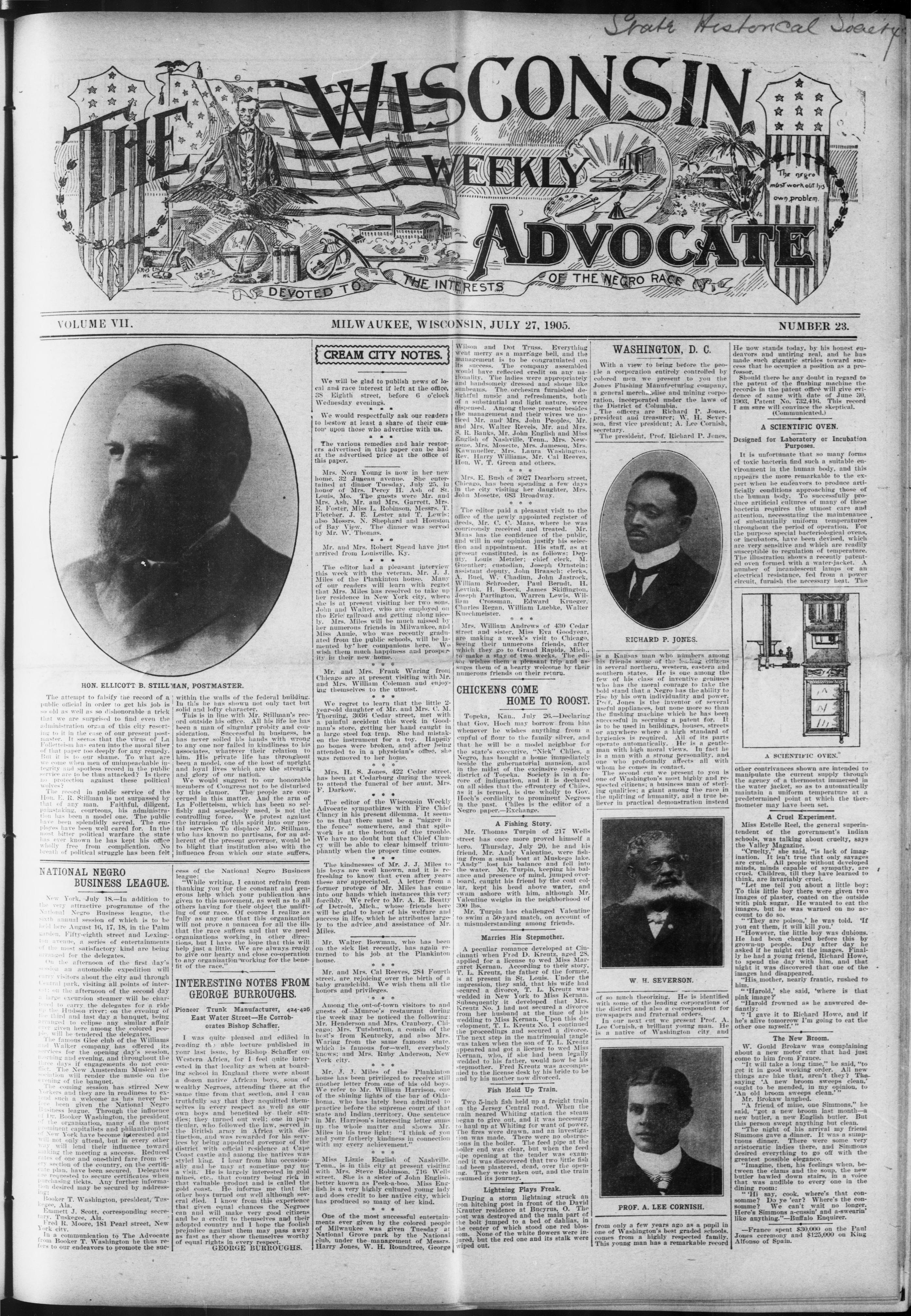


Page text (machine-generated)
WISCONSIN
WEEKLY
ADVOCATE
DEVOTED TO THE INTERESTS OF THE NEGRO RACE
VOLUME VII.
VOLUME
[Name not visible in the image]
HON. ELLICOTT B. STILLMAN, POSTMASTER.
The attempt to falsify the record of a public official in order to get his job is so old as well as so dishonorable a trick that we are surprised to find even the administration organ of this city resorting to it in the case of our present postmaster. It seems that the virus of La Folletteism has eaten into the moral fiber of that paper too deeply for any remedy. But it is to our shame. To what are we come when men of unimpeachable integrity and spotless record in the public service are to be thus attacked? Is there no protection against these political wolves?
within the walls of it. In this he has show solid and lofty charma. This is in line with ord outside his office been a man of singu sideration. Success has never soiled his to any one nor failed associates, whatever him. His private I been a model, one of and loyal lives whi and glory of our na. We would suggest members of Congress
The record in public service of the Hon. E. R. Stillman is not surpassed by that of any man. Faithful, diligent, painstaking, courteous, his administration has been a model one. The public have been splendidly served. The employees have been well cared for. In the most bitter political warfare the state has ever known he has kept his office wholly free from complication. No breath of political struggle has been felt
NATIONAL NEGRO BUSINESS LEAGUE
NATIONAL NEGRO BUSINESS LEAGUE
New York, July 18. In addition to the very attractive programme of the National Negro Business league, the sixth annual session of which is to be held here August 16, 17, 18, in the Palm garden. Fifty-eighth street and Lexington avenue, a series of entertainments of the most satisfactory kind are being arranged for the delegates.
On the afternoon of the first day's session an automobile expedition will carry visitors about the city and through Central park, visiting all points of interest; on the afternoon of the second day a large excursion steamer will be chartered to carry the delegates for a ride up the Hudson river; on the evening of the third and last day a banquet, being arranged to eclipse any similar affair ever given here among the colored people will be tendered the delegates. The famous Glee club of the Williams and Walker company has offered its services for the opening day's session, morning and evening, and throughout the three days if engagements do not conflict. The New Amsterdam Musical association will render the music on the evening of the banquet
The coming session has stirred New Yorkers and they are in readiness to extend such a welcome as has never before been given the National Negro Business league. Through the influence of Dr. Booker Washington, the president of the organization, many of the most prominent capitalists and philanthropists of New York have become interested and will not only attend, but in every other way will lend their influence toward making the meeting a success. Reduced rates of one and one-third fare from every section of the country, on the certificate plan, have been secured. Delegates are requested to secure certificates when purchasing tickets. Any further information desired may be secured by addressing:
Booker T. Washington, president, Tuskegee, Ala.
Emmett J. Scott, corresponding secretary. Tuskegee, Ala.
Fred R. Moore, 181 Pearl street, New York city. In a communication to The Advocate from Booker T. Washington he thus refers to our endeavors to promote the suc-
within the walls of the federal building. In this he has shown not only tact but solid and lofty character. This is in line with Mr. Stillman's record outside his office. All his life he has been a man of singular probity and consideration. Successful in business, he has never soiled his hands with wrong to any one nor failed in kindliness to his associates, whatever their relation to him. His private life has throughout been a model, one of the host of upright and loyal lives which are the strength and glory of our nation.
We would suggest to our honorable members of Congress not to be disturbed by this clamor. The people are concerned in this matter. And the arm of La Folletteism, which has been so selfishly and senselessly used, is not the controlling force. We protest against the intrusion of this spirit into our postal service. To displace Mr. Stillman, who has known no partisans, for an adherent of the present governor, would be to blight that institution also with the influence from which our state suffers.
cess of the National Negro Business league:
"While writing, I cannot refrain from thanking you for the constant and generous help which your publication has given to this movement, as well as to all others having for their object the unlifting of our race. Of course I realize as fully as any one that this organization will not prove a panacea for all the ills that the race suffers and that we need organizations working in other directions, but I have the hope that this will help just a little. We are always ready to give our hearty and close co-operation to any organization working for the benefit of the race."
INTERESTING NOTES FROM GEORGE BURROUGHS.
Pioneer Trunk Manufacturer, 424-426 East Water Street-He Corroborates Bishop Schaffer.
I was quite pleased and edified in reading the able lecture published in your last issue, by Bishop Schaffer on Western Africa, for I feel quite interested in that locality as when at boarding school in England there were about a dozen native African boys, sons of wealthy Negroes, attending there at the same time from that section, and I can truthfully say that they acquitted themselves in every respect as well as our own boys and benefited by their studies; they turned out well; one in particular, who followed the law, served in the British army in Africa with distinction, and was rewarded for his services by being appointed governor of the district with official residence at Cape Coast castle and among the natives was styled king. I hear from him occasionally and he may at sometime pay me a visit. He is largely interested in gold mines, etc., that country being rich in that valuable product and is called the gold coast. He informs me that the other boys turned out well although several died. I know from this experience that given equal chances the Negroes can and will make very good citizens and be a credit to themselves and their adopted country and I hope the foolish prejudice against them may pass away as fast as they show themselves worthy of equal rights in every respect.
GEORGE BURROUGHS.
MILWAUKEE, WISCONSIN, JULY 27, 1905.
CREAM CITY NOTES.
---
We will be glad to publish news of local and race interest if left at the office, 38 Eighth street, before 6 o'clock Wednesday evenings.
We would respectfully ask our readers to bestow at least a share of their custom upon those who advertise with us.
The various remedies and hair restorers advertised in this paper can be had at the advertised price at the office of this paper.
Mrs. Nora Young is now in her new home, 32 Juneau avenue. She entertained at dinner Tuesday, July 25, in honor of Mrs. Percy H. Ash of St. Louis, Mo. The guests were Mr. and Mrs. Ash, Mr. and Mrs. Garrett, Mrs. E. Foster, Miss L. Robinson, Messrs. T. Fletcher, J. E. Lester and T. Lewis; also Messrs. N. Shephard and Houston of Bay View. The dinner was served by Mr. W. Thomas.
Mr. and Mrs. Robert Suead have just arrived from Louisville, Ky.
The editor had a pleasant interview this week with the veteran. Mr. J. J. Miles of the Plankinton house. Many of our readers will learn with regret that Mrs. Miles has resolved to take up her residence in New York city, where she is at present visiting her two sons, John and Walter, who are employed on the Erie railroad and getting along nicely. Mrs. Miles will be much missed by her numerous friends in Milwaukee, and Miss Annie, who was recently graduated from the public schools, will be lamented by her companions here. We wish them much happiness and prosperity in their new home.
Mr. and Mrs. Frank Waring from Chicago are at present visiting with Mr. and Mrs. William Coleman and enjoying themselves to the utmost.
***
We regret to learn that the little 2-year-old daughter of Mr. and Mrs. C. M. Thorning, 3036 Cedar street, met with a painful accident this week in Goodman's store, getting her hand caught in a large steel fox trap. She had mistaken the instrument for a toy. Happily no bones were broken, and after being attended to in a physician's office, she was removed to her home.
***
Mrs. H. S. Jones, 422 Cedar street, has been at Cedarburg during the week to attend the funeral of her aunt, Mrs. F. Darkow.
---
The editor of the Wisconsin Weekly Advocate sympathizes with Fire Chief Clancy in his present dilemma. It seems to us that there must be a "nigger in the fence" somewhere, and that spitework is at the bottom of the trouble. We have no doubt but that Chief Clancy will be able to clear himself triumphantly when the proper time comes.
```markdown
```
The kindnesses of Mr. J. J. Miles to his boys are well known, and it is refreshing to know that even after years these are appreciated. A letter from a former protege of Mr. Miles has come into our hands which instances this very forcibly. We refer to Mr. A. E. Beatty of Detroit, Mich., whose friends here will be glad to hear of his welfare and success in life, which he attributes largely to the advice and assistance of Mr. Miles.
Mr. Walter Bowman, who has been on the sick list recently, has again returned to his job at the Plankinton house.
***
Mr. and Mrs. Cal Reeves, 284 Fourth street, are rejoicing over the birth of a baby grandchild. We wish them all the honors and privileges.
* * *
Among the out-of-town visitors to and guests of Munroe's restaurant during the week may be noticed the following: Mr. Henderson and Mrs. Cranbory, Chicago; Mrs. Tutsbbutton, a cousin of the host's from Kentucky, and also Mrs. Waring from the same famous state, which is famous for—well, everybody knows; and Mrs. Ruby Anderson, New York city.
Mr. J. J. Miles of the Plankinton house has been privileged to receive still another letter from one of his old boys. We refer to Mr. William Harrison, one of the shining lights of the bar of Oklahoma, who has lately been admitted to practice before the supreme court of that state and Indian territory. One sentence in Mr. Harrison's interesting letter sums up the whole matter and shows Mr. Miles in his true light: "I think of you and your fatherly kindness in connection with my every achievement."
* * *
Miss Lizzie English of Nashville. Tenn., is in this city at present visiting with Mrs. Steve Robinson. 716 Wells street. She is a sister of John English. better known as Peek-a-boo. Miss English is a very highly cultured young lady and does credit to her native city, which has produced so many of her kind.
* * *
One of the most successful entertainments ever given by the colored people of Milwaukee was given Tuesday at National Grove park by the National club, under the management of Messrs. Harry Jones. W. H. Roundtree. George
Wilson and Dot Truss. Everything went merry as a marriage bell, and the management is to be congratulated on its success. The company assembled would have reflected credit on any nationality. The ladies were appropriately and handsomely dressed and shone like sunbeams. The orchestra furnished delightful music and refreshments, both of a substantial and light nature, were dispensed. Among those present besides the management and their wives we noticed Mr. and Mrs. John Peoples, Mr. and Mrs. Walter Revels, Mr. and Mrs. S. R. Banks, Mr. John English and Miss English of Nashville, Tenn., Mrs. Newsome, Mrs. Mosette, Mrs. Jameson, Mrs. Kawmueller, Mrs. Laura Washington, Rev. Harry Williams, Mr. Cal Reeves, Hon. W. T. Green and others.
☆ ☆ ☆
Mrs. E. Bush of 3027 Dearborn street, Chicago, has been spending a few days in the city visiting her daughter, Mrs. John Mosette, 683 Broadway.
***
The editor paid a pleasant visit to the office of the newly appointed register of deeds, Mr. C. C. Maas, where he was courteously received and treated. Mr. Maas has the confidence of the public, and will in our opinion justify his selection and appointment. His staff, as at present constituted, is as follows: Deputy, Louis Metzler; chief clerk, M. Guenther; custodian, Joseph Ornstein; assistant deputy, John Braasch; clerks, A. Buei, W. Chadiun, John Jastrock, William Schroeder, Paul Berndt, H. Levtink, H. Boeck, James Skiflington, Joseph Partington, Warren Lewis, William Crossman, Edward Krueger, Charles Regan, William Luebke, Walter Kuechmeister.
赤 赤 赤
Mrs. William Andrews of 430 Cedar street and sister, Miss Eva Goodyear, are making a week's visit to Chicago, seeing their numerous friends, after which they go to Grand Rapids, Mich., to make a stay of two weeks. The editor wishes them a pleasant trip and assures them of a hearty welcome by their numerous friends on their return.
CHICKENS COME HOME TO ROOST.
Topeka, Kan., July 26.—Declaring that Gov. Hoch may borrow from him whenever he wishes anything from a cupful of flour to the family silver, and that he will be a model neighbor for the state's executive, "Nick" Chiles, a Negro, has bought a home immediately beside the gubernatorial mansion, and in the milest of the exclusive residence district of Topeka. Society is in a furore of indignation, and it is declared on all sides that the effrontery of Chiles, as it is termed, is due wholly to Gov. Hoch's cordiality to prominent Negroes in the past. Chiles is the editor of a Negro paper.—Exchange.
A Fishing Story.
Mr. Thomas Turpin of 217 Wells street has once more proved himself a hero. Thursday, July 20, he and his friend, Mr. Andy Valentine, were fishing from a small boat at Muskego lake. "Andy" lost his balance and fell into the water. Mr. Turpin, keeping his balance and presence of mind, jumped overboard, caught his friend by the coat collar, kept his head above water, and swam ashore with him, although Mr. Valentine weighs in the neighborhood of 300 lbs. Mr. Turpin has challenged Valentine to swim a 50-yard match, on account of a misunderstanding among friends.
Marries His Stepmother.
A peculiar romance developed at Cincinnati when Fred D. Kreutz, aged 28, applied for a license to wed Miss Margaret Kernan. According to their story, T. L. Kreutz, the father of the former, is at present in St. Louis. Under the impression, they said, that his wife had secured a divorce, T. L. Kreutz was wedded in New York to Miss Kernan. Subsequently it developed that Mrs. Kreutz No. 1 had not secured a divorce from her husband at the time of his wedding to Miss Kernan. Upon this development, T. L. Kreutz No. 1 continued the proceedings and secured a divorce. The next step in the matrimonial tangle was taken when the son of T. L. Kreutz appeared and got a license to wed Miss Kernan, who, if she had been legally wedded to his father, would now be his stepmother. Fred Kreutz was accompanied to the license desk by his bride to be and by his mother now divorced.
Fish Hold Up Train.
Two 5-inch fish held up a freight train on the Jersey Central road. When the train neared Whiting station the steam began to give out, and it was necessary to haul up at Whiting for want of power. The fires were drawn, and an investigation was made. There were no obstructions in the boiler. The feed pipe at the boiler end was clear, but when the feed pipe opening at the tender was examined it was discovered that two little fish had been plastered, dead, over the opening. They were taken out, and the train resumed its journey.
Lightning Plays Freak.
During a storm lightning struck an iron hitching post in front of the David Krauter residence at Bucyrus, O. The post was destroyed and the main part of the bolt jumped to a bed of dahlias, in the center of which stood one red blossom. None of the white flowers were injured, but the red one and its stalk were wiped out.
WASHINGTON, D. C.
With a view to bring before the people a corporation entirely controlled by colored men we present to you the Jones Flushing Manufacturing company, a general merchandise and mining corporation, incorporated under the laws of the District of Columbia. The officers are Richard P. Jones president and treasurer; W. H. Severson, first vice president; A. Lee Cornish, secretary. The president, Prof. Richard P. Jones,
[Name not visible]
RICHARD P. JONES
is a Kansas man who numbers among his friends some of the leading citizens in several northern, western, eastern and southern states. He is one among the few of his class of inventive geniuses who has the moral courage to take the bold stand that a Negro has the ability to rise by his own individuality and power. Pref. Jones is the inventor of several useful appliances, but none more so than the flushing machine which he has been successful in recruiting a patent for. It is to be used in buildings, houses, streets or anywhere where a high standard of hygienics is required. All of its parts operate automatically. He is a gentleman with high moral views. In fact he is a man with a strong personality, and one who profoundly affects all with whom he comes in contact.
The second cut we present to you is one of Washington's most highly and respected citizens; a business man of sterling qualities; a giant among the race in the uplifting of humanity, and a true believer in practical demonstration instead
[Name not visible]
of so much theorizing. He is identified with some of the leading corporations of the district and also a correspondent for newspapers and fraternal orders. In our next cut we present Prof. A. Lee Cornish, a brilliant young man. He is a native of Washington city and
J. B.
PROF. A. LEE CORNISH.
from only a few years ago as a pupil in one of Washington's best graded schools. comes from a highly respected family. This young man has a remarkable record
He now stands today, by his honest endeavors and untiring zeal, and he has made such gigantic strides toward success that he occupies a position as a professor. Should there be any doubt in regard to the patent of the flushing machine the records in the patent office will give evidence of same with date of June 30, 1903. Patent No. 732.416. This record I am sure will convince the skeptical.
A SCIENTIFIC OVEN.
Designed for Laboratory or Incubation Purposes
It is unfortunate that so many forms of toxic bacteria find such a suitable environment in the human body, and this appears the more remarkable to the expert when he endeavors to produce artificially conditions approaching those of the human body. To successfully produce artificial cultures of many of these bacteria requires the utmost care and attention, necessitating the maintenance of substantially uniform temperatures throughout the period of operation. For the purpose special bacteriological ovens, or incubators, have been devised, which are very sensitive and which are readily susceptible to regulation of temperature. The illustration shows a recently patented oven formed with a water-jacket. A number of incandescent lamps or an electrical resistance, fed from a power circuit, furnish the necessary heat. The
A
other contrivances shown are intended to manipulate the current supply through the agency of a thermostat immersed in the water jacket, so as to automatically maintain a uniform temperature at a predetermined point at which the thermometer may have been set.
A. Cruel Experiment
Miss Estelle Reel, the general superintendent of the government's Indian schools, was talking about cruelty, says the Valley Magazine.
"Cruelty." she said, "is lack of imagination. It isn't true that only savages are cruel. All people without developed minds, minds capable of sympathy, are cruel. Children, till they have learned to think, are invariably cruel.
"Let me tell you about a little boy: To this little boy there were given two images of plaster, coated on the outside with pink sugar. He wanted to eat the images, but he was warned on no account to do so.
"They are poison,' he was told. 'If you eat them, it will kill you.'
"However, the little boy was dubious. He had been cheated before this by grown-up people. Day after day he asked if he might eat the images. Finally he had a young friend, Richard Howe, to spend the day with him, and that night it was discovered that one of the images had disappeared.
"His mother, nearly frantic, rushed to him.
"Harold,' she said, 'where is that pink image?'
"Harold frowned as he answered defiantly:
"I gave it to Richard Howe, and if he's alive tomorrow I'm going to eat the other one myself."
The New Broom.
W. Gould Brokaw was complaining about a new motor car that had just come to him from France.
"It will take a long time," he said, "to get it in good working order. All new things are like that, aren't they? The saying 'A new broom sweeps clean,' ought to be mended, in my opinion, to 'An old broom sweeps clean.'"
Mr. Brokaw laughed.
"A friend of mine, one Simmons," he said, "got a new broom last month—a new butler, a new English butler. But this person swept anything but clean.
"The night of his arrival my friend Simmons gave a dinner. It was a sumptuous dinner. There were some very aristocratic ladies there, and Simmons desired everything to go off with the greatest possible elegance.
"I imagine, then, his feelings when, between the clams and the soup, the new butler bawled down stairs, in a voice that was audible to every one in the dining room:
"Hi say, cook, where's that consomme? Do ye 'ear? Where's the consomme? We can't wait no longer. Here's Simmons a-cussin' and a-swearin' like anything."—Buffalo Enquirer.
—France spent $30,000 on the Paul Jones ceremony and $125,000 on King Alfonso of Spain.
-Plush car seats have been banished from Kentucky as collectors of disease germs.
-A French landowner is forced by law to divide his estate equally between his children.
-The death rate in infancy among the poor in England is six times higher than among the rich.
-The first tramway in Great Britain was laid at Birkenhead by George Francis Train in 1860.
-Insanity is on the increase in New York, according to the report of the state lunacy commission.
-Under the new California marriage certificate law the couple must swear they are not insane.
—An estimate of the accumulated capital of the United Kingdom puts it at about $60,000,000,000.
—Official figures show that only twenty persons in Great Britain have incomes exceeding $250,000 a year.
—Torquay, England, has adopted a bylaw to prohibit people from using bad language even in their own houses.
—The water reservoir at Manchester, England, is sinking, presumably on account of coal mining nearly under it.
—The laws of the state of New York prohibit the issue of licenses for the sale of liquor within 200 feet of a church.
—A Liverpbol man spends some hundreds of pounds every year in having Scriptural texts printed on business envelopes.
The most out-of-the-way village in England is said to be Farley-cum-Pitten, over twenty miles from the nearest railway station.
A couple were recently married at St. Peter's church, Dorchester, whose respective names were Charles Rose and Rose Charles.
During the last twelve months, $100,000 has been collected in the United Kingdom for the purpose of reviving the Irish language.
A concrete chimney completed recently for a Tacoma smelter is 307 feet in height and is said to be the highest in the world of its kind.
The old home of Andrew Carnegie, 3 West Fifty-first street, New York city, is being demolished. A new dwelling is to be erected on the site.
- In Germany the number of servant girls who have savings bank accounts is nearly three times as large as that of shop girls who have them.
- The authorities of Nordhadsen, Saxony, have forbidden the use of the streets to any person wearing an article of dress that sweeps the pavement.
- A regatta was rowed on the Zambesi the other day to mark the jubilee of Dr. Livingstone's discovery of the Victoria Falls. There were 700 visitors.
- In Manchuria, Siberia and North China much use is made of Chinese brick tea, not as a beverage, but as a vegetable, boiled with rice and mutton.
- An official map of Paris on a large scale has just been finished. It is 25 yards long and nearly 20 yards wide, and on it every building in Paris—88,500—is recognizable.
Japan's war department is economical. The worn-out socks, stockings and other hosiery used by the troops in Manchuria are being sent back to Japan to be remade into knitting work.
A woman's conference lately in session at Bathurst, New South Wales, passed a resolution that all girls between the ages of 15 and 18 should receive instruction in the use of firearms.
It is roughly estimated that the Chicago strike cost the interests affected nearly $2,500,000 in one week in the interruption and shrinkage of business and extraordinary expenses and losses.
A traveler in the upper Tangste provinces of China found recently in the town of Hinganfu many Chinese Mohammedans who keep up communication with their fellow religionists of Arabia.
—Absolutely fireproof scenery is being introduced in a number of French theaters. Instead of wooden frames with canvas stretched on, them galvanized iron frames fitted with wire gauze are used.
—There is a whistle at St. Louis which is the loudest in the world. It is as big as a full-sized man, and belongs to a railway company, its main use being as a time-regulator. It sounds four times a day.
—In Sheffield and some other northern English cities whenever a child is lost the relatives chalk an announcement on the sidewalk describing the wanderer and giving the name and address of its relatives.
- In Turkey there are two preliminary conditions stringently required in the case of marriage—both parties must be able to walk properly and both must be able to understand the necessary religious service.
- Farmers can borrow money from the government in Norway at 3 per cent, interest, and still the Norse rush to other lands. The reason is that the collateral on which to borrow is rather difficult to get in Norway.
- Preserved in the cathedral of Bangor, Wales, is a pair of old "dog tongs," which were used for ejecting quarrelsome dogs from church during service. A similar pair is preserved at Llaynynyns, Wales, and bears numerous teeth marks.
The only equine survivor of the battle of Colenso, a battery horse, is about to be sent from South Africa to England, where his owner will see that he passes the rest of his days in peace and comfort. He received ten wounds in the battle.
A new scheme has just been devised in California for amending the Chinese exclusion act. It proposes to permit Chinese laborers to come to this country but forbids them going to the cities, and to permit them to remain only from three to four years.
—"What do you think of feeding horses on goose eggs?" asks an Australian backwoodsman. "That was done by a party who were stuck up on the Adelaide during the wet season. The natives used to bring in canoe loads of eggs, which were broken into buckets and supplied to the horses."
New Tool Steel.
A new tool steel has been placed on the market by a firm of Sheffield makers. Among its advantages it is stated that for hardening the steel only requires to be heated to a bright red and allowed to cool in the air, when it is ready for use. It can be annealed, according to the makers, simply by heating the tool to a cherry red, and then plunging into water. It then becomes quite soft. In a test with twist drills this steel drilled 49 holes in steel of 0.49 per cent. carbon each 1.53 inches diameter and 178 inches deep, at an average speed of 25 seconds each, and after the test was still in good condition.
In "Light Distress."
An old lady and her two daughters went into a millinery store, says the Charlotte (N. C.) Observer. The young women wore mourning hats. The elder woman said to the clerk:
"I want a mourning hat, for I am in mourning. But my darter here," pointing to one of her companions, "is a widow of two years' standing, and she is in light distress. Give her a hat with blue feathers on it."
AN ANGLER'5 WISH.
When tulips bloom in Union Square,
And timid breaths of vernal air
Go wandering down the dusty town,
Like children lost in Vanity Fair;
When every long, unlovely row
Of westward houses stands aglow.
And leads the eyes towards sunset skies
Beyond the hills where green trees grow;
Then weary seems the street parade,
And weary books, and weary trade;
I'm only wishing to go a-fishing—
For this the month of May was made.
I guess the pussy-willows now
Are creeping out on every bough
Along the brook; and robins look
For early worms behind the plough.
The thistle-birds have changed their dun,
For yellow coats to match the sun;
And in the same array of flame
The Dandelion Show's begun.
The flocks of young anemones
Are dancing round the budding trees;
Who can help wishing to go a-fishing
In days as full of joy as these?
HOW THEY ESCAPED BECOMING MILLIONAIRES PASSING COMMENTS
BY LIEUT.-COL.J. A. WATROUS, U. S. A. Amos Elliot of Washburn spent several days in Milwaukee last week. Mr. Elliot is an old time Wisconsin lumberman. He began his career in that industry on Black river at about the time the state was admitted to the union, in 1848, and he remained a resident of Black River Falls until two years ago. Though 82 years of age he looks like a man of 55. He remembers and talks interestingly of the lumbermen on Black river in the old days as well as in later years.
In speaking of the old days he said: "If ex-Congressman Bill Price, Dudley Spaulding and Leander Merrill of Black River Falls, G. C. Hixon, Charles Coleman, John Paul and others of La Crosse, James O'Neill, John Ross, Daniel Gates and Len Stafford of Neillsville had possessed even a moderate sum of money which he could spare when we first reached the Black river country, and had invested it in pine lands on the banks of that river, every last man of us would have been obliged to fight in order to escape becoming not only millionaires but multi-millionaires.
"There were billions upon billions of feet of the finest pine timber along Black river at that time that the world ever saw. Some of the men I have mentioned made a good deal of money by puchasing pine land and pine logs, including Judge Price, Hixon, the Westons, Merrill, Gates, Ross and Stafford, but it was nothing compared with what all of them might have made had circumstances been different and had we been wise enough to look ahead. Some of the later comers, including the late Gen. C. C. Washburn of La Crosse, were wise enough to look ahead and invested all the money they could rake and scrape in pine lands on Black river and its tributaries, and it is those lands that made Gov. Washburn a millionaire very soon after the Civil war.
"Most of my old Black river lumber friends have passed away. Judge Price died in 1886, after a wonderfully active and useful life. He served in both branches of our state Legislature and was three times elected to Congress. His son Hugh succeeded him in Congress. He, too, is dead. Hixon died in La Crosse some years ago, a man of large wealth, president of a bank, respected by all classes. Sheppard, Brockaway, Merrill, Gates and Ross crossed the river long ago. Andrew Sheppard, or "Old Shep," as nearly everybody on the river called him, was a famous character. At one time he was worth a good deal of money, but he enjoyed drinking and when under the influence nothing pleased him so well as to scatter funds broadcast. A day of reckoning came. Old Shep became a poor man and he died poor, but the last ten or fifteen years of his life he was one of the most upright, manly Christians in the community.
"At one time it was said that Leander Merrill was worth a million or more, but his million was like ...at of a great many accredited millionaires; it fell short when it was counted. Merrill got ambitious politically. While a Republican he persisted in running independent against a Republican candidate for the Assembly for Jackson and Clark counties and defeated him. The defeated candidate was editor of the local paper in Jackson county. The editor's partner was nominated the next year and Mr. Merrill guessed he would have to give another editor a chance to stay at home and attend to his business, and he ran independent again. The partner had but recently come out of the army and didn't know much about political affairs, but his friends did, and thy snowed Mr. Merrill under. He never seemed quite the same man after that.
"Len Stafford was a hustling, bustling business man and had a host of friends. Some of the other Black river lumbermen enjoyed telling Stafford that it was not himself and his great abilities that made him popular, but his large family of handsome daughters. One of Stafford's daughters married Fred D. Underwood, a long time conductor on the St. Paul and later general manager of the Sioux, then of the Baltimore & Ohio, and now president of the New York & Erie railroad, drawing a salary of $60,000 a year.
"Dudley Spaulding of Black River Falls worked hard enough to become a very rich man. I guess he divided his forces too much. He had a large farm, one or two sawmills, a grist mill, a planning mill, was an extensive logger, kept two or three stores, and for a time had an interest in a newspaper. He was an everlasting worker and one of the best natured men I ever knew. He was, as long as I can remember, a leading member of the Methodist church. He was brother-in-law to Judge Price. Price was not a church member, but he was always a firm supported of churches.
"There was a time, soon after we reached Black river, when nearly all of us could take a ration of whisky without making a face. Price was of the number. Away back fifty years ago the judge made a trip to La Crosse. He went on horseback. While there it occurred to him that he didn't need any more strong drink and he mounted his horse and rode home. He never touched another drop. More than that. He became one of the most active and common-sense advocates of and workers for practical temperance that I ever met. No one ever questioned the honesty of Mr. Price in his temperance efforts. He exerted a wide influence. Nearly all of the lumbermen on that river, not to mention thousands of men employed by them, became total ab-
stainers as the result of Price's example and earnest work. "I could go on and tell you a whole lot more about the lumbermen, only a few of whom I have mentioned, but I have an engagement. I will be in Milwaukee ten years from now and tell you more about them. Good-day!"—Evening Wisconsin.
MONKEYS AS SERVANTS.
Instances in Which They Are Said to Have Been Valuable Assistants.
The cleverness and imitative faculty of the monkey have been utilized by mankind in many ways during late years, and today this hairy animal acts as clerk, servant, laborer and tea packer in various parts of the world. A female chimpanzee once went out to service at Loango, and made the beds, swept the house and assisted in the kitchen, peeling the potatoes and turning the spit.
These feats are equaled, if not surpassed, by a young monkey, the property of a sailor on one of Britain's ironclads. This animal can turn the capstan and furl the sails as well as any one. He also assists the cook in preparing dinner and is adept at boiling eggs. Luckily the culinary arrangements on board a ship are not quite as exacting as those in a London hotel, or the monkey assistant might find himself in somewhat of a quandary. Chinese monkeys for years past have assisted the natives in tea packing. Their labor is cheap, for they are more than contented with payment in the shape of sundry luscious morsels.
During the rush to the gold fields of Yukon an enterprising miner carried five Chinese monkeys to help him in gold washing. The monkeys had been used to severe cold and the extremes of a rigorous climate, and the gold searcher found his animal workmen most useful. Some years ago a number of British engineers employed monkeys to assist the workmen in carrying material to a railway extension in Cape Colony. It appears that a score of monkeys came regularly every morning to the line to watch the laborers at work, and the engineers in charge, rightly believing that the imitative faculties of the creatures would render them useful in railway work, had them captured. They were immediately put in training, and soon proved themselves invaluable as carriers.
In Siam apes are now employed as cashiers. A year or two ago much base coin was circulated by a clique of coiners, and the tradesmen found that it was a very difficult matter to discriminate between good and bad money.
One large store kept a pet monkey, and one morning he was seen to take a coin from the cashier's desk and put it between his teeth. After biting it for some moments he threw it on the floor with a solemn grimace of dissatisfaction. The proprietor of the store then handed the monkey another coin, and after testing it with great deliberation he laid it on the cashier's desk. Apparently the creature could tell a counterfeit coin from a good one, and in order to ascertain whether other monkeys had the same extraordinary gift, a couple of apes belonging to a zoo were given the test, with satisfactory results.
From that day the majority of the business houses in Siam have kept monkeys as cashiers, and the gifted creatures have developed the faculty of discrimination between good and bad coin to such perfection that no human being can compare with them.—London Answers.
SEAL ON THE GAS METER
Will Reveal Any Attempts to Tamper with Its Adjustment.
The temptation to endeavor to beat the gas meter appears to be an innate instinct in mankind, and while manipulations of this character are perhaps infrequent, a demand exists for a device to indicate any tampering with the gas meter. One very simple contrivance for
A
this purpose consists of a pair of projectors in the shape of spanners which are adjusted to the coupling nuts on the inlet and outlet pipes of the meter. These coupling arms are joined together upon adjustment by a leaded or other seal, which indicates at once whether or not the nuts on the inlet and outlet pipes have been surreptitiously handled. By this arrangement it is possible to detect any such attempt. If the gas company's representative should find it necessary to make any adjustment, the arms can be resealed with the official designating mark.
Mixed Bathing Prohibited.
Because Edwin Clapp, the Yale hurdler, masqueraded in the clothing of one of the pretty co-eds of the Yale summer school, while the owner was swimming in the gymnasium pool, the faculty has decided to abolish "mixed bathing." Clapp is a member of the summer school faculty. He was in swimming when one of the women bathers dared him to don her clothes. Clapp promptly accepted the challenge and, marching into the gymnasium director's office, impersonated a woman so well that he fooled the director. Then he went to an ice cream saloon, where he was arrested by a policeman who saw a pair of trousers below the skirt. Since then some of the students, incited by their instructor's example, have "ducked" several of the pretty co-eds, leading to much unpleasantness.
River of Wine Dscovered.
More than 100 barrels of wine were emptied into the Schuylkill at Norristown, Pa., and already fish stories of the wildest description are being told by the anglers from down the river. According to "Billy" Collins and "Gummy" Wilson, even the German carp have gone wrong and are standing on their heads in the mud. The costly flooding of the river resulted from the sale of the real estate of a wine company to Ellwood Roberts, a devout Quaker. He found in a warehouse treasures of a rare vintage and, true to his creed, had them turned into the river.
India is the oldest cotton-producing country in the world.
THE JOKER'S FATE.
It was a sad-eyed humorist,
Who sate him down to coax
From out his brain a funny twist
Or two to tickle folks—
In short, to write some jokes.
The day was very warm—"Gee whiz!"
Said he, "What shall I do?
I'll roast the fiend who asks you, is
It hot enough for you?
I wonder if that's new?"
He sighed and took another sheet
Of paper, and he wrote
About the man you often meet,
Who always rocks the boat,
("Twas old enough to vote!).
He wrote about old shoes and rice
And Mrs. Youngbride's breaks.
About the man who brings the ice
In microscopic cakes.
And green fruit stomachaches!
And people came and slew him there,
Whose jokes had made them ill,
And buried him with tender care
And gladly paid the bill.
(He lies at Chestnut hill!)
—Cleveland Leader.
Harold Weekes, the one time famous football player of Columbia college, has become a member of the New York stock exchange. The price paid for his seat was $80,000.
E. H. Sothern sailed on the Cedric. He goes abroad to secure special costumes for the Shakespearean productions in which he and Julia Marlowe will appear next season.
James G. Phelps Stokes, the millionaire New York settlement worker, who was wedded to Rose Harriet Pastor, the east side girl, whom he met in the course of his work in the tenement district, sailed for Europe on the steamship Cedric, accompanied by his wife. Mr. and Mrs. Stokes will remain abroad several months. They will tour Europe in an automobile.
Police Commissioner McAdoo announced that he had decided to send Acting Inspector Stephen O'Brien, the present head of the detective bureau, to Europe to study traffic conditions and to look into the social evils and make a report. O'Brien will also look into the matter of recording and identifying criminals and the regulation by law of certain vices."
Dr. Edward Park, the physician arrested in Norway as he disembarked from a steamer from America and there charged with the theft of about $25,000 worth of jewels which disappeared from the residence of J. J. Higginson of New York has been cleared of all suspicion in connection with the theft. Park was a tutor in the Higginson household when the jewels disappeared.
An appeal to the bakers' unions in America to assist in the establishment of municipal bakeshops in all cities of the United States, Canada and Mexico has been prepared by the Journeymen Bakers' and Confectioners' International union. It calls attention to the possible good that may result from state or municipal control of various public utilities and declares the food product industry is among the most important on the list.
一
Embedded in the center of a piece of Beaver county sandstone taken from the wall of the Allegheny county jail at Pittsburg, Pa., was found a cannon ball of much the same appearance as the projectiles used in the Revolutionary war. Contractors and others who have seen the stone are at a loss to know how the cannon ball got there, and it will be sent to the Carnegie museum for geologists to study. The stone is about 12 inches long and 5 inches in diameter.
A pile of gold worth nearly $5,000,000 is stored in the vaults of the United States mint at Philadelphia, Pa. The bullion was brought from Seattle on four express cars. Each car was guarded on its long journey by detectives with loaded rifles ever by their sides. So secretly was the precious metal transported that no one except employees of the express companies knew of its transfer. Curious persons who asked questions were told by the guards that the cargo consisted of "fast horses."
A judgment for $65,279 was obtained by default against Frederick Gebhard in favor of Mary Isabelle Neilson. The sum was due on a demand note made by Gebhard for $65,000, payable to the plaintiff on demand at the Corn Exchange bank. Mr. Gebhard was served with a summons in the suit on June 20. On May 28 a judgment for $11,960 was entered against Gebhard in favor of Black, Starr & Frost, jewelers, for jewelry. Mrs. Frederick Neilson of 100 Fifth avenue, New York city, is Mr. Gebhard's sister. She calls herself Belle Neilson.
William A. Brady announces that he has arranged with Mrs. Humphry Ward for the American dramatic rights of the "Marriage of William Ashe." The heroine of the novel, Kitty Ashe, will be played by Grace George. Miss George will open her season in New York city early in October, however, presenting a new play by a young American author, who has never had a hearing up to this time. The "Marriage of William Ashe" will be produced about Christmas, and an occasional performance of "Abigail" will be given from time to time during the season.
Gustave A. Schurman, one of the youngest men to enlist in the northern army at the beginning of the Civil war, drummer boy and bugler for Gens. Birney, Stoneman and Sickles, and friend and playmate for months at the white house of little "Tad" Lincoln, died at the home of his daughter in New York city. He was a bootblack, only 11 years old, when the war began. The lad's father prevailed upon Col. Riley of the Fortieth New York to take him to the front. At Belle Plain the youngster met "Tad" Lincoln, who had accompanied the President and his mother on a visit to the army. The boys engaged in a horse race and became much attached to each other, with the result that an order was issued attaching the bugler to the President's household.
In saving the lives of an unknown woman and her baby, William J. McDonald, flagman for the Long Island railroad, died a martyr at his post in Long Island City. McDonald obtained the job only a week ago. His widow and four children are left destitute. Hundreds of toilers in nearby factories used the crossing where McDonald was stationed. He was to have been relieved in fifteen minutes when he saw a woman with her baby in arms walk upon the track directly in front of an incoming train. The flagman sprang to her side just in time to drag her from the tracks. As he turned back a train on the opposite track crushed his life out. The woman witnessed his fate and ran screaming from the scene. More than fifty persons have been killed on the same crossing in the past three years.
Among the passengers from the Philadelphia, from Southampton, landing at
Ellis island, New York, recently, was a rosy-cheeked English girl, clinging affectionately to the arm of a negro whom she claimed as her husband. In support of her statement, the pretty English girl exhibited a framed marriage certificate which shows that Henry Francis Smith, 35 years old, and Beatrice Amelia Philips, 21 years old, were married, by special license on July 6 by A. J. Cheverton, registrar, at Southampton, England. The negro who had plenty of money, said in answer to questions that he was a native of St. Mary's county, Maryland, where, he says, he owns a farm of about twenty acres. He recently went over to Liverpool on a visit, where he met the Philips girl, and they eloped to Southampton. As the laws of Maryland will not permit a negro to have a white wife they will settle in Philadelphia.
Not so very many years ago there was a popular song in which the refrain ran something like this: "Oh, the Bowery, the Bowery; they do such things and they say such things on the Bowery." While the vogue of the song was at its height the business men in the Bowery made a solemn protest that the song was an anachronism and an outrage. Even then the Bowery of the old days, the Bowery of Owney Geoghegan's and the Sultan's divan and the Gotham, was as dead as the ancient bowie and its umbrageous joys of the Eighteenth and early Nineteenth centuries. Today the Bowery is merely a right of way for the elevated and surface cars. So all things pass. Time will come when the Bowery will be as dead at midnight as Broadway already is. And there will be old timers then to shake their heads and mourn for the good old days and the good old ways. There are plenty such now, and they are bemoaning the falling away of the old Bowery as if it were a distinct loss to life in the city.
The latest French invasion of New York city takes the shape of a genuine brasserie, as Parisian saloons are called. It is on Eighth avenue, a few blocks above Twenty-third street, and it has a large trade among lovers of French drinks and French food. Not all of its customers are Frenchmen, by any means, and it is safe to prophesy that when its existence becomes more extensively known it will have a large clientele among men and women who have learned in Paris to like the characteristic little marble topped tables and the wall seats. The real novelty of the place, however, is its saloon bar and French bartender. The decorations are attractive and French to the last word, and ranged in a gallery that tops the cabaret are a number of boxes where one may eat in comparative seclusion and enjoy the music. One of the features of the brasserie is the chef. He is an old man, characteristically French, with his gray waxed mustache and imperial. He possesses to a degree the art of cooking in French style.
Among the popular New York hotels which have fitted up gardens in the air are the Majestic, the Hoffman, the Belleclaire, the Waldorf-Astoria and the New Hotel Astor. At the last-named hostelry the roof-garden idea has been carried to its highest development. Here, far up above the traffic and bustle of Broadway, has been reproduced on a gigantic scale a garden of the style for which the vine-clad hills of Tuscany are famous. It covers the area of sixty-five city lots. Nearly 300 truckloads of flowers and plants were used in beautifying the place, while a continuous pergola extends the entire length, and over the trellis work of this promenade ivy and moondlower vines soften the brilliancy of the electric lights. Experienced landscape gardeners and scenic artists were employed to lay out this fairyland in the air. A wealth of exotics, tropical plants and palms have been woven into the picture. The murmur of electrically illuminated fountains and cascades mingles with the music of Italian troubadours, and over it all thousands of electric lights outshine the stars and turn night into day.
Edwin R. Embree and Joseph W. Murphy, the Yale men who left Brooklyn for a two months' tramp, have gone to work on John Jacob Astor's estate at Rhyebeck as laborers for $1.50 a day. The students were "broke" when they reached Kingston and were compelled to find employment. Their first night out of New York city the boys slept under trees on the grass without any covering. The next day they were so lame they could hardly walk. Since then they have slept in barns and farmhouses, wherever a farmer would give them shelter. They went swimming in the Hudson. The swell from a passing steamer washed their clothing into the river, but they recovered everything except one of Embree's shoes. He was compelled to ride on a trolley car to the nearest town and to work for two days to earn enough money to pay for a new pair. At Mr. Astor's farm no distinction is made between the farm hands, and the students are compelled to eat and sleep with the other workmen. They will work a week and then, if they have sufficient funds, will continue their tramp into the heart of the Adirondacks.
The most picturesque bit of foreign color seen for a long time on a New York street is a couple of kvass sellers who do a thriving business at Rivington and Allen streets. They were Roumanian Jews, dressed in Turkish fez and gay zonave trousers. The kvass was contained in a tank of glistening hammered brass four feet high, strapped to the back of the smaller man. A long spout curved over his shoulder, chased in rude designs, was hung about with Turkish coins. The kvass seller would shout this refrain:
"Trink a leetle von der guter kvass. Verth a neekel a glass."
The Roumanian Jews, remembering the beverage of their native land, stepped up immediately and paid their pennies. The kvass bearer bent forward, deftly pouring the brown sugary, lemonady liquid into a glass which the seller took from a brass rack strapped around his waist. The seller washed the glasses with water decanted from a tall, slender ewer of dull brass he carried in his hand. The average man might not care to drink the kvass, but what would he not give for the tank, glass rack and ewer, all of gleaming, beautiful hammered brass and copper!
Woman Finds Buried Jewels
Calvin O. Sanders, who undertook to find a wife by burying three caskets of jewelry in the sand on the beach in South Haven. Mich., has succeeded, in part at least. In the crowd which visited South Haven one Sunday were about 300 employees of a Chicago store, and upon learning of the buried treasures the crowds flocked to the beach and began the search. Miss Lidia Crowe, who is manager of the linen department in the store, was the finder. The box contained the lucky ring, a beautiful diamond, the finder of which Sanders says he will marry. The ring was inclosed in an envelope, upon which were written the words, "To the future Mrs. Sanders." With the ring was a handsome gold watch and a gold nugget. Miss Crowe returned to Chicago without seeing Sanders.
"Rubber Turtle" Died
The 878 pound "rubber turtle" harpooned off Block island would have been taken by the New York aquarium, but it died. It was shipped by steamer to the Museum of Natural History in New York.
NAMES BEST DOCTOR
MR. BAYSSON PUBLISHES RESULTS OF VALUABLE EXPERIENCE.
A Former Pronounced Dyspeptic He Now Rejoices in Perfect Freedom from Miseries of Indigestion.
Thousands of sufferers know that the reason why they are irritable and depressed and nervous and sleepless is because their food does not digest, but how to get rid of the difficulty is the pnzzling question.
Good digestion calls for strong digestive organs, and strength comes from a supply of good rich blood. For this reason Mr. Baysson took Dr. Williams' Pink Pills for the cure of indigestion.
"They have been my best doctor," he says. "I was suffering from dyspepsia. The pains in my stomach after meals were almost unbearable. My sleep was very irregular and my complexion was sallow. As the result of using eight boxes of Dr. Williams' Pink Pills, about the merits of which I learned from friends in France, I have escaped all these troubles, and am able again to take pleasure in eating."
A very simple story, but if it had not been for Dr. Williams' Pink Pills it might have been a tragic one. When discomfort begins with eating, fills up the intervals between meals with pain, and prevents sleep at night, there certainly cannot be much pleasure in living. A final general breaking down must be merely a question of time.
Mr. Joseph Baysson is a native of Aix-les-Bains, France, but now resides at No. 2439 Larkin street, San Francisco, Cal. He is one of a great number who can testify to the remarkable efficacy of Dr. Williams' Pink Pills in the treatment of obstinate disorders of the stomach.
If you would get rid of nausea, pain or burning in the stomach, vertigo, nervousness, insomnia, or any of the other miseries of a dyspeptic, get rid of the weakness of the digestive organs by the use of Dr. Williams' Pink Pills. They are sold by druggists everywhere. Proper diet is, of course, a great aid in forwarding recovery once begun, and a little book, "What to Eat and How to Eat," may be obtained by any one who makes a request for it by writing to the Dr. Williams Medical Co., Schenectady, N.Y. This valuable diet book contains an important chapter on the simplest means for the cure of constipation.
NEW PAINT.
Has Many Valuable Properties and May Supersede White Lead.
If one-half that is claimed for the new German paint is true, the white lead base of paints so universally used is doomed. The new pigment is obtained from a burnt limestone which contains a considerable proportion, 20 per cent. or more, of magnesia, the best combination being that found naturally in dolomitic limestone. Tih is mixed with a hydrocarbon and fired until all the carbon is consumed. Among the desirable features claimed for the new paint are fineness and smoothness of surface, covering power, permanence and cheapness; quick drying qualities without addition of driers, freedom from yellowing with age, unaffected by ammonia, sulphureted hydrogen or sulphurous acid, and a natural hardening or enameling after a few months. Greatest of all, it may be washed without destroying its original smoothness. Coloring pigments may be used in conjunction with it, as in the case of white lead.—Philadelphia Record
AN OLD MAN'S TRIBUTE.
An Ohio Fruit Raiser, 78 Years Old. Cured of a Terrible Case After Ten Years of Suffering. Sidney Justus, fruit dealer, of Men-
t dealer, of Mentor, Ohio, says: "I was cured by Doan's Kidney Pills of a severe case of kidney trouble, of eight or ten years' standing. I suffered the most severe backache and other pains in the region of the kidneys. These were es-
SIDNEY JUSTUS.
pecially severe when stooping to lift anything, and often I could hardly straighten my back. The aching was bad in the day time, but just as bad at night, and I was always lame in the morning. I was bothered with rheumatic pains and dropsical swelling of the feet. The urinary passages were painful and the secretions were discolored and so free that often I had to rise at night. I felt tired all day. Half a box served to relieve me, and three boxes effected a permanent cure." Foster-Milburn Co., Buffalo, N. Y. For sale by all dealers. Price 50 cents.
Grandma Skips Rope: Dies.
Mrs. Theresa Ballbeau, 83 years old, died skipping rope at Los Angeles, Cal., a few days ago. Her 6-year-old great-granddaughter had been presented with a rope on her birthday anniversary, and didn't know how to use it.
"Let me take it," said the old lady; "I will show you how to do it." She took the rope, and with the dexterity of her younger days skipped it without missing twenty-seven times. Then she dropped to the floor and expired.
BEAUTIFUL SKIN.
Soft White Hands and Luxuriant Hair Produced by Cuticura Soap. Millions of Women Use Cuticura Soap, assisted by Cuticura Ointment, the great skin cure, for preserving, purifying and beautifying the skin, for cleansing the scalp of crusts, scales and dandruff, and the stopping of falling hair, for softening, whitening and soothing red, rough and sore hands, for baby rashes, itchings and chafings, for annoying irritations and ulcerative weaknesses, and many antiseptic purposes which readily suggest themselves, as well as for all the purposes of the toilet, bath and nursery.
-In a Detroit store window is exhibited a wedding cake eighty-two years old.
-An animal deprived of sleep dies more quickly than from hunger.
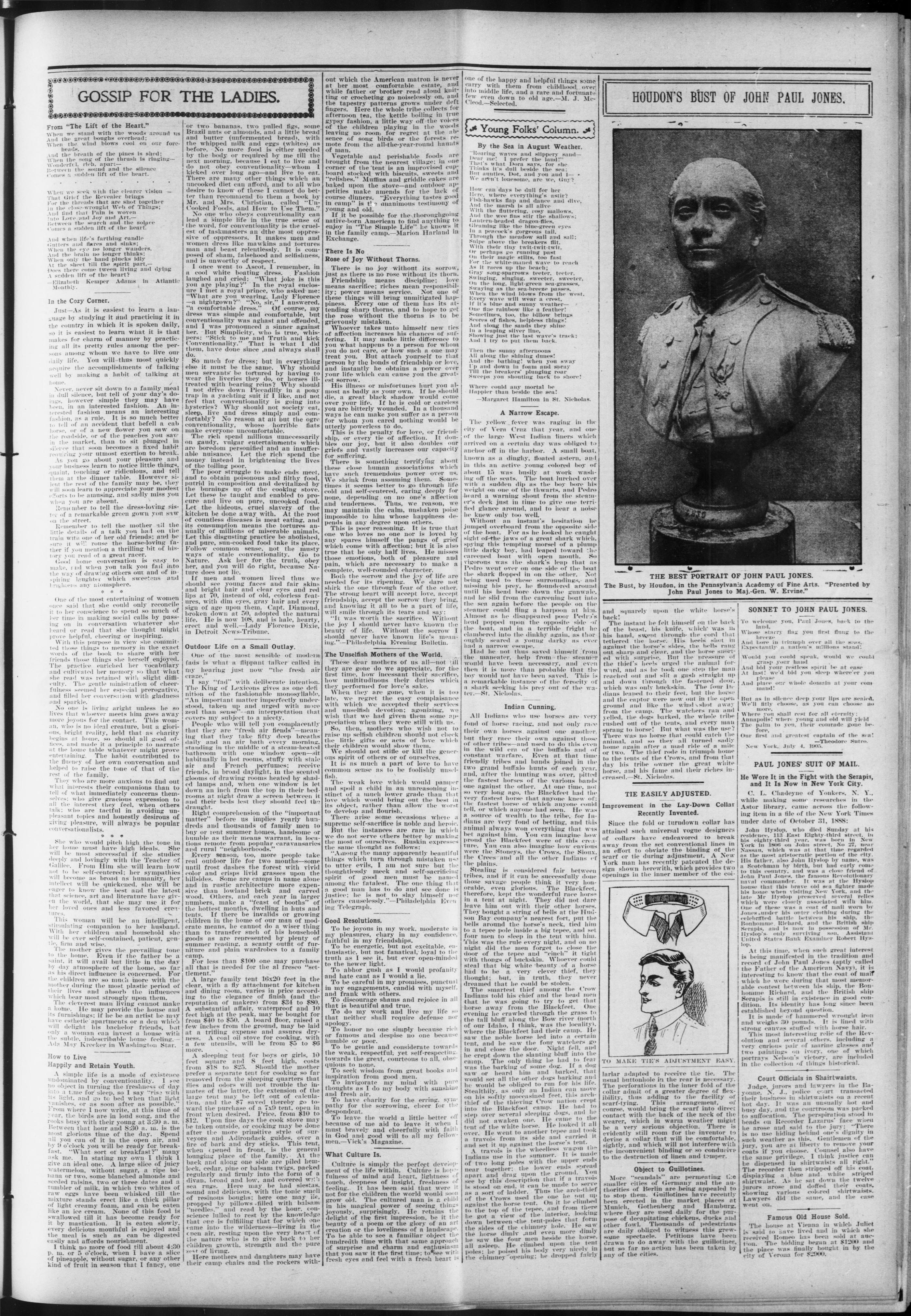
GOSSIP FOR THE LADIES.
```markdown
```
From "The Lift of the Heart."
When we stand with the woods around us
And the great boughs overhead;
When the wind blows cool on our fore-
heads.
And the breath of the pines is shed;
When the song of the thrush is ringing—
Wonderful, rich, apart—
Between the sound and the silence
When we seek with the clearer vision
That Grief the Revealer brings
For the threads that are shot together
In the close-wrought Web of Things;
And find that Pain is woven
Into Love and Joy and Art.—
Between the search and the solace
Comes a sudden lift of the heart.
And when life's farthing candle
Gutters and flares and sinks;
When the eye no longer wanders.
And the brain no longer thinks;
When only the hand plucks idly
At the sheet till the spirit part.—
Does there come tween living and dying
A sudden lift of the heart?
—Elizabeth Kemper Adams in Atlantic
Monthly.
In the Cozy Corner.
Just-As it is easiest to learn a language by studying it and practicing it in the country in which it is spoken daily, so it is easiest to learn what it is that makes for charm of manner by practicing all its pretty rules among the persons among whom we have to live our daily life. You will-thus most quickly acquire the accomplishments of falking well by making a habit of talking at home.
Never, never sit down to a family meal in dull silence, but tell of your day's doings, however simple they may have been, in an interested fashion. An interested fashion means an interesting fashion, as a rule. It is so much better to tell of an accident that befell a cab horse, or of a new flower you saw on the roadside, or of the peaches you saw in the market, than to sit plunged in silence that soon becomes a fixed habit requiring your utmost exertion to break.
As you go about your pleasure and your business learn to notice little things, quaint, touching or ridiculous, and tell them at the dinner table. However silent the rest of the family may be, they will soon learn to appreciate your modest efforts to be amusing, and sadly miss you when you are absent.
Remember to tell the dress-loving sister of a remarkable green gown you saw on the street.
Remember to tell the mother all the little details of a talk you had on the train with one of her old friends; and be sure it will rouse the horse-loving father if you mention a thrilling bit of history you read of a great racer.
Good home conversation is easy to make, and when you talk you fail into the way of drawing others out and of inspiring laughter which sweetens and brightens any atom sphere.
☆ ☆ ☆
One of the most entertaining of women once said that she could only reconcile it to her conscience to spend so much of her time in making social calls by passing on in conversation whatever she beard or read that she thought might prove helpful, cheering or inspiring. With this purpose in view she committed those things to memory in the exact words of the book to share with her friends those things she herself enjoyed. The practice enriched her vocabulary and cultivated her memory so that what she read was retained with slight difficulty. The gentle ministration of cheerfulness seemed her especial prerogative, and filled her conversation with gladness and sparkle.
No one is living aright unless he so lives that whoever meets him goes away more joyous for the contact. This woman, who is no ideal creature, but a glorious, bright reality, held that as charity begins at home, so should all good offices, and made it a principle to narrate at the home table whatever might prove entertaining. The habit contributed to the fluency of her own conversation and helped to raise the tone of that of the rest of the family. They who are more anxious to find out what interests their companions than to tell of what immediately concerns themselves; who give gracious expression to all the interest they feel, when others talk; who are tactful in avoiding unpleasant topics and honestly desirous of giving pleasure, will always be popular conversationalists.
```markdown
```
She who would pitch high the tone in her home must have high ideals. She will be most successful if she studies deeply and lovingly with the Teacher of Galilee. From Him she will learn how not to be self-centered; her sympathies will become as broad as humanity, her intellect will be quickened, she will be eager to know the best and the latest that science, art and literature have given the world, that she may use it for her loved ones and less favored creatures. This woman will be an intelligent, stimulating companion to her husband. With her children and household she will be ever self-contained, patient, gentle, firm and wise.
The mother gives the prevailing tone to the home. Even if the father be a saint, it will avail but little in the day by day atmosphere of the home, so far as his direct influence is concerned. For the children are so much more with the mother during the most plastic period of their lives and absorb the influences which bear most strongly upon them. The cleverest man living cannot make a home. He may provide the house and its furnishings; if he be an artist he may have esthetic apartments or a den which will delight his bachelor friends, but only a woman can invest a house with the subtle, indescribable home feeling.—Ada May Krecker in Washington Star.
Happily and Retain Youth
A simple life is a mode of existence undominated by conventionality. I see no object in turning the freshness of day into a time for sleep, so I say "rise with its light, and go to bed when that light vanishes, or as soon after as possible." From where I now write, at this time of year, the birds are in loud song, and the rooks busy with their young at 3:30 a. m. Between that hour and 8:30 a. m. is the most glorious time of the day. Spend all you can of it in the open air, and by 9 o'clock you will be ready for breakfast. "What sort of breakfast?" many ask me. In stating my own I think I give an ideal one. A large slice of juicy watermelon, without sugar, a ripe banana or two, some blanched almonds and seeded raisins, two or three dates and a tumbler of milk, in which two whites of raw eggs have been whisked till the mixture stands erect like a thick pillar of light creamy foam, and can be eaten like an ice cream. None of this food is swallowed till it has become ready for it by mastication. It is eaten slowly, every delicious mouthful is enjoyed and the meal is such as can be digested easily and affords nourishment.
I think no more of food till about 4:30 p. m. or 5 o'clock, when I have a slice of pineapple, without sugar, or any other kind of fruit in season that I fancy, one
or two bananas, two pulled figs, some Brazil nuts or almonds, and a little bread and butter (unfermented bread), with the whipped milk and eggs (whites) as before. No more food is either needed by the body or required by me till the next morning, because I eat to live and do not obey conventionality—whom I kicked over long ago—and live to eat. There are many other things which an uncooked diet can afford, and to all who desire to know of these I cannot do better than recommend to them a book by Mr. and Mrs. Christian, called "Un-Cooked Foods, and How to Use Them"
No one who obeys conventionality can lead a simple life in the true sense of the word, for conventionality is the cruelest of taskmasters an dthe most oppressive of oppressors. It makes men and women dress like mawkins and tortures man and beast relentlessly. It is composed of sham, falsehood and selfishness, and is unworthy of respect.
I once went to Ascot, I remember, in a cool white boating dress. Fashion laughed and cried: "What joke is this you are playing?" In the royal enclosure I met a royal prince, who asked me: "What are you wearing, Lady Florence—a nightgown?" "No, sir," I answered, "a comfortable dress." Of course, my dress was simple and comfortable, but conventionality was aghast and offended, and I was pronounced a sinner against her. But Simplicity, who is true, whispers: "Stick to me and Truth and kick Conventionality." That is what I did them, have done since, and always shall do.
So much for dress; but in everything else it must be the same. Why should men servants be tortured by having to wear the liveries they do, or horses ill-treated with bearing reins? Why should I not drive down Piccadilly in a pony trap in a yachting suit if I like, and not feel that conventionality is going into hysteries? Why should not society eat, sleep, live and dress simply and comfortably? No reason at all but the ogre conventionality, whose horrible fiats make everyone uncomfortable.
The rich spend millions unnecessarily on gaudy, vulgar entertainments which are boredom personified and an insufferable nuisance. Let the rich spend the money instead in brightening the lives of the toiling poor.
The poor struggle to make ends meet, and to obtain poisonous and filthy food, putrid in composition and devitalized by the burnings up of the cooking stove. Let these be taught and enabled to procure and live on pure, uncooked food. Let the hideous, cruel slavery of the kitchen be done away with. At the root of countless diseases is meat eating, and its consumption means the tortures annually of millions of miserable animals. Let this disgusting practice be abolished, and pure, sun-cooked food take its place. Follow common sense, not the musty ways of stale conventionality. Go to Nature. Ask her for the truth, obey her, and you will do right, because Nature does not lie.
If men and women lived thus we should see young faces and fair skins and bright hair and clear eyes and red lips at 70, instead of old, colorless features, with dim eyes, gray hair and every sign of age upon them. Capt. Diamond, broken down at 50, adopted the natural life. He is now 108, and is hale, hearty, erect and well.—Lady Florence Dixie, in Detroit News-Tribune.
Outdoor Life on a Small Outlay
One of the most sensible of modern fads is what a flippant talker called in my hearing just now "the fresh air craze."
I say "fad" with deliberate intention. The King of Lexicons gives as one definition of the fashionable monosyllable, "An important matter imperfectly understood, taken up and urged with more zeal than sense"--an interpretation that covers my subject to a nicety.
People who will tell you complacently that they are "fresh air fiends"—meaning that they take fifty deep breaths daily and an air bath every morning, standing in the middle of a steam-heated bathroom with one window open—sit habitually in hot rooms, stuffy with stale air and French perfumes; receive friends, in broad daylight, in the scented glooms of drawing rooms heated by shaded lamps, and, when one window is let down an inch from the top in their bedrooms at night draw a screen between it and their beds lest they should feel the draught.
Right comprehension of the "importaut matter" before us implies yearly hundreds and thousands of family men to buy or rent summer homes, handsome or humble as their means warrant, in locations remote from popular caravansaries and rural "neighborhoods."
Every season, too, more people take real outdoor life for two months—some until frost dashes the forest with vivid color and crisps livid grasses upon the hillsides. Some are camps in name alone and in rustic architecture more expensive than lowland brick and carved wood. Others, and each year in larger numbers, make a "feast of booths" of the hottest months, dwelling in huts and tents. If there be invalids or growing children in the home of our man of moderate means, he cannot do a wiser thing than to transfer such of his household goods as are represented by plenty of summer reading, a scanty outfit of furniture and plain wardrobes to a family camp. For less than $100 one may purchase all that is needed for the al fresco "settlement."
A large family tent 16x20 feet in the clear, with a fly attachment for kitchen and dining room, varies in price according to the elegance of finish (and the reputation of makers) from $34 to $80. A substantial affair, waterproof and 10 feet high at the peak, may be bought for from $40 to $50. A board floor, raised a few inches from the ground, may be laid at a trifling expense and assures dryness. A coal oil stove for cooking, with a few utensils, will be from $5 to $6 more.
A sleeping tent for boys or girls, 10 feet square and 8 feet high, costs from $18 to $25. Should the mother prefer a separate tent for cooking so far removed from the sleeping quarters that flies and odors will not trouble the inmates of the latter, the extension of the large tent may be left out of calculation, and the $7 saved thereby go toward the purchase of a 7x9 tent, open in front when desired. Price, from $10 to $12. Upon fine days the cook stove may be taken outside, or cooking may be done after the more primitive style of surveyors and Adirondack guides, over a fire of bark and dry sticks. This tent, when opened in front, is the general lounging place of the family. At the back and along one side are piled hemlock, cedar, pine or balsam twigs, packed regularly and firmly into the form of a divan, broad and low, and covered with sea rugs. Here may be had siestas, sound and delicious, with the tonic smell of resinous boughs; here one may lie, propped by pillows-filled with balsam "needles," and read by the hour, conscience lulled to rest by the knowledge that one is fulfilling that for which one came into the wilderness—living in the open air, resting upon the very heart of the nature who is to give back to her children growth, strength and the pure rest of living.
Here mothers and daughters may have their camp chairs and the rockers with-
out which the American matron is never at her most comfortable estate, and while father or brother read aloud knitting or crocheting go noiselessly on, and the tapestry patterns grows under deft fingers. Here the whole tribe collects for afternoon tea, the kettle boiling in true gypsy fashion, a little way off the voices of the children playing in the woods leaving no room, for regret at the absence of song birds or the forests remote from the all-the-year-round haunts of man.
Vegetable and perishable foods are brought from the nearest village; in one corner of the tent is an improvised cupboard stocked with biscuits, sweets and "relishes." Muffins and griddle cakes are baked upon the stove—and outdoor appetites make amends for the lack of course dinners. "Everything tastes good in camp" is the unanimous testimony of young and old.
If it be possible for the thoroughgoing native-born American to find anything to enjoy in "The Simple Life" he knows it in the family camp.—Marion Harland in Exchange.
There Is No
Rose of Joy Without Thorns.
There is no joy without its sorrow, just as there is no rose without its thorn. Friendship means discipline; love means sacrifice; riches mean responsibility; power means service. Not one of these things will bring unmitigated happiness. Every one of them has its attending sharp thorns, and to hope to get the rose without the thorns is to be grievously mistaken. Whoever takes unto himself new ties of affection increases his chances of suffering. It may make little difference to you what happens to a person for whom you do not care, or how such a one may treat you. But attach yourself to that person by the bonds of friendship or love, and instantly he obtains a power over your life which can cause you the greatest sorrow.
His illness or misfortunes hurt you almost as badly as your own. If he should die, a great black shadow would come over your life. If he is cold or careless you are bitterly wounded. In a thousand ways he can make you suffer as a person for whom you cared nothing would be utterly powerless to do. This is the penalty for love, or friendship, or every tie of affection. It doubles our joy, but it also doubles our griefs and vastly increases our capacity for suffering.
There is something terrifying about these close human associations which have such tremendous power over us. We shrink from assuming them. Sometimes it seems better to go through life cold and self-centered, caring deeply for none, depending on no one's affection and tenderness. Thus, we reason, we may maintain the calm, unshaken poise impossible to him whose happiness depends in any degree upon others. This is poor reasoning. It is true that one who loves no one nor is loved by any spares himself the pangs of grief which come with affection; but it is also true that he only half lives. He misses those emotions, both of pleasure and pain, which are necessary to make a complete, well-rounded character.
Both the sorrow and the joy of life are needed for its ripening. We dare not shirk the one through fear of the other. The strong heart will accept love, accept friendship, accept the sorrow they bring, and knowing it all to be a part of life, will smile through its tears and say: "It was worth the sacrifice. Without the joy I should never have known the beauty of life. Without the sorrow I should never have known life's meaning."—Philadelphia Evening Bulletin.
The Unselfish Mothers of the World
These dear mothers of us all—not till they are gone do we appreciate, for the first time, how incessant their sacrifice, how multitudinous their duties which they performed for love's sake.
When they are gone, when it is too late, we regret the easy complaisance with which we accepted their services and unselfish devotion; agonizing, we wish that we had given them some appreciation when they were still with us.
So, then, mothers who wish not to raise up selfish children should not check the little gifts or acts of love which their children would show them.
We should not stifle or kill the generous spirit of others or of ourselves.
It is as much a part of love to have common sense as to be foolishly unselfish.
The weak love which would pamper and spoil a child in an unreasoning instinct of a much lower grade than that love which would bring out the best in its object, rather than allow the worst to develop and flourish.
There arise some occasions where a supreme self-sacrifice is noble and heroic. But the instances are rare in which we do not serve others better by making the most of ourselves. Ruskin expresses the same thought as follows:
"Among the many apparently beautiful things which turn through mistaken use to utter evils, I am not sure but the thoughtlessly meek and self-sacrificing spirit of good men must be named among the fatalest. The one thing that a good man has to do and see done is justice; he is not to slay himself not others causelessly."—Philadelphia Evening Telegraph.
Good Resolutions.
To be joyous in my work, moderate in my pleasures, chary in my confidence, faithful in my friendships.
To be energetic, but not excitable, enthusiastic, but not fanatical, loyal to the truth as I see it, but ever open-minded to the newer light.
To abhor gush as I would profanity and hate cant as I would a lie.
To be careful in my promises, punctual in my engagements, candid with myself, and frank with others.
To discourage shams and rejoice in all that is beautiful and true.
To do my work and live my life so that neither shall require defense nor apology.
To honor no one simply because rich or famous and despise no one because humble or poor.
To be gentle and considerate towards the weak, respectful, yet self-respecting, towards the great, courteous to all, obsequious to none.
To seek wisdom from great books and inspiration from good men.
To invigorate my mind with pure thoughts as I do my body with sunshine and fresh air.
To have charity for the erring, sympathy for the sorrowing, cheer for the despondent.
To leave the world a little better off because of me aid to leave it when I must bravely and cheerfully with faith in God and good will to all my fellowmen.—Vick's Magazine.
What Culture Is
Culture is simply the perfect development of the life within. Culture is hopefulness of mind and heart, lightness of touch, deepness of insight, freshness of feeling. It has been said that were it not for the children the world would soon grow old. The cultured man is a child in his magical power of seeing things joyously, surprisingly. He retains the delight of the first impression, be it the beauty of a poem or the glory of an art creation or the loveliness of a landscape. To be able to see a familiar object the hundredth time with that same approach of surprise and charm and enthusiasm that you saw it the first time; to see with fresh eyes and feel with a fresh heart is
one of the happy and helpful things some carry with them from childhood, over into middle life, and a rare and fortunate few even down to old age.—M. J. McCleod.—Selected.
By the Sea in August Weather.
"Roaring waves and slippery sand—Dear me! I prefer the land!"
That's what Dora says, for she
Thinks it's dull beside the sea;
But aunties, Dot, and you and 1—
We aren't lonesome, are we, Guy?
How can days be dull for her
Here, where everything's astir?
Fish-hawks flap and dance and dive,
And the marsh is all alive
With the fluttering, rosy mallows.
And the wee fins stir the shallows;
Lantern-headed dragon-flies.
Gleaming like the blue-green eyes
In a peacock's gorgeous tail.
Through the meadow sail and sail;
Snipe above the breakers flit,
With their thy twit-twit-twit,
Or perhaps go running past
On their magic stilts, too fast
For the white-maned wave to reach
As it races up the beach;
Gray song-sparrows teeter, teeter,
Swinging, singing, sweeter, sweeter,
On the long, light-green sea-grasses,
Swaying as the sea-breeze passes,
When the wind blows from the west.
Every wave will wear a crest,
If it's blue and sunny weather—
One fine rainbow like a feather!
Sometimes, too, the billow brings
Scores of fishes, helpless things!
And along the sands they shine
In a leaping silver line,
Showing just the last wave's track;
And I try to put them back.
Then the sunny afternoons
All along the shining dunes!
And the bathing! when you sway
Up and down in foam and spray
Till the breakers' plunging roar
Sweeps you shouting back to shore!
Where could any mortal be
Happier than beside the sea!
— Margaret Hamilton in St. Nicholas.
A Narrow Escape
The yellow fever was raging in the city of Vera Cruz that year, and one of the large West Indian liners which arrived on a certain day was obliged to anchor off in the harbor. A small boat, known as a dinghy, floated astern, and in this an active young colored boy of about 15 was busily at work washing off the seats. The boat lurched over with a sudden dip as the boy bore his weight on one of the thwarts, and Pedro heard a warning shout from the steamer's deck just in time to give one terrified glance around, and to hear a noise he knew only too well.
Without an instant's hesitation he jumped overboard from the opposite side of the boat. For as he looked he caught sight of the jaws of a great shark which, spying this tempting morsel of a plump little darky boy, had leaped toward the careened boat with open mouth. So vigorous was the shark's leap that as Pedro went over on one side of the boat the shark flopped in on the other. Not being used to these surroundings, and missing his prey, he floundered around until his head bore down the gunwale, and he slid from the careening boat into the sea again before the people on the steamer could fling a harpoon at him. Almost as he disappeared poor Pedro's head popped upon the opposite side of the boat, and in a terrible fright he clambered into the dinkhy again, as thoroughly scared a young darky as ever had a narrow escape.
Had he not thus saved himself from the maneater, help from the steamer would have been necessary, and even then it is more than probable that the boy would not have been saved. This is a remarkable instance of the ferocity of a shark seeking his prey out of the water.—St. Nicholas.
Indian Cunning
All Indians who use horses are very fond of horse racing, and not only race their own horses against one another, but they race their own against those of other tribes—and used to do this even in the wild era of the buffalo and of constant warfare. Even at that time friendly tribes and bands joined in the two grand buffalo hunts of each year, and, after the hunting was over, pitted the fastest horses of the various bands one against the other. At one time, not so very long ago, the Blackfeet had the very fastest horse that anyone knew of: the fastest horse of which anyone could tell, or which anyone had seen. He was a source of wealth to the tribe, for Indians are very fond of betting, and this animal always won everything that was bet against him. You can imagine how proud the Blackfeet were of this creature. Yau can also imagine how envious were the Stoneys, the Crows, the Sioux, the Crees and all the other Indians of the plains.
Stealing is considered fair between tribes, and if it can be successfully done those savage people think it very honorable, even glorious. The Blackfeet, therefore, kept the wonderful race horse in a tent at night. They did not dare leave him out with their other horses. They bought a string of bells at the Hudson Bay company's nearest fort, put the bells around the horse's neck, tied him to a tepee pole inside a big tepee, and set four men to sleep in the tent with him. This was the rule every night, and on no night did the men forget to close the door of the tepee and "cinch" it tight with thongs of buckskin. Whoever could steal that big white beauty of a horse had to be a very clever thief, they thought; but, in truth, they never dreamed that he could be stolen.
The smartest thief among the Crow Indians told his chief and the head men that he was going to try to get that horse away from the Blackfeet. One evening he crawled through the grass to the tall bluff along the Bow river (north of our Idaho, I think, was the locality), where the Blackfeet had their camp. He saw the noble horse led into a certain tent, and he saw the four watchers go in and close the door. Night fell, and he crept down the slanting bluff into the camp. The only thing he had to fear was the barking of some dog. If a dog saw or heard him and barked, that would set all the other dogs barking and he would be obliged to run for his life. Stealthily, as only an Indian can move on his softly moccasined feet, this archthief of the thieving Crow nation crept into the Blackfoot camp. He had to step over several sleeping dogs, and he did not awaken one. He came to the tent of the white horse. He looked it all over. He went to another tepee and took a travois from its side and carried it and set it up against the horse's tent.
A travois is the wheelless wagon the Indians use in the summer. It is made of two long poles with the upper ends near together: the lower ends spread apart and drag upon the ground. You see by this description that if a travois is stood on end, it can be made to serve as a sort of ladder. Thus the arch-thief of the Crows used the one he out up against the horse tent. On it he climbed to the top of the tepee, and from there he got a view of the interior, looking down between the tent-poles that form the sides of the chimney hole. He saw the horse dimly, and even more dimly he saw the four men beside the horse, all asleep. He climbed upon the tent poles; he poised his body very nicely in the chimney opening; he dropped fairly
HOUDON'S BUST OF JOHN PAUL JONES.
1839
The Bust, by Houdon, in the Pennsylvania Academy of Fine Arts. "Presented by John Paul Jones to Maj.-Gen. W. Ervine."
and squarely upon the white horse's back!
The instant he felt himself on the back of the beast, his knife, which was in his hand, swept through the cord that tethered the horse. His heels shot in against the horse's sides, the bells rang out sharp and clear, and the horse shorted with surprise. But the pressure of the thief's heels urged the animal forward, and as he took one step the man reached out and slit a gash straight up and down through the fastened door, which was only buckskin. The four Indians leaped to their feet, but the horse and the captor were now out in the open ground and like the wind shot away from the camp. The watchers ran and yelled, the dogs barked, the whole tribe rushed out of the tents, and every man sprang to horse! But what was the use? There was no horse that could catch the animal, and so they all turned sadly home again after a mad ride of a mile or two. The thief rode in triumph home to the tents of the Crows, and from that day his tribe owner the great white horse, and his fame and their riches increased.—St. Nicholas.
TIE EASILY ADJUSTED
Improvement in the Lay-Down Collar Recently Invented.
Since the fold or turndown collar has attained such universal vogue designers of collars have endeavored to break away from the set conventional lines in an effort to obviate the binding of the scarf or tie during adjustment. A New York man has recently patented the design shown herewith, which provides two openings in the inner member of the coli
THE COLLAR
larlar adapted to receive the tie. The usual buttonhole in the rear is necessary. The perforations in the inner fold of the collar admit of a greater degree of flexibility, thus adding to the facility of scarf-tying. This arrangement, of course, would bring the scarf into direct contact with the back of the neck of the wearer, which in warm weather might be a very serious objection. There is evidently still room for the inventor to devise a collar that will be comfortable, sightly, and which will not interfere with the inconvenient binding or so conducive to the destruction of linen and temper.
Object to Guillotines
More "scandals" are permeating the smaller cities of Germany and the authorities of Berlin are being appealed to stop them. Guillotines have recently been erected in the market places at Munich, Gothenberg and Hamburg, where they are used daily for the purpose of decapitating chickens, ducks and other fowl. Thousands of pedestrians are daily obliged to witness this grewsome spectacle. Petitions have been drawn to do away with the guillotines, but so far no action has been taken by any of the cities.
SONNET TO JOHN PAUL JONES
To welcome you, Paul Jones, back to the land.
Would you could speak, would we could grasp your hand
And place our whole domain at your command!
But as in silence deep your lips are sealed. We'll fitly choose, as you can choose no more.
Where you shall rest for all eternity:
Annapolis! where young and old will yield.
The palm to you, their comrade gone before.
Our first and greatest captain of the sea!
—Theodore Sutro.
New York, July 4, 1905.
PAUL IONES' SUIT OF MAIL.
He Wore It in the Fight with the Serapis, and It Is Now in New York City.
C. L. Chadeyne of Yonkers, N. Y., while making some researches in the Astor library, came across the following item in a file of the New York Times under date of October 31, 1888:
John Hyslop, who died Sunday at his residence, 113 East Eighty-third street, in his eighty-third year, was born in New York in 1806 on John street, No 27, near Nassau, which was at that time regarded as the most aristocratic portion of the city. His father, also John Hyslop by name, was a Scotchman by birth, but had early come to this country, and was a close friend of John Paul Jones, the famous Revolutionary naval commander. It was at the Hyslop house that this brave old sea fighter made his home when visiting New York, and the late Mr Hyslop preserved several reliefs which were closely associated with him. One of these was a coat of mail worn by Jones and under his outer clothing during the celebrated battle between his ship, the Bonhomme Richard, and the British ship Serapis, and is now in possession of Mr. Hyslop's, only surviving son, Assistant United States Bank Examiner Robert Hyslop.
At this time, when such great interest is being manifested in the tradition and record of John Paul Jones (aptly called the Father of the American Navy), it is interesting to know that the coat of malf which he wore during that most memorable contest between his ship, the Bonhomme Richard, and the British ship Serapis is still in existence in good condition. Its identity has long since been established beyond question.
It is made of hammered wrought iron and weighs 30 pounds. It is lined with strong canvas stuffed with horse hair.
This most interesting relic of the Revolution and several others, including a very curious pair of marine glasses and two paintings on ivory, one of which portrays Nelson's victory, are included in the collection of things historical.
Court Officials in Shairtwaists.
Judge, jurors and lawyers in the Bayonne, N. J., police court transacted their business in shirtwaists on a recent hot day. It was an unusually hot and busy day, and the courtroom was packed to suffocation. The perspiration stood in beads on Recorder Lazarus' face when he arose and said to the jury: "There is no use hiding behind one's dignity in such weather as this. Gentlemen of the jury, you are at liberty to remove your coats if you choose. Counsel also have the same privilege. I think justice can be dispensed in shirtwaists all right." The recorder then stripped off his coat, displaying a blue and white striped shirtwaist. As he sat down the twelve jurors arose and doffed their coats, showing various colored shirtwaists. Lawyers did the same, and the case went on.
Famous Old House Sold.
The house at Vienna in which Juliet is said to have lived and in which she received Romeo has been sold at auction. The bidding began at $1200 and the place was finally bought in by the city of Verona for $2000.
THE WISCONSIN WEEKLY ADVOCATE
R. B. Montgomery, Editor and Publisher.
The Wisconsin Weekly Advocate after three years' residence at 79 Fifth street, has moved its headquarters to 729 St. Paul Ave., where we will receive our guests and transact our business in future.
A Representative Journal Devoted to the Interest of All the People.
ADVERTISING RATES.
One inch, one year.....$15.00
Two inches, one year.....25.00
Three inches, one year.....35.00
Four inches, one year.....42.00
For larger space, special rates.
Locals, 10 cents per line.
TERMS OF SUBSCRIPTION.
One year .....$2.00
Six months .....1.00
Three months ......50
• Direct all communications to
R. B. MONTGOMERY,
38 Eighth Street.
HOW TO SEND MONEY.—Post Office Order, Express Order, Draft or Registered Letter. R. B. Montgomery will not be responsible for loss when sent in any other way.
TO CONTRIBUTORS:
All communications must be sent with the name and address of the sender as an evidence of good faith, but not necessarily for publication. No manuscript returned if not accepted, unless accompanied by stamps.
EDITORIAL PARAGRAPHS.
"I know of the bravery and character of the Negro soldier. He saved my life at Santiago, and I have had occasion to say so in many articles and speeches. The Rough Riders were in a bad position when the Ninth and Tenth cavalry came rushing up the hill carrying everything before them. The Negro soldier has the faculty of coming to the front when he is needed most. In the Civil war he came 400,000 strong, and I believe he saved the Union."—President Roosevelt.
A WARNING
We have been informed by friends in Janesville and elsewhere that certain persons of questionable reputation have recently been engaged in a house to house slander concerning The Advocate and its editor, throughout the state generally and more particularly in the cities of Janesville and Beloit. We have placed the matter in the hands of the police department of those cities and we warn these individuals that for any further repetition of these misrepresentations we will invoke the full penalty of the law.
The Hoboken astrologer who predicts cataclyms in the near future is playing into the hands of the life and accident insurance solicitors.
The campers who are said to have struck petroleum in drilling for water in Northern Michigan may have sent down a fish story after all.
The Alliance of Women's Clubs at Portsmouth, which has attacked the onion, seems to have overlooked the adage, "In onion there is strength."
Count Boni de Castellane, who tried without success to inaugurate the fad of wearing a light overcoat all summer, may be said to have fallen "in the heat of the engagement."
The Chicago airship inventor who promises to fly to Washington has chosen a big task, probably because all tasks are alike to the average balloonist who cannot "make good."
When aeronauts Lewis and Knebenshue are ready for their aerial race over New York, the owners of skyscrapers should see to it that they do not endanger property by exceeding the speed limit.
A cargo of 10,524 tons of iron ore in the hold of the big steamer Augustus B. Wolvin is a new lake record that will make coast shippers wonder where the lake shipping development is going to stop.
The La Crosse National Guardsman who broke all records on the Camp Douglas military reservation by scoring 408 points out of a possible 500 furnished fresh evidence that the soldierly guard is "hitting the mark."
Abbott Graves, the famous painter, has returned to his home in Kennebunkport, Me. after an absence of three years in Europe. Mr. Graves received many high honors in Paris, and his home is full of art treasures, many of which he brought from abroad.
---
Sufficient funds have been raised for the monument to Ensign Worth Bagley, killed at Cardenas, Cuba, which will be erected at Raleigh, N. C. His brother, David Worth Bagley, will pose for the figure, and the contract for the statue has been awarded to F. H. Packer of New York.
The failure of the Portsmouth submarine explosion as a spectacle was simply another illustration of the eccentricities of powerful explosives. While they do not always perform in accordance with calculations, they are capable of giving people tremendous surprises when they least expect them.
The eminent German archaeologist, Adolf Michaelis, whose seventieth birthday was celebrated on the 22d of June, at Strassburg, has been connected with the university of that city for thirty years. His fame was established in 1871, when his most important and elaborate work, his treatise on the Parthenon, appeared.
MOSQUITOES SPREAD YELLOW FEVER. WHOSE SYMPTOMS ARE DESCRIBED.
Restricted to certain geographical limits. Characterized by a high fever of short duration, gastro-intestinal disturbances, hemorrhages into the skin and mucous membrane, and a yellow tint of the skin. First recognized definitely in West Indies in 1647. It is infectious.
Prevails in the West Indies, west coast of Africa,
YELLOW FEVER MOSQUITO Central America, and southward along both coasts of South America and northward to the South Atlantic and Gulf States.
YELLOW FEVER MOSQUITO Central America, South America and northward to the east.
It has been brought to north Atlantic. The mosquito is blamed for spread. Frost stops yellow fever.
Survivors of one attack of yellow attacks.
The yellow fever germ has not yet been authorities say the disease is Yellow fever develops usually from Sometimes it takes seven days.
The attack comes on with severely. It may come on more gradually in symptoms. The temperature goes to fever lasts from three to five days, and head. There is nausea and vomit.
The yellow tint of the skin, from on the second or third day.
In severe cases small hemorrhagous membrane. The vomit is at first and in appearance like coffee, when it bleeding at the nose, mouth and gum consciousness, and death.
Mortality varies. In some epidemics in others as low as 10 per cent.
Heat, moisture, bad drainage, unfavor the disease, but the mosquito is.
Experts seem to agree that the fever is to attack the mosquito.
Complete rest and careful dieting yellow fever. Different drugs are used toward a natural condition.
It has been brought to north Atlantic seaports by vessels.
Survivors of one attack of yellow fever become immune from further attacks.
The yellow fever germ has not yet been discovered.
Some authorities say the disease is caused by a toxin, not a germ.
Yellow fever develops usually from three to four days after infection. Sometimes it takes seven days.
The attack comes on with severe chills or rigors when it comes suddenly. It may come on more gradually with languor, headache and malarial symptoms. The temperature goes to 105 degrees, sometimes higher. The fever lasts from three to five days, attended with pains in the back, limbs and head. There is nausea and vomiting.
The yellow tint of the skin, from which the fever gets its name, begins on the second or third day.
In severe cases small hemorrhages take place into the skin and mucous membrane. The vomit is at first white. Later it becomes very dark, and in appearance like coffee, when it is known as "black vomit." There is bleeding at the nose, mouth and gums. Delirium usually follows, then unconsciousness, and death.
Mortality varies. In some epidemics it has been as high as 85 per cent. In others as low as 10 per cent.
Heat, moisture, bad drainage, uncleanliness and unhygienic conditions favor the disease, but the mosquito is most of all responsible.
Experts seem to agree that the first step to combat the spread of the fever is to attack the mosquito.
Complete rest and careful dieting constitute the principal treatment for yellow fever. Different drugs are used to help assist the body and organs toward a natural condition.
TWO NEW CANADIAN PROVINCES
With Saskatchewan and Alberta the
Dominion Will Hone Nine "States"
Dominion will have Nine States. The word province in Canada has the same significance as the word State in our country. When we say, therefore, that the Dominion has organized and is about to take in two new provinces it means that the seven States are about to be increased to nine. The seven provinces are Quebes, Ontario, Nova Scotia, Prince Edward Island, New Brunswick, Manitoba and British Columbia. The two new provinces are Alberta and Saskatchewan. The interior department at Ottawa has issued a map showing the boundaries of these two enormous new provinces, and the map printed here has been made from it.
It is thirty-eight years since the Dominion of Canada was formed by the
GREAT SLAVE LAKE
MACKENZIE
PEACE RD.
ATHABA
POPULATION 250,000 (ESTIMATED)
AREA 253.500.50 MILES.
EDMONTON
ALBERTA
BANFF
CALGARY
CAN PNG.
LECHBRIGE
SEKITK RANGE
CAN PAL
WASHINGTON
UNITED
MON
GREAT SLAVE LAKE
MACKENZIE
ATHAB
POPULATION 250,000 (ESTIMATED)
AREA 253.500 SQ. MILES.
EDMONTON
ALBERTA
BANFF
CALGARY
CAN PAG
LETHBRIDGE
UNITED STATES
WASHINGTON
MONTANA
DAKOTA
KENWATIN
KEWATIN
SASKATCHEWAN
SASKATCHEWAN
PRINCE ALBEDT
SASKATCHEWAN
ASSINIBOIA
ASSINIBOIA
MEDICINE HAT
CANADIAN
REGINA
PACIFIC
CENTER
CANADA'S TWO NEW PROVINCES. In the map the two new provinces are shown by the black lines; the dotted lines indicate the territories out of which they are formed.
confederation of the provinces then existing. That was the birth of Canada as a nation. Two years later the British Parliament passed the Rupert's land act, which provided for the acquisition by the Dominion of the vast prairies of the West, which were called the Northwest Territories. It had already been discovered that wheat was a wonderful crop in the southeast part of this region, and so many settlers flocked into the little corner called Manitoba that in 1870 this territory was admitted into the confederation as a province. As a State of the Dominion, Manitoba is just one year older than British Columbia.
But none of the other four big territories has ever had a government of its own, Assiniboia, Alberta, Saskatchean, and Athabasca were simply lumpwan, and Athabasca were simply lumped together as the Northwest Territories. They had a common capital at Regina, Assiniboia, and have always been ruled, under the Dominion Parliament, by a Lieutenant Governor and an Executive Council. Out of these four territories the two new States have been formed and the Northwest Territories will now disappear from the maps.
The fact is that territorial government for them is no longer suitable, because their interests are becoming large and complex. In 1901 their population was 158,940. No census has been taken since, but the Candian government estimates their population today at about 500,000.
Over three-fifths of the large immigration that began to pour into Canada in 1901 has settled in three of these territories. The tide of pioneers is pouring over these wheat and cattle lands of Canada.
It has not yet reached Athabasca, but farmhouses and hamlets have been spreading over the three southern ter-
---
```markdown
```
by a high fever of short duration, disturbances, hemorrhages into the membrane, and a yellow tint of theized definitely in West Indies in 1647. Thus, the West Indies, west coast of Africa, and southward along both coasts of South Atlantic and Gulf States. Atlantic seaports by vessels. End of the disease.
Fever become immune from further been discovered. Caused by a toxin, not a germ. From three to four days after infection. Chills or rigors when it comes sudden with languor, headache and malarial 105 degrees, sometimes higher. The extended with pains in the back, limbs long. Which the fever gets its name, begins takes place into the skin and mutt white. Later it becomes very dark, is known as "black vomit." There is. Delirium usually follows, then unifies it has been as high as 85 per cent. Cleanliness and unhygienic conditions most of all responsible. First step to combat the spread of the constitute the principal treatment for need to help assist the body and organs
ritories, and the country will keep filling with people for years to come, for the lands still unoccupied are almost boundless. As yet, the newcomers have hardly more than touched the outskirts of the wheat lands.
Manitoba is only one-fourth as large as the old territories of Assinibola, Saskatchewan and Alberta, but she had over 2,000,000 acres in wheat last year, while the territories gathered a wheat crop from only 575,697 acres. This acreage in the territories was a mere bagatelle compared with their enormous area of fine farm lands.
The government, after careful investigations, has reached the conclusion that the amount of desirable farm lands still unappropriated in Assinibola is 19,000,000 acres; in Saskatchewan, 17,000,000, and in Alberta, 16,000,000 acres. It will take hundreds of thousands
KENWATIN
USKAN
POPULATION 2,500,000
MONTANA
SASKATCHEWAN
PRINCE ALBERT
MANITOBA
SASKATOON
ASSANIBOIA
PACIFIC
MEDICINE HAI
CANADIAN
REGINA
CALER
OKAT
NORTHERN
NORTH
MISSOURI
DAKOTA
of farmers to cut up all this land into homesteads, but the process is going on, and when these lands are all parceled out settlers will begin to move into Athabasca, whose agricultural capabilities have just been investigated in a comparatively thorough manner, and, it is said, with astonishingly favorable results.
The government of Canada is to pay to each province the sum of $50,000 a year for the support of its government and legislature. The Dominion lands will continue to be vested in the crown, but the Canadian government will compensate the provinces for them by a series of annual payments. The present estimated value of the public lands is $1.50 an acre. The map shows that the two provinces take in all the territory of the four territories excepting a little of the eastern parts of Athabasca and Saskatchewan.
The time will probably come when it will be deemed best to divide these provinces again into smaller ones. Each of them is about four times as large as New York State, and their total territory is about as large as Central Europe. This is a great region, which, with Manitoba, is estimated by the Deputy Minister of Agriculture to be destined within ten years to produce annually 350,000,000 bushels of wheat, 200,000,000 bushels of oats, and 50,000,000 bushels of barley, and this without cropping more than about one-third of the tillable area.
The two provinces divide the vast area nearly equally. Regina will be the capital of Saskatchewan; the capital of Alberta will be temporarily at Edmonton until the Legislature of that province decides upon its permanent situation.—Washington Post.
When a man keeps his own counsel he hasn't much use for a lawyer.
2.
WAUSAU LUMBER AND COAL CO.
'Phone North 60.
IMPROVED MAIL STANDARD. Permits Exchange of Bags at the Stations. Numerous attempts have been made to devise an apparatus which would permit of the exchange of mail between stations and moving trains. Several schemes are in actual everyday operation, but when these are used in connection with rapidly moving trains they are unreliable, frequently tearing the pouches and scattering their contents. Any device, to be successful under such conditions, must embody some means for receiving the shock of impact, and this is one of the strongest features of the type of apparatus here illustrated and has just been patented by a Rochester
A
EXCHANGE OF MAIL AT STATION
inventor. This device will take up, while the car is in motion, one or more mail bags upon an attachment fixed to the car from another device, as one of the two devices passes the other, and at the same time, if desired, deliver other bags from the device on the car to the one at the station. The standard adopted to be located alongside the track carries horizontal supporting arms for holding mail pouches that are to be delivered to the passing postal car or to receive pouches delivered by this car. The arms are adjustable with relation to the fixed standard, to adapt them to work in conjunction with a corresponding arm carried on the moving train. Rectangular frames are hung on these horizontal arms and the mail pouches attached to these. The mail to be delivered by the car is attached at the rear of the arm on the car, and that to be delivered to the car is hung on the end of the station arm corresponding to the direction the train is moving. It will readily be seen from an inspection of the illustration that the frame on the car arm will engage with the arm at the station, and vice versa the frame on the station arm will be picked up by the arm on the moving car.
REVEALS THE FRAUD.
Coupon System on a Bottle for Protection of Consumer. There is no question that there are more patents granted on nonrefillable bottles and devices of the same class than for any other single article. The problem simply will not down. Practically all of the devices offered are structurally defective—that is to say, they could not practically be made at a reasonable cost with the materials available. The illustration, however, shows that even after a field has been tra-
```markdown
```
COUPONS ON THE BOTTLE.
versed as thoroughly as the records show this one has, simple means may be still conceived that bear the clear imprint of novelty and originality. The inventor, who hails from Lasalle, Ill., designates his device as a means for guarding against the reuse of bottles. In combination with the bottle there is a series of coupons. One end of the coupon is secured to the bottle, as, for instance, by being blown therein or wired thereon, the opposite end being loose and formed with a tab to admit of detachment. When the bottle leaves the original filler, who presumably has a trademark brand of goods, the metallic coupon is intact. This coupon is provided of such dimensions and design that sections may be successively detached as the contents are removed. Should the dispenser fail to remove the coupons as the bottle is gradually emptied he would at once lay himself open to the suspicion of intending to defraud by refilling with some substitute for the original contents. When the bottle is emptied the coupons, accordingly, are all detached, so that there is no possibility of refilling the bottle and palming it off as containing the original proprietary or trademark goods.
Just Like a Man
He—How awfully mannish she is.
She—Isn't she, though?
He—Yes, and the funny part of it is that she thinks people admire her for being that way. I should think she'd realize that people are only laughing at her. She—Well, she's mannish even to that extent—Philadelphia Press.
Don't Trust to Luck
when you go to buy lumber and building material, but come where you know the grades and prices are right. AND COAL CO.
when you go to buy lumber and building material, but come where you know the grades and prices are right.
North Milwaukee, Wis.
Improved Hair Tonic
Made to Cure and It Does It.
Best and Cleanest Hair Tonic on
Buy It! Try It! 4 oz. 50c
S. LEMON AND EGG SHAMPOO
It has been proven to be the greatest
for cleansing the scalp and beautifying
it soft and pliable.
Y and original Lemon and Egg Shampoo
day. 6 oz. 50c.
"Barber," we have a Supply Catalogue
you and prices that will suit you. A copy
best.
S. WETMORE CO.
Supplies and High-Grade Furniture
WILLE, WISCONSIN, U. S. A.
MENTION WISCONSIN WEEKLY ADVOCATE
Wisconsin Weekly Advocate
to secure Desirable Situations
healthy and competent Colored Help
uses, in Wisconsin, Michigan, and
states—more especially in the smaller
such are constantly on its list.
Be solicited from the rural districts
of the southern states. Address
9 St. Paul Avenue, Milwaukee, Wis.
J. CANNON
DEALER IN
HOUSEHOLD GOODS
For Household Goods
Wetmore's Improved Hair Tonic
A Tonic Made to Cure and It Does It. The Safest and Cleanest Hair Tonic on Earth. Buy It! Try It! 4 oz. 50c
This combination has been proven to be the greatest shampoo known for cleansing the scalp and beautifying the hair, making it soft and pliable.
It is the only and original Lemon and Egg Shampoo on the market today. 6 oz. 50c.
N. B.—Mr. "Barber," we have a Supply Catalogue that will interest you and prices that will suit you. A copy mailed upon request.
Barbers' Supplies and High-Grade Furniture JANESVILLE, WISCONSIN, U. S. A. BUYERS PLEASE MENTION WISCONSIN WEEKLY ADVOCATE
The Wisconsin Weekly Advocate
is in a position to secure Desirable Situations for trustworthy and competent Colored Help of both sexes, in Wisconsin, Michigan, and neighboring states—more especially in the smaller cities. Many such are constantly on its list. Applications are solicited from the rural districts and smaller cities of the southern states. Address Management, 729 St. Paul Avenue, Milwaukee, Wis.
Henry H. Rogers of the Standard Oil company was born in Fairhaven, Mass., and a Fairhaven woman said of him the other day:
"Mr. Rogers is liberal. As a boy he was the same. I never saw any one as free with his money as this man.
"I once asked Mr. Rogers the best and quickest way to accumulate a big forture, and he told me that liberality—a willingness to part with lots of money in the hope of getting still more back—was the secret of success, provided that industry and intelligence accompanied it.
Before Starting on Your Travels
CALL ON
Geo. Burroughs & Sons
MANUFACTURERS OF
PREMIUM TRUNKS
VALISES, SAMPLE CASES, Etc.
"He said that penuriousness was fatal to the speedy acquisition of wealth, and he pointed to the case of a miser, a friend of his boyhood, who, with all his scrimpings and scrapings, had hardly saved $10,000 in the course of a long life.
"I remember this miser well. Even as a little child he had been mean and close. A lady, one afternoon, had found him seated on a curbstone crying and weeping as if his heart would break.
"What is the matter, my poor child? the lady said.
"Oh,' sobbed the child, 'I've lost a penny what my mother give.'
'Poor dear,' said the lady. 'Poor little dear.'
"And she opened her pocketbook and took out another penny.
"'There,' she said. 'Take that,'
"And she walked on, well pleased with her philanthropy.
"But she had hardly gotten ten yards away before the youngster began to howl louder than before.
"Now, now, child,' said the lady, returning. 'What is the matter now?'
"It's that cent I lost,' sobbed the boy. 'If I hadn't 'a' lost it, I'd 'a' had two cents now.'"—Buffalo Enquirer.
It is queer how indiscretions will sometimes linger in the minds of some people. Derby day of the recent race meet a Kansas City young man went out to Elm Ridge and lost $16 betting on the horses. He had never bet on horses before, and the loss hurt him. He stayed away from the track after that. Recently he met a friend on the street.
"Where have you been for the past few days, Jim?" asked his friend.
"On jury duty," replied the young man. "I made $8 by it and kept up my regular work, too. Now if I could only pick up four more somewhere I'd have that thing wiped out. I made four sell-
---
The Close Kid.
Still Worrying Him.
WISCONSIN
1000 Business Cards $1
Circulars, Envelopes, Note. Letter and Bill Heads GLOBE PRINTING CO. 232 WEST WATER ST. Opposite Daily News.
424 7 426 East Water St.. Milwaukee. ing some old clothes on Saturday, you see." "You'd have what thing wiped out?" asked the other. "Why, that $16 loss at the race track on Derby day." said the young man. Kansas City Times.
Hard to Play On.
The experiences of George B. Cortel-you, chairman of the Republican national committee, during the recent campaign were many and varied. With keen relish he tells of one that came under his notice.
A country club about to give a parade was debating as to the number of transparencies to be had in line. It was about settled that twelve would be the proper number, when an old fellow with his trousers tucked in his boots arose and said:
"I guess two will be about right. 'Tain't at all likely more'n two will know how to play on 'em."—Success Magazine.
On His Rights.
Kind-hearted Lady—Come back at 7 o'clock tonight
o clock tonight.
Beggar—Impossible, madam. I belong to the union, and they don't allow us to work overtime. — Translated for Tales from Megendorfer Blaetter.
HELLO, MAIN 1524.
Our wagons speed all over town,
All hours of every day,
Depositing and picking up
Big bundles on the way.
We've got the best machinery,
And expert help galore;
We make your linen glisten and gleam
Like sea-foam on the shore!
We do not slight an article,
However coarse or fine;
Oh, everything's immaculate
On The American Laundry Line.
And so we bid for patronage,
At least a wholesome share
Of collars, cuffs and shirts and gowns,
And rumpled underwear.
We set the pace and from our point Our banner shall not fall,
We fling it to the breeze and reach Going higher than them all.
Laundry left before 8 a. m. can be called for at 6:30 p. m. same day, Saturdays excepted.
Beware of Impostors
of different professions soliciting money in Wisconsin for purposes unknown to any person in that state and for use elsewhere. Driven out of other states they are overrunning this. We think it an imperative duty on us as being the only negro paper in the state, to protect its generous philanthropists. From now on, we shall warn the mayor and chief of police of every city in Wisconsin against such adventurers.
The Oliver Typewriter..
The Oliver Typewriter..
The Standard Visible Writer
GOLD MEDALS AND FIRST AWARDS.
Philadelphia, 1899. Eurls Court, London, 1899. Omaha, 1899. Paris 1900
Venice, 1901. Lille (France), 1901
Buffalo, 1901.
It is displacing old style machines everywhere, and holds first place in the estimation of the majority of leading representative business and professional men. Write for Catalogue.
434-435 Broadway. Corner Mason Street
MILWAUKEE
COAL! COAL! COAL!
Get Your Coal from
B. M. GLASPY,
2609-13 State St. CHICAGO. Best in the City.
We Spend Money With Those Who Spend Money With Us.
L. DEUSTER & CO.
—DEALERS IN—
Fancy Groceries and Meats
GAME A SPECIALTY.
Tel. Black 8692 46 Martin Street.
CHR. RITTER FRED. RITTER
Christian Ritter & Son
UNDERTAKERS
AND
EMBALMERS
276 Fifth St. Milwaukee, WIs.
Telephone 1631 Main.
50 YEARS EXPERIENCE
PATENTS
TRADE MARKS DESIGNS
COPYRIGHTS & C.
Anyone sending a sketch and description may quickly ascertain our opinion free whether an invention is probably patentable. Communications strictly confidential. Handbook on Patents sent free. Oldest agency for securing patents.
Patents taken through Munn & Co. receive special notice, without charge, in the
Scientific American.
A handsomely illustrated weekly. Largest circulation of any scientific journal. Terms, $3 year four months, $1. Sold by all newsdealer.
MUNN & Co. 361 Broadway. New York
Branch Office. 621 F St. Washington D.C.
THE POP
THE MAN OUTSIDE THE CHURCH. By Rev. Hiram R. Peabody. "Forbid him not, for he that is not against us is for us."—Luke ix., 50. How does it happen that there are so many men of clean character, keen intellect, tender sympathies and alert human interests who are hostile or more frequently indifferent to formal religion? They care for none of the things that the churches seem to esteem most highly; indeed, they are accustomed to look askance at anything bearing the name of a church. Does the fault—if fault there be—lie with the men or with the church?
This is a larger question than that of getting more men to attend church services. These indifferent men are amongst the best assets of the commonwealth; they are forces, living potencies for right and truth and better living. If the best is to be, all the forces of the right will have to cooperate; the good man outside the church and the church itself as a force for good need gearing together.
The church might as well cease flinging its anathemas on these men. Their depravity is not established by the refusal to blindly bow the neck to her dominion. Too long has she measured a man by his unmanliness; he was a saint who sat most often and most docile in his pew; he was a sinner who absented himself, even though he might be ministering to some sick one or cheering the sad. The church must recognize that these men are honest, sincere, intelligent, even reverent, and must find a place and work for them.
The man of business believes in economy of effort. He often refuses to give his time or his money to religion because he cannot clearly see where the work of the average church actually touches life, where it in any direct way makes for practical honesty, healthier manhod, nobler citizenship, a holier world. He puts his money and his manhood where they will do the most good.
To such a man the church seems to be an organization for the propagation of unimportant opinions; its partisan spirit concentrates its energies in proselytizing. While the millions of the sorrowing and the weary, the wandering and sinning, wait for its ministrations, while its master walks alone and forgotten, this supine church has in itself enough people to care for all these sad ones and enough power to solve many of our problems. Why does it not do something? asks the practical man.
And the practical man is right, and yet he is wrong. The church ought to help men, but he ought to co-operate with it. The church lags behind for lack of his spirit of enterprise, of life and activity. It is left too much to the dreamers. In no way can a man do more to save this world than by saving the church. The merchants must save her from the mystics. Men of affairs can tell her about this life as well as about another. Men of energy can stir her enthusiasm until it shall glow and apply itself to the holy work of making this world of ours more like we imagine another world to be.
The men of executive ability may give themselves to organizing the immense forces of the church and using them on the mammoth problems of society. The people of the churches are not indifferent so much as ignorant, not slothful so much as soothed to somnolence by selfish leaders.
The practical man cannot afford to neglect the great force for which the church stands, that of religion. He might as well ignore his power house in his factory. Religion is the power, the dynamo of human history; it makes men. If you would help men you must touch them at their roots; religion reaches there. It changes the springs of character; it makes men better essentially and not superficially. It makes a new race, and there can be no new world until there is a new race of men with clean hearts and holler desires. Wise is he who works with religion to make the new earth and the new humanity to dwell therein.
By Rev. H. G. Harris.
"Be not anxious for your life."— Luke xil., 22.
The great Teacher does not say that we are not to be thoughtful, or provident; but he insists that no event can be provided for by anxiety, by fretting over it before it comes. Half the people on our streets look as though life was a sorry business. It is hard to find a good-looking man or woman. Worry is the cause of their woebegone appearance. Worry makes the wrinkles; worry cuts the deep, down glancing lines on the face; worry is the worst disease of our modern times.
Care is contagious; it is hard work being cheerful at a funeral, and it is a good deal harder to keep the frown from your face when you are in the throng of the worry worn ones. Yet, we have no right to be dispensers of gloom; no matter how heavy our loads may seem to be we have no right to throw their burden on others nor even to cast the shadow of them on other hearts.
Anxiety is instability. Fret steals away force. He who dreads to-morrow trembles to-day. Worry is weakness. The successful men may be always wideawake, but they never worry. Fret and fear are like fine sand thrown into life's delicate mechanism; they cause more than half the friction; they steal half the power.
Cheer is strength. Nothing is so well done as that which is done heartily, and nothing is so heartily done as that which is done happily. Be happy, is an injunction not impossible of fulfillment. Pleasure may be an accident; but happiness comes in definite ways. It is the casting out of our foolish fears that we may have room for a few of our common joys. It is the telling our worries to wait until we get through appreciating our blessings. Take a deep breath, raise your chest, lift your eyes from the ground, look up and think how many things you have for which to be grateful, and you will find a smile growing where one may long have been unknown.
Take the right kind of thought—for to take no thought would be sin—but take the calm, unanxious thought of your business, your duties, your difficulties, your disappointments, and all the things that once have caused you fear and you will find yourself laughing at most of them. In some you will see but friends in disguise, and in others puny foes decked out as giants. But begin to dread them, brood over them, look at them with eyes prejudiced with fear, and the least difficulties rise like mountains. In winter some people worry themselves into malaria over the mosquitoes they may meet next summer.
Coming events cast their shadows before; they cast their sunshine, too, if we look at them aright. As a strong man rejoices to run a race, as a young man anticipates with joy the coming struggle, so does the brave heart face to-morrow, not only without fear but even with gladness.
Mistaken ideas of religion are responsible for a great many of the unnecessary wrinkles on the human face. Too many have thought it would be impossible to be happy in two worlds, and so, having elected happiness in the one which they thought would last longest, they have no choice but to be unhappy in this one. In fact, some seem to suppose that the greater their misery here the more intense will their bliss be there. If heaven is to be bought that way certainly many are paying full price for it.
Burdens we all must bear; but they need not break us. Sorrows we all must share; but they need not unmake us. They will not if we have learned the Teacher's secret of living; he, the man of sorrows, was the man who could bequeath to his friends his joy. To him life lost its anxiety, because the chief things of life were not food or raiment, or even social standing, but manhood and unselfishness to men, and the possibilities of these were as easily realized in need and adversity as in riches and prosperity.
Troubles reverse the laws of perspective.
Nothing fights age better than happiness.
A man can be serious without being sour.
Piety used as a pull soon gets frayed out.
Whetting the practices dulls the principles.
The open heart always finds the open heart.
The self-satisfied are seldom of any service.
Sin's salary is inseparable from its service.
Information is no substitute for inspiration.
The church needs men more than meetings.
Blessings are not to be measured by their bulk.
Losing the temper is a sure way of finding trouble.
You can no more measure a sin by its size than a tree by its seed.
It makes all the difference whether life is a factory or a school to you.
When the people go to sleep it's the preacher who needs to be awakened.
You can tell what a man's fruits will be if you know where he sets his roots.
Man was not born to do great things so much as to be great by doing things.
There's a world of difference between preaching on tackle and catching fish.
Many men mistake a disposition to kick at everything for a divine call to preach.
Almost all croakers are like all bullfrogs sitting with their feet in the slime of some foul pool.
Most of us would be contented with what we have if only our neighbors would be satisfied with a little less. The poorest people on earth are those who make the most of what they have and the least of what they are. When we pray for gold heaven is likely to give us a piece of iron, and we are too dull to know it is the key to heaven's treasuries.
SHORT, IMPRESSIVE TEMPERANCE SERMONS.
Dangers that Lurk in the Flowing Bowl-How Bright and Influential Men Have Been Dragged Down by the Demon Drink-Suppress the Traffic.
We might almost fancy Satan seated upon his high and burning throne in Pandemonium, crowned with a circlet of everlasting fire, calling around him his satellites, to show their respective claim for certain privileges, by the power one possessed more than another to bring men to that burning lake. We may imagine Mammon, the meanest of all the gods, standing up, and saying, "Send me—I can send men from their homes across the burning desert, or the trackless ocean, to fight and dig in the earth for yellow dust; and so harden the heart that the cry of the widow and the fatherless shall be unheard. I will so stop up every avenue to human affection, that my victim shall stand as if made of the metal he loves, and when the cold fingers of Death are feeling for his heart-strings he shall clutch closer and closer to his heart the bag of yellow dust, which is the only god he ever worshipped." Belial, filthiest of all the gods, next proclaims his power. Then the Destroyer asserts his claim; he holds war, pestilence and famine in his hand, and makes men whose trade it shall be to deface God's image, rank themselves in hostile array, and hurry each other shrrieking, unshrouded, into another world. While all is silent, we may suppose a mighty rumbling sound, at which all hell quakes; and far in the distance is seen, borne upon the flery tide, a monstrous being, his hairsnakes all matted with blood, his face besmeared with gore, he rises half his length, and the waves dashing against his breast, fall back in shower of fire. "Who art thou?" I am an earth-born spirit. I heard your proclamation, and come. Send me—me—I will turn the hand of the father against the mother, the mother against the child, the husband against the wife; the young man in the pride of manliness I will wrap in my cerement, and wither him. That fair young girl I will make such a thing that the vilest wretch shall shrink from her in disgust. I will do more. I will so deceive them that the mother shall know that I destroyed her first-born, and yet give to me her second. The father shall know that I destroyed the pride of his hope, and yet lift the deadly draught to the lips of the second. Governors shall know how I have sapped the root of states, and yet spread over me the robe of their protection. Legislators shall know the crime and misery I cause, but shall still shield and encourage me. In heathen lands I shall be called fire-water, spirit of the devil; but in Christendom, men shall call me 'a good creature of God.'" All hell resounds with a shout, and Satan exclaims, "Come up hither, and take a seat on the throne, till we hear your name." As he mounts to the seat, the spirit says aloud, 'My name is Alcohol!" and the name shall be shouted in every part of hell, and the cry be raised. "Go forth, and the benison of the pit go with you."—John B. Gough.
Strike for Freedom.
Will ye let a demon bind ye
In the chain of Helot thrall?
Will ye let the last hour find ye
In the lowest pits of all?
O, stand back in godly terror,
When Temptation's joys begin;
'Tis such wily maze of Error,
Few get out who once go in.
Shun the "dram," that can but darken,
When its vapor-gleam has fled;
Reason says—and ye must hearken—
"Lessened drink brings double bread."
Though your rulers may neglect ye,
"Be ye sober" in your strength;
And they must, and shall respect ye,
And the light shall dawn at length.
But let none cry out for Freedom,
With a loud and fevered breath;
While they let a full cup lead 'em,
To the slavery of death.
Temperance in the British Army. At the annual meeting of the Royal Army Temperance Association held recently in London, Mr. Arnold-Forster, Secretary for War, who presided, stated that he was glad to put the official seal on the work of the society and to recognise the growing value of the organization. Without the co-operation of officers and members they could not possibly have achieved the good they were doing. The success of the Japanese in the struggle in the Far East was attributed more than anything else to character tempered by sobriety, and this power the association had within its grasp. Drunkenness in the army had diminished, he was told, by 90 per cent, and he congratulated all concerned on the improved prospects.
What One Keg of Beer Cost.
What One Keg of Beer Cost.
The saloonkeeper in whose possession it was said he paid $1.25 for it. A couple of men came in and asked for some beer. He drew them each a mug full out of the keg and they paid ten cents apiece. They liked it and called for another and another. After drinking three or four they began to get drunk. They kept on and got thoroughly intoxicated. Then they began to quarrel and finally one man killed the other. It cost the county of Los Angeles, in which the event occurred, $32,000 to get the murderer arrested and punished. So that one keg of beer cost at least the sum of $1.25, one life and $32,000, quite a sum to pay for so small a thing.
Why Suffer
Robinson's
Positively cures Rheumat
Liver and Kidney Trou
eases. Send us your na
you absolutely free a ten
ful medicine together w
Secure Perfect Physical H
ALFALFA-
Room 8, 59
Open Day and Night.
The T
Oysters, Game, Fish
Delicacy t
Banquet Rooms for Dinner
NOTE—We have neither private
DINNER F
MONROE
194 Third Street, Mil
Why Suffer from Disease? Robinson's Alfalfa-Nutrient
Positively cures Rheumatism, Locomotor-Ataxia, all Stomach, Liver and Kidney Troubles and all Nerve and Blood Diseases. Send us your name and address and we will mail you absolutely free a ten days' trial treatment of this wonderful medicine together with a scientific booklet, "How to Secure Perfect Physical Health." Address
Room 8, 59 Dearborn St., Chicago.
Banquet Rooms for Dinner Parties, Etc. Cuisine Par Excellent. Table D'Hote. NOTE-We have neither private rooms, nor "private" people, but cater to the general public.
Give him a call.
---
---
SPECIAL NOTICE
MR. JAMES EDWARD would like to find his niece belonged to Bob. Thomas during slavery. The last Louis, Mo., and went we will be rewarded. Please WISCONSIN 729 ST
A. CLARK.
When You Need Anyth
CLARK
GROCERIES,
FRESH E
Cigars, T
Tel. Douglas 2474.
S. EDWARDS, of 1622 Gay St., St. Louis, Mo., to find his niece, MISS PHOEBE THOMAS, who Bob. Thomas, of Lynchburg Va., Halifax County,wy. The last account of her is that she left St. and went west. Any information concerning her added. Please write us
WISCONSIN WEEKLY ADVOCATE
729 ST. PAUL AVENUE.
J. CLARK.
Need Anything in Our Line Call on
CLARK BROS.
DEALERS IN
SERIES, SALT MEATS,
FRESH EGGS AND BUTTER
Cigars, Tobacco and Candies.
2474.
3233 STATE ST., CHICAGO.
MR. JAMES EDWARDS, of 1622 Gay St., St. Louis, Mo., would like to find his niece, MISS PHOEBE THOMAS, who belonged to Bob. Thomas, of Lynchburg Va., Halifax County, during slavery. The last account of her is that she left St. Louis, Mo., and went west. Any information concerning her will be rewarded. Please write us
WISCONSIN WEEKLY ADVOCATE 729 ST. PAUL AVENUE.
A. CLARK. J. CLARK.
When You Need Anything in Our Line Call on
CLARK BROS.
DEALERS IN
GROCERIES, SALT MEATS,
FRESH EGGS AND BUTTER
Cigars, Tobacco and Candies.
Tel. Douglas 2474. 3233 STATE ST., CHICAGO.
T. GREEN
W. T.
NOTA
Rooms 216-2
TELE
W. T. GREEN
LAWYER
NOTARY PUBLIC
Rooms 216-217-218 Empire Building
TELEPHONE BLACK 8633
14 Grand Ave., Milwaukee, Wis.
A.
ROOMS
M
TRADE MARK
MINNABEE, WIS
6
7
MR. C. C. THOMPSON, has rented the 8-room house, 223 Sixth St., beautifully furnished for roomers. II. Tel. White 9343
J. MUNKO
PRACTICAL SHOEMAKER
126 2nd Street, Milwaukee.
...REPAIRS NEATLY DONE...
Milwaukee
Rubber Heels 50c
a pair a Specialty.
Orders Promptly
Attended
FEARS SWALLOW IS DEATH OMEN
A Bird Drops at Girl's Feet and Causes Mother's Alarm.
On the occasion of her graduation from Cardone Catholic school at Georgetown, Ky., Miss Mary Etta Proctor of Lexington had just stepped forward to read her essay when a swallow flew in at the window and fell at her feet. The girl picked up the bird and revived it, and, walking to the window, permitted it to fly away, after which she began her essay, the subject of which was "The Flight of the Swallow." This remarkable coincidence recalled to the mother the fate of another of her children several years ago, which was marked by a similar experience. On that occasion a swallow flew in at the window of the Proctor home and found lodgment behind a picture of one of the children hanging on the wall, and there it was found dead. A few weeks later the original of the picture also died, and Mrs. Proctor believed the visit of the bird was a premonition of the child's fate. Mrs. Proctor has been made to take a hopeful view of the situation by her husband and daughter by the fact that the recent visit of the swallow was not attended by fatal results, but that it was revived and went on its way rejoicing.
Especially for Women
Champlon, Mich., July 24.—(Special.)
—A case of especial interest to women is that of Mrs. A. Wellett, wife of a well-known photographer here. It is best given in her own words.
"I could not sleep, my feet were cold and my limbs cramped," Mrs. Wellett states. "I had an awful hard pain across my kidneys. I had to get up three or four times in the night. I was very nervous and fearfully despondent.
"I had been troubled in this way for five years when I commenced to use Dodd's Kidney Pills, and what they caused to come from my kidneys will hardly stand description.
"By the time I had finished one box of Dodd's Kidney Pills I was cured. Now I can sleep well, my limbs do not cramp, I do not get up in the night and I feel better than I have in years. I owe my health to Dodd's Kidney Pills." Women's ills are caused by Diseased Kidneys; that's why Dodd's Kidney Pills always cure them.
MANY VIRTUES OF EYEGLASSES.
Are a Cure for Seasickness and Perhaps for Insanity.
Between eyeglasses and worry there seems no intimate connection; yet the first may often be a corrective of the second. Even mal de mer may yield to a pair of spectacles. Suicide and insanity may result from the want of them. This is not a quack advertisement. It is a statement of fact, based on the evidence of an expert.
Writing in The Lancet, Ernest Pronger, ophthalmic surgeon to Harrogate institute, points out that though many people suffer from worry, few break down under it. The cause of the breakdowns that do occur, he is convinced, from careful observation, are in many cases errors in refraction.
He once prescribed glasses for the correctional astigmatism in a medical man, who had up to that time believed that his eyes were normal. Soon afterward the patient went to Ireland, and in spite of a rough journey and the fact that he had been always liable to violent seasickness he was not on that occasion seasick. The medical man attributed his exemption from the dreaded malady to wearing the glasses. "The motion of the sea," says Mr. Pronger, "was not by itself sufficient to upset him, the additional influence of that slight error of refraction having been removed." The same subject was also a great sufferer from train sickness, "a not uncommon result of astigmatism." But now he has only to wear glasses, and no express has power over him.
In another patient the nervous system completely broke down. He believed that he could see quite well. He went through various courses of treatment without getting better. Then Mr. Pronger prescribed spectacles. From that day forward the patient became gradually restored to health. From his experience of the symptoms and conditions which are the effect of uncorrected errors of refraction, and which are also frequently the precursors of suicide and insanity, Mr. Pronger asks consideration for the theory that it is defective eyes which are responsible for a large proportion of the cases of suicide and insanity which occur.—London Lead-
CHANGED HUSBAND
Wife Made Wise Change in Food.
Change of diet is the only way to really cure stomach and bowel trouble.
A woman says:
"My husband had dyspepsia when we were married and had suffered from it for several years. It was almost impossible to find anything he could eat without bad results.
"I thought this was largely due to the use of coffee and persuaded him to discontinue it. He did so, and began to drink Postum Food Coffee. The change did him good from the beginning, his digestion improved; he suffered much less from his nervousness, and when he added Grape-Nuts food to his diet he was soon entirely cured.
"My friend, Mrs. _____, of Vicksburg (my former home) had become a nervous wreck also from dyspepsia. Medicines had no effect, neither did travel help her. On my last visit home, some months ago, I persuaded her to use Grape-Nuts food. She was in despair, and consented. She stuck to it until it restored her health so completely that she is now the most enthusiastic friend of Grape-Nuts that I ever knew. She eats it with cream or dry, just as it comes from the package—keeps it in her room and eats it whenever she feels like it.
"I began eating Grape-Nuts food, myself, when my baby was 2 months old, and I don't know what I should have done without it. My appetite was gone, I was weak and nervous and afforded but very little nourishment for the child. The Grape-Nuts food, of which I soon grew very fond, speedily set all this right again, and the baby grew healthful, rosy and beautiful as a mother could wish. He is 2 years old now and eats Grape-Nuts food himself. I wish every tired young mother knew of the good that Grape Nuts would do her." Names given by Postum Co., Battle Creek, Mich.
A SONG OF CHEER.
Sing me a song from the noon of the day. Wake a refrain from its glory: Bring me the flow'rets that bloom on the
Make life a beautiful story;
Swell the sweet anthems that ring with a hope
Born not of earth and its sorrow;
Tell me of gates that are waiting to ope
For us on the "perfect to-morgow""
Sing to me never of night, or of gloom—
Life holds enough of such sadness—
Chill and decay let us hide in the tomb;
Time to its close is last speech. Harvest the joy and the sunshine of Life And follow where conscience is leading. Donahoe's Magazine. SOCIETY PALS.
THEY were "Society Pals," if my readers will tolerate such a slang description of them. He, Jim Broughton, was an officer in a battery of artillery stationed at Braybridge. She, Maude Brlerley, was the daughter of the Vicar of St. Botolph's, a village three miles from Braybridge.
They had only known each other for a few months, and without being actually in love, were conscious of a feeling of satisfaction when each caught sight of the other in a drawing-room, in a ballroom, or at a meet of the hounds.
"She's here, anyhow, so it won't be so deadly," was more than once the unspoken observation of Jim Broughton, as he found himself perhaps one of three men, handing tea and coffee at at 5 o'clock "crumpet-worry," where females most do congregate.
Maude also had more than once said to her sister as she drove into Braybridge for some entertainment or other:
"I hope Captain Broughton will be there; all these sort of things seem to go off better when he is there."
But she would have utterly laughed to scorp the idea that she was in love with him.
But the man took a different view of the friendship! He began to feel so insufferably bored at any gathering from which Maude was absent, and she always appeared to him to be so
86
"I CANNOT DO WHAT YOU ASK ME."
genuinely glad when she met him, that he quite made up his mind that he had only to put the important, if rather trite and ancient question, to find himself the accepted lover of the nicest girl in the neighborhood. Yet Jim Broughton was not a conceived man—in fact, the reverse—but he had, like many men, been always trained up in the belief that every girl, more especially every girl belonging to a large family, was bent on getting a husband; as to what the husband might be like, was, he believed, a matter of secondary importance to the girl. Hence the mistake he made and his consequent discomfiture.
He found himself one afternoon, while hunting, within a mile of St. Botolph's; there was no scent, and it had come on to snow, so, under the circumstances, perhaps he may be forgiven for turning his horse's head away from hounds at 3 in the afternoon, particularly when he could see through the leafless branches, creaking in the snow-storm, the house which held the girl he was beginning to feel he could not do without.
Some more people came to tea, and Broughton found himself sitting in rather a far-off corner of the big drawing-room with Maude. He thought that she looked a perfect little lady, from the coils of her pretty hair (the one beauty the girl's few enemies allowed her) to the point of her tiny shoe; and, more than that, the thought came to him that she was a good woman, and every man, I believe, however bad he may be, deep down in his heart hopes that the woman he loves may be that.
Presently Broughton bent toward her and in a low voice addressed her as "Maude;" he had never called her so before, and she thought it a little forward of him. Then she understood that Captain Broughton—Jim Broughton, as he was called by everybody—was asking her to marry him!
But she had never dreamt of marriage with him! Thought chased thought through her brain. Had she encouraged the poor fellow? How nice it was of him! Would it hurt him much to be refused?
In the pleasant twilight Broughton got his answer.
"Why did you ask me that, Captain Broughton?" He heard in her voice a new note, a note of pity or of pain. "I cannot do what you ask me. Never, I'm afraid. I am so sorry."
"Never mind," said poor Jim Broughton.
THE FERRY
RUSSIAN BATTLESHIP KNIAZ POTEMKINE. The Russian battleship Kniaz Potemkine Tavritchesky, whose mutinous crew surrendered to the authorities of the Roumanian government, is one of the newest and perhaps one of the finest of the war vessels still remaining under the Russian flag. She was built at the Russian naval yard at Nicolaleff, on the Black Sea, was commissioned only three years ago, and at that time contained every known modern appliance for a first-class battleship. She is 371 feet long, has a beam of 72 feet, and is armored throughout with Krupp steel varying in thickness from 12 inches on the turrets to 3 inches
365 MILES
BLACK SEA
740 MILES
ROUMANI
ALUMINOS
THE DANNIS
SEA OF
AZOV
URMY
on deck. Her armament consists of four twelve-inch guns, sixteen of six inches, fourteen of three inches caliber, fourteen quick friers and six torpedo tubes, four submerged and two above the water line. She has an estimated speed of sixteen knots. All her boists and gun movement are worked and controlled by electricity. Two weeks ago her crew mutinied, killed many of her officers, and since then until her surrender had threatened ports and shipping in the Black Sea.
on deck. Her armament consists of four twelve-inch guns, sixteen of six inches, fourteen of three inches caliber, fourteen quick friers and six torpedo tubes, four submerged and two above the water line. She has an estimated speed of sixteen knots. All her boists and gun movement are worked and controlled by electricity. Two weeks ago her crew mutinied, killed many of her officers, and since then until her surrender had threatened ports and shipping in the Black Sea.
And the worst of it was, wherever she went she heard his praises sung.
One night she, with her father and mother, dined at the Murdochs'. It was a large party. As they stood and sat about previous to dinner being announced, Mrs. Brierley glanced with justifiable pride at Maude; she, in pearl-gray, looked, in the subdued light of the standard lamps, a charming picture of graceful refinement. Maude was talking to a commonplace old lady about the ravages of the influenza. There were two young fellows near her; suddenly she heard one of them make a remark which seemed to stun her and stop the beating of her heart.
"Poor Jim Broughton got a bad fall."
"So I hear; horse came right on the top of him, I believe."
"Yes; served him right, you know; he had no business to ride at such a place."
Maude found herself praying that she might not faint or make a scene, for this news hurt her terribly. After he had got his answer that wintry afternoon he had systematically kept away from her; she never met him now at people's houses, and she never thought she would have missed him so. And now, perhaps, he was going to die.
"Is Captain Broughton badly hurt?" she asked the young man at her side, in a voice she tried to keep steady. There was a little catch in her voice, which for the life of her she could not help. The young fellow glanced quickly at her.
"I don't know. Miss Brierley; he may have only wrenched some sinews—you can never tell. He simply went at a place, as hard as he could, where there was absolutely no foothold for a horse; he has been going like a madman the last few weeks, I can't think what has come to him."
Maude talked hard and fast about the Merediths' dance, talked the subject to death. Discussed floors, and how to make them slippery; she complained that the music had been too far away, and then said she liked it far away; said Mrs. Meredith was the best hostess in the world, and then found herself agreeing heartily with her neighbor when she said she never introduced a soul; in fact, her conversation was so odd that the young man told the other young man that he thought she was rather "dotty."
Next morning her father went in to inquire for Broughton. He was not going to die. His collar bone was broken, and he was one big bruise, but a few weeks of laying up would, the doctor said, put everything right.
By that evening's post the poor fellow, who had been eating his brave heart out in silence for so many weeks past, received a little note which put him in a state of foolish delight.
"As soon as the doctor allows you," it ran, "you must ask two of us to tea with you; I think perhaps I would recommend Lucy as being the most restful, but I'm going to be one of them!"—Windsor Magazine.
His Circle Decreasing
"Why so glum, Blumly? Anything gone wrong?"
"Yes, I've just lost two of my best friends."
"By death or marriage?"
"Neither—I loaned them money?"—Cincinnati Commercial Tribune.
Popular Science.
Attention is called in the Technical World to the fact that the introduction of the vacuum-tube light has brought into existence a new trade—that of "glass plumbing." The glass tubes, in which the light is produced by an electric current flowing through a gaseous conductor, are an inch and three-quarters in diameter, and are put up in lengths of about eight and a half feet, and hermetically sealed in situ. For the purpose of this work a new set of glass-blower's instruments has been devised, including cutting tools, blowers and hand torches, and experts perform the necessary operations with surprising rapidity.
A new Norwegian sounding apparatus for the use of ships consists of an electrical device whereby a soundwave is sent to the sea-bottom, in relatively shallow water, and upon being reflected back to the vessel is received by another part of the same apparatus. An automatic record is made of the time elapsed between the departure and the return. Thus the velocity of sound in water being known, the depth is at once ascertained. The apparatus is designed to make a continuous record, and a correspondent of the Scientific American says that it may be so constructed as to give an alarm when the water shallows to a certain depth.
Recent experiments in the Department of Agriculture have shown that the former idea that bacteria in general are not harmed by freezing is untenable. On the other hand, the effect of very low temperatures has been greatly overestimated. Messrs. Smith and Swingle have observed as destructive effects upon bacterial life from the temperature of salt and pounded ice as from that of liquid air. The critical point appears to be somewhere about the freezing-point of water. An organism which can pass this point in safety may be proof even against absolute zero. A few individual bacteria in every culture tried were able to endure unharmed the temperature of liquid air. This is believed to be due to the absence of water in the cells.
Where the Great Northern railway skirts the shore of Puget Sound, in the State of Washington, traffic is sometimes interrupted by slides from steep sand and gravel banks, which cover the tracks. Formerly these accidents caused vexatious delays while gangs of men slowly shoveled off the obstruction; but the principle of hydraulic mining, so well known in the West, suggested a more expeditious method of opening up the road. A steam pump attached to heavy hose now takes the place of the shovelers when a slide is to be removed, and the skillfully directed stream of water rapidly washes off the sand and earth, and leaves the track free. Of course care must be taken not to undermine the roadbed, but this difficulty seems to have been avoided.
A Natural Mistake.
The editor called loudly to the office boy, "Here, Dan, ask the 'make-up' to come in a minute."
And, being new in the office, the boy went over and called the police reporter."—Commercial-Tribune.
IN WESTERN CANADA.
WHERE MILLIONS OF FARMERS MAY FIND HOMES.
Four Territories With Sparse Population Have Become Two Provinces with Half-a-Million People-Best Agricultural Country on Earth.
When in 1869 the Canadian government paid $1,500,000 for the extinguishment of the Hudson's Bay Company's title to the whole of Western Canada, embracing an area of well on to 2,000,000 square miles of land, that ultimately will be used in the different lines of agriculture, there were wiseacres at home as well as abroad who declared it to be a bad bargain. When again, in the early seventies the government began the effort to build the Canadian Pacific railway from ocean to ocean to open up this country, some of the ablest men inside as well as outside declared the road would never pay, not because they were not anxious to see the Dominion grow and expand, but because they had no knowledge of what nature had done for the great West. They believed at best that the soil was not good and even if good, the latitude of the country precluded the possibility of anything like moderately successful agriculture; but it has remained for time, but a short period at that, to do the country justice.
THE BOOKSTORE
At the time of the purchase in 1869, the white population of the entire country, including the officials of the Hudson's Bay Company, could be numbered on four figures. With the creation of Manitoba into a province a year later, and navigation of the Red river improved, the attention of settlers to a limited extent was drawn that way; but it remained for the approach of the railway ten years later to give shape to the marvelous growth that has since followed. In short, the settlement of the entire country is the work of but the last 25 years.
The Western Territories.
In 1882, that part of the country now open for settlement was divided into four territories—Assiniboia, Alberta, Saskatchewan and Athabasca—and an elementary form of government conceded to them. In the present year these four territories were converted into two provinces, with full provincial autonomy and admitted to full membership in the Canadian confederation with all the powers and privileges of the older provinces.
Very naturally the agriculturist of older countries who is satisfied with present surroundings, and the man whose intentions are to give agriculture a trial, have a few leading questions revolving in their minds, and ever before them for consideration, such as climatic conditions, character of public institutions, educational facilities, postal conveniences, transportation facilities, and last, but not least, the nature and extent of the natural resources and advantages of the country in which they are about to locate.
Nobody claims that Western Canada is perfection in every particular, but it is claimed and fully borne out by the experience of thousands who have settled there, that there is no country on the face of the globe that surpasses it in opportunities for the man of limited means who is content with pioneering for a couple of years. Its productive capabilities are now fully past the experimental stage, as the crop yields, dairy returns, profits of the rancher and general satisfaction to the man in mixed farming fully demonstrate.
Under territorial or primitive government, where authority between federal and local governments was divided, there could not have been the same liberties and freedom that now exist when the whole legislation of the country is vested practically in the hands of the people themselves under manhood suffrage. This gives them the freest form of democratic government under the sun.
Low Taxation.
One of the terrors of the people of the older countries is taxation. In the provinces of Manitoba, Alberta and Saskatchewan, which constitute the entire Canadian west that is open for settlement, there is no taxation but as the settler imposes it on himself. On the homestead in the unorganized territory, the tax collector is never seen. As people organize municipalities, however, roads and bridges have to be built, and schools have to be maintained; but the government defrays much of the cost of the latter, and taxation is necessary for the former. The taxes for both purposes, however, rarely exceed $8 a year on a quarter section (160 acres).
Schools are established in every country section where there are ten or more pupils to attend them, conducted by highly certificated teachers under the best system known to the most advanced educationists of the world. In 1886 there were 76 schools in the territory that now comprises the provinces of Alberta and Saskatchewan with a government support of $8,908. In 1904 there were 875 in the same territory with a government support of $292,070. As the subsidies these two provinces are now in receipt of from the Dominion government amount to about $1,093,000 each, they are a sufficiently large sum to carry on all the expenses of the country, including schools, with but little or no taxation on the people. As these subsidies increase as the provinces grow in population, settlers in the Canadian west will always have immunity from taxation.
Crop Statistics.
The following statistics as to crops and areas under crop of the territory now comprised in the two new provinces,
tell a tale of advancement more eloquently than can be given in words:
1898. 1904.
Acres under wheat ... 327,580 860,750
Bushels wheat ... 5,750,650 17,250,350
Acres under oats ... 115,275 560,689
Bushels oats ... 3,250,360 18,250,640
Acres under barley ... 17,640 72,859
Bushels barley ... 465,350 2,350,420
The average yield is
The average yields for those six years were as follows:
Bushels.
Wheat, per acre ..... 19.02
Oats, per acre ..... 32.25
Barley, per acre ..... 24.85
This does not include the great grain growing province of Manitoba.
As there is at least 25 per cent more land under crop this year ((1905) on account of the favorable spring for seeding, than there was last year, the crops will doubtless reach these figures:
Bushels.
Wheat ..... 22,500,000
Oats ..... 24,000,000
Barley ..... 3,000,000
It must be borne in mind that wheat is the only grain exported easterly to any great extent, the local demand in British Columbia, the necessities of the incoming population for seed and otherwise consumes a large portion of the annual product. Placing the price of wheat at 60 cents, oats at 40, and barley at 50, which are very conservative figures, the value of the crop of 1904 was $18,825,676. This would give each farmer established in the work well on to $1,000 for his year's work. To this must be added the receipts from the sale of live stock, hay, dairy products, roots, vegetables, etc., well on to half as much more.
From a condition of nature, the two provinces, though lying side by side and extending from the 49th to the 60th parallel, have different climatic influences, and as a result are different in their producing capabilities from economic points of view. Alberta lying next the Rocky mountains, but more especially in its southern district, is affected by the 'Chinook' or warm winds from the Pacific ocean. As a result it has dryer summer weather than its sister province, and is not so much in favor as a grain growing country, but is without question the most favorable ranching country on the globe. Large tracts are leased at a mere nominal figure, and the herds live out the whole winter through and are invariably in excellent condition in the "round up" or enumeration in the spring. There are at least 150,000,000 acres of free grazing lands in this wide country, an area six times as great as the combined areas of all the Western States.
Dairying.
Many of the ranchers take up farming with the cattle industry and incidentally dairying as well. The latter promises yet, profitable as the other branches of agricultural industry may be, to become a leader in farming wealth. There is a system of dairying established in the country under government control, supervision and management that relieves the farmers of much expense and anxiety. Instead of being compelled to build structures for the care of milk and its products, they simply turn their milk over to the dairymen, who call for it once a day, receive advances once a month on the butter and cheese, and at the close of the season, or when the year's product is sold, balance up the accounts.
As cattle double every third year, are worth about $35 as 3-year-olds, and are fed the year through on the native prairie, the doubter can readily understand there are fortunes in ranching and dairying.
There is a class of the community who imagine the country must be subjected to much inconvenience if not privation, because of lack of fuel. Because the country is prairie they conclude there must be a complete absence of fuel. The man who takes a trip over the country is, however, soon relieved from all anxiety on this score, as he finds all of the rivers, many of the lakes and ponds fringed with timber and often large bluffs of fair sized timber in patches in the open prairie, to say nothing of small forests in many districts of the entire
GOVERNMENT CREAMERY AT CALGARY.
country. When, however, timber is not available, an excellent quality of coal is always on hand. As early as 1887 some 75,000 tons were mined, and this was increased to 325,000 tons in 1900, which amount has been growing annually. Although mining is but in its infancy, enough coal has already been located to do the whole of Canada for centuries.
Wheat.
To turn again to the great staple of the country, wheat, we may remark that year in and year out, the entire cost of production to the farmer, even if he hires everything done from the ploughing to the delivery at the market, is set down by a number of calculators at $7.50 per acre. As the average crop of the country, year in and year out, is 20 bushels to the acre and the average price 60 cents, or $12 per acre, the profit to the farmer is $4.50 per acre. If he does his work himself he, of course, earns wages in addition to this profit. These figures are very conservative.
The farmers who are living on small overcrowded farms in other countries, or even land they can sell for $20, $40 or $60 an acre, should bear in mind 160 acres of better producing land, where climate, educational facilities and everything else necessary for the farmer's welfare, can be procured in Western Canada free of charge. Settlers are now locating at the rate of 150,000 a year from all parts of the world. The testimonies of these settlers, which can be got from any of them for the asking, are all the recommend the country requires to place it in a very few years in the front rank of the populous nations of the globe. It is already as prosperous as any and the success of those who have ventured and won is all the assurance that is necessary for the prosperity and development of the future.
Cure For The Blues ONE MEDICINE THAT HAS NEVER FAILED
Health Fully Restored and the Joy of Life Regained
When a cheerful, brave, light-hearted woman is suddenly plunged into that perfection of misery, the BLUES, it is a sad picture. It is usually this way: She has been feeling "out of sorts"
Mrs. Rosa Adams
for some time; head has ached and back also; has slept poorly, been quite nervous, and nearly fainted once or twice; head dizzy, and heart-beats very fast; then that bearing-down feeling, and during her menstrual period she is exceedingly despondent. Nothing pleases her. Her doctor says: "Cheer up: you have dyspepsia; you will be all right soon."
But she doesn't get "all right," and hope vanishes; then come the brooding, morbid, melancholy, everlasting BLUES. Don't wait until your sufferings have driven you to despair, with your nerves all shattered and your courage gone, but take Lydia E. Pinkham's Vegetable Compound. See what it did for Mrs. Rosa Adams, of 819 12th Street, Louisville, Ky., niece of the late General Roger Hanson, C.S.A. She writes: Deer Mrs. Pinkham;—
"I cannot tell you with pen and ink what Lydia E. Pinkham's Vegetable Compound has done for me. I suffered with female troubles, extreme lassitude, 'the blues,' nervousness and that all-gone feeling. I was advised to try Lydia E. Pinkham's Vegetable Compound, and it not only cured my female derangement, but it has restored me to perfect health and strength. The buoyancy of my younger days has returned, and I do not suffer any longer with despondency, as I did before. I consider Lydia E. Pinkham's Vegetable Compound a boon to sick and suffering women."
If you have some derangement of the female organism write Mrs. Pinkham, Lynn, Mass., for advice.
PIMPLES
BLACKHEADS
Cuticura
SOAP
To treat Pimples and Blackheads, Red, Rough, Oily Complexions, gently smear the face with Cuticura Ointment, the great Skin Cure, but do not rub. Wash off the Ointment in five minutes with Cuticura Soap and hot water, and bathe freely for some minutes. Repeat morning and evening. At other times use Cuticura Soap for bathing the face as often as agreeable. No other Skin Soap so pure, so sweet, so speedily effective.
Cuticure Soap combines delicate medicinal and emollient properties derived from Cuticure, the great Skin Cure, with the purest of cleansing ingredients and the most refreshing of flower odors. Two Soaps in one at one time, namely a Medicinal and Toilet Soap for 25c. Potter Dramme Crop Corp., Sole Props, Boston. *Mailed Free* "How to Cuticure."
CLAY FARM FOR SALE
A HIGHLY IMPROVED CLAY FARM in Central Wisconsin, of ONE HUNDRED AND TWENTY ACRES, with SIXTY-FIVE ACRES under cultivation. Balance hardwood land and pasture. This farm is all in a body, gently rolling, and is an ideal stock and dairy farm. One hundred tons of fine timothy and clover cut from forty acres. Also raises a fine crop of wheat, oats, barley, rye, potatoes and corn. Fine spring on place. Good farm dwelling, "L"-shaped, with fine stone cellar. Hay and grain barn, horse and cattle barn, granary, machine shed, corn cribs, poultry house, etc.; 2½ miles from good market, two railroads and station, creamery, stores, with churches and schools nearby. This farm is in a community where land is steadily advancing in price, is a splendid income producer and every inch a farm. I invite a most careful personal inspection. Price $37 per acre. One-half cash. T. A. HUMPHREY, Owner, 301 East avenue, Stevens Point, Wis.
FOR SALE FARM For Sale-A fine grain and dairy farm of 205 acres, with 120 acres improved, balance good wood and pasture land; the soil is a good, heavy loam, free from stone; there is a fine dwelling house on farm, upright 18x28, L 18x28, kitchen 16x24, with good stone cellar under the upright; there are 3 barns on the place, one 40x60, one 30x50, one 30x70, and all other outbuildings; there are 14 head of stock, 3 horses, 6 hogs and all the machinery necessary on a large farm; the farm is 3 miles west of Stevens Point, on a main traveled road and R. F. D. route; there is a school-house on the farm. Now my price for the farm complete, with stock, machinery and crops, is $35 per acre; one-half cash, balance on time at 6%. I invite a most careful personal inspection of this farm, D. H. CAMPBELL, 208 Center avenue, Stevens Point, Wis.
If afflicted with Thompson's Eye Water sore Eyes, use
KITTEN ALMOST SPOILS PLAY.
Capers About Stage in Production of "Midsummer Nights Dream."
Pet kitten have no part or place in Shakespeare's "Midsummer Night's Dream," but a tiny black kitten capered around the stage and came near breaking up the production of that play by the Ben Greet performers at the University of Chicago Scannon gardens the other night. Kittie made its entrance on the stage without cue or coaxing in act 1, scene 1. And right there trouble began for the performers.
While Fritz Leiber, who played the role of Demetrius, was speaking the lines: "These things seem small and undistinguishable," the small black cat romped on the stage and playfully scratched Demetrius' legs. The crowd roared and Demetrius tried in vain to "shoo" the kitten away without breaking the solomnity of the scene. But Demetrius' lines are the cue for Hennina to speak her little piece, and the crowd yelled gleefully when she said: "Me thinks I see these things with parted eyes."
"So me thinks," was the corroborative testimony of Helena.
And still kittie capered about the stage and tried to place her paw on the dancing spotlight. The audience broke into yells of merriment while the cat was being captured and tossed into the wings.
"Down Country Lanes."
A book of verse by Byron Williams, editor of the Western Publisher, has been issued by the International Press Association, 65 Plymouth place, Chicago, Ill. To those familiar with the sweet simplicity of Mr. Williams' style, this announcement will bring pleasant anticipation; for many readers, ere this, have accepted his invitation in "The Old Cross-Road" to "Come with me by the old cross-road That leads to Uncle Bill's; Down this way upon the deepland
Down this way through a dreamland filled
With peace that God instills" and have revelled in clover and country air to the joy of hearts that yearned for boyhood and the home "back yonder." Dearborn Melvill, the talented Chicago artist, has illustrated the volume with sixty full page pictures of rustic life. "Down Country Lanes" promises to be popular. Prettily bound in cloth $1.25, postage 12 cents extra.
The Wood Road.
The wood road is the one to strike for coolness and quiet. The pink and yellow moccasin flowers nod from behind a decayed log in place of the lupine of the open highway, or the ghostly Indian pipe pushes the dead leaves aside with its pale pink and white blossoms. In place of the vesper sparrow of the open road the oven bird runs along the road before the traveler and finally flits into the shade. The silvery note of the Wilson's thrush comes tinkling through the woods in rhythmic cadence. Even the bell of the cow as she browses through the wood, the distant cock crow and the shout of a plowman are not discordant sounds, since they emphasize the separation from the outside world.—Recreation.
President Receives Inauguration Medal.
President Roosevelt has received the St. Gaudens gold medal commemorating his inauguration as President. The disc is about three inches in diameter, and bears on one side a relief bust of the President in sharp profile, with the Latin phrase "Aequm Cuique," and the legend "Theodore Roosevelt, President of the United States." On the reverse is the inscription: "Washington, D. C., March 4, MCMV., E Pluribus Unum."
You Can Get Allen's Foot-Ease FREE.
Write to-day to Allen S. Olmsted, Le Roy, N. Y., for a FREE sample of Allen's Foot-Ease, a powder to shake into your shoes. It cures tired, sweating, hot, swollen, aching feet. It makes new or tight shoes easy. A certain cure for Corns and Bunions. All Druggists and Shoe stores sell it. 25c.
Wives for Sale.
Brides are cheap in Uganda. The price for the dusky ladies has been fixed by law at $2.85, irrespective of beauty and accomplishments.
Piso's Cure for Consumption is the best medicine I have ever found for coughs and colds.—Mrs. Oscar Tripp, Big Rock, Ill., March 20, 1901.
—The Welsh towns of Maidenhead and Swansea have decided to black out betting news from newspapers in the public libraries.
Catarrh of the Bladder and Kidney Trouble absolutely cured by Dr. David Kennedy's Favorite Remedy. World famous for over 30 years. $1 a bottle.
In fifty years the average height of British men has risen an inch to 5 feet $ 8 \frac{1}{2} $ inches.
MRS. WINSLOW'S SOOTHING SYRUP for Children teething; softens the gums, reduces inflammation, allays pain, cures wind colic. 25 cents a bottle.
Rifle bullets are now photographed in their course by means of the electric spark.
Beautify Your Walls and Ceilings! Alabastine THE SANITARY WALL COATING
tints. Does not rub or scale. Destroys disease germs and vermin. No washing of walls after once applied. Any one can brush it on—mix with cold water. Other finishes, bearing fanciful names and mixed with either hot or cold water, do not have the cementing property of Alabastine. They are stuck on with glue, or other animal matter, which rots, feeding disease germs, rubbing, scaling and spoiling walls, clothing, etc. Such Finishes must be washed off every year—expensive, filthy work. Buy Alabastine only in five pound packages, properly labeled. Tint card, pretty wall and ceiling design, "Hints on Decorating" and our artists' services in making color plans, free.
Cole's Carbolisalve
Instantly stops the pain of
Burns and Scalds.
Always heals without scars.
25 and 60c by druggists, or mailed on receipt of
price by J.W. Cole & Co.. Black River Falls, Wis
KEEP A BOX HANDY
DON'T TELL YOUR TROUBLES TO A DOCTOR
or dose yourself with noxious drugs. Try Nature's way and use
Danish Vegetable Cream. For the live, kidney
and stomach. Purifies the blood and cures all blood diseases.
Best spring tents and housebuilder known. At all druggists
or mailed post paid by C. T. NRL50N, 4813 N. Clark
Street, Chicago, Ill. 12 days' treatment 25 cents; one
month's treatment 50 cents. Send for FREE sample
RELEASE.
When death is coming near,
When thy heart sinks in fear
And thy limbs fail,
Then raise thy hands and pray
To Him who smooths the way
Through the dark vale.
Seest thou the eastern dawn,
Hearest thou in the red morn
The angels' song?
Oh, lift thy drooping head
Thou who in fear and dread
Hast lain so long.
-From "Sintram and His Companions," by Friedrich de la Motte Fouque.
DAWN.
"You are the most pessimistic individual I have ever met," she said, as they wandered late one June afternoon over the common. "I suppose you are mad on Sehopenhauer. Will you, just to please me, try to take a little more interest in life and things in general? We have both got to live, whether we like it or not, and we may as well get as much enjoyment as we can out of our present environment."
"My dear girl, I'm awfully sorry if I have been depressing to you," he said; "as a matter of fact I was sort of musing aloud and hardly realized your presence."
"I'm not sure whether I take that as a compliment," she answered.
"It is a compliment, for there is nothing I like better than a quiet companion who I feel is sharing my thoughts."
"Sharing, but not agreeing with them?"
"Anybody with common sense does agree with them."
"Then, thank God, I haven't got common sense! I should not like to think as you do," she replied.
"Women never know what they do think," he said.
"In other words, we are imbecile. Thank you! what a grand nature has man."
"I did not mean to be rude. Please forgive me" he exclaimed earnestly.
"Don't mention it. I'm accustomed to it from you."
I often wonder you consent to come waiks with me," he said, laughing.
"And I often wonder you ask me," she replied; "but I come for two reasons. First, because I want to solve the enigma of your personality, and, secondly, because I should like to let in a little sunshine where there seems so much shadow."
"You always are very sunny, there's no mistake about that," he said, gloomily.
"Don't you like me to be so?" she asked.
so, I like gray lights best. They tone with me better. I'm selfish, you know, like other men."
"You are certainly a study in somber tints, which, to be accurate, I should call 'the blues.' Have you had an unhappy love affair, may I ask?"
"Love affair? Good gracious, no! I don't go in for love affairs."
"Then the sooner you do the better!"
"Why?"
"Because you will then look at life, if only for a short time, through colored glasses—and it would completely alter you for the better."
"I don't care whether I'm better or worse."
"Now, look here," she said, suddenly catching hold of his arm and shaking him, "do you value happiness or not?"
"There is no such thing in the world."
"Poor blind mole!" she exclaimed. "I am truly sorry for you. You have started on a perilous journey, and are making direct for a destination against which your whole nature rebels. Turn round, my friend, turn round; face the sun and walk home."
"No one can show me any sun or any home," he said, "for if, as you say, I am a blind mole, I can't see either."
"You make yourself blind, and you won't take an outstretched hand."
"I don't understand you."
you see other people around you quite happy, myself for one, and you say there is no such thing, and are furious with us for appearing so. When we volunteer to explain our modus operandi you won't listen—and thrust an enormous lie down your own throat that we are only acting."
"It is not fair to say I won't listen. I am always listening to what the world has to say on the subject—which is precious little except downright rot. What is the root of your sunshine?" he asked.
Love," she answered. "I'm deeply and madly in love with one person in particular, and the world in general." The man stopped suddenly and dropped his stick, which he slowly picked up. He then asked awkwardly:
"Are you engaged, then?"
"My affections are," she replied, laughing.
"I suppose I must not ask the name of the man?" "It isn't a man; it's myself," she said. "In love with yourself!"
"Yes; really and truly in love with myself. You see, I feel as if I and everybody else were little pieces of looking glass in which the mysterious and inexplicable Creator comes to see Himself every day. And if we are dusty and covered in cobwebs, or shut ourselves up in the dark, no reflection from us is possible. Now I believe happiness consists in reflection, in the absorbing and giving forth of the essence of Love. I try not to let a day pass that I do not dust my glass and reflect a few rays of light into someone's life. And I'm trying now to let some into yours, but—you are too dusty altogether."
"I wish you could dust me!" he said, smiling.
"Well, then, sit down here and I'll try; but it will be very hard work," she said, seating herself on the top of a low mound that faced the setting sun.
"Let me ask you again why you come and fetch me for walks?"
"Because—well—because as a rule you are a very sympathetic companion," he said.
"Sympathetic? Ah! Well, you know, Plato says 'Sympathy is Love—and Love is Communion of Souls.' Is it then that you love me? or that you think I love you? Platonically speaking, of course."
"Both," he answered.
"Well, then, please understand you are laboring under a great mistake. I do not love you at all—that is to say, I have no communion of soul with you, because, as I said before, you are too dusty. I
can neither see your soul nor feel its presence."
He colored deeply. "Go on dusting me then," he said.
"Yes," she replied. "I will if you wish. But first pick me a few flowers."
He gathered some gorse and handed it to her. She took it and looked at it for some time intently and in silence, then said:
"Whenever you see gorse in future, you are to think of me, and to love it because I love it. That will establish one little communion of soul anyhow. The present feeling that you have for me is not sympathy or platonic love; it is a selfish desire for a waste-butt for your morbidity."
"I believe in a way you are right."
"I know I am," she answered; "and now I want all that altered between us. I want as much sympathy for my sunshine as I give you for your 'blues.' I want a little corner in your life where I may reign supreme, where no thought of yourself enters; a corner that you study to make comfortable for me—where I can come without any fear of finding you."
"Am I so horribly selfish as you paint me? You have never asked for my sympathy in any way. You have no need of it." he said, rather bitterly.
"I have no exact need of it, I know; but I want you to give me a little, all the same," she replied.
"I am quite willing and ready to do so. Have you finished dusting me?" he asked, paintively.
"Oh, no! You are not half done," she cried merrily. "When I get into my little corner I'm going to sweep away every cobweb or pessimism that you possess--so I warn you."
"Sweep away, little girl!"
"Now that is the first sentence you have said that I like. Let us shake hands on it."
He took her hand in his, and held it a moment. "Why, after all, should you trouble with my cobwebs?" he said, gently. "I'm not worth it."
"Tut, tut!" she answered. "Every woman enjoys to sweep."
"And most men enjoy to be swept, I expect," he said, smiling; "I do, anyhow." Then he raised her hand to his lips. "My little Duster," he added, "I think you have taken possession of your corner already!"
"The sun is setting fast; we must return quickly," she said shyly, as she tried to disengage her hand.
"Setting!" he exclaimed, looking down into the very depths of her gray eyes; "rising, you mean. For me it is Dawn."
—Madame.
SANITARY CIGARMAKING
Little Device Which Dispenses with Use of Paste.
A new idea in cigar manufacture, just patented by a German manufacturer of Potsdam, Prussia, comprises a ring for securing the covering leaf. The ring is formed of tinplate, and is compressed after its application to the covering leaf so that it takes the shape of the cigar tip. The cigar is first rolled in the usual manner and then wrapped in a covering leaf, so that the finished cigar does not appear different from the usual shape. The covering leaf, however, is not gummed, or the like, but is held fast by means of the ring. The creased tinplate ring is intended to be secured by
DISPENSES WITH PASTE IN CIGAR MAKING.
friction alone, and when the tip of the cigar is cut off, as usual, it is easily released, and the cigar can be smoked in an agreeable manner and without occasioning a rabbed, loose, covering leaf. Similar means for securing cigar tips have been proposed from time to time, but all of these employ hooks or projections, adapted to engage in the leaf, perforating same, which, of course, is objectionable.
Such a device as this will do away with an objection raised by sanitarians, who claim that the present method of fastening the end of the wrapper is most unclean, and often the means of conveying disease. Persons who have investigated the manufacture of cigars claim that consumption is usually prevalent among the workers in this line, and that the paste used at present for fastening the end of the wrapper leaf often becomes tainted with the germs of disease, and in this manner can readily be conveyed to the smoker.
DETROYS WEEDS ON THE TRACK.
Device for Clearing the Railroads' Right-of-Way from Vegetation.
The season of the year is now approaching when the growth of wild vegetation is so luxuriant as in many instances to constitute a serious hindrance to railroad traffic. Of the many schemes that have been devised to destroy such vegetation the burning by oil-fed flames has proved to be one of the most efficacious. The greatest difficulty has been in applying it to long stretches of track. This, however, has now been overcome
BURNS WEEDS BY GASOLINE.
by a recent combination of handcar and fuel oil burners. The supply of oil is carried in a reservoir and fed to a series of burners disposed so as to cover with their flames the whole of the tract. This arrangement affords a convenient and rapid method of destroying weeds along the tracks in a wholesale manner. The operators manipulate the car at a speed necessary to thoroughly sear the plants within reach of the burners. The green character of this vegetation prevents the fire from spreading beyond control of the operators and from damaging the railroad ties or other equipment.
In Northern New Zealand recently a native woman deserted her husband and ran away with another man. A native court fined the deserted husband horses, cattle and money for "lack of marital authority in not being able to retain his wife."
Let Common Sense Decide
Do you honestly believe, that coffee sold loose (in bulk), exposed
HAPPY
This has made LION COFFEE
Millions of American Homes
There is no stronger proof of n
ing popularity. "Quality survi
(Sold only in 1 lb. packages.
(Save your Lion-heads
SOLD BY GROCE
American Homes welcome LION COFFEE daily. Our proof of merit than continued and increas- uality survives all opposition."
lb. packages. Lion-head on every package.)
our Lion-heads for valuable premiums.)
GROCERS EVERYWHERE
WOOLSON SPICE CO., Toledo, Ohio.
Millions of American Homes welcome LION COFFEE daily. There is no stronger proof of merit than continued and increasing popularity. "Quality survives all opposition."
(Sold only in 1 lb. packages. Lion-head on every package.)
(Save your Lion-heads for valuable premiums.)
Mull'sGrape Tonic (FREE)
Hot Weather Dangers
CONSTIPATION
STOMACH AND BOWEL TROUBLE
No one with regular bowels and healthy Tonic is employed. As a Stomach Tonic it is unequalled.
SUFFERED ALL HIS LIFE.
The endorsement of E. B. McCurdy
stomach can contract disease. A person with Constipation and Stomach Trouble is always the first to succumb to Sun Stroke, Heat Debility and Prostration. Cholera, Colic and Diarrhea are more fatal in Hot Weather because vitality is lower they are the direct result of Constipation. It is a mistake to suddenly check diarrhea, the danger is Blood Poison. A physic is also dangerous as it weakens the patient and reduces vitality. Treat the cause with Mull's Grape Tonic. Constipation and its attending ills are caused by decaying or dying bowels and intestines Mull's Grape Tonic revives and strengthens the Bowels so that they are enabled to act naturally and eject the poison from the system, everybody should take it during hot weather. It wards off disease, builds up the system and purifies the blood. Typhoid Fever and Appendicitis are unknown in families where Mull's Grape
FREE BOTTLE COUPON
Send this coupon with your name and address
Mull's Grape Tonic, Stomach Tonic, Constipat
TONIC CO., 21 Third Ave., Rock Island, Ill.
bottle contains nearly three times the 50c. size
and number stamped on the label--take no other
Sale Ten Million
THE FAMILY'S FA
CANDY CA
10c.
25c. 50c.
THEY WORK WH
BEST FOR T
Million Boxes a Year.
FAMILY'S FAVORITE MEDICINE
Secrets
ANDY CATHARTIC
WORK WHILE YOU SLEEP
500
FOR THE BOWELS
LAW.
g It was
SICK HEADACHE
Send this coupon with your name and address and your druggist's name, for a free bottle of Mull's Grape Tonic, Stomach Tonic, Constipation Cure and Blood Purifier, to MULL'S GRAPE TONIC CO., 21 Twird Ave., Rock Island, Ill. Give full address and write plainly. The $1.00 bottle contains nearly three times the 50c. size. At drug stores. The genuine has a date and number stamped on the label—take no other from your druggist.
Sale Ten Million Boxes a Year.
THE FAMILY'S FAVORITE MEDICINE
Cascarets
CANDY CATHARTIC
10c,
25c, 50c.
THEY WORK WHILE YOU SLEEP
All
Druggists
BEST FOR THE BOWELS
RECOVERS BABY BY LAW. Nurse Stole Infant, Saying It was Dead.
Judge E. C. Grave in Rock Island county (Illinois) circuit court decided a habeas corpus case which had been before the court at intervals for several months and which was brought by Mrs. Charlotte Bleakley of Lawrence, Kan., against Mrs. J. G. Barclay of Moline, Ill., to recover a girl baby born to her while she was visiting the world's fair at St. Louis on February 15 last. The nurse told her that the child was dead and Mrs. Bleakley paid for its burial. Mrs. Bleakley was then taken sick with scarlet fever. Her brother was sent for and the nurse told a physician whom he summoned that Mrs. Bleakley's baby was alive. The brother confronted the nurse, but she denied telling the physician that the child was alive. In the meantime the infant had been placed in charge of the incubator people. Mr. and Mrs. Barclay, who had the perfumery concession of the fair, saw the child and sent an agent named Martin to secure the consent of its parents to their adoption of the mite. Mrs. Bleakley positively refused, if the infant in question was her child. Proof was presented that the child was really Mrs. Bleakley's infant, and the court's order restores the child to her. Mrs. Bleakley's husband, from whom she separated subsequently to the birth of the child, did not join in the proceedings.
Sun Sets Barn Afire
The barn of Robert Timms of Alpena, Mich., was set afire by the action of the sun's rays projected through a glass skylight on hay stored in the loft. The damage is $1000 and no insurance. Once before the barn had been set fire in a similar manner, but as there was no hay in the loft it was extinguished before it had made any headway. Mr. Timms has been unable to obtain insurance because of the skylight which is objected to by the risk companies.
Falls Dead from Fright.
Alma Philips, 6 years old, fell dead at Savana Ill., from terror at seeing an organ grinder pass the house. She was playing in the yard and saw the man approach and ran to the porch, falling unconscious to the floor. Death was due to nervous shock.
---
---
VINE
t coffee sold loose (in bulk), exposed to dust, germs and insects, passing through many hands (some of them not over-clean), "blended," you don't know how or by whom, is fit for your use? Of course you don't. But
LION COFFEE
is another story. The green berries, selected by keen judges at the plantation, are skillfully roasted at our factories, where precautions you would not dream of are taken to secure perfect cleanliness, flavor, strength and uniformity.
From the time the coffee leaves the factory no hand touches it till it is opened in your kitchen.
Tonic is employed. As a Stomach Tonic it is unequalled.
SUFFERED ALL HIS LIFE.
The endorsement of E. B. McCurdy of Troy, Ohio, proves that the severest forms of Constipation are promptly cured by Mull's Grape Tonic—He says:
"I gave your Tonic a thorough trial. It is the only remedy that will cure constipation. I do not believe anyone suffered more therefrom than I, as I had been afflicted with it all my life. For days my bowels would not act and then only by the use of strong cathartics that were fast ruining my health. My Stomach and Liver were deranged and I suffered with inward piles, the palms of which would at times raise me off my chair. I spent much money with various doctors and medicines to no avail.
Soon after I started Mull's Grape Tonic my bowels began to move regularly—the pain left me and my general health built up rapidly. I heartily recommend it as an absolute cure to which I am a living witness." Until Mull's Grape Tonic was put on the American market there was no cure for Constipation. Let us send you a bottle free to-day to show you that it will do all we claim.
CARTER'S LITTLE LIVER PILLS. Positively cured by these Little Pills. They also relieve Diness from Dyspepsia, Indigestion and Too Hearty Eating. A perfect remedy for Dizziness, Nausea, Drowsiness, Bad Taste in the Mouth, Coated Tongue, Pain in the Side, TORPID LIVER. They
CARTERS
LITTLE LIVER PILLS.
Genuine Must Bear
Fac-Simile Signature
Brent Wood
REFUSE SUBSTITUTES.
PAXTINE
TOILET
ANTISEPTIC
FOR WOMEN
troubled with ills peculiar to their sex, used as a doucho is marviously successful. Thoroughly cleansees, kills disease germs, stops discharges, heals inflammation and local soreness. Paxine is in powder form to be dissolved in pure water, and is far more cleansing, healing, germicidal and economical than liquid antiseptics for all TOILET AND WOMEN'S SPECIAL USES For sale at druggists, 50 cents a box. Trial Box and Book of Instruction Free. THE R. PAXTON COMPANY BOSTON, MASG.
WHEN WRITING TO ADVERTISERS please say you saw the Advertisement in this paper.
PISO'S CURE FOR
CURES WHERE ALL ELSE FAILS.
Best Cough Syrup. Tastes Good. Use in time. Sold by druggists.
CONSUMPTION
SPECIAL NOTICE THE "TURF" CAFE
DINNER BILL
Regular Dinner 25c
Dinner 11:30 to 2 p. m. and 5 to 8 p. m.
Sliced Tomatoes, 10c. Radishes, 10c.
Cucumbers, 10c. Green Onions, 10c.
Lettuce, 10c.
BEAN SOUP.
Boiled Trout and Mint Sauce, 25c.
Boiled Leg of Mutton, Egg Sauce, 25c.
Roast Pork and Apple Sauce, 25c.
Short Ribs of Beef with Brown Potatoes, 25c.
Fricasseed Chicken, 25c.
ENTREES.
String Beans. Green Peas.
Boiled and Mashed Potatoes.
Apple and Lemon and Custard Pie.
Rice Pudding.
Coffee and Tea and Milk.
Anything ordered not mentioned on this bill will be charged for extra.
MONROE BROS., Prop's.
194 THIRD ST.
MONON ROUTE
NORTH OR SOUTH
Always ask for tickets
via the
MONON ROUTE
THE SHORT LINE BETWEEN Chicago, Indianapolis, Cincinnati,
Six trains daily between Chicago and the Ohio river. For folders, rates, etc., call at any Monon ticket office or address
FRANK J. REED,
Gen'l Pass. Agent, Chicago.
S. B. JONES,
C. P. Agent, 232 Clark St., Chicago.
While in city visit .... STEPHENS' HOTEL and RESTAURANT First-Class Accommodations Home Cooking a Specialty...
No. 2832 State St., CHICAGO, ILL.
S. F. PEACOCK & SON
Funeral Directors
AND
EMBALMERS
431 Broadway. MILWAUKEE, WIS
WANTED--AGENTS
We want 100 agents in every city, town and hamlet in the U. S. for the Wisconsin Weekly Advocate. It will be devoted to the interest of the Negro race and will contain the news of their sayings and doings throughout the world.
60 Per Cent. Commission
ADDRESS
WISCONSIN WEEKLY ADVOCATE
MILWAUKEE, WIS.
ELK EXPRESS CO.
G. J. CHARLESTON, Mgr.
63 E. Sixth Street,
ST. PAUL. MINN.
WONDERFUL
DISCOVERY
Curly Hair Made Straight By
TAKEN FROM LIFE
BEFORE AND AFTER TREATMENT.
FORD'S ORIGINAL
OZONIZED OX MARROW
(Copyrighted)
This wonderful hair pomade is the only safe preparation in the world that makes kinky or curly hair straight as shown above. It nourishes the scalp, prevents the hair from falling out or breaking off, cures dandruff and makes the hair grow long and silky. Sold over 45 years, and used by thousands Warranted harmless. It was the first preparation ever sold for straightening kinky hair. Beware of imitations. Remember that Ford's Original Ozonized Ox Marrow is put up only in fifty cent size, made only in Chicago and by us. See that 'Ozonized Ox Marrow Co., Chicago, U.S. A.' is printed on the package. Do not be misled by substances that claim to be just as good as always in order to get the genuine, as it never fails to keep the hair straight, soft and beautiful giving it that healthy, life-like appearance so much desired. A toilless necessity for ladies, gentlemen and children. Elegantly perfumed. Owing to its superior and lasting qualities it is the best and most economical. It is not possible for anybody to produce a preparation equal to it. Full directions with every bottle. Only 50 cents. Sold by drummplists and dealers, or send us 50 cents for one bottle, postpaid, or $1.40 for three bottles, express paid. We pay all postage and express charges. Send postal or express money order. Please mention name of this paper when ordering. Write your name and address plainly to OZONIZED OX MARROW CO.,
Charles Ford Press
76 Wabash Ave., Chicago, Illinois.
Agents wanted everywhere.
FARMERS CORNER
There are several plans for making a tank in which to dip sheep, and if one has a flock of considerable size it is wise to obtain some of the plans that are offered by manufacturers. If, however, the flock is not large, a homemade affair is easily built and at comparatively small cost. A tank of this kind is made as follows: A convenient size is ten feet long, four feet wide and two and one-half feet deep. It should be made so that the tank containing the dip is reached by a slatted walkway leading down to it, and another slatted walk leading up to the landing from which they go down into the tank.
There should be sufficient of the dip mixture placed in the tank to cover the back of the animal, which should be immersed for about one minute, then allowed to come up on the land-
HOME-MADE DIPPING TANK.
ing, where the dip is squeezed out of the wool and the animal allowed to stand to drain. The illustration shows how this tank is built. B indicates the slatted walkway and A shows the exact shape of the side portion of the box; the little drawing above the tank shows a walk down from the end of the drainage box which will prevent the sheep from injuring their legs, which they would be likely to do in jumping.
Shade for Poultry.
It is easy to give the poultry the needed shade when the range is fairly well covered with trees or even small brush, but where it is entirely open poultry suffer so much from the heat of the sun that the freedom does them little good; indeed, it would be better for them to be confined in large yards, where they might have shade during the day and a run on the grass after the sun goes down. However, it is not an expensive plan to arrange a number of tents on the open range by erecting a frame of light strips of wood and covering this frame with unbleached muslin. By sharpening the ends of the posts the frame may be secured to the ground, yet
SHADE-COOP FOR POULTRY. easily lifted and removed to another portion of the range when desired. The plan is worth the attention of all poultrymen.
A Fighting Cow.
No fewer than six persons are at present suffering from injuries inflicted by a cow, evidently of Texas fighting stock, which broke loose in the streets of an English town, a few days ago, creating extraordinary scenes. The animal was being led by a halter, but when near the slaughter house it suddenly rushed at the man under whose charge it was, and tossed him high in the air. Extraordinary excitement at once arose, as the animal bolted from street to street, attacking or frightening all it saw. A little girl, aged seven, was wounded in the thigh with its horns, and a man knocked down. Leaving the town the animal directed its course towards the village, whence it had been brought. A farmer who attempted to capture it was gored in the thigh, and finally the "casualty list" was brought to a close by a man inorden yard, which it had left two hours previously, having one of his hands run through by a horn.—New England Homestead.
Two Mistakes.
A farmer who had frostbitten corn thought it worthless. So in 1903 he failed to save it. He found, through a neighbor's experience, that stock would live on it alone through the winter. Another mistake was in not preparing plenty of insecticide, by reason of which potatoes were destroyed by chinch bugs. On the other hand, cabbage was a great success, some weighing as much as twenty pounds. He saved these from bugs by killing them by hand.
Rich Milk Gave Lower Cost Butter.
Rich Milk Gave Lower Cost Butter. The results obtained with 172 dairy herds in Denmark, aggregating 3,723 cows, were recently studied. The cows were arranged in eight classes according to the average per cent of fat in their milk, each class having about the same number of cows. In the case of Class 1 (richest milk), 70.8 food units were required for the production of one hundred pounds of milk, against 65.0 units in the case of Class 8 (poorest milk). One pound of butter re-
quired 16.83 food units in Class 1, and 19.52 in Class 8. The skimmilk obtained per pound of butter was 22.3 and 28.4 pounds respectively for the two classes. At ordinary prices of feeds and products it was found that a pound of butter was produced 2.8 cents cheaper by the cows producing rich milk than by those yielding milk low in butter fat.—American Cultivator.
Investigating the Soils.
For the sake of supplying definite and absolutely reliable information in regard to every square mile of land in the 3,622,933 which compose the area of the United States of America, Uncle Sam, through the Bureau of Soils of the Department of Agriculture, will spend eighteen years and at least $6,000,000. When the work of the Bureau of Soils has been completed, it will be possible for a man intending to purchase a farm to write to the Department of Agriculture, and secure from that department a detailed map of the section in which his farm is located, together with a description of the section. Then by looking up his intended purchase on the map and consulting the descriptive booklet, he can determine to a nicety its value. The map will show by different colors the nature of the soil, while the descriptive booklet will tell its value which has been determined by examination of the soil, study of the railroad facilities, and the examination of the markets and other qualifying conditions. The soil maps and booklets will enable many farmers, who have been only partially successful, to learn wherein they have failed by trying to raise crops unadapted to the nature of their lands, and will instruct them as to what crops are best suited to their farms. It will instruct them also as to the best methods of cultivating soils of different kinds.
While the examination of soils has been carried on for perhaps a hundred years by laboratory methods, the present investigation is along entirely different and far more practicable lines. The soils division was established as a separate bureau of the Department of Agriculture on July 1, 1901, and since that time its force has been increased more than twelvefold. Up to December 31, 1904, the bureau has mapped 88,855 square miles, in small patches scattered over the whole United States, and it is estimated that eighteen years more will be required to complete the work.
Concrete for Farm Uses.
In many sections concrete buildings are being constructed on farms, and that they are likely to be desirable is probable just as soon as builders have a little more experience in constructing them. At present it is safer to confine one's operations in concrete to floors, and that there ought to be more concrete floors in farm buildings there is no doubt. They may be quite expensive in the first cost, but they are the cheapest floors in the end if properly constructed. There need be no elaborate selection of material, simply the best cement, sharp sand (not sandy soil) and small, sharp stones in the proper quantity.
The foundation ground should be hard and level. Then make the mixture of sand and cement three parts sand to one part of cement, stirring the mass thoroughly until it is uniform in color. It is important that the sand and cement be thoroughly mixed. Then supply the stones and mix all again, doing it thoroughly. There should be about five times the bulk of the cement in stones. The mass should be well wet so that it will readily slide off the shovel when placed in position.
Then fix a tamper, having it full ten inches wide each way—a board nailed in the end of a three by three strip makes a good tamp—and pound the mass until the water appears evenly on the surface. Be careful in going over it the last time and get it as level as you desire it. Let the mass dry for from three to five days and the job is done.
Eggs by the Million.
The western part of Virginia has been known for years as a great section for raising poultry, and the industry is increasing at a rapid rate. The shipment of Thanksgiving turkeys and chickens for all seasons brings in a considerable revenue. In Rockingham county last year, 30,000 crates were shipped to market, a total of 10,800,000 eggs sold from one county in a single year. This does not include many thousands consumed on the farms where they were laid. The lowest price of the year was 14 to 15 cents a dozen, and in December 32 cents was paid. The average for the last year was 22 cents. The profit from eggs alone to Rockingham county farmers was nearly $200,000.
Barn and Pasture.
Put the idle mare on the pasture. Wide tires save much horse power. A sandy or muddy road doubles the work. Axle grease pays 1,000 per cent profit. Aluminum horseshoes have been thoroughly tested by the Russian army. They have proved quite satisfactory, saving the horses' feet more than iron shoes do.
Plants growing near the sea have thicker leaves than those growing inland. Apparently the sea salt is the cause of this phenomena, as plants cultivated in artificially-salted soil yield thicker leaves. Good ventilation, clean bedding and plenty of light and comfortable stalls are also necessary in the cow stable. Dusty bedding and any feed that is dusty will seed it with millions of germs and these will develop taints and defects that are not desirable.
HOUSEHOLD
DEPARTMENT
Peaches should be peeled, but the pits not removed. Add to five pounds of fruit three of granulated sugar, one quart of best cider vinegar, one teaspoonful ground cloves, and one teaspoonful of allspice. Place all in a porcelain lined kettle, and boil slowly for three-quarters of an hour, when they are ready for bottling. The self-sealing jars, such as are used for preserves, are best for these also. The peaches should be carefully removed from the syrup, and placed, one at a time, in the jar until it is nearly full. Then pour in syrup enough to fill the jar to the brim. Seal while hot, as ordinary preserving is done, and let them stand for three or four days, when they will be ready for use.
Washing Made Easy.
If the following preparation is used, the clothes require little washing, and the scalding and boiling are entirely done away with. Three quarts of boiling water, five pound bar soap cut into shavings, one ounce of saleratus and half pint of benzine, four ounces liquid ammonia, one ounce of concentrated lye. Dissolve the soap in water before adding other ingredients. When the mixture is cold and firm, put one pint in a tub of cold water for the bed and table linen, and one pint in another tub for wearing apparel. Soak overnight. In the morning wash and rinse through one water, run through bluing water and hang out. Do not boil or scald the clothes.
Paint for the Shelves.
A splendid idea for pantry shelves is to use two coats of white paint ordinary paint—and then a third finishing coat of white enamel. Wash the shelves with cold water as soon as the enamel dries, and then it will harden quickly. Over this place no oilcloth nor papers, but leave the shelves bare and notice the improvement. Since there are no covers under which crumbs can collect, there is no encouragement for mice, the enamel is easily wiped off with a damp cloth, and with such a finish it is never necessary to clean the entire pantry at once—it keeps clean all the time.
Blackberry Sponge.
Soak one-half box of gelatine in a half cupful of water. Wash one quart of blackberries and add to them one-half cupful of sugar; boil together for twenty minutes another half cupful of sugar and the same amount of water. Rub the berries through a fine sieve, add the gelatine to the boiling syrup, and after removing from the fire add the berry juice. Place the dish in a pan of ice water and beat with the egg-beater for fully five minutes; then add the beaten whites of five eggs and whip until the mixture begins to thicken. Pour into wet molds and set on ice. Serve with cream.
Caramel Custard.
Beat two eggs with one teaspoonful of sugar, add one pint of milk and a little salt. Melt in a tin basin two tablespoonfuls of sugar; when it is a thick caramel, add one tablespoonful of hot water. Turn the basin around, so that the sides may be coated with the syrup. Pour in the custard, set the basin in a tin of water and bake thirty minutes. When baked, slip the custard into a glass dish and set away to cool. If any of the caramel remains in the basin, a little hot water can be added and a caramel sauce made to serve cold with the custard.
Coffee Cookies.
Beat a half-cup of butter and a half-cup of lard to a cream with a cup of brown sugar, add a cup of molasses, stirring in a pinch of baking soda dissolved in a tablespoonful of hot water, beat hard, stir in a cup of strong coffee, a tablespoonful of ginger and a teaspoonful of cinnamon. Add enough flour to make a dough that can be rolled out, roll into a sheet three-quarters of an inch thick, cut out and bake for fifteen minutes.
Cream Cake Without Eggs
Four cups of flour; three cups of sugar; one cup of butter; two cups of sour cream; three level teaspoonfuls of baking soda dissolved in a little cold water; one teaspoonful of extract of lemon; one-half a grated nutmeg. Work the butter and sugar together, add the cream and spice and pour all into a hole made in the center of the flour. Add the soda, mix quickly and thoroughly and set immediately into the oven.
Fruit Puddings
Make a batter of a large cup of flour, one-half cup of milk, a lump of butter as big as a butternut and a little salt. Melt the butter and whip all to a smooth batter. Fill the deep part of a soup plate with the fruit—berries, cherries, peeled and sliced peaches, plums, apples, rhubarb or whatever fruit you desire, sprinkle thickly with sugar and pour over all the batter. Bake in a quick oven.
Lemon Cutlets.
Cut the rind of half a lemon very thin, taking off none of the white and boil for three minutes, half a teacupful of water. Strain into this the juice of one lemon, add two lumps of sugar, and just before serving ten drops of brandy. Orange may be used instead of lemon. Sauce made in this way is delicious for boiled puddings.
WANTED 500 FAMILIES TO COME WEST
To Illinois, Wisconsin, Minnesota, North and South Dakota, Montana, Idaho, Washington and Wyoming. By reading the Wisconsin Weekly Advocate you will find all the information needed.
We Find Homes and Employment to All Our Subscribers
Our paper has the largest circulation of any Negro Journal in the West. Address
WISCONSIN WEEKLY ADVOCATE 729 St. Paul Ave. Mi waukee, Wis
The Place to Meet All Prominent Race Men When in Washington
Hair Cutting, Shaving, Sham= pooing and Massaging.
BARGAIN HUNTERS
Clothing to fit without being measured for. Prices less than you ever bought them for. Our specialty is misfit and uncalled-for custom tailormade clothing. Tailors' prices for full dress or Tuxedo Suits from $30 to $50; our price from $15 to $18. English Walking or good Business Suits made to measure by best of tailors from $18.00 to $35.00. Our price $8.00 to $18.00. Every suit bears our guarantee label. All garments bought of us are kept repaired and pressed free of charge for one year. To be convinced see our window display.
213-15-17 West Water St., Milwaukee, Wis. Open Evenings Till 9 P.M. Sundays Till 12 M.
One-Third Saving Sale
Warranted Watches, Jewelry, Silverware, Clocks, Opera Glasses, Cutlery, etc.
```markdown
```
C. J. DEWEY, 234 WEST WATER ST.
We are making a specialty of hauling Trunks to and from all depots for 25c. Three trips daily, 9 A. M., 1 P. M. and 5 P. M. Special trips 35c. We Also Handle All Kinds of HARD AND SOFT COAL Sold by the Ton or Basket. WM. C. LOGAN 2807 STATE STREET. 226 E. 28th STREET.
PEOPLE'S TAILORING CO. JOS. POLACHECK, Prop. Suits to Order $15.00 Leaders for This Week UNCALLED FOR SUITS AT HALF PRICE.
WE CONTINUE TO WARN THE BENEVOLENT PUBLIC AGAINST THE NUMEROUS BEGGARS FOR ALLEGED CHARITABLE INSTITUTIONS IN BEHALF OF THE NEGRO RACE. LOOK WELL TO THE CREDENTIALS OF SUCH MENDICANTS AND INQUIRE OF SOME REPUTABLE NEGRO CITIZEN REGARDING THE TRUTHFULNESS OF THEIR STATEMENTS.