Wisconsin Weekly Advocate
Saturday, August 12, 1905
Milwaukee, Wisconsin
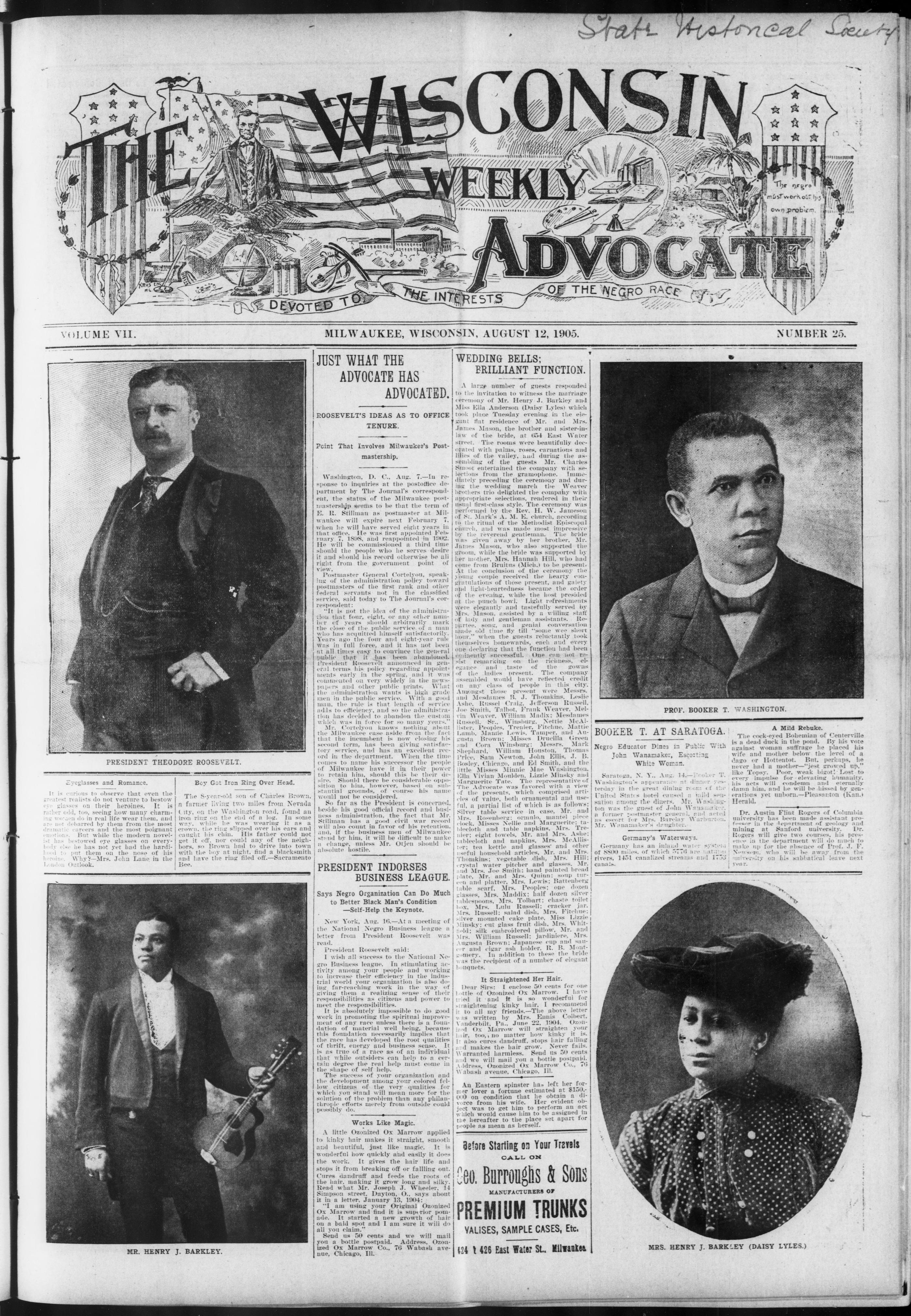
Page text (machine-generated)
WISCONSIN
WEEKLY
The negro
must work out his
own problem.
ADVOCATE
DEVOTED TO
THE INTERESTS
OF THE NEGRO RACE
VOLUME VII.
1910
P.
PRESIDENT THEODORE ROOSEVELT.
Eyeglasses and Romance.
It is curious to observe that even the greatest realists do not venture to bestow eye glasses on their heroines. It is rather odd, too, seeing how many charming women do in real life wear them, and are not debarred by them from the most dramatic careers and the most poignant emotions. But while the modern novelist has bestowed eye glasses on everybody else he has not yet had the hardihood to put them on the nose of his heroine. Why?—Mrs. John Lane in the London Outlook.
JOHN B. HARRIS
MR. HENRY J. BARKLEY.
---
---
Boy Got Iron Ring Over Head.
The S-year-old son of Charles Brown, a farmer living two miles from Nevada City, on the Washington road, found an iron ring on the end of a log. In some way, while he was wearing it as a crown, the ring slipped over his ears and caught his chin. His father could not get it off, nor could any of the neighbors, so Brown had to drive into town with the boy at night, find a blacksmith and have the ring filed off.—Sacramento Bee.
```markdown
```
```markdown
```
JUST WHAT THE ADVOCATE HAS ADVOCATED.
JUST WHAT THE ADVOCATE HAS ADVOCATED.
Washington, D. C., Aug. 7.—In response to inquiries at the postoffice department by The Journal's correspondent, the status of the Milwaukee postmastership seems to be that the term of E. R. Stillman as postmaster at Milwaukee will expire next February 7 when he will have served eight years in that office. He was first appointed February 7, 1898, and reappointed in 1902. He will be commissioned a third time should the people who he serves desire it and should his record otherwise be all right from the government point of view.
Postmaster General Cortelyou, speaking of the administration policy toward postmasters of the first rank and other federal servants not in the classified service, said today to The Journal's correspondent:
"It is not the idea of the administration that four, eight, or any other number of years should arbitrarily mark the close of the public service of a man who has acquitted himself satisfactorily. Years ago the four and eight-year rule was in full force, and it has not been at all times easy to convince the general public that it has been abandoned. President Roosevelt announced in general terms his policy regarding appointments early in the spring, and it was commented on very widely in the newspapers and other public prints. What the administration wants is high grade men in the public service. With a good man, the rule is that length of service adds to efficiency, and so the administration has decided to abandon the custom which was in force for so many years."
Mr. Cortelyou knows nothing about the Milwaukee case aside from the fact that the incumbent is now closing his second term, has been giving satisfactory service, and has an excellent record in the department. When the time comes to name his successor the people of Milwaukee have it in their power to retain him, should this be their desire. Should there be considerable opposition to him, however, based on substantial grounds, of course his name would not be considered.
So far as the President is concerned, beside his good official record and business administration, the fact that Mr. Stillman has a good civil war record will also count in favor of his retention, and, if the business men of Milwaukee stand by him, it will be difficult to make a change, unless Mr. Otjen should be absolute hostile.
PRESIDENT INDORSES BUSINESS LEAGUE.
Says Negro Organization Can Do Much to Better Black Man's Condition Self-Help the Keynote.
New York, Aug. 16. At a meeting of the National Negro Business league a letter from President Roosevelt was read. President Roosevelt said: I wish all success to the National Negro Business league. In stimulating activity among your people and working to increase their efficiency in the industrial world your organization is also doing far-reaching work in the way of giving them a realizing sense of their responsibilities as citizens and power to meet the responsibilities.
It is absolutely impossible to do good work in promoting the spiritual improvement of any race unless there is a foundation of material well being, because this foundation necessarily implies that the race has developed the root qualities of thrift, energy and business sense. It is as true of a race as of an individual that while outsiders can help to a certain degree the real help must come in the shape of self help.
The success of your organization and the development among your colored fellow citizens of the very qualities for which you stand will mean more for the solution of the problem than any philanthropic efforts merely from outside could possibly do.
Works Like Magic.
A little Ozonized Ox Marrow applied to kinky hair makes it straight, smooth and beautiful, just like magic. It is wonderful how quickly and easily it does the work. It gives the hair life and stops it from breaking off or fallling out. Cures dandruff and feeds the roots of the hair, making it grow long and silky. Read what Mr. Joseph J. Wheeler, 14 Simpson street, Dayton, O., says about it in a letter, January 13, 1904: "I am using your Original Ozonized Ox Marrow and find it is superior pomade. It started a new growth of hair on a bald spot and I am sure it will do all you claim."
Send us 50 cents and we will mail you a bottle postpaid. Address, Ozonized Ox Marrow Co., 76 Wabash avenue, Chicago, Ill.
WEDDING BELLS; BRILLIANT FUNCTION.
A large number of guests responded to the invitation to witness the marriage ceremony of Mr. Henry J. Barkley and Miss Ella Anderson (Daisy Lyles) which took place Tuesday evening in the elegant flat residence of Mr. and Mrs. James Mason, the brother and sister-in-law of the bride, at 654 East Water street. The rooms were beautifully decorated with palms, roses, carnations and lilies of the valley, and during the assembling of the guests Mr. Charles Smoot entertained the company with selections from the gramophone. Immediately preceding the ceremony and during the wedding march the Weaver brothers trio delighted the company with appropriate selections, rendered in their usual first-class style. The ceremony was performed by the Rev. H. W. Jameson of St. Mark's A. M. E. church, according to the ritual of the Methodist Episcopal church, and was made most impressive by the reverend gentleman. The bride was given away by her brother, Mr. James Mason, who also supported the groom, while the bride was supported by her mother, Mrs. Hannah Hill, who had come from Bruitus (Mich.) to be present. At the conclusion of the ceremony the young couple received the hearty congratulations of those present, and gaiety and light-heartedness became the order of the evening, while the host presided at the punch bowl. Light refreshments were elegantly and tastefully served by Mrs. Mason, assisted by a willing staff of lady and gentleman assistants. Repartee, song, and genial conversation made old time fly till "some wee short hour," when the guests reluctantly took themselves homewards, each and every one declaring that the function had been equinently successful. One can not resist remarking on the richness, elegance and taste of the gowns of the ladies present. The company assembled would have reflected credit on any class of people in this city. Amongst those present were Messrs. and Mesdames B. J. Thomkins, Leslie Ashe, Russel Craig, Jefferson Russell, Joe Smith, Talbot, Frank Weaver, Melvin Weaver, William Madix; Mesdames Russell, Sr., Winsburg, Nettie McAllister, Peoples, Trenier, Fitchne, Mattie Lamb, Mannie Lewis, Tamper, and Augusta Brown; Misses Drucilla Green and Cora Winsburg; Messrs. Mark Shephard, William Houston, Thomas Price, Sam Newton, John Ellis, J. B. Bosley, Chicago, and Ed Smith, and the little Misses Minnie Mae Washington, Ella Vivian Moulden, Lizzie Minsky and Marguerite Tate. The representative of The Advocate was favored with a view of the presents, which comprised articles of value, both ornamental and useful, a partial list of which is as follows: Silver table service in case, Mr. and Mrs. Rosenberg; ormulo, mantel piece clock, Miss Nellie and Marguerite; tablecloth and table napkins, Mrs. Treier; eight towels, Mr. and Mrs. Ashe; tablecloth and napkins, Mrs. McAllister; tea kettle and glasses and other useful household articles, Mr. and Mrs. Thomkins; vegetable dish, Mrs. Hill; crystal water pitcher and glasses, Mr. and Mrs. Joe Smith; hand painted bread plate, Mr. and Mrs. Quinn; soup turen and platter, Mrs. Lewis; Battenberg table scarf, Mrs. Peoples; one dozen glasses, Mrs. Maddix; half dozen silver tablespoons, Mrs. Tolbart; chaste toilet box, Mrs. Lulu Russell; cracker jar, Mrs. Russell; salad dish, Mrs. Fitchue; silver mounted cake plate, Miss Lizzie Minsky; cut glass fruit dish, Mrs. Whitfield; silk embroidered pillow, Mr. and Mrs. William Russell; jardiniere, Mrs. Augusta Brown; Japanese cup and saucer and cigar ash holder, R. B. Montgomery. In addition to these the bride was the recipient of a number of elegant bouquets.
Dear Sirs: I enclose 50 cents for one bottle of Ozonized Ox Marrow. I have tried it and it is so wonderful for straightening kinky hair. I recommend it to all my friends.—The above letter was written by Mrs. Ennis Colbert, Vanderbilt, Pa., June 22, 1904. Ozonized Ox Marrow will straighten your hair, too, no matter how kinky it is. It also cures dandruff, stops hair falling and makes the hair grow. Never fails. Warranted harmless. Send us 50 cents and we will mail you a bottle postpaid. Address, Ozonized Ox Marrow Co., 76 Wabash avenue, Chicago, Ill.
An Eastern spinster has left her former lover a fortune estimated at $150,000 on condition that he obtain a divorce from his wife. Her evident object was to get him to perform an act which would cause him to be assigned in the hereafter to the place set apart for people as mean as herself.
Before Starting on Your Travels
CALL ON
Geo. Burroughs & Sons
MANUFACTURERS OF
PREMIUM TRUNKS
VALISES, SAMPLE CASES, Etc.
424 t 426 East Water St.. Milwaukee
PROF. BOOKER T. WASHINGTON.
BOOKER T. AT SARATOGA
Negro Educator Dines in Public With John Wanamaker, Escorting White Woman.
Saratoga, N. Y., Aug. 14.—Pooker T. Washington's appearance at dinner yesterday in the great dining room of the United States hotel caused a mild sensation among the diners. Mr. Washington was the guest of John Wanamaker, a former postmaster general, and acted as escort for Mrs. Barclay Warburton, Mr. Wanamaker's daughter.
Germany's Waterways.
Germany has an inland water system of 8800 miles, of which 5776 are natural rivers, 1451 canalized streams and 1753 canals.
A. H.
A. H.
MRS. HENRY J. BARKLEY (DAISY LYLES.)
---
NUMBER 25.
6
The cock-eyed Bohemian of Centerville is a dead duck in the pond. By his vote against woman suffrage he placed his wife and mother below the level of a dago or Hottentot. But, perhaps, he never had a mother—"jest growed up," like Topsy. Poor, weak bigot! Lost to every impulse for elevating humanity, his acts will condemn and eternally damn him, and he will be hissed by generations yet unborn.—Pleasanton (Kan.) Herald.
Dr. Austin Flint Rogers of Columbia university has been made assistant professor in the department of geology and mining at Sanford university. Dr. Rogers will give two courses, his presence in the department will do much to make up for the absence of Prof. J. F. Newsom, who will be away from the university on his sabbatical leave next year.
[Image of a woman with dark hair styled in a high bun, wearing a polka-dotted blouse with buttons.]
---
FOLK NOT A TEETOTALER
Missouri's Governor Mixes His Own High balls.
Although a relentless enemy of the Sunday saloon, Gov. Folk of Missouri is not a teetotaler. In fact, he can take care of "straight goods" on occasion without the aid of a "chaser."
While the governor was on the train from Dodge City, Kan., where he delivered an address at an old settlers' reunion, a little gathering of politicians in the smoker began to discuss the Missouri governor's chances for the presidency. Some one said that the governor's "lid" proclivities would kill any chances he might have, whereupon some one else said that Gov. Folk did drink.
It was decided to put the matter to the test, and Judge Dillard of Fort Scott sent a porter to tell Mr. Folk some friends wanted him to join them in the smoker. In a few moments the Missouri executive was present.
"We have been discussing whether or not you drink, Mr. Folk, and we thought we would find out," said the judge, as he produced a flask.
"Let's have the bottle," the governor said, and the drink that he took left no doubt in the minds of the Kansans that the Missouri mans' democracy was all right. To increase their admiration, the executive would take no chaser.
It was quite a surprise to some in the party, and the governor was asked why it was, if he drank on occasion, that he was such an ardent supporter of the "lid." Mr. Folk replied that he was not responsible for the laws, but simply for their enforcement. The statute was on the book, he said, and he had no choice in the matter.
Close friends of Mr. Folk say he drinks whenever he feels like it, but does not visit saloons. He takes his drinks at his clubs or at his home. The governor makes his own highballs and is said to be quite expert. Gov. Folk also is an inveterate smoker.
Gratitude Well Expressed
Sault Ste. Marie, Mich., Aug. 14. Mr. C. L. Smith, painter and decorator, whose home is at 309 Anne street, this city, makes the following statement: "I was laid up with some kind of pains. Some said it was Lumbago, others Sciatica, and others again Rheumatism. A few of my friends suggested that it was lead poison, but whatever it was it gave me a great deal of pain, in fact, almost completely crippled me. I had to use two canes to walk about and even then it was a very painful task.
"A friend advised me to try Dodd's Kidney Pills and I began the treatment. After I had used the first box I was able to throw away one of the canes and was considerably improved. The second box straightened me up so that I could go about free from pain without any assistance and very soon after I was completely cured, well and happy, without a pain or an ache. Dodd's Kidney Pills seemed to go right to the spot in my case and they will always have my greatest praise."
FINDS AMERICAN TUFFLES.
Squirrel's Late Breakfast Leads to an Epicurean Discovery.
Because a squirrel was late with his breakfast Henry Orleman of Minneapolis made a discovery which will cause epicures all over the country to sit up and take notice. It has been supposed since the American taste became educated up to mushrooms that the tuffle, which caps the climax of the edible fungi, did not grow in this country.
Orleman is a professional mushroom picker and before the days of keen competition used to make as high as $16 and $18 a day. For years he has ranged the fields and woods about Minneapolis, picking up many hundreds of other mushrooms, but never running across the long-sought tuffle until a few mornings ago. Then he saw a squirrel running up an oak tree carrying in its mouth what he first thought was an acorn. Noticing that the acorn appeared unusually large, however, he threw stones at the squirrel, which dropped his breakfast. Orleman picked up the falling meal, sliced it and was delighted to find inside the firm black granules which indicate the true tuffle. He searched among the rotting leaves under the oak and was rewarded by finding eleven fair-sized tuffles. At the best restaurant here the proprietor's eyes opened wide when he saw for the first time native American tuffles. His chef said they were the first he had seen grown outside of France.
The eleven tuffles were worth 50 cents each. In France the fungi bring from $3 to $12 a pound, according to quality. They grow only beneath oak trees and are generally concealed by loose leaf mold on the surface, so that they are hunted with trained pigs or dogs. Orleman intends to train some animals to help him in his search in the vicinity of the original find.
HEART RIGHT
When He Quit Coffee.
Life Insurance Companies will not insure a man suffering from heart trouble. The reason is obvious. This is a serious matter to the husband or father who is solicitous for the future of his dear ones. Often the heart trouble is caused by an unexpected thing and can be corrected if taken in time and properly treated. A man in Colorado writes:
"I was a great coffee drinker for many years, and was not aware of the injurious effects of the habit till I became a practical invalid, suffering from heart trouble, indigestion and nervousness to an extent that made me wretchedly miserable myself and a nuisance to those who witnessed my sufferings.
"I continued to drink Coffee, however, not suspecting that it was the cause of my ill-health, till, on applying for life insurance I was rejected on account of the trouble with my heart. Then I became alarmed. I found that leaving off coffee helped me quickly, so I quit it altogether and having been attracted by the advertisements of Postum Food Coffee I began its use.
"The change in my condition was remarkable, and it was not long till I was completely cured. All my ailments vanished. My digestion was completely restored, my nervousness disappeared, and, most important of all, my heart steadied down and became normal, and on a second examination I was accepted by the life insurance company. Quitting Coffee and using Postum worked the cure." Name given by Postum Co., Battle Creek Mich.
There's a reason, and it is explained in the little book. "The Road to Wetville," in each pkg.
In Harmony.
"Black, please; I am going to a funeral."—Les Annales.
Delicate Flattery.
"How did Percy gain her father's consent?"
"Oh, he sold his auto and bought one like the old man's."—Brooklyn Life.
Method
Young Rockefeller is a wise
Gazabo, as we recognize;
He bids his pious students toil
That they may burn the Standard oil.
Town Torkes
Obeying Orders.
Ernestine—What do you mean by coming to see me in motor goggles?
ing to see me in motor goggles?
Jack—Sh! Your father told me never to show my face around here again.—
Judy.
The Way We All Do.
Bjorkyns—Bad cold you have, Bjenkyns. How did you contract it? Bjenkyns—I didn't contract it. It was only a little one, and I expanded it. Somerville Journal.
His Wav Out.
Fond Mother—Well. Mr. Crusticus, what do you think of Mary's voice? Mr. Criticus — Astonishing volume, madam! It's volume is simply wonderful!—Somerville Journal.
Same Thing—Not Ouite
Wife (who has just been through his pockets)—Wretch, you have been betting again!
He—No, my dear. I have spent the evening at a church bazaar.—Pick-Me-Up.
The Irish Bull in India.
For Sale.—Eleven elephants, male and female, priced low to effect speedy sale. Full particulars from Pat Doyle. 11 Brooking street, Rangoon. Note.—Four of the above have been sold.—Rangoon Gazette.
Too Often So.
"Is Mr. Lovejoy still paying attention to your daughter?"
"Indeed, he isn't paying any attention
to your daughter.
"Indeed, he isn't paying any attention
to her at all."
"Why? Did he jilt her?"
"No; he married her."—Pick-Me-Up.,
A. Virtue of Necessity
"A young man who is starting in life," said the person who gives sonorous advice, "should be careful to avoid debt."
"As a rule," answered the patient listener, "the young man starting out in life hasn't any credit."—Washington Star.
Their Meeting.
She (flushing expectantly)—Fred Smithers, as I live! Poor fellow—it saddens me to think how broken-hearted he was over my refusal.
He (wrinkling forehead)—Wherever have I seen that woman before—PickMe-Up.
Moses Well Known Down Here.
Small girl, in bed, being read to by an elder cousin—Small Girl—When I die, shall I go to heaven, Mary? Mary—Oh, yes; if you are a good girl. S. G.—I want to see Moses. I shall tell him I heard quite a lot about him down here. —London Globe.
No Lack of Lovers.
"Hear me!" sighed Romeo Centipede. "Does not your heart melt at seeing me at your feet?" "Well, you see," coyly answered Juliet Centipede, "there are forty-nine others wooing me at my ninety-eight other feet."—Royal Magazine.
Early Indications.
"I guess our boy Josh is going to be a great statesman or suthin," said Farmer Corntossel. "Is he interested in the tariff?" "No. But every time he runs acrost a funny story he learns it by heart an' tells it at the dinner table."—Washington Star.
"Than Norman Blood."
Mrs. Van der Hamm—Percy, you musn't play with that common Maloney boy any more.
Percy—Why not, mamma?
"Because he's nobody. Why he hasn't even a grandfather!"
"Maybe not, but he's got a goat."— Cleveland Leader.
In Snite of It.
"I think I never saw Rymer so utterly crushed as he was when his first poem appeared in print."
"What was the matter? Some typographical error in the poem?"
"No, that wasn't it. What crushed him was that the paper was sold for a penny a copy, just as usual."—Tit-Bits.
The Maids of Montana
As we left beautiful Missoula two Montana maids and a cowboy dashed up alongside the track and kept pace with the train for some distance; how those girls did ride! It was the original of a Remington picture of western life. One of the girls did not look more than fifteen years of age, but she proved to be the best rider and soon left her companions behind.
As she raced away from the cowboy, the passengers on the train vigorously applauded; and she certainly made a pretty picture on the galloping horse, her cheeks bright with excitement and exercise and her long, fair hair floating in the wind and catching the golden glint of the sunset. The chase was most exciting—now one ahead, now another, and for a few moments the cowboy led, but his triumphant air was soon dampened, for the young girl shot past him; and though the other girl passed her once, the man never gained lost ground. In our car the clapping and cheering were loud and long, and the little incident gave us a delightful memory of our last moments in the valley of Missoula—and the Montana maids.—National Magazine.
Hill House Deal Held Up.
The three trustees who purchased the million dollar Hill house property in New Haven, Conn., to turn over to Yale on August 1, announce that they cannot make the transfer. They say the alumni have not yet pledged funds sufficient to cover the purchase price of the estate. They will continue to hold the property until they can raise the needed amount and can place the estate at the university's disposal free from debt.
Sparrows Set Church Fire
A flock of sparrows which have made their home in the belfry of St. Michael's Roman Catholic church, Philadelphia, Pa., pecked at some matches that had been left on the bell platform and set fire to the building. Then the birds circled about the belfry, making a great outcry, as if summoning help. Firemen extinguished the blaze.
THE PAGAN.
O Summer, with your wooing breeze
That stirs my blood like wine,
O Summer, with your purple seas,
You call the Pagan in my breast,
The Pagan centuries at rest,
Who worshipped at your shrine.
The Pagan loved your fields and hills
And woods, as I do now;
The Pagan knew the joy that thrills My being when I hear the song Of birds at twilight, and the long, Long thoughts that calm my brow.
A Pagan—worshipping, as then,
Your glorious Sun, without a thought
Of greed or gain that men have brought
To fill our world with woe.
Is done—the morning stars above
Sing in his ears their song sublime
Of joy beyond the touch of time,
The passion of the soul.
O Summer, let your splendor steal
Me from my trodden ways;
And let me live and love and feel
Without regret—without the prod
Of right and wrong or vengeful God—
Bring back those fair, glad days.
Sweet Summer, with your wooing breeze
That stirs my blood like wine;
O Summer, with your purple seas,
The Pagan centuries at rest
Is here forever in my breast
To worship at your Shrine.
—Clara Sherwood Stevens in Lippincott's
Magazine.
The Major's Only Surrender.
By Lieut.-Col. J. A. Watrous, U. S. A.
There is an interesting and a pathetic story connected with the late Maj. William Monaghan of Cleveland, O.
The major had served as a boy soldier in the Civil war. In one of the battles he received a wound in his right hand which maimed him, and seriously, for life. He had long been a warm personal friend of Maj. McKinley, having also been chairman of the Republican state central committee during one of his campaigns for the governorship.
At the outbreak of the Spanish-American war President McKinley appointed him a paymaster, with the rank of major of volunteers. He very soon took high rank in the corps, making a record for efficiency, promptness and courtesy.
In 1899 it was proposed to send him to the Philippines. He had no apparent good reason for not desiring to go, but strenuously opposed such a tour of service at that time. He visited Washington and secured a promise that he would not be sent for some time to come, and then was assigned to duty in San Francisco, where he remained the better part of a year, adding, largely, to his reputation as a paymaster. At the end of that time he wrote to the paymaster general, saying: "I am now ready to go to the Philippines. The sooner I am ordered the better."
In due time the order was issued and preparations made for the long journey. To one of the many friends who went to the boat to bid him good-bye he said: "I am going to the Philippines to die, but I am going." Dear, brave old major. The friend tried to convince him that he would return at the end of a couple of years. The major shook his head and said, "No, it is a permanent good-bye; think kindly of me; you will never again see me alive." He was cheerful and in no sense disturbed over his premonition.
Reaching Manila in the spring of 1900 he was soon assigned to a district to distribute money to other paymasters and then pay a large number of troops. He plunged into his work as he had done in Cuba, Omaha and San Francisco, and quickly became recognized as one of the hustling, working paymasters who had only to be ordered to do a thing to do it. He was one of those officers who, when he received an order, set to work with a will, at once, to quickly and effectively execute it, instead on studying how to get the order amended or abrogated.
To one or two of his friends, while in Manila, he said: "I have a feeling that I shall not be on duty here more than a year." One of them asked, "Where do you expect to go?"
"To the next world," said the major. And that is all he would say on the subject.
The law reorganizing the army, in February, 1901, provided for the appointment of twenty-five captains as paymasters and it was understood that the volunteer majors in the corps would be given the preference when the time arrived for appointment. This was a serious, a great grief to Maj. Monaghan, who felt that those volunteer paymasters who had made good records were entitled to hold the same rank in the regular army, from the first. It preyed upon his mind to a marked extent. Asout this time he started out on a long and difficult pay trip. In going from one town to another in northern Luzon he was riding on the front seat of an army wagon while descending a very steep hill. A sudden movement of the wagon forward and to the right threw him down between the wheel mules. He struck on his side, near the heart, and was insensible for a time. His clerk and the driver managed to extricate him from his perilous position. In walking up the hill after crossing a little stream he found great difficulty in breathing, but managed to reach the station which was the last one of his tour, paid the troops and returned to Manila. The pain in his side increased to such an extent that he was obliged to sit up all night, and in the course of two or three days reported to an army surgeon for treatment. He was sent to the hospital at Corregidor. Within a week a serious heart trouble developed. While there, and in a weak condition, thoroughly unfit to undertake an enterprise or to do any traveling, he received notice to appear before an examining board with a view to his transfer from the volunteer to the regular army as a captain. Against the advice of the surgeon in charge at Corregidor he went to Manila and presented himself for examination, but he was not allowed to enter the room. He was ordered to return to Corregidor, without delay, and wait until his recovery, when he would be given ample opportunity for examination to enter the regular establishment.
Two days after he returned to Corregidor I received a dispatch from him that was not at all like the strong, large-brained, self-reliant Maj. Monaghan I had known for years. It read, in substance, as follows: "See Surgeon Blank and get him to certify that I should be given a leave of absence to return to the states. If necessary, call on Gen. MacArthur and ask him to hurry it up. Ask Maj. Aleshire to arrange to have the Sheridan stop at Corregidor and take me home. I am afraid that the next boat will be too late."
After reading the peculiar message
several times I hurried to the physician, laid the matter before him, showed him the message and asked him what he could do. "I will endorse an application for leave to the effect that he should be sent home on the earliest possible date," said the doctor, "but no application for leave has yet been made. Before I can do anything the application must be forthcoming." I realized that from the start, but felt that some kind of a message should be returned to the major, and that it should be as encouraging as possible. I then called upon Maj. Aleshire, the transportation quartermaster, and asked him if it was possible to have the Sheridan stop at Corregidor and receive the major as one of its passengers to San Francisco. He said it would be out of the question.
"However, you can tell the major that instead of going on the 13th of April, the Sheridan will not sail until the 23d. That will give him ample time to come to the city and make all necessary arrangements to go home on that transport. I will see that a stateroom is retained for him."
On this information from the surgeon and the master of transportation I framed as cheerful and encouraging a cable as I could. It was to the effect that the surgeon was ready to do everything in his power and would act promptly; that Maj. Aleshire said the boat would go ten days later than advertised; that a launch would convey him to Manila, where he could make all of the needed arrangements for a return home; that a stateroom would be at his disposal.
The major's clerk and one cr two other friends were at his side when this dispatch was received. There was a cheerful smile, a tear, and then a trembling voice said, "I am going home on the Sheridan. The major has made all arrangements, secured a stateroom and nothing more is to be done."
The next morning, just after the flag which was so dear to him had been hauled to its place at the head of the staff, and the early morning breezes were making it dance in the beautiful sunlight, the major's head fell back on his pillow and a minute later his spirit had winged to the other world.
His good-bye in San Francisco was what he had said it would be—the last one on earth to that friend.
The funeral took place in Manila and was one of the largest ever held there over an American officer. Several companies of infantry, a section of artillery, the commanding general of his department, Maj.-Gen. Wheaton, and his staff, the entire pay corps and about sixty brother Masons honored his memory with their presence. Just as the sun disappeared that balmy April hour the coffin was placed on a launch which steamed to the great transport, and the body of Maj. Monaghan went home on the Sheridan.
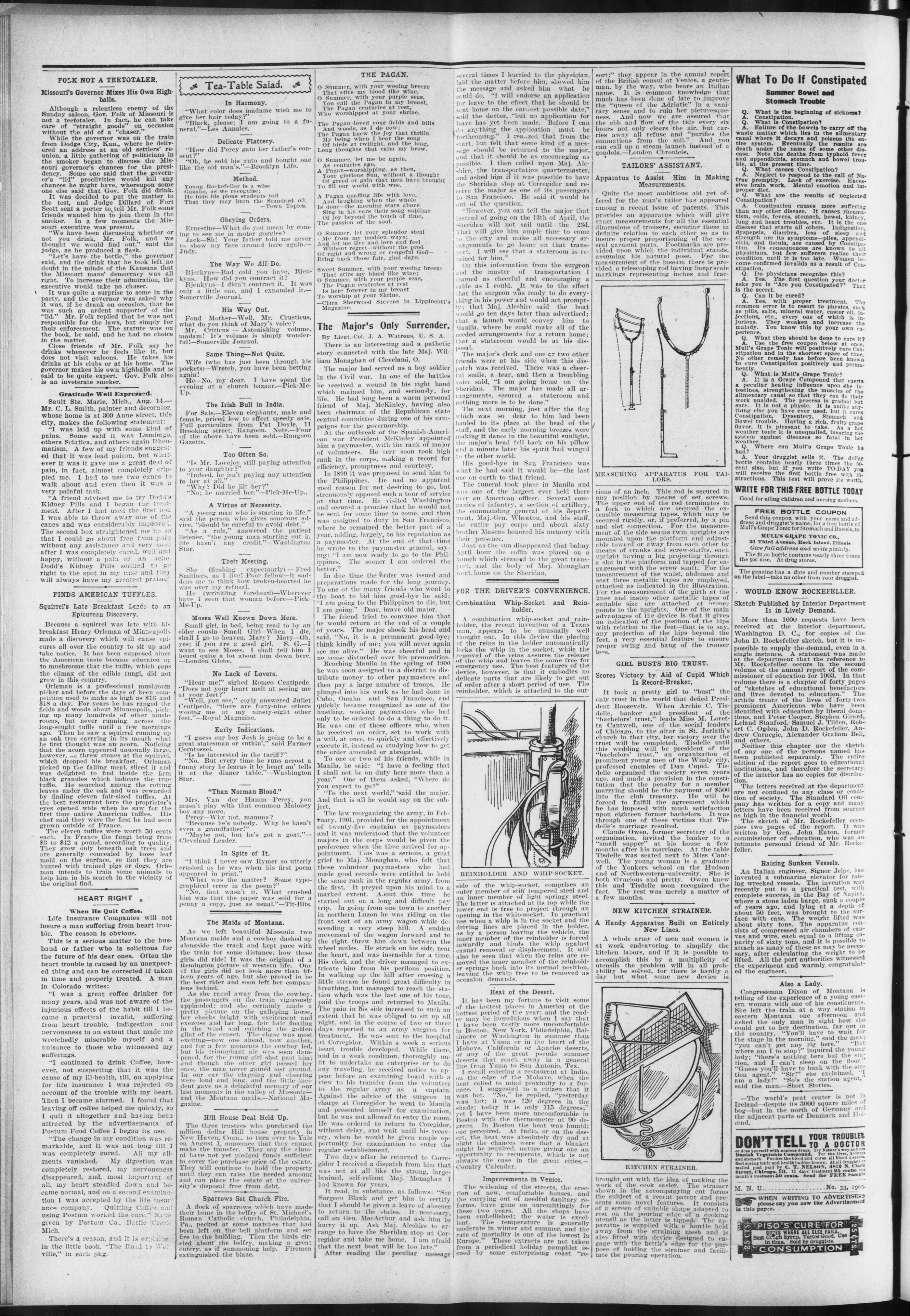
FOR THE DRIVER'S CONVENIENCE Combination Whip-Socket and Rein- holder
A combination whip-socket and rain-holder, the recent invention of a Texas man, appears to be unusually well thought out. In this device the placing of the reins in the holder automatically locks the whip in the socket, while the removal of the reins assures the release of the whip and leaves the same free for emergency use. The best features of the device, however, is that it embodies no delicate parts that are likely to get out of order after a short period of use. The reinholder, which is attached to the out-
A
REINHOLDER AND WHIP-SOCKET.
side of the whip-socket, comprises an outer member of stiff tempered steel and an inner member of light springy steel. The latter is attached at its top while the lower end is free to project through an opening in the whip-socket. In practical use when a whip is in the socket and the driving lines are placed in the holder, as by a person leaving the vehicle, the inner member of the reinholder is forced inwardly and binds the whip against casual removal or displacement. It will also be seen that when the reins are removed the inner member of the reinholder springs back into its normal position, leaving the whip free to be removed as occasion demands.
Heat of the Desert
It has been my fortune to visit some of the hottest places in America at the hottest period of the year; and the reader may be incredulous when I say that I have been vastly more uncomfortable in Boston, New York, Philadelphia, Baltimore or Washington in summer than I have at Yuma or in the heart of the Mohave, California or Apache deserts, or any of the great pseudo summer deserts that reach away in a general line from Yuma to San Antonio, Tex.
I recall entering a restaurant at Indio, on the edge of the Mohave, when the heat called to mind proximity to a furnace. I suggested to a citizen that it was hot. "No," he replied. "yesterday was hot; it was 120 degrees in the shade; today it is only 115 degrees;" yet I have been more uncomfortable in Boston with the thermometer at 90 degrees. In Boston the heat was humid; one perspired. At Indio, or on the desert, the heat was absolutely dry and at night the chances were that a blanket might be required. nature giving one an opportunity to recuperate, which is not always the case in the great cities.—Country Calendar.
Improvements in Venice
The widening of the streets, the erection of new, comfortable houses, and the carrying out of needful sanitary reforms, have gone on unremittingly for these two years. All the shops have been embellished; the water is excellent. The temperature is generally moderate in winter and summer, and the rate of mortality is one of the lowest in Europe." These extracts are not taken from a periodical holiday pamphlet issued by some enterprising coast "re
sort;" they appear in the annual report of the British consul at Venice, a gentleman, by the way, who bears an Italian name. It is common knowledge that much has been done of late to improve the "queen of the Adriatic" in a sanitary sense and to ruin her picturesqueness. And now we are assured that the cbb and flow of the tide every six hours not only clears the air, but carries away all refuse and "purifies the emanations from the soil." And you can call up a steam launch instead of a gondola.—London Chronicle.
TAILORS' ASSISTANT.
Apparatus to Assist Him in Making Measurements.
Quite the most ambitious aid yet offered for the man's tailor has appeared among a recent issue of patents. This provides an apparatus which will give exact measurements for all the essential dimensions of trousers, securing these in definite relation to each other so as to insure proper proportioning of the several garment parts. Footmarks are provided upon which the individual stands, assuming his natural pose. For the measurement of the inseam there is provided a telescoping rod having linear scale markings representing inches and frac-
1
MEASURING APPARATUS FOR TAI LORS.
tions of an inch. This rod is secured in any position by means of set screws. The upper end of the rod terminates in a fork to which are secured the extensible measuring tapes, which may be secured rigidly, or, if preferred, by a pin and slot connection. For the measurement of the side seams twin uprights are mounted upon the platform and adjustable toward or away from each other by means of cranks and screw-shafts, each upright having a lug projecting through a slot in the platform and tapped for engagement with the screw saft. For the measurement of the waist, abdomen and seat three metallic tapes are employed, attached as indicated in the illustration. For the measurement of the girth at the knee and instep other metallic tapes of suitable size are attached at proper points to the uprights. One of the main advantages of the device is that it gives an indication of the position of the hips with relation to the feet—that is to say, any projection of the hips beyond the feet, a very essential feature to ensure proper swing and hang of the trouser legs.
GIRL BUSTS BIG TRUST.
Scores Victory by Aid of Cupid Which Is Record-Breaker.
It took a pretty girl to "bust" the only trust in the world that defied President Roosevelt. When Archie C. Tisdelle, banker and president of the "bachelors' trust," leads Miss M. Loretta Cantwell, one of the social leaders of Chicago, to the altar in St. Jarlath's church in that city, her victory over the trust will be completed. Tisdelle until this wedding will be president of the "bachelors' trust," an organization of prominent young men of the Windy city, professed enemies of Dan Cupid. Tisdelle organized the society seven years ago, and made a provision in the constitution that the penalty for a member marrying should be the payment of $500 into the club treasury. He will be forced to fulfill the agreement which he has imposed with much satisfaction upon eighteen former bachelors. It was through one of these victims that Tisdelle's marriage resulted.
Claude Owen, former secretary of the organization, invited the banker to a "small supper" at his house a few months after his marriage. At the table Tisdelle was seated next to Miss Cantwell. The young woman is a graduate of the Yonkers school on the Hudson and of Northwestern-university. She is both vivacious and pretty. Owen knew this and Tisdelle soon recognized the fact. The rest was merely a matter of a few months.
NEW KITCHEN STRAINER.
A Handy Apparatus Built on Entirely New Lines.
A whole army of men and women is at work endeavoring to simplify the kitchen labors, and if it is possible to accomplish this by a multiplicity of utensils the problem will in all probability be solved, for there is hardly a day but what some new device is
A
brought out with the idea of making the work of the cook easier. The strainer shown in the accompanying cut forms the subject of a recent patent and presents some novel features. It consists of a screen of suitable shape adapted to rest on the pouring edge of a cooking utensil as the latter is tipped. The apparatus is supplied with a handle held away from the straining mesh and is also fitted with device designed to engage with the kettle's edge for the purpose of holding the strainer and facilitate the pouring operation.
What To Do If Constipated Summer Bowel and Stomach Trouble
Q. What is the beginning of sickness?
A. Constipation.
Q. What is Constipation?
A. Failure of the bowels to carry off the waste matter which lies in the alimentary canal where it decays and poisons the entire system. Eventually the results are death under the name of some other disease. Note the deaths from typhoid fever and appendicitis, stomach and bowel trouble, at the present time.
Q. What causes Constipation?
A. Neglect to respond to the call of Nature promptly. Lack of exercise. Excessive brain work. Mental emotion and improper diet.
Q. What are the results of neglected Constipation?
A. Constipation causes more suffering than any other disease. It causes rheumatism, colds, fevers, stomach, bowel, kidney, lung and heart troubles, etc. It is the one disease that starts all others. Indigestion, dyspepsia, diarrhea, loss of sleep and strength are its symptoms—piles, appendicitis, and fistula, are caused by Constipation. Its consequences are known to all physicians, but few sufferers realize their condition until it is too late. Women become confirmed invalids as a result of Constipation.
Q. Do physicians recognize this?
A. Yes. The first question your doctor asks you is "Are you Constipated?" That is the secret.
Q. Can it be cured?
Q. Can it be cured?
A. Yes, with proper treatment. The common error is to resort to physics, such as pills, salts, mineral water, castor oil, injections, etc., every one of which is injurious. They weaken and increase the malady. You know this by your own experience.
Q. What then should be done to cure it?
A. Use the free coupon below at once. Mull's Grape Tonic will positively cure Constipation and in the shortest space of time. No other remedy has before been known to cure Constipation positively and permanently.
Q. What is Mull's Grape Tonic?
A. It is a Grape Compound that exerts a peculiar healing influence upon the intestines, strengthening the muscles of the alimentary canal so that they can do their work unaided. The process is gradual but sure. It is not a physic. It is unlike anything else you have ever used, but it cures Constipation, Dysentery, Stomach and Bowel trouble. Having a rich, fruity grape flavor, it is pleasant to take. As a hot weather tonic it is unequalled, insuring the system against diseases so fatal in hot weather.
Q. Where can Mull's Grape Tonic be had?
A. Your druggist sells it. The dollar bottle contains nearly three times the 50-cent size, but if you write TO-DAY you will receive the first bottle free with instructions. This test will prove its worth
WRITE FOR THIS FREE BOTTLE TODAY Good for ailing children and nursing mothers
FREE BOTTLE COUPON
Send this coupon with your name and address and druggist's name, for a free bottle of Mull's Grape Tonic for Stomach and Bowels, to
MULL'S GRAPE TONIC CO.,
21 Third Avenue, Rock Island, Illinois
Give full address and write plainly.
The $1.00 bottle contains nearly three times the 50c size. At drug stores.
The genuine has a date and number stamped on the label—take no other from your druggist.
. WOULD KNOW ROCKEFELLER.
Sketch Published by Interior Department Is in Lively Demand.
More than 1000 requests have been received at the interior department, Washington D. C., for copies of the John D. Rockefeller sketch, but it is impossible to supply the demand, even in a single instance. A statement was made at the department that the reference to Mr. Rockefeller occurs in the second volume of the annual report of the commissioner of education for 1903. In that volume there is a chapter of forty pages of "sketches of educational benefactors and lives devoted to education." The article treats of the lives of forty-two prominent Americans who have been identified with education by liberal donations, and Peter Cooper, Stephen Girard, Leland Stanford, Samuel J. Tilden, Robert C. Ogden, John D. Rockefeller, Andrew Carnegie, Alexander Graham Bell, and others.
Neither this chapter nor the sketch of any one of the persons named has been published separately. The entire edition of the report goes to educational institutions, and therefore the secretary of the interior has no copies for distribution.
The letters received at the department are not confined to any class or condition of society. The Standard Oil company has written for a copy and many letters have been received from sources as high in the financial world.
The sketch of Mr. Rockefeller occupies two pages of the report. It was written by Gen. John Eaton, former commissioner of education, who was an intimate personal friend of Mr. Rockefeller.
Raising Sunken Vessels.
An Italian engineer, Signor Jelpo, has invented a submarine elevator for raising wrecked vessels. The invention was recently put to a practical test, with complete success, in the Bay of Naples, where a stone laden barge, sunk a couple of years ago, and lying at a depth of about 50 feet, was brought to the surface with ease. The weight lifted was about sixty tons. The apparatus consists of compressed air chambers of canvas and wire, each equal to a lifting capacity of sixty tons, and it is possible to attach as many of these as may be necessary, after calculating the weight to be lifted. All the port authorities witnessed the experiment and warmly, congratulated the engineer.
Also a Ladv.
Congressman Dixon of Montana is telling of the experience of a young eastern woman with one of his constituents. She left the train at a way station in eastern Montana one afternoon and asked the only man in sight how she could get to her destination, far out in the country. "You'll have to wait for the stage in the morning," said the man; "you can't get any rig here." "But where am I to stop?" inquired the young lady; "there's nothing here but the station, and I can't sleep on the floor." "Guess you'll have to bunk with the station agent." "Sir!" she exclaimed, "I am a lady!" "So's the station agent," said the man.—Short Stories.
The world's peat center is not in Ireland—despite its 3000 square miles of bog—but in the north of Germany and the adjacent parts of Denmark and Holland.
DON'T TELL YOUR TROUBLES TO A DOCTOR or dose yourself with noxious drugs. Try Nature's way and use Danish Vegetable Compound. For the liver, kidneys and stomach. Purifies the blood and cures all blood diseases. Best spring tonic and health builder known. At all drugglugs or mailed post paid by C. T. NELSON, 4812 N. Clark Street, Chicago, Ill. 12 days' treatment 25 cents; one month's treatment 50 cents. Send for FREE Sample
WHEN WRITING TO ADVERTISERS please say you saw the Advertisement in this paper.
PISO'S CURE FOR
CURES WHERE ALL ELSE FAILS.
Best Cough Syrup. Tastes Good. Use in time. Sold by druggists.
CONSUMPTION
GOSSIP FOR THE LADIES.
Day-Dreaming
Beyond the purple hills the realms of Fancy
Spreads mile on mile in limitless domain,
A realm in which by spell of necromancy
One's quite absolved from heartache, care and pain.
In day-dreams oft its quiet lanes I wander,
And take my rest beside its meadow rills,—
Enchantment rules this land of Way-Off Yonder,
The realm that lies beyond the purple hills.
The valley where I live is most prosale,
The lives lived there are those of greed and gain,
The building laws, dust covered and archaic.
Tis sweet to let Thought go the way it
wills,
To wander without tribute or exaction
The sun-kissed land beyond the purple
hills.
I build my castles there with all of splend
dor,
In arbors sit where roses twine above,
And with my Knight beside me, brave
though tender,
I learn the wondrous magicry of love.
Ah, day-dreams sweet, my foolish heart
grows fonder
Each hour of your ecstasies and thrills.—
Let's roam once more the land of Way-Off-
Yonder.
The realm that lies beyond the purple bills!
Roy Farrell Greene in The Housekeeper.
Children Should
Have Cheerful Environment.
Keep your home environment cheerful if you would develop the best in your child's nature, writes Anna Marble in the New York Evening Telegram. See that he is not depressed by symbols of gloom and sorrow! Much of a child's future, not only his moral, but his material future as well, is being developed in his everyday home life. This fact is realized by modern parents to a degree which would have vastly astonished our forebears. A few there are still, however, who seemingly fail to comprehend the importance of environment in relation to the character unfolding of a child.
Putting out of consideration the very wealthy parents and the extremely poor, there are the great middle classes, able to provide comfortable homes for their children, and it is among those that one finds occasional shortsightedness concerning the child's daily surroundings.
Many persons would think it sacrilege to banish from their walls pictures which were thought to be ornamental in the days of their grandmothers, yet some of these reversed old prints are hideous and many of them have as subjects the unpleasantest possible incidents. Carriage of the battlefield was a much-admired subject for artists during the '60's, and one sees quite often steel engravings of that period which are anything but productive of cheerfulness. The keynote of today is cheerfulness; Take down the steel engraving, in its somber black varnished frame. Banish it to the cellar, if you are loth to part with it altogether. How many times your little boy may stand before it, fascinated by the agony in the dying soldier's face, you will not know, yet he may take with him throughout his lifetime the terrible impression of that engraved torture.
It is almost criminal negligence for parents to indulge in the belief that children "don't notice such things." Objects of the sort are the very first which excite their curiosity and their speculation. Another horror of the household is the coffined funeral wreath, a glass-enclosed symbol, the display of which in a living room should be made punishable by fine. "What is that? That white thing up in the box on the wall?" inquires a child. He is told that it was "on grandma's casket." Thereafter whenever he looks at it he associates with it a coffin, and if he is more imaginative a host of funeral trappings.
Do not take children to funerals! Some mothers who would resent being thought unkind to their children, inflict this terrible ordeal upon them as a matter of course. "Come along, Tommy, Mrs. Jones' feelings will be hurt if we don't go to Mr. Jones' funeral," and off goes mother, followed by Tommy, who fears to accompany her, yet is fascinated by his own expectant horror.
Go through your home today and toss out unceremoniously all the symbols or objects that might offend him with their unpleasant suggestion. Do not decorate the parlor table with a dead bird nor the hearth rug with a stuffed dog.
Keep children away from sick rooms, not only for sanitary reasons, but to protect them from the depressing atmosphere, the detail invariably attendant upon illness. Instead of taking Willie to call upon poor Mrs. Smith, who has been "ill for months and months," take him to the museum of art, show him the beautiful paintings, and when he is tired let him run on the grass.
Don't discuss your own physical ailments unless you want to rear a little hypochondriac. Who does not know the woman with the continuous headaches, whose small son insists on having his forehead tied up in a handkerchief "like mother!"
When accidents occur in the street, keep children away from the scene. Do not read to or before children the published account of railroad wrecks, steamboat disasters and murders. Instead, read wholesome, cheerful things to them, and do all possible to make their minds healthy.
Work for Gentlewomen
Promoters of employment for gentlewomen in London are studying what is known throughout the country as "the Ispwich experiment," and which is nothing less interesting than a revival of that town's colonial glories as a lacemaking center. With the advance of culture, distaste for the stereotyped product of unthinking machinery is gaining ground among the truly aesthetic. There is a return to the handiwork of man, and still more to that of women. Beauty lovers prefer the output of deft digits to the smoothest work of steel or iron. Thus, machine-made lace is not as popular as it was a few years ago—of course, it never could compete with the finer hand-made laces—and even in the cheaper grades the buying public appears to prefer laces made directly by human workers.
A society for the restoration of Ipswich's prestige in that industry has been formed, with Mrs. Robert Brown as president and Miss Lucy B. Story as treasurer. It holds meetings in Historical house, where a colonial tea recently was given for the encouragement of the lace workers and the display of their art triumphs. The idea of the society is that a great deal more lace should be made by hand in Ipswich next year than was turned out in 1790, when the town records show the output at 41,979 yards. Classes have been formed for instruction of adults in the craft, books on lace-making have been added to the public library, and it is proposed to start a kindergarten to teach the young idea how to shoot the warp and woof into the myriad intricate patterns of yore. All the Ipswich lace is pillow-made, but today the workers use a flat cushion in-
stead of the round one of the Eighteenth century.—Selected.
Tact may be defined as saying the right thing and leaving unsaid the wrong one; also of doing the right thing in the right way and of not doing it in the wrong way. It is sometimes assumed that women have more tact than men, but, however that may be, the possession of this desirable quality will win more for a woman than even beauty can. There are some persons in whom this power seems to be innate. They know how to select the most agreeable and efficient methods of approach, they rarely blunder in their intercourse, they wound no one's sensibilities and accomplish their end without a war of words or without giving another the unpleasant sense of defeat. The most tactful women in the world are French women, and they carry all before them by this means without the aid of beauty. The celebrated women of the salons of the Eighteenth century in France were, as a rule neither young nor handsome, rich or well educated; yet by their tact they exercised an enormous influence over the minds of the great men who frequented their salons. Mlle. de l'Espinasse, one of the most celebrated of these women, was poor and plain, yet a witty French author said of her: "When people talked to her they never felt how clever she was but how clever they were:
Mme, du Deffand, the friend of Horace Walpole, old and quite blind, was to the last witty and delightful and swayed the minds of men, while Mme, Geoffrin, a bourgeois, neither beautiful nor well educated, was a leader of the most aristocratic circle the world has known because she had a "tact that amounted to genius." She could not even spell correctly, but her tact and sympathy put her en rapport with learned men and attractive women. Her clever, illiterate old grandmother, who brought her up, is quoted as saying: "If a woman were a fool education only made her folly more conspicuous, and if clever, she could get on very well without it."
The only woman who is apt to get herself universally disliked is the one who has unpleasant, tactless manners and prides herself on speaking the exact truth on all occasions, forgetting that "blunt truths more harm than nicer falsehoods do." It requires mind and brain of a certain quality to be tactful; not the brain of the learned woman, who may possibly lack perception; not the brain of the merely clever, practical woman, who can serve up a dinner of eight courses; but certain sympathetic qualities of mind and heart which enable the possessor to see and feel, which give insight into character and which enable the possessor to take the mental pulse of others. A tactful person does not lose a friend for a jest or by making the first remark which comes into her head. Naturally, one is sometimes off one's guard and in a moment of irritation may say the "things best left unsaid," but the tactful person will try to efface the error, while the tactless one is forever unconscious of offense.—Providence Journal.
Lives Crushed to
Bring Sweetness Out
Shrubs are not pretty to look at. On my desk was a glassful of the dark red brown flowers, with their green leaves. A visitor came in and smelled them. "They are not fragrant," she said. "Not that way," I answered. And I broke one or two off and bruised them between my fingers until they stained my hand with their red juice. Then they emitted a strong, delicious odor, sweeter than pineapples or strawberries, yet combining the fruitiness of both. "You have to crush them," she remarked, "to get the sweetness out."
And after my visitor went away, with the crushed shrubs playfully wrapped in her handkerchief—as we all carried sweet, crushed shrubs when we were children—I sat smiling and thinking how aptly, how very aptly, her comment on the shrubs might apply to some human lives.
Do we not all know people who were dull and unattractive and unresponsive until some great sorrow came to wake them up? Grief alone puts the soft light of understanding in their eyes, remoulds the proud lip to curves of tenderness, enriches the voice with new meaning, and gives to the hand the power of speaking warm sympathy.
Always before they were cold and self-centered. Now sympathy radiates from their words, their manner, their face, their whole personality. It is the beautiful fragrance of universal love, set free by the crushing process. It hurt. Yes. But it has made a useful and lovely life out of one that stood for nothing but a selfish blank.
Some of the most magnificent men and women who ever lived were made so by some great sorrow which marked the turning point in their lives. It is the deep experience that brings out the truth of us, and hard as the experience may have been, some of us would never have found ourselves but for it. The day comes when we are wise enough to bless sorrow and trouble and disappointment as the best thing that could have happened to us.
It is an old lesson, this teaching of the shrubs that crushing brings the sweetness out of a life. But it is worth repeating if it will help any of us to smile in the face of trouble and bear sorrow more bravely. — Philadelphia Evening Bulletin.
Love's Practical Lessons.
It is the rare individual who has not been in love at some time in life, experiencing all the doubts and fears, the joys and hopes of learning whether he is truly beloved. Yet it is a curious fact that the lover is looked upon as a sentimentalist, a dreamer, who has no practical lessons for others. Nothing could be more false.
In the first place, love makes its votaries put their best side out, says a writer in the Chicago Journal. No man or woman ever appears to more advantage at any time in life than when in the presence of the one whose love is sought.
If the world could regulate its conduct by the attitude of the lover, it is the merest of truisms to say that every doubt and difficulty in it would disapnear.
If the man in business would seek to make the same happy appearance before his customers and patrons his business would thrive exceedingly. Love has other business-like qualities of the first moment. No one is ever so careful to keep an appointment, or so punctual to the moment, or so assiduous in devoting himself to the object in hand as the lover. To be there on the instant—a little before, if possible—is never doubtful. To leave at the latest possible moment is equally certain. And while there, what could be mode admirable than the single-minded attention shown?
Love's resourcefulness has passed into a proverb. Opportunities for meeting are devised in a manner which shows that the soberest of individuals has an active imagination. If concealment of the purpose is essential to the progress of the affection, behold a thousand means for
keeping it hidden. Unsuspected faculties come into play at every point. Conceive, if you can, of a business man equally resourceful and equally apt in covering up his plans and opportunities. And all these things signify that the lover is diligence itself. He devotes every possible moment to the furthering of his object. Labor and painstaking are given unstintingly and with complete disregard of self, day and night. Nor is urging to further effort ever necessary. But to expect as much in the way of earning a livelihood as in making love is a sad impossibility. Nature cares infinitely for the race—and in the making of love is involved the perpetuation of the race.
A Good Motto for Dressing Table.
"Fasten the Ends," is the motto which the tidy girl hangs over her dressing table. She never suggests a frayed or mussy ribbon, no matter how exquisite its coloring. Even the men are quick to note trifling carelessness in grooming, while the untidy girl is severely criticized by members of her own sex. For this reason, inventors and shopkeepers are constantly offering first aids to tidiness and any little appliance which will add to the smartness and trimness of a woman's appearance commands a good sale, says the Philadelphia Press.
As the face naturally attracts the first glance, the arrangement of the hair and the adjustment of the hat and veil are points upon which the tidy girl expends infinite pains. Next to the importance of keeping the hair in good condition ranks that of dressing it neatly, and the present fashion of arranging the hair low requires an exceptional number of combs. The best arrangement calls for four combs of uniform size about two inches square. Two of these are used to keep the rolls in place, and two keep in good order the many stray locks which persist in falling about the forehead and over the ears.
The comb of the hour among girls who prefer simplicity in dress is of light amber, severely plain, but highly polished. To match these come very long hairpins with knob ends like balls. The fancy comb of celluloid and the cheap jeweled comb are not considered good form, and only for dressy occasions does the girl who possesses such an extravagance bring forth her comb of real tortoise shell or amber, studded with gems. Never would she wear such a comb with a severe tailored gown or shirtwaist suit.
With Vacation-
Here how many mothers have been looking forward to this time as one in which they would have the privilege of having their children entirely under their direction?
One mother, who means to be good and devoted, was heard to say: "Those children are home for all summer, and I suppose I will never get a minute's rest. I have tried to get their father to consent to send them to the country." In fact, too many mothers consider their children's liberty, looked forward to with delight by the little hearts, as a period of special care and anxiety destined to bore them. It should be met with utter happiness, and they should study to meet the opportunity with sympathetic arrangements.
The children should not be allowed to run the streets and do just as they may please, irrespective of their welfare; neither should they be made unhappy. A clever mother will take delight in so planning the time for the children they will have certain periods for different things that shall be both a benefit and a pleasure.
A garden offers opportunity for work and amusement. The early morning hours after breakfast may be devoted to the study of plant life illustrated in their own little garden, and they may be taught the first lessons of accomplishing something by being given a certain amount of work to finish each day, and in this way they, can keep the beds neatly weeded and the borders well trained. Then a certain time may be set aside for play and to give them the luxury of getting their hands and faces real dirty, for blessed is the child who knows how to do this and then has either the instinct or cultivated manners to clean up for circumstances that should be respected. The child should be clean and sweet for lunch, and during the heat of the day it is a good plan to lie down to rest either on the grass, on the porch or in a cool room. Now mother should read for an hour or two from some entertaining book until sleep comes, after which a short play may be indulged in and then bathing and dressing.
Children in a city house or flat during the summer are a difficult problem. If they have not the conveniences of a yard and porch they must be taken out all the time that is possible. They should have as complete a change in everything as can be arranged for them.—Washington Star.
A Summer Hint.
Such an attractive lot of girls scattered far and wide about the country and along the coasts! How much pleasure they are all having! How much health we hope they are getting for the next winter's demands! But, girls, don't use the summer just for pleasure for your lovely selves. Remember in the excitement of teas and tournaments, of sailing and swimming, of fishing and dancing, to look around you whenever you can. Lend a helping hand for the little task that seems wearisome to the doer. Read or chat with the invalid for a few minutes. You don't know how refreshing it is to the sick to have the current of thought changed for a time. Don't refrain from the word of sympathy in some one's evident joy or sorrow. These things all count wonderfully. Above all try to get for yourselves at least a half-hour daily of absolute seclusion. Neither the selfish pursuit nor too generous giving of pleasure should be allowed to deprive you of that. The earlier in the day the better. Just before or just after breakfast is a good time. Use it for reading something worth while.—Harper's Bazar.
A Oueenly Carriage.
Nothing is so conducive to health, grace and beauty as the carriage of the body. An erect figure is an essential to perfect health and symmetry of form, says the Pittsburg Press. A woman of 50, with the step and bearing of a queen, once said that as a child she had shown a decided tendency to stoop. Her mother talked and pleaded in vain. At last her father took things into his own hands. "If I may be allowed to do it in my own way," he declared, "I will teach her to carry her shoulders back and her head up." After that the father met his daughter every day on the front veranda and insisted on her walking the length of the garden with a pail of water in each of her hands and a book placed on her head. At first it was a difficult task, but each time the book fell the penalty was another walk to the gate and back. Four times a day for six months this promenade was taken. It was a severe training, but it resulted in a queenly carriage.
Farmer Needs Close Watch
Nathan Slusser, a farmer living in the Tomhicken valley near Wilkesbarre, Pa., has during the last couple of days painted some of his cows and horses green. He also declared that his pigs suffered from the heat, and he lowered three into a deep well, where they were drowned. His family is keeping a close watch on him.
YOUNG FOLKS' COLUMN.
```markdown
```
Last year my bedtime was at eight,
And every single night
I used to wish the clock would wait,
Or else stay out of sight.
It always seemed to me
The next half-hour 'd be
The nicest time of all the day
If mother would agree.
But she always shook her head,
And she sort of jumped, and said,
Why, it's late—after eight—
And it's time you were in bed!
That clock would always do its best
To sit all quiet there,
Until I was my comfyest
In some big easy chair.
Then its striking would begin,
And I'd tell my motherkin
How I'd just begun a chapter, and
It was so int'restin',—
And then end was just ahead,—
But she usurally said,
No, it's late—after eight—
And it's time to go to bed.
And now my bedtime is ha'-past,
But yet that old clock does
The same mean tricks—it's just as fast,
Or faster than it was.
Last night it seemed to me
The next half-hour 'd be
The nicest time of all the day
If mother would agree.
But she smiled and shook her head,
And she kissed me while she said,
Why, it's late—ha'-past eight—
And it's time you went to bed! !
—Burges Johnson in Harper's Magazine.
The Hole in the Canna Bed.
One evening in May, Chuckie Wuckie's papa finished setting out the plants in the front yard. Into one large bed he put a dozen fine cannas. They looked like fresh young shoots of corn. He told Chuckie Wuckie that when summer came they would grow tall, with great spreading leaves and beautiful red-and-yellow blossoms.
"Taller than me, papa?" asked the little girl, trying to imagine what they would look like.
Much taller; as tall as I am.
Chuckie Wuckie listened gravely while papa told her she must be very careful about the canna bed. She must not throw her ball into it, or dig there, or set a foot in the black, smooth earth. She nodded her head solemnly, and made a faithful promise. Then she gathered up her tiny rake and hoe and spade, and carried them to the vine-covered shed to put beside her father's tools.
Next morning, when papa went to look at the canna bed, he discovered close beside one of the largest plants a snug, round hole. It looked like a little nest. He found Chuckie Wuckie digging with an iron spoon in the ground beside the fence.
"Dearie," he said, "do you remember I told you last night that you must not dig in the canna bed?"
"Yes," said the little girl.
"Yes," said the little girl. "Come and see the hole I found there." So Chuckie Wuckie trotted along at her father's heels. She stood watching him as he filled in the hole and smoothed the earth. "I did not dig it," said Chuckie Wuckie. "I just came and looked to see if the cannas had grown any through the night, but I did not dig."
"Really?" asked papa, very gravely. "Really and truly, I did not put my
"Really and truly, I did not put my foot on there," said Chuckie Wuckie. Papa did not say another word. But he could not help thinking that the hole looked as if the iron spoon had neatly scooped it out. Next morning he found the hole dug there again, and Chuckie Wuckie was still busy in her corner of the fence. He did not speak of it, however. There were prints of small feet on the edge. He only smoothed down the earth and raked the bed. He did this for three mornings, then he led Chuckie Wuckie again to the canna bed.
"Papa," she said earnestiy, "I did not dig there. Truly, I didn't. The hole is there every morning. I found it today before you came out, but I did not dig it." There were tears in her brown eyes.
"I believe you, Chuckie Wuckie dear," said her father, earnestly. That night the little girl stood at the gate, watching for father to jump off the car. She could hardly wait for him to kiss her. She took his hand and led him to the canna bed.
"Look" she cried eagerly.
She was pointing excitedly to a hole beside the roots of a fresh green canna plant. "That hole again," said her father. "There is a stone in it now, isn't there?"
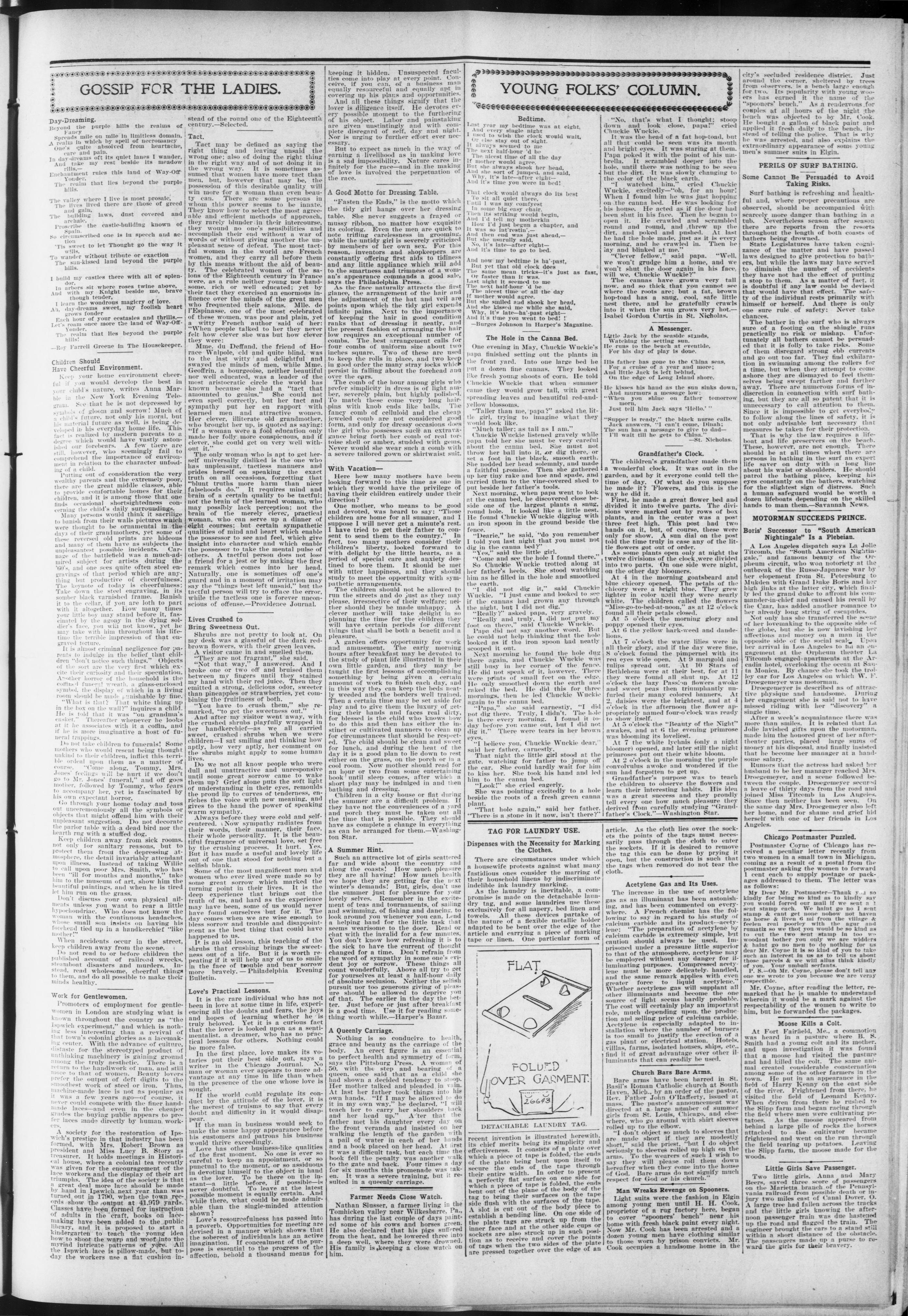
TAG FOR LAUNDRY USE.
Dispenses with the Necessity for Marking the Clothes.
There are circumstances under which a housewife protests against what many fastidious ones consider the marring of their household linens by indiscriminate indelible ink laundry marking.
As the laundry is inevitable, a compromise is made on the detachable laundry tag, and some laundries use these exclusively for all napery, bed linen and towels. All these devices partake of the nature of a flexible metallic holder adapted to be bent over the edge of the article and carrying a piece of marking tape or linen. One particular form of
FLAT
FOLDED
OVER GARMENT.
26643
DETACHABLE LAUNDRY TAG.
recent invention is illustrated herewith, its chief merits being its simplicity and effectiveness. It consists of a plate over which a piece of tape is folded; the ends of the plate being bent upon itself to secure the ends of the tape through their entire width. In order to present a perfectly flat surface on one side for which a piece of tape is folded, the ends bent out of the plane of the body of the tag to bring their surfaces on the tape side flush with the surfaces of the tape. A slot is cut out of the body piece to establish a bending line. On one side of the plate tags are struck up from the inner face and at the other side cups or sockets are also struck up in such position as to receive and cover the points of tags when the two sides of the plate are pressed together over the edge of an
"No, that's what I thought; stoop down and look close, papa?" cried Chuckie Wuckie. It was the head of a fat hop-toad, but all that could be seen was its mouth and bright eyes. It was staring at them. Papa poked it with the point of his umbrella. It scrambled deeper into the hole, until there was nothing to be seen but the dirt. It was slowly changing to the color of the black earth.
"I watched him," cried Chuckie Wuckie, excitedly—"oh, for an hour! When I found him he was just hopping on the canna bed. He was looking for his house. He acted as if the door had been shut in his face. Then he began to open it. He crawled and scrambled round and round, and threw up the dirt, and poked and pushed. At last he had the hole made, just as it is every morning, and he crawled in. Then he iay and blinked at me."
"Clever fellow," said papa. "Well, we won't grudge him a home, and we won't shut the door again in his face, will we Chuckie Wuckie?"
The cannas have grown very tall now, and so thick that you cannot see where the roots are; but a fat, brown hop-toad has a snug, cool, safe little nest there, and he gratefully crawls into it when the sun grows very hot.—Isabel Gordon Curtis in St. Nicholas.
A Messenger.
Little Jack by the seaside stands,
Watching the setting sun.
He runs to the beach at eventide,
For his day of play is done.
His father has gone to the China seas,
For a cruise of a year and more;
And little Jack is left behind,
On the edge of Long Island shore.
He kisses his hand as the sun sinks down,
And murmurs a message low:
"When you shine on father tomorrow
morn,
Just tell him Jack says 'Hello.'"
"Supper is ready," the black nurse calls.
Jack answers, "I can't come, Dinah;
The sun has a message to give to dad—
I'll wait till he gets to China."
Grandfather's Clock.
The children's grandfather made them a wonderful clock. It was out in the garden, and by it everyone could tell the time of day. Of what do you suppose he made it? Flowers, and this is the way he did it.
First, he made a great flower bed and divided it into twelve parts. The divisions were marked out by rows of box plants, and in the center was a post three feet high. This post had two hands on it, but, of course, these were only for show. A sun dial on the post told the time truly in case any of the little flowers got out of order.
As some plants open only at night the twelve divisions of the clock were divided into two parts. On one side were night, on the other day bloomers.
At 4 in the morning goatsbeard and blue chicory opened. The petals of the chicory were a bright blue. They grew lighter in color until they were nearly white. The children called the flowers "Miss-go-to-bed-at-noon," as at 12 o'clock found all their petals closed.
At 5 o'clock the morning glory and poppy opened their eyes.
At 6 the yellow hark-weed and dandelions.
At 7 o'clock the water lilies were in all their glory, and if the day were fine, 8 o'clock found the pimpernel with its red eyes wide open. At 9 marigold and tulips spread out. At 10 Stars of Bethlehem were at their best, for at 11 they were found all shut up. At 12 o'clock the lazy Passion flowers awoke and sweet peas then triumphantly unfurled their many colored banners. At 2 daisies were the brightest, and at 4 o'clock in the afternoon the flower appropriately named four-o'clock was ready to show itself.
At 5 o'clock the "Beauty of the Night" awakes, and at 6 the evening primrose was blooming its loveliest.
At 7 the white lychnis (only a night bloomer) opened, and later still the night primroses put out their white bloom.
At 2 o'clock in the morning the purple convolvulus awoke and wondered if the sun had forgotten to get up. Grandfather's purpose was to teach the children to observe the flowers and learn their interesting habits. His idea was a great success and they proudly tell every one how much pleasure they derived from carefully studying "Grandfather's Clock."—Washington Star.
article. As the cloth lies over the sockets the points of the tags must necessarily pass through the cloth to enter the sockets. If it is desired to remove the tag this can be done by prying it open, but the construction is such that the tags when removed do not tear the cloth.
Acetylene Gas and Its Uses.
The increase in the use of acetylene gas as an illuminant has been astonishing, and has been commented on everywhere. A French chemist has the following to say in regard to his study of calcium carbide and its product-acetylene: "The preparation of acetylene by calcium carbide is extremely simple, but caution should always be used. Imprisoned under a pressure little superior to that of the atmosphere, acetylene may be employed without any danger for illuminating purposes. Compressed acetylene must be more delicately handled, and the same remark applies with even greater force to liquid acetylene." Whether acetylene gas will supplant all other illuminants and become the one source of light seems hardly probable. The cost will certainly play an important role, much depending upon the production and selling price of calcium carbide. Acetylene is especially adapted to installation where the number of burners is too small to justify the erection of a gas plant or electrical station. Hotels, villas, farms, isolated houses, ships, etc., find it of great advantage over other illuminants that can readily be used.
Church Bars Bare Arms.
Bare arms have been barred in St. Basil's Roman Catholic church at South Haven, Mich., by an order of the pastor, Rev. Father John O'Rafferty, issued at mass. The pastor's announcement was directed at a large number of summer girls from St. Louis, Chicago, and elsewhere, who go around with shirt sleeves rolled up to the elbow.
"I don't object so much to sleeves that are made short if they are modestly short," said the priest, "but I do object seriously to sleeves rolled up high on the arms. To the wearers of such I wish to say they will please roll them down hereafter when they come into the house of God. Bare arms do not signify much respect for God or his church."
Man Wreaks Revenge on Spooners.
Light suits were the fashion in Elgin among young men until H. H. Cook, proprietor of a rug factory here, began to cover "spooners' bench" near his home with fresh black paint every night. Now Mr. Cook has been arrested and a dozen young men have clothing similar to those worn by prison convicts. Mr. Cook occupies a handsome home in the
city's secluded residence district. Just around the corner, sheltered by trees from observers, is a bench large enough for two. Its popularity with young wooers has earned it the name of the "spooners' bench." As a rendezvous for couples at all hours of the night the bench was objected to by Mr. Cook. He bought a gallon of black paint and applied it fresh daily to the bench, instead of telling the police. That is why he was arrested, and also explains the extraordinary appearance of some young men's summer suits in Elgin.
PERILS OF SURF BATHING.
Some Cannot Be Persuaded to Avoid Taking Risks.
Surf bathing is refreshing and healthful and, where proper precautions are observed, should be accompanied with scarcely more danger than bathing in a tub. Nevertheless season after season there are reports from the resorts throughout the length of both coasts of bathers being drowned. State Legislatures have taken cognizance of the matter and have passed laws designed to give protection to bathers, but while the laws may have served to diminish the number of accidents they have not had the effect of putting a stop to them. As a matter of fact, it is doubtful if any law could be devised that would have that effect. The safety of the individual rests primarily with himself or herself. And there is only one sure rule of safety: Never take chances.
The bather in the surf who is always sure of a footing on the shingle runs practically no risk or mishap. Unfortunately all bathers cannot be persuaded that it is folly to take risks. Some of them disregard strong ebb currents and go out too far. They find exhilaration in swimming among the rollers for a time, but when they attempt to come ashore they are dismayed to feel themselves being swept farther and farther away. There are numerous forms of indiscretion in connection with surf bathing, but they are all so patent that it is unnecessary to call attention to them. Since it is impossible to get everybody to follow along the lines of safety, it is not only advisable but necessary that measures be taken for their protection.
That is why the law requires a lifeboat and life preservers on the beach. These, however, are not enough. There should be at all times when there are persons in bathing in the surf an expert life saver on duty with a long line about his waist or shoulders. He should patrol the bathing place, keeping his eyes constantly on the bathers, watching for the slightest sign of distress. Such a human safeguard would be worth a dozen lifeboats depending on the skilled hands to man them.—Savannah News.
MOTORMAN SUCCEEDS PRINCE.
Boris' Successor to "South American Nightingale" Is a Plebeian.
A Los Angeles dispatch says La Jolie Titcomb, the "South American Nightingale," and famous beauty of the Orpheum circuit, who won notoriety at the outbreak of the Russo-Japanese war by her elopement from St. Petersburg to Mukden with Grand Duke Boris and her high jinks at the latter city, which finally led the grand duke to affront his commander-in-chief and caused his recall by the Czar, has added another romance to her already long string of escapades.
Not only has she transferred the scene of her lovemaking to the opposite side of the globe, but she is now lavishing her affections and money on a man in the opposite side of the social scale. Upon her arrival in Los Angeles to fail an engagement at the Orpheum theater La Titcomb engaged apartments at the Arcadia hotel, overloking the ocean at Santa Monica. By chance she took the trolley car for Los Angeles on which W. F. Droegemeyer was motorman. Droegemeyer is described as of attractive physique and handsome. During her engagement she is said not to have missed riding with her "discovery" a single time.
After a week's acquaintance there was more than smiles. It is related that La Jolie lavished gifts upon the motorman, made him the honored guest of her after-theater parties, placed large sums of money at his disposal, and finally insisted that he become her manager at a handsome salary.
Rumors that the actress had asked her husband to be her manager reached Mrs. Droegemeyer, and a scene followed between the couple. Droegemeyer secured a leave of thirty days from the road and joined Miss Titcomb in Los Angeles. Since then neither has been seen. On the same day Mrs. Droegemeyer also left her home, and for shame and grief hid herself with one of her friends in Los Angeles.
Chicago Postmaster Puzzled
Postmaster Coyne of Chicago has received a peculiar letter recently from two women in a small town in Michigan, coming as a result of a postal from the postmaster asking the women to forward 1 cent each to supply postage or packages addressed to them. The letter was as follows:
My Dear Mr. Postmaster—Thank you so kindly for being so kind as to kindly say you would forreed our mail if we sent a 1 sent stamp each. We haint go no I sent stamp & cant get none nohow not haven no horse & liven 6 mi from the village & feelen real poorley with the agur and rumatiz so we that you would be so kind as to cut the two sent stamp in too we woodant bother you only we are widders & haint go no men to do nothing for us dear Mr. Coyne it is so kind of you to take such an interest in us as to tell us about those parcels & we will allus think kindly of you. Your umball serfants.
P. S.—Oh Mr. Coyne, please don't tell any one we wrote to you because we are veray respectible.
Mr. Coyne, after reading the letter, remarked that he is unable to understand wherein it would be a mark against the respectability of the women to write to him, but he forwarded the packages.
Moose Kills a Colt
At Fort Fairfield, Me., a commotion was heard in a pasture where B. S. Smith had a young colt and its mother, and upon investigation it was found that a moose had visited the pasture and had killed the colt. The same animal created considerable consternation among some of the other farmers in the town. He put in an appearance in the field of Harry Kenny on the east side of the river. Frightened from there, he visited the field of Leonard Kenny. When driven from there he rushed to the Slipp farm and began racing through the field where men were cultivating potatoes. As the moose appeared from behind a large pile of rocks the horses attached to the cultivator became frightened and went on the run through the field tearing up potatoes. Leaving the Slipp farm, the moose made for the woods.
Little Girls Save Passenger.
Two little girls, Anna and Mary Beers, saved three score of passengers on the Marietta branch of the Pennsylvania railroad from possible death or injury two miles east of Canal Dover, O. A large tree had fallen across the tracks and the little girls knowing the afternoon passenger train was due hastened up the road and flagged the train. The engineer brought the cars to a stand still within a short distance of the obstacle. The passengers made up a purse to reward the girls for their bravery.
THE WISCONSIN WEEKLY ADVOCATE.
R. B. Montgomery, Editor and Publisher.
The Wisconsin Weekly Advocate after three years! residence at 79 Fifth street, has moved its headquarters to 729 St.
Paul Ave., where we will receive our guests and trans-act our business in future.
1 Representative Journal Devoted to the Interest of All the People.
One inch, one year.....$15.00
Two inches, one year.....25.00
Three inches, one year.....35.00
Four inches, one year.....42.00
For larger space, special rates.
TERMS OF SUBSCRIPTION.
One year .....$2.00
Six months .....1.00
Three months .....50
Direct all communications to
R. B. MONTGOMERY.
38 Eighth Street.
HOW TO SEND MONEY.—Post Office
Under. Express Order. Draft or Registered
Letter. R. B. Montgomery will not be re-
responsible for loss when sent in any other
way.
TO CONTRIBUTORS:
All communications must be sent with the name and address of the sender as an evidence of good faith, but not necessarily for publication. No manuscript returned if not accepted, unless accompanied by stamps.
EDITORIAL PARAGRAPHS.
"I know of the bravery and character of the Negro soldier. He saved my life at Santiago, and I have had occasion to say so in many articles and speeches. The Rough Riders were in a bad position when the Ninth and Tenth cavalry came rushing up the hill carrying everything before them. The Negro soldier has the faculty of coming to the front when he is needed most. In the Civil war he came 400,000 strong, and I believe he saved the Union."—President Roosevelt.
A WARNING.
We have been informed by friends in Janesville and elsewhere that certain persons of questionable reputation have recently been engaged in a house to house slander concerning The Advocate and its editor, throughout the state generally and more particularly in the cities of Janesville and Beloit. We have placed the matter in the hands of the police department of those cities and we warn these individuals that for any further repetition of these misrepresentations we will invoke the full penalty of the law.
REVIEW.
The Voice of the Negro for the month of August fully maintains the high standard which it has already reached. Its monthly review is a masterly sketch of current events. The editor of the Cleveland Journal writes ably about the progress of his race there. Mr. Kelly Miller replies to Tom Watson's attack on the Negro in a crushing manner. Rev. John H. Grant discusses some of the evils which are producing desperadoes and murderers among the Negroes and the remedies. A very charming article is that of Prof. Scarborough entitled "In and About Edinburgh." The professor, like all cultivated men, can appreciate "a thing of beauty." The writer as a graduate of the famous university there dofs his hat to him. The editor of the Philadelphia Courant shows what the Negro has been able to accomplish in Congress. Mrs. Terrell gives one quite a new idea of "meddling" than the generally accepted one. The other good features of the magazine are fully sustained. We reiterate that the Voice of the Negro ought to be in the home of every intelligent Negro in the country. The Wisconsin people can be supplied through the local agent, J. D. Cooke, 26 Juneau avenue.
Washington's typhoid experience may cause a revival of the popularity of "cold tea" in the ante-rooms of congress.
Bob Fitzsimmons's eagerness to engage in another fight is simply evidence that he "needs the money." It is ever thus with retired sluggers.
It was probably not so much the trick that put it there, as the flavor of the tipple, that caused the overcoming of the victims of the applejack icecream that wrought consternation at a New Jersey church festival.
---
Jimmy Britt and Battling Nelson having come to terms as to a fight to a finish, they should both postpone further "jawing" until they jump over the ropes and dance about for chances to land on the critical point.
---
It's a useful thing to know how to swim, but an Omaha man has discovered that the most approved expertness in swimming is no protection against the larceny of one's clothes while he is disporting in the water.
The Variag sunk into the ooze of Chemulpo harbor with the Russian flag flying, and popped to the surface under the aegis of the sun-burst. She is in better condition than thousands of poor Russians who couldn't duck.
An Appleton man is bragging that he banks his money in his oat-bin, which in his opinion is both fire-proof and burglar-proof. The thief who eventually gets his "pile" should leave a note of thanks for the information. If he doesn't he will be extremely ungrateful.
When Queen Wilhelmina made her last annual visit to Amsterdam and attended Sunday service, the pastor deemed it necessary to begin by admonishing the large congregation not to rise when the Queen entered, and not to level opera glasses at her during the sermon.
MEMORIES
OF THE
WAR
For six months after the fall of Vicksburg and Port Hudson, Mississippi swarmed with Confederates. They still had possession of the great railroads that crossed each other at Meridian.
To destroy these railroads an expedition was sent, in command of Gen. Sherman, Feb. 3, 1864. It set out from Vicksburg in light marching order. The soldiers who contributed the force of nearly 23,000 men were from McPherson's and Hurlburt's corps. Both these commanders accompanied the expedition.
The cavalry was chiefly composed of the united commands of General W. Sooy Smith and General "Ben" Grierson—in all 7,000 men. The cavalry started from Memphis, and were under strict orders to join Sherman at Meridian not later than Feb. 10. They were to march to the south through Pontotoc, Okolona and Columbus. In December, 1863, Bishop Polk had been put in command of the Confederate department of the Southwest. He had in his department nearly 16,000 men. Nine thousand were infantry under Generals French and Loring; the rest cavalry, under Generals Ferguson, S. D. Lee and Wirt Adams.
On the approach of Sherman, Polk hastily evacuated Meridian. He gathered all the rolling stock of both railroads and sent it to Mobile. He moved also the Confederate supplies from Meridian and elsewhere to a place of safety. He accomplished all this with swiftness, and then retired with his army to Demopolis, across the Tombigbee. Besides destroying the railroads, Sherman hoped to penetrate to Selma, if not to Mobile, by aid of the cavalry under Smith. At Selma a great iron foundry was turning out arms for the Confederacy day and night.
Feb. 6 the expedition reached Jackson. For the third time Sherman's army was in the capital of Mississippi. This time it was almost destroyed. No obstructions beyond a few burnt bridges, easily repaired, were met until the troops reached Tallahatta, twenty miles west of Meridian. Here trees had been pulled across the track, to check Sherman as long as possible, and give time to remove the Confederate property from Meridian. Seeing this, Sherman left his trains behind, and hurried on. But Polk had already slipped away. Feb. 16 the Union troops began the demolition of railroads.
The great warehouses and acres of side tracking at Meridian showed how important to the Confederacy had been railway transportation through that place. To understand Sherman's work of destruction, the reader has to picture himself the havoc that could be made by 10,000 men working vigorously nearly a week, and armed with crowbars, pickaxes and sledge-hammers.
After tearing up the tracks in the usual way, the soldiers lifted from their beds the wooden ties also. These were then piled into vast heaps with the torn up iron rails upon top. The pile was then fired. Of course the rails presently became red hot. In this condition they were raked from the flames and twisted around like a screw. Many were taken while still red hot, drawn around a tree trunk, and the ends crossed. This was called "Jeff Davis' Necktie."
North and east of Meridian General Hurlbut had charge of the demolition. South and west McPherson superintended it. Hurlbut reported that his army had destroyed sixty miles of ties and eight bridges. McPherson tore up fifty-five miles of road and burnt fifty-three bridges. Not much rolling stock had been left by Polk, but the Union forces found thirty-five locomotives and twenty-eight cars, which they burnt.
"We stayed at Meridian a week," said Sherman in his report, "and made the most complete destruction of the railroads ever beheld—south below Quitman, east of Cuba station, twenty miles north of Lauderdale Springs and west all the way back to Jackson."
By the beginning of 1864, the news of Lincoln's emancipation proclamation had become thoroughly published among the slaves of the South. They took advantage of it wherever the Union forces appeared, swarming all about them in such numbers as often to prove a serious embarrassment. The able-bodied men were enlisted, but what to do with the aged, the women and the children, the armies did not know.
No sooner had Sherman penetrated Mississippi than they came. Many Union white refugees came also. When the expedition returned to Vicksburg it brought with it 400 Confederate prisoners, 1,000 white Unionist refugees and 5,000 negroes.
"Some were on foot, some on horseback, and some in ox carts. Some were clad in their Sunday best, the cast-off clothing of their masters. So vast was the crowd that families were separated and women and children lost in the throng. Silent tears coursed down many cheeks, tears of thankfulness for their great deliverance. There were faces in that crowd which shone
with a joy almost inspired. Smile who will, but the story of the coming of the children of Israel out of Egypt can never recall to my mind a more profound emotion than the remembrance of that scene." Sherman waited a week at Meridian for the arrival of Sooy Smith, who was to have been there Feb. 10 with the cavalry. He did not come, then being under engagement to meet Banks at New Orleans to prepare for the Red River expedition March 1. Sherman returned to Vicksburg and went down the river.
Where, meantime, was General W. Sooy Smith with the cavalry? To join Sherman Feb. 10 was of the utmost importance. From Memphis to Meridian is 250 miles, and Smith had ten days to make the distance. He was ordered to ride rapidly, pausing for nothing. Smith did not obey. He did not start till Feb. 11. He did not hurry his movements.
Thus General Polk had time to save himself. He realized that the fate of Selma and Mobile depended on the junction of Smith with Sherman. He quickly gave orders to Forrest to ride with his cavalry with all speed, and by any means in his power head off and stop the Union cavalry column.
Re-enforcements ordered to join Forrest failed to reach him, but the indomitable leader set out with his 2,400 men to meet the 7,000 against him. The two opposing forces came together at West Point on the Tibbee River. A fight occurred Feb. 20, 1864.
Smith and Grierson opened the attack, advancing in a long line. As they came within firing distance, what was their surprise to see Forrest's men s'ip off their horses and dodge behind trees, rocks and anything that could afford shelter. Then, as the Union line advanced still nearer, Forrest gave orders to his men to fire. Instantly thousands of musket balls were poured into the advancing Union ranks. They were confused, and stopped. Hundreds of them fell before the volley of the unerring marksmen behind the trees and bushes.
Smith and Grierson had no chance before a foe like that. Even if their men had kept in perfect order there was nothing in sight that they could fire or charge upon. Their advance wavered, then stopped. Again came the deadly volley from the ambushed Confederates, and the Union soldiers were thrown into worse confusion than before. Their leaders tried to form and order them forward again, but each time this was attempted came the withering fire from behind the bushes. At length they fled. Sooy Smith, unable to determine the number of his enemy, believed he had in front of him the whole combined cavalry of the Confederate department under Lee, Forrest and Chalmers. He was at this time, Feb. 20, within 100 miles of Meridian. If he had not met with this check from Forrest he would not even then have been in time to join Sherman. Unable to wait any longer, Sherman had left Meridian on the return to Vicksburg that same day, Feb. 20.
But Smith never advanced any farther than West Point. Believing he had the whole Confederate cavalry to fight, he fell back to Okolona, some miles in the rear. On the hills near the town he prepared to make a stand against the enemy. His force was divided in three brigades, the first commanded by Colonel George E. Waring, since well known in literature. But now the evil consequence of disregarding the orders to push on rapidly and delay for nothing began to be apparent. Smith's cavalry was loaded to some extent with the spoils of war. More than that, at every stop they made hundreds of negroes fleeing from slavery joined their ranks and impeded them.
The second fight between Forrest's and Smith's forces occurred Feb. 22.
The fight began late in the evening. The baggage train and pack mules of Smith's force were already on their way to Memphis. To save them Smith made a very obstinate stand and endeavored to hold Forrest's troops in check. At length he resolved to make a grand cavalry charge. He reined his horsemen in line and dashed furiously into the Confederate ranks.
The charge was not successful. Forrest's command stood their ground like iron. Smith's whole force was driven back.
He hastily gathered up his men and soon had them in full retreat to Memphis. On this unfortunate campaign he had lost five guns. Not more than 200 men were lost, but the rest were discouraged, and a third of them returned to Memphis on foot, having lost their horses.
The consequences of Smith's defeat at Okolona were rather serious for the general result of the Meridian campaign. The cavalry arm of the expedition was thus lost to Sherman, who was thereby prevented from penetrating to Selma—probably to Mobile. Meridian is 135 miles from Mobile.
In a congratulatory order to his army after Okolona, General Polk said: "The concentrating of our cavalry on the enemy's column of cavalry from West Tennessee formed the real turning point of the campaign."—American Tribune.
The King of Italy once said
The King of Italy once paid an early and unexpected visit to a Government office, and had to wait an hour before a clerk appeared. The King promptly dismissed one-half of the staff, remarking that the other half, if keeping office hours, would be able to do the work. King Emmanuel is one of the greatest living numismatists and possesses the finest private collection of coins in the world.
HORSE
WAUSAU LUMBER
CREAM CITY NOTES.
We will be glad to publish news of local and race interest if left at the office, 38 Eighth street, before 6 o'clock Wednesday evenings.
We would respectfully ask our readers to bestow at least a share of their custom upon those who advertise with us.
The various remedies and hair restorers advertised in this paper can be had at the advertised price at the office of this paper.
In next week's issue of the Advocate, there will appear an article by the Hon. T. E. Ryan, Waukesha member of the Democratic National committee, entitled, "Democrats, get together."
* * *
Miss Gertrude Dawson of Paducah, Ky., returned to Chicago Sunday after spending two weeks in the Cream City as the guest of Mr. and Mrs. W. A. Ross. Miss Dawson is spending the summer in Chicago. So greatly impressed is she with our city that she says she will return in a few weeks for another short stay.
承 承 承
The large and beautiful American dining room of the Plankinton house, freshly remodeled and decorated, will swing open its doors again to the public Thursday evening at six o'clock. The same efficient crew under the leadership of J. J. Miles will have charge of the beautiful dining room. Patrons on entering will hardly recognize the place, so changed is it in appearance. The ceiling has been well cleaned, chairs, tables varnished, new designs placed upon the walls, and new chandeliers, all of which are in place with the many other improvements since the house has been under the management of Mr. F. C. Safford.
\* \* \*
Mr. Douglass Moses, a native of the West India islands, who is now employed at the hotel, will deliver an address before St. Mark's Literary society very soon; subject, "Habits and Customs of the Island."
```markdown
```
Mrs. Carrie Wells from Galesburg, Ill., is visiting her nephews in this city, the Rev. H. W. Jameson and Mr. E. A. Logan. She is residing during her stay at 194 Fourth street with Mr. and Mrs. Logan. Mrs. Wells is very much charmed with Milwaukee.
***
We regret to know that Lescher Logan, the only child of Mr. and Mrs. Logan, is on the sick list. Dr. Herron has diagnosed the case as one of inflammatory rheumatism—rather a rare circumstance in one so young, but under that gentleman's treatment we have no doubt of his recovery to his usual state of health.
* * *
While on his way to New York to attend the meeting of the National Negro Business league, Mr. John L. Slaughter felt it to be his duty to return to Milwaukee to attend to his interests here. We regret that Mr. Slaughter should be robbed of his well-earned rest. This gentleman has always been a friends of his race and has stood by it in all times of difficulty. Personally we are indebted to Mr. Slaughter for many courtesies.
```markdown
```
Madison, Wis., Aug. 16.—Matt Daley and William Harris, negroes, fought a duel last night with an ax and a butcher knife at the door of the African Methodist church. A girl, who was the cause of the fight, looked on. The men are in the hospital room of the police station, but will not die.
* * *
There must be something materially wrong somewhere. There is never smoke without fire, but we doubt very much if this case is as bad as it looks from the above report: If so, it should act as an object lesson to the management of our churches in this city, not to allow the congregating about the door of young people of both sexes while entertainments, literary, or otherwise are going on inside.
* * *
The many friends of Mr. Banks Wright will be glad to learn that he is recovering after his recent attack of sickness. Matrimonial life at the outset did not seem to agree with Brother Wright, but he will get acclimatized!
\* \* \*
Mesdames Dibbles of Minneapolis, Craig, Thompson and Smith and Miss Mabel Smith, Master Thompson and Mr. Thomas Watson of Chicago were Sunday last the guests of Sadie Parker of Chestnut street. Previous to their departure home they were entertained at Monroe's restaurant, where everything was of course "en regle." Mrs. Smith is a blonde and seems to us like the ointment to the flies. The party intended visiting in Waukesha and Pewawkee lake, and Mrs. Smith is bound to be an attraction among the fishes. Miss Smith is reported to be a lucky fisher, and she may catch something in the neighborhood of a 22-pound muskellonge, or maybe a 200-pound specimen of another species.
Has Colored Women's Club.
Superior, Wis., Aug. 15.—The city of Superior has the distinction of possessing the only club of its kind in the state of Wisconsin—a federated club of colored women. The Neighborly club of Superior was represented at the first convention of the Minnesota Federation of Afro-American Women's clubs, of which it is a member, by its president, Mrs. George H. Wade, and Secretary Mrs. L. Gross, at Minneapolis, last week.
We wonder what has become of the Milwaukee Woman's club!!!
```markdown
```
Mr. and Mrs. Baylor have gone to the country for a week's vacation.
* * *
This is the time of year when people think about spring chickens. No better place could be found for gratifying that
Don't Trust to Luck
when you go to buy lumber and building material, but come where you know the grades and prices are right.
AND COAL CO.
North Milwaukee, Wis.
Improved Hair Tonic
Made to Cure and It Does It.
It and Cleanest Hair Tonic on
buy It! Try It! 4 oz. 50c
LEMON AND EGG SHAMPOO
has been proven to be the greatest for cleansing the scalp and beautifying it soft and pliable.
and original Lemon and Egg Shampoo by. 6 oz. 50c.
Barber," we have a Supply Catalogue you and prices that will suit you. A copy is st.
S. WETMORE CO.
Supplies and High-Grade Furniture
CLE, WISCONSIN, U. S. A.
ENTION WISCONSIN WEEKLY ADVOCATE
Insin Weekly Advocate
to secure Desirable Situations and competent Colored Help, in Wisconsin, Michigan, and states—more especially in the smaller such are constantly on its list.
solicited from the rural districts of the southern states. Address St. Paul Avenue, Milwaukee, Wis.
J. CANNON
DEALER IN
USEHOLD GOODS
For Household Goods
WISCONSIN
when you go to buy lumber and building material, but come where you know the grades and prices are right.
North Milwaukee, Wis.
Wetmore's Improved Hair Tonic
A Tonic Made to Cure and It Does It. The Safest and Cleanest Hair Tonic on Earth. Buy It! Try It! 4 oz. 50c
This combination has been proven to be the greatest shampoo known for cleansing the scalp and beautifying the hair, making it soft and pliable.
N. B.—Mr. "Barber," we have a Supply Catalogue that will interest you and prices that will suit you. A copy mailed upon request.
Barbers' Supplies and High-Grade Furniture
JANESVILLE, WISCONSIN, U. S. A.
BUYERS PLEASE MENTION WISCONSIN WEEKLY ADVOCATE
The Wisconsin Weekly Advocate
is in a position to secure Desirable Situations for trustworthy and competent Colored Help of both sexes, in Wisconsin, Michigan, and neighboring states—more especially in the smaller cities. Many such are constantly on its list. Applications are solicited from the rural districts and smaller cities of the southern states. Address Management, 729 St. Paul Avenue, Milwaukee, Wis.
desire than by calling on Otto Harbricht. 504 State street. He has got the goods.
We Spend Money With Those Who Spend Money With Us.
J. G. Matzen & Son, 501 Chestnut street, is one of those firms that recognizes that fact. Therefore it is bound to be successful. We advise all friends in the neighborhood to deal with J. G. Matzen & Son, where they will be properly served and courteously treated.
The annual conference of the North Wood River Baptist association will be held in the Second Baptist church, Evanston, Ill., commencing Friday evening at 7 o'clock. The delegates, from Calvary Baptist church this city, are the Rev. B. P. Robinson and Mrs. Robinson, and the Rev. A. W. Herrin and Mrs. Herrin. A very successful rally was held at the church Sunday last when the members cheerfully and liberally contributed their dollars towards the funds of the association, so that the church will be able to make a respectable showing at the conference. The pastor and trustees desire through the medium of this paper, to publicly express their thanks and gratitude to the members and adherents for their liberality.
The case of Thomas Fletcher, charged by Mrs. Daisy Lusk with "assault with intent to do great bodily harm," came up in the district court last Tuesday for preliminary hearing. The penalty for this offense is imprisonment at Waupun for from one to seven years. Miss Lusk charged that Fletcher cut her with a razor and showed a scar on her ear and the lower portion of her face. Detective Malezewski produced a razor which he claimed to have found in Fletcher's pocket. Fletcher also had some wounds and upon representation being made by Mr. Green, who appeared for Mr. Fletcher, that the affair was just a little racket, the charge was changed to assault and battery and Fletcher paid a fine of $5 and costs.
Louis Chase and Johnnie Bryant played a very dirty trick on Charles Wahl, the proprietor of National grove. He gave them the grove free on condition that they buy their beer, whisky and cigars from him. Then he trusted them for the whisky, wine, beer and cigars. Besides this, he allowed them to charge an admission fee of 25 cents at the gate. That was not all: He loaned them his glassware, silverware, faucets, mallets, etc. One would have
---
***
---
thought that these two young men would have appreciated these kindnesses extended them by this young German, but they did not. They sold the man's whisky, his beer, his cigars and his wine and paid their help with it. Then they took the balance and with what gate money they could get they sneaked in town an hour before the dance broke up. They did not pay the man a cent, did not tell him they were going, did not return a single glass nor a single piece of silver. They left the glassware and silverware to be broken or carried off by the crowd at will, and when he found them a few days afterward they refused to pay him and gave him the laugh. Then he had Louis Chase arrested, and the editor learns that Attorney Green, who was employed by Mr. Chase, compelled his client to settle with Mr. Wahl. The case was dismissed.
***
This is the reason why our people can't rent any of our parks and one of the strongest reasons why they can't get decent houses to live in.
***
We learn that one of the three old women to whom we paid attention some time back who was fired from the National club dance and who succeeded in making himself generally obnoxious, has been seen in the vicinity of Minneapolis, making toward South Dakota. He reported walking to be extremely difficult and the roads quite muddy.
***
Mr. and Mrs. Gilbert Whitman entertained at their home, 733 Franklin street, on Thursday evening last in honor of Mr. and Mrs. W. T. Watson. Some of the best people of Milwaukee were present and all had a good time. Mr. and Mrs. Whitman have a luxurious and pleasant home in a swell neighborhood.
* * *
Assistant States Attorney F. L. Barnett and Commissioner Ed Wright of Chicago spent a short time in the city as the guests of Attorney Green. They left for Waukesha on the electric line, where they will spend their vacation. Commissioner Wright was accompanied by Mrs. Wright.
1000 Business Cards $1
Circulars, Envelopes, Note,
Letter and Bill Heads
GLOBE PRINTING
CO. 232 WEST WATER ST.
Opposite Daily News.
MONROE BROS., Prop's.
194 THIRD ST.
MONON ROUTE
NORTH OR SOUTH
Always ask for tickets
via the
MONON ROUTE THE SHORT LINE BETWEEN Chicago, Indianapolis, Cincinnati,
Six trains daily between Chicago and the Ohio river. For folders, rates, etc., call at any Monon ticket office or address
FRANK J. REED,
Gen'l Pass. Agent, Chicago.
S. B. JONES,
C. P. Avent, 222 Clark St., Chicago.
While in city visit . . .
STEPHENS' HOTEL and RESTAURANT First-Class Accommodations Home Cooking a Specialty...
No. 2832 State St., CHICAGO, ILL.
S. F. PEACOCK & SON
Funeral Directors
AND
EMBALMERS
431 Broadway. MILWAUKEE, WIS.
WANTED--AGENTS
We want 100 agents in every city, town and hamlet in the U. S. for the Wisconsin Weekly Advocate. It will be devoted to the interest of the Negro race and will contain the news of their sayings and doings throughout the world.
50 Per Cent. Commission
ADDRESS
WISCONSIN WEEKLY ADVOCATE
MILWAUKEE, WIS.
ELK EXPRESS CO.
G. J. CHARLESTON, Mgr.
63 E. Sixth Street,
ST. PAUL. MINN.
WONDERFUL
DISCOVERY
Curly Hair Made Straight By
TAKEN FROM LIFE
FORD'S ORIGINAL OZONIZED OX MARROW
This wonderful hair pomade is the only safe preparation in the world that makes kinky or early hair straight as shown above. It nourishes the hair straight, prevents the hair from falling out or breaking off, cures dandruff and makes the hair grow long and silky. Sold over 5 years, and used by thousands Warranted harmless. It was the first preparation ever so straightening kinky hair. Beware of imitation, remember that Ford's Original Ozonized Ox Marrow Co. up to fifty cent size, made only in Children's and byus. See that "Ozonized Ox Marrow Co., Chicago, U.S.A." is printed on the package. Do not be misled by substitutes that claim to be uss, is good—but always insist upon getting the genuine, as it never fails to keep the hair straight, soft and beautiful, giving it the healthy, life-like appearance so much desired. A quality necessity. Ladies, gentlemen and children. Brightly perfumed. Owing to its superior and lasting qualities it is the best and most economical. It is not possible for anybody to produce a preparation equal to it. Full directions with every bottle. Only 50 cents. Sold by draggists and dealers, or send us 50 cents for one bottle, postpaid. For 40 for three bottles, express paid. We pay all postage and express charges. Send postal or express enclosure mention name of this paper when ordering. Write your name and address plainly to
OZONIZED OX MARROW CO.
76 Wabash Ave., Chicago, Illinois.
Agents wanted everywhere.
CAPITAL IS WROUGHT UP
Alderman Smith Demands That Saloon Licenses Be Revoked.
MAYOR READY; COUNCIL BALKS
Mandamus Proceedings May Be Instituted by Prof. L. S. Smith to Enforce the Madison Crusade.
Madison, Wis., Aug. 18.—[Special.]— Unless the Madison city council at its session next Tuesday revokes the saloon license of G. O. Feland and Henry Niebuhr, who it is alleged sold liquor on Sunday and after midnight, a writ of mandamus will be asked from the courts compelling such revocation.
Mavor and Council at Odds.
Mayor and Council at Odds. A number of Madison saloonkeepers have been brought into court lately and on each conviction Mayor Curtis has suspended license, but the council has immediately renewed them. At last night's meeting Prof. L. S. Smith, alderman from the University ward, attempted to get action on these cases, but was repeatedly voted down and then gave warning of the proposed court action.
Precedent Is Found.
Precedent for this is found in the case of August Kargus, a saloonkeeper of Oshkosh, who was convicted in 1897. The council refused to revoke the license; the circuit court of Winnebago county refused to grant a writ of mandamus to compel revocation, but the supreme court reversed this decession in an opinion written by Chief Justice Cassoday and the license was revoked.
News of the proposed action has caused sensation here.
SWIM FOR THEIR LIVES.
Gasoline Tank on Janesville Launch Explodes and Owner and Wife Have Close Shave.
Janesville, Wis., Aug. 18.—A gasoline tank on a launch carrying Mr. and Mrs. Bert Van Houter blew up in mid-river. Both swam ashore and the fire department was called to put out the flames. They had to sink the boat. Van Houter is the proprietor of the Empire hotel. Oconto, W.s., Aug. 18.—Mrs. Alex McPherson, aged 55, committed suicide here by drowning herself in the Oconto river, in eighteen inches of water. Sault Ste. Marie, Mich., Aug. 18.—"Goodbye; I'm going ashore," said Patrick J. Whalen, fireman on the steamer John W. Gates, to one of his mates. He plunged over the rail, although the vessel was many miles out in Lake Huron. Life preservers were thrown overboard which Whalen refused to take. His address is given in the union book as Scranton, Pa.
Kaukauna, Wis., Aug. 18.—[Special.]
—Little Ralph Jewell, aged 11 years, is the hero of the hour for having saved the life of his playmate, Stephen Klaser, aged 10, from drowning here. The boys with others were swimming at a dangerous point on the waterpower when Klaser sank to the bottom twice. Young Jewell caught hold of him with one hand and with the other reached the edge of the dam and held there screaming for help. Henry Essler heard the cries for aid and reached there in time to pull them both to safety.
Green Lake, Wis., Aug. 18.—[Special.]
—J. W. Ross of Chicago was drowned here last night. He is the son of the owner of Pleasant Point hotel.
TSCHARNER IS PRESIDENT.
La Crosse Man Elected to Head State Postmasters' Organization—Support Promised Cortelyou.
La Crosse, Wis., Aug. 18.—Officers elected by the state postmasters are as follows:
President, W. B. Tscharner of La Crosse; first vice president, F. A. Holland of Green Bay; second vice president, R. A. Etter of Monroe; third vice president, William Case of Mausten; fourth vice president, Hattie B. Babcock of Union Center; secretary and treasurer, Arthur W. James of Waukesha.
Resolutions were adopted regretting the death of Postmaster General Henry C. Payne, and a message was sent to Postmaster General Cortelyou promising the co-operation of Wisconsin in placing the department on a business basis.
Other addresses were made by Congressman John J. Jenkins and Postmaster De Groff of Nelson, Wis.
WOMAN MAY BE WRITER.
La Crosse Chief Makes Arrest Which Is Believed to Concern Letters Defaming Police Department:
La Crosse, Wis., Aug. 18.—[Special.]
—The arrest of a woman giving her name as Millington and developments have given rise to the story that Chief Byrne has ferreted out the author of the mysterious letters charging the police department with sensational offenses. TO BUILD TWO NEW RAILROADS.
Ashland-Odanah and Green Bay-Menasha Projects Incorporated.
Madison, Wis., Aug. 18.—Articles of incorporation were filed with Secretary of State Houser for two new railroad companies.
The Ashland, Odanah & Marengo Railway company is formed with capital stock of $100,000 to operate a line from Odanah, Ashland county, to Sedgwick on the line of the Duluth, South Shore & Atlantic railway. The directors are as follows: L. K. Baker of Ashland, 332 shares; George F. Merrill of Ashland, 2 shares; E. B. Hill of Odanah, 1 share; J. S. Stearns of Ludington, Mich., 498 shares; John W. Gray of Chicago, 166 shares.
The Valley Railway company proposes to build thirty miles of road from Green Bay to Derephe, Kaukauna, Appleton and Menasha. The capital stock is $25,000 and the directors are as follows: Thomas W. Orbison, John Hackworthy, Edward O'Feefe, Robert Hackworthy and Oliver C. Smith, all of whom live in Appleton.
SHERIFF SAYS. "INVESTIGATE."
Government Authorities Angered by Escape of Robbers at La Crosse.
La Crosse, Wis., Aug. 18.—The United States secret service department has notified Sheriff Haugen that it is intensely displeased over the escape of two postoffice robbers from the La Crosse jail and will make an investigation. Sheriff Haugen has replied, inviting a thorough investigation.
Chicago, Ill., Aug. 18.—Government secret service men are said to be making a thorough investigation into the jail deliveries in Wisconsin, where postoffice safe blowers have obtained freedom. The escapes, it is said, were effected by the aid of Chicago women.
AGAINST SENDING STAMPS IN MAIL.
Wisconsin Postmasters Would Have Remittances Made Unlawful—Many Other Changes Proposed.
La Crosse, Wis, Aug. 18.—[Special.]
—The state postmasters in session here will adjourn today. Resolutions adopted this morning favor clerk hire in fourth-class offices, to be used in securing assistant in the absence of the postmasters; a law against sending postage stamps for small remittances; no free second-class matter in counties; money order application blanks for small remittances; more flexible rule regarding cancellation of stamps and favoring an eligible list for rural carriers. The Hubbard stamp for small remittances is especially in favor. Milwaukee will probably get the next meeting.
MARKESAN PIONEER DIES.
James Densmore, Sr., Who Did Much Toward Development of His Town, Was 76 Years of Age.
Markesan, Wis., Aug. 18.—[Special.]
—James Densmore, Sr., one of the oldest residents of this vicinity and the state, and who has done much toward developing the country hereabouts, is dead. He was 76 years old.
Mr. Densmore came to this village in 1846. Since then he has gradually grown into prominence and, among other achievements, secured the building of the
J.
railway from Brandon to Markesan. He had a part in many other local and state enterprises.
He leaves two sons and three daughters, all prominent locally. The funeral was held this afternoon with Masonic rites. Every business place in the town closed from 12 until 3 o'clock, and the attendance at the funeral was large and representative.
Madison, Wis., Aug. 18.—John Griffiths, one of the oldest and wealthiest citizens of Madison, died at his home here from a complication of ailments due to advanced age. He was 73 years old and resided here more than half a century. In early years he was a printer, but during the latter part of his life was a real estate broker. He leaves a widow and three daughters.
Oconto, Wis., Aug. 18.-W. H. Webster of this city, formerly a leading attorney, died at the Oshkosh hospital, of which he had been an inmate for about a year. His body was brought here for burial.
J. M. SEXTON MADE CLERK.
Civil Service Commission Chooses Expert Tax Man of the Wisconsin Central for $1500 Job.
Madison, Wis., Aug. 18.—[Special.]—J. M. Sexton of Madison today was elected clerk of the civil service commission. The position pays about $1500 a year. A number of years ago Mr. Sexton attended the state university but eventually graduated from the pharmaceutical course at Northwestern university. Last year he served for a time as bookkeeper in the state treasurer's office. Since that time he has been acting as expert examiner of local tax conditions in northern Wisconsin for the Wisconsin Central railroad. Secretary Doty is mailing blanks to the various departments and state institutions ascertaining the number of people employed, when appointed, and under what statute the office was created.
Two months more will be required in preliminary work. Jurisdiction begins in December.
HEIR IS SPIRITED AWAY?
Homer Crosby, Former La Crosse City Engineer, Missing—Associates Claim Bad Work.
La Crosse, Wis., Aug. 18.—Homer Crosby, former city engineer and heir to the $30,000 estate left by his father, has disappeared. Crosby has been in the contracting business at Davenport. Business associates in Davenport say a conspiracy involving the final settlement of the estate has been formed, and it is believed Crosby has been spirited into some insane asylum.
EARL SCHREIBER IS MARRIED
Former Madison Teacher Bride of Well Known Varsity Athlete.
Madison, Wis., Aug. 18.—Earl W. Schreiber, the former star Wisconsin athlete, married Miss Grace E. Lee of Sparta, formerly a teacher in the scientific department in the Madison high school, Wednesday night at the home of the bride's parents in Sparta. They will reside in Brooklyn, N. Y., where Mr. Schreiber is teacher of athletics in Pratt institute.
Beloit, Wis., Aug. 18.—Miss Ruth Redford, daughter of Rev. R. C. Redford, field secretary of Tuskegee institute, was married in this city to Carl W. Ghorkins, teacher of German in the Oberlin (O.) high school and instructor in music.
Augusta, Wis., Aug. 18.—[Special.]—Miss Anna Frederick of this city and Arthur Warriner of Nowata, I. T., have been married here.
FOUND AFTER SEVENTEEN YEARS
Kaukauna Woman Discovers Brother in Minnesota Ranch Manager.
Kaukauna, Wis., Aug. 18.—[Special.]
—Seventeen years ago John M. Phelps left the family home in this city and nothing was heard of him until a few days ago. His sister, Mrs. Joseph Hamilton, received a letter from a friend in Minnesota which told of the long lost brother. He is at Foston, Minn., manager of a large cattle ranch. His parents are now both dead.
SHORT TEMPERANCE SERMONS.
Among the lessons taught by the war in the far Orient, says a correspondent of the New York Tribune, there are none that have received a more striking demonstration than that of the immense value of sobriety in military and naval operations. Russia has in this conflict labored under many disadvantages. But it is doubtful whether there has been any of them that has handicapped her more heavily than the drunkenness of her soldiers, and more particularly of her officers. Every foreign newspaper correspondent on the Russian side, even those whose sympathies were wholly Muscovite, such as Colonel von Gaedke, formerly of the German General Staff and probably the foremost military writer of the present day, has drawn wellnigh incredible pictures of the prevalence of this particular vice among the foes of Japan, and of the appalling conditions arising therefrom. It is known that the foreign officers delegated to watch the operations in Manchuria have made still more damning reports on the subject to their respective governments, creating so deep an impression that the English Secretary of State for War, in the course of an address the other day, declared that the victories of Japan were largely due to the sobriety of her officers and men, while the Kaiser, in a remarkable speech to his officers at Strasburg, of which only garbled reports have reached the public, gave expression to much the same views, and is said to have added that Russia's military and naval disasters were in a great measure attributable to the intemperance of her officers. And although deference to Muscovite susceptibilities and consideration for a stricken neighbor have led to the issue of a sort of official denial of these references by the Emperor to the least creditable cause of Russia's defeat, yet the notorious existence of the evil justifies the belief that he gave to it his unqualified condemnation.
The radical departure by the United States, Great Britain and Japan from the practice of serving an allowance of grog, which still prevails in the navies of other maritime powers, is rendered imperative by the extreme importance of sighting with the utmost degree of exactitude the guns, upon the precision of which the success of every action at sea, or, for the matter of that, on land, nowadays depends. The man who does not drink is more cool and collected and therefore better able to shoot with accuracy than one whose pulse is in the least bit quickened by stimulant. It is no longer fierceness, fury and reckless dash that are required of the officers and men, but calmness and collectedness. In naval engagements there is little boarding to be done in these days of ironclad warfare. Vessels are no longer armed with tier upon tier of small guns—some of the men-of-war of the early Victorian era had more than a hundred of them. Modern battleships and cruisers are equipped with gigantic pieces, relatively few in number, but carrying projectiles of colossal weight over a range of several miles. It is no longer necessary to pepper the hull of a man-of-war full of small cannon ball holes in order to sink her. This can be achieved by a single well directed shot from any one of the great guns with which the warship of the present day is armed.
In conclusion, it may be well to point out that the spectacle of bloodshed and the noise and din of battle are sufficient in themselves to arouse all the latent disposition to savagery that lurks in every human breast. This being the case, is it wise or politic to still further loosen the restrictions of civilization by the use of stimulants? If ever sobriety ought to be enforced, and becomes of surpassing value, it is in times of war, both at sea and on land.
Stray Arrows:
A vicious people will soon be an enslaved people.
Mind unemployed is mind unenjoyed.
No wrong is equal to the wrong of tempting men to do wrong.
Doing right and resisting strong drink may be costly, but the interest is golden.
Cheerfulness is the bright weather of the heart; "strong drink" withers it.
There can be no solvency of either body or soul in a saloon.
Think no evil and keep outside the saloon.
Strong drink is darkness; total abstinence is broad daylight.
Who would be a man must steer clear of strong drink. The more you use a saloon the more it will ill-use you.
This is a good time to bear in mind Dr. Deems' motto. The doctor, while pleading in a public speech for conscientious voting, was interrupted with the question: "Suppose it is morally certain that you cannot elect the candidate whom you consider the right man, what then?" "I am not bound to elect the right man," replied Dr. Deems, "but I am bound to vote for him!"
What will drunkards' wives do when all the saloons are wiped out?— Start laughing schools.
Why Suffer from Disease? Robinson's Alfalfa-Nutrient
Positively cures Rheumatism, Locomotor-Ataxia, all Stomach, Liver and Kidney Troubles and all Nerve and Blood Diseases. Send us your name and address and we will mail you absolutely free a ten days' trial treatment of this wonderful medicine together with a scientific booklet, "How to Secure Perfect Physical Health." Address
ALFALFA-NUTRIENT CO.
Room 8, 59 Dearborn St., Chicago.
the Turf Cafe
Game, Fish, Steaks, Chops and Every
Delicacy the Seasons Afford.
for Dinner Parties, Etc. Cuisine Par Excellent.
Table D'Hote.
neither private rooms, nor "private" people, but cater to the
general public.
Banquet Rooms for Dinner Parties, Etc. Cuisine Par Excellent Table D'Hote.
NOTE- We have neither private rooms, nor "private" people, but cater to the general public.
DINNER FROM 5:30 TO 8:00; 35c.
MONROE
194 Third Street, Mil
NROE BROS., Prop's. street, Milwaukee, Wis.
194 Third Street, Milwaukee, Wis.
Give him a call.
---
---
SPECIAL NOTICE
MR. JAMES EDWARD would like to find his niece belonged to Bob. Thomas during slavery. The last Louis, Mo., and went we will be rewarded. Please WISCONSIN 729 ST
A. CLARK.
When You Need Anything
CLARK
GROCERIES,
FRESH E
Cigars, To
Tel. Douglas 2474.
EDWARDS, of 1622 Gay St., St. Louis, Mo., to find his niece, MISS PHOEBE THOMAS, who Bob. Thomas, of Lynchburg Va., Halifax County, Ky. The last account of her is that she left St. and went west. Any information concerning her added. Please write us
WISCONSIN WEEKLY ADVOCATE
729 ST. PAUL AVENUE.
J. CLARK.
Need Anything in Our Line Call on
CLARK BROS.
DEALERS IN
ERIES, SALT MEATS,
FESH EGGS AND BUTTER
Cigars, Tobacco and Candies.
474. 3233 STATE ST., CHICAGO.
J. MUNKO
PRACTICAL SHOEMAKER
MR. JAMES EDWARDS, of 1622 Gay St., St. Louis, Mo., would like to find his niece, MISS PHOEBE THOMAS, who belonged to Bob. Thomas, of Lynchburg Va., Halifax County, during slavery. The last account of her is that she left St. Louis, Mo., and went west. Any information concerning her will be rewarded. Please write us WISCONSIN WEEKLY ADVOCATE 729 ST. PAUL AVENUE.
A. CLARK. J. CLARK.
When You Need Anything in Our Line Call on
CLARK BROS.
DEALERS IN
GROCERIES, SALT MEATS,
FRESH EGGS AND BUTTER
Cigars, Tobacco and Candies.
Tel. Douglas 2474. 3233 STATE ST., CHICAGO.
T. T. GREEN LAWYER
W. T.
W. T. GREEN
LAWYER
NOTARY PUBLIC
Rooms 216-217-218 Empire Building
TELEPHONE BLACK 8633
14 Grand Ave., Milwaukee, Wis.
ROOMS
M
TREES PARK
MINNAPOLIS, MIS
6 7
For Ladies and Gentlemen
MR. C. C. THOMPSON, has rented the 8-room house, 223 Sixth St., beautifully furnished for roomers. II. Tel. White 9343
126 2nd Street, Milwaukee. ..REPAIRS NEATLY DONE.. Milwaukee Orders Promptly Rubber Heels 50c a pair a Specialty. Attended
DEATH VALLEY'S TALE.
Mr. Weber Tell's of Terrors and Dangers of Desert of West.
MINERS ARE PIONEERS.
Many Lives Have Been Sacrificed in Crossing Alkali Wastes, but Civilization Is Encroaching Upon It.
Death valley—the very name conjures up visions of a ghostly desert, peopled with the shades of men who have perished while rashly attempting to challenge its mysteries. Since the days of the Argonauts of '49, the weird wilderness has been a place of gruesome interest, and even the advance of civilization, the threading of the great American desert with countless lines of railway and the peopling of the former trackless wastes with towns and cities has left untouched its grim solitudes.
Where "Scotty" Came From.
Another tinge of interest, less gruesome, but highly spectacular, has been given to Death valley recently by "Scotty." the red-shirted meteor, who annihilated space across the continent and who is said to own a mine of fabulous wealth somewhere in the depths of this forbidden land. Whether "Scotty" really has a place here where he can go and dig out virgin gold in big chunks or not has nothing to do with the subject. It has brought Death valley into public notice, and again the weird tales which have been told of this haunted land for fifty years and more are extant.
Herry Weber Tells of Valley.
Henry Weber, the Goldfield mining operator, who recently visited in Milwaukee, knows a good deal about Death valley. Goldfield is located at the upper end of the valley, and Mr. Weber arrived in Goldfield when there were but half a dozen houses in the camp. He has crossed the upper portion of the valley, ninety miles wide, with a pack train, he has seen men who have tried rashly to go alone into its solitudes brought back writhing in the delirium of the desert madness, and he knows the real dangers of the desolate wilderness.
"Death valley," said Mr. Weber, "is about 290 miles in length and 125 miles across at its greatest width. Only about one-fifth of the valley is in Nevada, the remainder being in California. The valley is part of what might be called a series of deserts extending from Idaho down to Arizona.
Many Weird Tales.
"Goldfield, at the northern extremity of Death valley, is located in what is known as the San Antone desert, perhaps 200 miles by 150 miles in dimensions. Death valley took its gruesome name in the days of '49, when an immigrant train containing over 100 pioneers was lost in crossing it, and every member of the party perished. Many deaths followed this, and soon fantastic stories of this fatal desert were numerous. Tales were told of noxious fumes which rose from it, killing animal and vegetable life. Stories of poisonous water holes, bringing death to those tempted by their cool depths in the desert heat, were whispered among the pioneers, and there were legends to the effect that if horses tried to cross its wastes their hoofs would fall off and the beasts die miserably by the wayside.
Foundation in Fact.
"These stories have good basis in fact. There is nothing supernatural in the desert though, as was at first believed. In the first place, there is of course no vegetation of any kind. The only growth on the desert is the sage bush, which grows sparsely, the tonopah or "water weed," a bitter herb which the Indians use to slake their thirst when crossing the waste, and the Joshua tree, a species of a cactus, rising tree-like to a height perhaps of eight or ten feet. The rest of the landscape is utterly barren. Water holes or springs are scattered here and there throughout the solitudes, but many of these are poisonous and great care must be used in drinking the desert water. Another great danger to the man who tries to cross, is the danger that the water holes may fail. A water hole may be marked on a chart made Monday, and by Thursday it may be entirely dry. The fumes which the early-day pioneers spoke of, probably arose from the borax deposits of Death valley, where great mines are now located. Horses hoofs often are eaten off in crossing the valley by a mixture of acids in the earth.
"It is true there is practically no animal life in the desert. The rattle snake, the lizard and the horned toad are the only members of the animal kingdom that flourish in these solitudes. There are no birds, although some of the big sand flies are almost large enough to be classified as such.
Danger in Lack of Water.
"But the great danger in Death valley is the lack of water. The intense heat of the desert in the summer makes water a constant necessity. Deprived of it, the victim shortly becomes afflicted with the desert madness. Stricken with this delirium, he begins to run in a constantly diminishing circle. He tears his clothing from him, piece by piece. His tongue protrudes and swells, and the few victims who have been rescued it has been necessary to nourish through a tube inserted in the throat until the tongue can be reduced to its natural size. When assistance comes to the sufferer he tries to escape from it, and the only way to catch a man suffering from the desert madness is by roping or lassoing him.
Led Astrav by Mirage.
"The untried desert traveler is frequently led astray by the mirage. We have this optical illusion frequently in the San Antone desert. At a little distance away sometimes you will see a beautiful little clump of trees. It is a charming little oasis on a desert where for a hundred miles there is not a spear of grass. It seems to speak of clear springs and refreshing shade. But there is nothing there. Again, the mirage will take the form of a city, with high buildings and spires distinctly visible. These illusions tempt the desert wanderer, to his own undoing.
"So, while there is no ground for superstitions thought concerning Death valley, there are enough real terrors there to entitle it to the gruesome name it has always borne. Great irrigation schemes are on foot to render arable the arid lands of Nevada, and some of them will be carried out. This desert soil, when touched by water, is the finest in the world, but it will be a long time, if ever, before Death valley will be made to blossom like the rose, or be anything save a vast, lonely and dangerous desert."—Evening Wisconsin.
Pastor Stands by Daughter.
Rev. P. C. Duvall, presiding elder of the Elizabethtown district. Louisville conference, created a sensation in church circles at Vine Grove, Ky., when he read from the pulpit an anonymous letter say-
ing that the minister's daughter had attended a ball here and did a skirt dance. The preacher denounced the writer and branded the story as a falsehood, and announced to his congregation that if 500 persons should tell him it was true, and his daughter denied it, he would believe the girl. After services he was waited upon by a number of his members, who assured him that the report was only too true. One young man, studying for the ministry, confessed to the authorship of the letter, and matters grew hotter. Now the church is divided, confusion reigns. The town is in a religious uproar.
SHIP SAW BOTTOM OF SEA
No Luck in It, the Crew Said, and They Deserted.
An appearance of a new island in the Japanese seas calls to mind other rapid risings of land in the ocean. An island suddenly came to light off the coast of Sicily, remained for two months and as quickly disappeared. Sabrina, near the Azores, retired from public life before it was fairly charted. The Gulf of Mexico has witnessed the advent and subsidence of small islands. These upheavals of the bed of the ocean suggest all sorts of mysteries connected with the unknown depths. Our ship was out twenty-three days from Manila to the Sandwich islands. It was a silent, dead-black night. The lead showed deep sea. Suddenly we felt as if we had grounded. The mate suggested a sunken wreck, but the skipper stuck to the theory of earthquake. Subsequent events showed that he was right.
Daybreak revealed a low and misty sky. We lay as if becalmed in the midst of an oily sea, strangely discolored in patches. Suddenly the water trembled. I can use no other word. The ship rolled, and in the distance rose a huge balloon-shaped mass of vapor, steam or smoke. There was not the slightest sound, but a long line of chasing water stretched across the steaky calmness. Then the vapor settled over all, and we could hear but not see the seething and pouring water all about us. The captain ordered a bucketful to be drawn up. It was hot, and smeled like gas works. "H'h!" remarked the old skipper, as he sniffed it. "They're poking up a new continent. I wish we were out of it."
continent. I wish we were out of it.
The air grew more oppressive every moment. The vessel gave a gentle side roll, and word was passed that we were aground. Over went the lead and came up covered with blue, oozy mud. We were wallowing in sludge, the darkness was pall-like and the atmosphere suffocatingly close. Then the air was rent with reports, awful to hear in that blackness. There were three of the deafening, roaring blasts, and all was still again.
When the light came, red and unnatural, a strange sight met our eyes. It was as if the bottom of the Pacific was laid bare. We were helpless in a sea of thick mud. The sulphur fumes were choking, and we had to take refuge below. Hour after hour we gasped, facing the probability of a death by suffocation. Suddenly we felt that we were afloat. Whatever the bank of mud that held us, it had disappeared, and after a time we made our way out of the gruesome spot. When we reached Honolulu the crew deserted. "There's no luck in a ship that has seen the bottom of the sea," they said.—Pall Mall Magazine.
A Personal Story of Grant.
"I am going to tell you an incident in the life of Gen. Ulysses S. Grant which has never appeared in print that I know of, but which happens to come within my cognizance," said Senator Daniel of Virginia when in Chicago as the guest of the Hamilton club, to a reporter for The Record-Herald.
"Along in January or February, 1865, a young Virginia soldier, about 17 or 18 years of age (and I want you to understand that every boy in Virginia from 13 or 14 years of age upward was carrying arms at that time), was instructed by his commander, who was Col. John S. Mosby, to cross the Potomac to a certain postoffice in Maryland and to bring to him the mail. He wanted it for the military information he could get out of it.
"This young man was in his full confederate uniform and with a comrade or two proceeded to execute the order. He arrived at the postoffice, and the inconvenient postmaster showed fight. He killed him. He got the mail and brought it and delivered it to his commander. A short time afterward he was captured. He was taken to the city of Washington. He was court martialed and condemned to be shot for murder.
"At that stage of the proceedings his father and mother, whom I knew well—and there were no more respectable and reputable people in Virginia—went to the city of Washington and laid the case before the President of the United States, Andrew Johnson. He referred them to Gen. Grant.
"Gen. Grant sent for the papers and read them over and wrote upon the back of them words to this effect: 'This young soldier in full uniform obeyed the orders of his commander; if he had not done so he ought to have been shot. As he did so it would be murder to shoot him. He should be instantly discharged.' And that is one reason why I am here and why I am glad to pay the respect of a soldier to the brave, true and honorable American soldier, Ulysses S. Grant."
A Panacea.
Last fall an Englishwoman of letters was staying, as the guest of an elderly lady, at a country house in western Massachusetts. While they were driving one afternoon they had the misfortune to meet the omnipresent automobile at a sharp turn of the road. The horses, being spirited, shied, dashing the carriage against a tree and throwing its occupants out into the road.
The Englishwoman picked herself up uninjured, but was horrified to see her aged hostess lying on the ground unconscious. Running to a nearby farmhouse, she knocked for some time before she finally succeeded in bringing a sunbonneted woman to the door.
"A lady has been hurt—thrown from a carriage. She is lying down there in the road. Can you give me some whisky for her?" cried the visitor in breathless anxiety.
"Well, no, we don't never keep no whisky." said the native-born after some deliberation. "Would the lady like a piece o' pie?"—Lippincott's Magazine.
No Tips; Porters Quit.
Thirteen indignant porters of the Palmer house, Chicago, quit their jobs when the management devised a scheme whereby "tips" reverted to the house instead of being kept by the employers. The new regulation provided that the men's salaries be increased, but that all tips be turned over to the head porter. Hotel detectives went on duty recently to see that the porters turned over the dimes and quarters handed them by generous guests. Immediately on being notified of the new order the porters, under the leadership of Louis Keating, walked out of the hotel. In less than half an hour a new force had been engaged
When word was passed around to the other hotel employees of the move made by the Palmer house against tipping there was excitement. The system was denounced as unjust and doomed to failure.
THE EDITOR AND THE ADVERTISE
Once on a time I knew a man
Who said it didn't pay.
To advertise the goods he had
To sell or trade away.
To prove that he was off his base
And make him clearly see.
I gave him half a page of space
And let him have it free.
It almost scared him into fits
To see himself displayed
As I displayed him, but he felt
Its influence on his trade.
I kept it up, his business boomed,
The customers swooped down
Upon his store until he had
The biggest rush in town.
One day I went around to call
And found him on the run.
With people waiting for their turn
When those ahead were done
"Well, well," I cried in great delight
To see things boom that way,
"Don't advertising pay, old man?
What have you got to say?"
I thought he'd like my work so much,
And think my plan so nice.
That he'd not only praise my wares,
But pay me double price.
And did he do it? Listen, please:
I thought that I'd drop dead
When suddenly he turned on me
And vigorously said:
"Take out that advertisement, quick;
Goldern yer pesky skin,
I'll never git a chance to rest
Ez long ez it stays in."
—W. J. Lampto
The strike of breadmakers in Jewish quarters has spread to Brooklyn, where a union of 180 bakers quit work. President Kurtz of the bakers' organization says that practically every union baker in the city is now out. In consequence the, price of Kosher bread is again advancing.
The will of Daniel S. Lamont was filed in the surrogate's office. The estate is valued at $3,000,000 in personal property and $100,000 in real property. Practically the entire estate is left to the widow and children. The will was executed June 15, 1904, and names as executors the widow and Paul D. Cravath.
Col. Henry Watterson did not know Mayor McClellan was on a vacation and called at the city hall, New York city, to ask him to dine with a party of his father's old friends. Col. Watterson said he has known the mayor from childhood and his grandfather, Dr. McClellan, was responsible for his (Col. Watterson's) successful debut into this world of joy and politics.
Sentenced to three months' imprisonment for attempting to kiss a woman, Michael Conrey jumped from a third story window of the Brooklyn court of special sessions to the sidewalk and sustained a fracture of the skull and internal injuries which probably will cause his death. For two months Conrey has been annoying a Brooklyn woman with his attentions and she had him arrested.
The 3000 convicts confined in New York state prisons will no longer be eating from dishes of tin. For sanitary and other reasons Superintendent of Prisons Collins has substituted for the tin plate, cup and base, which for years constituted the dining outfit of all state prisoners, utensils of glazed white pottery, of the heavy, almost unbreakable kind, familiar to cheap hotels and boarding houses.
Christian Scientists indicted in Westchester county for manslaughter in the second degree will be vigorously prosecuted, according to Col. Frederick E. Weeks, assistant district attorney, though Judge Platt has sustained demurrers to the indictments against John Quimby, his wife, Georgiana, and John Lathrop. Col. Weeks has announced that an upheaval will be taken from Judge Platt's decision.
Miss Corinne Blackburn, daughter of the senator from Kentucky, and W. H. Gale of New York were married at Washington, D. C., only relatives and a few intimate friends being present. The bride and groom met only a few weeks ago in Leesburg, where the bride was with a string of horses for the horse show, and the groom for hunting purposes. Miss Blackburn is the youngest of the senator's three daughters.
About 700 new firemen are to be added to the New York department. This is due to the extension of the paid force to several suburbs. Three new fire boats are also to be added to the present fleet. The uniformed force of the department, which numbered 2972 January 1, 1904, now numbers 3500. It will be greatly increased by the extension of the pay department which will be carried into effect during September and October.
To raise money for a monument for John Paul Jones a great patriotic musical festival will be held by Silas G. Pratt, the composer-pianist. This entertainment will be given either in Madison Square garden or the Hippodrome, New York city. Mr. Pratt's music drama, "America," will be rendered with a great chorus and orchestra and illustrated in the background by more than 180 moving pictures of scenes historical and deeds that have helped to make the nation what it is.
An attempt to wed a married woman who came from Germany on the same steamship with him caused a deportation order to be issued for George Reichold, a young German. He arrived in New York city recently on the steamship Bulgaria, and wanted the immigration officials to marry him to Rosa Blunk, a fellow passenger. The officials claim to have discovered that a husband of Mrs. Blunk still is living in Hamburg, Germany, and issued an order deporting her. Reichold was included in the order.
Joseph T. Cowan of Dallas, Tex., has dropped in on New York for the purpose of putting into motion a claim made some time ago by several heirs of the late Andrew Hartsfield for a large parcel of valuable real estate. It is declared by these persons that Hartsfield owned all of that section of the city lying west of Fifth avenue between Seventy-fifth and 125th streets, part of which is now Central park. Mr. Cowan appraises the tract at more than a billion dollars, but is willing to settle on a reasonable cash basis.
The dingy little Chinese theater in Doyers street, just around from the Bowery, was the battleground of the Tongs. When it was all over two dead Chinamen were in the Hudson street hospital with two so badly hurt that they may die. Hip Sing Tong got revenge for their many defeats at the hands of the "Old Tom Lees" or "Leong Tongers." The dead Chinamen and two that are fatally hurt belong to On Leong Tong. At the time of the tragedy the dirty, smoky little theater was jammed with Chinamen from all over Greater New York, smoking cigarettes on the straight backed benches, seeing the play. "The King's
WHERE PEACE CONFERENCE IS BEING HELD.
THE HOTEL
The Peace Envoys and Their Suites Are to Be Quartered at This Magnificent House During the Conference at the Portsmouth Naval Yard.
THE FACTORY
President Roosevelt Suggested That the Peace Conference Be Held Here Because of Its Delightful Climate During the Summer. Daughter," that has been running for months with only the 333d act completed. mental to his business, but he earnestly believes in keeping the rodent population within certain bounds. The modern panels. The workmen who have been tearing down the tower were amazed at the find they struck after the clock an
About 100 leading Chinese merchants of New York city held a secret meeting to perfect plans to carry on the boycott on American goods in China. The meeting was held under the auspices of the Chinese Reform association, and Kwang Yu Wei, the reformer, who came here a year ago from Shanghai, was the principal speaker. He told the Chinamen that funds were greatly needed to carry on the boycott, and after some argument it was decided to ask every Chinaman in this country to contribute $5. A considerable sum was raised at the meeting. The money will be forwarded to China.
Left by her sweetheart as a hostage while he went in search of money to satisfy the demands of footpads, Loretto A. Pfeiffer, 20 years old, of New York city, was soon after found in a dying condition on the doorstep of the residence of ex-Chief of Police Sullivan at North Bergen, N. J., and expired within a few minutes.
Her sweetheart, Nicholas Mountry, was arrested when he appeared at Hoboken headquarters to make inquiry about the girl.
Drs. Holstein and Lentz, who examined the body, say death was caused by heart disease, probably due to fright.
W. E.-C. Nazro and Edward A. Moffett, the welfare experts sent to the Isthmus of Panama to report on plans for improving the conditions of life and work in the canal zone, returned on the Alliance from Colon. In a statement made by them, they say:
"Speaking generally, it is well known that the conditions on the isthmus have been unfavorable for the employment of labor. Still it must be said that the officials are making conscientious effort to mitigate the hard physical conditions. We believe the efforts to better the conditions of employment on the isthmus are to be continued and with more intelligent direction."
Charged with robbing the residence of Henry V. Warner at 7 West Eighty-fourth street, Ralph Blum, 14 years old, son of Rev. Abraham Blum, rabbi at the Bellevue and allied hospitals, and William Pruden, son of a respectable merchant, 15 West Eighty-fourth street, admitted their guilt before Judge Wyatt in the children's court amid sobs and pleas for mercy. Blum was committed to the Catholic protectory for a term of ten days, and Pruden was paroled until August 28 in the custody of his father. The boys entered the house by forcing a trap door in the roof, and collected $1000 worth of booty in a bag before they were caught.
Workmen have stripped from the walls of the county courthouse in New York city the ivy which has grown thickly on all sides of the structure since it was erected. The outside of the building is to be sand blasted, and to allow for this treatment the ivy is to be torn away. When the city hall was subjected to the sand blasting process last spring there was indignation. The case of the county courthouse is worse. The chief exterior attraction of that building, architects say, is the ivy, which has climbed around it and hidden its lines. The only satisfaction which could be obtained by kickers was that the ivy would grow again and that, anyway, ivy had a deteriorating effect on stone.
Although it is generally conceded that the dog warden of Montclair, N. J., has the two prettiest children in the settlement, the fashionable folk of that great home of the newly rich have refused to let their children play with them. This does not bother the dog warden very much, but the thought occurred to him today, since no favors were shown him, why should he show any himself. So it happened that all unlicensed dogs trotting about have been impounded, and some of them have been put to death as common dog loafers. Many unlicensed pups with a pedigree have been caught in the net, and their masters and mistresses have been made to feel the chastening hand of a free, democratic official.
One of the few men in New York who devote their time and brains exclusively to the extermination of rats is authority for the statement that a pair of the lively little creatures will multiply themselves 1000 times in two years, and that 1000 rats will consume an average of $5000 worth of provisions each year. This man naturally does not advocate the catching and killing of every rat, probably because that would be detri-
mental to his business, but he earnestly believes in keeping the rodent population within certain bounds. The modern rat catcher numbers among his clients railroad corporations, steamship lines, dock and storage warehouse companies, factory owners, shop keepers and a host of householders.
Following his gift of $10,000,000 for educational purposes, the announcement is now made that John D. Rockefeller has purchased the Adrienne Dumont King home on the Bedford road, Pocantico Hills, which he will turn over to one of his employes. The name of the employee who is to be thus favored by the Standard Oil king has not been divulged. Nor has it been made plain whether Mr. Rockefeller will deed his property to the employee or simply permit him to live in it. The King property adjoins the Rockefeller 5000 acre estate, and it is thought Mr. Rockefeller acquired it to add to his big place. It is not believed, therefore, that he will deed it to the favored employee. There is a large house on the King estate, which will be transformed into a fine residence.
Inspector Cross of the New York police got a letter written in a disguised hand, in which the writer makes the declaration that Frederick E. Carlton, the accused Brooklyn Bluebeard, was involved in the kidnapping of the son of Edward Cudahy of Omaha five years ago. The mysterious correspondent declares that Carlton wrote a letter to Mr. Cudahy offering to restore the boy to him upon receipt of $500.
"Of course, there may not be anything in this letter," said Inspector Cross, "but I am not going to take any chances of missing valuable information, and I have sent detectives to investigate."
When Carlton was seen at the jail he would only say: "I am surprised that they have not indicted me for the assassination of Grand Duke Sergius."
A New Yorker, described as "W. K. G.," had an unenviable experience in Paris. On disembarking from the steamboat at Havre he accompanied his wife to a small seashore resort, then he came on to Paris to collect the sum of $24,000 owing him, which he promptly received on arrival. Subsequently he made casual acquaintance of two strangers from Montmarte with whom he spent the evening at different places of amusements. When he reached his hotel later he found his roll had been stolen by his companions. Having to leave for Germany the following morning he contented himself with putting the case in the hands of the police, who two or three days afterward notified him that the culprits had been discovered with nearly all the money. G. was requested to hurry back to Paris to testify to the identity of the prisoners and to receive his money. But the prefecture of police received a telegram from Germany notifying them that he preferred to relinquish the money and not appear if his identity could not be concealed. The police sent the prisoners to the St. Lazarre prison, but promised secrecy and answered G. saying that he could not recover the money unless he appeared. They have received no reply to this message.
Many women who live in the Touraine hotel in Brooklyn are distressed because of an order which means the eviction of every dog in the place after September 30. On receipt of the order a dozen women swooped on the overlord of the hotel and asked if he was in earnest. He said he hated to admit it, but he was Remonstrances followed. The women then pleaded for their Fidoes and Gypsies and Princes, but the manager said the edict was irrevocable, as certain guests were affected by the presence of dogs in the house. A delegation of women guests waited on him later and said they wished to submit a compromise, which was to keep the dogs in a storeroom downstairs, but the manager shook his head. "How about babies?" asked one woman. "Do they have to go, too?" "There are few in the building and they won't be disturbed," he replied.
The demolition of the old Tribune tower and clock removes from Park Row. New York city, a landmark that has done service for years to those who cannot see the city hall clock because of the park trees. It is not generally known that up in the tower Whitelaw Reid our new ambassador to the court of St. James', had an elaborately furnished suite of apartments, to which he was wont to retire when the notion seized him. A bathroom, a tent, or military, bedstead and other conveniences were situated right under the clock. Another feature of the tower apartments was a secret entrance by means of sliding
panels. The workmen who have been tearing down the tower were amazed at the find they struck after the clock and its works had been removed. Hardly anyone outside of Mr. Reid's personal friends was aware of the existence of this downtown flat.
Angered at not being allowed to visit his former home, which he has supported lavishly, Col. J. Frank Budd, wealthy shoe manufacturer of Burlington. N. J. has retaliated by cutting the allowance to his wife and three daughters from $12,000 to $5200. Col. Budd is the owner of the largest baby shoe factory in the United States, having built up the business since coming to Burlington as a common shoe worker forty-five years ago.
The Budds' matrimonial differences became public three years ago when Col. Budd left home after resenting his wife's comments on his habits. Neither husband nor wife sought divorce. Col. Budd made his wife and daughters a handsome allowance to keep up the home, and he retired to bachelor apartments at his factory. He also spent much time at Atlantic City. Budd attempted to visit his family last week, taking with him his friend, John K. Mallery. Mrs. Budd met them at the door and coldly requested her husband to withdraw. He refused, and Mrs. Budd is said to have created a scene, after which the men retired.
The Duchess of Marlborough, who was Consuelo Vanderbilt, daughter of William K. Vanderbilt, will spend the greater part of the autumn with her relatives in New York city. The duchess will be accompanied by her brother, Harold Vanderbilt. A series of elaborate fetes is being arranged for her at Deep Dale the summer home of her brother, William K. Vanderbilt, Jr., where she will go immediately upon her arrival. She will remain there several weeks, during which time there will be a house party on a magnificent scale. The duchess will also make a short stay in Newport, where she will visit a number of old friends and again be made the guest of honor at many princely entertainments. Before returning to England she will spend a week in Lenox, where she visited for some time when she last came to this country two years ago.
Since she became a matron and had the rearing of a young scion of the house of her husband, the young duchess' frail beauty has matured wonderfully. She has rounded out into a woman of fine figure and rare attractions. Harold Vanderbilt, her younger brother, sailed for England two weeks ago for the express purpose of accompanying his sister to America. An effort was made to induce her to spend the winter season in New York, but she would not leave her husband and children for so long a
In Conversation They Are Always Necessary.
In the intercourse of sympathetic and well-bred people compliments have a natural place as part of the poetry of existence.
It is as pleasant to recognize by word or look the graces and charms of our friends as it is to enjoy and profit by them.
Profit we do undoubtedly, since all that makes existence fairer makes it better, and a wholesome discernment of lovely traits, whether physical, mental, spiritual, adds to our faith in humanity and its capabilities.
A genuine compliment is the sincere recognition of some excellence in our friend, expressed in gracious, tasteful words. Yet there are implied compliments, which indirectly but not less surely carry pleasant messages.
The warm welcome, the radiant smile of approval say more than words can convey, and are just as significant as mathematical exactness of phrase.
The compliment of listening with a responsive, silent attention is one of the surest marks of appreciation, and the pretty way of quoting the opinions or appealing to the judgment and taste of our friends is a mode of offering delightful incense.
The complimentary reception of a compliment must be quite as gracious as the giving of it, and to have this grace and to return thanks in the right way sometimes requires courage.—Selected.
Meteor on Exhibition in Kansas
George W. Gearing, a farmer, living near Wamego, Kan., while in his barnyard was almost hit by a meteor. It struck within twenty feet of him. He dug it out of the ground and now has it on exhibition. It is about the size of an obstrict egg.
Conviction Follows Trial
When buying loose coffee or anything your grocer happens to have in his bin, how do you know what you are getting? Some queer stories about coffee that is sold in bulk, could be told, if the people who handle it (grocers), cared to speak out. Could any amount of mere talk have persuaded millions of housekeepers to use
the leader of all package coffees for over a quarter of a century, if they had not found it superior to all other brands in Purity, Strength, Flavor and Uniformity?
A WOMAN'S ORDEAL DREADS DOCTOR'S QUESTIONS
A WOMAN'S ORDEAL DREADS DOCTOR'S QUESTIONS
Thousands Write to Mrs.Pinkham, Lynn, Mass., and Receive Valuable Advice Absolutely Confidential and Free There can be no more terrible ordeal to a delicate, sensitive, refined woman than to be obliged to answer certain questions in regard to her private ills, even when those questions are asked by her family physician, and many
Mrs. T. C. Willadsen
continue to suffer rather than submit to examinations which so many physicians propose in order to intelligently treat the disease; and this is the reason why so many physicians fail to cure female disease.
This is also the reason why thousands upon thousands of women are corresponding with Mrs. Pinkham, at Lynn, Mass. To her they can confide every detail of their illness, and from her great knowledge, obtained from years of experience in treating female ills, Mrs. Pinkham can advise women more wisely than the local physician. Read how Mrs. Pinkham helped Mrs. T. C. Willadsen, of Manning, Ia. She writes:
Dear Mrs. Pinkham:
"I can truly say that you have saved my life, and I cannot express my gratitude in words. Before I wrote to you telling you how I felt, I had doctored for over two years steady, and spent lots of money in medicines besides, but it all failed to do me any good. I had female trouble and would daily have fainting spells, backache, bearing-down pains, and my monthly periods were very irregular and finally ceased. I wrote to you for your advice and received a letter full of instructions just what to do, and also commenced to take Lydia E. Pinkham's Vegetable Compound, and I have been restored to perfect health. Had it not been for you I would have been in my grave to-day."
Mountains of proof establish the fact that no medicine in the world equals Lydia E. Pinkham's Vegetable Compound for restoring women's health.
FOR PETRIFYING THE DEAD.
New System Is Discovered by an Engineer of Cologne.
An engineer from Cologne has just discovered a new system for petrifying the bodies of the dead. Immediately after death takes place the body is placed in a coffin and through a hole in the lid a liquid solution of plaster of paris is poured on the body so as to fill the coffin. It is said that as soon as decomposition begins the body absorbs all the salicylic acid and the chalk from the cement and in course of time it becomes petrified. The inventor claims that a body so preserved could take the place of a statue.
Why He Wept.
During the funeral of one of the Rothschild family in Paris a beggar was noticed standing among the onlookers, sobbing bitterly. A bystander, touched by the man's grief, endeavored to comfort him. "Do not weep so bitterly, my poor friend," he said. "See, even his relatives are able to restrain their grief more than you are doing." Then, as a new idea struck him: "Surely you are no relation of M. de Rothschild?" "N—no," sobbed the beggar. "That is just why I am so unhappy."—T. P.'s Weekly.
Swaps Dog for Child.
The exchange of a 4-year-old girl for a dog was made at Pavilion Center, N. Y., Mr. and Mrs. George Tillotson receiving the child and Mr. and Mrs. P. H. Carry, who claim Lansing, Mich., as their home, getting the dog. The couple asserted the child was not theirs, but had been left with them by strangers.
You Can Get Allen's Foot-Ease FREE.
Write to-day to Allen S. Olmsted, Le Roy, N. Y., for a FREE sample of Allen's Foot-Ease, a powder to shake into your shoes. It cures tired, sweating, hot, swollen, aching feet. It makes new or tight shoes easy. A certain cure for Coras and Buntons. All Druggists and Shoe stores sell it. 25c.
-It is estimated that there will fall due during 1905 and 1906 over $300,-900,000 of railroad mortgages and notes, mostly issued in the fall of 1903. Of this Europe holds about $100,000,000 short term railroad notes; in addition it holds about $60,000,000 municipal certificates.
Conviction Foll
When buying loose coffee or anyth
to have in his bin, how do you
getting? Some queer stories about
could be told, if the people who ha
speak out.
Could any amount of mere talk
housekeepers to use
Lion Cof
the leader of all package c
of a century, if they had not found it su
Purity, Strength, Flavor
This popular success of LION COFFEE can be due only to inherent merit. There is no stronger proof of merit than continued and increasing popularity.
If the verdict of MILLIONS OF HOUSEKEEPERS does not convince you of the merits of LION COFFEE, it costs you but a trifle to buy a package. It is the easiest way to convince yourself, and to make you a PERMANENT PURCHASER.
LION COFFEE is sold only in 1 lb. sealed packages, and reaches you as pure and clean as when it left our factory.
Lion-head on every package.
Save these Lion-heads for valuable premiums.
SOLD BY GROCERS
EVERYWHERE
WOOLSON SPICE CO., Toledo, Ohio.
ing
narn-
It
He
as it
of
EDIDSON IS STILL MODEST.
Tells Facts About Electrical Propulsion He, Invented
In announcing that he had solved the problem of the electric propulsion of auto vehicles Thomas A. Edison took occasion to discredit recent extravagant assertions attributed to him concerning an electric storage battery, which he says he has perfected. The report said the battery might run a pleasure vehicle at a rate of twenty miles an hour for a distance of 150 miles. The best he would guarantee on a single charge was 100 miles.
"The troubles with the battery I have been trying for two years to remedy have been purely mechanical," said Mr. Edison. "They have been due chiefly to the swelling of the nickel element. I have succeeded in reducing the weight of the battery to about forty pounds per horse power. With a proper motor and wagon equipment we can take the cells and operate an ordinary delivery wagon at 58 per cent. of the cost of maintaining a horse." The inventor said he has worked with the particular object of applying the power to auto trucks for commercial purposes and that he can drive a two ton truck at the rate of thirty-three miles an hour.
FIFTEEN YEARS OF TORTURE.
Itching and Painful Sores Covered Head and Body-Cured in a Week by Cuticura.
"For fifteen years my scalp and forehead was one mass of scabs, and my body was covered with sores. Words cannot express how I suffered from the itching and pain. I tried many doctors and treatments, but could get no help, and had given up hope when a friend told me to get Cuticura. After bathing with Cuticura Soap and applying Cuticura Ointment for three days, my head was as clear as ever, and to my surprise and joy, one cake of soap and one box of ointment made a complete cure in one week. (Signed) H. B. Franklin, 717 Washington St., Allegheny, Pa."
INFLUENCED BY DREAM.
Sells Out Business on Account of Strange Fancy.
A dream has reduced the business interests of New Albany, Ky., by one John J. Scharf, for years one of the central figures in the market interests of the town, has sold out his business and retired. He was possessed of a mania that before the year was out he would bleed to death because of a dream to that effect, and, believing that an ounce of prevention was worth a pound of cure, he took the step which he says will put him beyond the reach of the grim reaper, who, he firmly thinks, is trying to add another victim to his list via the bleeding route. Recently Mr. Scharf was separating a pound of steak from its natural belongings. He was still thinking of his dream when the knife slipped and cut his hand. He thought again of the dream, rushed frantically to a doctor and had the hand dressed. Then he made up his mind that a live pauper was better than a dead butcher, so a new sign will be painted and the name of Scharf will vanish forever from the business life of New Albany.
AMERICA'S BRIGHTEST WOMAN.
Mary E. Lease Feels It Her Duty to
Pursue the Rights of Kids' Pills
Recommend Doan's Kidney Pills.
Mary E. Lease, formerly political leader and orator of Kansas, now author and lecturer—the only woman ever voted on for United States Senator, writes:
Dear Sirs: As many of my friends have used Doan's Kidney Pills and have been cured of bladder and kidney troubles, I feel it my duty to recommend the medicine to those who suffer from
Dear Sirs: As many of my friends have used Doan's Kidney Pills and have been cured of bladder and kidney troubles, I feel it my duty to recommend the medicine to those who suffer from such diseases. From personal experience I thoroughly endorse your remedy, and am glad of the opportunity for saying so.
MARY ELIZABETH LEASE. Foster-Milburn Co., Buffalo, N. Y. Sold by all dealers. Price 50 cents per box.
Dog Leaps on Worshippers.
While the auditorium room of the St. Joseph church at Appleton was crowded with those celebrating the feast of the Pertiuncula, a Shepherd dog, weighing fifty pounds, jumped from the gallery and landed on Mrs. Auton Wielandt. The woman was knocked unconscious by the blow, but soon recovered. For some minutes the audience was in great commotion. The dog had been left in the vestibule by the owner. When alone he had made his way to the gallery, and later finding the door closed, jumped over the railing.
LION
LION
FINE TWO
COFFEE
WOOLSON SPICE CO.
TULLEY CO. OHIO
VISION OF THE MOON AND SEA
"Come," said the moon to the mighty sea,
Invincible by man,
Wrecker of ships,
Stormer of cliffs,
Laughter at works of man,
Wearer away of curving shores
Ever since time began,
Ever the chief of revellers
In the carnival of storm.
Caring naught for the princeless wealth
Deep down in fathomless depths:
Navies, Christian or heathen—
What odds to the creedless sea?
"Come," said the distant, wandering moon—
The storm sea obeyed.
Fawning the flood-time heard that voice
Soft and distant and still,
No matter how soft or distant,
'Twas the voice of a regnant will,
So the tide fawned tremulous to the call,
Casting its power aside,
Like a faded flower in a lady's bower
After its hour of pride.
"Come," said the moon to the fawning sea—
The fawning sea obeyed.
"Go," said the moon to the obedient sea—
It waited no other word.
The ebb-tide slunk away forthwith
Soon as the voice was heard.
For above all power and above all might
Is the one great Power of all,
Wherein all lesser powers are held,
Like grains of sand in a mighty hand.
"Go," said the moon to the obedient sea—
The fawning sea obeyed.
—Frederic Allison Tupper in Boston Transcript.
WONDERFUL. WIDCOMBE.
There was no doubt about the fact that Widecombe was ingenious, and your ingenious people get the best of life—office life, at any rate. For that reason Widecombe was much admired and envied.
Not that we always approved of his methods. We didn't. They were not strictly honorable. But he had no conscience to speak of. A day off from work spent in the sunshine justified the death of any number of near and dear relations, and it was those days in the sunshine that we envied him. They made us secretly regret that the golden rules of our early training had sunk too deeply to allow us to copy his questionable methods.
When first Widcombe came to the office we thought him a man of means. As far as that goes, so he was—of other people's means. We soon found out our mistake and received our first lesson in his methods.
One morning a man put his head inside the door and asked for Mr. Widcombe. There was no mistaking this man; his type haunts most large offices, and he has fairly justly earned the nickname of "Ghost." In appearance he is something between an undertaker's man and a down-at-the-heel back-kitchendoor photographic agent. In demeanor—well, that depends largely on the length of his dealings with you.
This one put his head into the room as a feeler, and finding it came to no harm his shabby black body followed it.
"Mr. Widecombe," he said, and it was evident that he did not know that gentleman by sight.
Before any of us had recovered from our surprise Widecombe was on his feet.
"Mr. Widecombe is not here," he said, without a tremor. "Is there anything we can do for you?"
The "ghost" rubbed his hands.
"I've a little business to transact with Mr. Widcombe," he said, with a sly wink. "When will he be back?" "I'm afraid he won't be back at all," said Widcombe, with the face and voice of the man who shudders at the world's wickedness. "I hope you don't represent more debts." "What do you mean?" asked the man sharply, bringing the polishing of his hands to an abrupt close. "Only," said Widcombe, "that Mr. Widcombe was discharged from this firm a fortnight ago and since then we have had many painful interviews with his numerous creditors. I hope you are not yet another, for we heard this morning that his friends had given him a fresh start and shipped him off to America."
After a few more remarks the "ghost" left, looking, if possible, shabbier than ever, and we all turned to Widecombe, expecting some expression of repentance. "That was a close thing, wasn't it?" he asked, laughing heartily. "Didn't I do it well, eh? I wonder whether it will answer for good? By Jove! If I'd happened to be out of the room I believe you chaps would have given the show away!" We gasped for breath; but we soon
A day or so later Radley told us that his widowed landlady had come in for quite a respectable fortune, and that he had a really soft thing now in the way of lodgings. A sudden intimacy sprang up between ..combe and Radley, followed by marked coolness on the latter's part. Then we heard that Radley was looking for a fresh home, and we were not surprised to learn that Widcombe had superseded him in the affections of the moneyed widow, and was, in fact, an aspirant for her hand.
But it was in the matter of time off that Widcombe displayed his best talent. No clergyman died but he remembered that the departed had helped to guide his early footsteps, and he yearned to place flowers on his open grave.
He kept a book at hand containing medical descriptions of the symptoms of all the minor complaints, and there was not a doctor in his neighborhood who had not supplied him with a certificate entitling him to a day or two's rest on the strength of the feelings he described as his own. His pulse must have puzzled them strangely at times; but they gave him the benefit of the doubt and the certificate. If the heads of the office had been less busy they might have noticed that Widcombe's health always suffered most round about the time of the big races or cricket matches.
A few days prior to the match between All-England and Australia Widcombe appeared troubled.
"You chaps never help a fellow with suggestions," he grumbled. "I want to see the match."
"So do most of us; but we sha'n't!" said one.
"I mean to," replied Widcombe emphatically; "but I can't make up my mind flow."
"Can't you bury another mother?" sneered Radley.
"My doctors are good for a day," he went on, "but it's no use trying them for three. I'm so beastly healthy."
His audacity appalled us. Three days! Surely even Widcombe couldn't manage that! He evidently didn't find it easy, for when he left his brow was still clouded.
In the middle of the following morning he looked up from a medical journal which he was studying for inspiration, simply exuding radiance.
"I'm all right for the match," he said.
"My pal, Ted Bastable, has got through
at last. He'll be a full-blown doctor now. Wouldn't any of you chaps like to go?" "Why, is he good for any number of certificates?" we asked. "Rather," said Widecombe, "he's good for anything with a spice of deviltry in it! He's the biggest practical joker I know." The depth to which the golden rule had sunk prevented our accepting his offer, but when the cricket match started and Widecombe was absent on sick leave we could not help feeling regrets. Not till the fourth day did he return. "Enjoyed yourself?" we asked enviously. Widecombe pulled a long face and put his hand to his side.
"I've been suffering," he said, in mock painful tones, "from a very painful disease. Let me see—what did my doctor call it? Cacoethes ludendi! I'm not quite sure of the position of the pain, but—" "What!" cried our Latin scholar. "What did you say? Cacolethes ludendi?" and he roared with uncontrollable laughter. "Do you know the complaint then?" asked Widcombe, doubtful how to take the merriment. "Did your doctor put that on the certificate?" came a fresh question.
At that moment Widcombe was summoned to the chief's room. When he returned to gather together his few belongings he had learnt the meaning of eacoethes ludendi. The chief had informed him that, as near as he could translate it, it meant he was suffering from "a passion for sport," and considering his past attendance and various certificates the office would have no further need of his services. Widcombe had told us that his friend, the budding doctor, loved a practical joke. There was no doubt about it; this one had come off.
He is now simply a memory in the office, but the memory is kept green by the frequent visits of several "ghosts" who, impelled by feeble hopes of hearing news of him, still haunt the vicinity of his late exploits.—Philadelphia Telegraph.
CRATE FOR BANANAS
Fruit Protected from Damage in Handling.
The consumption of bananas in this country is enormous, and, therefore, the trade of shipping and handling fruit is a very important one. Because of the exceedingly delicate character of the fruit and the great weight and inconvenient shape of the bunches, a very great deal of the fruit is wasted, and this waste represents considerable money, to save which is well worth the effort.
Machinery has been recently devised, and is in use in some of the more important fruit-receiving parts of the
A
south, by which the fruit is taken from the hold of the vessel and conveyed to the cars in a manner much superior to the old hand method, but apparatus of this character is necessarily elaborate, and can be maintained only at such points where the receipts of fruit are heavy.
A patent has been recently granted by the United States patent office on a crate designed for the safe conveyance of a bunch of bananas. It consists of a cylindrical framework of slats or hoops supporting a sack. When a bunch of bananas is placed inside it is entirely protected and the package is handled like a barrel.
SKIRT-TRIMMING DEVICE.
Operation May Be Performed with Mechanical Accuracy. The paraphernalia of the dressmaker has been recently augmented by the addition of a rather elaborate device to facilitate the trimming of the skirt after it has been properly fitted and adjusted to the form of the wearer. This is an
A
operation of considerable delicacy when it is necessary to rely on the eye of the cutter, and a slight mistake may mean the ruination of the garment. With the device referred to above it is possible to perform this task with mechanical accuracy. The cutting is done by a pair of scissors mounted on a carrier which is constructed to permit of movement vertically or horizontally. It will be readily seen how the scissors may be applied and the skirt cut at just the proper point all around.
How It Looked
"Dear John," wrote Mrs. Newlywed from the shore, "I inclose the hotel bill." "Dear Jane, I inclose cheque," wrote John, "but please don't buy any more hotels at this price—they are robbing you." August Smart Set.
900 DROPS
CASTORIA
A Vegetable Preparation for Assimilating the Food and Regulating the Stomachs and Bowels of
INFANTS & CHILDREN
Promotes Digestion, Cheerfulness and Rest. Contains neither Opium, Morphine nor Mineral.
NOT NARCOTIC.
Recipe of Old Dr. SAMUEL PITCHER
Pumpkin Seed
Alx. Stenna
Rockell's Salts
Anise Seed
Peppermint
Bt Carbonate Salts
Worm Seed
Clarified Sugar
Wintergreen Flavor
A perfect Remedy for Constipation, Sour Stomach, Diarrhoea Worms, Convulsions, Feverishness and Loss of Sleep.
Fac Simile Signature of
Charles H. Flitcher
NEW YORK.
At 6 months old
35 Doses - 35 CENTS
EXACT COPY OF WRAPPER.
CASTORIA
For Infants and Children.
The Kind You Have Always Bought
Bears the Signature of
Charles H. Flitcher
In Use For Over Thirty Years
CASTORIA
THE CENTAUR COMPANY, NEW YORK CITY.
Sale Ten Million Boxes a Year.
THE FAMILY'S FAVORITE MEDICINE
CANDY CATHARTIC
THEY WORK WHILE YOU SLEEP
AB Druggists
BEST FOR THE BOWELS
LAST OF A FAMILY OF GIANTS.
The last of the old Litts family, one of the most remarkable families in New York, has gone with the passing away of Thomas Litts, who died in Monticello, in that state. He died suddenly from the effect of the extreme heat while at work in a field near his home. He was 80 years of age, and for the last half century had been one of the most commanding and prominent figures in Sullivan county because of his size and wonderful strength. He was sergeant in the One Hundred and Forty-third regiment of New York volunteers, and was the strongest man in the regiment. Every member of the family of ten, five males and five females, was as strong as a giant and the wonderful feats of strength performed by them won for them almost national fame.
Thomas Litts, while attending the old-time logging and haying bees, on different occasions had been known to pick up a barrel full of cider and drink from the bunghole. A brother carried a barrel of pork on his back a mile without resting on a wager, the pork being the wager. In the days of his young manhood Thomas Litts weighed over 200 pounds and was an athlete.
Even the daughters were more powerful than ordinary men. It is said that one of the girls has also been known to life a barrel of cider by its chimes, and drink from its bung. She once saw three or four able-bodied men attempt and fail to place a heavy mill iron upon a wagon. She threw them right and left with her hands, telling them to get out of her way, and then, unassisted and with ease, lifted the iron to its place on the vehicle.
In his young days one of the brothers was considered an expert wrestler, and sporting men from a distance came to measure their skill and strength with his. One of these was a famous wrestler of the city of New York. When he called young Litts was not at home. Seeing Miss Litts, he made known his business to her.
"What," exclaimed she, "wrestle with mine brother!" and she eyed him as if taking his caliber. "Why, your are foolish. Go back and save your money, for I can throw you mine self."
She continued to jeer and banter him, and finally dared him to the encounter in such a way that he accepted her challenge. He found her strength and skill too much for his science. Her feet and ankles were protected by the drapery which surrounded them from the advances of his heels, but they found no obstruction when she attempted to trip him. She sent him to grass twice with such celerity and force that he retired from her father's dooryard vanquished and crestfallen. He returned to the metropolis without delay, believing that if Sullivan county produced such girls it was folly to contend with the men. Four of these giant brothers died unnatural and violent deaths. Benjamin was run over by the cars, William was poisoned by his jealous wife, Charles was killed in a mill by being caught in the shafting and Thomas by sunstroke.
I have used Piso's Cure for Consumption with good results. It is all right.—John W. Henry, Box 642, Fosteria, Ohio, Oct. 4, 1901.
Cape Town authorities are extending the conveyance of mails by camels, which has experimentally proved very successful.
Dr. David Kennedy's Favorite Remedy, the Great Kidney and Liver Cure. World Famous. Write Dr. Kennedy's Sons, Rondout, N. Y., for free sample bottle.
A century ago English was spoken by only 20,000,000 human beings. Today it is spoken by 120,000,000.
MRS. WINSLOW'S SOOTHING SYRUP for Children teething; softens the gums, reduces inflammation, allays pain, cures wind colic. 25 cents a bottle.
—The most costly tomb in existence is that erected to the memory of Mohammed.
COMMODORE NIGHOLSON RECOMMENDS PE-RU-NA
COMMODORE
NICHOLSON.
COMMODORE Somerville Nicholson of the United States Navy, in a letter from 1837 R street, Northwest, Washington, D. C., says:
"Your Peruna has been and is now used by so many of my friends and acquaintances as a sure cure for catarrh that I am convinced of its curative qualities and I unhesitatingly recommend it to all persons suffering from that complaint."
Our army and our navy are the natural protection of our country.
Peruna is the natural protection of the army and navy in the vicissitudes of climate and exposure.
We have on file thousands of testimonials from prominent people in the army and navy.
We can give our readers only a slight glimpse of the vast array of unsolicited endorsements Dr. Hartman is constantly receiving for his widely known and efficient remedy, Peruna.
If you do not derive prompt and satisfactory results from the use of Peruna, write at once to Dr. S. B. Hartman, President of The Hartman Sanitarium, Columbus, Ohio.
PAXTINE
TOILET
ANTISEPTIC
FOR WOMEN
troubled with ills peculiar to their sex, used as a douche is marvelously successful. Thoroughly cleanses, kills disease germs, stops discharges, heals inflammation and local soreness.
Paxine is in powder form to be dissolved in pure water, and is far more cleansing, healing, germicidal, and economical than liquid antiseptics for all TOILET AND WOMEN'S SPECIAL USES For sale at druggists, 50 cents a box. Trial Box and Book of Instructions Free. THE R. PAKTON COMPANY BOSTON, MASS.
thrown open for settlement. 1,500,000 acres, embracing the choiceest and most fertile agricultural and fruit lands in the state of Montana. We use 50 cents and we will send you a map of Montana, a map of the Flathead Indian Reservation, and a map of the surrounding information relating to the opening of the reservation for settlement. R. M. Cobban Kenity Co., Missoula, Mont
The American Steam Laundry
173 SECOND STREET
Our wagons speed all over town,
All hours of every day,
Depositing and picking up
Big bundles on the way.
We've got the best machinery,
And expert help galore;
We make your linen glisten and gleam
Like sea-foam on the shore!
We do not slight an article,
However coarse or fine;
Oh, everything's immaculate
On The American Laundry Line.
And so we bid for patronage,
At least a wholesome share
Of collars, cuffs and shirts and gowns,
And rumpled underwear.
We set the pace and from our point Our banner shall not fall. We fling it to the breeze and reach Going higher than them all.
Laundry left before 8 a.m. can be called for at 6:30 p.m. same day, Saturdays excepted.
Beware of Impostors
ot different professions soliciting money in Wisconsin for purposes unknown to any person in that state and for use elsewhere. Driven out of other states they are overrunning this. We think it an imperative duty on us as being the only negro paper in the state, to protect its generous philanthropists. From now on, we shall warn the mayor and chief of police of every city in Wisconsin against such adventurers.
The Oliver Typewriter.
GÜVER
VOICE
GOLD MEDALS AND FIRST AWARDS
Philadelphia, 1899. Earls Court, London, 1899. Omaha, 1899. Paris 1900. Venice, 1901. Lille (France), 1901. Buffalo, 1901.
It is displacing old style machines everywhere, and holds first place in the estimation of the majority of leading representative business and professional men. Write for Catalogue.
Wm. C. Kreul
434-430 Broadway. Corner Mason Street
MILWAUKEE
COAL! COAL! COAL!
Get Your Coal from
B. M. GLASPY,
2609—13 State St.,
CHICAGO.
CHICAGO.
Best in the City.
We Spend Money With Those Who Spend Money With Us.
L. DEUSTER & CO.
—DEALERS IN—
Fancy Groceries and Meats
GAME A SPECIALTY.
Tel. Black 8692 46 Martin Street.
CHR. RITTER FRED. RITTER
Christian Ritter & Son
UNDERTAKERS
AND
EMBALMERS
276 Fifth St. Milwaukee, Wis.
Telephone 1631 Main.
50 YEARS
EXPERIENCE
PATENTS
TRADE MARKS
DESIGNS
COPYRIGHTS &c.
Anyone sending a sketch and description may
quickly ascertain our opinion free whether an
invention is probably patentable. Communications
strictly confidential. Handbook on Patents
sent free. Oldest agency for securing patents.
Patents taken through Munn & Co. receive
special notice, without charge, in the
Scientific American.
A handsomely illustrated weekly. Largest circulation of any scientific journal. Terms, $3 - year four months, $1. Sold by all newsdealer.
MUNN & Co. 361Broadway. New York
Branch Office, 625 F. S. Washington D. C.
By Rev. Russell H. Conwell, D. D.
Text.—"Even a fool, if he hold his peace, is counted wise."—Proverbs xvil:28.
If a man knew that he were a fool he would be a very wise man. A wise man is a fool who remains silent, and a fool is very wise who keeps quiet. This great statement of ancient philosophy Christ made real by the power of his love. He smelt it into one great loving principle.
As we meditate upon the various verses bearing upon this central thought, we ask of God when we shall keep silent and when is the proper time for us to speak.
I know of no clearer, more comprehensive definition of a fool in the Scriptural sense than that "he is a person of no value." If he is a person of any use he is likely to be discovered. I am reminded of a simple, homely incident I heard in my youth of a family in which there was a son not completely an idiot. His father said to him one day, "Now we are going to have company, and if you keep entirely still they will not discover that you are an idiot." The visitors who came in spoke to him, but he made no reply. Finally one man asked him a series of questions, and the young man making no answer the angry questioner exclaimed, "You act like a fool." Then the young man turned to his father and said, "Father, he has found it out."
A person is always wise to the extent that he is of value. If a farmer raises a field of wheat he looks over his harvest and sees that he is the possessor of so many bushels of wheat. If he is wise he estimates what will be the value of that crop. He then has something to speak about, something of value on which to base his representations.
So the gospel message. If a man has in his heart the love of God and appreciates the character and teachings of Jesus Christ, the sacrifice He made for the world, he will estimate how much he has of it, and can then decide of what he can speak. If you have enough of the love of Christ in your heart, so that you can speak of Him with confidence and can say, "I know that my redeemer lives, you are giving something out to the world for which you will receive a full equivalent—a good measure, shaken down.
"This wise man dispenses knowledge," and it is only a fool that needs to keep silent. For any man who has the grace of God in his heart has a right to speak of the good things that Christ has done for him. Anywhere to-day you will find some person waiting for you to speak of the good that Christ has done for your soul. Go and tell what great things Christ has done for thee; speak of the truth in thine own soul, and speak in simple, plain terms, considering carefully, but not too carefully, the time, the season in which to speak. For there is a time to keep silent, says the great proverb writer, and there is a time to speak. That time for silence, that time for speech, comes nearly every hour, and certainly every day in the history of every follower of the Lord Jesus Christ.
THE HOPE OF HEAVEN
By Rev. Harris J. Harrington,
"We have a building from God, a house not made with hands, eternal in the heavens."—II Cor., v. 1.
A house stands for permanency. Just as every man hopes some day to walk across the threshold and say, "This is my home; this is the place where we will abide; here is our altar and here the shrine of all the sacred things of the family," so does every man also cherish in his breast the unspoken longing some day to pass from the noisy, dusty, commerce laden streets of this life and cross the threshold into an abiding place. That threshold we have come to call death, and that abiding place, heaven. The desert shepherd spoke of his body as a tent and looked forward to dwelling in a house; the classic heroes spoke with joy of the place where they would meet again their fellow-warriors; the sorrowing mother thinks every day of a home where all her children shall be gathered in to go out no more.
Heaven may be neither in our geography nor in our astronomy; but it is in all our hearts. Unphilosophical it may be, but it is neverthias a fact that the thought of "the land that is fairer than day" brings a thrill not only to the heart of the humble laborer whose tawdry joys would lead him to long for a heaven of gold, but it also brings a strange joy and expectancy to the man of wealth, to the man of culture, and to the man of broad sympathies with all the best in this world. Heaven is home, the home after the school, after the early soil, after the strife for a foothold in life.
Modern religious teaching does well to place its emphasis on present living, to remind us that piety is more than the power to paint pictures of future felicity, and consecration is more than contemplation of future rest. We are realizing that religion
is more than regrets over the past or rhapsodies over the future. But all our attention to the present only serves to accentuate our secret hope and longing for that better land.
It would be wrong to ruthlessly crush this longing. The only danger is lest we become so occupied with dreams of coming joys that we forget present duties. Happily we are coming to see that the hope of heaven is a worthy motive to be applied to the present. We lay aside questions of its location or its construction and live to-day for its realization. We ask not whether it shall be peopled with the dead or with the living; we only ask whether those about us are living in conditions which would fit them for that house not made with hands. The more steadily the human race presses toward the goal of such a life the nearer it comes to actually realizing it in the present.
The aspiration for heaven is more than a speculative fancy. It is one aspect of the spirit of progress that lies back of all human endeavors. Man was born dissatisfied, otherwise he would stagnate. He has always longed for better material conditions, better moral conditions, and his longing has made him reach them. The instinct of progress was not implanted or developed only to mock him; it is being realized. No instinct common to humanity is impossible of realization. The hope of heaven belongs to us all, the prophecy and power of its coming. We may not know where or how, but that it shall be we dare not cease to believe. To give up the hope of a day when all wrongs shall be righted, all sorrows healed, and tears wiped from all eyes would be to stagnate morally and spiritually. The hope of heaven is part of our divine discontent.
The very word heaven has a moral rather than a geographical significance. It means higher, and all such expressions as "beyond the stars" and "above the sky" are but figures of speech to express the moral fact that heaven is a condition higher up. It is the next stage in man's development. It holds out to us the hope of unending progress; it lifts the limits from our lives and writes "Amplius" over all our efforts. It is the liberation into larger living by the breaking of the bonds of this present; the hampering flesh falls away at the touch of death and the true eternal self is free to begin its larger life. Yet heaven is not the end; the day may come when we shall see that it is but another beginning, and from the house not made with hands we shall go out to even larger living.
THE PEACE OF GOD.
By Rev. P. W. Bilderback.
Text.—"Peace I leave with you."—John xlv:27.
This peace comes as a particular legacy from the Savior of sinners, and we cherish it because it is among the last gifts to man; it comes to us out of free forgiveness through His atoning blood, it has been set to music by the chorister of Glory, and now heaven and earth being reconciled through the death of Jesus, they sing together: "Glory to God in the highest, peace on earth and good-will to man." This peace is yours; this very moment as sure as eternal power and infinite love can make it, it is peace with God.
This Christ-produced peace springs not from our ignorance of danger. It is not sleeping, it is not shutting the eyes against sin, guilt and condemnation. The man who possesses such peace, realizes what sin is, and what guilt is, but he has perfect confidence that Jesus by the blood of the cross, has washed away the one, and averted the other. Only such peace is true and lasting. And I say it to everyone that believeth, He is precious, and the peace that passeth all understanding may be yours on this very day, at this very hour, if you but accept it; it is not a peace that is encompassed by hard conditions, it is not a peace that has to be twisted out of God's hand by toil and agony of soul; it is yours on one condition, that you accept it by faith in the Son of God.
No one can describe the peace which dove-like rests upon the soul of the believer; like many other things in the Christian life, it must be experienced and possessed before it can be known. It is a foretaste of God's friendship, it is a foretaste of heaven.
The peace of God in the soul, is love reposing; what you are required to do, is to receive Him. For as many as receive Him to them gave He power to become the sons of God, even to them that believed on his name.
"Peace, peace, wonderful peace, coming down from the Father above, sweep over my spirit forever, I pray in fathomless billows of love."
SHORT METER SERMONS. Sloth makes slaves.
Sincerity is the soul asserting itself.
The pain of loss is the price of gain.
Wait for your worries; but not for your work.
An itching palm causes a crook in the fingers.
It is easy to be rigorous without being righteous.
Many a moral squint comes from a money monocle.
HOUSEHOLD DEPARTMENT
A Hamburg steak is scornfully refused by many because it is badly prepared. In the first place it is always most satisfactory to buy a freshly cut slice from the round and put it through the home food chopper; the chopper in the store is not as frequently or as thoroughly cleansed as it should be, and often gives a taint to the meat which is irremedial, says the Brooklyn Times. For each pound add after chopping one tablespoonful of onion juice, a half teaspoonful of pepper. Work thoroughly with the hands, then mold into an oval steak fully an inch and a half thick. Arrange in a greased broiler and place over a rather moderate fire. Turn every half minute and cook from eight to ten minutes. It should be slightly rare, tender, juicy and well flavored. When dished pour the sauce round it.
Banana Salad.
A strip of the peel of a large and perfect banana may be turned back, and most of the pulp carefully scooped out. The short, thick variety of banana, in either red or yellow, is the best for this purpose. To all the space left by the removal of the pulp prepare a mixture of thinly sliced banana, shredded orange or grapefruit, seeded and peeled white grapes and a few kernels of English walnuts or pecans in small pieces. In their season stoned cherries may be added. All must first be mixed in a bowl with a generous supply of dressing, and after the yellow cases are filled with the salad each must be laid on lettuce leaves. These must be prepared a short time before using. Either a mayonnaise or a good boiled dressing may be used.
Potato Soup.
A very fine potato soup is made by adding a quart of scalded milk, in which several slices of onion have been steeped, to two cupfuls of mashed potato. Soften, not melt, a large tablespoonful of butter, and mix with it an equal quantity of flour. Add salt, pepper, and a dash of celery salt, and pour gradually, stirring all the time, into the milk and potato mixture. Sprinkle a little finely mixed parsley on top. Serve with buttered crutons.
Cream Filling.
Heat a cup of milk and stir into it three tablespoonfuls of flour rubbed smooth in a little cold water. Boil, stirring, for a minute, beating out all lumps. Take from the fire and pour upon four eggs beaten light with a half cup of powdered sugar. Stir over the fire to a thick, smooth cream; take from the fire, flavor with vanilla and, when cold, fill the puffs.
Devilled Mushrooms.
Chop one quart of peeled mushrooms. Season with salt, pepper and lemon juice. Mix the yolks of two hard-boiled eggs and two raw eggs together, and stir in with one pint of bread crumbs and one large tablespoonful of butter. Fill little shells with the mixture, cover with grated crackers and bits of butter. Set in the oven to brown.
Escalloped Tomatoes.
Arrange in a baking dish alternate layers of sliced tomatoes, from which the skins have been removed. and grated bread crumbs. Season with pepper, salt and a little powdered cinnamon. Dot with bits of butter. Bake, covered, till tender; remove cover and place on the upper grating of the oven to brown.
Tomatoes Au Gratin.
Cut into pieces a half dozen (not too ripe) tomatoes. Line a pudding dish with cracker crumbs, cover with a thin sprinkling of the tomato, grate over it some American cheese, and so on until the dish is filled, having the last layer of the cheese and the one before it of the cracker crumbs.
Canned Peas.
Shell peas and lay in cold water for an hour, then boil until tender, but not broken, in salted water. Drain out the peas and return to the fire. Pack the peas in heated jars and bring the liquid to a boil. Fill jars to overflowing with the boiling liquid, screw on the tops, and seal.
Peach Pudding:
Fill the pudding dish with alternate layers of crumbs, dotted with butter and sliced and sweetened peaches, having crumbs on top. Pour over custard made of one pint of milk, the yolks of two eggs, and two tablespoonfuls of sugar. Steam.
Harvest Drink.
Mix with five gallons of good water half a gallon of molasses, one quart of vinegar, and two ounces of powdered ginger. Keep this in a cold place, and it will make not only a pleasant beverage, but one highly invigorating and healthful.
Nectar.
Squeeze the juice from three oranges and as many lemons into a pitcher; add two tumblerfuls of water, and sweeten to taste. Then put in plenty of pounded ice, half a teaspoonful of rose-water.
Raspberry Ice.
One and one-half pints of raspberries, juice mixed with three-fourths of a pint of sugar and one-half of a pint of water, and freeze.
WANTED 500 FAMILIES TO COME WEST
To Illinois, Wisconsin, Minnesota, North and South Dakota, Montana, Idaho, Washington and Wyoming. By reading the Wisconsin Weekly Advocate you will find all the information needed.
We Find Homes and Employment to All Our Subscribers
Our paper has the largest circulation of any Negro Journal in the West. Address
WISCONSIN WEEKLY ADVOCATE 729 St. Paul Ave. Mi waukee, Wis.
The Place to Meet All Prominent Race Men When in Washington
---
BARGAIN HUNTERS
Clothing to fit without being measured for. Prices less than you ever bought them for. Our specialty is misfit and uncalled-for custom tailormade clothing. Tailors' prices for full dress or Tuxedo Suits from $30 to $50; our price from $15 to $18. English Walking or good Business Suits made to measure by best of tailors from $18.00 to $35.00. Our price $8.00 to $18.00. Every suit bears our guarantee label. All garments bought of us are kept repaired and pressed free of charge for one year. To be convinced see our window display.
MILLER BROS.
213-15-17 West Water St., Milwaukee, Wis. Open Evenings Till 9 P.M. Sundays Till 12 M.
One-Third Saving Sale
Warranted Watches, Jewelry, Silverware, Clocks, Opera Glasses, Cutlery, etc.
```markdown
```
C. J. DEWEY. 234 WEST WATER ST.
We are making a specialty of hauling Trunks to and from all depots for 25c. Three trips daily, 9 A. M., 1 P. M. and 5 P. M. Special trips 35c. We Also Handle All Kinds of HARD AND SOFT COAL Sold by the Ton or Basket.
WE CONTINUE TO WARN THE BENEVOLENT PUBLIC AGAINST THE NUMEROUS BEGGARS FOR ALLEGED CHARITABLE INSTITUTIONS IN BEHALF OF THE NEGRO RACE. LOOK WELL TO THE CREDENTIALS OF SUCH MENDICANTS AND INQUIRE OF SOME REPUTABLE NEGRO CITIZEN REGARDING THE TRUTHFULNESS OF THEIR STATEMENTS.