Wisconsin Weekly Advocate
Thursday, September 14, 1905
Milwaukee, Wisconsin
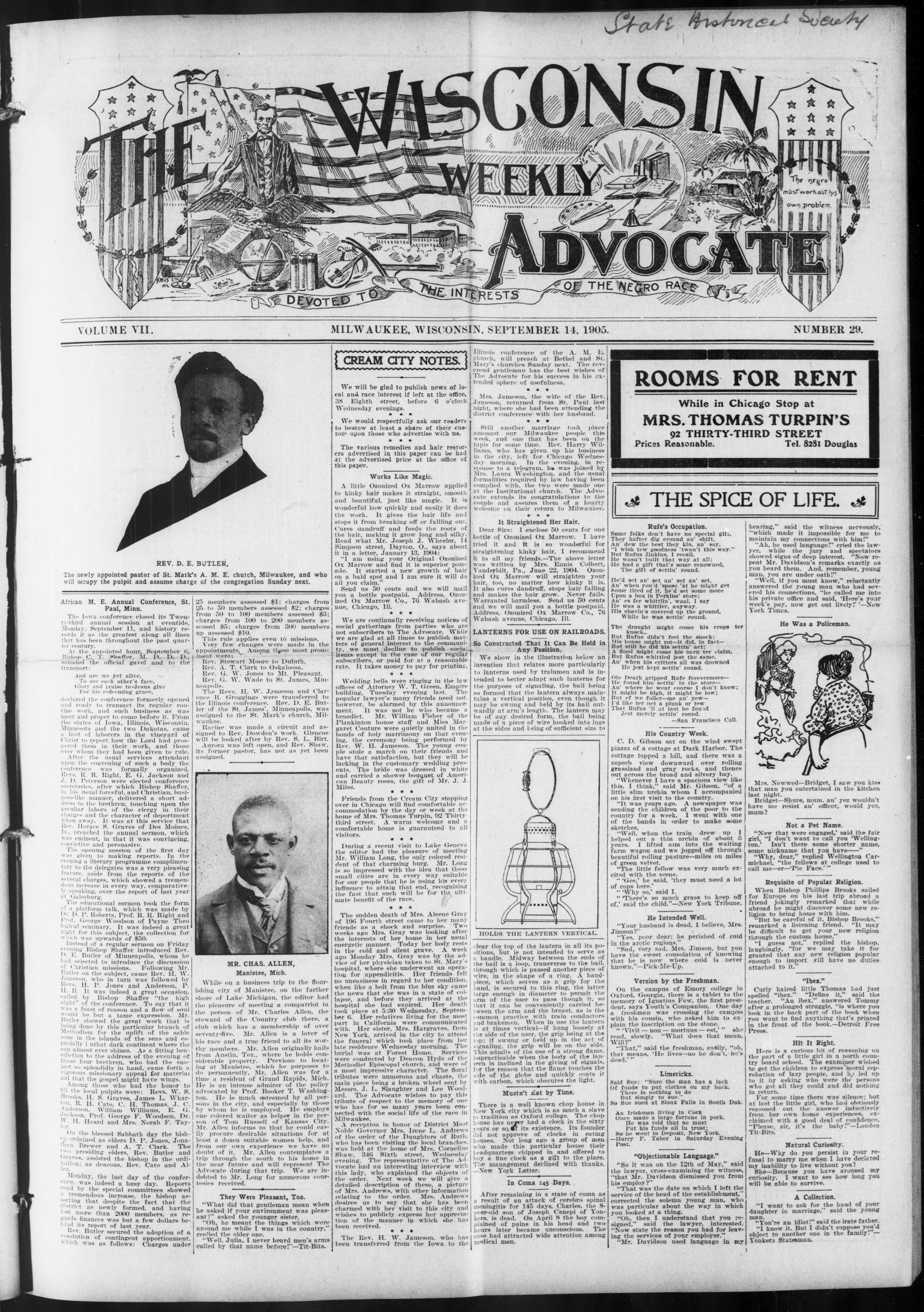
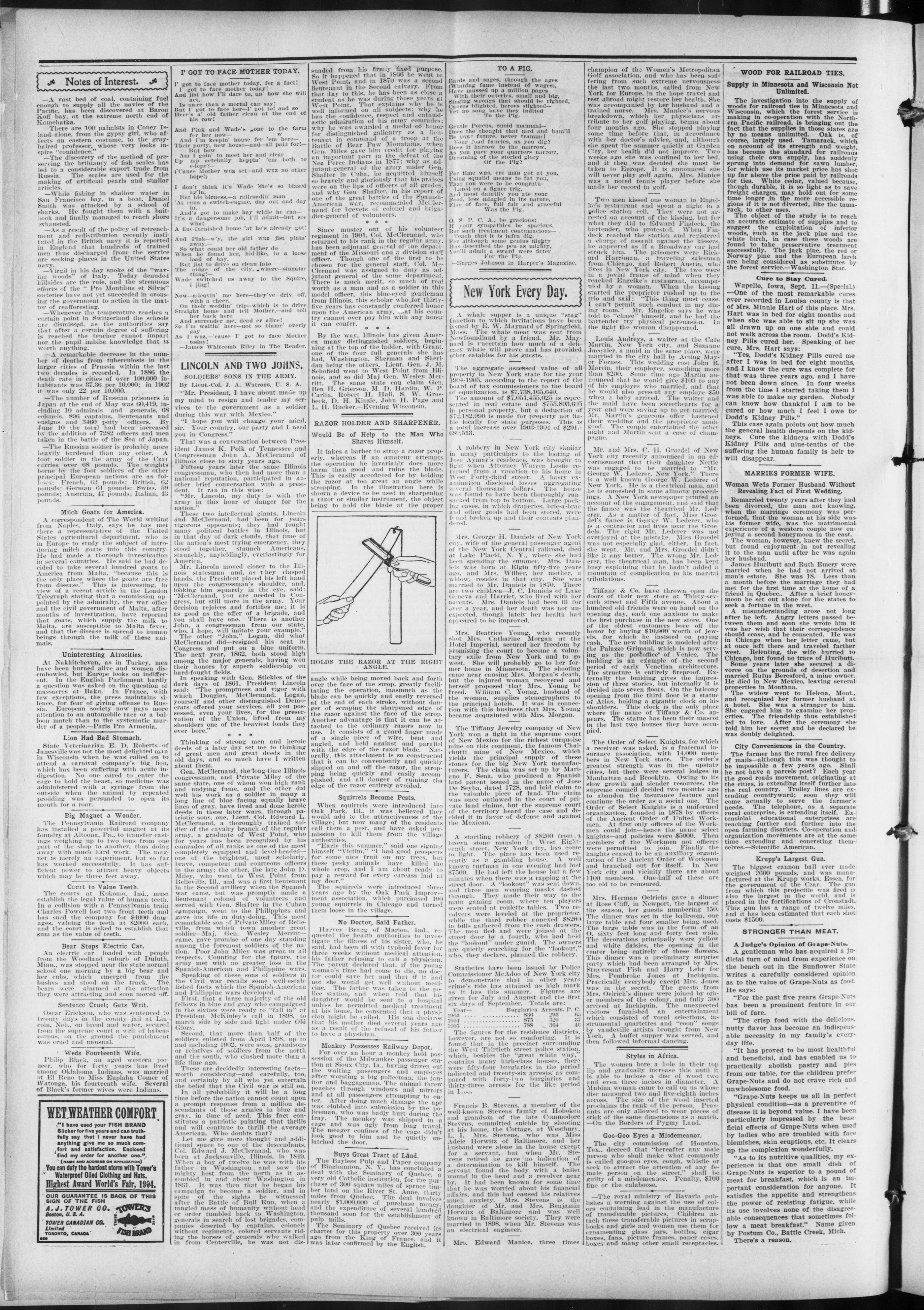
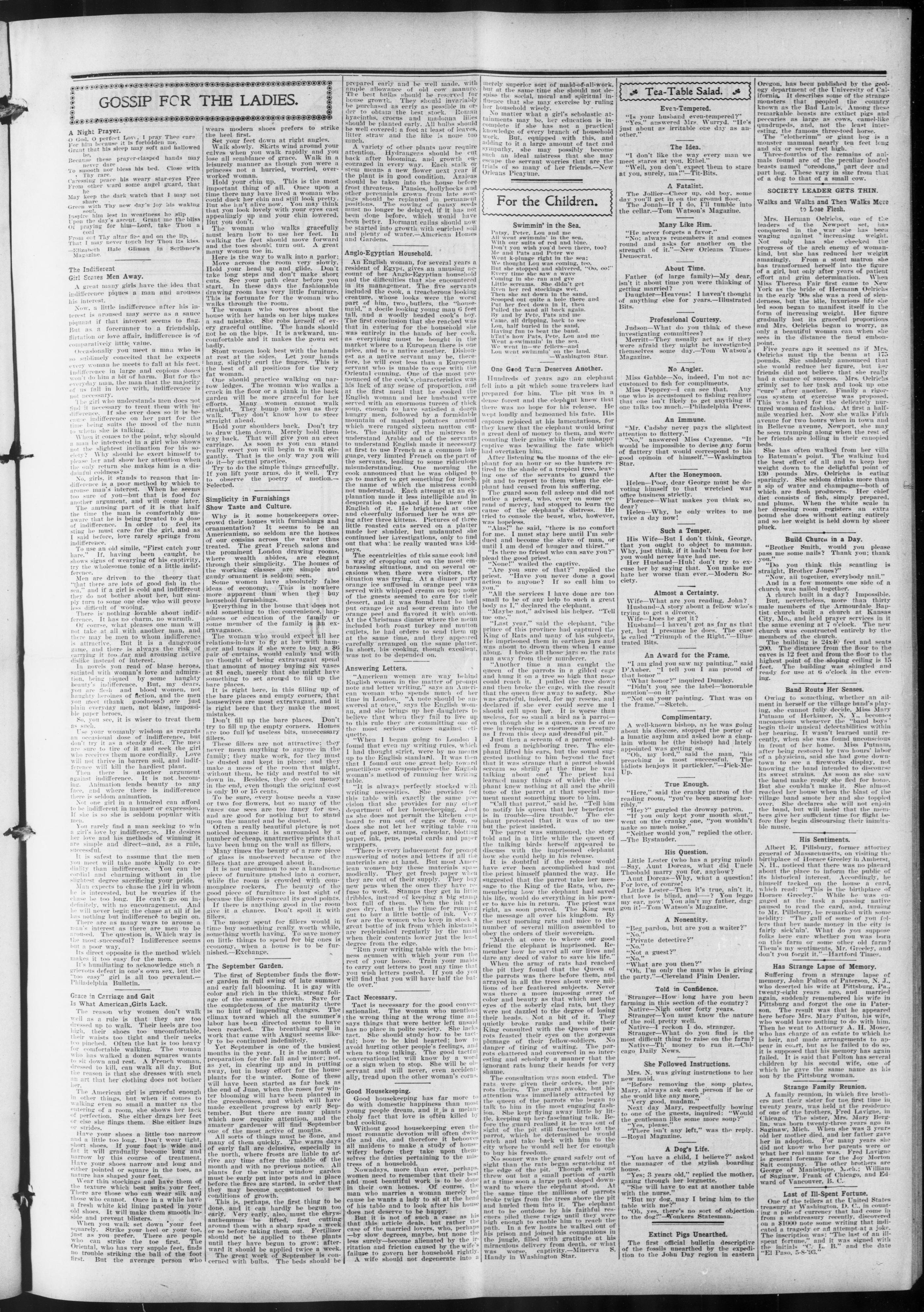
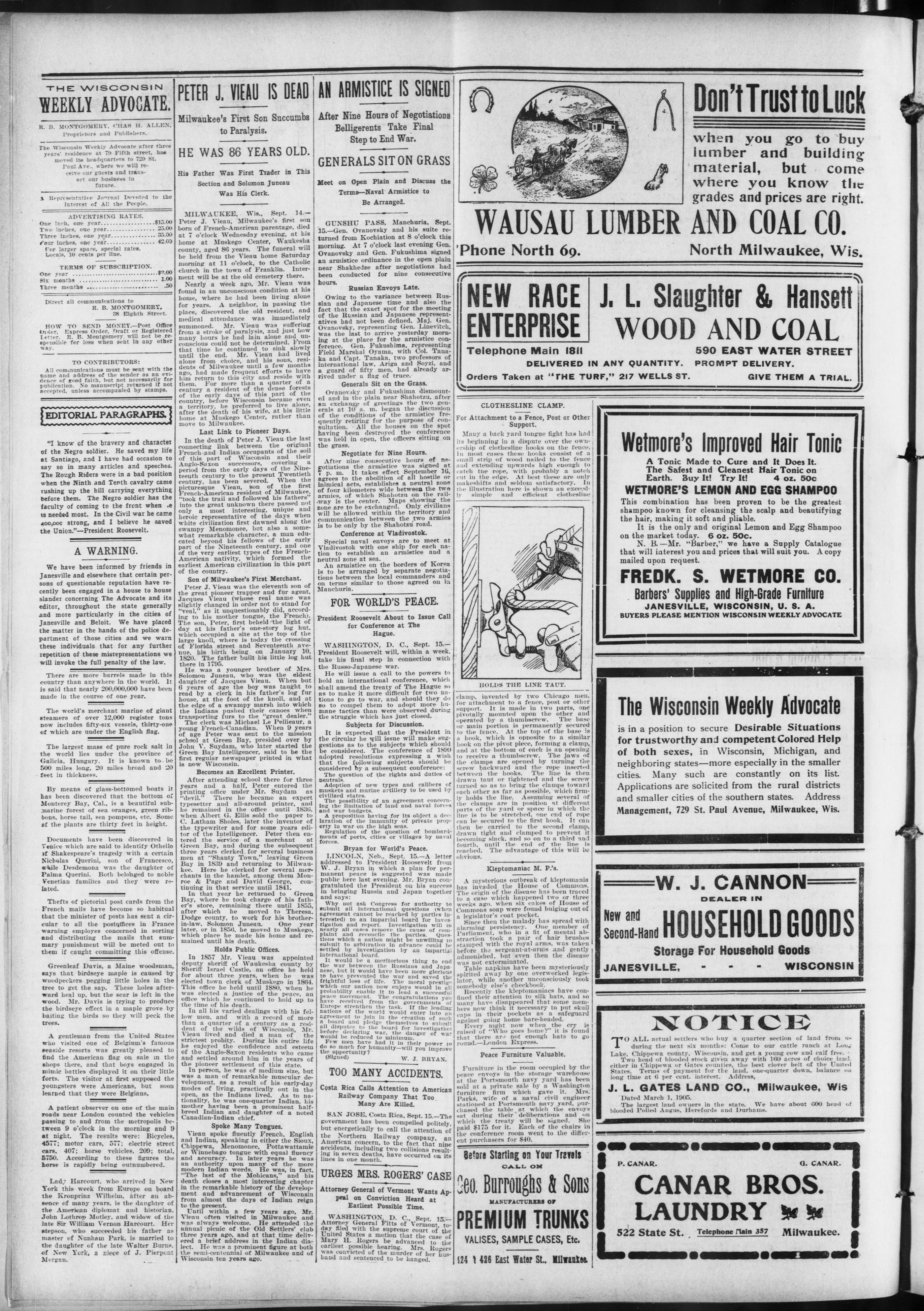
Page text (machine-generated)
State Arbitration Sewry
WISCONSIN
WEEKLY
The negro must work out his own problem.
ADVOCATE
DEVOTED TO THE INTERESTS OF THE NEGRO RACE
VOLUME VII.
The newly appointed pastor of St. Mark's A. M. E. church, Milwaukee, and who will occupy the pulpit and assume charge of the congregation Sunday next.
African M. E. Annual Conference, St Paul, Minn
The Iowa conference closed its Twenty-third annual session at eventide, Monday, September 11, and history records it as the greatest along all lines that has been throughout the past quarter century. At the appointed hour, September 6, Bishop C. T. Shaffer, M. D. D. D., sounded the official gavel and to the transport:
declared the conference formerly opened and ready to transact its regular routine work, and such business as was meet and proper to come before it. From the states of Iowa, Illinois, Wisconsin, Minnesota and the two Dakotas, came a host of laborers in the vineyard of Christ to report how the Lord had prospered them in their work, and those over whom they had been given to rule
After the usual services attendant upon the convening of such a body the conference was formally organized. Revs. R. R. Right, E. G. Jackson and J. D. Peterson were elected conference secretaries, after which Bishop Shaffer, in his usual forceful, and Christian, business-like manner, delivered a short address to the brethren, touching upon the peculiar labors of the clergy in their charges and the character of deportment when away. It was at this service that Rev. Horace S. Graves of Des Moines, Ia., preached the annual sermon, which was eminent, in that it was convincing, convictive and persuasive.
The opening session of the first day was given to making reports. In the evening a literary programme complimentary to the delegates was a very pleasing feature, aside from the reports of the several charges, which showed a tremendous increase in every way, comparatively speaking, over the report of last year at Galesburg.
The educational sermon took the form of a platform talk, which was made by Dr. D. P. Roberts, Prof. R. R. Right and Prof. George Woodson of Payne Theological seminary. It was indeed a great night for this subject, the collection for which was upwards of $50.
Instead of a regular sermon on Friday evening Bishop Shaffer introduced Rev. D. E. Butler of Minneapolis, whom he had selected to introduce the discussion of Christian missions. Following Mr. Butler on the subject, came Rev. H. W. Jameson, who in turn was followed by Revs. H. P. Jones and Anderson, P. H. R. It was indeed a great occasion, called by Bishop Shaffer "the high night" of the conference. To say that it was a feast of reason and a flow of soul would be but a tame expression. Mr. Butler showed the great work that is being done by this particular branch of Methodism for the uplift of the sable sons in the islands of the seas and especially i nthat dark continent where the sun almost ever shines. As a fitting benediction to the address of the evening of these four brethren, who had the sujet so splendidly in hand, came forth a vigorous missionary appeal for material aid that the gospel might have wings.
Among those who had the honor to fill the local pulpits were: Revs. W. S. Brooks, H. S. Graves, James L. Wharton, R. H. Cato, C. H. Thomas, J. C. Anderson, William Williams, E. G. Jackson, Prof. George F. Woodson, Dr. W. H. Heard and Mrs. Norah F. Taylor.
On the blessed Sabbath day the bishop ordained as elders D. P. Jones, Jonathan Brewer and A. T. Clark. The two presiding elders, Rev. Butler and Graves, assisted the bishop in the ordination; as deacons, Rev. Cato and Allen.
Monday, the last day of the conference, was indeed a busy day. Reports read by the special committees showed a tremendous increase, the bishop asserting that despite the fact that the district as newly formed, and having lost more than 2000 members, as regards finances was but a few dollars behind its report of last year. Rev. Butler secured the adoption of a resolution of contingent apportionment, which was as follows: Charges under
And are we yet alive.
25 members assessed $1; charges from 25 to 50 members assessed $2; charges from 50 to 100 members assessed $3; charges from 100 to 200 members assessed $5; charges from 300 members up assessed $10.
This rule applies even to missions.
Very few changes were made in the appointments. Among those most prominent were:
Rev. Stewart Moore to Duluth.
Rev. A. T. Clark to Oskalosa.
Rev. G. W. Jones to Mt. Pleasant.
Rev. G. W. Wade to St. James, Minneapolis.
The Revs. H. W. Jzmeson and Clarence R. Groggings were transferred to the Illinois conference. Rev. D. E. Butler of the St. James', Minneapolis, was assigned to the St. Mark's church, Milwaukee. Racine was made a circuit and assigned to Rev. Dowden's work. Glencoe will be looked after by Rev. S. L. Birt. Aurora was left open, and Rev. Shaw, its former pastor, has not as yet been assigned.
[Name]
MR. CHAS. ALLEN, Manistee, Mich.
While on a business trip to the flourishing city of Manistee, on the farther shore of Lake Michigan, the editor had the pleasure of meeting a compatriot in the person of Mr. Charles Allen, the steward of the Country club there, a club which has a membership of over seventy-five. Mr. Allen is a lover of his race and a true friend to all its worthy members. Mr. Allen originally hails from Austin, Tex., where he holds considerable property. Previous to locating at Manistee, which he purposes to do permanently, Mr. Allen was for a time a resident of Grand Rapids, Mich. He is an intense admirer of the policy advocated by Prof. Booker T. Washington. He is much esteemed by all persons in the city, and especially by those by whom he is employed. He employs one colored waiter as helper in the person of Tom Russell of Kansas City. Mr. Allen informs us that he could easily procure desirable situations for at least a dozen suitable women help, and from our own experience we have no doubt of it. Mr. Allen contemplates a trip through the south to his home in the near future and will represent The Advocate during that trip. We are indebted to Mr. Long for numerous courtesies received.
They Were Pleasant Too
"What did that gentleman mean when he asked if your environment was pleasant?" asked the younger sister.
"Oh, he meant the things which were around me while I was in the country," replied the older one.
"Well, Julia, I never heard men's arms called by that name before!" -Tit-Bits.
CREAM CITY NOTES.
We will be glad to publish news of local and race interest if left at the office, 38 Eighth street, before 6 o'clock Wednesday evenings.
We would respectfully ask our readers to bestow at least a share of their custom upon those who advertise with us.
The various remedies and hair restorers advertised in this paper can be had at the advertised price at the office of this paper.
Works Like Magic.
A little Ozonized Ox Marrow applied to kinky hair makes it straight, smooth and beautiful, just like magic. It is wonderful how quickly and easily it does the work. It gives the hair life and stops it from breaking off or falling out. Cures dandruff and feeds the roots of the hair, making it grow long and silky. Read what Mr. Joseph J. Wheeler, 14 Simpson street, Dayton, O., says about it in a letter, January 13, 1904: "I am using your Original Ozonized Ox Marrow and find it is superior pomade. It started a new growth of hair on a bald spot and I am sure it will do all you claim."
Send us 50 cents and we will mail you a bottle postpaid. Address, Ozonized Ox Marrow Co., 76 Wabash avenue, Chicago, Ill.
* * *
We are continually receiving notices of social gatherings from parties who are not subscribers to The Advocate. While we are glad at all times to publish matters of general interest to the community, we must decline to publish social items except in the case of our regular subscribers, or paid for at a reasonable rate. It takes money to pay for printing.
***
Wedding bells were ringing in the law offices of Attorney W. T. Green, Empire building, Tuesday evening last. The popular lawyer's many friends need not, however, be alarmed by this announcement. It was not he who became a benedict. Mr. William Fisher of the Plankinton house staff and Miss Margaret Couture were quietly united in the bonds of holy matrimony on that evening, the ceremony being performed by Rev. W. H. Jameson. The young couple stole a march on their friends and have that satisfaction, but they will be lacking in the customary wedding presents. The bride was dressed in white and carried a shower bouquet of American Beauty roses, the gift of Mr. J. J. Miles.
* * *
Friends from the Cream City stopping over in Chicago will find comfortable accommodation by the day or week at the home of Mrs. Thomas Turpin, 92 Thirty third street. A warm welcome and a comfortable home is guaranteed to all visitors.
***
During a recent visit to Lake Geneva the editor had the pleasure of meeting Mr. William Long, the only colored resident of that charming burg. Mr. Long is so impressed with the idea that these small cities are in every way suitable for our people that he is using his every influence to attain that end, recognizing the fast that such will be for the ultimate benefit of the race.
* * *
The sudden death of Mrs. Aleene Gray of 196 Fourth street came to her many friends as a shock and surprise. Two weeks ago Mrs. Gray was looking after the interests of her home in her usual energetic manner. Today her body rests in the cold and silent grave. A week ago Monday Mrs. Gray was by the advice of her physician taken to St. Mary's hospital, where she underwent an operation for appendicitis. Her friends felt no uneasiness in regard to her condition, when like a bolt from the blue sky came the news that she was in a state of collapse, and before they arrived at the hospital she had expired. Her death took place at 5:30 Wednesday, September 6. Her relatives living for the most part in California were communicated with. Her sister, Mrs. Hargraves, from New York, arrived in the city to attend the funeral which took place from her late residence Wednesday morning. The burial was at Forest Home. Services were conducted by Deacon Hyde of the Methodist Episcopal church, and were of a most impressive character. The floral tributes were numerous and chaste, the main piece being a broken wheel sent by Messrs. J. L. Slaughter and Lee Woodard. The Advocate wishes to pay this tribute of respect to the memory of one who has for so many years been connected with the social life of the race in Milwaukee.
A reception in honor of District Most Noble Governor Mrs. Irene L. Andrews of the order of the Daughters of Ruth, who has been visiting the local branches, was held at the home of Mrs. Cornelius Shaw, 346 Sixth street, Wednesday evening. The representative of The Advocate had an interesting interview with this lady, who explained the objects of the order. Next week we will give a detailed description of these, a picture of Mrs. Andrews, with other information relating to the order. Mrs. Andrews desires us to say that she has been charmed with her visit to this city and wishes to publicly express her appreciation of the manner in which she has been received.
The Rev. H. W. Jameson, who has been transferred from the Iowa to the
Illinois conference of the A. M. E. church, will preach at Bethel and St. Mary's churches Sunday next. The reverend gentleman has the best wishes of The Advocate for his success in his extended sphere of usefulness.
哦 哦 哦
Mrs. Jameson, the wife of the Rev. Jameson, returned from St. Paul last night, where she had been attending the district conference with her husband.
---
Still another marriage took place amongst our Milwaukee people this week, and one that has been on the tapis for some time. Rev. Harry Williams, who has given up his business in the city, left for Chicago Wednesday morning. In the evening, in response to a telegram, he was joined by Mrs. Laura Washington, and the usual formalities required by law having been complied with, the two were made one at the Institutional church. The Advocate extends its congratulations to the couple and assures them of a hearty welcome on their return to Milwaukee.
It Straightened Her Hair.
Dear Sirs: I enclose 50 cents for one bottle of Ozonized Ox Marrow. I have tried it and it is so wonderful for straightening kinky hair. I recommend it to all my friends.-The above letter was written by Mrs. Ennis Colbert, Vanderbilt, Pa., June 22, 1904. Ozonized Ox Marrow will straighten your hair, too, no matter how kinky it is. It also cures dandruff, stops hair falling and makes the hair grow. Never fails. Warranted harmless. Send us 50 cents and we will mail you a bottle postpaid. Address, Ozonized Ox Marrow Co., 76 Wabash avenue, Chicago, Ill.
LANTERNS FOR USE ON RAILROADS.
So Constructed That It Can Be Held in Any Position.
We show in the illustration below an invention that relates more particularly to lanterns used by trainmen and is intended to better adapt such lanterns for the purpose of signaling, the bail being so formed that the lantern always maintains a vertical position, even though it may be swung and held by its bail outwardly at arm's length. The lantern may be of any desired form, the bail being made of a piece of wire hooked into lugs at the sides and being of sufficient size to
```markdown
```
HOLDS THE LANTERN VERTICAL
clear the top of the lantern in all its positions, but is not intended to serve as a handle. Midway between the ends of the bail is a loop, transverse to the bail, through which is passed another piece of wire, in the shape of a ring. A handpiece, which serves as a grip for the hand, is secured to this ring, the latter large enough in diameter to permit the arm of the user to pass though it, so that it can be conveniently carried between the arm and the breast, as is the common practice with train conductors and brakemen. When in use the lantern is at times vertical—if hung loosely at the side of the user, the grip being at the top; if swung or held up in the act of signaling, the grip will be on the side. This admits of the use of a strong flame, impracticable when the body of the lantern is inclined in the giving of signals, for the reason that the flame touches the side of the globe and quickly coats it with carbon, which obscures the light.
Mustn't Eat by Time
There is a well known chop house in New York city which is as much a slave to tradition as Oxford college. The chop house has never had a clock in the sixty years or so, if its existence. Its founder did not approve of clocks in eating houses. Not long ago a group of men who made this particular house their headquarters chipped in and offered to buy a fine clock as a gift to the place. The management declined with thanks. New York Letter.
In Coma 145 Days.
After remaining in a state of coma as a result of an attack of cerebro spinal meningitis for 145 days, Charles, the 8-year-old son of Joseph Canepi of Yonkers, is dead. On April 8 the boy complained of pains in his head and two hours later became unconscious. The case had attracted wide attention among medical men.
ROOMS FOR RENT
THE SPICE OF LIFE.
Rufe's Occupation
Some folks don't have special gift,
They hafter dig eround an' shift,
An' dew the best they kin, an' say,
"I wish tew goodness 'twan't this way."
But Rufus Jinkins, I recall.
He wasn't built that way at all;
He had a gift that's some renowned,
The gift of settin' round.
He'd set an' set an' set an' set,
An' when youd 'spose 'at he might get
Some tired of it, he'd set some more
Upon a box in Perkins' store;
An' es fer whittilin, waal, I say
He was a whittler, anyway.
His shavin's covered up the ground,
While he was settin' round.
The drought might come his crops ter knock,.
But Rufus didn't feel the shock:
His house might rot—it did, in fact—
But still he did his settin' act:
A flood might come his barn ter claim,
But Rufus whittled jest the same.
An' when his critters all was drowned
He jest kept settin' round.
Ole Death gripped Rufe forevermore—
He found him settin' in the store—
An' where he went course I don't know;
It might be high, it might be low;
But ef we foller—me an' yew—
I'd like ter bet a plunk or tew
That Rufus 'll at last be found
His Country Week.
C. D. Gibson sat on the wind swept piazza of a cottage at Dark Harbor. The cottage topped a hill, and there was a superb view downward over rolling grassland and gray rocks, and thence out across the broad and silvery bay.
"Whenever I have a spacious view like this, I think," said Mr. Gibson, "of a little slim urchin whom I accompanied on his first visit to the country.
"It was years ago. A newspaper was sending the children of the poor to the country for a week. I went with one of the bands in order to make some sketches.
"Well, when the train drew up I helped out a thin urchin of about 5 years. I lifted arm into the waiting farm wagon and we jogged off through beautiful rolling pasture—miles on miles of green velvet.
"The little fellow was very much excited with the scene.
" 'Gee,' he said, 'they must need a lot of cops here.' " 'Why so,' said I. " 'There's so much grass to keep off of,' said the child."—New York Tribune.
He Intended Well.
"Your husband is dead, I believe, Mrs. Jimson?"
"Yes, poor dear; he perished of cold in the arctic regions."
"Sad, very sad, Mrs. Jimson, but you have the sweet consolation of knowing that he is now where cold is never known."—Pick-Me-Up.
Version by the Freshman.
On the campus of Emory college in Oxford, Georgia, there is a tablet to the memory of Ignatius Few, the first president, says Youth's Companion. One day a freshman was crossing the campus with his cousin, who asked him to explain the inscription on the stone.
"Vivit—non—mortuus—est," she read, slowly. "What does that mean, Will?"
"That," said the freshman, easily, "oh, that means, 'He lives—no he don't, he's dead.'"
Limericks
Said Sue: "Sure the man has a lack
Of funds to put clothes on my back.
There is nothing to do
But simply to sue."
So Sue sued at Sioux Falls in South Dak.
An Irishman living in Cork
Once made a large fortune in pork.
He was told that he must
Put his funds all in trust;
So he went to Deposit, New York.
—Harry P. Taber in Saturday Evening
Post.
"Objectionable Language."
"So it was on the 12th of May," said the lawyer, cross-examining the witness, "that Mr. Davidson dismissed you from his employ?"
"That was the date on which I left the service of the head of the establishment," corrected the solemn young man, who was particular about the way in which you looked at a thing.
"Oh, then I understand that you resigned," said the lawyer, interested.
"Now state the reason you had for leaving the services of your employer."
"Mr. Davidson used language in my
NUMBER 29.
FOR RENT
Chicago Stop at
AS TURPIN'S
THIRD STREET
Tel. 8281 Douglas
E OF LIFE.
hearing," said the witness nervously, "which made it impossible for me to maintain my connections with him!" "Ah, he used language!" cried the lawyer, while the jury and spectators showed signs of deep interest. "Now repeat Mr. Davidson's remarks exactly as you heard them. And, remember, young man, you are under oath!" "Well, if you must know," reluctantly answered the young man who had severed his connections. "he called me into his private office and said, 'Here's your week's pay, now get out lively!'—New York Times.
M. M.
Mrs. Newwed—Bridget, I saw you kiss that man you entertained in the kitchen last night.
Bridget—Shure, mum. an' yez wouldn't have me resist an' officer, would yez, mum?
Not a Pet Name.
"Now that were engaged,' said the fair girl, "I don't want to call you 'Wellington.' Isn't there some shorter name, some nickname that you have—" "Why, dear," replied Wellington Carmichael, "the fellows at college used to call me—er-'Pie Face.'"
Requisite of Popular Religion
When Bishop Phillips Brooks sailed for Europe on his last trip abroad a friend jokingly remarked that while abroad he might discover some new religion to bring home with him.
"But be careful of it. Bishop Brooks," remarked a listening friend. "It may be difficult to get your new religion through the custom house."
"I guess not," replied the bishop, laughingly, "for we may take it for granted that any new religion popular enough to import will have no duties attached to it."
"Iber."
Curly haired little Thomas had just spelled "ibex." "Define it," said the teacher. "An ibex," answered Tommy after a prolonged struggle, "is where you look in the back part of the book when you want to find anything that's printed in the front of the book.—Detroit Free Press.
Hit It Right.
Here is a curious bit of reasoning on the part of a little girl in a north country board school. The examiner wished to get the children to express moral reprobation of lazy people, and he led up to it by asking who were the persons who got all they could and did nothing in return.
For some time there was silence; but at last the little girl, who had obviously reasoned out the answer inductively from her own home experiences, explained with a good deal of confidence, "Please, sir, it's the baby!"—London Tit-Bits.
Natural Curiosity
He—Why do you persist in your refusal to marry me when I have declared my inability to live without you?
She—Because you have aroused my curiosity. I want to see how long you will be able to survive.
A Collection.
"I want to ask for the hand of your daughter in marriage," said the young man.
"You're an idiot!" said the irate father. "I know it. But I didn't suppose you'd object to another one in the family." Yonkers Statesman.
A vast bed of coal, containing fuel enough to supply all the navies of the Pacific, has been discovered at Baron Koff bay, at the extreme north end of Kamchatka.
There are 100 palmists in Coney Island alone, from the gypsy girl, who affects an eastern costume, to the gray-haired professor, whose very looks inspire "confidence."
The discovery of the method of preserving the brilliancy of fish scales has led to a considerable export trade from Russia. The scales are used for the making of artificial pearls and similar articles.
While fishing in shallow water in San Francisco bay, in a boat, Daniel Smith was attacked by a school of sharks. He fought them with a baithook and finally managed to reach shore exhausted.
As a result of the policy of retrenchment and redistribution recently instituted in the British navy it is reported in England that hundreds of trained men thus discharged from the service are seeking places in the United States navy.
Virgil in his day spoke of the "waving woods" of Italy. Today denuded hillsides are the rule, and the strenuous efforts of the "Pro Montibus et Silvis" societies have not yet succeeded in arousing the government to action in the matter of reafforesting.
Whenever the temperature reaches a certain point in Switzerland the schools are dismissed, as the authorities say that after a certain degree of suffering is reached the teacher cannot impart nor the pupil imbibe knowledge that is worth anything.
A remarkable decrease in the number of deaths from tuberculosis in the larger cities of Prussia within the last two decades is recorded. In 1886 the death rate in cities of over 100,000 inhabitants was 37.36 per 10,000; in 1902 it was only 22 per 10,000.
The number of Russian prisoners in Japan at the end of May was 60,419, including 10 admirals and generals, 68 colonels, 896 captains, lieutenants and ensigns and 3460 petty officers. By June 10 the total had been increased by the addition of 7282 officers and men taken in the battle of the Sea of Japan.
The Russian soldier is probably more heavily burdened than any other. A foot soldier in the army of the Czar carries over 68 pounds. The weights borne by the foot soldiers of the other principal European nations are as follows: French, 62 pounds; British, 62 pounds; German 61 pounds; Swiss, 59 pounds; Austrian, 47 pounds; Italian, 43 pounds.
Milch Goats for America.
A correspondent of The World writing from Naples, Italy, says he has met there a representative of the United States agricultural department, who is in Europe to study the subject of introducing milch goats into this country. He had made a thorough investigation in several countries. He said he had decided to take several hundred goats to America from Malta, "because this is the only place where the goats are free from disease." This is interesting, in view of a recent article in the London Telegraph stating that a commission appointed by the admiralty, the war office and the civil government of Malta, after months of investigation, have reported that goats, which supply the milk to Malta, are susceptible to Malta fever, and that the disease is spread to human beings through the milk of these animals.
Uninteresting Atrocities
At Nakhitchevan, as in Turkey, men have been burned alive and women disembowled, but Europe looks on indifferent. In the English Parliament hardly a question was asked on the question of massacres at Baku. In France, with few exceptions, the press maintains silence, for fear of giving offense to Russia. European society now pays more attention to an automobile race or a balloon match than to the systematic murder of a people.—Paris Pro Armenia.
Lion Had Bad Stomach.
State Veterinarian E. D. Roberts of Janesville was not the most delighted man in Wisconsin when he was called on to attend a carnival company's big lion, which has been suffering with acute indigestion. No one cared to enter the cage to hold the beast, so medicine was administered with a syringe from the outside when the animal by repeated prodding was persuaded to open its mouth for a roar.
Big Magnet a Wonder
The Pennsylvania Railroad company has installed a powerful magnet at its foundry at Altoona, Pa., to transfer castings weighing up to two tons from one part of the shop to another, thus doing away with much hard work. The magnet is merely an experiment, but so far has worked successfully. It has sufficient power to attract heavy objects which may be three feet away.
Court to Value Teeth
The courts at Kokomo, Ind., must establish the legal value of human teeth. In a collision with a Pennsylvania train Charles Powell lost two front teeth and has sued the company for $4000 damages, valuing the teeth at $2000 each, and the court is asked to establish that sum as the value of teeth.
Bear Stops Electric Car
An electric car loaded with people from the Woodland suburb of Duluth, Minn., was stopped near the state normal school one morning by a big bear and her cubs, which emerged from the bushes and stood on the track. The bears were alarmed at the attention they were attracting and soon moved off.
Sentence Cruel: Gets Writ
Oscar Erickson, who was sentenced to twenty days in the county jail at Lincoln, Neb., on bread and water, secured from the supreme court a writ of habeas corpus, on the ground the punishment was cruel and unusual.
Weds Fourteenth Wife
Philip Black, an aged western pioneer, who for forty years has lived among Oklahoma Indians, was married at El Reno to Miss Euplaha Comer of Watonga, his fourteenth wife. Several of Black's former wives were Indians.
WET WEATHER COMFORT
"I have used your FISH BRAND Slicker for five years and can truthfully say that I never have had anything give me so much comfort and satisfaction. Enclosed find my order for another one."
(NAME AND ADDRESS ON APPLICATION)
You can defy the hardest storm with Tower's Waterproof Oiled Clothing and Hats. Highest Award World's Fair, 1904.
OUR GUARANTEE IS BACK OF THIS SIGN OF THE FISH
A. J. TOWER CO.
Boston, U. S. A.
TOWER CANADIAN CO.
Limited
TORONTO, CANADA
I GOT TO FACE MOTHER TODAY.
I' got to face mother today, fer a fact!
I' got to face mother today!
And jist how I'll dare to, an' how she will
act,
Is more than a mortal can say!
But I' got to face her—I' got to! and so
Here's a' old father clean at the end of
his row!
And Pink and Wade's gone to the farm
fer her now—
w
And I'm keepin' house fer 'em here—
Their purty, new house—and—all paid for!—
But how
Am I goin' to meet her and clear
Up mp actehully heppin' 'em both to
e-lone!—
(Cause Mother wuz set—and wuz no other hope!)
I don't think it's Wade 'she's so biased ag'in.
But his bizness,—a railroadin' man
'At runs a switch-engine, day out and day in.
And's got to make hay while he can—
It's a dangersome job, I'll admit—but see what
A fine furnished home 'at he's already got!
And Pink—w'y, the girl wuz jist pinin' away,—
So what could her old father do
When he found her, hid-like, in a loose load of hay,
But jist to drive on clean into
The aidge of the city, where—singalan thing!—
Wade switched us away to the Squire,
i jing!
Now—a-leavin' me here—they've driv off,
with a cheer,
On their weddin' trip—which is to drive
Straight home and tell Mother,—and toll
her back here
And surrender me, dead er alive!
So I'm waitin' here—not so blame' overly
gay
As I wuz,'cause I' got to face Mother
today!
—James Whitcomb Riley in The Reader.
LINCOLN AND TWO JOHNS.
By Lieut.-Col. J. A. Watrous, U. S. A.
"Mr. President, I have about made up my mind to resign and tender my services to the government as a soldier during this war with Mexico."
"I hope you will change your mind, sir. Your country, our party and I need you in Congress."
That was a conversation between President James K. Polk of Tennessee and Congressman John A. McClernand of Illinois close to sixty years ago.
Fifteen years later the same Illinois congressman, who then had more than a national reputation, participated in another brief conversation with a president. It ran in this wise:
"Mr. Lincoln, my duty is with the army in this hour of danger for the nation." These two intellectual giants, Lincoln and McClernand, had been for years vigorous opponents; they had fought many political battles in Illinois, but in that day of dark clouds, that time of the nation's most trying emergency, they stood together, staunch Americans, staunchly, unyieldingly, everlastingly for America.
Mr. Lincoln moved closer to the Illinois statesman and, as they clasped hands, the President placed his left hand upon the congressman's shoulder, and, looking him squarely in the eye, said: "McClernand, you are needed in Congress, but still more in the army. Your decision rejoices and fortifies me; it is as good as the offer of a brigade, and you shall have one. There is another John, a congressman from our state, who, I hope, will imitate your example." The other "John," Logan, did what McClernand did—resigned his seat in Congress and put on a blue uniform. The next year, 1862, both stood high among the major generals, having won their honors by superb soldiership on hard-fought fields.
In speaking with Gen. Stickles of the dark days of 1861, President Lincoln said: "The promptness and vigor with which Douglas, McClernand, Logan, yourself and other distinguished Democrats offered your services, all you possessed, even your lives, for the preservation of the Union, lifted from my shoulders one of the heaviest loads they ever bore."
☆ ☆ ★
Thinking of strong men and heroic deeds of a later day set me to thinking of great men and great deeds in the old days, and so much have I written about them.
Gen. McClernand, the long-time Illinois congressman, and Private Miley of the same state, one of whom won high rank and undying fame, and the other did well his work as a soldier in many a long line of blue facing equally brave lines of gray, have lived and done heroic deeds in these later wars, through patriotic sons, one, Lieut. Col. Edward L. McClernand, a thoroughly trained soldier of the cavalry branch of the regular army, a graduate of West Point, who for years has been recognized by his comrades of all ranks as one of the most completely equipped and level-headed—one of the brightest, most scholarly, brave, competent and courteous officers in the army; the other, the late John D. Miley, who went to West Point from Belleville, Ill., and was a first lieutenant in the Second artillery when the Spanish war came, but was promptly made a lieutenant colonel of volunteers and served with Gen. Shafter in the Cuban campaign, went to the Philippines and gave his life in duty-doing. This most remarkable son of Private Miley of Belleville, from which town another great soldier—Maj. Gen. Wesley Merritt—came, gave promise of one day standing among the foremost soldiers of the nation. Poor John Miley was great in all respects. Counting for the future, the army met with no greater loss in the Spanish-American and Philippine wars.
Speaking of these sons of soldiers in the Civil war recalls some well-established facts which the Spanish-American and Philippine wars developed.
First, that a large majority of the old fellows in blue and gray who campaigned in the sixties were ready to "fall in" at President McKinley's call in 1898, to march side by side and fight under Old Glory.
Second, that more than half of the soldiers enlisted from April 1898, up to and including 1902, were sons, grandsons or relatives of soldiers from the north and the south, who clashed more than a life time ago.
These are decidedly interesting facts—worth considering—and carefully, too, and certainly by all who yet entertain the belief that the Civil war is still on. In all probability it will be a long time before the nation cannot count upon a prompt response from a million descendants of those armies in blue and gray, in time of need. This fact constitutes a patriotic painting that thrills and will continue to thrill the average American. Who doubts that?
Let me give more thought and additional space to one of the descendants, Col. Edward J. McClernand, who was born at Jacksonville, Illinois, in 1849. When a boy of twelve he was with his father in Washington and saw the mighty host from the north as it assembled in and about Washington in 1861. It was then that he began his campaign to become a soldier, and in spite of the sights he witnessed after the Battle of Bull Run, when a tangled mass of humanity without head er order tumbled back to Washington, generals in search of lost brigades, companies deserted by captains, colonels without regiments, colored servants riding the horses of generals who walked in from Centerville, he was not dis-
suaded from his firmly fixed purpose. So it happened that in 1866 he went to West Point, and in 1870 was a second lieutenant in the Second calvary. From that day to this, he has been as close a student as he was during those years at West Point. That explains why he is well informed on all subjects; why he has the confidence, respect and enthusiastic admiration of his army comrades; why he was awarded a medal of honor for distinguished gallantry as a lieutenant in command of a troop at the Battle of Bear Paw Mountains, when Gen. Miles gave him credit for playing an important part in the defeat of the Nez Perce Indians in 1877; why as adjutant-general of the army under Gen. Shafter in Cuba, he acquitted himself so bravely and gloriously that his praises were on the lips of officers of all grades, and why Gen Shafter, in his report of one of the great battles of the Spanish-American war, recommended McClernand for brevets of colonel and brigadier-general of volunteers.
Since muster out of his volunteer regiment in 1901, Col. McClernand, who returned to his rank in the regular army, has been adjutant general of the department of the Missouri and a division staff officer. Though one of the first to be chosen for the general staff, Col. McClernand was assigned to duty as adjutant general of the same department. There is much merit, so much of real worth as a man and as a soldier in this model officer, this blue-eyed gentleman from Illinois, this scholar who for thirty-five years has constantly conferred honor upon the American army, that his country cannot over pay him with any honor it can confer.
it can come. * * *
By the way, Illinois has given America many distinguished soldiers, beginning at the top of the ladder, with Grant, one of the four full generals she has had, Washington, Sherman and Sheridan being the others. Lieut. Gen. J. M. Schofield went to West Point from Illinois, and so did Maj Gen. Wesley Merritt. The same state can claim Gen. Ben H. Grierson, M. D. Hardin, W. P. Carlin, Robert H. Hall, S. W. Grosbeck, D. H. Kinzie, John H. Page and L. H. Rucker.—Evening Wisconsin.
RAZOR HOLDER AND SHARPENER.
Would Be of Help to the Man Who Shaves Himself.
It takes a barber to strop a razor properly, whereas if an amateur attempts the operation he invariably does more harm than good and ruins the blade. This is easily accounted for by holding the razor at too great an angle while stropping. In the illustration here is shown a device to be used in sharpening a razor or similar instrument, the object being to hold the blade at the proper
1
HOLDS THE RAZOR AT THE RIGHT ANGLE. angle while being moved back and forth over the face of the strop, greatly facilitating the operation, inasmuch as the blade can be quickly and easily reversed at the end of each stroke, without danger of scraping the sharpened edge of the razor against the face of the strop. Another advantage is that it can be attached to the ordinary razors now in use. It consists of a guard finger made of a single piece of wire, bent and angled, and held against and parallel with the edge of the razor blade. Naturally, this attachment is so constructed that it can be conveniently and quickly slipped on and off the razor, the stroping being quickly and easily accomplished, and all danger of ruining the edge of the razor entirely avoided.
Squirrels Become Pests
When squirrels were introduced into Oak Park, Ill., it was believed they would add to the attractiveness of the village; but now many of the residents call them a pest, and have asked permission to kill them from the village authorities. "Early this summer," said one signing himself "Victim," "I had good prospects for some nice fruit on my trees, but these pesky animals have killed the whole crop, and I am about ready to pay a reward for every carcass laid at my door." The squirrels were introduced three years ago by the Oak Park Improvement association, which purchased 100 young squirrels in Chicago and turned them loose in the village.
No Doctor. Said Father.
Harvey Bragg of Marion, Ind., requested the health authorities to investigate the illness of his sister, who, he said, had been ill with typhoid fever for three weeks without medical attention, his father refusing to call a physician. The parent declared that, if the young woman's time had come to die, no doctor could save her and that if it had not she would get well without medicine. The father was taken to the police station, and when told that his daughter would be sent to a hospital unless he permitted medical treatment at his home, he consented that a physician might be called. His son declares that his mother died several years ago as a result of the refusal of his father to have a physician.
Monkey Possesses Railway
For over an hour a monkey held possession of the Milwaukee passenger station at Sioux City, Ia., having driven out the waiting passengers and employees after worsting a big policeman, the janitor and baggageman. The animal threw peaches through windows and mirrors and at all passengers attempting to enter. After doing much damage the ape was clubbed into submission by the policeman, who was badly hurt during the fray. The monkey was shipped in a cage and was ugly from long travel. The meager confines of the cage didn't look good to him and he quietly unlatched the door.
Buys Great Tract of Land
The Bayless Pulp and Paper company of Binghamton, N. Y., has concluded a deal with the Seminary of Quebec, a very old Catholic institution, for the purchase of 300 square miles of spruce timber land on the River St. Anne, thirty miles from Quebec. The deal involves nearly $1,000,000 of purchase money, and the expenditure of several hundred thousand soon for the establishment of pulp mills. The Seminary of Quebec received its charter for this property over 300 years ago from the King of France, and it was later confirmed by the English.
TO A PIG
Bards and sages, through the ages
(Winning fame instead of wages),
Have mussed up a million pages
With their outeries, small and big,
Singing wrongs that should be righted,
Causes blighted, heroes slighted—
Yet no song have they indited
To the Pig.
Gentle Porcus, suoid mammal—
Does the thought that tard and ham'll
Be your future, never trammel!
Your food fancies, as you dig?
Does it harrow to the marrow,
As you pace your quarters narrow,
Dreaming of the storied glory
Of the Pig?
For time was, ere man got at you,
Using squallid means to fat you,
That you were to be congratulated on a figure trig.
And most daintly you ate your
Food, less mingled in its nature,
Fine of face, full fair and graceful
Was the Pig.
O. S. P. C. A., be gracious;
If your sympathies be spacious.
Bar such treatment contumacious—
Teach that it is infra dig.
For although some genius flighty
Has described the pen as mighty,
You'll admit a sword were fitter
For the Pig.
—Burges Johnson in Harper's Magazine.
New York Every Day.
A whale supper is a unique "stag" function to which invitations have been issued by E. W. Maynard of Springfield, Mass. The whale meat was sent from Newfoundland by a friend. Mr. Maynard is uncertain how much of a delicacy whale will prove and has provided other eatables for his guests.
The aggregate assessed value of all property in New York state for the year 1904-1905, according to the report of the board of tax commissioners to the board of equalization, is $7,738,165,640.
The amount of $7,051,455,025 is represented in real estate and $753,893,605 in personal property, but a deduction of $72,182,990 is made for property not liable locally for state purposes. This is a total increase over 1903-1904 of $291,489,513.
A robbery in New York city similar in many particulars to the looting of Jose Aymar's residence, was brought to light when Attorney Warren Leslie returned from a vacation to his home in West Forty-third street. A hasty examination disclosed losses aggregating several thousand dollars. The house was found to have been thoroughly ransacked from top to bottom. Large packing cases, in which draperies, brice-a-brace and other goods had been stored, were found broken up and their contents plundered.
Mrs. George H. Daniels of New York city, wife of the general passenger agent of the New York Central railroad, died at Lake Placid, N. Y., where she had been spending the summer. Mrs. Daniels was born at Elgin fifty-five years ago, and Mrs. Wilber, her mother, a widow, resides in that city. She was married to Mr. Daniels in 1870. There are two children—J. C. Daniels of Lake Geneva and Harriet, who lived with her parents. Mrs. Daniels had been ill for over a year, and her death was not unexpected, though lately her health had appeared to be improved.
Mrs. Beatrice Young, who recently shot Mrs. Catharine Morgan at the Hotel Imperial, secured her freedom by promising the court to become a voluntary exile from New York and to go west. She will probably go to her former home in Minnesota. The shooting came near causing Mrs. Morgan's death, but the injured woman recovered and herself proposed that Mrs. Young be freed. William C. Young, husband of the woman, supplies stenographers to the principal hotels. It was in connection with this business that Mrs. Young became acquainted with Mrs. Morgan.
The Tiffany Jewelry company of New York won a fight in the supreme court of New Mexico for the richest turquoise mine on this continent, the famous Chalchutti mine of New Mexico, which yields the principal supply of these stones for the big New York manufacturers. The claim was set up by Mariano F. Sena, who produced a Spanish land patent issued in the name of Jose De Seyba, dated 1728, and laid claim to the valuable piece of land. The claim was once outlawed in the court of private land claims, but the supreme court of the territory heard the case and decided it in favor of defense and against the Mexican.
A startling robbery of $8200 from a brown stone mansion in West Eighteenth street. New York city, has come to light. The place has been used recently as a gambling house. A well known turfman in one evening had lost $7500. He had left the house but a few minutes when there was a rapping at the street door. A "lookout" was sent down, and three men wearing masks dashed through. They made their way to the main gaming room, where ten players were seated at roulette tables. Two revolvers were leveled at the proprietor, while the third robber annexed $8200 in bills gathered from the cash drawers. The men fled and were joined at the street door by a fourth, who had held the "lookout" under guard. The owners are quietly searching for the "lookout," who, they declare, planned the robbery.
Statistics have been issued by Police Commissioner McAdoo of New York city to demonstrate that in other years crime's tide has attained as high mark as it has this summer. Figures are given for July and August and the first six days of September. Totals are:
Year— Burglaries. Arrests. P. C.
1903 836 293 67
1904 875 320 37
1905 788 364 40
The figures for the residence districts, however, are not so comforting. It is found that in the precinct surrounding the West Thirtieth street police station, which, besides the "great white way," contains many high-class houses, there were fifty-four burglaries in the period indicated and twenty-six arrests, as compared with forty-two burglaries and thirty-three arrests for the like period in 1900.
Francis B. Stevens, a member of the well-known Stevens family of Hoboken and grandson of the late Commodore Stevens, committed suicide by shooting at his home, the Cottage, at Westbury, L. I. Mrs. Stevens, who was Miss Adele Horwitz of Baltimore, and her husband were alone in the house except for a servant, but when Mr. Stevens retired he gave no indication of a determination to kill himself. The servant found the body with a bullet wound in the head and a revolver near by. It had been known for some time that he was worried about his financial affairs, and this had caused his relatives much anxiety. Mrs. Stevens is the daughter of Mr. and Mrs. Benjamin Horwitz of Baltimore and was well known in Baltimore society. They were married in 1898, when Mr. Stevens was an electrical engineer.
Mrs. Edward Manice, three times
champion of the Women's Metropolitan Golf association, and who has been suffering from such extreme nervousness the last two months, sailed from New York for Europe, in the hope travel and rest abroad might restore her health. She was accompanied by her husband and a trained nurse. Mrs. Manice's nervous breakdown, which her physicians attribute to her golf playing, began about four months ago. She stopped playing some time before that, in accordance with her doctor's advice, and, although she spent the summer quietly at Garden City, her health did not improve. Two weeks ago she was confined to her bed, and it then was decided she must be taken to Europe. It is announced she will never play golf again. Mrs. Manice was a noted tennis player before she made her record in golf.
Two men kissed one woman in Engelke's restaurant and spent a night in a police station cell. They were not arrested on account of the kissing, but for what they did to Edward Findeck, the bartender, who protested. When Findeck reached the station and registered a charge of assault against the kissers, he appeared as if a Broadway car had struck him. The prisoners were Richard Harriman, a traveling salesman from Chicago, and Robert Austin, who lives in New York city. The two were in a jovial frame of mind when they reached Engelke's restaurant, accompanied by a woman. When the kissing started the proprietor rushed up to the trio and said: "This thing must cease. I can't permit such conduct in my dining room." Mr. Engelke says he was told to "chase" himself, and he had the bartender try physical persuasion. In the fight the woman disappeared.
Louis Andreys, a waiter at the Cafe Martin, New York city, and Suzanne Jacquier, a maid in the same place, were married in the city hall by Acting Mayor Fornes. This wedding cost John B. Martin, their employer, something more than $200. Some time ago Martin announced that he would give $100 to any of his employees who married, and that he would also present any employee $50 when a baby arrived. The waiter and the maid have been sweethearts for a year and were saving up to get married. Mr. Martin's generous offer hastened their wedding and the proprietor made good. The couple entertained the other night and Martin sent a case of champagne.
Mr. and Mrs. C. H. Groedel of New York city recently announced in an advertisement that their daughter Nettie was engaged to be married to "Mr. George W. Lederer, New York." There is a well known George W. Lederer of New York. He is a theatrical man, and he is enmeshed in some alimony proceedings. A New York newspaper printed an account of the engagement, and said that the fiance was the theatrical Mr. Lederer. As a matter of fact, Miss Groedel's fiance is George W. Lederer, who is a contractor and lives near the Groedels. The right Mr. Lederer was not overjoyed at the mistake. Miss Groedel was not especially glad, either. In fact, she wept. Mr. and Mrs. Groedel didn't like it any better. The wrong Mr. Lederer, the theatrical man, has been kept busy explaining that he hadn't added a mountain of complication to his marital tribulations.
Tiffany & Co. have thrown open the doors of their new store at Thirty-seventh street and Fifth avenue. About a hundred old friends were on hand on the opening day, each one anxious to make the first purchase in the new store. One of the oldest customers bore off the honor by buying $10,000 worth of jewels, for which he insisted on paying cash. The new building is modeled after the Palazzo Grimani, which is now serving as the postoffice of Venice. The building is an example of the second period of early Venetian architecture. The structure is entirely fireproof. Externally the building gives the impression of three stories, but internally it is divided into seven floors. On the balcony opening from the third floor is a statue of Atlas, holding a gigantic clock on his shoulders. This clock is the only place where the name of Tiffany & Co. appears. The statue has been their mascot in the last two houses they have occupied.
The Order of Select Knights, for which a receiver was asked, is a fraternal insurance association, with 14,000 members in New York state. The order's greatest strength was in the upstate cities, but there were several lodges in Manhattan and Brooklyn. Owing to its slow growth and slender resources, the supreme council decided two months ago to abandon the insurance feature and continue the order as a social one. The Order of Select Knights is a uniformed organization, founded in 1878 by officers of the Ancient Order of United Workmen. At first only officers of the Workmen could join—hence the name select knights—and policies were $5000. Then members of the Workmen not officers were permitted to join. Finally the knights ceased to be an auxiliary organization of the Ancient Order of Workmen and branched out for itself. In New York city and vicinity there are about 1100 members. One-half of these are too old to be reinsured.
Mrs. Herman Oelrichs gave a dinner at Rose Cliff, in Newport, the largest of the season, her guests numbering 150. The dinner was set in the ballroom, one large table and four smaller being used. The large table was in the form of an O, sixty feet long and forty feet wide. The decorations principally were yellow and white daisies, the opening in the center being entirely of these flowers. This dinner was a preliminary surprise party which had been arranged by Mrs. Stuyvesant Fish and Harry Lehr for Mrs. Pembroke Jones at Inchiquin. Practically everybody except Mrs. Jones was in the secret. The guests from Mrs. Oelrich's dinner were joined by other members of the colony, and fully 300 arrived at Inchiquin. The unexpected visitors furnished an entertainment which consisted of vocal selections, instrumental quartettes and "coon" songs by vaudeville artists brought from New York. A buffet supper was served, and then followed informal dancing.
Styles in Africa
The women bore a hole in their top lip and gradually increase this until it is able to inclose a disc of wood two and even three inches in diameter. A Mubina woman came to call on us whose disc measured two and five-eighth inches across. The size of the wood inserted proclaims the rank of the person. Peasants are only allowed to wear pieces of stick of the same dimensions as a match. On the Borders of Pygmy Land.
Goo-Goo Eves a Misdemeanor.
The city commission of Houston, Tex., decreed that "hereafter any male person who shall make what commonly is called goo-goo eyes, cough, whistle or seek to attract the attention of any female person on the street," shall be guilty of a misdemeanor. Penalty, $100 fine or the calaboose.
The royal ministry of Bavaria publishes a warning against the use of colors containing lead in the manufacture of transferable pictures. Children attach these transferable pictures in scrapbooks and girls and women use them for ornamenting glass jars, bottles, cigar boxes, fans, picture frames, paper cases, boxes and many other small receptacles.
WOOD FOR RAILROAD TIES.
Supply in Minnesota and Wisconsin Not Unlimited
The investigation into the supply of woods for railroad ties in Minnesota and Wisconsin, which the forest service is making in co-operation with the Northern Pacific railroad, is bringing out the fact that the supplies in those states are by no means unlimited. Oak is, of course, largely used. Tamarack, which on account of its strength and weight, has become the standard for railroads using their own supply, has suddenly sprung into demand for sawn lumber, for which use its market price has shot up far above the price paid by railroads for ties. White cedar, valued because, though durable, it is so light as to save freight charges, may hold out for some time longer in the more accessible regions if it is not diverted, like the tamarack, to other uses.
The object of the study is to reach an accurate estimate of supplies and to suggest the exploitation of inferior woods, such as the jack pine and the white birch, in case these woods are found to take preservative treatment successfully. The jack pine, the red or Norway pine and the European larch are being considered as substitutes by the forest service.—Washington Star.
Cure to Stay Cured.
Wapello, Iowa, Sept. 11.—(Special.)—One of the most remarkable cures ever recorded in Louisa county is that of Mrs. Minnie Hart of this place. Mrs. Hart was in bed for eight months and when she was able to sit up she was all drawn up on one side and could not walk across the room. Dodd's Kidney Pills cured her. Speaking of her cure, Mrs. Hart says:
"Yes, Dodd's Kidney Pills cured me after I was in bed for eight months, and I know the cure was complete for that was three years ago, and I have not been down since. In four weeks from the time I started taking them I was able to make my garden. Nobody can know how thankful I am to be cured or how much I feel I owe to Dodd's Kidney Pills." This case again points out how much the general health depends on the kidneys. Cure the kidneys with Dodd's Kidney Pills and nine-tenths of the suffering the human family is heir to will disappear.
MARRIES FORMER WIFE.
Woman Weds Former Husband Without Revealing Fact of First Wedding.
Remarried twenty years after they had been divorced, the man not knowing, when the marriage ceremony was performed, that the woman at his side was his former wife, was the matrimonial experience of a western couple now enjoying a second honeymoon in the east. The woman, however, knew the secret, but found enjoyment in not revealing it to the man until after he was again her husband. James Hurlbutt and Ruth Emery were married when he had not arrived at man's estate. She was 18. Less than a month before the marriage they had met for the first time at the home of a friend in Quebec.. After a brief honeymoon he set out alone for the states to seek a fortune in the west.
A misunderstanding arose not long after he left. Angry letters passed between them and soon she wrote him it was her wish that their correspondence should cease, and he consented. He was in Chicago when her letter came, but at once left there and traveled farther west. Relenting, the wife hurried to Chicago, but found no trace of Hurlbutt. Some years later she secured a divorce on the grounds of desertion and married Rufus Beresford, a mine owner. He died in New Mexico, leaving several properties in Montana.
The widow went to Helena, Mont., and recognized her former husband at a hotel. She was a stranger to him. She engaged him to examine her properties. The friendship thus established led to love. After the ceremony she told him her secret and he declared he was doubly delighted.
City Conveniences in the Country.
The farmer has the rural free delivery of mails—although this was thought to be impossible a few years ago. Shall he not have a parcels post? Each year the good roads movement, originating at the cities, is extending itself further into the real country. Trolley lines are extending countryward; soon they will come actually to serve the farmer's needs. The telephone, as a separate rural enterprise, is extending itself. Extensiolal educational enterprises are reaching further and further into the open farming disariffs. Co-operation and organization movements are at the same time extending and concreting themselves.—Scientific American.
Krupp's Largest Gun.
The biggest cannon ball ever made weighed 2600 pounds, and was manufactured at the Krupp works, Essen, for the government of the Czar. The gun from which this projectile was fired is also the largest in the world, and is placed in the fortifications of Cronstadt. This gun has a range of twelve miles, and it has been estimated that each shot costs $1500.
STRONGER THAN MEAT.
A Judge's Opinion of Grape-Nuts:
A Judge's Opinion of Grape-Nuts.
A gentleman who has acquired a judicial turn of mind from experience on the bench out in the Sunflower State writes a carefully considered opinion as to the value of Grape-Nuts as food. He says:
"For the past five years Grape-Nuts has been a prominent feature in our bill of fare.
"The crisp food with the delicious, nutty flavor has become an indispensable necessity in my family's everyday life.
"It has proved to be most healthful and beneficial, and has enabled us to practically abolish pastry and pies from our table, for the children prefer Grape-Nuts and do not crave rich and unwholesome food.
"Grape-Nuts keeps us all in perfect physical condition—as a preventive of disease it is beyond value. I have been particularly impressed by the beneficial effects of Grape-Nuts when used by ladies who are troubled with face blemishes, skin eruptions, etc. It clears up the complexion wonderfully."
"As to its nutritive qualities, my experience is that one small dish of Grape-Nuts is superior to a pound of meat for breakfast, which is an important consideration for anyone. It satisfies the appetite and strengthens the power of resisting fatigue, while its use involves none of the disagreeable consequences that sometimes follow a meat breakfast." Name given by Postum Co., Battle Creek, Mich.
There's a reason.
GOSSIP FOR THE LADIES.
```markdown
```
A Night Prayer.
O God, O perfect Love, I pray Thee care
For him because it is forbidden me,
Grant that his sleep may soft and hallowed
be,
Because these prayer-clasped hands may
never dare
To smooth nor bless his bed. Close with
: Thy rare.
Careening peace his weary star-eyes Free
From other ward some angel guard, that
he
May keep the dark watch that I may not
share
Green with Thy new day's joy his waking soul.
Inspire him lest in weariness he slip Upon the day's ascent. Grant me the bliss Or praying for him—Lord, take Thou a soul.
From out Thy altar fire and on the lip.
That I may never touch lay Thou its kiss.
-Elizabeth Hale Gliman in Scribner's Magazine.
The Indifferent
Girl Scares Men Away.
A great many girls have the idea that indifference piques a man and arouses his interest.
Now, a little indifference after his interest is aroused may serve as a sauce piquant if that interest seems to flag. But as a forerunner to a friendship, flirtation or love affair, indifference is of comparatively little value.
Occasionally you meet a man who is so sublimely conceited that he expects every woman he meets to fall at his feet. Indifference in large and copious doses won't do him a bit of harm. But for the everyday man, the man that the majority of us fall in love with, indifference is not necessary.
The girl who understands men does not find it necessary to treat them with indifference. If she ever does so it is because indifference on her part for the time being suits the mood of the man to whom she is talking.
When it comes to the point, why should a man be interested in a girl who shows not the slightest inclination for his society? Why should he exert himself to please her and show her attention when the only return she makes him is a disdainful coldness?
No, girls, it stands to reason that indifference is a poor method by which to arouse man's interest. When he seems too sure of you—but that is food for another argument, and will come later. The amusing part of it is that half the time the man is comfortably unaware that he is being treated to a dose of indifference. In order to feel its sting he must care for the girl, and as I said before, love rarely springs from indifference. To use an old simile, "First catch your hare." If, having been caught, he shows signs of wearying of his captivity, try the wholesome tonic of a little indifference.
Men are driven to the theory that "that there are lots of good fish in the sea," and if a girl is cold and indifferent they do not bother about her, but simply turn to some one else who will prove less difficult of wooing. There is nothing lovable about indifference. It has no charm, no warmth.
There is nothing lovable about介乎
reference. It has no charm, no warmth.
Of course, what pleases one man will
not take at all with another man, and
there may be men to whom indifference
is attractive. But it is a dangerous
game, and there is always the risk of
carrying it too far and arousing active
dislike instead of interest.
In novels you read of blase heroes,
satiated with woman's love and admiration,
being piqued by some haughty
beauty's indifference. But, my dears,
you are flesh and blood women, not
haughty heroines of fiction, and the men
you meet (thank goodness!) are just
plain everyday men, not blase, impossible
paper heroes.
So, you see, it is wiser to treat them
as such.
Use your womanly wisdom as regards an occasional dose of indifference, but don't try it as a steady diet. The men are sure to tire of it and seek the girl who receives them more cordially. Love will not thrive in barren soil, and indifference will kill the hardiest plant. Then there is another argument against indifference. It is not becoming. Animation lends beauty to any face, and where there is indifference there is seldom animation. Not one girl in a hundred can afford to be indifferent in manner or expression. If she is so she is seldom popular with men. You rarely find a man seeking to win a girl's love by indifference. He desires her love and his methods of winning it are simple and direct—and, as a rule, successful.
It is safest to assume that the men you meet will take more kindly to cordiality than indifference. You can be cordial and charming without in the slightest degree sacrificing your pride. Man expects to chase the girl in whom he is interested, but he wearies if the chase be too long. He can't go on indefinitely, with no encouragement. And he will never begin the chase at all if he has nothing but indifference to begin on. There are as many ways to arouse a man's interest as there are men to be aroused. The question is. Which way is the most successful? Indifference seems but a poor way. Its direct opposite is the method which makes it too easy for the men.
It's humiliating to acknowledge such a grievous defeat in one's own sex, but the "too easy" girl is all too prevalent. Philadelphia Bulletin.
Grace in Carriage and Gait
Is What American, Girls Lack.
The reason why women don't walk well as a rule is that they are too dressed up to walk. Their heels are too high, their shoes too uncomfortable, their waists too tight and their necks too pinched. Often the hat is too heavy for comfortable walking. The woman who has walked a dozen squares wants to sit down and rest. A French woman, dressed to kill, can walk all day. But the reason is that she dresses with such an art that her clothing does not bother her.
The American girl is graceful enough in other things, but when it comes to walking even so small a matter as the entering of a room, she shows her lack of perfection. She either drags her feet or else she flings them. She either lags or strides.
Have your shoes a little too narrow and a little too long. Don't wear tight, short shoes. If your foot is wide and fat it will gradually become long and narrow by this course of treatment. Have your shoes narrow and long and either pointed or square in the toes, as nature has shaped your feet.
Wear thin stockings and have them of the texture which best suits your feet. There are those who can wear silk and those who cannot. Once in a while have a fresh white kid lining pasted in your old shoes. It will make them smooth inside and prevent blisters.
When you walk set down your feet squarely. Strike your heel or your toe, just as you prefer. There are people who can strike the toe first. The Oriental, who has very supple feet, finds no trouble striking the ball of the foot first. But the average person who
wears modern shoes prefers to strike the heel first.
Set your feet down at right angles.
Walk slowly. Skirts wind around your calves when you walk rapidly and you lose all semblance of grace. Walk in a leisurely manner as though you were a princess not a hurried, worried, overworked woman.
Hold your chin up. This is the most important thing of all. Once upon a time there may have lived a woman who could duck her chin and still look pretty. But she isn't alive now. You may think that you look lovely with your eyes cast appealingly up and your chin lowered. But you don't.
The woman who walks gracefully must learn how to use her feet. In walking the feet should move forward and the toes should turn out. A great many women toe in.
Here is the way to walk into a parlor: Move across the room very slowly. Hold your head up and glide. Don't take long steps and don't make short cuts. See your path clear before you start. In these days the fashionable drawing room has very little furniture. This is fortunate for the woman who walks through the room. The woman who uoves about the house with her hands on her hips makes a sad mistake. She robs herself of every graceful outline. The hands should not be on the hips. It is awkward, uncomfortable and it makes the gown set badly. Stout women look best with the hands at rest at the sides. Let your hands hang, slightly curl the fingers. This is the best of all positions for the very fat woman.
One should practice walking on narrow ledges. The woman who walks a crack in the floor or a plank in the back garden will be more graceful for her efforts. Many women cannot walk straight. They bump into you as they walk. They don't know how to steer straight ahead.
Hold your shoulders back. Don't try to draw them down. Merely hold them way back. That will give you an erect carriage. As soon as you can stand really erect you will begin to walk elegantly. That is the only way you will do it—by actual practice.
Try to do the simple things gracefully. If you lift your arms, do it well. Try to observe the poetry of motion.—Selected.
Simplicity in Furnishings Show Taste and Culture
Why is it some housekeepers overcrowd their homes with furnishings and ornamentation? It seems to be an Americanism, so seldom are the houses of our cousins across the water thus treated. The great French salons and the prominent London drawing rooms, where wealth abides, are elegant through their simplicity. The homes of the working classes are simple and gaudy ornament is seldom seen. Some women have absolutely false ideas of economy. This is nowhere more apparent than when they buy household furnishings. Everything in the house that does not add something to the convenience, happiness or education of the family or some member of the family is an extravagance.
The woman who would expect all her relations-in-law to fly at her with hammer and tongs if she were to buy a $6 pair of curtains, would calmly and with no thought of being extravagant spend that amount of money buying six vases at $1 each, merely that she might have something to set around to fill up the bare places. It is right here, in this filling up of the bare places and empty corners; that housewives are most extravagant, and it is right here that they make the most mistakes. Don't fill up the bare places. Don't try to fill up the empty corners. Homes are too full of useless bits, unnecessary fillers.
These fillers are not attractive; they never mean anything to anyone in the family; they make work, for they must be dusted and kept in place; and they make a mess of the room that might, without them, be tidy and restful to sit down in. Besides, they do cost money in the end, even though the original cost is only 10 or 15 cents.
To be sure, every house needs a vase or two for flowers, but so many of the vases one sees are too fancy for use, and are good for nothing but to stand upon the mantel and be dusted.
Often a really beautiful picture is not noticed because it is surrounded by a number of cheap, unattractive prints that have been hung on the wall as fillers.
Many times the beauty of a rare piece of glass is unobserved because of the fillers that are grouped about it.
It is not uncommon to see a handsome piece of furniture pushed into a corner, while the room is crowded with commonplace rockers. The beauty of the good piece of furniture is lost sight of because the fillers conceal its good points. If there is anything good in the room give it a chance. Don't spoil it with fillers. The money spent for fillers would in time buy something really worth while, something worth having. To save money on little things to spend for big ones is economy, when a house is to be furnished.—Exchange.
The September Garden.
The first of September finds the flower garden in full swing of late summer and early fall blooming. It is gay with color and rich in the thick, strong foliage of the summer's growth. Save for the completeness of the maturity there is no hint of impending changes. The climax toward which all the summer's labor has been directed seems to have been reached. The breathing spell in work that came with August seems likely to be continued indefinitely.
Yet September is one of the busiest months in the year. It is the month of preparation for the fall and winter; not, as yet, in clearing up and in putting away, but in busy effort for the house plants for the winter. Some of these will have been started as far back as the end of June, when the roses for winter blooming will have been planted in the greenhouses, and which will have made excellent progress by early September. But there are many plants which now require attention, and the amateur gardener will find September one of the most active of months.
All sorts of things must be done, and many of them quickly. The warm days of early fall are delusive, especially in the north, where frosts are liable to arrive any time after the middle of the month and with no previous notice. All plants for the winter window garden must be early put into pots and in place before the fires are started, in order that they may become accustomed to new conditions of growth.
This is, perhaps, the first thing to be done, and it can hardly be begun too early. Very early, also, must the chrysanthemums be lifted, first cutting around them with a sharp spade a week or so before taking them out. Fertilizer should not be applied to these plants until they have begun to grow; afterward it should be applied twice a week.
The great work of September is concerned with bulbs. The beds should be
prepared early and be well made, with ample allowance of old cow manure. The best bulbs should be reserved for house growth. They should invariably be purchased as early as possible in order to obtain the best stock. Roman hyacinths, crocus and madonna lilies should be planted early. All bulbs should be well covered; a foot at least of leaves, litter straw and the like is none too much.
A variety of other plants now require attention. Hydrangeas should be cut back after blooming, and growth encouraged in every way. Each stalk or stem means a new flower next year if the plant is in good condition. Azaleas should be taken into the house before frost threatens. Pansies, hollyhocks and other perennials grown from late sowings should be replanted in permanent positions. The sowing of pansy seeds must no longer be delayed, if it has not been done before, which would have been better. Dormant callas should now be started into growth with enriched soil and plenty of water.—American Homes and Gardens.
Anglo-Egyptian Household.
An English woman, for several years a resident of Egypt, gives an amusing account of her Anglo-Egyptian household and the difficulties that she encountered in its management. The five servants included the cook, a treacherous looking creature, whose looks were the worst part of him, two, butlers, the "housemaid," a docile looking young man 6 feet tall, and a woolly headed cook's boy. The first conclusion that she reached was that in catering for the household she was entirely in the hands of her cook, as everything must be bought in the market where to a European there is one price, and to a native another. Dishonest as a native servant may be, therefore, he will cost less than a European servant who is unable to cope with the Oriental cunning. One of the most pronounced of the cook's characteristics was his lack of any sense of proportion, and at the first meal that he cooked the English woman and her husband were served with an enormous tureen of thick soup, enough to have satisfied a dozen hungry men, followed by a formidable mountain of mashed potatoes around which were ranged sixteen mutton cutlets. The inability of the mistress to understand Arabic and of the servants to understand English made it necessary at first to use French as a common language, very limited French on the part of the servants, leading to some ridiculous misunderstanding. One morning the cook announced that he was obliged to go to market to get something for lunch, the name of which the mistress could not understand. Each attempt at an explanation made it less intelligible and in desperation she asked if he knew the English of it. He brightened at once and cheerfully informed her he was going after three kittens. Pictures of three little roasted cats served on a platter made her shudder, but undaunted she continued her investigations, only to find out that what he really wanted was kidneys.
The eccentricities of this same cook had a way of cropping out on the most embarrassing situations, and on several occasions when there were visitors, the situation was trying. At a dinner party orange ice suffused in orange peel was served with whipped cream on top; none of the guests seemed to care for their dessert, and it was found that he had put orange ice and sour cream into the orange peel and flavored it with onion. At the Christmas dinner where the menu included both roast turkey and mutton cutlets, he had orders to send them up at the same time, and they appeared carefully arranged on the same platter. In short, his cooking, though excellent, was not to be depended on.
Answering Letters.
"American women are way behind English women in the matter of prompt note and letter writing," says an American woman who spends much of her time in London. "A note should be answered at once," says the English woman, and she brings up her daughters to believe that when they fail to live up to this rule they are committing one of the most serious crimes against etiquette.
"When I began going to London I found that even my writing rules, which I had thought strict, were by no means up to the English standard. It was then that I found out one great help toward punctilious correspondence—the English woman's method of running her writing table.
"It is always perfectly stocked with writing necessities. She provides for this table with exactly the same precision that she provides for any other department of her housekeeping. Just as she does not permit the kitchen cupboard to run out of eggs or flour, so does she not let her writing table run out of paper, stamps, calendar, blotting paper, ink, pens, postal cards and paper wrappers.
There is every inducement for prompt answering of notes and letters if all the materials are at hand. But most American women buy these materials spassmodically. They get fresh paper when they are out of their supply. They buy new pens when the ones they have refuse to work. Stamps they get in little dribbles, instead of keeping a big stamp box full of them. When the ink pot goes dry, that is the time for running out to buy a little bottle of ink. Very few are the women who keep in stock a great bottle of ink from which inkstands are replenished regularly by the maid when their contents lower just the least degree from the edge.
"Run your writing table with the business acumen with which your run the rest of your house. Train your maids to carry out letters to post any time that you wish letters posted. If you do you will find that you will have half the battle over."
Tact Necessary
Tact is necessary for the good conversationalist. The woman who mentions the wrong thing at the wrong time and says things that were better left unsaid has no place in polite society. She lacks tact. She should study how to be tactful; how to be kind hearted; how to avoid hurting other people's feelings, and when to stop talking. The good tactful conversationalist will know by a word or a sign when to stop. She will be observant and will never, even accidentally, tread upon the other woman's corns.
Good Housekeeping.
Good housekeeping has far more to do with domestic happiness than most young people dream, and it is a melancholy fact that love is often killed by bad cooking.
Without good housekeeping even the most romantic devotion will often dwindle and die, and therefore it behooves all maidens to make a study of housewifery before they take upon themselves the duties pertaining to the mistress of a household.
Nowadays, more than ever, perhaps, women need to remember that their best and most beautiful work is to be done in their own homes. Of course, the man who marries a woman merely because he wants a lady to sit at the head of his table and to look after his house does not deserve to be happy.
But it is not of such a case as his that this article deals, but rather the case of the married lovers, who, perhaps by slow degrees, maybe, but none the less surely—become alienated by the irritation and friction caused by the wife's failure to govern her household rightly. A wife should not degenerate into a
merely superior sort of maid-of-all-work, but at the same time she should not despise the social, moral and spiritual influence that she may exercise by ruling her household wisely.
No matter what a girl's scholastic attainments may be, her education is incomplete if she has not a practical knowledge of every branch of household work. But, equipped with this, and adding to it a large amount of tact and sympathy, she may possibly become such an ideal mistress that she may escape the servant worries that are the trials of so many of her friends.—New Orleans Picayune.
For the Children.
---
Swimmin' in the Sea.
Patsy, Peter, Lou and me
All went swimmin' in the sea,
With our suits of red and blue.
Don't you wish you'd been there, too?
Me and Pats and Peter we
Went k-plunge right in the sea;
We thought Lou was coming, too.
But she stopped and shivered, "Oo, oo!
Every time she saw a wave
Coming in she ran and gve
Little screams. She didn't get
Even her red stockings wet.
Then she sat down in the sand,
Scooped out quite a hole there and
Put her feet down in it, then
Pulled the sand all back again.
By and by Pete, Pats and me
Came, all dripping, back to see
Lou, half buried in the sand,
Having fun to beat the band.
hTat's how Pats, Pete, Lou and me
Went a-swimmin' in the sea.
We went in—we fellers—and
Lou went swimmin' on the land.
One Good Turn Deserves Another
Hundreds of years ago an elephant fell into a pit which some travelers had prepared for him. The pit was in a dense forest and the elephant knew that there was no hope for his release. He wept loudly and bemoaned his fate. His captors rejoiced at his lamentations, for they knew that the elephant would bring a great deal of money to them, and were counting their gains while their unhappy captive was bewailing the fate which had overtaken him.
After listening to the moans of the elephant for an hour or so the hunters retired to the shade of a tropical tree, leaving one of the servants to guard the pit and to report to them when the elephant had ceased from his suffering.
The guard soon fell asleep and did not notice a priest, who, ever on some errand of mercy, had stopped to learn the cause of the elephant's distress. He tried to console the beast, who, however, was hopeless. "Alas!" he said, "there is no comfort for me. I must stay here until I'm subdued and become the slave of man, or until I am dead of hunger and thirst."
"None! wailed the captive.
"Are you sure of that?" replied the priest. "Have you never done a good action to anyone? If so call him to you."
"All the services I have done are too small to be of any help to such a great body as I," declared the elephant.
"Maybe not," advised his helper. "Tell me one."
"Last year," said the elephant, "the prince of this province had captured the King of Rats and many of his subjects. He imprisoned them in earthen jars and was about to drown them when I came along. I broke all those jars so the rats ran away from their murderer.
"Another time a man caught the queen of the parrots in a gilded cage and hung it on a tree so high that none could reach it. I pulled the tree down and then broke the cage, with the result that the queen flew away to safety. She was grateful, indeed, for my rescue, and declared if she ever could serve me I should call upon her. It is worse than useless, for so small a bird as a parrot—even though she is a queen, can be of no use in releasing so enormous a creature as I from this deep and dreadful pit."
Just then a scream of a parrot sounded from a neighboring tree. The elephant lifted his ears, but the sound suggested nothing to him beyond the fact that it was strange that a parrot should scream so shrilly at the time he was talking about one. The priest had learned many things of which the elephant knew nothing at all and the shrill tone of the parrot at that special moment meant something more to him.
"Call that parrot," said he. "Tell him to notify his queen that her benefactor is in trouble—dire trouble." The elephant protested that it was of no use but the priest insisted.
The parrot was summoned, the story told and in a little while the queen of the talking birds herself appeared to discuss with the imprisoned elephant how she could help in his release.
It is doubtful if the release would have ever been accomplished had not the priest himself planned the way. He suggested that the parrot take her message to the King of the Rats, who, remembering how the elephant had saved his life, would do everything in his power to save his in return. The priest was right, as soon proved. The King sent the message all over his kingdom. By the next morning rats and mice to the number of several million assembled to obey the orders of their sovereign. "March at once to where our good friend the elephant is imprisoned. Remember how he saved all our lives and dare any deed of valor to save his life."
When the army of rats had reached the pit they found that the Queen of the parrots was there before them, and arrayed in all the trees about were millions of her feathered subjects. Never was there a more imposing array of color and beauty as that which met the eyes of the soberly clad rats, but they were not dazzled to the degree of losing their heads. Not a bit of it. They quietly broke ranks and while their King consulted with the Queen of parrots feasted their eyes on the gorgeous plumage of their fellow-soldiers. No danger of tiring of waiting. The parrots chattered and conversed in so interesting and scholarly a manner that the ignorant rats hung their heads for very shame.
The consultation was soon ended. The rats were given their orders, the parrots theirs. The guard awoke, but his attention was immediately attracted by the queen of the parrots who began to talk to him in the most engaging fashion. She kept flying away little by little, keeping up her fascinating talk. Before the guard realized it he was out of sight of the pit still fascinated by the parrot, which he determined he would catch and take back with him to the city where he would sell her for enough to buy his freedom.
No sooner was the guard safely out of sight than the rats began scratching at the edge of the pit. Though each one threw out but a small portion of earth at a time soon a large path sloped downward to where the elephant stood. At the same time the millions of parrots broke twigs from the trees above the pit and hurled them into it. The elephant not to be outdone by his faithful rescuers piled these twigs until they were high enough to enable him to reach the path. In a few hours he walked out of his prison and joined his companions in the jungle, filled with gratitude at his miraculous delivery from death, or what was worse, captivity.-Minerva S. Handy in Washington Star.
Even-Tempered.
"Is your husband even-tempered?
"Yes," answered Mrs. Wurryd. "He's just about as irritable one day as another."
The Idea.
"I don't like the way every man we meet stares at you, Ethel."
"Well, you don't expect them to stare at you, surely, ma!"—Tit-Bits.
A Fatalist.
A Fatalist.
The Jollier—Cheer up, old boy, some day you'll get in on the ground floor. The Jonah—If I do, I'll tumble into the cellar.—Tom Watson's Magazine.
Many Like Him.
"He never forgets a favor.
"No; always remembers it and comes round and asks for another on the strength of it."—New Orleans Times-Democrat.
About Time.
Father (of large family)—My dear, isn't it about time you were thinking of getting married?
Daughter—Heavens! I haven't thought of anything else for years.—Illustrated Bits.
Professional Courtesy
Judson-What do you think of these investigating committees?
investigating committees: Merritt-They usually act as if they were afraid they might be investigated themselves some day.-Tom Watson's Magazine.
No Angler.
Miss Gabble—No, indeed. I'm not accustomed to fish for compliments. Miss Pepprey—I can see that. Any one who is accustomed to fishing realizes that one isn't likely to get anything if one talks too much.—Philadelphia Press.
An Immune
"Mr. Cadsby never pays the slightest attention to flattery."
"No," answered Miss Cayenne. "It would be impossible to devise any form of flattery that would correspond to his good opinoin of himself."—Washington Star.
After the Honeymoon.
Helen—Poor, dear George must be dovoting himself to that wretched war office business strictly.
Florence—What makes you think so, dear?
Helen—Why, he only writes to me twice a day now!
Such a Temper.
His Wife—But I don't think, George, that you ought to object to mammal. Why, just think, if it hadn't been for her you would never have had me. Her Husband—Huh! don't try to excuse her by saying that. You make me hate her worse than ever.—Modern Society.
Almost a Certainty.
Wife—What are you reading, John?
Husband—A story about a fellow who's trying to get a divorce.
Wife—Does he get it?
Husband—I haven't got as far as that yet, but I presume he does. The case is called "Triumph of the Right."—Illustrated Bits.
An Award for the Frame.
"I am glad you saw my painting," said D'Auber. "I tell you I am proud of that honor."
"What honor?" inquired Dumley.
"Didn't you see the label—'honorable mention'—on it?"
"Not on your painting. That was on the frame." — Sketch.
Complimentary.
A well-known bishop, as he was going about his diocese, stopped the porter of a lunatic asylum and asked how a chaplain whom he (the bishop) had lately appointed was getting on. "Oh, my lord," said the man, "his preaching is most successful. The hidiots henjoys it partickler."—Pick-Me-Up.
True Enough.
"Here," said the cranky patron of the reading room, "you've been snoring horribly."
"Hey?" gurgled the drowsy patron.
"If you only kept your mouth shut," went on the cranky one, "you wouldn't make so much noise."
"Neither would you," replied the other.
—The Bystander.
His Question.
Little Lester (who has a prying mind)
—Say, Aunt Dorcas, what did Uncle
Theodard marry you for, anyhow?
Little Lester-Then it's true, ain't it, that love is blind, and----? You leggo my ear, now! You ain't my father, daggon it!-Tom Watson's Magazine.
A Nonentity
"Beg pardon, but are you a waiter?" "No."
"What are you then?" "Oh, I'm only the man who is giving the party."—Cleveland Plain Dealer.
Told in Confidence
Stranger-How long have you been farming in this section of the country?
of the soil pretty well.
Native—I reckon I do, stranger.
Stranger—What do you find is the most difficult thing to raise on the farm?
Native—Th' money to run it.—Chicago Daily News.
She Followed Instructions
Mrs. N. was giving instructions to her new maid.
"Before removing the soup plates, Mary, always ask each person if he or she would like any more."
"Very good, madam."
Next day Mary, respectfully bowing to one of the guests, inquired: "Would the gentleman like some more soup?"
"Yes, please."
"There isn't any left," was the reply.
—Royal Magazine.
A Dog's Life.
"You have a child, I believe?" asked the manager of the stylish boarding house.
"Yes; 3 years old," replied the mother, gazing through her lorgnette.
"She will have to eat at another table with the nurse."
"But my dog, may I bring him to the table with me?" "Oh, yes, there's no sort of objection to the dog!"—Yonkers Statesman.
Extinct Pigs Unearthed.
The first official bulletin descriptive of the fossils unearthed by the expedition to the John Day region in eastern
Oregon, has been published by the geology department of the University of California. It describes some of the strange monsters that peopled the country known as the Bad Lands. Among these remarkable beasts are extinct pigs and peccaries as large as cows, camel-like quadrupeds, and, not the least interesting, the famous three-toed horse.
The "elotherium" or giant hog is a monster mammal nearly ten feet long and six or seven feet high.
Three-fourths of the remains of animals found are of the peculiar hoofed beasts named "oreodons," part deer and part hog. These vary in size from that of a dog to that of a small cow.
SOCIETY LEADER GETS THIN.
Walks and Walks and Then Walks More to Lose Flesh.
Mrs. Herman Oelrichs, one of the leaders of the Newport set, has conquered in the war she has been waging against increasing weight. Not only has she checked the progress of the arch enemy of womankind, but she has reduced her weight amazingly. From a stout matron she has transformed herself into the figure of a girl, but only after years of patient effort and grim determination. When Miss Theresa Fair first came to New York as the bride of Hermann Oelrichs in the early '90s she was a reed of slenderness, but the idle, luxurious life she led soon began to manifest itself in the form of increasing weight. Her figure gradually lost its graceful proportions and Mrs. Oelrichs began to worry, as only a beautiful woman can when she sees in the distance the fiend embon-point.
Five years ago it seemed as if Mrs. Oelrichs must tip the beam at 175 pounds. She suddenly announced that she would reduce her figure, but her friends did not believe that she really had a chance of success. Mrs. Oelrichs grimly set to her task and took up one "cure" after another. Finally a rigorous system of exercise was proposed. This was hard for the delicately nurtured woman of fashion. At first a half-mile wearied her. Now she walks Fifth avenue for two hours when in town and in Bellevue avenue, Newport, she may be seen tramping along when the rest of her friends are lolling in their canopied beds.
She has often walked from her villa to Bateman's point. The walking had the best effect of all and to keep her weight down to the delightful point of 130 pounds Mrs. Oelrichs is eating sparingly. She seldom drinks more than a sip of water and champagne—both of which are flesh producers. Her chief diet consists of fish, simply prepared, and plums. When the white scale in her dressing room registers an extra pound she does without eating entirely and so her weight is held down by sheer pluck.
Build Church in a Day
"Brother Smith, would you please pass me some nails? Thank you; thank you."
"Do you think this scantling is straight, Brother Jones?"
"Now, aii together, everybody nail."
And in a few moments one side of a church was nailed together.
A church built in a day? Impossible.
But, nevertheless, more than thirty male members of the Armourdale Baptist church built a church at Kansas City, Mo., and held prayer services in it the same evening at 7 o'clock. The new church was constructed entirely by the members of the church.
The building is 24x40 feet and seats 200. The distance from the floor to the eaves is 12 feet and from the floor to the highest point of the sloping ceiling is 15 feet. The building was shingled and ready for use at 6 o'clock in the evening.
Band Routs Her Senses.
Owing to something, whether an ailment in herself or the village band's playing, she cannot fully decide. Miss Mary Putnam of Herkimer, N. Y., becomes unconscious whenever the "band boys" begin their musical defectabilities within her hearing. It wasn't learned until recently, when she was found unconscious in front of her home. Miss Putnam, after being restored by two hours' labor of a physician, said she had gone downtown to see a fireworks display, not knowing the band intended to discourse its sweet strains. As soon as she saw the band make ready she fled for home. But she couldn't make it. She almost reached her house when the blast of the village band smote her and she toppled over. She declares she will not enjoy the band, but will insist that the members give her sufficient time for flight before they begin discoursing their inimitable music.
His Sentiments
Albert E. Pillsbury, former attorney general of Massachusetts, on visiting the birthplace of Horace Greeley in Amherst, N. H., noticed that there was no placard about the place to inform the public of its historical interest. Accordingly, he himself tacked on the house a card, which read: "This is the birthplace of Horace Greeley." While he was engaged at the task a passing native paused to read the card, and, turning to Mr. Pillsbury, he remarked with some acidity: "The gall of some of you fellers that hev made money in the city is fairly sick'nin'. What do you suppose folks here care whether you was born on this farm or some other old farm? Them's my sentiments, Mr. Greeley, and don't you forgit it."—Hartford Times.
Has Strange Lapse of Memory.
Suffering from a strange lapse of memory, John Fulton of Paterson, N. J., who deserted his wife at Pittsburg, Pa., twenty-eight years ago, and married again, suddenly remembered his wife in Pittsburg and forgot the one in Paterson. The result was that he appeared here before Mrs. Mary Fulton, his wife, who would have nothing to do with him. Then he went to Attorney A. H. Moser, who has charge of an estate to which he is heir, and made arrangements to appear in court, but as he failed to do so, it is supposed that his memory has again failed. It is said that Fulton has several children by his second wife, one of which he gave the same name as his son by the Pittsburg woman.
Strange Family Reunion.
A family reunion, in which five brothers met their sister for the first time in twenty years, was held at the residence of one of the brothers, Fred Lavigne, in Chicago. The sister, Mrs. Mary Berglin, was born twenty-three years ago in Saginaw, Mich. When she was 3 years old her mother died, and her father gave her in adoption. For many years she did not know who her parents were or what her real name was. Fred Lavigne is general foreman for the Joy Morton Sait company. The other brothers are George of Manistique, M. ch.; William of Saginaw, Frank of Chicago, and Edward of Vancouver, B. C.
Last of Ill-Spent Fortune.
One of the tellers at the United States treasury at Washington, D. C., in counting a pile of currency that had come in from a subtreasury recently, discovered on a $1000 note some writing that indicated a tragedy or an attempt at a joke. The inscription was: "The last of an ill-spent fortune," and it was signed with the initials "C. L. B." and the date "El Paso 5-8-93."
THE WISCONSIN WEEKLY ADVOCATE.
R. B. MONTGOMERY, CHAS H. ALLEN, Proprietors and Publishers.
The Wisconsin Weekly Advocate after three years' residence at 79 Fifth street, has moved its headquarters to 729 St. Paul Ave., where we will receive our guests and trans-act our business in future.
A Representative Journal Devoted to the Interest of All the People.
ADVERTISING RATES.
One inch, one year.....$15.00
Two inches, one year.....25.00
Three inches, one year.....35.00
Four inches, one year.....42.00
For larger space, special rates.
Locals, 10 cents per line.
TERMS OF SUBSCRIPTION.
TERMS OF SUBSCRIPTION.
One year ..... $2.00
Six months ..... 1.00
Three months ..... .50
Direct all communications to
R. B. MONTGOMERY,
38 Eighth Street.
HOW TO SEND MONEY.—Post Office
Order, Express Order, Draft or Registered
Letter. R. B. Montgomery will not be
responsible for loss when sent in any other
way.
TO CONTRIBUTORS:
All communications must be sent with the name and address of the sender as an evidence of good faith, but not necessarily for publication. No manuscript returned if not accepted, unless accompanied by stamps.
EDITORIAL PARAGRAPHS.
"I know of the bravery and character of the Negro soldier. He saved my life at Santiago, and I have had occasion to say so in many articles and speeches. The Rough Riders were in a bad position when the Ninth and Tenth cavalry came rushing up the hill carrying everything before them. The Negro soldier has the faculty of coming to the front when he is needed most. In the Civil war he came 400,000 strong, and I believe he saved the Union."—President Roosevelt.
A WARNING.
We have been informed by friends in Janesville and elsewhere that certain persons of questionable reputation have recently been engaged in a house to house slander concerning The Advocate and its editor, throughout the state generally and more particularly in the cities of Janesville and Beloit. We have placed the matter in the hands of the police department of those cities and we warn these individuals that for any further repetition of these misrepresentations we will invoke the full penalty of the law.
There are more barrels made in this country than anywhere in the world. It is said that nearly 200,000,000 have been made in the course of one year.
The world's merchant marine of giant steamers of over 12,000 register tons now includes fifty-six vessels, thirty-one of which are under the English flag.
The largest mass of pure rock salt in the world lies under the province of Galicia, Hungary. It is known to be 500 miles long, 20 miles broad and 20 feet in thickness.
By means of glass-bottomed boats it has been discovered that the bottom of Monterey Bay, Cal., is a beautiful submarine forest of sea oranges, green ribbons, horse tail, sea pompons, etc. Some of the plants are thirty feet in height.
Documents have been discovered in Venice which are said to identify Othello of Shakespeare's tragedy with a certain Nicholas Querini, son of Francesco, while Desdemona was the daughter of Palma Querini. Both belonged to noble Venetian families and they were related.
---
Thefts of pictorial post cards from the French mails have become so habitual that the minister of posts has sent a circular to all the postqffices in France warning employees concerned in sorting and distributing the mails that summary punishment will be meted out to them if caught committing this offense.
Greenleaf Davis, a Maine woodsman, says that birdseye maple is caused by woodpeckers pegging little holes in the tree to get the sap. These holes afterward heal up, but the scar is left in the wood. Mr. Davis is trying to produce the birdseye effect in a maple grove by baiting the birds so they will peck the trees.
---
A gentleman from the United States who visited one of Belgium's famous seaside resorts was greatly pleased to find the American flag on sale in the shops there, and that boys engaged in mimic battles displayed it on their little forts. The visitor at first supposed the youngsters were Americans, but soon learned that they were Belgians.
A patient observer on one of the main roads near London counted the vehicles passing to and from the metropolis between 9 o'clock in the morning and 9 at night. The results were: Bicycles, 4577; motor cars, 577; electric street cars, 407; horse vehicles, 209; total, 5750. According to these figures the horse is rapidly being outnumbered.
Lady Harcourt, who arrived in New York this week from Europe on board the Kronprinz Wilhelm, after an absence of many years, is the daughter of the American diplomat and historian, John Lothrop Motley, and widow of the late Sir William Vernon Harcourt. Her stepson, who succeeded his father as master of Nunham Park, is married to the daughter of the late Walter Burns, of New York, a niece of J. Pierpont Morgan.
PETER J. VIEAU IS DEAD
Milwaukee's First Son Succumbs to Paralysis.
HE WAS 86 YEARS OLD.
His Father Was First Trader in This Section and Solomon Juneau Was His Clerk.
MILWAUKEE, Wis., Sept. 14. Peter J. Vieau, Milwaukee's first son born of French-American parentage, died at 7 o'clock Wednesday evening, at his home at Muskego Center, Waukesha county, aged 86 years. The funeral will be held from the Vieau home Saturday morning at 11 o'clock, to the Catholic church in the town of Franklin. Interment will be at the old cemetery there.
Nearly a week ago, Mr. Vieau was found in an unconscious condition at his home, where he had been living alone for years. A neighbor, in passing the place, discovered the old resident, and medical attendance was immediately summoned. Mr. Vieau was suffering from a stroke of paralysis, and just how many hours he had lain alone and unconscious could not be determined. From that time he continued to sink slowly until the end. Mr. Vieau had lived alone from choice, and his sons, residents of Milwaukee until a few months ago, had made frequent efforts to have him return to this city and reside with them. For more than a quarter of a century a resident of the dense forests of the early days of this part of the country, before Wisconsin became even a territory, he preferred to live alone, after the death of his wife, at his little home at Muskego Center, rather than move to Milwaukee.
Last Link to Pioneer Days.
In the death of Peter J. Vieau the last connecting link between the original French and Indian occupants of the soil of this part of Wisconsin and their Anglo-Saxon successors, covering a period from the early days of the Nineteenth century to the present Twentieth century, has been severed. When the picturesque Vieau, son of the first French-American resident of Milwaukee, "took the trail and followed his fathers" into the great unknown there passed not only a most interesting, unique and heroic representative of the days when white civilization first dawned along the swampy Menomonee, but also a somewhat remarkable character, a man educated beyond his fellows of the early part of the Nineteenth century, and one of the very earliest types of the French-American nativity, which formed the earliest American civilization in this part of the country.
Son of Milwaukee's First Merchant.
Peter J. Vieau was the eleventh son of the great pioneer trapper and fur agent, Jacques Vieau (whose real name was slightly changed in order not to stand for "veal," as it unquestionably did, according to his mother tongue, the French). The son, Peter, first beheld the light of day at his father's one-story log hut, which occupied a site at the top of the large knoll, where is today the crossing of Florida street and Seventeenth avenue, his birth being. on January 10, 1820. The father built his little log hut there in 1795.
He was a younger brother of Mrs. Solomon Juneau, who was the eldest daughter of Jacques Vieau. When but 6 years of age the boy was taught to read by a clerk in his father's log fur house, at the foot of the knoll, and at the edge of a swampy marsh into which the Indians pushed their canoes when transporting furs to the "great dealer." The clerk was Michael Le Pellieaur, a young French-Canadian. When 9 years of age Peter was sent to the mission school at Green Bay, presided over by John V. Suydam, who later started the Green Bay Intelligencer, said to be the first regular newspaper printed in what is now Wisconsin.
Becomes an Excellent Printer.
After attending school there for three years and a half, Peter entered the printing office under Mr. Suydam as "devil." There he became an expert typesetter and all-around printer, and he remained in the office until 1836, when Albert G. Ellis sold the paper to C. Latham Sholes, later the inventor of the typewriter and for some years editor of the Intelligencer. Peter then entered the service of a merchant at Green Bay, and during the subsequent three years clerked, for several business men at "Shanty Town," leaving Green Bay in 1839 and returning to Milwaukee. Here he clerked for several merchants in the hamlet, among them Monroe & Page and David George, continuing in that service until 1841.
In that year he returned to Green Bay, where he took charge of his father's store, remaining there until 1855, after which he moved to Theresa, Dodge county, to work for his brother-in-law, Solomon Juneau. One year later, or in 1856, he moved to Muskego, which place he made his home and remained until his death.
Holds Public Offices.
In 1857 Mr. Vieau was appointed deputy sheriff of Waukesha county by Sheriff Israel Castle, an office he held for about three years, when he was elected town clerk of Muskego in 1864. This office he held until 1880, when he was elected a justice of the peace, an office which he continued to hold up to the time of his death.
In all his varied dealings with his fellow men, and with a record of more than a quarter of a century as a resident of the wilds of Wisconsin, Mr. Vieau lived and died a man of the strictest probity. During his entire life he enjoyed the confidence and esteem of the Anglo-Saxon residents who came and settled around him in the years of the pioneer settlement of this state.
In person, he was of medium size, but was a man of remarkable muscular development, as a result of his early-day modes of living, practically out in the open, as the Indians lived. As to nationality, he was one-quarter Indian, his mother having been a prominent half-breed Indian and daughter of a noted Canadian-Indian chief.
Spoke Many Tongues.
Vieau spoke fluently French, English and Indian, speaking in either the Sioux, Chippewa, Menomonee, Pottawattamie or Winnebago tongue with equal fluency and accuracy. In later years he was an authority upon many of the more modern Indian words. He was, in fact, "The last of the Mohicans," and his death closes a most interesting chapter in the remarkable history of the development and advancement of Wisconsin from almost the days of Indian reign to the present.
Until within a few years ago, Mr. Vieau often visited in Milwaukee and was always welcome. He attended the annual picnic of the Old Settlers' club three years ago, and at that time delivered a brief address in the Indian dialect. He was a prominent figure at both the semi-centennial of Milwaukee and of Wisconsin ten years ago.
AN ARMISTICE IS SIGNED
After Nine Hours of Negotiations Belligerents Take Final Step to End War.
GENERALS SIT ON GRASS
Meet on Open Plain and Discuss the Terms—Naval Armistice to
GUNSHU PASS, Manchuria, Sept. 15.—Gen. Ovanovsky and his suite returned from Kochiation at 8 o'clock this morning. At 7 o'clock last evening Gen. Ovanovsky and Gen. Fukushima signed an armistice ordinance in the open plain near Shakhedze after negotiations had been conducted for nine consecutive hours.
Russian Envoys Late.
Owing to the variance between Russian and Japanese time and also the fact that the exact spot for the meeting of the Russian and Japanese representatives had not been defined. Maj. Gen. Ovanovsky, representing Gen. Linevitch, was the last to arrive yesterday morning at the place for the armistice conference. Gen. Fukushima, representing Field Marshal Oyama, with Col. Tanaka and Capt. Tanaka, two professors of international law, Ariga and Soyzi, and a guard of fifty men, had already arrived under a flag of truce.
Generals Sit on the Grass.
Ovanovsky and Fukushima dismounted and in the plain near Shahotzu, after an exchange of greetings the two generals at 10 a. m. began the discussion of the conditions of the armistice frequently retiring for the purpose of consultation. All the houses on the spot having been destroyed the conference was held in open, the officers sitting on the grass.
Negotiate for Nine Hours.
After nine consecutive hours of negotiations the armistice was signed at p. m. It takes effect September 16, agrees to the abolition of all hostile or inimical acts, establishes a neutral zone of four kilometers wide between the two armies, of which Shahotzu on the railway is the center. Maps showing the zone are to be exchanged. Only civilians will be allowed within the territory and communication between the two armies is to be only by the Shahotzu road.
Conference at Vladivostok.
Special naval envoys are to meet at Vladivostok with one ship for each nation to establish an armistice and a neutral zone at sea. An armistice on the borders of Korea is to be arranged by separate negotiations between the local commanders and on terms similar to those agreed on in Manchuria.
FOR WORLD'S PEACE
President Roosevelt About to Issue Call for Conference at The
WASHINGTON, D. C., Sept. 15. President Roosevelt will, within a week, take his final step in connection with the Russo-Japanese war. He will issue a call to the powers to hold an international conference, which shall amend the treaty of The Hague so as to make it more difficult for two nations to go to war, and should they do so to compel them to adopt more humane tactics than were observed during the struggle which has just closed.
Subjects for Discussion.
It is expected that the President in the circular he will issue will make suggestions as to the subjects which should be considered. The conference of 1899 adopted resolutions expressing a wish that the following subjects should be considered by a subsequent conference: The question of the rights and duties of neutrals. Adoption of new types and calibers of muskets and marine artillery to be used by civilized states. The possibility of an agreement concerning the limitation of land and naval forces and war budgets.
and war budgets.
A proposition having for its object a declaration of the immunity of private property in war on the high seas.
Regulation of the question of bombardments of ports, cities or villages by naval forces.
Bryan for World's Peace.
LINCOLN, Neb., Sept. 15.—A letter addressed to President Roosevelt from W. J. Bryan in which a plan for permanent peace is suggested was made public here last evening. Mr. Bryan congratulated the President on his success in bringing Russia and Japan together and says:
Why not ask Congress for authority to submit all international questions (when agreement cannot be reached by parties interested) to an impartial board for investigation and report. Investigation will in nearly all cases remove the cause of complaint and reconcile the parties. Questions which a nation might be unwilling to submit to arbitration in advance could be settled by investigation by an impartial international board.
It would be a meritorious thing to end the war between the Russians and Japanese, but it would have been more glorious to have prevented the war and saved the frightful loss of life. The moral prestige which our nation now enjoys would in all probability enable it to lead a successful peace movement. The congratulations you have received from the governments of Europe strenthen the task. If the leading nations of the world would enter into an agreement to join in the creation of such a board and pledge themselves to submit all disputes to the board for investigation before declaring war, the danger of war would be reduced to minimum.
Few men have had it in their power to do so much for humanity—will you improve the opportunity?
(Signed)
TOO MANY ACCIDENTS
Costa Rica Calls Attention to American Railway Company That Too Many Are Killed.
SAN JOSE, Costa Rica, Sept. 15. The government has been compelled politely, but energetically to call the attention of the Northern Railway company, an American concern, to the fact that nine accidents, including two collisions resulting in seven deaths, have occurred on its lines in one month.
URGES MRS. ROGERS' CASE
Attorney General of Vermont Wants Appeal on Conviction Heard at Earliest Possible Time.
WASHINGTON, D. C., Sept. 15. Attorney General Fitts of Vermont, today filed with the supreme court of the United States a motion that the case of Mary H. Rogers be advanced to the earliest possible hearing. Mrs. Rogers was convicted of the murder of her husband and sentenced to be hanged.
HORSE
WING
PET
CLUB
WAUSAU LUMBER AND COAL CO.
NEW RACE ENTERPRISE J. L. Slaughter & Hansett WOOD AND COAL Telephone Main 1811 590 EAST WATER STREET DELIVERED IN ANY QUANTITY. PROMPT DELIVERY. Orders Taken at "THE TURF," 217 WELLS ST. GIVE THEM A TRIAL.
'Phone North 69.
NEW RACE
ENTERPRISE
Telephone Main 1811
DELIVERED I
Orders Taken at "THE TU
CLOTHESLINE CLAMP.
For Attachment to a Fence, Post or Other Support. Many a back yard tongue fight has had its beginning in a dispute over the ownership of clothesline hooks on the fence. In most cases these hooks consist of a small strip of wood nailed to the fence and extending upwards high enough to catch the rope, with probably a notch cut in the edge. At best these are only makeshifts and seldom satisfactory. In the illustration here is shown an exceedly simple and efficient clothesline
1.
HOLDS THE LINE TAUT.
clamp, invented by two Chicago men, for attachment to a fence, post or other support. It is made in two parts, one pivotally mounted upon the other and operated by a thumbscrew. The base or main portion is permanently secured to the fence. At the top of the base is a hook, which is opposite to a similar hook on the pivot piece, forming a clamp, and at the bottom of each is an opening to receive a thumbscrew. The jaws of the clamps are opened by turning the screw backward and the rope inserted between the hooks. The line is then drawn taut or tightened and the screw turned so as to bring the clamps toward each other as far as possible, which firmly holds the line. Assuming several of the clamps are in position at different parts of the yard or space in which the line is to be stretched, one end of rope can be secured to the first hook. It can then be carried to the second clamp, drawn tight and clamped to prevent it becoming slack, and so on to a third and fourth, until the end of the line is reached. The advantage of this will be obvious.
Kleptomaniac M. P.'s.
A mysterious outbreak of kleptomania has invaded the House of Commons. The origin of the disease has been traced to a case which happened two or three weeks ago, when six cakes of House of Commons soap were found bulging out of a legislator's coat pocket. Since then the malady has spread with alarming persistency. One member of Parliament, who in a fit of mental abstraction took a pair of hair brushes stamped with the royal arms, was taken before the sergeant-at-arms and gently admonished, but even then the disease was not exterminated. Table napkins have been mysteriously spirited away by one overworked legislator, while another unconsciously took somebody else's checkbook.
Recently the kleptomaniacs have confined their attention to silk hats, and so many have disappeared that some members now think it necessary to put skull caps in their pockets as a safeguard against going home bare-headed. Every night now when the cry is raised of "Who goes home?" it is found that there are not enough hats to go round.—London Express.
Peace Furniture Valuable.
Furniture in the room occupied by the peace envoy in the storage warehouse at the Portsmouth navy yard has been sold at a private sale by a Washington furniture firm which gave it. Mrs. Parks, wife of a naval civil engineer stationed at Portsmouth navy yard, purchased the table at which the envoy sat during their deliberations and on which the treaty will be signed. She paid $175 for it. Each of the chairs in the conference room went to the different purchasers for $40.
Before Starting on Your Travels
CALL ON
Geo. Burroughs & Sons
MANUFACTURERS OF
PREMIUM TRUNKS
VALISES, SAMPLE CASES, Etc.
124 1 426 East Water St., Milwaukee.
---
Don't Trust to Luck
when you go to lumber and bu material, but where you know grades and prices are
when you go to buy lumber and building material, but come where you know the grades and prices are right. AND COAL CO.
when you go to buy lumber and building material, but come where you know the grades and prices are right.
North Milwaukee, Wis.
Slaughter & Ham
FOOD AND COA
590 EAST WATER ST
ANTITY. PROMPT DELIVERY.
VELLS ST. GIVE THEM A
aughter & Hansett
D AND COAL
590 EAST WATER STREET
PROMPT DELIVERY.
GIVE THEM A TRIAL.
Wetmore's Improved Hair Tonic
A Tonic Made to Cure and It Does It. The Safest and Cleanest Hair Tonic on Earth. Buy It! Try It! 4 oz. 50c
MORE'S LEMON AND EGG SHAMMER
combination has been proven to be the great
good known for cleansing the scalp and beauti-
air, making it soft and pliable.
It is the only and original Lemon and Egg Sham
market today. 6 oz. 50c.
B. —Mr. "Barber," we have a Supply Cata-
will interest you and prices that will suit you. A
upon request.
EDK. S. WETMORE C
Barbers' Supplies and High-Grade Furniture
JANESVILLE, WISCONSIN, U. S. A.
PLEASE MENTION WISCONSIN WEEKLY ADVOCATE
Wisconsin Weekly Advocacy
A position to secure Desirable Situations
Trustworthy and competent Colored Men
both sexes, in Wisconsin, Michigan,
boring states—more especially in the sm
Many such are constantly on its
cations are solicited from the rural dis-
smaller cities of the southern states. Ad-
rement, 729 St. Paul Avenue, Milwaukee,
=W. J. CANNON=
DEALER IN
and HOUSEHOLD GOODS
Storage For Household Goods
VILLE, - - - WISCO
LEMON AND EGG SHAMPOO
has been proven to be the greatest
for cleansing the scalp and beautifying
it soft and pliable.
y and original Lemon and Egg Shampoo
day. 6 oz. 50c.
"Barber," we have a Supply Catalogue
you and prices that will suit you. A copy
rest.
S. WETMORE CO.
Supplies and High-Grade Furniture
WILLE, WISCONSIN, U. S. A.
MENTION WISCONSIN WEEKLY ADVOCATE
Wisconsin Weekly Advocate
to secure Desirable Situations
healthy and competent Colored Help
s, in Wisconsin, Michigan, and
sites—more especially in the smaller
such are constantly on its list.
be solicited from the rural districts
es of the southern states. Address
9 St. Paul Avenue, Milwaukee, Wis.
J. CANNON
DEALER IN
HOUSEHOLD GOODS
For Household Goods
WISCONSIN
WETMORE'S LEMON AND EGG SHAMPOO
This combination has been proven to be the greatest shampoo known for cleansing the scalp and beautifying the hair, making it soft and pliable.
N. B.—Mr. "Barber," we have a Supply Catalogue that will interest you and prices that will suit you. A copy mailed upon request.
Barbers' Supplies and High-Grade Furniture
JANESVILLE, WISCONSIN, U. S. A.
BUYERS PLEASE MENTION WISCONSIN WEEKLY ADVOCATE
The Wisconsin Weekly Advocate
is in a position to secure Desirable Situations for trustworthy and competent Colored Help of both sexes, in Wisconsin, Michigan, and neighboring states—more especially in the smaller cities. Many such are constantly on its list. Applications are solicited from the rural districts and smaller cities of the southern states. Address Management, 729 St. Paul Avenue, Milwaukee, Wis.
W. J. CANNON
DEALER IN
New and
Second-Hand HOUSEHOLD GOODS
Storage For Household Goods
JANESVILLE, WISCONSIN
NOTICE
ALL actual settlers who buy a quarter section of land during the next six months: Come to our cattle ranch, Sipewa county, Wisconsin, and get a young cow and cedar of blooded stock given away with 160 acres of chippewa or Gates counties, the best clover belt of the terms of payment for the land, one-quarter down, but at 6 per cent. interest. Address,
GATES LAND CO., Milwaukee.
March 1, 1905.
Largest land owners in the state. We have about 600 rolled Augus, Herefords and Durhams.
ers who buy a quarter section of land from us six months: Come to our cattle ranch at Long, Wisconsin, and get a young cow and calf free. Stock given away with 160 acres of choice land. Gates counties, the best clover belt of the Unitediment for the land, one-quarter down, balance on interest. Address,
LAND CO., Milwaukee, Wis
5.
Owners in the state. We have about 600 head of Herefords and Durhams.
G. CANAR.
TO ALL actual settlers who buy a quarter section of land from us during the next six months: Come to our cattle ranch at Long Lake, Chippewa county, Wisconsin, and get a young cow and calf free. Two head of blooded stock given away with 160 acres of choice land, either in Chippewa or Gates counties, the best clover belt of the United States. Terms of payment for the land, one-quarter down, balance on long time at 6 per cent. interest. Address,
The largest land owners in the state. We have about 600 head of blooded Polled Angus, Herefords and Durhams.
P. CANAR. G. CANAR.
CANAR BROS.
LAUNDRY
522 State St. Telephone Main 357 Milwaukee.
SPECIAL NOTICE THE "TURF" CAFE
DINNER BILL
Regular Dinner 25c
Sliced Tomatoes, 10c. Radishes, 10c.
Cucumbers, 10c. Green Onions, 10c.
Lettuce, 10c.
BEAN SOUP.
Boiled Trout and Mint Sauce, 25c.
Boiled Leg of Mutton, Egg Sauce, 25c.
Roast Pork and Apple Sauce, 25c.
Short Ribs of Beef with Brown Potatoes, 25c.
Fricasseed Chicken, 25c.
ENTREES.
String Beans. Green Peas.
Boiled and Mashed Potatoes.
Apple and Lemon and Custard Ple.
Rice Pudding.
Coffee and Tea and Milk.
Anything ordered not mentioned on this bill will be charged for extra.
MONROE BROS., Prop's.
194 THIRD ST.
MONON ROUTE
NORTH OR SOUTH
Always ask for tickets
via the
MONON ROUTE
THE SHORT LINE BETWEEN
Chicago,
Indianapolis,
Cincinnati,
Louisville
Six trains daily between Chicago and the Ohio river.
For folders, rates, etc., call at any Monon ticket office or address
FRANK J. REED,
Gen'l Pass. Agent, Chicago.
S. B. JONES,
C. P. Agent, 232 Clark St., Chicago.
While in city visit.... STEPHENS' HOTEL and RESTAURANT First-Class Accommodations Home Cooking a Specialty...
No. 2832 State St., CHICAGO, ILL.
S. F. PEACOCK & SON
Funeral Directors
AND
EMBALMERS
431 Broadway. MILWAUKEE, WIS.
WANTED--AGENTS
We want 100 agents in every city, town and hamlet in the U. S. for the Wisconsin Weekly Advocate. It will be devoted to the interest of the Negro race and will contain the news of their sayings and doings throughout the world.
50 Per Cent. Commission
ADDRESS
WISCONSIN WEEKLY ADVOCATE
MILWAUKEE, WIS.
ELK EXPRESS CO.
G. J. CHARLESTON, Mgr.
03 E. Sixth Street,
ST. PAUL. MINN.
WONDERFUL
DISCOVERY
Curly Hair Made Straight By
TAKEN FROM LIFE
BEFORE AND AFTER TREATMENT.
FORD'S ORIGINAL
OZONIZED OX MARROW
(Copyrighted)
This wonderful hair pomade is the only safe preparation in the world that, makes kinky or curly hair straight as shown above. It nourishes the scalp and cures dandruff and makes the hair grow long and silky. Sold over 45 years, and used by thousands Warranted unless. It was the first preparation ever sold to straightening kinky hair. Beware of imitation. Remember that Ford's Original Ozonized hairarrow is put up only in fifty cent size, made of silk. See that "Ozonized Ox Marrow Co., Chicago, U. S. A." is printed on the package. Do not misled by substitutes that claim to be just as good—but always insist upon getting the routine, as it never fails to keep the hair hairy, soft and beautiful, giving it that healthy be-like appearance so much desired. A toilet ladies, gentlemen and children. Elegantly perfumed. Owing to its superior and lasting qualities it is the best and most economical. Its possibility for anybody to produce a preparation equal to it. Full directions with every bottle, or send as cents. Sold by druggists and dealers, or send as 5 cents for one bottle, postpaid, or $1.40 for the bottles, expressed. We pay all postage and express money order. Please mention name of this paper when ordering. Write your name and address plainly to
OZONIZED OX MARROW CO.
Charles Ford Press
76 Wabash Ave., Chicago, Illinois.
Agents wanted everywhere.
MORE THAN A FIGHTING CHANCE
By Rev. C. B. Sweetland.
And when the servant of the man of God was risen early and gone forth behold an host encompassed the city, both with horses and chariots. And his servant said unto him: "Alas, my master, how shall we do?" And he answered: "Fear not, for they that be with us are more than they that be with them."—II. Kings vi., 15, 16.
Who has not cried out, with that youth, alas! All things are against me; foes are many and friends there are none! The roads to pessimism are many; but surely this is the shortest one, to get to think that life is but a conflict waged single handed against great odds, a long story of struggle, difficulty, pains, disappointments, temptations, failures, wounds, ending only in death.
Even though you escape that chronic jaundiced view of life there are seasons of depression when it seems easy to get out of bed on the wrong side and to plow all day into stumps instead of in the good, clear ground. Ever we need the vision the seer of old gave to the young man, to see the hills about us alive with our allies. Otherwise it is easy to conclude the fates fight against us.
How slight is the evidence on which men base their gloomy conclusions! The pessimist always argues from a single instance to a general law. If he strikes a poor peach on top he throws the whole basket away—or sells them as soon as he can. He insists on sitting square on the cactus bunch when there is only one on the whole bench-land. He then becomes an authority on cactus. If he can spot a few foes on the horizon he is blind to a regiment of friends close at hand.
But the seers, our poets and teachers, have a wider vision; they seek the glory rather than the gloom and they tell us that every man has more friends than foes. This is the song of those who told us long ago of Providence, the one who backs a man up and fights on his side and furnishes him in the hour of need. This is the song of Lowell, Tennyson, Whittier, and Browning. Life is not a lone-handed fight against unnumbered foes; it is not a losing fight to any one who will fight it well.
Every force in this world works with the man who seeks the good. This is a right world and only he who fights the right faces unconquerable foes. A man may meet rebuffs, battle's tides may sweep back and forth, but in the end, as it has ever been in all the long story of man's conflict with nature, so in the conflict with every other foe he is bound to win. This is as true in the individual life of every fighter as nature and history show it to be in universal life.
On our side there is the great world of the unseen. Little do we know of it, but still that little gives us confidence to believe it is peopled with our allies. Our fairest hopes of good angels may be delusions as to details, but they are essentially true, being born of eternal truth.
The gospel of good hope declares there is One over all, the friend of all; greater is he that is with you than any against you; greater is he than your temptations, your adversaries, your difficulties, and your sorrows. This was what the great teacher came to tell men, that God was on their side, seeking to help them, loving, caring, co-operating, leading them into the life of victory over every enemy.
Let a man face life in this confidence and he is invincible. He goes forth and an unseen army goes with him. He gains the seer's vision to see even the plotting of the enemy and the forces that fight against him all working for his good. From many combats he gains strength for the decisive struggle. All things work together for good. He serves the right, the truth, the things that are eternal; he fights for character, for manhood, and the good, and the eternal forces that rule the universe fight by his side. He beholds the hills full of the hosts of heaven; though he has no time to enjoy the vision he knows they are there, his allies, his assurance of ultimate victory.
DIVINE MOMENTUM.
By Rev. J. W. Weddell. "Then they that gladly received his Word were baptized. And they continued steadfastly in the apostles' doctrine and fellowship."—Acts 2: 41. 42.
No one can read these words without feeling in them the strong pulse beat of a throbbing divine life in that early church, spirit thrilled, and spirit led. Sometimes, on the banks of the Mississippi, things grew dull and heavy. The mills were silent, the logs lay dead on the oozy shore, business was almost at a standstill. What was the matter? The water was scant, the power was lost. Then all at once would come a flood tide that would lift the river to its brim. Straightway the logs were set afloat, the wheels began to turn and everything was in motion. Even so
here we see the gathering of a mighty flood tide. "They that gladly received the Word were baptized"—tribute of souls. "They continued steadfastly in"—tribute of fidelity and faith. "And all that believed were together"—tribute of love and loyalty. "Breaking bread from house to house"—tribute of joyful enthusiasm. "Praising God and having favor"—tribute of praise and promise. No wonder "God added daily such as should be saved." High tide in the church. God's word going on. Lord, let us see it again.
Now to every church comes this invitation and opportunity. Heaven above, waiting to bless the earth beneath, much needing the blessing, the local church the medium of communication—a celestial circuit. "And it shall come to pass in that day, I will hear, saith the Lord, I will hear the heavens, and they shall hear the earth, and the earth shall hear the corn and the wine, and the oil." My contention is a contention that has gathered urgency with the years—that to know God's little band of disciples, little or large, makes itself ready with cordial response to the divine nature. God pours out by the accepted channel of the local church showers of blessing upon the community. And the miracle of the second of Acts is repeated. This is my contention. Divine momentum, I have called it. A heading up of power divine in the local church.
What is the matter with our churches to-day? Lack of faith and energy. No initiative, little inspiration. I have been for some time reading the pulpit topics of a certain great city in the West. Strikes, burglaries, how to make money, how to court a maid. One would suppose that there was no hereafter in the preacher's conception and this was all the heaven men were to expect. But yonder on high are biddings of power. "To your knees O church of God. Even for this will I be inquired of, that I may increase you with men as a flock"—God the uplift.
In Egypt the sands lie hot and dry beneath the sun, the narrow, seemingly ineffective stream of the Nile flowing through. The night descends, the morning breaks, and lo, instead of swift conspicuous rills intent on reaching the ocean, there has risen a widespread river, watering and refreshing all the land. Up in the Abyssinian Mountains the parental waters have been gathering in a mighty reservoir of power and blessing to suddenly descend, when the time is ripe and the conditions are fit, in floods upon the dry, thirsty ground. So comes revival after prayer.
THE CONQUERED WORLD.
By Rev. Samuel Parkes Cadman.
"Be of good cheer; I have overcome the world."—John 16: 33.
This was the last message our Lord gave to His disciples as a body. He spoke to them no more collectively. They scattered every man to his own and left the Master alone; yet before the betrayal and the desertion He hastened to assure them of victory and of peace. Conscious as He was that they were about to fail Him, Jesus would not let them retreat into cowardice until He had shown them the permanent pathway to moral courage and to spiritual conquest.
It has been the observation of careful students that Christianity gains or loses; is triumphantly progressive or disastrously inert, according to the measure of its appropriation of this glorious claim that it operates in a conquered world. John Ruskin has reminded us "That the Christian pulpit falls in its effect, because it speaks so much of what men must do to obtain salvation, and so little of what God has done to give it."
You may depend upon this, that St. John put down these words directly from the Master's lips, because they meant, and He intended they should mean, that faith in Christ should overcome the world, because Christ had already overcome.
What we need to-day is such a vision of Jesus as the apostle had when he wrote this Gospel. Christ is the misunderstood; the whole world has not readily known its greatest men and its greatest Man is not recognized face to face and heart to heart. We are very willing to blame the Jew nor rejecting Jesus, but has our manner of life accepted Jesus? Throwing back our censure across the past centuries cannot atone for our scorn, our ignoring, our refusal of Christ. Comte refused to put the name of Christ in the Positivist calendar, and declared that He was one of many adventurers; and while we resent this and nominally exalt Him to the glory of the Father, we too often in everyday life pass by the results of His life and passion as though they were of small moment.
What is there for us to do? First, get back to the realization of Christ's lordship over all things. Then, tomorrow survey your field of fight afresh, but look upon it as won—won for you by Christ, won by you in Christ. Sheer trust in Christ brings us within the charmed circle of victory. You say that is a simple form of advice. Yes, but upon it hung the first estate of the angels, and upon it hangs your destiny.
The man who shouts in prayer evens up by silence in practice.
SHORT TEMPERANCE
SERMONS.
Primitive man's first method of recording events was to cut on stone or wood, pictures that would convey the story. Perhaps there is a chord in the mind of the man of the present, handed down from his remote ancestors of the hieroglyphic and the painted-cliff age, that vibrates more readily when touched by some pictured fact than when bare words are used. It is well known that savages can be made to understand things of even an ethical nature when pictured out, and thousands of fallen souls have been roused to renounce sin at the sight of some picture that has reinvigorated the atom of manhood remaining in them.
The two pictures here, one of a pure and innocent boy, the other of a sinsteeped drunkard, have been used with great effect by Mrs. Ellen M. Watson, of the Woman's Synodical Temperance Association of Pennsylvania, who has distributed not only thousands of copies in English, but thirty thousand copies in three other languages. The Honorable Taro Ando, president of the Japanese Temperance Society, uses it
J.
WHAT LIQUOR WILL DO.
in his work, and among the Indians it has done a great work.
The pictures are from life. It is possible for one as fair of soul as this boy must be to become as foul as the drunkard. The experience of a famous English artist, many years ago, shows this to be so. This artist painted a beautiful picture of a boy for which no name was more suitable than "Innocence." Years after, while looking at the picture, the artist was moved to paint its opposite, a portrait of "Guilt." Searching for a model, he visited a man in prison who had just committed a most horrible crime, and secured permission to paint the prisoner's portrait. When the picture was finished, and as the artist was having it hung beside that of the innocent boy, he chanced to notice the names of his models which were inscribed on the backs of the canvases. The names were the same.
That drifts upon the breeze to me,
From yonder gilded, gay saloon—
"Nearer, my God, to Thee!"
Where have I heard that song before?
Memory adown the long year speeds;
I hear once more those precious words,
And then the preacher softly reads
"Poor little boy, your mother's dead."
Oh! how it all comes back to me!
Those whispered words, that tender song;
My boyish heart was well-nigh broke;
I cried for mother all night long.
I see the cosy sitting room,
The straight back chairs ranged in a row,
The moonlight stealing thro' the blinds,
The jessamine swinging to and fro.
And there's my mother's rocking chair,
From which a sweet face often smiled,
As with her Bible on her lap
She turned to bless her darling child.
But that was years and years ago;
What am I now? A wretch to shun,
Going the road to ruin fast.
I'm on the drunkard's "homeward run."
Somehow that song has reached my heart,
And seemed to pierce it thro' and thro',
And called forth feelings that, I'm sure,
Naught else on earth could ever do.
My throat is parched from want of rum, My head seems growing wild with pain; But, mother, hear your boy to-night; I'll never touch a drop again! I. D. Stillman
France has a "green peril," which, however, it does not dread, but rather courts. In round numbers, it is said, 2,926,000 gallons of absinthe are annually required to allay the thirst of Frenchmen, or, rather, Frenchmen and French women, as the latter consume their full share, not only in the cafes of Paris, but throughout France. One result attributed to the absinthe habit is the increase in lunacy in France. During the last sixty years the number of lunatics has increased from 10,000 to 80,000, while the increase in crime during the same period has also been great.
In a recent address at Ocean Grove N. J., Rev. Harvey Wood, of New York, stated that there had been an increase of over 50 per cent in drunkenness among the women of America during the past few years. In England, he said, 64 per cent of the deaths of children were caused directly or indirectly by parents drinking. The work which presents no difficulties to be overcome soon grows uninteresting.
Why Suffer from Disease? Robinson's Alfalfa-Nutrient
Positively cures Rheumatism, Locomotor-Ataxia, all Stomach, Liver and Kidney Troubles and all Nerve and Blood Diseases. Send us your name and address and we will mail you absolutely free a ten days' trial treatment of this wonderful medicine together with a scientific booklet, "How to Secure Perfect Physical Health." Address
ALFALFA-NUTRIENT CO.
Room 8, 59 Dearborn St., Chicago.
the Turf Cafe
Game, Fish, Steaks, Chops and Every
Delicacy the Seasons Afford.
for Dinner Parties, Etc. Cuisine Par Excellent.
Table D'Hote.
neither private rooms, nor "private" people, but cater to the
general public.
DINNER FROM 5:30 TO 8:00; 35c.
ONROE BROS., Prop's.
Street, Milwaukee, Wis.
NOTE- We have neither private rooms, nor "private" people, but cater to the general public.
194 Third Street, Milwaukee, Wis.
Give him a call.
---
---
SPECIAL NOTICE
MR. JAMES EDWARD would like to find his niece belonged to Bob. Thomas during slavery. The last Louis, Mo., and went we will be rewarded. Please WISCONSIN 729 ST
A. CLARK.
When You Need Anything
GROCERIES,
FRESH E
Cigars, To
Tel. Douglas 2474.
J. EDWARDS, of 1622 Gay St., St. Louis, Mo., to find his niece, MISS PHOEBE THOMAS, who Bob. Thomas, of Lynchburg Va., Halifax County,vy. The last account of her is that she left St. and went west. Any information concerning her included. Please write us
WISCONSIN WEEKLY ADVOCATE
729 ST. PAUL AVENUE.
J. CLARK.
Need Anything in Our Line Call on
LARK BROS.
DEALERS IN
ERIES, SALT MEATS,
FRESH EGGS AND BUTTER
Cigars, Tobacco and Candies.
474. 3233 STATE ST., CHICAGO.
J. MUNKO
PRACTICAL SHOEMAKER
MR. JAMES EDWARDS, of 1622 Gay St., St. Louis, Mo., would like to find his niece, MISS PHOEBE THOMAS, who belonged to Bob. Thomas, of Lynchburg Va., Halifax County, during slavery. The last account of her is that she left St. Louis, Mo., and went west. Any information concerning her will be rewarded. Please write us WISCONSIN WEEKLY ADVOCATE 729 ST. PAUL AVENUE.
A. CLARK. J. CLARK.
When You Need Anything in Our Line Call on
CLARK BROS.
DEALERS IN
GROCERIES, SALT MEATS,
FRESH EGGS AND BUTTER
Cigars, Tobacco and Candies.
Tel. Douglas 2474. 3233 STATE ST., CHICAGO.
T. GREEN LAWYER
W. T.
W. T. GREEN
LAWYER
NOTARY PUBLIC
Rooms 216-217-218 Empire Building
TELEPHONE BLACK 8633
14 Grand Ave., Milwaukee, Wis.
ROOMS
TRADE MARK
MINNABEE, MIS
6 7
For Ladies and Gentlemen
MR. C. C. THOMPSON, has rented the 8-room house, 223 Sixth St., beautifully furnished for roomers. II. Tel. White 9343
126 2nd Street, Milwaukee. ..REPAIRS NEATLY DONE.. Milwaukee Orders Promptly Rubber Heels 50c a pair a Specialty. Attended
NOISES IN HER HEAD
Mrs. Reagan was a Nervous Wreck, But Dr. Williams' Pink Pills Brought Sound Health.
"Before I began to take Dr. Williams' Pink Pills," said Mrs. Mary Reagan, of No. 86 Kilburn street, Fall River, Mass., recently, "I was in and out of bed all the time, but now I stay up all day and do all my own work.
"I was badly run down from overwork. One day noises began in my head and almost made me crazy. My head felt as if a tight band had been put around it, and the pressure and the sounds made me so uneasy that I often had to walk the floor all night.
"My stomach was in bad shape, and I had smothering sensations. At such times my body seemed bloodless, my hands were like chalk and my face turned yellow. The doctor said I had dyspepsia in the worst form. Then my nerves gave way and I was completely prostrated. I frequently suffered from smothering sensations.
"The first box of Dr. Williams' Pink Pills that I used quieted my nerves so that I could get a good night's sleep which was a new experience for me. Before I began to use them I was a nervous wreck and trembled at the slightest sound. I was so weak that I had to sit down and rest every few steps when I went up stairs. Now I can run up a whole flight at once. The smothering sensations have gone and the noises in my head have stopped entirely. My appearance has greatly improved, for friends who were alarmed on my account before, now say: 'How well you are looking!' My husband spent over a hundred dollars on treatment for me that was worthless, but a few boxes of Dr. Williams' Pink Pills brought me sound health."
Sold by all druggists, or sent, postpaid, on receipt of price, 50 cents per box, six boxes for $2 50 by the Dr. Williams Medicine Co., Schenectady, N. Y.
ONEIDAS' SACRED STONE.
Last Relic of Once Powerful Tribe Now in a Utica Cemetery.
Just within the gates of Forest Hill cemetery at Utica, N. Y., the visitor sees a curious oval stone resting upon a grass plot. A century ago Oneida county was the reservation of the powerful tribe of Oneida Indians, the second nation in the confederation of the Iroquois.
The first settlement of the Oneidas, so their history runs, was near the lake which bears their name, a century before Columbus steered his ships into western seas. It was there that they found the stone and adopted it as their sacrificial altar. "Onia" is the dialect word for stone and from it comes "Oneida," the tribal name, "children of the stone."
As the tribe increased in numbers, veneration of the monolith grew until it became the indispensable shrine of the Oneidas. When the nation removed from the region of the lake to their encampment where now is the town of Stockbridge, the rock, according to their legend, went before them without the assistance of human hands, and deposited itself in the center of a butternut grove overlooking a wide and fertile valley.
In this wood it remained until the influx of the white settlers and the march of civilization dispersed the tribe. In 1849, when the Forest Hill cemetery at Utica was laid out, the trustees learned that James Gregg of Stockbridge, on whose farm the stone rested, was desirous that it should be removed to some public enclosure. Its removal was thereupon secured.
At the dedication of the cemetery the remnants of the once powerful nation and a handful of Onondagas were present. Their head chief, Ononeogon, made an address which was the valedictory of the Oneidas. The little group of Indians then sang their national songs around the relic and surrendered it to the care of their white brethren. Today the tribe has completely lost its identity. New York Sun.
DISFIGURING HUMOR.
BRUSHED SCALES FROM FACE LIKE POWDER.
Doctor Said Lady Would Be Disfigured for Life - Cuticura Works Weaders.
"I suffered with eczema all over my body. My face was covered; my eyebrows came out. I had tried three doctors, but did not get any better. I then went to another doctor. He thought my face would be marked for life, but my brother-in-law told me to get Cuticura. I washed with Cuticura Soap, applied Cuticura Ointment, and took Cuticura Resolvent as directed. I could brush the scales off my face like powder. Now my face is just as clean as it ever was.—Mrs. Emma White, 641 Cherrier Place, Camden, N. J., April 25, '05."
The Horse as Human Food.
The increasing consumption of horse-flesh among a large class of people of moderate means in Germany, many of whom eat fresh meat of any kind only on Sundays and holidays, has been specially remarked upon. There is in the Greifswalder Strasse, Berlin, a regularly installed horse slaughter house, which is under careful police supervision, with a veterinary surgeon in attendance to see that no animal is killed the flesh of which, by reason of disease or other cause, would be unfit for human food. In 1895 the whole number of horses killed in Berlin for human consumption was 7267. In 1900 the number had increased to 10,815, and in 1904 to about 13,000. Estimating that an average sized horse will yield 230 pounds of edible flesh there was derived from this source last year about 2,990,000 pounds of meat, which was sold for consumption in sixty-four shops, which are specially licensed for that purpose.—Scientific American.
Must Obey Orders.
As an illustration of carrying military discipline too far, this story is told by Gen. Nelson A. Miles in the Boston Herald: "There was a certain colonel who in the middle of a campaign was seized with a sudden ardor about hygiene. He ordered that all his men change their shirts at once. This order was duly carried out, except in the case of one company, where the privates' wardrobes had been sadly depleted. The captain of this company informed the colonel that none of his men could change their shirts, since they had only one apiece. The colonel hesitated a moment, then said firmly: 'Orders must be obeyed. Let the men change shirts with each other.'"
THE FARMER'S BOY.
You ask about that boy of mine,
An' what his inclination is?
Why, stranger, can't you read the sign
That's writ acrost that youngster's
phiz?
He's such a master hand to shirk
That sometimes I can most admire
him!
An' lazy!—if you gave him work
He'd help you make a chance to fire
him.
His mother says he's quick to learn—
That when he's foolin' out o' doors
He's makin' poetry to burn—
But watch him fool at doin' chores!
His inclination is to be
A something that they call a poet. Such foolishness don't come from me— I ain't that kind, not if I know it.
You see that critter on the wall
There in the frame? Well, that's a
cow
His mother says he's got a call
To be a artist; but somehow
'Tisn't such a gift for him to draw;
There's nothin' in it to surprise us.
But what that boy is useful for
Is what I'd like you to advise us.
When I was young it wasn't so;
Boys had a different trainin' then—
They knew they had to hoe their row
An' work their way like little men.
There weren't no fine contraptions known
In them old days for saving labor;
And he who'd finished for his own
Would go and help a friend or neighbor.
You think I'm hard on him? Why.
His mother says he'll turn out grand!
He's just the apple of her eye.
But, stranger, when I take a hand—
H-u-s-h! Here she comes. Is that you,
ma?
I just was talkin' 'bout our Neddy
So smart. I'm proud to be the pa
Of such a son—eh? dinner ready?
—Chicago Record-Herald.
AN OLD-FASHIONED FATHER.
I, said the Judge, "still cling to the old belief that a parent has the right to say whom his child shall or shall not marry."
"Ye-es," agreed Mr. Robards, slowly, not wishing, for certain private reasons, to give an unqualified assent, and yet too well acquainted with the judge to think of open disagreement. "Now," continued the elder man, ponderously, "Sarah, Martha and Constance all married to please me. Dorothy, although she is 25, is yet unmarried, but I have reason to believe that she is not altogether indifferent to the attentions now being paid to her by Mr. Winthrop, a man who meets with my hearty approval, a man of wealth, culture, refinement, and a
A
"IF YOU ASK I SHALL TELL YOU."
man of good character. You know Mr. Winthrop, William?"
"Ye-es, I believe I have met him."
"He was formerly one of my clients, but that was before you came into the office. He is a very worthy man."
"And you say Miss Dorothy is inclined to—er—favor his suit?"
"I believe she is not indifferent to him, but, of course, she is discreet and modest; perhaps, I may say, even diffident. She has always been a most obedient child, and I always given her to understand that Mr. Winthrop is my choice. She will accept him when the time comes, and he will make her a most excellent husband. Ah! there she is now; just starting off for a walk. Dorothy! Dorothy! Take William with you. I am sure he would rather walk with you than sit here with me."
Miss Dorothy drew pensively near, looking very pretty. She answered very demurely, her father thought shyly.
"If Mr. Robards wishes to come I am sure I shall be glad of his company."
Mr. Robards expressed himself as very willing, and the two set off together. He was a junior partner in Judge Lawrence's office, but he was ten years older than Miss Lawrence. For several years now the judge had made him his guest for a fortnight at his summer residence, and in the city the judge's wife had been socially gracious to him when she needed one more man at her dinner table.
"Your father was just telling me his views on the rights of parents," he observed meditatively after they had walked some distance in silence and had lost themselves in the shrubbery.
"Yes? Father is very conservativve in many things."
"So I should judge. So I know, in fact, in business matters, but I was not aware that he was quite so conservative as his remarks seemed to imply in domestic affairs."
"Will you tell me just what he said to you, Mr. Robards"
She looked at him gravely. There was certainly earnestness, almost entreaty, in her tones.
"I am not sure that it would be quite right for me to do so."
"If you think it wrong, of course do
SCHOOL OPENS IN THE FAR EAST.
Modern Military methods as seen in the Russian Johane War; and the Lesson.
FINISHED ROADS
PROJECTED ROADS
REVISED RAILROAD MAP OF CHINA
gun.
can-non
shoot
McCUTCHEN
not tell me, but you will permit me to guess?"
"Oh, of course."
"He told you that he chose the husbands for my three sisters?"
"Yes. Was it not so?"
"Yes, it was. He did choose them. They married the men that he picked out for them, and I cannot in justice say that the result was in any case unhappy, but I think the principle is wrong."
"You think you should choose for yourself."
"I think I should choose for myself. Did father tell you that I was going to marry Mr. Winthrop?" "He said that he believed that you were not indifferent to Mr. Winthrop's attentions; that he had given you to understand that Mr. Winthrop was his choice, and that he had no reason to think that you would disregard his wishes in the matter." "I am not going to marry Mr. Winthrop."
"I beg pardon!"
"I am not going to marry Mr. Winthrop. I have never disobeyed my father in my life, but I am not going to marry Mr. Winthrop."
William Robards had made up his mind more than a year before that he loved Dorothy Lawrence. A man well practiced in the concealment of emotion, he was perfectly convinced that she had not suspected his passion.
He was aware that the world, including Judge and Mrs. Lawrence, would not consider him a suitable match for Dorothy, but he had determined to make an attempt to win her, nevertheless, for he believed in his own heart that he could make her just as happy as if he had the wealth and the social position requisite to his eligibility in the eyes of the world.
When the judge had spoken of Mr. Winthrop he had been greatly disturbed; now for a moment his heart was lightened by Dorothy's determined avowal, but in a moment it sank again, for the thought came to him that the reason she so positively refused to marry Mr. Winthrop was that she loved someone else. The thought made him cold, but his face was gravely impassive.
"Would not Mr. Winthrop make a suitable husband?"
"It is not that. I do not love him."
"You believe in love, then?"
She looked at him seriously, reproachfully.
"I do not believe only; I know. But Mr. Robards, you—you believe, too? You are not the kind of a man to treat such things lightly. Tell me, am I not right? Do you not also believe in love?" "I believe," he answered solemnly, and then more softly, "I, too, know." She bit her lip, seeming to check some ill-advised speech; then, pointing to a rustic seat under some willows that bordered the path, said: "Let us sit down."
They were silent for a long time.
"Dorothy," he began, "I must tell you something. I am afraid it will sound a little strange after all this, but I must tell you all the same. I think it is best that you should know, and after I have told you I shall go away and shall not trouble you again."
"Trouble me," she murmured.
"Yes. I am afraid that what I have to say must trouble you more or less. It is a very simple thing, though, after all, and a very few words will express it. Dorothy, I love you."
She seemed genuinely distressed. The man had spoken very quietly. His voice and his face were under perfect control.
"Now, I shall go," he added.
"But why" she stammered.
"You have told me—that is, you have implied—that your affections are fixed already on someone so firmly that you will risk disobeying your father."
"Yes, they are."
"In that case should I not go away?"
"No, you should not."
"But why?"
"I have not yet told you on whom my affections are fixed."
"I have no right to ask. But, of course, if for any reason you think it would be well to tell me——"
"If you ask I shall tell you."
"Well, who is it, then?"
She leaned over and whispered in his ear very softly:
"It is William Robards."
"Dorothy!"
"Oh, Will, don't! You are so impetuous!"
"I—I think I am rather slow."
Some time afterward Mr. Robards and Dorothy marched up to the judge, where he was dozing over a book on the porch, and after they had made him aware of their presence Mr. Robards said very firmly.
"Dorothy and I have come to tell you, sir that we are going to be married."
"Why, God bless my soul, William!" exclaimed the judge. "You! Why, I'd sooner have you than Winthrop."—Boston Globe.
THE SULTAN OF SULU.
Who Made a Proposal of Marriage to Miss Alice Roosevelt. The recent proposal of marriage made by the Sultan of Sulu, Abja Monolo Hodji Moran, to Miss Alice Roosevelt, during the latter's visit to the Philippines serves to draw attention to this Mohammedan chief, who enjoys the distinction of being on the pay roll of Uncle Sam. The Sultan, although still a young man, should be a past master in the art of proposing. Mohammedan law is most generous in the number of wives allowed the followers of the Prophet, and Abja Mo-
THE CULTAN OF SULU
THE SULTAN OF SULU.
nolo, etc., being a ruler, believes in fulfilling the law. He has eight legitimate wives in his harem and evidently intends to add to the supply, as his proposal to Miss Roosevelt would seem to indicate. The management of these wives is easy, according to the Sultan's code. If he is dispdeased with one of them he has her head chopped off and thus puts an end not only to his domestic infelicity but to the bother of paying alimony at the same time. The Sultan has proposed to many American women besides Miss Roosevelt, but none thus far has evinced any desire to share with him the honor of his throne.
Mail of the World.
The aggregate annual letter and newspaper mail of the world amounts to 32,500,000,000 pieces, of which 8,500,000,000 go through the United States mails. We have 75,000 post-offices and 500,000 miles of postal routes, with a yearly travel over them amounting to 500,000,000 miles.
It takes a lot of philosophy to enable a man to admire a woman after he discovers that she has no earthly use for him.
Stick up for friends behind their backs. Don't be a sneak.
Science AND Invention
A balance of precision weighing a mixture of illuminating gas or fire-damp against an equal quantity of normal air is the novel gas-detecting alarm that has been brought before the Paris Academy of Sciences. The new quartz vessels, so valuable for their endurance of temperature changes, have disadvantages. They leak at high temperatures, and Berthelot, using tubes with walls—1-30 of an inch thick, lost a third of the oxygen and a sixth of the nitrogen in one hour at 1,400 degrees C. The sealed-up gases were originally at about air pressure.
It is well known that music is a valuable curative agent in the treatment of the insane, and a New York physician avers that the influence of music is more powerful than any other, perhaps than all others, in benefiting his patients. Some patients have been known to gain weight, while the pulse and respiration also improve. Music has a healing effect upon both the body and the mind.
The recent discovery that alloys not containing iron can be made as magnetic as iron has suggested the new theory that magnetism depends upon the grouping of the molecules. When the special magnetic structure is made better known, it is hoped to improve upon electrical magnets by adapting for them an alloy of great power, thus lightening the moving parts in electrical machines.
Vigorite, the new explosive of Professor Shulz and Engineer Gehre of Switzerland, is a nitrous compound which, united with saltpeter, has given results claimed to indicate a strength about ten times greater than that of any other explosive. In the open air it burns without exploding. It has the further advantage of being insensible to friction, shock of concussion, while it is not injured by wetting or by freezing.
The new chemical automobile fire engine of Leicester, England, carries a large cylinder of carbonate of soda solution, with a bottle of sulphuric acid suspended over it, and travels thirty miles an hour. When the acid is tipped into the soda water, carbonic acid is rapidly generated, quickly giving a pressure of 150 pounds. This pressure forces the water in a four-fifths inch stream to a height of forty feet, and as the water reaches the fire the carbonic acid escapes in great volume, crowding out the air and smothering the fire. The cylinder is emptied in four minutes.
A French writer in a scientific magazine tells of the great ocean depths of 28,000 to 30,000 feet, the temperature tending toward zero, with perpetual darkness reigning below depths of about 1,280 feet. At that level plants, deprived of light, cannot exist, and the animal life must be carnivorous. The organs of sight, not being used, have disappeared, and yet there is light even in that sightless world. A German exploring ship found a fish with enormous eyes at a depth or 6,400 feet. Phosphorescence is common in these hollows of the sea; sometimes special organs flash light.
How electricity influences plant growth has been easy to explain. It is pointed out that the heat can have little effect, as this cannot replace or even greatly re-enforce the heat of sunshine. The electricity acts rather as a stimulus to all the vital processes. Capillary attraction of water is promoted by a positive current flowing upward, and as electric influence is beneficial only with an abundance of water, the rise of fluid is assumed to play a part. In some exceptions a positive flow downward gives the best results, which is thought to mean that more food is supplied by the leaves than is commonly supposed.
Mr. Matson, chief steward of a steamer of the New York and New Haven Line, has invented a lifeboat which gives promise of being useful. This boat is 12 by 9 by 3 feet, is water tight, with compartments for food and fresh water. It rests upon the decks on a platform, the latter being supported by uprights kept in proper position by pins. By pulling the lever chain the lever turns, the platform is tilted and the raft glides into the water. At its first trial twenty-five men were lowered into the raft by an automatic pulley, and in five minutes after reaching the water the raft left the side of the steamer.
His Popularity.
Dr. Lambert, since his return from accompanying the President on his Western expedition, chats pleasantly of his trip. One of his stories is of a Texan politician, who said:
"Get that man out of here, or there won't be a Democratic vote left in Texas! Any man may get elected President, but that fellow could get elected constable in any village in Texas!"
None Too Tainted for Him.
"Would you refuse a tip from me if you knew it was tainted money?" asked the customer in the restaurant as he finished his meal. "No, sir," replied the waiter; "I'd not refuse it, sir, even if you had run it through that piece of Camembert cheese, sir!"—Yonkers Statesman.
What Did He Mean.
Crimsonbeak—Did you ever eat any alfalfa?
Yeast—Certainly not! I'm no horse!
"No; but other things besides horses eat it."—Yonkers Statesman.
VISIT ROOSEVELT CABIN.
House Where President Lived as a Ranchman Reproduced at Portland Fair. Questions of politics and opinions for or against the President's policies apparently bear little weight with visitors at the Lewis and Clark exposition, for the Roosevelt cabin in the North Dakota section of the agriculture and horticulture building has interested visitors from every state in the Union and of every political creed. The cabin brought from the ranch which the President owned in the '80s and set up again at the fair is the striking feature of North Dakota's most interesting showing.
A register is maintained within the cabin, where visitors may inscribe their names. Four books are now filled with names and the fifth will soon be covered with signatures, making a total of 75,000 visitors who have registered. The registered visitors constitute only a small proportion of the number who visit the cabin. The total is estimated at half a million. The cabin is built of logs, which are whitewashed on the inner side, and every available inch of space bears a scribbled signature. Visitors have written their names on the window sills and the door casing, and the little placards describing the several Roosevelt relics are black with signatures.
A WOMAN'S SUFFERINGS
Weak, Irregular, Racked with Pains— Made Well and 36 Pounds Heavier.
Mrs. E. W. Wright of 172 Main St., Haverhill, Mass., says: "In 1898 I was suffering so with sharp pains in the
sharp pains in the small of the back and had such frequent dizzy spells that I could scarcely get about the house. The urinary passages were also quite irregular. Monthly periods were so distressing I dreaded their approach. This was my condi-
small of the back and had such frequent dizzy spells that I could scarcely get about the house. The urinary passages were also quite irregular. Monthly periods were so distressing I dreaded their approach. This was my condition for four years. Doan's Kidney Pills helped me right away when I began with them, and three boxes cured me permanently."
Foster-Milburn Co., Buffalo, N. Y. For sale by all dealers. Price 50 cents per box.
WOULD HERALD PRESIDENT.
Gen. Corbin Suggests National Salutes for Inauguration Day. In the report of Major General Corbin, commander-in-chief of the United States army in the Philippines, for the fiscal year 1905. Gen. Corbin suggests that the inauguration of a President should be heralded throughout the possessions of the United States. He recommends that the army regulations be amended to providing for the firing of a national salute at noon on inauguration day at every army post.
He recommends reconsideration of the ruling of the chief of staff of the army that no more colonels with civil war records be promoted to be permanent brigadier generals. He prophesies that the Philippines in the near future will not only furnish their own coal supply but will compete with Australia and Japan in the markets of Singapore.
Forcing Flowers by Chloroform.
Ether and chloroform, so useful in sending men to sleep, have, it appears, the very opposite effect on plants, which are stimulated to the greatest possible activity by these drugs. In Denmark and Germany advantage has been taken of this fact to force flowers in rooms and glass houses and to make them bloom out of season. The results are said to be wonderful.
The postoffice is the largest employer of labor in Great Britain.
W.L. DOUGLAS SHOES ALL PRICES
BEST IN THE WORLD
ALL STYLES
THE WORLD'S GREATEST SHOEMAKER
SOLE AGENTS FOR W.L. DOUGLAS SHOES
Established
July 6, 1876.
W.L.DOUGLAS MAKES AND SELLS
MORE MEN'S $3.50 SHOES THAN
ANY OTHER MANUFAOTURER.
$10,000 REWARD to anyone who can
disprove this statement.
W. L. Douglas $3.50 shoes have by their
excellent style, easy fitting, and superior wearing
qualities, achieved the largest sale of any $3.50
shoe in the world. They are just as good as
those that cost you $5.00 to $7.00—the only
difference is the price. If I could take you into
my factory at Brockton, Mass., the largest in
the world under one roof making men's fine
shoes, and show you the care with which every
pair of Douglas shoes is made, you would realize
why W. L. Douglas $3.50 shoes are the best
shoes produced in the world.
If I could show you the difference between the
shoes made in my factory and those of other
makes, you would understand why Douglas
$3.50 shoes cost more to make, why they hold
their shape, fit better, wear longer, and are of
greater intrinsic value than any other $3.50
shoe on the market to-day.
W. L. Douglas Strong Made Shoes for Men, $2.50, $2.00, Boye' School & Dress Shoes, $2.50, $2, $1.75, $1.50
CAUTION.—Insist upon having W.L.Douglas shoes. Take no substitute. None genuine without his name and price stamped on bottom.
WANTED. A shoe dealer in every town where W. L. Douglas Shoes are not sold. Full line of samples sont free for inspection upon request.
AT
BED TIME
I TAKE
A
PLEASANT
HERB
DRINK
THE NEXT MORNING I FEEL BRIGHT AND NEW
AND MY COMPLEXION IS BETTER.
My doctor says it acts gently on the stomach, liver and kidneys and is a pleasant laxative. This drink is made from berbs, and is prepared for use as easily as tea. It is called "Lane's Tea" or LANE'S FAMILY MEDICINE
All druggists or by mail 25 cts, and 50 cts. Buy it to day. Lane's Family Medicine moves the bowels each day. In order to be healthy this is necessary. Address O. F. Woodward, Le Roy, N.Y.
900 DROPS
CASTORIA
A Vegetable Preparation for Assimilating the Food and Regulating the Stomachs and Bowels of
INFANTS CHILDREN
Promotes Digestion, Cheerfulness and Rest. Contains neither Opium, Morphine nor Mineral.
NOT NARCOTIC.
Recipe of Old Dr. SAMUEL PITCHER
Pumpkin Seed -
Alx. Senna +
Rochelle Salts -
Anise Seed +
Peppermint -
Bit Carbonate Salts +
Worm Seed -
Clarified Sugar
Wintergreen Flavor.
A perfect Remedy for Constipation, Sour Stomach, Diarrhoea, Worms, Convulsions, Feverishness and Loss of Sleep.
Fac Simile Signature of
Charles H. Flitcher.
NEW YORK.
At 6 months old
35 Doses - 35 CENTS
EXACT COPY OF WRAPPER.
CASTORIA
For Infants and Children.
The Kind You Have Always Bought
Bears the Signature of
Chat H. Flitcher
In Use
For Over Thirty Years
CASTORIA
THE CENTAUR COMPANY. NEW YORK CITY.
LIEUT. F. S. DAVIDSON
M.
PE-RU-NA STRENGTHENS THE ENTIRE SYSTEM.
F. S. Davidson, Ex-Lieut. U. S. Army, Washington, D. C., care U. S. Pension Office, writes:
"To my mind there is no remedy for catarrh comparable to Peruna. It not only strikes at the root of the malady, but it tones and strengthens the system in a truly wonderful way. That has been its history in my case. I cheerfully and unhesitatingly recommend it to those afflicted as I have been."—F. S. Davidson.
If you do not derive prompt and satisfactory results from the use of Peruna, write at once to Dr. Hartman, giving a full statement of your case, and he will be pleased to give you his valuable advice gratis. Address Dr. S. B. Hartman, President of the Hartman Sanitarium, Columbus, Ohio.
The World's Standard
DE LAVAL
CREAM
SEPARATORS
600,000 In Use.
Ten Times
All Others Combined.
Save $10.- per Cow
Every Year of Use
over all
Gravity Betting Systems.
and $5.- per Cow
over all
Imitating Separators.
Send for new Catalogue.
THE DE LAVAL SEPARATOR CO.
Canal & Randolph Sts,
CHICAGO
74 Cortlandt Street,
NEW YORK
OVER 4,000 BRANCHES AND LOCAL AGENCIES.
PAXTINE
TOILET
ANTISEPTIC
FOR WOMEN
troubled with ill peculiar to their sex, used as a douche is marvelously successful. Thoroughly cleanses, kills disease germs, stops discharges, heals inflammation and local soreness. Pantine is in powder form to be dissolved in pere water, and is far more cleansing, healing, germicidal and economical than liquid antiseptics for all TOILET AND WOMEN'S SPECIAL USES
For sale at druggists, 50 cents a box.
Trial Box and Book of Instructions Free.
THE R. PAXTON COMPANY BOSTON, MASS.
VACATION WITH TOP BUGGY.
Driving Through the Country from Day to Day.
There are various ways of spending the summer vacation season—at the fashionable summer resort hotel, at the country farmhouse, in a tent, going to the mountains, the seashore, on a house boat, etc. Another which has not yet perhaps become common, is with a horse and buggy, driving each day through the country. The equipment should consist of a roomy vehicle—a covered phaeton would perhaps be nearer the idea than any other for one or two persons. There should be room under the seat for a good-sized box in which can be carried all that will be needed, which will be but little, as nights will be spent at hospitable farm houses, or inns found in all settled portions of the country. A hammock that may be hung in a shady place by the road side for hours of rest when inclined would be found advantageous. The horse should be one which can rough it, nibble a lunch at the roadside if required; strong enough to stand the driving, and will not suffer for want of regular grooming and care.
The route need not be laid out with precision, and the plan should not be to cover so many miles a day, but rather at a "go-as-you-please" gait and may well be off the traveled highways and automobile roads. Go into the byways and hedges, when possible, choosing a route which you know nothing of, among the mountains, on the river sides, and in the woods, and take your time. When you come to a point of interest, enjoy it. Nothing should hasten you from it. These will come daily and sometimes hourly, and remember, this is what you are out for. Some may have a fear that all this will become monotonous, but it cannot be for a lover of nature. You must, of course, love the fields, the trees, the birds, etc. And every hour brings to you a change—something different. You can of course walk when you are tired riding or waiting, and as much as you want to.
If the days are warm, plan to travel in the cool hours. You may never have experienced the joys of being astir before break of day, and hearing the first twitter of the birds, the crowing of the cock, the lowing of the cattle, etc., seeing the stars fade away, and the light come. Try it, and also get moonlight evening drives. There is one essential on this more than upon any other. You and your companion must be agreed, must think and feel alike on these matters, must be patient, be willing to wait for each other for "a year and a day," if need be, and be ready to do the thing which will seem best. This is to be a rest cure, and you must rest as much as possible. Fool your time away. Never feel that the day or hour has been lost because so little has been done. After the first few days you will be ready for any effort needed to secure the greatest amount of enjoyment. Your nerves will be forgotten except when keyed up to the tense of enjoyment.
In the matter of expense, this may be made much or little. Those who go without ostentation and show will find their boarding and meals will be light, but naturally, if you demand much, you must expect to pay for it. To those who can follow this out in the right spirit this plan offers a very attractive method of spending a vacation, and gaining the rest and recuperation that vacations should bring.-Health Culture.
Late Millinery Fashions
How times have changed in the last ten years can best be noted by the stylish headwear now handled by up-to-date dealers in even towns of small size. This has been brought about partly by the ladies' magazines now extensively read, by the fashion notes of the newspapers, and by the aggressive business
by the aggressive business methods of the large jobbing and manufacturing firms of the country. Recognized as the foremost and known as the Progressive Millinery House of Milwaukee, is the firm of Blumenfeld,
and manufacturing firms of the country. Recognized as the foremost and known as the Progressive Millinery House of Milwaukee, is the firm of Blumenfeld, Locher & Brown Co. The Trimmed Hats produced by this firm are recognized as perfect in design, workmanship, style and quality, and can be found on sale at any good Millinery Department. They are easily recognized by the Monogram Label B. L. B. Co. in every hat, and ladies should insist on having the saleslady show them such hats. They cost no more, but are absolutely better than those of other make.
The First Vegetable.
Asparagus is said to be the oldest plant used for food.
Piso's Cure for Consumption cured me of a tenacious and persistent cough.—Wm. H. Harrison, 227 W. 121st street, New York, March 25, 1901.
—London has succeeded in telephoning to Rome, but the results were very unsatisfactory.
SEPTEMBER
Oh, haunting season of dreams, oh, mournful sweet September,
Ye. hold me fast in your spell, ye bid me
Ye hold me fast in your spell, ye bid me pause and remember;
pause and remember;
And, borne on a current of thought, like a leaf on the breast of a river,
My heart goes out to a past that is part of the great Forever.
Once more the golden red, the soft fringed purple astor,
And wondrous tints of the leaf, touched by the hand of the Master;
O month of memories sad, your spell no more will be lifted,
Tho the leaves of long withered years o'er the paths of youth lie drifted.
Alas, that each year ye renew the scenes which of old I remember.
Yet bring back to life, no more, the dead past, O September!
—Minnie Reid French in National Magazine.
A LITTLE REBEL
It was May Brinley's wedding day. In another hour she would be Mrs. John Hargrave. How hard it was to realize!
After the ceremony which made them man and wife was over she and Jack traveled for four weeks; then they came home to their own beautiful home—her father's wedding gift to her. Here a round of festivities awaited them, so that the young people for three months had no single evening to themselves.
"I am tired, May. Let us stay at home tonight, darling," said Jack one evening after dinner, as May was about to leave him to make her toilet for some party.
"Absurd, Jack! You're not growing old already, surely! Besides, I promised Mrs. Armstrong we would come, and I cannot disappoint her."
"I don't like Mrs. Armstrong, May. I wish you were not so intimate with her; and really my head aches tonight. Stay at home, like a good girl."
For a moment May wavered. She looked within the library, which seemed so warm and inviting. Then she remembered something that Mrs. Armstrong had said about spoiling men, and how easy it was to begin and how selfish they were.
So she ran up the stairs, calling back over her shoulder:
"Come, Jack, we've no time to lose. And as to your horrid prejudice, do try to get over it."
Half an hour later he stood in full dress, waiting the advent of the beautiful girl, who, all unconsciously to them both, was steering her frail vessel on the quicksands of married misery.
* * * * * * * * *
A year passed, and Mr. and Mrs. Hargrave were still in the gay vortex of fashionable life, but to the man's spirit it had grown unutterably wearisome.
It was no uncommon thing for Jack to spend his evenings with his books and thoughts, while his young wife went out alone.
"May, I wish you would give Mrs. Armstrong up," he said to her one evening as they sat at dinner.
"But, Jack, I have already accepted an invitation to a dinner party there for Thursday evening.
"Then write and decline. I do not ask for this without good cause, little girl; but things have recently come to my hearing regarding this lady, and I do not wish my wife's name coupled with hers."
May answered nothing more, but in her own heart her decision was unaltered. Of course she should go. She had been married more than a year now, and so far had always had her own sweet will and way.
This time the latter was unexpectedly made easy to her, for as Jack kissed her good-bye on Thursday morning he said to her:
"I shan't be home to dinner tonight, May. You had better dine at mother's. By the way, this is Mrs. Armstrong's night. You have sent that regret?"
The first fear she had ever felt of Jack crept into her heart at a new, stern look she saw in his eyes, and it drew her first falsehood to him from her lips.
"Yes," she answered.
He stooped and kissed her more tenderly.
"I'll make it up to you yet, darling. Believe me, I did not ask it without a good cause."
She stood quite still after he had left her. She was half tempted yet to obey him! but—pshaw! What nonsense it was!
So, at 7 o'clock, the coupe stood at her door, and in a bewitching dinner dress, she was driven to the house her husband had forbidden her to enter.
It was 10 o'clock when she returned home.
A light in the library showed her that her husband was at home. She hesitated an instant at the door, and then went holdly in.
Jack stood with his back against the fire, his eyes fixed upon her—but not her Jack. The sternness had gone from his eyes, but no smile was on his lips. Over his face was an expression of withering contempt.
"You have enjoyed your evening, madam!" he said; "you had for it the relish of your falsehood this morning."
Oh, how wrong she had been! She was tempted to crawl up to him and creep into his arms and beg him to forgive her, but she remembered Mrs. Armstrong's advice.
"Yes," she said. "I had a charming evening; but I am quite sleepy now. Good night! I am going to bed now."
"Why did you disobey me, Mary?" he demanded.
"Because I do not propose to be a slave to your caprice—because I have had my own way all my life, and I intend to have it."
"And I say you shall not have it! Choose between Mrs. Armstrong and me—between your unworthy friend and your husband—between your own will and your future happiness—on this instant. choose!"
"I have made my choice; I abide by it. When you are more reasonable I will listen further. Now, good-night." He made her no answer. She lingered a moment at the head of the stairs, hoping he would speak again, but all was silent. In the early morning a servant brought her a note. It was from her husband, and ran thus:
"At 9 o'clock I shall sail for abroad, to be absent three months. During that time my lawyer will consult you in regard to our separation and make it as easy as possible. I have known for a long time that our tastes were diametrically opposed, that all my sweet hopes of home were wrecked; but not that you could defy and outrage the love which I so freely gave you. Do not think me harsh in leaving you without a good-by, but I thought it would be less painful to both."
With tear-blinded eyes she glanced up at the clock. It was just 8. She had one hour in which to act. It was but the work of ten minutes to order the carriage, make a hasty toilet, swallow a cup of coffee, then issue her commands to the coachman to drive at any speed, but reach the pier before the clock struck 9.
It was ten minutes past the hour when the pier was reached, and already far out in the bay stood the gallant ship.
With a loud cry of agony May realized the whole affair, then the strain relaxed.
and the fair young head fell back upon its silken cushions in a dead faint.
"A lady fainted," was the cry which reached a gentieman giving some directions about the baggage which he had countermanded being put upon the vessel which had just set sail.
He turned quickly. There stood his own carriage, and within it the lovely face of his unconscious wife.
It was the work of an instant to spring beside her and lift it on his breast; trying to revive her with his passionate kisses. At last the beautiful eyes opened with a wild, incredulous recognition.
"Oh, I am dreaming!" she murmured.
"Jack, Jack! don't leave me!"
"No, darling—no! At the last moment my heart relented. I thought perhaps I had misjudged you, or that I had been too severe, and I ordered my baggage to be taken off the steamer and let it sail without me. My wife, I thought you did not love me—that you had chosen the world, because, my darling, no true woman finds it hard to yield to the man she can respect and love; and surely, May, you do not find me a tyrant."
But she can only sob out her plea for forgiveness—a plea all too easy to grant; and even tears are sweet when kissed away by love's lips.—New York News.
STUMP OR ROCK EXTRACTOR
Capable of Exerting Maximum Power with Little Labor.
Stumps and rocks very often prove nasty and troublesome obstacles in the path of improvements, and much time and labor are generally expended before they are finally removed. It is not always desirable to resort to blasting, with its subsequent dangers, and an apparatus like the one shown here would in nine cases out of ten be sufficient for the purpose. The inventor, a New Hampshire man, claims that it is capable of exerting a maximum lifting power at a minimum expenditure of labor. In this apparatus a supporting frame is employed, triangular in shape, to the apex of which is suspended the
A
PULLS UP THE ROCK.
lifting mechanism. This consists of a supporting bar, one end of which is provided with an opening for the reception of a link, which is attached to the top of the frame, the opposite end being recessed and having a vertical slot in which is mounted a rack-bar. The rack-bar is adjusted to raise or lower the load by means of a lever. At the inner end of the lever is a terminal pin which engages with the teeth on the rack-bar. As a means for locking the rack-bar preparatory to taking a new grip, a latch is provided. Secured to the lower end of the bar is a ring or link, to which is fastened in any manner one end of a chain or rope for attachment to the stump, rock or other article to be extracted. After the chain has been attached to the stump the lever is operated, which forces the rock-bar up a notch, after which a fresh hold is secured and the operation repeated. By making the frame strong and the lever long an immense amount of power can be concentrated; in fact, plenty to extract ordinary stumps or rocks.
LUGGAGE CARRIER
An Ingenious Attachment to Assist in Carrying Heavy Articles.
The novelty of some of the devices patented appeals at once to the eye, and immediately the wonder is that it had not been thought of before. In this class is the luggage carrier shown in the illustration here, for the use of porters, traveling men and others, to assist in carrying heavy articles, such as grips, suit cases and the like. Its parts are few and simple, consisting of a harness arrangement for suspension from the shoulder of the user, to which is connected a brace or stay which also bears against the hip and is utilized to support
PUTS THE WEIGHT ON THE
the luggage to be carried and holding it spaced from the body. At each end of the strap are hooks which are connected with loops in the brace. A chest strap is also provided, which is connected with the shoulder strap and passes around the wearer beneath the arm to retain the shoulder strap in position, both straps having adjusting means consisting of buckles. To render the adjustments effective the chest strap is arranged to slide upon the shoulder strap in front, but riveted at the back. The brace has a yoke at the end which bears against the wearer. At the other end is an attachment having a hand grip on one side and a socket on the other to receive the handle of the luggage to be carried. By this arrangement a valise, grip, or other article of a similar form can be suspended from the handle of the device and easily carried, the wearer not being annoyed or having his progress retarded by the luggage coming in contact with his limbs. A comparatively heavy article can thus be carried without inconvenience.
- Thirty per cent. of the poultry reared in England has suffered, at some time or other, from some form of tuberculosis.
THE IDEAL WIFE
Shapes the Destiny of Men—The Influence of a Healthy Woman Cannot Be Overestimated.
Seven-eighths of the men in this world marry a woman because she is beautiful in their eyes because she has the qualities which inspire admiration, respect and love.
Mrs. Bessie Ainsley
There is a beauty in health which is more attractive to men than mere regularity of feature. The influence of women glorious in the possession of perfect physical health upon men and upon the civilization of the world could never be measured. Because of them men have attained the very heights of ambition; because of them even thrones have been established and destroyed.
What a disappointment, then, to see the fair young wife's beauty fading away before a year passes over her head! A sickly, half-dead-and-alive woman, especially when she is the mother of a family, is a damper to all joyousness in the home, and a drag upon her husband.
household, and too often all the doctoring does no good.
If a woman finds her energies are flagging, and that everything tires her, dark shadows appear under her eyes, her sleep is disturbed by horrible dreams; if she has backache, headaches, bearing-down pains, nervousness, whites, irregularities, or despondency, she should take means to build her system up at once by a tonic with specific powers, such as Lydia E. Pinkham's Vegetable Compound.
This great remedy for women has done more in the way of restoring health to the women of America than all other medicines put together. It is the safeguard of woman's health.
Following we publish, by request, a letter from a young wife.
Mrs. Bessie Ainsley of 611 South 10th Street, Tacoma, Wash., writes:
"Ever since my child was born I have suffered, as I hope few women ever have, with inflammation, female weakness, bearing-down pains, backache and wretched headaches. It affected my stomach so that I could not enjoy my meals, and half my time was spent in bed.
Constipation
ENDANGERS LIFE
With the Honest Druggist
Your druggist for Mull's Grape Tonic, a cure for both and Bowel Trouble, and he tries to sell you that he claims is just as good that is substitution or consult to your intelligence. He does it for profit lives for your health. No honest druggist will do it. And reflect before you permit him to mislead you.anger your life and health for the sake of a few man to trade with? Deal with the Honest drug-supply you with what you know you want, and.
Mull's Grape Tonic was put on the American market there. Constipation and Stomach Trouble. Your Doctor will know that a physic won't cure Constipation. Act as laxatives and physics, but you and I know physics are dangerous, that they weaken, that cure, but make us worse, until finally they lose the means paralysis of the Bowels and death by indicitis, Stomach, Heart, and Lung Trouble, Kidney and Bright's Disease, etc.
able druggists in most every locality, men who you with Mull's Grape Tonic and not try to sell but should there be no such druggist there weonic direct from this factory without additional
Constipation and want to try Mull's Grape Tonic and will send you or any of your friends, who suffer free bottle. Send us name and address at once the first bottle free; we want to prove to you, at of the claims we make for this valuable remedy. Below at once while we are giving the remedy we have never used it.
Constipation
ENDANGER
Deal With the
When you ask your druggist
Constipation, Stomach and Bowel
something else which he claims is
dishonesty. It is an insult to your
and not because he cares for your h
Stop a moment and reflect be
He is willing to endanger your life
pennies. Is he a safe man to trade
gist who will promptly supply you
that which you call for.
Until Mull's Grape Tonic was
was no cure for Constipation and
tell you as much. He knows that
Some remedies may act as laxative
from experience that physics are
they not only fail to cure, but may
effect entirely which means para
Typhoid Fever, Appendicitis, Stom
Rheumatism, Dropsy, Kidney and
There are honorable druggis
will promptly supply you with Mull
you something else, but should th
will send you the Tonic direct fr
expense to you.
If you have Constipation and
have never used it, we will send you
with this affliction, a free bottle.
while we are giving the first bottle
our expense, the truth of the claim
Use the coupon below at one
away. Free to all who have never
Constipation
ENDANGERS LIFE
In you ask your druggist for Mull's Grape Tonic,
on Stomach and Bowel Trouble, and he tries
else which he claims is just as good that is su-
c. It is an insult to your intelligence. He does
cause he cares for your health. No honest druggist
a moment and reflect before you permit him to do
to endanger your life and health for the sake
he a safe man to trade with? Deal with the
will promptly supply you with what you know you
you call for.
Mull's Grape Tonic was put on the American market for Constipation and Stomach Trouble. Your
much. He knows that a physic won't cure Oral
studies may act as laxatives and physics, but your
experience that physics are dangerous, that they w
only fail to cure, but make us worse, until fin
erly which means paralysis of the Bowels and
ever, Appendicitis, Stomach, Heart, and Lung,
Dropsy, Kidney and Bright's Disease, etc.
We are honorable druggists in most every locality
supply you with Mull's Grape Tonic and no
thing else, but should there be no such druggist
you the Tonic direct from this factory without
you.
You have Constipation and want to try Mull's Grape
used it, we will send you or any of your friends
refliction, a free bottle. Send us name and add
are giving the first bottle free; we want to pro-
vise, the truth of the claims we make for this value
the coupon below at once while we are giving
to all who have never used it.
Lydia E. Pinkham's Vegetable Compound Succeeds Where Others Fail.
Constipation ENDANGERS LIFE
Deal With the Honest Druggist
When you ask your druggist for Mull's Grape Tonic, a cure for Constipation, Stomach and Bowel Trouble, and he tries to sell you something else which he claims is just as good that is substitution or dishonesty. It is an insult to your intelligence. He does it for profit and not because he cares for your health. No honest druggist will do it.
Stop a moment and reflect before you permit him to mislead you. He is willing to endanger your life and health for the sake of a few pennies. Is he a safe man to trade with? Deal with the Honest druggist who will promptly supply you with what you know you want, and that which you call for.
Until Mull's Grape Tonic was put on the American market there was no cure for Constipation and Stomach Trouble. Your Doctor will tell you as much. He knows that a physic won't cure Constipation. Some remedies may act as laxatives and physics, but you and I know from experience that physics are dangerous, that they weaken, that they not only fail to cure, but make us worse, until finally they lose effect entirely which means paralysis of the Bowels and death by Typhoid Fever, Appendicitis, Stomach, Heart, and Lung Trouble, Rheumatism, Dropsy, Kidney and Bright's Disease, etc.
There are honorable druggists in most every locality, men who will promptly supply you with Mull's Grape Tonic and not try to sell you something else, but should there be no such druggist there we will send you the Tonic direct from this factory without additional expense to you.
If you have Constipation and want to try Mull's Grape Tonic and have never used it, we will send you or any of your friends, who suffer with this affliction, a free bottle. Send us name and address at once while we are giving the first bottle free; we want to prove to you, at our expense, the truth of the claims we make for this valuable remedy.
Use the coupon below at once while we are giving the remedy away. Free to all who have never used it.
FREE GRAPE TONIC COUPON
Send this coupon with your name and address and your druggist's name, for a free bottle of Mull's Grape Tonic, Stomach Tonic, Constipation Cure and Blood Purifier, to MULL'S GRAPE TONIC CO., 21 Third Ave., Rock Island, III. Give full address and write plainly. The $1.00 bottle contains nearly three times the 50c. size. At drug stores. The genuine has a date and number stamped on the label—take no other from your druggist.
Send this coupon with your name and address
Mull's Grape Tonic, Stomach Tonic, Const pa-
TONIC CO., 21 Third Ave., Rock Island, Ill.
bottle contains nearly three times the 50c. size
and number stamped on the label—take no other
Sale Ten Millio
THE FAMILY'S F
CANDY CA
10c.
25c, 50c.
THEY WORK W
BEST FOR T
with your name and address and your druggist's name, for
Tonic, Stomach Tonic, Constipation Cure and Blood Purifier, to M
1 Third Ave., Rock Island, Ill. Give full address and write pla
is nearly three times the 50c, size. At drug stores. The genu
pamped on the label—take no other from your druggist.
The Ten Million Boxes a Y
THE FAMILY'S FAVORITE MEDICINE
Tissaret
CANDY CATHARTIC
THEY WORK WHILE YOU SLEEP
500
BEST FOR THE BOWELS
Million Boxes a Year.
FAMILY'S FAVORITE MEDICINE
SCARlets
ANDY CATHARTIC
WORK WHILE YOU SLEEP
All
Druggists
FOR THE BOWELS
Sale Ten Million Boxes a Year.
THE FAMILY'S FAVORITE MEDICINE
ascarets
CANDY CATHARTIC
THEY WORK WHILE YOU SLEEP
10c.
25c, 50c.
500
All
Druggists
BEST FOR THE BOWELS
A Colossal Bridge.
One of the greatest bridges in India has been constructed on the Ganges at a point where the river is more than a mile wide. It will bear Lord Curzon's name. The southern half has fifteen spans of 200 feet, and the structure is 90 feet above the water.
Dr. David Kennedy's Favorite Remedy is adapted to both sexes, all ages. Cures Kidney and Liver complaint, and purifies the blood. $1, all druggists.
—An estimate of the accumulated capital of the United Kingdom puts it at $60,000,000,000.
MRS. WINSLOW'S SOOTHING SYRUP for: Children teething; softens the gums, reduces inflammation; allays pain, cures wind colic, 25 cents a bottle.
—In Columbia, in the last college year. 537 students earned $2436.
```markdown
```
---
---
Dear Mrs. Pinkham:—
"Lydia E. Pinkham's Vegetable Compound made me a well woman, and I feel so grateful that I am glad to write and tell you of my marvelous recovery. It brought me health, new life and vitality."
What Lydia E. Pinkham's Vegetable Compound did for Mrs. Ainsley it will do for every woman who is in poor health and ailing.
Its benefits begin when its use begins. It gives strength and vigor from the start, and surely makes sick women well and robust.
Remember Lydia E. Pinkham's Vegetable Compound holds the record for the greatest number of actual cures of woman's ills. This fact is attested to by the thousands of letters from grateful women which are on file in the Pinkham laboratory. Merit alone can produce such results.
Women should remember that a cure for all female diseases actually exists, and that cure is Lydia E. Pinkham's Vegetable Compound. Take no substitute.
If you have symptoms you don't understand write to Mrs. Pinkham, Lynn, Mass., for special advice—it is free and always helpful.
Deadly Trades.
More cases of consumption appear among needle makers and filemakers than any other class of workers.
Branch Office Managers wanted in every town (can be managed with other business). To sell direct to "Smokers," high-grade Cigars at Factory prices. Liberal pay and permanent position to good men. Address National Cigar Co., Philadelphia, Pa.
M. N. U. No. 37, 1905.
WHEN WRITING TO ADVERTISERS please say you saw the Advertisement in this paper.
PISO'S CURE FOR
CURES WHERE ALL ELSE FAILS.
Best Cough Syrup. Tastos Good. Use
in time. Sold by druggista.
CONSUMPTION