Wisconsin Weekly Advocate
Thursday, September 21, 1905
Milwaukee, Wisconsin
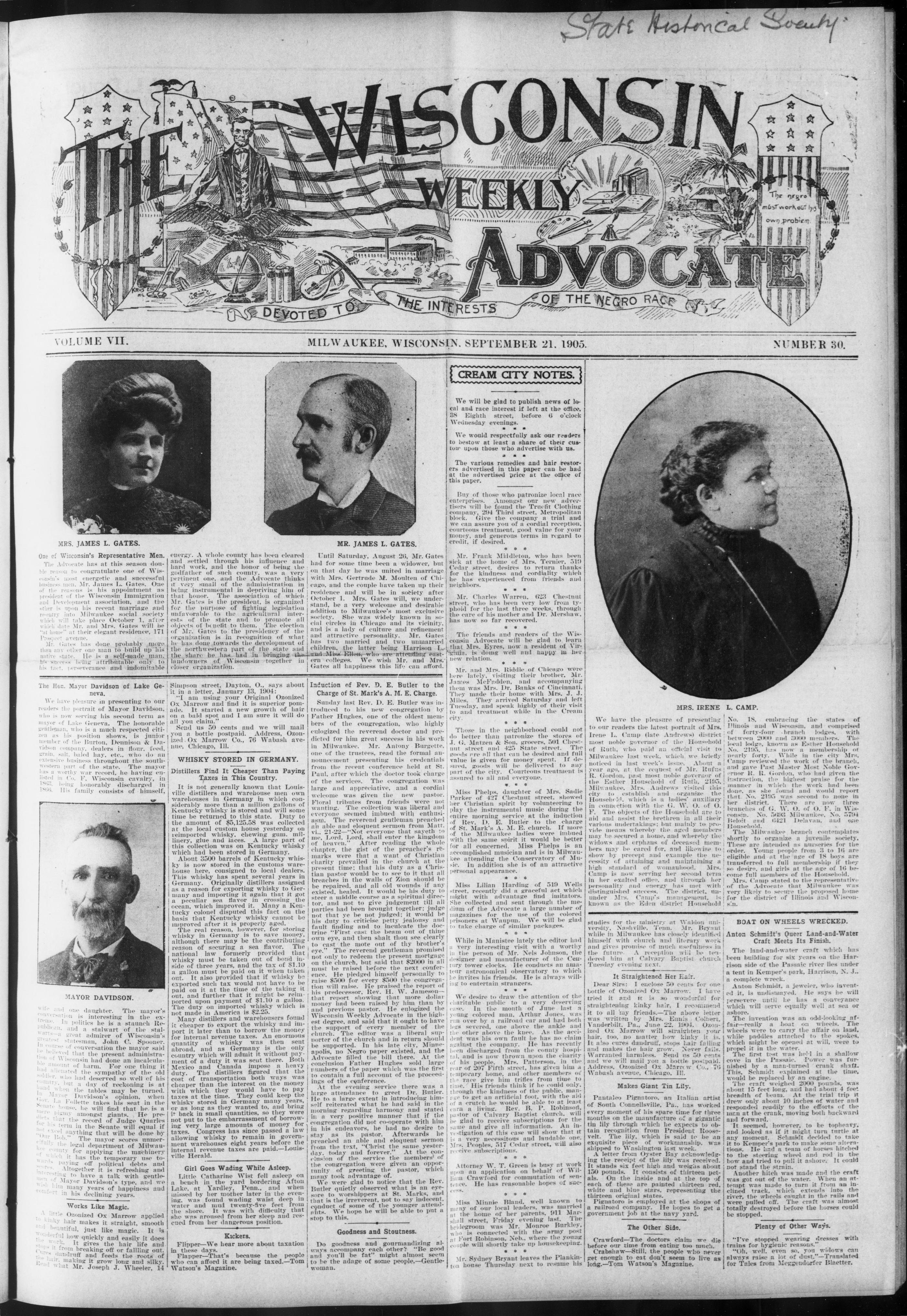
Page text (machine-generated)
State Historical Society
WISCONSIN
WEEKLY
The negro must work out his own problem.
ADVOCATE
DEVOTED TO THE INTERESTS OF THE NEGRO RACE
[Picture of a woman with a large, curly hairstyle and a dark dress with a floral pattern. She is looking slightly to the side.]
energy. A whole county has been cleared and settled through his influence and hard work, and the honor of being the godfather of such county, was a very pertinent one, and the Advocate thinks it very small of the administration in being instrumental in depriving him of that honor. The association of which Mr. Gates is the president, is organized for the purpose of fighting legislation unfavorable to the agricultural interests of the state and to promote all objects of benefit to them. The election of Mr. Gates to the presidency of the organization is in recognition of what he has done towards the development of the northwestern part of the state and the share he has had in bringing the landowners of Wisconsin together in closer organization.
Simpson street, Dayton, O., says about it in a letter, January 13, 1904: "I am using your Original Ozonized Ox Marrow and find it is superior pomade. It started a new growth of hair on a bald spot and I am sure it will do all you claim." Send us 50 cents and we will mail you a bottle postpaid. Address, Ozonized. Ox Marrow Co., 76 Wabash avenue, Chicago, Ill.
WHISKY STORED IN GERMANY.
Distillers Find It Cheaper Than Paying Taxes in This Country.
It is not generally known that Louisville distillers and warehouse men own warehouses in Germany in which considerably more than a million gallons of Kentucky whisky is stored and will some time be returned to this state. Duty to the amount of $5,125.58 was collected at the local custom house yesterday on reimported whisky, chewing gum, millinery, glue and laces. A large part of this collection was on Kentucky whisky which had been stored in Germany.
About 3500 barrels of Kentucky whisky is now stored in the customs warehouse here, consigned to local dealers. This whisky has spent several years in Germany. Originally distillers assigned as a reason for exporting whisky to Germany and importing it again that it got a peculiar sea flavor in crossing the ocean, which improved it. Many a Kentucky colonel disputed this fact on the basis that Kentucky whisky cannot be improved after it is properly aged.
The real reason, however, for storing whisky in Germany is to save money, although there may be the contributing reason of securing a sea flavor. The national law formerly provided that whisky must be taken out of bond inside of three years, and the tax of $1.10 a gallon must be paid on it when taken out. It also provided that if whisky be exported such tax would not have to be paid on it at the time of the taking it out, and further that it might be reimported upon payment of $1.10 a gallon. The duty on imported whisky which is not made in America is $2.25.
Many distillers and warehousers found it cheaper to export the whisky and import it later than to borrow the money for internal revenue taxes. An enormous quantity of whisky was then sent abroad, and as Germany is the only country which will admit it without payment of a duty it was sent there. Both Mexico and Canada impose a heavy duty. The distillers figured that the cost of transportation both ways was cheaper than the interest on the money with which they would have to pay taxes at the time. They could keep the whisky stored in Germany many years, or as long as they wanted to, and bring it back in small quantities, so they were not put to the embarrassment of borrowing very large amounts of money for taxes. Congress has since passed a law allowing whisky to remain in government warehouses eight years before the internal revenue taxes are paid.—Louisville Herald.
Little Catharine Wist fell asleep on a bench in the yard bordering Afton Lake, at Yardley, Penn., and when missed by her mother later in the evening, was found wading waist deep in water and mud twenty-five feet from the shore. It was with difficulty that she was aroused from her sleep and rescued from her dangerous position.
Flipper—We hear more about taxation in these days. Flapper—That's because the people who can afford it are being taxed.—Tom Watson's Magazine.
VOLUME VII.
MRS. JAMES L. GATES. One of Wisconsin's Representative Men. The Advocate has at this season double reason to congratulate one of Wisconsin's most energetic and successful business men. Mr. James L. Gates. One of the reasons is his appointment as president of the Wisconsin Immigration and Development association, and the other is upon his recent marriage and re-entry into Milwaukee social society which will take place October 1, after which date Mr. and Mrs. Gates will be "at home" at their elegant residence, 171 Prospect avenue.
Mr. Gates has done probably more than any other one man to build up his native state. He is a self-made man, his success being attributable only to his tact, perseverance and indomitable
The Hon. Mayor Davidson of Lake Geneva.
We have pleasure in presenting to our readers the portrait of Mayor Davidson, who is now serving his second term as mayor of Lake Geneva. The honorable gentleman, who is a much respected citizen as his position shows, is junior member of the Burton, Dennison & Davidson company, dealers in flour, feed, grain, salt, baled hay, etc., who do an extensive business throughout the southwestern part of the state. The mayor has a worthy war record, he having enlisted in Co. F. Wisconsin cavalry, in 1863, being honorably discharged in 1866. His family consists of himself.
J. B.
MAYOR DAVIDSON.
wife and one daughter. The mayor's conversation is interesting in the extreme. In politics he is a staunch Republican, and a stalwart of the stalwarts—a great admirer of Wisconsin's greatest statesman, John C. Spooner. In course of conversation the mayor said he believed that the present administration of Wisconsin had done an incalculable amount of harm. For one thing it had alienated the sympathy of the old soldier, who had deserved so well of his country, but a day of reckoning is at hand when the tables may be turned. In Mayor Davidson's opinion, when Gov. La Follette takes his seat in the Senate house, he will find that he is a mere piggy amongst giants. He predicts that the record of Judge Quarles for his term in the Senate will equal if not excel anything that will be done by "Our Bob." The mayor scores unmercifully the legal department of Milwaukee county for applying the machinery of which it has the temporary use towards paying off political debts and scores. Altogether it is refreshing and interesting to have a talk with gentlemen of Mayor Davidson's type, and we wish him many years of happiness and comfort in his declining years.
Works Like Magic
A little Ozonized Ox Marrow applied to kinky hair makes it straight, smooth and beautiful, just like magic. It is wonderful how quickly and easily it does the work. It gives the hair life and stops it from breaking off or fallling out. Cures dandruff and feeds the roots of the hair, making it grow long and silky. Read what Mr. Joseph J. Wheeler 14
[Image of a man in a suit with a mustache and a bow tie. The background is a plain, light color. The man's face is turned slightly to the right, and he has a serious expression. The image is black and white.]
Girl Goes Wading While Asleep.
Kickers.
MILWAUKEE, WISCONSIN, SEPTEMBER 21, 1905
MR. JAMES L. GATES.
Until Saturday, August 26, Mr. Gates had for some time been a widower, but on that day he was united in marriage with Mrs. Gertrude M. Moulten of Chicago, and the couple have taken up their residence and will be in society after October 1. Mrs. Gates will, we understand, be a very welcome and desirable addition to Milwaukee's most exclusive society. She was widely known in social circles in Chicago and its vicinity, and is a lady of culture and refinement and attractive personality. Mr. Gates has two married and two unmarried children, the latter being Harrison L. and Miss Ellen, who are attending eastern colleges. We wish Mr. and Mrs. Gates all happiness this life can afford.
Induction of Rev. D. E. Butler to the Charge of St. Mark's A. M. E. Charge.
Sunday last Rev. D. E. Butler was introduced to his new congregation by Father Hughes, one of the oldest members of the congregation, who highly eulogized the reverend doctor and predicted for him great success in his work in Milwaukee. Mr. Antony Burgette, one of the trustees, read the formal announcement presenting his credentials from the recent conference held at St. Paul, after which the doctor took charge of the services. The congregation was large and appreciative, and a cordial welcome was given the new pastor. Floral tributes from friends were not wanting. The collection was liberal and everyone seemed imbued with enthusiasm. The reverend gentleman preached an able and eloquent sermon from Matt. vi., 21-22. "Not everyone that sayeth to me, Lord, Lord, shall enter the kingdom of heaven." After reading the whole chapter, the gist of the preacher's remarks were that a want of Christian charity prevailed in the church at the present time; that his duty as a Christian pastor would be to see to it that all breaches in the walls of Zion should be be repaired, and all old wounds if any existed, healed. It would be his duty to steer a middle course as a spiritual director, and not to give judgement till all parties had been brought together; judge not that ye be not judged; it would be his duty to criticise petty jealousy and fault finding and to inculcate the doctrine "First cast the beam out of thine own eye, and then shalt thou see clearly to cast the mote out of thy brother's eye." The reverend gentleman promised not only to redeem the present mortgage on the church, but said that $2000 in all must be raised before the next conference. He pledged himself personally to raise $500 for every $500 the congregation will raise. He praised the report of his predecessor, Rev. H. W. Jameson—that report showing that more dollar money had been raised by him than by and previous pastor. He eulogized the Wisconsin Weekly Advocate in the highest degree, and said that it ought to have the support of every member of the church. The editor was a liberal supporter of the church and in return should be supported. In his late city, Minneapolis, no Negro paper existed, and the Advocate filled the bill there. At the conclusion Father Hughes sold large numbers of the paper which was the first to contain a full account of the proceedings of the conference.
At the evening service there was a large attendance to greet Dr. Butler. He to a large extent in introducing himself reiterated what he had said in the morning regarding harmony and stated in a very positive manner that if the congregation did not co-operate with him in his endeavors, he had no desire to stay as its pastor. Afterwards he preached an able and eloquent sermon from the text, "Christ the same yesterday, today and forever." At the conclusion of the service the members of the congregation were given an opportunity of greeting the pastor, which many took advantage of.
We were glad to notice that the Rev. Butler quietly observed what is an eyesore to worshippers at St. Marks, and that is the irreverent, not to say indecent, conduct of some of the younger attendants. We hope he will be able to put a stop to this.
Goodness and Stoutness
Do goodness and gourmandizing always accompany each other? "Be good and you'll be fat" might almost seem to be the adage of some people.—Gentle woman.
CREAM CITY NOTES.
We will be glad to publish news of local and race interest if left at the office. 38 Eighth street, before 6 o'clock Wednesday evenings.
We would respectfully ask our readers to bestow at least a share of their custom upon those who advertise with us.
The various remedies and hair restorers advertised in this paper can be had at the advertised price at the office of this paper.
Buy of those who patronize local race enterprises. Amongst our new advertisers will be found the Truefit Clothing company, 294 Third street, Metropolitan block. Give the company a trial and we can assure you of a cordial reception, courteous treatment, good value for your money, and generous terms in regard to credit, if desired.
Mr. Frank Middleton, who has been sick at the home of Mrs. Ternier, 519 Cedar street, desires to return thanks for the kindness and cordiality which he has experienced from friends and neighbors.
Mr. Charles Warren, 623 Chestnut street, who has been very low from typhoid for the last three weeks, through the care of his mother and Dr. Mershaw, has now so far recovered.
* * *
The friends and readers of the Wisconsin Advocate will be glad to learn that Mrs. Eyres, now a resident of Virginia, is doing well and happy in her new relation.
* *
Mr. and Mrs. Riddle of Chicago were here lately, visiting their brother, Mr. James McFadden, and accompanying them was Mrs. Dr. Banks of Cincinnati. They made their home with Mrs. J. J. Miles. They arrived Saturday and left Tuesday, and speak highly of their visit to and treatment while in the Cream city.
* * * .
Those in the neighborhood could not do better than patronize the stores of J. G. Matzen & Son, grocers, 501 Chestnut street and 425 State street. The goods are all that can be desired and full value is given for money spent. If desired, goods will be delivered to any part of the city. Courteous treatment is assured to all and everyone.
宋忠
Miss Phelps, daughter of Mrs. Sadie Parker of 427 Chestnut street, showed her Christian spirit by volunteering to play the instrumental music during the entire morning service at the induction of Rev. D. E. Butler to the charge of St. Mark's A. M. e. church. If more of the Milwaukee ladies were imbued with the same spirit it would be better for all concerned. Miss Phelps is an accomplished musician and is in Milwaukee attending the Conservatory of Music. In addition she is of an attractive personal appearance.
```markdown
```
Miss Lilian Harding of 519 Wells street, recently did a graceful act which might with advantage find imitators. She collected and sent through the medium of the Advocate a large number of magazines for the use of the colored prisoners at Waupun. We will be glad to take charge of similar packages.
```markdown
```
While in Manistee lately the editor had a very interesting visit with a worthy in the person of Mr. Nels Johnson, the designer and manufacturer of the Century tower clocks. He conducts an amateur astronomical observatory to which he invites his friends. He is always willing to entertain strangers.
---
We desire to draw the attention of the charitable public to a very deserving case. In the month of June last a young colored man, Arthur Jones, was run over by a railroad car and had both legs severed, one above the ankle and the other above the knee. As the accident was his own fault he has no claim against the company. He has recently been discharged from the county hospital, and is now thrown upon the charity of his people. Mrs. Patterson, in the rear of 207 Fifth street, has given him a temporary home, and other members of the race give him trifles from time to time. His friends think if he could only, through the kindness of the public, manage to get an artificial foot, with the aid of a crutch he would be able to at least earn a living. Rev. B. P. Robinson, pastor of Calvary Baptist church, will be glad to receive subscriptions for the same and give all information. An investigation of this case will show that it is a very necessitous and laudable one. Mrs. Peoples, 517 Cedar street, will also receive subscriptions.
* * *
Attorney W. T. Green is busy at work upon an application on behalf of William Crawford for commutation of sentence. He has reasonable hopes of success.
***
Miss Minnie Bland, well known to many of our local leaders, was married at the home of her parents, 911 Marshall street, Friday evening last. The bridegroom was Mr. Monroe Burkley, who is connected with the army post at Fort Robinson, Neb., where the young couple will shortly take up housekeeping.
Mr. Sydney Bryant leaves the Plankinton house Thursday next to resume his
39
MRS. IRENE L. CAMP.
We have the pleasure of presenting to our readers the latest portrait of Mrs. Irene L. Camp (late Andrews) district most noble governor of the Household of Ruth, who paid an official visit to Milwaukee last week, which we briefly noticed in last week's issue. About a year ago, at the request of Mr. Rufus R. Gordon, past most noble governor of the Esther Household of Ruth, 2195, Milwaukee. Mrs. Andrews visited this city to establish and organize the Household, which is a ladies' auxiliary in connection with the G. W. O. of O. F. The objects of the Household are to aid and assist the brethren in all their various undertakings; but mainly to provide means whereby the aged members may be secured a home, and whereby the widows and orphans of deceased members may be cared for, and likewise to show by precept and example the necessity of attaining and maintaining a high standard of womanhood. Mrs. Camp is now serving her second term in her exalted office, and through her personality and energy has met with distinguished success. The district, ununder Mrs. Camp's management, is known as the Eden district Household
studies for the ministry at Waldon university, Nashville, Tenn. Mr. Bryant while in Milwaukee has closely identified himself with church and literary work and gives promise of much usefulness in the future. A reception will be tendered him at Calvary Baptist church Tuesday evening next.
It Straightened Her Hair
Dear Sirs: I enclose 50 cents for one bottle of Ozonized Ox Marrow. I have tried it and it is so wonderful for straightening kinky hair. I recommend it to all my friends. The above letter was written by Mrs. Ennis Colbert, Vanderbilt, Pa., June 22, 1904. Ozonized Ox Marrow will straighten your hair, too, no matter how kinky it is. It also cures dandruff, stops hair failing and makes the hair grow. Never fails. Warranted harmless. Send us 50 cents and we will mail you a bottle postpaid. Address, Ozonized Ox Marrow Co., 70 Wabash avenue, Chicago, Ill.
Makes Giant Tin Lily.
Pantaleo Pignatoro, an Italian artist of South Connellsville, Pa., has worked every moment of his spare time for three months on the manufacture of a gigantic tin lily through which he expects to obtain recognition from President Roosevelt. The lily, which is said to be an exquisite piece of workmanship, was shipped to Washington last week. A letter from Oyster Bay acknowledging the receipt of the lily was received. It stands six feet high and weighs about 150 pounds. It consists of thirteen petals. On the inside and at the top of each of these are painted thirteen red, white and blue stars, representing the thirteen original states. Pignatoro is employed at the shops of a railroad company. He hopes to get a government job at the navy yard.
Crawford—The doctors claim we die before our time from eating too much. Crabshaw—Still, the people who never get enough to eat don't seem to live as long.-Tom Watson's Magazine.
The Other Side.
L. CAMP.
No. 18, embracing the states of Illinois and Wisconsin, and comprised of forty-four branch lodges, with between 2000 and 3000 members. The local lodge, known as Esther Household No. 2195, has now a membership of nearly forty. While in the city Mrs. Camp reviewed the work of the branch, and gave Past Master Most Noble Governor R. R. Gordon, who had given the instruction, the highest praise for the manner in which the work had been done, as she found and would report that No. 2195 was second to none in her district. There are now three branches of G. W. O. of O. F. in Wisconsin. No. 5693 Milwaukee, No. 5794 Heloit and 6421 Delavan, and one Household.
The Milwaukee branch contemplates shortly to organize a juvenile society. These are intended as nurseries for the order. Young people from 3 to 16 are eligible and at the age of 18 boys are transferred to full membership if they so desire, and girls at the age of 16 become full members of the Household. Mrs. Camp stated to the representative of the Advocate that Milwaukee was very likely to secure the proposed home for the district of Illinois and Wisconsin.
BOAT ON WHEELS WRECKED
Anton Schmidt's Queer Land-and-Water Craft, Meets Its Finish.
The land-and-water craft which has been building for six years on the Harrison side of the Passaic river lies under a tent in Kemper's park, Harrison, N. J., a complete wreck.
Anton Schmidt, a jeweier, who invented it, is undismayed. He says he will persevere until he has a conveyance which will serve equally well at sea or ashore.
The invention was an odd-looking affair—really a boat on wheels. The wheels were to carry the affair on land, while paddles attached to the spokes, which might be opened at will, were to propel it in the water.
The first test was hell in a shallow cove in the Passaic. Power was furnished by a man-turned crank shaft. This, Schmidt explained at the time, would be replaced by an engine. The craft weighed 2000 pounds, was about 15 feet long, and had about 4 feet breadth of beam. At the trial trip it drew only about 10 inches of water and responded readily to the efforts of the man at the crank, moving both backward and forward. It seemed, however, to be topheavy, and looked as if it might turn turtle at any moment. Schmidt decided to take it to Kemper's park to make some alterations. He had a team of horses hitched to the steering wheel and rod in the bow and tried to pull it ashore. It could not stand the strain.
Another hitch was made and the craft was got out of the water. When an attempt was made to turn it from an inclined track, which extends into the river, the wheels caught in the rails and were pulled off. The craft was almost totally destroyed before the horses could be stopped.
Plenty of Other Ways.
"I've stopped wearing dresses with trains for hygienic reasons."
"Oh, well, even so, you widows can always raise a lot of dust."—Translated for Tales from Meggendorfer Blaetter.
NUMBER 30.
MORRIS BUYS NOTED PLACE.
House Built by Grandfather of Harvard's Founder Now His.
Edward Morris, vice president of Nelson Morris & Co., has become the owner of the Harvard homestead at Stratford-on-Avon, England, the house built in 1596 by the grandfather of John Harvard, who founded Harvard university. Marie Corelli, the English novelist, acted as Mr. Morris' agent, and the price paid is said to have been close to $6000. If Mr. Morris accepts the suggestion of Miss Corelli, who urged him to purchase the property, he will convert it into a clubhouse for the accommodation and entertainment of the thousands of Americans who annually make a pilgrimage to the birthplace of Shakespeare. The quaint old dwelling in High street, not far from the birthplace of the poet, long has been one of the principal objects of interest at Stratford, and its purchase by Mr. Morris has attracted considerable attention in England. It is the intention of Mr. Morris to restore the house to its original picturesqueness. Some parts of it need repairs, though the facade, which is its more interesting portion, on account of the elaborate carving, is in a remarkably good state of preservation, Mr. Morris says.
Could Get No Best.
Freeborn, Minn., Sept. 18.—(Special.)—Mr. R. E. Goward, a well-known man here, is rejoicing in the relief from suffering he has obtained through using Dodd's Kidney Pills. His experience is well worth repeating, as it should point the road to health to many another in a similar condition. "I had an aggravating case of Kidney Trouble," says Mr. Goward, "that gave me no rest day or night, but using a few boxes of Dodd's Kidney Pills put new life in me and I feel like a new man.
"I am happy to state I have received great and wonderful benefit from Dodd's Kidney Pills. I would heartily recommend all sufferers from Kidney Trouble to give Dodd's Kidney Pills a fair trial, as I have every reason to believe it would never be regretted." Dodd's Kidney Pills make you feel like a new man or woman because they cure the kidneys. Cured kidneys mean pure blood and pure blood means bounding health and energy is every part of the body.
Waltzing a Lost Art.
Waltzing is becoming a lost art, and that is why the American Society of the Professors of Dancing, in their twenty-eighth annual convention at the Hotel Majestic, did all they can to check the insidious two-step. All summer the young persons who wear lawn dresses and have their sleeves rolled up to show their plump arms and also the young persons who take to flannel hats and negligee shirts and white ducks have been romping instead of waltzing, as they should. "All this," said Prof. Oskar Duenwig, "shows that there is a growing superficiality which also extends to the varied walks of life. I fear much that the young generation is inclined to be slip-shod through what should be the graceful cadences of the waltz. It is truly a deplorable tendency and one which we are here to earnestly combat."
Prof. Duenwig is from Terre Haute, Ind., and one of the most graceful members of the association.
Bismarck's Precaution.
It is customary in the cheaper classes of German inns to substitute chicory for coffee. Bismarck was aware of this, so one day when he came to a small inn, after a long journey, he sat down and called the innkeeper to him.
"Have you any chicory?" said he.
"Yes, sir," said the innkeeper.
"Well, bring all you have here to me," ordered Bismarck.
The innkeeper was gone a few minutes, and returned with an inamense armful of chicory.
"Is this all the chicory you have in the house?" asked Bismarck.
"Yes—all."
"Well, then," said Bismarck, "leave this chicory here and make me a cup of coffee."—Answers.
Began as Quarry Laborer.
The death of John T. Stewart, a Kansas multimillionaire at Plainview, Tex., recalls the fact that upon settling in Kokomo, Ind., in 1870 Mr. Stewart was employed as a day laborer in a stone quarry and later as an expert penman in the county clerk's office, under H. H. Winslow. Mr. Stewart's financial achievements were accomplished with great rapidity. At the time of his death he owned large bodies of land in Kansas and Oklahoma, was principal stockholder in numerous banks, and the proprietor of flouring and lumbering interests.
HONEST PHYSICIAN
Works with Himself First.
It is a mistake to assume that physicians are always skeptical as to the curative properties of anything else than drugs.
Indeed, the best doctors are those who seek to heal with as little use of drugs as possible and by the use of correct food and drink. A physician writes from California to tell how he made a well man of himself with Nature's remedy:
"Before I came from Europe, where I was born," he says, "it was my custom to take coffee with milk (cafe au lait) with my morning meal, a small cup (cafe noir) after my dinner and two or three additional cups at my club during the evening.
"In time nervous symptoms developed, with pains in the cardiac region, and accompanied by great depression of spirits, despondency—in brief, 'the blues!' I at first tried medicines, but got no relief and at last realized that all my troubles were caused by coffee. I thereupon quit its use forthwith, substituting English Breakfast Tea.
"The tea seemed to help me at first, but in time the old distressing symptoms returned, and I quit it also, and tried to use milk for my table beverage. This I was compelled, however, to abandon speedily, for while it relieved the nervousness somewhat, it brought on constipation. Then by a happy inspiration I was led to try the Postum Food Coffee. This was some months ago and I still use it. I am no longer nervous, nor do I suffer from the pains about the heart, while my 'blues' have left me and life is bright to me once more. I know that leaving off coffee and using Postum healed me, and I make it a rule to advise my patients to use it." Name given by Postum Co., Battle Creek, Mich.
There's a reason.
—In Sweden a plumber is called a vattenledingsentrepenor, and he deserves it.
—Suicides among school children are largely increasing in Germany, especially just before and after examinations.
—Workmen attending the pans in salt works are never known to have cholera, smallpox, scarlet fever or influenza.
—Missouri, according to the United States fish commission, is the greatest frog-producing state in the Union.
—There is a department store in Berlin which uses 19,000 gallons of alcohol in a year as motive power for its delivery wagons.
—Milan, Italy, is to have next year an international congress at which questions relating to the extinguishing of fires and to fire insurance will be discussed.
—Nearly every person who commits suicide by drowning partly undresses before entering the water, said Dr. Wynn Westcott at an inquest in London.
—Manila will draw its water supply from the mountains fifteen miles away in order to be sure to have its drinking fluid free of cholera or other germs.
—During the prosecution of a man who had stolen a towel belonging to an English railway company it was stated that in the last two years the company had lost 10,000 towels.
—Paper car wheels made by pressure from rye-straw paper are usually good enough to take a second set of steel tires after the first set has been worn out by a run of 300,000 miles.
A statistician affirms that the majority of people who attain old age have kept late hours. Eight out of ten who reach the age of 80 have never gone to bed until after 12 at night.
Attendance at the Lewis and Clark fair is increasing steadily, and the total number of admissions, according to estimates of men who are in a position to judge, will reach 2,500,000.
The total number of Syrians in New York is about 10,000, one half of whom are "Maronites," or Roman Catholics, about 3000 Orthodox Greeks and about 2000 Greek Catholics or Protestants.
—Nearly 2000 cases of mistaken diagnosis have been admitted to the London hospitals during the past year. This represents an expenditure of £12,000, which ought never to have been incurred.
—The Australians are the greatest tea drinkers in the world, annually consuming 7% pounds a head. In England the consumption is about 6% pounds a head, and in the United States only 1 pound 2 ounces.
—There are between 9000 and 10,000 mineral springs in the United States. Of this number about 800 to 900 are utilized commercially, the waters being sold either for table use or for medicinal purposes.
—In order to aid the police in maintaining order on the occasion of a recent motor race the authorities of the town of Rezemburg, Germany, compelled all local cyclists to enroll themselves among the police.
—A custom house officer at Yarmouth, England, the other day saved the life of a boy who had got off a quay into the sea, and found he was a boy whose life he had saved in a similar manner twice before.
—The raising of Angora goats is an industry carried on extensively in Marion county, Oregon. In the interesting display which the county has made at the Lewis and Clark exposition mohair is conspicuous.
Australia has no orphanages. Every child who is not supported by parents becomes a ward of the state, and is placed in a private family, where board and clothes are provided until the fourteenth birthday.
The proprietor of a traveling merry-go-round whose route had been in Wales, and who had gone into bankruptcy, informed the court that lack of patronage, due to the religious revival, had caused his failure.
The use of a flag or representation of a flag of the United States or of the state of New York for advertising purposes is unlawful after September 1. Such a use of the flag is a misdemeanor, punishable by fine or imprisonment, or both.
A firm of Baltimore architects has drawn plans for a building without any wood in its construction. It will be six stories in height, the entire structure to be of reinforced concrete and steel. Even the doors, window sashes and door jambs will be of metal.
One of the greatest curiosities among the domesticated animals of Ceylon is a breed of cattle known to the zoologist as the "sacred running oxen." They are the dwarfs of the whole ox family, the largest specimens of the species never exceeding 30 inches in height.
The youngest King in the world is Daudi Chua, King of Uganda, who is now about 8. He holds his court seated on a scarlet throne with a leopard skin mat under his feet and bearing in his hand a toy gun. The British exercise a protectorate over the young King and his kingdom.
—In Belgium the law of December 13, 1889, provides that children must have one full day of rest each week, while in the Netherlands Sunday rest is demanded for women and children by the law of March 5, 1889, and by virtue of the law of March 1, 1815, no government work is done on Sunday.
—For the purpose of studying the habits of birds of passage a "vogelwarte" has been established at Rossiten, in Eastern Prussia, where birds are to be caught and liberated after small rings have been attached to their feet. The directors request that the feet of such ringed birds killed anywhere be sent to them.
-Although the flea holds the record for agility of movement among insects and is capable of a speed of nearly 10 miles an hour, could it continue jumping without cessation and without tiring, it has little the better of the jumping mouse found in the African deserts, which clears 10 feet at a jump at the rate of 800 feet a second.
A French writer in a scientific magazine tells of the great ocean depths of 28,000 to 30,000 feet, the temperature tending toward zero, with perpetual darkness reigning below depths of about 1280 feet. At that level plants, deprived of light, cannot exist, and the animal life must be carnivorous. The organs of sight, not being used, have disappeared, and yet there is light even in that sightless world. A German exploring ship found a fish with enormous eyes at a depth of 6400 feet. Phosphorescence is common in these hollows of the sea; sometimes special organs flash light.
Loses Bustle and $500 Inside
In the crush at the Union station, Minneapolis, Minn.. Maggie Fox lost her bustle containing $500 in gold and bills. She and Frank Kreger, a relative, searched all night for it and in the morning found it in a pile of rubbish that had been swept into a corner.
Died of Eating Forty Pills.
Cassie, the 4-year-old daughter of L. A. White of Ellsworth, Ill., died after swallowing forty medicated tablets. A physician left the tablets to be given to the child one daily, but the youngster took the entire supply at one time.
SUMMER'S END.
A sheaf of broom-flowers, yellow at the heart.
A sheaf of broom-flowers, amber with the light. Green with the jade of leaf-work, shadow dull:
dull:
Pale silver silk sown with thin silver veins.
O—wonderful!
A sheaf of broom-flowers, lipped with line
of brown.
Because the urge of death is in the hours:
O dawn in dust! O hand that cannot close
Upon the flowers!
—Zona Gale in Everybody's Magazine.
TOLD BY A SKELETON.
There is an old half-effaced trail among the rocky canyons of the Arizona mountains between Eagle Creek and Rio Pricto. It is a lonely place, with nothing but cactus and the cliff grass for verdure. It is deathly still. There seems to be no life anywhere among those tumbled crags. But pass along the trail, upset a bowlder, throw a rock into a clump of the cliff grass, you will see something alive. Coiled in the dark places are great diamond-backed rattle snakes. Disturb one of them and the whole dell will hum with the music of the castanets.
In the bed of the canyon, just above the wash-line, are some bones, polished by the drift of the river, bleached by the fierce sun tor years. As you pass from the middle of the heap of ribs, comes the warning rattle of one of the deadly denizens of the glen. The remains of a packsaddle are there and what might once have been the pack. There is a fragment of blanket with U. S. on it. Near by is the rusted steel of a Winchester rifle. Examine it, and you will find that still sticking fast in the breecn is a green and moldy cartridge.
Some time back, when this glen, alive with rattlesnakes, was even lonelier and farther out of the world than it is now, some prospector, deserter, or hunter came there driving his pack-mule. Fifty yards away from the whitening bones, behind that bowlder that juts from the cliff, some empty rifle shells were scattered. There are more of them concealed by that patch of greenwood, and still others among the rocks on the hillside.
Did the traveler with the army blanket know that he was traveling on the hidden trail that only the Apaches knew—that puzzling round-about path that started north and turned back south, the road by which the San Carlos Indians found their way unmolested to the Mexican Sierra Madre, though the soldiers were all around?
The story is written in what was left in the glen.
The Indians saw the white man come around the bend of the hill far above. The canyon was a perfect place for ambush. Riding in the stillness is drowsy work. The solitary prospector comes on with his rifle hanging carelessly before him. Down the trail he comes, past the grease-wood patch to the water-hole in the gully. His animals are hot and tired. He loosens the girth and leads them to the pool.
Out of the quiet, crashing like a thunder-clap, comes the first shot. He springs to his horse and his rifle flies to his shoulder. He knows what has happened, and knows that unless his horse can carry him back through a storm of bullets the way he came he has passed his last day on earth.
But the sudden shot has startled the horse. A jerk has freed the bridle and in an instant he is galloping up the hill, the saddle turning under him. Then it is die game or die coward. The white man jerks the lever of his Winchester. The cartridge catches—a twig has perhaps got in among the bearings. They see that he cannot shoot—his pistol went off with the saddle and now he is standing unarmed among the jeering Indians. There are no white man's bones by the skeleton of the pack-mule. Die game or die coward! It was no easy, quick death by a bullet that the man who tied: that pack had to meet.
Quarter of a mile down the canyon that trail runs up on to a knoll. Down there are bones. A skull is there with its face buried in the soil. Those little lumps made the spine of the man who was caught in the ambush.
If you search close you will find the rest of the man's frame stretched out there.
What was once a rope is there. It is knotted back of the skull and the other end is fast in the bush. It you cared to scratch among those bones you will find some small strips of rawhide. He died with his hands fast behind him.
But what is this lace-like line and delicate framework of slender bone that lies close to the skull?
When the Apaches closed in on their victim he fought hard. But how long can one man fight against a score?
Struggle as he will, he is soon overcome, and, with his hands bound so tight that the cords cut into them, they force him ahead of them up the knoll.
They find a bush strong enough to hold him, and with his own lash-rope they tie him to it. But four feet of slack rope is between him and the stake. Even with his hands tied behind him he might be able to free himself, so they force him to the ground and tie his feet to another stake.
If they simply meant to leave him there to starve and die under the hot skies they would have maimed his feet and maybe hands. There would be no need of tying him.
A shout from some of the Indians makes him try to look up. Some of them are coming toward him. They have a stick with a little noose on the end and in the noose is one of the rattlesnakes of the rocks. Now he knows how they are going to kill him. Through the skin and muscles of the snake close to the rattles they put two long, thin buckskin thongs. The serpent squirms with the pain of it, but they hold his head fast in the loop. They tie the loose ends of the thongs around the stake and jump back. The snake is free from the noose, but bound fast by the cords through its tail.
Directly before it is the face of the white man. In an instant the snake is in a half coil, his rattles going faster and faster. The prostrate man closes his eyes
Maybe he screamed, maybe he fainted, maybe he simply waited for the feel of the serpent's fangs.
Like a flash the flat head of the snake shoots out. The cord stood its spring. It falls two inches short of the white face.
Two tiny liquid drops come against his face and run down into his beard. It is the venom from the fangs that failed to reach. The Indians roar with laughter.
But they have wasted much time. The troops are after them. They pick their victim, they tease the snake, and then leave him.
All the hot afternoon he lies there, the snake's head playing before his eyes, more of the venom being spat into his face.
The sun set and the clouds covered the heavens.
The snake has learned that it cannot reach that face. It lies coiled at the foot of the stake watching. For a while longer it strikes whenever the man moves his head, but after a while it lies in its sullen coil.
Oh, the strain of holding his head back, back, until the cords fairly crack! How long was it before his mind gave way and madness released him from his deadly terror?
Now the rain begins to fall and it is growing dark. The coolness revives the man, but still before him he sees those coils and that flat head. The snake's line-like tongue is darting out; he will try it again.
He strikes, but still he cannot reach. An inch more and his fangs would have reached the bound man. He rubs his face in the dirt to clean it of that horrible poison that is thickening on it. Still it rains; it is so dark that he cannot see the snake; but the rattle tells him that it is still there. He must have been unconscious, but he wakes up and feels the strain of the rope. He has been pulling back on it with all his force, but now he feels a counter-pull that draws him toward the rattlesnake and death.
Why doesn't he push his face within reach of the snake and end it? He knew he was going to die from the moment his rifle failed to work. He knows that he must die of thirst, even if the snake does not reach him. But he cannot do it. His mad brain refuses to order the muscles to meet the snake.
The rope pulls harder. He knows now. The rain is wetting it and shrinking it. It will drag him up. Two inches more is death.
He digs his toes into the ground. He pulls back until the rope sinks into his flesh. The rope gets shorter.
The rain has wet the buckskin thongs that hold the snake. The buckskin swells and stretches, while the hempen rope shrinks. Those cords that hold the snake are four inches longer than they were when they were tied. The rope has shrunk half as much.
The snake tries to crawl away. The strings in its flesh hold it back. The pain enrages it and it strikes.
The coyotes prowl about the spot; the vultures hover over it. The white skull lies with its face in the dust and the dry, lace-like snake skin, with the delicate bones below, lie against it.—Charles Michelson in San Francisco Examiner.
SWINGING CRADLE.
Perpetual Motion Will Keep It Swinging for a Long Time.
Nobody receives more care and attention than the baby, everybody seeming to vie with one another in doing everything possible to make life for it comfortable. Still, at times, the mother has other duties that need immediate attention, and unless she has somebody to help her to take care of the baby these duties are left undone. An Iowa man has devised a swinging cradle, which, he claims, will be a help to all mothers. The cradle is suspended by means of rods on a spiral spring, the latter fastened at any convenient place. A slight push of the cradle sets it in motion, the
1
spring keeping it moving up and down for quite a long time. Oftentimes, all the baby needs to keep him quiet is a slight rocking movement of this kind, and, no doubt, this device would fully serve the purpose intended. This device can also be detached and removed from one room to another, separate permanent fastenings only being necessary.
The Pore and the Jeweler.
Pius X. has had many shocks to his religious feelings since entering the Vatican, and these upset him more than the confinement or the state business. Just lately his sense of honesty has been outraged, and those responsible have felt the weight of a reprimand. On various occasions the pontiff, wishing to mark his benevolence, not only confers a title, but makes a gift of the insignia of office. Recently he happened to ask the price of one of these ornaments, and was struck by the exorbitance. He took the cross and had it estimated, finding that its market value was just half of what was demanded. The papal jeweler was called and protested his innocence, proving that he had only asked the market price, and had never received more for anything.
Whereupon pandemonium arose. Whose fault was it? Into whose pocket had all those thousands of francs gone in the course of many years? Into somebody's at the Vatican, but whose? Even the cardinal who is at the head of the administration where the irregularities took place, although not directly responsible, came in for his share of direct censure from Pius X., who is broken hearted that even in church administration dishonesty exists. Now a contract has been made with the papal jeweler for certain fixed prices, and all business of the kind will be done with only one intermediary, and not through the department.—Pall Mall Gazette.
TODAY.
We shall do so much in the years to come,
But what have we done today?
We shall give our gold in a princecy sum,
But what did we give today?
We shall lift the heart and dry the tear,
We shall plant a hope in the place of fear,
We shall speak with words of love and
cheer.
we shall be so kind in the after while,
But what have we ween today?
We shall bring to each lonely life a smile,
But what have we brought today?
We shall give to truth a grander birth,
And to steadfast faith a deeper worth.
We shall feed the hungering souls of earth,
But whom have we fed today?
INSURANCE
Stand by the Well Managed Companies. From the Milwaukee Evening Wisconsin. The revelations before the New York legislative committee relative to the secret financial operations of certain life insurance companies are startlingly significant. They unmask moral obliquity on the part of men high in life insurance circles, and indicate a woeful disregard of trusts which in a social sense transcend in importance those of the fiduciary institutions which are directly associated with the commercial life of the nation; and while they constitute only the beginnings of the investigation now in progress, their astounding character will give the movement toward national control of life insurance companies an irresistible impulse.
National supervision and the publicity incident thereto will not be unwelcome to the majority of the life insurance companies of the United States. The officials of the life insurance companies which are conducted with due regard for the sacredness of the trust imposed in them by the policy holders must feel that a public accounting is the one way by which the life insurance business can be placed beyond the smirching influence of men who can be tempted into surreptitious and illegal handling of trust funds. The well managed companies are in the position of solvent and solid banks during times of public excitement incident to failures of sister banks through embezzlement or unwise banking; and it is as illogical to put all life insurance companies on the same plane with those whose affairs have been unmasked to their discredit as it would be to condemn all banks because of the failure of several as a result of criminal acts or mismanagement. Life insurance companies have come to be as indispensable as banks, and people cannot afford to asperse companies which are rightly conducted because of the wrong doings of officials of other companies. On the contrary, they should be moved in self-interest to uphold the well managed companies while they are condemning those whose officials have been guilty of gross violations of trust.
Self-interest should dictate a resolute support of companies which can say, as does the Northwestern Mutual Life of Milwaukee in its annual statement, that it "has never been involved with other financial institutions nor had any connection whatever either as a company or through any of its officers with any other line of business," and whose presidents can say, as does President Palmer of the Northwestern Mutual Life, in his annual address, regarding the assets of the company:
"This $201,000,000 is worth every dollar that it represents. It is made up of clean, safe, solid assets; there is nothing in it to be thrown out. There has been no trickery in buying these bonds. There has been no dickering with the securities of this company for the interests of any officer. No investment has ever been made and none exists today in which an officer has any interest whatever outside of the interest he feels as an official in transacting the business. They are not members of any syndicate. Never while they live and are officers of the company, will they go into any arrangement by which the assets of the company, or any part of them, may be manipulated for the purpose of putting money into their individual pockets."
Surely, life insurance companies which are thus rigidly and impersonally managed should not be judged in the same class with the companies concerning which so much has been revealed that is reprehensible and disheartening.
---
In an article on the cost of life insurance, The Conservative Life News says: "Considering scope, quality and character of the protection, as well as the net outlay to procure the same, the cost of life insurance to the policy holder has been very much decreased during the last generation. And life insurance is, perhaps, the only commodity the cost of which has been so much decreased during that time."
* * *
The Bath (N. Y.) Courier makes this appeal for fair play: "While certain insurance companies are under the scrutiny of investigating committees it will be well for the people to be careful lest they allow themselves to be unjut to all insurance companies by indiscriminate condemnation. There is danger of doing great injustice by overzealous criticism."
***
Sunshine speaks as follows: "Life insurance will ever remain a great benefaction and a godsend to the race. The system is sound, and built upon a firm foundation."
A Mortified Englishman.
Refreshment buffets on the southern railways may be divided into two classes—first, those that have nothing that any reasonable man could want to eat, and, second, those that contain one sandwich. This writer has been up and down the line lately, and he places Canterbury on the first list. You would expect that on a bank holiday, on the first day of the famous Cricket week, the railway refreshment buffet would supply something. No. Not a sandwich. An American friend, journeying to a south coast watering place, thought that Faversham might fill the gap of a missed dinner. "Two buns," was the response. "Is there a chance of a highball and a biscuit?" cried the American cousin, as he stalked into the St. Margaret's Bay hotel at 11 something. With the return journey, the Englishman was upon his mettle. "You will be all right at Faversham," he said. "We'll jump out at the junction, and feed on good old English fare." "Beer and a sandwish," said the American. "Sandwiches," shouted the Englishman. The barmaid looked round. "There's only one," she replied, calmly. "Shall we split it?" said the Englishman. "Spin," said the American. He won. And his quiet grin as the train joggled toward London drove the Englishman half mad with shame.—London Chronicle.
Wife Lacking: Sexton Quits.
Because he did not have a wife and was unable to get anyone to keep house and cook for him, Harry Somerville of Louisville, Ky., tendered his resignation as superintendent of Fairview cemetery. Louisville. In a letter he says: "Not being married and with no one to keep house for me (not having been able to get anyone), I hereby tender my resignation."
W.L. DOUGLAS SHOES ALL PRICES
BEST IN THE WORLD
ALL STYLES
THE WORLD'S GREATEST SHOEMAKER
SOLE AGENTS FOR W.L. DOUGLAS SHOES
Established
July 6, 1876.
W.L.DOUGLAS MAKES AND SELLS MORE MEN'S $3.50 SHOES THAN AKY OTHER MANUFACTURER.
$10.000 REWARD to anyone who can
disprove this statement
W. L. Douglas $3.50 shoes have by their excellent style, easy fitting, and superior wearing qualities, achieved the largest sale of any $3.50 shoe in the world. They are just as good as those that cost you $5.00 to $7.00—the only difference is the price. If I could take you into my factory at Brockton, Mass., the largest in the world under one roof making men's fine shoes, and show you the care with which every pair of Douglas shoes is made, you would realize why W. L. Douglas $3.50 shoes are the best shoes produced in the world.
If I could show you the difference between the shoes made in my factory and those of other makes, you would understand why Douglas $3.50 shoes cost more to make, why they hold their shape, fit better, wear longer, and are of greater intrinsic value than any other $3.50 shoe on the market to-day.
Men, $2.50, $2.00, Boys' School & Dress Shoes, $2.50, $2, $1.75, $1.50
CAUTION.—Insist upon having W.L.Douglas shoes. Take no substitute. None genuine without his name and price stamped on bottom.
WANTED. A shoe dealer in every town where W.L. Douglas Shoes are not sold. Full line of samples sent free for inspection upon request.
Fast Color Eyelens used; they will not wear brassy.
Fast Color Eyellets used; they will not wear brassy.
Write for Illustrated Catalog of Fall Styles.
W. L. DOUGLAS, Brockton, Mass.
We Can
Help You
In getting beautiful and harmonious tints
on your walls with
Alabastine
THE SANITARY WALL COATING
Write for sample card of handsome tints. Tell us just what work you have to do, and see how we can help you in getting beautiful effects. Alabastine is not a disease breeding hot or cold water glue kalsomine, not a covering stuck on with paste like wall paper, but a natural cement rock base coating. Anyone can apply it. Mix with cold water. Alabastine does not rub or scale. Destroys disease germs and vermin. No washing of walls after once applied. Buy only in packages properly labeled. "Hints on Decorating" and pretty wall and ceiling design free.
ALABASTINE CO.
Grand Rapids, Mich. New York City.
IMPORTANT FACTS FOR COW OWNERS
The mechanical Cream Separator has become a vital feature of every home dairy just as of every butter factory. Its use means much more and much better cream and butter, as well as saving of water, ice, time and room. The difference in results is not small but big. Few cows now pay without a separator. Dairying is the most profitable kind of farming with one. 98% of the creamery butter of the world is now made with De Laval machines, and there are over 500,000 farm users besides. Send for catalogue and name of nearest local agent.
THE DE LAVAL SEPARATOR CO.
Randolph & Canal Sts.
CHICAGO
74 Cortlandt Street
NEW YORK
BEST BY TEST
"I have tried all kinds of waterproof clothing and have never found anything at any price to compare with your Fish Brand for protection from all kinds of weather."
(The name and address of the writer of this unsolicited letter may be had upon application)
Highest Award World's Fair, 1904.
A. J. TOWER CO.
Boston, U.S.A.
The Sign of the Fish
TOWER CANADIAN
CO., LIMITED
Toronto, Canada
A. J. TOWER CO.
Boston, U. S. A.
Makers of Warranted Wet Weather Clothing
551
PAXTINE
TOILET
ANTISEPTIC
FOR WOMEN
troubled with illis peculiar to their sex, used as a douchie to make moist successful thorough cleanses, kills disease germs, stops discharges, heals inflammation and local wounds.
Paxtine is in powder form to be dissolved in pure water, and is far more cleansing, healing, germicidal and economical than liquid antiseptics for all TOILET AND WOMEN'S SPECIAL USES For sale at druggists, 50 cents a box. Trial Box and Book of Instructions Free. THE R. PAXTON COMPANY BOSTON, MASS.
BUY STOCKS. Participate in the coming unprecedented boom in prices on the New York Stock Exchange. Chances for big returns on small investments. Buy Union Pacific, St. Paul, New York Central, Pennsylvania and all active railroad issues. Buy wheat. Write for our daily market information and personal letters. Twenty dollars starts an account. Private wires, moderate margins and quick service. References, Marshall & Isley Bank.
THE DOUGLAS-WEGNER COMMISSION CO.
Tel. Main 3086. 351 Broadway. Milwaukee, Wis.
If afflicted with Thompson's Eye Water sore Eyes, use
RISO'S CURE FOR
CURES WHERE ALL ELSE FAILS.
Best Cough Syrup, Testes Good. Use
in time. Sold by druggists.
CONSUMPTION
GOSSIP FOR THE LADIES.
```markdown
```
Would I had plucked her robe, caught au her hand,
her hand,
Heid her upon my heart and kissed her
yes'
For Night's sad sister, Thought, now holds the land.
And I feel dead caresses, hear dead words,
And the dusk teems with dear remembrances.
Drifting from out the dark like wind-blown birds.
Till to the careless stars wild sobs are thrown—
In the dread night-time, in the tardy dawn.
All things seem little, saving Love alone.
—New York Tribune.
The Housewife's Tool Chest.
A tool chest is as important to a good housekeeper as her dusters, brooms, brushes or sewing machine. Men may jeer at the feminine swing of a hammer, which, it is true, has a particular swing of its own, but they must admit that a woman can do more with hammer and nails than a man with needle and thread. A hundred little accidents happen in a household, too trivial for the carpenter, but requiring attention; here is where the tool chest comes into play. A board may be loose in the kitchen table; a picture need rehanging, or some tacks required to hold down a strip of carpet. No art or practice is required to remedy any of these defects. The average feminine tool chest contains a few nails of odd sizes, a few screws, a little "lady-like" hammer, a poor screw driver, probably from the sewing machine drawer; a few hairpins, the woman's universal implement for mending or fixing anything, and possibly a saw. Such an equipment is of little or no value. There are five principal tools with which the household tool box should be supplied, and with which almost any kind of work such as women undertake may be done in a neat and satisfactory manner. The entire cost of these amounts to less than a dollar and a half, for tools are cheap—though the substitutes one often makes use of are exceedingly dear. The first in importance is the hammer, and in buying one the first principle is to select one with a stoutly made and secure head that will not fly off, and of medium weight. The second instrument is an awl, often forgotten in the furnishing of an amateur's tool chest, but an instrument of infinite uses and necessary wherever home carpentry is undertaken, even of the simplest kind, as screws must constantly be used in renovating, and when put carelessly into hard wood are likely to split it, so by preparing the place for nail or screw by drilling a small hole with the awl much trouble may be averted.
Wire nails of all sizes are so generally known that it seems almost necessary to mention them, but the value of screws is not always appreciated. Plenty of nails, tacks and screws must find a place in the chest. Next in importance is the screwdriver, and for household purposes one having a three-eighths inch end and a nine-inch handle would be the proper size. The tack-lifter should always be a separate instrument, and not part of the hammer head. The forked end of the separate tack-lifter being directed from a straight handle is much stronger than that extended from the head of a hammer, and under all circumstances is more satisfactory.
The utility of the plier is perhaps less known to women than that of almost any other implement in the tool box. For general usefulness they rank next to the hammer, they serve to tighten rivets, nuts, bolts, and gas-jets, and by a twist of the bolt there placed have been known to free waste water pipes, and so save the visit of a plumber. Except to draw large nails they serve all the purposes of the larger pincers. Many of them are made with a wire-cutting arrangement in the side, in which picture wire may be inserted and cut off cleanly at any given point. They cost from 20 to 30 cents each, but in the matter of wire-cutting alone, so often necessary in the house, they are a real economy. The last, a useful, indeed a necessary article for the housewife's tool box, is the inelastic rule by which measurements may be taken. A careful use of such a rule will make the perfect spacing of ornamental tacks an easy matter, and is useful in no end of other ways. This is really all that is absolutely necessary for the household tool chest, but she who is more ambitiously inclined, and who attempts shirtwaist boxes and many other feminine accessories not difficult to make, may add to it according to her judgment.—Philadelphia Evening Telegraph.
The Golden Girl Whom All Men Like
The golden girl—bless her—the sweet, wholesome, womanly girl, that all men love and respect.
And the best of it is that she is so numerous you meet her on every side.
She does not try to pique men by indifference, nor does she lower herself by flinging herself at their heads.
She may be a born coquette, but she scorns to flirt.
She does not have to demand attention from men; they are only too proud and happy to do her homage.
She does not have to be clever, but she does have to be sweet.
She is tactful from the impulse of a kind heart, which prompts her to desire the happiness of others.
She does not have to be pretty, though, of course, good looks add greatly to her charms.
She is bright and cheerful, this girl whom all men like, for men do not take kindly to gloom and pessimism.
There is sunshine in her heart and in her face.
Men flock as thickly about her as bees about a fragrant rose.
She isn't an angel, of course, and has her ups and downs like any other mortal.
When she is with a man she pays him the compliment of giving him her entire attention.
She doesn't look as though she were thinking of some one else, nor does she constantly bring in the names of other men.
She does not imagine that her mission in life is to reform every man she meets.
If a man talks to her of his ambitions or his failures she listens sympathetically.
Her motto is not so much "I told you so," as "I understand."
She is not so independent as to antagonize a man, nor so dependent as to bore him.
She respects herself and behaves in such a manner as to command respect from others. Faults, of course, she probably has in plenty, but she is withal so lovable that for love of her virtues her faults are condoned. In her treatment of men she has the
rare gift of knowing what to say and when to say it.
Personal magnetism added to all this makes a young person who is indeed hard to resist. She is the kind of girl that old people and little children turn to instinctively.
If she marries and bears sons she understands them just as she has understood all other men.
They worship her and grow up with the firm conviction that she has no equal. They confide in her their hopes and ambitions, and know that, while she will grieve over their lapses from good behavior, she will never nag, but will forgive "seventy times seven."
A helpmate in every sense of the word, a perfect wife and mother—that is what this golden girl will be.
Dear girls, if you are not already of this type the first step toward making yourselves so is to empty your hearts of all envy, bitterness and uncharitableness.—Philadelphia Evening Bulletin.
To Launder Battenberg.
Perhaps the many women who have wrung their hands in dismay over the appearance of a piece of Battenberg or embroidered linen when it returned from the laundry will appreciate the following information. If these directions are adhered to faithfully, the result is sure to be satisfactory: Wash in clear water, using a white soap and rubbing with the hands only. Use no starch, and hang in the sun to dry, unless the embroidery is in colors, when the article must be hung in the shade. Take down when about half dry and place between two cloths, preparatory to ironing. Lay the iron on the upper cloth, but do not rub it over the cloth; raise the latter and allow the article to steam. Be careful that the lace or embroidery is pulled into proper position before ironing. In the case of embroidered linen, after the embroidery has been treated in the above manner, the iron can be applied directly to the linen. Never place the hot iron on the lace, as it may thus be permanently injured.
To wash wool blankets, boil a suds of soft water and good white soap, preferably ythe brand made especially for use in laundering wool fabrics. If it is impossible to obtain soft water, hard water may be improved by the addition of ammonia, two tablespoonfuls to a tubful of suds. After boiling the suds allow it to become lukewarm before immersing the blankets in it. Squeeze and turn them about in the water until the dirt becomes loosened, then take fresh suds and repeat the treatment. Never rub blankets on a washboard, as this makes the texture less soft and pliable. A third tubful of lukewarm suds should be used to rinse the blankets. Do not permit them to come into contact with cold or clear water, as this shrinks them. Immediately after being taken from the rinse water they should be hung in the sun to dry. Even after they seem apparently dry, expose them to the air for another twenty-four hours, so that not the slightest trace of dampness may remain.—Men and Women.
Luncheon Favors.
Luncheon tables are made interesting and attractive, and oftentimes mysterious, by the addition of these pretty and fanciful little articles to the regulation table-settings.
Inexpensive prints, preferably copies of some picture worthy of a place in a room, dainty little fans, small silk bags, bags for opera glasses, small glass vases; many are the things that will be both pretty and appropriate. Little homemade lamp or candle shades are very acceptable, for many women have single candlesticks, here and there, to which the addition of a pretty shade is desirable.
Odd pieces of brass or pewter also make most attractive favors, and need not be especially valuable. Frequently one can find in out-of-the-way places candlesticks of genuine antiquity which are quite reasonable in price.
At a pretty luncheon, where the table was set for fourteen, the favors were silver candlesticks, five inches high, each holding a lighted candle, but without shades. The effect of the table, with its circle of lighted candles, was that of a huge birthday cake. As little as possible in the way of silver and china was on it, and everything was done to carry out the illusion, the necessary things on the table being so surrounded with flowers as to render them almost invisible. Each candlestick was placed in the center of a service-plate, as a delicate fashion of conveying to the guest the information that it, as well as whatever else served her, was her very own.
Of the more conventional favors, one of the prettiest is a tiny gilt chariot, which holds hidden somewhere in its body a roll of pictures of Paris. This roll is pulled in and out by means of a windlass on the top, which when ot in use is merely a decoration. Other favors of the same character are guitars, tambourines, hatboxes, etc., all as dainty as can be desired, but not especially original nor in most cases very expensive.
A very extravagant favor is an exquisite little Sedan chair, in antique silver, with violets peeping out of its windows. These are quite costly, but are of such beauty of design and workmanship as to make them worthy a place of honor in a cabinet of treasures.
On one of them Watteau figures gracefully give and take cups of tea; on another cupids are carrying boxes of jewels, fans, flowers to some lady fair just outside the vision; on still another garlands, roses, and foliage are the decoration.
Such beautiful favors as these make luncheons and dinners very expensive functions, not to be indulged in by the average woman, but for her there are hundreds of things suitable to her purse, of beauty, originality, and taste.—Pictorial Review.
Value of Sunshine in a Child's Life
During childhood the foundation of future health and character is laid, and care should be taken during these first years of a child's life to keep things as sunshine as possible. It is as natural for a child to be cheerful and good-natured as it is for a kitten to play or a bird to sing, and when signs of fretfulness and bad temper arise, it behooves the mother to look for the cause. She will usually find it in some slight physical ill, which, nine times out of ten, has been brought about by lack of proper exercise and fresh air.
Keep your children healthy, and you are apt to find them a merry lot and easy to manage. One of the most frequent sources of neglect is not keeping children out of doors more.
You must not expect them to stay out of doors unless they have something to interest them, and for this reason every mother should try to invent games and pastimes that will keep them out in the pure, fresh air. One or two hours out of twenty-four in fresh air is not enough for children if they are to have the best chance of growing up strong and vigorous.
Remember how important is the inhalation of pure air if you would have pure blood; and remember, too, what is often forgotten—that children need a plentiful supply of oxygen even more
urgently than grown people, and oxygen in a sufficient amount we can only find in the air out of doors.
In summer it is particularly easy to manage so that many hours may be spent in the open air. There is no doubt that this is more difficult in town than in the country; nevertheless, it can be accomplished if there is even a small garden at the back of the house.
Of course the air in these back yards is not so good as the air in the country or at the shore, but it is infinitely better than the air indoors.
A swing can always be fixed up at little expense, and it affords outdoor occupation, amusement and exercise of a wholesome kind. At a surprisingly early age children can be encouraged to take an interest in a flower bed, the digging always appeals to them, and frequently it develops an idea of beautifying rather than destroying public or other property. There are innumerable garden games, and new ones coming along all the time. Quoits, ninepins, battledore and shuttlecock, archery, beanbag, are all games that will keep children amused out of doors, which should be the aim of every mother.
It is a good thing to keep a timetable of just how many hours your children spend in the open air. Do not punish the little ones for fretting until you find out why they fret; consult your timetable—the reason may be there.—Boston Traveler.
Room for Grandma.
Pastor Wagner in his book "The Simple Life" lays much stress on the grandmother's own private room and tells us that all cares and worries incidental to the hurried and restless life of the day were by common accord left outside that door when any one entered it. It was the abode of peace and calm, and its quaint furnishings of a bygone time but added to its pleasantness. He does not tell us exactly what the furnishings were, but we gather that everything there had its reason for being in some cherished remembrance or in its comfort and usefulness. It calls up a picture as pleasant as it is unusual in these days when all is for show.
In one of the finest mansions in New York is just such a room. It belonged to the old grandmother who could never forget her own simple life and its calm delights. Her son would never allow that precious room to lose one of its cherished pieces of furniture. The room was kept in order so long as he lived, and when weary of the stress and storm of being a millionaire he would go to this room, away up in the back of the house, where the sun came streaming in and the old style chimney gave its grateful warmth on cold days, and there he would spend the only peaceful hours of his busy day.
It is not only quite possible, but comparatively easy to create in any house of reasonable dimensions a "grandmother's room," which should be the haven of peace and quiet comfort for every member of a family. A bedroom, no matter how daintily it is furnished; a parlor, no matter how magnificently endowed; no library, with its conventional furnishings, can ever quite fill the longing for simplicity in the hearts of almost every member of a family, even the ambitious mother or society devotee.
It is just here that the grandmother's room would be a comfort and a place of refuge, where everything would speak of old days and restfulness and simplicity. If the grandmother is there to bless the place with her sweet presence, so much the better for all; but if she has gone beyond, then the hallowed associations of her life and love would make it still dearer.—Exchange.
How to Avoid Worry.
The remedy for preventing worry can be given in the following thoughts:
After we have used our reason to rid us of our worry, then we must consciously begin to build a faith, because we will then realize the want of it. Our first task is to reason ourselves into the conviction that our lives have been symmetrical; that nothing ever came to us that was not necessary to our unfoldment. What we called good, bad, happiness or unhappiness—if we look patiently and with the wish to find it so—we shall see that we drew them all to us as they were needed for developers. To perceive this intellectually is often easier than to feel it, but feel it we can.
We will probably discover, at first, that our troubles are not nearly as great as we thought they were going to be. Many of our greatest troubles never happen at all. We spend our time and mental energy in thinking they are going to
When we once comprehend that an unbending law has brought us in the past with automatic certainty just what we required at the moment we required it, we know that the same law will continue to act in the same manner throughout our future. To reach this stage is to face a future that no longer has terrors. You can now affirm with entire confidence that nothing can ever again worry you. You have an unshakable faith, a serenity and poise that no possible complication of material conditions can disturb. You have now awakened to the consciousness of your close and inseparable connection with the divine force, and shall never again feel worry, fear, anxiety, or any emotion that kills the flesh.
To learn how not to worry is to learn the secret of happiness. Happiness is what all the world is seeking, but is never found outside of faith. Freedom from worry keeps us filled with an inspiration that is ceaseless. It is to feel and consciously know the real joy of living. You need no longer to depend upon theories, for you have a condition. You are at rest, peace and harmony. R. J. Raymond in Suggestion.
Colors in Room Decorating.
All the colors have certain definite qualities. They are not only light or dark in themselves, but some colors reflect more light than others, and are thus capable of changing the light in a room. They are classified according to their luminosity in this order: Yellow, orange, green, red, blue and purple. Yellow and orange with their tints and shades will bring sunshine and warmth into a dark room. Green and red with their tints and shades, unless they are too dark, have little effect in changing the light, while blue and purple may be used in very bright rooms. The classification according to warmth and coldness is quite similar. The warm colors are yellows, red-browns, reds and olive greens; the cold colors blue-green, blue, purple and the neutral tones of the warm colors. The character and atmosphere of a room—its coziness or its formality—are dependent upon this decided characteristic of colors. A room with dark-red walls and rich hangings suggests the coziness of an open fire on a winter's evening—a green room the cool restful shade of the forest on a warm summer's day while warm golden yellow suggests sunshine itself. The cold colors recede from us and hence form good backgrounds and made a small room appear larger. The warm colors advance, make good bits of contrasting color against the colder tones, and make a room appear smaller. The darker shades of all the colors draw the walls of a room together more than the lighter tints. Light colors make an entire house appear large and airy. Ceilings may be made to appear higher with light retiring colors, and lower with the advancing and dark colors.
A room with blue walls will appear much larger than a room with red walls while one with light-green walls will appear much larger than one with dark
green or with light yellow.—Harper's Bazar.
Why It Doesn't Save.
Do you find your gas stove a real economizer? If not, may not these be some of the reasons:
Lighting burners before ready to use them.
Placing small vessels upon large burners.
Using large burners when small one would do.
Not lowering the flames when food is already boiling.
Heating flatirons with nothing over them.
And would it not be worth while to make use of these suggestions, for the gas stove can be, and should be, an economizer:
Matches are cheaper than gas.
Learn to read the meter—a simple little clock.
Soak dried foods before cooking them.
When baking biscuits broil beefsteak below the same blaze. Both require quick heat, and both done at the same moment.
Heat water in the oven after the baking is over.
Try the expert's rule of putting loaf cake into an almost cold oven and baking with only one buraer.
Use a steam cooker if possible, as a whole dinner, from 10ast to pudding, may be perfectly cooked in it upon a simmering burner in three hours.
PAN OR POT LIFTER.
Its Use Would Prevent Many a Burnt Finger.
Housewives always welcome any new device or apparatus which will lessen their labor and make their housework more easy. Perhaps this is why inventors are constantly striving to invent something that can be universally used. Numberless household inventions are patented yearly, and, although the majority are meritorious, they are generally too complicated or too costly to be of real value. A Colorado man has invented an extremely simple lifter to be used for removing hot pans which have no handles from the fire. All the pans used in cooking are not provided with
TO REMOVE HOT PANS FROM THE FIRE.
handles, and it is invariably the custom for the housewife to remove them with the aid of a towel or cloth, and unless she is quick about it she burns her fingers. Nobody would think for a moment of lifting the stove lid without a stovelifter, and this device is much the same shape and design. It comprises a handle with a fixed jaw blade formed at one end, with an additional handle pivoted between a pair of lugs attached to the upper handle. A movable bar, with a jaw blade at the end, is mounted underneath the upper handle. A glance at the illustration will show the mode of operation. The jaw blades are placed over the edge of the pan, and with a firm grip the pan can be carried anywhere desired with no danger of burning the fingers. A spring connecting the ends of the handle serves to keep the jaw blades apart, except when in use.
Mr. Cleveland's Income
After a considerable period of belief that Mr. Cleveland had become comparatively rich as the result of financial operations in association with his friend, E. C. Benedict, the banker, a story to the other extreme is now going the rounds to the effect that his income is only $5000 a year. The truth is that Mr. Cleveland's income from his investments is between $8000 and $10,000, to which he adds an average of about $3000 by editing occasional essays for publication. He might have acquired a larger fortune, doubtless, but for the fact that he would never permit his bankers to buy or sell stocks on margins. Mr. Benedict, however, makes his few investments, and they are generally wise ones. Some years ago Mr. Cleveland had $5000 to spare, and Mr. Benedict obtained for him the right, which he availed himself of, to subscribe for the stock of a projected trust company. The knowledge that the former President was to become one of their shareholders inspired the promototers with a brilliant idea. After consultation they sought Mr. Benedict, and through him, offered Mr. Cleveland th presidency of the company at a salary of $50,000 a year. It was a legitimate undertaking backed by reputable men, but Mr. Cleveland somewhat reluctantly declined on the ground that he was unacquainted with the details of the business, and that the condition of his health would not permit of the severe application requisite to effective service. Again he was urged to accept, with the assurance that his duties would be nominal, his mere official connection with the company being considered sufficient recompense for his remuneration. Mr. Cleveland replied simply that that would seem to him too much like selling the use of his name, which, of course, he could no do. That closed the incident.—Harper's Weekly.
The Way to Do Things.
If there is that in your nature which demands the best and will take nothing less, and you do not demoralize this standard by the habit of deterioration in everything you do, you will achieve distinction and determination to follow your ideal. But if you are satisfied with the cheap and shoddy, the botched and slovenly, if you are not particular about quality in your work, or in your environment, or in your personal habits, then you must expect to take second place, to fall back into the rear of the procession.
People who have accomplished work worth while have had a very high sense of the way to do things. They have not been content with mediocrity. They have not confined themselves to the beaten tracks; they have never been satisfied to do things just as others do them, but always a little better. They always push things that came to their hands a little higher up, a little further on. It is this little higher up, this little further on, that counts in the quality of life's work. It is the constant effort to be first class in everything one attempts that conquers the heights of excellence.—Success.
Insane and Blind; Alive.
In an attempt to commit suicide, Miss Bessie Lum of Morrison, Ill., filled her eyes with cayenne pepper and turned on the gas in her bedroom. When rescued the pepper had blinded her for life and she was declared insane.
For the Children.
We've a post box in the garden
Where the hollyhocks grow tall.
And the ivy climbs unhindered
On the ancient, crumbling wall.
It's a secret shared between us—
No one knows the reason why
We go roaming there so often.
The Wolves of the Black Forest.
Among the hills and mountains of Germany there is a vast stretch of timber called the Black Forest. So far does it reach that many travelers have been lost in it, especially those who were so luckless as to leave the beaten paths at night. Many of the trees are tall evergreens with thick, heavy foliage, so that even in winter and in the day time the woods are deeply shaded. On the border of the forest is the village of Neustadt, and about two miles from the village, along one of the roads leading into the forest, lived a poor wood cutter with his two little grandchildren, Max and Margaret. They all lived happily together, even though they were poor, for their life was simple and they were contented.
Now every year, in the middle of the long, cold winter, a gay fair was held in the village of Neustadt. To this quiet mountain town the fair is the great event of the year, and all the population for miles around tries to attend. Even the very poor may go, since the cost is nothing except for those who buy.
So the old wood cutter was accustomed to go every winter to the fair, for besides Christmas it was his only holiday in the whole year. Twice he had taken Max and Margaret, and now they wanted to go again. But the old man had rheumatism and begged the children to wait until next year, when, he said, they would be old enough to go alone.
"That will be grand!" declared Max. Then, after a moment's thoughtfulness, drawing himself up as tall as his little figure would permit, he cried out: "See, grandfather, how big I am already! We could go alone this year. Please say we may."
But grandfather knew that there were dangers in the Black Forest, especially the danger of getting lost, so he said it would not do. Max insisted that he was almost a man, that he knew every step of the way and that he could take care of little Margaret perfectly.
At last the old wood cutter yielded, much against his will, to let the children go. They sat out almost as soon as the sun was up, and you may be sure they were in high glee, for they were going to Neustadt fair, and they were going alone. In a little bag, hung with a cord about his neck, Max carried their lunch of black bread and cheese. And in one corner of the bag, tied upin a red kerchief, there were a few coins the grandfather had given them to buy trinkets and ribbons.
When they reached Neustadt their eyes danced with wonder. Much of the time their feet danced, too. How could they help it seeing the dancing bears, the Punch and Judy shows, the rope walkers, the acrobats and what not! The stalls, too, how fascinating they were with trinkets and pictures and toys, with ribbons and laces and pretty china!
The pennies they had Max and Margaret soon spent. The trinkets were put carefully in the bag to show grandfather. Over and over they wished they had not bought this or that when they saw something more attractive. But there was no time for long regrets. A new wonder soon changed their thoughts and so the day quickly passed. Already the sun was low. Margaret took a closer hold of Max's hand, saying, "Remember, Max, grandfather said we must surely come home before dark."
"Yes, yes, little Margaret." Max would say, "but we must stop to look at this white bear first."
They looked at the white bear and then Margaret pleaded again. But again there was some new attraction, and Max declared with a big voice that he knew the way home, even if it should get dark. Poor little Max. He had never been in the Black Forest alone at night.
When at length Max did listen to his cautious little sister the shadows were growing deeper. Lights began to twinkle in the streets of old Neustadt, and by the time they reached the woods it was black night. Even then Max was confident that he knew the way, and he whistled cheerily to let Margaret know he felt bold. Max was not quite so certain, for near the villages there were several paths, nad now in the darkness it was very hard to distinguish one from another. In a little while he knew that they were lost.
"Wait a minute, Margaret," said he in doubt. Poor little Margaret took a closer hold of her brother's hand, and perhaps if it had not been so dark Max would have seen the tears in her big blue eyes. They had barely stopped to listen and think when a weird and dismal howl was heard off in the woods.
Margaret shuddered. Many and many a time at home in th little cabin had she heard that howl, and grandfather had told her what it meant. "It is the wolves, Max!" she said timorously. Max knew it, too, but remembering his boast that he was almost a man he said, "Do not be frightened, dear Margaret. We will go straight ahead. We may be on the right road after all and the wolves may not come this way.
But they were coming, that was plain. Every howl they seemed nearer. Max wished for some fairy to change him into a giant. Margaret thought of all the dreadful tales she had ever heard. Probably without knowing precisely what they did they turned their steps, going quickly as possible in a direction straight away from the howling pack. And this no doubt saved them. For in the darkness they ran into a tree whose branches came down so low that Max could reach them.
"Up here, Margaret, quick!" he cried. It need not be supposed that the children had lived in the woods all their lives and had not learned to climb nimbly—Margaret no less so than Max. With a little boost she was soon well out of the reach of wolves, and her brother was beside her, holding her tight and fast.
And they were none too soon. In a minute the fierce animals, all the more savage now that their prey seemed so near, were barking beneath them, standing up on their hind legs against the trunk of the tree, and even leaping high into the air.. But a wolf cannot climb, and so the children were safe. It was a long tedious night. Only by the greatest effort could they keep each other awake. But both knew that they dare not sleep, for below them were the ravenous beasts. And whenever a beam of light from some glimmering star could find its way through the dark branches Max and Margaret could see the gleam like a red flame in the eyes of the wolves.
At length the night did pass, and
when morning came the wolves went away. Cold and aching the little prisoners climbed down, and after some searching found the path which took them to their cottage.
How happy the old woodcutter was to have his grandchildren safe house again! And what a night he had passed, looking out into the black night and hearing nothing but the wind sighing among the trees or the hungry wolves howling here and there in the distance.
Max declared with tears of sorrow in his eyes, that he would never ask to do what grandfather thought was not best. And little Margaret said she thought they should all feel glad that the good fairies had helped them to find the tree with the low branches.—Washington Star.
PYROTECHNICAL GRASSHOPPER
Will Hop at Each Report From One Place to Another.
New ideas in fireworks are few and far between, although there is a constant demand for them from amusement park owners, where fireworks displays are given weekly during the summer season. A New York man has patented an improvement in pyrotechnical "grasshoppers," so called, which consist of a
A boy carrying a bundle of sticks.
HOPS AND JUMPS.
strip of suitable material enclosing a pyrotechnical compound, this strip being folded upon itself in zigzag form and usually united and tied in the center with a cord or string. The object of this class of fireworks is to provide a device that will give an intermittent report and will hop or move at each report from one place to another. It has been found in practice that this popular piece of fireworks has been defective, owing to the fact that when the piece is ignited the string or cord which binds the central portion of the layers is very liable to become ignited. The object of this invention is to overcome this defect, which is attained by means of the construction shown in the accompanying illustration. A pyrotechnical strip, which is usually covered with paper and folded back and forth in zigzag form, is bound by a strip of wire, which is substituted for the usual string or cord. It has been found that a grasshopper that has a metal binding strip or strand which will not sever by heat or flame will give a more desirable effect to the place and insure the rapidly recurring intermittent reports and movements of the piece. The binding strip is tightly wound around the center of the piece and at the sides and ends the wire is embedded so as to form an operative choke for the successive layer of the grasshopper, thus insuring the successive explosions and consequent jumps from place to place.
Behind the Counter.
On the pier, smoking and chatting, sat a number of young salesmen in shops and stores enjoying their vacation.
"My work with the druggist is amusing," one said. "The other day a woman came in and asked for the secret of imagination. She meant citrate of magnesia. Paroxigon of igide was ordered in a letter from a blond lady who ought to have known better than to write peroxide of hydrogen like that."
"I don't like our shoe department," said a second young man. "Still, it has its odd side. A little man last month came in to be fitted. His size was five, and the style that suited him cost $3.50. He found that the extra large sizes of this style—tens and elevens—were reduced to a dollar and a quarter. So he bought a pair of tens, put them on, and stumped out proud and happy."
"A boy once presented a note from the doctor that said, 'Four ounces of vaseline, to be well rubbed in thrice daily.'" said a third young man. "I weighed and bottled the vaseline, but I didn't label it—we are not druggists, you know—and the next day the boy's aunt came back with the empty vaseline bottle and said:
"Will you please give me a double quantity this time? It's the only kind of jelly that will lay on our Willie's stomach in his awful weak condition." —Philadelphia Bulletin.
Caught Biggest Striped Bass.
Louis Bouteiller returned recently from Russian river and in referring to the large striped bass he caught recently said the fish weighed 45 pounds when taken from the water, but lost 6 pounds in transit to this city. Bouteiller now holds the Pacific coast record for having landed the largest striped bass taken with rod and line.
The late Fred Bushnell caught a striped bass in San Antonio slough six years ago which was the record fish up to now. Mr Boutieller's bass was in poor condition owing to the fact of being land-locked and without food for some days prior to its capture. The fish was taken by means of trolling a live minnow up and down a deep pool in the river which cannot be netted on account of the large number of sunken logs that interfere with pets of any kind.
here with nets or any kind.
The fight between man and fish lasted thirty-five minutes, and as evidence of the wicked runs the fish made after it was hooked, the angler carries a scar on his finger which was made by the line when the bass headed in the direction of the ocean. It took out 200 feet of line on the first run and about an equal amount when, after making several smaller runs, it was reeled into shallow water.
The record bass measured 13 inches across the tail, 14 inches in circumference and was exactly 48 inches in length.
—San Francisco Chronicle.
Play at Ghost Is Fatal.
Ex-Mayor Samuel Mehaffey of Marion, O., played the role of ghost with several others while fishing in Michigan, and Kirk Lucas, a member of the party, was the victim. His death nearly resulted from sheer fright. For several nights the Marion men slept in an old mill, which was said to be haunted. There was nothing doing from the spirit world the first night and some of the members of the party decided to act in the capacity of ghosts. Frank Huntsman was let into the joke and he and Lucas were left alone in the mill on the night of the planned ghost visit. Lucas collapsed from fright, the services of a physician being necessary He is still in a dangerous condition.
THE WISCONSIN WEEKLY ADVOCATE.
R. B. MONTGOMERY, CHAS H. ALLEN,
Proprietors and Publishers.
The Wisconsin Weekly Advocate after three
years' residence at 79 Fifth street, has
moved its headquarters to 729 St.
Paul Ave., where we will re-
ceive our guests and trans-
act our business in
future.
Representative Journal Devoted to the
Interest of all the People.
ADVERTISING RATES.
One inch, one year.....$15.00
Two inches, one year.....25.00
Three inches, one year.....35.00
our inches, one year.....42.00
For larger space, special rates.
Locals, 10 cents per line.
TERMS OF SUBSCRIPTION.
One year ..... $2.00
Six months ..... 1.00
Three months ..... .50
Direct all communications to
R. B. MONTGOMERY,
38 Eighth Street.
HOW TO SEND MONEY.—Post Office
Order, Express Order, Draft or Registered
Letter. R. B. Montgomery will not be re-
sponsible for loss when sent in any other
way.
TO CONTRIBUTORS:
All communications must be sent with the
name and address of the sender as an evi-
dence of good faith, but not necessarily for
publication. No manuscript returned if not
accepted, unless accompanied by stamps.
EDITORIAL PARAGRAPHS.
"I know of the bravery and character of the Negro soldier. He saved my life at Santiago, and I have had occasion to say so in many articles and speeches. The Rough Riders were in a bad position when the Ninth and Tenth cavalry came rushing up the hill carrying everything before them. The Negro soldier has the faculty of coming to the front when he is needed most. In the Civil war he came 400,000 strong, and I believe he saved the Union."—President Roosevelt.
A WARNING.
We have been informed by friends in Janesville and elsewhere that certain persons of questionable reputation have recently been engaged in a house to house slander concerning The Advocate and its editor, throughout the state generally and more particularly in the cities of Janesville and Beloit. We have placed the matter in the hands of the police department of those cities and we warn these individuals that for any further repetition of these misrepresentations we will invoke the full penalty of the law.
The reporters who tell of the digging up of $150,000 in Spanish gold on North Fox island, Lake Michigan, probably found a loose page of a summer novel at one of the summer resorts in that vicinity.
Rev. Walter J. Shanley, rector of St. Peter's Catholic church at Danbury, Conn., has been created a knight of the Order of Leopold II. by King Leopold of Belgium. The honor was conferred in recognition of Father Shanley's interest in and defense of the Congo Free State in Africa.
Vegetarianism is becoming quite the cult among the British aristocracy, and includes among its followers Lady Anglesey, Lady Essex, Lady Gwendolen Herbert, Lady Windsor, Baron and Baroness de Meyer, Lord Buchau, Lord Charles Beresford, Neville Lytton and Canon Edward Lyttleton, now provost of Eton.
Mrs. Frederick Schoff, president of the National Mothers' congress, is organizing congresses in various western states. The Oregon congress was spoken of last week. After leaving Portland, Mrs. Schoff will visit Boise, Ida., Spokane, Wash., and several other cities, where she has been invited to describe the work of her society.
Commander Peary's discovery that the Roosevelt's boilers are faulty is regrettable. Could the ship have been tested more frequently than was possible before the start the defect might have been remedied. It would cause a great deal of chagrin if Peary should come back without the pole and say that he could have had it with the aid of a boilermaker.
Dr. Adolf Fritzen, bishop of Strassburg, has again isued an edict, forbidding priests within his diocese to use bicycles. He is sharply criticised therefor by the newspapers, which call attention to the fact that bicycling ceased long ago to be a mere secular sport, and that priests often find the wheel most useful, especially those who have to visit members of their congregation in remote country places.
A Parisian journal wonders what Nobel would do were he still living. He was a Swede, but he put the assignment of the Nobel prizes in the hands of the Norwegian storthing, for the express purpose of bringing "these two hostile brothers" into friendlier relations. The question arises whether the Swedish parliament will not now disregard Nobel's directions and itself assume charge of the funds.
Miss Estella Gordon was recently elected city clerk of Centerville, Iowa. Her election was contested on the ground that the office could only be filled by an elector. The city attorney gave his opinion that elector did not necessarily mean a presidential elector, and as Miss Gordon was qualified to vote at municipal and school elections when the question of bonds is voted on, she was eligible to election for a city office.
JAPAN
DAY.
The Japanese Consul at Portland, Ore., and the commissioners from Japan at the Lewis and Clark Exposition united, at the instance of the imperial government, in a grand peace jubilee carnival at the exposition. The Mikado instructed his commissioners at the Portland fair to exert their utmost efforts to make a notable showing for Japan. Accordingly, the Japanese commissioners set themselves to the task of breaking the St. Louis record. They secured more than half the space in the Oriental Exhibit Palace, making by far the best showing of any foreign government.
When it became evident that the peace envoys at Portsmouth would reach an agreement, the Japanese determined to give expression to their appreciation of President Roosevelt's efforts as a peacemaker by arranging some sort of a celebration at the exposition, the only place where the Japanese people at this moment are officially taking part in any American enterprise of general public importance. They hit upon the idea of a peace jubilee carnival. It is said that about $10,000 was expended by the Japanese representatives in the carnival, and the day was known as "Japan Day" at the exposition.
MARSHALL FIELD'S BRIDE.
Beautiful Mrs. Caton Who Has Married the Merchant Prince. Seldom does a marriage attract greater public interest than that directed toward the union of Marshall Field and Mrs. Delia Spencer Caton, which was recently solemnized in London.
A. B.
Marshall Field is the world's greatest merchant, having immense interests in all parts of the globe. He is the largest taxpay
MARSHALL FIELD. er in the United States and probably our second richest citizen. His wealth is conservatively estimated at $250,000,000, though it may be much greater than this. His great stores in New York and Chicago are world famous, and his name is almost as familiar in Europe as it is in America. He is 70 years of age, nearly 6 feet in height, erect in bearing and handsome in face. His is a face and form which would attract attention in any company, as the personification of business acumen and sterling citizenship. His first wife died nine years ago, and since that time he has gone very little into society, confining his visits to the homes of a few intimate friends, the Catons, who were his neighbors, being among the number. His residence is on Prairie avenue and the Caton mansion
THE LADY OF THE ROAD
is separated from it only by a narrow alley. Mr. Field was born on a Massachusetts farm and spent his boyhood days there. At 17 he went to work in a country store. A little later he went to Chicago and secured a clerkship in a wholesale dry goods house. At the age of 25 he was taken into partnership and from that day to this his fortune has grown.
Mrs. Caton, who is 53 years of age, though she does not appear to be more than 40, is by temperament and environment admirably suited to be Mr. Field's helpmeet. His friends are hers and his tastes, which she thoroughly appreciates, are her tastes. The two personalities are declared to be well suited. Mrs. Caton is amiable and tactful. Her good nature is part of herself and knows no ending. She is a natural entertainer. For years she occupied a place in Chicago society hardly second to that held by Mrs. Potter Palmer. Her dinners and special entertainments at her home were famous when the present generation of social butterflies was holding sway in the nursery.
Mrs. Caton is the daughter of the Spencer who helped to found the house of Hibbard, Spencer, Bartlett & Co. As Della Spencer twenty-seven years ago she met and was won by Arthur Caton, one of the most cul-
tivated and handsomest beaux of the period. The courtship was brief and was started at Ottawa, Ill., where the Spencers lived. Mr. Caton, who was a native of Oneida county, N. Y., became wealthy and his wife inherited riches from her parents. Mrs. Caton also was among the most prominent patronesses at the charities, balls and horse shows. Her husband was a good whip and, being fond of horses, he indulged his whim extensively. At the last horse show he drove four-in-hand to general applause.
Mrs. Caton has traveled considerably of recent years. She has been presented at several European courts and is a familiar figure at the European watering places patronized by royalty and the aristocracy of the old world. Mr. Caton, who was a warm personal friend of Mr. Field, about a year ago died suddenly in New York City.
THE NATURE OF ELECTRICITY.
Remains One of the Unsolved Problems of the Century.
Daling with the science problems of the twentieth century Professor A. E. Dolbear says concerning the all-embracing mystery of electricity:
"Here on the threshold of the new century we are confronted with the question, 'What is electricity' and the answer implied by the question seems to demand a something which could be described by one who knew enough, as one would describe some new mineral or gas or thing. Some eminent scientific men are befogged by the question, say it is some ultimate unknowable thing, and hopeless as an inquiry. If it be a something it must be described by its constant properties as other things are. If it be unlike everything else then it can not be described by terms that apply to anything else. All material things have some common properties. A glowing coal is an incandescent solid, flame is an incandescent gas, but neither glow nor flame exists apart from the matter that exhibits the phenomena. Both are conditions of particular kinds of matter.
"If electric phenomena are different from gravitative or thermal luminous phenomena it does not follow that electricity is miraculous or that it is a substance. We know pretty thoroughly what to expect from it, for it is quantitatively related to mechanical and thermal and luminous phenomena as they are to each other; so if they are conditions of matter the presumption would be strongly in favor of electricity's being a condition or property of matter, and the question 'What is electricity?' would then be answered in a way by saying so, but such an answer would not be the answer apparently expected to the question. To say it was a property of matter would not be much more intelligible than to say the same of gravitation.
"At best it would add another property to the list of properties we already credit it with, as elasticity, attraction and so on. In any case the nature of electricity remains to be discovered and stated in terms common to others forms of phenomena, and it is to be hoped that long before this new century shall have been completed mankind will be able to form as adequate an idea of electricity as it now has of heat."
Professor Dolbear intimates in his article the belief that the field of investigation and research remains as large and fruitful as it has ever been.
Contrary to Precedent
"Yes," said the government official, "Mr. Braynes would make an ideal public servant. But it wouldn't do to appoint him."
"Why not?"
"Because he isn't enough of a money maker to enable him to say that he accepted the place at pecuniary sacrifice."—Washington Star.
A woman will do without something she needs in order to save money to purchase something she doesn't want.
It's easier not to want things than it is to get them.
NEW RACE ENTERPRISE J. L. Slaughter & Hansett WOOD AND COAL Telephone Main 1811 590 EAST WATER STREET DELIVERED IN ANY QUANTITY. PROMPT DELIVERY. Orders Taken at "THE TURF," 217 WELLS ST. GIVE THEM A TRIAL.
2
Phone North 69.
NEW RACE
ENTERPRISE
Telephone Main 1811
DELIVERED
Orders Taken at "THE TU
MANNERS VS. GOOD BREEDING. Good Manners Necessarily Do Not Constitute the Other. Annie Payson Call insists that good manners do not make good breeding, any more than artificial flowers make a garden. "Good breeding," she tells the readers of Leslie's Magazine, "is a sincere, kindly consideration for others put in its pleasantest and most delicate form. A man can be gracious without being polished. It is even possible for a man to have good manners in essentials and yet eat with his knife."
"If we want to recognize a well-bred man we must watch him in an emergency. Many a thick veneer of good breeding has cracked and gone to pieces in a shipwreck or a railroad accident.
"There is a certain inherited instinct for kindliness and for living and acting in good form which proves to be perfectly hollow when put to the slightest test, unless its possessor has made it his own by feeling and living in true and active obedience to the commandment to love our neighbor as ourselves. We are not well bred simply because our grandfathers were. If we have a good inheritance to build on let us be grateful, but let us remember that all inherited good habits must be established by the strength of our own personal character before they are really ours. If we inherit low, common, vulgar habits of mind, and have the intelligence and power to recognize the fact, then the low inheritance will not remain ours, for we can cast if off and receive all good in its place.
"All good customs have a true reason for existence, and any man who has the fine perception which good breeding always gives will easily adopt the best customs of those with whom he is thrown, no matter in what part of the world it may be. A real love of our neighbor gives us a quick perception of his point of view, and an ability to conform to it in all ways that are possible and necessary. When we are selfishly set in our own ways, we carry a resistance to the habits of people who differ from us which makes it difficult to understand or to conform to their customs.
"If we are well-bred—truly well-bred—we are loving, thoughtful, observant, quick in our perception of other people's needs and delicate in our manner of supplying them without intrusion. * * *
Kindly consideration for others, with a gentle tolerance for all ways in which they may differ from us, is the root of good breeding, and good manners are its branches, flowers and fruit."
Peary's Early Practice.
A man who sets out to reach the north pole should know how to endure hardships, and Commander Peary long ago began to learn. A prominent citizen of Maine, himself a lover of outdoor life, says when Peary was a young man it was a common thing for him to take "a camping outfit of a blanket and a lunch" and start for the mountains bordering upon Maine and New Hampshire. There, alone, he would pass days exploring ravines, ledges and the deep, excluded spots, cooking his own meals and feasting upon the trout with which the streams abounded. He never built a camp; he simply rolled himself in a blanket to sleep, but he would come out brown and hardy.
On one of these occasions he had taken a canoe to the headwaters of Cold river, and after passing a few days came down the Saco and stopped at about 5 o'clock for a word with those in my camp. We expected to have the pleasure of his company for the night, thinking that he would welcome hearty meals and a good bed. But "No," he said, "I never sleep indoors when on these trips."
It was a cold, windy November night, but he bade us good-bye and went down the river. The next morning, beside a stone wall, we found his camping place. A few smoky embers told us where he had cooked his breakfast, and a spot on the grass six and a half feet long and free white frost showed us where he had slept.—Lewiston (Me.) Journal.
United After Twenty Years.
After being separated by adoption nearly twenty years, J. Francis Gorton of Philadelphia and C. G. Williams of Seattle, brothers, were reunited at the Victoria hotel, Chicago. The discovery that his brother was in the city was made by Williams, and a galloping cab ride to the Union depot was necessary in order that Gorton might be intercepted on his way back to the east. Ushers, clerks and porters looked on in amazement when, after a few questions, Gorton threw his arms about his brother's neck. Williams insisted that Gorton return with him to the hotel, and he consented. The next night the two boarded a train for Seattle.
Gorton, who is a traveling salesman, is 35 years old, and Williams is 33. The latter was, adopted at the age of 3 by an uncle and shortly afterward Gorton's father moved to Philadelphia.
Lawson Puts Up $1000.
Thomas W. Lawson of Boston has contributed $1000 to the fund to build a labor temple in Kansas City, Mo. He was to have come to Kansas City to address the unions on Labor day. Business engagements made this impossible, and instead he sent the check.
Don't Trust to Luck
when you go to buy lumber and building material, but come where you know the grades and prices are right.
North Milwaukee, Wis.
Wetmore's Improved Hair Tonic
A Tonic Made to Cure and It Does It. The Safest and Cleanest Hair Tonic on Earth. Buy It! Try It! 4 oz. 50c
WETMORE'S LEMON AND EGG SHAMPOO
This combination has been proven to be the greatest shampoo known for cleansing the scalp and beautifying the hair, making it soft and pliable.
It is the only and original Lemon and Egg Shampoo on the market today. 6 oz. 50c. N. B.—Mr. "Barber," we have a Supply Catalogue that will interest you and prices that will suit you. A copy mailed upon request.
Barbers' Supplies and High-Grade Furniture JANESVILLE, WISCONSIN, U. S. A. BUYERS PLEASE MENTION WISCONSIN WEEKLY ADVOCATE
The Wisconsin Weekly Advocate
is in a position to secure Desirable Situations for trustworthy and competent Colored Help of both sexes, in Wisconsin, Michigan, and neighboring states—more especially in the smaller cities. Many such are constantly on its list. Applications are solicited from the rural districts and smaller cities of the southern states. Address Management, 729 St. Paul Avenue, Milwaukee, Wis.
W. J. CANNON
DEALER IN
New and
Second-Hand HOUSEHOLD GOODS
Storage For Household Goods
JANESVILLE, WISCONSIN
TO ALL actual settlers who buy a quarter section of land from us during the next six months: Come to our cattle ranch at Long Lake, Chippewa county, Wisconsin, and get a young cow and calf free. Two head of blooded stock given away with 160 acres of choice land, either in Chippewa or Gates counties, the best clover belt of the United States. Terms of payment for the land, one-quarter down, balance on long time at 6 per cent. interest. Address,
The largest land owners in the state. We have about 600 head of blooded Polled Angus, Herefords and Durhams.
P. CANAR. G. CANAR.
CANAR BROS.
LAUNDRY
522 State St. Telephone Main 357 Milwaukee.
ROOMS FOR RENT
While in Chicago Stop at MRS. THOMAS TURPIN'S 92 THIRTY-THIRD STREET Prices Reasonable. Tel. 8281 Douglas
J.G.MATZEN&SON
501 Chestnut St. Branch Store: 425 State St.
'Phone White 8605 'Phone White 8852
Goods Delivered to Any Part of the City
YOUR CREDIT IS GOOD
$1.00
A Week
Men's Suits & Overcoats
FINE TAILORING
No Security Required.
No Questions Asked of Your Employer.
The Truefit Credit Clothing Co.
Metropolitan Block. 294 THIRD STREET
$1.00
A WEEK
The American Steam Laundry
173 SECOND STREET
Our wagons speed all over town,
All hours of every day,
Depositing and picking up
Big bundles on the way.
We've got the best machinery,
And expert help galore;
We make your linen glisten and gleam
Like sea-foam on the shore!
We do not slight an article,
However coarse or fine;
Oh, everything's immaculate
On The American Laundry Line.
And so we bid for patronage,
At least a wholesome share
Of collars, cuffs and shirts and gowns,
And rumpled underwear.
We set the pace and from our point Our banner shall not fall. We fling it to the breeze and reach Going higher than them all.
Laundry left before 8 a.m. can be called for at 6:30 p.m. same day, Saturdays excepted.
Beware of Impostors
of different professions soliciting money in Wisconsin for purposes unknown to any person in that state and for use elsewhere. Driven out of other states they are overrunning this. We think it an imperative duty on us as being the only negro paper in the state, to protect its generous philanthropists. From now on, we shall warn the mayor and chief of police of every city in Wisconsin against such adventurers.
COAL! COAL! COAL! Get Your Coal from
B. M. GLASPY,
2609—13 State St..
CHICAGO.
Best in the City.
We Spend Money With Those Who Spend Money With Us.
L. DEUSTER & CO.
—DEALERS IN—
Fancy Groceries and Meats
GAME A SPECIALTY.
Tel. Black 8692 46 Martin Street.
CHR. RITTER FRED. RITTER
Christian Ritter & Son
UNDERTAKERS
AND
EMBALMERS
The Oliver Typewriter..
The Standard Visible Writer
GOLD MEDALS AND FIRST AWARDS.
Philadelphia, 1899. Earls Court, London, 1899. Omaha, 1899. Paris 1900
Venice, 1901. Lille (France), 1901
auffalo, 1901.
It is displacing old style machines everywhere, and holds first place in the estimation of the majority of leading representative business and professional men. Write for Catalogue.
Wm. C. Kreul
34-434 Broadway, Corner Mason Street
WILWAUKEE
50 YEARS
EXPERIENCE
PATENTS
TRADE MARKS
DESIGNS
COPYRIGHTS & C.
Anyone sending a sketch and description may
quickly ascertain our opinion free whether an
invention is probably patentable. Communications
strictly confidential. Handbook on Patents
sent free. Oldest agency for securing patents.
Patents taken through Munn & Co. receive
special notice, without charge, in the
A handsomely illustrated weekly. Largest circulation of any scientific journal. Terms, $3 year, four months, $1 Sold by all newsdealer. MUNN & Co, 361 Broadway. New York Branch Office, 625 F. St., Washington D. C.
Before Starting on Your Travels
CALL ON
Ceo. Burroughs & Sons
MANUFACTURERS OF
PREMIUM TRUNKS
VALISES, SAMPLE CASES, Etc.
124 7 426 East Water St.. Milwaukee.
Charles E. Buck found on the beach at the Point of Pines, Mass, an oyster shell with four large pearls in it. The pearls are said to be very valuable, but have not yet been assayed. "Prof." Buck is the "animal man" at Point of Pines. While taking his customary walk on the beach he espied the oyster shell lying in the sand, smooth side up. He picked up the shell more from curiosity than from anything else. It looked a little different from the usual oyster shell and was considerably larger. What was his surprise, upon closer examination, to find incrusted in one end four large pearls of dazzling luster. The pearls are as large as peas and seem to be without a flaw. Manager Joseph J. Raymond of the Pines offered $500 for the pearls at the first glance, and later raised it to $1000 if they came out of the shell in good order.
An Exceptional Effect of Nagging.
A young man was forced into teaching mathematics, against stronger inclinations and greater love for another science, because of a failure to pass an examination in arithmetic in early life. He was so badgered and taunted by his family that in sheer desperation he specialized in mathematics, and even achieved some distinction therein, although he is still reminded at times of his childish fiasco. But not every young man has so much grit; most of the nagging critics' victims are too hurt, sore and discouraged to attempt further and bolder flights. The wings are clipped and rarely grow again.—Independent.
---
THE POP
By Rev. James MacLagan. The high priest then asked Jesus of His disciples, and of His doctrine. John 18:19.
The visible head of the Hebrew church asks the Head of the new faith about His followers and His teachings. The inquiry is still a live one; never more so than at the present day. Millions of hard-working men and women in this and other lands would find a new hope, a new joy and a new life if they could get a satisfactory reply to it. The feeling that the church of Christ is not in sympathy with the workers of the world would be forever removed. The church founded by the Carpenter of Nazareth should become pre-eminently the church of the world's workers. A vital question for the church member of today is, "How do Christ's followers interpret His teaching to others?"
Can there be the least doubt in the mind of any, that were the teachings
REV. JAMES MACLAGAN.
of Christ faithfully followed by all professing belief in Him, no argument would be needed to prove that the church is not opposed to labor? Let us examine ourselves and, renouncing sin in our own lives, seek to win those for whom Christ died. We read that when Jesus was here among men "the common people heard Him gladly." May the time speedily come again when all the plain, ordinary, common people, the world's backbone, will hear Him gladly! Many of them now do so in the church of the living Christ. In view of the great responsibility resting on Christ's followers let us draw four leading thoughts from the text.
First—Notice the questioner and his spirit. The attitude of the inquirer is vitally important. Supposed self-interests may blind the mental vision. The high priest sought some damaging admission from Jesus. Are we ever guilty of prejudging others? The awful day fast approaches when instead of it being Jesus before the high priest, it will be Annas and Caiaphas, Herod and Pilate, you and I, before Jesus.
Second—Notice the Questioned One during His trial. What supreme dignity of perfect self-command! And He was undergoing this for the betterment of the world! He who revealed the Fatherhood of God, and the brotherhood of man, had all but reached that central moment in time to which all prophecy had looked forward and to which all history now looks back. Should we fail to worship Him who is the "fairest among thousands, altogether lovely"?
Third—Notice those inquired about. Look at their social station. Need any question arise as to the class of people from which they were mainly drawn? And two of them, mentioned by name in this chapter, may be taken as representative of the church member of to-day—Judas who betrayed Him, from within the circle of the twelve, never possessed Christ's spirit, nor should he, or any of his modern kin, be spoken of as a product of the church of Jesus Christ. The other, Simon Peter, fitly shows us the sinning, suffering, repenting and forgiven class, who are saved by grace, and, knowing their own weakness, have a true and hearty welcome for all who unite with them on the same conditions, and thus become the real church.
Fourth—Notice the doctrine as being Christ's only. Not what others may misinterpret it to be. His doctrine not man's doctrine. Possessing a perfect knowledge of the world's need, "tempted like as we are, yet without sin," He says, "Come unto me, all ye that labor and are heavy laden, and I will give you rest. Take my yoke upon you, and learn of me; for I am meek and lowly in heart; and ye shall find rest unto your souls. For my yoke is easy, and my burden is light."
SPIRITUAL SELF-MEASUREMENT Rev. C. B. F. Hallock, D. D., Rochester, N. Y. "And in the man's hand a measuring reed."—Ezekiel, 40: 5. In this chapter we have an account of Ezekiel's vision of a temple and a city. The vision seems to have been intended to encourage the captive Jews in Babylon that they should re-
turn to their own land, and there build a new temple which God would own and where He would meet them and bless them. It seems also intended to direct them to look further than this and to expect the coming of the Messiah, who should set up a spiritual temple, even the Gospel church, the glory of which should continue to the end of time. The dimensions of this temple and the several parts of it are taken by a man with a line of flax and a measuring reed, or rod. The size of this visionary temple is so great as to plainly intimate that what Ezekiel saw is not to be taken literally, but is to be understood in a spiritual sense.
But it is not our purpose to describe the vision or to try to interpret it. Instead, we wish to apply the thought of the man with the measuring rod in a spiritual way. We wish to have it suggest to us the duty of spiritual self-measurement. God sends to us the man with the measuring reed. The Bible intimates very plainly that our thoughts and words and actions are continually subject to Divine testing, and most of us have a consciousness that we are weighed in the balance and found wanting. But we oftentimes forget our duty of coming up to the Divine standard. We are guilty of discounting our duty, of trying to pass off fifteen ounces to the pound, or thirty-five inches to the yard, in character weight, or character measurement, among our fellow men, forgetting that God sees us all the while and measures us by an absolutely reliable and unvarying standard.
If God measures us then we ought to measure ourselves. We ought to learn so far as we can what is his standard and then measure ourselves by it. It would save us many hours of remorse and self-reproach if we would remember the measuring man and keep our lives up to his ideal. It would save us from many hours of remorse and self-reproach if we would exercise ourselves more constantly in the duty of measuring ourselves.
All around are men working in the sand. With many it is not a summer only, but a whole lifetime written in nothing more substantial than the shifting sand. What kind of work am I doing? How substantial is it? How much of it is going to remain? God wants us to do abiding work, work that will stand the test of time, of tide, of fire—work that shall remain. Christ said to His disciples: "I have chosen you, and ordained you, that ye should go and bring forth fruit, and that your fruit shall remain." What is my work like? Let me welcome again the man with the measuring reed. Let me get about the duty of spiritual self-testing. It will not harm me, but will only make me more careful, make me build better, if I stop to find out what sort of work I have been doing. Am I building narrow or large? Am I building of wood, hay and stubble, that the fire can so easily destroy, or am I building of stone? Is any of my work of the kind that shall remain?
Let us have frequent interviews with the man with the measuring reed, and be willing to have our creed, our character, our thoughts, our words, our works constantly brought to the test of God's standard.
SERMONETTES
Courage.—The more I know of the business world the more I realize that it requires good courage to do right.—Rev. J. L. White, Baptist, Macon, Ga. Rights of the Press—As a free people we must ever give to the press the privilege of uncovering the crookedness of men in official position. It is a bulkwark of safety and has often proved its worth and power in the past history of our country and placed many a man in the penitentiary, where he rightfully belonged.—Rev. G. A. Knerr, Evangelist, Pottsville, Pa.
Extravagance.—There are men in New York City who spend $9,000 to $16,000 every month for suites of rooms which are not and cannot become homes. It is the duty of some one to teach these men to have convictions till they learn the joy of what wealth can give rather than the sordid misery of what wealth can get for mere selfish ends.—Rev. M. E. Harlan, Disciple, Brooklyn, N. Y.
Christless Commerce—In the professional world avarice means the worth of art, the peddler the worth of poetry, the trader the worth of talent and money measures the man and sentiment is scourged from the land. Love and patriotism and honesty have their worth fixed in Wall street when Christless commerce brings in the dominion of the dollar.—Rev. M. E. Harlan, Disciple, Brooklyn, N. Y.
Municipal Corruption—With the exception of the capital at Washington, there does not exist in the country today a single example of a really wellgoverned large city in the European sense. Every such municipality shows some sort of corruption, and is governed by men of low education and defective morals, whose power is unknown to the law and whose code of action seems to be that of simple savagery.—Rev. A. M. Smith, Episcopalan, Bethlehem, Pa.
Why Suffer from Disease? Robinson's Alfalfa-Nutrient
Positively cures Rheumatism, Locomotor-Ataxia, all Stomach, Liver and Kidney Troubles and all Nerve and Blood Diseases. Send us your name and address and we will mail you absolutely free a ten days' trial treatment of this wonderful medicine together with a scientific booklet, "How to Secure Perfect Physical Health." Address
ALFALFA-NUTRIENT CO.
Room 8, 59 Dearborn St., Chicago.
Banquet Rooms for Dinner Parties, Etc. Cuisine Par Excellent. Table D'Hote.
NOTE-We have neither private rooms, nor "private" people, but cater to the general public.
DINNER FROM 5:30 TO 8:00; 35c.
MONROE
194 Third Street, Mil
NROE BROS., Prop's. Street, Milwaukee, Wis.
194 Third Street, Milwaukee, Wis.
Give him a call.
---
---
SPECIAL NOTICE
MR. JAMES EDWARD would like to find his niece belonged to Bob. Thomas during slavery. The last Louis, Mo., and went we will be rewarded. Please WISCONSIN 729 ST
A. CLARK.
When You Need Anything
GROCERIES
FRESH E
Cigars, T
Tel. Douglas 2474.
EDWARDS, of 1622 Gav St., St. Louis, Mo., to find his niece, MISS PHOEBE THOMAS, who Bob. Thomas. of Lynchburg Va., Halifax County, ny. The last account of her is that she left St. and went west. Any information concerning her added. Please write us
WISCONSIN WEEKLY ADVOCATE
729 ST. PAUL AVENUE.
J. CLARK.
Need Anything in Our Line Call on
LARK BROS.
DEALERS IN
ERIES, SALT MEATS,
FESH EGGS AND BUTTER
Cigars, Tobacco and Candies.
474.
3233 STATE ST., CHICAGO.
J. MUNKO
PRACTICAL SHOEMAKER
MR. JAMES EDWARDS, of 1622 Gav St., St. Louis, Mo., would like to find his niece, MISS PHOEBE THOMAS, who belonged to Bob. Thomas. of Lynchburg Va., Halifax County, during slavery. The last account of her is that she left St. Louis, Mo., and went west. Any information concerning her will be rewarded. Please write us
WISCONSIN WEEKLY ADVOCATE 729 ST. PAUL AVENUE.
A. CLARK. J. CLARK.
When You Need Anything in Our Line Call on
CLARK BROS.
DEALERS IN
GROCERIES, SALT MEATS,
FRESH EGGS AND BUTTER
Cigars, Tobacco and Candies.
Tel. Douglas 2474. 3233 STATE ST., CHICAGO.
T. GREEN
W. T.
W. T. GREEN
LAWYER
NOTARY PUBLIC
Rooms 216-217-218 Empire Building
TELEPHONE BLACK 8633
14 Grand Ave., Milwaukee, Wis.
ROOMS
M
TRADE SANITY
MILWAUKEE, WIS
6 7
MR. C. C. THOMPSON, has rented the 8-room house, 223 Sixth St., beautifully furnished for roomers. II. Tel. White 9343
125 2nd Street, Milwaukee. ..REPAIRS NEATLY DONE... Milwaukee Orders Promptly Rubber Heels 50c a pair a Specialty. Attended
A GARDEN SONG
Here in this sequestered close
Bloom the hyacinth and rose;
Here beside the modest stock
Flaunts the flaring hollyhock;
Here, as everywhere, one sees
Ranks, conditions and degrees.
All the seasons run their race
in this quiet resting place;
Peach and apricot, and fig
Here will ripen, and grow big;
Here is store and overplus,
More had not Alcinous!
Here, in alleys cool and green,
Far ahead the thrush is seen;
Here along the southern wall
Keeps the bee its festival;
All is quiet else--afar
Sound of toll and tumult are.
Here be shadows targe and long;
Here be spaces meet for song;
Grant. O garden-god, that I.
Now that none profane is nigh—
Now that mood and moment please,
Find the fair Pierides!
Austin Dobson.
THE DOWNFALL OF FREDDIE.
Although Freddie was by nature and environment an optimist, he was forced to admit that things looked dark. Eager as were the trio of big dailies in San Francisco to secure men that not only had a "nose for news," but the skill and originality to make good reading of it, they had, certainly without collusion, but with a startling unanimity, refused longer to endure the eccentricities of the unquestionably brilliant and personally engaging, but equally dissipated and unreliable. Freddie.
His last triumph had likewise been his downfall, for rewarded generously on the occasion of a brilliantly executed and marvelously well-written "scoop," Freddie, in the gladness of his heart and innocent pride of achievement, had given a dinner, principally champagne and oysters, to a circle of bohemian friends in Sausalito, which was an unquestioned success by every test of bohemia, even to the characteristic finish, when he had to borrow enough from one of his guests to pay ferry-fare for the rest of them to the city.
It would have been all right even then, bad as was Freddie's former record, but for the burden of affluence one of Freddie's late guests had become possessed of that same afternoon, and which cried for relief from the narrow confines of a usually flaccid pocket.
So it fell that on the arrival of Freddie's already cheerful party at the city gates, the choicest spirits unanimously decided that it would be wanton waste of good opportunity to give up an evening so auspiciously begun (it was then 12:30), so it came to pass that tomorrow's details were gently showed out of the roseate light of the present into the outer fog of the future, to the serious detriment of the local news service and the desperate wrath of at least four city editors, not to mention the melancholy tone that resulted in what was actually done on account of reportorial headache. For although I deliberately draw the traditional veil, that prolongation of Freddie's party was so lurid that no softening veil could entirely obscure its glory, which is remembered by some of the unregenerate even unto this day.
So it happened that when Freddie felt moved to drop carelessly into the editorial rooms of the liveliest of the big dailies to pick up a detail, he was blamed for more than his fair share of the trouble, and there was a stormy interview with the city editor, from which, highly indignant and swearing eternal alienation, issued Freddie, who rushed straightway to the sanctum across the street.
Here the interview wasn't stormy-on the contrary, a sudden drop in the temperature made it impossible for Freddie even to raise a scene, but the bald fact was there; his services were not considered essential to the success of that particular paper.
Freddie felt hurt. A row he didn't mind, for to him there was no more finality to a spat with a city editor than as between a man and his sweetheart. But, as he expressed it, this "glassy-eye proposition was a new one, and looked bad."
Days passed—several of them. Nothing doing, all the boys repentant and working hard, and money getting mighty, scarce, and Freddie had about reached a point where his pride was broken enough to send him to an evening paper that he loathed, but which he knew wanted him (he hated the other with an enthusiastic and fantastic hatred), when, as he was about to "drag his pride in the dust," as he put it to himself, he got a note from a Sacramento paper asking him to write up the circumstances of a sensational case of mistaken identity in which a prominent Sacramentan was involved, to the scandalized delight of his townsmen.
This $10 windfall went at once for pressing little obligations, except $3—all poor Freddie had in the world. The second day the two remaining dollars looked like full moons to him, and that night he found himself wandering around the lower part of town, lying south of Market street, as nearly the victim of blues as his optimism ever allowed him to become, with a dim hope of stumbling on a "story"—a "scoop" of such proportions and such obvious value that the stoniest resolve of a cold-blooded city editor would give way to admiration and—
Freddie stopped with a gasp, and his hands went up with the jerk of a galvanized frog. The street was dark and deserted, and the footpad, a man of medium size but athletic figure, was evidently no tyro at his gentle art, for, with his pistol held against the shrinking pit of the miserable Freddies stomach, he rapidly and skilfully went through his pockets, and with an oath at his victim's poverty, dragged forth two precious dollars and a few keys, and examined with a sardonic chuckle the watch-fob, anchored in the pocket, not by Freddie's watch (which was temporarily in the hands of a relative), but by a safety-pin.
Surprise, and an intense interest in the pressure of the cold-muzzled gun on his stomach, had at first rendered poor Fredie speechless and automatic in the hands of the black-masked footpad, but as he realized the loss of his $2, his color rose, and at that unfeeling chuckle at the absence of his watch his wrath broke bounds, and still holding his hands above his head, he poured out his soul to that footpad in language that should have crisped his hair, but produced instead only another chuckle as the man turned and ran down the street, almost noiselessly.
Filled wtih a sense of his tremendous injury, his pecuniary loss almost obscured by his injured self-respect, Fred-
die, throwing discretion to the winds, flew along the street after the footpad, but unlike him, his progress was audible for about half a mile—his yells for the police alternated with vengeful curses heaped on the fleeing footpad.
And luck was with Freddie, for just as his man, now thoroughly alarmed, began to cleave the atmosphere like a scared coyote, he ran literally into the arms of a big policeman, who gathered him in like a long-lost brother as Freddie, hatless, breathless, wildly excited, and still stuttering imprecations, tore up the street to the place of the capture. For a while it was a pretty mess, for the footpad fought like a tiger, and the policeman, using his club, was enthusiastically assisted by Freddie with a cobblestone.
But in the fullness of time the trio brought up at the police station, the policeman with a dented helmet but recovered dignity, the footpad savage, sulky, and on his guard, and Freddie excitedly telling his story to every one around. Brought to the sergeant's desk, he was formally questioned, and the footpad was searched, his pockets yielding up a black-jack, a black mask, an unloaded revolver, and four beautiful, round twenty-dollar pieces, and two shining silver dollars.
The sergeant turned to Freddie. "How much did he take from you, sir?"
Freddie rose to the occasion with a promptitude and naturalness that did his presence of mind infinite credit, hid his sudden fiendish glee at his chance of revenge, and caused the footpad's jaw to drop with mingled disgust, astonishment, and reluctant admiration for a fellow-craftsman, as, looking him squarely in the eye, he answered, boiling over with virtuous indignation:
"Eighty-two dollars, the scoundrel—every cent I had in the world, sergeant!"—George Sydney Binckley in San Francisco Argonaut.
SLEEVE PROTECTOR
Prevents Dust and Dirt Soiling the Clothes.
Women and girls experience no little difficulty when working in trying to keep the dust and dirt which accumulates on desks and tables from soiling the sleeves of their dresses. As the majority wear either white or light-colored waists, which can readily be washed, the dust quickly soils any part which is brought in contact with it. Often paper covers are hastily made to protect the sleeves, but these seldom prove satisfactory. A New York woman has patented a simple sleeve protector, an illustration of
DEVICE
PROTECTS THE SLEEVE.
which is shown here. It can be made of any suitable material, such as oilecloth or other coated fabric and shaped to fit under the arm. The edges are bound and hemmed, the outer portion, which will be adjacent to the wrist of the wearer, being formed into a cuff, one of the edges overlapping the other and fastened by ball and socket fasteners, the upper edge being the longer so that the fasteners will come at one side of the wrist, where they will not be in the way in wearing the protector. At the inner end is an inclined portion, which is seamed to the body of the protector, and designed to fit around the elbow. Two parallel elastic straps, with adjusting devices, are used to secure the protector to the arm at the elbow. These may be crossed so that the intersection will come at the bend of the arm. The upper part of the protector being entirely open prevents it from interfering with the movements of the wearer, and also furnishes space through which the full sleeves of women's garments may project, thus avoiding crushing them. The advantages of this protector are that it can be readily applied, securely retained in place, and will effectually shield every part of the sleeve, without interfering with the movements of the arm.
Komura a Harvard Man
Baron Jutaro Komura, Japan's senior peace commissioner, and one of the most remarkable of the younger statesmen of Japan, is a Harvard man, and speaks English with a strong Boston accent. He won his spurs in Korea, in 1895, when Japanese diplomacy was so discredited. Five years later he went to Pekin, and participated in the peace conference there, as a result of the boxer rebellion and the expedition of the allied powers. During his stay at the Chinese capital he won the confidence of China so largely that there has existed an unpublished but effective alliance between Japan and China, which has been very helpful to the former during her war with Russia. Baron Komura was Japanese minister to Washington, preceding Mr. Takahira. His greatest triumph may be said to be the long and delicate negotiations which he, as foreign minister, conducted with Baron Rosen, then Russian minister, which culminated in the great struggle between the two powers.—Review of Reviews.
Wants Peculiar Funeral
If the provisions of the will of Arthur C. Neely, filed in the probate court at Chicago, are carried out his body will be cremated and the ashes thrown upon a running stream.
The instrument covers the matter of the funeral as follows:
I want simply a plain, wooden box, which must not be painted. I desire that my body be wrapped in a loose purple sheet. I desire my body cremated at the most convenient crematory and my ashes scattered upon some running stream of water. My wish is to have a place only in the memory of my children, relatives and friends, and I am opposed to gravestones and monuments.
The will provides that the estate valued at $500 be held in trust for the testator's children. Mr. Neely lived in Evanston with his children, his wife being dead.
Finest Orchids in the World
Teh finest collection of orchids in the world, numbering 18,000 plants, is to be found at the Emperor of Austria's palace at Schoonbrunn.
SIGNS OF THE SEASONS
When the maiden meandering down by the ocean.
Her net-waist veils with a filmy shawl
And hikes for home with a shivery motion.
We know it's Fall.
When the shivering, shuddering its o'er-
take us
And pierce our souls with an icy splinter,
And the blasts of Boreas rudely rake us,
We know it's Winter.
When the young man's fancy fondly lingers
And the pesky poet begins to sing,
And the imps of indolence fret our fingers,
We know it's Spring.
When the wandering, wearless William
woundeth
Mrs. Sophia Curtis Hoffman, 84 years old, a founder of Sorosis and of the Chapin Home for the Aged, died in New York city.
Martin J. Egan, the correspondent of the Associated Press at Tokio, has been married to Miss Eleanor Franklin, a writer from New York, who was sent to the Orient some time ago by Leslie's Weekly as war correspondent.
The Sullivans—"Big Tim" and "Little Tim"—gave their twenty-first annual "chowder." E-even thousand tickets were sold at $5 each. Of this $22,000 was spent, leaving a profit of $33,000, which goes to the Sullivan charity fund, which "Big Tim" and "Little Tim" will use during the year to pay rents and look after those in their district who need aid.
Much interest was aroused among members of different colonies of Nassau county, N. Y., by the rumored engagement of Evelyn Walsh, daughter of Thomas Walsh of Colorado, to Bradish Johnson, one of the members of the Meadowbrock colony and a well known cross country rider and poloist. Miss Walsh still is partly incased in plaster of paris as a result of her auto accident some weeks ago at Newport, which resulted in the death of her brother.
Fred Stone, who takes the part of the Scarecrow in the "Wizard of Oz," demonstrated to the darky head waiter of an hotel at Reading, Pa., recently, that he is not so much of a straw man after all. Stone fell into an altercation with the waiter over seats he took for his wife and himself at a window. From words came blows and the actor sent the negro sprawling to the floor. Three times the head waiter regained his feet and three times he was sent to his corner.
Customs Inspector Timothy Donohue seized a quantity of jewelry which John Steger, a passenger on the steamer Moltke of New York, had about his clothing, but which he had not declared. The lot included seven pairs of earrings, seven brooches, seven pairs of cuff button, seven scarf pins, one long gold chain and one gold watch charm. The pieces are set with diamonds and other gems, and the total value is said to be about $1000. Steger lives at Steger, Ill., which he says was named after him.
An investigation is being made in New York city under the direction of the treasury department of alleged fraudulent importations of olive oil. During the past week numerous cases are stated to have been found of importers alleged to be engaged in receiving an inferior grade of edible olive oil under the guise of machine oil. In some cases several hundred barrels of this olive oil were brought over at a time. These importers are said either to sell the oil to retailers, who mix it with cotton seed oil and sell it as olive oil, or themselves so mix and sell it.
Propositions to teach the train hands on railway passenger trains the principles of first aid to the injured and to establish at points all along the line little hospital rooms which shall contain a stock of the simplest surgical instruments, was laid before the fourteenth annual meeting of the Erie Railroad Surgeons' association. The first named proposition was passed upon in the form of a resolution and both suggestions were made at the request of the Erie railroad that its staff of surgeons devise a means of supplying speedy relief to passengers injured in accidents.
Delaney, Nicoll, and his wife arrived on the St. Louis from an automobile tour of Europe which lasted eleven weeks. Mr. Nicoll told the story of how he was stoned in France and said the affair was really serious. "It was near Rouen," he said, "that we were attacked by a crowd with stones and dirt. Our machine was covered. A big stone crashed through the glass at the back of the automobile and how it escaped striking one of us will always "remain a mystery to me. Showers of dirt and small missiles were hurled at us and for a while things looked scary I assure you."
Charles J. Murphy, formerly a foreign agent of the United States department of agriculture at Washington, D. C., received from Emperor Nicholas of Russia the decoration of the Order of St. Stanislaus. This honor, which has rarely been conferred on American citizens, was given to him through the Russian embassy at Washington. It was a recognition of his services in behalf of Russia's peasants during the famine of 1891, when, as foreign agent at Berlin of the department of agriculture, he started the movement for sending shiploads of corn to Russia. Mr. Murphy was formerly a resident of Iowa, but at present resides in New York.
While employed as a scrubwoman, Mary Drennan, an aged widow, is accused of having acquired in the last month jewelry valued at $15,000 from a large pawnshop in Brooklyn. Her nephew, 20 years old, is alleged to have been used in disposing of the plunder. Both have been arrested, the police stating that they have confessed and that about one-third of the property has been recovered. A pawnbroker through whom the nephew disposed of considerable jewelry also is under arrest. During her work of scrubbing Mrs. Drennan, the police say, managed to secure a great quantity of small but valuable gems and gold. So secretly was the work conducted that it was detected only by accident.
Robert Reid, an artist, planned a unique dinner at which twelve girls of the chorus of "It Happened in Nordland" were the guests, dressed in costumes representing some of the artist's paintings. There were many unusual incidents to the dinner, but the most unusual was not on the programme.
It was when three detectives cautiously opened a skylight and dropped into the midst of the roses and viands of the banquet table, just as the merriment was at its height in Mr. Reid's studio, on the top floor of the Gibson studio building, New York city. Someone had told the police that a Seeley carnival was going on.
"What means this intrusion?" demanded the enraged host.
The detectives explained.
The detectives explained. The diners
broke into a roar of laughter. With the twenty-four merrymakers at their heels the three sieuths were permitted to peep into every nook and cranny of the studio, and all they found were sundry bottles of wine and evidences of a joyous and harmless time.
Dr. Frederick Sohon of Washington, surgeon of the Peary auxiliary steamship Erik, was in Brooklyn on his way home. Dr. Sohon brings news from Commander Peary nearly a week later than the telegram from him, August 16, at Etah. Peary reported that ice might make the establishment of a base at Cape Sabine impracticable. Dr. Sohon reports that shortly after Peary's departure the ice broke and much open water was visible between Littleton island and Cape Sabine; that twelve hours later no sign of the Roosevelt could be seen. The inability to see the Roosevelt is undoubtedly a sign that favorable conditions had arisen, of which Peary had taken advantage to push forward immediately.
Some of the brightest colleens that manufacture the exquisite laces of Ireland arrived on the Baltic. They are types of the cleverest workers employed in that fast-growing industry in the different sections of Ireland.
On the Carpathia are weavers from the mountains of Connemara. These are fine types of the pure Celt. They all speak their native language, and they will bring with them their looms, on which they will weave the weeds and friezes—just as their great-grandfathers used to do. With them are several women spinners, who will prepare the wool stripped off sheep from the "twelve pins" of Connemara and sing ballads of their country as they twirl old-fashioned wheels around.
Reports of extensive grafting by police subordinates has greatly shocked Commissioner McAdoo of New York city just back from a month's vacation. Every effort is being made to keep the story under cover until after the election. The threatened exposure is no less than the details of a fight between certain men in the department over graft. These men went to war over the spoils of gambling, poolrooms and disorderly houses before Commissioner McAdoo went away in July. Mr. McAdoo is said to be in possession of these charges, but is holding down the lid with both hands until after the campaign. Several officials in the department are involved in the gossip. Deputy Commissioner Thomas F. McAvoy is one of those mentioned, but only as a complainant.
Marie Cahill, who floated into popularity on the wave of a song called "Nancy Brown," and who is soon to star in a new musical comedy entitled "Moonshine," has suddenly turned philanthropist. She has written Miss Katherine E. Conway that "the dream of her stage career is to establish a summer home for chorus girls," and Miss Conway has consented to be the New England sponsor for the scheme.
Miss Cahill's idea is to establish a nice, quiet retreat in the country where "ladies of the chorus may spend their time between seasons and thus be kept away from the temptations of a great city."
She has even written to Mme. Mary Anderson Navarro asking permission to name the scheme after her.
Joseph Egan, Jr., a golden-haired boy of 6 years, who has been one of the sensations of the season at Atlantic City, N. J., because of his skilfull swimming, met a tragic death while exploiting baby tricks in deep water off the beach at Ohio avenue, in sight of thousands of strollers who had stopped to cheer and watch the youngster dive and gambol in the heavy swell just outside the breakers. A chorus of screams went up when the little fellow suddenly disappeared, and in answer a half dozen life guards maned boats and buoys and made their way to the spot where the tot had been last seen, but the ocean currents had taken their powerful grip on the little body that was not recovered until a half hour later, when it came up in a wash several hundred yards below the place of the tragedy.
City Collector McDonald of Boston, Mass., sold at public auction the Boston real estate of Thomas W. Lawson to secure the payment of unpaid taxes amounting to $4919.52. The property comprised three parcels. A fourth parcel, the Lawson winter residence on Beacon street, was redeemed recently by the Five Cent Savings bank, which holds a mortgage on it. The fact that Lawson's house was mortgaged was a surprise. When the parcels were offered by the auctioneer, Edward MacMulkin, a florist, announced that for one-hundredth of the assessed value he would take all the property, and it was knocked off to him. A vigorous protest was made by F. W. Kittridge, a neighbor of Lawson, who wanted to bid the property in to protect himself, but the auctioneer would not change the sale. It is understood that MacMulkin acted for Lawson.
Jacob Engelhard of Brooklyn was sentenced by Magistrate Higginbotham to talk to his wife for two hours every Sunday in the parlor of their home. Engelhard was summoned to the court by his wife, who alleged that he had treated her in a cruel manner. She told the magistrate her husband had not spoken to her for thirteen weeks, although he had been living at home. Various family troubles were rehearsed and then the magistrate ordered Engelhard to pay his wife $3 per week and to talk over the days of their courtship on Sundays. Mrs. Engelhard was also ordered to be kind to Jacob.
Magistrate Higginbotham in a similar case recently ordered a man to kiss his wife every day for a month and take her and the baby to Coney island each Sunday and to report back to the court when the month was up. They reported a complete reconciliation.
In a vault at the Lincoln Safe Deposit company, New York city, is a very old painting with a romantic history. It is believed by those who own it to be an unfinished work of Raphael.
The picture is alleged to be the long-lost "Last Supper," which was stolen or disappeared during the Spanish pillage of Rome in 1527. That there was such a picture and that it was an unfinished work art histories show. It is also a matter of history that it disappeared at the time mentioned.
One hundred and fifty years ago the picture, now in the Lincoln vaults, is alleged to have been in the possession of an old Spanish sailor, who lived in a hovel near New Orleans. He kept it locked in a tool chest and would never show it, not even to his family. He is supposed to have got it, either by theft or by purchase in Spain.
It is now in the possession of Samuel O. Trudell, who will take it to Europe to be passed upon.
Mrs. Clarence H. Mackay will testify to her faith in the theories she voiced when she was elected a trustee of the Roslyn, (L. I.) school board by sending her little daughter Katherine to the public school. The daughter, prospective heiress to many millions, is 8 years old, and if Mrs. Mackay carries out her avowed intention, as reported, her action will suit the words she uttered when elected as school trustee.
"I believe it is better for people of the wealthy class," she then said, "to spend their money in helping to improve the
public schools than upon private schools, or automobiles or private parks.
The determination in regard to little Katherine is said to have been made public as a direct challenge voiced by some of those opposed to her during the recent canvass, who protested that no woman had a right to aspire to a trusteeship whose own children would get their teaching from governesses and in private seminaries. Katherine has been taught at home by governesses heretofore.
Plans are nearing completion for the great religious gathering to be held in New York city November 15 to 21, under the name of the interchurch conference on federation. There will be present from 500 to 600 delegates, representing twenty-four Protestant bodies, with an aggregate membership of over 18,000,000. It is the hope of the leaders that the conference may create a permanent organization of the churches, which shall bring denominations into better and closer relations than have ever before existed; an organization that will make it possible to voice the attitude of the united Christian churches on great questions, social, ethical, economic and religious in a way that has never before been possible. Besides the leading prelates of the various denominations, it is expected the speakers will include Vice President Fairbanks, Gov. Higgins, Mayor McClellan, Justices Harlan and Brewer of the United States supreme court, Secretary of State Root, Senator Beveridge, Judge Grosscup of Chicago, Judge Gray of the United States circuit court and John Wanamaker.
The children of the block in West Ninety-second street, between Broadway and West End avenue, New York city, made no noise the other day. The dogs scampered gayly and from back yards came the song of embattled, triumphant cats. All had heard the news—that the landlord of No. 259 had ordered from the apartments every family that possessed a small child. The blow fell upon four families of the twelve in the apartment house.
These families liked their apartments. It has, according to the tenants, a model janitor and polite hall boys. Andrew Brose is the landlord and this is the letter he sent to the child-blessed tenants:
Dear Sir: On the expiration of your present lease, September 30, I would respectfully ask you to vacate your present apartment, inasmuch as I do not desire to renew your lease for another year.
No explanations were forthcoming from Brose, but the janitor admitted that only those with children, no matter how young, must go.
In a letter of protest one tenant wrote that the owner's predilection for dogs must be based on the law of consanguinity, and therefore he couldn't blame the owner. Prospective tenants with dogs are not barred.
Patrons of the Hotel Astor, N. Y., were agitated, then mystified, recently, when a handsomely gowned woman of striking appearance was arrested as she was entering the hotel on Broadway. Detective Sergeant Waittfelder had "shadowed" her for two hours up Broadway in several stores and to the hotel. At the hotel entrance she turned upon Waittfelder and demanded an explanation.
"You are under arrest, madam," he said.
"You have made a mistake. I have done nothing," the woman replied.
"I have been instructed to look for a gown stolen from Miss Mabel Eaton of 159 West Forty-fourth street. You are now wearing it," said Waittfelder.
"But I am Miss Eaton——"
Then the woman's alarm changed to uncontrolled merriment. She whispered to Waittfelder and he acquiesced in what she said. She was in truth Miss Eaton and a few minutes later she identified herself at her home to Waittfelder's satisfaction.
Four days before Miss Eaton had missed a costly dress and, believing it had been stolen, sent a description of it to the West Forty-seventh street station. She found her gown in a steamer trunk, however, and, neglecting to notify the police, wore it.
Women and elephants being afraid of mice, there was a panic in Seabeach palace, Coney Island, for a few minutes the other afternoon when a nest of rodents emerged from a load of hay. It ended with the wounding of one man, Jim Peoples, elephant trainer, and a display of hosiery in flight. Alice, the big elephant of Luna park, had been taken over to the palace to have a hood fitted to her. There were twenty young women rehearsing for their part in the procession of Mardi Gras. An attendant thought it would quiet Alice, in the tailor matter, to feed her some succulent hay. This hay caused the trouble. A mother mouse was raising her brood in the particular clump that Jim Peoples scooped off for Alice. As the elephant was about to take a trunkful mother mouse and all of her little ones ran out.
Alice trumpeted with all the fear that an elephant can summon at the sight of a mouse. She swung around, caught Jim Peoples and threw him against the tongue of a wagon, spraining his arm and rendering him unconscious for a moment.
Mother mouse and her family disappeared the next moment under the feet of the chorus. Alice subsided and the chorus arose, screamed, screeched and took to hasty flight, with skirts as high as their voices. It was all over in a minute, but the rehearsal of the chorus and the tailoring of the hood for Alice had to be postponed.
E. R. Whitney, the aged Canadian millionaire, is dead, and Anna Bennett, his 22 year old wife, who only a few months ago was a telephone "central" at the Grand Union hotel, New York, at a salary of $8 or $10 a week, has a dower right at least in an estate variously estimated to be worth from $15,000,000 to $20,000,000.
News of the millionaire's death comes from the White mountains, where his wife took him early in July to try to save his life.
The romance of the Canadian millionaire and the Grand Union hotel's telephone "central" came to light in April last, about the time of the announcement that Millionaire Stokes would take Rose Pastor, a girl of the Ghetto, to be his bride.
Miss Bennett, now Mrs. Whitney, would say nothing at the time. She left her position at the hotel after the simple announcement that she intended to be married. Millionaire Whitney, however, was not loath to talk.
"Indeed, I am to be married," he declared, "and to one of the prettiest and sweetest woman in the world. It is a case of love and not of money. She took me for what I was long before she knew I had more than enough to take care of the two of us."
Mr. Whitney and Miss Bennett were married in St. Cecelia's church, Brooklyn, Sunday, May 7. As a marriage settlement Mr. Whitney gave his bride $100,000, and, in addition to that, $15.,000 for her trousseau. A check for $500 and a diamond sunburst were her wedding tokens.
The Longest Railway Run.
The longest railway run in the world without changing is on the Canadian Pacific, from Halifax to Vancouver, 3662 miles.
Brides Lose Sight of Real Importance of the Step in Light of Fainery
Not long ago a Baltimore clergyman, Rev. Charles E. Guthrie, pastor of a Methodist Episcopal church of the Maryland city, refused to take part in church wedding rehearsals. Mr. Guthrie explained that he did not believe in the pomp and ceremony that made a rehearsal necessary, and that the theatrical atmosphere pervading such affairs was not in keeping in a house of God. This refusal to stage-manage, as it were, a church wedding ceremony challenges interest and directs our thoughts to a review of the weddings of the past year. Where two persons care for each other, without hope of acquiring money or social advancement, decide to live together, there can be nothing more sacred than the ceremony which makes them man and wife, writes Harriet Quimby in Leslie's Weekly.
In the light of this fact, the farcical powwow and vulgar display at modern ceremonies, indulged in by even highly respected persons, cause surprise that the event should be thus trifled with. Plebeian blood manifests itself in the inordinate desire to outshine others in the display of finery and the following of the reigning fashion, however absurd it may be. Mere personal dislike of showy weddings is of small account, compared with the temptation our present manner and custom afford to incur unjustifiable expense on an occasion when two persons please to tell the world that henceforth their love shall be solemnized by living together in holy wedlock.
Not long ago a wedding in the so-called smart set, although neither the prospective groom nor the bride could lay claim to the oldest and best ancestry, was chronicled in the daily papers thus "Duchesse lace, at $70 a yard, is the sole fabric used in the dresses to be worn by the two flower girls at the wedding of —. The bride's gown was made in Paris at a figure said to exceed $4000. The bride's veil is of real lace, a regal affair, costing, etc., and the decorations, furnished by —, will cost so-and-so, and the breakfast, served by a caterer, will cost," etc., and so on, for a column or more. These interesting facts were given out by the family of the bride, as were also numerous photographs taken for that express purpose.
We omit opinions about the wedding feast, which, at best is an unnatural meal, where every bride who ever blushed is a paragon, and every groom a good fellow, almost, but not quite, good enough for the treasure he has won, or—as the cynical would say—who has captured him. The custom of throwing old shoes, rice, etc., and its accompanying discomfort and danger, is an old subject for comment, but a word about wedding presents may not be amiss. Who is there amongst us who has not spent more than he could afford on wedding presents? How frequently must it happen that some trifling gift, trifling because of the giver's slender purse, is weighted with affection, while the massive piece of silver, weighted with wealth, is given the place of honor.
The pomp of a swell wedding is a great advantage to jewelers, florists, etc., but a tax on the young husband, and she is seldom the happiest bride who can boast that so many thousands of dollars were spent on her wedding. One of the prettiest marriage ceremonies I have ever witnessed, and one which, although a child at the time, I have never wished to forget, was that of a very popular girl, the belle of her set, wealthy, beautiful, and with a social prestige second to none. Her only fault seemed to be her inordinate love of display. She would go to almost any means for show.
That she really loved the man to whom she was married was proved by the fact that a month before the date set for the affair, which was to be most elaborate, with unlimited expenditure, a railroad accident occurred and the groom was almost fatally injured. The bride, whose mind had been centered upon her gorgeous trousseau and the details of the coming nuptials, forgot them and flew to the stricken family of the man whose life meant so much to them all. After a long period of danger and worry, and months of convalescence, the wedding was celebrated, but the money which was to have been spent in flowers and feasting was given, by express wish of the bride, to endow beds in the city hospital, and to pension several old and worthy persons. The simple ceremony, the inexpensive dress of the bride, and the radiant face which shone beneath the veil, with the general attitude of the groom, who could scarcely understand the transformation, impressed me as a sacred coupling of two lives. Happy the bride who can say: "I made many hearts glad on my wedding day."
TELLS CAUSE OF CRUELTY.
Lack of Imagination, Declares Government Indian, Teacher.
Miss Estelle Reel, the general superintendent of the government's Indian schools, was talking about cruelty, says the Valley Magazine.
"Cruelty," she said, "is lack of imagination. It isn't true that only savages are cruel. All people without undeveloped minds, minds capable of sympathy, are cruel. Children, till they have learned to think, are invariably cruel.
"Let me tell you about a little boy: To this little boy there were given two images of plaster, coated on the outside with pink sugar. He wanted to eat the images, but he was warned on no account to do so.
"They are poison," he was told. 'If you eat them, it will kill you.'
you eat them. It will kill you.
"However, the little boy was dubious. He had been cheated before this by grown-up people. Day after day he asked if he might eat the images. Finally he he had a young friend, Richard Howe, to spend the day with him, and that night it was discovered that one of the images had disappeared.
"His mother, nearly frantic, rushed to him.
"Harold,' she said, 'where is that pink image?"
"Harold frowned as he answered defiantly:
"I gave it to Richard Howe, and if he's alive tomorrow I'm going to eat the other one myself."
Groundhogs Dig Up Skeletons.
Groundhogs have dug up several skeletons in Batson cemetery, near Newcastle, Ind., and steps are being taken to exterminate the pests. The work of the animals was not known till William Plunket, a farmer east of the city, visited the cemetery, and found several human bones on the ground in the vicinity of the graves. Further investigation revealed the fact that the bones had been dug up by groundhogs. Blue vitriol will be placed in the runways and burrows of the groundhogs's retreats. It is thought that this will cause the death of the animals, or force them to leave the cemetery.
A Monster Raft.
A raft consisting of 10,000,000 feet of spars and timber is to be sent by a British Columbia company across the Pacific ocean from San Francisco to Shanghai. It will be towed by tugs and accompanied by a collier.
September.
ano doth not love the soft September days
When summer lingers lovingly., and fain
Wheid say farewell? But with her trate
of winged subjects, in the gokien haze
She vanishes 80 silently, we raise
No ery of anguish, for no parting pala
Piaterbs our bllss,—our loss we count
bet gain.
yet, cen while dear September's mame owe
praise.
The swallow tempts his wings to longer
fight:
phe grasses fade; the brown leaves flut-
ter down;
Full ripe, the thistle-tops and milk-
weed-blows
<a! far aloft on airy pinions Hzht,
1 SMjasie to eateh at fleeing summer's
sown.—
stay Hat she gone? The faint wind
‘sighs,—
“Who knows?”
ronche Elizabeth Wade in Everybody's
Maganine.
————oo
rand ticr. Mrs. G0 V@S Sa
~ viney enter and take their seats just
_ {he overture commences,
Mrs. de Vere—I'm so glad we're in
idk for the overture. I wouldn’t have
\ tae it for worlds. Who's that odd-
kine creature in white in the box op-
ee “Xo, not that one, the—one, two,
‘jee, four—the fifth from the end. Just
Jook at her diamonds!
Ms. Montmereney, (looking through
her glass)—I don’t suppose they’re real.
4 jer get these imitations up so well now-
ade If I were she I think I'd spend
vile Jess on my diamonds and a little
‘ oye on my dressmaker, Those sleeves
have gone right out now.
\ musical enthusiast, in a neighbor-
inw box. says Ssh-h-h! by way of a gen-
tle protest.)
Mrs. de Vere (whose remarks are a
little broken by the varying volume of
counl—-Nearly had an aceident—Perey
said —coming down the hill at about forty
woiles an hour —yelled out—run into the
hedze—just managed to get out in time—
thine caught fire—Perey gave £1200
mds for it only last week—frightfully
sick about it.
\ire. Montmoreney—What’s —_ this?
rat's Carmen singing, isn’t it? What's
she going to do?
Mrs. de Vere—I don’t know. J never
an follow the story much, I only come
+ hear the musie. I'm so fond of music.
‘That's a pretty dress, isn’t it? I had
(ue something like that for our charity
lazaar. 1 went as Carmen, you know,
ant everybody said—— (Her voice is
urowned by a sudden swell in the ac-
companiment.) x
\lrs. Montmoreney (her narrative suf-
fering from the variation of the music)—
‘Awiully disappointed about Ascot—
dressmaker promised me faithfully—
came too late to be any good—still, I
can't make her take it back—twenty-five
sumeas—would be only twenty, but I
run an account—a pound or two extra
tor having to wait—they call it interest,
don't they? Or is it principal?—never
can tell which is which—says I should
never make suceessful financier—Oh, this
one’—third time I've worn it—says he
likes me best in black—all think he has
very refined tastes—artistie temperament
or something of that sort—gone off to
the club with Perey to see a billiard
match—doesn’t care for much musie—
(Several musical enthusiasts, by way
of mild protest, exelaim Ss-h-h-h!)
Mrs. de Vere—What are those people
going Ss-h-h-h! for?
Mrs. Montmoreney—I don’t | know.
They can’t surely have the impudence to
mean us. I'm sure if you can’t exchange
a few words in your own box it’s coming
to something. The elass of people they
admit to the opera nowadays is dreadful-
ly inferior to what it was. Faney any-
body “ssh-h-hing” like that in publie! Tt
oughtn’t to be allowed,
\irs. de Vere—I think it’s the people in
the cheap seats. One ean hardly expect
good manners from them. Who’s that
singing now?
Mrs. Montmorency—Didn’t you get a
programme? I made sure you would,
and so [didn’t bother. Let’s ring for the
attendant. I always like to know whom
lm listening to, It’s something to talk
about afterward.
Mrs. de Vere (as the musie swells
again)—Oh, L shan’t bother. Perey was
Uist going to get a programme, and then
| suddenly remembered that E hadn't got
any chocolate—must have something to
maunch—ean't enjoy the musie unless—
xet so frightfully hungry—try one of
hese green things—awfully silly of
: to forget—make it a rule of buy-
“ie thom in Regent street—these can’t
‘uything like so good—no—that’s got
* Hut in it——spoils your teeth so—like the
ones best with jink inside—flavor of
““otreuse about them—put the box on
Ucs chair and then nobody can see it.
_ ‘Musical enthusiasts again protest.
Oo mre somebody ries, “Order!
_ Mrs. Montmoreney—The people seem
‘« te behaving very badly this evening.
"ny surprised that such persons are ad-
ited. Tt makes it quite unpleasant for
‘ese who want to enjoy the music in
petce without being disturbed.
, ds de Vere—T think I shall ask
“v's to complain to the management
ahout it
‘vs. Montmoreney (as the musie be-
f ~ irregular again)—Asked us to
: wsebeat party for Henley—aw-
Y people—regular match-making
«re—~Maud met Mr. Darrell there
“Ne to ine married next month—
*v than she is, but got heaps of
ane save her a diamond necklace—
“00 lovely little place near Aldershot
_."s town for the shooting in Sep-
o : nearly got drowned’ last year—
“te hook him out with our parasols—
‘ “s laugh for a long time afterward
\. tt she look pretty as Carmen?
ten - i Vere (speaking under the same
“SN Sack) —Paint and powder—eyebrows
: _{usteh—thieker on one side than
“‘ier—hear she's got a grown-u
“eter—husband ae lovely eae
a, 0 rave about him—made Perey
me ‘fully jealous—don’t you think her
cracking a little?—you’re not half.
_ Uns the chocolates, and we're not going
‘'’e supper till 12 o’elock—always
i \hve—Perey says best supper in.
Vs "—awfully good band—takes me
_ ‘tse he knows I'm so fond of music—
“'s little man down there with the
+ hair—poet or so ing—goodness
it he isn't talking to ee t
. {se “Funny Little Man”—Couldn’t the
. “les up there keep quiet for a lit-
‘retire precipitately to the back of their
box.)
Mrs, de Vere—My dear, did you ever?
I haven't been so insulted in my life!
~ Mrs. Montmorency—It’s absolutely
scandalous. People of that class oughtn’t
to be admitted. Why, presently it won’t
be safe for ladies to show themselves ‘in
public at all.
Mrs. de Vere—I shall make Perey
write to the Times about it. I never
heard of such a thing!—Arnold Gols-
worthy in Black and White.
& Tea-Table Saiad.
; & Tea-Table Saiad. 3
He—What is the proper thing to say to
its parents about an awfully homely
baby? f
She—That it dcesn’t look like either of
them.
Tessie—So Jack asked for your hand,
last night? I suppose it was quite a
surprise?
Bessie—Oh, no; you see, I placed
every diamond ring that I had on it.
Another Version,
Emeline—Well, this world’s a stage.
Elizabeth—Yes; and the scenery is so
much more satisfactory than the cast.—
Brooklyn Life.
Couldn’t Sell Him.
Agent—I'd like to sell you this bottle
of “Mosquito Exterminator.”
Mr. Jackson—Nothing doing. I'm a
nanufacturer of mosquito netting.
Too Bad!
Excited Wife—Wake up, Henry! The
house is on fire.
Sleepy Husband—Great heavens! Now
we'll have to move again!—Answers.
Candid.
I cannot sing the old songs now
That oft of yore I'd chant;
And all who ever heard me sing
‘Thank heaven that I can’t.
—San Francisco Call.
A Question of Figures.
Jaggles—What’s the difference _be-
tween a schoolmaster and a college pro-
fessor?
Waggles—About $4500 a year.—Tom
Watson's Magazine.
A Billville Baby.
“Bless his little heart,” exclaimed ihe
fond mother, as the squalling baby rolled
on the floor; “Molly, run out an’ kill 2
rattlesnake an’ git a rattle for him.”—
Atlanta Constitution.
a A Physiognomist.
Mistress—My husband, Bridget, is at
the head of the state militia.
Bridget—I tought as much, ma’am.
It’s th’ foine malicious look he has,
ma’am.—Woman’s Eome Companion.
Motes and Beams.
His wife declares he'll never fail
Within her orb the mote to spy;
But just as quick he is to hail
The beam within a_ maid's bright eye!
—Robert Elliot in Smart Set.
Baseball Worse Than War.
Aunt Tabitha—My, what an awful
game baseball must be!
Uncle Epraim—Why?
Aunt Tabitha—This paper says that
three men died at third base. —Ex-
change.
Two Good Reasons.
Goofer—In speaking of your automo-
bile, why do you always refer to it in
the feminine gender, as “she?”
Shoofer—Well, the auto is so hard to
manage and so blamed expensive!
Brooklyn Life.
Having Fun with the Laureate.
However, one did not have to wait long
for proof that Lord Roberts did not ex-
aggerate the danger of the present con-
dition of the army. Two days after his
speech a poem on the subject appeared
by Mr. Austin.—London Punch.
An Ounce of Prevention.
Cooke—Do you think Dr. Kwacker's
cough medicine does any good?
Ashley—Not unless the directions are
followed.
Cooke—What are the directions?
Ashley—Keep the bottle tightly
corked.—Woman’s Home Companion.
So Natural.
“I dreamed last night, George,” said
Mrs. Swellinan, “that I was with a box
party at the opera and——”
“Yes,” interrupted her husband, “1
might have known that.”
“What! How do you mean?”
“You were talking very’ loud in your
sleep.”"—Philadelphia Press,
The Farmer.
‘The farmer minds his peas (and Q's),
He hives his bees, he tends his ewes;
Out in the field his gee and haw
Resound above the raven's caw;
Until the ground begins to freeze
He almost never takes his ease.
But still amidst his toil and cares
In all his work the old plow shares.
—Saturday Evening Post.
The Fact.
He was telling of a sad catastrophe
where a bucket of earth went crashing
down upon a laborer in a well.
“Oh, it was pitiful!” exclaimed a young
lady. listener.
“No, it wa'n'’t, marm,” was th quick
response. “It was a pailful. I was
there, and seen the whole on’t.”—Boston
Transcript.
Up Against the Horses.
Farmer Korntop—Our Hiram’s writin’
agin from Yarvard fur more money fur
books.
Mrs. Korntop—Air ye sure, Silas, thet
he reely wants thet money fur books?
Farmer Korntop—Yaas, he says he'll
take his oath every cent I send him
goes to the bookmakers.—Philadelphia
Press.
What's in a Name?
Fogg—I heard a_ pretty compliment
paid you the other day.
Mrs. Passy—Indeed! May I ask what
it was?
Fogg—I heard someone say how pret-
ty_you used to be.
Mrs. Passy—Used to be! Do you cali
that a compliment? I call it an obituary
notice.—Judy.
Good Stock.
“Have ye any ancisters, Mrs. Kelly?”
asked hirs. O’Brien.
“An’phwat’s ancisters?”
“Why, people you sphrung from.”
“Listen to me, Mrs. O’Brien,” said
Mrs. Kelly, impressively. “I come from
the rale_ shtock av Donahues_ thot
shpring from nobody. They shpring at
thim!’—London ‘rit-Bits.
The Blanks.
“Tt is awful, mother,” exclaimed Miss
Blank, “to think I’ve got to marry that
man! I suppose I must go through the
renny, but really I’ve got no heart
‘or it.
“Yon foolish girl!” replied her moth-
er; “what has heart got to do with it!”
Old Blank mutters over his paper,
“Sure enough!’—Boston Transcript.
eee ee we ee en et a
2 2 |
. +. iy
Wilbert Thompson never knew a well day—he had beon constipated all his life—many doctors treated him, but all failed to even help him—his health failed rapidly
and on SS ee cone, ee = ee for her husband. We thought the case too serious and recommended that a specialist be
consulted—but he also fal 0 help the p: - -
. ones ull’s Grape Tonic Cured Him
) % r .
a a ss Mrs. Thor first wrot follows: “My hi
: he Ee 2 sored ee eet te his hearts Let me know by dctars moll what couscs ibe pain, if you cane, Sire ‘Thoespeom bss
= = aN been treated by several doctors, but they-have given him up.”
‘ <a eS " Se “A We promptly advised that a first-class specialist be consulted. We quote: “We wantto sell Mull’s Grape Tonic,
| ; : . BEL | because we Know it will eure constipation, but soc a bottie 1s no object to us when a human life is at stake, and if your
| 8) Fg) | Besband’s cases 2s serious ag you state, we ‘suggest you cousult a Teliable specialist, not the advertising kind,
XS -, 8 = SD promptly.” At the same time, knowing that Mall 's Grape Tonic could do no harm, we advised its use until a physician
ce . ie =: could be consulted. January 25 Mrs, Thompson wrote that a physician had been consulted. He diagnosed the case
: ah y : as chronic constipation and dyspepsia. His treatment was followed faithfully, but there was no perceptible improve-
e a Fe y ment in Mr. Thompson's health. Then he began taking Mull’s Grape Tonic and on September 3, 1903, we received
ieee ti # y the following letter from Mrs. Thompson:
F he al
-: aes ee (j “You will remember that I wrote to you last January in r to my hus-
me A » ) Fs Pampas band’s health. It is four months since he quit taking Fo it hee, stl Tonic for
So i nc seta constipation, which he suffered from since birth. He took just 24 bottles of it and
ke 25 == is perfectly cured. He is much stronger and has gained considerable th flesh. I
Seer fis ym can not thank you enough for Mull’s Grape Tonic. ‘It is worth its weight in
QE ‘323 Gi gold.” Just $12 cured him and he has spent hundreds of dollars with doctors
. GV, who did him no good. It did all yon claimed it would.”
os A cncieiey “THOM Very respectfully yours, W. H. FHOMPSON, 801 Main St., Peoria, Hl.
. < . Mr. Thompson stopped taking Mull’s Grape Tonic i . He has been completely cured taken
a 801 Main St., Peoria, nae ses no ocher mandicies tance that date. Almost two years and. a eae decane, should prove a eae
MULL’S GRAPE TONIC CU . 2 :
It Will Cure You—Begin Today
course and that is to| these terrible Stomach
su CONSTIPATION. | treat the cause. Re-| and Bowel troubles be 121 FREE COUPON 928
vive and strengthen | cause it cleanses the
Peace teaee "| tn bona sade | io and mace eo * | Son Muswonsizey, Wg, Mules Grape Tonic Sa Soe
cing | tines. We will prove | intestines practically druggist for a free bottle of Mull’s Grape Tonio,
ieee stom wer pane ond drt | Aegon tae ele tania ene | yee eee ere
tice otsoste Sais caaek: merthes 202 1p ORNS Tonia. ene ee ee ane oie Pre j
complaints. Invari-| you ure liable to fatal Constipation’: sad. all" Hi eee” Address——_________
ably they are the| blood poisqn—a phy" | Write for This Free Bottle Today =
result of- Constipation | makes you wors¢- é sues gy —— 8
which means decayed, | There is only one right Good for ailing children and nursing mothers. Write yours 's name and address pininly on &
The $1.00 bottle contains nearly three times as much as the 50 cent size. separate plece of paper aad mall at once with this compos.
J@-CAUTION:—DO NOT ACCEPT MULL’S GRAPE TONIC UNLESS IT HAS A DATE AND NUMBER STAMPED WITH INDELIBLE INK ON THE LABEL
COOD BLOOD FOR BAD
Rheumatism and Other Blood Dis-
eases are Cured by Dr. Williams’
Pink Pille,
“In the lead mines I wasat work on my
knees with. my elbows pressed. against
rock walls, in dampness and extremes of
cold,’”’ said Mr. J. G. Menkel, of 2975
Jackson avenue, Dubuque, Iowa, in de-
scribing his experience to a reporter,
“and it is not surprising that ce
tracted rheumatism. For three years I
had attacks affecting the joints of my
ankles, knees and elbows. My ankles
and knees became so swollen I could
scarcely walk on uneven ground and a
little pressure from a stone under my
feet would cause me so much pain that I
would nearly sink down. I was often
obli~ed to lie in bed for several days at a
time. My friends who were similariy
troubled were getting uo relief from
doctors and I did not feel encouraged to
throw money away for nothing. By
chance I read the story of Robert Yates,
of the Klauer Manufacturing Oo., of
Dubuque, who had a very bad case of
rheumatism. I decided to try Dr. Wil-
liams’ Pink Pills for Pale People, the
remedy he had used. In three or four
weeks after beginning to use the pills, I
was much better and in three months I
was well. The swelling of the joints
and the tenderness Secon I could
work steadily and for eight years I have
had no return of the trouble. My whole
family believe in Dr. Williams’ Pink
Pills. Both my sons use them. We
consider them a household remedy that
we are sure about.”
What Dr. Williams Pink Pills did for
Mr. Meukel they are doing for hundreds
of others. Every dose sends galloping
through the veins, pure, srange rich, re
blood that strikes straight at the cause of
all ill health. The new blood restores
regularity, and braces all the organs for
their special tasks. Get the genuine Dr.
Williams’ Pink Pills at your druggists’
or direct from the Dr. Williams Medi-
cine Oo., Schenectady, N.Y.
The Indian Walks Like a Sailor.
A woodsman walks with a rolling mo-
tion, his hips swaying an inch or more
to the stepping side, and his pace is cor-
respondingly long. This hip ‘action may
be noticed to an exaggerated degree in
the stride of a professional pedestrian,
but the latter walks with a heel-and-toe
step, whereas an Indian’s or sailor’s
step is more nearly flat-footed. In the
latter case the center of gravity is cov-
ered by the whole foot. The poise is as
secure as that of a rope walker. The
toes are pointed straight forward, or
even a trifle inward, so that the inside
of the heel, the outside of the ball of the
foot, and the smaller toes all do their
share of work and assist in balancing.
Walking in the woods in this manner
one is not so likely to trip over project-
ing roots, stones and other traps as he
would be if the feet formed hooks by
pointing outward. The adyantage is ob-
vious in snowshoeing. If the Indian
were turned to stone while in the act of
stepping the statue would probably stand
balanced on one foot. His gait gives the
limbs great control over his movements.
He is always poised. If a stick cracks
under him it is because of his weight,
and not by reason of the impact. He
goes silently on and with great economy
of force. His steady balance enables
him to put his moving foot down as gen-
tly as you would lay an egg on the table.
—Wagoner (I. T.) Sayings.
Apt Quotation.
He detested dogs; not that he feared
them; they were simply distasteful to
him, and he found it difficult to conceal
his aversion.
Naturally’ she adored them. Her pet
was a toy French poodle, equipped in the
most abies and foolish fashion. He
was called Spot by his mistress on_ne-
count of his little black nose, which
poner out through his otherwise suowy
iy.
In addition to dogs she also loved
Shakespeare. She could quote whole
acts, and for every thing, body and sit-
uation, a quotation rose to her tongue.
One Saturday evening he called as
usual. He endured the pup with as
good a_grace as might be, for it was
hers. Finally she said:
“Now do you know, I’ve been trying
to think of an appropriate quotation for
Spot’s collar. Could you suggest one.”
“How would that line from Macbeth,
do: ‘Out, out, damned Spot?” he asked.
Now he goes to Comey Island instead.
—New York Sun.
oe
Club Woman Earns $1.
Mrs. Mary Chalfant, a member of a
prominent club of Kansas City, went to
Put-in-Bay, O., pledged to earn $1, and
this she did by digging angleworms for
Mrs. J. C. Culbertson of Cincinnati, who
went fishing.
—About 1,500,000 persons are em-
ployed in the coal mines of the world.
A VISIT TO SPION KOP.
Present Appearance of Famous Battle-
field of Boer War.
It is only now and again in life that
we fgel intensely alert—when we feel
that all our capacity for seeing, hearing,
and learning, all the faculties’ that we
may have been training. unconsciously
a aoe one supreme hour, hie
y adequate to grasp everything
around that we want to oot and make
our own. One crowded hour of glorious
life is worth an age without a name,”
I quoted as we drove out of Ladysmith,
climbing up the steep edge of the saucer,
where on the one side the Gordons held
their ground, and on the other stood the
camp of the Natal Carbineers.
_At last, at a bend in the road, Spion
Kop became visible, and after having
driven ten or twelve miles altogether, we
stopped near a small Kaffir kraal. While
the others went to inspect it, I took out
my paper and pens and made a hasty
sketch of sme Kop, still some six or
eight miles distant. In all our nineteen-
mile drive, the only pees we met were
a farmer and his wife in a trap, and a
couple or more of Kaffirs, and we passed
no habitation at all except the Kafiir
kraal. Then we climbed further to
where the summit of the hill is one vast
graveyard,
At the highest point an octagon of
white marble has been erected, inscribed
with the names of those who fell in_all
the regiments engaged except the Im-
perial Light infantry—the Lancastrians,
the Lancasters, Thorneycroft’s, the Scot-
tish Rifles, the Middlesex, and all the
rest. Smaller monuments have been
raised by the friends of many of the
officers—one where Gen. Woodgate fell,
mortally wounded—and little white
crosses are everywhere. Down below
lay the grotesque South African land-
acepe, all veidt and bare kopjes, yellow
and dried up; and I thought to myself
it was a country of the devil’s own mak-
ing. And again rose re that question.
“Why?’ If the battle had resulted. in
good, one signe have forgiven it.
Why not, when the fight was raping,
have pushed in 10,000 of the men lying
idly by and longing to be “in it,” be-
tween Ladysmith and yee Kop across
the plain, where all ther advance
would have been a mere romp in? But
where military heads have failed to un-
derstand, why wonder that a civilian
mind should be pe baffled by this
horrible puzzle of a military blunder ?”—
Aberdeen Journal.
| U. S&S SENATOR TOWNE
Credits Doan’s Kidney Pills with a
Gratifying Cure.
Hon. Charles A. Towne, ex-U. S.
Senator from Minnesota, brilliant ora-
tor, clever business man, brainy law-
yer, whose nation-
al prominence
ee made him a form-
ek idable candidate
ye for the presiden-
Poe ecscimee tial nomination in
Pw ay); Ft 1904, writes us
a ey J the following:
mare Pz) “Gentlemen: I
sai Eo q am glad to en-
ee oa dorse Doan’s Kid-
es Te ney Pills. The
Catt : remedy was rec-
a ih ommended to me
3 a few months ago
get, WHOSE Beauv
al prominence
eS made him a form-
a idable candidate
ye for the presiden-
i Qeccscyigme tial nomination in
Pw ay); Ft 1904, writes us
a ey J the following:
mare Pz) “Gentlemen: I
sai Ey q am_ glad to en-
ee oa dorse Doan's Kid-
es Me! ney Pills. The
wets 3 remedy was rec-
gee ommended to me
a few months ago
when I was feeling miserable; had se-
vere pains in the back; was restless
and languid; had a dull headache and
neuralgic pains in the limbs and was
otherwise distressed. A few boxes of
the pills effectually routed my ailment
and I am glad to acknowledge the ben-
efit I derived.
(Signed) CHARLES A. TOWNE.
Foster-Milburn Co., Buffalo, N. Y.
For sale by all dealers. Price 50 cents
per box.
—“Bachus specials,” to collect and
carry inebriated trippers during bank
and other holidays, are to be run on the
Lancashire & Yorkshire railway in Eng-
land. |
——__
<i ED TIME
| iy? 4A _ PLEASANT
Bey Aree:
Bacay S yok
eS
Koy
RRS aaae ») res
| THE NEXT MORNING | FEEL BRIGHT AND NEW
AND MY COMPLEXION IS BETTER. :
My doctor saya it acts gently on the stomach, liver
and kidneys and isa pleasant laxative. This drink is
made from herbs, and fs prepared for use as easily as
tox Itis called “Lanes Tea” or
All draggists or by mail 25 cts. and bocts. Buy itto
gy, Lane’a Family Medicine moves the
bowels each day. Jn order to be healthy this is
povessary. Address. O. F. Woodward, Le Roy, N.Y.
Sale Ten Million Boxes a Year.
THE FAMILY’S FAVORITE MEDICINE
‘ CANDY. CATHARTIC
i soc AE rect
& _— BEST FOR THE BOWELS
CRIPPLE’S CHOICE IS DEATH.
Refuses to Let Surgeons Cut Off Muti
lated Leg.
| Asked to decide between death or life
as a cripple, Michael Madurra, a boy
patient in the Jewish hospital at Phil-
adelphia,.chose the former. Two priests
of his church stood over him for hours,
pleading and coaxing that he let the
surgeons cut off his mangled lee. but he
was firm in his refusal. As it is, he
cannot live.
While working in a brick mill the boy,
who is 15 years old, was caught in the
machinery and one of his legs was
crushed. The boy is an Italian. His
mother is in Italy and he was earning
money to pay her fare to this country,
“I haven't enough money yet to pay
the steamship fare,” he said. “It 1
have my leg taken off I can’t earn any
more and shall neyer see her again, so
I'd rather die.”
All night long the doctors coaxed and
pleaded. They told him_the blunt fact
that he could noi jive. The nurses also
argued. But no one could shake him,
Though the terrible pe twisted his
face he insisted that the mangled mass
of flesh and bone must remain a pal
of his body as long as he was alive.
After two priests had vainly pleaded,
they gave him the last sacrament.
Se
CUTICURA PILLS.
For Cooling and Cleansing the Biood in
Torturing, Disfiguring Humors — 60
Chocolate Pills 25c.
‘Cuticura Resolvent Pills (chocolate
coated) are the product of twenty-five
years’ practical laboratory experience
in the preparation of remedies for the
treatment of humors of the skin, scalp
and blood, with loss of hair, and are
confidently. believed. to be superior to
all other blood purifiers, however ex-
pensive. Complete external and in-
ternal treatment for every humor may
now be had for $1.00, consisting of
Cuticura Soap to cleanse the skin,
Cuticura Ointment to heal the skin,
and Cuticura Resolvent Pills to cool
and cleanse the blood. A single set is
often sufficient to cure.
cee
Roosevelt’s Early Cowboy Talk.
Nothing amused the cowboys more
than Roosevelt’s choice of words and
manner of speech. He was a purist in
language, and at first was unable to
tackle the “cow-punciers’ ” slang.
While driving his bunch of cattle to his
Chimney Butte ranch a number of them
started up a coulee. An experienced
foreman would have shouted, “Git a sit
on_you, there, and head them steers!” or
“Hit the high places and turn ‘em.”
Roosevelt’s order, while equally sharp,
nearly paralyzed the flying “cow-punch-
ers.” It has been treasured and_ told
and retold whenever two or more “‘cow-
punchers” have gathered together.
Standing in his stirrups, he opened his
steel trap mouth and yelled: “Hasten
quickly forward yonder!” The wonder
was it didn’t stampede the herd.—Boston
Herald.
——_—_>+___—_.
I can recommend Piso’s Cure for Con-
sumption for Asthma. It has given me
Pee relief.—W. L. Wood, Farmersburg,
nd., Sept. 8, 1901.
a od
Soil brought up from a depth of 326
feet in one of the Belgian coal mines is
said to have grown weeds unknown to
botanists.
eared, Heer hg eng nde
sa) re spepsia al
case,” Ex-Senator "Albert Merritt, Park Place,
N. ¥. $1 a bottle.
os
—HLighthouses and ships dot the coast
of Great Britain at the rate of one to
every fourteen miles.
——____ —___.
MRS. WINSLOW'S SOOTHING SYRUP for
Children teething; softens the gums, reduces in-
fammation, allays pain, cures wind colic. 23
cents a bottle.
Fomeereaasrceientniomicant
—A shipyard at Ominato, Japan, still
in operation, was established 1900 years
ago.
AMERICAN WOMEN FIND RELIEF
The Case of Miss Irene Crosby ks One
of Thousands of Cures-Made by Lydia
. E. Pinkham’s Vegetable Compound.
How many women realize that men-
struation is the balance wheel of a
woman's life, and while no woman is
entirely free from periodicat suffering.
itis not the plan al dature that women
should suffer so severely.
LE
CY Sf hae as 8,
Ue
iy GS ) b\\
7 Ss VS
> ee
ets
TAY
Miss Irene Crosby
_ Thousands of American women, how-
ever, have found relief from all monthly
mpmertng by sexing Lydia E. Pinkham’s
centers Secloberagicr kev
le regu! wn to
magical adeens. It cures the condition
which causes so much discomfort and
‘robs menstruation of its terrors.
__ Miss Irene Crosby, of 313 Charltom
‘Street East Savannah, Ga., writes:
“ Lydia E. Pinkham's Vegetable Compound
great Denett to mse, cari Sp otieaner
me
| and painful ananicentiony when Screens
else had failed, and I gladly recommend it te
other eee women.”
Women who are troubled with pain-
ful or irregular menstruation, back-
ache, bloating (or flatulence), leucor-
rhoea, falling, inflammation or ulcera-
tion of the uterus, ovarian troubles,
that ‘ bearing-down” feeling, dizzi-
ness, faintness, indigestion, nervous
rostration or the blues, should take
Enmediate action to ward off the seri-
ous consequences, and be restored to
perfect health and strength by taking
Lydia E. Pinkham’s Vegetable Com-
‘pound, and then write to Mrs. Pink-
‘ham, Lynn, Mass., for further free ad-
| vice, Thousands have been cured by
| so doing.
=] Positively cured by
these Little Pills.
CARTERS] ‘sss
ITTLE | aigestion and Too Hearty
IVER irae greet eiprhang
PILLS, | Drowsiness, Bod iusto
in the Mouth, Coated
ray iva no
regulate the Bowels, Purely Vegetable.
SMALL PILL, SMALL DOSE. SMALL PRICE,
Genuine Must Bear
CARTERS Fac-Simile Signature
Be 7
REFUSE SUBSTITUTES.
M. N. U. oes No. 38, 1905.
epee We Nera
SPECIAL NOTICE THE "TURF" CAFE
DINNER BILL
Regular Dinner 25c
Dinner 11:30 to 2 p. m. and 5 to 8 p. m.
Sliced Tomatoes, 10c. Radishes, 10c.
Cucumbers, 10c. Green Onions, 10c.
Lettuce, 10c.
BEAN SOUP.
Boiled Trout and Mint Sauce, 25c.
Boiled Leg of Mutton, Egg Sauce, 25c.
Roast Pork and Apple Sauce, 25c.
Short Ribs of Beef with Brown Potato
oes, 25c.
Fricasseed Chicken, 25c.
ENTREES.
String Beans. Green Peas.
Boiled and Mashed Potatoes.
Apple and Lemon and Custard Pie.
Rice Pudding.
Coffee and Tea and Milk.
Anything ordered not mentioned on this bill will be charged for extra.
MONROE BROS., Prop's.
194 THIRD ST.
MONON ROUTE
NORTH OR SOUTH
Always ask for tickets via the MONON ROUTE THE SHORT LINE BETWEEN Chicago, Indianapolis, Cincinnati,
Louisville
Six trains daily between Chicago and the Ohio river.
For folders, rates, etc., call at any Monon ticket office or address
FRANK J. REED,
Gen'l Pass. Agent, Chicago.
S. B. JONES,
C. P. Agent, 232 Clark St., Chicago.
While in city visit .... STEPHENS' HOTEL and RESTAURANT First-Class Accommodations Home Cooking a Specialty...
No. 2832 State St., CHICAGO, ILL.
S. F. PEACOCK & SON
Funeral Directors
AND
EMBALMERS
431 Broadway. MILWAUKEE, WIS.
WANTED--AGENTS
We want 100 agents in every city, town and hamlet in the U. S. for the Wisconsin Weekly Advocate. It will be devoted to the interest of the Negro race and will contain the news of their sayings and doings throughout the world.
50 Per Cent. Commission
ADDRESS
WISCONSIN WEEKLY ADVOCATE
MILWAUKEE, WIS.
ELK EXPRESS CO.
G. J. CHARLESTON, Mgr.
03 E. Sixth Street.
ST. PAUL. MINN.
WONDERFUL
DISCOVERY
Curly Hair Made Straight By
TAKEN FROM LIFE
BEFORE AND AFTER TREATMENT.
FORD'S ORIGINAL
OZONIZED OX MARROW
(Copyrighted)
This wonderful hair pomade is the only sate preparation in the world that makes kinky or curly hair straight as shown above. It nourishes the scalp, prevents the hair from falling out or breaking off, cures dandruff and makes the hair grow long and silky. Sold over 45 years, and used by thousands. Warranted harmless. It was the first preparation ever sold for straightening kinky hair. Beware of imitations. Remember that Ford's Original haircut for women is only in fifty cent size, made only in Chicago and by us. The genuine has the signature CHARLES FORD, PRES'T, on each package. Do not be misled by substitutes that claim to be just as good—but always insist upon getting Ford's as it never fails to keep the hair straight, soft and beautiful, giving it that healthy, life-like appearance so much desired. A toilet necessity for ladies, gentlemen and children. Elegantly designed and its quality qualities it is the best and most economical. It is not possible for anybody to produce a preparation equal to it. Full directions with every bottle. Only 50 cents. Sold by druggists and dealers, or send us 50 cents for one bottle, postpaid, or $1.40 for three bottles, express paid. We pay all postage and express charges. Send postal or express money order. Please mention name of this paper when ordering. Write your name and address plainly to
OZONIZED OX MARROW CO.,
(None genuine without my signature)
Charles Ford Prest
76 Wabash Ave., Chicago, Illinois.
Agents wanted everywhere.
FARMERS CORNER
An Iowa farmer writes that in his part of the country, where a large amount of hay is raised, but few farmers have barn room enough to hold it, so are compelled to stack it. In stacking hay out of doors some loss is unavoidable, but an effort should be made to reduce this loss to the minimum. One of the greatest mistakes is making the stack too small. The smaller the stack is, the larger the proportion of hay is spoiled by being on the top, bottom or sides. In making a large stack, a stacker of some kind is a necessity, and the one illustrated here seems to be best all-around device for the purpose. The device stands straddle of the stack and is held in place by brace ropes. The hay rope runs through a pulley in the cross-plece. Drive the load of hay up to one end of the stack to unload. After you have tried this method, says the farmer correspond-
SIMPLE HAY STACKER.
ent, you will never stack another load of hay by hand.
Capacity of Wells.
A ready rule for arriving approximately at the number of gallons per foot of water: From the square of the bottom diameter of the well, in inches, cut off one figure and divide by three. Thus: If the well is sixty inches in diameter, 60x60 equals 3,600; cut off one figure it leaves 360. This, divided by three gives 120, which is the number of gallons for each foot of depth. If, therefore, the depth of water were found to be ten feet, the available supply in the well would be 1,200 gallons. As the bottom diameter of a well is sometimes less than the top diameter, care must be taken, in ascertaining the volume, as above, to adopt, for the purpose of calculatoin, the diameter of the part where the water is: A lighted candle lowered down the well will serve to show any breaks of diameter above waterlevel.—American Cultivator.
Lice on Cattle or Hogs.
Prof. Thomas Shaw, of St. Paul, recommends the following preparation for disposing of lice on cattle or hogs: Take one-half pound of soft soap, or common soap if the soft cannot be obtained, put this in one gallon of water and boil slowly until the soap is dissolved; then remove from the stove and add two gallons of coal oil, then heat until the soapy water and oil are thoroughly mixed, stirring it gently in the meanwhile.
When you wish to apply it, take what is necessary from this stock and add from eight to ten times its bulk of water and apply with a cloth or brush. Make a second application when the nits hatch out, usually about ten days after, to destroy this second crop.
Plan of Grain Barn.
KAY DOOR
10 x 12
4 each side of riller
END VIEW
The cut shows the plan of a barn, which combines capacity with cheapness. The upright supports may be either 4x6 posts, or round poles, and where large flat stones are not available may be set in holes with concrete in the bottom and all around the posts well up and beveled at top, so as to shed the water. The barn is 42 feet wide by any desired length, the side posts to be set 8 feet apart. On account of the double angle of the roof purline posts are not required. As there are no timbers in the center there is plenty of room for hay.
Cows for the Dairy.
Before the dairyman can be successful in either branch he must draw the line between the breeds that excel in yield of milk and those that give milk rich in cream. The first thing the scientific dairyman does is to select the breed for the purpose he may have in view. The next will be to feed in such a manner as to secure the largest yield of either milk or butter in proportion to the cost of food, and the cost of the food depends upon its
adaptability for conversion into the ingredients entering into the composition of milk.
One Man Crosscut Saw.
Most crosscut saws are made with two handles and are intended to be used by two men,. but it is frequently desirable on the farm to have the saw available for use by a single man. Logs to be sawed may be too large for the bucksaw, and a sharp one man crosscut will saw almost if not fully as fast as a bucksaw and without the back breaking effect. In any
FIG.1
FIG.2.
event, whether a saw is to be used. by one or two men, it is an advantage, says an Ohio Farmer writer, to have one end of it furnished with a two handed handle. Some small crosscuts are made with such a handle at one end (Fig 1), but, if not, the ordinary handle can be removed from any broad bladed saw and a homemade handle inserted (Fig 2). In use, the sawyer will, of course, hold the main stem with his left hand while with his right he will grasp the lower and forked part of the handle. He will be surprised at his increased command over the working of the implement.
When the Cow Chokes.
A neighbor turned his cows into his orchard with fallen apples. One cow became badly choked with an apple. We took a piece of rubber hose three feet long, rather stiff; we greased this with lard, held the cow's head up and shoved the hose down her throat, pushing the apple down in the stomach. A piece of rubber about 1½ inches in diameter is the proper size. Cow all right. Another plan I have tried with good success. Soon as the cow is choked lose no time in getting her into the stanchion, draw the head up with a rope and fasten. Melt one pint lard, put in a long-necked bottle; while warm pour down throat. She will struggle to throw lard cut; the throat being well greased will cause the apple or potato to slip out easily. —Exchange.
Handles for Large Baskets.
To make handles for bushel baskets, save the hand pieces of all the worn-out water buckets, or else make others like them, and passing a wire through, bend it down at right angles to the hand piece. Clipping the wire off at
A
a proper length which is about 6 or 7 inches, bend the ends up into hoops. Taking two of these handles hoop them in between the splits, under the rim of the basket, on opposite sides, and quickly have two good handles for carrying a basket filled with potatoes, or any heavy article. The handles can remain on the basket, or be removed at will.
The Barnyard.
There is nothing so repulsive as a wet and filthy barnyard, in which the animals are compelled to walk knee deep in filth. Such a condition is not necessary, and can be prevented if the barnyard is kept well supplied with absorbent material. Throwing whole cornstalks into the barnyard is the old method, but cornstalks do not absorb until they are trampled to pieces, and in the meantime much of the liquids are carried off by the rains. It will pay to shred the cornstalks or cut the straw for bedding, while leaves and dry earth may also be used in the barnyard with advantage.
Feeding Hens.
Hens like a variety of food, and they should be given as much in that line as possible. On the off mornings give a feed of equal parts corn and oatmeal, wet with milk, or boiled turnips or potatoes mixed with a little wheat bran. All scraps from the table and refuse from the kitchen should be mixed with the morning feed. A daily allowance of a small quantity of meat, ground bone and oyster shells should not be overlooked.
Inoculating the Soil.
Any farmer can try the experiment of inoculating the soil with the necessary bacteria for promoting the growth of a crop. Should the soil seem unadapted to clover it will be found of advantage to procure a few bushels of earth from a field upon which grew a luxuriant crop of clover, broadcasting the earth over the field and seeding to clover, the possibility being that a good stand of clover will be obtained.
Our old and often recommended preventive of lice in nests is a big handful of dry slaked lime in the bottom of nest boxes. A little carbolic acid is put on the lime before it is slaked. Every time the hen steps in that nest she stirs up the carbolated lime dust
HOUSEHOLD TALKS
It will often put life into balky castors.
For winter heating neither it nor gas is healthful unless ample fresh air is let in.
A few drops on the dusting cloth brightens furniture and prevents the dust from flying.
A few drops added to boiled starch makes ironing easier.
Rubbed on the throat it will relieve soreness.
Any metal wheels, set from dust and disuse, may be loosened up by a few drops.
Use it sparingly; according to an old saying, a drop will travel a mile."
To clean a clothes wringer quickly rub the rollers with a cloth saturated with it.
It is said that to apply a cloth in which there is a liberal amount of kerosene to sinks, basins and bathtubs which have become greasy and discolored will remove the discolorations.
Buttermilk Bread.
Two pounds of flour, brown or white, one teaspoonful of baking powder, one-eighth ounce of bicarbonate of soda, a pinch of salt, a dessert-spoonful of white sugar, if liked. Put the flour into a basin, and mix all the other ingredients on a board, taking care to leave no lumps; add to the flour, and mix in a firm dough with sour buttermilk, knead it a little, make it into loaves, and bake it at once. Sour does not mean rancid buttermilk. If it is sweet, double the baking powder and leave out the soda; but it will not be so good.
Calf's-Foot Fritters.
Procure a set of calf's feet; simmer very gently until the meat will slip from the bones, keeping the liquor well skimmed. Place the meat on a board, flatten it with a knife dipped into boiling water, sprinkle over it a seasoning of pepper, salt, chopped ham, fried mushrooms, parsley and a very finely chopped shallot. Then roll up and press until cold. Cut into neat slices, dredge with flour, dip into a frying batter and cook in boiling fat until a nice golden brown. Drain thoroughly and serve.
Fish Salad.
This is pronounced by many epicures quite equal to that made from chicken. Cold boiled or steamed fish of any description may be used for this, and after removing bones and breaking the meat fine, pour over it a little vinegar, pepper and salt. Let the fish stand at least an hour before adding an equal amount of celery. Arrange in your salad bowl, upon a bed of lettuce leaves and pour over the whole a liberal allowance of mayonnaise dressing.
Ginger Cakes.
Mix and sift together six cups flour, two tablespoons ginger, one tablespoon cinnamon and one tablespoon soda. Heat one-half cup lard or butter, one cup New Orleans molasses and one cup brown sugar until boiling. Take from the fire, add one cup of sour cream and pour gradually into the flour mixture, beating until smooth. Pat and roll out, cut into small cakes and bake in a moderate oven.
Potato Cakes.
To thoroughly mashed potatoes, add salt, butter, a little pepper, and sufficient milk to moisten slightly. Before perfectly cold add a beaten egg, mixing well. Shape into flat, round cakes and put away to cool. When ready to fry, roll in flour and fry in hot butter. Turn carefully with a broad blade and brown the other side. Serve hot at once.
Fish with Lemon Butter.
Cream two tablespoonfuls of butter; add a teaspoonful of lemon juice and half a teaspoonful of finely minced parsley. Set on ice half an hour before using. Dish the fish, lay slices of lemon around the edge of the dish, encircle each slice with parsley, and on each slice of lemon put a bit of savory butter. Serve very cold.
Short Suggestions.
Always heat new iron, such as ranges, very gradually at first, as this will prevent cracking.
Woolen clothes should be washed in very hot suds and not rinsed. Lukewarm water shrinks them.
If potatoes are soaked in cold water two or three hours after peeling they will be whiter when cooked.
A few drops of coal oil added to the water with which windows are to be washed will save time and labor.
If mustard is made with boiling water with a little salt added it will not dry and cake, in the mustard pot.
The label on a glass jar will keep clean and in place longer if pasted on the inside. Of course, this only applies where dry materials are used, such as rice, taploca, etc.
Most people prefer to eat corn directly from the cob. but sometimes it is desirable to remove the pulp. Do this by first scoring the kernels up and down with a thin, sharp knife, then move the back of the knife upward the length of the cob, pressing out the pulp.
WANTED 500 FAMILIES TO COME WEST
To Illinois, Wisconsin, Minnesota, North and South Dakota, Montana, Idaho, Washington and Wyoming. By reading the Wisconsin Weekly Advocate you will find all the information needed.
We Find Homes and Employment to All Our Subscribers
Our paper has the largest circulation of any Negro Journal in the West. Address
WISCONSIN WEEKLY ADVOCATE 729 St. Paul Ave. Mi waukee. Wis.
```markdown
```
The Place to Meet All Prominent Race Men When in Washington
BARGAIN HUNTERS
BARGAIN HUNTERS
Clothing to fit without being measured for. Prices less than you ever bought them for. Our specialty is misfit and uncalled-for custom tailormade clothing. Tailors' prices for full dress or Tuxedo Suits from $30 to $50; our price from $15 to $18. English Walking or good Business Suits made to measure by best of tailors from $18.00 to $35.00. Our price $8.00 to $18.00. Every suit bears our guarantee label. All garments bought of us are kept repaired and pressed free of charge for one year. To be convinced see our window display.
213-15-17 West Water St., Milwaukee, Wis. Open Evenings Till 9 P.M. Sundays Till 12 M.
One-Third Saving Sale
Warranted Watches, Jewelry, Silverware, Clocks, Opera Glasses, Cutlery, etc.
Warranted Watches, Jewelry, Silverware, Clocks, Opera Glasses, Cutlery, etc. C. J. DEWEY, 234 WEST WATER ST.
We are making a specialty of hauling Trunks to and from all depots for 25c. Three trips daily, 9 A. M., 1 P. M. and 5 P. M. Special trips 35c. We Also Handle All Kinds of HARD AND SOFT COAL Sold by the Ton or Basket.
Suits to Order $15.00 Leaders for This Week UNCALLED FOR SUITS AT HALF PRICE.
WE CONTINUE TO WARN THE BENEVOLENT PUBLIC AGAINST THE NUMEROUS BEGGARS FOR ALLEGED CHARITABLE INSTITUTIONS IN BEHALF OF THE NEGRO RACE. LOOK WELL TO THE CREDENTIALS OF SUCH MENDICANTS AND INQUIRE OF SOME REPUTABLE NEGRO CITIZEN REGARDING THE TRUTHFULNESS OF THEIR STATEMENTS.