Wisconsin Weekly Advocate
Thursday, September 28, 1905
Milwaukee, Wisconsin
Page text (machine-generated)
State Historical Society
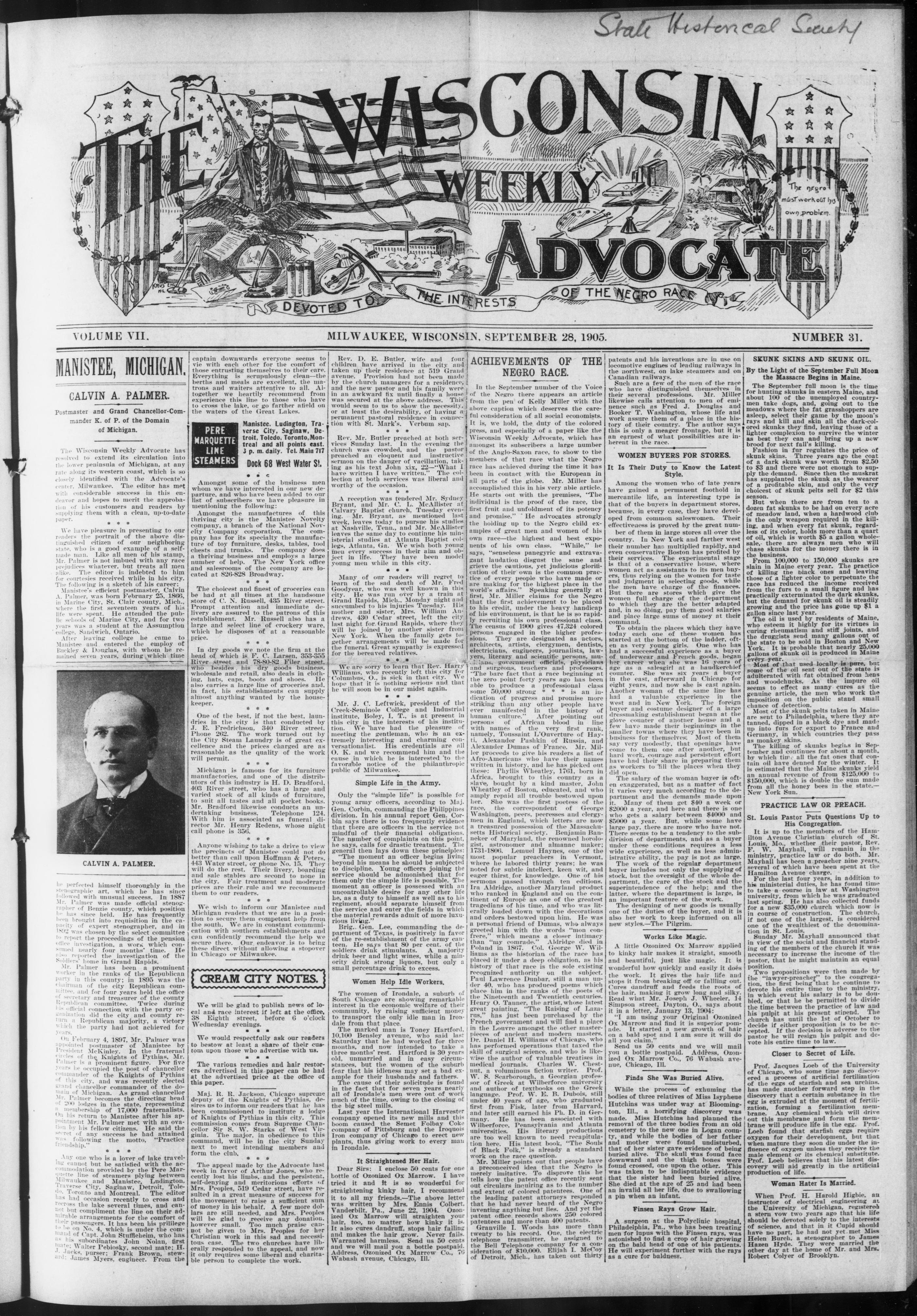
WISCONSIN
WEEKLY
ADVOCATE
DEVOTED TO THE INTERESTS OF THE NEGRO RACE
captain downwards everyone seems to vie with each other for the comfort of those entrusting themselves to their care. Everything is scrupulously clean—the berths and meals are excellent, the matrons and waiters attentive to all. Altogether we heartily recommend from experience this line to those who have to cross the lake, or go farther afield on the waters of the Great Lakes.
PERE MARQUETTE LINE STEAMERS
Manistee, Ludington, Traverse City, Saginaw, Detroit, Toledo, Toronto, Montreal and all points east. 3 p. m. daily. Tel. Main 717
Dock 68 West Water St
Amongst some of the business men whom we have interested in our new departure, and who have been added to our list of subscribers we have pleasure in mentioning the following:
Amongst the manufactures of this thriving city is the Manistee Novelty company, a branch of the National Novelty Company corporation. The company has for its specialty the manufacture of toy furniture, desks, tables, tool chests and trunks. The company does a thriving business and employs a large number of help. The New York office and salesrooms of the company are located at 826-828 Broadway.
The choicest and finest of groceries can be had at all times at the handsome store of C. N. Russell, 435 River street. Prompt attention and immediate delivery are assured to the patrons of this establishment. Mr. Russell also has a large and select line of crockery ware, which he disposes of at a reasonable price.
* * *
In dry goods we note the firm at the head of which is F. C. Larsen, 353-355 River street and 78-80-82 Filer street, who besides, his dry goods business, wholesale and retail, also deals in clothing, hats, caps, boots and shoes. He also carries a large line of groceries and, in fact, his establishments can supply almost anything wanted by the house-keeper.
One of the best, if not the best, laundries in the city is that conducted by J. E. Fredrichson, 340 River street, Phone 262. The work turned out by the City Steam Laundry is of great excellence and the prices charged are as reasonable as the quality of the work will permit.
* * *
Michigan is famous for its furniture manufactories, and one of the distributors of this industry is H. D. Bradford, 403 River street, who has a large and varied stock of all kinds of furniture, to suit all tastes and all pocket books. Mr. Bradford likewise conducts an undertaking business. Telephone 124. With him is associated as funeral director Mr. Henry Redens, whose night call phone is 356.
Anyone wishing to take a drive to view the precincts of Manistee could not do better than call upon Hoffman & Peters, 443 Water street, or phone No. 15. They will do the rest. Their livery, boarding and sale stables are second to none in the city. Fair treatment and moderate prices are their rule and we recommend them to our readers.
* * *
We wish to inform our Manistee and Michigan readers that we are in a position to secure them competent help from the south. We are in constant communication with southern establishments and can confidently recommend the help we secure there. Our endeavor is to bring these direct without allowing a stopover in Chicago or Milwaukee.
CREAM CITY NOTES.
We will be glad to publish news of local and race interest if left at the office, 38 Eighth street, before 6 o'clock Wednesday evenings.
We would respectfully ask our readers to bestow at least a share of their custom upon those who advertise with us.
The various remedies and hair restorers advertised in this paper can be had at the advertised price at the office of this paper.
Maj. R. R. Jackson, Chicago supreme deputy of the Knights of Pythias, desires us to inform our readers that he has been commissioned to institute a lodge of Knights of Pythias in this city. This commission comes from Supreme Chancellor Sir S. W. Starks of West Virginia. The major, in obedience to this command, will be in the city Sunday next to meet intending members and form the club.
The appeal made by the Advocate last week in favor of Arthur Jones, who recently lost his limbs, and the persistent, self-denying and meritorious efforts of Mrs. Peoples, 519 Cedar street, have resulted in a great measure of success for the movement to raise a sufficient sum of money in his behalf. A few more dollars are still needed, and Mrs. Peoples will be glad to receive any donation, however small. Too much praise cannot be given to Mrs. Peoples for her Christian work in this sad and necessitous case. The two churches have liberally responded to the appeal, and now it only requires some liberal and charitable person to complete the work.
MANISTEE, MICHIGAN.
The Wisconsin Weekly Advocate has resolved to extend its circulation into the lower peninsula of Michigan, at any rate along its western coast, which is so closely identified with the Advocate's center, Milwaukee. The editor has met with considerable success in this endeavor and hopes to merit the approbation of his customers and readers by supplying them with a clean, up-to-date paper.
We have pleasure in presenting to our readers the portrait of the above distinguished citizen of our neighboring state, who is a good example of a self-made man. Like all men of his stamp, Mr. Palmer is not imbued with any race prejudices whatever, but treats all men alike. The editor is indebted to him for courtesies received while in his city. The following is a sketch of his career: Manistee's efficient postmaster, Calvin A. Palmer, was born February 25, 1866, in Marine City, St. Clair county, Mich., where the first seventeen years of his life were spent. He attended the public schools of Marine City, and for two years was a student at the Assumption college, Sandwich, Ontario.
After leaving college he came to Manistee and entered the employ of Backley & Douglas, with whom he remained seven years, during which time
[Picture of a man in a suit with a tie].
CALVIN A. PALMER.
he perfected himself thoroughly in the stenographic art, which he has since followed with unusual success. In 1887 Mr. Palmer was made official stenographer of Benzie county, which position he has since held. He has frequently been brought into requisition in the capacity of expert stenographer, and in 1892 was chosen by the select committee to report the proceedings of the pension office investigation, a work which consumed nearly four months' time. He also reported the investigation of the Soldiers' home in Grand Rapids
Mr. Palmer has been a prominent worker in the ranks of the Republican party in this county; in 1895 was the chairman of the city Republican committee, and for four years held the office of secretary and treasurer of the county Republican committee. Twice during his official connection with the party organization did the city and county return a Republican majority, a victory which the party had not achieved for years.
On February 4, 1897, Mr. Palmer was appointed postmaster of Manistee by President McKinley. In the fraternal circles of the Knights of Pythias, Mr. Palmer is a prominent figure. For five years he occupied the post of chancellor commander of the Knights of Pythias of this city, and was recently elected grand chancellor commander of the domain of Michigan. As grand chancellor Mr. Palmer becomes the directing head of 200 lodges in the state, representing a membership of 17,000 fraternalists. On his return to Manistee after his appointment Mr. Palmer met with an ovation by his fellow citizens. He said the secret of any success he had attained was following the motto, "Practice friendship."
* * *
Any one who is a lover of lake traveling cannot but be satisfied with the accommodation provided by the Pere Marquette line of steamers plying between Milwaukee and Manistee, Ludington, Traverse City, Saginaw, Detroit, Toledo, Toronto and Montreal. The editor has had occasion recently to cross and recross the lake several times, and cannot but compliment the line on their admirable arrangements for the comfort of their passengers. It has been his privilege to be on No. 4, which is under the command of Capt. John Stuffleheim, who has as his subordinates John Nolan, first mate; Walter Pebiosky, second mate; H. J. Jacks, purser; Frank Brown, steward; James Myers, engineer. From the
Manistee, Ludington, Traverse City, Saginaw, Detroit, Toledo, Toronto, Montreal and all points east. 3 p. m. daily. Tel. Main 717
Dock 68 West Water St.
* * *
* * *
**
* * *
亦亦亦
***
Rev. D. E. Butler, wife and four children have arrived in the city and taken up their residence at 519 Grand avenue. Provision had not been made by the church managers for a residence, and the new pastor and his family were in an awkward fix until finally a house was secured at the above address. This would seem to us to show the necessity, or at least the desirability, of having a permanent pastoral residence in connection with St. Mark's. Verbum sap.
***
Rev. Mr. Butler preached at both services Sunday last. In the evening the church was crowded, and the pastor preached an eloquent and instructive sermon on the danger of vacillation, taking as his text John xix, 22—"What I have written I have written." The collection at both services was liberal and worthy of the occasion.
***
A reception was tendered Mr. Sydney Bryant, and Mr. C. L. McAllister at Calvary Baptist church, Tuesday evening. Mr. Bryant, as mentioned last week, leaves today to pursue his studies at Nashville, Tenn., and Mr. McAllister leaves the same day to continue his ministerial studies at Atlanta Baptist colleges, Atlanta, Ga. We wish both young men every success in their aim and object in life. They have been model young men while in this city.
```markdown
```
Many of our readers will regret to learn of the sad death of Mr. Fred Goodyear, who was well known in this city. He was run over by a train at Grand Rapids, Mich., Monday night and succumbed to his injuries Tuesday. His mother and sister, Mrs. William Andrews, 430 Cedar street, left the city last night for Grand Rapids, where they will be joined by another sister from New York. When the family gets together arrangements will be made for the funeral. Great sympathy is expressed for the bereaved relatives.
* * *
We are sorry to learn that Rev. Harry Williams, who recently left this city for Columbus, O., is sick in that city. We hope that it is nothing serious and that he will soon be in our midst again.
***
Mr. J. C. Leftwick, president of the Creek-Seminole College and Industrial institute, Boley, I. T., is at present in this city in the interests of his institution. We have had the pleasure of meeting the gentleman, who is an extremely interesting and charming conversationalist. His credentials are all O. K. and we recommend him and the cause in which he is interested to the favorable notice of the philanthropic public of Milwaukee.
Simple Life in the Army.
Only the "simple life" is possible for young army officers, according to Maj. Gen. Corbin, commanding the Philippines division. In his annual report Gen. Corbin says there is too frequently evidence that there are officers in the service not mindful of their financial obligations. The number of complaints on this point, he says, calls for drastic treatment. The general then lays down these principles:
"The moment an officer begins living beyond his means he should be subjected to discipline. Young officers joining the service should be admonished that for them only the simple life is possible. The moment an officer is possessed with an uncontrollable desire for any other life he, as a duty to himself as well as to his regiment, should separate himself from the service and enter the fields in which the material rewards admit of more luxurious living."
Brig.. Gen. Lee, commanding the department of Texas, is positively in favor of the re-establishment of the army canteen. He says that 80 per cent. of the soldiers drink stimulants. A majority drink beer and light wines, while a minority drink strong liquors, but only a small percentage drink to excess.
Women Help Idle Workers
The women of Irondale, a suburb of South Chicago are showing remarkable interest in the economic welfare of their community, by raising sufficient money to transport the only idle man in Irondale from that place.
The marked man is Toney Hartford, 10,100 Bensley avenue, who said last Saturday that he had worked for three months, and now intended to take a three months' rest. Hartford is 30 years old, unmarried and in easy circumstances, but the women of the suburb fear that his idleness may set a bad example for their husbands and fathers.
The cause of their solicitude is found in the fact that for seven years nearly all of Irondale's men were out of work much of the time, owing to the closing of the big steel mills.
Last year the International Harvester company opened its new mills and this boom caused the Semet Folbay Coke company of Pittsburg and the Iroquois Iron company of Chicago to erect new plants, thus giving work to every man in Irondale.
It Straightened Her Hair.
Dear Sirs: I enclose 50 cents for one bottle of Ozonized Ox Marrow. I have tried it and it is so wonderful for straightening kinky hair, I recommend it to all my friends. The above letter was written by Mrs. Ennis Colbert, Vanderbilt, Pa., June 22, 1904. Ozonized Ox Marrow will straighten your hair, too, no matter how kinky it is. It also cures dandruff, stops hair falling and makes the hair grow. Never fails. Warranted harmless. Send us 50 cents and we will mail you a bottle postpaid. Address, Ozonized Ox Marrow Co., 70 Wabash avenue, Chicago, Ill.
ACHIEVEMENTS OF THE NEGRO RACE.
Mr. Miller points out that people have a preconceived idea that the Negro is merely imitative. To disprove this he tells how the patent office recently sent out circulars inquiring as to the number and extent of colored patentees. One of the leading patent attorneys responded that he had never heard of the Negro inventing anything but lies. And yet the patent office records shows 250 colored patentees and more than 400 patents. Granville I. Woods has more than twenty to his record. One, the electric telephone transmitter, he assigned to the Bell Telephone company for a consideration of $10,000. Elijah I. McCoy of Detroit, Mich., has taken out thirty
patents and his inventions are in use on locomotive engines of leading railways in the northwest, on lake steamers and on Canadian railways. Such are a few of the men of the race who have distinguished themselves in their several professions. Mr. Miller likewise calls attention to men of eminence such as Fred J. Douglas and Booker T. Washington, whose life and work assure them of a place in the history of their country. The author says this is only a meager frontage, but it is an earnest of what possibilities are inherent in the race.
WOMEN BUYERS FOR STORES
It Is Their Duty to Know the Latest Style.
Among the women who of late years have gained a permanent foothold in mercantile life, an interesting type is that of the buyers in department stores, because, in every case, they have developed from common saleswomen. Their effectiveness is proved by the great num-
ber of them in large stores all over the country. In New York and farther west their number has multiplied rapidly, and even conservative Boston has profited by their services. The experimental stage is that of a conservative house, where women act as assistants to its men buyers, thus relying on the women for taste and judgment in selecting goods, while the men have charge of the finances. But there are stores which give the women full charge of the department to which they are the better adapted and, in so doing, pay them good salaries and place large sums of money at their command.
To obtain the places which they have today each one of these women has started at the bottom of the ladder, often as very young girls. One who has had a successful experience as a buyer of underwear and French goods, began her career when she was 16 years of age as a salesgirl at a handkerchief counter. She was six years a buyer in the east, afterward in Chicago for eight years, and now she is east again. Another woman of the same line has had a valuable experience in the west and in New York. The foreign buyer and costume designer of a large dressmaking establishment began at the glove counter of anotner house and a few have made their beginnings in the smaller towns where they have been in business for themselves. Most of them say very modestly, that openings have come to them one after another, but hard work, courage and persistent effort have had their share in preparing them as workers to fill the places when they did open.
The salary of the woman buyer is often exaggerated, but as a matter of fact it varies very much according to the department and the demands made upon it. Many of them get $40 a week or $2000 a year, and here and there is one who gets a salary between $4000 and $5000 a year. But, while some have large pay, there are more who have not. There seems to be a tendency to the subdivision of departments, and as a buyer under these conditions requires a less wide experience, as well as less administrative ability, the pay is not as large. The work of the regular department buyer includes not only the supplying of stock, but the oversight of the whole department, the care of the stock and the superintendence of the help; and the latter, where the department is large, is an important feature of the work.
The designing of new goods is usually one of the duties of the buyer, and it is also her work to keep informed on all new styles.-The Pilgrim.
Works Like Magic.
A little Ozonized Ox Marrow applied to kinky hair makes it straight, smooth and beautiful, just like magic. It is wonderful how quickly and easily it does the work. It gives the hair life and stops it from breaking off or fallling out. Cures dandruff and feeds the roots of the hair, making it grow long and silky. Read what Mr. Joseph J. Wheeler, 14 Simpson street, Dayton, O., says about it in a letter, January 13, 1904: "I am using your Original Ozonized Ox Marrow and find it is superior pomade. It started a new growth of hair on a bald spot and I am sure it will do all you claim." Send us 50 cents and we will mail you a bottle postpaid. Address, Ozonized Ox Marrow Co., 76 Wabash avenue, Chicago, Ill.
Finds She Was Buried Alive.
While the process of exhuming the bodies of three relatives of Miss Isypheue Hutchins was under way at Bloomington, Ill., a horrifying discovery was made. Miss Hutchins had planned the removal of the three bodies from an old cemetery to the new one in Logan county, and while the bodies of her father and mother were found undisturbed, that of her sister gave evidence of being buried alive. The skull was found face downward and the thigh bones were found crossed, one upon the other. This was taken to be indisputable evidence that the sister had been buried alive. She died at the age of 25 and had been an invalid all her life, due to swallowing a pin when an infant.
Finsen Ravs Grow Hair
A surgeon at the Polyclinic hospital, Philadelphia, Pa., who has been treating men for lupus with the Finsen rays, was astonished to find a crop of hair growing on the bald head of one of his patients. He will experiment further with the rays as a cure for baldness.
By the Light of the September Full Moon the Massacre Begins in Maine.
The September full moon is the time for hunting skunks in eastern Maine, and about 100 of the unemployed countrymen take dogs, and, going out to the meadows where the fat grasshoppers are asleep, select their game by the moon's rays and kill and skin all the dark-colored skunks they find, leaving those of a lighter complexion to survive the winter as best they can and bring up a new brood for next fall's killing.
Fashion in fur regulates the price of skunk skins. Three years ago the coat of a dark skunk was worth from $2.50 to $3 and there were not enough to supply the demand. Since then the muskrat has supplanted the skunk as the wearer of a profitable skin, and only the very choice of skunk pelts sell for $2 this season.
But when there are from ten to a dozen fat skunks to be had on every acre of meadow land, when a hardwood club is the only weapon required in the killing, and when every fat skunk, regardless of its color, holds more than a quart of oil, which is worth $5 a gallon wholesale, there are always men who will chase skunks for the money there is in the business.
From 100,000 to 150,000 skunks are slain in Maine every year. The practice of killing the black ones and leaving those of a lighter color to perpetuate the race has reduced the income received from the furs to a small figure and has practically exterminated the dark skunks, but the demand for skunk oil is steadily growing and the price has gone up $1 a gallon since last year. The oil is used by residents of Maine, who esteem it highly for its virtues in curing rheumatism and stiff joints, and the druggists send many gallons out of the state to be sold in Boston and New York. It is probable that nearly 25,000 gallons of skunk oil is produced in Maine every year.
Most of that used locally is pure, but some of the oil sent out of the state is adulterated with fat obtained from hens and woodchucks. As the impure oil seems to effect as many cures as the genuine article, the men who work the imposition on the public stand small chance of detection. Most of the skunk pelts taken in Maine are sent to Philadelphia, where they are tanned, dipped in a black dye and made up into furs for export to France and Germany, in which countries they pass as monkey skins.
The killing of skunks begins in September and continues for about a month, by which time all the fat ones that contain oil have denned for the winter. It is estimated that the Maine skunks yield an annual revenue of from $125,000 to $150,000, which is double the sum made from all the honey bees in the state. New York Sun.
PRACTICE LAW OR PREACH
St. Louis Pastor Puts Questions Up to His Congregation.
It is up to the members of the Hamilton Avenue Christian church of St. Louis, Mo., whether their pastor, Rev. F. W. Mayhall, will remain in the ministry, practice law or do both. Mr. Mayhall has been a preacher nine years, several of which have been spent at the Hamilton Avenue charge. For the last four years, in addition to his ministerial duties, he has found time to take a course in law at Washington university, from which he was graduated last spring. He has also collected funds for a new $35,000 church which now is in course of construction. The church, if not one of the largest, is considered one of the wealthiest of the denomination in St. Louis.
Sunday Mr. Mayhall announced that in view of the social and financial standing of the members of the church it was necessary to increase the income of the pastor, that he might maintain an equal position.
Two propositions were then made by the "lawyer-preacher" to the congregation, the first being that he continue to devote his entire time to the ministry, in which event his salary is to be doubled, or that he be permitted to divide the time between the practice of law and his pulpit at his present stipend. The church has until the 1st of October to decide if either proposition is to be accepted. If the decision is adverse to the pastor he will resign his pulpit and devote his entire time to law.
Closer to Secret of Life.
Prof. Jacques Loeb of the University of Chicago, who some time ago discovered a process of artificial fertilization of the eggs of starfish and sea urchins, has made another forward step in the discovery that a certain substance in the egg is extruded at the moment of fertilization, forming a fertilization membrane. Any chemical which will drive out this membrane and form the membrane will produce life in the egg. Prof. Loeb found that starfish eggs require oxygen for their development, but that when mature they soon die under the influence of oxygen unless they receive the male element or its chemical substitute. Prof. Loeb believes that his latest discovery will aid greatly in the artificial production of life.
Woman Hater Is Married
When Prof. H. Harold Higbie, an instructor of electrical engineering at the University of Michigan, registered a stern vow two years ago that his life should be devoted solely to the interests of science, and that in it Cupid should have no part, he had not yet met Miss Helen Burch, a stenographer to James Hazen Hyde. They were married the other day at the home of Mr. and Mrs. Robert Colyer of Brooklyn.
CHRONIC ERYSIPELAS
Cured by Dr. Williams' Pink Pills, Although Whole Body was Affected.
Erysipelas or St. Anthony's fire is a most uncomfortable disease on account of the burning, the pain and the disfigurement; it is also a very grave disorder, attended always by the danger of involving vital organs in its spread.
The case which follows will be read with great interest by all sufferers as it affected the whole body, and refused to yield to the remedies prescribed by the physician employed. Mrs. Ida A. Colbath, who was the victim of the attack, residing at No. 19 Winter street, Newburyport, Mass., says:
"In June of 1903 I was taken ill with what at first appeared to be a fever. I sent for a physician who pronounced my disease chronic erysipelas and said it would be a long time before I got well.
"Inflammation began on my face and spread all over my body. My eyes were swollen and seemed bulging out of their sockets. I was in a terrible plight and suffered the most intense pain throughout my body. The doctor said my case was a very severe one. Under his treatment, however, the inflammation did not diminish and the pains which shot through my body increased in severity. After being two months under his care, without any improvement, I dismissed him.
"Shortly after this, on the advice of a friend, I began to take Dr. Williams' Pink Pills for Pale People, two at a dose three times a day. After the second box had been used I was surprised to notice that the inflammation was going down and that the pains which used to cause me so much agony had disappeared. After using six boxes of the pills I was up and around the house attending to my household duties, as well as ever." Dr. Williams' Pink Pills are sold by all dealers in medicine or may be obtained direct from the Dr. Williams Medicine Co., Schenectady, N.Y.
METHODS OF CHINESE DOCTORS.
Prescriptions of Many Ingredients— Treatment by Massage.
Chinese physicians of much repute never visit afoot, but must be carried to the patient on a horse, mule or jack, or in a carriage. At the patient's residence the doctor first rests awhile, and in the meantime is served with liquors and confections and often with a formal meal. He usually collects no fee, but receives a percentage of the fees of the apothecary, if he does not himself have an apothecary shop. In all cases of cure, however, he is rewarded with rich presents, whose value depends on the rapidity and completeness of the relief. Apothecary shops exist in every village of any size.
Prescriptions always consist of several drugs, as high as twenty ingredients being frequently the case. They are put up in pill shape or given in their natural condition and boiled together by relatives. This mess, usually of bitter taste (and whose odor generally horrifies foreigners) is always administered hot, and usually in big cupfuls. A Chinese medicine book, dating back to the Wing dynasty (1568-1644) contains no less than 28,739 receipts. Materials of the Meteria Medica Sinensis consists of vegetables, minerals and articles belonging to the animal kingdom, such, for instance, as the dragon's teeth, centipedes, scorpions, Spanish flies, roaches, beetles, tadpoles, etc.
Chinese doctors are, however, not content with medicine alone. They are adepts in massage, especially of the head and of the stomach and bowels. When light massage does not work a cure or give relief (in pains of the stomach, for instance), the doctor will kneel on the stomach and rub and kneed with his knees and hands the painful part, and this he will keep up until the patient is relieved (or says he is.) Another of his remedies is acu-puncture, or plunging a needle into various parts of the body—a treatment that is said to be very effectual in many complaints, and is highly regarded.—Reynolds' Newspaper.
DON'T MISS THIS
A Cure for Stomach Trouble - A New Method, by Absorption-No Drugs.
Do You Belch?
It means a diseased Stomach. Are you afflicted with Short Breath, Gas, Sour Eructations, Heart Pains, Indigestion, Dyspepsia, Burning Pains and Lead Weight in Pit of Stomach, Acid Stomach, Distended Abdomen, Dizziness, Colic?
Bad Breath or Any Other Stomach Torture?
Let us send you a box of Mull's Anti-Belch Wafers free to convince you that it cures.
Nothing else like it known. It's sure and very pleasant. Cures by absorption. Harmless. No drugs. Stomach Trouble can't be cured otherwise—so says Medical Science. Drugs won't do—they eat
We know Mull's Anti-Belch Wafers cure and we want you to know it, hence this offer.
SPECIAL OFFER.—The regular price of Mull's Anti-Belch Wafers is 50c a box, but to introduce it to thousands of sufferers we will send two (2) boxes upon receipt of 75c and this advertisement, or we will send you a sample free for this coupon.
Bullet Hole Bibles
In the curio dealer's private office lay a half dozen shabby pocket Bibles, each pierced two-thirds through with a round hole, like a bullet hole.
"They are bullet holes," said the dealer. "I know they are, because I made them myself."
He gave a loud laugh.
"A good many of my rich patrons," he said, "like to have among their heirlooms Bibles that have saved some soldier ancestor's life."
He winked.
"If you are a Son of the Revolution," he said, "what a nice thing it is to take down one of these perforated Bibles from a shelf in the library and hand it to your guest, saying:
"This Bible saved the life of my maternal sixty-third cousin, Col. Adoniram McGill, in the night attack upon the British, led by Gen. Jones at Bear Creek, on the 3d day of August, and so forth, and so on."
"Yes," said the dealer, "I sell a good many of these Bibles to people with ancestors. To own such things is one of the fads and fancies of the smart set."—Louisville Courier-Journal.
Flo was fond of Ebenezer—
Eb for short she called her beau.
Talk of "tide of love," Great Caesar!
You should see 'em Eb and Flo.
—Cornell Widow.
In Kindness.
When Johnnie Jones began to cry
His mother made a tart reply;
Which is to say, the mother mild
Did give a tart unto her child!
—New Orleans Times-Democrat
Asked and Answered
"Dessert," said he, "I hope, is pie," His manner made her smart. She was not cross, but her reply Was "just a little tart." -Philadelphia Press.
Temple of the Social Inanities. What makes life such a silly sell And such a grind eternal? Most people crack shell after shell And quite forget the kernel.
A Historical Inaccuracy.
Cleopatra observed. "That false tale
Of the asp many ears may regale—
What a fuss they all make
About that poor snake!
Why, the potson was sent me by mail."
—Carolyn Wells in Smart Set.
What She Really Did
Said Miss Brown, who was thirty and coy.
"Don't you dare kiss me, Archibald Foy,
Don't you do it—it's bad;
I shall 'holler' for dad."
What she did was to "holler" for joy.
--Kansas City Times.
An Appeal.
An Appeal
Smithers—Your mother coming! Why, they say the Old Harry couldn't live with her. Mrs. Smithers—But you'll try for my sake, won't you. Charles?—Boston Transcript.
Can't Be a Dove.
"The bird of peace a dove!" exclaimed the Russian envoy bitterly. "Say, rather, a stork or a crane."
"Why so, your excellency?"
"Look at the size of the bill."—Pittsburg Post.
Rodney—Why do you automobile men wear goggles?
Sidney—If I tell you, you'll tell.
Rodney—Never; honor bright!
Sidney—Well, it's to hide the scared look in our eyes.—Harper's Bazar.
Oh. Slush!
Cholly—Yaas, I'm going in for wicket and golf and all that sawt of thing, y know. They're such manly sports, y know.
Miss Peppery—The idea! You're becoming positively mannish, aren't you?—Puck.
Fahrenheit.
"How did that Boston girl strike you?"
"She struck me as being about thirty-two."
"Thirty-two years?"
"No; degrees."—Woman's Home Companion.
Johnny.
Johnny—Paw, did Moses have the dyspepsia like what you have got?
Father—How on earth do I know?
What makes you ask such a question?
"Why, our Sunday school teacher says the Lord gave Moses two tablets."—San Francisco News-Letter.
A Kind Young Lady
"You'll find I'm hard to discourage," said the persistent suitor melodramatically. "Some day I'll make you admit you love me, and then—and not till then—I will die happy." "I'll say it now," replied the heartless girl. "I don't mind telling a lie for a good end."—Sketch.
A Jewel of a Juryman
Lawyer—Have you formed any opinion on this case?
Juryman—"No, sir."
"Do you think, after the evidence on both sides is all in, you would be able to form any opinion?"
"No, sir."
"You'll do"—New York Weekly
A Damper.
Cecil (sentimentally)—Don't you feel gloomy when the sky is overcast with gray, when the rhythmic rain sounds a dirge upon the roof and the landscape's beauties are hid by the weeping mist? Hazel (sweetly)—Yes; it's dreadfully annoying. It does make one's hair come out of curl so—London Tit-Bits.
On the Wrong Floor.
"You want to marry my daughter, you say. But I don't recall that she has ever mentioned you."
"You surprise me. Isn't your name Timmons?"
"No."
"Excuse me, I must have got into the wrong flat."—Cleveland Plain Dealer.
Poor Child!
Mrs. Hanagan—My! but the Aherns are crazy-mad. Mrs. Hanagan—What's the matther with thim? Mrs. Hanagan—In an absint-minded moment they christened their baby "Aloysius Patrick." Just think o' the initials of him!—Catholic Standard and Times.
Blocked
"I'm afraid my hay fever is coming on," said Kloseman, trying to get some medical advice free of charge. "Every once in a while I feel an itching in my nose, and then I sneeze. What would you do in a case like that, doctor?"
"I feel pretty sure," replied Dr. Sharp, "that I would sneeze, too."—Philadelphia Ledger.
Didn't Like the Name.
"What was the trouble?"
"Squabble about the distribution of offices. The deacons were elected all right, but not a single woman in the bunch would accept the office of elder."
—Cleveland Leader.
Reward of Courtesy.
"How do you get so many subscribers?" asked the visitor to the office of the great magazine.
"Just between you and me I'll tell you the secret. All the manuscripts sent in I keep. I answer the contributors, and tell them the stuff will be used as soon as available. This makes them subscribers for life."—Indianapolis Star.
Kaukauna on the Map.
Kaukauna, Wis., not to be outdone by any other town in obeying the Bible injunction to "multiply and replenish the earth." is able to report the equal of the Wausau (Wis.) birth of three pairs of twins. Mrs. Nie Hentz has given birth to nine children in eleven years, three pairs of twins being among the number. There was a boy and a girl each time.
"FRAIL SINGERS OF TODAY."
Frail singers of today, your song is sweet.
The words that ye repeat
Are comely, making music as they pass
Faint as the singing glass
Rubbed by a moistened finger; round and
round
Mell sing a harbor way,
Plucking rough chords of strength from
lyres too rude.
Ever to be subdued
By this slight tinkling harmony of the
hour.
Awake, awake to power,
Singers of songs-else die! Far better mute
Were the enassemble lute.
Who brook no counterparts!
—Lee Wilson Dodd in the Century.
MONEY FOR SOLDIERS AND THOSE WHO DISBURSE IT
There they sit, from early morning until twilight, with coats off, working, working, just working. Before them are piles of sheets covered with names, letters, other data and figures. Figures for breakfast, figures for lunch, figures for dinner, figures and more figures. Papers cover their desks and are piled on chairs and tables, and they tell of millions of dollars received and expended. Once in a while one of these workers, in sheer desperation, gets up and walks about the room to steady his nerves, clear his head and give expression to feelings so long pent up that when they are expressed it seems as if the roof might well lift. Then he goes back to the desk and begins to run up long rows of figures again. There is a balance this time and a glad shout rends the air; the other three look up, pained at the outburst of levity. They haven't yet struck a balance. One has been trying for hours to find out where that infernal 3 cents went to. Another has found a discrepancy of $1.06 in the payment of nearly a quarter of a million of dollars. He must work and struggle, go over, mayhap, again and again the great mass of figures, names, letters and places, for that balance must be struck. For a week, two weeks, yes, frequently three weeks, this same hard, perplexing, nerve destroying, patience testing, constitution breaking struggle goes on, and yet the days are not long enough for these men of figures and hard work. When it is all completed, the desks cleared and they have had an opportunity to take a few long, free breaths, an order comes down from department headquarters directing another payment.
These men of labor—and there are none in all of the lists of laboring men who work a greater number of hours per month or do harder work, than these obliging, well-informed, patient, persistent, tireless strugglers—are paymasters and their clerks.
I am going to write something about army paymasters' clerks. There are, in the Philippine Islands, at present, about twenty of these workers, men whose capacity is tested and retested to the very quick, every month of the year, for when they are not applying their eyes, minds, hearts and their very souls to the performance of duties as intricate and difficult to solve as any connected with the most complex banking institutions, they are out on the high seas or wandering over rough roads on islands, visiting posts, as the veritable strong right arms of their chiefs, the paymasters. And I have yet to see a word descriptive of the duties, trials and tribulations of this class of successful, painstaking, loyal public servants.
Each paymaster is entitled to a clerk. He is given the pay of a second lieutenant of the army, $116.67 per month, and draws travel pay at the rate of 4 cents a mile in addition to transportation. The position in the states, though a very trying one, is by no means as difficult to fulfill as in the Philippine Islands.
Go with me on a pay tour and watch the clerk. In nine cases out of ten he sleeps on the deck of a small transport; in the rainy season he seldom fails to get a drenching. Reaching a station the clerk must figure out one of the company rolls and then compare it with the one figured out by the paymaster. That being over, he must name the amount opposite each soldier as his name is called by the company commander. He must apply his mind absolutely to this work, for a failure to name the exact sum means loss to the soldier or loss to the paymaster. When the payment is done he must go over the roll and note opposite each man who makes a deposit, enter the amount, count the money and pass it to the paymaster, who gives it a second counting. Then comes the call for checks. Some companies call for as high as fifty. The clerk writes the checks and the paymaster receives the money therefor. This, alone, at the average station, is an item of careful work, well calculated, after all of the rest of his efforts, to bring nervous prostration several paces nearer, for he must usually write on a wobbly table, surrounded by officers and men, a good share of whom, most of the time, are talking or asking questions which the paymaster and clerk are expected to answer. When all of these duties are done it is the clerk's part to see that all of the vouchers paid have been properly witnessed, gathered up and put away. A failure in either of these respects means loss to the paymaster and great inconvenience to both paymaster and clerk. Each voucher means just the amount of money paid on it. The loss, for instance, of a company roll means a loss of $3000 or $4000, hence that roll must be looked after and guarded as carefully as if it were three or four thousand dollar bills.
In hundreds of instances in making landings, both the paymaster and clerk are obliged to sit in cramped, uncomfortable positions, in small boats, on guard over public funds, seldom failing to be drenched by high waves. Like experiences are gone through in the trips from shore to the steamer, for there are only a few places on the islands where even the smaller steamers go right to the wharf. A month of this kind of work, going from station to station, experiencing the same kind of dangers and hardships, doing the same kind of exhausting work, is the customary thing with the paymaster and his clerk in the Philippine Islands. Sometimes a tour lasts for six weeks, and every day a nerve wrencher
Most of the clerks are so much interested in successful payments that they keep a close watch on the paymaster's counting, and often it occurs that the clerk's quick eye saves the paymaster generous sums.
This is a good point at which to say
that the paymaster's business in the Philippines is little, if any, less than a regular banking business. He frequently starts out with a quarter of a million dollars and pays it all out before returning to his station. The paymaster is president of the bank, vice president, the board of directors, cashier, assistant cashier and teller, and his clerk holds every other position in the bank. And there are hundreds if not thousands of banks in the United States that do not handle as much money in the course of a month as the paymaster handles in a Philippine pay tour, and the clerk accounts for in complicated records. This banking institution pays out large sums of money, receives money in deposits, retains allotments, exchanges checks for cash and supplies nearly every station with more or less in the way of small bills, silver, nickels and pennies.
Owing to the hurry, hustle and bustle necessary in a pay trip the clerk cannot keep his books; can only pack away the vouchers and take them back to station. All of the unpacking, keeping of the records, everything pertaining to the paper of the bank, must be transacted after he returns to his station. It was to this work that I called attention in the opening of this chapter.
The hardships of the paymasters in the Philippine Islands are greater than have yet been enumerated, much greater; but the hardships of the paymasters are no greater than have been those of their faithful clerks, and sometimes not as taxing. Their minds, if good clerks, are constantly active. They are very industrious—they must be—always painstaking, and they must be absolutely exact. There is no clerical position connected with the army that is so exacting, makes such constant drafts upon the energy and vitality.
I have sometimes wondered why provision was not made to give the paymasters' clerks not only the pay of second lieutenants, but the rank, so that they might have the honors of officers, the honors and benefits, the pleasures and comforts. A good clerk earns all of these, and there would be a good many advantages to the paymaster were the rank given. It would entitle him to commutation of quarters and to the same mileage that his chief receives; and at retirement he would be ready for the rainy day.
I hope some day to see the paymaster's clerk thus remembered, thus honored.
Half a dozen paymasters have been attacked by insurgents. In all cases the clerks have been found to be brave and active in repelling the attack, when not ordered by the paymaster to remain with the funds. In such emergencies they have stood their ground manfully, rifle ready for immediate action. I have never heard of a cold-footed paymaster's clerk. Like the paymasters, they have not hesitated a moment to take their lives in their hands in crossing swollen rivers, in facing great storms in small boats, in traveling over country infested by the enemy, liable any moment to be ambushed. Indeed, these untitled officers, these bank officers of constant activity and most exacting effort, have been as loyal to country and superiors as any of the men sent to our new possessions.—Evening Wisconsin.
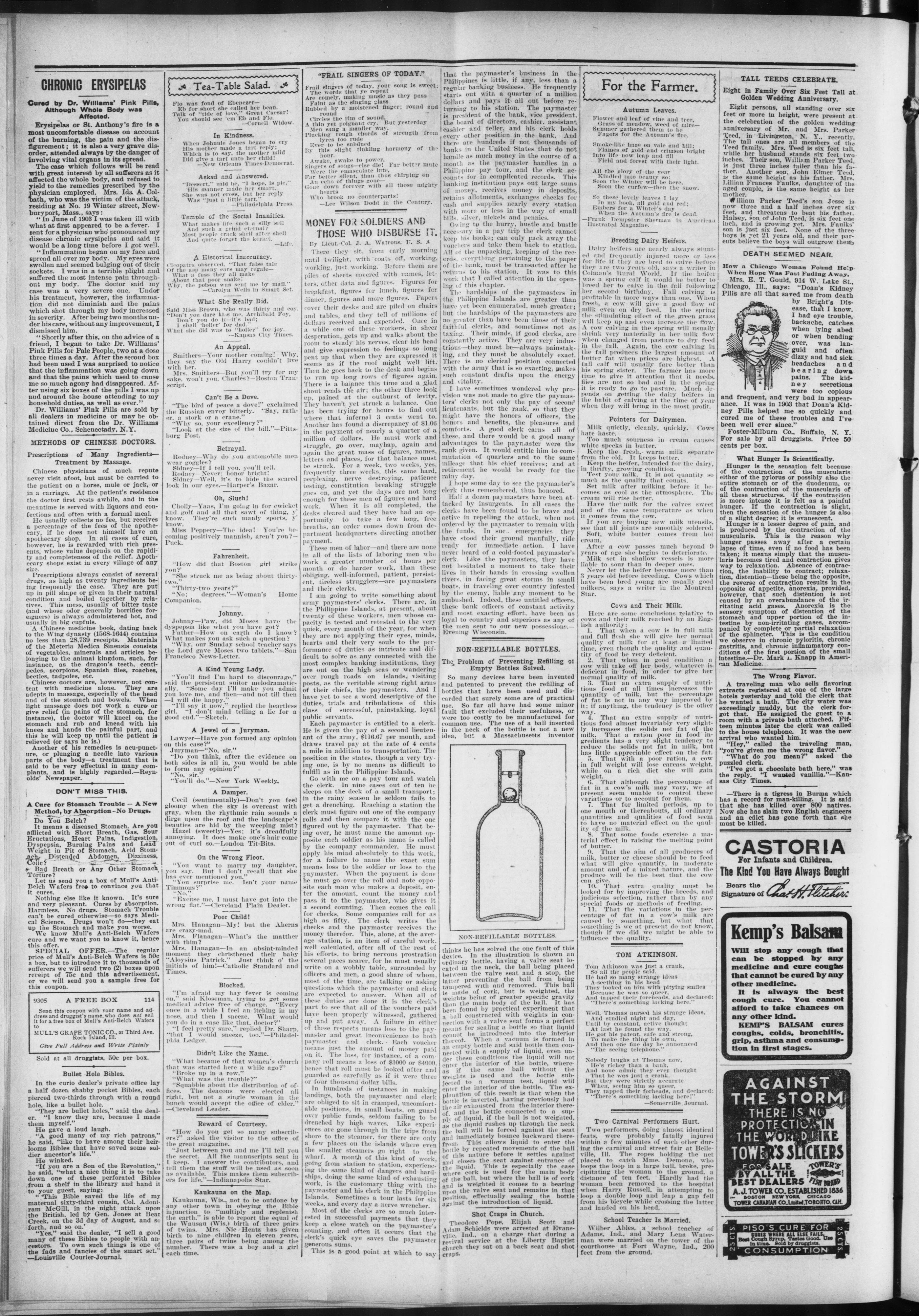
NON-REFILLABLE BOTTLES
The Problem of Preventing Refilling of Empty Bottles Solved.
So many devices have been invented and patented to prevent the refilling of bottles that have been used and discarded that surely some are of practical use. So far all have had some minor fault that excluded their usefulness, or were too costly to be manufactured for common use. The use of a ball inserted in the neck of the bottle is not a new idea, but a Massachusetts inventor
```markdown
```
NON-REFILLABLE BOTTLES
thinks he has solved the one fault of this device. In the illustration is shown an ordinary bottle, having a valve seat located in the neck, the ball being placed between the valve seat and a stop, the latter preventing the ball from being tampered with and removed. This ball is made of cork, but is weighted, the weights being of greater specific gravity than the main body of the ball. It has been found by practical experiment that a ball constructed with weights in connection with a valve seat forms a perfect means for sealing a bottle so that liquid cannot be introduced into the interior thereof. When a vacuum is formed in an empty bottle and said bottle then connected with a supply of liquid, even under these conditions the liquid will not enter the interior of the bottle, where as if the same ball without the weights is used and the bottle subjected to a vacuum test, liquid will enter the interior of the bottle. The explanation of this result is that when the bottle is inverted, having previously had the air exhausted from the interior thereof, and the bottle connected to a supply of liquid, if the ball is not weighted, as the liquid rushes up through the neck the ball will be forced against the seat and immediately bounce backward therefrom. This allows liquid to enter the bottle by repeated movements of the ball of this nature before it settles against and closes the seat against entrance of the liquid. This is especially the case where cork is used for the main body of the ball, but where the ball is of cork and is weighted it comes to a bearing upon the valve seat and remains in that position, effectually sealing the bottle against the introduction of liquid.
Shot Craps in Church.
Theodore Pope, Elijah Scott and Adam Schields were arrested at Evansville. Ind., on a charge that during a revival service at the Liberty Baptist church they sat on a back seat and shot craps.
For the Farmer.
Autumn Leaves
Flower and leaf of vine and tree,
Grass of meadow, weed of mire—
Summer gathered them to be
Fagots for the Autumn's fire.
Smoke-like haze on vale and hill:
Flames of gold and crimson bright
Into life now leap and fill
Field and forest with their light.
All the glory of the year
Kindled into beauty so:
Soon the Winter will be here,
Soon the curfew—then the snow.
When the Autumn's fire is dead.
Frank Dempster Sherman in American Illustrated Magazine.
Breeding Dairy Heifers
Dairy heifers are nearly always stunted and frequently injured more or less for life if they are bred to calve before they are two years old, says a writer in Colman's Rural World. If the heifer was a spring calf it would be better to breed her to calve in the fall following her second birthday. Fall calving is profitable in more ways than one. When fresh, a cow will give a good flow of milk even on dry feed. In the spring the stimulating effect of the green grass will keep up and even increase the flow. A cow calving in the spring will usually shrink very materially in her milk flow when changed from pasture to dry feed in the fall. Again, the cow calving in the fall produces the largest amount of butter fat when prices are highest. A fall calf will usually fare better than his spring sister. The farmer has more time to give it attention that it needs, flies are not so bad and in the spring it is ready to go to pasture. Much depends on getting the dairy heifers in the habit of calving at the time of year when they will bring in the most profit.
Pointers for Dairymen
Milk quietly, cleanly, quickly. Cows hate haste.
Too much sourness in cream causes white specks in butter.
Keep the fresh, warm milk separate from the old. It keeps better.
Keep the heifer, intended for the dairy.
in thrifty, growing condition.
Test your milk. It is not quantity so much as the quality that counts.
Set milk after milking before it becomes as cool as the atmosphere. The cream will rise better.
Have the milk for the calves sweet and of the same temperature as when it comes from the cow.
If you are buying new milk utensils, see that all joints are smoothly soldered.
Soft, white butter comes from hot cream.
After a cow passes much beyond 9 years of age she begins to deteriorate.
Milk set in shallow vessels is more liable to sour than in deeper ones.
Never let the heifer become more than 3 years old before breeding. Cows which have been bred young are usually good milkers, says a writer in the Montreal Star.
Cows and Their Milk.
Here are some conclusions relative to cows and their milk reached by an English authority:
1. That when a cow is in full milk and full flesh she will give her normal quality of milk for at least a limited time, even though the quality and quantity of food be very deficient.
2. That when in good condition a cow will take off her body, whatever is deficient in food, in order to give her normal quality of milk.
3. That an extra supply of nutritious food at all times increases the quantity of milk, but the percentage of fat is not in any way improved by it; if anything, the tendency is the other way.
4. That an extra supply of nutritious food almost invariably very slightly increases the solids not fat of the milk. That a ration poor in food ingredients has a very slight tendency to reduce the solids not fat in milk, but has little appreciable effect on the fat.
5. That with a poor ration, a cow in full weight will lose carcass weight, while on a rich diet she will gain weight.
6. That although the percentage of fat in a cow's milk may vary, we at present seem unable to control these variations or to account for them.
7. That for limited periods, up to one month or thereabouts, all ordinary quantities and qualities of food seem to have no material effect on the quality of the milk.
8. That some foods exercise a material effect in raising the melting point of butter.
9. That the aim of all producers of milk, butter or cheese should be to feed what will give quantity, in moderate amount and of a mixed nature, and the produce will be the best that the cow can give.
10. That extra quality must be looked for by improving the breeds, and judicious selection, rather than by any special foods or methods of feeding.
11. That the variations in the percentage of fat in a cow's milk are caused by something, but what that something is we at present do not know, though if we did we might be able to influence the quality.
TOM ATKINSON.
Tom Atkinson was just a crank,
So all the people said.
He had so many strange ideas
A-seething in his head
They looked on him with pitying smiles
Because he was so queer.
And tapped their foreheads, and declared:
"There's something lacking here."
Well, Thomas nursed his strange ideas,
And studied night and day.
Until by constant, active thought
At last he found the way.
He got his patent, safe and strong,
To make the thing his own.
And then one fine day he announced
"The seeing telephone."
Nobody laughs at Thomas now,
He's richer than a bank.
And none admit they ever thought
That he was just a crank.
But they were strictly accurate
When, seeing him so queer.
They tapped their forheads, and declared:
"There's something lacking here!"
—Somerville Journal.
Two Carnival Performers Hurt.
Two performers, doing almost identical feats, were probably fatally injured within a few minutes of each other during the carnival and street fair at Belleville, Ill. The ropes holding the net placed to catch Mme. Demona, who loops the loop in a large ball, broke, precipitating the woman to the ground, a distance of ten feet. Hardly had the woman been removed to the hospital when Harry Russell, in attempting to loop a double loop and leap a gap fell from his bicycle while crossing the latter and landed on his head.
School Teacher Is Married
Wilber Ables, a school teacher of Adams, Ind., and Mary Lena Waterman were married on the tower of the courthouse at Fort Wayne, Ind., 200 feet from the ground.
TALL TEEDS CELEBRATE.
Eight in Family Over Six Feet Tall at Golden Wedding Anniversary.
Eight persons, all standing over six feet or more in height, were present at the celebration of the golden wedding anniversary of Mr. and Mrs. Parker Teed, in Livingston, N. Y., recently. The tall ones are all members of the Teed family. Mrs. Teed is six feet tall, while her husband stands six feet two inches. Their son, William Parker Teed, is just three inches taller than his father. Another son, John Elmer Teed, is the same height as his father. Mrs. Lillian Frances Faulks, daughter of the aged couple, is the same height as her mother.
William Parker Teed's son Jesse is now three and a half inches over six feet, and threatens to beat his father. Halsey, son of John Teed, is six feet one inch, and is growing yet. Mrs. Faulks' son is just six feet. None of the three boys is yet 21 years old, and their parents believe the boys will outgrow them.
DEATH SEEMED NEAR
How a Chicago Woman Found Help When Hope Was Fast Fading Away. Mrs. E. T. Gould, 914 W. Lake St., Chicago, Ill., says: "Doan's Kidney Pills are all that saved me from death by Bright's Disease, that I know. I had eye trouble, backache, catches when lying abed or when bending over, was languid and often dizzy and had sick headaches and bearing down pains. The kidney secretions were too conious
by Bright's Disease, that I know. I had eye trouble, backache, catches when lying abed or when bending over, was languid and often dizzy and had sick headaches and bearing down pains. The kidney secretions were too copious and frequent, and very bad in appearance. It was in 1903 that Doan's Kidney Pills helped me so quickly and cured me of these troubles and I've been well ever since."
Foster-Milburn Co., Buffalo, N. Y. For sale by all druggists. Price 50 cents per box.
What Hunger Is Scientifically
Hunger is the sensation felt because of the contraction of the muscularis either of the pylorus or possibly also the entire stomach or of the duodenum, or of the contraction of the muscularis of all these structures. If the contraction is more intense it is felt as a painful hunger. If the contraction is slight, then the sensation of the hunger is also of a slight degree; it is evanescent.
Hunger is a lesser degree of pain, and is produced by the contraction of the muscularis. This is the reason why hunger passes away after a certain lapse of time, even if no food has been taken; it means simply that the muscularis becomes tired and contraction gives way to relaxation. Absence of contraction, the inability to contract; relaxation, distention—these being the opposite, the reverse of contraction results in the opposite of appetite, anorexia, provided, however, that such distention is not caused by an overabundance of the irritating acid gases. Anorexia is the sensory symptom of distention of the stomach and upper portion of the intestine by non-irritating gases, accompanied by complete or partial relaxation of the sphincter. This is the condition we observe in chronic pyloritis, chronic gastritis, and chronic inflammatory conditions of the first portion of the small intestine.—Dr. Mark 1. Knapp in American Medicine.
The Wrong Flavor
A traveling man who sells flavoring extracts registered at one of the large hotels yesterday and told the clerk that he wanted a bath. The city water was exceedingly muddy, but the clerk forgot that. He assigned the guest to a room with a private bath attached. Fifteen minutes later the clerk was called to the house telephone. It was the new arrival who wanted him.
"I've got a chocolate bath here," was the reply. "I wanted vanillia."—Kansas City Times.
—There is a tigress in Burma which has a record for man-killing. It is said that she has killed over 800 natives. Now she has slain two English engineers and an edict has gone forth that she must be killed.
Will stop any cough that can be stopped by any medicine and cure coughs that cannot be cured by any other medicine. It is always the best cough cure. You cannot afford to take chances on any other kind. KEMP'S BALSAM cures coughs, colds, bronchitis, grip, asthma and consumption in first stages.
AGAINST
THE STORM
THERE IS NO
PROTECTION IN
THE WORLD LIKE
TOWER'S SLICKERS
FOR SALE
BY ALL THE
BEST DEALERS
TOWER'S
FISH BRAND
A.J. TOWER CO. ESTABLISHED 1836
BOSTON NEW YORK CHICAGO
TOWER CANADIAN CO. Limited TORONTO CAN.
25 CTS.
PISO'S CURE FOR
GURES WHERE ALL ELSE FAILS.
Best Cough Syrup. Tastes Good. Use
in time. Sold by druggists.
CONSUMPTION
GOSSIP FOR THE LADIES.
The Way to the Forest of Arden.
No signboards show which road to take
To reach its ever-peaceful skies;
Each one must his own journey make
To find where Arden Forest lies.
For who can tell how far to go?
There is no book from which to learn;
One may stop here or there, and lo!
Its gates are just beyond the turn.
The path that leads on straight ahead
May take one farther from the goal;
And this one which so many tread
May still perplex and vex the soul.
What route to take no one can say,
'Tis found on neither map or chart;
Only the joyous find the way,
to the kind and light of heart.
The Class President.
Amy is president of her class! Amy isn't the oldest girl in it, nor the prettiest, nor the best dressed, nor even the one of best scholarship. Ruth has higher marks, Edith has finer clothes, Florence is the class beauty, and Phebe is probably the girl with the largest number of birthdays. While we are young we esteem it a cause for congratulation that we are nearer 20 than somebody who is only 15. If we are 18 we are proud of the distinction. Only as time, the thief of so many happy things, steals away our pride in our years, do we try to hide them. You girls at school are all beautifully and blissfully young, bless your dear hearts, and you need not try to conceal the fact.
A girl I knew once happened by chance to see a sentence about her in a letter not meant for her eyes. The letter said: "Theodora is very young, and her appearance indicates it." Though Theodora had apple-brown in her cheeks, and eyes like stars, and a mass of chestnut hair with glints of sunshine threading it, she cried when she found that people thought she looked young. She wanted to look old! Poor little Theodora!
Why is a girl chosen as class president, why Amy rather than Sue or Rachel?
Well, girls, probably for two or three reasons. A girl who is thus honored by the suffrages of her mates is a popular person. She has not gone around with a chip on her shoulder. She has never made enemies by unlucky speeches. She does not make fun of her friends, nor indulge in wit at their expense. This is on the negative side of the question. On the affirmative side the popular girl has lost no opportunity to do little kindnesses at the right moment. She speaks cordially of the absent. She performs graceful services graciously. She is in the public eye, more or less, and people know where they can find her. If asked to do anything obliging, she does it without a fuss.
The popular girl has a troop of friends, because she is friendly. Every one can depend on her not to make a stupid mistake, and to say the proper word in the proper place. She possesses tact.
To the average girl tact is a better gift than good looks or great learning. It makes a girl quick to understand people, and it makes them like her. A girl who has tact always helps other people to be at their best, and that is much finer than to be brilliant and showy in one's own character.
The president of the class generally is a girl with charm. Amy has had charm from her cradle. What is it? How shall it be explained?
Dear girl, it is impossible to define charm in set terms. It is the perfume of a flower, it is the sweetness of the violin, it is the soft shimmer of the moon, it is the sigh of the surf when last it breaks upon the shore. A girl who has charm steals into one's heart. She may be a gentle mouse of a girl, denure and quiet, or a merry breeze-like girl, coming indoors with the swing of the wind, but her charm, if genuine, will belong to her personality and be a part of her.
City girls have this endowment and so have country girls. A good deal of it depends on being free from self-absorption. No girl who is thinking much about herself ever has charm. Homely girls often have it and pretty girls miss it, so you see it does not need to go with a roseleaf skin and dimples. But Amy wouldn't be chosen as class president if the other girls had not been impressed by her charm. Still another excellent quality, and one that a leader always has, is force. Without force nobody can hope to lead. Most of us are followers. Only here and there springs up the girl who leads.
It is never by bluster or vehemence, by over emphasis and self-assertion or by any display of arrogance and bad manners, that a girl becomes a leader. Force of character is a flame within the soul that shines out in daily conduct. A weak girl takes the color of the last person who talks with her. Why, you may often tell with whom a girl has been associating by her inflections, her tones and her pet phrases. As for opinions, the weak person may think she has them, but in reality she has only prejudices, which are very different.
But should you ask me what attribute in a girl will help her to be most successfully president of her class, I think I will pick out this beyond every other. She must have what we call initiative. That is, she must be able to suggest new lines, to strike cut in new paths, and to convince the other girls that her ideas are good. A girl who is a slave to system, who cares principally how things look, and is in terror about what people will say is not a girl with initiative.
She must not be a coward, either. Not long ago a school play was to be presented. The rehearsals were over, the evening had arrived, and the spectators were there. But one girl who had an important part in the first act at the last moment refused to go on the stage because her gloves were too short. She sulked and pouted. Her gloves did not reach the elbow. Another girl, infected by her behavior, discovered that her shoes had not the right buckles. There was dismay behind the scenes. Katherine and Elinor stood there in rebellion. And the class president was sent for. "Katherine," she said, not elegantly, but positively. "shut up!" "Elinor, go on with your lines. They are waiting for you!" Both girls obeyed at once. They recognized the accent of authority.
Girls, whoever else fails or succeeds, she who takes a front rank and is conspicuous must do the latter. She cannot fail. She must succeed. The president of her class must win the favor and confidence of her teachers, and must not be afraid to take a firm stand when occasion requires and to so act that her class is proud of her. She must learn a little bit of parliamentary law, so that in meetings she shall take the chair with ease and grace. This will help her to engineer a meeting well, and she must not have private ends when she does this, but must endeavor to be perfectly fair and to do what is best for the good of the whole.
Unless she does not shrink from extra work and from taking pains, a girl would much better decline this honor. If she does accept it she must pay the price. Margaret Sangster in Washington Star.
Betty's Twilight Chat
A woman who has weathered a financial storm that threatened to leave her
without a remnant of footing confided some valuable secrets to me. Pinching she had to do, but it was done where the world could not see it, and so she never fully lost her reputation of prosperity. Scheme after scheme she considered from all sides and eventually discarded, night after night she tossed about in her bed with no desire for sleep and no respite from anxiety, and after undermining her health and silvering her hair she acquired the ability to accept whatever was in store for her and bear it without worry.
She had lived well from choice, and dressed well as an aid to business. Being obliged to spend the day away from home she had to have a competent housekeeper and pay her according to her ability. Naturally she looked at these details with a criticising eye when she began to consider retrenchment. She had an opportunity to rent her spare bedroom, but as the occupant would have to be more or less a member of the family, owing to the layout of the rooms, she concluded that the small weekly sum would not help her to any great extent, and the discomfort of an outsider would materially increase her misery.
Her next move was a search for rents. There were plenty of them, but after putting down in black and white the actual expenses of making a change in residence she found that there would be no perceptible saving, so that, too, was given up. "Clothes are a good investment," she was wont to say, so she made no great change in that direction, and a trial of two or three cheaper house-workers showed her that her housekeeper had actually saved money for her.
But these are some of the things she did. She dropped entertaining of all kinds on the plea of poor health—no fiction, by the way—gave up her summer outing, hired a seamstress to make the few changes necessary to bring her wardrobe up to date and took what rest and comfort she could get in her own home, with lounging robes, simple summer food and the companionship of books. I have seen her recently and assure you that she has improved in health and mind by the experiment and has pulled out of the financial quagmire that made retrenchment necessary.
There is never any need of letting the great public know of one's misfortunes. A brave exterior will deceive all but extremely critical eyes, and such is achieved by thought and good sense. Renting rooms is an open confession of poverty which some do not mind, but which is injurious to those who depend upon the credit of the public. Good clothes are passports to those who can help you to success, and a competent homemaker is necessary to peace and comfort. No woman can divide her interests and achieve anything worth while, and with incompetency you must either submit to discomforts or remedy them, which takes time. It is infinitely better to bend your whole energies to one kind of work than dabble in two or more. Economy is more than a surface study.—Betty Bradeen in Boston Traveler.
Learn to Listen, and Be Popular.
"She is charming," observed the man, mentally, as he closed the door of her home behind him.
"Yes, she's an unusually interesting woman," he repeated, as he turned the corner.
And why? Simply because she had sat for two solid hours and listened.
Because, by a tactful question or two, she had drawn him on to talk of what he liked, while she listened interestedly. Because, when he told her of marvelous achievements, she had seemed awed; when he spoke of a sorrow, her eyes had been all sympathy; when he related an amusing incident, she had laughed merrily. Always, she had listened, intelligently, understandingly. And in his eyes she was—charming, an unusually interesting woman.
Since the days of the humorist woman has been laughed at and joked with because of her talking propensities. She has been likened unto a magpie, and she has been called a talking machine. She has been accused of never letting a man get a word in, in the proverbial manner, edgewise. Now, the clever woman lets him round out his every word, and occasionally she asks a question—a tactful, well timed question, and—listens. Listening is not merely making use of the two ears with which nature endowed human beings. The woman who has truly learned the art listens with her eyes, her mouth, her hands, her whole attitude is that of listening, of being interested in every word of the conversation.
A man likes a woman with a limited perspicacity; he likes to feel that he is telling her something she does not already know. Therefore, the clever woman of today essays the role of pupil many times when, were she less tactful she would assert herself and give information rather than receive it. A good listener never lets her eyes wander about the room when some one is talking to her; she never seems conscious of anything but that she is being entertained. The topic of conversation is the very thing she has been thirsting for a knowledge of. She never interrupts the lines of thought, and she does not sigh as if relieved when it comes to an end; rather, she seems sorry.
To listen alone is an insufficient art. It must be practiced in conjunction with a knowledge of tactful questions which will start the conversational ball rolling along the right channel.—Selected.
How to Make Pin Money
The unusual means by which a bright girl earned her summer pocket money last year may contain the germ of an idea for anyone earning her vacation fee this season. This girl—a college graduate of a month—made face cloths which she sold to women in large office buildings during perspiry days of June. July and August.
The average woman scrubs with a handkerchief, but merely because a bit of soft chamois does not happen to be at hand. What she really enjoys is a chamois face rag. Dusted with good powder and folded into the pocket or chatelaine it represents warm day luxury.
Miss S. began operations with one large strip of chamois, the entire skin, which she bought at wholesale rates. This she cut into squares rather smaller than a woman's handkerchief. The edges of some were neatly scalloped, of others buttonholed in siik. She sold the plainer sort at 10 cents, the fancier ones at a quarter apiece. Each was dusted with delicately fragrant powder and folded twice.
It was impossible in most cases to sell to the toilers direct, but the forewomen in large establishments were both kind and enthusiastic. "Leave all you have with me and come around tomorrow. I know I can dispose of them for you," said the first to whom she applied. Surely enough. The next day all had been sold and a few more orders were waiting, as the supply had not been adequate.
The work would, of course, only be
possible to a girl in a large city or town, but to one so situated the hundreds of large office buildings offer an almost inexhaustible field. The young woman quoted plied her trade all summer long without exhausting the demand. In awaiting her opportunity for more ambitious work some other laborer may like to tide over in this way.
Daughters and Home Duties.
Where there is more than one grown-up daughter at home certain duties should be portioned out to each so that they will know what they are expected to do. To make the work pleasant and varied do not always give them the same tasks day after day, as they will naturally tire of them, and the work will not be done so well. Don't always give them the most unpleasant work to do, as this is often the cause of girls taking such a dislike to housework and causes much grumbling and discontent in the home.
For instance, one daughter might take over all the cooking for one week and the other the preparation of the table for meals and the care of the bedrooms, and the next week they can change over, and then the work will not become so monotonous to them.
This answers well in large families, too, and all who are capable should be made responsible for some piece of work. If this is done the work of the servant and housewife is made much lighter and the home will always be well kept, as the young people will vie with each other in trying to perform their task the best.
Although it is annoying when your arrangements are all put out through some mistake that has been made by the young people, don't forget that they will learn by experience, and give them words of encouragement for well performed tasks.
A Word to the Fagged-Out Woman.
Even to the "energetic" woman there comes days—especially at this time of the year—when ambition flags, all the world is dust and ashes, nothing seems worth while, and the question, "What's the use?" rises continually to the lips, even if it gets no further.
When this state of mind prevails it is time to call a halt. There is overwork, a liver out of order, or something worse. If you are so situated that you can run away from it all for a few days, do so. She who fights (as long as she can), then runs away.
May live to fight another day.
If you cannot possibly arrange to leave home, take the rest cure there; that is, as much as you can.
Let things go for a few days; simplify the meals; let the children wash the dishes, even if they don't do it very well.
Never mind the cleaning. Lie down and rest every moment that it is possible.
Don't scourge and force yourself to the last limit of endurance.
It won't pay. If you can have a room all to yourself, go in, shut the door, and, if necessary, stop your ears as well.
Give Nature a chance to exert her
Give Nature a chance to exert her powers of healing through rest.
So shall you some forth strengthened and refreshed, ready once more to smooth out the tangles and make the household wheels go round.—Philadelphia Inquirer.
The Girl to Be Admired.
She who is just.
She who is neat.
She who can sew.
She who can cook.
She who is natural.
She who never scolds.
She who loves Nature.
She who scorns deceit.
She who is systematic.
She who is sympathetic.
She who loves children.
She who does not sneer.
She who is not fault-finding.
She who loves dumb animals.
She who earns her own living.
She who is the same every day.
She who sings about her duties.
She who has risen above sorrow.
She who has a charitable heart.
She who is not easily discouraged.
She who has a cheerful disposition.
She who has but one set of manners.
She who admires good literature and
She who makes a confidant of her mother. She who has a faculty for looking "smart." She who is thoughtful of another's comfort. She who is particular of the company she keeps.
She who early learns her faults and corrects them.
She who hopes some day to be a wife and a mother.
we are at heart.
She who insists on a high standard for herself and others.
She who looks as well in a $10 dress as others do in a $50 gown.—Exchange.
How Hetty Green
Learned to Be Economical.
"The meeting doesn't begin until 7:30, and it's not yet 7 o'clock," explained Mrs. Hetty Green as she led me down the long aisle to the second pew and invited me to sit close to her in the corner of it. "My friend and I came early, in order to get good seats."
"Is this church your shade of belief?" I asked.
"Oh, no," she retorted in the confidential whisper which characterizes all her conversation. "No, I was bred a Quaker. But I go to every kind of a church, and I once held mortgages on twenty-eight. It doesn't matter to me what the denomination is; I believe that any of them will serve, so long as the people who attend them keep the commandments; but I am a Quaker, just the same. I believe in simplicity."
"It's that, you know, that makes me what folks call 'mean.' The fact is. I prefer not to be extravagant. When I went to Quaker school they used to make us eat at the next meal whatever we had left on our plates. The directors said that if the rich girls did not learn to economize there would be no money left with which to educate the poor girls. So that was what made me like this."—Carol Ford in National Magazine.
We Needn't Grow Old.
Let us never grow old.
We do not need to. Nor is our youth dependent on hair tonics and face powders.
Did you ever see a jolly bald-headed old man or a merry toothless old woman who were younger by a score of years than the severe and proper grandsons and granddaughters around them?
There are young people who never were young, and old people who never will be old. It's all a matter of disposition.
Somebody has said that in every worthy man and woman there dwells a small boy and a little girl, who stays with us throughout life, if rightly treated, and who are precious possessions, bringing to us more real happiness than all the grown-up poise and dignity that ever existed.
It is this little boy and girl we should cultivate during playtime; and then, when we are at work, they will come and whisper to us and keep us from despair. Let us never drop our acquaintance with them. We may learn if we will to look out on the world with their
fresh young eyes, and to meet life's experiences with their hopeful hearts. This way, we shall never lose our pleasure in living, and thus we need never be old.
ROASTED BANANAS.
Bolt of Lightning Strikes a Fruit Steamer from the West Indies.
With only the stump of her foremast left, one of her sailors with a stiff neck, her steel stays melted into a thousand twisted shapes, and several thousand bunches of electrically cooked bananas in her hold, the fruit steamship Bodo got in from the West Indies, says the New York Times of August 31, with a yarn to spin. It was all about a bolt of lightning that hit the vessel's foremast when she was two hours out of Port Antonio on August 24. The Bodo left Port Antonio on time and had just lost sight of the island city when she ran into a southwester, accompanied by electric pyrotechnics the like of which Capt. Figenschow declared he had never seen before in his long career on the sea.
In addition to melting the stays, splintering the mast and cooking the bananas, the lightning also toyed with the Bodo's compasses, rendering them useless. Fortunately, Capt. Figenschow had a spare one, wrapped in rubber, which was not affected. It was about 10 o'clock in the morning when the Bodo ran into the storm. The gale came up suddenly, the electrical display increasing as the wind increased in violence. The flashes of lightning followed in rapid succession, the electrical streaks being of the zigzag, awe-inspiring kind, while the detonations were something terrific.
Just before noon there was a blinding flash, followed by a deafening roar of thunder. It was this bolt that struck the Bodo's foremast. William Neilson, with several other sailors, were on deck watching the storm at the time. Neilson received enough of the electricity as it proceeded down the mast into the Bodo's steel hull to render him unconscious for a few minutes, while the other seamen were knocked down, but did not lose consciousness. When Neilson revived his neck was stiff. It was still as rigid as a piece of glass yesterday.
The electricity played all over the Bodo's steel decks and railings and stays. The latter was melted, one of them, the signal stay, or, as it is called by the sailors, the "monkey gaff," being so melted that it fell into the sea. Leaving the deck, the lightning visited the cargo hold of the Bodo, where some thirty-odd thousand bunches of bananas were stored. About 5000 bunches were cooked to a crisp, while the rest were charged with enough electricity, according to the sailors, to run all the electric vehicles in New York a month.
Next Capt. Figensechow found that his compasses were useless as a result of the electrical current, the instruments varying from 8 to 10 degrees, one to the southeast and the other to the northwest. Then the skipper thought of his little rubber-incased compass kept for the use of the lifeboats in case of disaster. With this instrument, and by taking soundings and observations, the captain managed to keep in the coastwise track, and arrived off Sandy Hook yesterday morning on time.
HISTORY IS RESTORED
Annapolis Statehouse Room Has Been Refurnished
The work of remodeling the Senate chamber in the old state house at Annapolis, the room of national historic interest as the scene of the resignation of Gen. Washington's military commission, has been practically completed and it is said to be one of the most accurate and interesting pieces of historical restoration ever achieved in this country. The work has been under the direction of Architect Josiah Pennington of Baltimore, aided by the state building commission and a specially appointed commission of architects and historians. After careful research every important detail of the old chamber has been fixed upon with well-nigh certainty and reproduced minutely. The Senate chamber was reconstructed in 1876 in order to obtain additional room. The event with which the room is always associated took place on December 23, 1783, though this was not the only event of national significance connected with it, for there the treaty of peace which ended the war with Great Britain was ratified on January 14, 1784, and there (September 11-14, 1786) sat the delegates from the six states in the meeting which led to the calling of the federal constitutional convention of 1787.
Fighting the Billboard.
The agitation against the billboard as a municipal disfigurement has already reached goodly proportions, and the campaign is as yet in its infancy. Some efforts, and well meant efforts, have been made to improve them, partly by designing the billboard itself and partly by improving the designs of the signs. Nothing has, however, yet been accomplished that amounts to definite and general improvement, and hence it is pertinent to inquire if the billboard is to go? One of the most obvious steps in municipal betterment is to do away with unnecessary, unsightly objects. The billboard has been unsightly so long that many people regard it as permanently evil. At all events it is clear that if it is to remain it can only do so under much better conditions than now obtained, and it must be supported on broader grounds than the fact that a handsome advertising business has grown up through its promotion. No business can be successfully promoted by improper means; the billboard, glaring and staring at every point, approaches the limit beyond which business should not go. Its misfortune has been injudicious use.--American Homes and Gardens.
Boy's Trip in a Balloon.
Floyd Wallace, a 16-year-old boy of Oneonta, had an exciting ride in a balloon that escaped from the Oneonta fair grounds at Binghamton, N. Y., recently. The balloon was being pulled down in the regular manner. When it was about 200 feet from the ground the rope broke and the balloon rapidly shot upward and soon disappeared in the clouds, being rapidly blown toward the northeast. The balloon owner said that unless the youth opened the valve the balloon would not come down for twenty four hours. The balloon rose to a height of more than two miles before it disappeared. The boy, however, managed to get hold of the valve rope and allowed the gas to escape so that he succeeded in landing at Summit, thirty miles from Oneonta. He was two hours and forty-five minutes above the clouds.
The Cheerful Idiot's Conundrum.
"The Cheerful Idiot's Conclusion"
"What's the difference," began the Cheerful Idiot, upon which there was a great shoving-back on the part of the other boarders.
"What is the difference between Hetty Green and an American heiress, who marries a titled European pauper?"
No query being in evidence, the Idiot coolly replied to his own query:
"One husbands her finances and the other finances her husband."
Whereupon he almost died laughing.—Baltimore American.
For the Children.
By the Sea in Summer Weather.
"Roaring waves and slippery sand—Dear me! I prefer the land!" That's what Dora says, for she Thinks it's dull beside the sea; But aunties, Dot, and you and I— We aren't lonesome, are we, Guy?
How can days be dull for her
Here, where everything's astir?
Fishlawks flap and dance and dive,
And the marsh is all alive
With the fluttering, rosy mallows.
And the wee fins stir the shallows;
Lantern headed dragon files,
Gleaming like the blue green eyes
In a peacock's gorgeous tail,
Through the meadow sail and sail;
Snipe above the breakers flit,
With their tiny twit-twit-twit,
Or perhaps go running past,
On their magic stilts, too fast
For the white-maned wave to reach
As it races up the beach
Gray song sparrows teeter, teeter,
Swinging, singing, sweeter, sweeter,
On the long, light green sea grasses,
Swaying as the sea breeze passes.
When the wind blows from the west.
Every wave will wear a crest,
If it's blue and sunny weather—
One fine rainbow like a feather!
Sometimes, too, the billow brings
Scores of fishes, helpless things!
And long the sands they shine
In a leaping silver line,
Showing just the last wave's track;
And I try to put them back.
Then the sunny afternoons
All along the shining dunes!
And the bathing! when you sway
Up and down in foam and spray
Till the breakers' plunging roar
Sweeps you shouting back to shore!
Where could any mortal be
Happler than beside the sea!
—Margaret Hamilton in St. Nicholas.
Strange Animal Alliances.
It is not so very unusual for boys and girls to be adopted, but it is rather infrequently that grown people, in fact, a whole family, get adopted, all at the same time, without any opportunity for conference or comment, and that, too, by a cat. But I was not long since adopted, along with my entire family, by a black cat which has some of the most singular tastes that I have ever known a cat to evince. I do not know the name of this cat, for, although she is old enough to have raised several families of kittens, always proving herself a loving and discreet mother, I doubt if she has ever been honored with a name. She is simply "the black cat" to us, and always has been, during the several years that we have known her intimately, dating back a long time before our adoption by her. It came about in this way: She belonged to some city neighbors of ours, good friends, who lived a square or more distant. From the time that she was a kitten she used to make frequent calls at our house, and was generally rewarded with something to eat. Our next door neighbors keep chickens, and for these the cat manifested great friendship from the first. That is no wonder at all, for her mother, too, was fond of them, and our benefactress' first home was a hen's nest. In it she was born, in it she was reared, and as soon as she was big enough to go to roost with the chickens she was taken up there by her mother along with her brothers and sisters, every night as regularly as the night came. Her fondness for the chickens is more marked than was her mother's. It is evidently an inherited, as well as a cultivated, affection.
The chickens are great, stalwart Plymouth Rocks, and it is no uncommon thing to see the black cat go up to one of them, sidling up in a most affectionate, yet experimental way, rub against it, and if it remains still long enough, reach up her head and rub it against the chicken's neck or against its head, if it is not too tall for such a caress, as if to beg for some slight return of affection. But the chickens do not seem to return the black cat's affection with any warmth. They tolerate her and her kittens in their nests and allow them room on the roosts, but as for exchanging demonstrations of affection in broad daylight they seem to have decided objections perhaps on grounds of dignity.
As the black cat sidles up to them and rubs against them they slide away, look embarrassed, we always think, and try to leave their ardent four legged admirer. And sometimes, if she is too persistent, they give her sharp pecks with their beaks, and then she sadly marches away, looking as if she thought this was a pretty cold world, wherein such return is made for such tender feelings as she certainly has for the ungainly bipeds.
A year or so ago our neighbors, the owners of the black cat, moved into the country quite a distance from town. They did not take pussy along, probably feeling secure that she was able to take care of herself, and would have plenty of friends to help her if she were not. And so, when she went home and found the house deserted, she came over and without ceremony adopted us. And we have no objection to being her wards, so long as she is content to roost with the chickens and rear her families in their nests.
Not a whit less strange than the tastes of "the black cat" were those of two setter puppies that a friend of mine recently owned. In the same barnyard where they often romped appeared every morning before pasture time and every night after being let out of pasture a motherly Jersey cow. Just how the puppies first became attached to the cow nobody seems to have discovered. But it became a matter of much amusement and comment that they followed the larger quadruped to pasture every morning. And a little later the still more astonishing discovery was made that they remained with her throughout the day and escorted her home every night.
One night, as the owner of the trio was watching them while they wandered back home, he noted that the puppies were uneasy and used every endeavor known to their puppyish intellects to hurry the cow home. There was a little patch of blue grass not far from the barnyard, and the Jersey was accustomed to stop there each night, just long enough to bite off a few mouthfuls of the succulent blades, before going into quarters. On this occasion the puppies resented the delay, petulantly barking at their protege, snapping threateningly, but by no means viciously, at her nose as she tried to snip off the grass. Following to the barn the master discovered that the cause of the anxiety of the puppies to get there was that they were nearly famished. So great was their devotion to their big friend that they would remain in the pasture following every step she took all day, until they were as hungry as gaunt pigs, rather than leave her for a single half hour.
But the most remarkable of their performances came one morning while they were on their way to pasture. Between the barn and the field extends a railway, which connects an important southern city with one of the great cities of the north by a single line. The engineer of a freight train which was moving up the road noticed some distance up the track the not unusual sight of the old cow and the two puppies on the way to pasture. He had grown to feel acquainted with the strange family, and felt deeply interested in them. That made it the more disturbing to him when the cow tried to cross the track rather dan-
gerously near to the approaching train, and, instead of passing on over when the whistle gave its several shrieks of warning, turned up the road and commenced trying to run away from the engine at an awkward cow trot. The puppies took in the situation at once and ran after her, trying to drive her off the track. They leaped at her nose and barked and snarled, and tried every artifice they could think of to make their big ward do the right thing. But she could not understand. Meantime, the train being a light one, the engineer got it well under his control, and amusedly moved along behind this combination of cross purposes to see how the misunderstanding would come out. He allowed the train to approach so close to them that the puppies finally despaired of accomplishing their first purpose—that is, driving the stupid cow from the track—and with one impulse they turned and charged straight upon the approaching engine. And they were so fixed in their purpose to hold it up that the engineer was obliged to come to a sudden stand-still in order to save these brave little creatures from martyrdom to their strange devotion.—Springfield (Mass) Republican.
When the Devil Is Loose in Mexico.
A big fire, a suicide and a number of accidents in the city and a heavy wind and rain storm here and numerous crimes and accidents in many parts of the Republic were the natural consequences, it is to be supposed, of the annual one day's leave of absence taken by his diabolical majesty the devil yesterday—a leave of absence which his majesty spends in his earthly planet doing a number of devilish tricks.
It is a common belief among almost all Mexicans that on the day of San Bartolo, which was yesterday, the devil is loose and many unpleasant things happen. The devil is supposed to be very busy all the year around roasting bad people in the inferno, but on the day of San Bartolo he takes a little rest and comes to the earth to see how things are going on. That is, he comes on a trip of inspection to see the prospects for the coming year.
Many people are so superstitious about this that they stay at home all day and refuse to receive calls because, according to tradition, it occurred one time that the devil disguised himself and called upon people whom he wanted to carry away. The object of the visit was briefly explained and the interested parties were so scared that most of them dropped dead, whereupon the devil carried away their souls.
The superstition is much more widely spread in the states of the interior. In Guadalajara, for instance, they claim that San Bartolo's is the day when the city shall be destroyed by a flood and a hurricane, according to the prediction of a priest who died many years ago, although nobody knows the name of that prophet nor the year when he made his prophecy.—Mexican Herald.
Trout Pulls Boy Into Stream.
Edgar Hagar, a 12-year-old boy, came near losing his life while fishing in the Truckee river near here recently. The youngster hooked an immense rainbow trout in an unexpected manner. The big fish immediately gave battle, actually pulling the boy into the turbulent stream. The young fisherman was pulled down the stream, finally striking a whirlpool, which landed him under the bough of a willow tree, which he grasped. In this position he kept himself above water with one hand and with the other held on to the fish line until he tired the fish, and with his prize dragged himself to shore.
The trout weighed in the neighborhood of ten pounds, the largest rainbow captured in the Truckee in many years. The Hagar boy will not tip the scales at sixty pounds.—Reno Cor. Sacramento Ree.
Cause for Remorse.
A western lawyer recounts a story of a trial he once witnessed in a Texan court. A hard-looking tough was the defendant. His counsel, in a voice apparently husky with emotion, addressed the jury something in this wise:
"Gentlemen, my client is a poor man. He was driven by hunger and want to take a small sum of money. All that he wanted was sufficient funds wherewith to buy bread, for it is in evidence that he did not take the pocketbook containing $500 that was in the same bureau drawer."
At this point the counsel for the defense was interrupted by the convulsive sobs of his client.
"Here, man!" exclaimed the judge, "why are you crying so?"
"Because, your honor," replied the defendant,—"because I didn't see der pocketbook in de drawer."—Harper's Weekly.
Hid from College Tasks.
After having hidden her identity for over a week, Miss Ethel Shoemaker, a 19-year-old Chicago girl, was found working in a canning factory at South Haven, Mich., by her father. Miss Shoemaker lived in dread of going to college, and as the term approached she disappeared from home, went to South Haven and secured a position in the factory under the assumed name of Ethel Gilbert. When she applied the clerk was impressed by her refinement and dress and her natural unfitness for the work. She was assigned to a room in the dormitory and put to work pitting peaches. The girl went home with her father.
Editor's Lion Is No More.
Editor Clarence Wolfe's lion, at New Harmony, Ind., bought to keep the poets away from the office of the New Harmony Times, is dead, and the Possey country muse has revived. As soon as the news spread about the village the verse writers, who had accumulated quite a stock of poetry in the three weeks that the animal had kept guard at Mr. Wolfe's door, descended on him in a body with epitaphs. The lion was bought three weeks ago, and so successful was it that the editor is looking for a larger and stronger animal.
Mouse Up Preacher's Leg.
Standing in the pulpit of the Methodist church at Terril, Ia., Rev. Mr. Sutton continued his discourse to the members of his congregation, though a mouse had run up inside his trousers leg. He did not wish to lose his dignity or frighten the feminine members of his congregation, and finally managed to catch the little animal between his knee and the pulpit. After vigorous pressure he released it, and it fell to the floor, unable to do further harm.
Roosevelt's Name Again Honored
The public square of the canton of Ninove, in Belgium, has been named Place Roosevelt by order of the canton's legislative body, in appreciation of the President's share in concluding the peace treaty between Russia and Japan. The new Roosevelt square, or Place Roosevelt, was formerly known as the Place Communale de Ninove.
For Smokeless Pittsburg.
Gen. A. J. Warner of Marietta, O., has interested H. C. Frick and George Westinghouse, Jr., in a plan to make Pittsburg smokeless. Gen. Warner's plan is to erect a mammoth power plant about twenty-five miles from the city, near a coal mine, where the coal is to be converted into electricity and power which will be fed to Pittsburg by cables.
THE WISCONSIN WEEKLY ADVOCATE.
R. B. MONTGOMERY, CHAS H. ALLEN,
Proprietors and Publishers.
The Wisconsin Weekly Advocate after three
years' residence at 79 Fifth street, has
moved its headquarters to 729 St.
Paul Ave., where we will re-
ceive our guests and trans-
act our business in
future.
1 Representative Journal Devoted to the
Interest of All the People.
ADVERTISING RATES.
ADVERTISING RATES.
One inch, one year.....$15.00
Two inches, one year.....25.00
Three inches, one year.....35.00
Four inches, one year.....42.00
For larger space, special rates.
Locals, 10 cents per line.
TERMS OF SUBSCRIPTION.
One year ..... $2.00
Six months ..... 1.00
Three months ..... .50
Direct all communications to
R. B. MONTGOMERY,
38 Eighth Street.
HOW TO SEND MONEY.—Post Office
Order. Express Order. Draft or Registered
Letter. R. B. Montgomery will not be
responsible for loss when sent in any other
way.
TO CONTRIBUTORS:
All communications must be sent with the name and address of the sender as an evidence of good faith, but not necessarily for publication. No manuscript returned if not accepted, unless accompanied by stamps.
EDITORIAL PARAGRAPHS.
"I know of the bravery and character of the Negro soldier. He saved my life at Santiago, and I have had occasion to say so in many articles and speeches. The Rough Riders were in a bad position when the Ninth and Tenth cavalry came rushing up the hill carrying everything before them. The Negro soldier has the faculty of coming to the front when he is needed most. In the Civil war he came 400,000 strong, and I believe he saved the Union."—President Roosevelt.
A WARNING.
We have been informed by friends in Janesville and elsewhere that certain persons of questionable reputation have recently been engaged in a house to house slander concerning The Advocate and its editor, throughout the state generally and more particularly in the cities of Janesville and Beloit. We have placed the matter in the hands of the police department of those cities and we warn these individuals that for any further repetition of these misrepresentations we will invoke the full penalty of the law.
Efforts are being made in Germany to secure the release of the Swedish authoress Laura Marholm, who was placed in a Bavarian lunatic asylum four months ago because she labored under the morbid delusion that certain very exalted persons in Germany are persecuting her for political reasons, which led her to make verbal and epistolary threats, by which those persons felt themselves endangered. It is said that the government has agreed to liberate her on the condition that her husband, Ole Hanson, will promise to take her away from Bavaria.
---
For what will probably be the first time in the history of this country, a high caste Chinese girl is to be introduced to Washington society this fall. The young debutante is Miss Liang Cheng, the 17-year-old daughter of the Chinese minister. The minister's daughter is well educated, is a musician of ability and with much success has assisted her progressive father in entertaining. The minister is a widower, and Mrs. Yung Kwai, the wife of the first secretary of the embassy, has performed most of the social obligations for him. These duties will now devolve upon Miss Liang Cheng.
---
Count Adolf Goetzen, who has been called upon by the Kaiser to assume charge of the colonial department at Berlin, spent a number of years at Washington, is married to an American wife, who was Miss May Loney of Baltimore, widow of Stanley Lay of Washington, and has since 1900 been governor of German East Africa. As military attache of the German embassy in the United States he saw the Spanish-American war of 1898. By President Roosevelt he is held in high regard. He was with the President and his Rough Riders throughout the Cuban campaign, and is a relatively young man, being considerably under 40 years of age.
---
Alphonse Bertillon, the inventor of the finger-print system of identifying criminals, is described as a quiet, modest man with more the appearance of a scientist than of a hunter of men. A high forehead, a well-balanced brow, a thin, oval face, a pair of serene, dark eyes, a dark mustache, obviously French, but not too pronounced in curl; a trim, dark beard, a complexion strongly reminiscent of parchment: long and delicate fingers, a tall, light frame—these are the characteristics of Bertillon.
---
Green McCurtain, governor of the Choctaw nation, will take his place among the millionaire ere long. He settled up the affairs of the tribe recently, involving the sale of coal lands worth $40,000,000. Of this purchase price Gov. McCurtain will receive 10 per cent. as commission, or $4,000,000.
Control of the process of regeneration in plant life has been achieved by William Albert Setchell, head of the botany department of the University of California. The experiments, new in the field of botany, were made on a seaweed known as kelp, and the results have been published in a bulletin.
HE ARRIVED IN 1840.
HUDSON, Wis., Sept. 28.—[Special.] According to Prof. Rasmus B. Anderson, a high authority on Norwegian immigration, the first of living Norsemen to settle in Wisconsin was Lars Davidson Reque of Deerfield, a small village in Dane county, twenty miles east of Madison. Only a small number of emigrants from Norway located in the Badger state before he did and they have all passed away.
Reque was one of the nine Norwegians who purchased land in 1840 from Uncle Sam in the Koshkonong settlement in Dane county, the other eight being Aamund Anderson, Bjorn Anderson, Lars Olson Dugstad, Thorsten Olson Bjaadland, Nels Larson Bolstad, Magne Bottolfson Bystol, Gunnul Olson Vindeg and Nels Severson Gilderhus. These were the first Norwegian settlers in Dane county.
His Old Age Happy.
Reque is over 88, but is still strong and active, his body as erect and solid as a pillar of stone. He is well-to-do and leads a happy life among his children and grandchildren, within a few miles of the land he purchased sixty-five
[Image of a man with a long white beard and a dark suit, looking directly at the camera. The background is a plain, light color.]]
years ago. Every autumn the Norwegian pioneers of Deerfield and vicinity hold a grape festival in honor of Leif Ericson, the Norse discoverer of America, and Mr. Reque is the guest of honor. "In April, 1839," he says, "I left my father's home in Norway, green and inexperienced, to seek my fortune in the new world. I still see the tears trickle down my mother's cheeks, and I hear her simple words of advice.
His First Fourth of July.
"After a trying voyage of nine weeks, in a small schooner, which tossed like a shell on the angry billows, I reached New York city. It happened to be on the morning of July 4, and cannon were booming all around the harbor. None of us Norwegians aboard knew anything about American Fourth of July celebrations. We thought they were firing at our ship, and were so glad because none of the shots took effect.
"I had never seen a locomotive or steamship in my fatherland, and was filled with wonder at the steamers in New York harbor. Another thing that filled me with wonder—not to say superstitious fear—was the matches used in New York.
"In those days Norwegian immigrants turned their faces toward Illinois, and they all went by way of the Erie canal and the lakes. That was the route I took.
Came to Chicago in 1839.
"At last I came to Chicago, where I was met by a friend from Norway, who had settled there a while before. The trip had cost me $90, not counting the food, and I was almost penniless. Neither had I learned to speak a word of English.
"You know what Chicago was in 1839—nothing but a nasty marsh. Nils Rothe, my friend, who was the first immigrant to America from Voss, Norway, took me into his house and let me have a meal of milk and mush for nothing—the only meal I had for nothing in the first five years of my stay in America.
"July 26, a few days after my arrival in Chicago, there came a man named Halsten, who wanted to hire me. He offered me a dollar a day and board. I thought I would soon grow rich."
His First Job.
"With six other unmarried Norwegian newcomers, I went thirteen miles from Chicago to work on a canal, twenty feet deep. The weather was hot and sultry and fever hovered over the marsh. Planks were laid zigzag into the canal, and we wheeled the earth out on them in barrows. None of us had used barrows before. Man after man fell sick with fever. I held out the longest—about two weeks. All we got was fever, from which one died.
"Sick almost to death I crawled back to Chicago. One of my countrymen helped me into the house of an American, and there I lay sick for weeks. In the fall the doctor came to demand $33. I had only $18 and gave them all to him. I was now absolutely penniless."
Slept on the Ground.
"A little before Christmas, Sjur Ulvan from Voss, Norway, took me into his house in Chicago—a wretched shanty. I had no bed, and slept on the ground. Sometimes there were several inches of snow inside the shanty. I was so weak that I could not stir around without supporting myself on a chair. I can never forget my first Christmas in America!
"But health and strength came back to me at last, and in the summer of 1840 I was again able to work. I got a place on a steamer plying between Chicago and points in Michigan.
Land Hunting in Wisconsin.
"In the fall of the same year I went to Wisconsin to look for land. I filed on a quarter section in the town of Deerfield—land which I owned until a few years ago. I worked in Michigan in the summer of 1841, floating logs down the Muskegon river. The woods were full of Indians, but they did not molest me.
"I had little money, no oxen and no wife when I started farming in Koshkonong. I hired Ole S. Gilderhus, now dead, to look after my potato crop, and went to southwestern Wisconsin to work in the lead mines. In the fall, when I
got back, I dug my potatoes and sold them to Gilderhus. I got 18 cents less for them than I had to pay him for cultivating them in my absence.
Miserable Life in the Mines.
"I worked in the lead mines off and on for two years. I was employed from 200 to 300 feet underground, and led a miserable life. The miners were a rough lot and very ungodly. Once there came two itinerant preachers, who held religious services in a rude log schoolhouse, seeking to reform them. The room was lighted by tallow candles stuck into the walls. Some of the rogues among the miners exchanged these for some that had been filled with powder, and right in the middle of the sermon the flame reached the powder. The poor revivalists left.
"Some time later two other preachers came and conducted services in the same place. One evening they began to tell how terrible would be the fate of those who violated God's commandments. They would be thrown into a dark pit from, which sulphurous fumes and smoke ascend. Meantime some of the miners had tied the door from the outside and stuffed the chimney full of rags, so that the schoolhouse filled with smoke. It seemed to the frightened people within that they were already in the terrible pit and there was a wild scene. "At last the rogues let them out, but all services were discontinued in that schoolhouse.
Indians His Neighbors.
"After 1844 I lived steadily on my farm in Deerfield. I had very few white neighbors. Ali were very poor. Wild animals and snakes were numerous. Sometimes I found big reptiles under my bed, and once I found one hanging to a smoked ham.
"Indians were my most common, most numerous neighbors. They often demanded food, and I always gave them what I could.
Milwaukee His Market.
"Milwaukee, seventy-five miles away, was the nearest market at first. There we went in companies, drawing our loaded wagons by means of oxen; none of us had horses. A trip to the city lasted nine days. We took food with us and slept under our wagons, no matter how bad the weather.
"After some years there came from Norway to Deerfield a young girl. She seemed a kind, industrious, sensible young woman. A few months later she became my wife, and for twenty years she shared my joys and sorrows. After my marriage life became brighter for me. Better times came. This is a good country."
DR. D. C. JOHN TO BE BANKER IN OMAHA.
RETIRING METHODIST ELDER BE COMES ACTIVE VICE PRESIDENT OF TRUST COMPANY.
Will Visit Milwaukee for Two Weeks with Wife and Then Take Up New Work.
OSHKOSH, Wis., Sept. 28.—[Special.]—Dr. D. C. John, retiring presiding elder of the Oshkosh district of the Methodist church, will go to Omaha the middle of October to assume the active duties of the office of vice president of the Continental Trust company of that city.
He has been vice president of the corporation for some time, but only in a passive way. At the recent conference at Wausau he was granted supernumerary relations and will retire from active work in the ministry. For fifty-two years he has preached the gospel and has attended church conferences for half a century.
Mr. and Mrs. John will go to Milwaukee, their former home, next Monday for a two weeks' visit.
VETERAN'S WIFE STRUCK
Mrs. Lynn Mills of Lake Mills Knocked Down by Foul Ball at Jefferson Fair—Crowd Immense.
JEFFERSON, Wis., Sept. 28.—[Special.]—During a baseball game here on the county fair grounds, a foul ball struck Mrs. Lynn Mills of Lake Mills, wife of the well known veteran ball player of old Milwaukee diamond days. She was knocked down, but, it is believed, is not seriously injured. Rome was defeated by Johnson Creek today, 12 to 3, and Fort Atkinson beat Janesville, 13 to 7. The largest crowd in the history of the Jefferson county fair attended. It is estimated at all the way from 25,000 to 30,000 people. Excursion trains from Miiwaukee, Watertown, Janesville and intermediate points swelled the attendance.
BEAVER DAM, Wis., Sept. 28.—[Special.]—Immense crowds are attending the county fair here. In every way the exhibit is a record-breaker. LA CROSSE, Wis., Sept. 28.—[Special.]—The official count shows over 18,000 people at the La Crosse Interstate fair yesterday, the biggest attendance in the history of the fair.
FRESHIES ARE HAZED
New Cardinals Made to Sing and Dance on the Veranda of Ladies' Hall
MADISON, Wis., Sept. 28.—[Special.]—Students held high carnival in the university quarter last night. Nine freshmen were captured and put through the hazing process and ten on Tuesday night.
Freshies Get All Trimmings
Freshmen last night were forced to sing and dance and do other stunts on the veranda of Ladies' hall. The young ladies extinguished the lights in the hall and gathered at the windows to see the fun. Automobile flashlights were turned on the performing freshies. A band of avenging freshmen promenaded the streets later, yelling: "We want sophomores!" and handled a couple of second-year men roughly.
Expect 4000 Students
The fifty-sixth year of the university began today with an enrollment of nearly 3500, and with registrations progressing. The attendance is expected to approximate 4000.
WIFE GUILTY OF SLAYING
Mrs. John Smart, Convicted at Ashland for Tom Smart's Death, While Husband Is Freed.
ASHLAND, Wis., Sept. 28.—The jury in the Smart murder case acquitted John Smart, but found his wife, Charlotte, guilty of manslaughter in the second degree, the penalty for which is from four to seven years in state's prison. The evidence was that Tom Smart was killed by repeated blows on the head.
NEW RACE ENTERPRISE J. L. Slaughter & Hansett WOOD AND COAL Telephone Main 1811 590 EAST WATER STREET DELIVERED IN ANY QUANTITY. PROMPT DELIVERY. Orders Taken at "THE TURF," 217 WELLS ST. GIVE THEM A TRIAL.
HORSE
SPOINCHER
FOOT
'Phone North 60.
NEW RACE
ENTERPRISE
Telephone Main 1811
DELIVERED
Orders Taken at "THE TU
HEREDITY IS ALL ROT.
So Says Luther Burbank in a Note worthy Speech.
At a dinner given the other night by the state board of trade to Luther Burbank, the horticulturist, he delivered a speech which is noteworthy as containing a flat contradiction of the theories of the evolutionists that heredity plays a more important part in the development of character than environment. Among the important things which he said he had learned to study and know by the study of plant life were these:
"There is no doubt that if a child with a vicious temper be placed in an environment of peace and quiet the temper will change. Put a boy of gentle white parents among Indians and he will grow up like an Indian. Let a child born of criminal parents have a setting of morality and decency, and the chances are that he will not grow into a criminal but to an upright man.
"I do not say heredity will not sometimes assert itself. When the criminal instinct crops out in the individual it might appear as if environment were leveled to the ground, but in succeeding generations the effect of constant higher environment will not fail to become fixed.
"We in America form a nation with the bloods of half the peoples of the world within our veins. We are more crossed than any other nation in the history of the world, and here we meet the same results that are always seen in a much crossed race of plants. All the worst as well as all the best qualities of each are brought out in their fullest intensities, and right here is where selective environment counts.
"As time goes on environment will crystallize the American nation. Its varying elements will become unified and the weeding out process will probably leave the finest human product ever known.
"What will hasten this development most of all? The proper rearing of children. Don't feed children on maudlin sentimentalism or dogmatic religion; give them nature. Let their soul drink in all that is pure and sweet. Don't terrify them in early life with fear of the after world. There never was a child that was made more noble and good by fear of hell. Let nature teach them the lessons of good and proper living, combined with an abundance of well-balanced nourishment. Those children will grow to be the best men and women."
Gallery Gods Are Indecent.
Terre Haute, Ind., is engaged in a controversy over the question of the proprieties growing out of the ribald comments of the gallery audience at the Grand, when Blanche Walsh and her company were almost compelled to quit in the middle of the performance of "The Woman in the Case." The indecent ejaculations, smacking of lips and interpolation of broad lines while the dialogue was proceeding on the stage, caused the president of the police board, who was in the audience, to send for a detail of officers, who, with the chief at their head, marched to the gallery and restored order. The theater management has announced that hereafter, when plays of this class are given, prices to the gallery will be raised and that a sufficient force of policemen will be on hand.
Embezzler Will Make Restitution.
A Fort Worth (Tex.) dispatch says: "Creditors of a man known as C. H. Macon, who twelve years ago fled after several indictments for bank wrecking, embezzlement and obtaining money under false pretenses had been found against him, is engaged, through Frank M. Terrell, assistant public prosecutor of Lancaster county, Neb., in settling all the claims against him. The claims amount to many thousand dollars, and their settlement will consume all the money Macon has saved in the twelve years. Macon is now in business in Guatemala, and says that as soon as the claims are settled he will tell his employers of his past, reveal his true name, and, as he then will be penniless on account of his acts of restoration, will ask to be retained in his position."
Governor's Car Off Track.
Between Lamy and Glorieta a private car, in which were Gov. Otero of New Mexico and party, left the rails at a point where a gulch 100 feet deep runs along the side of the Santa Fe railroad. The coach was prevented from falling into the gorge by the strength of the couplings. Inside were the New Mexico penitentiary superintendent. H. O. Bursum; former governor of Arizona. Frank M. Murphy. Gov. Otero, and Mrs. Joseph H. Kibbey, wife of the Arizona governor.
Beats Off a Wildcat.
John Seigel, while hunting in the east slope of Pike's peak, Colorado, had a terrible experience with a full-grown wild cat which leaped upon his breast in an effort to reach his throat. Seigel dropped his gun and closed his arms on the scratching, snapping beast and held it crushed and harmless for two hours while he followed a difficult trail to get help. After nine miles he met Edward Smith, a hunter, who killed the cat while Seigel held it. Owing to a heavy coat which he wore and his viselike embrace he escaped with small injury.
---
Don't Trust to Luck
when you go to buy lumber and building material, but come where you know the grades and prices are right. AND COAL CO. North Milwaukee, Wis.
Wetmore's Improved Hair Tonic
A Tonic Made to Cure and It Does It. The Safest and Cleanest Hair Tonic on Earth. Buy It! Try It! 4 oz. 50c
This combination has been proven to be the greatest shampoo known for cleansing the scalp and beautifying the hair, making it soft and pliable.
It is the only and original Lemon and Egg Shampoo on the market today. 6 oz. 50c.
N. B.—Mr. "Barber," we have a Supply Catalogue that will interest you and prices that will suit you. A copy mailed upon request.
Barbers' Supplies and High-Grade Furniture JANESVILLE, WISCONSIN, U. S. A. BUYERS PLEASE MENTION WISCONSIN WEEKLY ADVOCATE
The Wisconsin Weekly Advocate
is in a position to secure Desirable Situations for trustworthy and competent Colored Help of both sexes, in Wisconsin, Michigan, and neighboring states—more especially in the smaller cities. Many such are constantly on its list. Applications are solicited from the rural districts and smaller cities of the southern states. Address Management, 729 St. Paul Avenue, Milwaukee, Wis.
W. J. CANNON
DEALER IN
New and
Second-Hand HOUSEHOLD GOODS
Storage For Household Goods
JANESVILLE, WISCONSIN
TO ALL actual settlers who buy a quarter section of land from us during the next six months: Come to our cattle ranch at Long Lake, Chippewa county, Wisconsin, and get a young cow and calf free. Two head of blooded stock given away with 160 acres of choice land, either in Chippewa or Gates counties, the best clover belt of the United States. Terms of payment for the land, one-quarter down, balance on long time at 6 per cent. interest. Address,
The largest land owners in the state. We have about 600 head of blooded Polled Angus, Herefords and Durhams.
P. CANAR. G. CANAR.
CANAR BROS.
LAUNDRY
522 State St. Telephone Main 357 Milwaukee.
SPECIAL NOTICE THE "TURF" CAFE
Regular Dinner 25c
Dinner 11:30 to 2 p. m. and 5 to 8 p. m.
Sliced Tomatoes, 10c. Radishes, 10c.
Cucumbers, 10c. Green Onions, 10c.
Lettuce, 10c.
BEAN SOUP.
Boiled Trout and Mint Sauce, 25c.
Boiled Leg of Mutton, Egg Sauce, 25c.
Roast Pork and Apple Sauce, 25c.
Short Ribs of Beef with Brown Potatoes, 25c.
Fricasseed Chicken, 25c.
ENTREES.
String Beans. Green Peas.
Boiled and Mashed Potatoes.
Apple and Lemon and Custard Pie.
Rice Pudding.
Coffee and Tea and Milk.
Anything ordered not mentioned on this bill will be charged for extra.
MONROE BROS., Prop's.
194 THIRD ST.
MONON ROUTE
NORTH OR SOUTH
Always ask for tickets
via the
MONON ROUTE
THE SHORT LINE BETWEEN
Chicago,
Indianapolis,
Cincinnati,
Louisville
Six trains daily between Chicago and
the Ohio river.
For folders, rates, etc., call at any
Monon ticket office or address
FRANK J. REED,
Gen'l Pass. Agent, Chicago.
S. B. JONES,
C. P. Agent, 232 Clark St., Chicago.
While in city visit . . .
STEPHENS'
HOTEL and RESTAURANT
First-Class Accommodations Home Cooking a Specialty...
No. 2832 State St., CHICAGO, ILL.
S. F. PEACOCK & SON
Funeral Directors
AND
EMBALMERS
431 Broadway. MILWAUKEE, WIS
WANTED--AGENTS
We want 100 agents in every city, town and hamlet in the U. S. for the Wisconsin Weekly Advocate. It will be devoted to the interest of the Negro race and will contain the news of their sayings and doings throughout the world.
50 Per Cent. Commission
ADDRESS
WISCONSIN WEEKLY ADVOCATE
MILWAUKEE, WIS.
ELK EXPRESS CO.
G. J. CHARLESTON, Mgr.
63 E. Sixth Street.
ST. PAUL. MINN. WONDERFUL DISCOVERY Curly Hair Made Straight By
TAKEN FROM LIFE
BEFORE AND AFTER TREATMENT.
FORD'S ORIGINAL
OZONIZED OX MARROW
(Copyrighted)
This wonderful hair pomade is the only sate preparation in the world that makes kinky or curly hair straight as shown above. It nourishes the scalp, prevents the hair from falling out or breaking off, cures dandruff and makes the hair grow long and silky. Sold over 45 years, and used by thousands. Warranted harmless. It was the first preparation ever sold for straightening kinky hair. Beware of instuctions. Remember that Ford's Original Organized Ox Marrow is put up only in fifty cent size, made only in Chicago and by us. The genuine has the signature CHARLES FORD. Do not be misled by substitutes that claim to be just as good—but always insist upon getting Ford's as it never fails to keep the hair straight, soft and beautiful, giving it that healthy, life-like appearance so much desired. A toilet necessity for ladies, gentlemen and children. Elegantly perfumed. Owing to its superior and lasting it is the best and most economical. It is possible for anybody to produce a preparation in every bottle. Only 50 cents. Sold by budgegists and dealers, or send us 50 cents for one bottle, postpaid, or $1.40 for three bottles, express paid. We pay all postage and express charges. Send postal or express money order. Please mention name of this paper when ordering. Write your name and address plainly to
OZONIZED OX MARROW CO.,
(None genuine without my signature)
Charles Ford Prest
76 Wabash Ave., Chicago, Illinois.
Agents wanted everywhere.
THE POP
"TAINTED MONEY."
By Rev. Dr. William C. Stinson.
And Jesus sat over against the treasury and beheld how people cast money into the treasury.—Mark xii., 41.
There is no moral quality resident in money nor can a moral quality be imparted from the giver to the gift. Money is impersonal. It is simply a representative value and morally negative and colorless. It cannot receive any taint in the method of its acquirement nor in the hand that bestows it.
Many persons would regard money acquired in the brewery business as tainted. And yet there recently died a brewer, of unimpeachable integrity in business relations, a member in good and regular standing in an evangelical church, who, when asked on his dying bed if he had any counsel or admonition he would like to give, replied: "I am thankful I can look God in the face and say that I never brewed bad beer."
But the most important question for the Christian church to consider is, What was the teaching and example of Jesus Christ? Here is the famous episode of our text. In the Temple of Jerusalem and within the court of the women boxes were conveniently arranged to receive the offerings of the worshippers. And it is said that Christ sat over against the treasury and beheld how people cast money into the treasury.
Probably He saw the ostentatious giver, with head erect and stately tread, approach the casket and then with flourish of hand drop into the treasury several loud resounding pieces, while his neighbors looked on with praise and applause. As he turned away he may have heard his Master say, "Verily, he hath his reward."
The Pharisee may have been followed by the unlovely and grumbling giver, who with a scowl on his face and night in his heart draws near to the fatal receptacle. He hangs doggedly and sullenly with his hand in his coin bag as though he feared to take it out, and then with a groan he drags out his coppers and with a sign hears them rattle at the bottom of the treasure chest. Does Christ say: "Verily, he hath his reward?"
In the procession there may have paraded the mercenary giver, the man who expects something heavenly or earthly in return for his dole, the earthly more generally preferred. There was the oblivious giver, the man who is so anxious that his left hand shall never know what his right hand is doing, though he need not have been so careful, for from beginning to the end he was never known to blunder and give a shekel instead of a farthing. There came the judge, who had the reputation for devouring widows' houses, and directly behind came one of the widows. She could not give as much as the judge, but Christ said to her: "This poor widow hath cast in more than all."
God's treasury accepted the offering of all, of the men who devoured widows' houses as well as of the widow whose house had been devoured.
And Christ looked on and made no protest. The gifts were acceptable even though the donors were not worthy. Did Christ protest when Mary Magdalene anointed Him with the precious ointment? She was regarded as a disgraced woman, and yet Christ speaks of her gift in terms of highest commendation. Zaccheus was a publican, which meant that he was an extortioner and a despised man, and yet when he told Christ of the gifts and the fourfold restitution he proposed to make there is not a recorded word from the lips of the Savior showing any disapproval of such use of ill-gotten gains.
The attitude of the church toward all classes and conditions of men should be the attitude of Jesus Christ. The question for the church to decide is, What would Christ do? Directed by His example, as given in the gospels, the church would receive the gifts of men, even though condemning the methods of acquisition.
Let the church speak in no hesitating or uncertain tone concerning dishonesty, trickery, fraud, deception in trade. Let is condemn in severest terms all efforts to accumulate wealth through plunder or roobery. Let it show most certainly that no man can buy his way into the kingdom of heaven. But why should it refuse to accept the services or gifts of men when such services or gifts are rendered in a right spirit? Christ received the gifts of the abandoned, the unjust, the despised. Shall the church make herself holier than her divine Lord?
LESSONS FROM PORTSMOUTH.
Two things happened at Portsmouth, encouraging to the lover of the human race: The first was the cordial and, according to the report, sincere exchange of handshaking and good wishes between the Russian and Japanese envoys at the conclusion of
the peace negotiations. The other was the joining of the priests of the Anglican and the Greek churches in the service of thanksgiving at which the Russian envoys were attendants. Both occurrences were impressive. In a way the final agreement reached by Japan and Russia marked a "getting together" of nations long separated by their antagonistic interests, and for a still longer time kept apart by racial divergence. Also, in the church service, the uniting of representatives of the two churches signified what was, for the time at least, a laying down of long-held differences between two prominent church systems in the world.
Those who take the story of Genesis as a literal account of the origin of mankind point to the eighteenth and nineteenth verses of the ninth chapter and the statement regarding the sons of Noah—Shem, Ham and Japheth—who, it is said there, "overspread the whole earth."
Scholarship is not prepared to trace the origin of the different nations back to three stems; and, on the authority of Emanuel Swedenborg, the famous Swedish Bible student and scientist, it may be stated definitely that Shem, Ham and Japheth, referred to in this part of the Bible, were not intended to be the names of individual men. They are, according to him, the names not of men, but of faculties of the mind, and they belong to a part of the holy word taken from a more ancient word written like real history, but not history. It was, in other words, a writing in the style of pseudo-history, but containing an inner or allegorical sense. And according to this sense Shem, Ham and Japheth refer to qualities of the mind of men. Shem is the name for that inner plane where the soul has its greatest freedom and development made possible by the cultivation of love for the Lord and for the neighbor. Ham is the name for that inward kind of knowledge of wisdom that should properly go along with Shem, but with some men becomes perverse and leads to a state of mind in which a mere knowledge of things of religion is considered sufficient without deeds or love. Japheth is that outer part of the mind which is most in contact with the outer world and which with the religious man is where the liking for outward religious ceremony, or external religion, is developed.
We should be unwise if we regarded the meeting at Portsmouth of the envoy from the far east with the messenger from the far north at the friendly solicitation of the great statesman of the far west as really signalizing a union, even partial, of the interests of the races respectively represented.
But may we not look beneath the surface? May we not see that any meeting, such as this one was, between envoys of nations which had hitherto been wide apart in interests if not actually hostile, to agree upon some basis for common understanding and commercial intercourse, does represent a "getting together" of the Shem, Ham and Japheth faculties of the human mind? In this case the Anglo-Saxon nation might perhaps be considered as the Hammite, or intellectual or reasoning faculty by which was made possible the bringing together of the Japanese or interior oriental spirit, with the more demonstrative exterior part of the mind typified by Russia.
The real lesson of the Shem, Ham and Japheth story is, however, found in its application to the individual man, regardless of nationality. The individual man only enters into a state of "peace" when his inner aspirations and ideals represented by Shem and the outward performance of his life, his exterior life, represented by Japheth, act together in harmony, and this condition is brought about through the agency of the reasoning or thinking faculty typified by the second or intermediate son, Ham.
Surfeit is the foe of serenity.
Opportunity is only the observe of obligation.
Wherever a lie alights its progeny arise.
Consideration for others is the noblest courtesy.
Resentment bears heavy fruitage of regret.
He who is a friend only to himself is a foe to all men.
The things of life are likely to get in the way of life itself.
God never calls a man to command until he has learned to obey.
Most men are made by their enemies and marred by themselves.
Where there is no heart in the work there is always plenty of hardship.
No man wanders more easily than he who watches only another's ways.
Frozen faith is effective only in freezing the faithful.
Men who spend their time knocking never open any doors.
It is always a pleasure to the average man to boost another sinner down.
The religion that cannot stand camping out had better be left at home in the ice box.
There is a good deal more charity in withholding the word of malice than in giving any kind of a wad of money.
THE LIQUOR TRAFFIC
SHORT, IMPRESSIVE TEMPERANCE SERMONS.
Dangers that Lurk in the Flowing Bowl-How Bright and Influential Men Have Been Dragged Down by the Demon Drink-Suppress the Traffic.
We ought not to drink in moderation, because no human being can be absolutely certain that he will be able to long remain a "moderate" drinker. Of the many young men whom I have known, those who have "done well," as well as those who have "done badly" as the world goes, I have never yet known one who set out as a "moderate drinker" with any intention to become or fear of becoming a drunkard. Every man of them began to drink with a strong determination to continue a "moderate" drinker as long as he lived.
We ought not to drink in moderation, because even if we were absolutely certain that we would never outstep the bounds of moderation ourselves, there are all round us in life young men and maidens, engaging in the struggle for existence, who, whether from inebriate inheritance or from some other nervous defect of constitution, are totally unable (from no misdoing of theirs) to drink in moderation. They can abstain and they can drink to excess, but to drink "moderately" is beyond their power. Such handicapped ones are the very persons generally whose mental balance is so delicate, and whose resisting power is so defective that they are often the least able to restrain altogether. If they try to follow your apparently safe practice of "moderation" they cannot continue "moderate" to the end.
We ought not to drink in moderation, because intoxicating drinks are unnecessary and useless in health. We need, to live at all, well or ill, fresh supplies of certain things to repair the waste of substance, heat, fluid and energy, which is constantly going on in body and brain. Does alcohol meet any or all of these wants? It does not, neither does it give healthy tissue nor internal vital heat (though it makes our skin hot)! Alcohol cannot build up a sound frame. Although it makes us feel warm, it robs us of our very life's heat, and if too much is withdrawn from us, leaves us too cold to live. We are practically two-thirds water, which conveys the nourishing matter over the system, cleanses our bodies and preserves our personal identity like a liquid paste or glue. Every addition of alcohol impairs this threefold beneficent capacity of nature's beverage, "honest water that left no ginner i' the mire." Therefore moderate drinking is extravagance alike for body and for purse. What we pay for our liquor, if intoxicating, is simply wasted, wasted as if we threw our money into the ocean.
We ought not to drink in moderation, because this is a practice injurious to health. Alcohol is an irritant poison. It irritates and inflames the stomach, liver, kidneys and other vital organs, overworks the heart and disturbs the brain; not much, perhaps, at first, but certainly in the long run. Of drunkenness I do not speak. No one defends that nowadays. I limit what I say to so-called "moderate" steady drinking. Medically and pathologically, the man who gets abominably drunk once a month for a couple of days and is a strict teetotaler in the intervals, humanly speaking and leaving aside the ethics of the question, will, other things being equal, undermine his health less than the man who practices day by day such "moderation" as a glass of spirits, three glasses of wine, or four half pints of beer or stout. It is your regular drinking, whether limited or unlimited, that induces the disease.
There are many good reasons why we should avoid drinking entirely. I will add only one more. Alcohol, in any appreciable quantity, reduces muscular force, and lessens mental sharpness. Carefully conducted experiments have shown this. Alcohol takes the keen edge off our perceptive faculties, so that we take some seconds longer to see an object, while it mocks us by causing us to think that we have seen it sooner. So with thought. Thus is it that an abstainer can often do business more to his own advantage when the person with whom he is dealing has taken a glass of wine or spirits. Alcohol is a reducer, a blinder, a paralyzer.—Norman Kerr, M. D., in National Advocate.
There are 35,000 liquor shops in Paris.
The Pope has forbidden Catholics joining the Good Templars.
The German Emperor tells his soldiers that Russia's defeat at Mukden was due to enervation caused by immorality and drunkenness. Moral: Let the German army be sober and pure.
Dr. Charles Gilbert Davis, the eminent physician, says: "For more than fifteen years I have pursued my professional work in hospital and private practice, and while within the bounds of civilization have not found it necessary to administer alcohol. I am not at all prejudiced against its use. Beyond scientific medical associations, I belong to no temperance society. My action is based entirely upon scientific thought, observation and experience. I believe that in most, and probably all, cases disease can be better removed and surgical operations more successfully performed without its employment."
WANTED 500 FAMILIES TO COME WEST
To Illinois, Wisconsin, Minnesota, North and South Dakota, Montana, Idaho, Washington and Wyomg. By reading the Wisconsin Weekly Advocate you will find all the information needed.
Our paper has the largest circulation of any Negro Journal in the West. Address
WISCONSIN WEEKLY ADVOCATE
729 St. Paul Ave. Mi waukee, Wis.
The Place to Meet All Prominent Race Men When in Washington
BARGAIN HUNTERS
Clothing to fit without being measured for. Prices less than you ever bought them for. Our specialty is misfit and uncalled-for custom tailormade clothing. Tailors' prices for full dress or Tuxedo Suits from $30 to $50; our price from $15 to $18. English Walking or good Business Suits made to measure by best of tailors from $18.00 to $35.00. Our price $8.00 to $18.00. Every suit bears our guarantee label. All garments bought of us are kept repaired and pressed free of charge for one year. To be convinced see our window display.
213-15-17 West Water St., Milwaukee, Wis. Open Evenings Till 9 P.M. Sundays Till 12 M.
One-Third Saving Sale
Warranted Watches, Jewelry, Silverware, Clocks, Opera Glasses, Cutlery, etc.
Warranted Watches, Jewelry Silverware, Clocks, Opera Glasses Cutlery, etc. C. J. DEWEY, 234 WEST WATER ST.
We are making a specialty of hauling Trunks to and from all depots for 25c. Three trips daily, 9 A. M., 1 P. M. and 5 P. M. Special trips 35c.
We Also Handle All Kinds of HARD AND SOFT COAL Sold by the Ton or Basket.
WM. C. LOGAN 2807 STATE STREET. 226 E. 28th STREET. PHONE GREEN 91
PEOPLE'S TAILORING CO.
JOS. POLACHECK, Prop.
Suits to Order $15.00
Leaders for This Week
UNCALLED FOR SUITS AT HALF PRICE.
WE CONTINUE TO WARN THE BENEVOLENT PUBLIC AGAINST THE NUMEROUS BEGGARS FOR ALLEGED CHARITABLE INSTITUTIONS IN BEHALF OF THE NEGRO RACE. LOOK WELL TO THE CREDENTIALS OF SUCH MENDICANTS AND INQUIRE OF SOME REPUTABLE NEGRO CITIZEN REGARDING THE TRUTHFULNESS OF THEIR STATEMENTS.
THE WEDDING OF BILL.
Thar warnn't no sentiment in Bill, when Bill
jes' herded cattle.
An' wimmin's ways didn't int'rest him at
all:
He or'en said he couldn't stand ter near their tittle-tattle
An' said he thought a woman was all gall.
They're all fer dress an' prinkin'.
An' they ain't no use fer drinkin'.
An' yer never seed one yet that wasn't jealous;
An' th' average female pussun,
If she ain't kep' busy fussin'.
Has her lungs a-going like a blacksmith's hellus."
would stay She was plump and full of figer and she would scary
Is mighty purty scenery,
Espeshul when cowboys want ter eat;
But it's mighty hard perhaps
When those rough an' ready chaps
Git to swearin' 'bout the 'quality of meat.
They meant no disrespect of course to
Mary, but the same
Was language that a lady shouldn't hear;
And it didn't take a second look to know
the little game.
the little dame
Wuz gettin' rather warm behind the ear.
An' she up an' said one day,
In an independent way,
That the swearin' bee was over for all time;
And she wouldn't serve a bean
To the man who didn't mean
To behave himself—for swearing is a crime.
Now it struck the crowd as funny an' they laughed on' swore some more.
laughed an swow.
But Bill jes' riz an' had his little say;
We could tell that he wuz naryous when
he pulled his 44.
An' swung it round in such a careless
way.
"Ye hev heered what Mary told yer
An' I guess it ought ter hold ye.
If it don't I reckon I know jes' what will;
Now there ain't no sense in fussin',
There will be no further cussin'.
Or ye'll hev ter settle quick with Uncle
Bill."
It wuzn't two months after Bill an' Mary
were good friends.
An' we noticed, too, that Bill commenced
ter sage:
ter save;
Ye kin tell a man is lovesick by the money that he spends.
An' when he's always wishin' fer a shave.
Some wimmin air contrary.
But not so little Mary.
An' Billjes' up an' married her one day;
An' once more the gang is cussin'
An' there isn't any fussin'
For Bill is now the boss of the cafe.
—Detroit Free Press.
TWO LINCOLN STORIES
By Lieut.-Col. J. A. Watrous, U. S. A.
"A Lincoln story is never unwelcome."
That is the response to the query: "Do you want a story about President Lincoln?"
This one is fresh from the lips of Dr. Walter Kempster, the nation's commissioner to Russia some years ago. He told it at a reunion.
"When the Twelfth New York left the state for Washington I was with it, a slim, pale and weakly boy who ought to have been spanked and sent to bed instead of being allowed to enter the army; but they couldn't keep me from going.
"Our regiment reached Washington in May, 1861, and was encamped at the Georgetown side of the white house, and close to it. That was before the white house was so carefully fortified by walls and iron fences.
"One forenoon, soon after going into camp, while I was standing on the steps of the white house, and I think I was looking more homesick than usual, a tall man I had seen on several occasions came up to me and placing his large hand on my head, in a way I shall never forget, and which seems but yesterday instead of more than a third of a century ago, began to talk.
"My boy, where did you come from?
"New York, sir.'
"What are you doing here?
"I am a soldier in the Twelfth regiment, sir."
"We don't want little boys like you in the army; we want strong, large men; you go into the house and play with the children."
"I felt indignant, at first, but quickly forgot it and did go into the white house and play with Mr. Lincoln's children—Robert, Willie and Tad—went every day the command remained in that camp—and the Lincoln children always welcomed me."
"Some years ago, when Robert Lincoln was our minister to England, I called upon him. After the customary introduction, 'Mr. Lincoln, we have met before. Think back, away back, a thousand years, measured by American progress, and see if you recall me.'
"I am obliged to confess that I do not remember to have met you before this visit,' said the dignified American minister."
"Do you remember, soon after you went to the white house, that a New York regiment camped at its west side?"
"Very well. I caused my father and the officers a good deal of trouble by mingling with the troops at all hours of the day and evening, asking questions and interfering with discipline. Were you one of the men of that regiment?"
"I was the boy of the regiment."
"The little fellow who used to come into the house and play with the children?"
"'The same.'
"Then we two men shook hands again and spent some time in talking over the days whose events were so full of interest, so startling, and meant so much for the nation."
"I have just come from shaking hands with President McKinley," said a gray-haired man to a friend as they met on Pennsylvania avenue.
"All right, I think, but really I can't tell just how I was impressed. He looked and spoke kindly, but, important as the event was to me, my thoughts went back to the only other time a President took my hand and looked and spoke pleasantly—went back so obstinately that I forgot to say to Mr. McKinley what I intended to say—not about an office, mind. Did you ever have memory and feelings take possession—such firm possession that you were their prisoner—at a time when you greatly desired to be free? I hope not. That was my condition all the time I was looking at President McKinley."
"Who was the other President you had in mind?"
"Abraham Lincoln. Our regiment had been called to Washington the week after the first Bull Run battle, and was in camp at Kalorama heights, then a long ways from Washington, but which is now a beautiful part of the capital. Myself and brother were given a pass to spend the day in the city. The attractions then were not as many as now, and we were ready to return to camp by the middle of the afternoon.
"While we stood in the street looking at and talking about the white house Mr. Lincoln slowly walked from the building out upon the grounds, and for some time stood with his hands folded, looking into the trees. Both of us had marched with the Wide Awakes the year before and many times shouted ourselves hoarse in efforts to make people see the need of making Mr. Lincoln the President. We thought of that and felt that we had earned the right to speak to the successful candidate. Passing through the south gate, with our hearts pounding the new gray uniforms—that was the color our state had chosen, but had to give up—we reached the side of the great President while he
was yet searching the limbs of the trees. Not daring to speak, we remained as if transfixed, looking at that homely but kindly face. At last his eyes were taken from the trees and centered on the strangers, a pair of young western boys whose rosy cheeks had not yet felt the pull of a razor.
"'Excuse me, gentlemen. I did not know you had come. However, I am glad to see you,' and he buried our right hands as he gave us a typical western handshake. The Lincoln hand, you know, was like the Lincoln, made from a generous pattern.
"The two boys were still dumb. Their admiration for their candidate and their President was so ample that it was glory enough for them to gaze at him in silence.
"'So you have come to help me save the country. I am glad of it. We shall have a hard task, I expect, but with plenty of such partners as you young gentiemen we shall save it. Be sure of that.'
"We young fellows grew a foot in self-esteem at the thought of being the partners of Lincoln—of our candidate—in a country saving enterprise. Do you blame us?"
"What regiment?"
"What regiment?
"We told him and he then asked us if we would like to go into the white house.
"Of course we wanted to, and did.
"When we left he shook hands and said, 'When this trouble is over come and see me again.'
"When the trouble was over I did not feel like going to the white house. Why? Lincoln was dead and my precious brother was sleeping on a southern battlefield, where he fell. This was my first visit to the white house since August, 1851. May be it is not strange that memory took me back to that first visit."
—Evening Wisconsin.
AUTOMATIC RAILWAY GATE.
Safety Device for Use on Country Highways.
In the majority of the large cities the railroads are compelled by local legislation to maintain guard gates at street crossings. Where many trains are passing every day and the highway traffic heavy, safety gates, with an attendant, are generally the means adopted.
TRAINS AUTOMATICALLY CLOSE TH
TRAINS AUTOMATICALLY CLOSE THE GATES.
This is not the case in the less sparsely settled districts, an automatic bell, which rings on the approach of trains in either direction, being deemed sufficient. A vast improvement on this is the automatic railway gate shown in the illustration here, the invention of a Pennsylvanian. In this apparatus the gates, four in number, are hinged to as many posts placed at the corners of the crossing. Mounted on the bottom of each post and extending outward is a rod which passes through openings in the rail, the inner end of this rod connecting with a bar which extends inside and along the track. The space between the bar and the track gradually increases, its farthest point apart being reached at its connection with the rod of the gate. Normally the gates are swung across the track, but when a train approaches the flanges of the wheels of the railroad car will engage the bars and press them in toward the rails on each side. The rods being connected to the bar are also pushed in, the mechanism operating to swing the gates across the road. When the train has passed the action of a spring bar causes the gates to swing back automatically across the track. This apparatus would perform the double function of keeping traffic off the tracks when a train is passing and of preventing stray animals, etc., from wandering along the track when the highway is open.
ROOFING COMPOSITION.
Makes a Flexible material Impervious to Moisture.
An Ohio inventor has patented a roofing material, which he claims is an improvement over those used at the present time. We show in the illustration three sectional views of a proton of a roofing embodying this invention. In the first view the middle section consists 2of a strip of woven material, preferably burlap, surrounded on both sides with a coating of the inventor's filler composition. This composition consists of elas-
```markdown
```
ELASTIC ROOFING MATERIAL
tic baking japan, asphaltum and rosin. In producing this improved roofing the filler composition is baked on the burlap in a furnace and is mixed about in the following proportions: Elastic baking japan, 40 per cent.; asphaltum, 50 per cent, and rosin, 10 per cent. In the second view, reading from left to right, the first and third sections are composed of the filler, the second section the burlap and the last section an understrip of paper, the paper and woven material being secured together by means of the filler. There is thus provided a roofing in which the central portion or base consists of a woven material, such as burlap, which is made impervious to moisture by the addition of the filler and its life greatly lengthened. Such a roofing could not be easily torn, while the filler makes a thick coating, which should wear a number of years.
I haven't got a twin—
I wish I had!
I'd love that kid like sin,
I'd be so glad;
I'd let him use my toys,
If he was good.
And play with other boys—
Indeed, I would!
I guess my twin would be
About my size.
But not as strong as me,
Or half as wise;
And when to school we came,
I'd say, "Look here,
You watch your Uncle's game,
And uever fear."
I'd teach my twin to swim,
And shoot a gun.
And take such care of him,
He'd have great fun;
And if some fellow tried
To punch his face,
I'd say, "You step aside,
I'll take your place."
I'd teach him manners, too,
And if he kicked.
The way some fellows do,
Why, he'd get licked!
I'd show—what's that?—he might
Lick me some morn?
Gee-whiz! perhaps you're right—
I'm glad he stayed unborn!
—W. W. Whitelock in New York Times.
New York Every Day.
William Waldorf Astor has filed a claim against the city of New York for $1,000,000, asserting that his property has been damaged by the changing of grades.
一
Great activity in social circles has begun with the arrival in this country of the Duchess of Marlborough. Newport's set is making extensive plans for a furious social whirl during her three weeks' stay here. Nearly every hostess of fashion is preparing some sort of an affair at which the duchess is expected to be present.
Isaac Schamus, the young man who recently attempted to secure an audience with President Roosevelt at Oyster Bay, in order to submit to the President a scheme for settling the coal mining question, and was arrested at the instance of secret service agents, was adjudged insane and committed to the state hospital for the insane at Central Islip, N. Y.
Sir Gilbert Parker, author, playwright and member of Parliament, is in New York on his way to England after spending several weeks in Canada. He is enthusiastic over the western part of the dominion and says it is one of the richest agricultural countries in the world. He claims it is being settled rapidly and that half of the immigrants are from the United States, and who, as a rule, are becoming British subjects.
A telephone message from Baltimore to New York, notified Roche's hotel, New York city, that J. S. Green, a Baltimore boy, probably was dead in his room. The caller said she was the sister of Green, and that she had just received at her home in Baltimore a letter from the young man announcing that he intended to commit suicide. The hotel management found the boy in his room dead, with a bullet wound in the region of the heart.
Active work is going on in New York looking toward a permanent world's fair, to be opened in 1909 in celebration of the tri-centennial celebration of the discovery of the Hudson river. Offices have been opened in Manhattan and Peekskill for the promotion of the enterprise, and options have been obtained on a large tract of land at Verplanck's point, on the east bank of the Hudson, near Peekskill, where it is proposed to locate the exposition.
Raphael Hawaweeney, said to be a clergyman in the Greek church in Brooklyn, was arrested with six other men and held without bail as the result of a riot in Brooklyn. The trouble, the police say, grew out of articles published in a Syrian paper, to which the clergyman and his followers objected. Hawaweeney and twenty others called at the editor's house. A riot followed, during which a score of shots were fired and one man was wounded in the leg. Police reserves were called out to quell the disturbance.
The "deadly vacation" is the latest peril against which the health authorities have issued a warning. Outings spent in small farmhouses, poorly ventilated, with bad drainage and contaminated water supplies are declared by several leading physicians of New York city to threaten an epidemic of typhoid fever during the autumn. The doctors declare that stringent measures will be necessary to prevent a great amount of sickness from these causes among persons who spent the summer days in the country, supposedly enjoying a change of air and fresher food than they get in the city.
Charles Edwards, a notorious cracksman, was found dead in a New York stable. The kick of a horse had torn the top of his head off. Edwards was a member of the famous "Jimmy Hope" gang and was known as "Second Story" Edwards. He had been in jail thirty-eight times, several terms being for burglaries. He was also a noted trickster, having traveled all over the country with various circuses, and had often amused the children by sticking needles and hat pins into his body and eating glass. His widow and three children refused to claim the body and it will be buried in the potter's field.
一
The great liner Etruria steamed away from New York for Queenstown and Liverpool on her last trip carrying just 15 passengers in her first cabin. Rattling about in the quarters built to accommodate between 600 and 700 persons, the Etruria's guests seemed lost and somewhat overwhelmed with the prospect of having the great ship all to themselves. On the trip over they will have about seven stewards each to minister to their wants and to receive the inevitable tip. Likewise each man jack of them will be surrounded by a swarm of waiters if he is lucky enough to escape mal de mer and retain his appetite.
The salary of the comptroller of New York is $15,000 a year, which is 3 per cent. interest on $500,000. Mr. Grout finds it too little for his family expenses. He can save nothing for a rainy day. In his letter to Mayor McClellan regretting the necessity of retiring from the office he has filled so ably, he says: "While the salary of the office is generous, as public salaries go, it is no greater than I had been earning at my profession, while the demands of office and the increase in expenses, and in the requirements of my family have been such that each year I have spent $2000 to $3000 more than my income."
Bishop Samuel Fallows of the Reformed Episcopal church of Chicago, preaching at the Fifth Avenue Presbyterian church, said: "The day of personality has gone by. The man who writes the editorial articles in the newspaper is unknown except to a few. It is so with the teachers in the public schools—perhaps to a greater extent than any other calling. The absurd and unjust discriminations that have heretofore been made against a woman because she is a woman are ceasing. The individual
is not the unit of society. The unit of society consists of a man and a woman, united in holy wedlock."
After being separated from his wife and child for two years, during which time he worked hard in order to prepare a home and send passage money so that his family could join him. Alexander Szvitay arrived in New York from Chicago to meet them. He was informed that on examination by the Ellis island medical officers after arrival on the Noordam, the 4-year-old son was found to be mentally weak and with his mother was ordered deported. After pleading in vain with the immigration officials to allow him to see his child, Szvitay decided to return to Hungary. He will return to Chicago to settle up his affairs.
Wealthy residents of Larchmont have raised a fund of $200 to pay as a reward to the person who will learn the names of the occupants of a green touring automobile that ran down and killed "Scotty," a mongrel dog and mascot of the Larchmont Yacht club. The dog was the pet of Larchmont, and there is grief among the yachtsmen over his untimely death. Every place "Scotty" went he was at home. He dined every day at the Larchmont Yacht club and at night he slept in the carriage of Mrs. F. O. O'Donnell, daughter of F. F. Proctor, the theater manager and owner. The dog was named after the miner of Death Valley.
Reports received by the Bureau of Equipment of the navy department state that the Fessenden Wireless Telegraph company is trying a novel experiment. It is now erecting at Brant Rock, Mass., a tower which has a steel mast 420 feet high, insulated at the base, in place of the usual wooden masts to prevent induction. At its head it carries two fifty foot spars crossed, and from these depend wires which catch the vibrations of the ether waves and take the place of wire antennae. A similar mast has been erected at Machrihanish Bay, Scotland, and it is the hope of the company that communication will be possible over the intervening three thousand miles.
The body of the suicide who ended his life by hanging recently at Mamaroneck, near New York city, was identified as that of a young man who had represented himself to be William A. King, the son of a wealthy cotton mill owner of Augusta, Ga. The identification was made by Mrs. George E. Jardine, at whose house the young man had stopped, Young King had told Mrs. Jardine that he was penniless, having spent all of the allowance from his father. He had been warned by the latter that if he overlived his income he would have to shift for himself until the next installment was due. King said he had met a number of women while stopping in New York and had squandered his money on them.
Mme. Linda Ross Wade has resigned the vice-presidency of the National Dressmakers' association and will devote her talents to constructing a corset for man. "My corset demonstrations in regard to women were founded on a study of physiology," said Mme. Wade. "That is why they were so successful. Now, this corset for men will be built on the same principle, only, of course, it will be nothing like the woman's corset. The man's corset will not go in at the waist, but it will be constructed so as to support the abdomen. There is no more excuse for a man having a big stomach than a woman. Men's stomachs can be reduced the same as women's by the correct wearing of corsets. Men's corsets must be constructed so as to lift up the stomach."
Anthony Comstock, back from a long vacation, appeared in the Tombs court at New York city as complainant against Isidor Knopf, 51 years old, of 700 East Ninth street. Knopf's arrest followed that of a boy taken into custody by Mr. Comstock for selling improper post cards on the street and who was released after he had declared that he had purchased the cards from Knopf. After Magistrate Breen had held the prisoner in $500 bail for examination Mr. Comstock announced his intention to cause the arrest of every person he catches selling what he termed improper post cards on the street. He declared that during his two months' absence from the city the immoral post card evil had grown to enormous proportions.
一
Simultaneously with the reopening of the public schools in New York city, there were also reopened in the five boroughs of the city 140 free Roman Catholic parish schools, into which more than 80,000 boys and girls were received to acquire an elementary education. These children will be taught by more than 1700 teachers, lay and religious. Four of the schools are opened for the first time. In ten years every parish church in the boroughs of Manhattan, Bronx and Richmond will have its school, and then the Roman Catholic school register of the city will count 150,000 names. Since it costs the city about $40 a year to educate each boy and girl in the public schools, the Roman Catholic schools represent an annual budget of about $3,000,000.
That he might have a place to meet his friends, S. R. Lawrence paid the rent for a drug store in Brooklyn, during the last two years until his death, at the home of his brother, Dr. E. V. Lawrence, in New York. But during the two years he had refused to make a sale of goods of any kind. If anyone who did not know his peculiarities entered the drug store and asked for medicine, he would turn them away with a laugh.
"I have nothing here that would do you any good," he would say. "What you want to do is to go home and eat a good big beefsteak. That will do you more good than all the medicines in this store."
He was 71 years old, and during the last two years of his life opened the store about 10 in the morning, and locked it up for the day at 3 or 4.
How does it feel to a millionaire escorting a duchess and be mistaken for a cabman?
Ask O. H. P. Belmont, and if he does not get too mad to talk he can give you a good idea of the sensation, for he himself had the experience when leaving the White Star line pier with his wife and her daughter, the Duchess of Marlborough.
Mr. Belmont got mixed up somehow with the mob of cabmen who were crowding on the pier for fares, and a passenger stepped up and, singling Mr. Belmont out of the mass of excited jehas as about the most decent looking one of the lot, directed him where he wished to be driven. "The idea," said Mr. Belmont, turning to the duchess, "that chap takes me for a cabman." The passenger lost no time in getting away when he discovered his blunder.
Charged with the larceny of $1800 from the Houston, Galveston & Interurban Railroad company and with a total larceny of about $23,000 from various other corporations. Charles Augustus Seton and Harrison H. McElhiney, composing the firm of C. Augustus Seton & Co., dealers in stocks and bonds in New York, were arrested. Seton, according to the police, has been arrested before, his picture being in the rogues' gallery in this city and in Cleveland, Ohio. The concern, according to the police, was in the habit of writing to newly incorpo-
rated concerns offering to finance their enterprises in New York. In the summer of 1904 W. B. Siasson, a director of the Houston, Galveston & Interurban company, came to New York in response to such a letter and is alleged to have paid Seton $3,500 to cover the cost of engraving $3,000,000 worth of bonds. The bonds were never delivered and recently J. M. Coleman, an attorney of Houston, came here to investigate and at the suggestion of the district attorney's office caused the arrest of Seton and McElhiney.
A mother's desire to see more of her boy, now in the custody of his father, has brought out a story of how a rich New York cotton broker paid her husband $5000 to set her free so he could wed her. The woman is Mrs. Paul MacCormac, who is living in New York city. She formerly was the wife of Charles E. Converse, a Poughkeepsie merchant. The record of this agreement by which Converse sold his wife for $5000 was filed in the Duchess county court. It was a written agreement by which MacCormac agreed to secure for Converse $5000 for himself and $2000 for his lawyer if he would get an absolute divorce. The agreement was carried out, then MacCormac married Mrs. Converse. Mrs. MacCormac did not know how she had been bartered, according to her lawyer. A. H. Hummel. The woman said: "I did not know till long afterward that MacCormac had paid Converse any money. I agreed to the suit to avoid publicity, with the stipulation that I was to see my boy when I desired. I have been allowed to see him only three hours a month, so I have started a new fight, and all this has come out."
The Fabre line steamer Roma from Marseilles and Naples arrived at New York with eight wan and weary men and women, late of Joe McCaddon's Great International circus, which did not make a hit in France and had stranded at Grenoble. Billy Voght, treasurer: Wyoming Jack and Mrs. Wyoming Jack, Gracie, the bearded woman; Deadwood Dick, the knife thrower and sword swallower: Charles McLeod, advance agent and bareback rider; and Holman brothers, horizontal bar artists, were the eight.
Mr. and Mrs. Wyoming Jack and the bearded woman headed for a restaurant, a plain one, with German waiters. Tucking her luxuriant beard into her shirtwaist, Grace attacked a schooner of Pilsner, then went through an inch thick sirloin steak like a buzzsaw through a soft pine board. Refreshed, she discussed the sorrowful history of the great international's tour through France.
"Young man," said bearded Gracie, impressively pointing to her plate, "do you want to know what I have been eating? Yes? Well, elephant; an old elephant at that.
"Don't ever speak to me of France again. If ever the Dutch got into another row with the bloomin' frog eaters I'll 'hoch der Kaiser,' and that's something I never thought I'd do."
一
Albert T. Patrick, the lawyer, who is under sentence of death for the murder of William Marsh Rice, the Texas multi-millionaire, has been re-elected "mayor" of the deathhouse in Sing Sing by his four fellows in misfortune. As mayor of the deathhouse Patrick must settle all disputes. All matters of deathhouse etiquette are referred to him. His word is law. If, for instance, one of the inmates wants to play checkers, it requires the unanimous consent of all the other inmates for the game to proceed. For the only way that the condemned men can play the game is by calling off the figure and the moves on the board which each man has in his cell. This is Patrick's third term as mayor of the deathhouse. When the court of appeals fixed his day of execution for the week commencing August 7, Patrick's term as mayor of the deathhouse had expired. There was talk about re-electing him then, but Patrick said he was too busy preparing his own case for a further hearing before the court of appeals. The other inmates of the gloomy place insisted, however, that there should be no election held and that Patrick should be considered a holdover. Patrick agreed to this.
Patrick's application for a rehearing before the court of appeals has acted as a stay of execution, and his fellow convicts have re-elected him for another year.
A burglar of the "gentlemanly" type invaded the apartments of William F. Milliner, an employee of the Metropolitan Life Insurance company, and his wife, in Brooklyn. It was about 4 o'clock that Mrs. Milliner awoke and discovered a strange man at the foot of the bed. Mrs. Milliner cried out, at the same time getting out of bed without disturbing her husband.
"Who's there?" she demanded.
"It is I, madam, do not be disturbed." was the man's reply. As the woman advanced toward him he suddenly flashed a pocket electric light upon her and drew a revolver.
"Madam," he said, softly, "do not make any outcry, the best thing for you is to return to bed. If you do you will not be harmed."
Mrs. Milliner did as she was directed and, by the light of the street lamp, saw the burglar go to the dresser and examine five rings she had placed there, valued at $450.
The burglar remarked that the rings probably were heirlooms and he would not take them if madam would give him whatever money she had.
Mrs. Milliner said there were only a few dollars in the house, but she did not propose to surrender them.
The burglar then told her that, much as he regretted it, he would have to take the rings as a souvenir of his visit. Bidding her good morning and apologizing for disturbing her he departed. It was not until he was gone that Milliner awoke.
One Girl's Achievement.
A few years ago when the stereopticon was a novelty, the public was interested to see the views even though the slides were all in black and white. Now, however, since colored pictures have become so popular, nearly all slides are tinted, and Mrs. Gail Clements of Battle Creek is one of the most successful artists in this very exacting work. The coloring of the glass slide—which is a "positive"—must be done with the aid of a magnifying glass, since the misplacement of the tiniest dot of color might be a serious blunder when the picture was thrown on the screen. In addition to coloring every variety of "slide" pictures, Mrs. Clements makes anatomical charts, also in water-color, which require as much skill and care as the tiny bits of glass, though many times larger in size. Besides her commercial work in water-color Mrs. Clements finds time to do exquisite sketches in oil, notably fruit and flower pieces. She is most enthusiastic over her achievement, and believes many women would find such employment not only fascinating, but remunerative.—The Pilgrim.
Fiancee's Relatives Get Fortune.
The will of Neill Wolfe, who, with his fiancee, Miss Maria Hamill of Germantown, Pa., was killed in an automobile accident at Atco, N. J., leaves his whole estate to Miss Hamill. The estate will revert to her relatives.
EARTH'S GREATEST CITIES
Probability That New York Will Ere Long Be the Greatest of All.
There are now in the world nine cities of more than one million inhabitants each. Three of these—namely, New York, Chicago and Philadelphia—are cities of that new world which was only dreamed of 500 years ago and was undreamed of when Thebes, Babylon and Nineveh vaunted themselves as important centers of civilization. No other nation than the United States has more of these big towns, the others being London, Paris, Berlin, Vienna, Canton and Tokio.
The new state census will probably show a population in New York city of close upon 4,000,000 inhabitants. The unrevised figure is 3,987,696. This is a gain of over 100,000 a year since 1900, when the first enumeration after the consolidation of New York and Brooklyn showed a population in Greater New York of 3,437,000. London has a population at present of 4,536,641. New York is thus a close second and in all probability will overtake and pass London within another generation. The contention that this is improbable because the metropolitan area of London includes 6,581,372 inhabitants is unfounded, because we have to remember that the actual urban district of New York city includes Jersey City. Hoboken, Newark, Elizabeth, Paterson and Yonkers, which are not comprehended in the municipal corporation of New York city.
For ten years past the opinion has been gaining ground that the rapid growth of great cities in the nineteenth century will not continue throughout the twentieth. The new developments already achieved and to be expected in the utilization of electricity are undoubtedly to make life, relatively comfortable in the country and in the suburban villages. The trolley car and the telephone wonderfully extend the area within which the man whose business is in the city may choose his residence. Electricity is increasing also the possibility of conducting manufacturing operations in relatively isolated spots.
Six Doctors Failed.
South Bend, Ind., Sept. 25.—(Special.)—After suffering from Kidney Disease for three years, after taking treatment from six different doctors without getting relief, Mr. J. O. Laudeman of this place found not only relief but a speedy and complete cure in Dodd's Kidney Pills. Speaking of his cure, Mr. Laudeman says:
"Yes, I suffered from Kidney Trouble for three years and tried six doctors to no good. Then I took just two boxes of Dodd's Kidney Pills and they not only cured my kidneys, but gave me better health in general. Of course I recommended Dodd's Kidney Pills to others and I know a number now who are using them with good results."
Mr. Laudeman's case is not an exception. Thousands give similar experiences. For there never yet was a case of Kidney Trouble from Backache to Bright's Disease that Dodd's Kidney Pills could not cure. They are the only remedy that ever cured Bright's Disease.
A Convict's Invention.
Referring to the fact that the new jail in Newburg, when completed, will have an automatic arrangement for locking and unlocking a series of cell doors or a single one in any section, the Port Jervis Gazette says the idea originated with Zoy Schoonover, a criminal of this county, a noted character in his day, and for many years an inmate of Sing Sing prison.
Schoonover took kindly to prison discipline and in time came to regard the institution as his home. He was what is known in prison parlance as a "trusty," and was given considerable liberty by authorities of the institution. He was sometimes even sent on errands outside of the prison. On one such occasion he remained away until after the usual hour for closing and was locked out by the turnkey and unable to gain admission until morning. As soon as the doors were open he sought out the offending official and berated him severely for his action. Inside of prison walls Schoonover's character and conduct were wholly exemplary, but he found it difficult to conform to the regulations of civilized society, and hence was never long at liberty. He possessed considerable inventive talent, and is said to have invented and perfected the original device for automatic locking and unlocking of switches now employed in most of the prisons and penitentiaries of the United States.—Walden (N. Y.) Citizen.
John Mitchell Is Everything
During the questioning of applicants for citizenship in the naturalization court at Wilkes-Barre, Pa., John Selate, a mine worker, was asked: "Who is the President of the United States?"
"John Mitchell," he answered with a confident smile.
"And who is governor of Pennsylvania?" the court questioned.
GET POWER.
The Supply Comes from Food.
The Supply Comes from Food. If we get power from food, why not strive to get all the power we can. That is only possible by use of skillfully selected food that exactly fits the requirements of the body. Poor fuel makes a poor fire and a poor fire is not a good steam producer. "From not knowing how to select the right food to fit my needs, I suffered grievously for a long time from stomach troubles," writes a lady from a little town in Missouri.
"It seemed as if I would never be able to find out the sort of food that was best for me. Hardly anything that I could eat would stay on my stomach. Every attempt gave me heart-burn and filled my stomach with gas. I got thinner and thinner until I literally became a living skeleton and in time was compelled to keep to my bed.
"A few months ago I was persuaded to try Grape-Nuts food, and it had such good effect from the very beginning that I have kept up its use ever since. I was surprised at the ease with which I digested it. It proved to be just what I needed. All my unpleasant symptoms, the heart-burn, the inflated feeling which gave me so much pain disappeared. My weight gradually increased from 98 to 116 pounds, my figure rounded out, my strength came back, and I am now able to do my housework and enjoy it. The Grape-Nuts food did it." Name given by Postum Co., Battle Creek, Mich.
A ten days' trial will show anyone some facts about food.
IN THE BEST OF HEALTH SINCE TAKING PE-RU-NA
MRS
LENA
SMITH
IN POOR HEALTH.
PAINS IN BACK.
SICK HEADACHES.
Mrs. Lena Smith, N. Cherry street, cor. Line, Nashville, Tenn., writes: "I have had poor health for the past four years, pains in the back and groins, and dull, sick headache, with bearing down pains.
"A friend, who was very enthusiastic about Peruna insisted that I try it.
"I took it for ten days and was surprised to find that I had so little pain.
prised to find that I had so little pain.
"I therefore continued to use it and at the end of two months my pains had totally disappeared.
"I have been in the best of health since and feel ten years younger. I am very grateful to you."
Catarrh of the internal organs gradually saps away the strength, undermines the vitality and causes nervousness. Peruna is the remedy.
W. L. DOUCLAS
$3.50 & $3.00 SHOES FOR MEN
W. L. Douglas $4.00 Cilt Edge Line
cannot be equalled at any price.
W.L.DOUGLAS SHOES ALL PRICES
BEST IN THE WORLD
ALL STYLES
THE WORLD'S GREATEST SHOEMAKER
SOLE AGENTS FOR W.L.DOUGLAS SHOES
Established
July 6, 1876.
W.L.DOUGLAS MAKES AND SELLS MORE MEN'S $3.50 SHOES THAN ANY OTHER MANUFACTURER.
$10,000 REWARD to anyone who can
discuss this statement.
W. L. Douglas $3.50 shoes have by their excellent style, easy fitting, and superior wearing qualities, achieved the largest sale of any $3.50 shoe in the world. They are just as good as those that cost you $5.00 to $7.00—the only difference is the price. If I could take you into my factory at Brockton, Mass., the largest in the world under one roof making men's fine shoes, and show you the care with which every pair of Douglas shoes is made, you would realize why W. L. Douglas $3.50 shoes are the best shoes produced in the world. If I could show you the difference between the shoes made in my factory and those of other makes, you would understand why Douglas $3.50 shoes cost more to make, why they hold their shape, fit better, wear longer, and are of greater intrinsic value than any other $3.50 shoe on the market to-day.
W.L. Douglas Strong Made Shoes for Men, $2.50, $2.00, Boys' School & Dress Shoes, $2.50, $2, $1.75, $1.80
CAUTION.—Insist upon having W.L. Douglas shoes. Take no substitute. None genuine without his name and price stamped on bottom.
WANTED. A shoe dealer in every town where W.L. Douglas Shoes are not sold. Full line of samples sent free for inspection upon request.
Fast Color Eyellets used; they will not wear brassy.
Just Color Eyelashes used; they will not wear brassy.
Write for Illustrated Catalog of Fall Styles
W.L.DOUGLAS, Brockton, Mass.
DE LAVAL CREAM SEPARATORS
EVERY YEAR OF USE
Over All Gravity Setting Systems
And $3. to $5. Per Cow
Over All Imitating Separators.
Now is the time to make this most
important and profitable of dairy farm
investments. Send at once for new 1905
catalogue and name of nearest agent.
THE DE LAVAL SEPARATOR CO.
PAXTINE
TOILET
ANTISEPTIC
FOR WOMEN
troubled with ills peculiar to
their sex, used as a douche is marvelously suc-
cessful. Thoroughly cleanssec, kills disease germs,
stops discharges, heals inflammation and local
soreness.
Paxtine is in powder form to be dissolved in pure
water, and is far more cleansing, healing, germicidal
and economical than liquid antiseptics for all
TOILET AND WOMEN'S SPECIAL USES
For sale at druggists, 50 cents a box.
Trial Box and Book of Instructions Free.
THE R. PAXTON COURSE
DENSION JOHN W.MORRIS Washington, D.C. Successfully Prosecutes Claims. Late Principal Examines. U.S. Pension Bureau. Syrs in civil war. Is adjudicating claims, atr since
SONG.
A cloudless stretch of yellow sky
(The wide world's western rim),
And, scintillant, one star on high,
Bright star, hast thou seen him?
He wandered very long ago;
I cannot make a quest.
For where to seek I should not know
In all that shining West.
The ones who loved him once are dead:
None cared, save I to wait.
Keep vigil, Venus, overhead—
I watch the open gate.
—Lydia Schuyler in the Century.
THE MATINEE—AND AFTER.
The play was over, and the playgoers, with introspective eyes and faces attuned to the climax they had witnessed, surged forth from the several exits.
Outside as well as in the scene had changed, and for a few minutes a bewildered crowd swayed hither and thither on the greasy pavement before a drop-curtain of impenetrable fog. Then came a momentary lifting of the vaporous barrier, and with coat-collars up and covered mouths the various groups pressed stoically forward—for a second wraiths, weirdly indefinite, then suddenly invisible, engulfed in the mysterious beyond. Phantom vehicles emerging from the gloom glided noiselessly away with the occupants of boxes and stalls, and the street settled into silence.
"Is that you, Jack?" an anxious voice demanded pantingly as a fragrant odor diffused itself into the murky atmosphere and a glowing point of light advanced slowly toward the speaker.
"It is not—Jack, Sue," the owner of the cigar said quietly. "Have you lost your party?"
"You, Edward? How very lucky! I ran back for my fan, and didn't find it just at once. Jack must have thought I was in the other carriage, and naturally they concluded he was waiting for me."
"Naturally."
His tone was colorless, but her quick glance at him was inquiring, and lingered thoughtfully.
"What are we to do in this appalling darkness?" she asked, shivering. "Could we get somewhere for tea?" "I will try to unearth a conveyance if you will remain here until I return. Don't move away or I may miss you." He went a few steps, paused irresolutely at the sound of her cough, and slipping out of his fur-lined coat returned with it over his arm. "You are much too lightly clad—as usual," he observed curtly. "Put this on. Nonsense!" as she protested; "you don't particularly want an attack of pneumonia. I suppose."
As he strode off into the fog she drew the garment more closely about her. It reached almost to her feet, and she looked down at herself with an inscrutable smile as she nestled into its warm folds.
Despite the chill atmosphere, the general discomfort, she fell into a reverie as she leaned idly against the theater door waiting, and when the waiting was over it was to the uppermost thought of those that had possessed her that she presently gave utterance.
"How quaint for you and me to be driving about together in a hansom!"
"Very"—dryly. "We conform most scrupulously to the dictates of the fashionable world. We neither go out together nor stay in together; we see as little of each other as possible. We are a model couple."
"It might be—better—if we were not."
There was something unwonted in her tene, in the whitening of her lips, and the restlessness of the small bare hands almost hidden in the big sleeves of his coat.
He looked at her curiously.
"Did you enjoy the piece?"
"The piece? Oh, yes, as well as most pieces." Her voice was weary. "I did not see you there."
"No, I stood most of the time—almost under your box. Do you think in the long run the neroine came to love the fussy photographer with whom she consoled herself?"
"No. He was a refuge, that was all. She spoke of him as a 'good little man.'"
"Well—I don't quite see—"
"She wouldn't even have thought of his stature if she had loved him."
"Wouldn't she?" inquired the man, whose six feet two of length was but ill accommodated in the half of a hansom cab, and a faint smile flitted across his face.
"No, and she certainly would not have troubled to correct herself if she had chanced to refer to him in such terms."
"She would be so sure of herself, of his dignity, and her own recognition of it under all circumstances that she would not be always on guard against forgetting it—always jealous lest some outsider should ignore it."
"And," her companion pursued with slow deliberation, "do you—since you are such a student of human nature—suppose she confided entirely in her 'good little man'; told him how near she had come to wrecking her life?"
"Possibly—probably. If so it is certain he wept over her woes and quite failed to see she had been wrong, because, of course, in his eyes it was unthinkable she could be. Had he not been 'little'—"
“— it would have depended on the measure of his greatness whether she told him or not.”
“Sue”—he turned on her with an abrupt change of subject—“why did you marry me?”
“Why——?”
“Let me have the reason, once for all, be the consequences what they may. The question comes between me and my work, between me and my every thought, and I can find no answer to it. You don't spend money like other women of your class—you care nothing, apparently, for the luxuries it places within your reach—”
“You think it was for your wealth! You think that!”
"But what then, what else, since it is certain you do not, and never did, love me?"
"And if it were true! Did you not need my title—my connections—to—to—?"
"Burnish my plebeian gold and cloak my obscure origin?" he concluded as she broke off sobbingly. "Is that what you would say? Has the result justified the accusation, Sue? Have I made use of these things, altered my life in any way?"
"They said——"
"If 'they said' anything but that I loved you with all my heart and soul and strength. Sue—with every fiber of my being—they lied." He was staring straight before him.
his face stern and set, and for a moment two destinies trembled in the balance.
Then, "Is the past tense inevitable?" she whispered. "Have not you, too, believed what 'they said'?"
Her hand touched his, to be instantly covered, clasped in a grip that was answer enough.
"Then it is not 'Jack' nor another?"
"Are you a 'great man,' Edward?"
His eyes searched hers and drew content from their clear depths.
"Perhaps, if there were need. But there is none."
"No, there is none. Edward, the fog is lifting."
"And the sun is shining," he said.—Annie Q. Carter in the Tatler.
TOOLS FOR TRIMMING LAWNS
For Use in Places Inaccessible to an Ordinary Lawn Mower.
The ordinary lawn mower is generally all that is required to keep the grass on the lawn trimmed and looking neat, but the straggling grass that grows near the walk has to be cut away with a pair of shears. A Michigan man has invented a tool that is designed to overcome these faults of the lawn mower, an illustration of which is shown here. This tool consists of a slightly curved spade blade, at one end of which is a socket for the reception of a handle. Near the end of the blade is a slot through which a roller, journaled on upright lugs, projects and engages with the ground. To one side of the roller is attached an adjustable hook-shaped trench cutter, which is regulat-
LANDSCAPE
TRIMS THE EDGES OF THE LAWN.
ed by means of a bolt and thumb screw, and working in grooves. The edges of the cutter are beveled, as is also the edge of the spading blade, the inner edge of the latter being rounded. This tool is especially devised for the purpose of trimming lawns adjacent to cement, stone or concrete walks, where the grass is apt to straggle over the walks. As it is impossible with an ordinary lawn mower to trim the grass very close to such walks, it is usually found necessary to remove such straggling grass with a spade or with chippers. In operating this tool it is pushed or pulled over the walk with the inner vertical portion of the hook in contact with the edge of the walk. By the first operation a narrow trench will be cut from which the sod may be readily removed, while by subsequent operations simply the straggling grass will be cut, leaving the edges of the lawn in a neat and trim condition. The depth as well as the width of the trench may be regulated by properly adjusting the cutter, the roller engaging the walk and facilitating the operation of the device. The trench cutter, having front and rear cutting edges it is obvious that the tool may be manipulated either by pulling or by pushing. The rear edge of the cutter will be found extremely useful at corners and at the ends of the walks, where portions of the sod not otherwise accessible may be readily trimmed with the back edge of the trimmer. During the operation of the device the front end of the spading blade may be caused to bear upon the walk, so as to clear the weeds and straggling grass in advance of the cutter.
BEQUEATHS BRAIN AND ARM.
Gen. Wistar of Philadelphia Also Gives
$2,000,000 to Medicine.
Gen. Isaac J. Wistar of Philadelphia, Pa., bequeathed his brain and right arm to the Wistar Institute of Anatomy and Biology of the University of Pennsylvania, in his will, which was filed the other day, and incidentally left a fortune of nearly $2,000,000 to the institution which he founded. The general's arm was shattered by a gunshot wound during the Civil war, and was saved by an interesting operation, which he wished the students of the institute which he founded to examine
Gen. Wistar also bequeathed to the institute weapons he used in the Civil war along with trophies, pictures and various pieces of furniture. After bequeathing an aggregate sum of $50,000 to his brother and four sisters, $3000 to a niece and $4000 to his housekeeper, Gen. Wistar leaves the residue of his estate to the Wistar institute.
The paragraph in the will disposing of his body is as follows: "I bequeath to the Wistar Institute of Anatomy and Biology my right arm, said to be a desirable specimen of gunshot anchylosis, and also my brain, both to be removed by said institute promptly after my death, and I direct my executor, before performing any other act of administration, to cause the remainder of my body to be cremated with all convenient dispatch, without ostentation or unnecessary expense, and to deposit the ashes thereof in an urn or other small vessel of inexpensive character, to be marked and sealed up, in the mural crypt or recess prepared for that purpose in the main hall of the said Wistar institute's museum building."
Unfortunate.
A certain merchant of Baltimore, who is well known for his philanthropic spirit was approached one day by an Irishman, formerly in his employ, who made a touching appeal for financial assistance. Said he: "I trust, sor, that ye'll find it convenient to help a poor man whose house an' everything in it was burned down last week, sor." The merchant, although he gives with a free hand, exercises considerable caution in his philanthropy, so he asked: "Have you any papers or certificates to show that you have lost everything by fire, as you say?"
The Irishman scratched his head as if bewildered. Finally he replied: "I did have a certificate to that effect, sor, signed before a notary; but unfortunately, sor, it was burned up with the rest of me effects."—Harper's Weekly.
Automobile Pillows.
The latest luxury for the automobile is the pillow. Now when my lady goes out to ride in her motor car she reclines not only on the soft leather cushions with which the seats are upholstered, but also on the soft, silk down affairs which have hitherto been part of the cozy corner, but which now may be observed in the up-to-datest of motor cars.—New York Sun.
Color more brighters and faster colors than any other dye. One 10c package colors all fibers. They dye in cold water better than any other dye. You can dye any garment without ripping apart. Write for free booklet—How to Dye, Bleach and Mix Colors. MONROE DRUG CO., Unionville, Missouri
BACHELOR MAIDS IN VENTURE
Rich New York Girl to Spend $25,000 a Year Each.
Five young women of New York's social set known to their friends as bachelor maids have attracted attention by a recent discussion of the expenditures of keeping a menage in the metropolis. The five are: Miss Olive Trowbridge, Miss Margaret A. Chanler, Miss May Van Alen, Miss Faith Moore and Miss Evelyn Van Wart. The average yearly expenditure of each of these young women is $25,000.
Miss Moore has the distinction of paying more for her apartments than any other woman in America. Miss Van Alen, Miss Chanler and Miss Trowbridge are householders in their own right, owning the handsome dwellings in which they live. Miss Van Wart eclipses all the bachelor maids by having not only bachelor quarters in New York, but a town house in London and a magnificent country place in rural England as well.
The bachelor establishment of Miss Faith Moore differs from that of the other girls in many respects. From the viewpoint of conventions the first note of divergence is sounded in the fact that Miss Moore has a chaperone with her in the person of her aunt, who also is single. Fifteen thousand dollars a year is the price of her luxurious flat in the Estates building at Sixtieth street and Fifth avenue. Miss Moore is 25 years old and is the daughter of J. G. Moore, who died in 1899 leaving his youngest daughter with a fortune of $7,000,000 and a country house at Winter Harbor. Me.
She gets a good deal in space, luxurious fittings, convenience, and comfort for her $15,000 a year in a city apartment. The elevator opens into a spacious hall, from which one enters a foyer that corresponds to the living hall in a country house. The dining room, 18x20 feet, opens off this with a kitchen and butler's pantry in the Fifth avenue corner.
The drawing room adjoins the dining room and is 20x25 feet, while the library is 15x26. There are three bedrooms and a boudoir in the apartment besides a room for a cook and two for the maid servants. The butler has a room on the top floor of the building, where all the men servants are quartered.
SALT RHEUM ON HANDS.
Suffered Agony and Had to Wear Bandages All the Time - Another Cure by Cuticura.
Another cure by Cuticura is told of by Mrs. Caroline Cable, of Waupaca, Wis., in the following grateful letter: "My husband suffered agony with salt rheum on his hands, and I had to keep them bandaged all the time. We tried everything we could get, but nothing helped him until he used Cuticura. One set of Cuticura Soap, Ointment, and Pills cured him entirely, and his hands have been as smooth as possible ever since. I do hope this letter will be the means of helping some other sufferer."
Not a Wholesome Place.
When Mr. and Mrs. Grant removed from the city of New York and purchased a home in a Maine village one of their first visits was to the cemetery. "We want to select a burial lot," Mr. Grant remarked, "and life is uncertain, so we had better attend to it during this dry spell while the walking is good." It occurred to Mrs. Grant that this was hardly a sufficient reason for so prompt a decision, but she made no objection to the plan and their first walk was to the cemetery. "There seems to be a good deal of room on the high land." remarked Mrs. Grant. "We can easily find a good lot there." "It's too high," objected Mr. Grant; "that's too much of a hill to climb. Let's look down toward the lake."
The lots toward the lake pleased Mrs. Grant even better than the hill. "There Frederick," she said, "let's decide upon one of these."
Mr. Grant looked at his wife in surprise. "Why, Mildred," he replied, "I did think you had better judgment; I shouldn't think of being buried in this low, marshy place. It's the unhealthiest spot in the whole cemetery."—Youth's Companion.
Street Lighting in London.
At the annual conference of the Institution of Gas Engineers the president in the course of his address congratulated the corporation of the city of London upon their recent decision to improve the lighting of the streets and save the taxpayers money by giving up "the costly electric arc lamps and substituting for them high-form incandescent gas, which is both cheaper and more effective." Attention was called to the fact that the fruits of recent inventions as to incandescent light were all to the benefit of the public; that in streets, places of business and in homes the public got ten times more light than formerly for the money they paid. Such fancies as the cheap "eight or nine candle" gas of great heating power, imagined to be the need of the age by the recent royal commission on coal supplies, would not bear the rude touch of statistical truth. There was no such thing in existence, and there was great difficulty in seeing whence it was to come.
Concerning Ladies' Hats.
In these advanced times it has become a necessity for every lady to select her headwear with care, to correspond in a measure with the dictations of late fashions. Even the smaller dealers are now enabled to furnish their customers with stylish millinery, more especially, if they handle hats made by the Blumenfeld, Locher & Brown Co., known as the Progressive Millinery House of Milwaukee. The hats made by this firm are sold by prominent department stores and milliners, and are recognized by the trade as being perfect and unsurpassed in style and workmanship. Ask your saleslady to show them to you and look for the B., L., B. Co. label inside of every hat.
B
The magicians in London have formed an association known as the Magis Circle. They found this necessary to protect their tricks, as many of the best ones were being exposed by the burlesquers in the music halls.
Have used Piso's Cure for Consumption nearly two years, and find nothing to compare with it.—Mrs. Morgan, Berkeley, Cal., Sept. 2, 1901.
The report comes from England that many of the vaudeville performers there are coming to this country this winter because of the higher salaries paid here.
"Dyspepsia Tormented Me for Years. Dr. David Kennedy's Favorite Remedy cured me." Mrs. C. S. Dougherty, Millville, N. J. Used over 30 years. $1.00.
In Hesse, Germany, a tax has been put on bachelors, who now have to pay 25 per cent. more in taxes than married men.
PUTNAM
Color more goods brighter and faster colors than any or any garment without ripping apart. Write for free book
Tumors Conquered Without Operations
Unqualified Success of Lydia E. Pinkham's Vegetable Compound in Cases of Mrs. Fox and Miss Adams.
Fannie Fox Miss Luella Adams
MULL'S GRAPE TONIC WONDERFUL Blood, Stomach and Bowel Remedy
Will You Accept it and Be Cured or Reject It and Be Miserable Unto Death.
Until Mull's Grape Tonic was brought to America there was no cure for Constipation and Stomach Troubles.
It is now the internationally famous remedy for these ills. The world's greatest cure for Constipation and Stomach Troubles, Impure Blood, Run down, and bad health generally. The Blood, Stomach and Bowels, are strangely subject to the curative power of Mull's Grape Tonic.
Mull's Grape Tonic has cured thousands, not hundreds, my reader, but thousands of fellow sufferers who now know the pleasures of perfect health.
Men, women and children in every state and neighborhood throughout the whole country bear willing witness to the marvelous curing qualities of this sovereign remedy, Mull's Grape Tonic.
Mull's Grape Tonic is in truth a boon to mankind. Mull's Grape Tonic is peculiarly the relief and cure for decaying intestines and Bowels, Impure Blood, Diseased Stomach and digestive organs which afflict nine-tenths of the human race.
Constipation and its attending ills: A run down system and general bad health, Rheumatism, Colds, Fevers, Stomach, Bowel, Kidney, Lung and Heart Troubles, Indigestion, Dyspepsia, Diarrhea, loss of sleep and strength, Piles, Fistula, Appendicitis, Womanly Troubles, Dizziness, Impure Blood, Bad Complexion, etc., yield at once to the wondrous cure of Mull's Grape Tonic.
This free bottle offer is made alike to one and all, Fathers, Mothers, Brothers, Sisters, Wives and Children, and to every one, to you my suffering reader, and to the ailing ones of your friends and acquaintances, who will even try, to be well and strong again.
Nowhere now in all the world can any sufferer say, "I have no hope, no help, no friend to aid me in my silent misery." There is a help. There is a cure. There is a friend. There is a way. The help is Mull's Grape Tonic. Mankind's best friend, and the way is free. Mull's Grape Tonic is free, nothing to pay, nothing asked, only that you be willing to try to be yourself again and test for yourself at our cost, free, the marvelous
Sale Ten Million Boxes a Year.
THE FAMILY'S FAVORITE MEDICINE
ascarets
CANDY CATHARTIC
10c,
25c, 50c.
THEY WORK WHILE YOU SLEEP
All
Druggists
BEST FOR THE BOWELS
One of the greatest triumphs of Lydia E. Pinkham's Vegetable Compound is the conquering of woman's dread enemy, Tumor. So-called "wandering pains" may come from its early stages, or the presence of danger may be made manifest by excessive menstruation accompanied by unusual pain extending from the ovaries down the groin and thighs. If you have mysterious pains, if there are indications of inflammation ulceration or displacement, don't wait for time to confirm your fears and go through the horrors of a hospital operation; secure Lydia E. Pinkham's Vegetable Compound right away and begin its use and write Mrs. Pinkham of Lynn, Mass., for advice.
Read these strong letters from grateful women who have been cured:
Dear Mrs. Pinkham:— (First Letter.)
"In looking over your book I see that your medicine cures Tumor of the Uterus. I have been to a doctor and he tells me I have a tumor. I will be more than grateful if you can help me, as I do so dread an operation."
—Fannie D. Fox, 7 Chestnut St., Bradford, Pa.
Dear Mrs. Pinkham:— (Second Letter.)
"I take the liberty to congratulate you on the success I have had with your wonderful medicine.
"Eighteen months ago my monthlies stopped. Shortly after I felt so badly I submitted to a thorough examination by a physician, and was told that I had a tumor on the uterus and would have to undergo an operation."
"I soon after read one of your advertisements and decided to give Lydia E. Pinkham's Vegetable Compound a trial. After taking five bottles as directed, the tumor is entirely gone. I have again been examined Lydia E. Pinkham's Vegetable Compound
MULL'S GRA
WONDER
Blood, Stomach and
FRE
Will You Accept it and Be Cured or R
Until Mull's Grape Tonic was brought
stipation and Stomach Troubles.
It is now the internationally famous
test cure for Constipation and Stomach T
bad health generally. The Blood, Stomach
the curative power of Mull's Grape Tonic.
Mull's Grape Tonic has cured tho
thousands of fellow sufferers who now k
Men, women and children in every
whole country bear willing witness to
sovereign remedy, Mull's Grape Tonic.
Mull's Grape Tonic is in truth a boo
peculiarly the relief and cure for decaying
Diseased Stomach and digestive organs w
Constipation and its attending ills:
health, Rheumatism, Colds, Fevers, Stom
Troubles, Indigestion, Dyspepsia, Diarrh
Fistula, Appendicitis, Womanly Troubles
plexion, etc., yield at once to the wondro
This free bottle offer is made alike to
Sisters, Wives and Children, and to every
the ailing ones of your friends and acqua
and strong again.
Nowhere now in all the world can
help, no friend to aid me in my silent mis
There is a friend. There is a way. The
best friend, and the way is free. Mull
nothing asked, only that you be willing
yourself at our cost, free, the marvelous merit of this sovereign cure. When you send your name and address, tell us simply that you want a bottle of Mull's Grape Tonic, the great Stomach and Bowel remedy, free. You will receive the bottle without one cent of cost. Every penny of the expense is ours. Simply fill out and mail this coupon at once. The genuine has a date and number stamped on the label—take no other from your druggist.
Sale Ten Million
THE FAMILY'S FA
CANDY CAT
10c.
25c, 50c.
THEY WORK WH
BEST FOR T
One of the most important international treaties ever signed was that between twelve European countries for the doing away of the white slave traffic, the treaty going into effect July 18. It is agreed that each country establish bureaus for collection of information, and to exchange information.
MRS. WINSLOW'S SOOTHING SYRUP for Children teething; softens the gums, reduces inflammation, allays pain, cures wind colic. 23 cents a bottle.
There are more school teachers in the United States than preachers, doctors and lawyers combined.
FADELE
other dye. One 10c package colors all fibers. They dye in
xlet--How to Dye, Bleach and Mix Colors. MONR
by the physician and he says I have no signs of a tumor now. It has also brought my monthlies around once more; and I am entirely well. I shall never be without a bottle of Lydia Pinkham's Vegetable Compound in the house."—Fannie D. Fox, Bradford, Pa.
Another Case of Tumor Cured by Lydia E. Pinkham's Vegetable Compound.
Dear Mrs. Pinkham:—
"About three years ago I had intense pain in my stomach, with cramps and raging headaches. The doctor prescribed for me, but finding that I did not get any better he examined me and, to my surprise, declared I had a tumor in the uterus.
"I felt sure that it meant my death warrant, and was very disheartened. I spent hundreds of dollars in doctoring, but the tumor kept growing, till the doctor said that nothing but an operation would save me. Fortunately I corresponded with my aunt in the New England States, who advised me to try Lydia E. Pinkham's Vegetable Compound before submitting to an operation, and I at once started taking a regular treatment, finding to my great relief that my general health began to improve, and after three months I noticed that the tumor had reduced in size. I kept on taking the Compound, and in ten months it had entirely disappeared without an operation, and using no medicine but Lydia E. Pinkham's Vegetable Compound, and words fail to express how grateful I am for the good it has done me."—Miss Luella Adams, Colonnade Hotel, Seattle, Wash.
Such unquestionable testimony proves the value of Lydia E. Pinkham's Vegetable Compound, and should give confidence and hope to every sick woman.
Mrs. Pinkham invites all ailing women to write to her at Lynn, Mass., for advice.
: a Woman's Remedy for Woman's Ills.
GRAPE TONIC
WONDERFUL
and Bowel Remedy
FREE.
For Reject It and Be Miserable Unto Death.
ought to America there was no cure for Con-
ous remedy for these ills. The world's great-
ch Troubles, Impure Blood, Run down, and
Stomach and Bowels, are strangely subject to
Tonic.
In thousands, not hundreds, my reader, but
now know the pleasures of perfect health.
Every state and neighborhood throughout the
country to the marvelous curing qualities of this
ic.
Boon to mankind. Mull's Grape Tonic is
laying intestines and Bowels, Impure Blood,
in which afflict nine-tenths of the human race.
Cells: A run down system and general bad
Stomach, Bowel, Kidney, Lung and Heart
arrhrea, loss of sleep and strength, Piles,
bubles, Dizziness, Impure Blood, Bad Com-
dious cure of Mull's Grape Tonic.
Like to one and all, Fathers, Mothers, Brothers,
every one, to you my suffering reader, and to
acquaintances, who will even try, to be well
can any sufferer say, "I have no hope, no
misery." There is a help. There is a cure.
The help is Mull's Grape Tonic. Mankind's
Mull's Grape Tonic is free, nothing to pay,
ing to try to be yourself again and test for
ous
122 FREE COUPON 9305
FREE.
Send this coupon with your name and address and your druggist's name, for a free bottle of Mull's Grape Tonic, Stomach Tonic and Constipation Cure.
Mull's Grape Tonic Co., 21 Third Ave., Rock Island, Ill.
Give Full Address and Write Plainly.
The $1.00 bottle contains nearly three times
the 50c size. At drug stores.
ion Boxes a Year.
FAVORITE MEDICINE
avets
ATHARTIC
WHILE YOU SLEEP
600
All
Druggists
THE BOWELS
BUY STOCKS. Participate in the coming unprecedented boom in prices on the New York Stock Exchange. Chances for big returns on small investments. Buy all active railroad issues. Buy wheat. Armour says the December option will sell at $1.00. Write for our daily market information, personal letters and charts. Twenty dollars starts an account. Private wires, moderate margins and quick service. Responsible and active solicitors wanted. Liberal terms. References, Marshall & Isley Bank.
THE DOUGLAS-WEGNER COMMISSION CO.,
Tel. Main 3036, 351 Broadway, Milwaukee, Wus.
M. N. U.....No. 39, 1905.
WHEN WRITING TO ADVERTISERS
please say you saw the Advertisement
in this paper.
dye in cold water better than any other dye. You can dye NROE DRVG CO., Unionville, Missouri
While in Chicago Stop at MRS. THOMAS TURPIN'S 92 THIRTY-THIRD STREET Prices Reasonable. Tel. 8281 Douglas
501 Chestnut St. Branch Store: 425 State St.
'Phone White 8605 'Phone White 8852
Goods Delivered to Any Part of the City
YOUR CREDIT IS GOOD
$1.00
A Week
Men's Suits & Overcoats
FINE TAILORING
No Security Required.
No Questions Asked of Your Employer.
The Truefit Credit Clothing Co.
Metropolitan Block. 294 THIRD STREET
$1.00
A WEEK
The American Steam Laundry
173 SECOND STREET
HELLO, MAIN 1524.
Our wagons speed all over town,
All hours of every day,
Depositing and picking up
Big bundles on the way.
We've got the best machinery,
And expert help galore;
We make your linen gilsten and gleam
Like sea-foam on the shore!
We do not alight an article,
However coarse or fine;
Oh, everything's immaculate
On The American Laundry Line.
And so we bid for patronage,
At least a wholesome share
Of collars, cuffs and shirts and gowns,
And rumpled underwear.
We set the pace and from our point
Our banner shall not fall,
We fling it to the breeze and reach
Going higher than them all.
Laundry left before 8 a. m. can be
called for at 6:30 p. m. same
day. Saturdays excepted.
Beware of Impostors
of different professions soliciting money in Wisconsin for purposes unknown to any person in that state and for use elsewhere. Driven out of other states they are overrunning this. We think it an imperative duty on us as being the only negro paper in the state, to protect its generous philanthropists. From now on, we shall warn the mayor and chief of police of every city in Wisconsin against such adventurers.
COAL! COAL! COAL!
Get Your Coal from B. M. GLASPY, 2609-13 State St., CHICAGO.
CHICAGO.
Best in the City.
We Spend Money With Those Who Spend Money With Us.
L. DEUSTER & CO.
—DEALERS IN—
Fancy Groceries and Meats
GAME A SPECIALTY.
Tel. Black 8692 46 Martin Street.
CHR. RITTER FRED. RITTER
Christian Ritter & Son
UNDERTAKERS
AND
EMBALMERS
276 Fifth St. Milwaukee, Wis.
Telephone 1631 Main.
---
BETTER THAN THE OTHER
Philadelphia, 1899. Earls Court, London, 1899. Omaha, 1899. Paris 1900 Venice, 1901. Lille (France), 1901 Buffalo, 1901. It is displacing old style machines everywhere, and holds first place in the estimation of the majority of leading representative business and professional men. Write for Catalogue.
Wm. C. Kreul
434-436 Broadway, Corner Mason Street
MILWAUKEE
50 YEARS
EXPERIENCE
PATENTS
TRADE MARKS
DESIGNS
COPYRIGHTS & C.
Anyone sending a sketch and description may
quickly ascertain our opinion free whether an
invention is probably patentable. Communica-
tions strictly confidential. Handbook on Patents
seat free. Oldest agency for securing patents.
Patents taken through Munn & Co. receiv
special notice, without charge, in the
Scientific American.
A handsomely illustrated weekly. Largest circulation of any scientific journal. Terms, $3 year four months, $L Sold by all newsdealer
MUNN & Co. 361 Broadway. New York
Branch Office. 625 F St. Washington D.C.
Before Starting on Your Travels
CALL ON
Geo. Burroughs & Sons
MANUFACTURERS OF
PREMIUM TRUNKS
VALISES, SAMPLE CASES, Etc.
424 7 426 East Water St.. Milwaukee.
Honor Paid to Hero.
George Poell, who was crippled recently in heroically saving the life of a child, was nominated for county clerk at Grand Island, Neb. Poell, who was fireman on the St. Joseph & Grand Island road, saw the child ahead on the track, but it was too late to stop the train. Poell rushed out of the cab, reached the pilot, grabbed the child and hurled it from the track, then fell under his engine. The child was only slightly bruised, but Poell had his left leg literally torn off below the knee. The nomination was unanimous. Poell in attempting to express his gratitude said:
"Gentlemen: I have little to say—because—and here his voice broke—"because—it kind o' hurts me."
There was scarcely a dry eye in the
There was scarcely a dry eye in the convention hall when he took his seat.
Three Years in Rope's Shadow.
A man, convicted of murder in the first degree, and sentenced to be hanged, has been allowed to lie in jail at Walla Walla undisturbed for nearly three years. Oscar Bradshaw was convicted in Franklin county in December, 1902, and was sentenced to be hanged. He gave notice of appeal and was remanded to the Walla Walla county jail. Bradshaw never prosecuted his appeal and has been allowed to remain in jail undisturbed ever since. The prosecuting attorney for Franklin county now asks what he can do about it, and the attorney advises him to file the record in the supreme court and move a dismissal of the appeal for want of prosecution.
---
DANES LAUNCH A BOOM
DANES LAUNCH A BOOM
Commercial Relations with America to Be Strengthened.
RACINE EDITOR'S PLAN
Danish-American Association Starts on One of Largest Projects of Its Kind Ever Attempted.
RACINE. Wis., Sept. 28.—[Special.]
—An association of international interest has been organized in this city and it will, in due time, exert a considerable influence on the mercantile life of the United States.
Responding to an invitation from Ivar Kirkegaard, editor of "Norden." Halvor Jacobsen, San Francisco, Cal.; Eckhardt V. Eskesen, Perth Amboy, N. J., and Charles J. Ryberg, Chicago, made the long trip to Racine for the purpose of launching the enterprise.
Strong Financial Backing.
Several conferences were held, and the result was that an organization, named the "Danish-American Association," was incorporated. The society rests financially on a strong basis. Ivar Kirkegaard was elected secretary. The announcement is as follows:
It is a well known fact that the bonds between Danes in America and in Denmark become more and more solid and secure. Representatives of Danish commerce and industrial enterprises have thoroughly realized the advantage of becoming more intimately connected with America, as have also actors, authors and newspaper men. But as yet practical results are missing.
To Strengthen Relations.
We, the undersigned, have come together in Racine, Wis., to organize an association, with a scope large enough for every American Dane.
Our purpose is to strengthen the material as well as the spiritual connection between Denmark and America. We do not intend to make money on this undertaking, which is to be conducted along the strictest rules. The time for such a society is ripe. The Danish manufacturers send their goods to our world's fairs, sell but a small part of it, and are forgotten until the next exposition. As yet no Danish business firm has established branch houses in America.
In agricultural respect Denmark is recognized as being a leader in the world's market, and those men who are agricultural experts at home, are authorities in their lines. Such men can be induced to come over here, deliver lectures and gain valuable experiences.
In regard to public schools Denmark has a high standard, even if the American schools in some respects are superior to the Danish. We can make America as well as Denmark profit by inducing Danish school authorities to visit our schools.
Encourage Danish Drama.
Our association can arrange conducted excursions to Denmark.
excursions to Denmark.
As yet no Danish dramatic company composed of first class actors and actresses, have visited our shores, chiefly because a guarantee fund was lacking.
Our association is in possession of this guarantee fund and can arrange for a tour of lectures, singers, actors, etc., in such a way that no time is wasted, and all necessary expenses fully covered.
Favored by Secretary Wilson.
It is understood that Secretary Wilson of the United States department of agriculture already has displayed ardent interest in the enterprise. It is also said that during the preliminary arrangements prominent business men, scholars, authors, etc., in Denmark have pledged their active assistance.
Octogenarian is Dean of Wisconsin Turf.
PLYMOUTH, Wis., Sept. 28.—William, better known as "Dad," Walsh, is the dean of the turf in eastern Wisconsin, and in all probability the oldest active horseman in the state. Mr.
1930
"DAD" WALSH. Walsh is nearly 80 years old. During the Sheboygan county fair, held here the first week in September, he drove the winning horse in one of the races. At the present time "Dad" is campaing in the western part of the state with his trotter Dexioneer, and is finishing inside the money every time he starts.
GAME WARDEN NABS
24 DUCK HUNTERS
Raid Made at Shawano Lake Before Daylight—Prominent Men Said to Be in Toils.
MARINETTE, Wis., Sept. 28.—[Special.]—It is reported that the game warden at Shawano lake has arrested twenty-four men for shooting ducks before daylight, against the law. Among those who were arrested are many well known business men of Shawano and Cecil.
SCHUMACHER IS FREED.
Trevor Tavern Keeper Who Had Wanted to Plead Guilty Acquitted of Manitowoc Man's Murder.
KENOSHA, Wis., Sept. 28.—[Special.]—Nicholas J. Schumacher, the Trevor tavern keeper who has been on trial in the circuit court here for the last week, charged with the killing of John Wren of Manitowoc, was acquitted by a jury this morning.
The jury considered the case for less than three hours. Schumacher was overcome by emotion when the verdict was rendered and was carried from the courtroom by his friends.
HOUSEHOLD DEPARTMENT How to Make Soap.
All fat and grease from the kitchen should be carefully saved, tried out and made into soap before accumulating and becoming offensive. When people burned wood they made their own lye of green wood ashes; but now it is easier to make it of salsoda. For soft soap allow to five pounds of grease three pounds of washing soda and four gallons of boiling water. Put into a small tub and let it stand for several days until the grease is eaten up. Stir every day, using a wooden paddle. If too thick add more water. If wood ashes are used instead of soda, boil the mixture. You can tell when the grease is all absorbed by dropping a spoonful of the melted soap into a glass of water, when any grease remaining will show on the surface. If thick or ropy, add a little more lye.
Mixed Pickles.
For mixed pickles one may put together cauliflower, cut in flowers, button onions, tiny cucumbers, string beans cut in two, nasturtium seeds, small peppers, lima beans, morsels of watermelon rind and green tomatoes cut in slices. Drop them into scalding strong brine and allow them to cook in it for a few minutes, dip out with a skimmer and drain in a colander till quite dry. Pack into cans and over each pour a prepared pickle made by boiling with one quart of vinegar, two tablespoonfuls of sugar, one teaspoon of salt and four tablespoons of mustard. Pour over the pickles while hot and seal immediately.
Vegetable Salad.
Cut two boiled potatoes into squares and slice thinly one onion, one cucumber and two ripe tomatoes. Shave a little celery and some cabbage very fine and place the whole in ice water to become crisp. Arrange the vegetables on lettuce leaves with a dressing made as follows: Mix one-half cup of water, one-half cup of vinegar, one tablespoonful of made mustard, salt and sugar to taste, one cup of cream and a piece of butter the size of a walnut. Boil this mixture until it thickens, and when cool stir in the yolks of three eggs and cool one minute.
Peach Preserves.
Pare, halve, stone and weigh choice freestone peaches, adding the kernels from about a fourth of the pits. Allow three-fourths pound of sugar to every pound of fruit and to 4 cups of sugar a cup of water. Dissolve the sugar in one-fourth the amount of water; skim, and in the syrup cook the peaches a few pieces at a time until they are clear, then lift each piece out separately with a fork or skimmer. Condense the syrup, and when quite thick strain, reheat, adding the fruit, and after boiling seal in jars.
Strawberry Fool.
This is a most delicious sweet. One pot of strawberry jam, one pint and a half of milk, one egg. Press the jam (or fresh fruit) through a hair sieve with the back of a wooden spoon; simmer the milk with the yolk of an egg beaten up in it, add half a pint of cream when cooling, and stir all the ingredients into the fruit. Serve in a glass dish when cold.
To Make Cucumber Boxes.
Do not peel the cucumbers nor halve them, but cut an oblong opening in the top of each one; take them and scoop out the centers; fill with the green or white salad. Place a rose across the opening, put on the covers, leaving the rose at one end and the end of the stem at the other. The guests will remove covers by pulling out the rose.
Wheat Gema:
Beat one egg light, add two cups milk and one teaspoon of salt and gradually beat into it two cups wheat flour; put it into hot, well-greased gem pans and bake about twenty minutes.
Kitchen Helps.
Iron pots may be kept in good condition by being blackleaded on the outside.
Let children's meals be as frequent as is necessary, but do not allow eating between meals.
Tissue paper should never be thrown away. Save it all up for polishing windows and mirrors.
Shoes without heels are much more healthful for the young, because they strengthen the ankles.
Sweets should never be eaten on an empty stomach, but they are comparatively harmless at the end of a meal.
To wash anything that is greasy use hot soda water. The alkali turns the grease into soap, which will do its own cleansing.
When you have a greasy kettle after frying cakes or the like try cleaning it with a cupful of cornmeal and see how neatly it does the work.
An artist's palette knife or druggist's spatula is a vast improvement on the vegetable or case knife in the kitchen for innumerable purposes.
To clean zinc mix whiting with ammonia into a smooth paste and apply it to the zinc with a soft woolen cloth. Let the whiting dry and then rub it off with a piece of flannel. Kitchen tins may be brightened by boiling them in strong borax water. Rinse in hot water and dry, and unless they have been very much neglected they will be silver bright.
Positively cures Rheumatism, Locomotor-Ataxia, all Stomach, Liver and Kidney Troubles and all Nerve and Blood Diseases. Send us your name and address and we will mail you absolutely free a ten days' trial treatment of this wonderful medicine together with a scientific booklet, "How to Secure Perfect Physical Health." Address
ALFALFA-NUTRIENT CO.
Room 8, 59 Dearborn St., Chicago.
the Turf Cafe
game, Fish, Steaks, Chops and Every
Delicacy the Seasons Afford.
is for Dinner Parties, Etc. Cuisine Par Excellent.
Table D'Hote.
neither private rooms, nor "private" people, but cater to the
general public.
DINNER FROM 5:30 TO 8:00; 35c.
ONROE BROS., Prop's.
Street, Milwaukee, Wis.
Banquet Rooms for Dinner Parties, Etc. Cuisine Par Excellent. Table D'Hote. NOTE-We have neither private rooms, nor "private" people, but cater to the general public.
194 Third Street, Milwaukee, Wis.
---
SPECIAL NOTICE
S EDWARDS, of 1622 Gay St., St. Louis, Mo., find his niece, MISS PHOEBE THOMAS, who Bob. Thomas, of Lynchburg Va., Halifax County, y. The last account of her is that she left St. and went west. Any information concerning her
MR. JAMES EDWARDS, of 1622 Gay St., St. Louis, Mo., would like to find his niece, MISS PHOEBE THOMAS, who belonged to Bob. Thomas, of Lynchburg Va., Halifax County, during slavery. The last account of her is that she left St. Louis, Mo., and went west. Any information concerning her will be rewarded. Please write us WISCONSIN WEEKLY ADVOCATE 729 ST. PAUL AVENUE.
A. CLARK. J. CLARK.
When You Need Anything in Our Line Call on
CLARK BROS.
DEALERS IN
GROCERIES, SALT MEATS,
FRESH EGGS AND BUTTER
Cigars, Tobacco and Candies.
Tel. Douglas 2474. 3233 STATE ST., CHICAGO.
W. T. GREEN
LAWYER
NOTARY PUBLIC
Rooms 216-217-218 Empire Building
TELEPHONE BLACK 8633
14 Grand Ave., Milwaukee, Wis.
A.
Why Suit
Robinson's
Positively cures Rheum
Liver and Kidney Trea
eases. Send us your
you absolutely free a te
ful medicine together
Secure Perfect Physica
ALFALFA
Room 8, 5
Open Day and Night
The
Oysters, Game, F
Delicacy
Banquet Rooms for Dinn
NOTE—We have neither private
DINNER
MONROE
194 Third Street, M
ROOMS
Give him a cal
MR. JAMES EDWARD would like to find his nu belonged to Bob. Thomas during slavery. The last Louis, Mo., and went will be rewarded. Please WISCONSIN 729
A. CLARK.
When You Need Any
GROCERIES
FRESH
Cigars,
Tel. Douglas 2474.
M
TRADE MARK
MINNABEE WIS
6 7
W. T
NOT
Rooms 216
For Ladies and Gentlemen.
MR. C. C. THOMPSON, has rented the 8-room house, 223 Sixth St., beautifully furnished for roomers. II. Tel. White 9343