Wisconsin Weekly Advocate
Thursday, October 5, 1905
Milwaukee, Wisconsin
Page text (machine-generated)
State Historical Society
WISCONSIN
WEEKLY
Advocate
DEVOTED TO THE INTERESTS OF THE WEGRO RACE
VOLUME VII.
WEALTHY YOUNG
AND HIS BEA
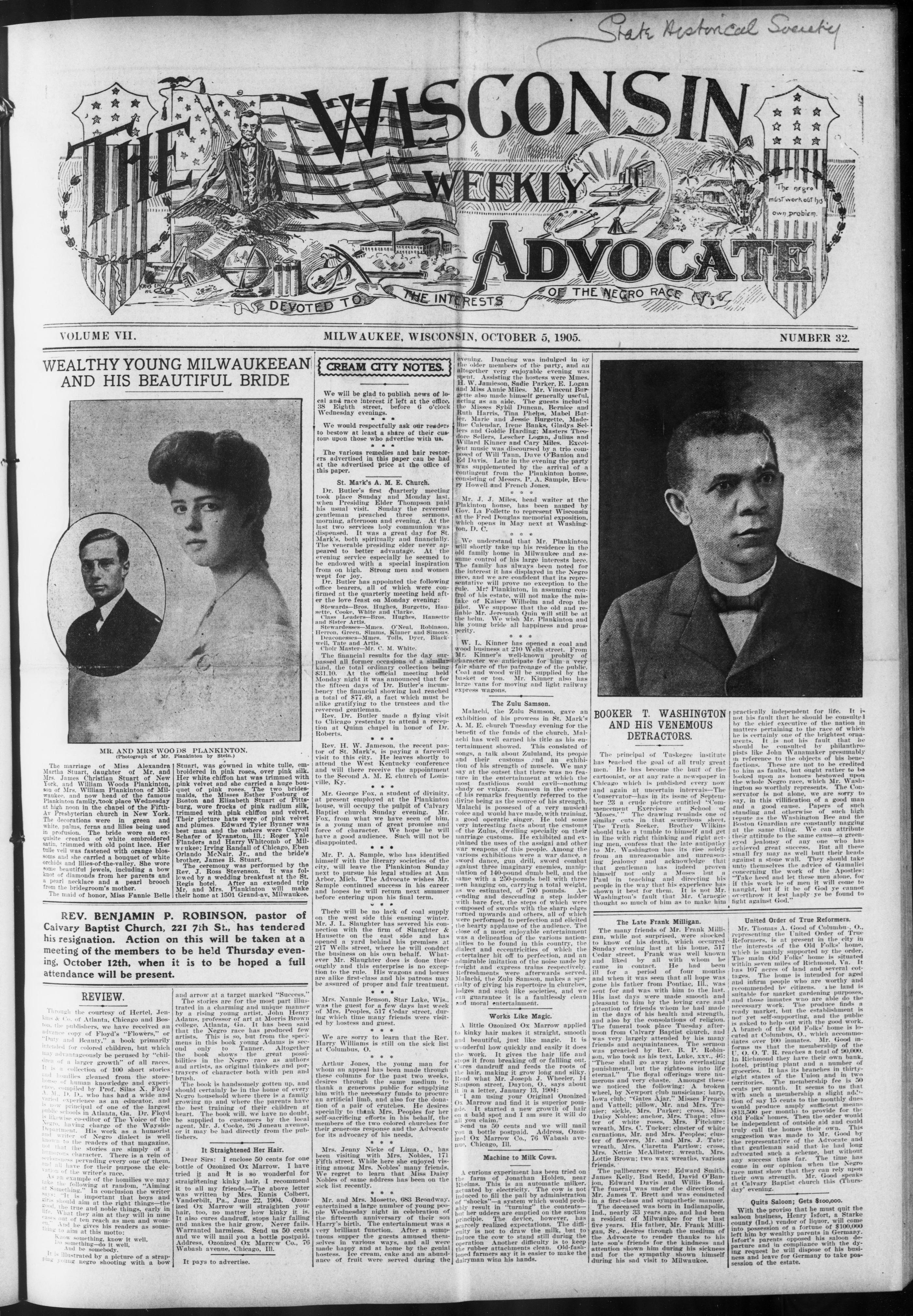
WEALTHY YOUNG MILWAUKEEAN AND HIS BEAUTIFUL BRIDE
Mary
MR. AND MRS WOODS PLANKINTON. (Photograph of Mr. Plankinton by Stein.)
The marriage of Miss Alexandra Martha Stuart, daughter of Mr. and Mrs. James Christian Stuart of New York, and William Woods Plankinton, son of Mrs. William Plankinton of Milwaukee, and now head of the famous Plankinton family, took place Wednesday at high noon in the chapel of the Fifth-Av Presbyterian church in New York. The decorations were in green and white, palms, ferns and lilies being used in profusion. The bride wore an exquisite creation of white embroidered satin, trimmed with old point lace. Her tulle veil was fastened with orange blossoms and she carried a bouquet of white orchids and lilies-of-the-valley. She wore some beautiful jewels, including a bow knot of diamonds from her parents and a pearl necklace and a pearl brooch from the bridegroom's mother.
REV. BENJAMIN P
Calvary Baptist Church, for
his resignation. Action of
meeting of the members to
ing, October 12th, when
attendance will be present
REV. BENJAMIN P. ROBINSON, pastor of Calvary Baptist Church, 221 7th St., has tendered his resignation. Action on this will be taken at a meeting of the members to be held Thursday evening, October 12th, when it is to be hoped a full attendance will be present.
Through the courtesy of Hertel, Jenkins & Co. of Atlanta, Chicago and Boston, the publishers, we have received an advance copy of Floyd's "Flowers," or "Duty and Beauty," a book primarily intended for colored children, but which may advantageously be perused by "children of a larger growth" of all races. It is a collection of 100 short stories and homilies gleaned from the storehouse of human knowledge and experience, compiled by Prof. Silas X. Floyd A. M., D. D., who has had a wide and varied experience as an educator, and is now principal of one of the largest public schools in Atlanta, Ga. Dr. Floyd is likewise co-editor of The Voice of the Negro, having charge of the Wayside Department. His work as a humorist and writer of Negro dialect is well known to the readers of that magazine, not that the stories are simply of a humorous character. There is a vein of seriousness pervading every one of them, and all have for their purpose the elevation of the writer's race.
As an example of the homilies we may take the following at random, "Aiming at Something." In conclusion the writer says: "It is important that boys and girls should aim at the right things—the good, the true and noble things, early in life. What they aim at they will in nine cases out of ten reach as men and women." And he gives his readers as something to aim at this motto:
Know something, know it well,
Do something—do it well,
And be somebody.
It is illustrated by a picture of a strapping young negro shooting with a bow
---
REVIEW
Stuart, was gowned in white tulle, embroidered in pink roses, over pink silk. Her white chiffon hat was trimmed with pink velvet and she carried a huge bouquet of pink roses. The two bridesmales, the Misses Esther Fosburg of Boston and Elizabeth Stuart of Pittsburg, wore frocks of pink radium silk, trimmed with pink chiffon and velvet. Their picture hats were of pink velvet and plumes. Edward Tyler Bynner was best man and the ushers were Carroll Schafer of Evanston, Ill.; Roger Yale Flanders and Harry Whitcomb of Milwaukee; Irving Randall of Chicago, Eben Orlando McNair, Jr., and the bride's brother James B. Stuart
The ceremony was performed by the Rev. J. Ross Stevenson. It was followed by a wedding breakfast at the St. Regis hotel. After an extended trip Mr. and Mrs. Plankinton will make their home at 1501 Grand-av. Milwaukee.
ROBINSON, pastor of 221 7th St., has tendered in this will be taken at a to be held Thursday evenit is to be hoped a full
and arrow at a target marked "Success." The stories are for the most part illustrated in a charming and unique manner by a rising young artist, John Henry Adams, professor of art at Morris Brown college, Atlanta, Ga. It has been said that the Negro race has produced few artists. This is so, but from the specimens in this book young Adams is second only to Tanner. Altogether the book shows the great possibilities in the Negro race as authors and artists, as original thinkers and portrayers of character both with pen and brush.
The book is handsomely gotten up, and should certainly be in the home of every Negro household where there is a family growing up and where the parents have the best training of their children at heart. The book will, we have no doubt, be supplied to customers by the local agent, Mr. J. Cooke, 26 Juneau avenue, or it may be had directly from the publishers.
It Straightened Her Hair
Dear Sirs: I enclose 50 cents for one bottle of Ozonized Ox Marrow. I have tried it and it is so wonderful for straightening kinky hair, I recommend it to all my friends.—The above letter was written by Mrs. Ennis Colbert, Vanderbilt, Pa., June 22, 1904. Ozonized Ox Marrow will straighten your hair, too, no matter how kinky it is. It also cures dandruff, stops hair falling and makes the hair grow. Never fails. Warranted harmless. Send us 50 cents and we will mail you a bottle postpaid. Address, Ozonized Ox Marrow Co., 76 Wabash avenue, Chicago, Ill.
It pays to advertise.
---
MILWAUKEE, WISCONSIN, OCTOBER 5, 1905.
CREAM CITY NOTES.
We will be glad to publish news of local and race interest if left at the office. 38 Eighth street, before 6 o'clock Wednesday evenings.
We would respectfully ask our readers to bestow at least a share of their custom upon those who advertise with us.
The various remedies and hair restorers advertised in this paper can be had at the advertised price at the office of this paper.
St. Mark's A. M. E. Church.
Dr. Butler's first quarterly meeting took place Sunday and Monday last, when Presiding Elder Thompson paid his usual visit. Sunday the reverend gentleman preached three sermons, morning, afternoon and evening. At the last two services holy communion was dispensed. It was a great day for St. Mark's, both spiritually and financially. The venerable presiding elder never appeared to better advantage. At the evening service especially he seemed to be endowed with a special inspiration from on high. Strong men and women went for joy.
Dr. Butler has appointed the following office bearers, all of which were confirmed at the quarterly meeting held after the love feast on Monday evening:
Stewards—Bros. Hughes, Burgette, Hansette, Cooke, White and Clarke.
Class Leaders—Bros. Hughes, Hansette and Sister Artis.
Stewardesses—Mmes. O'Neal, Robinson, Herron, Green, Simus, Kinner and Simons.
Denconesses—Mmes. Tolls, Dyer, Blackwell, Tate and Artis.
Choir Master-Mr. C. M. White. The financial results for the day surpassed all former occasions of a similar kind, the total ordinary collection being $31.10. At the official meeting held Monday night it was announced that for the fifteen days of Dr. Butler's incumbency the financial showing had reached a total of $77.49, a fact which must be alike gratifying to the trustees and the reverend gentleman. Rev. Dr. Butler made a flying visit to Chicago yesterday to attend a reception at Quinn chapel in honor of Dr. Roberts.
冰
Rev. H. W. Jameson, the recent pastor of St. Mark's, is paying a farewell visit to this city. He leaves shortly to attend the West Kentucky conference and will there receive the appointment to the Second A. M. E. church of Louisville, Ky.
Mr. George Fox, a student of divinity, at present employed at the Plankinton house, will occupy the pulpit of Calvary Baptist church Sunday evening. Mr. Fox, from what we have seen of him, is a young man of great promise and force of character. We hope he will have a good audience. Such will not be disappointed.
---
Mr. P. A. Sample, who has identified himself with the literary societies of the city, will leave the Plankinton Sunday next to pursue his legal studies at Ann Arbor, Mich. The Advocate wishes Mr. Sample continued success in his career and hopes he will return next summer before entering upon his final term.
---
There will be no lack of coal supply on the west side this ensuing winter. Mr. J. L. Slaughter has severed his connection with the firm of Slaughter & Hausette on the east side and has opened a yard behind his premises at 217 Wells street, where he will conduct the business on his own behalf. Whatever Mr. Slaughter does is done thoroughly and this enterprise is no exception to the rule. His wagons and horses are alike first-class and his patrons may be assured of proper and fair treatment.
* * *
Mrs. Nannie Benson, Star Lake, Wis., was the guest for a few days last week of Mrs. Peoples, 517 Cedar street, during which time many friends were visited by hostess and guest.
---
We are sorry to learn that the Rev. Harry Williams is still on the sick list at Columbus, O.
***
Arthur Jones, the young man for whom an appeal has been made through these columns for the past two weeks, desires through the same medium to thank a generous public for supplying him with the necessary funds to procure an artificial limb, and also for the donation of a pair of crutches. He desires specially to thank Mrs. Peoples for her self-sacrificing efforts in his behalf, the members of the two colored churches for their generous response and the Advocate for its advocacy of his needs.
***
Mrs. Jenny Nicke of Lima, O., has been visiting with Mrs. Nobles, 171 Fifth street. While here she enjoyed visiting among Mrs. Nobles' many friends. We regret to learn that Miss Daisy Nobles of same address has been on the sick list recently.
***
Mr. and Mrs. Mosette, 683 Broadway, entertained a large number of young people Wednesday night in celebration of the fifteenth anniversary of their son Harry's birth. The entertainment was a very brilliant function. After a sumptuous supper the guests amused themselves in various ways, and all were made happy and at home by the genial hostess. Ice cream, cake and an abundance of fruit were served during the
evening. Dancing was indulged in by the older members of the party, and an altogether very enjoyable evening was spent. Assisting the hostess were Mmes. H. W. Jamieson, Sadie Parker, E. Logan and Miss Annie Miles. Mr. Vincent Burgette also made himself generally useful, acting as an aide. The guests included the Misses Sybil Duncan, Bernice and Ruth Harris, Tina Phelps, Mabel Butler, Marie and Jessie Burgette, Madeline Calendar, Irene Banks, Gladys Sellers and Goldie Harding; Masters Theodore Sellers, Lescher Logan, Julius and Willard Kinner and Cary Miles. Excellent music was discoursed by a trio composed of Will Tann, Dave O'Banion and Ed Davis. Late in the evening the party was supplemented by the arrival of a contingent from the Plankinton house, consisting of Messrs. P. A. Sample, Henry Howell and French Jones.
Mr. J. J. Miles, head waiter at the Plakinton house, has been named by Gov. La Follette to represent Wisconsin at the Fred Douglas memorial exposition, which opens in May next at Washington, D. C.
We understand that Mr. Plankinton will shortly take up his residence in the old family home in Milwaukee and assume control of his large interests here. The family has always been noted for the interest it has displayed in the Negro race, and we are confident that its representative will prove no exception to the rule. Mr. $ ^{*} $ Plankinton, in assuming control of his estate, will not make the mistake of Kaiser Wilhelm and drop the pilot. We suppose that the old and reliable Mr. Jeremiah Quin will still be at the helm. We wish Mr. Plankinton and his young bride all happiness and prosperity.
W. L. Kinner has opened a coal and wood business at 210 Wells street. From Mr. Kinner's well-known probity of character we anticipate for him a very fair share of the patronage of the public. Coal and wood will be supplied by the basket or ton. Mr. Kinner also has large vans for moving and light railway express wagons.
The Zulu Samson.
Malachi, the Zulu Samson, gave an exhibition of his prowess in St. Mark's A. M. E. church Tuesday evening for the benefit of the funds of the church. Malachi has well earned his title as his entertainment showed. This consisted of songs, a talk about Zululand, its people and their customs and an exhibition of his strength of muscle. We may say at the outset that there was no feature in the entertainment at which the most fastidious could cavil--nothing shady or vulgar. Samson in the course of his remarks frequently referred to the divine being as the source of his strength. Malachi is possesed of a very musical voice and would have made, with training, a good operatic singer. He told some very interesting facts about the customs of the Zulus, dwelling specially on their marriage customs. He exhibited and explained the uses of the assigai and other war weapons of this people. Among the various exhibitions were a war dance, a sword dance, gun drill, sword combat against three imaginary enemies, manipulation of 140-pound dumb bell, and the same with a 250-pounds bell with three men hanging on, carrying a total weight, as we estimated, of 700 pounds. Ascending and descending a step ladder with bare feet, the steps of which were composed of swords with the sharp edges turned upwards and others, all of which were performed to perfection and elicited the hearty applause of the audience. The close of a most enjoyable entertainment was a delineation of the various nationalities to be found in this country, the dialect and eccentricities of which the entertainer hit off to perfection, and an admirable imitation of the noise made by freight and express trains respectively. Refreshments were afterwards served. Malachi, the Zulu Samson, makes a specialty of giving his repertoire in churches, lodges and such like societies, and we can guarantee it is a faultlessly clean and moral entertainment.
Works Like Magic.
A little Ozonized Ox Marrow applied to kinky hair makes it straight, smooth and beautiful, just like magic. It is wonderful how quickly and easily it does the work. It gives the hair life and stops it from breaking off or fallling out. Cures dandruff and feeds the roots of the hair, making it grow long and silky. Read what Mr. Joseph J. Wheeler, 14 Simpson street, Dayton, O., says about it in a letter, January 13, 1904:
"I am using your Original Ozonized Ox Marrow and find it is superior pomade. It started a new growth of hair on a bald spot and I am sure it will do all you claim."
Send us 50 cents and we will mail you a bottle postpaid. Address, Ozonized Ox Marrow Co., 76 Wabash avenue, Chicago, Ill.
Machine to Milk Cows.
A curious experiment has been tried on the farm of Jonathan Holden, near Rheims. This is an automatic milker, actuated by electricity. The cow is not induced to fill the pail by administration of "shocks"—a system which would probably result in "turning" the contents—but her udders are emptied on the suction principle. The device, however, has scarcely realized expectations. The difficulty is not to draw the milk, but to induce the cow to stand still during the operation. Another difficulty is to keep the rubber attachments clean. Old-fashioned farmers say it is easier to make the dairyman wisen his hands.
BOOKER T. WASHINGTON AND HIS VENEMOUS DETRACTORS.
The principal of Tuskegee institute has reached the goal of all truly great men. He has become the butt of the cartoonist, or at any rate a newspaper in Chicago which is published every now and again at uncertain intervals—The Conservator—has in its issue of September 23 a crude picture entitled "Commencement Exercises at School of 'Moses.'" The drawing reminds one of similar cuts in that scurrilous sheet. The Truth Seeker, Brother Wilkins should take a tumble to himself and get in line with right thinking and right acting men, confess that the late antipathy to Mr. Washington has its rise solely from an unreasonable and unreasoning jealousy and acknowledge that that gentleman has indeed proven himself not only a Moses but a Paul in teaching and directing his people in the way that his experience has shown it best for them. It is not Mr. Washington's fault that Mr. Carnegie thought so much of him as to make him
The Late Frank Milligan.
The many friends of Mr. Frank Milligan, while not surprised, were shocked to know of his death, which occurred Sunday evening last at his home, 517 Cedar street. Frank was well known and liked by all with whom he came in contact. He had been ill for a period of four months and when it was seen that all hope was gone his father from Pontiac, Ill., was sent for and was with him to the last. His last days were made smooth and pleasant to him by the loving care and attention of friends whom he had made in the days of his health and strength, and also by the consolations of religion. The funeral took place Tuesday afternoon from Calvary Baptist church, and was very largely attended by his many friends and acquaintances. The sermon was preached by Rev. B. P. Robinson, who took as his text, Luke, xxv., 46: "These shall go away into everlasting punishment, but the righteous into life eternal." The floral offerings were numerous and very chaste. Amongst these we noticed the following: A broken wheel, by Newport club musicians; harp, Iowa club; "Gates Ajar," Misses French and Vattell; pillow, Mr. and Mrs. Trenier; sickle, Mrs. Parker; cross, Miss Daisy Nobles; anchor, Mrs. Thapa; cluster of white roses, Mrs. Fitchure; wreath, Mrs. C. Tucker; cluster of white carnations, Mr. and Mrs. Peoples; cluster of flowers, Mr. and Mrs. J. Tate; wreath, Mrs. Claretta Partlow; cross, Mrs. Nettie McAllister; wreath, Mrs. Lottie Brown; two wax wreaths, various friends.
The pallbearers were: Edward Smith, James Kelly, Bud Redd, David O'Banjon, Edward Davis and Willis Bond. The funeral was under the direction of Mr. James T. Brett and was conducted in a first-class and sympathetic manner. The deceased was born in Indianapolis, Ind., nearly 33 years ago, and had been a resident of Milwaukee for the last five years. His father, Mr. Frank Milligan, Sr., desires through the medium of the Advocate to render thanks to his late son's friends for the kindness and attention shown him during his sickness and for the sympathy shown himself during his sad visit to Milwaukee.
NUMBER 32.
THE CHRISTIAN CHRISTIAN
practically independent for life. It is not his fault that he should be consulted by the chief executive of the nation in matters pertaining to the race of which he is certainly one of the brightest ornaments. It is not his fault that he should be consulted by philanthropists like John Wanamaker presumably in reference to the objects of his benefactions. These are not to be credited to him as faults, but ought rather to be looked upon as honors bestowed upon the whole Negro race, which Mr. Washington so worthily represents. The Conservator is not alone, we are sorry to say, in this villification of a good man and a good cause. Papers of such standing and otherwise of such high repute as the Washington Bee and the Boston Guardian are constantly nagging at the same thing. We can attribute their attitude to the same cause—a greeneyed jealousy of any one who has achieved great success. But all these small fry may as well butt their heads against a stone wall. They should take unto themselves the advice of Gamaliel concerning the work of the Apostles: "Take heed and let these men alone, for if this work be of men it will come to naught, but if it be of God ye cannot overthrow it lest haply ye be found to fight against God."
United Order of True Reformers.
Mr. Thomas A. Good of Columbus, O., representing the United Order of True Reformers, is at present in the city in the interests of the Old Folks' home, which is mainly supported by the order. The main Old Folks' home is situated within seven miles of Richmond, Va. It has 107 acres of land and several cottages. The home is intended for aged and infirm people who are worthy and recommended by citizens. The land is suitable for market gardening purposes, and those inmates who are able do the necessary work. The produce finds a ready market, but the establishment is not yet self-supporting, and the public is asked to help out with the good work. A branch of the Old Folks' home is located at Columbus, O., which accommodates over 100 inmates. Mr. Good informs us that the membership of the U. O. O. T. R. reaches a total of 90,000. In Richmond they have their own bank, hotel, printing plant and a number of groceries. It has its branches in thirty-eight states of the Union and in two territories. The membership fee is 50 cents per month. It seems to us that with such a membership a slight addition of say 15 cents to the monthly dues would produce amply sufficient means ($13,500 per month) to provide for the Old Folks' homes. Then the order would be independent of outside aid and could truly call the homes their own. This suggestion was made to Mr. Good by the representative of the Advocate and that gentleman said that he had long advocated such a scheme, but without any success thus far. The time has come in our opinion when the Negro race must show that they can rely upon their own strength. Mr. Good speaks at Calvary Baptist church this (Thursday' evening.
Quits Saloon: Gets $100,000.
With the proviso that he must quit the saloon business, Henry Isfort, a Starke county (Ind.) vendor of liquor, will come into possession of a fortune of $100,000 left him by wealthy parents in Germany. Isfort's parents opposed his saloon departure and in compliance with the dying request he will dispose of his business and leave for Germany to take possession of the estate.
The number of cattle destroyed by wild beasts in India last year exceeded 86,000.
Though birds are credited with some sense of smell, an English observer finds turkeys indifferent to all odors.
A shop in Strasburg called "The Sign of the Stag," has been occupied as a chemist's business for 700 years.
Soda in a 2 per cent. solution is recommended by Prof. Esmarch of Gottingen as the best means of disinfecting eating utensils.
Ald. Hamburger of New York city, although he has been in office only a little over three years, has married over 6000 people.
-At Strohbeck, Prussian Saxony, chess is a part of the regular school curriculum, and every boy and girl carries a board and men.
-Rates (at Lloyd's) are being eagerly inquired for to insure against the risk of riots, civil commotions, etc., in Russian ports and inland towns.
-The Hot Lake district of New Zealand includes seven lakes, ranging in area from three to thirty-one square miles, besides many of smaller size.
-The lakes in Battersea park have become so thickly stocked with fish that some tons of bream, carp, roach and tench are to be removed from the park and turned into the Thames in its upper reaches.
The British Columbia canaries, like those on the sound, are under the necessity of throwing away fish. It is impossible so to regulate the catch as not to have salmon accumulate and spoil when the heavier runs are on.
Fishermen in our small possession, Guam, take with them on their Waltonian expedition, an intoxicant with which to catch their fish. This is the fruit of the Barringtonia speciosa used by the natives to stupefy the fish.
The Fourth of July this year was responsible for only 182 deaths and 4994 serious accidents. Yet as there are only forty-six fireworks manufacturers in this country, the average—practically four deaths apiece and more than 108 injuries—is distinctly creditable.
Two Australian black swans were recently picked up off Norfolk island, in the Pacific. They must have traveled 400 miles. The birds were in a very exhausted condition, but after a fresh water bath and plenty of food they revived. The black swan is a powerful swimmer, but 400 miles at sea is a long swim, even for him.
An Irishman who has a farm in Kansas has thought out a true Irish way of getting rid of grasshoppers. He keeps a flock of 2000 turkeys and turns them loose in his fields to eat the insects. He also rents them to his neighbors, and has made a good bit of money this year.
-Is is reported that the director of the French school at Athens has just discovered at Delos three large lead vases full of old coins. The largest contained more than 300 4-drachma pieces minted in Athens under the Archons. They are said to be in such perfect state that they would appear never to have beer, put in circulation.
-In Roumania mothers bind red ribbons around the ankles of their babies to protect them from harm. The Vosges peasants say that a child born at the new moon has a well-hung tongue and a child born at the last quarter will have keen powers of reason. In Ireland a strand of woman's hair is placed in the cradle as a protection; while Welsh mothers place their faith in a knife or a pair of tongs as a charm against evil.
As an example of what queer things come up at the London auctions: At the same sale appeared lately an apron, two armlets, and other pieces used in devil dancing ceremonies in Thibet, these objects being made up of bones belonging deceased Lamas—they are carved with images of Buddha—a death's head made of lacquer, to be used as a mask of Oliver Cromwell, in perfect condition. The mask taken from Noll's face brought $400; the devil dancer's outfit, $500.
Superstition in Devonshire
Devonshire is known to the world for its superstitious usages, which defy all efforts to uproot them. To name only one example, when a person dies all the relatives must touch the body or they will be haunted by the ghost of the dead forever after. A superstition not so local in its observance is that of beginning no task on a Friday. The writer recently encountered a girl who, receiving notice to change from one room to another on Friday, insisted upon doing it on the Thursday instead. But the most curious instance of superstition—and this, too, is met with much nearer home than Devon—is surely that which prescribes that when, say, a domestic servant has broken a piece of crockery, she is bound by fate to break two other pieces. So far is this idea carried that the writer knows a case where flower pots are kept for the special purpose of being broken to appease the fates! Charles Dickens, however, who died thirty-five years ago, noted that all good things had come to him on a Friday!—London Chronicle.
Hair-Wash Lake.
Very interesting items may be sometimes unearthed from the consular reports. For example, there is a description of a soapy lake in the annual statement of the trade and commerce of Nicaragua. This sheet of water, the Lake of Nejapa, contains a strong solution of bicarbonate of potash, bicarbonate of soda, and sulphate of magnesia. "This water, when rubbed on any greasy object, at once forms a lather." The report says it is used as a hair-wash, and enjoys a local reputation as a cure for external and internal complaints. The Nicaraguans are not conspicuous for commercial enterprise, but during the year they managed to export "four demijohns" of this wonderful water to the neighboring Guatemala.
"Damsite" Name of Postoffice
"Damsite" probably will be the name of a new postoffice to be established in Texas. When this cognomen first was suggested the postoffice department officials were inclined to sidestep. Cecil Lyon, Republican national commitman for Texas, at the postoffice department today explained that the locality to be served by the new office was known locally as "Damsite" because engineers were building a large irrigation dam at that point.
"We do not mean to be profane," said Col. Lyon. "Some folks make me weary."
Move Cottage Eight Miles.
Because he could not rent a four-room cottage he had built at Capitan, N. M., L. A. Stevens will move it to Roswell, a distant of eighty-five miles. He left for Capitan with a large force of men and says he will roll the residence to its new site in ten days.
Vineless Potato on Exhibition.
What the producer calls a vineless potato is being exhibited at the county fair at Great Falls, Mont. According to the developer, they may be grown in boxes in layers and without stalks.
"FAREWELLS-TO-SUMMER."
(The name given by the mountaineers of North Carolina to the wild aster.)
Bright dashes of crimson are gleaming below;
The skies overhead are with splendor aglow;
While the crispness of autumn is in the air,
And "farewells to-summer" are everywhere!
In purple and lilac, in yellow and white.
They wave us adieu as we pass out of
As their farewell to summer. Farewell! farewell!
-Mrs. S. O'H. Dickson in the Pilgrim.
SOME OF THE SACRIFICES.
By Lieut-Col. J. A. Warous, C. B. H. The sorrowful and pathetic stories founded on army experiences are numerous-painfully numerous. The number of such stories has rapidly increased since 1898, when the army began to scatter to Cuba, Porto Rico, Hawaii and the Philippines, and, of course, naturally, for in such a distribution of the forces there was a separation of famliies, which in itself is sorrowful and often extremely pathetic.
It was no easy task for a father, surrounded by a happy band of little children, to part with them and their mother and sail away 10,000 miles from home; nor was it a light task for the young soldier to say good-bye to his bride; and what thousands of heartaches there were when fathers, mothers, sisters and brothers parted with the brave men who went to the way-off islands to do valiant service beneath the beautiful emblem of the country that they and their officers were willing to die for, if need be. It was also different from partings where the soldier was to go only to portions of his own country and could be within ready communication by mail and wire with the dear ones at home.
I wonder if the great public stops to think of these things when it reads of the heroism and faithful service of the little army that never fails to defend their flag and honor their country whenever the emergency arises. These thoughts, and many others connected with the army, and the sorrowful and pathetic side of army experiences, have come to me many times on tours to army posts. Two years ago a beautiful and accomplished daughter of Nebraska became the bride of a lieutenant in the Twenty-second infantry. They spent their honeymoon at the home of the groom at Baraboo, in Wisconsin, and later on were the guests of Congressman John J. Jenkins of the same state.
In October, 1903, the Twenty-second started on its second tour to the Philippines. With it went a dozen or more of the newly married couples, but Lieut. Harry Parshall and his Nebraska bride concluded, after giving the subject much thought, that it was best for her to remain with her parents at Valentine, Neb., until the regiment should become settled in its distant camp on the island of Mindanao. The regiment was quickly engaged in the work of subduing the Moroes and some months passed before Lieut. Parshall felt justified in sending for his wife.
Early the following February matters had so shaped that he wrote asking her to come.
The letter reached her late in March and with a heart full of gladness she hurried in the work of preparing for the long journey to meet the one man who was more to her than all of the rest of the world.
The last of the preparation had been completed, arrangements for transportation had been made, and within two days she was to say farewell to father and mother, sister and brother, and enter upon the long journey to the Philippines.
Who can picture, who describe the grief, the unutterable sorrow of this young bride the next morning as she picked up the paper and read in the cabled news from Manila the name of her husband in the list of those who had died the day before?
Indeed, why attempt to describe that?
Is it not far better to drop the curtain and take every possible step to carry comfort to the stricken one, to plead for sunrays across her pathway, to show her, if possible, that all of the light of the world is not gone out?
Lieut. Parshall had participated with his regiment in its many campaigns and distinguished himself by acts of daring bravery, was a favorite with both men and officers, all of whom joined in tenderest sympathy for the sorrowing one away back in the home country. He was sick only a short time. His death came suddenly.
Among the volunteer paymasters who went to the Philippines in 1900 was Maj. O. E. Wilkins of Ohio. His second trip was one of the hardest paymasters were called upon to take. They were obliged to travel long distances on horseback, climb mountains, ford rivers, and pass through the enemy's country, where the danger was always very great until the rebellion was subdued. His health was not of the best, but his courage was equal to anything.
The labor was too great and the exposure disastrous. He returned at the end of six weeks with his lungs seriously affected and the loss of one of his eyes. The latter was destroyed while marching one night through a forest, when a limb struck his face, one of the branches penetrating the eye. He was sent home, but at the end of two or three months returned to the islands and took up the hard work there, as a captain of regulars, in the pay corps.
His health was such that he took his life in his hands every time he went out upon a pay trip, and when, at the end of a tour of two years, he started for home he was a physical wreck and mentally so weakened that he was no longer the cheerful, hopeful Capt. Wilkins friends had known and loved. He was obliged to remain at San Francisco for some time before he could stand the journey to his
Ohio home. After gaining some strength he reported for duty at Chicago, but it was soon found necessary to send him to a hospital where he was examined by a board, whose report favored his retirement. The day after the order was issued placing his name on the retired list news came that Capt. Wilkins would climb no more mountains, ford no more rivers—that his day of rest, final rest, had come. Brave little Wilkins; we all loved him.
In March, 1899, Hugh Belknap of Chicago, whose second term in Congress had just ended, was appointed a volunteer paymaster with the rank of major. Two years later he was appointed a major in the regular army, and in July of 1901, accompanied by his bride, he sailed for the Philippines on the transport Thomas. He started on his first pay trip within two weeks after reaching Manila. His first stop was at Calamba, where he was taken violently ill, and an operation was necessary. His chief paymaster and Mrs. Belknap were sent for. The chief paymaster, Maj. Elijah W. Halford, was at his side as quickly as possible. Maj. Belknap felt that he was on his deathbed. Looking at Maj. Halford, a most devoted Christian gentleman, he said:
"Major, I have two requests to make. I want you to be as kind as possible to my poor wife, whom I must leave far from her home and among strangers; then I want you to pray for me."
Maj. Halford knelt beside the cot and offered up a feeling prayer for the stricken soldier.
The next morning Maj. Belknap breathed his last and when the Thomas was ready to return to San Francisco it brought back the widow Belknap and a coffin bearing the mortal remains of a splendid gentleman, a capable officer and a devoted husband.
Maj. Belknap was a son of Gen. W. W. Belknap, an Iowa soldier, who served as secretary of war in Gen. Grant's cabinet. Evening Wisconsin.
A SECTIONAL STEAMBOAT
Parts Readily Put Together and Self-Locking-For Use of Army.
A most unique and interesting sectional steamer has recently been constructed for the United States engineers' office of the army department, with the idea of having a boat that could be transported on a large steamer or warship and assembled where required for service in a moderate seaway. Nothing of a similar nature has ever been constructed, making this boat of particular interest, as the parts are arranged so as to be readily put together and are selflocking.
The boat is built of steel, with twin screws, and has two compound engines and a Seabury water tube boiler. The vessel is 80 feet long, with a draft of 3.5 feet and a beam of 18 feet. She has a displacement of 72 tons and operates at a speed of 11 knots per hour. The section containing the engines has a space cut off fore and aft, 11.5 feet, with an inside bulkhead for the officers' quarters.
The sections are fitted with cones, 1 foot 2 inches in diameter. In the section next to the engine is a boiler installation, which includes storage tanks for water and fuel bunkers for 16,000 pounds of coal. The engine section contains two double cylinder compound engines with 9-inch stroke, the high pressure cylinders measuring 6 inches in diameter, and the low pressure cylinders 12 inches. The section ahead of that containing the boiler installation has quarters for a crew of twenty men and also serves as a hold for the cargo, while the bow section has the necessary store lockers and carries the chain and anchor equipment, as well as a derrick.
The boom and derrick mast provided have a capacity of 12,000 pounds, the forward deck also having hatchways which are provided with water-tight covering flush with the deck. There are two light boats with davits on the steel deck, which is constructed to carry a load of 20,000 pounds, concentrated on a truck of four wheels, having an 8-foot wheel base. There is a windlass on the deck of each section and a steel cable to connect the sections, bolts being used for re-enforcement, and when the steel deck is in place each section of the steamer becomes a water-tight compartment.
It is stated that this type of vessel will be of special service for the prompt handling of troops and munitions in time of war, the necessary war material, provisions and men being easily transferred from the army transport to any coast where it is necessary to make a landing. American Inventor.
COFFIN IS SENT BY MAIL.
Most Unique Package Ever Sent from Palmer House.
"I want to send a coffin to Buffalo by mail," said George Gaylord of Erie to Clerk Mann of the Palmer house, Chicago. "What do you suppose the postage will be?"
"Great Scott, what next!" gasped Mann. "A coffin by mail; well, that's the limit."
"Yes, you see, I am very anxious that my friends in Buffalo shall get the body without fail and in good condition, for they will probably want to cremate it."
"You had better try the express company," said the clerk. "You see, the postal authorities have limited the weight of mail matter to sixteen pounds, or something like that, and I presume the body weighs more than that?"
"Hardly," said Gaylord, with a grin, as he produced a small coffin five inches long and laid it on the scales. "How much does it weigh?"
"Four cents' worth of stamps," said Mann, partly to the mail clerk and partly in answer to the question.
The coffin contained a small perfecto cigar and was addressed to Detective Holmes, in care of police headquarters at Buffalo. Neatly engraved on the plate was the inscription. "Don't be a dead one." It was the most unique piece of mail matter that has ever left the hotel.
Superstitions About Rubies.
A beautiful idea is prevalent in Burmah about rubies. The natives believe that their color changes gradually while they ripen in the earth, as if a fruit. At first they say the stone is colorless then it becomes yellow, green, blue, each in turn, the final stage being red. When redness is attained the ruby is ripe. The ruby is said to influence the wearer very strongly for good or evil. It is supposed to bring one's due in money that has been misappropriated. If it brings bad luck to the wearer it should be discarded; it is malevolent.
An Omnivorous Cow
"An omnivorous cow belonging to a Scott county farmer named B. A. Myers, living near Forest, has gone the way of bovine flesh that aspires to rival the performance of the glass eater of circus fame," said a Mississippian. "The cow in question was sick for a period of twelve days with a very strange malady, and after her death an autopsy was performed. In the stom-
ach was found a choice assortment of hardware, consisting of fifteen nails, four screws, two pants buckles, five tacks, a few cartridge shells and an assortment of nuts, bolts and other miscellaneous scrap iron picked up at random during her earthly career. "Mr. Myers is unable to account for the unusual taste of his cow. Otherwise she manifested no symptoms of deprivity, was a good milcher and had always been a high-toned and conscientious animal."—Birmingham News.
HANDLE FOR UTENSILS.
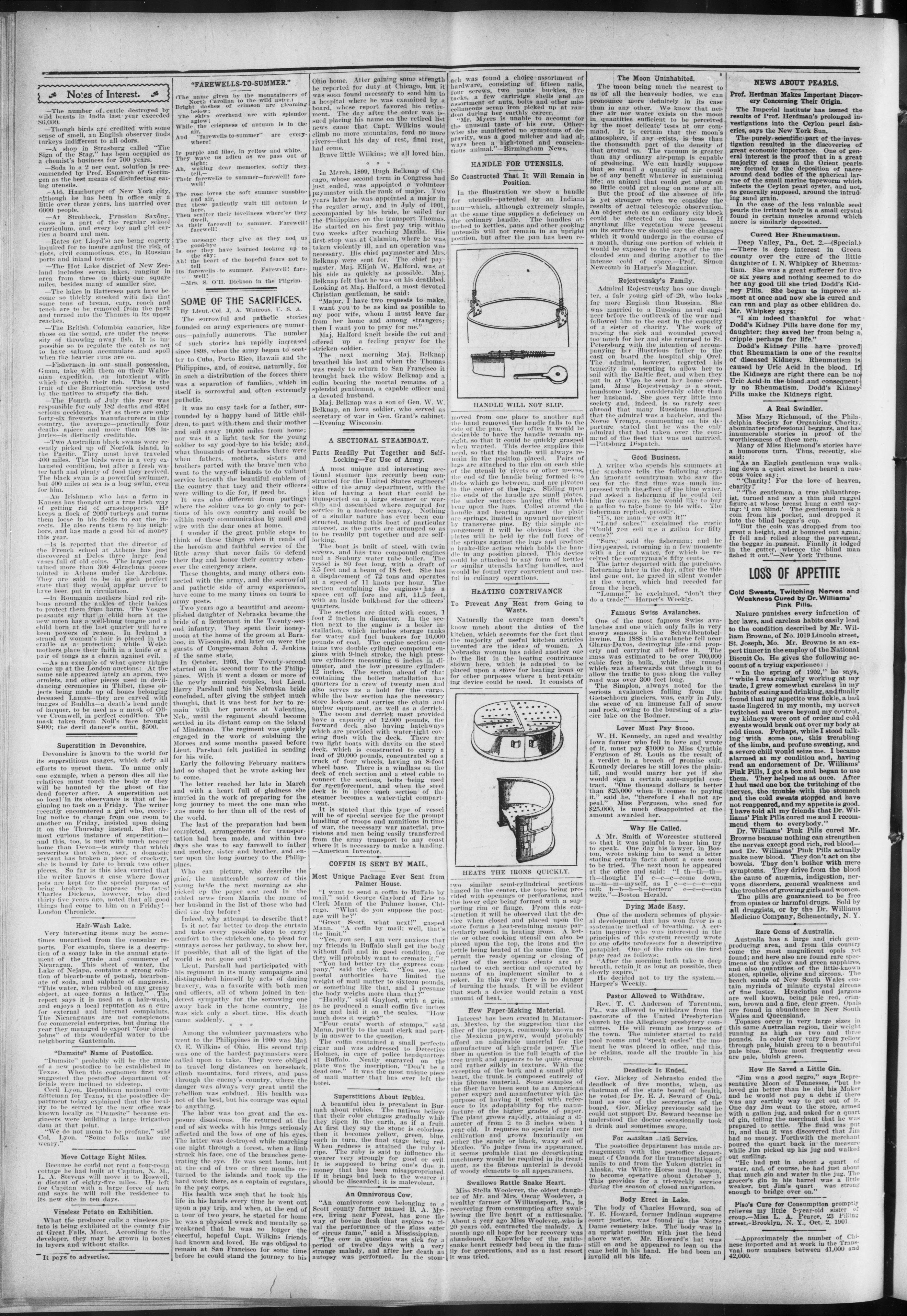
In the illustration we show a handle for utensils-patented by an Indiana man—which, although extremely simple, at the same time supplies a deficiency on the ordinary handle. The handles attached to kettles, pans and other cooking untensils will not remain in an upright position, but after the pan has been re-
```markdown
```
HANDLE WILL NOT SLIP.
moved from one place to another and the hand removed the handle falls to the side of the pan. Very often it would be desirable to have the handle remain upright, so that it could be quickly grasped when wanted. This device supplies this need, so that the handle will always remain in the position placed. Pairs of lugs are attached to the rim on each side of the utensil by rivets or other means, the end of the handle being formed into disks which go between, and are pivoted in the center of the lugs. Sliding upon the ends of the handle are small plates, the under surfaces having ribs which bear upon the lugs. Coiled around the handle and bearing against the plate are springs, limited in upward movement by transverse pins. By this simple arrangement it will be obvious that the plates will be held by the full force of the springs against the lugs and produce a brake-like action which holds the handle in any position placed. This device could be attached to any form of kettles or similar utensils having handles, and would be found very convenient and useful in culinary operations.
HEATING CONTRIVANCE
To Prevent Any Heat from Going to Waste.
Naturally the average man doesn't know much about the duties of the kitchen, which accounts for the fact that the majority of useful kitchen articles invented are the ideas of women. A Nebraska woman has added another one to the list in the heating contrivance shown here, which is adapted to be placed upon a stove for heating irons or for other purposes where a heat-retaining device could be used. It consists of
HEATS THE IRONS QUICKLY.
two similar semi-cylindrical sections hinged in the center, the tops being provided with openings or perforations, and the lower edge being formed with a supporting rim or flange. From this construction it will be observed that the device when closed and placed upon the stove forms a heat-retaining means particularly useful in heating irons. A kettle or other cooking utensil can also be placed upon the top, the irons and the kettle being heated at the same time. To permit the ready opening or closing of either of the sections cleats are attached to each section and operated by means of an implement similar to a poker. In this way there is no danger of burning the hands. It will be evident that such a device would retain a vast amount of heat.
New Paper-Making Material.
Interest has been created in Matamoras, Mexico, by the suggestion that the fiber of the papsya, commonly known as the Mexican pawpaw, would probably afford an admirable material for the manufacture of high-grade paper. The fiber in question is the full length of the tree trunk and appears to be quite strong and rather silkly in texture. With the exception of the bark and a small pithy heart, the trunk is composed entirely of this fibrous material. Some samples of the fiber have been sent to an American paper expert and manufacturer with the purpose of having it tested with reference to its adaptability for the manufacture of the higher grades of paper. The plant grows rapidly, attaining a diameter of from 2 to 3 inches when 1 year old. It requires no special care nor cultivation and grows luxuriantly on either the sandy or black, waxy soil of Mexico. To judge from its appearance, it seems probable that no decorticating machinery would be required in its treatment, as the fibrous material is devoid of woody elements to all appearances.
Swallows Rattle Snake Heart
Miss Stella Woolever, the oldest daughter of Mr. and Mrs. Oscar Woolever, a wealthy farmer of Williamsport, Pa., is recovering from consumption after swallowing the live heart of a rattlesnake. About a year ago Miss Woolever, who is 20 years old, contracted the malady. A month ago all hope for her recovery was abandoned. Knowledge of the rattlesnake heart remedy had been in the family for generations, and as a last resort it was tried.
The Moon Uninhabited
The moon being much the nearest to us of all the heavenly bodies, we can pronounce more definitely in its case than in any other. We know that neither air nor water exists on the moon in quantities sufficient to be perceived by the most delicate tests at our command. It is certain that the moon's atmosphere, if any exists, is less than the thousandth part of the density of that around us. The vacuum is greater than any ordinary air-pump is capable of producing. We can hardly suppose that so small a quantity of air could be of any benefit whatever in sustaining life; an animal that could get along on so little could get along on none at all.
But the proof of the absence of life is yet stronger when we consider the results of actual telescopic observation. An object such as an ordinary city block could be detected on the moon. If anything like vegetation were present on its surface we should see the changes which it would undergo in the course of a month, during one portion of which it would be exposed to the rays of the unclouded sun and during another to the intense cold of space.-Prof. Simon Newcomb in Harper's Magazine.
Rojestvensky's Family.
Admiral Rojestvensky has one daughter, a fair young girl of 20, who looks far more English than Russian. She was married to a Russian naval engineer before the outbreak of the war and followed him to the east in the capacity of a sister of charity. The work of nursing the sick and wounded proved too much for her and she returned to St. Petersburg with the intention of accompanying her illustrious father to the east on board the hospital ship Orel. The admiral, however, regretted his temerity in consenting to allow her to sail with the Baltic fleet, and when they put in at Vigo he sent her home overland. Mme Rojestvensky is a stout, handsome lady, considerably older than her husband. She goes very little into society and, indeed, is so rarely seen abroad that many Russians imagined that the admiral was a bachelor, and the Novoe Vremya, commenting on his departure stated that he was the only admiral that had taken over the command of the fleet that was not married. —Pittsburg Dispatch.
Good Business.
A writer who spends his summers at the scashore tells the following story: An ignorant countryman who saw the sea for the first time was much impressed with the effect of the blue water, and asked a fisherman if he could tell him the owner, as he would like to buy a gallon to take home to his wife. The fisherman replied, proudly.
"Us, me man—we own it!"
"Land sakes!" exclaimed the rustic "Could you sell me a gallon for fifty cents?"
"Sure," said the fisherman; and he disappeared, returning in a few moments with a jar of water, for which he received the countryman's fifty cents.
The latter departed with the purchase. Returning later in the day, after the tide had gone out, he gazed in silent wonder at the water, which had receded far from the beach.
"Lumme!" he exclaimed, "don't they do a trade!"—Harper's Weekly.
Famous Swiss Avalanches.
One of the most famous Swiss avalanches and one which only falls in very snowy seasons is the Schwalbentobellawine. In 1888 this avalanche fell near Glarus-Davos, destroying life and property and carrying all before it. The mass was estimated to be over 700,000 cubic feet in bulk, while the tunnel which was afterwards cut through it to allow the traffic to pass along the valley road was over 300 feet long.
The Simplon, always noted for the serious avalanches falling from the Gletschhorn glaciers, was, early in July, the scene of an immense fall of snow and rock, owing to the bursting of a glacier lake on the Bodmer.
Lover Must Pay $1000.
W. H. Kennedy, an aged and wealthy Iowa farmer who fell in love and wrote of it, must pay $1000 to Miss Cynthia Ferguson of St. Louis as the result of a verdict in a breach of promise suit. Kennedy declares he still loves the plaintiff, and would marry her yet if she would sign a certain ante-nuptial contract. "One thousand dollars is better than $25,000 when it comes to paying it," said he, "therefore I shall not appeal." Miss Ferguson, who sued for $25,000, is much disappointed at the amount awarded her.
Why He Called.
A Mr. Smith of Worcester stuttered so that it was painful to hear him try to speak. One day his lawyer, in Boston, wrote asking him to send a letter stating certain facts about a case soon to be tried. The next noon he appeared at the office and said: "I th-th-th-th-thought I'd c-c-c-c come down, m-m-m-myself, as I c-c-c-c-c can talk b-b-b-b-bettern' c-c-c-c-c can write"—Boston Herald
Dying Made Easy
One of the modern schemes of physical development that has won favor is a systematic method of breathing. A certain inquirer who was interested in the principles of this system recently wrote to one of its professors for a descriptive pamphlet. One of the rules on the first page read as follows:
"After the morning bath take a deep breath, retain it as long as possible, then slowly expire."
He decided not to try the system.—Harper's Weekly.
Pastor Allowed to Withdraw.
Rev. T. C. Anderson of Tarentum, Pa., was allowed to withdraw from the pastorate of the United Presbyterian church by the Allegheny presbytery committee. He will remain as burgess of the town. The minister started to raid pool rooms and "speak easies" the moment he was placed in office, and this, he claims, made all the trouble in his church.
Deadlock Is Enqed
Gov. Mickey of Nebrasko ended the deadlock of five months, when, as chairman of the state board of health, he voted for Dr. E. J. Seward of Oakland as one of the secretaries of the board. Gov. Mickey previously said he could not support Dr. Seward because he understood the doctor occasionally took a drink and sometimes swore.
For Alaskan Mail Service.
The postoffice department has made arrangements with the postoffice department of Canada for the transportation of mails to and from the Yukon district in Alaska, via White Horse and Dawson, to become operative about October 1. This provides for a tri-weekly service during the season of closed navigation.
Body Erect in Lake.
The body of Charles Howard, son of T. E. Howard, former Indiana supreme court justice, was found in the Notre Dame cemetery lake. The body was in an upright position with just the head above water. Mr. Howard's hat was still on and he appeared to lean on the cane held in his hand. He had been an invalid all his life.
NEWS ABOUT PEARLS.
Prof. Herdman Makes Important Discovery Concerning Their Origin.
The Imperial institute has issued the results of Prof. Herdman's prolonged investigations into the Ceylon pearl fisheries, says the New York Sun.
The purely scientific part of the investigation resulted in the discoveries of great economic importance. One of general interest is the proof that in a great majority of cases in the Orient pearls are formed by the deposition of nacre around dead bodies of the spherical larvae of the small marine tapeworm which infects the Ceylon pearl oyster, and not, as generally supposed, around the intruding sand grain.
In the case of the less valuable seed pearls the irritant body is a small crystal found in certain muscles around which nacre is similarly deposited.
Cured Her Rheumatism.
Deep Valley, Pa., Oct. 2.—(Special.) There is deep interest in Green county over the cure of the little daughter of I. N. Whipkey of Rheumatism. She was a great sufferer for five or six years and nothing seemed to do her any good till she tried Dodd's Kidney Pills. She began to improve almost at once and now she is cured and can run and play as other children do. Mr. Whipkey says: "I am indeed thankful for what Dodd's Kidney Pills have done for my daughter; they saved her from being a cripple perhaps for life."
Dodd's Kidney Pills have proved that Rheumatism is one of the results of diseased Kidneys. Rheumatism is caused by Uric Acid in the blood. If the Kidneys are right there can be no Uric Acid in the blood and consequently no Rheumatism. Dodd's Kidney Pills make the Kidneys right.
A Real Swindler.
Miss Mary Richmond, of the Philadelphia Society for Organizing Charity, abominates professional beggars, and has innumerable stories in proof of the worthlessness of these men.
Many of Miss Richmond's stories have a humorous turn. Thus, recently, she said:
"As an English gentleman was walking down a quiet street he heard a raucous voice say:
"'Charity! For the love of heaven, charity!"
"'The gentleman, a true philanthropist, turned and saw a thin and ragged figure at whose breast hung a card saying: 'I am blind.' The gentleman took a coin from his pocket, and dropped it into the blind beggar's cup.
"But the coin was dropped from too great a height, and it bounced out again. It fell and rolled along the pavement, the beggar in pursuit. Finally it lodged in the gutter, whence the blind man fished it out."—New York Tribune.
LOSS OF APPETITE
LOSS OF APPETITE
Cold Sweats, Twitching Nerves and Weakness Cured by Dr. Williams' Pink Pills. Nature punishes every infraction of her laws, and careless habits easily lead to the condition described by Mr. William Browne, of No. 1019 Lincoln street, St. Joseph, Mo. Mr. Browne is an expert tinner in the employ of the National Biscuit Co. He gives the following account of a trying experience:
"In the spring of 1902," he says, "while I was regularly working at my trade, I grew somewhat careless in my habits of eating and drinking, and finally found that my appetite was fickle, a bad taste lingered in my mouth, my nerves twitched and were beyond my control, my kidneys were out of order and cold sweats would break out over my body at odd times. Perhaps, while I stood talking with some one, this trembling of the limbs, and profuse sweating, and a severe chill would seize me. I became alarmed at my condition and, having read an endorsement of Dr. Williams' Pink Pills, I got a box and began to use them. They helped me at once. After I had used one box the twitching of the nerves, the trouble with the stomach and the cold sweats stopped and have not reappeared, and my appetite is good. I have told all my friends that Dr. Williams' Pink Pills cured me and I recommend them to everybody."
Dr. Williams' Pink Pills cured Mr. Browne because nothing can strengthen the nerves except good rich, red blood and Dr. Williams' Pink Pills actually make new blood. They don't act on the bowels. They don't bother with mere symptoms. They drive from the blood the cause of anaemia, indigestion, nervous disorders, general weakness and the troubles of growing girls and women. The pills are guaranteed to be free from opiates or harmful drugs. Sold by all druggists, or by the Dr. Williams Medicine Company, Schenectady, N. Y.
Rare Gems of Australia.
Australia has a large and rich gemproducing area, and from this country come the most magnificent opals yet found; and here also are found rare specimens of the yellow and green sapphires, and also quantities of the little-known stones, spinelle, olivine and zircons. The beach sands of New South Wales contain myriads of minute crystal zircons of fine luster. Hyacinths and jargons are well known, being pale red, crimson, brown and a fine, clear green. Opals are found in abundance in New South Wales and Queensland. Topazes occur in very large sizes in this same Australian region, their weight running as high as two and three pounds. In color they vary from yellow through pale, bluish green to a beautiful pale blue. Those most frequently seen are pale, bluish green.
How He Saved a Little Gin.
"Jim was a good negro," says Representative Moon of Tennessee, "but he loved gin better than he did his Maker and he would not pay a debt if there was any earthly way to get out of it. One day Jim went to the store, armed with a gallon jug, and asked for a quart of gin, telling the merchant that he was prepared to settle. The fluid was put in, and then it was discovered that Jim had no money. Forthwith the merchant poured the quart back in the measure while Jim picked up his jug and walked out smiling.
"He had put in about a quart of water, and, of course, he had just about that much gin and water in the jug. The grocer's gin in his barrel was a little weaker, but Jim's quart was strong enough to bridge over on."
Piso's Cure for Consumption promptly relieves my little 5-year-old sister of croup.-Miss L. A. Pearce, 23 Pilling street, Brooklyn, N. Y., Oct. 2, 1901. Approximately the number of Chinese imported and at work in the Transvaal now numbers between 41,000 and 42,000.
GOSSIP FOR THE LADIES.
When I Come Home at Night.
When I come home, all tired, at night,
I know exactly what I'll see;
The kitchen fire a-burning bright,
The water boiling for the tea;
And Nora, with her sleeves pushed back,
While turning out the biscuit light;
Will pause to give me one sweet "smack,"
When I come home at night.
When I come home, all tired at night,
And open quick the kitchen door
I see the floor scrubbed smooth and white,
And little feet come pattering o'er
Its shining boards; and loving arms
Clasp round my neck and hug me tight;
A childish mouth my rough cheek warms,
When I come home at night.
When I come home, all tired, at night,
I sometimes think of richer men.
Whose wives can never take delight
in kitchen work, I smile, and then
I look at baby's dimple hand,
And into Nora's eyes so bright,
And envy no man in the land,
When I come home at night.
Pruella Janet Sherman. Selected.
Winter Windows All Abloom.
Among the most easily grown and satisfactory house plants for winter are winter blooming bulbs. They are especially suitable for city flats, where a window garden thrives with most difficulty. Hyacinths are the best, because they demand only a very simple culture. A 4-inch pot serves for one large bulb, a 5-inch pot for two and a 6-inch pot for three. Roman hyacinths are extremely popular, low in price and easily brought to flower on Christmas, if potted in late September or early October.
A succession planted from that time on, produces a succession of flowers throughout the winter. Three or four bulbs may be planted in a 6-inch pot, or a dozen or more in a bulb pan or basket. Any good garden soil, mixed with one-fourth of coarse sand, will grow any sort of hyacinths. Use no manure, as it rots the bulb. Put an inch of broken charcoal, pottery or pebbles in the bottom of the pot for drainage. Fill a pot two-thirds with soil and plant the bulb with only the crown showing above the soil. As fast as the pots are filled set them in a pan of tepid water. When the moisture shows on top set them away in a cool, dark place, secure from mice or freezing, and leave them undisturbed until the white roots are seen growing through the drainage hole six weeks or more.
Then place them in a sunless window until the white foliage becomes green. They thrive best in a room without fire, but above freezing point. The flowers, also, after their arrival, will keep much longer if kept out of direct sunshine. Apply fertilizer once a week after the buds show. At the time they are left stored in the dark, neither saturate the roots nor let them dry out. If in a dry, rather warm place, water them once or twice in the six weeks.
If in a cool, damp cellar they will require no watering. Narcissi are treated precisely like hyacinths. Sacred lilies may be treated in the same way, though they are also grown in the water by professionals. Started October 1 they will be in bloom for Thanksgiving. The purchase of the best standard varieties of bulbs and a careful and intelligent following of directions will insure sheets of waxen white or delicately tinted bloom from the holidays till Easter.
Round Pegs Have Hard Time in Square Holes
Just now we are hearing a lot about the "round peg in the square hole"—i.e., the man who has chosen an occupation to which he is unsuited, one not according to his taste, ability or capacity, and who, as a consequence, does not succeed. But it is to mere man that this sort of talk is usually addressed. It is he, not his sister, who is warned against choosing an uncongenial lifework. The other day the writer happened into a home of a family of the middle class, and found the mother seated on the floor weeping. Possibly this is not so very impressive a statement in itself. I hear a man say, "A lot of fool women do that." But wait.
This woman was 60, white-haired, with deeply lined but fine featured face, a woman of keen sense of humor, profound capacity for joy or suffering. She had spent her life in the, to her, nerve-racking task of raising a family. She had "stuck it out" until the truth must come to the surface. She was full to bursting with the agony resultant from misdirected energies. Not with the hot-headed absurdity and depthless passion of youth, but with the inexpressibly pathetic conviction of one grown old, and a failure, did she confess it in vibrant tones of misery, "I hate, hate, hate it! I always have. Oh, God, if I only didn't have to cook!"
That woman's daily conversation, for years past, could it have been gathered together, would have shown the nature of the difficulty to any one capable of putting two and two together. Had that woman been a bookkeeper, or entered some one of the professions, there is every reason to believe she would have been a success, and have developed into the cheery optimist which success creates, instead of the dismal lump of clay that she is. She has two grown daughters now making a success in the business world.
Perhaps, you will argue, she has worked too hard. Perhaps she lacks a "steering car." Perhaps she is sick.
Yes, she is sick; sick in the soul. Sick in the hungering, craving, unsatisfied mind, grown weak from lack of nourishment and exercise.
Do you want your little girl to turn out like that woman? If not, then study her. Teach her to study herself, and know what she is fit for. Give her of your steering oar.
Woman in the home, where she discharges her responsibility with the serene joy of one who has found her vocation, is a most beautiful thing. But the idea that she can do no other thing, and that any impulse toward another sort of life is due to original cussedness—that idea is now exploded—Selected
In the Shoes of the Maid
Possibly it is a source of benefit all around when the housekeeper who keeps a maid is obliged to take upon herself for periods brief or prolonged, the entire performance of her labors. Not only will she find out some things that may have escaped her notice about the conduct of her menage, but she will be brought to a fuller sympathy with the woman who spends her time in such service.
On a certain day, we awoke to find that the hired girl had not put in an appearance. This really excellent girl had been, we thought, especially neat. But today! On one self of the pantry an empty salmon can, greasy and odorous, reposed on a paper which stuck to the shelf. Something had been spilled there some time before, but the wreck was covered with a respectable looking chopping bowl. Both bread boards were dirty. A broken glass dish was carefully saved with the pieces inside. "Clean" dishes were sticky. At least a dozen empty fruit jars, some of them containing moldy juice, were gathered from all quarters, until the kitchen table, with breakfast dishes, cans and dishes from
the pantry, looked like house cleaning time. How much easier for me to have emptied and washed these articles at once instead of letting them accumulate! "Mary, please wash each fruit can as you empty it, and put all, upturned or with their covers, on the upper shelves." Such, the general instructions, given more than once. A basket full of old bottles, tin cans and trash of all sorts was gathered, and the scraps which should have been given before to dogs or chickens filled a large kettle.
And the kitchen safe! Cake pans put away unwashed—bread pans greasy—cups, pitchers, glasses which do not belong there—more sticky cans and covers. Upon the top, in a cloud of dust, and not easily seen from below, were other articles, from an old slaw cutter to a small china doll and a butter plate. The warming closet of the range was full of greasy pans, measures and dippers. In the table drawer were crowded more can covers, jelly glass tops, olive bottle corks, old rubbers from the fruit cans, broken biscuit and cooky cutters, the can opener all sticky from its last encounter and the corkscrew in the last olive cork. There was no room for the new knives, forks and spoons which do not hang up. Of these knives one was discovered in the warming closet. As I started to pare the potatoes, I was again reminded that to purchase a paring knife is only to observe how quickly it may disappear.
Did I expostulate or explain or admonish upon the arrival of the maid the following morning? Not a bit of it. Upon the kitchen table were the upturned clean glass jars. Safes and pantry were clean. Evidences of the general upheaval were everywhere, but besides these general hints none were given. True, I had discovered that with this girl I must be more explicit and provide certain times for this particular branch of work, but the time was not now.—Good Housekeeping.
These Will Help Her.
When the up-to-date bride steps into her new kitchen this autumn she will find many things there which certainly her mother did not. Foremost among them is the kitchen cabinet, which is a kind of cooking table and pantry on wheels. It has rolling drawers for flour and dry groceries; many sliding shelves to be pulled out and used as tables or pastry boards; and it is fitted up with numbers of small white porcelain jars of spices and seasoning, each marked with its name in blue. This traveling pantry is easily pushed about the linoleum-covered floor, and is going to save the bride many steps.
Another innovation she will be sure to have provided is an article of furniture which looks like an old-fashioned settle. And it is a settle—except when the bride wishes to iron. Then the high back lifts up and rests on the arms, and there is an ironing table. In its secret depths are more surprises, for the seat lifts like a lid to disclose compartments filled with cooking utensils so ingenious that the practical bride can scarcely be induced to have even one little housemaid. She wants to try them herself. There are dozens of these, but perhaps the main attraction is the pail for making bread, with its kneading attachment and regulated heater to keep the dough at an even temperature while rising.
Then it will be the easiest thing in the world for her to beat up a cake or to mash potatoes with that patent mixer which fastens to the side of the table and is worked by a revolving handle. The cake tins are unique devices which require no greasing and are so built that a knife can easily be slipped in to loosen the cake, while preparation is made to allow the bottom to cool before removing it from the pan. The pie tins have crinkled rims that fit snugly over the edges of the tin dish, keeping in the juice and fluting the crust. There is a patent toaster, made of a composition of clay, with indentations, which will toast the bread a lovely golden brown with no danger of burning. Unique, also, is the egg poacher. It has a spring attached to the rings by which they are lifted to allow the eggs to slide off whole.
Her strainers for soup and vegetables are attached to adjustable rods that rest on the sides of bowls or saucepans. Added to these and all the other contrivances for making work light—including a patent dish-washer—is the fact that all her crockery is in light brown French ware, with interiors of porcelain, while her saucepans, spiders, etc., are blue and white granite. And the whole outfit is so inviting that it would be but a half-hearted little bride who didn't delight to linger in her kitchen.—Philadelphia Bulletin.
A Girl's Boy Friends.
A mistake is often made by girls of from about 17 to three or four and twenty which leads to much needless misery. They feel so very grown up themselves, so much older than young men of about the same age, that they extend to them all sorts of little privileges which they would not think of doing if they did not regard them as "boy friends," and nothing more. The girls mean no harm, but all the same "boys" of that age are boys no longer, and if they are treated as such harm is sure to ensue.
A girl may be as pleasant and as friendly as she likes, but unless she cares for and is willing to give him her hand and heart when he asks for them, she should allow no man to be under the impression that her regard for him differs from that she feels for any other pleasant acquaintance of the opposite sex. She may say this is absurde, and that she has known So-and-So all her life, and he understands her. That is all very well, but in the past he was a 'joy and she was a girl, and in those days they were only playfellows.
Now, he and she are really man and woman, both possessing a capacity for strong and passionate love which did not formerly exist, and the very fact that their natures have altered makes an alteration in their behavior toward each other a necessity. The friendship must now be less intimate, or must be carried on to the nearer and dearer tie of marriage. It is quite possible that some girl reading this may pronounce it "bosh," and state her intention of continuing to treat her "boy friends" as before. If she does so, she will probably soon be filled with self-reproach for having played with a man's heart, and having spoiled a man's life, and for that it will not be easy to forgive herself.
Why Children Are Restless at Home.
There is something radically wrong in that home where the children of the family are more eager to visit than to stay at home, anxious to "go somewhere" as soon as they return from school, where they are dissatisfied, restless and without interest in their own belongings. Let the mother and mistress take heed lest she is to blame.
This may seem an undeserved accusation, when you know you are ready to do anything for your children, when even the laying down of your life for them seems of no weight in the balance. Yet withal your little ones are not happy at home. Why? Sit down and reason the matter out for yourself. First,
are you a victim of your nerves? Does the noise of those awkward, stumbling little feet cause your head to ache "fit to burst," and do you tell them so? Again, does it vex your soul to see muddy footprints from those same little feet on your immaculate steps and floors, and do you scold about that? Is your house so exquisitely ordered from cellar to attic that there is absolutely no room for your children to whittle and whistle, saw, nail, patter, all of which delights the small innocent nearts? Moreover, do you object to the introduction of strange and outlandish live things, or to occasional fits of industry in the way of washing and ironing doll rags, sailing boats in the bath tub, romps with Fido, pillow fights and so on? Because all these things are dear to the soul of the normal child; if he cannot be busy after such childish fashion he is prone to get into mischief, and that he can do easier away from home. It seems a far cry—yet if you study statistics you can be convinced that most criminals are a direct result of the lack of a proper love for home.
Home is not worthy of the name where a child is so cramped and restrained by narrow, inflexible, inexorable laws of "Thou shalt not" that even the drawing of his breath is criticised; where a dirty little face and grimy paws are a sin; where a natural, hearty laugh is considered undecorous and a jolly whoop an unforgivable offense. Be assured that a healthy-minded child is always noisy; also he is always busy and your best method is to provide these restless little bodies and active brains with proper outlets.
It is only by making home the most beautiful, desirable place on earth for your children that you entirely fulfil your self-assumed duty; a place they come to with eager joy and leave with regret; a place where their happiness is paramount. Then is home what it should be.—Boston Traveler.
Men and Mothers
It is no less a person than Lady Henry Somerset who maintains that "the best work for children during the past twelve years has been done by men," and that a new book on children, "The Twentieth Century Child," "though written by a man, betrays an amount of knowledge which must put the average mother to shame." It seems curious, indeed, that while women have been announcing, the world over, the inadequacy of their old "sphere" to their growing powers, and have launched forth into self-support, business enterprises and what they vaguely and largely call the work of the world instead, man, with his usual unkindness and thoroughness, should have demonstrated that their old work has never been completely attended to, after all, and that the importance of the child, and its right development, have been misunderstood by them.
Not that mothers do not love their children—far from it. But they have not until now, apparently, realized the greatness of their kingdom. Froebel, a man with no children of his own, has taught mothers, nevertheless, the value of the individual child, and the early wakening of the child's nature to the highest possibilities. The tenderest devotion a mother can show to her sick child is not so helpful as enough knowledge of hygiene to keep it from eating itself ill, or catching cold continually. When man undertakes the care of children, he makes a science of it. Intuition does not do for him. He does not rely upon the kindly neighbor who says, "I'll come in and help you take care of Bobbie. I've had plenty of experience; I've buried four of my own." He does not love Bobbie as much as his affectionate and possibly over-indulgent mother; probably he does not love him at all, but considers him as a case. Nevertheless, Bobbie recovers under the man's scientific knowledge, when he would have died under his well-meaning mother's ignorant and affectionate ministrations.
The Mothers' congress is one of the healthiest signs of progress that American women show. The American woman is the cleverest woman in the round world. She is not going to let men get ahead of her, after all, in her own line. Whatever can be taught her about children she is going to learn. And if she has to sit at man's feet to do it, she will take the position with a certain grace. She has been there before. There is every prospect that the American child is going to be loved intelligently and brought up scientifically, before the American mother gets through. There is meaning in the cry, "Back to the home." The biggest work in the world for city and nation is done there, when mothers realize their opportunities. President Roosevelt's insistence upon the supreme value to the nation of woman's work in the home, in his address at the congress, only emphasizes what the wiser women have been feeling for themselves. Lady Henry Somerset's words may be true now. We doubt if they will be true, in America, twenty years hence.—Harper's Bazar.
Woman's Financial Mind.
"The reason women rarely make a success as financiers is that they have absolutely no conception of money in bulk," said a well known broker of this city, in discussing this question recently. "We have examples of it every day. We have a few women patrons, but we don't like them. I guess you'll find that chivalry dies out when it comes to a question of taking care of women's money for them.
"Men think of large sums of money in the abstract; women only in the concrete. If you tell a woman she will profit $10,000 in a certain deal she thinks you are honest and not trying to get ahead of her. If you tell her there's going to be a big coup of $100,000 or so she looks at you in childlike bewilderment. Her experience does not give her any clue to the possibilities of this sum of money. She does not realize how much tangible value it represents.
"My! My! That seems an awful big sum of money,' said one particularly unsophisticated woman, who had made a successful deal through accident rather than design. 'Could I live comfortably on that for the rest of my life? How much would my income be a year, say, without touching the principal?"
"A woman is afraid to deal with money in large sums, unless she happens to be trained to it. She can't, in her mind's eye, see how many houses or rents or school bills it will pay for. When she hears of a large sum of money she always wants to know how much it's going to buy her, how it is going to look in some concrete form like houses, or dresses, or trips abroad. As a simple quantity to figure interest on she can't realize it."—Philadelphia Record.
Autumn Hints
Try to keep up during the coming autumn and winter as many as possible of the good habits your family has formed during the summer. For instance, they have slept with their windows open, and there is no reason why they should not continue to do so. See that the children's rooms are airy at night. They will grow accustomed to the cool night air during the autumn, and when real winter comes will not feel Jack Frost if well provided with bed clothing.
Perhaps no part of the housewife's task is more perplexing or calls for more executive ability than dividing work among the servants. If settling for the winter means starting with new servants, now is a good time to correct any mistakes you may have made in the past. Even with servants who have been in the family some time, the return to town makes the opening of a
new era possible. This is a problem each woman must work out for herself, for no two cases are similar. In a general way, however, it may be said that most cooks and most nurse maids do more than their share of the work, and most waitresses and housemaids less.—Harper's Bazar.
The Minutes.
O the little minutes—O the minutes, every one,
Are the tiny steps that I go climbing with the sun;
Up the stairways of the day, we glancing, dancing, go.
And I'm happy climbing with the little minutes, O.
O the little minutes—but they're big enough to find—
Step by step I climb them, till I leave a day behind.
They're the easy steps upon the stairways of the day,
Gulding, leading, through the lovely golden Lands of Play. —Little Folks.
How the Mice Became White
Once upon a time there was a fine young couple of gray mice set up housekeeping in the cellar of a grand old mansion. There were many nice things to eat stored in this cellar, and from appearances Mr. and Mrs. Gray Mouse would live all their lives down there in plenty without having to go foraging about for food.
They built their nest in a nice, dark corner, where they could have slept even at bright noonday, had they desired to do so, for it was always the color of midnight there. The nest, or bed, you might call it—was made of the most exquisite materials mortal mouse ever beheld. It was composed of bits of rich velvets, soft satins, rare old lace and dainty linen. These materials were found by Mr. and Mrs. Gray Mouse in a huge oaken chest that was stored in a vaulted underground chamber leading from the cellar. One day in their ramblings about their domain they chanced to spy this chest, and straightway laid their sharp teeth to one of its corners. The result was that soon they had a door into the chest that would admit their bodies. So, in they went and found there the beautiful fabrics and lace I have just mentioned. They set to work to cutting up these things and carrying the bits to the corner where they built the nest I have told you about.
And there they reared their family of five nice, little gray mice. As the little ones grew into big mice one of the sons became restless and dissatisfied with his quiet home. He determined to go out about the big house on an exploring expedition.
So one night he crept from his comfortable and safe home and went forth to see. He scrambled up the stairs leading from the cellar and to his delight he found the door opening into the hall ajar. Quickly he sped along the hall, keeping close to the wall, for it was quite light there. His nose led him to a doorway at the back of the house. Like the door to the cellarway this one was ajar also. In he went, still following his nose, for certain sweet smells filled his nostrils and led him thither. Soon he was on top a shelf where a white paper package rested. It was from this paper that the sweet smells issued. In an instant he had bitten through the paper and lo. there was some soft, deliciously flavored food inside, the best he had ever tasted. He proceeded to fill his little stomach. When satisfied he returned, unmolested, to the cellar and told of his wonderful discovery.
Then his brother decided to accompany him on a second trip to the room where a feast of such delicacy was to be had. The others of the family, however, refused to run any risks by leaving the cellar, so the two went off alone. They found the paper of cheese—for cheese it was—just as the first nibbler had left it. Then mouse No. 2 sat down and ate his fill. "This is just my style," said mouse No. 1, as he watched his brother eating with so great a relish. "And it tickles my palate also," remarked mouse No. 2. Now, brother, suppose we go and prevail upon our parents and sisters to come and enjoy this food. Here's quite enough for a hundred mice."
The next day there came down into their part of the cellar two men servants, sticking their noses into every corner that a mouse might creep into. But they never once peeped behind the great wine cask where Mr. and Mrs. Grey Mouse with their family were located. After going pretty thoroughly over the cellar the two servants entered the vaulted underground chamber and discovered the mouse hole eaten in the oaken chest, "Ah, ha!" said one. "The little pests have been here." Then they picked up the chest and carried it above stairs. Then a woman servant came hurrying down into the cellar and busied herself at something in the corner where the chest had stood. "Now, my small friends, we'll see how you like that," she said. And then she departed.
That evening as soon as it was dark the two parents slipped from behind the wine cask and hurried to the vaulted underground chamber to ascertain what had occupied the woman servant there in the afternoon. As they drew near the place their noses detected the same sweet smell that had led their venturesome son to bite through the cheese paper on the pantry. Mr. Grey Mouse ran at once to the spot where the delicious odor came from and cried out joyously to his wife: "My dear, here's some of that delightful food we found upstairs last night. I'll eat it first, then you may regale yourself. See, the woman has put it in a pretty little house for us."
So saying the piggish fellow stuck his head into the little house which was nothing more than a trap.
As soon as his head went into the door—snap! That was the end of him. His body jerked, squirmed, quivered, then lay still. As soon as she dared approach her husband Mrs. Grey Mouse went up and found him dead. She was so shocked that she could not move for a minute, then she ran crying to her nest to tell her children. During the absence of their parents one of the boys and one of the girls had slipped off to the pantry upstairs to do some more feasting. This agitated the mother still more, and she bade her three remaining children follow her, and together they went upstairs to summon the two runaways. Into the pantry they hurried, and there a sight presented itself that froze the blood in their hearts. From the doors of a double trap stuck the dead tailends of the two mousses, who had gone to eat cheese. They had been unsuspecting like their father, and bit at the bait placed for them.
Well, back to the cellar crept the poor grief-stricken mice to mourn behind the wine cask for their dear dead ones. The next morning, as soon as it was light, the mourners, came forth from the shadow, and looking at one another, they were shocked to behold that each of them had turned snow white during the night of grief and terror. The shock had been almost too much for their nerves, you see.
And from that family of suddenly turned white mice sprang the white mice in the world.—Brooklyn Eagle.
The best cork comes from Algeria. There are 2,500,000 acres of cork forest in that country.
THE FIRESIDE ELEPHANT.
Ah me, how frequently I pant
To be a stately elephant!
With skin so thick and strength so great
He scorns the puny tricks of fate,
The while his shoulders well may bear
A really untold weight of care.
Ah, were I he, I will aver
I'd be a model householder!
'Tis possible, I grant you that,
He is not suited to a flat;
Yet you'll admit at once that he
Is builted for economy.
He need not stoop to pick things up;
He wants no valet, cook, or maid;
His hand is spoon and fork and cup,
And e'en a straw for lemonade.
And when the ice-box hoard has shrunk
To puny size in fourth floor rears,
He takes a shower-bath from his trunk,
And sits a-fanning with his ears.
Or when the days are wintry chill,
And windows must the air exclude,
He leaves his nose across the sill.
While folks below prepare their food!
Show me the man who would not pant
To be a gentle elephant!
—Burges Johnson in Harper's Magazine.
BURGLARY BY ORDER OF THE KING.
When the late King Malietoa of Samoa was experiencing his first trouble with Germany, and the agents of that power were stirring his subjects to rebellion, he was extremely anxious to arm thoroughly his forces and cope with the rebels, who, it was well known, were being secretly supplied with arms and ammunition by a Hamburg house whose headquarters were in Apia. This was in direct violation of the agreement entered into by the consular representatives of England, Germany, United States and France that no subjects of those nationalities residing in Samoa should sell arms or ammunition to Malietoa and his followers, or to the rebel party.
The latter were daily increasing in strength, and boasted that before long they would capture and loot Apia and kill all Europeans who favored Malietoa. Matters were in a very critical state when there one day sailed into Apia harbor a barkentine of 500 tons named the Venus, and in less than an hour the news spread like wildfire that she had on board some thousands of Snider rifles and some hundreds of Winchesters, together with an ample supply of ammunition, and ere long the vessel was surrounded by canoes literally packed together, and her decks filled with many hundreds of excited natives, all eager to buy fana talala manava (breechloading rifles).
But the consuls had been before them, and had warped the master and supercargo of the Venus that if a single rifle was sold they would seize the vessel and detain her—she being a British ship—until the arrival of an English ship of war.
The supercargo, who was a nice, pleasant-spoken young man, frankly admitted that it was a great and unexpected disappointment to him not to be able to dispose of the arms, as he would now have to carry them about over the Pacific for another three or four months, as the ship was bound on a long trading voyage throughout the Gilbert, Marshall and Caroline groups, and then finally take them back to Sydney.
"And then I shall get into hot water with the owners," he said ruefully, "as I don't suppose I shall be able to sell more than a hundred or so of the guns in the Gilbert and Marshalls." Then he asked the consuls if they would be so good as to clear the ship of the natives. "If you won't let me sell my guns, gentlemen, you can at least save me the annoyance of having the vessel's deck filled with natives. Besides that, it is Sunday, and I'm going ashore to church."
The consuls stared, for the young gentleman had formerly resided for some years in Samoa, and had by no means achieved distinction for his religious tendencies, which were absolutely nil.
"I think," said the German consul, who was a very wily and astute personage, "that the best thing would be for a guard of the municipal police to remain on board until you sail."
"Just the very thing, Herr Weber," said Mr. Supercargo, effusively; and orders were sent on shore for the police boat to come off, and the German consul felt satisfied—Maliietoa would get no arms from the Venus, at any rate. (I must mention that the English and American resident merchants were strongly in favor of King Malietoa, and, had they dared, would have supplied him with all the arms he wanted.)
This matter arranged, the consuls inquired what other cargo the Venus had under hatches, and were all delighted to learn that the bulk of it was provisions, for the town was very short of European food, and the white men and their families had been without such necessary articles as flour, sugar, beer and whisky for two months. This was owing to a large German sh.p named the Anna, which was loaded with stores, having been lost on the voyage from Sydney to Apia. They all at once begged the supercargo to quote his prices. He shook his head and smuie—almost sadly.
"No, no, gentlemen. You must give me a chance with my provisions, if you won't with the guns. I must first find out tomorrow how prices are going on shore, and then we can talk business. But not today. I've made a rule of late not to do business of any kind on Sundays."
The consuls retired, feeling somewhat annoyed; still, they could not blame the pleasant-mannered young gentleman for looking after his own interests. However, he was thoughtful enough to give them a couple of cases of beer, a case of whisky, and some delicacies from the cabin stores to take ashore with them. Then, after they had gone, he sat down and wrote a note in Samoan to his majesty, King Maliietoa, making an appointment with him and his chiefs at a little bush village named Tagi' a Manono, at 8 o'clock that evening. At 10:30 he attended service in the little mission church on Vaisigago creek, and an hour after it was over he was strolling down to Matafele—the German quarter of the town—to lunch at the hotel there, when a little native girl overtook and walked past him, and quietly slipped a note into his hand.
Late that night he returned on board the Venus. The captain was awaiting him.
"Well?" inquired the worthy mariner, anxiously.
"Oh, it's all right. Malietoa has $3500 in English and American gold. I saw it and counted it. And he and his chiefs have given me their signed bond to pay the balance of $2500 in twelve months, whether they come out on top or not," Then he turned in.
At 3 o'clock in the afternoon he met
the consuls and several of the leading storekeepers, by appointment at the British consulate, and at once proceeded to business.
"Now, gentlemen. I have an offer to make. I'll put it in as few words as possible. You are all very hard up for provisions, and I have a shipload. I'll sell you the lot, or as much as you want, at the usual 50 per cent. on Sydney invoice price instead of asking you a hundred—which I'm pretty sure you would pay rather than go for another month or two without European food. But I'll do this on one condition only."
"What is it?"
"That you, gentlemen"—and he looked at the consuls—"will allow me to land those confounded arms and cartridges of mine and take charge of them until I return from the northwest. I don't want to have to cart them about the north Pacific for three months or more when I want every available inch of space for stowing copra and pearl shell. And I don't want to waste time by calling here for them on my way back; but our other vessel, the Susannah Booth, will be here in a few weeks, and you can have them put on board her, and she can take them back to Sydney. And Iil pay $100 to the municipal funds for storage, but not a cent more."
There was a brief consultation. Every one, even Herr Weber, was in favor of the suggestion, and so an hour later the cases of Winchesters and Sniders and the ammunition therefor were sent on shore, and, after each case had been duly sealed with the British consulate seal, placed in the building which was used as a barrack for the incorruptible police, and also as a jail.
Then the good church-going supercargo fulfilled his promise concerning the sale of the rest of his cargo, and the Venus left Apia three days later, an empty ship. In the supercargo's cabin were many bags of dollars and gold, but there were none that he handled with such a pleased smile as those which contained £700, which had been brought on board at night, after the arms had been taken on shore and the police guard had left the ship.
At daylight on the morning following the day on which the Venus sailed it was discovered that some time in the dead of night a number of natives had burglarized the jail and carried off not only every single case of arms and cartridges, but apparently the armed police guard as well, for not one of them could be found.
But in King Malietoa's lines there was great rejoicing toward dawn, as a hundred of his stalwart warriors, with many women, appeared, carrying the heavy cases, which were quickly broken open, and their longed-for contents taken out and distributed under his majesty's personal supervision.—Louis Beche in the Pall Mall Gazette.
"LAY." "LIE." "SIT." "SET."
Really the Cause for Wonder Is That So Few Errors Occur.
When we take into consideration the millions of times in which lay and lie are confounded in popular speech, and the petty number of instances of such confusion that can be gleaned from the most exhaustive study of all our great authors, we recognize what it is that constitutes that consensus of which Quintilion speaks as the authority to which we all have to submit.
No better proof, indeed, is there of the right to rule which inheres in the collective body of great authors than the fact that so few errors of this sort occur in the heat of composition or pass unchallenged in revision. The wonder must always be, not that they happen, but that they happen so rarely. Least of all should linguistic students make their appearance, if they do appear, a matter of reproach, when we find a similar confusion between set and sit in the writings of a professed philologist. The late George Perkins Marsh was one of the foremost promoters of English scholarship. To the students of the former generation his works did more than furnish instruction; they were an inspiration. Yet in the second of his lectures on the English language he speaks of a person giving "a cluck with his mouth not unlike the note of a setting hen." One would naturally suppose that a linguistic scholar, who was in addition a stern critic of usage, ought to know sooner than any one else that, though anybody can set a hen, the hen herself sits. The confusion of the two verbs is, however, so common in conversation that it is liable at any time to appear in print. The only thing remarkable about the example just given is that it should occur where it does.—Prof. T. R. Lounsbury in Harper's Magazine.
Never Disagreed.
Secretary Shaw and Senator Tom Carter of Montana were swapping stories the other day, when the secretary of the treasury told a good one about a man out in an Iowa town who was never known to disagree with a statement of another, no matter how improbable it might be.
"One day a group of fellows determined to see if they couldn't get Smith—I'll call him Smith," said Secretary Shaw—"to express a dissenting opinion. So when Smith came along one of the boys said:
"I had a most remarkable experience the other day, Smith. As I was coming into town through the hills yonder I saw a buffalo up a tree eating grapes, so I shot him. Did you ever see a buffalo up a tree, Smith?"
"Well, I can't say that I have,' returned Smith, regretfully.
"What,' persisted the story teller. 'Never saw a buffalo up a tree eating grapes?"
"Well, no, I never saw a buffalo up a tree, but,' said Smith, brightening up. 'I know they are very fond of grapes.'"
—Cleveland Plain Dealer.
Wrestling in Old London.
The noble art of wrestling, kept alive in the country by such meetings as the Grasmere Sports, has totally died away in London.
Yet for some hundreds of years the London apprentices were passionately devoted to it, and on every St. Bartholomew's day (August 24) a great tournament was held on Clerkenwell Fields, where Smithfield Market now stands, at which the champions from the city and all the towns around used to contend. The lord mayor and sheriffs attended in state, and his lordship acted as judge and arbiter.
Naturally as local patriotism sometimes grew very excited, this was not always an enviable office. In 1456, for instance, one of his decisions gave offense to the Prior of St. John of Jerusalem, who called up a body of archers from the priory, close at hand. A fierce conflict ensued. The lord mayor's cap was pierced by an arrow, and he was only rescued by the opportune arrival of a strong body of citizens, who issued from the gate with banners flying.—London Chronicle.
THE WISCONSIN WEEKLY ADVOCATE.
R. B. MONTGOMERY, CHAS H. ALLEN, Proprietors and Publishers.
The Wisconsin Weekly Advocate after three years' residence at 79 Fifth street, has moved its headquarters to 729 St. Paul Ave., where we will receive our guests and transact our business in future.
Representative Journal Devoted to the Interest of All the People.
ADVERTISING RATES.
One inch, one year.....$15.00
Two inches, one year.....25.00
Three inches, one year.....35.00
Four inches, one year.....42.00
For larger space, special rates.
Locals, 10 cents per line.
TERMS OF SUBSCRIPTION.
One year .....$2.00
Six months .....1.00
Three months .....50
Direct all communications to
R. B. MONTGOMERY.
38 Eighth Street.
HOW TO SEND MONEY.—Post Office Order, Express Order, Draft or Registered Letter, R. B. Montgomery will not be responsible for loss when sent in any other way.
TO CONTRIBUTORS:
All communications must be sent with the name and address of the sender as an evidence of good faith, but not necessarily for publication. No manuscript returned if not accepted, unless accompanied by stamps.
EDITORIAL PARAGRAPHS.
---
"I know of the bravery and character of the Negro soldier. He saved my life at Santiago, and I have had occasion to say so in many articles and speeches. The Rough Riders were in a bad position when the Ninth and Tenth cavalry came rushing up the hill carrying everything before them. The Negro soldier has the faculty of coming to the front when he is needed most. In the Civil war he came 400,000 strong, and I believe he saved the Union."—President Roosevelt.
A WARNING.
We have been informed by friends in Janesville and elsewhere that certain persons of questionable reputation have recently been engaged in a house to house slander concerning The Advocate and its editor, throughout the state generally and more particularly in the cities of Janesville and Beloit. We have placed the matter in the hands of the police department of those cities and we warn these individuals that for any further repetition of these misrepresentations we will invoke the full penalty of the law.
Manistee.
The editor recently had the privilege of worshipping in the Congregational church of Manistee, of which the Rev. J. J. Staley is the pastor. The sermon delivered by the reverend gentleman was one which is indelibly fixed on the memory of the narrator. The text was "Like as a Father Pitieth His Children," etc. The preacher noted first the absence of the quality of pity in the heathen gods, and as far as natural laws are concerned there is no evidence of pity in any overruling power, but the tendencies toward the good offset the evil. The preacher, secondly, remarked that traces of this feeling of pity could be seen in dogs, birds and other animals. Among men, however, the feeling of pity is first revealed in a very clear manner. In our endeavor to interpret God we should remember that the Bible draws from three sources, viz., natural attributes from nature, government from civil institutions, but the main source from the relation in the family.
The preacher went on to deduct three inferences from the above observations. First, that pity does not necessarily prevent penalty; second, sufferers from sin are not excluded from God's pity. Like as a father and how different is God's treatment to that accorded to our criminals in too many instances; and, third and last, that all who are striving to live right may be assured of God's assistance. Mr. Staley is a very powerful preacher, and we predict it will not be long before a larger field of usefulness in God's vineyard will be enjoyed by him. He is one of those clergymen, too rarely to be found, who are never too busy to listen to any scheme which may tend, to ultimate good of mankind in general.
A. German journalist who had occasions a few weeks ago to attend a lecture given by Maxim Gorki at the Finnish summer resort Kuokola, was painfully impressed by the famous novelist's appearance. His chest was hollow, his eyes deep in their sockets and bordered with dark blue shadows. His whole appearance was that of an invalid. His awks ward movements and gestures made a lady in the audience exclaim: "Comme il est maladroit!" His voice was so weak that it could hardly be heard in the back part of the hall.
Dr. O'Reilly, archbishop of Adelaide, South Australia, possesses an unusual accomplishment. Before he became a bishop he was the editor of one of the Australian Catholic journals. His compositors went out on strike and in the emergency he helped in the mechanical department. By the time the difficulty had been adjusted he had pretty well mastered the art of type-setting, and for the rest of his editorial career he did not write his leading articles. He just went into the composing room and set them up.
A perpetual Sabbath is being celebrated on earth. This is not generally known, for most people think that the day they call Sunday is the only one so celebrated. The Greeks observe Monday, the Persians Tuesday, the Assyrians Wednesday, the Egyptians Thursday, the Turks Friday, the Hebrews Saturday and the Christians Sunday. So really it is Sunday every day to some one on earth.
BRITAIN TO HAVE MIGHTIEST BATTLESHIP
H. M. S. Dreadnought, 18,000 Tons, Is Planned to Be the Largest and Heaviest Man-of-War Afloat.
THE MISSING SAILOR
The British are about to begin the construction of the largest. heaviest, most powerful and most costly battleship ever built, and intend to have the pennant flying from ner mast within sixteen months after the date on which the first keel plates are laid.
This invincible and invulnerable war vessel is to be named Dreadnought, and the British admiralty has designed her to be capable of equaling her name. She will mount more heavy guns than any two battleships now afloat; will be able to withstand an attack from a submarine, and if she happens to touch off a floating mine will be able to continue afloat until a port is reached. In addition to these enviable virtues, the Dreadnought will also have great speed, and, if she wants to "turn tail" her engines, developing a speed of 21 knots an hour, will enable her to outdistance any too pressing foe. Even if overtaken, the very thick armor plating will enable her to stand unusual punishment, and for dealing with torpedo boats she will have a small battery of one-pounders and six-pounders. She will also be armed with torpedo tubes, but will be unique in having no secondary battery.
No details of the armor to be placed on the Dreadnought have been given, but it is known that she will be the most completely armored ship afloat. Her armor alone will weigh about 5,000 tons. In gunpower the Dreadnought is designed to be the most formidable warship ever seen. No battleship in the world to-day carries more than four 12-inch guns, but the Dreadnough will mount no fewer than ten, or two and a half times as many as any ship afloat. This enormous battery of 12-inch rifles will have a combined muzzle energy of 480,000 foot-tons. Each of these big guns will throw a shell weighing 850 pounds, the combined battery being able to throw over four tons of projectiles at one discharge. The Dreadnought will be able to throw this immense weight of metal a distance of five or six miles, at which range the shells would pierce the armor of practically any battleship afloat.
Progress in Battleships.
There has been a wonderful advance in the development of battleships within the last ten years. In 1895 Great Britain had twenty-three armored ships, each of more than 10,000 tons. To-day, if there are included the ships being built, she has sixty. In 1895 the heaviest British battleship was the Royal Sovereign, of 14,260 tons. There were eight ships of
Popular Science.
---
The hay fever serum or pollantine of Dr. Dunbar of Hamburg is shown to have proven very effective. Having first proven that hay fever is due to the pollen poison from grasses, cereals and other plants, the investigator sought a preventive by repeated vaccination of animals with the poison of pollen. The antitoxin thus produced in the blood serum neutralizes the poisonous effect of pollen in the eyes and nose. The serum is not injected under the skin, like others, but simply applied to nose and eyes.
The precision of modern observations brings to light unexpected facts. At the Paris Observatory Jean Mascart has noticed that the surface of a thin layer of mercury is not plane, but undulated like water disturbed by the plunge of a stone, and has also detected another movement that proves to be a true tide, due to the sun and moon. The measurements have been made repeatedly during the month with the six microscopes of the instrument. The tidal motion is slight, but greater than the possible errors.
The "auxetophone" is an attachment for reinforcing the sounds given forth by phonographs and gramophones, invented by Mr. C. A. Parsons, the inventor of the steam turbine, and Mr. Horace Short. A small valve of peculiar construction controls the ad-
this type, and they were regarded as the finest afloat.
France at that time had fourteen battleships, each of over 10,000 tons displacement, the largest being the Bouvet, of 12,205 tons. There are now twenty-six battleships, each of more than 10,000 tons, in the French navy, the heaviest being the Democratic class, now building, ships of 14,635 tons. Italy, in 1895, had ten battleships ranking above the 10,000-ton class, the heaviest being the Lepanto, a 15,900-ton ship, built in 1883, and so heavily armed and armored that she almost found it difficult to get out of her own way. She is now ranked as a second-class battleship; but she is not considered fit to stand even in that line. The Italia, sister ship to the Lepanto, was built in 1880, and was for many years the largest battleship afloat. She represents an early attempt to build a monster battleship, but, apart from size, she has never been considered at all formidable. Italy now has fourteen battleships, each over 10,000 tons, the heaviest being the Regina Margherita, 13,-124 tons.
In 1895 the United States and Germany were equal as to battleships of over 10,000 tons. Each had four; the United States had the heaviest ship in the Iowa, of 11,340 tons. Germany's four were uniformly 10,300 tons. Now Germany has eighteen heavy battleships, and six building. The United States has twelve, with thirteen building and two projected. The heaviest German battleships to-day are her 12,997-ton class; the heaviest in the United States is the Connecticut class, 16,000 tons.
The wars of the United States with Spain and Japan with Russia have not been without their lessons to the naval powers, and the tendency is to build larger and heavier battleships, so that they may carry more tremendous batteries. The determination to build these enormous ships was arrived at only after considerable discussion. It was thought by some naval constructors that more units, each of considerable power, were to be desired above a few battleships of the greatest power.
It was thought that the Dreadnought would be the last word in warship construction for many years, but now it appears that Japan is to build three battleships of 19,000 tons each. Germany is reported to be considering a 20,000-ton warship, and France next year is to lay down one of 20,500 tons. Perhaps the contest will end in universal peace, for there is a limit to battleship construction, and if it is not reached in the Dreadnought, it at least must be near.
mission into the trumpet of compressed air supplied from a pump or bellows. The action of the apparatus is compared in the Scientific American to that of an air relay, whereby not only are greater power anl volume imparted to the sounds, but the fullness and richness of tone are heightened. It is said that on a calm day the auxetophone can be heard distinctly at a distance of two or three miles, and that in speech every word may be clearly distinguished as much as 500 yards away.
Everybody has noticed how friction generates electricity, whether on the back of a petted cat, or on a rubbed glass or gutta-percha rod, or at the fingers' ends of a person who has vigorously shuffled his feet over a dry carpet. Sparks can often be drawn from swiftly moving belts on machinery, and in weaving and spinning processes the fibers sometimes accumulate troublesome electric charges. A method known as the Chapman process has been devised for neutralizing the static electricity generated in cotton and paper mills, printing press rooms and other places. It consists of a transformer stepping up an alternating current to 10,000 or 20,000 volts and an inductor composed of fine steel wires encased in hard rubber, and arranged with its points placed above the web or other object in which the static electricity is to be neutralized. Charges passing from the points produce the desired effect.
A small boy's idea of the board of health is six meals daily.
HORSE
Desires to inform his friends and the public generally that he sold out his interest in the coal and wood business on the east side to his brother and has opened a yard for the sale of COAL AND WOOD in the rear of his premises, 217 WELLS STREET, where he has large and small teams to deliver orders in any quantity promptly. John L. Slaughter wishes to impress upon his friends that he can do all of their trade and their friends' trade also. So call up PHONE 1811 MAIN and order your coal and wood from J. L. SLAUGHTER, 217 WELLS STREET.
Phone North 69.
NEW RACE ENTERPRISE
IN THE B
JOHN
Desires to inform his friends
coal and wood business on the
COA
in the rear of his premises,
John L. Slaughter wishes to
their friends' trade also. So
J. L. SL
The American Steam Laundry
173 SECOND STREET
Our wagons speed all over town,
All hours of every day,
Depositing and picking up
Big bundles on the way.
We've got the best machinery,
And expert help galore;
We make your linen glisten and gleam
Like sea-foam on the shore!
We do not allight an article,
However coarse or fine;
Oh, everything's immaculate
On The American Laundry Line.
And so we bid for patronage,
At least a wholesome share
Of collars, cuffs and shirts and gowns,
And rumpled underwear.
We set the pace and from our point Our banner shall not fall. We filing it to the breeze and reach Going higher than them all.
Laundry left before 8 a. m. can be called for at 6:30 p. m. same day, Saturdays excepted.
COAL! COAL! COAL!
Get Your Coal from
B. M. GLASPY,
2609-13 State St.,
CHICAGO.
Best in the City.
We Spend Money With Those Who Spend Money With Us.
L. DEUSTER & CO.
—DEALERS IN—
Fancy Groceries and Meats
GAME A SPECIALTY.
Tel, Black 8692 46 Martin Street.
Beware of Impostors
of different professions soliciting money in Wisconsin for purposes unknown to any person in that state and for use elsewhere. Driven out of other states they are overrunning this. We think it an imperative duty on us as being the only negro paper in the state, to protect its generous philanthropists. From now on, we shall warn the mayor and chief of police of every city in Wisconsin against such adventurers.
---
Don't Trust to Luck
when you go to lumber and bark material, but where you know grades and prices are
BER AND COAL
North Milwaukee
Slaughter & Hair
WOOD AND COAL
590 EAST WATER ST.
ENTITY. PROMPT DELIVERY.
WELLS ST. GIVE THEM A
NESS TO STA
LAUGHTER
generally that he sold out his interest this brother and has opened a yard for the
ND WOOD
STREET, where he has large and small many quantity promptly.
his friends that he can do all of their t
NE 1811 MAIN and order your coal and w
, 217 WELLS STREET.
more's Improved Hair T
A Tonic Made to Cure and It Does It
The Safest and Cleanest Hair Tonic of Earth. Buy It! Try It! 4 oz. 50c.
MORE'S LEMON AND EGG SHAM
combination has been proven to be the so known for cleansing the scalp and beard, making it soft and pliable.
is the only and original Lemon and Egg S market today. 6 oz. 50c.
B. — Mr. "Barber," we have a Supply Co. all interest you and prices that will suit you upon request.
EDK. S. WETMORE
Bers' Supplies and High-Grade Furniture
MANESVILLE, WISCONSIN, U. S. A
PLEASE MENTION WISCONSIN WEEKLY AD
AR.
CANAR BROS
LAUNDRY
State St. Telephone Main 357 Milw
=W. J. CANNON=
DEALER IN
and HOUSEHOLD GO
Storage For Household Goods
VILLE, - - - WISCO
when you go to buy lumber and building material, but come where you know the grades and prices are right.
AND COAL CO.
North Milwaukee, Wis.
Daughter & Hansett
AND COAL
590 EAST WATER STREET
PROMPT DELIVERY.
GIVE THEM A TRIAL.
S TO STAY!
Daughter
by that he sold out his interest in the
r and has opened a yard for the sale of
WOOD
here he has large and small teams to
ity promptly.
by that he can do all of their trade and
AIN and order your coal and wood from
ELLS STREET.
Improved Hair Tonic
Made to Cure and It Does It.
and Cleanest Hair Tonic on
buy It! Try It! 4 oz. 50c
LEMON AND EGG SHAMPOO
has been proven to be the greatest
for cleansing the scalp and beautifying
soft and pliable.
and original Lemon and Egg Shampoo
by. 6 oz. 50c.
Barber," we have a Supply Catalogue
you and prices that will suit you. A copy
st.
S. WETMORE CO.
Supplies and High-Grade Furniture
MILLE, WISCONSIN, U. S. A.
ENTION WISCONSIN WEEKLY ADVOCATE
G. CANAR.
NAR BROS.
UNDRY
Telephone Main 357 Milwaukee.
J. CANNON
DEALER IN
USEHOLD GOODS
For Household Goods
WISCONSIN
when you go to buy lumber and building material, but come where you know the grades and prices are right.
North Milwaukee, Wis.
Wetmore's Improved Hair Tonic
A Tonic Made to Cure and It Does It. The Safest and Cleanest Hair Tonic on Earth. Buy It! Try It! 4 oz. 50c
P. CANAR. G. CANAR.
CANAR BROS.
LAUNDRY
522 State St. Telephone Main 357 Milwaukee.
W. J. CANNON
DEALER IN
New and
Second-Hand HOUSEHOLD GOODS
Storage For Household Goods
JANESVILLE, WISCONSIN
NOTICE
actual settlers who buy a quarter section of land during the next six months: Come to our cattle ran. Nippewa county, Wisconsin, and get a young cow and load of blooded stock given away with 160 acres of Nippewa or Gates counties, the best clover belt of arms of payment for the land, one-quarter down, at 6 per cent. interest. Address,
NATES LAND CO., Milwaukee.
March 1, 1905.
Best land owners in the state. We have about 100 Angus, Herefords and Durhams.
ers who buy a quarter section of land from us six months: Come to our cattle ranch at Long, Wisconsin, and get a young cow and calf free. Stock given away with 160 acres of choice land. States counties, the best clover belt of the United rent for the land, one-quarter down, balance on interest. Address,
LAND CO., Milwaukee, Wis
ers in the state. We have about 600 head of cattle and Durhams.
TO ALL actual settlers who buy a quarter section of land from us during the next six months: Come to our cattle ranch at Long Lake, Chippewa county, Wisconsin, and get a young cow and calf free. Two head of blooded stock given away with 160 acres of choice land, either in Chippewa or Gates counties, the best clover belt of the United States. Terms of payment for the land, one-quarter down, balance on long time at 6 per cent. interest. Address,
The Wisconsin Weekly Advocate
is in a position to secure Desirable Situations for trustworthy and competent Colored Help of both sexes, in Wisconsin, Michigan, and neighboring states—more especially in the smaller cities. Many such are constantly on its list. Applications are solicited from the rural districts and smaller cities of the southern states. Address Management, 729 St. Paul Avenue, Milwaukee, Wis.
ROOMS FOR RENT
MRS. THOMAS TURPIN'S 92 THIRTY-THIRD STREET Prices Reasonable. Tel. 8281 Douglas
501 Chestnut St. Branch Store: 425 State St.
'Phone White 8605 'Phone White 8852
Goods Delivered to Any Part of the City
YOUR CREDIT IS GOOD
$1.00
A Week
Men's Suits & Overcoats
FINE TAILORING
No Security Required.
No Questions Asked of Your Employer.
The Truefit Credit Clothing Co.
Metropolitan Block. 294 THIRD STREET
$1.00
A WEEK
COAL! COAL! COAL!
210 FIFTH STREET (Near Wells) Is prepared to supply the public with coal by basket or ton, and wood by basket or cord. Prompt delivery guaranteed. Large Moving Vans Rapid Railway Express Telephone White 9341.
HEADQUARTERS FOR SPRING CHICKENS OTTO HARBRICHT Choice Meats Poultry and Game in Season Tel. 8791 White 504 STATE STREET.
CHR. RITTER FRED. RITTER
Christian Ritter & Son
UNDERTAKERS
AND
EMBALMERS
276 Fifth St. Milwaukee, Wis.
Telephone 1631 Main.
50 YEARS EXPERIENCE
PATENTS
TRADE MARKS
DESIGNS
The Oliver Typewriter .
GUVER
YORK
Philadelphia, 1899. Earls Court, London, 1899. Omaha, 1899. Paris 1900 Venice, 1901. Lille (France), 1901 Buffalo, 1901.
It is displacing old style machines everywhere, and holds first place in the estimation of the majority of leading representative business and professional men. Write for Catalogue.
Wm. C. Kreul
+84-439 Broadway, - Corner Mason Street
MILWAUKEE
Old Man Saves Home.
Capt. H. N. Turner, 84 years old, saved the Croker Old People's Home at San Francisco from burning by organizing a fire brigade of octogenarians and putting out a fire long before the fire department reached the house.
THE HOUSEHOLD
Peach Cobbler.
Butter the outside of a teacup and invert in the center of earthen pudding dish; fill around with peaches, whole or sliced, sprinkled with sugar. Make a crust of two cups of flour, one teaspoon of baking powder, a pinch of salt, two teaspoonfuls of butter rubbed in, one egg, well beaten; add three-fourths cup of milk and stir all together. Roll out and cover the peaches. Bake half an hour in a hot oven. Invert in deep plate for serving. The cup will be full of a delicious sirup, which may be used for sauce.
Cucumber Chowchow.
Three quarts of seed cucumbers, when peeled and chopped; three pints of white onions, chopped; two green peppers, chopped very fine; one teacupful of nasturtium seeds, which should be young and tender; two ounces of white mustard seed, one tablespoonful of black pepper, and a few bits of horseradish. Stir in enough salt to make agreeable to taste, put in glass cans and cover with cold vinegar. This chowchow will keep indefinitely, and, if onions are liked, is an admirable condiment.
Bolled Rice.
This is the method followed by a cook whose boiled rice is always perfect: She washes the rice through several waters and afterwards puts it in a colander, allowing the cold water from the faucet to run through it. The rice, a little at a time, is thrown into rapidly boiling water and cooked for about fifteen minutes. At the end of that time the saucepan is placed uncovered in the oven, where after a few minutes every bit of water evaporates, leaving the dry rice as fluffy as possible.
Pumpkin Pie.
To secure the necessary dryness, the pumpkin for pies should be peeled and steamed until tender. For a single pie take a cupful and a half of steamed pumpkin sifted through a sieve, one cupful of sugar, one egg beaten to a foam, half a teaspoonful of salt, and a fourth of a teaspoonful of cinnamon. Line deep plates with thin pastry, fill with the custard, and bake half an hour, or until the pie swells in the center and is brown.
Entire Wheat Bread.
To two cupfuls of scalding hot milk add one-third cupful of molasses and one teaspoonful of salt; let cool, then add one yeast cake dissolved in a little cold water or tepid water; add four and three-fourth cupfuls of entire wheat flour; beat well; cover closely and let rise until double bulk; beat again; turn into greased pans, filling them half full; let rise two hours and bake in a hot oven one hour.
Breakfast Toast.
Cut rather thin slices of bread into two or three pieces. Put these into the oven and let them bake very slowly for two or three hours, or until of a golden color and crisp throughout. This is an excellent substitute for breads and much more wholesome. It is delicious served with cocoanut or dairy cream or butter.
Green Apple Jelly.
Early apples picked in September before fully ripe make a nice-flavored, light-colored jelly. Wipe and cut up without peeling, stew in a little water, and drain enough through a jelly bag the same as other jelly. Allow three-quarters of a pound of sugar to each pint of juice.
Salmon Sandwich.
Remove all the skin and bones from canned salmon, and, with the fingers, work to a smooth paste, adding enough mayonnaise to make it spread nicely. Squeeze over a little lemon juice and spread on unbuttered bread.
Beefsteak Stew
Put one quart of seasoned tomatoes with two pounds of round steak cut up, three cloves, one tablespoonful braided flour in a pan and simmer tender, but add no water. Strain liquor for sauce.
Egg Salad.
Put into a salad bowl the leaves of one head of lettuce; slice three hard-bolled eggs and add. Chop about nine capers and sprinkle over the eggs and cover with a good mayonnaise dressing.
Short Suggestions.
Good mace is orange yellow and transparent. Inferior mace is a darkred color and has very little taste. When adding cream to a thick soup let the former be quite boiling; the result is far better than when it is added cold. A coating of thick castor oil applied with a soft flannel cloth to exaggerated colored tan shoes will tone their vividness considerably. Lemons can be kept soft a much longer time by putting them in a jar filled with water, the water to be renewed every two days.
If the kitchen fender gets very rusty with the saucepans boiling over, clean it with very fine emery cloth and then rub it over well with a greased cloth to prevent the rust from eating into the steel. Grated potatoes soaked in water in the proportion of two medium-size potatoes to the quart make an excellent cleansing liquid for sponging woolens and for washing delicate colored fabrics.
CHILDREN AS CHUMS.
Parents Urged to Gain Their Confidence as Remedy for Many Evils at Home.
Few mothers realize the loneliness of a child's life when left to grow up without the interest and companionship of his parents. It is not enough to properly clothe, feed, and care for the physical requirements of a child, but the mind should be reached through a channel which will always be found ready for the parents who seek it. Often a husband and wife, when speaking of a subject they do not wish the child to hear, lower their voices to whispers, or if the child is very young, spell the words to each other. This is a blow to the child who is not even sensitive. He, not realizing what the conversation is only feels he is being put aside, locked out, as it were, from his parents and their interests. When the child is sensitive he often imagines the conversation is concerning him, and there will follow perhaps days and nights of suspense to a worried little brain. If mothers would only make companions of their children, taking an interest in every event no matter how trivial, they would soon learn to know the depth of a child's nature which they have never realized before. The breaking of a favorite doll is often to a little girl a grief as severe as a loss by death to an older person. Her suffering in comparison is as acute; but often she receives no sympathy, or else is comforted with the words that another doll will be bought for her. Many mothers do not realize that this is no comfort for the heart-broken child, for the glass eyes which have fallen back in dolly's head shone with a light for the little mother which she alone recognized and worshipped, and the flaxen hair so often brushed and curled was to her the most beautiful thing in the world, and had their own individuality. Parents should converse with their children not only on the topics that Mother Goose supplies, but on serious subjects; let the little fellow give his opinion on affairs of the day, let the father encourage and argue with him to find out the reason for his opinions. Do not laugh at or ridicule his ideas; take things seriously and see how his mind will broaden and his interest in things increase. When the first wrongdoing or offense is committed do not severely punish the child without first hearing his explanation of the affair. Instead of harsh treatment let him realize the blow it has been that you have been considered outside his interests in not being consulted first. He will perhaps say, "I did not ask you for I knew you wouldn't let me do it." Convince him then of your reasons for knowing such a thing was not right or good for him, and suggest something else that might have been done in its place. If this plan was adopted there would be better children and happier parents. On the other hand, never threaten a punishment and fail to fulfil it; the child will soon learn to disregard this threatening, and no benefit is accomplished in correcting him. Never doubt a child's word, rather let him think that you know him to be above suspicion; his natural pride will do the rest. Don't punish the little girl for vanity if she coaxes to wear her new hat or shoes or gazes over long at her reflection in the mirror; it is but the natural vanity that is born in every daughter of Eve, and does not mean that she will grow up to be vain or conceited. In many cases where should be affection and respect for the parents there is nothing but fear, and once the fear is established love will soon vanish. The first thing to do when bringing up children is to learn to know them, for each and every one has a marked character and individuality of his own. Both good and bad traits will be easily discerned. Encourage and magnify the good, a little flattery often does wonders for a child; then tactfully try to suppress the bad, trusting and putting them on their honor. There will then be nobler men and better women in the next generation.—Philadelphia Evening Bulletin.
CHILDREN KILL SELVES.
Germany Aroused Over Unusual Number of Cases.
Several distressing instances of children's suicides have occurred in Berlin since the autumn school term began. This has brought on a discussion of the conditions of school and home life, and endeavors are being made to trace the causes of the increasing feebleness of the desire to live which it is affirmed the 11,000 suicides of 1903 indicate. The statistics of children's self-murder in Saxony show that although only seven persons under 14 committed suicide in 1901-1902, the number rose to twenty-one in 1903. The suicides of adults in Saxony increased in the same time from 1388 to 1427. Critics of the school systems assert that children are forced too much; that they are over stimulated, and are given tasks which are impossible of accomplishment for those slightly below the standard of capacity, and that punishmets, the fear of reproofs, and injury to self-pride push the child towards suicide, of which he often hears his elders refer to as a refuge. An instance is given of a 12-year-old boy, who had failed to do a Latin exercise properly and who was sent to his father. The moment he entered his father's room he shot himself. In identical circumstances another boy threw himself out of a window. The total number of children's suicides in Germany during eighteen years was 747, not quite 42 annually.
Death Recalls Old Reunion.
Prof. Julius E. Olson and Mrs. Rasmus B. Anderson of Madison have received news of the death of Mrs. Ingeborg Shager, an aunt, at Wyota, Lafayette county, Wis. Seventy years ago two sisters parted in Norway, the oldest, Mrs. Hans Olson, coming to America and settling in Cambridge, W. T. where she still lives at the age of 90. She gradually lost trace of her family. In 1901 her husband died, and following the publication of this fact it was learned that her youngest sister lived at Wyota, but fifty miles away, for over thirty-five years.
Audience Is Enraged.
Twelve thousand spectators of a bull fight at Nimes, France, broke up the chairs, other seats, and the boxes, and set fire to the barriers surrounding the arena, because the matadors refused to kill another bull as an encore after they had dispatched five.
Positively cures Rheumatism, Locomotor-Ataxia, all Stomach, Liver and Kidney Troubles and all Nerve and Blood Diseases. Send us your name and address and we will mail you absolutely free a ten days' trial treatment of this wonderful medicine together with a scientific booklet, "How to Secure Perfect Physical Health." Address
ALFALFA-NUTRIENT CO.
Room 8, 59 Dearborn St., Chicago.
the Turf Cafe
name, Fish, Steaks, Chops and Every
Delicacy the Seasons Afford.
for Dinner Parties, Etc. Cuisine Par Excellent.
Table D'Hote.
either private rooms, nor "private" people, but cater to the
general public.
Banquet Rooms for Dinner Parties, Etc. Cuisine Par Excellent. Table D'Hote.
NOTE- We have neither private rooms, nor "private" people, but cater to the general public.
DINNER FROM 5:30 TO 8:00; 35c.
194 Third Street, Mil
NROE BROS., Prop's. Street, Milwaukee, Wis.
Give him a call.
---
---
SPECIAL NOTICE
MR. JAMES EDWARD
would like to find his niece
belonged to Bob. Thomas
during slavery. The last
Louis, Mo., and went we
will be rewarded. Please
WISCONSIN
729 ST
A. CLARK.
When You Need Anyth
CLARK
GROCERIES
FRESH B
Cigars, T
Tel. Douglas 2474.
EDWARDS, of 1622 Gay St., St. Louis, Mo., find his niece, MISS PHOEBE THOMAS, who Bob. Thomas, of Lynchburg Va., Halifax County, say. The last account of her is that she left St. and went west. Any information concerning her added. Please write us
WISCONSIN WEEKLY ADVOCATE
729 ST. PAUL AVENUE.
J. CLARK.
Need Anything in Our Line Call on
CLARK BROS.
DEALERS IN
SERIES, SALT MEATS,
FRESH EGGS AND BUTTER
Cigars, Tobacco and Candies.
474.
3233 STATE ST., CHICAGO.
MR. JAMES EDWARDS, of 1622 Gay St., St. Louis, Mo., would like to find his niece, MISS PHOEBE THOMAS, who belonged to Bob. Thomas, of Lynchburg Va., Halifax County, during slavery. The last account of her is that she left St. Louis, Mo., and went west. Any information concerning her will be rewarded. Please write us WISCONSIN WEEKLY ADVOCATE 729 ST. PAUL AVENUE.
A. CLARK. J. CLARK.
When You Need Anything in Our Line Call on
CLARK BROS.
DEALERS IN
GROCERIES, SALT MEATS,
FRESH EGGS AND BUTTER
Cigars, Tobacco and Candies.
Tel. Douglas 2474. 3233 STATE ST., CHICAGO.
T. GREEN LAWYER
W. T.
W. T. GREEN
LAWYER
NOTARY PUBLIC
Rooms 216-217-218 Empire Building
TELEPHONE BLACK 8633
14 Grand Ave., Milwaukee, Wis.
ROOMS
M
TABLE PLAZA
MILWAUKEE, WIS
6
7
For Ladies and Gentlemen
MR. C. C. THOMPSON, has rented the 8-room house, 223 Sixth St., beautifully furnished for roomers. II. Tel. White 9343
J. MUNKO
PRACTICAL SHOEMAKER
126 2nd Street, Milwaukee.
...REPAIRS NEATLY DONE...
Milwaukee
Rubber Heels 50c
a pair a Specialty.
Orders Promptly
Attended
PIGSKIN DAYS.
The melancholy days are come,
The saddest of the year;
For some at least they must be sad,
As plainly doth appear.
We gentle tribe of pen and sty,
Ye porcine citizens.
The fateful season's drawing nigh—
Oh, tremble in your pens!
For now the football cheer, dread sound,
Is heard through all the land;
The awful news is noised around
That pigskin's in demand!
The melancholy days—ah, yes!
Sad, sad ones for the swine;
And sad days, too, as I should guess,
Be these for grazing kine.
Now these 'ns face an awful fate,
For them no sweet relief;
Nor yet may these 'ns calmly wait—
The game demands much beef!
Ah, wo is me—the peaceful pig,
And eke the gentle cow!
The jig is up-alas, the jig!
A mournful thought, I vow:
The pig, the cow—the cow, the pig—
The poor, poor pig and cow!
—T. N. E.
The Mayoress of Brimpton.
Deborah Millick was a widow woman who took life soberly. Her late husband, on the other hand, had expended a good deal of his substance on joviality. Dying, he had left the shop on her hands, and two boys. Though he had not made the most of the business, the emporium showed promise, and Brimpton was a growing town.
Deborah had often taunted her husband with his lack of enterprise.
"Alderman is what you might be," she was went to say. "Many a man without half your chances has launched out! There's Grover and Spotley and Westerton, worth a lot less than you ten years back—and now where are they?"
"Naggling each other's lives away in that Town Chatter Shop!" Millick would reply. "I'd sooner put a bit on a horse than pile up the cash to spend it as they do."
But ambition rose like a phoenix from Mr. Millick's ashes. Brimpton took no heed for quite a number of years. Mrs. Millick, good woman of business as she was, proceeded with the utmost caution. The two necessities of her existence were the shop and her two boys, Andrew and Charles. This meant much painful labor and tremendous thrift. Every penny had to be watched, and Deborah worked like a slave.
Three years after Millick's death a second establishment was opened and the original one enlarged. In another year a third was added.
The boys grew apace. Andrew was the one who seemed to grasp most quickly the importance of his mother's work. Mrs. Millick was somewhat puzzled at the attitude of Charles. He appeared to think it a small matter whether the shops grew or diminished. But his mother could not charge him with stupidity. The masters at the Brimpton school spoke about him with emphasis and pride, saying: "That boy will make his mark in the world."
And the establishments at Brimpton grew, till at last, when the firm advanced to the dignity of a printed catalogue, the very newspapers began to speak with pride of "our enterprising townswoman, Mrs. Millick."
Andrew was not 18. He was a gross looking youth, who favored his father. He was not slow in demanding the freedom of manhood, his mother rejoicing the while because he took so practical a view of life.
"What do you mean to be, Andrew?"
"I mean to be mayor of Brimpton before I die, mother."
Absurd though it may seem, this determination filled Mrs. Millick with joy. "You ought to get some training in London ways." she said. "I'll get you a place in one of the big houses."
"And when I return." declared the youth, "won't I make Brimpton sit up, that's all!"
When he was gone there was a blank in the house. Charles, his mother saw, cared very little for Brimpton or Brimpton ways. One day he came to her and said: "Mother, I want to go up to Oxford."
His mother thought a little, then 'smiled indulgently.' "You shall go, my son, though I'm afraid you'll find it anything but a wise training in the long run."
Indeed, in her heart Mrs. Millick felt happier about Andrew. Her younger boy often spoke a language which she did not understand. So she sank more deeply than ever into her work. Home life was lonely; Charles was ever engrossed in his books; and Andrew seldom wrote, except for money.
In due time Charles went up to Oxford, and in due course, also. Andrew returned to his native town. He had said he would make Brimpton hum. He began by persuading his mother to remove to a large and magnificent house on the outskirts of the town. Andrew himself drove in to business daily in a spanking dogcart; his mother, simple as ever, preferred to walk. During the next five years, Andrew made many friends. He was a man who never said "No" to any one, and he became immensely popular in Brimpton. Sometimes he would bring a few flashy associates from London to stay. If they patronized the provincialisms of Mrs. Millick, she saw through and forgave them. "Young men will be young men," she said. It was the young women she could not stand. Her constant fear was that Andrew might marry unwisely. Indeed, her homely views were against all sorts of harmless, necessary things. When her son came to her one day with a fresh proposition, she was startled.
"I've arranged." he said, "to buy the theater here. Can you let me have a couple of thou.? There's a deposit I must pay."
"If only it had been a new refrigerating plant!" thought Mrs. Millick.
"Charles wants money, too," said she, after a moment's hesitation.
"What for? How much?"
"More than you've just asked for."
"Well? How much?"
"I don't see why he shouldn't have it." his mother replied. "He's done well up there; he's carried all before him."
"He's not practical. He'll throw it away."
"I don't like theaters." observed Mrs. Millick, at cross purposes.
"It's pure business. No one asks you to go to it. This one horse town doesn't possess a decent place of amusement. What does Charles mean?"
"He's going to equip a scientific expedition."
"With a promise of government support." "I see. He takes the risks, and the country the profits."
"He's a right to my money; that's what your father made the business for." "It'll be lost." "I don't like theaters," said Mrs. Millick. "I've heard of fortunes going that way." "Come, mother,' urged Andrew, "if you won't make any objection to my two, I'll say nothing against Charles' five. Can't you see that a thing of this sort helps us? I can't afford to let other people snap it up—I'm a representative man now. Though I'm the youngest member of the council they look to me to take the lead." "They'll be making you mayor some day, Andrew, dear." "In four years, I suppose."
"You'll want a mayoress, my son"
"You shall be mayoress, mother."
What glory! No wonder Mrs. Millick was conquered.
was compaired.
Deborah's mind was now set on self-improvement. She found learning difficult, but stuck to it, leaving the business, to his great satisfaction, mainly to Andrew.
He did not, as a fact, attend much to his proper work. His habits were too active for that. He ran fire brigades, cricket clubs, lodges or Odd Fellows, and so forth. His loud voice was much in request at smoking concerts. The name of Millick was kept standing in type at the office of the Brimpton Mercury. He had a season ticket to London, three hours away, and he spent several days a week running up to town "on business."
The years sped on, and, while Andrew was cutting a tremendous dash wherever he was seen, little was heard of Charles. He wrote at rare intervals, and it seemed that he was losing money pretty steadily. "But we mean to stick to it," he said. "It will turn up trumps some day." Andrew thought his brother a fool; but the approach of a certain mayoral election put other matters out of his head. That Andrew would be chosen was now practically settled, and Mrs. Millick's heart beat faster, thinking of the great days to come.
* * * * * *
Deborah was sitting alone one evening in early autumn when a visitor was announced—"Miss. Derwent water."
"What an unreasonable name!" thought Mrs. Millick.
The lady entered like a mountain breeze. Hers was not a Brimpton face, nor a Brimpton manner, nor a Brimpton dress.
"You didn't expect me?" the visitor asked, without nervousness. "Andrew has never mentioned me?"
Mrs. Millick turned pale. "Never," she said.
"My name must sound strange to you."
"It sounds theatrical."
The lady laughed merrily. "Yes. I am on the boards. But don't look so horrified, for I'm often in very good company, and then—well, I'm shortly going to leave them."
"But does this all concern me?" asked Mrs. Millick.
"Two months from now I shall be Andrew's wife. I naturally wish you to know the fact, especially as by that time he will have assumed a public position."
Mrs. Millick gasped. For the moment she was thinking of herself. "But Andrew promised"——
"Promised!" The new arrival grew fiery. "That's what I came to see you about! Promises! What didn't he promise? He promised to set me up in a theater. He promised to marry me."
She brandished a bundle of letters in Mrs. Millick's face. "Yes," she continued, with the incoherence of nervous anger. "I've had my share of admirers. I wouldn't listen to him, but he cajoled me with promises, and this, and that, and the other! A pretty story I could tell in a court of law, Mrs. Millick."
"Then he's thought better of it, I understand?"
"Better or worse: we shall see!"
"Show me the letters."
Miss Derwentwater handed one over in gingerly fashion. Mrs. Millick recognized Andrew's writing. She flushed as she read one ardent phrase after another.
"Well," she said, quickly, "what do you want me to do?"
"Ah, now, you're reasonable! I thought you would be. I only ask to be met half way. You can't wish that Brimpton should ring with it. It would be queer to have every one laughing over those letters."
"How much do you want for them?" Mrs. Millick demanded, her business mind at work.
"I'm not a mere blackmailer, Mrs. Millick."
"Of course not, Miss Lake. But what I want to know is if my son loves you and if you love him. Doubtless it is funny to a play acting person that love should have anything to do with it."
"On the other hand," retorted Miss Derwentwater, "it is doubtful if any conception of real passion can be known to a place like Brimpton."
"We need not argue," said Mrs. Millick, abruptly. "I have to consider facts, not theories. My son has a position to maintain here which no flighty person could rise to."
"There's not much flightiness here, I see," said the other.
"No, we're solid; and I will make you a solid offer. I hate theaters. Those who live by them must, I suppose. So name your figure and have done with it. At least, I will perform the promise my son seems ready to break. You can have your theater. Andrew has made a mistake. You're not the woman for Brimpton."
"I do not particularly want to marry your son, Mrs. Millick. But I have to fight my way in the world, and a promise is a promise."
"Don't say too much," returned Mrs. Millick, with an air of exalted contempt. "Name your figure and have done."
"These things would mean a thousand pounds in the courts," said Miss Derwentwater.
Mrs. Millick drew out her check book. "Christian name?" she asked. "Dolores." The pen flew. "Pay to the order of Miss Dolores Drinkwater the sum of one thousand pounds.—Deborah Millick." "It is not quite right." said the fair one, as she handled the draft with trembling fingers. "Indorse it as it is written," commanded Mrs. Millick. "I dare say one fancy name will do as well as another."
The letters lay on the table. Mrs. Millick promptly destroyed them.
* * * *
"Andrew." said the mother to the son
that night, "a lying female came to see me today. She called herself by the name of Derwentwater; a woman all frills and furbelows, and with no more heart than a crocodile." Andrew was silent.
"She said you had promised to marry her; she gave me evidence of the fact; and I bought her off for a thousand pounds. Well, speak, Andrew; tell me if I have done well or ill."
"You've done well, mother. I'm grateful."
He said no more. Mrs. Millick passed a troubled night. In the morning she felt uneasy. Why, she could hardly say, for it was a frequent occurrence. But Andrew had left home, and she wondered.
For several weeks she heard nothing. Already Brimpton gossip had begun to stir
"Dolores and I are married." Andrew wrote, at last. "You are a brick, mother. But I've cut Brimpton. There'll be some sensation, I suppose, but it's no place to make money in; I'm going to speculate in London a bit. There's a big theatrical fortune to be made up here. You wait, and Dolores will make you sit up. All's fair in love, and I couldn't get the money any other way. Things have not gone very well lately, but I'm sure you will get them straight again."
It was a frightful blow to Mrs. Millick. She put away her "Model Manual for Mayoresses" with a heavy heart, and tears were shed; but, quickly drying them, she set out to the headquarters of the establishment which still called her mistress. Evidence of her son's recklessness arose on every side. How to avert ruin, that was the question. Her stout heart resolved on heroic measures. She gave up her big house, reassumed the reins of government and returned to live over the old shop.
Brimpton was full of rumors. The town was annoyed. The sarcastic references of The Mercury were more than Mrs. Millick could bear. She discontinued the paper. And by degrees she settled down to the routine work and painfully rolled the stone up the mountain again. But at last, after nearly three years had gone by, she felt that the strain was too much. She wrote to Andrew, who replied in lofty terms about Art and inclosed an illustrated interview with Miss Dolores Derwentwater, in which that lady was described as "the rising hope and star of the British drama." Then, in her extremity, she applied to Charles, who had just returned to England after a long absence in South America. He, with his scientific honors thick upon him, lost no time in coming down to Brimpton.
The London papers were talking a good deal about Charles Millick. The government had offered him an important post which it was supposed he would immediately accept. Instead of which, after an interview with his mother, he declined it.
"Charles," she explained to him, "I know that your high work puts ours here at Brimpton quite in the shade. But think of your dear father's memory and how proud he would have been to see us right at the top of Brimpton and so acknowledged! I see now I was mistaken in my estimate of you boys. I know that if I look to you I shall not be disappointed. And we are so near the great success I have always dreamed of."
"And worked for," said Charles, helping his mother out.
"Perhaps," she agreed. "You see. I always had an object. I had hoped to live to be mayoress of Brimpton."
"And now?"
"I am thinking of the next generation."
"No. mother; think of this. I'll do what you want. I'll come and live over the emporium. We'll put it at the top of the tree. I owe you that, at least."
Charles was as good as his word. On the day that he was elected mayor he came to his mother and said, "Well, mother, is it well done?"
"Oh, my boy, how proud, how delight- ed your father would be! I never thought I'd live to hear such news!"
"I have other news as well—of a very personal sort this time."
"You are going to be"——She paused.
"You have guessed. She is the sweet- est girl in the world."
"Oh, Charles, not a play actress!"
"A lady of high degree."
"Oh, my son, my son, are you sure she will not despise us? But, of course, I forgot. She will be mayoress of Brimpton, and that she can hardly despise."
"But mayoress is just what she will not be," he laughed. "Do you think if she took such a step just now it would accrd with sweetness? We shall not be married for a year."
"Then I, Charles—I shall be mayoress, after all!"
The poor old soul was shedding happy tears.
* * * * *
So all went well with Deborah, and the opening ball of the mayoral year was a great success. We quote from the Brimpton Mercury:
"The mayoress wore a magnificent creation by —— of Paris, consisting of a distinguished design in black silk applique, heavily studded with jet and golden sequins. The full court train was of Japanese brocade, embroidered around the hem with a series of miniature crowns and castles, by which happy combination, picked out in gold, a compliment was paid to our time-honored heraldic distinctions. Miss Alicia Lessing, on this, her first visit to Brimpton, was accompanied by her mother, Lady Lessing, who wore a beautiful dress of mauve panne, and was herself attired in white satin, the corsage being draped with rare Limerick lace and relieved by dark red roses. The atmosphere was full of congratulations to the mayor and his affanced bride. Mr. Millick, whose scientific attainments, coupled with his rare business capacity, have given him a reputation which extends far beyond our own borough, has thus opened a year of office which promises to eclipse all previous records, and we desire to extend to him our sincere felicitations as well as our cordial thanks for his acceptance of the numerous exacting duties which will now devolve upon him."
And below, with mingled feelings, Mrs. Millick read the following paragraph, which she had herself written:
"The mayoress of Brimpton has accorded her patronage to Miss Derwent-water's benefit performance at the Theater Royal on the 1st of January next."
Deborah folded up the paper with a sigh.—Herbert A. Morrah in the Sketch.
—In Hesse, Germany, a tax has been put on bachelors, who now have to pay 25 per cent. more in taxes than married man
THE MUSE OF COMMERCE
The sign would indicate no pardner. But the name above the door Proclaims that Major "Had" Gardner is owner of the store.
Here everything, from jeans to tweed,
From silks to ginghams bright.
Is spread before the folk who need
From early morn till night.
Tea, sugar, coffee (browned or green),
Molasses, grindstones, tar.
Suspenders, peanuts, navy beans.
And home-made vinegar;
Fine combs, wash wringers, rakes, false
hair.
hair.
Paints, rice and looking-glasses.
Provisions, hominy, crockery ware,
And seeds for garden grasses;
Lawn mowers, candles, books to read,
Corn planters, household goods.
Tobacco, salt and clover seed,
Horsewhips and knitted hoods.
Canned goods, shoeblacking, lime and nails,
Straw hats and carpet slippers.
Prunes, buttons, codfish, bridal veils,
Cranberries, clocks and clippers;
Rain the Pioneer Store
We have a full stock of school supplies
papers, pens, inkpads, stationery and cray
ons. Prepare your children for school at
New York Every Day.
Two boys, 19 and 15 years old, were arrested leaving a theater charged with having shared in fifty-nine burglaries during the last sixty days in one Harlem police precinct.
George A. Ayres, a photographer from Kansas City, Mo., died in his room in a New York hotel. Ayres, who was 62 years old, had been sight-seeing about the city for some days before he was taken ill. He had killed himself by being too strenuous in his sight seeing.
Prof. Frederick Starr, anthropologist of the University of Chicago, sailed on the steamer Zeeland for Antwerp, where he will confer with the Belgian authorities relative to his proposed trip to Central Africa to study the manners and customs of the savage tribes. He has a year's leave of absence.
The first break in the opposition among the subordinate councils of the Royal Arcum of Greater New York to the actions of the supreme council in changing rates occurred when Champion council No. 1618 of Brooklyn voted to be loyal to the order and in future not to recognize the committee of nine, which is preparing to apply for an injunction.
James B. M. Grosvenor of Newport and New York died on the platform of an elevated railway station, to which he was carried after a sudden attack of illness in an elevated train. Mr. Grosvenor was the president of the Grosvenor-Dale company, a director of the Driggs-Seabury Gun and Ammunition company, and of the United States Casualty company. He was 65 years old.
The North German Lloyd company has departed from its custom of calling a new ship after a European monarch or his family and will christen its latest leviathan after "The Father of His Country." Announcement of the decision to call a 17,000 ton vessel to be built the Washington was made. The construction has just begun at Bremerhaven and the vessel will be completed in 1907.
---
In the arrest of three men on board a Staten island ferry boat, the New York police believe they have at last obtained a clue to the mysterious Black Hand society, which for years has terrorized Italian citizens. Roundsmen Cahlane and Smith, who made the arrest, found on one of the prisoners a Black Hand letter which had not been mailed, two loaded revolvers, two stilettos and a knife.
"William Himmelman was a baker for thirteen years. He retired in April, 1904, with more than $40,000, yet he will allow his wife, Frances, only 20 cents a day for household expenses and the care of their children," said Lawyer Steifel, in applying for $50 weekly alimony and $500 counsel fee, pending Mrs. Himmelman's suit for a separation on the ground of "cruel and inhuman treatment." Decision was reserved.
The Coney Island Mardi Gras parade at New York was broken up by an explosion in two manholes of the electric subway, resulting in the injury of about a dozen persons, five of whom were seriously hurt as to necessitate their removal to the hospital.
The explosion occurred where the crowd was densest, hurling columns of flame upward thirty feet. Horses in the parade took fright and ran through the crowds, creating a general panic.
On recommendations by Count Saybaud Massiglia, the Italian consul general in New York, three large Italian charitable societies have united to establish a bureau to investigate all complaints made by Italians and all injuries done to Italians anywhere in the United States. The bureau will bring to the attention of the government all matters which may involve international inquiry.
Outside of these matters, attention will be directed toward relieving the congestion of Italians in New York by distributing them among the rural communities and farms.
One plank in the platform adopted by the twenty-second annual convention of the W. C. T. U. of Kings county is devoted to a condemnation of the New York Subway tavern, that was. The Subway tavern, the resolution set forth, had revealed its true character—that of a common saloon—its caretaker having confessed that its aim was to secure as habitues the respectable inhabitants of the residential section of the city.
The resolution protests against the establishment of such traps for the unwary and the countenancing of such devices of Satan by Christians.
Wife desertion on the east side, New York, has become so common that a movement was started recently among the Jews of that quarter to check the evil. A system of following up and causing the arrest of men who desert their wives and families will be established. It is intended that the work of the organization shall begin at once. An act has been passed by the Legislature making wife desertion a felony, to go into effect at the end of the year. Under this act it will be possible to extradite deserting husbands from other states. All the charity organizations on the east side will help in the campaign.
The 100,000 or more nomadic New Yorkers, who make it a regular duty to move every September, are about settled down for the winter and telling each other that they will move again next September, or that they would do it before, only for the expense and bother.
The old-fashioned houses are decreasing in popularity every year. The, New Yorker of this day wants hot and cold running water at all hours of the day and night; he wants telephone, janitor and elevator service and he wants to be near the subway. He is getting all this, but it is costing him about all he can earn. Rents are high with these accommodations. Four-room flats with tiny rooms bring $40 and $00 a month in desirable quarters, and even out Harlen:ward the prices are not much lower.
With the advent of the "religious season" in Gotham there is no talk about the Rockefeller Bible class. This year the class will be abandoned because the organizer and tutor will be in Europe. Young John D. is said to be a pretty sick man, but even if he had recovered his health during his long stay abroad it is doubtful if he would have continued his Bible teaching. Many ambitious young men joined this class just for the purpose of grafting on the Standard Oil scion, and they made his life miserable asking for favors. The only thing that the son of the great magnate was ever known to give away free was advice. When a man seeking something more substantial was turned away he suddenly quit the class, only to make room for another of his own breed. Thus was the life of the pious youth beset with difficulties.
A highway robbery was attempted on a street corner in the heart of New York, and as a result one man is critically and another badly wounded. Samuel L. Johnson was attacked by two men at Tenth avenue and Twenty-ninth street. Only a block away were two detectives, who saw the revolver leveled at Johnson's head while one of his assailants robbed him. Before the officers could get to Johnson's assistance he had been beaten to the sidewalk with a fractured skull and internal injuries which probably will cause his death.
The detectives, while attempting to arrest the two highwaymen, were attacked by a crowd of bystanders, apparently confederates. Police reinforcements were necessary to make the arrest. Charles Montgomery, one highwayman, was beaten until unconscious by the police.
A detective has been found in New York who can detect. A white eggshell with a bloody thumb mark on it helped Detective Lynch of the West One Hundredth street station to get his man. Lynch, in spite of having established a record, is modest about his exploit.
The butcher shop of Charles Lorenz had been robbed and $12 stolen. Detective Lynch found some blood drops on the floor and the smudge of a bloody thumb on an egg. Harry White, a clerk employed by Lorenz, did not go to work next morning, so Detective Lynch hunted him up at his home. He found that White had a small cut on his right thumb. He then compared the lines of the thumb with the marks on the egg. They followed each other exactly. This convinced Lynch that he had the right man, and was sufficient to cause Magistrate Steinert, in the west side court, to hold the prisoner in $3000.
The dinner given by Mr. and Mrs. Clarence H. Mackay in honor of the Duchess of Marlborough was one of the most carefully prepared and luxurious ever given at Harbor Hill, the Mackay country seat, near Roslyn, L. L.
Fifty guests were present, although many neighbors came in later to hear a concert by Nathan Franko's Metropolitan Opera House orchestra. The orchestra played throughout the dinner, and later the musical programme included new compositions, with a few old favorites. There were six numbers which had never been heard in America before. One of these was by Glinka.
The villagers of Roslyn took great interest in the dinner. The Mackay estate was illuminated with colored electric lights and the natives journeyed to the iron grill and looked in. Many of the guests sat on the wide veranda. The concert was held in the massive hall, which is after an old English baronial manor.
The story of a lively poker game which broke up in a row on board the big German liner Kaiser Wilhelm der Grosse was told by Isaac Somers, a wealthy New York wholesale liquor dealer, at the landing of the vessel.
"The game started the third day out," said Mr. Somers. "Several millionaires played, but I do not care to give their names. After playing for several hours the game suddenly terminated when one of the players said he had been insulted. But there was no dishonor connected with the game," hastily added Mr. Somers.
"Among the well known people who returned on the Kaiser were Commodore Elbridge T. Gerry, Mrs. Gerry, and their daughters, Angeline and Mabel; Col. Pomeroy Colt, who won fame in his 3000-mile auto journey through Europe; Dr. Franz Jung of Washington, Mrs. Cooper Hewitt, Judge Alfred Streckler, and Mrs. Streckler,
New York university began its seventy-fifth year with the opening of the school of pedagogy. Dr. Luther H. Culick, director of physical training in the New York city schools, spoke on "The Decline of Physical Stamina in the Children of the Cities." He pointed out that the general opinion has been that the men who "do things" in this world come from the country, and that the country boy is better equipped in health than the city boy. This, he contended, was true in the past, because the country boy received better food, breathed better air, and had varied exercise in chores that were part of his daily life. Again, the city boy was under a constant nervous tension, which tended to expend the child's energy.
"But the factors are changing and improving," continued Dr. Culick. "The child of the city now averages even a better chance for good health than his country cousin. He gets better food than the country boy, and in our day of inspected milk, the milk of the city is even purer than that of the country barnyard. "I would advocate the use of our recreation piers as playgrounds. On these piers we could build playgrounds twenty stories high."
The "religious criminal" is the latest to make his appearance in New York, and he bids fair to outdo thieves of the gentlemanly "Raffles" type who have recently fattened their purses from the contents of New York apartments. For each of his victims he left a note, in which he exhorted them to shun all evil, not to lead others into temptation, and to forgive their debtors. Each note contained a warning that if his advice were not followed the recipients surely would suffer from the fires of purgatory. This thief's most recent victim was Mrs. Aline Lock, who lives on the fourth floor of 250 East One Hundred and Seventeenth street. She went out shopping When she returned an hour later she found her flat had been entered by means of skeleton keys and jewelry and silverware to the value of $400 taken. On a table she found this note:
"Dear friend: Follow this advice and lead not into temptation; keep away from sin; forgive your debtors, and above all don't neglect your church duties. If you follow this advice your soul shall be saved; if not, it will burn in the fires of purgatory. Heed this ad-
vice from one who is past redemption." Investigation led to the discovery that half a dozen flats in the same building and that at 252 had been entered and in each instance the man had left a note for his victim, each worded almost identically the same as that Mrs. Lock received.
For the third time since the death of Charles Broadway Rouss, the eccentric New York merchant, in March, 1902, a woman has appeared as a claimant on his estate of $8,000,000. Mrs. Elizabeth Slattery Cowan has begun a suit against the estate to recover a claim of $39,250 which she says is due her as a balance on a contract made with the blind merchant in 1892. The most startling feature of Mrs. Cowan's suit is that she accuses Rouss of having tricked her into a sham marriage, which he finally found it convenient to renounce. She says in her complaint that when she was Miss Elizabeth Slattery and lived in Jersey City, where she helped her mother run a little dry goods and notion store, she was 16 years old. She is now 46. It was part of her duty to go every few days to the Rouss store in Broadway and replenish the stock of the little Jersey City shop.
It was in this way that she met Rouss. She says it was not long before he was making love to her and after a few weeks proposed marriage. Mrs. Cowan says they went to Niagara Falls and there went through what she supposed was a real marriage ceremony. Mrs. Cowan says she discovered that their marriage was a complete sham.
Mrs. Cowan says that in 1892 Rouss informed her that their relations must cease and soon afterward she was married to Mr. Cowan. Rouss subsequently sent for her and agreed to pay her $50,000 on condition that she would enter into an engagement never to make any claim on him or his estate. Soon afterward the blind merchant paid to her the sum of $10,750 to apply on the $50,000. She never got any more money from him.
NO MAID IS NEEDED.
How Busy Matrons Can Avoid Troubles While Running Their Homes Without Hired Aid.
The young woman who intends to be at once mistress and maid in her own establishment, if her work is done systematically, will have leisure for reading, friendship, and recreation, and she should look upon these things as necessary to her life, not as occasional luxuries only to be squeezed in somehow. The care of a house is, with some women, almost a passion—a passion, in this instance, to be strenuously avoided! No woman should allow herself to become a mere slave to her possessions; if she does, her joy in life will be small, and her husband's—at home, at any rate—even smaller. Cleanliness may be next to godliness, but it can be overdone. The woman who is distracted by a book out of place, or a cinder on the hearth, is not a comfortable person to live with.
If method and system are to be her watchword, the following plan should meet the requirements of the ordinary home, in some degree at least:
THE WEEK'S WORK.
Monday.—A general straightening up; washing of fixtures, stockings, etc.
Tuesday.—The dining room.
Wednesday.—The parlor, or best bedroom alternately.
alternately. Thursday.—Bathroom, stairs and hall. Friday.—Kitchen should be cleaned. Saturday.—Silver cleaning; cooking.
Monday, it will be seen, is given over to a general setting in order of the establishment, made necessary by the omitting on Sunday of all but really necessary tasks, an omission that is wise, right, and in every way desirable. On Monday, too, any washing that is to be done at home should be put in hand. The house linen and starched work will probably be sent out, but woolens, handkerchiefs, and other small articles might be washed at home. With proper appliances the work is not so arduous as one might imagine.
On Tuesday the dining room should be turned out thoroughly. For the illumination of the uninitiated we may point out that "turning out" includes thoroughly cleaning out the fireplace or stove, polishing the furniture, doing the windows, and rubbing any brass or silver that may be in the room. In a newly-furnished house, used only by two persons, things do not get very dirty, and it would probably answer quite well to clean the windows one week and the silver and bright articles on the next Tuesday, thus lightening the work somewhat.
Wednesday we have allotted to the parlor or best bedroom on alternate weeks. As these rooms have less traffic a fortnightly cleaning is quite sufficient. The spare bedroom, while it is not in use, needs only to be ventilated and dusted occasionally. To turn it out regularly would be absurd; when it really needs cleaning the work for the week should be slightly altered.
On Thursday the stairs, bathroom, and hall demand attention. The stairrods, if there are any, should be taken out and cleaned, and the taps and other bright work polished; the hall, if tiled, should be scrubbed, and the woodwork on either side of the stair carpet should be washed and polished, occasionally the pictures dusted.
On Friday the kitchen premises, including the pantries and storeroom, should receive their weekly cleaning. The gas stove should be washed with soda and hot water at least once a week to keep it sweet and nice. On this day, too, all the household stores should be looked over, so that a list may be made out for the shops, and the stores should be ordered later in the day. Every jar and can should be examined to make sure that nothing is forgotten. Good catering is important for every housewife, but especially so to the woman who has no maid to run on an occasional errand.
Saturday should be looked upon as the husband's day, and all the household tasks should be accomplished before his early return. The silver should be rubbed up, and all that is possible should be done to lighten the work of the Sabbath. If a little thought is given to the subject, Sunday cooking may be reduced to a minimum. Pastry and puddings may very well be prepared on Saturday, fruit may be stewed, and even the vegetables prepared. It is, in a sense, more difficult to cater for two persons than for a larger number, as large joints are out of the question, and the chops and steaks which are the refuge of so many housekeepers become very monotonous when they appear every other day. Fish, or game, or poultry, should take the place of butcher meat at least once a week, and good ways of serving the cold meat, inevitable when even a small joint is ordered, should be studied.-Jane C. Korson in Pictorial Review.
A. Parker Anecdote.
Judge Parker is said to tell as a favorite story the tale of a young man in Savannah named Du Bose, who invited his sweetheart to take a buggy ride with him. The young woman—had a very fetching lisp. When they reached a rather lonesome bit of road the young man announced:
"This is where you have to pay toll. The toll is either a kiss or a squeeze."
"Oh, Mr. Du Both!" exclaimed his companion.—Philadelphia Public Ledger.
SKIN PURIFICATION. - ~ °
——
Cuticura Soa» Ointment and Pills
Cleanse the Skin and Blood of Tortur-
ing Humors — Complete Treatment
$1.00.
"The agonizing itching and burning of
the skin, as in-eesema; the frightful
scaling, a8 in psoriasis; the loss of hair
and crusting of scalp, as in scalled
head; the facial disfigurement, as in
pimples and ring worm; the awful suf-
fering of infants, and anxiety of
yrorn-out parents, as in milk crust, tet-
ter and salt rheum—all demand a rem-
edy of almost superhuman virtues to
& ssfully cope with them. That
(yticura Soap, Ointment and Pills are
= stands proven by the testimony
of the civilized world.
> _—_—
stant Tramps, Thieves or Paupers.
s ; island, in the county of Han-
has neither paupers nor thieves.
mps cannot swim so far. The island
syatains 13,000 acres; porelaion of 1000,
viv engaged in lobster fishing; has
sce eburehes, three schools, no lock-up,
i) poorhouse, light, taxation, nobody
2 1 vody poor. All doors are devoid
c <. All laws are automatically en-
toreed.--Lewiston Journal.
a
uy Went Home to Die from Gray
1 Wenk jctors failed, Dr. David Kennedys
Fusorite Remedy cured me.” Mrs, C. z
Er petersburg, N. ¥.
\ single room in Cornhill, London,
-oeontly rented for about $13,000 a year.
farabill has the highest rents on earth.
—_——_—_-__——_—
yas. WINSLOW'S, SOOTHING SYRUP for
couures tecthing; softens the gums, reduces in-
finns ion, allay pain, cures wind colle, 23
feats @ bottle.
————$———___—_—.
povery year the English mint issues
weep §04000,000 copper coins...
Mothers Are Helped
THEIR HEALTH RESTORED
Happiness of Thousands of Homes Due
to Lydia E. Pinkham’s Vegetable Com-
pound and Mrs. Pinkham’s Advice.
A devoted mother seems to listen to
every call of duty excepting the su-
preme one that tells her to guard her
health, and before she realizes it some
derangement of the female organs has
manifested itself, and nervousness and
irritability take the place of happi-
ness and amiability.
A ine
a
ai} ¥ — % a
| — Se wW
| tae ys
on Lee oo
Ae r
| Naw |
| Renta
a per) Se i
: GH, leis
Be |
eel
a cay
) Mrs. Ph Hoffman
Tired, nervous and irritable, the,
mother is unfit to eare for her chil-’
deen, and hercondition ruins the child’s
disposition and reacts upon herself.
The mother should not be blamed, a8
she no doubt is suffering with back-
ache, headache, eactudaga painsor
displacement, making life a burden.
Lydia E. Pinkham’s Vegetable Com-
pound is the unfailing cure for this
condition. It strengthens the female
organs and permanently cures:all dis-
placements and irregularities.
Such testimony as the following
should convince women.of its value:
oe Mrs. ee a Lydia.
“Twant totel Ow mI
Pinkham’s Vogeiitle Omeponnd han cesstas:
I suffered for eight years with ovarian
troubles. I was nervous, tired and ir-
Titable, and it did not seem as hae could
stand it any longer, as I.bad five children to
care for. “Lydia EB. Pinkham’s ‘Vegetable
Compound was regommended and it has .en-
tirely cured me. J.cannot thank you: h
for your letter of advice and for what Lydia
E. Pinkham’s Vegetable Compound has done
for me.—Mrs. Ph. Heffman, 100 Himrod
Street, Brooklyn, N. Y.”
Mrs. Pinkham advises sick women
free. Address, Lynn, Mass.
Refuse Substitutes
and Imitations
You wilt know them, despite their fan-
ciful names—they are usually mixed with
hot water and do mot have the ce-
menting property of
J\\abastine
Mix with cold water, any onecan brash iton;
in _ white
A Rock Cement ‘natn
Kills vermin and disease germs; does not
rub or ecale. No washing of walls after
once applied, Other wall finishes must be
Washed off every year—expensive, filthy
Work, They rub and scale, and the
glue or other animal matter in
them rots and feeds disease germs.
Boy Alabastine only in five pound
Packages, properly labeled, Tint
card, pretty wall and ceiling design,
“Hints on Decorating” and our artists?
Services in making color plans, free.
ALABASTINE CO.,
Grand Rapids, Mich, or 105 Water St., N. Ye
Don’t Get Wet!
TOWER’S SLICKERS
will keep you dry as
nothing else will, because
they are the product of
the best materials and
seventy years’ experi-
ence in manufacturing.
TOWERS A. J. TOWER CO.
i@fiGe<{ Boston, USA.
TOWER CANADIAN 00., Ltd.
SH BRAND! —rorvnto, can. =
A YOUTHFUL RESOLVE.
“I would not be a billionaire,”
Said little Pobert Reed.
“To tempt me let nobody dare.
I wouldn't. No, indeed.
“Phey'd watch me when at early morn
I walked amid the dew.
They'd criticise with cruel scorn
My clothing, old and new.
“If I should hoard my wealth they'd blame
My avarice each day.
And they would chide me, just the same,
For giving it away.
“To poverty I'll stoutly cling
With unremitting care,
For ob, it is a horrid thing
To be a billionaire!”
—Washington Star.
{ # Tea-Table Salad. ;
Unsatisfactory.
The man who was forced to eat his
words said the meal reminded him of
wind pudding.—Boston Transcript.
aces
Not to Be Influenced.
“If you are very good, Otto, the stork
will bring you a little sister.”
“Oh, he'll bring a iittle one whether I
am good or bad, papa.”—Translated for
Tales from Fliegende Blatter.
3 His Cost.
“Yes, I quarreled with my wife about
nothing.”
“Why didn’t you make up?”
“I'm going to. All I’m worried about
now is the indemnity.”—Pittsburg Post,
A College Education.
“Now that your son’s in college I sup-
pose he'll be “getting exclusive; he'll be
getting into the 400?”
“Oh! he’ssmore exclusive than that;
he’s on the Nine already,”—Philadelphia
Press.
‘Wouid Answer Her Purpose. |
Beatrice—So Ethel is engaged to Alzy
Hicollar? Well, I'm afraid she will find
him a very shaky reed io jean on.
‘Angeline—Oh, she don’t want him to
lean on—she wants him to sit on.—Brook-
lyn Life.
ee
She Couldn’t Raise Cain. |
Mrs. Gay—Not a man there! The dull-|
est party I ever attended. A regular
Adaimless Eden!
Mr. Gay—Dull, I suppose, because
there was no opportunity to raise Cain. —
Town Topics,
ete .
Second Thoughts. '
Madge—Did Charley propose to you
out in the auto?
Doliy—1 thought he was going to, but.
he didn’t. When he got down on his
knees it was only to crawl under the old
machine.—Puck.
Caution.
An architect remarked to a lady that
he had been to see the great nave in
the new church.
The lady replied, “Don’t mention
names—I know the man to whom you
refer!”—Loncon Tit-Bits.
Marriage in “Auto” Circles.
Redd—What's this I hear about Ton-
neau?
Greene—He'’s been getting married.
“Did he do well?”
“Sure! He married the repair man’s
daughter!’--Yonker’s Statesman,
At the Charity Concert.
Mrs. Backbight—What an astonishing-
ly young voice that pear Mrs. Evergreen
has—for a woman of her age.
Mrs. Carker—Yes, isn’t it young? It
reminds me of a babe in arms.—Translat-
ed for Tales from Le Journal Amusant.
An Old Traveier.
Hotel Clerk—There is not a room left
in the house, and we cannot put you up
except in the landlord’s room.
Guest—That’ll do—but can you stow
my luggage in a place where it will be
safe?—Translated for Tales from “Je
Sais Tout.”
Abnost.
In the window of a west side pawn-
shop is what appears to be a diamond
rmg. The pawnbroker, with an unusual
amount of humor and truthfulness, has
the following sign attached to it:
“Almost a diamond. Price $3.50."—
New York Sun.
His Happiest Hour.
He—Do you remember the night 1
asked you to marry me?
She—Yes, dear.
“For a whole hour we sat there, and
not a word did you speak. Ah, that was
the happiest hour of my life!”—Translat-
ed for Tales from Echo de Paris.
One Was Enough.
Algy—Yaas, this morning when I got
up I thought I'd put in most of the day
playing golf, doncherknow, but awfter
breakfast I thought better of it. I was
really too tired.
Miss Sharp—Yes; I should think two
thoughts in one day would make you
tired.—Ladies’ Realm.
Just What She Intended.
“My dear, you made a mistake when
you gave your husband that letter to
mail. He will surely forget, it.”
“That’s just it. It is an invitation to
my reception for that horrid. Mrs. B——.
My husband will be the sinner and I
shall get out of having her here.”—
Translated for Tales from “Le Rire.”
Unanimous.
Bishop Goodman (impressively)—Only
think, children! In Africa there are 10,-
000,000 square miles of territory without
a single Sunday school where little boys
and girls can spend their Sundays. Now,
what should we all try and save up our
money and do?
Class (in ecstatic uniom!—Go to Africa!
—London Tit-Bits.
His Last Words.
“Are you quite sure your shooting
was accidental?” asked the Wospita! sur-
geon.
“Oh, yes!’ gasped the dying victim:
“Jiggins—was—fooling—with—a gun and
—pointed”—
“Is there any message you wish to’’——
“Just—tell—him—I—said—I—told—you
—so’—Ah!""—Philadelphia Press.
Strictly Fresh? *
Paddy Doolan went into a shop one
day to buy eggs.
“What are eggs today?”
“Eggs ‘are eggs today, Paddy,” re-
plied the shopman, looking quite triura-
phantly at two or three young lady cus-
tomers who happened to be in the shop.
“Faith, I'm glad to hear you say _s0.”
replied Paddy, “for the last ones I got
here were chickens.”—Tit-Bits.
Refined Pork.
Harold was playing “keep store,” and
had prevailed on his grandmother to be-
come one of his patrons. When ske ap-
peared in the role of customer he said:
“Have some nice vegetables or fruit or
meat? Here is some extra nice boiled
Lam, Have some-” e
“No, thank you,” she said, “I don't
like ham.” 3
“Oh, but I think you'd like this,
ma‘am. It is hardly a bit hammy.”—
Lippincott’s.
—_—_—_—_—_—_——
GARDEN SEEDS FROM STRAW HAT.
Economical French Milliners Had Used
Preserved Natural Buds.
When a resident of Aurora thirty
years ago, Samuel Sommerfield of
Frankfort, Ind., was in the millinery
business, and while he still had the store
he sold a hat for a little girl who tore it
up and threw it away after she had
worn it for a few weeks. The hat was
trimmed with what was supposed te be
artificial flowers. She pulled the buds
to pieces and from one of them dropped
some tiny seeds.
The child’s mother remarked that the
seeds looked to be genuine, and she
planted them. In a short time the seeds
sprouted and within a few years the
bush began to bear, and the flowers, not
unlike a pansy, were very beautiful, The
family lost trace of Mr. Sommerfield,
but learning that he resided in Frank-
fort, she a few days ago sent him a box
of the flowers and a letter telling him
of the hat*and how the flowers came to
be grown.
The girl who wore the hat is now a
married woman, but she has grown the
fiowers for a number of years and. calls
the variety her “hat flower.” She has
distributed seed among her friends at
Aurora, and many of the dooryards of
that city display the flower which had
its origin in the seeds that were taken
from the hat supposedly trimmed with
artificial flowers.
The explanation of it all is said to lie
in the fact that thirty years ago all of
the artificial flowers came from France,
and inasmuch as they were very expen-
sive the flower makers of that country
hit upon the plan of preserving native
flowers, making use of their knowledge
in preserving the flowers rather than to
produce them by artificial means. Such
a flower was on the hat sold by Mr.
Sommerfield, and there is no telling how
old the seed was before being accident-
ally discovered and made to germinate
on this side of the Atlantic. Mr. Som-
merfield has made a request for some of
the seed, and will grow the flower ‘in
the yard at his home in this city.
Rath Were Remindel,
They had quarreled on the way home
from tlie ball, and after walking silently
for a time she said, “Tom, what ails you
tonight?”
“Nothing,” was the curt reply.
“But why don't you talk?”
“I have nothing to talk about.”
_ “But you usually have plenty of sub-
jects.”
“Possibly I had; have none now.”
“Nonsense! Do you see that star over
there?”
“I have eyes.”
“That is the North Star.”
“So I have heard.”
“And you remind me of it very much.”
“T'do? Why?”
“Because you are so cold and distant.”
| “Thanks.”
Another long silence followed, and
‘then Tom produced a red rose, saying,
“Do you see this rose?”
“I have eyes,” was the mocking reply.
“How fortunate! Isn’t it pretty?”
“Beautiful.”
“Each petal is perfect.”
“So I see.”
“It is as sweet as you are.”
“Oh, thank you.”
“Its color is the same as your cheeks
when you blush.”
“How poetic!”
“Its heart among those soft petals is
like your heart.”
“You enrapture me!”
“But there is something else _ that
causes it to still more resemble you.”
“What?”
. ae answer he placed the rose in her
and.
“Oh, you wretch; it’s artificial !”—Pick-
Mo.TIn_
Binks’ Telephone.
There is a telephone in their residence,
and as it is used pricipally by Mrs.
Binks and her friends it is, perhaps,
natural that it should be identified sole-
ly with Mrs. Binks, and that Mr. Binks
—well, Mr. Binks answered when the
bell rang a few nights ago, and this is
the conversation that took place:
“Halloa!”
“Well?”
“Is this Mrs. Binks?”
“No.”
“I mean is this Mrs. Bink’s tele-
phone?”
“No; it’s the company’s.”
“Well, is this Mrs. Bink’s house?”
“I don’t know. I’m_ beginning to
think that perhaps it is.”
“What?”
“Yes, L suppose it is. Every one seems
to think it is, anyway.”
i Mrs. Bink’s daughter there?”
‘No.’
“Well, who is this?”
“Oh, this is only. Mrs. Bink’s hus-
band, the father of Mrs. Bink’s daugh-
ter, the man who lives in Mrs. Bink’s
house, and ocasionally drives Mrs.
Bink’s horses. She got him with the
house, you know.”
“Oh, she did?”
“Yes, she did.”
“Rough on Mrs. Binks, isn’t it?”
That telephone will probably be taken
out of the Rone OTe Ria
Keeping in Step.
It was such a stormy day that there
were few people in the library. The |i-
brarian, therefore, did not find the girl
who always came in with a grist of ques-
tions so tiresome as she usually was.
When she had asked about Byron’s birth-
place and Whittier’s family and Kip-
ling’s age and the best place to buy an
atlas und the date of Jane Austen’s death
and how to find out what the women of
Norway wear on holidays, it was evi-
dent that there was still something on
her mind.
“Do you know German?’ she whis-
pered, getting as close as possible to the
ear of her bureau of information.
“A little,” said the librarian, cautious
from long experience.
“Do you know how to spell ‘owf’—
‘owfwe’”—began the girl, and then
stopped,
“LT think you must mean ‘afwiederseh-
en,’ ” the, librarian said, pleasantly, and
he spelled it slowly while th girl copied
it on a slip of paper.
“Oh, thank you!” she said, as slie care-
fully bestowed the paper in her bag.
“You see, I have a particular friend—
I'm really engaged to him—and he’s in
Germany; and I thought if he realized
that I was making an effort to keep
right along with him in the language he'd
be so gratified! Good-by!”—Youth's
Companion.
Didn’t Want to Lose Her.
A bride and talegtoom from “up
state” went into the Savoy hotel a day
or two ago and asked for a room. They
were assigned to one on the top floor.
“Is that very high up?’ asked the
bridegroom.
“It’s on the top floor, but it’s a fine—"
the clerk began.
“Gimme something on the first floor
up.” interrupted the bridegroom. “If
they should be a fire or anything I want
to git Nellie out. I had a hard *nough
time gittin’ that woman to take chances
on losin’ her this soon.”—Kansas City
‘Times.
PLAYING TRICKS ON COYOTES.
How Montana Man Would Rid Ranges
of the Pest.
entire iy Se of
The first experiment in ridding Mon-
tana ranges of coyotes by means of an
infection will be made in Teton and
Chouteau counties. Dr. E. M. Knowles,
under whose direction the experiments
are being made, recently shipped a man-
gy coyote to Teton county and one to
Chouteau. They will be turned out on
the range by men who will endeavor to
watch results and make report of them.
At the last session of the Legislature
an appropriation was made for Seen
pose of making an experiment in killing
coyotes and wolves on the ranges by in-
oculating them with mange. Several
months ago Dr. Knowles secured seven
ree coyotes. During their confinement
two died, but the others are husky. They
have all been inoculated with mange, the
two that have been sent to Teton and
Choutcau showing the disease in a pro-
nounced form. ‘Pwo of the three that
are still in confinement show the disease
in a marked way, but the third, while in-
oculated, Sopeere to be immune so far.
Under the law the animals are to be
turned loose in different parts of the
state.
“The matter is an experiment,” =
Dr. Knowles, ‘and I have hopes it will
prove a successful one. My only fear is
that the infected coyotes I turn out may
get hold of poison before they ie the
chance to spread the disease. have
been foodie them meat and ea
not be so sharp about letting poisoned
meat on the range alone as are the wild
ones. Still, I have hope, as this is the
beegiing season, that my diseased ani-
mals will get around some before they
meet death by the poison route. If they
live four weeks they will spread the dis-
ease to such an extent among the other
coyotes in their vicinity that the Sree
ment will get a pond start.”--Helena
Cor. Anaconda Standard.
A DESPAIRING WOMAN.
‘Weak, Nervous and Wretched from
Wasting Kidney Troubles.
Mrs. Henry A. Reamer, Main and
Garst streets, South Bend, Ind., says:
“When I began
using Doan’s Kid-
s es, ney Pills I was so
a ea N weak I could
sy hardly drag my-
<4 self across the
7 room. I was
W/,, wretched and ner-
Z vous, and had
ZY, ZG backache, bear-
Zz wis he ing-down _ pain,
OP Raf’ =—neadache, dizzi-
&§ a yor mess and weak
| neyo) eyes. Dropsy set
/ M4 in and bloating of
a ree og eS
using Doan’s Kid-
s eS, ney Pills I was so
Ge weak 1 could
Sp hardly drag my-
<4 self across the
“F room. I was
W/,, wretched and ner-
Y, EY, vous, and had
Zp AST vackache, bear-
gees ing-down pain,
Ueto iff’ =neadache, dizzi-
a yr” ness and weak
re ye) eyes. Dropsy set
eo in and bloating of
the chest ‘choked me and threatened
the heart. I had little hope, but to
my untold surprise, Doan’s Kidney
Pills brought me relief and saved my
life. I shall never forget it.”
Sold by all dealers. 50 cents a box.
Foster-Milburn Co., Buffalo, N. Y-
ceca areas taser roe
Baby Czarevitch’s Regiment.
When the baby Czarevitch was a few
hours old he was gazetted to Pavlovski
regiment of the guard, one of the finest
looking bodies of troops in Europe. No
man can belong to this regiment unless
his nose is decidedly turned up, and the
more retrousse it is the more desirable
the recruit.
As might be imagined, the regiment
is not marked by _comeliness, but it is
because Emperor Paul, whose nose and
nostrils caught the rain, conceived the
idea that he would collect a company of
soldiers and officers possessed of the
same extraordinary style of feature that
the Pavlovski regiment was so named.
Paul was more than slightly mad, but
his conservative descendants still pay
him the honor of retaining his nosy reg-
iment and recruiting it from the ugliest
men in Russia.
Another conservative observance in-
stituted by Emperor Paul is compelling
the Pavlovskis to blow their noses im-
mediately before the appearance on the
scene of the sovereign on the occasion
of any inspection by him of the regi-
ment. Baby Alexis, if he is as observ-
ing as other kids, will be certain to com-
ment on the proboscides of his guard.
However, it won't hurt their feelings.
That is why they are there.—Boston
VWerald_
The Power of Speech.
“I was in court,” said Jimmy Sheehan.
“There was an Irishman, in the Se
oners’ dock charged with stealing a
horse. The district attorney had present-
ed his case. I tell you it looked bad for
the prisoner.
“Then began the prisoner’s lawyer. He
talked and talked and called more wit-
nesses and examined them as to the
prisoner’s honesty. Then the jury was
instructed by the judge, and after a few
minutes’ debate they returned with a
verdict of ‘not guilty.
a that to Pe the power of
sper ae inquired Jimmy. “But that is
not all.
“After the jury had been thanked the
judge called the prisoner to the side rail
and asked him: ‘Patrick, you're acquitted
and you won't be arrested again on that
charge, but personally I would like to
know if you really did steal the horse.’
When he was again assured that he
would not~be arrested Patrick said:
‘Well, your honor, before I heard my
lawyer’s argument I thought I did steal
that horse, but now I know that it must
have been some one else.’ ”—Philadelphia
Telegrapvh.
NOTICED IT.
A Young Lady from New Jersey Put
Her Wits to Work.
“Coffee gave me terrible spells of in-
digestion, which, coming on every
week or so, made my life wretched
until some one told-me that the coffee
I drank was to blame. That seemed
nonsense, but I noticed these attacks
used to come on‘shortly after eating
and were accompanied by such excru-
ciating pains in the pit of the stomach
that 1 could only find relief by loosen-
ing my clothing and lying down.
“If circumstances made it impossible
for me to lie down I spevt hours in
great misery.
“I refused to really believe it was
the coffee until finally I thought a trial
would at least do no harm, so I quit
coffee in 1901 and began on Postum.
My troubles left entirely and con-
yineed me of the cause.
“Postum brought no discomfort, nor
did indigestion follow its use. I have
had no return of the trouble sinc> I
began to drink Postum. It has built
me up, restored my health and given
me a new interest in life. It certainly
is ajoy to be well-again.” Name given
py Postum Co., Battle Creek, Mich.
Read the little book, “Ihe Road to
Wellville,” In each package.
YOU NEED SUCH A TONIC
Until Mull’s Grape Tonic Was Brought
to America, the Following
Was Incurable.
READ THESE STATISTICS—WE CAN VERIFY THEM:
Sale Ten Million Boxes aYear.
THE FAMILY’S FAVORITE MEDICINE
CANDY. CATHARTIC
EER arecrns
ee BEST FOR THE BOWELS
ey wine Hes TES
* “NEW RIVAL” BLACK POWDER SHELLS
£ oS] The most successful hunters shoot Winchester
&) «New Rival’? Factory Loaded Shotgun
y Shells, blue in color, because they can kill
5 more game with them. Try them and you
“ will find that they are sure fire, give good
pattern and penetration and are satisfactory
= in every way. Order Factory Loaded «New
Rival’? Shells. Don’t accept any substitute.
cum, POALL DEALERS SELL THEM
90,000 people die yearly from the results
of Constipation and Stomach Troubles and
their attending ills. Nine in every ten
bave it. Many don't know It, and a good
‘many who do know it neglect it until it
ts too late. Some get so bad they think
it is incurable, and then they resort to
the physic or pill habit, where the real
‘trouble begins. You and I know that
Pills and Physic make us worse, we be-
‘come a slave to them, and finally they lose
their power and paralysis of the intestines
occurs, and then slow death.
| Now Constipation and Stomach Trouble are
Just as curable as other diseases; we have
‘proved thie fully by curing over 10,000 the last
two years. Many of these were the most
chronic, serious, complicated kind in which all
‘other remedies and doctors had failed and
hope:despaired of, but our treatment cured
them quickly and to stay cured.
Mr, Thompson, of Peorla, who had suf-
fered all his life and had given up hope,
‘was cured by 24 bottles. Dr. Dill, of St.
‘Louis, whose health ha been broken
down, claims that several bottles cured
him, that it is a splendid medicine for
Stomach and Bowels, and the best general
tonic he ever saw. Dr. Hedrick, of Kansas
City, whe had constipation so badly that
he verged upon nervous collapse, says to
his great surprise after trying everything
else was cured by Mull’s Grape Tonic; he
says it is the best thing for Stomach and
Bowels and kindred ills, that has come to
his attention in his professional career.
Mrs. Alcoba, of Chicago, who was a con-
firmed invalid for years, after taking a
thorough course of Mull's Grape Tonic,
says she was able to leave her bed after
the third bottle, and is now enjoying good
health. She had tried everything that
came to her notice. Mr. Crow, of St.
Louis, had dyspepsia, liver and bowel trou-
ble for 35 years, which he eontracted dur-
ing the Civil War. He said he never could
get anything that even afforded him re-
Nef, but that a short treatment of Mull’s
Grape Tonic completely cered him. He
recommended it to old soldiers, so many
of whom suffer with the same complaint.
Mr. McCurdy, of Troy, Obio, was one of
the greatest sufferers that ever came to
our attention. There apparently wasn't
an organ of his body free from disease:
Liver Trouble, Stomach and Kidney Trou-
Relief that comes from the use of
pills or other cathartics is better
than suffering from the results of
constipation, but relief and cure
combined may be had at the same
price and more promptly, for
9,
Lane’s Family
is a cure for constipation, and the
headache, backache, sideache and
general debility that come from
constipation stop when the bowels
do their proper work.
Sold by all dealers at 25c. and soc.
CARTERS] ss see
ITTLE. | cicescon and Fos tearty
PVER |ccytcrpizincon Nausea,
PILLS, | Drowsiness, Baa Taste
im the Mouth, Coated
i cen ees
regulate the Bowels. Purely Vegetable.
SMALL PILL, SMALL DOSE. SMALL PRICE.
n Genuine Must Bear
Fac-Simile Signature
3
REFUSE SUBSTITUTES.
——_— wise
ino).
| Sabine’s Cough Balsam |
ASK YOUR DRUGGIST.
A. 1. Lemke Medical Co, Milwaukee, Wis.
re ‘ze hompson’s Eye Water
M. N. U.... esesss INO. 40, 1905.
A ESS Sy Ue vernon
“” PISO'S CURE FOR w
“CONSUMPTION @ |
ble, terrible piles that kept him in agony.
Bowels would not act for days, heart ac-
tion bad, emaciated, ron down and com-
pletely discouraged. He resorted to every
known means, doctors, remedies, baths,
etc., all to no avail. He says: “Soon after
I started Mull's Grape Tonie my bowels
began to act regularly, the pain left me,
and my general health built up rapidly. I
heartily recommend it as an absolute cure,
to which I am a living witness.”
These are only a few of the very worst
cases of the thousands cured by Mull's
Grape Tonle,
We can cure you, no matter how bad off, and
to prove it we will send you without cost a
bottle of Mull’s Grape Tonic and instructions
how to use it. The digestive organs are
strangely eee to the curative power of
‘Mult’s Grape Tonic. .
There is no scheme abcut this, but a fair,
square chance for you to test this grand treat-
mae for yourself, in your own home without
cost.
If you have Rheumatism, Stomach, Bow-
el, Kidney, Lung and Heart Trouble, In-
digestion, Dyspepsia, cold, fever, diarrhoea,
loss of sleep and strength, run down, Piles,
appendicitis, fistula, bad blood, dizziness,
bad complexion, etc., remember they are
the result of Constipation, and Mull's
Grape Tonic will cure you. It is a splen-
did Tonic, just as Dr. Dill states. Every-
body should use it. Typhoid fever aud
appendicitis are unknown in families
where Mull’s Grape Tonic is used. You
need such a Tonic; begin to-day.
Don't wait. but send now for this free
offer and get well. Good for ailing chil
dren and nursing mothers.
FREE COUPON
123 FREE COUPON 1075
Send this coupon with your name and ad-
dress and your drogeist's name, for a free
bottle of Mull’s Grape Tonic, Stomach Tonic
and Constipation Cure,
Mull’s Grape Tonic Co., 21 Third Ave.,
— Rock island, It, =
Give Full Address and Write Plainly
The $1.00 bottle contains nearly three times
the Soc size. At drug stores.
The genuine has a date and number
stamped on the label—take no other from
your druggist.
W.L. DoucLas
5 00
$3:5°% $3:°° SHOES.
W. L. Douglas $4.00 Clit Edge Line
cannot be equalled atany price. ,
**snoes Sa 2
au M
} emices . f =
ri SAY a =
am)| | 9
aa. ve
ee er
Qi te" on ’ (i>
me WAY xD)
ss rR
Mee = $
age.
i dS
ee | Pee
DE :> Le :
: ia MH, A
BA) Sete re,
ai , i LIS Syo
OFS Mas Established ES)
S Dat LAS MANES AND SELLE
c ENS $3.50
ant Sten tact Ae ioheee
REWARD to anyone who can
$10,000 "asrcresstes
W. L. Douglas $3.50 shoes have by their ex-
celient style, casy fitting, and superior wearing
qualities, achieved the largest eale of any $3
shoe in ‘the world. They are just as food as
those that cost you $5.06 to $: 00 — only
Gifference is the price. If 1 could take you into
| my factory at Brockton, Mass., the largest in
the world under one roof making men’s. fine
shoes, and show you the care with which every
pair of Douglas shoes is inade, you would realize
why W. L. Douglas $3.50 shoes are the best
Shoes produced in the world.
if could show you the difference between the
shoes made in my factory and those of other
makes, you would understand why Douglas
$3.50 shoes cost more to make, why they bold
their shape, fit better, wear longer, and are of
greater intrinsic value than any other $3.50
Shoe on the market to-day.
W. L. Strong Made Shoes for
Ylon $260, S200) Bays’ School
Dated Shove, 62-0, $2, 91.78, 81.56
/o—Insi: ‘ing W. Dong-
10 AUT GN. no substitute. ‘None genuine
| without his name and price stamped on bottom.
| WANTED. A shoe dealer inevery town where
|W. L, Douglas Shoes are not sold. Full line of
samples sent free for inspection upon request.
| Fast Color Eyelets used; they will not wear brassy.
‘Write for Illustrated Catalog of Fail Styles.
' ‘W.L. DOUGLAS, Brockton, Mass. —
Why Vath eons
{ ‘ Pi
Tene
AR ANTISEPTIC. °
| FOR WOMEN >
troubled with ills peculiar to 4
their used as a douche pry tenn bag
Stope discharges, Fess iitmmation ant socal
| “Paztine fe im powder form to be dissolved fa pore
| ipegnd a more cessing, bale, persica
| TOILET AND WOMEN’S SPECIAL USES
For sale at druggists, 60 cents a box.
‘Trial Box and Book of Instructions Pree.
| ‘Tue R. Paxton ComPANY Boston, Mase
Regular Dinner 25c
Dinner 11:30 to 2 p. m. and 5 to 8 p. m.
Sliced Tomatoes, 10c. Radishes, 10c.
Cucumbers, 10c. Green Onions, 10c.
Lettuce, 10c.
BEAN SOUP.
Boiled Trout and Mint Sauce, 25c.
Boiled Leg of Mutton, Egg Sauce, 25c.
Roast Pork and Apple Sauce, 25c.
Short Ribs of Beef with Brown Potato
toes, 25c.
Fricasseed Chicken, 25c.
ENTREES.
String Beans. Green Peas.
Boiled and Mashed Potatoes.
Apple and Lemon and Custard Pie.
Rice Pudding.
Coffee and Tea and Milk.
Anything ordered not mentioned on this
bill will be charged for extra.
MONROE BROS., Prop's.
194 THIRD ST.
MONON ROUTE
NORTH OR SOUTH
Always ask for tickets
via the
MONON ROUTE
THE SHORT LINE BETWEEN
Chicago,
Indianapolis,
Cincinnati,
Louisville
Six trains daily between Chicago and the Ohio river.
For folders, rates, etc., call at any Monon ticket office or address
FRANK J. REED,
Gen'l Pass. Agent, Chicago.
S. B. JONES,
C. P. Agent, 232 Clark St., Chicago.
While in city visit.... STEPHENS' HOTEL and RESTAURANT First-Class Accommodations Home Cooking a Specialty...
No. 2832 State St., CHICAGO, ILL.
S. F. PEACOCK & SON
Funeral Directors
AND
EMBALMERS
431 Broadway. MILWAUKEE WIS
WANTED--AGENTS
We want 100 agents in every city, town and hamlet in the U. S. for the Wisconsin Weekly Advocate. It will be dovoted to the interest of the Negro race and will contain the news of their sayings and doings throughout the world.
50 Per Cent. Commission
ADDRESS
WISCONSIN WEEKLY ADVOCATE
MILWAUKEE, WIS.
ELK EXPRESS CO.
G. J. CHARLESTON, Mgr.
63 E. Sixth Street,
ST. PAUL, MINN.
WONDERFUL
DISCOVERY
Curly Hair Made Straight By
TAKEN FROM LIFE
BEFORE AND AFTER TREATMENT.
FORD'S ORIGINAL
OZONIZED OX MARROW
(Copyrighted)
This wonderful hair pomade is the only safe preparation in the world that makes kinky or curly hair straight as shown above. It nourishes the scalp, prevents the hair from falling out or breaking off, cures dandruff and makes the hair grow long and silky. Sold over 45 years, and used by thousands. Warranted harmless. It was the first preparation ever sold for straightening kinky hair. Beware of imitations. Remember that Ford's Original Ozonized Ox Marrow is put up only in fifty cent size, made only in Chicago and by us. The store has the signature logo as Ford's Pansy7. You do not be misled by substitutes that claim to be just as good—but always insist upon getting Ford's as it never fails to keep the hair straight, soft and beautiful, giving it that healthy, life-like appearance so much desired. A toilet necessity for ladies, gentlemen and children. Elegantly perfumed. Owing to its superior and lasting qualities it is the best and most economical. It is not possible for anybody to produce a preparation equal to it. Full directions with every bottle. Only 50 cents. Sold by druggists and dealers, or sent directly to a pharmacy. For three bottles express paid. We pay all postage and express charges. Send postal or express money order. Please mention name of this paper when ordering. Write your name and address plainly to
OZONIZED OX MARROW CO.,
(None genuine without my signature)
Charles Ford Prest
76 Wabash Ave., Chicago, Illinois.
Agents wanted everywhere.
A FATHER'S AFFECTION.
By Rev. Henry F. Cope. "When he was yet a great way off his father saw him and had compassion and ran and fell on his neck and kissed him."—Luke xv., 20.
An old man, with hand that trembled with excitement and eyes dimmed with sudden upwelling of tears of joy, running down a dusty road and embracing an unkempt, travel-stained tramp; a father whose affection wipes out all the wounds that the son's disgrace has inflicted; that is the picture of the great God as the world's most wonderful religious teacher has drawn it. That the ragged wanderer stands for humanity we are all willing, when we know ourselves, to confess. But mankind has been slow to receive the significance of the other figure, to realize that the father, the one of infinite solicitude and long suffering affection, stands for the most high. That was a revelation to that day as it is to this.
Yet, the very essence of the gospel is in this scene. The good news the world waits to hear, the good news that will bring this world to its best is this: That the infinite seeks men, longs for them as one who yearns for a lost child, that the heart of the universe is sad and restless until humanity comes at last to its home. This is the ampler setting of the old time singer's words: "Like as a father pitlieth his children so the Lord pitlieth them that fear him."
Long had their prophets recited the might and majesty of the great God; long had they sought to drive a rebellious people back to loyal submission to their unseen sovereign. Appeals to fear, to self interest, to superstition all had failed. Then this fearless voice rings out its new message; the hearts of man are stirred, ancient delusions and hoary customs are shattered, and their custodians tremble and rebel. The voice declares that the power that lies behind all things, the mighty spirit whom all men dimly know, is a father, a friend, a lover.
That was the first clear statement of the truth that has since lifted every glorious life. It crystallized the hope of mankind, the hope that there is, working through all the forces of this world and above and behind all our lives and affairs, one who is touched with a feeling of our infirmities, who is guided by the intent to do us good and whose immeasureable might serves that end.
It makes little difference whether a man believes in the existence of a god if that belief means only agreement to a theory; it may mean damage if it involves subservience, fear, and trembling. But it makes all the difference what a man believes concerning his god. He faces life with courage, he serves with sacrifice if he believes that this universe but veils a power making for all he knows to be best, winning his love and lifting his life.
Piety is always personal. An idol of stone is as good as a god whose only glory is that he does not sin. But how readily life answers to life when man finds that a heart of feeling, of glorious affection, is with us, that the all wise is the all loving, that more than man could ever long for heaven or for holiness God longs for man.
It is God coming to man that brings man to God, the touch of the human in the divine that makes divine the human. Man needs no persuading to love when he knows he is loved. The sin of the church is in seeking to keep its god afar off, in trying to incite reverence by remoteness. It forgets the father running down the dusty highway. Never will men be won to God and right and truth, never will they leave their grubbing in the dirt and the husks with the swine until they see God coming down to embrace them. And then the love light in his eyes shall tell how he has suffered for them and how love has grown with the pain it has borne.
Man's unsatisfied longing is for love. Humanity finds its home, its abiding place, when it comes to know that kindness, compassion, helpfulness, sympathy, the joys of glowing friendship, are the supreme and overshadowing attributes, the eternal glories of the Lord who made heaven and earth.
TAINTED MEN NOT MONEY
Jesus Christ said, "Judge not, that ye be not judged. For with what judgment ye judge ye shall be judged." Just as soon as one man begins to judge another men turn the searchlight on his affairs to see if he is perfect. Dr. Washington Gladden attacked John D. Rockefeller, and within a few days a man came to me and said that Dr. Gladden was receiving a part of his support by a man in his church who makes quack medicine, which has been analyzed and found to contain poor whisky. He asked: "Is not this tainted money?" Then someone else said that the editor of a "religious" paper who writes hot and plous editorials inserts advertisements of questionable investment companies through which unsuspecting subscribers have been fleeced, and who permits a corset
or patent medicine advertisement to buy its way into a column devoted to the life and death of a noble Christian, and then sends a bill for the column. He asks: "Is not that tainted money?"
Then someone else arises and asks about the man who gets his money by hard, browbeating methods, taking advantage of every point and the ignorance of others, and asks is not this tainted money? Then we find it is not a question of money. That is not tainted, but the man may be. When stones are thrown it is surprising how many live in glass houses. Some are found to be honest, but having such bad tempers that people cannot work comfortably under them. Another may lay down rigid rules about a millionaire, but be so mean and close himself that he never gives a dollar. One man drinks and swears and is denounced by the man who does neither, but scolds his wife and is overbearing at home. One woman condemns her neighbor for going to the theater, but she lashes with her tongue until her neighbors are afraid of her. So it goes.
To my mind the only honorable course now open to Dr. Gladden is to prefer charges against John D. Rockefeller before his church and demand a trial, or to take legal steps to have the millionaire brought to trial for stealing. He has made charges which amount either to slander or to punishable offense.
After reading some of the articles of Miss Tarbell, in which she tries to prove her point by libeling Mr. Rockefeller's dead father, I would rather be in the place of Mr. Rockefeller than either of his accusers. He has shown the most Christian spirit, in that "being reviled he reviled not again." Dr. Gladden's whole contention leads to the point that the money from imperfect humanity cannot be used for good purposes. And as we are none of us perfect, that would let us all out. He might as well say that no man not a church member should give to support the church because he may not be converted.
CALL TO ACTIVITY.
"Arise and be doing, for the Lord is with thee." So said David to his young son Solomon, and it is a message that reaches us all, from little children to busy men and women, at this season of the year. This call to activity is a blessing. Goethe, the eminent German philosopher, in his immortal "Faust" shows that a man finds his true happiness, even his rest, not in play, but in earnest, active, effort, and especially in labor for the good of our fellow men.
Through activity we find variety. Hawthorne, in a little parable called "Master Toil," teaches that the play itself would be drudgery if there were no changes. Labor develops the powers of body and mind. It enables us to appreciate he value of the things we possess. Most of the rich and learned men of our land were the sons of poor fathers who through effort gained not only ability, but treasures which those who have not earned them often throw away or lose through lack of appreciation. It is a great thought as we hear the call to activity, to believe that God is with us giving us strength according to our need.
NIGHT VISION AT TROAS.
This night vision brought Paul face to face with a great crying human need and he at once gathered that a superlative duty called him to work in the place where the need was found. That is sublime. The cry of human need in the voice of God. How many there are who hear that voice and gather nothing. We see the rum traffic dragging its victims down to everlasting ruin and we gather nothing. We see corruption in politics, graft in every place as well as men in places of public trust who fatten on the spoils of office, and we gather nothing. We see the slum district reeking with filth and breathing forth a moral pestilence, and we gather nothing. We see the growing tendency to lawlessness and the city overrun with thugs and thieves, and we gather nothing.
Lift thine eyes. The world is full of visions. Every wisdom of need means a call of duty and every follower of Christ must answer the call as best he can.
There is no gaining love without giving it.
No man can do great work who cannot wait.
No man is utterly lost so long as any one loves him.
You cannot pray for men unless you work other muscles besides those of the mouth.
Nothing chills the church quicker than a hot-headed sermon.
Success is sure to him who does not fear to face failure.
The poorest of all churches is the one where there are no poor.
Patience punctures many a portentous looking obstacle.
Too many think that a crooked path must be a broad one.
It's a great loss when a man's keenness cuts out his kindness.
TEMPERANCE TALKS.
THE RUM TRAFFIC SHOULD BE SUPPRESSED.
Dangers that Always Lurk in the Flowing Bowl-How Bright and Influential Men Have Been Dragged Down by the Demon Drink.
Maine is a prohibition State, but it is not by any means populated exclusively by teetotalers. In that fact the liquor dealers of neighboring commonwealths find considerable encouragement, says the Boston Herald. They send attractively worded circulars to possible customers "down East," and take chances on nearly every name in the directories. One such circular, advertising a brand of whisky, was sent to a Rumford Falls man, and as it had a stamped envelope for reply, he replied. His letter read as follows:
"Messrs. Blank.—Your communication rec'd this evening, and as you kindly furnish envelope and stamp, I am minded to reply. I have several things that I am in need of, but they are not in your line. I am possessed of good health and a fair reputation; these I am at considerable pains to retain, so I have no use for the class of goods you advertise.
"In my trade I am hourly in need of hands and eyes as true and steady as is possible to have, or I would be in constant danger. Therefore your line of groceries is a thing I must avoid. That may seem very queer, and you may think that I am taking considerable liberty to write to you this way, especially at your expense, but I consider you are taking liberties hardly less than an insult in sending such literature and putting every possible temptation to any one whose habits and circumstances you know nothing of.
"I would not have spent two cents in reply, but as I said before, I think I ought to, since you seemed to wish it. And now I will send a few words of information concerning myself.
"I am neither Frenchman, dago, Polander nor New Yorker. I am neither drunkard, bartender nor pocket-picker. There are too many of all these classes in this town. I won't mention the effect that comes on many gents from using goods like yours, for you know very well without any one refreshing your memory. As for myself, I am a common, every-day, State of Maine Yankee, engineer by trade and total abstainer by choice.
"Hoping that I have not taken too much liberty with your red envelope and two-cent stamp, I am yours, with the greatest disrespect."
Irish Bishops and the Drink Evil. The Bishop of Limerick, Dr. O'Dwyer, finds 315 public houses in his decaying episcopal city, of some 38,000 inhabitants, where £200,000 a year is spent on drink, chiefly, says their bishop, by workingmen. Nine-tenths of Limerick poverty, he maintains, is due to the sum spent on drink. We all know Ireland is a poor country. But she has herself to blame to the extent of some £70,000,000 of an annual drink bill.
In a pastoral the Archbishop of Tuam speaks of how Ireland brings extra taxation upon herself: "The real Irish patriot is the man who seeks by every means in his power to diminish the national drink bill, which includes the vast revenue derived by the British treasury from the sale of intoxicating drinks in Ireland. A reading book explaining and inculcating the mischief of excessive indulgence in alcoholic drinks would, without doubt, be a most effective means of diminishing this crying evil. Such excessive indulgence may be regarded as the real cause of three-fourths of the crimes and sins committed in Ireland. From the economic point of view it is simply disastrous to the prosperity of the country."
The pastoral of the Bishop of Ardagh and Clonmacnoise does not hesitate to declare that "Drunkenness is at the root of all the material, spiritual, and eternal misery known to Irishmen. If only this misery was removed we should have happy homes and bright and joyous faces, and but little emigration."—Catholic Record.
Drinking in Russia.
There is more drunkenness in Russia at present than ever before. The shops are placed at convenient distances, and the national government has a monopoly in the manufacture and the sale of white vodka, which is the leading drink of the country. It is made of rye and is very cheap and very strong. No one ever gets drunk on anything else, and it brings an enormous income. The government insisted that if it should undertake the business exclusively, drunkenness would decrease, but as far as lessening the evil is concerned, the experiment has proved a total failure.
Practically teetotalism does not exist. No workman, however good, would hesitate to get drunk. All the spare time of the laborers is spent in drink; that, of course, produces indolence and poverty.
There are intimations that encouragement is to be given to the cultivation in America of the poppy plant for the home production of opium. If this should take place, this country will be cursed as is China. America in its attitude toward this terrible drug should emulate Japan, which is the greatest anti-opium society in the world. Had been the slave of opium as is China, Russia would have had an easy task in conquering it. The government should set its face sternly against any movement to increase the use of this baneful drug.
WANTED 500 FAMILIES TO COME WEST
To Illinois, Wisconsin, Minnesota, North and South Dakota, Montana, Idaho, Washington and Wyoming. By reading the Wisconsin Weekly Advocate you will find all the information needed.
Our paper has the largest circulation of any Negro Journal in the West. Address
WISCONSIN WEEKLY ADVOCATE
729 St. Paul Ave. Mi waukee. Wis.
The Place to Meet All Prominent Race Men When in Washington
BARGAIN HUNTERS
Clothing to fit without being measured for. Prices less than you ever bought them for. Our specialty is misfit and uncalled-for custom tailormade clothing. Tailors' prices for full dress or Tuxedo Suits from $30 to $50; our price from $15 to $18. English Walking or good Business Suits made to measure by best of tailors from $18.00 to $35.00. Our price $8.00 to $18.00. Every suit bears our guarantee label. All garments bought of us are kept repaired and pressed free of charge for one year. To be convinced see our window display.
MILLER BROS.
213-15-17 West Water St., Milwaukee, Wis. Open Evenings Till 9 P.M. Sundays Till 12 M.
One-Third Saving Sale
Warranted Watches, Jewelry, Silverware, Clocks, Opera Glasses, Cutlery, etc.
Warranted Watches, Jewelry, Silverware, Clocks, Opera Glasses, Cutlery, etc. C. J. DEWEY, 234 WEST WATER ST.
We are making a specialty of hauling Trunks to and from all depots for 25c. Three trips daily, 9 A. M., 1 P. M. and 5 P. M. Special trips 35c. We Also Handle All Kinds of HARD AND SOFT COAL Sold by the Ton or Basket. WM. C. LOGAN 2807 STATE STREET. 226 E. 28th STREET.
PEOPLE'S TAILORING CO.
JOS. POLACHECK, Prop.
Suits to Order $15.00
Leaders for This Week
UNCALLED FOR SUITS AT HALF PRICE.
WE CONTINUE TO WARN THE BENEVOLENT PUBLIC AGAINST THE NUMEROUS BEGGARS FOR ALLEGED CHARITABLE INSTITUTIONS IN BEHALF OF THE NEGRO RACE. LOOK WELL TO THE CREDENTIALS OF SUCH MENDICANTS AND INQUIRE OF SOME REPUTABLE NEGRO CITIZEN REGARDING THE TRUTHFULNESS OF THEIR STATEMENTS.