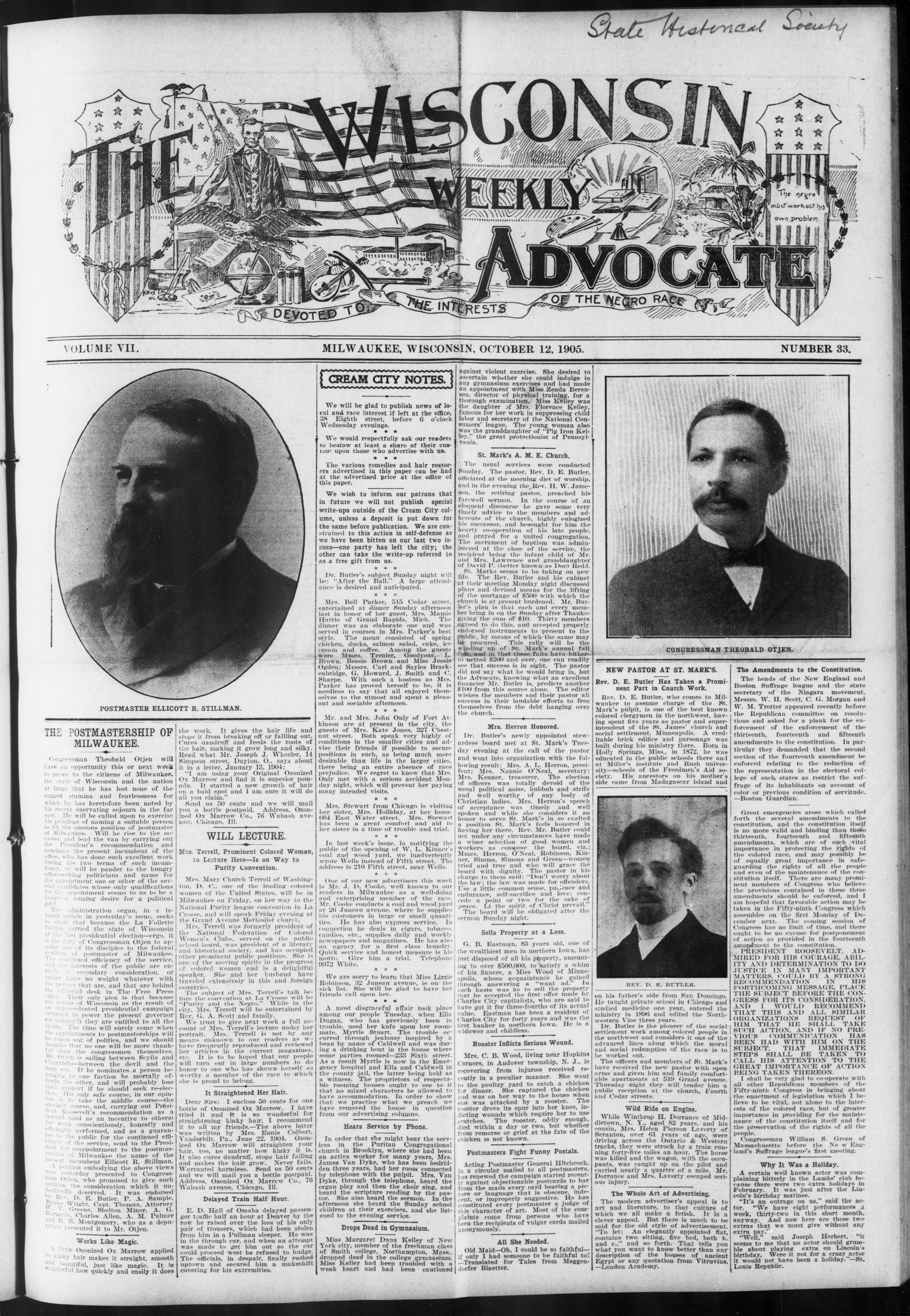
Wisconsin Weekly Advocate
Thursday, October 12, 1905
Milwaukee, Wisconsin
Page text (machine-generated)
State Historical Society
WISCONSIN
WEEKLY
ADVOCATE
DEVOTED TO THE INTERESTS OF THE NEGRO RACE
VOLUME VII.
7
[Name not visible in the image]
POSTMASTER ELLICOTT R. STILLMAN.
THE POSTMASTERSHIP OF MILWAUKEE.
Congressman Theobald Otjen will have an opportunity this or next week to prove to the citizens of Milwaukee, the state of Wisconsin and the nation at large that he has lost none of the rugged stamina and fearlessness for which he has heretofore been noted by his recent enervating sojourn in the far east. He will be called upon to exercise his privilege of naming a suitable person to fill the onerous position of postmaster of Milwaukee. Will he rise to the occasion and lead the van by carrying out the President's recommendation and nominate the present incumbent of the office, who has done such excellent work during his two terms of such incumbency, or will he pander to the hungry office-seeking politicians and name for the appointment one or other of the several candidates whose only qualifications for the appointment seems to us to be a desire—a longing desire for a political job?
The administration organ, in a labored article in yesterday's issue, seeks to show that because the La Follette faction carried the state of Wisconsin at the last presidential election—ergo, it is the duty of Congressman Otjen to appoint one of its disciples to the federal position of postmaster of Milwaukee. The continued efficiency of the service, and the interests of the public are entirely a secondary consideration, or rather have no weight whatever with the powers that are, and that are behind the editorial desk in The Free Press office. Their only plea is that because the voters of Wisconsin as the result of an unprecedented presidential campaign returned to power the present governor or senator? they are entitled to all the spoils. The time will surely come when the appointments to postmasterships will be taken out of politics, and we should imagine that no one will be more thankful than the congressmen themselves. Mr. Otjen is sailing between Scylla and Charybdis—between the devil and the deep sea. If he nominates a person belonging to one faction he mortally offends the other, and will probably lose their support if he should seek re-election. His only safe course, in our opinion, is to take the middle course—the straight course, and, carrying out President Roosevelt's recommendation as a reward (and as an incentive to others) for work consciently, honestly and efficiently performed, and as a guarantee to the public for the continued efficiency of the service, send to the President for reappointment to the postmastership of Milwaukee the name of the present incumbent Ellicott R. Stillman. A petition embodying the above views was yesterday presented to Congressman Otjen, who promised to give such petition the consideration which it undoubtedly deserved. It was endorsed by Rev. D. E. Butler, P. A. Sample, Banks Wright, Capt. Thomas, Attorney W. T. Greene, Shelton Minor, A. G. Burgette, Charles Allen, A. M. Palmer and R. B. Montgomery, who as a deputation presented it to Mr. Otjen.
Works Like Magic
A little Ozonized Ox Marrow applied to kinky hair makes it straight, smooth and beautiful, just like magic. It is wonderful how quickly and easily it does
the work. It gives the hair life and stops it from breaking off or fallling out. Cures dandruff and feeds the roots of the hair, making it grow long and silky. Read what Mr. Joseph J. Wheeler, 14 Simpson street, Dayton, O., says about it in a letter, January 13, 1904: "I am using your Original Ozonized Ox Marrow and find it is superior pomade. It started a new growth of hair on a bald spot and I am sure it will do all you claim." Send us 50 cents and we will mail you a bottle postpaid. Address, Ozonized Ox Marrow Co., 76 Wabash avenue, Chicago, Ill.
WILL LECTURE.
Mrs. Terrell, Prominent Colored Woman to Lecture Here-Is on Way to Purity Convention.
Mrs. Mary Church Terrell of Washington, D. C., one of the leading colored women of the United States, will be in Milwaukee on Friday, on her way to the National Purity league convention in La Crosse, and will speak Friday evening at the Grand Avenue Methodist church.
Mrs. Terrell was formerly president of the National Federation of Colored Women's Clubs, served on the public school board, was president of a literary and historical society, and has occupied other prominent public positions. She is one of the moving spirits in the progress of colored women and is a delightful speaker. She and her husband have traveled extensively in this and foreign countries.
The subject of Mrs. Terrell's talk before the convention at La Crosse will be "Purity and the Negro." While in the city, Mrs. Terrell will be entertained by Rev. G. A. Scott and family. We trust to give next week a full account of Mrs. Terrell's lecture under her portrait. Mrs. Terrell is not by any means unknown to our readers as we have frequently reproduced and reviewed her articles in the current magazines, etc. It is to be hoped that our people will turn out in large numbers to do honor to one who has shown herself so worthy a member of the race to which she is proud to belong.
It Straightened Her Hair.
Dear Sirs: I enclose 50 cents for one bottle of Ozonized Ox Marrow. I have tried it and it is so wonderful for straightening kinky hair. I recommend it to all my friends.—The above letter was written by Mrs. Ennis Colbert, Vanderbilt, Pa., June 22, 1904. Ozonized Ox Marrow will straighten your hair, too, no matter how kinky it is. It also cures dandruff, stops hair falling and makes the hair grow. Never fails. Warranted harmless. Send us 50 cents and we will mail you a bottle postpaid. Address, Ozonized Ox Marrow Co., 76 Wabash avenue, Chicago, Ill.
Delayed Train Half Hour.
E. D. Hall of Omaha delayed passenger traffic half an hour at Denver by the row he raised over the loss of his only pair of trousers, which had been stolen from him in a Pullman sleeper. He was in the through car, and when an attempt was made to get him out so the car could proceed west he refused to budge. The officials, in despair, finally rushed uptown and secured him a makeshift covering for his extremities.
CREAM CITY NOTES.
We will be glad to publish news of local and race interest if left at the office. 38 Eighth street, before 6 o'clock Wednesday evenings.
We would respectfully ask our readers to bestow at least a share of their custom upon those who advertise with us.
The various remedies and hair restorers advertised in this paper can be had at the advertised price at the office of this paper.
We wish to inform our patrons that in future we will not publish special write-ups outside of the Cream City column, unless a deposit is put down for the same before publication. We are constrained to this action in self-defense as we have been bitten on our last two issues—one party has left the city; the other can take the write-up referred to as a free gift from us.
***
Dr. Butler's subject Sunday night will be: "After the Ball." A large attendance is desired and anticipated.
Mrs. Bell Parker, 515 Cedar street, entertained at dinner Sunday afternoon last in honor of her guest, Mrs. Mamie Harris of Grand Rapids, Mich. The dinner was an elaborate one and was served in courses in Mrs. Parker's best style. The menu consisted of spring chicken, ducks, salmon salad, cake, ice cream and coffee. Among the guests were Mmes. Trenier, Goodyear. L. Brown, Bessie Brown and Miss Jessie Ogden; Messrs. Carl and Sayles Brackenbridge, G. Howard, J. Smith and C. Sharpe. With such a hostess as Mrs. Parker has proved herself to be, it is needless to say that all enjoyed themselves to the utmost and spent a pleasant and sociable afternoon.
* * *
Mr. and Mrs. John Only of Fort Atkinson are at present in the city, the guests of Mrs. Kate Jones, 327 Chestnut street. Both speak very highly of conditions in the smaller cities and advise their friends if possible to secure positions in such, as being much more desirable than life in the larger cities, there being an entire absence of race prejudice. We regret to know that Mrs. Only met with a serious accident Monday night, which will prevent her paying many intended visits.
* * *
Mrs. Stewart from Chicago is visiting her sister, Mrs. Holliday, at her home. 664 East Water street. Mrs. Stewart has been a great comfort and aid to her sister in a time of trouble and trial.
**
In last week's issue, in notifying the public of the opening of W. L. Kinner's coal and wood yard, we inadvertently wrote Wells instead of Fifth street. The address is 210 Fifth street, near Wells.
* * *
One of our new advertisers this week is Mr. J. D. Cooke, well known to our readers in Milwaukee as a well-doing and enterprising member of the race. Mr. Cooke conducts a coal and wood yard at 26 Juneau avenue, where he supplies his customers in large or small quantities. He has also express service. In connection he deals in cigars, tobacco, candies, etc., supplies daily and weekly newspapers and magazines. He has also an agency for a first class laundry. Quick service and honest measure is his motto. Give him a trial. Telephone 9972 White.
* * *
We are sorry to learn that Miss Lizzie Robinson, 32 Juneau avenue, is on the sick list. She will be glad to have her friends call upon her.
```markdown
```
A most disgraceful affair took place among our people Tuesday, when Ella Dugan, who has previously been in trouble, used her knife upon her roommate, Myrtle Stuart. The trouble occurred through jealousy inspired by a beau by name of Caldwell and was during a drinking bout in the house where some parties roomed—233 Sixth street. As a result Myrtle is now in the Emergency hospital and Ella and Caldwell in the county jail, the latter being held as a witness. The proprietors of respectable rooming houses ought to see to it that no mixed characters be allowed to have accommodation. In order to show that we practice what we preach we have removed the house in question from our advertising columns.
Hears Service by Phone
In order that she might hear the services in the Puritan Congregational church in Brooklyn, where she had been an active worker for many years, Mrs. James Van Dyke, who has been bedridden three years, had her room connected by telephone with the pulpit. Mrs. Van Dyke, through the telephone, heard the organ play and then the choir sing, and heard the scripture reading by the pastor. She also heard the sermon. In the afternoon she heard the Sunday school children at their exercises, and she listened to the evening service.
Drops Dead in Gymnasium.
Miss Margaret Dana Kelley of New York city, member of the freshman class of Smith college, Northampton, Mass. dropped dead in the college gymnasium. Miss Kelley had been troubled with a weak heart and had been cautioned
against violent exercise. She desired to ascertain whether she could indulge in any gymnasium exercises and had made an appointment with Miss Zenda Berensen, director of physical training, for a thorough examination. Miss Kelley was the daughter of Mrs. Florence Kelley, famous for her work in suppressing child labor and secretary of the National Consumers' league. The young woman also was the granddaughter of "Pig Iron Kelley," the great protectionist of Pennsylvania.
St. Mark's A. M. E. Church
The usual services were conducted Sunday. The pastor, Rev. D. E. Butler, officiated at the morning diet of worship, and in the evening the Rev. H. W. Jamieson, the retiring pastor, preached his farewell sermon. In the course of an eloquent discourse he gave some very timely advice to the members and adherents of the church, highly eulogized his successor, and besought for him the hearty co-operation of his late people, and prayed for a united congregation. The sacrament of baptism was administered at the close of the service, the recipient being the infant child of Mr. and Mrs. Lawrence and granddaughter of David P. (better known as Doc) Redd. St. Marks seems to be taking on new life. The Rev. Butler and his cabinet at their meeting Monday night discussed plans and devised means for the lifting of the mortgage of $500 with which the church is at present burdened. Mr. Butler's plan is that each and every member bring in on the Sunday after Thanksgiving the sum of $10. Thirty members agreed to do this, and accepted properly endorsed instruments to present to the public, by means of which the same may be procured. This rally will be the winding up of St. Mark's annual fall fair, and in that these fairs have hitherto netted $200 and over, one can readily see that success is in sight. The pastor did not say what he would bring in, but the Advocate, knowing what an excellent financier Mr. Butler is, predicts another $100 from this source alone. The editor wishes the members and their pastor all success in their laudable efforts to free themselves from the debt hanging over the church.
Mrs. Herron Honored.
Dr. Butler's newly appointed stewardess board met at St. Mark's Tuesday evening at the call of the pastor and went into organization with the following result: Mrs. A. L. Herron, president; Mrs. Nannie O'Neal, secretary; Mrs. Kenner, treasurer. The election of officers was totally devoid of the usual political noise, hubbub and strife and well worthy of any body of Christian ladies. Mrs. Herron's speech of acceptance was timely and well spoken and while she considers it an honor to serve St. Mark's in so exalted a position St. Mark's feels honored in having her there. Rev. Mr. Butler could not under any circumstances have made a wiser selection of good women and workers as compose the board, viz.: Mmes. Herron, O'Neal, Robinson, Kinner, Simms, Simons and Green—women tried and true and who will grace the board with dignity. The pastor in his charge to them said: "Don't worry about the law; the law was made for offenders. Use a little common sense, patience and endurance, self-sacrifice and love: concede a point or two for the sake of peace. Lt the spirit of Christ prevail." The board will be obligated after the sermon Sunday night.
Sells Property at a Loss.
G. B. Eastman, 83 years old, one of the wealthiest men in northern Iowa, has just disposed of all his property, amounting to over $500,000, to satisfy a whim of his fiancee, a Miss Wood of Minneapolis, whose acquaintance he gained through answering a "want ad." In such haste was he to sell the property that he accepted the first offer made by Charles City capitalists, who are said to have got it for three-fourths of its actual value. Eastman has been a resident of Charles City for forty years and was the first banker in northern Iowa. He is a widower and childless.
Rooster Inflicts Serious Wound.
Mrs. C. B. Wood, living near Hopkins Corners, in Andover township, N. J., is recovering from injuries received recently in a peculiar manner. She went to the poultry yard to catch a chicken for dinner. She captured the chicken and was on her way to the house when she was attacked by a rooster. The rooster drove its spur into her knee, indicting wounds which require her to use crutches. The rooster, oddly enough, died within a day or two, but whether from remorse or grief at the fate of the chicken is not known.
Postmasters Fight Funny Postals.
Acting Postmaster General Hitchcock, in a circular mailed to all postmasters, has renewed the campaign started recently against objectionable postcards to bar from the mails every card bearing a picture or language that is obscene, indecent, or improperly suggestive. He has constituted every postmaster a judge of this character of art. Most of the complaints come from persons who have been the recipients of vulgar cards mailed anonymously.
All She Needed.
Old Maid—Oh, I could be so faithful—if only I had someone to be faithful to—Translated for Tales from Meggendorfer Blaetter.
J. H.
CONGRESSMAN THEOBALD OTJEN.
NEW PASTOR AT ST. MARK'S.
Rev. D. E. Butler Has Taken a Prominent Part in Church Work.
Rev. D. E. Butler, who comes to Milwaukee to assume charge of the St. Mark's pulpit, is one of the best known colored clergymen in the northwest, having spent five years as pastor and superintendent of the St. James' church and social settlement, Minneapolis. A creditable brick edifice and parsonage was built during his ministry there. Born in Holly Springs, Miss., in 1872, he was educated in the public schools there and at Miller's institute and Rush university—schools of the Freedmen's Aid society. His ancestors on his mother's side came from Madagascar island and
[Picture of a man with a mustache and a dark suit].
on his father's side from San Domingo. He taught private school in Chicago and studied medicine one year, entered the ministry in 1896 and edited the Northwestern Vine three years. Dr. Butler is the pioneer of the social settlement work among colored people in the northwest and considers it one of the advanced lines along which the moral and social redemption of the race is to be worked out. The officers and members of St. Mark's have received the new pastor with open arms and given him and family comfortable apartments at 519 Grand avenue. Thursday night they will tender him a public reception at the church, Fourth and Cedar streets.
Wild Ride on Engine.
While Winthrop H. Dorrance of Middletown, N. Y., aged 82 years, and his cousin, Mrs. Helen Pierson Laverty of Scranton, over 61 years of age, were driving across the Ontario & Western tracks, they were struck by a train running forty-five miles an hour. The horse was killed and the wagon, with the occupants, was caught up on the pilot and carried nearly a quarter of a mile. Mr. Dorrance and Mrs. Laverty escaped serious injury.
The Whole Art of Advertising
The modern advertiser's appeal is to art and literature, to that culture of which we all make a fetish. It is a clever appeal. But there is much to be said for the old style of advertisement. "To let: An elegantly appointed flat, contains two sitting, five bed, bath h. and c." and so forth. That tells you what you want to know better than any description of the houses of ancient Egypt or any quotation from Vitruvius. —London Academy.
1
The Amendments to the Constitution.
The heads of the New England and Boston Suffrage league and the state secretary of the Niagara movement, Messrs. W. H. Scott, C. G. Morgan and W. M. Trotter appeared recently before the Republican committee on resolutions and asked for a plank for the enforcement of the enforcement of the thirteenth, fourteenth and fifteenth amendments to the constitution. In particular they demanded that the second section of the fourteenth amendment be enforced relating to the reduction of the representation in the electoral college of such states as restrict the suffrage of its inhabitants on account of color or previous condition of servitude. —Boston Guardian.
Great emergencies arose which called forth the several amendments to the constitution, and the constitution itself is no more valid and binding than these thirteenth, fourteenth and fifteenth amendments, which are of such vital importance in protecting the rights of the colored race, and may possibly be of equally great importance in safeguarding the rights of all the people and even of the maintenance of the constitution itself. There are many prominent members of Congress who believe the provisions contained in these three amendments should be enforced, and I am hopeful that favorable action may be taken in the Fifty-ninth Congress which assembles on the first Monday of December next. The coming session of Congress has no limit of time, and there ought to be no excuse for postponement of action as provided in the fourteenth amendment to the constitution.
PRESIDENT ROOSEVELT. ADMIRED FOR HIS COURAGE, ABILITY AND DETERMINATION TO DO JUSTICE IN MANY IMPORTANT MATTERS. COULD BY A STRONG RECOMMENDATION IN HIS FORTHCOMING MESSAGE, PLACE THE SUBJECT BEFORE THE CONGRESS FOR ITS CONSIDERATION, AND I WOULD RECOMMEND THAT THIS AND ALL SIMILAR ORGANIZATIONS REQUEST OF HIM THAT HE SHALL TAKE SUCH ACTION, AND IF NO PREVIOUS COMMUNICATION HAS BEEN HAD WITH HIM ON THE SUBJECT. THAT IMMEDIATE STEPS SHALL BE TAKEN TO CALL HIS ATTENTION TO THE GREAT IMPORTANCE OF ACTION BEING TAKEN THEREON.
I shall be very glad to co-operate with all other Republican members of the Fifty-ninth Congress in bringing about the enactment of legislation which I believe to be vital, not alone to the interests of the colored race, but of greater importance in providing for the maintenance of the constitution itself and for the preservation of the rights of all the people. Congressman William S. Green of Massachusetts before the New England's Suffrage league's first meeting.
Why It Was a Holiday.
A certain well known actor was complaining bitterly in the Lambs' club because there were two extra holidays in February. It was just after the Lincoln's birthday matinee.
"It's an outrage on us," said the actor. "We have eight performances a week, thirty-two in this short month, anyway. And now here are these two extras that we must give without any extra pay."
"Well," said Joseph Herbert, "it seems to me that no actor should grumble about playing extra on Lincoln's birthday. Were it not for a crazy actor it would not have been a holiday."—St. Louis Republic.
---
NUMBER 33.
Herbert, "it should grumon on Lincoln's a crazy actor holiday."—St.
It pays to advertise.
The english language is growing. The Egypt correspondent of "The Osage (Mo.) News writes: "Jeff Smith isn't exactly on the sick list, but he's punying some."
Husband—Well. I must say that all fools are not dead yet!
Wife (affectionately)—I'm glad of it, dear. I never look well in black.—Illustrated Bits.
Jaggle—A girl needs plenty of backbone to wear one of those network shirt waists.
Waggles—Yes, and most of them show that they have it.—Town Topics.
Milwaukee—Mildewed and Mephitic
Burke said: "You cannot indict a whole community." Milwaukee had not been founded in Burke's time.—Washington Post.
Hope for Him.
A man has made great progress when he has learned that some of the people who don't agree with all his opinions may, after all, be partly right.—Somerville Journal.
At the Charity Bazar
Lieutenant—I shall not pay you for the two kisses, but I give you permission to use my name as reference.--Translated for Tales from "Meggendorfer Blatter."
At Home There
"Oh, no. We were used to it. It was just about on a level with our flat."—Detroit Free Press.
No Fooling.
Mrs. Dolan—And is your little Timmy very sick, Mrs. Murphy?
Mrs. Murphy—Mrs. Dolan, whin a boy's sick during vacation 'tis always something serious!—Life.
No Fooling.
Real Progress.
"How is father getting on with his riding lessons?"
"Very well; we children are allowed to watch him now."—Translated for Tales from Fliegende Blaetter.
Spontaneous Generation.
Blackson- How much do you pay for your lead pencils, old man?
your lead pencils, old man? Bjohnson—Well—I really don't know. I haven't bought a lead pencil for years and years.—Somerville Journal.
A Western Game.
A westerner tells this card story. Three men played dummy whist. One of them afterward described the game: "No. 1 held five aces in his hand. No. 2 held a revolver; and I held the inquest."
English.
"It's funny."
"What's funny?"
English
"That you can never tell whether a woman has a good carriage till you have seen her walk."—Cleveland Leader.
Prophylactic Motto for the Soda Fountain
Full many a man both young and old
Has gone to his sarcophagus
By pouring water icy cold
Adown his hot esophagus.
—From Dr. Wiley's address to the Pharmacists.
Not the Usual Thing.
"Chillum is a very original person." What makes you think so?"
"He looked me over after my summer vacation without telling me that he never saw me looking so well."—Washington Star.
First Boy—Pop's going to lead the simple life.
Second Boy—What's he doing?
"He's given away all his private cars to the poor people in the neighborhood." —Life.
An Inducement
The following advertisement, according to the London Express, appeared in an English provincial paper a few days ago: "Young girl wanted as general servant—not much work—need not wash."
"Now, Marie, we shall inherit a lot of money. Something is bound to happen soon, now that we have put guncotton instead of cotton in grandfather's ears." —Translated for Tales from Simplicissimus.
Their Joint Card.
"Haven't Henpeck and his wife settled their differences about their visiting cards?"
"Oh, yes, they've compromised on Mr. and Mrs. Maria Henpeck."—Philadelphia Press.
Generosity.
Beggar—Pardon, sir, but this nickel you gave me is lead.
Generosity
Benevolent Old Man—Why, so it is! Well, keep it, my man, as a reward for your honesty.—Translated for Tales from Le Journal.
Reckless Russia
"A burnt child dreads the fire," said the ready-made philosopher. "I don't know about that," answered the man who always contradicts. "I see that Russia wants a new navy."—Washington Star.
His Selfishness
"If you don't stop nagging me, Emily, I shall shoot myself this very minute." "Yes, that's just like you, when you know how nervous I am when I hear a shot." Translated for Tales from Meggendorfer Blaetter.
No Improvement on Nature
Irate Patient—Here! you told me these false teeth would be just as good as natural ones, and they hurt me horribly.
Painless Dentist—Well, didn't your natural ones hurt you?—Translated for Tales from "Le Rire."
Chemist (to poor woman)—You must take this medicine three times a day after meals.
Patient—But, sir, I seldom get meals these 'ard times.
Chemist (passing to next customer)—Then take it before.—Glasgow Times.
Unkind.
"What is that woman's club aiming at?"
"I don't know."
"I wonder how I can find out?"
"Just lie low and wait until you see what it misses."—Montreal Daily Star.
The Voice of the Sluggard
One fine spring day old farmer Doyle Said, as he mopped his brow: "I don't object to honest toll, It's time I started now. I know I ought to plow the soil,
But I hate to soil the plow."
+Saturday Evening Post.
He Was Sure
Father—My son, did you buy the matches for me?
Son—Yes, papa.
"Were they good ones?"
Were they good ones?
"Oh, yes; I tried every one."—Translated for Tales from Le Journal pour Rire.
A Hard One.
"My proudest boast," said the lecturer, who expected his statement to be greeted with cheers, "is that I was one of the men behind the guns."
"How many miles behind?" piped a voice in the gallery.—Philadelphia Press.
A Good Guess.
"I see by the papers," remarked Dinsmore, "that European manufacturers of shoes are imitating American makes." "That," added the Sagacious Observer, "is for the purpose of putting their own trade on a better footing."—Town Tonics.
Such Is Life
"You remember Smith, who saved a lady's life by jumping into the water, and married her afterward?"
"Yes; what's become of him?"
"He's just drowned himself."—Translated for Tales from Meggendorfer Blaetter.
An Adaptation.
"Let me see," said the forgetful man, "what's the rest of that saying about 'Too many cooks?'"
"Well," replied the man who had just returned from Paris, "too many Cooks spoil the enjoyment of other tourists.'"
—Philadelphia Press.
Free Transportation
Mrs. Reeder—I wonder what this paper means by this: "Mr. Kadley's method of entertaining his guests was quite original and unconventional?" Rr. 'Reeder—It means simply that he is boorish, but has plenty of money.—Philadelphia Public Ledger.
A Test.
Bill—He's the greatest man on figures I ever saw.
Jill—Quick, is he?
"Yes, and you can't give him a question he can't answer."
"Ask him how many Smiths there are in New York who smoke pipes."—Yonker; Statesman.
As a Pikestaff
"Why, papa?"
"Isn't it quite plain that the women are going to use the mirror to see if their hats are on straight?"—Oregonian.
Give and Take
The other day the head of a boarding school noticed one of the boys wiping his knife on the table cloth, and pounced on him at once. "Is that what you do at home?" he asked indignantly.
"Oh, no," answered the boy quickly,
"We have clean knives."—Lippincott's.
Seems Like It
"Yes, my son."
"If a man meant to put 5 cents in the church contribution box and put in a $5 gold piece by mistake what would you call it?"
"Why, I would call that contributory negligence, my boy."—Yonkers Statesman.
Literal.
Hardupp—Have you a five-dollar bill you don't know what to do with?
Smyke—Yes, here is one.
Hardupp—Thanks—but, I say, this is a counterfeit!
Smyke—Well, you asked for one I didn't know what to do with.—Translated for Tales from El Calendario Espanol.
No Pleasure in It
Mrs. Chase—Oh, I don't care about Joblotz & Remnant's. It's so unsatisfactory to do your shopping there.
Mrs. Shoppen—Why, they sell everything.
Mrs. Chase—That's just it. No matter what you ask for, they can suit you right off. What's the fun in that?—Pick-Me-Up.
After Dark.
"But you are always bothered with poor light, are you?" inquired the complaint clerk at the gas office. "Oh, no, not always," replied the quiet citizen.
"Ah! I thought so; it's only at certain times that you notice it, eh?"
times that you notice it, eh?" "Yes; only after dark."—Philadelphia Public Ledger.
Wisdom's End.
"While he was under 30 his parents had too much sense to let him marry."
"Yes."
"While he was under 50 he had too much sense to wed."
"I see."
"Now that he's 85—"
"Well?"
"He's going to take a wife."—Louisville Courier-Journal.
The Man for the Job.
"Say," said Mrs. Nuritch. "your father's got to stop smokin' his pipe in the parlor. You'll have to speak to him, he won't mind me."
"He ain't afraid o' me, neither," replied Nuritch.
"Well, something's got to be done."
"If I wasn't afraid o' scarin' the old man too bad I'd get the butler after him."—Philadelphia Press.
The Whole Truth
Having ordered pie at a frenzied feeding emporium, the young man began grumbling between mouthfuls.
"What's the matter?" demanded the proprietor.
"Pretty tough—this," was the reply.
"See here, young man," declared the other, "we made pies here before you were born."
"This must be one of them," agreed the victim.—New York Times.
Wanted to Know
The telephone girl told this the other night: Mr. Johnston, who had a rich Southern darky accent, called up a number in my exchange a few nights ago. Is dat Miss Belinda Johnsings?" he
"Is dat Miss Belinda Johnsing?" he asked.
"Ya-as."
"Ise got er impohrtant question to ahsk yoh. Will yoh mahry meh?"
"Ya-as. Who is dis. please?"
Lunar Puzzle
We might take some stock in Prof. Pickering's theory that the moon is a chunk of the earth blown into space if he'll kindly explain how there came to be so much green cheese where the Pacific now is.—Newark Advertiser.
—Swedish school children under the guidance of their teachers annually plant about 600,000 trees.
Great-Grandmother's Quilt.
Infiniteisimal squares and stars
Of faded pink and green and blue,
Upon a ground of yellowed white,
And every stitch so fine and true!
Five thousand stitches, at the least,
(In one wee square I count three score)
Those gentle, patient fingers wrought—
And goodness knows how, many more!
A pretty quilt!—it must have warmed
Its maker's heart with modest pride
When in the spare room, bright and new,
Twas seen by all the countryside.
Like some quaint perfume, faintly sweet,
It breathes across our modern ways
Of quiet mind and tranquil toil.
The calm content of old-time days.
Ah, great-grandmamma—crowned soul!
Afar?—on near?—who understands?
With moistened eye and reverent lip
I kiss the work of your dear hands.
—Emily Hewitt Leland in National Magazine.
A DOCTOR'S DREAM.
Several years ago I resided in a wild, mountainous and rather lonely region of Virginia. There was a railroad but a few rods in front of my door and a station and considerable village about a mile to the west. The nearest station to the east was about ten miles distant. I moved to the place with my young wife late in the autumn, and about the first of the following March I was attacked with typhoid fever and was ill for about a month. But thanks to a naturally strong constitution and the careful nursing of a loving and intelligent wife, I slowly recovered.
As soon as I got strong enough to sit up and walk a little I told my wife she had better take the cars and go and visit her brother, who lived about fifty miles east of us. She had been taking care of me so faithfully through my illness, both by day and night, that I feared her health and strength would fail her if she did not rest awhile. I knew she had been very anxious to go, and I felt sure that her brother and his family would be very glad to see her, and would try to make her visit a pleasant one.
She hesitated about leaving me, fearing I might need her care; but after waiting a few days, and seeing that I continued to gain my health and strength, she decided to follow my advice. Accordingly, one pleasant morning about the middle of April, after doing everything she could for my comfort and bidding me to be careful about taking cold or walking too far, she started, intending to be gone a fortnight.
One day I exercised a little beyond my strength, and felt quite tired at night and lay awake for a long time. At last I fell into an uneasy slumber and dreamed a very curious and startling dream. I seemed to have gone forward into the future a couple of days, and instead of Wednesday, the 24th, it seemed to be Friday, the 26th. It seemed in my dream that a heavy rain had been falling most of the day and all the day before, but the evening was so clear and pleasant and not very dark, though the moon was not shining.
I seemed to be walking along the railroad toward the east. I first passed through, a wood about half a mile wide; then for about a mile through fields containing a couple of farmhouses, one inhabited and the other deserted. I then entered another wood, and, after walking about a mile and a half, I came to a stream greatly swollen by the rain, which had weakened the railroad bridge so much that the passenger train, in attempting to cross, had broken it down and the bridge and cars, completely wrecked, were lying on both sides of the stream, except portions that were floating down. Some of the passengers lay dead or dying among the ruins, some were floating in the water, and a few were clinging to trees and bushes on the bank. It was a fearful and heartrending sight.
The next day, early in the morning, it commenced raining, and continued to rain through the day and following night. I felt very lonely and uneasy all day, which feeling was increased by receiving a letter from my wife saying that she intended to come home on Friday night by the express train. I retired late, feeling much worried on account of my fearful dream. And to add to this fear, presentiment, or whatever you may call it, the dream was repeated, and even more distinct and vivid than the first time.
When I arose in the morning the rain was still falling. This was Friday, and therefore was the day on which my wife was to start for home. There were two passenger trains from the east each day, one at 9 o'clock in the forenoon and the other at 9 in the evening. This last was the express train, and the one on which my wife was coming.
Toward the middle of the afternoon the rain ceased falling and the clouds slowly cleared away. The dream had made such an impression on my mind that I resolved to attempt to find the stream I had seen so plainly in my dreams, and if it appeared at all dangerous to attempt to stop the train before reaching it. Accordingly, soon after the rain was over I got ready and started. I had never before had occasion to visit the station in this direction, and was therefore entirely unacquainted with this part of the country. But I found everything just as it had appeared in my dream.
Immediately after starting I passed through the wood I had seen in my dream, and then entered the open field and found the two farmhouses, one inhabited and the other deserted. In fact, everything was as natural as if I had really been this way before. I walked slowly, and late in the afternoon I came to the stream, which flowed rapidly and seemed much swollen. But the bridge, instead of being broken down and mingled with the broken cars and mangled passengers, was still standing, and though its timber looked quite old and weather-beaten, there seemed to be little danger of its breaking down beneath the weight of a passing train.
There was a' heavy freight train due from the west about 6 o'clock, and I resolved to wait at least until it came, and if it passed over in safety there could be. I thought, but little danger of accident to the lighter passenger train.
In due time it came thundering along and passed safely over the bridge. But, though it might have been owing to my excited imagination, it seemed to me that the bridge bent and shook beneath the weight of the train in a manner highly suggestive of danger. At all events, I resolved to wait a while longer and see if the stream, which was still rising, would have any apparent effect upon the bridge. I took with me a lantern and also a thick blanket to protect me from the damp night air.
Shortly after sunset, as I was sitting a
few rods from the stream, I heard a loud splash, and hurrying to the bridge I saw that a portion of the bank on the opposite side had broken away, and also that the action of the water, or some other cause, had weakened the foundations of the bridge in such a manner that a portion of the line was bent and lowered enough to make it impossible for a train to cross. I immediately crossed the bridge, resolved to stop the train, if possible, before it reached the bridge and certain destruction.
I went on in the direction from which the train was to come, and soon found a good place which commanded a view of the line for a considerable distance. I hit my lantern, wrapped my blanket closely around me, and sat down to my wearisome watch of two hours. The night was clear, but not very dark, though no moon was shining. I suffered nothing from cold, as I was remarkably warm, even for the climate of Virginia, and I succeeded in keeping awake, though the task was a difficult one.
Slowly the moments passed by, but at last I saw by my watch that the time had nearly expired, and a few moments would decide the fate of the train and its human freight. Soon I saw a light, far away and very small at first, but rapidly growing larger and brighter. I arose, trembling with excitement, and commenced swinging the lantern above my head, and as the train drew near I doubled my exertion and shouted as loud as I could. Onward came the train at a rapid speed.
It was a time of terrible suspense to me. Should the engineer fail to see my signal, or not see it in time to stop the train before going a few rods past me, I knew that no human power could save it. On it came, and, just as I gave up my exertions and stepped from the line, my frantic signals were observed, arousing the sleepy brakemen like an electric shock, who flew to their stations.
The train was quickly stopped, and I then informed the engineer and conductor of the danger ahead, while the frightened passengers left the carriages and gathered around me. Many a brave man grew pale when he learned what a fearful death he had so narrowly escaped.
Among the passengers I found my wife, not mangled and lifeless, but alive and well, though somewhat frightened and a good deal surprised at seeing me. The conductor gave me a seat next my wife, and then had the train backed to the station it had just left, from which telegrams were sent to warn all other trains of the danger. In the morning my wife and I took the stage for home.—Pittsburg Press.
STRANGE GIFT OF HEALER
Miracle-Worker Who Gained the Czar's Confidence Dies.
Philippe Landard, called "Philippe the Healer," is dead. Whatever he was, saint or charlatan, his strange career was a romance. Born in Lyons of poor parents, he worked as a butcher's boy and studied medicine in his spare hours. He was house surgeon in a hospital and was on the point of being admitted a doctor, but the mysterious manner in which the patients in his ward got well earned for him, it is said, the dislike of the profession.
Admission was refused him and he went about the country healing. How, no one seems to know. A word, a touch, a look. Poor people believed in him utterly and the most extraordinary tales are told of his exploits, some by men worthy of credence. Dr. Encausse testifies to the healing of a child in the last stages of tubercular meningitis. There were fifty persons present, he says, when the miracle was worked. Philippe made them all promise to say no evil of the absent during three days, and the child at once began to mend. Then there is the testimony of a journalist—and a Paris journalist, to boot, one of those men whose dominant characteristic is skepticism—Serge Basset, who says that his son, when given up by the doctors, was taken to Philippe and cured instantaneously.
But Philippe suffered the fate ordained for a prophet in his own country. He was persecuted by the faculty and tracked by the police. To escape their clutches he established a multiplicity of domiciles, bolting from one to another like a ferreted rabbit in a warren. He found consolation abroad, particularly in Russia, where the mystery surrounding the man appealed to something in the Slav nature. There he was admitted a doctor of medicine; held a general's rank; counted grand dukes among his friends and gained the confidence of the Czar.
Many wild tales have been told of the sinister influence which Philippe held over the Czar, but there is no evidence to support them. He may have predicted the birth of a son to the Czarina, but that can scarcely be given as a proof of a supernatural power, since, after the advent of five daughters, the odds were, perhaps, in favor of a son. Rumors tongue always wagged exuberantly where Philippe was concerned.
He married a wife with money, but his earnings and income were magnified into many millions. He was credited with possessing palaces in half the capitals of Europe, but he died in a little country house of L'Arbresle, and of the wealth he had much went to the poor. The poor were his friends and had boundless confidence in him, and therein may be found, if there is such a thing as "faith healing," the simple explanation of Phhillipe's mysterious power.—London Standard.
Recipe for a World.
Take one man, a woman and a garden. Add an apple and a good fresh snake. Stir gently until the pot begins to boil, then drain off the apple and keep adding children. Simmer on a slow fire, then put on ice. Alternate between the two extremes, giving the whole a good sound basting when needed, turning slowly in a proper space. Keep adding time until the mass is of the consistency of a mud pie covered with ants. Multiply the inhabitants and garnish with villages, towns, cities and empires. Now introduce a little theology and enough devil sauce to spice. Keep adding battle, murder, sudden death and a good layer of cant. Put plenty of salt in the water and sprinkle with bad society. When your world is finished throw it in the fire and begin all over again.—Leesburg (O.) Buckeye.
The Irishman's Handicap.
A sculling match once took place under the auspices of the athletic association at Oxford, the contestants being a Londoner, of the Oxford crew, and an Irishman of the Cambridge crew. The Oxford man won handily, at no stage of the race being in danger of defeat. So sure was he of winning the contest that in a spirit of fun he ceased rowing several times, and bade the Celt in the rear to "hurry up."
When the race was over, the Irishman received a good deal of chaff at the hands of all, in view of his overwhelming defeat. But to this he merely elevated his eyebrows. "Sure," he finally consented to reply, "I'd have beaten him easily if I'd taken the long rests that he took."—Argonaut.
DISCONTENT.
The mail is full of letters
And the soup is full of peas.
There's sugar in the coffee
And the yard is full of trees;
The fields are full of stubble
And there's grass upon the ground—
But the world is full of trouble
If we only look around.
The corn is full of kernels.
There are lilies in the brooks;
The towns are full of people.
There are stories in the books;
The orchard's full of apples
And the mendow's full of hay—
But what troubles we discover
If we're only built that way.
The blac's full of blossoms
And the trees are full of leaves,
The meadow's full of clover
And the fields are full of sheaves;
The bread is full of flour
And the rain is damp and wet—
But how much there is to fret us
If we really want to fret.
The bees are full of honey
And the apples full of juice.
The banks are full of money
But—be happy? What's the use?
The beach is full of pebbles.
There is water in the creek—
But nothine really suits us
If we really want to kick.
-J. W. Foley in New York Times.
Missouri's Reputation
About a month ago Bill Harris, who has eighty acres of corn two miles north of Chula, concluded he would go through it once more with a cultivator. He drove into the field one morning and started down the row. But he found it impossible to keep his mules in the field. After repeated efforts he drove home and unhitched. The corn was growing so fast that the popping sounded like artillery, and his mules never having been in battle would not stand for the awful din. The noise of the growing corn drowned the words of command with which Mr. Harris was wont to control the wild impetusosity of his hybrid steeds in time of peace, and he has been compelled for the month past, and even up to this day, to drive out of his way to keep from passing the noisy eighty. Our friend informed us that the conditions are getting better because of the fact that the popping and snapping is where the new ears shoot, that is pretty well up the stalk, and already the corn is so high that you can only hear muffled reports. He says that by next week the corn will be so high that you will not hear it at all except the echo from the Medicine hills at night time. And thus it is that Missouri keeps up her fine reputation for tall, splendid—
—Chula (Mo.) News.
INSURANCE
A Bulwark Against Want
The concensus of opinion in regard to the insurance investigation now in progress in New York is that it will eventuate in good for insurers and insured. Even the most pessimistic opponents of the principle of life insurance must admit that better conditions will follow the purification, not only for the companies which have been sorely stricken as a result of the moral lapses of their officials, but for the companies which are suffering vicariously under the shadow of distrust that has been cast upon corporate management generally.
Society cannot afford to "throw down" life insurance because of the remissness of high officials in one or two companies. The principle of protection for the dependent through provision for payment to them of sufficient to keep the wolf of want from the door is so closely interwoven with the social fabric that if it were possible to eliminate it by force, the social order would suffer a severe strain. Public duty and private philanthropy would together be unable to meet the appeals for assistance from women and children bereft of their breadwinners. A large proportion of the 18,000,000 policyholders in the United States have by their wise provision for the future insured organized society as well as their loved ones against the trials incident to sudden dependency. Cases without number could be cited in every large city of the United States where the death payments of life insurance companies have saved wives and children from actual want, and made it possible for widows to rear their children in a way to make them useful members of society. It would be interesting to know how much of the total of insurance risks in the United States constitutes a bulwark against poverty. A large part of the $11,179,142,711 of outstanding insurance would undoubtedly, on analysis, be found to be protection of this vital character.
Bringing the subject close to home, the people of the northwest have in the history of the Northwestern Mutual Life Insurance company of Milwaukee—a company of which every resident of the northwest has special reason to feel proud—a record which shows how much a well-conducted life insurance company contributes to the support of the existing social order. The first record of losses paid is that for the year ending June 1, 1860, $3500—a goodly sum for a young company in those times of pioneering in life insurance, but a mere pittance in comparison with the princely amount now paid out annually for death losses. The death payments increased in logical proportion to the company's business, and in ten years (January 1, 1870, reached $443,442.89, quite a large amount, yet still small in comparison with the amount now annually paid to the beneficiaries of the insured. For the year ending January 1, 1886, the death payments surpassed the million mark for the first time, aggregating $1,049,004.04. Since that time they have increased with the company's immense business, until today the payments on account of death losses approximates seven millions annually. The exact figures for the year ending January 1, 1905, are $6,985.403.03.
Since its organization the Northwestern Mutual Life Insurance company has paid death claims to the aggregate of $78,685,552.96. This enormous sum of money has contributed in no small degree to the welfare of society as a whole. The prompt payment of the death claims has in thousands of instances made it possible for helpless widows to "get along" without appealing to public charity or private philanthropy.
The Northwestern Mutual Life Insurance company's management has been unswervingly honest, and its history has been an open book from which the insured could read the records at will. The officers of the company have no "side lines" of official interest. They are devoted solely to the conservation of the interests of the policy holders, who are with them mutually concerned in the well-being of the corporation. It is one of the most substantial life insurance companies in the United States, and its record is absolutely stainless.
The German Empress' Fad.
The German empress invariably writes with a swan quill—a beautiful, large, creamy thing, carefully selected and prepared. Wherever her majesty goes packets of these quills are among her luggage, and when last spring, during the Mediterranean cruise, the supply failed a special messenger was dispatched from Potsdam to Taormina with a consignment of these indispensable trifles.—Gentlewoman.
STATES WITH MANY COUNTIES
Georgia Has Added to Her List—Texas Still a Record Breaker.
The Georgia Legislature, which recently adjourned after a long session, made a further addition to the number of counties in the Cracker state, bringing up the whole number from 137 to 145. New York with its great population is able to get along with 61 counties, while California, more than double the size of Georgia, gets along with 57.
What political necessity there can be for 145 independent counties in Georgia, each with a separate government, organization and expense, is a problem, but perhaps the reason is the same which has added to the number of counties in Texas until there are now 246. In one of them at the presidential election of last year only 22 votes were cast, in another 120, in another 180 and in a fourth 60. The propensity to create counties in the south and southwest has always been marked. There are 76 counties in Mississippi, 119 in Kentucky, 75 in Arkansas, 45 in Florida and 96 in Tennessee.—New York Sun.
Best in the World.
Cream, Ark., Oct. 9.—(Special. After eighteen months' suffering from Epilepsy, Backache and Kidney Complaint, Mr. W. H. Smith of this place is a well man again and those who have watched his return to health unhesitatingly give all the credit to Dodd's Kidney Pills. In an interview regarding his cure, Mr. Smith says: "I had been low for eighteen months with my back and kidneys and also Epilepsy. I had taken everything I knew of and nothing seemed to do me any good till a friend of mine got me to send for Dodd's Kidney Pills. I find that they are the greatest medicine in the world, for now I am able to work and am in fact as stout and strong as before I took sick."
Dodd's Kidney Pills cure the Kidneys. Cured Kidneys cleanse the blood of all impurities. Pure blood means good health.
DOG HERDS WITH DEER
While They Feed in West Orange Pastures He Keeps Sharp Lookout. Two deer, a fawn and a yellow dog form a strange quartette that are visiting the Blue Ridge farm, in West Orange, N. Y. Dr. T. Earle Budd of Orange, who owns the farm, learned of the visitors and attempted to capture them, but the animals fled at his approach.
The yellow dog seems to be the most important factor in the group, and but for his alertness the trio might have been captured long ago. The deer seem to depend on the dog for protection. Ever on the alert for the approach of a would-be captor, the dog's keen scent detects danger at a great distance, when a single bark attracts the attention of the deer, and if this is followed by a long, low growl there is a hasty retreat to the woods.
CONGRESSMAN GOULDEN.
Finds Quick Relief from Bladder Troubles Through Doan's Kidney Pills Hon. Joseph A. Goulden, Member of Congress representing the 18th District of New York, also trustee of the Soldiers' Home at Bath, N. Y., writes: Gentlemen: As many of my friends have used Doan's Kidney Pills and have been cured of kidney and bladder troubles, I feel it my duty to recommend the medicine. From personal experience
[Illustration of a man with a beard and a suit].
I know Doan's Kidney Pills will cure inflammation of the bladder, having experienced relief the second day of using the medicine.
(Signed) J. A. GOULDEN.
Sold by all dealers. 50 cents a box.
Foster-Milburn Co., Buffalo, N. Y.
TREMENDOUS POTATO CROP
Second Crop in Indian Territory Will Be Enormous.
Between Muskogee and Fort Gibson, in the Arkansas river valley, there are over 500 acres of second crop potatoes that promise a tremendous yield. Connell Rogers, one of the wealthiest planters in that section, states that his fields of potatoes will average 200 bushels to the acre, and that there are other fields just as good as his. The first crop on this same land averaged 150 bushels to the acre this season. The early crop was not very profitable on account of the low prices, but the late crop can be held all winter if necessary to secure a good price. This will probably be done.
Great ditches five feet wide and six deep are dug and filled with potatoes. The ditches are covered with locust posts, then boards and straw. They are given all the air possible to keep from freezing.
Chicago, Sept.—The Peruna Drug Manufacturing Company, manufacturers of a widely known proprietary medicine, has brought suit in the Superior Court of the city of Chicago against the Curtis Publishing Company of Philadelphia, alleging that it has been damaged to the extent of $250,000 by a recent article in the Ladies' Home Journal.
The suit is based on a statement recently made in that journal that a testimonial as to the merit of the remedy manufactured by the plaintiff, alleged to have been given by Congressman George H. White of South Carolina was fraudulent, denial from Mr. White that he ever gave such a testimonial also being printed.
The Peruna Company declares that Congressman White did give the testimonial in good faith, that it has two original letters from Mr. White. It declares that Mr. White was led to repudiate the testimonial through a misunderstanding.
This is the second large damage suit that has been filed against the Curtis Publishing Company since it inaugurated its attacks on "patent medicines."
Miss Tarbell to Speak
Ida M. Tarbell is to be the guest of the Knife and Fork club of Kansas City, Mo., at its dinner in January. She will be the first woman to address this club and the first it has ever entertained. It is expected that she will tell a few things about the Standard Oil company.
Boston's Comment.
It has been figured out that in New York an immigrant arrives every forty seconds, a child is born every six minutes, and some one is murdered every two days. It's a hot pace.—Boston Herald.
GOSSIP FOR THE LADIES.
The
I dusted the piano keys and shut it up
today.
1 stopped and kissed the ribbons as I sweat along the floor.
it's kindly
They say so improving to the mind that
leaves for knowledge.
To have associations girls can only get at college.
I never knew the clock could tick so loud and harsh before.
And seems to me the sunlight creeps more slowly on the floor.
Her kitten's grown into a cat and doesn't play so much.
And when I tie his ribbon I should think he'd miss her touch.
Her father has grown grayer since he said good-bye to her.
His eyes begin to fail him and he says his classes blur;
He feces and sighs and scolds about the various sorts of knowledge
various sorts of knowledge
That filled his little daughter's thoughts
and toled her off to college.
Her window plants are blossoming and look
so fresh and gay;
She wore a claster at her belt the day she
went away;
I'm bound to keep them growing for the
pretty child's dear sake.
And I'm going to mix a cake for her the
next time that I bake.
And send her with some butternuts and
knitted slumber shoes,
And the weekly village paper which will
tell her all the news.
For I know she's too true-hearted to de-
spise its homely knowledge—
Oh, heaven bless the bonnie lass who
blithely went to college!
—Eleanor W. F. Bates.
Is Easy and Profitable
"What can I do to earn money at home." is the question of many women, who are not free to go out in the world to work, but who yet feel the necessity of earning at least enough money to prevent them from entire dependence on someone else. It is always a difficult matter to answer that question. So much depends on the woman herself—what she likes to do, what she is capable of doing, and what the surroundings are. There is one occupation that many women have taken up with profit. Its advantages are that it can be carried on in city or country, takes little time, and there is always a demand for the product. This is the growing of mushrooms.
Mushroom culture can be carried on successfully in the cellar, if no other place offers. All that is required is darkness, a good bed, fresh and reliable spawn, and the exactly right conditions of temperature and moisture. The beds can be on a ground floor, or on shelves, in tiers; under benches in the greenhouse, or in old hotbeds; or right outdoors in the ground. As said above, the cellar will do very well, for beginners. As to the composition of the bed, and the time and manner of planting, here is the advice of a famous seedsman:
the advice of a man. "Great care should be taken in the selection of material to be used in making the bed. Fresh horse manure should be used, composed largely of short manure with a small proportion of long, strawy litter, adding loam or rich soil at the rate of one bushel of soil to four or five bushels of manure. This should be prepared by stacking, turning, shaking and restacking every three or four days until in condition for preparing the bed. These operations will permit the escape of noxious gases and prevent burning. Keep moist, but not too wet, and in about two weeks the material will be ready for the bed, which should be about twelve to fourteen inches thick after being thoroughly tramped or pounded down so as to become firm and compact; then cover with long litter or straw. The size of the bed may vary according to circumstances, generally two and one-half to three feet in width, and any length desired.
If the material is in proper order, the mercury in thermometer will rise to 100 degrees or more, then after a time fall, slowly or rapidly, according to the conditions. When 90 degrees has been reached the time for planting the spawn has arrived. If English mushroom spawn is used (and it is preferable to the French), it should be broken into pieces about two inches square and planted nine inches apart each way, two inches deep, care being taken to firm the manure above the spawn.
If French mushroom spawn (which comes loose in boxes) is used, it should be broken up in pieces about the length and thickness of the hand, by half that in width, and inserted into the bed at a distance of ten to twelve inches each way, covering about one inch and pressing soil so as to become firm. After the spawn has been planted for a week or ten days, it should have begun running, and a coat of rich, loamy soil, an inch thick, should be spread over the entire bed, the surface being made smooth and firm; then cover with litter and keep a uniform temperature of the house about 57 degrees. The bed should remain covered with light litter until exhausted.
"An ideal mushroom bed is one in which there is a slow, steady, gradually decreasing fermentation; a fermentation which by its warmth and vapor quickens the spawn, encourages it to run or send out web-like filaments, and which finally puts the bed in the condition of an autumn meadow, a medium filled with a network of spawn. If properly made, a bed will produce mushrooms during a period of two or three months. The time for making mushroom beds varies in different sections; almost any season will suit, only the choice of location according to the time of year being necessary. Early spring beds for the open: May and June, August and September for cellars and sheds; while for greenhouses, any month will answer that will not bring the crop into the intensely hot months of July and August.
"The growing of mushrooms on the lawn is practiced to considerable extent and is an easy way of obtaining them. For this purpose about the end of June spawn is inserted under the turf and allowed to take care of itself. Under favorable conditions it will spread rapidly, often forming what are called fairy rings, or growing in circles, and produce an abundance of mushrooms by the following early fall, which are of superior quality, sometimes better than those grown under artificial culture.
"Many failures in growing mushrooms are caused by over-watering, as while they thrive best in a soil which will not crack but keep moist enough to press together nicely, it must not be wet, and at the same time, if allowed to become too try, decomposition will be too rapid and the bed become exhausted before the crop is harvested. The water used should be luke-warm and not applied to the bed direct, but to the litter covering same. The mushrooms should appear above the surface in about six to eight weeks after spawning, unless there is some defect in the materials, temperature or moisture, in which case they sometimes remain barren for three
---
months and then turn out remarkably good crops. "The crop of mushrooms will depend largely upon the management of the bed; the average result being one-half pound to each square foot of bed, although as much as one pound per square foot has been raised under careful preparation and management. In gathering the crop, the mushrooms should not be cut off with a knife, but should be detached from the stem by a quick, twisting motion, in which the threads of the mycellium are broken, small tubercles will form on the ends of the broken threads and will eventually become mushrooms."
It will be seen by the foregoing expert instructions that the process is an easy one for any woman of average brightness to manage. The initial cost is not much. Excellent books on the subject are obtainable. And the price offered for mushrooms is always remunerative.—Philadelphia Evening Bulletin.
Entertaining Costs Money.
"Twenty-five dollars a month for the table is plenty," said Florence, prenuptially to Charlie, who was dividing and subdividing his none too munificent salary with paper and pencil, which is a very satisfactory way, as everybody knows, because you can make the figures do as you please—but facts are different. So they were married and went to live in a dear, tiny little two-story house, and the $25 a month stretched easily over a host of dainty eatables for the two for the first month, until the relatives commenced to arrive.
First there was Aunt Mary, dear Aunt Mary, whom Florence loved. She was a stout, comely person, and her appetite was stout also, and she had reached that age when eating was one of her chief items of enjoyment.
So Florence bought chicken, bought celery and olives, launched out for mushrooms and lobsters, and $10 disappeared like magic down dear Aunt Mary's unsuspecting throat in her week, which she spent most pleasantly.
She didn't altogether fancy Florence's scheme of decoration, this being photographs of the old masters and good prints. So she bought them an enthusiastically tinted picture in a heavy gold frame of painted trees upon a painted landscape, and saw to it before she left that it was suitably hung in the tiny drawing room.
A week after she left Uncle James and his wife came, also for a sojourn, and more money had to go. They only stayed three days, but they were used to country cream on everything, and uncounted eggs to be used for cake and pudding and pie; and Florence and Charles nearly had a quarrel because her allowance was all spent, the month was only half gone, and he would not allow her to open an account with the all too willing grocer.
After this they had a slight breathing spell for six weeks, and then the Spooner girls from New York came on. They liked chafing dish spreads with lobster and oysters at 11 o'clock, and fruit any time all day when they wanted it, and they allowed Florence to pay their carfare whenever they came down town.
So troubles increased with the young couple, and instead of talking love, when alone, they talked money, morning, noon and night.
For the paper calculations had not included entertaining as an expense, and it turned out to be quite the worst of all.
If Charles' salary had not been increased at the end of his first year they shudder yet to think what might have become of them.
"Next time," says Charles facetiously to Florence. "next time I will allow at least one-third of my salary for entertainment expenses."
Whereat Florence smiles somewhat pensively, for she is not yet entirely adjusted to the hard matter-of-fact case of love versus money.—Selected.
What Has Vacation Taught You?
"When I returned from my vacation," said the first girl, "I was more than ever convinced of the futility of work."
"Why?" asked her listener.
"Oh, because nature is so lovely," said the girl vaguely.
"When I returned," said the second girl, "I was more than ever convinced of the beauty of work."
"Why?" again asked the listener.
"Because it is the best thing in the world," said the girl, sighing a littie.
"It keeps one out of mischief and from thinking too much."
"Weil," said the listener, smiling, "when I returned from vacation I was more than ever convinced of the necessity for work. The reason thereof being a bankrupt pocketbook."
Which three sets of opinion nicely portrayed the inner furnishings of the girls' minds; betrayed, also, things which they fancied were securely hidden secrets. For the first one had met Love on her vacation and was loth to set to work; the second one had thought-burdens which long vacation days gave every chance to ponder upon; the third was practical and sensible, realizing that work bought money, and money many of her heart's desires. Yet it is safe to presume that the majority of feminine breadwinners cannot be said to run joyously toward their everyday treadmill.
Much has been said concerning the wrongheaded female who, for a whim, goes into the business world and wilfully takes a man's job away from him; the business woman, maid, or married, comes in for much condemnation, as it seems she goes forth to work for the fun of it, or just to be contrary. Yet such an assertion cannot be proved. She works because she has to, for few, indeed, and far between are the daughters of Eve cursed with an overwhelming obsession, not to be denied, to go each day to desk or counter, office and workroom, and there remain eight hours, toiling not only in the sweat of her brow, but in the dust and grime of the modern commercial atmosphere, for a certain ware often quite insufficient.
Not one, safe to predict, but would much prefer to stay at home, to rise when it suited her, read, sew a little, practice, and go forth a-walking, and in the afternoon make herself lovely for the evening's diversion, if such a lot were hers; not many, indeed, who would chose even praiseworthy industry if offered side by side with such sweet and aimless idleness. Women who work are not doing it for fun or because they want to deprive some worthy man of a job. They work because there is necessity for such work, you may depend upon it. Many, indeed, hate heartily the necessity and its result; look with longing at the society woman, who is as the lily of the field.
They envy her and covet her pleasures; measure her joys by their own scant allowance, and find the result quite unfairly balanced.
Yet the society woman is a hard worker, and her task an unthankful one; for she labors for no pay; rather pays for her chance to work.
She hunts for amusement, and every year the quarry becomes scarcer and harder to find.
Her capacity for enjoyment becomes
smaller, for she is continually wearing it out. Her days are appallingly dull, for all resources soon become exhausted. In all the world you can find no one so bored and weary as that person with nothing to do but amuse herself; no work more tiresome than the business of pleasure. Few women workers stop to realize this; they read the chroniclings of the gay world, and it sounds most inspiring. Mrs. So and So's jewels and gems, dinners and drives do but make the worker's routine show all the grayer by contrast. Yet Mrs. So and So's days are just as much routine; her pleasure, by a sure and sardonic law, is her work, a daily task to be gone through with, not only conscientiously, but with a gay and smiling manner.
The humbler workers for coin have at least this one satisfaction; they must bear their lot, but they do not have to add the grin unless they want to.
Whereas the society woman must always see that the grin is present, and in sweetly polite working order.
Fine dresses are enchanting when one achieves perhaps but two a year; but when they must be provided and worn twice and thrice each day, then it becomes a drudgery.
Society, where one meets real friends and pleasant acquaintances, as the mood dictates, is most enjoyable; but society, to be taken ever so often, in large and copious doses, of people to whom you are absolutely indifferent, becomes a tedious and killing occupation.
Work, in some guise, is the lot of mankind and womankind, gentle reader, and happiness consists in finding that work which is congenial and doing it.
To do one's work, that which no one else can do, to fill your own individual niche in the world, to see that even your own little wheel in the great machine goes round as it should—here only is contentment and happiness.
Each woman, then, to her taste and ability; so then shall each woman be content. Whether it is maternity or club life, housework or astronomy, kindergarten or teaching mathematics, free are we all to pick and choose, and, having chosen, to stand by, as Cap'n Cuttle says.
To choose with care is most important, for a mistake is indeed fatal; and it seems the part of the coward to flinch when she finds she has chosen a road which proves flinty to the feet.
Love is said to be the best thing in the world; it certainly is the most uncertain. But work runs it a close second.
"Work," says Carlyle, "is the cure for all the maladies and miseries of man—honest work which you intend getting done." And again:—
"Work is of a religious nature—work is of a brave nature, which it is the aim of all religion to be. All work of men is as the swimmer's; a waste ocean threatens to devour him; if he front it not bravely it will keep its word. By incessant, wise defiance of it, lusty rebuke and buffet of it, behold how it loyally supports him, bears him as its conqueror along!"
"It is so," says Goethe, "with all things that man undertakes in this world."—Philadelphia Evening Telegraph.
Twentieth Century Women.
Under this title, President Lilian Johnson, Ph. D., of the Western College for Women, has lately written a most interesting essay. Her ideal is to "fit women for fullness of life" in this new century which demands more of those living in it than former centuries, because it has so much more to bestow. And to the question, "How can we bring to the woman of today fullness of life, and how can we fit her for the largest opportunities of service?" the decided answer is given, "Train her as a homemaker."
It is an answer backed up by solid reasoning. Home-building, as the President of the United States reiterates whenever he gets a chance, is the great need of the state today. "The private home is the public hope." Young men have great schools of science, to fit them to build bridges and railroads, skyscrapers and steamships. Is the young woman to be left ignorant of the science of building a home, which is more important, in the last analysis, than any of these? The architecture of our homes needs radical improvement; their sanitation is often ignorantly bad; the science of food and body-building is not understood by one housekeeper in a hundred; the knowledge of soils and of gardening is not common among women. The spending of income economically and intelligently, which is the woman's part in domestic finance, is forgotten or neglected, as the bargain-counter rush and the mounting sale of useless finery; cheap and extravagant, prove to any one who has eyes to see.
In our present schools and colleges, this observing college president declares, "we study physiology under conditions which break every law of hygiene; we study the laws of aesthetics and pore over works of art, while living surrounded by ugliness; we dive deep into sociological problems, but do not observe the simplest canons of good breeding." If this is discouraging, the hope she offers is inspiring in larger measure. "My ideal is a college which will take the young girl as she comes fresh from her home and high school, and for four years will surround her with such natural beauty out-of-doors and such harmony of form, color, and line within-doors that she will learn to love the beautiful, while at the same time she is taught how to reproduce such beauty and harmony for herself; a college so organized that the daily life and food meet scientifically each physical need, while offering, in its courses of pure and applied science and practical co-operative housekeeping, opportunities which will enable her to know why and how it is done and also to bring about similar conditions in her own home; a college where the dominant note is to know in order that one may serve, where literature and the languages, music and art, sociology and history, science and mathematics, are eagerly studied, because through them one is enabled to do her part in helping on the great wave of progress. Frances Willard said, 'Womanliness first of all; after that, what you will.' It is by being more of a woman, not less, that fullness of life will come to women."
May President Johnson have many graduates of the like mind! America needs them sadly.-Harper's Bazar.
Tell the Truth.
True heroism consists in doing what is right, come what may. In war, this may mean giving your life for another; in peace, it often means sacrificing money, honor, position, for what is honest and right. The first qualification towards heroism is absolute truthfulness. Come what may, be the consequences light or serious, a true hero, boy or girl, will never tell a lie. Lying is the mother of cunning, of meanness and most other vices. Every boy and girl should feel in his or her own heart that a lie is the most contemptible, the most cowardly sin that they can commit; and of all forms of lying, the worst is the cowardly one of lying to escape punishment.
If a boy does wrong—and the best of us may get into mischief or do wrong at times—it may be that the whole course of life will be influenced by the answer he gives when questioned concerning it. The coward will lie to screen himself, but the boy who has a shadow of heroic feeling about him will boldly confess to his share in the affair and take his
punishment. Then he can look the world in the face again; he has paid the penalty, he has no need to be ashamed of himself, while those who have lied are regarded with contempt by their fellows, and suffer a lasting feeling of shame and fear on their own part that the truth may come to light some time or other. I consider of all virtues absolute truthfulness stands first, and forms the foundation of heroism.—G. A. Henty, Selected.
POWER OF ENDURING PAIN.
Many Undergo Surgical Operations Without Taking Anaesthetics.
The incident of a physician with a dislocated shoulder going from one doctor to another to get it set without an anaesthetic and finally securing the heroic treatment at Bellevue is today so much out of the ordinary that it secures liberal space in the newspapers. The fact that a painful operation was performed without chloroform or ether is itself thought worthy of notice. The refusal of several physicians to perform it is element of the state of surgical practice.
Now and then in some doctor's office or medical museum we see a case of instruments which seem better fitted for the carpenter's bench or the butcher's block than for the surgeon's table. There are knives as large as carvers for cutting through quivering and sensitive flesh with free sweep and swift stroke, as if it were dead meat, and great saws for severing human bones like firewood. The sight of them is enough to make one glad not to have lived in the old days. It is much more comfortable to be carved up now.
If anybody doubts that anaesthesia was the greatest blessing of the Nineteenth century to humanity the threat of an amputation with these old instruments is likely to change his opinion. Out of the football field men now and then get joints dislocated and stoically have them set without ether and rush back into the scramble. Battle and accident and disease still inflict untold suffering under circumstances which no anopheve can deaden
But in ordinary life for the most part we have become so accustomed to relief from physical pain in surgical practice that the deliberate preference for endurance rather than oblivion excites interest and remark. Yet only a few years ago such endurance was a matter of course. Today many people, even to save their lives, would not face the pain of the old-time practice, so much have habit and the knowledge of surgical luxury affected us. Just as it is impossible for him who has grown into the life of ease and self-indulgence to take up the regimen of early days, when he worked with his hands and lived on hard fare, so it is impossible for most of us to face pain as our fathers and mothers did.
Some students of the Chinese tell us that their remarkable endurance of pain is not so much stoicism as lack of sensitiveness. They do not feel pain as the Caucasian does. If that be true, it is easy to believe in great variations not merely in self-control, but in sensory responsiveness. Perhaps our people, besides being less habituated to the endurance of pain as a matter of course, are also more sensitive to it, not only mentally but physically. The modern nervous tension and quick responsiveness may lay upon the hero of today a vastly greater burden than was borne under the same suffering by the man of an earlier time, who was not braver or more self-contained or more the master of his own soul, but whose physical being did not vibrate with anything like the same intensity under external impulse.—Chicago Chronicle.
Didn't Hurt the Team.
Gov. Stokes of New Jersey tells this one on a certain lawyer in South Carolina.
"There was a railroad collision near a country town in South Carolina," he said, "and just as the trains met a southern darky was passing along a country road beside the lone track. A piece of iron from the wreck flew over to this darky and laid him low. My friend the lawyer, who was wide awake to business, heard of the collision and hurried to the scene. Just before reaching the scene he met this darky struggling up the road with his hands to his head and moaning with pain. My friend, looking for business and thinking the darky was one of the victims, went up and stopped him.
"How about damages?" he asked.
"The sufferer waved him off.
"‘G'way, boss, g'way,’ he cried. ‘Ah nebber hit de train. Ah nebber done such a t'ing in all mah life! Yo' cyiant git no damages out ob me!" —Philadelphia Ledger.
Hats on in Church.
A Cornish vicar has been fulminating against uncovered feminine heads in church. What would he have said about men in hats during service? Pepys has left on record the opinion of the Seventeenth century on this point of ecclesiastical etiquette. "To church," he writes, "and heard a simple fellow upon the praise of church musique, and exclaiming against men wearing their hats on in the church." Later he notes that he saw a minister "preach with his hat off, which I never saw before." The hat, indeed, was then an integral part of both male and female costume, and Pepys ascribes "a strange cold in my head by flinging of my hat at dinner."—London Chronicle.
Quick Action
Col. Jack Chinn of Kentucky was sitting in the corridor of the Waldorf-Astoria a few evenings ago talking horse. Some one asked him if he ever played the Wall street game. The colonel smiled.
"I'll tell you how it looks to me," he said. "I was going down the street in Louisville once when a man called to me from a second story window.
"Hello, what you all doing up there?" I asked.
I asked.
"'Playin' faro,' he replied.
"'Put a hundred on the ace for me,' I said. Before I had gone ten steps he called me.
cairn
" 'Colonel,' he said, 'the ace has lost.' "
—New York Sun.
"The Auld Brig o' Doon"
Lord Rosebery has done well to protest against the proposed demolition of the Brig of Ayr. The town council of Ayr calls it rebuilding. But as Lord Rosebery says, the resources of engineering should be adequate to preserve a structure which is almost sacred. Indeed, were there no sentiment left for Burns in the land he did so much to celebrate, the accustomed canniness of the Scot should suffice to save a landmark that is yearly coined into good money. How many travelers would care a rap for Ayr without the old bridge?— Providence Journal.
In the Vernacular.
One Hoosier was loading a flatboat with hoop-poles. Another Hoosier, on the river's bank, was supervising the loading. He shouted down. "How many's you fellers need down that?"
"Wa-al, considerable.
"Ya-as, but I want to know just how many."
"Wa-al, a right smart chance."
Interlocutor (on the river, in a relieved tone). "Then why didn't youuns say so sooner?"—Harper's Weekly.
For the Children.
Grin and Bear It.
My Uncle Joe will often say
A thing that first just sets you laughing.
But when you come to go away
And think it out, most any day,
You'll find he wasn't only chiding.
I asked him what he used to do
When everything went hurry-scurry,
And how he kept from getting blue,
Because the more he tried to do
The bigger seemed to grow the worry.
"There's just one way," he answered me,
"When worry shows its face, to scare it
Go to the house of Grit," says he,
"And ring the bell, and ask to see
Two little men named Grin and Bear-It.
"These plucky chaps will sprint along
With you through any wind and weather;
They'll laugh and joke and sing a song.
And nothing can go really wrong
If you and they just keep together."
He makes me laugh, my Uncle Joe!
But all the same, when lessons bother
And things get wrong again, I'll go
Where Grin and Bear-It live, you know,
And we'll sprint on with one another.
—Blanche Trennor Heath in Youth's Companion.
The Little People Who Lived in a Hat.
Charley was looking for his hat. That
was not surprising. Charley always was
looking for something, but when he came
running out of the woodshed, shouting
at the top of his voice:
"Do come, all of you. Such a sight
you never saw. Papa, Mama and Mabel
hastened to the woodshed, wondering
what could have happened.
"I remember now. I threw it up there last night," said Charley, pointing to a shelf in the corner. "You see it, don't you?" And sure enough the hat was there, and so, also, were a pair of sauce wrens, with a lot of twigs and straws, and other building material. They had taken possession of the hat and evidently meant to keep it, for they were scolding away at a great rate at being thus disturbed, and their feathers fairly stood on end. As for little Johnny Wren himself, it is not much to say that he snorted with anger.
"I suppose we must let them keep it," said Mama, laughing at the two excited brown midgets. "It was getting quite shabby."
"Yes," added Papa. "Make a virtue of necessity, for, when wrens decide to build in a certain place it takes a good deal to keep them from doing so. Anything is liable to strike their fancy, from a bootleg to a bombshell."
"Keep it," snorted Johnny, in language Mrs. Wren understood, even if the others did not. "After all my trouble, I guess we will keep it."
You see, it was Johnny who had found it. He had peeped into all manner of places and gotten into fights without number, for a wren's temper is not in proportion to his size, and he is never a coward. When he chanced upon the hat he thought it the "find" of his life, and of course he began to sing with all his might.
This brought Mrs. Wren, and together they examined it critically. Mr. Wren darted in and out and Jenny hopped all around it, flirting her tail saucily.
At last she declared nothing could be better for a home and Johnny felt so proud and happy that his whole little body swelled up with delight and he sang as though he would split.
But soon both were at work and you would have laughed to see them bringing in twigs ever so much larger than themselves and enough to build half a dozen nests. They were certainly industrious little bodies, warbling incessantly, except when the family came in, and then they scolded. But they did not stop working even then, and when the intruders had departed they burst out into a little song that papa declared meant "Good ridance."
Several times after this Charley and Mabel came in to peep and as long as they kept at the proper distance the tiny builders merely looked at them with their bright little eyes, but once when Charley came too near Jenny flew at him and flirted her saucy little tail right in his face and he stepped back in a hurry.
It was not long before the nest was finished, and six tiny eggs, lying among the feathers that Jenny had found in the chicken yard and used to line the nest.
Then Johnny put on the airs of a grand mogul and how he did sing.
All the while Mrs. Wren was setting he was perched near her, cheering her with his sweet notes, and whenever he left her he came back with delicious spiders or nice, fat grubs, and so tried to make the time as easy for her as he could.
It must have been very tiresome, though, and as Mabel said, poor little Jenny's legs must often have ached, but Jenny never seemed to complain and seldom left her nest, but one day Charley came in to find both Johnny and Jenny away.
It was the chance of his life, for he had been longing to peep in and see the tiny eggs.
So, he climbed up on an old chair and had just caught a glimpse of Mrs. Wren's wee treasurers when there was a whir of wings and the angry Mrs. Wren herself made a dash for him. In his surprise Charley tried to get down too quickly and the chair, slipping, he was soon on his back upon the woodhouse floor.
This was Mrs. Wren's chance. Of course, she could not really hurt him, but she made the greatest amount of fuss, as she darted up and down, back and forth, and soon Johnny had heard the alarm and came to join in the fray.
There was no doubt about Johnny's suorting now, he was mad all over, and Charley, though he felt like a great giant, beside his tiny enemies, was so thoroughly frightened, that he made up his mind to never again venture near the precious nest.
"It just served you right," said Mabel, when he had finally escaped and told his troubles. "How did they know but you might steal their eggs as some bad boys do."
"I think a fellow has a right to look at his own hat," grumbled Charley, but he was careful not to try to do it again. He never went nearer than the wood-shed door, even when Johnny, nearly bursting with excitement and happiness, told everybody in the sweetest song he could sing, that a baby bird had come to the tiny home.
"How I would like to peep," said Mabel.
"Well, I'll tell you just what you would see." answered Mama. "Six featherless mites, with huge mouths and every time that mother or father go near the nest, these mouths open wide which means they want something to eat.
"That's why poor Johnny and Jenny have been so busy this morning. Suppose you try to count the worms they bring."
"Of course they keep us busy," said Jenny, dropping a worm into the open mouth of a little wrenlet, "but who minds that."
"Not I," answered Johnny. "I'd do much more for such dear sweet babies." And then he began to sing.—Brooklyn Eagle.
THE MUNICIPAL LUNCH ROOM
Good Results Noted in Foreign Cities from Furnishing Free Meals.
In Berlin the giving of free breakfasts has brought the "happiest results." "Children who start from a poverty stricken home in the morning without a sufficient, and often without any, meal to sustain them, cannot be expected to give their minds to their studies in the same degree as the children whose bodies are well cared for. A considerable falling off was consequently noticed in the attendance of the ill-fed and weaker children—the very ones who could least afford to neglect the studies required to fit them to earn their daily bread in after life—until the system was adopted by the municipal authorities of distributing food free during the so-called breakfast hour to these poor waifs." In Christianity, Norway, the principals of the schools report that "the free board has had a good effect upon the children, as they take more interest in the work and are more wideawake and lively; their appearance also shows better health and more strength." The report comes from Havre that the free meals there have been found to encourage school attendance as well as to benefit the children physically, mentally and morally. The people of Brussels conceive it to be their duty to have "every school child medically examined once every ten days. Its eyes, teeth, ears and general physical condition are overhauled. If it looks weak and piny they give it doses of cod liver oil or some suitable tonic. At midday it gets a square meal * * * and the greatest care is taken to see that no child goes ill-shod, ill-clad or ill-fed."—Robert Hunter in The Reader.
Meat Packers' Profits
After animals are slaughtered at the great meat packing establishment all parts of their bodies are converted into useful and valuable products. Not very long ago fully 40 per cent. of the carcass of an ox was wasted, but it may be said today that nothing is wasted; everything from the hoofs to the hair is turned into money. The blood is used in the refining of sugar, or it is hardened and employed in the manufacture of door knobs and handles for knives and implements; the skin goes to the tannery; the horns and hoofs are turned into combs and buttons, the shin bones into backs for clothes brushes. The bones of the forefeet are worth $25 a ton, being made into collar buttons, umbrella handles and various novelties, after the marrow has been boiled out of them. The small bones are burned instead of coal and the ashes are valuable as a fertilizer. From each foot a considerable quantity of oil is extracted; the tail is made into soup. The hair goes to the mattress maker and upholsterer; the fat to the oleon makers; the intestines are used as sausage wrappers, or are sold to goldbeaters. Even the undigested stuff in the stomach is turned into account, being made into paper. If anything is left over it is turned into glue or is put on the land as a fertilizer. All of these byproducts are clear gain to the packers, the cost of the animal and expenses of slaughtering, packing, etc., being charged to the meat, to which also a profit is added in fixing its price to the retailer, yielding in the aggregate an enormous profit.—Agricultural Epitomist,
Wild Geese Raised by Iowa Farmer.
On the Rainsbarger farm, in Clay township, and just out of Steamboat Rock, are being successfully reared and raised a flock of nearly seventy fat wild geese, such as hunters and sportsmen shoot in northern Iowa, and the sight of a flock of which would please almost any crack shot in search of game. A number of years ago the Rainsbargers captured a few of a flock of wild geese which were flying southward one fall. The wings of the birds were clipped, they were corralled for a few days, soon began to enjoy captivity and began to lay eggs. These eggs were set and in a short time the Rainsbarger farm had many young wild geese. The wings were kept clipped and the raising of wild geese became an occupation for the farmers.
The birds are all sleek and fat and are very tame. It can be readily seen that they are wild geese and their color and bills are not the same as those of the domesticated birds. They can be picked up by their owners at will. Their down is very fine and valuable, and many a visitor in Clay township in the neighborhood of the Rainsbarger home-stead has gone to see the curious and unique sight of a flock of tamed wild geese.—Eldorado correspondence Des Moines Register-Leader.
Frank Lenz' Revolver
Many Americans will remember the unfortunate Frank Lenz, who was murdered a few years ago among the mountains of eastern Asia Minor while on a bicycle trip around the world. The tragedy is brought to mind by an incident told by Col. Massy of the British consular service, whose duties have required him to travel extensively in Asia Minor. He says that two years after Lenz was killed among the Kurds a man brought to him a fine American revolver and asked his opinion of it. He examined the weapon and found an inscription showing that it had been presented to Frank Lenz by an American bicycle club. He returned the revolver to the man with the remark that it was an excellent weapon and might be the means of hanging him some day. Col. Massy adds that the man's companions looked at him curiously, while he appeared to be violently agitated. The Englishman translated the inscription for the benefit of this individual, who up to that time had been under the impression that it was either the maker's name or an ornament.—New York Sun.
The Bishop and the Waffles.
It would indeed be a queer bishop who could not tell a good story on himself. The late Bishop Dudley of Kentucky, was wont to relate with much relish an interesting experience which he once had in connection with waffles. At a fine old Virginia homestead where he was a frequent guest the waffles were always remarkably good. One morning, as breakfast drew near an end, the tidy little linen-coated black boy who served at table approached Bishop Dudley and asked in a low voice.— "Bishop, won't y' have 'n'er waffle?" "Yes." said the genial bishop, "I believe I will." "Dey ain' no mo'," then said the nice little black boy.
"Well." exclaimed the surprised reverend gentleman, "if there aren't any more waffles, what made you ask me if I wanted another one?"
"Bishop," explained the little black boy, "you's done et ten a'ready, an' I 'tought y' wouldn't want no mo'." — Emma Carleton in October Lippincott's
Operation Successful.
"That young doctor operated on Bison yesterday." "Yes? What was the cause of the
"Yes? What was the cause of the operation?"
"Appendicitis—that and the doctor."
"What did he discover?"
"I don't know."
"Anything wrong with the appendix?"
"No. The doctor says that is the best and most hopeful feature of the case."
"How so?"
"He says that, now that he has discovered that nothing is wrong with the appendix, it will give him a chance to find out what really is the difficulty and remedy it."—San Francisco Call.
THE WISCONSIN WEEKLY ADVOCATE.
R. B. MONTGOMERY, CHAS H. ALLEN,
Proprietors and Publishers.
The Wisconsin Weekly Advocate after three
years' residence at 79 Fifth street, has
moved its headquarters to 729 St.
Paul Ave., where we will re-
ceive our guests and trans-
act our business in
future.
A Representative Journal Devoted to the
Interest of All the People.
ADVERTISING RATES.
One inch, one year.....$15.00
Two inches, one year.....25.00
Three inches, one year.....33.00
Four inches, one year.....42.00
For larger space, special rates.
For larger space, special rates.
Locals, 10 cents per line.
TERMS OF SUBSCRIPTION.
One year ..... $2.00
Six months ..... 1.00
Three months ..... .50
Direct all communications to
R. B. MONTGOMERY.
38 Eighth Street.
HOW TO SEND MONEY.—Post Office
Order, Express Order, Draft or Registered
Letter. R. B. Montgomery will not be re-
sponsible for loss when sent in any other
way.
TO CONTRIBUTORS:
All communications must be sent with the name and address of the sender as an evidence of good faith, but not necessarily for publication. No manuscript returned if not accepted, unless accompanied by stamps.
EDITORIAL PARAGRAPHS.
"I know of the bravery and character of the Negro soldier. He saved my life at Santiago, and I have had occasion to say so in many articles and speeches. The Rough Riders were in a bad position when the Ninth and Tenth cavalry came rushing up the hill carrying everything before them. The Negro soldier has the faculty of coming to the front when he is needed most. In the Civil war he came 400,000 strong, and I believe he saved the Union."—President Roosevelt.
A WARNING.
We have been informed by friends in Janesville and elsewhere that certain persons of questionable reputation have recently been engaged in a house to house slander concerning The Advocate and its editor, throughout the state generally and more particularly in the cities of Janesville and Beloit. We have placed the matter in the hands of the police department of those cities and we warn these individuals that for any further repetition of these misrepresentations we will invoke the full penalty of the law.
Augustus Saint-Gaudens, the sculptor, has completed his plans and is now working on the clay model of his statue of Mark Hanna, which is to be erected in Cleveland.
On his recent attempt to swim the English channel, J. Wolfe was accompanied by Scottish pipers, no doubt to induce him to get the swim over as quickly as possible.
John Grant Lawson, chairman of committees and deputy speaker of the House of Commons, on his mother's side is the grandson of the original of one of Dickens' "Cherryble brothers."
The young New Yorker who claims that he robbed a bank of $359,000 on a wager will now have a chance to lay a wager in regard to the character of the punishment he will receive.
Prof. Langley is confident that he can made his aerodrome fly if the government will make another appropriation. He is not the only patriot who would be willing to fly after government money.
Four negroes are in the service of the Imperial family in Russia, being almost inseparable from the Czar and his children, to whom they are deeply attached. They are attired in the costliest garments, with gold ornaments.
The vicar of an English health resort has issued the following notice: "To meet the convenience of visitors arrangements have been made with the vicar of this parish for the burial of guests at greatly reduced fees. The privilege may be withdrawn if it is abused."
A member of the British Parliament is reported to be preparing to challenge for a series of races for the America's cup, and a hint comes from Germany that there may be a challenge from that country. One at a time will suit American yachtsmen, as they call "Next!"
English automobile manufacturers are experimenting with wire wheels in the belief that, weight for weight, they are stronger than those of wood of the artillery variety. This would be a practical return to first principles, as all the early types of self-propelled vehicles were equipped with wire wheels.
---
Spiders are notoriously and historically fond of music. At a performance in Europe recently the concert hall was made disagreeable by a sudden invasion of spiders, which were drawn from the cracks and crannies of the ancient building by a violin solo. They crawled about the floor and onto the stage.
Miss Belvia Lockwood had an important part in settling the Cherokee claims case, the decision in which gave the eastern and emigrant Cherokees nearly $5,000,000. The suit was pending for years, and Mrs. Lockwood prepared several able briefs, presenting her arguments skillfully, point by point. Her share of the fees will be about $50,000. She has another $1,000,000 case before the court of claims.
WALSH CASE GRAND JURY IS CERTAIN.
JUDGE GOODLAND DECLARES THAT BROTHER OF DEAD WOMAN MADE APPLICATION.
APPLETON, Wis., Oct. 12.—[Special.]—"Yes, a grand jury will be called to investigate the Walsh case at Crandon; the jury commissioners will begin next week and the investigation will be taken up about the last of November," said Judge Goodland upon his return from Forest county this morning. Application for a grand jury was made by W. C. Slattery of Ashland, a brother of Mrs. James A. Walsh, the woman who met death while at her home in Crandon.
KABAT IS SAFE IN JAIL
Jail Yard Light at Appleton Burns Bright at NightOnce Made Good Run for Assembly.
APPLETON. Wis., Oct. 12.—With the jail yard brightly lighted with electric light at night and a strong guard on duty, W. E. Kabat is in the Outagamie county jail beyond the reach of any mob. He was returned to the jail shortly after 1 o'clock yesterday afternoon. While the crowd of curious people which followed him was nearly as large as that which followed him from the jail in the morning, it was composed of people who were drawn by curiosity.
REEDSVILLE, Wis., Oct. 12.—Wenzel E. Kabat, accused of the murder of Michael McCarthy at Kaukauna, was raised in this village and is the son of a highly respected retired business man. Five years ago, when barely 21, Kabat was the Republican nominee for the Assembly and made a good run in a strong Democratic district.
The following winter a stranger approached two well-to-do farmers near Brillion and represented to them that Kabat was the owner of a cheese vat patent. The farmers bought stock, giving their notes for $500, which were duly discounted at Manitowoc. But the stranger never turned up. Kabat was arrested for conspiracy to defraud, but was discharged.
Kabat later hired a young man to deliver to farmers samples of a new stock food, taking a receipt from them to show that he had performed his work. These forty receipts turned up in the shape of promissory notes, ranging from $20 to $250. Kabat landed in prison.
SHEWOULDRATHERDIE.
But Appleton Girl Who Says She Will Not Leave Boetcher May Go to Reform School.
APPLETON, Wis., Oct. 12.—[Special.]—"I will kill myself if you do not let me go with Fred Boetcher," said 17-year-old Clara Schmidt to her father this morning, after the parent had pursued her from her home, and finally found her in company with the man with whom she was arrested in Milwaukee a few days ago. Mr. Schmidt said this morning that it is impossible to keep the girl home unless she is locked up in a room. Boetcher has been in Appleton since Tuesday. The girl will probably be sent to the Milwaukee industrial school.
PEEPING TOMS IN PORTAGE
Pair of Suspicious Strangers Have Annoyed Third Ward Residents for Two Weeks.
PORTAGE. Wis., Oct. 12.—[Special.]—For two weeks people in the Third ward have been annoyed by two suspicious looking strangers, who aside from peeping in the windows in the evening and otherwise frightening women and children, seem to have no other vocation. Scarcely an evening passes but a new story of the strange behavior of the individuals is related. Complaints have reached the police. Some aver that an attempt is made at abduction.
VAUDEVILLE IN COMBINE.
Western and the Bijou Circuit Managers Combine at Meeting in Chicago for Complete Control.
OSHKOSH, Wis., Oct. 12.—[Special.]
—H. C. Danforth returned today from Chicago, where the Affiliated Western Vaudeville Managers' association and the managers of the Bijou circuit met and formed an association embracing forty-eight houses. Mr. Danforth, who is general manager of the Bijou circuit, was elected president, and Walter F. Keefe, formerly of this city and now of Chicago, was chosen booking agent. The organization will practically control the vaudeville business of the middle west.
TEASES BOAR; MAY DIE.
Ten-Year-Old Farmer Boy at Pipersville Mutilated—Farmhand Diverts Animal's Attack on Himself.
JEFFERSON. Wis., Oct. 12.—[Special.]—The 10-year-old son of Henry Rockermann of Pipersville, was fearfully mutilated by an angered boar in a field, but may recover. The lad, it is believed, tantilized the animal. A farmhand heard the boy's screams and came to the rescue. He also was attacked, but escaped unhurt, the boy escaping instant death as a result of the change in tactics of the animal.
GIVEN REMARKABLE GAVEL
Moderator of Presbyterian State Meeting at La Crosse, Honored.
LA CROSSE, Wis., Oct. 12.—[Special.]—Rev. Mr. Fowler, who was made moderator of the Presbyterian conference here, was presented with a gavel that has a remarkable history. The dark wood and handle came from the pulpit of St. Giles, Edinburgh, Scotland, from which John Knox preached. The light wood came from the battlefield of Drumclog, where the covenanters defeated the royalists under the leadership of Claverhouse. Drumclog is near Glasgow. The smaller buttons ornamenting the gavel came from the Mount of Olives. The first relic was presented by Rev. David A. Rollo of Edinburgh. The whole was sent to Rev. T. C. Hill, pastor at Merrill.
Resolutions of respect were passed and extended to Rev. Joseph Patch, the oldest Presbyterian pastor in the state, at Stevens Point.
INCENDIARY FIRE DESTROYS LAUNCHES.
300TH FISH HOUSE AT OSHKOSH AND FIVE CRAFT BURNED AT 2 A.M.
OSHKOSH, Wis., Oct. 12.—[Special.]
Fire, believed to be of incendiary origin,
at 2 o'clock this morning destroyed a large fishhouse owned by A. Booth &
Co. of Chicago and used by John Ek,
agent of the company. It also burned a large boathouse owned by Louis Larsen
and several gasoline launches and other craft.
A valuable horse owned by John Ek
was suffocated in the dense smoke and was consumed. The loss is about $5200,
with about $1100 insurance.
Among the gasoline boats destroyed were the following: R. B. Anger, value $1200, insurance $400; Maynard & Newton, $500, insurance $300; Daniel and John Harmon, $500, no insurance; Theodore Fenrich, $350; insurance $200; Dr. A. L. Christofferson, $300, no insurance.
EAU CLAIRE, Wis., Oct. 12.—[Special]~Firemen forced their way through the locked doors of a hair dressing parlor and living room in the second story of a north side business block at 1 a.m., and there found six lighted candles stuck in small pieces of board, set close to paper saturated with kerosene. The fire, which had started in several places, was extinguished. The woman who occupied the rooms was visiting at Augusta and has not yet returned.
REFUSED BEER AND BURNS DOWN BARN.
Former Wealthy Iron Mine Owner Faces This Charge at Marinette and Is Bound Over.
MARINETTE, Wis., Oct. 12.—[Special.]—William Lundin, a former well known business man of Iron River, Mich., was bound over to the circuit court at Niagara yesterday on the charge of attempting arson because he was refused a can of beer on credit. The barn of W. A. Barlow was burned. Barlow is a hotel man and his bartender, it is alleged, refused Lundin the beer. Lundin at one time was worth $50,000, being interested in iron mining property on the Menominee range.
DID ADOLPH FREDERICK LEAD A DUAL LIFE?
St. Paul Woman Claims to Be Widow of Prominent La Crosse Man Who Killed Himself.
LA CROSSE, Wis., Oct. 12.—[Special.]—Did Adolph Frederick, prominent lumberman, past grand chancellor of the Knights of Pythias of Minnesota, late of St. Paul, lead a dual life?
This question has arisen because of the fact that Mrs. Regina Frederick of St. Paul, has laid claim to the estate, when it was supposed that the wife of Mr. Frederick is buried in Oak Grove cemetery in this city. The residue of the estate has been paid over to the wife in St. Paul.
For years the deceased couple lived in this city. When she died the husband was beside himself and went to the Wilson boarding house. There he met, after some months a southern belle living at Memphis and a strong attachment formed. She went to St. Paul early this summer and he followed her. She took a boat for the south and he came as far as La Crosse where he left the boat. The next day he killed himself.
DIPHTHERIA IS FEARED.
Manitowoc County Authorities Learn of Twenty-seven Cases at Two Rivers Quick Action Is Taken. MANITOWOC, Wis., Oct. 12.—[Special.]—Diphtheria is causing alarm in the county, Two Rivers having twenty-seven cases of the disease reported to the health authorities. Every precaution is being taken to prevent a spread. Four cheese manufacturers of the county, Gerhard Sladeweiler, Charles Kornely, Michael Sabel, Kossuth, and William Stoneman of Mishicott, paid fines of $25 costs each in municipal court yesterday, pleading guilty to having failed to meet the state law with reference to sanitation of the factories.
Edward L. Kelley of this city will be the speaker at the celebration to be held by the Green Bay lodge, Knights of Columbus, this evening, his subject being "Landing Day."
GOLD FIND AT SHELL LAKE
Farmer Lands $2000 in Four Diggings and Assay Shows $1000
SHELL LAKE, Wis., Oct. 12.—[Special.]—Charles Eggers, who resides on an eighty-acre farm in the town of Cumberland, has washed out in four diggings $2000 worth of gold. Samples which were sent to the government assay office assayed $1000 to the ton. Mr. Eggers paid $12.50 an acre for his farm a short time ago and he has now refused $80,000 for his farm.
SMASH WINDOWS AGAIN.
Wausau Jeweler Also Receives Strange Letters Through Mails Which No One Can Read.
WAUSAU, Wis., Oct. 12.—[Special.]
—Albert Tietz, a jeweler here, has again been victimized by window smashers. Last winter he suffered six similar attacks. Recently a number of letters containing strange and unintelligible marks have been received by him through the mails. The police and postal authorities are investigating.
TEST FOR CHIROPRACTICS
State Medical Board Claims They Are Osteopaths and Demand License
LA CROSSE, Wis., Oct. 12.—[Special.]—The first case to be brought in the state against the school of doctors known as chiropractics was dismissed yesterday and a new one started. The first was against W. Johnson. It developed that all the witnesses were treated by Mr. Whipple, his partner, and a warrant against Whipple was served.
The chiropractics theory is that all disease comes from displacements of the spinal column. The state medical board claims it is a part of osteopathy. Dr. A. U. Jorris, a member of the state board and an osteopathist, is the complaining witness.
JOHN L. SLAUGHTER
Desires to inform his friends and the public generally that he sold out his interest in the coal and wood business on the east side to his brother and has opened a yard for the sale of
in the rear of his premises, 217 WELLS STREET, where he has large and small teams to deliver orders in any quantity promptly. John L. Slaughter wishes to impress upon his friends that he can do all of their trade and their friends' trade also. So call up PHONE 1811 MAIN and order your coal and wood from J. L. SLAUGHTER, 217 WELLS STREET.
HORSE
WING
HORSE
HORSE
WAUSAU LUMBER AND COAL CO.
Miscellaneous Items.
—Women in China have the privilege of fighting in the wars. In the rebellion of 1850 women did as much fighting as men.
—The wine cellars of Spain are filled with alcohol vapor, as much as half an ounce of absolute alcohol being found in 6 cubic feet of air.
—Three meals, two pints of porter and 84 cents a day is the demand of farm laborers in the midland counties of Ireland, and they have gone on strike to enforce the demand.
—Gen. Booth, so far as food is concerned, lives the simple life. Toast and tea for breakfast; soup, toast and a few vegetables for lunch; tea the same as breakfast, and rice and milk for supper.
—Swift MacNeill, who is regarded as the champion questioner of the House of Commons, is a barrister by profession. Parliament is his hobby, but he also has a mania for collecting old plate and china.
—The Empress of Russia is so catholic in her taste for perfumes that she vaporizes the royal apartments daily with the concentrated essences of lilac, jasmine, narcissus, jonquil, tuberose and white violets.
—Walter Damrosch, former leader of the Metropolitan Opera House orchestra. New York, is to fill the new chair of professor of music at the University of California. Mr. Damrosch is known as an exponent of Wagner.
Persons who consider that King Edward sets the fashions may be interested in learning that at Marienbad His Majesty promenades in a green Tyrolese hat adorned with the usual feather, a blue suit, with brown boots and a red tie.
The aggregate debts of the 175 cities of the United States having a population of more than 25,000 exceed the national debt by nearly $40,000,000. The debt of the city of New York represents about one-third of the total debt of all the cities.
The longest bridge in the world is the Lion bridge, near Saugong, China. It extends $5\frac{1}{4}$ miles over an arm of the Yellow sea, and it is supported by 500 huge stone arches. The roadway is 7 feet above the water, and is enclosed in an iron network.
The Sultan of Turkey has conferred on Prof. Herman V. Hilprecht of Philadelphia the Order of the Golden Liakkar. The order was founded by Abdul Hamid in 1890, and the degree is usually conferred upon victorious Turkish generals for "valor and loyalty."
Rev. Malcolm Magnuson, the boy preacher of New Britain, only 21 years old, and who has been preaching for five years, has resigned his pastorate of the Swedish Bethany church to become an evangelist for the Swedish Evangelical Mission Covenant of America.
Ten million pounds of shrimps are caught annually on the German coast. Most of them are netted at depths of 30 or 40 feet, but a great many men and women still earn a living by gathering shrimps from the flat beaches at low tide.
The trustees of the British museum have expressed their willingness to receive carefully selected phonographic records of the voices of distinguished living men. The records will be for posterity only, and will in no circumstances be available for contemporary use.
The Echo de Paris says France has fallen from the second to the fourth place among the naval powers. The programme will give her 34 battleships in 1919, whereas Germany will have 38 in 1917 and American will also exceed France in her battleships in 1919.
The French government some time ago expressed a wish that the bones of French soldiers who died while prisoners in the Franco-Prussian war should be returned to France. Emperor William has now ordered that this be done, and that military honors shall be rendered in every instance.
Hong Kong has hitherto been spoken of as the third shipping port in the world. The figures for 1904 are not yet available, but the official returns of vessels at London, Hong Kong and New York in 1903 are: London, 10,958,739 tons; Hong Kong, 10,783,602 tons, and New York, 9,371,845 tons.
—Thefts of pictorial postcards from the French mails have become so habitual that the ministers of posts has sent a circular to all the postoffices in France warning employees concerned in sorting and distributing the mails that summary punishment will be meted out to them if caught committing this offense.
Woman Is a "Policeman."
Miss Pauline Christman of Pueblo, Colo., was sworn in as a fullfledged police patrolwoman, and is believed to be the first woman in the west to wear a star. Miss Christman has made a vigorous campaign against expectoration on the streets. The police department decided she would be better able to enforce the ordinance than any one else, and this was the principal cause of her appointment.
Don't Trust to Luck
when you go to buy lumber and building material, but come where you know the grades and prices are right.
North Milwaukee, Wis.
IMPORTANCE OF SILENT HOUR.
Everyone Needs Some Time by Themselves Every Day.
There is no need in this busy age and country to impress the necessity of action: there is a great and sore need to teach in this country today the lesson of the supreme importance of being. If executive men or women in any department of life are wanted they can be found in this country by the scores: but if men and women who have mastered the philosophy of their subjects by meditation and sustained thought are needed, they can be counted on the fingers of one hand, and in some departments it is forunate if they can be found at all.
Richness, freshness, faith, youth—these are fed by the great fountains of religion, of nature, of human fellowship, of art, and these are the fountains that keep men young. It is the constant feeding of the growing interests which absorb them that keeps men and women young. These fountains lie all about us, but how few of use have access to them! In this age, in which the cry of the world and the call of duty ting like a telephone in every house, it is well to remember that the end of life is not in always running to a telephone because there is a good cause at the other end of it. There may be dissipation in good works just as in any other way, and people so deplete themselves by doing good works that they cease to have any spiritual power to give or any freshness or vitality to diffuse.
We must keep a zone of silence about our lives. Every one of us needs an hour or two every day by ourselves. We need detachment from men, seclusion from the world. The great things come out of silence, not out of noise; and in this tumultuous age, with the clang of cable car and the ringing of the telephone bell continually in our ears, we must hedge ourselves around with a zone of silence, or every bit of spiritual power, of religion, of energy and of divination of the prophet will go out of us.
We need also to keep some leisure for ourselves. We have no right to give away all our time. The crops are growing in the ground around us without a sound. They are going to seed the whole continent, and they are doing it at their leisure; our haste does not touch them. We must learn to keep some time for ourselves, and not live up to the very margin of our days. Honest people always live within their income; but there are hundreds and thousands of us who are living beyond our incomes in the matter of time.-The Outlook.
Seaweed Is Valuable.
At last we seem to have found an excellent use for seaweed. A correspondent owned a summer cottage by the sea, which, like the Biblical mansion, was built upon sand. Before long the doors began to sag and the whole structure to lose its balance on account of the shifting of its foundation. It was then that necessity, the mother of invention, came to the rescue, and the seaweed that was continually drifting in with the tide was impressed into service. This was scattered around the house, a few loads of soil sprinkled over it, and in a few years what before was nothing but barren sand hills became a carpet of vivid green, the envy of the neighboring dwellers. All vegetables, flowers and even hedge made their appearance in time, and the great transformation was complete. No doubt many people who are situated in the same position will welcome this innovation as a godsend.—Outing.
Novel Brigade Is Formed.
A novel brigade has just been organized in Berlin, Germany, for rendering timely assistance to drunken persons. Young people of both sexes form the brigade, and are easily recognized by a sort of military cap. On meeting a drunken person in the street it will be the duty of a member of the association to prevent him from imbibing any more drink, protect him from the dangers of the street and escort him, if possible, to his home. In case the person is unable to walk it will be the duty of the member to convey the sufferer to his domicile in a cab at the expense of the society.
Gives Life for Another.
Near Pulley Mills, Ill., Wash Green, a constable, was overcome by gas in his cistern. Hoas Boles, a teacher en route to his school, heard the alarm of Mrs. Green and ran to the scene. With a rope tied around his body he went to the rescue. He untied the rope from his body and tied it around Mr. Green, who was saved. Before the line could be thrown back to Boles he was dead from gas.
ST. PAUL, MINN.
The American Steam Laundry
173 SECOND STREET
Our wagons speed all over town,
All hours of every day,
Depositing and picking up
Big bundles on the way.
We've got the best machinery,
And expert help galore;
We make your linen gilsten and gleam
Like sea-foam on the shore!
We do not alight an article,
However coarse or fine;
Oh, everything's immaculate
On The American Laundry Line.
And so we bid for patronage,
At least a wholesome share
Of collars, cuffs and shirts and gowns,
And rumpled underwear.
We set the pace and from our point Our banner shall not fall. We fling it to the breeze and reach Going higher than them all.
Laundry left before 8 a. m. can be called for at 6:30 p. m. same day. Saturdays excepted.
COAL! COAL! COAL!
Get Your Coal from
B. M. GLASPY,
2609-13 State St.,
CHICAGO.
Best in the City.
S. F. PEACOCK & SON
Funeral Directors
AND
EMBALMERS
431 Broadway. MILWAUKEE, WIS.
WONDERFUL
DISCOVERY
Curly Hair Made Straight By
TAKEN FROM LIFE BEFORE AND AFTER TREATMENT.
FORD'S ORIGINAL
OZONIZED OX MARROW
This wonderful hair pomade is the only safe preparation in the world that makes kinky or curly hair straight as shown above. It nourishes the scalp, prevents the hair from falling out or breaking off, cures dandruff and makes the hair grow long and silky. Sold over 45 years, and used by thousands. Warranted harmless. It was the first preparation ever sold for straightening kinky hair. Beware of imitations. Remember that Ford's Original Ozonized Ox Marrow is put up only in fifty cent size, made only in chicago and by us. The Ozonized Ox Marrow (Ox Paris'), on each package. Do not be misled by substitutes that claim to be just as good—but always insist upon getting Ford's as it never fails to keep the hair straight, soft and beautiful, giving it that healthy, life-like appearance so much desired. A toilet necessity for ladies, gentlemen and children. Elegantly perfumed. Owing to its superior and lasting qualities it is the best and most economical. It is not possible for anyone to prepare a bottle. Full directions with bottle. Only 50 cents. Sold by druggists and dealers, or send us 50 cents for one bottle, postpaid, or $1.40 for three bottles, express paid. We pay all postage and express charges. Send postal or express money order. Please mention name of this paper when ordering. Write your name and address plainly to
OZONIZED OX MARROW CO.,
(None genuine without my signature)
Charles Ford Prest
76 Wabash Ave., Chicago, Illinois.
Agents wanted everywhere.
10¢
a day
Buys a
Buck's
Stove
10¢
a day
BUCKS
STONES&RAWERS
THE PEACE MAKERS
Just a Point
It may not seem like much of a point, but it is a fact, that all Great Buck's Ranges and Cook Stoves (when so ordered) have a great, big, honest, white enameled reservoir.
Remember, We Have a Large Line of Furniture, Carpets, Stoves, Etc.
F.W.SCHNECK P.G.HINNERS.
F.W.SCHNECK & CO.
HOUSE FURNISHERS.
255-259-THIRD-ST.
COAL! COAL! COAL!
210 FIFTH STREET (Near Wells) Is prepared to supply the public with coal by basket or ton, and wood by basket or cord. Prompt delivery guaranteed. Large Moving Vans Rapid Express
HEADQUARTERS FOR SPRING CHICKENS OTTO HARBRICHT Choice Meats Poultry and Game in Season Tel. 8791 White 504 STATE STREET.
WANTED 500 FAMILIES TO COME WEST
To Illinois, Wisconsin, Minnesota, North and South Dakota, Montana, Idaho, Washington and Wyoming. By reading the Wisconsin Weekly Advocate you will find all the information needed.
Our paper has the largest circulation of any Negro Journal in the West. Address
WISCONSIN WEEKLY ADVOCATE
729 St. Paul Ave. Mi waukee, Wis.
W. T. GREEN
LAWYER
NOTARY PUBLIC
Rooms 216-217-218 Empire Building
TELEPHONE BLACK 8633
14 Grand Ave., Milwaukee, Wis.
RELIGION EVER THE SAME.
By Rev. Romilly F. Humphries.
The word of the Lord endureth forever.—Peter i., 25.
Perhaps the words of the Irish hymn writer voices the deepest religious feelings of to-day:
"Change and decay in all around I see;
O, Thou who changest not, abide with me."
There has been a change in mental attitude toward all things that pertain to religion. The doctrine of evolution has unveiled a new world. And yet it is the same old world; we have simply revised our opinions about it. The universe did not break up into chaos with the downfall of the Ptolemaic system of astronomy. We simply awoke one day to find that in reality the earth, instead of sitting on a throne, receiving the adoration of the sun and stars, itself paid homage, and in rotation and revolution besought the sun's light and heat and was content with the worship of one little burnt-up cinder. Similarly, though Charles Darwin has changed men's views of science and history and of all human speculation, the facts of life remain the same. It is only the opinions of those facts which change and differ.
Now some lament that their religion is being taken away; that the Bible is being destroyed as God's word to man and its position of authority undermined; that the church, the sacraments, the creeds, the ministry, no longer hold the attention and reverence of men and that all authority for faith itself is shattered. They look back with longing eyes to the days when there was no higher criticism, when there was no questioning of the dogmas of religion, when men believed their theologies as they did the multiplication tables.
It would be simple truth to observe that those days never existed; they are part of an ideal imagination. There has always been skepticism; there have always been questionings. "All is vanity and vexation of spirit," is only one ancient testimony. The difference to-day is that skepticism and questionings are more apparent.
Then what must be the attitude of the religious mind to-day? Simply to assert more vigorously the old doctrine of inspiration, to proclaim with more definiteness the old formularies? If there is nothing better, nothing surer, the voice must grow fainter and weaker, until fianlly it shall die away entirely. For even the supposed days of simple faith and the unquestioning mind can never return. You have some time, possibly to-day, engaged in worship, in praise and prayer, and now you are reading this. Why? Because of something alien to your nature that has been imposed upon you by some book, some church, some creed? No, but because of some unmistakable fact of your inmost being, some part of your own nature, that finds no satisfying affinity with any of the transitory things of earth, and from its depths cries out, "O, Thou who changest not, abide with me;" some hunger of the soul that discovers no sustenance for it except in communion with God.
This is the foundation of your religion, your deepest faith. No science, no criticism, no philosophy can shake it. Without it no religion would be possible, no Bible, no church, no worship. Because it is there all forms of expression are possible, yes, inevitable. As one of these forms consider briefly the Bible. The main truth is that the Bible did not precede this foundation faith we have just mentioned, but blossomed from it. In the words of one New Testament writer, "Men spake from good, being moved by the holy spirit." As their nature, their generation, their habits of thought permitted them to be moved, so they were moved. And what they spake is of value to us, not as an infallible rule of faith and practice, but as an actual religious experience of men of flesh and blood like our own. Much we can appropriate and make our own because our own religious natures respond to it. Much we can enjoy and feed on because it actually does nourish. It goes straight to the heart without the aid of any theory of inspiration.
The method of compilation has nothing to do with the Bible's power to nourish the religious life. That integral part of our being hails the Bible as one great testimony to religion. It shows that in our highest aspirations we are in tune with the best life and thought of the ages. We do not say "Take away the Bible and faith remains." We say the faith that is in man made the Bible possible. Faith is encouraged by its frank witness to growth from lower to higher spiritual planes. Faith feeds and grows on all the enduring divine truth it contains. So this word of the Lord endureth forever.
By Rev. W. A. Bartett, D. D.
Sin is a defiler. The minute a man begins to defile his body he becomes
careless of his entire manhood, and the result is seen in the unclean wrecks of humanity who have lost all pride in body and soul. The spiritual life is a purifier of the body. The very face begins to take on a likeness to God where the mind and heart are given up to holy thoughts. There is an amazing opportunity for athletic trainers and teachers of physical culture to point out to those in their charge how wonderful is the body from this high standpoint of its being the house of God; that it should be kept clean with frequent washings: that it should be kept strong with constant exercise and care. If the body is, as the Bible claims, a temple of God, then the preparation and the eating of food becomes practically a religious act.
MISSION OF EDUCATED MAN.
By Rev. Charles A. Blanchard, D. D.,
President of Wheaton College.
"And he brought him to Jesus."—
John 1:42.
The question of Lowell, "What is so rare as a day in June" must often recur to those who love and enjoy the world which God has made. After the long winter and the fickle spring, the deep blue sky, the fleecy clouds, the leafy forests, the green grass, and the fragrant flowers are doubly beautiful. As Lowell said again, "The soul partakes the season's youth." It seems that all human beings, the young, the old, the middle aged must rejoice in the new birth of the world. No wonder our pagan fathers in the darkness and blindness of their forest home, worshiped the returning sun. No wonder that the beauty loving Greeks thought of forests and fountains, sky and sea, mountains and plains as filled with the divine.
The other day in Russian Poland a Jewish lad, 17 years old, passing through a rich man's field, picked up and ate an apple. The servants of the lord saw him, bound him and carried him to their master. He set up the word thief in Hebrew letters, heated it in the fire and branded the boy upon the forehead. He set up the word again in German and branded him upon both cheeks. He set up the word again in Russian and branded him upon the lower lip and chin. Then frightened by his agonizing screams, he dressed the wounds, gave him an opiate, and sent him home. This was in our day and this world which is so fair and beautiful. I mention it because by its loathsome awfulness we may get a glimpse into the history of the past. That sort of thing was common, but it is passed away. This scoundrel Nobleman was sent to jail. Three hundred years ago there would have been no eye to pity, no ear to listen, no hand to avenge the wrongs of that poor lad. The right of the people to determine the laws by which they are governed and the men who should administer those laws is coming to be admitted throughout the whole civilized world. The uncivilized world is coming under the authority of the civilized world.
Washington said more than a hundred years ago that good morals could not be secured without Christian faith. I do not quote his words, but give his thought. This being true, and it is now universally admitted what we want, what tax payers may properly be asked to pay for, is not a little intellectual knowledge which trains a part only of the man and the least important in its bearings on the community. We want thoughtful, earnest, honest, truthful, kindly, worthy men and women, and these men and women have never been produced by intellectual training, by aesthetic culture, by anything but Christian faith. Men may put their money into buildings, teachers, appliances, but unless they put their time, their thought and their money into Christian faith they will get nothing which is permanently valuable in return.
Jesus has the bread of life, the water of life, the healing for the sick, the silver and gold for the poor, the faith and courage for the despairing, cleansing for the sinful; he is what men want and your business is to get men to him. In this land, in lands across the sea, in your homes, in your neighbor homes, on railway trains, on street cars, in social gatherings, as you walk by the way, everywhere, all the time you should be bringing men to Jesus. No man can do this who will not consent to walk with him day by day. No man can do this who will not feed upon his word. No man can do this who will not give his own heart and life unto the Savior of the world.
Love is good logic in any language.
All our yesterdays were once tomorrows.
The mark of a royal man is that he rules himself.
Malice is a terribly deadly gun—at the breech end.
It is a waste of money trying to feed people on bread labels.
The man with time to burn never gave the world any light.
Faith is not a fence about a man; it is a force within him.
We make mistakes; it is the other fellows who commit sins.
FREE
Positively cures Rheumatism, Locomotor-Ataxia, all Stomach, Liver and Kidney Troubles and all Nerve and Blood Diseases. Send us your name and address and we will mail you absolutely free a ten days' trial treatment of this wonderful medicine together with a scientific booklet, "How to Secure Perfect Physical Health." Address
ALFALFA-NUTRIENT CO.
Room 8, 59 Dearborn St., Chicago.
Open Day and Night.
the Turf Café
name, Fish, Steaks, Chops
Delicacy the Seasons Afford
for Dinner Parties, Etc. Cuisine
Table D'Hote.
neither private rooms, nor "private" people
general public.
DINNER FROM 5:30 TO 8:00; 35c.
MONROE BROS., Pro
The Turf C
Oysters, Game, Fish, Steaks,
Delicacy the Seasons
Banquet Rooms for Dinner Parties, Etc.
Table D'Hote.
NOTE—We have neither private rooms, nor "privat
general public.
DINNER FROM 5:30 TO 8:00;
MONROE BROS.,
Banquet Rooms for Dinner Parties, Etc. Cuisine Par Excellent. Table D'Hote. NOTE- We have neither private rooms, nor "private" people, but cater to the general public.
194 Third Street, Milwaukee, Wis.
The Wisconsin Weekly is in a position to secure Desirable for trustworthy and competent of both sexes, in Wisconsin, neighboring states—more especially cities. Many such are constant. Applications are solicited from the and smaller cities of the southern Management, 729 St. Paul Avenue,
ROOMS FOR
While in Chicago S
MRS. THOMAS TU
92 THIRTY-THIRD ST
Prices Reasonable.
J. G. MATZEN
GROCER
501 Chestnut St. Branch Store
'Phone White 8605
'Phone
Goods Delivered to Any Par
$1.00 A Week
Men's Suits & FINE TAIL
No Security Required.
No Questions Asked of Your Employer.
The Truefit Credit Clothing Co.
Metropolitan Block. 294 THIRD ST
Wisconsin Weekly Ad
position to secure Desirable Sixtworthy and competent Colored sexes, in Wisconsin, Michigan, spring states—more especially in the Many such are constantly onions are solicited from the ruraleller cities of the southern states.
ent, 729 St. Paul Avenue, Milwa
OMS FOR R
While in Chicago Stop at S. THOMAS TURP
192 THIRTY-THIRD STREET
reasonable. Tel. 82
MATZEN & GROCERS
nut St. Branch Store: 428
White 8605 'Phone White
is Delivered to Any Part of the
R CREDIT IS O
Men's Suits & Over
FINE TAILORING
No Security Required.
Options Asked of Your Employer.
Benefit Credit Clothing Co.
Block. 294 THIRD STREET
LE'S TAILORING
The Wisconsin Weekly Advocate
is in a position to secure Desirable Situations for trustworthy and competent Colored Help of both sexes, in Wisconsin, Michigan, and neighboring states—more especially in the smaller cities. Many such are constantly on its list. Applications are solicited from the rural districts and smaller cities of the southern states. Address Management, 729 St. Paul Avenue, Milwaukee, Wis.
While in Chicago Stop at MRS. THOMAS TURPIN'S 92 THIRTY-THIRD STREET Prices Reasonable. Tel. 8281 Douglas
501 Chestnut St. Branch Store: 425 State St.
'Phone White 8605 'Phone White 8852
Goods Delivered to Any Part of the City
YOUR CREDIT IS GOOD
PEOPLE'S TAILORING CO.
JOS. POLACHECK, Prop.
Suits to Order
Leaders for This Week
UNCALLED FOR SUITS AT
to Order $15
ers for This Week
LED FOR SUITS AT HALF
Suits to Order $15.00 Leaders for This Week UNCALLED FOR SUITS AT HALF PRICE.
For Ladies and Gentlemen
of Cafe
breaks, Chops and Every
sons Afford.
Etc. Cuisine Par Excellent.
Note.
"private" people, but cater to the
public.
08:00; 35c.
OS., Prop's.
Wis.
Weekly Advocate
Desirable Situations
Competent Colored Help
Wisconsin, Michigan, and
especially in the smaller
constantly on its list.
from the rural districts
southern states. Address
venue, Milwaukee, Wis.
OR RENT
Mango Stop at
S TURPIN'S
ORD STREET
Tel. 8281 Douglas
EN & SON
ERS
h Store: 425 State St.
'Phone White 8852
Part of the City
T IS GOOD
Coats & Overcoats
TAILORING
Employer.
Bing Co.
ORD STREET
$1.00
A WEEK
LORING CO.
$15.00
AT HALF PRICE.
YOU HAVE NO RIGHT
To Suffer from Constipation, Bowel and Stomach Trouble.
Q. What is the beginning of sickness
A. Constipation.
Q. What is Constipation?
A. Failure of the bowels to carry off the waste matter which lies in the alimentary canal where it decays and poisons the entire system. Eventually the results are death under the name of some other disease. Note the deaths from typhoid fever and appendicitis, stomach and bowel trouble, at the present time.
Q. What causes Constipation?
Q. What causes Constipation?
A. Neglect to respond to the call of Nature promptly. Lack of exercise. Excessive brain work. Mental emotion and improper diet.
Q. What are the results of neglected Constination?
A. Constipation causes more suffering than any other disease. It causes rheumatism, colds, fevers, stomach, bowel, kidney, lung and heart troubles, etc. It is the one disease that starts all others. Indigestion, dyspepsia, diarrhea, loss of sleep and strength are its symptoms—piles, appendicitis, and fistula, are caused by Constipation. Its consequences are known to all physicians, but few sufferers realize their condition until it is too late. Women become confirmed invalids as a result of Constipation.
Q. Do physicians recognize this?
A. Yes. The first question your doctor asks you is "Are you Constipated?" That is the secret.
Q. Can it be cured?
Q. Can it be cured?
A. Yes, with proper treatment. The common error is to resort to physics, such as pills, salts, mineral water, castor oil, injections, etc., every one of which is injurious. They weaken and increase the malady. You know this by your own experience.
Q. What then should be done to cure it?
A. Get a bottle of Mull's Grape Tonic at once. Mull's Grape Tonic will positively cure Constipation and stomach trouble in the shortest space of time. No other remedy has before been known to cure Constipation positively and permanently.
Q. What is skin's Grape Tonic?
A. It is a compound with 40 per cent of the juice of Concord Grapes. It exerts a peculiar strengthening, healing influence upon the intestines, so that they can do their work unaided. The process is gradual, but sure. It is not a physic. It is unlike anything else you have ever used, but it cures Constipation, Dysentery, Stomach and Bowel trouble. Having a rich fruity grape flavor, it is pleasant to take. As a tonic it is unequalled, insuring the system against disease. It strengthens and kullds up waste tissue.
Q. Where can Mull's Grape Tonic be had?
and?
A. Your druggist sells it. The dollar bottle contains nearly three times the 50-cent size.
Good for alling children and nursing mothers.
A free bottle to all who have never used it, because we know it will cure you.
Send this coupon with your name and address and druggist's name, for a free bottle of Mull's Grape Tonic for Stomach and Bowels, to MULL'S GRAPE TONIC CO., 21 Third Avenue, Rock Island, Illinois Give Full Address and Write Plainly The $1.00 bottle contains nearly three times the 500 size. At drug stores. The genuine has a date and number stamped on the label—take no other from your druggist.
KEPT A DUEL COMPACT.
Draws Black Card and Was Held to Death Promise.
Police officers who were summoned at Berlin, Germany, by Mrs. Theobald von Bovens, whose husband had locked himself in a room of their apartment and would not open the door, broke it down and found him dead. By his side was a memorandum which stated that before his marriage he had worked at his calling as a wood carver in America, the locality not being given, and at a ball one evening a young girl endeavored to kiss him, that he repelled her and she drowned herself. The next day, October 1, 1885, a kinsman of the girl challenged Von Bovens to a so-called "American fuel," drawing lots to determine which antagonist should kill himself. Von Bovens drew black, and under the agreement was to kill himself in twelve years. He returned to Germany, married, and the twelfth anniversary of his agreement passed unregarded and each succeeding one until a short time ago, when an American named Fish arrived in Berlin with a letter from Von Bovens' antagonist reminding him of the duty, which he had not fulfilled. Von Bovens had taken cyanide potassium. He was enrolled on the police records of the district as a naturalized American.
Mysterious Bed Causes Death.
A bed in a farmhouse near Bonesteel, S. D., has been responsible for the mysterious and wholly unexplained deaths of three children. The bed is in the home of George Yesser. Mrs. Yesser placed her babe on the bed for a nap and an hour later it was found dead. Two infants of neighbors named Schroeder and Cotton met the same fate.
The Chinese Language.
Among the 15,000 Europeans and Americans in China, probably there are not a dozen men in all that country who can write an article in the Chinese language without referring to the dictionary at every other sentence.—San Francisco American Oriental.
First Electric Cable to Iceland
The Great Northern Telegraph company of Copenhagen has obtained a license for laying out and operating a submarine cable to Iceland. The cable is to be laid from the Shetland Islands, which are connected with Scotland.
The Populous Chinese Empire.
United States Consul Anderson, at Pekin, reports the latest estimate of the population of China as 432,000,000.
"GOLD. GOLD."
"Good," He Says, "but Comfort Better."
"Food that fits is better than a gold mine," says a grateful man.
"Before I commenced to use Grape-Nuts food no man on earth ever had a worse infliction from catarrh of the stomach than I had for years.
"I could eat nothing but the very lightest food, and even that gave me great distress.
"I went through the catalogue of prepared foods, but found them all (except Grape-Nuts) more or less indigestible, generating gas in the stomach (which in turn produced headache and various other pains and aches) and otherwise unavailable for my use.
"Grape-Nuts food I have found easily digested and assimilated, and it has renewed my health and vigor and made me a well man again. The catarrh of the stomach has disappeared entirely with all its attendant ills. thanks to Grape-Nuts., which now is my almost sole food. I want no other." Name given by Postum Co., Battle Creek, Mich.
Ten days' trial tells the story. There's a reason.
LIFE'S SILENT WATCHES.
Out of life's silent watches,
Out of the gloom of night,
Souls that foresee the conflict
Send forth their words of might.
Heroes of art and science,
Wrestle alone for years.
Bringing at last some trophy
Worthy the whole world's cheers.
Poets with brooding patience.
Toiling with courage strong,
Out of some lonely vigil,
Weave an immortal song.
Not through the whirl of pleasure,
Not from the din of strife.
But out of the silent watches
Come the great deeds of life.
Success Magazine.
IT is said that in New York an average of one person a day disappears. I am one of these persons. I mysteriously disappeared five years ago and have never since been heard from, yet I have visited the place from which I vanished; I have walked past the house; I have looked in at the window. A policeman who might have reaped a large reward had he known me was idly patrolling his heat
I fled to escape from a man I was about to marry. Chester Burnham was a refined gentleman, of suitable age for me and doing an excellent business. I was uncertain in my feelings when I accepted him, but the more I analyzed them the more I became convinced that I did not love him. My conception of love was that it was a pleasurable disease, if I may be allowed the expression, the symptoms of which were wanting in my case. A repugnance not to Chester Burnham, but to entering into wedlock without this condition or disease or what not, took possession of me and drove me well nigh frantic. I had permitted the affair to go so far that I dared not break it off, or, rather, I could not do so and face either my dance or my friends.
The evening before the wedding I was in a condition to do something
A man and a woman in a street scene. The man is wearing a suit and a hat, while the woman is wearing a long dress and a hat. They are facing each other, and the woman is holding a handkerchief. The background features a building with a large window.
desperate, and I did. I snatched up my purse and my jewels, walked out of the house, went to a railway station, took the first train that left and landed the next morning I knew not where, only that I was in a city many miles from my home. I had nearly $100 and jewels worth several thousand.
Of course I soon awoke to the fact that I had made a move idiotic, wicked, irreparable, but I had no thought of returning. I examined my feelings for the man from whom I had fled, but could detect no great change. I regretted having treated him so abominably, and as I thought over his traits it seemed to me that he was far above the average man. It was not long before I began to miss his acts of kindness, his attentions, even his endearments, yet this, at least to my mind, was not love. I was a girl of nineteen, with an analytical mind.
That was five years ago, and I am still among the missing. I have made acquaintances and friends. I have met men, but none for whom I have felt that subtle something which is my idea of love. None of them has seemed in any way equal to Chester. How often I have wished to sit down with him and hear one of his practical, common sense talks! How lucky he was to get rid of me! I wonder if he is engaged again or married?
Chester Burnham has failed in business. I saw the announcement in a newspaper. I wish that I might see him, comfort him. "Comfort scorned of devils." What right would I have to comfort him?
The desire to see him, if only once, was too strong to be resisted. From my knowledge of him I was sure he would bear his misfortune bravely. Then I remembered that he was within a few years of forty, and I have heard that a man who breaks down in business at that age seldom recovers. He will recover. He is all strength and intellect.
I arrived yesterday afternoon, and so great was my impatience that I went to the house where he had lived when I fled from him and loitered near, thinking to see him when he came in just before dinner. A few minutes after six I saw him coming. But, oh, how changed! His hair, that had been a glossy black, was almost white. Instead of the strength I had expected to see in his face there was an expression of infinite sadness.
What curious creatures we women
Amateur
Photography
---
Amateur photographers will have recent death of James Carbutt, one of dry plate made it possible to carry a of the era of the outdoor snap shot.
Good fresh starch is the best mount a single print in a hurry and desirable. A mountant which may be will keep well, is the following: Betine (Nelson's No. 1), 160 gr.; methylal 12 min.; water (cold), 30 oz. Mix the of water, while the gelatine is placed gelatine is softened and the arrowroot an iron saucepan and bring to the about five minutes, being particularly moment the mixture is placed on the into a basin to cool. When cool add (mixed) in a thin stream with constant corked.
Most people who mix their own mended by the makers of the plates or metol, used separately or in conjunction developing gaslight or chloro-bromide part the following: Boiled water, 1,000 pa hydroquinone, 15 parts; sodium carbromide, 10 parts. Whilst an excelle ter, 10 oz.; metol, 8 gr.; hydroquinone, sodium carbonate, 300 gr.; potassium not be omitted, as it prevents fog, a rerred direct to the fixing, which must but care should be taken to secure a solution over the print at the outset. side is sufficient for fixation.
Amateur photographers will have a kindly interest in the news of the recent death of James Carbutt, one of the perfecters of the dry plate. The dry plate made it possible to carry a camera round like a watch, and created the era of the outdoor snap shot.
Good fresh starch is the best mountant, but the amateur often wants to mount a single print in a hurry and then a ready prepared mountant is desirable. A mountant which may be easily prepared at home, and which will keep well, is the following: Bermuda arrowroot (best), $3\frac{1}{2}$ oz.; gelatine (Nelson's No. 1), 160 gr.; methylated spirits, 2 oz.; carbolic acid (pure), 12 min.; water (cold), 30 oz. Mix the arrowroot into a stiff cream, with 2 oz. of water, while the gelatine is placed to soak in the remainder. When the gelatine is softened and the arrowroot well mixed, pour all together into an iron saucepan and bring to the boiling point. Keep at this heat for about five minutes, being particularly careful to stir continually from the moment the mixture is placed on the fire. When sufficiently cooked, pour into a basin to cool. When cool add the carbolic acid and spirit (previously mixed) in a thin stream with constant stirring. Then bottle and keep well corked.
Most people who mix their own developers employ the formula recommended by the makers of the plates or papers they use. Hydroquinone and metol, used separately or in conjunction, seem to be most favored for developing gaslight or chloro-bromide papers. A good hydroquinone formula is the following: Boiled water, 1,000 parts; sodium sulphite (cryst.), 125 parts; hydroquinone, 15 parts; sodium carbonate (cryst.), 250 parts; potassium bromide, 10 parts. Whilst an excellent combination is the following: Water, 10 oz.; metol, 8 gr.; hydroquinone, 30 gr.; sodium sulphite, 350 gr.; sodium carbonate, 300 gr.; potassium classes of paper the bromide should not be omitted, as it prevents fog, and the developed print may be transferred direct to the fixing, which may be of the same strength as usual; but care should be taken to secure a complete and even flow of the fixing solution over the print at the outset. From five to ten minutes at the outside is sufficient for fixation.
are, even at times to ourselves! All my feelings toward Chester Burnham I had misinterpreted. When he was prosperous I fled from him. When I heard that he had failed I thought I should be drawn to him at seeing him override his misfortune. Now that I found a blight on him—a blight which I had in part doubtless caused—I wanted to go to him and put my arms about him.
How I dared approach him I don't know. I could not help it, though I expected him to stab me. I was thickly veiled, and he could not see my face. When he had passed me I turned and a few steps from his house stole up beside him and put my hand within his arm. He looked down at me surprised and shook me off.
"Pardon me," he said coldly. "I am unaware to whom I am indebted for this apparent friendliness."
"To one," I said in a scarcely audible voice, "who is unworthy to touch you with her finger."
At times there are events comprised within a few days, hours, sometimes even minutes or seconds, that could not be described or if they could be described volumes would be required for the purpose. Chester and I are reconciled. The sadness of his expression came, he says, not from his failure, but from the blow I gave him. And now I have a purpose. My life is to be spent in atoning for my fault and supplying the incentive for the man I injured to get again on his feet, to minister to his every need, to love him devotedly.
What is my idea of love to-day? Well, the little god has many arrows. They all shoot love, but none of them shoots an awakening of love. It was this awakening that I needed.—Exchange.
PUT NEW TUNES IN ORGANS.
Shops in New York Where Crank Instruments Are Refitted. This is the season of the year when many an Italian organ grinder takes his instrument to the place where he can "getta the new tunes in." There are several of these workshops in New York, says the New York Tribune, whose sole business is repairing and refitting the "carrousel organs," as they usually call them. Two or three are in Park row. In this city particularly do the grinders seem anxious for the latest popular airs.
Many a grinder comes with his organ on his back for the new tunes. For the small organ he pays $5 a tune and the operation takes half a day if the establishment isn't particularly rushed. Usually he wants a tune that is far more up to date than common repute would guess. Last week such a grinder came to one of the Park row establishments to have "Please Come and Play in My Yard" and "A Bit of Blarney" put on his cylinder in place of "I'll Be Your Chauncey Olcott" and "Hiawatha." This particular man was a cripple whose headquarters were at Bridgeport, Conn. He came to the city, playing his own way, through Mount Vernon.
The piece is transcribed by ear from piano music, the chief workmen in the shop being musicians by training. They place the cylinder on a frame, which has an attachment for showing the equal divisions of the cylinder's circumference, and with diminutive chisels, each in the position of a particular note of the scale, they punch the space that each staple is to occupy. The mechanical process of inserting the brass staple is performed in another part of the little shop.
The usual charge for putting eight new airs in a small or "band" organ, is $25. Such an organ originally cost perhaps $50. Something very lively,
---
I lifted my veil.
be a kindly interest in the news of the
of the perfecters of the dry plate. The
camera round like a watch, and created
mountant, but the amateur often wants to
do then a ready prepared mountant is
easily prepared at home, and which
armuda arrowroot (best), 3½ oz.; gelat-
ed spirits, 2 oz.; carbolic acid (pure),
arrowroot into a stiff cream, with 2 oz.
to soak in the remainder. When the
pot well mixed, pour all together into
boiling point. Keep at this heat for
very careful to stir continually from the
fire. When sufficiently cooked, pour
the carbolic acid and spirit (previously
stirring. Then bottle and keep well
developers employ the formula recom-
papers they use. Hydroquinone and
don, seem to be most favored for de-
pers. A good hydroquinone formula is
parts; sodium sulphite (cryst.). 125 parts;
bonate (cryst.), 250 parts; potassium
oint combination is the following: Wa-
30 gr.; sodium sulphite, 350 gr.;
classes of paper the bromide should
and the developed print may be trans-
y be of the same strength as usual;
complete and even flow of the fixing
From five to ten minutes at the out-
such as a sailor's hornpipe, is usually wanted. So, too, are patriotic airs, suited to the grinder's clientele. Frequently he asks for "St. Patrick's Day," saying that at many places his hearers will demand that he play that air, and will smash his organ if he hasn't it. "The Marseillaise," "The Watch on the Rhine" and "Dixie" are wanted for certain parts of the country. "Yankee Doodle," too, is a general favorite. Latter-day believers in the transcendant value of being able to write the songs of a people ought to get a corner on this market.
BUYING OF FURNITURE.
The Importance of Not Getting More Than Is Actually Needed.
The buying of furniture is one of the most difficult things in the equipment of a home, and it is a singular fact that many stores which are loaded with furniture to the roof offer little serious aid in this most important task, says American Homes and Gardens. The furniture man has, of course, to suit many tastes and meet many requirements; his wares are apt to be most various and diverse. They consist, without exception, of goods of two great classes, good furniture and bad furniture. These he displays with so much art that the good is thoroughly mixed with the bad. In his heart of heart he doubtless knows that the bad furniture is not worthy to sell; but he probably regards a bad chair sold as a piece of good business, and he calmly leaves the selection to his customer. If the buyer cannot distinguish between good furniture and bad it is none of his business. He is there to sell goods. He very likely would not understand what was meant by the immorality of selling a bad chair or an evil-looking table.
It is obvious that the great rule in furniture buying is excellence—excellence of materials, excellence of form, excellence of style, excellence in utility. The word, in fact, sums up in one way or another about all the requirements that can be demanded of modern furniture. There are, of course, various degrees of excellence in furniture, for a single piece may be made of good materials, and well made to boot and yet be thoroughly ill-adapted to modern needs and quite useless as a household convenience.
Another helpful rule in furniture buying is not to buy too much. With persons of average means this advice may seem superfluous, for even a moderate amount of new furniture costs a considerable sum. But the happy housewife, intent on making her home attractive, is very apt to buy more than she needs and to buy pieces which may be quite unnecessary. It is always well to leave something to a future time. The table or chair that seems so charming to-day may not be found to have any real utility to-morrow. It is not the change in fashions that should be awaited, for such a method would only result in confusion and unseemly mixture. It is rather to avoid filling one's rooms and burdening one's self with more than one actually needs.
Astors Back to the Farm.
Miss Margaret Astor Chandler, a great-great-granddaughter of the first John Jacob Astor, has started a dairy near Tarrytown, the home of Miss Helen Gould, and will conduct it in accord with the latest ideas of the board of health. As her income is already $30,000 a year, it is evident that it is occupation, and not money, that she seeks.
When Love Began.
"How long have you been in love with him?"
"Ever since I rejected him."—Life.
Science AND Invention
Butter with a fishy taste has aroused complaint in Australia, where investigation has shown that the flavor has no connection with fish, but is due to one or more of four microorganisms. The rusty iron of cans was found to have a bad effect on milk and cream.
The newly patented electric cooking stove of Prof. Elihu Thompson is heavily jacketed outside with a layer of asbestos, fire-clay or mineral wool and is provided with a lid of the same character. Inside is placed a mass of refractory substance, within which is embedded a granular resistance material. Silicon is recommended as a resistance material, as it hs a high specific resistance, and acquires a suitable temperature without fusing or oxidizing. The whole interior of the stove can be kept red hot, and it is anticipated that the running cost for cooking through the day will not be excessive.
The British Museum authorities have decided to make a collection of phonographic records preserving the voices of great living orators, singers and actors, and the instrumental renderings of famous musicians. The master records will be of nickel, from which molds will be taken. But for the sake of posterity the records will be very sparingly used during the lifetime of those whose voices are recorded. A similar undertaking is on foot in Italy. Imagine, if there had been phonographs when Demosthenes denounced Philip, when Cicero prosecuted Verres, when Mirabeau addressed the French revolutionists, and when Webster answered Hayne!
The danger of explosions in mines is not entirely confined to inflammable gases, carelessly managed fuses and neglected charges or cartridges. It has been observed in the Derbyshire lead mines that some of the great rocks are liable to burst on being scratched with a pick. The explosion is supposed to be due either to gases enclosed in the rocks, or to molecular strains. Last December a severe explosion of slate rock occurred in a mine at Hillgrove, New South Wales, and the shock was felt for a mile or two over the surrounding country. In this instance it is believed that the rock wall where the explosion occurred was subjected to a mechanical strain.
The best results yet attained in the various attempts that have been made to produce a wearable cloth from paper are said to be those produced by a patented process employed in Saxony. Narrow strips of paper are spun into yarn, which may be woven to form cloth. Better results are obtained by spinning paper and cotton together, and still better cloth is made by a combination of paper and woolen yarns. The fabrics do not possess the strength and durability of ordinary cloth, but useful clothing is made of them at a low price. They may even be washed without injury. Yarns are also made from wool-pulp, although their manufacture has not yet attained commercial importance.
One of the sights of the Great Salt Lake of Utah, developed by the progress of scientific industry, is the system of immense salt-making ponds on the shore of the lake. At Saltair the lake water is pumped into a great settling basin, where the impurities fall to the bottom, and, containing much iron, form a reddish deposit. From this basin the water is drawn off into "harvesting ponds," averaging 90,000 square yards in area, and six inches in depth. The ponds are kept supplied with water, as the evaporation goes on from May to September, when the salt harvest begins. The water having disappeared, a dazzling layer of salt, two or three inches thick, is found covering the bottom of the ponds, which is broken up with plows before being conveyed to the mills, where the final crushing and winnowing are done.
Two Views of lt.
A girl in Haddam went to a baseball game and surprised her escort by her knowledge of the game. The young man had ventured to say: "Base-ball reminds me of the household—the plate, the batter, the fouls and the flies." "And it reminds me of marriage," she added. "First, the diamond, where they are engaged, the struggle and the hits, when the men go out, and finally the difficulty they have in getting home."—Haddam, Kan., Clipper.
After the Spanking.
Mrs. Whittier Lowell—In disobeying me, Emerson, you were doing wrong and I am punishing you to impress it upon your mind. Emerson—Aren't you mistaken, mamma, in regard to the location of my mind?—Life.
The Cause of It.
Doctor—Do you ever hear a buzzing noise in your ears?
Patient—Of course, doctor. I thought you knew her.
Doctor—Knew whom?
Patient—My wife.— Philadelphia Press.
Children soon learn that pa's patience doesn't last any longer than it takes the last guest to get out of the house.
It sometimes happens that a mean man is so absent-minded that he smiles at people he doesn't like.
KIDNEY TROUBLE DUE TO CATARRH
KIDNEY
N. J.
HERTZ
The Curative Power of PE-RU-NA in Kidney Disease the Talk of the Continent.
Nicholas J. Hertz, Member of Ancient Order of Workmen, Capitol Lodge, No. 140, Pearl Street Hotel, Albany, N. Y., writes:
"A few months ago I contracted a heavy cold which settled in my kidneys, and each time I was exposed to inclement weather the trouble was aggravated until finally I was unable to work.
"After trying many of the advertised remedies for kidney trouble, I finally took Peruna.
"In a week the intense pains in my back were much relieved and in four weeks I was able to take up my work again.
"I still continued to use Peruna for another month and at the end of that time I was perfectly well.
"I now take a dose or two when I have been exposed and find that it is splendid to keep me well."
Hundreds of Cures.
Dr. Hartman is constantly in receipt of testimonials from people who have been cured of chronic and complicated kidney disease by Peruna. For free medical advice, address Dr. Hartman. President of The Hartman Sanitarium, Columbus, Ohio.
AMERICANS ABOAD.
More Than 100,000 at All Times Residing in European Cities. Year by year the number of Americans residing in the chief European cities has been increasing. Two years ago an estimate of the number of Americans living in London was made and the number was shown to be 15,000, with 12,000 in Paris. There are according to the last estimates 25,000 Americans residing in London permanently, 30,000 in Paris, 5000 each in Rome and Berlin, 2500 in Munich, 1500 in Florence and 1000 in Venice.
There are at all times between 100,000 and 150,000 Americans resident in European cities, apart from the number of Americans who make a summer trip to Europe and come under the designation of either transients or travelers. Most European countries do not include in the census of inhabitants taken unnaturalized foreigners, and for that reason the figures of the number of Americans are not always easy to get. Ten pen cent. of the population of Paris, exclusive of transients, is made up of foreigners—250,000 foreigners constantly in Paris, of whom 30,000 are Americans.
AWFUL NEURALGIA
Mr. Porter Thought He Should Go Mad But Dr. Williams' Pink Pills Cured Him.
"It seems like a miracle that Dr. Williams' Pink Pills should have cured my neuralgia," said Mr. Porter. "They are certainly a marvelous medicine and I am always glad to recommend them. "For two years," he continued, "I had suffered almost unendurable pains in my head. They would start over my eyes and shoot upward most frequently, but they often spread over my face, and at times every part of my head and face would be full of agony. Sometimes the pains were so intense that I actually feared they would drive me mad.
"My eyes ached constantly and there was always a burning sensation over my forehead, but the other pains varied, sometimes they were acute, and again they were dull and lingering. I could not sleep. My temper was irritable and I got no pleasure out of life.
"I tried remedy after remedy, but finding no help in any of them, I became a despairing man. Even when I began to take Dr. Williams' Pink Pills I had no great hope of a cure.
"That was in December of 1903. To my surprise, a change in my condition took place right away. The pains grew less intense and the acute attacks were further apart, as I kept on using Dr. Williams' Pink Pills. The improvement began with the first box, and when I had used six boxes I stopped. My cure was complete and has lasted ever since."
Mr. Charles H. Porter lives at Raymond, N.H. He is one of many grateful people who have found that Dr. Williams' Pink Pills will cure diseases of the nerves that have stubbornly resisted every other remedy tried. Not only neuralgia, but sciatica, partial paralysis and locomotor ataxia yield to them. They are sold by all druggists, or may be obtained directly from the Dr Williams Medicine Co., Schenectady, N. Y.
Styles in Africa.
The women bore a hole in their top lip, and gradually increase this until it is able to inclose a disc of wood two and even three inches in diameter. A Mubira woman came to call on us whose disc measured two and five-eighths inches across. The size of the wood inserted, proclaims the rank of the person. Peasants are only allowed to wear pieces of stick of the same dimensions as a match.
The weight of the wood causes the lip to fall down over the mouth, and in order to eat it is necessary to lift up this shutter with one hand while the other conveys the food to the mouth. Frequently the lip breaks under the strain put upon it, in which case the disconnected ends are carried back and tied to the ear.—On the Borders of Pyzmy Land.
900 DROPS
CASTORIA
A Vegetable Preparation for Assimilating the Food and Regulating the Stomachs and Bowels of
INFANTS - CHILDREN
Promotes Digestion, Cheerfulness and Rest. Contains neither Opium, Morphine nor Mineral. NOT NARCOTIC.
Recipe of Old Dr. SAMUEL PITCHER
Pumpkin Seed -
Alb. Senaa +
Rochelle Salts -
Anaise Seed +
Peppermint -
DiCarbonate Soda +
Worm Seed -
Clarified Sugar
Wintergreen Flavor.
A perfect Remedy for Constipation, Sour Stomach, Diarrhoea Worms, Convulsions, Feverishness and LOSS OF SLEEP.
Fac Simile Signature of
Char. H. Hitchter.
NEW YORK.
Absinth's old
35 Doses - 35 CINIS
EXACT COPY OF WRAPPER.
CASTORIA
For Infants and Children.
The Kind You Have Always Bought
Bears the Signature of
Char. H. Hitchter.
In Use For Over Thirty Years
CASTORIA
THE CENTAUR COMPANY, NEW YORK CITY.
Baby Scratched Until Face Was Raw and Bleeding—Eczema Cured by Cuti-
cura.
"For over two years my little baby girl suffered with a raw, itching and painful eczema on her head and face, the pain causing her to scream day and night, and my wife could get no rest. We tried several doctors, but without success. Unless we kept her hands tied she would scratch until her face was like raw beef. One cake of Cuticura Soap and two boxes of Cuticura Ointment completely cured her, healing her face without mark or blemish. (Signed) W. J. Morgan, Orchard Town, New Lambton, New South Wales, Australia."
Doll Dentists.
The very latest is a doll's dentist. One of the doll hospitals in the shopping district now advertises that it has an expert and is prepared to do any kind of dentistry required by any doll. The next will probably be doll massage parlors and doll manicure establishments.-New York Sun.
TRADE MARK.
St. Jacobs Oil
for many, many years has cured
and continues to cure
RHEUMATISM
NEURALGIA
LUMBAGO
BACKACHE
SCIATICA
SPRAINS
BRUISES
SORENESS
STIFFNESS
FROST-BITES
Price, 25c. and 50c.
HAVE YOU COWS?
If you have cream to separate a good Cream Separator is the most profitable investment you can possibly make. Delay means daily waste of time, labor and product. DE LAVAL CREAM SEPARATORS save $10.- per cow per year every year of use over all gravity setting systems and $5.- per cow over all imitating separators. They received the Grand Prize or Highest Award
time, labor and product.
DE LAVAL CREAM
SEPARATORS save
$10.- per cow per year
every year of use over all
gravity setting systems
and $5.- per cow over
all imitating separators.
They received the Grand
Prize or Highest Award
at St. Louis.
Buying trashy cash-in-advance separators is penny wise, dollar foolish.
Such machines quickly lose their cost instead of saving it.
If you haven't the ready cash
DE LAVAL machines may be bought
on such liberal terms that they actually pay for themselves.
Send today for new catalogue and name of nearest local agent.
FOR SALE Highly improved farm of 68 acres, 80 acres under plow, fit for free use of all kinds of farm machinery, balance pasture and hardwood timber land, soil clay loam, gently rolling, raising fine crops of corn, oats, wheat, barley, potatoes, excellent crops of clover and timothy, running stream along one edge. Buildings consist of good house, good large frame barn with stable built at one end, granary, wagon and machine shed, corn cribs and various other outbuildings. Situated on main traveled road in the heart of fine farming district of highly improved farms. Four miles from station and market, eight miles from Junction City, twelve miles from Stevens Point, school just at edge of farm, churches near by. Neighborhood consists of Americans, Germans and Scandinavians. Price for farm $2900.00; terms one-half cash, balance on time. THOS. A. HUMPHREY, Owner, 301 East avenue, Stevens Point, Wis.
A Family of Many Names.
The official title of King Carlos is not a little imposing. He is "King of Portugal and the Algarves Within and Beyond the Seas, in Africa Lord of Guinea, and of the Navigation and Commerce of Ethiopia, Arabia, Persia and of the West Indies;" and he is equally well dowered in the matter of Christian names—Carlos Ferdinand Louis Maril Victor Michael Raphael Gabriel Gonzague Xavier Francois-d'Assisse Joseph Simon. From this list it will be seen that, in addition to the names of several saints, the King is called after the three principal archangels. This, however, is by no means the longest list of names in the Portuguese royal family, for the King's eldest son is the proud possessor of seventeen, while his majesty's younger brother has no fewer than twenty-two.
Advancing the Farmers' Interests.
Advancing the Farmers' Interests. Traveling agents and salesmen are now sent from the home offices of the Chicago packers into all South American and Asiatic countries. They are going into every land, no matter what language may be spoken or what money be used. They will exchange their goods for cowries or elephant tusks—anything to sell the product and get something in return convertible into money. It may seem odd to some folks, but traveling men, carrying cases with samples of American meat products, can be seen in the desert of Sahara, the sands of Zanzibar or in Brazil, "where the nuts come from." Great is the enterprise of the Yankee merchant. The greater the market, the greater the price and stability of the price of the product and all that goes to make it in its various stages.
Parisian Fashions.
Most fashions for ladies originate in Paris, but through the aggressive business methods of the large Jobbing Houses are introduced to the people of the United States almost as soon as in Europe. This is especially the case in Ladies' Headwear. The foremost Millinery Jobbing House of the Northwest is the firm of Blumenfeld, Locher & Brown Co., known to the trade as the Progressive Millinery House of Milwaukee. The Trimmed Hats produced by this firm have that stylish, natty appearance so much admired, are strictly milliner made and popular priced. You can recognize them by the B. L. B. Co. Monogram label in the lining of every hat. They cost no more than Hats of inferior quality. Ask your saleslady to show them to you.
Won't Change $5 Bills
In the $1000 damage suit of Mrs. Carry Anthony against the Cincinnati Traction company, the woman claiming she had been refused transportation because she had nothing smaller than a $5 bill with which to pay her fare, Judge Swing decided that a bill of that denomination is an excessive amount to offer a trolley conductor, and is not legal tender under the circumstances.
To Wash Black Stockings.
To prevent black stockings from assuming a greenish hue, wash as follows: Dissolve a liberal amount of Ivory Soap in a gallon of water as hot as the hands can bear. Wash through several suds of this preparation; rinse through two warm waters, adding to the last a tablespoonful of vinegar. Dry and press on the wrong side with a cool iron.
ELEANOR R. PARKER.
—Persia has asked Russia to send sugar experts there to see if there is any chance of raising sugar beets there. A Russian commission will leave for Persia next week.
We are never without a botttle of Piso's Cure for Consumption in our house.—Mrs. E. M. Swayze, Wakita, Okla., April 17, 1901.
Swedish school children under the guidance of their teachers annually plant about 600,000 trees.
"Dr.David Kennedy's FavoriteRemedy is excellent for the liver. Cured me after eight years of suffering." S. Pepron, Albany, N. Y. World famous. $1.
The population of the island of Bombay is twice that of Scotland and Ireland.
MRS. WINSLOW'S SOOTHING SYRUP for Children teething; softens the gums, reduces inflammation, allays pain, cures wind colic. 25 cents a bottle.
Austria, remarkable for its large eaters, has the highest death rate.
The Killer.
A thousand miles, from east to west,
I journeyed, on relentless quest.
Aye, canyon, crest, and pinon shade;
The bouldered pass, the valleyed glade;—
All this from his possession tore,
And set my heel, a conqueror!
I stripped his skin for my renown,
Before my fireplace laid it down.
Within four narrow walls 'tis spread.
That eye may gloat, and foot may tread.
A hero I. in wide belief;
I know that I am but a thief.
—Edwin L. Sabin in Lippincott's Magazine.
A DAY'S SPORT.
"Henry Jones, what in the world are you going to do with that gun?" demanded Ma, in a life-sized voice, as the lord and master of the Jones family started across Cousin Hez's farmyard with an old army musket thrown over his shoulder. "Do you want to kill yourself? Do you want to blow off that old bald head of yours? Do you——"
"What do you suppose I am going to do with it, madame? What do you suppose I am going to do with it?" broke in Pa, haughtily. "What would any man do with a gun? What are guns made for? Did you think I was going fishing with it? Did you imagine for one moment that I was going to shoot the chutes with it? You ask more silly questions than a census enumerator! You waste more words than a phonograph! You act more like a Smith every day of your life!"
"That's all right, you old sinner!" rejoined Ma, with some heat, "but just you take that gun back in the house! Who ever told you that you were a Teddy Roosevelt? What license have you got to carry around a gun when you can't shoot a firecracker without burning your fingers? Where did you——"
"Say, woman!" barked Pa, "you make me sick! You make me mad! You make me hot in the collar! Do you think I am a kid? Do you think I am a Smith? Don't you think I know anything? Haven't I read a chapter in the encyclopaedia every day for ten years? Didn't I use to hang around a shooting gallery? Haven't I followed every move of the Japanese war? Go climb a tree, dear soul! You are in the past tense class! Your Uncle Henry is going out to bag a few blackbirds!"
"You silly old chump!" cried the exasperated Ma. "It would serve you just right if you did shoot yourself! It might take some of the conceit out of you! Cousin Hez, are you going to let meddlesome old freak shoot blackbirds?"
"He won't hurt 'em none, Mary," answered Cousin Hez, soothingly, as he approached the scrapful pair.
"Suppose he should kill himself?" cried Ma, angrily. "I don't want to ride home in a day coach and have him in a baggage car! I want him where I can watch him!"
"I wouldn't worry 'bout thet, Mary," returned Cousin Hez, reassuringly.
"Goin' gunnin' ain't half as dangerous as talkin' politics, an' thet ole musket is kind an' gentle in single or double harness, jes so yer don't overload it."
"What do you think I had better put in, Cousin Hez?" asked Pa. "I meant to ask you, but forgot it."
"Waal, if I was you, I wouldn't put in more than three or four fingers," replied Cousin Hez. "Guess it'll stand four——"
"Three or four fingers!" interrupted Ma, excitedly. "Who ever heard of such a thing? The simpleton may just as well shoot off his head as his whole hand!"
"You are the limit, Smithy! You are the limit!" giggled Pa, while Cousin Hez bit off a chew of tobacco to hide a copious grin. "That catalogues you all right! That shows what you know about the gunning game! You measure a charge in a gun by placing the fingers against the protruding ramrod, Mrs. Jones, just the same as you measure a swig of coming through the rye in a whisky glass!"
"Indeed!" was the sarcastic rejoinder of Ma. "Then it is a cinch, Mr. Heathen, that you will absent-mindedly overload that gun!"
"That's right, woman! That's right, dear soul!" barked Pa, with some agitation. "Keep it up! Keep on jabbing me with a harpoon, and then wonder why I don't love your dear mother and kiss little Fido!"
With this Pa Jones majestically strode forth, hopped a rail fence, and was soon lost in the depths of a waving cornfield.
Hardly had the old man returned, that evening, and started to boastingly recite the incidents of the trip, before a yapful individual with abundant whiskers and a tin badge to match, approached with the remark:
"Is this yere Henry Jones?"
"It gives me great pleasure, sir, to say that it is," replied Pa, patting himself on the chest.
"Well. I'm ther game warden for this yere county," returned the other, proudly, "an' I hereby arrest yer accordin' to ther constitution of ther United States, ther Declaration of Independence, an' ther statuettes of New Jersey!"
"What's that? What's that?" shouted Pa. "What's the specific charge against me? What have I been doing? Remember, I will carry this case to the supreme court!"
"Ther charge agin is shootin' a robin in ther cornfield of Hez Jones." was the reply of the game warden.
"You are mistaken, sir! You are mistaken!" exclaimed Pa, indignantly. "I never shot at a robin!"
"I know yer didn't," admitted the game warden, with a grim smile, "but yer hit one jes ther same. Will yer go with me peaceable like, cr——"
"Thet's all right, Josh! Thet's all right!" interposed Cousin Hez. "I've got ter go ter the store termorrow ter git some paris green, an' me an' Hen will met yer at ather 'squire's. Now, then, forgit it, and let's cider up."
"Didn't I tell you so, you old crow? Didn't I tell you so?" cried Ma, as soon as Hez and the game warden disappeared in the wagon house. "Maybe you will listen to what I say the next time!"
A minute later the battle was in full swing, and the next morning Pa Jones and Cousin Hez called on the Hedge Corners 'squire and settled for the bird. Philadelphia Telegraph.
WORKING WOMEN
Their Hard Struggle Made Easier-Interesting Statements by a Young Lady in Boston and One in Nashville, Tenn.
All women work; some in their homes, some in church, and some in the whirl of society. And in stores, mills and shops tens of thousands are on the never-ceasing treadmill, earning their daily bread.
All are subject to the same physical laws; all suffer alike from the same physical disturbance, and the nature of their duties, in many cases, quickly drifts them into the horrors of all kinds of female complaints, ovarian troubles, ulceration, falling and displacements of the womb, leucorrhoea, or perhaps irregularity or suppression of "monthly periods," causing backache, nervousness, irritability and lassitude.
Women who stand on their feet all day are more susceptible to these troubles than others.
They especially require an invigorating, sustaining medicine which will strengthen the female organism and enable them to bear easily the fatigues of the day, to sleep well at night, and to rise refreshed and cheerful.
How distressing to see a woman struggling to earn a livelihood or perform her household duties when her back and head are aching, she is so tired she can hardly drag about or stand up, and every movement causes pain, the origin of which is due to some derangement of the female organism.
Miss F. Orser of 14 Warrenton Street.
Lydia E. Pinkham's Vegetable Com
Sale Ten Milli
THE FAMILY'S F
CANDY CA
10c,
25c, 50c.
THEY WORK W
BEST FOR T
Lydia E. Pinkham's Vegetable Compound Succeeds Where Others Fail
THE BEST COUGH CURE
Kemp's Balsam
WHEN WRITING TO ADVERTISERS please say you saw the Advertisement in this paper.
PISO'S CURE FOR
CURES WHERE ALL ELSE FAILS.
Best Cough Syrup, Tastes Good. Use in time. Sold by druggists.
CONSUMPTION
KING AS MATCHMAKER
Remarkable Stuart Letters Found in a Sack.
Many historically valuable letters and documents have been discovered at Clifton hall. Nottinghamshire, the residence of Lieut-Col. Hervey J. Bruce, J. P. They include letters, official and private, accounts, leases, crown writs and behests. Not a few of the documents bear excellently preserved impressions of royal seals. The papers extend over a period of more than a century, and were originally the possession—since they were either addressed or confided to hint—of Sir Gervase de Clifton, Kt., who owned Clifton hall in the time of Charles I. The papers were discovered by Mrs. Bruce in an old sack in a lumber room. This lady is now engaged in the difficult task of assorting and arranging the papers.
The most interesting items are two communications from Charles I., the first one, dated October 16, 1634, relating to the courtship of Sir John Suckling, dramatic poet and court favorite, and Anne Willoughby, a local heiress, in which the monarch charges Sir Gervase and Sir Thomas Hutchinson with the representation of the King's interest—for it appears that Charles concerned himself very much in the matter—in the arrangement of the preliminaries. The efforts of the two matrimonial ambassadors, however, did not have the desired effect, and we are led to understand that the lady changed her mind—we can only speculate why.
The other letter of Charles is superscribed "To our trusty and well-beloved Sir Gervase Clifton, Knt.," and reads: "Charles R.
"Trusty and well-beloved. Wee greet you well. Soe much it concerns Vs now to provide for our owne personall and ye publique safety. Our Enemies having of late so Traitrously declared themselves and declined all Accomadacon that Wee are assured Our loyall and well affected Subjects wilbee as ready to give Vs as Wee to crave all timely assistance.
"And because by ye seizing of our Magazine our great want is of Armes Wee have thought fit to pray you (of whose good affection Wee are very well assured) out of your Store to spare Vs as many as conveniently you can, leaving onely a competent number for defence of yr house from some small party. "All our loving Subjects security being now more involved in ye defence our Army can give them than any particular resistance they can make. What you furnish us with Wee intend for ye guard of Our person and to procure ye peace of this Our Kingdome, and shall cause to bee carefully restored or a valuable satisfaction to bee given for them at ye end of ye Service. Given at our Court at Nottingham, ye last day of August, 1642."
The royal message concludes with a request that all arms should be sent to Nottingham castle. The great cardinal minister, Richelieu, is responsible for a lengthy and characteristically enigmatic letter, the only intelligible purport of which seems to be the fact that he was committing the bearer of it—a Benedictine monk—to the hospitality of Sir Gervase Clifton. One wonders why this monkish epistle-bearer was in need of English hospitality! Among other correspondents represented in this unique collection, who have played their part in history, may be mentioned Henry Cavendish, who was created first Duke of Newcastle. His letters are all taken up with official business, written by him in his capacity of lord lieutenant of Nottinghamshire..
A Fifteen Years' Secret.
The old watchmaker of a small town in the west of England recently retired, and the contract for keeping the church and town hall clocks in order was given to his successor. Unfortunately, from the start the new man experienced a difficulty in getting the clocks to strike at the same time. At last the district council requested an interview with the watchmaker.
"You are not so successful with the clocks as your predecessor." he was told. "It is very misleading to have one clock striking three or four minutes after the other. Why, before you took them in hand we could hardly tell the two were striking. Surely you are as competent as Mr. H——?"
"Every workman has his own methods, gentlemen," replied the watchmaker, "and mine ain't the same as H—'s were."
"I'm decidedly of opinion that it would be for the general good if they were," remarked one of the councillors.
"Very well, sir; in future they shall be." came the reply. "I happened to write to Mr. H——last week about the trouble I had with the clocks, and—but, perhaps," he added, as he produced a letter and handed it to the chairman, "would like to see what he said."
"Dear Sir" (ran the letter)—"About them clocks. When you get to know what a cantakerous lot of busybodies the council consists of you'll do the same as I did for fifteen years—forget to wind up the striker of the town hall clock, and the silly owls won't be able to tell that both clocks ain't striking together."—Tit-Bits.
A Filipino Fire Maker.
A curious contrivance is used by some of the natives of northern Luzon, Philippine islands, for the purpose of obtaining fire. This consists of a hardwood tube of about 1 centimeter internal diameter and 6 centimeters in lengths, and a piston of slightly less diameter and length. The tube is closed at one end by an airtight plug, or, instead, the piece of wood of which it is made is not bored completely through its entire length. The inside of the tube is smooth and highly polished. The piston has a handle and resembles the piston of the small boy's "non-gun."
The end of the piston is made to fit the tube airtight by a wrapping of waxed thread, and directly in the end a shallow cavity is cut. Lint scraped from weatherbeaten timber and well dried is used for tinder. A small bit of this lint is placed in the cavity at the end of the piston, the latter is inserted a half inch in the open end of the tube and then driven quickly home with a smart stroke of the palm. Upon withdrawing the piston the lint is found ignited, the sudden compression of air generating the necessary heat.—Capt F. A. Dean in Scientific American.
How He Saved His Life.
This story is told, according to the Boston Herald, at the expense of the late Gen. Wilmon W. Blackmar: Gen. Blackmar was attending a camp, when he was approached by a seedy looking man, who greeted him profusely. The general shrugged his shoulders and turned away, with the remark that they were not acquainted.
"But, general," said the stranger, "don't you remember how you saved my life at the Battle of the Wilderness?"
Gen. Blackmar at once became interested, and he called a group of comrades over to listen, saying: "I saved this man's life once. How was it done, old comrade?"
"It was this way," was the response. "We were on a hill, and the enemy advanced steadily toward our intrenchments. A veritable hail of fire swept our position. Suddenly you turned" here the audience were absorbed and exe- tured—"and ran, and I ran after you. I think that if you hadn't shown the example I would have been killed that day."
Miss Frankie Orser Miss Pearl Ackers
Sale Ten Million Boxes a Year.
THE FAMILY'S FAVORITE MEDICINE
Candrels
CANDY CATHARTIC
THEY WORK WHILE YOU SLEEP
10c.
25c, 50c.
590
All
Druggists
BEST FOR THE BOWELS
On the Trail
with a Fish Brand
Pommel Slicker
"I followed the trail from Texas to Montana with a FISH BRAND Slicker, used for an overcoat when cold, a wind coat when windy, a rain coat when it rained, and for a cover at night if we got to bed, and I will say that I have gotten more comfort out of your slicker than any other one article that I ever owned."
(The name and address of the writer of this unsolicited letter may be had on application.)
Wet Weather Garments for Riding, Walking, Working or Sporting.
HIGHEST AWARD WORLD'S FAIR, 1904.
A. J. TOWER CO.
BOSTON, U.S.A.
TOWER CANADIAN CO., Limited
TORONTO, CANADA
The Sign of the Fish
TOWERS
FISH BRAND
When offered something else instead of
stop and consider: "Am I sure to get something as good as this best cough cure?
If not sure, what good reason is there for for taking chances in a matter that may have a direct bearing on my own or my family's health?"
Sold by all dealers at 25c. and 50c.
OUOTATION GUIDE FREE
Write for a free copy of stock market chart, "The Drift of the Market." Ask for our special, exclusive market information, on stocks, grain and provisions. Private wires. Bank references. The Douglas-Wegner Commission Co. Tel. Main 3036 351 Broadway, Milwaukee, Wis.
MEAVES
PRUSSIAN HEAVE POWDERS
CURE HEAVES, Coughs, Distemper,
Indigestion, Lung and Wind Troubles
SATISFACTION GUARANTEED
Price 80c at dealer, 60c by mail.
Prussian Remedy Co., St. Paul, Mina.
Boston, tells women how to avoid such suffering; she writes:
Dear Mrs. Pinkham:
"I suffered misery for several years with irregular menstruation. My back ached; I had bearing down pains, and frequent headaches; I could not sleep and could hardly drag around. I consulted two physicians without relief, and as a last resort, I tried Lydia E. Pinkham's Vegetable Compound, and to my surprise, every ache and pain left me. I gained ten pounds and am in perfect health."
Miss Pearl Ackers of 327 North Summer Street, Nashville, Tenn., writes:
Dear Mrs. Pinkham
"I suffered with painful periods, severe backache, bearing-down pains, pains across the abdomen; was very nervous and irritable, and my trouble grew worse every month. "My physician failed to help me and I decided to try Lydia E. Pinkham's Vegetable Compound. I soon found it was doing me good. All my pains and aches disappeared, and I no longer fear my monthly periods."
Lydia E. Pinkham's Vegetable Compound is the unfailing cure for all these troubles. It strengthens the proper muscles, and displacement with all its horrors will no more crush you.
Backache, dizziness, fainting, bearing down pains, disordered stomach, moodiness, dislike of friends and society—all symptoms of the one cause—will be quickly dispelled, and it will make you strong and well.
You can tell the story of your sufferings to a woman, and receive helpful advice free of cost. Address Mrs. Pinkham, Lynn, Mass.
on Boxes a Year.
FAVORITE MEDICINE
arets
ATHARTIC
WHILE YOU SLEEP
590
All
Druggists
THE BOWELS
W. L. DOUGLAS
$3.50 & $3.00 SHOES FOR MEN
W. L. Douglas $4.00 Gilt Edge Line
cannot be equalled at any price.
W.L.DOUGLAS SHOES ALL PRICES
BEST IN THE WORLD
ALL STYLES
THE WORLD'S GREATEST SHOEMAKER
SOLE AGENTS FOR W.L.DOUGLAS SHOES
Established
July 6, 1876.
W.L. DOUGLAS MAKES AND SELLS
MORE MEN'S $3.50 SHOES THAN
ANY OTHER MANUFACTURER.
$10,000 REWARD to anyone who can disprove this statement.
W. L. Douglas $3.50 shoes have by their excellent style, easy fitting, and superior wearing qualities, achieved the largest sale of any $3.50 shoe in the world. They are just as good as those that cost you $5.00 to $7.00—the only difference is the price. If I could take you into my factory at Brockton, Mass., the largest in the world under one roof making men's fine shoes, and show you the care with which every pair of Douglas shoes is made, you would realize why W. L. Douglas $3.50 shoes are the best shoes produced in the world. If I could show you the difference between the shoes made in my factory and those of other makes, you would understand why Douglas $3.50 shoes cost more to make, why they hold their shape, fit better, wear longer, and are of greater intrinsic value than any other $3.50 shoe on the market to-day.
W. L. Douglas Strong Made Shoes for Men, $2.50, $2.00, Boys' School & Dress Shoes, $2.50, $2, $1.75, $1.50 CAUTION.--Insist upon having W. L. Douglas shoes. Take no substitute. None genuine without his name and price stamped on bottom. WANTED. A shoe dealer in every town where W. L. Douglas Shoes are not sold. Full line of samples sent free for inspection upon request. Fast Color Fuellets used; they will not wear brass.
Fast Color Eyelets used; they will not wear brassy.
Write for Illustrated Catalog of Fall Styles.
W. L. DOUGLAS, Brockton, Mass.
PAXTINE
TOILET
ANTISEPTIC
FOR WOMEN
troubled with ills peculiar to
their sex, used as a douche is marvelously suc-
cessful. Thoroughly cleansee, kills disease germs,
stops discharges, heals inflammation and local
soreness.
Paxtine is in powder form to be dissolved in pure
water, and is far more cleansing, healing, germicide
and economical than liquid antiseptics for all
TOILET AND WOMEN'S SPECIAL USES
For sale at druggists, 50 cents a box.
Trial Box and Book of Instructions Free.
THE R. PAXTON COMPANY
BOSTON, MASS.
---
THE "TURF" CAFE
Dinner 11:30 to 2 p. m. and 5 to 8 p. m.
Sliced Tomatoes, 10c. Radishes, 10c.
Cucumbers, 10c. Green Onions, 10c.
Lettuce, 10c.
BEAN SOUP.
Boiled Trout and Mint Sauce, 25c.
Boiled Leg of Mutton, Egg Sauce, 25c.
Roast Pork and Apple Sauce, 25c.
Short Ribs of Beef with Brown Potatoes, 25c.
String Beans. Green Peas.
Boiled and Mashed Potatoes.
Apple and Lemon and Custard Pie.
Rice Pudding.
Coffee and Tea and Milk.
Anything ordered not mentioned on this
bill will be charged for extra.
MONROE BROS., Prop's.
194 THIRD ST.
MONON ROUTE
NORTH OR SOUTH
Always ask for tickets
via the
MONON ROUTE THE SHORT LINE BETWEEN Chicago, Indianapolis, Cincinnati, Louisville
Six trains daily between Chicago and the Ohio river. For folders, rates, etc., call at any Monon ticket office or address FRANK J. REED, Gen'l Pass. Agent, Chicago. S. B. JONES, C. P. Agent, 232 Clark St., Chicago.
WANTED--AGENTS
We want 100 agents in every city, town and hamlet in the U. S. for the Wisconsin Weekly Advocate. It will be devoted to the interest of the Negro race and will contain the news of their sayings and doings throughout the world.
50 Per Cent. Commission
ADDRESS
WISCONSIN WEEKLY ADVOCATE
MILWAUKEE, WIS.
CHR. RITTER FRED. RITTER
Christian Ritter & Son
UNDERTAKERS
AND
EMBALMERS
276 Fifth St. Milwaukee, Wis.
Telephone 1631 Main.
Before Starting on Your Travels
CALL ON
Geo. Burroughs & Sons
MANUFACTURERS OF
PREMIUM TRUNKS
VALISES, SAMPLE CASES, Etc.
424 7 426 East Water St., Milwaukee.
50 YEARS
EXPERIENCE
PATENTS
TRADE MARKS
DESIGNS
COPYRIGHTS & C.
Anyone sending a sketch and description may
quickly ascertain our opinion free whether an
invitation is probably patentable. Communications strictly confidential. Handbook on Patents sent free. Oldest agency for securing patents.
Patents taken through Munn & Co. receive special notice, without charge, in the
A handsomely illustrated weekly. Largest circulation of any scientific journal. Terns, $3 per year for four months, $L. Sold by all newsdealer MUNN & Co. 361Broadway. New York
graph 910e, 62° E. Washington 11 C.
Beware of Impostors
of different professions soliciting money in Wisconsin for purposes unknown to any person in that state and for use elsewhere. Driven out of other states they are overrunning this. We think it an imperative duty on us as being the only negro paper in the state, to protect its generous philanthropists. From now on, we shall warn the mayor and chief of police of every city in Wisconsin against such adventurers.
---
PAPERS BY THE PEOPLE
RUSSO-JAPANESE PEACE A DISASTER.
By Samuel L. Clemens (Mark Twain).
I hope I am mistaken, yet in all sincerity I believe that the Russo-Japanese peace is entitled to rank as the most conspicuous disaster in political history. During the war Russia was on the high road to emancipation from an insane and intolerable slavery. I was hoping there would be no peace until Russian liberty was safe. I think that this was a holy war in the best and noblest sense of that abused term and that no war was ever charged with a higher mis-
sion. I think there can be no doubt that now defeated and Russia's chains riveted I think the Czar will now withdraw ities that have been forced from him and diaeval barbarisms with a relieved spinurable joy. I think Russian liberty has and has lost it. I think nothing has be peace that is remotely comparable to wificed by it. One more battle would be waiting chains of billions upon billions of and I wish it could have been fought.
think there can be no doubt that that mission is dated and Russia's chains riveted, this time to stay. Ask the Czar will now withdraw the small humanit have been forced from him and resume his megarbarisms with a relieved spirit and an immeasly. I think Russian liberty has had its last chance lost it. I think nothing has been gained by the fact is remotely comparable to what has been sacrifit. One more battle would have abolished the chains of billions upon billions of unborn Russians, sh it could have been fought.
sion. I think there can be no doubt that that mission is now defeated and Russia's chains riveted, this time to stay. I think the Czar will now withdraw the small humanities that have been forced from him and resume his mediaeval barbarisms with a relieved spirit and an immeasurable joy. I think Russian liberty has had its last chance and has lost it. I think nothing has been gained by the peace that is remotely comparable to what has been sacrificed by it. One more battle would have abolished the waiting chains of billions upon billions of unborn Russians, and I wish it could have been fought.
THE PROGRESS OF LABOR.
It would be folly to insist that the social system of the day is ideal. But any man who reads history knows that the condition of the workingman to-day is infinitely better than it was a century ago. Whatever other causes have been at work to bring about this change, much of it must be attributed to trades unionism.
There has been steady progressistible sweep of a mighty rite been formed which seem to mark the be the stream. The pessimist has seen the to it as an indication that there has been movement, indifferent to the fact that the reveals true progress.
The condition of the skilled American day is superior to that of the royalty of ago. He has a better home, more of books, more of the things that make life. The increase in wages, the shortening work, the multiplication of his comfortiional advantages, his superior position as a man—all these have made the avail a progressive, right-thinking human being.
As already noted, conditions are not much that needs to be adjusted. Because the so-called "masses," there is a feeling many fear. It is supposed this feeling in may be an uprising destructive of law, one need fear a sane agitation carried on ligent men. It is a sign of life and grecation of better things to come. The American people will see that it comes to Rome was not built in a day. The bi society will not be healed by an arbitrar into classes. Any class movement in to a workingmen's movement or an emplosure to fail.
The rich are frequently accused of spirit. However that may be, this unfor confined to the prosperous. The same exists among workingmen. The journ treats his helper with the greatest cochanics in some trades consider them those engaged in some others. Because are privileged to wear white linen shi work they despise the laborer whose to wear one made of wool or cotton. This also gone over to their wives. In a lit road town the wives of the engineers, the brakemen are formed into exclusive w
There has been steady progress like the irresistible sweep of a mighty river. Eddies have seemed which seem to mark the backward course of man. The pessimist has seen the eddy and pointed an indication that there has been only a backward it, indifferent to the fact that the flood just beyond true progress.
Condition of the skilled American workingman to superior to that of the royalty of three centuries he has a better home, more conveniences, more more of the things that make life worth the living. Please in wages, the shortening of his hours of the multiplication of his comforts, his new educavantages, his superior position as a citizen and—all these have made the average workingman passive, right-thinking human being.
Already noted, conditions are not ideal. There is not needs to be adjusted. Because of this, among skilled "masses," there is a feeling of unrest which it. It is supposed this feeling indicates that there is an uprising destructive of law and order, but no fear a sane agitation carried on by honest, intellect. It is a sign of life and growth, and an indisputable better things to come. The good sense of the people will see that it comes out all right. But it was not built in a day. The bitterness in human will not be healed by an arbitrary division of men uses. Any class movement in this country, be it men's movement or an employers' movement, is still.
Which are frequently accused of fostering a class however that may be, this unfortunate spirit is not into the prosperous. The same spirit sometimes among workingmen. The journeyman frequently is helper with the greatest contempt. The men some trades consider themselves superior toaged in some others. Because some workingmen neglected to wear white linen shirts while at their dy despise the laborer whose toll compels him to make of wool or cotton. This spirit of caste has been over to their wives. In a little Minnesota railroad the wives of the engineers, the firemen and the men are formed into exclusive women's clubs. It
There has been steady progress like the irresistible sweep of a mighty river. Eddies have been formed which seem to mark the backward course of the stream. The pessimist has seen the eddy and pointed to it as an indication that there has been only a backward movement, indifferent to the fact that the flood just beyond reveals true progress.
The condition of the skilled American workingman today is superior to that of the royalty of three centuries ago. He has a better home, more conveniences, more books, more of the things that make life worth the living. The increase in wages, the shortening of his hours of work, the multiplication of his comforts, his new educational advantages, his superior position as a citizen and as a man—all these have made the average workingman a progressive, right-thinking human being.
As already noted, conditions are not ideal. There is much that needs to be adjusted. Because of this, among the so-called "masses," there is a feeling of unrest which many fear. It is supposed this feeling indicates that there may be an uprising destructive of law and order, but no one need fear a sane agitation carried on by honest, intelligent men. It is a sign of life and growth, and an indication of better things to come. The good sense of the American people will see that it comes out all right. But Rome was not built in a day. The bitterness in human society will not be healed by an arbitrary division of men into classes. Any class movement in this country, be it a workingmen's movement or an employers' movement, is sure to fail.
The rich are frequently accused of fostering a class spirit. However that may be, this unfortunate spirit is not confined to the prosperous. The same spirit sometimes exists among workingmen. The journeyman frequently treats his helper with the greatest contempt. The mechanics in some trades consider themselves superior to those engaged in some others. Because some workingmen are privileged to wear white linen shirts while at their work they despise the laborer whose toll compels him to wear one made of wool or cotton. This spirit of caste has also gone over to their wives. In a little Minnesota railroad town the wives of the engineers, the firemen and the brakemen are formed into exclusive women's clubs. It
MILLIONS GONE UP IN SMOKE. One Result Attending the Terrible Riots in the Russian Caucasus. The recent disturbances in the Russian Caucasus, apart from the enormous loss of life which resulted in the bloody encounters between the Tartars and Armenians, were enormously costly to property. The great oil industry, located in the richest petroleum field in the world, received such a check by the torch of the incendiary that it will require years to re-establish it on its former basis. Refineries were destroyed
WHERE THE TORCH PLAYED
WHERE THE TORCH PLAYED HAVOC WITH
THE FIRE
in and around Baku, the great petroleum port on the Casplan sea, and thousands of oil wells were fired. The scenes as the dense, black smoke poured from the blazing oil, obscuring the sky for miles, were impressive in their awful grandeur. The oil wells in some of the districts are close together, and as the smoke and flames arose from them they looked like a forest of blazing pyramids. Many millions of dollars' worth of property were consumed.
garment is supposed to be a b invulnerable shield, a pro against disease and violent de is particularly distinguished in tain markings, which to the M mind have a deep significance to be revealed. The markings cisions of a V-shape, made o breast, the abdomen and one k I remember my astonishment answer to my question before seen the garment, if it was ambition of every woman
MORMON ENDOWMENT ROBE
It Is Supposed to Be a Sort of Invulnerable Shields.
One of the sweetest Mormon women I have known showed me one of the endowment garments one time, carefully explaining, evidently in order to ease her conscience for the act, which is forbidden, that I had probably seen it on the clothes line. The garment may best be described as a white union suit, and she told me that every man or woman who has ever
---
---
P
I
been through the temple is expected to wear such an one for the rest of his natural life. Even in removing the garment, to put on a fresh one, it may not be entirely removed until it has been replaced by the new, says Marian Bonsall, in the Housekeeper. It is worn night and day, summer and winter. Woven ones, patterned after the same style, may be worn in cold weather. These garments are seldom seen by Gentiles, especially of late, since the saints have been forbidden to send them to a public laundry. The
garment is supposed to be a kind of invulnerable shield, a protection against disease and violent death. It is particularly distinguished by certain markings, which to the Mormon mind have a deep significance, never to be revealed. The markings are incisions of a V-shape, made over one breast, the abdomen and one knee.
I remember my astonishment at her answer to my question before I had seen the garment, if it was not the ambition of every woman of her faith to be married in the temple, and her merry laugh as she said: "Yes, of all good Mormon women, but I don't think so of a young girl with pretty neck and arms." Finally she explained that the garment reached to the neck and to the elbow.
A small but interesting incident in connection with the endowments is that each woman is given a new name which she is never to tell to a living soul except her husband. It is by this name that she is supposed to be admitted into the glory of the hereafter.
is absolutely impossible for the fireman's wife to join the club composed of the engineers' wives, and as for the brakeman's wife—she simply "isn't in it."
If ever the labor question is to be settled, men must have the spirit of brotherhood taught by the carpenter of Nazareth. There are broad-minded men who have this larger vision. Men who deprecate the bitterness and the stinging personalities which have been injected into the labor question, which must be fought out only on its merits and on principle. But the average agitator, whether he represents employer or employe, with his pessimism, his cruel satire, his appeal to class prejudice, can only retard the growth of the spirit of brotherhood which must prevail before the golden age can be ushered in.
IS SCHOOL LITERATURE IMPROVING?
schools have changed, greatly changed. When we went to school—studied "English" tuition in combination. Now elocution, for the specialists, is a lost art—relegated debating societies," but I seriously doubt that a taste for really good literature, for good in prose and poetry, is engendered present system as by the old. In those days boy and girl read, read aloud, singly from the first up to the sixth reader. Yellow, Byron, Moore—grave, humorous, drilled into the school children. I'll recruiters were produced from McGuffey's from any class of elocution; that more here was born from the reading than from "English" in our schools of to-day. Stop a man on the streets to-day and ask him to wear Blacksmith," and it is almost certain he feet apart, put one hand behind his under a spreading chestnut tree."
If the public schools of to-day is, if any, standard of fifty years ago. The students read more practical matter, newspapers, books and poems, and the standard class-much good reading as we old timers got, and with a lot of bad, or, what is worse, I find that the best chance for the use of to-day to get really good matter is in the languages. He gets the best in art, and mediocre stuff in English. The English to-day is broader than the old one that it inculcates a true and lasting thing, and the old style "reader" did. We in those days, but we got the best. The class of literature in the schools of are certainly missing something in not the things that they must confess they
LONG LIFE.
The schools have changed, greatly changed. We—when we went to school-studied "English" and elocution in combination. Now elocution, except for the specialists, is a lost art—relegated to the "debating societies," but I seriously doubt if as great a taste for really good literature, for the really good in prose and poetry, is engendered by the present system as by the old. In those days every boy and girl read read aloud singly
and "in concert," from the first up to the sixth reader. Burns, Gray, Longfellow, Byron, Moore—grave, humorous, impassioned—were drilled into the school children. I'll wager that more orators were produced from McGuffey's fifth reader than from any class of elocution; that more love of true literature was born from the reading than from the classes in "English" in our schools of to-day. Stop any American born man on the streets to-day and ask him to recite the "Village Blacksmith," and it is almost certain that he will brace, feet apart, put one hand behind his back, and say: "Under a spreading chestnut tree."
The literature of the public schools of to-day is, if anything, below the standard of fifty years ago. The students read more; they read more practical matter, newspapers, magazines, recent books and poems, and the standard classics. They get as much good reading as we old timers got, but I find it diluted with a lot of bad, or, what is worse, mediocre, literature. I find that the best chance for the public school pupil of to-day to get really good matter is to go into one of the languages. He gets the best in French or German, and mediocre stuff in English. The method of teaching English to-day is broader than the old method, but I doubt that it inculcates a true and lasting love for good reading, and the old style "reader" did. We did not get much in those days, but we got the best.
Regardless of the class of literature in the schools of to-day the children are certainly missing something in not reading some of the things that they must confess they had never seen.
THE SECRET OF A LONG LIFE.
Work is the best recipe for a long life. My happiness lies in accomplishing things, and so long as I am permitted to live I shall continue to work. There is nothing in money itself worth struggling for after one has enough for his needs. In the beginning I determined never to get excited about anything, to preserve a serene disposition and a cool, clear brain, and to this and to hard work I attribute not alone what success I have at-
RUSSELL SAGF. not alone what success I have attained, but my health and strength at an age when most men who attain it may be considered useless.
alth and strength at an age when most may be considered useless. In quitting business. The older a man retains his faculties, the more valuable nity. I enjoy life and shall until I die. k for the country seems to me encour- not like the return of the spirit of less speculation is like over-indulgence ion is bound to come.
I do not believe in quitting business. The older a man is so long as he retains his faculties, the more valuable is he to the community. I enjoy life and shall until I die. The business outlook for the country seems to me encouraging, though I do not like the return of the spirit of speculation. Reckless speculation is like over-indulgence in liquor—the reaction is bound to come.
temple is expected one for the rest of Even in removing out on a fresh one,irely removed until led by the new,says in the Housekeeper.
One Mormon woman, however, her mirth getting the better of her secrecy, confided to a Gentile friend of mine that she and her woman friends who had gone through the ceremony at the same time had compared notes and found that they each had been called Sarah.
Not a Stone Unturned.
Those who visited New York while its subway was in process of construction will appreciate this story, told in the New York Herald:
A friend of the street commissioner of New York, while passing through the city for the first time in his life, lost a watch which he valued highly. Not being familiar with Manhattan, the man wrote to the commissioner of his loss, and asked him to do his best to find the missing article. The commissioner answered that he would do all in his power to recover the watch, and that he would not leave a stone unturned in the search.
A short while after this the man happened to be in New York again and business took him in the direction of Park avenue. At a glance he took in the piles of stone, dirt and other material from the torn-up street. Rushing to the nearest telegraph office, he sent the following message to the commissioner: "Do not bother any longer. Watch not worth it."
The girl with the auburn hair had suffered him to put his arm on the back of the seat, but when he tried to take her hand she drew it away.
"Mr. Spoonall," she said, "you musn't try to stretch a base hit into a three-bagger."
"I am going to open a correspondence school to teach women how to manage man."
"Women can't be taught to be beautiful; they have to be born that way."—Houston Post.
"Hope Springs Eternal," Etc.
Rosalind—No, Orlando, I wouldn't marry the best man living.
Orlando—That gives me some hope. I'm dying for you.—Woman's Home Companion.
A woman runs almost as fast when she sees a mouse as a man does when he hears a baby crying.
---
```markdown
```
P.
By Russell Sage.
On the Bleachers.
That's Right.
J. D. COOK 26 JUNEAU AVE. Dealer in COAL AND WOOD Cigars, Tobacco, Candies LAUNDRY AND NEWS DEPOT Daily and Weekly Papers and Monthly Magazines Quick Service and Honest Measure EXPRESSING—Trunks 25c Tel White 9972.
Wetmore's Improved Hair Tonic
A Tonic Made to Cure and It Does It. The Safest and Cleanest Hair Tonic on Earth. Buy It! Try It! 4 oz. 50c
This combination has been proven to be the greatest shampoo known for cleansing the scalp and beautifying the hair, making it soft and pliable.
Barbers' Supplies and High-Grade Furniture JANESVILLE, WISCONSIN, U. S. A. BUYERS PLEASE MENTION WISCONSIN WEEKLY ADVOCATE
P. CANAR. G. CANAR.
CANAR BROS.
LAUNDRY
522 State St. Telephone Main 357 Milwaukee.
W. J. CANNON
DEALER IN
New and
Second-Hand HOUSEHOLD GOODS
Storage For Household Goods
JANESVILLE, WISCONSIN
NOTICE
TO ALL actual settlers during the next six
Lake, Chippewa county, W.
Two head of blooded stock
either in Chippewa or Gate
States. Terms of payment
long time at 6 per cent. in
J. L. GATES LA.
Dated March 1, 1905.
The largest land owner
blooded Polled Angus, Here
actual settlers who buy a quarter section of land the next six months: Come to our cattle ran-
newa county, Wisconsin, and get a young cow and a load of blooded stock given away with 160 acres of
Sipewa or Gates counties, the best clover belt on terms of payment for the land, one-quarter down
at 6 per cent. interest. Address,
BATES LAND CO., Milwaukee
March 1, 1905.
Best land owners in the state. We have about
used Angus, Herefords and Durhams.
-Third Saving
ON
Warranted Watches,
Silverware, Clocks, Oper-
Cutlery, etc.
DEWEY, 234 WEST W
TO ALL actual settlers who buy a quarter section of land from us during the next six months: Come to our cattle ranch at Long Lake, Chippewa county, Wisconsin, and get a young cow and calf free. Two head of blooded stock given away with 160 acres of choice land, either in Chippewa or Gates counties, the best clover belt of the United States. Terms of payment for the land, one-quarter down, balance on long time at 6 per cent. interest. Address,
J. L. GATES LAND CO., Milwaukee, Wis.
Dated March 1, 1905.
The largest land owners in the state. We have about 600 head of blooded Polled Angus, Herefords and Durhams.
One-Third Saving Sale
One-Third Saving Sale
Warranted Watches, Jewelry, Silverware, Clocks, Opera Glasses, Cutlery, etc.
C. J. DEW
M
TRADE HARP
MILWAUKEE, WIS
6
7
WE CONTINUE TO W
THE NUMEROUS BEGGA
TIONS IN BEHALF OF THE
TIMUE TO WARN THE BENEVOLENT PUBLI CROUS BEGGARS FOR ALLEGED CHARITAB EHALF OF THE NEGRO RACE. LOOK WELL
WE CONTINUE TO WARN THE BENEVOLENT PUBLIC AGAINST THE NUMEROUS BEGGARS FOR ALLEGED CHARITABLE INSTITUTIONS IN BEHALF OF THE NEGRO RACE. LOOK WELL TO THE CREDENTIALS OF SUCH MENDICANTS AND INQUIRE OF SOME REPUTABLE NEGRO CITIZEN REGARDING THE TRUTHFULNESS OF THEIR STATEMENTS.