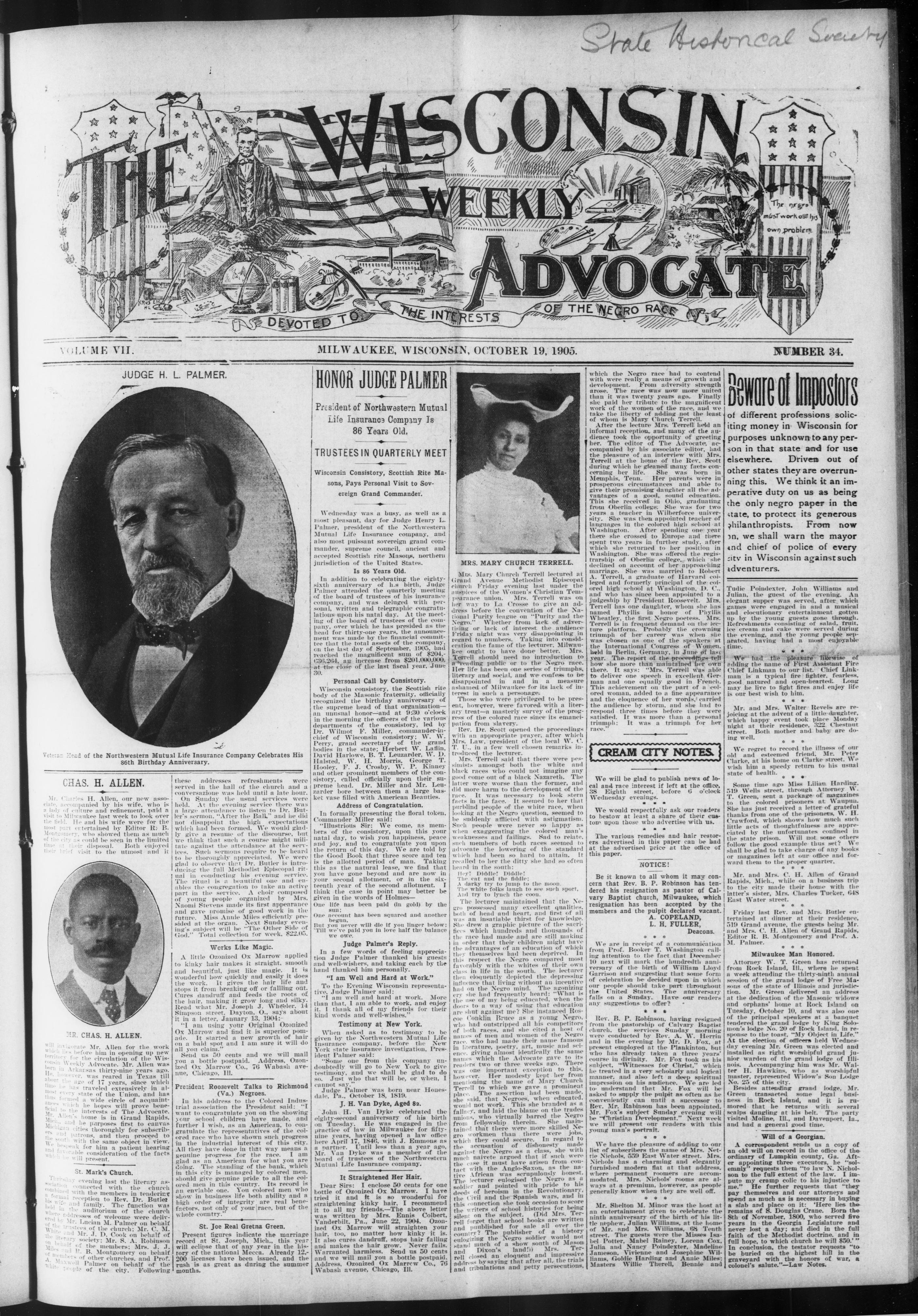
Wisconsin Weekly Advocate
Thursday, October 19, 1905
Milwaukee, Wisconsin
Page text (machine-generated)
State Historical Society
WISCONSIN
WEEKLY
ADVOCATE
DEVOTED TO THE INTERESTS OF THE NEGRO RACE
JUDGE H. L. PALMER.
Veteran Head of the Northwestern Mutual Life Insurance Company Celebrates His 86th Birthday Anniversary.
VOLUME VII.
JUDGE H.
Veteran Head of the Northwestern Mutual
86th Birthday A
CHAS. H. ALLEN.
Mr. Charles H. Allen, our new associate, accompanied by his wife, who is a lady of culture and refinement, paid a visit to Milwaukee last week to look over the field. He and his wife were for the most part entertained by Editor R. B. Montgomery, who showed them as much of the city as could be seen in the limited time at their disposal. Both enjoyed their brief visit to the utmost and it
[Name]
MR. CHAS. H. ALLEN. will invigorate Mr. Allen for the work which lies before him in opening up new territory for the circulation of the Wisconsin Weekly Advocate. Mr. Allen was born in Arkansas thirty-nine years ago. He, however, was reared in Texas till about the age of 17 years, since which time he has traveled extensively in almost every state of the Union, and has thus formed a wide circle of acquaintances which he hopes will prove beneficial to the interests of The Advocate. Mr. Allen's home is in Grand Rapids, Mich., and he parposes first to canvas Michigan cities thoroughly for subscribers and patrons, and then proceed to the south with the same object in view. We bespeak for him a patient hearing and favorable consideration of the facts which he will present.
St. Mark's Church
Thursday evening last the literary association connected with the church combined with the members in tendering a formal reception to Rev. Dr. Butler his wife and family. The function was held in the auditorium of the church where addresses of welcome were delivered by Mr. Lucian M. Palmer on behalf of the trustees of the church; Mr. C. M. White and Mr. J. D. Cook on behalf of the literary society; Mr. S. A. Robinson on behalf of the members; Mrs. J. J. Miles and R. B. Montgomery on behalf of members of other churches, and Prof. A. Maxwell Palmer on behalf of the white people of the city. Following
___
these addresses refreshments were served in the hall of the church and a conversazione was held until a late hour. On Sunday the usual services were held. At the evening service there was a large attendance to listen to Dr. Butler's sermon. "After the Ball," and he did not disappoint the high expectations which had been formed. We would gladly give a resume of the discourse, but we think that such a course might militate against the attendance at the services. Such sermons require to be heard to be thoroughly appreciated. We were glad to observe that Dr. Butler is introducing the full Methodist Episcopal ritual in conducting his evening service. The ritual is a beautiful one and enables the congregation to take an active part in the service. A choir composed of young people organized by Mrs. Naomi Stevens made its first appearance and gave promise of good work in the future. Miss Annie Miles efficiently presided at the organ. Next Sunday evening's subject will be "The Other Side of God." Total collection for week. $22.05.
Works Like Magic.
A little Ozonized Ox Marrow applied to kinky hair makes it straight, smooth and beautiful, just like magic. It is wonderful how quickly and easily it does the work. It gives the hair life and stops it from breaking off or fallling out. Cures dandruff and feeds the roots of the hair, making it grow long and silky. Read what Mr. Joseph J. Wheeler, 14 Simpson street, Dayton, O., says about it in a letter, January 13, 1904: "I am using your Original Ozonized Ox Marrow and find it is superior pomade. It started a new growth of hair on a bald spot and I am sure it will do all you claim." Send us 50 cents and we will mail you a bottle postpaid. Address, Ozonized Ox Marrow Co., 76 Wabash avenue, Chicago, Ill.
President Roosevelt Talks to Richmond (Va.) Negroes.
In his address to the Colored Industrial association the President said: "I want to congratulate you on the showing your school children have made, and further I wish, as an American, to congratulate the representatives of the colored race who have shown such progress in the industrial interest of this city. All they have done in that way means a genuine progress for the race. I am glad as an American for what you are doing. The standing of the bank, which in this city is managed by colored men, should give genuine pride to all the colored men in this country. Its record is an enviable one. You colored men who show in business life both ability and a high order of integrity are real benefactors, not only of your race, but of the whole country."
St. Joe Real Gretna Green.
Present figures indicate the marriage record at St. Joseph, Mich., this year will eclipse that of any year in the history of the national Mecca. Already 12,200 licenses have been issued, and the rush is as great as during the summer months.
MILWAUKEE, WISCONSIN, OCTOBER 19, 1905.
HONOR JUDGE PALMER
President of Northwestern Mutual Life Insurance Company Is 86 Years Old.
Wisconsin Consistory, Scottish Rite Masons, Pays Personal Visit to Sovereign Grand Commander.
Wednesday was a busy, as well as a most pleasant, day for Judge Henry L. Palmer, president of the Northwestern Mutual Life Insurance company, and also most puissant sovereign grand commander, supreme council, ancient and accepted Scottish rite Masons, northern jurisdiction of the United States.
Is 86 Years Old.
In addition to celebrating the eighty-sixth anniversary of h.s birth, Judge Palmer attended the quarterly meeting of the board of trustees of his insurance company, and was deluged with personal, written and telegraphic congratulations upon his natal day. At the meeting of the board of trustees of the company, over which he has presided as the head for thirty-one years, the announcement was made by the financial committee that the total assets of the company, on the last day of September, 1905, had reached the magnificent sum of $204,636,264, an increase from $201,000,000, at the close of the last fiscal year, June
Personal Call by Consistory.
Wisconsin consistory, the Scottish rite body of the Masonic fraternity, officially recognized the birthday anniversary of the supreme head of that organization—an unusual honor—and at 9:30 o'clock in the morning the officers of the various departments of the consistory, led by Dr. Wilmot F. Miller, commander-in-chief of Wisconsin consistory; W. W. Perry, grand secretary of the grand bodies in the state; Herbert W. Laflin, David Harlowe, B. T. Leuzarder, W. D. Halsted, W. H. Morris, George T. Hooley, F. J. Crosby, W. P. Kinney and other prominent members of the consistory, called officially upon their supreme head. Dr. Miller and Mr. Leuzarder bore between them a large basket vase filled with American Beauties.
Address of Congratulation.
In formally presenting the floral token, Commander Miller said:
"Illustrious Sir: We come, as members of the consistory, upon this your natal day, to wish you happiness, peace and joy, and to congratulate you upon the return of this day. We are told by the Good Book that three score and ten is the allotted period of man. Taking this as the natural lease, we find that you have gone beyond and are now in your second allotment, or in the sixteenth year of the second allotment. I think the case in point may better be given in the words of Holmes—
One life has been paid (in gold) by the sun;
One account has been squared and another begun.
But you never will die if you linger below; Till we've paid you in love half the balance we owe.
Judge Palmer's Reply.
In a few words of feeling appreciation Judge Palmer thanked his guests and well-wishers, and taking each by the hand thanked him personally.
"I am Well and Hard at Work."
To the Evening Wisconsin representative, Judge Palmer said:
"I am well and hard at work. More than that, I am able to work, and enjoy it. I thank all of my friends for their kind words and well-wishes."
Testimony at New York.
When asked as to testimony to be given by the Northwestern Mutual Life Insurance company, before the New York state insurance investigation, President Palmer said:
"Some one from this company undoubtedly will go to New York to give testimony, and we shall be glad to do so. Just who that will be, or when, I cannot say."
Judge Palmer was born near Honesdale, Pa. October 18, 1819.
I. H. Van Dyke, Aged 82.
John H. Van Dyke celebrated the eighty-second anniversary of his birth on Tuesday. He was engaged in the practice of law in Milwaukee for fifty-nine years, having opened a law office here April 17, 1846, with J. Emmons as a partner. Until less than a year ago, Mr. Van Dyke was a member of the board of trustees of the Northwestern Mutual Life Insurance company.
It Straightened Her Hair.
Dear Sirs: I enclose 50 cents for one bottle of Ozonized Ox Marrow. I have tried it and it is so wonderful for straightening kinky hair. I recommend it to all my friends.—The above letter was written by Mrs. Ennis Colbert, Vanderbilt, Pa., June 22, 1904. Ozonized Ox Marrow will straighten your hair, too, no matter how kinky it is. It also cures dandruff, stops hair falling and makes the hair grow. Never fails. Warranted harmless. Send us 50 cents and we will mail you a bottle postpaid. Address, Ozonized Ox Marrow Co., 76 Wabash avenue, Chicago, Ill.
THE WOMEN'S HISTORY MUSEUM
MRS. MARY CHURCH TERRELL.
Mrs. Mary Church Terrell lectured at Grand Avenue Methodist Episcopal church Friday evening last under the auspices of the Women's Christian Temperance union. Mrs. Terrell was on her way to La Crosse to give an address before the convention of the National Purity league on "Purity and the Negro." Whether from lack of advertising or lack of interest the audience Friday night was very disappointing in regard to numbers. Taking into consideration the fame of the lecturer, Milwaukee ought to have done better. Mrs. Terrell should need no introduction to a reading public or to the Negro race. Her life has been one series of triumphs, literary and social, and we confess to be disappointed in and in a measure ashamed of Milwaukee for its lack of interest in such a personage.
Those who were privileged to be present, however, were favored with a literary treat—a masterly survey of the progress of the colored race since its emancipation from slavery. Rev. Dr. Scott opened the proceedings with an appropriate prayer, after which Mrs. Law, president of the local W. C. T. U., in a few well chosen remarks introduced the lecturer.
Mrs. Terrell said that there were pessimists amongst both the white and black races who could not imagine any good come out of a black Nazareth. The latter were worse than the former, and did more harm to the development of the race. It was necessary to look stern facts in the face. It seemed to her that purblind people of the white race, when looking at the Negro question, seemed to be suddenly afflicted with astigmatism. Such people were never so happy as when exaggerating the colored man's weaknesses and failings. Sad to relate, such members of both races seemed to advocate the lowering of the standard which had been so hard to attain. It recalled to her the ditty she had so often heard in the south:
Hey! Diddle! Diddle!
A darky try to jump to the moon. The white folks laugh to see such sport. And try to lynch the coon.
The lecturer maintained that the Negro possessed many excellent qualities, both of head and heart, and first of all was an insatiable thirst for knowledge. She drew a graphic picture of the sacrifices which hundreds and thousands of the race had made and are still making in order that their children might have the advantages of an education of which they themselves had been deprived. In this respect the Negro compared most favorably with the whites of their own class in life in the south. The lecturer then eloquently depicted the depressing influence that living without an incentive had on the Negro mind. The agonizing cry she had frequently heard: "What is the use of my being educated, when the doors to a way of using that education are shut against me? She instanced Rosco Conklin Bruce as a young Negro, who had outstripped all his competitors of both races, and she cited a host of names of men and women of the Negro race, who had made their name famous in literature, poetry, art, music and science, giving almost identically the same names which the Advocate gave to its readers two or three weeks ago. There was one important exception to this, however. Her modesty kept her from mentioning the name of Mary Church Terrell to which we gave a prominent place. The assertion had been made, she said, that Negroes, when educated, would not work. This she branded as a fallacy, and laid the blame on the trades unions, who virtually barred the Negro from fellowship therein. She maintained that there were more skilled Negro workmen than there were jobs, which they could secure. In regard to the accusation of dishonesty made against the Negro as a class, she with much naivete argued that if such were the case it must have arisen from contact with the Anglo-Saxon, as the native African was scrupulously honest. The lecturer eulogised the Negro as a soldier and pointed with pride to his deeds of heroism in the Revolutionary, the Civil and the Spanish wars, and in this connection she took occasion to score the writers of school histories for being silent on the subject. (Did Mrs. Terrell forget that school books are written and published for sale all over the country? The publisher of a history eulogizing the Negro soldier would not stand much of a show south of Mason and Dixon's land!)) Mrs. Terrell closed an eloquent and impressive address by saying that after all, the trials and tribulations and petty persecutions,
which the Negro race had to contend with were really a means of growth and development. From adversity strength arose. The race was now more united than it was twenty years ago. Finally she paid her tribute to the magnificent work of the women of the race, and we take the liberty of adding not the least of whom is Mary Church Terrell.
After the lecture Mrs. Terrell held an informal reception, and many of the audience took the opportunity of greeting her. The editor of The Advocate, accompanied by his associate editor, had the pleasure of an interview with Mrs. Terrell at the home of the Rev. Scott during which he gleaned many facts concerning her life. She was born in Memphis, Tenn. Her parents were in prosperous circumstances and able to give their promising daughter all the advantages of a good, sound education. This she received in Ohio, graduating from Oberlin college. She was for two years a teacher in Wilberforce university. She was then appointed teacher of languages in the colored high school at Washington. After spending one year there she crossed to Europe and there spent two years in further study, after which she returned to her position in Washington. She was offered the registrarship of Oberlin college, which she declined on account of her approaching marriage. She was married to Robert A. Terrell, a graduate of Harvard college and formerly principal of the colored high school at Washington, D. C., and who has since been appointed to a judgeship by President Roosevelt. Mrs. Terrell has one daughter, whom she has named Phyllis in honor of Phyllis Wheatley, the first Negro poetess. Mrs. Terrell is in frequent demand on the lecture platform. Probably the crowning triumph of her career was when she was chosen as one of the speakers at the International Congress of Women, held in Berlin, Germany, in June of last year. The report of the proceedings tell how she more than maintained her own there. It says: "Mrs. Terrell was able to deliver one speech in excellent German and one equally good in French. This achievement on the part of a colored woman, added to a fine appearance and the eloquence of her words, carried the audience by storm, and she had to respond three times before they were satisfied. It was more than a personal triumph: It was a triumph for her race."
CREAM CITY NOTES
We will be glad to publish news of local and race interest if left at the office, 38 Eighth street, before 6 o'clock Wednesday evenings.
We would respectfully ask our readers to bestow at least a share of their custom upon those who advertise with us.
The various remedies and hair restorers advertised in this paper can be had at the advertised price at the office of this paper.
NOTICE!
Be it known to all whom it may concern that Rev. B. P. Robinson has tendered his resignation as pastor of Calvary Baptist church, Milwaukee, which resignation has been accepted by the members and the pulpit declared vacant. A. COPELAND.
We are in receipt of a communication from Prof. Booker T. Washington calling attention to the fact that December 10 next will mark the hundredth anniversary of the birth of William Lloyd Garrison and suggesting that some form of celebration be decided upon in which our people should take part throughout the United States. The anniversary falls on a Sunday. Have our readers any suggestions to offer?
```markdown
```
Rev. B. P. Robinson, having resigned from the pastorship of Calvary Baptist church, the services Sunday morning were conducted by Rev. A. W. Herrin and in the evening by Mr. D. Fox, at present employed at the Plankinton, but who has already taken a three years' course in divinity. Mr. Fox took as his subject, "Witnesses for Christ," which he treated in a very scholarly and logical manner, and also left a deep spiritual impression on his audience. We are led to understand that Mr. Fox will be asked to supply the pulpit as often as he conveniently can until a successor to Rev. Mr. Rabinson has been appointed. Mr. Fox's subject Sunday evening will be "Christian Development." Next week we will present our readers with this young man's portrait.
```markdown
```
We have the pleasure of adding to our list of subscribers the name of Mrs. Nettie Nichols, 559 East Water street. Mrs. Nichols has a charming and elegantly furnished modern flat at that address, where permanent roomers are accommodated. Mrs. Nichols' rooms are always at a premium, however, as people generally know when they are well off.
```markdown
```
Mr. Shelton M. Minor was the host at an entertainment given to celebrate the ninth anniversary of the birth of his little nephew, Julian Williams, at the home of Mr. and Mrs. Williams, 68 Tenth street. The guests were the Misses Isabel Potter, Mabel Rainey, Lorena Cox, Julia and Nancy Poindexter, Madeline Jameson, Vivienne and Josephine Williams, Goldie Harding and Annie Miles; Masters Willie Therell, Bennie and
NUMBER 34.
Beware of Impostors
of different professions soliciting money in Wisconsin for purposes unknown to any person in that state and for use elsewhere. Driven out of other states they are overrunning this. We think it an imperative duty on us as being the only negro paper in the state, to protect its generous philanthropists. From now on, we shall warn the mayor and chief of police of every city in Wisconsin against such adventurers.
Tudie Poindexter, John Williams and Julian, the guest of the evening. An elegant supper was served, after which games were engaged in and a musical and elocutionary entertainment gotten up by the young guests gone through. Refreshments consisting of salad, fruit, ice cream and cake were served during the evening, and the young people separated, having had a most enjoyable time.
We had the pleasure likewise of adding the name of First Assistant Fire Chief Linkman to our list. Chief Linkman is a typical fire fighter, fearless, good matured and open-hearted. Long may he live to fight fires and enjoy life is our best wish to him.
```markdown
```
Mr. and Mrs. Walter Revels are rejoicing at the advent of a little daughter, which happy event took place Monday night at their residence, 322 Chestnut street. Both mother and baby are doing well. * * *
We regret to record the illness of our old and esteemed friend. Mr. Peter Clarke, at his home on Clarke street. We wish him a speedy return to his usual state of health.
Some time ago Miss Lilian Harding, 519 Wells street, through Attorney W. T. Green, sent a package of magazines to the colored prisoners at Waupun. She has just received a letter of grateful thanks from one of the prisoners, W. H. Crawford, which shows how much such little acts of thoughtfulness are appreciated by the unfortunates confined in the state prison. Will not some others follow the good example thus set? We shall be glad to take charge of any books or magazines left at our office and forward them to the proper quarter.
Mr. and Mrs. C. H. Allen of Grand Rapids, Mich., while on a business trip to the city made their home with the latter's sister, Mrs. Charles Tucker, 648 East Water street.
Friday last Rev. and Mrs. Butler entertained at dinner at their residence, 519 Grand avenue, the guests being Mr. and Mrs. C. H. Allen of Grand Rapids, Editor R. B. Montgomery and Prof. A. M. Palmer.
Milwaukee Man Honored
Attorney W. T. Green has returned from Rock Island, Ill., where he spent a week attending the thirty-ninth annual session of the grand lodge of Free Masons of the state of Illinois and jurisdiction. Mr. Green delivered an address at the dedication of the Masonic widows and orphans' home at Rock Island on Tuesday, October 10, and was also one of the principal speakers at a banquet tendered the grand lodge by King Solomon's lodge No. 20 of Rock Island, in response to the toast, "My Object in Life." At the election of officers held Wednesday evening Mr. Green was elected and installed as right worshipful grand junior warden of the grand lodge of Illinois. Accompanying him was Mr. Walter H. Hawkins, who as worshipful master, represented Widow's Son Lodge No. 25 of this city.
Besides attending grand lodge, Mr. Green transacted some legal business in Rock Island, and it is rumored that he returns with several scalps dangling at his belt. The party visited Moline, Ill., and Davenport, Ia., and had a general good time.
Will of a Georgian.
A correspondent sends us a copy of an old will on record in the office of the ordinary of Lumpkin county, Ga. After appointing three executors, he "solennly" requests them "to law N. Nicholson to the full extent of the law. I impute my cramp colic to his injustice to me." He further requests that "they pay themselves and our attorneys and spend as much as is necessary in buying a slab and place on it: 'Here lies the remains of S. Douglas Crane. Born the 8th of November, 1800, who served five years in the Georgia Legislature and never lost a day; and died in the full faith of the Methodist doctrine, and in full hope, to which church he will $50.'" In conclusion, the testator requests "to be buried on the highest hill in the graveyard with the honors of war, a colonel's salute."—Law Notes.
"Most likely twins, sir."—Translated for Tales from "Fliegende Blaetter."
Reasonable.
Landlady—Some of my boarders have been with me for years.
been with me for years. New Boarder—Haven't the strength to leave, I suppose?—Modern Society.
Modestv.
Lieutenant—I have a pretty compliment for you—one of the young ladies thought I was the author of your latest poem.—Translated for Tales from Fliegende Blaetter.
Landmarks
Madge—I'll bet there are no young men at the hotel.
Dolly—How can you tell so soon?
"All the hammocks are swung in such light places."—Smart Set.
Not Necessarv.
He—Well, at any rate, our women never have the prefix honorable to their names.
She—No; I'm glad to say that women don't have to!—Yonkers Statesman.
Cupid and Coupons.
"I am very much in love with the banker's daughter. As soon as I saw her father's coupon scissors I had palpitation of the heart."—Translated for Tales from Meggendorfer Blaetter.
Madge—I understand she obtained her divorce with the utmost secrecy. Dolly—Yes, dear; she was as mean as she could be. We never even found out who the co-respondent was.—Smart Set.
Exactly.
Tarrier—Phwat fer is thim dagoes so all-fired mad about, I dunno?
Foreman—That's it?
Tarrier—Phwat's it?
Foreman—They're all fired.—Cleveland Leader.
A. Reservation.
"But," persisted the bridegroom in their little quarrel, "you promised to love, honor and obey me." "Maybe I did," replied the bride, "but I had my fingers crossed."—Philadelphia Ledger.
One Ahead.
One Ahead.
Patience—See what airs she puts on.
Patrice—Yes; you know, a member of her family has written an historic novel.
"That's nothing; a member of our family has just finished a prehistoric novel."
—Yonkers Statesman.
Another Closed Sea
The persistent report that Great Britain, France, Spain, Portugal and America are about to close the Atlantic ocean to foreign war vessels should be accepted with some reserve pending official confirmation.—London Punch.
Businesslike.
Landlady (to student lodger)—Do you know, I dreamed last night that you paid up all the rent you owed me. Student—Is that so? Then I'll kindly trouble you for the receipt.—Translated for Tales from Meggendorfer Blaetter.
Management.
First Tramp—You are the first feller that ever got a square meal from that woman. How did yer manage?
Second Tramp—I told her I'd found 10 cents, and asked her to direct me to a free lunch saloon.—New York Weekly.
At the Market Price.
"Baron, what did you give your boys for birthday presents?"
"Soldiers."
"And your daughter?"
"I bought her one, too—a lieutenant."
—Translated for Tales from Fliegende Blaetter.
A Scrooge.
Senior Partner—We had best have that young bookkeeper's books examined. He took twelve drinks between here and home yesterday. Junior Partner—How do you know? "I was with him. He was treating me."—Smart Set.
A Subterfuge.
"Bliggins says that some one has tried to make him pay money to keep things out of print."
"Nonsense," rejoined Miss Cayenne.
"Mr. Bliggins is trying to convey the impression that he is in the smart set."
—Washington Star.
Might Depress Some of Us.
A Cincinnati woman who is noted for her amiability says she acquired the habit of cheerfulness by saying the following to her self every time she felt inclined to worry: "The cow's in the hammock.
The cat's in the lake.
The children are in the garbage can,
What difference does it make?"
A Wise Child
The Nurse—The idea of a big boy like you making his nurse pull his boots off! What will you do when you are grown up and have no nurse? The Little Boy—When I grow up I'll be a policeman, and all policemen have nurses.—Translated for Tales from Le Rire.
The Way of Love.
Jack—Yes; I had a little balance in the bank, but I became engaged two months ago, and now—"
Tom—Ah! love makes the world go round."
Jack—Yes; but I didn't think it would go round so fast as to cause me to lose my balance.—Life.
Scraped It Together
Family Friend—Well, how are things? Young Preacher—Fine. The congregation actually raised my salary this month. Family Friend—How much was the increase? Young Preacher—There was no increase. They merely raised it, that's all. Houston Chronicle.
For Two and Two For
The wife—It is very strange, dear. Before we were married I used to love the odor of your cigars, and now I simply cannot bear it.
The Husband—There's nothing odd about that. When I had only myself to take care of I could buy good cigars. Now I have to smoke two-fors.—Translated for Tales from "Le Rire."
Matter of Habit.
"Very pretty," murmured Elizabeth absently, "but I'd like to see the one on the top shelf." Suddenly remembering that she wasn't shopping, she had to be content with what was shown.—Lippincott's.
"What advice did your father give
you when you left home?"
"He told me to saw wood and say nothing."
"Did you do as he said?"
"No, sir." replied the politician. "I have found that it is better to saw wood and talk"—Detroit Free Press.
Naturally.
Patient—Well, doctor, do you think I'm getting well all right?
Doctor—Oh, yes; you still have a good deal of fever, but that doesn't trouble me.
"Of course not. If you had a fever it wouldn't trouble me."—Translated for Tales from Le Journal Amusant.
A Good Thing.
Mrs. Newbryde-I got some hams here last month that my husband liked very much. Have you any more of the same kind?
The Grocer—Yes'm. Got about a dozen left from the same pig. Mrs. Newbryde—Oh, that's nice! Give me six of them.—Cleveland Leader.
Difficult Task.
"How can I get the ladies of my congregation more interested in heaven?" sighed the earnest young rector of the fashionable church.
"You might intimate that things will be exclusive there," replied the old preacher, sadly. "By such means you may be able to arouse a mild interest."—Pittsburg Post.
Made Some Difference.
Telegram from financier in New York to his partner in Cleveland:
"Am about to close a big deal with Skinham. What kind of a man is he?" Reply from Cleveland:
"He is like a fish." Telegram from New York: "Wire at once what kind of a fish shark or sucker."—Cleveland Leader.
A. D. 1950.
"And what," inquired the visitor as he pointed ahead, "is that small but tasteful structure?"
"That," replied the native, "is the Hall of Fame?"
"Oh. And what is the mighty marble building over there?"
"That? Why, that's our Hall of Eminent Grafters."—Cleveland Plain Dealer
Pot of Gold Found.
An iron pot containing coins of gold and silver valued at about $500 has been unearthed by George Brown upon some rented land in a suburban addition to Des Moines, Ia., known as Hyde Park. The coins were dated before 1860 and it is presumed that they were buried for safe keeping by some farmer, who responded to the call for volunteers in the beginning of the Civil war and who never returned to dig up his buried treasure. Mr. Brown was cutting corn and the accidental thrusting of his blade into the earth struck the hard substance and caused the investigation which revealed the valuable find.
Current Prosperity Exists.
The monthly report issued by Appraiser Whitehead of New York city, is more than usually interesting in that it furnishes a striking instance of the current prosperity existing throughout the country. The total appraised value of importations during the month of September just ended was $55,004,350. This is an increase of about $5,000,000 in comparison with the same month in 1904. Important increases are shown in various lines of merchandise, and especially in luxuries.
Body in Lonely Tomb.
Five hundred feet below the summit of Mount Ypsilon a tomb is being constructed around the body of Lewis G. Levings, the Armour Art Institute student from Canton, Ill., who was killed by falling from the mountain. The body lies at the edge of a bottomless lake, and it is impossible to recover it. Men can be lowered because they are able to push themselves free of abutments, but inanimate objects cannot be brought up by rope. An inscription telling the young man's name and how he met his death will be placed on the tomb, but it is doubtful if anyone will ever see it.
Cat in Safe Two Days
When Clarence O'Brien, a Naugatuck, Conn., store keeper, discovered that Nancy Gray, his pet cat, was missing, and that the combination to his safe would not work, he thought burglars had been about. Efforts to open the safe or to find the cat failed until a locksmith was summoned. After three hours' work the safe was opened, and into the startled locksmith's face flew the missing Nancy Grey with the ferocity of a wildcat. The cat had entered the safe for a nap, but how it had contrived to live two days without food and air is a puzzle.
Red-headed Men's Club.
Red-headed students of Washburn college, Topeka, Kan., have organized an incandescent club to exploit the achievements of red-haired people. They assert that most of the big events in history either were planned or executed by red-haired men or men with red-haired ancestors. It is expected to extend the club to all the other colleges in America. All the notable things done by red-haired people are to be compiled in book form. The officers of the Washburn club are Richard Wells, president, and Ethel Levan, secretary. A state university club is to be organized.
Cow Swallows Wire: Dies
Her heart pierced by a piece of wire which she had swallowed, Lady, a buffalo cow, belonging to the Whitney herd of buffalo in the Bronx park zoo, New York, died. The sudden death of the animal greatly puzzled the keepers. An autopsy was decided upon and the seemingly inexplicable cause of Lady's death was revealed. A three inch piece of wire, evidently from the network used as inclosures for some of the animals, was found in her body. The wire had worked itself in an upright position through Lady's body until it reached her heart.
Mint That Noah Took Into the Ark
J. T. Stewart, an eccentric herb gatherer, while searching for roots and herbs for big concerns by whom he is employed, found in Montgomery county a small specimen of a bush called camel's mint. He says it is the kind of mint that Noah took into the ark to administer to the camels when they became ill. He says it is peculiar to the plains of Asia, and in all his experience never found it before on this hemisphere. Dayton Cor. Cincinnati Enquirer.
Protest to Baltimore Government
Rear Admiral Yates Sterling, U. S. N., retired, who by a Maryland statute passed in 1901 is disfranchised, although always a resident of Baltimore, has written a letter of protest to a local newspaper in which he says:
"Does Maryland intend to put a stigma upon her sons who leave the state upon the call of the national government in the military and naval service?"
The statute provides that a resident of the state going to another state or country and returning here must give twelve months' notice before he can register.
Out of far fields, through inallumined ways. With weariness the gleaners bare their sheaves.
With painful ardor gathered straw by straw,
To their great Master, he whose just reward
Fails not, who knows himself their weariness,
And gives to each his due. They came and stood
Before him, and received, and gave him thanks.
And one who wore the gleaner's coat bare not
A sheaf. He also stood; and for a time he spake
No word. No word was spoke by any one of them—
He nor his Master, nor his brethren there.
At last
he dared to look, and dared (at last) to speak,
And said, "Master, I have no sheaf," and dropped his eyes.
And silence deepened, for the Master spake
No word, nor did his brethren utter words.
Then he who wore the gleaner's coat again
Lifted his heavy eyes up to the face
he lifted them upon him as upon a child
An! terrible to hear! And then he fell before them on his face. And cried, "O Master! O my brothren, pour Upon me thy unpukened, consuming hate. But torment me no more in thy fierce love. —Richard Kirk in Lippincott's.
GEN. GRANT AS DEPUTY SHERIFF. A COLLECTOR AND A KICKER.
By Lleut.-Col. J. A. Watrous, U. S. A.
While at Denver last month Maj. John Davidson told me a story about Gen. Grant's service as a deputy sheriff at Prairie du Chien, Wis., in 1860. Davidson lived at Prairie du Chien at that time. He is now a resident of Junction City, Kan.
"A merchant named Ammen encountered financial difficulties and his store was closed.
"Among those Ammen owed was the firm of Grant & Co. of Galena, Ill., the head of the firm being Gen. Grant's father. As soon as the Galena firm heard that the store was closed, Capt. Grant was sent to Prairie du Chien to look into the matter. Reaching there he learned that Mr. Ammen had armed himself with a shotgun, taken a stand in the store, and let it be known that he would shoot down any man who entered the store.
"Everybody in town was excited over the situation, and when Capt. Grant arrived it was predicted that he would not risk his life in an attempt to enter the place of business.
"A lot of us young fellows decided to see the whole show. We stood in the street in front of the law office of O. B. Thomas, afterwards a captain in a Wisconsin regiment and then in Congress four or five terms, while the ex-regular captain reinforced himself with the required legal papers. That done, we followed him to the sheriff's office, and when the sheriff, Lawyer Thomas and Capt. Grant started for the store, where we were sure somebody would be killed, we followed at a respectful distance and closed in when the store was reached. The sheriff commanded Ammen to open the door.
"I will not open the door, and I will kill you or any of your crowd if you force your way into the building,' was Ammen's reply.
"The sheriff said the old man was desperate and would be pretty sure to kill some one.
"There was hesitancy on the part of the sheriff, whereupon Capt. Grant quietly said, 'If you don't want to risk it, make me a deputy and I will try it.'
"That was done. Our gang crowded up closer to the door.
"As an officer of the law, Mr. Ammen, I command you to open this door,' said the newly made deputy sheriff.
"I refuse, and again warn you and your crowd that death awaits the man who breaks into this store.'
"Capt. Grant stepped back a couple of yards and springing forward planted both feet against the door, hurling it from its hinges.
"There the old merchant stood, shotgun in hand, but he seemed to be dazed. Capt. Grant quietly walked past him and proceeded direct to the office, at the other end of the store, the old man following, carrying the gun in his right hand. At the office Capt. Grant removed his hat, hung it up, and turning to the merchant, said, 'Mr. Amman, put your gun away and help me take an account of our firm's part of this stock of goods,' and Mr. Amman obeyed like a soldier.
"We youngsters were looking for tragedy, not comedy, and dispersed a good deal disgusted.
"I didn't see Capt. Grant again until March, 1864, when he came to the Army of the Potomac in Virginia. He was Lieut.-Gen. Grant then, and he had a much harder job on hand than that one at Prairie du Chien, but, backed by Uncle Sam and a powerful army and a wideawake navy, it took him only a year to kick the confederacy into worse confusion than old man Amman's store was that morning in 1860."
When Capt. Grant was selling goods in southwestern Wisconsin, the year before the war, he disposed of a bill to a shoemaker at Spring Green, Grant county. It developed that the shoemaker was a much better buyer than payer. Grant made numerous attempts to collect the bill, but without avail, in spite of the fact that he was known as a remarkably good collector.
After the seller of leather had became famous as head of the army and was winning great battles, the Spring Green shoemaker had a good deal to say about his personal acquaintance with Gen. Grant.
The shoemaker had a son who was lacking in wit, though he was not wholly an idiot.
One evening, when half a dozen patrons were in the shop, the old man told interesting stories about Grant's visits and chats in his place, much to the delight of his hearers. The half-wit was also an attentive listener.
Mrs. Shoemaker called her husband to the house.
During his absence the son took his father's place as a talker about the great general.
Grant," remarked the lad, who said no more until one of the visitors asked why. "Pop wouldn't pay Capt. Grant for some leather pop bought. I'll bet he ast pop mor'n a hundred times to pay fer that leather, and pop jest told him he didn't hef ter. One day after the captain had ast pop real hard fer the money pop said he wouldn't never pay it. Then
Capt. Grant went right out of the shop and unhitched his team. Jest before he got into his wagin he called pop out, and he said, 'So you won't pay that bill?' No, I won't,' and pop started back to the shop. Quicker'n you could say Roberson Jack, Capt. Grant came up behind pop and give him four of the hardest kicks I ever seen a man git, and then he got into his wagin and druv away. I notis pop don't tell you about that when he gets ter talkin' about Grant."—Evening Wisconsin.
HAT VENTILATOR
The Ventilation Can Be Regulated to Suit the Wearer.
Air holes in men's hats to admit of ventilation is not a new idea, but a New York man has improved on this in such a way that the ventilation can be regulated to suit the weather and the tastes of the wearer. In the first place the usual eyelets are provided for admitting the air. These eyelets can be placed in any part of the hat-front, sides, top or back, as requirement or fancy may suggest. A very satisfactory arrangement is the one shown here, in which four eyelets are employed in diamond shape, and also one in the top of the hat. In the lower eyelet a thread is cut and a stud
```markdown
```
EYELETS CAN BE OPENED OR CLOSED
is fitted into the eyelet. The stud is not screwed up to make it immovable, but just far enough to allow it to be turned a part of a revolution to the right or left. Stems are secured to the stud, and disks of suitable material, preferably cork, attached to the stems, the latter being so bent as to admit of the disks lying against the inner side of the hat and over the eyelets, the position being changed by moving the stud. In the illustration the disks are shown by broken lines and in position to close the eyelets. A slight turn of the stud will cause the disks to uncover the eyelets. The stud is of such length and far enough up in the hat as to avoid contact with the head of the wearer. When the holes in the front of the hat are closed, there is, of course, a very slight ventilation through the hole in the top of the hat. On a warm day the opening of the front holes makes a change in the interior of the hat that is at once perceptible to the wearer, and in a warm season the wearer often finds a day or encounters a wind which would make it a comfort to have the holes closed. That is the purpose of this invention. This adjustability of the ventilating means renders a spring or fall hat as comfortable as a straw hat on the warm days that are due to those seasons before it is admissible to wear straw hats.
Deep Diving Feats.
At what depth can a diver carry out his functions? How long can he remain under the surface? What is the effect of high air pressure on the human system? One well known firm of submarine engineers limits the depth of descent to 25 fathoms, or, say, 150 feet. But operations have been carried out at greater depths than this, and perhaps the greatest distance below the surface at which a diver has succeeded in working is 34 fathoms, or 204 feet. This was accomplished by James Hooper, who descended to the ship Cape Horn, sunk off Pichidanque, South America, and sustained a pressure of $ 88 \frac{1}{2} $ pounds on every square inch of his body.
Another remarkable feat was that of Alexander Lambert, who recovered £70., 000 in gold coin from the steamship Alphonso XII., sunk off Point Gando, Grand Canary, in nearly 30 fathoms of water, the actual depth of the treasure room being 26 2-3 fathoms, or 160 feet. This man also performed the daring feat of stopping the flooding of the Severn tunnel when a door in the drainage tunnel had been left open. The door was situated a quarter of a mile distant from the shaft, but equipped in his diving dress he crept that distance through a narrow passage of water and closed the door. This plucky act enabled the pumps to overcome the volume of water which was flooding the working and allowed the completion of the tunnel to be carried out.
A further interesting case of deep diving is that of Angel Erostarbe, who succeeded in recovering silver bars valued at 49000 from the steamer Skyro, sunk off Cape Finisterre in over thirty fathoms. In this case the diver had to blow away portions of the vessel with dynamite before he could reach the treasure chamber. Three dives per diem were frequent, and as many as five descents were made in one day. The maximum period under water was twenty minutes.
The effect of high pressures on the constitution is not found injurious when the work is carried out under ordinary precautions. A French scientist has gone so far as to claim that breathing compressed air is a remedy for asthma and emphysema. It is also said to excite digestion, owing to the great quantity of oxygen carried into the blood. It has been found that a period of two hours should elapse between a meal and a descent. In descending the movement should be slow, and if the pressure causes pains in the head this can be remedied by rising gently a few feet, when the descent can be recontinued. In ascending divers are recommended not to exceed a speed of two feet per second.—Pall Mall Gazette.
nts.
The American truthteller was in form, "Talking of ants," he said, "we've got 'em as big as crabs out west. I guess I've seen 'em fight with long thorns, which they used as lances, charging each other like savages."
"They don't compare to the ants I saw in the east," said an inoffensive individual near by. "The natives have trained them as beasts of burden. One of 'em could trail a ton load for miles with ease. They worked willingly, but occasionally they turned on their attendants and killed them."
But this was drawing the long bow a little too far.
"I say, old chap," said a shocked voice from the corner, "what sort of ants were they?" "Elephants," said the quiet man.—London Tit-Bits.
The Signs.
When young men blush, and pale, and sigh
You may be sure of this—
Especially if they do not eat—
That something is a miss!
For the Farmer.
Ember Days.
Dust is the beauty of the rose,
But in the forest's urns
The fire that April kindled glows—
Golden and red it burns.
The birds make ready for their flight
A hush is on the hills;
But April's lyric of delight
With song the valley fills.
Once more before the winter comes
The garden shows her grace,
Wearing the bright chrysanthemums
That hint of April's face.
—Frank Dempster Sherman in New York Sun.
Green Corn for Stock Feed
As soon as the grain of corn gets into the milk it become highly serviceable in hastening the fattening of steers in pasture. These may be fed at the rate of ten to twenty cars per day, according to the size of the animals. It is contended that this corn also adds to the quality of the beef slaughtered early in autumn, and that it is of more solid character than pure grass fed. If the steers are to be kept later on into winter, then this soft, green corn is an excellent preparation, to be followed up by feeding such as has been fully ripened and become hard. After steers have obtained sufficient size it is quite an object to fatten them as rapidly as possible, and this is done quicker in mild weather than in cold with the same quantity of food.
Power from Farm Refuse.
A French experimenter has successfully utilized dead leaves, old straw, hay and farm refuse for the production of gas, by which he produces power to run motors. With leaves it costs four-fifths of a cent to develop one horsepower, and with hay a cent and a half. The material to be used is compressed into bales and then burned.
Many European cities and a few American communities, says Everybody's Magazine, are producing light and power from street and household waste. On American farms, where so much of the labor is done by machinery, great saving could be effected by using refuse as fuel, and our plutocratic agriculturists may become more plutocratic still. But the fall bonfire will have to go. If leaves and grass are good for fuel, the chief autumnal delight of the small boy must be suppressed.
George E. Treffry writes to the Farmer's Advocate on this subject as follows:
Some years ago, we had a great many deaths from this trouble. We could not get anything to help them. Most of them would only be sick for twelve or twenty-four hours, and then we would find them dead. We employed three different veterinary surgeons, all of no use. I had a cousin here from Iowa, where they had had the same trouble and could get no help, till some veterinary surgeon discovered that one drop (and for the most severe cases two drops) of strong camphor, given every hour in a teaspoonful of fresh milk, is a sure cure. Just as soon as you see signs of relief, stop giving the camphor. I have treated many bad cases of this trouble, and have never lost a calf since. We have used this treatment only on calves that are a day or two old.
Brown vs. White Eggs
A curious preference, entirely unassociated with taste, is the color of eggs. Brown eggs sell for a cent or two per dozen more than white eggs in Boston, and the contrary is true in New York, says G. H. Holmes in the Year Book for 1904. Let white and brown eggs be mixed, and a dozen of these will sell for less than a dozen of either assorted, and let one or two "dirties" be visible and the price goes still lower, although, as a matter of fact, in any case the contents of the eggs are of perfect quality and cannot be distinguished by taste, appearance or nutritive value, one egg from another. Chicago is said to be undiscriminating with regard to color of egg shells, but San Francisco prefers white ones. In some markets where the brown egg is favored, as in those of England, it is said to be not uncommon to color shells of white eggs with coffee decoction or some dyestuff.
Hogs That Packers Want.
I suppose every breeder wants to know what particular breed sells the best, and that is one of the hardest questions for a hog dealers to answer, says a commission man at the yards. Perhaps the best answer is that no breed enjoys any marked preference. In a recent investigation conducted in the corn belt about 73 percent, of the feeders replied that they preferred the Poland China for the feedlot, giving the small bone and quick maturing qualities of that breed as the reasons for their choice. Yet other men claim that those very qualities have been obtained at the cost of making the breed weak and non-prolific, and so this argument might extend without end.
However, let it be understood that the packers make little or no distinction between any color or any breed. What they want is a smooth, even lot of well-finished hogs without regard to ancestry. Still there is little to be said in favor of the cross-bred hog. While we stated that practically no discrimination is made against any color, yet a spotted lot of hogs does not look as even a load of uniform color and usually suffers as a consequence. You seldom see a picture of spott or off-colored hogs that topped the market. About the only time when any certain color is demanded occurs with certain eastern shipping orders which specify the desire for black hogs, but this particular demand is too small to affect the market to any appreciable extent.—Prairie Farmer.
The One Word.
In Woodlawn cemetery, New York, is a plain white marble shaft on which is the single word "Forgive." No date appears and not even the name of the person who lies beneath it.
No one passes the spot without a thought of the meaning of that word, so full as it seems of human error and a desolating, and perhaps too late, repentance.
Did the poor soul passing away, ask that the word should be set there as a plea for forgiveness, or a token of the same? Did some heartmrogen man or woman use the word as a voiceless reminder of the pardon that was asked too late? A volume of love and suffering seems told in the one enduring and pathetic word.—New York Letter.
Womanly Beauty
This generation has seen in a remarkable fashion the results of popular expectation and general habits on physical development in the case of women. The number of tall and strong girls now is most striking; and equally so are the beauty and vitality of many women who are past the fiftieth birthday.—Illustrated London News.
APPENDIX BECOMING RARE
Modern Surgeons Eliminating a Fashionable Source of Disease.
How many vermiform appendices are there in the world today? A few savage and semi-civilized nations retain them, but the supply in lands where the surgeons flourish must be small, for Slasher has been at work all over. Like a sportsman who cries, "Save the buffalo!" Joseph Kidd, M. D., of England rises and cries, "Preserve the appendix!" and tells how it may be done. Chills following overheating and imperfect mastication make trouble for the appendix. The grape seed of horrid memory deserves not half the odium it has received—and too much aperient water and salts are bad for this mysterious organ, just as they are for all the rest of man's internal economy. Don't let the chills get you, chew the food thoroughly—Gladstone masticated every mouthful 40 or 400 times—and make nature do the work below the diaphragm without chemicals and drugs except when a doctor says they are necessary.
We are the great drug-swallowing nation. We flood our insides with nostrums, fill the intestines with mercury, and bolus ourselves not merely when it is unnecessary, but when it is positively harmful. Dr. Legs and Dr. Arms properly employed will cure most of our minor ills. Their fees are nominal, and they pay big dividends. Ten years ago a war of extermination was waged against the human appendix. Today it is regarded less as a foe, but many surgeons delight to cut. Many charges brought against it were unfounded. Let those who may preserve theirs, and let all remember that surgeons do not work for nothing.—Everybody's Magazine.
An Honest Opinion.
Mineral, Idaho, Oct. 16.—(Special.) That a sure cure has been discovered for those scilic pains that make so many lives miserable, is the firm opinion of Mr. D. S. Colson, a well-known resident of this place, and he does not hesitate to say that cure is Dodd's Kidney Pills. The reason Mr. Colson is so firm in his opinion is that he had those terrible pains and is cured. Speaking of the matter, he says: "I am only too happy to say Dodd's Kidney Pills have done me lots of good. I had awful pains in my hip so I could hardly walk. Dodd's Kidney Pills stopped it entirely. I think they are a grand medicine."
All Scilatic and Rheumatic pains are caused by Uric Acid in the blood. Dodd's Kidney Pills make healthy kidneys and healthy kidneys strain all the Uric Acid out of the blood. With the cause removed there can be no Rheumatism or Sclatica.
The Irony of Fate.
I have a nature in which injustice rankles and I would always rather feel myself in the wrong than feel myself wrongfully accused. I had failed, therefore I must have deserved to fail, but how? So I set to work to construct out of my self-knowledge a character for which failure would be the only justice, a character that would bring down the roof of the temple upon its head by its own self-seeking, yet in a manner so impersonal and detached that all the region round would echo with Olympian laughter. In order to paint such a portrait of myself it was necessary to omit all my redeeming qualities and to bring out the other kind with a merciless touch. Yet I tried to relieve the shadows with humorous lights, which would unmistakably indicate that I was not a hater of the human race, but a lover who would say: "This creature have I held up to ridicule that you may see why men fail and take warning!" And then, having created out of my inner consciousness a bit of life as pitiless and as ironical as a Greek tragedy, I sent it to an editor whom I had had in mind throughout the writing; the only editor in America that I could depend upon to appreciate the subtle humor, the biting satire, the underlying truth.
I waited eagerly for his answer. It came, with a burst of confidence that astounded me. He could not speak highly enough of my story. "It is a masterpiece of narrative and portraiture," he wrote, "but by some unaccountable coincidence you have painted the portrait of my wife's brother. My wife has strong family feelings, and my brother-in-law has a fiery temper, so I dare not print it. But if you can get some other editor to publish it I will be your friend for life."
I, too, have a fiery temper, but what good does it do?—Atlantic.
Too Much for the Inspector.
At one of the local day schools last week a class of boys was examined in geography. Turning to one of them who had been particularly smart during the examination the inspector asked: "What is the axis of the earth?" "An imaginary line which passes from one pole to the other and on which the earth revolves," replied the boy promptly. "Very good," exclaimed the inspector, well pleased. "And could you hang clothes on that line?" "Yes, sir," was the unexpected reply. "Indeed!" exclaimed the other rather disappointed; "and what sort of clothes?" "Imaginary clothes, sir."—The Tatler.
COFFEE NEURALGIA
Leaves When You Quit and Use Postum
A lady who unconsciously drifted into nervous prostration brought on by coffee says:
"I have been a coffee drinker all my life, and used it regularly three times a day.
"A year or two ago I became subject to nervous neuralgia, attacks of nervous headache and general nervous prostration, which not only incapacitated me for doing my housework, but frequently made it necessary for me to remain in a dark room for two or three days at a time.
"I employed several good doctors, one after the other, but none of them was able to give me permanent relief.
"Eight months ago a friend suggested that perhaps coffee was the cause of my troubles, and that I try Postum Food Coffee and give up the old kind. I am glad I took her advice, for my health has been entirely restored. I have no more neuralgia, nor have I had one solitary headache in all these eight months. No more of my days are wasted in solitary confinement in a dark room. I do all my own work with ease. The flesh that I lost during the years of my nervous prostration has come back to me during these months, and I am once more a happy, healthy woman. I enclose a list of names of friends who can vouch for the truth of the statement." Name given by Postum Co., Battle Creek, Mich.
Ten days' trial leaving off coffee and using Postum is sufficient.
GOSSIP FOR THE LADIES.
```markdown
```
She's a woman through and through,
Whose religion is to do
What she should.
"No! She may not be ideal.
But, what's better far, she's real
And intact.
When Man Is Useless,
When all of the conceit is knocked out of a man he usually falls back upon his talent for usefulness as a last stand. He knows he is handy about the house, that he can drive a nail straight and run up a stepladder and do odd jobs from the sheer love of tinkering, and that merely by signing his name to a narrow strip of paper he can bring radiancy to the most downcast countenance in his wife's repertoire. All of which is to his credit and duly noted. But there are moments when a man is absolutely as useless a feature in his own household as a second nose or a third eye would be to the human face.
in the first place, he is of no earthly account when his wife is sick. When a man comes home and finds the bedroom blinds drawn and the shades down and a huddled figure on the couch proclaiming by a mingled odor of camphor and aromatic salts that the wife of his bosom is wrestling with sick headache, he at once ceases to be a man and becomes a mechanism of the most awkward construction.
Blundering over the chair rockers, he brings up with a jar against the sofa with the very tactful inquiry, "Got a headache?" A mumble from the couch. "Too bad. Stuffy as the mischief in here. A little fresh air'd do you good. I'll just open the blinds," which he proceeds to do. Then he noisily moves a chair up to the window, opens his evening paper, shakes it out, rattling the leaves like pebbles in a dry gourd, and reads aloud an item of interest here and there, with the cheery air of one who is doing his whole duty and doing it well, says Cally Ryland in the News Leader.
Sometimes, fitting his mood to the mercanholy appearance of the room, he sits beside her and pours out his woes as to the failure of his latest deal, or, improving the darkened hour, he discourses on the rising tide of household expenses and suggests ways and means of cutting them down, all in a voice subdued to the drab tone of the atmosphere.
A man is hopelessly useless as lady's maid, and where the blouse buttons up the back he is down and out of service.
He can look on at his suffering spouse, centipeding her arms in every direction in the vain endeavor to bring together the shoulder blade portion of her lingerie, with all the stoicism of the American Indian; but unless he is sure of his dexterity he will never offer to butt in on the buttons.
Long ago his fingers learned the art of awkwardness over the fastenings of his sweetheart's glove, and they have never unlearned it, though years of married endeavor have rolled over him.
Even as a cloak-toter, he is by no means a howling success. There are few objects more pathetic than the man who follows his wife up the aisle at a church wedding with his left arm stiffly extended like a clothes horse, and a handsome wrap dangling wearily therefrom.
When his wife gives a party, no one is so frankly or ubiquitously in the way as the man who is footing the bills.
as the man who is fooring the bills.
Either he stands around with his hands in his pockets on the very spot in which a palm or a card table is to be placed, giving directions that no one ever listens to, or he decants the sherry on the best table cloth, or he goes on a voyage of discovery for dust where no one else would ever dream of looking for it and the maid who is busy with the mayonnaise must leave it to spoil while she flourishes the broom and dust cloth in unsuspected corners.
All other signs of mischief failing, he has a preliminary party with the children in the nursery, whence a little later on, colicky wails descend to the arriving guests.
At the first sign of a woman's tears a man looks as entirely out of place as he would actually like to be. No amount of handiness serves him then. He becomes as stark and cold as a corpse, and is neither useful as a mop nor a bailer. Truly, man in his place is as useful as a tree in a landscape, or a tongue in a wagon, but as a sick nurse, lady's maid, director of home festivities, or a sympathizing consoler of grief he is not to be seriously reckoned with.—Philadelphia Telegraph.
The Craze for Real Irish Crochet Lace.
If there is a craze for real Irish crochet the fashionable world is completely mad on the subject of "Baby Irish." It was real Irish that Lady Aberdeen saved from being totally forgotten as an art. When she got the idea of making it a source of revenue to the half-starving, beautiful, blue-eyed Irish peasant girls there was but one old peasant woman whose deft fingers had lost the cunning of the stitches which they had learned in youth. Lady Aberdeen learned the art of making it from ner; learned the few patterns the old lady knew, and then set herself the task, first of teaching the Irish girls, and then of creating a market for the lace they made.
That's how she came to bring Irish crochet lace over to the World's fair; how she came to establish depots in Dublin and London and Paris, and why, in the end, Irish crochet lace has come to be the most important lace in the world today.
Baby Irish is like real Irish, except that the thread is much finer and the knots and threads are repeated many times more often. The patterns are miniatures of the real Irish patterns, and now number somewhere in the thousands, as against the three first learned by Lady Aberdeen.
And now France—the ubiquitous—is making Irish crochet and Baby Irish; but not with her fingers! She is doing it by machine—throwing the real Irish designs on the Baby Irish mesh, and creating a genuine French edition of this most exquisite and snowy lace.
All three are to be worn extravagantly this fall and winter for trimmings—yokes, chemisettes, cuffs, with the lace edge down; collars and whole waists—for the prettiest of all Baby Irish is found in the allovers.—Detroit Free Press.
'Tis Dangerous to Confide.
It is doubtful whether confidences can be other than dangerous, for the burden of an interesting secret is almost too much to be borne by the average feminine being. Nevertheless, since it is certain that as long as human nature is human, confidences will continue to be exchanged, let us be careful in whom
we confide, and still more as to the nature of the confidences bestowed. For though our "dearest friend" may be a very suitable and sympathetic recipient of our confidential outpourings, grave and gay, it should always be borne in mind that our "dearest friend" may, in the course of events, become our "dearest enemy," and such a one in possession of our confidences, most unreservedly and most indiscreetly given, is not likely to add to our mental ease and comfort.
Next, as to the nature of the confidences bestowed. Unfortunately these, for lack of anything more important or more intelligent, consist solely in the objectionable and unamaiable practice of "talking people over," discussing their shortcomings, and retailing anything real or rumored to their discredit. And this, not always or even oftentest, from malice, but simply from bad habit or emptiness of mind. Some of the greatest offenders in this respect are young married women, who, not realizing (let us hope) the gross disloyalty of it, choose for the subject the sins of commission and omission, the faults and foibles of their own husbands, says The Home Monthly.
Than this there is no worse phase of confidential gossip; it is not only disloyal to the husband, but detracts enormously from the dignity of the wife herself. And besides, it shows inferiority on the part of the woman, for it may be said with certainty that the average man, even while laying claim to no very subtle or elevated elements of character, will not adversely discuss his wife with his friends. If the confiding woman would turn her attention to the amendment of her own shortcomings as a wife, and to the better understanding of her husband, she would probably find that the faultiness is not all on one side, and that her husband might fairly air his grievance as a married martyr.
The chief safeguard against dangerous confidences is the practice of habitual kindliness of thought, which must express itself in kindliness of speech. It may be argued that malice gives a spice to conversation—even Ruskin admits this argument; and there are those who would sacrifice their own mother to an epigram. Supposing this to be true, then it is only fair that the malice and the epigram be uttered in circumstances that give the victims of the one or the other an opportunity of retaliation. Think how many subjects there are that may be discussed with interest and profit, and without dullness. A woman might even discuss her husband's good points, but as this would probably bore her audience, that subject may be eliminated. She might also discuss her own bad points, but it is not probable that she would.
But there remain her hopes and ambitions—her occupations and amusements—surely these should be of interest. And it should be part of her scheme to listen sympathetically to the recital of such subjects as appeal to her confidante.
Happily the many rational occupations and recreations now possible for women, which have given them a wider outlook and wider interests and a more developed mentality, are deadly enemies to that petty and generally uncharitable spirit of gossip which cheered the gray, empty, monotonous lives of our less fortunate sisters of earlier generations. It is within the region of hope that soon it will be a libel, without a shadow of foundation, to say:
"that chat and scandal
Hang on the teapot handle."
—Detroit News Tribune.
Gratitude and Thankfulness.
Philosophers will tell you never to expect gratitude.
But it would be a dreary old world if we neither expected nor gave gratitude for kind actions.
And no matter what our lives may be we all have a great deal to be thankful and grateful for.
When you perform a kind action is it not pleasant to feel that it is appreciated?
Of course, it is, and so you must not forget to show your gratitude when others are kind to you.
Never hesitate to express your thanks fully and freely; people may say they don't expect it, but they like it just the same.
And do not let your gratitude take the form of lip service only. Return the kindness in deed as well as in speech.
If you are invited any place, or if a friend gives you a present, put your whole heart into your acceptance of the invitation or the gift. Make the giver feel that you heartily appreciate his kindness.
And when it comes to a question of thankfulness, why, my dears, every one of us could fill volumes on the things that we have to be thankful for.
There are so many every-day blessings that we take for granted, such as youth and health and sunshine.
The mere fact of living in this beautiful world is enough to fill our hearts with thanksgiving.
But we whine and fret because we haven't good clothes or can't go to a dance, or are not as rich as our neighbors.
The next time that you feel discontented and at odds with the world just sit down and enumerate your blessings for a change.
You will be astonished to see how many you have.
We take it quite as a matter of fact that we should grumble over our woes, but we seldom make it a practice to rejoice over our blessings.
Down where I have been visiting lately, an old elm tree grew close to my bedroom window.
A couple of bluejays built their nest on one of its swaying branches.
Mr. Bluejay conducted his morning exercises in full view of the window, and I watched him with never-ending interest.
After he had talked business on household concerns with Mrs. Bluejay he made his toilet. He was a dandified fellow and titivated to a great extent, preening his lovely blue feathers until they shone.
He taught a lesson—that happy little bird—and it was this, that every day I live I should be grateful for being alive and able to try and make the most of my chances. It's a gratitude you all may feel if you want to. Try it and see if it doesn't make you happier.—Exchange.
Why Some Girls Do Not Succeed.
The girl who never is on time.
The girl who lacks courage and self-
respect.
The girl who criticises everything and everybody.
The girl who constantly "soldiers" and plays sick.
The girl who is always doleful and down on her luck.
The girl who is not thorough and conscientious about her work.
The girl who talks over her employer's business outside of the office. (The girl who fails to maintain womanly
The girl who airs her grievances to others until she makes a nuisance of herself.
The girl who spends her money upon clothes instead of good health-bringing food.
The girl who expects to carry on a flirtation or two coincidentally with her work.
The girl who depends on favoritism to advance her instead of good, honest endeavor.
The girl who is indifferent and listless and cannot even assume an interest in her occupation.
The girl who feels herself above her position and does not even condescend to fill it adequately.
The girl who looks upon work as drudgery and has a grudge against fate for forcing her to do it.
The girl who takes work as a temporary occupation with her mind on the state of matrimony. The girl who tells everyone she doesn't have to work, but is only doing it to make extra pocket money. The girl who keeps her eye on the clock, fearful that she may give her employer a moment or two overtime.
The girl who spends her nights at parties and arrives at the office in the morning weary and out of humor.
The girl who tells you all the wonderful things she can do, but never gets right down to doing anything at all.
The girl who cannot be honest with herself and expects a greater money compensation than the work would be worth if done by some one else. The girl who makes excuses for herself when a boy's pride would come to his aid and help him to overcome the difficulty which she tries to evade. New York World.
Buving a Dress.
Remember that the finish of a ready-made suit is the gauge of its worth. The linings simply must be good. Many expensive-looking suits are delusions and do not hold together because of poor linings. No first-class suit is masquerading around with an appearance of style and a cheap lining. Examine the collar, belt and seams. Look well into the finish of a buttonhole, and never let the smallest detail of the making escape your watchful eye. If your money is limited, risk it all on the quality of the cloth and this finish and avoid trimmed suits. A cheap suit, trimmed, will become wearisome to your eyes. Unless you are possessed of much means and have a number of street costumes, you should not wear an elaborate walking suit. They soon lose their first, false freshness and are never suitable for early morning wear.
If, when planning the winter wardrobe, you look over your stock of summer waists and find that they can be utilized, you will save that amount at least. The white linens which have seen service during the hot months will be found suitable for wear with all the solid-color suits which are to be such favorites this coming winter. Their embroidered white fronts will add the enlivening touch to the darker cloth of your suit, and they will possess the advantage of appearing freshly laundered and immaculate.—Men and Women.
Stop Doing These Things.
Stop gossiping, grumbling, fidgeting, and finding fault with the weather. Stop saying that fate is against you, nagging and worrying, and dwelling on fancied slights and wrongs. Scolding and flying into a passion over trifles.
Thinking that life is a grind, and not worth living.
Talking continually about yourself and affairs.
Saying unkind things about acquaintances and friends.
Exaggerating, and making mountains out of molehills.
Pitying yourself and bemoaning your lack of opportunities.
Writing letters when the blood is hot, which you may regret later. Thinking of yourself, to the exclusion
rather than the worst in others.
Dreaming that you would be happier in some other place or circumstances.
Belittling those whom you envy because you feel that they are superior to yourself.
Dilating on your pains and aches and misfortunes to every one who will listen to you.
Gazing idly into the future and dreaming about it, instead of making the most of the present.
Longing for the good things that others have, instead of going to work and earning them for yourself.
Looking for opportunities hundreds of thousands of miles away, instead of right where you are.—Success.
Their Thoughts of Her.
Her Lover—I cannot wait to see her! Oh, the agony of separation!
Her Dressmaker—It seems a pity she is so long-waisted. Otherwise she would have so much style.
Her Brother—Oh, how tired she makes me!
Her Father—I've spent $20,000 on that girl since she was born.
Her Mother—She needs a tonic.
Her Maid—What a pity her clothes don't fit me.
Her Enemy-She never troubles me a bit. I never think of her.
bit. I never think of her.
Her Sunday School Pupil—Oh, my,
ain't she just beautiful!
Her Hairdresser—It's a pity her scalp
isn't better nourished.
Her Old Chum—She isn't what she
used to be. I sometimes wonder—
Her Platonic Friend—I knew she
would be spoiled by love some day.
Her New Acquaintance—What a bright
girl.
The Cynic—She knows about as little
as any of them.
Her Grandmother—To me she will
never be anything more than a child.
Boston Post.
The Courage—
To say "I am sorry" when you have done some wrong is a blessing if used with the ability to refrain from confession when it is going to do more harm than good.
There are those who seem to have a passion for self-humiliation and confess their faults easily and fluently, which may be the outcome of practice rather than contition.
A young wife had thought of telling a lie to her husband, but did not. Then she suffered remorse and wanted to tell him all about it, but he sagely remonstrated. "It will do you no good to tell me about it. Had you lied to me I might listen to your confession. Your temptations to sin are none of my business; they are between your God and yourself."
Too often these confessions of wrong thought where wrong deed did not set the seal of condemnation are peace destroyers and nothing else. It is as great a wrong to sow this seed of suspicion as it is to refuse to confess and ask pardon
for grievous transgression.—Washington Star.
A Lovable Woman.
How seldom you see a lovable old woman whose age is as beautiful as was the bloom of her youth!
When you do, you wonder now it has happened.
She has learned how to forget disagreeable things.
She does not give way to her uerves and inflict them on her friends.
"She mastered the art," says Woman's Life. "of saying pleasant things."
She did not expect too much from her friends.
She made whatever work she had to do congenial.
She did not lose sight of her illusions nor think all the world wicked and unkind.
She helped the miserable and sympathized with the sorrowful whenever the opportunity arose.
DIETARY STANDARDS
What Seems to Be the Average Man's Daily Food Need.
Accepting the daily dietary standard previously enumerated, and which are based upon observations as to what people are accustomed to consume, it is plain that the average man doing from light to moderate muscular work must take each day approximately 116 grams of proteid matter (18 grams of nitrogen), with sufficient fat and carbohydrate to yield a total fuel value of 3050 large calories. The usual proportion of carbohydrate (mostly starchy food) is about 500 grams to 50-60 grams of fat. In other words, the average man needs, according to the above hypothesis, approximately 120 grams of proteid, 500 grams of carbo hydrate and 60 grams of fat for his daily ration. In order to obtain these amounts of nutrients he would require, per day, three-fourths of a pound of ordinary roast beef, one pound of boiled potato, one-half pound of white bread and one-fourth or a pound of butter. Naturally, much greater variety of food might be adopted with the same nutritive values as the above; but these figures will suffice to give some impression of the quantities of ordinary cooked foodstuffs required to yield the nitrogen and the total fuel value called for by the above standard dietary.
A more elaborate diet, one in large measure free from meat and having essentially the same amount of nitrogen, and with a total fuel value of approximately 3000 calories, would be as follows: Fried hominy, six ounces; syrup, three ounces; baked potato, eight ounces; butter, one and one-half ounces; baked spaghetti, ten ounces; mashed potato, ten ounces; boiled turnip, six ounces; bread, two ounces; apple sauce, eight ounces; apple-tapioca pudding, twelve ounces; fried sweet potato, eight ounces; fried bacon, one ounce; fruit jam, four ounces; coffee, one and one-half pints; and tea, three-fourths of a pint. Such a diet, owing to its vegetable nature and lack of concentration, is naturally quite voluminous. A greater concentration of diet is easily obtained by replacement of a portion of the vegetable matter by meat; and this the ordinary man, with his highly developed palate, usually prefers to do, because of the increased flavor which his acquired taste now calls for. Further, the resources at the command of the civilized man render possible great variety in matters of diet; but whatever the character of the daily food, or however great the number and variety of the ingredients, it will be found that the nitrogen content and fuel value of the daily food of mankind will in general correspond in large measure to the dietary standards usually adopted throughout the civilized world.—October Century.
A Woman Astronomer.
From Cambridge on August 31 came the report that a woman had discovered a "nova" in the constellation Aquilla. As Mrs. Fleming herself says, it is to be expected and inevitable that stars will be discovered—the interest lies, then, not so much in this case in the discovery as in the woman herself. She very modestly attributes her success to the Draper memorial system of classification rather than to her own ability. Of the personality of this remarkable woman the New York Herald has the following:
"Mrs. Fleming prefers to eliminate absolutely the personal equation in her triumphs. To hear her tell the story of the new stars discovered it is the simplest thing in the world. To her it matters only that they are added to the information of science. She has discovered more stars than any other astronomer in the history of the world—simply because she was assigned to that duty in the routine of the observatory. The story of her personal career one must learn from others. She wishes to be known merely as her name will be perpetuated in astronomy—"W. Fleming, astronomer." She does not welcome the idea that anyone would take any interest in her work except as scientific facts. One may learn elsewhere, however, that she is the only woman occupying an official position in Harvard university. She is past 40 years old, affable and charming of manner. A slight burr in her pronunciation reminds one that she is a native of Dundee, Scotland, where she was educated and taught school for five years.' Her father, Robert Stevens, was a man of scientific inclinations and was among the first in Dundee to take a practical interest in the introduction of the daguerrotype process of photography. When Mrs. Fleming came to America, twenty-seven years ago, she got a position at the Harvard university as a computer. From the simplest kind of work she has steadily advanced to her present conspicuous and arduous position.
"In 1897 she was appointed curator of the astronomical records of the university. At present she has charge of 150,000 glass plates, each covered with almost countless images of stars, which make a complete record of the heavens nightly since 1886. From studying this vast amount of data Mrs. Fleming has developed a peculiar skill and capacity for noting what is new or valuable on these records written by the stars themselves. She discovered her first star in 1887. Her method has been the same ever since—a recognition of peculiar spectrum lines on a negative showing the spectra of the stars, and then verification from the regular star negatives. A partial list of her discoveries includes eight stars of the type Nova: eleven new variables, which were revealed through her deduction that the presence of bright lines in the spectra of third-type stars indicated variability, and eighty-three stars identified of the type V, in a cluster which before had been supposed by astronomers to contain only fifteen.
Not an Unruly Member.
An extraordinary case is reported of a girl, born at Wertheim-on-the-Main in 1880, who, as the result of illness, when 6 years old, lost the use of every member except her tongue. By dint of long practice she finally was able to eat, write and even sew by means of her tongue alone. She took up the end of cotton with her lips, and, with a dexterous turn of the tongue, made a knot in the end. She cut out dolls' clothes, manipulated an easy cutting pair of scissors, with her lips, while to thread the needle she stuck it into the table with her lips, and with tongue and lips passed the thread through the eye with perfect ease. In the course of years the tongue lost its original shape, becoming thin and pointed and of unusual length.—Pearson's Weekly.
The Baby Moon.
I saw the little baby moon last night;
It nestled in the sky, as if to sleep.
Cuddled among soft clouds, to left, and
It nestled in the sky, as it to sleep. Cuddled among soft clouds, to left and right:
right;
And, close beside, one star a watch did
keep.
"Good night, you little baby moon," said I;
"Good night and go to sleep."
"You dear sky sleeper," looking up, said I.
"Good night, you little baby moon, good night."
A Halloween Party.
Thirty-one children to be entertained—a guess for each of October's golden days—and Hallowe'en to be celebrated There are easier things to do do. Such "stunts" as mirror-gazing at the shivery hour of midnight, as following a thread through a dark cellar, or pulling kaie-stocks; none of them could be called child's play. Something had to be planned that was different, something entertaining and "Hallowe'eny."
The invitations, which were sent out a week in advance, read as follows:
Won't you come to my Hallowe'en party, from 6 to 9 Saturday, October 31? Please wear real play clothes.
In the corner of each card was a tiny water color sketch—a witch riding a broom, a blinking owl, or a broad-winged bat.
Every response was an acceptance, and straightway preparations for the party began. From a farmhouse we drove home one day with a load of cornstalks, pumpkins, and carrots. Everybody in the household who could use a jackknife was pressed into service. Big pumpkins and little were transformed into lanterns, with faces upon which black or white paint had sketched queer eyebrows or fierce mustaches. They were distributed about the house; tucked among russet oak leaves and green pine boughs on each mantel, set lantern-fashion on a newel post in the hall, or hung here and there from overhead grilles. Cornstalks were stacked beside a fireplace at a safe distance from the fire, and the house was lit dimly by pumpkin heads or candles set in hollowed carrots.
The dining table was set with a group of carrot candlesticks and bowlfuls of apples, nuts, grapes and candy. Upon a fat pumpkin was perched a Hallowe'en witch holding a handful of raffia, which came from the mouth of a grab-bag. In her black gown, peaked hat and flying red cloak, with a veritable broomstick in her hand, she was the star of indoors. On the lawn, ready to offer a welcome to every guest who arrived, was a greater star, a life-size witch, with a pair of twinkling red eyes which could be seen two blocks distant. Her framework was a rough wooden cross with one end hewn to a sharp stake which was driven into the ground. Pillows were tied about her lathe-like form for shapeliness, while her garb was a night-gown. The pumpkin-head was of noble proportions, the hair was a bunch of black raffia, and over it perched a lordly hat with a peak nearly a yard high, wide brim, and a crisp scarf of orange-colored paper tied in a magnificent bow at one side. The head was nailed securely to the framework, and inside the candles flared safely, for the witch's cap was lined with asbestos. That she made a hit would be praising her mildly; if her feet had not been securely planted in the earth she might have been tempted to curtsy from the attention she received.
When fifteen small girls filed downstairs, led by their young hostess, they were blindfolded one by one and each played a game of blindman's-buff with the boys in the hall, the one who was captured being her partner for supper. It shattered in an instant the ice which has always to be broken at a children's party. The crowd watching blindman's-buff began to shriek with laughter which grew to genuine hilarity when the sixteenth girl chased the sixteenth boy into a corner. There was a hungry rush at half-past 6 for the dining room and parlor where eight small tables were set, four children being seated at each. The supper was a simple one, consisting of tongue and chicken sandwiches, with stuffed potatoes, baked apples with whipped cream, gingerbread men, chocolate, nuts and grapes.
When the evening's fun began, a jolly young aunt was appointed referee and recorder in the various games. The first part of the programme was held in the kitchen while tables were being cleared and dishes carried to the butler's pantry. There was, of course, a tub filled with lukewarm water (it was too chilly a night for a cold plunge), and in it floated a score of rosy apples. Bobbing for them was no end of fun, and the first youngster clever enough to bring one up in his or her teeth was given the first place on the list of honor, which meant later the first chance at the grab-bag.
An apple tied to a string was swinging in a doorway—it got bitten at last—then fifteen minutes were spent over what the small hostess called "candle-boats." It excited curiosity enough when there was handed about a plateful of walnut shell halves. Each one was numbered on the bottom with India ink, then into it had been poured a spoonful of paraffin. In the center stood a bit of oil-soaked cotton string to make a wick. The children, each one keeping in memory the number of his walnut shell, crowded about the tub on the kitchen floor, and on its waters was launched a fleet of burning candle boats. All sorts of exciting adventures befell them; they bumped into each other, one or two were capsized, some took fire and burned up, while a few sailed on serenely with their little candles burning up the last drop of grease. The last survivor was inspected for its number, then its owner's name went third on the roll of honor.
There was no greater fun during the evening than a "peanut carry." The boys chose partners and were ranged in two lines from the dining room to the parlor. At the end of each line was a table; one held a big basket of peanuts, beside the other stood the umpire, with her pencil and paper. On it was a wooden bowl and two plates. When the umpire called a girl's name she and her partner walked down the center to the farther table. Covering the backs of their hands with all the peanuts they could hold, they carried them to the other table, where they were counted. It sounds like an easy task, but the winner had only seven or eight peanuts to his credit. When the children began to giggle, when hands grew shaky, or a walk quickened into a run, the peanuts went tumbling everywhere to the delight of the onlookers.
There was a game of bean-bags, then a spirited soap-bubble contest. For this partners were drawn again and a ribbon stretched from end to end of the room, with boys on one side of it and girls on the other. It was played almost like a tennis game, a girl blowing a bubble to her partner, who wafted it back. The contest went down the line, and the children who kept a bubble floating for two minutes won. At last thirty-two names were down on the referee's list, and everybody gathered about the grab-bag in front of the witch doll, who yielded up her reins of raffia. Each boy and girl, according to his or her place upon the
list, pulled at a black or an orange-colored strand of raffia. One jerk brought out a bundle wrapped in tissue paper—and such queer things were unwrapped, velvet cats and china elephants, teafleered roosters or tiny dolls, old women who nodded their heads, and old men who winked their eyes, long-tailed mice, or fat little owls, and Japanese novelties without end.
What a stampede there was down cellar when the jolly aunt appeared with a corn-popper, tin pans and a package of popcorn. Upstairs they came again presently with half a bushel of hot, snowy-white kernels. Then with bowlfuls of popcorn and peanuts they made a circle about the jolly aunt, who announced that the last half-hour was to be devoted to something very weird and "Hallowe'en." She sat before a low table chanting softly, while into a saucer she tossed a tablespoonful of salt and poured alcohol upon it from a silver flagon. When she touched it with a match, it blazed up in a blue uncanny flame. Then she began in a slow, deep voice:
Little Orphan Annie's come to our house to stay!
She had scarcely reached the last verse when the saucer-lamp flared strangely and went out. The reader lit it again, with her salt and alcohol, and recited: All around the house in the jet-black night,
It stares through the window pane, but the light went out as she whispered slowly:
All the wicked shadows coming tramp, tramp, tramp!
"There followed Eugene Field's ghostly "Seein' Things," with its "scary" refrain. But as she ended the last stanza the lights suddenly blazed up, real electric lights instead of tallow lips in carrot candlesticks, and the clock struck 9. There was a scurry upstairs for warm caps and coats. "Good nights" were said, not only to the little lady hostess, her tall mother and the jolly aunt, but to the witch lady on the lawn, whose round eyes still glowed. Her black raffia hair was blowing across her pumpkin face; she could not very well push it aside, for her arms were stretched out stiffly and her back would not bend.
It had been a very jolly Hallowe'en; even the witch lady seemed to acknowledge it the next morning, when her head was carried down cellar and her queer wooden leg bumped its way up the attic stairs.—Isabel Gordon Curtis in St. Nicholas.
WHY ED HOWE LEFT BETHANY.
His Story of a Swimming Hole Episode in Boyhood Days.
Ed Howe of the Atchison Globe is a native of Bethany, this state, and in a recent issue of his paper tells the following story of why he left his native town:
"In Big Creek, just below Bethany, there was a favorite swimming hole, where all the boys congregated in summer. One day when I was in the swimming hole we missed Ben Hart. He had gone under without our noticing it. We began diving, and Tom Jackson soon brought him up. We rolled him over on the sand, but he was apparently dead.
"Some one said: 'Get a doctor.'
"Some one said: Get a doctor.
"Ben Hart was a particular friend of mine, and I ran uptown after Dr. Lewis. I told the first man I met of the drowning of Ben Hart and he told others. I told every person I met on the street as I ran along. Dr. Lewis's office was at the upper end of town. I ran the entire length of the business street and fortunately found the doctor at home. I was pretty well fagged out, and the doctor managed to keep up with me on the way back to the swimming hole. Arriving there, we found certainly a hundred people, many of them women. The doctor and the women dragged Ben around and held him by the heels, and punched him and thumped him. Finally, Ben got his breath and began to cry. I had been very active in helping the doctor and the women in bringing Ben to life. Suddenly some one said to me: Why Drake, look at you!"
"I was as naked as the day I was born. I had run uptown and back in that condition. I had stood around in the crowd in that condition, but we were ali so excited that no one noticed it. While I was uptown the other boys had slipped on their clothes; they had nothing to slip on but a pair of pants and shirt. When I discovered my condition I started into the brush.
"Bethany people thought that a great joke, and they laughed at me so much that I resolved to leave that town, which I did.
"As for Ben Hart, after his folks took him home, and gave him medicine, and whipped him, he was as well as ever, and is now running a store at Kinsley, Kan."—St. Joseph Gazette.
Value of an Emigrant.
Old Dr. Farr, the late superintendent of statistics in the office of the registrar general, made an estimate of the money value of a man on the basis of the capitalized value of his probable net future earnings. On the basis of the agricultural laborer's wages at that time, he calculated that each individual—man, woman and child—was on an average worth about £110 to the country. In the same way he calculated that the emigrant of that time, because of the larger proportion of adult males than in the general population, was worth an average of about £170 to the country.
Since the date when these calculations were made by Dr. Farr wages have risen, and the future earnings have been increased by the greater average length of life. It is probable, therefore, that the average value of an emigrant at the present time is not less than £200 and of a family of four persons about £800. The emigration of 5000 families would thus mean a loss of about £4,000,000 in the capital value of the population of this country regarded merely as profit making machines.—Saturday Review.
Failure of the Dispensary System
South Carolina has done one more important service to the country. She has tested the dispensary system of dealing with the liquor question on herself and has demonstrated its vileness and weakness so thoroughly that it is not likely that any other state will undertake it. Three important counties, after twelve years of intimate test of its public and personal results, have voted it out by a large majority. Half a dozen others have presented the necessary petitions for an election, containing the names of two-thirds of their qualified voters. The presentation of the petition means the defeat of the dispensary everywhere. The people are so anxious to be rid of it that they gladly accept prohibition, considerable increase in taxes, and the responsibility of enforcing the prohibition laws in place of it.-Richmond News Leader.
How Swallows Build Nests.
Swallows and house martins build by sticking together pellets of prepared road mud. Most of the material is obtained from the drying puddles on the high roads. If not mixed with anything else the tendency of these pellets would be to crumble when dry. But the swallow tribe is supplied with a mucous secretion which enables it to gum the particles together. The swallows' nests, from which the Chinese birds' nest soup is made, are constructed of this mucous matter only. An Indian swallow, which builds little boat-shaped nests against the trunks of lofty trees, practically makes them of dried saliva.—Brooklyn Eagle.
THE WISCONSIN WEEKLY ADVOCATE
R. E. MONTGOMERY, CHAS H. ALLEN,
Proprietors and Publishers.
The Wisconsin Weekly Advocate after three
years' residence at 79 Fifth street, has
moved its headquarters to 729 St.
Paul Ave., where we will re-
ceive our guests and trans-
act our business in
future.
A Representative Journal Devoted to the
Interest of All the People.
ADVERTISING RATES.
One inch, one year.....$15.00
Two inches, one year.....25.00
Three inches, one year.....35.00
Four inches, one year.....42.00
One year ..... $2.00
Six months ..... 1.00
Three months ..... .50
Direct all communications to
R. B. MONTGOMERY.
38 Eighth Street.
HOW TO SEND MONEY.—Post Office
Order, Express Order, Draft or Registered
Letter. R. B. Montgomery will not be
responsible for loss when sent in any other
way.
TO CONTRIBUTORS:
All communications must be sent with the name and address of the sender as an evidence of good faith, but not necessarily for publication. No manuscript returned if not accepted, unless accompanied by stamps.
EDITORIAL PARAGRAPHS.
"I know of the bravery and character of the Negro soldier. He saved my life at Santiago, and I have had occasion to say so in many articles and speeches. The Rough Riders were in a bad position when the Ninth and Tenth cavalry came rushing up the hill carrying everything before them. The Negro soldier has the faculty of coming to the front when he is needed most. In the Civil war he came 400,000 strong, and I believe he saved the Union."—President Roosevelt.
A WARNING
We have been informed by friends in Janesville and elsewhere that certain persons of questionable reputation have recently been engaged in a house to house slander concerning The Advocate and its editor, throughout the state generally and more particularly in the cities of Janesville and Beloit. We have placed the matter in the hands of the police department of those cities and we warn these individuals that for any further repetition of these misrepresentations we will invoke the full penalty of the law.
GRAND RAPIDS
Our co-worker and correspondent, Mr. C. H. Allen, was at the recent regular communication of North Star Lodge No. 5 and had a pleasant and enjoyable time. This lodge has some very able members who have taken as their foundation—dutifulness, true manhood and uprightness. Mr. L. M. Parran has made a faithful, steady and bright secretary and ought to be encouraged in every way. Mr. Writout has proved himself useful in his position. Messrs. J. W. Cole, J. J. Adams, A. H. Crocket, A. G. Anderson, R. Gorgins and D. A. Moore have all contributed to making North Star Lodge No. 5 what it is. Nor should Messrs. W. H. Hall, C. Daly, J. C. Ford be forgotten in mentioning those who have done good work. With the blessing of R. Wilson and A. J. Anderson prosperity should still go with the lodge.
* . * *
Mr. R. C. Barns, attorney-at-law of Detroit, Mich., grand master, paid his annual visit to North Star Lodge No. 5 Monday week last, and a grand time was experienced. Refreshments and sweet smiles were dispensed by the ladies of the Eastern Star and everything went merry as a marriage bell.
A quiet wedding took place Monday week at the residence of Mr. and Mrs. D. A. Moore, 251 Jefferson street, when their daughter, Miss Jennie, was united in the bonds of matrimony to Mr. John Harris of Detroit, Mich. Miss Moore has made a record for herself as a refined and cultured young lady and Mr. Harris is a steady and forceful young man. We wish them all happiness in their new life and home, which will be at Jackson, Mich. The Rev. Donahue officiated at the ceremony.
* * *
The Rev. W. A. Bruce preached his farewell sermon Sunday week. He goes to Cass county. We wish him all success and happiness in his new sphere.
Mr. and Mrs. Gorgins are still receiving congratulations. We know they will do well.
Mr. Loney Weakley, proprietor of the Imperial club, has removed to 45 Kent street, where he will be glad to see his old friends and make new ones. Give him a call. You will find him made of the right stuff.
Messrs. W. H. Candeler, Waggoner and Riley are still prominent figures at the Pantlain hotel.
The Columbian Transfer company deserve a word of praise and thanks for the encouragement they have given the race by employing colored men on their wagons.
* * *
We notice with pleasure that some of our railway boys are still holding their own, noticeably Messrs. McClifton, Greyson and W. H. Smith.
Didn't Want Face Sat on.
Miss Rosa Peterka of Cleveland, O., brought suit against J. J. Donnemark, a manufacturer of sofa pillows, for using her pictures as a covering for his wares. "I don't want anybody to sit upon my face," she declared. "The photograph from which the pillow cover was reproduced must have been stolen from my home. The cushions are being sold all over the city." Donnemark says he never heard of Miss Peterka. Judge Kennedy issued an order restraining Donnemark from selling any more "Rosa Peterka" pillows
---
President Eaton Gives Declining Health as His Reason.
BELOIT, Wis., Oct. 18.—[Special.] President E. D. Eaton of Beloit college yesterday tendered his resignation to the trustees of Beloit college, in session at Kenosha, and it was reluctantly accepted.
Served School Eighteen Years.
He has been with the school eighteen years and under his regime the new Beloit college spirit was developed. The
M.
E. D. EATON.
endowment was more than doubled and seven or eight buildings were erected. The attendance has increased four-fold. The trustees make no announcement of plans for his successor. Declining health is given as the reason for resigning.
Call from Vermont.
President Eaton received a call on Monday from the North Congregational church at St. Johnsbury, Vt. It is the largest of that denomination in Connecticut.
STORM DAMAGE IS LARGE.
Elkhart Lake Lad Badly Scorched in Attempting to Rescue Horses from Fire.
SHEBOYGAN, Wis., Oct. 18.—[Special.]—A terrific thunder storm did considerable damage in the vicinity of Elkhart Lake, in this county. The barn of J. Holstein was struck by lightning and burned with its contents. The loss reached $2500, covered by insurance. On the farm of Joseph Holzbach, lightning struck the barn and the flames spread to other buildings, causing a loss of $4000, with only partial insurance. A young lad was badly scorched while attempting to rescue some of the horses from the flames, but his injuries are not serious.
Only ten cases of contagious diseases, and but nine deaths from tuberculosis, were recorded during the last three months with Health Officer H. C. Reich. The contagious cases include eight of diphtheria and two of scarlet fever. In the three months of July, August and September there were 20, 21 and 13 deaths, respectively.
"The showing is a remarkably good one," said Health Officer Reich. "The city never has been in healthier condition than it is at present. The death rate for September is unusually low."
Mrs. Pauline Kiel, widow of the late Gustav Kiel, died at St. Nicholas' hospital, aged 79 years. The funeral will be held on Thursday afternoon.
The 18-months-old son of Albert Binder. 1813 South Thirteenth street, died of brain fever. The funeral was held at 2 o'clock this afternoon.
The funeral of Patrick Croghan, who was killed Sunday in a runaway accident at Plymouth, was held yesterday.
Alfred Steffen has offered two lots of the Schreier property, corner of Ninth street and Center avenue, to the city for $7500. He allows the city until January 1, 1906, to accept or reject his proposition.
Mrs. F. Krause celebrated her seventy-seventh birthday anniversary at her home, 1123 Lincoln avenue.
BASIL J. BOURDA DEAD.
Was Former Milwaukee Hotel Owner and Manager of Villa Gifford at Occonomowoc.
OCONOMOWOC, Wis., Oct. 18. [Special.]—Basil J. Bourda died this morning at Sanatorium Waldheim. Death was due to apoplexy. He had been ill of pneumonia for a week. Mr. Bourda was born in New Orleans in 1860 and was married to Miss Mary Ganon in Shreveport, La., in 1887. He was a resident of Milwaukee for over ten years, in the hotel business, and for three years has been proprietor of Villa Gifford on Oconomowoe lake. His wife survives him. The remains will probably be taken south for burial.
DEER SEASON IN SIGHT.
State Game Warden Swenholt Sends Men to Woods to Watch Hunters.
MADISON, Wis., Oct. 18.—State Warden Jonas Swenholt is sending deputies into the deer counties of Wisconsin to be prepared to watch during the open season. The issue of licenses will be larger than last year.
The open season for deer will begin on the morning of November 11; it will be lawful to ship on the 12th; the last day of the open season is November 30, and the last day for shipping is December 3.
TO FISH THOUSANDS FROM RIVER
Dead Logs in Menominee to Be Raised by Boom Company.
MARINETTE, Wis., Oct. 18.—[Special.]—The Menominee River Boom company is planning to raise dead timber which has been sunk for years in the Menominee and its tributaries. There are from 150,000,000 to 200,000,000 feet on the bottoms. This timber will be worth thousands of dollars.
The image shows a person walking across a narrow path between two rocky cliffs surrounded by dense vegetation. The path appears to be a narrow trail with steps leading up to the cliffs. The surrounding area is covered with trees and shrubs, indicating a forested or mountainous region. The sky is overcast, suggesting a cloudy day.
Camera Snaps Man Exactly in Middle of Precarious Journey Amore Dells.
This view of the famous Stand rock at the Dells of the Wisconsin, taken at the moment of a "jump" from the high rocks on the bluffs to the stand rock itself, has been pronounced by professional photographers and experts to be the best picture of an actual jump yet taken.
The picture shows that the man who is making the jump, ninety feet above the natural ground in the vicinity, was in the exact center of his jump when was snapped by an amateur photographer. Many cuts for various publications have been made, in the United S and Europe, of the "Jump at S Rock," but it is said that none has shown the jumper as he appears in picture. It was taken by C. S. C of Milwaukee, who says it was put
M'CARTY WAS TO LOCATE IN KANSAS.
TOLD NEENAH REAL ESTATE MAN HE WOULD LIKE TO SELL FARM.
Added That Kabat Wanted to Buy, but Was Not Deemed Desirable Purchaser.
NEENAH, Wis., Oct. 18.—[Special.]—Michael McCarty, the Kaukauna man who is supposed to have been murdered on his farm and in which case Wenzel Kabat is now being held, was in this city on September 6. He made inquiries regarding the location of a real estate agency and met Jules Denhardt. An appointment was made to dine together. The two men met at McCanna's cafe at noon, says Denhardt, and while there McCarty is alleged to have stated that he had planned to go west and desired to dispose of his property. During their conversation McCarty is said to have remarked that a man named Kabat wanted to buy the place, but he did not care to sell to him. McCarty said he intended to go to Kansas to locate.
LASH AND ROCKS FOR AUTO PARTY.
Oshkosh Man Struck by Mule-Driver's Rawhide and One Woman Hurt on Road.
APPLETON, Wis., Oct. 18.—[Special.]—While driving his automobile through Outagamie county near New London recently, L. Prevost of Oshkosh sustained a severe gash on the face as a result of a vicious attack on the part of a driver of a team of mules.
Mr. Prevost was accompanied by another man and two women, all of Oshkosh, and were on a trip through the northern part of the state. The automobile was kept behind the wagon for fully a mile and when finally a wider place in the road was reached and the Oshkosh automobilist attempted to run by, the teamster swung his rawhide whip viciously, cutting a deep gash in the face. The driver also hurled a number of stones, one striking and slightly injuring one of the women.
The Oshkosh people have learned the identity of the driver and when District Attorney Krugmeier returns from his trip to Lake Poygan prosecution will follow.
PLAN A POSTMORTEM IN MRS. WALSH CASE.
Grand Jury Called for November 27 at Crandon Will Probably Have Body Exhumed.
CRANDON, Wis., Oct. 18.—[Special.]
—It is thought probable that a postmortem examination will be made on the body of Mrs. Walsh when the grand jury called for November 27 begins its work in that case.
Assistant Attorney General A. C. Titus is here and may assume charge of Mr. Walsh's office as district attorney should Mr. Walsh resign.
HARVEY HAS RESIGNED
Says Position of Superintendent of State Fair Grounds Is Too Exacting Successor Not Named
BEAVER DAM, Wis., Oct. 18.—[Special.]—C. W. Harvey, for many years on the state board of agriculture, has resigned his position as superintendent of the state fair grounds.
"There is no trouble or differences behind this," said Mr. Harvey. "I simply don't want to do the work any more. The track has been put in shape and other work started is accomplished. I do not desire to be away from home so much as the work has required, and being out of doors in cold weather does not agree with me."
Mr. Harvey's successor has not yet been decided upon. It will doubtless be some member of the state board of agriculture.
---
in the exact center of his jump when he was snapped by an amateur photographer. Many cuts for various publications have been made, in the United States and Europe, of the "Jump at Stand Rock," but it is said that none has ever shown the jumper as he appears in this picture. It was taken by C. S. Clark of Milwaukee, who says it was purely an accidental accomplishment.
MURDER IS CHARGED TO WAUSAU COUPLE.
FRED OHLS AND WIFE, WHO CONDUCT HOSPITAL, HELD IN GUTZMEIR CASE.
Another Young Woman Found, Say the Officers, Near Death from Crim-
WAUSAU, Wis., Oct. 18.—[Special.]
—Fred Ohls and his wife have been arrested here charged with manslaughter in connection with the finding of the body of Ida Gutzmeir in the woods last Sunday.
Ohis and his wife conduct a lying-in hospital, and when officers visited the place, they allege, they found another girl near death.
Search was made for Miss Gutzmeir's hat and other clothing, which was missing from her body, but nothing was brought to light.
The inquest was adjourned until Saturday.
SHEEP RAISING PAYS.
Northern Wisconsin's New Ventures Experience a Big Boom—Shipments Reach Thousands.
TOMAHAWK. Wis., Oct. 18.—[Special.]—It is no more a supposition, but it is a settled fact that sheep raising in northern Wisconsin pays.
E. L. Shepard of Edgerton, who shipped a herd of about 3000 head to Harshaw early last spring, is more than pleased with the experiment of sheep raising in this section of the state and is now arranging to increase his herd next spring to 15,000. The herd of 3000 which grazed on cut-over lands near Harshaw this summer increased to nearly 6000 and little trouble was experienced in caring for them.
Train Load Is Shipped.
Sunday a train load, consisting of about 3000 head, was shipped to the Chicago market. The remainder of the herd, which are all ewes, will be shipped to Montana, where they will be wintered, later in the season. Mr. Shepard stated that the experiment was very satisfactory and that the herd shipped to Harshaw next spring will consist of at least 15,000 head. There seems to be little work in the care of sheep and yet the returns are large. Farmers are beginning to realize this and it will be but a short time before everyone in this locality will awake to the fact that sheep raising is a profitable occupation, which can be carried on with good results with their other farm occupations.
Dean Henry's View.
Prof. W. A. Henry, dean, college of agriculture, University of Wisconsin, says: "No region on earth excels northern Wisconsin for profitable sheep raising when proximity to markets, cheapness of land and the natural resources are considered.
"There are tens of thousands of acres of land in northern Wisconsin more or less completely cleared by forest fires which can be purchased for a small sum that can at once be seeded to tame grasses with no other cost than seeding and sowing, and from these cheaply made pastures sheep will thrive from the beginning.
"Everything points to northern Wisconsin as a region in which the pioneer settler, almost without capital and men with large business interests as well, can find profitable and safe returns for every dollar judiciously invested in land and sheep."
TIMLIN'S BILL IS PAID.
Manitowoc, However, Insists He Must Not Again Be Retained in Water Works Fight.
MANITOWOC, Wis., Oct. 18.—[Special.]—A bill of $250 presented to the city by W. H. Timlin of Milwaukee, for legal advice to the mayor and attorney on the water works question, has been ordered paid after a sharp fight in the council. The board insisted on a promise, however, that Mr. Timlin would not be retained as counsel in the legal fight that is expected to develop.
HUNGER WASH HIS CAPTOR.
Hot Chase of Twelve Hours Lands Ashland Jewelry Thief.
ASHLAND, Wis., Oct. 19.—[Special.]—Alton Brown, the youth who escaped from a turnkey here to avoid serving for theft of jewelry, has been recaptured after a hot chase of twelve hours, because Brown got hungry.
Makes Bolt for Liberty.
The turnkey started from the courtroom for the jail with Brown and two or three other prisoners, who had been sent up, for minor offenses. After they had crossed the tracks on Ellis avenue and were about to turn in the direction of the jail, Brown suddenly bolted up the avenue and ran. The turnkey dropped his other prisoners. Finding that Brown was a much better runner, the turnkey drew his revolver and fired a couple of shots into the air. Instead of stopping Brown, this only spurred him to fresh efforts.
A dozen officials followed a dozen different trails and that of Sheriff McCune led to White river. Brown stopped in at a shanty for supper while the sheriff and his deputy were at supper a short distance away. One of the men in the shanty had previously been warned by the sheriff, and as soon as Brown was well busy with his supper this man ran to notify the sheriff, but by the time the sheriff had returned Brown had gone, having seized a piece of bread and disappeared into the timber.
Trouble Tangled with Wire.
Sheriff McCune followed the trail as best he could far into the night, but it was nearly midnight when he discovered the next trace. He learned that Brown had gone into an old homesteader's house a half mile distant, and was probably sleeping there. The homesteader is a bachelor, and it appears he had imbibed too much during the day, and was sleeping it off. While the homesteader was sleeping, Brown took a quantity of fence wire, and with it fastened the door. When Sheriff McCune and La Flamboy arrived at this place they had considerable difficulty in wakening the homesteader, and when the latter awoke, he had considerable trouble in opening the door.
Found Under a Bed.
Entering the room, Sheriff McCune flashed his lantern and Brown was discovered under the bed. When he saw he was discovered, Brown crawled out and gave himself up.
Besieged Under Potato Shed
STEVENS POINT. Wis., Oct. 19. [Special.]—Deputy Sheriff Coan dragged Martin Wanta, wanted on a serious charge preferred by Miss Anastacia Konopacki since last April, from under a potato warehouse where the fellow had been hiding probably for days. Coan being too portly, a small boy was pressed into service and crawled under the barn. He found nothing. After a siege of several hours, Wanta, however, came out and gave up.
BRICK AND GUN IN DUEL.
Kenosha County Farmer Resents Fourth Attack on His Home with Revolver —Arrest Follows Wild Battle.
KENOSHA, Wis., Oct. 19.—[Special.]
Peter Powell has been placed in jail at Zion City on a charge of malicious mischief. Powell on Monday night and early Tuesday morning bombarded the home of William Scholle, a well-known farmer residing on the Sheridan road, and after he had been subjected to revolver fire he retired in bad order.
Powell, who lives west of Zion City, is alleged to have had a grudge against Scholle, and this is the fourth time that he has attacked the house.
Powell advanced on the Scholle house shortly after 9 o'clock Monday evening, and at once started a fusilade of bricks and stones. The windows were smashed, and the enthusiasm of Powell still being unabated, he went to the door of the house and began with a club. Members of the Scholle family narrowly escaped serious injury. They were mustered and an effort was made to induce Powell to leave the premises, but he continued his attack. Then Scholle got a 38-caliber revolver and opened fire. Scholle claims he fired in the air, but the wounds carried by Powell seem to show that he was several times in the range of the bullets. Powell fled over the state line into Wisconsin, but he soon gave up when the chief of police from Zion City came after him.
Mrs. M. A. Drew Chosen to Head Foreign Mission Society.
OAKFIELD, Wis., Oct. 19.—[Special.]—The Women's Foreign Missionary society of the Fond du Lac district today elected the following officers:
President, Mrs. M. A. Drew of Beaver Dam; first vice president, Mrs. Clough of Beaver Dam; second, Mrs. I. M. Nichols of Sheboygan; corresponding secretary, Mrs. William Galland of Rosendale; recording secretary, Miss Jessle Hitt of Oakfield, and treasurer, Mrs. C. H. Anderson of Fond du Lac.
MEETS LONG LOST RELATIVE
Justice Who Handled Kabat Case Is Thankful for Publicity. KAUKAUNA, Wis., Oct. 19.—[Special.]—Justice Schwin of this city has just realized the "power of the press" from the fact of having his name printed far and wide in the Kabat case. By this means he discovered a long-lost relative, Charles Schwin, of Tarlton, O., who has written to Mr. Schwin, telling of his whereabouts.
GET FISH IN A DEEP WELL
Kaukauna Drillers Bring Up Remarkable Discovery 49 Feet. KAUKAUNA, Wis., Oct. 19.—[Special.]—At a depth of forty-nine feet Cooner Brothers, while boring a well for Theo. Van den Bloomen, struck a flow of water in the solid rock and in pumping out the hole brought up a live fish $ 3 \frac{1}{2} $ inches in length. This underground fish seems to be likely to live, as it has been preserved in a glass jar.
COLD WEATHER; BADGERS GLAD.
Big Drop in Temperature to Help Football Play Against Chicago.
MADISON, Wis., Oct. 19.—[Special.]
—A decided drop in temperature occurred here today. Predictions say this will last over Sunday, and it is expected to increase Wisconsin's chances against Chicago in the football game Saturday, as Wisconsin's team is the lighter.
Romance of Thirty-nine Years Ended by Marriage.
She Is Well-known in Society and Judge Has Honorable Record as Soldier, Jurist and Tax Expert.
FOND DU LAC, Wis., Oct. 17.—[Special.]—A romance of thirty-nine years ended this morning, when Laura B. Conklin and Judge Norman F. Gilson were united in marriage by Rev. J. H. Chandler. The ceremony was performed at the home of the bride, 46 East First street, in the presence of only a few intimate friends and relatives.
Following the ceremony a wedding dinner was served, after which Mr. and Mrs. Gilson left on a wedding tour east.
Judge Gilson's Career.
Judge Gilson is at present chairman of the state tax commission and was circuit judge of the Fond du Lac district
M. H.
JUDGE N. S. GILSON.
for a number of years. He is well known in judicial circles and is held in high esteem by the citizens of Fond du Lac.
He is a veteran of the Civil war, having enlisted as a private in 1860. At the close of the war he was mustered out as lieutenant colonel and was brevetted colonel of the United States volunteers by the President. Besides serving as circuit judge of Fond du Lac, he served one term as city attorney and one term as district attorney for Fond du Lac.
Bride Well Known in Society.
Miss Conklin is well known in social circles in the city and is a woman with a large circle of friends. During the past few years she has helped her sister in the management of a private boarding house on East First street in this city. On their return from their wedding trip Mr. and Mrs. Gilson will make their home in this city. Judge Gilson was a bachelor. For years it has been known that he and Miss Conklin were engaged.
ROB ORMSBY CO-EDS.
Nervy Thief Takes Money and Clothing in Lawrence Ladies' Hall.
APPLETON, Wis., Oct. 17.—[Special.]—Lawrence co-eds, it is said, are worried—so worried. And of evenings they look under beds and in wardrobes, and they tip-toe anxiously as they make the tours.
Upwards of $100 and various articles of clothing have been stolen at Ormsby hall, the ladies' dormitory at Lawrence university, since the opening of school on September 14.
Co-eds have been missing cash at intervals, but it was not until a few days ago that the matter was reported to President Plantz. An epidemic of thievery occurred at Ormsby hall last year at about this time and the authorities now believe they have a clue as to the identity of the thief.
President Plantz declared today that he will show not the slightest leniency if the guilty person is caught and if the present clue works out a prosecution will follow. Most of the pilfering is done while the co-eds are at classes, but it is feared the thief may not always act so conveniently.
WOULD IMPEACH MAYOR.
Manitowoc Executive Withdraws Hydrant Rental and Water Fight Has a New Climax.
MANITOWOC, Wis., Oct. 17.—[Special.]—Proceedings for impeachment of Mayor Henry Stolze may result from the order issued by the mayor withdrawing the hydrant rentals paid by the city to the Water Works company, business men being aroused to a high pitch.
The order was issued at the council meeting last night and came as a sensational climax to a fight on the floor in which a report of the mayor on the recent water test was rejected with a majority report by a special committee recommending purchase of the present plant by appraisal. A minority report by the administration favored a new plant. No action was taken. Insurance companies threaten to advance rates.
National Purity Conference Will Pass Resolutions for Action by Congress if Possible.
LA CROSSE, Wis., Oct. 17.—[Special.]—Rev. J. F. Flint of the Chicago (Ill.) industrial school for boys says that the national purity convention which opens here tonight will make an effort to secure a complete abolition of the cigarette by every state in this country. He would have Congress pass national legislation if it could be made constitutional.
WEALTHY STUDENT FAST.
J. M. Castro Drives Auto at Madison Beyond Limit and Is Fined.
MADISON, Wis., Oct. 17.—[Special.]
—J. M. Castro, a wealthy university student of Spanish descent, was fined $10 in court this morning for exceeding the speed limits of automobiles. His income is said to be $250 a day. He is taking the agricultural course preparatory to taking charge of a big estate in Chilla.
Our wagons speed all over town,
All hours of every day,
Depositing and picking up
Big bundles on the way.
We've got the best machinery,
And expert help galore;
We make your linen glisten and gleam
Like sea-foam on the shore!
We do not slight an article,
However coarse or fine;
Oh, everything's immaculate
On The American Laundry Line.
And so we bid for patronage,
At least a wholesome share
Of collars, cuffs and shirts and gowns,
And rumpled underwear.
We set the pace and from our point Our banner shall not fall. We filing it to the breeze and reach Going higher than them all.
Laundry left before 8 a.m. can be called for at 6:30 p.m. same day. Saturdays excepted.
WANTED--AGENTS
We want 100 agents in every city, town and hamlet in the U. S. for the Wisconsin Weekly Advocate. It will be devoted to the interest of the Negro race and will contain the news of their sayings and doings throughout the world.
WISCONSIN WEEKLY ADVOCATE
MILWAUKEE, WIS.
Before Starting on Your Travels
CALL ON
Geo. Burroughs & Sons
MANUFACTURERS OF
PREMIUM TRUNKS
VALISES, SAMPLE CASES, Etc.
424 7 426 East Water St.. Milwaukee
S. F. PEACOCK & SON
Funeral Directors
AND
EMBALMERS
131 Broadway. MILWAUKEE
WONDERFUL
DISCOVERY
Curly Hair Made Straight By
TAKEN FROM LIFE
BEFORE AND AFTER TREATMENT.
FORD'S ORIGINAL
OZONIZED OX MARROW
(Copyrighted)
This wonderful hair pomade is the only safe preparation in the world that makes kinky or curly hair straight. It nourishes the scalp, prevents the hair from falling out or breaking off, cures dandruff and makes the hair grow long and silky. Sold over 45 years, and used by thousands. Warranted harmless. It was the first preparation ever sold for straightening kinky hair. Beware of limitations. Remember that Ford's Original Ozonized Ox Marrow is put up only in fifty cent size, made only in Chicago and by us. The genuine has the signature CHARLES FORD. Pres'r, on each package. It is not possible for anybody to produce a hair straight, soft and beautiful, giving it that healthy, Hfe-like appearance so much desired. A toilet necessity for ladies, gentlemen and children. Elegantly perfumed. Owing to its superior and lasting qualities it is the best and most economical. It is not possible for anybody to produce a hair straight, soft and beautiful, every bottle. Only 50 cents. Sold by druggists and dealers, or send us 50 cents for one bottle, postpaid, or $1.40 for three bottles, express paid. We pay all postage and express charges. Send postal or express money order. Please mention name of this paper when ordering. Write your name and address plainly to
OZONIZED OX MARROW CO.,
(None genuine without my signature)
Charles Ford Prest
76 Wabash Ave., Chicago, Illinois.
Agents wanted everywhere.
Canine Has Glass Eye
With all the preparation and care that could have been devoted to an operation on her master, "Granny," the pet Boston terrier owned by Herbert L. Swift, the Chicago packer, had her left eye taken out at the Dog and Cat hospital in that city. An artificial eye is being imported from Germany for the aristocratic canine, and soon she will be able to take her daily walks along Michigan avenue without being subject to the barking jeers of rowdy street dogs. "Granny" is only 2 years old, despite her name. She was found by a servant in front of the house with her left eye punctured. The wound apparently had been made by a dagger. The identity of Granny's assailant has not yet been discovered by detectives who were detailed to solve the mysterious assault.
To Label Cosmetics as Poison.
A decree has gone out from the Indiana state board of health that all cosmetics shall be indicated as poison by the presence of a skull and cross bones upon the wrappers, and that any one selling them without their being so designated will be arrested. State Chemist Barbard has been making an investigation, and says that all cosmetics contain corrosive sublimate, and though not poisonous to the skin are dangerous to have about the house without a label. In the event manufacturers are unwilling to put such labels on their products they will have to withdraw them from the state.
---
TEMPERANCE TOPICS
HOMES ARE RUINED BY STRONG DRINK.
Thousands of Lives, Characters and Fortunes Are Annually Wrecked Along the Gilded Pathway, Having Its Beginning in the Wine Room.
The Chicago Inter Ocean, in a recent issue, treats the temperance question from the purely financial standpoint, thus:
"The factory value of the distilled and malt liquors made in this country in 1900 was $334,068,156. They cost the men who drank them four or five times that amount. It is true that these industries in the same year gave more or less profit on $447,836,072 capital to 8,814 proprietors, bought $666,822,712 worth of material, paid $27,559,529 in wages to 43,254 persons, and gave livelihoods to several hundred thousand middlemen between producer and consumer.
"Yet if the American people would all stop drinking they could, with the money thus saved each year, pay all the distillery and brewery workers their present wages, pay the proprietors of the industry 10 per cent on their capital, and pay the sellers of sales as compensation for the loss of trade, at a capital cost of about $80,000,000. They might even support until their bread winners could find other work all the families of the middlemen in the business, and still save an enormous amount—perhaps $500,000,000 a year.
"Wholly aside from its moral and social effects, the use of alcohol as a beverage is to a large extent a material waste. The mere figures show it."
Temperance in England.
The remarkable wave of temperance which is at present spreading all over the country is said to be due in the first place to economic conditions and secondly to the great change in public taste. "One of the chief reasons of the decrease in the national drink bill," said John T. Rae, secretary of the National Temperance League, "is the striking condemnation of the use of alcohol by some of the most influential medical authorities.
"Another important factor in the decreased consumption of wines and spirits is the fashion set by the large number of American visitors, who show a remarkable preference for iced temperance drinks.
"The total abstinence of the majority of the labor leaders is also beginning to tell on the laboring classes and members of trade unions, many of whom are now beginning to realize that teetotalism is an important stepping stone to their future progress."
"There is no doubt," the manager of one of the largest firms of wine merchants told an Express representative, "that the decrease in wine and spirit drinking is due to the present tightness of money and the high rate of the income tax. In consequence of this the public are only spending about half as much on wines as they were formerly in the habit of doing." The following list of government returns on home consumption of wines and spirits speaks for itself:
Year. Wines. Spirits. Gallons. Gallons. 1899. 16,661,000 44,413,918 1900. 15,880,000 45,889,768 1901. 15,280,600 45,209,484 1902. 15,348,242 44,076,998 1903. 13,942,000 41,884,052 1904. 11,990,000 40,806,176 During the recent heat wave the change in the national habits of drinking has been especially noticeable. Comparatively little business has been done by the bars, while the sellers of iced drinks, soda, etc., have been kept at full pressure.—London Express.
Not a Food But a Poison.
It is fifty-seven years ago since the strongest medical declaration against alcohol in any country was published in England, and that declaration was signed by 2,000 medical men in Great Britain, in Ireland, and in India. It said, among other things: "We believe that total and universal abstinence from alcoholic and intoxicating liquors of all kinds would greatly conduce to the health, happiness and prosperity of the human race."
All evidence which has ever been collected has pointed to one conclusion, viz., that alcohol is not a food, and contains nothing answering to any scientific definition of food, but is essentially and radically a poison.
As regards the cumulative effects of alcoholic liquors, these are to be traced in the habits and lives of those who take them regularly and frequently. Temperance Life Offices are not sentimental in their conclusions in any degree. They simply take the money of the people and tabulate the results. Separate results have been kept since 1862, and during the forty-three years which have elapsed the returns show that total abstainers live, on an average, eleven years longer than nonabstainers. — Dr. Dawson Burns, in Medical Temperance Review.
A Temperance Professor. Professor J. H. Muirhead, who holds the chair of moral philosophy at the University of Birmingham, England, says of temperance: "The question has now gone beyond the phase when it could be dealt with by individual reform. It must be taken up by the community, and pretty strongly, too. They should take it much more seriously in the schools, and particularly make temperance part of the school training—an essential element in the moral instruction."
HOUSEHOLD
DEPARTMENT
I will send my recipe for canning pumpkin. Cook the pumpkin and strain it, just as you do for pies, being careful not to have much water in it. Fill the cans full. Shake down, so as to have them solid, put on the tops, screw down just a little, so you can lift them, place in boiler, with something between the cans and boiler on bottom, fill the neck of cans with water and boil one good hour. Take out and wipe the necks of the cans, and if the pumpkin has shrunk away, fill cans up with boiling water, put on rings and screw down the tops tight, and I will warrant it to keep six months in a good, cool place.
Combination Sand
Combination Sandwiches. Cream cheese in combination with chopped olives or with chopped nuts is recommended for sandwiches. Moisten the cheese with a little thick cream and add a little salt. About ten olives, stoned and chopped, to one cheese is the proper proportion. Mix the two and spread between thin slices of bread and butter. Trim the crusts, and if desired cut the slices into rounds or triangles. Peanuts, English walnuts or pecans or a mixture of these nuts combines well with cheese. Prepare exactly as with the olives.
Creole Cucumber Catsup.
Grate three dozen ripe cucumbers into a large bowl, allow them to stand for three hours and then drain off the liquid that will form. Measure the pulp and to every quart add two grated Spanish onions, a saltspoonful of cayenne pepper and a teaspoonful each of salt, ground cloves and allspice. Bring slowly to a boil, pouring in gradually as the catsup begins to simmer a pint of white wine vinegar; cook until thick and seal in glass jars.
Sweet Pickled Mushmelon.
Sweet Pickled Mushmelon. Cut the melons in sections. Remove the seeds and rind, and cut in pieces for serving. Weigh the melon, and for each seven pounds take three pounds and a half of sugar, a pint of vinegar, about an ounce of cloves and two ounces of cinnamon bark. Then skim out of the syrup, drain and put into fruit jars. Reduce all the syrup to a good consistency, and pour over the melon in jars. There should be syrup to cover the melon.
Tomato Figs.
Scald and skin small, firm yellow tomatoes. Put them in layers in a large pan with an equal weight of sugar and let stand for twenty-four hours. Drain off the syrup, bring to the boiling point, add the tomatoes and cook slowly until clear. Remove the fruit with a skimmer and for eight pounds add to the syrup two ounces of sliced green ginger and the yellow rind and strain.
String Beans and Lima Beans.
String Beans and Lima Beans. Here is a rather uncommon dish of vegetables, but its excellence is vouched for: Cook string beans and lima beans separately and when tender place them together in a saucepan with an ounce of butter, salt and pepper. Toss them together while cooking for a few minutes and serve with a little chopped parsley sprinkled over them.
Muffins.
Boil one quart of chestnuts until tender, remove the kernels and press through a colander. Add to this one teaspoonful of salt, the yolks of two eggs whipped into half a cup of milk. Next stir in half a cup of flour containing one teaspoonful of baking powder. Fold in the beaten whites of the eggs and bake in pans.
Almond Cookies.
Two pounds of sugar, two pounds of almonds blanched and chopped fine, one-half pound of citron, two tablespoonfuls of cinnamon and the whites of nine eggs beaten to a froth. Stir well. Drop with a teaspoon onto paper and bake in a moderate oven.
Short Suggestions.
A coating of thick castor oil applied with a soft flannel cloth to exaggerated colored tan shoes will tone their vividness considerably.
Lemons can be kept soft a much longer time by putting them in a jar filled with water, the water to be renewed every two days.
Jelly bags for straining the cooked fruit must always be scrupulously clean, with absolutely no flavor of soapsuds remaining in them.
To prevent damp and rust catching the wires of a piano tack a small bag of unslacked lime inside it just underneath the cover, and this will absorb all the moisture.
To clean copper kettles, etc., rub the article to be cleaned all over with a cut lemon dipped in salt, then rinse thoroughly with clear water and polish with a soft cloth.
When milk has been burned pour it at once into a jug and stand it in a basin of cold water until it is cool, when it will be found to be quite free from the burned smell and taste.
Olive oil is injured by being kept in the light. When used at the table it should be put in a dark-colored bottle, and removed to a cool, dark place immediately after the meal is over.
IN THE BUSINESS TO STAY! JOHN L. SLAUGHTER
Desires to inform his friends and the public generally that he sold out his interest in the coal and wood business on the east side to his brother and has opened a yard for the sale of COAL AND WOOD in the rear of his premises. 217 WELLS STREET, where he has large and small teams to deliver orders in any quantity promptly. John L. Slaughter wishes to impress upon his friends that he can do all of their trade and their friends' trade also. So call up PHONE 1811 MAIN and order your coal and wood from J. L. SLAUGHTER, 217 WELLS STREET.
HORSE
SWORN
FOOT
WAUSAU LUMBER AND COAL CO.
WAUSAU LUMBER AND COAL CO.
GUS. C. SCHMIDT
When Mark
North Side
When Marketing Call a
h Side Meat Ma
SCHMIDT & WAAL, Prop's.
Successors to C. A. Waal.
Telephone 196
ROOMS F
While in Ch
MRS. THOM
92 THIRTY-T
Prices Reasonable.
J. G. MATZ
GRO
501 Chestnut St. Bra
'Phone White 8605
Goods Delivered to
$1.00
A Week
Men's S
FIN
No Security Require
No Questions Asked of You
The Truefit Credit Cl
Metropolitan Block. 294
PEOPLE'S TA
JOS. POLAC
Suits to Order
Leaders for This We
UNCALLED FOR SU
WE CONTINUE TO WARN THE
THE NUMEROUS BEGGARS FOR
TIONS IN BEHALF OF THE NEGRO
DENTIALS OF SUCH MENDICANT
BLE NEGRO CITIZEN REGARDING
STATEMENTS.
MS FOR R
While in Chicago Stop
THOMAS TUR
THIRTY-THIRD STREET
Reasonable. Tel.
MATZEN &
GROCERS
St. Branch Store: 4
8605 'Phone Wh
Delivered to Any Part of
CREDIT IS
Men's Suits & Ow
FINE TAILOR
Security Required.
As Asked of Your Employer.
Credit Clothing Co.
ck. 294 THIRD STREET
E'S TAILORING
DS. POLACHECK, Prop.
To Order $1
for This Week
D FOR SUITS AT HALF
TO WARN THE BENEVOLENT M
BEGGARS FOR ALLEGED CHAR
OF THE NEGRO RACE. LOOK W
CH MENDICANTS AND INQUIRE O
EN REGARDING THE TRUTHFUL
ROOMS FOR RENT
While in Chicago Stop at MRS. THOMAS TURPIN'S 92 THIRTY-THIRD STREET Prices Reasonable. Tel. 8281 Douglas
501 Chestnut St. Branch Store: 425 State St.
'Phone White 8605 'Phone White 8852
Goods Delivered to Any Part of the City
YOUR CREDIT IS GOOD
$1.00
A Week
Men's Suits & Overcoats
FINE TAILORING
No Security Required.
No Questions Asked of Your Employer.
The Truefit Credit Clothing Co.
Metropolitan Block. 294 THIRD STREET
$1.00
A WEEK
JOS. POLACHECK, Prop. Suits to Order $15.00 Leaders for This Week UNCALLED FOR SUITS AT HALF PRICE.
WE CONTINUE TO WARN THE BENEVOLENT PUBLIC AGAINST THE NUMEROUS BEGGARS FOR ALLEGED CHARITABLE INSTITUTIONS IN BEHALF OF THE NEGRO RACE. LOOK WELL TO THE CREDENTIALS OF SUCH MENDICANTS AND INQUIRE OF SOME REPUTABLE NEGRO CITIZEN REGARDING THE TRUTHFULNESS OF THEIR STATEMENTS.
Organize an Infant's League.
Several philanthropic New York women are organizing a society to be known as the Infants' league of New York, controlled entirely by women. The object will be to look after the welfare and comfort of thousands of helpless infants, born annually in New York city, whose mothers are too poor to do so themselves.
---
FOR RENT
Chicago Stop at
TURPIN'S
THIRD STREET
Tel. 8281 Douglas
ZEN & SON
CERS
Branch Store: 425 State St.
'Phone White 8852
Any Part of the City
DIT IS GOOD
Suits & Overcoats
TAILORING
Employer.
Nothing Co.
THIRD STREET
$1.00
A WEEK
TAILORING CO.
CHECK, Prop.
er
k
$15.00
TS AT HALF PRICE.
BENEVOLENT PUBLIC AGAINST
ALLEGED CHARITABLE INSTITU-
RACE. LOOK WELL TO THE CRE-
S AND INQUIRE OF SOME REPUTA-
THE TRUTHFULNESS OF THEIR
Women leaving the Maternity and other hospitals will be furnished free with a sanitary crib, linens, bed clothing, nursing bottles, and a supply of milk for the infants. Physicians who have been consulted say it is one of the finest philanthropic schemes, sorely needed in New York city. It is believed this aid will induce many mothers to keep their babies and not place them in asylums.
---
Don't Trust to Luck
when you go to buy lumber and building material, but come where you know the grades and prices are right.
North Milwaukee, Wis.
SPECIAL NOTICE
THE "TURF" CAFE
DINNER BILL
Regular Dinner 25c
Dinner 11:80 to 2 p. m. and 5 to 8 p. m.
Sliced Tomatoes, 10c. Radishes, 10c.
Cucumbers, 10c. Green Onions, 10c.
Lettuce, 10c.
BEAN SOUP.
Boiled Trout and Mint Sauce, 25c.
Boiled Leg of Mutton, Egg Sauce, 25c.
Roast Pork and Apple Sauce, 25c.
Short Ribs of Beef with Brown Potatoes, 25c.
Fricasseed Chicken, 25c.
ENTREES.
String Beans. Green Peas.
Boiled and Mashed Potatoes.
Apple and Lemon and Custard Pie.
Rice Pudding.
Coffee and Tea and Milk.
Anything ordered not mentioned on this bill will be charged for extra.
MONROE BROS., Prop's.
194 THIRD ST.
MONON ROUTE
NORTH OR SOUTH
Always ask for tickets
via the
MONON ROUTE
THE SHORT LINE BETWEEN
Chicago,
Indianapolis,
Cincinnati,
Louisville
Six trains daily between Chicago and
the Ohio river.
For folders, rates, etc., call at any
Monon ticket office or address
FRANK J. REED,
Gen'l Pass. Agent, Chicago.
S. B. JONES,
C. P. Agent, 232 Clark St., Chicago.
COAL! COAL! COAL!
Get Your Coal from
B. M. GLASPY,
2609-13 State St.
CHICAGO.
Best in the City.
CHR. RITTER FRED. RITTER
Christian Ritter & Son
UNDERTAKERS
AND
EMBALMERS
276 Fifth St. Milwaukee, Wis.
Telephone 1631 Main.
ELK EXPRESS CO.
G. J. CHARLESTON, Mgr.
63 E. Sixth Street,
ST. PAUL, MINN.
Monte McFarland, last year with Decatur, has been engaged to manage the Dubuque Three Eye league team next season.
```markdown
```
A COUNTRY THAT IMPROVES ON
ACOUAINTANCE
Crop Conditions in Western Canada
‘Were Never Better than They Ane
In order to secure the attention of
(the reader to any special article that
4s brought before the public it is often
‘the custom to lead the reader on by
‘the introduction of an interesting story
‘antil by one bold jump he is intro-
duced to the subject that it is desired
hall be brought to his notice. This
is not fair to the reader, and it is not
the intention to do that in this article.
‘It will discuss in the briefest way
“Western Canada” and its possibilities
for settlement. For the past six or
seven years the government of the
Dominion of Canada has talked of the
resources of Western Canada to the
readers of this and thousands of other
papers throughout the United States.
‘The quality of the soil was spoken of,
the large area of fertile lands was
discussed, the possibilities of the coun-
try as a grain-growing district were
talked of, and the story of the suc-
cess of farmers from the United States
was told. The story is not yet an old
one. ‘The two hundred thousand from
the United States, who have made
Western Canada their home, who have
taken advantage of the 160 acres of
land that the government gives free
to actual settlers are telling the story
to-day to their friends. They have
proven the statements made through
these columns, and by the government
agents. They have produced from
their lands twenty, thirty, forty and
more bushels of wheat to the acre, and
netted profits ranging from three to
ten and more dollars on every acre
tilled. They have found the climate
fully as good as they were told it
would be, schools were convenient and
easily organized, railways were not
far distant, and markets close at
hand. The social conditions were such
as they chose to make them, ari law
and order were observed. Many of
them bought land, because it was low-
priced and good, and hundreds of cases
could be cited where the purchase
price of the land was paid out of the
first crop. The writer knows of cases
this year where the farmer, as a re-
sult of the yield on his farm, was put
in a position that would enable him
to increase his holdings three extra
acres for every acre cropped and pay
eash for it. Is it any wonder that one
grows enthusiastic when speaking
about Western Canada?
But what may be said of this year?
We are now in a position to speak re-
garding it. The conditions throughout
Manitoba and the new provinces of Al-
berta and Saskatchewan have been re-
markably favorable. Had conditions
been no better than In past years, there
would have been every cause for con-
gratulation. We find, though, all pre-
vious records broken, and that from
a four million acre crop of wheat there
will be one hundred million bushels of
a yield, or 25 bushels to the acre.
Could anything better be desired? Covy-
ering the entire country the same
splendid reports are being received.
The following dispatch was sent by
Mr. F. W. Thompson, Vice President
of the Ogilvie Milling Co., one of the
most careful grain men in America:
“Have just returned from covering
“several hundred miles of the crop dis-
“trict. I never saw anything like it in
“this country before. The average
“yield and quality far exceeds our
“earlier expectations. It is an im-
“mense crop. The weather is extreme-
“ly favorable.” Up to three weeks ago.
it was Mr. Thompson’s opinion that
the crop would not reach general ex-
pectations.
F. W. Thompson sends another tele-
gram from Winnipeg to-night, saying
that his estimate of the wheat crop is
now one hundred million bushels. Be-
fore he went west he thought it wonld
fail considerably short of that figure.
The moral of this story is that there
should be no hesitation in making a de-
cision if you wish to better your con-
dition; or, if you have a family of boys
that you wish to become settled on
farms, it is a safe proposition to call
upon the nearest authorized Canadian
government agent, and get particulars
as to most suitable districts and rail-
way rates.
Origin of the Frankfurter.
‘The little sausage known as “frank-
furter” and “wiener” was offered for
sale for the first time in 1805, and the
centennial was observed in Vienna by
the Butchers’ guild. The inventor of the
sausage was Johann Lahner, who named
ft for his birthplace, Frankfurt. The
business founded 100 years ago by 2
poor man has yielded a fortune to its
various heads. It has always remained
in the same family, and is now conduct-
ed in Vienna by Franz Lahner, a grand-
nephew of the original frankfurter sau-
sage man.—Vienna Neue Freie Presse.
cory N
aireky WHEAT
Bes Ales RAISING
Cig RANCHING
Three great pursuits have again
shown wonderful results on the
FREE HOMESTEAD LANDS OF
WESTERN CANADA
Magnificent climate. Farmers plowing in their
shirt sleeves in the middle of November.
“AN are bound to be more than pleased with the final results
of the past season's harvests.” —Extract.
Coal, wood, water, hay in abundance; schools,
churches, markets convenient. THIS IS
THE ERA OF 61.00 WHEAT.
Apel for information to Sapertstendans of Damlery
Vallahan Block, Milwaukee, Wis., Authorized Govern-
ment Agents.
Please say where you saw this advertisement.
[27 Milwaakee Newsp Usion & Madison Liste.
SONG OF FALL. “2
Oh, de coha am a wavin’ in de breeze,
And de leafs am a-fallin’ fom de trees,
An’ de moon up in de autumn sky,
Jes* looks tuh me Jaike a punkin pie.
De yaller yams am a gittin’ ripe,
An’ de hunter man ama huntin’ snipe,
An’ de moon up in de autumn sky
Jes’ looks tuh me laike a punkin pie.
Oh, Ah gits mah good ole banjo down
An’ Ab makes him make a jolly soun’,
Fo’ de moon up in de autumn sky
Jes’ looks tuh me laike a punkin pie.
De breeze am sof’ an’ de sky am bright
An’ mah soul's plum full ob keen delight,
Fo’ de moon up in de autumn sky
Jes’ looks tuh me laike a punkin pie.
'
Oh, de oven's hot an‘ de sun am, too,
An’ I’se jes’ a laughin’ fruh and fruh,
Fo’ de moon up in de autumn sky
Jes’ looks tuh me laike a punkin pie.
—Chieago Chronicle.
The Spectral Messenger
N a certain village a married cou-
I ple go annually to a cemetery to
strew flowers ona grave. This
is the story that is connected with
their devotion to the dead:
The night was dark and the wind
uowled as though it were the mingling
of voices of a thousand lunatics, who,
released from the body, were wild
with exhilaration at their freedom.
“Louis,” gasped Mrs. Baylies, “I
fear I am going to die.”
“Great heavens!’ exclaimed the
husband, and, getting out of bed, he
scratched a match and lighted a can-
dle:
“Go for a doctor,” gasped the wife.
“And leave you here with no one
but that ignorant maid? How can 1?”
“You must.’”
Louis Baylies hurriedly got into his
clothes, awakened the maid, then went
to the stable, saddled his horse,
mounted and rode away.
It was a good five miles to the doc-
tor’s and though the rain had ceased
it had left the road hard to get over.
Ale on ale GS eee)
(hea ed pry
CT el ge Or ,
pager (Ce ace
Q SONS aa
Se Se
i ee
LIGHTNING SHOWED HIM A TOMBSTONE.
Baylies was obliged to trust to his
horse, whose eyes were far better than
his master’s, but the brute seemed to
have difficulty in keeping the road.
At.any rate, he was constantly flound-
ering in some bog beside it. Baylies
encouraged him, but the man’s dread
that he would not bring the doctor in
time—that on his return he would find
his wife dead—put a tremor into his
voice that was not reassuring.
The distance he traversed was ur-
known to him till he came to the cem-
etery, which he knew was half way.
Then suddenly a flash of lightning—
the first illumination in a night of
pitehy blackness—showed him on the
other side of a stone wall'a tomb-
stone on which was carved the name
“Albert Seymour.”
Baylies shuddered. He and Seymour
had been rivals for the hand of Mar-
garet Burns. Baylies had won, and
Seymour had never been the same
man afterward. Stricken with a dead-
ly disease, he had declined treatment,
averring that he wished to die. And
now the woman he loved was at
eats door, and the man who had
won her. was trying to save her.
Whether it was the blinding effect
of the lightning on the horse's eyes
be the fright that made him‘shy in the
j inky ensuing blackness, he © came
against the wall. Baylies went over
it, and that was the last of conscious-
ness for him till the first glimmer of
dawn showed him, that he was lying
on the grave of Albert Seymour. His
j borse, tood on the other side of the
| Wall, with his nose over it, looking at
| him. Baylies, horrified at having thus
| been delayed, got up, staggered to the
| wall and climbed over to the other
| side. He knew that when he had
poeerted it was long past midnight, so
| he supposed he might not have been
| lying long unconscious. At any rate,
he hoped not. There was but one
| course for him—to go forward. One
thing arrested his attention—his horse
| was panting; mot as though he had
| stood waiting for his master to come
to himself; but as though he had been
saloon and had just stopped. But
there was no time for speculation.
Mounting, Baylies spurred onward an
in half an hour pulled up at the doce-
tor’s door. A maid opened it and ree-
ognizing Baylies as one of her mas
ter’s patients, looked at him surprised.
“The doctor!” he gasped. “Is he at
home?”
“He's gone to your house, sir.”
“My house? Then they have sent
| some one else for him?”
| “Yes sir; they must have.”
“But there was) no one to send.”
“He was a gentleman, sir, and he
came on that horse. See the cut on
| his foreleg? It is bleeding yet.”
| “Doe you mean that you noticed thi:
| horse and know him by that cut?”
| “Indeed I do, sir.”
“Who rode him?”
| “A tall, thin, pale gentleman wit!
‘ sandy hair and side whiskers, and now
THE FALLS OF SCHAFFHAUSEN.
Pex ss a. eee by shoe kan: i raters
L oe
: J eo Aven sige
2 me ee ’ ne I
Chins glia ies re Pe fi, fe GS Sah)
A eal re ig Mai adie
Ee arre Mlle gd! er
[ig ae Be he ie fee,
i oe, bi meets Wie Eee Mie” 3
(eee e Tr de ea SN SL 5 Pap 3
Ea ab ee Fe sia se Be oe ke is ie oS
eat Se 2 "ee .
EE oi MI es es
Eee MeN ah i.
Lee : 2 oe ah - 6 eee
as saaieeai eI 2 ee as ame he ae
ae mr a a ee Se ee S, . GID eae
Fe aha i Z a i lh OMe
ld pecan eS aie WO eS Se ee
ee ee e Rafe My hie os iii
‘eee comet Fae a
Pena: are: Sete nd Hoes ee sae 7S z, Ee
er ho ae Ree ae
ate ia te Sate § ee
Cee ie | er ke Fis 22 ay, 2 ae
eee 8 eee ce ee i ok
. goo eh eee te ae
ieee ee 2 ee Ee ae fae
5. e pt san 8 ee. SL ¥ 7 ce
LO NS OS he ae ee | MR org ee eee
ies. ee é ey ee oe” a Bey SE a aie eat 4
ily ts ine Se Ria Be
es 2eet ee ie Re Fs ee ne sf
tlie Se oe es fae £3 Be
The famous falls of the Rhine at Schaffhausen are likely to be per-
manently disfigured by the erection of a great plant that is to turn the power
of the water into electricity. Enthusiasts for the beauties of the Rhine
scenery have vigorously protested to the Baden government against this
scheme, but without success. The power station will be at Laufenburg.
I remember, on his finger was a quee"
looking gold ring made like twined
strands.”
Baylies’ blood ran cold. His wife be-
fore they were married had given Al-
bert Seymour such a ring. After her
engagement with Baylies he had bes-
ged permission to keep it, and she hal
consented.
Without a word Baylies turned and
rode back. Passing the cemetery,
there was the tombstone beneath
which slept the mortal part of the man
he had supplanted, the man whom he
firmly believed had taken up his mes-
sage and while he was unconscious
carried it on its way.
Baylies had hated his rival while be
lived, and since his death had not
ceased to be jealous of him. But now
as he looked at the inanimate marble
that marked the grave of one from
whom he had taken all that made life
desirable, there rushed upon him a
sense of the selfishness of man, the
beneficence of immortality.
On reaching home he found the doc-
tor working with his wife, whom he
had succeeded in bringing out of dan-
ger.
“Why did you not wait for the
doctor, dear?” askel Mrs. Baylies,
“and why have you been so long com-
ing?”
Baylies stood looking from her to
the doctor without reply; then he ask-
ed the latter: + 6
“Did you see my messenger?”
“No, he had gone before I came
down.”
“What messenger?” asked his wife.
“I. met with an accident,” Baylies
replied, “and could not get on for a
time, so I sent one.”
With that he turned away and the
subject was dropped.
“Had I been summoned an_ hour
later,” whispered the doctor to Baylies.
“your wife would not have recovered.”
—Topeka Journal.
HENRY IRVING.
Noted English Actor Whose Death
Recently Occurred.
The sudden death of Henry Irving
removes from the stage one of its most
original, unique, enthusiastic and cult!
yated representatives. He was thinker
and scholar as well as actor. He thor-
EGF | / ‘:
i Ae, (
eughly believed in his calling, and no
actor at any period has done more to
dignify his profession or to elevate the
stage than he. That he should have
been honored by royalty for his work
was a fitting reward, and yet probably
the highest reward from his point of
view was the new beauty and great
improvement in stage presentation
which he made and the warm apprecl-
ation with which the public regarded
his efforts.
Criticism of Irving has been various,
and has been largely influenced by his
mannerisms of voice and gait and gen-
eral personality, but if scholarship
‘and intellect can make an actor great,
| then Irving must be considered one of
the greatest, and worthy ‘to be ranked
with Garrick, Kemble, Kean, and other
famous English actors of the past. He
was not an emotional actor in any
sense, and even in his most melodrs-
matic characters he was not “sensa-
tional,” never sentimental or stagey
He appealed to the heart through the
brain. For more than a quarter of 2
century he has been England’s foremost
actor, and whatever opinion Ameri.
cans may have had of him, certainly
no European actor has ever been more
cordially welcomed here, not only as
actor but as gentleman and scholar.
Henry Irving was naturally a mar
of refined nature and high ideals, and
these qualities showed themselves ir
everything he produced. Perhaps, in.
deed, he will be longest remembered
not so much for what he did on the
stage as for what he did for the stage
He unceasingly maintained the highes:
standards. He brought his artistic
feeling and appreciation to the prep
aration of every play. It is not toc
much to say that he revolutionized the
methods of dramatic performance an¢é
was the originator of all that careful
ness of detail, historic accuracy, an¢
beauty of setting which now charac
terize representations. And with al
this he maintained the dignity of his
profession and gave to it new meaning
and strong defense whenever it wa:
assailed. He was a kindly gentleman
a gentle scholar, an artist of lofty
ideas, loftily upheld. He ennobied hi:
calling more than it ennobled him.—
| Chicago Tribune.
SOME TRAINED RATTLERS.
Ont on VDatly strolls,
Hunting rattlesnakes for their skins
has furnished a new and hazardous
occupation for many men who reside
among the hills and rocky bluffs ot
the upper Missouri valley, where the
rattler attains perfection as to siz
and color. The snake must be taker
alive and decapitated before he har
an opportunity to strike himself, ac
cording to the New York Herald, fo:
once the deadly poison is injected the
skin loses luster and value.
The price paid for perfect tanne¢
skins is about $1 each, and in additior
the oil obtained from the snake com
mands a high price from its suppose
value as a cure for rheumatism anc
kindred diseases. Each rattler cap
tured alive means about $1.50 to the
hunter.
Among the most successful hunter:
is Alfred Johnson of this place, wh<
possesses many large and beautifu
skins. His latest capture was nearly
seven feet long and carried nineteer
rattles. Mr. Johnson has succeeded ix
. domesticating a large number 0:
; yous rattlers, which allow him t
handle them as he will and follow 2
his call like well-trained puppies.
The idea occurred to Mr. Johnsor
thaf by obtaining small snakes ant
getting them accustomed to his pres
ence he could largely increase hi:
profits and reduce the hazards of hi:
occupation. Following out this rea
soning, he has now a colony of nearl;
thirty rattlers, all of which seem t
bid him a welcome whenever he ap
pears, but they have no welcome fo:
strangers.
On bright, sunshiny afternoons Mr
Johnson and his snakes may be seer
taking a stroll in the vicinity of hi:
home, and it is needless to add tha
they are given entire possession 0:
the immediate neighborhood and are
undisturbed. In fact, these outing:
are becoming the source of consider
able complaint from citizens who fai
to see any attraction in the colony anc
the probabilities are that he will soor
be obliged to seek a more seclude:
spot for his snake farm.
The bill collectors say the smalle
the merchant the more arrogant ii
manner with the bill collector.
a enema
Populate gence:
. An interesting hygrometer is made
by dipping a strip of calico in a solu-
tion. of one part of cobalt .chioride,
seventy-five of nickel oxide and twenty
of gelatine in two hundred of water.
The strip is green in fine weather,
fading as moisture appears.
An Italian scientist has invented a
novel substitute for irrigation. He
uses the fruit of the Barbary nopal,
a fig tree which bears figs that are
excellent reservoirs of moisture. In
the spring the scientist digs a ditch
about the foot of the tree he desires
to protect from the coming drought
and this ditch is filled with figs cut
into thick pieces. A dense layer is
made and beaten down. The mucilag-
inous pulp, covered with earth, stores
up much moisture, which it gives off
gradually, watering the tree sometimes
for as long a period as four months.
The light of the firefly is believed
to have an efficiency of virtually 100
per cent of the energy expended,
whereas recent tests indicate that the
light efficiency of the ordinary incan-
descent lamp is only 2.6 per cent;
the rest of the energy is expended in
producing heat which is not needed.
Inventers do not yet despair of suc-
cess in imitating the firefly’s economi-
¢al method of preducing an illumina-
tion. In a recent paper F. C. Caldwell
Says that it is well within the range
of possibility that we may see the
transmission of light-producing energy
entirely done away with, and a return
made to some form of portable lamp,
consuming an exceedingly small
amount of material, and producing a
“cold,” or firefly-like, light.
If the earth, says Prof. E. Ruther-
ford, were supposed to have been com-
posed, initially, of pure radium, the
activity 20,000 years later would not
be greater than the activity observed
in pitechblende to-day. But, since there
is no doubt that the earth’s age vastly
exceeds 20,000 years, it Is necessary,
in order to account for the existeace of
radium at all in the earth, to suppose
that it is continuously produced from
some other substance. At the present
time it seems most probable that ura-
nium is this parent substance. The
observed activity in a good specimen
of pitchblende is about what should
be expected if the uranium contained
in it spontaneously breaks up into
radium. Radium itself is continuously
transformed into an emanation which,
in turn, is changed into other types
of matter, and there is no evidence
that the process is reversible.
A portable electrie plant for fixing
rails and packing sleepers, the inven-
tion of A. Collet, of Paris, is in use
on several French railways. The ap-
paratus runs on wheels adaptable for
ordinary roads or railway tracks, and
includes a twenty-five horse power en-
gine, which is coupled by a belt to the
dynamo that generates electric cur-
rent. Steam is supplied by a vertical
tubular boiler of a capacity of only
15% gallons. The engine being in
place, a copper circuit is carried along
the permanent way three-fifths of @
mile on folding ladders, and a con-
tinuous current of 220 volts is led to
the track-laying machines. With two
wood screw machines on a small truck,
four men lay 19.7 yards of track in
ten minutes, setting .two hundred
screws, this being seven times the
rate by hand. The sleeper-packing
tool gives four hundred strokes per
minute, and enables six men to pack a
sleeper in broken stone in one minute
nme tm eanda tn thirtrc-five seconds.
WRITER OF CHILD STORIES.
Mrs. Carter H. Harrison Gaining Fame
as an Authoress,
Mrs. Carter H. Harrison, wife of
Chicago's recent Mayor, is gaining
fame in the realm of literature. She
has written several fairy stories for
children, and her tales for the little
folks, written at first for the entertain-
= PADS
Eber BS \\
i Get Kea OS
, “ se Os)
SS FU
i ESS a "i eI
RRS - ies |
ey = SA af
B PA) st EG
BaP > a ige. me
tig® a
ag , “ »
a Yi
ai = el ) < ae
PSs, Sd
MRS. CARTER H. HARRISON,
ment of her children, have gained fa-
vorable notice from the critics. They
are written from a mother’s experi-
ence with the child’s mind. Mrs. Har-
rison, before her marriage in 1887, was
Miss Edith Ogden and she has always
been popular in social circles.
Her Scheme.
“Papa says he is afraid the money
you inherited from your father is
tainted.”
“Does he? And what am I going to
do about it?”
“Well, I suggested to papa that if
he'd let me marry you I'd soon put it
where the taint couldn't affect you.”
—Cleveland Plain Dealer.
If a man passes sixty, everything
that he wants to do is not good for
bim.
Ever see a woman use a spade? It’s
funny.
A REMARKABLE TIMEPIECE.
A. M. Lockhart Exhibits Marvel at Le;
ture in Butler Street Chur-h
| One thousand four hundred and forty
different kinds of time at the same in-
stant is one of the sttalaments made pos-
‘sible by means of a strange clock con-
trived by a ao ee ee man, and
which = for the . time introduced
before public last night thro: the
efforts of Rev. W. W. Hall of ee Bott.
Street Methodist Episcopal church. The
pastor desired some instructive feature
= fon gan geek 2 of the samther
erhood, iy upon
the inventor, A. M. Vache to speak
prac ectin gee
lustrat >
his theories. e lecture hall was
crowded with railroad men and their
friends. =
The clock is more than nine feet high
and supports a disl four feet in diameter.
upon which is adjusted a correct map of
the world that revolves and by means of
which it is possible to ascertain at a
glance the exact hour at any point on the
earth’s surface. It moves according to
the movement of the world, which is con-
trary to the hands ef a clock, and what
is more, the hands of this particular
timepiece are ee clock was
contrived by Mr. and every
particle of it was shaped and put to-
gether by him.
Bs eee to its surface Mr. Loek-
hart showed during the course of his re-
marks that the construction of a canal
through the Isthmus of Panama, with-
out using Jocks, will be a most dangerous
undertaking. t is doubtful, according
to the evidence on the map, whether ¢
vessel can ever stem the powerful cur-
rent in traversing the channel-in an east-
erly direction.
THIN BLGOD—WEAK NERVES
One Follows the Other, but Or. Wil-
liams’ Pink Pills Quickly
_ The steady use of # particular set ef
‘muscles tends to chronis fatigue, which
seen edie a ary : ee
» Cram: even paralysis.
Writers, Sica tailors and seam.
stresses are among the classes most
threatened in this way with the loss of
their power to earn a living. The fol-
lowing instance shows that nerve power
may be recovered after it seems entirely
lost, if the right means are taken. Mrs.
O. 8. Blacksten, of No. 584 North Bow-
man street, Mansfield, Ohio, says :
“For years my hands would become
so numb at times that I would drop
anything I attempted to lift. Later
they became so bad that I could not sew
any longer, and at last I could scarcely
do anything at all with my hands. At
night the pricking sensations would
come on worse than ever, and my hands
and arms would pain so that I dreaded
to go to bed. My family doctor gave me
some nerve tablets. They helped mea
little, but only for a short time after I
had taken them and if I happened to be
without them for a day or two I would
be as bad as ever oreven worse. Finally
I got a box of Dr. Williams’ Pink Pills
and began to take them.
“The result was surprising. By the
time I had taken the last pill in my first
box I could see a gain. Thanks to Dr.
Williams’ Pink Pills, Iam now all right.
I can sleep undisturbed by pain, and for
two years I have been as well as ever.”
Dr. Williams’ Pink Pills feed the
nerves by making new, rich blood and
in this way have cured nervous diseases
of every ee from simple rest-
lessness to lysis. They have ban-
ined: the Sockeoee of neuralgia, _
we ess of neryous prostration,
disability and awful pe of locomotor
ataxia. They are sold by all druggists
or direct by the Dr. Williams Medicine
Company, itemtaacty: N.Y.
Lanterns Made of Fish.
The puffer or swell fish bas the power
to distend itself with air into the shape
of a globe. Japanese living in the Ha-
waiian islands make of the skin of the
big puffer found in Hawaiian waters
an odd and grotesque lantern. When
the skin of the big puffer has been first
removed, while it is still soft, it is stuffed
out to its full size, in globe shape, and
so left to dry. The skin is not much
thicker than paper and _ translucent,
brown on the upper part and gray below.
The fins are preserved and dried, stick-
ing out from the fish, the tail being
perked up at an angle. A circular open-
ing is made in the back of this distended
fishskin, through which the light can be
laced, and in which is set horizontally a
Reve or rim by which the lantern can
be suspended. ‘Such a lantern made of a
big puffer’s skin may be a foot in diame-
ter crosswise and 13. inches in length.
BReer for a Cosset Lamb.
Millais’ little maid with the rabbit,
“Orphans,” is a general favorite at the
pictare exhibitions in the London slums.
“I do love that child,” said a workine-
man, “she just talks to me as if she was
my own.” Another picture with the
same title hy Waterlow, represent lambs
being ose t_up by hand in_a blossom-
ing orchard. Keir Hardie, M. P., the
well known labor leader, was takings
some children round the exhibition.
“Now, children,” he said, after telling
them about the eon in the spring.
“what do you thigk she is giving th
little lambs to drink out of that bottle?
“Beer!” shouted every one with con-
ee Alden in The World To-
ay.
Beautify Your
Walls and Ceilings!
Nabasting
in white
A Rock Gement ofa vrasas
tints, Does not rub orscale. Destroys dis-
ease germs and vermin. No washing of
walls after once applied, Any one can
brush it on—mix with cold water. Other
finishes, bearing fanciful names and mixed
with either hot or cold water, do not
have the cementing property 0!
Alabastine, They are stuck on with glue,
or other animal matter, which rots,
feeding disease germs, rubbing,
scaling and spoiling walls, cloth-
ing, etc. Such Finishes must be washed
off every year—etpeusire, filthy work. Buy
Alabastine only in five pound pack:
ages, properly labeled. Tint card.
pretty wall and ceiling design, ‘** Hints on
Decorating” and our artists’ services 10
making color plans, free.
ALABASTINE CO.,
Grand Rapids, Mich., or 105 Water St., N. Y-
POR ae
ne Sek ey, teesee
od en ach aap, een or OB
S* CONSUMPTION 2
THE GRAND PRIZE
A.J. Tower Co.
MAKERS OF
WATERPROOF OILED CLOTHING,
SLICKERS, POMMEL SLICKERS AND HATS.
FOLLOWING OUR SUCCESSES
AT PHILADELPHIA, CHICAGO
AND OTHER EXPOSITIONS
WE WON THE
HIGHEST ROSSIBLE AWARD
AT THE ST. LOUIS WORLD'S FAIR.
A.J. TOWER CO.
ESTABLISHED 1855
BOSTON - CHICAGO
NEW YORK
TOWER CANADIAN
CO. LIMITED
TORONTO, CAN.
TOWER'S
FISH BRAND
THE GRAND PRIZE
Positively cured by these Little Pills. They also relieve Distress from Dyspepsia, Indigestion and Too Hearty Eating. A perfect remedy for Dizziness, Nausea, Drowsiness, Bad Taste in the Mouth, Coated Tongue, Pain in the Side, TORPID LIVER. They Purely Vaginal.
CARTER'S
LITTLE
LIVER
PILLS.
CARTERS
LITTLE
IVER
PILLS.
Genuine Must Bear
Fax-Simile Signature
Brent Wood
REFUSE SUBSTITUTES.
I WILL GIVE $1000
IF I FAIL TO CURE Any Cancer or Tumor I Treat Before It Poisons Deep Clands or Attaches to Bone
CANCER BOOK FREE
NO KNIFE
OR PAIN.
NO PAY
UNTIL CURED
ANY HARD LUMP IN WOMAN'S BREAST IS ALWAYS CANCER
Any tumor, lump or sore on the lip, face or anywhere, six months is cancer. Cancer never pains until almost past cure and if neglected it will always poison deep glands in the armpit or neck and kill quickly. I use no X Ray or other swindle; a Pacific Island shrub or plant makes the cures—the most wonderful discovery on earth today. I have CURED 3000 CANCERS on people you can see and talk with. In 33 years I have cured more cancers than any other doctor living. Investigate my absolute guarantee.
It was announced by the Associated Press four years ago that Lucky E.J. Baldwin, millionaire horseman and Mayor of Arcadia, Cal., was dying of cancer. He had large cancer of lip and throat, considered a hopeless case, completely cured by Dr. Chamlee. Lucie Baldwin says: "Dr. Chamlee is the greatest Cancer Specialist living." Write Mr. Baldwin.
Describe your case; get my 130-page book, Sent Free with symptoms, addresses and testimonials of thousands cured, and write to them. Address DR. and MRS. DR. CHAMLER & CO. (Inc.)
and MRS. DR. CHANDLER & CO., (inc.)
215 West Van Buren St., Chicago IL., Suite 41
Jessica
W. L. DOUCLAS
$3.50 & $3.00 SHOES FOR MEN
W. L. Douglas $4.00 Cilt Edge Line
cannot be equalled at any price.
W.L.DOUGLAS
SHOES
ALL PRICES
BEST
IN
THE
WORLD
ALL
STYLES
THE WORLD'S GREATEST SHOEMAKER
SOLE AGENTS FOR
W.L.DOUGLAS SHOES
Established
July 6, 1876.
W.L.DOUGLAS MAKES AND SELLS
W.L.DOUGLAS MAKES AND SELLS
MORE MEN'S $3.50 SHOES THAN
ANY OTHER MANUFACTURER
$10,000 REWARD to anyone who can
discover this statement.
W. L. Douglas $3.50 shoes have by their excellent style, easy fitting, and superior wearing qualities, achieved the largest sale of any $3.50 shoe in the world. They are just as good as those that cost you $5.00 to $7.00—the only difference is the price. If I could take you into my factory at Brockton, Mass., the largest in the world under one roof making men's fine shoes, and show you the care with which every pair of Douglas shoes is made, you would realize why W. L. Douglas $3.50 shoes are the best shoes produced in the world.
If I could show you the difference between the shoes made in my factory and those of other makes, you would understand why Douglas $3.50 shoes cost more to make, why they hold their shape, fit better, wear longer, and are of greater intrinsic value than any other $3.50 shoe on the market to-day.
W. L. Douglas Strong Made Shoes for Men, $2.50, $2.00, Boys' School & Dress Shoes, $2.50, $2, $1.75, $1.50
CAUTION. -Insist upon having W. L. Douglas shoes. Take no substitute. None genuine without his name and price stamped on bottom.
WANTED. A shoe dealer in every town where W. L. Douglas Shoes are not sold. Full line of samples sent free for inspection upon request.
Fast Color Fuelless needs, they will not use horsepower.
PAXTINE
TOILET
ANTISEPTIC
FOR WOMEN
troubled with ills peculiar to
their sex, used as a douche is marvelously suc-
cessful. Thoroughly cleansee, kills disease germs,
stops discharges, heals inflammation and local
soreness.
Paxtine is in powder form to be dissolved in pure
water, and is far more cleansing, healing, germicidal
and economical than liquid antiseptics for all.
For sale at druggists, 50 cents a box.
Trial Box and Book of Instructions Free.
THE R. PAXTON COMPANY
BOSTON, MASS.
America! there hath been laid on thee
The honorable charge to mediate
With words of peace 'twixt' 'battled State
and State,
Alding to spread the hopes that make men
free.
Thy children's hearts throb gloriously to
see
That hast been made an instrument of
fate
Whereby the souls of men are grown more great
In brotherhood, by the divine decree.
Yet mayst thou still remember, in this hour
Of grateful pride, thy own sin's aftermath
O keep thy feet from falling when thy power
Shail strut and stumble in white virtue's path!
Be worthy thou to bear the fateful voice
Of God to man, and in His accolade rejoice.
—Louise Morgan Sill in Harper's Weekly.
HIS SKETCH
It was a busy time with farmers, and Tom did not go to the village for several days, hence when he handed Miss Linton a square envelope, sealed with the letter L in blue, she was amazed to learn that their nephew's daughter, from New York, would spend the summer with them, and arrive that evening.
"How old is she, Miss Emily?" asked Rosa, the maid, who, if company must come, hoped they would be fashionable.
"I do not know, Rosa, but suspect Bessie is but a child, for our nephew speaks of her as his 'little girl,'" replied Miss Emily.
Tom drove to the station, and on his return, a beautiful young girl was seated in the old-fashioned barouche. Her gown far exceeded Rosa's expectations, and the quick, animated way in which she bounded from the barouche caused her aunt's heart to swell with pride and admiration.
"Why, my dear, I thought you were a child," said Miss Lanton, embracing her warmly.
"That is papa's worst fault," continued Bessie, "for he will persist in calling me his 'little girl,' in spite of the fact that I make my debut next winter. I tell mamma he will want to introduce me as one then."
She was out gathering flowers when her aunts came to breakfast, and declared she knew she would enjoy every moment of her visit.
Her kind disposition at once made friends of Tom and Rosa, but nothing she could do would win the favor of a flock of geese her aunts possessed. They became more aggressive each time they saw the results of encounters with them.
The most desperate attack occurred one morning on her way to the village. She had on a pink gown, and a large white hat, and started off merrily, singing an operatic air. On one side of the road was a wooded valley. cool and enticing, and on the other a farm where a boy was working.
Bessie was so engrossed with the scenery that she did not realize the proximity of a neighbor's flock of geese until, feeling something tugging at her skirt, she looked down and saw one large gray goose pulling at her ruffles, several picking at her shoes, while the rest were grouped about her and quacking so lustily that her blood fairly froze.
She gave one scream, and tried to jump on the railing that spanned the bridge, but her enemies proved too strong. Her screams attracted the farmer boy's attention, and he came to her rescue with a stout stick, saying: "They won't hurt you, miss; they hain't got no sense."
Her skirt was literally in ribbons. As soon as she was out of sight and hearing, a young man, who had been sketching in the valley close by, burst out laughing, saying:
"Well, that is the richest thing I have seen. What a pretty girl, and a stranger, too, I'll wager, for no one here has her style. I must ask aunt Fannie who she is."
He was doubly surprised to see her a few days afterward, seated on his aunt's porch in company with some elderly ladies.
"There he comes," exclaimed Mrs. Vane, waving her hand to her nephew. She had been expatiating on his remarkably fine qualities, and informed her guests that he was to leave in the fall for Italy to study art. Bessie had been an attentive listener, wondering if he could be Stella Holt's brother, of whom she had heard so much but had never met. Gerald thought it no wonder that his sister admired Bessie Linton, for she looked so dainty and winsome, in a cool, white dress, with a spray of honeysuckle nestling in her hair.
The sketches were duly commented upon, but when the one in particular was reached, Bessie's cheeks grew crimson, and looking inquiringly at Gerald, she asked, "Where were you then?"
"Not far away," he replied, and as she laughed, good naturedly, he did also.
That was the beginning of days that seemed all too short for both, for the idea of a chaperon did not present itself to the Misses Linton, and the young people were free to roam about as they chose.
In such close companionship, Gerald fully realized what these days meant to him.
He thought it would not be fair to extract any promise from her before she had had a chance to choose for herself, among others more worthy than he. At times he feared for such opportunities to come. Then, again from some little word or sign, perhaps unconscious with her, he would see that she cared for him more than she knew, and he would take fresh courage.
In one respect he was correct, for Bessie had not analyzed her feelings in regard to him, but when the day came for him to leave, and she thought of the future without him, her heart grew faint, and she realized that she cared for him more than as a friend.
People wondered why the belle, Miss Linton, did not marry. It was strange, indeed, for she had had scores of splendid offers, but for some unknown reason refused each suitor. During these years she had not heard from Gerald Holt except through his family and the press. He had won a great name, was looked upon as the best artist of the city, his pictures had met with the warmest enthusiasm and been purchased by connoisseurs of both lands. When it became known that he was to return to his home, society and the world of artists made preparations to receive him. Arrangements were made for a public exhibition of his works, and its opening was a marked success.
The artist, however, did not make his appearance until early one morning. There was a number of people present, but his quick eye scanned them all, and at last
rested on one figure he remembered so well. She, too, had gone early, as she wished to be alone when looking upon the pictures she had been so anxious to see. Among the many that graced the walls she recognized not a few familiar scenes, and her heart beat rapidly to know that the days of long ago had not been forgotten. The gem of the collection, however, was surrounded by a number of people, and when they had departed she took a seat on one of the benches near it.
It was entitled "A Wayside Study," and lo, the little sketch had grown into magnificent proportions. She remembered, then, of reading that the artist had refused fabulous sums for it, preferring to retain it for his own.
She was so occupied with her own thoughts that she did not know any one was watching her. He stood gazing at her loveliness, and when she passed her glove over her eyes, came and sat down by her.
"Do you like it, then?" he asked.
Bessie looked up quickly, and saw the one of whom she had never ceased thinking. Her face grew rosy with blushes, but her eyes sparkled as she replied: "How could I help it?"
"Does it not prove to you that there has only been one woman to me since I met you? I know it must, and now that I have waited so long, do you not think that I am entitled to my original model?"
She looked up roguishly, and casting a side glance at the picture, replied, as she slipped her hand in his: "I really hope you do not mean the geese."—Philadelphia Item.
TRAIN HELD FOR MONKEY HUNT.
Travel in Mexico Delayed While a Simian Passenger Was Caught.
Twenty precious minutes on the Vera Cruz and Pacific railway were lost Monday by reason of the engineer having to stop the train for a large monkey which had been a passenger in the baggage car until he made up his mind that he was tired of it and promptly bit the rope which held him and leaped from the car. Barely had he touched the ground when he started for the jungles with a series of leaps and bounds. Three minutes later almost every man on the train was in hot pursuit. He was captured by the owner and reconfined in the baggage car, but this time he was placed ignominiously in a hen coop, where he cowered in a corner, as if mortified at being kept such a close prisoner.
It was just on the other side of Tierra Blanca that the monkey became inbued with the idea that he was a much maligned and much abused passenger. While his owner enjoyed cushions in the day coach he was obliged to content himself with the circle afforded by his rope. The baggage man and his assistant were viewing the scenery when one of them let out a startled yell.
"Caramba! The monkey has gone."
The next instant the engineer noticed a decided yank on the train cord and, glancing back, saw a baggageman leaning far out of his car and flourishing a large bandanna handkerchief. The fireman reported that the assistant baggageman was doing a similar stunt on his side of the car. Quicker than thought, the engineer threw the air, reversed his lever, sanded the track, said his prayers and prepared to jump. He believed there was a wreck.
When the train came to a stop down jumped the assistant baggage smasher. He broke in a run for the jungle, yelling the news at the top of his voice and followed by the directions of the baggage man, such as, "There he goes. He's jumping the corn rows. Hid out in a bush. Climbing a tree. Leaped to another." Behind the baggage assistant loped the monk's owner shouting blessings on them for letting the monk get loose, while behind him trooled the entire male population of the train. They treed Mr. Monk in a large scrub oak where he couldn't jamp to another tree. Fifteen minutes cajolery on the part of the owner and the display of sugar and fruit brought the monk within reach, and he was soon again in the baggage car, but safe under the hen coop.—Mexican Herald.
Only Way to Outwit Him.
Mrs. Stonewall Jackson, widow of the famous Confederate general, who now lives in Charlotte, N. C., was chaffing a lawyer of her acquaintance about the fees demanded by members of his profession.
"Still, there are occasions when a lawyer isn't the chief beneficiary of a suit," said Mrs. Jackson. "I know of one instance. A friend of mine in Virginia sued a railroad company for damages, and secured a verdict for $50,000, which was paid, and the whole amount is now in bank, subject to her order. Her counsel didn't get a penny of it."
"How was that?"
"She found the only way of outwitting him."
"What did she do?"
"She married the lawyer."—Everybody's Magazine.
One of Reed's Stories.
The late Thomas B. Reed used to tell the following: Dr. Reed of Indianapolis, who was in congress at one time, was opening the Sunday morning service at his church with the usual prayer. While he was in the midst of the prayer a stranger entered the church and took a seat far back.
Dr. Reed was praying in a low voice, and the man in the rear, after straining his ears for awhile, called out: "Pray louder, Dr. Reed; I can't hear you."
Dr. Reed paused, opened his eyes, and turned them round till they rested on the man in rear, then he said: "I was not addressing you, sir: I was speaking to God."—Bretton Woods Bugle.
Peculiarities of Malta Fever.
The scientific commission which has been investigating the peculiarities of the Mediterranean or Malta fever appears to have come upon evidence which shows that the infection of the disease may be transmitted by goats. Dr. Zammit and Maj. Horrocks, R. A. M. C., found the specific organism of the fever in the milk of goats that were apparently healthy. The blood of several of the goats gave a reaction which is peculiar to the fever. This finding is not only important for Malta, but for many other places within the Mediterranean area. Gibraltar is one of these where this fever is very prevalent, and goats are almost the only source of the milk supply.—London Telegraph.
The Amount of Water to Drink
The normal amount of water daily required is a mathematical calculation regulated by the sensation of thirst; a reduction of the body water by 1 per cent produces thirst. Life can be sustained for a longer time when water is taken without food than when dry food is taken without water. It is said that six and a half pounds of water, holding in solution waste products, is excreted in twenty-four hours from the body weighing 165 pounds; this will serve as an approximate guide to the necessary amount of water for daily ingestion.—h TeWoman's Medical Journal.
CONSTIPATION AND STOMACH TROUBLE ABSOLUTELY CURED
Continual constipation will inevitably result seriously for the sufferer. No one can let this affliction go unnoticed without losing his health. It brings on
affliction go unnoticed without losing his health. It brings on Blood: Poison, Skin Disease, Sores, Pimples, Stomach Trouble, Dyspepsia, Indigestion, Sudden Bowel Trouble, Diarrhea, Cholera, Etc., Nervousness, Insomnia, and Kindred Diseases. You have no right to suffer from constipation or any of these diseases. There is no necessity or excuse for it. There is one positive, natural, harmless cure—and only one—for these troubles and we are going to give you enough free to prove it. Cut out the coupon below and we will give you absolutely free of charge a bottle of
MULL'S GRAPE TONIC
the only permanent, natural cure for constipation and all bowel troubles and indigestion and all stomach troubles.
MULL'S GRAPE TONIC cures by strengthening and restoring the tissues and muscles of all the digestive organs, and by putting the whole digestive system in a perfect, strong, healthy condition. It does not shock and weaken the organs as purgatives and physics do and thus aggravate the trouble and make a bad matter worse. Its effect is to build up and restore, and not tear down and destroy. It cures the disease by putting the digestive organs in a condition to overcome it. Such a cure amounts to something—it is perfect and permanent.
You feel better and stronger all the time you use it—not weakened and run down as in the case of drugs and physics.
You feel the wonderful and beneficial effects of Mull's Grape Tonic at once. You will know that it will cure you so soon as you begin its use. That is why we let you try it free.
10215 FREE 125
Send this coupon with your name and address and your druggist's name, for a free bottle of Mull's Grape Tonic, Constipation Cure and Blood Purifier
to—MULL'S GRAPE TONIC CO.,
21 Third Avenue, Rock Island, Ill.
Give Full Address and Write Plainly.
The $1.00 bottle contains nearly three times the 50c. size. At drug stores. The genuine has a date and number stamped on the label—take no other from your druggist.
QUIT TRYING, IS SECRET.
People Can't Be Happy by Merely Trying to Be.
Quit trying to be happy. Happiness is a chimera, a vain and idle conceit, a fantistic solecism. The best plan is to set for yourself a certain standard of misery and learn to grin and bear it. Then, whatever comes above that standard will be happiness. Happiness, like beauty, is merely comparative. If all our women had flat noses like those of the belles of Africa we should find some flat noses extremely beautiful and other flat noses not at all presentable. A lone widow with three children and one small bed required her eldest boy to sleep on a pile of straw in the corner. One bitter night the howling wind coming through the cracks kept blowing the straw away. The little fellow shivered till blue in the face. His hands were nearly frozen trying to hold the straw in place. Finally the mother rose and completely covering her son with straw laid upon it an old door which had been leaning against the outer wall. The wind then blew in vain, and a happy voice came from the corner: "Mamma, it ain't every boy that's got a door."—New York Press.
RAISED FROM A DEATH-BED.
Mr. Pitts, Once Pronounced Incurable,
Has Been Well Three Years.
Has Been Well Three Years.
E. E. Pitts, 60 Hathaway St., Skowhegan, Me., says: "Seven years ago my back ached and I was so run down that I was laid up four months. I had night sweats and fainting spells and dropped to 90 pounds. The urine passed every few minutes with intense pain and looked like blood. Dropsy set in and the doctors decided I could not live. My wife got me
that I was laid up four months. I had night sweats and fainting spells and dropped to 90 pounds. The urine passed every few minutes with intense pain and looked like blood. Dropsy set in and the doctors decided I could not live. My wife got me using Doan's Kidney Pills, and as they helped me I took heart, kept on and was cured so thoroughly that I've been well three years."
Sold by all dealers. 50 cents a box. Foster-Milburn Co., Buffalo, N. Y.
Wind and Rain Expensive
There is a costly habit of the wind in remote Samoa, and it is probable the prevailing elements will require the provision of an electric lighting plant at the naval station at Tutuila. Great difficulty is experienced in keeping lighted the station and street lamps, owing to the winds which prevail there most of the year, and similarly it is often necessary in quarters and buildings to keep the doors and windows closed to prevent being left in darkness, with the result that the natural heat of the climate, accompanied by the heat given out by the coal oil lamps, creates a disagreeably warm atmosphere. Another discomfort of the place is the rainfall, which averages 160 inches annually, and it is reported that wood, no matter how well painted, decays rapidly, making considerable increase in the expense of repairs to station buildings built of this material.
FOR WOMEN.
Much that Every Woman Desires to Know Is Found in Cuticura — "Cuticura Works Wonders."
Too much stress cannot be placed on the great value of Cuticura Soap, Ointment and Pills in the antiseptic cleansing of the mucous surfaces and of the blood and circulating fluids, thus affording pure, sweet and economical local and constitutional treatment for weakening discharges, ulcerations, inflammations, itchings, irritations, relaxations, displacements, pains and irregularities peculiar to females, as well as such sympathetic affections as anemia, chlorosis, hysteria, nervousness and debility.
No Club for Him.
"Is he going down to the horrid club tonight, duckie?"
"No, sweetie."
"Yes, dearie."
"Bet him a sovereign, lovey."
"Why ain't I, birdie?"
"Because, sugar-plum, as you go into the front hall you'll see mamma, my own dear mamma, who dotes on you, sitting on a trunk; she's just arrived. Won't you please stay at home, sweetie?"
He stayed.—New York Mail and Express.
A New Kind of Relative in Kansas.
Miss Ethel Stow of New York and a relative by affinity to the late distinguished Harriet Beecher Stowe, author of "Uncle Tom's Cabin," spent several days with Miss Ella Alderson, at her home in this city, last week.—Rogers Star.
affi
Bl
Dy
Ch
nec
the
In the cookery schools of Berlin, Munich, Frankfort, and other German cities the use of the "fireless stove," or "cooking box," is strongly recommended. The apparatus consists simply of a wooden box, thickly lined with hay or felt, and fitted with a tight cover. Nests are made in the lining, into which pots containing food that has first been boiled for a few minutes over a fire are placed, tightly covered, and the box is closed. The lining retains the heat for hours, and the food is slowly cooked, with better results, in many cases, than can be attained by rapid cooking on a stove. Of course, the apparatus does not answer for cooking steaks, chops, or cakes, which require a quick, hot fire, but it is excellent for soups and vegetables.
We offer One Hundred Dollars' Reward for any case of Catarrh that cannot be cured by Hall's Catarrh Cure.
F. J. CHENEY & CO., Toledo, O.
We, the undersigned, have known F. J. Cheney for the last 15 years, and believe him perfectly honorable in all business transactions and financially able to carry out any obligations made by his firm.
WALDING, KINNAN & MARVIN,
Wholesale Druggists, Toledo, O.
Hall's Catarrh Cure is taken internally, acting directly upon the blood and mucous surfaces of the system. Testimonials sent free. Price 75 cents per bottle. Sold by all Druggists.
Take Hall's Family Pills for constipation.
Mose Mokeby—No, sah, I ain't no prognostic er infiddle—I'se simply bin druv away from de chu'ch, dat's all.
Jim Jackson—Druv away? Why, how's dat?
Mose Mokeby—Why, when de contributions wuz invited fo' dat last chu'ch sociable, I sent two fine, fat, tendah pullets an' what does yo' spose de committee in cha'ge ob de affaïn does? Dey returned de fowls wif a note sayin' dey wuz tainted!—Brooklyn Life.
It is a settled fact that none of the family medicines, or "patent" medicines, would ever have a large sale unless they gave satisfaction to the people using them. Standard patent medicines that were advertised and sold extensively when the man and woman of 50 or more at this time were boys and girls are yet advertised and sold in large quantities. Had they possessed no merit they would have been forgotten long ago. And yet certain sensational magazines are engineering a crusade against such preparations. It will be well for the people, if they do not wish to be deprived of the right to use family preparations of that character, to keep an eye on their representative in the Legislature next winter.—Mitchellville (Iowa) Index.
An estate of 10,000 acres bordering on the Delaware river is solely untilized for the study of live birds. It is thoroughly equipped as a bird observatory.
Piso's Cure for Consumption is the best medicine I have ever found for coughs and colds.—Mrs. Oscar Tripp, Big Rock, Ill., March 20, 1901.
Up to the present seventy-four monuments have been erected to the memory of those who fell in the South African war.
Lane's Family Medicine
"Dr. David Kennedy's Favorite Remedy cured me of Bright's Disease and Gravol. Able physicians failed." Mrs. E. P. Mizner, Burghill, O. $1.00 a bottle.
—To the north pole under the flags of all the world is the latest project for attacking the Arctic problem.
MRS. WINSLOW'S SOOTHING SYRUP for Children teething; softens the gums, reduces inflammation, allays pain, cures wind colic. 25 cents a bottle.
—Eleven county jails in the Seventh congressional district in Kansas are vacant.
ANTI-GRIPINE IS GUARANTEED TO CURE GRIP, BAD COLD, HEADACHE AND NEURALGIA. I won't sell Anti-Gripine to a dealer who won't Guarantee It. Call for your MONEY BACK IF IT DOESN'T CURE. F. W. Diemer, M.D., Manufacturer, Springfield, Mo.
Sale Ten Million
THE FAMILY'S FAVOR
CANDY CAT
10c,
25c, 50c.
THEY WORK WHILE
BEST FOR TH
I consider Mull's Grape Tonic the very best medicine in such a bad condition that nothing tasted right and it eats didn't seem to do any good. I became so nervous I gave out and I became exhausted and completely tired. The Mull's Grape Tonic and by the time I had finished it, I relish my food and can sleep as well as ever. THIS IS MY MRS. D. GIANNE.
Annual constipation will inevitably result seriously, so go unnoticed without losing his health. It brings relief to Poison, Skin Disease, Sores, Pimples, Indigestion, Sudden Bone Pain, Era, Etc., Nervousness, Insomnia.
I have no right to suffer from constipation or any or excuse for it. There is one positive, natural doubles and we are going to give you enough freedom from the coupon below and we will give you absolute relief from constipation and all bowel troubles and it cures by strengthening and restoring the tissues and in a perfect, strong, healthy condition. It does not gravate the trouble and make a bad matter worse. It res the disease by putting the digestive organs in a good permanent.
All the time you use it—not weakened and run down—meficial effects of Mull's Grape Tonic at once. That is why we let you try it free.
Million Boxes a Year.
FAMILY'S FAVORITE MEDICINE
carets
BY CATHARTIC
ORK WHILE YOU SLEEP
All
Druggists
Sale Ten Million Boxes a Year.
THE FAMILY'S FAVORITE MEDICINE
Cascarets
CANDY CATHARTIC
10c.
25c, 50c.
THEY WORK WHILE YOU SLEEP
800
All
Druggists
BEST FOR THE BOWELS
"I consider Mull's Grape Tonic the very best medicine I have ever taken. My stomach was in such a bad condition that nothing tasted right and the small amount of food that I was able to eat didn't seem to do any;good. I became so nervous that sleep was impossible. My strength gave out and I became exhausted and completely run down. I then commenced to take Mull's Grape Tonic and by the time I had finished two bottles my health returned. I now relish my food and can sleep as well as ever. THIS IS MY VOLUNTARY TESTIMONY." MRS. D. GIANRELL 404 S. Ioliet St. Ioliet, Ill.
CUT OUT THIS COUPON
FREE
upon with your name and address and your druggist's name
Grape Tonic, Constipation Cure and Blood Purifier
to—MULL'S GRAPE TONIC CO.,
21 Third Avenue, Rock Island, IL
Give Full Address and Write Plainly.
It contains nearly three times the 50c. size. At drug store
number stamped on the label—take no other from your drug
Cooking Without Fire.
How's This?
Wronged.
Watch the Lawmakers.
TO CURE THE GRIP
IN ONE DAY
ANTI-GRIPINE
HAS NO EQUAL FOR HEADACHE
ALL SICK WOMEN
SHOULD READ MRS. FOX'S LETTER
In All Parts of the United States Lydia E. Pinkham's Vegetable Compound Has Effected Similar Cures.
Many wonderful cures of female ills are continually coming to light which have been brought about by Lydia E. Pinkham's Vegetable Compound, and
Mrs. Fannie D. Fox
through the advice of Mrs. Pinkham, of Lynn, Mass., which is given to sick women absolutely free of charge.
Mrs. Pinkham has for many years made a study of the ills of her sex; she has consulted with and advised thousands of suffering women, who to-day owe not only their health but even life to her helpful advice.
Mrs. Fannie D. Fox, of 7 Chestnut Street, Bradford, Pa., writes:
"I suffered for a long time with womb trouble, and finally was told by my physician that I had a tumor on the womb. I did not want to submit to an operation, so wrote you for advice. I received your letter and did as you told me, and to-day I am completely cured. My doctor says the tumor has disappeared, and I am once more a well woman. I believe Lydia E. Pinkham's Vegetable Compound is the best medicine in the world for women."
The testimonials which we are constantly publishing from grateful women establish beyond a doubt the power of Lydia E. Pinkham's Vegetable Compound to conquer female diseases.
Women suffering from any form of female weakness are invited to promptly communicate with Mrs. Pinkham, at Lynn, Mass. She asks nothing in return for her advice. It is absolutely free, and to thousands of women has proved to be more precious than gold.
CURES INDIGESTION
When what you eat makes you uncomfortable it is doing you very little good beyond barely keeping you alive. Digestive tablets are worse than useless, for they will in time deprive the stomach of all power to digest food. The stomach must be toned up—strengthened. The herb tonic-laxative,
will do the work quickly and pleasantly. Sold by all dealers at 25c. and 50c.
WHEN WRITING TO ADVERTISERS please say you saw the Advertisement in this paper.
———————————
fom BuYsa foe
By 10¢ *\ e k’ GlOe $\
Ra days! uc S$ aday)
‘ae Stove Oe
Sa I Hi, \)
aa Ay y aN
: ad aA Lp tA ;
| eres: 4 j LF Ab =f
Re ay
| ee eee |
i. re lls gree Boe = ee ate : WAC >
Pec Bee <* | [ORs
} NN eg 251 Ce i Ve NER 8S )
; ape erg eS p f { Nore!
| parca be —— ag | Gee
: fer ae aN NT
Just a Point |
It may not seem like much of a point, but it is a fac’, |
that all Great Buck’s Ranges and Cook Stoves (when sc |
ordered) have a great, big, honest, white enamele? |
reservotlr.
Remember, We Have a Large Line of
Furniture, Carpets, Stoves, Etc.
EW. CHNECK P.GHINNERS.
| | * ASE) FURNISH &(0, |
AACS rather 7
BOt cei eS a Se Oe
COAL! COAL! COAL!
Se ESS SS aS
WM. L. KINNER
| 210 FIFTH STREET (Near Wells)
Is prepared to supply the public with coal by basket or ton,
and wood by basket or cord. Prompt delivery guaranteed.
! Large Moving Vans Rapid Express
Telephone White 9341.
| Deal With Those Who Patronize Us |
HEADQUARTERS FOR SPRING CHICKENS _
cr HARBRICHT
Ghoice Meats Poultry and Game in Season
To Illinois, Wisconsin, Minnesota, North and South
Dakota, Montana, Idaho, Washington and Wyom? ag.
By reading the Wisconsin Weekly Advocate yow will
find all the information needed.
We Find Homes and Employment to
All Our Subscribers
Our paper has the largest circulation of any Negro
Journal in the West. Address
WISCONSIN WEEKLY ADVOCATE
729 St. Paul Ave. Mi waukee, Wis.
W. T. GREEN
= LAWYER=
NOTARY PUBLIC
Rooms 216-217-218 Empire Building
TELEPHONE BLACK 8633
14 Grand Ave., Milwaukee, Wis.
(OO eer
to talk, to conduct themselves in. so-
ciety. It is this instinct of imitation
to which the apostle appeals. No-
where else is the instinct or habit of
imitation more powerful than in the
life of the family. Boys imitate their
fathers, girls their mothers, young
brothers and sisters the older members
of the family, Thus family tradition,
family habits, family customs are
transmitted from generation to genera-
tion. It is within the family of our
Lord and Savior Jesus Christ, the fam-
ily consisting of all the sons and daugh-
ters of men, that this instinct of imi-
tation is to work in the Christian life.
It is as dear children that we are to
be followers of God the Father. And
if we inquire in what respect we are
to imitate God, the answer is to be
found in the words which follow the
words of the text. “Walk in love” is
the following exhortation.
The imitation of God as children of
God implies that we must take the di-
vine point of view from which to re
our fellow men. We must learn
0 look upon every human being, no
matter whether he be friend or enemy,
as a possible brother in the Lord, as
one of God’s dear children, capable of
being united in ties of family affection
that are to girdle the whole earth
round, and include all colors and all
races in one great inclusive family of
God.
Blessedness is something more than
mere happiness. Pleasures of them-
selves never make a humau soul bless-
ed. We know well enough that the ef-
fort to make a human heart contented
with its lot did not succeed in the old
Roman Empire, and it succeeds less
well in the present day, for, as our
Lord said, “Man is not made to live
by bread alone.” He must have bread,
oo he must have something more: he
must have that which renders the soul
‘blessed; and the highest work which
‘any human being can possibly under-
take or accomplish is to be at one with
‘the heavenly Father—an imitator of
God as His dear child in increasing the
blessedness of his fellow men. And
what can be better, when you and I
get up yonder, than to have at least
‘some one or two to come to us there
and say to us a word of welcome:
“You helped me when you and I were
together down below. You helped me
to be a manlier man, a better man, a
more godlike man. You, by your imi-
tation of God, helped me to be a dear
son of the heavenly Father.” There is
something sweet and solemn about
that, for-man alone of all the works
of God can reveal in anything like its
fullness the loving heart of the Father.
Sedan: Beles
NY 4 Ae a
5 a Wy} Wy .
LDS
THE PERSONAL TOUCHE
| Place from the wind, and a covert
from the tempest; as rivers of water
in a dry place, as the shadow of a
great rock in a weary land.—Isaiah
xxxil:2.
A man needs men more than he
needs spirits. You can no more satis-
fy the human heart with departed
souls than you can appease hunger
with kitchen odors. People want peo-
pie to love. No matter how perfect
from the pedagogical point of view,
your plan of uplifting the masses by
ideals may be you will always find
that they prefer to take their ideals
on two legs and with ‘the light of life
| in their a. They would rather as-
sociate with the most mediocre men
than with the most highly interesting
mummies, and you will find them get-
ting more out of common people on
the street than out of the most per-
“fect profiles in the art gallery. -
- No matter how perfect your church
worship may be in its artistic and its
intellectual appeal, its sensuous as-
pects alone will never satisfy that
strange hunger of the human heart,
that longing that leads men to the
place of worship week after week.
The church may have mueh success
as a club, as an exposition of style,
fashion, and refined sentiments, and
yet fail utterly as a church unless it
comes near to them and opens itself
to them so that they feel here are
hearts that understand and ears open
in sympathy, here are warm hand-
grasps, here is the life giving touch.
Ordinary people cannot worship ab-
stractions. The gods built of fancy
win only the worms of worship. You
might as well call on men to fall be-
fore the books of Euclid set on an al-
tar as to expect humanity to worship
the hypothetical being whom some
call the god of heaven. Still less can
men be brought to adore the proposi-
tions of theology. For worship is but
love, and you can never learn to love
a syllogism.
Ideas alone have power as they be-
come personal. Many a man is wor-
shiping the good in his mother, the
gentle and sublime in some other
woman, or the heroic in some man;
and these constitute his religion.
These are people, and they satisfy
him as postulates and principles and
the properties of worship never could.
They not only set the good in tue
glowing frame of life but they touch
his life with theirs; there is some-
thing other than their goodness, their
fine characters; there is that which
makes them one with him.
A God far off from man has always
meant man far off from God. And
come near to us, It is more than a
figure of speech that the Bible uses.
when it speaks of the most High as a
man, a father, a neighbor, a friend; it
is an indication of the closeness of
God to ourselves, of his reality, of his
identity with us. We need not think
of him as an overgrown man, sitting
on top of the clouds; yet it is better
that he should be embodied in some
image of the form that has always
meant personality to us than that we
should lose sight of the possibility of
approach and communion with him
as friend with friend. Better to think
of God as man with us than not to
know that the one over us all is in
living touch with us all.
This is the great truth that Jesus
eame to give the world. There is no
need to define what it may mean that
God was manifest in the flesh if we
but see in the man of Nazareth the
expression of all that God is to man.
He walked our ways of earth to re-
mind us that the Father is still liy-
ing with his family here; he touched
the sick and comforted the sad that
men might remember the hand of in-
finite tenderness and power that
reaches from heaven for our constant
neip and consolation.
Men could see the man Jesus; they
knew him as a man; looking in his
eyes they felt the thrill of a human
life; in a word, he was real, personal,
and human to them. The simple
hearted and clear eyed among them,
longing for love, were drawn to him.
By the personal touch he taught them
the way of life, and when they came
to teach their new found faith to oth-
ers it simply amounted to teHing the
Story of their friend and to tell of
_bim as one still near to their lives.
To them it was no strange thing
that he should say, If you have seen
me you have seen the Father. They
had come to know that. God had be-
come more than a theory or an histo-
Tical omnipotence; somehow they
came to see that as was this Jesus to
them, the warm, tender, loving, help-
ful friend, so is God to man, one whom
he may love and who must love him,
ene whom to know with all love's
Knowledge, Is life eternal.
THE IMITATION OF GOD.
OTHER PEOPLE'S MONEY.
By Bishop Samuel Fatlows.
Tampering with other people’s
money is like tampering with a jury.
It strikes in the one case at the very
hear of confidence
Hg) \ in business. integri-
a ty and in the other
a pa at the very life of
te 77, justice itself. It
Upp teme i, was men with ill-
Wy, ee Uy, gotten wealth, add-
ff ae { ed the preacher,
ye that St James
io ~ ye flamed against
pm when he said:
eisuoP Faltows. “Your : riches | are
ree | gare
> As
nis a ea
garments moth eaten. Your gold and
silver is cankered, and the rust of
them shall be a witness against you.”
A distinguished college president
has recently protested against what
he terms the popular outcry against
men of wealth. But he has. confound-
ed things which essentially differ.
‘Neither the press, the pulpit nor the
‘people can be charged with being in
‘a crusade against the rich. The voice
fod just indignation and denunciation
has been raised against those who
‘have been piling up vast fortunes by
improper methods, as well as. against
men who have been guilty of malfeas-
ance in the misuse of other people’s
money.
in the home of one of the greatest
iron manufaeturers hangs a framed
note for $1,000 borrowed years ago,
with which to start a business that
has given us a Chicago millionaire.
We all honor this man, who has made
his money legitimately, and employe¢
during his career thousands of work-
men. And that honor is given to ev-
ery other man who has thus gone up
from poverty to riches.
The revelations made, however, in
the management of great corporations
in which some of us are specially in-
terested as policy holders make the
nation and the world stand aghast. It
is almost beyond belief that men we
have implicitly trusted should We
found so derelict in common honesty
and simple duty as apparently unim
peachable testimony has shown them
to be. Conscience with them, like di-
rectors in multitudes of companies,
has become “a negligible quantity.”
Men who as individuals would not
handle the persona] funds of others for
their own use have not the slightest
scruple apparently of being guilty of
colossal theft as members: of a corpor-
ate body.
SHORT METER SERMONS.
Friends never come in flocks. "
Love is the great human lodestone.
Labor is the noblest of all prayers.
“All saints are homemade but none
are self-made,
By Rev. George T. Ladd.
“Be ye, therefore, followers of God
as dear children.’—Ephesians 5: 1.
The instinct of imitation is one of
the strongest forces of education. By
means of it children learn to walk,
J. D- COOK imine
eae COAL AND WOOD
Cigars, Tobacco, Candies |
LAUNDRY AND NEWS DEPOT‘2),x4, "out Fas
-amessag—Ts 256 = . ass White 9972. 1
‘Open Day and Night. For Ladies and Secon.
_ The Turf Cafe
Oysters, Game, Fish, Steaks, Chops and Every
Delicacy the Seasons Afford, —
Banquet Rooms for Dinner Parties, Etc. Cuisine Par Excellent.
Table D’Hote.
NOTE— We have neither private rooms, nor “private” peeple, but cater to the
@enera! public. =
MONROE BROS., Prop’s.
194 Third Street, Milwaukee, Wis.
The Wisconsin Weekly Advocate
is in a position to secure Desirable Situations
for trustworthy and competent Colored Help
of both sexes, in Wisconsin, Michigan, and
neighboring states—more especially in the smaller _
cities. Many such are constantly on its list
Applications are solicited from the rural districts
and smaller cities of the southern states. Address
Management, 729 St. Paul Avenue, Milwaukee, Wis.
nee eal
CANAR BROS.
LAUNDRY % %
ee State St. es |
eee.” J. a
seen tad HOUSEHOLD 9
Storage For Household Goods
JANESVILLE, - - - WISCONSIN
—~ ‘
NOTICE
ae ALL actual settlers whe buy a quarter section of land from ns
during the next six months: Come to our cattle ranch at Loug
Lake, Chippewa county, Wiscousin, and get a young cow and calf fr.
Two head of blooded stock given away with 160 acres of choice laud.
either in Chippewa or Gates counties, the best clover belt of the United
| States, Terms of payment for the land, one-quarter down, balance ou
long time at 6 per cent. interest. Address,
Jj. L. GATES LAND CO., Milwaukee, Wis
Dated March 1, 1905.
The largest land owners in the state. We have about 600 head. of
blooded Polled Augus, Herefords and Durhams.
One-Third Saving Sale
se OF! OOOO
ata, Warranted Watches, Fewelry,
Silverware, Clocks, Opera: Glasses,
Cee Cutlery, etc.
C.J. DEWEY, 234 WEST WATER ST.
Are J. MUNKO
feaaeeeme §=6PRACTICAL SHOEMAKER
re : 2 125 2nd Street, Milwaukee.
“Rate SN ..-REPAIRS NEATLY DONE...
mS es Aten”
ees ae nee