Wisconsin Weekly Advocate
Thursday, October 26, 1905
Milwaukee, Wisconsin
Page text (machine-generated)
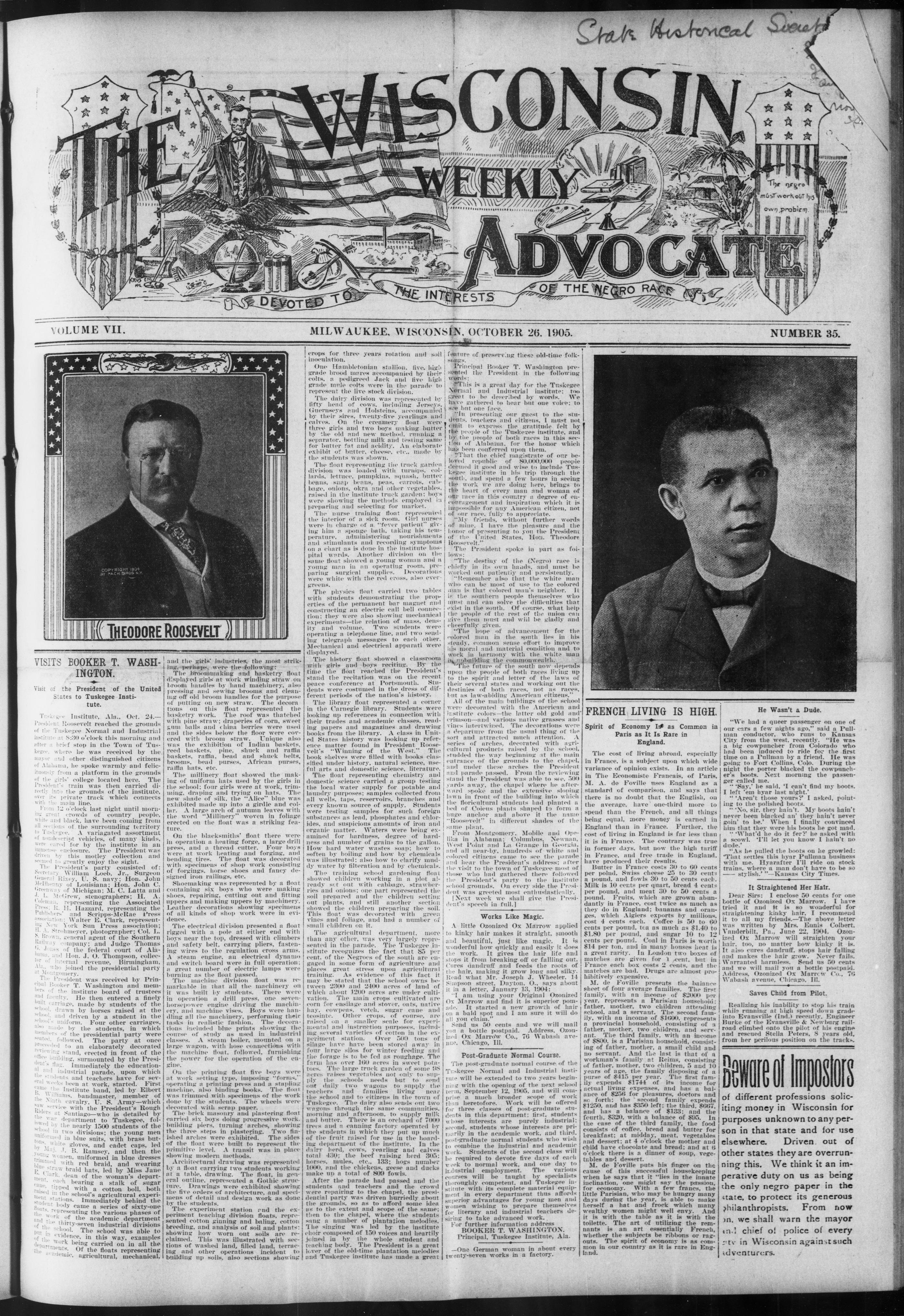
State Historical Society
WISCONSIN
WEEKLY
ADVOCATE
DEVOTED TO THE INTERESTS OF THE NEGRO RACE
COPYRIGHT 1894
BY PACH BROS. N.Y.
THEODORE ROOSEVELT
VOLUME VII.
COPYRIGHT 1834
BY PACH BROS N.Y.
THEODORE
VISITS BOOKER T. WASHINGTON.
Visit of the President of the United States to Tuskegee Institute.
Tuskegee Institute, Ala., Oct. 24. President Roosevelt reached the grounds of the Tuskegee Normal and Industrial institute at 8:30 o'clock this morning and after a brief stop in the Town of Tuskegee, where he was received by the mayor and other distinguished citizens of Alabama, he spoke warmly and felicitously from a platform in the grounds of the girls' college located here. The President's train was then carried directly into the grounds of the institute, over its private track which connects with the main line.
From 12 o'clock last night until morning great crowds of country people, white and black, have been coming from all sections of the surrounding territory to Tuskegee. A variagated assortment of nondescript vehicles, of many kinds, were cared for by the institute in an immense enclosure. The President was driven by this motley collection and secured to greatly enjoy the sight.
The President's party consisted of: Secretary William Loeb, Jr., Surgeon General Rixey, U. S. navy; Hon. John McHenry of Louisiana; Hon. John C. Greenway of Michigan; M. C. Latta and J. L. McGrew, stenographers; H. A. Coleman, representing the Associated Press; R. H. Hazzard, representing the Publishers' and Scripps-McRae Press association; Walter E. Clark, representing New York Sun Press association; H. A. Strohmeyer, photographer; Col. L. S. Brown, general agent of the Southern Railway company; and Judge Thomas G. Jones of the federal court of Alabama, and Hon. J. O. Thompson, collector of internal revenue, Birmingham, Ala., who joined the presidential party at Montgomery.
The President was received by Principal Booker T. Washington and members of the institute board of trustees and faculty. He then entered a finely built carriage, made by students of the school, drawn by horses raised at the school, and driven by a student in the school's uniform. Four other carriages, also made by the students, in which members of the presidential party were seated, followed. The party at once proceeded to an elaborately decorated reviewing stand, erected in front of the office building, surmounted by the President's flag. Immediately the educational and industrial parade, upon which the students and teachers have for several weeks been at work, started. First came the Institute band, led by Elbert B. Williams, bandmaster, member of the Ninth cavalry, U. S. Army—which saw service with the President's Rough Riders at Santiago—who is detailed by the war department to Tuskegee, followed by the nearly 1500 students of the school in two divisions; the young men uniformed in blue suits, with brass buttons, white gloves, and cadet caps, led by Maj. J. B. Ramsey, and then the young women, uniformed in blue dresses trimmed with red braid, and wearing blue straw braid hats, led by Miss Jane E. Clark, dean of the woman's department, each bearing a stalk of sugar cane, tipped with a cotton boll, both raised in the school's agricultural experiment stations. Immediately behind the student body came a series of sixty-one floats, representing the various phases of the work of the academic department and the thirty-seven industrial divisions of the school. The school was able to put in evidence, in this way, examples of the work being carried on in all the departments. Of the floats representing the academic, agricultural, mechanical.
---
and the girls' industries, the most striking, perhaps, were the following: The broommaking and basketry float displayed girls at work winding straw on broom handles by hand machinery, also pressing and sewing brooms and cleaning off old broom handles for the purpose of putting on new straw. The decorations on this float represented the basketry work. The roof was thatched with pine straw; draperies of corn, sweet gum balls and china berries were used and the sides below the floor were covered with broom straw. Unique also was the exhibition of Indian baskets, reed baskets, pine, shuck and raffia baskets, raffia, bead and shuck belts, brooms, bead purses, African purses, raffia hats, etc.
The millinery float showed the making of uniform hats used by the girls in the school; four girls were at work, trimming, draping and trying on hats. The new shade of silk, the "Alice" blue was exhibited made up into a girdle and collar. A large arch of autumn leaves with the word "Millinery" woven in foliage erected on the float was a striking feature.
On the blacksmiths' float there were in operation a heating forge, a large drill press, and a thread cutter. Four boys were at work heating and forging, and bending tires. The float was decorated with specimens of shop work consisting of forgings, horse shoes and fancy designed iron railings, etc.
Shoemaking was represented by a float containing six boys who were making shoes, repairing, cutting out and fitting uppers and making uppers by machinery. Leather decorations showing specimens of all kinds of shop work were in evidence. The electrical division presented a float rigged with a pole at either end with boys near the top, dressed with climbers and safety belt, carrying pliers, fastening wires to the regulation cross arms. A steam engine, an electrical dynamo and switch board were in full operation; a great number of electric lamps were burning as the float passed.
The machine division float was remarkable in that all the machinery on it was built by students. There were in operation a drill press, one sevenhorsepower engine driving the machinery, and machine vises. Boys were handling all the machinery, performing their tasks in realistic fashion. The decorations included blue prints showing the course of study as used in industrial classes. A steam boiler, mounted on a large wagon, with hose connections with the machine float, followed, furnishing the power for the operation of the engine.
On the printing float five boys were at work setting type, imposing "forms," operating a printing press and a stapling machine, also binding books. The float was trimmed with specimens of the work done by the students. The wheels were decorated with scrap paper. The brick masonry and plastering float carried six boys doing progressive work, building piers, turning arches, showing the three steps in plastering. Two finished arches were exhibited. The sides of the float were built to represent the primitive level. A transit was in place showing modern methods.
Architectural drawing was represented by a float carrying two students working at a table, drawing. The float, in general outline, represented a Gothic structure. Drawings were exhibited showing the five orders of architecture, and specimens of detail and design work as done by the students. The experiment station and the experiment teaching division floats, represented cotton ginning and baling, cotton breeding, and analysis of soil and plants; showing how worn out soils are reclaimed. This was illustrated with sections of washed land, filled land, terracing and other operations incident to building up soils, also sections showing
crops for three years rotation and soil inoculation.
One Hambletonian stallion, five, high grade brood mares accompanied by their colts, a pedigreed Jack and five high grade mule colts were in the parade to represent the live stock division.
The dairy division was represented by fifty head of cows, including Jerseys, Guernseys and Holsteins, accompanied by their sires, twenty-five yearlings and calves. On the creamery float were three girls and two boys making butter by the old and new method, running a separator, bottling milk and testing same for butter fat and acidity. An elaborate exhibit of butter, cheese, etc., made by the students was shown.
The float representing the truck garden division was loaded with turnips, collards, lettuce, pumpkins, squash, butter beans, snap beans, peas, carrots, cabbage, onions, okra and other vegetables, raised in the institute truck garden; boys were showing the methods employed in preparing and selecting for market.
The nurse training float represented the interior of a sick room. Girl nurses were in charge of a "fever patient" giving him a sponge bath, taking his temperature, administering nourishments and stimulants and recording symptoms on a chart as is done in the institute hospital wards. Another division on the same float showed a young woman and a young man in an operating room, preparing surgical supplies. Decorations were white with the red cross, also evergreens.
The physics float carried two tables with students demonstrating the properties of the permanent bar magnet and constructing an electric call bell connection; they were also showing mechanical experiments—the relation of mass, density and volume. Two students were operating a telephone line, and two sending telegraph messages to each other. Mechanical and electrical apparati were displayed.
The history float showed a classroom with girls and boys reciting. By the time the float reached the President's stand the recitation was on the recent peace conference at Portsmouth. Students were costumed in the dress of different periods of the nation's history.
The library float represented a corner in the Carnegie library. Students were looking up references in connection with their trades and academic classes, reading papers and magazines and drawing books from the library. A class in United States history was looking up reference matter found in President Roosevelt's "Winning of the West." The book shelves were filled with books classified under history, natural science, useful arts and domestic science, literature. The float representing chemistry and domestic science carried a group testing the local water supply for potable and laundry purposes; samples collected from all wells, taps, reservoirs, branches and every known source of supply. Students were testing samples for such foreign substances as lead, phosphates and chlorides, and suspicious amounts of iron and organic matter. Waters were being examined for hardness, degree of hardness and number of grains to the gallon. How hard water wastes soap; how to soften by boiling and how by chemicals was illustrated; also how to clarify muddy water by filtration and by chemicals.
The training school gardening float showed children working in a plot already set out with cabbage, strawberries and onions; one part represented the soil prepared and the children setting out plants, and still another section showed the children preparing the soil. This float was decorated with green vines and foliage, and had a number of small children on it.
The agricultural department, more than any other, was very largely represented in the parade. The Tuskegee institute recognizes the fact that 85 per cent. of the Negroes of the south are engaged in some form of agriculture and places great stress upon agricultural training. As evidence of this fact it may be stated that the school owns between 2300 and 2400 acres of land of which about 1200 acres are under cultivation. The main crops cultivated are corn for ensilage and stover, oats, native hay, cowpeas, vetch, sugar cane and teosinte. Other crops, of course, are raised on a smaller scale for experimental and instruction purposes, including several varieties of cotton in the experiment station. Over 500 tons of silage have been stored away in four large silos for winter feeding and the forage is to be fed as roughage. The farm has over 160 acres in sweet potatoes. The large truck garden of some 98 acres raises vegetables not only to supply the schools needs but to send out daily two wagons to supply the teachers and families living near the school and to citizens in the town of Tuskegee. The dairy also sends out two wagons through the same communities, morning and afternoon, to supply milk and butter. There is an orchard of 7000 trees and a canning factory operated by the students in which they put up much of the fruit raised for use in the boarding department of the institute. In the dairy herd, cows, yearling and calves total 430; the beef raising herd 305; horses, mules, etc., 133; hogs number 1000, and the chickens, geese and ducks make up a total of 809 fowls.
After the parade had passed and the students and teachers and the crowd were repairing to the chapel, the presidential party was driven hurriedly about the grounds, so as to afford some idea as to the extent and scope of the same; then to the chapel, where the students sang a number of plantation melodies. The singing was led by the institute choir composed of 150 voices and heartily joined in by the whole student and teaching body. The President is a great lover of the old-time plantation melodies and Tuskegee institute has made a great
feature of preserving these old-time folk songs.
Principal Booker T. Washington presented the President in the following words:
"This is a great day for the Tuskegee Normal and Industrial institute; too great to be described by words. We have gathered to hear but one voice; to see but one face.
"In presenting our guest to the students, teachers and citizens, I must not omit to express the gratitude felt by the people of the Tuskegee institute, and by the people of both races in this section of Alabama, for the honor which has been conferred upon them
"That the chief magistrate of our beloved republic of 80,000,000 people deemed it good and wise to include Tuskegee institute in his trip through the south, and spend a few hours in seeing the work we are doing here, brings to the heart of every man and woman of our race in this country a degree of encouragement and inspiration which it is impossible for any American citizen, not of our race, fully to appreciate.
"My friends, without further words of mine, I have the pleasure and the honor of presenting to you the President of the United States, Hon. Theodore Roosevelt."
The President spoke in part as follows:
"The destiny of the (Negro) race is chiefly in its own hands, and must be worked out patiently and persistently.
"Remember also that the white man who can be most of use to the colored man is that colored man's neighbor. It is the southern people themselves who must and can solve the difficulties that exist in the south. Of course, what help the people of the rest of the union can give them must and will be gladly and cheerfully given.
"The hope of advancement for the colored man in the south lies in his steady, common sense effort to improve his moral and material condition and to work in harmony with the white man in unbuilding the commonwealth.
"The future of the south now depends upon the people of both races living up to the spirit and letter of the laws of their several states and working out the destinies of both races, not as races, but as law-abiding American citizens."
All of the main buildings of the school were decorated with the American and institute colors—the latter old gold and crimson—and various native grasses and vines intertwined. The decorations were a departure from the usual thing of the sort and attracted much attention. A series of arches, decorated with agricultural products raised by the school, studded the way beginning at the main entrance of the grounds to the chapel, and under these arches the President and parade passed. From the reviewing stand the President was able to see, 500 yards away, the chapel where he afterward spoke and the extensive sloping lawn in front of the building into which the floricultural students had planted a bed of Coleus plants shaped to form a huge anchor and above it the name "Roosevelt" in different shades of the same plant.
From Montgomery, Mobile and Opelika in Alabama; Columbus, Newnan, West Point and La Grange in Georgia, and all near-by, hundreds of white and colored citizens came to see the parade and hear the President's address; after the visit to the town of Tuskegee most of those who had gathered there followed the President's party to the institute school grounds. On every side the President was greeted most enthusiastically. [Next week we shall give the President's speech in full.]
Works Like Magic.
A little Ozonized Ox Marrow applied to kinky hair makes it straight, smooth and beautiful, just like magic. It is wonderful how quickly and easily it does the work. It gives the hair life and stops it from breaking off or fallling out. Cures dandruff and feeds the roots of the hair, making it grow long and silky. Read what Mr. Joseph J. Wheeler, 14 Simpson street, Dayton, O., says about it in a letter, January 13, 1904: "I am using your Original Ozonized Ox Marrow and find it is superior pomade. It started a new growth of hair on a bald spot and I am sure it will do all you claim." Send us 50 cents and we will mail you a bottle postpaid. Address, Ozonized Ox Marrow Co., 76 Wabash avenue, Chicago, Ill.
Post-Graduate Normal Course.
The post-graduate normal course of the Tuskegee Normal and Industrial institute will be extended to two years beginning with the opening of the next school term, September 12, 1905, and will comprise a much broader scope of work than heretofore. Work will be offered for three classes of post-graduate students in this department; first, students whose interests are purely industrial; second, students whose interests are primarily in the academic work, and third, post-graduate normal students who wish to combine the industrial and academic work. Students of the second class will be required to devote five days of each week to normal work, and one day to industrial employment. The various courses will be taught by specialists thoroughly competent, and Tuskegee institute with its complete material equipment in every department thus affords superior advantages for young men and women wishing to prepare themselves for literary and industrial teachers desiring to take advanced work.
For further information address
-One German woman in about every twenty-seven works in a factory.
FRENCH LIVING IS HIGH.
Spirit of Economy Is as Common in Paris as It Is Rare in England.
The cost of living abroad, especially in France, is a subject upon which wide variance of opinion exists. In an article in The Economiste Francais, of Paris, M. A. de Foville uses England as a standard of comparison, and says that there is no doubt that the English, on the average, have one-third more to spend than the French, and all things being equal, more money is earned in England than in France. Further, the cost of living in England is far less than it is in France. The contrary was true in former days, but now the high tariff in France, and free trade in England, have produced their results.
Butter in France costs 30 to 60 cents per polnd. Swiss cheese 25 to 30 cents a pound, and fowls 30 to 50 cents each. Milk is 10 cents per quart, bread 4 cents per pound, and meat 30 to 50 cents a pound. Fruits, which are grown abundantly in France, cost twice as much as they do in England; bananas and oranges, which Algiers exports by millions, cost 4 cents each. Coffee is 50 to 60 cents per pound, tea as much as $1.40 to $1.80 per pound, and sugar 10 to 12 cents per pound. Coal in Paris is worth $14 per ton, and in many houses heat is a great rarity. In London two boxes of matches are given for 1 cent, but in France each box costs 2 cents, and the matches are bad. Drugs are almost prohibitively expensive.
M. de Foville presents the balance sheet of four average families. The first family, with an income of $2000 per year, represents a Parisian household: father, mother, two children attending school, and a servant. The second family, with an income of $1600, represents a provincial household, consisting of a father, mother, two children, and servant. The third family, with an income of $800, is a Parisian household, consisting of father, mother, a small child and no servant. And the last is that of a workman's family at Reims, consisting of father, mother, two children, 5 and 10 years of age, the family disposing of a purse of $415 per year. The first family expends $1744 of its income for actual living expenses, and has a balance of $256 for pleasures, doctors and so forth; the second family expends $1250, and has $350 left; the third, $667, and has a balance of $133; and the fourth, $320, with a balance of $95. In the case of the third family, the food consists of coffee, bread and butter for breakfast; at midday, meat, vegetables and dessert; at 4 o'clock the mother and child have chocolate and bread; and at 6 o'clock there is a dinner of soup, vegetables and dessert.
M. de Foville puts his finger on the cause of this successful housekeeping when he says that it "lies in the innate inclination, one might say the passion, for economy. With a few francs, the little Parisian, who may be hungry many days during the year, is able to make herself a hat and frock which many wealthy women might well envy. And it is with the table as it is with the toilette. The art of utilizing the remnants is an art essentially French, whether the subjects be ribbons or ragouts. The spirit of economy is as common in our country as it is rare in England.
NUMBER 35.
He Wasn't a Dude.
"We had a queer passenger on one of our cars a few nights ago," said a Pullman conductor, who runs to Kansas City from the west, recently. "He was a big cowpuncher from Colorado who had been induced to ride for the first time on a Pullman by a friend. He was going to Fort Collins, Colo. During the night the porter blacked the cowpuncher's boots. Next morning the passenger called me.
" 'Say,' he said, 'I can't find my boots. I left 'em hyar last night.'
"Aren't those yours?" I asked, pointing to the polished boots.
"No, sir, they hain't. My boots hain't never been blacked an' they hain't never goin' to be." When I finally convinced him that they were his boots he got mad.
"What'd he do it fer?' he asked with a scowl. 'I'll let you know I hain't no dude."
"As he pulled the boots on he growled: 'That settles this hyar Pullman business with me. Hyarafter I'll ride on stock trains, where a man don't have to be so — stylish.'" —Kansas City Times.
It Straightened Her Hair.
Dear Sirs: I enclose 50 cents for one bottle of Ozonized Ox Marrow. I have tried it and it is so wonderful for straightening kinky hair. I recommend it to all my friends.—The above letter was written by Mrs. Eunis Colbert, Vanderbilt, Pa., June 22, 1904. Ozonized Ox Marrow will straighten your hair, too, no matter how kinky it is. It also cures dandruff, stops hair falling and makes the hair grow. Never fails. Warranted harmless. Send us 50 cents and we will mail you a bottle postpaid. Address, Ozonized Ox Marrow Co., 76 Wabash avenue, Chicago, Ill.
Saves Child from Pilot
Realizing his inability to stop his train while running at high speed down grade into Evansville (Ind.) recently, Engineer Burke of the Evansville & Newburg railroad climbed onto the pilot of his engine and rescued Stella Peters, 8 years old, from her perilous position on the tracks.
Beware of Impostors
of different professions soliciting money in Wisconsin for purposes unknown to any person in that state and for use elsewhere. Driven out of other states they are overrunning this. We think it an imperative duty on us as being the only negro paper in the state, to protect its generous philanthropists. From now on, we shall warn the mayor and chief of police of every city in Wisconsin against such adventurers.
---
—The tail of the Borelli comet is estimated to be 3,000,000 miles long.
—The total number of men in the United States liable to military service is 11,126,750.
—San Francisco's demand for brick is so great it has caused a brick famine in California.
—Bathers at borough private baths in London last year numbered 3,104,383; at the swimming baths, 2,568,502.
—The quail has almost entirely disappeared from England, Ireland and Scotland and is scarce on the continent.
—Two missionaries from Afghanistan have arrived in Liverpool. Their intention is to convert England to Islam.
—Soieum warning is given by the curator of the Alhambra in Spain that the 700-year-old palace is falling to pieces.
A recent weighing of dandelion down has shown that 1,000,000 of the dainty parachutes are needed to make a pound.
One of the largest peach orchards in New Hampshire is on the farm of George W. Parker at Wilton. He has 400 trees, which this year yielded several thousand baskets of fruit.
Among the exhibits at the fair at Bethel, Me., was a quilt spun and woven in 1789 by a woman, then 75 years of age. There was another quilt at the fair which was over one hundred years old.
The recent birth rate for St. George's-in-the-East. London, the headquarters of the alien invasion, is at the rate of 60.8 per thousand. This is the highest birth rate ever recorded in England.
Notwithstanding the honor in which Jari-kari is held in Japan, the proportion of suicides there is comparatively low—177 a million, to 246 in France, 238 in Denmark, 233 in Switzerland and 306 in Germany.
A new glass described by Emile Tonchet is very transparent to invisible chemical rays. In simultaneous photographs of part of the constellation Syra, a lens of this glass showed 619 stars, while one of ordinary Jena glass showed about 351.
While American cottons may be comparatively new in China, cotton manufacture itself has been there almost as many centuries as most of the American factories have existed years, and other foreign cottons have been going there for many years.
- Europe has still a goodly heritage of forest, though it has almost ceased to exist on the western side of the continent. The total area is estimated at 765,000,000 acres. The greater part is in Russia. Forty per cent. of the Czar's dominion is forest land.
- Dismal Swamp gives you an uncanny feeling; yet its waters are the most potable on this entire continent. They will keep sweet in barrels on shipboard for years. They are preserved from stagnation by an infusion of juniper berries, and sailors like its gin flavor.
- The natives of Guam used to catch fish by poisoning them with the juice of the fruit of a tree known as the Barringtonia speciosa. The Spanish government forbade this wasteful method, but since the island has passed under American control it has come into use again.
—France will shortly possess one of the finest roadways in the world. It will extend from Lille to the manufacturing towns of Roubaix and Tourcoing, five miles. It will be 150 feet wide and divided into sections—for ordinary wheeled traffic, for cycles and motors, and for pedestrians.
—A coasting steamer was wrecked near Sydney. The captain tied lifelines to some pigs which formed part of the cargo. These, on being thrown overboard, quickly swam ashore, taking the lines with them. Communication being thus established every person on board was rescued.
The new Williamsburg bridge in New York is to be lighted by a municipal plant, the power for which will be developed from the burning of street sweepings. It is announced that the incinerating plant has been installed and that everything will be in operation by October 1.
Prof. Kraeplin of Heidelberg, Germany, an authority on experimental psychology, recently made 2000 experiments with delicate instruments and found that one-third of an ounce of alcohol taken into the human system is enough to appreciably depress sight, hearing, feeling and the various mental operations
Where did "Tommy Atkins," the British soldier, get his name? Years ago Sir Garnet Wolseley published a little volume called "The Soldiers' Pocketbook of Field Service." To show how to fill out a blank space in the field reports he happened to use the, name "Thomas Atkins." The pocketbook is the British soldier's military Bible, and the name "Thomas Atkins" was at once adopted as his proper nickname.
RAILWAY IN THE DESERT
Hedjaz Road Expects to Take Pilgrims to Mecca.
A recent report by the German commercial attache at Constantinopie gives some particulars of the railway, now in course of construction, which will ultimately conduct Damascus and Mecca. The Hedjaz railway is being made primarily on religious grounds. Were it not for the certain prospect of attracting an enormous pilgrim traffic the undertaking would never have been entered upon, for by far the greater portion of the 1200 miles of railway track will be laid in deserts and unproductive lands. The building is being carried out under German supervision, and as Turkish troops have been largely employed as laborers, the cost of the work will be comparatively small. The line from Damascus to Maan—about one-third of the total length—was opened to traffic last autumn. From a commercial standpoint the only benefit likely to be derived from the line will be the opening up for cultivation of certain districts near the Jordan, which have hitherto been neglected for lack of means to transport the crops. Some branch lines, however, are to be constructed for industrial purposes. One of these, from Haiffa to Deraat, would have been completed in May but for damage caused by heavy floods. This will increase the trade of Haiffa at the expense of Beirut.—Pall Mall Gazette.
Dedicate Watertown Dormitory
Many Milwaukee German Lutherans, assisted in the dedication of the new $50,000 dormitory of the Northwestern university at Watertown on Sunday. About 4000 people attended. Rev. Philip von Rohr delivered the dedicatory address and Rev. J. Bading of Milwaukee delivered the prayer. Music was rendered by a choir of 200 voices from this city. Several special trains were run by the Milwaukee road to accommodate the visitors.
Do Cow Peas Make Kens Lay?
A poultry raiser tells The Advance man that he has discovered that cow peas make hens lay. Last winter he left an acre of the peas uncut and his hens ate them. He was surprised to receive double the number of eggs during the winter.-Higginsville Advance.
SONG.
O Love, you could not love me.
Though fair I found your eyes.
Yet still, two stars above me.
They haunt my evening skies.
—Arthur Davison Ficke in Scribner's.
A CROWNING OPPORTUNITY.
Brig.-Gens. Frederick D. Grant, J. Franklin Bell and Frederick Funston, of the United States army, have an opportunity to do the most graceful thing high rank officers have done in many years, if, indeed, ever.
Behind these three officers—below them in date of commissions, and in a number of cases, rank—stands a cluster of soldiers who stood the test of the Civil war, who have been through various Indian campaigns, and who won new honors and new glory for their country in Cuba, Porto Rico and the Philippines, all of whom were passed by, side-tracked, jumped, when Gens. Grant, Bell and Funston were made brigadiers by the late President McKinley.
At the time of their promotion to the rank of brigadier-general, Grant and Funston held no rank in the regular army, hence it will be seen that they were not only lifted over the heads of all of the colonels, lieutenant-colonels, majors, captains and first lieutenants, but all of the second lieutenants in the regular army—many hundreds of officers, including a large number who had been in the service through the Civil war, Indian and the Spanish-American wars.
Gen. Bell was a captain when he was made a brigadier, and consequently jumped all of the colonels, lieutenant colonels and majors, as well as all of the captains of the army whose commissions were older than his. He is a superb soldier, in all respects, and would make an excellent major general, but he is young and can well afford to wait for promotion. But for his good fortune in being vaulted over the heads of his seniors, he would still be a captain of cavalry, with the star of a brigadier at least a dozen years away.
Gens. Grant and Funston were civilians when the Spanish-American war came, making a demand for an enlarged army and an increase of generals. It is true that Gen. Grant was a graduate of West Point, but he left the army within a few years of his graduation as a lieutenant. Without a thought or a desire to pluck from them any of their honors, it must be said of both Gens. Grant and Funston that to be landed from no rank in the army to brigadier, within two ranks of the highest title in the United States army, was a stroke of good fortune not easy to overestimate. They were given great prizes; great honor was bestowed upon them. That they appreciated the prize and honors need not be doubted.
In the natural course, Gen. Grant would succeed Gen. Samuel S. Sumner as a major general when he retires February 6, 1906. Then would come Gen. Bell for the two stars of a major general when Gen. Cuaffee retires next April, and following him for a like honor would be Gen. Fred Funston to succeed Gen. Bates.
Before the and of 1906, if given promotion in their regular turn, these three extremely lucky men, two of whom jumped to a stor over the heads of every officer in the army, and the other a captain who jumped over hundreds of captains and all of his other seniors under the rank of brigadier, will be major generals, next to the highest rank in the army.
No matter how much it might please the army and the public to see these three officers, with national reputations and hosts of admirers, all of whom have many more years to serve—Grant, nine years; Bell, fifteen, and Funston, twenty-four—before they reach the retiring age, given the higher rank, a much coveted grade, would not the army and the public prefer to see them stand aside and have like promotion given to such Civil, Indian and Spanish-American war veterans, such splendid soldiers, grand characters, as Brig.-Gen. Frank D. Baldwin, who has been serving since September, 1861, who has fought in scores of battles, was voted a medal of honor by Congress; as Brig.-Gen. Theodore J. Wint, who has served over forty-four years, has to his credit the Civil war, all of the Indian wars since 1865, the war in Cuba, where he received a shot that will make him limp all of the way to the grave, the war in China and the war in the Philippines; as Brig.-Gen. Jesse M. Lee, who has been in service since 1861, always a model soldier, whether down south, on the plains, in Cuba, China or the Philippines; as Brig.-Gen. C. C. C. Carr, who started in the ranks as a regular in 1862 and has done well every duty since then; as Brig.-Gen. William T. McCaskey; who started as a lad of 17 years, in the ranks, quitting a captain in 1865 and beginning as a regular in 1866, a peerless soldier, all of the time; as Brig.-Gen. Constant Williams, who has been serving since July, 1861.
There is no harm in keeping in mind the fact that Gens. Grant, Bell and Funston jumped all of the officers just named, when they were colonels or lieutenant colonels.
But what of the opportunity that is afforded Gens. Grant, Bell and Funston to do a graceful thing—what is it?
To unite in an appeal to the President to overlook the ranking brigadier in promoting to major general until that high honor is conferred upon Gens. Baldwin, Wint, Lee, McCaskey, Carr and Williams, brothers-in-arms they have jumped, soldiers more than the average life time.
Wouldn't that be a glorious thing for Gens. Grant, Bell and Funston to do? Wouldn't the old and the new army—the whole—nation—shout their approval as they behead these three younger men lined up with smiles, saluting the veterans as they passed them by to receive the double stars of major general? Wouldn't that be grand? Will Gens. Grant, Bell and Funston avail themselves of the great opportunity? There is reason to believe that the staff members who are Civil war officers will be given the rank of major general when they retire, as was the case with Gens. Nelson Ludington, A. E. Bates, John P. Story and George L. Gillespie.
Committed to Memory 12.236 Verses.
Most likely not another brain in the state, possibly not in the world, has verbally acquired so much Scripture in so short a time as has been done recently by a young woman in Buncombe county. About the first of March, 1905, Pastor J. A. Brendell, hoping to stimulate memory work in the Big Ivy Baptist Sunday school at Barnardsville postoffice, offered two prizes (Bibles), the first to the pupil over 2 and the other to the one under 12, who should during this interval commit to memory and recite the largest number of verses of the Scripture. A committee was appointed to hear the contestants for the prizes and register the number of verses memorized. (On the day of the award it was found
On the day of the award it was found
that among the older coneptitors the winner was Miss Leste May Williams, a young woman 16 years of age. Within these ninety days, during which she had an attack of measles, she committed to memory and recited to the committee 12.236 verses of Scripture, covering the entire New Testament (excepting two genealogies of Jesus in the first chapter of Matthew and the third chapter of Luke), and including liberal selections from Genesis, Psalms, Ecclesiastes and other parts of the Old Testament. The winner of the second prize was the youngest sister of the winner of the first prize. Littie Miss Ella Jay Williams is only 11 years of age, yet in this competition there were to her credit 715 verses of Scripture.
The pastor reports that during the entire contest there were more than 19,000 verses memorized.—Biblical Record.
SHOOTING SHIRT
Pockets Made Out of the End of the Shirt.
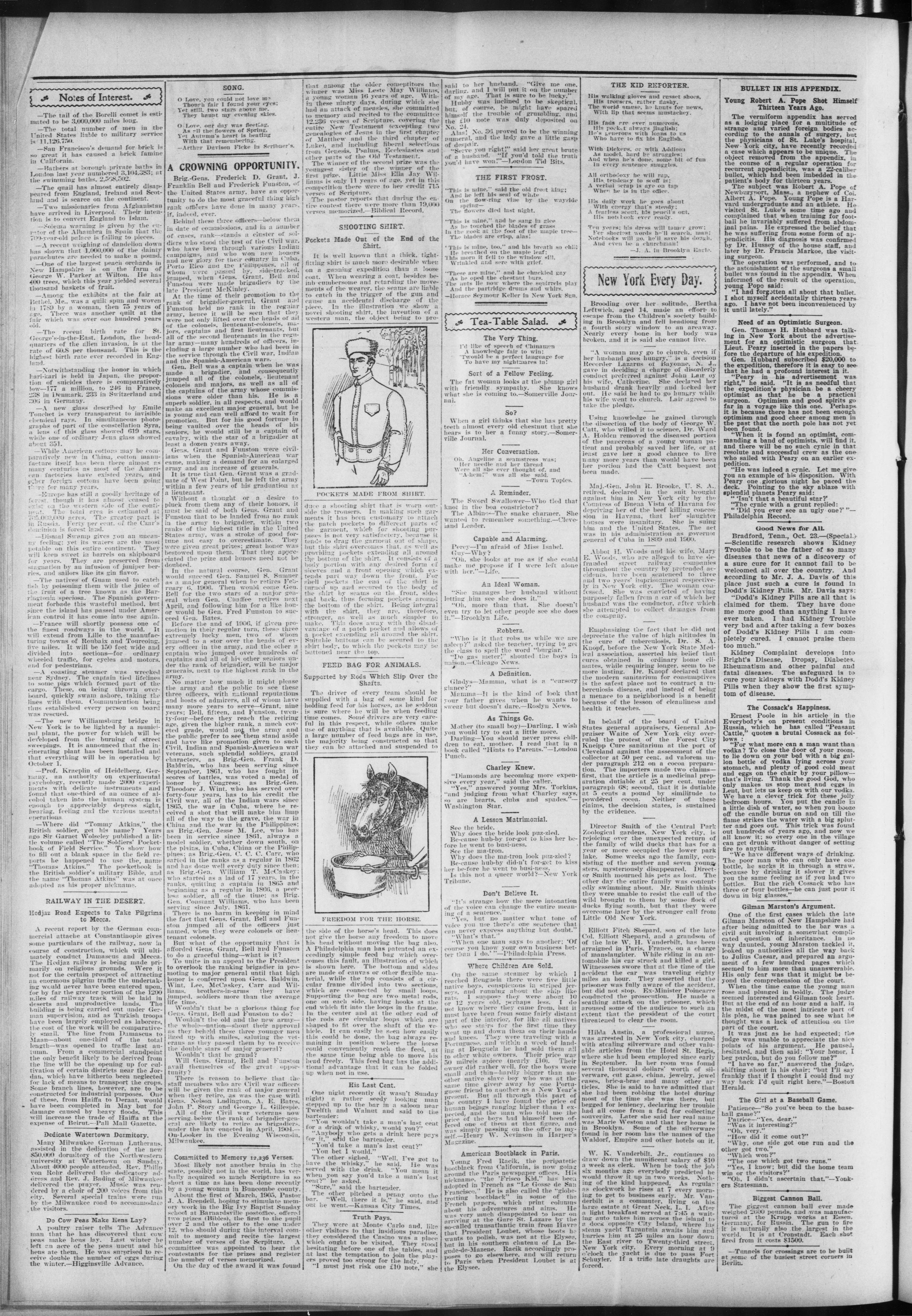
It is well known that a thick, tight-fitting shirt is much more desirable when on a gunning expedition than a loose coat. When wearing a coat, besides being cumbersome and retarding the movements of the wearer, the seams are liable to catch in the trigger of the gun and cause an accidental discharge of the piece. In the illustration we show a novel shooting shirt, the invention of a western man, the object being to pro-
[Illustration of a man in a military uniform, with a fur hat and a belt, standing in a forest.]
POCKETS MADE FROM SHIRT
duce a shooting shirt that is worn outside the trousers. In making such garments it has been customary to attach the patch pockets to different parts of the garment, which for shooting purposes is not very satisfactory, because it tends to drag the garment out of shape, but this shirt overcomes that, as well as providing pockets extending all around the bottom of the shirt. It consists of a body portion with any desired form of sleeves and a front opening which extends part way down the front. For shell pockets the end of the shirt is turned up and secured to the body of the shirt by seams on the front, sides and back, thus forming pockets around the bottom of the shirt. Being integral with the shirt, they are, therefore, stronger, as well as much simpler to make. This does away with the disadvantage of a patch pocket and allows of a pocket extending all around the shirt. Suitable buttons can be secured to the shirt body, to which the pockets may be buttoned near the top.
FEED BAG FOR ANIMALS.
Supported by Rods Which Slip Over the Shafts.
The driver of every team should be supplied with a bag of some kind for holding feed for his horses, as he seldom is sure where he will be when feeding time comes. Some drivers are very careful in this respect, while others make use of anything that is available. Quite a large number of feed bags are in use, the majority being constructed so that they can be attached and suspended to
MILITARY
FREEDOM FOR THE HORSE
the side of the horse's head. This does not give the horse any freedom to move his head without moving the bag also. A Philadelphia man has patented an exceedingly simple feed bag which overcomes this fault, an illustration of which is shown here. The bottom and sides are made of canvas or other flexible material, while the top consists of a circular frame divided into two sections, which are connected by small loops. Supporting the bag are two metal rods, one on each side, having hooks at the end which fit into the loops in the frame. In the center and at the other end of the rods are circular loops which are shaped to fit over the shaft of the vehicle. It can easily be seen how easily this could be done, the bag always remaining in position where the horse could conveniently reach the feed, at the same time being able to move his head freely. This feed bag has the additional advantage that it can be folded up when not in use.
His Last Cent
One night recently (it wasn't Sunday night) a rather seedy looking man stepped up to the bar in a saloon near Twelfth and Walnut and said to the bartender:
"You wouldn't take a man's last cent for a drink of whisky, would you?"
"Anybody who gets a drink here pays for it," said the bartender.
"You'd take a man's last cent?"
"You bet I would."
The other sighed. "Well. I've got to have the whisky," he said. He was served with the drink. "You mean it when you say you'd take a man's last cent?" he asked.
"Sure," said the bartender.
The other pitched a penny onto the bar. "Well, there it is," he said, and out he went.—Kansas City Times.
Truth Pays
They were at Monte Carlo and, like other visitors to that insidious paradise, they considered the Casino was a place which ought to be visited. They stood hesitating before one of the tables, and at last the temptation to join the players proved too strong for the lady. "I must just risk one £10 note," she
said to her husband. "Give me one, darling, and I will put it on the number of my age. That is sure to be lucky."
Hubby was inclined to be skeptical, but, of course, he might have spared himself the trouble of grumbling, and the f10 note was duly deposited on No. 24.
Alas! No. 36 proved to be the winning numeral, and the lady gave a little gasp of despair.
"Serve you right!" said her great brute of a husband. "If you'd told the truth you'd have won!"—London Tid Bits.
THE FIRST FROST
"This is mine," said the old frost king;
And he left his seal of white
On the flow-ring vine by the wayside
spring—
The flowers died last night.
"This is mine," and he sang in glee
As he touched the blades of grass
In the rook at the foot of the maple tree—
The blades are crisp, alas!
"This is mine, too," and his breath so chill
He breathed on the maple leaf:
This morn it fell to the window sill,
Wrinkled and sere with grief.
"These are mine," and he chuckled gay
As he oped the chestnut burs.
The nuts lie now where the squirrels play
And the partridge drums and whirs.
—Horace Seymour Keller in New York Sun.
```markdown
```
Tea-Table Salad.
The Very Thing
I'd like of speech of Chinamen
A knowledge fair to win;
Twould be a perfect language for
To have my nightmares in!
Sort of a Fellow Feeling.
The fat woman looks at the plump girl with friendly sympathy. She knows what she is coming to.—Somerville Journal.
When a girl thinks that she has pretty teeth almost every old chestnut that she hears is to her a funny story.—Somerville Journal.
Her Conversation.
Oh. Angeline a stressress was; Her needle and her thread Were all she ever thought of, and "A-hem!" was all she said.
A. Reminder.
The Sword Swallower—Who tied that knot in the boa constrictor?
The Albino—The snake charmer. She wanted to remember something.—Cleveland Leader.
Capable and Alarming.
Percy—I'm afraid of Miss Isabel.
Guy—Why?
"Oh, she looks at me as if she could make me propose if I were left alone with her."—Life.
An Ideal Woman.
"She manages her husband without letting him see she does it."
"Oh, more than that. She doesn't even try to let other people see she does it."—Brooklyn Life.
Robbers
"Who is it that robs us while we are asleep?" asked the teacher, trying to get the class to spell the word "burglar."
"De gas meter!" shouted the boys in
A Definition.
Gladys—Mamma, what is a "cursory glance?"
Mamma—It is the kind of look that your father gives when he wants to swear but doesn't dare.—Roslyn News.
As Things Go.
Mother (to small boy)—Darling. I wish you would try, to eat a little more.
you would try to eat a little more. Darling-You should never press children to eat, mother. I read that in a book called "Hints to Parents."-London Punch.
Charley Knew.
"Diamonds are becoming more expensive every year," said the caller.
sive every year, said the other.
"Yes," answered young Mrs. Torkins, "and judging from what Charley says, so are hearts, clubs and spades."—Washington Star.
A Lesson Matrimonial.
Why does the bride look puz-zled.
Be-cause hub-by for-got to kiss her before he went to busi-ness.
See the ma-tron.
Why does the ma-tron look puz-zled?
Be-cause hub-by did-n't for-get to kiss her be-fore he went to busi-ness.
Is this not a queer world?—New York Tribune.
Don't Believe It
"It's strange how the mere intonation of the voice can change the entire meaning of a sentence."
"Yes, but no matter what tone of voice you use there's one sentence that can never express anything but doubt."
"What's that."
"When one man says to another; 'Of course you know your own business better than I do.'"—Philadelphia Press.
Where Children Are Sold.
On the same steamer by which I reached Benguela there were five little native boys, conspicuous in striped jerseys, and running about the ship like rats. I suppose they were about 10 or 12 years old, perhaps less. I do not know where they came from, but it must have been from some fairly distant part of the interior, for like all natives who see stairs for the first time they went up and down them on their hands and knees. They were traveling with a Portuguese, and within a week of landing at Benguela he had sold them all to other white owners. Their price was 50 milreis apiece (nearly £10). Their owner did rather well, for the boys were small and thin—hardly bigger than another native slave boy who was at the same time givee away by one Portuguese friend to another as a New Year's present. But all through this part of the country I have found the price of human beings ranging higher than I expected, and the man who told me the price of the boys had himself been offered one of them at that figure, and was simply passing on the offer to myself.—Henry W. Nevinson in Harper's Magazine.
American Bootblack in Paris
Young Fred Racik, the peripatetic bootblack from California, is now going around the Paris newspaper offices. His nickname, "the 'Frisco Kid.'" has been adopted in French as "Le Gosse de San Francisco." He is also called the "globetrotting bootblack" in some of the French papers, which print columns about his adventures and aims. He was very much disappointed to hear on arriving at the Gare St. Lazare by the so-called transatlantic train from Havre that President Loubet, whose boots he wants to polish, was not at the Elysee, but in his southern chateau of La Begude-de-Mazene. Racik accordingly proposes to go elsewhere, and will return to Paris when President Loubet is at the Elysee.
---
THE KID REPORTER
His walking gloves and russet shoes,
His trousers, rather flashy.
The world amuse, he haunts for news,
With lip that seems mustachey.
His fads are ever numerous,
His pocket always jinglish;
He's generous with loans to us
Who have to fix his English.
With Dickens, or with Addison
As model, hard he struggles;
And when he's done, some bit of fun
In every sentence snuggles.
All orthodoxy he will rap,
His tendency to scoff is;
A verbal scrap is aye on tap
When he is in the office.
Ten years; his dress will tamer grow; For shortest words he'll search, man; Notebooks will go, he'll save his dough. And even be a churchman! —J. A. in Brooklyn Eagle.
New York Every Day.
Brooding over her solitude, Bertha Leftwich, aged 14, made an effort to escape from the Children's society building in Brooklyn and fell headlong from a fourth story window to an areaway. Nearly every bone in her body was broken, and it is said she cannot live.
"A woman may go to church, even if her husband goes hungry," is a decision Recorder Lazarus of Bayonne, N. J., gave in deciding a charge of disorderly conduct preferred against John Lair oy his wife, Catherine. She declared her husband drank heavily and locked her out. He said he had to go hungry while his wife went to church. Lair agreed to take the pledge.
Using knowledge he gained through the dissection of the body of George W. Catt, who willed it to science, Dr. Ward A. Holden removed the diseased portion of the pancreas of a young woman patient and probably saved her life, or at least gave her a good chance to live many more years than would have been her portion had the Catt bequest not been made.
Maj.-Gen. John R. Brooke, U. S. A., retired, declared in the suit brought against him in New York city by the Countess of Buena Vista of Havana for depriving her of the beef killing concession in Havana, that her slaughter houses were insanitary. She is suing him and the United States. The act was in his administration as governor general of Cuba in 1899 and 1900.
Abbot H. Woods and his wife, Mary E. Woods, who are alleged to have defrauded street railway companies throughout the country by pretended accidents, have been sentenced to three and two years' imprisonment respectively in New York city. The woman confessed. She was convicted of having purposely fallen from a car of which her husband was the conductor, after which she attempted to collect damages from the company.
Emphasizing the fact that he did not depreciate the value of high altitudes in the cure of tuberculosis, Dr. S. A. Knopf, before the New York State Medical association, asserted his belief that cures obtained in ordinary home climates, while requiring longer, seem to be more lasting. Dr. Knopf declared that the modern sanitarium for consumptives is the safest place not to contract a tuberculosis disease, and instead of being a menace to a neighborhood is a benefit because of the lesson of cleanliness and health it teaches.
In behalf of the board of United States general appraisers, General Appraiser Waite of New York city overruled the protest of the Forest City Kneipp Cure sanitarium at the port of Cleveland against the assessment of the collector at 50 per cent. ad valorem under paragraph 212 on a cocoa preparation. The importers made two claims—first, that the article is a medicinal preparation dutiable at 25 per cent. under paragraph 68; second, that it is dutiable at 5 cents a pound by similitude to powdered cocoa. Neither of these claims, the decision states, is sustained by the evidence.
Director Smith of the Central Park Zoological gardens. New York city, is rejoicing over the unexpected return of the family of wild ducks that has for a year or more occupied the lower park lake. Some weeks ago the family, consisting of the mother and seven youngsters, mysteriously disappeared. Director Smith mourned his pets as lost. The other day the entire family was contentedly swimming about. Mr. Smith thinks they were unable to resist the call of the wild brought to them by some flock of ducks flying south, but that they were overcome later by the stronger call from Little Old New York.
Elliott Fitch Shepard, son of the late Col. Elliott Shepard, and a grandson of of the late W. H. Vanderbilt, has been arraigned in Paris, France, on a charge of manslaughter. While riding in an automobile his car struck and killed a girl. Witnesseses swore that at the time of the accident the car was traveling eighty miles an hour. They asserted that the prisoner was fully aware of the accident, but did not stop. Ex-Minister Poincaré conducted the prosecution. He made a scathing attack on the prisoner, which aroused some of the audience to such an extent that the president of the court threatened to clear the room.
Hilda Austin, a professional nurse, was arrested in New York city, charged with stealing silverware and other valuable articles from the Hotel St. Regis, where she had been employed since early in September. In her room was found several thousand dollars' worth of silverware, cut glass, china, jewelry, jewel cases, bric-a-brac and many other articles. She is said to have admitted that she had been robbing the hotel during most of the time she was there, but begged for leniency, declaring her trouble had all come from a fad for collecting souvenirs. Later she said her real name was Marie Weston and that her home is in Brooklyn. Some of the silverware found in her room has the names of the Waldorf, Empire and other hotels on it.
W. K. Vanderbilt. Jr., continues to draw down the munificent salary of $10 a week as clerk. When he took the job six months ago everybody predicted he would throw it up in two weeks. Nothing of the kind happened. As regular as clockwork he rises at 7 every morning to get to business early. Mr. Vanderbilt is a commuter, living on his large estate at Great Neck, L. L. After a light breakfast served at 7:45 a waiting auto takes him across the island to a dock opposite City Island, where his steam yacht Tarantula awaits him and burries him at 25 miles an hour down the East river to Twenty-third street, New York city. Every morning at 9 o'clock the yacht is due to pass Fort Schuyler. If a trifle late draughts are forced.
BULLET IN HIS APPENDIX.
Young Robert A. Pope Shot Himself Thirteen Years Ago.
The vermiform appendix has served as a lodging place for a multitude of strange and varied foreign bodies according to the annals of surgery, but the physicians of St. Luke's hospital, New York city, have recently recorded a case which appears to be unique. The object removed from the appendix, in the course of a regular operation for recurrent appendicitis, was a 22-caliber bullet, which had been imbedded in the patient's body for thirteen years.
The subject was Robert A. Pope of Newburyport, Mass., a nephew of Col. Albert A. Pope. Young Pope is a Harvard undergraduate and an athlete. He visited St. Luke's some time ago and complained that when training for football he invariably suffered from abdominal pains. He expressed the belief that he was suffering from some form of appendicitis. His diagnosis was confirmed by Dr. Hussey of the house staff, and later by Dr. Francis Markoe, the visiting surgeon.
The operation was performed, and to the astonishment of the surgeons a small bullet was found in the appendix. When informed of the result of the operation, young Pope said:
"I had forgotten all about that bullet. I shot myself accidentally thirteen years ago. I have not been inconvenienced by it until lately."
Need of an Optimistic Surgeon
Gen. Thomas H. Hubbard was talking in New York about the advertisement for an optimistic surgeon that Lieut. Peary inserted in the papers before the departure of his expedition.
Gen. Hubbard subscribed $20,000 to the expedition, therefore it is easy to see that he had a profound interest in it.
"Peary in his advertisement was right," he said. "It is as needful that the expedition's physician be a cheery optimist as that he be a practical surgeon. Optimism and good spirits go far in a voyage like this one. Perhaps it is because there has not been enough optimism and good cheer among men in the past that the north pole has not yet been found.
"When it is found an optimist, commanding a band of optimists, will find it, and there will be no such cynic in that resolute and successful crew as the one who sailed with Peary on an earlier expedition.
"He was indeed a cynic. Let me give you an example of his disposition. With Peary one glorious night he paced the deck. Pointing to the sky ablaze with splendid planets Peary said:
"Isn't that a beautiful star?
"The cynic with a grunt replied:
"Did you ever see an ugly one?" — Philadelphia Record.
Good News for All.
Bradford, Tenn., Oct. 23.—(Special.)—Scientific research shows Kidney Trouble to be the father of so many diseases that news of a discovery of a sure cure for it cannot fail to be welcomed all over the country. And according to Mr. J. A. Davis of this place just such a cure is found in Dodd's Kidney Pills. Mr. Davis says: "Dodd's Kidney Pills are all that is claimed for them. They have done me more good than anything I have ever taken. I had Kidney Trouble very bad and after taking a few boxes of Dodd's Kidney Pills I am completely cured. I cannot praise them too much."
Kidney Complaint develops into Bright's Disease, Dropsy, Diabetes, Rheumatism and other painful and fatal diseases. The safeguard is to cure your kidneys with Dodd's Kidney Pills when they show the first symptom of disease.
The Cossack's Happiness
Ernest Poole in his article in the Everybody's on present conditions in Russia, which he has called "Peasant Cattle," quotes a brutal Cossack as follows:
"For what more can a man want than vodka? To close the door of your room, to lie down on your bed with a big gallon bottle of vodka lying across your stomach, and plenty of good cold meat and eggs on the chair by your pillow—that's living. Thank the good God, who only makes us stop meat and eggs in Lent, but lets us keep on with our vodka. We have a clever trick for these jolly bedroom hours. You put the candle in a little dish of water, so when you booze off the candle burns on and on till the flame strikes the water with a big splutter and goes out. This trick was found out hundreds of years ago, and now we all know it; so every one in the village can get drunk without danger of setting fire to anything.
"We have different ways of drinking. The poor man who can only have one bottle, he sucks it in through a straw, because by drinking it slower it gives you the same feeling as if you had two bottles. But the rich Cossack who has three or four bottles—he can just pour it down in big glasses."
Gilman Marston's Argument
One of the first cases which the late Gilman Marston of New Hampshire had after being admitted to the bar was a civil suit involving a somewhat complicated question of inheritance. In no way daunted, young Marston tackled it, looked up authorities all the way back to Julius Caesar, and prepared an argument of a few hundred pages which seemed to him more than unanswerable. His only fear was that it might be beyond the comprehension of the court. When the time came the young man rose and plunged in boldly. The judge seemed interested and Gilman took heart. But at the end of an hour and a half, in the midst of the most intricate part of his plea, he was pained to see what he thought was a lack of attention on the part of the court.
It was just as he had expected; the judge was unable to appreciate the nice points of his argument. He paused, hesitated, and then said: "Your honor, I beg pardon, but do you follow me?" "I have so far," answered the judge, shifting about in his chair; "but I'll say frankly that if I thought I could find my way back I'd quit right here."—Boston Herald.
Patience—"So you've been to the baseball game?"
"Why, one side got one run and the other got two."
"Which won?"
"The one which got two runs."
"Oh. I didn't ascertain that."—Yonkers Statesman.
Biggest Cannon Ball.
The giggest cannon ball ever made weighed 2600 pounds, and was manufactured at the Krupp works at Essen, Germany, for Russia. The gun to fire it is naturally also the largest in the world. It is at Cronstadt. Each shot fired from it costs $1500.
—Tunnels for crossings are to be built at some of the busiest street corners in Berlin.
GOSSIP FOR THE LADIES.
When My Boy
Comes Whistling Home.
When the night is dark, and the cold winds blow,
And the starless sky hangs dull and gray.
Then a light gleams out with a ruddy glow.
The shadows pass, and the gloom gives way,
When my boy comes whistling home.
High the sound, and clear as a blackbird's note,
Mellow and round as a robin's trill.
As sweet as the tune from a skylark's throat,
Cleaving its way through the silence chill,
As my boy comes whistling home.
skirt and coat hangers can be obtained that are scientifically correct; and shirt waist, skirt and coat can be hung on one hanger. If you must hang your clothes on hooks, hang waists and coat from loops sewed into the sleeves, and skirts should have loops sewed lengthwise in belts the distance from the back that will allow the weight of the skin to balance.
Clothes should be frequently and thoroughly brushed and shaken, and an stains removed. Examine clothes for stains in bright daylight. Use a whisk broom sparingly. It is too harsh, and injures the goods. Use a flat-backed
Or "rag-time" or sounet, ballad or psalm,
It matters not what the theme may be.
Reckling with mischief, or solemn and calm,
It carries its message straight to me,
When by boy comes whistling home.
Tis a sign unfailing. With a conscience
free
And an unstained soul he fares along.
For guilt would smother the rollicking glee,
Deception wither the happy song.
But my boy comes whistling home.
Oh, never was music that could compare
(Nor sound of chant in cathedral old,
Nor thunder of organ, nor choir rare)
With this, as my bay, with his heart of
gold.
To his mother comes whistling home.
—Elizabeth Price.
Ten Commandments for a Mother.
1. Be healthy.
2. Be joyful.
3. Be beautiful.
4. Be gentle and placid.
5. Be firm without severity.
6. Do not stint with your mother love.
Tenderness is not effiminacy. And first, because life often is cold and hard and cruel, a sunny, bright, glad childhood is a blessing for the whole life.
7. Discipline as life disciplines. It does not scold, it does not plead, it does not fly into a passion. It simply teaches that every deed has its adequate effect.
8. Do not laugh at childish sorrows and pains of child life. Nothing wounds a child more than to find ridicule where it looked for sympathy.
9. In illness and danger protect, nurse, cherish and cheer as much as in your power. And do not weaken your vitality by giving way to anguish and sorrowing. What can be done must be done as well as possible.
10. Do not forget: The happiness of having a child includes the duty of smoothing his way in the world, of endowing him with health, gladness, courage, vigor; of finally letting him live his own way. Your pay you have had in advance, for your sorrowing was happiness and your sacrifice joy.
Advice for Co-Ed Girls.
A graduate of one of the big co-educational universities asks us to add these words for girls: "Tell them," she says, "to beware of these two extremes in their conduct. On the one hand, they should not run after the young men and be overeager for attention. Nor, on the other, should they put on an air of aggressive indifference which some girls seem to assume as if it were a token of superiority. Let no girl go to one of the universities with an idea of much social enjoyment, as she will soon find there is very little time for it. It is better by a dignified and modest manner to win the respect of her masculine classmates than to have much so-called attention." In each of the large universities there is an unwritten law of etiquette which governs the relations of the young people. At one, for instance, no girl recognizes a young man in class hours. It is well for a beginner to post herself in all such matters and thus avoid embarrassing mistakes in conduct. Commenting on this last advice a woman of wide experience in college life writes: "I can only say that modesty and good manners, sincerity and good scholarship, are much admired in college in spite of the slurs and 'digs' at 'faculty pets.' The girls that make the best success are those that in the end command respect for their character."—Harper's Bazar.
The American Girl
"The Lord made her for a society woman, and as a society woman she shines the brightest star in the galaxy of stars." So the Lady Helen Forbes, writing in The Lady's Realm, epitomizes that much-discussed young person—the American girl.
"She is not so beautiful as the English woman," she goes on, "but she has more grace; she is not so clever as the French woman" (indeed, Lady Helen considers her not so much clever as shrewd), "but she has all her tact and instinct for dress. She thoroughly understands the appropriate, especially with regard to herself; she has studied herself so long that she never makes a mistake. An American girl is never heard to say the wrong thing."
Even from her cradle the American girl differs from the maiden of other nations, according to the conclusions of this not unkindly critic; for whereas in every other country in the world boys are hailed with ecstasy, in America "a son is a thing people have without making any fuss, but the parents of a girl glory aloud—a reversal of custom not so surprising as it ameans at first sight." she adds, "considering how superior a product the American girl is to the American man."
The profession for the prevention of faux pas, otherwise the social secretaryship, appears to be coming into ever-increasing note in the life of the national capital. Almost every woman of prominence employs a young woman who can be depended upon to answer correspondence correctly and even diplomatically, and such young women, remarks, the Boston Transcript, are even of importance enough to get their pictures and life stories into the newspapers—a hopeful example, of course, to other young women in small places who have failed to raise the money requisite to starting Japanese tearooms in the vicinity of Wall street.
Hints for Care of Wardrobe
Don't be careless in putting on and taking off or in putting away your clothes, as much of their beauty and life depends upon their care.
After removing a dress remove all extras in the way of beauty pins, jabots, flowers, etc., that are not a part of the dress and permanently attached.
Variety is not the only reason why it is best to have changes. It is real economy, as clothes need rest.
It is economy to buy good clothes, but not extravagant. Care keeps good material and well-made clothes in shape, poor ones will not respond even to good care.
All clothes keep in shape better if properly folded and padded. In putting away waists the sleeves and bodice should be "stuffed" with crumpled tissue paper, and the sleeves crossed over the bodice and the wrist part turned back. Skirts should be laid flat on a table with middle of front and middle of back folded, and then folded back and forth (fanlike), and then folded once from top to bottom, if necessary; but it is much better if skirts can be put away full length. Never turn a skirt inside out to fold. This may be all right when hung.
In hanging skirts, waists and coats, good wooden hangers are the best, and
skirt and coat hangers can be obtained that are scientifically correct; and shirt-waist, skirt and coat can be hung on one hanger. If you must hang your clothes on hooks, hang waists and coats from loops sewed into the sleeves, and skirts should have loops sewed lengthwise in belts the distance from the back that will allow the weight of the skirt to balance.
Clothes should be frequently and thoroughly brushed and shaken, and any stains removed. Examine clothes for stains in bright daylight. Use a whisk broom sparingly. It is too harsh, and injures the goods. Use a flat-backed clothes brush.
Grease spots catch the dust and invite moths.
Nothing else makes a dress look so untidy as spots on the goods. These spots are most frequently found on the front of the waist and skirt if from fruit, ice cream, etc., but the lower part of the skirt will sometimes show spots from mud spatters, and the sleeves from almost anything of a liquid nature with which they come in contact.
One of the best agents for cleaning spots is soap bark jelly. This is made by dissolving a handful of soap bark in a quart of boiling water and letting it cool.
To clean the garment lay the spotted portion over a folded towel and rub the spots gently with a damp cloth dipped in the jelly. With another cloth and clear water wash off the jelly, dabbing it gently with the wet cloth and changing the cloth under it. Rinse with another clear water and clean cloth, then let dry in the air. When nearly dry, cover the place with a thin cloth and press with a moderately hot iron.
A dress skirt or waist that has lost its first freshness may be improved by a good brushing and sponging. After every bit of dust has been brushed and shaken out, clean any spots that may be found, as directed, then sponge one portion at a time and press it with a cloth between the material and the iron. Use white cloth for light goods and black for dark ones.—Philadelphia Telegraph.
A Smile Instead of a Frown
The sympathy which warms the keen common sense of L. B. Chancellor, whose suggestions follow, will give her testimony a standing in our feminine court. From her letter we make the following extracts: A few months ago it was my misfortune to move from a lovely town in which I had made my home for seven years. One of my objections to leaving the place was that I should never be able to find stores with such kind, pleasant clerks and such fine goods. A stay of a few months in my new home has convinced me that there are hundreds of obliging and intelligent young men and women serving as clerks all over the country. And these clerks are not machines, handing goods from employer to purchaser; they are individuals with a personal life. And how differently do different purchasers appeal to this personal life! One comes into the store with an expression that plainly says: "I am not going to be cheated, if I can help it." To the clerk she announces: "I will select the oranges myself, if you please!" Another with a smiling "Good morning," and a question in regard to fruit, learns that the large oranges that her neighbor is picking out are "pithy," and would not suit, while the smaller ones in the next basket are something "special."
To enjoy marketing the good house- keeper must be suitably dressed. Do not let her make the mistake of wearing out her old clothes on her daily morning errands. The effect will tell on her own mood and on the attention she receives. Her waist should be fresh, her skirt should clear the ground and hang properly, if possible. During the summer months, she will find that a sunshade conveniently takes the place of a hat, and gloves are superfluous. On a rainy day, a bunch of bright nasturtiums or a rose pinned on her mackintosh will often have the effect of sunshine in a dark store, and she literally carries rays of light around with her.
At the recommendation of her grocer, a lady who kept a beautiful garden bought some flower seeds. The flowers matured and proved to be an unusual and valuable species. They were the first of the kind ever seen in the town and attracted much attention. The lady potted one of the plants and took it down to show the grocer, at the same time thanking him for having called her attention to the new seeds. The grocer said to her: "Madame, I have been in the grocery business fifteen years, and this is the first time that anyone has ever thanked me for anything in the way of a purchase." Should the fact that we pay our money take away all the possibility of gratitude?—Good Housekeeping.
Calm and Poise.
Behind a counter in one of the great stores stands a tall woman with snow-white hair and with a pink-and-white complexion that sweet 16 might be proud of, says Margaret Hubbard Ayer. If you have the good fortune to know that woman, even to have spoken once to her, you never enter the shop, never are in the neighborhood without going to her counter.
Not that you really want a cake of soap or a bottle of perfumery, but the magnetic personality of the woman who sells it to you is to all who know her like a beacon light of inspiration.
She stands there amid a seething, struggling, warring mass of shoppers with the calmness born of perfect mental poise.
There are other calm saleswomen—we all know them. But theirs is often the calmness of bored indifference.
The nervous, fidgety woman makes up her mind and sticks to her decision under the benign and compelling glance of those gray eyes.
The woman with the irritatingly loud voice unconsciously lowers it to chime in with the modulated tones of this saleswoman.
This woman has the true magnetism of sincere and intensely sympathetic personality. She is one who does not hesitate to express the good will and interest she takes in customers, who soon become her friends.
I have often waited twenty minutes so that I could have the pleasure of a moment's chat while my friend showed me the very latest thing in powder rags, and while I waited I have watched shopper after shopper come, talk with the saleswoman and go with a package under their arms, but with a burden the less on their modest minds.
This woman behind the counter is a receptacle for other people's woes and troubles. She is a woman of wide experience and magnificent common sense. She does not "go to pieces" in exaggerated, ill-advised sympathy; her sympathy is the helpful sort. A life of hardship and work has not enbittered her, and her patrons are anxious not only for her soaps and creams, but for the hopeful, stimulating view of life that her every word expresses.
Though her work is of the most fatiguing, yet she has kept pace with all that is of interest in the intellectual world, and through her wide sympathies and understanding her influence turned always in the direction of what is help-
ful and uplifting, is felt by every one around her. Though her hair is white, her face is youthful and unlined, and as she stands behind the counter she is veritably a queen among women by reason of her far-reaching and superb individuality.
When Dishwashing Is Not a Hardship.
To be a really good housekeeper is still the ambition of many girls. Twentieth century standards, notwithstanding, and there are a few rules for dishwashing which wisely applied make the task less disagreeable, if not pleasurable.
One of them, a golden one, will save the hands and finger nails from rain, which inevitably follows the use of very hot water, strong soaps and soap powders. These latter should all be reserved for greasy dishes and the cooking pots and pans.
To begin with, apply system even to clearing the table, and it can be done with the minimum number of steps and trouble, all of which count in a busy day.
Commence by clearing off all the clean things first. That is salts and peppers, used glasses, forks and spoons, and roll and put away the napkins. Then remove all the edibles, changing meat or vegetables to clean platters of a plainer kind. Never put anything in the icebox until it is perfectly cold, or unpleasant odors will be the result, which you will find very hard to get rid of. After these cooked foodstuffs are set to one side, cover them over with gauze wire covers made for this purpose, or if these are not procurable home-made covers of mosquito netting are not to be despised. Now remove the rest of the used dishes, and carefully scraping the greasy ones, place them in a pile by themselves.
For drinking glasses, cups and saucers, fruit dishes and nappies, anything non-greasy, cold or tepid water will do with plenty of good soap, Castile for choice, and a not too large but coarse linen rag.
Have another pan close beside you filled with clear water, and as fast as you wash put the article into the rinsing water and out on the draining board or another pan for the purpose.
While you are doing this, the water will be heating for the greasy dishes, and it must be good and hot to save time and labor.
Commence with the silver. Wash carefully in the hands with a cloth, looking carefully between each prong to see that it is perfectly clean, then rinse and lay on a clean folded dish towel. By the time you are through with the rest of the things you will find them dry and only needing a rub with the chamois leather, which should be kept for this purpose.
Now for the greasy things: Use a mop and plenty of soap. There is no necessity to put your hands in this hot water at all. These small mops are the handiest things. Always have a couple—one large, one small.
The large one use for the dishes and plates, the smaller one for glasses and pitchers, into which the hands will not
As each plate is cleansed, put it quickly into the rinsing water; and not withstanding some opinions to the contrary, perfectly cold water makes china as bright and glossy as boiling water—and then out in its turn onto the draining board.
The wise woman has taken time when dishing up the dinner to put water into every pan as it has been used with a good sprinkle of soap powder or soda. So half the battle is fought before being commenced, for the pans have been soaking and the grease or fragments of vegetable matter were being dislodged while dinner was being eaten, and now there only remains to give them the final cleansing, rinsing and airing. This latter is most important, for it does away with all danger of rust or smell clinging to the vessels. By the time you start in to dry your dishes you will find them bright and dry; but do not neglect to go over them with a clean, dry dish towel in case any drop of water has escaped your watch-eye.—Exchange.
What Gifts May a Girl Accept?
You are aware of that positive and widely accepted unwritten law that from an undeclared lover a girl may accept only perishable articles. It is not a question of cost, for the roses he gives her in December may cost as much as a new but, and the concert tickets might even glove her for six months.
Nor is it a question of uselessness only, for she may not accept jewelry, expensive pets and pictures. In fine, she may only take articles which perish in the using—swiftly fading flowers, enococates which tomorrow will be but a sweet memory, tickets to secure an evening's enjoyment. Books are sometimes held an exception, and certainly may be given without offense to an invalid or traveler, but even then they must be inexpensive.
To an old friend a little latitude may be allowed, admits the Weekly Welcome. Sometimes the custom of giving a little weekly remembrance at birthdays or Christmas has been kept up between two since childhood, and it would only be fussy and prudish to stop it unless some special reason arises.
But while such things as we have described may be given and received in mere politeness or friendship, without the least ulterior intention, it is not always so. There are many generous young fellows who like to please all their lady friends impartially, and from whom the little gift may safely be accepted. But if a man concentrates all his attentions upon one, cuts his best flowers for her with a liberal hand, remembers her alone when Sarasate or Beerbohm Tree is in their town, then she may well ask herself whether or not she is prepared to accept him as a lover.
If not she had much better make a gentle effort to quench his hopes, difficult though it may be. It is quite evident in that case that his gifts have a meaning and unless she is a mere flirt, desirous of adding a scalp to her string, she will seriously make up her mind whether or not she will encourage him by taking them.
No right-minded girl will accept anything of use or value from a man to whom she is not engaged. In fact, it is wrong for a man to offer it, because he must know quite well that it is not permissible and only creates an embarrassing situation. Unhappily, there are girls greedy and silly enough not only to accept but even to seek gifts. If they knew how they lowered themselves even in the eyes of the donor they would surely write the with shame.
Sometimes the refusal of a gift gives a shy lover just his needed opportunity to speak. "Well, if you won't have the brooch will you let me buy you a ring—do. Maggie dear!" was the way one lover found himself suddenly able to put the question which had been hanging on his lips for weeks. Or the refusing of the gift enables a girl to put a definite stop to troublesome attentions without allowing them to get as far as a proposal. Boston Traveler.
Housekeeping in Spite of Baby
A noted housekeeper has quite recently written on "How I Plan a Week's Work Without a Servant." This is all very well, but in all her week there is no place for that inmate of many American homes, the baby, and that small tyrant, where there is one, invariably rules the home, demanding the greater part of our time. It is one thing to plan, and another
thing to make our actual housekeeping experiences coincide with the plans. For instance, when we plan to rise at 5. bathe and dress, we put in a mental reservation. "If the baby doesn't waken." He usually does awaken, however, when we are in the midst of some important duty, but that does not matter to his infantile majesty—he demands attention in such a way that he generally gets it, to the detriment of our "well-laid plans."
It is a good idea, however, to systematize one's work as much as possible, and to always make it a point to keep one's best foot forward. As soon as breakfast is over, tidy your living room; then, if the neighbors drop in, or agents come to show their wares, you have an orderly place in which to receive them. After your living room comes the dining room, and then the breakfast dishes, and the kitchen.
Far too many housekeepers are like Aunt Cindy in "Uncle Tom's Cabin," they have a "clarin' up time," and between one "clarin' up time" and another the state of the house is something to be dreaded. A very good idea is to clean a little each morning, and put everything in its place that has gotten awry. One should never be too busy to do this once a day, for the more work with which a housewife is burdened, the more particular she should be to keep everything up to the mark. If all the shelves are covered with oilcloth the work of keeping them tidy is lessened to a great extent. Always keep everything in its own place, so you can go to it in the dark if necessary. At the back of each shelf nail a cleat, against which to rest the pie tins and pot covers. Use empty fruit cans for the groceries that come in paper bags. In this way you can tell at a glance just what you are needing.
Reserve a shelf for your laundry material, unless you have a laundry separate from the kitchen. Have a box for your extracts and fruit colorings, and another for your ground spices.
I find it a good idea to make my desserts a day ahead if they are to be cold desserts, such as jellies or charlottes, thereby obviating the worry as to whether the jelly will "set" before dinner. Plan your dinner with a view to your work, and what part of the stove you will need for the work. For instance, on washing and ironing days, it is wise to bake your dinner if possible, while when you have extra baking on hand is the time to pot-roast your meat.
Finally, try to arrange a time in your schedule for rest. When the small despot takes his nap is your time. It will do you worlds of good, and you will accomplish more when you do work.—Men and Women.
PLEASURES OF WHALER'S LIFE.
Good Coffee and Sailors' Doughnuts Blubber as Food.
"Now, the best coffee I ever had," said Capt. Taber, one of the best known residents of Cross' Mills, the capital of Charlestown, "was boiled in a wooden pail—one of the pails provided in the outfit of a whaler."
The old whaling skipper paused suspiciously for a comment, but no one made any. Then, after a glance around the group to see if he detected any smiles, he went on:
"When you tell anything to some folks around here that never went out of the borders of Charlestown in their life, they look at you as if they wanted to tell you to go right upstairs. But that coffee was all right. I got it up north, on the edge of the territory the Russians and the Japs are fighting over, a good many years ago, when I was young and on a whaler."
"We made it in a pail by putting in the water and the coffee and then dropping in stones we had heated in the fire. It was simple enough. "Whalin' days was great days," said the captain. "Some folks think whalin' was a nasty business, just because they've heard that blubber smelt a little. Maybe some of it did if it was left in the blubber room too long, but blubber itself is sweet and whale oil is as pure and sweet and clean as olive oil. I dunno but what I'd ruther have it.
"Of course, if blubber was left in the blubber room too long, it would get rancid, and when we had to stop and kill and cut up another whale before the first one was stripped and the blubber room emptied, the blubber at the bottom would get so it would smell a little. But we used to fry dough cakes in the tryin' out kettle when we could get the flour to make 'em. Smel never bothered us none. In face, they warnn't none scarcely.
"I sailed with one of the best skippers that ever went out of New Bedford. He could smell the whales, and he came home full when other whalers had hardly a barrel.
"'Boys,' he used to say, 'for every thousand barrels of oil there's a barrel of flour rolled on the forehatch.' Then we'd hustle some, I tell you."
"They'd roll the barrel on the hatch and bust in the top, and then we'd take flour and molasses and make up a dough that we'd drop into the boiling kettle of oil we was trying out. Let 'em cook in the grease, just like doughnuts. 'Sailor's doughnuts,' we used to call 'em, and they were good, too. I just wish I could get something that tasted half as good now. But in them days, after comin' back on board from a boat trip after whales we could eat a pine board.
"Those doughnuts would cook well, too. It was just the same as cooking them in lard, only better, for the oil was cleaner. And smell? No smell to it at all. I tell you whale oil was clean—and a sight better than lard. We never bothered none because we had to cook them doughnuts in the oil, the only thing that bothered us was because we couldn't get enough flour to cook all we wanted.
"Then we ate blubber. Now you needn't pucker up your face. If you'd been there you'd have eaten it, too, and been glad to get it. There's a place under the throat of a whale where the blubber's hard and white, and when you cut that up into little square pieces and drop it into the tryin' out kettle for a few minutes you could blindfold a man and feed that to him and he'd swear he was eating chestnuts, it is that fine and good.
"There's some little meat down at the flukes of a whale that's good to eat, too, but it's stringy and apt to be tough. But at that, we used to eat it. When you've been to sea for two years and a half, with not much but salthorse in that time and no fresh meat at all, I tell you you'll take whale and be mighty glad to get it.
"But that blubber on the whale's neck is certainly all right; and don't you let any one tell you that blubber smells bad or that whale oil's dirty. Of course you can't keep a whaler clean, cutting off big chunks of blubber just dripping oil and getting that oil all over the deck, and, when it gets old it'll smell, but it's clean enough when it's new."—Providence Journal.
Her Last Chance.
"Miss Olegirl received a proposal of marriage ten days ago."
"Accepted him, of course?"
"Well, I should say so!"
"Who is the vic—the happy man?"
"That is what is troubling Miss Olegirl. You see, he proposed by telephone, and she could not recognize his voice; neither has he been near her since."
has he been near her "What is she going to do about it?" "Going to do! She has hired a detective to find the man."—San Francisco Call
YOUNG FOLKS' COLUMN.
"
Marching Days
And lock-step, too, like a soldier true,"
"Beautiful eyes of sweetest hue."
She played around when the day was fair.
All alone with no playmate there.
'Twas the time of battles and sword and
hum—
Of bugle note,
("Am I with the drum.
And lock-step square like a soldier rare.")
"Beautiful eyes and sweetest hair."
'Twas in time of battles and she knew no
more—
Than the battle song and the war man's
lore.
She marched with curls and banner and
gait—
Of knightly grace,
("Am I marching straight.
With lock-step lore, when the cannon's
With lock-step lore, when the cannon's
roar, "Soldier held, with her soldier lore."
( 'Am I keeping time
And lock-step, too, like a soldier true.')
Beautiful eyes of sweetest hue,
"Tears and angels and Bonnets o' Blue!"
The Giant Strength and Fairy Patience
Once upon a time there lived a young giant, named John, but though he was very big and very strong, no one was afraid of him, for he was also good natured and gentle.
He was not lazy, either. Indeed, he liked nothing better than to work and help everybody as much as possible.
Unfortunately, however, he was so clumsy and always in such a hurry that he spoiled whatever he tried to do.
Naturally nobobdy cared for this sort of help, and poor John was very sad about it.
One day, as he was walking alone, far out in the country, he came upon a tiny cottage, and saw an old woman, pumping water from a well.
"Let me pump for you, good dame," he said, and in his eagerness he rushed up so fast he almost knocked her down. "Dear me! You are in a hurry," she answered, "but I am sure you have a good heart." Of course, John could not wait for her to finish, but began right away to pump with all his might, and the water came out in such a stream that the bucket was upset, and the poor old woman wet in the bargain.
"Now see what you have done," she began, angrily. Then, as he seemed so sorry, she added more gently:
"You should not have been in such a hurry. This is the way to do it."
As she spoke she pumped a bucketful and told him he might carry it to the house for her.
Anxious to do his best, he picked it up carefully, but, forgetting the next second, he went up the path so fast that he soilt most of the water, and finally set the bucket down with such force that it went all to pieces.
"It's no use," he said. "I'll never be any good. I might just as well go off and hide myself."
So he traveled a long way and his heart was very heavy. One day as he lay under a tree he heard a little bird sing.
"Cheer up, cheer up," it seemed to say. "There's always a way if you'll find it."
"Maybe there is," he said, getting upon his feet. "I won't give up just yet. Perhaps the old woman will help me, if I go back and ask her. She seemed very kind."
So back he traveled, and he looked so sad that the old woman's heart was touched.
"There is only one who can teach you," she said. "Her name is the Fairy Patience' and her ways are hard to learn."
"Only tell me where I may find her," he answered, and, even as he spoke, he started to move off so quickly that he ran into a tree and trampled down a rose bush.
"There, there," said the old woman, "see how impatient you are. You must wait and listen carefully to all I have to tell you, for unless you are enough in earnest to follow every direction, you will never gain your wish. First, you must walk toward the river by the path which goes through the woods. Also you must walk very slowly and gather all the white violets you can find. They
RUINS OF SOUTH AFRICA.
Relics Found of the Finest Nature Worshiping Shrine.
Richard N. Hall, who has given eight years to the study of the ancient monuments in southern Rhodesia, says that none of the hundreds of ruins has been more than partially explored. Many important ruins have been seen only, by casual travelers, and the work of unearthing only a part of the great Zimbabwe area would be more than the labor of a lifetime. Still, researches have made great progress in the last few years. There are in Rhodesia no less than 300 distinct ruins and groups of ruins. Only a few scores of these are entitled to rank as "ancient." The larger part of them probably do not date back of the Thirteenth, Fourteenth and Fifteenth centuries.
There is overwhelming evidence at the great Zimbabwe of the ancient civilization and arts possessed by the builders of the earliest period. The Zimbabwe temple is the finest and most intact example of a nature worshiping shrine known to the world. Its construction points unmistakably to some knowledge of geometry and astronomy on the part of the builders. It is quite certain that even the cruder methods at Zambabwe of applying this knowledge, which was common to the ancient Semitic peoples, were imported from the near east and did not originate in southeast Africa.
The right of ascension of the sun, the heliacal rising and the meridian passages of stars are believed to have been noted at Zimbabwe. These ancient builders were also past masters in the science of military defense, the walls showing that the builders were military strategists of the highest order. Their gold ornaments, finely designed and engraved, could not have been the work of an uncivilized people, and the hundreds of ancient gold mines show that they were skilled in metallurgy and picked out rich shoots, patches and pockets with marvelous cleverness. It is estimated that from these widespread mines they extracted $375,000,000 of gold.—Geographical Journal.
City Ouiet. Country Noises.
Like the famous Parisienne who in the most charming of rural districts "sighed for the gutter of the Rue du Bac," there are many persons who prefer New York even in midsummer to any place in the country. In the column of letters from Herald readers this morning one of these declares that while city hotels are crowded the country places are becoming unpopular. Why? Our correspondent says
are for the Fairy Patience, and when you have a hundred bind them together with a blade of the striped grass, which grows where the path comes out upon the river bank. Not all these grass blades will do. Only the strongest of them, and for such you must search carefully.
"Next take one hundred short steps from where that grass blade grew and you will come upon a willow tree, with a great branch stretching across the water and making a bridge over which you can pass. On the other side you will see many golden winged birds. Look well until you find one with a golden feather in its tail. Follow it and you will reach the castle of the Fair Patience."
"And then?" questioned John, while his feet ached to be off.
"Then," answered the old woman, "you must wait. I can tell you no more."
"Tis enough," said John, and, thank- ing his kind friend, he was soon on his way. Of course he wanted to hurry and often he found himself going along without a thought of the violets he had to gather. They were not easy to find, for they really seemed to hide themselves from him, but at last he had a hundred, and they were all white. Then, just where the path came out upon the river bank, he saw the striped grass growing, but he searched a long time before he found a blade strong enough to tie his violets.
Often he thought he had just the one, but snap it would go and he would be obliged to hunt again. "Now they are tied," he said, "and just as neatly as my clumsy fingers can do it. Next for my hundred steps to the willow tree."
But again he did not succeed all at once. His steps were always too long. After many trials, however, he came to the willow tree, and, crossing on the outstretched branch, he found himself in a lovely garden, where hundreds of golden-winged birds flew about in the sunlight.
They seemed all alike, but when he had sat a long while and watched them closely he saw one with a golden feather, hidden under the darker ones in his tail. He was on his feet in a second, following the bird, which, with outstretched wings, flew out of the garden. On they went, and on. John's eyes turned neither to the right nor to the left, but were fixed upon the bird moving on before him. At last they came to a castle so lovely that it seemed to be made of sunshine and flowers. In one of the trees the bird came to rest and John, realizing that their journey was done, remembered that he had only to wait. But it was lonely waiting, for even the bird was gone. How or when John did not see.
In the distance he heard the sound of fairy looms and music, sweeter than any words could express. He still held the violets in his hand. Not even a total had faded.
"When will she come to claim you little flowers?" he whispered. "When your work is done," answered a voice like sweetest music, and a maiden, beautiful as the dawn, placed in his band a mass of tangled threads and was gone before he could speak. To untangle these was his work and he set about it right willingly. But alas! His fingers were big and clumsy and he had but few straightened threads to show when the maiden came again at the close of the day. "Tis well," she said, softly, touching them with her wand, and tangling them as before.
For a moment John was angry. All his painstaking seemed in vain. Then bravely he set to work once more and when the maiden came at the next sunset he had yet more threads to show her.
Again her wand transformed them to a tangled mass and again the undaunted John bent to his task.
So day after day the clumsy but willing fingers grew deft until at last every thread lay straight and unbroken. That day the maiden smiled. "Tis very well." she said, sweetly.
"May I not see Patience now?" asked John.
And again the maiden smiled.
"You have been looking upon her all these days," she answered, "for Patience has been growing in yourself."
"Before you were strong and willing, but now you are patient also. Go out into the world and be one of its helpers; for it needs such as you."—Brooklyn Eagle.
it is not only because the country is dull, but because it is too notisy. He means that city folk accustomed to sleep late in the morning are disturbed by the crowing of the matutinal cock, the barking of dogs, the lowing of kine and other noises that come with the dawn in the country. There's everything in custom. While these peaceful sounds awake our friend he is probably immune to the rattle of the milkman's cart, the clatter of the "L" road trains and the clang and whir of the trolley lines. When one acquires the New York habit it's really difficult to break him of it.—New York Herald.
The Habit of Carriage.
"The habits of a man grow upon him to such an extent that he cannot get away from them. I can tell a pickpocket as far as I can see him. I can distinguish an ex-convict, a soldier or a railroad man. It's easy."
Detective Bob Bowling of the Kansas City police department, who has been making a good record as an officer, was talking to a reporter last night.
"A pickpocket cannot keep his hands in his pockets. He is continually feeling around. His eyes wander about and he is 'sizing up' his surroundings all the time. It gets to be second nature with him and he can't get away from it.
"It's the same way with an ex-convict or a soldier. They can't get away from their habits of carriage. They may walk like other people for a while and pass in civilian dress for ordinary citizens. But the moment their minds become occupied with something else they fall back into their old ways. The soldier puts his shoulders back and draws his stomach in. The convict falls unconsciously into the 'lock step' of the penintentiary.
"Take a policeman used to wearing a uniform and walking a beat and let him walk out in plain clothes. He can soon be snotted by the close observer.
"The walk of the railroad men gives them away. A brakeman who walks long lines of cars gets used to swinging from side to side. He walks down the street in the same way. A switchman has a habit of drawing his shoulders upward and pulling his hat down over his eyes. This comes from jumping on cars and stays with him in spite of himself. Men in other lines of work have special characteristics which give them away."—Kansas City Star.
Paper car wheels made by pressure from rye straw paper are usually good enough to take a second set of steel tires after the first set has been worn out by a run of 200,000 miles.
THE WISCONSIN WEEKLY ADVOCATE
R. R. MONTGOMERY, CHAS H. ALLEN,
Proprietors and Publishers.
The Wisconsin Weekly Advocate after three
years' residence at 79 Fifth street, has
moved its headquarters to 729 St.
Paul Ave., where we will re-
ceive our guests and trans-
act our business in
future.
A Representative Journal Devoted to the
Interest of All the People.
One inch, one year.....$15.00
Two inches, one year.....25.00
Three inches, one year.....35.00
Four inches, one year.....42.00
For larger space, special rates.
Locals, 10 cents per line.
TERMS OF SUBSCRIPTION.
One year .....$2.00
Six months .....1.00
Three months ......50
Direct all communications to
R. B. MONTGOMERY.
38 Eighth Street.
HOW TO SEND MONEY.—Post Office Order. Express Order, Draft or Registered Letter. R. B. Montgomery will not be responsible for loss when sent in any other way.
TO CONTRIBUTORS:
All communications must be sent with the name and address of the sender as an evidence of good faith, but not necessarily for publication. No manuscript returned if not accepted, unless accompanied by stamps.
EDITORIAL PARAGRAPHS.
"I know of the bravery and character of the Negro soldier. He saved my life at Santiago, and I have had occasion to say so in many articles and speeches. The Rough Riders were in a bad position when the Ninth and Tenth cavalry came rushing up the hill carrying everything before them. The Negro soldier has the faculty of coming to the front when he is needed most. In the Civil war he came 400,000 strong, and I believe he saved the Union."—President Roosevelt.
CONGRESSMAN OTJEN'S POLITICAL SUICIDE
Congressman Theobald Otjen has been and gone and done it. He has committed political suicide and will find that after next fall he will have ample time to attend to his many real estate and other business interests. As we said in our issue of two weeks ago, the congressman for the Fourth district was between the devil and the deep sea, and in trying to escape from the former he has been engulfed by the latter. In the first place, in our opinion, Mr. Otjen has arrogated to himself a right which he does not possess, except in conjunction with his colleague, the Hon. W. H. Stafford, who surely ought to have had as much voice as he in the matter of recommending a suitable person to the President for the postmastership of Milwaukee. But no Congressman Otjen thought fit to ignore his younger and more brilliant colleague, and what the result will be is yet to be determined.
Even conceding the idea that Congressman Otjen was within his rights in recommending his nominee. Mr. Wade Richardson, whose sole qualifications for the office is a desire on his part to sit in the postmaster's chair and the fact that he had the endorsement of his Grand Army friends, he ought to have let the President's idea of reappointing men who had done good work in the office have some influence on his action, and if some personal grudge existed against the present incumbent, the Hon. Elicott R. Stillman, then he had the most fitting substitute in the person of Christian Widule, whose lengthened term of service as assistant postmaster eminently fitted him for the office.
LYNCH LAW.
Cardinal Gibbons deserves the everlasting gratitude of the whole Negro race in these United States for his able and timely article in this month's number of the North American Review. His eminence lifts up his voice in no uncertain manner against the all too common custom of lynch law. In our next week's issue we will give a resume of this latest contribution towards the solution of the so-called Negro problem.
NATIONAL BAPTIST VENTION.
The national (colored) Baptist convention convened at Olivet Baptist church, Chicago, yesterday, under the presidency of the Rev. E. C. Morris, D. D. Dr. Fisher of Olivet must have felt gratified and amply repaid for all his toil in seeing such a gathering of notables convene in this, the third church, which he has been instrumental in erecting. A full account of the proceedings will be given in our next week's issue.
Try to Beat Death
In a vain effort to enable a father to see his dying son alive Conductor Edward Riley, without waiting for instructions from headquarters, ordered cut a special train on the Southwestern Michigan railroad and made a record-breaking run from St. Joseph, Mich., to Galien. Fred Bastedo, a brakeman living at St. Joseph, had been crushed between a locomotive and a car at Galien, and, though fatally hurt, retained consciousness and requested that he might see his parents. Word was sent to the father, who was furnished the special. Young Bastedo died just as his father stepped from the train at Galien.
Paint Was Too Good.
Jokers painted the face and body of Anton Praml red and white and his hair blue at St. Paul. He was taken to the city hospital and it was necessary to give him an anaesthetic while the physicians were removing the paint.
We will be glad to publish news of local and rare interest if left at the office, 38 Eighth street, before 6 o'clock Wednesday evenings.
We would respectfully ask our readers to bestow at least a share of their custom upon those who advertise with us.
The various remedies and hair restorers advertised in this paper can be had at the advertised price at the office of this paper.
St. Marks Church
The usual services were held at St. Mark's last Sunday, the Rev. Dr. Butler preaching at both diets of worship. In the evening there was a large attendance (including many strangers) to listen to the reverend gentleman's discourse on "The Other Side of God." He took for the basis of his sermon the incident recorded in I. King's Chap. 18, where the prophet Elijah single handed prevailed over 400 prophets of Baal in obtaining in a signal manner the sign of God's authority, and subsequently put those prophets to death. From this and other incidents the preacher deduced the fact that although God was a long-suffering God and slow to wrath, yet there was a limit to his forbearance, and the vengeance of God fell upon the disobedient and the wilful. In the vernacular of the present day people have to "make good" their pretensions and profession, else they surely will be found out; if not by their fellowmen, then by God himself, who would as surely inflict due punishment. The audience listened to the able and eloquent discourse with breathless attention. We cannot but observe the improvement which has taken place in the reverence and seemly behavior of the younger members since Dr. Butler's advent. The Advocate has had occasion to call attention to the lack of this on many different occasions.
Dr. Butler, however, informed his hearers that there was much room for improvement in this respect in the Sunday school, and urged his hearers who were parents to co-operate with him in this matter. And we may be allowed to urge our readers who are members of St. Mark's to stand by their pastor and leader, and hold up his hands. Thus, and thus only, can they hope to achieve the object they profess to have in view—a united Christian people, and a church property free from the incubus of debt.
The rally committee met at the church Monday night, and after an expression of sentiment received very willingly at the hands of Mrs. Gant properly endorsed instruments to present to the public. Starting off as it does with fervor and force induces one to predict that St. Mark's rally of 1905 will take the palm. The official board, immediately on the adjournment of the rally committee, held a short and very pleasant meeting. The class leaders' reports showed a very healthy condition to be existing, both spiritually and morally. Sister Artis making it plain by her report that she purposes to fulfill the functions of her office as per discipline. She reported having made eleven visits for prayer and relief, and Brother Clark on the sick list.
Collections for week.....$14.10
Class No. 1, Brother Hughes.....1.00
Class No. 2, Sister Artis.....2.00
Total.....$17.10
Paid to pastor on account of sal-
ary and support ..... $17.10
Sunday next will be trustees' day. At the evening service there will be special literary and musical programme, and a sermonette by the pastor.
```markdown
```
The usual mother's meting will be held Tuesday at 2:30 p. m.
* * *
The ladies of the stewardesses' board met at the home of the secretary, Mrs. Nannie O'Neal, 288 Sixth street, Tuesday, where they were entertained to luncheon. A discussion, led by the president, Mrs. Herron, concerning the best ways and means of accomplishing the end which the board had in view, took place. The ladies of the different auxiliaries of the church will meet socially at the home of one of their number every week, and much benefit is anticipated from their assemblies. They will form the nucleus of a cultivated, refined society, and will stand for the uplifting and betterment of the race.
From information received from all parts of the city we gather the fact that Rev. D. Butler is making a record as a visiting pastor. The doctor does not confine his visits to members, but all colored families in the city are included in his pastoral work. By the end of the year we expect that he will have made himself acquainted in every Negro home in Milwaukee.
Calvary Baptist Church.
On Sunday the morning service consisted of devotional exercises conducted by the members themselves and all were benefited and inspired thereby, the service proving much more satisfactory than that of the previous Sunday. In the evening Mr. E. G. Fox again occupied the pulpit and preached from I. Peter, Chap. 2, v. i-v., his subject being "Christian Development." He showed, first, that Christians should develop because it was God's command to grow in grace and because we could not do good work without development, and second, that a Christian can only develop by studying the word of God, by constant prayer and by exercising his gifts. The sermon was much appreciated by an attentive congregation and we trust to have the pleasure of frequently hearing this promising young man during the coming winter.
The social given in the church hall last Friday evening in the form of an oyster supper turned out to be a very enjoyable reunion and proved a financial success. The "willing workers" acknowledge with gratitude the assistance derived from members of St. Mark's, including their pastor, and others not belonging to Calvary Baptist church. Another social will be held Friday evening.
* * *
Rev. A. A. Adams from Bloomington, Ill., is expected to be in this city the latter part of this week, and will occupy the pulpit of Calvary Baptist church Sunday next.
The many friends and patrons of Munro Brothers' restaurant, 194 Third street, are pleased to see Mrs. Munro back at her desk again after a rather long absence on account of sickness. We wish our friends continued success in their business.
* * *
Two weeks ago in mentioning the christening of the baby of Mr. and Mrs. Lawrence, 192 Sixth street, we omitted to mention that the sponsors were Mr. and Mrs. Charles Evans and Mrs. Ross, both of whom are married but not blessed as yet with a visit from the stork.
Mr. W. B. Miller of Winnipeg, Canada, is at present on a visit to his brother-in-law, C. M. White, 256 Seventh street. Mr. Miller occupies a similar position in Winnipeg to the one his
[Name]
M. T. BAILEY, S. D., CHIEF OF CHICAGO DIVISION.
brother-in-law holds here. Four years ago he entered the service of the Canadian Pacific Railway company as porter, running between Montreal and Seattle. During that time he has accumulated a bank account of $1000 and bought a house and lot valued at $2800. He is now contemplating buying a farm and going into stock raising. He advises strongly members of his race to make their home in Canada, where race prejudice is almost unknown and where one has an opportunity of being somebody. He says that Montreal is much in need of colored professional men, such as doctors and lawyers. Such would find a good field.
☆ ☆ ☆
Mrs. Miller, from Richmond, Ky., will in future make her home here with her daughter, Mrs. C. M. White.
* * *
Miss S. F. Miller from Cincinnati is at present on a visit to her sister-in-law, Mrs. White, and returns Saturday.
蜜 浓
We are in receipt of notes from our associate in Grand Rapids. He not yet being familiar with newspaper work has not fulfilled the requirements necessary for reportorial work and we are reluctantly compelled to hold his matter over.
* * *
We are glad to see our old friend, Mr. Ellwood Porter, back at the Plankinton again after an absence of two or three years, which he has spent for the most part at St. Paul, Minn.
DENOUNCES CIGARETTE SMOKE
The Paper Is Deadly Poison and Tobacco Is Harmless.
Thomas A. Edison, the great inventor, disagrees with Dr. Fletcher and other noted physicians who have been defending the cigarette. He states emphatically that tobacco used in that form is deadly, not because of the tobacco, but because of a poisonous substance called acrolein, produced by the burning paper. "Smoking tobacco is a pretty good work stimulant," he says. "I find it much better than drink of any kind. Alcohol seems to scatter the thoughts. It's a poor thing to work on. 'But tobacco helps, and I don't believe it does much harm, although excessive smoking is likely to affect the heart. Personally, I find that good old Pittsburg stogies are the thing.
"But cigarettes!"—Mr. Edison raised his hands and shook his head—"they're deadly. It is not the tobacco; it's the acrolein produced by the burning of the paper that does the harm, and let me tell you"—his voice betrayed some feeling and his face grew grave—"acrolein is one of the most terrible drugs in its effect on the human body.
"The burning of ordinary cigarette paper always produces acrolein. That is what makes the smoke so irritating. I really believe that it often makes boys insane. We sometimes develop acrolein in this laboratory in our experiments with glycerine. One whiff of it from the oven drove one of my assistants out of the building the other day.
"I can hardly exaggerate the dangerous nature of acrolein, and yet that is what a man or a boy is dealing with every time he smokes an ordinary cigarette."
No More Cattle Deals.
Frank Rockefeller and Chauncey Dewey, both noted ranchmen of Kansas, are going out of the cattle business in northwestern Kansas. Rockefeller is a brother of John D. Rockefeller. He has just disposed of his 25,000 acre ranch in Rawlins, Sherman, and Cheyenne counties to a syndicate of Kansas capitalists, and it is being subdivided into small farms and sold to settlers. The Dewey ranch, owned by the late C. P. Dewey of Chicago, will also be sold by the heirs shortly. It contains 60,000 acres. The Deweys have never operated it extensively since the Dewey-Berry feud, in which Dewey's men killed a whole family of Berry boys three years ago. Dewey's men came out clear, but the trial cost Dewey $100,000.
Vegetation Defies Cold.
"People in far north latitudes would have a bad time of it if vegetation was wholly dependent upon the heat of the sun," says a scientist. "As a matter of fact, wheat will grow in soil that, even in midsummer, is not thawed more than a foot below the surface. In Norway oats ripen under 69 degrees of north latitude, rye a half degree and barley a whole degree farther north. In Hammerfest, in latitude 70 degrees, the grass grows underneath the snow. It has been found by experiment that in latitude 65 degrees north barley will grow two and a half inches and peas three inches in the twenty-four hours for several consecutive days. Barley is harvested in ten weeks after being sown."
Detective Was His Wife.
Developments in the American National bank robbery at Lima, O., for which former Janitor Elijah Bowsher and Real Estate Agent Thomas Wilkins were indicted, divulge that the detective work in the case was done by Wilkins' divorced wife, now a clerk in the office of Probate Judge Miller. Vice President Michael and Cashier Kalb of the bank had lived six years under the imputation that they were guilty of stealing $18,222.
The Noble and Successful Chief of the Northwestern Division of the True Reformers. Chief Bailey's report stood ahead of all the reports from the ten western states in new work and second throughout the United States. He was promoted to the office of grand worthy picket guard of the Grand Fountain on merits, and reappointed chief of Chicago division and state deputy with extended territory, given a private secretary and other assistance to help capture the west in True Reformism.
Well did Rev. E. J. Fisher, D. D., LL. D., say on Sunday night, March 25 last, in the presence of 1500 persons assembled that he would do as Chief Bailey of the True Reformers had done, who had come into the city of Chicago and state of Illinois and gone down into history as having done greater work in True Reformism than any person who has ever entered the city or state, and if he should live to see eight more months that he too would go down into history as completing a monument on the corner of Twenty-seventh and Dearborn streets that generation after generation would know who lived and wrought the deeds.
Rev. W. L. Taylor, grand worthy master of the Grand Fountain of the Grand United order, True Reformers, the greatest Negro fraternal and business organization in the world, and president of the Savings Bank of the Grand Fountain, the first Negro bank organized in the world, is coming, and in his speech at Bethel A. M. E. church Tuesday evening, October 31, will pay a tribute to the great work which Chief Bailey has accomplished at the hands of the good people of Chicago. Rev. Taylor will install the officers of Chicago division for the ensuing year.
ANAESTHETIC AND HIGHBALL.
Physicians Have Discovered Way to Alleviate Patient's Terror.
Anaesthetics, with a highball accompaniment, is the latest triumph of medical science. No need hereafter to worry about the suffocation of fumes of ether or chloroform when about to undergo an operation. All the delights of a gentle "jag" while sliding into forgetfulness. This is the evolution of surgery's Twentieth century fads and fancies.
Dr. James T. Gwathmey, a Manhattan practitioner, has, after years of experimenting, found an ideal way to combine the narcotic force of anaesthetics with the influence of a highball. If one happens to have scruples against highballs the flavor of the anaesthetic may be given with cologne trimmings. It is all the same to the doctor.
Medical men have admitted for years that the great drawback to the administration of ether and chloroform has been the dread of patients that they might die under the effects. This fear, they say, has been the primary cause of seven out of every ten deaths that have occurred on the operating tables. Mortality as the direct result of the anaesthetic itself, they insist, is comparatively small. By giving a few whiffs of cologne or whisky, according to the appetite of the patient, he loses the dread of chloroform or ether. He thinks that the anaesthetic will not be so bad after all. He is told he may have all the booze or perfume he wants. He takes good long breathe, and finds it is pleasing, and the mind in the meanwhile becomes subdued. The resistance is reduced to a minimum.
When the doctor sees the patient is in a receptive condition of mind he gradually turns on the anesthetic, and soon the surgeons can begin work.
Husbands Take a Turn.
Driven to desperation by the numerous social functions which their wives attend, 200 husbands of Williamsport, Ind., adopted a novel way of protesting against its further continuance. After discussing the situation and explaining that they were being neglected at home, their dinners late, their business engagements interfered with and their purses depleted they marched in a body to houses where their wives were being entertained and protested publicly. Some of the women admitted that there were grounds for complaint and one euchre club disbanded on the spot. Other wives were less quiescent, but the husbands believe that they have given an effective check to social functions and that the women will be more moderate in the future.
They Want a Postoffice.
The abolition by Postmaster General Cortelyou of the postoffice at Carrollton, Ind., known as Tailholt, and made famous by James Whitcomb Riley's poem, "The Little Town o' Tailholt," is resented by residents, who have determined not to accept mail from the rural carrier or to send out letters by him. In order to show their resentment they have ordered their mail sent to a village postoffice two miles away, and they will hire a man to bring it to Tailholt daily. The patrons of the office have sent a petition to the postmaster general setting out that there are men in the place competent to run a postoffice, and that they will not receive mail by the rural carrier routes.
GUS. C. SCHMIDT JOSEPH WAAL
When Marketing Call at
North Side Meat Market
SCHMIDT & WAAL, Prop's.
Successors to C. A. Waal.
Telephone 196
139-141 Washington St. Manistee, Mich.
Banquet Rooms for Dinner Parties, Etc. Cuisine Par Excellent. Table D'Hote.
P. CANAR. G. CANAR.
CANAR BROS.
LAUNDRY
522 State St. Telephone Main 357 Milwaukee.
W. J. CANNON
DEALER IN
New and
Second-Hand HOUSEHOLD GOODS
Storage For Household Goods
JANESVILLE, WISCONSIN
NOTICE
TO ALL actual settlers who buy during the next six months: Lake, Chippewa county, Wisconsin. Two head of blooded stock given either in Chippewa or Gates county States. Terms of payment for the long time at 6 per cent. interest.
J. L. GATES LAND
Dated March 1, 1905.
The largest land owners in the blooded Polled Angus, Herefords an
actual settlers who buy a quarter section of land
g the next six months: Come to our cattle ran-
newa county, Wisconsin, and get a young cow and
of blooded stock given away with 160 acres of
Sippewa or Gates counties, the best clover belt on
terms of payment for the land, one-quarter down,
at 6 per cent. interest. Address,
STATES LAND CO., Milwaukee
March 1, 1905.
Best land owners in the state. We have about
ed Angus, Herefords and Durhams.
Third Saving
ON
Warranted Watches,
Silverware, Clocks, Opera
Cutlery, etc.
DEWEY, 234 WEST W
J. MUNK
PRACTICAL SHOE
126 2nd Street, Milwaukee
...REPAIRS NEATLY
Milwaukee
Rubber Heels 50c
a pair a Specialty.
Orders P
Attended
TO ALL actual settlers who buy a quarter section of land from us during the next six months: Come to our cattle ranch at Long Lake, Chippewa county, Wisconsin, and get a young cow and calf free. Two head of blooded stock given away with 160 acres of choice land, either in Chippewa or Gates counties, the best clover belt of the United States. Terms of payment for the land, one-quarter down, balance on long time at 6 per cent. interest. Address,
The largest land owners in the state. We have about 600 head of blooded Polled Angus, Herefords and Durhams.
One-Third Saving Sale
One-Third Saving Sale
Warranted Watches, Jewelry, Silverware, Clocks, Opera-Glasses, Cutlery, etc.
C. J. DEWEY
C. J. DEWEY, 234 WEST WATER ST.
M
TORDE PARK
M/INPAUKEE, WI
6 7
SOCIETY BELLE BECOMES SQUAW.
Prominent New York Girl Marries Full Blooded Indian
The daughter of one of New York's wealthiest and most widely known hotel men, wearing moccasins and parti-colored blanket, and carrying a papoose strapped on her back, is one of the curious spectacles which will be pointed out to thousands of land seekers from all parts of the country when the Shoshone Indian reservation in Wyoming is opened for settlement next spring. Grace Wetherbee has given up New York for an Indian reservation 150 miles from the railroad; civilization for barbarism; wealth for poverty, and silks and satins for the coarse garb of a squaw. She sacrificed all for a full-blooded Indian, now her husband and father of her child.
Miss Wetherbee's father is one of the proprietors of the Manhattan hotel in New York. She came to Fort Washakie six years ago to visit the family of J. K. Moore, at that time a post trader. There she met Sherman Coolidge of the Arapahoe tribe, who conducts a little
---
福
a quarter section of land from us
Come to our cattle ranch at Long
and get a young cow and calf free.
away with 160 acres of choice land.
s, the best clover belt of the United
land, one-quarter down, balance on
Address,
CO., Milwaukee, Wis.
state. We have about 600 head of
d Durhams.
Saving Sale
Watches, Jewelry,
Clocks, Opera-Glasses,
234 WEST WATER ST.
J. MUNKO
CTICAL SHOEMAKER
26 2nd Street, Milwaukee.
PAIRS NEATLY DONE...
Kee
Heels 50c
Specialty. Orders Promptly
Attended
Episcopal mission at the Shoshone reservation, a few miles from the fort. Coolidge called frequently and openly paid court to Miss Wetherbee. Nor did she discourage his suit, and when, not long after, he asked her to become his wife she consented. A child recently was born to the couple. Despite the fact that she was reared amidst the refinements of civilization and the luxuries of wealth and has had all the educational and social advantages that money could supply, Mrs. Coolidge has fallen into many of the customs of the red people. She dresses more after the fashion of the squaw than a woman of her own race, is careless of her personal appearance, undignified in bearing, and is destitute of the social graces which are supposed to be the society woman's charm.
To all appearances she is happy and contented in her new life.
Leaves College Large Sum.
George W. Catt, who years ago worked his way through the engineering department of the Iowa State Agricultural college at Ames by milking cows at a dairy for his room and board and who died in New York bequeathed $200,000 to the college.
Our wagons speed all over town,
All hours of every day,
Depositing and picking up
Big bundles on the way.
We've got the best machinery,
And expert help galore;
We make your linen glisten and gleam
Like sea-foam on the shore!
We do not slight an article,
However coarse or fine;
Oh, everything's immaculate
On The American Laundry Line.
And so we bid for patronage,
At least a wholesome share
Of collars, cuffs and shirts and gowns,
And rumpled underwear.
We set the pace and from our point Our banner shall not fall. We filing it to the breeze and reach Going higher than them all.
Laundry left before 8 a. m. can be called for at 6:30 p. m. same day, Saturdays excepted.
WANTED--AGENTS
We want 100 agents in every city, town and hamlet in the U. S. for the Wisconsin Weekly Advocate. It will be devoted to the interest of the Negro race and will contain the news of their sayings and doings throughout the world.
50 Per Cent. Commission
ADDRESS
WISCONSIN WEEKLY ADVOCATE
MILWAUKEE, WIS.
Before Starting on Your Travels
CALL ON
Ceo. Burroughs & Sons
MANUFACTURERS OF
PREMIUM TRUNKS
VALISES, SAMPLE CASES, Etc.
424 7 426 East Water St.. Milwaukee
S. F. PEACOCK & SON
Funeral Directors
AND
EMBALMERS
431 Broadway. MILWAUKEE WIS
COAL! COAL! COAL! Get Your Coal from
B. M. GLASPY,
2609—13 State St.,
Best in the City.
CHR. RITTER FRED. RITTER
Christian Ritter & Son
UNDERTAKERS
AND
EMBALMERS
276 Fifth St. Milwaukee, Wis.
Telephone 1631 Main.
WONDERFUL
DISCOVERY
Curly Hair Made Straight By
TAKEN FROM LIFE BEFORE AND AFTER TREATMENT. FORD'S ORIGINAL OZONIZED OX MARROW (Copyrighted)
This wonderful hair pomade is the only safe preparation in the world that makes kinky or curly hair straight as shown above. It nourishes the scalp, prevents the hair from falling out or breaking off, cures dandruff and makes the hair grow long and silky. Sold over 45 years, and used by thousands. Warranted endless. It was the first preparation ever sold for straightening kinky hair. Beware of imitators. Remember that Ford's Original Organized Ox Marrow is only in fifty cents made in Chicago and by us. The genuine is the signature CHARLES FORD, PRES'T, on each package. Do not be misled by substitutes that claim to be just as good—but always insist upon getting Ford's as it never fails to keep the hair straight, soft and beautiful, giving it that healthy, life-like appearance so much desired. A toilet necessity for ladies, gentlemen and children. Elegantly perfumed. Going to its superior qualities it is not possible for anybody to produce a preparation equal to it. Full directions with every bottle. Only 50 cents. Sold by druggists and dealers, or send us 50 cents for one bottle, postpaid, or $1.40 for three bottles, express paid. We pay all postage and express charges. Send postal or express money order. Please mention name of this paper when ordering. Write your name and address plainly to
OZONIZED OX MARROW CO.,
(None genuine without my signature)
Charles Ford Preak
76 Wabash Ave., Chicago, Illinois.
Agents wanted everywhere.
THE PO
By Rev. Henry F. Cote. "Blessed are they which do hunger and thirst after righteousness, for they shall be filled."—Matt. v., 6.
This is the central beatitude; in a measure it embraces all the others, for every virtue they inculcate is included in righteousness. But it is often rejected as impracticable because fanciful teachers who substitute subtle definitions for simple duties have twisted its plain words until righteousness is made something so unreasonable as to be repulsive to a right mind. As a matter of fact, it means no more than rightness; the hunger and thirst for righteousness is but the earnest, supreme desire and endeavor to be right and to do right at all times, the appetite for the right.
Theological righteousness may mean some strange imputed quality laid on a man like a cloak to cover his real condition or a bill of health given to a sick man. But men who live next to real things care nothing one way or the other for theoretical rightness; they want the real article. And a right man will not be satisfied to have even the Most High think of him as being perfectly right when he knows he falls far short of it. He would rather be the faltering pursuer of actual rightness than the possessor of a hypothetical, ascribed perfection.
The Great Teacher cares nothing about imaginary virtues; he praises those who ardently seek the real ones. He knows that in the market of character cash alone is currency; here you cannot draw checks on some other person's deposits. To him it is better by far to die facing the right than to live in smug content with borrowed merits. This world will never be content with a gospel that offers only vicarious virtues; at its heart it knows too well its need of the genuine usable ones; it has at least the dormant faculties for an appetite of rightness.
And all this world story is but a record of the struggle for rightness. All human progress is but its fruitage. In every age there have been glorious souls who have made this passion a thing that glowed in their lives and became a light to their day. In every man the divine discontent that divides him from the animal is the sign of this desire in some form; it shows man seeking to find more perfect, more nearly right relations with the things about him. As the things about him come to include God and heaven and things unseen so will his search for rightness become wider and deeper and more spiritual. Every form of spiritual aspiration, every religion, no matter how uncouth and strange, is still the soul of man seeking right relations to the infinite.
What a glorious thing is this passion for the right; what visions it has seen, what strength it has given to their realization. It is the great tide that, moving restless and resistless in our bosoms, has carried us on toward God. We cannot but believe it is born of him. It does not originate in man, for it disturbs his peace, it stirs him from sloth, it spurs him to new and often unwelcome endeavors. It ever holds before him the shining possibility of a perfect being in a perfect word.
No wonder Christ used the figure of hunger and thirst. Literal appetites have been the motives back of the world's struggle for physical rightness; yet these cravings have not been more general or more forceful than those of the soul. But for hunger and thirst man would have lived in perfect content with the form and facts of life as he found them; progress, all that we call civilization, would not have been.
Man is happy in proportion as necessity compels him to heed these cravings. So is it in the moral world; the struggle has been our salvation. To cease to strive for rightness is to cease to live. Individually and nationally they are happy who accept the rigorous climate of lofty ethical ideals, who are not content to take life as they find it, but who seek to cultivate flowers and fruits of paradise on the sterile, rocky soil of the human heart. This is the life that Jesus shows, the life that seeks and finds the truth, that with passionate ardor seeks right relations both with his fellows and with his Father. Out of the fullness of experience, in the midst of his own struggle he encourages all who strive; they shall be satisfied. No ideal, no noble passion, no glorious sacrifice, no honest endeavor for the right was ever in vain; the soul finds itself in seeking the supreme good.
MIRACLE OF PERSONALITY.
As one faces the infinite field for noble work and realizes something of the call of the souls of men for life, there comes the great danger that he will do no work at all. The bitter weeping of neglected children, the pathos of youth with stunted affections and no ideal, the cruel selfishness of drink and poverty, the staggering limbs of pain and sickness, the brutal cynicism of crime, the tawdry colors of sin, the mockery of crowded homes, these and a thousand attend-
ant woes of a great city cause the heart to turn to water and the voice to gasp: "Who is sufficient for these things?" But to remain thus stunned is death. To-day of all days must we turn for life to the wonderful message of the Man of Galilee, who reveals to us the miracle of personality. He knew the woes of men and yet they could not crush him, for he knew the meaning of the freedom of a soul conscious of God and the divine, eternal significance of life, a soul joined with almighty power in loving service and sacrifice for men.
"BUILDERS OF THE TIME."
By Rev. Leander Hall What house will you build me? Acts 7, 20. In the olden days of art
This stanza from "The Builders," by Longfellow, is strikingly suggestive. In the conception of the poet the feeling that the eyes of their gods were ever resting upon them led ancient "builders" working upon the "walls of time" to do their work with greatest care.
The thought may be applied to modern "builders;" modern theology teaches and modern faith accepts the doctrine of the omnipresent God, not many gods. As beautifully expressed by a young Christian girl in answer to the question by an infidel: "How large is your God?" "So large," she replied, "that the heaven of heavens cannot contain him, and yet so condescendingly kind as to dwell in my little heart."
The divine presence fills immensity, not only reaching beyond the limits of the material universe, but in infinite condescension dwelling in human hearts. In a marvelous presentation of the animalculae kingdom, using the most powerful glasses, Dr. Eliphalet Nott of Union College said: "There is no place too small for God to work in." With equal correctness it may be said there is no place too small for God to dwell in.
The laws governing spiritual existence are above human comprehension. They are fundamentally different from those governing the material kingdom, where the presence of one substance excludes the presence of all others. The omnipresence of God admits of the presence of the material heavens and also of unnumbered spiritual existences. Without the God-given faculty of faith, how wonderfully circumscribed would be the realm of human knowledge!
Could all modern "builders" working upon the "walls of time" have an abiding consciousness that it was utterly impossible to escape the divine presence, would not this have a powerful influence in determining the character of their "building?" Many heavy bolted doors may conceal the gambler from the eyes of men, but they cannot conceal him from the eyes of God. Should all human building that is done under the cover of darkness be uncovered to the observation of men the world would stand aghast. Yet, as the royal psalmist truthfully tells us: "Even the darkness hideth not from Thee."
What a scene it must have been upon which the eye of God was looking when He "so loved the world that He gave His only begotten Son, that whosoever believeth in Him should not perish, but have eternal life." What emphasis this thought gives to the words of the loving disciple, "We love Him because He first loved us."
It seems purely impossible that such love should fall powerless upon human hearts. "Thou God seest me" is a truth that cannot be too strongly emphasized, especially in all religious teaching. It could appropriately be written in the vestibule of every church. It were well if it had a prominent place over the entrance to every place of business.
Could it be emblazoned along all the thoroughfares of human existence it would prove an effective guide to better "building" and a nobler destiny. No better motto could be hung upon the walls of the living-room of every home. It would be impossible to impress it too deeply upon the mind and heart of every child.
Birth, not death, is the entrance of every soul to the Divine presence. God dwells in heaven no more than He dwells on earth. Here, as well as there, the hand of faith can lay hold upon His blessings. He sends His angel to care for the helpless infants: He looks to the parents to guide the unfolding child; when the years of accountability are reached He holds each individual responsible for his own "building" and all relatively responsible for each.
When He comes and calls each must be in readiness to answer the question: "Where is thy brother?" The eye of an omnipresent God is resting upon every "builder." Are we like the ancient builders, building "with greatest care each minute an unseen part?" Will our final reward be "well done?"
Kindness is the key to every heart.
No big success can come to a little soul.
Saving money is not being saved by money.
Money has power to crush happiness only when its roots get in the heart.
THE LIQUOR TRAFFIC
10¢
a day
Buys a
Buck's
Stove
10¢
a day
BUCKS
STOVES&RINGS
THE PERSONAL
Just a Point
SHORT, IMPRESSIVE TEMPERANCE SERMONS.
Dangers that Lurk in the Flowing Bowl-How Bright and Influential Men Have Been Dragged Down by the Demon Drink-Suppress the Traffic. The Chicago Daily Examiner, commenting upon the revelations of drinking among officers in the United States army made in the trial of the Taggart divorce case, says:
"When the Russians fought the Japanese and lost, and fought again and lost, all the wise people said the Russians lost because their officers were champagne soaked and that the private soldiers were drunk on vodka, wood alcohol and other Russian liquors. "Then we said the Japanese won because they were sober.
"Does liquor impair the usefulness of a soldier? Yes, just as it impairs the usefulness of any man and destroys the self-respect of any woman. "Major Taggart tells some stories of tall drinking among the officers of the United States army. According to the major, the custom of some of his associates is to get up drinking and go to bed drunk. "At one of the 'functions' given by the officers, the major made forty gallons of punch. It was probably enough to go around. * * *
It may not seem like much of a point, but it is a fact that all Great Buck's Ranges and Cook Stoves (when s. ordered) have a great, big, honest, white enamele reservoir.
"If drinking in the whole army is as prevalent as it was in Taggart's regiment, it is about time that Uncle Sam start an anti-drunkard society and make the head of it a high officer on the general staff.
Remember, We Have a Large Line of Furniture, Carpets, Stoves, Etc.
"The Russians are brave, but the experts say they lost to the Japanese because their officers devoted more time to the pleasures of drunkenness than to drill and discipline.
F.W.SCHNECK P.GHINNERS
F.W.SCHNECK & CO.
HOUSE FURNISHERS
255-259-THIRD-ST.
"We, who are at times maudlingly silly over the noble qualities of the Japanese, may so inflate them with ideas of their own worth that they will have to be whipped before they learn their place. "It is to be hoped then that when our soldiers are sent against them, they will be led by officers who are not cursed with one of the weaknesses that destroyed the Russians.
"Liquor drinking is bad training for straight shooting and clear head work. We will need both when the time comes to arbitrate by the sword any little difference we may have with Japan, or to shoot another open door through the boycott the Chinese, probably encouraged by the Japanese, are trying to put in force against us." * * *
210 FIFTH STREET (Near Wells) Is prepared to supply the public with coal by basket or ton, and wood by basket or cord. Prompt delivery guaranteed. Large Moving Vans Rapid Express
If You Knew.
If you knew the dreadful story of that sparkling cup you're draining,
How it drags a man from virtue down to dark perdition's brink,
Yes, and wrecks his brain and body,
leaves no trace of good remaining
You would never dare to touch a drop of the accursed drink.
If you knew the crime it genders, how it makes a man a devil,
HEADQUARTERS FOR SPRING CHICKENS OTTO HARBRICHT Choice Meats Poultry and Game in Season Tel. 8791 White 504 STATE STREET.
How it prompts to deeds of evil such as mind could hardly think:
If you knew the sickening scenes that mark the drunkard's midnight revel—
I know you'd never touch a drop of the accursed drink.
If you knew the grief, the anguish, if you heard the bitter crying
Of the piteous, pleading hearts now doomed in black despair to sink,
As you saw that host of victims on Rum's bloody altar dying,
You'd swear to never touch a drop of the accursed drink.
WANTED 500 FAMILIES TO COME WEST
If you knew how many souls were hasting on to woes infernal,
If you knew how hell rejoiced as each form staggers o'er the brink—
You would pledge your sacred honor at
You would pledge your sacred honor at the throne of the Eternal
That youd never, never stain your soul with the accursed drink.
To Illinois, Wisconsin, Minnesota, North and South Dakota, Montana, Idaho, Washington and Wyoming. By reading the Wisconsin Weekly Advocate you will find all the information needed.
God forgive the man or woman who by thoughtless word or doing
Dares uphold the glittering wine cup!
Let that man or woman think
That he who thus approveth hath become with guilt accruing
A partaker in the evil of the soul-destroying drink
—Carlton Emerson Snell in Ram's Horn.
Temperance Notes.
London has one licensed drinking place to every four hundred and thirty-six inhabitants.
Our paper has the largest circulation of any Negro Journal in the West. Address
The London United Temperance Council has drafted five temperance texts to be displayed in sixty London street cars.
WISCONSIN WEEKLY ADVOCATE 729 St. Paul Ave. Mi waukee, Wis.
Patrick P. Carroll offered the council of Seattle a city hall, a public hospital and $5,000,000 for the exclusive right to sell liquor in that city for ten years with certain restrictions. Dr. Michels says: "Fifty grains of opium to every man, woman and child is consumed in the United States annually. In China but twenty-seven grains to every man, woman and child, and in Europe, South and Central America, twelve grains.
For not smoking, chewing or drinking until 21 years of age, J. D. Sliney and H. O. Hinckley of Wakefield, Mass., have each been awarded $10 and certificates from the selectmen. The money came from a fund left by Jonathan Nichols for that purpose. The distilleries of Peoria County, Ill., pay the federal government $3,000,000 revenue per month. One of the six distilleries produces 65,000 gallons of alcohol per day. Japan and the United States consume a great quantity of this product in the manufacture of gunpowder.
Many Know This—Do You?
Many Know This—Do You?
The following very interesting conversation between Mr. White, banker, and Mr. Walter Wellman, retired, two prominent citizens of the town, was recently overheard:
"I never buy patent medicine," said Mr. White. "When I feel the need of medical assistance I call our physician. I don't believe in taking a lot of stuff that I know nothing about. I know, however, that a great many do use it, and apparently with good results, but I am for getting a doctor every time."
"Your circumstances render this possible," replied Mr. Wellman, "but the majority of people must consider the expense. My experience is that some patent medicines frequently cure when the doctor's skill is baffled. Take, for instance, an affliction; say like constipation and stomach trouble. Did you ever hear of your family physician curing a case like that? If constipated, he gives you a physic; but a physic cannot cure constipation, and he will tell you so. It is a temporary relief and before long you need more physic or pills. The doctor charges you $2 every time you call on him and you have to pay 50c or 75c to have his prescription filled. Pretty soon you have the 'Pill' or 'Physic' habit and your doctor has a steady customer. You cannot read the doctor's prescriptions. You know no more about what he gives you than you do about the ingredients of a patent medicine. No reliable company will put a lot of money into a patent medicine unless they are convinced that it will do all that is claimed for it. Usually it is the prescription of some specialist who has devoted his life to the study of a certain disease and has mastered it.
I mention constipation and stomach trouble because I suffered from that affliction for years. It is the beginning of nearly all diseases. Once it gets a grip on you, it is serious, stubborn and hard to overcome. I never knew a case that was cured by an ordinary practicing physician, but I do know of a number of bad cases that were permanently cured by a remedy called Mull's Grape Tonic. I have used it in my family with satisfactory results. It cured me, and I know a great many more persons it has cured. It costs 50 cents for a small bottle or $1.00 for a large bottle. I don't know exactly all that is in it, but I do know it cures constipation and stomach trouble and that is more than my family doctor could do for me.
I was first attracted to the remedy by the company's offer to give the first bottle free to any one who would write to them giving their druggist's name. I am thankful for the benefit it has given and advise every sufferer from constipation to write to the Mull's Grape Tonic Co., 21 4th Ave., Rock Island, Ill., giving them their druggist's address, so that they can procure a bottle free of expense."
BLACK FOX IN MAINE
Its Fur Will Be a Prize Worth Getting Next Winter.
Men who have ridden into Bangor early in the morning from Amherst, Aurora, Beddington and nearby towns say they have seen a great and superbly shining black fox capering by the roadsides and scooting across fields and through pastures.
I
Making due allowance for visual defects, if the tales that are told are half true the animal is surely worth hunting for—or will be a month later, when its winter fur is grown. Beyond question, the pelt of the black fox is the most valuable fur on earth. The biggest and finest fur seal in the Arctic ocean carries a garment that will be valued at $300 to $500 after it has been dressed and colored. The pelt of a great sea lion commands from $200 to $400, and the jacket of a silver gray fox sometimes sells for $800 to $1000. But better and more choice, and more expensive than any of the above, is the skin of the black fox. At the auction sale of furs held in London last June there were six pelts taken from black foxes, which sold for more than $1500 each specimen commanding $2200.
The dealers in furs tell us that the best place to seek black foxes on this continent is along the northern end of the Atlantic seaboard, from Hancock county, Maine, through New Brunswick and Nova Scotia to Labrador. As can be inferred from the prices secured from the buyers, black foxes are not plentiful in any part of the world. Less than 100 pelts are taken in a year from the entire earth. In some years the number has dwindled to thirty.
Of late the captures have been more plentiful, though a man can hunt a long time in any place without casting his eyes upon a black fox, and, as seeing is not equivalent to securing, many men who have looked at black foxes running away have never shot one.
According to the tales of old hunters, there is a black fox which may be seen at rare intervals among the hills of Dedham and Otis. Men who have placed hounds on its track assert that the animal never stops to play with the dogs by circling, but makes a bee line due east, running rapidly until the last pursuer drops from fatigue. Perhaps the fox seen of late along the road leading to the Whale's Back is the same animal.—Bangor News.
New Products from Rubber
A French rubber company of some prominence has recently patented a machine whereby the canvas in old rubber is entirely separated from the rubber. The process is quite mechanical, no chemicals or heat being used. In these days of high prices for rubber scrap such a process is, of course, of more interest than in the old days, when one can remember it was customary to burn insertion under the factory boilers.
THE SECRET OF YOUTH.
De Soto looked for the secret of youth in a spring of gushing, life-giving waters, which he was sure he would find in the New World. Alchemists and sages (thousands of them) have spent their lives in quest of it, but it is only found by those happy people who can digest and assimilate the right food which keeps the physical body perfect that peace and comfort are the sure results.
A remarkable man of 94 says: "For many long years I suffered more or less with chronic costliveness and painful indigestion. This condition made life a great burden to me, as you may well imagine.
"Two years ago I began to use Grape-Nuts as food, and am thankful that I did. It has been a blessing to me in every way. I first noticed that it had restored my digestion. This was a great gain, but was nothing to compare in importance with the fact that in a short time my bowels were restored to free and normal action.
"The cure seemed to be complete; for two years I have had none of the old trouble. I use the Grape-Nuts food every morning for breakfast and frequently eat nothing else. The use has made me comfortable and happy, and although I will be 94 years old next fall I have become strong and supple again, erect in figure and can walk with anybody and enjoy it." Name given by Postum Co., Battle Creek, Mich. "There's a reason."
Read the little book, "The Road to Wellville," in every package.
PAPERS BY THE PEOPLE
wife which was its chief inspiration. For four years before this particular carnation became famous Lawson was the purchaser of all that were grown, with the thought only of giving a constant and unique pleasure to his wife, who was then an invalid. Upon her recovery she used it largely in dinner table decorations in their several homes until out of compliment to her it was exhibited under her name. After it had won prizes large sums of money were offered for a bulb from the plant, until Lawson, in his characteristic manner, bought up the whole growth at the cost of $30,000.
MEN WHO TRY NEW JOBS.
The popular idea that the man who dabbles in many kinds of work before settling down to the work that is to be his life vocation is worthless is hardly applicable to things as they are. Most men nowadays try many kinds of work before striking the line that is to be theirs for life. If you are the average American citizen, you have changed your occupation more than once. Leaving the rural district, where a man is a farmer or nothing, the case, the average man changes his occupation like three times before he finds the work that is to.
Payment agencies of the better class are frequentlyention to see the number of times a man may change more finding something which he stays at permanenften they are the medium of effecting the changes. In have a penchant of changing from one line of the other in a manner that passes all belief, but reality of men who work in a city are only sincerely to find the work wherein they can labor to the vantage. Professional men have to change their profession as before striking the one that just suits them. But as a man eventually settles down into the right does not matter how many changes he makes in it. In fact, he is all the better for it, his knowlife is broader, and this will help him no matter he settles into. One has only to look about and there are a whole lot of misfits who would be the one for making a shift or two.
out of the case, the average man changes his occupation something like three times before he finds the work that he sticks to.
Employment agencies of the better class are frequently in a position to see the number of times a man may change work before finding something which he stays at permanently. Often they are the medium of effecting the changes. Some men have a penchant of changing from one line of work to the other in a manner that passes all belief, but the majority of men who work in a city are only sincerely anxious to find the work wherein they can labor to the best advantage.
Even professional men have to change their profession sometimes before striking the one that just suits them. But so long as a man eventually settles down into the right career it does not matter how many changes he makes in getting to it. In fact, he is all the better for it, his knowledge of life is broader, and this will help him no matter what line he settles into. One has only to look about and see that there are a whole lot of misfits who would be the better off for making a shift or two.
DEPARTMENT OF COMMERCE AND LABOR
The Department of Commerce and Labor does not have power to enforce its own conclusions even if it is expected to formulate them on all subjects within its jurisdiction of investigation. Where this power should be placed is a question affecting the whole field of controversy now agitated by the question relating to transportation, monopolies, illegal combinations, even as to the vital controversies about tariff, reciprocity and
and vigor of both our foreign and domestic com-
tit, however, seems beyond doubt that the Legis-
sor power to fix rates for transportation by common
and that it can be exercised by a board of commis-
authorized for the purpose by legislative act and
the limit of not destroying the property and busi-
regulated that legislative power is effective and
that the judiciary can annul illegal combinations to
competition in trade, and that the Supreme Court
United States as to interstate or international com-
m and will act to set aside corporate action cre-
even tending to create monopoly or contravening
trust statutes.
May be relied on as certain that, where the power
eradicate such evil and the public intelligence is
support the executive, that power will be exerted
evil is abandoned.
Did I put that winter underwear of mine?"
the health and vigor of both our foreign and domestic commerce. It, however, seems beyond doubt that the Legislature has power to fix rates for transportation by common carrier, and that it can be exercised by a board of commissioners authorized for the purpose by legislative act and within the limit of not destroying the property and business so regulated that legislative power is effective and final, that the judiciary can annul illegal combinations to prevent competition in trade, and that the Supreme Court of the United States as to interstate or international commerce can and will act to set aside corporate action creating or even tending to create monopoly or contravening the anti-trust statutes. It may be relied on as certain that, where the power exists to eradicate such evil and the public intelligence is alert to support the executive, that power will be exerted until the evil is abandoned.
A boy is bending over a dresser, trying to get out of the clutter. A woman stands behind him, holding a pair of socks. The scene is chaotic, with clothes scattered on the floor.
"Where in thunder did I put that winter underwear of mine?"
temporary paralysis of the respiratory organs and the heartbeat, which, if let alone, will deepen into death, but which, treated as suggested, will often result in recovery."
Secretary of War Taft, at a dinner in Washington, referred with a smile to a certain pessimistic Senator.
"He is always awaiting the fall of some unforeseen evil," said Secretary Taft. "He can never see the bright side. He is as incorrigible a pessimist as old Elisha Howard of Zoar.
"I was born in Ohio and in my boyhood I saw Elisha now and then. His farm was near Zoar. It was a large and prosperous farm, but Elisha would never have admitted such a thing. He was always grumbling and groaning. The corners of his mouth continually hung down.
"I remember once there came a banner year for the Ohio farmers. The wheat crop had never been so fine and good, and prices had never been so high. Elisha's wheat surpassed all others, and it was known that he had marketed it skillfully. Nevertheless, when a neighbor asked him one day how he made out with it he whined:
"'Well, I didn't get as much for it as I expected, and I didn't expect I would.'"
When some women pass along the streets they have this look on their faces: "Now I'll bet that man wants to flirt with me!"
The farmer never writes when he can go and talk, and the farmer is wiser than you think.
CORPORATIONS AND POLITICAL CORRUPTION.
Sinister and selfish interests are all prevalent in the political life of the republic. Evidences of graft and corruption are about us on every hand. Public officials with alarming frequency are found whose careers are besmirched with the taint of debauchery. Look well into the character of the man you vote for. Look well to the principles that he advocates.
A.
In my judgment, three-quarters of the political corruption now existing
in this country can be laid at the doors of corporations and men who have been seeking to obtain from the public exclusive rights and privileges in the shape of private monopolies of public property, and this is the reason why I for one have been strenuously advocating the placing of such public utilities in public hands and thus removing from the sphere of politics the opportunity and temptation for such public corruption.
I
Place the control of interstate railways, telegraphs, long distance telephones, express companies and utilities of like character in the hands of the Federal Government and place street car, gas, interurban telephones and light companies in the hands of the municipal authorities and three-quarters of the incentive to graft and corruption in this country will be abolished.
The operation and management of such utilities in public or private hands are necessarily a monopoly. In private hands it becomes a private monopoly, and a private monopoly is never benevolent. The aim of a private monopoly is to make money, and as long as human nature remains as it is the desire to make money has no limitations. A private monopoly will give the cheapest possible service at the greatest possible price. A public monopoly, on the other hand, has different aims and objects. Its sole aim is to satisfy the community, and the community is best satisfied by the highest efficiency of service at the least possible cost.
EARLY MARRIAGE AN AID TO SUCCESS.
By G. R. Clarke. "If I have been successful," said a man whose swift rise to power in the last few years has astonished the world, "it is because I have never had any fires to fight in the rear," which brief utterance implies an untold tribute to the woman who never failed to hold one end of the fort against the invaders of peace.
I
When Mrs. Charles M. Schwab started out a few years ago to provide summer vacations for 5,000 children in New York her husband not only provided the funds but he was heart and soul with her in the enterprise. They entered into it together, hand in hand, as they had often gone that way in reality in childhood days. Schwab was married when he was 22. Before he began his meteor-like business life he had asked the tall, sweet-faced girl who had been his playmate and schoolmate to be his wife. Before leaving his native town he had tried his fortune as a grocery clerk, but he could only make $2.50 a week. It was with the encouragement of the girl he loved that he concluded to seek a wider sphere of influence. Ever since they were married his wife has watched carefully his business progress, and, although she has not kept up with him in technical knowledge, she has frequently given him valuable advice.
Of other great financiers who have married early, one of the most prominent is Thomas Lawson. In 1878 he married Miss Goodwillie. Those who remember only the spectacular features of the famous "Mrs. Thomas W. Lawson pink" incident have missed the romantic devotion to his
RUNS A PEPPERMINT FARM.
This Michigan Girl Also Successfully Handles Acres of Other Products.
Handles Acres of Other Products.
The most extraordinary farmer in Michigan is Miss Mary Clark, of Galien, who conducts a peppermint farm, as well as looking after a tract of land planted with other products common to Michigan. At 16 she bought forty acres adjoining her widowed mother's farm, and, tenants proving unprofitable, she took the entire management,
M.
MISS MARY CLARK. and with the exception of ditching and fencing, did all the work on eighty acres. She is a practical farmer, has made a study of the chemistry of the soil, and thoroughly understands the rotation of crops. She cuts and rakes twenty tons of hay; milks ten cows night and morning, and once a week sends haif a ton of milk eight miles to the creamery, where her checks average $50 a month. She nets $25 a month on a couple of hundred hens; her porkers bring fancy prices, besides supplying her table with fresh meat and sugar cured hams and bacon, and every year she has two thoroughbred colts for sale. Angora cats are her pride and diversion, for she owns the choicest strains in America. A fine orchard of apples, pears, peaches, plums, grapes and smaller fruit adds materially to her income.
upper layer of air. It is held by most scientists that the lightning flash is an oscillatory discharge, repeated frequently to and fro between cloud and cloud or between cloud and earth. The distance of the flash in miles is approximately equal to one-fifth of the number of seconds between the flash and the thunder. The number of people killed by lightning each year in the United States averages about 300, the greater loss of life being in July. Small articles of metal do not have the power to attract lightning, but one should not stand under trees during thunderstorms, in the doorways of barns, near open windows or doors, close to cattle or horses, or near chimneys and fireplaces. There is very little reason, however, for alarm during a thunderstorm or for making efforts to insulate one's self by getting into feather beds, etc. If you are in the vicinity of a person who has just been struck by lightning, no matter if he appears dead, go to work at once to try to restore respiration and consciousness. No matter which method of artificial respiration is used, keep it up for at least an hour, and in the meantime maintain the heat of the body by hot flannels, bottles of hot water, warm clothing taken from bystanders, etc. Firmly and energetically rub the limbs upward so as to force the blood to the heart and brain. When swallowing is established a teaspoonful of warm water, wine, diluted whisky or brandy, or warm coffee should be given. Sleep should be encouraged. Send for a physician at once. Lightning frequently causes a
Miss Clark keeps her lawn like cut velvet. The stones banking the flower beds and outlining the driveways are as white as alabaster from her frequent applications of lime. Flowers border the grain fields and blossom among the vegetables. Last fall she planted four acres of peppermint and recently she harvested her crop, employing a large number of girls and women at $1 per day and their dinners to do the work.
WHAT TO DO IN A STORM.
Suggestions to Those Who Shrink from Thunder and Lightning.
So many persons, especially women, are frightened at severe thunderstorms that the following instructions tell one what to do in such cases, furnished by J. Warren Smith, director of one of the government weather bureaus, will be acceptable. He says: "Thunderstorms occur when there is a very rapid condensation of moisture in a rising current of air or a rapid condensation due to the cooling of an
By W. S. Beard.
Tired, Nervous Mothers
Make Unhappy Homes-their Condition Irritates Both Husband and Children-How Thousands of Mothers Have Been Saved From Nervous Prostration and Made Strong and Well.
Mrs. Chester Curry
Mrs. Chas. F. Brown
A nervous, irritable mother, often on the verge of hysterics, is unfit to care for children; it ruins a child's disposition and reacts upon herself. The trouble between children and their mothers too often is due to the fact that the mother has some female weakness, and she is entirely unfit to bear the strain upon her nerves that governing children involves; it is impossible for her to do anything calmly. The ills of women act like a firebrand upon the nerves, consequently nineteenth of the nervous prostration, nervous despondency. "the blues," sleeplessness, and nervous irritability of women arise from some derangement of the female organism.
Do you experience fits of depression with restlessness, alternating with extreme irritability? Are your spirits easily affected, so that one minute you laugh, and the next minute you feel like crying?
Do you feel something like a ball rising in your throat and threatening to choke you; all the senses perverted, morbidly sensitive to light and sound; pain in the ovaries, and especially between the shoulders; bearing down pains; nervous dyspepsia, and almost continually cross and snappy?
If so, your nerves are in a shattered condition, and you are threatened with nervous prostration.
Proof is monumental that nothing in the world is better for nervous prostration than Lydia E. Pinkham's Vegetable Compound; thousands and thousands of women testify to this fact.
Mrs. Pinkham's vast experience with female troubles enables her to tell you just what is best for you, and she will charge you nothing for her advice.
Ask Mrs. Pinkham's Advice-A Woman Best Understands a Woman's Ills.
ANTI-GRIPINE
IS GUARANTEED TO CURE GRIP, BAD COLD, HEADACHE AND NEURALGIA. I won't sell Anti-Gripine to a dealer who won't Guarantee It. Call for your MONEY BACK IF IT DOESN'T CURE. F. W. Dicmer, M.D., Manufacturer, Springfield, Mo
"Speaking of liars." said the truthful man, "I ran across one the other day who deserves the prize. The conversation had turned on gambling, and as usual every man had some story of wonderful luck. Then the modern Ananias butted in: 'It was in El Paso some years ago,' he said. 'I was younger in those days and gambled quite a bit. If I went broke it was all right, but if I won I wanted the whole pile. I strolled into a gambling house one night, walked to the roulette table and placed a $100 bill on No. 17, expecting, of course, to lose. The ball dropped in the No. 17 division, but I let the money remain on No. 17. Seventeen came a second time, but still I refused to pull my money down. It came a third time. Then I got cold feet and cashed in.' 'How much did you win?' I asked. 'Oh, I don't remember exactly,' he replied, 'but it came near breaking the bank.' I grabbed a pencil and a piece of paper and figured out that our friend had won $5,925,600, but it was not till I showed him the figures that he hedged."—New Orleans Times-Democrat.
The Mayer Boot & Shoe Co. of Milwaukee, Wis., designated as such on account of the great variety of shoes manufactured.
It's product held in high esteem by the public.
The Mayer Boot & Shoe Co. of Milwaukee is designated as the People's Shoe makers because it provides shoes for each and every member of the family from the baby up. It makes shoes suitable for every conceivable use and supplies the proper thing for all purposes and conditions. Whether a working shoe for the farmer, mechanic, miner or lumberman, or the most stylish and up-to-date shoe for Sunday wear and special occasions; whether it is shoes for boys and girls, misses or ladies, every day shoes or dress shoes, this big factory supplies them all. The Mayer establishment has a well earned reputation for making excellent goods and for using only the best materials in the production of footwear. It's trade mark, which is stamped on the sole of every Mayer shoe, is a safe guide to follow when looking for reliable shoes.
"Mayer School Shoes" are known everywhere as the "Shoes that wear like iron." "Martha Washington" is the name of the company's most popular comfort shoe, made without buttons or laces and for which there is a big demand among ladies who seek extreme comfort. Mayer's "Western Lady" represents the most approved and up-to-date style in ladies' shoes and "Honorbilt" for men is what best dressers everywhere are wearing. Mayer shoes are supplied by leading shoe dealers.
The Berlin authorities have refused a bequest of $125,000 for the purpose of establishing an orphanage conducted on vegetarian principles.
PRICE, 25 Cts
TO CURE THE GRIP
IN ONE DAY
ANTI-GRIPINE
HAS NO EQUAL FOR HEADACHE
A Cheerful Liar.
THE PEOPLE'S SHOE MAKERS.
Bears the
Signature of
Charles Hitchcock.
Mrs. Chester Curry, Leader of the Ladies' Symphony Orchestra, 42 Saratoga Street, East Boston, Mass., writes: Dear Mrs. Pinkham:— "For eight years I was troubled with extreme nervousness and hysteria, brought on by irregularities. I could neither enjoy life nor sleep nights; I was very irritable, nervous and despondent. "Lydia E. Pinkham's Vegetable Compound was recommended and proved to be the only remedy that helped me. I have daily improved in health until I am now strong and well, and all nervousness has disappeared." Mrs. Charles F. Brown, Vice-President of the Mothers' Club, 21 Cedar Terrace, Hot Springs, Ark., writes: Dear Mrs. Pinkham:—
"I dragged through nine years of miserable existence, worn out with pain and nervousness, until it seemed as though I should fly. I then noticed a statement of a woman troubled as I was, and the wonderful results she derived from Lydia E. Pinkham's Vegetable Compound, I decided to try it. I did so, and at the end of three months I was a different woman. My nervousness was all gone. I was no longer irritable, and my husband fell in love with me all over again."
Women should remember that Lydia E. Pinkham's Vegetable Compound is the medicine that holds the record for the greatest number of actual cures of female ills, and take no substitute.
Free Advice to Women. Mrs. Pinkham, Lynn, Mass., invites all sick women to write to her for advice. Mrs. Pinkham's vast experience with female troubles enables her to tell you just what is best for you, and she will charge you nothing for her advice.
A Fortune in Five Minutes.
The stock markets of New York, Chicago, or New Orleans are not the only ones where enormous deals are swung, and where fortunes are made or lost in a few hours. At Liverpol recently, considerable excitement was created by an attempt to corner cotton, a maneuver which was attended with considerable success to a few. In five minutes the value of three-quarters of a million bales of cotton increased by $5,000,000, and in that time one speculator pocketed a fortune. On the other hand, vast sums have been lost just as easily. A French merchant and newspaper proprietor made a great plunge in sugar recently, and lost $3,200,000 in a few hours.
$100 Reward. $100.
The readers of this paper will be pleased to learn that there is at least one dreaded disease that science has ben able to cure in all its stages, and that is Catarrh. Hail's Catarrh Cure is the only positive cure now known to the medical fraternity. Catarrh being a constitutional disease, requires a constitutional treatment. Hall's Catarrh Cure is taken internally, acting directly upon the blood and mucous surfaces of the system, thereby destroying the foundation of the disease, and giving the patient strength by building up the constitution and assisting nature in doing its work. The proprietors have so much faith in its curative powers that they offer One Hundred Dollars for any case that it fails to cure. Send for list of testimonials.
Take Hall's Family Pills for constipation.
A Swedish gymnast will shortly attempt to travel from Stockholm to Paris in a canoe built in Sweden which is 12 feet long, 2 feet broad and 10 inches deep.
A well-known Rochester lady says: "I stayed in the Adirondacks, away from friends and home, two winters before I found that by taking
Kemp's Balsam
I could subdue the cough that drove me away from home and seemed likely to never allow me to live there in winter."
Kemp's Balsam will cure any cough that can be cured by any medicine.
Sold by all dealers at 25c. and 50c.
PAXTINE TOILET ANTISEPTIC FOR WOMEN troubled with ills peculiar to their sex, used as a douche is marvelously successful. Thoroughly cleanses, kills disease germs, stops discharges, heals inflammation and local soreness.
Faxtine is in powder form to be dissolved in pure water, and is far more cleansing, healing, germicidal and economical than liquid antiseptics for all TOILET AND WOMEN'S SPECIAL USES For sale at druggists, 50 cents a box. Trial Box and Book of Instructions Free. TME B. PATTON COMPANY BOSTON, MASS.
MRS. EMMA FLEISSNER Suffered Over Two Years—Health Was In a Precarious Condition—Caused By Pelvic Catarrh.
```markdown
```
HEALTH AND STRENGTH RESTORED BY PE-RU-NA.
HEALTH AND STRENGTH RESTORED BY PE-RU-NA.
Mrs. Emma Fleissner, 1412 Sixth Ave., Seattle, Wash., Worthy Treasurer Sons of Temperance, writes:
"I suffered over two years with irregular and painful periods. My health was in a very precarious condition and I was anxious to find something to restore my health and strength.
"I was very glad to try Peruna and delighted to find that it was doing me good. I continued to use it a little over three months and found my troubles removed.
"I consider it a splendid medicine and shall never be without it, taking a dose occasionally when I feel rundown and tired."
Our files contain thousands of testimonials which Dr. Hartman has received from grateful, happy women who have been restored to health by his remedy, Peruna.
The Genuine TOWER'S
POMMEL
SLICKER
HAS BEEN ADVERTISED
AND SOLD FOR A
QUARTER OF A CENTURY.
LIKE ALL
TOWER'S
FISH BRAND
WATERPROOF
CLOTHING.
It is made of the best
materials, in black or yellow,
fully guaranteed, and sold by
reliable dealers everywhere.
STICK TO THE
SIGN OF THE FISH.
TOWER CANADIAN CO. Limited.
A. J. TOWER CO.
TORONTO, CAN.
BOSTON, MASS. U.S.A.
W.L. DOUGLAS SHOES
ALL PRICES
BEST
IN
THE
WORLD
ALL
STYLES
THE WORLD'S GREATEST SHOEMAKER
SOLE AGENTS FOR
W.L. DOUGLAS SHOES
Established
July 6, 1876.
W.L.DOUGLAS MAKES AND SELLS MORE MEN'S $8.50 SHOES THAN ANY OTHER MANUFACTURER.
W. L. Douglas $3.50 shoes have by their excellent style, easy fitting, and superior wearing qualities, achieved the largest sale of any $3.50 shoe in the world. They are just as good as those that cost you $5.00 to $7.00—the only difference is the price. If I could take you into my factory at Brockton, Mass., the largest in the world under one roof making men's fine shoes, and show you the care with which every pair of Douglas shoes is made, you would realize why W. L. Douglas $3.50 shoes are the best shoes produced in the world.
If I could show you the difference between the shoes made in my factory and those of other makes, you would understand why Douglas $3.50 shoes cost more to make, why they hold their shape, fit better, wear longer, and are of greater intrinsic value than any other $3.50 shoe on the market to-day.
W. L. Douglas Strong Made Shoes for
Men, $2.50, $2.00, Boys' School &
Dress Shoes, $2.50, $2, $1.75, $1.50
CAUTION.—Insist upon having W. L. Douglas
shoes. Take no substitute. None genuine
without his name and price stamped on bottom.
WANTED. A shoe dealer in every town where
W. L. Douglas Shoes are not sold. Full line of
samples sent free for inspection upon request.
Fast Color Eyelets used; they will not wear brassy.
Write for Illustrated Catalog of Fall Styles.
W. L. DOUGLAS, Brockton, Mass.
The World's Standard
DE LAVAL
CREAM
SEPARATORS
600,000 In Use.
Ten Times
All Others Combined.
Save $10.- per Cow
Every Year of Use
over all
Gravity Setting Systems.
and $5.- per Cow
over all
Imitating Separators.
Send for new Catalogs.
THE DE LAVAL SEPARATOR GO.
Canal & Randolph Sts.
CHICAGO
74 Cortlandt Street,
NEW YORK
OVER 1,000 BRANCHES AND LOCAL AGENCIES.
LIFE'S HIGHWAY.
Dusty, down the valley way,
The riband of the road
A long, brown streamer in the sun,
Leads off from my abode.
A MOSS AGATE.
"When are the boys coming out? "Saturday night. You must come over to 'The Meadows,' Grace, for besides Pierce of Tech, Ralph is to bring Felton of Harvard Medical school, and you must be particularly nice to him."
A happy little laugh rippled out, and then—
"Isn't that a beauty? What is it?"
"A moss agate. Grandma gave it to me yesterday after looking through her treasure box. 'Keep it, dear,' she said, 'and the wish to go with it that whenever you wear it something may occur which will be a joy to remember.'"
"How interesting! Are we to look for it today, by the way? What shall we do first?"
The speakers, two beautiful girls, prepared to leave the train, which was approaching the northern terminal, and a few moments later were chatting gaily as they wended their way up Washington street. Time flew as only time knows how, and it was nearly 2 o'clock when they were seen, breathlessly and with heads bowed to the wind, threading their way through the crowd augmented by the theater habitues on Tremont street. At length, in the shelter of a doorway, the elder, Grace Hamilton, turned to look at her companion, Helen Lee, saying as the other joined her: "Come, where are you?"
"Coming, was the patting reply. 'Why in the world are you blushing so?' was the next suspicious inquiry, but Helen's attention was suddenly attracted toward a window exhibit, and she attempted to divert her companion's thoughts, but Grace was not to be put off.
"Oh, for goodness' sake, come along. I'll tell you," exclaimed the young girl at last, somewhat annoyed. "I just ran headforemost into a young fellow's arms—yes; literally threw myself at him," she continued, laughingly, as the situation appealed to her. "He never trembled at the shock, but I wonder at it. My head was down against the wind and the first I knew two arms in a brown suit were about me, and somebody's breath swept my cheek as he 'begged pardon'—that's all I saw or know. I just giggled and the people laughed. Now, are you satisfied?"
Time was too precious for talk and the two hurried on.
Saturday evening found five people seated about a small table on the lawn at "The Meadows," Ralph Lee, like his sister, vivacious and handsome, his fair skin, however, darkened by an athletic life—and two mail companions—Robert Felton and John Pierce.
One did not need introduction to discern the professional type in Felton, whose rather grave but sympathetic face lighted with a smile as he talked, or the brisk, sharp man of affairs in Pierce, who laughed only as the thought impressed him. Just the man for Grace, thought Helen, as she watched her companion across the table.
"Are you to specialize, Dr. Felton?" she asked, as the conversation took a new turn.
"No, general practice," said he, modestly.
"Ah, he is already a specialist," interrupted Lee, laughing, and Pierce joined heartily as he said:
"Sure, tell them your experience with the 'College Widow,' Felton," and the laugh was heartier as Felton's discomfort grew more apparent.
"He is psychic"—Lee started to explain, but Felton stopped him.
"Now play fair," said he. "The fact is, ladies, I have been interested along psychological lines, not from an occult standpoint, but in so far as phenomena are explainable on scientific grounds. Pierce laughs at the science."
Good humor was restored.
"Let's have a test, then," suggested Helen delightedly. "If it be a science we may advance it. If a humbug—well I love humbugs."
Felton laughed. "Very well," then looking sharply in her eyes he said: "Miss Lee, I will prove to you some time that the commonest laws regulate what seem at the time impenetrable mysteries."
Laughing ceased as Felton gravely bowed his head upon his arm stretched upon the table and after several minutes began slowly and in a thin voice: "This is my little girl—look out—she does not know me, but I am with you, 'Nellie'—don't worry. Tell grandma I am glad it is so. Were you afraid in the crowd? Have no fear, he is an honest man and will do you no harm. You will meet him again. He has thought of you often. He will tell you the truth. Tell Ralph to put more time on his Trig."
The laugh which followed drew all eyes from Helen, whose face, first white, then red, wore a look of wonder and confusion. Felton raised his head as if scarcely oriented.
"You humbug!" cried Lee, as he dropped some grass down his coat collar and dodged out of Felton's reach.
A year had passed quickly and Felton had come often to "The Meadows," while pretty Helen Lee had learned to watch for his coming as every other maid awaits her lover. The wild roses were again in bloom and their breath swept over the happy pair as they stood together watching the dim outlines of the neighboring hills bathed in the June moonlight.
"Enchantment," murmured the girl, and she felt the strong arm draw her closer. "If there are such phenomena as spirit communications, one could easily communicate a night like this. Is it true that grandma spoke with you your first night at "The Meadows?" Felton laughed. "No, little sweetheart, that was all a 'bluff.' When you ran into me on Tremont street"—she opened her eyes in wonder—"I was so confused I only remember your hand and that little moss agate as it lay on my arm you wore it my first night at 'The Meadows.' It was the spark to start that 'drule' from the spirit world."
He smiled at her upturned face with its glimmer of understanding.
"Then it was all a humbug," she said disappointedly.
"On the contrary no! all true," continued Felton. "In either case"—he stooped and touched her lips with his—"I do not fear, for I have your word 'you love a humbug.'"—Boston Post.
Use of Drugs in West and South.
That people in the south and west are addicted to the use of drugs more than the people in the east is the conclusion of P. E. Lance, who travels for an eastern pharmaceutical house.
"In the south," said Mr. Lance, "it is not true that the people spread quinine on their bread instead of butter, as we often hear, but none the less they do consume a great deal of that medicine. In the west and south people do not seem to take such good care of themselves. It may be the result of education, but the easterner, to my mind, exercises greater care at all times in regard to his health."—Kansas City Journal.
PUTNAM FADELESS DYES Color more goods brighter and faster colors than any other dye. One 10c package colors all fibers. They dye in cold water better than any other dye. You can dye any garment without ripping apart. Write for free booklet--How to Dye, Bleach and Mix Colors. MONROE DRUG CO., Unionville, Missouri
Hunter Killed Sixteen Panthers
Sixteen big panthers have fallen to the rifle of Jim Craig, a noted hunter of Englishman's river, Vancouver island. Prospectors say that the big cats are very numerous this year.
Of those which Craig shot some measured ten feet from tip to tip. W. F. Andrews of Nanaimo has recently killed a good-sized animal, and he also reports having come across another in broad daylight, which effected its escape. He was on the public road at Englishman's River with his dogs when one animal bounded across in front of him. His dogs treed it, and he brought the panther down with a shot in the shoulder. He followed the trail of another one, the marks of which showed it to be a big fellow, but the dogs were unable to find it.
Passengers who took the train from Victoria to Nanaimo a day or two ago report that they saw a panther running beside the railway for some distance.—Toronto Globe.
GREAT SONG WRITER.
Paul Dresser, the Popular Composer, Cured by Doan's Kidney Pills. Paul Dresser of New York, author of "Banks of the Wabash" and many other great song hits,
A. M.
Gentlemen: I wish to recommend Doan's Kidney Pills, in the hope that my indorsement will be read by some of the many thousands of sufferers from kidney complaint. I was so wretched from this could not sleep, rest or weak and aching back. Pills effectually cured that others may know.
malady that I could not sleep, rest or eat, and had a weak and aching back Doan's Kidney Pills effectually cured me, and I wish that others may know (Signed) PAUL DRESSER. Sold by all dealers. 50 cents a box Foster-Milburn Co., Buffalo, N. Y.
Why Some Men Are Superstitious.
There are men who have a congenital tendency to distrust fate. With the better half of their minds they may be optimists, but there is a corner which is never free from the pain of fear, the fear of a sort of transcendental spite. Plutarch said of the superstitious that they believed in the gods, and believed them to be unfriendly. Some survival of this pagan notion remains to this day, even among those whose reasonable conviction and reverent faith alike lead them to totally opposite conclusions. They do not believe they will have more misfortunes if they take a house which is numbered 13 than if they took one numbered 31, but they avoid the former in order to quiet their own painful imaginations.—The Spectator.
STRENGTHEN THE STOMACH
Dr. Williams' Pink Pills Really Cure Indigestion Instead of Merely Relieving Symptoms. There are plenty of remedies by which you can relieve for the time heartburn, pain and gas on the stomach and can smother nervous sensations and induce artificial sleep. You can humor your stomach by giving it predigested food. But when you take your next meal all your trouble begins afresh.
There is only one sensible thing to do. Strengthen the stomach and do away with the necessity for drugs and artificial foods. The best remedy ever found for this purpose is the one that was used by E. E. Strong, of Capleville, Shelby county, Tenn.
"For years," he states, "I suffered greatly from indigestion. I tried many different remedies and some of them would relieve me for a time, but the trouble always came back. About six months ago I had an unusually severe attack, and while I tried everything I had ever heard of, I found that none of the ordinary remedies would reach the difficulty this time.
"One day I read in a Memphis paper how Dr. Williams' Pink Pills had cured a Michigan woman, a sufferer from chronic dyspepsia of a most stubborn type. I then tried the same remedy and it proved just as successful in my case. I took only three boxes, and was cured. I have not had the slightest symptoms of indigestion since."
The tonic treatment has a sound principle as its basis, and abundant success in actual use. Multitudes of cases that had defied all other remedies have been cured by Dr. Williams' Pink Pills. The pills actually make new blood and strike at the root of all diseases caused by bad blood. They contain no harmful stimulants or opiates. Every dyspeptic should read, "What to Eat and How to Eat." Write the Dr. Williams Medicine Co., Schenectady, N.Y., for a free copy.
Boston Still Has the Crimp.
The crimp still flourishes, and, above all places, at Boston, the "Hub of the Universe." Here, according to a consular report, he exacts £3 2s per head "blood money" from masters of sailing craft engaging men for South American ports. He apparents finds scope for his operations in the fact that Boston is a good port for the seaman deserter. No less than 481 desertions from British ships took place last year, those runaways who escaped being "shanghaied" for South America being able to secure high pay in the coasting and West Indian trades—firemen £8 5s., and A. B.'s £5 3s I d per month.—London Chronicle.
"Yankee Doodle" an Irish Jig.
W. H. Gracian Flood writes.
Will you allow me to point out to you that the tune of "Yankee Doodle" is an old Irish jig of the early Eighteenth century, well known in Ireland still as "All the Way to Galway?" Your statement that it was composed by Dr. Schuckburgh is a slip. You probably meant that he wrote the doggerel words, which is generally admitted, but he merely adapted his verses to the Irish jig, which was printed as "Yankee Doodle" in 1782, and was subsequently introduced by Arnold into his "Two to One."—London Truth.
HE ATTENDS TO BUSINESS
There is only One Genuine-Syrup of Figs,
The full name of the company, California Fig Syrup Co., is printed on the front of every package of the genuine.
The Genuine- Syrup of Figs- is for Sale, in Original Packages Only, by Reliable Druggists Everywhere Knowing the above will enable one to avoid the fraudulent imitations made by piratical concerns and sometimes offered by unreliable dealers. The imitations are known to act injuriously and should therefore be declined.
Buy the genuine always if you wish to get its beneficial effects. It cleanses the system gently yet effectually, dispels colds and headaches when bilious or constipated, prevents fevers and acts best on the kidneys, liver, stomach and bowels, when a laxative remedy is needed by men, women or children. Many millions know of its beneficial effects from actual use and of their own personal knowledge. It is the laxative remedy of the well-informed.
ALWAYS BUY THE GENUINE—SYRUP OF FIGS
MANUFACTURED BY THE
CALIFORNIA FIG SYRUP CO.
San Francisco, Cal.
Louisville, Ky.
PRICE FIFTY CENTS PER BOTTLE
New York, N.Y.
RESTORED HIS HAIR.
Scalp Humor Cured by Cuticura Soap
and Ointment After All Else Failed
"I was troubled with a severe scalp humor and loss of hair that gave me a great deal of annoyance and inconvenience. After unsuccessful efforts with many remedies and so-called hair tonics, a friend induced me to try Cuticura Soap and Ointment. The humor was cured in a short time, my hair was restored as healthy as ever, and I can gladly say I have since been entirely free from any further annoyance. I shall always use Cuticura Soap, and I keep the Ointment on hand to use as a dressing for the hair and scalp. (Signed) Fred'k Busche, 213 East 57th street, New York City."
The French Soldier
Soldiers in France travel by railway at reduced fares. It is now urged that the Paris concierge, when he visits his kinsfolk in the provinces, should have the same privilege. He has a journal devoted entirely to his interests—it is as if we had in London "The Hall Porter's Gazette" or "The Housemaid's Mercury"—and he reads in this organ, not sensational crimes or silly romances, but grave matters affecting his personal welfare. "Cheap fares for the concierge!" is the cry of his journal. Most Parisians would like the holidays of their concierge to be frequent and prolonged. Deputies can travel by rail for nothing at all; why not the concierge? So a waggish commentator has invited a new political shibboleth: "The railways for all—free, compulsory and anti-clerical!" — London Chronicle.
Mischievous Legislation Threatened.
Mischievous Legislation Threatened. Legislation is threatened in many States during this coming winter for the suppression of the so-called "patient" medicines. The success of such legislation would mean the abolition of the home medicine chest and would force persons, no matter how remote their homes from a physician, to call in a doctor for every minor alliment. The legislation as proposed would mean frequent long delays awaiting the arrival of a physician, when a simple remedy administered by a member of the household would accomplish the result desired, or at least give temporary relief.
"David Harum" Nets $125,000.
"David Harum," the novel written by the late Edward Noyes Westcott of Syracuse, N. Y., netted the author's estate about $125,000, according to a statement made in surrogate's court when the final accounting of the executrix of the estate was filed. Mr. Westcott, who was a banker, died seven years ago and the estate was held open to derive the benefits from the sale of the novel.
I find Piso's Cure for Consumption the best medicine for croupy children.—Mrs. F. Callahan, 114 Hall street, Parkersburg, W. Va., April 16, 1901.
Japan has 20,000 firms engaged in the making of sake, the national drink. In 1902 the output was 160,433,258 gallons.
There is
Genuine-
The Genuine in
California
The full name of the c
is printed on the front
The Genuine- Syrup of
Packages Only,
Knowing the above w
tions made by piratical co
dealers. The imitations
therefore be declined.
Buy the genuine alw
It cleanses the system gently
when bilious or constipat
kidneys, liver, stomach and
by men, women or childre
effects from actual use and
laxative remedy of the well
Always buy the Gen
CALIFORN
Louisville, Ky.
TRADE
MARK.
FADELE
other dye. One 10c package colors all fibers. They dye
kiet--How to Dye, Bleach and Mix Colors. MONT
Mayer
School Shoes
are made extra strong. The soles are seasoned
and tough, and every seam is sewed to hold.
Two pair of Mayer School Shoes are equal
in wearing quality to three pair of the usual
kind. You save one-third. They are the
strongest school shoes made and
Wear Like Iron.
Any reliable shoe dealer will supply you.
If not, write to us. Look for the Mayer
trade-mark on the sole.
We make "Honorbilt" shoes for
men and "Western Lady" and
"Martha Washington Comfort" shoes
for women.
F. Mayer Boot & Shoe Co.
Milwaukee, Wis.
MILWAUKEE
F.MAYER
B&SCO
CUSTOM MADE
Sale Ten Million Boxes a Year.
THE FAMILY'S FAVORITE MEDICINE
Aescarets
CANDY CATHARTIC
10c.
25c, 50c.
THEY WORK WHILE YOU SLEEP
500
All
Druggists
BEST FOR THE BOWELS
Find Impenetrable Stone.
Workmen blasting for the cellar of the new Democratic clubhouse in Long Island City came upon a smooth rock which resisted their drills. They worked all about it, but uncovered a surface about six feet in extent. Geologists pronounced it a meteorite.
Catarrh of the Bladder and Kidney Trouble absolutely cured by Dr. David Kennedy's Favorite Remedy. World famous for over 30 years. $1 a bottle.
—Nearly everybody in Abyssinia carries a Robinson Crusoe straw umbrella, which cannot be closed.
MRS. WINSLOW'S SOOTHING SYRUP for Children teething; softens the gums, reduces inflammation, allays pain, cures wind colic. 23 cents a bottle.
—A Cleveland telephone company is offering a rate of $2 a month for unlimited residence service.
—Berlin has almost as many telephone subscribers as the whole of France.
School are made extra and tough, and two pair in wearing kind. You strongest.
Any If not, trade-men "Ma for wo F. Ma
Sale Ten Million THE FAMILY'S F CANDY CA 10c, 25c, 50c. THEY WORK W BEST FOR T
ONLY One Syrup of Figs is Manufactured by the Fig Syrup Co.
Company, California Fig Syrup of every package of the gen
of Figs- is for Sale, in Origin by Reliable Druggists Every
will enable one to avoid the fraudulent concerns and sometimes offered by us are known to act injuriously and says if you wish to get its beneficial yet effectually, dispels colds and healed, prevents fevers and acts best bowels, when a laxative remedy is in. Many millions know of its benefit of their own personal knowledge.
Quine- Syrup of Figs MANUFACTURED BY THE
NIA FIG S San Francisco, Cal.
PRICE FIFTY CENTS PER BOTTLE
. Jacobs Oil
and saves time, money and gets out of misery quickly.
Price, 25c. and 50c.
in cold water better than any other dye. You can dye ROE DRUG CO., Unionville, Missouri
The land that this was grown on cost many of the farmers absolutely nothing, while those who wished to add to the 160 acres the Government grants, can buy land adjoining at FROM $6 TO $10 AN ACRE. Climate splendid, schools convenient, railways close at hand, taxes low. For "20th Century Canada" pamphlet and full particulars regarding rates, etc. Apply for information to Superintendent of Immigration, Ottawa, Canada, or to T. O. Currie, Room 12, B. Callahan Block, Milwaukee, Wisc., Authorized Government Agents.
Please say where you saw this advertisement.
Milwaukee News Union & Madison Lists.
Mayer School Shoes
strong. The soles are seasoned and every seam is sewed to hold.
Of Mayer School Shoes are equal quality to three pair of the usual save one-third. They are the school shoes made and Wear Like Iron.
reliable shoe dealer will supply you. Write to us. Look for the Mayer work on the sole.
make "Honorbilt" shoes for and "Western Lady" and tha Washington Comfort" shoes men.
Mayer Boot & Shoe Co.
Milwaukee, Wis.
on Boxes a Year.
FAVORITE MEDICINE
SWEETTHARTIC
MILE YOU SLEEP
590
All Druggists
THE BOWELS
ONE
gs,
he
Co.,
quine.
al
where
imita-
reliable
should
effects.
headaches
on the
needed
beneficial
t is the
YRUP Co.
New York. N.Y.
PRUSSIAN HEAVE POWDERS
CURE HEAVES, Coughs, Distemper,
Indigestion, Lung and Wind Troubles
SATISFACTION GUARANTEED
Price 50c at dealer, 60c by mail.
Prussian Remedy Co., St. Paul, Minn.
PENSION JOHN W. MORRIS
Washington, D.C.
Successfully Prosecutes Claims.
Late Principal Eszamina, U.S. Pension Bureau.
3yrs in civil war. 16 adjudicating claims, atty since
M. N. U. No. 43, 1905.
WHEN WRITING TO ADVERTISERS
please say you saw the Advertisement
in this paper.
PISO'S CURE FOR
CURES WHERE ALL ELSE FAILS.
Best Cough Syrup. Tastes Good. Use
in time. Sold by druggista.
CONSUMPTION
M. WITTE IS IN POWER
Liberal Laws to Be Promulgated at Once in Russia.
MUTINY ADDED TO RIOT.
Must Come to Focus Soon.
ST. PETERSBURG, Oct. 26.—[Bulletin.]—As the result of a series of special ministerial councils under the presidency of Count Witte, held to adopt measures to deal with the strike situation, the new national assembly law and the laws granting practical freedom of the press and of speech and meeting will be promulgated forthwith. Upon the peremptory demand of Prince Hilkoff, the minister of railroads, the budget covering the remuneration of railroad employees will be revised to meet the promises made last spring. Unless this was done the prince announced that he would resign.
Count Witte in Power.
Count Witte, even in advance of the promulgation of his formal appointment as premier, completely dominates the situation.
Interesting details have been learned by the Associated Press regarding Count Witte's interview with Emperor Nicholas last week, at which it was agreed that the time had come to limit the autocratic power and give the people a real share in the government of the empire.
The Emperor asked Count Witte to speak frankly and after listening to the statesman's exposure of the situation, he appeared to be utterly unnerved by the deplorable state of affairs and cried out that he was weary of the struggle.
Battleship Reported Burned.
Battleship Reported Buried. LONDON, Oct. 26.—[Bulletin.]—A dispatch to the Evening Standard from
ST. PETERSBURG, Oct. 26, 3:30 p. m.-By imperial order the garrison of St. Petersburg has been placed under the command of Gen. Trepoff, who is held responsible for the safety and order of the capital. Martial law has not been proclaimed as yet.
Odessa says it is reported there from Sebastopol that the Russian battleship Pateleimon (formerly the Kniaz Potemkine) has been destroyed by incendiaries.
Seven Thousand Attacked.
LONDON. Oct. 26.—(Bulletin.)—A dispatch to a news agency from St. Petersburg says that Cossacks today attacked 7000 workmen who were holding a meeting at the Nevsky works. About a hundred workmen, it is reported, were wounded and seven Cossacks were injured by stones. The railroad bridge across the Obvodny canal at St. Petersburg has been destroyed.
Russia to Be Like Germany?
LONDON, Oct. 26.—(Bulletin.)—A dispatch to the Exchange Telegram company from St. Petersburg says that Emperor Nicholas has decided to grant a constitution similar to that of Germany.
More Mutiny in Odessa.
LONDON, Oct. 26. - (Bulletin.) - A special dispatch from Odessa says it is reported that a mutiny has occurred on the Russian battleship Catherine II. at Sebastopol, and that 400 of her crew have been arrested.
Czardom Nearly Isolated.
ST. PETERSBURG, Oct. 26.—1:15 p. m.—Russia is practically isolated today from the rest of the continent of Europe, as the international train service on all the lines has virtually ceased. The tie-up in the interior is more complete than yesterday. The only trains running are operated by the railroad battalions. The strike contagion is spreading. All classes of workmen are organizing sympathetic strikes and industrial life in the country is coming to a standstill. The situation cannot long continue. Either the workmen will soon be starved into submission, or pillage with military interference and bloodshed on a large scale are bound to follow.
Question of Food Serious.
Dealers have been ordered by the revolutionists not to deliver the meat to the troops under pain of death, and consequently the soldiers are living on canned food. The butchers have notified their patrons that the meat market will probably be closed tomorrow because of lack of meat. All the St. Petersburg schools were closed today and the children were sent home with instructions not to return until their parents think it safe to do so.
Whole Country Panicky.
The whole country is becoming alarmed and in St. Petersburg an incipient panic prevails. The boats and the Finnish trains, now the only means of egress, are crowded with people fleeing abroad. The situation here has grown much worse over night. The ranks of the 40,000 workmen from the mills and factories who joined the strikers yesterday were increased by 30,000 more this morning. All the employees of the port, 4000 in number, walked out, and 12,000 other men from the steel works left work in a body.
Looks Like Beleaguered City.
The inhabitants of St. Petersburg awoke to find the capital resembling a beleaguered city. The shops in the Vasiliostrov district and in all the suburbs are closed, windows are boarded and barred and mounted patrols are to be seen everywhere in the streets. Except in the heart of the city women and children are afraid to venture out. Workmen are gathering at all the places frequented in the days of Father Gapon. At Moscow 600 cabmen have already fought the strikers, whom they charge with taking the bread out of their mouths. In many cities, especially at Moscow, the question of food is becoming extremely serious. Collisions between troops and strikers are reported to have occurred at several places.
Pitched Battle; Fifty Killed.
At Ekaterinoslav a regular pitched battle between the strikers and soldiers was fought and the city was left in darkness.
Fifteen strikers were killed and twenty-six wounded. The strikers, who were not well armed, fought from behind barricades protected by wire entanglements. Two other battles were fought between the troops and the crowd there yesterday. One took place opposite the municipal buildings and the other near the Pushkin monument. Numbers were killed or wounded in both instances by the volleys fired by the soldiers.
It is reported that the strikers have taken possession of a train which was
approaching Ekaterinoslav and have destroyed the station buildings along the line, as well as the permanent road bed.
Czar Appeals to De Vitte.
Confronted by a situation more crucial than any since the beginning of the political and social upheaval of Russia, the Emperor's ministers, under the leadership of Count de Witte, spent almost all of yesterday in conference. The ministers were summoned to meet as council of ministers, of which Count Solsky is properly the chairman, and the selection of Count de Witte to preside, which was done by direction of the Emperor, shows that a ministerial cabinet is actually, though not formally, an accomplished fact.
Witte's Power Is Rising
It is understood that an edict formally, establishing a ministerial cabinet will be published in the Official Messenger on Saturday, together with an imperial rescript addressed personally to Count de Witte, intrusting him with the simultaneously created position of premier. Agitators are organizing revolutionary meetings in the factory districts at Warsaw and a general strike is anticipated October 28. The prices of food are rapidly increasing. Telephone communication with Lodz is interrupted.
How Emperor Gets Food.
The prices of food have gone up in St. Petersburg and the supply of beef is only sufficient for three days, but there are ample supplies of wheat and rye for two months. The Emperor and the court at Peterhof are supplied by a warship from St. Petersburg.
The great strike promises to delay and possibly interrupt the negotiations for the new Russian loan. The international bankers do not seem greatly disturbed by the situation, although they are constantly in receipt of letters from the revolutionists, warning them that if they contract a loan without the consent of the national assembly it will be repudiated.
TRADE MOVEMENT BIG.
Commerce and Labor Department Report for 1905 Has Optimistic Flavor.
WASHINGTON, D. C., Oct. 26.—Decided increases in trade movements are shown during September and as well as in the total for the nine months of this year over corresponding periods of last year by summaries issued by the department of commerce and labor.
The grain exports for the nine months this year amounted to 105,219,693 bushels, as compared with 48,573,706 bushels for the same months last year. These reports for this year are preliminary and estimated to include 97 per cent. of the actual shipment. This year the corn exports have been 82,752,212 bushels, as compared with 34,441,771 bushels for the corresponding months last year. The September export of grain this year amounted to more than 10,000,000 bushels over September of 1904.
The domestic movements of trade during September show the same increase. Nearly 2,000,000 head of livestock arrived at five of the largest distributing centers in excess of September, a year ago, while the increase in the receipts of grain in twelve important centers aggregates over 7,000,000 bushels more than the corresponding month last year. The total increase in lake shipments this year to and including September 30, as compared with 1904, aggregated 14,786,265 net tons, a gain in the flour outbound movement of 211,225 tons; grain and flax seed, 22,394,715 bushels; coal, 531,310 tons; ore and mineral, 11,743,751 tons; lumber, 76,801,000 feet unclassified freight, 468,661 tons.
AMERICAN BLOOD SHED.
First Armed Resistance to Customs Control Results in Wounding of Collector
WASHINGTON, D. C., Oct. 26. For the first time since American intervention began in Santo Domingo blood has been spilled in the collection of customs. Secretary Taft received a dispatch today from Col. Colton, chief customs collector of the island, stating that Davis A. Morris, one of his subordinates, had been wounded slightly and one Dominican killed at Neyba. He added that the affair was devoid of political significance.
In spite of this the authorities are much concerned over the attack made upon the American collector. While a great majority of the better class of Dominicans indorse American intervention and is earnestly hopeful that Congress shall ratify the treaty which President Roosevelt has negotiated with the Morales government, there is no question that a considerable percentage of the people is anxious that American intervention should cease.
KILLS TO SAVE HIMSELF.
Tragedy Follows Quarrel of Two Chicago Street Car Conductors Over Labor Question.
CHICAGO, Ill., Oct. 26.—Joseph F. Messeine, a street car conductor, was instantly killed by Ole Oleson, also a conductor on the same line. The men quarreled about labor matters. Messeine struck Oleson across the face with a switch rod, breaking the other's nose. He was arrested, but being released on bail, started out to find Oleson. The latter seeing Messeine approach, shot and killed him instantly.
DIVIDEND IS PASSED.
American Hide and Leather Company to Pay Nothing on Preferred Stock Owing to High Prices.
NEW YORK, Oct. 26. At the quarterly meeting today of the directors of the American Hide and Leather company, it was decided to pass the dividend on the preferred stock, owing to the high prices of material, which requires more capital to operate.
MUSHAM MAY GET OLD JOB.
Report Says Mayor Dunne Will Appoint Him Fire Chief of Chicago.
CHICAGO, Ill., Oct. 26.—William H. Musham, the predecessor of Fire Marshal Campion, is to be reappointed head of the department, according to the plans of the Hearst lieutenants. The old firefighter, it is asserted, has been promised that Chief Campion will be retired by Mayor Dunne and the place given to him by February 1 at latest.
DUTCH DEFEAT RAJAH OF BONI
Victory Is Won by Dutch in the East Indies.
THE HAGUE, Oct. 26.—Dutch troops in the Island of Celebes, Dutch East Indies, have captured an important position occupied by the followers of the Rajah of Boni. Thirty-nine of the defenders were killed. The Dutch lost twelve men. The pursuit of the rajah continues.
THE HOUSEHOLD
Beat four eggs until light, then add one and a half cupfuls of milk, one cupful of canned squash, three tablespoonfuls of melted butter, one cupful of wheat flour and half a cupful of entire wheat flour, half a teaspoonful of salt, three tablespoonfuls of sugar, one-half cupful of milk and two teaspoonfuls of baking powder; beat these ingredients well and bake in buttered muffin tins for twenty-five minutes.
Fried Carrots.
Select the smallest young roots; wash and scrape them and boil them until nearly tender enough for the table, then drain and saute them in butter until slightly browned on all sides; sprinkle with minced parsley and serve very hot. The carrots may be cut into large strips before frying, if that way is preferred. Some persons add a trace of sugar to the butter in which they cook.
Cabbage Tart.
Slice or chop fine a small head, and season with salt and pepper; cook in a kettle in just enough water to keep from burning; take one-half cupful sour cream, one-half cupful vinegar, two eggs, butter size of an egg, beat together and pour it over the cooked cabbage in the kettle; let it boll up once and serve. This can be eaten by a dyspeptic without harm.
Oatmeal Cake.
Mix together two cups of flour sifted with two teaspoonfuls of baking soda and a cup and a half of oatmeal; cream together a cup of butter and two cups of brown sugar, add three beaten eggs, and beat this into the oatmeal and flour mixture. Add enough milk to make a good batter and bake in a shallow tin, well greased.
Foam Sauce.
This sauce requires careful making just before it is wanted. If made too soon it loses its foamy appearance entirely. Break one egg into a jam pot, which stand in a stewpan of hot water. Whisk well, adding gradually, and while whisking, the required flavoring. Sweeten with one teaspoonful sugar, also added while whisking goes on.
Cousin Anna's Omelet.
Beat four eggs separately. Add four tablespoonfuls of milk to the yolks, one teaspoonful of salt and pepper to taste. Pour on the whites and fold in. Put one tablespoonful of butter into a saucepan, heat and pour in the mixture. As soon as set, and brown on the bottom, place in the oven and slightly brown the top. Fold and serve.
Lenox Pudding.
Four tablespoonfuls of butter, three teacupfuls of sugar, three-fourths of a pint of flour, five eggs, three-fourths of a teacupful of milk, one teacupful of raisins, one-half of a teacupful of currants, the juice of one-half of a lemon, one and one-half teaspoonfuls baking powder. Boil three hours, and eat with sauce.
Oyster Patties.
Prepare cases from puff paste or purchase from the caterer. Scald sufficient oysters in their own liquor, then drain and chop fine. Make a richly seasoned cream dressing, and, while hot, stir in the oysters, fill the heated shells and serve hot.
Plum Jelly.
Take the plums before they are wholly ripe. Cover with boiling water and let them boil slowly until they are thoroughly cooked. Then drain in a jelly bag. Use an equal measure of sugar and plum juice, and finish like other jellies.
French Mustard.
Into four tablespoonfuls of dry mustard stir a tablespoonful of salad oil and enough vinegar to make a thin paste. Work until very smooth, then season with paprika, a little sugar and a dash of onion juice. Beat until light, then bottle.
Banana Croquettes.
After removing the skin and coarse threads from bananas, cut in half, roll in egg and sifted bread crumbs seasoned with salt and pepper, and fry for a minute and a half in deep, hot fat, draining on soft paper before serving.
Canned Peas
Shell fresh peas and lay them in cold water for an hour. Drain and boil until tender in salted water. Pack in clean jars, fill these to overflowing with the boiling liquid and seal immediately.
Tomato Sauce.
Skin half a dozen ripe tomatoes, add salt and pepper and allow to mellow awhile in their own juice; add one-third cup hot olive oil and a small, finely minced garlic clove, and boil down to thick cream consistency.
Orangeade.
Take one lemon and four oranges, slice crossways, put into a jug, add four cups boiling water and let stand one hour, covered; then pour off and chill before serving.
Grape Pie.
Take one coffee cup of grapes, one teacup of sugar, one egg, a pinch of salt, a dessertspoon of flour, and a teaspoon of butter. Bake with two crusts. This makes one pie.
IN THE BUSINESS TO STAY! JOHN L. SLAUGHTER
Desires to inform his friends and the public generally that he sold out his interest in the coal and wood business on the east side to his brother and has opened a yard for the sale of COAL AND WOOD in the rear of his premises. 217 WELLS STREET, where he has large and small teams to deliver orders-in any quantity promptly. John L. Slaughter wishes to impress upon his friends that he can do all of their trade and their friends' trade also. So call up PHONE 1811 MAIN and order your coal and wood from J. L. SLAUGHTER, 217 WELLS STREET.
HORSE
Phone North 69. SPECIAL NOTICE
THE "TURF" CAFE
DINNER BILL
Regular Dinner 25c
Dinner 11:30 to 2 p. m. and 5 to 8 p. m.
Sliced Tomatoes, 10c. Radishes, 10c.
Cucumbers, 10c. Green Onions, 10c.
Lettuce, 10c.
BEAN SOUP.
Boiled Trout and Mint Sauce, 25c.
Boiled Leg of Mutton, Egg Sauce, 25c.
Roast Pork and Apple Sauce, 25c.
Short Ribs of Beef with Brown Potatoes, 25c.
Fricasseed Chicken, 25c.
ENTREES.
String Beans. Green Peas.
Boiled and Mashed Potatoes.
Apple and Lemon and Custard Pie.
Rice Pudding.
Coffee and Tea and Milk.
Anything ordered not mentioned on this bill will be charged for extra.
MONROE BROS., Prop's.
194 THIRD ST.
MONON ROUTE
NORTH OR SOUTH
Always ask for tickets
via the
MONON ROUTE
THE SHORT LINE BETWEEN
Chicago,
Indianapolis,
Cincinnati,
Louisville
Six trains daily between Chicago and the Ohio river.
For folders, rates, etc., call at any Monon ticket office or address
FRANK J. REED,
Gen'l Pass. Agent, Chicago.
S. E. JONES,
C. P. Agent, 232 Clark St., Chicago.
ELK EXPRESS CO.
G. J. CHARLESTON, Mgr.
63 E. Sixth Street.
T. PAUL. MINN.
Letter Journeys Twenty-one Years.
A letter which was mailed at Chicago on January 29, 1884, at 8 p. m., by William Bradley, at that time clerk of the United States district court, and directed to Daniel F. Sullivan of Chicago, was returned on Monday, October 10, to Marshall E. Sampsell, the present clerk of the court. On the envelope were stamped the words "Person addressed cannot be found."
The letter was mailed from the old postoffice building. Since that time the old building has been demolished and a new one erected. Clark Bradley is dead, and Chicago has had many different postmasters.
The envelope contained a notice to Daniel F. Sullivan that if he did not immediately appear and pay certain fees he would not be adjudged a bankrupt.
"I have no idea where this letter has been," said Postmaster Coyne. "I suppose it was resurrected at the old building by some of the employees in the course of cleaning up old files for removal to the new building. I intend endeavoring to find some trace of the movements of this letter if possible."
Divine Power His Nomination.
Col. J. M. Holmes, a Union veteran of the Civil war, will make the race for mayor of Owensboro, Ky., on the Prohibition ticket because he believes he has been directed to do so by divine power. He was tendered the nomination, but not having been able to speak a word for more than three years he was about to write a declination when his voice suddenly returned. He believes the incident the prompting of Providence to make the race.
Don't Trust to Luck
when you go to buy lumber and building material, but come where you know the grades and prices are right.
North Milwaukee, Wis.
ROOMS FOR RENT
While in Chicago Stop at MRS. THOMAS TURPIN'S 92 THIRTY-THIRD STREET Prices Reasonable. Tel. 8281 Douglas
501 Chestnut St. Branch Store: 425 State St. 'Phone White 8605 'Phone White 8852
YOUR CREDIT IS GOOD
$1.00
A Week
Men's Suits & Overcoats
FINE TAILORING
No Security Required.
No Questions Asked of Your Employer.
The Truefit Credit Clothing Co.
Metropolitan Block. 294 THIRD STREET
$1.00
A WEEK
PEOPLE'S TAILORING CO.
JOS. POLACHECK, Prop. Suits to Order $15.00 Leaders for This Week UNCALLED FOR SUITS AT HALF PRICE.
WE CONTINUE TO WARN THE BENEVOLENT PUBLIC AGAINST THE NUMEROUS BEGGARS FOR ALLEGED CHARITABLE INSTITUTIONS IN BEHALF OF THE NEGRO RACE. LOOK WELL TO THE CREDENTIALS OF SUCH MENDICANTS AND INQUIRE OF SOME REPUTABLE NEGRO CITIZEN REGARDING THE TRUTHFULNESS OF THEIR STATEMENTS.
The Wisconsin Weekly Advocate
is in a position to secure Desirable Situations for trustworthy and competent Colored Help of both sexes, in Wisconsin, Michigan, and neighboring states—more especially in the smaller cities. Many such are constantly on its list. Applications are solicited from the rural districts and smaller cities of the southern states. Address Management, 729 St. Paul Avenue, Milwaukee, Wis.