Wisconsin Weekly Advocate
Thursday, November 2, 1905
Milwaukee, Wisconsin
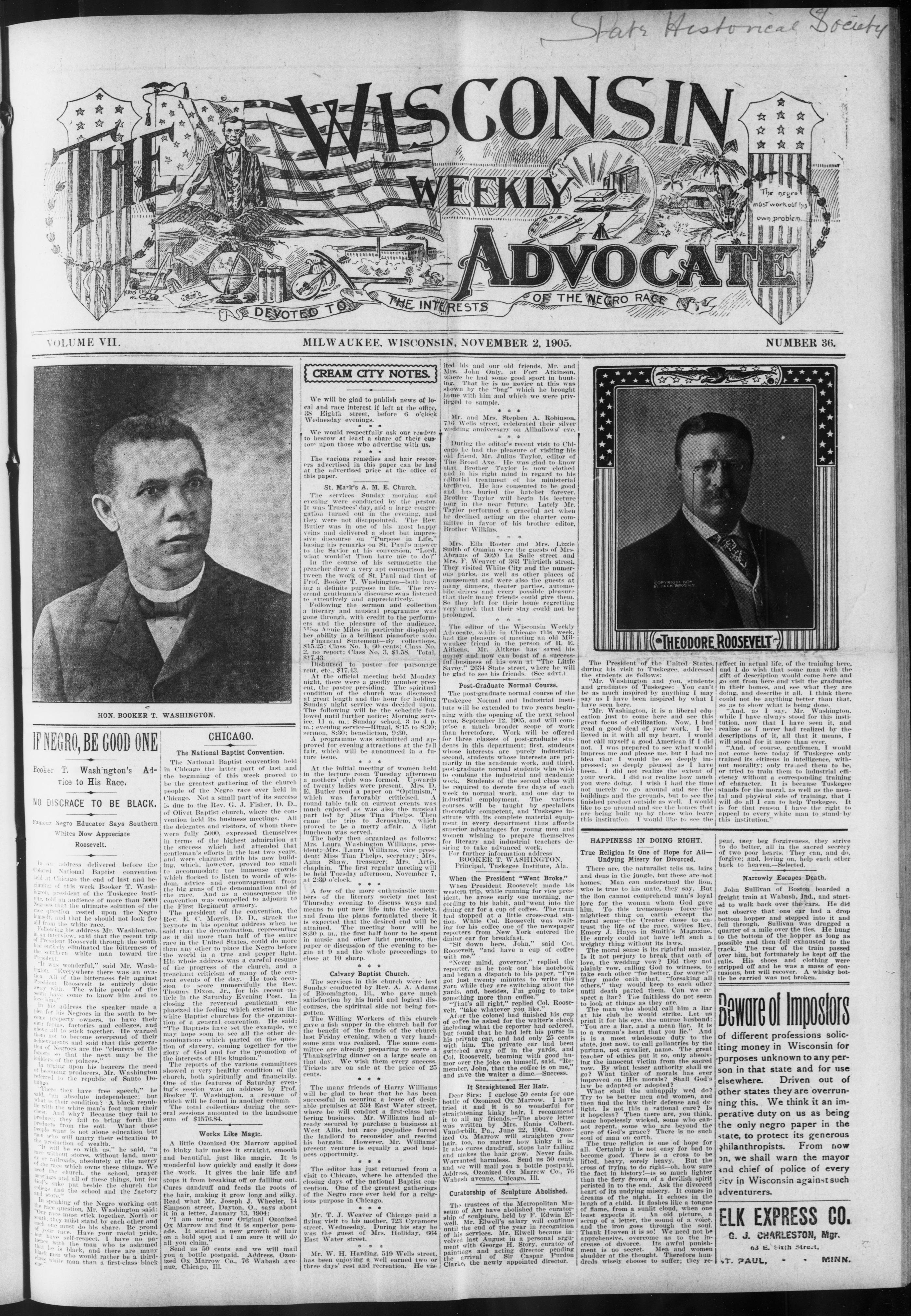
Page text (machine-generated)
WISCONSIN
WEEKLY
ADVOCATE
DEVOTED TO THE INTERESTS OF THE NEGRO RACE
VOLUME VII.
10
HON. BOOKER T. WASHINGTON.
IF NEGRO, BE GOOD ONE
Booker T. Washington's Advice to His Race.
NO DISCRACE TO BE BLACK.
Famous Negro Educator Says Southern Whites Now Appreciate
In an address delivered before the Colored National Baptist convention held at Chicago the end of last and beginning of this week Booker T. Washington, president of the Tuskegee institute, told an audience of more than 5000 Negroes that the ultimate solution of the race question rested upon the Negro himself, and that he should not look for aid from the white race. Following his address Mr. Washington, in an interview, said that the recent trip of President Roosevelt through the south had entirely eliminated the bitterness of the southern white man toward the President.
"It was wonderful," said Mr. Washington. "Everywhere there was an ovation. All of the bitterness felt against President Roosevelt is entirely done away with. The white people of the south have come to know him and to love him."
In his address the speaker made a plea for his Negroes in the south to become property owners, to have their own farms, factories and colleges, and above all to stick together. He warned them not to become overproud of their achievements and said that this generation of Negroes are the "clearers of the forests so that the next may be the builders of the palaces."
In urging upon his hearers the need of becoming producers, Mr. Washington referred to the republic of Santo Domingo.
"There they have free speech," he said, "an absolute independence; but what is their condition? A black republic with the white man's foot upon their chest. And why? Because they fail to produce; they fail to bring forth the products from the soil. What those people want is not alone education but men who will marry their education to the production of wealth.
"It will be so with us." he said, "a race without stores, without land, money or railroads, absolutely at the mercy of the race which owns these things. We need the church, the school, prayer meetings and all of these things, but for God's sake put beside the church the college and the school and the factory and store."
In speaking of the Negro working out the race question, Mr. Washington said: "Our race must stick together. North or south, they must stand by each other and each one must do his share. Be proud of your race. Have your racial pride, but have self-respect. I have no patience with the man who is ashamed that he is black, and there are many black men who would rather be a third-class white man than a first-class black one."
Roosevelt.
The National Baptist Convention.
The National Baptist convention held in Chicago the latter part of last and the beginning of this week proved to be the greatest gathering of the church people of the Negro race ever held in Chicago. Not a small part of its success is due to the Rev. G. J. Fisher, D. D., of Olivet Baptist church, where the convention held its business meetings. All the delegates and visitors, of whom there were fully 5000, expressed themselves in terms of the highest admiration at the success which had attended that gentleman's efforts in the last two years, and were charmed with his new building, which, however, proved too small to accommodate the immense crowds which flocked to listen to words of wisdom, advice and encouragement from the big guns of the denomination and of the race. And as a consequence the convention was compelled to adjourn to the First Regiment armory.
The president of the convention, the Rev. E. C. Morris, D. D., struck the keynote in his opening address when he said that the denomination, representing as it did more than half of the entire race in the United States, could do more than any other to place the Negro before the world in a true and proper light. His whole address was a careful resume of the progress of the church, and a trenchant criticism of many of the current events of the day. He took occasion to score unmercifully the Rev. Thomas Dixon, Jr., for his recent article in the Saturday Evening Post. In closing the reverend gentleman emphasized the feeling which existed in the white Baptist churches for the organization of a general convention. He said: "The Baptists have set the example, we may hope soon to see all the other denominations which parted on the question of slavery, coming together for the glory of God and for the promotion of the interests of His kingdom."
The reports of the various committees showed a very healthy condition of the church, both spiritually and financially. One of the features of Saturday evening's session was an address by Prof. Booker T. Washington, a resume of which will be found in another column.
The total collections during the several sessions amounted to the handsome sum of $1576.84.
A little Ozonized Ox Marrow applied to kinky hair makes it straight, smooth and beautiful, just like magic. It is wonderful how quickly and easily it does the work. It gives the hair life and stops it from breaking off or fallling out. Cures dandruff and feeds the roots of the hair, making it grow long and silky. Read what Mr. Joseph J. Wheeler, 14 Simpson street, Dayton, O., says about it in a letter, January 13, 1904: "I am using your Original Ozonized Ox Marrow and find it is superior pomade. It started a new growth of hair on a bald spot and I am sure it will do all you claim." Send us 50 cents and we will mail you a bottle postpaid. Address, Ozonized Ox Marrow Co., 76 Wabash avenue, Chicago, Ill.
CHICAGO
Works Like Magic.
MILWAUKEE, WISCONSIN, NOVEMBER 2. 1905.
CREAM CITY NOTES.
We will be glad to publish news of local and race interest if left at the office, 38 Eighth street, before 6 o'clock Wednesday evenings.
We would respectfully ask our readers to bestow at least a share of their custom upon those who advertise with us.
The various remedies and hair restorers advertised in this paper can be had at the advertised price at the office of this paper.
St. Mark's A. M. E. Church.
The services Sunday morning and evening were conducted by the pastor. It was Trustees' day, and a large congregation turned out in the evening, and they were not disappointed. The Rev. Butler was in one of his most happy veins and delivered a short but impressive discourse on "Purpose in Life," basing his remarks on St. Paul's answer to the Savior at his conversion, "Lord, what would'st Thou have nie to do?" In the course of his sermonette the preacher drew a very apt comparison between the work of St. Paul and that of Prof. Booker T. Washington—both having a definite purpose in life. The reverend gentleman's discourse was listened to attentively and appreciatively.
Following the sermon and collection a literary and musical programme was gone through, with credit to the performers and the pleasure of the audience. Miss Annie Miles in particular displayed her ability in a brilliant pianoforte solo. Financial Statement—By collections, $15.25; Class No. 1, 60 cents; Class No. 2, no report; Class No. 3, $1.58. Total, $17.43. Disbursed to pastor for parsonage rent, etc., $17.43.
At the official meeting held Monday night, there were a goodly number present, the pastor presiding. The spiritual condition of the church was discussed at great length and the hour for holding Sunday night service was decided upon. The following will be the schedule followed until further notice: Morning service, 11 a. m.; Sunday school, 3 to 4 p.m.; evening service—Ritual, 8:15 to 8:30; sermon, 8:30; benediction, 9:30.
A programme was submitted and approved for evening attractions at the fall fair, which will be announced in a future issue.
At the initial meeting of women held in the lecture room Tuesday afternoon a mothers' club was formed. Upwards of twenty ladies were present. Mrs. D. E. Butler read a paper on "Optimism," which was favorably criticised. A round table talk on current events was much enjoyed as was also the musical part led by Miss Tina Phelps. Then came the trip to Jerusalem, which proved to be a merry affair. A light luncheon was served.
The body then organized as follows: Mrs. Laura Washington Williams, president; Mrs. Laura Williams, vice president; Miss Tina Phelps, secretary; Mrs. Anna Shaw, treasurer; Mrs. Artis, chaplain. The first regular meeting will be held Tuesday afternoon, November 7, at 2:30 o'clock.
A few of the more enthusiastic members of the literary society met last Thursday evening to discuss ways and means to put new life into the society, and from the plans formulated there it is expected that the desired end will be attained. The meeting hour will be 8:30 p. m., the first half hour to be spent in music and other light pursuits, the paper or discussion of the evening to begin at 9 and the whole proceedings to close at 10 sharp.
Calvary Baptist Church
The services in this church were last Sunday conducted by Rev. A. A. Adams of Bloomington, Ill., who gave much satisfaction by his lucid and logical discourses, the spiritual side not being forgotten.
The Willing Workers of this church gave a fish supper in the church hall for the benefit of the funds of the church last Friday evening, when a very handsome sum was realized. The same committee are already preparing to serve a Thanksgiving dinner on a large scale on that day. We wish them every success. Tickets are on sale at the price of 25 cents.
象象
The many friends of Harry Williams will be glad to hear that he has been successful in securing a lease of desirable premises at 534 East Water street, where he will conduct a first-class barbering business. Mr. Williams had already secured by purchase a business at West Allis, but race prejudice forced the landlord to reconsider and rescind his bargain. However, Mr. Williams' present venture is equally a good business opportunity.
* * *
The editor has just returned from a visit to Chicago, where he attended the closing days of the national Baptist convention. One of the greatest gatherings of the Negro race ever held for a religious purpose in Chicago.
***
Mr. T. J. Weaver of Chicago paid a flying visit to his mother, 723 Cycamore street, Wednesday. During his stay he was the guest of Mrs. Holliday, 664 East Water street.
Mr. W. H. Harding, 519 Wells street, has been enjoying a well earned two or three days' rest and recreation. He vis-
ited his and our old friends, Mr. and Mrs. John Only, at Fort Atkinson, where he had some good sport in hunting. That he is no novice at this was shown by the "bag" which he brought home with him and which we were privileged to sample.
---
Mr. and Mrs. Stephen A. Robinson, 716 Wells street, celebrated their silver wedding anniversary on Allhallows' eye.
During the editor's recent visit to Chicago he had the pleasure of visiting his old friend, Mr. Julius Taylor, editor of The Broad Axe. He was glad to know that Brother Taylor is now clothed and in his right mind in regard to his editorial treatment of his ministerial brethren. He has consented to be good and has buried the hatchet forever. Brother Taylor will begin his lecture tour in the near future. Lately Mr. Taylor performed a graceful act when he declined acting on the charter committee in favor of his brother editor, Brother Wilkins.
Mrs. Ella Roster and Mrs. Lizzie Smith of Omaha were the guests of Mrs. Abrams of 3020 La Salle street and Mrs. F. Weaver of 363 Thirtieth street. They visited White City and the numerous parks, as well as other places of amusement and were also the guests at many dinners, theater parties, automobile drives and every possible pleasure that their many friends could give them. So they left for their home regretting very much that their stay could not be prolonged.
The editor of the Wisconsin Weekly Advocate, while in Chicago this week, had the pleasure of meeting an old Milwaukee friend in the person of R. E. Aitkens. Mr. Aitkens has saved his money and now can boast of a successful business of his own at "The Little Savoy," 2634 State street, where he will be glad to see his friends. (See advt.)
Post-Graduate Normal Course.
The post-graduate normal course of the Tuskegee Normal and Industrial institute will be extended to two years beginning with the opening of the next school term, September 12, 1905, and will comprise a much broader scope of work than heretofore. Work will be offered for three classes of post-graduate students in this department; first, students whose interests are purely industrial; second, students whose interests are primarily in the academic work, and third, post-graduate normal students who wish to combine the industrial and academic work. Students of the second class will be required to devote five days of each week to normal work, and one day to industrial employment. The various courses will be taught by specialists thoroughly competent, and Tuskegee institute with its complete material equipment in every department thus affords superior advantages for young men and women wishing to prepare themselves for literary and industrial teachers desiring to take advanced work.
Principal, Tuskegee Institute, Ala.
When the President "Went Broke"
When President Roosevelt made his western trip, while running for vice president, he arose early one morning, according to his habit, and went into the dining car for a cup of coffee. The train had stopped at a little cross-road station. While Col. Roosevelt was waiting for his coffee one of the newspaper reporters from New York entered the dining car for breakfast.
"Sit down here, John," said Col. Roosevelt, "and have a cup of coffee with me."
"Never mind, governor," replied the reporter, as he took out his notebook and began a dispatch to his paper. "I've got just twenty minutes to write this yarn while they are switching about the yards, and, besides, I'm going to take something more than coffee."
"That's all right," replied Col. Roosevelt. "take whatever you like."
velt. take whitejee. After the colonel had finished his cup of coffee he asked for the waiter's check including what the reporter had ordered, but found that he had left his purse in his private car, and had only 25 cents with him. The private car had been switched away off in the yards, and Col. Roosevelt, beaming with good humor over the joke on himself, said, "Remember, John, that the coffee is on me," and gave the waiter a dime.—Success.
It Straightened Her Hair.
Dear Sirs: I enclose 50 cents for one bottle of Ozonized Ox Marrow. I have tried it and it is so wonderful for straightening kinky hair, I recommend it to all my friends.—The above letter was written by Mrs. Ennis Colbert, Vanderbilt, Pa., June 22, 1904. Ozonized Ox Marrow will straighten your hair, too, no matter how kinky it is. It also cures dandruff, stops hair falling and makes the hair grow. Never fails. Warranted harmless. Send us 50 cents and we will mail you a bottle postpaid. Address, Ozonized Ox Marrow Co., 76 Wabash avenue, Chicago, Ill.
Curatorship of Sculpture Abolished.
The trustees of the Metropolitan Museum of Art have abolished the curatorship of sculpture, held by F. Edwin Elwell. Mr. Elwell's salary will continue until the end of the year in recognition of his services. Mr. Elwell became involved last August in a personal argument with George H. Story, curator of paintings and acting director pending the arrival of Sir Caspar Purdon Clarke, the newly appointed director.
COPYRIGHT 1834
BY FACH BROS. N.Y.
THEODORE ROOSEVELT
The President of the United States, during his visit to Tuskegee, addressed the students as follows:
"Mr. Washington and you, students and graduates of Tuskegee: You can't be as much inspired by anything I may say as I have been inspired by what I have seen here.
"Mr. Washington, it is a liberal education just to come here and see this great focus of civilization. Now, I had read a good deal of your work. I believed in it with all my heart. I would not call myself a good American if I did not. I was prepared to see what would impress me and please me, but I had no idea that I would be so deeply impressed; so deeply pleased as I have been. I did not realize the extent of your work. I did not realize how much you were doing. I wish I had the time not merely to go around and see the buildings and the grounds, but to see the finished product outside as well. I would like to go around and see the homes that are being built up by those who leave this institution. I would like to see the
HAPPINESS IN DOING RIGHT
True Religion Is One of Hope for All— Undying Misery for Divorced.
There are, the naturalist tells us, lairs and dens in the jungle, but these are not homes. Man can understand the lion, who is true to his mate, they say. But the lion cannot comprehend man's loyal love for the woman whom God gave him. To this tremendous force—the mightiest thing on earth except the moral sense—the Creator chose to entrust the life of the race, writes Rev. Emory J. Hayes in Smith's Magazine. He surely could not have left such a weighty thing without its laws.
The moral sense is its rightful master. Is it not perjury to break that oath of love, the wedding vow? Did they not plainly vow, calling God to witness, to take each other "for better, for worse?" They made oath that, "forsaking all others," they would keep to each other until death parted them. Can we respect a liar? The faithless do not seem to look at things as they are.
The man who should call him a liar at his club he would strike. Let us print it for his eye, the untrue husband: "You are a liar, and a mean liar. It is to a woman's heart that you lie." And is is a most wholesome duty to the state, just now, to call gallantries by the puritan, not cavalier, name. The great teacher of ethics put it so, only absolving the innocent victim from the sacred vow. By what lesser authority shall we go? What tinker of morals has ever improved on His morals? Shall God's law be adapted or adopted?
What shall the unhappily wed do? Try to be better men and women, and then find the law their defense and delight. Is not this a rational cure? Is it hopeless? Then there are, you think, some hopelessly wicked, some who cannot repent, some who are beyond the cure of God's grace? There is no such soul of man on earth.
The true religion is one of hope for all. Certainly it is not easy for bad to become good. There is a cross to be lifted, heavy, sorely heavy. But the cross of trying to do right—oh, how sure the fact in history!—is so much lighter than the fiery crown of a devilish spirit perished in to the end. Ask the divorced heart of its undying misery. It comes in dreams of the night. It echoes in the laugh of a child. It flashes like a tongue of flame, from a sunlit cloud, when one least expects it. An old picture, a scrap of a letter, the sound of a voice, and the iron goes through the soul. Thank Heaven it is so! We need not be apprehensive, overcome as to the increase of divorce. Its awful punishment is no secret. Men and women shudder at the thought. Therefore hundreds wisely choose to suffer; they re-
NUMBER 36.
ROOSEVELT
effect in actual life, of the training here, and I do wish that some man with the gift of description would come here and go out from here and visit the graduates in their homes, and see what they are doing, and describe it all. I think there could not be anything better than that, so as to show what is being done. "And, as I say, Mr. Washington, while I have always stood for this institution, now that I have seen it, and realize as I never had realized by the descriptions of it, all that it means, I will stand for it more than ever.
"And, of course, gentlemen, I would not come here today if Tuskegee only trained its citizens in intelligence, without morality; only trained them to be, or tried to train them to industrial efficiency without a corresponding training of character. It is because Tuskegee stands for the moral, as well as the mental and physical side of training, that I will do all I can to help Tuskegee. It is for that reason I have the right to appeal to every white man to stand by this institution."
pent, they beg forgiveness, they strive to do better, all in the sacred secrecy of two poor hearts. They can, and do, forgive; and, loving on, help each other back to heaven.—Selected.
Narrowly Escapes Death.
John Sullivan of Boston boarded a freight train at Wabash, Ind., and started to walk back over the cars. He did not observe that one car had a drop bottom hopper and stepped into it and fell through. Sullivan was dragged a quarter of a mile over the ties. He hung to the bottom of the hopper as long as possible and then fell exhausted to the track. The rear of the train passed over him, but fortunately he kept off the rails. His shoes and clothing were stripped off and he was a mass of contusions, but will recover. A whisky bottle he carried was not broken.
Beware of Impostors
of different professions soliciting money in Wisconsin for purposes unknown to any person in that state and for use elsewhere. Driven out of other states they are overrunning this. We think it an imperative duty on us as being the only negro paper in the state, to protect its generous philanthropists. From now on, we shall warn the mayor and chief of police of every city in Wisconsin against such adventurers.
ELK EXPRESS CO.
G. J. CHARLESTON, Migr.
63 E. Sixth Street,
ST. PAUL, MINN.
—Monkeys have a peculiar dread of snakes.
—In royal families the princesses marry at about 22, the princes at about 25.
—We read of a western woman lawyer who beat a brother lawyer in an important case and then turned around and married him.
—A New Zealand publication, The Contract Journal, makes this bull: "The clash of party cries is obstructing a clear view of the present position of this country."
—Quite Edenesque is the business street of St. Helier, in the Isle of Jersey, where "Adam," "Eve," "Cain" and "Abel" are all prosperously established in business.
Two kinds of living creatures only, men and dogs, can stand an instantaneous change from Arctic cold to tropical heat without suffering deterioration or losing their health.
Statistics find that something like 2000 vessels of all sorts disappear in the sea every year, never to be heard from, taking 12,000 human beings and involving a money loss of $100,000,000.
"David Harum," the novel written by the late Edward Noyes Westcott, netted the author's estate about $125,000, according to a statement made in the surrogate's court, Syracuse, N. Y.
A woman asked a London magistrate the other day for a summons against the other woman for calling her a Japanese. The magistrate said it was no insult to call a person a Japanese and refused the summons.
The Jersey City board of education is at its wits' end to keep its schools supplied with women teachers. Cupid having captured seventeen recently and taken fifteen of the forty graduated from the training school last spring.
To each shipping company which adopts the refrigerator system and guarantees to make the voyage from Buenos Aires to Lisbon or Vigo in fifteen and a half days, the Argentine government will pay a monthly subsidy of $2000.
The English delight in odd rents, but the oddest is a tenacy in Brookhouse, in Yorkshire, where the rental is one snowball in June and a red rose in December. The rose is easily arranged, and the snowball is now made of shaved ice.
A new glass described by Emile Touchet is very transparent to invisible chemical rays. In simultaneous photographs of part of the constellation Syra a lens of this glass showed 619 stars, while one of ordinary Jena glass showed but 251. Reports of an extensive volcanic outbreak on the Island of Savaii in the Samoan group are brought by the steamship Sierra from Australia. The eruption is ten miles south of Matantua and a new mountain has been created 1000 feet high. A pet jackdaw was missing in a large machinery shop near Kilmarnock, Scotland, the other day, but was found inside a large flywheel, after it had circulated for over two and a half hours at 176 revolutions a minute. The bird was unhurt.
—One of the largest works of man's hands is the artificial lake, or reservoir, in India, at Rajputana. This reservoir, said to be the largest in the world, known as the Great Tank of Dhebar, and used for irrigating purposes, covers an area of twenty-one square miles.
—An English druggist gives the following list of blunders made by his poorer customers; "Catch an eel," for cochineal; "prosperous paste," for phosphorous paste; "grease it," for creosote; "fishy water," for Vichy water; "guitar," for catarrh; "everlasting," for effervescing.
—A British army officer in India was awakened one morning by feeling the native servant of a brother officer pulling at his foot. "Sahib," whispered the man, "sahib, what am I to do? My master told me to wake him at 6:30, but he did not go to bed till 7."
The following advertisement appears in a Devonshire newspaper: "Widower, no family, renting a small farm near Kingsbridge, wants a housekeeper; a chapel-going person, and one that has charity, which is the love of God, preferred, with views of marriage, if the Lord prospers my ways and she be willing. Apply," etc.
The Czar has a habit of spending more time in his study than almost any other ruler in the world. The Czarina is always seated with him while he is at work in this room. In this respect he stands almost alone among great monarchs, as nearly all of them prefer to have women out of the way when they are immersed in the business of state in their own private rooms.
There are in America today more than 200 fraternal beneficiary orders, with a combined membership of over 5,000,000, who are protected to the extent of more than $7,500,000,000, and have distributed benefits to disabled members amounting to more than $825,000,000. In 1894 alone they distributed $65,000,000, or at the rate of $1,250,000 per week, besides paying over 4000 death claims last year. Sixty-four of these orders have a membership of over 10,000, and the others from 5000 to 7000.
An Italian scientist has invented a novel substitute for irrigation. He uses the fruit of the Barbary nopal, a fig tree which bears figs that are excellent reservoirs of moisture. In the spring the scientist digs a ditch about the foot of the tree he desires to protect from the coming drought and this ditch is filled with figs cut into thick pieces. A dense layer is made and beaten down. The mucilaginous pulp, covered with earth, stores up much moisture, which it gives off gradually, watering the tree sometimes for as long a period as four months.
There are about sixty words in English that have no rhyme. As given in the Rhymers' Lexicon by Andrew Lang they are as follows: Aitch, alb, amongst, avenge, bilge, bourn, breadth, brusque, bulb, coif, conch, culn, cusp, depth, doth, eighth, fifth, film, forge, forth, fugue, gulf, hemp, lounge, mauve, month, morgue, mourned, mouth (verb), ninth, oblige, of, pearl, pint, porch, pork, poulp, prestige, puss, recumb, sauce, scarce, scarf, sixth, spoilt, swolm, sylph, tenth, torsk, twelfth, unplagued, volt, warmth, wasp, wharves, width, with, wolf, wolves.
A Humane Attachment
A huge touring car tore past with the extra emergency tire strapped securely to its side. Two street gamins gazed after it intently.
"Say, Jimmie, what's that round thing abangin' on the side?"
"Gee! don't ye know? That's a life-preserver, en when they're in danger of runnin' over anybody they jes' throws that overboard to 'em."—Lappineott5s.
Graft
Graft crosses party lines. It knows no boundaries of section. It is local, state and national. It lives in its corrupt agents. To conquer the moral pestilence, crush its agents and slaves. Smash them always and everywhere. There is no other way to safety.—Cleveland Leader.
THE TURKEY CROP.
Along about this time
Of year we hear much talk
About the well-filled barns
And fodder in the shock.
But there's one subject which
All seem inclined to shirk.
For no one talks about
The status of the turk.
We get statistics on
The crops of grain and hay.
And all the varied fruits
That yearly come our way.
But for some reason all
Their information stop
Just when we think we'll learn
About the turkey crop.
How is the turkey crop?
That's what we want to know
Will it supply demands
Or make a measly show?
Will turks be cheap or dear?
Will they be thin or fat?
That sort of knowledge we
Are trying to get at.
Thanksgiving Day draws near,
The tamous feasting time
When we desire to sink
Our teeth in turkey prime.
And dreadful grows suspense
When there is nothing heard
About the chance we'll have
To roast and eat the bird.
We can't imagine why
Such knowledge is denied
When interest most keen
Is shown on every side.
And, therefore, just before
We let the subject drop
Again we plainly ask:
How is the turkey crop?
Htttebury Chronicle To
HOW THE MINER WON.
Bv. Lient.-Col. J. A. Watrous, U. S. A.
"What can't a man accomplish if he keeps his eyes open, his mind active, his hands ready and always puts forth his best effort?"
Do you give it up?
Yes? So do I.
Nearly seventy years ago a boy baby flew into the home of a poor family in England. His parents came to Wisconsin and located in southwestern Wisconsin and the father went to work in the lead mines.
When the boy was 11, after he had done a good deal of hard work to aid in supporting the family, and before he had had a chance to spend a day in school, he went to service in the mines, with his father, and the better part of the next thirteen years he helped in producing the lead supply, so it will be seen that he was wholly without school privileges. But that does not mean that he was not a student. Every noon, while he was in the mines, after his fifteenth birthday, he hurriedly swallowed the cold dinner and gave close attention, first, to learning his letters, then to putting them to use in a speller and later in a reader. That was all the school the English had ever attended—his own.
For a time his father operated a threshing machine a few weeks in the autumn: his boy was a helper, at first, but when he was 18 he knew all about and could manage the machine better than his father could, and was given full charge, the father going back to the mine. While the crew was resting, after dinner, the feeder and manager was attending school—his school—and pored over speller, reader and geography, until it was time to hitch up teams and start in for the last half of the day, which ended when it was too dark to operate.
One season the youngster was making such a good record in threshing grain that the father said to him, "You can go to Milton academy for a term when the season is over." That was what he wished above all things.
The old threshing machine hummed louder and longer than ever, if possible, and when the work was done it was found that the transplanted Johnny Bull had chucked enough bundles of wheat into the singing cylinder to put 40,000 bushels of wheat into bins, and oats bundles enough to make 75,000 bushels.
It was a record-breaker for those early days, and all of the boys in the neighborhood began to take notice of the light-baired lad from Great Britain.
While in the midst of his rejoicing the young man's greatest disappointment came. His father found that he needed all of the money the youngster had earned as a thresher, and could not let him go to Milton academy. But it did not break his spirit or head off his pursuit of an education. He sought the privilege of working for a neighbor for a few weeks before going into the mines for the winter. At digging potatoes, husking corn, helping to do the fall butchering he earned $21. With part of that he bought a cheap suit of clothes and a pair of $2.50 boots. He still had $10.
Before daylight the next morning, wearing the best clothes he had ever possessed, he started, on foot, to Galena, Ill., eighteen miles distant. Before eating the slices of bread without butter and an apple he had taken along for dinner, he went to a bookstore and made two purchases—a Webster's unabridged dictionary and an English grammar, the former costing $8 and the latter $1.50.
His little fortune, except 50 cents, was gone, but he was the happiest young man in that part of the country as he sat by the roadside, half a mile toward home, and ate the apple and bread and looked at pages of his dictionary.
He reached home before dark, bearing his two treasures, having made the thirty-six miles without once thinking his lot was a hard one.
That winter, at the noon hour in the mines, his school time was devoted to learning how to write, and in the practice of writing lessons. In the spring he was a fairly good penman. Evenings he studied grammar or perused the ample pages of his dictionary.
Then came the great war. He wanted to enlist under the first call, but his services could not be spared; but he went as soon as he could, and took along some books, thinking to do much studying, but the captain of his company put a stop to that when he made the miner-student the company's orderly sergeant. Every man who has been a soldier knows that the orderly, or first sergeant, has the hardest task in the company, and is busy every hour in the day. Student life was out of the question, in that office.
"Captain," said the colonel to the officer commanding the young man's company. "I shall have to take your orderly away from you. I want to make a lieutenant of him."
And they put a pair of straps on his shoulders, and a month later he was commanding a company. In camp, on the march and in battle he was all that an officer should be.
Before the war was over he was made a captain and his regiment did not have
a better one, an officer who was more thoroughly posted in tactics or who could handle men to better advantage; and the student-soldier had been his own teacher, as when a miner. Three years after the war we find him the editor—and a bright, original and successful editor of a weekly paper. Later on he was editor of one of the most influential papers in the state, outside of Milwaukee. White on that paper the governor of the state commissioned him a colonel of the national guard, and another governor gave him a very important state office, whose duties he performed with marked ability.
Then he returned to newspaper work, remaining until his health failed. For seven years he has been an invalid, and almost any other man as sadly afflicted would have surrendered, but not such a miner lad, self-educator, thresher, soldier, editorial deliver as my hero. During the past five or six years, and all of that time unable to take an hour of perfectly natural sleep, he has written and had printed five books, all gems, choicey composed, full of material of value to the public, well calculated to interest all classes of citizens. All of them will be standard a century hence, and probably much longer.
I have just finished reading his last book; one of the most interesting and inspiring I ever looked into. I think its perusal will add ten years to my stay in the country the author of the book helped to steer away from rocks that promised wreck when he was a soldier. I wish all might read it; and I am especially anxious to have all elderly people possess it.
It is called "Masters of Old Age."
Let me introduce the miner lad of long ago—Col. Nicholas Smith of Milwaukee, author of that and four other choice publications, an honored citizen of Wisconsin, whose humbly begun life has come far from being a failure, and whose history and successes I commend to the attention of all boys and young men who may think, at times, that they are in hard luck.
Capt. Tom La Flesch died at his home in California, recently. He served through the big war in the Second Wisconsin cavalry, whose first colonel was the late Gov. C. C. Washburn.
Tom La Flesch was a rough diamond—a high-grade diamond in the rough.
Twenty-five years ago, when a good many people at the north were still fighting the battles of the Civil war and denouncing southern soldiers, he insisted that the war was over and that it was not wise or kindly to say harsh things about the old foes in gray.
"There was a time, during the war," said the captain, "when I was mad, too, but when our regiment, well to the close of the struggle, flanked a regiment of the Johnnies out of their camp, and I saw and heard the prisoners, I felt like lifting my hat to them, and as I now recall them and their condition, it pretty nearly brings the tears. The ground was frozen and every last prisoner was bare-footed, and they told us that not more than a quarter of the regiment had boots or shoes. For two weeks their rations consisted of one ear of hard corn, on the cob, for each man, a day, and some of the poor fellows were so hungry that they ate it raw—couldn't wait to parch it. And yet those men still fought like tigers for what they thought was right. The way I look at it, boys, it was an honor, great credit, to us to fight and get the best of an army of such men and such soldiers. I am as glad as any of you that we won, but I could no more say the mean things about those brave old fellows that some of our chaps are saying than I could say mean things about George Washington and my dear old grandmother."
That is the way Capt. Tom La Flesch talked and felt a quarter of a century ago, and it is about the way that most of the veterans feel and talk today. I was at La Crosse last June when a letter from Capt. La Flesch was read before a reunion of the Second cavalry. There was silence in that company of old men for several minutes after the secretary had finished reading the letter. Then a man who had served in his troop said, "Capt. Tom La Flesch was the best all around officer, soldier and man that I ever knew," and after that nearly every man at the reunion had something kind to say about the absent member.
One part of the captain's letter made a lasting impression on the minds of all who heard it. Will you print it?
"I hope you may reap a rich harvest of enjoyment at that meeting. I had hoped to be with you at this time, but my health would not permit, though I still hope to meet many of you at some future reunion. As I sit in my cabin door on the lonely Sierras, looking to the west, the sun is slowly dipping behind the hills on its way to the broad Pacific. To the east its rays still brighten the high and hoary peaks; then the brightness vanishes from them, too, and soon all will be folded in the robes of silent night. Thus it is, my comrades, with the grand old army. Morning and noontide have passed; our star is also dipping behind the western hills as our eventide draws on; its lingering rays still rest upon a few of our hoary heads; they, too, will soon vanish and all will be dark in the silence of the grave, leaving only the records of our words and works for future generations. Then see to it, comrades, that there be no blot on the record of the old Second Wisconsin cavalry.—Evening Wisconsin.
Steam Plant to Heat a Sod House
"Nowadays you're likely to find a modern heating plant in almost any corner of the world, no matter how remote it may be," said Louis Taylor, a representative of a prominent heating appliance manufactory.
"Not so very long ago our company was asked to make an estimate for putting in a modern steam plant in a sod house on a lonesome Nebraska ranch. I saw the house, and while its exterior was not very prepossessing, its interior was most comfortably fitted up and furnished. It had six rooms, I think, all of them liberal in size, and fitted out in a modern way. The owner was a big cattle grower with an abundance of money. He merely hadn't got around to building a wood, stone or brick residence. His sod house is located about forty miles from a railroad and in a lonesome stretch of prairie."—Des Moines Register and Leader.
Obeyed the Specialist's Orders
A celebrated Continental specialist, to whom time was literally money, and who was possessed of a fiery temper, made it a rule that all patients should undress before entering his consulting room so as not to waste any of his valuable time. One day a meek looking little man entered with all his clothes on. "What do
you mean by coming in like that?" asked the doctor, in a rage "Go and strip at once." "But I——" faltered the man.
"But I——fattered the man.
"I tell you I've no time to waste," yelled the doctor, and the poor man left the room in haste. When his turn came he re-entered the room. "Now, then," said the doctor, "that's better. What can I do for you?"
"I called to collect your subscription for the benevolent society."—Tatler,
CARRY OUT SUICIDE PACT
Close Friends Found Dead Within Few Days of Each Other.
There is under investigation by the Brooklyn police the remarkable story of a suicide wager between two men whose bodies were found in the lower bay within a few days of each other. The men were Henry Schwandwedel, 50 years old, a wealthy retired merchant, and Adam Hillman, 36 years old, an engineer. They had been intimate friends for a number of years. The engineer lived with his wife and one child, and during all his married life was a model father and husband. He was of a very quiet disposition. Schwandwedel, who owned real estate in Brooklyn valued at $200,000, lived alone with his sister, Regina Schwandwedel, and had no intimate friends except Hillman. Hillman left his home October 12 at the hour he usually started for work. He kissed his wife and little girl, and started down the road whistling. He never was seen again alive, and his body was recovered from the bay. At the time of his disappearance Hillman had a gold watch and chain, a locket containing pictures of his wife and daughter and $20. The money and jewelry were intact in his clothing when his body was found. Schwandwedel disappeared October 9, and it was on that day that the strange bet is said to have been made. After leaving his home he called, as usual, on Hillman and they lunched together. Acquaintances of the two men who sat at a nearby table have informed the police that they overheard the older man offer to wager $500 that he would be the first of the two to commit suicide. Hillman is said to have consented to the bet.
Canine Winter Styles.
An authority upon the subject gives in the London Mail the following information upon the correct things for dogs this winter.
Fur coats for calling or driving, so popular last winter, will be replaced by tailor-made coats. The coats are especially designed to "protect the dog's chest while in the carriage or motor car."
The dog's handkerchief, which used to be carried in a pocket in the coat, is now properly carried in a purse at the end of the leash.
The style of wearing the silk or satin bow on the top of the dog's head has "gone out." It is now worn at the side of the face under the ear. It should be "massive" in proportions and match in color the trimming on the hat of the dog's mistress.
The fashion editor quoted remarks that the above rule "often causes great anxiety because only certain colors will match the pet's coat." But as a general rule pink, blue or red goes well with a black poodle. Blue is preferable for Blendheims. For black and tans "any color may be used except green."
"Perfumes are simpler" this year. The lady merely perfumes her dog with the same scent she herself uses.
In the matter of dog jewelry there is "little to report." In some cases gold bracelets set with gems are worn on the forepaws, and jeweled collars, bearing the owner's crests—when there are crests—still remain stylish.
Boots for dogs have "quite gone out of fashion." It was found that they made the dog's feet look larger than they really were.
Automobile costumes for dogs, including goggles, very stylish, can be had as low as £50. A thoughtful lady, Mrs. White Pearce, has opened a seaside establishment for dogs whose delicate constitutions are not equal to the continuous strain of a London season.
Heat in Colors.
An interesting experiment recently made by a Duluth physician proved conclusively that for the sake of coolness only white should be worn in hot weather.
The physician spread out in an intense sunshine a large piece of white cloth, another of dark yellow, another of light green, another of dark green, another of blue and another of black.
Then, with the help of six thermometers, he made the following table of the various heats which each color received from the sunlight:
White .....100 degrees
Dark yellow .....140 degrees
Light green .....155 degrees
Dark green .....168 degrees
Blue .....198 degrees
Black .....208 degrees
Thus the physician proved that in August, the man in white is a little less than twice as cool as the man in blue, and a little more than twice as cool as the man in black.-Duluth Tribune.
Sympathy
One afternoon last summer there entered a hospital in the poorer quarter of Philadelphia a little girl of about 8 years, bearing in her arms a fox terrier whose forefoot had been crushed by a heavy wagon. To the attendant who tells the story the little girl explained that she desired to have the doctors "fix the doggy's foot." The physicians were for refusing the case at first, but, in view of the great distress of the youngster, they finally permitted their good nature to get the better of them. Chloroform, instruments, and bandages were produced, and a neat operation was performed, the child bravely assisting.
"Now," said one of the doctors. "you may take the dog home with you."
may take the dog home with you.
The little one's eyes widened. "Oh," she explained, "it ain't mine! I jest found it, an' I think you oughter take care of it."
And off she went, leaving the dog in their custody.—Harper's Weekly.
Why Children Are "Bad"
Because they are hungry or thirsty. Because they have been allowed to overeat. Because they have been given pernicious cheap sweets. Because they have not had proper sleep.
Because their clothing is not comfortable.
Because the room in which they sleep or play is stuffy or ill-aired. Because their parents break promises to them and buy them off with bribes. Because they are brought up on a negative diet of continual "No, no, no." instead of an occasional good, hearty "Yes." Because their activity is not directed into the right channel. Even from babyhood a child must be doing something, and if it is not wisely directed its energies will find outlet in "naughtiness." Chicago News.
Great Drinking Place
A dispatch from Monterey, Mex., says that at the Baptist national convention of Mexico, in session there, Rev. J. Leleuer presented interesting statistics concerning temperance in that country, showing that of its 15,000,000 population 3,000,000 are habitual drunkards, 6,000,000 of the remainder are addicted to drink.
A PARENT'S PLEA
My little boy is eight years old,
He goes to school each day:
He doesn't mind the tasks they set—
They seem to him but play.
He heads his class at raffa work.
And also takes the lead
At making dinky paper boats—
But I wish that he could read.
They teach him physiology,
And, oh, it chills our hearts
To hear our prattling innocent
Mix up his inward parts.
He also learns astronomy
And names the stars by night—
Of course he's very up to date.
But I wish that he could write.
New York Every Day.
Plates of unworked silver worth $8000 were stolen from William R. Elfer's silver manufacturing establishment in New York. Thieves succeeded in carrying away their loot in a wagon without leaving any clues. From the building next door, through which they entered the silversmith's establishment, the robbers took $500 worth of diamond glass cutters belonging to Tassi Bros., mirror manufacturers.
Lighting is so perfect in the New York theaters these days that it is a rare thing to see opera glasses in use. At the race tracks and on shipboard they are still visible, but even in these places they are on the wane. It is not so very long ago that a trip abroad made the portage of heavy sea glasses a regular thing and the same was true of a visit to the race track and the theater. So far as the latter is concerned glasses have become a back number.
It's lucky that Ethel Barrymore set a late day for her marriage, else she would not have her brothers, Lionel and Jack, at the ceremony. One of the boys is in California and the other is in Australia. They both expect to be in New York in a few months, a trip across the water these days being like walking across the street. Miss Barrymore is to go right on acting after her marriage. That is part of the agreement made with her brilliant and tolerant young knight.
There are today in New York several hundred wealthy English, German and French visitors, and they are spending money freely at the hotels. Of course, when they are interviewed they say that prices are very much higher here than abroad, but on a show-down they settle gracefully and never complain. Each year the American metropolis attracts an increasing number of foreigners, who come here because they like the town—just as Americans go to Paris, London and Berlin.
By the will of George W. Catt, the Iowa state college at Amcs, Ia., is to be endowed with property worth $250,000 after the death of his widow, Mrs. Carrie Chapman Catt. Mrs. Catt is to enjoy the use of this property during her Mfe time, after whic hthe revenue from is to be divided into $100 scholarships for Iowa State college. Mr. Catt's library on economics also goes to the college after his widow's death, and his engineering library is bequeathed to the college immediately.
Of the more than 800,000 aliens who arrived last year 210,426 were laborers, 104,937 were domestic servants, 85,850 were farm laborers and 23,580 were tailors. There were 19,848 merchants and dealers, 13,404 carpenters, 10,567 shoemakers, 10,420 clerks, 10,326 mariners and 9110 miners. The number of professional immigrants was unusually large, including as it did no less than 1169 actors, 2226 engineers, 1419 musicians and 1983 teachers. There were 152,191 skilled laborers.
Day and night and Sunday all look alike to the Pennsylvania Railroad company in its effort to complete its tunnel and terminal for Manhattan. So far as the depot site goes the present rate of progress in excavating is about 125,000 cubic yards a month, earth and rock mixed. The force at work to accomplish this numbers about 2000 men, of whom 1400 work in the daytime and the other 600 at night. They operate 4 steam shovels, 12 locomotives and 200 cars. Forty scows are employed.
There are now on this side about a dozen distinguished Englishmen, and the reception given them is doing much to soften the old tone of asperity which Englishmen had adopted heretofore. Two New York correspondents for London newspapers have discovered that their papers delight in printing tales about the kindly attitude of Americans toward their English brethren. London made much of the thoughtfulness of the American actors who "cabled a floral tribute" to be laid on the bier of Henry Irving.
The Irish Ladies' choir, an organization of 26 of the prettiest girls of Ireland, arrived in New York for a tour of the United States that will extend to the Pacific coast. This organization holds the prize awarded at the Feis Céil, the annual music festival of Dublin, and has gained the first prize in every competition it has entered. The members are women of culture and refinement, enthusiastic in their love for old Irish music and pleasantly expectant of the wonders they shall see in their tour of this country.
"God commendeth His love for us as a reminder in that, while we were yet simers, Christ died for us—Rom., v:8." This text in big letters occupies a billboard 25 feet long and 8 feet high, facing the bridge on the south at the curve into Sands street, Brooklyn. It stands on the roof of a Fulton street building and the owner has received a check for $250 for one year's rental. The arrangement, it was said, was made by a tall, thin young man, who said that several religious men were associated with him in the enterprise.
Nervousness is on the decrease in New York city. This astonishing discovery has been made by Dr. Burke, registrar of the health department, who has prepared a table showing the death rate from this cause. In 1870, when the city's population was 943,330, the death rate per 1000 was 34.72. In 1880 it had decreased to 23.06, and last year, with a population of 2,235,600, there were 4442 deaths, or a percentage of only 19.82. While the so-called diseases of the nervous system may be decreasing, said Dr. Darlington, Bright's disease and heart disease are increasing.
Passengers on the Red Star liner Finland, which arrived in New York, were witnesses of a most pathetic sight the other day. The big steamship's engines were stopped and the crew mustered on deck to witness the burial at sea of Erzsebes Lakitis, a Hungarian girl, 8 years old, who died suddenly of pneumonia. The grief of the girl's two sisters, who wept uncontrollably during the reading of the service by Rev. John Neises, affected many of the other pas-
sengers. The sisters were coming over to meet their father and mother. A substantial purse was made up for the two girls by the first and second class passengers.
An adjourned meeting of the executive commission of the American section of the World Alliance of the Presbyterian and Reformed Churches was held in New York. The commission was organized to consider the relations of the alliance to other bodies, particularly with regard to the proposed resolution for union and federation of evangelical churches. Rev. James A. Worden of Philadelphia made an appeal for some provision for the instruction of Sabbath school teachers, more than 200,000 of whom now do all they can to perfect themselves in the knowledge of the Bible and the art of teaching without aid from any one.
Inch for inch Manhattan Island is the most densely populated bit of ground in the world, yet the island has proportionately more free parks than other cities. Central park is counted a large park. It has 843 acres. Compare it with this magnificent North Bronx chain of parks
Pelham Bay park with its 1756 acres, for instance, as large again as Central park. And then there is Vancortlandt park with its 1132 acres, or 289 acres more than Central. Then comes Bronx park with 661 acres. All of these are really one park by reason of the two connecting parkways, each of which is to be a park marvel in itself. There is nothing like it anywhere in the world.
Some travelers have gone so far as to assert that the antiquities of New York are as scarce as snakes in Iceland. This is an exaggeration. There are no snakes in Iceland, but there are at least two first-class antiquities in New York. One is St. Paul's chapel, Broadway, at which George Washington worshiped. The other is the belt line surface horse car. Before the Indians came the belt line surface horse car roamed the untrodden groves of Manhattan. To the lonely Londoner there is nothing in all New York so affecting as the belt line surface horse car. The sight of a belt line surface horse car brings tears to his eyes and a lump to his throat. It reminds him of home.
A verdict of $80,241 against Joseph Leiter, Joseph H. Hoadley and Cyrus F. Judson was returned by a jury in the New York supreme court in the suit brought by William H. Franklin and George I. Scott, who claimed that, as members of Franklin, Scott & Co., in April, 1902, they lost $65,800 by carrying stock for a pool in the International Power company's stock, which included the defendants. The verdict represents the full amount, with interest. Leiter and Hoadley set up the defense that there was no pool between them and Judson, and attempted to show that Judson alone was responsible in the handling of the International Power company's stock when its price dropped in the crash of the spring of 1902.
Plans for tapping the Catskill mountain water shed for an increased supply of 500,000,000 gallons daily at an expense of $161,000,000 to the city of New York, were formally approved by the board of estimate. Briefly, the plan involves tapping the Esopus, Rondout, Schoharie and Catskill water sheds, and bringing the water by aqueduct to New York. A great reservoir is proposed in the Esopus territory to be known as the Ashokan reservoir, with two other distributing reservoirs in the present Croton district. One of these will be at Hill View and the other at Kensico. A filtration plant will be installed near Scarsdale. The aqueduct will pass under the Hudson river near New Hamburg, and will be 140 miles long, constituting the longest and largest water conduit ever constructed.
Steady going, home loving citizens of far-away towns do not dream how many girls drift from their ken to the theatrical colony of New York city. Occasionally they read of a neighbor's daughter who has risen suddenly to fame as a singer or actress, and they bask contentedly in her reflected glory. They gossip somewhat boastfully of her diamonds, her auto and the money which she sends home to "mother and the girls." When her company plays at the local theater they crowd it to the doors and applaud hysterically. But what do they know of the girls who score, not success, but failure—girls who slip away quietly and back again; girls whose lips are sealed to all that happened during that brief but strenuous absence? Only those who work and live on the Rialto, or on its edge, know this side of the picture.
The departure of a bridal party from Nutley, N. J., was the cause of much amusement for the passengers of a trolley car bound for Newark. At St. Mary's Catholic church, Miss Josephine Riordan, of Elizabeth, became the bride of William Murren. Their carriage, waiting in front of the house, was ornamented with tin pans, shoes, ribbons of all kinds and colors, and cardboard signs announcing the names of the bride and bridegroom and the fact that they had just been married. The couple decided to take a trolley car and fool their friends. They ran two blocks and caught a trolley car, but were seen by Councilman William N. Halsey, who ran to the side of the house to get a bag of rice he had secured for the occasion. Instead, he picked up a bag of chicken feed. He boarded the car and emptied the contents over the shoulders of the bride and bridegroom, and accidentally over the hats and clothes of several other men and wonten passengers.
An Eskimo Girl's Ball Dress.
When an Eskimo young lady goes to a ball she is a gorgeous sight to gaze upon. A traveler reports just how a belle was dressed on such an occasion. Her dress was made of the intestines of a seal, split and sewed together. This makes a transparent garment and the girl trimmed it with elaborate embroidery of colored worsteds and fringed it with strings of beads. Her trousers were white and made of Siberian reindeer skin, embroidered with strips of wolf skin. Her hair was braided on each side with strips of wolf skin and strips of beads. Heavy necklaces and pendants of beads and teeth of animals hung around her neck and over her shoulders.
Snow-white gloves made of fawn skin were on her hands. These fitted perfectly and were ornamented with strips of skin from some animal—perhaps the seal. To complete this elaborate outfit this Eskimo belle carried long eagle feathers, one in each hand, which she waved as she danced.—Washington Star.
She Had Waited Long Enough.
A Maine girl of ideals told a young man who asked her for her hand that she should not think of marrying a man with less than $10,000.
The young man went to Boston and worked very hard for several years, returned, and called on the young lady, who said, "Well, John, how are you getting along?"
"Pretty well," he said. "I have almost gotten $19 towards the $10,000."
"Well, John," she said. "I do not know but that is enough. I guess we can get along with that."—Success Magazine.
: GOSSIP FOR THE LADIES.
9
2,992999089HOHDDOQOOOGHAGHOOHOIOSONL —— :
+, Friend of Me. j coincidence that many of my marr’
‘i ud of mie, L know net why T tern! Itiends were subject to a peculiar ki
in every stress of toil or pain. j of headache. having often to remain
know that somehow I can gain | bed mornings, and to lie en sofas
oud courage from those somber eyes. | darkened rooms later in the day.
in your silent presenee 1 can learn! singular immunity from these attac
t. less shaken, my allotted fate. | seemed to be enjoyed when any pleas:
sivadily to Het and beat the welzbt | sceiety was expected, or when their
opelenaly O28 ae tee oe | bands happened to be in a different p:
ond of me, To wish that T might give | of the country. By degrees, putting 1
“hair reteru, some hint of joy or) little observations togetier, 1 eame
peace! | my own mind to call these ‘bad husba
vie saall reach your need, who make i headaches” and As since seen no r
0 cease son to alter my diagnosis. Notseldom 1
jeep <r that claimed you from | ery crnes MOE Eeanent storms in 1
your Ditth, de i ce | household —atmosphere—for whieh 1
week the oe ae Teiviees human] woman is frequently as much to bla
a as her companion, but from whiel:
ving faith—I cannot count it much— — suffers doubly, since, when they ha
“ike it, friend, and judge you of its passed, he goes out to his field or |
worth, {merchandise with what spirit ie ¢
» Goodale in The Reader Magazine. | jnuster, poor fellow! while she sits s
lovalid Women.
What are the causes of the valetudi-
rienism of women? This question is
<ked, and in a great measure sensibly
swerved, by Frances Power Cobbe, in
vtigle published in Tie Hesperian.
<; she advances the reason that there
neh inherited weakness among wom-
hut next, ef great importance, is the
that the suffering of a large num-
Lor of women. is caused by their own
its. While well conducted women
dom become bankrupt financially, the
cee best of them often live far beyond
J incomes in the matter of health
\j strength, Their nervous energy en-
‘es them to postpone continually the
ils of their physical being fer food.
cep or exercise. This may be caused
ther by affection, in which case they
vcrifice themselves to serve others; by
snscience, Where they fancy that duty
omands their entire service, regardless
ut their own needs, or by intellectual in-
vests, When they deliberately neglect
© requirements of the body in order to
sore the mind with more knowledge.
rhese women draw large drafts on
cir physical strength, and absoluteiy
ul to lodge corresponding sums of re-
Soring rest. and nutriment, Their
shysical instinets are not so imperious
< those of men, and they so habitually
resyard them, that at last poor nature.
constantly snubbed when she makes her
nodest requests, ceases ‘to ‘press for a
tily settlement. But by and by she
huis in an exeevtion of the whole, and
then comes the dark and dreary day.
Almost the first lesson woman learns,
1 her childhood, is to conceal her own
wants and miseries, and to not put other
wople “out of their way” for her con-
vontence, although she is continually put-
ing herself out of her way for others.
if illness comes into the house, the
sirain uper her strength is still greater,
nd she more completely effaces herself,
wklessly relinquishing sleep and neg-
cting to take food. It is a common
ing to hear women say, in cases of
kness in the house, “I haven't slept in
uiunber of nights, nor had a chance to
ta decent meal in_a week.” As soon
s the pressure is relieved, and the nerv-
= tension relaxed, the woman “breaks
ven.” and perhaps never enjoys health
esin. Tt should also be borne in_mind
if a woman Goes not think of her-
if, it is seldom that anyone thinks for
Touching upon the subject of dress,
is writer says that there are three rea-
ns for its use, namely: Health,
cency, beauty, and adds that while
women do sometimes violate-the rules of
lecency, they persistently miss the con-
tions of health, and, aiming at beauty,
frequently attain only ugliness. For this
si fact the writer blames the men
creatly, declaring that it is the “well got
i woman, not the really well dressed
oman, who receives by far the larger
sinire of admiration.
The snobbery of trying to imitate
ose in higher, or at least more wealthy
siations in life, is deeried, Modes that
night do for a few thousand women who
n vide in their carriages are frantically
followed by the millions, as nearly as
they can afford, who have to walk or
ride in’ street cars. Tight lacing, al-
ough not so prevalent as it once was,
~till holds sway to a degree, and we are
roninded that it is the maiden with the
tsp waist who always assures us, smil-
uy through her martyrdom, that her
votles are “really hanging about” her.
fo continue: “The practice of wearing
‘ecollete dresses, sinning equally as it
‘oes against health and decency, seems
» be gradually receding—from ordinary
huers, where it was universal twenty-
le years ago, to special occasions, balls
ud drawing rooms. But it dies’ hard,
vud it may kill a good many poor crea-
res yet, and entail on others the life-
cog bad health so naturally resulting
‘1 exposure of a large surface of the
4 to sudden chills,
Tie thin, paper-soled boots whielt
ive the wearer to feel the chill of the
vvement or the damp of the grass
vierever she may walk, must have
hortened thousands of lives. Combined
ith these, we aave now the high heels,
ich, in w short period, convert the foot
io a shapeless deformity, no longer
vailable for purposes of healthful exer-
se. An experienced shoemaker in-
wined the writer that, between the re-
iis of tight boots and high heels, he
scarcely knew a lady of 50. who had
vhat he could call a foot at all—they
wlomere clubs. And this is done, all
this anguish endured, for the sake of—
beauty! Bad as stays, and chignons, and
ish heeis and paint, and low dresses,
‘ud all other follies of dress are, I am,
owever, of opinion that the culminating |
vlly of fashions which has most wide-
spread and durable consequences, is the
muode in which for ages back ‘women |
ave contrived that their skirts shouid |
vt as drags and swaddling ciothes, |
vishing down their hips and obstruct
ing the natural motion of the legs.
“Does decency require such a sacrifice
s this? Does the utmost strain of femi- |
‘ine modesty ask for it? Who, in the
xe of rebes collantes and. decollete |
‘resses, can pretend that a reasonably
nil, simply eut silk or cloth skirt, reach-
= to thé ankles and no longer. would
ot fulfill immeasurably better than any
‘shion we have seen for many a day
© requirements of true womanly deli-
‘ey? It is for fashion, not decency,
at the activity of women is thus:
rushed, their health ruined, and
ihrough them) the health of their chil- |
ren,
Next to unhealthy dress, it is asserted
y this writer that women may lay their
ronic il-heaith to an excessive addic-
on to pursuits that give exercise neither
the brain nor to the body. Among
‘ese are named those of knitting, net-
“us. crochet or worsted work, and like
ployments. Pursned for a reasonable
vugth of time each day, these oceupa-
ens may not be harmful, and may even
ct as a useful sedative, but this critic
f women thinks that it is amazing that
“ inany Women should spend hours each
‘ay mnaking the megiing little motion of
‘he fingers required for this kind of
ork, when there are books to read, and
ihe whole of the outdoors in whieh to
valk or ride and adds that a drawing
oom crowded with these useless fads ts
“imply a mausoleum of the wasted hours
of women.
coincidence that many of my married
iriends were subject to a peculiar kind
of headache. laving often to remain iu
bed mornings, and to lie en sofas in
darkened rooms later in the day. A
singular immunity from these attacks
seemed to be enjoyed when any pleasant
society was expected, or when their hus-
bands happened to be in a different part
of the country. By degrees, putting my
little observations togetier, i came in
my own mind to call these ‘bad husband
headaches’ and I have since seen no rea-
son to alter my diagnosis. Notseldom the
misery comes of frequent storms in the
household atmosphere—for which the
woman is frequently as much to blame
as her companion, but from which she
suffers doubly, since, when they have
passed, he goes out to his field or his
merchandise with what spirit ie can
muster, poor fellow! while she sits still
where the blighting words fall on her,
to feel all their bitterness. Of course, it
is not only unkind husbands who make
women downhearted. There are unkind
people in every relation, and the only
specialty of a woman's suffering from
mkindness is, that she is commonly al-
most like a bedridden ereature, for whom
a single thorn or even a hard lump in
ler bed is enough to create a soreness,
“We have heard a great deal of iate of
the danger to women’s health of over-
mental strain or intellectual labor. I do
not say there is never danger in this
direction, that girls never study tou
much or too early, or that the danghters
of women who haye never used their
brains may not have inherited rather
seft and tender organs of cogitation to
stert with. Tam no enthusiast for ex-
cessive book learning for either women
or men, though in books read and books
written I have found some of the chief
pleasures of a happy life. But of one
thing 1 am sure, and that is, that for
one woman whose health is injured by
excessive study (that is, by study. itself,
not the baneful anxiety of examination
superadded to study), there are hundreds
whose health is deteriorated by want
of wholesome mental exercise. Some-
times the vacuity in the brains of gir!s
simply leaves them dull and _ spiritless.
More often into those swept and empty
chambers of their skulls enter many
small imps of evil omen.
“Let women have larger interest and
nobler pursuits, aud their affections will
become, not less strong and deep, but
less sickly, less eraving for demonstrat-
ive tenderness in return, less variable in
their manifestations. Lei women have
sounder, mental culture, and their emo-
tions—sb long exclusively fostered—will
return to calmness of health, and we
shall hear no more of the intermittent
feverish spirits, the causeless depres-
sions, and all the Jong dain of symptoms
which belong to Protemn-formed hyste-
ria, and open the way to madness on one
side and to sin on the other.”“—Detroit
News Tribune.
Sat of
Play an important part in the lives of
most of us. They appeal to us as some-
thing passing strange. Why can we one
day carry the world on our shoulders as
though “it were the most infinitesima
atom, aud the next feel too small to be
worthy of consideration—What am I
that any one is mindful of me?
One day | am interested in everything.
My feet strike the pavement; | am on;
lite is vietory and Lam life. Lam
everything to all men. One says of me,
“What oa charming, insignificant crea-
ture!” because to him Loam a wild, wo-
thinking giri with no hope of heaven
save in gaining some one’s attention.
And another says: “What a proud bean-
ty!” for to him [ am austere. Lf we
tik, it must be on philosophy, and it {
am to be atvencive to him he must argue
well, The third says, “What a sweet
little wife she would make!’ for L tell
him how a woman should act and what
a woman should be, and L picture her
with the alluring graces that bold the
senses spellbound, and he sees an image
full of sympathy, long suffering, patient
and kind. [ tell him how, when he comes
home tired and weary, she will soothe
his restless spirit; if he wants her to talk
she will say just that which he longs to
hear, and if he would rest under the
witching spell of silence she utters no
word that shall break the charm. Lf he
comes home full of the electricity of life
he shall tind her smiling and glad, eager
to be off and away where the music in-
spires and the dance is on. Calamity
has come upon him and he returns to her
not knowing how to break the news.
He finds peace past understanding. She
tells him of faith, of courage, and of
hope, and he is content to rest on the
promises. 1 tell him of this woman and
he is convinced there are true women.
The fourth one says of me: “My, she's
a queer little girl!” He has been accus-
tomed to reading open books, and I say:
“He shall not do that with me.’ When
he is expecting one thing U'll do the op-
posite. Ul frown and he will plead for a
smile. Ill grow indifferent and he will
renew the chase, [ll smile when he ex
pects me to be provoked, and his pleas-
ure will be unrestrained. He does not
believe me deep and suddenly he finds
he cannot fathom me.
Must I every day be glad or every
night be sorrowful? Must I: have no
other desire than to help the pogr or no
other object in life than to make money ?
Must woman appeal to me ever the
same?
Must no shadows fall? Emerson says:
“T would rather have a thorn in my side
than an echo.” And the world feels
much the same way about the matter.
It longs for a change to break the mo-
notony, and sages sit at the feet of that
woman or man who is a perpetual reve-
lation,
And how shall these moods affect the
individual? Shall the day and its inthi-
ence be spoiled when he finds that his
mood is not what it was yesterday?
When things seem dead around him
shali he sit down and die or shall he go
on and win life from dead things?
Can he work, and serve, and live stren-
nously, and fully and devotedly even,
when he finds that his ideal is shattered?
Then his steadfastness is worth some-
thing. If be cannot, he must learn much
more than he already knows.
Moods are victories if rightly under-
stood. They must be conquered when
they are caused from nervousness, lack
of ‘sleep, overwork, and so on. They
must be developed when they are due to
the emotional and intellectual growth.
We must learn to expect different
moods and accept them gratefully, and
we must also iearn how to make the
transition from one mood to another
easily and without interrupting our
progress.—Washington Star.
The “Walking Housekeeper.”
“I think I have found the solution of
the servant problem in a ‘walking house
keeper.” said a woman who had been
through the regular ordeal with servants.
“I've tried all sorts of servants, but have
never been able to get hold of ene who
was a thorough housekeeper, who knew
exactly what was to be done and would
do it.
“Now, my ‘walking housekeeper’ is a
woman who has always kept her own
home, but her family has all died off,
and she is anxious to earn some money
to support herself, and she is glad to
work to keep her from being lonesome.
But she is not strong enough to hire out
regularly in a place. So she hires for
piecework, so to speak.
“For instance. she will come in at 10
o'clock, prepare my dinner, do some
Evvepings do my breakfast dishes and
the dinner dishes, mop up the kitchen,
and leave by 3:30 o'clock. Or she will
come in at 7 o'clock, get breakfast, and
sweep my yvooms. She will net work
much longer than six hours, but in that
six hours she will do everything she
= find to do. She will work incessant
iv.
“She does not wash and iron, but she
will come in on washing aud ironing
days and superintend so that [ cau ran
out right after breakfast for a few
hours’ shopping with perfect confidence
that she will look after things just 2s
well as T could,
“She kuows thoroughly every part of
housekeeping and takes as much interest
in my hotise as she would in her owa.
If she is sent to sweep the parlors and
sees that the mirrors and windows need
cleaning she will go at it. without 2 word
from me. If sbe sees that clean papers
are needed on the pantry shelves she
puts them there, and if the pan under
the refrigerator needs emptying she enip-
ties it. It is in those details she is @
perfect treasure, for it is the inattention
to details on the part of the average
servant that drives a mistress nearly
crazy.
“if I'm going to give a dinner purty
T can get her to come in and help cook
and serve it, and also take a peek around
to see if the rooms are in order, Of
course she comes high, She charges $1
for six hours’ work, no matter whether
it is cooking meals or mopping piazz2s,
but she gets through with more in that
six hours than the ordinary seryant does
in twelve.—New York Sun.
Servant Question Not New
They were a half dozen ladies seated
on the piazza of a “truly old” colonial
house. The conversation, having gone
the usual round, had now reached the
fruitful topic of domestic grievances.
One after another had narrated her sad
tale of experiences, and all united in
saying that never had the servant ques-
tion been so difficult nor the servants
so poor. The hostess, who, up to this
point, had taken little part in the dis-
cussion, went into the house, and soon
‘reappeared carrying a little volume
bound in dari leather. “Ladies,” she
said, “your trials are great, 1 do not
doubt that; but they are not unique.
Here is a little book entitled, ‘Religious
Courtship, being historical discourses on
the necessity of marrying religious hus-
bands and wives only, as also of hus-
bands and wives being of the same opin-
ions in religion, with an appendix of the
necessity of taking none but religious
servants and a proposal for the better
managing of servants.’ It was printed
in Edinburgh in 1782. The discourses
are put in dialogue form, and to our ix-
reverent age are mofe entertaining than
impressive. Good common sense. how-
ever, is*not the exclusive prerogative of
any time, and the dialogue on ‘giving
references’ contains many good words of
wisdom. An aunt and tivo nieces dis-
cuss the question ana one niece defends
the giving of good references to not alto-
gether worthy maids by saying ‘The
bread of a servant depends on the breath
of a mistress,’ to which her sister re-
plies: “There is no good in this world
without a mixture of evil; no conven-
jence without its inconvenience; but
damage that way, if it should be so at
any time, is infinitely less than the mis-
chief to families which comes by the in-
solence and wickedness of servants.”
The aunt then chimes in: ‘Nay, by the
universal degeneracy of servants you
might have said; for those we call good
servants at this time are quite different
things from what they were in former
times: aye. even since T can remember.’
This, ladies, in 1782! The dialogue and
the book close with this sensible observa-
tion: ‘And we should not cheat one an
other as we ¢> new in giving character
to the vilest creatures that fall in our
way.’ "—Harper’s Bazar.
Learning to Think.
Tf To am right jn believing that the
training of the wifl is the principal thins
in education, then the implicit obedience
theory is wrongs says Chavles Willliam
Eliot, president of Harvard university,
in an article in The Outlook, and adds:
Assuming for the moment that we
should try to train the will power of the
individual throughout education, what
wre the chief things that we ought to in-
dunce the child, the youth, the man, to
dot
In the first place we ought to make
him think. It is extraordinary how
many processes in modern education can
he gone through with hy a child or youth
without any thinking to speak of, Com-
mitting to memory, or example, does not
invelve what To mean by thinking; and
yet committing to memory makes by far
the greater part of schooling. ‘fo think,
to draw the exact inference from given
facts, to deduce the logical conclusion
from established premises, is the thing
that we ought to begin to teach the child
as soon as it can talk, and to continue to
teach the youth and tue man by examen
ples by patient explaination, and by per-
severing illustration. We shall never
sneceed in that undertaking by using
any form of compulsion or external pres-
sure. We can make a child commit to
memory, or imitate our mental processes:
and our utterances, throngh iis fear of
punishment; but we cannet make him
think by any such means. The thinking
process must spring from within aud he
motived from within. ‘The pupil's own
will must be brought into play; he must
see in the process something of interest
or profit for himself. Tn ehild or xcult,
thinking involves willing.
There is no way of imparting to. or
driving into, a child the faculty of cour
centrated attention; every — individual
must win it for himself by the strous
working of his own will, with or without
the co-operation of parent or teacher
‘There is no good work done in the world.
mechanical or intellectual, that is net
the result of persistent attention com
pelled by the will of the worker.—Scleet-
oo.
Alas! The Poor College Girl
Sneceeding last commencement. the
college girl has had as hard a time of it
at the hands of editorial writers as the
college man used to experience 2 good
many years ago. The charming young
graduate has been raked ‘fore and aft.
Some criticise her intellectuality; some
have taken exception to her ability to
dress; others have maintained that she
does not make a fit wife. In fact. the
college girl, according to her critics, 1s
good for nothing except general all-
around uselessness.
This wholesale condemnation of a very
attractive class of young women might
be somewhat discouraging if any of the
persons who have been seribbiing about
her knew what they were writing about.
The college girl is no more different
from other girls than the college man is
from other men. There once was 2 time
when it was a pretty generally accepted
theory that a graduate of a man’s college
was utterly unfit for anything. This hal-
jucination existed in the mind princijlly
of that so-called self-made man. Inso-
much as the most important positious i
the public and business world are held
by college men and the fine arts and pro-
fessions are practically monopolized by
these once despised persons, it would
hardiy behoove cavilers to attack the col-
lege man on the old grounds. So they
have turned their attention to the collexe
girl, who has not yet had time to demon
strate her unquestionable fitness to take
a place in the world. It is goin to
come to pass, however, that the college
girl will attain as sure a position i °°
ciety as the college man. In fact, she
Will oceupy relatively the same position
in her sex.—Madame,
—_—_—_—_—_—_—_—_—_—
THE TEARFUL BARD.
pe eee -
Xou soar about from star to star.
O Poet! and you wing afar
To spaces where we cannot zo—
- We are so earthly, here below,
Our flights are made by trolly ear.
Cf course, it is an awful jar
When you hit earth, and leaves a scar;
| Yet, you recover from the blow—
| You soar about.
You should be happy. Singular
itis that anything can mar
Your happiness—yet it is so; 2
You sing of Pain and Death and Woe—
Great Scott, man! Tell us, please, what
are =
You sore about?
—Cleyeland Leader.
—_—_—_——————
EYES UP IN THE ELEVATOR.
Latest Way to Avoid the Discomfort
Caused by the Car’s Motion.
“Why is the lady looking up at the top
of the car like that? “Why,” said the
elevator man, “that’s the very latest
wrinkle in elevator riding.
“You know there are plenty af peop!e.
women especiaily, who can't ride in an
elevator without feeling uncomfortable:
shooting up or sueoiing Gown and sud
den stopping gives them a qualmish feel-
ing; makes them sort of sensick.
“There are women who neyer ride on
the elevators for this reason. ‘They
would rather walk up and down stairs.
Other women try various ways of les:
sening or staving off the unpleasant ef-
fects.
“Some stand on their tiptoe as long as
they are in the car; some hold their
breath, 1 don't understand why they
do that. Some sit down and keep their
feet off the tloor—that’s on the same the-
ory as the standing on tiptoes to lessen
the shock of the starting and stopping
of the ear.
“And now the latest thing is for wem-
en to stand in the car and bend their
heads backward and look straight up-
ward at the ceiling of the car all the time
they are in it. ‘Phis is said to be a sure
cure for that qualmish feeling.
“L suppose the theory of this method
is that, with the eyes thus steadily fixed
on something that is, relatively to them-
selves, stationary, the riders are less con-
scious to the elevator’s motion, One of
the things that aggravate seasickness is
the consciousness of the vessel's motion
that we get from the sight of the sea,
apprrently rising and falling, as we
eatch sight of it through the portholes
when the vessel rolls.
“The sight of the feors appearing and
disappearing as the elevator ascends or
descends affects some women in the same
mnanner, With their eyes fixed on the
interior of the top of the car the sight of
these things is avoided.
“So if you see a woman in an elevator
car with her eyes evidently fixed inteut-
ly on the ceiling you don't want te jump
to the conclusion that she is just from
the country and riding in an elevator for
the first time, and now carefully and
with interest surveying its interior, No,
she is in fact discovering to you the very
latest wrinkle in elevator riding of wom-
en well accustomed to clevators.”—New
York Sun.
DECAY OF THE LAW OF CUSTOM.
Due to the White Race Traveling in All
Parts of the Earth.
The progress penetration of the white
race into regions of the earth which are
inhabited by colored races may be said to
have culminated in the recent expedition
to Lhassa, which probably murks the be-
ginning of 2 sapping process destined ul-
timately to lerd to the fall of the last
citadel of immemorial custom and pre-
judice, Under the title of the “Decay of
the Law of Custom” an interesting ad-
dress was recently delivered at the forty-
fourth annual meeting of the Devonshire
association by the president, Basil H.
‘Thomson, governor of the Dartmoor Con-
vict privon. The laws of custom which
have governed the colorgy races for
countless generations are,"it is pointed
out, gradually breaking down, though tx
is estimated that some 800,000,000 of
the 1,500,000,000 constituting the popu-
lation of the globe are still comparative-
ly uncivilized and stagnant under the in-
fluence of these laws. The ever increas-
ing facilities of intercommunication must
mike steadily for a greater uniformity
of view and conduct among the different
races of mankiud and ier the white race
question is of the first importance as to
What part the colored race will come to
play in the affairs of the world when
they shall haye assimilated the teachings
of western civilization, :
With this is bound up the question of
the relative mental capacity of the white
and colored peopies. It would be rash to
assert that any race is inferior in mental
endowments to, and inherently incapable
of reaching to the mental level of an-
other, though plenty of white men are to
be found who, after years of residence
in Africa or the east, speak confidently
of the general mental inferiority of the
colored races. Even in_ instances in
which it is manifest that ho such inferi-
ority exists there is, they say, and al-
ways will be, a profound difference be-
tween colored and white races in the
manner of viewing things, This is to
maintain that a man’s attitude of mind
is as innate and as little liable to_altera-
tion as is the color of his skin.—London
a ead
WOMAN STALKED BY LIONS.
An Adventure with Six of the Big Brutes
in East Africa.
Mrs. L. Hinde, whose hushand is sub-
commissioner of the British East Africa
Protectorate, has had the remarkable ex-
perience of being stalked by lions, and
the still more remarkable fortune of liv-
ing to tell the tale. It was on the Ugan-
da railway, in a spot historie for the
ravages of man-eating lions, that Mrs.
Hinde met with the thrilling adventure
whieh she relates.
Camping out, the party in which Mrs.
Hinde was could hear with horrid regn-
larity the screams of the wretched vic-
tims as they were carried off for the
man eaters’ nightly repasts.
The camp was seventy miles from the
nearest connecting link with the outside
world, and communication had to be
kept up daily by native mail runners.
It was the habit of the lions to keep
pace in the Jong grass with the runners
on the track, and, having selected the
imoxt appetizing members of the party
to pounce upon him and carry him of
‘into the bush.
On one occasion, When out mapmak-
ing, Mr. and Mrs. Hinde came upon a
party of a dozen lions, possibly the man-
eating troop. Mr. Hinde fired twice,
dropping two of the beasts. He then
suggested that Mrs. Hinde should ride
hack to camp, while he approached the
two lions, who might be dangerous, even
though mortally hit.
‘After riding for half an hour Mrs.
Hinde looked back and saw six of the
lions following her. The two native gun
bearers ran away, leaving her unarmed,
alone with her sais, an hour from camp.
She set off at a fast gallop, the sais
running by her side. In their path arese
an angry rhinoceros, which fled from
thme on to the lions.
Mrs. Hinde reached camp in safety,
while Mr. Hinde was held up by the
rhinoceres, on which he did not venture
to fire for fear of turning it on Mrs.
Hinde.—Blackweood’s Magazine.
For the Children.
The Willful Kangaroo.
‘The Httle Kangaree
(if this story is quite trae)
Corld net be made to bathe him in the
river.
He said he never yet
Saw water quite so wer
The mere suggestion made hint shake ana
shiver!
His mother said, “Absurd!
You're a ninny, on my werd!
What well-bred jungle creature would att
so?
‘The little Eelephants
Are glad to have the cuance—
‘Their bath is just a frolic; as you know.
“The little Barbary Ape
Does not try to escape
When threatened with cold water and the
soap
‘The Hippo-potamuses
Dont make such awful fusses,
Nor the Jaguar, nor the little Antelope.
“The mild, obedient Yak
Would never answer back.
Nor does the Rhino-cino-roarer-horse;
And the baby Crocodile—
Why. the water makes him sinilo:
And he takes his ‘daily plunges us of
course.” St. Nicholas.
A Year Without a Christmas.
“Ail Ail Ai!” tolled the bells mourn-
fully, for sorrow had fallen upon the
town of Moralia-on-the-Goodland Liver,
and all the inhabitants thereer. There
was to be no Christmas that year! The
children of Moralia draped the windows
in black, but the unfeeling mothers, see-
img in the drapery the ruins of their best
silk gowns, removed it, and led the <ul-
prits away to that well known and mach
dreaded chamber of torture with which
each house was supplied, in accordance
with the decree of the wise and good
mayor of Moralia—an apartment known
familiarly to all the townsfolk as the
spanking room.
And the cause of this gloom? These
are the awful facts: Never before, with-
in the memory of man, had a child of
Moralia been known to do a nanghty
deed. But now it seemd that a curse
had fallen upon the town. For the last
month the children had led a most shock-
ing life and had done the very naughti-
est things that one can think of. They
refused to rise from bed before 8 o'clock;
they spoke at the table, and they even
contradicted their elders! The maiden
aunts were shocked; the mothers were
grieved; the mayor was wrathful. He
called a conference of the mothers of
Moralia.
“Something must be done,” cried he,
“to stop this frightful degeneration of
the morality of Moralia! If you do not
take matters in hand, I will!” The poor
mothers shook with fear at his thunder-
ing voice and tearfuliy wended their
way homeward to plead with the chil-
dren. They told them of the ancient
traditions of Moralia-on-the-Goodland—
how never in all the lustory of their
town had a child been naughty, and how
the good conduet of the children of Mo-
ralia had been an example to all the
world! Surely they would not disgrace
the town by contmuing in their wicked
ways? But, alas! the curse was on
them; they would net listen. The moth-
ers awaited in fear and trembling the
mayors awful decree.
Next morning their suspense was end-
ed. Little peges in bine and silver ran
about the town carrying the mayor's
prockunatiou and blowing their trum-
pets:
“Ovex! Oyes! All ye wicked children
of Moraliat The most mighty and bhen-
orable mayor of Moralia-on-the-Goodland
river decrees that there shall be no
Christmas for the next five years!”
At first the children seemed amazed,
but soon their mothers saw them plot-
ting and planning to eseape the punish-
ment. They had a tree cut down and
taken to the town playroom. ‘Vhey they
began to trim it: but, lot as soon as
they touched it back the tree jumped
with a grim chuckle. The children were
terrified, and things began to look
gloomy, indeed. The next day, instead
of being Christmas and tomorrow, would
he the day after tomorrow, for the may-
or had locked up the Christmas in the
town hall safe. What should they do?
At last. when twilight was deepening,
they sent their mothers to the town hall
io plead for them, The mayor, who
was really kind-herrted, though vain.
was filled with pity at sight of their
teir-stained faeces. He tried to consider
# menus of removing the punishment
without sacrificing his dignity. At last
he hit upon one. “If any child.” said he,
“can find in the ‘Annals of the Children
of Moralia’ an account of ove naughty
action, L will remove the punishment.”
As soon as the children heard the news
away they rushed to the town library
and seized the “Annals.” Each was to
sead until she fell asleep, when the next
would take ler place, and so on. There
were nine billion and thirteen pages.
When the first fifty pages, all about the
goodness of litthe Patience Primtace,
were waded through, the first little head
nodded, and the next child continued.
Thus the task went on. When the last
boy's turn came, only one-millionth of
the book had been read. His voice grew
Jower and lower, drowsier and drowsier,
ending in a snore heard only by the mice
behind the town halt clock. And the
Christinas still lay in the town hall safe!
When they awoke the sun wax peeping
through the window bars; but it was not
Christmas day, it was only the day after
Christmas, and they went home sorrow-
fully.
Thus a whole year passed by. Now,
the mayor had decreed that search im the
library could take place on Christmas
Ste. And now the next Christmas-that-
ought-to-be was coming. They must not
lose this also! So Christmas eve they
went to the town hall, took down the
“Annals” and began again. One by one
they fell asleep, all but Gertrude, the
nanghtiest girl in Moralia. She must
succeed, for it was mainly her fanit that
they had veen punished. So she read on,
glancing at the title of each page. She
read through ninety million and three
pages, When she turned she found two
leaves stuck together. Her heart. beat
violently, and with trembling fingers she
tore them apart. There, on the ninety
million and sixth page, a heavy black
margin canght her eye, She began to
read; the tale was of naughty little Pris-
cilla, who, when her mother had sent her
to bed at 8 o'clock had stamped her foot
and refused to gol
Quick as a flash Gertrude awakened
the others, seized the book, and away
they all rushed to the mayor's bedroom
door. They broke it in, pulled the mayor
out of bed and poured cold water dows
his neck to awaken him. At first he
was wrathfal, but on hearing their tale
he rushed to the safe as fast as his
‘weight would allow, unlocked it, took ont
both of the Christmases and handed
them to the children, who kissed him
joyfully. .
So that year they had a dowble Chrisi-
mas, and it was the merriest that had
ever been known in all the history of
Moralia-on-the-Goodland —river.—Sidonia
Deutsch in New York Tribune.
/ ——
Dalien Guard Wedding Paritv_
The marriage of Miss Stella Marie
Wade, daughter of Festus J. Wade.
president of the Mercantile Trust_com-
pany of St. Louis, and Charles L. BR.
eee: youngest son of John Seullin.
street car magnate and one of the best
known financiers in the west, was sol-
smnized in New cathedral chapel by
Archbishop J. J. Glennon. Two hours
before the arrival at the sanctuary of
the invited guests a squad of poiice de-
tailed to guard the entrance found it
necessary to swing their clubs freeiy tw
keep a throng of tke enrions persous
from invading the church. The night
before, while over $100,600 worth of
wedding presents were being unpacked
at the Wade residence fire started in the
basement. Prompt werk by firemen ex-
tinguished the Hames with small attend-
ant damage.
—_—_-——_—_.
RIOT IN ITALIAN THEATER.
Leather Thongs Used Freely and Some
Go to Jail.
Among the few theaters which cater
to the amusement of the forcixn colonies
in Constantinopie is tie Taeater des
Petits ees where, during the seascr,
French and Italian companies give oper-
atie performances. This playhonse is
under the direct supervision ef Redyen
Pasha, the prefect of Stamboul, who
fell madly in love with the leading wom-
an of a French operatic company. He
suspected that the fair actress was not
indifferent to M. Labany, the handsome
first tenor. Redvan Pasha was not #
man to tolerate a rival: so he ordered
M. Labany to be sueceeded by M. De-
pere, a singer of* few physienl attrac-
tions.
The younger members of the French
colony had, however, learned of the af-
fair, and attended the performance in
foree one evening recently to show
their discontent. Before the curtain-rose
a noisy contingent started shutiling with
their feet, cries of “Down with the man-
agement!” being intermittently heard.
The appearance of M. Depere on the
stage was the signal for an ear-splitting
din. But Redvan Pasha was prepared
for all eventualities, A omunber of
rough men, armed with leather thongs.
had been distributed by his orders amons
the audience, and they immediately got
to work. An indescribable scene fol-
lowed, the innocent suffering with the
guilty. Many persons were badly hurt
by the thongs, and several of the young
demonstrators were marched off to pris-
on, only to be released the next day
through the intervention of the French
Cea
ONE DAY IN PENITENTIARY.
Shaved and Photographed After Custom-
ary Fashion for Only a Night.
Because they insisted on keeping prom-
ises made to two girls to attend a dance,
Edward Fondell and John Lang of
Belle Plaine, Ia., had to serve sentences
of one day each in the penitentiary at
Anamosa. No livery rig being available
on the evening of the dance, the boys
appropriated 2 handcar and made a
flying trip down the track to the scene
of the dance, arriving in time, to the
Gelight of their young women friends. It
was after the dance that trouble oc-
curred. On the homeward trip the boys
collided with a handear going in’ the
cpposite direction and some of the men
on the second handcar were injured. The
frightened boys made an escape, ‘but
later were arrested and charged with
misappropriating the handear, They
pleaded guilty and were sentenced. to
serve one day each. Though their stay
in the penitentiary was to be only for
twenty-four hours, they had to go
through the same routine as would a life
prisoner. They were shaved, dressed in
convict clothes, measured and photo-
graphed. By 1 o'clock in the afternoon
they were digging postholes as fuli-
fiedged convict, Upin 4heit releasé the
following morning each was given a suit
of clothes and $5 in cash, in accordance
with the rules of the prison.
A Hard Earned Dollar.
The tate Patrick A. Collins. mayor of
Boston, studied law at Harvard. x
Harvard man said of him:
“Collins liked to see a wife treated
liberally and reasonably. On the. sub-
ject of household expenses, I heard him
tell a committee ef women once about
a certain home missionary movement.
In this movement every participant was
to tontribute 2 dollar that she had
earned herself by hard work. The nigit
of the collection of the dollars came, and
various and droll were the stories of
earning the money. One woman had
shampooel hair, another had baked
doughnuts, another had secured news-
paper subscriptions, and so on. The
chairman turned to a handsome woman
in the front row.
“‘Now, madam, it is your turn,” he
said. ‘How did you earn your dollar?
“IT got it from my husband,” she an-
swered.
““Oho! said he, ‘From your husband?
There was no hard work about that?
“The woman smiled faintly.
“*You don’t know my husband,” she
said."—New Yerk Tribune.
Spesenpiea tame
Really Unimportant.
“There, my son: that will do for this
time!” sternly interrupted the long-snf-
fering parent. “L don’t know who in-
vented wrestling, nor how many is many,
nor hew few is few, nor how a sailer
smokes his horapipe, vor why an owl
should hoot and not howl, nor the an-
swer to any of your many other foolish
questions.”
“Yes: but, father.” said the little blue-
eyed lad, “this is a most important one.
Mease do you think when a stout man
is self-contained he has more reom_ in-
side of himself to contain himself in
than a thin man has, or is himself so
big that he is just as tightly crowded
inside of himself as the thin man is, amd
how much of himself is it that is self-
contained, and how much is on the ont-
side doing the containing, and——"
“Clarence, go to bed this instant!”—-
Answers.
> —_—
Cured.
Day after day Jack Tubbs and Thom-
as Biggs were before their colonel for
fighting. Pack drill and even cells were
tried. but without avail.
‘At last their kindly old officer hit upon
a happy expedient. Next time ther
were before him he delivered sentence
thus:
“Sergeant-major.” he said, “just see
that these two men clean all the barrack
windows—Tubbs to do the outside while
Biggs attends to the inside; and, recol-
lect. neither man is.to leave any window
till the other has finished.”
The scheme was highly successful.
Jack and Tom scowled thanderously at
each other for three windows, but flesh
and blood could hold out no longer. At
the fourth they burst out laughing. and
they have been good friends ever since.
—Answers.
—___ -—____
- ‘Wild Turkeys Reappear in Okiahoma.
Reports from southern Pottawatonne
county, especially in the vicinity of Rom-
ulus, state that wild turkeys, which for
many years have been found only in the
wildest places, are again beginning to
appear along the creeks, in bunches of
from ten to thirty.
Their haunts have not been disturbed
by hunters in recent years, and ther
are now multiplying rapidly. Quail are
also abundant everywhere, and the early
hatches will be in fine shape for the
epening of the quail season on December
15,—Kansas City Journal.
ge
—It requires the worknianship of twen-
ty men and ‘the use of much costly ma-
chinery to make that. dainty article of
the household, the thimble.
THE WISCONSIN WEEKLY ADVOCATE.
R. E. MONTGOMERY, CHAS H. ALLEN,
Proprietors and Publishers.
The Wisconsin Weekly Advocate after three
years' residence at 79 Fifth street, has
moved its headquarters to 729 St.
Paul Ave., where we will re-
ceive our guests and trans-
act our business in
future.
4 Representative Journal Devoted to the
Interest of All the People.
One inch, one year. $15.00
Two inches, one year. 25.00
Three inches, one year. 35.00
Four inches, one year. 42.00
For larger space, special rates.
Locals, 10 cents per line.
One year ..... $2.00
Six months ..... 1.00
Three months ..... 50
Direct all communications to
R. B. MONTGOMERY
38 Eighth Street.
HOW TO SEND MONEY.—Post Office
Order. Express Order. Draft or Registered
Letter. R. B. Montgomery will not be
responsible for loss when sent in any other
way.
TO CONTRIBUTORS:
All communications must be sent with the
name and address of the sender as an evidence
of good faith, but not necessarily for
publication. No manuscript returned if not
accented, unless accompanied by stamps.
EDITORIAL PARAGRAPHS.
"I know of the bravery and character of the Negro soldier. He saved my life at Santiago, and I have had occasion to say so in many articles and speeches. The Rough Riders were in a bad position when the Ninth and Tenth cavalry came rushing up the hill carrying everything before them. The Negro soldier has the faculty of coming to the front when he is needed most. In the Civil war he came 400,000 strong, and I believe he saved the Union."—President Roosevelt.
DISCORDANT NOTES.
In all the newspaper accounts of the President's recent trip in the south, so far as we have seen, there are only two discordant notes, and these, we are grieved to say, come from the editorial pens of two of what ought to be the most influential newspapers belonging to the Negro press. We refer to the articles published in the latest issues of the Boston Guardian and the Washington Bee, which are most evidently inspired by an unreasonable and unreasoning prejudice. Mr. Roosevelt spent several hours at Tuskegee institute. That in itself was sufficient to stir up the venomous, but innocuous pens of Brothers Trotter and Chase. The former charges the President with neglecting to enlarge upon the disfranchisement of the Negro and the frequent occurrence of lynch law in the south. Was our brother asleep when the press reports were published of how the President "bearded the lion in his den," when he spoke in the presence of Gov. Jeff Davis of Arkansas on the latter question or when he frequently spoke in no unmistakable language (except to those of a jaundiced complexion) of equal rights for all citizens? The latter treats (?) his readers to an old hashed-up tirade concerning "Jim Crow" treatment of Negro employees in several departments at Washington. Both of these will be read "between the lines" and people of understanding will give them the weight, which is their due, that is, they will readily see their "raison d'etre."
Another Man's Thunder.
In the latest issue of the The Searchlight, published at Wichita, Kan., we notice an article on "Negro Achievements Wonderful, Phenomenal." These last two words are the only ones which The Searchlight can lay claim to, the rest being an exact copy of what we published in The Wisconsin Weekly Advocate some weeks ago. We do not object to our articles being copied, but literary courtesy ought to have informed our brother editor to give credit where credit is due.
Prof. Heim, the geologist and Alpine climber, at the Swiss Alpine club meeting at Geneva, described his sensations when he fell from a precipice in the Alps. He said he felt no terror while in the air, could breathe freely and experienced unusual mental activity, a thousand long-forgotten incidents flashing pleasantly across his memory. Then came the sound of soft and soothing music, and at that instant he knew he had struck ground. He lost consciousness without pain or the slightest sensation of shock, he said.
The English painted Holman Hunt, has refused an offer of $60,000, it is reported, made by the trustees of the Tate gallery, for his lately finished painting, "The Lady of Shalott," though he desires it eventually to be placed in a public gallery in London. And from Berlin it is announced that the national gallery has just purchased for $40,000 one of Adolf Menzel's most notable canvases, "The Court Ball Supper." At this rate it would seem that even in financial returns art sometimes does pay.
William H. Baldwin, the widely known and universally esteemed president of the Boston Young Men's Christian union, has rounded out the 79th year of a useful life. On account of a recent bereavement, he observed his birthday last Friday very quietly, spending an hour or two at his office on Boylston street and remaining for the rest of the day at his cozy home on Pinckney street. As usual on his anniversary he was remembered at his home by a number of beautiful floral tokens.
IT MAY BE A MURDER.
A. O. Scott of Bruce, Wis., Missing Since October 27.
BRUCE, Wis., Nov. 3.—[Special.]—A. O. Scott, who lives in the town of Atlanta, about six miles north of here, disappeared October 27 and has not been seen since. Friday evening he was at a neighbor's and, it being dark, he borrowed a lantern when he went home. Nothing was seen of him Saturday or Sunday, and Monday neighbors went to the house.
Find Traces of Tragedy.
They found the door open and the borrowed lantern broken and the pieces scattered about the floor. A revolver was found containing one empty shell. On closer examination a bullet hole was found in the wall and the bullet was found lodged in a box in the room. A shotgun which was known to belong to Scott could not be found. There were blood stains on the floor, but it has not been determined whether it is human blood or not.
Said He Had Been Attacked.
The neighbors say that early last week Scott reported that he had been shot at. Some time ago Scott had the saloon keepers of this place arrested for violating the Sunday closing law. Later Scott was arrested for having deer hides in his possession during the closed season. Scott claimed that hides did not belong to him. He said they were on the premises when he bought the place last spring.
He had a span of horses and eighteen head of cattle. These were found turned loose.
Brother Offers Reward.
A party from here has been searching for him today, but no trace of him has been found.
George W. Scott, brother of the lost man, arrived here from Missonri. He knew nothing of his brother's disappearance until he reached here. He has offered $200 reward for the discovery of A. O. Scott.
NEW LIGHT IN M'CARTY CASE.
Mrs. Dora Elwart Tells of Happenings on His Farm on September 13.
KAUKAUNA, Wis., Nov. 3.—[Special.]—Evidence not hitherto brought out, or if known, has been suppressed, has just come to light in the celebrated McCarty case.
Mrs. Dora Elwart, a widow who has been employed more or less in the past two years by Michael McCarty in caring for his household affairs, says she was at the farm early on the morning of September 13, after McCarty disappeared, and found McCarty gone and Kabat there, and that he had scrubbed the kitchen floor before 7 o'clock, previous to her arrival.
She avers that Kabat said that McCarty had gone to Green Bay, but that she found all of his clothes there and told Kabat so, but he then said McCarty had purchased a complete new outfit in Green Bay.
Young Man in Case.
Mrs. Elwart says that a young man came up that day from Green Bay and spent several hours with Kabat out doors, where she could not hear the subject of their conversation.
LIQUOR DEALERS AROUSED
Appleton Body, It Is Said, Passes Resolution Prohibiting Raffles in Saloons, Not in Churches.
APPLETON, Wis., Nov. 3.—[Special.]—Because they did not wish to interfere with petty raffles and other games of chance conducted by churches in the city, the city council last night refused to suppress all petty gambling, but instead adopted a resolution to discontinue poultry raffles. The latter measure was inspired by a petition bearing the names of all meat market men in the city. The saloon men will test the validity of the measure in court. It is also reported that a meat market will be established by Appleton saloon men and all the latter's trade will thus be diverted from present markets.
RUNS DOWN COAL BARGE
Steamship Horatio Hall in Collision in Hell Gate—Two Believed to Have Drowned.
NEW YORK, Nov. 3.—Crashing into a tow of ten empty coal barges in the narrow confines of Hell Gate last night the steamship Horatio Hall, Capt. Johnson, bound from this city for Portland, Me., ran down and from the meager accounts obtained sank one of the barges on which was a man and his wife. On another barge, the Mira, Margaret McGee, 30 years old, was knocked to the deck by the force of the collision and was later removed to the Williamsburg hospital with three ribs broken. Capt. George McGee, her husband, said tonight that Capt. Johnson did not stop after the collision, but continued on his way.
TO ENFORCE NEW DECISION
Action Started in Cincinnati to Compel Roads to Obey Rate Order.
CINCINNATI, O., Nov. 3.—The United States government, through United States District Attorney McPherson, has begun proceedings to compel obedience on the part of railroads to an order of the interstate commerce commission. The railroads are the Cincinnati, Hamilton & Dayton, the Pennsylvania, the Big Four, and the Baltimore & Ohio Southwestern. The decision of the interstate commerce commission was on the complaint of the Proctor & Gamble company that the roads were discriminating against it, in the classification placed on packages of soap shipped in less than carload lots.
BANKER ALLEGED EMBEZZLER
Reported Shortage of Manager at Hamilton. Ont.. Is $70,000.
HAMILTON, Ontario, Nov. 3.—T. Hillhouse Brown, manager of the east end branch of the Bank of Hamilton, was arrested on a charge of misappropriating funds of the bank. General Manager Turnbull says that the alleged embezzlement has been going on for several years. It is reported that the shortage amounts to $70,000. Brown is commodore of the Royal Hamilton Yacht club and prominent in social circles. He is a son of Postmaster Brown and a brother-in-law of Maj. Hendrie, one of the directors of the bank. He is not married.
STATE BLIND SCHOOL IS IN QUARANTINE.
SMALLPOX HAS BROKEN OUT AT THE JANESVILLE INSTITUTION.
Was Believed to Be Chickenpox, but City Authorities Decide Otherwise State Health Board Arrives.
JANESVILLE, Wis., Nov. 3.—[Special.]—The state institute for the blind was closely quarantined by the city today on account of smallpox. The state board of health was summoned to take action to prevent spreading of the disease. With the arrival of Dr. C. A. Harper, secretary of the state board of health, the question as to the epidemic will be settled at once. Supt. Clark says this morning that but two of the ten cases were confined to their rooms. The other eight pupils were attending their meals and classes as usual as the disease when it first appeared ten days ago, was pronounced chickenpox. There are seventy-five pupils and thirty-five employees in the institution.
BROOKLYN VILLAGE DAMAGED BY FLAMES
Business Section of Wisconsin Town Wiped Out by Third Fire in Twenty Years.
BROOKLYN, Wis., Nov. 3. — The business portion of the village of Brooklyn was nearly wiped out by fire last night. It started in the Brooklyn Mercantile building, destroying that structure. Frank Buchman's general store, A. G. Ellis' drug store, Snyder & Roberts' meat market, the postoffice and other smaller buildings. The bank of Brooklyn was saved.
This is the third time this village has been burned in the last twenty years. The loss will reach about $50,000. Fire departments from Evansville and Madison responded quickly, but on account of scant water supply could do but little. Tony Croyers was injured by a falling roof. PLAINFIELD, Wis., Nov. 3.—The residence of M. Cohen was destroyed by fire with part of his household goods. The loss is $1200, fully insured.
GIRLS DON MALE ATTIRE
Four Marinette Society Belles Borrow Brother's Clothes and Figure in Sensational Escapade.
MARINETTE, Wis., Nov. 3.—[Special.]—Four society girls of this city figured in a sensational escapade. Borrowing clothes from their brothers, the quartette paraded the streets in male attire. One of the girls was a charming military man in her brother's Co. I. uniform.
Their female traits soon aroused the curiosity of a crowd of boys, who started to chase them. The soldier in the quartette ordered a hasty retreat, and, finally, after much running, the girls found refuge in a residence, where they were threatened with arrest by a patrolman.
BRING BODY TO MADISON.
Remains of Alexander C. Botkin Will Arrive Tonight-Funeral Will Be Held Saturday.
MADISON, Wis., Nov. 3.—[Special.]
—Mrs. Botkin and daughter and Senator Thomas H. Carter of Montana will arrive with the remains of Alexander C. Botkin tonight and the funeral will be held tomorrow foroono, conducted by Rev. F. A. Gilmore of the Unitarian church. Among the pallbearers will be D. K. Tenney, Prof. J. B. Parkinson, Judge E. W. Keyes and H. M. Lewis.
CALL PRIZE FIGHT OFF.
Kenosha Sheriff and Deputies Appear Before Start and Managers Decide to Quit.
KENOSHA, Wis.. Nov. 3.—[Special.]
—The prize fight which was to have been pulled off by Chicago sports at Twin Lake in this county last night, was called off just before the time for the starting of the bouts. The appearance of Sheriff Vitch and the other deputy sheriffs at the ringside caused the managers to take the step.
HUGHITT MAY RETIRE.
President of North-Western Line Would Be Succeeded by Present General Manager Gardner.
MADISON, Wis., Nov. 3.—[Special.]
It is said by near Madison friends of Marvin Hughitt that he will soon retire from the presidency of the North-Western road and will probably be succeeded by General Manager Gardner of Chicago. This will bring promotion to Supt. Morse of Baraboo.
PYTHIANS MEET AT NEENAH
Congressman Davidson and Insurance Commissioner Host Among Speakers. NEENAH. Wis., Nov. 3.—[Special.] Congressman Davidson responded to the address of welcome delivered last night at the Neenah theater to 300 visiting Knights of Pythias representing the First district of Wisconsin. A banquet was followed by work in the rank of page by the Fond du Lac lodge. U. S. Burns of Milwaukee, state keeper of records and seals, exemplified the secret work. State Insurance Commissioner Zeno M. Host was present and spoke briefly.
EARLY SNOWS ARE REPORTED
Northern Cities Swept by Storms and High Winds.
APPLETON, Wis., Nov. 3.—A heavy snow storm began here last night.
SAGINAW, Mich., Nov. 3.—The first snow storm of the season began here last night and in an hour a foot of snow had fallen.
BAY CITY, Mich., Nov. 3.—Several inches of snow fell here during the night. The storm was accompanied by a strong south wind.
HURLED FORTY FEET; UNINJURED
Aged Woman Struck by Train Suffers Only from Shock at Racine
RACINE, Wis., Nov. 3.—Mrs. John Swift, aged 80, was struck by a southbound passenger train on the North-Western road, and was hurled a distance of forty feet. She was uninjured, but is suffering from the serious shock. The woman is deaf.
J. A. McKay Shot by Bullet Meant for Senator Wright.
MINOQUA, Wis., Nov. 3.—[Special.] J. A. McKay of Wausau, chief scaler for the Chicago, Milwaukee & St. Paul railroad, was struck and fatally injured yesterday afternoon by a bullet intended for State Senator James A. Wright of Merrill. He died at Wausau today.
Quarreled Over Politics.
The shot was fired, it is alleged, by a man named Loyd, a timber estimator in the employ of the Land, Log and Lumber company of Milwaukee. Loyd and Senator Wright had been in a political discussion involving the reputation of ex-Senator D. E. Riordan of Eagle River. Loyd was placed under arrest immediately after the shooting.
The trouble arose at the Minocqua house early in the afternoon. Loyd was bitter in his denunciation of Riordan, and Senator Wright, who succeeded Riordan in the Senate, defended the reputation of his predecessor.
But for the interference of bystanders there would have been a fight at that time. Loyd, who lives here, then went home.
Lovd Draws Revolver.
In fifteen or twenty minutes he returned to the hotel, where he found Senator Wright, Mr. McKay and others. Loyd walked up to Wright and said:
"You must take that back."
"I don't have anything to take back," said Senator Wright. "I meant just what I said."
At that Loyd pulled a pistol from his pocket and pointed it at Wright as if to fire, and saying as he did so:
Bullet Strikes McKav.
Senator Wright grabbed Loyd's arm to turn the gun from his own body, and as he did so the revolver was discharged. The bullet struck McKay, who was sitting at the table, in the abdomen. Loyd was seized. McKay, who has been in the employ of the Milwaukee railway for many years, is well known throughout northern Wisconsin. Loyd is in comfortable circumstances, and being a timber estimator, is well known throughout the northern section.
EFFORT TO COLLECT INHERITANCE TAX.
Legatees of Big Estates in the State of Wisconsin to Pay Revenue Hereafter.
MADISON, Wis., Nov. 3.—[Special.]
The state of Wisconsin is preparing to make a wide campaign for the collection of inheritance taxes alleged due the state, and if sustained expects to get a big revenue from Milwaukee.
Judge H. S. Comstock, special claim agent, has been looking up the laws and penalties on the subject and vigorous action is shortly to be taken. It is said a number of well-known lawyers have been appointed to assist in investigation.
Several big Milwaukee estates will be among those to which the state will give attention.
Secretary of State Houser says that since the inheritance tax law went into effect the custom has sprung up of wealthy people transferring their property on their death beds to escape the tax. He says the law, however, provides against such a contingency. He adds that the inheritance tax law will prove one of the great sources of revenue to the state in the future and that it will bring in from $500,000 to $1,000.000 a year.
LOSE MONEY ON CABBAGE
Farmers Who Sold Yields at $4.50 Per Ton Find Price Is Now $14.
APPLETON, Wis., Nov. 3.—[Special.]—Thousands of dollars will be lost to farmers of Outagamie county as a result of contracts made last year to dispose of their entire cabbage crop to D. W. Dean, a local commission merchant, for $4.50 per ton. Cabbage now is selling for $14 a ton, a price heretofore unheard of here. Many farmers have gone back on their contracts and suit will be instituted against them within a few days. The cabbage crop of the northern section of Wisconsin has been a failure on account of the unusual amount of rain early in the season. Dean has already shipped a great many carloads from different points of the county. Few farmers have delivered their crop to Mr. Dean and it is known that others have disposed of their cabbage to other dealers who are paying $14 per ton.
WISCONSIN PENSIONS.
WASHINGTON, D. C., Nov. 3.—[Special.]—The following pensions have been granted Wisconsin people during the past week:
Toyger Peterson, $12; Edward A. Ehle, $8; John Hagele, $17; Michael Tio, $8; Isaac C. Howell, $8; Robert Bell, $6; John Michael, $10; Amanda C. Wheeler, $12; Eliza A. Brice, $8.
Henry Noss, $12; Arthur R. Ward, $10; Israel A. Morehead, $17; Conrad A. Hess, $8; Wilhelm Bobbe, $30; Peter F. Chase, $14; Jacob C. Chicks, $6; Leander I. Woodbury, $6; Michael J. Warner, $24; Mary J. Whitney, $8.
Franz Wunderlich, $17; William H. Bower, $30; Hermal Werman, $10; William Jerard, $12; Alvin M. White, $12; Hiram F. Lyke, $24; Jacob Miller, $8; Oliver C. Hale, $14; David McLeod, $12; John D. Schutte, $10; George Boetzel, $10; Jacob Christianson, $12; Hiram H. Allen, $12; Alice Kincannon, $8; Rachel M. Burns, $8. Charles H. Tracy, $12; John Black, $12; John T. Malcom, $8; Lemuce B. Cox, $17; Jacob Dodge, $14; Margaret Ostrander, $12; Elizabeth Smithman, $8.
Henry Black, $12; Jonathan Mott, $12; Daniel D. Coyle, $14; Martin V. Foust, $17; Stephens S. Wood, $12; Isaac Oatman, $12; John F. Jacobs, $12; Jules Franco, $17; Charles D. McNeal, $10; Alonzo W. Hubbell, $12; Cornellus Bovee, $8; Thomas Smith, $6; James D. Soule, $12; Résy Greggett, $8; Caroline More, $8.
Y. M. C. A. SHORT OF FUNDS.
University of Wisconsin Branch Raises
Only $40,000 for Clubhouse.
MADISON, Wis., Nov. 3.—[Special.]
—The University Y. M. C. A. is short of funds to furnish their new $75,000 clubhouse on Lake Mendota. Although only $40,000 subscription has been raised so far, the work on the building will be completed at once. The resignation of F. O. Leiser, manager of the building canvass, was accepted, and he will leave at once for Canton, China, to participate in missionary work.
THE LITTLE S
Imported Wine
E SAVOY BUFFET Wines and Liquors
THE LITTLE SAVOY BUFFET
Imported Wines and Liquors
Telephone South 855
GUS. C. SCHMIDT
When Marke
North Side M
SCHMIDT & W
Successors t
Telepho
139-141 Washington St.
SCHMIDT JOSH
When Marketing Call at North Side Meat Market
SCHMIDT & WAAL, Prop's.
Successors to C. A. Waal.
Telephone 196
Washington St. Maniste
JOSEPH WAAL
Marketing Call at
Side Meat Market
DT & WAAL, Prop's.
accessors to C. A. Waal.
Telephone 196
n St. Manistee, Mich.
SCHMIDT & WAAL, Prop's.
Successors to C. A. Waal.
Telephone 196
139-141 Washington St. Manistee, Mich.
Open Day and Night.
Turf Cafe
fish, Steaks, Chops and Every
the Seasons Afford.
For Parties, Etc. Cuisine Par Excellent.
Table D'Hote.
Private rooms, nor "private" people, but cater to the
general public.
FROM 5:30 TO 8:00; 35c.
E BROS., Prop's.
Milwaukee, Wis.
G. CANAR.
AR BROS.
NDRY
Telephone Main 357 Milwaukee.
CANNON
DEALER IN
USEHOLD GOODS
For Household Goods
WISCONSIN
The Tu
Oysters, Game, Fish, S
Delicacy the S
Banquet Rooms for Dinner Parti
Table
NOTE—We have neither private rooma
general
DINNER FROM 5:
MONROE B
194 Third Street, Milwauk
P. CANAR.
CANAR
LAUND
522 State St. Telepho
W. J. C
DEAL
New and
Second-Hand HOUSE
Storage For H
JANESVILLE,
The Turf Cafe
Game, Fish, Steaks, Chops
Delicacy the Seasons Afford.
Ins for Dinner Parties, Etc. Cuisine E
Table D'Hote.
ne neither private rooms, nor "private" people,
general public.
DINNER FROM 5:30 TO 8:00; 35c.
MONROE BROS., Prop
Street, Milwaukee, Wis.
AR.
CANAR BROS
LAUNDRY
State St. Telephone Main 357 Milw
=W. J. CANNON=
DEALER IN
and HOUSEHOLD GO
Storage For Household Goods
ILLE, - - - WIS
Banquet Rooms for Dinner Parties, Etc. Cuisine Par Excellent. Table D'Hote.
194 Third Street, Milwaukee, Wis.
P. CANAR. G. CANAR.
CANAR BROS.
LAUNDRY
522 State St. Telephone Main 357 Milwaukee.
W. J. CANNON
DEALER IN
New and
Second-Hand HOUSEHOLD GOODS
Storage For Household Goods
JANESVILLE, WISCONSIN
NOTICE
TO ALL actual settlers who buy during the next six months: Lake, Chippewa county, Wisconsin. Two head of blooded stock given either in Chippewa or Gates county States. Terms of payment for the long time at 6 per cent. interest.
J. L. GATES LAND
Dated March 1, 1905.
The largest land owners in the blooded Polled Angus, Herefords and
actual settlers who buy a quarter section of land
the next six months: Come to our cattle ran-
newa county, Wisconsin, and get a young cow and
of blooded stock given away with 160 acres of
Sippawa or Gates counties, the best clover belt o-
rms of payment for the land, one-quarter down-
t 6 per cent. interest. Address,
BATES LAND CO., Milwaukee
March 1, 1905.
Best land owners in the state. We have about
ed Angus, Herefords and Durhams.
Third Saving
ON
Warranted Watches,
Silverware, Clocks, Opera
Cutlery, etc.
DEWEY, 234 WEST W
J. MUNK
PRACTICAL SHOE
who buy a quarter section of land from us
months: Come to our cattle ranch at Long
Wisconsin, and get a young cow and calf free.
Check given away with 160 acres of choice land.
is counties, the best clover belt of the United
at for the land, one-quarter down, balance on
interest. Address,
AND CO., Milwaukee, Wis
in the state. We have about 600 head of
refords and Durhams.
Hard Saving Sale
ON
anted Watches, Jewelry,
aware, Clocks, Opera Glasses,
y, etc.
EY, 234 WEST WATER ST.
J. MUNKO
PRACTICAL SHOEMAKER
TO ALL actual settlers who buy a quarter section of land from us during the next six months: Come to our cattle ranch at Long Lake, Chippewa county, Wisconsin, and get a young cow and calf free. Two head of blooded stock given away with 160 acres of choice land, either in Chippewa or Gates counties, the best clover belt of the United States. Terms of payment for the land, one-quarter down, balance on long time at 6 per cent. interest. Address,
J. L. GATES LAND CO., Milwaukee, Wis
Dated March 1, 1905.
The largest land owners in the state. We have about 600 head of blooded Polled Angus, Herefords and Durhams.
One-Third Saving Sale
One-Third Saving Sale
Warranted Watches, Jewelry, Silverware, Clocks, Opera Glasses, Cutlery, etc.
C. J. DEWEY, 234 WEST WATER ST.
C. J. DEWEY, 234 WEST WATER ST.
M
TRADITIONAL
MILWAUKEE, WIS.
6
7
126 2nd Street, Milwaukee.
...REPAIRS NEATLY DONE...
Milwaukee
Rubber Heels 50c
a pair a Specialty.
Orders Promptly
Attended
Milwaukee Orders Promptly Rubber Heels 50c a pair a Specialty. Attended
Chased Hat; Is Killed.
Joseph Turpis of St. Louis instantly was killed at Chatsworth, Ill., by coming in contact with an electric wire while chasing his hat, which had been blown off by the wind. William Meister, in attempting to drag the man's body from the wire, met a similar fate.
---
---
```markdown
```
R. E. AIKENS.
2634 STATE STREET
For Ladies and Gentlemen
What is probably the smallest of foreign possessions belongs to the French, and is near Calcutta. Chandernageo, which is the name of the tiny province, is interesting because it is only three and one-half square miles, and is situated within British India under French government. It was ceded to the French in the Seventeenth century.
W. B. FLOWERS.
CHICAGO
The Ameren Steam Laundry
Our wagons speed all over tow~,
‘All hours of every day,
‘vepositing and picking up
Big bundles on the way.
We've got the best machinery,
And expert help galore;
We make your linen Keg and gleam
Like sea-foam on the shore!
We do not slight an article,
Howerel Gyre iamacalsb
Yh, eve 8 fe
"Oe The American Laundry Line.
And so we bid for patron:
“At least @ aes spare
Ȣ collars, cuffs and shirts and
: nod rumpled Gnderwear. nas eae
We set, th and fro:
ou ager er sll not fail peint
We filng @ breeze and reach
Going oe than them all.
Laundry left before 8 a. m. can be
called for at 6:30 p. m. same
day, Saturdaye excepted,
WANTED -- AGENTS
2 ao
\ o
We want 100 agents in every
city, town and hamlet in the
U. 8. for the Wisconsin Week-
ly Advocate. It will be do-
voted to the interest of the
Negro race and will contain the
news of their sayings and
doings throughout the world.
60 Per Cent. Commission
——aDDREss———
WISCONSIN WEEKLY ADVOCATE
MILWAUKEE, Wis,
“Getore Starting on Your Travels
“eo, Burroughs & Sons
MANUFACTURERS OF
PREMIUM TRUNKS
YALISES, SAMPLE CASES, Etc.
424 7426 East Water St. Milwankea
if DERGOGK @ SON
Funeral Directors
EMBALMERS
COAL! COAL! COAL!
Get Your Coal from
B. M. GLASPY,
2609—13 State St.,
CHICAGO.
Best in the City.
CHR. RITTER. FRED. RITTER |
Christian Ritter & Son.
UNDERTAKERS _
———— Ae
EMBALMERS
276 Fifth St. Milwaukee, Wis.
; 0000006666:
>
.
.
.
>
co
> C
de Stemi
: at
oe 4
Re =
pts a
; == eS
; ORD'S x yRowt =)
. rrER. Lure =
S O1ONIZED O} iain
; NIZED OX iGiNAL
gs ronda re ARROW
g isc hair n in the air nomad
$ cat or bn *straigt an ahon 2eS
5 me yeare calcing ‘Dreve: See e oat
ose aes pe only,»
gsi eee ip eae tite
i Pons duced een et
fit iui gts By md Silky. roms falling
$ inal! O26 gbtentng thousands. Warn over
@ and by cabeg ae ie semcesen ete
$ uanies. Y cont Ox eee, For Beware 0
g boca, ne, aie, ere et
gi hn pei has i Sitas
g She “oe Sal ote each gnatute
B secre straight ont always b pecage:
@ indies. ningh nt, poke an Sh aes
+ tate wet desired. 1 oma Seat Yep
: fialitios 5, owt, ‘and tice ney atifale
pen kD a thatbes hildren. shy i
< renga persis peat a ceperer ‘Bega for
ganda bottle gaa — bacier vBlegantiy
$f Senlee.og a oe Pal tinge -
baie We rs.0F send e
g Sin pos ses ae obtained
g eaten Pay all postag a conte \d by drngat =
ee on name eee eae Wottlen, exp cis,
g OZ rname ees seas express’ xpress
5 ON ONIZE ae oe care
. ee ED ee aloes —
; Coen eee cae ag
“ wither: ow
676 Wi aa senators
> ‘abash 'S & ~—
ee guts ras =
ente want. Chie:
ante AGO,
d every , Tilin
ios Hitheaeee
N(GUUES
Ce
or! SVAN
of Lexington, Neb., “but on the day
of the battle, Sept. 15, 1862, I was in
command of a company of the Seventh
Wisconsin. The brigade, composed of
the Second, Sixth and Seventh Wiscon-
sin and the Nineteenth Indiana, had
marched from Frederic to Turer’s Gap,
and as the sun went down we passed
into a newly plowed field of flatiron
shape. On our left was a stone wall
that hid the road from view and on
our right an old rail fence that skirted
the base of the woods which covered
the declivity of a high shell stone
mountain.
“This was Turner's Gap at sunset,
and we were ordered forward against
a stone wall at the narrow end of the
flatiron field. ‘The Sixth Wisconsin
was following the Seventh closely and
the Nineteenth Indiana and Second
Wisconsin were on the south side of
the road and in the gorge below. The
Seventh was advancing straight on a
stone wall forty yards long, or about
equal to our regimental front, when
the rebs opened a heavy fire on us
from the stone wall along the road,
from the wall in front, and from the
rail fence on our right. In the failing
light we couldn't tell where the bullets
came from, but we knew that we were
in a tight place.
“At this juncture the regiment was
in command of a captain, and I, sec-
ond sergeant, was in command of our
company. The captain in command
gave the order to change front, so as
to face the stone fence parallel to the
road. In the wheel by companies our
company was so near the stone wall in
front that to complete the wheel it
was necessary to scale the wall. I had
placed my hands on the top of the
wall and was getting ready to jump
when I saw the rebel line of battle
waiting for us on the opposite side.
“That was a stunner, and there was
no time for thought or for tactics. On
the impulse of the moment I yelled,
‘Right about, march! ‘The men of the
company, not having seen what I had
seen, executed the order promptty and
the four companies to my right follow-
ed in turn, forming with us a new line
of battle fifty yards from the enemy
lying behind the stone wall.. The Sixth
Wisconsin advanced into the woods to
protect our right, and the Nineteenth
Indiana took possession of the gorge
on our left, and the fight was on all
along the line.
“The tight place seemed to get tight-
er. The rebs blazed away at us in the
growing darkness from the stone wall,
and we fired at the wall until our
guns were foul and our ammunition
low. When we asked for assistance
and ammunition we were told none
could be sent. Each man was ordered
to retain one cartridge in his box and
to keep one in his gun, and all were in-
formed that we must hold the line at
the point ef the bayonet. Under this
order we lay down and munched hard
tack in lieu ef dinner ana supper.
“When daylight came the next morn-
ing we had possession of the field, the
enemy having retreated. Our regiment
marched down into the road, was join-
ed there by the other three regiments
of the brigade, and all marched up the
mountain. From the summit we saw
the retreating enemy, the stampeding
hosts covering the whole country.
There was great excitement, and we
marched without breakfast to Keedy-
ville, near which we found another
rebel line of battle formed on the west
side of the Antietam. The Seventh
lost at South Mountain eleven men
killed, 115 wounded and 21 missing.”
“Speaking of tight places,” said the
Major, “did you ever hear of Dan Mc-
Cook's anaroojans, so active in the
Chickamauga campaign? Our brigade
was at Brentwood, near Nashville,
when the campaign opened, and when
we were ordered to the front by way
of Stevenson, Col. McCook organized
a company of thirty picked men as
mounted scouts or anaroojans under
the command of Lieut. Cole of Battery
I, Illinois artillery.
“All were western men, snd all were
good horsemen, They were drilled and
trained to scout far to the front, and
on the flanks of the marching column,
and often were cut off from the brig-
ade by the enemy’s cavalry. The
anaroojans invented a sign language
and a tree marking system that enabled
the isolated men to locate the brigade
even when watched by the rebs. They
were, during the march to Chickamau-
ga, in a hundred tight places, but not
one was captured. No scouts of the
army were so well known throughout
Granger's corps as the anaroojans.”
“The tightest place our company
was ever in,” said the Sergeant, “is
thus referred to in history: ‘Critten-
den’s corps advanced Sept. 10, 1863, in
pursuit of the enemy on the Ringgold
road. Palmer's division leading,
through deficiency of supplies, made
“That was not the way it happened.
Four companies of the First Kentucky,
under command of Lieut. Col. Hadlock,
were marching as advance guard with
skirmishers in front. There were
weeds seven or eight feet high on both
sides of the curving road. ‘The bat-
talion halted for rest and rations and,
feeling secure with skirmishers !n
front, the men lounged at their ease
on the road. Meantime, the rebel cav-
alry had appeared in front in such
force as to cause the skirmishers to
retire rapidly on the battalion. In the
high weeds they lost direction and re-
tired behind the advance guard with-
out finding it.
“fhe result was that the rebel reg!
ment of cavalry rode up without warn-
ing on our four companies. The first
notice we had of the presence of the
enemy was when the laughing cavalry-
men looked down from the weeds on
every side of us, and, chaffing us as to
our bewilderment, demanded our sur-
render. Here was one of the oldest
regiments in the service trapped. At
first it seemed a joke, but when the
demand to surrender was repeated we
realized we were in a very tight place.
“The Meutenant colonel, however,
kept his head. He said quietly to the
still lounging men: ‘Give them one yol-
ley and scatter.’ The volley was fired
almost in the faces of the cavalrymen.
While horses were rearing and plung-
ing our boys took to the weeds; the
color bearer tearing the flag from its
staff and running under a horse, evad-
ed the man who was trying to capture
him. The weeds were full of our men
and the pursuing rebs, but all our
boys except fifty got away and report-
ed to the brigade commander. They
agreed that they were in a very tight
place, but they got out.”—Chicago In-
ter Ocean.
Hancock at Gettysbure.
4“ hundred guns—yes, fifty more—
Rained down their shot and shell
As if, from out its yawning door,
Drova the red blaze of hell.
The kiss! the crash! the shriek! the
groan!
The ceaseless iron hail!
All this for halyf the day. I own
It made the stoutest quail.
But sudden, far to left, we heard
The band strike up; and lo!
Full in our front—no breath was stir-
red—
Came Hancock riding slow—
As slow as if on dress parade,
All down the line to right
And back again. By my good blade,
Was ever such a sight?
We lay at length. No ranks could stand
Against that tempest wild;
Yet on he rode, with hat in hand,
And looked, and bowed and smiled;
Whatever fears we had before
Were gone. That sight, you know,
Just made us fifty thousand more,
All hot to face the foe,
You've heard the rest. How on they
came, -.
Earth shaking at their tread:
A cheer! Our ranks burst into flame;
Steel crossed; the foe had fled,
Yet still that dauntless form I see,
Slowly riding down the line,
Was ever deed of chivalry
So grand, O comrade mine?
Rranded and Died in Shame.
Robert McReynolds, formerly of Ev-
ansville, Ind., writing from Colorada
Springs, Colo., recently, tells of the
fate of an Evansville soldier during
the Civil War that has never before
appeared in print.
Alex. Jordan was a young man liy-
ing near that city, the son of Jerry
Jordan, a well-known plasterer, The
young man enlisted in the Union army
and after remaining in service a short
time became sick, deserted, and came
home. The news of Jordan’s deser-
tion was sent to his regiment, then
stationed at Murfreesboro, Tenn., and
he was immdiately arrested and sent
there to be tried by court-martial, He
was branded, according to the story
of McReynolds. A hot iron, made in
the shape of the letter D was used iv
branding the deserter and he bore the
sear until his death, which soon fol-
lowed.
Jordan came home and pined away
in shame for the terrible way in
which he had been punished, avoiding
everybody and dying In a few months
of a broken heart. The branding of
deserters never went any further. It
was stopped a short time after this on
an order from Gen. Grant, as he con-
tended the punishment was too bru-
tal. It is said Jordan was the firsi
deserter in the army to be branded.
, Jordan's grave is a few miles from
Evansville and no soldier's slab marks
the last resting place of the man who
died from grief and shame.
How He Killed His Man,
Gen. Wheeler and a number of his
colleagues in the service were once
swapping war stories, when “Little
Joe” was reminded of one that he had
heard not long before.
“A friend of a veteran of the Union
forces once asked whether the latter,
in his term of service in the Civil War,
had ever killed a man.
“The old soldier hesitated a moment
before replying. ‘Well,’ said he, ‘I
think that about the only one was a
Confederate at the first battle of Bul!
Run. You see, I was footing it in a
startling way, and the “Reb” chased
me for something over a distance of
ten miles. Then he dropped dead from
exhaustion.’”
A woman’s conference recently in
session at Bathurst, New South Wales,
passed a resolution that all girls be-
tween the ages of 15 and 18 should re-
ceive instruction in the use of fire-
arms.
Charity often covers a multitude of
sins which ought not to be covered.
SST TE te SO
co aa |
Aor Buysa 4s
4 Nh Buck’s (10e%
« aday-)’) uCK S Ki aday-!
“ee Stove “se”
: Ly bos
ere 5 , a é a
i Ar i. Lai
| ee ey NV US
| ce io EM f be Ci By
Ai we as Ay Ag es Way fi)
(Be ee |
eae see WH
‘' Cee VAT 6?
— Ree Nea >
ises> UE
just a Point
It may not seem like much of a point, but itis a fac,
| that all Great Buck’s Ranges and Cook Stoves (when =:
} ordered) have a great, big, honest, white enamele
reservoir.
Remember, We Have a Large Line of
| Furniture, Carpets, Stoves, Etc.
er hs ae ea coe ee
1] .0USE) FURNISHERS WY
' Po ab gue ETL Vt ae LD,
t Eee eee ee
President Roosevelt
Calls for Thanksgiving.
) ESS
WASHINGTON, D. C., Nov. 3.—
The President has issued his procla-
mation naming Thursday, November
80 as the day for thanksgiving. The
Proclamation follows:
By the President of the United States
) of America.
A PROCLAMATION:
When, nearly three centuries ago, the
) first settlers came to the country which
) has now become this great republic
} oe fronted not only nerevbie and pri-
} vation, but terrible risk to thelr lives.
: In those grim years the custom grew of
setting apart one cn each year for
a special service of thanksgiving to the
Almighty for preserving the people
» through the changing seasons. The cus-
tom has now become national and ha}-
lowed by immemorial usage. We live
in easier and more plentiful times than
our forefathers, the men who with
rugged strength faced the foanse days;
and yet the dangers to national life are
quite as great now as at any previous
tme in our history.
It is eminently fitting that once a
year our people should set apart a day
for praive and thanksgiving to the Giver
of Good, and at the same time that they
express their thankfulness for the
abundant mercies received, should man-
fully acknowledge their shortcomings,
and pledge themselves solemnly, and in
good faith, to strive to overcome them.
During the last year we have been
blessed with pountifa! crops. Our bust-
ness prosperity has been great. No
other pope has ever stood on as bigh
a Jevel of material well being as ours
now stands. We are not threatened by
foes from without. The foes from
whom we should pray to be delivered
are our own passions, appetites, and
follies, and against these there is al-
ways need that we should war.
Therefore, I now set apart Thursday,
the thirtieth day of this November, as
a day of thanksgiving for the past and
of prayer for the future and on that
day 1 ask that throughout the land the
people gather in their homes and paces
of a and in rendering thanks
unto the Most High for the manifold
— of the past year, consecrate
themselves to 2 life of cleanliness, hon-
or, and wisdom so that this nation may
do its alloted work on the earth in a
manner worthy of those who founded it,
and of thgse who preserved it.
In witnéss whereof I have hereunto
set my hand and caused the seal of the
United States to be affixed. Done at
the city of Washington this second day
of November, in the year of our Lord
oue thousand nine hundred and five,
and of the independence of the United
States the one hundred and thirtieth.
THEODORE ROOSEVELT.
By the President
ELIHU ROOT, Secretary of State.
BALLOONIST DROPS
300 FRET TO DEATH.
AFTER ceauenes HUSBAND
) eee.
COAL! COAL! COAL!
Se Re i a ES Pa
WM. L. KINNER
210 FIFTH STREET (Near Wells)
Is prepared to supply the public with coal by basket or ton,
and wood by basket or cord. Prompt delivery guaranteed.
Large Moving Vans Rapid Express
Telephone White 9341.
‘Is Dashed to Ground and Instantly Killed
—Witnesses Say Suicide Was
| Intended.
;
| ANDERSON, 8. C., Nov. 3.—Mrs.
| Maud Broadwick fell from a_ balloon
here and was instantly killed. Mrs.
Broadwick, although an experienced bal
loonist, was not to go up this afternoon.
Her husband was to make the ascension
and parachute drop and she was stand.
ing by to give the signal to cut the ropes
when all was ready. When the balloon
shot up into the air she was seen hang-
ing to the ropes between the balloon and
the parachute. After she had reached a
distance of 200 or 300 feet she oronpe
to the earth and was instantly killed.
Broadwick cut loose and descended in
safety.
Many witnesses declared Mrs. Broad-
wick’s death was due to suicide rather
than accident. Her husband believes it
was an accident. It is alleged the couple
had quarreled and Broadwick admitted
this was true, but said they had made up.
Deal With Those Who Patronize Us |
HEADQUARTERS FOR SPRING GHICKENS ©
OTTO HARBRICHT
Civico Meats Poulry and Game in Season
; oe
ARRIVES AT WASHINGTON
———>.—_
Prince Louis of Battenburg Will Now Be
Principal Factor in Many
Events.
WASHINGTON, D. G., Nov. 3.—
Prince Louis of Battenburg arrived here
from Annapolis at 11:30 this morning.
He was driven to the British embassy.
A reception by President Roosevelt at
the white house, a dinner, reception and
dance at the British embassy are the
features of today’s programme for the
prince.
The first formal entertainment Satur-
day will be the luncheon at the Willard,
when the prince will become the guest
of the army. The typ to Fort Myer for
the cavalry drill and reception by the
commandant, Col. Hatfield, will follow.
Then will come the brilliant dinner at
the white house in the evening.
Sunday the prince will visit Washing-
ton’s tomb and Monday Admiral Evans
escorts him to Annapolis.
To Illinois, Wisconsin, Minnesota, North and South
Dakota, Montana, Idaho, Washington and Wyom?-g.
By reading the Wisconsin Weekly Advocate you will
find all the information needed.
We Find Homes and Employment to
All Our Subscribers ~
Our paper has the largest circulation of any Negro
Journal in the West. Address
WISCONSIN WEEKLY ADVOCATE
729 St. Paul Ave. Mi waukee, Wis.
seein eat
Plea of Immunity from Prosecution Says
Commissioner Garfield Made Prom-
ises of Freedom.
CHICAGO, Ill, Nov. 3.—A promise
of immunity, said to have been made by
James R. Garfield, commissioner of cor-
porations, department of commerce and
labor, is pleaded as a bar to prosecution
of the indicted packers.
Attorney John 8S. Miller alleged that
the packers gave testimony without tak-
ing oath and voluntarily produced their
books in evidence grees Commissioner
Garfield’s investigation of the beef busi-
ness with the distinct understanding that
none of the testimony they gave or the
evidence they produced would be used
against them in court.
The matter as to answering the plead-
ings now rests upon the statement of
Commissioner Garfield. If he denies the
allegations in this and the previous pleas
they will be denied.
W. T. GREEN
SS LAW ERS
NOTARY PUBLIC
Rooms 216-217-218 Empire Building
a ieabbiAve.| Milwaikec, We:
Admiral Rae Declares There Is a Lack of
Experienced Engineers—Points to
Bennington Explosion.
WASHINGTON, D. ©., Nov. 3—
“Were the comet? suddenly plunged in
war the ae would find itself in no con-
dition to win battles,” says Rear Ad-
miral Charles W. Rae, engineer-in-chief
of the United States navy, in his an-
nual report. He calls attention “to the
critical condition of engineering in_ the
aa and points to the explosion of the
gunboat Bennington.
“Owing to the absence of specific in-
structions in the b casa bill, combined
with powerful adverse influences within
the department,” he continues, “for three
years absolutely nothing was done by
the younger line officers in acquiring eu-
gineering experience.”
WY FAT MEH SHOULD SWI.
Leng Immetsica ia Cold Water Burns Tr
Their Adipose Tissue.
Sn eae
A swimming cure for obesity is adro-
ented editorially in Medern Medicine,
which warns patients, however, that #
short dip in the surf will not be sufti-
cient; the swim must last from ene to
two hours daily. Not only is the exer-
cise effective, but also the low tempera-
ture of the water, which burns up the
surplus tissue. Says the writer:
“Exercise accelerates the movement
of the blood, and thus stimulates the
consumption of tissue in the muscles
and other parts, while the low tempera-
ture, acting thfough the temperature
nerves, stimulates heat production. A
person taking active exercise in water
at the temperature of ordinary sea wa-
ter in summer time burns up his tissues
three or four times as fast as oue who is
sitting quietly in the shade, fanning him-
self to keep cool. The rational diet, that
is, the cutting off of a large part of the
carbohydrate foodstuffs (starch and sus-
ar), combined with swimming for one or
two hours daily, may reduce the flesh
of a corpulent person to healthy propor-
tions.”
A very fat person, we are told, can
swim easily, since he need only take a
little pains to keep his balance, and he
can easily float_on the water. The fat
acts like a lifepreserver; and if he
cannot swim he can walk or lie in shal-
low water and make active movements
shes his arms and legs. To quote fur-
ther:
“If conveniences for swimming are
not accessible, an ordinary bathtub may
answer the same purpose. The bath
may begin with water at a temperature
of 102 degrees. The Be peered sits in the
bathtub, which is filled within six inches
of the top, and makes active movements
with his arms and see, rubbing the =
and the trunk with his hands until he
finds himself Eorepring freely. The
cold water is then turned on so that the
temperature of the bath may be gradu-
ally reduced to 75 or even 70 degrees.
“Just at the close of the bath a lower
temperature of 65 or 60 degrees may be
permitted for a few seconds as a means
of producing a good reaction, or the
bath may be terminated by a cool show-
er-bath of ten or fifteen seconds. The
duration of the bath may be fifteen to
thirty minutes if reaction is good, but
the bather should never remain in until
shivering or decided chilliness is pro-
duced. Cold hands or feet after the
bath is an indication of defective reac-
tion from too long contact with the cold |
water.” /
HOLD CORN TWELVE YEARS.
Iowa Farmers Store Cereal for Long time
j to Await for Better Price.
‘ Twelve years ago a great crop of cern
was raised in Iowa. The cereai sold as
low as 14 to 18 cents per bushel, and
many a farmer, and speculator, and
grain buyer built cribs and stored away
thousands of bushels of the cheap corn,
believing that the crop could not afferd
to be raised at such small price per bush-
el. Neesen Brothers of Wellsburg, in
Grundy county, ia., were among the
well to do farmers who stored awany
great quantities of this corn, and now,
as nearly all of the crop of that year has
been disposed of, these enterprising ‘Ger-
mans have just sold 10,000 bushels of
corn twelve years old at 45 ceuts per
bushel.
When the corn is all hauled, the farm-
ers’ profit on this investment-.will be
nearly $3000. They own several huv-
dred acres of cheice Grundy county land.
and value their real estate at $100 per
aere. They believed that corn raised
from such land, and other like it, need
not be sold for 14 cents per bushel, and
their speculation of twelve years ago
proved that they are right. Most of the
corn cribbed in great quantities in that
section in 1893 was sold three and four
years afterwards at 30 and 35 cents a
bushel.
The Neesen corn was cared for, did
not rot, or mold, or must, and is now in
fine condition.
A Teacher's Testimony.
| Hinton, Ky., Oct. 30.—(Spectal.)—It
has long been claimed that Diabetes is
incurable, but Mr. E. J. Thompson,
teacher in the Hinton school, has
pleasing evidence to the contrary. Mr.
Thompson had Diabetes. He took
Dodd’s Kidney Pills and is cured. In
a statement he makes regarding his
cure Mr. Thompson says:
“I was troubled with my kidneys
for more than two years and was
treated by two of the best doctors in
this part of the State. They claimed
I had Diabetes and there was little
to be done for me. Then I started
to use Dodd's Kidney Pills and what
they did for me was wonderful. It is
certainly owing to Dodd's Kidney
Pills that I am now enjoying good
health.”
Many doctors still maintain that Dia-
betes is incurable. But Diabetes is a
kidney disease and the kidney disease
that Dodd’s Kidney Pills will not cure
lias yet to be discovered.
ie celta
TInsec Position Through Father.
Charging that he has been drunk all
the time since his election, Eric Erick-
son filed a petition for the removal of
his son, Charles M. Erickson, from the
ottice of sheriff of Roseau county, Minn.
Gov. Johnson has wired Sheriff Erick-
son to place the office in charge of his
deputy, A. T. Allenson, until his father’s
charges could be investigated. The fa-
ther also charges his son, for whom he
is bondsman, with the embezzlement of
$300 collected on an execution. The fa-
ther says his son is not fit to have
charge of the county's affairs.
————
Drunken Farmer Smashes Engine.
In a drunken prank at Chesterton,
Ind., Patrick MacGrath, a farmer,
climbed into the cab of a freight engine
on the Lake Shore railroad, and -after
crowding on full steam, tried to bunt a
work train off a siding. The train and
the engine were demolished in the col-
lision, and four Italian section hands
were injured, but MacGrath got off un-
seathed. He explained that he had
made a bet that he “would give this
sleepy old town some excitement.”
Btoas SareBhr sortie st
Phveceician Rurne Own Finger.
Imbued with the hallucination that he
must burn one of his ‘fingers off to save
himself from lockjaw, which he thought
would result from a wound on his chin,
Dr. M. C. Burton, a wealthy physician
of Springfield, Mo., held his hand over
the flame of a lamp until one of his
fiugers was burned to a crisp. Follow-
ing the self-administered treatment the
doctor was taken before the probate
court for investigation as to his sanity.
ee ea ae
New Insurance Peculation.
A new and evidently entirely original
form of insurance peculation was un-
earthed at Los Angeles, Cal. wheu it
was disclosed that two solicitors of the
United Patriots of America, 2 lecal in-
surance order, had been writing the ap-
plications ef persons buried in the loca!
cemeteries and collected advance mon-
eys on the work. The solicitors have
disappeared.
TRE ook ee Mo CC BON teeth 2d ae
a ag ne : a io ve of Bay fe
2 x bos Hee ae f 4 4 P Bs a S| Be yar
- ae wee is 4 Ba fe. > os v% ey A
Pee eae 2 ee bee i 3 ee - Bd LEE
jaa ie eA in co? TORS ig : se :
oa ga. *, et ee ees <2 oe oe a
aS ie FF ase Ae ob iz 5 ed # aes ee cs 2
ee, Re ok a « | i PPaae Ke Gy #3 de cece eer bean Be eee
Sa) es tere Yes ae |
: yy ae Of » aut eee ie irs 3 4 aes
ig) hie 9 hy i Ae ae a ee. eG
Le eee ie rt et AO ee ee Ho
Ce re od . ie ee J uae ae RA
Ne tw Og Or es
Bi (ae or Saas ‘Neg ne wae 3 . Po apes Sy Me 6 64
eth 4 eee is eo ge ee Ge ee EP ged OP ESE
Se hey ee Oe eae (ee OS eee oe
a ie ae Oe
aS SS eo ee ee we ee ee
ee : Ee i. go a ee
a 4 “ a bs ad i . Ae eam eS = fo eae
Pee ON Oy gh Ql EB geo nr
THE GAME ALONDON STREE’
In 1314 football was so popular in London, and so many
people joined in the game while it was being played in the
streets, that the merchants petitioned the King to put it
down. Edward accordingly issued a proclamation which
ran: “Forasmuch as there is great noise in the city caused
by hustling over large balls (rageries de grosses pelotes)
from which many evils mightarise, which God forbid, we
command and forbid on behalf of the King, on pain of im-
prisonment,such games to be usedin the city in future.” The
ee
INFANT INTUITION, | ana her lips tight
When Ma put on our boy's fust pants
I vow, you'd oughter seed
How that skeered infant slunk around
An’ sorter hawed an’ geed,
As though, in spite of all our talk
That he was growin’ old,
He kinder balked, unconscious like,
At what them clothes foretold.
It warn't no use ter tell that child
That he was most a man,
An’ that some day he'd be like Dad,
A drivin’ of a span.
He jest contin’ed, stubborn like,
‘Ter slink an’ make a fuss,
As though his little heart was full
Of shame or somethin’ wuss.
‘An’, come ter think, ’tain't re’lly strang
He took ter pants so slow,
An’ sorter hated like to l'arn
Thet he was bound ter grow.
I reckon somewheres in his soul
He had ther feelin’ strong,
Thet babes is always sweet an’ right,
While men is mostly wrong. ~
—New York Times.
SEQUEL OF A MINUET.
‘'T was on the first day of Peggy’s
JJ axcivas at her summer home that
Polly Dexter, her most intimate
friend, came ,bursting in.
“Thank goodness you've come at
last!” she exclaimed by way of greet-
ing. “You have saved my life. I want-
ed you to take part in the minuet
which I rashly promised to get up for
the yacht club masquerade ball a week
from to-night. I’ve had an awful time
with the old thing, and now if you
don’t help me I shall give it up.”
“Poor Polly!’ commiserated the teas-
ing Peggy. “Who is to take part?”
“Oh, just the ones you know,” re-
plied Polly. Then she added abruptly,
“Did you know that the Thurbers had
taken a cottage here for the season?”
She looked at Peggy curiously as she
spoke, but her friend’s face was as
calm and innocent as that of a baby.
Peggy rose and said in a carefully
indifferent voice:
“I certainly did not, although it
makes absolutely no difference to me
where they are. But I may as well
tell you now, Polly,” she continued
warmly, “if Jack Thurber is to dance
in the minuet I shall not.”
“So they have quarreled!” thought
Miss Dexter, gleefully. “No wonder
poor old Jack looked so down in the
mouth. I’ve a good mind to help him
along a bit.”
Aloud she merely said: ~ “Oh, there’s
not much chance of Jack’s taking part.
I asked him, but he said he would
probably be away. Joe Brewer is to
dance with you.
“all right, then,” said Peggy, once
more, smiling cordially. “I'd love to
take part. What are you going to
wear?”
“We will have our hair powdered
and wear masks.” She gave a little
gasp as she said this, and Peggy look-
ed at her astonished.
“Swallowed a fly?’ she asked.
“No! A new idea has dawned upon
me! Something most exciting! I’m
sorry I can't tell you what it is, but
I ean’t possibly! Gracious me! Is it
32 o'clock already? I must fly! 1
promised Billy I'd go sailing with him
at half past 11. It’s lucky he is well
trained to wait for me.”
With a merry laugh Polly ran down-
stairs and out on to the board walk.
Peggy watched her a moment from
the window, and her eyes lingered al-
most enviously on the two figures that
presently cast off in the trim little
| boat. “I never saw any one so happy
as she is since she became engaged tc
Billy Scott,” she murmured. “Oh, dear:
1 wish I hadn’t said what I did that
. day, but I'll never let Jack know that
I'm sorry.” She shook her pretty head
. NUISANCE UNDER EDWARD II.
phrase “rageries de grosses pelotes” has puzzled many
antiquaries, but there can. be little doubt that it is the
equivalent of “scrummages over big balls.” James I. in the
“Basilikon Doron,” in which he set down certain precepts
for his son and successor, while praising other sports,
makes a reservation condemning football: “From this
count I debar al rough and violent exercise as the football,
meeter for laming than for making able the users thereof.”
—London Ulustrated News.
THE EARLY DAYS OF FOOTBALL.
and her lips tightened firmly, though
there was a suspicious cloudiness in
her eyes.
* . . ee .
“Mercy! Were you ever so hot in
your life?’ cried Peggy the night of
the ball as she entered the little room
where the dancers of the minuet were
to assemble. “I am positively certain
that I shall smother to death in my
mask!”
“You may be hot, but you are most
bewitehingly pretty,” remarked Polly
Dexter as she applied a bit of black
court plaster to the tip of her rosy
tongue. “Oh, by the way, you musn’t
ask any of these men to answer you!”
she cried. “I have put my magic speli
upon them, and they cannot say a
word.”
“The gods grant Jack doesn’t for.
get,” thought Polly gleefully. “He is
an impetuous soul. Fortunately he
and Joe Brewer are about the same
height, and behind all that black mask
Mistress Peggy will never know the
change in her partner!”
Jack Thurber looked at his dainty
partner and blessed the quick witted
girl who had made it possible for him
to hold his sweetheart’s hand once
more. This minuet would settle it. If
Peggy refused to listen to him to-
night he would cease to trouble her.
But his heart ached at the thought,
and he put the idea away from him
almost fiercely.
| He waited until the stately march
and the first figure were over. Then
as they stood in graceful pose while
the second couples repeated it he whis-
pered softly:
“Peggy!”
The girl started.
“Are you speaking to me. Mr. Thorn-
Pies br |
Haka! ir
Wy ‘ng PAY oF Ne $
as as
nr nas
dha yi 16 4 Y i‘ i
ide masitve®. os Yi i
ton?” she replied, slightly emphasiz-
ing the pronoun.
“It isn’t Mr. Thornton. I am Jack,”
came the reply.
Peggy bit her lip and half withdrew
her hand as she and Jack moved for-
ward to the center of the square. The
rich color flooded her cheeks, but some-
how after her first movement of angry
surprise she could not repress the glad
joy that surged in her heart.
“Don't be angry, Peggy,” pleaded
Jack in a low voice as they once more
stood together. “But you absolutely
refused to see me, and you would not
read my letters, and I had to talk
with you somehow.”
The girl listened quietly, waving her
fan nonchalantly.
They were separated again before
she could reply, but in the next fig-
ure as Jack knelt at her feet it was
in real and not pretending adoration,
Peggy knew. Their quarrel seemed
so foolish now, so trivial a thing to
mar the happiness of two lives! Pes-
gy drew a long sigh as she courtesied
low to her handsome partner.
“Tell me, sweetheart, is it ‘forgive
and forget?” whispered Jack as he
kissed her hand. “If it is give me
the dance that comes just after the
minuet.”
For answer Peggy looked at him as
she moved slowly in the last figure of
the minuet. Then as she turned for
one final deep courtesy she gently
slipped her dance card into her patt-
ner’s hand.
“It's ‘Yes,’ Jack,” she said, softly.
And there was no envy this time in
the look she bent upon pretty Polly
Dexter and her fiance-—Boston Herald.
SERGIUS WITTE, FIRST PREMIER
OF NEW GOVERNMENT OF RUSSIA.
ef :
: pe moe
i ek ala g
are. ee
. sae ie eo F Sy
pee, Gm. \ 2
Ee <3 Po 5 Bo a
oS Be Pah
a oe Sse 3
: Peg eos Cas ee
eer ee hy ings
M. DE WITTE.
Born in Tiflis, Caucasia, 1849.
Descendant of family of Dutch emi-
grants to Russia.
Graduated from mathematical sci-
ences department Novorossisk Univer-
sity, 1870.
Successively traction director, ex,
ploitation director, and director in
chief Southwestern railways, 1877-1888,
Director railway department, minis-
try of finance, 1889.
President tariff commission, 1889.
Minister of ways and communica-
tions, 1892.
Minister of finance, 1892-1896.
Financed and built Transsibevian
railway.
Reorganized Russian finances, estab-
lishing gold standard.
Secretary of state to the Czar, 1896.
Privy councillor, 1899,
President of council of ministers,
1203.
Opposed war with Japan, 1903-1904.
Head of Russian delegation to nezo-
tiate peace with Japan, 1905.
“Washee, Washce.”
The Chinese are not strong on sani-
tation. Their houses and surround-
imgs are generally dirty, but in person-
al cleanliness they rank with people
of modern civilization.
They bathe every day, their clothes
are invariably fresh, and the men
shave daily, while their hands and
finger-nails are as immaculate as if
they had just come from the manicure.
In some parts of the country, how-
ever, Chinese neatness is looked upon
with doubtful favor. Last summer a
number of university students took va-
eation jobs on a great California
ranch, and one of the number recent-
ly said that their habits of personal
cleanliness were a source of great
amusement to the other hands.
“You're regular Chinamen,” said
one of the hands, with good-natured
contempt; “always washing your-
eelvest’’
He Was Duly Prepared.
“IT suppose,” said the city boarder
as the farmer loaded his baggage in
the wagon, “you have plenty of fresa
vegetables at your place?”
“Gosh, yes!” answered the knowing
granger. “Soon ez I got yore letter I
went ever tew teown an’ boughf a
dozen ‘sorted cans.”—Columbus Dis-
patch.
Forever, Likely.
“Pat guy me a new clock that'll go
fr eighty days widout windin’.”
“Glory be! An’ how long wud it go
if yez’d wind it. I dunno?’—Cleve-
and Leader.
ete cee
| The people are getting into the pian-
‘ela habit so thoroughly that no doubt
there will be complaint in heaven be-
= they can’t play those harps with
their feet.
ee eee oe VEEN an,
India, has been investigating beriberi
snd has come to the conclusion that
the immediate cause of that disease is
to be found in race which has under-
gone certain changes connected with
the development upon it of a mold or
fungus. His experiments on fowls and
monkeys confirm this conclusion.
Gravitation is explained by the new
theory of W. A. Nippoldt as due to the
motion of matter having the tenuity
usually assigned to the ether. All mat-
ter is in motion, and the smaller the
aggregation the greater is the maxi-
mui velocity. Open space contains
very minute particles in rapid motion
in all directions. The particles are
smail enough to pass between the
molecules of ordinary bodies, and they
are stopped er reflected in proportion
to the mass of the body bombarded.
Two bodies in space shield each other
on one side, being thus apparently at-
tracted.
An engineer who viewed the recent
eclipse of the sun from his station in
Malta thus describes the effect of the
darkness on the inhabitants of that is!-
and: “The Maltese nearly went mad
with fright, thinking the world was
coming to an end. All the people in
the village where I am living ran into
the church, while some rang the church
bells and some even fired off large
squibs (something of the firework tribe,
I mean), but it was all over in about
a quarter of an hour and then the Mal-
tese left the church and made their
way back to their houses, still looking
very much scared.”
Experiments aimed at developing the
resistance of brass to the action of sea-
water, with a view to its employment
fer constructing submarines in France,
have shown some remarkable results
from the addition of aluminum, The
internal structure of the alloy is strik-
ingly changed by a very smal! percent-
age of aluminum, and the color chang-
es are surprising. From half of 1 per
cent up to 5 per cent of aluminum
gives the brass a deep golden color.
If the quantity of aluminum is in-
creased beyond 5 per cent a “superb
rose-color” results, which reaches its
maximum when the aluminum
amounts to 7 per cent. With 10 per
cent of aluminum the color turns to a
silvery white.
According to information sent to the
Department of Commerce and Labor,
the swarming population of China has
failed to appreciate one of the greatest
sources of wealth of that country,
namely, its vast areas of hillside and
mountain land suitable for grazing eat-
tle, sheep and horses. They use the
trees for lumber and the brashwood
for fuel, apparently without thinking
of the immense pasiurages which the
luxuriant growth of grass would sup-
ply. It is thought that this may be
due in part to the prohibition of meat-
eating by Buddha, but at present al-
most all classes of Chinese eat meat
whenever they can get it. On the oth-
er hand, fisheries of all kinds have
been carefuliy developed in China.
The surface of the dry land sinks to
a level below that of the ocean in six
places, viz.: The Salton Basin in San
Diego County and Death Valley in
Inyo County, Cal.; the Valley of the
Jordan in Palestine. where the Dead
Sea is nearly thirteen hundred feet
helow sea level; two small areas in the
Sahara Desert of Northern Africa; and
—larger than all others together—the
Valley of the Caspian Sea in Western
Asia, which is eighty-six feet lower
than the Black Sea. The Salton Basin,
onee connected directly with the Guif
of California, has been gradually
elosed in by silt from the Colorado
River. A complete barrier was form-
ed at last, shutting off the basin from
both guif and river, and separating a
lake that soon disappeared through
evaporation. In times of heavy rains
the silt is sometimes cut through,
though only at long intervals. The
last flooding in this way was in 1891-
92, but in the spring of this year the
opening of an irrigation canal left a
breach, through which the summer
flood has poured a lake of many square
miles. With the foothold gained this
new body of water may remain a long
‘time before silting and evaporation
again leave a dry basin.
A New Field.
“Ah,” exclaimed the senior member
ef the law firm of Sharke & Sharke
“Things are coming ovr way! Here's
a brand-new and wonderfully lucrative
field for litigation opening for us.”
“What is it?’ asked the junior pari-
ner with great excitement.
“Selentists have discovered that the
vermiform appendix is a highly neces-
sary portion of the human body, after
all. Now, we have only to seek ont
those persons who ave had their ap-
pendices taken out on the doctor's rep-
resentation of superfiuity and start a
long series of profitable damage suits.”
—Baltimore American.
The Scheme.
“Policeman Fox is very active in his
efforts to catch the boys who play ball
on his beat,” remarked the captain.
“Yes,” replied the citizen. “He has
a small boy of his own.”
“Ah, and does his own boy play
ball ”
“Yes, with the bats and balls his
father takes from the others.”—Phila-
delphia Press.
When a guest unthinkingly lifts the
lid of the pie to see what’s under it,
that’s one sign he has lived a great
deal at boarding houses.
YOU HAVE NO RIGHT
Toe Suffer from Constipation, Bowel
and Stomach Trouhbic_
Q. What is the beginning of sickness
A. Constipation. =
Q. What is Seetination?
A. Faliure of bowels to carry off the
waste matter which lies in the alimentary
canal where it decays and oe the en-
tire system. Eventually the results ara
death under the name of some other dis.
ease. Note the deaths from typhoid fever
and appendicitis, stomach and Bowel trow-
bie, ct the present time.
Q. What causes Constipation?
A. Neglect to respond to the call of Na-
ture promptly. Lack of exercise. Exce;-
sive brain work. Mental emotion and im-
proper diet.
Q. What are the results of neglected
Constipation?
A. Constipation causes more suffering
ithan any other disease. It causes rheuma-
tism, colds, fevers, stomach, bowel, kidney,
jung and heart troubles, ete. It is the ois
disease that starts all others. Indigestion,
dyspepsia, diarrhea, loss of sleep and
strength are its symptoms—piles, appendi-
citis, and Sstula, are caused by Constipa-
tion. Its consequences are known to ail
physicians, but few sufferers realize their
condition until it is tee late. Women be-
come eoufirmed invalids as a result of Coa-
stipation.
Q. Do physicians recognize this?
A. Yes. The first question your doctor
asks you is “Are you Constipated?” That
is the secret.
Q. Can it be cured?
A. Yes, with proper treatment. The
common error is to resort to physics, such
as pills, salts, mineral water, castor cil,
injections, ete., every one of which is in-
jurious. They weaken and increase th
malady. You kuow this by your own ex-
perience,
Q. What then should be done to cure it?
A. Get a bottle of Mull’s =, Tonic at
once. Mull’s Grape Tonie will positively
eure Constipation and stomach trouble in
the shortest space of time. No other rem-
edy has eee been Eoewn to rg Con-
stipation positively and permanently.
e What is Mull's Grape Tonic?
A. It Is ® compound with 40 cent
of the juice of Concord Grapes. It exerts
a peculiar stren; >, healing influence
upon the intest! so that they can do
their work unaided. The process Is es
ual, but sure. It is not a physic. It is
unlike anything else you have ever used,
but it cures Constipation, eee, Stom-
ach and sous — : me oe
frulty grape vor, is pleasant eo.
As a tonle it ts ‘anequalled, insuring the
system against disease. It strengthens and
builds up waste tissue.
Q. Where.can Mull's Grape Tonic be
a?
_ Your druggist sells it. The dollar
bottle contains nearly three times the 50-
cent size.
Good for ailing children and nursing
mothers.
A free bottle to all who have never used
it, because we know it will cure you.
124 FREE BOTTLE 11405
Send this coupon with your name and ad-
dress and druggist’s name, for a free bottle of
| Mull’s Grape Tonic for Stomach and Bowels,to
| MULL’S GRAPE TONIC Co.,
| @t Third Avenue, Rock Island, Illinois
| Give Full Address and Write Plainly
| ‘The $1.00 bottle contains nearly three times
| the Soc size. At drug stores.
The genuine has a date and number
stamped on the label—take no other from
your druggist.
OUR ENORMOUS EGG CROP.
Over Forty-three Million Crates Are Pro-
duced Annually.
The ege and poultry earnings of the
United States for vne jrecent year
zmounted to $280,000,000, writes Frank-
lin Forbes in Success Magazine. Such
an amount is sutiiciently amazing as it
siands, but you don’t get its full signifi-
zance until you study the relative finan-
cial values of other “industrials.” We
find, for instance, that the total value of
the gold, silver, wool and sheep produced
in America during the year in question
was $272,484,315. The sugar production
the same year was but $20,000,000. That
part of the wheat crop used at home,
which many consider the most valuable
of all our agricultural products, was
worth $229,000,000. The great Ameri-
ean hog, as consumed at home and
abroad, brought $186,529,035. The value
‘of the oat crop was_ $78,984,900. Po-
tatoes grown in the United States were
valued at nearly as large a sum as were
the oats. The product of tobacco plau-
tations was estimated to be worth 335,-
‘579,225. Cotton, the dethroned king of
staples, could show only $259,161,640 as
against the magnificent earnings of its
feather rival. The crops of flax, timo-
thy, elover, millet and cane seeds, broom
corn, castor beans, hay, straw, and so
forth, couldn't, all told, come. within a
measurable distance of many millions
of the poultry axeingt.
The hen’s eggs produced in this coun-
ry annually world fill 43,127,000 crates,
each of the latter holding 360 eggs; also
n train of refrigerator cars to carry
these eggs would be nearly 900 miles
jong. Furthermore, it would take 107,-
SIS such cars to make up this train.
SUFFERING UNTOLD.
A Kansas City Woman’s Terrible Ex-
perience with Kidney Sickness.
Mrs. Mary Cogin, 20th St. and Cleve-
land Ave, Kansas City, Mo., says:
= “For years I
al ES, was run dows,
SESS weak, lame
i tke and sore. The
. re kidney secre-
S tions were too
{ y frequent, Then
4 a dropsy puffed
oy ee up my ankles
eat > |unti they
were a_ sight
5 Ne to behold
s Doctors gave
* me up, but I
A __] began using
4 Doan’s Kidney
" eS
a aS was run down,
Ba Ts weak, lame
Be ees and sore. The
. Pe kidney secre-
s ‘es tions were too
i frequent. Then
% 34 dropsy puffed
ou ee up my ankles
area <4 until they
ui were a sight
HIV | to behold.
: Doctors gave
> me up, but I
a began using
= Doan’s Kidney
Pills, and the remedy cured me 5°
that I have been well ever since, and
have had a fine baby, the first in five
that was not prematurely born.”
Sold by all dealers. 50 cents a box.
Foster-Milburn Co., Buffalo, N. Y.
——_—_—_——__—
Rilev’s Rve Patch.
James Whitcomb Riley was lookins
over a fence on his farm at a field of rve.
when a neighbor who was driving by
arp his horse and asked:
“Hullo, Mr. Riley, how’s your rye do
ing?” a
“Fine, fine,” replied the poet.
“How much do you expect to clear '
the sere?”
“Oh, about four gallons.” answere!
Mr. Riley soberly.—Success Magazine.
———
Baltimore Fire Still Burning.
‘The great Baltimore fire of Februs
7. 1904, is still burning. A pile of retu~
on the site formeriy nape by the Wil
liam Hopps company, dealers in. hay ant
grain, which has been smoldering 5!
the conflagration, burst into flames *°"
burned fiercely, but now is smolderi:=
aguin,
tee :
—Many Greepland women are P\
fectly bald on the sides of their heats.
owing to their method of dressing * :
‘hair, which is pulled back with pair!®
tightness and held in place by a ribbe®
———
—Raiiway sleepers made of leather 4 2
Leing tried by the Russian goverames?
WILD WITH ECZEMA
and other Itching, Burning, Scaly
Eruptions, with Loss of Hair—Speed-
ily Cured by Cuticura.
Bathe the affected parts with hot
water and Cuticura Soap, to cleanse
the surface of crusts and scales and
soften the thickened cuticle; dry, with-
out hard rubbing, and apply Cuticura
jointment freely, to allay itching, irri-
ation and inflammation, and soothe
end heal; and, lastly, take Cuticura
mesolvent Pills to cool and cleanse
the blood. A single set, costing but
$i, is often sufficient to cure the most
torturing, disfiguring skin, scalp and
plood humors, with loss of hair, when
‘al! else fails.
concscience Money Is $2000.
A man who was not recognized in the
Jersey. City, city hall gave City Treas-
urer Fly $2000. The stranger said:
“\Vill you, receive $2000 that belongs
to Jersey City and give me a receipt
for iti ecience money?” asked Ely.
“You may enter it that way if you
ike.”
Hi ‘The money was or and the man
Jeft without disclosing ‘is identity.
———
_Mauna Loa, in the Sandwich
jslends, 13.600 feet high, is the highest
mountain which Tises directly from the
oun.
w.L. DoucLAS
<00
$3598 532° SHOES,
w.L. Douglas $4.00 Cilt Edge Line
cannot be equalled at any price.
|)" Shoes eae) ‘ Ns
[tee 6 BN
iy as is PS A
ig Yay 4 y
way * i ; bd
| ey o
ie ~y i Rea )
BL. N Nm
rae eee
ala oY
7 | Kae $)
| | ae Vi Ng Gaearesr rot
| om ne, i ey, BL
| Seema” wort S oS Q
+ ag Ce CATE
‘eT a yS0e ye
PF Be LN Seog SSénr-
SLES. agsks Sus Sue
fe eee =
€ : soma 408s,
SBS es July 6, 1876.
W.L. DOUGLAS MAKES AND SELLS
MORE MEW’S $3.50 woes THAN
ANY OTHER MANUF ACTUI
$10 C00 REWARD to anyone who can
P disprove this statement.
W. L. Douglas $3.50 -shoes have by their ex-
teilent style, easy fitting, and superior wearing
qualities, achieved the largest sale of any $3.
shoe in the world. The: — as es as
those that cost you $5.00. to $7.00 — the only
difference is the price. If I could take you into
my factory at Brockton, Mass., the largest in
the world under one roof making men’s fine
shoes, and show you ‘the carewith which every
pair of Douglas shoes is made, you-would realize
why W. L. Douglas $3.50 shoes are the best
shoes produced in the world.
If] could show you the difference between the
shoes made In my factory and those of other
makes, you would understand why Douglas
$3.50 shoes cost more to. make, why they hold
their shape, fit better, wear longer, and are of
greater intrinsic value than any other $3.50
shoe on the market to-day.
W. L. Douglas St Pade Shoes for
ton, $2.50, $2.00; Bays’ School &
Dress Shoes, $2.50, $2, $1.75,$1.50
CAUTIGN.—Insist upon having ‘W.L.Doug-
las shoes. Take no substitute. None genuine
without his name and price stamped on bottom.
WANTED. A shoe dealer inevery town where
W. L. Douglas Shoes are not sold. Full line of
samples sent free for inspection upon request,
Fast Color Eyelets used; they will-not wear brassy.
Write for Illustrated Catalog of Fall Styles.
W.L. DOUGLAS, Brockton, Mass.
Around the World
Brand Suckers for years
in the Hawaiian islands
and found them the only
article that suited, 1 am
: now in this country
(Africa) and think a great
deal of your coats,"”
(name On appLicaTion)
HIGHEST AWARD WORLD'S FAIR, 1904.
‘The world-wide reputa-
tion of Tower's Water= 4
al i ceang OS,
: ee ae
this Sign of the Fiske *15q BRAD
A. J. TOWER CO., Boston, U.S. A.
| TOWER CANADIAN CO., LIMITED,
353 Toronto, Canada. 3
Sas TS —— 6ives———
Pe VOB
eeeRn Absolutely Free
p $5) ave to Every Settler
w AN. EF One Hundred and Sixty
CBA ta — Acres of Land in —
Land adjoining this can be purchased from rail-
way and land companies at from $6 to $10 per acre.
. This Land This Year Has Been Produced
Upwards of Twenty-Five
Busheis of Wheat to the Acre
It is also the best of grazing land, and for mixed
a g it has no superior on the continent.
: S did c imate, low taxes. railways conveni-
pe enools and churches close at hand. For
Pe oe oe Caneda” and low railway rates
Us “Otinwa, Canuder oe tore Or Gusies Boom iis By
Luise Slvck, Milwaukee, Wis, Authorized Govern-
_Plense say where you saw this advertisement.
8” Milwaukee Newsp Union & Medison Lists.
1)) Vth ae
; SRL ea mee
ANTISEPTIC’
ok OR WOMEN Ag
rou bled
hic ate age anathema ou
stone discharges. Seals inflammation and local
Paxtine is in powder form to be dissolved in
th
TOLET 4ND WOMEN'S | one USES
Trial Box and Book of instructions Pree,
Tue A. Paxton Company Boston, Mase.
U afflicted with 5
tre Fyen, vee | HOMpSON’s Eye Water
aS OS Ea To aa
pom entry, acta Oe
tn ia time. id by Cruggists. Sales
CONSUMPTION. %
CHURCH NOW 14, YEARS OLD.
Ancient Building Still Uses Pews Put In
August 14, 1761.
Old St. Peter’s church, at Third and
Pine streets, Philadelphia, Pa., is 144
years old, having been ge. to public
worship on vpn ope 14, 1761. St. Peter's
is one of the oldest Protestant Episcopal
churches inthis country. It still holds
to the high box | ele which were put in
when it was built.
_It was planned in 1753, and its erec-
tion began in 1758. Since its opening it
has remained unchanged, and the ancient
tiles that form the eee are worn thin
with the years of use they have seen.
It was the first Episcopal church in this
city to place a cross upon its spire, to
recite the daily offices of the ritual, and
to_introduce the weekly eucharist. c
Many notable persons have been buried
in its. Sraveyard, and among the statues
therein is athandsome shaft erected to
the memory of Peake Decatur, who is
interred_ there. he present rector_is
Rev. W. M. Groton, who succeeded
Bishop Nelson of Albany, N. Y.
PARALYSIS CURED
Dr. Williams’ Pink Pils.
Mr. Kenney has actually escaped from
the paralytic’s fate to which he seemed a
short time ago hopelessly doomed. The
surprising report has been fully verified
and some important details secured in a
personal interview with the recent suf-
ferer.
“The doctor,” said Mr. Kenney, ‘‘told
me that if I wanted to liveany length
of time I would have to give up work al-
together, and he told my friends that
the paralysis which had begun would in
time involve my whole body.”
«‘Just how were you'afflicted at this
‘time ?’? Mr. Kenney was asked.
«* Well, I had {first ‘hot, and then cold
and clammy feelings, and at times m
body felt as if needles were being atuek
into it. These sensations were followed
‘by terrible pains, and again I would have
no feeling at all, but a numbness would
come over me, and I would not beable to
move. The mostagonizing tortures came
from headaches and a pain in the spine.
“Night after night could not get my
naturalsleepand my system was wrecked
by the strain of ‘torturing pains and the
effect of the opiates I was tocsed to take
to induce sleep. As I look back on the
terrible suffering I endured during this
period I often: wonder how Iretained my
reason through it all.
“But relief came quickly when I
was induced ‘to 'try Dr. Williams’ Pink
Pills for Pale People. The very first box
seemed to help me, and seven boxes made
me entirely well. Therecan be nodoubt
about the thoroughness of my cure. for I
have worked steadily ever'since and that
is nearly four years.’’
Mr. Kenney is at present employed by
the Merrimac Hat Company and resides
at 101 Aubin street, Amesbury, Mass.
The remedy which he used’ with such
satisfactory results, is sold by all drug-
gists, or direct by the Dr. Williams
Medicine Company, Schenectady, N Y.
JUROR IN GUITEAU’S CASE.
Seventh of the Panel Passes Away in
City of Washington.
The recent death of Thomas H. Lang-
ley, a member of the Guiteau jury, re-
calls that he was the seventh of that fa-
mous jury to pass away. Nearly a quar-
ter of 2 century has passed since the
verdict was rendered which condemned
Guiteau to be hung, and from time to
time stories have been printed of the
tragic ending of the several jurors who
‘condemned him to death—all arising
from the illness of one of them some
time after the law had been executed.
| The remaining five of the jury, John
Hamlin, Bright, Brawner, Wormley and
Gates, are living in Washington and are
now what may be termed old men, as 52
years was the average age of the jury
twenty-four years ago.
John P. Hamlin, who was foreman of
the jury, now in his eighty-third year,
was seen at his home on Columbia
Heights yesterday. Mr. Hamlin ‘has
been for a number of years messenger
to Senator Morgan's committee at the
capitol. Speaking of Mr. Langley’s
death Mr. Hamlin said: ,
“He was a most conscientious man
and a good citizen. This death brings
our number down to five, regardless of
all sorts of stories that have been print-
ed of us—how we have lived and died
since we hung Guiteau, who when our
verdict was rendered invoked God’s
curse upon us. You know they have
had me insane and in the poorhouse for
years, but here I am, and four of my
colleagues of that jury are still living
in Washington, I believe.
“Seven of us have died natural deaths
and I expect that the remaining five of
our number will pass away in the nat-
ural order of mortal dissolution. I have
not regretted my action and I do not
think that any member of the jury has
ever regretted what he did,” added Mr.
Hamlin.
“The confinement of the jury was a
long and arduous one, but we came
through all right. After it was all over
our autographs were requested from all
parts of the world. In reply to one sent
to a little boy in Connecticut his mother
sent me a beautiful gold medal, a me-
morial of the 200th anniversary of the
founding of Yale college, which I have
| prized very much.”—Washington Star.
FUNNY
People Will Drink Coffee When It
“Does Such Things.”
“I began to use Postum because the
old kind of coffee had so poisoned my
whole system that I was on the point
of breaking down, and the doctor
warned me that I must quit it,
My chief ailment was nervousness
and heart trouble.
Any unexpected noise would cause
me the most painful palpitation, make
me faint and weak.
“I had heard of Postum and began
to drink it when I left off the old cof-
fee. It began to help me just as soon
as the old effects of the other kind of
coffee passed away. It.did not stimu-
late me for a while, and then leave me
weak and nervous as coffee used to do.
Instead of that it built up my strength
and supplied a constant vigor to my
system which I can always rely on.
It enables me to do the biggest kind
of a day’s work without getting tired.
All the heart trouble, etc., has passed
away.
“I give it freely to all my children,
from the youngest to the oldest, and it
keeps them all healthy and hearty.”
Name given by Postum Co., Battle
Creek, Mich.
‘There's a reason.
Read the little book, “The Road to
Wellville,” in pkgs.
TAKEN BY STORM.
ee Pe ee a ee ee ee oe
“But it does not always come to
flower.” -
“In this case it is flowering already.”
As his eyes met hers they smiled, and
his hroad shoulders took a positive set.
She looked at him disdainfully—this
big. handsome, heainy man.
“But a few short hours and we shall
have iergotten cre another,” she re-
marked.
“Dent think that. 1 tell yeu that L
leve you. And you—why will you not
acknowledge—the truth?”
His eyes were tender, and, as if com
pelled. she answered——
“What can I acknowledge? How do £
know that this—-?
She hesitated.
“This is love?” he conchudec.
A mighty green wave capped with foam
thundered by, almost splitting over thy
deck,
“Let me assist you cut of the sea-
dust.” said the sailor.
The girl laughed.
‘Go to your wateh,” said sto; “I can
assist myself.”
Miss Nolan had enjoyed the trip up the
coast, starting at Portsmouth, stopping
at Plymouth, and now on to Glasgow.
Life at sea, even at a season when most
women are glad te be safe on Jand, had
a fascination for this girl, bred among
thinkers and ‘scholars, cultivated women
and professional mer. A man who was
all action was an interesting study to
her. That was how she put it to herself
when her ears inclined to the first offi-
cer’s impulsive woving. She did not take
him serionsly then. She had read about
sailors and had theories concerning them.
The second day out she wrote in her
diary:
“A sailor’s life is so filled with perils
and havdships that 1 can hardly blame
him if he fills up his breathing spaces
with whatever sport comes his way—
even ii that sport sometimes means play-
ing at leve. Any other man I should
despise for making a jest of such a
serious matter, but, considering all
things, [ chink Jack can be forgiven for
having # sweetheart in every port.”
Mits Nolan, like many an inexperienced
girl, prided herscif upon being liberal and
broad-minded.
Whe fourth day her diary recorded:
“IT believe he thinks he is in love with
me, but that’s absurd. How ean he pos-
sibly cave for me whom he does not
tknow? He has the audacity, also. to-tell
me that he is sure that I love him. Why,
Dr. Gibson. who, father says, is both
moraily and intellectually one of — the
finest men on earth, and who has been
paying me attentions for two years.
woukl not presume to hint at such a2
thing. 1 think I will marry Dr. Gibson
after all. He has such good, kind eyes.
They never make me feel—uneomfortable.
“{ wonder why I am so attracted to
bim—this sailor man? Even before we
had spoken to one another, before the
vessel left port. when he was superin-
tending the stowmg of. the hold, 1 was
dvawn to watch him and listen to his
masterful veiec. IT never saw a man
work like a king before. How the men
under him obeyed his orders. His strength
was greater than any of theirs. I don’t
beneve they conta have heisted those
bales without bis aid.
“Yhen he moved wi-.. such freedom and
fearlessness, scorning tne gang plank and
passing from steamer to dock and back
again so quickly and carelessly. How
alert he was to eatch tne eaptain’s com-
mands, and what a responsibility he
bears. Last nigut, as I Jay awake, [
thought of him keeping his watch above
with all our lives, as it were, in his hands.
“Then, when the second mate came to
take his place, heard him pass my cabin
whistling cheerily, even amid the storm
and darkness. What a life his is—ever
contending with perils and hardships.
While Dr. Gibson is warm and safely
housed. my sailor keeps his watch, with
gales howling and waves secking to de-
vour, Great courage and iren will must
undoubtedly be his. Yes. He lives a
man’s life. He is aman. But as to love!
Oh! that is absurd.”
Tt was about 3:30 in the afternoon.
The sca was rolling high: but Miss No-
lan, recked by wind and wave, slept the
sleep of a sea sleeper, and it was not
until a great shout went up from some
men on deck that she beeame conscious
of peril. What was that ery she heard?
There it was again——
“Heywood is overboard!”
She started to her feet, but fell almost
immediately, She erawled to the cabin
door and tried to push it open. As she
did 50 a sea mightier than had been felt
before struck the ship and eapsized her.
‘The girl realized that something terri-
ble had happened, that death was waiting
near; yet, in this awful situation, closed
in alone under the deck of the steamer.
no sign of human life around her, only
the warring elements in her ears. the only
clear thought in her mind was that the
man she loved had gone to his death.
She realized now that she loved him, else
why this pain et her heart—this indiffer-
ence to her own fate?
The sound of sharp blows on the plank
ing above her head aronsed her from the
stupor into which she had fallen. A fave
she knew looked down.
“I have come for you,” said Mark Hey-
wood,
Then Edna Nolan lost conscionsness.
The steamer had capsized with that
side of her deck uppermost under whic!
was Miss Nolan’s berth, The capsizing
Was an unexpected happening. for, al-
though the sea had heen rolling for hours,
Yet before the catastrophe the storm had
apparently abated, und even the captain
had retired with confidence for a little
rest, he and the mate having been up
nearly all the’ previous nicht
some one else would take it with him:
© ‘The opening to the aft-companionway
was near him. He foreed himself down,
and there, under two feet of water, found
a hatchet, with which he crawled to the
deck and set to work with desperate
energy.
When Miss Nolan opened her eyes Hey-
wood was tying a rope which bound
them together, =
“Then it was rot yeu who were swept
overboard?” she cried, in great jey, for-
getting present peril.
“No; that was a mistake the men
madé. Tt was poor Brown,” he replied.
Then. lookmg straight into her eyes, he
said: “There's to be a desperate strug-
gle. Tell me that yon love me.”
“LT Jove you.” she answered him, “so
well that Fam glad to die with you.”
The endurance and eourage of the man
was put to the severest test, but the
shore was reached in safety.
* * * * *
Three months afterward they stood in
their own home side by side, hand in
hand. The bridal party had just left,
and Jack took her in his loving arms.
“E give in to you, after all,” she said,
softly.
“Not so.” he replied, “you were taken
by storm.’—Ilustrated Bits,
i * Tea-Table Salad. ;
Jealous Husband—I want you to paint
iny wife's portrait all right, but if you
dont stop squinting at her that way
every other minute Pll punch your head.
—Translated for Tales from “Le Rire.”
Needed Watching.
“Yes, 1 left the baby: in charge of its
grandparents.”
“But—who’s watching the grandpar-
ents ?"—Lippincott’s, s
The Line of Demarcation.
Holt—The worst thing about a fool is
that he doesn’t keep his mouth shut.
Benson—Well. if he did he wouldn't
he a fool, would be?—Smart Set.
Not Contagious.
Minor Voet—And when you had read
my poem weren't yeu ail on fire?
Editor—No, I wasn't, but the poem
was.—Translated for Tales from “Mes-
gendorfer Blactter.”
Relieved.
Crediter—Fer the last time I tell you,
you must pay me that Dill!
Debtor—Is that so? Well, I'm. glad
it's the last time.—Translated for Tales
from “Familie-Journal.”
Close to the Record.
Tobe Mosley had the buck ague Mon-
day aud shook four slats out of the bed.
Tobe is very proud of this, as he now
holds the championship for hard chills.—
Uyden (Xy.) Thousandsticks.
Food for the Animals.
Lieutenant A—Were there any lions at
the judge’s reception?
Lieutenant B—Yes, and he fed them—
with danghters—Translated for Tales
from “Meggendorfer Blaetter.”
The Merry Whirl.
Crawford—Why is your wife going to
remain away in the country so late?
Crabshaw—After resting all summer
at a fashionable resort she has to go to
a sanitarium.—Browning’s Magazine.
Ovite Correct.
“What do you mean by writing
‘Among the prettiest girls at the dance
was Capt. Andrews? The captain is a
man.” “Yes, but he spent most of his
pet among the prettiest girls there.”
—Ex.
A Day to Remember.
Sweet Young Thing—Oh, this has been
a wonderful day—my sixteenth birthday!
I've had my first kiss from Arthur and
imy last box on the ears from mammnia!—
Translated for Tales from “Meggen-
dorfer Blaetter.”
Explained.
Blobbs—There seems to be a strange
atiinity between a colored man and a
chicken,
Slobbs—Naturally. One is descended
from Ham and the other from eggs.—
Philadelphia Record.
Revised a Little.
Under a spreading motor car
The village smithy lays.
The smith, a foxy man is he;
He's struck a job that pays.
No horse he shoes, for o’er his door
The sign “Garage” displays.
—Brooklyn Life.
Applied Art.
First Sweet Sixteen—Oh, my Fritz is
yery musical. He composes heavenly
waltzes.
Second Ditto—So is my Hans. He
even kisses in waltz time.—Translated
for Tales from “Mezgendorfer Blaet-
ter.
The New and the Old.
“How did you spend the summer?”
said_the old friend.
“Very nicely,” answered Mr. Cumrox.
“Sent mother and the girls to Newport.”
“And you?”
“I stayed home with a fine lot of oid
port.”—Washington Star.
Outrageous.
“T want ten 2-cent stamps.” said Mrs.
Youngwed, ‘and please charge theim, be-
cause I have no change——”
“We don’t do that, madam,” replied
the elerk in the postoftice.
“The idea! Why not? We always
get our letters from you.”’—Dhiladelphia
Ledger.
Dangerous.
Knott Yette—You mean to say that
the use of hair dye is dangerous?
Ken Thayer—l do. Let me tell you
something. A dear friend of mine, a
happy bachelor, found his hair was turn-
ing gray at 30. Well, he had it dyed
deep black. Four weeks later he was
watried.—Translated for Tales. from
Vliegende Blatter.
Forgot Her Fatigue.
She said, “I ain weary,
I cannot make my bed,
Nor help with the preserving,
Nor dust the room,” she said.
And, leaping from the hammock,
She seized her back of sticks.
And did the eighteen holes in just
Exactly nincty-six.
—Philadelphia Bulletix. —
A Costly Gift for the President.
“He de biggest, fattes’ ‘possum I ever
see,” said the old darkey, “en L gwine
sive him ter de President when he
come.
“That'll be fine!”
“It orter be, suh:; an’ I hope he'll "pre-
cate him, fer it took six dogs en seven
niggers two days ter ketch him, en 1
bade ter pray a whole week fer srace
ter keep fum eatin’ him!"—Atianta Con-
stitution.
a
FS a
5 REPEAT! :
on ones how bi N G
Sy ae maar ee ig the bird, Ss H O T
By Sisccnes Repent ft Big ith a long, arom Sat ee |
nes Feach of ev. st results in fe ae if wet eres en
Cesta een: ee aS a ae
ae eS -
= = = : eee postal card for ee
f : ae wuneaer aiaieane eas large illustrated c.
UY wpe? Wis EB 2 FL ae ee cea ams
fee bid i Bi hy i ted re an CONN,
E LL as gitar his i hia ee is fk
es ee ei ry Bs!
— ance iG EM mmr or
Sd ra bing See soeaetamnemeee ee
hale ie oe ‘4 IPI
P| i ‘ ads
NE iis eo Is GUARA
l be, NTE)
ANTEGRI RIPINE om, fn ote, HEADACHE AND MEUR
calla ys iy Sritior eer MONEN macae IF 11 artes:
’. Diemer, M.D. omens ir Bolewr oo
5 Mca, alsenmenmes mpandne —
img) |, He
# Sale Ten Million Boxes aYear. F
7 , THE FAMILY’S FAVORITE MEDICINE. ;
t ; > Pm CAN DY CATHARTIC
G2 so. A orecee
A, __— BEST FOR THE BOWELS
, IN ENGLAND.
Inconvenience of Losing One’s Character
in That Country.
_ In England no servant can get a really
good situation—that is. a situation with
f reputable, first-class family—without
‘urnishing a “character” from her for-
mer eee writes Elizabeth Banks,
in the World Today. This character
‘dees not consist in a letter written by a
reputed mistress, but a personal inter-
view between the lady who has been
the girl's employer and the one who de-
sires to be.
I shall never forget the way in which
the tragic aspect of the “personal char-
acter” question was first brought to my
notice. I had been asked by a friend,
who was suddenly called out, to see the
applicants she expected -that afternoon
in answer to her advertisement for a
parlor maid. .
A very fine looking young woman, of
possibly 28, seemed to me to be in ev-
ery respect what my friend needed, and
so I kept her waiting, and in conversa-
tion. After I told her that I felt stire
she would suit, she said in an em-
barrassed, halting sort of way:”
“But, madam, I must tell you that
there is a very serious thing to be taken
into consideration about me. I have lost
my character.”
“You see, madam,” went on the young
woman, “Lady ——— gave me an ex-
cellent character when I left her. She
did not like to part with me. The lady
to whom she recommended me lived ie
alone. and I became a maid to her. This
lady died three months ago. Lady ———
is now in some part of Australia, where
I cannot reach her, or I would write and
ask her for a second character, which |
am sure she would give me, although
that is not customary, of course. Yet.
even that would be a written one. 1
have been trying to get a situation for
three months now, but it is so difficult
when one has lost her character.”
Phe girl’s eyes filled with teams. But
it all ended happily. ay friend engaged
‘the girl mainly because I offered to stand
sponsor for her in lieu of the “charac-
| ter” she ought to have had, and she still
serves the mistress whom she adores.
Staple as Sugar and Coffee.
The magazine editors who are using
much of their space in attacks on
“patent” medicines, seem to overlook
the fact that a large proportion of the
population of this country—nearly 53
per cent, to be exact—live in rural dis-
tricts, remote from physicians and
drug stores, and that it is necessary
for them to keep ready-prepared fam-
ily medicines on hand for immediate
use in case of an emergency. On this
account, if on no other, the well-known
family remedies will continue to be
as staple as sugar and coffee.
————
PReaconine Power of Animals.
Men apparently conceive ideas from a
“clear sky,’ but such genius could not
manifest itself were not the mind al-
ready highly cultivated by much con:
scious effort—reasoning—and experience.
On the other hand, animals and smal!
children become conscious of much
knowledge by merely witnessing the in-
telligent movements of others, and ip
‘time, without thought or effort on their
‘part, they suddenly discover that they
-also are competent to do the same thing,
or, in other words, they begin to imitate.
It is a general impression among psy:
chologists that animals probably do not
reason; they have no ideas as we have.
ie Aad lat Sig) <x Se RNS eRe i Ra aes
3, 88.2
Frank J. Cheney makes oath that_he Is
senior partner of the firm of F. J. Cheney
& Co., doing business In the City of To-
iedo, County and State aforesaid. and that
sald firm will pay the sum of ONE HUN-
DRED DOLLARS for each and every case
of Catarrh that cannot be cured by the nse
of Hall's Catarrh Cure.
| FRANK J. CHENEY.
Sworn to before me and subscribed in iy
presence, this 6th day of December. A. D.
1886. A. W._GLEASON,
(Seal.) Notary Public.
Hall's Caterrh Cure is taken internally,
and acts directly on the blood and mucous
surfaces of the system. Send for testimo-
nials, free. F. J. CHENEY & CO.,
. Toledo, O.
Sold by all Druggists, 7c.
Take Hall's Family Pills for constipation.
we
Two Boys Kill Bear.
Two boys, aged 16, killed a mother
bear and her two cubs, near the golf
links, within the Duluth city limits.
i
I cannot praise Piso’s Cure enough for
the wonders it has worked in curing me.
—R. H. Seidel, 2206 Olive street, St.
Louis. Mo.. April 15. 1901.
—It is said that some of the richest
mines in the world depend entirely upon
water transported in tank cars.
eee et
MRS. WINSLOW'S SOOTHING SYRUP for
Children teething; softens the gums, reduces ta-
Cawmation, allays pain, cures wind colic. 23
| cents & bottle. .
a
—The patterns which adorn cashmere
shawls are copied from the leaf of the
begonia.
Sicnia etal
| Mrs, J. H. Giles, Everett, Pa., suffered
ears with kidney and gravel trouble. Cured by
| br. David Kennedy's Favorite Kemedy, Rondout,
N. ¥. $1.00.
—____.-—_____
—The walnut and peach came from
Persia.
—Stolen doys are said to be sold in
Paris to butchers, who sell the meat,
particularly the hind legs, as “lamb.”
INTELLIGENTWOMEN PREPARE
Dangers and Pain of This Critical Period
Avoided by the Use of Lydia EB. Pink-
bam’s Vegetable Compound.
= How many wo
| FN men realize that
es Mf fed -38) the most critical
| Seer“ Eq) period in a wo-
Pe ep | man’s existence
oy \ Fscaa}is the change of
rs p44) life, and that the
LZ | ffansiety ielt by
eine” Bij] women as this
Pee See ee] time draws near
rsAEGHylandy) is not without
enteen S
\* i te
Uae
If her system is in a deranged condi-
tion, or she is predisposed to apoplexy
or meee of any organ, it is at this
time likely to become active and, with
a host of nervous irritations, make life
@ burden.
At this time, 2lso, cancers and tumors
are more liable to begin their destruc-
tive work. Such warning symptoms as
a sense of suffocation, hot flashes, diz-
ziness, headache, dread of impendirg
evil, sounds in the ears, timidity, pal-
pitation of the heart, sparks before
the eyes, irregularities, constipation,
variable appetite, weakness and inqui-
etude are promptly heeded by intelli-
gent women who are approaching the
period of life when woman's great
Seseee, be expected.
Lydia E. Pinkham's Vegetable Com-
—— is the world’s greatest remedy
for women at this trying period, and
may be relied upon to overcome all dis-
tressing symptoms and carry them
ately through to a healthy and happy
old age.
Lydia E. Pinkham’s Vegetable Com-
pound invigorates and strengthens the
female organism, and builds up the
weakened nervous system as no other
medicine can.
Mrs. A. E. G. Hyland, of Chester-
town, Md., in a letter to Mrs. Pink-
ham, says:
Dear Mrs. Pinkham:—
“T had been suffering with falling of the
womb for years and was passing through the
change of iife. My womb was badly swollen.
ae lel a good deal of soreness, dizzy spells,
headaches, and was very nervous. I wrote
you for advice and commenced treatment
with Lydia E. Pinkham's Vegetable Com-
pound as you directed, and Iam happy tosay
that all those distressing symptoms left me,
and I have passed safely through the change
of lifo a well woman.”
” For special advice regarding this im-
‘portant period women are invited to
write to Mrs. Pinkham for advice. It
js free and always helpfal,
SICK HEADACHE
Positively cured by
CARTERS these Little Pills.
‘They also relieve Dis+
Ver Seces
k ing. rem
edy for Dizziness, Nausea,
PHLLS. (ori noun, cra
ee ee
regulate the Bowels. a Vegetable.
SMALL PILL, SMALL DOSE, SMALL PRICE.
Genvine Must Bear
CARTERS! Fap-Similo Signature
NEE | (ea Rorel
{ REFUSE SUBSTITUTES.
Tablets and powders advertised :
as cures for sick-headache are gen-
erally harmful and they donot cure
but only deaden the pain by putting
the nerves to sleep for a short time
through the use of morphine or
cocaine,
9,
Lane’s Family
the tonic-laxative, cures sick-head-
ache, not merely stops it for an
hour or two. It removes the cause
of headache and keeps it away.
Sold by ail dealers at 25c. and soc. §
M,N. U..........-..--.---N0. 44, 1905.
aap Hen WRITING TO ADVERTISERS
please say you saw the Acvertisement
in this paper.
THE PATRIOTS OF PEACE.
By Rev. Harris J. Harrington.
"If I forget thee, O Jerusalem, let my right hand forget her cunning. If I do not remember thee let my tongue cleave to the roof of my mouth; if I prefer not Jerusalem above my chief joy."—Psalms 137: 5. 6.
Motives make men and men make history. Love is the most powerful of all possible motives, as well as the most godlike. There is nothing more beneficially potent for the shaping of the character of a people than that principle of love which we call patriotism. For the true patriot is such a one as loves his land more than his own life.
The greatest need of any nation is that she shall always have the patriots of peace, the men and women who can live for their land as well as those who can die for it, who are moved by the devotion that does not have to wait for the drum's throb to arouse it. Plain, common duties are most divine; everyday religion is the finest and most sublime sight on earth and plain, ordinary doing of one's duty may be the most glorious and heroic form of patriotism.
Under the plain and simple life may lie the most glorious motives; in the heart of the man who toils like a drudge may be heavenly visions, making the drudgery endurable. In the soul of the patriot who serves his land by standing for her laws, by filling a plain citizen's place, by the dull round of daily duties well done, may be the stirring vision of her yet unrealized glory.
The vision is needed; the patriot must not forget Jerusalem, the city of the great king. He would as soon forget his daily bread or his skill in labor. He cherishes the vision when the law conflicts with his liking as well as when the land lays its wealth at his feet, when taxes are due as well as on Independence day, when the rain falls on the election day as well as when the great football game lifts up a nation's thanks to Almighty God. He would as soon expect to lose sight of the glory, the eternal honor of his land as that his right hand should lose its cunning or his tongue become dumb.
The need of our day is men who will seek to realize the vision in themselves. We have enough who will not cease from telling others what they ought to do; we have enough reformers; we need more realizers. It is a good deal easier to fight to make other people good than it is to stay at home making efforts along the same line yourself. It is a good deal easier to fight for some principle than it is to apply that principle rigidly in your own life.
Sacrifice is never easy. It was no easier to leave the old home in a uniform than it is to leave the cozy fireside in a rain coat to go to the primary. It was neither easier nor harder to be a brave man on the field than to be a brave man, loyal to the right, in the factory or at the polls.
The man who dodges the assessor 10 cents' worth would dodge the recruiting officer in the day of the nation's crisis. The trouble with all these people is that the love of self swallows up every worthy love. The selfish man cannot be a patriot. He alone can find life; he alone can find liberty; he alone can love his land who has learned the great lesson of willingness to lose his life.
CONFLICT OF TWO IDEALS.
By Rev. John B. Whitford.
Text: "I will overturn, overturn, overturn it; and it shall be no more until he come whose right it is; and I will give it to him."—Ezekiel xxI., 27.
We are in the midst of the mightiest and grandest revolution of thought the world has ever known. It is not national but universal. The ground swell of humanity, the unrest in the world of labor, the angry mutterings on every side, the yawning abyss between the rich and the poor, the growing resistance to bosses and bossism, the exposure of municipal corruption, the advocacy of justice, and the repudiation of stagnant doctrines and stereotyped formulae in religion betoken a great uprising of the common people, and an overturning of things antiquated and outgrown. The volces of the few are drowned in the deep-toned thunder of the many.
This organ symphony is world democracy. Overturnings are not symptoms of decay, but evidences of thrilling and throbbing life. They mean progress, intellectual expansion, social and industrial elevation. All the historic revolutions of the past have made more room for the head and heart. They have meant cleaner and brighter homes, a happier and better world.
The fall of Russian despotism was not sudden but gradual. It came not by any miraculous intervention, but by a natural process. It was like a house on a sand heap. It was built on fraud and kept in place for a time by force. But it mocked the moral gravity of the universe.
The great battleground to-day between the forces of good and evil is over our young people. Whichever secures their allegiance wins in the battles. Every device that Satan can sug-
gest and his agents can put into operation is to-day reaching out for the control of the young people.
How wonderfully young people have wrought for the nations and for mankind! It, as has been often said, and is historically true that young men won the battle of Marathon; young men saved Paris during the French Revolution; they fought the battles of the republic. General Grant said in his Fourth of July oration at Hamburg, "What saved the Union was the coming forward of young men." More than half of the soldiers of the Civil War were under twenty-four years of age. The farm, the factory, and the schoolroom sent their boys in the Cuban conflict to drive Spain from the Western hemisphere.
"The church, like Hannah, must bring its youth to the temple and dedicate them to its ministries," and that is the inspiring and effective thing it is doing to-day.
Surely these are days of progress, of promise, and of power. If the church will use the facilities at its command, keep in mind the plentitude of its power; if the conversion of the world to Christ is evermore its rallying cry, its all-absorbing aim, it need not be long until the Desire of the nations shall be crowned Lord of lords and King of kings.
VISION AS POWER.
By Rev. G. Buchanan Gray.
Text: "Therefore let us alone, seeing we are compassed about with so great a cloud of witnesses, lay aside every weight, and the sin which doth so easily beset us, and let us run with patience the race that is set before us."—Hebrews xli., 1.
Great things in this life are achieved by those who can see far and deep. The artist owes his peculiarity not to the fact of his materials, brushes and pigments, but to the fact that he sees in the human form, or in Nature, or in the world of ideas, what is hidden from the less discerning sight of his fellows. So, again, the art, for example, of Shakspeare or of Scott depends, in the first instance, on their power of sight, on their discernment, on the internal play of passions in human society, on their detection of pathos or humor, or whatsoever else it may be, where to the ordinary observer all would have possessed the monotony of common life. Once again, the statesman differs from the mere politician by his power of sight; he sees all the circumstances of the present in their vast complexity; he sees the elements in the existing society and polity which would, if they were allowed free play, make for the common good. And he bends all energies to bring about the necessary changes.
There comes times to all of us—is it not so?—when we see with perfect clearness what is right, what is the path of duty, but when we feel ourselves alone and unequal to achieve it. It is then that we need the inspiration of the thought of this cloud of witnesses, that we may remember that in striving after the right they that be with us are more than they that be against us. There is one great society alone of the noble living and the noble dead. At times the noble living seem far from us and unable to help us, but the noble dead are always with us; being dead they yet speak, and at times with a power which the living do not and cannot possess. And this is largely because when we recall the noble dead of history we see how much of the faith of the past has become the substance the seeing reality of to-day. Their eyes have tested things unseen and proved them by real faith.
May we, then, all see far and deep, see far enough into the future to understand the present; see deep enough into the present to pursue what is right with courage, knowing that we are not alone, but that we are striving after the right, and that they that are with us are more than those that can be against us. Let us run with endurance the race which is set before us, looking unto Jesus the Author and Finisher of our faith.
SHORT METER SERMONS.
Half-hearted service is always heavy.
Fear vice most when she wears the veil
You may know a man by the friends he drops.
Sunny souls are not troubled with doubt-damps.
There's a tack somewhere for every pneumatic saint.
No creed that is worth publishing can be put into type.
Without the sense of stewardship culture becomes a curse.
No man is going to buy your piety if your peanuts are ancient.
The slumber of one saint is no excuse for the sloth of another.
The best way to bear your cross is to share another's cares.
The only things that are established are those that never stand still.
When a man has religion in his heart he will not need it on his hatband.
The only version of the Bible authorized by heaven is the one on two feet.
Some men think they are forehanded when the truth is that greed has only made them four-footed.
The trouble with the habit of criticism is that it soon becomes a cloak for our own faults.
TEMPERANCE TALKS.
THE RUM TRAFFIC SHOULD BE SUPPRESSED.
Dangers that Always Lurk in the Flowing Bowl-How Bright and Influential Men Have Been Dragged Down by the Demon Drink.
First and foremost, as always, is the fact that the sale of liquor results detrimentally to the community, individually and collectively.
A few men are prospered financially by the licensed sale of liquor, but the vast majority are made poorer by it, and thousands are subjected by it to extreme hardship and misery.
There is not a single sound argument, moral or material, that can be advanced in favor of the sale of liquor. Many good citizens vote "Yes" year after year on the assumption that the sale of liquor cannot be stopped by a "No" vote, and that it is better to have the business "regulated" under license. Many others vote "Yes" because of the money the sale of licenses brings into the city treasury. Neither of these reasons justifies the infliction upon the community of the evils of the rum traffic.
There has never been any honest attempt to regulate the liquor traffic under license. A computation of the extra burden of expense entailed upon the city by the rum traffic through the police and pauper departments would show that the city pays out more than it receives on account of it.
Add to what the city pays in extra police and pauper appropriations the amounts expended by the churches and charitable institutions and by individuals in caring for the victims of the pauper-breeding traffic and the amount received from liquor licenses appears only a drop in the bucket by comparison. Then the loss of income to many families entailed by drunkenness which results in the loss of time or the loss of jobs must be taken into consideration.
Account is rarely taken by the average voter of the greatest evil of all; the hardship, misery and suffering the rum traffic entails upon the wives and children of its victims. Homes are blasted and families are broken up by the rum traffic. Children are deprived of education and of opportunity to prepare for success in the struggle of life by the rum traffic. The rum traffic has been responsible for more hardship, misery, suffering and death than all the wars in which the country has been engaged.
Out of each war has come good, but out of the rum traffic has come nothing but evil.—National Advocate.
Sobriety and Success.
The announcement of Indiana's new governor to office seekers, says the Minneapolis Housekeeper, that "no drinking man need apply," is the latest example of the disrepute into which tippling has fallen. For years several of the great railways have insisted that their employes shall be sober men, and other large corporations have followed their lead, with the result that drinking is no longer considered "respectable." To be sure, every now and then we hear the pessimistic wail that intemperance is on the increase, but the facts show nothing of the kind. Half a century ago our representatives in Congress thought it no disgrace to be carried helplessly intoxicated from the dining table. To-day the sale of liquor is prohibited in the National Capitol, and many of our senators and congressmen have interested themselves actively in temperance legislation. At banquets at chambers of commerce in our large cities it is not uncommon to omit wine from the menu, and where wine is served it is untasted by a large number of the diners. The employer no longer demands the bibulous line from his traveling men. Business is not got by the corkscrew nowadays. In the twentieth century schemes of civilization there is no place for drones or drunkards. It has taken our race a good many years to reach the point where it is just beginning to learn to live.
Temperance Notes.
Every week our country spends $22,000,000 for intoxicating drinks.
"The Children's Herald," a monthly paper, is the newest accomplishment of the Japanese W. C. T. U.
A New York man was arrested and fined $25 for giving his horse a pint of whisky. Evidently New York is more careful of its horses than its people.
The city of Johannesburg, South Africa, prohibits advertisements regarding liquor and gambling on a penalty of $12 or two months' imprisonment. This law is enforced.
An exchange notes that the troubles in Russia have been favorable to temperance. The State controls the drink traffic and derives from it a revenue of $250,000,000 per year. As a part of their opposition to the government, workingmen are signing the pledge and refusing to drink liquors which add to the State's revenue.
At a recent meeting of the Congregational Club of Chicago the general secretary said: "In one saloon on Madison street, connected with a theater, at 7 p. m., one Sunday there were counted 485 young men, and between 7 p. m. and 9 p. m. 524 more young men were seen to enter. Some of these were standing in a row six deep about a gambling table."
IN THE BUSINESS TO STAY!
JOHN L. SLAUGHTER
Desires to inform his friends and the public generally that he sold out his interest in the coal and wood business on the east side to his brother and has opened a yard for the sale of
in the rear of his premises. 217 WELLS STREET, where he has large and small teams to deliver orders in any quantity promptly. John L. Slaughter wishes to impress upon his friends that he can do all of their trade and their friends' trade also. So call up PHONE 1811 MAIN and order your coal and wood from J. L. SLAUGHTER, 217 WELLS STREET.
WAUSAU LUMBER AND COAL CO.
HORSE
'Phone North 69.
Come!—be the guest of San Antonio
this winter. Leavy the chilly north behind you, and find health and pleasure under the stainless splendor of her turquoise sky. To all newcomers, San Antonio offers a thousand delightful surprises. For the sightseer, the old Mission Churches are still here, the Cathedral of San Fernando, and gray and ghostly in the dazzling sunlight, the historic Alamo. For the invalid a perfect combination of sunny winter weather, pure, dry air, beautiful scenery and modern accommodations.
San Antonio is, of all America, the oddest blending of modern utility and beauty, with romance and heroism of the mediaeval.
Come to San Antonio! The exceptionally low rates during the Fall and Winter months—the excellent train service and accommodations via the M., K. & T. Ry. make it a journey of but small cost and not of a tiresome length. I want you to read "The Story of San Antonio." I'll send it on request. Once read, I'm sure you'll be more than half convinced that you should be the guest of San Antonio this winter. Address:
W. S. ST. GEORGE,
General Passenger and Ticket Agent,
ST. LOUIS, MO.
THE MKT
SPECIAL NOTICE
THE "TURF" CAFE
DINNER BILL
Regular Dinner 25c
Dinner 11:30 to 2 p. m. and 5 to 8 p. m.
Sliced Tomatoes, 10c. Radishes, 10c.
Cucumbers, 10c. Green Onions, 10c.
Lettuce, 10c.
BEAN SOUP.
Boiled Trout and Mint Sauce, 25c.
Boiled Leg of Mutton, Egg Sauce, 25c.
Roast Pork and Apple Sauce, 25c.
Short Ribs of Beef with Brown Potatoes, 25c.
Fricasseed Chicken, 25c.
ENTREES.
String Beans. Green Peas.
Boiled and Mashed Potatoes.
Apple and Lemon and Custard Pie.
Rice Pudding.
Coffee and Tea and Milk.
Anything ordered not mentioned on this bill will be charged for extra.
MONROE BROS., Prop's.
194 THIRD ST.
MONON ROUTE
NORTH OR SOUTH
Always ask for tickets
via the
MONON ROUTE
THE SHORT LINE BETWEEN
Chicago,
Indianapolis,
Cincinnati,
Louisville
Six trains daily between Chicago and the Ohio river.
For folders, rates, etc., call at any Monon ticket office or address
FRANK J. REED,
Gen'l Pass. Agent, Chicago.
Bathers at borough private baths in London last year numbered 3,104,383; at the swimming baths, 2,568,502.
Don't Trust to Luck
when you go to buy lumber and building material, but come where you know the grades and prices are right.
North Milwaukee, Wis.
ROOMS FOR RENT
While in Chicago Stop at MRS. THOMAS TURPIN'S 92 THIRTY-THIRD STREET Prices Reasonable. Tel. 8281 Douglas
J.G.MATZEN&SON
501 Chestnut St. Branch Store: 425 State St.
'Phone White 8605 'Phone White 8852
Goods Delivered to Any Part of the City
YOUR CREDIT IS GOOD
PEOPLE'S TAILORING CO.
JOS. POLACHECK, Prop. Suits to Order $15.00 Leaders for This Week UNCALLED FOR SUITS AT HALF PRICE.
WE CONTINUE TO WARN THE BENEVOLENT PUBLIC AGAINST THE NUMEROUS BEGGARS FOR ALLEGED CHARITABLE INSTITUTIONS IN BEHALF OF THE NEGRO RACE. LOOK WELL TO THE CREDENTIALS OF SUCH MENDICANTS AND INQUIRE OF SOME REPUTABLE NEGRO CITIZEN REGARDING THE TRUTHFULNESS OF THEIR STATEMENTS.
The Wisconsin Weekly Advocate
is in a position to secure Desirable Situations for trustworthy and competent Colored Help of both sexes, in Wisconsin, Michigan, and neighboring states—more especially in the smaller cities. Many such are constantly on its list. Applications are solicited from the rural districts and smaller cities of the southern states. Address Management, 729 St. Paul Avenue, Milwaukee, Wis.