Wisconsin Weekly Advocate
Thursday, November 30, 1905
Milwaukee, Wisconsin
Page text (machine-generated)
WISCONSIN
WEEKLY
ADVOCATE
DEVOTED TO THE INTERESTS OF THE NEGRO RACE
LA FOLLETTE
U.S. SENATORIAL
TROUGH
GUBENA
TORIAL
TROUGH
VOLUME VII.
LA FOLLE
GUBENA TORIAL
TROUGH
THE GOVERNOR-SENATOR.
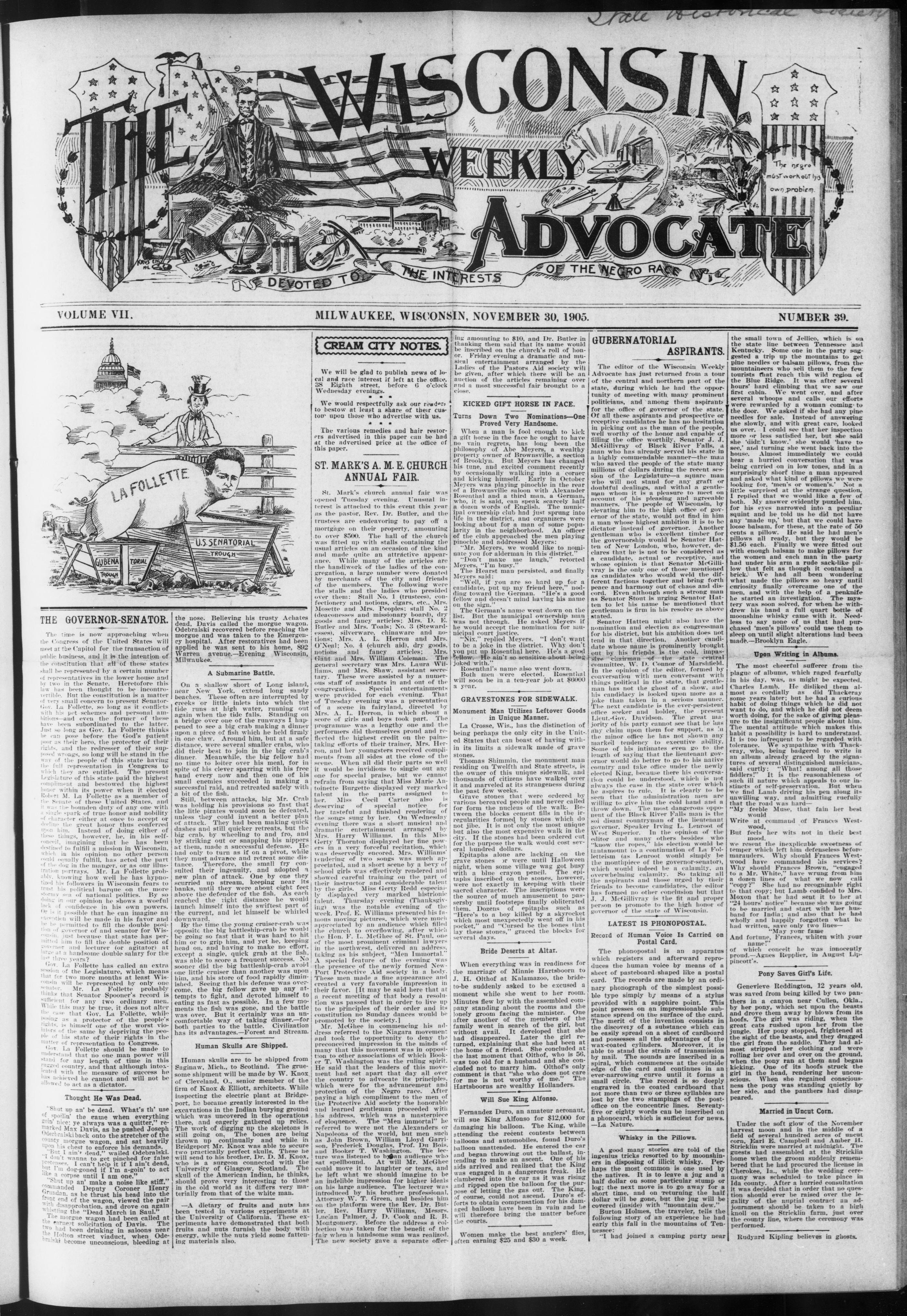
The time is now approaching when the Congress of the United States will meet at the Capitol for the transaction of public business, and it is the intention of the constitution that all of these states shall be represented by a certain number of representatives in the lower house and by two in the Senate. Heretofore this law has been thought to be incontrovertible. But the constitution is a matter of very small concern to present Senator-Gov. La Follette, so long as it conflicts with his pet schemes and personal ambitions—and even the former of these have been subordinated to the latter. Just so long as Gov. La Follette thinks he can pose before the God's patient poor as their hero, the protector of their rights, and the redresser of their supposed wrongs, so long will he stand in the way of the people of this state having the full representation in Congress to which they are entitled. The present Legislature of this state paid the highest compliment and bestowed the highest honor within its power when it elected Robert M. La Follette as a member of the Senate of these United States, and it was the bounden duty of any one with a single spark of true honor and nobility of character either at once to accept or decline the great honor thus conferred upon him. Instead of doing either of these things, however, he, in his self-conceit, imagining that he has been destined to fulfill a mission in Wisconsin, which in his opinion no other person could equally fulfill, has acted the part of the dog in the manger, or as our illustration portrays. Mr. La Follette probably, knowing how well he has hypnotized his followers in Wisconsin fears to trust his political barque on the more stormy sea of national politics. By so doing in our opinion he shows a woeful lack of confidence in his own powers. Or is it possible that he can imagine an execution will be made in his favor and he be permitted to fill the double position of governor of and senator for Wisconsin, just because that state has permitted him to fill the double position of governor and lecturer (or agitator) at large at a handsome double salary for the last three years?
Gov. La Follette has called an extra session of the Legislature, which means that for two more months at least Wisconsin will be represented by only one senator. Mr. La Follette probably thinks that Senator Spooner's record is sufficient for any two ordinary men. While this may be true, it does not alter the case that Gov. La Follette, while posing as a protector of the people's rights, is himself one of the worst violators of the same by depriving the people of his state of their rights in the matter of representation to Congress. Gov. La Follette should be made to understand that no one man power will stand for any length of time in this rugged country, and that although intoxicated with the measure of success he has achieved he cannot and will not be allowed to act as a dictator.
Thought He Was Dead.
"Shut up an' be dead. What's th' use of spoillin' the game when everything goin' nice; ye always was a quitter," remarked Max Davis, as he pushed Joseph Oderbralski back onto the stretcher of the county morgue wagon, and sat heavily upon his chest to enforce his demands.
"But I ain't dead," wailed Odebralski. "I don't wanna to get pinched for false pretenses. I can't help it if I ain't dead, but I'm dog-goned if I'm a-goin' to act like a corpse until I am one."
"Shut up an' make a noise like stiff," commanded Deputy Coroner Henry Grundan, as he thrust his head into the front end of the wagon, viewed the pair with disapprobation, and drove on again whistling the "Dead Mouth in Saul."
The morgue wagon had been called at the earnest solicitation of Davis. The two had been drinking in saloons near the Holton street viaduct, when Odebralski become unconscious, bleeding at
the nose. Believing his trusty Achates dead, Davis called the morgue wagon. Odebralski recovered before reaching the morgue and was taken to the Emergency hospital. After restoratives had been applied he was sent to his home, 892 Warren avenue.—Evening Wisconsin, Milwaukee.
A Submarine Battle
On a shallow short of Long island, near New York, extend long sandy beaches. These often are interrupted by creeks or little inlets into which the tide runs at high water, running out again when the tide falls. Standing on a bridge over one of the runways I happened to see a big crab making a dinner upon a piece of fish which he held firmly in one claw. Around him, but at a safe distance, were several smaller crabs, who did their best to join in the big crab's dinner. Meanwhile, the big fellow had no time to loiter over his meal, for in spite of his clever sparring with his free hand every now and then one of his small enemies succeeded in making a successful raid, and retreated safely with a bit of the fish.
Still, between attacks, big Mr. Crab was holding his provisions so fast that the little pirates would soon be defeated, unless they could invent a better plan of attack. They had been making quick dashes and still quicker retreats, but the big crab, by wheeling to and fro, and by striking out or snapping his nippers at them, made a successful defense. He had only to turn as if on a pivot, while they must advance and retreat some distance. Therefore, the small fry consulted their ingenuity, and adopted a new plan of attack. One by one they scurried up stream, keeping near its banks, until they were about eight feet above the defender of the fish. As each reached the right distance he would launch himself into the swiftest part of the current, and let himself be whirled downward.
By the time the young cruiser-crab was opposite the big battleship-crab he would be going so fast that it was hard to hit him or to grip him, and yet he, keeping head on, and having to make no effort, except a single, quick grab at the fish, was able to score a frequent success. No sooner did the big battleship-crab avoid one little cruiser than another was upon him, and his store of food rapidly diminished. Seeing that his defense was overcome, the big fellow gave up any attempts to fight, and devoted himself to eating as fast as possible. In a few moments the fish was gone, and the battle was over. But it certainly was an uncomfortable way of taking dinner.—for both parties to the battle. Civilization has its advantages.—Forest and Stream.
Human Skulls Are Shipped.
Human skulls are to be shipped from Saginaw, Mich., to Scotland. The gruesome shipment will be made by W. Knox of Cleveland, O., senior member of the firm of Knox & Elliott, architects. While inspecting the electric plant at Bridgeport, he became greatly interested in the excavations in the Indian burying ground which was uncovered in the operations there, and eagerly gathered up relics. The work of digging up the skeletons is still going on. The bones are being thrown up continually and while in Bridgeport Mr. Knox was able to secure two practically perfect skulls. These he will send to his brother, Dr. D. M. Knox, who is a surgeon connected with the University of Glasgow, Scotland. The skull of the American Indian, he thinks, should prove very interesting to those in the old world as it differs very materially from that of the white man.
-A dietary of fruits and nuts has been tested in various experiments at the University of California. These experiments have demonstrated that both fruits and nuts furnish the body with energy, while the nuts yield some fattening materials also.
CREAM CITY NOTES.
We will be glad to publish news of local and race interest if left at the office. 38 Eighth street, before 6 o'clock Wednesday evenings.
We would respectfully ask our readers to bestow at least a share of their custom upon those who advertise with us.
The various remedies and hair restorers advertised in this paper can be had at the advertised price at the office of this paper.
ST. MARK'S A. M. E. CHURCH ANNUAL FAIR.
St. Mark's church annual fair was opened Tuesday evening. Unusual interest is attached to this event this year as the pastor, Rev. Dr. Butler, and the trustees are endeavoring to pay off a mortgage on their property, amounting to over $500. The hall of the church was fitted up with stalls containing the usual articles on an occasion of the kind and made quite an attractive appearance. While many of the articles are the handiwork of the ladies of the congregation, a large number were donated by merchants of the city and friends of the members. The following were the stalls and the ladies who presided over them: Stall No. 1 (trustees), confectionery and notions, cigars, etc., Mrs. Mosette and Mrs. Peoples; stall No. 2 (deaconesses and missionary board), dry goods and fancy articles; Mrs. D. E. Butler and Mrs. Toals; No. 3 (Stewardesses), silverware, chinaware and notions; Mrs. A. L. Herron and Mrs. O'Neal; No. 4 (church aid), dry goods, notions and fancy articles; Mrs. Gant and Mrs. William Coleman. The general secretary was Mrs. Laura Williams, and Mrs. Shaw, assistant secretary. These were assisted by a numerous staff of assistants in and out of the congregation. Special entertainments were provided for each evening. That of Tuesday evening was a presentation of a scene in fairyland, directed by Mrs. A. L. Herron, in which about a score of girls and boys took part. The programme was a lengthy one and the performers did themselves proud and reflected the highest credit on the painstaking efforts of their trainer, Mrs. Herron, and her youngsters received compliments from all sides at the close of the scene. When all did their parts so well it would be invidious to single out any one for special praise, but we cannot refrain from saying that Miss Marie Antoinette Burgette displayed very marked talent in the parts assigned to her. Miss Cecil Carter also is deserving of special notice for her tasteful and finished rendering of the songs sung by her. On Wednesday evening there was a short musical and dramatic entertainment arranged by Mrs. Harry Williams. In this Miss Gerty Thornton displayed her fine powers in a very forceful recitation, which was deservedly enceded. Mrs. Williams' rendering of two songs was much appreciated, and a short scene by a bevy of school girls was effectively rendered and showed careful training on the part of their instructor and considerable talent by the girls. Miss Gerty Redd especially displayed very marked histrionic talent. Thursday evening (Thanksgiving) was the notable evening of the week. Prof. E. Williams presented his famous moving pictures, which were much appreciated by an audience which filled the church to overflowing, after which the Hon. F. L. McGhee of St. Paul, one of the most prominent criminal lawyers in the northwest, delivered an address, taking as his subject, "Men Immortal." A special feature of the evening was the presence of the newly formed New-Port Protective Aid society in a body. These men made a fine appearance and created a very favorable impression in their favor. [It may be said here that at a recent meeting of that body a resolution was passed that in order to live up to the principles of their order and its constitution no Sunday dances would be promoted by the society.]
Mr. McGhee in commencing his address referred to the Niagara movement and took the opportunity to deny the preconceived impression in the minds of many that this movement was in opposition to other associations of which Booker T. Washington was the ruling spirit. He said that the leaders of this movement had set apart that day all over the country to advocate its principles, which were for the advancement and protection of the Negro race. After paying a high compliment to the men of the Protective Aid society the honorable and learned gentleman proceeded with his address, which was a masterpiece of eloquence. The "Men immortal" he referred to were not the Alexanders on Napoleons of the world, but men such as John Brown, William Lloyd Garrison, Frederick Douglas, Prof. Du Bois, and Booker T. Washington. The lecture was listened to by an audience who sat spellbound. At will Mr. McGhee could move it to laughter or tears, and he left what we should imagine to be an indelible impression for higher ideals on his large audience. The lecturer was introduced by his brother professional, Attorney W. T. Green, and besides him on the platform were the Rev. Dr. Butler. Rev. Harry Williams, Messrs Lucian Palmer, J. D. Cook and R. B Montgomery. Before the address a collection was taken for the benefit of the fair when a handsome sum was realized. The new society gave a separate offer
ing amounting to $10, and Dr. Butler in thanking them said that its name would be inscribed on the church's roll of honor. Friday evening a dramatic and musical entertainment arranged by the Ladies of the Pastors Aid society will be given, after which there will be an auction of the articles remaining over and a most successful fair brought to a close.
KICKED GIFT HORSE IN FACE.
Turns Down Two Nominations-One Proved Very Handsome.
When a man is fool enough to kick a gift horse in the face he ought to have no vain regrets, has long been the philosophy of Abe Meyers, a wealthy property owner of Brownsville, a section of Brooklyn. But Meyers has changed his tune, and excited comment recently by occasionally walking into a corner and kicking himself. Early in October Meyers was playing pinochle in the rear of a Brownsville saloon with Alexander Rosenthal and a third man, a German, who, it is said, can speak scarcely half a dozen words of English. The municipal ownership club had just sprung into life in the district, and organizers were looking about for a man of some popularity in the neighborhood. An officer of the club approached the men playing pinochle and addressed Meyers:
"Mr. Meyers, we would like to nominate you for alderman in this district." "Don't make me laugh," retorted Meyers, "I'm busy." The Hearst man persisted, and finally Meyers said:
"Well, if you are so hard up for a candidate, put up my friend here," nodding toward the German. "He's a good fellow and doesn't mind having his name on the sign."
The German's name went down on the list. But the municipal ownership man was not through. He asked Meyers if he would accept the nomination for municipal court justice.
"Nix," replied Meyers. "I don't want to be a joke in the district. Why don't you put up Rosenthal here. He's a good fellow. He ain't so sensitive about being joked with."
Rosenthal's name also went down.
Both men were elected. Rosenthal will soon be in a ten-year job at $6000 a year.
GRAVESTONES FOR SIDEWALK.
Monument Man Utilizes Leftover Goods in Unique Manner.
La Crosse, Wis., has the distinction of being perhaps the only city in the United States that can boast of having within its limits a sidewalk made of grave stones. Thomas Shimmin, the monument man residing on Twelfth and State streets, is the owner of this unique sidewalk, and thousands of citizens have walked over it and marveled at its strangeness during the past few weeks. Grave stones that were ordered by various bereaved people and never called for form the nucleus of the walk. Between the blocks cement fills in the irregularities formed by stones which do not jibe. It is not only the most unique but also the most expensive walk in the city. If the stones had been ordered cut for the purpose the walk would cost several hundred dollars.
Epitaphs alone are lacking on the grave stones or were until Halloween night, when some village wag got busy with a blue crayon pencil. The epitaphs inscribed on the stones, however, were not exactly in keeping with their sacred character. The inscriptions were the source of much amusement to passersby until footsteps finally obliterated them. Dozens of epitaphs such as "Here's to a boy killed by a skyrocket which most unexpectedly went off in his pocket," and "Cursed be the bones that lay these stones," graced the blocks for several days.
Bride Deserts at Altar.
When everything was in readiness for the marriage of Minnie Hartsboorn to J. H. Olthof at Kalamazoo, the bride-to-be suddenly asked to be excused a moment while she went to her room. Minutes flew by with the assembled company standing about the rooms and the lonely groom facing the minister. One after another of the members of the family went in search of the girl, but without avail. It developed that she had disappeared. Later the girl returned, explaining that she had been at the home of a friend. She concluded at the last moment that Olthof, who is 56, was too old for a husband and she concluded not to marry him. Olthof's only comment is that "she who does not care for me is not worthy of me." The Hartsboorns are wealthy Hollanders.
Will Sue King Alfonso.
Fernandez Duro, an amateur aeronaut, will sue King Alfonso for $12,000 for damaging his balloon. The King, while attending the recent contests between balloons and automobiles, found Duro's balloon unattended. He entered the car and began throwing out the ballast, intending to make an ascent. One of his aids arrived and realized that the King was engaged in a dangerous freak. He clambered into the car as it was rising and ripped open the balloon for the purpose of letting the gas out. The King, of course, could not ascend. Duro's efforts to obtain compensation for his damaged balloon have been in vain and he will therefore bring the matter before the courts.
Women make the best anglers' flies often earning $25 and $30 a week.
GUBERNATORIAL ASPIRANTS.
The editor of the Wisconsin Weekly Advocate has just returned from a tour of the central and northern part of the state, during which he had the opportunity of meeting with many prominent politicians, and among them aspirants for the office of governor of the state. Of all these aspirants and prospective or receptive candidates he has no hesitation in picking out as the man of the people, well worthy of the honor and capable of filling the office worthily, Senator J. J. McGillivray of Black River Falls, a man who has already served his state in a highly commendable manner—the man who saved the people of the state many millions of dollars during the recent session of the Legislature—a square man who will not stand for any graft or doubtful dealings, and withal a gentleman whom it is a pleasure to meet on account of his pleasing and agreeable manners. The people of Wisconsin, by elevating him to the high office of governor of the state, would not find in him a man whose highest ambition it is to be dictator instead of governor. Another gentleman who is excellent timber for the governorship would be Senator Hatten of New London, who, however, declares that he is not to be considered as a candidate, actual or receptive, and whose opinion is that Senator McGillivray is the only one of those mentioned as candidates who would weld the different factions together and bring forth peace and harmony out of chaos and discord. Even although such a strong man as Senator Stout is urging Senator Hatten to let his name be mentioned that gentleman is firm in his resolve as above stated.
Senator Hatten might also have the nomination and election as congressman for his district, but his ambition does not tend in that direction. Another candidate whose name is prominently brought out by his friends is the cold, impassive chairman of the state central committee, W. D. Connor of Marshfield. In the opinion of the editor, formed by conversation with men conversant with things political in the state, that gentleman has not the ghost of a show, and his candidacy is looked upon more as a joke than taken in a serious manner. The next candidate is the ever-persistent office seeker and holder, the present Lieut.-Gov. Davidson. The great majority of his party cannot see that he has any claim upon them for support, as in the minor office he has not shown any marked tendency to executive ability. Some of his intimates even go to the length of saying that the lieutenant governor would do better to go to his native country and take office under the newly elected King, because there his conversation could be understood, which is not always the case in the state over which he aspires to rule. It is clearly to be seen that the administration men are willing to give him the cold hand and a throw down. The most dangerous opponent of the Black River Falls man is the soi disant countryman of the lieutenant governor, Speaker Irving L. Lenroot of West Superior. In the opinion of the editor and many others besides who "know the ropes," his election would be tantamount to a continuation of La Folletteism (as Lenroot would simply be the mouthpiece of the governor-senator), which would indeed be a calamity, an overwhelming calamity. So taking all the aspirants and those urged by their friends to become candidates, the editor has formed no other conclusion but that J. J. McGillivray is the fit and proper person to promote to the high honor of governor of the state of Wisconsin.
LATEST IS PHONOPOSTAL.
Record of Human Voice Is Carried on Postal Card.
The phonopostal is an apparatus which registers and afterward reproduces the human voice by means of a sheet of pasteboard shaped like a postal card. The records are made by an ordinary phonograph of the simplest possible type simply by means of a stylus provided with a sapphire point. This point presses on an impressionable substance spread on the surface of the card. The merit of the invention consists in the discovery of a substance which can be easily spread on a sheet of cardboard and possesses all the advantages of the wax-coated cylinders. Moreover, it is able to stand the strain of transmission by mail. The sounds are inscribed in a spiral, which commences at the outside edge of the card and continues in an ever-narrowing curve until it forms a small circle. The record is so deeply engraved in the coated cardboard that not more than two or three syllables are lost by the two stampings of the postoffice on the concentric lines. Seventy-five or eighty words can be inscribed on a phonocard, which is sufficient for news.—La Nature.
Whisky in the Pillows.
A good many stories are told of the ingenius tricks resorted to by moonshiners in disposing of illicit whisky. Perhaps the most common is one used by the natives. It is to leave a jug and a half dollar on some particular stump or log; the next move is to go away for a short time, and on returning the half dollar will be gone, but the jug will be covered (inside) with "mountain dew." Burton Holmes, the traveler, tells the following story of an experience he had early this fall in the mountains of Tennessee: "I had joined a camping party near
NUMBER 39.
the small town of Jellico, which is on the state line between Tennessee and Kentucky. Some one in the party suggested a trip up the mountains to get pine needles or balsam pillows, from the mountaineers who sell them to the few tourists that reach this wild region of the Blue Ridge. It was after several hours' hard climbing that we saw our first cabin. We went over, and after several whoops and calls our efforts were rewarded by a woman coming to the door. We asked if she had any pine needles for sale. Instead of answering she slowly, and with great care, looked us over. I could see that her inspection more or less satisfied her, but she said she 'didn't know.' she would 'have to see,' and turning she went back into the house. Almost immediately we could hear a hurried conversation that was being carried on in low tones, and in a surprisingly short time a man appeared and asked what kind of pillows we were looking for, 'men's or women's.' Not a little surprised at the strange question. I replied that we would like a few of both. My answer evidently puzzled him, for his eyes narrowed into a peculiar squint and he told us he did not have any 'made up,' but that we could have loose balsam, for these, at the rate of 50 cents a pillow. He said he had men's pillows all ready, but they would be $1.56 each. Finally we were fitted out with enough balsam to make pillows for the women and each man in the party had under his arm a rude sack-like pillow that felt as though it contained a brick. We had all been wondering what made the pillows so heavy until curiosity finally overcame one of the men, and with the help of a penknife he started an investigation. The mystery was soon solved, for when he withdrew his hand a full quart bottle of moonshine whisky came with it. Needless to say none of us that had purchased 'men's pillows' could use them to sleep on until slight alterations had been made.—Brooklyn Eagle.
Upon Writing in Albums.
The most cheerful sufferer from the plague of albums, which raged fearfully in his day, was, as might be expected. Charles Lamb. He disliked them almost as cordially as did Thackeray some years later; but he had a curious habit of doing things which he did not want to do, and which he did not deem worth doing, for the sake of giving pleasure to the insignificant people about him. The mental attitude which makes this habit a possibility is hard to understand. It is too infrequent to be regarded with tolerance. We sympathize with Thackeray, who, being badgered to write in an album already graced by the signatures of several distinguished musicians, said curly: "What! among all those fiddlers!" It is the reasonableness of such ill nature which appeals to our instincts of self-preservation. But when we find Lamb driving his pen along its unwilling way, and admitting ruefully that the road was hard—
"My feeble Muse, that fain her best would Write at command of Frances West
Write at command of Frances Westwood,
But feels her wits not in their best mood,
we resent the inexplicable sweetness of temper which left him defenseless before marauders. Why should Frances Westwood have commanded his services?
Why should Frances Brown, "engaged to a Mr. White," have wrung from him a dozen lines of what we now call "copy?" She had no recognizable right to that copy; but Lamb confided to Mrs. Moxon that he had sent it to her at "24 hours' notice" because she was going to be married and start with her husband for India; and also that he had wholly and happily forgotten what he had written, save only two lines— "May your fame
And fortune, Frances, whiten with your name."
of which conceit he was innocently proud.—Agnes Repplier, in August Lippincott's.
Pony Saves Girl's Life.
Genevieve Reddington, 12 years old, was saved from being killed by two panthers in a canyon near Cullen, Okla., by her pony, which set upon the beasts and drove them away by blows from its hoofs. The girl was riding, when the great cats rushed upon her from the jungle. Her pony stopped, frightened at the sight of the beasts, and they dragged the girl from the saddle. They had almost stripped her clothing and were rolling her over and over on the ground, when the pony ran at them and began kicking. One of its hoofs struck the girl in the head, rendering her unconscious. When she regained consciousness the pony was standing quietly by her side, and the panthers had disappeared.
Married in Uncut Corn.
Under the soft glow of the November harvest moon and in the middle of a field of several hundred acres of uncut corn, Earl E. Campbell and Amber H. Stricklin were married at midnight. The guests had assembled at the Stricklin home when the groom suddenly remembered that he had procured the license in Cherokee, Ia., while the wedding ceremony was scheduled to take place in Ida county. After a hurried consultation it was decided that in order that no question should ever be raised over the legality of the nuptial contract an adjournment should be taken to a high knoll on the Stricklin farm, just over the county line, where the ceremony was performed.
Rudyard Kipling believes in ghosts.
& Miscellanesus Items. «
fortune possessed private cars. Now-
‘adays there are so many of these palace
on wheels that their value is estimated
at $72,000,000. wee ss
—By pasting a bit paper upon the
egehd = peace pit record has been
made of the duration of time required in
winking the eve. It has been found that
a wink requires one-third of a second.
—Consu! Atwell of Roubaix reports a
new typewriter for the blind which is an
improvement on the Braille alphabet sys-
tem, It was invented by a Mr. Vaughn.
Vwo alphabets instead of one are used.
—It has just been estimated that 10,
000,000 sterling is being spent each year
on golf. There are 879 golf clubs in
England, 760 in America, 682 in Scot-
land and 134 in Ireland, numbering alto-
gether 600,000 players.
—A London firm has constencted on
the roof of its warehouses a rifle range,
so that its employes may have practice
without going far or being put to travel-
ing expenses. Lord Roberts will open
the range. =
—A chauffeur recently fined at Ken-
sington, England, said be iad agreed
with his employer that he (the chanf-
feur) should pay all fines. The practice,
he added, was almost universal in motor-
ing circles, 5:
—Having inquired of the leading om-
nibus railway san parcel Se ormpe
nies as to the best material for road
paving, the council of Lambeth, Lon-
don, finds that the majority are in favor
of wood blocks.
—The growth of trade unionism in
France has been very rapid. The title
under which the unions are known in
France is “Syndieats Professionels.”
They were first authorized by law in
1884, a little over twenty years ago.
—About thirty pioneers of Utah, sur-
vivors of a party which in 1851 made the
journey over the trail from Salt Lake to
Los Angeles, have departed from Salt
Lake to Los Angeles over the Salt Lake
railroad, as guests of Senator William
A. Clark. The party, in speejal Pull-
mins, are going over practically the
same route that they traveled by wagon
and on foot in 1851.
-—At Eglingham, Northumberland, a
quaint wedding custom, which has been
in existence for hundreds of years, still
prevails. At 2 recent wedding in the
parish church after the ceremony the
newly married couple found that a bench
had been drawn across the doorway.
Over this bench the bride and bride-
groom were compelled to jump befere
they could leave the sacred building.
—President Pritchett of the Massachu-
setts Institute of Technology, in an arti-
cle in a recent number of the Atlantic
Monthly, says that the most remarkable
educational fact of the last fifteen years
in this country has been the mzryelons
growth of the state university. Of the
twenty largest institutions in this coun-
try twelve are state universities; of the
first nve three are state universities.
—The Hamburg-American Steamship
company is to call the five decks above
the hold of its new steamer Amerika by
the names of famous statesmen. Amer-
ican names were to have been used, but
after Roosevelt, Washington, Cleveland
and Franklin the names of sufficient
prominence gave out, or the nomen-
elator’s memory failed him, amd with
much regret he was obliged to add
“Kaiser.”
—George Howlett of Beacon’s Bottom,
England, has published in a local news-
paper the following handsome _ testi-
monial: “I beg to say that William
Stevens of Town End, Radnage, meas-
ured me for a suit of clothes which was
made by his son Vernon, then a lad. I
have worn the same on Sundays and at
other times for forty-seven years, and
they are good now, and not a stitch has
given way.”
—The latest adjunct to glass novelties
is the glass umbrella, which is covered
with “silk” spun from glass. These um-
brellas, of course, will afford no protec-
tion from the rays of the sun; but they
possess one obvious advantage—namely,
that they can be held in front of the
face when meeting the wind and rain,
and at the same time the user will be
able to see that he does not run into
unoffending individuals or lamp posts.
—Haparanda, a little town in Sweden,
has suddenly sprung into renown through
a“ rare act of thoughtfulness on the part
of its womankind. Having learned hams
medical statistics that in winter colds,
neuralgia, toothache and influenza are
much more prevalent among men than
women, the ladies of the place decided
to relieve the men of the necessity of
doffing their hats to them during the
cold weather. It was announced that
during the winter the women would re-
quire only a military salute.
—The authorities in Norway have dis-
covered a novel way of curing drunken-
ness. The “patient” is placed under lock
and key, and his nourishment consists in
great part of bread soaked in port wine.
The first day the drunkard eats his food
with pleasure, and even on the second
day he enjoys it. On the third day he
finds that it is very monotonous, on the
fourth day he becomes impatient, and at
the end of eight days he receives the
Wine with horror. It seems that the dis-
gust increases, and that this cure gives
good results,
—Instructions are given by the British
admiralty office regarding the manner in
which oil should be poured on “trou-
bled waters.” It is recommended that
the oil be dropped overboard in_ small
perforated canvas bags capable of hold-
ing from one to two gallons; each bag
depending from a line whose position
differs according to the nature of the sea
and direction of the wind. Running be-
fore the wind one hangs out the oil bags
from either bow; crossing a bar with a
flood tide the oil is sent on ahead. For
boarding a wreck oil is thrown to wind-
ward of her. Waste from the engines
seems tu be the best oil, though all ani-
mal and vegetable oils will serve.
—Some of the Indian women have a
very pathetic custom. When an Indian
girl dies her mother often substitutes a
doll for the lost little one. She fills the
empty cradle with feathers arranged in
the form of a_ehild, and carries this
about as she did her child. crooning to
it_and carressing it. Sometimes, instead
of doing this, she ties the clothes, toys.
and other articles belonging to the little
one, and, fastening them to the cradle
beard, carries it as she originally did her
AUTUMN SILENCE.
No = is heard: green Newlin’s ficlds are
still:
No more we hear the wood-dove's pensive
ery:
Without a twitter now the swallows fis.
Silent the dreamy woods above the mill;
Silent the drowsy air of Embreeville;
Silent the sights that meet the musing ere,
One lonely buzzard climbing the clear sky
And great ‘“loud-shadows moving up the
No sound is heard: the sleepy Brandywine
Scarce whispers as it laps Fis lazy reeds
Or drifts where yon late-lingering daisies
shine.
The air is spiced with smoke of burning
weeds,
And <= the fields where feed the peaceful
kine
Slow sail the thistle’s filmy silver seeds.
—Jobn Russell Hayes in Lippincott’s Maga-
zine.
—_—_**
THE LOST WORDS OF LOVE,
| L
| Once upon a time a very cruel fairy.
pretty a3 the flowers, but wicked as the
serpents who hide in the grass ready to
spring upon you, resolved to avenge her-
self upon all the people of a great coun-
try. Where was this country situated?
In the mountain or in the plain, at the
shore of a river or by the sea? This the
story does not tell. Perhaps it was near
the kingdom where the dressmakers were
very skillful in adorning the robes of the
princesses with moons and with stars.
And what was the offense from which
the fairy haé suffered? With regard to
this also the story is silent. Perhaps
they hed omitted to offer up prayers to
her at the baptism of the king’s daugh-
ter. However this might be, it is cer-
tain enough that the fairy was in a great
rage.
She asked herself at first whether she
should devastate the country by sending
out the thousands of spirits that served
her to set fire to all the palaces and all
the éottagers, or whether she should cause
all the lilacs and all the roses to fade,
or whether she should turn all the young
girls into ugly old women. She could
have let loose all the four winds upon
the streets and laid low the houses and
trees. At her command _ fire-spitting
mountains would have buried the entire
land with burning lava and the sun
would have turned from its path so as
not to shine upon the accursed city, But
she did still worse. Like a thief who
leisurely chooses the most precious jew-
els in a case, she removed from the mem-
ory of men and women the three divine
words:
“I love you!” |
And having brought this affliction, she
removed herself with a light smile on her
lips that would have been more hideous
than the church of the devil if she had
not had the most beautiful rosy lips in
all creation.
i.
At first the men and women only half
perceived the wrong that was done them.
it seemed to them that they lacked
something. but they did not know what.
The sweethearts that met in the evening
in the eglantine lanes, the married couples
who talked confidingly to each other be-
hind closed windows and drawn curtains,
suddenly interrupted themselves and
looked at each other or embraced; they
felt, indeed, that they wanted to pro-
nounce a certain customary phrase, but
they did not even have an idea of what
that phrase was. They were astonished,
uncasy, for they did not ask each other
any questions, for they did not know
what question to ask, so complete was
their forgetfulness of the precious word.
But they did not suffer very much as yet,
for they had the consolation of possess-
ing so many other words that they could
whisper to each other, and of so many
caresses,
Alas! It was not long before they
were seized with a profound melancholy.
It was in vain that they adored each
other, that they called each other by the
tenderest names, and talkel the sweet-
est language. It was not enough to de-
clare that all the bliss lay in their kisses; |
to swear that they were ready tovdie, he |
for her and she for him; to call each
other: “My soul! my flame! my dream!”
They instinctively felt the need of saying
and hearing another word, more exquisite
than all other words, and with the bitter
memory of the ecstacy that was con-
tained in this word came the anguisl of
never being able to utter or to hear it
any more.
Quarrels followed in the wake of this
distress. Judging ais happiness incom-
plete on account of the avowal that was
henceforth denied to the most ardent lips,
the lover demanded from her and she
from him just the thing which neither
the one nor the other could give, without
either knowing what or being able to
name it. They accused each other of
coldness, of perfidy, not believing in the
tenderness which was not expressed as
they desired.
Thus the sweethearts soon ceased to
have their rendezvous in the lanes where
the eglantines grew, and even after the
windows were closed the conjugal cham-
bers heard only dry conversations in easy
chairs that were never brought near each
other. Can there be joy without love’
If the country which had ineurred the
hatred of the fairy had been ruined by
war, or devastated by pestilence, it could
|not have been as desolate, as mournful.
as forlorn, as it had become on account
|of the three forgotten words.
Hi.
There lived in this country a poet
| whose plight was even more pitiful than
that of the rest. It was not because,
(having a beautiful sweetheart, he was
jin despair for not being able te say and
‘|}to hear the stolen word. He had no
|| sweetheart, for he was too much in jove
with ‘he muse. But it was because he
|| Was unable to finish a poem which he had
| begun the day before the wicked fairy
‘|}had accomplished her vengeance. And
| why? Beeause it just happened that the
| poem was to wind up with “I love you!”
|and it was impossible to end it in any
other way.
| The poet struck his brow, took his head
between his hands, and asked himself:
'|“Have I gone ;mad?” He was certain,
however, that he had found the words
that were to precede the last point of ex-
ciamation before he had commenced to
write the stanza. The proof that he had
found these words was that the rhyme
with which they were to go, and which
of interrupted poems!—sitting at
Teacalne of the forest near the limpid
fountains where the fairies have the
habit of dancing of an evening in the light
of the stars.
IV. 3
| Now as he sat ones musing under the
boughs of a tree, the wicked, thieving
fairy saw him and loved him, One is
not a fairy for nothing, and a fairy does
not stand on ceremony. Swifter than a
Lutterfly kisses a rose she put her lips
‘upon his gp and the poet, greatly occu-
pied though he was with his ode, could
not help but feel the heavenliness of her
earess. Blue and rose diamond grottces
opened up in the depths of the earth,
gardens of lilies spread out there, lum-
inous as the stars; thither the poet and
ahs fairy were drawn in a chariot of
gold in their flight; and for a very long
time they loved each other, forgetful of
all but their kisses and suiles. Gnomes
dressed in violet satin, elves attired in a
misty haze, performed dances before
them that fell in rhythm with the music
of unseen orchestras, while flitting hands
‘that had no arms brought thea ruby
baskets of snow-white fruit, pecfumel
like a white rose and like a virgin bosom.
Or, to please the fairy more, the poet re-
cited, while striking the cords of a
theorbo, the most beautiful verses his
faney could conceive a:
| Fairy that she was, she had never
Snes joy comparable to this of being
sung by a beautiful younz man who in-
yented new songs every day, and when
he grew silent and she felt the breatn
of his mouth very near her, pa-sing
through her hair, she melted away with
tenderness.
‘Their happiness seemed to be without
end, Days passed by, many, many days,
but nothing occurred to disturb their joy.
‘Nevertheless she had moments of gloom,
when she would sit musing. with her
cheek on her hand and her hair falling
down in streams to her hips.
~O queen!” he cried, “what is it that
makes you sad, and what more can you
desire, seeing that we are so happy in
‘the midst of all our pleasures, you who
zre all-powerful, you who are so beauti-
ful?” She did not answer at first, but
when he insisted she sighed and said:
“Alas! Iam sad because you have never
told me: ‘L love you!”
He did not pronounce the words. but
he uttered a ery of joy at having found
again the end of his poem. In vain the
fairy attempted to retain him in the blue
and rose-diamond grottoes, in the gardens
of lilies that were as luminous as the
stars. He returned to earth, completed,
wrote and published his ode, in which
the men and women of the afflicted coun-
try found again the divine words that
they had lost.
Now there were rendezvouses again in
the lanes, and warm, amorous conversa-
tions at the conjugal windows.
It is because of poetry that the kisses
are sweet, and lovers say nothing that
the poets have not syng.—Catulle Men-
des in Current Literature. ‘5
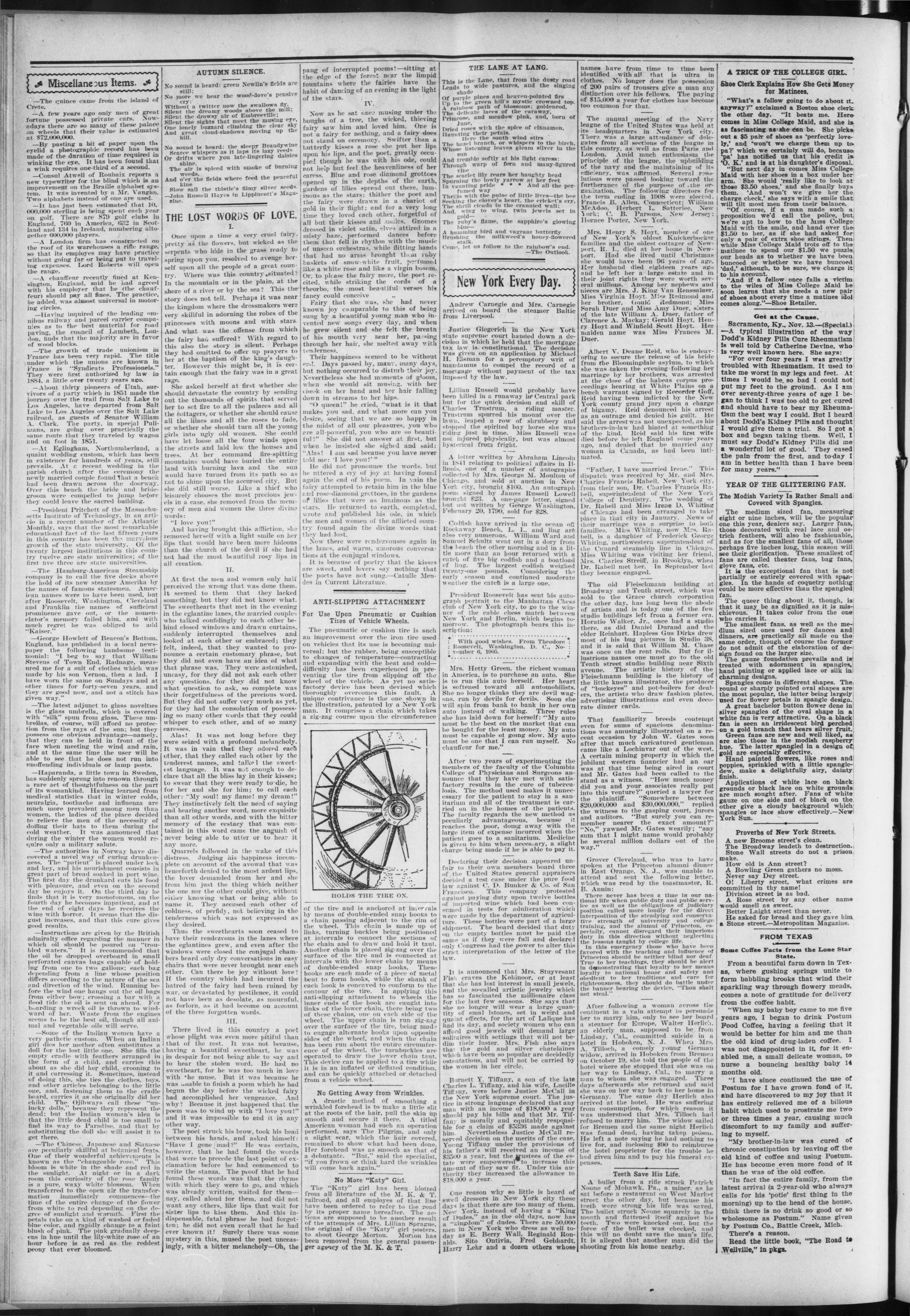
ANTI-SLIPPING ATTACHMENT
For Use Upon Pneumatic or Cushion
Tires of Vehicle Wheels.
The pneumatic or cushion tire is such
an improvement over the iron tire used
on vehicies that its use is becoming uni-
versal; but the rubber, being susceptible
to changes of temperature—contracting
and expanding with the heat and cold—
difficulty has been experienced in pre-
venting the tire from slipping off the
wheel of the vehicle. As yet no satis-
factory device has been devised which
thoroughly overcomes this fault. A
unique contrivance is the one_shown in
the illustration, patented by a New York
man. It comprises a chain which takes
a zig-zag course upon the circumference
Th
<a
x :
Se WO
AS \
BS
of the tire and is anchored at inierrals
by means of double-ended snap hooks to
a chain passing adjacent to the rim of
the wheel. This chain is made up of
links, turning buckles being positioned
at intervals to connect the sections of
the chain und to draw and hold it taut.
Another chain is placed zig-zag over the
surface of the tire and is connected at
intervals with the lower chain by means
of double-ended snap hooks. These
hooks are each made of a piece of metal
bent to form hooks, while the shank of
each hook is concaved to conform to the
contour of the tire. In applying this
anti-slipping attachment to wheels the
inner ends of the hook are caught into
links of the lower chain, there being two
of these chains, one on each side of the
wheel. The upper chain is run zig-zag
over the surface of the tire, being made
to engage alternate hooks upon opposite
sides of the wheel, and when the chain
has been run about the entire circumfer-
ence of the wheel, the turnbuckies are
operated to draw the lower chain taut.
‘This device can be applied to a tire while
it is in an inflated or deflated condition,
and can be quickly attached or detached
from a vehicle wheel.
Wo Getting Awav from Wrinklec
A drastic method of smoothing a
wrinkled forehead is to make a little slit
at the roots of the hair, pull the skin up
smooth and secure it there. A titled
American woman had such an operation
performed, says The Pilgrim, and only
a slight sear, which the hair covered,
remained to show what had been done.
Her forehead was as smooth as that of
a debutante. “But,” said the specialist,
“if you frown or think hard the wrinkles
will come back again.”
————$—$—
No More “Katy” Girl.
The “Katy” girl has been blotted
from all literature of the M. K. & T.
railroad, and all employes of that line
have been ordered to refer to the road
hy its proper name hereafter. The ac-
tions are supposed to be another result
of the attempts of Mrs. Lillian Sprague,
the original of the “Katy” girl posters.
to shoot George Morton. Morion has
been removed from the general passen-
ger agency of the M. K. & T,
THE LANE AT LANG.
This is the Lane, that from the dusty road
Leads to wide pastures, and the singing
shade
Of purple pines and heaven-pointed firs
Up to the green hilfs mystic crowned top.
A rainbow path of blossoms; goldenrod,
The delicate laces of the caraway,
Primrose, and meadow pink, and, born of
June,
Dried roses with the spice of cinnamon,
Haunting their petals.
Here the south wind stirs
The hazel branch, or. whispers to the birch.
Whose listening leaves gleam silver in the
sun
And tremble softly at his light caress:
neo warp of fern and many-figured
vine
‘The scarlet lily rears her haughty head
Spurning the lowly yarrow at her feet
In vaunting pride * * * And all the per-
fumed way
Thrills with the pulse of little lives—the bee
Seeking the clover's heart. the cricket's cry,
‘The shrill cicada in the crannied wall:
And, wing to wing, twin jewels set in
gold—
The Ts flame, the sapphire’s glowing
blue—
A humming bird and vagrant butterfly
Brushing | the milkweed’s honey-flowered
stalk.
Com», let us follow to the rainbow’s end.
—The Outlook.
New York Every Day.
Andrew Carnegie and Mrs. Carnegie
arrived on board the steamer Baltic
from Liverpool.
Justice Giegerich in the New York
state supreme court handed down a de-
cision in which he held that the mortgage
tax law is. constitutional. The decision
Was given on an application by Michael
H. Eisman fer a peremptory writ of
mandamus to compel the record of a
morigage without payment of the tax
imposed by the law.
Lillian Russell would probably have
been killed in a runaway i Central park
but for the quick decision and skill of
Charles Trustrum, a riding master.
Trustrum spurred his mount over the
lawn, leaped a row of shrubbery and
stopped the spirited bay horse she was
riding just in time. Miss Russell was
not injured physically, but was almost
hysterical frora fright.
A letter written by Abraham Lincoln
in 1541 relating to political affairs in I-
linois, one of a number of autographs
collected by Mrs. George M. Moulton of
Chicago, and ‘sold at auction in New
York city, brought $100. An autograph
poem signed by James Russell Lowell
broucht $23. A one-page letter, signed
but not written by George Washington,
February 20, 1790, sold for $28.
Codfish have arrived in the ocean off
Rockaway Beach, L. 1. and ling are
also very numerous. William Ward and
Samuel Schultz went out in a dory from
the beach the other morning and in a lit-
tle more than an hour returned with a
catch of five big codfish and a boatload
ef ling. The largest codfish weighed
twenty-one pounds. Considering the
early season and continued moderate
weather the cateh is a large one,
President Roosevelt has sent his auto-
graph portrait to the Manhattan Chess
club of New York city, to go to the win-
ner of the cable chess match between
New York and Berlin, wiich begins to-
morrow. The photograph bears this in-
scription:
With good wishes. From Theodore %
: Roosevelt, Washington, D. C., No- :
: vember 6, 1905. 2
Oy. dene: seas eer seeneenssaineinn sere de giclee
Mrs. Hetty Green, the richest woman
in America, is to purchase an auto. She
is to run this auto herself. Her heart
is softened toward all automobilists.
She no longer thinks they are devil wag-
‘ons, run by devils for devils. Soon she
| will spin from bank to bank in her own
auto instead of walking. Three rules
‘she has laid down for herself: “My auto
must be the best on the market that can
‘be bought for the least money. My auto
must be capable ot gomg slow. My auto
must be one that I can run myself. No
chauffeur for me.”
After two years of experimenting the
members of the faculty of the Columbia
College of Physicians and Surgeons an-
nounce that they have met with satis-
factory results in the cure of tubereu-
losis. The method used makes it unnec-
essary for the patient to stay in a san-
itarium and all of the treatment is car-
ried on in the homes of the patients.
The faculty regards the new method as
peculiarly advantageous, because _ it
reaches the poor, domg away with the
large item of expense incurred when the
patient goes to a sanitarium. Medicine
is given to him when necessary, a slight
charge being made if he is able to pay it.
Declaring their decision appeared un-
fair to their own members board three
of the United States general appraisers
decided a test case under the pure food
law against C. D. Bunker & Co. of San
Franciseo. This company _ protested
against paying duty upon twelve bottles
of imported wine which had been con-
sumed in tests for adulteration whici
were made by the department of agricul-
ture. These bottles were part of a large
shipment. The board decided that duty
on the empty bottles must he paid the
same as if they were full and declared
only Congress had the power to alter this
strict interpretation of the letter of the
law.
It is announced that Mrs. Stuyvesant
Fis) craves the Kohinoor, or at least
that she has lost interest in small jewels,
and the so-called artistic jewelry which
has so fascinated the miiltlonaive class
for the last few seasons. She says that
she no longer will wear a large quan-
tity of smal Istones, set in weird and
quaint effects, for the art of Lalique has
had its day, and society women who can
afford good jewels will demand large
solitaires with settings that will not be-
dim their luster. Mrs. Fish also says
that the gold and silver chatelaines
which have been so popular are decidedly
ostentatious, and will not be carried by
the women in her circle.
Burnett Y. Tiffany, a son of the late
Charles L. Tiffany, and his wife, Lucille
‘Tiffany, were before Justice McCall in
the New York supreme court. The jus-
tice in strong language declared that any
man with an income of $18,000 a year
should pay his bills and that Mr. Tif-
fany_ is morally and_ equitably respgnsi-
ble for a claim of $5336 made against
him. | Nevertheless Justice McCall re-
served decision on the merits of the case,
Young Tiffany under the provisions of
his father’s will received an income of
$3500 a year, but pared Soe of the es-
tate were empowered™ to increase this
amount of they saw fit. Under this au-
thority they increased the allowance to
$18,000 a year.
One reason why so little is heard of
swell dressers in New York city these
days is that there are too many of them.
New York, instead of having a “King
of Dudes.” as in the old days, now has
a “kingdom” of dudes. There are 50,000
men in New York who dress as well to-
fay as EB. Berry Wall, Reginald Ron-
alds. Sito Ontivia, Fred Gebhardt,
Harry Lehr and a dozen others whose
F $s ie eo MMS a eet Re
of 200 pairs of trousers give a man any
distinction over his fellows. The paying
of $15,000 a year for clothes has become
too common for that.
The annual meeting of the Navy
league of the United States was held at
its headquarters in New York city.
There was a large attendance of dele-
gates from all sections of the league in
this country, as well as from Paris and
London. Amid much enthusiasm the
principle of the league, the upbuilding
of the navy and the maintaining of its
efticlency, was affirmed. Several reso-
lutions were passed looking toward the
furtherance of the purpose of .the or-
ganization. The following directors for
the term ending in 1908 were elected.
Francis B. Allen, Connecticut; William
McAdoo, Herbert L. Satteriee, New
York; C. B. Parsons, New Jersey:
Horace Porter, New York.
Mrs. Henry S. Hoyt, member of one
of New York's oldest Knickerbocker
families and the oldest cottager of New-
port, R. L, died at her home in New-
port. Had she lived until Christmas
she would have been 96 years of age.
Her husband died eighteen years agu
and he left her a large estate and in
their joint rights they were worth sev-
eral millions. Among her nephews and
nieces are Mrs. J. King Van Renssalaer,
Miss Virginia Hoyt. Miss Redmond and
her brother, (Goulé edmond; Miss
Sarah Duer and Miss Amy Duer, sisters
of the late William A, Duer, father of
Clarence A. Mackay; Gerald Hoyt, Hen-
ry Hoyt and Winfield Scott Hoyt. Her
maiden name was Miss Frances M.
Duer.
Albert V. Deane Reid, who is endeay-
oring to secure the release of his bride
from the Bloomingdale asylum, to which
she was taken the evening following her
marriage by her brothers, was arrested
at the close of the habeas corpus pro-
ceedings hearing at White Plains on a
bench warrant signed by Recorder Goff,
Reid having been indicted by the New
York county grand jury upon a charge
of bigamy. Keid denounced his arrest
as an outrage and denied his guilt. He
said the arrest w2s not unexpected, as his
brothers-in-law had hinted at something
of the kind. Reid said his first wite
died before he left England some years
ago, and denied that he married any
woman in Canada, as had been inti-
mated.
“Father, I have married Ireue.” This
dispatch was received by Mr. and Mrs.
‘Charlies Francis Rabell, New York city,
from their son, Dr. Charles Francis Ra-
bell, superintendent of the New York
Colleze of Dentistry. The wedding of
‘Dr. Rabell and Miss Irene D. Whiting
of Chicago had been arranged to take
place in that city in January. News of
their marriage was 2 surprise to both
samities. Miss Whiting, now Mrs. Ra-
‘bell, is a daughter of Frederick George
Whiting, northwestern superintendent of
the Cunard steamship line in Chicago.
‘Miss Whiting was visiting her friend,
‘Mrs. Charles Streiff, in Brooklyn, when
Dr. Rabell met her. In September last
they became engaged.
The old Fleischmann building at:
Broadway and Tenth street, which was
sold to the Grace church corporation
the other day, has long been the abode
of artists and is today one of the few
studio buildings left from a former era.
Horatio Walker, Jr., once had a studio
there, as did Daniel Durand and_ the
elder Reinhart. Hapless Gus Dirks drew
most of his bug pictures in Studio 38,
and it is said that William M. Chase
‘was once on the rent rolls. But for il-
lustrious names one must go to the old
Tenth street studio building near Sixth
avenue. The artistic history of the
Fleischmann building is the history of
the little known illustrator, the producer
of “buckeyes” and pot-boilers for deal-
ers, the artists who draw fashion plates,
advertising illustrations and even deco-
rate dinner cards.
That familiarity breeds contempt
even for sums of spacious denomina-
tions was amusingly illustrated on a re-
cent oceasion by John W. Gates soon
after that much caricatured gentleman
came like a Lochinvar out of the west.
‘A certain mining property in which the’
jubilant western tnancier had an oar
was at that time being aired in court’
and Mr. Gates had been called to the
stand as a witness. “How much money
did you and your associates really put
into this venture?’ queried a lawyer for
the _ plaintiff. “Somewhere between
$20,000,000 and $30,000,000," replied
the witness to the gasping court, jurors
and auditors. “But surely you can re-
member nearer the exact amount?”
“No,” yawned Mr. Gates wearily; “any
sum that I might name would probably
be several million dollars out of the
way.”
Grover Cleveland, who was to have
spoken at the Princeton alumni dinner
in East Orange, N. J., was unable to
attend and sent the following letter,
which was read by the toastmaster, R.
B. Annin:
There never has been a time in our na-
tional life when publie duty and public sery-
ice as well as the obligations of judiciary
position called more loudly for the direct
nterposition of the steadying and conserva-
tive strength of university and college
training, and the alumni of Princeton, es-
pecially, cannot disregard their imperious
duty in this direction without neglectins
the lessons taught by college life.
In this emergency those who, have been
favored with the teaching and influence of
Princeton should be neither blind nor deat
ie to her teachings, they should be alert
in dqmonstrating that loyalty to her means
loyalty to national honor and safety and
obedient to her traditions and eare for
righteousness, they should do battle under
the banner bearing the device, “Thou shalt
eet steal.”
After following a woman ecross tie
continent in a yain attempt io persuade
her to marry him, only to see her board
a steamer for Europe, Walter Herlieh,
an elderly man, supposed to be from
Lindsay, Cal., committed suicide in a
hotel in Hoboken, N. J. Whea Mrs.
A. Tilloch, a comely young German
widow, arrived in Hoboken from Bremen
on October 19, she told the people of the
hotel where she stopped that she was on
Teeth Save His Life.
A bullet from a rifle struck Patrick
Noone of Mohawk. Pa., a miner, as he
sat before a restaurant on West Market
street the other day, but because his
teeth were strong his life was ‘saved.
The bullet struck Noone squarely in the
month and flattened itself against his
teeth. Two were knocked out. but the
force of the bullet was checked. and
this will no doubt save the man’s life.
It is alleged that another man did the
shooting from his home nearby.
A TRICK OF THE COLLEGE GIRL.
Shoe Clerk Explains How She Gets Money
for Matinees.
“What's a fellow going to do about it.
anyway?” exclaimed a Boston shoe clerk
the other day. “It beats me. Here
comes in Miss College Maid, and she is
as fascinating as:she.¢an be. She picks.
out a $5 pair of shoes as ‘perfectly love-
ly,’ and ‘won’t we charge them up to
a? which we certainly will do, because
fe’ has notified us that his credit is
. K.’ and is at his daughter's disposal.
“But next day in comes Miss College.
Maid with her shoes in a box under her
arm. She would ‘really like to look at
those $3.50 shoes,’ and she finally buys
them. ‘And won't we give her the.
charge check,’ she says with a smile that
will tilt most men from tneir balance.
“Of course, if a man made such a
proposition we'd call the police, but.
we're apt to bow to the Miss College
Maid with the smile, and hand over the
$1.50 to her, as if she had asked for
only a A ee of extra shoe strings. Then
while Miss College Maid trots off to the
matinee to spend our $1.50 we puzzle
our heads as to whether we have been
buneoed or whether we have buncoed
‘dad,’ although, to be sure, we charge it’
to his account.
“And if a fellow once falls a_ victim
to the wiles of Miss College Maid he
soon learns that she needs a new pair
of shoes about every time a matinee ido)
comes along.”—Shoe Retailer.
Get at the Cause.
Sacramento, Ky., Nov. 13.—(Special.)
—A typical illustration of the way
Dodd's Kidney Pills Cure Rheumatism
is well told by Catherine Devine, who
is very well known here. She says:
“For over four years I was greatly
troubled with Rheumatism. It used to
take me worst in my legs and feet. At
times I would be. so bad I could not
put my feet to the ground. As I am
Over seventy-three years of age I be-
gan to think I was too old to get cured
and should have to bear my Rheuma-
tism the best way I could. But I heard
about Dodd’s Kidney Pills and thought
I would give them a trial. So I gota
box and began taking them. Well, I
must say Dodd's Kidney Pills did me
a wonderful lot of good. They eased
the pain from the first, and to-day I
am in better health than I have been
for many years.”
—_.__——_
YEAR OF THE GLITTERING FAN.
The Modish Variety Is Rather Small and
Covered with Spangles.
The medium sized fan, measuring;
eight or nine inches, will be the popular
one this year, dealers say. Larger fans,
those decorated with real luce and os-
trich feathers, will also be fashionable,
and as for the smallest fans of all, those
perhaps five inches long, this season will
see their glorification. These smallest of|
fans are called theater fans, bag fans,
glove fans, etc.
_ It is the exceptional fan that is not
partery or entirely covered with aa
gles. In the hands of coquetry not ee
could be more effective than the spangled|
fan.
The queer thing about it, though, is!
that it may be as dignified as it is mis-;
chievous. It takes color from the one|
who carries it.
The smallest fans, as well as the me-|
dium sized ones used for dances and|
dinners, are ee all made on the
same order, though of course the former
do not admit of the elaboration of de-|
sign found on the larger size. '
The gauze foundation prevails and is|
treated with adornment in spangies,
hand nee or applied lace or silk in)
charming designs,
Spangles come in different shapes. The,
round or sharply pointed oval shapes are:
the most popular, the latter being largely;
used for tlower petals in spangle design.
A great bachelor button flower dene in!
silver spangles of the oval shape in a|
white fan is very attractive. On a black’
fan is seen an irridescent bird perched
on_a gold branch that bears silver fruit.
Green fans are new and well liked, as.
are also those in the modish raspberry
hue. The latter sndapen in a design of
gold are ey, effective.
Hand inted flowers, like roses and|
poppies, sprinkled with a little spangle-
oe make a delightfully airy, dainty:
nish.
Applications of white lace on black:
grounds or black lace on white grounds,
are much sought after. Fans of white
gauze on one side and of black on the.
other give a cloudy background which
spansics or lace show effectively.—New'
‘ork Sun.
Proverbs of New York Streets.
A new Broome street's clean.
The Broadway leadeth to destruction.,
Stone Wall streets do not a prison
make.
How old is Ann street? ‘
A Bowling Green gathers no moss.
Never say Dey street.
O! Liberty street, what crimes are
committed in thy name!
Division street is as bad.
A Rose street by any other name
would smell as sweet.
Better Laight street than never.
He asked for bread and they gave him
a Stone street.—Metropolitan Magazine.
———_—
FROM TEXAS
Some Coffee Facts from the Lone Star
State.
From a beautiful farm down in Tex-
as, where gushing springs unite to
form babbling brooks that wind their
sparkling way through flowery meads,
comes a note of gratitude for delivery
from the coffee habit.
“When my baby boy came to me five
years ago, I began to drink Postum
Food Coffee, having a feeling that it
would be better for him and me than
the old kind of drug-laden coffee. I
was not disappointed in it, for it en-
abled me, a small delicate woman, to
nurse a bouncing healthy baby 14
months old.
“I have since continued the use of
Postum for I have grown fond of it,
and have discovered to my joy that it
has entirely relieved me of a bilious
habit which used to prostrate me two
or three times a year, causing much
discomfort to my family and suffer-
ing to myself.
“My brother-in-law was cured of
chronic constipation by leaving off the
old kind of coffee and using Postum.
He has become even more fond of it
than he was of the old coffee.
“In fact the entire family, from the
latest arrival (a 2-year-old who always
calls for his ‘potie’ first thing in the
morning) up to the head of the house,
think there is no drink so good or s0
wholesome as Postum.” Name given
by Postum Co., Battle Creek, Mich.
There's a reason.
Read the little book, “The Road te
| Wellville,” in pkgs. 4
GOSSIP FOR THE LADIES.
Oh. Give Me a Kiss.
Ob, give me a kiss, and take my hand
‘And come where I shall guide you,
‘And you shall walk in fairyland
With a fairy prinee beside you,
The others are old, and forget the way,
Rut you and I remember,
For ours is the spring of the year, but
they--
They know buy of grim November.
Do you, too, dream of a land of gold,
With ‘never a grief to fret you?
World yew be a child with none to scold
‘And only one to pet you?
rhen give me a kiss, and téke my hand,
And we'll leave the world behind us,
And make for ourselves a fairyland,
Where never a care can find us.
Alas! since Adam and Eve in pain
Came down from the Garden faring,
We dream of the golden land in vain,
And wake with a sigh despairing.
yer sive me a kiss and take my hand,
And dreams may be false or true, love,
Yor closed are the gates of fairyland,
Int the world is mine with you, love.
—Westminster Gazette.
ee na | er
1 doubt if mistresses, generally give
untruthful references to girls who have
worked for them. When a girl leaves
me who is honest, who does not steal or
drink. and who evidently has done her
work as well as she could, what right
have I to report unfavorably upon her
when asked for a reference by the W
NH A? The girl may not suit my ideas
in doing her work, yet she may just fit
ito another household that is governed
hy different ideas. Many a mistress
Jikes in a girl what I abhor, and vice
versa. “That's the great trouble with
we servant girls,” said one of them to
me “I suit one family and all goes
well until for some reason they have to
move, then I seek another place and
nuiy have to try several before I find one
that suits both of us.” The fact is, we
have got to use wisdom in this matter
of references, and it is better to errsou
the girl’s side than to report unfairly.
Many helpers also complain that the
housewife will not tell them when they
nake a mistake, nor show them just
jow she wants the work done.” To scold
bout it is net to give the necessary in-
struction. So many mistresses, too, are
jess competent housekeepers than their
servants. It is largely a question of ex-
perience, of tact, of patience, and the
better the work-together ideal of the
W HN A is practiced by both employer
and employed, the better will be results.
Good Housekeeping.
Wh» Woman Does Not Propose.
‘There is a reason deep in the natures
of man and woman why man and not
wonan should make the proposal of mar-
riage, and the more open advances in
love. That reason is that woman is af-
fection; that, as between the two, love
originates with womap, and man re-
sponds to it.
Individually, then, he must be left
free to respond or not to the love of an
individual woman. His response is his
proposal.
this is why, when a woman makes the
advances, she repels the man she loves.
She is not only loving, but pressing her
love on man, There must be response,
mutual give and take, in love; and when
woman not only gives, but gives without
being invited, she cheapens her gift so
that it is despised.
lt is a curious defect in reasoning fre-
quently turning up in this discussion,
that assumes that when woman is grant-
ed the right by social eustom (and exer-
cises it) of making proposals, she will
marry the man of her choiee. 1f this
were true, it would be the clearest proof
of the error of the method, for it would
indicate that woman’s open expression
of aifeetion, while it inwardly repelled,
snd thus destveyed the possibility of mu-
tual love, yet outwardly constrained its
object. Providing mam were as free as
is woman to reject proposals, the exten-
sion of this “privilege” to woman would
lave no other results than we now see.
Woman now chooses her husband just
as nich as man chooses his wife, More;
she loves, and he but responds. Never
yet was there woman who could not
make it clear to a man that she loved
lim witheut the chance of placing him
in the painful position of having to re-
buff her. It is even doubtful whether a
woman should purposely exhibit her
love even in the most delicate manner,
until she is assured of its return. If
she loves, and loves deeply and truly, it
will have its response unless the desired
lover is unfitted for a mate for the par-
ticular woman,
The question resolves itself to this: Is
the love of a woman more attractive to
a man when it is openly displayed, and
even boldly proffered, than when it is at
least partially concealed? They who
know human nature will make but one
answer.—National Review.
Gratitude and Thankfulness.
Vhilosophers will tell you never to ex-
pect: gratitude,
Rut it would be a dreary old world
if we neither expected nor gave gratitude
for kind actions. :
Aud no matter what our lives may be,
we all have a great deal to be thankful
and grateful for, says the Philadelphia
Bulletin,
When you perform a kind action is it
net pleasant to feel that it is appre-
ciated
Of course, it is, and so you must not
forget to show your gratitude when oth-
ers are kind to you.
Never hesitate to express your thanks
fully and freely; people may say they
dou? expect it, but they like it just the
same.
_ And do not let your gratitude take the
form of lip service only. Return the
Kinduess in deed as well as in speech.
Ir you are invited any place, or if a
‘riead gives you a present, put you whole
heart into your acceptance of the invita-
‘ou or the gift. Make the giver feel
tot you heartily appreciate his kindness.
od when it comes to a question of
Nonkfulness, why, my dears, every one
us could fill volumes on the things
tot we have to be thankful for,
‘hope are so many every-day blessings
we take for granted such as youth
ealth and sunshine. |
've mere faet of living in this beau-
‘ful world is enough to fill our hearts
thanksgiving.
“ot we whine and fret because we
i vt good clothes or can’t go to a
‘or are not as rich as our neigh-
t next time that you feel discon-
t ! and at odds with the world just
t dom and enumerate your blessings
ra. change. i
You will be astonished to see how
suainy you have, +
We take it quite as a matter of fact
}st we shonld grumble over our woes
ve seldom make it a practice to re
ive over our blessings.
Hown where I have been visiting late
in old elm tree grew close to mj
bedroom windew,
\ couple of bluejays built their nest
vne of its swaying branches.
Mr. Gloejay conducted his morning ex:
‘Sclscs in full view of the window, and 1
‘tched him with never-ending interest.
\tter he had talked business on house:
(concerns with Mrs. Bluejay, he
made his toilet.
‘le was a dandified fellow and titi
Ysied to a great extent, preening his
lively blue feathers until they shone. _
When he was all through he sang his
morning hymn of praise.
it seemed as theugh his little throat
would burst from pure ecstasy.
No doubt about his gratitude for God’s
good world and the sunshine.
He taught a lesson—that happy little
bird—and it was this, that every day I
live I should be grateful for being alive
and able to try and make the most of
my chances,
It’s a gratitude you all may feel if
you want to.
Try it and see if it doesn’t make you
happier.—Exchange.
Betty’s Twilight Chat.
Although the prejudice against fighting
sickness in # hospital is wearing awae
there are still to be found a large num-
ber of persons, principally women, who
prefer home with its meager opportuni-
ties when they fall ill, i cast my vote
for the hospital for several reasons, the
most important of which is the greater
chance of recovery, and prompt recovery
at that.
I used to be as silly as anybody on the
subject, till I had occasion to require a
surgeon's services and a dose of ether,
Against all advice I decided upon home
treatment, and a8 & punishment, I pre-
sume, was forced to look upon such
gruesome tpelguae en as to make me re-
gard a rather insignificant surgical
operation as my farewell to earth. It
seems. that an amount of apparatus is
needed even in such safe cases, and T
would have been spared a deal of dis-
comfort had I gone to the hospital, as I
ought to have done,
With the best of intentions home treat-
ment cannot be rigid and careful as that
found in institutions where life is regu-
lated like clock work. There are times
when we give in to sick persons at home,
with serious doubts of the wisdom of
such a course. Nurses and doctors have
no sentiment to combat and science is
the winner. At home it is next to im-
possible to keep visitors at bay, because
some of them are relatives; at a hospital
there is no hesitation in turning away
the nearest kin, eyen on visiting day, if
the patient’s condition demands it. Ex-
pense does not figure much in the choice,
for it is appalling in either case when
one’s means are limited. _
Prejudice and superstition are hard to
conquer, and they are such drawbacks
in life. It was only a short time ago
that a helpless woman had to be moved
from one home to another and an am-
bulance was suggested as the proper
conveyance. There was a scene that left
three persons exhausted, the patient, the
nurse and a devoted daughter. The pa-
tient had a horror of hospitals and every-
thing connected with them, and the am-
bulance was the forerunner of the
hearse, she declared. The nurse argued,
all to no purpose, and both nurse and
daughter proposed to ride with her. For
the first time the sick woman wavered,
and the advantage was followed up by
the nurse, who told stories of previous
rides she had taken with patients,
It was a grewsome ride, but it was
the death of one superstition, at least.
The patient recovered from her nervous-
ness a convert to hospital treatment,
which in her case would have been
cheaper and very much better. Unques-
tionably many lives are lost through in-
attention to small injuries and ailments;
they would be attended to at a hospital,
Think of .the cases of blood poisoning
resulting from little accidents and care-
lessness after them. How much safer
to subscribe to emergency hospitals—a
small yearly fee entitling one to imme-
diate attention under = such circum-
stances! That is what sensible persous
do.
In many homes there are elaborate
medicine closets without the best reme-
dies for sudden attacks of illness and
accidents. For wounds of all kinds
there is nothing better than peroxide of
hydrogen, save where the bleeding is
profuse. Sometimes a bandage kept wet
in witch hazel will prevent further trou-
ble there. A hot beverage at bedtime—
composition tea or capsicum or lemon-
ade—will nip a cold in the bud, but when
you are ill have the best treatment you
can find. It is cheaper in the end.—
Boston Traveler.
Philosophy in Love.
“Oh, yes, it’s all over now,” she said,
as they waited to be served.
“You do not seem to be weeping much
about it,” said her listener, with sur-
prise.
“What's the use?” asked her tistener,
taking a sip of ice water; “such things
always end—it’s a way they have—and
I have had them before! So I cannot
say I was unprepared.”
“A man, you know,” she went on
-meditatively, “is a creature to be surely
‘counted on—different from a woman, He
must go straight ahead or he must stop
short: and, of course, some will go far-
‘ther than others, some you may allow as
| long a tether as they will take; but wen
| they come to the end of it it is good-bye;
they cannot be a friend if they are in
love; black’s black and white's white
with them; and they are not fond of
gray.” :
The second girl sighed as she thought
of her own troubles.
“But when an affaire du coeur is over
one sighs—sometimes with relief,” said
‘the first girl, who had brown eyes, now
soft, now brilliant; “it is a load off the
mind, a lift to the heart; and you can sit
up again and take notice of other dear
fellows you have shamefully neglected,
eat and sleep, dream and work, without
forever stewing about whether Edwin is
or is not mad.”
“T cannot say I look at it that way,”
said the second girl, with some spirit.
“You will, you will in time,” said her
| friend right cheerily. “You have it bad
just now, I know; but you will recover
| and live to have several other attacks.”
“Good gracious, you are cynical!” said
the second girl rather irritably. “Some
day you will get it yourself so bad you
won't want to recover, and then what?
1 am preparing already to say I told
you so.”
| “I may,” said the first girl, her browa
eyes rather misty, “but I think not. i
| know men toc well. The man I might
|eare for in such a life and death way as
| you fancy you new do does not exist; he
}is a myth of the imagination, a figment
of an overactive brain, a creature formed
of the moonshine of heart’s desire. 1
know that and so know that I can never
| meet such a one; and it is just as well.
For it would be highly inconvenient did
I find myself now at this late date be-
coming vnruly and headstrong. It would
be against my principle of never letting
anything become inconvenient. So 1 like
the little loves the best. Good gracious,
I wonder if that man is gunning for
those red birds!”
But now their sable servitor appeared,
bearing proudly aloft the small hot birds,
with their current jelly. —Philadeiphia
Evening Telegraph.
Refinement in the Speaking Voice.
The girl who is cultivating a melodious
speaking voice must listen to every word
she utters. In this way, and in this way
alone, can she obliterate any jarring note
in her voice. Just as the violinist learns
to distinguish the most minute differ-
enees in the tones of his instrument, so
the ear can be taught to catch the least
| inharmonious note in the speaking voice.
This power of discernment eannot be ac-
quired in a day nor in a week, but by
several months of daily practice. Ounce
learned, however, instinct aids a girl in
shaping her mouth and regulating, her
breath so that every word she speaxs is
sweet and harmonious.
| A very great hindrance to a proper
‘production of the speaking tone is an
‘obstruction in the nasal cavities. A
girl's first duty is to see that the nostrils
are weil cleansed each morning. Sooth-
ing antiseptic tablets can be obtained
from any druggist. a good sized bottle
selling from 15 to 20 cents. If a wash
fails to clear the nose there is a growth
er misplaced bone in the way which
should be removed before the nasal
cavities can give a musical resonance.
Melody in speaking tones, however.
counts tor very littie if words are not
pronounced distinctly. Foreigners crit-
icise the American girl severely because
of her carelessness in this regard, and
she can learn much from the really de-
lightful way in which they make every
sound clear. No matter how much they
may run their sentences together, they
take pains to utter each syllable.
._ Lo develop a clear articulation there
is no better method than practice of the
many rhymes containing words that be-
gin with the same letter. An exagger-
ated motion of the lips should be pa |
into use when repeating them. ne
good rhyme for practice:
Betty Batter fought a bit of butter.
“But,” said Betty. “this butter’s bit-
ter. It will make my batter bitter. If
I buy a bit of better butter, put it in my
hatter. it wili make my batter ea
So Betty bought a bit ‘of better butter,
put it in her batter, and made her bat-
ter better. So ’twxs better Betty Batter
bought a bit of better butter.
Here is a short poem from Shakes-
peare that is also excellent:
Haste thee, Nymph, and bring with thee
Jest and youthful jollity.
Quips and cranks, and wanton wiles,
Nods and becks and wreathed smiles,
Such as hang on Hebe’s cheek,
And love to live in dimple sleek;
Sport that wrinkled care derides
And laughter holding both its sides. |
Come and trip it as you go |
On the light fantastic toe. |
Failure to articulate distinctly is, ay
form of laziness not at all in keeping
with graceful womanhood. A girl |
should respect her language, and make |
each consonant and vowel stand out so
that every word is clear cut, and her
listeners do not have to strain every
nerve to make out what she is saying. |
This is equally as important as melodi-
ous, sweet speaking tones, and in combi- |
nation with them renders a woman's |
voice her strongest drawing card.—Seat-
te Wines. |
Grace of Manner Wanted.
+ We are not prepared, as a rule, to
admit that our grandmothers, and their
mothers before them, were very wise in
their respective generations, but at least
we are bound to acknowledge that they
certainly much better understood in
those days how to produce and cultivate
grace of manner and bearing in girls
than we do now. W ehave gymnasia,
which they had not; we are taught
physical culture on the latest scientific
principles—of this they understood noth-
ing.
Our girls live in the open air, walk,
bieyele, moter, play all manner of ath-
letie games, While their grandmothers
and greut-zrandmothers were reared like
hothouse plants.
We no longer squeeze in our waists or
try to keep our feet small, as they did,
and yet, withal, the horrible truth must
be admitted and faced that we possess
none of their grace, that our deportment
is faulty, and that the pretty lines of
face and figure which all women of gen-
tle birth possessed half a century or
more ago have not come to us.
And, finally, that we are sadly defi-
cient in the courtesy which then seemed
woman’s natural attribute, but which,
as a matter of fact, was taught her from
babyhood, like stitenery and the use of
the globes. Something must be rotten
in the state of Denmark to have brought
about the ungracefulness of the modern
girl, and as we are always drilling, mas-
saging and developing ourselves. it is
becoming abundantly clear that our so
much despised and’ pitied forbears did
know a great deal more than we do
about training up a girl in the graceful
way she should go, and turning her out
a courteous, charming woman.
What we really lack nowadays is de-
portment. Our girls never learn this at
home, at school, or in the dancing class.
What girl is now taught how to come
into a room, to enter and leave a car-
riage with grace, to make a bow proper-
ly, to move everywhere with ease and
yet sieping her figure to the best advan-
tage? Few modern women can walk,
dance, or stand, hold up_ their skirts,
greet their friends by an inclination of
the head or grasp of the hand in a thor-
oughly graceful fashion, yet even we
See for ourselves what care is taken to
drill them and how they have been
| physically trained till they have grown
alarmingly big. This then is not the
way to do it, and if ever we are again
to have a race of women, who can carry
themselves well, impress other nations
by their gentleness and graceful bearing,
and restore to England the “cultivated”
manner, we shall most certainly have to
hark back to the methods of the old-
fashioned schoolmistresses and teachers
of deportment, keen our girls from oyer-
much hockey, and insist that they shall
be “ladylike’ above all things. We
shall, doubtless, have a hard fight to set
back to this state of affairs, The mod-
ern girl is very much out of hand at
present, and, like Harriett, who fatally
played with matches, she “will not take
advice,” but one has hopes that there
will be a reaction, and in due course we
shall revert to the old methods of teach-
ing the art of feminine grace.
‘There is no reason why physical cil-
ture and all outdoor exercises should not
have due regard paid to them, but in
combination we mast rigidly enforce euse
of movement, quietness of manner, 10-
gether with a certain formality, less self
consciousness and less speed and general
offhandedness.—Ladies’ Pictorial.
Leg Snapped Off at Knee.
Bettie Francis, an aged negress, siid
to be 100 years old, was walking along
in Wickliffe. Ballard county,. Ky., when
one of her legs snapped off and flew UP
and struck her in the back. When she
discovered what had happened she
picked up the limb and crawled home.
The breaking was not accompanied o©
any pain and the case is possibly with-
out'a parallel. The old woman for sev-
eral years has been gradually drying p-
What is known as senile gangrene set
in and withered the leg. Still she hob-
bled about on it, and when she started
on the street she felt something sive
way. She explained that it felt as if
some one had struck her in the back.
The blow was accompanied by a poP-
ping sound and when she found that she
could not support herself as before she
stumbled and fell. She saw the portion
of her leg from a few inches below the
knee lying near by and realized that et
leg had broken off. The injured mem
ber does not pain her. In fact, she de
clared that it “felt good.”
od
_ Mississippi State Auditor’s Report.
According to reports just made to the
Mississippi state auditor the total as
sessed valuation of jewelry in Missis:
sippi is only $148,850. The total num
ber of pistols assessed is 10,593, upov
which. there is placed a valuation of $5”
“62 €f
YOUNG FOLKS’ COLUMN,
My Dolly.
I wish my Dolly would grow up
And bea Woman Doll;
I wish that she could learn to talk,
If only like poor Poll!
But Dolis, you know, they never change,
Except to older grow:
No Dolly ever does improve—
‘They Can't, of course, we know.
—Little Folks.
On Being Ten.
I'm very nearly growh, you see.
Next birthday I'll be ten,
And I suppose that life will be,
Oh, very different then!
Though being nine *s very nice,
And you do pleasant things,
I think at ten there will be twice
As imany- happenings!
1 know a girl who's ten, and 1
Have often heard her say
She does not have to ask, but gots
Just where she likes to play.
And when you're ten I think that yeu
May sometimes sit up late.
At nine, no matter what you do,
You go to bed by eight!
I think you give your toys away,
You feel so nearly grown;
You're very quiet-at your play,
You go downtown alone.
There's lots of things you do, I s'pese,
That I don't even know.
Oh dear, when anybody grows
Tt is so very slow!
But wouldn't it be very strange
When I was truly ten, :
If I should think I'd like to change
To nine years old again?
Of course it always seems to me
To be ten would be fine! -
But do you think I'll ever be
Just homesick to be nine?
—~Youth’s Companion.
Bobby’s Burgiar.
“I maintain,” said Bobby's father,
“that there is good in every one. Even
in a thief there is some good, and it only
needs the right treatment to bring it
out.”
Bobby heard this at the dinner table
one evening and it set him thinking. He
had always thought of thieves with a
shuddering horrer and a furtive glance
over his shoulder to make sure that
there was really no one behind him.
But his father’s words gave him a new
sort of courage. If he was sent alone
into a dark room he went thinking brave-
ly: “Even if one is there,” meaning, of
course, a burglar, “I will treat him so
as to bring the good out.”
One day Bobby's mother and father
went out of town, leaving Bobby to the
care of Nellie, the cook, Now, Neilie
was a good cook, but when it came to
taking eare of little boys she failed ut-
terly. If Bobby was quietly employed
with his engine on the nursery floor,
Nellie would swoop down upon him and
scold him for “messing up.” But he
could climb out to the edge of the roof
of the lean-to and Nellie would never no-
tice that anything was wrong. And,
most of all, she had a policeman, who
used to look in at all hours and distract
her attention from her duties disgrace-
fully.
One morning, when Bobby's mother
and father had been away several days,
Bobby was playing quietly in the nurs-
ery, and when Nellie came to “clean him
up." as she called it, he submitted pa-
tiently to the too generous application
of soap and the too frequent tweaks of
his small nose.
Was it any wonder, then, that Nellie,
seeing him so orderly and tractable,
thought there could be no harm at all
in taking a short walk with Mr. Fla-
herty—Mr. Flaherty was her policeman,
whom she always alluded to as her “sis-
ter-in-law’s cousin.”
So Bobby was left alone in the big
house. He played for a while, and then,
growing tired of the game, he cast about
him for more amusement. The pantry
struck him as the best place to find it.
He ran downstairs and, dragging a chair
into it, he reached up to the highest
shelf, where, since time immemorial, the
best goodies were always kept. Nor was
he disappointed. The first thing he felt
was a large jar of jam, open and full to
the top. No need for Bobby to hunt
further. Here was heaven, indeed.
After a few ambrosial mouthfuls Bob-
by heard a noise behind him and nearly
dropped his jam in his fear of Nellie.
He turned, and in the pantry doorway
stood, not Nellie, but a strange, big man,
with a shiny revolver in his hand—un-
doubtedly a burglar.
Bobby's fear of Nellie was as nothing
with the terror that now assailed him.
But, somehow, his father’s words sud-
denly flashed through his mind. He re-
membered his rule and thought swiftly,
“How shall I treat him so as to bring
the good out?”
“Have some jam.” he said, with a
trembling, pathetic attempt to smile.
TIME, THE GARCON.
Of all the waiters I have known,
The garcon Time's the best;
He never leaves a chap alone
In hunger and unrest.
The stuff is served without delay,
And nothing is forgot;
Which I of others fain would say,
But honestly cannot!
He gives us youth, aperitif,
Whence, comes an appetite
For what's to come that’s very vif,
In fact, prodigious quite.
And then the soup wherein a lad
Will get, as sure as, fate,
Is served enticingly, i sooth,
And with a spicing great.
But soon ‘tis moved away and laid
Are covers for the things
That Time to appetite more staid
With nice precision brings:
Roti of marriage, with a touch
Of relish here and there.
(Some go for relishes too much!)
Entrees of joy and care.
And then our just dessert is set
Upon the festal board;
A bit of sweet, perhaps, we get,
A taste of honey stored;
And then when we have eaten well,
‘And draw a painful breath.
Brings time at last. the truth to tell,
The cafe noir of death!
--New Orleans Times-Democrat
i # Tea-Table Salad. & 3
Jackson—I hear that Bill is on the
water wagon. <
Curry—Well, yes, but he has a boitle
under the seat.—Town Topics.
He—I feel“as if I could defy the
world!
She—Ob! that isn’t so hard; but how
about papa ?—Illustrated Bits.
Defined.
Johnny—Pa, what is a canal?
Pa—A body of land, surrounded by
scandal.—Tom Watson’s Magazine.
Mary had a little lamb—
She named the cute thing Bill;
There came some littler lambs one day,
‘And now she calls Bill—Lil.
<teonard Liebling in Musical Courier.
Hewitt—Do you believe in palmistry?
j
SRe OUrGIas ee St ae
“I didn’t come for jam,” he said short-
ly.
“Well, there’s a pie up here," Bobby
went on with less trembling in his voice.
“Let's have it,” said the burglar. Bob-
by handed him a_ beautiful new mince
pie. When he had devoured it he asked:
“Your ma home?”
“No,” said Bobby. “There ain't any-
body home but me—and you.” He avas
certainly getting over his fear in his
—e: at having known how to treat
his burglar.
“Well,” said ‘the burglar. “I guess
you know I didn’t come here to chin
with a little three-footer like you. I've
got to get some boodle here, and I don’t
want no noise about it. Now, will you
come and show me where. the silver is,
or should I tie you down and stop your
mouth and find it meself?”
Bobby's heart sank. Then he hadn't
known how to treat him, after all. No
good, in the least, was being brought
out,
“You needn't to tie me,” said Bobby.
“[ won't scream, You see. I know what
it's like to be a burglar, ‘cause i'm steal-
in’ the company jam. But,’ with a deep
sigh, “there's some good in me—I think.”
“What's that got to do with it?”
_ “Lots,” said Bobby, growing confiden-
tial. “My father says there's good in
everybody, even a burglar, and it'll come
out if I treat you right. So I tried jam
and pie, but you ain’t very good, are
you?”
/ “That's all very well for your pa to
say when he’s got his clothes and his
money and his good, comfortable home
‘to live in. But you take a poor beggar
like me, with no work and no roof and
no chance of gittin’ either, and a sick
wife and a little shaver to dig for——”
“Have you got a little boy?’ asked
aur with interest. ‘And how big is
id
“Your size when the dirt’s all off.”
“And is that why you’ve got to be a
-burglar—so he doesn’t starve?”
The burglar gave Bobby another odd
look.
“Yes,” he said. “I tried for work, and
I couldn't git it_anywheres. For three
days my little Bill ain't had a bite to
stay hisself on, and, says I, I've got to
do somethin’. Sink or swim, steal or
starve, And my old woman gittin’ worse
every ininute, and not even a shed to lay
down in,’ The burglar rubbed his sleeve
across his eyes and sniffed.
Bobby got down from his chair and
led the way to the dining room, Point-
ing to the last drawer to the sideboard,
he said, with eyes full of sympathetic
tears:
“Our best silver's in there. You might
as well take it) We don’t use if often,
anyway. And—and here’s my best top
to give to your little boy,” he said, tak-
ing 2 shiny black top from his pocket.
ST Tve got plenty of others. Tell him:
TJ hope he likes it. And if he wants——”
| Just then the door was thrown oper
and Bobby's father and mother burst in,
full of the surprise that their unexpected
return would give Bobby. Imagine their
feelings when they found him superin-
tending the packing of all the best silver.
The burglar sprang to his feet. But
Bobby Inid his hand on the burglar’s
parm and said: “Don’t be “fraid. You
see, father, the burglar came, and i
‘tried to treat him so’s to bring out the
jgood in him, buc there didn’t seem to
be much in him. But he’s got a little
bey my age, and he hasn't had any-
thing to eat for a iong time, and so I
thought he'd better take the silver.”
Bobby's father looked’ sternly at the
| burglar.
“I s’pose it’s all up with me.” said
the burglar grimly. “I'll go up, I reckon,
j for a long time this trip. But before you
j Land me over, mister, lemme tell you
{you've got the best, grittiest, kindest
little chap for a sonny that L ever come
seross. An’ I just as lief tell you that
it was all a bull con about havin’ a
youngster of me own. I am out of
work, but I thought I could work on
him with that little artistic addition.
But I did feel mean to do it when he
treated me so white. And p’r'aps you
won't believe me, but even while I was
packing your stuff I was in two minds—
whether to take it or leave it. And
now,” with a sigh of relief, ‘you better
whistle fer a copper.” ;
“Suppose,” said Bobby's father, smil-
ing, “you clean off the front stoop be-
fore we call the copper. And suppose
afterward we doen't call the copper at
all, but try to keep you busy earning
money that you won't want to steal,
Let's have your hand aud your promise.”
The burglar put out his hand, and
genuine tears of gratitude stood in his
eyes. “Take it from me,” he said, fer-
yently. “I'll never steal another penny
as long as I live.”
Bobby drew a deep breath.
“Now I see how to bring out the
good,” he said.—Edna P. Solomon in
New York Times.
a ce
Jewett—I believe that it does some
good, as it makes people wash their
hands before they have them read.—
Town Topics.
Treversed.
City Editor—Was there anything
unusual about this auto accident?
Reporter—Yes. The fellow in the auto
got hurt.—Tom Watson’s Magazine.
Agricultural.
Let old Kentucky raise its corn,
And Beston Fe and beans;
We're satisfied just now down here
With raising quarantines!
—New Orleans Times-Democrat.
Attempted Insight.
Joues—What's the difference between
stinginess and economy?
- Brewn—Stinginess is habitual econ-
omy; ecotomy is spasmodic stinginess.—
Tom Watson's Magazine.
| Embalmed.
_ Flipper—I presume his money is
tainted.
Flapper—I_ wouldn’t be surprised. He
made it in the canned goods business.—
Tom Watson’s Magazine.
| An Insinuation.
| Mrs. Hoon—Deacon Grimm is such a
| good man!
| Mr. Hoon—Yes, but I wonder if he
| doesnt’ sometimes suffer from conscience
| fag—Tom Watson’s Magazine.
| As Selfish as Most of Us.
Wilson—W hat do you think of govern-
ment ownership?
Gilson—Well, I should approve of it
heartily if I had anything I wanted the
government to—buy.—Somerville Journal.
| Okmulgee Class Yell.
This is the class yell of the Okmulgee high
school;
“Chick-a-lick-a-chumbo, fi, fo, fum,
Amos, Amos, big brass drum,
Tidele we, tidelew, haec, hoc, hic,
We are the class of 1906." °
—Kansas City Journal.
An Argument.
Mamma—Didn't I tell you, Willie, that
Fyou_were not to go out in a canoe?
Willie—But, mamma, the man told me
that was one of the best ways in the
world to learn how to swim.—Town and
Country.
Guarantee of Genuineness.
Nell—But are you sure her complex-
ion’s genuine?
_ Belle—Positive. I saw the box: on
‘the lid it. said, “None genuine without
our signature,” and there was the sicna-
ture right enougl.—Answers. ~
The Next Best Thing.
She—I wish that woman in the next
flat would stop talking goo-goo talk to
her husband!
He—Oh, weil, let her! Poor thing.
maybe she hasn't a dog.—Detroit Free
Press. :
And It Never Came Back.
Will—I see the papers say thet the
base is coming baek.
hil—I bet mine won't.
Will—Why so.
Phil—Some geezer stole it four years
ago.—Poertland Oregonian.
His Blunder. 5
Knicker—So Jones got mixed in his
excuses ?
Bocker—Yes. He told liis' wife that
he had been up all night with tlie baby,
and his employer that he was detained
in the offies on business.—Harper's Ba-
ar.
The Election.
ith apologies: to: Kipling.)
The juiete and the shouting Mia
‘We've had our final day of fun,
And though our howlings reached the skies,
We do not care a hoot who won.
We've troubles of our own to fret,
And so, good Lord, let us forget!
—Town Topics.
At the Spa.
Affable Stranger—I can't help thinking
I have seen your picture somewhere in
the newspapers.
Hon. Mr. Greatman—Oh, no doubt, no
doubt. It's often been published.
Stranger—Then | was not mistaken,
What were you cured of ?—London Tit-
Bits.
Two of Them.
“How do you like the chicken saiad,
Mr. Kidder?” asked Mrs. Starvem.
“Oh! that reminds me!” exclaimed
Kidder, “I bought a_book that was to be
sent home today. Did it come?”
“Yes, the book came, but how did the
chicken salad remind you of it?” ¢
“Well, the book is half calf.”—Pitts-
burg Press.
But She Didn’t Know.
“Really—er”—stammered the gossip.
who had been caught red-handed, “I’m
afraid you overheard what I said about
you. Perhaps—er—L was a bit too se-
vere—
“Oh, no,” replied the other woman,
“you weren't so severe as you would
have been if you knew what I think
of you!’—Jugend.
Knew the Answer.
A class, was reciting in a school the
other day.
“Who can give me,” said the teacher,
“a sentence in which the words ‘bitter
end’ are used?”
Up jumped a_little girl excitedly. “I
can, teacher, “The cat ran under the
bureau, and the dog ran after her and
bit her end.’ ’—-Tit-Bits.
An Embarrassing Blunder.
“How did your father treat George
when he asked him for you?”
“It was one of papa’s deaf days, and
¥s thought George was asking him for a
loan.” .
“What did he say?”
“He told George that while he would
be glad to loan him the trifle he asked
for, he had so many requests of the
same character that he begged to be ex-
cused.”—Cleveland Plain Dealer.
POOR SINGER TO WED COUNT.
Miss Franceska Bisceglia, Former Keno-
sha Girl. Will Be Countess.
Announcement has been made of the
engagement of Miss Franceska Bisceglia,
a former Kenosha (Wis.) girl, and Count
Eduardo Viancinia, member of one of
the oldest Italian families and an officer
in the Italian army. This is only one of
the incidents of the very remiarkable ca-
reer of Miss Bisceglia, who seven years
ago was an unknown little girl in Ke-
nosha, byt who has since won a diploma
from the Verdi Conservatory at Milan
and who promises to be a great prima
donna.
Seven years ago Franceska Bisceglia
was a pretty little Italian girl in Keno-
sha. Her father was a_ poor tailor who
had come to America from Italy when
his daughter was 4 years of age. Miss
Bisceglia failed to attract more than
passing attention in Kenosha. She was
about her father’s shop and. was regard-
ed as a type of beauty from southern
Italy, but no one in Kenosha ever heard
her sing. Her father was of an artistic
temperament and he carefully trained
the little giri as a vocalist.
In 1898 the Bisceglia family sold their
property in Kenosha and removed to
Chicago, and shortly afterward when
the daughter was singing at a litde Ital-
ian charity entertainment her voice at-
tracted the attention of Gastone Gott-
pe a paiene oe gee hey ee
pened to one e ehurch. ie
asked to be presented to the girl. Ln an-
ether week she had entered the Gott-
sehalk studio as his favorite pupil. After
three years with the Chicago teacher her
father was prevailed upon to send the
young girl to Italy to complete her musi-
cal education.
In erder to do this the father mort-
gaged his little home and Franceska
went to Milan. Out of the sixty-eight
candidates for entrance to the Conserva-
tery, she was one of the four who passed
the difficult examination and the first
girl from America to receive this honor.
For four years she worked like a Tro-
jan and laie in the summer she made
her debut at the Teatro Sociale at Sa-
cile, Italy. For five consecutive mights
she sang the title role of “La Traviata
and not only her wonderful voice but
her great dramatic powers attracted the
audience.
At the end of the fifth night of her en-
gagement she demanded a night's rest
and when this was refused she canceled
her contract. The audiences refused to
accept a substitute, and the manager
was forced to close the theater.
During her stay at the Conservatory
she met Count Viancini and it was a
case of love at first sight. The engage-
ment was announced a short time ago
and the consent of the parents for the
marriage was obtained, but Miss Bis-
ceglia has declined to wed until after he
has earned sufficient money to pay her
father what he advanced for her musical
education.
Immersed at 102 Years.
At the age of 102 Capt. Thomas Sauls
has joined the chureh at Webb City,
Mo.. and as a preliminary to his admis-
sion to the Baptist faith he was im-
mersed in the waters of Center creek.
It was a cold day and the onlookers
said the ceremony seemed unnecessary
long, yet the old man went through it
bravely and has been none the worse
for it se semegit since. The captain was
torn in North Carolina four years after
Washington's death.
PAPERS BY THE PEOPLE
HOW TO BE HAPPY WITH YOUR HUSBAND.
I have collected a large number of marriages which have fallen univocation, and I have divided them into contracted between really young people contracted by mature persons. In the category I have found a much larger good homes than in the first. Disman and wife proceeds from three senses, the heart, the intelligence, of all unhappiness is produced when all the cord are united. The greatest of happiness is alliance of the three causes and harmony better.
You have always thought that marriage is two existences, of two bodies, of two souls, up to the other, which shall produce the complete of a man and a woman. Suppose that they are represented by the number 100, and that, in case it the co-operation of both be necessary. If mence by fixing your share at 60 or 80, then be 40 or 20 left for your husband, and the suit be attained. If you can give 90 you will obtain all the more easily, in that there is only 10 to furnish.
I know one of the happiest of homes in we supplies 99 and the husband only 1. The general never found her husband too parsimonious. Two ways complete and the happiness perfect. In commence by placing as your contribution all of love, of goodness, of indulgence, of tenderness, of foresight, of dear divination, and then the suit attain a large amount. Woe to you if your husband that you do not wish to bring me neither more nor less. Expect little of yours, you will have run more than half the course marital bliss. In doing this all that your husband you will come as an unexpected gift, a dear
of all unhappiness is produced when all the causes of discord are united. The greatest of happiness if there is an alliance of the three causes and harmony between them.
You have always thought that marriage is the sum of two existences, of two bodies, of two souls, united the one to the other, which shall produce the complete happiness of a man and a woman. Suppose that the happiness be represented by the number 100, and that, in order to make it the co-operation of both be necessary. If you will commence by fixing your share at 60 or 80, there will only be 40 or 20 left for your husband, and the sum will always be attained. If you can give 90 you will obtain the result all the more easily, in that there is only 10 left for him to furnish.
I know one of the happiest of homes in which the wife supplies 99 and the husband only 1. The generous wife has never found her husband too parsimonious. The sum is always complete and the happiness perfect. In this addition commence by placing as your contribution all that you can of love, of goodness, of indulgence, of tenderness, of delicate foresight, of dear divination, and then the sum total will attain a large amount. Woe to you if you remind your husband that you do not wish to bring more than 50, neither more nor less. Expect little of your husband and you will have run more than half the course that leads to marital bliss. In doing this all that your husband brings you will come as an unexpected gift, a dear surprise.
YOU CAN EARN AS MUCH AS YOU NEED.
Suddenly into a man's life con-
that calls for an expansion of
There are two courses, either
"can't" and surrender or to throw his
his mind, body and hands into the
follows the last course he will get what he
will summon up his nerve and demand just a
salary as he figures he will need, and, if he do
he will go to some firm that will pay the inco-
There is one convincing proof that men
they want when the necessity arises, and that
tically every man who gets married at once
salary. His salary is not increased because he
wife, but because he finds it necessary to have
in salary, demands it, and either gets it of tha-
of some other.
Have you ever faced a financial crisis in wi-
impossible to raise the money? Have you
desperately around to "raise the wind" when
see any chance? If you have the chances are
you raised the money and without much trou
"can't" and surrender or to throw his whole being, his mind, body and hands into the task. If he follows the last course he will get what he needs. He will summon up his nerve and demand just as much more salary as he figures he will need, and, if he does not get it, he will go to some firm that will pay the increased salary. There is one convincing proof that men can get what they want when the necessity arises, and that is that practically every man who gets married at once gets a better salary. His salary is not increased because he has taken a wife, but because he finds it necessary to have an increase in salary, demands it, and either gets it of that employer or of some other.
Have you ever faced a financial crisis in which it seemed impossible to raise the money? Have you ever scouted desperately around to "raise the wind" when you could not see any chance? If you have the chances are 100 to 1 that you raised the money and without much trouble. You had
Depopulation of English Villages Prevented by This Means. With a view to placing a check upon the depopulation of Kentish villages, which is reaching alarming proportions, several large land owners have decided upon a system of profit sharing with their agricultural laborers, hoping by this means to stimulate "Hodge" to take a greater interest in his employment.
The system of sharing farm profits was initiated by E. W. Hussey, a large estate owner, of Scotney Castle. Every year the hands are called together and each receives a share of the profits made on the year's working of the farms. On the last occasion of the profit-sharing each man received $13.13, while a youth's share amounted to $8.75. In cases where several members of a family are engaged on a farm sums approaching $48.66 have been taken home.
The system has had such successful results that Mr. Hussey has received numerous inquiries asking for details as to the working of the scheme, with the consequence that other farmers in the county have expressed their intention of working on similar lines.
A wise man iets his wife have her own way—otherwise she would have it, anyway.
THE WISCONSIN WEEKLY ADVOCATE.
The Wisconsin Weekly Advocate after three years' residence at 79 Fifth street, has moved its headquarters to 729 St. Paul Ave., where we will receive our guests and transact our business in future.
A Representative Journal Devoted to the Interest of All the People.
ADVERTISING RATES.
One inch, one year.....$15.00
Two inches, one year.....25.00
Three inches, one year.....35.00
Four inches, one year.....42.00
For larger space, special rates.
Locals, 10 cents per line.
TERMS OF SUBSCRIPTION
One year ..... $2.00
Six months ..... 1.00
Three months ..... .50
Direct all communications to
R. B. MONTGOMERY,
38 Eighth Street.
HOW TO SEND MONEY.—Post Office
Order. Express Order, Draft or Registered
Letter. R. B. Montgomery will not be
responsible for loss when sent in any other
way.
TO CONTRIBUTORS:
All communications must be sent with the name and address of the sender as an evidence of good faith, but not necessarily for publication. No manuscript returned if not accepted, unless accompanied by stamps.
EDITORIAL PARAGRAPHS.
"I know of the bravery and character of the Negro soldier. He saved my life at Santiago, and I have had occasion to say so in many articles and speeches The Rough Riders were in a bad position when the Ninth and Tenth cavalry came rushing up the hill carrying everything before them. The Negro soldier has the faculty of coming to the front when he is needed most. In the Civil war he came 400,000 strong, and I believe he saved the Union."—President Roosevelt.
THANKSGIVING.
Thanksgiving day was quietly celebrated by our people in Milwaukee While the great majority enjoyed their Thanksgiving dinner in the family home a very considerable number took advantage of the dinner served by the ladie connected with the church fair. A general invitation had been issued by Dr Butler, and if any one went hungry it was his own fault. The ladies of Calvary Baptist church also served a dinner at Kinner's restaurant, 210 Fifth street, which a large number took advantage of.
Post-Graduate Normal Course.
The post-graduate normal course of the Tuskegee Normal and Industrial institute will be extended to two years beginning with the opening of the next school term. September 12, 1905, and will comprise a much broader scope of work than heretofore. Work will be offered for three classes of post-graduate students in this department; first, students whose interests are purely industrial second, students whose interests are primarily in the academic work, and third post-graduate normal students who wish to combine the industrial and academic work. Students of the second class will be required to devote five days of each week to normal work, and one day to industrial employment. The various courses will be taught by specialists thoroughly competent, and Tuskegee institute with its complete material equipment in every department thus affords superior advantages for young men and women wishing to prepare themselves for literary and industrial teachers desiring to take advanced work.
BOOKER T. WASHINGTON
Principal. Tuskegee Institute. Ala.
No Drink on Duty.
The Chicago & Eastern Illinois rail road has begun the enforcement of its order against the drink habit in a way, which has startled its employees. I had been supposed that the order, like several previous ones, was intended to check the men only, but on a recent Saturday night discharges were made right and left.
Several old men at this point were let out. No excuses or promises for the future were accepted. An official said that nothing short of summary removal will be considered in cases of train crew men who take a drink while on duty.
The enforcement of the order is to apply to all classes of employees, how ever, and after satisfactory evidence is obtained that a man is addicted to drink he will be discharged and no probationary term will be allowed.
It Straightened Her Hair.
Dear Sirs: I enclose 50 cents for one bottle of Ozonized Ox Marrow. I have tried it and it is so wonderful for straightening kinky hair. I recommend it to all my friends.—The above letter was written by Mrs. Ennis Colbert, Vanderbilt, Pa., June 22, 1904. Ozonized Ox Marrow will straighten your hair, too, no matter how kinky it is. It also cures dandruff, stops hair falling and makes the hair grow. Never fails. Warranted harmless. Send us 50 cents and we will mail you a bottle postpaid. Address, Ozonized Ox Marrow Co., 76 Wabash avenue, Chicago, Ill.
Sweet Corn Bait for Bass.
Bass, as a rule, are rather particular about the kind of food they take, and even the most painstaking angler fails usually unless he offers them choice live bait. Down about Chadd's ford, Delaware county, however, they are not so particular, and, if the fishermen have been telling the truth, they have developed a great fondness for sweet corn, which is used as bait for carp. A few grains are strung on a hook and as a carp lure it has always proved effective. But this year the fisherman is just as liable to get a bass as a carp.
Working for Social Prominence
A representative of the Shuberts has made public a letter from William H. Conners in which Conners states he will offer James Hazen Hyde $1000 per week to act as Sarah Bernhardt's American press agent during her coming tour. If necessary he will increase the figure to $4000. The object is to give social prominence to the engagement.
I have collected a large number of statistics of marriages which have fallen under my observation, and I have divided them into marriages contracted between really young people and those contracted by mature persons. In the second category I have found a much larger number of good homes than in the first. Discord between man and wife proceeds from three sources: The senses, the heart, the intelligence. The greatest happiness is produced when all the causes of dislited. The greatest of happiness if there is an of the three causes and harmony between them.
We always thought that marriage is the sum of pieces, of two bodies, of two souls, united the one ear, which shall produce the complete happiness and a woman. Suppose that the happiness be by the number 100, and that, in order to make operation of both be necessary. If you will complicating your share at 60 or 80, there will only left for your husband, and the sum will always be. If you can give 90 you will obtain the result are easily, in that there is only 10 left for him.
One of the happiest of homes in which the wife and the husband only 1. The generous wife has all her husband too parsimonious. The sum is allete and the happiness perfect. In this addition by placing as your contribution all that you can goodness, of indulgence, of tenderness, of delicate of dear divination, and then the sum total will large amount. Woe to you if you remind your that you do not wish to bring more than 50, be nor less. Expect little of your husband and have run more than half the course that leads to loss. In doing this all that your husband brings me as an unexpected gift, a dear surprise.
I have collected a large number of statistics of marriages which have fallen under my observation, and I have divided them into marriages contracted between really young people and those contracted by mature persons. In the second category I have found a much larger number of good homes than in the first. Discord between man and wife proceeds from three sources: The senses, the heart, the intelligence. The greatest happiness is produced when all the causes of dis-
there will only one sum will always obtain the result only 10 left for him in which the wife generous wife has us. The sum is alit. In this addition on all that you can dersness, of delicate the sum total will you remind your long more than 50, your husband and course that leads to our husband brings one who has all the windows open to and sky. Some have the window of Cot about a crack and some have lifted the window of Judgment only a little.
Sleep is the true brother of death and sleep and half death. An educated soumed and vitalized soul. The old notion was educated when his memory pocket was Latin and Greek roots. The new notion must be awakened to all the truth and and of life. Culture, therefore, is not si of all the best that has ever been done, to use Matthew Arnold's definition; it is that the full power to perfectly use and enjoy in the world of knowledge, beauty and
By Jonas Howard.
A man properly ambitious, industrious, and willing can make just as much money as his needs require, and seidom can he make any more. If there is the right kind of stuff in a worker, and he is sufficiently aroused by pressing necessity, he can double his salary.
Suddenly into a man's life comes something that calls for an expansion of his income. There are two courses, either to say and surrender or to throw his whole being, his body and hands into the task. If he the last course he will get what he needs. He can up his nerve and demand just as much more figures he will need, and, if he does not get it, to some firm that will pay the increased salary. Is one convincing proof that men can get what when the necessity arises, and that is that practic man who gets married at once gets a better salary is not increased because he has taken a because he finds it necessary to have an increase demands it, and either gets it of that employer or other.
You ever faced a financial crisis in which it seemed to raise the money? Have you ever scouted around to "raise the wind" when you could not finance? If you have the chances are 100 to 1 that the money and without much trouble. You had
of his income, either to say his whole being, the task. If he that he needs. He just as much more he does not get it, he increased salary. Men can get what that is that praconce gets a better use he has taken a to have an increase of that employer or in which it seemed you ever scouted when you could not es are 100 to 1 that trouble. You had Poverty is no handicap in the beginning help, for too many advantages for the y to kill his ambition, and without ambition sible. Anyone, if he will work hard and honest in all his life, will find that succ the poor boy's chances to-day are just as were. The sickening doctrine of the pess the lack of opportunity to-day should no sive echo in the breast of any American arm and a level head and who is earnen in his efforts.
A young man starting out in the w banish the diseased idea that there is There is room and plenty of it for even the only trouble is that there are not en in the world to fill the places that are o I believe that every young man starts sooner or later meet his opportunity, a failure will depend upon his ability to a opportunity when it comes.
A
Swindlers who make their dupes believe they are well operated in the United States and in many European countries success. The wire-tapper game is the successor of the green-goods swindle. In Greater New York the police have plains of wire-tapper losses amounting to more than $25,000 year. Hardly a day passes but a new victim of the oily wire tappers brings to police headquarters the same old stump against the fake wire game.
Years ago there were legitimate wire tappers. For with an eye to making money saw how easy it was to juggle several minutes the results on horse races. A band of men worked the game from San Francisco to New York. In Chicago their winnings were estimated at $200,000. In 1880 pool king of Buffalo, Prince Howard, was tapped for $35,000. Newspapers all over the country chronicled the enormous wire tappers, and it gave the old green-goods and gold-belt wrinkle to work on "come-ons."
There are many means by which the tapless wire the victims. In almost every poolroom in the country the swine among the ranks of sheet writers and touts who receive an every victim swindled. At the race track the leaders of the select of the grand stand and dine in the fashionable place after the races. Every European steamship of note has aboard the gang. He may be a card sharp, a gambler on a vacation swindlers, making the trip for the sole purpose of picking w
Swindlers who make their dupes believe they are wire tappers have operated in the United States and in many European countries with tremendous success. The wire-tapper game is the successor of the gold-brick and green-goods swindle. In Greater New York the police have received complaints of wire-tapper losses amounting to more than $250,000 in the last year. Hardly a day passes but a new victim of the oily-tongued tapless wire tappers brings to police headquarters the same old story of being put up against the fake wire game
Years ago there were legitimate wire tappers. Former telegraphers with an eye to making money saw how easy it was to juggle and delay for several minutes the results on horse races. A band of real wire tappers worked the game from San Francisco to New York. In Hot Springs and Chicago their winnings were estimated at $200,000. In 1888 the celebrated pool king of Buffalo, Prince Howard, was tapped for $35,000 in four days. Newspapers all over the country chronicled the enormous winnings of the wire tappers, and it gave the old green-goods and gold-brick men a new wrinkle to work on "come-ons."
There are many means by which the tapless wire tappers find their victims. In almost every poolroom in the country the swindlers have agents among the ranks of sheet writers and touts who receive a commission for every victim swindled. At the race track the leaders of the band mingle with the select of the grand stand and dine in the fashionable places frequented after the races. Every European steership of note has aboard an agent of the gang. He may be a card sharp, a gambler on a vacation or one of the swindlers, making the trip for the sole purpose of picking up an easy mark.
Admirers of Dumas pere—whose name is still legion—should read M. Arrede Barine's "Geolier dans le XVIIIe Siecle," in the Revue de Paris. It gives one quite a different idea of St. Mars, governor of the Bastile and other prisons, from what we should have gathered from the relations with him of Aramis and the rest. Benigne d'Auvergne—St. Mars, like that of Athos and the rest, being only a nom de guerre—was obsequious even to cruelty to the commands of Louvois or other minister for the time being, and was in consequence looked upon by his master as a model jailer, who would stick at nothing.
His principal characteristics were
---
---
I
I
PROFIT-SHARING ON FARMS.
All the employes of Mr. Hussey's Lamberhurst estate now take such a keen interest in their work that they exhibit no inclination whatever to migrate to the towns. Lamberhurst, though a very small place, has long been looked upon as a model village, everything being done to encourage the inhabitants to remain within its boundaries. The wealthy residents in the neighborhood have established a number of up-to-date recreative institutions and the village is unaffected by the problem of the unemployed.
Curious Flowers.
The Chinese, Japanese and Siamese are peculiarly skillful at botanical feats. One of their wonderful achievements is known as the "changeable rose." This bloom is white in the shade and red in the sunlight. At night or in a dark room this curiosity of the rose family is a pure, waxy white blossom. When transferred to the open air the transformation immediately commences—the time of the entire change of the flower from white to red depending on the degree of sunlight and warmth. First the petals take on a kind of washed or faded blue color, and rapidly change to a faint blush of pink. The pink gradually deepens in hue until the lily-white rose of an hour before is as red as the reddest peony that ever bloomed.
to have it and you got it. You were forced by circumstances to do things that, under ordinary easy going circumstances you would not have done. You have collected from some one who had owed you for years, perhaps. Would you have done it if the necessity had not arisen?
It is the same way with getting an increase in income. The emergency arises and you arise to meet it.
EVIDENCES OF THE EDUCATED MAN.
Education is an awakening. A child is born in a soul-house that has many windows, and each window has the curtain down. One window is named Reason, one Memory, another Imagination. Along comes the parent or the teacher and lifts the curtain from the window of Reason and the whole realm of truth and beauty comes rushing in. The ideal man is
has all the windows open toward land and sea. Some have the window of Common Sense open crack and some have lifted the curtain from the of Judgment only a little. Is the true brother of death and ignorance is half and half death. An educated soul is a fully awakened vitalized soul. The old notion was that a boy dated when his memory pocket was stuffed full of old Greek roots. The new notion is that the soul awakened to all the truth and beauty of nature life. Culture, therefore, is not simply a knowledge best that has ever been done, thought or said, to new Arnold's definition; it is that knowledge plus power to perfectly use and enjoy all that is good world of knowledge, beauty and duty.
one who has all the windows open toward land and sea and sky. Some have the window of Common Sense open about a crack and some have lifted the curtain from the window of Judgment only a little.
Sleep is the true brother of death and ignorance is half sleep and half death. An educated soul is a fully awakened and vitalized soul. The old notion was that a boy was educated when his memory pocket was stuffed full of Latin and Greek roots. The new notion is that the soul must be awakened to all the truth and beauty of nature and of life. Culture, therefore, is not simply a knowledge of all the best that has ever been done, thought or said, to use Matthew Arnold's definition; it is that knowledge plus the full power to perfectly use and enjoy all that is good in the world of knowledge, beauty and duty.
HOW TO WIN SUCCESS.
Work just as hard as you know how; never let up after you have made up your mind to achieve anything, but stick to it, through good fortune and bad, with a purpose that knows no swerving, and if you are the right kind of a young man to-day you have success before you. A man must never become discouraged, no matter what he comes to face, and he must not sit down and bewail the lack of early advantage.
matter what he comes to face, and he must not sit down and bewail the lack of early advantages. Poverty is no handicap in the beginning. Rather it is a help, for too many advantages for the young man are apt to kill his ambition, and without ambition success is impossible. Anyone, if he will work hard and faithfully and be honest in all his life, will find that success is possible, for the poor boy's chances to-day are just as good as they ever were. The sickening doctrine of the pessimist who bewails the lack of opportunity to-day should never find a responsive echo in the breast of any American boy with a strong arm and a level head and who is earnest and persevering in his efforts.
is no handicap in the beginning. Rather it is a too many advantages for the young man are apt to ambition, and without ambition success is impossory, if he will work hard and faithfully and be all his life, will find that success is possible, for boy's chances to-day are just as good as they ever the sickening doctrine of the pessimist who bewails of opportunity to-day should never find a response in the breast of any American boy with a strong a level head and who is earnest and persevering forts.
Young man starting out in the world to-day should be diseased idea that there is no room for him. Room and plenty of it for every young man, and trouble is that there are not enough capable men world to fill the places that are offered.ieve that every young man starting out in life will or later meet his opportunity, and his success or will depend upon his ability to see and grasp this city when it comes.
A young man starting out in the world to-day should banish the diseased idea that there is no room for him. There is room and plenty of it for every young man, and the only trouble is that there are not enough capable men in the world to fill the places that are offered.
I believe that every young man starting out in life will sooner or later meet his opportunity, and his success or failure will depend upon his ability to see and grasp this opportunity when it comes.
THE WIRE TAPPING GAME.
their dupes believe they are wire tappers have
ties and in many European countries with tremen-
per game is the successor of the gold-brick and
Greater New York the police have received com-
ounting to more than $250,000 in the last
but a new victim of the oily-tongued tapless
the headquarters the same old story of being put
ne.
legitimate wire tappers. Former telegraphers
they saw how easy it was to juggle and delay for
on horse races. A band of real wire tappers
in Francisco to New York. In Hot Springs and
estimated at $200,000. In 1888 the celebrated
Howard, was tapped for $35,000 in four days.
country chronicled the enormous winnings of the
the old green-goods and gold-brick men a new
us by which the tapless wire tappers find their
colroom in the country the swindlers have agents
writers and touts who receive a commission for
the race track the leaders of the band mingle with
old and dine in the fashionable places frequented
European steamship of note has aboard an agent of
sharp, a gambler on a vacation or one of the
for the sole purpose of picking up an easy mark.
avarice, which enabled him to amass a large fortune out of the sums allowed for the prisoners' "beef," and a desire for rank, which was skillfully played upon by Louis. Originally a corporal in the Mosquetaires, the Roi Soleil, though according him the rank of a lesser noble, steadily refused to promote him to a commission until quite late in his career, when he probably knew too much to be denied anything. And then there are those who think that an absolute king is necessarily an arlstocrat.—Pall Mall Gazette.
The politeness of a good many people begins and ends with "Excuse me."
```markdown
```
CSB
The Real St. Mars.
By O. H. Oven.
THE LITTLE S
Imported Wine
LE SAVOY BUFFET Wines and Liquors
THE LITTLE SAVOY BUFFET
JOSEPH WAAL
Marketing Call at
Side Meat Market
HDT & WAAL, Prop's.
Accessors to C. A. Waal.
Telephone 196
In St. Manistee, Mich.
Telephone South 855
GUS. C. SCHMIDT
When Marke
North Side M
SCHMIDT & V
Successors to
Telepho
139-141 Washington St.
SCHMIDT JOSH
When Marketing Call at
North Side Meat Market
SCHMIDT & WAAL, Prop's.
Successors to C. A. Waal.
Telephone 196
Washington St. Manist
Open Day and Night.
Turf Cafe
Fresh, Steaks, Chops and Every
the Seasons Afford.
Parties, Etc. Cuisine Par Excellent.
Table D'Hots.
Private rooms, nor "private" people, but cater to the
general public.
FROM 5:30 TO 8:00; 35c.
E BROS., Prop's.
Milwaukee, Wis.
G. CANAR.
AR BROS.
NDRY
Telephone Main 357 Milwaukee.
CANNON
DEALER IN
USEHOLD GOODS
For Household Goods
WISCONSIN
The Tu
Oysters, Game, Fish, S
Delicacy the S
Banquet Rooms for Dinner Parti
Table
NOTE—We have neither private rooms
genera
DINNER FROM 5:
MONROE B
194 Third Street, Milwauk
P. CANAR.
CANAR
LAUND
522 State St. Telepho
W. J. C
DEAL
New and
Second-Hand HOUSE
Storage For H
JANESVILLE,
The Turf Cafe
Game, Fish, Steaks, Chops
Delicacy the Seasons Afford.
ns for Dinner Parties, Etc. Cuisine
Table D'Hote.
ne neither private rooms, nor "private" people,
general public.
DINNER FROM 5:30 TO 8:00; 35c.
MONROE BROS., Prop
Street, Milwaukee, Wis.
CANAR BROS
LAUNDRY
State St. Telephone Main 357 Milw
=W. J. CANNON=
DEALER IN
and HOUSEHOLD GO
Storage For Household Goods
ILLE, - - - WISO
Banquet Rooms for Dinner Parties, Etc. Cuisine Par Excellent. Table D'Hote. NOTE- We have neither private rooms, nor "private" people, but cater to the general public.
194 Third Street, Milwaukee, Wis.
P. CANAR. G. CANAR.
CANAR BROS.
LAUNDRY
522 State St. Telephone Main 357 Milwaukee.
NOTICE
TO ALL actual settlers who buy during the next six months: Lake, Chippewa county, Wisconsin. Two head of blooded stock given either in Chippewa or Gates county States. Terms of payment for the long time at 6 per cent. interest.
J. L. GATES LAND
Dated March 1, 1905.
The largest land owners in the blooded Polled Angus. Herefords an
actual settlers who buy a quarter section of land during the next six months: Come to our cattle ranches in Siwewa county, Wisconsin, and get a young cow and a load of blooded stock given away with 160 acres of Siwewa or Gates counties, the best clover belt on terms of payment for the land, one-quarter down at 6 per cent. interest. Address,
STATES LAND CO., Milwaukee, March 1, 1905.
Best land owners in the state. We have about 100 Angus, Herefords and Durhams.
Third Saving ON
Warranted Watches, Silverware, Clocks, Opera Cutlery, etc.
DEWEY, 234 WEST W
who buy a quarter section of land from us
months: Come to our cattle ranch at Long
Wisconsin, and get a young cow and calf free.
Stock given away with 160 acres of choice land.
Res counties, the best clover belt of the United
t for the land, one-quarter down, balance on
interest. Address,
AND CO., Milwaukee, Wis
in the state. We have about 600 head of
refords and Durhams.
Fird Saving Sale
ON
anted Watches, Jewelry,
ware, Clocks, Opera Glasses,
ry, etc.
EY, 234 WEST WATER ST.
TO ALL actual settlers who buy a quarter section of land from us during the next six months: Come to our cattle ranch at Long Lake, Chippewa county, Wisconsin, and get a young cow and calf free. Two head of blooded stock given away with 160 acres of choice land, either in Chippewa or Gates counties, the best clover belt of the United States. Terms of payment for the land, one-quarter down, balance on long time at 6 per cent, interest. Address.
The largest land owners in the state. We have about 600 head of blooded Polled Angus, Herefords and Durhams.
One-Third Saving Sale
Warranted Watches, Jewelry, Silverware, Clocks, Opera Glasses, Cutlery, etc.
C. J. DEWEY, 234 WEST WATER ST.
M
TREES MARK
MINNAPOLIS, WIS
6 7
J. MUNKO
PRACTICAL SHOEMAKER
126 2nd Street, Milwaukee.
...REPAIRS NEATLY DONE...
Milwaukee
Rubber Heels 50c
a pair a Specialty.
Orders Promptly
Attended
Works Like Magic.
A little Ozonized Ox Marrow applied to kinky hair makes it straight, smooth and beautiful, just like magic. It is wonderful how quickly and easily it does the work. It gives the hair life and stops it from breaking off or fallling out. Cures dandruff and feeds the roots of the hair, making it grow long and silky. Read what Mr. Joseph J. Wheeler, 14
---
---
R. E. AIKENS.
2634 STATE STREET
For Ladies and Gentlemen.
Simpson street, Dayton, O., says about it in a letter, January 13, 1904: "I am using your Original Ozonized Ox Marrow and find it is superior pomade. It started a new growth of hair on a bald spot and I am sure it will do all you claim." Send us 50 cents and we will mail you a bottle postpaid. Address. Ozonized Ox Marrow Co., 76 Wabash avenue, Chicago, Ill.
W. B. FLOWERS.
CHICAGO
The American Steam Laundry
HELLO, MAIN 1524.
Our wagons speed all over town,
All hours of every day,
Depositing and picking up
Big bundles on the way.
We've got the best machinery.
And expert help galore;
We make your linen glisten and gleam
Like sea-foam on the shore!
We do not slight an article,
However coarse or fine;
Oh, everything's immaculate
On The American Laundry Line.
And so we bid for patronage,
At least a wholesome share
Of collars, cuffs and shirts and gowns,
And rumpled underwear.
We set the pace and from our point Our banner shall not fall. We filing it to the breeze and reach Going higher than them all.
Laundry left before 8 a. m. can be called for at 6:30 p. m. same day, Saturdays excepted.
WANTED--AGENTS
We want 100 agents in every city, town and hamlet in the U. S. for the Wisconsin Weekly Advocate. It will be devoted to the interest of the Negro race and will contain the news of their sayings and doings throughout the world.
50 Per Cent. Commission
ADDRESS
WISCONSIN WEEKLY ADVOCATE
MILWAUKEE, WIS.
Before Starting on Your Travels
CALL ON
Geo. Burroughs & Sons
MANUFACTURERS OF
PREMIUM TRUNKS
VALISES, SAMPLE CASES, Etc.
424 Y 426 East Water St., Milwaukee.
S. F. PEACOCK & SON
Funeral Directors
AND
EMBALMERS
431 Broadway, MILWAUKEE, WIS.
COAL! COAL! COAL!
Get Your Coal from
B. M. GLASPY,
2609-13 State St.,
CHICAGO.
Best in the City.
CHR. RITTER FRED. RITTER
Christian Ritter & Son
UNDERTAKERS
AND
EMBALMERS
276 Fifth St. Milwaukee, Wis.
Telephone 1631 Main.
WONDERFUL
DISCOVERY
Curly Hair Made Straight By
TAKEN FROM LIFE BEFORE AND AFTER TREATMENT. FORD'S ORIGINAL OZONIZED OX MARROW (Copyrighted)
This wonderful hair pomade is the only safe preparation in the world that makes kinky or early hair straight as shown above. Or it shines the scalp with curls that fall out or breaking out, curls dandruff and makes the hair grow long and silky. Sold over 45 years, and used by thousands. Warranted harmless. It was the first preparation ever sold for straightening kinky hair. Beware of options. Remember that Ford's Original Dionized Ox Marrow is put up only in fifty cent size, made only in Chicago and by us. Our genuine has the signature Charles Ford. Needlework. Do not be misled by substitutes that claim to be just as good—but always insist upon getting Ford's as it never fails to keep the hair straight, soft and beautiful, giving it that healthy, life-like appearance so much desired. A toilet necessity for indoors, gentlemen and children. Elegantly perfumes it to its superior and lasting qualities it is bringing to best and most economical. It is not possible to produce a preparation equal to it. Full directions with every bottle. Only 50 cents. Sold by druggists and dealers, or send us 50 cents for one bottle, postpaid, or $1.40 for three bottles, express paid. We pay all postage and express charges. Send postal or express money order. Please mention name of this paper when ordering. Write your name and address plainly to
OZONIZED OX MARROW CO.,
(None genuine without my signature)
Charles Ford Press
76 Wabash Ave., Chicago, Illinois.
Agents wanted everywhere.
THE PO
THE CREATOR'S CARE.
By Rev. Henry F. Cope.
"Know ye that the Lord he is God; it is he that hath made us and not we ourselves; we are his people and the sheep of his pasture."—Ps. c., 3.
The world may think that it is growing weary, and it may boast of its deadening cynicism, but it still remains that there is an ever increasing multitude of people who sing, frequently, this old, old song and who somehow feel that these words ring clear from the heart of truth. The thought of the providence of God may make little appeal to one when the sky is clear and the hand is firm on the tiller, but only he who reads the secrets of all lives knows how this hope has given new heart to those who have been tossed helpless on the dark waters of trouble.
But how may we know this doctrine of Providence has any root other than our desire for divine assistance? Was not Jesus mistaken when he talked of one who cared for the very sparrows? Were not these old-time singers deluded? Must we not each fight our own battles all alone, carve out our own fortunes? In outgrowing the ancient conception of God as an all glorious, all perfect man, have we not also outgrown the ancient Hebrew faith in him of whom they sang, "Like as a father pitleth his children, so the Lord pitleth them that fear him?"
It is a good thing to lose faith in the Creator's care if we have been resting in it as an escape from duty, from the exercise of our own energies. When a man allows himself to be pauperized by his faith in Providence an experience of poverty may teach him a good lesson. Divine love has not been revealed to encourage human laziness. There is no difference between trusting to luck and trusting to Providence with your hands folded and eyes shut. There are too many people willing to glorify God by waiting for wages they have never earned and harvests they have never sown or cultivated. Men cannot too soon lose that kind of faith or learn to call it folly. We are more than the sheep of his pasture; we are his people; therefore Providence means more than gifts of plenty and paths of peace. It means often weary ways, toil, fighting, sorrow, pain, dark nights with no stars. It means ways we cannot understand. Our plans have been for ease and prosperity; it seems, perhaps, we have earned them. Then comes hardship and adversity. We looked for delights and there came but disappointments. And all these things but mean to us that Providence means more than our protection; it means our education, our perfection.
The best thing that you can do for a sheep may be to put it into the richest pastures; there may be some people for whom the all wise can do nothing better. But for a man, for his people, the best thing you can do is to throw him out into the barren fields, where he must dig and toil, to tear down his arbors of ease and his walls of safety that he may learn to build better. The saddest, dreariest life of all would be the one for which so many of us are ever praying, the one unmixed with sorrow or disappointments.
The divine purposes are the best promises of Providence. The infinitely wise and good will not be content with anything short of perfection. If we are his creation we can be sure of his care, the care that educates, disciplines, and perfects. All nature certifies to this assurance; it is all a record of the mighty power that works out perfection, that develops ever higher forms of life. And the great, wide open book of the field and the hillside has the same revelation for him who will read as that recorded long ago by the singer of Israel.
But in the process of the perfecting the ways of Providence seem strange indeed. Perhaps a man can no more understand the infinitely higher and more intricate purposes that are being wrought out in his life than the plant can comprehend the theories of the botanist. Here in the struggle, often bruised and bitter at heart, a man needs faith to know that out of it all comes the good and the glory unsearchable and immeasurable, that though right may seem to be worsted, though night settle down everywhere, though hearts be near to breaking, and eyes know no rest from tears, yet the infinite goodness is over all; the will of love will yet be done and the work of love accomplished, that all things are working together for good, the greater good well worth the waiting for.
Thus faith defends the heart from despair; this hope nerves for nobler endeavors. Nothing causes all things to work together for good better than the confidence that the worst that can be is yet a way to the best that is to be.
MODERN IDOLATRY.
By Rev. Thomas F. Dornblaser. Idolatry has been a great sin of ages. It is the crying sin of this age. Our idols are set up on pedestals and worshiped publicly with song and instruments of music. They are, however,
enshrined in the hearts of numerous devotees and exercise a controlling influence upon their lives. The tens of thousands of fallen women in our great cities is proof positive that the worship of Venus, the goddess of illicit love, is still luring thousands to her debasing shrine. The myriads of drunkards and thirsty souls that crowd the temple of Bacchus seven days and seven nights in the week is proof that the god of wine is still strikingly in evidence. Mammon, the god of gold, numbers his worshipers by the millions. How timely the old command, "I am the Lord thy God; thou shalt have no other gods before me."
CHRIST'S KINGDOM
By Rev. W. F. Whitlock.
Text: "The kingdoms of this world are become the kingdoms of our Lord and his Christ; and he shall reign for ever and ever."—Revelation xl., 15.
The purpose of Christ's coming into the world is fully set forth in the scriptures. He did not come simply to awaken a new religious sentiment, or to lift what spiritual life there was in the world to a higher plane, or to make a declaration to his disciples of doctrines they had not hitherto known—and could not otherwise have known—but he also came to establish a kingdom.
This kingdom had been the subject of prophecy long before his coming. David, Isaiah, Ezekiel, Daniel and Zechariah repeatedly give forecasts of the reign that he should establish in the earth. John the Baptist heralded its approach, and Christ himself made mention of it from the beginning to the end of his ministry.
Have not the great inventions and the changes they have wrought in the life and knowledge of the people been sources of enlightenment and elevation to all? Has not the growth of knowledge brought moral illumination, conviction and purpose, and, as a result, a better adjustment of resources to great and noble ends? Has not the church harnessed these inventions and the changes they have wrought to its enterprises, and made them moral media in spiritual achievement.
Are there not now among the people a healthier tone and tendency as to the advocacy and maintenance of the principles of morality and righteousness? Does not public sentiment increasingly approve the good and condemn the wrong? Are not good men more fully revered and trusted than in former generations, and are not bad men placed more and more under the ban of public discredit and censure?
The sovereignty of the people is today the central thought a world politics. Monarchy is on the wane, but democracy is waxing more and more. Aristocratic organizations of society are going down before the one founded on equality of rights and opportunities. The leaven of democracy is modifying every government, shaking every throne and making royal robes and crowns appear as tinsel and as dust. And what country has done so much as these United States to demolish old idols, dissolve despotic empires and hold aloft in the stainless blue the vision of national righteousness? It is because we have been sending across the seas the holy incense of civil and religious liberty that there is commotion, overturning and cataclysms here and there. And this commotion will continue until the potential grandeur and inherent divinity of every soul is recognized and given freedom to do and to be what heaven decreed. This is to be the outcome, and it explains the conflict now on hand. And it will not stop until a loftier race than e'en the world hath known or fully conceived shall rise "without disease of flesh or brain—shapely and fair—the married harmony of form and function." And so there looms before us the new heavens and the new earth, wherein dwelleth righteousness. Let us help to make the vision real.
SHORT METER SERMONS.
An empty head cannot be hallowed.
Love runs over, but it never slops over.
All our debts to God are payable to men.
The race for gold does not make the golden race.
You cannot glorify God by despising his world.
In moral matters one and one may make a million.
Many prayers are long only because they are so thin.
Only a crooked heart will justify its acts by twisted texts.
People who beat about the bush get none of the berries.
The man whose life lads nowhere is never late in getting there.
It takes more than a drop of sorrow to sweeten a sea of sin.
Many a pessimist as to humanity finds his pessimism in his own heart.
The only way to lighten your labor is to find something to love in it.
When a man brags of a good deed it is because he knows so few of them.
It takes more than a brotherly manner to make up for the lack of business method in religion.
Many a man's denominational convictions are in inverse ratio to the denomination of the coin he drops in the collection.
HOUSEHOLD DEPARTMENT
10¢
a day
Buys a
Buck's
Stove
10¢
a day
BUCKS
STOVES&RANGS
THE PEACE DAY BOSS
Two teacups of flour, one teacup of ground rice, one teaspoonful of baking powder, quarter pound of butter, one grated lemon, two eggs, a little milk and a pinch of salt. Place the flour, rice, baking powder, and salt in a basin, mix well together. Rub in the butter until the mixture is free from lumps. Add the sugar and grated lemon, mixing the whole well together. Next beat the eggs for about ten minutes and add gradually, then stir in enough milk to make the mixture into a stiff batter and beat well with a wooden spoon. Place in a greased tin, put it quickly into a moderate oven, and bake for one and one-quarter to one and one-half hours.
Bosom Ironing Board.
Boys, mother can do up your shirt in laundry style, if you will make her a bosom ironing board like this. Take a nice pine board a little wider and
It may not seem like much of a point, but it is a fact that all Great Buck's Ranges and Cook Stoves (when s. ordered) have a great, big, honest, white enamele reservoir.
longer than bosom of shirt; hollow it out at neck, run piece of steel around, leaving above surface a little, which fits inside of neck band. Then make clamps for each end. (The metal can be gotten from an old corset.) Directions: Put board on the inside of the shirt, draw the band up tight to collar piece, then press the upper clamp down. Then draw the bosom smooth from the bottom and press down the lower clamp. Impossible to wrinkle. Any one can iron a shirt bosom on this board.
Remember, We Have a Large Line of Furniture, Carpets, Stoves, Etc.
F.W. SCHNECK.
P.GHINNERS.
F.W. SCHNECK & CO.
HOUSE FURNISHERS
255-259-THIRD-ST.
To Jelly Chicken.
Boil until tender in enough water to cover one chicken. Remove when done and let water boil down to one quart. Cut the meat into small pieces. To the water add three-quarters of a box of gelatin soaked, one tablespoonful worcestershire sauce and salt and pepper to taste. Slice one hard boiled egg and add to the chicken. Pour over it the strained liquor; mix well and put in square mold and set in cool place to harden.
210 FIFTH STREET (Near Wells)
Is prepared to supply the public with coal by basket or ton,
and wood by basket or cord. Prompt delivery guaranteed.
Large Moving Vans Rapid Express
Custard Sauce.
Mix one teaspoonful cornflour with a little cold milk; put the remainder of half a pint milk into a saucepan; when it boils, stir in the cornflour; allow it to boil for a few minutes, then add one ounce sugar and a little flavoring. Beat up an egg well, pour the sauce on it, stirring all the time; put it all back in the saucepan for a few seconds, but do not allow the sauce to boil after the egg has been added.
HEADQUARTERS FOR SPRING CHICKENS OTTO HARBRICHT Choice Meats Poultry and Game in Season Tel. 8791 White 504 STATE STREET.
Vinegar Peaches
Remove the down from the peaches by dropping a few at a time in cold water. To every four pounds of fruit take two pounds of sugar and half pint vinegar, make a syrup of the sugar and water, drop in the peaches and let boil twenty minutes until they look clear. Drain them from the syrup, add the vinegar and boil a few minutes longer. Remove from the fire and seal while hot.
Scotch Eggs.
Make a paste of one-half of a cupful of stale bread crumbs cooked until soft in one-third of a cupful of milk; mix with one cupful of minced ham highly seasoned with cayenne and mustard and one raw egg; chop fine six hard-boiled eggs and stir into the mixture; mold into balls, roll in fine bread crumbs and fry in hot fat to a nice brown.
WANTED 500 FAMILIES TO COME WEST
WANTED 500 FAMILIES TO COME WEST
To Illinois, Wisconsin, Minnesota, North and South Dakota, Montana, Idaho, Washington and Wyoming. By reading the Wisconsin Weekly Advocate you will find all the information needed.
Myrtle Soup.
Fry three chopped onions in a little beef dripping until they are golden brown; stir in one-fourth of a pound of ground oatmeal; fry that brown; add one quart of water, a half dozen potatoes cut in thin slices; salt and pepper and boil until the potatoes are soft, then strain, set on the stove again to boil for five minutes and serve.
Our paper has the largest circulation of any Negro Journal in the West. Address
Escalloped Ham.
Mix three cupfuls of finely chopped ham with the same amount of toasted bread crumbs, add two eggs and onehalf cupful of milk; pack in a baking pan, cover the top with cracker crumbs and bake for half an hour. This is nice served as a breakfast dish, with a poached egg on each side.
WISCONSIN WEEKLY ADVOCATE 729 St. Paul Ave. Mi waukee, Wis.
Pineapple Pie.
W. T. GREEN
LAWYER
NOTARY PUBLIC
Rooms 216-217-218 Empire Building
TELEPHONE BLACK 8633
14 Grand Ave., Milwaukee, Wis.
For this delicious dessert merely lay slices of the pineapple, which has been carefully cored and pared, around in a rich pie-crust; sprinkle thickly with sugar and bake. Whipped cream sweetened and flavored may be heaped over the outer crust just before the pie is served.
Almond Pudding:
Boil a pint of milk in a double boiler and stir in a teaspoonful of cornstarch and three tablespoonfuls of sugar beaten with two eggs. As soon as the mixture thickens pour it into a buttered pudding dish and scatter the top thickly with almonds.
How to Sweeten Butter.
How to Sweeten Butter. If one has butter that is not entirely sweet, add to it a little more salt and a pinch of soda and bring to a boil on the stove. When cold, remove the cake of fat, wipe dry, and it will be found perfectly sweet for cooking.
43 fig
The ae Photograph |
THs i,
The average tyro seems to get the idea that there cannot be too much
light in a picture, but a real picture without shadow is just as impossible
as a painting done wholly in white paint on white canvas. Shadows very
often form the chief interest in a picture, and many a salon print could
make no claim for attention but for the beautiful interplay of masses of
light and shade which it portrays. Following along the lines of this popular
fallacy, just mentioned above, many beginners carefully plan to make their
views with the sun directly behind them, and it could not be in a worse
place. This matter of direction of the light should be given careful atten-
tion, and it may be said in general that the most pleasing landscapes are
made with the sun at the right or left. This fact may be made evident to
the worker if the landscape to be photographed includes a tree in the fore-
ground, by taking a point of view with the sun full on the tree. There is
little beauty in it under such circumstances, but, taking a position at right
angles to the first point of view, so that the sun is directly at the right or
left, will change the whole aspect of things. One side of the tree is beauti-
fully lighted while the other fs in shadow, and every little branch is outlined
with a charm of distinctness and of light and shade. A slight change in one
direction or the other will increase or decrease the light or shadow as is
thought best for the truest rendering of the scene. This illustration is es-
pecially applicable to trees bare of leaves in autumn. We have said that
the point of view should be chosen with reference to the direction of the
light, but there are cases when the proper grouping of objects demands one
point of view, and that only. Under such circumstances the view should be
studied to find out at what time of the day it will be best lighted, and nearly
always a satisfactory lighting may be secured if the exposure is made at
the right hour.—Phil. M. Riley, in Photo Era.
WIND AND LYRE.
Thou art the wind and I the lyre:
Strike, O Wind, on the sleeping
strings—
Strike till the dead heart stirs and
sings!
I am the altar and thou the fire:
Burn, O Fire, to a whitened flame—
Burn me clean of the mortal blame!
I am the night and thou the dream:
Touch me softly and thrill me deep,
When all is white on the hills of sleep.
Thou art the moon and I the stream:
Shine to the trembling heart of me,
Light my soul to the mother-sea.
—Success Magazine.
1A ROMANGE OF TRAVEL.
PPP PLD IIIS
T might not have happened if
] Chelmsford hadn't noticed her vain-
ly trying to overcome the obstinacy
of the car window. And it might not
have happened then, had she not shot
that appealing glance in Chelmsford’s
direction. To that glance from those
eyes, Chelmsford—hitherto invincible
—capitulated.
He dropped his grip and tackled the
window. Under the spell of those eyes
and that smile he was conscious of a
Samson-like strength; if necessary he
could have torn the window from its
casing. After he had conquered the
window there was nothing to do but
resume the grip, acknowldege the
thanks, and continue his search for a
vacant seat. It was really too bad
that the other half of her seat was oc-
cupied by her mother.
When he had at last settled down,
he tried to turn his thoughts to the
Naa i le A. Ne j
aa | Le
ei Wes
: eR
SHE HERSELF ANSWERED HIS RING.
breeze-kissed lakes, denizened by vo-
racious and inquisitive bass, which he
had reluctantly left behind; to the city
of turmoll and smoke to which he was
reluctantly returning; but they deter-
minedly refused to turn from—those
eyes.
At each stop of the crowded excur-
sion train he watched to see if she left
the coach. When she and her mother
arose, as the train pulled into his own
station, he hurried forward, elated,
only to behold a handsome young fel-
jow meet them and bear them triumph-
jantly away, paying especial attention
to her.
Thirty minutes later Chelmsford
slammed a grip upon his dressing ta-
ble and scowled fiercely at his refiec-
tion in the mirror.
“Just my luck,” he growled. “Missed
the one opportunity of my life.”
He slipped the catches of the grip
and jerked it open savagely. Strange
‘and surprising articles flew forth, arti-
cles quite foreign to the apartments of
a bachelor. Marvelous and dainty gar-
ments, decorated with delicate lace
jand bows of ribbons, rose up from the
yawning receptacle to confound him.
JA bunch of tiny hairpins tinkled on the
itable. A downy powder-puff rolled
‘forth, its faint incense rising to aston-
‘ished nostrils.
“Shade of St. Anthony, protect me!”
Chelmsford gasped. “It’s her grip!”
A little package of letters nestled at
“MISS GRACE OLCOTT,
“2714 N. Walnut St.,
“City.”
Only five blocks away! One never
knows how near he may be to Para-
dise.
| Gingerly, reverently, he tucked the
escaped articles into the grip, snapped
it shut and rushed out.
At a neat little cottage in a shady
street she herself answered his ring.
She uttered a little cry of mingled joy
and dismay, and held out her hands—
for the grip.
“Did you—open it?” she stammered.
“Naturally. They are precisely alike
and—
| “Horrible!” she interrupted, and fled
with her grip.
| Soon her mother appeared, handed
Chelmsford his property, with a few
cool words of thanks, and laid her
hand on the knob cf the door. Hyi-
dently she considered the affair as a
closed incident. So Chelmsford lifted
his hat politely and returned to his
rooms humbly.
An oblong of pasteboard on the floor
caught his eye. He snatched it up,
turned it over, saw a face, and—kissed
it. Then, seeking solace, he searched
his grip for something which should
have been there, but which wasn’t.
Meditating for a moment, he smiled
hopefully.
Next day arrived a little missive,
“Pardon me if I say that a gentle-
man would not have kept my photo-
graph. Kindly return it at once—by
mail. (Miss) Grace Olcott.”
Promptly Chelmsford retaliated:
“Pardon me for wondering what use
a lady can have for my pipe. I shall
call for it—in person. Respectfully.
“John Chelmsford.”
As he approached the cottage next
morning she emerged, hatted and glov-
ed, bearing a stenographer’s note book.
She blazed at him for a moment with
those eyes, then melted and laughed
merrily.
“What a muddle! That pipe must
have fallen out when we opened your
grip. We thought Brother Will had
left it when he brought us from the
station. I’ll run in and get it.”
The pipe restored, Chelmsford ob-
served brazenly:
“Come on. We'll miss our car.
You're going down town, aren’t you?”
She was, of course, and to Chelms-
ford, and—yes, to her—that car seem-
ed to travel exasperatingly fast as they
chatted together. As he handed her
from the car she said, suddenly:
“My photograph. You must return
that—you know.”
“Is it really necessary that I return
it?”
“Why, certainly.”
“By mail?” he asked, smiling.
She looked down and shifted thé
note book nervously.
“I think I shall bring it—this even
ing.”
She looked up at him quickly, ther
down again.
“Quick! The car's going, May I?”
She glanced up archly, smiling be
witchingly:
“If you think that safer than thé
mail,” she called back as she turne
away.—Valley Weekly.
Seaweed Sauces.
The Japanese have many curious
recipes for cooking .seaweed, which,
with fern, is almost a staple article of
diet in China, Japan and the Asiatic
archipelago. A number of species of
seweed are eaten. Some are soaked,
othere are dried. Many of ths Japan-
ese and Chinese sauces are made from
seaweed. Under the name of “asa.
kusa-nori,” one variety is put up in
neat tin boxes and largely sold in the
Tokyo markets.
What Happened.
Counsel—Well, after the prisoner
gave you the blow what happened!
Prosecutor—He gave me a third one.
Counsel—You mean a second one.
Prosecutor—No, sir. I landed him the
second one.
PENSIONS FOR THE AGED.
Ex-Secretary Vanderlip Urges Cor-
porations to Make Provision.
Frank A. Vanderlip, formerly As-
sistant Secretary of the Treasury, ad-
vocated in a recent address the estab-|
lishment by large corporations of pen-
sion funds for old employes. In dis-
eussing the matter Mr. Vanderlip re-
ferred to the great changes which have
been going on in industrial life during’
the past 25 years. “There have been
tendencies,” he said, “toward speciali-
zation and concentration. There has
been a wonderful application of me-
chanical aids. We have been work-
Ing toward production on a vast scale.
This has created an industrial army,
the rank and file of which tend more
and more toward becoming automatic
wheels in the great industrial organi-
zation, The new industrial order has
made a new social order. There is to-
day no such things as industrial inde-
pendence possible for a workingman.
He must work with others. He must
become subject to regulations in con-
nection with his fellows.
“So long as the individual can act-
ively fill his place in this new order of
affairs this condition shows great im-
provement in many respects. The mo-
ment he gets out of harmony with the
whirl of the indusérial machine, how-
ever; the moment that sickness over-
takes him and accident injures him or
old age reduces his power to keep in
step with the industrial march, his
condition is likely to become incompar-
ably more unfortunate than would
have been the case under similar cir-
cumstances in earlier times.
“With the exception of the United
States, all the great powers of the ciy-
ie
Fo / OAS
Pete ge ONG
aiaicarenpeme erotic smn ane
ilized world pension their civil ser-
vants. The full working out of the
merit system in civil service can never
be accomplished, I believe, until we
recognize the principal of a civil pen-
sion for superannuated government
employes. There is no other impor-
tant nation which has not recognized
that principle.
“In an inquiry reaching nearly 2,000
corporations replies show that 70 have
adopted some plan for retiring and
providing for employes during old age.
Without a single exception these cor-
porations which have adopted such a
plan expressed the opinion, after hay
ing had an opportunity to note its ef-
fects, that it was a wise business prac-
tice. As a rule those American cor-
porations which have adopted the old
age pensions system have treated the
‘matter in the light of deferred wages,
‘the corporation bearing the entire ex-
pense of the pension requirements.
“If I were to attempt to summarize
the reasons why institutions in the
United States are beginning to adopt
old age pension schemes I would say
that they embrace such considerations
as these: The pension attaches the
employe to the service and thus de-
creases the liability to strike. It makes
more certain a continuance of efficient
men in the lines of work with which
they are perfectly familiar. Of quite
as much importance is the fact that a
pension system enables employers to
dispense with the elderly and ineffi-
cient and thus give constant encour-
agement to good effort on the part of
younger men hoping for promotion. It
operates especially as an incentive to
hold men between the ages of 40 and
50 when they have acquired the ex-
erfence and skill which makes them
especially valuable and prevents their
being tempted away by slightly in-
creased wages for a temporary period.
The Roar Was Inaudible.
Travelers from the United States, af-
ter a visit to England and the Con-
tinent, are usually willing to acknow!-
edge that there is a shrill quality in
the voices of American women. The
New York Tribune tells of a party of
tourists who were on their way to
visit a famous waterfall, when the
power of American vocal organs was
well illustrated.
For two hours they ascended the
quiet, pleasant road.
“We are nearly there now,” the
guide said at last, and with revived
spirits the tourists pressed on.
“How much farther, guide?” asked,
a little later, a young man whose boots
were tight. ‘
“Only a short distance, sir,” was the
answer. “As soon as the ladies stop
talking you will hear the roar.”
When a well-to-do family moves ivto
a town, and the members become ac-
tive workers in a church, that church
feels that it has found money roiling
up hill.
When a new fellow comes to towa,
and doesn’t do very well, people soon
begin to inquire: ‘Where did that
fellow come from?”
Popul Sy ence.
The new method of producing gen-
eral anesthesia proposed by Schneider-
lin of Berlin, consists in giving three
hypodermic injections—two hours, one
hour and half an hour before opera-
tion—of scopolamine with some mor-
phine. Unconsciousness continues
some hours after the operation.
The British birth rate has been
steadily declining in recent years, and
the latest report shows the lowest rate
on record—twenty-seven per one thou-
sand for London and 29.2 per one
thousand for seventy-five large towns.
‘This scarcely exceeds the death rate,
which must become the greater within
a few years. Sanitation has reduced
the death rate, particularly among in-
fants; this alone has postponed the be-
ginning of race decline beyond the
present time. The falling off in the
birth rate—due partly to selfishness
‘aaa love of pleasure and partly to our
strenuous modern living—is most seri-
ous among the middle and upper
classes.
New England fishermen sometimes
find floating on the surface of the sea
an object which they have, with rare
descriptive force, named, “the purple
veil.” Twenty or thirty feet long by
four or five wide, it resembles, says a
writer in the National Geographic
Magazine, a lady's veil, of gigantic size
and of a violet or purple color. Pro-
fessor Spencer F. Baird found that it
consists of a transparent membrane,
and that the purple spots are formed
by innumerable embryonic fish em-
bedded in little cells. These, and
there may be as many as a million in
a single “veil,” develop into the well-
known angler or goosefish. One of
these huge veils full of eggs is the
product of a single adult fish, which
rarely exceeds three feet in length.
The storage of heat from the sun,
first pointed out by Kalescinsky in
1901 in some small salt lakes of Hun-
gary, has now been observed in salt
lakes of various parts of Europe and
in Siberia. In the Szovata lakes, a
warm layer several yards thick, was
found between two cooler layers, and
a condition of the heating is the exist-
ence of a layer of fresh or diluted salt
water over the heat-absorbing layer.
Even fresh water will be heated un-
der a covering of oil. The stored heat
sometimes rises to 150 degrees F., and
may be retained for a considerable
time, and in a lake of Norway it
proved destructive to oysters until the
cold water was let in from the open
sea. Artificial solutions of various
salts may be made to serve like the
salt lakes as heat accumulators.
Now that the Isthmus of Panama is
about to be pierced with a canal,
which will form a waterway for ma-
rine life as well as for ships between
the two oceans, the need of a biological
survey of the fresh waters of this isth-
mus is suggested as a proper subject
for the attention of Congress, One
problem for which a solution is sought
is that of the connection between the
fresh-water fauna of the Atlantic and
the Pacific slopes of the isthmus.
There are indications that the fishes
of the Pacific slope streams crossed
the divide from the Atlantic slope in
times much more recent than that of
the interoceanic connection which, it
is believed, once existed at Panama.
The completion of the canal before the
making of the proposed biological sur-
vey would obscure the problem by
producing an artificial mingling of the
faunas of the two slopes.
Tee Pointed.
When somebody asked Graham
Saunders why he did not go to visit
the squire’s family any more, he hesi-
tated for a moment before he ven-
tured to put his reason into words.
“I’m not one that’s looking for
slights,” he drawled at last, “and I
never paid much attention when they
spoke about folks that generally came
at meal-times, nor any of their re-
marks about large appetites. Nor I
never applied any o’ their statements
in regard to not waiting for invita-
tions or outstaying your welcome to
myself. I considered such talk wasn’t
worth noticing.
“But when squire come out to me
at about four thutty one afternoon,
when I could smell baked beans cook-
ing as easy as I'm sitting here, and
said he’d count it a favor if I'd note
down where the glass stood on our
north porch at 6 o'clock that night and
at 8 in the morning, twelve thutty at
noon and 6 p. m. for the next three
days, and then let him know at the
postoffice so’s he could compare it with
theirs—I called it pretty considerable
like a hint for a man that claims to
have good manners, given to one that’s
got a sensitive streak, same as I have,
though I try to keep it out 0’ sight.”
All at the Market Price.
“Baron, what did you give your boys
for birthday presents?”
“Soldiers.”
“and your daughter?”
“I bought her one, too; a lieuten-
ant.”—Fliegende Blaetter.
Correction.
“A prophet is without honor in his
own country,” said the intimate friend.
“You don’t mean that,” responded
Mr. Scaddsby. “You mean that honor
is without profit.”—Detroit Tribune.
Cuvpliments are dangerous. No
one can hear them very long with wut
being injured. A certain rabbit haa
been complimented so much lately that
he is preparing to fight a bulldog.
When a man is chaperoned, he is
really being shadowed. -
s ae
0 OE ,
ny openers ‘ Ai Hf ‘
(a, Gag aay abt y bs
i tj eA)
eo oN 5
Ie sa, MARTHA WASHINGTON?
a ee res bes COMFORT SHOES hi
] ar, | are designed for extreme comfort and can he
‘a be be worn all the year round. Da likea [7
ip - . Z| glove and feel easy on thefeet. Theelas- [7
Bot, n tic atthe sides stretches with every motion
ae O of the foot, making it impossible to pinch
ces, \ AS RS or squeeze. No buttons to button, no laces
eS te Sl Hla to lace—They just slip on and off with- j%
Be NST out trouble. f
ie, 2 Made of Vici Kid, with patent leather trim-
a - mings and flexible soies.
NWS rou 3 i
WP ee re Sees ace we
a J aw Ss also make Western Lady shocs
a ea x al Ses fend ws the name of s dcales who does oat oe
—s a FREE tenses
Aa Washington, size 15 x 20.
pices F. MAYER BOOT & SHOE CO., S77
‘ = . MILWAUKEE, WIS. CRASS, 550
PS = oe Sf)
ita Pg aw S > — é
A DREAM IN ARCHITECTURE.
The Taj Mahal One of the World’s Most
Beautiful Buildings.
The best of the Taj is that however
and whenever one views it. it never
seems to lose its freshness, its fantastic
beauty. Enter the great stone portal
set in the walls that surround the tomb
and you step from the blazing dust-
choked atmosphere of the world into a
green, cool garden. You may sit within
a shaded arbor before a shrub dotted
lawn and watch the white robed natives
moving noiselessly along the double path
ee to your tales palace, its dome
+ a great, white blazing hemisphere
into an azure sky, ras 7 four eearee
guardian minarets a e four corners of
the vedere on Thich it stands.
Then as the afternoon Weirs on and
the dome begins to shade half white,
half black, and pink evening clouds float
by lazily, you join the white robed na-
tives and move with them slowly along
the walk toward the Taj, listening to
their low voiced salutations and the
2 of numberless little fountain
jets. The white of the marble is soft-
ened now and takes a faintly yellow
tinge, and as you draw closer, what from
the distance seems smooth, untouched
white marble, is in reality intricately in-
laid in graceful scroll-like patterns over
door and archway, all done in semi-
precious. stones.. Truly the “Pathans de-
signed like Titans and finished like jew-
elers.”—Metropolitan Magazine.
A GIANT LAID Low.
Crippled and Made Ill by Awful Kid:
ney Disorders.
John Fernaays, fruit raiser, Web
ster N. Y.. says: “I used to lift rail-
road ties easily,
but wrenched
my back and
began to suffer
with backache
and Widney
trouble. I neg-
lected it until
one day a
twtage felle
me like a leg.
Silene ee ee aa ee
but wrenched
Ya my back and
2 began to suffer
wi with backache
: and Wtdney
7 trouble. I neg-
¢ aa yy lected it until
MOR Vy. one day a
ei 4 twinge dellod
a me like a leg,
made me crawl on hands and knees.
I was so crippled for a time that I
couldn’t walk without sticks, had head-
aches and dizzy spells and the kidney
secretions were muddy and full of
brick-dust sediment. Doan’s Kidney
Pills made the pain disappear and cor-
rected the urinary trouble. I have felt
better ever since.”
Sold by all dealers. 50 cents a box.
Foster-Milburn Co., Buffalo, N. Y.
—_-—___
Peculiar Star Termed Comet.
A bright star appeared in the north-
ern heavens and hundred of people in
Reno watched its queer actions. It
turned rapidly from one color to another,
red, yellow, green and white. The star
was first seen by Dean Wilson and
Prof. Densmore of the University of
Nevada, who were at work in the ob-
servatory of the university. It was im-
mediately reported to the townspeople
and soon the streets were crowded with
a chrious and observing throng. When
first discovered the star was low in the
heavens, but rose rapidly and_ finally
reached the zenith, where it appeared to
remain stationary. The university pro-
fessors and astronomers here are at a
loss to explain the phenomenon. It is
thought by some to be a comet.
a
SKIN-TORTURED BABIES
Instant Relief in Warm Baths with
Cuticura Soap and Gentle Anointings
with Cuticura Ointment.
The suffering which Cuticura Rem-
edies have alleviated among the
young, and the comfort they have af-
forded worn-out and worried parents,
have led to their adoption in countless
homes as priceless curatives for the
skin and blood. Infantile and birth
humors, milk crust, scalled head, ec-
zema, rashes, and every form of itch-
ing, scaly, pimply skin, and scalp hu-
mors, with loss of hair, of infancy and
childhood, are speedily, permanently
and economically cured when all other
remedies suitable for children, and
even the best physicians, fail.
ere iin
Lone Walks for His Health.
Wishing to take a little walk for the
benefit of his health, James Marvin, a
farmer, of Ohio, walked from his home
in the northwestern section of that state
to Richmond, Va., a distance of 700
miles. He says outdoor athletics are
necessary to his life, and he intends to
tramp on to the Atlantic coast. He is a
good swimmer, but will make no at-
tempt to go further east.
elieetaaia pec ates
Swallows Photo Button.
“pve swallowed brother.” cried 3-
year-old Ruth Wilson of Gilman, IIL, to
her parents. She explained that she had
swallowed a photogesnite button con-
taining a likeness of her brother. Inves-
tigation with an X-ray located the but-
ton in the child’s windpipe between the
first and second ribs.
eecaneneeee a
—The French government has pro-
posed to the Chamber of Deputies to
create a universal exposition in Paris in
1920, to commemorate the foundation of
the French republic.
einai
—The wife is a laborer in Abyssinia.
Wood is sold there by the “woman's
load.”
—Women are not photographed it
China.
NOT A TRACE LEFT
ert Witaael See baees,
There is one remedy that will cure
rheumatism in any of its forms and so
thoroughly eradicate the disease from
the system that the cure is permanent.
This remedy is Dr. Williams’ Pink Pills
for Pale People and the proof of the
statement is found in the experience of
Mr. T. S. Wagar, of No. 72 Academy
street, Watertown, N.Y. He says:
“The pain was in my joints and my
—— for over two years was beyond
description. There was an intense pain
in my shoulders that prevented me from
sleeping and I would get up and walk
the floor at night. When I began taking
Dr. Williams’ Pink Pills the improve-
ment was gradual, but by the time I had
taken four boxes I was entirely cured
and I have not had the slightest touch
of rheumatism since that time.’
Mr. Wagar’s wife is also enthusiastic
in her endorsement of Dr. Williams’
Pink Pills. She says: ‘I have tried the
ES myself for stomach trouble and
ve experienced.great.relief from their
use. My daughter, Mrs. Atwood, of
Gill street, Watertown, has used them
for female weakness and was much ben-
efited by them. I regard Dr. Williams’
Pink Pills for Pale People as an ex-
bakes valuable acts medicine.’’
Dr. Williams’ Pink Pills have cured the
worst cases of bloodlessness, indigestion,
influenza, headaches, backaches, lum-
bago, sciatica, neuralgia, nervousness,
spinal Weakness, and the ‘special ail-
ments of girls and women whose blood
supply becomes weak, scanty or irregu-
lar. The genuine Dr. Williams’ Pink Pills
are guaranteed to be free from opiates or
any harmful drugs and cannot injure
the most delicate system. At all drug-
gists or from the Dr. Williams Medi-
cme Go. Season N.Y., peeoed,
om, realy ; cents per box,
ax rons es ,
—The potato bug may soon find its oc-
cupation gone, or, at least, have to
change its diet. The vineless potato has
been produced in Montana.
W.L. DoucLas
-50 .00 FOR
$352 % °32° SHOES in,
W. L. Douglas $4.00 Gilt Edge Line
cannot be equalled at any price.
sxoes Fe o
SG ie r }
i < e F
J <a or —
My L te
ea ag
ear S ap
GMa | N ‘ J
or Ewes
ak ear a ZS)
ES 3 DF ey iP)
ty ill See 2 6 STG
i f % Sm = 6
Ate | oar deurs>
Be mona i eas: Sion
GAS a || —
S Wu Pouerasmanrs ann sere
ANY OTHER MANUFACTURER.
$10,000 *t322,%,20780 who can
A disprove this statement.
'W. L. Douglas $3.50 shoes have by their ex-
cellent style, easy fitting, and superior wearin;
qualities, achieved the largest sale of any $3.50
shoe in the world. ak are Pt as age as
those that cost you $5. to $7.00— the only
difference is the price. If I could take you into
my factory at Brockton, Mass., the largest in
“the world under one roof making men’s fine
shoes, and show —— care with which every
pair of Dougias si is made, you would realize
why W. L. Douglas $3.50 shoes are the best
shoes produced In the world.
lil could show you the difference between the
shoes made in my factory and those of other
makes, you would understand why Douglas
$3.50 shees cost more to make, why they hold
their shape, fit better, wear longer, and are of
greater intrinsic value than any other $3.50
| rap non aia eee ainsi -
. as |acle Shoes for
‘ion S280, S00. Bays Bebool &
Dress Shoes, $2.50, $2, $1.75,$1.50
CAUTION.—insist upon having W.L.Dous-
las shoes. Take no substitute. None genuine
without his name and price stamped on bottom.
WANTED. A shoe dealer inevery town where
W. L. Douglas Shoes are net sold.“ Full line of
samples sent free for inspection upon request.
Fast Color Eyelets used; they will not wear brassy
‘Write for Illustrated Catalog of Fall Styles
' ‘W.L. DOUGLAS, Brockton, Mass.
SICK HEADACHE
> Positively cured
these Little Pills.
CARTERS) Seaseo
IVER [eens
PILLS, | Drowsiness, Baa Tost
im the Mouth, Coated
—_ TOMPID LIVER They
regulate the Bowels. Purely Vegetable.
SMALL PILL, SMALL DOSE, SMALL PRICE.
TERS] Genuine Must Bear
f Fao-Simile Signature
{ REFUSE SUBSTITUTES.
HER HUSBAND’S BEST HELPER
vigorous Health Is the Great Source of
the Power to Inspire and Encourage
~All Women Should Seek It,
One of the most noted, successful and
richest men of this century, in a recent
article, has said, “‘ Whatever Tam and
whatever success I have attained in
this world I owe all to my wife. From
the day I first knew her she has been
an inspiration, and the greatest help-
vmate of my life.”
LEE
(FEES
US jen OR
i Ree SN
lyf Be ~
/- are
iy an. AK
i oe Be Wh
oe Poe ND
Ns Zc Hy
eee SH
Wh 4 W
Xi GGFR
Mrs. Bessie Ainsley
To be such a successful wife, to re-
tain the love and admiration of her
husband, to inspire him te make the
most of himself, should be a woman's
eonstant study.
If @ woman finds that her energies
are flagging, that she gets easily tired,
dark shadows appear under her
she has backathe, headeches, ease:
down pains, nervousness, whites, irreg-
ularities or the blues, she should start
at on@e to build up her system by a
tonie with specifie powers, such as
Lydia EB. Pinkham's Vegetable Com-
und.
PFollowing we publish by request a
letter from a yous wife:
Dear Mrs. Pinkham:
“Ever since my child was:born T have-suf-
fered, as [hope few women ever have, with'in-
flammation, a ee ee
pains, backache and wretched It
affected my stomach so I could ae
meals, and half my time eee 5
“Lydia E. Finkbans eae le Compound
madg mea well woman, and I feel so grateful
tat tam glad to ‘write and tell you of my
marvelous recovery. , It brought me health,
new life and vitality."—Mre, ie Ainsley,
611 South 10th Street, Tacoma, Wash.
What Lydia E. Pinkham's Vegetable
Compound did for Mrs. Ainsley it will
da for every sick and ailing woman.
If you have symptoms you don’t un-
derstand write to Mrs. Pinkham, at
Lynn, Mass. Her advice is free and
always helpful.
It is just about impossible to be
sick when the bowels are right and
not posssible to be well when they ,
are wrong. ‘Through its action on
the bowels,
>
Lane’s Family
Medicine
cleans the body inside and leaves
no todging placefor disease. If for
oe thcronght el ioe Game
Salone lant ge a trial:
Sold by all dealers at 25c, and 50c.
AGAINST
THE STORM:
iia.
- PROTECTIC.Y
Ul ORBBEIRE
1) RS SLICKERS
paaows ALE oe so
| DEST DEALERS oy
g ATONE CO See
TOWER CANADIAN CO. Limited TORONTO, CAN.
ar ay
Pierh WHEAT
Fie5 | ADee RAISING
AaGi@@R ANCHING
Three great pursuits have again
shown wonderful results on the
FREE HOMESTEAD LANDS OF
WESTERN CANADA
Magnificent climate. Farmers plowing in their
Shirt sleeves in the middle of November.
y Slur bocnd to be more than pleased with the final results
‘We past season's harvests." —Extract,
“sal, wood, water, hay in abundance; schools,
Swrches, markets convenient. "THIS IS
THE ERA OF 61.00 WHEAT.
wohl fer information to. Soperintandent <f Temigew
: «Canada, orto L. O. Currie, Room 12, B.
Sant {oi iiwaukes, Wis,, Authorized Govern
Please say whore you saw this advertisement.
el
| —T1 *) eee
1): a
| my
RANTISEPTIC
fk WOMEN Rg
ec i 7 Ee
a es eae ant
Mops discharges Rae eacmanatiee ‘and Toca
reneas
Fatine (s to powder form to be dissolved fn
mans t be more sleaosing, healing, persia
<onomical than liquid antiagptles
TOILET AND WOMEN'S SPECIAL USES
. Trial Box and Dood cf snomrentions Free,
“ME R. Paxton Company Boston, Mase,
Uttlisted vith Then a> o9e Pon Wogan
wre Fes, ae! HOMSON'S Eye Water
el Soo W el rae ol aes
AF now, SURES WHERE ALL ELSE FAI he
Best Cons! ‘Good. Use BM
ok so ceyereny Hees oe Use a
SONSUMPTION &%
THE DEAD LOVE.
The sun upon the evening way,
It burned a dismal red,
As on the road where shadows lay,
‘A ghostly woman sped.
“It wounded me by night and day
Ere it would die,” she said.
Within her arms a dead Love lay,
Close nestled as in sleep;
She held it in a mother-way, >
Yet silence could not keep—
“It wounded me,” she oft would say,
“Ere death its’ soul could reap.”
Yea, on her breast so smooth and white,
Like red wine on the snow,
The wound had gaped upon the night;
She had not seemed to know,
But when the morning came with light
She looked, and it was so,
Far, far upon the shadow-road,
‘Mid shapes all thin and stark,
‘The wound upon her breast it glowed
Like to a dying spark
That fades upon its last abede,
And melts into the dark.
—Louise Morgan Sill in Harper's Magazine.
\aIc
FRUITS FROM A M?>USE TRAP
By Lieut-Col. J. A. Watrous, U. 8. A.
Less than uy years ago a young fel-
low in Pennsylvania was making a
“stake” by selling mouse-traps.
He made money.
He was energetic; he drove sharp bar-
gains. *
In time he brought up in New York.
Suddenly he came to the front as the
controlling inftaence in great railroad en-
terprises.
He was Jay Gould.
He bought more railroads and made
more millions.
He wrecked other roads and packed
away other millions.
They called him~hard - names, and he
doubtiess deserved some of them.
When he died, about fifteen years ago.
he was hated by a great many people and
loved by but few, but he was worth
close to ‘a‘quarter of a billion of dollars.
He left some likely children, The eld-
est boy, ‘George Gould, has developed into
one Gf ‘the best ‘basiness men in the coun-
try.
He is not a railroad wreeker.
‘He is :a buider-ap; he is a helper of
cities in: many ways.
His wealth is piling up.
While he makes good bargains for him-
self he makes good bargains for railroads,
for cities, for men and states.
The enterprises ‘that ‘the ‘Goulds con-
trol are adding millions of dollars yearly
to'towns where they have investments.
Tens of theusands—probably not one
less ‘than 100,000 men—are given em-
ployment by the Goulds.
Their payroll goes up into the ‘millions
of dollars a month.
Take Richmond, Va., for instanee. They
own the street car and electric plant and
are extending lines to Petersburg and
Appomattox; to Ashland and other
points.
They are building a railroad that will
tap the rich Northern Neck, the beauti-
ful country between the Potomac and
Rappahannock river, where Gov. Fair-
child and Gen. Bragg took the Iron
brigade the winter of 1863; they .are soon
to invest $500,000 in a steeel plant on
Belle Isle, where a great many northern
soldiers spent various months of the year
during the war.
That will give employment to 800 men.
‘They are planning other factories for
| Richmond, Petersburg and neighboring
towns.
These new enterprises, planned and
some of them uncer contract, mean a
phous for Richmond, such as any ‘city in
the nation would be glad to receive. ,
| It is hard to tell what they do not
mean.
so *
In view of what the Goulds have done.
are doing and what they are to do, it is
not strange that the people of Richmond
are slow to engage in a move looking to
municipal ownership of a street car and
electric light plant, proposed by some of
her citizens.
But all of the Goulds are not men.
There were girls in that family.
Helen Gould is one of them, and she is
one of the grandest women of her time;
all of the time watching out for chances
to do good with her great wealth.
Men of the army and navy have great
admiration for Helen Gould.
She has been very kind to them. ,
She has expended hundreds of thou-
sands of dollars for their comfort and
pleasure. She has provided them with
a thousand or more libraries, ot carefully
selected books.
She gave Uncle Sam $200,000 when the
Jast war began.
From her purse came much of _ the
money that sent representatives of the
Y. M. C. A. to Cuba, Porto Rico and the
Philippines, where they wrought well for
both the army and navy and the natives.
All through the Philippines can_ be
found the Helen Gould libraries, and al-
ready thousands of the natives who have
been taught to read in the public schools
which are doing wonders for their far-
away American possessions, are regular
patrons of them, and by their reading
and schooling are fast becoming Ameti-
egnized.
When the good work in the way of de-
velopment and tne employment of a vast
army of men, by the Gould sons, and the
superb womanhood of Helen Gould, and
the blessings her efforts are bestowing
upon the world are taken into account,
we need not regret. seriously, that their
father lived, wrought and left a vast for-
tune to be used by his children in many
desirable channels,
We need not worry about the money
used by the new crop of Goulds being
tainted.
For that matter, do you recall that
any one refused Jay Gould’s cash be-
cause it was tainted?
Hasn’t much good come to the world
from the efforts of that early trader in
mouse-traps.—Evening Wiseonsin.
Oak Trees as Memorials.
Many English Qneens have chosen oak
trees in Windsor forest whereon theit
names, with the dates of their choice.
bave been commemorated by means of
brass plates.
In different parts of the forest, with
seats around them, are oaks bearing the
names of Queen Elizabeth, Queen Caro-
line, Queen Charlotte and Queen Vic-
toria. ‘Herne’s Oak,” mentioned in the
“Merry Wives of Windsor,” as being in
Windsor park. was destroyed by a_gale
wn August 31, 1863.—London Daily
News.
+.
Smokers Engage in Competition.
An important competition for smokers,
for which many clubs in Belgium had
long been training, has just been held
at Laeken, a suburb of Brussels, The
purpose of the contest was to prove that
more pleasure and less harm is derived
from smoking slowly than from puffing
away a pipe load in a few minutes.
- Two hundred competitors came. from
all parts of Belgium. ‘The first prize
was won by Mr. Kos, who is believed
‘te have established a reeord by making
his pipe last for three hours and seven
eee The shortest smoke in the
prize list was Mr. Saboo’s two hours
and eight minutes. One of the com-
petitors explained that the secret of
‘success lay in the method of filling the
pipe. The best way to do this, he said,
is to pack the tobacco loosely in the
lower part of the pipe, press it tightly
together in the center, and more freely
at the top.
SS
A NEW CAN-OPENER.
‘Will Not Slip and Endanger the Hand of
the User.
| So many different kinds of can-openers
are manufactured that perfection in
their design would secm to have been
reached. Such does not scem to be the
case, as 2 New York man has patented
‘still another, which he claims is superior
to any new used. His invention apper-
tains more particularly to the construc:
tion of the head of the can-opener with
relation to its co-operating parts, and its
object, in addition to providing a eun-
opener wherein the head may be made
of sheet meta! stamped or formed up,
is to provide an implement or utensil
L |
4 a
ees 4
bo
,O DANGER OF CUTTING THE HAND.
that can be used on the tops or sides of
cans without liability of its slipping and
causing an irregular and ragged cut. It
also prevents such unstability in use as
will prevert a rapid opening of a can or
endanger the hand of the user through
the fulerum failing to bite well into the
metal of the can. It comprises a cut-
ting blade attached to a handle and a
fulerum head parallel with and extend.
ing above the blade, consisting of 4
shank having prongs with narrow froni
flanges projecting downward. If it is
desired to open a can at the top, the
blade is forced through the tep of the
can near the edge until the recessed por-
tion of the flange contacts with the edge
of the can. The handle is then forced
downward, the head being raised slight-
My and thrust forward by the contact of
the back of the blade with the metal of
the can. The blade having been project-
ed to its full length beneath the can top,
the handle is then raised. One side prouz
rests upon the top of the can and serves
to steady the can-opener when in use.
avoiding the possibility of the implement
slipping sidewise. ‘Io complete the oper-
ation of the opening of the can the han-
dle is repeatedly oscillated with a for-
ward thrust each time to accomplish the
proper feeding movement.
ABILENE’S HOPPER TRAP:
Contrivance Which Failed to Accomplish
All That Was Expected.
The report of grasshoppers in south-
western Kansas recalls the famous hop-
per killer that 'C. C. Henry tried here
once. ‘he hoppers had eaten every-
thing in 1874 and in the spring of 1875
the young ones were thick. “Something
had to be done,” said Mr. Henry, “and
when we heard of an invention in Colo-
rado that would clean up a field we de-
cided to get it.
“We had sowed wheat three times
with seed at $2 a bushel and the farm-
ers who were in the business on a sitall
margin were desperate. ‘The whole crop
of new hoppers were hatching out, and
it looked as though there would not be
a green thing left in the country. We
had tried burning them in ditches and
various plans, but none of them seemed
to work.
“Then I heard of the Colorado wonder
and took teh train ter Boulder, where
the inventor lived. His name was King,
and he was very proud of his invention.
It was something like a huge fanning
mill turned upside down. There was a
let of complicated machinery inside that
was supposed to create a suction close
to the ground and draw tie oye into
the interior, where they would killed
by the impact or could be dumped in
rows and so destroyed by pouring oi! on
them and setting the heap atire.
“I bought the machine and started
home with it, taking it by express, so
hurried were we to get to work clearing
up the pests. I wired ahead and there
were several hundred people at the train
to receive me and my treasure when we
arrived.
“A day was set for the trial and dele-
gates came from all parts ‘of central
‘Kansas to see it. C. V. Reilly, the state
entomologist, came with the rest, and
many learned men were present from
the state colleges and the university. It
partook of the nature of a great scientific
expedition when we all went out of town
toward the field on the Smoky Hill bot-
toms for the opening trial. Hundreds of
farmers were lined up and the town was
deserted. It meant a great deal to dis-
cover the remedy for grasshopper ills. 1
was somewhat nervous, for I had a sort
of a hunch that the thing would not
werk. It did not look quite right to me
for_a practical implement.
“But we started in bravely, the wheels
began to go round and the grasshoppers
were supposed to be cleaned off the
earth in a wide swath following the in-
strument’s patb. As a matter of fact
there were about as many as there were
before. A few hundred or thousand
were sucked into the machine—but sev-
eral millions were ‘eft on the ground
and it dawned on everybody that the
machine was a failure.
“The famous hopper killer was hauled
sadiy back to town and placed in a va-
cant lot. It stood there for many years
and at last was taken by the old junk
man.”—Abilene Reflector.
Composite Pronoun Wanted.
The want of 2 composite pronoun to
express both “he” and “she.” and, what
is sometimes more important, to express
neither he nor she, must have em-
barrassed every one at some time or an-
other. There are ungrammatical ways
of shelving the difficulty; such as, for
instance. by translating the convenient
French “on” as “they,” when we really
mean one beady who may be either mas-
culine or feminine. The lack of a port-
manteau word to express both sexes
without specifying either, did not, how-
ever, trouble the new maid who ap-
proached her mistress with the ingenious
remark; oe a friend of mine has
ealled—and may I ask it to ten ?’—Lon
don Chronicle.
AND — OTHERS.
The better class of druggists, everywhere, are men of scientific attainments and high integrity,
who devote their lives to the welfare of their fellow men in supplying the best of remedies and
purest medicinal agents of known value, in accordance with physicians’ prescriptions and
scientific formula. Druggists of the better class manufacture many excellent remedies, but
always under original or officinal names and they never sell false brands, or imitation medicines.
They are the men to deal with when in need of anything in their line, which usually includes
all standard remedies and corresponding adjuncts of a first-class pharmacy and the finest and
best of toilet articles and preparations and many useful accessories and remedial appliances.
The earning of a fair living, with, the satisfaction which arises from a knowledge of the benefits
conferred upon their patrons and assistance to the medical profession, is usually their greatest
reward for long years of study and many hours of daily toil. They all know that Syrup of
Figs is an excellent laxative remedy and that it gives universal satisfaction, and therefore they
are selling many millions of bottles annually to the well informed purchasers of the choicest
remedies, and they always take pleasure in handing out the genuine article bearing the full
name of the Company—California Fig Syrup Co.—printed on the front of every package.
They know that in cases of colds and headaches attended by biliousness and constipation and
of weakness or torpidity of the liver and bowels, arising from irregular habits, indigestion, or
over-eating, that there is no other remedy so pleasant, prompt and beneficial in its effects as
Syrup of Figs, and they are glad to sell it because it gives universal satisfaction.
Owing to the excellence of Syrup of Figs, the universal satisfaction which it gives and the
immense demand for it, imitations have been made, tried and condemned, he there are
individual druggists to be found, here and there, who do not maintain the dignity and principles
of the profession and whose greed gets the better of their judgment, and who a not hesitate
to recommend and try to sell the imitations in order to make a larger profit. Such preparations
sometimes have the name—*“ Syrup of Figs”—or “Fig Syrup” and of some piratical concern,
or fictitious fig syrup company, printed on the package, but they never have the full name of
the Company—California Fig Syrup Co.—printed on the front of the package. The imitations
should be rejected because they are injurious to the system. In oie to sell the imitations
they find it necessary to resort to misrepresentation or deception, and whenever a dealer passes
off on a customer a preparation under the name of “Syrup of Figs” or “Fig Syrup,” which
does not bear the full name of the California Fig Syrup Co. printed on the front of the package,
he is attempting to deceive and mislead the patron who has been so unfortunate as to enter his
establishment, whether it be large or small, for if the dealer resorts to misrepresentation and
and deception in one case he will do so with other medicinal agents, and in the filling of
physicians’ prescriptions, and should be avoided by oer one who values health and aes
Knowing that the great majority of druggists are reliable, we supply the immense demand
for our excellent remedy entirely through the druggists, of whom it may be purchased every-
where, in original packages only, at the regular price of fifty cents per bottle, but as exceptions
exist it is necessary to inform the public of the facts, in order that all may decline or return
any imitation which may be sold to them. If it does not bear the full name of the Company—
California Fig Syrup Co.—printed on the front of every package, do not hesitate to return the
article and to demand the return of your money, and in future go to one of the better class of
druggists who willsell you what you wish and the best of everything in his line at reasonableprices.
a ge
CLAIM DESCENT FROM LOUIS XVII.
Party in France with Sincere but Not
Numerous Adherents.
On the occasion of the anniversary of
the death of Marie Antoinette mass was
said in the humble but ancient church 9f
St. Denis at La Chapelle, in the pres-
ence of the“King and Queen of France
and the Dauphin.”
The royal personages were a quiet
looking gentleman apparently about 40
years of are a lady, very simply dressed,
and a little boy with long fair. curls,
whom she held by the hand. A small
number of elderly ladies and gentlemen
received their majesties and bowed low
when they alighted from a motor car.
The King of France in question is the
descendant of Naundorff, who alleged
that he was Louis XVII, son of Louis
XVI., having been saved from the Tem-
ae Prison, and not, as most historians
lieve, done to death in boyhood, an-
other child having been substituted for
the real Dauphin. The present King
of France de jure is in deadly earnest
about his divine right to the throne,
and his followers, who style themselves
the only real legitimist party of France,
are, though not very numerous, equally
sincere and devoted to the cause. It
is, however, rather a platonic devotion,
and the party has yet made no apparent
attempt to bring about a revolution in
order to set the King upon his rightful
throne. After the religious service the
congregation, numbering about a dozen
persons, bent knees and kissed hands
while bowing low to the Queen and the
Dauphin. ‘The King’s name is Jean, and
he is therefore John ILI. of France. The
Queen is styled usually Princess Made-
leine, and the boy Prince Henry of Bour-
bon, Dauphin of France.—London Daily
Telegraph.
How’s This?
We offer One Hundred Dollars Reward for
any case a Catarrh than cannot be cured
by Hall's Catarrh Cure.
F, J. CHENEY & CO., Toledo, 0.
‘We, the undersigned, have known F. J.
Cheney for the last 15 years, and believe
him perfectly honorable in ‘all business
transactions and financially able to carry
out any ppueaes made Z his firm.
WALDING, KINNAN MARVIN,
Wholesale Drege. Toledo, O.
Hall's Catarrh Cure is taken internally,
acting directly upon the blood and mucous
surfaces of the system. Testimonials sent
free. Price 75c per bottle. Sold by all
Druggists.
Take Hall’s Family Pills for constipation.
—__-—__—_.
Indian Summer.
Indian summer is not any _ mild
weather that comes along in the fall, but
that particular season after the leaves
are off the trees when, just before win.
ter sets in, the sun has for a few days
something like an August warmth
Somewhere between the 5th and the 15th
of November is the time of Indian sum.
mer.—Providence Journal.
ATTRACTIVE YOUNG LADY
AGENTS wanted in every Town and
City.—Complete outfit furnished free.
We guarantee that you can make from
$1.00 to $4.00 per day. Address P.
O. Drawer No. 999, Buffalo, N. ¥.
——
—One of the machines exhibited at the
dairy shaw recently held in London was
a neat contrivance by which butter could
be made out of fresh milk in sixty sec-
onds at the tea table.
cree eee
We use Piso’s Cure for Consumption
in preference to any other cough medi-
cine—Mrs. 8. E. Borden, 442 P street,
Washington, D. C., May 25, 1901.
— "ee
—The cotton factories in Lancashire,
England, spin enough thread in six sec-
onds te go around the world.
Seeman
Dr. David Kennedy's Favorite Remedy,
the Great Kidney and Liver Cure. World Fa:
mous. Write Dr. Kennedy’s Sons, Rondout, N.
¥., for free sample bottle.
oe
—The London Globe announces that
“Sherlock Holmes” is to be revived a
second time.
MRS. WINSLOW'S SOOTHING SYRUP fer
jOhildren teething; softens the gums, reduces in.
\Cammation, allays pain, cures wind colle. 23
jeents « boftle.
i aininneinpmmiacains
| —In Norway tne average duration of
|life is greater than in any country in the
world.
Tae, Oe Es a)
Qw A 2
dy Srmiaet 2
eee
%. They Say It Cures ‘ea
oN »s KS
Sq Where All Others Fail” [XX A@@)
Ay y Ny a 8.
: —JUDGE & DOLPH DRUG co. [tk 24 \s
ag ae a sy, Jas Pe
Lae ES
f o “From present indications, it won't be p>)
. long before Mull’s Grape Tonic is te aahy j
A temedy sold for constipation and stomach trouble. It is y
Lan the only one now in our store that is selling to amount to
25 )) anything. Our customers are actually enthusiastic about it,
ee sally wPhey say that it cures constipation and stomach
<0 trouble where all others fail. That it builds up and strength-
5 ens the digestive organs and the whole general system.
>a In fact, we hear more good words about this remarkable
eS remedy than anything that we carry in stock. j
AQ, “Those who have used Mull’s Grape Tonic not
\ | Gaa\ only tell us that it is a certain'cure for stomach trouble j
a and constipation, but they tell others. We have new |
“ customers callmg for it constantly who have been sent {
r= )\ , to the store by those who have been cured.” {
Pit aS JUDGE & DOLPH DRUG CO., 515 Olive St., St. Leuls, Mo i
Sa Thie reliable drug firm ts in close touch with !
e yy Ft :
) 8 TONIO." 1 allde co ena ate ‘he eromnc ‘Se Cewcunthe eho t
SS ipdeed nature's own true tonic, made from the products ef nature's |
s Shas ‘mates bed matter worse. it ls healing, soothing, stresethening WM!
7 and pleasant to take. 2 . i
Bees ’ ‘i
= MULL'S GRAPE TONIC CURES
a \ Constipation and Stomach Trouble :
3 % \\ and all the diseases which they cause. Your own physician will tell |
BEN! skasche, blood and akin dlacsses, appendicitis, servecs, sections
— and every kind of female Saouble are directly caused by indigestion :
and eee By removing the cause and curing the parent dis-
= ease—MULL'S GRAPE TONIO cures these dangerous complication.
35 cents, 60 cents and $1.00 size bottles, at all druggists. The $1.09
b Jip size contains about 6 times as much as the 35 cent size and about 3
a times as much as the 60 cent size. It pays to buy the largest size.
rs q p. Upon receipt of your address, your druggist'’s meee S28 Ws tore:
a FREE Ceeee nage Sanne Cras eS
CES the purchase of more Tonic from your druggist. ee
pa MULL’S GRAPE TONIC CO.,21 Third Ave., Rock Icland, DL.
2 eo wg oti
(sad Qo Q22, : by
S ES CESS A F529 WoL
te (Ronis, \> SE a. it Gan SE
Sale Ten Million Boxes aYear.
p THE FASILY’S FAVORITE MEDICINE ;
Ps ie CANDY. CATHARTIC
Gd 3 so trace!
__BEST FOR THE BOWELS
PRICE, -\25 ¢ Cts g 4
cae eoo ty ANT I-GRIPINE
» agit ONE DAY 4, ¢ IS GUARANTEED TO CURE
ANTHGRIPINE (24 snip. BaD COLD, HEADACHE AND NEURALGIA.
CUBE a | CON9) 1 won't sel} Anti-Gripine to a dealer who won't Guarantee It
mau gwar po isa MORE ce Soar ea
—To free themselves from their de-
pendence on Australia for horses, the
Japanese government is making large
purehases of horses in Hungary.
———
‘M. N. U.......-...4....++.N0. 46, 1905.
ep REN WRITING TO ADVERTISERS
please say you saw the Advertisement
in this paper.
Giles G@rbolisalve ,
Instantly stops the pain of
{ oe heals without scars, |
Pane WOE Gs hina vee Bake wis
KEEP A BOx HANDY
JOLLY JOKER
A New Way.—Mr. Corrigan: How much d' yez charge fer pullin' teet? Dentist: With gas, one dollar. Mr. Corrigan: An' how much wid electric loft?
Appetite Decides.—Teacher: Can you tell me the difference between "like" and "love?" Small Boy: Yes, ma'am. I like my father and mother, but I love pie.
The Ruling Passion.—"Yes, I quarreled with my wife about nothing." "Why didn't you make up?" "I'm going to. All I'm worried about now is the indemnity."
Queer Charge!—"You are charged," said the policeman, "with having voted twice." "Charged, am I?" muttered the prisoner. "That's odd. I expected to be paid for it."
Seeing the Metropolis—Stephen Ruralborn: Father, that tall structure is the famous "flat-iron" building. Hiram Ruralborn: Well, well! that's where they make the flat-irons fer the hull world.
He Proved It.—Lady (in party viewing stone quarry): And which is the foreman?" Casey (proudly)—Ol am. Lady—Really? Casey—Ol kin prove ut. (Calls to laborer). "Kelly. Kelly! yer foired!"
Pretty Lucky—Friend of the Family: You are very lucky, my boy, to be the seventh son. It will bring you everlasting fortune. Son No. 7: It hasn't so far. All it's brought yet is the old clothes of my six brothers.
"Do you think that the automobile will displace the horse?" asked the conversational young woman. "It will," answered the nervous young man as he gazed down the road, "If it ever hits him."—Washington Star.
Parson Coopah—De choir will now sing dat beautiful hymn, 'We hain't Got Long to Stay Here;' arter singin' which day will consider demselves discharged and file out quietly. We will hab only congregational singin' here-after."—Puck.
A Rehearsal.—"Elsie!" exclaimed the girl's mother, "why are you shouting in that horrible fashion? Why can't you be quiet, like Willie?" "He's got to be quiet, the way we're playln," replied Elsie. "He's papa coming home late, and I'm you."
Visitor—Digging potatoes, eh? Farmer's Boy—Yep. Visitor—What do you get for digging potatoes? Farmer's Boy—Nawthin'. But I git somethin' fer not diggin' 'em. Visitor—Indeed? What would you get for not digging them? Farmer's Boy—Licked.—Judge.
Careful.—Phillip had gone to bring in the new kittens to show them to a visitor. His mother, hearing a shrill mewing, called out. "Don't hurt the kittens, Philip!" From the hall came the reassuring answer, "Oh, no. I'm carrying them very carefully by the stems."
Absent-minded—"Talk about absent-mindedness! Jenkins is the most absent-minded man I know." "What's he done now?" "Why, he wrote the combination of the safe on a piece of paper to keep from forgetting it, and then locked the paper in the safe to keep from losing it."
Contrary Counsel.—The church was packed, even the aisles lined with chairs. Just before the benediction the thoughtful clergyman, who loved order, thus admonished his hearers: "In passing out, please remain seated until the ushers have removed the chairs from the aisles."
Fully Explained.—Teasing Friend: "What makes that new baby at your home cry so much, Tommy? Tommy (indignantly)—It don't cry so very much; and anyway, if all your teeth were out, and your hair off, and your legs so weak you couldn't stand on them, I guess you'd feel like crying yourself."
"I wish to adopt a child," said the wealthy woman in the orphan asylum, "what have you?" "Oh, we have them in all shades," replied the polite lady superintendent, "which do you prefer?" "I think a blonde child will be most appropriate," answered the wealthy woman, "my auto is finished in blue."—Puck.
Clear as Mud.—"I was going over Westminster bridge the other day, and I met Patsy Hewins. 'Hewins,' says I, 'how are ye?' 'Purty well, thank ye, Donnelly,' says he. 'Donnelly?' says I; 'that's not my name.' 'Sure an' mine isn't Hewins,' says he. An' so we looked at each other again, an' it turned out to be neither of us."
A Trifle Unconventional—An eccentric farmer was married the other night. "Do you," said the preacher, "take this woman to be your wedded wife, to love and to cherish in sickness and health, for better, for worse, for rich or poor, until death do you part?" There was an awkward pause. Then the bridegroom finally replied, "Them's the calculations."
Punctuation—A high school girl said to her father the other night: "I've got a sentence here I'd like you to punctuate. You know something about punctuation, don't you?" "A little," said her cautious parent. This is what he read: "A five dollar bill flew around the corner." He studied it carefully. "Well," he finally said, "I simply put a period after it, like this." "I wouldn't," said the high school girl; "I'd make a dash after it."
"EAST LYNNE" VILLAGE GOES TO THE HIGHEST BIDDER
```markdown
```
Abberton Hall
Kington Church
East Lynne, that is to say the village which, under that name, is the scene of Mrs. Henry Wood's novel, "East Lynne," is being sold. The whole village is to go to the highest bidder and whoever buys in the estate will find himself possessor of an English parish complete. There is the village, manor farms, pasture lands and orchards.
On the map of England, East Lynne figures as an obscure but very ancient Worchestershire village under the name Abberton. It is Abberton, however, which contains the hall in which Lady Isabel had her youthful home, where she returned
as the bride of Archibald Carlyle, who to return again, disguised as Madame to pass away after having confessed a forgiveness.
Few popular novels, perhaps, have than "East Lynne," but few have ever Wood wrote "East Lynne" in 1861, when Monthly." As soon as it was complied through edition after edition into America and translated into every Hindustani. One of the librarians in son that the most popular book on the years it has, as a play, had a successions of it were produced between 1861 the author profit a cent. "East Lynne others, and only fame for its author.
The story is, from the modern po-thing which makes a novel a work of incident or interest. Half of its popular undoubtedly due to the reaction then a goodness. It was a protest against the it was one of the earliest of modern "p" were recognized and labeled. It requalebelieve that the heroine could return there without the husband seeing thru of blue goggles. Modern criticism is a very silly woman and her husband at.
While Mrs. Henry Wood was not said to have had in mind a former owner Mr. Carlyle. This gentleman restored admired in the neighborhood for his ue.
Abberton is the modern spelling of and it goes back to Saxon times, when shore. In the reign of Edward I., the in 1524 all the manorial rights and pars Thomas and Francis Sheldon by Hen-century the Sheldons held the manor hands of F. Laslet, who represented them for some years.
The parish church of Abberton per-interest. It is believed to have been a tury and is dedicated to St. Edburga, to Edward the Elder. From early childh feelings, and these culminated in her years. It is told of her that when o glittering jewels and gold in one hand lice in the other, she chose the latter. woman should have miracles associate ported to have been wrought in remote.
The present church building is not There have been two restorations, but old church still remain, and there is a although credibly reported to be 800 y.
There are many magnificent tombs on Church and at Beoly. Those at A the western tower of the church. The curious antiquarian interest, for it goek kept by a succession of rectors.
The manor hall of Abberton is situ-ham, and the grounds march on the sea of Orleans. It stands on an eminence commanding views of the Malvern H charming Vale of Evesham, and the modious building, and the most interes and brick Elizabethan chimney with the Flevel Manor, which is also situate of Guy de Beauchamp, Earl of Warwis social and political upheavals of his ti-teries all the lands fell into the hands to the Sheldons, and it was in this was session of the entire parish.—Montreal
of Archibald Carlyle, whom she quitted in a fine man, disguised as Madame Vine, to nurse her sick sister after having confessed her folly and received her singular novels, perhaps, have contained more glaringly wannie," but few have ever equaled it in popularizing "East Lynne" in 1861, when it first appeared in it was soon as it was completed, it was issued in the edition after edition in Great Britain, was played translated into every known language, included in One of the librarians in Madrid, years after, the most popular book on the shelves was "East Lynne" as a play, had a successful run on the stage. We produced between 1861 and 1890, but from no profit a cent. "East Lynne" has made more than only fame for its author.
It is, from the modern point of view, defective. It makes a novel a work of art; but it cannot be interest. Half of its popularity at the time of its release to the reaction then setting in against inane was a protest against the conventional hero, and the earliest of modern "problem" plays, before being labeled. It requires great good will to the heroine could return to her husband's house, the husband seeing through the transparent doors. Modern criticism is apt to characterize Lassman and her husband as a very dense specimen. Henry Wood was not skillful in character, dead in mind a former owner of Abberton Hall. This gentleman restored the old church and the neighborhood for his uniform kindness and generosity the modern spelling of the Ebriton of the Hall back to Saxon times, when its owners were there. The reign of Edward I., the name was changed to manorial rights and patronage of the parish with Francis Sheldon by Henry VIII. Until late in Sheldons held the manor, but then the estate was let, who represented the borough of Worcester.
In church of Abberton possesses many points of belief to have been a chapelry as early as the dedicated to St. Edburga, the sainly daughter of the master. From early childhood Edburga manifested these culminated in her assuming the veil of the gold of her that when one day her kingly fathers and gold in one hand and a book of the Gossip, she chose the latter. It was inevitable that she have miracles associated with her name, and she been wrought in remote times around her shrine. The church building is not the one in which Edburga then two restorations, but some portions of the wall remain, and there is a Norman font which is probably reported to be 800 years old.
Many magnificent tombs of the Sheldon family, died at Beoly. Those at Abberton date from 1659, power of the church. The register of the churcharian interest, for it goes back to 1661 and has a session of rectors.
The hall of Abberton is situated within easy distance grounds march on the south side with the estate that stands on an eminence surrounded by fine views of the Malvern Hills, the Lench Woods, the House of Evesham, and the Cotswold Hills. The long, and the most interesting relic of its early Abethan chimney with the date 1619 carved on its mor, which is also situated in the parish, was on muchamp, Earl of Warwick, who, however, lost a critical upheavals of his time. At the dissolution hands fell into the hands of Henry VIII., who passed, and it was in this way that that old family entered parish.—Montreal Star.
as the bride of Archibald Carlyle, whom she quitted in a fit of pique, only to return again, disguised as Madame Vine, to nurse her sick child and then to pass away after having confessed her folly and received her husband's forgiveness.
Few popular novels, perhaps, have contained more glaring literary faults than "East Lynne," but few have ever equaled it in popularity. Mrs. Henry Wood wrote "East Lynne" in 1861, when it first appeared in "Colburn's New Monthly." As soon as it was completed, it was issued in book form. It went through edition after edition in Great Britain, was pirated vigorously in America and translated into every known language, including Parsee and Hindustani. One of the librarians in Madrid, years after, told the author's son that the most popular book on the shelves was "East Lynne." For forty years it has, as a play, had a successful run on the stage. Numerous versions of it were produced between 1861 and 1890, but from none of them did the author profit a cent. "East Lynne" has made more than $1,000,000 for others, and only fame for its author.
The story is, from the modern point of view, defective in almost everything which makes a novel a work of art; but it cannot be said to lack incident or interest. Half of its popularity at the time of its publication was undoubtedly due to the reaction then setting in against inane and impossible goodness. It was a protest against the conventional hero, and on the stage it was one of the earliest of modern "problem" plays, before "problem" plays were recognized and labeled. It requires great good will to the author to believe that the heroine could return to her husband's house and remain there without the husband seeing through the transparent disguise of a pair of blue goggles. Modern criticism is apt to characterize Lady Isabel as a very silly woman and her husband as a very dense specimen of manhood.
While Mrs. Henry Wood was not skillful in character drawing, she is said to have had in mind a former owner of Abberton Hall when she drew Mr. Carlyle. This gentleman restored the old church and was generally admired in the neighborhood for his uniform kindness and generosity.
Abberton is the modern spelling of the Ebriton of the Domesday Book, and it goes back to Saxon times, when its owners were the abbots of Pershore. In the reign of Edward I., the name was changed to Albreton, and in 1524 all the manorial rights and patronage of the parish were granted to Thomas and Francis Sheldon by Henry VIII. Until late in the eighteenth century the Sheldons held the manor, but then the estate passed into the hands of F. Laslet, who represented the borough of Worcester in Parliament for some years.
The parish church of Abberton possesses many points of great historic interest. It is believed to have been a chapelry as early as the twelfth century and is dedicated to St. Edburga, the sainly daughter of the Saxon King, Edward the Elder. From early childhood Edburga manifested deep religious feelings, and these culminated in her assuming the veil of a nun in later years. It is told of her that when one day her kingly father offered her glittering jewels and gold in one hand and a book of the Gospels and a chalice in the other, she chose the latter. It was inevitable that such a pious woman should have miracles associated with her name, and many are reported to have been wrought in remote times around her shrine at Pershore.
The present church building is not the one in which Edburga worshiped. There have been two restorations, but some portions of the windows of the old church still remain, and there is a Norman font which is well preserved, although credibly reported to be 800 years old.
There are many magnificent tombs of the Sheidon family, both at Abberton Church and at Beoly. Those at Abberton date from 1659 and are under the western tower of the church. The register of the church is also full of curious antiquarian interest, for it goes back to 1661 and has been carefully kept by a succession of rectors.
The manor hall of Abberton is situated within easy distance of Birmingham, and the grounds march on the south side with the estate of the Duke of Orleans. It stands on an eminence surrounded by fine forest trees and commanding views of the Malvern Hills, the Lench Woods, the fertile and charming Vale of Evesham, and the Cotswold Hills. The hall is a commodious building, and the most interesting relic of its early days is a stone and brick Elizabethan chimney with the date 1619 carved on it.
Flevel Manor, which is also situated in the parish, was once the property of Guy de Beauchamp, Earl of Warwick, who, however, lost it in one of the social and political upheavals of his time. At the dissolution of the monasteries all the lands fell into the hands of Henry VIII., who parted with them to the Sheldons, and it was in this way that that old family came into possession of the entire parish.—Montreal Star.
BIG COST OF MODERN NAVY.
THE BATTLESHIP VERMILION
While the struggle between Russia prime importance, in the opinion of most that the time is fast coming when one to war. In other words, war is destined the very lack among the smaller nations conduct it.
The coming battleships, those now in England, for example, will cost what smaller nations a fleet of such enormously the question, and when the nations the smaller nations in war, as the United come such one-sided battles as Manila.
The tendency in naval construction ever been seen, to make these ships as with the heaviest guns. This tendency result of the Russo-Japanese war. The engagements that have taken place inency antedates the war. It is to be was recently launched at the Fore I a displacement of 16,000 tons and we equally noticeable in the new British which have a displacement of more twelve-inch, four 9.2-inch and ten six-
THE BATTLESHIP VERMONT, NOW BEING BATTLED, is struggle between Russia and Japan taught new science, in the opinion of naval architects, it employs fast coming when only the richest nations of other words, war is destined to diminish if only among the smaller nations of proper material.
Using battleships, those now being designed in the form example, will cost when complete, about $6,000 as a fleet of such enormously expensive engines and when the nations that can afford to build them in war, as the United States met Spain in the two-sided battles as Manila and Santiago.
Agency in naval construction is to build heavier ships, to make these ships as speedy as possible and fastest guns. This tendency, it is interesting to note Russo-Japanese war. Though emphasized and that have taken place in Oriental waters, never states the war. It is to be seen in the battleships launched at the Fore River yards at Quincy, out of 16,000 tons and will carry four twelve-inchable in the new British battleships of the King's displacement of more than 16,000 tons and with four 9.2-inch and ten six-inch guns.
SHIP VERMONT, NOW BEING BUILT.
Between Russia and Japan taught no new lesson of opinion of naval architects, it emphasized the fact being when only the richest nations can afford to go war is destined to diminish if only on account of the smaller nations of proper material wherewith to ships, those now being designed in this country and will cost when complete, about $6,000,000. For the such enormously expensive engines of war is out of the nations that can afford to build these fleets meet as the United States met Spain in 1898, then must males as Manila and Santiago.
Total construction is to build heavier ships than have these ships as speedy as possible and to arm them. This tendency, it is interesting to know, is not a these war. Though emphasized and advanced by the taken place in Oriental waters, nevertheless, the ten.
It is to be seen in the battleship Vermont, which at the Fore River yards at Quincy, and which has tons and will carry four twelve-inch guns. It is new British battleships of the King Edward class, cent of more than 16,000 tons and which carry four and ten six-inch guns.
THE BATTLESHIP
THE BATTLESHIP VERMONT, NOW BEING BUILT.
While the struggle between Russia and Japan taught no new lesson of prime importance, in the opinion of naval architects, it emphasized the fact that the time is fast coming when only the richest nations can afford to go to war. In other words, war is destined to diminish if only on account of the very lack among the smaller nations of proper material wherewith to conduct it.
The coming battleships, those now being designed in this country and in England, for example, will cost when complete, about $6,000,000. For the smaller nations a fleet of such enormously expensive engines of war is out of the question, and when the nations that can afford to build these fleets meet smaller nations in war, as the United States met Spain in 1898, then must come such one-sided battles as Manila and Santiago.
The tendency in naval construction is to build heavier ships than have ever been seen, to make these ships as speedy as possible and to arm them with the heaviest guns. This tendency, it is interesting to know, is not a result of the Russo-Japanese war. Though emphasized and advanced by the engagements that have taken place in Oriental waters, nevertheless, the tendency antedates the war. It is to be seen in the battleship Vermont, which was recently launched at the Fore River yards at Quincy, and which has a displacement of 16,000 tons and will carry four twelve-inch guns. It is equally noticeable in the new British battleships of the King Edward class, which have a displacement of more than 16,000 tons and which carry four twelve-inch, four 9.2-inch and ten six-inch guns.
The South Pole—What use would we be if discovered?
The North Pole—I suppose the president might use me for a big stick.—Tom Watson's Magazine.
---
---
---
A
Experience proves that when a guest at a party starts a timid knock on someone not present, instead of getting rebuked, his tack hammer is drowned in the noise of the sledge hammers that follow.
IN THE BUSINESS TO STAY! JOHN L. SLAUGHTER
Desires to inform his friends and the public generally that he sold out his interest in the coal and wood business on the east side to his brother and has opened a yard for the sale of
in the rear of his premises, 217 WELLS STREET, where he has large and small teams to deliver orders in any quantity promptly. John L. Slaughter wishes to impress upon his friends that he can do all of their trade and their friends' trade also. So call up PHONE 1811 MAIN and order your coal and wood from J. L. SLAUGHTER, 217 WELLS STREET.
WAUSAU LUMBER AND COAL CO.
HORSE
'Phone North 69. SPECIAL NOTICE
THE "TURF" CAFE
Regular Dinner 25c
Dinner 11:80 to 2 p. m. and 5 to 8 p. m.
Sliced Tomatoes, 10c. Radishes, 10c.
Cucumbers, 10c. Green Onions, 10c.
Lettuce, 10c.
BEAN SOUP.
Boiled Trout and Mint Sauce, 25c.
Boiled Leg of Mutton, Egg Sauce, 25c.
Roast Pork and Apple Sauce, 25c.
Short Ribs of Beef with Brown Potatoes, 25c.
Fricasseed Chicken, 25c.
ENTREES.
String Beans. Green Peas.
Boiled and Mashed Potatoes.
Apple and Lemon and Custard Pie.
Rice Pudding.
Coffee and Tea and Milk.
Anything ordered not mentioned on this bill will be charged for extra.
MONROE BROS., Prop's.
194 THIRD ST.
MONON ROUTE
NORTH OR SOUTH
Always ask for tickets
via the
MONON ROUTE
THE SHORT LINE BETWEEN
Chicago,
Indianapolis,
Cincinnati,
Louisville
Six trains daily between Chicago and
the Ohio river.
For folders, rates, etc., call at any
Monon ticket office or address
FRANK J. REED,
Gen'l Pass. Agent, Chicago.
S. B. JONES,
C. P. Agent, 232 Clark St., Chicago.
An
Exceptional
Offer
To enable you to see the Southwest and see for yourself the opportunities for making money—for home building in Oklahoma, Indian Territory and Texas advantages and opportunities, the M., K. & T. R'y will, on November 7th and 21st. December 5th, and 19th, sell round trip tickets to all points Southwest at Less than one fare rates.
Tickets permit of stop-over going and returning and are good twenty-one days from date of sale.
Write today for particulars and ask for our paper, "The Coming Country."
Write today for particulars and ask for our paper,
"The Coming Country."
S. G. LANGSTON,
General Immigration Agent,
ST. LOUIS, MO.
A London house owner protested against his house being numbered 13 in the renumbering of a street and petitioned the borough council that it be made 12½. The council refused.
Don't Trust to Luck
when you go to buy lumber and building material, but come where you know the grades and prices are right. ER AND COAL CO.
AND COAL CO. North Milwaukee, Wis.
THOMS FOR R
While in Chicago Stop at
S. THOMAS TURP
22 THIRTY-THIRD STREET
reasonable. Tel. 82
MATZEN & GROCERS
nut St. Branch Store: 42
ite 8605 'Phone White
Delivered to Any Part of th
R CREDIT IS O
Men's Suits & Ove
FINE TAILORI
No Security Required.
Options Asked of Your Employer.
efit Credit Clothing Co.
Block. 294 THIRD STREET
LE'S TAILORING
IS FOR RENT
Made in Chicago Stop at
THOMAS TURPIN'S
THIRD-THIRD STREET
able. Tel. 8281 Douglas
ATZEN & SON
GROCERS
t. Branch Store: 425 State St.
5 'Phone White 8852
vered to Any Part of the City
CREDIT IS GOOD
en's Suits & Overcoats
FINE TAILORING
urity Required.
asked of Your Employer.
Credit Clothing Co.
294 THIRD STREET
$1.00
A WEEK
S TAILORING CO.
ROOMS FOR RENT
While in Chicago Stop at MRS. THOMAS TURPIN'S 92 THIRTY-THIRD STREET Prices Reasonable. Tel. 8281 Douglas
J.G.MATZEN&SON
501 Chestnut St. Branch Store: 425 State St.
'Phone White 8605 'Phone White 8852
Goods Delivered to Any Part of the City
YOUR CREDIT IS GOOD
PEOPLE'S TAILORING CO.
JOS. POLACHECK, Prop.
to Order $15
s for This Week
LED FOR SUITS AT HALI
UE TO WARN THE BENEVOLENT PU
S BEGGARS FOR ALLEGED CHARIT
Order $15.00 This Week FOR SUITS AT HALF PRICE. WARN THE BENEVOLENT PUBLIC AGAINST GARS FOR ALLEGED CHARITABLE INSTITU-
WE CONTINUE TO WARN THE BENEVOLENT PUBLIC AGAINST THE NUMEROUS BEGGARS FOR ALLEGED CHARITABLE INSTITUTIONS IN BEHALF OF THE NEGRO RACE. LOOK WELL TO THE CREDENTIALS OF SUCH MENDICANTS AND INQUIRE OF SOME REPUTABLE NEGRO CITIZEN REGARDING THE TRUTHFULNESS OF THEIR STATEMENTS.
The Wisconsin Weekly Advocate
is in a position to secure Desirable Situations for trustworthy and competent Colored Help of both sexes, in Wisconsin, Michigan, and neighboring states—more especially in the smaller cities. Many such are constantly on its list. Applications are solicited from the rural districts and smaller cities of the southern states. Address Management, 729 St. Paul Avenue, Milwaukee, Wis.