Wisconsin Weekly Advocate
Thursday, December 28, 1905
Milwaukee, Wisconsin
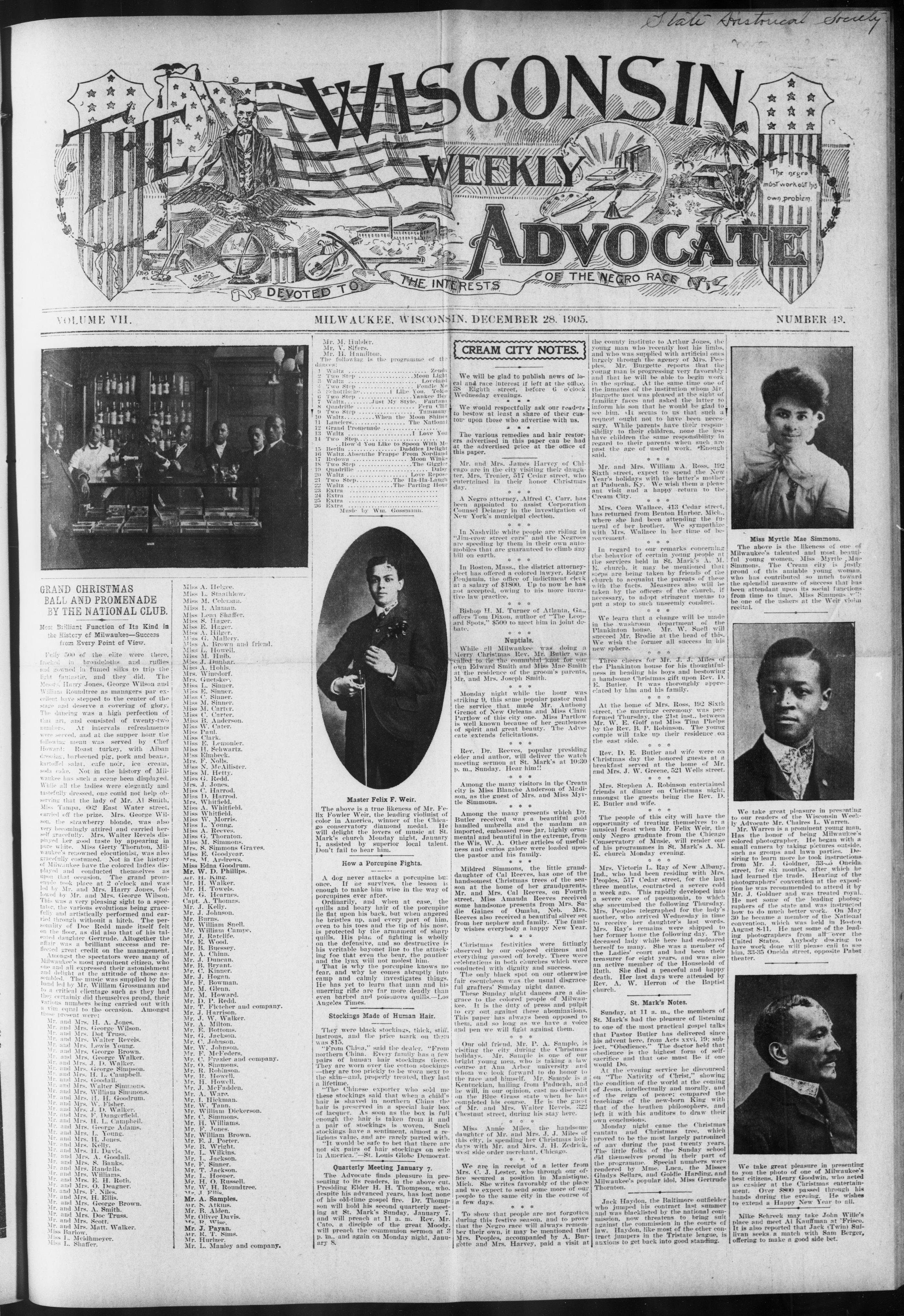
Page text (machine-generated)
WISCONSIN
WEEKLY
ADVOCATE
DEVOTED TO THE INTERESTS OF THE NEGRO RACE
VOLUME VII.
GRAND CHRISTMAS BALL AND PROMENADE BY THE NATIONAL CLUB.
Most Brilliant Function of Its Kind in the History of Milwaukee—Success from Every Point of View.
Fully 500 of the elite were there, frocked in broadcloths and ruffles and gowned in fumed silks to trip the light fantastic, and they did. The Messrs. Harry Jones, George Wilson and William Roundtree as managers par excellent have stepped to the center of the stage and deserve a covering of glory. The dancing was a high perfection of that art, and consisted of twenty-two numbers. At intervals refreshments were served, and at the supper hour the following menu was served by Chef Howard; Roast turkey, with Alban dressing, barbecued pig, pork and beans, kartoffel salat, cafe noir, ice cream, soda cake. Not in the history of Milwaukee has such a scene been displayed. While all the ladies were elegantly and tastefully dressed, one could not help observing that the lady of Mr. Al Smith, Miss Tampa, 662 East Water street, carried off the prize. Mrs. George Wilson, the strawberry blonde, was also very becomingly attired and carried herself gracefully. Mrs. Walter Revels displayed her good taste by appearing in pure white. Miss Gerty Thornton, Milwaukee's renowned elocutionist, was also gracefully costumed. Not in the history of Milwaukee have the colored ladies displayed and conducted themselves as upon that occasion. The grand promenade took place at 2 o'clock and was led by Mr. and Mrs. Harry Jones, followed by Mr. and Mrs. George Wilson. This was a very pleasing sight to a spectator, the various evolutions being gracefully and artistically performed and carried through without a hitch. The personality of Doc Redd made itself felt on the floor, as did also that of his talented daughter Gertrude. Altogether the affair was a brilliant success and reflected great credit on the management
Amongst the spectators were many of Milwaukee's most prominent citizen, who one and all expressed their astonishment and delight at the attitude of those assembled. The music was supplied by the band led by Mr. William Grossmann and to a critical clientage such as they had they certainly did themselves proud, their various numbers being carried out with a vim equal to the occasion. Amongst those present were
---
Miss A. Helgee.
Miss L. Staathlow.
Miss M. Coleman.
Miss I. Alaman.
Miss Lena Shaffer.
Miss S. Hager.
Miss E. Hager.
Miss A. Hilger.
Miss G. Mallery.
Miss A. Brown and friend.
Miss L. Howell.
Miss M. Hub.
Miss J. Dunbar.
Miss A. Hohl.
Mrs. Winedorf.
Mrs. Guetsker.
Miss L. Sinner.
Miss E. Sinner.
Miss C. Sinner.
Miss M. Sinner.
Miss M. Carter.
Miss C. Carter.
Miss B. Anderson.
Miss W. Cater.
Miss Paul.
Miss Clark.
Miss E. Lemonier.
Miss H. Schwartz.
Miss Elmbeck.
Mrs. F. Nolls.
Miss N. McAllister.
Miss M. Hetty.
Miss G. Redd.
Mrs. J. Jones.
Miss C. Harrod.
Miss D. Harrod.
Mrs. Whitfield.
Miss A. Whitfield.
Miss Whitfield.
Miss W. Morris.
Miss L. Young.
Miss A. Reeves.
Miss G. Thornton.
Miss M. Simmons.
Mrs. S. Simmons Graves.
Miss E. Goodyear.
Mrs. M. Andrews.
Miss Edna Goodrum.
Mr. W. D. Phillips.
Mr. H. King.
Mr. H. Walker.
Mr. H. Towels.
Mr. G. Hearnes.
Capt. A. Thomas.
Mr. J. Kelly.
Mr. J. Johnson.
Mr. Burns.
Mr. William Snell.
Mr. William Campe.
Mr. J. Ratclife.
Mr. E. Wood.
Mr. B. Buessey.
Mr. A. Chinn.
Mr. J. Duncan.
Mr. B. Bryant.
Mr. C. Kinner.
Mr. J. Hogan.
Mr. F. Bowman.
Mr. M. Glenn.
Mr. M. Howard.
Mr. D. P. Redd.
Mr. T. Fletcher and company.
Mr. J. Harrison.
Mr. J. W. Walker.
Mr. A. Milton.
Mr. E. Bottoms.
Mr. G. Jackson.
Mr. C. Johnson.
Mr. W. Johnson.
Mr. F. McFeders.
Mr. C. Frazier and company.
Mr. O. Simmons.
Mr. R. Robinson.
Mr. R. Howell.
Mr. H. Howell.
Mr. J. McFadden.
Mr. A. Ware.
Mr. I. Hickman.
Mr. W. Tann.
Mr. William Dickerson.
Mr. C. Simmons.
Mr. H. Williams.
Mr. F. Jones.
Mr. William Brown.
Mr. E. J. Porter.
Mr. B. Wright.
Mr. L. Wilkins.
Mr. L. Jackson.
Mr. F. Sinner.
Mr. T. Jackson.
Mr. L. Hooper.
Mr. H. O. Russell.
Mr. W. H. Roundtree.
Mr. J. Ellis.
Mr. A. Samples.
Mr. S. Atkins.
Mr. B. Alden.
Mr. Oliver Davis.
Mr. R. Wise.
Mr. J. Payan.
Mr. R. T. Sims.
Mr. Hurlzer.
Mr. L. Manley and company.
Music by Wm. Gossmann
Master Felix F. Weir.
The above is a true likeness of Mr. Felix Fowler Weir, the leading violinist of color in America, winner of the Chicago conservatory diamond medal. He will delight the lovers of music at St. Mark's church Monday night, January 1, assisted by superior local talent. Don't fail to hear him.
How a Porcupine Fights.
---
A dog never attacks a porcupine but once. If he survives, the lesson is enough to make him wise in the way of porcupines ever after.
Ordinarily, and when at ease, the quills and hoary hair of the porcupine lie flat upon his back, but when angered he bristles up, and every part of him, even to his toes and the tip of his nose, is protected by the armament of sharp quills. His plan of fighting is wholly on the defensive, and so destructive is his veritable bayonet line to the attacking foe that even the bear, the panther and the lynx will not molest him.
That is why the porcupine knows no fear, and why he comes abruptly into camp and calmly investigates things. He has yet to learn that man and his unerring rifle are far more deadly than even barbed and poisonous quills.—Los Angeles Times.
Stockings Made of Human Hair.
They were black stockings, thick, stiff, lustrous, and the price mark on them was $15.
"From China," said the dealer. "From northern China. Every family has a few pairs of human hair stockings there. They are worn over the cotton stockings—they are too prickly to be worn next to the skin—and, properly treated, they last a lifetime.
"The Chinese exporter who sold me these stockings said that when a child's hair is shaved in northern China the hair is preserved in a special hair box of lacquer. As soon as the box is full enough the hair is taken from it and a pair of stockings is woven. Such stockings have a sentiment, almost a religious value, and are rarely parted with. "It would be safe to bet that there are not six pairs of hair stockings on sale in America."—St. Louis Globe Democrat.
Quarterly Meeting January 7
The Advocate finds pleasure in presenting to its readers, in the above cut, Presiding Elder H. H. Thompson, who, despite his advanced years, has lost none of his old-time gospel fire. Dr. Thompson will hold his second quarterly meeting at St. Mark's Sunday, January 7, and will preach at 11 a. m. Rev. Mr. Cato, a disciple of the great Moody, will preach the communion sermon at 3 p. m., and again on Monday night, January 8.
CREAM CITY NOTES.
We will be glad to publish news of local and race interest if left at the office, 3S Eighth street, before G o'clock Wednesday evenings.
We would respectfully ask our readers to bestow at least a share of their custom upon those who advertise with us.
The various remedies and hair restorers advertised in this paper can be had at the advertised price at the office of this paper.
Mr. and Mrs. James Harvey of Chicago are in the city visiting their daughter, Mrs. Trenier, 517 Cedar street, who entertained in their honor Christmas day.
***
A Negro attorney, Alfred C. Carr, has been appointed to assist Corporation Counsel Delaney in the investigation of New York's municipal election.
* * *
In Nashville white people are riding in "Jim-crow street cars" and the Negroes are speeding by them in their own automobiles that are guaranteed to climb any bill on earth.
* * *
In Boston, Mass., the district attorney-elect has offered a colored lawyer, Edgar Benjamin, the office of indictment clerk at a salary of $1800. Up to now he has not accepted, owing to his more lucrative law practice.
* * *
Bishop H. M. Turner of Atlanta, Ga., offers Tom Dixon, author of "The Leopard Spots," $500 to meet him in joint debate.
Nuptials.
While all Milwaukee was doing a Merry Christmas Rev. Mr. Butler was called to the commubial knot for our own Edward Smith and Miss Mae Smith at the residence of the groom's parents, Mr. and Mrs. Joseph Smith.
* * *
Monday night while the hour was striking 9, this same popular pastor read the service that made Mr. Anthony Grenot of New Orleans and Miss Clara Partlow of this city one. Miss Partlow is well known because of her gentleness of spirit and great beauty. The Advocate extends felicitations.
* * *
Rev. Dr. Reeves, popular presiding elder and author, will deliver the watch meeting sermon at St. Mark's at 10:30 p.m., Sunday. Hear him!!
☆ ☆ ☆
Among the many visitors in the Cream city is Miss Blanche Anderson of Madison, as the guest of Mrs. and Miss Myrtle Simmons.
***
Among the many presents which Dr. Butler received was a beautiful gold handled umbrella and the madam an imported, embossed rose jar, highly ornamental and beautiful in the extreme, from the Wis. W. A. Other articles of usefulness and curios galore were loaded upon the pastor and his family.
```markdown
```
Mildred Simmons, the little granddaughter of Cal Reeves, has one of the handsomest Christmas trees of the season at the home of her grandparents, Mr. and Mrs. Cal Reeves, on Fourth street. Miss Amanda Reeves received some handsome presents from Mrs. Sadie Gaines of Omaha, Neb. Mrs. Reeves also received a beautiful silver set from her nephew and family. The family wishes everybody a happy New Year.
☆ ☆ ☆
Christmas festivities were fittingly observed by our colored citizens and everything passed off lovely. There were celebrations in both churches which were conducted with dignity and success. The only black spot on our otherwise fair escutcheon was the usual disgraceful grafters' Sunday night dance. These Sunday night dances are a disgrace to the colored people of Milwaukee. It is the duty of press and pulpit to cry out against these abominations. This paper has always been opposed to them, and so long as we have a voice and pen we will fight against them.
☆ ☆ ☆
Our old friend, Mr. P. A. Sample, is visiting the city during the Christmas holidays. Mr. Sample is one of our bright young men, who is taking a law course at Ann Arbor university and whom we look forward to do honor to the race and himself. Mr. Sample is a Kentuckian, hailing from Paducah, and he will, in our opinion, cast no discredit on the Blue Grass state when he has completed his course. He is the guest of Mr. and Mrs. Walter Revels. 222 Chestnut street, during his stay here.
```markdown
```
Miss Annie Miles, the handsome daughter of Mr. and Mrs. J. J. Miles of this city, is spending her Christmas holidays with Mr. and Mrs. J. H. Zedrick, west side order merchant, Chicago.
☆ ☆ ☆
We are in receipt of a letter from Mrs. C. J. Lester, who through our office secured a position in Manistique, Mich. She writes favorably of the place and we expect to send some more of our people to the same city in the course of a few days.
it few days.
To show that people are not forgotten during this festive season, and to prove that the Negro race will always remember their own, it may be mentioned that Mrs. Peoples, accompanied by A. Burgette and Mrs. Harvey, paid a visit at
the county institute to Arthur Jones, the young man who recently lost his limbs, and who was supplied with artificial ones largely through the agency of Mrs. Peoples. Mr. Burgette reports that the young man is progressing very favorably and that he will be able to begin work in the spring. At the same time one of the inmates of the institution whom Mr. Burgette met was pleased at the sight of familiar faces and asked the latter to inform his son that he would be glad to see him. It seems to us that such a request ought not to have been necessary. While parents have their responsibility to their children, none the less have children the same responsibility in regard to their parents when such are past the age of useful work. Enough said.
Mr. and Mrs. William A. Ross, 192 Sixth street, expect to spend the New Year's holidays with the latter's mother at Paducah, Ky. We wish them a pleasant visit and a happy return to the Cream City.
* * *
Mrs. Cora Wallace, 413 Cedar street, has returned from Benton Harbor, Mich., where she had been attending the funeral of her brother. We sympathize with Mrs. Wallace in her time of bereavement.
☆ ☆ ☆
In regard to our remarks concerning the behavior of certain young people at the services held in St. Mark's A. M. E. church, it may be mentioned that steps are being taken by friends of the church to acquaint the parents of these with the facts. Measures also will be taken by the officers of the church, if necessary, to adopt stringent means to put a stop to such unseemly conduct.
☆ ☆ ☆
We learn that a change will be made in the washroom department of the Plankinton house. Mr. W. Snell will succeed Mr. Brodie at the head of this. We wish the former all success in his new sphere.
Three cheers for Mr. J. J. Miles of the Plankinton house for his thoughtfulness in heading his boys and bestowing a handsome Christmas gift upon Rev. D. E. Butler. It was thoroughly appreciated by him and his family.
☆ ☆ ☆
At the home of Mrs. Ross, 192 Sixth street, the marriage ceremony was performed Thursday, the 21st inst., between Mr. W. E. Golf and Miss Tina Phelps by the Rev. B. P. Robinson. The young couple will take up their residence on the east side.
Rev. D. E. Butler and wife were on Christmas day the honored guests at a breakfast served at the home of Mr. and Mrs. J. W. Greene, 521 Wells street.
* * *
Mrs. Stephen A. Robinson entertained friends at dinner on Christmas night, amongst the guests being the Rev. D. E. Butler and wife.
☆ ☆ ☆
The people of this city will have the opportunity of treating themselves to a musical feast when Mr. Felix Weir, the only Negro graduate from the Chicago Conservatory of Music, will render one of his programmes in St. Mark's A. M. E. church Monday evening.
```markdown
```
Mrs. Victoria L. Ray of New Albany, Ind., who had been residing with Mrs. Peoples, 517 Cedar street, for the last three months, contracted a severe cold a week ago. This rapidly developed into a severe case of pneumonia, to which she succumbed the following Thursday. Mrs. Peoples telegraphed for the lady's mother, who arrived Wednesday in time to receive her daughter's last words. Mrs. Ray's remains were shipped to her former home the following day. The deceased lady while here had endeared herself to many. She was a member of the Ladies' court and had been their treasurer for eight years, and was also an active member of the Household of Ruth. She died a peaceful and happy death. Her last days were attended by Rev. A. W. Herron of the Baptist church.
St. Mark's Notes.
Sunday, at 11 a. m., the members of St. Mark's had the pleasure of listening to one of the most practical gospel talks that Pastor Butler has delivered since his advent here, from Acts xxvi. 19; subject, "Obedience." The doctor held that obedience is the highest form of self-sacrifice and that one must Be if one would Do. At the evening service he discoursed on "The Nativity of Christ," showing the condition of the world at the coming of Jesus, intellectually and morally, and of the reign of peace; compared the teachings of the new-born King with that of the heathen philosophers, and left it with his auditors to draw their own conclusions.
Monday night came the Christmas cantata and Christmas tree, which proved to be the most largely patronized of any during the past twenty years. The little folks of the Sunday school did themselves proud in their part of the programme. Special numbers were rendered by Mme. Luca, the Misses Gladys Sellars, and Goldie Harding, and Milwaukee's popular idol, Miss Gertrude Thornton.
---
Jack Haydon, the Baltimore outfielder who jumped his contract last summer and was blacklisted by the national commission, now threatens to bring suit against the commission in the courts of law. Haydon, like most of the other contract jumpers in the Tristate league, is anxious to get back into good standing.
P.
Miss Myrtle Mae Simmons.
The above is the likeness of one of Milwaukee's talented and most beautiful young women, Miss Myrtle Mae Simmons. The Cream city is justly proud of this amiable young woman, who has contributed so much toward the splendid measure of success that has been attendant upon its social functions from time to time. Miss Simmons will be one of the ushers at the Weir violin recital.
JOHN A. BROWN
We take great pleasure in presenting to our readers of the Wisconsin Weekly Advocate Mr. Chalres L. Warren.
Mr. Warren is a prominent young man. Has the honor of being Milwaukee's colored photographer. He began with a small camera by taking pictures outside, such as groups and lawn parties. Desiring to learn more he took instructions from Mr. J. Goldner, 33-25 Oneida street, for six months, after which he had learned the trade. Hearing of the photographers' convention at the exposition he was recommended to attend it by Mr. J. Goldner and was treated royal. He met some of the leading photographers of the state and was instructed how to do much better work. On May 30 he became a member of the National convention, which was held in Boston August 8-11. He met some of the leading photographers from all over the United States. Anybody desiring to have work done will please call to see him. 33-35 Oneida street, opposite Pabst theater.
M. H.
We take great pleasure in presenting to you the photo of one of Milwaukee's best citizens, Henry Goodwin, who acted as cashier at the Christmas entertainment. Over $800 passed through his hands during the evening. He wishes to extend a Happy New Year to all.
Mike Schreck may take John Wille's place and meet Al Kauffman at 'Frisco. It is also reported that Jack (Twin) Sullivan seeks a match with Sam Berger, offering to make a good side bet.
NOT "ANY QLD WAY."
Manner in Which Army Medals of Honor
Shall Be Worn.
Medals of honor and decorations may not be worn any old way by officers and soldiers of the army. The general staff has labored with the problem, and now decides the precise way in which these symbols of honors shall be worn. In a general order the chief of staff says:
The medal of honor may be worn by officers and enlisted men entitled thereto on all occasions of ceremony. When worn with the full dress uniform, the medal will be worn pendant from the neck, the ribbon passing between the upper and lower yokes of the coat collar, so that the medal proper shall hang about one inch below the opening of the collar. When worn with the dress uniform the medal will be worn on the left breast in the manner prescribed for campaign badges, and preceding them. Officers and enlisted men, who, in their own right or by right of inheritance, are members of military societies of men who served in the armies and navies of the United States in the War of the Revolution, the War of 1812, the Mexican war, the War of the Rebellion and the Indian wars of the United States, the Spanish-American war and the incidental insurrection in the Philippines and the China relief expedition, are members of the regular army and navy union of the United States, may wear on all occasions of ceremony the distinctive badges adopted by such societies, or such other medals as may be authorized by proper authority. Officers and enlisted men who served as officers, noncommissioned officers, privates, or other enlisted men in the regular army, volunteer or militia forces of the United States during the War of the Rebellion, and have been honorably discharged from the service or still remain in the same, may wear, on occasions of ceremony, the distinctive badge ordered for or adopted by the army corps or division, respectively, in which they served. Badges to be worn on the left breast of the coat, suspended by a ribbon, from a bar of metal passed through the upper ends and tops of the ribbons, forming a horizontal line, the outer ends of which will be from three to four inches below the top of the shoulder, according to the height of the wearer.
To Work Over a Mile Deep
The cable vessel Burnside, which has been doing valuable service under the army signal office, will be equipped with a $23,030 pick-up gear, which has been ordered from a Connecticut firm, and which will be installed on the vessel at Seattle in about four months, which period is necessary for the manufacture of the apparatus. This mechanism will greatly increase the efficiency of the Burnside and enable the cable ship to pick up an injured cable at a depth of one and one-half miles. The Burnside will remain at Seattle during the coming winter, pending the installation of the improved mechanism, and in the meantime will be held in readiness to answer emergency calls for repairs along the Alaskan cable line.
A Monster Dinner.
The largest dinner ever given assembled at Paris recently. The Mutualists of Paris dined at the Galerie des Machines. About 50,000 sat down together. Five hundred waiters served and 15,000 dishes were used at nine miles of tables. There were 150,000 plates, which if piled up would reach ten times higher than the Eiffel tower. The "cheer" included 25,000 bottles of red and white wine, 15,000 bottles of beer, 6000 bottles of milk, 10,000 bottles of mineral water, 5000 bottles of champagne, 4000 half bottles of liqueur, and two steam urns, each of 15-horsepower, brewed the coffee. Meats of all kinds weighed 70 tons, and there were three-quarters of a ton of cigars.
Hozesty Makes Man Faint
Rather than endanger his reputation for honesty, Edward E. Wilson of Monterey, Mass., walked twenty miles to return $40 to its owner. He had been in Great Barrington transacting business, and at the express office a clerk, Ruben Chapman, accidentally slipped a check for $40 among Wilson's letters and papers, which he was examining for the purpose of identification. Wilson put the papers in his pocket and did not discover Mr. Chapman's mistake until he reached home, ten miles distant, and, discovering the check in his pocket, he fainted from fright. On being revived, Wilson immediately started on foot for Great Barrington and returned the check to Chapman, who had not discovered the loss.
A Story Without Terminal Facilities.
There is a certain prosy senator who is much absorbed nowadays in rate legislation, says the Brooklyn Eagle's Washington correspondent. He is a long-winded talker, short of humor and long on facts, and as a result is usually avoided by his associates. The other day this senator cornered a couple of his associates and began to tell a story. Like the senator's arguments, his story was long and apparently pointless. After listening for about fifteen minutes, and seeing no end in sight, one of the senators, disregarding the customary "courtesy" of this body, broke in: "Say, senator, hasn't this story of yours got any terminal facilities?"
Made a Clock from Slate.
A slate quarryman living at Delta, Pa., Humphrey O. Pritchard, has made a clock out of slate. The varieties he used include peach bottom blue slate and the red, green and purple slate of Vermont. About 164 separate pieces of this material were used in the construction and are held together by twenty-three dozen small metal screws. Many of the slate sheets are as thin as paper, and scores were broken before the timepiece was finished after eight months' work. The clock is 4 feet high, 2 feet wide and 1 foot deep. It has a cathedral gong and is lighted by nine incandescent bulbs.—Jewelers' Circular Weekly.
Attack Liquor Salesman
Mrs. A. E. Becktell, president of the Macksville (Kas.) W. C. T. U., with twenty other members, armed with buggy whips and rotten eggs, attacked Myron Mooney and D. B. Haltpike, traveling salesmen for a liquor house, when they arrived in that town. Mooney saved himself from a horsewhipping by denying his identity, but Haltpike was beaten. Both fled from the town and will not return to make any sales.
Paper Beds.
In several places in Prussia, a Berlin telegram to the London Leader says, experiments are being made with a somewhat novel material for soldiers' beds, namely, shavings of paper. These are stuffed into bags on which the soldiers lie. They are said to be more comfortable than straw and more springy. Straw beds, moreover, must be changed every six months.
Radiator Headaches
Now that winter is coming on, beware of the steam-heat headache. This sort of a headache comes from staying long in an apartment heated by steam and improperly ventilated. Set a bowl—decorated jar is all the prettier—filled with water, on the top of the radiator, and many headaches for which perhaps no cause could be found, will disappear.
A CAGED MOCKING BIRD
I passed a courier's shop upon the street. And passed a moment; at the doorstep, where.
In nature's medley, piping cool and sweet. The songs that thrill the swamps when mature in year.
spring is near.
Fly over the fields at fullness of the year.
And twitter where the autumn hedges run.
Joined all the months of music into one.
I shut my eyes; the hermit thrush was there.
And all the leaves hung still to catch his spell:
Wren cheeped among the bushes; from somewhere
I heard the oriole set; his full heart free;
And barefoot boyhood rushed again to me.
The vision-bringer hung upon a nail
Before a dusty window, looking dim
On marts, where trade waxed hot with box
and bale;
and bane.
The sad-eyed passers had no time for him.
His captors sat, with beaded face and grim.
Plying a listless awl, as in a dream
Of pastures winding by a shady stream.
Gray birds, what spirit bides with thee unseen?
Free as the winds, thy song should mock the dove.
Ah, were I thou, my grief in moans would move,
At thinking—otherwise, by others' art
Charmed and forgetful—of mine own sweet-heart.
O many-souled, Shakespeare bird, who knows
Full well each feathered songster's pipe
to wind!
O captive Milton, in this dreary close
Singing in shame of fortune so unkind.
Holding wide, sunny stretches in thy mind!
I blush to offer sorrow unto thee.
Master of fate, scorner of destiny!
John Charles McNeill in The Century.
THE IMPOSSIBLE HE.
"Describe him? Well, in the first place he must be big and strong." There was marked emphasis on the word "big."
Jack's smile was sarcastic. "How girls do worship the prize fighter type! Go on, light or dark?"
"Light, by all means." Grace's dimpler now came to the front.
"I needn't have asked. Let's see—big, strong and light complexion. Handsome, of course?"
"No," most emphatically. "Handsome men are vain. He must be ugly."
He swept her a low bow, saying: "There seems to be a ray of hope left."
"And he must be energetic."
Jack was lounging among the hammock pillows. At the spirited "energetic" he settled himself more comfortably and pretended to stifle a yawn.
"Indeed! And brainy?" he asked, pleasantly.
"No, brainy men are often uncomfortable to live with. Just intelligent and brave and generous, clean-hearted, and—"
"My dear girl, he has never yet been born. He's impossible. However, I'll keep my eyes open and if I should happen to see such perfection I'll just send him along."
"Don't trouble yourself. He'll come without your help."
"Two more minutes," he announced, after looking at his watch. "Let's talk of something else."
"Where has the evening gone?" This very sweetly.
"Gone in, trying to quarrel, as usual."
"Oh, I didn't finish. He, 'the impossible,' as you call him, must think I'm all right; even when he discovers what a little goose I am, he must still think so. The last and most difficult, isn't it?" she laughed, as she held out her hand in good-bye.
"On the contrary, the easiest of all."
There came a warning shriek from the little station, fortunately, perhaps, and all he had time to say was "Good night, Grace."
The following Sunday afternoon found the little dark-and-ugly-man—or so he considered himself—spinning merrily along the road that leads to Ocean Pines. The branch train that stopped at everybody's back door was not to be trusted on this occasion, for did not the note in his breast pocket bid him "Come down over Sunday? Mamma meant I should ask you the other night, but I forgot—
you were so pugnacious. Come early, for we have planned a little surprise for you." He cast disapproving eyes over the bare flats when a turn in the road about one mile from his destination brought them in sight. "Corker day for sailing. Tide won't serve till 8, and no moon! Just my luck." he grumbled. "Maybe—when!" Through the thick willows he discovered a peculiar shade of blue gingham he felt sure he had seen before. He jumped from his wheel and made for the shore of the inlet. There was "Her Grace," as he was fond of calling her, rigidly erect in the "Marsh Marigold," which, some ways out, was stuck fast in the mud. Her Grace's face was set resolutely seaward and there was a certain defiance about her attitude that spoke volumes. He was only human, however, so he shouted: "Ship ahoy! Is this the little surprise?"
"John Foster! How mean of you! When I'm burned to a crisp and due at Portsmouth at 4:30. The Wilsons are giving a reception to the envoys and Mr. Chesley has invited us to go in his auto." The last sentence was almost a wail.
"How did you manage?" he began, as he slipped off his coat and shoes.
"Don't think me such an idiot as that; of course, I knew the tide was going. I broke an oar and not a soul in sight this side of England. I never could scull. I tried to make the inlet. But what are you going to do?" she finished in some alarm.
"The only thing I can, if you want to shake hands with Mr. Tak-a-what's name?" He was rolling up his trousers with great coolness.
"You mustn't; you'il ruin your clothes; somebody will see us and I'll never hear the last of it."
"Very well then." He pulled a newspaper from his pocket and settled himself against a stump.
"John Foster, you're the most contrary fellow that ever lived."
At this most mogical statement, hurled from the direction of the Marsh Marigold, "the most contrary fellow" gave an extra hitch to his trousers and started toward the helpless craft.
"Are you going to carry me?" was the question as he drew nearer.
"Do you think I am big and strong enough?" (Here Grace's eyes snapped.) "I should be delighted to carry you, but I infer you have further use for your
---
boat, and don't exactly pine after a second trip.
With this he laid strong hands on the Marsh Marigold, and the hard, slow push insacre began.
When it was finished John Fester did not look quite so fine as when he left the city. He was hot, somewhat winded, and, in spite of his precautions, both trousers and shirt were covered with mud. Then he uttered his relieved "There!" and, looking up, there was a shriek of laughter. "Oh, oh, what a sight you are; if you could only see yourself." Suddenly she reached for something hitherto concealed; then the little click of a camera, then more laughter. "Oh, I couldn't help it, it was such a temptation."
"Are you ready to come ashore?" Was he laughing at her, or what?
he laughing at her, he said, "I don't know as I dare. I expect to be killed." but she gave him her hand. She did not jump, however, for he took more than her hand. He took all there was to take and held her fast. "Please tell me what my punishment is to be," she asked, humbly; "I'd like to know now." He looked deep into her eyes. "It is to repeat something I am going to say," was the answer; "then I will let you go, and not heige."
Did they see the envoys? Hardly. They seemed quite content to remain in the shade of the willows, particularly when the Chesley party went up the road. Then there was a toilet to be made—an apology for one—made beside a convenient tunnel, at the sacrifice of the company's entire stock of handkerchiefs. Still they did not hurry; somehow, they found plenty to talk about, and it was nearly dusk before taking a short cut across the fields they appeared before two very anxious parents, one of whom had to take to the back porch and his pipe to keep from disgracing himself as a host; the other, still too anxious and disappointed to see the funny side, relieved herself in the following way:
"You might at least have sent me werd, somehow. How could I go, with you off—nobody knows where? How did I know but what you were drowned, with the boat gone. Gracie Madden, your dress is a sight to behold!" Then, remembering her duty as hostess, she said in a milder tone to the other culprit: "Go right up to the spare room, Jack. I'll bring you some of pa's clothes right away."
When the great touring car came puffing and spitting back to town and past the Madden cottage, nobody. I think, but Mrs. Madden gave it a thought. She was in the kitchen giving directions for the sponging and pressing of the unfortunate trousers, and it was Black Mary, with the freedom of speech of an old servant, who took up a herself the role of comforter.
"Please, honey; what 'er y' keer for peace? Ain't we got peace a-plenty right out dere on de pe-azzar? Ain't dem chillun dun muffin but scrap fer two years and mo'? Lock lak littl' miss put up a mighty big fight dis time, 'cording to de close, but I reckon he done catch her now fo' suah." She chuckled, partly at remembrances of an unexpected bank bill tied securely in the corner of her handkerchief. "Peace, Lawdy, dey's des lak two turkle doves."—Boston Post.
Morning.
In Japan people who have suffered a bereavement not only do not put on mourning, but after the blow has fallen they make their next appearance with a smile upon their faces, as if nothing had happened. According to Lafcadio Hearn, this is not in the smallest sense an evidence of indifference. The Japanese, he declares, suffer as keenly from a bereavement as any other people. The purpose of the practice is wholly to spare the feelings of other people. To betray feelings of sorrow is to afflict those about us. The mien or garb of grief afflicts, therefore it is impossible for a courteous person to wear it. So reason the Japanese. In order that no thought of pain shall pass from the sufferer to his neighbor, the sufferer wears the aspect of contentment, even though his heart is breaking.
Our own practice is quite the reverse. It considers the sufferer, not his friends. In order that not only may all know that he is in sorrow, but that some drop of that sorrow may pass from him to those about him, the bereaved person wears black. The direct purpose of wearing mourning is not, we may be assured, to make an ostentation of grief, as some opponents of the practice have thoughtlessly assumed. It is rather to spare the bereaved from the chance remarks of those who are ignorant of his affliction. It is worn that they may know, and avoid questions or blundering observations that may wound him. But even in this worthier and, we believe, truer view of the purpose of mourning emblems, the person whose comfort is considered is the sufferer. The many are called upon to share in his woe to some extent. The emblem is the token of their compassion, not the embezzlement of his grief.—New York Mail.
A Woman's Friendship.
When Mme. de Stael was dying she wrote Mme. Recamier, closing her letter as follows: "All that is left of me embraces you."
Mme. Recamier devoted the remainder of her life in cherishing the memory of Mme. de Stael. The only person who ever came near filling Mme. de Stael's place in her heart was Elizabeth Foster, the beautiful Duchess of Devonshire—the original Sir Joshua Reynolds' famous portrait.
Margaret Fuller formed many impassioned connections with women during her life. They were attracted by her powers of intellect and harmony.
There are three noted instances of platonic attachments—Petrarch and Laura, and Dante and Beatrice, and Joanna Baillie and Sir Walter Scott.
Mme. Roland and her husband were alike and inseparable. John Stuart Mill and his wife were companions, as were also Elizabeth and Robert Browning. These relations can be easily explained. The fever of time produces lassitude, dispels illusions, and undermines passions. Then the love of these strong souls turns into that crowning lasting union—friendship.
There was a great friendship between Goethe and his sister Cornelia. She was a year younger than he, and, while not at all good looking, had superior endowments of mind and character. The attachment between Byron and his sister, Mrs. Leigh, was most touching. She remained unalterably attached to him during the dreadful storm of unpopularity which drove him out of England. Four of his best poems were composed for and addressed to her. Byron's last words were of his sister and his daughter.—Pilgrim.
Man Hard Worker at 83
"I don't think I am past all usefulness yet," remarked Charles Simmons, aged 83, of Florida, Conn., in the Berkshire Hills. "I have just finished cutting and stacking 100 cords of stovewood which I began last March." He has voted at the last sixty-one town meetings.
LONESOME JOB
Is That of the Pipe Walker, and Few Can Stand the Monotony.
"Talk about the monotony of sheep herding and track walking and sentry duty," said a pipe line walker sitting at his campfire near here last night, "it is nothing to compare with the horrors of my job. The trackwalker hears the trains go by, and he hears noises, companionable sound and things which make him think he is a part of life. Occasionally he gets a chance to officiate at a wreck or to prevent a wreck and get his name in the papers and a medal from the Humane society and a bonus from the railroad. The sheep herder has his dogs and his sheep for company, and, besides, he is always on the move to some place or other. Now, a pipe line walker is the limit."
The man who was doing the talking is a college graduate, who came to Kansas for the outdoor life to build up his constitution. He is a pipe line walker for the Kansas Natural Gas company out of this place, and he covers twenty-five miles a day. He starts at 6 o'clock in the morning and returns at 6 o'clock in the evening.
"Oh, it was fun at first," he went on. "You know, in the east we do not have this succession of prairie and trees and creeks. That is, we do not have them in New York. Well, I liked it. It was refreshing to get out in the morning and tramp away through the fresh air to the end of the section. The smells of the morning were good. The birds seemed to take on a new note for me. I felt as if it was worth all of life to be out here walking the 'dump.' Then I got to know every tree, to know every bird call, to know every twist and curve of the route, to know every road crossing, to know every detail of the whole thing. I got tired of it. I dreamed of it. I thought about the same old things for the same old hours every day for more than a month. I forgot who is President of the United States and what county New York city is in, and where the Declaration of Independence was signed. I forgot all about the Japanese war. It was all a blur of trees and land, of land and of trees, and of more trees and then more land—just always trees and land.
"If the pipe lines followed the railroad or even the roads where we could see things it would be different. But all the lines around here go across country. All we have to do is to look for leaks. We have to keep our ears strained for a hissing sound. That is all we are hired to look for—just the leaks. Now, when you have only one thing to look for and listen for and it does not occur every day the anticipatory nervousness breaks you down. Every time the trees rustles you think there is a leak ahead of you. Every time a cicada drones you think the pipe line has gone to smash.
"You start out in the morning with the fear of disaster, and if a twig breaks under your feet you get the jumps. If a break would come along once in a while it would be easy. But the loneliness of it gets into your bones, worse than that, it gets into your mind. It stays on your mind. This perpetual period of introspection grows oppressive. Finally you begin pinching yourself to see if you are all there. Then you begin talking to yourself to see if you can hear. Well, I haven't got to the very last stage, but it looks like Osawatomie to me. So me to New York and the chutes on Coney Island."
Pipe line walking is a new avocation in Kansas. The Standard Oil company employs no pipe line walkers. But the natural gas companies hire several hundred young men to look out for the leaks. The Standard Oil company uses a machine which resembles the machine that the cable companies have for ascertaining the breaks in its pipe line. But the gas companies cannot use any machine, hence the great expense for a patrol.
There are some 300 or 400 men patrolling the gas pipe lines in Kansas now, and as the lines increases the patrol increases. Most of the patrol men are nigh class young fellows who went into the work at first because it looked like a snap. The job pays from $60 to $90 a month.—Kansas City Star.
Crack Shot of a Colorado Deputy
While Deputy Sheriff William Ronaldson was in the once "bad" town of Coffeyville, Kas., he got some of the Dalton spirit in his veins and listened to the stories of how four of the Daltons met death at the hands of one man stationed in a shed and shooting through a knothole. They told Mr. Ronaldson stories of what crack marksmen the Daltons were and how they picked off every man that appeared on the streets with a gun. When the Denver deputy was on the train some stranger entered into a conversation about what crack shooters there were in Kansas about the time the Daltons blew into Coffeyville and secured several thousand dollars from a bank.
Ronaldson said: "Yes, there were some good marksmen there, but it is easy to hit a man with a Winchester. In Colorado we use a Colt almost exclusively. Of course, we have no crack marksmen, but I believe I might pick off a prairie dog there while the train is moving."
The stranger flashed a five spot in Deputy Ronaldson's face and it was covered. Ronaldson snapped out his 38-caliber Colt and without much deliberation, and while the train was in rapid motion, sent one Kansas prairie dog to the eternal sleep.
Deputy Sheriff William Ronaldson of Denver is now $5 to the good and friends on the sheriff's force say they would take a hundred similar bets that Ronaldson could do the same nine times out of ten.—Denver Times.
Scandinavian Grouse for Michigan
A shipment of game birds from the Scandinavian peninsula has been received here, consigned to the big Grand island (Lake Superior) game preserve. This is the second shipment received from that source within the past eighteen months, the first importation consisting of 150 specimens of the capercalzie and other varieties. The birds just received consist of hazel grouse and "dal rype," the latter a beautiful bird with white plumage, and a member of the grouse family. The hazel grouse is smaller than the Michigan partridge, but larger than our quail, and is a remarkably hardy fowl.
Owing to the fact that the importation of these birds is wholly for experimental purposes, only a small number were purchased, but if it develops that they can be successfully bred on Grand island a large number will be added to the present flocks. The birds are the only specimens of their kind in America, and are rare in Sweden, except in regions remote from civilization.—Munsing Cor. St. Paul Dispatch.
Wireless Telephone Under Seas.
The Twentieth century methods by which ships communicate with each other are interestingly described by Robert McDuff, in his article "Wireless Signals Under Water," in the December Technical World. Says Mr. McDuff: "The collecting of the sound-waves is accomplished by means of a small tank which is attached to the inner side of the skin of the vessel, the tank being fitted with a chemical solution denser than water, which contains a microphone. (The microphone is an instrument for intensifying and making audible very
feeble sounds.) A sound coming from the water outside passes through the ship's side and into the solation in the iron tank, no hole being required in the ship's hull for the purpose. The vibration striking against the sensitive microphone is converted into sound and carried by electric current along the wires, which, attacked to the tank, lead directly to the bridge or other receiving station. There are two of these tanks on each vessel, one attached on either side and the greater volume of sound which comes through one than through the other indicates the position relatively to the vessel of the sound-producing medium."
Mr. Seddon, the premier of New Zealand, announced in a speech recently that Japanese would not be allowed to come to New Zealand and that the colony would refuse to be dictated to in the matter. This is in reference to a circular from the British colonial office, addressed to the colonists and demanding the repeal of laws that are repugnant to the feelings of nations with which Great Britain is at peace.
SOME PLANTS THAT EIDE.
Retire Beneath the Ground at Close of Growing Season.
C. G. Pringle, for many years a famous plant collector, especially in Mexico and the arid regions of the United States, speaks of a native grass of northern Mexico, Muhlenbergia Texana, as such a favorite with all grazing animals that it is usually exterminated, or nearly so, except when growing under the protection of thorny shrubs, usually mesquite bushes. In Arizona during the winter and spring the Indians bring it long distances into the towns to sell. He adds: "How many times I have contended with the horrid mesquite bushes to gather an armful of this grass to carry joyfully to my hungry and jaded horses. In such cases the thorns, spines, and perhaps bitter taste of the bushes, not only protect the young growth and leaves of certain plants, but furnish shelter for other tender and nutritious herbage. In arid regions, especially, similar instances of protection by thorn bushes are numerous."
Again, some plants retire beneath the surface of the ground at the close of the growing season, especially in regions subject to droughts or cold, remaining secure beneath the surface for months in the form of bulbs, tubers and rootstocks. At such times they are nearly sure to escape destruction by animals. Examples are Solomon's seal, Dutchmen's breeches, May apple, gold-earod and artichoke. Other plants are protected by water, and of these Prof. Beal says: "Not only the flowers of many species of plants as they project above the surface of the water are protected from most unwelcome insects, but the whole plants as well. Mud turtles, certain fishes, water snails, larvae of insects, eat aquatic plants, but most other animals are unable to reach them in such places. Water plantain, wild rice, pond lilies, arrowhead, pickered weed, pond weed, lizard's tail, bullrush, boreed, cattail flag, water dock and many more of their associates root at the bottom, with leaves floating on the surface or projecting above. Innumerable low forms, known as algae, are at home in lakes, ponds and streams, or on the surface of the water, while other kinds thrive in salt or in brackish water. These aquatics find protection below the surface or by extending above it, not only from numerous animals, but they have no competition with others which can grow only on dry or moist soil."—Philadelphia Record.
Mr. Rigney's Snake-Eating Rooster
When it comes to a fish story, Cashier Jordan probably has this town at his mercy, while Rev. George tells a very good deer story; but when it comes to a snake story, Farmer Rigney takes the cake and everything else in the bake-shop. Mr. Rigney is the owner of as fine a lot of thoroughbred poultry as can be found in this part of the state, and is very jealous of his White Leghorn and Pimmouth Rock pets.
So, Friday evening last, as he was doing the chores, he became anxious when he noticed one of his roosters moping in a corner of the cellar. Leaving his work, he went over and picked the bird up, but dropped it quicker than a fellow could say "scat," as he noticed and felt about eight inches of snake hanging from the rooster's mouth. Going at the job carefully, Mr. Rigney, by placing his foot on the tail of the snake and lifting up Mr. Rooster, caused the latter to disgorge over twenty inches of his snakeship that he had swallowed before balking on the ten inches that was left. The snake was dead, having been killed by the rooster, and after the stomach pump work conducted by Mr. Rigney the rooster soon rounded to form again.—Lake City, Colo., Times.
Pig's Long Journey Home.
A farmer living down toward Harvard's, had a most knowing pig which he sold to a Little islander, who took his prize in a boat to his home at the island. Safely shut up in the spacious big pen was the new inmate of the family, and the farmer man went peacefully to rest much content with his new purchase.
In the morning, the pen was empty and no little pig could be found on the island. Some time afterward he went again to town and there saw the first owner of the lost one. "I've lost my pig," he gloomily announced, "I know it," chuckled his friend. "He's down to my house, came back the next morning." What had that homesick little pig done, but swam across two rivers, the Little Island river and the Kennebec, walked across Big Little island, trotted happily down the two miles of road on the Richmond shore, and finally presented himself to his old master, footsore and hungry, but mighty glad to be home once more.—Kennebec Journal.
About Women.
Nations differ in nothing more than in their women.
You will never know what a woman is unless you suffer very much.
Women do not love Napoleons; they love more middleclass middlegirls.
love mere middle-class mediaries.
Men who want to found empires do not not want the higher development of women.
You will in vain search history for a great man who has not been influenced by a great woman.
In America the woman governs the man absolutely. In a certain sense the last man that came to America was Christopher Columbus.
The American woman lives for what she calls "a good time." Her interest is not man nor what is noblest in man—paternity. Her ambition is to study spiritualism, then Buddhism, then wireless telegraphy, and then the novels of Marie Corelli.—Dr. Emil Reich in a London Lecture.
Skins Used in This Country
This country is the greatest consumer of hides and skins in the world. It uses in a year 48,000,000 goat skins, 24,000,000 sheep skins, 16,000,000 hides of all kinds, 9,000,000 calf skins and 2,000,000 other skins. It imports all its goat skins, a total amount of about $25,000,000 worth, and over $10,000,000 worth of hides and over $17,000,000 worth of other skins, a total of over $50,000,000 worth of hides and skins. Germany imports one-third less hides and skins than does this country, and England and France each import about half as much.—Shoe Dealer.
WOMAN IN AWFUL PLIGHT.
Found Wounded and Starving ty Explorers in a Desert.
The British association meetings must bring back to Dr. Francis Galton, his one-time secretary, thoughts of his own journeys in Africa, when that land was a dark continent indeed. The recollections will be further strengthened by the cruelties practiced by the German troops at the expense of the natives, whom they have driven to dreadful death in the desert, and by the stories of Congo atrocities.
In Dr. Galton's own experience there occurred a tragedy in the wilds—a tragedy in which the Hereros figured. He tells the story in his book on tropical South Africa. When a day and a half from his caravan he came across a huge tree burning in the wilderness. From the ashes it was evident that the fire had been in progress for a great time. There was no living soul in sight, but there was a curious signature, as it were, upon the sand. To the Sherlock Holmes of finger prints this signature was obviously that of a human hand imprinted on the sand of the desert. But there was no mark of a foot.
He followed the tracks and came to a woman lying in a terribly emaciated condition, with both her feet burned off and the wounds open and unhealed. Many days before, she explained, a dry standing tree which had caught fire fell upon her as she slept in camp, entangled her in the branches and before she could extricate herself, caused the wounds which her rescuer found. Her people left her to her fate, and since then she had lived upon the gum of trees and water, to which she had dragged herself upon her hands. Here was a terrible problem—what to do with the dying woman.
They had no means of carrying her; they could not stay with her. Dr. Galton went 200 yards away and killed a sheep, cut it into strips and hung it upon a tree to dry. She had meantime crawled up to him, fearing that he would go away and leave her without food. The meat placed ready for her, wood for her fire and water for her drinking and a plentiful store of gum collected at her side; they left her. He had done all that a white man could; had he been one of her own people he would have killed her.—St. James Gazette.
Postal Service at St. Kilda
The island of St. Kilda lies about fifty miles to the westward of Scotland, and it is without regular mail communication of any kind, the only connection being by means of an occasional trading steamer, which goes in spring and autumn to take off some of the products of the island.
When they wish to communicate with their friends in Scotland or elsewhere the St. Kildans are obliged to resort to a floating mail bag, which consists of a sheepskin buoy plugged with a piece of wood, and attached thereto a label on which is roughly cut the inscription, "St. Kilda Mail. Please Open." Inside the buoy is placed a tin canister containing the letters.
The last "mail" was sent off from St. Kilda on June 21 last and drifted to Shetland in two months and one day. It contained two letters and eight post cards, which were duly forwarded to their destination from Lerwick postoffice. The addresses on two of the post cards were almost obliterated through damp. The sum of 1s was enclosed for postage of the missives. It appears that three similar "mails" were sent off from the island on the same day, but only one, so far as is known, has been picked up.—London Sketch.
Chinese Wax Farms
White Chinese wax affords an income to hundreds of farmers in the Chien Chang valley, where the insects flourish which coat their eggs and cocoons with the pure white wax. They feed upon the leaves of a plant which grows only in that valley, but if left to remain in their birthplace die before it is time to deposit their eggs. For that reason a wax farm consists of plots of ground some distance apart, the insects being transported from the valley to the outside farms by porters, who carry thousands at one time upon their backs. The industry is almost as profitable as the raising of the silkworm and requires even more care, but the painstaking farmer looks as carefully after his minute charges as the American farmer does after his cattle.
The Capital of Italy.
Paul Kester, the playwright, has bought Augill castle, a stately pile that is said in England to be haunted.
Mr. Kester loves the picturesque, and travels much in search of it. He said one day in this city:
"They are wise abroad to treat tourists so well—to have such superb hotels at such reasonable rates, and all that sort of thing.
"Do you know how many million dollars Italy took from tourists last year? They sharpened considerably the point of the school child's answer to the geographical question:
"'What is the capital of Italy?'
"To this question the child's answer was:
"The money tourists bring in."—Philadelphia Bulletin.
Corking Good Music.
A monster political parade was held in Philadelphia the other day. It was headed by a band of thirty-five discouring stirring marching tunes. The leader of the band had contracted in advance to supply that many players, but when he came to count noses he found eight missing. It did not take him long to decide what to do. After some hustling he secured eight men, not one of whom could play a note of music, and decked them out in the regulation band uniform. He placed instruments and music in their hands and paraded the full number: "Did they play?" was asked. "Yes." said the band leader, "but not music. I put a cork in each of the eight instruments."
Honeymoon in the Attic.
Max Fleischmann, a young millionaire and his bride, formerly Miss Sherlock whose wedding was one of the most brilliant ever seen in Cincinnati, O., have planned two unique honeymoon trips. The first will include a cruise in the Caribbean and in South American waters in Mr. Fleischmann's own yacht. Returning in the spring Mr. and Mrs. Fleischmann will depart on a second wedding tour in the Arctic ocean. The trip will be made in the famous Norwegian vessel, the Laura, and Mr. Fleischmann says he will try to get as near the north pole as possible.
Ha'pennies and Farthings in Australia.
Half pennies are very scarce in Australia, so much so that an attempt once made in Melbourne to run a half-penny evening paper soon failed because people bad not the coin wherewith to purchase it.
And if halfpence are rare, farthings are curiosities. A shrewd Melbourne shopkeeper has imported some thousands of bright new King Edward farthings, and he is reported to be doing a roaring trade. They are piled up in heaps in his windows and attract gaping crowds. Every article he sells is so much and 3 farthings.—London Daily Chronicle.
GOSSIP FOR THE LADIES.
To eastward of his little world.
Melting afar against the blue.
Faint nists along their summits curled,
The dreamy Catskills rose to view.
A lifetime had they lured in vain
His steps to climb their broad ascent;
His eyes were on his waving grain.
He rested with his herds content.
An heir of poor Van Winkle's sleep,
He never knew Van Winkle's pride
To venture up the rugged steep
For glimpses of the other side.
Beyond that lofty barricade
The queenly Hudson flowed apace,
Yet never had his eyes essayed
To gaze upon her lovely face.
In vain for him the mountain's call
In vain for him the river's flow;
His bursting granary was all
He knew or ever cared to know.
No thrill of Nature's awe he felt,
No ties with world's to his allied;
A stranger to his kin he dwelt—
A stranger to his land he died.
What larger life beyond his ken,
What joys his solitude forewent!
The hopes and fears of mightier men
Ne'er broke the calm of his content.
The mind that might have molded thought,
Or soared to fellowship with kings,
Sank back into itself, untaught,
For lack of will to spread its wings.
—From Four-Track News.
College Girls of the
West vs. Those of the East.
Prof. Magee has tabulated the physical vigor of the feminine student of the University of California, and finds that she is not only taller, but stronger and heavier than the eastern girl of the same
"Comparing the measurements of the average University of California girl student with those taken at Wellesley," declares Prof. Magee, "we find that the native California girl surpasses her eastern sister in the matter of general symmetrical development. It is agreed that the climate is more responsible than any other factor in bringing about these results. California girls indulge in much more outdoor exercise than those of the eastern states. The Wellesley girl's strength is rated at 200.6 pounds; that of the California girl at 341.6 pounds. The Raphael standard type of womanhood would have a lung capacity of 159.8 cubic inches, her height being 5 feet 5 inches. The California girl, whose average height is nearly two inches less, has a lung capacity of precisely the same volume, which is about ten cubic inches more than the lung capacity of the Wellesley girl."—Outing Magazine.
Be Sympathetic.
We must all realize that this life is full of sorrow, and if you personally have had the good luck to escape your share of it you are a very fortunate person. But do not, on that account, allow yourself to grow cood-hearted and unsympathetic to others. Those poor others! their lot is often so hard—so lonely—so full of misery—We are here to "heal the wounds and bind the broken heart," and the only way we can do this is by being kind, loving and sympathetic. A few words of love will do more to help a sufferer than money, sometimes. For heart-sickness is much harder to help than hunger and poverty. Show interest in others; try to help them, go out of your way to lighten the burden of the heavily-laden.
Do not hesitate to whisper your kindly thoughts in their ears. Don't pass by on the "other side;" if you are strong, then be merciful, says Woman's Life.
Remember that we all look at life from different standpoints, and what might appear like a grain of mustard seed in your path to you is an almost insurmountable obstacle to your weary sister.
The more she shrinks, the more necessity for you to step in and help her on her way with genuine sympathy and loving, sisterly words and acts.—New Orleans Picayune.
What She Does.
Somebody has taken the trouble to describe the qualities that make up the ideal guest. The description leaves one gasping. Here are some of the things she has to do: "She may reach her destination, after a long and chilly railway journey, to find an open shay, drawn by an animal of uncertain breed, and still more uncertain step, ready to carry her frozen limbs over the four or five miles of road which separate her—may be—from her host's domain. Her pinched and drawn face, however, is wreathed in smiles when she arrives, while she is eloquent in her vociferations regarding the enjoyment of the fresh air after her cooped-up and stuffy journey. After a cup of tea she is ready to join—if necessary—in amusing the children in that strenuous hour or two before nurses and nurse maids descend to carry off their unwilling charges to bed. When offered the chance of visiting each darling in its respective bath she rises to the occasion with admirable grace."
But she has to do a lot more besides—to be always punctual, to collect the different idiosyncrasies of her hosts and hostesses and their household arrangements, to possess great conversational powers, to talk to bores, to play patience and backgammon with elderly folks. And as a reward for all this we are told that "every door is open to her." The doors she would need most are those of the cemetery.
Women Wage Earners.
It is the desire of every woman who looks upon life at all seriously to make herself able to win her own way. This does not always mean the earning of money. Often, when the circumstances are fortunate, there is no compelling necessity, but even then the desire exists. It is the boast of not one only but scores of wealthy families that the daughters could take care of themselves if poverty should come. But employment, while a requisite in right living, is not all. The positive quality of achievement is the strong note in modern womanhood. And so we find women making progress in almost every avenue of action and of enterprise. We have before us a list of things she has done and won in the past few months. They include practically the whole programme from inventions to medals for heroism and the discovery of a new star. We read of the employments in which she finds welcome and profit—several hundreds of them, embracing almost all work that is worth while. How many women are making their way? The figures vary, but four or five millions in America alone draw wages that pay for their support and besides that put into the savings banks from fifty to a hundred million dollars every year. The latest census figures offer instructive exhibits. For instance: Women journalists increased from 883 in 1890 to 2195 in 1900; women lawyers increased from 203 in 1890 to 1010 in 1900; women authors and scientists increased from 2764 in 1890 to 5984 in 1900; women musicians and teachers of music increased from 34,519 in 1890 to 52,359 in 1900; women physicians and surgeons increased from 4557 in 1890 to 7357 in 1900; women teachers and professors increased from 246,066 in 1890 to 327,614 in 1900; women stenographers and typewriters increased from 21,270 in 1890 to 86,118 in 1900; women telegraph
canteen, they can be melted up and sold, or traded in on account of other purchases. And, by the way, dealers tell you now that silver is the best possible investment, as it is always worth its weight; and really—that is, according to them all you pay for now is the metal; the work upon it is thrown in. So they said about diamonds once; that you could always get your money back, less 10 per cent. Did you ever get it? Silver in winter requires special attention. Gas from coal fires as well as burners tarnish and discolor it. The sulphur from India rubber is also imical to silver, so that the rings about the neck of a fruit jar will in a few hours turn a spoon black.
Silver not in every day use should be kept in cases made of canton flannel or of chamois skin. The latter because more impervious to moisture is best.
The case may be long or narrow, with a strip of silk or ribbon down the center and loops into which spoons and knives are to be slipped.
The open case can be covered with any sort of suitable material. It is to be folded when the articles are in it and kept in a drawer or separate case, together with a piece of camphor gum, which helps to keep silver from tarnishing.
Large pieces of silver require separate bags made to fit and forks need a separate receptacle.
When from neglect plate has grown much spotted vigorous measures are required. In that case take one spoonful of ammonia to sixteen of vinegar, rub over it rapidly and afterward plunge into hot soapy water. Any substance which is strong enough to remove stains will eat the surface of the silver and must not be permitted to remain long on silver. Silver in constant use needs only to have a daily wash in scalding soap suds, then to be rinsed in water equally hot and wiped dry. Salt applied to the discolorations produced by the sulphur in eggs will remove the stains from the silver. Whitening applied with a moistened cloth, rubbed on soap, will usually be all that is necessary.
Should the plate have been neglected a long time, the cloth may first be moistened with alcohol or diluted ammonia. Engraved and repousse silver needs to be cleaned with whitening applied on a tooth brush. After it is dry cover the hair with a sweeping cap to avoid dust and thoroughly brush over the raised and engraved surfaces with a soft brush that penetrates every part of the ornamentation. A thorough rubbing and then brushed in this manner will restore the original brilliancy of plate as no other treatment can do.—Pittsburg Leader.
In the Boudoir.
History repeats itself and the night cap, for the wearing of which the finger of scorn has pointed to our grandmother, has suddenly jumped into popularity. It is here as nightcap, alias dejeuner cap, alias boudoir cap, alias convalescent cap, and it is upon the devoted head of the convalescent upon the other side of the water that it made its reappearance. Those who remember the floppy "nets" into which their dresses were bundled in childhood can hardly conceive of the elegance of the embroidery edged affair, surmounted by a bow—which would do credit to a lingerie hat—in which the "setting up" invalid decorates herself. Some of these caps are made with a "mob" crown with enough frills to look like a Charlotte Corday hat. Other simple little muslin affairs are made like a sweeping cap, only of thin muslin and lace. In Paris dainty netted ones, made from coarse silks and netted with full silk frills are furnished with lingerie sets in colors to match the ribbon insertions in the night gowns. The height of luxury is reached in the scented silk caps to match the delicate flesh colored silks of trosseau night gowns and in which the sachet bag is hidden away at the top. The fancy is to fill this with the favorite and individual perfume which lingers around the hair after wearing.
Noses have an unaccountable habit of spreading as years go on. Especially is this apt to be true when people begin to wear false teeth. A nasal clamp is made light in its touch and yet firm and effective in getting back the nose to its normal shape. There is also a little arrangement which fastens around the head for taking out lines on the forehead. It is ventilated and passes straight around the head and also has a little pointed extension which covers the frowning territory. With these two there only remains to apply a little boat shaped piece which is fastened by means of rubbers underneath the chin and which prevents the double chin horror and the sagging of the neck. The growth of the eyebrows can also be stimulated by applications.
Clean brushes are the only beautiful brushes regardless of gold or silver or even of jeweled backs. The spare room in which it is the law and the gospel to have both brushes and combs made like new after each departure is the only model room, no matter how luxurious it may be in other ways.
The secret of washing brushes successfully is to dry them quickly. Have ready two dishes, rather shallow, and with enough surface to allow of holding the brushes parallel. Put hot water, in which you have dissolved soap and soda or ammonia, in one, and cold water in the other. Immerse the bristles of the brushes in the boiling water, passing them from one side to another quickly and steadily without wetting the backs any more than possible. They will clear of dirt instantly, without touching them with the hand or with a smaller brush, which is what gets the bristles out of shape. Rinse in the cold water and add a few drops of lemon juice to it if the brushes show any tendency of getting yellow. Dry them by setting on a newspaper, bristles down, over a radiator or register which is not too hot, and let them become thoroughly dry before using. Ebony backed brushes should be rubbed with a little linseed oil and polished with a soft cloth.—Washington Star.
A broker told to a Buffalo Enquirer man this story:
"I once visited Dunfermline, Mr. Carnegie's birthplace. They told me there a story about him that illustrated the tenacity and perseverance of his childhood—his bulldog determination to ride down every obstacle and reach his end.
"It seems that at the little Dunfermline school the master called Andrew up one day, and asked him how much seven times nine was.
"The boy, unable to hit on the answer immediately, began to go over the entire table:
"Twice nine is eighteen, thrice nine is twenty-seven, four times nine is thirty-six, five—"
"But the master interrupted impatiently."
"'No, no,' he said. 'Give me the answer straight off.'
"After some thought the boy began again:
"Twice nine is eighteen, thrice nine is twenty-seven, four times—"
"No. Straight off,' repeated the master.
“‘Haud yer gob, mon,’ the boy cried passionately. 'Ye've spoilt me twice, an' do ye want to spoil me a third time?'”
and telephone operators increased from 8474 in 1890 to 22,556 in 1900. In ten occupations the women increased more than 1,400,000 in ten years. That was for the period between 1890 and 1900. Who will venture to guess the figures for the decade into whose second half we are now entering?-Delineator.
An American Girl at Court.
The necessary wardrobe is no small matter. A simple court dress by Paquin will cost anything from $500 to $750—not including lace, which may be a family heirloom above price. The debutante's bouquet may include $100 worth of costly orchids and hothouse blooms. As to gloves, the regulation twenty-four button court gloves will cost $5 or $10 a pair at least, in a Bond street store; and for shoes, the correct ones are to be bought at a little store high up Bond street near the Oxford street end. These people make shoes for the Queen and princesses, and the price is $25 a pair. It is embarrassing to find that almost every detail of one's attire is laid down by law and has endured for centuries.
Some points about the presentation at court are much changed since Queen Victoria's day. The "courts," as they are now called, are held at 10 o'clock at night—an hour much more becoming to one's costume and complexion than the erstwhile afternoon session. Also, there are beautiful bands in attendance; a most excellent buffet supper; and last, but by no means least, the King and Queen sit on gorgeous thrones at the end of a huge and sumptuous saloon, in all the glory of ermine and purple and jewels beyond price.
A crowd had assembled to see us start. I fondly imagined it was an admiring crowd; but I soon knew better. Eventually we entered St. James' park and fell into line among the miles of carriages that stretched along the broad street known as the Mall, which leads up to the palace. Here, too, crowds were assembled, and for over an hour we were entirely at the mercy of the people who gazed in at the windows and criticised us most cruelly, considering our entire helplessness. Indeed, we were not sorry when our carriage dashed through the gates of the palace and drew up before the main entrance.
To my terror, we were invited into a side room where the royal dressers inspected us as a last precaution. We passed muster, fortunately, and then trooped with the crowd up the grand staircase. Half-way up we passed one of the Queen's pages, who took from me one of my pink cards, at the same time shooting a keen glance at me to see if I were dressed "according to regulations."—Harner's Bazar.
The Gavel in Fair Hands.
Twenty years ago a woman well versed in parliamentary law was an anomaly; today she is a necessity, so great has been the change. And yet there are comparatively few women today who take into consideration many of the fine, though oft-neglected, points of the law.
For instance: "To lay it on the table" sounds seductive and reduces friction, besides providing a way of escape for the time being. This means of respectable annihilation must be scented by the keenly observant and far-sighted, who are interested in saving the life of a measure. How few women comprehend that this is in reality the "slow poison process," the prussic acid of parliamentary law.
Brevity is the very life of parliamentary proceeding. How many good intentions have foundered in a sea of words! Be brief, and keep the subject under discussion religiously in view. There is nothing more effective than concise, pointed parliamentary proceeding. The wits, the ability to comprehend, indeed all the mental activities are brought into a responsive state, as are soldiers, in a martial drill, by the orders of their commanding officer.
Hand in hand with brevity goes concentration. This is the ability to think quickly and hold at the mind's disposal the main facts under consideration. How much has been lost by the lack of it! This applies not only to parliamentary proceedings but to all conditions in life. Concentration is power. It is well to remember this in women's meetings.
Every woman should cultivate the art (yes, it is an art) of making a correct statement in public speaking, or in other words of stating correctly what she has to say. This applies particularly to the making of motions. It is well not to rise to speak unless the mind has so fully assimilated the idea that the tongue gives forth the message without hesitation. A woman may often overcome embarrassment by a thorough understanding with herself before rising to speak. Concentration so made use of means a salvage in every direction. The fewer the words, oftentimes, the stronger the argument, Conciseness, brevity, concentration, these three are jewels in the crown of every successful speaker.
There is too little deference paid, as a rule, to the presiding officer, be she president or chairman. No good is ever gained by being overconfidential with your neighbor, at the expense of the woman you have chosen to preside, and yet it is the commonest sin of the ordinary women's meeting. "Address the chair" is an injunction that, after all, conserves everybody's interest, although it may interfere with a charming little chat with the lady on your right. At least it bestows due and honorable consideration on the woman who consents to submerge, in her office, her own personal preferences for the benefit of the many. An earnest study of the use and province of amendments is advised since they are many times a wrecking reef to the uninitiated mind.
It is always well to remember that there is a safe harbor of refuge at hand in placing any motion which gives rise to profuse discussion and difference of opinion into the hands of a committee. Reference to a properly constituted committee means, as a rule, reflection and sincere consideration of what may seem, for the time being, a problem too difficult to solve.—Minnie Ferris Hauenstein in Good Housekeeping.
The Care of Silver.
Everything is silver this season. You can buy something in silver at any price you wish to pay. Hundreds of pieces are made to sell from 50 cents to $5, and above that there is no limit.
Beginning in the morning, our toilet articles are all silver, or silver mounted—all of them even to the tooth brush; and so on through the day everything is silver.
Our tables are spread with it, our glassware and china are covered with designs wrought in it, our writing desks are entirely fitted out in it, and it adorns our hats and gowns.
The very latest and most absurd novelty in this metal, however, is the silver toy. Tiny tea sets, pigny furniture, vases and all sorts of things are fashioned and given to the child who already has the proverbial silver spoon between his lips. One favorable feature may be that when the chair legs are twisted out of shape and the tea pots have been stepped on until they resemble a battle-scarred
Carnegie as a Boy.
YOUNG FOLKS' COLUMN.
Brave Annabel Lou
Annabel Lou is only two.
And one can't tell—that is, very well—
What Annabel Lou is going to do.
Annabel Lou is afraid of a mouse,
Or a dog or a bird or a fly or a cat;
But she's not afraid to strike the fur
Of a great, big fox, and give it a pat,
And pull its tail, and handle its claws,
And put her hand in its open jaws.
Annabel Lou is only two.
And one can't tell—that is, very well—
What Annabel Lou is going to do.
But perhaps I should say, to be quite fair,
That claws and fur and tail and head
Are not exactly as first, they ever
And it hangs round the neck—indeed, 'tis true—
The Winning of Whitefoot
Many years ago Sir Walter Raleigh's men brought English horses to the Island of Roanoke, in eastern North Carolina. Several of these horses escaped and began to live in a wild state. Slowly but steadily they degenerated into small, active, wiry ponies. Today they frequent in great numbers the salt marshes along the coast. They are known familiarly as "bankers" or "marsh ponies." Exceedingly hardy and easily kept, they form an important industry in the "East;" and annual "pony-pennings" are held for the purpose of sale and swapping. This is an interesting time to the boys who live on the "Banks," and is eagerly awaited from year to year. It is the ambition of every youth to own at least one pony. No Indian or Arabian ever set more store by his steed.
Charlie Rane, a poor fisherman's son, lived on the "Banks." The fisherman's earnings were scant and uncertain, owing to his fondness for drink. His wife and children were frequently forced to go hungry. In fact, the father had pawned everything in the hut that could be dispensed with. Charlie's ambition, therefore, to own a pony of his own seemed hopeless. Many times he had eagerly watched the wild herds. If he could only capture one of the shaggy little creatures! But what could a 14-year-old boy do with a lasso?
His desire for a pony was intensified one morning when a neighbor's son Amos Blake, 16 years old, led a sprightly bay pony, which he had bought at the "penning" directly by the drunken fisherman's door.
"They are grand, Charlie; you ought to have one," exclaimed Amos, rubbing the little bay's nose. "I'm going to break this young fellow and ride him along the beach in search of driftwood, treasures from wrecks and things."
He proudly led the pony off, leaving poor Charlie sad and sick at heart.
"Pa, why can't I have a marsh pony?" he ventured, as he entered the hut where his parents were seated at breakfast. It was a bold stroke for the lad.
"A marsh pony?" the fisherman echoed. "You can have a dozen so far as I am concerned. They are free as birds. Catch yourself one." The mother looked pained and the smaller children were frightened.
"Yes, catch yourself one," he ran on. "Yonder is a herd, down by the inlet." He pointed through the broken window to where, deep in the marsh-reeds and outlined against the rolling green of the sea, a small herd of marsh ponies were feeding. "Take a piece of sailing rope and learn to lasso them."
Charlie turned from the room. He felt that his heart would break. His sensitive nature smarted beneath the cruel jest. The most cautious and careful herdsman could scarcely approach near enough to marsh ponies to throw a lasso over their heads. The dry grass would rattle; the salt pools would splash; the very air, though strong with sea smells, seldom failed to convey the man smell to the shaggy little horses, whose heads flew up like magic and whose bright, black eyes seemed to see everywhere far and near.
Having nothing better, however, to engage his time, Charlie walked slowly toward the herd of ponies, creeping cautiously from bog to bog. When he was within about thirty yards the leader of the ponies raised his head, snorted, pawed the earth and led the herd in a splashing gallop farther up the beach. Charlie followed out of mere curiosity. He had caught a glimpse of two or three pony colts in the herd. It would be fun to watch them, at any rate.
Perhaps he could manage to catch one of them. The idea seemed a wild one, but what boy does not have his dreams? Hurrying back to the hut he obtained a piece of rope.
For something like an hour he followed the trail of the ponies, at times drawing near enough to see that the most beautiful of the colts had a milk-white fore-foot.
The trail led through the "Big Salt Marsh." Suddenly the leader of the ponies snorted wildly, wheeled and led the herd away at a furious gallop. For some reason the white-foot colt did not join the flight.
Wondering, the boy crept forward, and peering cautiously through a fringe of grass, beheld a sight which made him shiver. The colt was floundering in the mire. On a bog a few yards distant crouched a huge wildcat, its yellow eyes ablaze, its stumpy tail switching back and forth. The cat was waiting for the moment when the colt should become hopelessly entangled.
The boy's first impulse was to flee and give warning; but on second thought he saw that help would come too late. Something had to be done speedily. The cat was fast lashing itself into fury. The boy sought his pocket, and found a match and a coil of wire. Quick as thought, he gathered up several handfuls of dry grass, flung the blazing ball almost in the wildcat's face. The creature uttered a piercing scream and fied terror-stricken up the marsh.
The courageous boy now turned his attention to the colt. He soon discovered that it had become entangled in an old fish net which had washed ashore at high tide. Skillfully making a halter of his rope, he slipped it over the colt's head, tied a rag over its eyes, and triumphantly led his captive back to the hut.
The colt became gentle, and soon recognized its name. "White-foot." It grew rapidly under the boy's constant care, and proved to be a splendid saddle animal. Its affection for the young master was marvelous.
If you should ever chance to visit the "Banks," and were to meet a handsome young man patrolling the beach on a beautiful black pony with a milk-white foot, you need go no farther to find Charlie Rane of the United States lifesaving station.—New York Mail and Express.
Wouldn't Be Caught a Second Time.
"We had an old hotelkeeper in one of our Kansas towns who was a man of many quaint theories," said Joseph Tomlinson, a lawyer of Independence, Kan.
"One of his odd conceits was that all human beings will come back to earth in exactly 10,000 years, and that they will duplicate in their reappearance every act and word of their prior existence. This was his pet hobby, and
the old man would expound it to every guest. On one occasion a couple of strangers whom he had entertained over night and who had listened to his 10,000 year formula, when starting away in the morning owned up that they were dead broke and could not pay, but one of them remarked that it did not matter, for at the end of a hundred centuries they would call that way again, and as he would be keeping the same house they would cancel their indebtedness.
"No, you won't get off with that dodge," spoke up the landlord. "I am on to you sharpers. You are the same pair of swindlers that beat me out of a hotel bill 10,000 years ago, and you can't work that racket on me again."—Washington Post.
ENGLISH SPARROWS' TRAITS
South Carolinian Says They Befriend the Truck Grower
About seven years ago a few of the English sparrows took up their abode with us. For two years I paid but little attention to the little birds, but seeing so much abuse of them in the various papers I began to observe them very closely. Consequently I think that five years of close observation has enabled me to find out the good as well as the bad traits of these birds. They do not do half as much damage as the much beloved protected mocking bird. He eats the best strawberries, the best raspberries, the best grapes and the ripest figs. I dare say Mr. Mocking Bird feasts on the nicest fruits out of my garden from the middle of April till September. But that is all right—he eats insects, too.
Now, the poor little despised English sparrow does not touch fruit. He eats sunflower and sorghum seed. So much for his destructive qualities. I will state nothing but actual facts in defense of these birds. They destroy thousands of destructive worms. I have watched them search the cabbages for worms. The destructive velvet worm is a favorite food for the sparrows. Another important fact is that they feed their young on the larvae of the Irish potato beetle.
I have watched them day after day feeding their young. The little birds are the soul of regularity. Promptly at 2 o'clock in the afternoon and at 5 o'clock they feed their young. I did not notice the morning hour of feeding. At feeding time the parent birds descended in flocks in the Irish potato patch and picked up the larvae for their young. There are no other birds that I know anything about that eat the Irish potato beetle at any stage of its existence. I have been observing birds and their habits all my life, so far as the opportunity offered itself, and I know I have never seen any but the English sparrow eat the Irish potato beetle.
So far from being a nuisance, the English sparrow is one of the best friends the truckman has. Every farmer ought to have a flock of English sparrows about his barn.-J. W. Orrin in the Columbia State.
ALUMINUM OUTPUT GROWS
Price Has Been Steadily Dropping, but Is Likely to Advance.
The increase in the world's production and use of aluminum since 1878 is striking. The growth in production and reduction in value, according to The Daily Consular and Trade Reports, have been as follows:
| | Tons. | Value per kilogram. |
| :--- | :--- | :--- |
| 1878 | 2 | 19.30 |
| 1886 | 16 | 19.30 |
| 1891 | 333 | .965 |
| 1896 | 1,800 | .965 |
| 1900 | 7,300 | .48 |
The production of the last few years has kept pace with the demand, for products made of aluminum are multiplying. One European firm has sold its entire output for an unlimited time and is refusing new orders. Should this demand continue the price will certainly increase. Aluminum is quoted this year at 82 cents, against 48 cents in 1900.
Dyspeptic Philosophy.
Moral support won't feed a family.
Vanity never goes hungry. It feeds itself.
When a fellow's dead in love, it's his own funeral.
The fellow who wins in a walk must be the only entry.
The fellow with money to burn may live to rake the ashes. Just as soon as we discover that ignorance is bliss, it isn't. As a rule, a divorced woman acts as
As a rule, a divorced woman acts as though she had been born that way. There is no contempt like that existing between two of those fellows who know it all.
Good intentions should be covered with asbestos. You know what's paved with them.
Lots of people would be glad to get rid of their experience for less than they paid for it.
It may be true that all men are fools, but they are not reminded of it so often if they remain single.
Eve was the only woman who had positive proof that she was the only woman her husband ever loved.
The trouble with the people who stand up for their rights is that they always want to sit on everybody else.—New York Times.
Sneeze Saved Baby's Life.
Quite a singular occurrence happened at the home of Burl Booth, who resides four miles south of this city, on Fourpole. His 14-months-old child was ill with croup, and its condition had become so serious that she had been given up, and a dozen neighbors, men and women, had gathered to comfort the parents. While the child was gasping for its breath and apparently passing away, the entire assemblage began to sneeze. The air in the room seemed charged with something that kept up the sneezing, and the child in the bed began to sneeze also, and when Dr. N. B. Ferguson arrived he found all hands sneezing and the infant so much better, on account of the sneezing, that he pronounced her out of danger.
When an investigation was made as to the cause, the Booth family found that a lighted lamp, which had been placed on the mantel, had ignited a bunch of red peppers hanging on the wall above and the fumes filling the room soon brought results.—Huntington Cor. Baltimore Herald.
Tan Shoes Dyed for Winter Wear
"I had a lot of tan shoes left on my shelves this fall," remarked E. C. Rick ford, "and as I could not sell them as tans I decided to have them dyed black. I did so any have been very successful in selling them in their blackened condition. "Of course I explain to every woman who makes a purchase, or rather before she makes the purchase, that they are tans dyed, so she knows exactly what she is buying. It costs me 25 cents a pair to have the shoes dyed black, but this is cheaper than carrying the goods on my shelves over winter and then take a chance of selling them next summer. The tan stock is very soft and fine, and being of Russian calf makes a fine fall shoe"—Shoe Retailer.
NO BAR RELIEF.
In London now the thirsty tribe.
No longer stand would they imbibe;
"Tis modish in that murky town.
To take one's potion slitting down.
In tempered fashion we pursue.
And have for long what they deem new,
For many a patron of the cup
Sits down, because he can't sit up.
—The Inebriate.
Some Prominent People. The former home in New York of Richard Croker is to be sold and the name of the most powerful municipal boss since William M. Tweed will soon mean little in the city which he ruled. One hundred years ago Friday Joseph Smith, the founder of Mormonism, first saw the light of day in the village of Sharon, Vt. In commemoration of the event a handsome granite monument has just been erected at Sharon.
Mrs. Clementine Millett of Fort Worth, Tex., is as truly a survivor of the Mexican war as the old heroes who fought in the ranks. She is 90 years of age and retains a clear memory of the stirring times when Texas was achieving her independence.
Mgr. Symons, the Polish prelate who visited this country, has arrived in Rome and has had an audience with the Pope. It is stated that he has recommended that the settlement of Polish questions in this country be left entirely in the hands of the American bishops.
President and Mrs. Roosevelt were among the box holders recently at the Belasco theater in Washington to witness the matinee performance for the benefit of the Army and Navy league. In the cast of Pygmallon and Galatea Miss Dorothea Gilder, daughter of Richard Watson Gilder, played the part of Myrine, Pymalion's sister.
Nicholas Longworth, the Cincinnati congressman, who is to marry Miss Roosevelt next February, is fortunate in having had a shrewd grandfather. Early in the last century the latter, who was a tanner, went to Cincinnati and bought a good deal of land in what is now the best part of that city. The consequence was that before his death he was worth millions.
Roger Mills county, Oklahoma, is especially favored in the matter of giant citizens. In Elk City there are sixteen business men over 6 feet tall, one being 6 feet 4 inches. Sayre has a merchant who stands 6 feet 7 inches and four others over 6 feet 2. Berlin clinches list with a 15-year-old boy, Eli Guthrie, who measures 6 feet 6 in his stockings, weighing 162 pounds and is still growing.
Judge Bond of Brownsville, candidate for Democratic nomination as governor of Tennessee, is an old-fashioned citizen who refuses to wear either cravat or necktie. Fashionable young men of the larger cities in Tennessee are making some din over the judge's idiosyncracy, but he pays no attention to the clamor.
A classmate at Williams of ex-Gov. Briggs, explaining why he always wore a black stock but no collar, says the governor was interested in a young man who was a slave to strong drink, and when urged to stop the young man said to the governor in jest: "If you will never wear a collar again I will never drink again." "Agreed," said the governor, and he never wore a collar again and the young man never took another drink.
Smith Robertson, a resident of Minneapolis, is 92 years old and expects to round out the century. Nearly every day he takes a smart six-mile walk, puts in a couple of hours sawing and splitting firewood and in summer looks after his garden and big lawn. Thirty years ago he took up the study of physical culture and has exercised regularly ever since. It is his emphatically declared opinion that "nine people rust out where one wears out."
John B. Tracy, recently elected mayor of Taunton, Mass., is one of fifteen children born to a poor man in the neighboring town of Milford. Twenty years ago, then a small boy, he went to Taunton and began life as a bootblack. Later he managed shoe shine stands in other towns and accumulated a little money. Buoyed up by his pluck, he studied law, borrowing money to pay for his tuition, was admitted to the bar and when elected mayor had a practice worth $12,000 a year. Previously he had served twice as city attorney.
Cleveland and the Women
When Grover Cleveland was President a young woman from Cleveland, who had been a schoolmate of the President's wife, was a guest at the white house. A matter of large public moment was up for the President's decision, and Mrs. Cleveland and her guest brought it up for discussion at the breakfast table. Their views were of the radical, persuasive order, and were quite emphatically expressed. Mr. Cleveland listened with an amused smile behind his newspaper. Finally the girl from Ohio said to him: "Now, Mr. President, you have heard our views. Are you prepared to endorse them?" The President folded his paper and
"You girls," he said, with a smile, can beat me all to pieces in millinery and dressmaking. But when it comes to my end of the house I feel under obligations to do my own thinking."—New York Tribune.
How He Would Stop a Runaway.
A returned traveler who spent half of his holiday in a tour of Ireland brought back a sample of the happy-go-lucky wit of the Irish "jarvey," or driver. In a breakneck race down a hill he suddenly realized that the spirited little Irish mare was running away. "Pull her up!" he shouted, excitedly. "Hold tight, your honor," returned the jarvey, easily.
"Pull her up!" again commanded the traveler, making a grab for the reins.
"For your life don't touch the reins," the jarvey answered, without tightening his grip. "Sure, they're as rotten as pears."
The traveler made ready to jump, but the jarvey laid a soothing hand on his shoulder.
"Sit easy," he said, reassuringly, "I'll turn her into the river at the bridge below here. Sure, that'll stop her.—Reynolds' Newspaper.
Worldly Wisdom.
There is a young minister in Philadelphia who has been remarkably successful in paying off the debts of the various churches to which he has been assigned from time to time. A brother minister, who was laboring earnestly by means of bazaars, fairs, and other affairs to accomplish a like happy result at his own church, went to him and inquired the secret of his success.
"And I observe that you never have to resort to my present methods," he concluded.
The successful one smiled.
The successful one Simon.
"No," he replied. "You see, when we need money, some good sister suggests a bazaar. Then I call on the husbands of the married ladies of the membership and explain to them that in order to raise a certain sum we are finding it necessary to hold a bazaar. We have never had to actually bring the affair off."—Harper's Weekly.
It Pays to Advertise.
THE WISCONSIN WEEKLY ADVOCATE.
R. B. MONTGOMERY, Editor and Proprietor.
The Wisconsin Weekly Advocate after three years' residence at 79 Fifth street, has moved its headquarters to 729 St. Paul Ave., where we will receive our guests and trans-act our business in future.
Representative Journal Devoted to the Interest of AE the People.
One inch, one year.....$15.00
Two inches, one year.....25.00
Three inches, one year.....25.00
Four inches, one year.....42.00
For larger space, special rates.
Locals, 10 cents per line.
TERMS OF SUBSCRIPTION.
One year.....$7.00
Six months.....1.00
Three months.....5.00
Direct all communications to
R. B. MONTGOMERY
490 Cedar Street.
HOW TO SEND MONEY.—Post Office Order. Express Order. Draft or Registered Letter. R. B. Montgomery will not be responsible for loss when sent in any other way.
All communications must be sent with the name and address of the sender as an evidence of good faith, but not necessarily for publication. No manuscript returned if not accepted, unless accompanied by stamps.
EDITORIAL PARAGRAPHS.
"I know of the bravery and character of the Negro soldier. He saved my life at Santiago, and I have had occasion to say so in many articles and speeches. The Rough Riders were in a bad position when the Ninth and Tenth cavalry came rushing up the hill carrying everything before them. The Negro soldier has the faculty of coming to the front when he is needed most. In the Civil war he came 400,000 strong, and I believe he saved the Union."—President Roosevelt.
Life's Letter.
We stand at the gateway of a New Year—a year fraught with problems that shall vex and burdens that must be borne.
The exasperations and defeats of the fleeting one cannot for adjudication be appealed to the new.
Men must be men—and meet their moment to do or die with no faltering trend or backward glance, but with willing hands a purposed heart and a smile.
Ten million Negroes, descendants of the princes of the land of Ham, just now upon the porch and infancy of their civilization, have neither the right nor time to stop and consider, but must march and understand.
The antebellum Negro stood the test for race identity, and struggled with his great burden of bondage, battle and toil, without a parallel in human history till he reached the plains of freedom and of peace.
With unfettered feet—the spelling book, ballot box and the Bible the world is watching to see what point of eminence the posterity of this passing slave will attain.
The Negro is a part of his own environment, and to rise above conditions means a sacrifice of self.
The Anglo-Saxon of America—a maker of institutions and men whose past has been evils to meet and evils to defeat is the world's biggest standard of a man. And the Negro youth must meet that standard and he must keep an open door.
The ante bellum Negro was meek, was patient, was grateful and hopeful in the midst of all—these elements of greatness moved upon the hearts of men who in turn put their fingers upon the world's pulse and sweetest sympathy came. The children of those passing men are here and life's letter must be read.
"Everything Is Work."
Prof. Nicholas, the famous Cornell physicist, during recitation of a freshman class in natural philosophy, observed a tall, lanky youth in a rear seat, his head in a recumbent position, his body in a languid pose, his eyes half closed, and his legs extended far out in an adjacent aisle. He was either asleep or about to lose consciousness.
"Mr. Frazer," said the great scientist, "you may retire."
The freshman opened his eyes slowly. He did not change his somnolent pose. "Mr. Frazer, what is work?" "Everything is work," was the drawing reply. "What! Everything is work?" "Yes, sir." "Then, I take it, you would like me and the class to believe that this desk is work." "Yes, sir," replied the youth, wearily. "that desk is wood work."—Philadelphia Record.
It Straightened Her Hair.
Dear Sirs: I enclose 50 cents for one bottle of Ozonized Ox Marrow. I have tried it and it is so wonderful for straightening kinky hair. I recommend it to all my friends.—The above letter was written by Mrs. Ennis Colbert, Vanderbilt, Pa., June 22, 1904. Ozonized Ox Marrow will straighten your hair, too, no matter how kinky it is. It also cures dandruff, stops hair falling and makes the hair grow. Never fails. Warranted harmless. Send us 50 cents and we will mail you a bottle postpaid. Address, Ozonized Ox Marrow Co., 76 Wabash avenue, Chicago, Ill.
In the course of an interview with a representative of the Paris Matin, M. Julliot, the engineer of M. Lebandy's balloon, declared that a balloon could scarcely be injured by rifle fire. Two hundred bullets through the silk would only slightly diminish the balloon's powers of ascension, while its exceedingly mobile properties would render the possibility of disablement by shell fire exceedingly problematical. But should it be seriously rent the aeronauts would probably be able to reach friendly territory in safety before the final collapse
There is only one ordained missionary in the world for 900,000 heathen.
Has Made a Record to be Proud of and One That the People of Wisconsin Ought to Recognize.
A.
In the state of Wisconsin it is hard to pick out any one man who has been in public life and show up his record as a worker for the state without having it said: "There are hundreds of just as good men in the state." This may be true, and we could name several who are worthy of the highest of praise, and we are willing to give praise where praise belongs.
It was often said of the late Jeremiah Rusk that he was just the man for the position of governor when he held the office, and certainly the state made no mistake in giving the reins of government to him when it did, but could he have guided the ship of state through the last few years of political life? We fear not. Yet-he served the state well and received his merited praise.
It will be a long time ere another such man as Gov. La Follette will be found to fill the executive chair, and even his enemies must admit that he has made a hard fight and has won out against great odds for the cause of the people against the corporations. His mission could not have been filled by another.
In the offices of the state there have been men who filled their plac of trust with great credit to themselves and an honor to the state, and whether in the highest or lowest position of trust, if a man fills it well and honestly, he should have the praise due him for his work. We presume we shall be charged by some with attempting to hoist a man for political preferment who is unworthy of the trust, and many reasons will be given why he is not the right man when we attempt to give just credit to one who has served the state faithfully and well from the Thirty-first senatorial district for the past twelve years and representative from his assembly district for four years previous to that of senator. our Hon. J. J. McGillivray of Black River Falls.
We are not, however, advancing him for any position, for should he never be called upon to take a seat in the legislative bodies of the state or nation he has done enough to place him near the hearts of the citizens of his district and of the whole state. He has been a worker for his party and for the people of the state from the time when as a young man he was picked out as one who could serve his people honestly and well. He has Scotch, English and Irish blood in his veins, but he is a full-blooded American citizen in every sense of the word.
In 1890 he was elected to the Legislature as assemblyman from Jackson county, which has been his home from young manhood. He signalized his advent into the legislative halls by introducing an anti-trust law, which, while it was defeated at that session, was passed by the next Legislature. He was elected for a second term and at this session he succeeded in getting a law passed to exempt wide tire wagons from taxation, a law that in itself would not seem to be of special import, but when the object of the law is known, that of improving the country roads, and thus benefiting the farmers of the state, it will be seen that it was of great benefit. He not only worked for the above measures, but his voice and vote were always recorded for measures that would benefit the people, regardless of political influence. And let me say right here that if his record for the past sixteen years is looked up and his vote investigated not one bloi will be found on the pages and not one vote that would cause him to blush because of the stand he took, for while he might not always be with the majority and sometimes his vote might be against what the majority thought was right, yet his vote was an honest one, and if he erred it was of the head and not of the heart.
After serving two terms as assemblyman he was elected to the Senate, and as proof of the esteem in which he is held in his district we have only to turn to the fact that thrice in succession have they elected him to the same position.
We cannot stop to enumerate all the good measures he has advanced or worked for, but a few will suffice, and one of the most important was the bill providing that no building should be erected by the state at a cost greater than the appropriation by the Legislature.
He was among the first who worked for a bill that would provide for the regulation of railroad rates, and was not willing to pass a law to control the taxation without regulation of railroad rates. He was first for a rate commission and did more in a quiet way last winter to bring harmony in the Senate on the rate bill than perhaps any other senator. He also stood firmly for a 2-cent fare bill. He was an ardent supporter of the anti-pass law, one of the strongest measures adopted by the Republican
party in many years, and one that has done a great deal to clean up the politics in Wisconsin.
He has been an ardent advocate for the good roads movement in the state, and at the last session a law was passed providing for county aid in building roads.
The greatest fight of his life, perhaps, was in 1903, when he made a valiant effort to defeat a bill exempting mortgages and credits from taxation, for he believed that every man should pay his just share of the taxes.
Again his voice was heard in the session just closed, when the overzealous enthusiasts for a grand capitol building were attempting to place the state in debt from $15,000,000 to $20,000,000 by accepting a contractor and his plan that would have not only burdened the state with a heavy tax for years to come, but would have probably defeated the Republican party at the next election. His fearless fight against the committee's report brought anathemas from those who were in favor of a palace for a capitol, but it also brought to him the merited approval of hundreds of prominent people of all parties, all of which the writer had the pleasure of seeing with his own eyes. It was worth several million dollars to the state of Wisconsin to have James J. McGillivray in the Senate last winter.
Just at the close of the session a bill came up to buy a state printing plant for the state to do its own work. He investigated the matter and found that it was an actual fact that the state would pay much more for its printing than it now does and would have an army of job seekers to pay for work that they would not do, and so he voted against the bill and it was killed. It was always a question with him of whether it would be for the best interests of the state and was right.
For three terms he was elected president pro tempore, and in that capacity he showed his executive ability.
His manhood no one would for a moment question. His life is an open book and the pages of his life history will reveal no dark page among them. He has a record as a man and a legislator that any man might be proud of and if he has a weakness it is trying to do too much or in saying too much for the people he represents.
He has been mentioned for higher honors. He is a good level-headed thinker and a pleasing and instructive speaker, filled with a desire to place the truth before his hearers and that will command the respect of all who hear him speak.
If true manhood, integrity of purpose, experience in handling the matters of state, and a zeal to do what is right at all times is now called for, certainly he is entitled to consideration.
A close personal relation with him for the past four years has only increased our admiration for him, and should he announce himself for the high position of governor of the state we should feel honored in supporting him as a candidate from our district and we know we voice the sentiment of many good men in the state in doing so.—Cashton Record.
Works Like Magic.
A little Ozonized Ox Marrow applied to kinky hair makes it straight, smooth and beautiful, just like magic. It is wonderful how quickly and easily it does the work. It gives the hair life and stops it from breaking off or fallling out. Cures dandruff and feeds the roots of the hair, making it grow long and silky. Read what Mr. Joseph J. Wheeler, 14 Simpson street, Dayton, O., says about it in a letter, January 13, 1904:
"I am using your Original Ozonized Ox Marrow and find it is superior pomade. It started a new growth of hair on a bald spot and I am sure it will do all you claim."
Send us 50 cents and we will mail you a bottle postpaid. Address, Ozonized Ox Marrow Co., 76 Wabash avenue, Chicago, Ill.
Required to Swim.
Swimming has been placed on the list of required work at Cornell university at Ithaca, N. Y., and hereafter no student will be credited with a passing mark for the spring term who is unable to handle himself in the water. The following order has been issued:
"In view of the fact that recent wars have conelusively demonstrated that a soldier who cannot swim is so much dead timber in the command, and the United States now refuses to graduate from West Point or Annapolis cadets who are unable to swim, no student will be credited with a passing mark for the spring term's drill who has not previously passed an examination in swimming satisfactorily to the professor of physical culture."
IN THE BUSINESS TO STAY! JOHN L. SLAUGHTER
Desires to inform his friends and the public generally that he sold out his interest in the coal and wood business on the east side to his brother and has opened a yard for the sale of COAL AND WOOD in the rear of his premises, 217 WELLS STREET, where he has large and small teams to deliver orders in any quantity promptly.
While in Chicago Stop at MRS. THOMAS TURPIN'S 92 THIRTY-THIRD STREET Prices Reasonable. Tel. 8281 Douglas
YOUR CREDIT IS GOOD
$1.00
A Week
Men's Suits & Overcoats
FINE TAILORING
No Security Required.
No Questions Asked of Your Employer.
The Truefit Credit Clothing Co.
Metropolitan Block. 294 THIRD STREET
$1.00
A WEEK
Milwaukee Rubber Heels 50c a pair a Specialty. Orders Promptly Attended
BARN THE BENEVOLENT PUBLIC AGAINST RRS FOR ALLEGED CHARITABLE INSTITUTE NEGRO RACE. LOOK WELL TO THE CREENDICANTS AND INQUIRE OF SOME REPUTA-GARDING THE TRUTHFULNESS OF THEIR
WE CONTINUE TO WARN THE BENEVOLENT PUBLIC AGAINST THE NUMEROUS BEGGARS FOR ALLEGED CHARITABLE INSTITUTIONS IN BEHALF OF THE NEGRO RACE. LOOK WELL TO THE CREDENTIALS OF SUCH MENDICANTS AND INQUIRE OF SOME REPUTABLE NEGRO CITIZEN REGARDING THE TRUTHFULNESS OF THEIR STATEMENTS.
---
M
FRANKLIN 1885
MINNAPEE, WIS
6 7
WE CONTINUE TO WARN THE
THE NUMEROUS BEGGARS FOR
TIONS IN BEHALF OF THE NEGRO
DENTIALS OF SUCH MENDICANT
BLE NEGRO CITIZEN REGARDING
STATEMENTS.
BUNDE&UPMEYER CO
JEWELERS.
Clocks, Cut Glass and
Plated Ware are on
the balcony
floor.
BUNDE&UPMEYER CO
JEWELERS.
Ladies say that ours is
the best Stationery
department in
the city.
BUNDE&UPMEYER CO
JEWELERS.
Our knowledge in the
buying of Diamonds
protects our
patrons.
Jerry Sullivan of Brooklyn knocked out Tommy Quill, also from the City of Churches, in the ninth round of a battle that was scheduled to go to a finish with a right hook to the jaw last week. The mill was pulled off in Brooklyn, N. Y., with about 100 sports, who gave up $2 apiece, to witness it.
BUNDE&UPMEYER CO
JEWELERS.
Your patronage is always
appreciated—be it
great or be
it little.
Beware of Impostors
of different professions soliciting money in Wisconsin for purposes unknown to any person in that state and for use elsewhere. Driven out of other states they are overrunning this. We think it an imperative duty on us as being the only negro paper in the state, to protect its generous philanthropists. From now on, we shall warn the mayor and chief of police of every city in Wisconsin against such adventurers
Word comes from Ogden, Utah, that the Reno (Nev.) club has offered a $25,000 purse for a finish fight between Marvin Hart and Jack O'Brien, to take place April 15, and incidentally to carry with it the championship title. O'Brien will accept the offer.
FORD'S
HAIR POMADE
Formerly known as
"OZONIZED OX MARROW"
80
STRAIGHTENS
KINKY or CURLY HAIR that it can be put up in any style desired consistent with its length.
Ford's Hair Pomade was formerly known as "OZONIZED OX MARROW" and is the only safe preparation known to us that makes kinky or curly hair straight, as shown above. Its use makes the most stubborn, harsh, kinky or curly hair soft, pliable and easy to comb. These results may be obtained from one treatment, 2 to 4 bottles are usually sufficient for a year. The use of Ford's Hair Pomade ("OZONIZED OX MARROW") removes and prevents dandruff, relieves itching, invigorates the scalp, stops the hair from falling out or breaking off, makes it grow and, by nourishing the roots, gives it new life and vigor. Being elegantly perfumed and harmless, it is a toilet necessity for ladies, gentlemen and children.
Ford's Hair Pomade ("OZONIZED OX MARROW") is put up only in 50 ct. size, and is made only in Chicago and by us. The genuine has the signature, Charles Ford Press, on each package. Refuse all others. Full divides with every bottle, the only 50 cts. Sold by druggists and dealers. If your druggist or dealer can not supply you, he can procure it from his jobber or wholesale dealer or send us 50 cts. for one bottle postpaid, or $1.49 for three bottles or $2.50 for six bottles, express paid. We pay postage and express charges to all points in U. S. A. When ordering send postal or express money order, and mention this paper. Write your name and address plainly to
The Ozonized Ox Marrow Co.
(None genuine without my signature)
Charles Ford Press
76 Wabash Ave., Chicago, Ill.
Agents wanted everywhere.
SPECIAL NOTICE
THE "TURF" CAFE
DINNER BILL
Regular Dinner 25c
Dinner 11:30 to 2 p. m. and 5 to 8 p. m.
Sliced Tomatoes, 10c. Radishes, 10c.
Cucumbers, 10c. Green Onions, 10c.
Lettuce, 10c.
BEAN SOUP.
Boiled Trout and Mint Sauce, 25c.
Boiled Leg of Mutton, Egg Sauce, 25c.
Roast Pork and Apple Sauce, 25c.
Short Ribs of Beef with Brown Potatoes, 25c.
Fricasseed Chicken, 25c.
ENTREES.
String Beans. Green Peas.
Boiled and Mashed Potatoes.
Apple and Lemon and Custard Pie.
Rice Pudding.
Coffee and Tea and Milk.
Anything ordered not mentioned on this bill will be charged for extra.
MONROE BROS., Prop's.
194 THIRD ST.
MONON ROUTE
NORTH OR SOUTH
Always ask for tickets
via the
THE SHORT LINE BETWEEN Chicago, Indianapolis, Cincinnati,
Six trains daily between Chicago and the Ohio river.
For folders, rates, etc., call at any Monon ticket office or address
FRANK J. REED,
Gen'l Pass. Agent, Chicago.
S. B. JONES,
C. P. Agent, 232 Clark St., Chicago.
ELK EXPRESS CO.
G. J. CHARLESTON, Mgr.
63 E. Sixth Street,
ST. PAUL, MINN.
The Tearkerchief.
In some parts of the Tyrol a beautiful though curious custom prevails. When a girl is going to be married, and just before she leaves for the church, her mother gives her a handkerchief, which is called a tearkerchief. It is made of newly spun and unused linen, and with it the girl dries the natural tears she sheds on leaving home. The tearkerchief is never used after the marriage day, but is folded up and placed in the linen closet, where it remains till its owner's death, when it is taken from its place and spread over her dead face.—Tit-Bits.
The American Steam Laundry
173 SECOND STREET
HELLO, MAIN 1814.
Our wagons speed all over town,
All hours of every day,
positing and picking up
Big bundles on the way.
We got the best machinery,
And expert help galore;
We make linen glisten and gleam
Like sea-foam on the shore!
We do not slight an article,
However coarse or fine;
Oh, everything's immaculate
On The American Laundry Line.
And so we bid for patronage,
At least a wholesome share
Of collars, cuffs and shirts and gowns,
And rumpled underwear.
We set the pace and from our point
Our banner shall not fall,
We fling it to the breeze and reach
Going higher than them all.
Laundry left before 8 a.m. can be called for at 6:30 p.m. same day, Saturday excepted.
ANTED--AGENTS
We want 100 agents in every city, town and hamlet in the U. S. for the Wisconsin Weekly Advocate. It will be devoted to the interest of the Negro race and will contain the news of their sayings and doings throughout the world.
50 Per Cent. Commission
ADDRESS
WISCONSIN WEEKLY ADVOCATE
MILWAUKEE, WIS.
Before starting on your travels
CALL ON
Coo. Burroughs & Sons
MANUFACTURERS OF
PREMIUM TRUNKS
VALISES, SAMPLE CASES, Etc.
424 | 426 East Water St., Milwaukee
S. F. PEACOCK & SON
Funeral Directors
AND
EMBALMERS
21 Broadway. MILWAUKEE W'S
COAL! COAL! COAL!
Get Your Coal from
B. M. GLASPY,
2609-13 State St.,
CHICAGO.
Best in the City.
CHR. RITTER FRED. RITTER
Christian Ritter & Son
UNDERTAKERS
AND
EMBALMERS
276 Fifth St. Milwaukee, Wis.
Telephone 1631 Main.
Come be the guest of San Antonio
this winter. Leavy the chilly north behind you, and find health and pleasure under the stainless splendor of her turquoise sky. To all newcomers, San Antonio offers a thousand delightful surprises. For the sightseer, the old Mission Churches are still here, the Cathedral of San Fernando, and gray and ghostly in the dazzling sunlight, the historic Alamo. For the invalid a perfect combination of sunny winter weather, pure, dry air, beautiful scenery and modern accommodations.
San Antonio is, of all America, the oddest blending of modern utility and beauty, with romance and heroism of the mediaeval.
Come to San Antonio! The exceptionally low rates during the Fall and Winter months—the excellent train service and accommodations via the M., K. & T. Ry. make it a journey of but small cost and not of a tiresome length. I want you to read "The Story of San Antonio." I'll send it on request. Once read, I'm sure you'll be more than half convinced that you should be the guest of San Antonio this winter. Address
W. S. ST. GEORGE,
General Passenger and Ticket Agent,
ST. LOUIS, MO.
THE
MKT
MARKETING
MANAGEMENT
THE PO
RICHES OF GOD.
By Rev. Russell H. Conwell.
Text: "Oh, the depth of the riches both of the wisdom and knowledge of God." Romans xi:33.
When the other day a man who considered himself useless to the world, and who, in an inventive frame of mind, had tried to create many things that were failures, his friends urged him to abandon it altogether, one wise little girl advised him to "invent something useful." That thought, as a rebuke, came to him to be his guide, and he decided to invent something useful. To show how right at hand are the discoveries and the necessities of life, we need only say that the man's wonderful inventions for cleaning public buildings and cleaning private homes have been an advance upon sanitary work, and an advance upon health that must be marvelous in its uses, showing that the simple thing right at hand is really the great discovery that the world most needed, and the explorations into the line of discoveries for the benefit of mankind have just been touched upon. We are only encouraged by what steam and electricity have done; we are simply advised to go on, by what we know from the miscoscope and from the telescope. We are simply on the verge of the explorations yet to be. "Oh, the depth of the riches of the wisdom and the knowledge of God!"
The nature of our extended knowledge and what lies possible before it struck me with great force when I read that they have now discovered a process of raising seedless apples and seedless oranges. The influence of the horticulturist upon the fruits of the world—see how he is able to make them more luscious in taste, more nutritious, more beautiful in exterior, and how he is able to preserve them. He takes trees of the north, that have only borne fruit at a certain season, in the fall, and guides them through culture and transference until they bear fruit like the orange, all the year round. I ask. What is not possible to man? By and by all these things shall be raised in every clime, and shall be adapted to every place, as we are only on the verge of discovery. I think it must seem almost miraculous to those who have raised apples all their years upon their farms to find that it is possible now to raise a seedless apple, in which there is no core, but all is nutritious and luscious pulp; and yet that is merely the Primer of what is to come in this direction.
By and by, they tell us, they will make vegetables as needed; that if you want potatoes, or turnips, or peas, or beets, you will just mix them up in the kitchen from the original substances which nature now extracts from the air, with very little from the earth. Chemistry, in its marvels, is able to analyze entirely the potato and tell us just what is the composition, and tell us so nearly the proportion of the combination, that it seems to require but one little step farther—another discovery—to make potatoes, to manufacture them in our own cellars or our own kitchens, and to make them of any quality that we may require. That is not so far ahead, and thus suggests the depth of the riches of the knowledge of God's laws, of the knowledge of what He has done.
TEST OF THE PURE RELIGION.
"Pure religion and undefiled before God and the Father."—James 2: 27.
Every right-minded and sound-hearted man or woman believes in religion; that is, that man has faculties fitting him for God, relations that bind him to God, duties owing to God. But what is pure religion? There are so many counterfeits. How shall I tell the genuine article? This is what perplexes many a person who would like to be really religious.
First, there is the religion of interest. Some persons treat it as a matter of shrewd calculation. They think it is prudent and safe to be religious. It is a good prop for the state and makes good citizens. It is a certificate of character. Religious standing in the community is looked upon as a valuable asset, much the same as a bank account.
It may also be a passport into heaven. Hence, such persons are regular observers of church services and perhaps large givers. But this religion of interest is a hollow counterfeit. It reduces piety to the level of a mere business. It has the "form of godliness, but denies the fervor thereof," and it does irreparable harm to pure religion. Many take these formalities as true types of religion, and they think that all piety is but hollow show, empty ceremony, sounding brass and tinkling cymbal.
Here, again, is the religion of law. This regards God as a law-giver who must be feared and served. It thinks of Him with trembling and awe. Hence with it penance, rigor and selfdenial are the chief graces. It is a religion of the conscience and thoroughly sincere, but its objection is that it only sees one side of God. It is narrow, harsh and austere. It
makes religion a matter of gloom and robs it of all sunshine. It tends, too, to self-righteousness. It manufacturers Pharisees. Its yotarles become censors of others. They judge all by their own hard legalism. And whoever does not square with their narrow, severe standard, they look disdainfully upon as publicans and sinners.
The third type is the religion of love. This does not, indeed, forget that God is law and justice, but it recognizes that supremely "God is Love." It looks upon Him as a father, only desiring the highest well-being of His creatures. It worships Him, not with fear, but with rejoicing. It serves Him, not in the bondage of a slave, but with the freedom of a son. It is not hampered by the chains of the letter, but lives in the liberty of the spirit.
It is the religion of the heart. It is the religion of joy. It is the ideal religion of the soul. This is the "pure religion" of our text, "undefiled before God and the Father."
"Pure religion" again is a life, and none the less is it a faith. It is a frequent mistake to conceive of these as distinct from or opposed to one another. But normally they are mutually independent as fountain to stream, root to tree, seed to fruit. There is, indeed, a dead or merely creeded, but there is also a living faith.
A man's life is none the better for being an atheist or even a heretic. Negations are not sources of life or power. "All great ages," wrote Emerson, "have been ages of belief." The purer, the stronger, the diviner our faith, the richer and more beautiful and fruitful will be our life.
And so we reach the last and fullest outcome of real religion as defined in the latter clause of our text. Pure religion is this, to visit the fatherless and wildows in their afflictions. The religion of faith and love, of freedom and joy, starts in the soul the streams of charity and good will. He who has it wishes all the world to share in its blessed sunshine.
In one of Tissot's masterpieces Jesus is portrayed as moving through a multitude of sick, diseased or crippled. As he passes by the pallid cheek glows with health, the enfeebled limbs grow elastic and the whole sorrowing scene is changed into beauty, joy and gladness. So the final test of pure religion is that it touches the soul with the spirit of kindliness, and that as its possessor moves through the world he has a heart of sympathy, a word of gentleness and a hand of help for every struggling brother. And thus everywhere a trail of light and a ray of gratitude follow upon his gracious steps.
THE LIVING CHRIST.
By Rev. C. A. Berry.
Text—"Fear not; I am the first and the last and the living One; and I became dead, and behold, I am alive for evermore, and I have the keys of death and of Hades."—Revelation 1: 17, 18.
This sublime Apocalypse is the climax of Revelation. It carries us forward from narrative to prophecy, from facts to truths, from present conditions to permanent issues. It crowns the story of redemptive agencies with a vision of redemptive achievements. It is a book of complications, of finishing touches, of final results. It takes up the broken threads of history and weaves them into the fabric of eternity. It turns our gaze on what has been and is around us, to what is and shall be before us. Above all, it advances our thought from the Christ of history to the Christ of eternity.
This text of mine is Christ's new introduction of Himself to the church militant, an introduction of Himself from above to His disciples left below. It is the revelation of Himself in His lordship, clothed with the authority and resource of spiritual empire. On His head are many crowns, in His hands are the keys of mastery, to His service yield all God's powers. But I want you to note that right in the center of this shining vision the old familiar Christ of the Gospels is made clearly discernible. Not only does He introduce Himself as the living one with the keys, but as the one who became dead, the one therefore who lived and moved within the range of men's observation. Christ was not content to show Himself in His glory, endowed with the splendor of Divine power. He was careful to claim His place on the field of history, to reaffirm His identity as the Son of Man, to revive the facts of His incarnate life, and to link what He is in heaven to what He was on earth.
Everybody knows Christ historically, at least in this land, and very little comes of it except criticism and compliment. The man who can compliment Christ is a long way off Him. The man who gets nearest to Him would dry up at the roots of his tongue if he tried to speak a compliment. Love must then be master. Have you got so near to Christ? Let Him come so near to you that you cannot compliment Him, that you can only say, I love Thee, I trust Thee, my Lord, my God, take me, use me, use me in life, use me in death, but so use me that Thy grace may be perfected in me, and through me Thy kingdom may be hastened.
HOUSEHOLD
DEPARTMENT
Ingredients: Twelve ounces of flour, three ounces of sugar, half-pound of fresh butter. Sift and dry the flour, add the sugar and mix well. Melt the butter and stir it slowly into the flour with a wooden spoon. Knead it into a lump and turn it out on to a lightly floured board. Work with the hands into a nice cake one inch thick, pressing the edges into shape with a fork. Prick it lightly over with a skewer and slip it on to a baking tin. Bake in a moderate oven for an hour. Sprinkle it over with sugar and cut into squares.
Corn Chowder.
Cut the kernels from a dozen ears of green corn. Peel and mince two onions and fry them brown in three tablespoonfuls of butter in a deep saucepan. Now put in the corn, four broken pilot biscuits, add a half dozen parboiled and sliced potatoes. Season with pepper, salt, and a tablespoonful of minced parsley, and cover with a quart of boiling water. Let all cook gently for three-quarters of an hour, then stir in slowly a cupful of boiling milk, thickened with a tablespoonful of flour rubbed into one of butter. Turn at once into a heated tureen.
Bachelor's Hash.
Cut some slices of cold meat without fat or skin, salt and pepper them and dust on very little flour; put them into a frying-pan, add one finely sliced onion, six cloves, a little grated herbs, a good piece of butter, a wineglass of any kind of wine that is not sweet, a glass of water or gravy and half a glass of different sauces mixed together. Turn all round quickly until the liquid is two-thirds soaked up by the meat and pour what remains of it on the dish.
Mincemeat Fritters.
Take half a pound of good mincemeat and mix thoroughly with two ounces of cake or biscuit crumbs. The remains of sponge cake, macaroons, etc., will serve excellently. Add the juice of half a lemon and two eggs (well beaten). Have ready a good supply of clarified fat, and, when boiling, drop in dessertspoonfuls of the mixture. Fry for eight minutes, drain thoroughly, dish on a fancy doily and sprinkle with sugar and chopped almonds.
Grape Pickles.
Take seven pounds of ripe grapes and remove the stems; take three pounds of white sugar, one quart of cider vinegar, one ounce of cinnamon and one-half ounce of cloves. Boil this and pour over the fruit for two mornings, and the third morning put fruit and all in preserving kettle; heat so as to simmer for a few minutes. Then put it in glass or earthen jars, tie up securely, and keep in a cool place.
Cucumber Pickles.
Wash and fill two quart can with freshly picked cucumbers of any desired size. Add to them two heaping tablespoonfuls dry mustard; two heaping tablespoonfuls salt, and fill can with good cold cider vinegar. It doesn't matter whether you have an airtight top or not; a cork with cloth tied over or put in crock. If you like more mustard or salt it will do no harm.
Plain Vanilla Cream.
To make a nice, plain vanilla cream, large enough for dinner for a small family, take one quart of fresh cream, sweeten it with two cupfuls of powdered sugar, and add two teaspoonfuls of extract of vanilla. Stir this mixture rather gently with a patent eggbeater, or with a small cream whip, till the sugar is quite dissolved, then put it into the freezer and freeze it.
Mock Olives.
Make a pickle of vinegar, mustard seed and a little salt; heat it boiling hot and pour over green plums before they begin to ripen; let them remain in one night; then drain off the vinegar, heat it again and pour over the plums. Plums may be gathered before the stone is formed and pickled in the same way.
Filling for Sauce.
To polish iron or brass bedsteads go over them with a damp wash leather and then polish with a dry cloth.
One cup brown sugar, two tablespoons of cocoa, two tablespoons of cream and one tablespoon of butter. Boll five minutes.
Short Suggestions.
To ease a tight screw apply to it a little ordinary vinegar, then use the screwdriver again and see how your task is lightened.
Silver, if left lying near guttapercha, gets tarnished very quickly. If put in a pantry where gas is used it should always be kept well wrapped up in chamois leather.
After using a bowl of cold-water starch let it settle. Then pour off the clear water and dry the starch in the oven at night or on the stove. It will be reduced to a hard cake and can be used over again.
To sterilize milk place it in a bottle close the neck with a plug of cotton wool. Put the bottle in a large saucepan, fill the latter with cold water and bring it to a boiling point. Set aside to cool slowly.
THE LITTLE Imported
THE LITTLE SAVOY BUFFET
Telephone South 855
GUS. C. SCHMIDT
When M
North Side
SCHMIDT
Succ
139-141 Washington
SCHMIDT JOSH
When Marketing Call at
North Side Meat Market
SCHMIDT & WAAL, Prop's.
Successors to C. A. Waal.
Telephone 196
Washington St. Maniste
Open Day and Night.
Oysters, Game, Fish
Delicacy t
Banquet Rooms for Dinner
NOTE—We have neither private
DINNER F
MONROE
194 Third Street, Mil
P. CANAR.
CANA
LAUN
522 State St.
W. J.
New and
Second-Hand HOU
Storage F
JANESVILLE,
The Turf Cafe
Game, Fish, Steaks, Chops
Delicacy the Seasons Afford.
Ins for Dinner Parties, Etc. Cuisine P
Table D'Hote.
ne neither private rooms, nor "private" people,
general public.
DINNER FROM 5:30 TO 8:00; 35c.
MONROE BROS., Prop
Street, Milwaukee, Wis.
R. G.
CANAR BROS
LAUNDRY
State St. Telephone Main 357 Milwa
=W. J. CANNON=
DEALER IN
and HOUSEHOLD GO
Storage For Household Goods
ILLE, - - - WIS
Banquet Rooms for Dinner Parties, Etc. Cuisine Par Excellent. Table D'Hote. NOTE- We have neither private rooms, nor "private" people, but cater to the general public.
P. CANAR. G. CANAR.
CANAR BROS.
LAUNDRY
522 State St. Telephone Main 357 Milwaukee.
W. J. CANNON
DEALER IN
New and
Second-Hand HOUSEHOLD GOODS
Storage For Household Goods
JANESVILLE, WISCONSIN
NOTICE
TO ALL actual settlers w during the next six m Lake, Chippewa county, Wi Two head of blooded stock either in Chippewa or Gates States. Terms of payment long time at 6 per cent. int J. L. GATES LA Dated March 1, 1905. The largest land owners blooded Polled Angus. Heref
One-Thin
actual settlers who buy a quarter section of land for the next six months: Come to our cattle ranches in Siwea county, Wisconsin, and get a young cow-and-alf of blooded stock given away with 160 acres of Siwea or Gates counties, the best clover belt on farms of payment for the land, one-quarter down, at 6 per cent. interest. Address,
BATES LAND CO., Milwaukee
March 1, 1905.
best land owners in the state. We have about 100 Angus, Herefords and Durhams.
TO ALL actual settlers who buy a quarter section of land from us during the next six months: Come to our cattle ranch at Long Lake, Chippewa county, Wisconsin, and get a young cow-and calf free. Two head of blooded stock given away with 160 acres of choice land, either in Chippewa or Gates counties, the best clover belt of the United States. Terms of payment for the land, one-quarter down, balance on long time at 6 per cent. interest. Address,
The largest land owners in the state. We have about 600 head of blooded Polled Angus, Herefords and Durhams.
One-Third Saving Sale
Warranted Watches, Jewelry, Silverware, Clocks, Opera Glasses, Cutlery, etc.
C. J. DEW
The Wisconsin is in a position to for trustworthy of both sexes,
C. J. DEWEY, 234 WEST WATER ST.
The Wisconsin Weekly Advocate
is in a position to secure Desirable Situations for trustworthy and competent Colored Help of both sexes, in Wisconsin, Michigan, and neighboring states—more especially in the smaller cities. Many such are constantly on its list. Applications are solicited from the rural districts and smaller cities of the southern states. Address Management, 729 St. Paul Avenue, Milwaukee, Wis.
R. E. AIKENS.
SAVOY BUFFETines and Liquors2634 STATE STREET
JOSEPH WAAL
Marketing Call at
Meat Market
& WAAL, Prop's.
rers to C. A. Waal.
ephone 196
t. Manistee, Mich.
For Ladies and Gentlemen
surf Cafe
Steaks, Chops and Every
Seasons Afford.
parties, Etc. Cuisine Par Excellent.
Table D'Hote.
rooms, nor "private" people, but cater to the
general public.
M 5:30 TO 8:00; 35c.
BROS., Prop's.
Milwaukee, Wis.
G. CANAR.
R BROS.
DRY
phone Main 357 Milwaukee.
CANNON
DEALER IN
EHOLD GOODS
Household Goods
WISCONSIN
buy a quarter section of land from us
hits: Come to our cattle ranch at Long
asin, and get a young cow-and calf free.
Even away with 160 acres of choice land.
unties, the best clover belt of the United
the land, one-quarter down, balance on
t. Address,
CO., Milwaukee, Wis
the state. We have about 600 head of
and Durhams.
W. B. FLOWERS.
CHICAGO
CHRISTMAS POEMS.
BY JAMES WHITCOMB RILEY.
A word of Godspeed and good cheer
To all on earth, or far or near,
Or friend or foe, or thine or mine—
In echo of the voice divine,
Heard when the star bloomed forth and lit
The world's face, with God's smile on it.
BY BEN JONSON
BY BEN JONSON.
I losing the birth was born tonight,
The author both of life and light.
The angel so did sound it;
And like the ravished shepherds said,
Who saw the light and were afraid,
Yet searched and true they found it.
England was merry England when
Old Christmas brought his spores again.
'Twas Christmas broached the mightiest
82?.
'Twas Christmas told the merriest tale.
A Christmas gambol oft would cheer
A poor man's heart through half the year.
BY MARRIET BEECHER STGWE.
* (Written at the age of 82.)
Hall, Blessed Christmas morn!
When Christ, a child, was born
Of Mary, holy maid,
In heavenly grace arrayed.
Amen! Halleluja!
As at home the Christmas day is break ing wan. They will drink our healths at dinner those who tell us how they love us. And forget us till another year be gone!
THE DEACON'S SUNDAY SHOES.
We all knew that the good deacon was a humble and a meek 'un,
Most exceeding mild in manner, with the patience of a saint—
All his ways unostentatious, to all men be-
ign and gracious;
high and gracious;
Of his simple, modest bearing there was
never a complaint.
never a complaint.
He was always bright and cheerful; no one ever saw him fearful;
Yet there something was about him that
simply the progressive
And excessive dismal creaking of the
deacon's Sunday shoes.
It would give us nervous twinges, like a
gate on rusty hinges.
It would wake the weary sinner from his
slumberings profound:
It's supernous to mention that we had to
pay attention—
Or if they were put together to arouse the drowsy pews.
But they certainly succeeded, and it's likely that we needed
that we needed
Just that squeaky admonition of the deacon's Sunday shoes.
He is gone, that good old deacon—that bright, shining light and beacon.
That fair pattern and example to a wicked, wayward flock.
He is gone, we trust, to glory, and we know that nevermore he
Will with squawking, walking footgear give our ragged nerves a shock.
But our parson's fervent praying, that we sheep so prone to straying
Would tread ever in his footsteps half its force was bound to lose;
For a person that path treading would be likely to be dreading
He might overtake the squeaking of the deacon's Sunday shoes.
—Lewiston (Me.) Journal.
DENTISTS AS SLEUTHS.
Imprint of Teeth or Peculiarity of Members Assist Greatly in Tracing Robbers.
It is not sufficient nowadays, says the London Tit-Bits, for a burglar to wear gloves or goloshes during his professional hours lest a finger-print or footmark prove his undoing; he must have an eye also on his teeth (metaphorically speaking, of course), as that Lyons housebreaker, who was indiscreet enough to leave behind him the imprint of his teeth on a half-eaten apple, recently found to his cost. Indeed, it is by no means unlikely that in future years dentists may be able to add substantially to their incomes by acting as detectives, as the following recent stories of crime indicate.
According to Dr. Hans Gross, in his "Archives of Criminal Anthropology," a banker was murdered in St. Petersburg some time ago, and near him was found a cigarholder with an amber mouthpiece. The holder was so shaped that it could only be held in one position in the mouth, and a close examination showed that it had two marks, which must have been made by two teeth of unequal length. The banker had no such irregular teeth, but his nephew had, and their suspicions aroused by this simple but important discovery, the authorities soon learned enough to warrant them in arresting him on the charge of murder.
Dr. Gross tells another story of a man who was badly wanted by the police for an attempted murder, and who would probably have escaped justice had he not been betrayed by the gold filling in his front teeth, of which an exact description had been circulated far and wide.
It is not long since the teeth of John M——, a north country miner, brought on him a sentence of three years' penal servitude. John had broken into the premises of an Amble tradesman, and when he was disturbed, just as he was about to depart with his booty, he made off, leaving behind him a pair of boots, also a pat of butter which he was in the act of eating at the moment of his flight. Unfortunately for John, the pat bore an excellent impression of his front teeth, and when he was arrested on suspicion a plaster cast of his mouth was taken, the formation of his teeth being found to correspond exactly with the marks in the incriminating piece of butter.
Some little time ago a young fellow presented himself for admission into the Rochester police force. He was a man of splendid physique, and would have "won his blue" without doubt or delay, but for one fact. It was noticed that the applicant had feet of abnormal size; in fact, precisely such feet as were owned by a criminal whom the police were in search of at the time. The man was arrested on suspicion, and, recognizing that "the game was up," he confessed that he was the burglar who was so badly wanted.
Many a criminal has been betrayed by an unconscious habit he has formed. This was the experience of an abscond-in cashier just as he was on the point of getting clear away with his spoil. Some time since, as a New Scotland Yard detective was keeping an eye at Cannon street station on the passengers who were traveling by the Continental trains, he noticed a well-dressed man in conversation with a porter. More than once he observed the passenger raise his hand to his upper lip to curl his mustache, and drop it again in evident confusion and annoyance, for his lip was clean-shaven. This action and the confusion that followed it aroused the detective's suspicion: he accosted the man by his name, and the cashier, startled out of his disguise and seeing that he was fairly caught, surrendered himself.
In another case a fugitive from justice was betrayed by a peculiar walking stick to which he was attached, and which it was expected he would take away with him. He was on the Liver-
pool landing stage, just about to embark for America, when a keen-eyed detective caught sight of the tell-tale stick—and the boat left one of her passengers behind. It was another detective who one day when lunching in a London restaurant, observed a young man enter, before taking his seat at a neighboring table, take out his handkerchief and, after flicking the crumbs away, suck it unconsciously under his left arm. This was quite sufficient for the detective; he knew that an Italian waiter was wanted for a crime he had committed, and without any hesitation he laid his hands on the man whose habit of flicking tables and tucking his napkin under his arm had so unconsciously revealed his calling.
To give one more case of the indiscretion which is often so helpful to the detective and so fatal to the criminal. The police of Budapest were able to effect the capture of a young swindler a snort while ago through a curious accident: A youth had stolen £224 from the firm by whom he was employed and had disappeared. He fled to the island of Lussin-piccolo, in the Adriatic, and was photographed by an amateur in the midst of a merry group of tourists. The amateur afterwards exposed his excellent photograph to view, when the police recognized the young thief and effected his arrest.
A WONDERFUL PLANT.
Marvels of the Mexican Maguey, or Centurv Plant.
One of the most wonderful plants in the world is the Agave Americana, or maguey, of Mexico. In the United States and Europe it is commonly called the "century plant." from a wholly erroneous idea that it blooms only once in a hundred years. It is native to Mexico and grows to a great size in rocky or sandy soil, where nothing else flourishes. Its dark green, glossy, spiked leaves often reach a height of fifteen or sixteen feet. It requires scarcely any cultivation. On reaching maturity the maguey throws up a slender stalk from twenty to twenty-five feet high and bearing at the top a great mass of white flowers. This splendid flower growth is the supreme effort of the plant, which exhausts its strength and thereafter withers and dies.
In Mexico, especially on the great plains near the capital city, there are enormous plantations of magueys, set out in long rows that stretch away for miles. On these plantations the magueys are not permitted to flower, but just as soon as a plant reaches the period of efflorescence and is about to reach its highest development it is marked by the overseer with a cross. The maguey is now full of the juices that have been stored up during years of growth. An incision is made at the base of the plant and a basin is hollowed out of its heart. In a few days the basin is filled with the sap intended to nourish the flowers. The sap is almost as clear as water and as sweet as honey. It is named agua miel, or honey water. A maguey yields about six quarts of agua miel a day for nearly a month. It is then exhausted. Its leaves begin to wither and turn brown and the plant dies. The juice is converted into pulque, the national drink of Mexico. A large maguey plantation is an extremely profitable piece of property, the returns on the invested capital being sometimes as high as 100 per cent. in a year.
Maguey leaves are used for thatching the rude huts in which many of the peons live; when withered and dried they are burned as fuel. The spike at the top of a maguey leaf, with the filament attached to it, makes an excellent needle and thread. The fiber is woven into lopes and matting. Indeed, the maguey is as serviceable to the poor Mexican as the bamboo to the Japanese or the cocanut to the South Sea islander.—Arthur Inkersley in The World Today.
A Two-Headed Turtle
A perfect two-headed turtle is a very unusual animal, but there is one in captivity in Washington now that has excited considerable curiosity among the snake sharps of the National museum. The turtle is a very little fellow and is now in possession of a local bird fancier. It was captured over in Virginia some time ago and brought to this city by a hunter. It is about as big as a silver dollar and looks like an ordinary young land turtle, except that there are two perfectly developed heads sticking out of its shell. Otherwise it seems to be perfectly normal. Just what its arrangements are inside no one knows, but it eats with both mouths and winks its four little beadlike eyes in "blocks of two," each head being indifferent to the other's performance in this regard.
It has but one tail and the usual turtle complement of four legs. The owner is making a determined effort to raise it and the little fellow will not be cut open to investigate his interior department so long as he consents to feed on flies and fresh meat, which just now constitute the chief part of his diet.—Washington Star.
First Used Word Electricity
No one seems to have recalled, in connection with the commemoration of Sir Thomas Browne at Norwich, that he was the first person to use the word "electricity" as a noun. Gilbert and others who followed him had adopted the term "electrics" to denote substances which, like amber, became attractive when rubbed; but they had used no name for the unseen itself.
The first occurrence of the substantive in English (or, for that matter, in any language) occurs on page 79 of the "Pseudodoxia Epidemica" (1646) in the following passage: "Glasse attracts but weakly though cleere, some slick stones and thick glasses indifferently; Arsenic not at all; Saltes generally but weakly, as Sal Gemma, Alum and also Talke; nor very discoverably by any friction; but if gently warmed at the fire and wiped with a dry cloth, they will better discover their Electricities."—Prof. S. P. Thompson in London Times.
Sabbath Desecration
Senator Penrose says that a friend of his residing in Wilkesbarre recently engaged as nurse a Scotch girl just come to this country. It appears that one Sunday the lady induced the nurse, who is the strictest sort of Presbyterian, to attend a beautiful church just erected in Wilkesbarre. When the girl returned her mistress asked her if she hadn't found the church a fine one.
"And the singing," said the lady, "wasn't that lovely?"
"Oh, yes," replied the nurse. "it was very lovely, ma'am, but don't you think it's an awful way to spend the Sabbath?"—Cleveland Leader.
Dog Mourns His Master
James A. Ogden, a wealthy resident of Warwick, N. Y., died a few days ago and since that time his red Irish setter dog has been almost constantly searching for its missing master. Daily passing from one to another of Mr. Ogden's family, the disconsolate animal excites the sympathy of all who witness it. Refusing to partake of food, it is believed the dog soon will die of grief.
AN OPPORTUNITY FOR OMAR.
A book of verse, a jug of wine,
Beside him in the wilderness,
The Persian poet in rhythmic line
Proclaimed of old their blessedness.
But could he know my mountain lake
And with its joys find sweet commune,
His soulful lyre again he'd take
And sound their praise to statelier tune.
The pirate pick'rel's fearsome dash,
The bass-line's cheery swish and chug.
The struggling trout in rainbow flash,
Are dearer far than Omar's jug.
-W. H. Richardson in Four-Track News.
A LOVER'S STRATAGEM.
"You have noticed my young brunette?" inquired his hostess of Raou Chenier. "You are to take her in to dinner, and, furthermore, are honored by a desire on her part to meet you! Come let me introduce you."
It was impossible to refuse, so he followed unhappily, vaguely suspicious that the unknown was a widow, and that she was about to trouble his bachelor tranquility.
The introduction accomplished. Mme Denle did not try to hide her pleasure.
Dedic'd not try to miss the pleasure.
"Monsieur, I am delighted to meet you. I have heard your work so often mentioned!"
M. Chenier was somewhat reassured by this outburst. If the lady had designed upon him she would certainly seek to hide them. Consequently, he allowed himself to observe that madame possessed a pair of wonderful blue eyes, clear and luminous, in whose depths flames seemed all ways dancing.
"You are a keeper of records, monsieur, are you not?"
"Good," thought M. Chenier, and his discomfort took another form. "It is not I in whom she is interested; it is the recorder. She will ask me a favor. Well I like that better."
The butler carefully drew aside the portieres, announcing dinner, and they took their places, whereupon Mme. Deule immediately opened the subject.
"How more than interesting to search the old writings, the very old ones, Mr Chenier," she smiled. "Have you ever seen the handwriting of Henri Quatre, and would you be able to recognize it?"
Her companion countered quickly: "Do you happen to possess a letter from this gallant king?"
Mme. Deule gave a slight smile and her eyes shone more brightly.
"One letter," she replied, calmly, pulling off her long gloves. "I have a thousand of them!"
Time passed, and found the studious and very learned M. Chenier bending one morning over his desk, thoroughly absorbed. Presently a card was handed to him, which elicited a quick order for admittance. "Am I disturbing you, monsieur?"
Am I disturbing you, monsieur?
"No, Mme. Deule; I shall be most happy to be of use."
Raoul Chenier smiled. Having guarded his own position so thoroughly, he was pleased to note that madame's eyes were increasingly charming and her smile entrancing.
"You have been good to allow me to upset your work and abuse your kindness, monsieur," she began.
"The word abuse has no reason to exist, madame, between you and me."
ist, madame, between you and me."
She thanked him with a bow, and Raoul surprised himself by murmuring: "What beauty! She is really exquisite!"
He began to regret that Mme. Deule, who was as he had foreseen, a widow, had resolved never to remarry. She had to tell him this during their first interview, and had again repeated her decision on the day when he first called.
She was quite sincere in her determination never to marry, and she appeared to be filled with a mysterious and absorbing occupation. What was this, Raoul Chenier would have given much to know. A few of the words madame allowed to escape only made the secret more obscure.
"Monsieur," said the enarming widow after a sight pause, "I wish to be wholly frank with you today. I wonder if you will believe me foolish. I am a Spiritualist." "Oh," responded M. Chenier, sadly.
"Oh," responded M. Chenier, sadly. "I is nothing to be afraid of." she went on, more boldly, "but rather it is a great consolation to be able to communicate with those who are no more." "M. Deule, for instance?" queried Raoul. "No," replied madame, sighing; "he has never responded to my call." "That is only since his death. I am persuaded," said M. Chenier, quickly.
"I evoke none but the ancient dead," said the widow, hastily. "I have a young ward, otherwise entirely illiterate, who is a marvellous medium. Before coming to me she was in the service of a Spiritualist, and it is she who initiated me into the mysteries of the other world. Monsieur, it was almost with stupefaction that I discovered I could put my maid into a hypnotic trance."
"Madame," interrupted Raoul, "one does not need to be a medium to submit to the influence in your eyes."
Mme. Deule gave a slight shrug.
"This is a very grave subject with me, sir," she said. "If you will help me——"
"Pardon, one moment. May I ask how long you have had your mediumistic maid?"
"For two years, M. Chenier, and during this time I have become more and more attracted by the immaterial and incomprehensible."
"What shame," sighed monsieur, softly, but the lady paid no heed.
"I have confided my great secret to you," continued Mme. Deule, "for I am sure that you will understand why I wish to place the letters of Henri Quatri (it is he who writes to me so often), and which are dictated to my maid, or else he writes them himself, using her hand, with those which you have here, written when he was alive."
Without a word M. Chenier rose and went in search of the letters.
Feverishly and with great emotion Mme. Deule took the yellow parchment from his hand.
"How strange," she said, after a moment's pause, and in a somewhat puzzled voice. "This is not at all the same handwriting as that in which he writes to me."
Raoul turned away to hide a smile. The soft voice of madame continued:
"I thank you again, monsieur, and I place myself entirely in your confidence."
And with this she left him.
For some days M. Chenier remained preoccupied and gloomy. Suddenly his countenance cleared and his face was wreathed in smiles. He sung softly to himself and always the same refrain:
Long live Henril Quatre;
Long live this valiant king!
His colleagues discreetly asked no questions even when M. Chenier, signing the
register sheet in his chief's office, wrote the name of France's gallant king instead of his own more humble cognomen. He excused himself laughingly, but refused to explain why Henri Quatre occupied his mind so absorbingly. Some hours later an envelope, ivory white and faintly perfumed, was brought to the recorder. He opened it with trembling hands, and found that it contained two letters, one written in a fine flowing hand and the other ill-formed and awkward, as if traced by a school girl. Raoul read the first:
"Monsieur: You know the faith I place in the messages coming from the other world. This faith must be very strong, or I could not implicitly follow the leadings of the spirit. I send you the last letter dictated to my medium. Recently the style of the writing has changed, which reaffirms its authenticity, do you not agree? I only know one Raoul. What then? I obey the voice from the tomb."
M. Chenier kissed the letter in a transport of happiness. Then he picked up the second sheet, and laughed as he read:
"Noble, Sweet and Beautiful Friend: We are pleased to make known our wishes to you. The throes of love which you have awakened, which exist for you, should be by you assured. To do this, the question must be asked: Who is able to disclose such a love? A friend longs to know that you love, and this friend is named Raoul."
That same evening Raoul Chenier threw himself at the feet of his adored lady, declared his love, and—obeying the voice from the other world, Mme. Deule did not refuse him.
With a delicacy delightful to madame, M. Chenier proposed that the engagement should be kept secret for some weeks.
"I wish to be certain that I do not owe all my happiness to the spirit before publishing it to the world," he said. "Forgive me, but I cannot truly rejoice. I long to hear you say 'I love you' of your own will, and during this time it would make me very happy if you would leave the spirit of the good Henri Quatre in peace."
"Ungrateful man!" cried the lady. "I think that I should refuse the last clause if my maid had not asked for a month's vacation this morning. It is very hard on me."
Thus the weeks passed by.
Each day made M. Chenier more essential to the happiness of the charming widow, and it was easy to see that soon he would become more beloved than the name of the king.
One evening, as they were sitting among the flowers of the little salon where they spent long hours together, Mme. Deule dared to speak the magic phrase.
"You love me at last," cried Raoul.
"But one proof alone can convince me of this love, which I doubt even now."
"Why, what further do you ask? Is not the proof given already? What more can I say?" Madam lifted her eyebrows.
For reply, Raoul took a letter out of his pocketbook and handed it to her. "Oh," she cried. "it is written in the handwriting of Henri Quatre!" "Perhaps, but read it," he replied. It ran as follows.
"Monsieur: I beg you to have pity on me. I have my old mother and two sisters to take care of. I did not begin with the idea of trading on the credulity of madam. I did not mean anything bad, but only to get better wages—and, besides, madam paid me extra for each seance. You have made me afraid by speaking of the police, and I must try and save myself; but, monsieur, I have confidence in you, and you have promised not to give me up if I obey you. I will make Henri Quatre say anything you like to madam. Madam will surely believe it, as she has always done, and then monsieur will give me the money he has promised."
"What does it mean?" murmured the poor Spiritualist.
"It means, dearest, that you have been taken in by a fake. I called this woman to me, threatened her, and then kept her in my pay. I used your dear foolishness to serve my purpose, to make you love me. Can you forgive?" The lady hid her face in her hands, and for some moments Mme. Deule remained in horrified silence.
M. Chenier argued his case earnestly; he begged, he pleaded. At length madam let her hands drop, and Raoul immediately took them prisoners, covering them with kisses. "It is monstrous," sighed the lady. "What have you done with my false medium?" "That pretended vacation was her flight. Had you not guessed?" "Indeed!" replied Mme. Deule. Then she continued, resolutely: "If you know where she is write for her to return. We will double her wages!"—Boston Herald.
Gen. Grant's Joke
Secretary Taft, in discussing a certain hoax, said:
"It reminds me of the story about Sir Richard Owen, the famous English scientist.
"A footman came to Pembroke lodge, Sir Richard's residence, one morning with a large bone wrapped in a cloth, and with a note from his master, Lord John Russell, asking if Sir Richard would please say what animal the bone belonged to.
"It required but a glance from the scientist to convince him that the bone was nothing but a ham-bone from an ordinary pig. He sent a message back to that effect, and, meeting Lord John the next day, said:
"Why on earth did you send me a pig's ham-bone yesterday?"
"I'll tell you," said the other, smiling. 'Gen. Grant, you know, is a great joker. He made a present of what purported to be that rare delicacy, a grizzly bear's ham, but, as I had my doubts, I sent you the bone.'"—Pittsburg Dispatch.
Shaw Has a New Story.
Secretary Shaw, who is the best story teller in the cabinet, added materially to his stock of good stories on his recent trip to Florida. He says the southerners have a fine appreciation of humor and can relate a story in a manner to bring out all its effective points. Here is the secretary's latest anecdote, picked up in the south:
After an all night session with the boys a husband wended his way home, arriving there at about 5 a. m. He found his wife waiting for him in the dining room, the confusion of furniture indicating that she had been having an unhappy time.
"This is a nice time for you to be coming home," snapped his wife.
"Yes." admitted the erring husband. "It's a lovely morning."
"I haven't slept a wink this blessed night." with a severe look.
"Neither have I." said the husband.—Pittsburg Dispatch.
On Chris'mas eve, my grau'pa he
He'p me set up my Chris'mas tree:
An' nen he laugh an' shake his head
A' say it's time 'at I'm in bed;
But I say I'll not say good night—
I'm go' sit up; pa said I might
As long as I want to, buheause
I'm go' to wait for San a Claus.
II.
Nen gran'pa he ist laugh again
An' say he en-vy me; an' nen
He get a great' big rockin' chair
An' sit down in it over there;
An' take me on his lap an' say
It seem ist like 'twas yesterday
When he would wait by candlelight
For Santa Claus to come at night.
III.
So all the folks they go to bed.
But me an' gran'pa wait, instead.
An' he gets talkin' 'bout the time
When he's a boy, ist same's if I'm
A grea' big man like him, or he
Ist a little boy like me;
An' how he'd watch for Santa Claus
To come down where their fireplace was.
IV
Nen I tell him how some folks say
There ain't no Santa, anyway!
An' he stomps 'at lame leg o' his
An' says: "You tell them folks there is!"
An' nen he tell me how he brought
The bestest gift he ever got—
'At Santa on one Chris'mas day
Give him my gran'ma, anyway.
V.
An'nen I laugh, but he don't speak—
A grea' big tear was on his cheek!
Buhcause my gran'ma's gone away
To some place where the angels stay;
An' so I bug my gran'ma tight—
An' next we know we've slept all night!
An' I got lots o' things, because
My gran'pa knows Santa Claus.
—Wilbur D. Nesbit in The Pilgrim.
THE BOARDERS' CHRISTMAS TREE.
Our "boarders" are the stray cats and kittens we have fed for over a year since three tiny, wailing wild kittens appeared in our yard. Now there are seven, coming one at a time. Nearly all are very shy, but come regularly night and morning to be fed at their "dining room," a little distance from the house.
Blackie is a slender young fellow, shining black with white points; Sunny Jim, his brother, is a dull tiger with a saddle back and a perpetual grin, truly "the smile that won't come off." Mouldy is yellow and white with gray rubbed in; her appearance is aptly indicated by her name. Fluffie Gray is a dear little chinchilla. Buffie is pale yellow, and a timid, gentle creature, but older than any of our boarders except Ma, who must be many times a grandmother. She has been seen running through our yard for several years, never stopping, but when she found where we fed the kittens she began to come too. Tommy is our latest boarder; he has been with us only a year, and is big and handsome, quite different from the others, which are all of the thin-tailed, barn or back-alley type of cat. Evidently he was once a pet kitten.
None of these stray cats comes into the house, but they have free access to several near-by barns and sheds, where they can sleep in comfort. In summer they lie about the garden; on sunny days in winter they lie out on carpet-covered boxes provided for them, good Buffie often acting as a pillow for three or four of the younger ones. The cats are all well fed twice a day from the scrapings of the table, with a little warm milk and water added, and now and then a 10-cent can of salmon, a box of cheap sardines or a beef kidney cut fine and mixed with softened bread, to give variety to the food.
When we buy our fish the dealer gives us fish heads; these boiled make fine dishes for our little boarders. They also catch all the rats in prime condition, though they were a very sorry lot of felines when they first came. Last Christmas we gave them a Christmas tree, and we thought no real children could have enjoyed a tree more than did our boarders. A small pine tree about three feet tall was set firmly in a deep iron dish of sand and bricks, and a few bright ribbons and flowers made it look very gay.
We could not at first think of any fish firm enough after being cooked to hang upon the tree, when suddenly eels came to our mind. So nice fresh eels were slightly boiled and cut into three-inch pieces and hung upon the branches; and long, narrow bits of raw meat were also hung, a needle and fine thread, being used to put the loops on both fish and meat.
The tree was carried to the usual feeding place, and at the well-known call of "Kits, kits!" all the little boarders came running, and such fun as it was watching their anties. The tree was placed at about half-past 4 Christmas eve, this being the usual supper hour, and also because we ourselves wished to witness a daylight performance. Not a cat showed the slightest fear of the bright tree or evinced any wonder whatever at the strange fruit it bore. One and all rushed at once to the attack, and such leaping and jumping as followed. We shrieked with laughter. Ma went to work fast and furiously, standing on her hind legs, leaping into the air, and even climbing upon the disn and up into the tree itself. She set the younger ones a fine example, which they were not slow to follow.
As fast as a cat got a bit of eel or meat it would dart off a little way to eat, as there was quite a company of spectators, and most of our boarders are yet very timid.
Tommy and Blackie snatched off the dainties in style. Tommy in his zeal once nearly pulling over the tree. Sunny Jim and Mouldy were also agile, and Buffie rot as far behind with his eating as usual. Fluffie Gray would stand on her hind legs and holding down a branch of the tree with one front paw nibble gently, then quickly pull off a coveted bit. Once she sat up on her hind legs for at least two minutes and carefully scrutinized the tree, looking like a dear little rabbit, sitting erect with her front paws hanging down. She did look very cunning!
"Oh, oh!" exclaimed the spectators, "do you see the little gray one, isn't she the dearest thing?"
Before long all the goodies on the tree were gone, not even a bit of meat hung on the very tip top was left. But the cats kept going close up to the tree and looking it over in every part, even smelling wistfully at the gay cotton roses.
Then a plentiful supply of boiled fish heads was served, then as a finish, seven dishes of hot milk were placed near the tree, and the boarders, after lapping it cagely, went to washing their faces in great peace and contentment, well pleased with the first Christmas tree of their errant lives.—We hope it will not be the last.—Elizabeth Robinson in Washington Star.
THE BIGGEST MOOSE ANTLERS.
Palm Given to a Belfast Man's Trophy— King Edward's Antlers. Maine sportsmen and hunters are amused by a statement made recently to the effect that a moose killed in New Brunswick had antlers with a spread of 48 inches, which, so far as was known, was the record width. These are rather small antlers; much larger ones can be purchased any day in the taxidermists' shops of Bangor.
It has long been a question which is the largest set of moose antlers in the world. Some years ago a set of antlers from Alaska, mounted in Bangor, attracted great attention, as they spread 74 inches. Like most Alaska antlers, however, these were ragged and unsymmetrical. The handsomest antlers are seldom of wide spread, and those of remarkable spread are seldom handsome.
Some time ago the set owned by Norman Merriman of New York, a member of the Calumet club, was declared to be the second largest in world, spreading 62 inches. The assertion was disputed by sportsmen in Maine, who said that 62 inches was not the second greatest spread of antlers, neither, they said, was a record established by the set owned by King Edward VII., alleged to spread 71 inches.
Within the past few years several sets have been mounted in Bangor having a spread of more than 74 inches, but they were all from Alaska, and not at all handsome. The record, so far as known, for New Brunswick moose antlers is 64 inches, and this pair was mounted here. They were unsymmetrical, and not worth much as an ornament. The Maine record is said to be 62 inches, a pair of this width having been mounted here a few years ago by the late Sumner L. Crosby.
By far the largest and handsomest set of moose antlers of which there is any definite knowledge is that owned by Charles B. Hazeltine of Belfast, the official measurements of which, taken at the New York Sportsmen's exposition in 1895, are: Girth, $8\frac{1}{2}$ inches; length, 41 inches; palmation, $41\frac{1}{2}$ by $21\frac{1}{2}$ inches; spread, 61 inches.
But the spread of a set of antlers does not necessarily indicate their size or establish their worth, for measuring antlers is an arbitrary proceeding. For instance, the Hazeltine set, while measuring only 16 inches spread, are 73 inches convex measurement, and their beauty and value lie in their great width of blade and in their twenty-nine points.
No other set of antlers has ever been seen in Maine like those owned by the Belfast man, and they easily carried off the prize when exhibited in New York. The moose from which they were taken was killed at Chesunecook lake, Me., in 1887, by Jule Pease, who says the animal weighed about 1600 pounds, being 9 feet long from nose to end of tail and 8 feet girth. As to the antlers owned by King Edward, it is not believed here that anyone in this country has their measurements. About forty years ago, when the then Prince of Wales was in Canada, the antlers were given to him and conflicting statements have been circulated as to their measurements.
About four years ago Mr. Hazeltine of Belfast wrote to the prince, enclosing a photograph of his set and making inquiries as to the size of the royal trophy. In return the prince sent a polite letter, but made no mention of the size of his set of antlers.—New York Sun.
Massage in Nubia.
The masseur had just returned from Nubia, the birthplace of massage.
"I didn't learn as much as I expected to," he said. "but I got hold of two movements that will eradicate wrinkles and remove fat in an incredible way.
"Nubia is a queer place. They have so little water there that they never take baths. The 'masseh' or kneading—whence our word massage—is the bath's substitute. You strip, lie down, and are covered from head to foot with a cream made of mutton fat, musk, sandal wood powder and certain plant juices. Then you are kneaded, you are massaged. I studied the Nubian movements thoroughly, and learned, as I say, two good things.
"The Nubians are a handsome and queer race. They hunt elephants with the sword. A hunter steals upon a dozing elephant, and slashes him in the back of the leg, ten inches above the hoof. This cut severs the artery, and the elephant bleeds to death.
"They cook meat on hot stones. First they build a fire, then they put big stones on it, and, when the stones are hot enough, they clean them of ashes and embers carefully, and throw on the meat. This is a better way of cooking than the broil, for it preserves all the meat juices. But greenhorns don't know what kind of stones to use. Most kinds, heated, explode."
"The Nubians are shapely and handsome. They never wrinkle; they never get fat; their skins are smooth and fine. They impute these graces to the 'masseh,' the massage, that they take regularly three or four times a week.
"Every masseur ought to go to Nubia if he wants to learn his business thoroughly."—St. Louis Globe-Democrat.
The Faithful Pessimist
A. J. Cassatt, the president of the Pennsylvania railroad, is an amateur farmer. He praised the other day the fine year that farmers generally had had. Then, with an annoyed laugh, he said: "But I have a neighbor, near Chesterbrook, an incorrigible pessimist, whom I can't get to acknowledge a good season ever. Meeting this old man on the road the other day, I stopped and said:
"We farmers have had a good year this time, Henry, eh?"
"Oh, nothing out of the ordinary,' the old fellow grumbled.
"Henry,' I said, 'you are always finding fault. This year, though. I don't believe you can give me a single good reason for complaint.'
"Can't, can't I?" he snarled. 'How about spilled hay? There won't be nary a bit of it for the young calves.'"—New York Tribune.
Kill Hawks to Save Quail.
The scarcity of quail this season in Virginia has awakened the sportsmen of this section to the necessity of taking some definite action for the preservation of the game. A movement is now on foot to establish what is known as a "hawk fund." It is recognized that this feathered pirate is one of the worst enemies of the Bob White. A systematic crusade against the hawk is proposed. With the fund to be raised, traps will be purchased and judiciously distributed from the county seats of the various game districts, and the parridge will have one less enemy to contend with in rearing its young.—Richmond Cor. Washington Post.
Her Christmas Wish.
Mehitabel Parsons (who is very proud of her little feet)—This is the only time in all the year when I wish that my feet were as big as Fannie Mills', that girl that we saw in the dime museum. Jennie Fontaine (her dearest friend)—Why, you horrid thing, what do you wish that for?
Meditable Parsons—Well, you see, the stockings that I wear won't hold half the things that I want Santa Claus to put in them.—Cincianati Commercial Tribune.
SEARCHLIGHT DAZES GEESE.
Fifty Drop to Steamer's Deck and Are Killed by Passengers.
As a result of a terrific gale on the coast and Great Lakes large numbers of fowls which use these water ways have been driven inland. Many sea gulls and other birds belonging to the lake region have been killed in Kentucky and several have been killed in this county. This is also the time of year for wild geese to migrate and thousands have been passing over.
An unusual occurrence took place on the steamboat Lizzie Ray. The night was very dark and the captain and pilot of the craft were guiding her slowly with the current when someone hailed the boat from the Kentucky shore. The captain switched his powerful searchlight in that direction and the reflection caught a big flock of wild geese flying high above. The powerful light blinded the geese so they could not fly and they fell straight down, alighting on the deck of the boat, and some of them got in the first cabin. Like heavy cannon shot they beat their heads so in attempting to escape that they were stunned. The steward of the Lizzie Ray, accompanied by passengers, slaughtered the geese, which numbered fifty.
He Doesn't Curse Now.
Washington, Kan., Dec. 25 (Special) Jesse E. Mitchell is a telephone lineman, and also a well-known resident here. Everybody acquainted with Mr. Mitchell knows that he was a man who held very positive views about Patent Medicine. Hear what he says now:
"I used to curse all kinds of Patent Medicines; for they never did me any good. but Dodd's Kidney Pills have caused me to change my mind. For twelve years I suffered from Kidney Trouble. There was a hurting across my back that made it positive agony to stoop, and as I am in a stooping position nearly all day, you can imagine how I suffered. After a day's work that any man would think nothing of. I would be tired and worn out. In fact, I was always tired. I began using Dodd's Kidney Pills and after taking four boxes I feel like a new man, I am as fresh at night as when I begin work in the morning. I have no pain in my back now, and I am stronger than ever."
An ochre mine on the Necanicum river, near Seaside, Ore.. is said to be yielding rubies and diamonds. Hence, "excitement at fever heat" in the regions round about.
All of the houses in a poorer quarter of Honduras' capital are of mahogany, which wood costs less than pine there.
From waste paper alone one railroad last year realized $5000.
A Heavy Load to Carry.
Along with dyspepsia comes nervousness and general ill-health. Why? Because a disordered stomach does not permit the food to be properly digested, and its products assimilated by the system. The blood is charged with poisons which come from this disordered digestion, and in turn the nerves are not fed on good, red blood, and we see symptoms of nervousness, sleeplessness and general breakdown. It is not head work, nor over physical exertion that does it, but poor stomach work. With poor, thin blood the body is not protected against the attack of germs of grip, bronchitis and consumption. Fortify the body at once with Dr. Pierce's Golden Medical Discovery—a rare combination of native medicinal roots without a particle of alcohol or dangerous habit-forming drugs.
A little book of extracts, from prominent medical authorities extolling every ingredient contained in Dr. Pierce's Golded Medical Discovery will be mailed free to any address on request by postal card or letter. Address Dr. R. V. Pierce, Buffalo, N. Y. Many years of active practice convinced Dr. Pierce of the value of many native roots as medicinal agents and he went to great expense, both in time and in money, to perfect his own peculiar processes for rendering them both efficient and safe for tonic, alterative and rebuilding agents.
The enormous popularity of "Golden Medical Discovery" is due both to its scientific compounding and to the actual medicinal value of its ingredients. The publication of the names of the ingredients on the wrapper of every bottle sold, gives full assurance of its non-alcoholic character and removes all objection to the use of an unknown or secret remedy. It is not a patent medicine nor a secret one either. This fact puts it in a class all by itself, bearing as it does upon every bottle wrapper The Badge of Honesty, in the full list of its ingredients.
The "Golden Medical Discovery" cures, weak stomach, indigestion, or dyspepsia, torpid liver and biliousness, ulceration of stomach and bowles and all catarrhal affections no matter what parts or organs may be affected with it. Dr. Pierce's Pleasant Pellets are the original little liver pills, first put up 40 years ago. They regulate and invigorate, stomach, liver and bowels. Much imitated but never equaled. Sugar-coated and easy to take as candy. One to three a dose.
$5.00
To be Given for Reliable Information
We have set aside
$1.000.00
to be spent for information and will give five dollars for a POSTAL CARD giving the first reliable news of a chance to sell a horizontal steam engine of our styles, within our range of sizes. We do not want inquiries at this time for vertical, traction or gas engines.
ATLAS
ENGINES AND BOILERS
Builders of the most complete line of engines and boilers made by any one manufacturing concern in the world
ATLAS ENGINE WORKS
Selling agencies in all cities INDIANAPOLIS
Corlies, Four Valve, Automatic, High-Speed, Compound and Throttling Engines. Water Tube, Tubular and Portable Boilers
Atlas Engines in service 3,000,000 H. P.
Atlas Boilers in service 6,000,000 H. P.
240 ACRES, Well Improved, Good Buildings. Barn costing $1600. 40 rods to school. Six railroad markets within 10 miles. No waste land. Terms to suit. If you want good land and a square deal, write me.
A. R. KIBBE.
PISO'S CURE FOR
CURES WHERE ALL ELSE FAILS.
Best Cough Syrup, Tastes Good. Use
in time. Sold by druggists.
CONSUMPTION
MULTUM IN PARVO.
A January freeze and thaw,
Frost, February clinging.
A March that blusters, cold and raw,
Then matting robins singing.
An April day, a smile, a tear,
May's blossom-scented splendor,
The breath of June's rose atmosphere,
July, soft, warm and tender.
The languald August's drowsy flight,
September's dreams and haze,
October's golden crown of light.
Where wood and vineyard blaze.
November's chill and loss and dearth,
A sun touch, sweet and human,
December's firelight, song and mirth,
The mother love of all the earth;
All these in one wee woman.
NEW WORK OF THE MOLASSES CANDY POET.
This "hepecked" bizness wouldn't be
A bogey unto men
Ef when a feller picked a mate
Got th' right breed of hen.
A hen that scratches right round home
That keeps th' chickens fed.
A hen that doesn't of'en moult,
And high priced feathers spread.
I've been a roostin' round with sech
Nigh onto forty year
An' now—this here is honor bright—
Her very cackle's dear.
—Boston Transcript
Tea-Table Salad. Mother—Well, what is it? Tommy—How lucky pumpkin pie ain't made like doughnuts, with a hole in the middle!"—Harper's Bazar.
The Advantage
Mrs. Knicker-Then you enjoyed being seasick on the yacht? Mrs. Bocker-Yes; I knew I wouldn't care if the cook left.-Harper's Bazar.
Seasonable.
Roast turkey hot,
Roast turkey cold,
Roast turkey in the hash,
Nine days old.
—Youkers Statesman.
Good Scheme.
Stella—How did you refuse him?
Bella—Beautifully; I just copied the vote of thanks that papa got when he was retired from the board of directors.
—New York Sun.
Consoling.
"Au" how's yer wife, Pat?"
"Sure, she do be awful sick."
"Is ut dangerous she is?"
"No; she's too weak t' be dangerous annoy more."—Exchange.
As Usual.
Consoling.
As Usual.
"I suppose every one on the steamship with you had crossed the ocean before." "Yes, every soul on the boat but one." "And what excuse did she give?" "She was born on the voyage over."—Harper's Bazar.
One Woman's Solution
The Advanced One—Thousands of the poor practically freeze to death every year.
The Rich One—Dreadful! Why don't those people go south for the winter?—Town Topics.
Her Ultimatum
Lord Deddbroke—Your daughter is charming, madam. Will you present me to her?
Mrs. Plaintorke—It wouldn't do you any good. I heard her say that she wouldn't accept you as a gift.
The Hard Working Artist.
Bacon—You say your artist friend is industrious?
Egbert—Very. Why, I've known him to work over four years on a picture.
Bacon—Is that possible?
Egbert—It is. He was a month painting it and four years trying to sell it!—Life.
Determination
"I believe that in an election the best man should win," said Senator Sorghum. "That is a proper and patriotic sentiment." "Yes, sir. And I have my own ideas about who the best man is, and I'm going to see that he does win, no matter how many votes are cast against him."—Washington Star.
Arms and the Woman.
Mabel—George, I do wish you would join the army.
George—Why, dear, I thought you confessed that you loved me?
Mabel—I did say so; but if you were to go into the army perhaps you might learn what arms are for.
After that she had no cause to complain.—Pick-Me-Up.
Eb and Flo.
Flo was fond of Ebenezer—
Eb for short she called her beau.
Talk of "tide of love," Great Caesar!
You should see 'em Eb and Flo.
—Cornell Widow
Eb and Flo they stood as sponsors
When Flo's sister was a bride,
And when bride and groom receded
They, too, went out with the tied.
A. Reminder.
Cheaply—Hello! old man, you seem to be in a brown study.
Popley—O! hello; yes, I am. You see, my wife asked me to stop at the market for something and I can't think what it was.
Cheaply—Here, have a cigar. Maybe that help you to think.
Popley—Thanks. O! yes, I remember now, it was cabbage she wanted.—Philadelphia Press.
A Small Matter.
French Maid (to inquiring friend)—Oui, madame is ill, but ze doctor half pronounce it something very trifling, very small.
Friend—Oh, I am so relieved, for I was really anxious about her. What does the doctor say the trouble is?
French Maid—Let me recall. It was something very leetle. Oh, I have it now! Ze doctor says zat madame has ze smallpox.—The Tatler (London).
Frost Makes Fat Turkevs.
"Cold weather makes fat turkeys," said the poulterer. "Why?"
"Because, in a warm fall, the ground keeps soft, the vegetation lingers on and the fields are full of worms and bugs. What's the result? The result is that the turkeys, from sunrise till dark, tramp the tempting fields on long forages, eating the worms and bugs, which thin them, and walking all their soft and fine flesh into tough, stringy muscle.
"A cold fall, with early frosts and snows, freezes the ground and kills the bugs. Then the turkeys are not tempted to wander. They loaf in the farmyard, gorge an abundance of grain, and put on flesh like a middle-aged woman at a seashore hotel.
"But in a warm fall, hunting the irresistible bug, the turkeys do their fif-
```markdown
```
teen to twenty miles regularly, and become athletes. For athletic turkeys there is no public demand."—Minneapolis Journal.
SNAP SHOTS.
An overseer—the astronomer.
Not beneath notice—the subway.
Goes up in the air—the soprano part.
All hands around—in the clock store.
Not by a good sight—near-sightedness.
Would you call the nightmare a dark horse?
It's appropriate to say "Back-up!" to a camel.
The weather-hen must naturally prefer fowl weather.
Some folks would rather be called hard names than early.
A miner's descent to his work is but a drop in the bucket.
It seems like calling hard names to say a man is "soft."
You don't have to have a hard face to keep a stiff upper lip.
Bachelorhood is the result of devotion to a single idea.
Money talks, but we don't all get a chance to answer back.
The funny part of it often is, a dude's hair parted in the middle.
In the mediaeval wars there probably were lots of knight nurses.
It is often a case for amusement when a lawyer courts the muse.
Most girls think an engagement ring a nice thing to have round.
The police force isn't snake-like, just because it is copper-headed.
Workmen named William are not at all in favor of unpaid Bills.
Even the silver-tongued orator may speak with considerable brass.
When some folks sit for a picture, they say, "I prefer to stand."
A man is blind to his own good when he takes too many eye-openers.
Some men put on a bold front, and lots of women put on false ones.
Even people who seek to make the most of themselves take anti-fat.
The footman, to get to the head, should put his best foot forward.
This life is a book. That's why we sometimes say, "By your leave."
People who think they are the whole thing generally are wholly unpopular.
It will seem passing strange to the politicians to have no railroad passes.
In the school of adversity, the unsuccessful chiropodist doesn't often go to the foot.—Philadelphia Bulletin.
Precedency in England
A communicant to the New York Globe gives the English order of precedence, according to the two recent orders in council, as follows:
The sovereign.
The queen consort.
The Prince of Wales.
The Princess of Wales.
The princess royal (The Duchess of Fife).
The children of the sovereign.
The sovereign's brothers.
The sovereign's nephews.
Foreign ambassadors.
The archbishop of Canterbury.
The lord high chancellor.
The archbishop of York.
The prime minister of England.
The lord chancellor of Ireland.
The lord president of the council.
The officers of state if of the rank of a duke.
In the present cabinet it will be seen that there is no secretary of state of the rank of a duke.
The lord great chamberlain.
The earl marshal.
The lord steward.
The lord chamberlain.
After these come the dukes according to their creation, the Duke of Norfolk standing at their head, although he takes rank above dukedom, being earl marshal of England.
Some Witty Women
John La Farge, the painter, was talking in his studio about witty women.
"Let me relate a young woman's witticism that I heard of the other day," he said.
"There was a man who loved a maid, and she returned his passion; but there were reasons that made secrecy desirable, and thus, though the two were betrothed, they pretended to the world that they were good friends and nothing more.
"One evening, as the young man was pressing his sweetheart to his breast, her sister entered the room suddenly.
"The lovers drew apart with great haste, and the sister, with an 'Excuse me,' turned to go.
"The intruder, standing by the door, looked at the lovers intently. Then a delicate smile flitted over her pretty face, and she said:
"You are about the same height, but I think sister is much the redder."—New York Tribune.
Faithful Unto the Last.
Representative James of Kentucky gives a strong illustration of the "ruling passion, strong in death," says the Charleston News and Courier.
"Old man Billy Bascomb was sick and his neighbors and family felt that his demise was only a question of a few hours or days. As the meat was running low a steer was butchered, and when his son came into the room the old man asked:
'What have you been doing, John?'
'Killing the steer,' was the reply.
'What did you do with the hide?' asked the old man faintly.
'Put it in the barn; going to sell it by and by.'
"Drag the hide around the yard a couple of times and it will weigh heavier."
"Yes, pap."
"And the good old man was gathered unto his fathers."
Henry Phipps, the Pittsburg millionaire, has been buying a lot of Manhattan island real estate and no one seems to know just what he means to do with it. It is taken for granted, however, that a good deal of the property will be devoted to his favorite philanthropy of building model tenement houses.
---
HIGH CLASS DRUGGISTS AND - OTHERS.
The better class of druggists, everywhere, are men of scientific attainments and high integrity, who devote their lives to the welfare of their fellow men in supplying the best of remedies and purest medicinal agents of known value, in accordance with physicians' prescriptions and scientific formula. Druggists of the better class manufacture many excellent remedies, but always under original or officinal names and they never sell false brands, or imitation medicines. They are the men to deal with when in need of anything in their line, which usually includes all standard remedies and corresponding adjuncts of a first-class pharmacy and the finest and best of toilet articles and preparations and many useful accessories and remedial appliances. The earning of a fair living, with the satisfaction which arises from a knowledge of the benefits conferred upon their patrons and assistance to the medical profession, is usually their greatest reward for long years of study and many hours of daily toil. They all know that Syrup of Figs is an excellent laxative remedy and that it gives universal satisfaction, and therefore they are selling many millions of bottles annually to the well informed purchasers of the choicest remedies, and they always take pleasure in handing out the genuine article bearing the full name of the Company—California Fig Syrup Co.—printed on the front of every package. They know that in cases of colds and headaches attended by biliousness and constipation and of weakness or torpidity of the liver and bowels, arising from irregular habits, indigestion, or over-eating, that there is no other remedy so pleasant, prompt and beneficial in its effects as Syrup of Figs, and they are glad to sell it because it gives universal satisfaction.
Owing to the excellence of Syrup of Figs, the universal satisfaction which it gives and the immense demand for it, imitations have been made, tried and condemned, but there are individual druggists to be found, here and there, who do not maintain the dignity and principles of the profession and whose greed gets the better of their judgment, and who do not hesitate to recommend and try to sell the imitations in order to make a larger profit. Such preparations sometimes have the name—"Syrup of Figs"—or "Fig Syrup" and of some piratical concern, or fictitious fig syrup company, printed on the package, but they never have the full name of the Company—California Fig Syrup Co.—printed on the front of the package. The imitations should be rejected because they are injurious to the system. In order to sell the imitations they find it necessary to resort to misrepresentation or deception, and whenever a dealer passes off on a customer a preparation under the name of "Syrup of Figs" or "Fig Syrup," which does not bear the full name of the California Fig Syrup Co. printed on the front of the package, he is attempting to deceive and mislead the patron who has been so unfortunate as to enter his establishment, whether it be large or small, for if the dealer resorts to misrepresentation and and deception in one case he will do so with other medicinal agents, and in the filling of physicians' prescriptions, and should be avoided by every one who values health and happiness. Knowing that the great majority of druggists are reliable, we supply the immense demand for our excellent remedy entirely through the druggists, of whom it may be purchased everywhere, in original packages only, at the regular price of fifty cents per bottle, but as exceptions exist it is necessary to inform the public of the facts, in order that all may decline or return any imitation which may be sold to them. If it does not bear the full name of the Company—California Fig Syrup Co.—printed on the front of every package, do not hesitate to return the article and to demand the return of your money, and in future go to one of the better class of druggists who will sell you what you wish and the best of everything in his line at reasonable prices.
THE COUPON BELOW IS GOOD FOR $1.00 IF SENT AT ONCE.
It Is Wrong for You to Neglect Your Duty to Yourself — Constipation, Bowel and Stomach Troubles, Grow More Dangerous Daily.
There is now a remedy called Mull's Grape Tonic that cures these troubles absolutely.
A full sized bottle is furnished you free to prove it—see coupon below.
Have you noticed the large number of cases of Typhoid Fever lately? Typhoid Fever, Malarial Fever, Appendicitis, Impure Blood, Pimples, Skin Diseases, Sick Headache, Biliousness, Piles, Female Troubles, etc., are the result of Constipation.
Don't allow it to run on without proper treatment. Mull's Grape Tonic cures Constipation, Bowel and Stomach trouble in a new way, different from any other, and it is permanent.
Alcoholic, opium and morphine preparations are injurious and dangerous. They destroy the digestive organs, and literally tear the system to pieces.
Mull's Grape Tonic strengthens and builds them up. It cleanses the system of impurities, incites the digestive system to natural action, and cures the disease in a short time. To prove it to you, we will give you a bottle free if you have never used it.
Good for ailing children and nursing mothers.
A free bottle to all who have never used it because we know it will cure you.
COUPON.
139 GOOD FOR ONE DOLLAR 1230-5
Send this coupon with your name and address, your druggist's name and 10c to pay postage and we will supply you a sample free, if you have never used Mull's Grape Tonic, and will also send you a certificate good for $1.00 toward the purchase of more Tonic from your druggist.
MULL'S GRAPE TONIC Co., 21 Third Ave.
Rock Island, Ill.
Give Full Address and Write Plainly
35 cent, 50 cent and $1.00 bottles at all druggists. The
$1.00 bottle contains about six times as much as the 35
cent bottle and about three times as much as the 50 cent
bottle. There is a great saving in buying the $1.00 size.
The genuine has a date and number
stamped on the label—take no other
from your druggist.
The Canadian Woman.
The Canadian nurse is preferred in the United States to her sister-worker of American birth. Physicians in all the great cities on the "other side" readily admit their preference for Canadians. When asked his reason for invariably telephoning "Send a Canadian," a New York doctor replied, "They have steady nerves and are more obedient.—Canadian Magazine.
State of Ohlo, City of Toledo, Lucas County, ss.:
Frank J. Cheney makes oath that he is senior partner of the firm of F. J. Cheney & Co., doing business in the City of Toledo, County and State aforesaid, and that said firm will pay the sum of ONE HUNDRED DOLLARS for each and every case of Catarrh that cannot be cured by the use of Hall's Catarrh Cure.
FRANK J. CHENEY.
Sworn to before me and subscribed in my presence, this 6th day of December, A. D.
1886.
A. W. GLEASON,
(Seal.)
Notary Public.
Hall's Catarrh Cure is taken internally,
and acts directly on the blood and mucous surfaces of the system. Send for testimonials free.
F. J. CHENEY & CO.,
Toledo, O.
Sold by all Druggists, 75c.
Take Hall's Family Pills for constipation.
Kingsway Architecture.
Kingsway will undoubtedly be one of the finest thoroughfares in the British empire. Such a chance for street improvement has rarely fallen to a public authority, and we sincerely hope the London county council will obtain the best artistic advice before laying down a hard and fast rule as to the style of architecture to be adopted.—London Queen.
A GUARANTEED CURE FOR PILES.
Itching, Blind, Bleeding Protruding Piles.
Druggists are authorized to refund money if PAZO OINTMENT falls to cure in 6 to 14 days. 50c.
—The Baptist women of the world are supporting 300 missionaries.
Flames issuing from the top of a live redwood tree is the sight that can be seen in the state park in the Big basin. This is the third time in fourteen months that flames have been visible. The fire is burning constantly, but at times so slowly that it is not perceptible. The heart of the tree is decayed and it burns like a punk until the blaze burns a hole through the trunk. This forms a vent and causes the smouldering embers to burst into flames. The tree was 140 feet in height when it first took fire. Now it is but 90 feet high.—Santa Cruz Cor. San Francisco Call.
—A Chicago man attended a ball and, by using a pedometer, reached the conclusion that a girl dances about sixteen miles in the course of an evening.
A Positive CATARRH CURE
Piso's Cure for Consumption promptly relieves my little 5-year-old sister of croup.—Miss L. A. Pearce, 23 Pilling street, Brooklyn, N. Y., Oct. 2, 1901.
—In Austria field labor is still largely done by women, who also thresh the grain with flails.
MRS. WINSLOW'S SOOTHING SYRUP for Children teething; softens the gums, reduces inflammation, allays pain, cures wind colic. 25 cents a bottle.
—The government runs the pawnshops of Italy, and no interest is required on loans.
SICK HEADACHE
PAXTINE TOILET ANTISEPTIC
these Little Pills.
They also relieve Dizziness from Dyspepsia, Indigestion and Too Hearty Eating. A perfect remedy for Dizziness, Nausea, Drowsiness, Bad Taste in the Mouth, Coated Tongue, Pain in the Side, TORPID LIVER. They Break
CARTERS
LITTLE
LIVER
PILLS.
Genuine Must Bear
Fac-Simile Signature
Grew Wood
REFUSE SUBSTITUTES.
Sale Ten Million
THE FAMILY'S FA
CANDY CANDY
10c.
25c, 50c.
THEY WORK WH
BEST FOR T
Million Boxes a Year.
FAMILY'S FAVORITE MEDICINE
carets
BY CATHARTIC
WORK WHILE YOU SLEEP
All
Druggists
FOR THE BOWELS
ANTI-GRIPINE
Sale Ten Million Boxes a Year.
THE FAMILY'S FAVORITE MEDICINE
Cascarets
CANDY CATHARTIC
10c.
25c, 50c.
THEY WORK WHILE YOU SLEEP
690
All
Druggists
BEST FOR THE BOWELS
IS GUARANTEED TO CURE GRIP, BAD COLD, HEADACHE AND NEURALGIA. I won't sell Anti-Gripine to a dealer who won't Guarantee It Call for your MONEY BACK IF IT DOESN'T CURE. E. W. Diemer, M.D., Manufacturer, Springfield, Me
Cole's Carbolisal
IT INSTANTLY STOPS THE PAIN. THINK
Rev. A. L. Tull, pastor M. E. church, Darli
uable for severe burns. It acts like magic, reli
without scars." Don't wait until someone gets
druggists or by mail. Write for free sample to
lisalve HEALS BURNS WITHOUT SCARS IN. THINK WHAT THIS MEANS TO THE LITTLE ONES. church, Darlington, Wis., says, "Cole's Ca-bolisalve is invalve magic, relieving the pain almost instantly, and it cures someone gets burned, but keep a box handy. 25c and 50c a; free sample to J. W. Cole & Co., Black River Falls, Wis.
IT INSTANTLY STOPS THE PAIN. THINK WHAT THIS MEANS TO THE LITTLE ONES.
Rev. A. L. Tull, pastor M. E. church, Darlington, Wis., says, "Cole's Ca-bolisalve is invaluable for severe burns. It acts like magic, relieving the pain almost instantly, and it cures without scars." Don't wait until someone gets burned, but keep a box handy. 25c and 50c a; druggists or by mail. Write for free sample to J. W. Cole & Co., Black River Falls, Wis.
Big Tree Like a Volcano.
TO CURE A COLD IN ONE DAY
Take LAXATIVE BROMO Quinine Tablets.
Druggists refund money if it falls to cure.
E. W. Grove's signature is on each box. 25c.
CARTER'S LITTLE LIVER PILLS.
TO CURE THE GRIP
IN ONE DAY
ANTI-GRIPINE
HAS NO EQUAL FOR HEADACHE
CURES CONSTIPATION
Relief that comes from the use of pills or other cathartics is better than suffering from the results of constipation, but relief and cure combined may be had at the same price and more promptly, for
Lane's Family Medicine
is a cure for constipation, and the headache, backache, sideache and general debility that come from constipation stop when the bowels do their proper work. Sold by all dealers at 25c, and 50c.
ELY'S CREAM BALM CURES COLD IN HEAD CATARRH ROSE COLD HAY FEVER DEATHS HEADACHE ELY BROS. NEW YORK HAY FEVER
Gives Relief at Once.
It cleanses, soothes heals and protects the diseased membrane. It cures Catarrh and drives away a Cold in the Head quickly. Restores the Senses of Taste and Smell.
Taste and Smell. Full size 50 cts., at Druglists or by mail; Trial Size 10 cts. by mail. Ely Brothers, 56 Warren Street. New York.
FOR WOMEN
troubled with ill peculiar to
their sex, used as a douche is marvelously suc-
cessful. Thoroughly cleansees, kills disease germs,
stops discharges, heals inflammation and local
soreness.
Paxtine is in powder form to be dissolved in pure
water, and is far more cleansing, healing, germicidal
and economical than liquid antiseptics for all
TOILET AND WOMEN'S SPECIAL USES
For sale at druggists, 50 cents a box.
Trial Box and Book of Instructions Free.
THE R. PAXTON COMPANY BOSTON, MASS.
M. N. U. No. 52, 1905.
WHEN WRITING TO ADVERTISERS
please say you saw the Advertisement
in this paper.
SHOULD THE MAN BE ALLOWED TO SMOKE AT HOME
GIVE ME A GOOD CIGAR. IN PREFERENCE TO A BOX OF CANDY
A SMOKE BY PROXX
ENJOYING A QUIET SMOKE IN THE BARN
It was at a meeting of a St. Louis "mothers' club" that the question of smoking came up. The mothers were taking time by the forelock, if it was the interest of their sons they had in mind. As a rule they discussed the best types of nursing bottle and creeping apron. They were taking time by the "fetlock," if it was their husbands they desired to influence. At that time of life, when a man is the husband of a woman who belongs to a "mothers' club," a fellow's habits with respect to the weed that cheers but not inebriates are likely to be pretty well established.
"I think it is a disgraceful habit that ought not to be tolerated in decent society," one very prim little mother announced.
"For my part," the lady on her left rejoined, "I would take a good cigar in preference to a box of candy any day."
"Shocking!" all the mothers ejaculated in one breath. They had heard of swell ladies in Spain—and New York for that matter—who enjoyed their after-dinner cigarette; but the suggestion of a big black cigar in the mouth of a dainty little St. Louis woman was altogether abhorrent.
"Don't get excited," she said, her bright face one mass of little wrinkles of amusement. "The idea is this: I eat the candy and suffer from toothache or indigestion. The cigar, well, that puts my John in the most heavenly humor. Of course, you understand, I enjoy it only by proxy."
"I really don't see how you can enjoy it even that way," her neighbor returned with a vinegar frown. "It makes me positively ill every time I am reminded that my husband insists on smoking. I began, soon after we were married, by telling him how filthy the habit was every time he got out his cigar, and as soon as the honeymoon was over he told me that I might have my choice between a cigar and a filthy black old pipe. I know he hunted up the worst one in town. I am almost sure it was the one the darky janitor down at their building had smoked for twenty years. Frank would be willing to put that vile thing in his mouth for the sake of making me feel bad. That's just the way with a man."
A WIFE FOR CLARENCE.
---
MRS. FALWORTH, after carefully looking over the field, decided that the girl most suitable for Clarence to marry was Grace Wilden. It always reduced Mrs. Fallowth to a nervous headache to think of her son's marrying at all, but she realized that in spite of her influence he was likely to be foolish enough to do so some time and concluded it was wisest for her to head off any blundering attempts on his part by seeing that he got the right girl. If his own mother did not know what was best for him, who on earth did?
By a process of elimination she reached Grace, who for a time went blithely on her way, unaware that she had been marked for the sacrifice. Mrs. Falworth lost no time. She attacked Clarence with feminine circumlocution.
"What a popular girl Grace Wilden is!" she remarked fervently. "Every one seems to admire her. You know her, don't you, dear?"
Clarence continued to scowl into the mirror as he manipulated his necktie. "Who? Oh, yes!" he growled. "I know her. What the dickens is the matter with this blamed tie, anyhow?"
This was not encouraging, yet his mother did not despair. She cultivated Grace's mother; she asked them to dinner; she invigled Clarence into taking her to call upon the Wilden family in the evening. The polite cordiality of Grace and the civilized urbanity of her son did not strike her as merely the everyday usage of good society—it threw her into excited raptures. They liked each other? So she settled down to earnest work to throw them together more and more. After a couple of weeks of unusual and flattering attentions on the part of
"And you took the cigar in preference?" one of the mothers asked, her countenance dimpling with amusement. "Well, that was where you made your first serious mistake. You should have insisted on his smoking the pipe. Mind you, not 'a' pipe, but that very one that the negro janitor had used. That would have cured him in less than a week, especially if you had pretended to like it."
"Well, I am thankful to say there is no duplicity in me. If I don't like a thing, I am honest enough to say so, and in no uncertain language," the lady replied, and she seemed to gather her robes of righteousness about her lank form. "I put up with the cigars simply because my husband is too selfish to respect my wishes; but I never, for one instant, gave him to understand that I approved."
"You should have done as I did," another lean lady suggested. "I told my husband that if he insisted upon smoking, he would have to go to the barn to do it, and I made things so warm for him that now there is no question about it. He picks himself up after dinner and goes to the barn for his smoke."
"Did you ever go out to the barn and find him in the society of some more humane lady?" the dimpled one asked.
"Find some other woman smoking with him in the barn!" the austere wife screamed. "I'd fix them both if I ever caught them. Who is she? Did you ever see her?"
"I never saw any such person; but I should think a man who was not allowed to smoke, or do any other reasonable thing in his own house, in the presence of his own wife, would find some other woman to help him enjoy his after-dinner cigar."
That was a bomb, hurled squarely into the enemy's camp. In an instant the Mothers' Club was divided into smokophobes and smokophiles. After that they did not mince words.
"I am going to write a tract on the 'Rights of Husbands,'" one of the latter said, emphatically. "I don't wonder that the divorce docket is so crowded. When a man goes out and works hard to support his wife and children in comfort, I think it is as little as a woman can do
the young man's mother, and many confidences from her as to the young man's prospects, amazingly good disposition, marvelously deep and tender affections and general surpassingness, any girl not entirely deaf, blind and imbecile might be pardoned for becoming suspicious. Miss Wilden suddenly began to dodge the miserable Clarence, who came at his mother's bidding, politely mutinous, but helpless. After having succeeded in landing her son on the Wilden's front porch and chaining Grace down to entertaining him, Mrs. Falworth was always in the seventh heaven. They were so ex-
A man and a woman sitting on a bench, surrounded by trees and flowers.
actly suited to each other in her estimation that she could not conceive it possible for them not to see it themselves and fall in love. It was simply one of the things that were going to be, and she did not worry. The fact that they sat and glared at each other and relapsed into sulky monosyllables as soon as she was out of sight, talking to Grace's mother, was, of course, mercifully spared Mrs. Falworth. She was one of those people whom it is necessary to knock down and chloroform before it is possible to instill any unwelcome idea into her brains.
According to her lights, everything was going beautifully if she only could bring Clarence and Grace within the
in return to make his home perfectly comfortable."
"I think the men have the best of the bargain in every respect," one of the others grumbled. "They can go when they please and do as they please."
"Not when their wives compel them to smoke in the barn!" the big, benignant president of the club remarked. The dimpled lady, striving to avert the storm that her own words had raised, began:
"I had myself set to right on that subject when I was a mere slip of a girl, and I got my experience, as Mrs. L. does her cigar, by proxy. I once went to visit my cousins in New York and they took me into all their social affairs because I was an amusing child. In their crowd was one girl, call her a girl if you want to be kind, but she wasn't far from 30. She was immensely rich and very handsome, of the imperious type.
"She was afraid every man who looked at her was after her money, until one man began to pay her some attention. He had more than she and was considered a great catch. She thought she had him, and I have no doubt he thought so, too, until the evening I have in mind. We were all in my uncle's library, having a cozy time, when this very subject of smoking came up. The man said rather positively, 'I expect to settle the cigar question the first thing. I shall smoke a cigar in the carriage, right after the wedding breakfast.' The girl's eyes blazed and she snapped out, 'Yes, and I shall knock it out of your mouth.' He gave her a long, straight look for about three paralyzing minutes and then he said, very quietly, 'But you won't be there.' It took her some time to realize that by that one rude speech she had lost him, and my cousin said she went to the most humiliating lengths to try to get him back."
"I hope she wasn't soft enough to go and offer to let him smoke if he wanted to," one of the smokophobes exploded.
"She couldn't very well do that, for he had not actually proposed, although he had come dangerously near it, and he said to my cousin that it was only that speech that saved him. He married my cousin, and he smokes whenever and wherever he wants to."—St. Louis Globe-Democrat.
radiance of each other's presence. She felt that Grace might show a trifle more enthusiasm and excitement over the prospect of marrying such a man as her son, but on the other hand, it was rare to find a modest, shy girl nowadays, and so she excused her.
"Clarence," reported Grace in ominously calm tones to her family one evening after the gentleman in question and his mother had departed— "Clarence is going to buy an automobile and I see relief ahead for me, because he doesn't know in the least how to run one and he'll probably be in the hospital a couple of months, if not longer."
Mrs. Falworth began to feel a trifle anxious at last because of Clarence's unaccountable behavior. He seemed to have perpetual engagements when she wanted to go to the Wildens'; he crawled into a mental shell and refused either to admire or criticise Grace Wilden, about whom his mother talked as much as she talked about him to Grace. He seemed always to be thinking deeply. His mother cheered herself with the notion that he was in love. Men always grew abstracted and monosyllabic when they were in love. Like any wise person, he wanted to be certain before he said anything to her. She eyed him with a sympathy warranted to drive an angel to desperation.
Still Clarence spoke not. When by accident she discovered that he had been at Wildens' alone on one of the evenings he had told her he had an engagement she began to plan his house furnishings and to pick out her wedding present, not knowing that he had merely stopped into return a book and then had promptly departed. She began to let down the nervous tension and smilingly survey a triumph like a good general.
One night in that same week, while she waited for Clarence to come home to dinner, she got a telegram from him. It said that he had married Jen-
nie Phillips that afternoon and they had started on their wedding trip. It was laconic, as was Clarence's want.
10¢
a day
Buys a
Buck's
Stove
10¢
a day
BUCKS
STOVES&RUMS
Just a Point
Jennie Phillips has always stood to Mrs. Falworth for the quintessence of everything she didn't want Clarence's wife to be, so she is taking it hard. As for Grace, she says perhaps it was just as well as, if not better, than Clarence's getting the threatened automobile.—Chicago News.
THE MAKE-UP OF CONGRESS.
Various Occupations Represented in the Lower House.
Never before hos there been such a diversity of occupations and professions found as in the present House of Representatives. Lawyers, as usual, are in the majority, and on a division of lawyers alone this class would poll 210 votes.
There is no other profession represented which comes anywhere near reaching the figures of the lawyer members. Of doctors there are two—Representative Barchfeld, the tallest, widest and heaviest man in Congress, and his colleague. Representative Samuel, of Pennsylvania. John Wesley Gaines, of Tennessee, was graduated in medicine, but has not practiced it recently.
Next in point of numbers to lawyers are the bankers, of whom there are fifteen. Manufacturers and farmers come next, with thirteen members each. Editors and merchants are next in rank, each being represented in the House membership by eleven men.
It may not seem like much of a point, but it is a fact, that all Great Buck's Ranges and Cook Stoves (when so ordered) have a great, big, honest, white enameled reservoir.
Three members admit in their published biographies that they were at one time "drummers," and three members say they worked as newspaper reporters before breaking into Congress.
Remember, We Have a Large Line of Furniture, Carpets, Stoves, Etc.
Five members are dealers in or manufacturers of lumber; three are blacksmiths and two are house builders. Only three men in the entire membership of the House have the hardihood to admit that they are connected with life insurance companies.
F.W.SCHNECK P.G.HINNERS.
F.W.SCHNECK & CO.
HOUSE FURNISHERS.
255-259-THIRD-ST.
Some of the other occupations and professions represented, with the number of each, are: Stonecutter, 1; carriage painter, 1; tanner, 1; printer, 1; newspaper publishers, 2; hotel keeper, 1; truckman, 1; apple grower, 1; telegraph operator, 1; milliner, 1; lecturer, 1; railroad president, 1; oil operators, 6; stenographer, 1; nurseryman, 1; railroad section hand, 1, and real estate dealers, 2.
John Sharp Williams, the minority leader, classifies himself as a planter, and Julius Kahn, of California, admits that he was once an actor and played with Booth.
Representative Denby, of Michigan, a son of the United States minister to China, gives his occupation as "gunner's mate U. S. N."
210 FIFTH STREET (Near Wells) Is prepared to supply the public with coal by basket or ton, and wood by basket or cord. Prompt delivery guaranteed. Large Moving Vans Rapid Express
Representative Washington Gardiner, of Michigan, is a minister of the gospel, and Representative Wachter, of Maryland, is down as a "sponger of cloth." Representative Michalek, in his write-up of himself, gives his occupation as a "bookkeeper."
There are three stockmen and two coal operators, one trainman, a miner, three teachers and a mechanical engineer. The iron industry is represented by three members.
J. B. WILSON 315 Fifth St. Cash Grocer
Of the remaining unclassified fifty two members, a majority are lawyers, but do not work at their "trade. They are generally just politicians, having held public office so long that they do not give any other occupation.
Return $10 in cash purchase checks and I will give 25c worth of goods FREE. Our rebate system is better than Trading Stamps. If we please you, tell your friends. If not, tell us. We handle ONLY McLaughlin Coffees.
Religious Service a Part of One
Mills Everyday Experience
Religious service a Part of One Mill's Everyday Experience. Every morning before the wheels and shuttles of the big Worcester (Mass.) Slipper Company are set in mo-
WANTED 500 FAMILIES TO COME WEST
tion a half-hour prayer service is conducted by the owner of the factory, J. Prescott Grosvenor. While the machinery in the neighboring plants is whirring and clanking, the strains of a hymn may be heard coming from this big brick building.
BROOKLYN
To Illinois, Wisconsin, Minnesota, North and South Dakota, Montana, Idaho, Washington and Wyoming. By reading the Wisconsin Weekly Advocate you will find all the information needed.
J. P. GROSVENOR. brick building. There is a brief Scripture reading, a prayer, another hymn, and then the signal is given, the steam is turned on, and the confusing roar of a big shoe factory takes the place of the Sabbath calm. Mr. Grosvenor has a small chapel in the factory, which he has named the Pauline Memorial Chapel, and here the services take place. Attendance is not compulsory, but a goodly proportion of the 250 employes are present.
Our paper has the largest circulation of any Negro Journal in the West. Address
WISCONSIN WEEKLY ADVOCATE
729 St. Paul Ave. Mi waukee, Wis.
"Religion," says Mr. Grosvenor, "is inseparable from every part of a man's life. There is no reason why a man should go to church on Sunday and try to deceive in his business dealings on Monday. For eighteen years I have conducted my business according to the dictates of my conscience, and, to the best of my belief, I have done no injury to a single mortal. I have no sympathy for men who do not conduct their business on Christian principles. The teachings of the Bible are the only guide for a man who is brought in contact with others, whether in the relation of customer, buver or employe."
Mr. Grosvenor has been in business in Worcester for twenty-one years. He is of medium height and looks about 50 years old. His hair and mustache are gray and he always dresses in black.
Don't forget that your actions are measured as critically all through life as is the borrowed butter you return to a neighbor.