Wisconsin Weekly Advocate
Thursday, January 11, 1906
Milwaukee, Wisconsin
Page text (machine-generated)
State Historical Society
WISCONSIN
WEEKLY
ADVOCATE
DEVOTED TO THE INTERESTS OF THE NEGRO RACE
VOLUME VII.
4
A
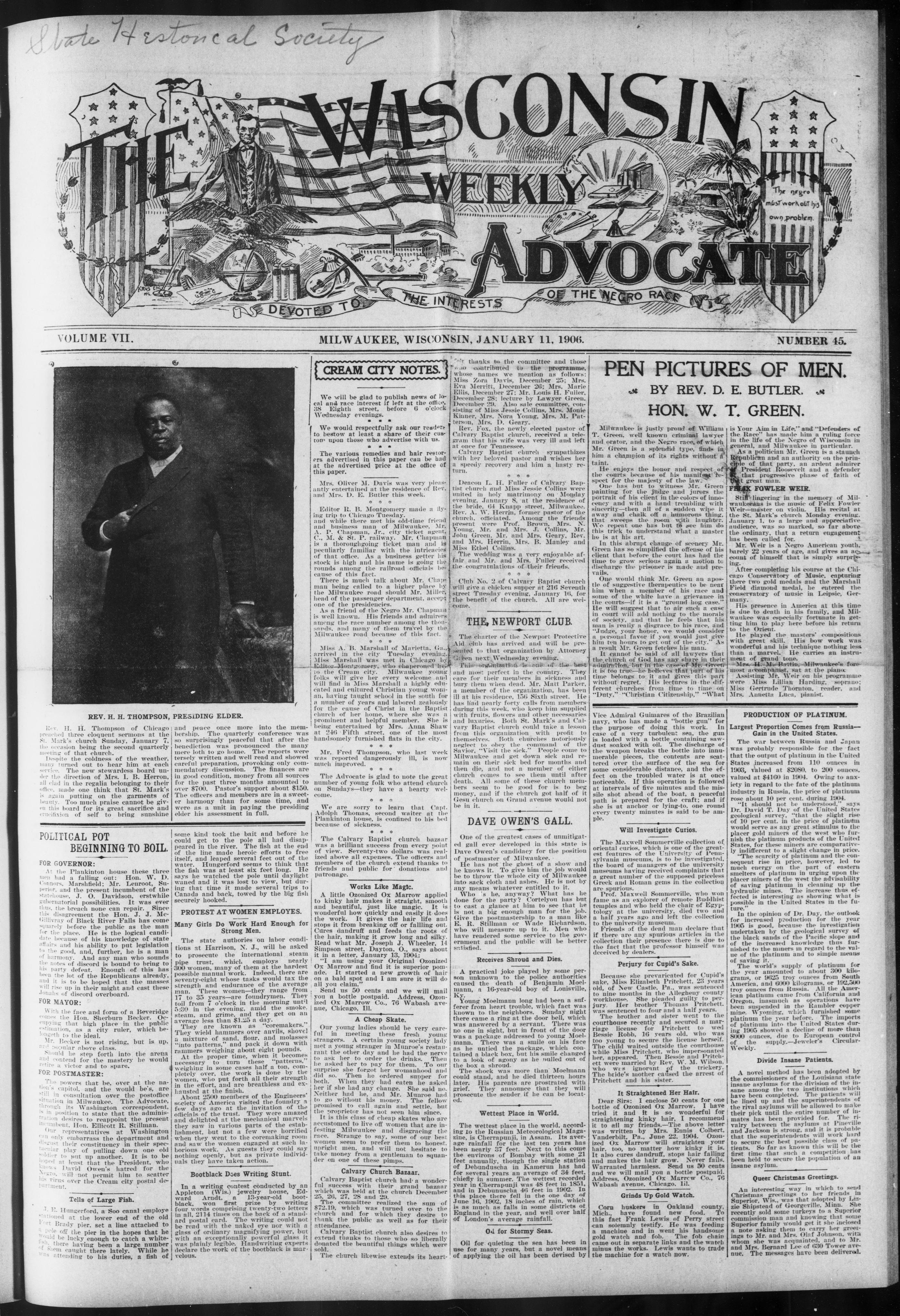
REV. H. H. THOMPSON, PRESIDING ELDER.
Rev. H. H. Thompson of Chicago preached three eloquent sermons at the St. Mark's church Sunday, January 7, the occasion being the second quarterly meeting of that church.
Despite the coldness of the weather, many turned out to hear him at each service. The new stewardess board under the direction of Mrs. I. B. Herron, all clad in the regalia belonging to their office, made one think that St. Mark's is again putting on the garments of beauty. Too much praise cannot be given this board for its great sacrifice and crucifixion of self to bring sunshine and peace once more membership. The quartet so surprisingly peace-benediction was pro mere loth to go home tersely written and we careful preparation, a mandatory discussion in good condition, most for the past three months over $700. Pastor's The officers and member harmony than few were as a unit in p elder his assessment.
POLITICAL POT
BEGINNING TO BOIL
At the Plankinton house these three men had a falling out: Hon. W. D. Connors, Marshfield; Mr. Lenroot, Superior, and the present incumbent of the statehouse, J. O. Davidson, erstwhile gubernatorial possibilities. It was ever thus, the breach none can repair. Since this disagreement the Hon. J. J. McGillivray of Black River Falls has come squarely before the public as the man for the place. He is the logical candidate because of his knowledge of state affairs and his ability to put legislation to the good, and, further, he is a man of harmony. And any man who sounds the notes of discord is bound to bring to his party defeat. Enough of this has been the lot of the Republicans already, and it is to be hoped that the masses will rise up in their might and cast these Jonahs of discord overboard.
With the face and form of a Beveridge comes the Hon. Sherburn Becker. Occupying that high place in the public estimation, as a city ruler, which belongeth to the ideal.
Mr. Becker is not rising, but is up, and popular above class.
Should he step forth into the arena and contend for the mastery he would retire a victor and to spare.
FOR POSTMASTER:
The powers that be, over at the nation's capitol, and the would be's, are still in consultation over the postoffice situation in Milwaukee. The Advocate, through its Washington correspondent, is in position to state that the administration desires to reappoint the present incumbent Hon. Elliott R. Stillman.
Our representatives at Washington can only embarrass the department and disgust their constituency in their spectacular play of pulling down one old soldier to put up another. It is to be hoped at least that the President, who knows David Owen's hatred for the Negro, will not permit him to scatter his virus over the Cream city postal department.
Tells of Large Fish.
J. E. Hungerford, a Soo canal employee stationed at the lower end of the old Fort Brady pier. set a line attached to a pole off the pier in the hopes that he would be lucky enough to catch a whitefish, there having been a large number of them caught there lately. While he was attending to his duties, a fish of
FOR GOVERNOR:
FOR MAYOR:
and peace once more into the membership. The quarterly conference was so surprisingly peaceful that after the benediction was pronounced the many mere loth to go home. The reports were tersely written and well read and showed careful preparation, provoking only commendatory discussion. The finances are in good condition, money from all sources for the past three months amounted to over $700. Pastor's support about $150. The officers and members are in a sweeter harmony than for some time, and were as a unit in paying the presiding elder his assessment in full.
some kind took the bait and before he could get to the pole all had disappeared in the river. The fish at the end of the line made heroic efforts to free itself, and leaped several feet out of the water. Hungerford seems to think that the fish was at least six feet long. He says he watched the pole until daylight waned and it was lost to view, but during that time it made several trips to Canada and back, towed by the big fish securely hooked.
PROTEST AT WOMEN EMPLOYES.
Many Girls Do Work Hard Enough for Strong Men.
The state authorities on labor conditions at Harrison, N. J., will be asked to prosecute the international steam pipe trust, which employs nearly 300 women, many of them at the hardest possible manual work. Indeed, there are seventy-eight whose tasks would tax the strength and endurance of the average man. These women—they range from 17 to 35 years—are foundrymen. They toil from 7 o'clock in the morning until 5:30 in the evening, amid the smoke, steam, and grime, and they get on an average less than $1.25 a day. They are known as "coremakers." They wield hammers over anvils, shovel a mixture of sand, flour, and molasses "into patterns," and pack it down with rammers weighing about eight pounds.
At the proper time, when it becomes necessary to turn these "patterns," weighing in some cases half a ton, completely over, the work is done by the women, who put forth all their strength in the effort, and are breathless and exhausted at the finish. About 2500 members of the Engineers' society of America visited the foundry a few days ago at the invitation of the officials of the trust. They were amazed and delighted at the mechanical marvels they saw in various parts of the establishment, but not a few were horrified when they went to the coremaking room and saw the women engaged at such laborious work. As guests they could say nothing openly, but as private individuals they have taken action.
Bootblack Does Writing Stunt.
In a writing contest conducted by an Appleton (Wis.) jewelry house, Edward Arndt. a 13-year-old bootblack, won first prize by writing four words comprising twenty-two letters in all, 2114 times on the back of a standard postal card. The writing could not be read with the naked eye nor with a glass of ordinary magnifying power, but with an exceptionally powerful glass it was plainly legible. Handwriting experts declare the work of the bootblack is marvelous.
CREAM CITY NOTES.
We will be glad to publish news of local and race interest if left at the office, 38 Eighth street, before 6 o'clock Wednesday evenings.
We would respectfully ask our readers to bestow at least a share of their custom upon those who advertise with us.
The various remedies and hair restorers advertised in this paper can be had at the advertised price at the office of this paper.
Mrs. Oliver M. Davis was very pleasantly entertained at the residence of Rev. and Mrs. D. E. Butler this week.
Editor R. B. Montgomery made a flying trip to Chicago Tuesday.
ing trip to Chicago Tuesday. and while there met his old-time friend and business man of Milwaukee, Mr. A. P. Chapman, Jr., city ticket agent, C., M. & St. P. railway. Mr. Chapman is a thoroughgoing ticket man and is peculiarly familiar with the intricacies of that office. As a business getter his stock is high and his name is going the rounds among the railroad officials because of this fact. There is much talk about Mr. Chapman being called to a higher place by the Milwaukee road should Mr. Miller, head of the passenger department, accept one of the presidencies. As a friend of the Negro Mr. Chapman is well known. His friends and admirers among the race number among the thousands, and many of them travel by the Milwaukee road because of this fact.
Miss A. B. Marshall of Marietta, Ga., arrived in the city Tuesday evening. Miss Marshall was met in Chicago by Editor Montgomery, who chaperoned her to the Cream city. Milwaukee young folks will give her every welcome and will find in Miss Marshall a highly educated and cultured Christian young woman, having taught school in the south for a number of years and labored zealously for the cause of Christ in the Baptist church of her home, where she was a prominent and helpful member. She is being entertained by Mrs. Anna Shaw at 246 Fifth street, one of the most handsomely furnished flats in the city.
Mr. Fred Thompson, who last week was reported dangerously ill, is now much improved.
The Advocate is glad to note the great number of young folk who attend church on Sundays—they have a hearty welcome.
* * *
We are sorry to learn that Capt. Adolph Thomas, second waiter at the Plankinton house, is confined to his bed because of sickness.
\* \* \*
The Calvary Baptist church bazaar was a brilliant success from every point of view. Seventy-two dollars was realized above all expenses. The officers and members of the church extend thanks to friends and public for donations and patronage.
Works Like Magic.
A little Ozonized Ox Marrow applied to kinky hair makes it straight, smooth and beautiful, just like magic. It is wonderful how quickly and easily it does the work. It gives the hair life and stops it from breaking off or falling out. Cures dandruff and feeds the roots of the hair, making it grow long and silky. Read what Mr. Joseph J. Wheeler, 14 Simpson street, Dayton, O., says about it in a letter, January 13, 1904:
"I am using your Original Ozonized Ox Marrow and find it is superior pomade. It started a new growth of hair on a bald spot and I am sure it will do all you claim."
Send us 50 cents and we will mail you a bottle postpaid. Address, Ozonized Ox Marrow Co., 76 Wabash avenue, Chicago, Ill.
A Cheap Skate.
Our young ladies should be very careful in meeting these fresh young strangers. A certain young society lady met a young stranger in Munroe's restaurant the other day and he had the nerve to ask her to order the drinks. Then he asked her to pay for them. To our surprise she forgot her womanhood and did so. Then he ordered supper for both. When they had eaten he asked her if she had any change. She said no. Neither had he, and Mr. Munroe had to go without his money. The fellow promised to call again and settle, but the proprietor has not seen him since.
It is this class of cheap skates who are accustomed to live off women that are infesting Milwaukee and disgracing the race. Strange to say, some of our best women seem to prefer them to honest, upright men, and will not hesitate to take money from a gentleman to squander on one of these pimps.
Calvary Church Bazaar
Calvary Baptist church had a wonderful success with their grand bazaar which was held at the church December 25, 26, 27, 28 and 29.
The committee realized the sum of $72.19, which was turned over to the church and for which they desire to thank the public as well as for their attendance.
Calvary Baptist church also desires to extend thanks to those who so liberally donated the beautiful things which were sold.
The church likewise extends its heart-
thanks to the committee and those who contributed to the programme, whose names we mention as follows: Miss Zora Davis, December 25; Mrs. Eva Merritt, December 26; Mrs. Marie Ellis, December 27; Mr. Louis H. Fuller, December 28; lecture by Lawyer Green, December 29. Also sale committee, consisting of Miss Jessie Collins, Mrs. Monie Kinner, Mrs. Nora Young, Mrs. M. Patterson, Mrs. D. Geary. Rev. Fox, the newly elected pastor of Calvary Baptist church, received a telegram that his wife was very ill and left at once for Tennessee. Calvary Baptist church sympathizes with her beloved pastor and wishes her a speedy recovery and him a hasty return.
☆ ☆ ☆
Deacon L. H. Fuller of Calvary Baptist church and Miss Jessie Collins were united in holy matrimony on Monday evening, January 8, at the residence of the bride, 64 Knapp street, Milwaukee. Rev. A. W. Herrin, former pastor of the church, officiated. Among the friends present were Prof. Brown, Mrs. N. Young, Mr. and Mrs. J. Collins, Mr. John Green, Mr. and Mrs. Geary, Rev. and Mrs. Herrin, Mrs. B. Manley and Miss Ethel Collins.
The wedding was a very enjoyable affair and Mr. and Mrs. Fuller received the congratulations of their friends.
Club No. 2 of Calvary Baptist church will give a chicken supper at 216 Seventh street Tuesday evening, January 16, for the benefit of the church. All are welcome.
THE, NEWPORT CLUB
The charter of the Newport Protective Aid club has arrived and will be presented to that organization by Attorney Green next Wednesday evening.
This organization is one of the best and most perfect in the country. They care for their members in sickness and bury them when dead. Mr. Matt Parker, a member of the organization, has been ill at his residence, 156 Sixth street. He has laid nearly forty calls from members during this week, who keep him supplied with fruits, flowers and other necessaries and luxuries. Both St. Mark's and Calvary Baptist church could take a lesson from this organization with profit to themselves. Both churches notoriously neglect to obey the command of the Savior, "Visit the sick." People come to Milwaukee and get down sick and remain on their sick bed for months and then die, and not a member of either church comes to see them until after death. All some of these church members seem to be good for is to beg money, and if the church got half of it Gesu church on Grand avenue would not be in it.
DAVE OWEN'S GALL.
One of the greatest cases of unmitigated gall ever developed in this state is Dave Owen's candidacy for the position of postmaster of Milwaukee.
He has not the ghost of a show and he knows it. To give him the job would be to throw the whole city of Milwaukee into sack cloth and ashes. He is not by any means whatever entitled to it.
Who is he, anyway? What has he done for the party? Cortelyou has but to cast a glance at him to see that he is not a big enough man for the job. Give the postmastership to a man like E. R. Stillman or Wade Richardson, who will measure up to it. Men who have rendered some service to the government and the public will be better satisfied.
Receives Shroud and Dies
A practical joke played by some person unknown to the police authorities caused the death of Benjamin Moelmann, a 16-year-old boy of Louisville, Ky.
Young Moelmann long had been a sufferer from heart trouble, which fact was known to the neighbors. Sunday night there came a ring at the door bell, which was answered by a servant. There was no one in sight, but in front of the door was a package addressed to young Moelmann. There was a smile on his face as he untied the package, which contained a black box, but his smile changed to a look of agony as he pulled out of the box a shroud.
The shock was more than Moelmann could stand, and he died thirteen hours later. His parents are prostrated with grief. They announce that they will prosecute the sender if he can be located
Wettest Place in World
The wettest place in the world, according to the Russian Meteorological Magazine, is Cherrapunji, in Assam. Its average rainfall for the last ten years has been nearly 37 feet. Next to this come the environs of Bombay with some 21 feet annually, though the single station of Debunduscha in Kamerun has had for several years an average of 34 feet, chiefly in summer. The wettest recorded year in Cherrapunji was 48 feet in 1851, and in Debunuscha 46 feet in 1902. In this place there fell in the one day of June 16, 1902, 18 inches of rain, which is as much as falls in some districts of England in the year, and well over half of London's average rainfall.
Oal for Stormy Seas.
Oil for quieting the sea has been in use for many years, but a novel means of applying the oil has been devised by
PEN PICTURES OF MEN. BY REV. D. E. BUTLER. HON. W. T. GREEN.
Milwaukee is justly proud of William T. Green, well known criminal lawyer and orator, and the Negro race, of which Mr. Green is a splendid type, finds in him a champion of its rights without a taint.
He enjoys the honor and respect of the courts because of his manifest respect for the majesty of the law.
One has but to witness Mr. Green painting for the judge and jurors the portrait of his client in the colors of innocency and with a hand trembling with sincerity—then all of a sudden wipe it away and chalk off a humorous thing, that sweeps the room with laughter.
We repeat one has but to see him do this trick to understand what a master he is at his art.
In this abrupt change of scenery Mr. Green has so simplified the offense of his client that before the court has had the time to grow serious again a motion to discharge the prisoner is made and prevails.
One would think Mr. Green an apostle of suggestive therapeutics to be near him when a member of his race and some of the white have a grievance in the courts—if it is a "ground hog case." He will suggest that to air such a case in court will add nothing to the morals of society, and that he feels that his man is really a disgrace to his race, and "Judge, your honor, we would consider a personal favor if you would just give him ten hours to get out of the city." As a result Mr. Green fetches his man.
It cannot be said of all lawyers that the church of God has any share in their administration, but in the case of Mr. Green it is too true—he believes that part of his time belongs to it and gives this part without regret. His lectures in the different churches from time to time on "Duty," "Christian Citizenship," "What
Vice Admiral Guimares of the Brazilian navy, who has made a "bottle gun" for the purpose of doing this work. In case of a very turbulent sea, the gun is loaded with a bottle containing sawdust soaked with oil. The discharge of the weapon breaks the bottle into innumerable pieces, the contents are scattered over the surface of the sea for some considerable distance, and the effect on the troubled water is at once noticeable. If this operation is followed at intervals of five minutes, and the missile shot ahead of the boat, a peaceful path is prepared for the craft; and if she is at anchor or lying-to, one round every twenty minutes is said to be ample.
Will Investigate Curios
The Maxwell Sommerville collection of oriental curios, which is one of the greatest features of the University of Pennsylvania museums, is to be investigated, the board of managers of the university museums having received complaints that a great number of the supposed priceless Greek and Roman gems in the collection are spurious.
Prof. Maxwell Sommerville, who won fame as an explorer of remote Buddhist temples and who held the chair of Egyptology at the university, died two and a half years ago and left the collection to the university museum.
Friends of the dead man declare that if there are any spurious articles in the collection their presence there is due to the fact that the professor himself was deceived by dealers.
Perjury for Cupid's Sake.
Because she prevaricated for Cupid's sake, Miss Elizabeth Pritchett, 23 years old, of New Castle, Pa., was sentenced to nine months in the Allegheny county workhouse. She pleaded guilty to perjury. Her brother Thomas Pritchett, was sentenced to four and a half years. The brother and sister went to the courthouse recently and secured a marriage license for Pritchett to wed Bessie Robb, 16 years old, who was too young to secure the license herself. The child waited outside the courthouse while Miss Pritchett, who impersonated her, appeared. Then Bessie and Pritchett were married by Rev. W. M. Wilson, who was ignorant of the trickery. The bride's mother caused the arrest of Pritchett and his sister.
It Straightened Her Hair.
Dear Sirs: I enclose 50 cents for one bottle of Ozonized Ox Marrow. I have tried it and it is so wonderful for straightening kinky hair, I recommend it to all my friends.—The above letter was written by Mrs. Ennis Colbert, Vanderbilt, Pa., June 22, 1904. Ozonized Ox Marrow will straighten your hair, too, no matter how kinky it is. It also cures dandruff, stops hair falling and makes the hair grow. Never fails. Warranted harmless. Send us 50 cents and we will mail you a bottle postpaid. Address, Ozonized Ox Marrow Co., 76 Wabash avenue, Chicago, IL.
Grinds Up Gold Watch.
Corn huskers in Oakland county, Mich., have found new food. To this fact Frank Lewis of Perry street can solemnly testify. He was feeding a machine and in went his handsome gold watch and fob. The fob chain came out in separate links and the watch minus the works. Lewis wants to trade the machine for a watch now.
NUMBER 45.
is Your Aim in Life," and "Defenders of the Race" has made him a ruling force in the life of the Negro of Wisconsin in general, and Milwaukee in particular. As a politician Mr. Green is a staunch Republican and an authority on the principle of that party, an ardent admirer of President Roosevelt and a defender of that progressive phase of faith of that great man.
FELIX FOWLER WEIR.
Still lingering in the memory of Milwaukeeans is the music of Felix Fowler Weir—master on violin. His recital at the St. Mark's church Monday evening. January 1, to a large and appreciative audience, was so marked, so far above the ordinary, that a return engagement has been called for. Mr. Weir is a Negro American youth, barely 22 years of age, and gives an account of himself that is simply surprising. After completing his course at the Chicago Conservatory of Music, capturing there two gold medals and the Marshall Field diamond medal, he entered the conservatory of music in Leipsic, Germany.
His presence in America at this time is due to death in his family, and Milwaukee was especially fortunate in getting him to play here before his return to the Orient.
He played the masters' compositions with great skill. His bow work was wonderful and his technique nothing less than a marvel. He carries an instrument of grand tone.
Mrs. H. M. Battin, Milwaukee's foremost accompanist, sat at the piano. Assisting Mr. Weir on his programme were Miss Lillian Harding, soprano; Miss Gertrude Thornton, reader, and Mrs. Annetta Luca, pianist.
PRODUCTION OF PLATINUM.
Largest Proportion Comes from Russia Gain in the United States. The war between Russia and Japan was probably responsible for the fact that the output of platinum in the United States increased from 110 ounces in 1903, valued at $2080, to 200 ounces, valued at $4160 in 1904. Owing to anxiety in regard to the fate of the platinum industry in Russia, the price of platinum rose about 10 per cent, during 1904.
"It should not be understood," says Dr. David T. Day of the United States geological survey, "that the slight rise of 10 per cent. in the price of platinum would serve as any great stimulus to the placer gold miners of the west who furnish the platinum products of the United States, for these miners are comparatively indifferent to a slight change in price. "The scarcity of platinum and the consequent rise in price, however, led to much energy on the part of eastern smelters of platinum in urging upon the placer miners of the west the advisability of saving platinum in cleaning up the hydraulic mines. The increase thus effected is interesting as showing what is possible in the United States in the future."
In the opinion of Dr. Day, the outlook for increased production for the year 1905 is good, because the investigation undertaken by the geological survey of the black sands of the Pacific slope and of the increased knowledge thus furnished to the miners in regard to the value of the platinum and to simple means of saving it.
The world's supply of platinum for the year amounted to about 300 kilograms, or 9625 troy ounces from South America, and 6000 kilograms, or 192,500 troy ounces from Russia. All the American platinum came from California and Oregon, inasmuch as operations have been suspended in the Rambler copper mine. Wyoming, which furnished some platinum the year before. The imports of platinum into the United States during 1905 showed a decline of more than 8000 ounces, due to European control of the supply.-Jeweler's Circular-Weekly.
Divide Insane Patients.
A novel method has been adopted by the commissioners of the Louisiana state insane asylums for the division of the insane among the two institutions which have been completed. The patients will be lined up and the superintendents of the rival asylums will be allowed to make their pick until the entire number of inmates has been provided for. The rivalry between the asylums at Pineville and Jackson is strong, and it is probable that the superintendents will work hard to secure the best possible class of patients. So far as known this will be the first time that such a competition has been held to secure the population of an insane asylum.
Queer Christmas Greetings.
An interesting way in which to send Christmas greetings to her friends in Superior, Wis., was that adopted by Lizzie Shipstead of Georgeville, Minn. She recently sold some turkeys to a Superior commission man and knowing that some Superior family would get it she inclosed a note asking them to carry her greetings to Mr. and Mrs. Olaf Johnson, with whom she was acquainted, and to Mr. and Mrs. Bernard Lee of 630 Tower avenue. The messages have been delivered.
HYPNOTIC TRANCE IS FAKE.
Man Buried for Days Has Food, Drink
and Air.
George Hausman, who attracted much
attention in St. Louis by allowing him-
self to be buried a week at a time on
several occasions, supposedly under the
influence of a hypnotic trance, is in Four
Courts hold-over on the charge of steal-
ing. The method by which Hausman
was able to delude hundreds of specta-
tors into the belief that he was in a
trance and remained in the coffin a_ week
without food, was exposed by him at
Four Courts. The coffin was padded so
as to make it a comfortable resting place
and was unusually large. At the head of
the grave a 7-inch tube was - so
that the spectators could see the face of
the supposedly tranced man. At the bot-
tom of this tube was a plate of glass
which from above appeared to be part
of the lid of the coffin and to fit closely
against the bottom of the tube, but
which in reality, Hausman says, was
held in a wire loop strung across the box
jnclosing the coffin, and hung half an
inch from the bottom of the tube, so as
to allow the pen man abundance
of air. 2 te of glass could be
slipped out of the loop at will. At night.
Hausman says, food and drink would be
brought to him when no outsider could
see, and lowered to him through the
tube. With abundance of air and plenty
to eat and drink, Hausman says, there
was no especial danger in the “fake.” al-
though it was uncomfortable and re-
quired endurance.
A New Being.
Shepard, IL, Jan. 8th (Special)—
Mrs. Sarah E. Rowe, who is residing
here, says she feels like “A New Be-
ing,” although she is in her fifty-sev-
enth year. Why? Because she has
taken Dodd's Kidney Pills, that well
known medicine that has put new life
into old bodies, and has come as a
God-send into homes of sorrow and
suffering. She says:
“No one knows what awful torture
I suffered with Rheumatism and Kid-
ney Tronble, until I got cured by
Dodd's Kidney Pills. This grand
remedy drove the Rheumatism out of
my body, nothing else ever did me
any good. Dodd's Kidney Pills are
worth one hundred times their price,
for they have made me, though I am
fifty-seven years old, a new being.
I am in better shape now than I have
been for many years and I owe it all
to Dodd's Kidney Pills.”
ee
« Cupid and Science Unite.
Cupid and science forced a partnershi
in the case of Miss Harriet A.“ Boyd.
America’s leading woman archaoligist,
and Prof. Charles E. Hawes, Cambridge
university, England, also a famous au-
thority on the same subject. They will
‘be*harried at Haverford next March.
Miss Harriet A. Boyd will soon give uj
the chair of archaology at Smith's oe
lege, New York. She has announced her
engagement to her famiiy and friends.
The circumstances of Miss Boyd's court-
ship were romantic and in keeping with
her remarkable career of travel and ex-
oration. On the island of Crete she
Erst met Prof. Hawes last summer. To
ther they pursued their excavations in
fried prehistoric cities. Between them
they discovered love. In August, how-
ever, Miss Boyd went to London to study
at the British museum, and Prof. Hawes
renewed his wooing. Just before Miss
Boyd sailed for this country their en-
gagement was announced to the sci-
entist’s friends. It was arranged that he
come to Ameriea in March, when the
wedding will take place.
eee
Pavors Tuberculous Marriace.
‘The marriage of the tuberculous is per-
haps frowned upon by all physicians, the
majority of whom would no doubt adyo-
eate the prohibition of such unions. It is
considerable of a surprise, then, to learn
that Dr. Charles Valentino of Paris has
declared that these marricges are de-
sirable. He bases his opinion upon the
well-known fact that the disease itself is
rarely if ever transmitted, and that there
is an immunity possessed by many of the
offspring of the tuberculous. He shows
that though this infection is more fre-
quent about the age of 20, its appearance
in those of tuberculous parentage, if they
acquire it at_all, is somewhere between
35 and 50. He acknowledges that where
one partner alone is infected the other is
contaminated in 16 per cent. of the cases.
and that this infant mortality is quite
high, particularly where both parents are
tuberculous, but he thinks that these dis-
advantages are far outweighted by the
advantage of breeding up a race of im-
munes.—American Medicine.
sage
Proper Length of a Sermon.
To achieve best results, about how long:
should the preacher's sermon be? There;
can be not set rule, of course, since the
men and the subject much necessarily’
play important parts in determining the,
length of the discourse. A learned and!
eloquent man with a good subject may’
talk entertainingly for an hour or more.
but on the average, which is the more
effective, the short sermon or the long
one? Mr. Gladstone used to counsel
young curates to limit their discourses
to twenty minutes. Bishop Potter re-
peats the advice. Coming from twe such
authorities it must be good. A_ great!
deal can be said in that space of time,
provided one has really something to say.
—Savannah (Ga.) News.
ee oo
INCIPIENT CONSUMPTION.
Disease.
The happy wife of a good old-fash-
loned Michigan farmer says:
“In the spring of 1902 I was taken
sick—a general breaking down, as
it were. I was excessively nervous,
could not sleep well at night, my food
seemed to ¢o me no good, and I was
so weak I could scarcely walk across
the room.
“The doctor said my condition was
due to overwork and close confinement
and that he very much feared that con-
sumption would set in. For several
months I took one kind of medicine af-
ter another, but with no good effect—
in fact, I seemed to grow worse.
“Then I determined to quit all medi-
cines, give up coffee and see what
Grape-Nuts food would do for me. 1!
began to eat Grape-Nuts with sugar
and eream and bread and butter three
times a day.
“The effect was surprising! I began
to gain fiesh and strength forthwith,
my nerves quieted down and grew nor-
mally steady and sound, sweet sleep
came back to me. In six weeks’ time
I discharged the hired girl and com-
menced to do my own housework for
a family of six. This was two years
ago, and I am doing it still, and enjoy
it.” Name given by Postum Co., Bat-
tle Creek, Mich.
There’s a reason. Read the little
‘book, “The Road to Wellville,” in pkgs.
ss Misceliane- us Items. es
—In Sonora, Mexico, alone, abcut
$40.000.000 of American money is Low
invested.
_ —Dr. E. A. Mears, an authority ou
ornithology. recently discovered several
new species on the summit of Apo, a
yoleanic mountain of the Island gt Min-
danao, in the ihilippine group.
—The Indians of Elko, Nev., lave
abandoned the dances of their forefa-
thers, have built a dance hall, and re-
cently gave a ball at which they and
their ws and many invited palefaces
‘waited in the most oe
<The new Italian postage stamps will
‘not bear the monareh’s head, but a va-
‘riety of different designs, such as the sex
under the rising sun, an Alpine fand-
seape, a ship at sea, a railway train.
the Italian arms, and a wireless tele-
graph siation.
—.he first Jewish services ever held in
British East Africa were heid on Yom
Kippur at the Masonie hall of Nairobi.
and resnifed in the formation of a con-
grezation. There are about thirty Jews
in the protectorace, most of them en-
gaged in dairy farming.
—An Englisi: company has been formed
to furnish a new soap wiieh makex
lanndry work with salt water possible.
Now ocean steamships will not have te
carry from 50,000 to 100,000 pieces of
bed ‘and table linen to last during the
entire veyaze. Washing can be done
aboard.
—A new type of bullet, known as the
“Dp.” is being served to the Freneh_ in-
fantry. This projectile consists of a
cigar-shaped cylinder of bronze, instead
of lead, and is cased with nickel. On be-
ing fired it revelves at the rate of 3600
turns a second during its flight. At S00
yards ‘it will penetrate the equivalent
bulk and resistance of six men, standing
one behind the other.
—A Johannesburg correspondent writes
as follows of the Chinese scare prevailing
im that South African city: “The white
workers in the mives carry revolvers:
the police are armed with bail cartridge
and bayonet: camped yonder at Auck-
land park is a mobile column of mounted
men ready to move against an enemy at
a moment's notice; the country folk on
the other side of the swelling rise are
armed to the teeth and five at night in
barricaded and fortified houses.”
—Probably the largest iog ever skidded
in Potter county was the one skidded by
W. 0. and E. R. Duell last Wednesday
at the head of Lyman run. The cirenm-
ference of the log at the butt was 12
feet and 3 inches: at the top end 11 feet
10 inches, and in length it measured 40
feet. It scaled 4203 feet. The tree was
the largest one ever heard of in this sec-
tion, and besides the log described the
following logs were taken from it: One
16 feet long, two 12 feet iong, one 1U
feet long.—Potter (Pa.) Enterprise.
Tapeworms Make Pearis.
Prof. Herdman’s recent investigations
on the subject of pearl formation have
yielded some interesting conclusions. In
the great majority of cases it appears
that the pearl is due to the presence in
the oyster of a marine tapeworm. When
the spherical larva of the worm dies
nacreous matter is deposited around it.
and the resulting mass is known as a
pearl. The life history of the tapeworm
is continued in the bodies of certain
species of file fish which prey on the
oysters. These file fish, again. are de-
voured by fish-eating rays or sharks.
In these latter the tapeworm becomes
mature and sets free numerous embryos
into the sea. These finally enter the
oysters, and so complete the life cycle.
The small so-called “seed” pearis are
caused by the deposition of nacreous
matter round small crystals formed in
certain muscles of the oyster. Perhaps
the most important result of Prof. Herd-
man’s werk from the scientific stand-
point is the establishment of a marine
biological station at Galle for further
research.—London Globe.
a >_
Culinarv Art Aids Health.
The Russian physiologist Pavlov has
clearly demonstrated, in his researches
on digestion. that the ingestion of sub-
stanees with a purely nutrient value does
not sufficiently satisfy the demands of
the body—taste and appetite must also
be taken into consideration. These are
satisfied only by the addition to the food
of spices and salt, and it is largeiy due
to the influence of these condiments that
the proper amount of gastric juice is lib-
erated by the mucous membrane of the
stomach. The action upon the stomach
of reflex stimuli is shown by the favor-
able effect on the flow of the gastrie se-
cretions made by mental impressions in-
duced by the mere sight and odor of a
well prepared dish.
In this manner Epplen leads up to the
broad ¢laim that the proper preparation
of all food, as demanded by the essen-
tial requirements of the culinary: art, is
not a Inxury, but a physiological neces-
sity, and to develop and disseminate this
knowledge is an act beneficial to the pub-
lic welfare-——New York Medical Record.
es .
Queer Baggage.
“The railroads of the United States
are yery particular as to what they will
accept for transportation as baggage,”
remarked Kar! E. Kneiss of the Mil-
wankee road, “but down in Guatemala
the railroads are not so particular.
While I was down there some time ago
I made a list of different articles of
merchandise that I saw checked as bag-
gage on the Western of Guatemala at
the town of Retalhuleu. Here. it is:
One cage of chickens, a basket of ducks,
a bundle of dried fish, a crate of live
iguanas, various empty baskets. a crate
of fighting cocks, baskets of eggs, bask-
ets of fruit. silver in sacks, a bundle of
soiled clothes that some woman was
taking down to the river to wash, furnt-
ture, hides in packages, smoked crabs
that smelled to the next station, baskets
of bread. a small alligator and two live
pigs. All of that miscellaneous merchan-
dise and farm preducts was bandied in
one ear along with the persoial bagzage
of passengers. as a result of which cns-
tom a traveler soon finds himself sstur-
ated with the complex odors of the coun-
try."—San Francisco Chronicle.
pevbouetensiMatantnniny
Valuable Stork Visits.
in the experience of George Cramer,
a substantial German farmer of Eldora,
Ia.. there is a moral for President Roose-
yelt and all others interested in prevent-
ing race suicide. Cramer was very poor
when he settled in Iowa. When his arst
hoy came he wrote to his father, inferi-
ing him. of the event and remarking that
while he was proud of the little fellow
he could searcely afferd the luxury of a
baby at that time. In reply his father
mailed a check for $1000, and promised
to duplicate the gift every time the stork
should visit his son’s home. As a result
the sterk has been joyfully received at
Cramer's home no less than twelve times.
and $12,000, plus accrued interest and
earnings, repose in the bank here to
Cramer's account.
See oe pees
Superstitious Musician.
Sarasate, the great Spanish violinist,
has. like most musicians, a belief in
tolismans. His particular mascot is in
the form of a tiny replica in silver of the
famous Guarnerius violin on whieh
Paganini used to play. Sartasate would
not dare to play at a concert unless this
little violin were somewhere about his
person.
ON LITILE TRAVERSE BAY.»
The sparkle of the North was In the air
And never lake so live, or sky so fair
As wien I saw the little yachts at play
Upon the dancing waters of the bay.
They raced away, aud from the farther
shore
Whose hills rise green above Petoskey. bore
Beyond the Point; then paused, afraid to
brave
The menace of the great lake's larger wave.
They turned, thelr white sails leaning iu
the sun,
And homeward fled, and when the day was
done
They fired their little guns, and lay at rest,
Safe on the inner harber’s peaceful breast.
ee ee rose the storm's portentous
ize
Above the dark and melancholy surge;
The harbor’s warning light burned round
and red
Against the black night's thickly gathering
dread.
And then a schooner, old. and searred, and
slow.
Its heavy hell with Iumber Iaden low,
Went out into the lake, its sails unfurled,
To do the honest labor of the world.
—Brand Whitlock tu The Reader.
A LAPSE OF HQNOR.
| refused the seat offered.
| He was a small man with sionder
| limbs. His face was pale, and his eyes
j were large and looked dim and tired; his
| beard of a brownish hue and of uneven
| thickness allowed his sunken cheeks to
| be seen in places, and gave him ap air
lof complete debility. He was drossed
jin a dull black suit, which prolonged
juse had whitened at the elbows and
j along the seams. This garb, much too
| large, made him look still smaller, and
his hands, white and delicate as a child's,
were half hidden by the long sleeves.
“What can I do for you?” asked the
matistrate.
In a trembling and scareely audible
voice he answered: “I came to ask you
to put me under arrest, sir.”
| ‘The astonished officer was abont to
| Say something, but the doctor continued.
“Yes, sir, 1 mean what I say. 1 want
you to arrest me.” And, as if those
words had suddenly whipped his courage
to the proper pitch, with a quicker ac-
ition and firmer voice he spoke as fol
lows:
“You know that for the last two years
I have been located in this ward. I
think that during thet time under all
circumstances I have acted the part of a
good and honest man. Every time it
‘was necessary I have visited and at-
| tended the poor. I have never begrudsed
| my time and labor in that direction.
But what you don’t know is the exact
| situation in which I find myself at this
| moment, and which compels me to give
| yen my reasons for making the request
| whieh no doubt seems so strange to you.
|. “I was 14 when my father died. I was
left alone with my mother and without
any other resources than a few hundred-
frane notes which happened to be in
the house at the time. I could, and
should, have entered into an indestrial
career and have tried to learn some
trade in order to earn a living, but my
mother would not consent to my leaving
| college. I accordingly finished my course
‘of studies, and mechanically, and with-
| out consulting my inclinations, it was
decided that I should be a doctor be-
cause [ was the son of a doctor. At 25
1 found myself with a diploma in my
hands and not a cent in my pocket. It’s
all very nice to have a profession, but
one must have some employment in it.
However. I was not discouraged, and
after soliciting rigut and left | managed
to buy a few articles of furniture and
| get enough money to pay rent for a few
| months. It was then that I settled in
| your district. I was filled with illusions,
| and before the end of six months I was
foreed to change my views in regard to
many things. I had by that time used
lup all my resources and. the little 1
| earned went as fast as it came.
“Then began for my poor mother and
myself the horrible existence of those
who must conceal their poverty. _There
are trades in which one has no right to
be in want. I Jost two or three patients
because I sent my bills in too soon for
collection. What could I do? When for
two days we had had nothing but plain
bread to eat, and L knew that the rent
was due in a few days. I could not help
| thinking of these hundred frances which
| 1 had earned, and 1 asked for them.
| Yet in spite of all this I kept saying
}te myself, ‘Courage, old man: better
| days are coming.’
| “Alas! the longer this kept up the
| fewer patients came my way. Some-
| times. in order to give my mether a
| larger piece of bread I ea:ne home about
|2 or2 in the afternoon, pretending that
| L had breakfasted with a friend in town,
| And the debts inereased and increased!
| Ideas of suicide sometimes passed
throngh my brain, but even that cost too
j mutel for there were mornings when I
did net have five cents to buy eharcoa!
eneugh to kill myself. Courage and
strength have their limits, and I had
about reached them when one night the
door bell rang. One must have been an
expectant practitioner to understand the
joy of that night bell which makes you
leap ont of bed so quickly and willingly.
“I dressed in haste and was seon at
the bedside of the patient. His wife,
two children und the family | servant
were near him and seemed much
alarmed. He had been suddenly seized
with terrible pains, vomiting and fre-
quent fits of hiccough. I was not long
in deciding that it was a case of appen-
dicitis. I told his wite, and she asked
if an operation was necessary. The case
seemed to be so serious that, contrary
to the generally established rule of wan-
ing until the first crises had passed, I
answered *Yes.”
“Alarmed and trembling, she asked:
‘How soon?
“*As soon as possible. Tomorrow
early.”
“So far there had been nothing but
what was. perfectly legal in my conduct.
But I had hardly mentioned the neces-
sity of an operation when an iden
crossed my brain and it clung to me
with terrible tenacity.
“I looked around me for the first time
and noted the comfortable and almost
Inxurious appointments of the room. It
was the first time IT had been called to
a patient in such circumstances, and my
first intention, after mentioning the
necessity of an early operation, had been
to advise them to call a surgeon; but
the words were not spoken, for that
inner thought or idea made me refiect.
and I said to myself:
“*You fool! Why allow another to
profit by this windfall? You are going
to let another man earn perhaps 1000
franes, who, very likely does not need
it; and you, poor devil, you will have
10 franes for your night visit and that’s
— arr oe
_ “I hesitated and fought this imperi
inner voice. ‘But I will not know how:
TL might kill bim. I have not the right.’
_“The voice sareastically said: ‘Not the
right? Were you not given a diploma,
and what use is it to you? It does not
say, “You can do this and not do that.”
No, it gives you carte blanche. You
have only re conscience to guide yon,
and it is your conscience, who tells
you to go ahead. It is food. For two
days you have not eaten and your poor
old mother is starving. In two weeks
your landlord will put you both out in
the ae oa haat guaran voice
force’ wie to says N
“+1 will operate on the patient in the
“T itet have trembled in pronouncing
ny noun
these words, and if the family had made
the least objection I would have declined
at once. I will say that I hoped they
migh’ suggest an associate, but nothing
was <aid. I seemed to have inspired
‘confiience in these poor souls and they
fairiy delivered themselves into my
hands.
“When T got back to my office I sat
holdinz my head in’ my hands. It
seem: as though a thousand demons
were crinning at me, and the strugzle
between my better judgment and that
‘infernal voice was indescribable, and I
thous't—ne, it is madness. It is a
crime. You ean hardly dissect, and you
claim the right to take a knife and oper-
ate ou the living. No, no! just for mon-
ey you will not do this thing.
“But that rascally voice kept at it
and tantalized me with: ‘Yes, that’s it;
be a coward, timid, and call yourself a
doctcr.” It kept that up all night. and
when daylight appeared it had complete-
ly revolutionized my heart and reason,
and | felt that I would be a fool to
hesitate. sid not the parchment give
me the right? Did it not confer the
title of ‘doctor ef medicine’ and nothing
to prevent me from operating? I had
the right and I would use it.
“Then, feverish and nervous, I began
to consult hooks, like a lazy student who
hurries at his task just before examina-
tion. I read page after page. The
werds passed before my eyes without
leaving any trace of their meaning, just
as the trees disappear when you are in
a fast moving train. Iilustrations, titles.
everything flew, flew, and 1 was quite
upset.
_At 8 o'clock I took the few instru-
‘ments that IT had not pawned or sold,
some pincers, two bistouris, and every-
thing [ could find to make a show, and
started. I stopped on the way to ask a
comrade, still a student, to come and ad-
minister the chloroform, and we soon
reached our destination. I had regained
some assurauce during the prepzrations.
I made them hang white sheets ail
around the room to increase the light.
I covered a table with oileloth. I ster-
ilized my instruments as well as I could,
and I went through a lot of arrange
ments and changes simply to retard the
decisive act. At last I began.
_“At the first incision everything turned
about me. I lost my nerve at the sight
of a smail artery which was bleeding
and I could not seize it with my pincers.
All those things which seem so easy and
simple when done by others looked like
tremendous difficulties then. I cut, 1
pinched. I tied, without knowing precise-
ly what I was doing, and when my hand
first went into the gaping wound I lost
my head completely.
“I can see now that with a little more
coolness and self-possession I would have
mastered the thing, but remorse aud the
weight of mora! responsibility bad upset
me completely and my only wish was to
get sway and be done with it.
“My head was on fire, my back ached,
and I had acocmplished nothing but an
ugly-looking wound which I closed aud
stitched as closely as I could as if by
doing so I could hide my crime. After
the patient had been stretched on the
bed. the wife gave me an envelope. It
contained 10 notes of 100 franes. I had
a moment's joy, but only a moment's.
Immediately after that momentary joy
eame reality dragging remorse aiong, and
the voice which had been goading me all
through the night was now still. I now
know what that voice was. It was not
my conscience, as it had pretended, but
tHat thief and criminal who, in order to
t close to me, had assumed the role. It
Wis poverty—hideous poverty. Now that
€had done the wrong, It had jumped
outside of myself like a cat caught in
mischief and left me alone, all alone.
“My patient lived two days, and for
me they were days of torture and of
fright, as 1 watched every hour the prog-
ress of his terrible struggle with death.
I am convinced that had he been proper-
ly operated upon he would have been
saved.
“When everything was over not one
reproachful word came from those poor
people.
“Ah! if they had knewn! As fer me,
I could bold out no longer. I lave net
touched those thousand francs. They
would bern my fingers. I don’t want
them. You understand. Here they are;
take them.
“Although I keep saying to myself
that the law can do nothing to me, that
1 had the right to operate, yet I look
upon myself as a criminal.
“And those who liad made of me after
five years of study nothing buat a healer
and bone setter, and had given me the
right to take shelter behind a diploma
whieh lies, are criminals also. If there
are no laws against me and against
them. such laws should be enacted. You
must arrest me. I have killed in cold
blood. knowingly, and I cannot live with
that burden on my conscience and the
painful remorse which will haunt me al-
ways. Arrest me, sir.”
The Good Old-Fashioned Game.
Unele Hiram was bewailing the degen-
eracy of modern sports. “Look at base-
ball,” he said. ‘There ain't half the fuu
in it there was when I was a young man,
thirty years ago. Nowadays the fellers
with the bat don't seem to be able to do
anything with the ball. There's lots of
games when they don’t make a run. *
“I mind the time when I belonged to
the Fearnaughts, of Prairietown. There
was a club up in Heddingville that
thought they could beat us without haif
trying. They challenged us, and we took
‘em up. They come down one morning
with » whole carload of people from
Heddingville to see "em wipe us out.
“Weil, sir, we begun playing at 10
o'clock in. the forenoon. The game
wasnt finished at noon, and we quit for
dinner. At 2 o'clock in the afternoon
we went at it again, and mighty nigh
the whole town went out to the pasture
where we was playing to see the game.
“First one side would get ahead, and
then the other. Batting? You never saw
such batting in your life. There was
more than two dozen home runs. It was
close onto 5 o'clock when the last man
was put out. But we beat ‘em. We
took the conceit out of them fellers, and
they never chailenged as again.”
“But what was the score, Unele
Hiram?’ asked one of the listeners.
“Ninety-seven to eighty-nine,” proudly
answered Uncle Hiram; “and I made
fifteen of them runs myself. Think ot
that when you hear about a ‘one to
nothing’ game in fifteen innings! T tell
you, we could hit the ball in them days!”
__Exchange.
Poe’s Charm.
The British Weekly prints some inter-
esting reminiscences of a gentleman, now
living in Scotland, who in the middle of
the last century saw intimately a num-
per of our American literary celebrities.
Hawthorne’s reserve piqued him. ““Na-
ihaniel Hawthorne,” he complains, “had
pothing to sey to anybody I can remem-
ber. He was either proud or very difii-
dent.” Nor did Emerson fare muci: bat-
ter. “I never met Emerson.” he says.
“put once, and he did not impress me
favorably. He could be sarcastic, and
perhaps unpleasant, and some of his re-
juarks were very caustic.” Hawthorne
would shut up like an oyster in an un-
congenial atmosphere. The British gen-
jleman, whose chief claim to distinction
in his old age is that Hawthorne and
Emerson did not find his personality ex-
gaging, must have been an impossible
sort of a person. Emerson treated even
well known bores with a gentle serenity
that provoked his friends. But the
reminiscent gentleman himself throws
Rght on the occasion of the ouly recorded
instance of Emerson's being “sarcastic”
and “unpleasant.” He says:
“Poe was one of the most fascinatin<
men I have ever met. I always weni to
him with the utmost confidence. and 1
have most vivid recollections «f xoin«
and looking up into his face aud ple:4d-
ing. “Mr. Poe, will you oblize me by re-
citing “The Raven?”’ Never ouce did
he refuse, and many and many a time |
heard “The Raven’ declaimed by its au-
ther in a manner possible to the author
alone.”
Probably this ancient Briton. or Pict.
who found Emerson “unpleasant.” asked
him to recite in company “a few of his
more popular verses.” It is conceivable
that his response to a request that he re-
cite “Brahma” or the “Ode to Beauty”
misht even have been “canstic.~—Bul-
falo Couimercial.
Dataaptecesge se esi
FOUR-FOOTED POLICE.
Marvelous Work of Trained Dogs is
Ghent. Belcium.
That dogs make excellent detectives is
well known, but their use as actual meu
bers ef 2 police force is an odd aud in-
teresting experiment which W. (. Vitz-
gerald describes in his story. “Dog Po-
lice on Guard,” in the December Tech-
uical World Magazine.
“When the Ghent (Belgium) chief of
police had got his pach of ‘recruits’ to-
gether. ie Segan to train them to dis-
tngnish between skulking criminals and
the ordinary, reputable citizen, who
walks by day. Some very interesting
demonstrations and experiments were
tried by means of dummies, and it is a
fact that in a few weeks the more in-
telligent dogs had learned how te spring
upon and take hold of a man by his
counee without driving their teeth inte
him.
“Special kennels were then built in the
police stations, with the name of its oc-
cupant over the door of each. Coats,
collars_and muzzles were provided by
way of ‘uniform,’ and there were even
little boots provided for snowy weather.
A veterinary surgeon was appointed at
police headquarters to care for the dog
policemen when they were sick, and the
matron at each station was charged with
the duty of getting their meals ready
when each dog came off duty with his
two-legged fellow officer.”
Girl Manager of Big Ranch.
Miss Georgia Burns, formerly « Keu-
sas City girl, is the manager of the Ar-
row Heart cattle ranch, consisting of
some 11,000 acres in Beaver county, O.
T., thirty-five miles from the nearest
railroad, and has under ber control about
100.000 acres of proven oil and mineral
land in the Choctaw and Chickasaw na-
tions. Indian territory.
Miss Burns lives aione excepting for
ker ranch help and household heip. She
spends much of her time in the saddie.
She meunts a broncho and works as one
of her cowboys works, never taking ad-
vantage of being a woman to pass up
any kind of a difficult or dangerous task
that falls’ to her tor.
Miss Burns can ride, shoot and rope
cattle with the same dexterity and sii!
of which any of her cowboys ean beast.
Miss Buras is the youngest woman ranch
owner in the United States, and for
three years has held this distinction.
She entered upon a claim of 160 acres.
which was the nucleas of her extensive
holdings, when she was 18 years oid,
which age was necessary for her to
reach before being able to secure a pai-
ent from the government to a tract of
land.—Kansas City Journal.
A Natural Error.
A traveling man says ‘that he once
had occasion, while in Maryland, io
make a business call upon the proprietor
of a “general store” in a town on the
eastern shore. Now this proprietor was
known on all sides to be illiterate.
Nevertheless, he would never concede
the truth of the generai impression.
The traveling man says that when he
eniered the store, the proprietor was en-
gaged in a business conversation with a
customer, who, as he turned to go, said:
“Br the way, I believe [ owe you some
money, don’t J?"
“Just a minute,” answered the pro-
prietor, turning to a slate on the wail.
Reversing it, ne carefully scanned the
marks thereon. “You owe me for a
cheese,”’ he finally said.
“A cheese?” repeated the customer,
“Why. [haven't bought a cheese off you
for mouths. There musi be some mis-
take.”
The storekeeper gave a second glance
at the reverse side of the slate.
“That's so.” he exclaimed, with a
smile, “It was a grindstone. I didn't
see the dot over the ‘i in the middie.”—
Herper's Weekly.
———_.+—____.
Effective Doo Sleuths
The usefulness of the dog as a thicf
catcher is entertainingly described by W.
G. Fitz-Gerald, in his article, “Dog To-
lice on Guard,” in the Technical Weri
Magazine. as follows:
“The dogs are particularly useful to
the police at night, and save them an
enorinous amount of running backwards
and forwerds,
“Pickpockets and snatch-thieves in the
city of Gheut, if they have not altogether
disappeared, bid fair to do so, for these-
criminals know that no matter Low ficet
of foot they may be, the police dog is
still swifter: and ne matter how they
may try to turn and dodge down one
street and up another, the dog is not
only with them, but his sharp fangs arc
tearing throagh their clothing before
they ave gone many yards. If they
show fight, so much the worse for them,
since even the most correct and best-
behaved dog policeman is apt to forget
the strict letter of his duty when cuffed
by a criminal.”
a ee ae
How the “Devil” Got Fven
The late S. D. Farnsworth of the firm
of Goodale & Farnsworth, proprietors of
the Manchester (N. H.) American, in the
days before the war, was a unique swear-
er, and when perplexed or annoyed ex-
pressed his feelings freely in a choice
mixture of profanity and pure English,
utterly regardless of all rules of syntax
and prosody.
On one occasion, thoréughly aroused
by some performance for which the tit-
tle “devil” of the office was responsible,
Mr. Farnsworth “let out’ upon th-
youngster with some of the choicest
specimens of his manner of expression,
seemingly crushing him with the weight
of words.
After the explosion the boy looked up
at the tall man ana exclaimed:
“Huh! You are a good one, you are,
Been through college and can't swear
grammar.”—Boston Herald.
————
Learned by Dream of Relative’s Safety
in a dream the other night J. L.
Siegel of Walnut street saw the face
of his brother-in-law, 8. L. Halpin, who
has lived in Odessa, Russia, during the
recent riots in that city, which smiled
leasantly at him and indicated that he
Baa passed safely through the riots.
Upon arising yesterday morning, Mrs.
Siegel found 2 letter from her brother.
whom she had not heard from since the
beginning of the troubles in Russia, in
which he stated that no harm had be-
fallen kim or his family. The letter was
carefully worded and was very brief,
evidently having passed through the
hands of a censor before leaving the
city.—Des Moines Register and Leader.
YOU HAVE NO RIGHT TO
SUFFER
From Constipation, Bowel and Stom-
ach Trouble.
_ Q. What is the beginning of sickness?
_ A. Constipation.
Q What is Constipation?
A. Failure of the bowels to carry off
the waste matter which lies in the ali-
mentary canal where it decays and poi-
sons the entire system. Eventually the
results are death under the name of some
other disease. Note the deaths from
typhoid fever and appendicitis, stomach
and bowel trouble at the present time.
_ Q. What causes Constipation?
A. Neglect to respond to the call of na
ture promptly. Lack of exercise. Exces-
sive brain work. Mental emotion and
oe diet.
Q. What are the results of neglected
Constipation?
A. eee causes more suffering
than any ot! disease. It causes rheu-
matism, colds, fevers, stomach, bowel,
kidney, lung and heart troubles, ete. It
is the one disease that starts all others.
Indigestion, dyspepsia, diarrhoea, loss of
sleep and strength are its srmptoms—
piles, appendicitis and fistula are caused
by Constipation. Its consequences are
known to all physicians, but few suffer-
ers realize their condition until it is too
late. Women become confirmed invalids
as a result of Constipation.
Q. Do an recognize this?
A. Yes. The first question your doctor
asks you is “are you constipated?” That
is the secret.
Q. Can it be cured?
A. Yes, with proper treatment. The
common error is to resort to physics,
such as pills, salts, mineral water, castor
oil, injections, etc., every one of which
is injurious. They weaken and increase
the malady. You know this by your own
experience.
ow What then should be done to cure
A. Get a bottle of Mull's Grape Tonic
at once. Mull’s Grape Tonic will posi-
tively cure Constipation and Stomach
Trouble in the shortest space of time. No
other remedy has before been known to
cure Constipation positively and perma-
nently.
Q. What is Mull’s Grape Tonic?
A. It is a Compound with 40 per cent
of the juice of Concord Grapes. It ex-
erts a peculiar strengthening, healing in-
fluence upon the intestines, so that they
can do their work unaided. The process
is gradual, but sure: It is not a physic,
but it cures Constipation, Dysentery,
Stomach and Bowel Trouble. -Having a
rich, fruity grape flavor, it is pleasant to
take. As a tonic it is unequalled, insur-
ing the system against disease. It
strengthens and builds up waste tissue.
" 3 ‘Where can Mull’s Grape Tonic be
a
A. Your druggist sells it. The dollar
bottle contains nearly three times the 50-
cent size.
Good fer ailing children and nursing
mothers.
A free bottle to all who have never
used it because we know it will cure you.
FREE BOTTLE
your ¢ruggist's mame and 10e to pay postage and we will
ee eS ee ee have never used Mulls
Grape api will alse send you 5 certificate good for
$1.00 toward the purchase of more Tonic from your
draggist.
MULL’s Grape Toric Co.. 2i Third Ave.
Rock Island. IL
Give Full Address and Write Piainiy
‘35 cent, 50 cent and $1.00 bottles a emacs The
$1.00 bottle contains about six times as = athe
cent bottle and about three times as much as the & cent
Dottie. There ls « great saving in buying the $1.00 size.
The genuine has a date and namber
stamped on the label—take no other from
your druggist.
eee
Manufacture of Horseshoe Nails.
“There's philosophy in horseshoe nails,
and history, too,” remarked Doc Bellen-
gee, a traveling salesman, “For instance,
you hear that the automobile has put
the horse down. Well, listen to the
comment of facts.
“In 1894 twenty-seven tons of nails
for shoes were turned out daily for
American eee ‘That quantity
would shoe 200, horses a day. In
1904 the quantity had increased to for-
ty-one tons say showing that 280,000
horses were shod every twenty-
four hours. As a matter of fact, me-
chanical inventions have not decreased
the use of horses at all. Railway trains
haven't done it, street cars haven't, au-
tomobiles won’t. People travel more,
that’s all—Kansas City Times.
piece se
It Has Been Done.
“Now, in order to subtract,” explained
a teacher to a class in mathematics,
“things have to always be of the same
denomination. For instance, we couldn't
take three apples from four pears, nor
six horses from nine oe
A hand went - in the back part of
the room. “Teacher,” shouted a small
boy, “can’t you take four quarts of milk
from three cows ?’—Punch.
WOMEN WHO SUFFER
Dr. Williams’ Pink Pills the One
Remedy Particularly Suited For
_ To women who suffer Dr. Williams’
Pink Pills are worth their weight in
gold. At special periods a woman needs
medicine to regulate her blood supply or
her life will be a round of pain and suf-
| fering. Dr. Williams’ Pink Pills are
, absolutely the finest medicine that ever
& woman took. They actually make
new blood. They are good for men too
—but they are good in a special way
for women.
“It was three years ago last spring
that my health failed me,’’ says Mrs
Arthur Oonklin, of No. 5 peiisreter
street, Battle Oreek, Mich. ‘‘I suffered
. ez leucorrhea and other troubles
t, I presume, were caused by the
weakness it produced. I had sinking
spells, neryous headaches, was weak
and exhausted all the time and lookea
“like a walking skeleton.
| “My back and limbs would ache al-
most continually and there were days
when I was absolutely helpless from
sick headache. I tried one doctor after
another but cannot say that they helped
meat all. My liver was sluggish and
I was troubled some with constipation
“One day a physician who has now
retired from practice met my husband
on the street and inquired about my
health. He advised my husband to get
some of Dr. Williams’ Pink Pills for me,
said they were a good medicine, better
for my trouble than he could put up. I
tried them, improved steadily and soou
was entirely cured. As soon as the
: aoe was cured ey pomlaches
an Creng me os sree am entirely
well now but intend to continue to use
Dr. Williams’ Pink Pills as a spriug
tonic.””
| ioe semaine Dr. Williams’ Pink Pills
| are sol by sll droggiats and by the Dr.
| ey. pany, Scheneo
tady, N. ¥.
GOSSIP FOR THE LADIES.
4. Thanksgiving.
Ah, that was long ago, when I
Thanked God that all my days went by
In careless ease and mirth.
A Pharisee, I thanked Him then
That I knew not like other men
The bitterness of earth.
Ah, that was long ago. Today,
"Thank God for this my grief," I say,
facing by this alone
Theodosia Garrison in Harper's Bazar.
Plea Against Nagging.
"My dear child, do for pity's sake hold your shoulders back. I do declare! how often have I—"
"Oh, mamma—" and the rest of the response depends on the disposition and training of the child. It will either be a querulous retort, a sulky excuse, or, at most, a momentary straightening up and immediate relapse—never a spontaneous, willing response, never any lasting result.
This endless, weary nagging will never do more than arouse the antagonism of a child, or by its constant repetition cause her to mentally label "shoulders" as one of those things which someone is always fussing about, but to which one need pay no attention, says Health Culture Magazine. It will never convince her of the importance of holding herself up and it will never help her to do it. It will never strengthen her back and so enable her to sit up straight, unconsciously without a constant effort; nor will it even tell her how to make that effort, however willing she may be to try. On the contrary, this popular phrase, "Hold your shoulders back," only imparts a wrong idea, and the worst thing the child could do would be to try to follow out its instructions. The shoulders should be held down, and not back. To hold them back produces a strained, unnatural, stiff position which is almost impossible to maintain, and, moreover, it throws the head forward.
It is useless to tell a girl to hold herself up, and immediately follow the admonition by querulous criticism or unfavorable comparison with others. There may be a physical response in the muscles, but that can only be temporary, as neither the will nor the good will are behind it. A nervous child will be made irritable, a "contrary" child will be made more "contrary," and a shy, self-conscious child will be made sulky.
"How many times must I tell you?" is the constantly reiterated phrase; but what is the use of telling the same thing in the same way so many times? If the nineteenth time of telling has no effect, why should the twentieth have? The only thing is to find some other and more convincing way of presenting the subject.
As she walks down the street a girl will reflect, for all to read, the way in which she is treated at home, the position she holds there, and the light in which she is regarded by the others in it. Self-esteem comes hard to one who is always conscious that other people have a poor opinion of her; self-confidence seldom comes except through the confidence of others.
I have seen a little girl in school transformed in appearance and behavior by one word of praise from a teacher; a poor child, it was only accustomed to scolding and punishment, and on whom the unusual praise acted like a charm. The result of this was so quickly evident that it called forth more praise; and the charm continued, and the transformation became a permanency.
Another case I remember of a girl of really exceptional beauty, the appearance of whose superb form and striking face came near being spoilt by a shy, self-conscious awkwardness. Added to this her head, statuesque though it was, was always poked forward, and it was only spasmodically that she straightened her back. She was strong, and had had sufficient training to know how to hold herself correctly and to be able to do it, but she "just couldn't remember." After one particular event in her life she never needed to "remember." It was only a play that did it, an amateur play in which she took an important part; a splendid, stately part which only a superb and stately woman could fill; and she filled it with brilliant success. She was the superb and stately woman that evening and has been ever since. Neither was she the only one whose whole bearing was changed by that one evening's performance.
Have you ever seen men whose whole attitude and carriage has been altered by the chance remark of some woman? It is the power of an idea. But nagging is fatal.—Exchange.
The Cheerful.
Healthy Girl Is the Favorite.
I know a young woman who says she does not know what it is to have a "well" day.
If you ask her how she feels she invariably has a headache or indigestion or an attack of nervousness or some other ailment.
"I am a perfect martyr," she will tell you complacently. This may be so, but I notice that the "martyr" is always able to eat three hearty meals a day, says the Philadelphia Bulletin.
The truth is that most of her ailments are imaginary. She loves to pose as a semi-invalid.
The other day I overheard her telling a man how nervous and highly strung she was.
"Oh, you goose," I said to myself. "Can't you see what a mistake you are making in telling a man all this; his admiration for you is decreasing visibly?" The man in question had been paying her quite marked attention, but I very much doubt if he continues it after that conversation. No man wants to the himself down to a complaining invalid for life. He is not looking for a burden to shoulder, but a herpmate to walk cheerily beside him.
Some girls seem to think it rather elegant to be delicate and helpless.
Delicacy of constitution is a great misfortune, and as for the helpless girl she went out of fashion some years ago. There is no habit more easily acquired than the one of always having something the matter with you. Don't make a mountain out of every little molehill of an indisposition you may have. Keep your small ailments to yourself. If you whine over every little pain you will get no sympathy when some real pain attacks you. People grow weary of offering sympathy, especially when they know there is no genuine cause for it. Very often the real sufferers are the ones who make no complaint.
"It is bad enough," said one brave woman, "to know it myself, without bothering all my friends with my woes." The would-be invalids adopt such a doleful face and voice when you ask them how they are.
The fact is they thoroughly enjoy their pose and would not, for worlds, acknowl-
who are indeed accountable for the proper use of their opportunities. Every woman can make her town or village better. She ought to interest herself in civic affairs to make sure that her family receives a due return in service for the taxes it pays to the community. The town or village must be adequately policed for the protection of her daughter and the saving of her son from hurking evils. And there are sanitary conditions essential to health that must be jealously watched. Mrs. Sage says:
"Gambling is one of the inevitable comitants of idle, extravagant life. Not only is this due to the fascination of the game, but too often to the necessity of winning money to support such an existence. Here is an instance: A gentleman I know was invited to dine at a fashionable country house. After dinner he was about to leave for town, when the hostess invited him to a game of poker. He declined at first, but on her insistence finally acquiesced. Chips were handed about in stacks to the players, and the game proceeded. Finally, the gentleman referred to found it imperative to retire from the game, in order to catch the last train. The hostess followed him into the hail, and quietly informed him that he owed her for the chips with which she as banker had supplied him, and which he had lost in the game. He protested that he had had no idea that they were playing for actual money. The hostess rejoined that that was out of the question, as it was always understood that chips meant money. 'I'll give you my check now, or town,' said the gentleman. 'No,' said the hostess, 'you must pay up before you leave this house,' and, rather than make a scene, he called one of the gentlemen aside and borrowed the money to make good his losses."
Laundry Irons.
The most convenient iron is heated by a cord connection with electricity or by a tubing attached to a gas jet, but the large majority of home laundresses depend on the coal fire and the use of four irons alternately. It is well to have one small iron, one heavy one for table linen and two of medium weight; a long narrow iron is convenient for pressing seams and ironing fitted garments or running into gathers. A polishing iron is useful for cuffs and collars.
The kitchen is the very worst place to keep flatirons, because of the steam which will make them rusty. When the ironing is finished put the irons away at once where they will be dry. Never allow irons to stand on the hot stove from week to week or even for days, as the constant heating injures them and they become soiled with grease and stickiness from the cooking. Some housekeepers keep their laundry irons in the warming closet under the range oven, because when built that way the closet is worth little but for storage purposes. If the closet is above the range, then it is convenient for its own special use and is no place for the irons. A new idea is a box-shaped wooden cabinet with a compartment for each iron, the stand and the wax.
To keep irons from sticking while doing up starched things tie a flat cake of beeswax in a doubled piece of cheese cloth. Rub the iron on fine sand paper to remove the cooked starch, then quickly over the beeswax cloth and on a piece of paper, and it will be as smooth as glass. Remember that the iron to be inserted into cuffs or run into gathers must be clean on the sides and even on the top. If an iron is rusted badly rub it with fine sandpaper, then with soap and water and then give it a beeswax polish.
Oatmeal Muffins—Heat three-quarters cup of milk in a double boiler, add one rounding tablespoon of sugar and half a level teaspoon of salt. Cool until lukewarm and add one-half yeast cake dissolved in one-quarter cup of lukewarm milk. Work one cup of cold cooked oatmeal into two and one-half cups of flour add to the first mixture, beat, cover and let rise until light. If mixed in the morning the batter will be ready for muffins at noon, if a whole yeast cake is used. Fill buttered muffin pans two-thirds full, let rise slowly and bake about half an hour in moderate oven.
Macaroni with Sauce—Break enough macaroni into inch pieces to fill a pint bowl. Put into three quarts of boiling water salted slightly and cook twenty minutes. Drain the boiling water off by pouring the macaroni into a colander, then pour some cold water through and drain well. Have the following sauce made. Melt three rounling tablespoons of butter, add two tablespoons of flour, and when frothy turn in one and one-half cups of strained tomato and one cup of any kind of stock. Cook five minutes, add salt and pepper and then the macaroni until heated through.
Chocolate Pudding—Heat two cups of milk. Mix four level tablespoons of cornstarch with a little cold milk to make smooth, add to the milk and cook ten minutes. Melt four squares of chocolate with one-half cup of sugar and add to the thickened milk. Cook half a minute, then add the whites of four eggs beaten stiff. Turn into small moulds and set away to harden. Make a custard with the yolks of four eggs, two rounding tablespoons of sugar and two cups of milk. Flavor with a teaspoon of vanilla and serve cold as a sauce with the chocolate puddings.
Creamed Oysters—The usual fault with creamed dishes is in allowing too much of the liquid. This is not appetizing and gives an appearance of sloppiness that is never pleasing in food. For one quart of oysters melt a rounding tablespoon of butter and add two rounding tablespoons of flour. Stir until smooth, add one-half cup of milk and cook until it boils, then add one-half cup of cream, one-half level teaspoon of salt, a dash of cayenne pepper and two gratings of nutmeg. Heat and add the oysters that have been drained and picked over. Cook them in the sauce until they are plump and the edges being to curl.
Graham Muffins—To one cup of sour milk add one-half cup of molasses and mix with two and one-half cups of graham flour, a pinch of salt, two tablespoons of melted butter and a level teaspoon of soda dissolved in a tablespoon of water. Bake in muffin pans in a quick oven.
Maple Nut Cream—Break three-quarters pound of maple sugar into pieces. Melt in three tablespoons of water and one-half cup of thin cream. Cook fifteen minutes after it reaches the boiling point. Add one-half cup of English walnut meats and beat until it grows creamy, then poul into a buttered pan, cool and mark off into squares.
Sauce for Meat—Put one common-sized onion and one slice of carrot, both chopped, into a pan and with one rounding tablespoon of butter, and cook until yellow. Add a round tablespoon of flour and stir, then add a cup of water, half a level teaspoon of salt, a saltspoon of pepper and two teaspoons of any kind of catsup. Cook five minutes and strain and serve.
Lord Roberts on Saturday descended the extensive vaults beneath the churchyard of St. Martins-in-the-Fields, Westminster, and there opened a new tube rifle range, which has been constructed for the Westminster City Council Rifle club. The length of this curiously situated range is twenty-five yards—the equivalent of an ordinary range of 200 yards.
Lord Roberts said his daughter and several of his staff in India began their shooting with a peu-rifle in a ballroom and his staff officers developed into extraordinary good shots.—London Daily Express.
edge that they are perfectly well and strong. Take advice, girls, and never lay claim to invalidism when talking to a man. He will admire you much more if you are well and strong. He doesn't want to hear about your weak nerves and ailments. Health is the greatest blessing in the world. Don't despise it.—New Orleans Picayune.
Taking Them Back
Swing, swing go the shop doors, and a steady procession of women carrying boxes and bundles are marching in and up to the exchange desk.
The girl in the white blouse, with beads around her neck and a big pompadour, looks bored, but not surprised. Her manner says:
"I fully expected this. Nevertheless, you make me tired!"
"Name and address, please?" She asks, in the tone of one who has eaten too much mince pie the day before. "Charge or paid? When did you purchase this? Why is it returned?" And having received discursive answers to these perfunctory questions, she nips in the bud a rush of confidence concerning the article in question, tosses it aside or sends it off with a little boy, who is gone long enough to carry it all the way back to Santa Claus' headquarters at the north pole.
All the stores won't take back these mistaken Christmas presents.
In a high-class shop on Chestnut street a woman was endeavoring to return an expensive baby rattle.
"The baby got so many rattles," she said. "I was thinking I might have this one exchanged for a little frock, which his mother says he really needs. I bought the rattle here two weeks ago, and you see it hasn't been out of the box." "Very sorry, madam," she was told, "but we had to stop taking these things back. We get them in expressly for our Christmas trade, and after the holidays they are of little use to us. It isn't as if it were a misfit garment or something the baby couldn't use."
"But he doesn't need it," the woman persisted, frowning with vexation. "It was entirely my fault. I didn't know he needed a dress more. I must say, I think this Christmas business very awkward. You can't tell what people want, and then when you find you've got the wrong thing, the stores won't take it back."
"We did once," said the saleswoman, "but we had to draw the line somewhere. You would be surprised at the gifts people bring back, and the ill-natured things they say about them. They don't want them, have no use for them, etc. Why, they even bring handkerchiefs back, as if handkerchiefs were not a staple article they would be certain to have use for sometime. Of course, I know this is different. We should be glad to oblige you, but we cannot break our invariable rule."
Most stores, though, take goods back with an accommodating politeness that indicates infinite patience with the variability and limitations of the human mind.
"What's the matter with these gloves," asked the floorwalker in one of the big shops, carefully examining an expensive pair of men's dress gloves.
"Nothing at all," explained the woman who brought them back. "You see, I bought them for my father, and he says there's something else he'd sooner have; and I thought if it didn't make any difference to you, you could take them back and I'd get something that would please him better, because he's an old man, and——"
With a weary air the floorwalker "O. K.'s" the gloves and tosses them on the exchange desk. And as the woman goes out, she is confidentially telling her friend that she has heard of a place where she can get the same kind of gloves 75 cents cheaper.
One thing even the most accommodating store won't take back is neckwear. This, with veilings, is barred from the exchange desk for "sanitary reasons," the stores say.
So the girl who got three dozen collars and jabots for Christmas will have to keep them all, even though she isn't hydra-headed, and even though she passionately longs for one of those gorgeous Oriental head scarfs instead.—Selected.
Diet for Children.
An excellent little magazine on "How to Live" gives a list of foods that should never be given to a child under three years of age. Among these foods that are considered injurious to the young child, are the following: Ham, sausage, pork in all forms, salt fish, corned beef, dried beef, goose, duck, game, kidney, liver and bacon, and meat stews. Cabbage, raw or fried onions, raw celery, radishes, cucumbers, tomatoes (raw or cooked), beet roots, carrots. All hot bread and sweet cakes, particularly those containing dried fruits and those are heavily frosted.
Tea, coffee, cocoa, wine, beer and cider. All fruits unripe and out of season; all stale fruits, particularly in towns during the summer. Grapes are objectionable only by reason of their seeds. With most of the other fruits it is an excess of quantity that makes them injurious.
The above list of foods are the ones considered injurious to the child. Below we will give a list of foods that are considered healthful and nutritious for a child under three years of age.
Stale break soaked in new milk, beef tea, lightly boiled egg, mashed baked potato moistened with beef tea, bread and butter, mutton or chicken broth.
After a child has cut its milk teeth, undone roast beef or mutton, roast chicken or turkey, minced as fine as possible, and milk toast.
Potatoes should not be given until after the second year. Fruits are very wholesome for the young child from 3 to 4 years, but they should be properly selected and not given in excess. Fruits keep the blood in condition, favor digestion and prevent constipation.
After fifteen months two teaspoonfuls of orange juice may be given, and a little later the soft pulp of two or three stewed prunes, or a half-baked or stewed apple. Cherries and bananas should be forbidden. Rice, oatmeal and other cereal foods should also enter largely into the dietary of healthy children, if they are able to digest them.-Medical Talk for the Home.
Women of Leisure
"Opportunities and Responsibilities of Leisured Women" is the subject of an article by Mrs. Russell Sage in the North American Review. Mrs. Sage begins with the frank admission that woman's highest duty is in the home, where her influence is more powerful for the lasting good of mankind than anywhere else. But there are many women whose domestic duties leave them leisure for other activities, either because they are unmarried or because their children have grown up. Mrs. Sage protests that too often this leisure is frittered away in frivolities, and she touches with dismay on the growth of the gambling habit among women whose time would hang heavy on their hands were it not occupied in some way. But there is a large field of usefulness open to such women.
LILIAN MASON.
Rifle Range in Church Vaults
AN UNAPPRECIATED MAN.
[A dispatch from Phillipopolis says that Felim Pasha, chief of the secret police, has been arrested, an investigation showing that the recent throwing of a bomb at his coachman was prearranged by him.—Constanti-nople News.]
The art of advertising in the Sultan's wide domains.
Most certainly is rising though it's met with cell and chains.
This Pasha, passionately for a lime-light triumph tries;
The world's suspecting greatly he's a Yankee in disguise.
Come hither, Pasha Felim, when we catch a bird like that.
We seldom ever deal him any blow that knocks him flat!
Come hither, Pasha fearless, for our Yankee freedom's great!
No faker proud and peerless will our courts incarcerate.
The Theater Trust is waiting with expectancy that throbs.
To give you, immigrating, one of its most paying jobs.
The soap men, rival bidders, would absorb you quickly, too;
Commercial life considers there's a prize to such as you.
The life insurance people will approve your genius high;
A Christian Science steeple will inspire your wings to fly.
Come hither, immigrating, Felim Pasha, desert rose;
We're moderate is stating that success will end your woes!
—Brooklyn Eagle.
SOMETHING ABOUT PRESIDENTS AND GOVERNORS--THAT MESSAGE.
By Lieut.-Col. J. A. Watrous, U. S. Army. Counting planters as farmers, the fathers of fourteen of our Presidents were farmers-those of Washington, John Adams, Jefferson, Madison, Monroe, Jackson, Van Buren, Polk, Taylor, Fillmore, Pierce, Lincoln, Garfield, Benjamin Harrison. Farmer boys, look up!
* * *
Four different Presidents have come to Wisconsin for a postmaster general, as follows: President Johnson, who chose the war governor, Alexander W Randall; President Arthur, who selected Timothy O. Howe, who had served eighteen years as United States senator; President Cleveland, who appointed Col. W. F. Vilas, later a senator, and President Roosevelt, who named Henry C. Payne.
President Lincoln would have offered to make the late Chief Justice E. G. Ryan of Wisconsin his attorney general had he not learned that Judge Ryan would decline. Another Wisconsin man, Senator John C. Spooner, has declined three offers to enter a President's cabinet.
---
The only Presidents whose wives have accompanied their husbands to Wisconsin were Hayes, Cleveland and McKinley.
* *
The fathers of two of the Presidents were country merchants—Buchanan and Hayes—and one, a city merchant, Roosevelt. Two had ministers for fathers—Arthur and Cleveland. The father of one was a tanner, Grant, and another a church sexton, Johnson.
---
While New York has been necessary to elect most of the Presidents, only two natives of the state, Van Buren and Roosevelt, have been chosen. Ohio has advanced five of her sons—Grant, Hayes, Garfield, Benjamin Harrison and McKinley. Virginia leads, with seven, Washington, Jefferson, Madison, Monroe, William Henry Harrison, John Tyler and Zachary Taylor.
* * *
When Wisconsin was hurrying soldiers through Milwaukee early in 1861 the present President had just learned to walk, was wearing dresses.
```markdown
```
Col. Roosevelt's first visit to Milwaukee as a federal officer was during President Cleveland's first term when he came as a civil service commissioner to look into a postoffice difficulty. There were no decorations then.
* * *
There are many things to be thankful for. None of our Presidents have been la-da-adhs.
***
No secretary of the treasury, the navy, the interior or agriculture; no postmaster general or attorney general, has been President, and only one secretary of war, Gen. Grant, who was in charge of the war office for a time in 1867. Secretaries of state have fared better. Jefferson, Madison, Monroe, John Quincy Adams, Van Buren and Buchanan were secretaries of state. Secretaries of state who had a strong desire to be President were Henry Clay, Daniel Webster, John C. Cahoun, Lewis Cass, W. H. Seward, E. B. Washburne, James G. Blaine, Thomas F. Bayard, Walter Q. Gresham and John Sherman. Clay, Cass and Blaine received a nomination; Clay by the Whigs, Cass by the Democrats, Blaine by the Republicans.
Four vice presidents have been elected President—Adams, Jefferson, Van Buren and Roosevelt. Five vice presidents have succeeded to the presidency because of the President's death—Tyler, Fillmore, Johnson, Arthur and Roosevelt.
* * *
If the President ever undertakes to inspect all of the large families in Wisconsin he may wish he had not so strenuously advocated large families.
---
J. O. Davidson is Wisconsin's second D governor. Dewey was the first, for the state, Gen. Henry Dodge was for the territory. There were two F's—Leonard J. Farwell and Lucius Fairchild. Two were B's—William A. Barstow and Coles Bashford. Of S's there were three—Edward Solomon, William E. Smith and Edward Scofield. Of M's there was but one, and he, Judge Arthur Mac Arthur, served only five days. There were three L's—James T. Lewis, Harrison Ludington and Robert M. La Follette. Two were H's—Louis P. Harvey and William Dempster Hoard. There were two R's—Alexander W. Randall and Jeremiah M. Rusk. There was but one W—C. C. Washburn; one T—William R. Taylor; one P—George W. Peck, and one U.—William H. Upham. Will the next one be a D, L, M, C, H or S? For answer, listen to the song of the new prima donna—Miss Primary E. Law.
* *
Eight years ago there was almost no end to talk in papers and magazines about the man who took "A Message to Garcia," over the hills, rivers and mountains, through jungles and swamps of
Cuba, narrowly escaping capture by Spaniards and poison by snakes. One railway company, the New York Central, had printed and scattered, far and wide, millions of copies of Elbert Hubbard's wonderful article on "A Message to Garcia." The army officer who took the "Message to Garcia" was a modest but brave first lieutenant. All who remember the "Message to Garcia" story will be glad to learn that the brave officer who carried it has just been promoted to major. He is now Maj. A. S. Rowan, serving his second tour in the Philippines, with the Nineteenth infantry.
---
I met Capt.—now Maj.—Rowan in the Philippines several times. Among the passengers on the transport which took the paymaster to Tagbilaran, Island of Bohol, in July, 1900, where Rowan was in command of a company, was a representative of the Y. M. C. A., sent to the Philippines by He'en Gould. He began to distribute books, papers, magazines, pamphlets and circulars to the soldiers. Among the latter was "A Message to Garcia." The captain caught sight of it and called his first sergeant.
"Sergeant, who is distributing these circulars?"
"A young fellow who came on the transport Indianapolis."
"Have him report to me at once."
The gentleman was brought to headquarters.
"Your association is all right, young man, and so is Helen Gould—God bless her—but for two years I have been trying to forget that "Message to Garcia." I don't care what else you hand out to my men, but no more of those circulars must be distributed."
The young Y. M. C. A. secretary who had been greatly alarmed over his order to appear at headquarters was grateful to the major, but left an extra supply at other stations on the island of Bohol.—Evening Wisconsin.
Bars in English Theaters.
The touring theatrical managers, whose headquarters are in London, are practically unanimous that the system of giving drink on credit to members of traveling companies at provincial theaters is pernicious and one that ought to be stopped. The best companies in the first-class towns, however, are not affected by the system.
"On the stage," said a touring manager yesterday, "there is, as there is in every walk of life, a certain percentage of people who will drink too much. On the other hand, I think you will find on the stage a larger percentage of temperate men and women than in any other class of the community. There would be much less drinking if the staff bars were abolished, and with it the system of giving credit."
In many of the theaters in the United Kingdom holding an excise license credit is given, if required, to members of traveling companies. Some local managers encourage it, others leave it to the discretion of their employees. Instead, however, of discouraging drinking on credit in the theaters, the majority of the owners, according to several touring managers, facilitate it. Any member of their company or staff, while playing at most provincial theaters, can obtain drink during the week by filling up a "docket" in acknowledgment, and the amounts are collected when salaries are paid on Friday night or Saturday morning. In nearly every theater in the provinces there is a special service for drinks required behind the curtain, and some lessees go so far as to provide a bar beneath the stage.—London Mail.
Odd Uses of the Telephone.
The telephone has come to be of assistance in about all the vocations and avocations of the every-day world. Not only has it annihilated time and space on the superficial earth, but the Norwegian fishermen drop into the ocean depths a line with telephonic attachment by which the swish of the approaching herring, codfish or mackerel is communicated to the anxious listeners above. In some of the most delicate operations of hospital surgery a telephone proves helpful, and in ordinary medical practice the country mother raises the baby to the transmitter in order that the physician in the village may determine whether or not the cough is croupy.
Concerts have been transmitted more or less successfully over the wires, and Sunday morning preaching effectively conveyed. After a recent revival, in which scores of eager "seekers" had put in their request for prayers, the evangelist handed his secretary a list of names with their telephone numbers and with the instruction: "Just call up each one of these sisters and brothers tomorrow morning and ask them how it goes with their souls. Tell them to keep on with their prayers and inform them that I am praying for them right along."
Creeks' Medicine Man.
The medicine man of the Creeks will not eat anything scorched in cooking; in treating a gun or arrow shot wound he as well as the patient will fast four days, only drinking a little gruel. He will not allow a woman to look at his patient until he is well or dead. If his patient dies the medicine man takes a lot of medicine himself in order to cleanse himself from the fumes or odor of the dead. The pallbearers, as we might call those assisting in the burial, also take the same cleansing process.
And again when an Indian committed murder, even in self-defense, he went to the medicine man and took the cleansing remedy, claiming the remedy appeared the crime and the trouble to his mind. The medicine man has a horror of women, keeping out of their company as much as possible. At the full of each moon it was the custom of the bucks to drink medicine made by the medicine man to cleanse their system. In camp the Indian killed nothing which was not catable.—Indian Journal.
Wanted, a Swimming Pen.
Rear Admiral B. H. McCalla, commandant of the Mare island navy yard, is an advocate of swimming as one of the qualifications of members of the naval enlisted force. He has made a recommendation for the construction of a swimming pen for the benefit of the men attached to the receiving ship Independence at Mare island. He says in this connection: "For many years efforts have been made unsuccessfully to establish a swimming tank at this station to teach the enlisted men to swim. One of the lessons of the recent battle in the Sea of Japan is that the navy is responsible for teaching every enlisted man and boy to swim, so that he may have at least one chance should his ship be so unfortunate as to sink in battle."
Too Little Fruit Eaten
"We are prone to indulge in too much meat and too little vegetables and fruit, possibly in consequence of defective methods of preparing them for the table," declared Sir Trevor Lawrence the other day at a meeting of the Royal Horticultural society in London, and he pointed out that in 1904 more than £4,000,000 worth of fruit was imported which could have been grown in this country.
The Box of Spanks
Once upon a time, and not so long ago, either, there was a little white house with green blinds which stood on the edge of a wood.
This was the home of an old lady named Grandmother Gray.
Grandmother Gray wore a cap over her white curls and her dress was of black silk, very full in the skirt, with an enormous pocket filled with all kinds of treasures.
She had two grandchildren, whose names were Lucy and Sarah. Lucy and Sarah lived a long way from their grandmother. Every pleasant Saturday they went to see her.
They walked slowly through the woods, stopping sometimes to play with the birds and often to rest, for they always carried a basket with a present. It was not always the same present. Sometimes they brought fruit or berries, or eggs or custard, and, strange to say, the basket was never empty when they returned.
Grandmother Gray would put on her glasses just as they were about to leave, look at them to see if their faces were clean, and then say, "Let me see, perhaps I have something in here that little girls would like."
Down in her pocket she would reach, and after searching, bring forth two boxes and, placing them in the basket, say: "Don't open these until you reach home."
One Saturday Sarah had the measles and could not go to her grandmother's Lucy was allowed to go alone. "Be sure to come home early," said Lucy's mother as she started tothr; "and mind that you do not break the eggs in the basket."
Lucy promised to be careful and walked into the woods. Before long she met the gray squirrel. "Hello,' she called.
"Hello," cried the squirrel, not pausing.
"You seem to be in a hurry this morning," called Lucy, for the gray squirrel was usually very friendly.
"What's in it," asked the squirrel, with great interest.
"Eggs," replied Lucy.
"I don't eat them," said the squirrel, scornfully.
"My grandmother does," explained Lucy.
"How very important the squirrel is this morning," said a voice. It was the black crow.
"He is busy today," answered Lucy.
"He is a lazy thing," said the crow; "all squirrels are. I see you have a basket."
"Yes," answered Lucy, "a basket of eggs for my grandmother."
"Did you ever take her any corn?" inquired the crow, putting its head on one side.
"No, my grandmother doesn't like corn," answered Lucy.
"How curious," declared the crow, even more surprised.
Lucy found Grandmother Gray sitting at the window of the little house. Soon after dinner her grandmother said, "Now, Lucy, you must start for home, for it is a long walk through the woods and you are alone." She handed Lucy the basket as she spoke. Lucy had reached the door when Grandmother Gray put on her glasses and said, "Let me see, let me see, I think I have something in here for little girls." She put her hand in her pocket and brought forth two boxes, alike in color and size. As she placed them in the basket, she said, "Be sure not to open these before you reach home. One is for Sarah and the other for you." The squirrel was watching for her. The squirrel looked in the basket and said: "Do you know, I think they are boxes of nuts."
"You don't know anything about it," declared Lucy.
"No, of course, I don't know," replied the squirrel. "How could I if you won't let me see, but I think they are boxes of nuts."
The squirrel chattered crossly and cried after her: "I hope they are nuts, I hope they are nuts."
Lucy was much disturbed, for she wanted candy or a doll or a tea set. She sat down on the stump of a tree and kept saying, "I hope they are not nuts." Then she took one of the boxes up and shook it.
At first it seemed to be filled with colored candies, but in an instant these changed into little creatures, and with a whirring noise they flew at her.
She sprang up, spilling some on the ground. She started to run, but the little creatures pursued her. She felt them attack her.
"I am a spank," cried a wee voice.
"I am a pinch," said another.
"I am a tickle," said another.
"I am a scratch," said still another.
They lighted on her hands and face and legs. As fast as she drove them from one place they would fly to another. She was so frightened that she ran through the woods crying. The birds beard the noise and screamed, too.
The box cover was still off, letting more and more creatures escape. Lucy managed to slap the cover on as she ran, but it was some time before the pinches and scratches and tickles and spanks were driven off.
"What in the world is the matter?" inquired the black crow.
"I don't know," answered Lucy tearfully. "I thought it was candy, but when I opened the box, spanks and pinches and scratches and tickles flew out at me."
The first thing her mother said when she entered the house was, "Why, Lucy, what has happened to you?" Lucy did not reply. Just then Sarah called out to know what her grandmother had sent her in the basket. Trembling, Lucy handed Sarah her box. She ran quickly toward the door as Sarah started to open it. She was ready to run away if this was also filled with any creatures. But Sarah opened it and found it full of beautiful colored candies. "Open your box and see if it is the same," asked Sarah. Lucy was ashamed to tell she had disobeyed her grandmother, so she opened her box slowly, thinking there could be very few spanks left in it.
To her surprise, she found no pinches nor scratches nor tickles nor spanks, but just one very small white peppermint candy.—Grace V. R. Dwight in New York World.
Age of Tall Queens.
This is the age of tall Queens and small Kings. It is a curious fact that in the case of nearly every royal married couple in Europe the wife is taller than the husband. The Czar, who is considerably below the average height of men, is fully a head shorter than his beautiful and majestic Czarina. The Kaiser, who is a well grown man, is, nevertheless, overtopped by the German Empress. King Victor Emmanuel of Italy scarcely reaches up to the shoulders of Queen Helena, who is an unusually tall woman, while he is a diminutive man. King Charles of Portugal is also overtopped by his Queen, although he makes up in rotundity of body what he lacks in height.
THE WISCONSIN
R. B. MONTGOMERY, Editor and Pro-
prietor.
Tbe Wisconsin Weekly Advocate after three
years’ residence at 79 Fifth street, has
moved Its headquarters to 729 St.
Paul Ave., where we will re-
ceive our guests and trans-
act our business in
future.
4 Kepresentative Jowwnal Devoted to the
Interest of All the Pecple.
pee eatin hse an aaah EES
ADVERTISING RATES.
One inch. one year....-----.--------$15.0
Two inehes, one year........-------- 5.00
Three inches, one year............--- 3.0
four inches, one year....+.-2-------+ 42.09
For larger space, special rates.
Locals, 10 cents per line.
TERMS OF SUBSCRIPTION.
OMe FEAT 622 conc ewe eld cen -2ene aoe seen ssf OOO.
Six months 2.2... 22... .0 22s seen eeees- LOO
Three months .o..-..-s2--ceesseoess+ ++ OO
Direct all communications to
R. B. MONTGOMERY
43) Cedar Street.
HOW TO SEND MONEY.—Post Office
order, Express Order, Draft or Registered
Letter. R. B. ser will not be re-
epensible for loss when sent Im any other
way.
TO CONTRIBUTORS:
All communications must be sent with the
ame and address of the sender as an ev.
dence of good faith, but not necessarily for
publication. No manuscript returned if not
accepted, unless accompanied by stamps.
EDITORIAL PARAGRAPHS.
“I know of the bravery and character
of the Negro soldier. He saved my life
at Santiago, and I have had occasion to
say so in many articles and speeches.
The Rough Riders were in a bad position
when the Ninth and Tenth cavalry came
rushing up the hill carrying everything
before them. The Negro soldier has the
faculty of coming to the front when .e
1s needed most. In the Civil war he came
400,00c strong, and I believe he saved
the Unicn.”—President Roosevelt.
Harvard university will receive a leg-
ney of $50,000 for its medical school
under the will of Dr. George S. Hyde,
which has just been filed in Boston.
———
The private car in which Lafayette
rode when he visited this country in 1824
has been destroyed by fire at Oberlin, O.
‘The blaze occasioned a loss of $10,000.
quabocasemetee
The new turbine Cunarder Carmania
seems to go so fast that she stirs the
ocean into a ferment every time she
dashes across in an attempt to break the
record with her new fangled engines.
—————
The board of curators of the Missouri
university have decided to extend an in-
yitation to President Roosevelt to attend
the college commencement next June,
and receive from the school the honorary
decree of LL. D.
L. V. Harkness, the Standard Oil
man, has purchased the beautiful home
site in Pasadena, Cal., known as “Car-
melita.” on the grounds of which is a
bungalow in which Helen Huat Jackson
wrote part of “Ramona.”
ae
Lieut. W. D. Brotherton of the United
States navy, sailing on the cruiser
Kaleigh, arrived in Racine from Hong
Kong. He entered Annapolis twenty
years age and during the Spanish war
served under Admiral Sampson.
=—S——
The Herreshoffs have been engaged to
build another “ninety-footer,” but the
eraft is to be a schooner for ocean rac-
ing. This order is the most encourag-
ing evidence yet published that the reign
ef the “racing machine” is over.
Don Luis Terrazas owns the largest
farm in the world. It is located near
Chihuahua, Mexico. It takes the Mex-
jean Central trains more than half a day
to cross it. It contains 8,000,000 acres,
and he has close to a million cattle.
————
Benjamin P. Clark, a well known resi-
dent of Boston, makes a practice of go-
ing to the city postoffice when the last
Christmas mails for foreign countries
close and paying the deficiency on all
matter held for insufficient postage.
5
The latest airship hero seems to choose
stormy erenings for his fiying, so that
possible failure may have desired pri-
vacy. But unfortunately for the multi-
tude, it has te take its views of the feats
through the telescopes of story-hungry
reporters.
Lieut.-Gen. Chaffee contemplates be-
coming a permanent resident of Cali-
fornia. He is inclined to select a home
at Berkeley or Piedmont. Gen. Chaffee
will retire in a short time and is deter-
mined to spend his remaining years in
California.
———
Indian Commissioner Leupp believes in
first teaching an Indian to be good be-
fore cutting his hair ard putting him
into “store clothes.” It will have to be
adriitted that a wild red man with short
hair and pegtop trousers is hardly fit for
civilized society.
oe
The Memorial Industrial School for
Children, which P. A. B. Widener has
endowed with $2,000,000 in memory of
his wife, will be given to Philadelphia
early in the new year. It consists of a
group of buildings and is planted on
thirty-five acres of land, at Broad and
_Olmey avennes.
The youngest notary public in Indiana
is Miss Jessie Johnson of Kokomo. She
is 14 years oid. She received her com-
mission recently, duly signed by Gov.
Hanly and Secretary of State Storms.
Miss Johnson is employed as stenogra-
pher and typewriter at the office of B. C.
Moon, attorney. The law does not re-
quire any age limit for applicants for
potarial commissions.
THE HONORABLE JAMES J. M’GILLIVRAY.
Has Made a Record to be Proud of amd One
That the People of Wisconsin Ought
to Recognize.
TEED Oe ee ae ee paerietaer Si” cate
me BS ee fi oS ed
= : eae
ice ae
; 3 P ee
: : a |
r es
+ A ~~ Pee
sche fi.
won Sd. ah
Oa ee
ges = ae
: SA ae 5
i 4,3 yee
P z es oe. oe eg ae
| Set See e.
etn a Pete ee eS : e
ee ee oo 5
Bg et ee 4
in & eee 2 ae ge 8S 1 =e
le Be ee
Spee TRO SOS a oe :
Se eS Bee See ae
gs os Sip: ese P y
fe Me i ee a
a Bene Sees =
2S ee ee) ag ee ee eS
eee ee Teel i ee
Ir the state of Wisconsin it ts bard
toe pick out any one man who has been
in public life and show up his record
as a worker for the state without hav-
ing it said: “There are hundreds of
j just as good men in the state.”
This may be true, and we could name
several who are worthy of the highest of
praise, and we are willing to give praise
where praise belongs.
It was-often said of the late Jeremiah
Rusk that he was just the man for the
position of governor when he held the
office, and certainly the state made no
mistake in giving the reins of govern-
ment to him when it did, but could he
have guided the ship of state through
the last few years of political life? We
fear not. Yet he served the state well
and received his merited praise.
It will be a long time ere another
such man as Gov. La Follette will be
found to fill the executive chair, and
even his enemies must admit that he has
made a hard fight and has won, out
against great odds for the cause of the
people against the corporations. His
mission could not have been filled by an-
other.
In the offices of the state there have
been men who filled their plac of trust
with great credit to themselves and an
honor to the state, and whether in the
highest or iowest position of trust. if a
man fills it well and honestly, he should
have the praise due him for his work.
We presume we shall be charged by
some With atttempting to hoist a man for
political preierment who is unworthy of
the trust. and many reasons will be giv-
en why he is not the right man when
we attempt to give just credit to one
who has served the state faithfully and
well from the Thirty-tirst senatorial dis-
triet for the past twelve years and repre-
sentative from his assembly district for
four years previous to that of senator,
our Hon. J. J. MeGillivray of Black
River Falls.
We are not, however, advancing him
for any position, for should he never be
called upon to take a seat in the legisla-
tive bodies of the state or nation he has
done enough to place him near the hearts
of the citizens ot his district and of the
whole state.
He has been a worker for his party
and fer the people of the state from the
time when as a young man he was
picked ont as one who could serve his
people honestly and well.
He has Seoteh, English and Trish
blood in his veins, but he is a full-
blooded American citizen in every sense
of the word.
In 1890 he was elected to the Legis-
lature as assemblyman from Jackson
county, Which has been his home from
yommg manhood. He sigualized his ad-
vent into the legislative halls by intro-
ducing an anti-trust law, which, while
it was defeated at that session, was
passed by the next Legislature. He was
elected for a second term and at this ses-
sion he succeeded in getting a Jaw passed
to exempt wide tire wagons from taxa-
tion, a Jaw that in itself would not seem
to be of special import, but when the ob-
ject of the law is known, that of improy-
ing the country roads, and thus benefit-
ing the farmers of the state, it will be
seen that it was of great benefit. He
not only worked for the above measures,
but his voice and vote were always re-
corded for measures that would benetit
the people, regardless of political in-
fluence. And let me say right here that
if his record for the past sixteen years
is looked up and his vote investigated
not one blot will be found on the pages
and not one vote that would cause him
to blush because of the stand he took,
for while he might not always be with
the majority and sometimes his vote
might be against what the majority
thought was right. yet his vote was an
honest one, and if he erred it was of the
head and not of the heart.
Ffter serving two terms as assem-
blyman he was elected to the Senate,
and as proof ef the esteem in which he
is held in his district we have only to
turn to the fact that thrice in succes-
sion have they elected him to the same
position.
We cannot stop to enumerate all the
good measures he has advanced or
worked for, but a few will suffice, and
one of the most important was the bill
providing that no building should be
erected by the state at a cost greater
ae the appropriation by the Legisla-
He was among the first who worked
for a bill that would provide for the
regulation of railroad rates, and was
not willing to pass a law to control the
taxation without regulation of railroad
rates. He was first for a rate commis-
‘sion and did more in a quiet way last
winter to bring harmony in the Senate
on the rate bill than perhaps any other
senator.
_He also stood firmly for a 2-cent fare
bill. He wes an ardent supporter of
the anti-pass law, one of the strongest
measures adopted by the Republican
!
| party in many years, and one that has
|done a great deal to clean up the poli-
ties in Wisconsin.
| He has been an ardent advocate for
the good roads movement in the state,
and at the last session a law was passed
providing for county aid in building
roads.
The greatest fight of his life, perhaps,
was in 1903, when he made a valiant ef-
fort to defeat a bill exempting mortgages
(and credits from taxation, for he be-
lieved that every man should pay his
just share of the taxes.
Again his voice was heard in the ses-
sion just closed, when the overzealous
enthusiasts for a grand capitol building
were attempting to place the state in
debt from $15,000,000 to $20,000,000 by
necepting a contractor and his plan that
would have not only burdened the state
with a heayy tax for years to come, but
would have probably defeated the Re-
publican party at the next eleetion. His
fearless fight against the committee's re-
port brought anathemas from those who
were in favor of a palace for a capitol,
but it also brought to him the merited
approval of hundreds of prominent peo-
ple of all parties, all of which the writer
had the pleasure of seeing with his own
eyes. It was worth several million dol-
lars to the state of Wisconsin to have
James J. MeGillivray in the Senate last
winter.
Just at the close of the session a bill
came up to buy a state printing plant
for the state to do its own work. He
investigated the matter and found that
it was an actual fact that the state
would pay much more for its printing
than it now does and would have an
army of job seekers to pay for work that
they would not do, and so he voted
against the bill and it was killed.
It was always a question with him of
whether it would be for the best inter-
ests of the state and was right.
For three terms he was elected presi-
dent pro tempore, and in that capacity
he showed his executive ability.
His manhood no one would for a_mo-
ment question. His life is an open hook
and the pages of his life history will re-
veal no dark page among them. He has
a record as a man and a legislator that
any man might be proud of and if he
has a weakness it is trying to do too
much or in saying too much for the peo-
ple_he represents.
He has been mentioned for higher
honors. He is a good level-headed think-
er and a pleasing and instructive speak-
er. filled with a desire to place the truth
before his hearers and that will com-
mand the respect of all who hear him
speak.
If true manhood. integrity of purpese,
experience in handling the matters of
state, and a zeal to do what is right at
al Itimes is now called for, certainly he
is entitled to consideration.
A close personal relation with him for
the past four years has only increased
our admiration for him, and should he
announce himself for the high position of
governor of the state we should feel
honored in supporting him as a eandi-
date from our district and we know we
voice the sentiment of many good men
in the state in doing so.—Cashton Rec
ord.
Every Man Can Marry.
After a careful survey of the modern
bridegroom, the depressing conclusion is
forced upon one that no man is too hide
ous, too old, too effete, too stupid, too
generally appalling, to find a wife. The
worst of it is that they find such charm-
ing ones.—Ladies’ Field.
of different professions solic-
iting money in Wisconsin for
purposes tnknown to any per-
son in that state and for use
elsewhere. Driven out of
other states they are overrun-
ning this. We think it an im-
perative duty on us as being
the only negro paper in the
state, to protect its generous
zhilanthropists. From now
on, we shail warn the mayor
ind chief of police of every
atv in Wisconsin againstsuch
adventurers.
IN THE BUSINESS TO STAY!
JOHN L. SLAUGHTER
Desires to inform his friends and the pubiic generally that he sold out his interest in the
coal and wood business on the east side to his brother and has opened a yard for the sale of
—_———— —_
==—=COAL AND WOOD ===
in the rear of his premises, 217 WELLS STREET, where he has large and small teams to
deliver orders in any quantity promptly.
John L. Slaughter wishes to impress upon his friends that he can do all of their trade and
their friends’ trade also. So call up PHONE 1811 MAIN and order your coal and wood from
J. L. SLAUGHTER, 217 WELLS STREET.
WILL HUNT HIDDEN TREASURE.
‘isherman Dies Without Revealing
Whereabouts of $8000.
WW ewseaeuuls CF yeou.
Somewhere along the shore of Lake
Michigan between Calumet Park and the
Indiana state line—a distance of a half
mile—ties buried a fisherman's treasure
amounting to $8000. ‘The fisherman told
of his savings to his aged wife on Tues-
day night, and promised her that on the
following day he would make known to
her the hiding place of the profits of bis
thirty years’ work. During the night he
became bereft of speech, and in the
morning he was unconscious. Without
regaining the use of his faculties he
passed away, the victim of heart failure.
The fisherman was known to old set-
tlers of South Chicago as Andrew Mutt-
son. Accompanied by his wife, he went
to South Chicago thirty years ago. He
took up fishing for a livelihood, and =
apart from the fishermen and the people
of the vicinity, who called him the “her-
nit fisherman.”
His wife believed that he barely made
enough for subsistence. She doubted his
word at first when he told her of his
large savings, but he was so sympa-
thetic, she declares, that there is no
doubt that the money lies hidden alouz
the beach.
Left penniless by his death. she in-
tends to begin a systematic search for
the secreted money. After the body of
her husband is buried she will start dig-
ging in the sands along the beach. She
is certain that the money is not hidden
anywhere about the little hut.
_ Mattson was 67 years old at the time
of his death, and his wife is 65. °
FASHIONABLE STATIONERY.
Paper Grows Thick and Handwriting
Large and Conspicuous.
|. The newest stationery is handsome in-
deed. To begin with, fashionable note
and letter paper grows heavier and also
finer in texture season by season.
No wonder letter writing is becoming a
lost art. Fashion now makes the paper
so thick that it is nearly impossible to
‘get more than two sheets into one en-
velope, and the modish handwriting hax
grown so large that one barely gets a
pied started before two sheets are coy-
ered.
- Pure white and a very delicate peari
are still the leading colors. Monograms
ure conspicuously large, heavy block let
ters taking first place when used separ-
ately or in a monogram.
The addresses stamped on fashionable
stationery are much larger than last sea-
son. Stationers say that good American
families having the least right to a crest
want their alleged escutcheon em-
blazoned on their note paper in a size
defying good taste and heraldry. Sta-
tioners may tell women that the crest
belonged originally to the person of a
warrior as an ornament of the helmet
and is not properly borne by a woman.
But little woman cares. She is bearing
the crest, if she has or has not one, not
only on her writing paper, but also on
her household and personal linen.
Visiting cards remain about the same
in size and style, with one exception.
Here, too, block letters of large size are
being adopted by many social leaders.—
New York Sun.
Dressed Dog in Lace.
Miss Margaret Hickman of Louisville
always takes her fox terrier with het
everywhere she goes, and when she rides
on the street cars on which dogs are no!
permitted she carries it in her arms in 2
package that looks for all the world like
a baby dressed in long clothes, laces and
ribbons galore. Over the face she throws
a rich yeil cf some dark shade.
Now and then the young woman whis-
pered softly into the bundle of lace and
everything went smoothly as she rode
down town until there came a how! from
‘a dog outside. A bark came in answer
from the package of lace, there was a
struggle and the “baby” leaped to the
floor and out of the car.
The passengers gave way to mirth,
while Miss Hickman, blushing furiously,
went after the terrier, which was drag-
ging its laces and frills through the mud
and snow, making efforts to become
friends with the dog that had started
the trouble. Finally Miss Hickman cap-
tured her pet, dirty laces and ail, aud
took a cab home.
eee
Rules for College Women.
Rules that the deans of women at
state universities would like to see ob:
served by the girls attending thos¢
| schools were prepared recently at a
| conference in Chicago. The points
| brought out in the resolutions follow:
That private houses, in which women stu:
dents Ibdge, should be supervised person
ally by the dean and that only such houses
‘should be placed on the list as rent nc
‘rooms to men students and furnish a re
‘ception room on the first floor.
That physical training should be reauined
of all women students and that the latter
should not take part in public athietie con-
tests.
‘That all social affairs, with two possible
exceptions, should close at midnight; there
are too many social affairs.
That if there are sororities, there should
be a large number; excessive rushing is
condemned.
That the segregation of classrooms is con-
demned.
“That residence halls of moderate size are
advisable for women students.
Mrs. Myra Jordan, dean at the Uni
versity of Michigan, was chosen_chair-
‘man of a committee to arrange for the
‘next conference. At the invitation of
‘Dean Jordan it will meet in Ann Arbor
at a date not yet selected.
carsales eee:
Wants Wife’s Tongue Tied.
Vice Chancellor Stevenson at Jerses
City, N. J., declined to tie a woman's
tongue. He decided that if Mrs. Wil
liam M. Abbott of Hoboken wanted tc
talk her husband out of his position as
ticket agent for the Pennsylvania rail
road the courts could not restrain her.
Mr. Abbott applied to the chancellor for
an injunction restraining his wife from
giving him tongue lashings. He alleged
that she visited his office and followed
him about the city when he was attend-
ing to his business, and so compromised
him that his employers said he would
lose his position unless she stopped.
ROOMS FOR RENT
While in Chicago Stop at
MRS. THOMAS TURPIN’S
92 THIRTY-THIRD STREET
Prices Reasonable. Tel. 8281 Douglas
ES oe
| Suits to Order $15 00
ae oe ieee AT HALF ae
Le J. MUNKO
ee PRACTICAL SHOEMAKER
1 ae, oe 8 126 2nd Street, Milwaukee.
ake ...REPAIRS NEATLY DONE...
4 ay ee: Atenas”
eo 75 °C BCR, Tepe OR ea es
WE CONTIEUE TO WARN THE BENEVOLENT PUBLIC AGAINST
THE NUMEROUS BEGGARS FOR ALLEGED CHARITABLE INSTITU-
TIONS IN BEHALF OF THE NEGRO RACE. LOOK WELL TO THE CRE-
DENTIALS OF SUCH MENDICANTS AND INQUIRE OF SOME REPUTA-
BLE NEGRO CITIZEN REGARDING THE TRUTHFULNESS OF THEIR
STATEMENTS.
Barefoot to Cure His Heart.
Bered of all footgear, his trousers
rolled up to his knees, Benjamin Alex,
member of one of the leading tailoring
firms of La Crosse, Wis., stood in front
of his establishment recently and
cleared the walk of a heavy fall of
snow. The cold had no effect on him.
for he is taking nature cure for heart
disease. Baths at 40 degrees, and regu-
lar trips barefooted in the snow are his
treatments.
ee eoagic tae
House-Breaking Capital Offense.
Owing to the many recent cases in
which householders have been shot by
burglars, the Missouri Legislature has
passed a_law making house-breaking a
capital offense.
OOOO OOO OOOO OO OOOO OSS
¢ FORD'S
4
4
‘
Formerly known as :
”
“OZONIZED OX MARROW” ;
3 |
af eS
= ——
STRAIGHTENS
x CURLY HAIR that it can beput
up Th any style desired consistent with vis
length.
y Pomade was f 1
poterdi®. Bt EPEOe, Steir
the only safe preparation known to us that
mnakes kinky or curly hair Straight, as
shown above. Its use makes the most stub-
born, harsh, kinky or curiy bair soft,
pliable and easy to comb. These results
may be obtained from one treatment; 2 to 4
Bottles are usually sufficient for a year. ‘The
use of Ford’s Hair Pomade (“OZONIZED
OX MARROW”) removes and prevents dan-
@ craft, roligvos itching, invigorates the scalp.
stops the hair from falling outor breaking off,
Iakes it grow and, by nourishing the roots,
gives it new life and vigor. Being elegantly
Derfamed snd harmless, it is a toilet
Recessity for ladies, gentlemen and children,
» Ford’s Hair Pomade (“OZONIZED OX
MARROW”) has been made snd sold contin
: uousiy since about 1858, and Inbel, “OZONIZED
OX MARHOW™, was registered in the United
States Patent Office, in 184. In all that long
period of time there has never been a bottle
> returned from the hundreds of thousands we
> have sold. FORD'S HAIR POMADE remains
Eiep it: Be sere to got Word’g: as ito ee
e
takes ‘the hair STRAIGHT: SOPT, and ¢
PLIABLE, Beware of imitations, Remember
that Ford’s, Hair Pomade (“OZONIZED
ox Makbow=) je put up only in 50 et. size,
and is made only, in Chicago aad by us. The >
genuine has the signature, Charles Ford.Prest.
on each package. "Refuse all others. Full ai-
rections with every bottle. Price only 50 cts.
Sold by ye and dealers. If your drug-
gist or desler can not supply you. he can
Procure it from his jobber or wholesale dealer
OF gond us 80 cts. for one Bostic postpaid. or
$1.4 for three bottles or 1280 for siz bottles.
express paid. pay and express
charges £0 ali pointe in US. A When orien,
ing send postal or express money order, and
ma this paper. tame
address plainly to aoe €:
The Ozonized Ox Marrow Co.
(None genuine without my signature)
76 Wabash Ave., 0, BIL,
aeeane stare”
>OOo
-LK EXPRESS 60,
G. J. CHARLESTON, figr.
63 E, Sixth Strect,
-T- PAULUS. = - NINE
SPECIAL NOTICE
“ 99
THE “TURF” CAFE
=— DINNER BILL ——
Regular Dinner 25c
Dinner 11:80 to 2 p. m. and 5 te S p. m.
Sliced Tomatoes, 10c. Radishes, 10c.
Cucumbers, 10c. Green Onions, 10c.
Lettuce, 10c.
BEAN SOUP.
Bolled Leg of Mutton, Hey Sauce, 25°
ag a and asi toons 25e. x
pute ee Brown Pota:
Fricasseed Geisken, 25e.
ENTBEES.
ee Didenk Masel Fetes.
Apple and = and Custard Pie.
Coffee and Tea an Milk
pepe. ~
MONROE BROS., Prop’s.
194 THIRD ST.
MONON ROUTE
NORTH OR SOUTH
Always ask for tickets
via the
MONON ROUTE
THE SHORT LINE BETWEEN
Chicago,
Indianapolis,
Cincinnati,
Louisville
ae
For folders, rates, etc., call at atv
Monon ticket office or address
FRANK J. REED,
Gen'l Pass. Agent, Chicas®
S$. B. JONES,
©. P. Agent, 222 Clark St., C=- 5°-
PAPERS BY THE PEOPLE
internal righteousness, bus standards would stations of the repubration has in it the would bear equally les that are knocke sympathy of the men, but any pro- essential notes of al preudice. able and difficult salary, and had be stock on exactly th Thus the whole the greater encour is sufficient to over business manager. his work, far more insufficient salary be absolutely cont serving man in the
effort are real riches. its fair in trade." I upright and downie up again from all ous integrity. I do price." When any streets with candles are apt to think that as much difficulty as you think there is better, for appearance and wourself. around my neck, my shirt front and refused admission, to commit such a matinee hat decor artificially redden sion of being fresh were evidently rea and vulgar, but t is one which prod persons of normal
a 5 per cent income scheme has been a most of his tenants led to share profit, is tenant's efforts. The island worth $26,000,
That the division emphasized the na- past successful com sought for a form rather than for the united action.
HOW THE YERKES MILLIONS ULT
Mrs. Verkes gets only $200,000 absolutely
$15.00 WIFE
Absolute Bequests $180,000
FOR ART GALLERY $5,000,000
Mrs. Verkes gets only
$200,000
absolutely
SON
$15.000.000
WIFE
DAUGHTER
The son gets only
$500,000 absolutely
Absolute Bequests
$180,000
Small Bequests for Life
The daughter gets only
$500,000 absolutely
FOR ART GALLERY $5,000,000
FOR THE YERKES HOSPITAL $9,000,000
ART OF TRUNK PACKING.
With Some Examples of the Same Set Forth by Mr. Gumtree. "Every now and then," said Mr. Gumtree, "I read a piece in the papers about the art of trunk packing; old, experienced men who have traveled much telling how to avoid carrying unnecessary stuff and how to stow the things that they do carry to the best advantage; all sound advice and useful, no doubt, to the immature, but I improve on all these professors and have no trouble about packing at all— I suppose because I've got a wife.
"My business takes me away occasionally on trips that last three, four or five weeks at a time, and when I am about to start on one of these trips Mrs. Gumtree packs my trunk.
"Mrs. Gumtree, without question, is the greatest trunk packer that ever lived, bar none, and I don't doubt that she holds the same belief, for when she has got all through packing she always tells me that she doesn't believe I will ever be able to get the stuff back into the trunk again when I come home.
"But she is the star packer, sure enough. She puts in not only everything I want, but everything I ought to have, adding to both, in quantity, a certain percentage for emergency, so that nothing ever goes wrong or falls short. And when it's all packed she goes over it all to me in detail and tells me where I'll find everything.
"And I do find everything all right. It has never failed, and in due time when I have got through with my
---
IMPARTIAL RESTRICTION OF IMMIGRATION.
The questions which now confront the American people are two-fold: Whether there should be any restriction to immigration, and if so upon what that restriction shall be based. Self preservation, we are wont to say, is the first law of nature. The American republic exists for the illustration and propagation and the maintenance of certain ideals of civic government and of personal freedom. The invasion of a race which would destroy these would be a sufficient ground for resisting such invasion. The nation
rests upon the cornerstone of the eternal righteousness, and a race which by its moral or religious standards would assault these would strike at the foundations of the republic; therefore some restriction of immigration has in it the essential equality of equity.
I believe that a common law which would bear equally upon all those various races and peoples that are knocking at our doors would command the sympathy of the republic and the votes of the upright men, but any proposed legislation must have in it the essential notes of equity and absolute freedom from racial prejudice.
Business success does not bring happiness. "Man cannot live by bread alone," by estates and dollars, if he could he would only be an animal. What the world wants to-day is men who will amass golden thoughts and golden deeds, and not mere golden dollars. Good men don't work for money, they work for character. Character is perpetual wealth, and by the side of him who has it the millionaire who has it not is a pauper.
Never adopt the base motto, "all is fair in trade." I have seen men, inflexible in principle, upright and down-square, who have gone under, but came up again from all their losses and failures with a conscious integrity. I do not believe that "every man has his price." When anyone complains that he has to hunt the streets with candles at noonday to find an honest man, we are apt to think that his nearest neighbor would have quite as much difficulty as himself in making the discovery. If you think there is not an honest man living you had better, for appearance sake, put off saying it until you are dead yourself.
I know a man who has a farm worth $26,000 which for ten years he has been letting out to tenants. He has had the place stocked with the best dairy equipment possible, and in letting out the place has exacted of the tenant that he purchase one-half the stock and the equipment, the tenant and owner dividing equally on the profits. Here is one of the best possible examples of a profit sharing scheme, but from the point of view of a man who might reasonably expect a 5 per cent income on the value of his farm, the whole scheme has been a failure. He finds that in the eyes of most of his tenants the mere idea that the tenant is compelled to share profit, is at once the stumbling block to the tenant's efforts. The tenant overlooks that he has the use of land worth $26,000.
BISHOP POTTER.
THE CURSE OF ILL-GOTTEN WEALTH
Q
PROFIT SHARING SCHEMES FAILURES.
Q
"THROW OUT THE LIFE LINE."
How the Famous Song, Now Sung in 27 Languages, Was Written.
Perhaps one of the most popular songs or hymns which Ira D. Sankey made famous during his great evange-
listic tours was that called "Throw Out the Lifeline." Although the great singer - evangelist has been ofttimes credited as the author, the man who wrote the words and music was Rev. E. S. Ufford, who now lives in Springfield, Mass., and who at the
REV. E. S. UFFORD.
time was the pastor of a church in a little village near Boston. He sold the words and music for $25, and often said that it was the easiest money that he ever earned. While strolling along the beach in his little village, during the summer days, Rev. Mr. Ufford ofttimes noticed an old wreck on the sands and often wondered in his imagination how the old boat happened to become wrecked and stranded, and it called to his mind the fact that many human beings were going the same way as did the old boat.
He held an open-air meeting on the village green some time after this and preached to men about their souls and called attention to the wreck and offered to throw out a helping hand to any who would listen to his appeal.
Going home that night, he sat down and in fifteen minutes penned the hymn which now has been sung in 27 languages and printed over 5,000,000 times.
Rev. Mr. Ufford penned the lines in 1886, yet to-day the song is as popular as when it was first sung in the little Massachusetts village nearly 20 years ago.
The author took a trip around the globe a short time ago, and in Japan, China, Ceylon, Italy and England found incidents connected with his song. In Honolulu he found the words and music in the Hawaiian tongue, and sang it in English to the natives in the little church and the congregation then sang back to him in their language. Dwight L. Moody called "Throw Out the Lifeline" his favorite and Dr. Theodore L. Cuyler had the song sung in his church, for he declared it had in it more electricity than any other hymn he ever knew.
If you like bables, never notice them when their mother is present, unless you want to see her get out her handkerchief and wring their noses.
and that without the land he could do nothing; also he forgets that he has invested in only half the equipment necessary to running the farm in the best manner possible. It is the idea that profits must be divided at all that discourages this labor where in all logic the scheme was for its encouragement.
There is a New York house where the scheme is failing every day, whether the chief owner knows it or not. The house is interested in a peculiar specialty, and in the founding of the concern the present business manager was one of the chief promoters. Not until it was well on its feet as a success did this manager think of some stock for himself. Then he made overtures to the one man who held the majority of the stock, and was allowed to purchase $5,000 in shares. Soon after he discovered that the principal salesman of the establishment, covering a considerable and difficult territory, was drawing exactly his own salary, and had been allowed to purchase $5,000 worth of stock on exactly the same terms as he.
Thus the whole scheme is a failure unless it may be that the greater encouragement that might come to the salesman is sufficient to overweigh the sulks and discomfiture of the business manager. At least the manager's heart is out of his work, far more than if he were dependent upon an insufficient salary only. Yet this business manager would be absolutely content were it not that he feels a less deserving man in the establishment is doing as well as he.
THE HUMANITY OF WOMAN'S DRESS.
On Saturday night I went to the opera. A lady came in and sat down very conspicuously in my line of sight. She had very black hair and stuck over her right ear the pitilable corpse of a large white bird, which looked exactly as if some one had killed it by stamping on its breast and then nailed it to the lady's temple. The spectacle sickened me. I presume that if I had presented myself at the doors with a dead snake
around my neck, a collection of black beetles pinned to my shirt front and a grouse in my hair I should have been refused admission. Why, then, is a woman to be allowed to commit such a public outrage? I once sat behind a matinee hat decorated with the two wings of a sea gull, artificially reddened at the points so as to produce an illusion of being freshly plucked from a live bird. Both ladies were evidently regarded by their neighbors as ridiculous and vulgar, but that is hardly enough when the offense is one which produces a sensation of physical sickness in persons of normal humane sensibility.
THE CHURCHES NEED UNITED ACTION.
No man can look at the divided state of God's heritage and be satisfied. He must see, if he can see anything, that division is weakness and that the time taken to defend indefensible positions is worse than wasted, because it takes the strength, force and attention needed for important Christian work. We hear of consolidations, trusts, mergers on every hand in the business world, but there is no place where a merger or a consolidation is as dire a necessity as in the church of God.
That the division of religious effort has enormously emphasized the narrow, the sectional in church life is true past successful contradiction. Too often victory has been sought for a form of faith, a name, a church organization, rather than for the truth. What the churches need is united action.
!
I
business and get ready to come home, I do my own little stunt of packing for the homeward trip, getting into that trunk the stuff that Mrs. Gumtree thought I never could, but which I never fail to do.
"Can't ever get that stuff back into the trunk? Why, it's easy, it's a cinch, and as I pounce on the lid for the last time and finally get the lock to connect and buckle the strap around it, I smile at Mrs. Gumtree, at the other end of the line, and say to myself as I survey the trunk, 'Yes, yes, I guess we know a little something about trunk packing ourselves.' But:
"When I come to get home and Mrs. Gumtree lifts the lid of that trunk and looks at the solidified chaos within:
"'Roderick Gumtree,' she always says to me, 'if you ever come back with a trunk packed like this again I'll get a divorce.'
"But she never has yet, she still packs my trunk, outward bound, with just the same comprehensiveness, order and trimness, and as long as I can remember how to do the grand consolidated compress act for the return trip I shall feel that I have small need indeed to take any lessons whatever from any of those would-be professors of the noble art of trunk packing."
The period in a boy's life when he is "Standing with reluctant feet where the brook and river meet," is when he puts on long trousers.
Contentment abides with those who have but few wants.
Popular Science.
10¢
a day
Buys a
Buck's
Stove
10¢
a day
BUCKS
STOVES&RANGERS
Just a Point
Dr. P. I. T. Heroult, the French metallurgical expert, who has been examining the mining and other resources of Canada, predicts that in ten years the Dominion will have become a great metallurgical country, having an iron industry larger than that of any other country in the world. So, too, he thinks that within a decade Canada will outstrip all other countries in wheat growing. In Ontario and Quebec there are immense deposits of magnetite, which have remained undeveloped for lack of cheap fuel. The invention of the electric smelting process removes this obstacle, because in the neighborhood of the ore deposits water power is abundant.
The importation of injurious birds and mammals into the United States has been carefully guarded against since the passage of the Lacy act on May 25, 1900. In the five years ending June 30, 1905, the authorities issued 1591 permits for the entry of 1,006,964 birds (chiefly canaries), 2,846 mammals and thirty-eight reptiles, and thirteen permits for the entry of 6,500 eggs of game birds. Of the consignments 402 were inspected. No injurious animal is known to have been admitted, but seven mongooses, fifty-four flying foxes or fruit-eating bats, one kohlmeise, fifteen blaumelisen and two starlings have been refused entry. At Honolulu six keas were refused entry.
It may not seem like much of a point, but it is a fact, that all Great Buck's Ranges and Cook Stoves (when so ordered) have a great, big, honest, white enameled reservoir.
Statistics showing the enormous waste of energy involved in the production of artificial light are always interesting, if for no other reason than that they must continually stimulate inventors in the search for better methods. Sir James Dewar recently presented these figures before the Royal Institute of Great Britain: In an ordinary candle the total amount of energy transformed into light is only 2 per cent. Oil and gas lamps are not more economical. The incandescent electric lamp utilizes 3 per cent of the energy expended; the arc light 10 per cent, and the magnesium light 15 per cent. Then comes the glowworm and mocks us with its 99 per cent of expended energy turned into light.
Remember, We Have a Large Line of Furniture, Carpets, Stoves, Etc.
F.W.SCHNECK
P.GHINNERS.
F.W.SCHNECK & CO.
HOUSE FURNISHERS.
255-259-THIRD-ST.
The possible value of radium to the physician still remains chiefly a matter of conjecture. Two Itallans, Tizoni and Bongiovanni, have satisfied themselves that it has an important influence upon rabies, and that it may act either upon the virus or directly upon the bitten animal. When the virus is exposed for four to thirty-six hours to radium rays it is converted into a powerful vaccine, injections into a rabbit's eye overcoming the otherwise fatal effects of inoculations with dog's virus. With a powerful specimen of radium, the direct exposures of several hours during six days, animals inoculated forty-eight to one hundred hours before treatment were saved, while similarly inoculated animals not treated all died.
210 FIFTH STREET (Near Wells)
Is prepared to supply the public with coal by basket or ton,
and wood by basket or cord. Prompt delivery guaranteed.
Large Moving Vans Rapid Express
It is well known that pure quartz glass possesses the property of transmitting, very abundantly, the so-called chemical rays of light, by means of which photographic effects are produced, and it has often been attempted to make photographic lenses of quartz alone. Unfortunately, quartz also possesses the property of double refraction, so that, unless the opening of the lenses is very narrow, good images are not produced. Recently a French optician, F. Morin, has succeeded in making small photographic lenses of quartz glass in which some of the difficulties have been avoided, and the lenses show great rapidity of action. Still, the problem, confessedly, has not been entirely solved, and the new lenses are recommended by their inventor only for special purposes. Astronomers are particularly desirous to obtain photographic lenses possessing the peculiar permeability to the actinic rays that characterizes quartz.
Return $10 in cash purchase checks and I will give 25c worth of goods FREE. Our rebate system is better than Trading Stamps. If we please you, tell your friends. If not, tell us. We handle ONLY McLaughlin Coffees.
WANTED 500 FAMILIES TO COME WEST
To Illinois, Wisconsin, Minnesota, North and South Dakota, Montana, Idaho, Washington and Wyoming. By reading the Wisconsin Weekly Advocate you will find all the information needed.
A Lack of Orphans.
The Irish duelist who lamented having "as pretty a challenge as ever was penned, but no one to whom to give it," was in the same trouble as the municipality of Paris. The city has a fine orphanage, liberally appointed and with an ample staff, but with no orphans. A Mme. Tamices left nearly a million and her villa at Orsay to be maintained as an orphanage for girls of the eighth arrondissement. The girls were to be provided with a dowry on leaving. Paris has searched the highways and byways of the district, and but two orphans have been found.
We Find Homes and Employment to All Our Subscribers Our paper has the largest circulation of any Negro Journal in the West. Address WISCONSIN WEEKLY ADVOCATE 729 St. Paul Ave. Mi waukee, Wis.
Divided on Religion.
A curious diversity of religious belief is observable in the family of Lord Stanley of Alderley. The last previous holder of the title, a brother of the present peer, died in the Mussulman faith and was buried according to the rites of Islam. Another brother became a convert to the Roman Catholic faith and is now a domestic prelate to the Pope. One of Lord Stanley's nephews is a Buddhist, and a brother-in-law, now dead, was an atheist.
W. T. GREEN
LAWYER
NOTARY PUBLIC
Rooms 216-217-218 Empire Building
TELEPHONE BLACK 8633
14 Grand Ave., Milwaukee, Wis.
If the human race were built on plans that meet daily requirements, men would have two more legs that they might constantly be kicking themselves, and women would have six more pair of hands that they might keep up with the work the children make around the house.
As a town grows older, it becomes more and more expensive for a man to be a satisfactory father.
THE OULD TUNES.
A boy we had belongin' us, an' och, but he was gay.
An' we'd sooner hear him singin' than we'd hear the birds in May;
For a bullfinch was a fool to him, an' all ye had to do.
Only name the song ye wanted an' he'd sing it for ye through
Wid his "Up now there!" an' his "Look about an' thy for it."
Faith, he had the quarest songs of any ye could find—
"Popples in the Corn," too, an' "Mollie, never cry for it."
"The pretty girl I courted," an' "There's trouble in the wind."
Music is deludherin', ye'll hear the people say.
The more they be deludhered then the better is their case;
I would sooner miss my dhrink than never hear a fiddle play
And since Hughie up an' left us this has been another place.
Arrah, come back, lad! an' we'll love you when you sing for us—
Sure we're gettin' oulder an' ye'll may-be come too late—
Sing "Girl Dear!" an' "The Bees Among the Ling" for us.
Still I'd shake a foot to hear "The Pigeon on the Gate."
Oh, Hughie had the music, but there come on him a change.
He should ha' stayed the boy he was an' never grown a man;
I seen the shadow on his face before his time to range.
An' I knew he sung for sorrow as a winter robin can.
But that's not the way!—oh, I'd feel my heart grow light again.
Hughie, if I'd hear you at the "Pleasant Summer Rain."
Ould sweet tunes, sure my wrong 'ud all come right again.
Listenin' for an hour, I'd forget the feel o' pain.
—Moira O'Neill in McClure's.
THE NEXT TIME.
It was Hugh Lovell's favorite theory—and on questions of human morals he held several—that Virtue and Priggishness were twin brothers. To wear your virtue on your sleeve he esteemed as an offense against those delicate social laws which give civilization its finest polish. A certain amount of deception, he further believed, was necessary to the happiness of those who are nearest us. To promote their moral comfort, he further maintained, we can neither tell them what we think nor quite all we do. A certain inaccuracy of statement is a law of civilized life. The more complex and civilized that life becomes, the greater grows the strain on human veracity. The false assumptions which kindness of heart encourages represent the cement by which modern society is held together.
For instance, if the newspapers told quite the truth about our statesmen and leading men, the want of public confidence would render the work of government impossible. "Similarly," Lovell added, "if husbands entirely confided in their wives, how many happy homes do you imagine would be left in London?"
This was Hugh Lovell's theory of life. When he expressed it, he would stretch out his long legs, smile his friendliest smile and blow a cloud of smoke into the air with that unconscious innocence and candor which some men and most women regarded as his greatest charm. He admitted two standards of conduct—that which we assume for public consumption and that which actually exists. In this last standard, Hugh believed that he had reached as satisfactory a point as any man he knew.
"Ask my wife if I'm claiming more than I deserve!" he would protest if this argument failed to silence objectors. But most of those with whom this delicate topic was discussed were better acquainted with Hugh's conduct beyond the domestic threshold than Mrs. Lovell, so his challenge was never accepted.
Hugh Lovell, although usually described as "extremely intelligent," had not been quite a success from the worldly point of view. Before his wife married him, Hugh, in an artlessly graceful manner, dissipated a considerable fortune; when it was nearly all gone, he fell in love with Hilda Scott. A few wild oats picturesquely scattered at the outset of a brilliant career are, he urged, oftener rather a sign of imagination and high spirit than of vulgar self-indulgence. Lovell would use all his family influence; he would go into Parliament, make a name for himself, perhaps attain cabinet rank—for, with the encouragement of a high minded and loving woman, who knew what Hugh might not attain? Nor were his arguments wasted on Hilda, only daughter of Peter Scott, proprietor of "Scott's Bruce Brand Burnisher," a most subtly composed powder for cleaning brass, alleged to be used in his majesty's navy. This view naturally carried less weight with Hilda's father. Still, he was an indulgent parent, of enough wealth to provide adequately for half a dozen families beside his own. When, therefore, it became clear that Hilda was very much in love with Hugh, old Mr. Scott behaved very generously to the young couple. They were married, a charming house was purchased for them near Kensington Gore, and Mrs. Lovell was provided with an income large enough to maintain a position of genteel opulence. Peor Hugh was a little disappointed to find that nothing was settled on him; but, since Hilda agreed to a joint banking account, the situation was quite tolerable. To have questioned settlements would have been indiscreet. Hugh had assured his father-in-law that he didn't owe a penny—a statement, of course, made entirely for Hilda's sake.
Six months after their marriage, however, pressure of circumstances compelled him to tell his wife that, unless he had £4000 at once, several unrighteous writs would be ruthlessly executed against him. Hilda, who, as Hugh complained, was "fanatically honest." was much upset. To comfort her, Hugh suggested that she should apply to her father. "The Bruce Brand Burnisher," he said, wouldn't feel it. Hilda replied, with considerable warmth, that it was not a question of money, but of Hugh's reputation with his father-in-law; she would rather raise the money herself than see that sacrificed. Fortunately, Hilda was a capable business woman. She raised the money without the knowledge of any member of her family, and paid her husband's debts with it; at the same time, she insisted on making a complete change in their monetary position. The joint bank account was abolished; in compensation. Hilda agreed to pay Hugh for personal expenses the sum of £125 a quarter. The question of money, unfortunately, is the severest strain by which domesticity can be tested—possibly because the Kingdom of Love and that of Mammon are built upon such entirely different foundations. This pretty idea Hugh did not fail to flourish at Hilda when he delicately foreshadowed some of the dangers threatened by
---
an inelastic system of joint family finance. It was when she treated it with Lisdain that Hugh Lovell discovered that his wife had brought into marriage some of those uncompromising habits of business which, applied to "The Bruce Brand" by her father, had introduced that effective polisher to his majesty's ships. But, instead of welcoming this useful asset in housekeeping, he secretly resented its presence as a quality of dubious delicacy. It was about six weeks after the birth of their son (christened Hugh Peter) that Hugh's easy good nature provoked a second and more serious misunderstanding with his wife. One night, when he was dining out, a telegram with a prepaid answer arrived. Something tempted Mrs. Lovell—the demand for an immediate answer possibly—to open it. It was signed "Billy," and said, "Come again Saturday. Wire." Suddenly Hilda felt herself smarting in those invisible places which jealousy selects to plant its poisonous sting.
"Billy" was the pet name applied by her most intimate friends to Mrs. Dacre, whom a series of unfortunate misunderstandings judicially separated from her husband. The outrage suspected by Hilda was rooted in the little word "again." "Again" pointed to the previous Saturday, when Hugh had left home to play golf for a couple of days with his friend Morrison! The suspicions began to bristle and to hiss like hundreds of adders.
Hilda now recalled and interpreted the odd look with which Mrs. Morrison had greeted her when she had referred to this dubious excursion. "Apparently they thought better of taking us!" Mrs. Morrison had replied, with unnecessary emphasis.
She was a shrewd woman of Scotch extraction, her smile was full of meaning. Then, without a single scruple of conscience, Hilda set a trap for Hugh. She had, possibly prompted by the instinct of self-preservation, opened the telegram so carefully that she was now able to gum it down again without the envelope disclosing this simple operation.
Having thus prepared the way for a possibly disastrous discovery, she went to bed.
When they met at breakfast. Hilda seemed unusually gentle and affectionate, while Hugh was even more cheerful than his wont.
He said nothing about the telegram, however, but she lay in her ambush and watched him, ready to spring out.
"I'm lunching with Morrison at the club," he said, carelessly, "and am afraid I shall not be in before dinner. Rather a bore, but I can't get out of it. He wants to ask me a favor."
Hilda almost cooed at him.
"And, by-the-bye, old girl," he said, "could you lend me a 'fiver'?"
"Certainly, dear," she replied.
"Of course, I'll pay you back," he observed, as she sat at the desk and wrote a check. "It's awfully sweet of you."
To show his gratitude he consulted her about the color of his tie—a new and delicate shade of pink. Did she think she could stand it?
He laughed contentedly, kissed her as a reward, and said he "must be off."
Presently she watched him from the window in jaunty cheerfulness strolling to Knightsbridge in the spring sunshine, the little puffs of cigarette smoke floating over his head like a dim but casual glory. When he was out of sight, Hilda put on her hat and walked over to South Kensington to see Mrs. Morrison. For once luck was on her side. She met her in the Cromwell road, and discovered what she sought to know without the humiliation of asking. A ray of blinding light fell on the situation.
"How is your husband's mother?" Hilda asked, and struck a hull's ove?
Hilda asked, and struck a bull's-eye.
"Very seedy, poor old thing!" Mrs. Morrison replied. "Arthur's off to Torquay tomorrow to spend a week with her."
What else Mrs. Morrison may have said Hilda never remembered. She went home to her ambush. Just before dinner her chance came, and she seized it savagely.
"Poor old Arthur Morrison is crippled with dyspepsia," said the innocent and kindly Hugh. "He wants me to go down with him to Seaford again for a little golf. It's a bore, but it seemed selfish to shunt him, so I promised to go."
But he had scarcely finished before the ruins clattered round his ears.
For a moment Hugh was dazed by the calamity. Hail and thunder from a clear sky were as nothing to the icy and fiery blasts with which his wife alternately secreted him.
"Do you lie and deceive me," she asked, "for my benefit, your own wickedness, or to please that abominable and dissolute woman?"
But even in these straits Hugh's skill did not abandon him. It was a case for complete capitulation, even at her terms.
The swift excuses began to flow like oil. Hugh was innocent of everything but indiscretion. He was not vainer than other men, but he was compelled to admit that poor old "Billy" Dacre had flung herself at his head. Hilda had no idea how difficult it was for a good natured fellow to deal with such women. The whole business was foolishness—foolishness from beginning to end. Generous and loving women like Hilda couldn't understand these things. They were too good and pure. Still, there was really, nothing behind this business—Hugh could swear there wasn't! If Hilda didn't forgive him she would break his heart and spoil his life as well as her own. If she overlooked his—his—well, his levity, he would promise never to speak to the wretched woman again. In short, his excuse when reduced to the lowest terms was this. If he
In short, his excuse when reduced to the lowest terms, was this: If he was weak, he still was virtuous.
And though she surveyed the "horrible position" from every point of view and with an unbridled tongue, Hugh's powers of persuasion (they brought tears into his voice) were great, and Hilda, red eyed with anger and weeping, ended in pardoning him. "But remember," she said, your promise! This is the first and last time."
But, nevertheless, the inevitable second time did come—one of those ill chances which no man foresees. Once more Hugh had to face the jealous artillery of his wife!
A few weeks of constant endeavor to please and a newly discovered devotion to baby had almost healed the wounds in Hilda's affections. "After all," she thought. "Hugh may be irresponsible and vain, and, perhaps, a little silly, but he's a dear, good fellow, all the same." See-
ing Hilda's jealousies allayed by his delicate treatment of them, and all her confidence in full blast again. Hugh in the problem was constantly advancing her claims. "Billy" Daere assured him that he was breaking her heart; that Hope and appetite were both leaving her, and that she despised the man who was afraid of his wife. In fact, she fished for him with the usual baits, and, although for a while he only nibbled on just leered at the fly like a foolish and vain salmon, yet finally he swallowed the hook. To escape from the meshes of a fishy metaphor to the freshness of a plain narrative, I am compelled to admit that Hugh broke his word, and, one evening when occasion served, took "Billy" Daere to dinner at the Eleusinian club, where ladies of Bohemian tendencies did not scruple, if not too much advertised, to dine with gentlemen who had seen a good deal more than is good for them of what is euphemistically called "life."
This little matter would have had no effect on the fates and fortunes of Mr. and Mrs. Lovell had not Hugh's sister, Mrs. Hemming, been guilty of an act of extreme thoughtlessness. Betty Hemming was the wife of a West Country squire, and her acquaintance with the subtleties of London life was much more limited than she suspected. Now it chanced that young Terence Gould, a country neighbor, had watched "Billy" Dacre and Hugh Lovell on the unlucky night that they dined at the club, and on the following day he gave Mrs. Hemming his impressions of what he had seen.
"What fun!" exclaimed innocent Betty Hemming. "I'll tell his wife tonight at dinner before Hugh."
She thought it would be a good joke—even if Hilda knew. It is thus the untutored play with fire and scorch the reputation of their friends!
But, Betty Hemming, a pretty woman with large eyes and a mouth which refused to shut, had not seen her brother and his wife for six months. Hugh was in high spirits, and she forgot her intention of teasing him because there were so many other things to giggle about, for, although she was a married woman, Betty had never outgrown a girlish habit of foolish laughter. Before dinner was half over she remembered her little joke and observed, pointedly:
"Terence Gould dined at the Eleusinian club last night, nugh."
Then she looked at her brother, who guessed by the glitter of her large silly eyes what was in her mind. Terror seized him.
"Quite a disreputable place, although perhaps you don't know it, Betty," said Hilda.
"Ha! ha! ha!" giggled Betty. "Disreputabie! Ha! ha! ha!"
"How shall I stop it?" Hugh wondered, desperately.
He made an heroic attempt at a diversion. The only chance was to fill his sister's mind with overwhelming surprise.
"Talking of the—er—Eleusinian club," he said, suddenly, but with as much gravity of manner as he could muster "one of the greatest enemies of that sort of—er—life has just met with a most deplorable accident. The bishop of Burchester had a fit this afternoon in the library of the Athenaeum!" To his relief his sister emitted a gurgle of surprise and horror.
"Why, he's Everard's cousin," she explained, "dard mare by marriage!"
plained, and mine by marriage: "I know," said Hugh, with sympathy. "It's awfully sad. The last news I heard at the club was that there were no chances of his recovery. I'm afraid you must think of your mourning, my poor Betty."
Then he sighed.
"My poor cousin!" lisped Betty, showing two rather large, but very white, teeth as she looked up pathetically at the green fringe of the electric lamp.
And for the rest of the evening Betty talked of nothing but the dear bishop who had married her to Everard and represented the most remarkable family asset.
She was in a hurry to get home to tell her husband, who was taking the vice-chair at a public dinner of West Countrymen at the Hotel Cecil.
At last, about 10 o'clock, Hugh had the extreme delight of handing his sister into a hansom and seeing her drive off to the Metropole, where the Hemmings were staying.
"Thank heaven!" he thought, exultantly as the door closed on her. "It was a near shave, but I deserved to escape. Bless the bishop!"
Then he ran upstairs to his own room on the second floor to soothe his nerves with a pipe.
He had been smoking some minutes when he thought he heard the front door bell. Rising from his chair and glancing out of the window, he beheld a hansom cab waiting at the door. The horse—ominous beast!—was white! So was the horse of Betty's cab!
Could she have returned? She was fool enough for anything.
He ran downstairs in a panic, just in time to hear his sister calling back from the front door to his wife:
"Well, mind you give Hugh a good scolding for being so sly!"
He saw at a flash what had happened. His ridiculous sister had driven back to perpetrate this outrage by way of a joke!
When he met his wife her face frightened him.
"Are you quite sure the bishop of Burchester is dead?"
"This time I shall write to papa. All is over between us!"
"For baby's sake!" cried poor Hugh.
"For baby's sake," he pleaded. But his wife closed and locked the door, and in the solitude of the library, where Hugh sometimes studied the Sporting Times, penned the dreadful letter.
At last Hilda rang the bell.
"Post this at once," she said to the servant.
Hugh's heart sank.
"I've done it this time," he thought.
Still he attempted again to make his wife hear what he called "reason," but she was unapproachable.
"This time papa shall settle with you," she said. "I have done with you. Never dare to mention baby's name again!"
She went upstairs. Hugh smelt tragedy in the air. But even in this dismal moment he would not confess that he was beaten.
"I'll go over to old Scott tomorrow, as soon as he gets the letter," he thought, "and appeal to him as a man of the world. That will flatter him; besides, he isn't quite a saint himself."
This was true. The proprietor of the
"Bruce Brand Burnisher," a widower of many years' standing, was still scattering a second and feeble crop of wild oats. At his father-in-law's rooms at Whitehall court chambers, Hugh displayed all his gifts of social philosophy. He was rather better than most men, only a good deal unluckier. Surely Hilda must not be allowed to break up a happy home because he desired to deal kindly though virtuously with another woman.
Finally, the old gentleman agreed that a man wasn't born a man of the world for nothing. They drove back together in the same hansom to Kensington Gore, where Mr. Scott had a painful interview with his daughter. The result was that Hilda consented to take back her husband on trial, and Hugh gave written promises of amendment.
"Understand, sir, this is the last time!" said his father-in-law, as he turned his back on the couple he had partially reconciled.
"My dear sir," replied Hugh, following him to the hall, "don't imagine the winds of disaster have blown on me for nothing! Where should I be without Hilda and baby?"
"In a dashed tight place!" grunted Mr. Scott, as the door closed behind him.
So Hilda and Hugh have made their third start, and who shall say how far along the happy domestic road they shall not journey together?—Percy White in the Sketch.
PROGRESS MADE IN 1905.
In Every Field, Rapid Strides Toward the Betterment of Conditions, Have Been Made.
In the world of industry, of commerce, and of agriculture the year 1905 has made new records. The international commerce will probably exceed $3,000,-000,000, a little more than one-half of that being represented by exports from the United States. The crops as a whole were never exceeded, and the domestic trade in volume, in healthfulness, and in the prompt payment of obligations has made a new record. But there have been other developments in the year 1905 which from one point of view are even more impressive than any which can be represented by statistical figures.
In the fields of education, of diplomacy, of finance, and that higher field which is occupied by those engaged in the work or religion, there have been some new and encouraging features showing how sympathetically the advance in thought, in philanthropy, and in the higher intellectual activities has kept step with the advances in material things.
President Nicholas Murray Butler of Columbia university had an opportunity during the summer for personal investigation into the educational activities of Great Britain and the continent of Europe. He was there recognized as one of the foremost American authorities in the work of education, and possibly the foremost in the science of pedagogy. Dr. Butler during the year has noticed that there is a better understanding of the purpose of those who wish to take the American college out of the ruts of tradition and stiff formalities and who hope to make the college serviceable through the facility with which it accepts and adopts the changes that are all about us. Dr. Butler speaks of this better understanding as one of the striking developments of the year in the field of education. Furthermore, he says that the chief object of real education is more and more understood to be the proper training of the country's youth to bear well their part as citizens of the republic.
Prof. John Bassett Moore, who was secretary of the Paris peace commission, and who is the highest authority upon the history of American diplomacy, speaks of the Russian and Japanese peace commission that met in this country as not only the foremost work of diplomacy during the year, but also as illustrating the new and unconventional methods which the diplomats have at last adopted. He cites the meeting of the commissioners at Portsmouth, where, without excessive formalities or any red tape proceedings, these representatives of their respective nations met around a table as illustrating the new method of diplomacy. That he regards as one of the conspicuous features of the year.
The manager of the New York clearing house, William Sherer, who daily feels the financial pulse, and whose vocation is that of an overseer, so to speak, speaks of the record of the clearings of the exchanges of the New York clearing house for the year as proving that it was the year of the greatest domestic and international business ever done in the United States.
Ex-Postmaster General Thomas L. James some ten years ago established a lecture course at Colgate university for the purpose of showing how trivial are the difficulties in the way of a reasonable federation of all the religious churches. Clergymen of various denominations preached from the pulpit of that institution, and many think that this object lesson served well all of those who hoped for an organized federation. That federation has now been perfected, and Gen. James tells of it, speaking of it as the conspicuous event in the religious world for the year 1905.—New York Times.
Tarantula Greets Guests
"Happy New Year," remarked the tarantula, ambling cheerfully from a cluster of bananas on the table at a holiday dinner at the home of Mrs. A. E. McDonald, Chicago. The insect tripped toward Mrs. McDonald, amiably holding out one of its right paws.
"Wow!" was the chorused greeting of the women, and they fell over backward. "Don't let it fly on you!" shrieked one, and the party tried to get through the doorway all at once. Then somebody remembered that a tarantula can't fly.
Chloroform was obtained and the beast was put to sleep with the aid of cotton and a long—a very long—stick. The insect was placed in a bottle and was found to measure three inches. The dinner was left unfinished.
Farmers' Bank Century Old.
The Farmers' bank of Dover, Del., the other day entered on its 100th year. It is one of the six banking houses of the United States established prior to the War of 1812 still doing business. The others are the Bank of North America, Philadelphia, established 1781; Union bank, New London, Conn., established 1792; Hagerstown bank, Hagerstown, Md., established 1807; Mechanics and Farmers' bank, Albany, N. Y., established 1811; Bank of America, New York city, established 1812.
High Price for Carnation.
The highest price ever paid for a carination was obtained by Richard Witterstatter of Cincinnati, O. The exact figure is kept secret, but it is said to be in the neighborhood of $35,000.
The variety sold by Witterstatter is christened the "Aristocracy." The flower measures three and one-half inches in diameter and is a cerise color, resembling closely the American Beauty rose.
THE WATERFALL
Elf and sprite and pix and fairy
Haunt the torrent's flashing spray;
I can hear their twinkling laughter
As it tumbles on its way.
See from yonder blackened boulder,
Cupped and creviced, peers a gnome;
Nods and beckons me to follow
To his pale, enchanted home,
Where the sapphires and the rubles,
Hanging in the vaulted night,
Glance and glimmer, dance and shimmer.
With a dim, fantastic light.
Hark! the rasp and clash of voices
Where the waters rush and roar!
Hark! the elfin pipers playing
Where they plash upon the shore.
Tiny hands amid the ripples
Beat applause and faintly gleam;
Light, mysterious, mocking fingers
Whirl the leaf upon the stream.
Elf and sprite and pix and fairy
Haunt the torrent's flashing spray:
Ever sounds their tinkling laughter
As it tumbles on its way.
-Robert R. Logan in American Magazine.
CHEESE CUTTER
Novel Apparatus Which Computes and Divides Cheese Accurately.
Any kind of apparatus which saves time and labor to the employer immediately attracts attention, and if it contains any amount of merit and is of practical use, it is generally instantly put into application. So many inventions of this nature are patented every week that it is hard to pick out those which have a prosperous future, but the one shown here, a computing cheese-cutter, invented by an Indiana man, is well worthy of notice. Although only recently patented, it is already in use in delicatessen and grocery stores. The operation is exceedingly simple, the mechanism not being complicated or difficult of operation. The table carrying the cheese can be moved very accurately, and the cheese as accurately divided. In the center of the table is a vertical
```markdown
```
pin, which acts as a pivot on which it is turned on a casing beneath. A number of prongs on the surface of the table prevent the cheese from being moved out of position after it has been placed on the table. Underneath the table is a large gear wheel, which meshes with a smaller gear on the computing scale, the latter operated by a handle. The scale is divided into twelve cuts of 5 cents each, and by turning the scale five times there are sixty cuts on the whole of the cheese. It can readily be seen that an accurate 5-cent cut can be made in a minimum time, and when necessary the cut increased to any multiple of 5 cents that is required. Such an apparatus could be so constructed as to be used in measuring a number of other commodities.
REV. GASTON MARRYING PASTOR.
United 2240 Couples During Ministry Believes in Young Marriage.
Rev. William Gaston, D. D., pastor of the North Presbyterian church at Cleveland, who is called the marrying pastor, declares that the institution is a success. Dr. Gaston during the forty-four years of his ministry has united 2240 couples. He has just celebrated his twenty-fifth year as pastor of his present church. Despite his 70 years he is still strong and active and looks forward to joining many more in wedlock.
Talking of marriage, he said:
"In my opinion the vast majority of marriages are happy. Of course there are, or may be, many causes of unhappiness. Probably the greatest of these is one that may most easily arise from hasty or ill-considered companionships. By this I mean the disappointment which comes through not knowing sufficiently well the partner of your choice. And then there is lack of charity. There are always to be found some defects that have not been noticed or expected. Every home should be in one respect a miniature zoo. It should have its two bears—bear and forbear.
"If I were to give advice concerning marriage I would say this: Marry while young. Do not, however, marry without love. Find someone whom you love, and who loves you, and marry. The most complete life is that of the young married."
"The young woman should know the young man's habits. He, in turn, should know the young woman's training; especially he should know her family and her mother. Above all, make marriage a matter of much study and prayer. There is great happiness if one is happily married; much misery if otherwise."
"Robinson Crusoe" as Philosophy.
When the average boy spends the delighted hours of imaginative youth in devouring the pages of "Robinson Crusoe" he has, like most people of more mature years, no idea that he is perusing a work of profound philosophy written by one of the greatest political thinkers of the English-speaking race.
Taken with a knowledge of the facts of the career of De Foe, "Robinson Crusoe" can properly be considered a story intended to illustrate the heavy burden of trouble placed upon any single individual isolated from his fellows and compelled to maintain his existence without their aid. The tale shows in an inimitable way how all civilized men are interdependent. Regarded from this point of view, the author of the most widely read work of fiction ever written becomes an object of particular interest to all thinkers upon politics.—William N. Hill, M. D., in December Tom Watson's.
Find Valuable Turquoise.
A remarkable turquoise discovery was made twenty-eight miles south of Santa Fe, N. M., on claims owned by Fred Muller and A. B. Renehan of that city. The discovery was made by Romul Valles, and in a short time 200 pounds of good turquoise were on the dump. The mine promises to become the largest producer of turquoise in the United States.
Makes Dog Smoke Pipe
By inducing her dog to smoke a pipe in court, a trick which she claims to have taught it, Mrs. Charles Larch of Des Moines, Ia., convinced Judge Hinze that she was the owner of the dog and thus settled the problem as to the ownership of the animal. Mrs. Nellie Harvey
was the rival claimant. Mrs. Larch promised to show the court a trick the dog would do for nobody but her. Then she produced a clay pipe, borrowed some tobacco and lighted the pipe. She inserted it between the fox terrier's teeth and the dog puffed like a veteran. "That will do," said the court. "It is all plain to me that Mrs. Larch either owns the dog or has had it long enough to acquire a title by the statute of limitations and easements. I therefore award the custody of Patrick to her and dismiss the caarge of larceny against her."
PECULIAR SLEEPING CASE.
Woman Walks in Dream—Is Kleptomaniac and Burns Plunder.
Although extremely skeptical as a rule about that strange and little understood malady called kleptomania, the Philadelphia police are almost persuaded that Mrs. Lulu Tyndale, a pretty young bride who was arrested on the charge of stealing from the occupants of a flat building in which she resided is a genuine kleptomaniae. She seems to be in a trance-like sleep nearly all the time, and when they tried to rouse her for her hearing before Magistrate Eisenbrown they found it impossible. Even a cup of ice water dashed suddenly in her face did not cause her to gasp or start or give any evidence of "faking." The magistrate held her in $600 bail for court. She was known as a clairvoyant, and the residents in the Bellevue apartments, where Mrs. Tyndale was employed as janitress, frequently induced her to give exhibitions of her powers. After the seances she would be completely exhausted, and would go into these unnatural sleeps. She says that she would often dream that she was going through the house, unlocking doors and stealing from occupants of apartments, and then there would be a shifting of the dream, and she would imagine that she was burning her plunder in a stove in order to escape detection.
"It must have been all true," she said with a dazed look. "But why should you think me a thief? Would a thief steal only to burn up what she took?" This is the question that puzzles the police, and makes them regard Mrs. Tyndale as a psychological study rather than as an ordinary criminal.
Dearly Loves Adventure.
Miss Elsie, daughter of Millionaire Franklin Farrell of Ansonia, Conn., who is a daring horsewoman and excellent hunter and dearly loves an adventure, gave that town a sensation. Sitting on the slender and uncomfortable seat afforded by the rear springs of her father's automobile, she clung on for dear life while her brother Franklin ran the machine at almost top speed for two miles to the railway station. As the automobile bobbed up and down, and swung from side to side, over the rough pavement, the girl clutched her flimsy support at the very wheels, and bounced as though she were on a bucking broncho. When the automobile whizzed about the corner to the railroad depot, she had a narrow escape from falling, but even then she did not lose her nerve. She was not the only one who had an unusual seat on the machine. Mrs. Theodore W. Bassett and Franklin Farrell, Jr., were perched on the hood over the running gear. It is just about a year ago that Miss Farrel surprised society people up here by breaking her engagement with David Huyler Gains two weeks before the date set for the wedding.
Scare Causes Prostration.
Mrs. Hannah Blair, an aged resident of Upper Alton, Ill., is suffering from nervous prostration as the result of an experience with an intoxicated man at her home in Upper Alton. Mrs. Blair, who lives alone, awoke to see a strange man walking unsteadily in her room. She watched him until he walked toward a chair at her bedside, and sat down as though to disrobe. Mrs. Blair called to the man to get out, but he paid no attention to her. She got up and shook him, but he remained impassive. He was asleep. She tried to awaken him, but he would not be roused. Mrs. Blair had an old cow bell in the house, and after shouting to rouse the neighbors, she began ringing the bell to summon help. W. W. Lowe, an Upper Alton resident, was passing, and, seeing the woman ringing the bell, went to her assistance. He found Mrs. Blair hardly able to talk and badly frightened. Lowe went into the house and found there a deaf and dumb man, intoxicated and fully under the impression that he was at home. He was ejected from the house and Mrs. Blair collapsed.
Everybody Worked but Mother.
"Everybody works but mother" was the refrain that defeated S. J. Mitchell, Republican register and recorder at Beaver, Pa. He secured the nomination for register and recorder four years ago and was elected. He began filling the office with his sons, daughters, cousins, uncles and his aunts until it was Mitchellized. The average Beaver county voter does not understand the meaning of the word "nepotism." But somebody with a vein of humor hit the popular cord when he sang "Everybody Works But Mother." The refrain was dinned at every political gathering and no amount of denials from members of the Mitchell family could down the cry. Mitchell was defeated by the largest majority (more than 2000) ever rolled up against a Republican candidate in Quay's county.
Mamelukes Were Powerful Race
The Mamelukes were a body of soldiers who ruled Egypt for several hundred years. Their name is derived from the Arab word which means slave, and they were originally captives from Caucasian countries.
In the middle of the Thirteenth century they were introduced into Egypt as the Sultan's bodyguard, but upon the accession of Turan Shah, whom they hated, they overthrew him, and elected one of themselves in his place.
For nearly 300 years they held the power thus usurped, and, even when compelled to resign it, they had much influence in Egypt. In 1811 nearly all the Mamelukes were massacred by Mohammed Ali, and those who then escaped to Nubia were destroyed in 1820.
—Exchange
May Tan Maple Trees
On the strength of a statement made by Tree Warden Felix Gallagher of Connecticut that sap has been running for the last fortnight as copiously as in the springtime, several maple sugar manufacturers in the "Nutmeg state" declare that if the present mild weather continues they will tap their maple orchards and begin sugaring instead of waiting until April. The tree warden, who has been trimming maple and other trees for the last months, says the cold and frost have not penetrated the bark and closed up the cells.
New Limited Breaks Record.
The new Los Angeles limited flyer broke all regular train records in its run across Wyoming, and at Hanna passed the Overland train, hitherto the fastest transcontinental train in spite of a two-hours handicap out of Chicago. The limited has thus far been unrivaled for speed, excepting by the Alice Roosevelt special.
Irish Railroads.
Irish miles are longer than American miles: in fact eleven of them make fourteen of such as are measured in this country. American travelers soon find this out, and if they are disposed to complain of the character of Irish roads, they learn that the Irish think it unreasonable of the stranger to expect both quality and quantity. To one such grumbler the answer was: "If the quality is infarior, we give you plinty of it, anyhow." To another visitor who complained of the narrowness of the road, the retort was: "Well, what ye lose in the breadth ye gain in the length."
How's This?
We offer One Hundred Dollars' Reward for any case of Catarrh that cannot be cured by Hall's Catarrh Cure.
F. J. CHENEY & CO., Toledo, O.
We, the undersigned, have known F. J. Cheney for the last 15 years, and believe him perfectly honorable in all business transactions and financially able to carry out any obligations made by his firm.
WALDING, KINNAN & MARVIN,
Wholesale Druggists, Toledo, O.
Hall's Catarrh Cure is taken internally, acting directly upon the blood and mucous surfaces of the system. Testimonials sent free. Price 75 cents per bottle. Sold by all Druggists.
Take Hall's Family Pills for constipation.
Big Livery Bill.
A traveling salesman returned last Thursday night to a liveryman in Lexington a horse and buggy he had hired just sixteen months before. The liveryman did not recognize the horse and buggy, and had forgotten that it was not returned at the time it was hired. His bill was $485, or more than twice the value of the horse and buggy.—Fleming Gazette.
A GUARANTEED CURE FOR PILES. Itching, Blind, Bleeding Protruding Piles. Druggists are authorized to refund money if PAZO OINTMENT falls to cure in 6 to 14 days. 50c.
—At Strohbeck, Prussian Saxony, chess is a part of the regular school curriculum and every boy and girl carries a board and men.
—France exports about $5,000,000 worth of eggs a year; half of them go to England.
Yours for Health
Lydia E. Pinkham
Vegetable Compound
is a positive cure for all those painful ailments of women. It will entirely cure the worst forms of Female Complaints. Inflammation and Ulceration. Falling and Displacements and consequent Spinal Weakness, and is peculiarly adapted to the Change of Life. It will surely cure.
Backache.
It has cured more cases of Female Weakness than any other remedy the world has ever known. It is almost infallible in such cases. It dissolves and expels Tumors in an early stage of development. That
Bearing-down Feeling.
causing pain, weight and headache, is instantly relieved and permanently cured by its use. Under all circumstances it acts in harmony with the female system. It corrects
Irregularity.
Suppressed or Painful Periods, Weakness of the Stomach, Indigestion, Bloating, Nervous Prostration, Headache, General Debility. Also
Dizziness, Faintness.
Extreme Lassitude, "don't-care" and "want-to-be-left-alone" feeling, excitability, irritability, nervousness, sleeplessness, flatulency, melancholy or the "blues," and backache. These are sure indications of Female Weakness, some derangement of the organs. For
Kidney Complaints
and Backache of either sex the Vegetable Compound is unequalled. You can write Mrs. Pinkham about yourself in strictest confidence. LIDIA E. PINKHAM MED CO. LYNDH MASS
CURES INDIGESTION
When what you eat makes you uncomfortable it is doing you very little good beyond barely keeping you alive. Digestive tablets are worse than useless, for they will in time deprive the stomach of all power to digest food. The stomach must be toned up—strengthened. The herb tonic-laxative,
Lane's Family Medicine
will do the work quickly and pleas-
antly.
Sold by all dealers at 25c. and 50c.
PAXTINE
TOILET
ANTISEPTIC
toubled with ills peculiar to
their sex, used as a douche is marvelously suc-
eessful. Thoroughly cleanses, kills disease germs,
stops discharges, heals inflammation and local
soreness.
Paxline is in powder form to be dissolved in pure
water, and is far more cleansing, beating, germicidal
and economical than liquid antiseptics for all
TOILET AND WOMEN'S SPECIAL USES
For sale at druggists, 50 cents a box.
Trial Box and Book of Instructions Free.
THE R. PAXTON COMPANY BOBTON, MASS.
PISO'S CURE FOR
CURES WHERE ALL ELSE FAILS.
Best Cough Byrup, Tastes Good. Use
in time. Sold by druggists.
CONSUMPTION
---
A MATCH
If you were Edith Wharton,
And I were Bernard Shaw,
We'd soar through mystic mazes
Of super-subtle phrases;
The subjects we'd exhort on
Would fill the world with awe,
If you were Edith Wharton,
And I were Bernard Shaw.
If you were Henrik Ibsen,
And I were Maeterlinck,
We'd cut, like babes on corals,
Our wisdom teeth on morals:
We'd write sardonic squibs in
Vituperative ink.
If you were Henrik Ibsen,
And I were Maeterlinck.
If you were Lyof Tolstoy,
And I were Turgentieff,
We'd write the queerest novels
About high jinks in hovels;
A man who was a doll's toy,
A hero held in lief,
If you were Lyof Tolstoy,
And I were Turgentieff.
If you were Rudyard Kipling,
And I were Conan Doyle,
We'd watch with eyes a-dancing,
Our verbal rates advancing;
And ever we'd be tripling
Our hoard of golden spoil,
If you were Rudyard Kipling,
And I were Conan Doyle.
—Carolyn Wells in Life.
A GIRL'S WAKING
What marvel have her still eyes looked
Hath some bright miracle but lately swept
Across the common sky? From what dim lawn
Of fairy woodland hath she just withdrawn?
What secret tenderness that long hath slept,
What love unrealized, what pain unwept.
Now stirs and dreams and trembles for the dawn?
Yea, marvel, wonder, miracle are hers.
And hers all treasure of wild fairyland.
And hers a new god's intimate command.
For see! she holds, still tranced and listening.
As listens one to unseen messengers,
A gray old volume where dead poets sing.
—M. Lennah in the Atlantic.
Excessive cigarette smoking has made Morris Kavanaugh of Springfield, Mass., insane. He is 23 years old.
The members of the faculty at Radcliffe college have prohibited girl students from wearing trousers in their theatrical productions.
R. C. Atton, a druggist of Toledo, O., shot and killed himself in bed. He is believed to have done the deed while suffering from a nightmare.
Mrs. Clara Leidy of West Brighton, N. Y., is in a hospital horribly injured and may die, following a furious attack made upon her by a supposedly mad cat.
In his annual address to the London Salvation army, Gen. Booth attributes his robust health to the fact that for the last seven years he has been a strict vegetarian.
There are more jobs to fill in Cincinnati than Democrats who voted at the last Democratic primary. The new administration is in a quandary as a result and lucrative positions are going begging awaiting the discovery of more of the faithful.
Tagged "Subject to examination and approval," Arthur and Clyde Slamal, who ran away from their home in Redlands, Cal., were sent to their parents by express, C. O. D., by the Los Angeles police. The parents paid the express charges.
A kiss is an assault. So decided City Prosecutor Emile W. Helmes of St. Paul, Minn., who caused the arrest of C. B. Muller on complaint of Miss Mary A. Lauder, who says Muller stopped her on the street and caressed her. Muller pleaded guilty and signed a peace bond.
Thomas W. Lawson has accepted an invitation to speak at the annual banquet of the Creve Coeur club at Peoria, Ill., and now that he has announced that he will criticise the "system" leading members are attempting to get him off the programme. A row in the club has resulted.
For unique banquets and carnivals the third annual muskrat feed of the Monroe (Mich.) Yacht club marked a record. Visiting yachtsmen from all the principal ports along the string of lakes attended. Fully 300 sat down to the banquet of muskrat which was held in the Armory Opera house.
A diamond worth $200 was found in a vat at the Knorr Paper works at Kokomo, Ind. Leslie Hosterier, who found it, sold it at a saloon for 25 cents, and James Leslie, the bartender, sold it at a jewelry store for $125. The diamond probably found its way to the mill in cast-off clothing.
In order to save the lives of Mrs. Antoinette Tolla and Anna Valentina, the two murderesses who are under death sentence in the county jail at Hackensack, N. J., a bill will be introduced at the opening of the New Jersey Legislature providing for the abolition of capital punishment in that state.
John Horn of Bellefontaine, O., was divorced just one week ago, and then he sued his ex-wife's parents, Mr. and Mrs. John Haines, for heavy damages for alienation of her affections. Today he withdrew the damage suit and secured a license to remarry the wife he divorced. All the parties are large land owners.
A great sensation has been caused in Rome by the elopement of a daughter of Count Lutti of Treviso, 19 years old, with Count Giovanni Correr, who is 63 years old. Both belong to the most ancient of the nobility. Count Lutti reported the elopement to the police, who succeeded in arresting the couple at Venice.
Because he was worried too much over municipal problems, and especially over the street car franchise question, Mayor Bellairs of Valley Junction, Ia., has resigned. He is 72 years old, and claims that on account of his worrying over the condition of affairs and because the council insists on holding its sessions at night, he loses needed sleep.
Martin Green of Worcester, Mass., millionaire, world famous civil engineer, and a brother of Andrew Haswell Green, has announced his engagement to Mrs. Elia Sampson of Wareham, the widow of Joseph Sampson, formerly of Denver and Chicago. Mr. Green is 78 years old. Mrs. Sampson is 71. The engagement is the result of a friendship of forty years.
Having brought suit against his aged father to recover $80, which he said he had lent to him, Roy H. Leach of Chicago testified in open court that he hated his parent. As his son testified to the hate he felt for him, the elder Leach, who is a real estate dealer, leaned forward in his chair, and as his son finished
his testimony sobbed aloud. The jury returned a verdict for the father.
Hoping to induce her husband to abandon his plan of suing for divorce and return to her, Mrs. John S. Berry of Indianapolis three weeks ago borrowed a new-born child from a neighbor, who had more than she wanted, and presented it to her spouse as her own. The scheme worked, and a reconciliation followed, but the deception was discovered and the divorce suit was filed.
The marriage of Bruce Senter and Miss Sadie Randall took place at Alton, ill. The groom is a candymaker and formerly worked in Kansas City. The young woman was a patron of the candy store where Senter worked, and it is said became acquainted with him through the quality of his candy. After the couple became engaged Senter came to Alton to take charge of a candy factory and succeeded in persuading his dance to join him.
Christmas was a day of unusual rejoicing in the home of Adolph Gebhardt at Lincoln, Neb., because of the return of his long lost brother, George. Adolph at a moving picture exhibition recently was startled by strange familiarity in one of the figures on the screen. He visited the place again and recognized the familiar figure as that of his brother. He then learned that George was an actor in New York and urged him to spend Christmas in Lincoln.
Alexander Helms, 68 years old, one of the wealthiest men in Steubenville, O., and Miss Louise Wonder, aged 25, a Pittsburg milliner, were married and hurriedly left for California to avoid Helms' children, who had stopped the marriage four times. Miss Wonder worked in Steubenville. Helms has been a widower thirteen years. He telegraphed his sons that he would not be home with his wife until next April. It is said he gave the bride $50,000 as a wedding present.
Because he made public boast that he had embraced and showered kisses upon her in the unlighted parlor of her home, Miss Jennie Miller, a young girl of fascinating beauty of Ringtown, Pa., has brought a civil action against Monroe Manbeck of the same place to recover $1500 damages. Manbeck and Miss Miller "kept company" during the summer and she is alleged to have jilted him. This made him angry and to even up scores he circulated unpleasant stories of their summer courtship.
George Langstaff of Whittier, Cal., is raffling himself off as though he were a second-hand baby carriage or a watch. The chances range in price from 1 cent to $1, and the holder of the winning number will own Langstaff's services for two weeks and may employ him in any manner he may see fit. One ticket holder asserts that if he wins he will hitch Langstaff to a road cart and drive him about the city. Langstaff figures that the amount he will realize for himself will be equiva-ent to wages of $4.25 a day during his two weeks of serfdom.
A letter was received at the postoffice department in Washington from a patron in a tiny town in Mississippi bewailing the fact that there had been a year's delay in the delivery of a letter to him. The postmaster who seemed to be at fault was called upon to make a report. He looked into the matter and then wrote the department as follows:
That letter must have dropped in my wastebasket a year ago, because I discovered it there a few days ago, which was the first time the basket had been cleaned out in a twelvemonth. I will clean out the basket oftener hereafter.
Miss Lulu Bowen, for seven years a trusted clerk in the Oakland (Cal.) postoffice, was arrested recently for embezzling $7000 of government funds. When confronted with evidence by secret service officers she confessed. She has been furnishing money to a married man with whom she was infatuated. He has been playing the races and losing large sums, which she made good. She was caught by decoy registered letters and money orders. She was a leader in the Baptist church and the only support of her widowed mother and younger sister.
Common Councilman Robert K. Cochrane of Pittsburg is threatened with blindness from blood poisoning, which he believes he caught from a street car strap. He is in the Presbyterian hospital in a dark room, where he has been since Christmas morning. He has been totally blind for several days. About three weeks ago Mr. Cochrane boarded a Woods Run car for his home in Washington avenue. Allegheny. The car was crowded and he caught hold of a strap. During the ride home his left eye itched. He rubbed the eye frequently, and it is believed conveyed poison germs from the strap.
WISDOM OF AN EMPIRICIST
A graft is a "good scheme" found out.
An investment is a speculation guessed right.
The higher the finance the lower the morals.
What's the use of being healthy if you have to diet?
A good fellow is a fool and his money before the parting.
The worm turns—but he seldom gets over being a worm.
Dishonesty is one-half incompetence and one-half cowardice.
We learn by our mistakes, but we profit most by those of others.
When a man says he is "flat-broke" it is a sign that he lives in one.
Man never has to wear glasses from the strain of looking for trouble.
It is next to impossible to remember all of the ten commandments at once.
About the only good resolution that will "stick" is the one to write it "1906."
The trouble with being a hermit is that people come to see why you are a hermit.
Faultfinders are always going around with a microscope, but they never look in a mirror.
Often people are at pains to tell the truth when it would be far better to say nothing at all.
Some men think they have completely reformed when they begin to smoke a pipe instead of cigars.
If you are ignorant you are happy, but don't know it; and if you are wise you are unhappy and know it.
There are two classes of people; those who get rich without working, and those who work without getting rich.
Legislative bodies seem to busy themselves most in trying to repeal or nullify the law of supply and demand.
If a man should try to obey all the laws on the statute books he might escape the penitentiary—by getting into the lunatic asylum.—St. Louis Globe-Democrat.
SYRUP OF FIGS
To sweeten,
To refresh,
To cleanse the
system,
Effectually
and Gently;
Dispels colds and
headaches when
bilious or con-
stipated;
For men, women
and children;
There is only
one Genuine
Syrup of Figs;
to get its bene-
ficial effects
Acts best on
the kidneys
and liver,
stomach and
bowels;
Always buy the genuine — Manufactured by the
CALIFORNIA FIG SYRUP CO.
Louisville, Ky.
San Francisco, Cal.
New York, N.Y.
The genuine Syrup of Figs is for sale by all first-class
druggists. The full name of the company—California
Fig Syrup Co.—is always printed on the front
of every package. Price Fifty Cents per bottle.
The Other One.
A story is told of a police magistrate in Cincinnati who, having an extraordinary amount of business one morning, was disposing of his cases at the rate of two or three a minute, with great exactness and dignity, being, as is usual in police courts, judge, jury and lawyer all in one.
To one rather refractory witness his honor said, "I am to understand that you readily recognize this handkerchief as the one stolen from you?"
"Yes, your honor."
"How do you know it is yours?" peremptorily demanded his honor.
"I recognized it at once because of its peculiar design."
"You must be aware, sir," declared the magistrate, oracularly, as he drew a similar handkerchief from his pocket, "that there are others like it."
"True enough," was the unexpected reply. "I had two stolen!"—Harper's Weekly.
DOES YOUR BACK ACHE?
Cure the Kidneys and the Pain Will Never Return.
Only one sure way to cure an aching back. Cure the cause, the kidneys. Thousands tell of cures made by Doan's Kidney Pills. John C. Coleman, a prominent merchant of Swainsboro, Ga., says: "For several years my kidneys were affected, and my back ached day and night. I was languid, nervous and
Thousands tell of cures made by Doan's Kidney Pills. John C. Coleman, a prominent merchant of Swainsboro, Ga., says: "For several years my kidneys were affected, and my back ached day and night. I was languid, nervous and lame in the morning. Doan's Kidney Pills helped me right away, and the great relief that followed has been permanent."
Sold by all dealers. 50 cents a box. Foster-Milburn Co., Buffalo, N. Y.
Mostly Fools.
One of the nearest things in the way of what may be called interrupted repartee occurred recently at a lecture which an eminent man was about to give in a large provincial center. The title of the lecture was the promising one, "Fools," and the chairman gravely rose to introduce the lecturer.
"We are now," he said, "to listen to a lecture on 'Fools,' by one"—long pause, and loud laughter from the audience; then—"of the wisest men in the country."
Whereupon the chairman, chuckling at his own point, sat down, and the lecturer rose.
"Ladies and gentlemen," he said, "before starting my lecture, I should like to say that I am not half as big a fool as Mr. Jones"—more laughter and cheers from the audience—"would have you suppose," he added, and then he went on with his business.—Answers.
AWFUL ITCHING ON SCALP.
Hair Finally Had to Be Cut to Save Any—Scalp Now in Good Condition—Cured by Cuticura
"I used the Cuticura Soap and Ointment for a diseased scalp, dandruff, and constant falling of hair. Finally I had to cut my hair to save any at all. Just at that time I read about the Cuticura Remedies. Once every week I shampooed my hair with the Cuticura Soap, and I used the Ointment twice a week. In two months' time my hair was long enough to do up in French twist. That is now five years ago, and I have a lovely head of hair. The length is six inches below my waist line, my scalp is in very good condition, and no more dandruff or itching of the scalp. I used other remedies that were recommended to me as good, but with no results. Mrs. W. F. Griess, Clay Center, Neb., Oct. 23, 1905."
—Of the 50,000 inhabitants of Jerusalem two-thirds are Jews. Many of them have blonde hair.
To be Given for Reliable Information We have set aside $1,000.00
A special bed has had to be made up for his accommodation, as his height is 6 feet $ \frac{1}{2} $ inches, he for twelve years holding the distinction of being the tallest man in the army.—Reynolds's Newspaper.
Just think what an outrage it is to be robbed of all the benefits of the services by continuous coughing throughout the congregation, when Anti-Gripine is guaranteed to cure. Sold everywhere, 25 cents. F. W. Diemer, M. D., Manufacturer, Springfield, Mo.
SICK HEADACHE
-It has been suggested in England that motor cars should be provided with cow catchers and the suggestion is favorably received outside of automobile circles.
The Hindoos are boycotting foreign sugar. A leaflet declaring that the sugar is refined with bone dust and ox blood has been distributed broadcast by agitators.
Piso's Cure for Consumption is the best medicine I have ever found for coughs and colds.—Mrs. Oscar Tripp, Big Rock, Ill., March 20, 1901.
A tigress in Burmah that had a record of having killed more than 800 persons was killed lately by two English engineers.
MRS. WINSLOW'S SOOTHING SYRUP for Children teething; softens the gums, reduces inflammation, allays pain, cures wind colic. 25 cents a bottle.
The chair used by Napoleon at St. Helena was sold in London recently for $58.
ANTI-GRIPINE IS GUARANTEED TO CURE GRIP, BAD COLD, HEADACHE AND NEURALGIA. I won't sell Anti-Gripine to a dealer who won't Guarantee It. Call for your MONEY BACK IF IT DOESN'T CURE. F. W. Diemer, M.D., Manufacturer, Springfield, Mo.
Bolisalve HEALS BURNS WITHOUT SCARS. BAIN. THINK WHAT THIS MEANS TO THE LITTLE ONES, church, Darlington, Wis., says, "Cole's Carbolisalve is invaluable magic, relieving the pain almost instantly, and it cures someone gets burned, but keep a box handy. 250 and 500 a free sample to J. W. Cole & Co., Black River Falls, Wis.
IT INSTANTLY STOPS THE PAIN. THINK WHAT THIS MEANS TO THE LITTLE ONES.
Rev. A. L. Tull, pastor M. E. church, Darlington, Wis., says, "Cole's Carbolisalve is invaluable for severe burns. It acts like magic, relieving the pain almost instantly, and it cures without scars." Don't wait until someone gets burned, but keep a box handy, 250 and 500 a; druggists or by mail. Write for free sample to J. W. Cole & Co., Black River Falls, Wis.
Sale Ten Million Boxes a Year.
THE FAMILY'S FAVORITE MEDICINE
ascarets
CANDY CATHARTIC
THEY WORK WHILE YOU SLEEP
10c.
25c, 50c.
690
All
Druggists
BEST FOR THE BOWELS
Gets Stuck in Fence
Joseph Atchley, a milkman of Trenton, N. J., caught a man climbing into his home at Trenton Junction a few nights ago. He chased the intruder through the yard and would have caught him had not the man been small enough to crawl through a hole in the fence. Mr. Atchley tried to follow, but was caught fast, and before he could extricate himself the fellow ws at a safe distance hurling taunts at Mr. Atchley, who had hard work to get out of the hole.
Tallest Man in British Army
William Finlay, late of the Life Guards, was admitted to the Hackney infirmary suffering from consumption
Robbed in Church.
TO CURE A COLD IN ONE DAY
Take LAXATIVE BROMO Quinine Tablets.
Druggists refund money if it fails to cure.
E. W. Grove's signature is on each box. 25c.
TO CURE THE GRIP
IN ONE DAY
ANTI-GRIPINE
HAS NO EQUAL FOR HEADACHE
-Mail carriers in English cities get about $400 a year.
$5.00
to be spent for information and will give five dollars for a POSTAL CARD giving the first reliable news of a chance to sell a horizontal steam engine of our styles, within our range of sizes. We do not want inquiries at this time for vertical, traction or gas engines.
ATLAS ENGINES AND BOILERS
Builders of the most complete line of engines and boilers made by any one manufacturing concern in the world
ATLAS ENGINE WORKS
Selling agencies in all cities INDIANAPOLIS
Corliss, Four Valve, Automatic, High-Speed, Compound and Throttling Engines. Water Tube, Tubular and Portable Boilers
Atlas Engines in service 3,000,000 H. P.
Atlas Boilers in service 4,000,000 H. P.
Positively cured by these Little Pills. They also relieve Distress from Dyspepsia, Indigestion and Too Hearty Eating. A perfect remedy for Dizziness, Nausea, Drowstiness, Bad Taste in the Mouth, Coated Tongue, Pain in the Side, TORPID LIVER. They Purely Vegetable.
CARTER'S LITTLE LIVER PILLS.
CARTERS
LITTLE
LIVER
PILLS.
Genuine Must Bear
Fao-Simile Signature
Grett Good
REFUSE SUBSTITUTES.
WHEN WRITING TO ADVERTISERS please say you saw the Advertisement in this paper.
The American Steam Laundry
HELLO, MAIN 1524.
Our wagons speed all over town,
All hours of every day,
Depositing and picking up
Big bundles on the way.
We've got the best machinery,
And expert help galore;
We make your linen glisten and gleam
Like sea-foam on the shore!
We do not slight an article,
However coarse or fine;
Oh, everything's immaculate
On The American Laundry Line.
And so we bid for patronage,
At least a wholesome share
Of collars, cuffs and shirts and gowns,
And rumpled underwear.
We set the pace and from our point Our banner shall not fall,
We fling it to the breeze and reach Going higher than them all.
Laundry left before 8 a. m. can be called for at 6:30 p. m. same day, Saturdaya excepted.
WANTED--AGENTS
We want 100 agents in every city, town and hamlet in the U. S. for the Wisconsin Weekly Advocate. It will be devoted to the interest of the Negro race and will contain the news of their sayings and doings throughout the world.
50 Per Cent. Commission
ADDRESS
WISCONSIN WEEKLY ADVOCATE
MILWAUKEE, WIS.
Before Starting on Your Travels
CALL ON
Ceo. Burroughs & Sons
MANUFACTURERS OF
PREMIUM TRUNKS
VALISES, SAMPLE CASES, Etc.
424 Y 426 East Water St.. Milwaukee
S. F. PEACOCK & SON
Funeral Directors
AND
EMBALMERS
431 Broadway. MILWAUKEE WIS
COAL! COAL! COAL!
Get Your Coal from
B. M. GLASPY,
2609-13 State St.,
CHICAGO.
Best in the City.
CHR. RITTER FRED. RITTER
Christian Ritter & Son
UNDERTAKERS
AND
EMBALMERS
276 Fifth St. Milwaukee, Wis.
Telephone 1631 Main.
Come be the guest of San Antonio
this winter. Leavy the chilly north behind you, and find health and pleasure under the stainless splendor of her turquoise sky. To all newcomers, San Antonio offers a thousand delightful surprises. For the sightseer, the old Mission Churches are still here, the Cathedral of San Fernando, and gray and ghostly in the dazzling sunlight, the historic Alamo. For the invalid a perfect combination of sunny winter weather, pure, dry air, beautiful scenery and modern accommodations.
San Antonio is, of all America, the oddest blending of modern utility and beauty, with romance and heroism of the mediaeval.
Come to San Antonio! The exceptionally low rates during the Fall and Winter months—the excellent train service and accommodations via the M., K. & T. Ry. make it a journey of but small cost and not of a tiresome length. I want you to read "The Story of San Antonio." I'll send it on request. Once read, I'm sure you'll be more than half convinced that you should be the guest of San Antonio this winter. Address
W. S. ST. GEORGE,
General Passenger and Ticket Agent,
ST. LOUIS, MO.
THE
MKT
THE MARKETING TEAM
THE
MKT
BUSINESS
MANAGEMENT
JOYS OF CHRISTIAN MINISTRY.
Br. Rev. Smith Baker
By Rev. Smith Baker. Text.—"And he that reapeth receiveth wages, and gathereth fruit unto eternal life; that both he that soweth and he that reapeth may rejoice together."—John 4:36.
Every true work is a joy in itself. The greatest opportunity and the most glorious privilege in human life is to preach the Gospel of Jesus Christ. The ministry needs no pity. One becomes weary and disgusted with hearing about the sacrifices and hard times of preachers. No man makes a sacrifice who is called of God to preach the Gospel. Much is said concerning why more young men do not enter its ranks. We are told the inducements are not enough, that there is no scope for the greatest ability, that the salaries are too small and that the profession has no attractions for first-class young men. All history, as well as true spirituality, contradicts such sentiments. No other profession has had so large a proportion of critical, learned students, profound thinkers and eloquent speakers. No other profession has so led the world in all the deep and fundamental principles of thought and life.
A great joy of the minister is the study of the Bible. Every true man loves his science. The study of the human body to the physician becomes a passion. The study of the flowers to the botanist is a delight. The study of the stars is to the astronomer is in itself a satisfaction. They read God's thoughts over after Him in nature, but the Bible is a greater and completer revelation of God. It is a message from God's heart to man's heart. In it the soul comes nearer to God than all the material universe can bring us. The Word of God to you, enters your soul, fills and thrills you. Your heart burns within you as God opens to you His truth and love.
The faithful minister has unspeakable joys of memory. The best men have enough to be ashamed of—enough of their unfaithfulness to regret, but the honest, faithful minister has an everlasting picture gallery—bringing gladness to his heart, not of great things done, great sermons preached or great outward deeds performed. There are but few mountains, but millions of beautiful hills. There are but few rivers, but millions of little streams singing through the valleys. There but few Pauls, and Luthers, and Wesleys, and Spurgeons, but hundreds of thousands of faithful ministers into whose souls run little streams of sweetest memories. Pictures are not of greatest value from their size, but from what they represent. After years of service, some of the sweetest memories which will come to your heart will be of little things in your first most obscure parish. You will love to look at them. They will be the gems of memory. When the years have gone, some man whom you had forgotten will thank you for leading him to Christ, when he was a boy, thirty, forty or fifty years before, and here, thanking you for the help you were to them once. Thus memory will grow richer through the ages. It will be one long possession of joy. The aged minister may live in an humble home, he may no longer preach from the pulpit, but he is rich in the flood of sweet memories which are his.
GOD'S TRUE WORSHIPERS.
By Rev. S. Schillinger.
Text.—"I will worship toward thy holy temple."—Psalm 5:7.
When we speak of the temple of the Lord as the proper and orderly place of worship we do not mean that that is the only place. That does not excuse Christians from holding worship in their family circles. Would to God that more of that were done! Where the family altar is properly maintained people will eagerly and willingly go to the house of God. When it is claimed the family altar takes the place of public worship there is something wrong. The family altar is not rightly conducted. He who rightly searches the Scriptures at home will learn that it is a sin to neglect and despise public worship. "I believe in the communion of saints," we confess. What does Paul say to the Hebrews? No doubt there were some wiseacres among them also who thought they could read their Bibles at home and did not need to go to church; therefore, the Apostle says, very emphatically: "Not forsaking the assembling of ourselves together, as the manner of some is; but exhorting one another; and so much more, as ye see the day approaching."
The Psalmist says, further, that he will praise the name of the Lord for His loving kindness and for His truth. Now, before he could utter these words a change had to take place in his heart. Naturally he could not have spoken these words. That change we call faith. Without faith it is impossible to worship God. When it is asked how to worship God the first and chief answer is by faith. It is
necessary first and foremost to believe in Jesus Christ, who taught His disciples how to pray and worship, Christian prayer is true worship. All worship outside of Christ is not Christian, but heathenish. When the Savior told the Samaritan woman that the time would came when they would neither worship in this mountain nor at Jerusalem, He at once added: "But the hour cometh and now is, when the true worshipers shall worship the Father in spirit and in truth; for the Father seeketh such to worship Him." Stress must be laid on faith, and the right kind of faith; the faith the Scriptures inculcate.
In true worship the worshiper does not think as much of what God does for him. Here there is danger of making a mistake. People are naturally inclined to think of themselves. Even professed Christians often think God is under obligations to them for coming to His temple to worship. This was not the sentiment of the Psalmist when he worshiped toward the holy temple, praised God's name and thanked Him for His truth. It was the spirit the Savior inculcated. The faith makes us realize what a great work Christ has done for us in taking away the guilt of our great and many sins, and fills our hearts with true gratitude toward God. The publican furnishes us with an example of humility and genuine worship when he went into the temple to pray, for he said: "God be merciful to me, a sinner." It is to be hoped that this is the spirit in which you came to the temple of God.
LACK OF PUBLIC CONSCIENCE.
That public conscience in our country is sadly insensitive is brought home to us with fresh force every day as we read our papers. If these revelations that are coming to us day by day are founded on reality then surely the moral faculty on its public side has grown to be an inconvenience and has been quite largely suspended in the vast transactions of "high finance."
We are rapidly losing the distinction between good and evil in the affairs of money. An abnormal acquisitiveness has lamentably perverted the public conscience of the great masters in the business world. The officials of institutions that bear a fiduciary relation to the public vote preposterous pensions to their relatives without any sense of the ignominy of their conduct. They misapply huge sums of money for their own personal aggrandizement without any consciousness of personal turpitude.
They transfer almost a million of dollars from one financial institution to another with the deliberate purpose of deceiving the state officials—and this act of perfidy looks "good" in the eyes of men who stand on the heights of the financial world. They water the stock of our most solid industrial organizations and then without the slightest indication of shame squeeze it dry and in the process rob, literally, deliberately rob the unsuspecting and uninitiated.
They set apart enormous funds to control legislation and to debauch legislators. They sit as directors in banks and insurance companies and other commercial institutions and lend to these institutions that are all the while being scandalously mismanaged, the sanction of their names and prestige and then confess upon the witness stand that they are wholly ignorant of the real transactions of these institutions in which they are directors and all this without any sense of the betrayal of a public trust, without the least consciousness of any jeopardy to their personal honor.
This is very deplorable. A nation is in a serious way when it has gone wrong in "high places" and we have gone sadly wrong in "high places." When the men who should be a nation's pride and glory turn out to be its shame, when the men who by virtue of the magnificence of their talents and the imposingness of their social position are revealed in the daily press from day to day with an increasing cogency of demonstration as playing fast and loose with those commercial virtues, honesty and truth, which are the foundation of a nation's greatness and of the essence of its stability, then indeed that nation is in sore straits. What we need in our nation to-day is the reaffirmation of conscience in the practical affairs of life. The most subtle and menacing foe of this country and of its large and generous democratic institutions is neither the dreamy socialist nor the turbulent anarchist, but rather the rich man without a public conscience.
SHORT METER SERMONS
The fear of reputation is often taken for the love of righteousness.
Many a man thinks he is virtuous because he feels vicious when he sees others happy.
Many a church is praying for more consecration when it needs to put more in the collection.
The reason some are not wedded to one bad habit is because they are courting so many.
It would be wrong to send some people to heaven; they would miss so much the chance to worry over the wildness of their neighbor's children.
HOMES ARE RUINED BY STRONG DRINK.
Thousands of Lives, Characters and Fortunes Are Annually Wrecked Along the Gilded Pathway, Having Its Beginning in the Wine Room.
People said there was little excuse for Doctor Martin. So far as was known, he inherited no appetite for liquor, and if any man in town knew the evil consequences of the drink habit, he knew it. So it might have been said that he went into temptation with his eyes open.
In a time of general sickness, when called out of bed for the fourth successive night, he fortified himself for his long ride with a glass of liquor, and returning, took off the chill with another. That was the beginning, and the rest was easy. Three years was the time covered by his descent, but to those who looked on and saw it, it appeared to have been accomplished in a day. Three-fourths of his practice was gone, his self-respect was fast going, and his hand was no longer steady or his diagnosis clear.
Then came the change, or what was hoped would be a change. He came to the church, tired, hopeless and sick at heart, and something touched his life with a new hope. Almost before he considered what he was doing he had said, "I will trust God for strength to overcome," and in the courage of this new resolution he began the long fight.
He seemed to succeed. He was seen no more in the barroms. He walked erect, and dressed and looked as he had done in former years. His practice grew larger. His success seemed assured. His friends rejoiced, and sometimes referred to him to prove that a man could reform after a habit had strong hold of him.
Then one night he came to a friend, and said, "It's no use. I must give it up. Some men can keep away from temptation, but it is always before me. Morning and night the struggle is on, and the means of gratifying the desire are never absent. I have worked hard; I have prayed earnestly. But now and then, in a moment of exhaustion, my whole nature cries out for it, and something within me rises up and overmasters me, resolutions, prayers and all. Six months seems the limit. Twice in the last year I have been down. I had sense enough to lock myself up till I was sober. That was all. My attempt has been a miserable failure. I will not try again."
His friend took his hand, and said, "Is it possible that in the last year you have failed only twice? Three hundred and sixty-three days of success and only two of failure! Doctor, you cannot afford to be discouraged after such a splendid beginning as that! You are succeeding! Come, let us thank God for your success thus far, and start in again."
A year afterward the doctor told his friend that but for that word of help at that time he should have thrown himself into the lake. But that gave him some new estimate of his success and failure, and he sought help of God and began again.
Will he fail again? God only knows. The man's spirit is willing, but his flesh is weak, and temptation is close at hand. But he is fighting the battle with brave heart and great courage. His periods of victory grow longer. If he never does better than he now is doing, the success he has attained is well worth the fight; and who shall say that the grace of God which has enabled him to triumph three hundred and sixty-three days in the year is not sufficient for the other two?—Youth's Companion.
Temperance Notes.
The Iowa State officials are planning to set to work in the coal mines the drunkards that are sent to the new inebriate asylum of the State.
The friends of Mrs. Faji Yajima, president of the Japanese W. C. T. U., recently celebrated her 74th birthday by holding the first medal contest ever held in Japan.
Rev. J. W. Horsley, chaplain of the House of Detention, Clerkenwell, London, asserts that it is not the fogs of winter, but the grogs of summer that cause suicides to increase.
The Jerome, Arizona, Miners' Union cut out saloons and gambling dens. In two months $50,000 was placed to their credit in the banks and $10,000 in money orders was issued. Does temperance pay?
During the teaching of a temperance Sunday school lesson, an Indian boy, 10 years old, was asked, "What does alcohol do to a man's brain?" He answered: "It makes him think crooked."
The University of Virginia has expressed through its president a desire that no wine should be served at the alumni dinners, giving as a reason that the use of wine is incompatible with culture and intelligence, and no scholar should take the risk or be exposed to the peril of injury from this source. This is progress and evolution of the highest class.
Many whisky firms of Great Britain advertise that their brand of whisky is "used in boozing kens of the House of Lords." This is annoying to the great lords who, while they take the whisky all right, don't care about the fact being advertised. There are several bars in the Houses of Parliament where the King's law-makers are wont to liquidate and which pay no excise license either.
Imported
Imported Wines and Liquors
Telephone South 855
GUS. C. SCHMIDT
When M.
North Side
SCHMIDT
Succ
139-141 Washington
Open Day and Night.
The T
Oysters, Game, Fish
Delicacy t
Banquet Rooms for Dinner
NOTE—We have neither private
DINNER F
MONROE
194 Third Street, Mil
P. CANAR.
CANA
LAUN
522 State St.
W. J.
New and
Second-Hand HOU
Storage F
JANESVILLE,
SCHMIDT & WAAL, Prop's.
Successors to C. A. Waal.
Telephone 196
Washington St. Manist
and Night. For Ladies and
The Turf Cafe
Game, Fish, Steaks, Chops
Delicacy the Seasons Afford.
ns for Dinner Parties, Etc. Cuisine H
Table D'Hote.
ne neither private rooms, nor "private" people,
general public.
DINNER FROM 5:30 TO 8:00; 35c.
ONROE BROS., Prop
Street, Milwaukee, Wis.
AR.
CANAR BROS
LAUNDRY
state St. Telephone Main 357 Milw
=W. J. CANNON=
DEALER IN
and HOUSEHOLD GO
Storage For Household Goods
ILLE, - - - WIS
Banquet Rooms for Dinner Parties, Etc. Cuisine Par Excellent. Table D'Hote.
NOTE—We have neither private rooms, nor "private" people, but cater to the general public.
DINNER FROM 5:30 TO 8:00; 35c.
MONROE BROS., Prop's.
194 Third Street, Milwaukee, Wis.
P. CANAR. G. CANAR.
CANAR BROS.
LAUNDRY
522 State St. Telephone Main 357 Milwaukee.
NOTICE
TO ALL actual settlers w
during the next six m
Lake, Chippewa county, Wis.
Two head of blooded stock
either in Chippewa or Gates
States. Terms of payment
long time at 6 per cent. inte
J. L. GATES LA
Dated March 1, 1905.
The largest land owners i
blooded Polled Angus. Herefo
One-Thir
actual settlers who buy a quarter section of land, the next six months: Come to our cattle ran. Sewa county, Wisconsin, and get a young cow and all of blooded stock given away with 160 acres of Sippewa or Gates counties, the best clover belt on terms of payment for the land, one-quarter down. 6 per cent. interest. Address,
BATES LAND CO., Milwaukee
March 1, 1905.
best land owners in the state. We have about
used Angus, Herefords and Durhams.
TO ALL actual settlers who buy a quarter section of land from us during the next six months: Come to our cattle ranch at Long Lake, Chippewa county, Wisconsin, and get a young cow and calf free. Two head of blooded stock given away with 160 acres of choice land, either in Chippewa or Gates counties, the best clover belt of the United States. Terms of payment for the land, one-quarter down, balance on long time at 6 per cent. interest. Address,
One-Third Saving Sale
Warranted Watches, Jewelry, Silverware, Clocks, Opera Glasses, Cutlery, etc.
C. J. DEWE
The Wiscons
is in a position to s
for trustworthy a
of both sexes,
C. J. DEWEY, 234 WEST WATER ST.
The Wisconsin Weekly Advocate
is in a position to secure Desirable Situations for trustworthy and competent Colored Help of both sexes, in Wisconsin, Michigan, and neighboring states—more especially in the smaller cities. Many such are constantly on its list. Applications are solicited from the rural districts and smaller cities of the southern states. Address Management, 729 St. Paul Avenue, Milwaukee, Wis.
R. E. AIKENS.
SAVOY BUFF
ines and Liquors
2634 STATE STREET
JOSEPH W.
Marketing Call at
Meat Market
& WAAL, Prop's.
to C. A. Waal.
phone 196
Manistee, M.
For Ladies and Gentle
Surf Cafe
Steaks, Chops and
Seasons Afford.
Parties, Etc. Cuisine Par Ex-
le D'Hote.
oms, nor "private" people, but cate-
eral public.
(5:30 TO 8:00; 35c.
BROS., Prop's.
Milwaukee, Wis.
G. CANA
R BROS.
DRY
phone Main 357 Milwaukee
CANNON
ALER IN
EHOLD GOOD
Household Goods
WISCONS
buy a quarter section of land from us: Come to our cattle ranch at a sin, and get a young cow and calf from even away with 160 acres of choice cities, the best clover belt of the U. the land, one-quarter down, balance. Address,
CO., Milwaukee, W.
the state. We have about 600 hectares and Durhams.
W. B. FLOWERS.
BUFFET
quors
CHICAGO