Wisconsin Weekly Advocate
Thursday, January 18, 1906
Milwaukee, Wisconsin
Page text (machine-generated)
State Historical Society
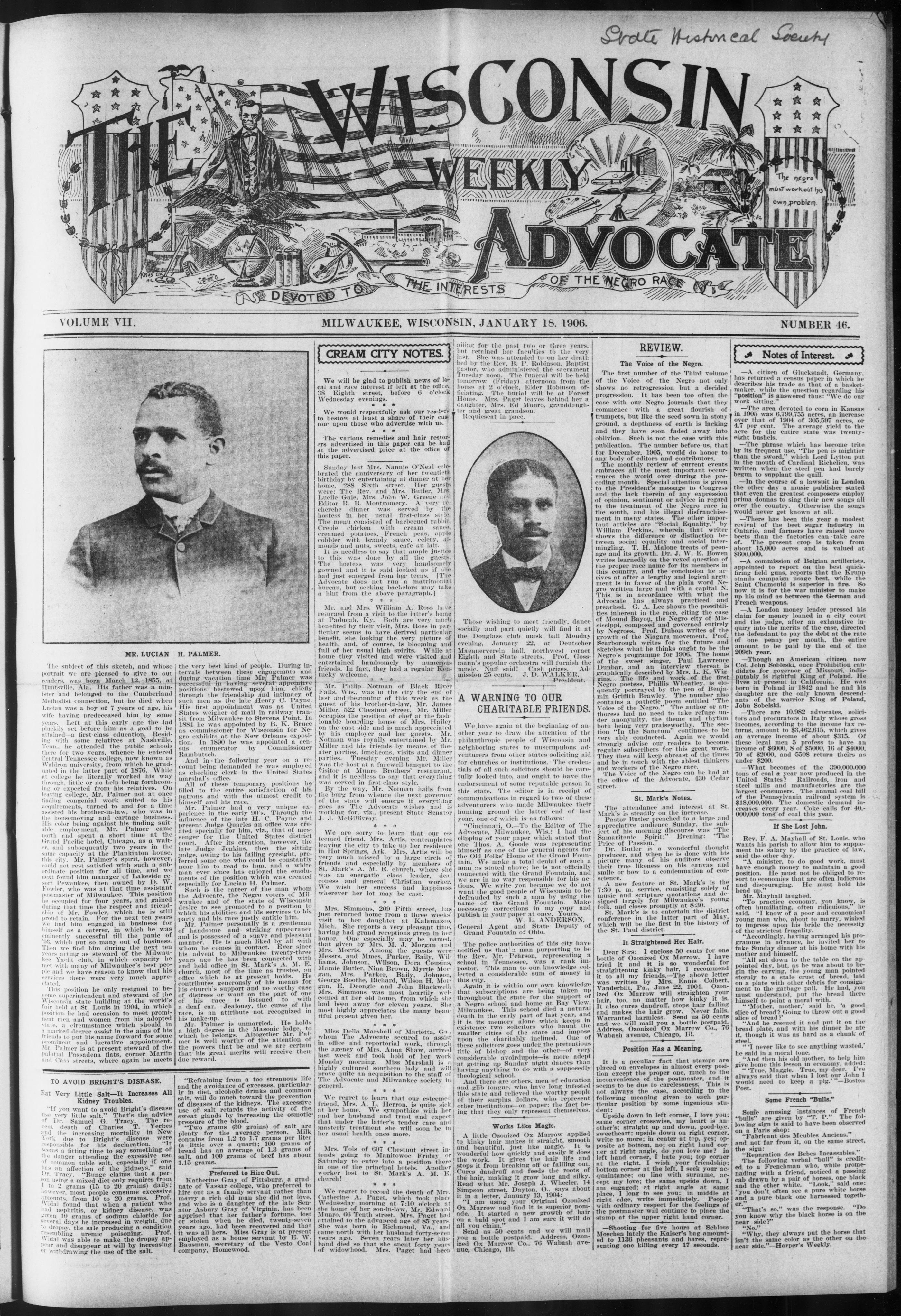
WISCONSIN
WEEKLY
ADVOCATE
DEVOTED TO THE INTERESTS OF THE NEGRO RACE
[Image of a man in formal attire with a mustache and a serious expression].
[Portrait of a man in formal attire, facing slightly to the right].
MR. LUCIAN H. PALMER.
The subject of this sketch, and whose portrait we are pleased to give to our readers, was born March 12, 1855, at Huntsville, Ala. His father was a minister and belenged to the Cumberland Methodist connection, but he died when Lucian was a boy of 7 years of age, his wife having predeceased him by some years. Left at this early age the lad pluckily set before him as a goal to be attained—a first-class education. Residing with some relatives at Nashville, Tenn., he attended the public schools there for two years, whence he entered Central Tennessee college, now known as Waldron university, from which he graduated in the latter part of 1876. While at college he literally worked his way through, little or no help being forthcoming or expected from his relatives. On leaving college, Mr. Palmer not at once finding congenial work suited to his
acquirements, turned to and for a time assisted his brother-in-law, who was in the housemoving and cartage business. His color being against his finding suitable employment, Mr. Palmer came north and spent a short time at the Grand Pacific hotel, Chicago, as a waiter, and subsequently two years in the same capacity at the Plankinton house, this city. Mr. Palmer's spirit, however, could not rest satisfied with such a subordinate position for all time, and we next found him manager of Lakeside resort Pewaukee, then owned by D. W. Fowler, who was at that time assistant postmaster of Milwaukee. This position he occupied for four years, and gained during that time the respect and friendship of Mr. Fowler, which he is still proud to retain. For the next ten years we find him engaged in business for himself as a caterer, in which he was eminently successful till the panic of '93, which put so many out of business. Then we find him during the next ten years acting as steward of the Milwaukee Yacht club, in which capacity he met with many of Milwaukee's best people and we have reason to know that his services there were very much appreciated.
This position he only resigned to become superintendent and steward of the Wisconsin state building at the world's fair held at St. Louis in 1904, in which position he had occasion to meet prominent men and women from his adopted state, a circumstance which should in a marked degree assist in the aims of his friends to put his name forward for some prominent and lucrative appointment. Mr. Palmer is at present steward of the palatial Passadena flats, corner Martin and Cass streets, where again he meets
TO AVOID BRIGHT'S DISEASE.
Eat Very Little Salt-It Increases All Kidney Troubles.
"If you want to avoid Bright's disease use very little salt." That's the advice of Dr. Samuel G. Tracy. The recent death of Charles T. Yerkes and the increasing mortality in New York due to Bright's disease were responsible for his declaration. "It seems a fitting time to say something of the danger attending the excessive use of common table salt, especially if one has an affection of the kidneys," said Dr. Tracy. "Bunge claims that a person using a mixed diet only requires from 1 to 2 grams (15 to 20 grains) daily; however, most people consume excessive amounts, from 10 to 20 grams. Prof. Widal found that when a patient who had nephritis, or kidney disease, was given 10 grams of sodium chloride for several days he increased in weight, due to dropsy, the sale producing a condition resembling uremic poisoning. Prof. Widal was able to make the dropsy appear and disappear at will by increasing or withdrawing the use of the salt.
```markdown
```
VOLUME VII.
the very best kind of people. During intervals between these engagements and during vacation time Mr. Palmer was successful in having several appointive positions bestowed upon him, chiefly through the friendship and intimacy of such men as the late Henry C. Payne. His first appointment was as United States weigher of mail in railway transit from Milwaukee to Stevens Point. In 1884 he was appointed by B. K. Bruce as commissioner for Wisconsin for Negro exhibits at the New Orleans exposition. In 1890 he was appointed a census enumerator by Commissioner Rambutsch. And in the following year on a recount being demanded he was employed as checking clerk in the United States marshal's office.
All of these temporary positions he filled to the entire satisfaction of his patrons and with the utmost credit to himself and his race. Mr. Palmer had a very unique experience in the early 90's. Through the influence of the late H. C. Payne and present Judge Quarles an office was created specially for him, viz., that of messenger for the United States district court. After its creation, however, the late Judge Jenkins, then the sitting judge, owing to his failing eyesight, preferred some one who could be constantly near him to read to him, and a white man ever since has enjoyed the emoluments of the position which was created especially for Lucian H. Palmer.
Such is the career of the man whom the Advocate, the Negro voters of Milwaukee and of the state of Wisconsin desire to see promoted to a position to which his abilities and his services to his party and his race justly entitle him.
Mr. Palmer personally is a gentleman of handsome and striking appearance and is possessed of a suave and pleasant manner. He is much liked by all with whom he comes in contact. Ever since his advent to Milwaukee twenty-three years ago he has been connected with and held office in St. Mark's A. M. E. church, most of the time as trustee, an office which he at present holds. He contributes generously of his means for his church's support and no worthy case of distress or want on the part of one of his race is listened to with a deaf ear. Jealousy, the curse of the race, is an attribute not recognized in his make-up.
Mr. Palmer is unmarried. He holds a high degree in the Masonic lodge, to which he belongs. Altogether Mr. Palmer is well worthy of the attention of the powers that be and we are certain that his great merits will receive their due reward.
"Refraining from a too strenuous life and the avoidance of excesses, particularly in diet, alcoholic drinks and common salt, will do much toward the prevention of diseases of the kidneys. The excessive use of salt retards the activity of the sweat glands by increasing the osmotic pressure of the blood.
"Two grams (30 grains) of salt are plenty for the average person. Milk contains from 1.2 to 1.7 grams per liter (a little over a quart); 100 grams of bread has an average of 1.3 grams of salt, and 100 grams of beef has about 1.15 grams.
Katherine Gray of Pittsburg, a graduate of Vassar college, who preferred to hire out as a family servant rather than marry a rich old man she did not love, and who is a daughter of the late Senator Asbury Gray of Virginia, has been apprised that her father's fortune, lost or stolen when he died, twenty-seven years ago, had been recovered and that it was all hers. Miss Gray is at present employed as a house servant by E. W. Bausnman, secretary of the Vesto Coal company, Homewood.
Preferred to Hire Out.
MILWAUKEE, WISCONSIN, JANUARY 18. 1906.
CREAM CITY NOTES.
We will be glad to publish news of local and race interest if left at the office. 38 Eighth street, before 6 o'clock Wednesday evenings.
We would respectfully ask our readers to bestow at least a share of their custom upon those who advertise with us.
The various remedies and hair restorers advertised in this paper can be had at the advertised price at the office of this paper.
Sunday last Mrs. Nannie O'Neal celebrated the anniversary of her twentieth birthday by entertaining at dinner at her home, 288 Sixth street. Her guests were: The Rev. and Mrs. Butler, Mrs. Lucile Gale, Mrs. John W. Greene and Editor R. B. Montgomery. A very recherche dinner was served by the hostess in her usual first-class style. The menu consisted of barbecued rabbit, Creole chicken with cream sauce, creamed potatoes, French peas, apple cobbler with brandy sauce, celery, almonds and nuts, sweets, cafe au lait.
It is needless to say that ample justice to this was done by all the guests. The hostess was very handsomely gowned and it is said looked as if she had just emerged from her teens. [The Advocate does not run a matrimonial bureau, but seeking bachelors may take a hint from the above paragraph.]
* * *
Mr. and Mrs. William A. Ross have returned from a visit to the latter's home at Paducah, Ky. Both are very much benefited by their visit, Mrs. Ross in particular seems to have derived particular benefit, she looking the very picture of health, and, of course, is blooming and full of her usual high spirits. While at home they visited and were visited and entertained handsomely by numerous friends. In fact, they had a regular Kentucky welcome.
Mr. Philip Notman of Black River Falls, Wis., was in the city the end of last and beginning of this week as the guest of his brother-in-law, Mr. James Miller, 522 Chestnut street. Mr. Miller occupies the position of chef at the fashionable boarding house of Mrs. Hailey on the east side and is much appreciated by his employer and her guests. Mr. Notman was royally entertained by Mr. Miller and his friends by means of theater parties, luncheons, visits and dinner parties. Tuesday evening Mr. Miller was the host at a farewell banquet to the Visitor at Munro Brothers' restaurant, and it is needless to say that everything was served in first-class style.
By the way, Mr. Notman hails from the burg from whence the next governor of the state will emerge if everything goes as The Advocate wishes and is working for, viz., present State Senator J. J. McGillivray.
※ ☐ ☐
We are sorry to learn that our esteemed friend, Mrs. Artis, contemplates leaving the city to take up her residence in Hot Springs, Ark. Mrs. Artis will be very much missed by a large circle of friends and especially by members of St. Mark's A. M. E. church, where she was an energetic class leader, deaconess and general Christian worker. We wish her success and happiness wherever her lot may be cast.
* * *
Mrs. Simmons, 209 Fifth street, has just returned home from a three weeks' visit to her daughter at Kalamazoo, Mich. She reports a very pleasant time, having had grand receptions given in her honor. One especially may be named, that given by Mrs. M. J. Morgan and Mrs. Morris. Among the guests were Messrs. and Mnes. Parker, Baily, Williams, Johnson, Wilson, Dora Cousins, Mamie Butler, Nina Brown, Myrtle Morgan, Mrs. Parker, Baily, Johnson, George Boothe, Richard, Wilson H. Morgan, E. Deongle and John Blackwell. Mrs. Simmons was most heartily welcomed at her old home, from which she had been away for eleven years. She most highly appreciates the many beautiful present given her.
※ ※ ※
Miss Della Marshall of Marietta, Ga., whom The Advocate secured to assist in office and reportorial work, through the agency of Mrs. Anna Shaw, arrived last week and took hold of her work Monday morning. Miss Marshall is a highly cultured southern lady and will prove quite an acquisition to the staff of The Advocate and Milwaukee society in general.
* * *
We regret to learn that our esteemed friend, Mrs. A. L. Herron, is quite sick at her home. We sympathize with her and her husband and trust and expect that under the latter's tender care and masterly treatment she will soon be in her usual health once more.
***
Mrs. Tols of 607 Chestnut street intends going to Manitowoc Friday or Saturday to enter into a position there in one of the principal hotels. Another worker lost to St. Mark's A. M. E. church!
***
We regret to record the death of Mrs. Catherine A. Paget, which took place Wednesday morning at 7:10 o'clock at the home of her son-in-law, Mr. Edward Munro, 66 Tenth street. Mrs. Paget had attained to the advanced age of 85 years. She was born in Richmond, Va., and came north with her husband forty-seven years ago. Seven years later her husband died so that she spent forty years of widowhood. Mrs. Paget had been
ailing for the past two or three years, but retained her faculties to the very last. She was attended to on her death bed by the Rev. B. P. Robinson, Baptist pastor, who administered the sacrament Tuesday noon. The funeral will be held tomorrow (Friday) afternoon from the house at 2 o'clock. Elder Robinson officiating. The burial will be at Forest Home. Mrs. Paget leaves behind her a daughter, Mrs. Ed Munro, granddaughter and great grandson.
[Name not visible]
Those wishing to meet friendly, dance socially and part quietly will find it at the Douglass club mask ball Monday evening. January 22. at Deutscher Maenmerverein hall, northwest corner Eighth and State streets. Prof. Gossmann's popular orchestra will furnish the music. Nuff said! Cash prizes. Admission 25 cents. J. D. WALKER.
A WARNING TO OUR CHARITABLE FRIENDS.
We have again at the beginning of another year to draw the attention of the philanthropic people of Wisconsin and neighboring states to unscrupulous adventurers from other states soliciting aid for churches or institutions. The credentials of all such solicitors should be carefully looked into, and ought to have the endorsement of some reputable person in this state. The editor is in receipt of communications in regard to two of these adventurers who made Milwaukee their hunting ground the latter end of last year, one of which is as follows:
"Cincinnati, O.—To the Editor of The Advocate, Milwaukee, Wis.: I had the clipping of your paper which stated that one Thos. A. Goode was representing himself as one of the general agents for the Old Folks' Home of the Grand Fountain. We make a total denial of such a man as stated above; he is not officially connected with the Grand Fountain, and we are in no way responsible for his actions. We write you because we do not want the good people of Wisconsin to be defrauded by such a man by using the name of the Grand Fountain. Make necessary corrections in my copy and publish in your paper at once. Yours.
W. L. ANDERSON.
General Agent and State Deputy of Grand Fountain of Ohio.
The police authorities of this city have notified us that a man purporting to be the Rev. Mr. Pearson, representing a school in Tennessee, was a rank impostor. This man to our knowledge collected a considerable sum of money in this city.
Again it is within our own knowledge that subscriptions are being taken up throughout the state for the support of a Negro school and home at Bay View, Milwaukee. This school died a natural death in the early part of last year, and it is its memory alone which keeps in existence two solicitors who haunt the smaller cities of the state and impose upon the charitably inclined. One of these solicitors goes under the pretentious title of bishop and the other—of very considerable avoirdupois—is more adept at getting up Sunday night dances than having anything to do with a supposedly theological school
And there are others, men of education and glib tongue, who have long infested this state and relieved the worthy people of their surplus dollars, who represent other institutions—on paper; the fact being that they only represent themselves.
Works Like Magic
A little Ozonized Ox Marrow applied to kinky hair makes it straight, smooth and beautiful, just like magic. It is wonderful how quickly and easily it does the work. It gives the hair life and stops it from breaking off or falling out. Cures dandruff and feeds the roots of the hair, making it grow long and silky. Read what Mr. Joseph J. Wheeler. 14 Simpson street. Dayton, O., says about it in a letter, January 13, 1904: "I am using your Original Ozonized Ox Marrow and find it is superior pomade. It started a new growth of hair on a bald spot and I am sure it will do all you claim." Send us 50 cents and we will mail you a bottle postpaid. Address, Ozonized Ox Marrow Co., 76 Wabash avenue, Chicago, Ill.
REVIEW.
The Voice of the Negro.
The first number of the Third volume of the Voice of the Negro not only shows no retrogression but a decided progression. It has been too often the case with our Negro journals that they commence with a great flourish of trumpets, but like the seed sown in stony ground, a depthness of earth is lacking and they have soon faded away into oblivion. Such is not the case with this publication. The number before us, that for December, 1905, would do honor to any body of editors and contributors.
The monthly review of current events embraces all the most important occurrences the world over during the preceding month. Special attention is given to the President's message to Congress and the lack therein of any expression of opinion, sentiment or advice in regard to the treatment of the Negro race in the south, and his illegal disfranchisement in many states. The other important articles are "Social Equality," by William Perkins, wherein that writer shows the difference or distinction between social equality and social intermingling. T. H. Malone treats of peonage and its growth. Dr. J. W. E. Bowen writes learnedly on the vexed question of the proper race name for its members in this country, and the conclusion he arrives at after a lengthy and logical argument is in favor of the plain word Negro written large and with a capital N. This is in accordance with what the Advocate has always practiced and preached. G. A. Lee shows the possibilities inherent in the race, citing the case of Mound Bayou, the Negro city of Mississippi, composed and governed entirely by Negroes. Prof. Dubois writes of the growth of the Niagara movement. Prof. Scarborough writes for the future and sketches what he thinks ought to be the Negro's programme for 1906. The home of the sweet singer, Paul Lawrence Dunbar, and an interview thereat is graphically described by Mrs. L. K. Wiggins. The life and work of the first Negro poetess, Phillis Wheatley, is eloquently portrayed by the pen of Benjamin Griffith Brawley. The number also contains a pathetic poem entitled "The Voice of the Negro." The author or authoress had no need to take refuge under anonymity, the theme and rhythm both being very praiseworthy. The section "In the Sanctum" continues to be very ably conducted. Again we would strongly advise our readers to become regular subscribers for this great work. They then will keep abreast of the times and be in touch with the ablest thinkers and workers of the Negro race.
The Voice of the Negro can be had at the office of the Advocate, 430 Cedar street.
St. Mark's Notes.
The attendance and interest at St. Mark's is steadily on the increase. Pastor Butler preached to a large and appreciative audience Sunday, the subject of his morning discourse was "The Samaritanic Spirit;" Evening: "The Price of Passion." Dr. Butler is a wonderful thought producer, and when he is done with his picture many of his auditors observe their true likeness on his canvas and smile or bow to a condemnation of conscience. A new feature at St. Mark's is the 7:30 p. m. service, consisting solely of music and scripture quotations and designed largely for Milwaukee's young folk and closes promptly at 8:30.
St. Mark's is to entertain the district conference in the latter part of May, which will be the first in the history of the St. Paul district.
It Straightened Her Hair.
Dear Sirs: I enclose 50 cents for one bottle of Ozonized Ox Marrow. I have tried it and it is so wonderful for straightening kinky hair. I recommend it to all my friends.—The above letter was written by Mrs. Ennis Colbert, Vanderbilt, Pa., June 22, 1904. Ozonized Ox Marrow will straighten your hair, too, no matter how kinky it is. It also cures dandruff, stops hair falling and makes the hair grow. Never fails. Warranted harmless. Send us 50 cents and we will mail you a bottle postpaid. Address, Ozonized Ox Marrow Co., 76 Wabash avenue, Chicago, IL.
Position Has a Meaning
It is a peculiar fact that stamps are placed on envelopes in almost every position except the proper one, much to the inconvenience of the postmaster, and it seems to be due to carelessness: This is not always the case, according to the following meaning given to each particular position by some ingenious student:
Upside down in left corner, I love you; same corner crosswise, my heart is another's; straight up and down, good-bye, sweetheart; upside down on right corner, write no more; in center at top, yes; opposite at bottom, no; on right hand corner at right angle, do you love me? in left hand corner, I hate you; top corner at the right. I wish your friendship; bottom corner at the left. I seek your acquaintance; on line with surname, accept my love; the same upside down. I am engaged: at right angle at same place, I long to see you: in middle at right edge, write immediately. People with ordinary respect for the feelings of the postmaster will continue to place the stamp at the upper right hand corner.
—Shooting for five hours at Schloss Moschen lately the Kaiser's bag amounted to 1136 pheasants and hares, representing one killing every 17 seconds.
A citizen of Gluckstadt, Germany, has returned a census paper in which he describes his trade as that of a basket-maker, while the question regarding his "position" is answered thus: "We do our work sitting."
The area devoted to corn in Kansas in 1905 was 6,799,755 acres, an increase over that of 1904 of 305,597 acres, or 4.7 per cent. The average yield to the acre for the entire state was twenty-eight bushels.
The phrase which has become trite by its frequent use, "The pen is mightier than the sword," which Lord Lytton put in the mouth of Cardinal Richelieu, was written when the steel pen had barely begun to supplant the quill.
-In the course of a lawsuit in London the other day a music publisher stated that even the greatest composers employ prima donnas to sing their new songs all over the country. Otherwise the songs would never get known at all.
-There has been this year a modest revival of the beet sugar industry in Ontario, and farmers have raised more beets than the factories can take care of. The present crop is taken from about 15,000 acres and is valued at $600,000.
-A commission of Belgian artillerists, appointed to report on the best quick-firing field guns, reports that the Krupp stands campaign usage best, while the Saint Chamould is superior in fire. So now it is for the war minister to make up his mind as between the German and French weapons.
A London money lender pressed his claim for money loaned in a city court and the judge, after an exhaustive inquiry into the merits of the case, directed the defendant to pay the debt at the rate of one penny per month, the entire amount to be paid by the end of the 209th year.
Though an American citizen now Col. John Sobleski, once Prohibition candidate for governor of Missouri, indisputably is rightful King of Poland. He lives at present in California. He was born in Poland in 1842 and he and his daughter are the only known descendants of the warrior King of Poland, John Sobelski.
-There are 10,982 advocates, solicitors and procurators in Italy whose gross incomes, according to the income tax returns, amount to $3,462,615, which gives an average income of about $315. Of these legal men 5 profess to have an income of $6000, 8 of $5000, 16 of $4000, 70 of $2000, and 5508 return theirs as under $200.
-What becomes of the 390,000,000 tons of coal a year now produced in the United States? Railroads, iron and steel mills and manufactories are the largest consumers. The annual coal bill of the Pennsylvania railroad system is $18,000,000. The domestic demand increases every year. Coke calls for 40,-000,000 tons of coal this year.
If She Lost John.
Rev. F. A. Mayhall of St. Louis, who wants his parish to allow him to supplement his salary by the practice of law, said the other day.
"A minister, to do good work, must have enough money to maintain a good position. He must not be obliged to resort to economies that are often ludicrous and discouraging. He must hold his head up."
Mr. Mayhall laughed.
"To practice economy, you know, is often humiliating, often ridicuous," he said. "I know of a poor and economical young man who, about to marry, wished to impress upon his bride the necessity of the strictest frugality.
"Accordingly, having arranged his programme in advance, he invited her to take Sunday dinner at his home with his mother and himself.
"All sat down to the table on the appointed day, but, as he was about to begin the carving, the young man pointed sternly to a stale crust of bread, laid on a plate with other debris for consignment to the garbage pail. He had, you must understand, put the bread there himself to point a moral with.
"Mother, mother,' said he, 'a good slice of bread? Going to throw out a good slice of bread?"
"And he rescued it and put it on the bread plate, and with his dinner he ate it, though it was as hard as a chunk of steel.
"I never like to see anything wasted," he said in a moral tone.
"And then his old mother, to help him give home this lesson in economy, added:
"True, Maggie. True, my dear. I've always said that when I lost our John I would need to keep a pig.'"—Boston Post.
Some French "Bulls."
Some amusing instances of French "bulls" are given by "T. P." The following sign is said to have been observed on a Paris shop:
"Fabricant des Meubles Anciens," and not far from it, on the same street, the sign:
"Reparation des Bebes Incassables."
The following verbal "bull" is credited to a Frenchman who, while promenading with a friend, noticed a passing cab drawn by a pair of horses, one black and the other white. "Look," said one: "you don't often see a pure white horse and a pure black one harnessed together."
"That's so," was the response. "Do you know why the black horse is on the near side?"
"Why, they always put the horse that isn't the same color as the other on the near side."—Harper's Weekly.
DID A WORLD OF GOOD
Dr. Williams' Pink Pills Cure Heart Pains Dizzy Spells and Weakness.
Easy to get, hard to get rid of; that is what most sufferers think of dyspepsia. They are astonished when their stomach begins to trouble them seriously.
They had been eating hurriedly and irregularly for a long time, to be sure, but they supposed their stomachs quite used to that.
Some people know that the strength which the weak stomach needs, and for the lack of which the whole body is suffering, can be found surely and quickly in Dr. Williams' Pink Pills. In hundreds of instances these pills have succeeded where other remedies failed. "My indigestion," said Mr. J. R. Miller, of Dayton, Va., "came in the first place from the fact that a few years ago I worked a great deal at night, and ate at any odd hour whenever the chance came, and always very hurriedly. One day I found myself a victim of terrible dyspepsia. It kept me miserable all the time for several years.
"I always had a great deal of distress after eating, and when I got up from my sleep my stomach would be so weak that it would hardly take any food. I had very uncomfortable feelings about my heart, and was dizzy and, whenever I stooped over and then straightened up, my eyes would be badly blurred.
"I read the statements of several persons who had got rid of obstinate stomach troubles by using Dr. Williams' Pink Pills. I bought some and they did me a world of good. They acted promptly and did just what was claimed for them. I have no more distress after meals; the bad feeling has gone from the region of my heart; the alarming dizzy spells have disappeared, and I am strong again."
Dr. Williams' Pink Pills are sold by all druggists and by the Dr. Williams Medicine Co., Schenectady, N. Y.
JURORS MAY READ NEWSPAPER.
Instead of Disqualifying, Makes Better Juryman of Him.
While interrogating the men called for jury service in an arson case in the circuit court at Macon, Mo., one of the talesmen said all he knew about the case was what he read in the newspapers. Judge Shelton told him that instead of that disqualifying him it would really make him a better juryman. "Time was when attorneys for defendants and the court, too, looked with suspicion upon the man who said he read the newspapers," the court said. "Experience has taught that the men who do not read are more inclined to err in judgment than those who do. Correct discrimination and the ability to do justice are born through experience and best understood by those who read. The man who has neither time nor inclination to peruse the papers and books is almost certain to get his head set in a direction suggested by his impulse alone. The reading man is more likely to be conservative and fair. He considers the views expressed by others and tries to reconcile them to his own. When men are selected for jury service because of their reading and general intelligence there will be fewer hung juries and a greater measure of justice."
Savs Coffee Causes Epilepsy
Consul General Guenther of Frankfort writes that the Vienna Clinical Review gives an account of observations with reference to epilepsy in the medical clinic of the late Prof. H. Nothnagel which is worthy of attention. It concerns a case of epilepsy in a woman addicted to eating coffee beans, reported by Dr. Marbun. The most important result of the investigation is in these words: "It must appear at least as probable that coffee in this case was the direct result of epilepsy, which therefore would have to be classified as a toxic one." It is noteworthy that this corresponds with recent observations by several other physicians, as for instance with those of Charles Feres, who was the first to point out that coffee was responsible for epilepsy; also with the clinical experiences of Prof. Korbert of Dorpart. This important connection between consumption of coffee and epilepsy, which deserves to be known everywhere, serves as a warning to be extremely careful with coffee made of beans containing caffeine, and at any rate children should be deprived of it entirely, otherwise their health will be exposed to a great danger.
AN EVERY-DAY STRUGGLE.
Too Many Women Carry the Heavy Load of Kidney Sickness.
Mrs. E. W. Wright of 172 Main street, Haverhill, Mass., says: "In 1898 I was suffering so with sharp pains in the small of the back and had such frequent dizzy spells that I could scarcely get about the house. The urinary passages were also quite
street, Haverhill, Mass., says: "In 1898 I was suffering so with sharp pains in the small of the back and had such frequent dizzy spells that I could scarcely get about the house. The urinary passages were also quite irregular. Monthly periods were so distressing I dreaded their approach. This was my condition for four years. Doan's Kidney Pills helped me right away when I began with them and three boxes cured me permanently." Sold by all dealers. 50 cents a box. Foster-Milburn Co., Buffalo, N. Y.
Rebuked for His Carelessness.
"I had a peculiar dream last night, Mary," said a Kansas City railroad man to his wife yesterday. "I dreamed I was appointed agent for our line in San Francisco at double the salary I'm now getting."
"How fine," said his wife, with a smile.
"Yes," continued the man, "and I started for San Francisco to take the place. At a small station in Kansas, where the train stopped, I saw a dog fight going on and stepped off the car to witness it. The train went on without me and I woke up before I could catch another."
The wife's smile changed to a look of keen disappointment. "Henry," she said with emphasis. "you have the instincts of a brute. Why didn't you stay on that train and let that dog fight alone? You'll never get a good job if you act like that."—Kansas City Times.
The Minister's Text.
Little Willie had gone to church on a certain Sunday morning. The minister announced that in the evening his text would be. "An angel came down from heaven and took a live coal from the altar." After the service was over Willie's mother asked him what the text was to be in the evening, and he promptly replied, "An Injun came down from New Haven and took a live cold by the halter."—Magazine of Fun.
Senator Knox of Pennsylvania is setting a terrific pace in the matter of hard work. He and his stenographer generally are at work before 5 in the morning and by breakfast time the shorthand man has work enough to last him all day.
Major Hugh 5. Gahagher, commissary department, U. S. A., who has for the past year been acting as assistant purchasing agent of the Isthmian canal commission, has been detached from that service and ordered to Manila February 1.
Charles M. Schwab's great ambition in life is to make the Bethlehem Steel corporation the largest steel plant in the world, and he says he will realize it within three years. About $8,500,000 is now being expended in new extensions, improvements and special devices.
Announcement has been made by the state department today that Huntington Wilson of Illinois, now first secretary of the legation at Tokio, had been decided upon as the successor to Mr. Tierce, third assistant secretary of state. Irvin B. Loughlin, second secretary of legation at Tokio, will be promoted to first secretary.
Miss Helen Buck, a Mount Holyoke college girl and supposed to be the champion girl athlete of the country, has been making new records. She ran 100 yards in 0:10 2-5 and cleared 20 feet 1 inch in the broad jump and after all the exertion did not show the least sign of exhaustion. Miss Buck is 5 feet 7 inches tall, weighs 155 pounds and is 22 years old.
Squire Richard Van Winkle, a resident of Bergen county, New Jersey, celebrated his nineteieth birthday by having his photograph taken for the first time. He wore the suit of clothes and the tall hat which he bought for his second marriage forty years ago. Mr. Van Winkle's ancestors came from Holland in 1635 and settled in Bergen county.
Charlotte Bronte's husband, Rev. Arthur Bell Nichols, is now approaching his nineteieth year. Yet the famous novelist was advised not to marry him because he suffered from rheumatism. Mr. Nichols was curate under her father in the parish of Haworth. The marriage was opposed by Mr. Bronte, but after an interval of eighteen months, in June, 1854, Charlotte Bronte married this "true Christian gentleman."
Capt. James Robb Church, one of the heroes of the battle of Las Guasimas, Cuba, in the Spanish-American war, was rewarded Wednesday with a medal of honor conferred by Congress for conspicuous gallantry in action. The President personally presented the medal. During his address President Roosevelt took occasion to say that the army medical department is in bad shape at present, numerically and otherwise.
Sousa, the famous conductor, hates public oratory and never if he can help it makes a speech in public. After one of his performances in Cork his audience kept clamoring for a speech and refused to be satisfied with the usual bow. Finally Sousa stepped to the front of the platform and raising his hand said impressively: "Ladies and gentlemen, can you all hear me?" There was the usual "Yes." "Then I wish you good night."
Rev. William H. Murray, pastor of the Universalist church in Solthold, Long Island, has been chosen to act as lamplighter in that place and yesterday entered upon the performance of his duties. Mr. Murray will be called upon to walk over twelve miles nightly in the course of his rounds. He frankly owns that the salary of $25 per month is one of two reasons why he sought the place, the other being that he needs the incidental exercise.
While so much is being printed about high-salaried officials of insurance companies the interesting fact is recalled that forty years ago Robert E. Lee was offered the presidency of a northern insurance company at a salary large enough for those days. He wrote that he hadn't the ability nor the experience to command such a salary. He was told that his name was worth it. "What influence I have with the southern people is not for sale," said Lee.
It is thought probable that three members of the present cabinet live within their salaries—Attorney General Moody, Secretary Wilson and Postmaster General Cortelyou. Such men as Taft, Root and Bonaparte, being heads of departments that bring them into contact with representatives of powerful individuals, find it necessary to spend a great deal more than the government pays them. Secretary Taft is credited with the declaration that it costs him more than double his salary to live.
Both branches of the Astor family have been attacked with the building Grenzy again, but they are working on different lines. Those in a position to know say William Waldorf Astor intends to give his ambitions young cousin a clear field in the hotel business hereafter and confine his New York real estate improvements entirely to high-class apartment houses. So far John Jacob Astor has avoided apartment houses. Hotels on a luxurious and expensive scale, such as the St. Regis, are more to his liking.
John M. Gearin, recently appointed United States senator from Oregon, will be the poorest man in that body. He owns no property and has no money in bank. It is true he has a lucrative law business. He owes nothing and does not lack at all for the comforts of life, but he has saved nothing. He is a Democrat, is considered the best speaker in the state and is the fourth man to go to the United States Senate from the law office from which he comes—Dolph, Simon and Mitchell, Republicans, having preceded him.
Congressman Longworth, who is engaged to marry Miss Roosevelt, has been reading up on Korea and the other day in conversation with a friend congratulated himself that he is not a native of that country. "You know," he said, "that in Korea when a young men enters into an engagement to marry a demoiselle he screws up his hair into a phyche knot and crowns it with one of those ridiculous three-storied hats with far-extending eaves. And wouldn't I be in a nice pickle if I were living in Korea now?" asked Longworth, as he rubbed his hand over the place where the hair used to be.
The fact that there is no John D. Rockefeller III. is, in the eyes of Grandfather Rockefeller, a serious thing, and should the second child of Mr. and Mrs. John D. Rockefeller, Jr., prove a boy he will doubly welcome. As matters stand now the death of the two Rockefellers would put the world's greatest fortune in the possession of the grandchild and of Mrs. McCormick, the sole daughter of John D. Rockefeller, Sr. Mrs. Rockefeller, Jr., who was Abbie G. Aldrich, daughter of the United States senator from Rhode Island, is the mother of one child, a daughter, born November 9, 1903.
Peter Larson of Montann is doubtless the richest Scandinavian in America. Out in Montana they say that he is the richest man in the northwest next to Senator W. A. Clark. The most modest estimate of his fortune is $5,000,000, while many men in position to judge say it will approach $25,000,000. The former figure is undoubtedly too conservative. Peter Larson is a Dane by birth, having been born on the Island of Funen fifty-six years ago. For the first twenty years his life was that of any ordinary peasant lad in Denmark. He came to America empty-handed and ignorant of the language, beginning as a dock laborer. Alexander Ector Orr, who has been
elected president of the New York Life in succession to John A. McCall, has long been conspicuous, financially and commercially, in New York. He has been president several times of the produce exchange and of the chamber of commerce, and has been at the head of the board of rapid transit commissioners. Mr. Orr was bora at Strabane, County Tyrone, Ireland, March 2, 1831. When he first came to America in 1850 it was as a visitor, but he speedily decided to remain permanently, and was first employed in shipping and commission houses. Mr. Orr is a director in many financial and philanthropic institutions. His home is in Brooklyn.
"Pat" McCarren, the Tammany man, is going to quit politics and devote himself to the turf. Two years ago he was ambitious to become the really great American plunger. Then his $15,000 bees were quite common. He had a hard luck streak and lost an immense sum of money. He was so hard hit that he was unable for a time to take up his "markers." but he made good all his obligations to the bookmakers, sold his race horses and retired from the race track for a time. This year he is on the turf, apparently as well fixed financially as he ever was. Some evil-minded persons say McCarren bets John D. Rockefeller's money. They do not mean Mr. Rockefeller has taken to gambling, but use this method of insinuating that the senator, as "legislative agent" of the Standard Oil gas trust, has been paid liberally by Mr. Rockefeller for his influence with the rural legislators.
A native of Detroit, born there in 1866, and at 19 a woodsman employed in the pineries near Newberry, Mieh., J. J. De Fer, now a leading manufacturer and business man in Iron county, on the Wisconsin end of the Gogebic range, has amassed a comfortable fortune in the north country. He operates a sawmill and logging camps, conducts a large general store and is the possessor of two farms comprising 600 acres. His mill has a capacity of 50,000 feet of hemlock and hardwood lumber per day of ten hours, and at the mill and in the logging camps 250 men are employed winter and summer. Mr. De Fer still has 40,000,-000 feet of standing timber, enough to run his mill for the next four years. He has served the town of Saxon as chairman for ten years, and has been chairman of the county board of supervisors for seven years. He was elected sheriff in the fall of 1904.
FIRST GOLD FOUND IN ALASKA.
'Twas Discovered by a Russian Trader on the Anauk River in 1832.
Gold was first discovered in Alaska on the Anauk river, a tributary of the Kuskowim river, which joins the latter stream about twenty-five miles below the trading post of Kalamakoffsky, says the Ketchikan Mining Journal. The Anauk river was discovered by Ivan Simenson Lukeen in 1832, at which time he built a fort, called Lukeen's fort, on the Kuskowim river, twenty-five miles above the mouth of the Anauk. It was partly destroyed by natives in 1841, and, rebuilt by Kalamakoff, a Russian trader, was afterward called Kalamakoff redoubt.
In 1832 the headquarters of the Russian-American Trading company were at Sitka and supplies were transported thence to Lukeen's fort by way of Nushagak river, Tic-chic river and lake and down the Anauk river to the Kuskowim river and thence up stream twenty-five miles to the fort. In 1837 the yearly supplies were sent by way of the mouth of the Kuskowim river and the old way abandoned as a summer route and used only for the purpose of sending out the mails during the winter by dog teams. It was the only winter route the Russians ever used from any point on the Yukon to the outside (Sitka), and was only abandoned for the purpose after they left the country.
It was while on one of these trips in 1832 that the Russians discovered gold on the Anauk, and it is known today as the Yellow River of the Russians. It is not known whether they ever attempted mining on any large scale or whether they found gold in paying quantities, but it is thought to be the first time on record of gold being found in this country.
Lukeen was born of Russian and Spanish-American Creole parents in the Ross colony in California. He was well educated at the Sitka school and proved to be an active, energetic and intelligent officer. In 1863 Lukeen ascended the Yukon river from St. Michael to Fort Gibbon, then a Hudson's Bay Company trading post, which was built by McMurray, who descended the Porcupine river in 1847. Lukeen was the first man who connected the Pelly river of Campbell and the sea. He returned to St. Michael that fall. In 1866 the Russian garrison at Kalamakoff redoubt, in charge of Dementoff, was withdrawn, the United States having purchased Alaska from the Russians.
Only Me!
There may be a world of pathos, and even of rebuke, in a very few words, and so the rather thoughtless wife of a contributor of ours discovered recently. She has two sweet little children, both girls, and, almost without knowing it, she made a pet and favorite of the younger and prettier child. "Sweet," as she called her, had every care and attention lavished upon her, and good-natured neglect was more or less the portion of the elder.
The mother was sitting in her bedroom, quietly reading, recently, when the soft patter of tiny feet sounded on the stairs. "Is that you, Sweet?" she called.
"No, mamma," was the sad reply; "it isn't Sweet—it's only me!"
The pathetic little "Only me!" haunted the wife of our contributor for longer than she would have cared to admit, but a change has since marked her treatment of her eldest born.-Tit-Bits.
A Trivial Matter
This little story comes from the south: The first slice of goose had been cut, and the minister of the Zion church looked at it with as keen anticipation as was displayed in the faces around him.
"Dat's as fine a goose as I ever saw. Brudder Williams," he said to his host.
"Where did you get such a fine one?"
"Well, now, Mistah Rawley," said the carver of the goose, with a sudden access of dignity, "when you preach a special good sermon I never axes you where you got it. Seems to me dat's a trivial matter, anyway."
A Modern Family
"She's in the parlor playin' the pianner."
"Maw? Oh, maw's down in the kitchen gettin' dinner for the bunch."—Houston Chronicle.
A Contract.
In a Glasgow street the other day a Scots Gray went up to a bootblack and asked to have his boots brushed. The boy looked at the soldier's boots, and then shouted to one of his chums who was not far off: "Haw, Jamie—come an'gie us a haun; 'ave got an army contract."—San Francisco News-Letter.
It Pays to Advertise.
THE SOUL OF ART
Listen to the rhymers' praise of art,
Of the immortal form, the measured
phrase,
Of the one mirror and the many ways
The poet's pale reflection to impart,—
But not a word of the initiate heart,
Of the incarnate Light whose volatile
blaze,
Intimate of the soul, eludes the gaze--
Man's goal of yearning, and his counterpart.
I, too, am learned in the lore of sound,
In the cold measurement of lyric speech;
But what availed my knowledge till I found
The hidden Thing mere are may never
teach.
The selfless Thing, too great to be ren-
nomed,
So high—it is within the lowest reach!
—Elsa Barker in the Atlantic.
ONLY A PINK.
"Pick out the sweetest and freshest carnations. Jean," said the florist, pausing at the door of the cool, flower-scented room, where her assistant stood beside a tray of brier rose carnations. The girl nodded cheerily, as with deft singers she continued to fashion a charming bouquet of the swaying dew-laden stalks.
"It is Miss Marjorie's commencement bouquet, isn't it? Her father said he wanted 'pinks' as rosy and fresh as his pink of a girl. It many a day since I heard anyone call carnations—pinks, but the old gentleman has a sort of country freshness about him for all he is a bank president, and what not, and I guess his mother had an old-fashioned garden." The assistant tied the flowers with fluttering bows of white ribbon, snipping their ends in coquetish fashion, pressing them gently into a tissue-lined box and laughed a little as she tucked in the card which read, "Father's love to his baby." "Won't be a baby much longer," she murmured, and laid the box among others ready for delivery.
Marjorie looked indeed a pink of a girl as she tripped by the row of black-robed nuns and ecclesiastics and joined her classmates for the commencement exercises in the convent hall. The flowers were clasped lightly in her firm, young fingers, and their spicy fragrance enveloped her as incense. Many besides her proud father compared her radiant young face to the flowers beneath it, and the priest smiled as he placed the graduate's coronation wreath of white lilies on the gay young head.
In an hour or more the happy excitement was well over, and the departing girls were clasping the affectionate nuns in farewell embraces. "I am going to leave you my commencement flowers, Sister Placide," said Marjorie to the directress, "they represent the end of my school days, and I leave them here along with those happy memories. I know you will like them for the altar." She vanished through the grated doorway, smiling a last good-bye and blithely unmindful of the sound of the key that grated harshly upon its closing.
The nun stood, flowers in hand, gazing blankly before her where the girl had so recently been. What did she see? What vision of her own youth had been embodied in the laughing face just passed beyond her sight? She touched the flowers tenderly to her cheek, and then all at once awoke to a realization that she was not wholly alone. A reporter, a young woman representing one of the daily papers, who had attended the exercises, stood awaiting her attention concerning details of the commencement. The woman of the world and the woman of the cloister were warm friends. For each commencement day at the convent was an old story. Many reports conscientiously written, many items of convent news pleasantly given, had eliminated the element of business from these simple duties, and made the meetings those of friendship.
"It was so good of you to spare us your time and come," said the religieuse. "I know the pressure of your days—you, too, must have a flower. Here, take Marjorie's blossoms, the blessed mother will feel them just as truly offered upon her shrine if they go out to gladden the world with you."
How sweet the flowers were, and how the girl into whose possession they had thus suddenly fallen, rejoiced in their perfume. She forgot for a moment the load of assignments that awaited her thought and pen, and hurried toward the office with a generous impulse to share the flowers with others of the staff. Men have a special fondness for carnations, she said to herself, and there is not one but shall have a flower for a boutonniere. Then she paused—there was one belonging to the staff whose desk was empty. He was a grave and scholarly man. an editorial writer whom she scarcely knew except for occasional acts of office courtesy exchanged between them, but she remembered that someone had told her his wife had died, that she was to be buried that very afternoon. It seemed suddenly very dreadful to be alone with one's dead, when the air was so filled with soft summer radiance. It took her but a moment's thought to turn her face from the business to the residence portion of the town. A line of sympathy was hastily written upon her visiting card, and within a half-hour the flowers from her keeping had passed within a portal guarded from worldly intrusion by somber folds of crape.
"I am glad I left my flowers for the blessed mother." signed Marjorie, on her knees before the quaint little shrine of the Madonna in her own dainty bedroom. I know she will bless them—perhaps
From the rosy palm of the school girl, Through the hand of the saluted nun They had slipped to the pallid fingers Of the woman whose life was done.
Medicinal Value of Vegetables
Turnips, onions, cabbage, cauliflower, watercress and horseradish contain sulphur. Potato, salts of potash. French beans and lentils give iron. Watercress, oil, iodine, iron, phosphate and other salts.
and other salts.
Cabbage, cauliflower and spinach are beneficial to aenemic people.
Tomatoes stimulate the healthy action of the liver.
Spinach, salts of potassium and iron.
Food specialists rate this the most precious of vegetables.
Parsley, mustard, cowslip, horseradish, dock, dandelion and beet tops clear the blood, regulate the system and remove that tired feeling so peculiar to spring.
Luck of a Chinese Girl.
During the current celebration of the festival of the Spinning Maiden and the Cowherd (two stars known to us as Lyra and Aquila) one girl, 16 years of age, with a needle in one hand and the
thread in the other, kneeling before the shrine of the star goddess, managed to thread the needle behind her head, unmistakable evidence that she had been endowed with special skill. She has since been inundated with offers of marriage from enthusiastic youths through the offices of regular gobetweens.—Canton Times.
THE RHYMESTER'S RESOLVE.
I think I'll write an ode to Fall,
Some gentle ballad sing
About the quail that shrilly call,
And all that sort of thing.
I'll speak of leaves a-turning red.
Bring in the pasture lot.
Likewise the harvest moon o'erhead.
And all that kind of rot.
I'll prate about the husking bee,
The cider and the "sass."
The country lad from care so free,
Also the country lass.
And if I sell this rhyme, well, say,
With wisdom ripe and rare
I'll store my summer pants away
And buy a winter pair.
COTTAGE TENT
Covered with Canvas and Affords Both Room and Comfort Within.
One of the most recent inventions patented is a cottage tent of the knockdown type, designed to be used for summer purposes during warm weather when people desire to take an outing for a month or longer. It can also be used for permanent occupancy the year round in suitable latitudes, where artificial warmth is not much in need, or in cases where people desire to take as much of the open air as possible under shelter for health, as in the case of consumptives. It is preferably made of wood, though it can be made of metal in whole or in part, and when erected is perfectly rigid. As shown here the tent has a plank floor, slightly raised, so as to be
A
ROOM AND COMFORT WITHIN
above the ground to avoid dampness. Some may prefer a ground floor instead, and as such a floor is often desirable in summer in dry places, the occupant may choose as to one or the other. The main frame comprises the base pieces or rails extending around the lower edges of the tent, the corresponding upper pieces or beams, the corner posts and the intervening window or door posts. All these parts are constructed to be connected, the ends of the posts have overlapping projections one-half the thickness of each bar. The roof of the tent is supported by inclined braces extending from the main frame, forming four inclined sides to shed the water, the entire upper structure being kept down in its place by the overspread canvas or cover of the tent. For such cover and for the side walls of the tent any usual and suitable fabric can be used; ordinarily tent canvas. Provision can be made for filling the window space, such as a screen to keep out the flies, or even a window glass and frame for colder weather. Naturally, such a tent is susceptible of various changes and modifications to promote comfort and convenience. It might, for example, have an inside canvas or other lining, so as to provide an inner wall separate from the outer wall and leaving an air space between for greater comfort in cool climate.
CANDY BOX.
Designed for Bonbons, Chocolates and Other Confections.
A neat and pretty box invariably adds to the attractiveness of a box of bonbons, and when the quality of the chocolates or other confections is of the very best and the box of poor quality the value of the former gift is marred. The box does not necessarily have to be of fancy design, but must present a neat and pleasing appearance. A first-class candy box is the one shown here, devised by a New Jersey man for a large candy company of Jersey City. It is made in two sections, the lid of the lower section having a transparent top, which displays the
O'Boy Bon
chocolat
FOR CHOCOLATES. ETC.
articles underneath. It is made of cardboard or pasteboard, such as is commonly employed in the manufacture of boxes designed to receive candy or like confections. The lower section is formed like an ordinary open cardboard box, the middle section covering and fitting over it. The middle section is made similar to a tray in a trunk, with sides suspended from the lower side edges and fitting over the lower section. The cover is hinged to the body by a flexible strip of cloth, and has an opening of sufficient size to clearly display the confections or other articles that are in the tray. This opening is covered by a transparent plate of geiatin. The two upper sections are hinged to one side of the body, the lid and the tray being opened independently of each other. Notches in the front part of the box better enable the lid and tray to be lifted when access to the box is desired.
THE CALL OF THE CANADIAN WEST.
The Greatest Wheat Crop of the Continent.
The year that has just closed has done a great deal towards showing the possibilities of Western Canada from an agricultural standpoint. The wheat crop has run very near to the 100,000,000-bushel limit that was looked upon as too sanguine an estimate only a short time ago, and the area that has been broken to fall wheat for the coming harvest will go a long way towards enabling the farmers of the West to overlap on the 100,000,000-bushel estimate next year. And while the spring and winter wheat have been doing so well during the past few years the other cereals have been keeping up with the procession. Rye and barley have made immense strides, and peas and flax have been moving steadily along. Dairying also has been successfully carried on in the new provinces, and in every stage the farmer has been "striking it rich." To such an extent has the success of the West taken hold of outsiders that the rush of Americans to Saskatchewan and Alberta, which was looked upon as marvelous last year, bids fair to be largely exceeded in 1906, and as there are still millions of acres of free homesteads available, which the building of the new railways will render accessible to the markets, new wheat lands will be opened up ere long. Amongst the first to avail himself of the opportunity presented will be the American settler. In a large number of American cities Dominion government agents are located, who are able and willing to give the latest and best information in regard to the new districts which the railways will open up, and there will be no abatement of the rush to the Canadian prairies during the coming season. Some time since a poet in the columns of the "Toronto Star" had the following stirring lines, which throb of the Western spirit:
There's a stir in the air, there's a thrill through the land, there's a movement toward the Great West;
And the eyes of all men for the moment are turned to the country that we love the best;
For 'tis Canada's day in the world's calendar, arl to this merry toast let us sup:
"Here's to the land, the young giant of the North,
Where the prairies are opening up!"
They come from the East and they come from the South—they come o'er the deep rolling sea— They come for they know they will dwell 'neath a flag that makes all men equal and free. Then, once more the toast, and let every man rise, and cheer 'ere he sips from the cup: "Here's to the land, the young giant of the North, Where the prairies are opening up!"
Medical Properties of Salt.
Salt has healing and health-giving properties, both taken internally and as an outward application. The efficacy and strengthening qualities of sea baths are well known. Fisher folk will tell you that to drink a little sea water every day for a week or longer is an unfailing cure for indigestion. People who are too delicate to stand the invigorating cold plunge of sea bathing are often recommended by their physicians to take warm sea baths. Old sores, having long defied treatment, have been oured by constant bathing in sea water, which is very good for the skin and complexion, especially if it be a skin with a naturally acid rather than an alkaline tendency. Salt dissolved in milk and applied to the face with a soft rag, after washing in soft hot water, nightly for a week or so, imparts a velvety softness to the complexion. Salt water is also good for the scalp, as it is the most efficacious, though simplest, remedy known for falling hair. A solution of salt and water is also good for bathing sore eyes.
If one has taken too much salt, either medicinally or in food highly seasoned enough to make one unpleasantly thirsty, a little acid, either in the form of lemonade or vinegar and water, will speedily remedy the inconvenience. A bag of hot salt applied to the face or affected part is a great relief in neuralgia. Applied to a cut finger, salt, though it makes it smart very much at the time will heal the gash quicker than anything else.—Housekeeper.
Students Give Up Football.
The students of St. John's school at Manlius, N. Y., have decided to drop the game of football after playing out the present season, except among themselves on their own ground. The student members of the athletic association have adopted resolutions declaring:
"That football, as it is now played, is more for college than for preparatory schools.
"That professionalism and fake scholarships are largely responsible for the unnecessary roughness, slugging, and demoralizing influences of an otherwise noble game.
"That we indorse President Roosevelt's efforts to cleanse the game."
By building 550,000 tons of shipping the Clyde has broken its previous yearly record, 517,000 tons, in 1902.
THE GOVERNMENT OF CANADA
FARMS IN WESTERN CANADA FREE
GIVES
Absolutely Free to Every Settler One Hundred and Sixty Acres of Land in
It is also the best of grazing land, and for mixed farming it has no superior on the continent.
farming it has no superior on the comment.
Splendid climate, low taxes, railways convenient, schools and churches close at hand. For "Iwentieth Century Canada" and low railway rates Apply for information to SuperIntendent of Immigration, Ottawa, Canada, or to T. O. Currie, Room 11, B. Callahan Block, Milwaukee, WI., Authorized Government Agents.
Please see where you saw this advertisement.
GOSSIP FOR THE LADIES.
So What Care I?
So What Care I.
I've heard the south wind woo the trees,
All dressed in little leaves of sold;
I've watched them stripped and left to
frecze,
When love is suddenly turned cold;
I've heard their sigh; its laugh of glee,
So what care I if none woo me!
I've seen the sea kissed by the sun,
When all the world was calm and fair;
I've watched the clouds grow, one by one,
Bringing sad tears, and dark despair;
I've seen them leave an angry sea,
So what care I if none kiss me!
I've seen a boy loved by a maid,
When life was bright and pure as truth;
I've watched her arms that round him
played
To bind and hold him in his youth;
I've heard his prayer to be set free,
So what care I if none love me!
I've heard a man praised by a king,
When all was favor, all was fame;
I've watched the fickle smile take wing,
And leave him poor without a name;
I've seen him cringe and bend the knee,
So what care I if none praise me!
In the Laundry—Washday.
Said a down east woman to me, with energy that was almost vicious:
"I hev' washed and I hev' ironed, but, as I tell my husband—ther's one thing I won't never do, and that is keep a boa'din' house!"
Unless I am mistaken in my estimation of the makeup of our constituency, a majority of my readers would reverse the order in which she set the least desirable branches of woman's work.
A wit of the Eighteenth century declared that washday was instituted in commemoration of the day on which Job was born, the date of which he said—"Let it perish; let darkness and the shadow of death stain it; let it not be joined unto the days of the year!"
A latter-day writer has given us gloomy statistics as to the proportion of human life spent in cleansing the house, clothing and person, in fouling which the remaining time has been employed. Our optimistic housewife does not waste time and lower her spirit-level in bemoaning the inexorable fact that clothes get dirty and must be cleansed. She brings to the tasks that fall to Job's birthday cheerful philosophy and such knowledge of the best methods of doing the work as will achieve satisfactory results with the least expenditure of time and labor. Let us reason together today concerning some of these.
The best excuse I know of for the appointment of Monday as washday is that mind and body have been invigorated by Sunday's rest and comparative freedom from worldly cares. If our housemother be truly wise, she will forecast the morrow's duties, so far as to put the "clothes" (all-embracing term!) in soak over night. In one household, at least, the bulk of this preparatory task is done on Saturday night, leaving only the body linen, laid aside on Sunday, to be added that evening.
Sort the various articles in making ready for soaking. Put table and bed linen in separate tubs, and keep soiled undergarments apart from both. You will save yourself much subsequent worry if you would "treat" stains before washing. Fruit, ink, coffee, chocolate and tea stains may be wet with javelle water, or with a weak infusion of chloride of lime; left in this for five minutes and then rinsed in pure water. Rub chalk upon grease spots and butter upon stains left by machine oil or axle grease, washing out the butter half an hour later with warm suds. When all are ready, put into the tubs and cover with tepid water—never hot—but just lukewarm. If the water be hard, stir a handful of powdered borax into each tubful.
On the morrow draw off the soaking water, wring each article hard; return each kind to its respective tub, and wash in warm suds, made with plenty of really good soap. Unless the water be soft, add borax again. It is perfectly harmless, softens the water and tends to whiten the clothes. Abjure washing soda and all its works! The average laundress is so weeded to it that, if it be denied to her by employers, she will bring surreptitiously parcels of the drastic destroyer into the laundry and add secretly. The owner of the maltreated linen never suspects the outrage until she finds it eaten into tiny holes, as it peppered with birdshot. There are other laundresses' allies and housekeepers' foes which have the same effect. They save the muscles of one class, rasp the sensibilities and deplete the pockets of the other. Borax is safe and efficient. One pound (powdered) will soften twenty gallons of water.
When the clothes are clean—the soiled places rubbed out, and all of uniform whiteness—rinse in clean, hot water, and put into a boiler half filled with tepid water, to which you have added shredded soap and a tablespoonful of kerosene, stirred in well before the clothes are put in. Never forget that boiling water "sets" dirt, and that dirt will make the contents of your boiler hopelessly dingy. Do not have the boiler so full that the water, in heating, cannot bubble freely between the clothes. Boil gently for an hour, lift out the wet linen with a wooden clothes-stick, upon a wooden tray, or into a clean tub; again half fill the boiler, as before, and put in a second supply of clothes. Wash table linen first, and, as in soaking, do not mix it with bed or body linen. Be scrubulously particular in this separation, even after both kinds seem to be clean. Now comes the final rinsing. Have an abundance of clean, warm water, souse each article several times, shake hard, twist with a pair of strong hands, and put through the wringer. If there are buttons upon any article, turn them inside with a fold or two over them, that they may not be broken or torn off in the wringer.
Much of the "good color" of a washing depends upon wringing. Clothes should never drip when hung on the line. They dry more evenly and quickly and are much whiter if every drop of water that can come away is wrung out before they are pronounced ready for the line or bleaching ground.
Our talk next week will be upon Starching, Bluing and Drying.—Marion Harland in Pittsburg Dispatch.
Children's Letters.
What a pity it is that the art of letter writing should ever be neglected, for it means to far-away relatives and friends just what the power to make music on some instrument does to the home circle. We spend great parts of our lives separated from certain ones of those who are dear to us, first this one, then that; and probably in a few years more the children will be going out into homes of their own. Then we shall want to hear from them in good earnest; so why not equip them now with the accomplishment of ease and grace in writing letters? How can it host be done?
Well, in the first place, by encouraging family friends to write their letters to the children sometimes, instead of always to the grown-ups, and by seeing to it that the young folks answer. This latter will be a lesser task than you think, for the pleasure of receiving letters is apt to give the strongest incentive
toward bidding for a continuance of the correspondence. Don't tease the children at first about pencils being rude or about spelling and punctuation. All that will come with time, and the main thing is to encourage them to write at all, to learn to love to write and to express themselves freely. The child whose letters are corrected and copied usually never learns to spell; while the hardy youngster who writes because he wants to will outgrow the habit of making mistakes, because his eye becomes trained, while that of the other child does not.
There is a better reason for training children to write letters than to afford pleasure to some spinster aunt. The American child of today is very apt to read too much; he reads the magazines and even the daily papers, and some reaction is necessary. Outdoor play is an absolute requirement for physical health, and for the mind to be wholesome and normal there must be some means of working off part of the brain force; the child must give out as well as take in, and there is no better way to do this than in writing natural little letters, the less hectored about style and spelling the better.
They write at school? Yes, I know they do. I went to school once upon a time myself, and though many important facts have escaped my mind since those days, I remember Fridays and compositions. Let the poor little children continue to set forth about the number of legs a cow has, if they must; perhaps it is only right that they should know such things; but don't confuse this with letter writing. Telling on appreciative reader the latest jokes on each member of the family is quite a different matter, and educates the heart as well as the hand and brain.
When writing to the children, keep just elusively within reach. Do not write in the "Is it a cat?" style, and do not preach. White a grown-up letter about things of interest; send your messages to the father and mother through the children sometimes, instead of always the other way. Ask sensible questions about home affairs and see what delightful answers you will get.
I quote now from the letters of one of my boy correspondents. In 1898 he wrote me: "We are expecting Aunt Eunice to come. She is going to bring her two babies of which the largest is a very pretty girl and then Buffer and I are going to sleep out in the outer room in the yard.
"P S: Are you with spain in the quarrel with the United states?"
Five years later he is writing me: "I have had to deviate from my rule and put off answering your letter until one day after receiving it. It seems such a pity that all the good times you plan for me are air castles, as I have not decided to come to New York for my vacation. I may go to Chicago. Your poetry is very good and that about me is excellent."—and somehow I feel at once rebuked and yet encouraged to keep plodding on.
Put the children at writing up the home happenings to their distant relatives, and you will make a pleasure to all concerned and do your little ones a wholesome benefit besides. And then who knows what effect it may have on making the grown people "be good" if they know they are to be reported?—A Spinister Aunt in Good Housekeeping.
Casement Windows.
So much has been written about the health-giving properties of sunlight and air that people are at last beginning to realize that the windows of the home must be kept open, if the health of the family is to be the first essential in good home-making. If our homes are to be wholesome and cheerful we must make arrangements for the admittance of the best of nature's gifts.
We must therefore not have curtains so costly that we dread sun, air or dust, neither must we have windows so heavy that it is a labor to open them. The solution of many difficulties has been met in the casement windows now so much in evidence in modern home building. Not only are they artistic but the ease with which they respond to the slightest touch makes them of practical value.
The casement should open inwards so as to allow the use of fly screens, which if opening outwards have to be dispensed with. Another advantage is they are more easily washed when opening inwards. So ago they were usually made outwards; the consequence was they were difficult to keep clean, asore did not increase in popular
There are many ways of building casement windows and the one generally seen is the recessed bay window. It is often used in conjunction with a window seat; sometimes the seat has a high back of wainscot and the casements appear above, about seven feet high. At this height they let in light but are too high to see out of. This may be an advantage if there is only a neighbor's wall to look over. It is useful above a sideboard built into the recess in place of the window seat. It also gives opportunity for the use of leaded glass.
There are several good ways of curtaining these windows. A sash curtain can be hung on a rod which is made on purpose for casement windows. It is fastened securely at one side and has a rough rubber disc at the other end, making it unnecessary to take down the curtain every time the window is washed.
As shades cannot be used with these windows, it is desirable to have a pair of curtains wide enough to cover all the casements, these to be drawn back entirely in the day time. One long rod supported in the middle is fastened on the casing and can be used in conjunction with sash curtains on each casement window, or the sash curtains can be dispensed with altogether. When this is done, there should be a deep valance, as this takes away the glare from above which is trying when no shades are there.
There are so many delightful curtain materials sold by the yard now that a tour through the shops will show how much there is to choose from. Raw silk, and china silk, challies, linen taffetas, Singapore lattice, bloom linens, serge and even Turkey red can all be used when plain materials are needed. Among figured materials charming variety can be found; cretonnes with their creamy grounds, white glazed chintzes with their strong designs of old-fashioned flowers, linen taffetas with stencil floral effects, madras in soft greens, with old rose or yellow flowers, or madras in self-tones in lovely shades; they seem to grow more beautiful each season. Japanese cottons in blue and white, Java prints in strong contrasting colors, and also in yellow and white, red and white, and sometimes in green and white.
Among the Oriental stuffs plain colors in deep rich shades can sometimes be found and hold their color in a way that no western-made fabric seems capable of doing. Some of the muslins with flowers are also excellent for casement windows, only that good colors and designs must be selected as there are many poor things shown under this class of goods.
All the materials mentioned can be used for inner curtains, but they must not be chosen haphazard. Inner curtains must become part of the wall line and must be harmonious in color and design
with the general wall treatment of the worm in which ex are used.
For sash curtains a diaphanous material must be used. The most suitable are fishnets, bobinets, Colonial nets, scrims, cheesecloths and Madras, which are made in soft creamy shades, more beautiful in downstairs rooms than dead white. Sometimes white is best in a bedroom and many are the Swisses, plain or dotted that come in all qualities.
Among other suitable things in white are nets, dimities, point d' esprits, nainsook, any of which make sheer and dainty curtains. The new stenciled curtains are especially suited for bobinets and scrims, and if properly done will stand sunlight and soap.
Sometimes the design runs down the front and across the bottom of each curtain; others are made with the design running across the top and also just above the hem at the bottom; one with a strong design of grapes and leaves with a heavy stem, stenciled on cream bobinet looked most beautiful in a dining room, with soft green burlap on the walls.
If a room is dark and gloomy, curtains made of soft yellow Madras or silk will diffuse the effect of sunlight into a room. If, on the other hand, the room has a southern exposure, greens and blues will tend to soften the light.—Pittsburg Leader.
Furnishing a Home.
With little money and artistic ideas, the young housewife finds it a difficult task to keep within a given sum. The home of a young couple with only $300 to expend for furnishings may serve as an object lesson to others similarly situated. Besides this small sum, their stock consisted of some wedding presents and a few household belongings bequeathed to the bride by her mother.
The first problem was to secure an attractive home with a reasonable rent. They selected a new house in a little country town sixteen miles from Philadelphia. It was built of stone and stood on rising ground in a small garden, overlooking beautiful woods. The front door opened on to a roomy porch, which commanded a view of the road, while from the back the woods and fields extending for many miles gave the feeling of real country life. The rent was $18 a month. Fortunately the rooms had not been papered, nor the woodwork finished, so that they were able to select the colors they preferred. They decided not to paper the house for a year, in order to let the walls settle.
To go to a large department store to buy furnishings in the ordinary way was out of the question, so they spent delightful half holidays in visiting junk shops in country places and auction sales in town. In this way they picked up many valuable bits of furniture at ridiculously small prices.
For some time previous old dresses and bits of muslin had been torn into strips and wound into balls and laid aside for making rag rugs. When the home was finished these rags were woven into rugs, the tones being carefully distributed so that each rug had the appearance of being shaded in one color. Gifts of Indian rugs were also made use of, and at auction sales a few good Oriental rugs had been picked up for little or nothing.
A bolt of Swiss was made into frilled curtains for each window.
The following estimate shows how the $300 was expended, and mentions some of the wedding gifts: The parlor was furnished with an antique mahogany table (they refinished it) at $16.50; antique English oak desk, block front design, $25; antique Sheraton card table, mahogany, $5; mahogany chair, rush seat, new, $9; mahogany slipper chair, new, $7; mahogany slipper rocker, rush seat, new, $7; Oriental rug, $6, and Oriental rug, $20. The wedding presents used for this room were a brass jardiniere and a waste basket.
In the hall was a mahogany chair, at $9. The wedding presents that added to its attractiveness were a mahogany mirror, a rag rug and a jardiniere.
The living room had a Windsor chair, at $3; Canton rattan chair, $6; fire set, brass, $1.50, and antique mahogany table, $7. The wedding presents here were a Navajo blanket or rug, Morris chair, antique slat back chair, rush seat, and brass conlhod.
For the dining room they bought an antique mahogany sideboard, at $16; antique mahogany dining table, drop leaf, $16; antique mahogany card table, $3.25, and four mahogany chairs, rush seats, at $9. The wedding presents used were an Indian straw mat and Oriental rug.
In the second floor, corner room, front, they placed a bed of white enamel, with brass trimmings, at $22, and a bureau of weathered oak, $12. The wedding presents contributed a red rag rug and chest for linen.
For the dressing room there were a chiffonier, at $8.50; yellow and red rag rug, $1.45, and an old chest for table linen.
The blue bedroom, with a bay window, had a black walnut bureau, at $10; blue rag rug, $1.45, and blue rag rug, $1.
Co-operative Sewing.
A Woman's Sewing club is the latest and most practical idea which has been originated. It was recently started in New York by two women as club directors, and their object is to assist women who are obliged to economize in dress, yet wish something a little more individual than a ready-made costume. One of them has explained the scope of the club in the following terms:
"We provide sewing parlors, machines, fashion plates and the services of an experienced cutter and fitter. A member may bring materials for any garment—a shirtwaist, walking suit or ball gown—to the clubrooms, have it cut in real tailor fashion and fitted perfectly, and then may finish the garment at home if competent to do so.
"A woman who does not understand dressmaking at all may come here time after time to finish a garment, and she will be directed how to proceed; but she must be able to do good plain sewing and to run a sewing machine.
"A session or meeting lasts four hours, either in the morning or the afternoon, and we do not allow more than ten women to attend a session, or any woman to have more than one garment cut and fitted during that time.
"A member is entitled to attend ten sessions. She may arrange for one each week or each month, for two a week, or she may come ten days in succession, as she chooses, so long as those meetings have not already been spoken for by their full number of workers.
"A woman who wishes only one garment cut and fitted may attend a single meeting by paying $1.50. Often a woman living alone will see a piece of silk for a waist, or some pretty material for an evening or house gown, which is a real bargain.
"She would purchase it, were it not for the fact that the making would cost quite as much as the material, and she is not able to cut the garment or fit it for herself. The club will enable such a woman to have the dress at little more expense than the price of the material.
"We will try to advise members concerning pretty, effective trimming for gowns which require adornment of the kind and will save them the bother of shopping for linings and findings when they desire it.
"The idea is not original with us, but
LOST EYESIGHT Through Coffee Drinking
it is planned along new lines."—Pictorial Review.
Tree Trolls.
"Go away. Don't you dare to tickle me again. Oh, you needn't hide in the bushes there. I can see you."
Babiola held her breath and hugged Toots close. She was down at the end of the garden where the old stone wall separated it from the apple orchard. The lilac bushes grew tall and straight on the garden side, and on the orchard side was a long, thick row of hazel bushes. Bobolink called at the nut corner, because besides the hazelnuts there was a big chestnut tree and a walnut and three hickory trees, and way down at the end of the orchard grew one lone butternut tree. It was the oldest tree of the lot and the largest. Its limbs were twisted and knotted into big snarls as though it had rheumatism, like Marguerite, the cook. All at once she heard some one scolding.
"You can go right away. I haven't any more left, anyway. The others stole them all away as soon as I fell over. Go way!"
Babiola peeped over the tops of the bushes. It was the old butternut tree. But something dreadful had happened to it. There had been a storm the night before. Not a rain or a snow storm, but the windiest wind storm you ever heard. It banged the window blinds and waltzed in the chimney, and sent the last leaves swirling dizzily through the air. But the worst thing it did was turning the old butternut topsy-turry. There it lay, sprawled out full length on the ground, with its roots facing Babiola. And they were the strangest roots. The minute Toots saw them she fainted and looked cross-eyed. It was enough to make any one look cross-eyed. There weren't any roots at all, really, not real rooty roots. There were only a great head of wooden limbs that stared at Babiola and scowled at Toots.
"Did you tumble down?" asked Babiola. She knew right away it was the old butternut, and she couldn't help but feel sorry for him.
"No. I didn't. I tumbled up."
"Did the wind do it?"
"Don't you know very well who did it?" asked the tree suspiciously. "Aren't you one of them?"
"I'm not one of anything. I'm just my own self," said Babiola earnestly. She came from behind the hazel bushes, and the tree gave a shake of relief when it saw her.
"You looked just like a troll with only the top of your head showing. There were three around me just a minute ago, and they acted terribly. Tickled me under my roots and pulled my branches, and everything like that. It was the trolls who tumbled me up too. I know it was. They've been trying to do it for years. There goes one now!"
Babiola jumped. So did Toots. But there wasn't anything in sight except a little gray squirrel running along the stone wall. "It's just a squirrel," said Babiola. "They won't hurt you." "Yes, they will, too. They're not squirrels. They're trolls. When they come up out of the ground they always slip into a squirrel skin so the earth people won't know them. But they can't fool me. You can tell them by their hands. A squirrel has paws, but a troll has hands, and he can't hide them. Trees never mind squirrels, but they can't bear trolls."
"Do you know what a gnome is? And a brownie? And a pixie? And a kobold? And the little brown dwarfs? Well, once a brownie's second cousin married a kobold's aunt, and she was stepmother to a pixie family whose great-grandfather had been a gnome, and their children were trolls. They look like the brown dwarfs, only they had pixie heads and kobold feet, and they're just as full of michief and tricks as a butternut is of meat. It's all their fault that we have to stand on our heads all the time. They did it."
"I didn't know that trees stood on their heads."
"That's because you're a foolishness. Can't you tell a head when you see one? Don't I look like a head? Did you ever see a head on my feet—I mean my branches? Why, once the tree people used to walk around all right, and they were a splendid people, too. I don't remember, because I grew upside down, but there's an oak somewhere down the road who remembers hearing his father oak telling the acorn babies about it. The only thing about them was that they were proud, and wanted to wear beautiful clothes and have piles of gold and silver, like the ground people. It was the trolls that used to come up out of the ground and tell them about its riches. So the tree people forgot the sunshine and soft rains and blue sky with its stars, and tried to dig in the ground deeper and deeper after the troll treasures.
"How far do you have to dig before you find the trolls?"
"How? Never you mind," cautioned the tree. "Just let the trolls alone, or the first thing you know you'll be standing on your head, too. That's what happened to the tree people. One day they found they couldn't get out of the earth holes they had dug, and there they were, standing on their heads, with their hands way down in the earth, digging forever deeper, and yet not deep enough. And the trolls would come up and laugh at them and steal their nuts away and strip their pretty leaves off.
Some people question the statements that coffee hurts the delicate nerves of the body. Personal experience with thousands prove the general statement true and physicians have records of great numbers of cases that add to the testimony. The following is from the Rockford, Ill. Register-Gazette:
Dr. William Langhorst of Aurora has been treating one of the queerest cases of lost eyesight ever in history. The patient is O. A. Leach of Beach county, and in the last four months he has doctored with all of the specialists about the country and has at last returned home with the fact impressed on his mind that his case is incurable.
A portion of the optic nerve has been ruined, rendering his sight so lim-
and leave them bare and shivering when the cold winds blow. And they tie our roots up in knots and tickle us and pinca us. O-o-o-o! Look out when you see a gray squirrel coming!"
"I'm not afraid of them," said Babiola stoutly. "But I wish I could see you stand up straight. I don't believe a tree could walk."
"You don't? Well, say, do you see any trolls around?"
Slowly, ever so slowly, the tree began to rise from the ground, but each time it would stumble and fall down, and some of its dry twigs would fall off, until it was hardly more than a high stump. But all at once it stood erect, with its big root heads smiling down at Babiola
"I did it. Don't I look handsome, though? Oh, if I could only stay like this, I'd never, never dig in the earth again, not for all the jewels and gold in troll land. I'd love the warm sunlight and the soft, sweet rains, and be a good tree. O-o-o-o! Look at the trolls, look at the trolls, look at the trolls!" Babiola looked around quickly. Sure enough, right over on the top of the stone wall were five little gray squirrels, all sitting up in a row, eating butternuts. And when they saw Babiola and the tree looking at them they began to dance and point at the tree, and Babiola heard them laughing, the sweetest, shrillest laughter, like the noise when you put a blade of grass between your thumbs and blow on it.
"They're only squirrels," said Babiola. "No, they're not. They're trolls." cried the tree. "Look at their hands."
And really and truly they did have funny little hands instead of paws, that they held the nuts in. When Babiola saw the hands she never stopped a minute. Holding Toots close to her she ran for the hazel bushes to hide, and only heard the tree when it fell down. And when Bobolink came along whistling after a while she was still there.
"Are they all gone?" she asked him.
"What?"
"The trolls and the tree."
"There isn't anything but the old butternut that the wind blew down last night. What's a troll?" Babiola wouldn't tell him. He was only a boy, anyway, and couldn't understand. So she looked over the top of the stone wall and there wasn't any head to the roots at all, only a gray squirrel sitting up on top, eating a butternut. Izola Forrester in New York World.
DYSPEPTIC PHILOSOPHY
Marriage is a safety pin that often comes unfastened.
Man wants but little here below, and generally gets less.
The man who marries at 20 is generally a pessimist at 35.
Lots of men dwindle under the strong glass of intimate knowledge.
All the world's a stage, and it's pretty much a continuous performance.
You couldn't knock the conceit out of some people with brass knuckles.
It's all right to live up to your ideals, provided you are satisfied to stay poor.
Happiness is a toss-up between a married man's warning and a bachelor's advice.
Many a man who wouldn't buy a pig in a poke is a victim of love at first sight.
It isn't always the cream of society that comes from the milk of human kindness.
Enthusiasm is all right when used in moderation, but don't be fired by it unless you want to lose your job.
It makes a man of 30 feel awfully old to hear a boy of 16 talking about the things he used to do when he was a kid.
A married man either longs for some excitement to relieve the monotony, or some monotony to relieve the excitement.
The man who spends his money as he makes it may argue that a bird in the hand is worth a whole aviary in the hands of his executors.—New York Times.
A $5 Bill Now Worth $2500.
L. C. St. John of this city has a curiosity in his possession in a $5 bill which is 125 years old. He has just gained possession of it, although it was left to him by his mother, who died some twelve years ago. The bill was given her when a child by a relative.
It was issued under the act of July 2, 1770, by the state of Rhode Island, drawing 5 per cent. interest per annum and signed by John Arnold. Figuring compound interest it is now worth $2500.
It is the intention of Mr. St. John to communicate with authorities at Washington and ascertain if the state of Rhode Island will redeem the bill.—Indianapolis Star.
One of the Editor's Busy Days.
"Say," roared the rate citizen as he rushed into the office of the village weekly, "where's the editor?" "Want to see him personally?" queried
"Want to see him personally?" queried the office box.
"You bet I do," answered the i. c. "I'm going to thrash him within an inch of his life. See?" "Oh, all right," answered the boy. "Just have a seat, please. There are three others ahead of you."—Columbus Dispatch.
EYES h Coffee D
ited that he is unable to see anything before him, but he can see plainly anything at the side of him. There have been but few cases of its kind before and they have been caused by whiskey or tobacco. Leach has never used either, but has been a great coffee drinker and the specialists have decided that the case has been caused by this. Leach stated himself that for several years he had drank three cups of coffee for breakfast, two at noon and one at night. According to the records of the specialists of this country this is the first case ever caused by the use of coffee.
The nerve is ruined beyond aid and his case is incurable. The fact that makes the case a queer one is that the sight forward has been lost and the side sight has been retained. According to the doctor's statement the young man will have to give up coffee or the rest of his sight will follow and the entire nerve be ruined.—Register-Gagette.
---
The gates of Gaza poised on Hebron's height
To vulgar eyes a giant's power proclaim:
To those who knew his youth, with promise bright.
They tell of naught but shame.
—John Elliot Bowman in The Reader.
WISDOM OF AN EMPIRICIST.
Be fat and you will be happy.
Be good and you will be suspected.
Man learns by experience to make other kinds of mistakes.
Most of the troubles we have are like tomorrow—they never come.
The wise automobilist always closely parallels the street car track.
Scarcely ever hear of anyone falling out of an airship. It isn't necessary.
It is always the children next door who are bad. Ours are only michievous.
One advantage of being poor is that you can't have the higher-priced diseases.
Wonder how long the average boarder could manage to live without apple sauce.
Most people seem to think that we want our souls harrowed up with a tale of woe.
Something dreadful always happens to the man who "hasn't an enemy in the world."
When men get rich they like to remember their poverty. Women like to forget it.—St. Louis Globe-Democrat.
It is better to do wrong than nothing. Lots of people are honest, for lack of opportunity.
Horesty is the best policy, but the insurance companies prefer to sell the endowment kind.
When a man has no bad habits it is a sign that he is going to promote a get-rich-quick scheme.
A man is usually willing to harness himself and furnish the whip when he is "driven to drink."
It is rather more fun to be a defendant in a trial than a witness. Attorneys for both sides abuse the witness.
No doubt there are lots of good stories go into the publishers' waste basket. They surely must receive some.
Reform is like measles. If you have it when you are young it doesn't hurt, but later it is apt to prove fatal.
"Laugh and the world laughs with you." does not always apply when you are telling an original funny story.
When a woman decides to "make over" last season's gown it usually means that her husband will wish she had bought a new one.
The advantage of getting off the water wagon lies in finding out how disappointing it is; and the advantage of getting on is the same thing.
Economy may be the road to wealth, all right, but whose road is it? The economizers merely open the right-of-way for the get-rich-quick men.
The man who boasts that he always "calls a spade a spade" would be less wearisome if he did not continuously talk about spades.—St. Louis Globe-Democrat.
W. K. Vanderbilt's Anecdote
"I heard W. K. Vanderbilt talk the last time I was abroad," said a Pittsburg man. "It was at the Grand hotel in Rome, and Mr. Vanderbilt dined at the table next to mine. He had just returned from a long trip in a motor car, and his talk naturally dealt with motoring in the main.
"Mr. Vanderbilt said that there were a good many pains and woes incidental to motoring. Most of them, though, could be avoided by good management.
"He said he knew a man who had started with a friend on a week's tour in a big car, and they had stayed two weeks because they enjoyed themselves so much
"When finally they got back to town it was a Monday night, and late. Mr. Vanderbilt's friend, timid about his reception, went home, and wife received him as coldly as he had expected she would do. What he dreaded, though, was an explosion—an hour's scoldings and upbraidings. As he talked, he tried to think of some way to escape this explosion, and finally an idea came to him.
"I am so glad to be back here with your dear," he said. 'But I pity Pitcoe, Pood old Pitcoe.'
"What is the matter with Pitcoe?" said the lady, sharply.
"Ah, poor fellow," said her husband, 'at this moment his wife is giving him the very old dence!"
"The lady's manner softened. That wily speech got her husband off. She would not show herself a common scold, like Mrs. Pitcoe."—Philadelphia Bulletin.
—According to La Nature lamp chimneys are made less likely to break by putting them in a strong solution of salt in water, boiling them and then allowing the chimney to cool slowly.
SIGHT Drinking
Let it be remembered that the eyes may be attacked in one case and the stomach in another, while in others it may be kidneys, heart, bowels or general nervous prostration. The remedy is obvious and should be adopted before too late. Quit coffee, if you show incipient disease.
It is easy if one can have well-bolled Postum Food Coffee to serve for the hot morning beverage. The withdrawal of the old kind of coffee that is doing the harm and the supply of the elements in the Postum which Nature uses to rebuild the broken down nerve cells, insures a quick return to the old joy of strength and health, and it's well worth while to be able again to "do things" and feel well. There's a reason for
POSTUM
THE WISCONSIN WEEKLY ADVOCATE
R. B. MONTGOMERY, Editor and Proprietor.
The Wisconsin Weekly Advocate after three years' residence at 79 Fifth street, has moved its headquarters to 729 St. Paul Ave., where we will receive our guests and trans-act our business in future.
A Representative Journal Devoted to the Interest of All the People.
ADKERTISING RATES.
ADVERTISING RATES.
One inch, one year.....$15.00
Two inches, one year.....25.00
Three inches, one year.....35.00
Four inches, one year.....42.00
For larger space, special rates.
Locals, 10 cents per line.
TERMS OF SUBSCRIPTION.
One year ..... $2.00
Six months ..... 1.00
Three months ..... .50
Direct all communications to
R. B. MONTGOMERY
430 Cedar Street.
HOW TO SEND MONEY.—Post Office
Order. Express Order. Draft or Registered
Letter. R. B. Montgomery will not be
responsible for loss when sent in any other
way.
TO CONTRIBUTORS:
All communications must be sent with the name and address of the sender as an evidence of good faith, but not necessarily for publication. No manuscript returned if not accepted, unless accompanied by stamps.
"I know of the bravery and character of the Negro soldier. He saved my life at Santiago, and I have had occasion to say so in many articles and speeches. The Rough Riders were in a bad position when the Ninth and Tenth cavalry came rushing up the hill carrying everything before them. The Negro soldier has the faculty of coming to the front when he is needed most. In the Civil war he came 400,000 strong, and I believe he saved the Union."—President Roosevelt.
POLITICAL POT BOILING
When Editor Mongomery is for you he is for you, and when he is against, GOD SAVE THE KING. When he realized that the department at Washington had selected David C. Owen for postmaster of Milwaukee, his indignation knew no bounds, and he flew at once among the court records to see how Mr. Owen stood there. When to his great glee he found "stuff" which he knew would gag the adminstration.
Saturday and Sunday were hot days for the telegraph wires between ye editor and President Roosevelt and Congressman Otjen.. and when he let up, he had been made to understand that some serious attention was being paid to the matter forwarded, and now the Advocate is claiming that IT DID IT.
A GOOD MAN NAMED.
Milwaukeeans will be agreeably surprised to learn of one of her sons being called up higher. The Rev. Harry Williams, erstwhile tonsorial artist and prominent in church and social life here, has, through the instrumentality of former Senator William E. Mason of Illinois, secured a position of trust and honor with Department Commander General Martin Fitch, Pittsburg, Pa. The Cream city regrets, sincerely, the loss of Mr. Williams and his good wife, who will accompany him to his new field of labor, and feels to voice the whole people in wishing them health, wealth and all that goes to make life happy.
NEGRO APPOINTMENTS.
Our esteemed contemporary, the Chicago Conservator, in its last week's issue has a highly complimentary editorial on the appointment of colored gentlemen to offices of trust and emolument by Gov. Deneen of Illinois. The governor has made good. He had the influence and support of influential men among the Negro voters and he has rewarded them as he also has rewarded his white supporters. Hon. Ed D. Green goes to the grain department, A. H. Roberts to the state department, and George Woodson gets a good job in Cook county. The governor has promised also to "take care of" the Hon Ed H. Wright, S. B. Turner, B. F. Mosely and other Negroes who stood by and led his forces in the Deneen-Lowden fight last year.
How have the Negroes of Cook county, Illinois, been able to obtain such extensive recognition at one fell swoop? We should say by unity of purpose on the part of all the race leaders and a quiet yet forcible demand for due recognition.
Now, how do affairs stand in regard to Negro appointments in the state of Wisconsin? True, their numbers are small in comparison with those in Illinois, but even taking this into consideration, surely for all the long years in which the Negro voters have worked for and voted the Republican ticket, surely more ought to have been granted them than a measly messengership at the state capitol and an elevator man's job in Milwaukee city hall. And yet that is the total of the patronage bestowed upon the race in the last many, many years. (The former of these appointees was not a voter at the time of his appointment.)
There must be a cause for this, and just as unity of purpose has gained the day in Illinois so to the lack of this same unity on the part of the Negroes of Wisconsin must be attributed their non-recognition when the plums are being dealt out. And also to the fact that no firm stand has hitherto been taken demanding recognition in proportion to their numbers. And it is not for the lack of material-
of men amply qualified by education, experience and suavity of manner to grace any position to which they might be appointed. In Milwaukee we have in our mind's eye three men who stand out prominently in this respect, viz. Hon. W. T. Green, Shelton M. Minor and Lucian H. Palmer. Mr. Green has been so successful in his law practice that it would be a hard matter to persuade him to accept any office which would be likely to be offered to him. But either of the other two gentlemen would adorn and dignify any position, federal, state or county, which was bestowed upon them. Mr. Minor does not associate very freely with his people, and is handicapped thereby, but Mr. Lucian H. Palmer seems to us to be the gentleman upon whom all should agree to concentrate their forces and ask or rather demand that due recognition of the faithfulness of the Negro voters to the Republican party be recognized by bestowing some tangible and lucrative appointment upon that gentleman.
A portrait and sketch of Mr. Palmer's career will be found in another column, and petitions will be at once sent around asking the signatures of all Negro voters to further the laudable object in view.
FATE OF EUROPEAN BISON.
Revolutions in Russia Cause Decrease in Their Number.
An interesting side effect of the rebellion and perhaps revolution of which we read in Russia is the possible speedy extinction of a species of animal which for many years has been jealously protected by the Czar. In times of national peace and contentment the European bison lives in the imperial forests of Lithuania, presumably unmolested; but whenever there is a rising in Poland and the rebels take to the woods they use this herd of bison as a part of their commissary and kill them for beef.
For many years there has been a gradual lessening in numbers of this herd, which by many zoologists is thought to be due to inbreeding; yet there are others who believe that the decrease in this protected herd, which fifty years ago numbered nearly 2000 and which lives wild in its native habitat, is too rapid to be accounted for solely by inbreeding, and must be due to destruction by man, notwithstanding the efforts made by the authorities to protect them. Statistics of the Bielowitza herd in Grodno show that between 1833 and 1857 these bison increased from 768 to 1898, but from this time on the decrease has been constant until in 1892 the herd numbered less than 500.
The butchery of human beings in Russia, which is reported to be taking place on a scale quite unparalleled in times of peace for the last hundred years, stirs the emotions of the world; yet zoologists will view with keen regret the diminution of the European bison, which for hundreds of years has been preserved from extinction only by the very hand that brought its numbers so low. Of the herd of these bison which inhabits the mountains of the Caucasus, in the Province of Kuban, we know little or nothing, but the same causes which seem likely to bring about the absolute extermination of the herd in Grodno will be operative in the Caucasus, and the race seems likely now to receive a blow from which it can never recover.
On one or two estates in Europe and in a few zoological gardens there are living specimens of these bison, but their numbers are very few. Perhaps the little herd belonging to the Prince of Pless is the most numerous.—Forest and Stream.
A 1500 Mile Trip by Ox Team.
An old-time prairie schooner, drawn by two ox teams, and the wagon filled with the entire earthly possessions of William Hoyt, has covered the distance of 1200 miles between Decatur, Ala., and Guthrie since April 6 last, with stops of several weeks' duration at Memphis, Little Rock and Fort Smith, where Hoyt worked to get enough money on which to continue the journey to Beaver county, in this territory, where he will homestead a claim and begin life anew. Hoyt is now 60 years old, and is accompanied by his wife, aged 52, a son, Louis, aged 14, and two daughters, Clementine, aged 13, and Katherine, aged 10. When the outfit reaches Beaver county it will have covered 1500 miles.
Hoyt himself is white haired, but spry. All his life he has been an iron molder and for forty years worked in shops at Decatur. Finally he became sick and his physicians recommended a complete change of climate. Hoyt sold what property he had and purchased the oxen and six head of cows and started. Hoyt and his son attend to the oxen, while the mother and oldest girl follow on foot with the cows. The cows are tied together, to prevent a stampede, and all are led by Mrs. Hoyt. The girl leads a 3-months-old calf. All parties, excepting the youngest daughter, have walked practically the entire distance. Hoyt has regained his health and expects to use the oxen next spring to break sod and tend at least fifty acres of corn and kaffir corn.—Guthrie Cor. St. Louis Globe-Democrat.
Horse Commits Suicide.
"Yes, it was jealousy that drove my faithful old horse to suicide," said W. W. Farrar of Auburn, Me., recently, as he hitched his team in front of the grocery store on Spring street. The horse had been owned by Mr. Farrar for many years and had grown attached to his master. When a second horse was bought by the grocer, a purchase made necessary by increasing business, the old horse showed signs of uneasiness and extreme dislike for the new comer. The old horse ill-treated the other by stealing his hay and grain and annoying him in many ways. Mr. Farrar went to the stable to harness up the old horse and found him dead, with his head through a hole in the side of the stall and his body resting on the floor.
"Suicide by hanging," says Mr. Farar.
Cannot Steal a Dog.
A decision in a dog case in Tazewell county, Ill., will attract wide attention. It settled the unique point that a dog is not property, except as to ownership; it is not subject to levy and it cannot be classed as an asset in an estate. It is neither a wild nor a domestic animal, and yet partakes of the quality of both. It is not an animal making its owner liable for trespass, as in the case of swine, horses or cows, and, in fact, has no standing of consequence in court. William King was arrested, charged with the theft of a bulldog. His counsel raised the point that a dog is not property, and, therefore, cannot be stolen. He was sustained by the statutes, and Judge Worthington ordered his release.
A German student finds one of the causes of the inability of the Russian railroads to handle their traffic is the antiquity of their locomotives. The number of these seems in tolerable proportion to the traffic, for out of 14.326 locomotives, no less, than 6919 are from twenty-four to forty-six years old.
THE HONORABLE JAMES J. M'GILLIVRAY.
Has Made a Record to be Proud of and One That the People of Wisconsin Ought to Recognize.
In the state of Wisconsin it is hard to pick out any one man who has been in public life and show up his record as a worker for the state without having it said: "There are hundreds of just as good men in the state." This may be true, and we could name several who are worthy of the highest of praise, and we are willing to give praise where praise belongs. It was often said of the late Jeremiah Rusk that he was just the man for the position of governor when he held the office, and certainly the state made no mistake in giving the reins of government to him when it did, but could he have guided the ship of state through the last few years of political life? We fear not. Yet he served the state well and received his merited praise.
It will be a long time ere another such man as Gov. La Follette will be found to fill the executive chair, and even his enemies must admit that he has made a hard fight and has won out against great odds for the cause of the people against the corporations. His mission could not have been filled by another.
In the offices of the state there have been men who filled their plac of trust with great credit to themselves and an honor to the state, and whether in the highest or lowest position of trust, if a man fills it well and honestly, he should have the praise due him for his work.
We presume we shall be charged by some with attempting to hoist a man for political preferment who is unworthy of our trust, and many reasons will be given why he is not the right man when we attempt to give just credit to one who has served the state faithfully and well from the Thirty-first senatorial district for the past twelve years and representative from his assembly district for four years previous to that of senator, our Hon. J. J. McGillivray of Black River Falls.
We are not, however, advancing him for any position, for should he never be called upon to take a seat in the legislative bodies of the state or nation he has done enough to place him near the hearts of the citizens of his district and of the whole state.
He has been a worker for his party and for the people of the state from the time when as a young man he was picked out as one who could serve his people honestly and well. He has Scotch, English and Irish blood in his veins, but he is a full-blooded American citizen in every sense of the word.
In 1890 he was elected to the Legislature as assemblyman from Jackson county, which has been his home from young manhood. He signalized his advent into the legislative halls by introducing an anti-trust law, which, while it was defeated a* that session, was passed by the next Legislature. He was elected for a second term and at this session he succeeded in getting a law passed to exempt wide tire wagons from taxation, a law that in itself would not seem to be of special import, but when the object of the law is known, that of improving the country roads, and thus benefiting the farmers of the state, it will be seen that it was of great benefit. He not only worked for the above measures, but his voice and vote were always recorded for measures that would benefit the people, regardless of political influence. And let me say right here that if his record for the past sixteen years is looked up and his vote investigated not one blot will be found on the pages and not one vote that would cause him to blush because of the stand he took, for while he might not always be with the majority and sometimes his vote might be against what the majority thought was right, yet his vote was an honest one, and if he erred it was of the head and not of the heart.
Ffter serving two terms as assemblyman he was elected to the Senate, and as proof of the esteem in which he is held in his district we have only to turn to the fact that thrice in succession have they elected him to the same position.
We cannot stop to enumerate all the good measures he has advanced or worked for, but a few will suffice, and one of the most important was the bill providing that no building should be erected by the state at a cost greater than the appropriation by the Legislature.
He was among the first who worked for a bill that would provide for the regulation of railroad rates, and was not willing to pass a law to control the taxation without regulation of railroad rates. He was first for a rate commission and did more in a quiet way last winter to bring harmony in the Senate on the rate bill than perhaps any other senator. He also stood firmly for a 2-cent fare bill. He was an ardent supporter of the anti-pass law, one of the strongest measures adopted by the Republican
party in many years, and one that has done a great deal to clean up the politics in Wisconsin. He has been an ardent advocate for the good reads movement in the state, and at the last session a law was passed providing for county aid in building reads. The greatest fight of his life, perhaps, was in 1903, when he made a valiant effort to defeat a bill exempting mortgages and credits from taxation, for he believed that every man should pay his just share of the taxes.
Again his voice was heard in the session just closed, when the overzealous enthusiasts for a grand capitol building were attempting to place the state in debt from $15,000,000 to $20,000,000 by accepting a contractor and his plan that would have not only burdened the state with a heavy tax for years to come, but would have probably defeated the Republican party at the next election. His fearless fight against the committee's report brought anathemas from those who were in favor of a palace for a capitol, but it also brought to him the merited approval of hundreds of prominent people of all parties, all of which the writer had the pleasure of seeing with his own eyes. It was worth several million dollars to the state of Wisconsin to have James J. McGillivray in the Senate last winter.
Just at the close of the session a bill came up to buy a state printing plant for the state to do its own work. He investigated the matter and found that it was an actual fact that the state would pay much more for its printing than it now does and would have an army of job seekers to pay for work that they would not do, and so he voted against the bill and it was killed.
It was always a question with him of whether it would be for the best interests of the state and was right.
ests of the state and was right.
For three terms he was elected president pro tempore, and in that capacity he showed his executive ability.
His manhood no one would for a moment question. His life is an open book and the pages of his life history will reveal no dark page among them. He has a record as a man and a legislator that any man might be proud of and if he has a weakness it is trying to do too much or in saying too much for the people he represents.
He has been mentioned for higher honors. He is a good level-headed thinker and a pleasing and instructive speaker, filled with a desire to place the truth before his hearers and that will command the respect of all who hear him speak.
If true manhood, integrity of purpose, experience in handling the matters of state, and a zeal to do what is right at al ltimes is now called for, certainly he is entitled to consideration. A close personal relation with him for the past four years has only increased our admiration for him, and should he announce himself for the high position of governor of the state we should feel honored in supporting him as a candidate from our district and we know we voice the sentiment of many good men in the state in doing so.—Cashton Record.
The Real Youth Lincoln.
A great deal of nonsense has been written about his (Lincoln's) early years, and a grave effort has been made to prove him a youth of exceptional promise, a brilliant scholar and a prodigy of application and industry. As a matter of fact, he did not begin to develop mentally until he was about 18—even in the prime of life his intellectual processes were not quick—and there is nothing to indicate that he was a particularly industrious boy. Five pedagogues—two in his birthplace, Kentucky, and three in Indiana—share the honor of contributing to his elementary education; but had their pupil been ever so gifted, they could scarcely have discovered it, for his schooling amounted to less than a year in all—about as long as it must have taken some of the minor biographers to collect and record the pointless reminiscences of his alleged schoolmates.—Century.
Cutting Metals with Oxygen.
Diamond may cut diamond, but oxygen cuts metal. The apparatus consists essentially of a tube, with two brandels terminating in blowpipes, moved along a guide in front of the metal plates or part to be cut at the rate of about six inches per minute.
One of the blowpipes delivers an oxyhydrogen flame, which raises the metal where it is to be cut to a temperature corresponding with dark red. The following blowpipe delivers a jet of pure oxygen, which enters into combustion with the hot metal, thus producing a clear channel like a saw cut about one-eighth inch thick, the remainder of the metal being unaffected by the operation. Lowelers' Circular Weekly.
THE SPICE OF LIFE.
Boomville's Buncoed Again.
Our factories are gone again
(The ones that never came).
The trolley cars not running yet
(The finances were lame);
The fellers that we feasted here
(An' took our pay in wind)
Have dropped from sight, 'n' to that crowd.
Our faith's no longer pinned.
The bottom's out o' real estate,
An' pasture now is free
Upon the lots in Harlem, where
The roundhouse was to be,
An' corn an' oats are lookin' well
In Boomville's boulevard.
Though Simon Slow, who's farmin' it,
Says plowin' has been hard.
We've almost lost our faith in men—
At least in what they say.
We prove jes' bloomin' suckers
Fer each man that comes this way;
They talk uv factories to us,
Machine shops and the like,
An' fatten on our handouts,
An' off again they hike.
I'd hate to be the next 'un
That gives this town a whirl.
(We've feelin' like a lover
Whose's rival got the girl.)
We've got the tar an' feathers.
An' the whole dern town'll run
To be there at the doin's
When the mayor fires the gun.
When the mayor fires the gun
— Kansas City Star
His Delicate Mission.
"I have come to see you, sir, on a delicate mission," said the young man, as he sat down on the edge of a chair and looked uncomfortable, as young men sometimes will.
The old gentleman laid down his pen and looked curious.
"What is it?" he asked.
"Well, sir, you have two beautiful daughters," explained the young man.
"I have two daughters," admitted the old gentleman.
"I presume that you have noticed that I have been frequently at your house," suggested the young man, diffidently.
"I have noticed it."
"Thank you, sir. I have been paying attention to—in fact, sir, frankly. I—I have been making love to one of your daughters."
"And—er—you would like to—"
The old gentleman hesitated, and the young man eagerly went on:
"Yes, sir; that's it exactly. I proposed to one of them last night, and—I—I—"
"Which one?" interrupted the old gentleman. "Both are splendid girls, and I should hate to lose either—but which one is it?"
"Don't you know?" asked the young man, aghast.
"Certainly not. I've seen you with both."
The young man sighed and reached for his hat.
"I thought you might," he said. "I've been very attentive, and I was sometimes in doubt myself, seeing they're twins; but I got along all right until I proposed. And now—now hang it all, sir, if you don't know which one accepted me, I don't! And I've got to begin all over again!"—Tit-Bits.
Cause for Joy.
"You seem happy, old man." "I am. I own a bicycle now." "Why, I thought you put your wheel away several years ago and stopped using it." "So I did, but I just paid the last installment on it last week."—Philadelphia Press.
GROTLOWER
Inventor—What's the use of raising the bridge? I've got a better idea than that.
Engineer—What is it?
Inventor—Why not lower the river?
Yonkers Wooers.
Mother—That young man comes much earlier in the evenings, now, than he used to in the summer, doesn't he, Laura?
Daughter—Oh, yes, ma; but, you know, it gets dark so much earlier now!—Yonkers Statesman.
At the Phone
The telephone bell in the bureau of information at the Union depot rang, and the man who answers the public's questions took down the receiver. This is what followed:
"Hello!"
"Is this 690 Hickory?"
"Union depot?
"Yes, ma'am."
"Can you tell me what time my train leaves tonight?"
"Yes, ma'am."
"Will you tell me?"
"Yes, ma'am."
"When does it leave, then?"
"What road do you go on, madam?"
The woman at last reached the question she intended asking, and it was immediately answered.—Kansas City Star.
Criticism
"Now. 'Little Sunshine,' the heroine of the play," said the dramatist, "is the daughter of an illicit distiller."
"In that case," remarked the coarse manager, "you had better call her 'Little Moonshine.'"—Houston Chronicle.
One More Question.
"I am very glad," said Mr. Cooper, "that you have decided to take my house in the country. I didn't expect to have much trouble in disposing of it, but I wanted it to go to some one who would appreciate all its goods points, as I know you will. You will find the society of the place is charming. There's something good on all the time, and the neighbors are delightful. Not only that, but in reality you have every convenience—good postal service, telephone, and that sort of thing. I can assure you I hate to leave it. Never was so attached to a place in my life."
"Yes," said Mr. Butler; "I can fully understand that. But, by the way, you
have never told me why you are going back to town."
"Don't say anything about it." was the confidential reply; "but the fact is, it was too expensive. I am forced to go back to town because I cannot afford to live here."
Butler groaned.
teller groffed.
"Goodness!" he exclaimed. "Why,
that's exactly why I'm leaving town."—
The Sketch.
Mark Twain's Story for Schoolboys
Mark Twain on his last visit to his old home—Hannibal, Mo.—told to the school children a true story about a schoolboy.
"This boy," he said, "awoke one morning very ill. His groans alarmed the household. The doctor was sent for, and came post-haste.
"Well,' said the doctor, as he entered the sick-room, 'what is the trouble?'
"A pain in my side,' said the boy.
"A pain in the head."
A pain in the head:
"'Yes, sir.'
"'Is the right hand stiff?"
"'A little.'
'How about the right foot?"
'That's stiff, too.'
"The doctor winked at the boy's mother.
"Well,' he said, 'you're pretty sick. But you'll be able to go to school on Monday. Let me see, today is Saturday, and—"
"Is today Saturday?' said the boy in a vexed tone. 'I thought it was Friday.' "Half an hour later the boy declared himself healed, and got up. Then they packed him off to school, for it was Friday, after all."
She Was Cool to Him.
A
Miss Backe Baye—I shall not tell you my age, and I consider it impertinent for you to say I'm about 32.
Mr. Lake Fronte—Well, you see, you are pretty near the freezing point.
He Deserved Spanking
Mrs. John P. Newman, Bishop Newman's widow, who proposes to round a kindergarten in Jerusalem, has a great affection for children, and a great store of children's anecdotes.
Anent an embarrassing situation, she said one day:
"This reminds me of a dinner that a Denver woman gave during a Methodist convention in her city.
"The dinner was sumptuous. The leading lights of the church and of the state were there. A presiding elder, in taking a drink of water, broke a glass.
"The hostess began to assure the elder that the accident was of no consequence, but her well modulated voice was easily overpowered by the loud shout of her little son.
"Oh, mamma,' he cried, 'it's one of the borrowed ones, isn't it?'"—Grand Rapids Herald.
Pessimistic.
Cassidy-'Tis a shame the way people do be talkin' about the Irish; the lies they do be tellin'!
Casey—Faix, now, I believe, that half the lies they tell about us are true.—Philadelphia Press.
Don't Fold Your Arms.
By folding your arms you pull the shoulders forward, flatten the chest and impair deep breathing. The position you hold your body in the most of the time soon becomes its natural position. Continuously folding your arms across the chest will develop a flat chest and a rounded back, just as many another bad habit works harm.
Here are a few hints which you would do well to make habits: Keep the back of the neck close to the back of the collar at all possible times. Always carry the chest farther to the front than any other part of the anterior body. Draw the abdomen in and up a hundred times each day. Take a dozen deep slow breaths a dozen times each day. To do these exercises properly dress loosely. You cannot do them properly otherwise.
—Answers.
How He Knew
Clerk—Here, boy, that half-dollar is no good.
Boy—It is, too. I guess I ought to know—my own father made it.—Translated for Tales from Familie-Journal.
Circumstances Alter Cases
My maid Norah went to consult a fortune teller, and returned wailing dismally.
"Did she predict some great trouble?"
I asked sympathetically.
"Och, mem, sich therrible news!"
moaned Norah, rocking back and forth, wringing her hands.
"Tell me," I said, wishing to comfort the girl.
"She told me that me father wurks hard shovelin' coal an' tindin' foires fer a livin.'"
"But that's no disgrace nor sorrow."
I said, a trifle vexed at such affectation.
"Och, mem, me poor father!" sobbed Norah.
"He's bin dead these nine years!"—Answers.
A Bargain.
"Do you deal in second-hand automobiles? If you do, I want to sell you mine."
"Yes, sir, we do. How long have you had your machine?"
Talking of Thanks.
"We has a heap o' things to be thankful foh dis year," said Uncle Eben, "but I feels it in my bones dat de price o' turkey ain' gwineter be one of 'em."—Washington Star.
His Idea.
Aunt Hetty—Cousin Millie writes from the city that she has joined the Rainy Day club.
Uncle Reuben—What do they do—git somethin' to wear on rainy days'an' then pray for rain?—Brooklyn Life.
Too Much Expected.
Mother—Harold, I'm surprised to see you so discourteous to your sister's little friends.
Harold—Hugh! It's bad enough to have to be polite to Dorothy—I can't be putting on airs to all the kids in town.—Brooklyn Life.
10¢
a day
Buys a
Buck's
Stove
10¢
a day
BUCKS
STOVES&RANGERS
THE PERSONALIST
Just a Point
It may not seem like much of a point, but it is a fact, that all Great Buck's Ranges and Cook Stoves (when so ordered) have a great, big, honest, white enameled reservoir.
Remember, We Have a Large Line of Furniture, Carpets, Stoves, Etc.
F.W.SCHNECK P.G.HINNERS.
F.W.SCHNECK & CO.
HOUSE FURNISHERS.
255-259-THIRD-ST.
210 FIFTH STREET (Near Wells) Is prepared to supply the public with coal by basket or ton, and wood by basket or cord. Prompt delivery guaranteed. Large Moving Vans Rapid Express Telephone White 9341
Return $10 in cash purchase checks and I will give 25c worth of goods FREE. Our rebate system is better than Trading Stamps. If we please you, tell your friends. If not, tell us. We handle ONLY McLaughlin Coffees.
WANTED 500 FAMILIES TO COME WEST
WANTED 500 FAMILIES TO COME WEST
To Illinois, Wisconsin, Minnesota, North and South Dakota, Montana, Idaho, Washington and Wyoming. By reading the Wisconsin Weekly Advocate you will find all the information needed.
Our paper has the largest circulation of any Negro Journal in the West. Address
WISCONSIN WEEKLY ADVOCATE
729 St. Paul Ave. Mi waukee, Wis.
W. T. GREEN
LAWYER
NOTARY PUBLIC
Rooms 216-217-218 Empire Building
TELEPHONE BLACK 8633
14 Grand Ave., Milwaukee, Wis.
315 Fifth St.
THE DARK ENIGMA OF LIFE.
By Rev. W. G. Elmslie, D. D.
Text—St. John xi.
Text.—St. John xi.
The rulers of the Jews at Jerusalem had resolved on Christ's death, and the mass of the people sympathized with them. The Master's life had been threatened by a popular outburst. When Jesus received the message He behaved in a very strange fashion. Apparently He just did nothing, but went on with His teaching and preaching.
Christ said the end is first of all death, but that is not the termination. Through death sickness, struggle of doubt and faith, should end in the glory of God. He meant this; in the preparation of His life and His death the death and resurrection of Lazarus held a central position. It was the turning point, the thing that determined His crucifixion on Calvary. That tremendous miracle compelled the rulers of Jerusalem to resolve on and carry out His death. That miracle of Lazarus' resurrection gave to the faith of the disciples and of Christ's followers a strength of clinging attachment that carried them through the eclipse of their belief when they saw Him die on Calvary.
Now, what would you say? Was it cruel of Christ to allow His friend Lazarus, His dear friends Mary and Martha, to go through a period of suspense, of anxiety, of sickness, of death, and of the grave, that they might do one of the great deeds in bringing in the world's Redeemer? Oh, men and women, if God be wise, and if God be great, then must it not be that somehow or other the structure of this world is the best for God's end, and our tears and partings and calamities but incidents in the grand campaign that shall end in the resplendent glory of heaven?
Death cannot ultimately be an evil, since it is universal—the consummation, climax, crown, of every human life. Ah, if we had the grander majesty of soul to look at it from God's altitude, we should call death, not a defeat, but a victory, a triumph. I think sometimes that if death did not end these lives of ours, how weary they would get. Think of it—to live on forever in the sordidness, in the littleness, in the struggle, the pain, the sin of this life of ours. Oh, we need that angel of death to come in, and now and then stir the pool of our family life, that there may be healing in it, that there may be blesisng in it. Death, holding the hand of God through it, death, to those that stand by and see the sweetness of human love, the triumph of faith celestial, has a grandeur in it, like Christ's doubt creating features and elements of its external impediment—death becomes God's minister. It is going home to one's Father.
AMBIGUOUS CHRISTIANS.
By Rev. G. B. F. Hallock, D. D. Text.—"Ye are our epistle, written in our hearts, known and read of all men."—II. Corinthians iii.: 2, 3.
The root meaning of the word "ambiguous" is "to wander about with irresolute mind." It has come to mean in general use the state of being doubtful or uncertain, particularly as to signification. But people, as well as words or epistles, can be ambiguous. The contrasts between their words and their acts, their professions and their conduct, their beliefs and their character may be so great that we really cannot make them out, our thought of them is doubtful and uncertain, to the signification of their lives it is difficult to assign a real, plain, definite meaning. It is a sad fact that there are so many so-called Christians who must be placed in this class.
One thing is certain, either you are a Christian or you are not a Christian. If you are not, then you show plainly that you know your duty and deliberately choose to do it not. If you are, then, like Peter, you are deliberately denying the very Saviour you love and in whom you hope. If you are not, then you have been in the garden with Christ, have listened to his teachings, have heard and understood the way of life, have come to know the value of eternal life, wish your friends, your children and all dear to you to accept this great salvation, and yet for yourself you are deliberately rejecting Christ. This is certainly sinning against great light. If you are a Christian, then you have been in the garden with Christ; you do love him; you have heard his gracious words; he is your best friend and your only hope of eternal life, and yet, like Peter, you are either afraid or ashamed to confess that you ever knew the Saviour. You surely cannot take refuge in the thought of confessing Christ by your life, while you are warming yourself at the fire with his enemies, or while standing at the door without. You may be a disciple, but while you stay in this position you are denying Christ. The very best that can be said of you is that you are an ambiguous disciple. Like Peter, you must be quick to repent.
Be no longer, I pray you, be no longer an ambiguous Christian from lack of an open confession of Christ. "With the heart man believeth unto righteousness, and with the mouth confession is made unto salvation." Confess him. "Let the redeemed of the Lord say so."
THE CROMWELL OF ISRAEL.
Text.—"For the time would fail me to tell.....of Jephthah."—Hebrews xi.32.
Jephthah's life was a tragedy and a triumph. From his birth he was an illused child. He came into the world unwanted. Jephthah had a hard time of it in Gilead's household. His father's son treated him vilely. The iron entered his soul very early. They made him their drudge, the butt of their wit, and scapegoat for their wrong doing, until at length he ran away. Better the coldness of the world than the mockery of a loveless home.
The lad who ran from home to push his own fortunes into the world had the making of a kingly man in him. He had a chieftain's brain under his hat, and a noble heart under his coat. He had grit and courage, and in the day of adversity turned his face to the north wind with a brave heart. He was of the stuff out of which the world's pathfinders are made. He gathered to him all sorts of wild men like himself, the outcasts of society; adventurers; runaways, vagabonds, and broken men; and out of this unpromising material Jephthah moulded an army that was well nigh invincible. He proved himself to be a military genius of the first rank.
"We cannot," says Carlyle, "look, however imperfectly, upon a great man without gaining something by him." And this we gain from our study of this Hebrew hero, that the despised child, homeless and friendless, may be the most valuable asset the nation possesses, that to neglect such a child is to sin against the future, and that pluck, energy and faith may set at defiance the most discouraging circumstances. Among self-made men Jephthah has an honored place. To all young men who need a nerve tonic I commend this history. Everything is to the man who dares. Nature's nobles may have to wait for their birthright, but it will surely come. God can do nothing for the man who sits and whines, but will turn the very stars out of their courses to help him who is worthy. The kingly soul will come to his crown, though his throne be his own tombstone. Then, if it must be so, God and I against the world. Time and eternity are on the side of the hero.
SERMONETTES
Getting in Line.—The man who does not line up with God's people in the great fight for righteousness is on the side of the devil and arrays himself against God.—Rev. A. R. Holderby, Methodist, Atlanta.
Neglect.—Neglect is the mother of more calamities than perhaps nearly any other sin. It is not necessary for the farmer to cut down his fences in order to destroy them, but simply let him neglect them and they go to ruin. It is not necessary for a parent to destroy a child in a summary manner, but allow that parent only to neglect the child physically, morally or spiritually and there comes destruction.—Rev. H. A. Tupper, Baptist, Brooklyn.
Woman. — The spiritual quality in woman's nature causes her to tower above all of God's creations. She is the leader of men along the pathway of life, his guide and inspiration. If she does not help him to do better things through good influences, it is in her power to drag him down to the lowest degradation of civilization. The first woman was tempted by the serpent, not because she was weaker than man, but because she was so much stronger.—Rev. J. E. Smith, Methodist, Washington, D. C.
You are never rich enough to spurn love.
Sacrifice gives a heavenly grace to any gift.
The glowing vision comes in lowly service.
The salt of the earth will have no sour virtues.
True charity knows nothing of absent treatment.
Angels are always singing where love is working.
God has only one school for character, that of daily life.
The happiness reaped to-day depends on that sown yesterday.
There is no hiding from the subpoenas of the court of conscience.
You cannot tell much about the breadth of a man's mind by the width of his mouth.
Some men think they can put cash in one pocket and conscience in the other, and by keeping the left hand ignorant of the deeds of the right live happy ever after.
Imported
THE LITTLE SAVOY BUFFET
GUS. C. SCHMIDT
When M
North Si
SCHMIDT JOSH
When Marketing Call at
North Side Meat Marke
SCHMIDT & WAAL, Prop's.
Successors to C. A. Waal.
Telephone 196
Open Day and Night.
The T
Oysters, Game, Fish
Delicacy t
Banquet Rooms for Dinner
NOTE—We have neither private
DINNER F
MONROE
194 Third Street, Mil
P. CANAR.
CANA
LAUN
522 State St.
W. J.
New and
Second-Hand HOU
Storage F
JANESVILLE,
Washington St. Maniste
The Turf Cafe
Game, Fish, Steaks, Chops
Delicacy the Seasons Afford.
Ins for Dinner Parties, Etc. Cuisine P
Table D'Hote.
ne neither private rooms, nor "private" people,
general public.
DINNER FROM 5:30 TO 8:00; 35c.
MONROE BROS., Prop
Street, Milwaukee, Wis.
AR.
CANAR BROS
LAUNDRY
State St. Telephone Main 357 Milw
=W. J. CANNON=
DEALER IN
and HOUSEHOLD GO
Storage For Household Goods
ILLE, - - - WIS
Banquet Rooms for Dinner Parties, Etc. Cuisine Par Excellent. Table D'Hote. NOTE-We have neither private rooms, nor "private" people, but cater to the general public.
P. CANAR. G. CANAR.
CANAR BROS.
LAUNDRY
522 State St. Telephone Main 357 Milwaukee.
NOTICE
TO ALL actual settlers w
during the next six m
Lake, Chippewa county, W
Two head of blooded stock
either in Chippewa or Gates
States. Terms of payment
long time at 6 per cent. int
J. L. GATES LA
Dated March 1, 1905.
The largest land owners
blooded Polled Angus, Heref
One-Thir
in actual settlers who buy a quarter section of land during the next six months: Come to our cattle ran in Siwewa county, Wisconsin, and get a young cow and load of blooded stock given away with 160 acres of Siwewa or Gates counties, the best clover belt on terms of payment for the land, one-quarter down at 6 per cent. interest. Address,
ATES LAND CO., Milwaukee
March 1, 1905.
West land owners in the state. We have about 100 Angus, Herefords and Durhams.
TO ALL actual settlers who buy a quarter section of land from us during the next six months: Come to our cattle ranch at Long Lake, Chippewa county, Wisconsin, and get a young cow and calf free. Two head of blooded stock given away with 160 acres of choice land, either in Chippewa or Gates counties, the best clover belt of the United States. Terms of payment for the land, one-quarter down, balance on long time at 6 per cent. interest. Address,
The largest land owners in the state. We have about 600 head of blooded Polled Angus, Herefords and Durhams.
One-Third Saving Sale
Warranted Watches, Jewelry, Silverware, Clocks, Opera Glasses, Cutlery, etc.
C. J. DEW
The Wisconsin is in a position to for trustworthy of both sexes,
The Wisconsin Weekly Advocate
is in a position to secure Desirable Situations for trustworthy and competent Colored Help of both sexes, in Wisconsin, Michigan, and neighboring states—more especially in the smaller cities. Many such are constantly on its list. Applications are solicited from the rural districts and smaller cities of the southern states Address Management, 729 St. Paul Avenue, Milwaukee, Wis.
R. E. AIKENS.
SAVOY BUFFET
ines and Liquors
2634 STATE STREET
JOSEPH WAAL
rketing Call at
Meat Market
Manistee, Mich.
For Ladies and Gentlemen.
surf Cafe
Steaks, Chops and Every
Seasons Afford.
parties, Etc. Cuisine Par Excellent.
ble D'Hote.
oms, nor "private" people, but cater to the
general public.
M 5:30 TO 8:00; 35c.
BROS., Prop's.
Milwaukee, Wis.
G. CANAR.
R BROS.
DRY
phone Main 357 Milwaukee.
CANNON
DEALER IN
EHOLD GOODS
Household Goods
WISCONSIN
buy a quarter section of land from us
ths: Come to our cattle ranch at Long
Cusin, and get a young cow and calf free.
given away with 160 acres of choice land,
unties, the best clover belt of the United
the land, one-quarter down, balance on
st. Address,
O CO., Milwaukee, Wis.
the state. We have about 600 head of
s and Durhams.
W. B. FLOWERS.
CHICAGO
COAL MINERS ARE IMMUNE.
No Tubercular Infection Among Men Who Work in Fuel Pits.
A sensation has been created in Duquoin, Ill., by the publication of a communication from Dr. M. C. Carr of that place. He finds the coal miner practically immune from tuberculosis. The communication is as follows:
After an experience of twenty-five years, and during this time having under my observation from 700 to 1200 coal miners, and after careful inquiry among the oldest miners, I have been forced to the conclusion that bituminous coal miners, while actively engaged in their occupation, are practically immune from tubercular infection.
About seven years ago I commenced the treatment of whooping cough by sending the patient down in the mines immediately after the miners had fired a shot; having the patient inhale the gas and powder smoke for one and one-half to two hours at a time. I found that one or two sittings was sufficient to effect a cure in from four to six days, and without other medicine.
This was followed up until I have on my records from 75 to 100 cases, ranging in age from 3 months to 27 years. This treatment has passed, so far as my experience goes, from the experimental stage to the stage of confirmation. It is so successful and is now so well known in this locality, the miners take their children so affected into the mines, without consulting a physician, and always with the happiest results.
Don't Walt.
Hanna, Wyo., Jan. 15th (Special) Delays are dangerous. Don't wait until all the awful symptoms of Kidney Disease develop in your system, and your physician shakes his head gravely as he diagnoses your case. If you suspect your kidneys, turn at once to the great Kidney Specific—Dodd's Kidney Pills. You can do so with every confidence. A few of Dodd's Kidney Pills taken in time have saved many a life. The early symptoms of Kidney Disorder may be the forerunners of Bright's Disease, Diabetes and Dropsy. Mr. W. H. Jeffries, a resident here, tells below how he treated an attack of Kidney Trouble. He says:
"Before I commenced taking Dodd's Kidney Pills, I had always a tired feeling every morning when I got out of my bed, and my Kidneys were in very bad shape. There was always a dull heavy pain across my loins, and I had hard work to stoop. I took two boxes of Dodd's Kidney Pills, the tired feeling and back pains have entirely gone, and I am now cured."
WATERMELONS AND MORALITY.
Desire for Beer Is at Its Lowest Ebb in Texas.
"Our Sundays now show a large decrease in the number of jags," said Sergt. John Fitzhenry at police headquarters. "Have you thought of the reason for this? There is a reason for it and I only tumbled upon it the other day. Look at the records for the past month and see if what I tell you is not true as to effect. Now as to the cause. It is simple. I don't know whether the ministers and the saloon men realize it or not, but the watermelon as a moral factor is equal to ten policemen.
"How do I know? Simply by studying causes and effects. We can see the effects here of some cause which has decreased the number of Sunday jags. There is just as much beer to be had, just as much made. It's just as cold and tastes just as good as ever. Men like it as well now as they did in April. They have the same means of getting it. "But they don't drink as much. Why? Because they eat watermelons. There's nothing so cooling as a watermelon off the ice. It slakes the thirst as well as anything else, and after eating a large, juicy slice no man will have any desire left for a cold, frothy stein, no matter what his tastes may be. This is a fact.
"The watermelon is the only fruit I know of which asserts a positive moral influence to such an extent that it will show on the records of the police department. Take the classes of people who usually pay us a visit, and a fine, too, if they get drunk. They can get a good melon for 10 cents and they prefer that to beer. Hence we have fewer jags, fewer visitors and collect less money in fines. Put the watermelon down as a positive moral factor and you will make no mistake."—San Antonio Express.
He Needed Them.
The young man leaped from the train and began hastily to look after his enormous mass of luggage. "Theayter manager, hain't ye?" said a veteran in red mittens.
"No," the young man answered. "I am a landscape photographer gathering snow scenes for a work on 'Beautiful America.'" "Wall, I be gosh-durned! Wat ye doin' then, with thet thar mounting of theayter scenery?" "Those canvases," said the young man, "are painted with rustic views. I use them to hide the medical and other advertisements upon the landscapes that I photograph. —New Orleans Times-Democrat.
UNCONSCIOUS POISONING.
How It Often Happens from Coffee. "I had no idea," writes a Duluth man, "that it was the coffee I had been drinking all my life that was responsible for the headaches which were growing upon me, for the dyspepsia that no medicines would relieve, and for the acute nervousness which unfitted me not only for work but also for the most ordinary social functions.
"But at last the truth dawned upon me, I forthwith bade the harmful beverage a prompt farewell, ordered in some Postum and began to use it. The good effects of the new food drink were apparent within a very few days. My headaches grew less frequent, and decreased in violence, my stomach grew strong and able to digest my food without distress of any kind, my nervousness has gone and I am able to enjoy life with my neighbors and sleep soundly o' nights. My physical strength and nerve power have increased so much that I can do double the work I used to do, and feel no undue fatigue afterwards.
"This improvement set in just as soon as the old coffee poison had so worked out of my system as to allow the food elements in the Postum to get a hold to build me up again. I cheerfully testify that it was Postum and Postum alone that did all this, for when I began to drink it I 'threw physic to the dogs.'" Name given by Postum Co., Battle Creek, Mich.
There's a reason. Read the famous little book, "The Road to Wellville," in pkgs.
1850 9,021 MILES
1870 53,000 MILES
1880 93,250 MILES
1890 163,500 MILES
1900 193,500 MILES
300,000 MILES
1905
65 PER CENT OF ALL RAILWAYS IS EMBRACED IN 7 SYSTEMS
100 MEN CONTROL 90 PER CENT OF ALL RAILWAYS
STATISTICS OF RAILWAY MILEAGE IN THE UNITED STATES
1894
TONS OF FREIGHT CARRIED BY ALL RAILWAYS IN THE UNITED STATES
638,000,000
1897
741,000,000
1900
:: 1,100,000,000
1904
1,300,000,000
1895 PASSENGERS
507,421,000
1904 PASSENGERS
715,419,000
TOTAL EARNINGS OF ALL RAILWAYS PER DAY
5,500,000
OF FREIGHT GROSS TONNAGE THE LAST YEAR
51.56 PER CENT WAS PRODUCT OF MINES
9.59 PER CENT WAS AGRICULTURAL PRODUCTS
13.41 PER CENT WAS MANUFACTURES
12.53 PER CENT WAS LUMBER AND FOREST PRODUCTS
2.74 PER CENT WAS ANIMAL PRODUCTS
AN INCREASE OF 1 MILL PER TON PER MILE ON TRAFFIC OF LAST YEAR WOULD AMOUNT TO $174,522,089
TOTAL NUMBER OF FREIGHT CARS
1,760,000
TOTAL NUMBER OF ENGINES
40,000
TOTAL NUMBER OF PASSENGER CARS
40,000
TOTAL RAILWAY STOCKS $6,339,899,000
TOTAL FUNDED DEBT $6,873,225,000
Figures which describe the railways of the United States in their organization and operations are so enormous as to be almost beyond comprehension and belief. Seventy-five years only have elapsed since the first steam railway was constructed and placed in successful operation. To-day there are 215,000 miles of track in the United States, not including second tracks or sidings. The methods of transportation which existed when Stephenson experimented with his locomotive in England were practically the same as they had been since the dawn of history.
How wonderful has been the transformation worked by this mighty force in the world's civilization, how great and inestimable the benefits it has wrought, how vast the wealth it has created! It has added to the pleasures as well as to the comforts of life. Distance has been annihilated. Through the ease and rapidity of communication thus provided, those far apart in distance are brought near; the people of a given section are enabled to enjoy the products of all other sections, however remote, and regions formerly inaccessible and uninhabited have become great centers of population and rich production. To trace the course of development of the railway system of the United States from its beginning down to the present time is to trace the history and growth of the nation's commercial and industrial progress
Of the mileage now forming a vast network over the
FOND OF MUSIC.
UB," said Washington Hancock to the boy with the voluminous woolen comforter, who had approached the stove twanging on a jewsharp, "ask Rufe over there to let you have a piece of good stout string." "What fer?" inquired the boy. "To tie that blame thing to your leg," answered Hancock. "Fasten it good an' strong an' then take the leg out doors an' exercise it." "Wash don't like music," observed Sol Baker to Marvin Parsons, with a grin. "That's what makes him play the fiddle so much."
"He's fit fer treason, spoils an' stratagems," said Squire Burkholder in his lyceum basso profundo. "There's what the immortal bard of Avon says: 'The man that hath no music in his soul——'"
"I'm fond, o' music," said Hancock, tilting his chair back against the salt barrel, "but I ain't plum crazy over it, like Bert Walkliss uster be. I c'n spare a jewsharp 'most any time an' git along jest about as well. What are you talkin' about music fer' squire? You don't know 'The Old Hundredth' from 'Sam Hill to Pay an' No Pitch Hot.'"
"What was that about Bert Walkiss, Wash?" asked Marvin Parsons.
"Bert was crazy about music," replied Hancock. "He didn't play himself—never could make out to learn anythin'—didn't know enough to pound a tin wash boiler with a blacksmith's rasp at a shivaree—but he had a right smart o' admiration fer any one that could. He'd come around to my house while I was practicin' sometimes an' set an' listen to me by the hour with tears standin' in his eyes. He got licked more times when he wus a young one fer follerin' the band around than he had fingers an' toes ten times over. He'd go to meetin', even, to hear the music. He couldn't play, as I said, but he wus allus tryin' to. He'd buy a jewsharp, like Clem
entire country, north and south, east and west, 80 per cent, or 170,000 of the 215,000 miles, has been constructed since the close of the Civil War. In 1830 there were but 23 miles of railway in operation in the United States; in 1850 the mileage had grown only to 9,021 miles. In 1870 there were 53,000 miles. In 1880 this had increased to 93,250 miles, in 1889 to 163,500 miles, and in 1900 it had reached 193,500 miles.
To-day, if second, third and fourth tracks and yards and sidings be included, there are 300,000 miles of track.
Competition between carriers by rail, which formerly prevailed and acted as a check or restraint against unreasonable rates, has been to a great extent suppressed and destroyed.
About one hundred persons control the boards of directors of railroads whose commercial value exceeds 90 per cent of the total, and whose earnings amount to 90 per cent of the total gross earnings of the railways of the United States.
In the short period of seven years the freight traffic has doubled, while the passenger traffic has increased by about 75 per cent.
How gigantic is the business can be readily seen from the fact that an increase of one mill per ton on the traffic of last year would have produced $174,522, 089.—Toledo Blade.
AMAZING RAILROAD FIGURES.
railways of the United operations are so enor-
prehension and belief. Captured since the first
and placed in success-
215,000 miles of track
second tracks or
portation which existed
with his locomotive in
time as they had been
transformation worked
world's civilization, how
it has wrought, how
It has added to the
ports of life. Distance
the ease and rapidity
those far apart in dis-
ple of a given section
of all other sections,
merely inaccessible and
centers of population and
course of development of
States from its begin-
s to trace the history
commercial and industrial
vast network over the
entire country, north
cent, or 170,000 of the
structured since the cl
there were but 23 mil-
United States; in 1855
9,021 miles. In 1870
this had increased to
miles, and in 1900 it l
To-day, if second, t
and sidings be inclu-
track.
Competition between
prevailed and acted a
reasonable rates, has
and destroyed.
About one hundred
directors of railroads
90 per cent of the tot-
90 per cent of the tow
of the United States.
In the short period
has doubled, while th
by about 75 per cent.
How gigantic is t
from the fact that an
the traffic of last year
089.—Toledo Blade.
here, an' work at it till he got his own teeth all loose an' everybody else's set on aidge. Then he'd save up fer a mouth organ an' rub blisters on his lips. When he seen he couldn't do nothin' with the mouth organ he gave it away an' bought him a guitar an' a instruction book.
"That wasn't no good, either, an' he traded that to Pete Simpson, the barber. Pete got it down fine in about a month. He could play the 'Spanish fandango' an' 'Napoleon's March' an' pick out the chords fer 'most any kind o' song. Then Bert 'ud come to town an' forget all about his tradin', settin' around in the barber shop listenin' to Pete. It uster make old man Walkiss hoppin' mad. He allus' lowed Bert 'ud never be wuth the powder to blow him to blazes as a farmer.
"He wus mistaken about that, though. Bert wus a good boy to work when there wasn't no music around an' he knew more about raisin' corn an' hogs than the old man did himself. When the old man fin'ly died an' Bert got the place he raised bigger crops than anybody in the township an' his stock took prizes ag'in an ag'in at the fairs. Bert got tol'able well fixed an' the girls begun makin' a set at him. Still, he don't pay no p'tickler attention to 'em. All his spare time he put in at Pete's shop or he'd come around an' ast me to give him a tune on the ol' fiddle. Wunst in a while he'd send off an' buy him a horn or suthin', but he never made out to do anythin' with 'em in the way of playin' 'em.
"Fin'ly one night he went to the lyceum at Willow Bend schoolhouse an'
"I SEEN HIM AT THE COUNTY FAIR."
there was a gal there from Fairfax, over in Atchison County, that was visitin' Lew Meakin's folks. She'd took lessons on the planner an' Meakin' hauled over his planner to the schoolhouse so'st she could play. I was there that night an' I'll never fergit how Bert whistled and stomped when she pounded out 'Silvery Waves' on that ol' square of Lew's. I saw she was a gal, but she wasn't no spring chicken, an' she was built a good deal like a white oak fence rail —about as long an' with corners 'most any way you turned her. Her face wouldn't have been considered so blame homely if there had been any homelier ones around, but there wasn't.
"But Bert didn't care nothin' about that. He jest nachally tried to stomp a hole in the floor, until she come again an' give 'em 'The Maiden's Prayer.' Then he raised the roof an' conducted .himself disorderly until he got 'The Beautiful Blue Danube.'
"Next mornin' he went over to Lew Meakin's after seed potatoes. He wore
his best clothes an' the gal played 'Silvry Waves' for him.
"A night or two after that Bert says to me: 'You can talk about your horns an' your fiddles an' guitars, but to my notion the planner beats 'em all."
"Two months after that he married the gal an' you could drive past the house 'most any time o' day or night after that an' you could hear 'Silvery Waves' or 'The Maiden's Prayer,' or 'Blue Danube.' Judas! That woman was homely."
"I calculate Bert was satisfied," said the storekeeper.
"I reckon he wus," said Hancock. "The only thing ever made me doubt it wus one time about a year after I seen him at the county fair standin' an' watchin' a feller that had one o' these dewdads you hitch on to a pianner an' it plays it for you. First time I'd ever seen one, too. Bert's eyes just stuck out of his head when the feller showed him how it worked an' let him run it himself. 'Gosh!' he says. "'Any piece you want,' says the feller, pawin' over a passle o' rolls o' paper that he'd been feedin' into the machine. 'Here's "The Malden's Praver." Try that.'
"Not by a jugful,' says Bert. 'Nor yet "Silvery Waves," ner "The Blue Danube Waltz." Anythin' but them."
"An' when he'd played suthin' else the feller handed him he let out a long breath an' looked over at Mis' Walkiss, who was standin' by the pickle booth an' seemed like part of the exhibit. 'Only to think!' he says. 'If on'y I'd have waited! Blame my cats! If on'y I'd have waited!'""
"What made you doubt whether Bert was satisfied?" asked Baker, after a little pause.—Chicago Daily News.
Unmistakable Proof.
The estate owned by the late Col. Crowninshield in a New England seaport town adjoins the pasture of a sturdy farmer. A valuable dog owned by the colonel used to get into the pasture and chase and worry the farmer's cows. Finally, the Boston Herald says, he went to Col. Crowninshield and requested that the annoyance be stopped.
"How do you know it is my dog?" asked Col. Crowninshield, rather unsatisfactorily.
"How do I know?" exclaimed the farmer, with rising indignation, "Why, I've seen him, time and again!" "You must bring me better proof," replied the colonel, coldly. "All right, sir," said the farmer, in no uncertain tone. "The next time the dog bothers my cows I'll bring you all the proof you want—in a wheelbarrow."
Discovered.
"Why is this cheese so full of holes?"
"That's all right. It needs all the fresh air it can get." — Cleveland Leader.
A girl is brighter than even her mother thinks if she knows that when a man caller stays longer than usual, it is not because of her attractiveness, but because it is cold weather outside.
A diet of pleasure is apt to result in a bad case of moral dyspepsia.
Science AND Invention
Solid concrete cylinders, twelve inches long by four in diameter, have been submitted by H. Woolson of Columbia University, to loads of 120,000 to 150,000 pounds. The pieces were much compressed, the diameter being correspondingly increased, but there was no disintegration or powdering.
Among the most singular archaeological remains found in Great Britain are the ancient "dew ponds," the construction of which is ascribed to people of the Neolithic age. The purpose of these ponds was to furnish drinking water for cattle. An exposed position, where springs were absent, was selected, and a broad, hollowed surface was formed, and covered over with straw, or some other non-conducting material. Above was spread a thick layer of clay strewn with stones. During the night the cold surface of the clay caused an abundance of moisture to condense from the lower layers of the air. Some of these ancient dew ponds are still in working order.
Success has at last attended the efforts, which were begun as early as 1840, to cultivate the pe-tsai, or Chinese cabbage, in France. This vegetable is very nourishing, and forms a most important article of diet in China, but the European climate seems inimical to it. At last, however, in the environs of Paris, it has been raised for the market, but the cultivation is still so costly a process that the pe-tsai remains a luxury suitable only for the gormand who does not mind expense when he wishes to enjoy a novelty of the table. It is anticipated, however, that this favorite product of Chinese gardens will eventually become widely known in Europe.
The efficacy of bomb-firing in breaking up hail storms has been questioned. M. Vidal, the originator of the plan, claims new evidence of its value from a recent severe storm that rapidly swept down from the Bernese Alps through the Rhone valley and over the north end of Lake Leman as far as the Lake of Neuchatel. The entire district was badly damaged by the hail except two small villages from which bombs were thrown. It is pointed out that places above 2,200 feet in altitude escape damage, and the low elevation of the storm clouds insures their breaking up by bombs and rockets, which can be easily made to explode at heights of 1,200 to 1,500 feet. It is urged that stations for bomb firing be established along the usual routes of the storms, the great damage done quite justifying the expense.
The great Simplon tunnel having been finished, attention returns to the audacious enterprise of building a tunnel to the summit of the Jungfrau. This tunnel is steadily progressing, although two or three years may yet elapse before it is completed. Already, however, it has become a scenic wonder. Last July the first electric train was run to the fourth station in the tunnel, that of the Eismeer, at an elevation of 10,368 feet. The height of the Jungfrau is 13,668 feet. Two more stations are to be constructed before the summit is reached. At each station an opening, like a gigantic window, is made in the mountain side; and from these lofty outlooks the most extraordinary views are obtained. The stations have been so located that no two views are alike, and the sensational element increases with the height.
JAPAN'S NEW AMBASSADOR.
Viscount Siuzo Aoki, just appointed successor to Mr. Takahira, as Japanese ambassador to the United States, is 60 years of age, and is considered a man of foremost ability.
A.
He is a member of the imperial privy council and of the first-class order of the Rising Sun, has been prominent in the Japanese foreign office, and represented his country at The Hague conference. In Japanese diplomacy he is estimated as the superior of Mr. Takahira and of Baron Hyashi, minister to London. The former served under him as vice minister of foreign affairs.
The Principal Motor Power.
Rounder—So you want me to go in business with you. As I understand it, I am to furnish the capital and you the experience.
Bounder—No, sir. You are to furnish the capital and I am to furnish the nerve.—Detroit Free Press.
There are some people who are as mean in everything as the boy with an apple: He doesn't enjoy it unless a lot of other boys without apples are standing around envying him.
FOUR YEARS OF AGONY.
Whole Foot Nothing but Proud Flesh
—Had to Use Crutches—"Cuticura
Remedies the Best on Earth."
"In the year 1899 the side of my right foot was cut off from the little toe down to the heel, and the physician who had charge of me was trying to sew up the side of my foot, but with no success. At last my whole foot and way up above my calf was nothing but proud flesh. I suffered untold agonies for four years, and tried different physicians and all kinds of ointments. I could walk only with crutches. In two weeks afterwards I saw a change in my limb. Then I began using Cuticura Soap and Ointment often during the day and kept it up for seven months, when my limb was healed up just the same as if I never had trouble. It is eight months now since I stopped using Cuticura Remedies, the best on God's earth. I am working at the present day, after five years of suffering. The cost of Cuticura Ointment and Soap was only $6; but the doctors' bills were more like $600. John M. Lloyd, 718 S. Arch Ave., Alliance, Ohio, June 27, 1905."
Carries $5,000,000 in His Pockets
Even should the Sultan of Morocco be compelled to leave his country in a hurry as a result of present complications he will not do so in a penniless condition. Some time ago he sent to Paris a trusty messenger who invested nearly $5,000,-000 in unset diamonds. These precious stones Adbul carries on his person constantly, although in such a country that is rather a dangerous thing to do.
$100 Reward. $100.
The readers of this paper will be pleased to learn that there is at least one dreaded disease that science has ben able to cure in all its stages, and that is Catarrh. Hall's Catarrh Cure is the only positive cure now known to the medical fraternity. Catarrh being a constitutional disease, requires a constitutional treatment. Hall's Catarrh Cure is taken internally, acting directly upon the blood and mucous surfaces of the system, thereby destroying the foundation of the disease, and giving the patient strength by building up the constitution and assisting nature in doing its work. The proprietors have so much faith in its curative powers that they offer One Hundred Dollars for any case that it fails to cure. Send for list of testimonials.
Address F. J. CHENEY & CO., Toledo, O.
Sold by Drungists, 75c
A compressed air engine is employed to operate the temporary line which at present runs in the Simplon tunnel under the Alps. The engine consists of twenty-six compressed air cylinders braced together with steel bands. These supply the motive force to the engines.
A GUARANTEED CURE FOR PILES. Itching, Blind, Bleeding Protruding Piles. Druggists are authorized to refund money if PAZO OINTMENT falls to cure in 6 to 14 days. 50c.
The wagons of one of London's leading breweries now traverse the streets bearing the motto: "Thinkest thou because thou art virtuous there shall be no more cakes and ale?"
Worth Knowing
—that Allcock's are the original and only genuine porous plasters; all other so-called porous plasters are imitations.
—In the United States 1,620,000,000 gallons of coffee are drunk every year.
Bad Stomach Makes Bad Blood.
You can not make sweet butter in a foul, unclean churn. The stomach serves as a churn in which to agitate, work up and disintegrate our food as it is being digested. If it be weak, sluggish and foul the result will be torpid, sluggish liver and bad, impure blood.
The ingredients of Dr. Pierce's Golden Medical Discovery are just such as best serve to correct and cure all such derangements. It is made up without a drop of alcohol in its composition; chemically pure, triple-refined glycerine being used instead of the commonly employed alcohol. Now this glycerine is of itself. a valuable medicine, instead of a deleterious agent like alcohol, especially in the cure of weak stomach, dyspepsia and the various forms of indigestion. Prof. Finley Ellingwood, M. D., of Bennett Medical College, Chicago, says of it:
"In dyspepsia it serves an excellent purpose. * * * It is one of the best manufactured products of the present time in its action upon enfeebled, disordered stomach; especially if there is ulceration or catarrhal gastritis (catarrhal inflammation of stomach); it is a most efficient preparation. Glycerine will relieve many cases of pyrosis (heartburn) and excessive gastric acidity. It is useful in chronic intestinal dyspepsia, especially the flatulent variety, and in certain forms of chronic constipation, stimulating the secretory and excretory functions of the intestinal glands."
When combined, in just the right proportions, with Golden Seal root, Stone root, Black Cherrybark, Queen's root, Bloodroot and Mandrake root, or the extracts of these, as in Dr. Pierce's Golden Medical Discovery, there can be no doubt of its great efficacy in the cure of all stomach, liver and intestinal disorders and derangements. These several ingredients have the strongest endorsement in all such cases of such eminent medical leaders as Prof. R. Bartholow, M. D., of Jefferson Medical College, Chicago; Prof. Hobart A. Hare, M. D., of Medical Department, University of Pa.; Prof. Laurence Johnson, M. D., Medical Department, University of New York; Prof. Edwin M. Hale, M. D., Hahnemana Medical College, Chicago; Prof. John M. Scudder, M.D. and Prof. John King, M. D., Authors of the American Dispensatory, and scores of others among the leading medical men of our land. Who can doubt the curative virtues of a medicine the ingredients of which have
Who can doubt the curative virtues of a medicine the ingredients of which have such a professional endorsement? Constipation cured by Doctor Pierce's Pleasant Pellets. One or two a dose.
stop and consider: "Am I sure to get something as good as this best cough cure? If not sure, what good reason is there for for taking chances in a matter that may have a direct bearing on my own or my family's health?" Sold by all dealers at 25c. and 50c.
PISO'S CURE FOR
SURES WHERE ALL ELSE FAILS.
Best Cough Syrup. Tastes Good. Use
in time. Sold by druggists.
CONSUMPTION
The mission of the Old-Monk Cure St.Jacobs Oil
DAXTINE
TOILET
ANTISEPTIC
FOR WOMEN
troubled with ills peculiar to
their sex, used as a douche is marvelously suc-
cessful. Thoroughly cleanses, kills disease germs,
stops discharges, heals inflammation and local
coreness.
Paxtine is in powder form to be dissolved in pure
water, and is far more cleansing, healing, germicidal
and economical than liquid antiseptics for all
TOILET AND WOMEN'S SPECIAL USES
For sale at druggists, 50 cents a box.
Trial Box and Book of Instructions Free.
THE R. PAXTON COMPANY
BOSTON, MASS.
CASTORIA
For Infants and Children.
The Kind You Have Always Bought
Bears the Signature of
Char. H. Hitchens
In Use
For Over
Thirty Years
CASTORIA
THE CENTAUR COMPANY. NEW YORK CITY.
READ
GOOD FOR $1.00 ON PURCHASE
Receipt of your name
uggist's Name
Address
To pay postage we will mail you a sample free,
Hull's Grape Tonic, and will also mail you a cer-
t toward the purchase of more Tonic from your
TONIC CO., 21 Third Ave., Rock Island, Ill.
YOURSELF TO SUFFER
Troble.
Ensures with constipation or stomach troubles when there is a
live cure within your reach?
N AND STOMACH TROUBLE
Sick headache, hiliousness, typhoid fever, appendicitis, piles
e as well as many others. Your own physician will tell you that
your physic yourself. Use
GRAPE TONIC
Unless remedy that builds up the tissues of your digestive organs
appliid condition to overcome all attacks. It is very pleasant
it does them great good.
Does at all druggists. The $1.00 bottle contains about six times as
about three times as much as the 50 cent bottle. There is a great
TONIC CO., 21 Third Ave., Rock Island, Ill.
ANTI-GRIPINE
```markdown
```
900 DROPS
CASTORIA
A Vegetable Preparation for Assimilating the Food and Regulating the Stomachs and Bowels of
INFANTS & CHILDREN
Promotes Digestion, Cheerfulness and Rest. Contains neither Opium, Morphine nor Mineral. NOT NARCOTIC.
Recipe of Old Dr. SAMUEL PITCHER
Pumpkin Seed -
Alx. Stenna +
Rochelle Salts -
Anise Seed +
Peppermint -
Bit Carbonate Salts +
Warm Seed -
Clarified Sugar
Wintergreen Flavor.
A perfect Remedy for Constipation, Sour Stomach, Diarrhoea Worms, Convulsions, Feverishness and LOSS OF SLEEP.
Fac Simile Signature of
Charles H. Flitcher.
NEW YORK.
At 6 months old.
35 Doses - 35 CENTS
EXACT COPY OF WRAPPER.
CASTORIA
For Infants and Children.
The Kind You Have Always Bought
Bears the Signature of
Charles H. Flitcher
In Use
For Over Thirty Years
CASTORIA
THE CENTAUR COMPANY. NEW YORK CITY.
And 10c in stamps or silver to pay postage we will mail you a sample free, if you have never used Mull's Grape Tonic, and will also mail you a certificate good for one dollar toward the purchase of more Tonic from your druggist. Address
MULL'S GRAPE TONIC CO., 21 Third Ave., Rock Island, Ill.
from Constipation and Stomach Trouble.
Why suffer or take needless chances with constipation or stomach troubles when there is a perfect, harmless, natural, positive cure within your reach?
CONSTIPATION AND STOMACH TROUBLE
cause blood poison, skin diseases, sick headache, hilliousness, typhoid fever, appendicitis, plies and every kind of female trouble as well as many others. Your own physician will tell you that all this is true. But don't drug or physic yourself. Use
the natural, strengthening, harmless remedy that builds up the tissues of your digestive organs and puts your whole system in splendid condition to overcome all attacks. It is very pleasant to take. The children like it and it does them great good. 35 cent. 50 cent and $1.00 bottles at all druggists. The $1.00 bottle contains about six times as much as the 35 cent bottle and about three times as much as the 50 cent bottle. There is a great saving in buying the $1.00 size.
IS GUARANTEED TO CURE GRIP, BAD COLD, HEADACHE AND NEURALGIA. I won't sell Anti-Gripline to a dealer who won't Guarantee It Call for your MONEY BACK IF IT DOESN'T CURE. F. W. Diemer, H.D., Manufacturer, Springfield, Mo.
Bolisalve HEALS BURNS WITHOUT SCARS BAIN. THINK WHAT THIS MEANS TO THE LITTLE ONES. Church, Darlington, Wis., says, "Cole's Carbolisalve is invaluable magic, relieving the pain almost instantly, and it cures someone gets burned, but keep a box handy. 25c and 50c at free sample to J. W. Cole & Co., Black River Falls, Wis.
IT INSTANTLY STOPS THE PAIN. THINK WHAT THIS MEANS TO THE LITTLE ONES.
Rev. A. L. Tull, pastor M. E. church, Darlington, Wis., says, "Cole's Carbolisalve is invaluable for severe burns. It acts like magic, relieving the pain almost instantly, and it cures without scars." Don't wait until someone gets burned, but keep a box handy. 25c and 50c at drugstores or by mail. Write for free sample to J. W. Cole & Co., Black River Falls, Wis.
The more we know of our ills, the easier and sooner relief will come. Pains and aches of the flesh, joints and muscles are
TRADE
MARK.
is to cure, and the world knows it does it safely and surely. Price, 25c. and 50c.
Lightning Acts Freaky.
Frank Moats was struck by lightning while sixty feet underground at Connellsville, Pa. He is a digger in the Wharton mines, and was standing with one hand touching a seam of slate in the roof and the other resting on his pick. Lightning struck a maple tree directly over his head, penetrated sixty feet of earth, and knocked Moats senseless.
Robbed in Church.
Just think what an outrage it is to be robbed of all the benefits of the services by continuous coughing throughout the congregation, when Anti-Gripine is guaranteed to cure. Sold everywhere, 25 cents. F. W. Diemer, M. D., Manufacturer, Springfield, Mo.
The official report of the French minister of commerce sets forth that the excess of births over deaths reported in France for the year 1904 is 57,026, as against an excess in 1903 of 73,106.
TO CURE A COLD IN ONE DAY
Take LAXATIVE BROMO Quinine Tablets.
Druggists refund money if it fails to cure.
E. W. Grove's signature is on each box. 25c.
—England's only humming bird died at the London Zoo recently two weeks after its much-heralded arrival from Venezuela, in spite of a diet of honey and beef tea.
—Every line of Mrs. and Mr. Williamson's novel, "My Friend, the Chauffeur," was written out of doors at their delightful home in the south of France.
I find Piso's Cure for Consumption the best medicine for croupy children.—Mrs. F. Callahan, 114 Hall street, Parkersburg, W. Va., April 16, 1901.
—There were 1800 guests at a marriage feast at Sevignac, near Morlaix, Brittany, and 300 servants waited on them in an open field.
MRS. WINSLOW'S SOOTHING SYRUP for Children teething; softens the gums, reduces inflammation, allays pain, cures wind colic. 25 cents a bottle.
The present population of Paris is 2,700,000.
VIOLET AND MYRRH
"There are two cities that bear the names of the most odoriferous plants, Ios and Smyrna, violet and myrrh, and Homer is said to have been born in one and to have died in the other."—Plutarch, Life of Sertorius.
Born in Ios, dead in Smyrna,
Violets for his dawn of being,
Myrrh to waft his soul outpassing!
(Matters not if in those cities
He but knew a beggar's portion,
Breaking bread of scorn or pity!)
Thus of Homer runs the legend—
Legend true today, and ever,
Of each poet since great Homer.
Such the lot for him commingled:
Born in Ios, dead in Smyrna;
Purple-cradled, with the violet
Unto him the light is ushered;
And for him the light declineth
Lapped in myrrh and incense-wafted.
Such the splendor he inherits
Earth for him holds naught of common,
Though between his morn and even
He from door to door should wander,
Breaking bread of scorn or pity!
Lake the blind Maconian Father,
Like our Sire of Song Immortal,
Every poet since great Homer
Hath a heaven-greeted entrance
And a royal proud outpassing:
Myrrh, and violet for his birthright,
Costly bitter-sweet his portion,—
Born in Ios, dead in Smyrna!
-Edith M. Thomas in The Reader.
SOME PERSONAL HISTORY
By Lieut.-Col. J. A. Watrous, U. S. Army. Col. John C. Spooner, serving his third term in the United States Senate, was private secretary to the late Gov. Lucius Fairchild during his first term. The venerable Senator Starks of Sauk county called upon the governor to discuss a bill which he had helped through the Legislature. He was afraid Gov. Fairchild contemplated vetoing it, and was prepared to do some plain talking in its behalf.
The discussion had begun when the old senator caught sight of the private secretary. Col. Spooner was a young man, then, about 21, and had the appearance of one much younger, and was also much smaller than he is now.
"Governor," said Starks. "I wish you would send that boy out of the room."
Glancing about Gov. Fairchild said: "I see no boy, senator."
In a half petulant manner the senator pointed to Spooner and asked, "What's that but a boy?"
"Step this way, John," said the governor. "Senator Starks, allow me to introduce my new private secretary, Col. John C. Spooner."
"That boy," at that time, was a graduate of the Wisconsin university, and had served as a soldier in the civil war, winning two commissions, one as captain and the other as major, and was even then a good lawyer, as he is today one of the first in the nation.
Gov. Fairchild, who was much given to saying pretty things to and about people, said to Mr. Starks: "Take a good look at him, senator; Wisconsin is likely to send 'that boy' to the United States Senate one of these times."
Seventeen years later there was a three-cornered contest for the United States senatorship in Wisconsin. Gen. Fairchild, who had been secretary of state, governor three terms, consul to Liverpool, consul general to Paris and minister to Spain, desired to round up his career in the Senate. Col. Spooner gave three months or more of his time to canvassing for Blaine in 1884, and had done it so well that from all parts of the state there came a demand for his election to the Senate. The third candidate was the late Judge William T. Price, then in Congress. When Price's lieutenants found that he could not win they wired for a request to help Spooner with his strength. He complied, and all but one of his supporters cast their votes with the Spooner forces, and he was nominated on the first ballot, and the first man to congratulate him was Gov. Fairchild, who had told old Sentaor Starks that "Wisconsin is likely to send 'that boy' to the United States Senate one of these times."
In 1881, the first time Jerry Rusk was elected governor of Wisconsin, Col. Spooner was so busy a man in his profession that the minutes counted, and it happened twice during the campaign that he missed a train and was obliged to hire an engine in order to keep his speaking engagements. He lived at Hudson then. He was to make a speech at New Richmond. The last train had gone. There was need of a rousing Republican shake-up at New Richmond. It would not do to disappoint the committee.
"I must be at New Richmond tonight. It is too far to drive. Bring around an engine," said the busy man. The engine came and the young lawyer made one of the best campaign speeches ever heard at New Richmond. On the way back the colonel sat at the side of the engineer. After watching that skillful gentleman for some minutes, he asked for the privilege of running the engine. They exchanged seats. The future senator proceeded to double the speed. The engine jumped along at a mile a minute until a short turn in the track was reached, when the new engineer was thrown to the fireman's side of the cab, and the regular engineer resumed charge. As the colonel regained his seat behind the engineer he said: "Your confounded old horse does not stand the spur worth mentioning."
That was the Wisconsin senator's first and last experience as a railroad engineer.
Early in the first Grant campaign in 1868 an ambitious county Republican chairman in the northwestern part of the state sent to the state chairman for a first-class speaker—the best he had. The speaker was to arrive at 4 o'clock p. m. on the stage, from Sparta. A fife and drum had drawn a large company to the village hotel to welcome the great speaker. The stage brought only one passenger—a boy. There was glee among the village Democrats and gloom in the Republican ranks. The meeting would have to be given up. The one passenger finally made himself known as the speaker Chairman Rublee had sent to address that evening's meeting.
When the Democrats heard that they were hilarious. The idea of that boy making a speech! But they would go and see him fall, and laugh at the Republicans in their gloom.
In the mail was a letter from Chairman Rublee, atterwards minister to Switzerland, and for years editor of the Milwaukee Sentinel, saying that Judge Blank could not go to B., but that Col. John C. Spooner was a fine speaker and would surely please the audience. On the strength of that letter the Republicans
went to work to get up a large meeting, and they succeeded. The speech was a rouser. When the colonel had spoken an hour and a half the crowd demanded that he go on, and he did go on for another hour, and when he sat down cheer after cheer was given the young speaker; cheers that were as loud and as enthusiastic as those given the presidential candidate. A great many Democrats kept their promise to go to the meeting, but a good share of them joined in cheering Gen. Grant and Col. Spooner, and ceased, from that time, to be Democrats.
From that day to this that boy passenger of 1868 has been one of the greatest men in Wisconsin, in the eyes of the people of B.
* * *
In intellectual strength and moral and physical courage Senator Spooner has not, now, and never has had, any superiors among Wisconsin's public men. It may be doubted if he has any in the nation. There has not been a session of Congress during his terms in the Senate when he has not well demonstrated the truth of the statement, so far as intellectual strength goes. His moral courage is unquestioned by those who know him best.
In a city where Col. Spooner went to attend court there lived a brutal bully who was deemed a dangerous character when in liquor, and he was sure to be drunk on all unusual occasions, such as a term of the circuit court. On his way to the courthouse, in company with two or three other lawyers, Spooner and his friends were advised to take another street, as "Bruiser Bill" would soon meet them, and as he was blind drunk there would likely be trouble. "Thank you," said Col. Spooner, "but we will stick to this street."
"Bruiser Bill" was talking to a lady when the lawyers came along. He had made an insulting remark to her, which Spooner heard. "Come on, colonel; that fellow will chew you up, in a minute," said one of the lawyers, as he saw Spooner throw off his coat and face "Bruiser Bill." "I can thrash any cowardly dog that insults a woman."
The brutal bully made a savage pass at Spooner, but that gentleman escaped the blow, and before the terror of the town could gather himself for a new attack the lawyer's chubby fist hit him in the right spot, and "Bruiser Bill" fell like a shot bullock, and he didn't need hitting again that, or any other, day. The lesson made a sober, decent man of him.
Wisconsin has had a reasonable share of able, strong, successful men in the Senate during the past fifty-seven years, but it is no disparagement to say that none of them ever held the warm place in the hearts of the people that Senator Spooner has and does. He is great in character, intellect and deeds. Three Presidents would have been glad to have him in their cabinets, but Wisconsin would have rebelled had he shown a disposition to accept. They knew, and now the nation knows, that John C. Spooner is worth more to the country in the United States Senate than he would be in the cabinet.—The Evening Wisconsin.
For Catching Animals of Different Sizes or Species.
In the illustration below will be found an exceedingly simple animal trap, the invention of a Maryland man, which will be of interest to many boys in the country. The natural desire of boys to catch animals has never diminished, although the boy in the country has greater advantages to fulfil this desire than the boy in the city. The best the latter can do is to trap stable rats and mice, but this is only tame sport, whereas the country boy can place traps for quite a number of small animals. This trap comprises two frames in the form of oblong loops, with a spring coil connecting the loops at one end for maintaining them compressed against each other face to face, and thus produce the requisite grip of the trap and compress any object which
```markdown
```
FOR TRAPPING ANIMALS.
may be caught between the loops. The sides of each loop frame are connected by intermediate bars, the trigger swinging from these bars when the loop frames are distended. The trigger will thus hold the trap in set position, and a slight pressure applied to the trigger from either side will spring the trap and catch the animal between the loop frames. In setting the trap it is preferably concealed, except the line of access to the trigger, so that an animal approaching the trap will be certain to spring the same, and by reason of the form of the loop frames and the location of the trigger, the animal will be caught by the neck or around the body and thus either instantly killed or so badly injured as to die very quickly. Chains or other means of fastening the trap to stakes or clogs can be employed when required. In catching some forms of animals bait can be attached to the trigger. The trap can also be constructed of any size for trapping animals of different sizes or species.
THE GENTLE CYNIC.
low, only to find that he was too sharp for her.
A woman's adjectives are always larger than her ideas.
The future has little in store for those who neglect the present.
The trouble with the dead beat is that he is so very much alive.
Quarrelsome people are always satisfied with a fighting chance.
To please a woman you must first make her decide what she wants, and that is why it is so hard to please a woman.—New York Times.
WHO SHE WAS
And a True Story of How the Vegetable Compound Had Its Birth and How the "Panic of'73" Caused it to be Offered for Public Sale in Drug Stores.
Mayer
Working Shoes
For Farmers, Miners, Lumbermen, Mechanics and Working Men
are expressly adapted to the needs of working people of all classes.
The leather for these shoes is carefully selected and the soles made of tough, pliable sole leather that wears like iron. Honest stock and high grade workmanship have placed Mayer working shoes above all others in strength and wearing quality. Insist on getting Mayer Shoes, and look for the trade-mark on the sole. Your dealer will supply you.
For a Sunday or dress shoe wear the "Honorbilt" for men.
MILWAUKEE
F.MAYER
B&SCO
CUSTOM MADE
F. Mayer Boot & Shoe Co.,
Milwaukee, Wis.
Sale Ten Million Boxes a Year.
THE FAMILY'S FAVORITE MEDICINE
CANDY CATHARTIC
THEY WORK WHILE YOU SLEEP
10c.
25c, 50c.
ALL
Druggists
BEST FOR THE BOWELS
PENSION
JOHN W. MORRIS,
Washington, D.C.
Successfully Prosecutes Claims.
Late Principal Examiner.
U.S. Pension Bureau.
Syria in civil war. Is adjusting claims, after since
M. N. U. ... No. 3, 1906
WHEN WRITING TO ADVERTISERS
please say you saw the Advertisement
in this paper.
This remarkable woman, whose maiden name was Estes, was born in Lynn, Mass., February 9th, 1819, coming from a good old Quaker family. For some years she taught school, and became known as a woman of an alert
Yours for Health
Lydia E. Pinkham
and investigating mind, an earnest seeker after knowledge, and above all, possessed of a wonderfully sympathetic nature. In 1843 she married Isaac Pinkham, a builder and real estate operator, and their early married life was marked by prosperity and happiness. They had four children, three sons and a daughter.
In those good old fashioned days it was common for mothers to make their own home medicines from roots and herbs, nature's own remedies—calling in a physician only in specially urgent cases. By tradition and experience many of them gained a wonderful knowledge of the curative properties of the various roots and herbs.
Mrs. Pinkham took a great interest in the study of roots and herbs, their characteristics and power over disease. She maintained that just as nature so bountifully provides in the harvestfields and orchards vegetable foods of all kinds; so, if we but take the pains to find them, in the roots and herbs of the field there are remedies expressly designed to cure the various ills and weaknesses of the body, and it was her pleasure to search these out, and prepare simple and effective medicines for her own family and friends.
Chief of these was a rare combination of the choicest medicinal roots and herbs found best adapted for the cure of the ills and weaknesses peculiar to the female sex, and Lydia E. Pinkham's friends and neighbors learned that her compound relieved and cured and it became quite popular among them. All this so far was done freely, without money and without price, as a labor of love.
But in 1873 the financial crisis struck Lynn. Its length and severity were too much for the large real estate interests of the Pinkham family, as this class of business suffered most from fearful depression, so when the Centennial year dawned it found their property swept away. Some other source of income had to be found. At this point Lydia E. Pinkham's Vegetable Compound was made known to the world. The three sons and the daughter, with their mother, combined forces to
restore the family fortune. They argued that the medicine which was so good for their woman friends and neighbors was equally good for the women of the whole world. The Pinkhams had no money, and little credit. Their first laboratory was the kitchen, where roots and herbs were steeped on the stove, gradually filling a gross of bottles. Then came the question of selling it, for always before they had given it away freely. They hired a job printer to run off some pamphlets setting forth the merits of the medicine, now called Lydia E. Pinkham's Vegetable Compound, and these were distributed by the Pinkham sons in Boston, New York, and Brooklyn.
The wonderful curative properties of the medicine were, to a great extent, self-advertising, for whoever used it recommended it to others, and the demand gradually increased. In 1877, by combined efforts the family had saved enough money to commence newspaper advertising and from that time the growth and success of the enterprise were assured, until today Lydia K. Pinkham and her Vegetable Compound have become household words everywhere, and many tons of roots and herbs are used annually in its manufacture.
Lydia E. Pinkham herself did not live to see the great success of this work. She passed to her reward years ago, but not till she had provided means for continuing her work as effectively as she could have done it herself.
During her long and eventful experience she was ever methodical in her work and she was always careful to preserve a record of every case that came to her attention. The case of every sick woman who applied to her for advice and there were thousands—received careful study, and the details, including symptoms, treatment and results were recorded for future reference, and to-day these records, together with hundreds of thousands made since, are available to sick women the world over, and represent a vast collaboration of information regarding the treatment of woman's ills, which for authenticity and accuracy can hardly be equaled in any library in the world.
With Lydia E. Pinkham worked her daughter-in-law, the present Mrs. Pinkham. She was carefully instructed in all her hard-won knowledge, and for years she assisted her in her vast correspondence.
To her hands naturally fell the direction of the work when its originator passed away. For nearly twenty-five years she has continued it, and nothing in the work shows when the first Lydia E. Pinkham dropped her pen, and the present Mrs. Pinkham, now the mother of a large family, took it up. With women assistants, some as capable as herself, the present Mrs. Pinkham continues this great work, and probably from the office of no other person have so many women been advised how to regain health. Sick women, this advice is "Yours for Health" freely given if you only write to ask for it.
Such is the history of Lydia E. Pinkham's Vegetable Compound; made from simple roots and herbs; the one great medicine for women's ailments, and the fitting monument to the noble woman whose name it bears.
The American Seam Laundry
ur wagons speed all over tow~,
All hours of every day,
Depositing and picking up
Big bundles on the way.
We've got the best machinery,
And expert help galore;
We make your linen eas and gleam
Like sea-foam on the shore!
We do not slight an article,
pe or Snes :
Oh, ev. 's immaculate
On The American Laundry Line.
And so we bid for patronage,
ano least a oe pire.
collars, euffs and shirts and gown:
And rumpled underwear. is
We set the pace and from our point
We ding aoe a
° e breeze and rea:
Cotte higher than Chet all
Laundry left before 8 a. m. oan be
called for at 6:30 p. m. same
day, Saturdays excepted.
WANTED-- AGENTS
We want 100 agents in every
city, town and hamlet in the
U. 8. for the Wisconsin Week-
ly Advocate. It will be do-
yoted to the interest of the
Negro race and will contain the
news of their sayings and
doings throughout the world.
50 Per Cent. Commission
———ADDREss———_
WISCONSIN WEEKLY ADVOCATE
MILWAUKES. wis
“getsia Starting on Your Trews
“eo, Burroughs & Sons
MANUFACTURERS OF
PREMIUM TRUNKS
YALISES, SAMPLE CASES, Ete.
424 ¥ 426 East Water St.. Milwaukee,
5. E PEAGOGK & SOK
runcral Directors
EMBALMERS
COAL! COAL! COAL!
Get Your Coal from
B. M. GLASPY,
2609—13 State St.,
CHICAGO.
Best in the City.
CHR.RITTER FRED.RITTER |
Christian Ritter & Son.
UNDERTAKERS
EMBALMERS
Come —be the guest of
San Antonio
this winter. Leavy the chilly
north behind you, and find health
and pleasure under the stainless
splendor of her turquoise. sky.
To all newcomers, San Antonio
offers a thousand delightful sur-
prises. For the sightseer, the old
Mission Churches are still here,
the Cathedrai of San Fernando,
and gray and ghostly in the daz-
zling sunlight, the historic Alamo.
For the invalid a perfect combi-
nation of sunny winter weather,
pure, dry air, beautiful scenery
and modern accommodations.
San Antonio is, of all America,
the oddest blending of modern
utility and beauty, with romance
and heroism of the mediaeval.
Come to San Antonio! The exception-
ally low rates during the Fall and Win-
ter months—the excellent train service
and accommodations via the M., K. &
T, Ry. make it a journey of but small
cost and not of a tiresome length. I
want you to read “The Story of San
Antonio.”” I'll send it on request. Once
read, I'm sure you'll be more than half
convinced that you should be the guest
of San Antonio this winter. Address
W. S. ST. GEORGE,
General Passenger and Ticket Agent,
ST. LOUIS, MO.
SOLDIERS’ STORIES.
ENTERTAINING REMINISCENCES
OF THE WAR.
Graphic Account of Stirring Scenes
Witnessed on the Battlefield and in
Camp—Veterans of the Rebellion Re-
cite Experiences of Thrilling Neture.
Rey 2 ee Ry eee oe eee
| war. He went into the service with
the One Hundred and Twenty-second
Ohio, and was captured by the rebs
at Winchester. He was sent to Libby
| prison, and was there for four months,
having all sorts of experiences. Many
| men remember him for. his cheerful-
ness as well as for his earnest Chris-
tian character.
“On a rainy, stormy night the Unfon
prisoners on one of the lower floors
of old Libby prison were huddled to-
gethak in a vain attempt to escape
the rain that fairly drenched them,
Most of them were cold and wet and
miserable. Just as the storm was at
its worst, and there was some com-
motion among the prisoners, some one
shouted: ‘Hands on your pocketbooks!’
As there was no money in anyone's
pocket, the call was greeted with a
laugh. The men had recognized Chap-
lain McCabe’s voice, and they liked
“him the better for cracking a joke at
a very dark time.
“Chaplain McCabe was a great fa-
vorite among the boys because of his
cheerfulness and sense of humor. He
belonged to the class that relieved de-
pression incident to fatigue or disas-
ter by droll gesticulation or comment.
We had one man in our company who
never took a discouraging view of any
situation. When a heavy rain would
strike us on the march and most of
the men would be grumbling and
swearing, this fellow would raise his
voice to shout: ‘Who in Sam Hill
touched the tent? (A tent leaked at
the point touched on the inside.)
“Or if we were wading a stream and
it seemed a long way across, he would
serenely remark: ‘I guess we struck
this river endways.’ Or if a storm
blew over the tent he would yell:
‘Strike a light, strike a light, I’ve lost
my toothbrush.’ Or if a shell burst
near him and covered him with dirt,
he would say, conventionally: ‘I can
lick the man who did that with one
hand tied behind me.’ This cheery fel-
low was a great comfort to the regi-
ment, and Bishop McCabe was of the
same sort, and a good many of the
boys swung their caps when he was
elected Bishop.
“Chaplains like McCabe were good
soldiers as well as good preachers.
Father Tracy, of the Fourth Regular
Cavalry, rescued a rebel officer who
fell between the lines and was ap-
plauded by both armies. Chaplain Ben-
nett, of the Thirty-second Ohio, enlist-
ed and served as a private, and was
promoted to chaplain. He always went
into a fight with a rifle. Chaplain
Springer, of the Third Wisconsin, also
went into every fight with a rifle, and
died in hospital of several wounds re-
ceived at Resaca.”
“I have often wondered,” said the
Colonel, “what became of the war
chaplains. I can trace, of course,
chaplains like McCabe, Pepper, Chid-
law, Lozier, and others of that grade.
But I cannot trace many of the chap-
lains who went out in the three
months’ service of with the first three-
year regiments in 1861. Some of them,
I know, became Captains and Colonels
in the regiments organized a year and
two years later, and not a few of them
kept up their praying and preaching
habits. But our first chaplain, for ex-
ample, was a mystery, and he remains
a mystery to this day.
“However, there are war mysteries
without end. That story of a member
of the old Chicago Dragoons reminéed
me of the case of Lieutenant James
Howard, of the Forty-sixth Ohio. He
enlisted as a private, but for excep-
tionally courageous conduct in one of
the batiles in the West was given a
commission. While at home on a fur-
lough, celebrating his promotion, he
became intoxicated, and on orders from
Secretary Stanton was dismissed from
the service. This was a great humilla-
tion, but Howard returned to his com-
pany and served as a private to the
end of the war.
“The official record shows that he
was wounded at Lookout Mountain;
that he was promoted for meritorious
conduct, and that he was dishonorably
dismissed from the service. It does not
show that he served in the ranks un-
til the muster out of his regiment. The
officers were in doubt how to treat the
ease, and no record was made of his
later service, except on the pay roll,
and that was regarded as irregular.
When Howard's widow applied for a
pension the application was rejected
on the record of Howard's dismissal.
Now the boys of the Forty-sixth Reg-
iment are trying to establish the fact
of his honorable service after dis-
missal.”
“Some time ago,” said the Sergeant,
“I told the story of Colonel A. F. Rog-
ers, of the Eighteenth Illinois, losing
bis sword. When he was elected Lieu-
tenant Colonel of the Eighteenth Illi-
| the sword on the Daluieneit in Georg!4.
After the war the finder of the sword
took it with him to Texas. From there
it was taken in May last to Oklahom:
by G. W. Wood, and a few weeks ago
was returned to Colonel Rogers at his
home in Ilfinois. After this exper!-
ence I am inclined to believe that any
soldier mystery may be solved, and
I feel that the boys of the Forty-sixth
Ohio seattered all over the West can
clear Lieutenant Howard's record.” —-
| Chicago Inter Ocean.
Captain Harris and Mrs. Davis.
| “Not long ago,” said the Major, “I
| gound Captain Samuel Harris at one of
| the colored kindergartens on the South
| Side. He seemed greatly interested,
| not only in the children and teachers,
but in all the colored people. He told
oo later that on one occasion, while
in command of a detachment of his
regiment, the Fifth Michigan Cavalry,
he lost his way, and would have ridden
into a strong force of rebels had not
a young colored man explained the
situation so clearly as to enable him
to avoid the enemy.
“This led him to observe closely,
and in the last year of the war he
was cognizant of so many cases in
which the loyalty and sympathy of
colored men were put to severe test
that he became the friend of their
race for all time. Captain Harris, by
the way, commanded a detachment at
the famous Dahlgren raid on Rich-
mond, in March, 1864. He led the
charge on the Westham road, in
which he was severely wounded. He
was captured a few days later, was
taken to Richmond, and, on the theory
that the Dahigren raiders had intended
to capture Jefferson Davis, was sen-
tenced by a drumhead court-martial to
be hanged.
“Two months before he started on
the raid Captain Harris had found a
Mrs. Brooke and four children starv-
ee He secured food for them, and
provided for them the ordinary com-
forts of life. Mrs. Brooke told him
that her husband was in the Confeder-
ate army, and that she herself had
been the schoolmate and friend of Mrs.
Jefferson Davis. A few days later she
wrote Mrs. Davis at Richmond, tell-
ing the story of the Union officer's
kindness to herself and children, and
saying in conclusion: ‘If Lieutenant
Samuel Harris, of the Fifth Michigan
Cavalry, should ever fall into your
hands, do what you can for him for
my sake.’
“This letter reached Mrs. Davis, and
when it was announced to Mr. Davis
that one of the officers of the Dahlgren
raiders (who had penetrated the outer
fortifications of wichmond) had been
sentenced to death and was to be ex-
ecuted at once, Mrs. Davis asked his
name. On being told that the wounded
officer waiting in a wagon outside was
Lieutenant Samuel Harris, she remind-
ed her husband of Mrs. Brooke’s let-
ter, and sent Captain Waller, of Davis’
staff, to inquire as to the identity of
the officer under sentence of death.
Waller came to the wagon, and after
a few questions told Harris that he
would not be hanged. Mrs. Davis had
secured a reprieve.
“Harris was sent to Libby prison,
where his wounds received careful at-
tention. All of Mr. Davis’ Cabinet in-
sisted that he should be hanged, but
Mr. Davis declared that he should be
treated as any other prisoner of war.
| The surgeon gave Harris one chance in
-a hundred to live, but he recovered
and is active in business in Chicago
to-day. In 1895 Captain Harris vis-
ited Mrs. Davis at Narragansett Pier
and thanked her for saving his life in
1864. All the circumstances were re-
called, and the Captain learned by a
visit to Richmond the whereabouts of
the daughter of Mrs. Brooke and oth-
ers who had played a part in this lit-
tle war drama. In 1897 Captain Har-
ris met in New Orleans Colonel Ar-
mand Hawkins, Provost Marshal in
Richmond in 1864, who was preparing
to hang Harris when he received an
order from Mr. Davis not to do so.
All of Captain Harris’ friends know
this story, but it is worth the telling
again and again.”—Chicago Inter
Ocean.
Tom Knew His Business.
A little story is told in the “Life of
General Houston,” the Confederate
General, which illustrates the familiar
way in which military orders were ex-
pressed sometimes during the civil
war. In a certain battle a Confed-
erate commander stood upon a hilltop
gloomily watching the Union battery,
which was making havoc of his troops.
At the foot of the hill, on the other
side, was his last body of reserves; by
Lite iin aban bile Bie Benet 2. lak
The brave and wise perform great
actions, not so much on account of
the reward attending them, as on ac-
count of their own intrinsic excel-
lence.—Cicero.
IN THE BUSINESS TO STAY!
JOHN L. SLAUGHTER
Desires to inform his friends and the pubiic generally that he sold out his interest in the |
coal and wood business on the east side to his brother and has opened a yard for the sale of
a ——————
===COAL AND WOODS
= ——
in the rear of his premises, 217 WELLS STREET, where he has large and small teams to
deliver orders in any quantity promptly.
John L. Slaughter wishes to impress upon his friends that he can do all of their trade and |
their friends’ trade also. So call up PHONE 1811 MAIN and order your coal and wood from |
J. L. SLAUGHTER, 217 WELLS STREET. |
ewe AT IMNASIATS
ot different professions solic-
‘ting money in Wisconsin for
purposes unknown to any per-
son in that state and for use
cisewhere. Driven out of
sther states they are overrun-
ing this. We think it an im-
operative duty on us as being
he only negro paper in the
aie, to protect its generous
»rilanthropists. From now
a, we shall warn the mayor
»t chief of police of every
tv-in Wisconsin again .tsueh
Ivenfurers.
SPYING UN RIVAL SHOPS.
A Secret Service System in Use in Most
of tne Bie Stores.
ee) ee ee eee
The opening of the season, when the
foreign models are first displayed, is the
ime when the secret service employes
of the stores are kept busy. The secret
service employe is generally taken from
he regular sales force of the establish-
nent, though sometimes outside persons
Iso are employed. Men, generally, are
sent to the wholesale houses and usually
wiss themselves off as buyers for some
arge outside concern, but wherever a
Soe can do the business she is select-
A merchant, in speaking of this prac-
ice recently, said: '
“We simply have to resort to some
such means in self-defense. For in-
stance, if we pay a large price for some
*xclusive model and a purchaser comes
a and claims to have been shown its
‘xact duplicate at a rival house for less
price, do you think the customer's word
s taken without investigation? No, in-
feed. Such a remark is immediately re-
vorted to headquarters and a secret serv-
ce employe is at once sent to the store
juoted by the customer.
“It is simply astonishing how many
itter falsehoods are told by eminently
‘espectable women. The moment they
want to buy a thing they seem to lose
all sense of honor. It is a very common
thing to have a customer name a certain
store as having this or that garment ex-
actly like that carried by us and at a less
price. Investigation often proves that
they have no such model and have never
had such a garment in stock.
“Ordinarily our saleswomen do admir-
ably for this sort of thing, but when the
investigation is to be along the line of ex-
pensive evening gowns, real lace robes
and that sort of thing, it is difficult to
secure the services of just the right per-
son. One season, however, we found a
prize in a young widow who found_ it
necessary to add to her income. She
was young and beautiful, and lrer ap-
pearance suggested luxury in the highest
degree. She chose the role of a pros-
pective bride and began early in the fall
to prepare for her Easter wedding.
‘There was not much that escaped her
in the shops that winter.
“Her method disarmed any _ possible
suspicion. She would openly jot down
prices, colors, styles, ete., using for this
purpose an elaborately mounted chate-
laine tablet. She took in everything
from outside garments, hats, evening
and reception gowns, down to imported
negligees and even underwear. She
could not play this game more than one
season, however, she was so conspic-
uous.
When the person chosen for an errand
of this sort is a saleswoman of the store,
she is taken from the department carry-
ing such goods as she is in quest of.
Usually she has one special garment in
mind, but she may be shown dozens be-
fore the one she is looking for appears.
Knowing the quality of the stock carried
by her own, house, she can tell by the
mere touch of the fabric whether it is
identical. Sometimes the lining will be
of an inferior quality, which would at
once account for the difference in price
quoted by a customer. It is just such
small points which must be noted and re-
ported. It is not always easy to with-
draw without purehasing. especially if
one visits the same establishment sev-
eral times, but a versatile woman can al-
ways find a loophole for escape.
A fashionable dressmaker and import-
er, bringing over a large number of
models each season, when asked if she
— obliged to resort to this practice,
said:
“I most certainly do. If I did not
make such investigations my customers
would, and it is much better to have re-
ports reach me through my own em-
ployes. Although all my models are
purchased under a guarantee that no du-
plicates will be furnished to the trade, I
find that the good faith of the average
Paris | designer is not to be depended
upon.
Tthere is another side to this subject of
secret service. Sometimes an outsider is
hired to come in as a customer, with the
real purpose of criticising the manner of
the clerks and the way goods are shown.
—New York Sun.
“Raffles” Plays Detective.
Kyrle_ Bellew, who appeared in At-
lanta, Ga., recently as “Raffles,” the
“gentleman thief,” laid a trap which re-
sulted in the capture of a genuine thief
who for months had been robbing mem-
bers of theatrical companies appearing
in that city. Bellew, warned not to
leave valuables exposed, placed a dia-
mond stud on his dressing room table
when he went onto the stage, and sta-
tioned a friend to watch for the thief.
During the second act the engineer em-
ployed in the building entered the actor's
room, and as he was walking away with
the diamond was seized by Beillew’'s
guard.
ROOMS FOR RENT
While in Chicago Stop at
MRS. THOMAS TURPIN’S
92 THIRTY-THIRD STREET
Prices Reasonable. Tel. 8281 Douglas
Meremaee D10.00
Ge J. MUNKO
es PRACTICAL SHOEMAKER
aioe Fs 126 2nd Street, Milwaukee. |
em .--REPAIRS NEATLY DONE...
Ss fy eer ioesee Qttended
BOF SELES
WE CONTINUE TO WARN THE BENEVOLENT PUBLIC AGAINST
THE NUMEROUS BEGGARS FOR ALLEGED CHARITABLE INS{IIU-
TIONS IN BEHALF OF THE NEGRO RACE. LOOK WELL TO THE CRE-
DENTIALS OF SUCH MENDICANTS AND INQUIRE OF SOME REPUTA-
BLE NEGRO CITIZEN REGARDING THE TRUTHFULNESS OF THEix
STATEMENTS.
90900000
; FORD’S
>
°
>
: Formerly known as
6 ”
“QZONIZED OX MARROW
MUSE SO ae
Cae cer ‘
; - N aS
i w a
STRAIGHTENS
KINKY or CURLY HAIR that it can beput
pp in any ‘style desired consistent with its
jength.
Ford’s Hair Pomade was formerly
known as “OZONIZED OX MARROW” and is
the only safe preparation known to us that
makes kinky ‘or curly hair straight, as
shown above. Its use makes the most stub-
born, harsh, kinky or curly hair soft,
Pliable and éasy to comb. ‘These results
Baulige ave wgusity sudicient for a year. tho
uso of Ford's Hair Pomade (OZONIZED
OX MARROW”) removes and prevents dan-
draft, relieves itching, invigorates the scalp,
ops. the hair from falling outor breaking off,
makes it grow and, by nourishing the roots,
gives it new life and vigor. Being elegantly
berfumed and harmless, it is a toilet
necessity for ladies, gentlemen and children.
> Ford’s Hair Pomade (“OZONIZED OX
MARROW”) has been made and sold contin
uously since about 1858, and label, “OZONIZED
ox MARROW, was Foqatere? in the United
States Patent Office, in 1874. In all that long
period of time there has never been a bottle
> returned from the hundreds of thousands we
> have sold. FORD’S HAIR POMADE remains
sweet and effective, no matter how long you
g keep it. Be sure to, get, Word’¢. a0 ite use
makes the hair STRAIGHT, SOFT, and
PLIABLE, Beware of imitations. Remember
; that Ford’s, Hair Pomade (“OZONIZED
Ox MARROW") is put up only in 50 ct. size,
and is made ouly in Chicago and by us, The
genuine has the signature, Charles Ford Press.
on each package. Refuse all others. Full di-
rections with every bottle. Price only 50 cts.
Sold by druggists and dealers. If your drag:
gist or dealer can not supply you, he can
procure it from his jobber or wholesale dealer
or send us 50 cts. for one bps postpaid, or
$1.40 for —— oe or a for = ‘bottles,
express paid. We stage and express
charges fo ali points In U.S.A. When order:
ing send oe or express money order, and
mention this paper. Write your name and
address plainly to
The Ozonized Ox Marrow Co.
(None genuine without my signature)
Charles Ford Leak
76 Wabash Ave., Chicago, Ill.
Agents wanted everywhere.
0000
New Airship Made.
James M. Kellar of Detroit, Mich.,
has invented an airship that makes
aerial navigation safe, he claims. Roy
Knabenshue of Toledo is said to have
declared the airship practicable and that
it will insure aimost perfect safety for
the aernaut.
The balloon of Kellar’s ship has a
covering which is fastened by lacings in
such a manner that should the gas com-
menee to leak the lacings may be re
leased and the covering forms itself into
a parachute which will permit the ship
to sink graduaiiy to the earih without
danger to its ee
The ship is built cigar shaped and is
about sixty feet long. It is more solid
oe he ee eae icc wrr pe pi
e airship is nearly completed and soon
will be exhibited.
ELK EXPRESS 60
c 1
G. J. CHARLESTON, Mgr.
63 E, >ixth Street,
ST. PAUL, - ° MINN.
SPECIAL NOTICE
6 99
THE “TURF” CAFE
=== DINNER BILL ==
Regular Dinner 25c
Dinner 11:80 to 2 p. m. and 5 te 8 p. m.
Sliced Tomatoes, 10c. Radishes, 10e
Cucumbers, 10c. Green Onions, 10.
Lettuce, 10c.
BEAN SOUP.
Boiled Trout and Mint Sauce, 25c.
Boiled rat of Mutton, Egg Sauce, 25¢.
Roast Pork and Apple acca, 25c.
Short Ribs of Se Brown Pots
Fricaseced Obcken, 25c.
ENTREES.
ae OTIS Green Peas.
and Mashed Potatoes.
Apple and Lemon and Custard Pic.
: Rice Pudding.
Coffee and Tea and Milk.
ne ordered not mentioned on thit
bill will be charged for extra.
MONROE BROS., Prop’s.
194 THIRD ST.
MONON ROUTE
NORTH OR SOUTH
Always ask for tickets
via the
MONON ROUTE
THE SHORT LINE BETWEEN
Chicago,
Indianapolis,
Cincinnati,
Louisville
Six trains daily between Chicago *!
for folders, rates, otc., oall «#27
Monon ticket office or address
FRANK J. REED,
Gen’l Pass. Agent, Cluc’e
S. B. JONES,
9. P. Agent, 282 Clark St., Chicss