Wisconsin Weekly Advocate
Thursday, January 25, 1906
Milwaukee, Wisconsin
Page text (machine-generated)
State Historical Society
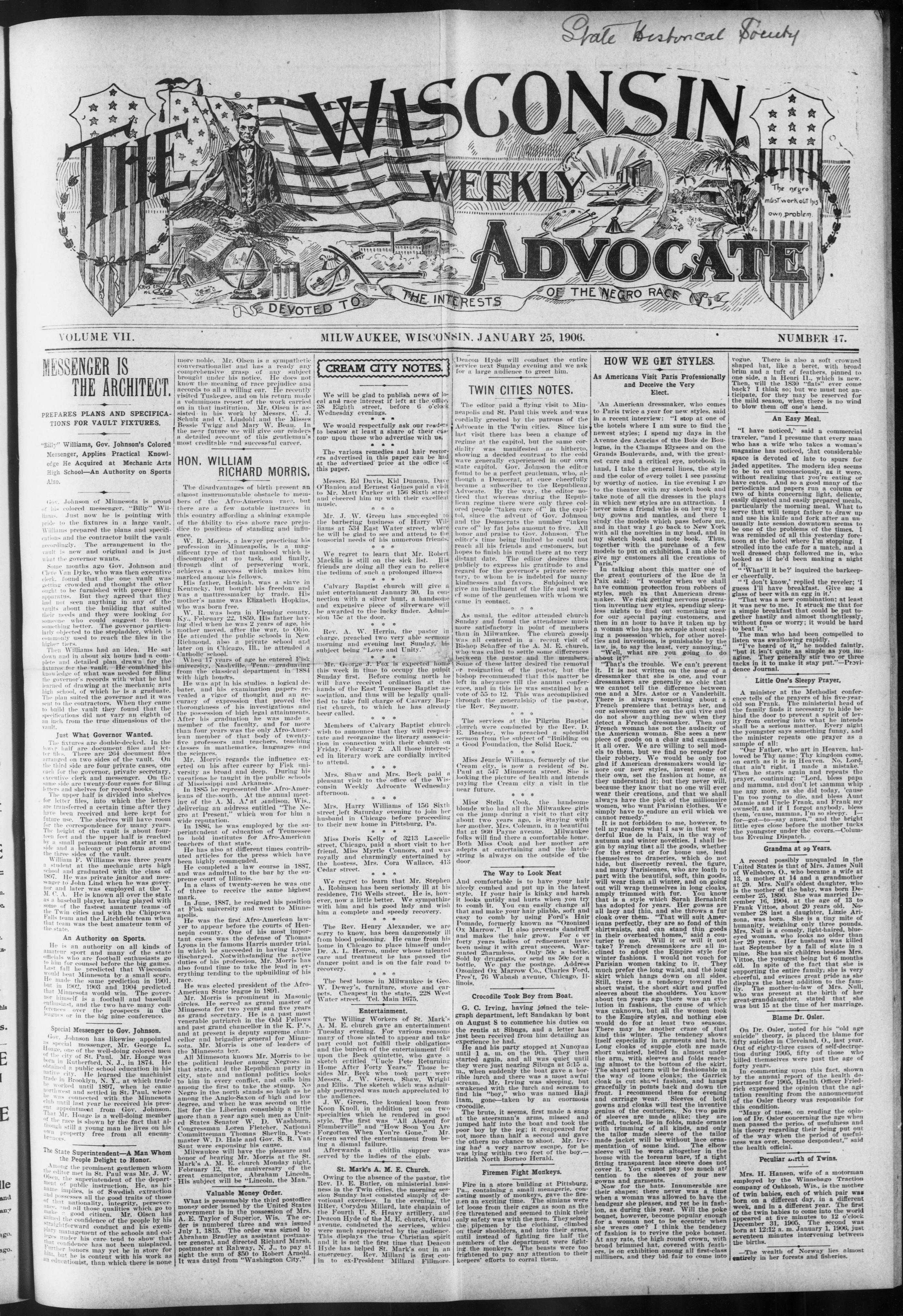
WISCONSIN
WEEKLY
The negro must work out his own problem.
ADVOCATE
DEVOTED TO THE INTERESTS OF THE NEGRO RACE
VOLUME VII.
MESSENGER IS THE ARCHITECT.
PREPARES PLANS AND SPECIFICATIONS FOR VAULT FIXTURES.
"Billy" Williams, Gov. Johnson's Colored Messenger, Applies Practical Knowledge He Acquired at Mechanic Arts High School-An Authority on Sports Also
Gov. Johnson of Minnesota is proud of his colored messenger, "Billy" Williams. Just now he is pointing with pride to the fixtures in a large vault. Williams prepared the plans and specifications and the contractor built the vault accordingly. The arrangement in the vault is new and original and is just what the governor wants.
Some months ago Gov. Johnson and Cleve Van Dyke, who was then executive clerk, found that the one vault was getting crowded and thought the other ought to be furnished with proper filing apparatus. But they agreed that they had not seen anything in any of the vaults about the building that suited their needs and they were looking for someone who could suggest to them something better. The governor particularly objected to the stepladder, which is commonly used to reach the files in the higher tiers.
Then Williams had an idea. He sat down and in about six hours had a complete and detailed plan drawn for the fixtures for the vault. He combined his knowledge of what was needed for filing the governor's records with what he had learned of drawing at the mechanic arts high school, of which he is a graduate. The plan suited the governor and it was sent to the contractors. When they came to build the vault they found that the specifications did not vary an eighth of an inch from the true dimensions of the vault.
Just What Governor Wanted.
The fixtures are double-decked. In the lower half are document files and letter files. There are 264 document files arranged on two sides of the vault. On the third side are four private cases, one each for the governor, private secretary, executive clerk and messenger. On the same side are twenty-four cases for filing letters and shelves for record books. The upper half is divided into shelves for letter files, into which the letters are transferred a certain time after they have been received and here kept for future use. The shelves will have room for the correspondence for many years. The height of the vault is about fourteen feet and the upper half is reached by a small permanent iron stair at one side and a balcony or platform around the three sides of the vault.
William F. Williams was three years a student at the mechanic arts high school and graduated with the class of 1897. He was private janitor and messenger to John Lind when he was governor and later was employed at the Y. M. C. A. He is known all over the state as a baseball player, having played with some of the fastest amateur teams of the Twin cities and with the Chippewa Falls team and the Litchfield team when that team was the best amateur team of the state.
An Authority on Sports.
He is an authority on all kinds of amateur sport and many of the state officials who are football enthusiasts go to him for counsel before the big games. Last fall he predicted that Wisconsin would beat Minnesota by a small score. He made the same prediction in 1901, but in 1902, 1903 and 1904 predicted that Minnesota would win. The governor himself is a football and baseball enthusiast, and the two have many conferences over the prospects in the leagues or in the big nine conference.
Special Messenger to Gov. Johnson.
Gov. Johnson has likewise appointed as special messenger, Mr. George L. Hoage, one of the well-doing colored men of the city of St. Paul. Mr. Hoage was born in Rutherford, N. J., in 1874. He obtained a public school education in his native city. He learned the machinist trade in Brooklyn, N. Y., at which trade he worked until 1897, when he came northwest and settled in St. Paul, where he was connected with the Minnesota club until last year he received his present appointment from Gov. Johnson. That Mr. Hoage is a well-doing member of the race is shown by the fact that although still a young man he lives on his own property free from all encumbrances.
The State Superintendent—A Man Whom the People Delight to Honor.
Among the prominent gentlemen whom the editor met in St. Paul was Mr. J. W. Olsen, the superintendent of the department of public instruction. He, as his name implies, is of Swedish extraction and possesses all the good traits of those of that nationality, integrity, perseverance, and all those qualities which go to make a good citizen. Mr. Olsen has gained the confidence of the people by his straightforward conduct and his exemplary management of the schools and colleges under his care tend to show that that confidence has not been misplaced. Further bonors may yet be in store for him, but he is content with his work as an educationist, than which there is none
more noble. Mr. Olsen is a sympathetic conversationalist and has a ready any comprehensive grasp of any subject brought under his notice. He does not know the meaning of race prejudice and accords to all a willing ear. He recently visited Tuskegee, and on his return made a voluminous report of the work carried on in that institution. Mr. Olsen is assisted in his work by Messrs. C. J. Schulz and C. Lindohl and the Misses Bessie Twigg and Mary W. Bean. In the near future we will give our readers a detailed account of this gentleman's most creditable and successful career.
HON. WILLIAM RICHARD MORRIS.
The disadvantages of birth present an almost insurmountable obstacle to members of the Afro-American race, but there are a few notable instances in this country affording a shining example of the ability to rise above race prejudice to positions of standing and influence.
W. R. Morris, a lawyer practicing his profession in Minneapolis, is a magnificent type of that manhood which is discouraged at no task, and finally, through dint of persevering work, achieves a success which makes him marked among his fellows.
His father, Hezkiah, was a slave in Kentucky, but bought his freedom and was a mattressmaker by trade. His mother's name was Elizabeth Hopkins, who was born free.
W. R. was born in Fleming county, Ky., February 22, 1859. His father having died when he was 2 years of age, his mother moved, after the war, to Ohio. He attended the public schools in New Richmond, also a private school and later on in Chicago, Ill., he attended a Catholic school. When 17 years of age he entered Fisk university, Nashville, Tenn. graduating from the classical department in 1884 with high honors.
He was apt in his studies. a logical debater, and his examination papers revealed a vigor of thought, and an accuracy of expression that proved the thoroughness of his investigations and the possession of high legal attainments. After his graduation he was made a member of the faculty, and for more than four years was the only Afro-American member of that body of twenty-five professors and teachers, teaching classes in mathematics, languages and the sciences. Mr. Morris regards the influence exerted on his after career by Fisk university as broad and deep. During his vacations he taught in the public schools of Mississippi and Arkansas.
In 1885 he represented the Afro-Americans of the south. At the annual meeting of the A. M. A. at Madison, Wis., delivering an address entitled "The Negro at Present," which won for him a wide reputation. In 1886, he was employed by the superintendent of education of Tennessee to hold institutes for Afro-American teachers of that state. He has also at different times contributed articles for the press which have been highly commended. He completed a law course in 1887, and was admitted to the bar by the supreme court of Illinois.
In a class of twenty-seven he was one of three to receive the same highest mark.
In June, 1887, he resigned his position at Fisk university and went to Minneapolis.
He was the first Afro-American lawyer to appear before the courts of Hennepin county. One of his most important cases was the defense of Thomas Lyons in the famous Harris murder trial, in which he succeeded in having Lyons discharged. Notwithstanding the active duties of his profession, Mr. Morris has also found time to take the lead in everything tending to the upbuilding of his race.
He was elected president of the Afro-American State league in 1891.
Mr. Morris is prominent in Masonic circles. He served as grand master of Minnesota for two years and five years as grand secretary. He is a past most venerable patriarch in the Odd Fellows and past grand chancellor in the K. P.'s, and at present is deputy supreme chancellor and brigadier general for Minnesota. Mr. Morris is one of leaders of the Minnesota bar.
All Minnesota knows Mr. Morris to be the political leader among Negroes in that state, and the Republican party in city, state and national politics looks to him in every conflict, and calls him among the first to take the stump. No Negro in the north stands so high as he among the Anglo-Saxon of high and low degree, and when he was second on the list for the Liberian consulship a little more than a year ago such men as United States Senator W. D. Washburn, Congressman Loren Fletcher, National Committeeman Thomas Shevlin, Postmaster W. D. Hale and Gov. S. R. Van Sant were espousing his cause.
Milwaukee will have the pleasure and honor of hearing Mr. Morris at the St. Mark's A. M. E. church Monday night, February 12, the anniversary of the great emancipator, Abraham Lincoln. His subject will be "Lincoln, the Man."
Valuable Money Order.
What is presumably the third postoffice money order issued by the United States government is in the possession of Mrs. A. E. Taylor of Superior, Wis. The order is numbered three and was issued July 1, 1815. The order was signed by Abraham Bradley as assistant postmaster general, and directed Richard Marsh, postmaster at Rahway, N. J., to pay at sight the sum of $50 to Robert Arnold. It was dated from "Washington City."
CREAM CITY NOTES.
We will be glad to publish news of local and race interest if left at the office, 38 Eighth street, before 6 o'clock Wednesday evenings.
We would respectfully ask our readers to bestow at least a share of their custom upon those who advertise with us.
The various remedies and hair restorers advertised in this paper can be had at the advertised price at the office of this paper.
Messrs. Ed Davis, Kid Duncan, Dave O'Banion and Eernest Gaines paid a visit to Mr. Matt Parker at 156 Sixth street and cheered him up with their excellent music.
Mr. J. W. Green has succeeded to the barbering business of Harry Williams at 534 East Water street, where he will be glad to see and attend to the tonsorial needs of his numerous friends.
* * *
We regret to learn that Mr. Robert Macklin is still on the sick list. His friends are doing all they can to relieve the tedium of such a prolonged illness.
* * *
Calvary Baptist church will give a mist entertainment January 30. In connection with a silver hunt, a handsome and expensive piece of silverware will be awarded to the lucky finder. Admission 15c at the door.
Rev. A. W. Herrin, the pastor in charge, preached two very able sermons morning and evening last Sunday, his subject being "Love and Unity."
* * *
Mr. George J. Fox is expected home this week in time to occupy the pulpit Sunday first. Before coming north he will have received ordination at the hands of the East Tennessee Baptist association, and thus will be legally qualified to take full charge of Caivary Baptist church, to which he has already beer called.
Members of Calvary Baptist church wish to announce that they will respecitate and reorganize the literary asssociation in connection with their church on Friday. February 2. All those interested in literary work are cordially invited to attend.
***
Mrs. Shaw and Mrs. Beck paid a pleasant visit to the office of the Wisconsin Weekly Advocate Wednesday afternoon.
\* \* \*
Mrs. Harry Williams of 156 Sixth street,left Saturday evening to join her husband in Chicago,before proceeding to their new home in Pittsburg, Pa.
***
Miss Doris Kelly of 3213 Lascelle street, Chicago, paid a short visit to her friend, Miss Myrtle Connors, and was royally and charmingly entertained by the hostess, Mrs. Cora Wallace, 413 Cedar street.
* * *
We regret to learn that Mr. Stephen A. Robinson has been seriously ill at his residence, 716 Wells street. He is, however, now a little better. We sympathize with him and his good lady and wish him a complete and speedy recovery.
\* \* \*
The Rev. Henry Alexander, we are sorry to know, has been dangerously ill from blood poisoning. He came from his home in Chicago to place himself under Dr. A. L. Herron, under whose talented care and treatment he has passed the danger point and is on the fair road to recovery.
The best house in Milwaukee is Geo. W. Dewey's, furniture, stove and carpets. Cheapest in the state. 228 West Water street. Tel. Main 1675.
Entertainment.
The Willing Workers of St. Mark's A. M. E. church gave an entertainment Tuesday evening. For various reasons many of those slated to appear and take part could not fulfill their obligations and the burden of the entertainment fell upon the Beck quintette, who gave a sketch entitled "Uncle Pete Returning Home After Forty Years." Those besides Mr. Beck who took part were Messrs. J. W. Green, Shaw, Wright and Ellis. The sketch which was admirably portrayed was much appreciated by the audience.
J. W. Green, the komical koon from Koon Knoll, in addition put on two specialties which he rendered in good style. The first was "All Aboard for Slumberville" and "How Soon You Are Forgotten When You're Gone." Mr. Green saved the entertainment from being a dismal failure. Afterwards a chitlin supper was served by the ladies of the club.
St. Mark's A. M. E. Church.
Owing to the absence of the pastor, the Rev. D. E. Butler, on ministerial business in the Twin cities, the morning session Sunday last consisted simply of devotional exercises. In the evening, the RRev. Corydon Millard, late chaplain of the Fourth U. S. Heavy artillery, and Deacon Hyde of the M. E. church, Grand avenue, conducted the services, which were much appreciated by the audience. This displays the true Christian spirit and it is not the first time that Deacon Hyde has helped St. Mark's out in an emergency. Rev. Millard is first cousin to ex-President Millard Fillmore.
Dencon Hyde will conduct the entire service next Sunday evening and we ask for a large audience to greet him.
TWIN CITIES NOTES.
The editor paid a flying visit to Minneapolis and St. Paul this week and was cordially greeted by the patrons of the Advocate in the Twin cities. Since his last visit there has been a change of regime at the capitol, but the same cordiality was manifested as hitherto, showing a decided contrast to the cold wave generally experienced in our own state capitol. Gov. Johnson the editor found to be a perfect gentleman, who, although a Democrat, at once cheerfully became a subscriber to the Republican Advocate. By the way, the editor noticed that whereas during the Republican regime there were only three colored people "taken care of" in the capitol, since the advent of Gov. Johnson and the Democrats the number "taken care of" by fat jobs amount to five. All honor and praise to Gov. Johnson. The editor's time being limited he could not reach all his friends and customers, but hopes to finish his round there at no very distant date. The editor desires thus publicly to express his gratitude to and regard for the governor's private secretary, to whom he is indebted for many kindnesses and favors. Subjoined we give an installment of the life and work of some of the gentlemen with whom we came in contact.
```markdown
```
As usual, the editor attended church Sunday and found the attendance much more satisfactory in point of members than in Milwaukee. The church gossip was all centered in a recent visit of Bishop Schaffer of the A. M. E. church, who was called to settle some differences between the pastor and the members. Some of these latter desired the removal or resignation of the pastor, but the bishop recommended that this matter be left in abeyance till the annual conference, and in this he was sustained by a vote of 55 to 12. This was accomplished through the generalship of the pastor, the Rev. Seymour.
☆ ☆ ☆
The services at the Pilgrim Baptist church were conducted by the Rev. D. E. Beasley, who preached a splendid sermon from the subject of "Building on a Good Foundation, the Solid Rock."
☆ ☆ ☆
Miss Jennie Williams, formerly of the Cream city, is now a resident of St. Paul at 547 Minnesota street. She is looking the picture of health and intends paying the Cream city a visit in the near future.
* * *
Miss Stella Cook, the handsome blonde who had all the Milwaukee girls on the jump during a visit to that city about two years ago, is staying with her mother, Mrs. Coleman, in a beautiful flat at 960 Payne avenue. Milwaukee folks will find there a comfortable home. Both Miss Cook and her mother are adepts at entertaining and the latchstring is always on the outside of the door.
The Way to Look Neat
And comfortable is to have your hair nicely combed and put up in the latest style. If your hair is kinky and harsh it looks untidy and hurts when you try to comb it. You can easily change all that and make your hair pliable, soft and easy to comb by using Ford's Hair Pomade, formerly known as "Ozonized Ox Marrow." It also prevents dandruff and makes the hair grow. For over forty years ladies of refinement have been using it with great success. Warranted 2harmless. Only 50c a bottle. Sold by druggists, or send us 50c for a bottle. We pay the postage. Address Ozonized Ox Marrow Co., Charles Ford, Pres't, 76 Wabash avenue, Chicago, Illinois.
Crocodile Took Boy from Boat.
G. C. Irving, having joined the telegraph department, left Sandakan by boat on August 8 to commence his duties on the rentis at Sibuga, and a letter has just been received from him detailing an experience he had.
He and his party stopped at Nunoyan until 1 a. m. on the 9th. They then started again, and all was quiet until they were just nearing Sibuga at 5:15 a. m., when suddenly the boat gave a horrible lurch and there was a most awful scream. Mr. Irving was sleeping, but awakened with the lurch and scream to find his "boy," who was named Haji Itam, gone—taken by an enormous crocodile
The brute, it seems, first made a snap at the steersman's arms, missed and jumped half into the boat and took the poor boy by the leg; it reappeared for not, more than half a second and gave the others no chance to shoot. Mr. Irving had a very narrow escape, for he was lying within two feet of the boy. British North Borneo Herald.
Firemen Fight Monkeys.
Fire in a store building at Pittsburg, Pa., containing a small menagerie, consisting mostly of monkeys, gave the firemen an exciting time. The simians were let loose from their cages as soon as the fire threatened and seemed to think their only safety was with the men. They seized the pipemen by the clothing, climbed on their shoulders, and into their arms, until instead of fighting fire half the members of the department were fighting the monkeys. The beasts were too frightened to pay any attention to their keepers' efforts to corral them.
HOW WE GET STYLES.
As Americans Visit Paris Professionally and Deceive the Very Elect.
An American dressmaker, who comes to Paris twice a year for new styles, said in a recent interview: "I stop at one of the hotels where I am sure to find the newest styles; I spend my days in the Avenue des Acacias of the Bois de Boulogne, in the Champs Elysees and on the Grands Boulevards, and, with the greatest care and a critical eye, notebook in hand, I take the general lines, the style and the color of every toilet I see passing by worthy of notice. In the evening I go to the theater with my sketch book and take note of all the dresses in the plays in which new styles are an attraction. I never miss a friend who is on her way to buy gowns and mantles, and there I study the models which pass before me, and in that way I go back to New York with all the novelties in my head, and in my sketch book and note book. Thus, together with the purchase of a few models to put on exhibition, I am able to give my customers all the creations of Paris."
In talking about this matter one of the great couturiers of the Rue de la Paix said: "I wonder when we shall have common protection from robbers of styles, such as that American dressmaker. We risk getting nervous prostration inventing new styles, spending sleepless nights to find out something new for our special paying customers, and then in an hour to have it taken up by a woman who has no scrape about stealing a possession which, for other novelties and inventions, is punishable by the law, is, to say the least, very annoying." "Well, what are you going to do about it?"
"That's the trouble. We can't prevent it. It is not written on the nose of a dressmaker that she is one, and your dressmakers are generally so chic that we cannot tell the difference between one and a Mrs. Astor or a Vanderbilt. There is always something about a French premiere that betrays her, and our saleswomen are on the qui vive and do not show anything new when they detect a French dressmaker. Then our French woman has not the audacity of the American woman. She sees a new piece of goods on a chair and examines it all over. We are willing to sell models to them, but we find no remedy for their robbery. We would be only too glad if American dressmakers would ignore our new styles, invent some of their own, set the fashion at home, as they understand it; but they never will, because they know that no one will ever wear their creations, and that we shall always have the pick of the millionaire women, who want Parisian clothes. We simply have to endure an evil which we cannot remedy."
It is not forbidden to me, however, to tell my readers what I saw in that wonderful Rue de la Paix, in the way of autumn and winter novelties. I shall begin by saying that all the goods, whether for the street or for home use, lend themselves to draperies, which do not hide, but discreetly reveal, the figure, and many Parisiennes, who are loath to part with the beautiful, soft, thin goods, will wear them all winter, and on going out will wrap themselves in long cloaks, amply trimmed with fur. You know that is a style which Sarah Bernahrdt has adopted for years. Her gowns are all lacy and thin, and she throws a fur cloak over them. "That will suit Americans perfectly, they are so fond of thin shirtwaists, and can stand thin goods in their overheated homes," said a courrier to me. Will it or will it not take? French dressmakers are all inclined to adopt the Empire style for winter fashions. I would not vouch for Parisian women taking to it. They much prefer the long waist, and the long skirt which hangs down on all sides. Still, there is a tendency toward the short waist, the short skirt and puffed sleeves about the shoulders. You know about ten years ago there was an evolution in fashions, the cause of which was unknown, but all the women took to the Empire styles, and nothing else would do for at least two seasons. There may be another craze of that kind this winter. The tendency shows itself especially in garments and hats. Long cloaks of supple cloth are made short waisted, belted in almost under the arm, with sleeves and folds reaching almost to the bottom of the skirt. The shawl pattern will be fashionable in the way of loose cloaks; the Garrick cloak is cut shawl fashion, and hangs gracefully in points back and down the front. I recommend them for evening and carriage wear. Sleeves of both gowns and cloaks will test the inventive genius of the coururiers. No two pairs of sleeves are made alike; they are puffed, tucked, lie in folds, made ornate with trimming of all kinds, and only the tailor made sleeve of the tailor made jacket will be without lace ornamentation of some kind. The elbow sleeve will be worn altogether in the house with the forearm bare, if a tight fitting transparent lace sleeve does not cover it. You cannot pay too much attention to the sleeves of your new gowns and garments.
Now for the hats. Innumerable are their shapes; there never was a time when a woman was allowed to have the headgear she pleases, and yet be in fashion, as during this year. Will the poke bonnet, however, become popular enough for a woman not to be eccentric when she wears one? I think the tendency of fashion is to revive the poke bonnet. At any rate, the high round crown, with broad brimmed hat, covered with feathers, is on exhibition among all first-class milliners, and they bid fair to come into
NUMBER 47.
vogue. There is also a soft crowned shaped hat, like a beret, with broad brim and a tuft of feathers, pinned to one side, a la Henri II., which is new. Then, will the 1830 "flats" ever come back? I think so; but we must not anticipate, for they may be reserved for the mild season, when there is no wind to blow them off one's head.
An Easy Meal.
"I have noticed," said a commercial traveler, "and I presume that every man who has a wife who takes a woman's magazine has noticed, that considerable space is devoted of late to spurs for jaded appetites. The modern idea seems to be to eat unconsciously, as it were, without realizing that you're eating or have eaten. And so a good many of the periodicals and papers run a column or two of hints concerning light, delicate, easily digested and easily prepared meals, particularly the morning meal. What to serve that will tempt father to draw up and use his knife and fork after an unusually late session downtown seems to be one of the problems of the times. I was reminded of all this yesterday forenoon at the hotel where I'm stopping. I strolled into the cafe for a match, and a well dressed chap followed me in, who looked as if he'd been making a night of it.
"What'll it be?' inquired the barkeeper cheerfully.
"I don't know,' replied the reveler; 'I guess I'll have breakfast. Give me a glass of beer with an egg in it.'
"That was a new combination; at least it was new to me. It struck me that for a simple breakfast that could be put together hastily and almost thoughtlessly, without fuss or worry; it would be hard to beat it."
The man who had been compelled to listen was swallowing rapidly.
"I've heard of it," he nodded faintly, "but it isn't quite as simple as you imagine. They generally stir two or three tacks in it to make it stay put."—Providence Journal.
Little One's Sleepy Prayer.
A minister at the Methodist conference tells of the prayers of his five-year-old son Frank. The ministerial head of the family finds it necessary to hide behind the door to prevent a spirit of levity from entering into what he intends shall be a serious matter. Every night the youngster says something funny, and the minister repeats one prayer as a sample of all:
"Our Father, who art in Heaven, hallowed be Thy name; Thy kingdom come, on earth as it is in Heaven. No, Lord, that ain't right, I made a mistake." Then he starts again and repeats the prayer, continuing: "Lord, bless papa and mamma, and don't let mamma whip me any more, as she did today, 'cause I'm too young to die, and bless Aunt Mamie and Uncle Frank, and Frank my ownself, and if I forgot anybody, bless them, 'cause, mamma, I'm so sleepy. I—for—got—to—say amen," and the bright little eyes close before the mother tucks the youngster under the covers.—Columbus Evening Dispatch.
Grandma at 29 Years.
A record possibly unequaled in the United States is that of Mrs. James Null of Wellsboro, O., who became a wife at 13, a mother at 14 and a grandmother at 29. Mrs. Null's oldest daughter, who is the mother of the baby, was born December 25, 1890. She was married December 16, 1904, at the age of 13 to Frank Vittoe, about 20 years old. November 28 last a daughter, Lizzie Arizona, was born. She is a tiny mite of humanity, weighing only three pounds. Mrs. Null is a comely, light-haired, blue-eyed woman, who looks no older than her 29 years. Her husband was killed last September by a fall of slate in a mine. She has six children besides Mrs. Vittoe, the youngest being but 6 months old. In spite of the fact that she is supporting the entire family; she is very cheerful, and evinces great pride as she displays the latest addition to the family. The mother-in-law of Mrs. Null, who was present at the birth of her great-granddaughter, stated that she was but 15 at the time of her marriage.
Blame Dr. Osler.
On Dr. Osler, noted for his "old age suicide" theory, is placed the blame for fifty suicides in Cleveland, O., last year. Out of eighty-three cases of self-dectruction during 1905, fifty of those who killed themselves were past the age of forty years.
In commenting upon this fact, shown by the annual report of the health department for 1905, Health Officer Friedrich expressed the opinion that the agitation resulting from the announcement of the Osler theory was responsible for this condition.
"Many of these, on reading the opinion of Dr. Osler concerning the age when men passed the period of usefulness and his theory regarding their being put out of the way when the period of usefulness was over, become despondent," said the health official.
Peculiar Birth of Twins
Mrs. H. Hansen, wife of a motorman employed by the Winnebago Traction company of Oshkosh, Wis., is the mother of twin babies, each of which pair was born on a different day, in a different week, and in a different year. The first of the twin babies to come into the world appeared at five minutes to 12 o'clock December 31, 1905. The second was born at 12:12 a. m. January 1, 1906, just seventeen minutes intervening between the births.
The wealth of Norway lies almost entirely in her forests and fisheries.
"Mamma, what is a spinster?"
Mamma, what is a spinster.
"A spinster, my dear, is a woman to be envied. But don't tell your father I said so."—Tit-Bits.
Molly—Have you seen Mabel's engagement ring?
Dolly—Seen it? Why, I wore it all last summer.—Tit-Bits.
Saphead—D'ye know, Miss Sharp, I believe some people inherit their stupidity.
Miss Sharp—But, Mr. Saphead, it is not proper to speak that way of your parents.—Tit-Bits.
Artist—You'd be surprised if you knew the amount of time spent on that picture.
Friend—Yes: I hear that people stand in front of it for hours trying to make out what it is.—Tit-Bits.
Why He Came Out.
"George," said his mother-in-law, "I saw you coming out of a bar-room yesterday."
"Yes," answered George, "I had to catch a train."—Smart Set.
Mamma—Ethel, my dear, do you think that Mr. Spooner, who calls so regularly and sits with you in the parlor every night, has serious intentions?
Ethel—I really don't know, mamma; he keeps one so much in the dark.—Tit-Bits.
Smith—He took several good-sized sticks and beat his wife.
Brown—I cannot believe he could be guilty of such cruelty.
Smith—Cruelty? There wasn't any cruelty about it. They were playing golf together.—Tit-Bits.
Certain of His Guilt.
"You are sure that the man cheated?"
"Yes, sir," answered Three Finger Sam.
"He held four aces."
"But that is not conclusive evidence."
"It was in this case. I knew where the three regular aces was, myself.—Washington Star."
Diplomatically.
"No," answered Mr. Meekton, who had been reading the foreign news. "I'm not absolutely governed by her. But I must admit that I am very much within her sphere of influence."—Washington Star.
Hospitable.
Policeman (to tramp)—I want your name and address.
Tramp (sarcastically)—Oh, yer do, do yer? Well, my name is John Smith, and me address is No. 1, the open air. If yer call on me don't trouble to knock, but just walk in—Scotsman.
Very Many Thanks
Boy (who has been out to tea)—Mrs. Freeman's cake is better than ours, mamma.
Mamma—I hope you said "Thank you," nicely.
Boy—Oh, yes, mamma. I said it five times.
Mamma—You need only have said it once, dear.
Boy—But I had five pieces of cake, mamma!—London Punch.
Take Time to Be Loving
Few of us mean to hide our love from the children or husband. It is only because we are so busy—so busy. We must do everything in the very quickest way, and at the same time keep planning and thinking of how all those other things are to be done—and so love is crowded out. I sometimes wonder, dear mothers, if we are not nearly all making a mistake—if it would not be better to let the children's clothes be not quite so fine, the dinner plainer—yes, if need be, even the sitting room table go some day undusted; but so make time for the loving word and smile, the gentle, thoughtful deed, the lingering touch and caress, the something that will show the love in our hearts. Never a day passes but each one of us is near someone who is starving—not for food, nor wealth, nor fame, but for love. Even the little children in our homes are hungering for the loving word and smile. If we can but take time to give these, they will be remembered long after our elaborate dinners, our stylish dresses, our spotless houses, are forgotten.
Let us think the matter over carefully and look at it squarely. Do we, because of over-much sweeping and dusting in our homes, because of magnifying the importance of having each thing always in its proper place; and above all, of keeping the house nice for strangers to see—do we in any way lessen the joy for any of the dear ones in the home? Do we bake and dust and work to "keep house" for strangers and let "our own" go homeless? For where love is not uppermost, there can be no home, only a house—Mothers' Magazine.
Six Decline Proposal
After having been respectfully declined by six pretty young women within the space of two hours at an informal party, Frank Reed, aged 50, living near Mendon, Mich., advertised for a wife in Kalamazoo papers. He put the age limit at from 18 to 30 years, and restricted the eligibles to church members. Reed, who has property, declined to marry, and his brother Calvin invited him to come to Kalamazoo and try to secure a wife. He introduced him at a party, and his offers of marriage followed. The young women, who are employed as stenographers, tell the story, but decline to allow their names to be used. Calvin Reed is a queer character and lives alone. Since being refused by the young women he has furnished rooms with dolls, mirrors and pictures. He has a life-sized doll and on one hand of this one has placed a gold wedding ring. Calvin is divorced.
One Woman Not Nervous
Mrs. Fairbanks, wife of the vice president, declares that she does not possess nerves and it would seem that this is no idle boast. Mrs. Fairbanks has an iron endurance and she attributes her fortitude, mental and physical, to the fact that she never allowed herself to worry over anything, great or trivial. But she always secures ample rest, no matter what her engagements. During the maddening days of the last D. A. R. congress, when several thousand women would talk at once on as many different themes, Mrs. Fairbanks would endure the confusion as long as possible and then, giving the gavel to another officer, she would go to a near-by hotel and take a half hour's repose. She always drinks hot milk when she is going through physical or mental fatigue.
It Had Its Points
A clergymen was visiting an old man who had recently lost his wife, a great talker, and was sympathizing with him. "My poor old man." he said, "I feel so sorry for you, you must be very lonely." After a few minutes the old man looked up and said, "Yes, maister, yes, 'tis lonesome;" then with great emphasis, "but 'tis quiet."—The Bystander.
THE OLD GODS AND THE NEW.
In the twilight of the ages
Where the dust of years lies dead,
Wrinkled over Seers and Sages
Since the centuries have sped,
Stand the wraiths of unattended
Gods who once were called sublime,
Even in their ruin splendid,
Mocking and defying Time.
In the wake of winds that follow
Fast along the path of man,
Comes an echo of Apollo,
Floats the reedy note of Pan,
And a clearer tone is ringing
Mid the clashing of the spheres,
And a wilder flight is winging
Through the vistas of the years.
And from out the ocean mighty
High above the coral caves,
Rises Venue Aphrodite
Throned and sceptered by the waves,
While the horn of Neptune winding
In the night's recumbent noon,
Scatters music o'er the blinding
Silver pathway of the moon.
So the old gods were most human,
More like song, and life, and wine,
Touched to love-words by a woman,
Mortal half and half divine;
And the later gods we fashion
For their loss have not sufficed,
No! not even the compassion
And the great white soul of Christ.
Knopf McCaffery in National Magazine
—Ernest McGaffey in National Magazine.
THE COURT OF LAST RESORT.
The Montreal express set me down at Whallonsville one stormy November nighth. Although unusual for that train to stop, the conductor had orders from the superintendent of the railroad to let me off.
The station was closed and dark. The weather was portentous of rain. Masses of clouds drifted across the sky, the moon dodging fitfully behind them. My surroundings were alternately black or gray. I stood at the station, watching the vanishing lights of the train. My irresolution was due to doubts of finding shelter. I had before me a twenty-mile drive to the scene of a murder, for which an early morning start was imperative.
A path led into a tangle of brush; following it! emerged into the open upon a narrow foot bridge. Midway on that structure the moon disclosed like a silhouette, a man's figure leaning against the rail. His gaze was directed downward into a gorge, neisy with the roar of a mountain torrent. Summer tourists familiar with the Au Sable region will recall "The Black Pool," into which a stream plunges over a ledge of rock. The gorge is dismally repellent, by day or night.
Approaching the spectral man. I asked to be directed to a shelter for the night. He did not at once reply, but regarded me with suspicion. Indistinct as were his features, in the gray haze, I knew him to be aged and, when he spoke, his voice proved him native to the locality. "How'd ye g.it here, mister?" he finally asked.
I explained that the train had been stopped for me.
"What ye done on the keers thet they put ye offom 'em?"
"I wasn't put off," I explained. "I travel for a living—am a newspaper correspondent."
"Oh! I thought mebby ye's like t'other feller"—a remark I did not understand; but I renewed my request to be directed to a stopping place for the night. After he had again looked me over, the native said:
"I mout tek ye meself, ef I hedn't 'm a' ready."
When I again urged the stranger to give me shelter he added: "I'll do es well es I ken by ye, 'cause no wimmin folks up ter my house, 'cause my wife is dead, an' I never did have no childer. But, say, I got a man up there I pulled outen this here pool less 'an two hours ago! He's done nothin' sence but moan an' cry. I couldn't stan' him no longer, so I toddled down here. I'm kinder glad ye've come, for I hate to be alone with thet chap all right"
My prospective host led the way across the bridge and up a hillside path. As we climbed he grew more talkative.
"I was a-comin' up from the pos'offiss tonight," he chattered, "was walkin' slow, fer I'm gettin' long in years an' hev pains in my legs. Jes' es I com' night the bridge I see a feller path down the clift an' the swirl in a splash in the water below. I hev been in these 'ere mountings, boy an' man, for seventy year an' knowed the path down the clift, an' the swirl in the pool—where et carries a floatin' body. Forgettin' I was more'n ten years old. I got down ther' in no time. I watched fer 'im. W'en he come nigh I pulled 'im to the ledge, where I was. Part by carryin' but more by draggin' of 'im I got the poor feller up this 'ere road to the house. Ther' I took the wet duds offen him and sot him afore the fire. He kept his eyes on the floor, an' has face in his hands. I had no stimulous to give him, bein' temperance; but I meant to cheer him up a bit by askin' 'Why d' ye want ter die?'
"He didn't pay no 'tention—on'y kep' lookin' at the floor. 'Ye ain't more'n 25,' says I. 'The world's afore ye, yit.'
"He turned his face at me; an' I see 'im good, for the first time. His eyes was holler; his cheeks so wasted an' pale I was afeered he'd die right ther.' I was jess goin' ter say somethin' comfortin' when he snarled: 'Shet up, ye ol' fool! Say, what d'ye think of that?"
Before I could reply we entered the house.
In the middle of the room, seated in front of the glowing logs, was the rescued man. The hollow-eyed stranger raised his emaciated face and spoke.
"Look here, my good man," he began.
"You made a mistake! Why did you interfere?"
"At yer time of life, no man ought ter want to go to the other world," replied the native.
"How do you know?" was the angry retort. as the unknown got upon his feet.
"I didn't mean ter interfere with Providence," said our host, apologetically.
"Come here, then!" commanded he of the hollow voice. I'll state my case. You shall be a court of last resort!"
The two men drew apart and stood by a window. In tones so low that not a word was audible to me, the wretched one made his plea. The lines upon the face of the mountaineer grew rigid, as the narrative progressed.
When the stranger had finished, the native went to the chair upon which hung the man's clothing, took the steaming coat therefrom, and helped him put it on. Next, he handed the wanderer his hat, opened the door and said:
"Ye were right. I hedn't ought ter
interfere. May God hev mercy on yer soul!"
Accepting the verdict, the lost man vanished out that door, into the realm of eternal night.
And, at daylight, there was a body in the pool.—Brooklyn Eagle.
WISDOM OF AN EMPIRICIST.
Usually, judging means misjudging.
Justice is nowadays largely tempered with technicalities.
Life may be a joke, all right, but it seems to be "on" man.
"Nervousness" serves as an excuse for lots of petty meanness.
Beauty is only skin deep. Therefore when you skin, skin deeply.
A woman must have lots of time and energy to keep a hired girl at work.
Envy perpetuates itself. We envy other people and they envy someone else.
It doesn't seem to have occurred to anybody that a man may be both right and President.
It is my private opinion that a man who can run a furnace successfully can do nothing else.
By substituting coal oil lamps for gas, the city resident can have all the charms of a suburban life.
It is about as hard to convince yourself that you need a vacation as it is to convince your wife that she needs a new hat.
It is much harder to get up Sunday in order to get to church by 11 o'clock than it is to get to the office on week days at 8.
A good way to avoid sitting in the cozy corner is to claim that it always moves you irresitibly to smoke a pipe in it.
Corporations have no souls, and from the difficulty encountered in serving subpoenas it would seem that they have no bodies, either.
It is a wise husband who gets on the wrong side of an argument and finally allows himself to be convinced that he should do what he wants to.—St. Louis Globe-Democrat.
Getting Away from the Counter.
The quickest way to get away from the counter is to work hard, be polite and obliging at the counter. The trouble with people who complain that they cannot get above the positions they are in is that they cannot see that the step to the thing above them is in the thing they are doing, in their manner of doing it, that the opportunity for advancement is in the promptness, the thoroughness, the efficiency they show in the positions they now occupy.
Of two clerks working side by side in a store, one knows that the best part of his salary is not found in his pay envelope, but in the opportunity to learn the business, to extract from it the secrets which his employer may have paid a fortune for, besides putting his life into it. He is all eyes, all ears, all the time thinking of better methods, improved ways of doing things, and he finally becomes a proprietor himself. The other sees nothing in his work but drudgery and a perpetual clerkship.
If you have a hundred acres of land and only four people to support, as one correspondent states that he has, if you have enough brain, ambition, determination and grit, you cannot only support the people depending upon you, but you can also give yourself a good education—for you can buy all the books you need—and if you are a good manager, if you have system, you can have all the leisure you require for study.
If you are made of the stuff that wins nobody can keep you back, for if you do not find your chance where you are you will find it somewhere else. But remember that your achievement cannot rise higher than your resolution. So long as you think you are tied down so that you cannot move you will never get up or on.—Success Magazine.
REFLECTIONS OF A BACHELOR
A train of thought isn't always on time.
The tipping evil extends even to the races.
A friend in word is not always a friend indeed.
The henpecked man has to do all his crowing away from home.
The trouble with taking a day off is that you can't put it back.
Success generally depends on taking advantage of opportunities and people.
In shaping his career a young man shouldn't depend entirely on his tailor.
Half the sympathy in the world isn't appreciated. The other half is wasted.
Don't borrow money on your prospects if you ever hope to catch up with them.
The average man can do more kicking with two legs than a centipede with a thousand.
The fellow with more money than he knows what to do with always has more friends than he needs.—New York Times.
Gift to United States
Twelve of New Zealand's most interesting birds and four lizards, representing the only creatures of their age remaining in the world, have been presented by New Zealand to the United States and were sent on the Sierra during her latest trip from the Antipodes, euroute to the government zoo at Washington, D. C. New Zealand's gift includes four Kiwes, four Maoi hens, four Kea parrots and four tenatara lizards.
The Maori hen, known in New Zealand as the Weka, is a brown bird, much larger than the American hen.
The Kea parrot is a bird weighing five pounds and is seuch a pest in its native country that a reward is offered by the government to induce its extirpitation.
The tenatiara lizard is about thirty inches long and is the only known survival of its race in the world.
Trying to Raise Parasites
Some months ago a parasite which kills the purple scale, a deadly foe of orange trees in southern California was found in China. Many of its eggs were sent to San Francisco by an agent of the state horticultural department of California, but unfortunately the eggs did not hatch.
This failure suggested an attempt to bring the parasites alive and in shape to do business, so a number of orange trees were shipped to China from this state and upon their arrival there were transported several hundred miles into the interior, to the province that is the home of the enemy of the purple
scale. There the parasite made its home in the imported trees which were then taken back to the seacoast and after a time were placed on a steamer for San Francisco. They reached here on the last steamer in good condition after their journey by sea and land and are now being watched with constant care. If the parasites on them live and thrive, the problem of relief for the southern California orange growers has been solved. If not a second shipment of trees to China will be made.
PREPOSITIONS.
(All rights of translation reserved.)
The mercury is going down,
The coal is going in.
The price of eggs keeps going up—
It really seems a sin.
Festivities are going on,
Each night we're going out.
And some events are going off
Quite well, without a doubt.
So many schemes are going through,
It hardly pays to try
To grab Dame Fortune by the arm
As she is going by.
A dear girl I was going with,
Till my dog chased her cat.
She saw what he was going for,
I got a going-at.
"Go to! Go to! Give us a rest!"
I think I hear you say.
Just where you do not specify,
But I will go away.
—Summerville Journal
AS THE CHINESE SEE IT.
Circular Issued in Shanghai Urging Boy cott of American Goods.
This is a translation of a circular issued in Shanghai in connection with the Chinese boycott on American goods:
The first month of the year is fragrant with the fragrance of the plum tree flower.
On the western side of this world there is a great calmness.
In that sea there is set the country of the flowery banner.
The second month is beautiful with the beauty of the flower of the red apricot. We men of China who went forth to labor suffered many hardships. We successfully opened many mines of silver and gold.
For the American people we built and completed all the roads where rails are of iron. The third month opens with opening of the flower of the peach tree.
They consumed with fire the streets of Dong Sung Ka.
The fourth month is the month of all the flowers and plants and herbs. As for us, we men of China, we thought upon the bitterness of our lot. We too have been sent into the world by heaven; why should the treatment accorded to dead pigs be meted out to us? The fifth month is the month in which the flower of pomegranates flourishes.
In them they comined us, the natives of China. The sixth is the month in which the flower of the lily takes on its line of red. After taking us into the prisons of wood which they had built, they scorched us in fire of sulphur. Officials of all grades and students of all ages received the same measures of abuse; they treated without mercy.
In the seventh month the hyacinth begins to bloom.
Hardships such as these we have suffere for more than twenty years.
It is a great pity that we men of China whose numbers are ten thousand times ten thousand four times over are not equal in value to the half of the smallest copper cash.
The eighth month is the month when the cinnamon sheds its sweetness.
Among the members of the native chamber of commerce is one who bears the name Tseng Seu Ching. This man planned a most civilized method, he spent money on it and advanced the righteous cause and his fame has gone forth.
The ninth month is the month of the yellow chrysanthemum.
Let us all assemble together and discuss its details.
It is best not to use American goods. To oppose America is our safest course. The tenth month is the month when beautiful flowers become green. We advise you, men, women and children of China, if you want to eat your rice in the future in peace to attend to realize the importance of this movement. In the eleventh month the flower of the reed is blown about by the wind. We, all of us, must remember and not forget too soon the Pin Head Cigarettes and the scented soap of the American Trading company. Furthermore, let us remember not to again use the American piece goods.
In the twelfth month the flower of the binds are many.
If we do any act which is wrong or mischievous we shall eat our bitterness.
Timely Hints.
A physician in good standing says that two tablespoenfuls of thick sweet cream of good quality is equal to the same amount of cod liver oil as a tonic for anaemic persons. Salt is an excellent thing for the teeth. A young woman with beautiful teeth says that she often uses it and that her dentist recommended her to do so. It is said that fish can be scaled very easily if hot water is poured over them slowly until the scales begin to curl. They then should be scraped quickly and washed in several waters. The last mixing water should be well salted and very cold, so that the fish can be freed from stickiness. A housewife singes her turkey for Thanksgiving over a little alcohol burned in a saucer. She says this method leaves no trace of odor.
Do not forget when preparing and drawing the turkey for Thanksgiving to pull out the tendons of the legs before chopping off the feet and claws. Some people prefer braised turkey to roasted turkey. It is especially recommended where the bird is of uncertain age. Some women enjoy prunes when they are cooked with French chestnuts.
Convinced It Was Not Man's Work.
At a recent convention of librarians, the following story was told of old Geronimo, the most celebrated Indian prisoner-ward the federal government has ever had:
"Do not the products of civilized life astonish you?" Geronimo was asked by his keeper.
"Most of them do not, for I see how they come about," said the aged Indian.
"But," he added, "they took me once to New Orleans and showed me where they made ice. At one end of a building I saw wood thrown into furnace, and out of the other end came blocks of ice. Man did not do that; only the Great Spirit can make ice from fire."—New York Tribune.
TO PEOPLE WHO FIND EARLY RISING DIFFICULT.
If you would be an early bird and catch the early worm.
Above all things, remember this: Be resolute; be firm.
HIS LIVING WAS MYSTERY
Survived Since Civil War with Gaping Wound in Abdomen.
So badly wounded in the Civil war that his living has been a mystery to the physicians and surgeons of the world, Charles H. Smith, a clerk in the United States treasury department, finally died of acute indigestion at his desk. Smith, who lived at Decatur, N. Y., was mustered into the Seventy-sixth New York. He fought with his regiment and escaped injury until the first day's fighting at Gettysburg, where he went down with a ball in his right thigh and one in his left groin which went through his body, coming out at the right hip. As the armies withdrew Smith raised himself to attract attention. A ball struck him just above the left hip, going through the intestines, touching the spinal column and coming out at the right hip. As he fell back a shell burst just above him, tearing away a part of his right hip. It was three days before Smith was found, and during all that time he lay in the broiling sun, with no water, a Confederate soldier having taken his canteen. When finally found he was taken to McPherson's barn, wrapped in a blanket and laid in a cow shed. The surgeons gave him no attention, as they did not believe he had a chance for life. One surgeon told him the large intestine had been twice cut and that he would die within a few hours. It was also found that his bladder had been punctured. Smith was put on a stretcher next day and moved to a warehouse in Gettysburg, where his comrades fed him. They finally took him to the home of Robert Sheads, whence he was taken to a hospital in Philadelphia, where he remained until October, 1864. From that time until the day of his death Smith wore eight yards of 8-inch linen bandage around his body, his hip remaining perforated. He was obliged to change the bandages three or four times a day and dress his wounds. Surgeons frequently examined Smith's wounds, and all expressed the greatest surprise at his being alive. He was examined by the surgeons attending President Garfield, as his wound was similar to the President's. The surgeons told him the twice severed colon had healed and grown fast to the membrane of the stomach. In appearance Smith was as healthy looking as any man. He lost little time from his duties despite his wounds, and took a prominent part in lodge work.
UNITED STATES IN THE LEAD.
First in the World in Mileage and Railway Growth.
The United States leads the world both in the present mileage and the recent growth of its railways. This is shown in a report on "the transportation routes and systems of the world" issued by the department of commerce and labor. It points out that of the total railway mileage of the world aggregating in 1904, 543,000 miles, there were 211,074 miles in the United States, 35,323 miles in European Russia, 32,967 miles in Germany, 28,102 in France, 26,950 in India, 24,120 in Austria-Hungary, 22,634 in the United Kingdom, 19,611 in Canada, 15,560 in Africa, 14,113 in Australia, 11,559 in Argentina, 10,356 in Mexico, 9961 in Italy, 9368 in Brazil, 7697 in Sweden, 7322 in Siberia, Manchuria and the other former Asiatic possessions of Russia, 4495 in Japan and 1176 in China.
The growth of the railways in the United States has been very rapid. Beginning in 1835 with 1000 miles the number steadily grew and in the decade 1865-1875 it doubled and then rapidly came up to the present number, which represents an outlay of eleven and two-thirds billions of dollars out of an aggregate cost of thirty-seven billions for the entire world.
The total tonnage of vessels flying the American flag increased from 5,212,001 tons in 1855 to 6,456,543 tons in 1905. This increase is due to the increase in the tonnage of vessels engaged in the coastwise trade. The tonnage of vessels engaged in the foreign trade fell from 2,348,358 in 1855 to 943,750 tons in 1905. Freight rates on both land and sea have decreased. The rate per bushel of wheat from New York to Liverpool was about 10 cents in 1873, and about 1 cent in 1905.
The amount of passengers and freight transported has increased considerably. During the last year the railways transported 719,654,951 passengers and 1,300,-000,000 tons of freight. In 1885 the number of passengers carried was 351,-427,688 and freight 437,000,000 tons.
No Reason to Complain.
"The independence of the American waiter is a great and glorious thing," said A. F. D. Stall of Australia. "He has been roaming about in this broad western hemisphere, breathing the air of freedom, liberty and independence until he is saturated with it. In Chicago the other day I said to a waiter in a cafe:
"Waiter, is this a pork chop or a mutton chop?"
"Can't you tell by the taste?' asked the waiter, marvelously disinterested in the identity of the chop.
"'I certainly cannot,' I replied.
"Then what difference does it make? replied the waiter.—San Francisco Chronicle.
Swallows His False Teeth
Prof. J. A. White of the California State Normal school a few nights ago awoke with a choking sensation. He swallowed a glass of water and then discovered he had swallowed his false teeth. A physician with the aid of X-rays discovered the teeth in the professor's stomach. Another doctor dosed the patient to dislodge the teeth. The teeth were carried from the stomach into the doudenum and then all trace of them was lost. Prof. White has suffered no inconvenience beyond restriction of diet. He says the most annoying consequence is that his students having learned of his predicament, it is impossible for him to keep order in the classroom.
Cinch Fiends Meet
Henry Brookings and Capt. Scudder of St. Louis and D. D. Cody and C. E. Olney of Grand Rapids, all millionaires, celebrated the completion of 2000 hours of cinch playing by a little banquet at their hotel in Los Angeles to a party of friends. They have met there every winter for eight years, and have played almost nightly games of cinch. The other night they calculated that they had played 1996 hours, and decided to make it an even 2000. They played diligently for four hours and then called in their friends to the feast.
How Willie Cracked Them.
Willie's big sister, a Warwick boulevard young woman, was having a small party a few evenings ago and the time for refreshments came. Instead of the usual ice cream, cake, etc., the girl had provided something "different." Pumpkin pie, fruit, cider and chestnuts were served. Willie was on hand assisting in the eating. When the chestnuts were passed the girl said:
"I can't vouch for these. I told Willie to be sure and throw out the bad ones. Did you do it, Willie?"
"Bet I did," said Willie, gulping down a mouthful of pie.
"Yes, I guess you did," said the girl, looking the chestnuts over. "And, Willie, you cracked them beautifully." "Bet I did," came from Willie. "Done it with my teeth."—Kansas City Star.
5 Tons Grass Hay Free
Everybody loves lots and lots of fodder for hogs, cows, sheep and swine.
The enormous crops of our Northern Grown Pedigree Seeds on our seed farms the past year compel us to issue a special catalogue called
SALZER'S BARGAIN SEED BOOK.
This is brim full of bargain seeds at bargain prices.
and receive free sufficient seed to grow 5 tons of grass on your lot or farm this summer and our great Bargain Seed Book with its wonderful surprises and great bargains in seeds at bargain prices. Remit 4c and we add a package of Cosmos, the most fashionable, serviceable, beautiful annual flower.
John A. Salzer Seed Co., Lock Drawer C.. La Crosse. Wis.
It Had Its Points.
A clergymen was visiting an old man who had recently lost his wife, a great talker, and was sympathizing with him. "My poor old man," he said, "I feel so sorry for you, you must be very lonely." After a few minutes the old man looked up and said, "Yes, maister, yes, 'tis lonesome;" then with great emphasis, "but 'tis quiet."—The Bystander.
State of Ohio, City of Toledo, Lucas County, ss.:
Frank J. Cheney makes oath that he is senior partner of the firm of F. J. Cheney & Co., doing business in the City of Toledo, County and State aforesaid, and that said firm will pay the sum of ONE HUNDRED DOLLARS for each and every case of Catarrh that cannot be cured by the use of Hall's Catarrh Cure.
FRANK J. CHENEY.
Sworn to before me and subscribed in my presence, this 6th day of December, A. D. 1886.
A. W. GLEASON.
(Seal.)
Notary Public.
Hall's Catarrh Cure is taken internally, and acts directly on the blood and mucous surfaces of the system. Send for testimonials, free.
F. J. CHENEY & CO..
Toledo, O.
Sold by all Druggists, 75c.
Take Hall's Family Pills for constipation.
Prosperous Kansas Farmers.
Six farmers and their families, of Cloud county, have gone to California to spend the winter. If they can't get rid of their surplus cash there they propose to endow a university or establish libraries throughout the country.—Kansas City Journal.
Worth Knowing
—that Allcock's are the original and only genuine porous plasters; all other so-called porous plasters are imitations.
Hill Corson killed a bald eagle down on Titi last week that measured 7 feet and 2 inches from tip to tip of its wings and was big enough almost to carry off a grown sheep.—De Funiak Breeze.
A GUARANTEED CURE FOR PILES. Itching, Blind, Bleeding Protruding Piles. Druggists are authorized to refund money if PAZO OINTMENT falls to cure in 6 to 14 days. 50c.
—Chrysantheinums, it is said, were cultivated in China before the Eleventh century.
DODD'S
KIDNEY
PILLS
FOR ALL KIDNEY DISEASES
CURES RHEUMATISM
BRIGHT'S DISEASE
DIABETES BACKACHE
Please discontinue the use of our product
in your package. The public may rely on
these of imitations, sold only in boxed sets.
25Bushels of Wheat
WESTERN CANADA
FARMS IN WESTERN CANADA FREE to the Acre means a productive capacity in dollars of Over $16 Per Acre This on land, which has cost the farmer nothing but the price of tilling it, tells its own story. The Canadian Government gives
Absolutely Free to Every Settler 160 Acres of Such Land
Lands adjoining can be purchased at from $6 to $10 per acre from railroad and other corporations. Already 175,000 FARMERS from the United States have made their homes in Canada. For pamphlet "Twentieth Century Canada" and all information Apply for information to Superintendent of Immigration, Ottawa, Canada, or to T. O. Currie, Moom Iz. B. Callahan Block, Milwaukee, Wis., Authorized Government Agents. Please say where you saw this advertisement.
That Delightful Aid to Health
Paxtine Toilet Antiseptic
Whitens the teeth—purifies mouth and breath—cures nasal catarrh, sore throat, sore eyes, and by direct application cures all inflamed, ulcerated and catarrhal conditions caused by feminine ills.
Paxtine possesses extraordinary cleansing, healing and germicidal qualities unlike anything else. At all druggists. 50 cents
LARGE TRIAL PACKAGE FREE
The R. Paxton Co., Boston, Mass.
GOSSIP FOR THE LADIES.
The Girl Who Smiles.
The wind was east and the chimney smoked.
And the old brown house seemed dreary.
For nobody smiled and nobody joked.
The young folks grumbled, the old folks
cleaned-
They had come home chilled and weary.
Then opened the door and a girl came in;
Oh, she was homely—very!
Her nose was pug and her cheeks were
thin.
There wasn't a dimple from brow to chin;
But her smile was bright and cheery.
She spoke not a word of the cold and damp,
Nor yet the gloom about her;
But she mended the fire and lighted the lamp.
hamp. And she put on the place a different stam. from that it had without her.
Her dress (which was something in sober brown. And with dampness nearly dripping)
She changed for a bright, warm, crimson gown.
And she looked so gay when she came down
They forgot the air was nipping.
They forgot that the house was a dull old place.
And the cheer of her happy laughter.
Oh, give me the girl who will smile and sing
And make all glad together!
And make all good things To be plain or fair is a lesser thing But a kind, unselfish heart can bring Good cheer in the darkest weather.
Mary A. Gillette, in Youth's Companion.
The Lov-Voiced
Women Has Most Force
There is much that is charming and delightful about the American woman. Her praises are sung in so many different keys that it is hard to suggest that there is anything about her that could be improved. If she could only learn to lower her voice she would be infinitely more attractive. There is nothing so unpleasant as a sharp, penetrating voice, and, unfortunately, that is what many American women possess. Traveling in Europe, Americans can always be recognized by their voices. If by any chance an American woman is gifted with a soft, low and pleasant voice, she is mistaken for an English woman. The American voice has come to be recognized as hard and rasping.
But one doesn't have to go to Europe to realize the horrors of the American voice, for it is ever with us. Above all the noises of the city—the trolleys, heavy trucks rolling by, men vending their wares, etc., can be heard the American women's penetrating voice. It is almost impossible to get into a street car without hearing at least two women discussing their more or less private affairs for the benefit of all the people in the car. There is nothing in the world that charms like a pleasing voice, just as there is nothing that sets us all on edge like a disagreeable one.
By some the climate is held responsible for the voices that one hears at every turn. This might be so if the men as well as the women possessed them. Whatever the failings of the American men may be, their voices are infinitely preferable to the women's. By others, the hideous noises of the cities are held responsible, for, in order to be heard at all, a woman has to raise her voice to the highest pitch. Unfortunately, this expanation can't be accepted, because this voice is not peculiar to the c'ets, but is heard quite as much in small towns and villages. And our nearest city is not to be compared with London. The English voice, however, is charming.
The nervous, excitable temperament of our women is, to a large extent, responsible for the tones of their voices. This may make it more difficult for them to modulate their voices, but it is by no means impossible.
Some American women have charming voices, and what one has attained we all may attain if we are willing to strive.
Just try, for instance, speaking in a low tone, and see how much more you will be listened to. A low voice indicates a certain amount of reserve force, while a shrill, penetrating one indicates to hing but nervous energy.
Think of the men you know and you will instantly recognize the truth of this. The man with the low voice and quiet manner is the forceful man, while the one with a loud, blustering way is instantly recognized as a weakling—one who talks much, but does little—and so it is with a woman.
Every woman with a low voice isn't nice sarily a woman of force, but she is apt to have more ability than her sister with a thin, querrulous tone. And though she may never remove mountains she will certainly charm all those who come in contact with her.—Philadelphia Evening PUillet'n.
Household Accounts
The modern housewife has her hands full if she manages her home within a stipulated sum of money. To have variety on her table and still be able to replenish the linen and small furnishings when they wear out, is no simple task and means constant vigilance on her part. It can be done, however, and women who have accomplished it successfully on very small incomes lay down these rules:
Have a good-sized account book with pencil attached, and keep it in the same drawer or pigeon hole so that it can always be found easily.
Never allow a singie day to pass without writing in this book the exact amount of money spent for groceries, meat, etc. The best method for remembering the different expenditures, whether they are charged or paid for, is to have the various tradespeople mark each item on a slip of paper and send it with the goods when they are delivered. Whoever undoes these parcels should be instructed to run the slips over a nail or hook on the kitchen shelf.
Aside from the daily supply of eatables, there will be two or three extra articles such as a spool of thread or a new cooking utensil, for scarcely a day passes in any housewife's experience that some small necessity of this sort is not needed. A line at the foot of each day's page should be made for incidentals. These must be kept track of each day. Nothing can upset household accounts as can these seemingly insignificant items. No housewife should be without a spacious pocketbook or hand bag that contains pencil, small account book, and if possible, a little penknife. In this spacious receptacle she can carry small packages which are so easily lost while shopping, and the book will keep track of sundry expenditures.
Every kitchen should have a kitchen calendar of celluloid and pencil hanging from it fastened by a good length of string. As soon as a staple article of food is exhausted, note is made of it on this calendar. Before going to market each morning this should be consulted. It will save many hurried trips to fetch forgotten necessaries and will prevent
more than one mix-up on the account book. An occasional neglect of this sort is inevitable. For this reason, when a servant is employed in the kitchen, she should not be allowed to run to the shops or telephone without first asking permission. In the first place it is a temptation to the servant and, in the second place, these extra groceries or vegetables are sure to be overlooked when the day's reckoning is made.
Always do your own marketing and watch your orders filled. In this way only can you be assured of obtaining correct weight and the articles which you want; also have your butcher give you just the number of pounds that you need. Unscrupulous dealers have a regular trick of purposely cutting half or three-quarters of a pound more than is ordered.
Pay bills weekly. A wise housewife never allows them to run longer. Monthly bills mean an additional cent tacked on to nearly every article that is bought, as some tradesmen will tell you themselves. Nor it is unfair, because if they had the money they could use it to good advantage.—Washington Star.
Ruts for Women
Women, more than men, are quite apt to get into ruts. If you accused any woman of being narrow-minded she would doubtless say: "Why my life is not narrow! I have my house, my profession or any social circle. Do you call that living in a rut?" Any or all of these interests may, however, result in stagnation, mentally and physically, and what is worse, conventionally. Either a woman or a man is at liberty to devote all of his or her interest to a certain object. But what about the friends of that person? One may have a sympathetic interest in a friend's occupation, or in her children, or in her bridge playing, but one occasionally becomes a little wearied of a repetition, a constant recurrence to that pet subject of the innocent but short-sighted woman who harps eternally upon one subject. She devotes her mind and energies to that subject to the exclusion of all others. She dreams of it, she ponders over it, and she reverts to it so constantly that her friends at last wish themselves miles away.
The society devotee is quite as apt to overdo the matter as her more domestic sister, and the woman with a profession talks "shop" entirely too much as a rule. But she should not allow herself to dwell entirely upon one phase of life. There is plenty of interest in other people's affairs, there are gay and absorbing pictures in the vista of daily life, and every woman should watch herself carefully lest she fall into a rut of one sort or another. It is surprising to find how readily the habit is formed—more readily, of course, by women than by men, as the latter are thrown more into the world's happenings. A woman should ever beware of making herself the central subject of her talk—her home, her profession, her health, how naturally she comes to consider them. And it is quite natural that she should. But before she burdens her friends too much with her history let her stop and wonder whether she would like to listen to her friend Mrs. H. and her personal troubles or her sewing society problems for hours at a stretch.—Brooklyn Eagle.
The Double Demon Spelling Bee.
Progressive spelling bee has made its reappearance among the fireside pastimes of the winter season. But it is the spelling bee in a new and more complicated form, which offers greater opportunities for the exercise of ingenuity and resource than were provided by the old form of the game.
As it used to be played, each player in turn contributed a letter, and the first one to spell a complete word lost the game. Thus, if five players were competing, and the first gave the initial letter "s," the second "t," the third "i," making "s, t, i," and the fourth added "f," the fifth player would have to search his vocabulary for some other word than "stiff." The only way of continuing "s, t, i, f," without completing the word and losing the game, would be by adding the letter "l," and switching the game on to the word "stifle" and its derivations.
This was the old progressive spelling bee, whose vogue has declined. The new game, which is known as the "double demon spelling bee," is a further development of it. The novel point is that each player when it comes to his turn has the option of either affixing or prefixing a letter. This opens out all sorts of new opportunities. Thus, in the case already quoted, where the fifth player had to continue the letters "s, t, i, f," he would be able to get out of the difficulty by prefixing the letter "a," thus turning the growing word in the direction of "mastiff."
Some people display great ingenuity in playing the "double demon" and discover all sorts of unexpected ways out of difficulties.
Thus, the other day a well-known lady had to continue the letters "s, c, a, l." She might have added another "l" and continued the word in the direction of "scallop," but the next player happening to be a wobbling politician. she had the happy idea of prefixing the letter "i" to "s, c, a, l," and the gentleman, to everyone's amusement, was so appalled by the imminence of the word "f, i, s, c, a, l," that he overlooked the means of escape which lay in prefixing the letter "m," and diverting the game toward the word "m, i, s, c, a, l, l."—St. Louis Globe-Democrat.
Training and Discipline of Children.
A member of the prince's suite in Siam, one who had been in England nine years and was an Oxford graduate, said to a young missionary at a state function, that he admired Americans because they were so frank. Other foreigners have expressed the same opinion and preference with regard to our people. If this characteristic, which appeals so strongly to outsiders, in contrast with dissemblers, disingenuous and secretive persons, is to continue to mark us, the children must exhibit it at an early age. The mothers must cultivate the spirit of frankness from the children's babyhood.
But how can a little one be trained and drilled in artlessness? Will not anything systematic in this direction make him self-conscious and artful instead? One must certainly guard against such a result, but the fact remains that if let alone entirely, left to the mercy of circumstances altogether, the child will lose very largely the open, candid, artless spirit which belongs to unperverted nature.
There must be positive influence in the way of developing that confidence which will lead a child to be ingenuous, to confess readily, to acknowledge promptly, to speak freely, to show sincere feeling, without fear of undue and severe repression, criticism, or needless correction. When frankness becomes bluntness and disregard for others' feelings, it is a "choice virtue gone to seed."
More than in some other matters, the prohibitive don'ts find place here. Don't discourage this openness of nature, and of speech or conduct, in such a way as to lead to unnatural reserve. Meet childish frank outpourings with sympathy and appreciation. Above all things, don't check candid confessions by instilling
fear of consequences, punishment and criticisms. Let the penalties for hiding faults and failings be greater than for the openly acknowledged shortcomings. Don't injure a child's artlessness and unconsciousness by ridicule, whatever you do.—Julia H. Johnston, in Mothers' Magazine.
If You're Asked Out.
The most essential of the social notes is the bread and butter letter. After spending a night at a friend's home courtesy demands that a note shall be written to the mother of the family at least three days within the time of departure. A second letter of appreciation addressed to the particular member of whom you were the guest is always in good form, though not absolutely necessary. One or the other of these notes, however, should under no condition be neglected. Especially if written in a happy and grateful spirit, they convey a thanks to your hostess or host which well repays either of them for their hospitality, while to omit the bread and butter letter means a decided breach of etiquette, and, in many cases, the failure to receive a second invitation.
Undoubtedly the most difficult note to write is the letter of condolence to express sympathy for some misfortune or loss which has come to a friend or acquaintance. Prone as is human nature to forget people in their sorrow, these slight expressions of friendship at such a time are doubly appreciated and help to wine out many debts of kindness.
To bring real comfort to the person or persons to whom they are addressed, these notes should be free from all effusiveness and carry but the slightest reference to the friend's immediate trouble or sorrow. Lastly, write notes when your impulse prompts you to do so. Persons are few and far between who do not like to find a personal letter in the day's mail. Coming unexpectedly, it is even more welcome and the pleasure it brings repays them for any pleasure they may have given you.—Exchange.
Are Her Manners Bad?
Are American women's manners deteriorating? is the question asked by a writer in Harper's Bazar.
"It is to be feared," says the writer, "that the new independence of woman may in some cases tend to produce aggressive manners. There is so much human nature is us all that the possession of new power tends to inflate our vanity and to make us selfish. The newly arrived immigrant is so delighted with his rights that he forgets to respect those of other people. After a time he learns better; the true meaning of citizenship in a republic becomes clear to him. Our American woman is rapidly learning her lesson, too. She is saying 'we' more and more, 'I less and less. When she has learned to include men as well as women under the 'we' she will stand at the head of the class. Her progress has perhaps been retarded by the deluge of praise unwisely lavished upon her. As women take part more and more in charitable and public works, they realize what men have accomplished. They see the difficulties in the path of the reformer and become more humble. The careless or aggressive manners of certain women represent only a half-way stage in the development of the modern Eve. When she reaches a higher plane these should pass away. The ideal of American life implies the responsibility of each and all for the public welfare. This principle is ever at war with the selfishness which is at the root of all rude behavior. She who is truly interested in promoting the happiness and well-being of her countrymen will have the politeness of the heart. She will remember that 'Good manners are made up of petty sacrifices.'"
Woman Compared to Man.
Prof. Chamberlain of Clarke university, Worcester, has promulgated the following findings concerning woman as compared with man:
As an actor she has greater ability and more frequently shows it.
She is noticeably better in adaptability.
She is much more charitable—in money matters.
Under reasonable opportunities she is more gifted at diplomacy. She has greater genius in politics. She more commonly has executive ability.
She has more fluency in the lower forms of speech.—New Orleans Picayune.
A Married Woman's Property.
Let me tell you something about your own property. All you had before your marriage is still yours and in most states you have also the sole ownership of that which you acquire after marriage. Your right minded husband will wish you to have your property stand in your name, that it may be free from the possible attachment of his creditors. If your property or part of it be real estate, remember that the law of the state in which real estate is situated governs all matters concerning it. All your other property is subject to the laws of your domicile. Some states require a man to join in a deed of his wife's property even though the property is really hers. Get legal advice on such points; it is seldom safe to be a party to the transfer of property without it.—Caroline J. Cook in Good Housekeeping.
Wedding Gifts a Sham.
A young couple residing in North St. Louis were married recently. When the guests arrived there was a display of wedding gifts enough to make any bride envious. Conspicuous among the offerings were a silver service and a set of Haviland china. These bore the cards of two of the bride's sisters. The groom was not very well acquainted with his new relatives, but smiled approval of their gifts and decided that they must be both wealthy and liberal.
A night or two ago the newly married pair had some company and the husband suggested that they get out their silver and Haviland for the occasion. His wife blushed and stammered. Finally she blurted out:
"We have no silver and china. The girls only loaned those to make a show and to make the others mad. They took them home next day."
Believe Uncle Sam Safe.
A man stepped up to the window of the money order department of the postoffice and asked the clerk to name the largest possible denomination of money orders. "One hundred dollars," replied the clerk. "All right," said the citizen, "I'll take twenty-five of them." "To whom shall I make them payable?" asked the clerk.
"To myself," was the answer. "I have been unfortunate in losing large amounts of money deposited in places that I thought were perfectly safe, but I guess this will fix it so there'll not be any danger of loss. I can trust Uncle Sam."
He pocketed the orders, remarking that he would present them one at a time, when he needed the money.
For the Children.
A Misapprehension
"See,-pussy cat has caught a rat,"
Said boastful Bose to Tray.
"Let's take that rat from pussy cat
If she should come this way."
But pussy cat held to her rat,
And, bristling for the fray,
Scratched boastful Bose upon the nose,
Then spit and growled at Tray.
Quoth Bose and Tray, "We did but play,
Excuse us, Mistress Cat.
The Boy, the Gun and the Witch.
Once there was a boy who lived on the edge of a great forest. Deep in the forest, so they said, there were many fairies, and also a witch—so they said. When the boy was eight years old his uncle sent him an air gun for a birthday present, and from that moment the boy always wanted to be in the woods hunting for something to shoot. His mother and his grandmother had both taught him that it was wrong to kill birds and animals merely for sport, but the boy thought he knew more about hunting than his mother did.
Day after day he roamed the woods until the birds and the rabbits and the squirrels and the owls dreaded the very sight of him. He killed even frogs and turtles, for he became a very good shot. The fairies were almost as much frightened as the birds and animals were, and they declared that something would have to be done.
Now it happened that some of the fairies who had once ventured close to the boy's home heard his mother tell him that he would better look out for the old witch when he went into the woods.
That was a good hint, so they said to themselves, "Why not get the witch to help us?"
Nearly everybody who has seen a witch must know that witches are no more fond of fairies than they are of boys. But then this old witch for some reason liked to have the wild creatures and birds in the forest for company. When the fairies asked her to help she said she would.
Not long afterward the boy shot a great green frog that he had spied sunning himself on a log. At the same moment the old witch came along, and before the startled boy could well speak she dipped her broom into the frog pond and sprinkled the boy well with muddy water. The big splashes made ugly green spots all over his clothes. But that wasn't the worst of it, as he dodged down to escape the wetting he found that he could not get up again. His wet clothes stuck to him, his eyes bulged out, his mouth grew wider, and in about the time it takes to tell it the boy was a big green frog.
The old witch picked up the air gun and said: "Now you hop home, just as you are, and stay there till you can be good. Then come back and you may have your gun, though you don't deserve it." Home he hopped, feeling sad enough. But what else could he do? And all he could say was: "Here I come, here I come, here I come!"
When his mother saw him she threw up her hands in horror and was just going to kick him out. But so pitiful did the eyes look, and so like her boy's suit did the frog's skin look that she thought maybe this was her little boy changed to a green frog. At once she began to scold him, saying:
"I do believe you have been in the forest again and that the old witch has been up to some mischief. You are a pretty sight now and nobody knows how long you will stay that way."
The boy said something that his mother could not understand, though it sounded like "Get the gun, get the gun."
Then the mother noticed that her boy, or rather the frog, did not have his gun, so she declared that she was glad the gun was gone and that she had always thought it would get him into trouble.
"I have a good mind to put you to bed and keep you there until you promise to keep out of the woods," and with that she picked him up, none to gently, carried him upstairs and put him to bed without kissing him good night.
The next morning when the boy's mother went to call him for breakfast the bed was empty. She looked all around, and at last saw a green nose and two funny popping green eyes peeping at her from the top of the water pitcher. So provoked was she that she seized him roughly, took him downstairs and sent him rolling head over heels through the grass in the yard.
This was a hard life, and the boy wished he had been turned to something else than a frog. Now the witch had so fixed him that by wishing the boy could become any of the animals that he had killed. So almost before he knew it he was a big owl. He flew at once to the limb of an apple tree. The morning sun was too bright for his eyes, but he could just make out the open window of his room. Thinking it was time to go to bed, he flew in at the window. There he remained all day.
In the evening, when the mother went upstairs to see the place where her dear boy used to sleep, there he sat on the dresser, blinking his big, yellow eyes at her. "Who whoo!" he cried.
"Why, I'm your mother," the woman said, "You ought to feel ashamed to cause me so much sorrow."
Boo-hoo, boo-hoo, said the boy.
Then the woman took him up as gently as she could and put him carefully under the covers. It was not pleasant to kiss the beak of an owl good night, but the boy's mother did kiss him, and then went to her own room.
Now, an owl who sleeps all day likes to be around at night; and that was the case with the little boy. Soon as it was good and dark he got up and flew off.
Away through the forest he flew until he found the place where the old witch lived. He had made up his mind that he would obey his mother now, and never again kill innocent creatures.
Well, he perched on the ridge pole of the old witch's cabin and began to sing "Boo-hoo, boo-hoo, boo-hoo."
The witch heard him, but never gave any sign until morning. Then she went outside and called him down from the roof. She tapped him with her broom, and in a little while the owl's beak turned to a nose, while the feathers became a suit of clothes. Inside of them was the little boy. The witch said she thought he would be good now, so she gave him his gun and told him to run along home.
It is impossible to tell which was the gladdest—the boy to see his mother again, or the mother to have her little boy back safe and sound.—Washington Star.
Wants Hall of Shame
"A hall of shame," to be erected and maintained for at least a century, as a deterrent to graft and capitalistic oppression, is the novel proposition of Emil Servich, a wealthy Russian recluse, residing at Silver Lake, N. Y., who offers to give $100,000 outright to the first city which will take up his project. Servich limits the choice to New York, Boston, or Pittsburg. He excludes Chicago, because of his condemnation of the hanging of the Haymarket Anarchists, who, Servich maintains, were true men. Briefly, Servich's scheme proposes to
place in his "hall of shame" annually, the names and statues of five men who have been most active in injuring masses of their fellow men. The candidate does not have to be dead to obtain a niche in the hall. Servich would have these men chosen by a board of directors, to be elected by popular vote.
A Fetching Echo.
At the American Bar association's banquet at Narragansett, Hector Lawrence of Duluth said, apropos of tact:
"Tact often goes a great way in a case. I know a man who defended an old fellow charged with stealing an armful of wood.
"The judge was very deaf and had a habit of talking to himself. Sometimes, unconsciously, he talked to himself in a pretty loud tone.
"Now, in this case, when the prosecutor took the stand and identified his stolen wood with great positiveness, the judge asked himself in a louder key than he was aware of.
"How can he identify this wood when one stick's as much like another stick as one egg is like another?"
"The tactful lawyer for the defense rose immediately.
"Your honor," he exclaimed, passionately, 'how can this witness identify his wood so positively when one stick is as much like another stick as one egg is like another?"
"The judge turned to the jury with a great start.
"Gentlemen," he said, 'you will acquit the prisoner. That very thought flashed through my head not a moment before the words were spoken by the learned counsel for the defense. Yes, you will acquit the prisoner, gentlemen. I consider this a direct interposition of Providence.'"—Minneapolis Journal.
Must Have Been Bad.
One of our leading actor-author-managers tells the following yarn.
A certain man obtained admittance to a theater on a free pass. The play was an execerably bad one, and the company playing it was even worse. When the curtain fell on the first act sounds of marked disapprobation were heard from all parts of the theater. The deadhead alone sat quiet and did not join in the general storm of disapprobation. At the close of the second act a perfect tornado of groans, cat calls and hisses broke out among the thoroughly disgusted audience. Still the free-ticket man sat unmoved. At last a man sitting in the next seat turned to him and said:
"Pardon me, but are you not disgusted with this wretched play?"
"I am, indeed," heartily concurred the deadhead.
"Then why don't you signify the same in the usual manner?"
"Well, you see, I am here on a free ticket, and as I am getting something for nothing, I hardly feel justified in expressing my disapproval; but I'll tell you what. If this confounded play gets much worse I'll go to the box office and buy a ticket, and come back and hiss like the rest of you!"—London Sphere.
Big Muffs and Fur Collars.
The prevalence of elbow, sleeves, which has brought so much grist to the mills of the glovers, has also benefited the furriers extensively, and has changed the fashion in muffs. Large muffs were in vogue last winter, but they are small when compared with the gigantic models that are being sold this season. The aim of the smart furrier is to enable his customer to thrust not only her hands, but the whole forepart of her arms, into the luxurious depths of the muff.
It is not "smart" to ask for a boa or stole now when something warm and ornamental is required for the throat, the new title of the fur tippet is cravat, which is made in several forms. One of them is that of a dog collar that clasps the neck snugly and terminates in front in cravat ends, centered by bars of velvet and tiny gold studs. Another type is a turn-over collar of chinchilla that falls upon a shoulder pelerine of sable or some other expensive fur, and lace is sometimes permitted to mingle with the fur to the end that a very becoming cravat may be accomplished.—London Daily Mail.
Peculiar Consolation Thanks.
A woman living in the village of Milford, N. Y., who lost her husband by death a short time ago, sent the following communication to an Otsego county newspaper:
Mr. Editor: I desire to thank the friends and neighbors most heartily, in this manner, for the united aid and co-operation during the illness and death of my late husband, who escaped from me by the hand of death on Friday last while eating breakfast. To the friends and all who contributed so willingly toward making the last moments and funeral of my husband a success, I desire to remember most kindly, hoping these few lines will find them enjoying the same blessing. I have also a good milk cow and roan goldling horse, 8 years old, which I will sell cheap. "God moves in a mysterious way his wonders to perform. He plants his footsteps on the sea and rides upon the storm," also a black and white shote very low.
/Example of High Morals.
A remarkable example of high moral action was set when President Frederick Gwinner of the defunt Enterprise National Bank of Allegheny, Pa., from his private fortune reimbursed his employees in various business enterprises for losses sustained by the failure of the bank, aggregating $50,000, because they had made deposits on his advice. Mr. Gwinner and Vice President James P. McKinney have turned over to the state treasurer $200,000 each as their share of the bonds given by the directors of the Enterprise bank to secure a state deposit of $1,032,000. The heirs of W. L. Seiling, a deceased director, also gave $25,000. These amounts, with the addition of $380,000 paid by the several trust companies which guaranteed the deposit, leave but $227,000 yet due the state.
Skis Aid Thieves.
Skis—the Norwegian "snowshoes"—have been put to decidedly novel use in Ironwood, Mich. As a means of locomotion and escape by some sneak thief who entered the grocery store of John Bostrom at the Norrie location during a recent night, they have proved entirely successful. Evidence of the robbery was very plain in the morning. The thief had come on skis to the rear of the store, had opened a window and effected an entrance. He had meddled with nothing except the money drawer, from which he had taken $50 in cash. The fact that there was a heavy fall of snow on the night of the robbery prevented the following of the ski tracks, and there is no clue to the identity of the midnight visitor.
Too Generous with Money.
Being unable to refuse money when it is asked from her for charitable and benevolent institutions, Mrs. Jesse Jameson of Shelbyville, Ind., presented herself before Judge Sparks at that place and asked that a guardian be appointed to take care of the fortune left to her by her husband. Mrs. Jameson, who is 68 years old, has always been known as a kind-hearted woman, who would never refuse to subscribe money for charitable and benevolent institutions. Her husband died a few years ago, leaving $25,000. Little by little the cash was slipping away, and Mrs. Jameson finally realized that if she continued her generosity she would soon have to depend upon charity herself.
Peculiar Customs of the Batonga
The Batonga tribe inhabit the regions adjoining the Zambesi river, on both banks, from the confluence of the Gwaai river to that of the Sengwe. Of their early history and origin no authentic information can be obtained. When the Matabele entered what is now Rhodesia the Batonga accepted the rule of this warlike nation without resistance.
Among the peculiar customs attaching to the tribe is that by which the succession to an estate or a chieftainship is not to the eldest son of the deceased man, but to the eldest son of his eldest sister. All adults are buried in front of the door of the hut occupied during lifetime, and children under the caves.
A characteristic of the tribe is the practice of knocking out the four front teeth of the upper jaw in both sexes on the arrival at the age of puberty. The nearest approach to religious belief is a well established faith in the existence of spirits of the dead and in their capacity to work evil on their surviving relations. In former times iron ore was treated and manufactured into hoes, assagais and axes, while raw cotton was woven into cloth; but both these industries have disappeared since the advent of European metal work and fabrics.—South Africa.
Mean Up-State Man
"Talk about meanness," said a man from the northern part of the county as he dropped into police headquarters. "I believe that we have a man up in our village who is about the limit. The instance which I am about to relate I positively know to be true, for I worked for the man for several months and boarded at his home.
"He had two children and did not seem to care whether they had anything to eat or not. The man was well off financially, but did not like to pay out money for the support of the children. Night after night I have known the man to give each of the children a penny to go to bed without their suppers, and then in the morning he would make them give the penny up before they had their breakfast.
"One morning the children came downstairs and said that they had lost their pennies. The father seemed to be infuriated, but I think that it was only put on. He demanded the money before the children could have their breakfasts, and when they did not produce the money he whipped them both and made them go without their morning meal. I think that he stole the money after they had gone to bed."—Binghampton Press.
Uses for the Scissors.
An old lady of his flock once called upon Dr. Gill with a grievance. The doctor's neckbands were too long for her ideas of ministerial humility, and after a long harangue on the sin of pride she intimated that she had brought a pair of scissors with her, and would be pleased if her dear pastor would permit her to cut them down to her notions of propriety.
The doctor not only listened patiently, but handed over the offending white bands to be operated upon. When she had cut them to her satisfaction and returned the bibs it was the doctor's turn. "Now," said he, "you must do me a good turn also."
"Yes, that I will, doctor. What can it be?"
"Well, you have something about you which is a deal too long, and which causes me no end of trouble, and I should like to see it shorter."
"Indeed, dear sir, I will not hesitate. What is it? Here are the scissors; use them as you please."
"Come, then," said the sturdy divine; "good sister, put out your tongue."—Titil Bits.
One of a Thousand.
"Mr. Desker," remarked the head of the firm of Getmuch & Givelittle the other day to his head clerk, "I think you might give that junior clerk a couple more shillings a week. He is one in a thousand. Why. I noticed this morning, when those soldiers went by with their bands playing, that that boy was the only one in the office who didn't leave his desk and rush to the window."
Therefore, on the very next pay night the heart of the junior was touched with an additional florin; but the manager, being a conscientious individual, thought it well to tell the lad of the special act which had so touched the heart of the purse strings of Mr. Getmuch.
"Soldiers?" reiterated the boy, when the manager had finished his narrative. "Did some soldiers go by?"
"Yes," responded the manager: "Didn't you hear the bands and the shouting and tramping?"
"No, sir," replied the youngster, somewhat dolefully. "I'm very deaf, you know."—Answers.
Growing Water Lilies from Seed.
Many of the choicest water lilies, even the magnificent Victoria regia, may be grown from seed. For many years the seed of this lily when brought to this country failed to germinate.
It was finally found that by bottling the seeds in the water of the river in which they grew they could be transported safely from the waters of the Amazon to the far west. Here the lily is usually grown with bottom heat, as it is very tender. Seeds started in pots in a temperature of 90 degrees will germinate in about two weeks and may be planted out in the open air when the nights have become warm-usually about the first of June, and will bloom the same summer, but cannot be carried through the winter and must be started afresh each season—either by the purchase of plants or the sowing of seed, the latter being, of course, much more economical, as seeds may be purchased for a few nickels apiece, the plants costing as many dollars.-American Homes and Gardens.
Some Disraeli Epigrams.
The following are some of the little known epigrams of Lord Beaconsfield recently collected by an admirer of Disraeli:
"Be frank and explicit. That is the right line to take when you wish to conceal your own mind and to confuse that of others.
"What we call the heart is a nervous sensation, like shyness, which gradually disappears in society.
"Nobody should look anxious except those who have no anxiety.
"Women are the only people that get on. A man works all his life, and thinks he has done a wonderful thing if, with one leg in the grave and no hair on his head, he manages to get a coronet; and a woman dances at a ball with some young fellow or other and pretends she thinks him charming, and he makes her a peeress on the spot."—Harper's Weekly.
Christianity in Fly Time.
A western farmer came to the pastor of his congregation and asked that his name be taken off the church books. "What is the trouble. Brother Jones?" asked the surprised pastor. "I supposed you were a faithful follower of the Lamb." "Well. I sorter believed that myself, but there is just no use talkin', a man can't serve the Lord where he has to milk four cows in fly time. After the first heavy frost I'll try this church business again, but just now I either have to sell the cows, give up the church or be a durned hypocrite."—Santa Fe Monitor.
THE WISCONSIN WEEKLY ADVOCATE
R. B. MONTGOMERY, Editor and Proprietor.
The Wisconsin Weekly Advocate after three years' residence at 79 Fifth street, has moved its headquarters to 729 St. Paul Ave., where we will receive our guests and trans- act our business in future.
A Representative Journal Devoted to the Interest of All the People.
ADVERTISING RATES.
One inch, one year.....$15.00
Two inches, one year.....25.00
Three inches, one year.....35.00
Four inches, one year.....42.00
For larger space, special rates.
For larger space, special rates. Locals, 10 cents per line.
TERMS OF SUBSCRIPTION.
One year ..... $2.00
Six months ..... 1.00
Three months ..... .50
Direct all communications to
R. B. MONTGOMERY.
430 Cedar Street.
HOW TO SEND MONEY.—Post Office
Order, Express Order, Draft or Registered
Letter. R. B. Montgomery will not be re-
sponsible for loss when sent in any other
way.
TO CONTRIBUTORS:
All communications must be sent with the name and address of the sender as an evidence of good faith, but not necessarily for publication. No manuscript returned if not accepted, unless accompanied by stamps.
EDITORIAL PARAGRAPHS.
"I know of the bravery and character of the Negro soldier. He saved my life at Santiago, and I have had occasion to say so in many articles and speeches. The Rough Riders were in a bad position when the Ninth and Tenth cavalry came rushing up the hill carrying everything before them. The Negro soldier has the faculty of coming to the front when he is needed most. In the Civil war he came 400,000 strong, and I believe he saved the Union."—President Roosevelt.
Charles Mulford Robinson of Rochester, N. Y., who has made civic art a close study for many years, has been invited to Denver for the purpose of making an investigation of the municipal improvements.
Rev. John A. Goss, pastor of the Christian church at York Corner, Me., has united 745 couples in marriage and conducted 1235 funeral services. He knows of but one of the marriages that was followed by divorce.
The French aeronaut who is planning an airship line from Chicago to Michigan ports might possibly beat the regular steamship lines out of a part of their business of carrying romantic pairs to Michigan Gretna Greens.
James K. Polk, a great-great-grandson of the President, is one of the champion whist team of Washington. His partner is Francis Nye, the assistant district assessor. A few evenings ago they defeated the champions of the House, Congressmen Bowie of Alabama and Loundsberry of Minnesota.
Rear-Admiral Coghlan's characteristically humorous comment on some of the ships of our navy has some warrant in experience with the monitors, but although ships like the "Sainted Oregon" may belong to the second line, they will be found in the first line when there is fighting to do.
A tablet to commemorate the Portsmouth peace conference, to be placed in the building at the navy yard in which the conference was held, is being designed by Lincoln J. Randall under the direction of Rear Admiral Mead, commander of the yard. It is to be of bronze, $ 4 \frac{1}{2} x 5 \frac{1}{2} $ feet, and will weigh about 400 pounds.
Dr. Oliver L. Fassig, associate professor of meteorology at the Johns Hopkins university, and who commanded the relief party sent to the northeast coast of Greenland in search of the Ziegler polar expedition, has just finished his work of erecting a new experimental station for the United States weather bureau at Mt. Weather, Va.
Sir Thomas Lipton is said to be preparing for another "try" for the America's cup, with a schooner. American yachtsmen would welcome a schooner challenge, and would be glad to limit the racing to schooners, as that would insure challenges only from such craft as are fit to cross the sea under their own sails instead of limping over in jury rig, under convoy, and sometimes under tow.
Prof. Wilbur A. Coit of Vermont university, who graduated from Boston university in 1900, has been awarded the Jacob Sleeper fellowship for 1906-1907. Prof. Coit is a son of Prof. Judson B. Coit, Ph. D., of Boston university. Both father and son are professors of mathematics. Prof. Wilbur A. Coit will specialize in his subject in Europe. The other fellowship from the Theological school has been awarded to Alonzo M. Smith, at present in Berlin.
The father of Campbell-Bannerman, the new prime minister of England, laid the foundation of his fortune in Glasgow by abolishing in his place of business the system then known as "prigging." To "prig" was a bargain to beat down the price of goods. Mr. Campbell started to marking all his goods in plain figures, from which his salesmen were allowed to make no reduction. His success was immediate and great. He rose to be lord provost of Glasgow and was knighted by Victoria.
King Edward recently signed a warrant appointing the Duke of Argyll to be governor of the Military Knights of
Windsor, and it has since been settled that he is to be granted the use of the late governor's house in the lower ward of the castle as an official residence. Queen Victoria appointed the Duke of Argyll to be governor of Windsor castle and keeper of the Round tower in 1892, after the death of Prince Victor of Hohenlohe-Langenburg, who had succeeded Prince Albert in that post. This office is held for life, and there is a salary of $4800 a year paid, out of the civil list. Oddly enough, the governor has no residence in the castle, not even a single room being appropriated to his use.
---
Mrs. Teresa Richardson, an English woman, has been decorated by the Emperor of Japan with the sixth class of the Order of the Crown, the highest decoration available for women, in recognition of her voluntary service in nursing the wounded in the military hospitals of Tokio and Hiroshima. Mrs. Richardson, it seems, first took up nursing with the idea of helping her tenants on her Welsh estate. When the Boer war broke out she went to South Africa and nursed the sick British soldiers there. She spent fifteen months in Japan, where her Japanese patients gave her the affectionate title of "the English mother." She is said to have been the first woman to enter Port Arthur after its fall. At the request of the Japanese authorities she has written an account of her experiences in the Japanese hospitals.
A FENCE OF MOOSE ANTLERS
Twenty-five Hundred of Them Used to Decorate Cy. Blanchard's Wall.
A very old Indian tradition asserts that all the bull moose of eastern and northern Maine make journeys to the west shores of Moosehead lake at the close of the year for the purpose of casting their antlers. Though the story has passed for fiction among the Caucasian residents, there are not a few old hunters and woodsmen who believe it, and relate tales about the abundance of moose antlers among the maple woods twenty-five miles north of Greenville.
Charles Anance, a half-breed, says that he filled two box cars with discarded moose antlers six years ago and shipped them to New York, where cutlery manufacturers purchased the lot for knife handles. He cleared $300 from a week's work. The first white man who used his knowledge of the habits of moose to advantage was old Cy Blanchard, father of Cyrus Blanchard, a member of Gov. Cobb's council. The old man was the owner of vast timber tracts in Piscataquis county and when the land was sold off to settlers the town of Blanchard was named for him.
As he grew old he built a big house in the north part of the town and surrounded it with a high stone wall, crowning the slate coping with a dense fence of moose antlers, all of which had been picked up among the woods west of the lake. About fifty years ago, when a star route mail line was put on between Blanchard and Monson, a postoffice was established near the big Blanchard house, and it is still known as Moosehorn. More than 2500 moose antlers have been placed on top of the Blanchard stone fence since it was built, though most of them have been broken by snow and ice or eaten by insects.
The moose of Maine drop their antlers from December 15 to January 1, though a few aged ones may retain these ornaments until February. Old hunters say that they could go out among these woods fifty years ago and pick up a hayrack of fine antlers in a forenoon, though they have not been so plentiful of late. Though moose antlers will keep for an indefinite time when housed and removed from moisture, they fall to pieces very fast when left in the woods. Those shed in the winter remain firm until spring, but as soon as warm weather arrives a small borer gets into them and reduces them to a fine powder in a few weeks. Though thousands of antlers are dropped in the Maine forests every winter, no hunter ever finds one the next summer.—New York Sun.
What Governs Price of Dogs.
The price paid for a dog seems to be governed not so much by the value of the animal as the sentiment of the purchaser in the vast majority of cases, and, as a rule the sporting dog brings the lowest figure. Doubtless this is due to the fact that the man who wants a gun dog is a practical person, while the seeker after the "show dog" pays for the "show." It is granted right here that many a good gun dog also shows well, but the highest prices go for the show animal, pure and simple.
At a recent sale of pointers and setters at Birmingham, England, one of the most important sales in years, the entire lot—two score or more—sold for 605 guineas. The highest price paid was 65 guineas for the famous female pointer Coronation (4½ years), the winner of many championships, while among the setters the choice was Ightfield Bang (4½), a great field trial winner, who brought only 37 guineas. American purchasers would have thought these dogs cheap at $1000 apiece.
In contrast with these prices, the bull terrier Woodcote Wonder sold in New Haven for $5000 to a San Francisco purchaser. Richard Croker, Jr., paid $3000 for his Champion Rodney Stone, and Frank Gould paid as high as $5000 for a St. Bernard. These are real prices—unlike many of the amounts running up into the thousands tagged on to bench space of not a few 30 cent dogs exhibited at some of the kennel shows where it is believed necessary to have something attractive. Baltimore News.
How About "Ez?"
No two people in the world have precisely the same idea as to what constitutes the highest enjoyment of which they are capable, says The Youth's Companion. Mrs. Jennings had an ideal which did not appeal at all to the person who should have been in fullest sympathy with her.
"Go to the picnic? No, I guess not!" and the energetic woman looked scornfully at the acquaintance who had ventured to suggest such a mishap. "I don't enjoy lugging my food three or four miles into the bush for the sake of letting other folks criticise it, and get all eat up with gnat flies into the bargain. My notion of pleasure is something quite different."
"What is your notion of pleasure?" inquired the visitor, curiously.
"Well, I expect to have about as good a time this afternoon as ever I need," said Mrs. Jennings, briskly. "We've got a load of Josiah Pond's elegant stovewood coming this morning, and when my work's done this afternoon I'm planning to take my crochet work out into the shed, where it's cool and shady, and watch Fz saw and split for a couple of hours. That's what I like about as well as anything I can think of. I do admire to see things going on!"
—The entire collection of the diplomat ic letters of Pope Pius VII. has been stolen from the archives of the Vatican.
THE HONORABLE JAMES J. M'GILLIVRAY.
Has Made a Record to be Proud of and One That the People of Wisconsin Ought to Recognize.
In the state of Wisconsin it is hard to pick out any one man who has been in public life and show up his record as a worker for the state without having it said: "There are hundreds of just as good men in the state." This may be true, and we could name several who are worthy of the highest of praise, and we are willing to give praise where praise belongs.
It was often said of the late Jeremiah Rusk that he was just the man for the position of governor when he held the office, and certainly the state made no mistake in giving the reins of government to him when it did, but could he have guided the ship of state through the last few years of political life? We fear not. Yet he served the state well and received his merited praise. It will be a long time ere another such man as Gov. La Follette will be found to fill the executive chair, and even his enemies must admit that he has made a hard fight and has won out against great odds for the cause of the people against the corporations. His mission could not have been filled by another
In the offices of the state there have been men who filled their plac of trust with great credit to themselves and an honor to the state, and whether in the highest or lowest position of trust, if a man fills it well and honestly, he should have the praise due him for his work. We presume we shall be charged by some with attempting to hoist a man for political preferment who is unworthy of the trust, and many reasons will be given why he is not the right man when we attempt to give just credit to one who has served the state faithfully and well from the Thirty-nrst senatorial district for the past twelve years and representative from his assembly district for four years previous to that of senator, our Hon. J. J. McGillivray of Black River Falls
We are not, however, advancing him for any position, for should he never be called upon to take a seat in the legislative bodies of the state or nation he has done enough to place him near the hearts of the citizens of his district and of the whole state. He has been a worker for his party and for the people of the state from the time when as a young man he was picked out as one who could serve his people honestly and well. He has Scotch, English and Irish blood in his veins, but he is a full-blooded American citizen in every sense of the word.
In 1890 he was elected to the Legislature as assemblyman from Jackson county, which has been his home from young manhood. He signalized his advent into the legislative halls by introducing an anti-trust law, which, while it was defeated at that session, was passed by the next Legislature. He was elected for a second term and at this session he succeeded in getting a law passed to exempt wide tire wagons from taxation, a law that in itself would not seem to be of special import, but when the object of the law is known, that of improving the country roads, and thus benefiting the farmers of the state, it will be seen that it was of great benefit. He not only worked for the above measures, but his voice and vote were always recorded for measures that would benefit the people, regardless of political influence. And let me say right here that if his record for the past sixteen years is looked up and his vote investigated not one blot will be found on the pages and not one vote that would cause him to blush because of the stand he took, for while he might not always be with the majority and sometimes his vote might be against what the majority thought was right, yet his vote was an honest one, and if he erred it was of the head and not of the heart.
Ffter serving two terms as assemblyman he was elected to the Senate, and as proof of the esteem in which he is held in his district we have only to turn to the fact that thrice in succession have they elected him to the same position.
We cannot stop to enumerate all the good measures he has advanced or worked for, but a few will suffice, and one of the most important was the bill providing that no building should be erected by the state at a cost greater than the appropriation by the Legislature.
He was among the first who worked for a bill that would provide for the regulation of railroad rates, and was not willing to pass a law to control the taxation without regulation of railroad rates. He was first for a rate commission and did more in a quiet way last winter to bring harmony in the Senate on the rate bill than perhaps any other senator. He also stood firmly for a 2-cent fare bill. He was an ardent supporter of the anti-pass law, one of the strongest measures adopted by the Republican
party in many years, and one that has done a great deal to clean up the politics in Wisconsin.
He has been an ardent advocate for the good roads movement in the state, and at the last session a law was passed providing for county aid in building roads.
The greatest fight of his life, perhaps, was in 1903, when he made a valiant effort to defeat a bill exempting mortgages and credits from taxation, for he believed that every man should pay his just share of the taxes.
Again his voice was heard in the session just closed, when the overzealous enthusiasts for a grand capitol building were attempting to place the state in debt from $15,000,000 to $20,000,000 by accepting a contractor and his plan that would have not only burdened the state with a heavy tax for years to come, but would have probably defeated the Republican party at the next election. His fearless fight against the committee's report brought anathemas from those who were in favor of a palace for a capitol, but it also brought to him the merited approval of hundreds of prominent people of all parties, all of which the writer had the pleasure of seeing with his own eyes. It was worth several million dollars to the state of Wisconsin to have James J. McGillivray in the Senate last winter.
Just at the close of the session a bill came up to buy a state printing plant for the state to do its own work. He investigated the matter and found that it was an actual fact that the state would pay much more for its printing than it now does and would have an army of job seekers to pay for work that they would not do, and so he voted against the bill and it was killed. It was always a question with him of whether it would be for the best interests of the state and was right. For three terms he was elected president pro tempore, and in that capacity he showed his executive ability.
His manhood no one would for a moment question. His life is an open book and the pages of his life history will reveal no dark page among them. He has a record as a man and a legislator that any man might be proud of and if he has a weakness it is trying to do too much or in saying too much for the people he represents. He has been mentioned for higher honors. He is a good level-headed thinker and a pleasing and instructive speaker, filled with a desire to place the truth before his hearers and that will command the respect of all who hear him speak. If true manhood, integrity of purpose, experience in handling the matters of state, and a zeal to do what is right at all times is now called for, certainly he is entitled to consideration.
A close personal relation with him for the past four years has only increased our admiration for him, and should he announce himself for the high position of governor of the state we should feel honored in supporting him as a candidate from our district and we know we voice the sentiment of many good men in the state in doing so.—Cashton Record.
Deer Trees a Man.
Doubtless tiring of boing pursued by enthusiastic hunters, a Black Hills deer turned pursuer, and as a result L. X. Haines, residing near the little town of Tinton, in the northern foothills of the Black Hills, had a thrilling adventure. He had not been hunting deer, but was quietly walking up the road to get his mail when he sighted the animal in the highway before him. The deer was coming toward him. It was some distance down the hill, and Haines supposed it would soon sight him and take to flight, as is usually the case.
Instead of turning, the big buck, when it sighted him, made straight for Haines, and it became a race for life. Haines was unarmed, and as he is a heavy man the prospects were that he could not outrun the deer. He speedily came to this conclusion, and reaching a pile of rocks he took refuge behind them.
But the deer was not to be baffled, and after dodging the apparently maddened animal for a few minutes, during which it showed no signs of relenting, Haines watched his chance and again took to his heels. Heading for a nearby tree, which seemed to be exactly the right place for the emergency. Haines, who was nearly exhausted from his strenuous efforts to escape the animal, managed by sheer force of will to scramble up the tree out of reach.
After about fifteen minutes' vigil at the foot of the tree the deer evidently wearied of the game and departed.—St. Paul Dispatch.
—At the conference of naphtha producers at St. Petersburg the loss of property at Baku during the recent revolution was estimated at $22,000,000.
TEMPERANCE TALKS.
THE RUM TRAFFIC SHOULD BE SUPPRESSED.
Dangers that Always Lurk in the Flowing Bowl-How Bright and Influential Men Have Been Dragged Down by the Demon Drink.
"A glass of beer can't hurt anybody." Why, I know a person—yonder he is now—a specimen of manly beauty, a portly six footer; he has the bearing of a prince. He is one of our merchant princes. His face wears the hue of youth; and now, at the age of fifty-odd, he has the elastic step of our young men of 25, and none more full of wit and mirth than he; and I know he never dines without a brandy and water, and never goes to bed without a terrapin or oyster supper, with plenty of champagne; and more than that, he was never known to be drunk. So here is a living exemplar and disproof of the temperance twaddle about the dangerous nature of an occasional glass; and the destructive effects of a temperate use of good liquors."
Now it so happened that this specimen of safe brandy drinking was a relative of ours. He died a year or two after that with chronic diarrhea, a common end of those who are never drunk, but never out of liquor. He left his widow a splendid mansion uptown, and a clear five thousand a year, besides a large fortune to each of his children, for he had ships on every sea, and credit at every counter, but which he never had occasion to use.
For months before he died—he was a year dying—he could eat nothing without distress; in the midst of his millions he died of inanition.
That is not the half, reader. He had been a steady drinker, a daily drinker for twenty-eight years. He left a legacy to his children which he did not mention. Scrofula has been eating up one daughter for fifteen years; another is in the madhouse; the third and fourth were of unearthly beauty—there was a kind of grandeur in that beauty—but they were blighted and they paled and faded into heaven, we trust, in their sweetest teens; anaother is tottering on the verge of her grave, and only to one of them is left all the senses.—Hall's Journal of Health.
Temperance in England.
The remarkable wave of temperance which is at present spreading all over the country is said to be due in the first place to economic conditions and secondly to the great change in public taste, says the London Express. "One of the chief reasons of the decrease in the national drink bill," said John T. Rae, secretary of the National Temperance League, "is the striking condemnation of the use of alcohol by some of the most influential medical authorities.
"Another important factor in the decreased consumption of wines and spirits is the fashion set by the large number of American visitors, who show a remarkable preference for iced temperance drinks.
"The total abstinence of the majority of the labor leaders is also beginning to tell on the laboring classes and members of trade unions, many of whom are now beginning to realize that teetotalism is an important stepping stone to their future progress."
"There is no doubt," the manager of one of the largest firms of wine merchants told an Express representative, "that the decrease in wine and spirit drinking is due to the present tightness of money and the high rate of the income tax. In consequence of this the public is spending only about half as much on wines as it was formerly in the habit of doing."
Helps Business.
Tradesmen who find their business increasing, because men have money to spend for the necessaries of life that used to be wasted over the bars, might well have something to say about the benefits of enforced prohibition. Their business is better, and their collections vastly easier. Cash trade has taken the place of credit, and the fact is of great financial importance. There is another class of men who might well take the stand and give testimony in this case. These are the men who wish, honestly and heartily, to do the right thing by their families, but who are not strong enough to withstand the temptation of the saloon. The satisfaction they receive in seeing their families better clothed, better fed, and more comfortably housed is worth a good deal to them, and they might offset the howl of the rum business if they would tell of the benefits that accrue to them through the closing of the saloons.—Portland Express.
Longevity and Lignor.
It has come to be generally recognized as a fact that the alcohol habit is one of the main factors in determining length of life. Figures furnished by insurance companies in England show that the average life of the total abstainer is nine years longer than that of the drinker, and one of our own concerns in the same line of business, the Equitable, has published a statement to the effect that the death rate among "moderate" consumers of liquor is 23 per cent higher than among teetotalers. Some of the companies on both sides of the water, indeed, put abstainers in a separate class among their policy holders, making them a special allowance of five per cent or more on premiums.—Pearson's Magazine.
HOUSEHOLD TALKS
Economy Cake.
Sift together three times three cups of flour and three teaspoonfuls of baking powder and warm slightly. Put a cup of butter over hot water until just soft enough to cream and beat well, then add the sugar and beat very light. Fill a cup half full of hot water, then fill to the brim with fresh, rich milk, and beat this into the creamed butter and sugar alternately with the flour. Whip until very smooth and light. Break two eggs into a shallow dish, add a pinch of salt and beat until very light and lemon-colored. Stir this quickly into the batter and continue the beating for five minutes after the eggs are incorporated, and whatever flavoring is liked. Bake in a tolerably quick oven in four layer tins. Put together with caramel and nut filling.
Care of Teapots.
To keep a teapot clean and sweet great care is needed. Immediately after use, remove the old leaves, scald the teapot out with fresh hot water and wipe it quite dry. Never allow the inside to become stained with the old leaves; no good tea can be made in a stained teapot. The smell alone should reveal this, and yet many persons take no pains to keep their teapots clean inside. A new teapot thus treated from the beginning will give little trouble and never become stained.
Springleys.
Beat four eggs light and whip into them a pound of granulated sugar, beating hard for ten minutes. Set to one side for an hour, then stir in a teaspoonful of hartshorn and one tablespoonful of lemon extract. Add enough flour to make a dough that can be rolled out. Powder springley forms well with flour. In the bottom of the tins sprinkle caraway or anise seeds and put the cakes into the molds. Bake in a good oven, watching that they do not burn.
Orange Bonillon.
The juice from enough fresh ripe oranges to make one quart of solid juice. Heat to boiling point, then add one tablespoon of dissolved cornstarch, and cook to a velvety cream. Add small dash of salt. Cool, then add one teaspoon of orange flower water and one teaspoon of orange curacoa. Serve in crystal soup bowls in finely cracked ice with a garniture of a few orange flowers and imported French wafers.
Chocolate Cream.
Heat four cups of milk, add a pinch of salt; when hot add three tablespoonfuls of flour; after it thickens add yolks of three eggs beaten to a cream with three tablespoonfuls of sugar; cook a few minutes and when done add one teaspoonful of vanilla. Beat the whites stiff, add three tablespoonfuls of sugar, then three tablespoonfuls of grated chocolate. Spread it on the cream and brown in the oven.
Nut Cake Filling.
Boil together one pint of brown sugar, a lump of butter the size of an egg, one cup of sweet milk and one half cup of grated chocolate until thick, then beat until nearly cold. Add a teaspoonful of vanilla and spread thickly upon each cake-layer, then strew the mixture thoroughly with chopped English walnuts. Put together layers quickly, before the filling dries.
Perpetual Paste.
One ounce of gum tragacanth and a pint and a half of cold water. Let stand over night and then stir well to get out lumps. Add five or six drops of the oil of wintergreen, and it will not sour or mold. Keep tight in a glass jar when not in use.
Lemon Pudding.
Use one cup of milk, one tablespoon butter, one heaping teaspoon of baking powder and flour enough to roll out; roll in three layers. Take juice of one lemon, one cup pulverized sugar and spread between layers like jelly. Put in a tin and steam three hours.
Short Suggestions.
Stains on knives will disappear if rubbed with a piece of raw potato dipped in brick dust.
Kerosene will cut grease in the drainpipe of a sink and should be used at least once a month.
The dirtiest frying pan will become clean if soaked for a few minutes in ammonia and water.
A spoonful of vinegar put into the water in which meat or fowls are boiled makes them tender.
When chopping suet, if it is sprinkled with a little ground rice it will not stick to the knife and will chop easily.
Burned or discolored enamel ware may be cleaned by a rubbing with a paste made of kitchen salt and vinegar.
Medicine stains on silver spoons may be displaced if rubbed with sulphuric acid. Wash with soapsuds and then clean in the usual way.
Before frying bacon soak it in water for two or three minutes. This will prevent the fat from running and will make the bacon go further.
Do not dress salads with sugar and vinegar or salt and vinegar; the latter is an admirable combination for scouring brass, but is not good for one's stomach. Use a mixture of oil and vinegar, lightly seasoned.
Our wagons speed all over town,
All hours of every day,
Depositing and picking up
Big bundles on the way.
We've got the best machinery.
And expert help galore;
We make your linen glisten and gleam
Like sea-foam on the shore!
We do not slight an article,
However coarse or fine;
Oh, everything's immaculate
On The American Laundry Line.
And so we bid for patronage,
At least a wholesome share
Of collars, cuffs and shirts and gowns,
And rumpled underwear.
We set the pace and from our point Our banner shall not fall. We fling it to the breeze and reach Going higher than them all.
Laundry left before 8 a. m. can be called for at 6:30 p. m. same day, Saturdays excepted.
WANTED--AGENTS
We want 100 agents in every city, town and hamlet in the U. S. for the Wisconsin Weekly Advocate. It will be devoted to the interest of the Negro race and will contain the news of their sayings and doings throughout the world.
60 Per Cent. Commission
ADDRESS
WISCONSIN WEEKLY ADVOCATE
MILWAUKEE, WIS.
Before Starting on Your Travals
Ceo. Burroughs & Sons
PREMIUM TRUNKS
VALISES, SAMPLE CASES, Etc.
424 7 426 East Water St., Milwaukee.
S. F. PEACOCK & SON
Funeral Directors
AND
EMBALMERS
131 Broadway. MILWAUKEE, WIS.
COAL! COAL! COAL!
Get Your Coal from
B. M. GLASPY, 2609-13 State St.,
Best in the City.
CHR. RITTER FRED. RITTER
Christian Ritter & Son
UNDERTAKERS
AND
EMBALMERS
276 Fifth St. Milwaukee, Wis.
Telephone 1631 Main.
---
Come be the guest of San Antonio
this winter. Leavy the chilly north behind you, and find health and pleasure under the stainless splendor of her turquoise sky. To all newcomers, San Antonio offers a thousand delightful surprises. For the sightseer, the old Mission Churches are still here, the Cathedral of San Fernando, and gray and ghostly in the dazzling sunlight, the historic Alamo. For the invalid a perfect combination of sunny winter weather, pure, dry air, beautiful scenery and modern accommodations.
San Antonio is, of all America, the oddest blending of modern utility and beauty, with romance and heroism of the mediaeval.
Come to San Antonio! The exceptionally low rates during the Fall and Winter months—the excellent train service and accommodations via the M., K. & T. Ry. make it a journey of but small cost and not of a tiresome length. I want you to read "The Story of San Antonio." I'll send it on request. Once read, I'm sure you'll be more than half convinced that you should be the guest of San Antonio this winter. Address
W. S. ST. GEORGE,
General Passenger and Ticket Agent,
ST. LOUIS, MO,
THE
MKT
THE
MKT
WESTERN MARKET
SOLDIERS AT HOME.
THEY TELL SOME INTERESTING ANECDOTES OF THE WAR.
How the Boys of Both Armies Whiled Away Life in Camp-Foraging Experiences, Tiresome Marches-Thrilling Scenes on the Battlefield.
It was the first Christmas after the war. Appomattox had not been forgotten, and desolation still hung over the South like a great black shadow. The plenty of the past, the poverty of the present, the dark certainty of the future, haunted memories, and heartaches and tears were in the place of joyous feeling and gladful smiles. The terrors of yesterday, the suffering of the to-day, and the forebodings of the morrow would form no background for a Christmas like those of the use-to-be.
The James flowed on to the sea, washing its muddy waters against the ice-bordered banks. A light snow on the hard, unyielding earth only added to the gloom. The wind moaned through the winter-swept pines. Fences strewed the dirt roads still marked by the heavy ruts of artillery. Here and there was the charred and blackened wreck of some bones of some faithful horse whose rider lay, perhaps, beneath an unmarked mound in the little burying ground about the shell-battered church, the spire of which just rose above the hills in the distance. What a picture of despair! And it was Christmas morning—Christmas morning! And the great world was echoing with the angelic melody, "Peace on earth, good will to men."
With unbending figure he stood leaning against one of the heavy pillars that supported the portico to one of the historic mansions. A black slouch hat was pulled down over the long gray hair. The suit he wore was only part civilian. The coat was gray and tightly buttoned about the waist—the one relic, besides the saber, of the gallant cavalry that was no more. Was he thinking of the last Christmas in camp, of a forage before sunrise, a roasted pig held over the logs with bayonets, an interrupted feast, and a charge on Christmas evening that had written the names of heroes on the page of history? Was it that?
Across the field the smoke floated upward from the mud-smeared chimney of a hut—several huts. It was where the negroes lived. Two tottering old men, two boys, big enough to work in the field, and one old woman—that was all. The rest had gone. One of the boys was bringing the horse from water. As it followed its ragged groom along the road it made a strange contrast with the surroundings; for, fat and sleek, it seemed as if there must be plenty everywhere—yet the barn, like everything else, was almost depleted. How closely he had watched the animal! From the call to arms until the bugle sounded for the final taps it had been his constant companion. And then, after all was over, they had come back through Richmond and then to the old home. He smiled when he remembered how he and the boy had hooked up the old charger and a solitary mule to a plow and worked until the faithful mule had died. There was not enough in the field or the stable for two.
The old men and the boys had joined each other and were coming across to the house. In the kitchen "Auntie" was making corn bread and frying bacon. Christmas morning in a mansion on the James and corn bread and bacon for breakfast! In the dining room she—she who had borne so much—was setting the plates (two plates). How she thought of the faces that had gathered three years ago, some that were no more! She finished, and, going up stairs, brought down a gingham apron. She made it herself—made it over from an old one she had worn. With eyes full of tears she handed it to the dear old "Auntie" and whispered "Merry Christmas." She could say no more. Memory was bringing up visions of the old days. The Christmas days in servants' quarters—an apron for each woman, a dress for each child, with a coin in each pocket. But those days were gone and the slaves had vanished.
The four colored men had stopped in the road and were talking. He came in from the porch and said a word to her, and they sat down by the window. He gazed over the river, and she laid her head on his arm and cried softly to herself. Both were looking into the past, and both saw the same pictures. It was Christmas morning on the plantation. The house was full of young people. In the parlor a log fire crackled on the hearth, and there were laughter and shouts of merriment. And such a breakfast! What stores were brought from the smokehouse, now proud were all the negro women as they bore them along the board walk that led from the great old-fashioned kitchen to the dining room in the mansion! Then after the breakfast all had gathered on the front porch. On the steps were all the negro men. How they bowed and scraped as "Marse" Arthur came out of the door with "Missus" on his arm! Then came the black boys with great waiters of hot coffee. How the eyes of the men grew big as the cups when handed to them! How each drank it down until a coin at the bottom of the cup struck against his teeth! And then a "Thanks, Marse Arthur; Gawd bless yo' an' Missus." And then they
would go off for a holiday. He looked at her and sighed.
"Oh, Arthur!" she said.
He stroked her head and then arose and walked to the cupboard. He took down a coffee jar and held it to the window. It was scarcely half filled. Then, turning, he called:
"Fannie!"
"Auntie" came tottering in.
"Yes, sah," she said, with a low bow.
"Make four cups of coffee and bring them to me on a waiter," he said.
She took the jar and went to the kitchen. From the window the woman arose and threw her arms about his neck, and they stood by the mantel silent. Presently Fannie came in the door with the waiter and the cups filled with hot coffee. He pulled from his trousers pocket a purse, and, stretching it open, four coins fell to the table. He picked them up and threw the old pocketbook into the fireplace. Then he dropped a coin in each cup and motioned for Fannie to follow him.
Just as she had done years before the war, "Missus" took his arm, and they walked through the broad hall to the porch, followed by "Auntie," who proudly carried the waiter above her head. The men were on the steps. They pulled off their hats and bowed low to the ground. "Good mawnin', boys," he said, and there was no quiver in his voice. She still held his arm. "I want you all to have a holiday to-day and remember that it's Christmas."
And then Fannie passed down the steps with the waiter and handed around the hot coffee. The men dropped their hats on the ground and drank, and then broad smiles came over the black faces as the coins struck their teeth.
"Gawd bless yo', Marse Arthur and Missus!" came a chorus, and then they turned to go—all except the oldest.
"I can't tuk it dis time, Marse Arthur" he said.
He, standing on the porch, waved his hand, and the oldest of the faithful walked away grumbling to himself. Fannie had gone back to the kitchen. They were in the doorway alone. She looked up at him and he kissed her, and then she turned. It was too much to bear. He took her in his arms and kissed her again and then she went. He pulled his hat down over his eyes, and, looking into the hall, cried out: "Guess I'll go over to the stable and feed Bob."
Two Little War Stories.
"Here is a story worth the telling," said the Captain. "The men of General Sickles' old division will remember Joseph Hopkins Twichell, who came from Andover Theological Seminary in 1861 to serve as chaplain in the army. General Sickles became very much attached to Chaplain Twichell, and once, when he inquired for Joe and was told that he was feeling blue because there were no converts in the division, while in another division seventeen men had been converted and baptized, said: 'H——! Is that all? Detail forty men at once for baptism. I won't let Joe be left behind.'
"That is not the story in my mind, however. A Connecticut friend reminds me of Twichell as he was in 1864, a soldier and a comforter of soldiers. A Colonel commanding one of Sickles' regiments had been killed while he was swearing at his men, holding them to the line against the charge of the enemy. The question in Sickles' mind was how Joe, an Andover man, would treat a case in which a brave officer not a professing Christian had died with an oath upon his lips. The same question troubled a good many others when the whole division had been formed for the funeral and the young chaplain had taken his place by the flag-draped coffin.
"It was an impressive scene when Chaplain Twichell said in his clear voice: 'Greater love hath no man than this, that he lay down his life for his friends.' The argument was that as the Colonel had laid his life on the altar of his country's need and had literally lost his life in serving his friends and comrades in his own command, they could say truly of him, 'He that loseth his life shall find it.' Not many men present will ever forget the scene or the look on General Sickles' face as he regarded with new pride and affection his Chaplain Joe. No wonder all Hartford, in later years, loved the Rev. Joseph Hopkins Twichell, for forty years pastor of Asylum Hill Congregational Church."—Chicago Inter Ocean.
Great Britain takes the most sugar of any country—3,000,000 pounds per annum—or 80 pounds to each person. In the United States 5,500,000,000 pounds are used. France uses 25 pounds a person; Germany only 18 pounds; Austria-Hungary, 15; Sweden, 20; Norway, 12, and Spain, 7.
Since the final products of the perfect combustion of any fuel are water and carbon dioxide, neither of which constitutes or makes smoke, the existence of smoke is proof of the imperfect burning of whatever substance is consumed for heat or power.
All the mills on the Penobscot, and throughout Maine, are sawing spruce lumber at top capacity, and the lumber is being rushed away as fast as vessels can be chartered to carry it. There never was such a demand for lumber of this kind.
The electrical railways of the United States have 24,000 miles of track. The motor has displaced 8,000 horses. But 281 miles of horse car lines remain.
JOHN L. SLAUGHTER
Desires to inform his friends and the public generally that he sold out his interest in the coal and wood business on the east side to his brother and has opened a yard for the sale of COAL AND WOOD in the rear of his premises, 217 WELLS STREET, where he has large and small teams to deliver orders in any quantity promptly.
Beware of Impostors
ot different professions soliciting money in Wisconsin for purposes unknown to any person in that state and for use elsewhere. Driven out of other states they are overrunning this. We think it an imperative duty on us as being the only negro paper in the state, to protect its generous philanthropists. From now on, we shall warn the mayor and chief of police of every city in Wisconsin against such adventurers.
PROFESSIONAL SHARK HUNTERS.
Descendants of Vikings Make Up Crews for the Work. This strictly commercial business of shark hunting is done in small sloops, whose headquarters are in the more northerly Norwegian ports. The crews are for the most part made up of pureblooded descendants of the Vikings, who are still to be found in any number among the codfishers of Hammerfest and Tromso. And a magnificent race of men they are! Accustomed from boyhood to a life of hardship, they have a way of treating Father Neptune with a slightly contemptuous toleration, like an old friend of somewhat uncertain temper, whose rapid changes from smiling benevolence to wild, blustering anger are on the whole rather amusing than otherwise.
They care nothing for danger and little for suffering—in themselves or in others. Why, then, should they stop to think that perhaps a maimed but still living shark can feel?
The fishing is done off the coast of Iceland in about eighty fathoms of water. Three or four gallows-like structures are rigged up around the sides of the sloop, and from each of these hangs a pulley block, over, which runs a strong rope; and to the end of this the baited hook is fastened. A plentiful supply of ground bait is thrown out to attract the quarry, and such is the eagerness with which the sharks take the bait that sometimes each one of these gallows-like fishing rods will have its fish hooked and fighting for life all at the same time.
There is no "playing" the fish; it is not necessary or possible, and the powerful tackle is hardly likely to break, no matter how fiercely the hooked shark may struggle. But the shark is not, for his size, a game fish; and, except when he is actually being hoisted up out of the water, there is no very serious strain on the tackle. If he does now and then get away it is not because he ever manages to break the line, but because a lightly fixed hook easily tears through the soft cartilaginous skeleton of his head, and so sets him free. As soon as a shark has taken one of the baits the hauling tackle attached to his particular gallows is manned, and without any superfluous fuss or ceremony he is hauled up to the sloop and hoisted just clear of the water.
He is not brought on board at all, but with a few bold slashes his liver is cut out as he hangs, and is thrown into a tub, to be further dealt with later. Then his eyes are put out and he is cut adrift—to go and complete the tardy process of drying where and how he pleases.
All this sounds very horrible, but there is one curious fact which goes far to make us believe that this death cannot, after all, be such a cruel one as at first appears. It is this, the fishermen say, that unless they put out the shark's eyes he will afterward cause them a lot of trouble by coming and taking the bait a second time.
It sounds incredible, but the statement is thoroughly well authenticated by eye witnesses who have seen a liverless shark do just this very thing. Scientists, doubtless, are right in saying that the shark (which by anatomical classification is one of the lowest of the fishes) does not feel pain in the way more highly organized animals feel it. We will cling to that belief, for it is consoling—to us, if not to the shark, who is thus sacrificed that his liver may supply us with—what?
It is a secret not to be spoken aloud. Norway is one of the great centers of the cod trade, and from cod is made cod liver oil, and—shark's liver oil tastes and looks exactly like it.—Pearson's Magazine.
What's in a Name?
Frequently in the south one finds among the negroes as remarkable Christian names as those bestowed upon their offspring by the Puritan fathers.
A gentleman of Virginia tells of a negro living near Richmond, who for years had been familiarly known to him as "Tim." It became necessary at one time in a law suit to know the full name of the darky. The not unnatural supposition that "Tim" stood for "Timothy" met with a flat denial.
"No, sah!" exclaimed the negro, "mah name ain't Timothy. It's What-timorous souls-we-poor-mortals-be Jackson. Dey jest calls me 'Tim' fo' sho't."—Success Magazine.
Pussy Had Toothache.
N. C. Yost, cashier of the Markle bank, Hazleton, is the owner of a handsome pet cat, which in the past few days gave indications of suffering intense pain. Mr. Yost, who received the cat from a friend in the west objected to having it killed and summoned a veterinary surgeon. The veterinarian found that the cat was suffering from toothache. He extracted three teeth and pussy is now purring in contentment. Philadelphia Public Ledger.
ROOMS FOR RENT
While in Chicago Stop at MRS. THOMAS TURPIN'S 92 THIRTY-THIRD STREET Prices Reasonable. Tel. 8281 Douglas
PEOPLE'S TAILORING CO.
JOS. POLACHECK, Prop.
Suits to Order $15.00
Leaders for This Week
UNCALLED FOR SUITS AT HALF PRICE.
J. MUNKO
PRACTICAL SHOEMAKER
126 2nd Street, Milwaukee.
...REPAIRS NEATLY DONE...
Milwaukee
Rubber Heels 50c
a pair a Specialty.
Orders Promptly
Attended
ARN THE BENEVOLENT PUBLIC AGAINST
RS FOR ALLEGED CHARITABLE INSTITU-
TE NEGRO RACE. LOOK WELL TO THE CRE-
ENDICANTS AND INQUIRE OF SOME REPUTA-
GARDING THE TRUTHFULNESS OF THEIR
ELK EXPRESS CO.
G. J. CHARLESTON, Mgr.
63 E. Sixth Street,
ST. PAUL.
SPECIAL NOTICE
THE "TURF" CAFE
DINNER BILL
Regular Dinner 25c
Dinner 11:30 to 2 p. m. and 5 to 8 p. m.
Sliced Tomatoes, 10c. Radishes, 10c.
Cucumbers, 10c. Green Onions, 10c.
Lettuce, 10c.
BEAN SOUP.
Boiled Trout and Mint Sauce, 25c.
Boiled Leg of Mutton, Egg Sauce, 25c.
Roast Pork and Apple Sauce, 25c.
Short Ribs of Beef with Brown Potato-
toes, 25c.
Fricasseed Chicken, 25c.
ENTREES.
String Beans. Green Peas.
Boiled and Mashed Potatoes.
Apple and Lemon and Custard Ple.
Rice Pudding.
WE CONTINUE TO WARN THE BENEVOLENT PUBLIC AGAINST THE NUMEROUS BEGGARS FOR ALLEGED CHARITABLE INSTITUTIONS IN BEHALF OF THE NEGRO RACE. LOOK WELL TO THE CREDENTIALS OF SUCH MENDICANTS AND INQUIRE OF SOME REPUTABLE NEGRO CITIZEN REGARDING THE TRUTHFULNESS OF THEIR STATEMENTS.
MONON ROUTE
THE SHORT LINE BETWEEN
Chicago,
Indianapolis,
Cincinnati,
Louisville
---
M
TRADE MARK
MILWAUKEE-MIS
6 7
WE CONTINUE TO WARN THE
THE NUMEROUS BEGGARS FOR
TIONS IN BEHALF OF THE NEGRO
DENTIALS OF SUCH MENDICANT
BLE NEGRO CITIZEN REGARDING
STATEMENTS.
FORD'S
HAIR POMADE
Formerly known as
"OZONIZED OX MARROW"
so
STRAIGHTENS
KINKY or CURLY HAIR that it can be put
up in any style desired consistent with its length.
Ford's Hair Pomade was formerly known as "OZONIZED OX MARROW" and is the safe preparation known to us that makes kinky or curly hair straight, as shown above. Its use makes the most stubborn, harsh, kinky or curly hair soft, pliable and easy to comb. These results may be obtained from one treatment; 2 to 4 bottles are usually sufficient for a year. The use of Ford's Hair Pomade ("OZONIZED OX MARROW") removes and prevents dandruff, relieves itching, invigorates the scalp, stops the hair from falling out or breaking off, makes it grow and, by nourishing the roots, gives it new life and strength. It is a toilet necessity for ladies, gentlemen and children. Ford's Hair Pomade ("OZONIZED OX MARROW") has been made and sold continually since about 1888, and label, "OZONIZED OX MARROW", was registered in the United States Patent Office, in 1874. In all that long period of time there has never been a bottle returned from the hundreds of thousands we have sold. FORD'S HAIR POMADE remains sweet and effective, no matter how long you keep it. Be sure to get Ford's, as its use makes the hair STRAIGHT, SOFT, and PLIABLE. Beware of imitations. Remember that Ford's, Hair Pomade ("OZONIZED OX MARROW") is put up only in 50 ct. size, and is made only in Chicago and by us. The genuine has the signature, Charles Ford Press, on each package. The Ford's Hair Pomade is full diversified, curly hair bottle. Price only 50 cts. Sold by druggists and dealers. If your druggist or dealer cannot supply you, he can procure it from his jobber or wholesale dealer or send us 50 cts. for one bottle postpaid, or $1.40 for three bottles or $2.50 for six bottles, express paid. We pay postage and express charges to all points in U. S. A. When ordering send postal or express money order, and mention this paper. Write your name and address plainly to
The Ozonized Ox Marrow Co.
(None genuine without my signature)
Charles Ford Prest
76 Wabash Ave., Chicago, Ill.
Agents wanted everywhere.
Many strange Indian tribes live around Hudson bay. The Creek and Nascoppie Indians are among these tribes who have a peculiar custom in regard to their dead. As soon as one of their number is dead, the surviving relatives place the dead one in a box which they beg from the Hudson Bay company. In this box are placed, with a loaded gun, a powder horn, a tobacco pouch, a flint stone for striking fire, the snowshoes for travel and an axe. This box is then carried to the top of the nearest hill and set there with stones upon the top of it. For ten days it is left undisturbed, and then the relatives remove the gun and other valuables, believing that by that time the dead one has reached the happy hunting grounds and has no further use for them.—Washington Star.
---
Anything ordered not mentioned on this bill will be charged for extra.
MONROE BROS., Prop's.
194 THIRD ST.
MONON ROUTE
NORTH OR SOUTH
Always ask for tickets
via the
Six trains daily between Chicago and the Ohio river.
For folders, rates, etc., call at any Monon ticket office or address
FRANK J. REED,
Gen'l Pass. Agent, Chicago.
S. B. JONES,
C. P. Agent, 232 Clark St., Chicago.
PAIN IN THE JOINTS
Rheumatic Tortures Cease When Dr. Williams' Pink Pills Make New Blood.
The first sign of rheumatism is frequently a pain and swelling in one of the joints. If not combated in the blood, which is the seat of the disease, the poison spreads, affecting other joints and tissues. Sometimes rheumatism attacks the heart and is quickly fatal.
The one remedy that has cured rheumatism so that it stays cured is Dr. Williams' Pink Pills. These pills expel the poison from the blood and restore the system, so that the poisonous matter is passed off as nature intended.
Mrs. I. T. Pitcher, of No. 130 Monmouth street, Newark, N. J., suffered for about three years from rheumatism before she found this cure.. She says: "It began with a queer feeling in my fingers. In a little time it seemed as though the finger joints had lumps on them and I could not get my gloves on. "Then it grew worse and spread to my knees. I could not stand up and I could not sleep nights. My suffering was more than I can describe. I took a great deal of medicine, but nothing even gave me relief until I tried Dr. Williams' Pink Pills.
"I read an account of a cure in a case that was exactly like mine and my husband got me some of the pills. I took them for three weeks before I really felt better but they finally cured me." Mr. Pitcher, who is a veteran and a member of E. D. Morgan Post, No. 307 of New York, substantiates his wife's statement and says that she now walks without difficulty, whereas a year ago he was compelled to push her about in a wheeled chair. Both Mr. and Mrs. Pitcher are enthusiastic in their praise of Dr. Williams' Pink Pills. For further information, address the Dr. Williams Medicine Company, Scheectady, N.Y.
COYOTES ONCE MORE COMMON.
Eastern Oregon Stockmen Again Organizing to Fight the Pest.
For the first time in some years coyotes are plentiful on the eastern Oregon plains this year. Once almost driven out by the determined efforts of the stockmen and the co-operation of state and county governments, they are causing trouble on the sheep ranges. Several years ago the state placed a bounty on their heads and many eastern Oregon counties offered an additional sum for scalps presented to the county clerk. The sheepmen organized big coyote hunts and the animals were all but driven out. For a time it was a rare thing to see a band and this made the sheepmen careless.
This year finds them again very abundant and they are attacking sheep and even worrying droves of cattle. Coyotes have a systematic way of rounding up a bunch of sheep and then keeping them moving continually. Many thus die of exhaustion, although only a few are eaten. Stockmen are beginning to resort to their old ways of ridding the country of coyotes. The state bounty law is yet in force and the sheepmen will organize coyote hunts. The Oregon bounty law has been a source of great abuse and the state has been robbed of many hundreds of dollars. About three years ago a scheme was discovered by which coyote scalps had been shipped into this state for months from Idaho, where there is no bounty, and the regular fee collected.
WATCHDOGS OF SA D.
The Winds, Fanning Hawaii's Sands, Make a Sound Like a Bark.
If the reports from Waimea, Kaual, are correct, watchdogs in the Hawaiian islands will undoubtedly become an extinct breed of canines.
At Waimae there is a peculiar sort of sand, known as "barking sand." Whenever any noise passes or the sand is stirred by the wind it gives off a sound resembling the bark of a pommouthed dog.
Recently the natives gave a luau, a native feast, and for a particular delicacy they stole the watchdog of one of the white residents. The dog was killed and eaten.
The owner of the dog then realized that the dog was gone and the chicken houses would be unprotected. In his dilemma the man thought of the barking sands, and going there had a cartload hauled to his place and distributed about the henhouses. The result was that the high wind stirred the sand all night long and the owner had the satisfaction of hearing the baying of a phantom crowd of watchdogs about his place. The experiment has proved such a success that most of the white residents in that part of Kaual have dispensed with their dogs and have barking sand for watchdogs.
THE LITTLE WIDOW.
A Mighty Good Sort of Neighbor to Haxe.
"A little widow, a neighbor of mine, persuaded me to try Grape-Nuts when my stomach was so weak that it would not retain food of any other kind." writes a grateful woman, from San Bernardino Co., Cal.
"I had been ill and confined to my bed with fever and nervous prostration for three long months after the birth of my second boy. We were in despair until the little widow's advice brought relief.
"I liked Grape-Nuts food from the beginning, and in an incredibly short time it gave me such strength that I was able to leave my bed and enjoy my three good meals a day. In two months my weight increased from 95 to 113 pounds, my nerves had steadied down and I felt ready for anything. My neighbors were amazed to see me gain so rapidly and still more so when they heard that Grape-Nuts alone had brought the change.
"My 4-year-old boy had eczema, very bad, last spring and lost his appetite entirely, which made him cross and peevish. I put him on a diet of Grape-Nuts, which he relished at once. He improved from the beginning, the eczema disappeared and now he is fat and rosy, with a delightfully soft, clear skin. The Grape-Nuts diet did it. I will willingly answer all inquiries." Name given by Postum Co., Battle Creek, Mich.
There's a reason. Read the little book. "The Road to Wellville," in pkgs.
CORN
2,708,000,000
BUSHEL5
OATS
969,000,000
BUSHEL5
WHEAT
684,000,000
BUSHEL5
BARLEY
183,000,000
BUSHEL5
THE GRAIN CROP WOULD FILL
5,625,000 STANDARD FREIGHT CARS
FARM VALUE OF GRAIN CROPS
$2,126,000,000
POTATOES
260,000,000 BUSHEL5 WORTH $138,000,000
TOBACCO
660,000,000 POUNDS WORTH $52,000,000
FARM HORSES
AND MULES
IN THE
UNITED STATES
18,274,551
FARM HORSES
AND MULES
IN
EUROPE
18,630,000
60,000,000 TONS
OF MAY
WORTH $605,000,000
FARM HORSES
AND MULES
IN
RUSSIA
20,020,000
In his annual report the Secretary of Agriculture presents a most excellent summary of American agriculture in the year 1905. The report includes forceful comparisons by which the statistical commonplaces of millions of tons and billions of bushels and dollars are translated into a language more intelligible to the average citizen.
Thus expressed the facts relating to our crops, live stock and land values have been called "The Epic of the Farm." An epic, we are told by the lexicographers, is a presentation of a great and noble theme. It narrates exploits beneficent and wonderful in their results, and no greater or nobler theme can be found than the one which depicts the relations of these achievements to human well being.
Expressed in millions of bushels the production of grain in the United States was as follows: Corn, 2,708; oats, 939; wheat, 684; barley, 183, and the minor grain, including rice, rye and buckwheat, sufficient to swell the grand total to 4,521,000,000 bushels, or 225,000,000,000 pounds.
Such a quantity of grain would require for its transportation by rail 5,625,000 standard freight cars, which, if placed end to end, would encircle the earth one and four-fifths times. It is sufficient to give to every man, woman and child on the globe 150 pounds, or approximately one-fifth of their annual supply of such material for their food. It is enough to furnish the American farmers with seed for their succeeding crops, give to the people of the land all the breadstuff required by them, and leave 3,500,000 bushels for export, to be used in the arts or converted into secondary or higher forms of human food in the shape of meat, milk, butter, cheese, eggs, etc. These grains
EVENFALL.
Come, heap the logs, and send the blaze up higher,
And make good cheer about the roaring fire
Nay, but the bluebird's here! Or, stay, I think
I heard the laughing of the bobolink!
Was that the ash upon a coal took shape,
Or is 't the blue bloom of a pulpy grape?
Within my chimney-corner's happy gleam
A cloud of wizard sprites the seasons seem,
And all the year a many-colored dream!
Can I mistake, or was 't but yester-eve
I saw the firefly-dance the fairies weave?
Was it this morn that from his sphere of flame
Love stooped, deific, uttering my name?
Surely no music or of flute or bird
Like the child's voice this afternoon I heard!
Through what meridians of light you fare.
Oh, lovely. Life, and through what stress you bear
My wondering soul to this serener air!
—Century.
THE MYSTERIOUS BUNDLE
M ASTER MULLINS, that was superintending the new works, had come down to pay
the hands. He had traveled, armed, for many a mile. and he arrived a day too soon—that is, it was a Friday, and Saturday was to be pay day. Says Master Mullins to my master, the doctor: "If I leave the money here no one will know it." and the
A SORT OF SURPRISE FOB YOUR MISTRESS.
doctor had showed him where to put it. Mullins had gone off to see his mother—and now off was the doctor himself. And we women, my mistress and myself, alone.
I remember how dark it was as the long clock began to strike 12. And just as it stopped there came a knock at the door.
I went to open it and there were two men with a wagon, and in the wagon a long bundle of something sewed up in a cloth.
"Dr. James live here?"
"He does," says I.
"Here's a bundle for him."
"Bless us, it's big enough," says I.
"It is," said he. "Well, let's in with it, old lady. We'll put it in the corner of the hall. And your master left particular directions that it must not be opened until he came," says he—"a sort of surprise for your mistress."
"And what's in the bundle?"
by themselves have a farm value of $2,123,000,000, or nearly three times the capital invested in our national banks.
In 1890 Mulhall, an English statistician, inserted the following statement in his dictionary of statistics: "In the United States 9,000,000 hands raised nearly half as much grain as 60,000,000 in Europe." The average grain product per farm worker in the United States at the date mentioned was more than three times as large as that of his European competitor. In the intervening years that product has materially increased in the United States, while remaining practically unchanged throughout Europe.
As a result we find that the 4,521,000,000 bushels of grain produced in 1905 by the 11,000,000 toilers is at least one-half the corresponding product of the 75,000,000 toilers employed on European farms. One American farmer produces not far from three and one-half times as much grain as the average toiler on the farms of Europe. If the comparison were made between the United States and the European nations exclusive of Russia, the superiority of American farms would be even more marked.
The grains constitute the most important single source of human food, and for this reason are first considered. They also constitute a large part of the food of domestic animals and poultry. Of other crops used for human and animal food the Department of Agriculture furnishes estimates for potatoes, tobacco and hay. The 1905 production of potatoes was 260.000,000 bushels, worth $138,000,000; that of tobacco 660,000,000 pounds, worth $52,000,000, and that of hay 60,000,000 tons, worth $605,000,000.—L. G. Powers, chief statistician of the Census Bureau.
"I don't know," says he. "The doctor was too wet to talk much."
"It's the Turkey carpet I've wanted for the parlor this twelve months," says my mistress.
"I think it is that, ma'am," says I.
"It can't be anything but a carpet," says she, and she went close to it and put her hand on it. I saw her turn quite pale.
"Yes, it's the carpet," said she; "let's go in; it's chilly."
Then she drew me back into the parlor and put her hand over my mouth.
"Don't speak or scream, whatever you think," says she.
"Nancy, come out into the entry with me, stand behind me and hold the light high. Whatever I do don't scream until it's over."
Then she took the master's big gun from over the mantelpiece and went out into the hall. She lifted the gun to her shoulder, took aim, and fired straight into the bundle those men had left for master. We heard a dreadful scream, and the bundle rolled over on the floor, and the next minute there was a great red spot on it. Then we heard a groan and everything was still.
"I knew there was a man in that bundle," said mistress.
And then I screamed and screamed as if I'd never stop. And my mistress tied a rope around the poor thing's arms, which we could see now through the cloth.
At daybreak Master Mullins came and he called some men from Gregory's farm, and they undid the bundle, and out of it took the worst looking robber I ever saw, with a black brow and a fierce eye.
FRESH AIR AND REST
Common Sense in the Outdoor Treatment of Consumption.
G. R. Pogue says that much harm has been done to consumptives by the indiscriminate prescribing of fresh air, outdoor life and exercise, without proper instructions and education of the patient, together with a consideration of the extent of the lesions present, says the New York Medical Record. It is folly to place a patient with high fever, chills and sweats outdoors all day long in cold weather and then require him to sleep in an open tent with no provision made for the comforts of life to which he has been accustomed. On the other hand, the patient in the early stages of the disease who is told to adopt tent life, without being given definite instructions is very apt to shut himself up tight at night in his tent and so spends seven or eight hours a day in a closed canvas box.
Patients must be kept outdoors all day long in the open air, and practically the same conditions must prevail at night, but they must be made comfortable and be protected from cold winds, rains and storms and, during the summer months, from the direct rays of the sun. The beginning of the outdoor life must be made gradual, without abrupt transition from the patient's usual mode of life. Similar fallacies exist in the minds of the laity, and even of the profession also, regarding the value of exercise. The patient who is told to live out of doors and "rough it" usually does not live long to carry out the injunction. Of sixty-two patients in various stages of the disease, whose
histories are known to the author, who during the last five years have taken the "roughing it" cure, forty-three are dead and only two show signs of having their disease arrested. Rest is the element it is important to secure, for usually the patient is only too apt of his own accord to take too much active exercise.
THE "DAVID HARUM" OF IOWA'S LOWER HOUSE.
This is not a picture of David Harum, as one would think at first glance. It is a characteristic likeness of Hon. A. F. Cassel, who has been chosen by the electors of Jefferson County to represent them in the lower branch of the Iowa General Assembly. When a stranger visiting the house first spys Mr. Cassel, he involuntarily looks for the carpet bag. Needless to state, Mr. Cassel belongs to that
A.
HON. A. F. CASSEL. great class which is the backbone of his great State—the agriculturalists. His postoffice address is Lockridge, Jefferson County. R. F. D. No. 1.
Mr. Cassel would never be mistaken for Beau Brummel, or Ward McAllister, but, on the other hand, nobody who ever knew either of these fashion plates would mistake them for Mr. Cassel by hearing them talk without looking on their face and figure. Mr. Cassel is what Elbert Hubbard would call "a diamond in the rough," and if his necktie is not always of the latest, approved pattern, his heart is invariably in the right place and his hand in his pocket ready to haul out his long leather purse when some worthy cause is presented to him for consideration.
Mr. Cassel is not a dude, but, then, he doesn't need to be. He is kind, he is generous, he is true to his friends, he respects womanhood, he is square and he is sharper than a tack and quicker than a steel trap when it comes to seeing the point. You don't have to diagram things for Cassel.
Full many a gem which should have raised serene
Burns to a crisp behind the oven door.
And many a sack of flour is born to burst unseen
One can be buried in oblivion without the aid of an undertaker.
Popular Science.
A steel of special hardness, patented in Germany by F. Munster, results from subjecting the molten metal to a blast of nitrogen.
With a tensile strength often exceeding three hundred thousand pounds per square inch, steel piano wire seems to be the strongest material known, and it posseses the additional valuable property of a very high elastic limit.
A peculiar process for separating non-magnetic particles like gold from sand has been patented by L. T. Weiss. The metallic particles in mass are electroplated with iron, by a special apparatus, and can then be separated by any magnetic method. Glass water-pipes, which have a covering of asphalt to prevent fracture, are in use in some parts of Germany. They give thorough protection against moisture in the ground, against the action of acids and alkalies, and they cannot be penetrated by gases.
Dr. Max Reithoffer, a professor in the Technical High School of Vienna, in conjunction with Herr Karl Morawetz, the government inspector of clocks, has completed a system for synchronizing clocks by means of wireless telegraphy, and permission has been secured for regulating the public clocks by this agency.
The use of milk of lime for quickly and effectively extinguishing fires in coal mines is recommended by Inspector Wolfgang Kummer, a German. The suggestion is not new, but has been newly tested with satisfactory results. The emulsion—which can be used with hand or power pumps—runs into and fills the crevices of the coal or mineral.
A new type of mitrailleuse is being constructed at the government arms factory of St. Etienne, France. This weapon is far more powerful than the existing type, its firing capacity being three hundred shots per second, with a maximum range of 5,400 yards. The tests with the weapon have proved highly satisfactory, except for a natural tendency to become heated through continued discharge, but this defect is being remedied.
The Gaulois of Paris has been investigating that grave question, "Why do men wear mustaches?" About one hundred men answered the question. Six replied that it was too much trouble to shave, one declared that it was to hide his teeth, another that his long nose without it gave him a bad appearance, and three that it avoided colds. Three others maintained that it improved the air they breathed, and seven were of the opinion that a mustache was necessary to health. Seventeen men were content to state that they did it to please themselves, while only two said it was to please their wives. About sixty gave the reason that women did not like clean-shaven men.
F. Doflein, a German naturalist, has recently seen in Ceylon a species of ant, the oecophylla smaragdina, in the act of "sewing" two leaves together for the purpose of forming a nest. This observation confirms the report of the English naturalist, Ridley, made in 1890. Doflein saw a row of the insects pulling the edges of the leaves together; then others trimmed and fitted the edges, and finally a seam was made by fastening the edges with a silky thread, yielded by larvae of the same species which the workers carried in their mandibles. He made a drawing illustrating the method of working. According to Ridley, the sewing ants pass the thread-giving larvae like shuttles through holes in the edges of the leaves.
JOSEPH CHAMBERLAIN, WHO WON VICTORY IN ENGLAND.
A.
Joseph Chamberlain, who won a notable victory for the tariff-unionist cause at Birmingham, England, and who will be one of the few members of the Balfour government returned to Parliament, has been a member of the latter body since 1885. He has been thrice Mayor of Birmingham and served as Secretary of the Colonies, President of the Local Government Board, and President of the Board of the Organizers of the Unionist party. Mr. Chamberlain's wife is Mary, daughter of W. C. Endicott, Secretary of War in President Cleveland's first cabinet. He has been Chancellor of the University of Birmingham and also served as Lord Rector of Glasgow University.
Tell an old-fashioned man he eats too much and he will say: "Well, I don't want to owe my stomach anything when I die."
THE COUPON BELOW IS GOOD FOR $1.00 IF SENT AT ONCE.
It Is Wrong for You to Neglect Your Duty to Yourself—Constipation, Bowel and Stomach Troubles Grow More Dangerous Daily.
There is now a remedy called Mull's Grape Tonic that cures these troubles absolutely.
A full sized bottle is furnished you free to prove it—see coupon below.
Have you noticed the large number of cases of Typhoid Fever lately? Typhoid Fever, Malarial Fever, Appendicitis, Impure Blood, Pimples, Skin Diseases, Sick Headache, Biliousness, Piles, Female Troubles, etc., are the result of Constipation.
Don't allow it to run on without proper treatment. Mull's Grape Tonic cures Constipation, Bowel and Stomach trouble in a new way, different from any other, and it is permanent. Alcoholic, opium and morphine preparations are injurious and dangerous. They destroy the digestive organs, and literally tear the system to pieces. Mull's Grape Tonic strengthens and builds them up. It cleanses the system of impurities, incites the digestive system to natural action, and cures the disease in a short time. To prove it to you, we will give you a bottle free if you have never used it. Good for ailing children and nursing mothers. A free bottle to all who have never used it because we know it will cure you.
COUPON.
141 GOOD FOR ONE DOLLAR 1276
Send this coupon with your name and address and
your druggist's name and 180 to pay postage and we will
supply you a sample free, if you have never used Mell
Grape Tonic, and will also send you a certificate good for
$1.00 toward the purchase of more Tonic from your
druggist.
MULL'S GRAPE TONIC Co., 21 Third Ave.
Rock Island, Ill.
Give Full Address and Write Plainly
35 cent, 50 cent and $1.00 bottles at all druggists. The
$1.00 bottle contains about six times as much as the 35
cent bottle and about three times as much as the 50 cent
bottle. There is a great saving in buying the $1.00 site.
The genuine has a date and number
stamped on the label—take no other
from your druggist.
COSTLY LEATHER
That Made from Thick Hide of Walrus, Which It Takes Years to Tan.
"We have had," said a dealer, "walrus leather two inches thick, such leather being worth about $500 a side, bringing, as it does, $2.50 a pound.
"It takes four or five years to tan a walrus hide of that thickness. If the hide is not thoroughly and perfectly tanned the raw strip left in the middle will turn as hard and smooth as iron.
"It takes two or three years to tan inch thick walrus, and the leather of that thickness calls for $1.25 a pound, three-quarter inch walrus bringing 75 cents a pound by the side.
"Walrus leather is used chiefly for polishing purposes by manufacturing jewelers. It is cut into discs, which are mounted as wheels. Walrus is a durable leather and it is especially desirable in this use because it polishes without scratching."—New York Sun.
SORES ON HANDS
"For a long time I suffered with sores on the hands which were itching, painful, and disagreeable. I had three doctors and derived no benefit from any of them. One doctor said he was afraid to touch my hands, so you must know how bad they were; another said I never could be cured; and the third said the sores were caused by the dipping of my hands in water in the dyehouse where I work. I saw in the papers about the wonderful cures of the Cuticura Remedies and procured some of the Cuticura Soap and Cuticura Ointment. In three days after the application of the Cuticura Ointment my hands began to peel and were better. The soreness disappeared, and they are now smooth and clean, and I am still working in the dye-house. Mrs. A. E. Maurer, 2340 State St., Chicago, Ill., July 1, 1905."
Wanted—A Servant.
Good servants are much in demand in Washington as well as in other cities. Mrs. R. had searched long and vainly for a fairly good general servant, a colored one, and at last in despair she stopped an elderly colored woman who looked as if she might have been one of the ante-bellum house servants, and therefore a reliable one, and made known her wants.
"I want a girl who is trusty and a good cook. I am willing to put out most of our laundry work and to give fair wages, but so far I haven't been able to engage one," said Mrs. R. "Don't you know of someone whom I can get?"
"'Deed, no, lady, I don't,' was the answer.
"Oh, dear," sighed Mrs. R., "what shall I do?"
"I dunno fuh shaw, lady, lessn'n you does as I has to—hire a white woman." —Lippincott's.
Emaciated by Diabetes, Tortured with Caramel and Kidney Poles
with Gravel and Kidney Pains.
Henry Soule, cobbler, of Hammondsport, N. Y., says: "Since Doan's Kidney Pills cured me eight years ago,
I've reached 70 and hope to live many years longer. But twenty years ago I had kidney trouble so bad I could not work. Backache was persistent and it was agony to lift anything. Gravel, whirling headaches, dizziness
I've reached 70 and hope to live many years longer. But twenty years ago I had kidney trouble so bad I could not work. Backache was persistent and it was agony to lift anything. Gravel, whirling headaches, dizziness and terrible urinary disorders ran me down from 168 to 100 pounds. Doctors told me I had diabetes and could not live. I was wretched and hopeless when I began using Doan's Kidney Pills, but they cured me eight years ago and I've been well ever since."
Sold by all dealers. 50 cents a box. Foster-Milburn Co., Buffalo. N. Y.
Five Sisters. All Widows.
When five sisters, all widows, met today at the home of Mr. and Mrs. John J. Bell, an instance of remarkable longevity in one generation was represented. Fifty years had passed since they all had assembled.
The names of the sisters and their ages are: Mrs. Katherine Engles, 81, of York; Mrs. Margaret Horn, 70, of York; Mrs. Mary Buser, 77, of York; Mrs. Amanda Yeaver, 75, of Keota, Ia.; Mrs. Elizabeth Schmidt, 73, of Baltimore, York Cor. Pittsburg Dispatch.
ALL SICK WOMEN SHOULD READ MRS. FOX'S LETTER
In All Parts of the United States Lydia E Pinkham's Vegetable Compound Has Effected Similar Cures.
Many wonderful cures of female ills are continually coming to light which have been brought about by Lydia E. Pinkham's Vegetable Compound, and
Mrs. Fannie D. Fox
through the advice of Mrs. Pinkham, of Lynn, Mass., which is given to sick women absolutely free of charge.
The present Mrs. Pinkham has for twenty-five years made a study of the ills of her sex; she has consulted with and advised thousands of suffering women, who to-day owe not only their health but even life to her helpful advice.
Mrs. Fannie D. Fox, of 7 Chestnut Street, Bradford, Pa., writes:
"I suffered for a long time with female trouble, and finally was told by my physician that I had a tumor. I did not want to submit to an operation, so wrote you for advice. I received your letter and did as you told me, and to-day I am completely cured. My doctor says the tumor has disappeared, and I am once more a well woman. I believe Lydia E. Pinkham's Vegetable Compound is the best medicine in the world." The testimonials which we are constantly publishing from grateful women establish beyond a doubt the power of Lydia E. Pinkham's Vegetable Compound to conquer female diseases.
Women suffering from any form of female weakness are invited to promptly communicate with Mrs. Pinkham, at Lynn, Mass. She asks nothing in return for her advice. It is absolutely free, and to thousands of women has proved to be more precious than gold.
Tablets and powders advertised as cures for sick-headache are generally harmful and they do not cure but only deaden the pain by putting the nerves to sleep for a short time through the use of morphine or cocaine.
Lane's Family Medicine
the tonic-laxative, cure's sick-headache, not merely stops it for an hour or two. It removes the cause of headache and keeps it away. Sold by all dealers at 25c. and 50c.
Positively cured by these Little Pills.
They also relieve Dizziness from Dyspnea, Indigestion and Too Heavy Eating. A perfect remedy for Dizziness, Nausea, Drowsiness, Bad Taste in the Mouth. Coated Tongue, Pain in the Side, TORF D LIVER. They Purely Vegetable.
CARTER'S
LITTLE
LIVER
PILLS.
CARTERS
LITTLE
LIVER
PILLS.
Genuine Must Bear
Fast-Simile Signature
Brant Wood
REFUSE SUBSTITUTES.
$5.00 To be Given for Reliable Information We have set aside
to be spent for information and will give five dollars for a POSTAL CARD giving the first reliable news of a chance to sell a horizontal steam engine of our styles, within our range of sizes. We do not want inquiries at this time for vertical, traction or gas engines.
ATLAS ENGINE WORKS
Selling agencies in all cities INDIANAPOLIS
Cotts, Fear Vale, Automatic, High-Speed, Compound and Threthling Engines. Water Tube, Tubular and Portable Bottles
ELY'S CREAM MALM CATARTH COLD HEAD COLD HEAD HAY FEVER BURGUNDY HEADMINE ELY BROS. NEW YORK HAY FEVER
quarterly absorbed.
Gives Relief at Once.
It cleanses, soothes
heals and protects
the diseased
membrane. It cures Gatarrh and drives
away a Cold in the
Head quickly. Restores the Senses of
Taste and Soul.
PISO'S CURE FOR
CURES WHERE ALL ELSE FAILS.
Best Cough By up. Tastes Good. Use
in time. Sold by druggists.
CONSUMPTION
EXIT—SIR HENRY IRVING
Life's act is o'er; Westminster rings:
No more he'll play the numbered kings
Deposed by Death, exacting:
For there where Albion's kings are made,
Now buried with the kings he played,
is Henry, king of acting.
He played them well, each in his part;
The Abbey's dead lived in his art,
Restored unto the throne;
And now his myriad self he brings
Where all the silent, confined kings
Receive him as their own.
Time gave his cue, he dropped the role,
And cast the semblance from his soul:
He is himself at last;
He is himself at last;
And 'heath the Abbey's sculptured stage
he's conned of life the final page
With players of the past
- Charles D. Stewart in the Century
When Johnny Came Marching Home.
How Milwaukee Welcome the Sixth Wisconsin Forty-two Years Ago.
By Lieut.-Col. J. A. Watrous, U. S. Army.
Milwaukee gloriously welcomed and splendidly entertained a convention of three or four hundred tourists forty-two years ago January 15.
The tourists were the survivors of the Sixth Wisconsin Volunteers.
They had spent the better part of three years touring Virginia, Maryland and Pennsylvania, and had held up right hands and pledged to follow the calling at the will of their Uncle Sam, whether he desired their services one or ten years; they had sworn in for three years more, or during the war.
It required more courage to make that second promise, in 1864, than it did to pledge for three years in 1861.
They had met in convention at many points by that time; they had participated in noisy, boisterous discussions with other American tourists; they had discussed and stoutly contended at Rappahannock River, Gainesville, Second Bull Run, South Mountain, Antietam, Fredericksburg, Fitzhugh Crossing, Chancellorsville, Gettysburg and Mine Run, and still there were other conventions to come, other contentions, other discussions, and they knew it. They knew that war was all and more than Gen. Sherman said it was; they had seen more than half of the thousand young tourists who passed through Milwaukee in 1861 lay down their lives or compelled to quit from wounds or disease.
But they answered President Lincoln's invitation to make a longer stay—to help him convince our American brothers on the other side of Mason and Dixon's line that the government that Washington and his compatriots had bequeathed was too good, too valuable a government to be destroyed in a head-on collision—by accepting with a cheer and an oath that no true man will violate.
* * *
The first week in January, 1864, the regiment broke camp at Culpepper, Va., boarded a train of freight cars and started for Wisconsin on a thirty-day furlough.
It was nearly midnight, January 14, when the regiment reached Milwaukee and was comfortably cared for in vacant stores on West Water street. That was the coldest of all the cold Januarys. The next morning found a shivering body of men hunting for a warm breakfast.
Good old Col. Lysander Cutler, the first commander of the Sixth, had written the president of the chamber of commerce that his boys would reach Milwaukee about the middle of the month; had told him that they had been good boys for three years and had promised to behave until the trouble ended; said that he was prouder of having led such a body of soldiers than of anything else in his experience—and he had since commanded a brigade and a division of sixteen regiments; telling him that his old regiment had greatly honored the state and served the nation most loyally and faithfully—that all were heroes. After telling the president these and other things he expressed the hope that the people of Milwaukee would give the command a generous welcome.
It was only necessary for President Tallmadge to let the public know that the regiment had re-enlisted and was coming home, to awaken interest that quickly crystallized in an organization charged with preparations for a welcome, reception and a banquet that should show the tourists that the people appreciated their efforts—were grateful for their services.
What a welcome it was; what a reception; what a banquet.
At about noon the Sixth, escorted by a home company and a portion of the Thirtieth infantry, marched through several streets—marched like regulars.
The whole city seemed to have turned out to take part in the welcome home of the first Wisconsin regiment to re-enlist after serving three years, and everybody cheered. How welcome those cheers, the cheers of friends—people who were backing the army with their money, faith and prayers. It was the sweetest music the old colonel's "boys" had ever heard. It warmed their hearts. It helped them to keep step on slippery paves. They contrasted those cheers with the defiant yells they had heard at Gettysburg and Antietam—yells from those other touring Americans under the stars and bars.
Old Glory had been thrown to the breeze from public buildings, stores and private residences, and those clean, whole, beautiful flags seemed to smile, weep and throw kisses as we marched along, proud of and loving our faded, tattered, blood-stained battle flag. Maybe those beautiful flags recalled the thousand youngsters they had smiled upon nearly three years before; maybe they wept over absent ones, but the smiles and the kisses were for us, and we were glad that for the second time we had sworn to aid in shielding the flag from dishonor—to help in keeping it in a position from which to wave.
At the end of the parade the Sixth was conducted to the Newhall's ample dining room, arms having been stacked at the chamber of commerce.
That large room, with its tables laden with the best to be had, the fifty handsome women from Milwaukee's 40,000, apparently the choicest of the flock, the walls hung with American flags, came a good deal nearer to being heaven than anything those lads in blue had ever witnessed—certainly since their last visit to the same hospitable city.
Was ever a banquet more keenly appreciated?
From colonel to the last man in the ranks the dear old Sixth was treated like princes.
Milwaukee's great, generous, patriotic
heart was on parade all that day, and at that banquet it was at the elbow and before the eyes of the soldier guests. Those hungry boys let it be known, as best they could, that no blessing would be too choice for those beautiful waiters from Milwaukee's best homes, or for the citizens who had planned for their pleasure at the war-time home-coming. I'm sorry that they are not in the city now—where are they?—so that one of the guests could tell them that the boys never changed their minds, and that those still living believe no blessing was too good for our entertainers of the long ago, or the city that possessed such noble souls.
A number of short speeches followed the other feast. That of William Allen is recalled because of the many pleasant things he said in giving the record the regiment had made in the field. Col. E. S. Bragg responded At the close of his talk the colonel gave the command: "Attention. Sixth Wisconsin."
Every soldier sprang to his feet, responded as promptly as he had done in various battles, upon hearing the little colonel give the same command.
"Fellow soldiers, Milwaukee was very kind to us when we went to the front in 1861. She has been very kind to us on our return for a brief visit. The least that we can do is to tell these good friends and all of the people of our state, that we will try to do our duty to the end of the war, and then give these good ladies and the rest of Milwaukee a Sixth Wisconsin cheer."
Do I hear the echo of those cheers? They were lusty, and grateful hearts made them seem all that cheers can mean.
When the command was seated the boys were given a surprise that was pleasant and impressive. Gen. Lucius Fairchild, who was of the Second Wisconsin until he lost an arm at Gettysburg, and then was secretary of state, appeared. His coming was the signal for more cheers, for the handsome colonel of the Second was always popular with the Sixth.
After a brief talk Gen. Fairchill—it was the first time that our regiment had seen him with an empty sleeve—said that he had brought from Madison one of the Sixth's old friends, and then unfurled the shot and shell riddled flag that had been followed through many battles and was sent home because it was no longer in shape for further service.
Up to that time the men had been as decorous as carpet knights might be, but the sight of that old flag, whose staff had been shattered and whose folds were marked by a dozen pieces of lead and iron, was too much. They shouted, cheered, laughed and gathered about the one-armed hero and their first battle flag. Some of them kissed it, some bowed their heads and went away, all looked the love they felt for the dearest bit of bunting they had ever feasted their eyes upon.
I guess no man of the Sixth ever goes to Madison without taking time to look at and in a-way worship the old flag that helped them to go into their first battle.
If there have been any more memorable red letter days than January 15, 1864. I do not recall them. Every man reported to return to the front at the end of the thirty days.
What has become of those re-enlisted soldiers of forty-two years ago? The colonel who was made a brigadier general that year, Gen. Edward S. Bragg, is the only one of the field officers living. Lieut.-Col. Rufus F. Dawes, as perfect a soldier and gentleman as any regiment ever had, on the way home had dropped off in Ohio and a few days later was married. When the regiment reassembled at Milwaukee a month later he appeared with his handsome bride who was a Miss Beaman, daughter of Congressman Beaman. Today there is a Beaman Dawes in Congress. He is a son of our splendid lieutenant colonel. Another son is Charles G. Dawes, president of a great financial institution in Chicago, and who was the close friend of President McKinley, and held a high office in his administration. Col. Dawes became a general and served two terms in Congress from Ohio. He died seven years ago. Maj. John F. Hauser died long ago. Capt. Phil Plummer, who became major; Capt. John A. Kellogg, who became a brevet brigadier general; Capt. Thomas Kerr, who became lieutenant colonel; Capt. Rollin P. Converse and Capt. W. N. Remington are dead.
Three-fourths of the lieutenants have passed away, and at least three-fourths of the enlisted men have answered to the last roll call.
A year and a half after that happy return to Milwaukee the regiment came home to muster out. Nearly every company had a different captain and a different lieutenant from those who had commanded a year and a half before. One of the captains was in command of the regiment as lieutenant colonel. A majority of the other officers were sergeants, corporals or privates at the time of the Newhall banquet.
Among the living officers of the old command are Capt. Otto Schorse of Milwaukee, Capt. L. A. Roberts of Wahpeton, Minn., Maj. Earl M. Rogers of Viroqua, Capt. Louis A. Kent of San Francisco, Capt. Henry C. Matrau of Norfolk, Neb., Capt. Tom Plummer of Kansas, Capt. Jerome B. Johnson of Milwaukee, Lieut. W. H. Van Wie of Mauston, Lieut. John W. Davidson of Kansas, Lieut. Frank Waller of South Dakota, Lieut. John Crane of New York and Lieuts. H. H. Carpenter and Lyman B. Upham. The old man with the scythe has been cutting down the Sixth Wisconsin the past forty years as industriously as the Confederate army did during its four years in war.
There are many things I would like to mention, but this sketch is already too long; one more I must allude to.
When we reached Washington Col. Bragg marched the regiment to the head of Pennsylvania avenue, halted, faced the great capitol building and said: "Soldiers, three years ago we came to Washington when the capitol of our nation was in peril. We have come again to assist in settling certain great questions, and to shield that beautiful structure from all danger." The little colonel raised his hat and called for three cheers for country and capital, and they were given with a will.
Then the regiment started on its return to Culpepper and finished its work at Appomatox.—Evening Wisconsin.
There is only One Genuine-Syrup of Figs,
The full name of the company, California Fig Syrup Co., is printed on the front of every package of the genuine.
The Genuine- Syrup of Figs- is for Sale, in Original Packages Only, by Reliable Druggists Everywhere Knowing the above will enable one to avoid the fraudulent imitations made by piratical concerns and sometimes offered by unreliable dealers. The imitations are known to act injuriously and should therefore be declined.
Always buy the Genuine- Syrup of Figs MANUFACTURED BY THE
THE TOWNSITE SWINDLE.
Hundreds of Easterners Fleeced by Western Land Operators.
Returned home-seekers from the southwest report that hundreds of persons in all parts of the country have been fleeced recently by means of the townsite fake. The swindle has been extensively worked in Oklahoma, Kansas, Texas, and other southwestern states in the last two years.
The fake is worked in this way: The swindlers pretend to lay out a new town site and announce that the lots will be distributed by drawing numbers. Shares in the company are sold for, say, $25 each. The lucky number drawn first takes the best lot. The inducement held out is that every shareholder has an equal chance to draw a business lot, worth $500 or $1000.
As a rule the land taken is adjacent to some railroad. A few buildings are put up, but as soon as the stock has been sold and the drawing held the proposed new town languishes and eventually gravitates back to grass and ravine. The shareholders, instead of owning lots worth from $100 up, find themselves in possession of land practically worthless. Dozens of these abandoned townsites are to be found along the lines of the Rock Island, the 'Frisco, the Katy and other southern railroads. They are overgrown with weeds, and as the title rests in others no attempt at farming them is made.
Oklahoma has been the paradise of the townsite fakers, as the country there is new and towns are generally believed outside of the territory to be greatly needed. One promoter has made $60,000 in the last eighteen months working this scheme on one townsite, and is reputed to have cleaned up $40,- 000 on another. Agents who sell the stock are paid by commission, sometimes getting as much as a half. One agent made $25,000 in commissions last year. He does extensive advertising in farm papers and weekly newspapers in eastern communities reputed to possess savings.
Same Old Clock.
"I bought a new clock the other day," observed Beijiggers, "and had it set up in the hall. That very evening my wife and I went for a short walk, and when we returned we found the clock—"
"Gone?" interjected the finish-other people's remarks person.
"Not quite," explained Beijiggers. "But we found it going."—Tit-Bits.
Just think what an outrage it is to be robbed of all the benefits of the services by continuous coughing throughout the congregation, when Anti-Gripline is guaranteed to cure. Sold everywhere, 25 cents. F. W. Diemer, M. D., Manufacturer, Springfield, Mo.
A homing pigeon 5 months old, released from the Isle of Man, with others, in August, 1903, did not return to Liverpool with the others and was given up as lost. Recently it returned.
TO CURE A COLD IN ONE DAY
Take LAXATIVE BROMO Quinine Tablets.
Druggists refund money if it fails to cure.
E. W. Grove's signature is on each box. 25c.
France and the city of Paris have spent nearly $700,000 this year in entertaining royal guests and paying for the journeys of the President.
I cannot praise Piso's Cure enough for the wonders it has worked in curing me. R. H. Seidel, 2206 Olive street, St. Louis, Mo., April 15, 1901.
About $5,000,000 worth of tar colors are sent from Germany to the United States every year.
MRS. WINSLOW'S SOOTHING SYRUP for Children teething; softens the gums, reduces inflammation, allays pain, cures wind colic. 25 cents a bottle.
There are no newsboys in Spain. Women sell newspapers on the street.
Admiral Hichborn
Praises Pe=ru=na
REAR-ADMIRAL HICHBORN
Admiral's Words Carry Weight. Rear-Admiral Hichborn is one of the best known officers of our navy. His statements concerning Peruna will have much weight as they go out in the world. What he says is echoed by many other officers of high standing.
Philip Hichborn, Rear-Admiral of the U. S. Navy, Washington, D. C., writes:
"After the use of Peruna for a short period, I can now cheerfully recommend your valuable remedy to any one who is in need of an invigorating tonic."—Philip Hichborn
Sale Ten Million
THE FAMILY'S FA
CANDY CAT
10c.
25c, 50c.
THEY WORK WH
BEST FOR T
Million Boxes a Year.
FAMILY'S FAVORITE MEDICINE
carets
BY CATHARTIC
ORK WHILE YOU SLEEP
$30
ALL
Druggists
FOR THE BOWELS
ANTI-GRIPINE
Sale Ten Million Boxes a Year.
THE FAMILY'S FAVORITE MEDICINE
ASCARDS
CANDY CATHARTIC
10c.
25c, 50c.
THEY WORK WHILE YOU SLEEP
AD
Druggists
BEST FOR THE BOWELS
IS GUARANTEED TO CURE GRIP, BAD COLD, HEADACHE AND NEURALGIA. I won't sell Anti-Gripine to a dealer who won't Guarantee It. Call for your MONEY BACK IF IT DOESN'T CURE. F. W. Diemer, M.D., Manufacturer, Springfield, No.olisalve HEALS BURNS WITHOUT SCARS. IN. THINK WHAT THIS MEANS TO THE LITTLE ONES. Church, Darlington, Wis., says, "Cole's Carbolisalve is invaluable magic, relieving the pain almost instantly, and it cures someone gets burned, but keep a box handy. 25c and 50c a free sample to J. W. Cole & Co., Black River Falls, Wis.omer, made M. N. U. No. 4, 1906.
Cole's Carbolisal IT INSTANTLY STOPS THE PAIN. THINK Rev. A. L. Tull, pastor M. E. church, Dariu able for severe burns. It acts like magic, reli without sears." Don't wait until someone gets druggists or by mail. Write for free sample to
IT INSTANTLY STOPS THE PAIN. THINK WHAT THIS MEANS TO THE LITTLE ONES.
Rev. A. L. Tull, pastor M. E. church, Darlington, Wis., says, "Cole's Carbolisalve is invaluable for severe burns. It acts like magic, relieving the pain almost instantly, and it cures without sears." Don't wait until someone gets burned, but keep a box handy. 25c and 50c a druggists or by mail. Write for free sample to J. W. Cole & Co., Black River Falls. Wis.
—Prof. Nichols, the astronomer, made a delicate instrument some time ago to measure very faint heat-waves. It is so sensitive to heat that it registers the warmth that emanates from a man's face 2000 feet, or more than a third of a mile away.
M. N. U. No. 4, 1906.
WHEN WRITING TO ADVERTISERS please say you saw the Advertisement in this paper.
It pays to advertise.
Y ONE
ONLY
PRICE, 25 Cts
TO CURE THE GRIP
IN ONE DAY
ANTI-GRIPINE
HAS NO EQUAL FOR HEADACHE
The soldier and the sailor are especially subject to catarrh. In the barracks and on the field, Peruna is found equally efficacious to overcome this physical enemy. If taken in time, it will prevent colds from developing into catarrh. Even after a cold has settled in some organ of the body, Peruna can be relied upon as an efficacious remedy to promptly overcome it. Peruna will relieve catarrh, whether acute or chronic, but a few doses of it taken in the first stages of the disease will be more effective than when the disease has become established.
WHEN WRITING TO ADVERTISERS please say you saw the Advertisement in this paper.
It pays to advertise.
10¢
a day
Buys a
Buck's
Stove
10¢
a day
BUCKS
STOVES&RANGERS
Just a Point
It may not seem like much of a point, but it is a fact, that all Great Buck's Ranges and Cook Stoves (when so ordered) have a great, big, honest, white enameled reservoir.
Remember, We Have a Large Line of Furniture, Carpets, Stoves, Etc.
F.W.SCHNECK P.G.HINNERS.
F.W.SCHNECK & CO.
HOUSE FURNISHERS.
255-259-THIRD-ST.
210 FIFTH STREET (Near Wells)
Is prepared to supply the public with coal by basket or ton,
and wood by basket or cord. Prompt delivery guaranteed.
Large Moving Vans Rapid Express
J. B. WILSON
Return $10 in cash purchase checks and I will give 25c worth of goods FREE. Our rebate system is better than Trading Stamps. If we please you, tell your friends. If not, tell us. We handle ONLY McLaughlin Coffees.
WANTED 500 FAMILIES TO COME WEST
WANTED 500 FAMILIES TO COME WEST
To Illinois, Wisconsin, Minnesota, North and South Dakota, Montana, Idaho, Washington and Wyoming. By reading the Wisconsin Weekly Advocate you will find all the information needed.
Our paper has the largest circulation of any Negro Journal in the West. Address
WISCONSIN WEEKLY ADVOCATE
729 St. Paul Ave. Mi waukee, Wis.
W. T. GREEN
LAWYER
NOTARY PUBLIC
Rooms 216-217-218 Empire Building
TELEPHONE BLACK 8633
14 Grand Ave., Milwaukee, Wis.
THE PROFIT OF PIETY.
By Rev. Henry F. Cope.
Doth Job fear God for naught?—
Job. 1., 9.
That was the question which, in this striking drama, was asked by man's great adversary. It is a most natural one from the satanic point of view, where selfish gain is the only admissible explanation of any action, where the sole question is, will it pay? and where personal advantage is the only known standard of ethics. It is not strange that the ledger view of life looks on religion as a possibly profitable business venture, a side line to be carried for what there is in it.
The accusation in the question is trite enough to-day; but it only persists because of the truth in it. The Christian soldier who lives for the loot keeps alive this sneer at religion. A man's testimony in prayer meeting is often only an economical method of advertising his sugar or his dry goods. Many a man is serving God with an eye single to the good of his trade, while to others piety is but a professional pull. To yet others religion is a performance to be regarded as one of the penalties paid to social convention.
More dangerous because more subtle is the error of those who look on pious practices as means of placating the wrath of the deity, who hope to buy passports to heaven by prayer meeting pretenses on earth. Acts of worship are to them things devoid of delight which they dare not forego for fear of future pains. If heaven could be earned this way they would certainly deserve it.
But the hypocrites deceive no one. Their pretenses are too palable. They alone are satisfied with themselves. Pity for profit alone is almost its own sufficient punishment. Who can help pitying the masqueraders who toil so hard to produce no impression. Neither heaven nor earth takes any stock in them. Their mummery has no more to do with religion than charity balls have to do with beneficence. It neither pays as business nor as religion.
In spite of all pretenders, who are after all relatively few in number, religion is a reality in the life of man and the question, does religion pay? deserves a fair answer. Life has no place for that which does not pay. Neither superstition nor sentiment can sanction the waste of life on useless ends. Taking the soul's infinite standard of values all things must come to the test of their service, the profit to mankind.
The profit of piety can never be expressed in cash; it is personal, a matter of the soul. A man serves God for the satisfaction secured; not for self-satisfaction, but because deep within him he feels his need of the divine, of one who can satisfy his thirst for good, who can surpases his highest aspirations, who can constantly tone up his life and lead him to things better than himself.
Friendship is not without its fruits; yet the true friend does not figure on them. He who unselfishly seeks another soul, who delights in his service, and counts all sacrifice as joy, finds rewards such as the cunning of selfishness could never extract. So is it with the service of the Most High. The soul of man seeks after the soul of all; religion is service for this supreme friend; worship the communion with him, work the doing of things that please him; who shall measure the profit of such love, or what shall a man give in exchange for its joy and peace?
The soul's need of God, the need of the sources of our lives for the source of all life, the need of the inner spirit of man for touch with the great spirit of all is as real, as definite, and as steadily assertive as the need of the body for food. There are men so busy making money that they think they have no time even to eat; but their folly is as wisdom compared to that of those who think it does not pay to take time to feed the inner life, the eternal man.
Nor can a man estimate the profit of religion by his own soul possessions alone. Wherever even two or three lift up their eyes and hearts to nobler things the whole race is raised. The worship of the things that are worthy makes the whole world more worthy. The profit of one man's faith becomes a common possession, and the most godless share the benefits of the godly life.
The daily search for God is the tuning of the whole life closer to the music of the infinite; the harmony, the health, the salvation of the world depend on its coming into complete accord with that which rules at its heart. This, then, is the eternal, individual, and universal profit of plety, that it causes all things more and more perfectly to work together for the good of all.
MAN'S BEST WELFARE
By Rev. John Milton Scott. The mouth of the righteous man is a well of life.—Prov. x., 2. Without water life cannot be. Take
water from the earth and the fevers of death burn their fires.
Where deserts blight, a well of water is a possesion beyond price. To the Hebrew of the Psalms and Proverbs, therefore, who knew the heat and the distress of scorching sands, who knew water as the synonym of life, no more powerful language could be used to set forth the value of righteousness than the brief sentence which says, "The mouth of a righteous man is a well of life."
He speaks the truth always and his word is like water from cool wells. It refreshes. It vitalizes.
Man builds nothing that is not builted on truth. The hands of his daily toil move in truth. This is the reality from ore to engine, from quarry to house, from forest to furniture. In dealing with things he is dealing with truth. If he deals truthfully, the universe conspires to bless him with achievement. If untruthfully, gravitation, iron, wood, water, fire, the truth of things, presses the bitter cup of failure to his lips. In man's relation with his fellow man, great civilizations, as great worlds, can be built only upon righteousness, upon every man's speaking truth with his neighbor.
Every great state is builted in truth and goes to ruin in falsehood, through disloyalty to its moral ideals. Notwithstanding appearances to the contrary, this is the fact which the universe in its every atom sanctifies.
Through the mists of the apparent look with clear eyes into the reality. Build your career on the integrity of the universe, mastered in friendly wise by the integrity of yourself. Then you are building so wisely that every atom of the universe works with you, willing your success, "Beauty is its own excuse for being." Righteousness is its own justification. Truth is its own bliss.
Whether the eyes of men see or not, the joy in which God loves and lives enters into the heart of the righteous. Within the soul of the righteous is life. To that life is the abundant good fortune with which righteousness rewards its own. When he expresses that righteousness it is like the hills expressing themselves in streams which run among the valleys, giving life to bird and beast, to grass and tree, making farms possible and the human life free of the fevers of death.
There is nothing so fine as a righteous man. No beauty can equal the beauty of holiness. It has a loveliness more gracious than flowers.
It has a charm beyond the enchantment of birds. It has a grandeur outdoing mountain and sea. No sunsets are so splendid, not suns nor stars nor dawns, not music nor Shakspeare; not canvases, nor cathedrals; not anything built by man.
The chief passion of the soul should be the passion for holiness; for in its beauty all other beauty is hallowed; in its spirit all other achievement has worth and in the soul of the achiever the eternity of God is awake.
Things pass. A brief while and the places of earth we know are no more forever. Even while here things cannot satisfy. They disappoint. They enslave. The greatest good fortune any one can achieve is integrity of heart. The divinest welfare is that conscious rectitude, the peace of which never forsakes a man through all years and all worlds. The imperishable riches of God are this good fortune whose youth is a well-spring of life.
Short Meter Sermons
Every word of profanity is a prayer.
Love lasts long after pity is worn out.
Little duties are a school for larger ones.
A little modesty often hides a lot of vanity.
He rejects all rewards who refuses moral responsibility.
The logic of love convinces more than the love of logic.
A golden heart is not gained by setting the heart on gold.
Many a man is breaking his back under a bag of shadows.
Getting on to the ropes of trickery ends in getting into them.
No man pays more for a thing than he who seeks it for nothing.
There is a remedy for ignorance but none for knowing too much.
The Judge may not ask what you have done, but why you did it.
Morals to many mean only a chance to meddle in other people's affairs.
The man who carries a family Bible under his arm may carry none in his heart.
People who try to get billed to riches on the short line find themselves routed through to ruin.
Happy is the man who has a friend who loves him enough to be willing to seem to be his enemy.
It is a good thing to remember that your celestial standing does not depend on your terrestrial tailor.
Money has a mighty persuasive tongue, but a sadly deficient hand when it comes to delivering the goods.
The Eiffel tower is eight inches shorter in winter than in summer.
Imported
THE LITTLE SAVOY BUFFET
GUS. C. SCHMIDT
When M
North Si
SCHMIDT JOE
When Marketing Call at North Side Meat Market
SCHMIDT & WAAL, Prop's.
Successors to C. A. Waal.
Telephone 196
139-141 Washington
Washington St. Manist
Open Day and Night.
Oysters, Game, Fish
Delicacy t
Banquet Rooms for Dinner
NOTE—We have neither private
DINNER F
MONROE
194 Third Street, Milwaukee
P. CANAR.
CANA
LAUN
522 State St.
W. J.
New and
Second-Hand HOUS
Storage F
JANESVILLE,
The Turf Cafe
Game, Fish, Steaks, Chops
Delicacy the Seasons Afford.
Runs for Dinner Parties, Etc. Cuisine
Table D'Hote.
Neither private rooms, nor "private" people,
general public.
DINNER FROM 5:30 TO 8:00; 35c.
MONROE BROS., Prop
Street, Milwaukee, Wis.
CANAR BROS
LAUNDRY
State St. Telephone Main 357 Milw
W. J. CANNON
DEALER IN
and HOUSEHOLD GO
Storage For Household Goods
ILLE, - - - WIS
Banquet Rooms for Dinner Parties, Etc. Cuisine Par Excellent. Table D'Hote. NOTE-We have neither private rooms, nor "private" people, but cater to the general public.
194 Third Street, Milwaukee, Wis.
P. CANAR. G. CANAR.
CANAR BROS.
LAUNDRY
522 State St. Telephone Main 357 Milwaukee.
NOTICE
TO ALL actual settlers who during the next six mo. Lake, Chippewa county, Wis. Two head of blooded stock either in Chippewa or Gates of States. Terms of payment for long time at 6 per cent. inter.
J. L. GATES LAND
Dated March 1, 1905.
The largest land owners in blooded Polled Angus, Herefo
actual settlers who buy a quarter section of land the next six months: Come to our cattle ranch, Grewa county, Wisconsin, and get a young cow and all of blooded stock given away with 160 acres of apppewa or Gates counties, the best clover belt on terms of payment for the land, one-quarter down, 6 per cent. interest. Address,
STATES LAND CO., Milwaukee
March 1, 1905.
best land owners in the state. We have about 100 Angus, Herefords and Durhams.
TO ALL actual settlers who buy a quarter section of land from us during the next six months: Come to our cattle ranch at Long Lake, Chippewa county, Wisconsin, and get a young cow and calf free. Two head of blooded stock given away with 160 acres of choice land. either in Chippewa or Gates counties, the best clover belt of the United States. Terms of payment for the land, one-quarter down, balance on long time at 6 per cent. interest. Address,
J. L. GATES LAND CO., Milwaukee, Wis.
Dated March 1, 1905.
The largest land owners in the state. We have about 600 head of blooded Polled Angus, Herefords and Durhams.
One-Third Saving Sale
Warranted Watches, Jewelry, Silverware, Clocks, Opera Glasses, Cutlery, etc.
The Wiscons is in a position to se for trustworthy a of both sexes,
C. J. DEWEY, 234 WEST WATER ST.
The Wisconsin Weekly Advocate
is in a position to secure Desirable Situations for trustworthy and competent Colored Help of both sexes, in Wisconsin, Michigan, and neighboring states—more especially in the smaller cities. Many such are constantly on its list. Applications are solicited from the rural districts and smaller cities of the southern states. Address Management, 729 St. Paul Avenue, Milwaukee, Wis.
R. E. AIKENS.
福
SAVOY BUFFET
ines and Liquors
2634 STATE STREET
JOSEPH WAAL
marketing Call at
Meat Market
Manistee, Mich. For Ladies and Gentlemen
urf Cafe
Steaks, Chops and Every
Seasons Afford.
Parties, Etc. Cuisine Par Excellent.
Le D'Hote.
oms, nor "private" people, but cater to the
general public.
5:30 TO 8:00; 35c.
BROS., Prop's.
Milwaukee, Wis.
G. CANAR.
R BROS.
DRY
phone Main 357 Milwaukee.
CANNON
ALER IN
EHOLD GOODS
Household Goods
WISCONSIN
buy a quarter section of land from us: Come to our cattle ranch at Long
pin, and get a young cow and calf free.
En away with 160 acres of choice land.
ties, the best clover belt of the United
the land, one-quarter down, balance on
Address,
CO., Milwaukee, Wis.
the state. We have about 600 head of
and Durhams.
W. B. FLOWERS.
CHICAGO