Wisconsin Weekly Advocate
Thursday, February 1, 1906
Milwaukee, Wisconsin
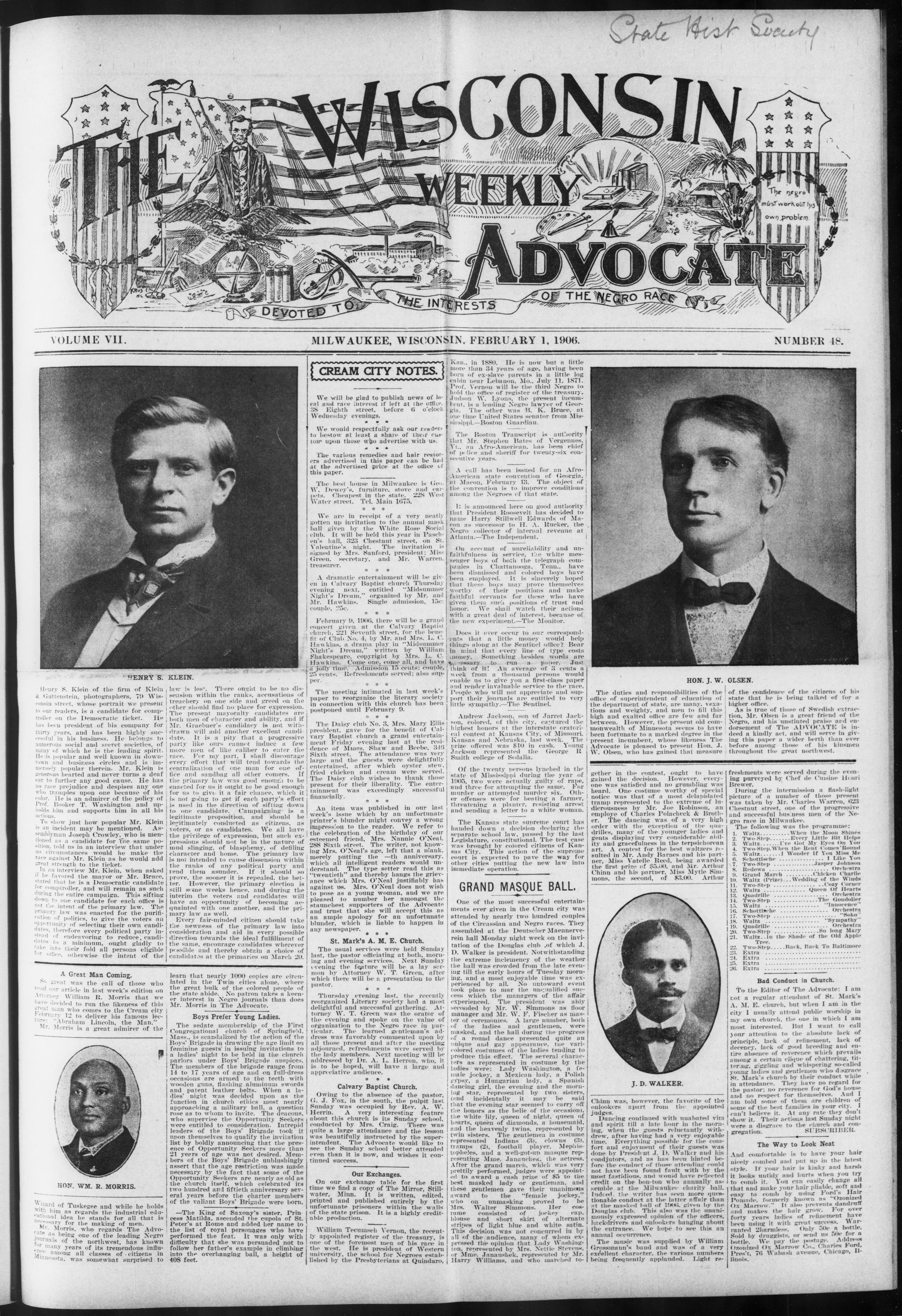
Page text (machine-generated)
State Histor Society
WISCONSIN
WEEKLY
ADVOCATE
DEVOTED TO THE INTERESTS OF THE NEGRO RACE
[Name]
VOLUME VII.
[Name]
HENRY S. KLEIN
Henry S. Klein of the firm of Klein & Guttenstein, photographers, 79 Wisconsin street, whose portrait we present to our readers, is a candidate for controller on the Democratic ticket. He has been president of his company for thirty years, and has been highly successful in his business. He belongs to numerous social and secret societies, of many of which he is the leading spirit. He is popular and well known in downtown and business circles and is immensely popular therein. Mr. Klein is generous hearted and never turns a deaf ear to further any good cause. He has no race prejudice and despises any one who tramples upon one because of his color. He is an admirer of the policy of Prof. Booker T. Washington and upholds him and supports him in all his actions.
To show just how popular Mr. Klein is an incident may be mentioned. Assemblyman Joseph Crowley, who is mentioned as a candidate for the same position, told us in an interview that under no circumstances would he make the race against Mr. Klein as he would add great strength to the ticket.
In an interview Mr. Klein, when asked if he favored the mayor or Mr. Bruce, stated that he is a Democratic candidate for comptroller, and will remain as such during the entire campaign. This sifting down to one candidate for each office is not the intent of the primary law. The primary law was enacted for the purification of politics, to give the voters an opportunity of selecting their own candidates, therefore every political party instead of endeavoring to reduce, candidates to a minimum, ought gladly to take into their fold all persons eligible for office, otherwise the intent of the
A Great Man Coming
So great was the call of those who read our article in last week's edition on Attorney William R. Morris that we have decided to run the likeness of this great man who comes to the Cream city February 12 to deliver his famous lecture: "Abraham Lincoln, the Man." Mr. Morris is a great admirer of the
[Name]
HON. WM. R. MORRIS
Wizard of Tuskegee and while he holds with him as regards the industrial educational idea he stands for all that is necessary for the making of men
Mr. Morris, who regards The Advocate as being one of the leading Negro journals of the northwest, has known for many years of its tremendous influence among all classes of citizens in Minnesota, was somewhat surprised to Peter's the list perform difficult follow into the 408 fee
law is lost. There ought to be no dissension within the ranks, accusations of treachery on one side and greed on the other should find no place for expression. The present mayoralty candidates are both men of character and ability, and if Mr. Graebner's candidacy is not withdrawn will add another excellent candidate. It is a pity that a progressive party like ours cannot induce a few more men of like caliber to enter the race. For my part, I shall discourage every effort that will tend towards the centralization of one man for one office and sandbag all other comers. If the primary law was good enough to be enacted for us it ought to be good enough for us to give it a fair chance, which it is not going to get if each party's effort is used in the direction of sifting down to one candidate. Campaigning is a legitimate proposition, and should be legitimately conducted as citizens, as voters, or as candidates. We all have the privilege of expression, but such expressions should not be in the nature of mud slinging, of blasphemy, of defiling character and home. The primary law is not intended to cause dissension within the ranks of any political party and rend them asunder. If it should so prove, the sooner it is repealed, the better. However, the primary election is still some weeks hence, and during the interim the voters and candidates will have an opportunity of becoming acquainted with one another, and the primary law as well.
Every fair-minded citizen should take the newness of the primary law into consideration and aid in every possible direction towards the ideal fulfillment of the same, encourage candidates wherever possible and thereby obtain a choice of candidates at the primaries on March 20.
learn that nearly 1000 copies are circulated in the Twin cities alone, where the great bulk of the colored people of the state abide. No patron takes a keener interest in Negro journals than does Mr. Morris in The Advocate.
Boys Prefer Young Ladies.
The sedate membership of the First Congregational church of Springfield, Mass., is scandalized by the action of the Boys' Brigade in drawing the age limit on feminine guests in issuing invitations to a ladies' night to be held in the church parlors under Boys' Brigade auspices. The members of the brigade range from 14 to 17 years of age and on full-dress occasions are armed to the teeth with wooden guns, flashing aluminium swords and patent leather belts. When a ladies' night was decided upon as the function in church ethics most nearly approaching a military ball, a question rose as to whom to invite. The deacons, who supervise the Opportunity Seekers were entitled to consideration. Intrepid leaders of the Boys' Brigade took it upon themselves to qualify the invitation list by boldly announcing that the presence of Opportunity Seekers more than 21 years of age was not desired. Members of the Boys' Brigade unblushingly assert that the age restriction was made necessary by the fact that some of the Opportunity Seekers are nearly as old as the church itself, which celebrated its two hundred and fiftieth anniversary several years before the charter members of the valiant Boys' Brigade were born.
The King of Saxony's sister, Princess Matilda, ascended the cupola of St. Peter's at Rome and added her name to the list of royal personages who have performed the feat. It was only with difficulty that she was persuaded not to follow her father's example in climbing into the overhanging ball, a height of 408 feet.
CREAM CITY NOTES.
We will be glad to publish news of local and race interest if left at the office. 38 Eighth street, before 6 o'clock Wednesday evenings.
```markdown
```
We would respectfully ask our readers to bestow at least a share of their custom upon those who advertise with us.
```markdown
```
The various remedies and hair restorers advertised in this paper can be had at the advertised price at the office of this paper.
The best house in Milwaukee is Geo W. Dewey's, furniture, stove and carpets. Cheapest in the state. 228 West Water street. Tel. Main 1675.
* * *
We are in receipt of a very neatly gotten up invitation to the annual mask ball given by the White Rose Social club. It will be held this year in Paschen's hall, 323 Chestnut street, on St. Valentine's night. The invitation is signed by Mrs. Sanford, president; Miss Green, secretary, and Mr. Warren, treasurer.
* * *
A dramatic entertainment will be given in Calvary Baptist church Thursday evening next, entitled "Midsummer Night's Dream," organized by Mr. and Mr. Hawkins. Single admission, 15c; couple, 25c.
February 9, 1906, there will be a grand concert given at the Calvary Baptist church, 221 Seventh street, for the benefit of Club No. 4, by Mr. and Mrs. L. C. Hawkins, a drama play in "Midsummer Night's Dream," written by William Shakespeare, copyright by Mrs. L. C. Hawkins. Come one, come all, and have a jolly time. Admission 15 cents; couple, 25 cents. Refreshments served; also supper.
---
The meeting intimated in last week's paper to reorganize the literary society in connection with this church has been postponed until February 9.
白 ★ ★
The Daisy club No. 3, Mrs. Mary Ellis president, gave for the benefit of Calvary Baptist church a grand entertainment Friday evening last at the residence of Mines, Shaw and Beebe, 346 Sixth street. The attendance was very large and the guests were delightfully entertained, after which oyster stew, fried chicken and cream were served. The Daisy club wishes to thank those present for their liberality. The entertainment was exceedingly successful financially.
* * *
An item was published in our last week's issue which by an unfortunate printer's blunder might convey a wrong impression to the reader. We refer to the celebration of the birthday of our esteemed friend, Mrs. Nannie O'Neal. 288 Sixth street. The writer, not knowing Mrs. O'Neal's age, left that a blank, merely putting the —th anniversary, which all intelligent readers would understand. The type setter read this as "twentieth" and thereby hangs the grievance which Mrs. O'Neal justifiably has against us. Mrs. O'Neal does not wish to pose as a young woman, and we are pleased to number her amongst the staunchest supporters of the Advocate and trust that she will accept this as an ample apology for an unfortunate blunder, which is liable to happen in any newspaper.
St. Mark's A. M. E. Church
The usual services were held Sunday last, the pastor officiating at both, morning and evening services. Next Sunday evening the feature will be a lay sermon by Attorney W. T. Green, after which there will be a presentation to the pastor.
* * *
Thursday evening last, the recently reorganized Literary society had a most delightful and successful gathering. Attorney W. T. Green was the orator of the evening and spoke on the value of organization to the Negro race in particular. The learned gentleman's address was favorably commented upon by all those present and after the meeting adjourned, refreshments were served by the lady members. Next meeting will be addressed by Dr. A. L. Herron, who, it is to be hoped, will have a large and appreciative audience.
Calvary Baptist Church
Owing to the absence of the pastor, G. J. Fox, in the south, the pulpit last Sunday was occupied by Rev. A. W. Herrin. A very interesting feature about this church is its Sunday school, conducted by Mrs. Craig. There was quite a large attendance and the lesson was beautifully instructed by the superintendent. The Advocate would like to see the Sunday school better attended even than it is now, and wishes it continued success.
Our Exchanges
On our exchange table for the first time we find a copy of The Mirror, Stillwater, Minn. It is written, edited, printed and published entirely by the unfortunate prisoners within the walls of the state prison. It is a highly creditable production.
William Tecumseh Vernon, the recently appointed register of the treasury, is one of the foremost men of his race in the west. He is president of Western university, the school for Negroes established by the Presbyterians at Ouindaro.
Kan., in 1880. He is now but a little more than 34 years of age, having been born of ex-slave parents in a little log cabin near Lebanon, Mo., July 11, 1871. Prof. Vernon will be the third Negro to hold the office of register of the treasury. Judson W. Lyons, the present incumbent, is a leading Negro lawyer of Georgia. The other was B. K. Bruce, at one time United States senator from Mississippi.—Boston Guardian.
The Boston Transcript is authority that Mr. Stephen Bates of Vergennes, Vt., an Afro-American, has been chief of police and sheriff for twenty-six consecutive years.
A call has been issued for an Afro-American state convention of Georgia, at Macon, February 13. The object of the convention is to improve conditions among the Negroes of that state.
It is announced here on good authority that President Roosevelt has decided to name Harry Stillwell Edwards of Macon as successor to H. A. Rucker, the Negro collector of internal revenue at Atlanta.—The Independent.
On account of unreliability and unfaithfulness in service, the white messenger boys of both the telegraph companies in Chattanooga, Tenn., have been dismissed and colored boys have been employed. It is sincerely hoped that these boys may prove themselves worthy of their positions and make faithful servants for those who have given them such positions of trust and honor. We shall watch their actions with a great deal of interest, because of the new experiment.-The Monitor.
Does it ever occur to our correspondents that a little money would help things along at the Sentinel office? Bear in mind that every line of type costs money. Something besides words are necessary to run a paper. Just think of it! An average of 3 cents a week from a thousand persons would enable us to give you a first-class paper and render invaluable service to the race. People who will not appreciate and support their journals are entitled to very little sympathy.-The Sentinel.
Andrew Jackson, son of Jarret Jackson, colored, of this city, captured the highest honors at the interstate oratorical contest at Kansas City, of Missouri, Kansas and Nebraska, last week. The prize offered was $10 in cash. Young Jackson represented the George R Smith college of Sedalia.
Of the twenty persons lynched in the state of Mississippi during the year of 1905, two were actually guilty of rape, and three for attempting the same. For murder or attempted murder six. Other offenses were for beating a farmer, threatening a planter, resisting arrest and sending a letter to a white woman.
The Kansas state supreme court has handed down a decision declaring the separate school law, passed by the last Legislature, constitutional. The test case was brought by colored citizens of Kansas City. This action of the supreme court is expected to pave the way for other cities putting the new law into immediate operation.
GRAND MASQUE BALL.
One of the most successful entertainments ever given in the Cream city was attended by nearly two hundred couples of the Circassian and Negro races. They assembled at the Deutscher Maennerverein hall Monday night week on the invitation of the Douglas club of which J. D. Walker is president. Notwithstanding the extreme inclementy of the weather the hall was crowded from the late evening till the early hours of Tuesday morning, and a most enjoyable time was experienced by all. No untoward event took place to mar the unqualified success which the managers of the affair experienced. The president was ably seconded by Mr. W. Simmons as floor manager and Mr. W. F. Fischer as master of ceremonies. A large number, both of the ladies and gentlemen, were masked, and the hall during the progress of a round dance presented quite an unique and gay appearance, the varicolored costumes of the ladies tending to produce this effect. The several characters as represented in costume by the ladies were; Lady Washington, a female jockey, a Mexican lady, a Polish gypsy, a Hungarian lady, a Spanish dancing girl, the evening and the morning star, represented by two sisters, and incidentally it may be said that the evening star seemed to carry off the honors as the belle of the occasion), the white lily, queen of night, queen of hearts, queen of diamonds, a housemaid, and the heavenly twins, represented by twin sisters. The gentlemen in costume represented Indians (3), clowns (3), tramps (2), football player, Mephistopheles, and a well-got-up masque representing Mme. Janauchek, the actress. After the grand march, which was very prettily performed, judges were appointed to award a cash prize of $5 to the best masked lady or gentleman, and these gentlemen gave their unanimous award to the "female jockey," who on unmasking proved to be Mrs. Walter Simmons. Her costume consisted of jockey cap, blouse and short skirt of alternate stripes of light blue and white satin. This decision was not concurred in by all of the audience, many of whom expressed the opinion that Lady Washington, represented by Mrs. Nettie Stevens, or Mme. Janaushek, represented by Mr. Harry Williams, and who marched to-
J. H.
The duties and responsibilities of the office of superintendent of education of the department of state, are many, vexatious and weighty, and men to fill this high and exalted office are few and far between. However, the present old commonwealth of Minnesota seems to have been fortunate to a marked degree in the present incumbent, whose likeness The Advocate is pleased to present Hon. J. W. Olsen, who has gained that measure of the state the higher of As is tion, Mr Negro, dorsemeed deed this before through
gether in the contest, ought to have gained the decision. However, everyone was satisfied and no grumbling was heard. One costume worthy of special notice was that of a most delapidated tramp represented to the extreme of ludicrousness by Mr. Joe Robinson, an employee of Charles Polacheck & Brother. The dancing was of a very high order with the exception of the quadrilles, many of the younger ladies and gents displaying very considerable ability and gracefulness in the terpsichorean art. A contest for the best waltzers resulted in Mr. Andy Barnes and his partner, Miss Vatelle Reed, being awarded the first prize of $5.00, and Mr. Arthur Chinn and his partner, Miss Myte Simmons, the second, of $3.00. Arthur
J. D. WALKER.
Chinn was, however, the favorite of the onlookers apart from the appointed judges.
Dancing continued with unabated vim and spirit till a late hour in the morning, when the guests reluctantly withdrew, after having had a very enjoyable time. Everything possible for the comfort and enjoyment of their guests was done by President J. D. Walker and his coadjutors, and as has been hinted before the conduct of those attending could not have been found fault with by the most fastidious, and would have reflected credit on the bon-ton who annually assemble at the Milwaukee charity ball. Indeed, the writer has seen more questionable conduct at the latter affair than at the masked ball of 1906, given by the Douglas club. This also was the unanimously expressed opinion of the officers, hackdrivers and onlookers hanging about the entrance. We hope to see this an annual occurrence.
The music was supplied by William Grossmann's band and was of a very excellent character. the various numbers being frequently applauded. Light re-
J. D. WALKER.
OLSEN.
of the confidence of the citizens of his state that he is being talked of for a higher office. As is true of those of Swedish extraction, Mr. Olsen is a great friend of the Negro, and his unstinted praise and endorsement of The ADVOCATE is indeed a kindly act, and will serve in giving this paper a wider berth than ever before among those of his kinsmen throughout the great northwest.
freshments were served during the evening purveyed by Chef de Cuisine Hori Brewer. During the intermission a flash-light picture of a number of those present was taken by Mr. Charles Warren, 623 Chestnut street, one of the progressive and successful business men of the Negro race in Milwaukee.
The following was the programme:
1. Waltz.....When the Moon Shines
2. Two-Step.....Every Little Bit Helps
3. Waltz.....I've Got My Eyes On You
4. Two-Step.When the Rent Comes'Round
5. Waltz.....I Wonder If You Miss Me
6. Schottische.....I Like You
7. Two-Step.....Jasper Johnson
8. Redowa.....Orchestra
9. Grand March.....Chicken Charlie
10. Waltz (Prize)...Wedding of the Winds
11. Two-Step.....Cozy Corner
12. Waltz.....Queen Of Hearts
13. Quadrille.....Orchestra
14. Two-Step.....The Gondolier
15. Waltz....."Innocence"
16. Schottische.....Orchestra
17. Two-Step....."Soko"
18. Waltz....."Sympathy"
19. Quadrille.....Orchestra
20. Two-Step.....So long Mary
21. Waltz...In the Shade of the Old Apple Tree.
Two-Step.....Back, Back To Baltimore
Extra ..... Extra
Extra ..... Extra
Extra .....
To the Editor of The Advocate: I am not a regular attendant of St. Mark's A. M. E. church, but when I am in the city I usually attend public worship in my own church, the one in which I am most interested. But I want to call your attention to the absolute lack of principle, lack of refinement, lack of decency, lack of good breeding and entire absence of reverence which prevails among a certain clique of chattering, tittering, giggling and whispering so-called young ladies and gentlemen who disgrace St. Mark's church by their conduct while in attendance. They have no regard for the pastor; no reverence for God's house and no respect for themselves. And I am told some of them are children of some of the best families in your city. I can't believe it. At any rate they don't show it. Their actions last Sunday night were a disgrace to the church and congregation. SUBSCRIBER.
And comfortable is to have your hair nicely combed and put up in the latest style. If your hair is kinky and harsh it looks untidy and hurts when you try to comb it. You can easily change all that and make your hair pliable, soft and easy to comb by using Ford's Hair Pomade, formerly known as "Ozonized Ox Marrow." It also prevents dandruff and makes the hair grow. For over forty years ladies of refinement have been using it with great success. Warranted 2harmless. Only 50c a bottle. Sold by draggists, or send us 50c for a bottle. We pay the postage. Address Ozonized Ox Marrow Co., Charles Ford, Pres't, 76 Wabash avenue, Chicago, Illinois.
---
NUMBER 48.
Bad Conduct in Church.
The Way to Look Neat
Miscellaneous Items.
In the French city of Beauvais a small vehicle, built with two wheels and drawn by a man or boy, is in common use. It is called a vinaigrette.
Experiments made with kites on the Mediterranean have shown that over a large surface of water the temperature and the rapidity of air movements decline steadily in proportion to the altitude.
All the theatrical and amusement announcements of Paris are posted on pillar billboards that are placed at intervals along the boulevards. It is against the law to disfigure walls with posters.
A New Haven (Conn.) judge recently rendered a decision in which he stated that there is no law in that state which makes it a crime or misdemeanor to take and use an automobile without the owner's permission.
It is expected that the Yosemite valley in California will soon be made as accessible to visitors in winter as in summer, through the completion of the new airroad which is being built from Merced to the entrance to the park.
According to E. B. Osborn, who lectured recently at the Royal Colonial institute, London, Canada's immigrants are best in the following order: Scotsmen, Americans, Englishmen, Scandinavians, Germans and Doukhobors.
The largest dinner ever given assembled at Paris a few days ago. Fifty thousand Mutualists of France dined at the Galerie des Machines together. Five hundred waiters served and 15,000 dishes were used at nine miles of tables.
Representative Longworth, who will marry Miss Roosevelt in February, has a collection of violins which includes a Stradivarius, a Guillaums formerly belonging to Ysaye, and an Amato, once the property of Theodore Thomas.
The Khedive of Egypt is one of the potentates who have profited, both morally and financially, from the protection of Britain. In addition to his annual grant of $500,000 he has amassed an enormous private fortune, and his morals are infinitely better.
—Korea has a population of about 6,000,000. Seoul, the capital, has 22,000 and is constantly increasing. Already 50,000 Japanese live in the kingdom. No less than $8,000,000 has been spent on railways. The foreign trade was worth $26,616,487 last year.
—There just died in a workhouse at Budapest the oldest woman in the Austrian empire. She was Mme. Borses, and had reached the age of 117 years, having been born in 1788. Mme. Borses was a Jewess, and up till the last few days enjoyed good health.
If the world were birdless, a naturalist declares, man could not inhabit it after nine years' time, in spite of all the sprays and poisons that could be manufactured for the destruction of insects. The insects and slugs would simply eat all the orchards and crops in that time.
A well-supported movement is on foot to erect a handsome monument to Joe Grimaldi, the clown, who died in 1837, and whose tombstone in the graveyard of St. James', Pentonville, London, is in a dilapidated condition. Grimaldi was the originator of the clown's slogan, "Here we are again!"
At the present time there are 178 Filipino students in this country receiving an education at the expense of the Philippine government. The candidates are selected by examination, and one stipulation is that they will enter the Philippine civil service after they have completed their studies.
Camille Flammarion has been making experiments in Paris to see whether the moon exerts any influence on the growth of plants, according to the legend. He made different sets of plantings at dates which correspond to the different phases of the moon, using peas, beets, carrots, potatoes, beans and many other vegetables of the ordinary kinds. The results were extremely variable and no fixed rule seemed to govern them. The plants appeared at periods which had no connection with the moon's phases.
Jack London, the author, who was recently in Boston, recalls an earlier visit eleven years ago, when he arrived on the truck of a freight car. He lost his way in the tortuous streets of the city, a unique experience for him, although he has tramped about many cities of the world. London's experiences as a tramp have not made him open-handed and hospitable. On the door of the London home in San Francisco is a sign reading: "No admission except on business; no business transacted here." while on the back door is another sign, reading: "Please do not enter without knocking; please do not knock."
Used Explosive Hair Oil
Clyde Smith of Chicago wished to improve his head of hair, and purchased a bottle of oil as a tonic which an enterprising druggist "worked off" on him. As a result the top of his head resembles a stubblefield scorched by a prairie fire, and Mr. Smith now declares he will be content to let well enough alone and not try to improve on nature. The druggist, who vouched for the hair preservative qualities of the oil, didn't mention that it was also inflammable. Mr. Smith went to his barber's and had the lotion applied. When the operation was complete he looked in the mirror and was impressed by his added pulchritude. Then he lighted a match and applied the flame to the end of a cigar. Pouf! Conflagration burst out all over his shining head. The barber inundated the fire from a rubber tube attached to a faucet, but in spots Mr. Smith's hair was singed to the scalp.
Money in Mint Growing
A mint grower who borrowed the money to buy forty acres of land made enough the next year to pay for it. This year the same man with five acres in mint received $1050 for the crop of oil which he delivered in Decatur with a light buggy. There seems to be a mint of money in the business for the farmer who has the right soil, understands the secret of production and is not mortified if he gets mud on his knees.--Dowagiac (Mich.) Herald.
$250 a Minute for Singing.
It is understood that Mme. Melba has been paid $5000 by W. W. Astor for singing four songs at his house at Cliveden. Mr. Astor, it will be recollected, paid the same amount to Paderewski some years ago, when the famous pianist went down to Cliveden to play at an "at home." The rate at which Mme. Melba was paid works out at about $250 a minute.
Strange Funeral Is Held.
In the presence of guests gathered on the lawn of his home at Pumptown, N. J., Dr. George D. Herron placed the ashes of his mother-in-law, who died in Italy, in an urn. Dr. Herron did this because of a promise made several years ago to her. She was Mrs. E. D. Rand of Burlington, Ia.
Cattails Worth a Cent a Pound
The common cattail has become a valuable article of commerce in Morocco and sells for 1 cent a pound. The cattails are used as a substitute for wool, cotton and hair for mattresses and upholstery.
This total is realized from the sale of fresh meats (beef, mutton and pork), provisions, produce (poultry, butter and eggs), soaps, glues, oils, bones, fertilizers, feathers, casings, hides, wools, pelts and other by-products derived from cattle, sheep, hogs and poultry.
The industry is operated on a margin of less than 2 cents to each dollar of sales. Swift & Co. do not sell at retail. Their entire output is sold at wholesale to many thousands of dealers in various parts of the world. There are hundreds of local slaughterers throughout the United States, who buy their live stock in competition with the packer doing an interstate and international business. Likewise the packer must sell in competition with the local slaughterers. There are no secret processes in the industry, no complicated and expensive factories, and as live stock can be purchased in almost every hamlet and city, and the preparation of meats is simple in the extreme, local slaughtering will long remain a factor in the production of fresh meats and provisions.
In the world of graft the grinding axiom is "Consult a lawyer and then go ahead." preparation extreme, loo remain a fa
The large packing houses will, however, always have these advantages: Locations at the chief live stock centers, with the opportunity to buy the best live stock; manufacturing in large quantities, at the minimum of expense; utilization of all waste material; refrigeration; mechanical appliances; highly efficient business management. These advantages are reflected in the quality of the packer's output, a quality that has reached its highest development in the products bearing the name and brand of "Swift."
The principal live stock centers are Chicago. Kansas City, Omaha, St.
Because Dr. F. C. Hubbard of Eau Claire, Mich., testified against him in a divorce case, Hosea Butler is accused of making a vicious attack on the former, biting off the physician's nose.
E. W. McClintie of Washington, D. C., accidentally received the static current from 44,000 volts of electricity in his body at the General Electric works at Schenectady, N. Y., but will recover. He was unconscious for eight minutes, and at first it was believed that he was dead.
Grace Chapin, a New York actress, was granted a divorce at Indianapolis from Ellis Chapin and the custody of their child, a boy of 5 years old, after promising the judge that she would give up the stage to care for the little fellow. She said she had given up a $60 a week position.
Mrs. Theodore Neales of Bitter Township, Pa., has just given birth to her seventeenth child. Both mother and infant are doing well. All but two of the seventeen children are living. The two died in infancy. All the members of the family are living at home. There were five pairs of twins and one set of triplets. All the twins and triplets are living.
a medicine called muscarine nitrate, which, injected under the skin, causes a copious flow of tears. French actresses, in weeping scenes, such as 'La Dame aux Camellias,' have sometimes used this drug. Rev. Dr. C left the Episi at Cincinnati the most dis living.
Rev. Dr. Charles Wesley Spicer, who left the Episcopal church to practice law at Cincinnati, O., says the ministry is the most discouraging profession possible. "The men don't care," he said, "the women are too busy with euchre parties, souls will not stay saved and the minister has to work all alone. I want results, and I cannot get them in the ministry."
Lemon pie!
Facing the extreme penalty of the law, a convicted murderer in the Minnesota penitentiary wit hbut a few weeks more to live, William Williams calls for pie. And he does not want your ordinary apple dumpling arrangement. He wants "lemon pie with lots of sugar in it, and don't be stingy with the cuts, either." So the pie is almost a daily fixture on the Williams menu card.
Miss Cora Maynard, aged 20, a pretty girl of Lyme, Conn., was married last week to Marshall Ney, aged 72, who has lived a hermit's life. When the courting was done is a mystery to the people of Lyme. After the marriage ceremony was performed the couple went to the humble abode of the recluse, where they will live. The bride bade her friends good-bye when she went away with her husband. She forbade any of them to visit her.
Vicious bulldogs kept by fraternity men were made the subject of action by the University of Illinois council of administration. An effort will be made by the university authorities to put down the practice, and if their efforts are unsuccessful the city authorities of Uriana and Champaign will be appealed to for relief. Recently a servant employed at a fraternity house was severely bitten by a vicious dog. Last week Dr. C. G. Hopkins of the university was attacked. Dean Davenport is leading the fight on the dogs.
Whisky made Robert Bryant and Thomas Fardell of Lawrenceburg, Ind. enemies. It re-established friendship be-
---
BY BAY AND SEA
The little rills of poesie
That flow from Helicon
Sometimes escape into the sea
And rest there all unknown.
While others, finding surer guides,
Fall into happier ways,
And go to swell the rising tides
That make the Poet's bays.
John Kendrick Bangs in The Reader.
SONG.
With rue my heart is laden
For golden friends I had,
For many a rose-lipt maiden
And many a lightfoot lad.
By brooks too broad for leaping
The lightfoot boys are laid;
The rose-lipt girls are sleeping
In fields where roses fade.
-A. E. Housman in McClure's from "A
Shropshire Lad."
WISDOM OF AN EMPIRICIST
Hope is the obverse of fear
As the twig is bent, so the tree goes broke.
Work and the world loafs with you; loaf, and you loaf alone.
It is better to be "among those present" than not to be invited at all.
The penitentiary is full of people who "intended to pay it back tomorrow."
You seldom, if ever, hear of a bank cashier's stealing money to give to charity.
Why are people always talking about "street car manners?" There aren't any.
It is a good deal easier to quit somking cigars if you taper off on the bargain kind.
Bacchus is an accommodating creditor, but he always collects his bill with usury.
If you work real hard you won't have time to get rich, or to worry because you are not.
Some men are born good; some achieve goodness, and some never have any chance to be bad.
It is easier to find a needle in a haystack than an item you have lost in a Sunday newspaper.
Some men spend so much energy resisting temptation that they have none left for achievement.
A good way to keep well is never to wonder whether things you eat will agree with you or not.
He laughs best who laughs last, but if most of us waited we wouldn't get a chance to laugh at all.
If your wife gives you a lounging robe it is a sign that she wants you to match the rug in the library.
Lots of people get a reputation for being liberal-minded by "knocking" their own friends and beliefs.
It would be easier to stay in the straight and narrow path if it were not so crowded with people coming back.
The average woman writes five letters where she sends one. In the four destroyed she expresses her real thoughts.
From general observation. I conclude that this country would have survived even had the Mayflower been wrecked in midocean.
"Lightning never strikes twice in the same place"—probably for the same reason that no one man ever blows out the gas twice.
The trouble with the fresh-air crank is that he always wants to bring it indoors with him instead of enjoying it on the outside.
The old-fashioned crime of kleptomania has about disappeared. A person who isn't rich enough to do "frenzied financing" is now a common thief when he takes things that do not belong to him.—St. Louis Globe-Democrat.
Queer Drugs and Their Uses
"The venom of the rattlesnake has been known to cure locomotor ataxia and scarlet fever," said a chemist. "Homeopathic physicians often prescribe it.
"You know the curara, the deadly poison that the South American Indians smear on their arrow tips?" Well, curara is very helpful in hydrophobia.
"There is a seaweed called 'bladderwrack.' They make of this an antifat, a marvelous antifat. By the use of this antifat I know a man who reduced his weight forty pounds in three months.
"There is a deadly fungus, the fly agaric, which unfortunate people sometimes eat in mistake for mushrooms. They make a medicine of the fly agaric.
"Cocaine causes wakefulness. I once worked forty-eight hours at a stretch, thanks to cocaine.
"Cocoa stimulates, exhilarates and removes all desire for food or drink. An Alpine guide will chew fifty or sixty grains of it before commencing a difficult ascent."—New Orleans Times-Democrat.
REFLECTIONS OF A BACHELOR
Marriages have made many people happy by not getting into them.
There probably wouldn't be any work to do in the world if we liked it.
Whenever you tell a woman some other one is pretty, she seems to think you don't believe she is.
A man might just as well carry a pocket full of fishhooks as to try to hug a girl who is all pinned up.
Everybody has runs of good luck, but the time he would appreciate them would be when he was having the bad.—New York Press.
Growth of Monopolies
From a folder issued by the Minneapolis Journal the following facts concerning the Queen City of the Great Northwest are taken:
Increase in population during the past five years. 50,256—a gain of 29.2 per cent. (The population in 1900 was 202,718).
Building permits for first seven months of 1905—$5,700,000, a gain of $1,600,000 over the same period in 1904.
Number of railroads entering Minneapolis—19.
Value of flour mill products. $64,000,000.
Number of feet of lumber cut—400,000,000.
The publishers assert that "the Minneapolis Journal" carries more advertising in its six evening issues than any other newspaper in the northwest, daily and Sunday combined."
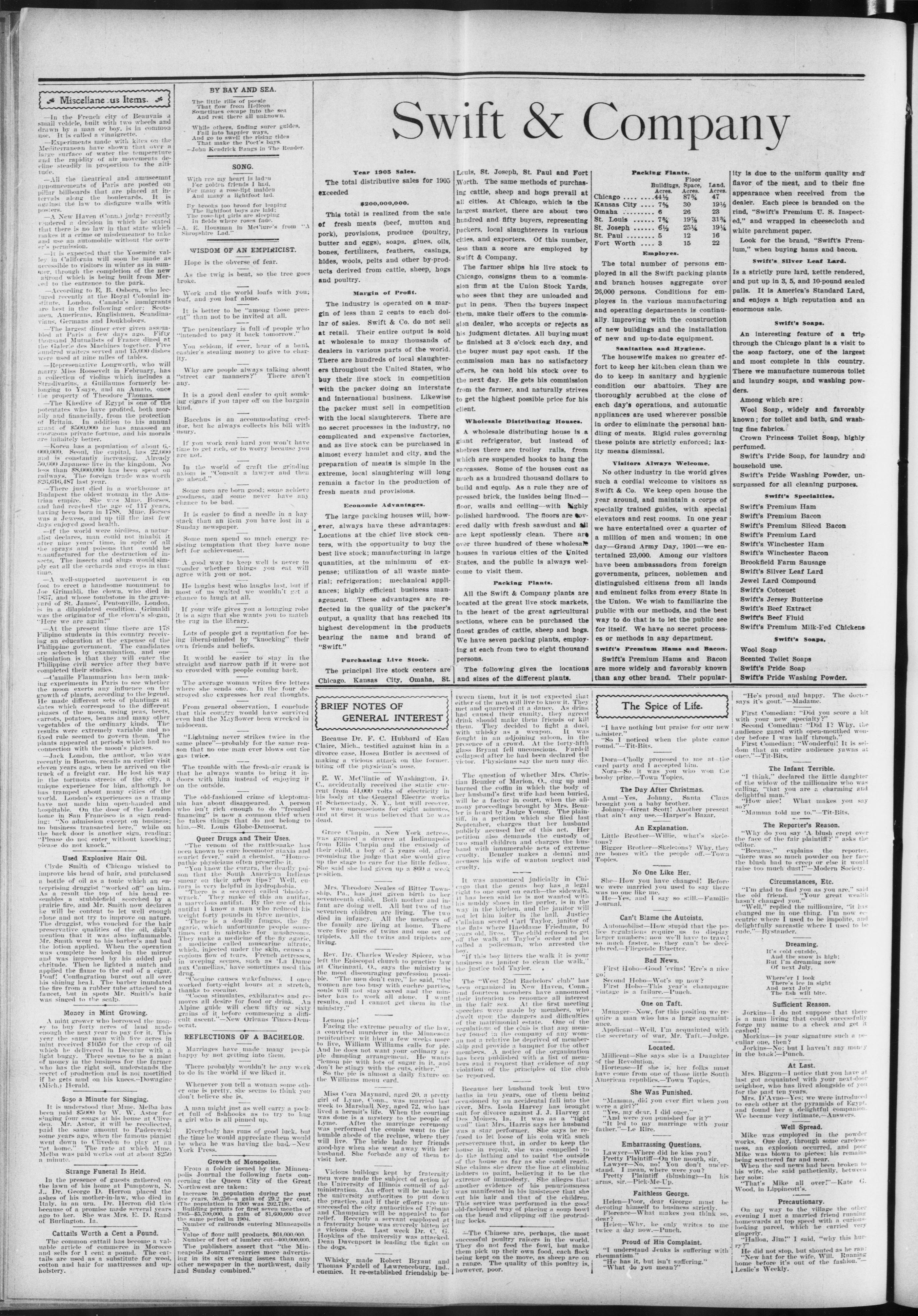
Swift & Company
Year 1905 Sales.
$ 200,000,000.
Margin of Profit.
Economic Advantages.
Purchasing Live Stock.
Louis, St. Joseph, St. Paul and Fort Worth. The same methods of purchasing cattle, sheep and hogs prevail at all cities. At Chicago, which is the largest market, there are about two hundred and fifty buyers, representing packers, local slaughterers in various cities, and exporters. Of this number, less than a score are employed by Swift & Company.
The farmer ships his live stock to Chicago, consigns them to a commission firm at the Union Stock Yards, who sees that they are unloaded and put in pens. Then the buyers inspect them, make their offers to the commission dealer, who accepts or rejects as his judgment dictates. All buying must be finished at 3 o'clock each day, and the buyer must pay spot cash. If the commission man has no satisfactory offers, he can hold his stock over to the next day. He gets his commission from the farmer, and naturally strives to get the highest possible price for his client.
A wholesale distributing house is a giant refrigerator, but instead of shelves there are trolley ralls, from which are suspended hooks to hang the carcasses. Some of the houses cost as much as a hundred thousand dollars to build and equip. As a rule they are of pressed brick, the insides being lined—floor, walls and ceiling—with highly polished hardwood. The floors are covered daily with fresh sawdust and all are kept spotlessly clean. There are over three hundred of these wholesale houses in various cities of the United States, and the public is always welcome to visit them.
Packing Plants.
All the Swift & Company plants are located at the great live stock markets, in the heart of the great agricultural sections, where can be purchased the finest grades of cattle, sheep and hogs. We have seven packing plants, employing at each from two to eight thousand persons. The following gives the locations and sizes of the different plants.
tween them, but it is not expected that either of the men will live to know it. They met and quarreled at a dance. As drink had caused their enmity, they agreed drink should make them friends or kill them. They decided to fight a duel, with whisky as a weapon. It was fought in an adjoining saloon, in the presence of a crowd. At the forty-fifth glass Bryant fell unconscious. Fardell collapsed after he had been declared the victor. Physicians say the men may die.
The question of whether Mrs. Christian Benzler of Marion, O., dug up and burned the coffin in which the body of her husband's first wife had been buried, will be a factor in court, when the alimony proceedings brought by Mrs. Benzler is heard by Judge Young. The plaintiff, in a petition which she filed last September, charges that her husband publicly accused her of this act. Her petition also demands the custody of two small children and charges the husband with innumerable acts of extreme cruelty. Benzler makes a denial and accuses his wife of wanton neglect and cruelty.
---
It was announced judicially in Chicago that the genus boy has a legal right to one spot on earth—the sidewalk. It has been said he is not wanted with his muddy shoes in the parlor, is in the way in the kitchen, and the janitor will not let him loiter in the hall. Justice Callahan scored Carl Taylor, janitor of the flats where Haeldame Friedman, 10 years old, lives. The child refused to get off the walk at Taylor's order and he called a policeman, who arrested the boy.
"If this boy litters the walk it is your business as janitor to clean the walk," the justice told Taylor.
The "West End Bachelors' club" has been organized in New Haven, Conn., and fourteen members have announced their intention to renounce all interest in the fair sex. At the first meeting speeches were made by members, who dwelt upon the dangers and difficulties of the matrimonial estate. One of the regulations of the club is that any member found in the company of any woman not a relative be deprived of membership and provide a banquet for the other members. A notice of the organization has been published with a list of members and a request that evidence of any violation of the principles of the club be reported.
---
Because her husband took but two baths in ten years, one of them being occasioned by an accidental fall into the river, Mrs. Isola Harvey has brought suit for divorce against J. J. Harvey at Des Moines, Ia. It was as a "tight wad" that Mrs. Harris says her husband was a star performer. She says he refused to let loose of his coin with such perseverance that, in order to keep the house in repair, she was compelled to do the lathing and to paint the outside of the house as far as she could reach. She claims she drew the line at climbing ladders to paint, believing it to be the extreme of immodesty. She alleges that another evidence of his penuriousness was manifested in his insistence that she cut his hair and that of the children. This service was performed in the good old-fashioned way of placing a soup bowl on the head and clipping off the protruding locks.
The Chinese are, perhaps, the most successful poultry raisers in the world. They do not feed the fowl, but make them pick up their own food, each flock being kept on the move, as sheep are on a range. The quality of this poultry is, however, poor.
Packing Flants.
Building, Floor
Acres, Space, Land,
Acres.
Chicago ..... 44½ 87¾ 47
Kansas City ..... 7⅛ 30 19½
Omaha ..... 6 26 23
St. Louis ..... 7¾ 19⅛ 31¾
St. Joseph ..... 6½ 25¼ 19¼
St. Paul ..... 5 12 16
Fort Worth ..... 3 15 22
Employes.
The total number of persons employed in all the Swift packing plants and branch houses aggregate over 26,000 persons. Conditions for employes in the various manufacturing and operating departments is continually improving with the construction of new buildings and the installation of new and up-to-date equipment.
Sanitation and Hygiene.
The housewife makes no greater effort to keep her kitchen clean than we do to keep in sanitary and hygienic condition our abattoirs. They are thoroughly scrubbed at the close of each day's operations, and automatic appliances are used wherever possible in order to eliminate the personal handling of meats. Rigid rules governing these points are strictly enforced; laxity means dismissal.
Visitors Always Welcome.
No other industry in the world gives such a cordial welcome to visitors as Swift & Co. We keep open house the year around, and maintain a corps of specially trained guides, with special elevators and rest rooms. In one year we have entertained over a quarter of a million of men and women; in one day—Grand Army Day, 1901—we entertained 23,000. Among our visitors have been ambassadors from foreign governments, princes, noblemen and distinguished citizens from all lands and eminent folks from every State in the Union. We wish to familiarize the public with our methods, and the best way to do that is to let the public see for itself. We have no secret processes or methods in any department.
Swift's Premium Hams and Bacon. Swift's Premium Hams and Bacon are more widely and favorably known than any other brand. Their popular-
The Spice of Life.
"I have nothing but praise for our new minister."
"So I noticed when the plate came round."—Tit-Bits.
Dora—Cholly proposed to me at the card party and I accepted him.
The Day After Christmas.
Aunt—Yes. Johnny. Santa Claus brought you a baby brother. Johnny—Great Scott! Another present that ain't any use.—Harper's Bazar.
An Explanation.
Little Brother—Willie, what's skeletons?
Bigger Brother—Skeletons? Why, they are bones with the people off.—Town Topics.
No One Like Her
She-- How you have changed! Before we were married you used to say there was no one like me.
He—Yes, and I say so still.—Familie Journal.
Can't Blame the Autoists
Automobilist—How stupid that the police regulations require us to display larger numbers; now we'll have to travel so much faster, so they can't be deciphered.—Fliegende Blaetter.
Bad News
First Hobo—Good 'evins! 'Ere's a nice go!
Second Hobo—Wot's up now?
First Hobo—This year's champagne vintage is a failure.—Punch.
One on Taft
Manager—Now, for this position we require a man who has a large acquaintance. Applicant—Well, I'm acquainted with the secretary of war, Mr. Taft.—Judge.
Located
Millicent—She says she is a Daughter of the Revolution. Hortense—If she is, her folks must have come from one of those little South American republics.—Town Topics.
She Was Punished.
"Mamma, did you ever flirt when you were a girl?"
"Yes, my dear, I did once."
"And were you punished for it?"
"It led to my marriage with your father."—Le Rire.
Embarrassing Questions.
Lawyer—Where did he kiss you?
Pretty Plaintiff—On the mouth, sir.
Lawyer—No, no! You don't understand. I mean, where were you?
Pretty Plaintiff (blushing)—In his arms, sir.—Pick-Me-Up.
Faithless George.
Helen—Poor, dear George must be devoting himself to business strictly.
Florence—What makes you think so, dear?
Helen—Why, he only writes to me twice a day now.—Punch.
Proud of His Complaint
"I understand Jenks is suffering with rheumatism."
"He has it, but isn't suffering."
"What do you mean?"
ity is due to the uniform quality and flavor of the meat, and to their fine appearance when received from the dealer. Each piece is branded on the rind, "Swift's Premium U. S. Inspected," and wrapped in cheesecloth and white parchment paper.
Look for the brand, "Swift's Premium," when buying hams and bacon.
Swift's Silver Leaf Lard.
Is a strictly pure lard, kettle rendered, and put up in 3, 5, and 10-pound sealed pails. It is America's Standard Lard, and enjoys a high reputation and an enormous sale.
Swift's Soaps.
An interesting feature of a trip through the Chicago plant is a visit to the soap factory, one of the largest and most complete in this country. There we manufacture numerous toilet and laundry soaps, and washing powders.
Among which are:
Wool Soap, widely and favorably known; for toilet and bath, and washing fine fabrics.
Crown Princess Toilet Soap, highly perfumed.
Swift's Pride Soap, for laundry and household use. Swift's Pride Washing Powder, unsurpassed for all cleaning purposes.
Swift's Specialties.
Swift's Premium Ham
Swift's Premium Bacon
Swift's Premium Sliced Bacon
Swift's Premium Lard
Swift's Winchester Ham
Swift's Winchester Bacon
Brookfield Farm Sausage
Swift's Silver Leaf Lard
Jewel Lard Compound
Swift's Cotosuet
Swift's Jersey Butterine
Swift's Beef Extract
Swift's Beef Fluid
Swift's Premium Milk-Fed Chickens
Swift's Soaps.
Wool Soap
Scented Toilet Soaps
Swift's Pride Soap
Swift's Pride Washing Powder.
"He's proud and happy. The doctor says it's gout."—Madame.
First Comedian: "Did you score a hit with your new specialty?"
Second Comedian: "Did I? Why, the audience gazed with open-mouthed wonder before I was half through."
First Comedian: "Wonderful! It is seldom that an entire audience yawns at once."—Tit-Bits.
The Infant Terrible.
"I think," declared the little daughter of the widow of the millionaire who was calling, "that you are a charming and delightful man." "How nice! What makes you say so?"
"Mamma told me to."—Tit-Bits.
The Reporter's Reason.
"Why do you say 'A blush crept over the face of the fair plaintiff?' " asks the editor.
"Because," explains the reporter, "there was so much powder on her face the blush had to creep or else it would raise too much dust."—Modern Society.
Circumstances Etc.
"I'm glad to find you as you are," said the old friend. "Your great wealth hasn't changed you."
"Well," replied the millionaire, "it has changed me in one thing. I'm now eccentric where I used to be impolite, and delightfully sarcastic where I used to be rude."—Bystander.
Dreaming.
It's cold outside.
And the snow is high;
But I'm dreaming now
Of next July.
Where'er I look
There's ice in sight
And next July
The fish will bite.
Sufficient Reason.
Jorkins—I do not suppose that there is a man living that could successfully forge my name to a check and get it cashed! Morkins—is your signature such a peculiar one, then? Jorkins—No; but I haven't any money in the bank'—Punch
At Last.
Mrs. Biggun—I notice that you have at last got acquainted with your next-door neighbor, who has lived alongside of you for the past ten years.
Mrs. D'Avno—Yes; we were introduced to each other at the pyramids of Egypt, and found her a delightful companion. We became very intimate.—Answers.
Well Spread.
Mike was employed in the powder works. One day, through some carelessness, an explosion occurred, and poor Mike was blown to pieces; his remains being scattered far and near. When the sad news had been broken to his wife, she said pathetically, between her sobs: "That's Mike all over!"—Kate G. Wood, in Lippincott's.
Precautionary.
On my way to the village the other evening I met a married friend running homewards at top speed with a curious looking parcel, which he carried very gingerly.
"Halloa, Jim!" I said, "why this hurry?"
He did not stop, but shouted as he ran:
"New hat for the wife, Will. Running home before it's out of the fashion."—Leslie's Weekly.
GOSSIP FOR THE LADIES.
1. Something Good Be Said
When over the fair fame of friend or foe
The shadow of disgrace shall fall, instead
Of words of blame, or proof of thus and so,
Let something good be said.
Forget not that no fellow-being yet
May fall so low but love may lift his
head:
Even the cheek of shame with tears is wet
If something good be said.
No generous heart may vainly turn aside
In wars of sympathy, no soul so dead
But may awaken strong and glorified,
If something good be said.
And so I charge ye, by the thorny crown,
and by the cross on which the Savior
blod
And by your own soul's hope of fair renown.
Let something good be said!
-James Whitcomb Riley in The Reader.
Mix Common Sense
With Your Affection.
In affection, friendship and love the extravagant nature is liable to dig the grave of happiness with the spade of over-devotion.
By over-devotion I mean the attentions which become surveillance.
The mother-ben attitude is natural to some women.
But because a certain peculiarity is natural is no reason why it may not be overcome or restrained by the check rein of common sense.
The mother hen with one chick makes its life uncomfortable by her watchfulness. If the chick pecks at a bug or a crumb the hen snatches it away in order to examine the morsel and see that it is it food for her darling.
If the darling attempts to take a promenade and rolls down the garden walk like a ball of worsted blown by the wind, the mother follows and heads it off. And in all ways the poor chick is handicapped and hedged from freedom and enjoyment by the mother hen until it grows large enough and bold enough to assert its individuality.
We have all seen human mothers of the same order.
I have in mind a gifted and charming young woman who is driven to the verge of distraction by such a mother.
If the daughter drops into a reverie for a moment the mother watches her with troubled eyes, and then kneels beside her and asks her to confide what is troubling her.
If the girl sneezes, the mother runs up two flights of stairs and brings a wrap.
If she drops down on the divan with a book the mother begs her to rise while she arranges the pillows more comfortably; and if she shows no appetite for lunch the mother orders beef tea and brings it to her while she is dressing to go out and watches her while she drinks it, and follows her down the steps begging her to be careful of herself.
The only fresh breath the girl draws, the only real comfort she enjoys, is when she is out of her mother's sight.
She appreciates the parent's motive, but she is made miserable by being so watched and guarded, as any natural, independent nature is certain to be.
More than one wife has driven her husband to the club by just this sort of devotion.
Not one man in ten thousand can endure it.
There are women who feel flattered by the same attitude from a lover or husband, but I doubt if they really enjoy it when it comes to constant association. It is a mere matter of pride with them that the man takes such minute interest in everything concerning them, but they grow restive under it eventually. Men possess less vanity in these matters and care more for personal freedom and physical comfort, and to them the detective attitude of a woman is irksome in the extreme.
Most men enjoy having their slippers brought, and their favorite chair in its favorite place, and the paper at hand; these attentions quietly attended to are agreeable proofs of a woman's thoughtfulness; but to be watched with anxious eyes if they draw a long breath, to be anticipated in every wish (and thus never to have the pleasure of surprising the sweetheart or wife with a request), to be followed about with sofa pillows and matches, and slippers, and dressing gowns, and to be an object of continual solicitude, is but one degree less painful than neglect.
Between friends the same rule holds good.
Enjoyment of friendship is impossible without tact-that tact which understands the right of every soul to moments of freedom, in a solitude of its own making; and a liberty of action which does not desire observation or comment, or to be forced into the necessity of explanation.
Only by cultivating tact, only by realizing that friendship and love must have their root in liberty can friends or lovers be retained.
Child, husband, wife, friend, all want a certain freedom; without it happiness is an impossibility.
Not the freedom which encourages license, deception or indifference, but the freedom which means individuality.
No matter how dearly you love someone, remember that one wants room for his or her soul to grow, and to hedge that soul about with a hothouse atmosphere and smothering attentions is to destroy its comfort and stunt its growth. Common sense is an excellent ingredient to mix with affection.—Ella Wheeler Wilcox in Philadelphia Evening Bulletin.
Careful Washing and Ironing.
To such an extent has the fad for the white shirtwaist been carried and so elaborately are these creations constructed that a woman nowadays feels certain misgivings whe nit comes to intrusting the delicate fabrics to her washwoman and oftentimes prefers to do the work herself.
From the moment it touches the water until it is handed forth in all its snowy crispness, the openwork shirtwaist is a thing to be used gently at all stages. It cannot be thrust into the wash like an underskirt; it must be laid aside as deserving special attention; there are fine mashes of lace that will not stand the wear and tear of the ordinary laundering process; in short, the shirtwaist calls for a separate department of its own.
It is a good idea, if you can afford it, to provide a small tub and washboard to correspond, just for your shirtwaists and fine lace handkerchiefs. Use nothing but the very best quality of laundry soap and never upon any account try to bleach with washing soda. Embroidered waists of heavy stuff may be rubbed on the board moderately. If you rub a lace shirtwaist at all be sure that all the lace is gathered in the hand. Heavy lace may be gathered double and rubbed between the knuckles while the extremely thin mesh must be kneaded and squeezed.
It is a great mistake to wring a fine shirtwaist out in the usual way, for by so doing you are likely to stretch the fabric and give it a "pull" that will show. Knead and work it between the hands, carefully unfolding and refolding as you dip. Every woman has her own methods of blueing and starching. A very little of each will suffice for the white shirtwaist. Its beauty depends upon its
whiteness without a trace of blue and its crispness without a trace of stiffness.
To dry have a special length of clothes line of the white hemp sort. Do not use common clothespins, as they are often rough; pins of the spring "clip" pattern will hold the most delicate fabric without tearing.
When the shirtwaist at last comes from the iron you are to stretch it on a clothes hanger and suspend it from the chandelier or upon a gas fixture for the night in order that it may thoroughly dry out.—Blanche Scot in Cleveland Plain-Dealer.
A Novel Dining Room
A bright little woman of artistic tastes recently found herself the mistress of a tiny cottage in which there was no dining room. Her husband's bank account permitted the building of a new room 14x16 feet square, but left a very small margin for finishings and furnishings. They were young people who came of good families, possessed a large circle of friends and were fond of entertaining, so that the dining room must be the center of the home. Since an attempt to make a cheap copy of the dining rooms of her friends could only end in disaster, she resolved to have something original and entirely different.
In pursuance of this idea she had the walls, with the exception of an eighteen inch frieze at the top, finished in a hard, rough kalsonine, colored strongly with red aniline, which gave a rich rose tint as uncommon as it was beautiful. All the wood work of the room, which was of pine, plain and heavy, was finished with a dull stain of lamp black and linseed oil rubbed in with a flannel cloth to bring out every line of the grain.
The carpenter who put in the woodwork was retained for a few days longer and built a sideboard, dining table and chairs of pine which were then stained to match the woodwork. All were of the very simplest design. The table, four feet square, had two leaves two feet wide, which folded over and joined in the center of the top when not in use. The legs of the table, as well as the frame of the sideboard, were made of material four inches square, the chairs from pieces two inches square. The frieze was painted a yellow-gray tint, with a design of eris in yellow and creamy white, the leaves being in gray green.
This room needed no pictures or decorations of any kind, its simplicity being its chief charm. Its well chosen china, dainty linen and two or three potted ferns are sufficient. It looks cool and clean in summer and warm and cosy in winter, and many a guest who could afford to spend the cost of it all in a morning's shopping, goes home to her own elegant and overcrowded rooms with a sense of dissatisfaction which she hardly knows how to define.—Men and Women.
Are You Tired?
There is too much tiredness in the world, especially among business women. Half the day's work has to be done by force of the will, since there is not force of body enough to carry them through. Most women accept this as unavoidable. To be tired is normal, whether one has charge of a baby or a typewriter. To tell them Nature intended back and burden to be in due proportions does not help matters. They are too tired to theorize. To get up fresh and cheery in the morning, do our duties vigorously, with energy to spare for a song and a smile, and lie down in the happy, wholesome weariness of a well-spent day—that surely was the original plan for our days. Are we never to get back to it?
Some say the way lies through gymnastiums, others hunt for "Don't Worry" clubs and good resolutions. Still others seek it by simplifying the daily duties and throwing off the world's comparative standards. And the last are nearer to reaching the goal than any of the others.
A Timely Word on
Top Bureau Drawers
"Five demerits for an untidy top bureau drawer?"
The weekly inspector of pupils' rooms in the private boarding school for young ladies closed the door behind and proceeded on her round of visits. The girl whose bureau drawer had just been inspected threw herself on the bed with an explosion of pent-up anger and tears. She had had nothing but demerits the whole week long, and then to have five more tacked on because a few ribbons were out of place in that miserable old bureau! Suddenly the tears stopped flowing, and the memory of an entire afternoon spent at hateful mathematics to work off the demerits vanished with the tears. She had an idea! The teacher never looked at anything but the top bureau drawer! Why not keep that endless collection of top drawer knick-knacks in some other part of the bureau?
The next Saturday, when the inspector came around on her tour of thankless visits, her report for this girl's top bureau drawer was "perfect order." The fact that it held only a neck ribbon and a comb and brush did not escape her scrutinizing eyes, nor did she examine further into the remaining drawers. She had been a girl once herself, and her duty called only for inspection of top bureau drawers.
Many a girl who is farther through her 'teens than this happy-go-lucky pupil has quite as much trouble with her top bureau drawer. A general mix-up in this catch-all of feminine accessories is an annoyance which every woman has to contend with, and now that little fixings are so numerous, the confusion is greater than ever.
The suggestion offered by the school girl's faculty for getting around difficulties, simple though it may seem, is a very timely one. Dainty white collars and cuffs that are crushed into a drawer with a pile of gloves, several boxes of pins, jewelry, curling kids and stock-galore, come out looking well-mussed after two or three hurried searches among them to find a bit of lace or a piece of veiling that has slid out of sight. And the veiling itself has lost all semblance of freshness in its tight quarters. The result is the busy woman, when her toilette is completed, can lay no claim to looking smartly dressed, for no matter what supply of essential small accessories she may possess, once they have lost their stiff, fresh appearance they detract rather than add to a costume.
Endless cases and boxes for holding the various articles are of very small help, either. When a woman is in a hurry these are pulled, in every direction and much of the contents with them. In a lower drawer, however—whichever one is used the least—the bulk of these pretty, delicate accessories can be kept either in their special cases or each in its own pile, and there will be no danger of a confused jumble every time a pin or a clean handkerchief is needed.
For some reason or other, as many times as it may be necessary to obtain some article from this lower drawer, its contents never receive the reckless mauling and crushing that they do in the top drawer. And though it usually takes a few days to become accustomed to the new order of things, a woman is
trebly repaid by the spick-and-span newness and smoothness that each bit of finery presents when she comes to wear it.—Exchange.
A Lady Has but One Set of Manners.
I spent half an hour the other day talking to a woman who pretends to be a lady.
She is a business woman, and to those whom she considered good customers or who stood very high socially she was all cringing servility.
Her manner toward those from whom she had nothing to gain was insufferable.
She was beautifully gowned, her jewels were exquisite, her hair was elaborately dressed.
She was very fine to look upon, but she was not a lady.
A true gentlewoman has but one set of manners. Fine clothes cannot make a lady. Good breeding must have innate gentleness and kindness of heart for a foundation. A well-bred woman is always considerate of the feelings of others. There are no two qualities that make more friends than politeness and kindness. Politeness is never wasted, even if it meets with rudeness in return. The person who is on the polite side is on the right side. There is no one too insignificant for you to be polite to. If you are in business be polite to the office boy, to the janitor and the scrubwoman. They are all earning their living to the best of their ability and deserve just as much courtesy as you give your employer.
Be polite to your fenow worker and above all things be polite to old people. There is no sight more intolerable than that of a young person treating an old person with discountesy. The woman to whom I talked yesterday was haughty and overbearing in manner. She really had nothing to be haughty over. She had spent a great deal of money on her clothes; her manners were atrocious. No one for a moment could have mistaken her for a lady. Never judge a woman by her clothes. Some of the best bred women in the world are obliged to dress poorly. A lady is marked not by her fine gown, but by the quiet refinement of her face and manner.
If some girls paid as much attention to their manners as they do to their clothes the result would be most satisfactory. Girls, don't try to be grand and stylish and superior. Just try to be womanly and kind. You will find it will take far better in the long run than style. And never forget that a true lady treats all classes with equal courtesy. Exchange.
Good Service in General Housework
My house is the average small private house in New York city, my family three adults, my circumstances moderate, so that I am compelled to manage with the help of one servant who must have a fairly good brain, and be willing to learn. With these two qualities, I can soon make her capable, and a few days' trial always reveals the presence or absence of these requisites.
My first talk with a maid amounts to this: "I expect my orders to be promptly obeyed always. If an order seems unjust or if you find that interruptions make it difficult to carry it out, come to me and say so." I have never yet found that a maid accepts this in the wrong spirit.
Sudden company, the non-arrival of provisions, a larger wash than usual none of those things affects us seriously for when my maid is troubled she and I talk over the difficulty and together smooth things out.
My experience has taught me just this: Our servants are not our equals in point of education. Then let the educated mind be high in authority. No system can be strong where there is not a good leader. Let our servants feel and see that we know just as much, if not more, about their work than they do. To do this we must look into things carefully, for no woman ignorant of the ins and outs of a house can control her maid. Any mind will always respond to the superiority of knowledge. It is not necessary to parade this knowledge. But if Mary knows that by coming to her mistress she will be helped out of any difficulty she respects that mistress.
Yet, while we are above our servants in the management of our homes, the mistress and maid are equals under the laws of our land. The mistress who is wise will not pry into the private affairs of her maid. We cannot, and do not, demand all her time. A ten-hour day seems to me impracticable, for housework in its nature does not admit of a ten-hour day unless we can resolve it into specialties. That may work well where there is more than one maid, but to the average American housekeeper it would mean great deprivation.
In my family we are fond of evenings at home. My maid is free to go out whatever evenings I am at home, so that she has at least five evenings a week at her disposal, provided she is in at a seasonable hour. I never set a special hour, but make it felt that at "closing-up-time" I like my maid to be in. Then she has her regular days out, with which I seldom, if ever, let anything interfere. If a special entertainment promises late hours, she tells us freely that she cannot be home early, and goes away with a light heart, knowing that I trust her to come into my house with her key, but knowing too that I shall be wakeful until I hear her step on the stairs—as when a member of my family keeps late hours.
For months I spent half an hour every evening teaching a faithful colored girl to read and write. Now, though in a little home of her own, she is still my devoted slave. Later I spent much time with a Swedish girl, helping her to read in English. With a cook book with the recipes carefully explained, I call on her for many dishes.
The real, true, earnest spirit of leadership always counts. There is no humiliation in prompt obedience. By strength I do not mean a show of bossism, but a quiet, just, earnest spirit, that will impress others with a desire to do good work.—Good Housekeeping.
To Save Time and Strength.
Hang up the bonnet when you take it off.
Mend the rent when you find it.
Pick up the baby's rattle when you see it.
Darn a hole when you discover it.
Do the duty that lies nearest.
Do the right thing at the right time.
Never try to do two things at once.
Never try to do two things at once. Attend to the task at hand, forget that there is another duty behind the present one. Remember that sufficient unto the day is the evil thereof, and don't worry about tomorrow. Today's duties call loudest now.
Substitute for Hot-Water Bottle
A screw-top coffee can, such as workmen use with their dinner pails, has proved a most satisfactory substitute for the rubber hot water bottle for nearly all purposes. One can be bought at any house furnishing or tin store for a small sum, in tin or granite. A slip case of outing flannel is an improvement. It has the advantage over the rubber bag in that boiling water can be used, and so filled and put into the bed will retain the heat until almost morning. I have suffered with cold feet in winter, going to bed warm, but waking about 2 o'clock so cold that I could not go to sleep again. My tin can filled with boiling
water at bedtime and pushed down in the bed is warm enough to obviate this trouble. To keep a baby's bottle warm it can be wrapped with the bottles in a blanket and will keep the milk at the proper heat all night. And it has the additional advantage of being cheaper than the rubber, never springing a leak at an inopportune moment. I buy the largest size, holding about one quart.—Pictorial Review.
MARK TWAIN AS MENTAL DIET.
New York Physicians Differ About Advisability of Convalescents Indulging. The British Medical Journal, a leading European authority, in its latest issue declares that English convalescents must avoid Mark Twain as a mental diet. It says: "Convalescents must not read Mark Twain's books; they not only cheer, but inebriate. Twain's books may provoke side-splitting laughter and so retard the union of severed or lacerated parts in the healing process."
But two of New York's foremost physicians, both nerve specialists, one of them Charles Weston Brandenburg, professor at the New York Medical College and American institute, and J. Carleton Simon, former president if the One Hundred Year club, agree that Mark Twain as a mental diet can hardly be surpassed.
"For years I have prescribed Mark Twain. Bret Harte and Artemus Ward as regularly for my patients, most all of whom are sufferers with neurosis, as I have prescribed the accepted food diet," declared Dr. Simon recently. "It is rather startling to have Twain regarded as too vigorous. I fancied him a more subdued writer than Ward, whom I regard as one of the most luxuriant humorists. I seldom differentiate between good humorous books because I regard the vigorous stirring up of a melancholic's humorous sensibilities as a good thing for the patient's progress.
"As I have always prescribed Twain and Ward, so I have always prescribed depressing books—Hamlet, for instance. In the same way all nerve specialists select or restrict the plays which their patients shall see.
"The explanation of the effect of humor—clean, wholesome humor—upon physical health is simple. Laughter—the heartier the better—increases the blood pressure, stimulates the production of red corpuscles, and thus increases the patient's strength. There's an old adage—'Laugh and grow fat.'
"The Medical Journal may be right from an English point of view, as humor is not an English characteristic. In America every individual cracks jokes. Messrs. Ryan and Harriman, if they should meet at a directors' meeting, would immediately start to telling funny stories to prove their surface indifference and hide any subway animosity. In England it is harder to launch jokes."
"When I was a student in Cincinnati, perhaps thirty years ago," said Dr. Brandenburg, "the new governor of Ohio, John M. Pattison, was my roommate. He was studying law, I medicine. He was blue and ill one night, and I read 'Tom Sawyer' to him. He laughed himself well.
"Each faculty of the mind has a relation to a particular part of the brain which it tends to develop and energize.
"Without the higher stimulus of literature, the sensual faculties in the posterior brain would develop only a gross and degraded humanity.
"The monotony of convalescence may be relieved not only by the stimulus of Mark Twain's books, but by gentle, harmonious music, and social surroundings."
"Laughter is one of the best, most natural forms of exercise I know of. The idea that side-splitting laughter may retard the healing of wounds is, I am afraid, a trifle far fetched. I really think that granulation might be gently stimulated instead. Of course, people have burst their hearts by laughing, but the instances were most exceptional."
Loose Business Morals.
An Arctic explorer was praising the late William Ziegler.
"He was a man of the alertest wit," the explorer said. "I never saw his equal in the hitting off of a person's character with an opposite story. Once, I remember, he was describing a flour manufacturer of loose business morals. "Mr. Ziegler said this manufacturer was like a certain grocer who called his clerk up before him one day and said: "'That lady who just went out—didn't I hear her ask you for fresh laid eggs?' "'Yes, sir,' the clerk answered. "'And you said we hadn't any?' "'Yes, sir; that is correct:' "'The grocer, purple with rage, yelled: "'Didn't you see me lay those eggs myself on the counter not ten minutes ago? You are discharged, you mendacious scoundrel, and see that you don't look to me for a reference, either.'"—New York Tribune
A Reversal.
"I once attended some legal proceedings in Nevada," says a Philadelphia lawyer, "which were unconventional, to say the least. The judge presiding made up what he lacked in legal lore by a certain entertaining joyiality. The case before him was windy and long drawn out, and it was plainly to be seen that he was tired and uninterested. To one of his decisions counsel for the defendant promptly took exception and his honor nodded carelessly and settled down in his ample chair. For a moment or two he quietly dropped off to sleep, his chair tilted back against the wall. Suddenly he fell over backward, and, scrambling to his dignity and his seat, he sought to cloak his mishap by exclaiming abruptly and irrelevantly. 'No, counsellor. I must adhere to my decision of a moment ago.'
"Counsel for the defense arose, and with a serious bow, said, 'Ah, but your honor has just reversed himself most conclusively.'"—Harper's Weekly.
Jeweler Knew His Business.
"It isn't the presents, it's the spirit," said January Jones, the millionaire miner of Goldfield, apropos of Christmas.
"I was in a bric-a-brac shop last January and something that took place there showed me that with too many of us the Christmas spirit is not the proper one.
"I was talking to the proprietor. One of the clerks stepped up excitedly, his eyes beaming with the hope of a big sale.
"'Say, boss,' he whispered, 'give me the key to the safe. There's a lady wants a solitaire just like the one she has on. She thinks it will be fun to have two rings alike.'"
"The proprietor did not bring forth the key. He only shook his head and said sadly:
"Don't waste any time on her. The ring she has on is a Christmas present and she only wants to find out what it cost."
Immortal "Platform."
An American lady visited Stratford-on-Avon lately and "gushed" even above the usual high watermark of American fervor. She had not recovered from the attack when she reached the railway station, for she remarked to a friend as they walked onto the platform:
"And to think that it was from this very platform the immortal bard would depart whenever he journeyed to town!"
--London Tit-Bits.
The Snapshot
"Come on; all ready. Stand right there. I'll tell you when I'm taking. Wait—
I've got to focus. Now! Prepare!
No, no—the camera's not straight.
How far is it, do you suppose?
I'm focussing at twenty feet.
No, papa needn't change his clothes.
And doesn't baby look too sweet!
"Now! Wait a minute—I can't get
You all in, somehow. Mamma, please
Move close to papa—closer yet:
Or sit, with baby on your knees.
I'll move back, too, a little bit.
Now! Wait—you're partly in the shade.
I guess that mamma'll have to sit.
Or else she won't show, I'm afraid.
Turn catty-corner—there! Now! No.
That won't do. Wait. I guess we planned
Best way at first. You seem so low.
Perhaps you all had better stand.
"No! Wait—until the sun is bright.
How mean a cloud should interfere!
You're all three now exactly right!
Just fine! And baby's moved! Oh dear!
But there—it's coming out! Now, quick;
Here, baby! Look at sister—look!
Just look at sis—I'm taking!" (Click!)
"There, now! It's over with. You're 'took.'"
—Edwin L. Sabin in St. Nicholas.
Up Among the Saeters.
In mountainous districts of Norway the farmers usually in the spring send their dairy maids, hired men and shepherd boys with their cattle—cows, oxen, horses, pigs, sheep and goats—up on the mountains to the saeters, where they keep them in pasture during the summer. A saeter is a collection of houses, surrounded by green fields inclosed with a fence, and outside of this are stretched the great grazing grounds, over mountains and valleys, through woods, along rivers, brooks, and lakes. When everything has been put in readiness and the weather has become more like summer the housewives come and take the places of the dairy maids, and these and the hired men are sent home.
I will not describe to you the many dangers to which herd and shepherd boys were formerly exposed, when wolves and bears were hunting around for lambs, sheep, calves and other animals for their breakfast or dinner; but I will tell you about the bright side of these boys' life to show that they can also play their little tricks and manage to get a good deal of fun out of their daily work, lonesome though they are in those lofty regions.
Nature has blessed them with a wonderfully clear and healthful air, with plenty of sunshine and outdoor life. Though they often are drenched in rain to the skin and have to wade in water all the day long, often for many days at a time, rheumatism, nervousness, dyspepsia and toothache are unknown in their experience. Their is a life in clear, healthful and invigorating mountain air, hundreds, often thousands, of feet above sea level. They are very generally healthy, sound in mind and body, playful and full of good humor. Their ringing laughter, a good sign of a sound constitution, re-echoed from mountain-side to mountain-side, is like the sound of pleasant music.
One summer my father and mother—living in Gol, Hallingdal, a mountainous district in the southren part of the country—had in their herd a big ram with large horns bent backward into spirals. For some reason or other, this ram could not stand to see the shepherd boy having on his rain shawl—a large shawl that the boys put on to cover the head and shoulders on rainy days. As soon as he caught sight of the shepherd boy with the shawl on, he would look at him a moment, his eyes would suddenly flash fire, he would back up a few feet, and then with all his strength he would leap forward and butt the boy, so that he would tumble heels over head along the ground. This was quite dangerous, as the ram had great bodily strength, so the boy had to look out for him every time he wore his shawl.
One day the boy made up his mind he would play a trick on the ram.
The herd was grazing through the woods, at the foot of a high mountain, toward the shore of Tisleia Fjord. At this point the bank of the lake is very high, and it runs up nearly perpendicularly from the water. A few feet from the edge of the bank the boy found a stub of a tree. The stub was just of the same size as the boy, and it was so decayed that only a small kick would send it crumbling over the ground. Over this stub the boy hung his shawl, on its top he placed his cap, and in other ways made it look like himself. Then he hid himself behind some trees, watching the herd, that now was coming grazing toward the bank.
All of a sudden the ram caught sight of the stub-boy and the shawl! He threw up his head, looked at the figure a moment, the old fire came into his eyes again, he backed up a few feet, put his neck into a stiff curve, and laid his ears flat back on his woolly neck. You could read anger all over his face. Calculating only the distance to the stub-boy, he uttered a harsh baa, and then suddenly with all his strength, threw himself forward into a run and rushed toward what he supposed was the boy. The stub with a loud crack flew into a thousand rotten pieces that, together with a cloud of dust from decayed wood, completely covered the ram's face and the front of his body, the shawl covering his head blinding him—and bump! with a tremendous force out over the bank flew the ram, still covered with the shawl—and with a great splash fell into the lake!
In a moment he came to the surface again, managed to get the shawl from his head, and swam ashore. With drooping ears and water streaming down from all over his body, he crawled out and up the bank, every now and then shaking himself violently to get rid of the water. Having reached the top of the bank, he slowly rejoined the grazing herd. But, you should have seen the boy when the big ram started on that expedition of his through air and water! As soon as the ram butted the stub, with that great "crack," and plunged out into the water, he jumped out from behind the trees, doubled up with sidesplitting laughter.
And when the poor ram crawled up on the bank, drenched to the very skin and looking very "sheepish," the boy ran over to him and greeted him with peals of laughter again and again.
But Billy never eagain tried to butt the boy.—O. C. Vico in St. Nicholas.
Veiled and Silent Auctions in India.
In the course of an interesting paper on shellac, communicated to the Pharmaceutical society, Sir George Watt, C. I. E., described the quaint practice adopted at the auctions in India. The buyers and sellers join hands and sit facing each other, a cloth being thrown over the hands. The buyer
presses certain fingers of the seller's hand, thus making an offer. This is usually rejected by a motion of the head, and further finger pressing ensues. Finally the bargain is struck without a word having been uttered. The advantage claimed for this system is that the buyer may proceed from one seller to another and make his purchases without his price being known to other dealers.—London Daily Mail.
REMINISCENCE
A gap among the hills.
And a white road through the trees;
A gap among the hills.
And some few memories.
The river winding down.
And willows bending low;
The river winding down.
And things of long ago.
—Frank Leo Pinet in Lippincott's.
IN THE DESERT.
We were crossing the Bad Lands of Idaho, great desert wastes of alkali sand and harsh, pungent sage brush, over whose vast stretches brooded mystery and the shadow of death. There was beauty in the Bad Lands, as there is in all places where man's hand has not fallen too heavily. Along the banks of the Snake river, by which our path lay, rose tall buttes of rose-tinted sandstone, ornamenting the breast of this siren desert. And here and there we saw the patient miners—prospectors, they called them—working in their mole-like excavations in loneliness and faith, searching for the elusive thing which has been the heart's desire of men in all ages.
Inside the train sat a commonplace, middle-aged woman, with faded hair and eyes. No one knew her story; no one cared whether she had a story. But she told it to us, nevertheless, and we listened; and as she spoke we forgot that we had not cared and saw her as she used to look in other days, to other eyes. And we remembered that all people have had other days, and have been looked at by other eyes, in whose sight they were good.
"I grew up on the Cape," she said, and a listener from the old Bay State knew what she meant, "and Jim—that was his name—was my playmate. We were to have been married, but he took a notion that he ought to have more money and so he went away to the west. He wrote me he was a miner, prospecting for gold, and when he'd found it he would come home and I should have a silk dress and jewelry and not have to work any more. I did not care for such things, but he did. But perhaps you don't want to hear about him; it was seeing the miners out there made me speak." We urge her to tell us the rest.
"After a while he didn't write so often and his letters came a longer way from home. The last one was from Arizona; that was years ago. He never seemed to have much luck, so perhaps he was too discouraged to write, or he may have died in a place like this."
She was silent. Her faded eyes were lustrous for a moment—it is wonderful how tears will brighten old eyes—and then the light died out.
Some hours later the train stopped at a little station with a musical Indian name to take on water for our thirsty engine and we all alighted, glad of the brief exercise. On the station platform was the usual motley array to whom the coming of the daily train was a momentous human incident. Among them was the pioneer with tanned face and hardy frame, who came from a near-by cottage surrounded by its protecting lombardy poplars.
There were newer comers who had not yet progressed to the building stage, but were still bivouacking in the prairie schooners which had brought them over the plains. Their horses, tethered nearby, were contentedly cropping the scanty herbage which only the keen scent of hunger could have discovered among the tufts of sage brush.
The little woman was with us as we paced leisurely to and fro, now mingling with the kaleidoscopic throng, now strolling to the end of the platform whose outskirts were fringed with the more timid. As we turned back, I saw her eyes rest for a moment on a grizzled, weather-beaten man clad in the rough garb of a miner. It was but a passing glance, yet a sigh escaped her.
"Id ought to give up thinking I'll ever see Jim again. I know it's foolish, but somehow that miner made me think of him."
She turned away. We had gone but a step when we both heard a half-articulate cry and instinctively turned back. The miner started towards us, but stopped as if in doubt. A startled look came over the little woman's face, then dis-appointment, hope, renunciation, in quick succession. The miner came nearer, his hand shading his searching eyes. One long look was enough.
"Mattie," he cried, and the little woman was in his arms.
The other eyes had found her; the other days had returned.—Boston Post.
New Rules of Arithmetic
Parents who undertake to assist their children in the preparation of their school lessons, encounter some queer difficulties. Long division, for instance, presents stumbling blocks that trip up the wisest minds of a generation ago. In that benighted age youthful students of arithmetic were taught that in an example in long division the divisor was placed at the left of the dividend, the quotient on the right, while the remainder was written at the end of the quotient. Old fogies who have dropped hopelessly behind the times now attempt to introduce those antiquated methods when tutoring their offspring, but the youngsters scornfully correct them
"Oh, that isn't right." they explain. "You must put it down this way." Then, according to present-day instruction, they put the quotient above the dividend and set the remainder in the little crook on the right formerly occupied by the quotient. Before those eccentricities of modern education the parent sits amazed and helpless, trying to prepare himself for the next innovation, which will probably be to make the figures upside down.New York Press.
Not Before Witnesses.
P. L. Hutchins, the cotton expert, was praising an apt and witty speech, says the New York Tribune. "It reminds me," he said, "of a scene in a magistrate's court that I saw in my boyhood.
"An old man was hailed before a magistrate for stealing chickens, and the latter said, sternly, to him:
"You are charged with robbing henroosts, my friend. Have you any witnesses?
"The veteran smiled calmly as he replied:
"No, sir, in my country we don't rob homes before witnesses."
THE WISCONSIN WEEKLY ADVOCATE
R. B. MONTGOMERY, Editor and Proprietor.
The Wisconsin Weekly Advocate after three years' residence at 79 Fifth street, has moved its headquarters to 729 St. Paul Ave., where we will receive our guests and trans-act our business in future.
1 Representative Journal Devoted to the Interest of All the People.
ADVERTISING RATES.
One inch, one year.....$15.00
Two inches, one year.....25.00
Three inches, one year.....35.00
Four inches, one year.....42.00
For larger space, special rates.
Locals, 10 cents per line.
TERMS OF SUBSCRIPTION.
TERMS OF SUBSCRIPTION
One year ..... $2.00
Six months ..... 1.00
Three months ..... .50
Direct all communications to
R. B. MONTGOMERY.
430 Cedar Street.
HOW TO SEND MONEY—Post Office
order, Express Order, Draft or Registered
Letter. R. B. Montgomery will not be re-
sponsible for loss when sent in any other
way.
TO CONTRIBUTORS:
All communications must be sent with the name and address of the sender as an evidence of good faith, but not necessarily for publication. No manuscript returned if not accepted, unless accompanied by stamps.
EDITORIAL PARAGRAPHS.
"I know of the bravery and character of the Negro soldier. He saved my life at Santiago, and I have had occasion to say so in many articles and speeches. The Rough Riders were in a bad position when the Ninth and Tenth cavalry came rushing up the hill carrying everything before them. The Negro soldier has the faculty of coming to the front when he is needed most. In the Civil war he came 400,000 strong, and I believe he saved the Union."—President Roosevelt.
No More Negro Appointees from the South.
The detractors and villifiers of Prof. Washington are gloating over the press report that the President had declared that he would not in the future give any appointments to federal positions to men or women of color. The President has neither affirmed nor denied this, but men of the Chase and Trotter stamp at once rushed into cold type with the story that he had taken this step on the advice of Prof. Washington. Mr. Washington took occasion to deny this allegation at his great meeting in Carnegie hall, New York, but this does not hinder the vile slander from being widely circulated. To us it does not seem strange that the President has come to this determination. It is simply the logical outcome of the disfranchisement of the Negro in the southern states. Appointments are in a great measure given as a reward for support at the polls. If, then, the Negro has no vote, what patronage can he expect?
Appointments will still be bestowed upon worthy colored members of the Negro race in the north. The affair is one of politics pure and simple, and the President, however personally willing to advance the Negro and open wide the door of opportunity, is compelled to play the game of politics according to "Horle."
Disgraceful Conduct of Giddy Girls in St. Mark's A. M. E. Church.
The conduct of a certain gang of young girls who attend or rather infest St. Mark's church with their presence on Sunday evenings came to a climax last Sunday night when the behavior of seven young persons (we cannot dignify them by the name of ladies) was such as to cause the severest criticism of all well disposed worshipers in the audience. The "seven" talked audibly, tittered and giggled during the whole service—even during prayer they could not restrain themselves. It would be much better if they cannot or will not behave themselves in a seemly manner to stay away altogether. They derive no benefit from the services, and they certainly keep others from doing so. Who is to blame for this state of affairs? The pastor is firm in his rule and has already publicly reprimanded the guilty persons, but they seem to have lost all sense of decency. Who is to blame? The pastor's sermons are highly interesting and understandable by the audience he is addressing. The church officials, in our opinion, should strengthen their pastor's hands, and insist upon decent behavior within the precincts of God's house. If the seven have no respect for their pastor, no regard for the feelings of others, they might still have some respect for their sex and themselves. We do not mention names. It is not necessary. All the congregation knows to whom we have reference as the exhibition of Sunday night was the comment of all who were present in the church, many of whom have urged us to again give public expression to our views by condemning such conduct in the severest terms.
The following invitations have been sent out to a number of persons in this city:
Milwaukee, Wis., Jan. 26, '06—Yourself and wife are cordially invited to attend a club meeting, to be held at the St. Mark's A. M. E. church Monday evening, January 29, 1906, for the purpose of becoming identified with the G. W. O. of True Reformers.
All may become members between the ages of 14 and 50 years.
None but those of good morals have received these invitations.
Very respectfully yours,
MR. L. H. FULLER, Pres.
MR. T. L. JACKSON, Secy.
REV. D. E. BUTLER, Treas.
MR. J. D. COOK, Director.
We wonder who constituted these people the arbiters of character in Milwaukee.
"Upon what meat doth this our Caesar feed, that he has grown so great."
By what authority do men like L. H. Fuller or T. L. Jackson dare to place themselves before the public as the judges of who have good morals and who have not. It strikes us that the proper thing to do would be for the proper officers of
the Order of True Reformers to have taken this step guided by some prominent and well known citizens whose names would inspire public confidence. As to Rev. D. E. Butler and J. D. Cook we know of none whose names carry greater weight, but we learn that they were mislead and knew nothing of these invitations until they were out. In justice to them we believe had these two gentlemen taken any part in it, the document would have appeared in a different form.
Great Reception in New York to the Leader of His Race.
On Monday night, the 22d of last month, the wealth, talent and intellect of New York gave to Prof. Booker T. Washington a reception of which any king might have been proud. When the platform was graced by such persons as Mr. John D. Rockefeller, ex-Ambassador Choate and Mark Twain the varied character of the audience can readily be seen. The meeting took place in Carnegie hall, which was filled to overflowing. The object was to initiate a movement to raise the endowment of Tuskegee institute from $1,200,000 to $3,000,000, the stipendous work which Mr. Washington has taken upon his shoulders and expects to carry to a successful conclusion, with the assistance of his many influential and wealthy patrons in all parts of the country, who have faith in the man and his work. After addresses by Judge Choate, Mark Twain and Mr. Ogden, the speech of the occasion was given by Mr. Washington. In conclusion he said that the Negro in many ways had proved his worth and his loyalty to this country. "What he now needs," he said, "is that through such institutions as Hampton, Fisk and Tuskegee he shall be given the chance to render high intelligent service to our country in the future. I have faith that such an opportunity will be given him."
The Advocate has also faith that Mr. Washington will succeed in the stupendous task he has undertaken.
A BILLION.
How Sir Henry Bessemer Dissected the Figures.
One billion! What is it? Its arithmetical symbol is simple and without much pretension.
Let us briefly take a glance at it as a measure of time, distance and weight. As a measure of time, I would take one second as the unit, and carry myself in thought through the lapse of ages back to the first day of the year 1 of our era, remembering that in all those years we have 365 days and in every day just 86,400 seconds of time. Hence, in returning in thought back again to this year of grace, 1905, one might have supposed that a billion of seconds had long since lapsed; but this is not so, for it takes just 31,687 years 17 days 22 hours 45 minutes and 5 seconds to constitute a billion of seconds of time.
Let us try in imagination to arrange a billion sovereigns for inspection. Let us put one on the ground and pile upon it as many as will reach twenty feet in height; then let us place numbers of similar columns in close contact, forming a straight line and making a sort of wall twenty feet high. Imagine two such walls running parallel to each other and forming, as it were, a long street. It is not until we have extended our imaginary street to a distance of $2386\frac{1}{2}$ miles that we shall have presented for inspection our one billion of coins.
Or, in lieu of this arrangement, we may place them flat upon the ground, forming one continuous line like a long golden chain, with every link in close contact. But to do this we must pass over land and sea, mountain and valley, desert and plain, crossing the equator and returning around the southern hemisphere through the trackless ocean, retrace our way again across the equator, then still on and on until we again arrive at our starting point; and when we have thus passed a golden chain round the huge bulk of the earth we shall be but at the beginning of our task. We must drag this imaginary chain no less than 763 times around the globe. Such a chain would require for its transport no less than 2325 ships, each with a full cargo of 3000 tons. Even then there would be a residue of 447 tons, representing 64.081.920 sovereigns.
For a measure of height, let us take the thin sheets of paper on which these lines are printed. If laid out flat and firmly pressed together, as in a well-bound book, these would represent a measure of about 1-333 of an inch in thickness. Let us see how high a dense pile formed by a billion of these thin paper leaves would reach. We must, in imagination, pile them vertically upward, by degrees reaching to the height of our tallest spires; and passing these, the pile must still grow higher, topping the Alps and Andes and the highest peaks of the Himalayas. Still pile on your thousands and millions of thin leaves, for we are only beginning to rear the mighty mass. Add millions on millions of sheets and mousands of miles of these, and still the number will ack its due amount. When our one billion sheets are superimposed upon each other and pressed into a compact mass they have reached an altitude of 47,378 miles!—London Answers.
Turkish Bath Only Refuge
The Turkish bathroom at the Coates house. Kansas City, Mo., was the only refuge of rest and quiet that a distinguished New York preacher could find in Kansas City. He was Rev. Dr. Newell Dwight Hillis, successor of Henry Ward Beecher in Plymouth Congregational church. Dr. Hillis was to have lectured in Nevada, Mo., but delay caused him to miss connections and he spent an hour looking for a place to get a bath and lay his weary head. At the Baltimore he could not get a "room and bath." He inquired at the Coates house, and the clerk there told him that the house was full. He was walking disconsolately out of the lobby when Mr. Firey, the proprietor, recognized him and brought him back. Ultimately it was arranged that Dr. Hillis should spend the night in the Turkish bath and then rooms would be found for him. Dr. Hillis tried to get a special train on the Missouri Pacific or 'Frisco road to take him to Nevada, but neither road could furnish it.
Collects Letters Written During Crusades.
M. Gustave Schlumberger, a Parisian collector, has one of the strangest hobbies of the world, and interest in the work is doubled by the variety of objects he seeks.
His hobby, which he has pursued for over thirty years, has been the bringing together of the seals formerly attached to the correspondence of the princes and prelates settled in Syria in consequence of the Crusades. In all he has secured fifty specimens, which he intends to bequeath to the French nation.
Some of the seals are of great interest, as, for example, that of King Amaury II. of Jerusalem, showing on its reverse the three chief buildings of the city; that of Balian d'Ilberlin, seigneur of Naplouse, who defended Jerusalem against Saladin in 1187, and that of a seigneur of the stronghold of Maracleus, on the seacoast of Syria, which shows the formidable keep of the fortress.—Chicago Tribune
Billy Williams, the Delaware bantam weight, aged 20, died recently.
THE HONORABLE JAMES J. M'GILLIVRAY.
Has Made a Record to be Proud of and One That the People of Wisconsin Ought to Recognize.
In the state of Wisconsin it is hard to pick out any one man who has been in public life and show up his record as a worker for the state without having it said: "There are hundreds of just as good men in the state." This may be true, and we could name several who are worthy of the highest of praise, and we are willing to give praise where praise belongs.
It was often said of the late Jeremiah Rusk that he was just the man for the position of governor when he held the office, and certainly the state made no mistake in giving the reins of government to him when it did, but could he have guided the ship of state through the last few years of political life? We fear not. Yet he served the state well and received his merited praise.
It will be a long time ere another such man as Gov. La Follette will be found to fill the executive chair, and even his enemies must admit that he has made a hard fight and has won out against great odds for the cause of the people against the corporations. His mission could not have been filled by another
In the offices of the state there have been men who filled their plac of trust with great credit to themselves and an honor to the state, and whether in the highest or lowest position of trust, if a man fills it well and honestly, he should have the praise due him for his work. We presume we shall be charged by some with attempting to hoist a man for political preferment who is unworthy of the trust, and many reasons will be given why he is not the right man when we attempt to give just credit to one who has served the state faithfully and well from the Thirty-first senatorial district for the past twelve years and representative from his assembly district for four years previous to that of senator, our Hon. J. J. McGillivray of Black River Falls.
We are not, however, advancing him for any position, for should he never be called upon to take a seat in the legislative bodies of the state or nation he has done enough to place him near the hearts of the citizens of his district and of the whole state.
He has been a worker for his party and for the people of the state from the time when as a young man he was picked out as one who could serve his people honestly and well.
He has Scotch, English and Irish blood in his veins, but he is a full-blooded American citizen in every sense of the word.
In 1890 he was elected to the Legislature as assemblyman from Jackson county, which has been his home from young manhood. He signalized his advent into the legislative halls by introducing an anti-trust law, which, while it was defeated at that session, was passed by the next Legislature. He was elected for a second term and at this session he succeeded in getting a law passed to exempt wide tire wagons from taxation, a law that in itself would not seem to be of special import, but when the object of the law is known, that of improving the country roads, and thus benefiting the farmers of the state, it will be seen that it was of great benefit. He not only worked for the above measures, but his voice and vote were always recorded for measures that would benefit the people, regardless of political influence. And let me say right here that if his record for the past sixteen years is looked up and his vote investigated not one blot will be found on the pages and not one vote that would cause him to blush because of the stand he took for while he might not always be with the majority and sometimes his vote might be against what the majority thought was right, yet his vote was an honest one, and if he erred it was of the head and not of the heart.
After serving two terms as assemblyman he was elected to the Senate, and as proof of the esteem in which he is held in his district we have only to turn to the fact that thrice in succession have they elected him to the same position.
We cannot stop to enumerate all the good measures he has advanced or worked for, but a few will suffice, and one of the most important was the bill providing that no building should be erected by the state at a cost greater than the appropriation by the Legislature.
He was among the first who worked for a bill that would provide for the regulation of railroad rates, and was not willing to pass a law to control the taxation without regulation of railroad rates. He was first for a rate commission and did more in a quiet way last winter to bring harmony in the Senate on the rate bill than perhaps any other senator. He also stood firmly for a 2-cent fare bill. He was an ardent supporter of the anti-pass law, one of the strongest
measures adopted by the Republican party in many years, and one that has done a great deal to clean up the politics in Wisconsin. He has been an ardent advocate for the good roads movement in the state, and at the last session a law was passed providing for county aid in building roads. The greatest fight of his life, perhaps, was in 1903, when he made a valiant effort to defeat a bill exempting mortgages and credits from taxation, for he believed that every man should pay his just share of the taxes.
Again his voice was heard in the session just closed, when the overzealous enthusiasts for a grand capitol building were attempting to place the state in debt from $15,000,000 to $20,000,000 by accepting a contractor and his plan that would have not only burdened the state with a heavy tax for years to come, but would have probably defeated the Republican party at the next election. His fearless fight against the committee's report brought anathemas from those who were in favor of a palace for a capitol but it also brought to him the merited approval of hundreds of prominent people of all parties, all of which the writer had the pleasure of seeing with his own eyes. It was worth several million dollars to the state of Wisconsin to have James J. McGillivray in the Senate last winter.
Just at the close of the session a bill came up to buy a state printing plant for the state to do its own work. He investigated the matter and found that it was an actual fact that the state would pay much more for its printing than it now does and would have an army of job seekers to pay for work that they would not do, and so he voted against the bill and it was killed. It was always a question with him of whether it would be for the best interests of the state and was right.
For three terms he was elected president pro tempore, and in that capacity he showed his executive ability.
His manhood no one would for a moment question. His life is an open book and the pages of his life history will reveal no dark page among them. He has a record as a man and a legislator that any man might be proud of and if he has a weakness it is trying to do too much or in saying too much for the people he represents.
He has been mentioned for higher honors. He is a good level-headed thinker and a pleasing and instructive speaker, filled with a desire to place the truth before his hearers and that will command the respect of all who hear him speak.
If true manhood, integrity of purpose, experience in handling the matters of state, and a zeal to do what is right at al ltimes is now called for, certainly he is entitled to consideration.
A close personal relation with him for the past four years has only increased our admiration for him, and should he announce himself for the high position of governor of the state we should feel honored in supporting him as a candidate from our district and we know we voice the sentiment of many good men in the state in doing so.—Cashton Record
The Beak of a Bird.
Almost every form of animal and vegetable life is used as food by one or another species of bird; their most intricately built homes and their modes of defense may be numbered by the score; the care of their delicate plumage would alone seem to necessitate many and varied instruments, yet all this is done by its bill, or beak.
The beak of a parrot is a wonderful tool. Both its upper and lower mandibles are hinged to the bird's skull, thus giving great flexibility and freedom of movement.
The long, pointed bill of the woodpecker serves its owner well for penetrating to the burrows of wood-loving insects. The study of birds' bills is an interesting hobby.
A Sharp-Witted Witness.
An old lady about to be sworn in a Scotch court was requested to remove her veil so as to be heard better. She replied that she could not remove the veil without removing her hat. The judge mildly suggested that she might do that also, but was rather taken aback when the old lady said, "Na, na; there's nae law to compel a woman to take off her hat." Rather nettled, the judge said, "My good woman, you should come up here on the bench and teach us the law." "Na, na," was the reply, "there's plenty of auld women up there already."—Tatler.
—There are no newsboys in Spain. Women sell newspapers on the street.
HOUSEHOLD DEPARTMENT
Beat the yolks of three eggs light with one and a half cups of sugar, add the beaten whites of the eggs, then a cup of scalding water, flavoring to taste, and, lastly, one and a quarter cups of flour sifted with one and a half teaspoonfuls of baking powder. More flour may be added if necessary, but the batter should be thinner than for ordinary cake. Have the pans well greased, and the oven hot. Fifteen minutes should suffice to bake the cakes in layer tins. They are good with cream filling and chocolate frosting.
Eggs a la Creme.
Hard boil twelve eggs, slice them thin in rings. In the bottom of a large baking-dish place a layer of grated bread crumbs, then one of the eggs; cover with bits of butter, and sprinkle with pepper and salt. Continue thus to blend these ingredients until the dish is full; be sure, though, that the crumbs cover the eggs upon top. Over the whole pour a large teacupful of sweet cream, and brown nicely in a moderately heated oven.
Pepper Relish.
Remove the seeds from six large green peppers and one red pepper and chop fine. Mix with a finely minced head of cabbage, to which add a little less than a quarter cup of salt, a full cupful of sugar, two tablespoonfuls of mustard seed, and cider vinegar enough to cover the mixture. Stir thoroughly and bottle. This will be found an excellent addition to a meat or fish course.
Cheese Canapes.
Cut a stale loaf of bread into slices about a quarter of an inch thick. Divide these into pieces about two inches long and one inch wide, and fry them in hot butter or oil till they are a bright golden color. Spread a little thin mustard on each of these pieces, lay over that some good cheese, and put them in a quick oven till the cheese is dissolved. Serve as hot as possible. Time, altogether, about half an hour.
Cherry-Pine Trifle.
Line a dish with thinly sliced pineapple; cover with sponge cakes, and over same pour juice of the pine. Beat up stiffly the whites of three eggs, and add a dessertspoonful of sugar. Heap unevenly over the sponge cake, and garnish the dish liberally with stewed cherries. Serve with cream or custard.
Butter Cakes.
Beat thoroughly one teaspoon of soda with one and one-half pints of sour milk. Beat the yolks of three eggs and add to the milk, then stir in the flour and a little salt, making the batter of the consistency of cake. Then beat the whites to a stiff froth, fold in, not thoroughly.
Breakfast Puffs.
Boil a pint of milk with a quarter of a pound of butter. Stir in three-quarters of a pound of flour and let cool. Beat the whites and yolks of five eggs separately and add. Fill greased cups half full of the batter, and bake in a quick oven. Turn out on a hot plate and sprinkle with sugar.
Washing Glasses.
Glasses that have been used for milk should always be rinsed in cold water before being washed. The immediate use of hot water would make them dull and cloudy looking.
Ching. Ching.
Fill a glass two-thirds full of shaved ice; add three or four lumps of sugar, the juice of a large orange and a few drops each of essence of cloves and peppermint.
Macaroni Sandwiches.
Be sure the macaroons are fresh. Lay a slice of fresh cream cheese between two macaroons, press these firmly together. Keep in a cool place until wanted.
Short Suggestions
Corks can be made sound and airtight by boiling.
Keep an account of all supplies, with cost and date when purchased.
When chopping suet sprinkle with a little ground rice; it will not then stick to the knife.
Clean windows with a flannel dipped in paraffin and polish with a clean duster. It imparts a fine polish.
Grease spots on silks can be removed by splitting a visiting card and rubbing the spots with the soft internal parts.
Suet that has become hard and stale can be made fresh and usable by placing in boiling water for a few minutes.
Two pads the size and shape of kettleholders and sewn to a piece of tape are useful for lifting hot dishes out of an oven.
Irons that have been put away sticky should be well scraped with a thin knife, then rubbed with a rough cloth, moistened in kerosene.
If sherbet is used instead of baking powder when making madeira, seed or other plain cakes, they will be much lighter and of a delicious flavor.
Imitation frosted glass is made by dissolving in a little hot water as much epsom salts as it will absorb. Paint the glass with the water while it is warm.
SHORT TEMPERANCE SERMONS.
Once more we take up the subject that is the most important of all to millions of human beings.
And we urge you to use this editorial, and your own stronger personal arguments with young men that may be in danger, with older men and women that need to be helped to fight the greatest curse.
A few things make life worth while. Among them friendship, ambition, self-respect, honesty.
All of these and many others are put away in the graves that are dug by drink.
First goes ambition. The grave of ambition is big, and it is filled with the men that began to drink with the idea that "a little would not hurt them," only to find out that the little of the beginning means destruction in the end.
Ambition is killed in men by drink because the foundation of ambition is modesty, dissatisfaction with ourselves.
Drink makes men egotistical. It fills them with self-approval. They pity themselves when they should blame themselves.
Drink has killed more ambition than all other forces in life put together.
The drink kills friendship.
One by one friends are driven from the man that puts his own selfish appetite ahead of duty and of all other consideration.
Drink makes men violent one day, tearfully repentant the next day—and both days the drinker in unmanly.
Friendship is based upon appreciation of manliness upon the sense of equality between men.
Drink destroys equality; it drags a man down, and it drags him away from his friends.
Drink destroys ambition and friendship. It kills and buries love and happy family life.
How many wives have clung to drunken husbands! How despairingly they have tried to save them only the drunkards know. But what drink starts out to do, it does. It destroys affection, and it destroys the family. The family is based upon the respect of the children for the father and mother.
Drink destroys respect for it kills that by which respect was created.
Drink destroys the drinker's self-respect.
Some of the best men in this world have been victims of alcohol. There have been more desperate struggles to reform made by drunkards than were ever made for any other purpose by men holding themselves above their less fortunate brothers. A drunkard struggles and strives, over and over, to save himself—to save the self-respect that is slipping away from him. But eventually self-respect is buried also in the graveyard of drink, and principle—honesty—can be found in a grave nearby.
A man's conscience attacks and worries him, even in the last stages of drinking. Others forgive him again and again—but in his good moments he does not forgive himself.
He hates himself; his self-respect goes. If he lasts long enough and sinks low enough, principle and honesty go as well.
Hope, of course, lies in a graveyard of drink. Its death is slow, for alcohol deceives the man that it is destroying, and it deceives him with hope.
Hope and health end together at last—and they are buried and added to the list of graves.
It is hard to cure the man upon whom drink has fastened its hold. Of such men a great majority want to do better.
But drink has cunningly destroyed the will first of all. And while the drunkard wants to do what you tell him, he wants a thousand times more the drink that he craves.
It is hard to reform a man far down the hill.
But it is not hard to fill with hatred and fear of drink the young that are still free from it, or those that are only beginning.
Make clear to the young men, and especially to children, the road that leads to this graveyard. Let them know that the road is a steep hill that gets steeper and steeper as it goes down.
At the top you can stop in safety and look into the dark graveyard at the foot.
A few steps down, and you can still turn around—but it soon becomes too late—New York American.
Temperature Notes.
The Danish government strictly forbids the sale of whisky to the Eskimo of Greenland and, travelers say, the law is rigidly enforced. Emperor William has ordered that all his chauffeurs must be total abstainers. When automobiling he insists on a speed of not less than forty miles an hour. If the emperor should attempt such speed as a regular thing in this country he would experience considerable trouble with the police.
Dr. Brewer of the St. Vincent Institution in St. Louis says: "It can be asserted with great certainty that the boy who commenced to use cigarettes at ten will drink beer and whisky at fourteen, take morphia at twenty-five, and spend the rest of his lifetime alternating between cocain, spirits, and opium."
SAVOY BUFFETines and Liquors
THE LITTLE SAVOY BUFFET
Imported Wines and Liquors 2634 STATE STREET
CHICAGO
JOSEPH WAAL
marketing Call at
Meat Market
LITTLE SINS
By
"Know ye take you."—M. Reputation
It leads us to life in this be veiled world. than precious
GUS. C. SCHMIDT
When Marketing Call at
North Side Meat Mark
SCHMIDT & WAAL, Prop's.
Successors to C. A. Waal.
Telephone 196
139-141 Washington St. Manistee, Mich. Open Day and Night. For Ladies and Gentlemen.
The Turf Cafe
Oysters, Game, Fish, Steaks, Chops
Delicacy the Seasons Afford.
Banquet Rooms for Dinner Parties, Etc. Cuisine
Table D'Hote.
NOTE—We have neither private rooms, nor "private" people,
general public.
surf Cafe
Steaks, Chops and Every
Seasons Afford.
parties, Etc. Cuisine Par Excellent.
le D'Hote.
oms, nor "private" people, but cater to the
general public.
Banquet Rooms for Dinner Parties, Etc. Cuisine Par Excellent. Table D'Hote. NOTE-We have neither private rooms, nor "private" people, but cater to the general public.
DINNER FROM 5:30 TO 8:00; 35c.
BROS., Prop's.
Milwaukee, Wis.
G. CANAR.
R BROS.
DRY
Phone Main 357 Milwaukee.
CANNON
ALER IN
EHOLD GOODS
Household Goods
WISCONSIN
194 Third Street, Milwaukee, Wis.
P. CANAR. G.
CANAR BROS
LAUNDRY
522 State St. Telephone Main 357 Milw
W. J. CANNON
DEALER IN
New and
Second-Hand HOUSEHOLD GO
Storage For Household Goods
JANESVILLE, WIS
P. CANAR. G. CANAR.
CANAR BROS.
LAUNDRY
522 State St. Telephone Main 357 Milwaukee.
W. J. CANNON
DEALER IN
New and
Second-Hand HOUSEHOLD GOODS
Storage For Household Goods
JANESVILLE, WISCONSIN
NOTICE
TO ALL actual settlers who buy a quarter section of land during the next six months: Come to our cattle ran Lake, Chippewa county, Wisconsin, and get a young cow and Two head of blooded stock given away with 160 acres of either in Chippewa or Gates counties, the best clover belt on States. Terms of payment for the land, one-quarter down long time at 6 per cent. interest. Address,
J. L. GATES LAND CO., Milwaukee
Dated March 1, 1905.
The largest land owners in the state. We have about blooded Polled Angus, Herefords and Durhams.
buy a quarter section of land from us. As: Come to our cattle ranch at Long, sin, and get a young cow and calf free. Even away with 160 acres of choice land. Cities, the best clover belt of the United land, one-quarter down, balance on Address.
CO., Milwaukee, Wis
the state. We have about 600 head of and Durhams.
TO ALL actual settlers who buy a quarter section of land from us during the next six months: Come to our cattle ranch at Long Lake, Chippewa county, Wisconsin, and get a young cow and calf free. Two head of blooded stock given away with 160 acres of choice land, either in Chippewa or Gates counties, the best clover belt of the United States. Terms of payment for the land, one-quarter down, balance on long time at 6 per cent. interest. Address.
J. L. GATES LAND CO., Milwaukee, Wis
Dated March 1, 1905.
The largest land owners in the state. We have about 600 head of blooded Polled Angus, Herefords and Durhams.
One-Third Saving Sale
Warranted Watches, Jewelry, Silverware, Clocks, Opera Glasses, Cutlery, etc.
The Wisconsin Weekly Advocate
is in a position to secure Desirable Situations for trustworthy and competent Colored Help of both sexes, in Wisconsin, Michigan, and neighboring states—more especially in the smaller cities. Many such are constantly on its list. Applications are solicited from the rural districts and smaller cities of the southern states. Address Management, 729 St. Paul Avenue, Milwaukee, Wis.
R. E. AIKENS.
Telephone South 855
By Rev. John J. Donlan.
"Know ye that your sin shall overtake you."—Numbers 32: 23.
Reputation is the key to manhood. It leads us to a regard for the finer life in this beautiful, elusive and half-veiled world. "A good name is better than precious ointment," and so much of the unction and kindness of social sweetness is built upon the innate desire to adjust self to a harmonized realization of the rights of our fellow men.
No solitary act can purchase a good name. The desire to be esteemed should be built upon stainlessness of thought, word and action. The sum total is character, which again is but a confirmation of righteousness. It is difficult to comprehend the philosophy of the moral order unless it be founded upon a righteous being, and so the fundamental conception of character lifts us above anarchy and above the breaking of the divine image in our souls.
We are not automatons, but souls endowed with liberty of choice between good and evil. On this depends all moral growth and soul development. Good, therefore, in any form is the goal of humanity. But even if the spirit of goodness dwells in us, yet may we lessen His influence and unconsciously degrade our characters. As "dying flies spoil the sweetness of ointment," without rendering it totally unfit, so little failings may weaken the delicacy of our better selves without destroying our permanent virtue. Such heinous offenses as profanity, drunkenness, theft or lewdness are so powerful as to overwhelm us with a terrifying sense of guilt. When these sins are committed there can be no misunderstanding of the consequences. The character is entirely besmirched. But when it is a question of slight blemishes or petty defects of Christian manhood the sensibility of the conscience does not always recognize the wound.
Like the termite that leaves the bark uninjured while it eats the heart of the tree, so the guilt of little sins becomes a moral disintegration. If moral anarchy rioted in our souls, we should "put on the armor of light" instantly and fight; but because it is only moral confusion that reigns, we have no inclination to set ourselves aright. And all this time our frailties are working out their own punishment, for the moral system is inexorable. Soul life is no more stationary than physical life. Every thought, word or action makes for our uplifting or degrading as the processes go on and no neutrality is possible. The saddest of all deaths is the death of a soul in a body still strong and vigorous.
The mistake made is in thinking that this life is one of fulfillment, that all process depends on our sagacity, that ultimate achievement depends on our own exertions, that the competition of energies compensates for the easy descent from lofty standards. But this life is not complete; we are simply in a state of preparation. Life is a series of purifying processes. It is the expansion of soul culture based on divine ideals. Hence, in the present process of development, our burden of righteousness should be borne, the sorrows of abnegation endured, if we would come into final possession of eternal bliss. God never intended that our journey toward immortality should be a negative quantity—we should not cumber the ground if we are not fruit bearers. Let us then robe ourselves in the exalted attributes of divine character; let conscience, untroubled by little sins, be aroused through abounding grace to stand confessed blameless, harmless and without rebuke.
Love is stronger, safer and saner than law, because in it there is no compromise. Let love overshadow our every thought, word and action; let our sin be excess of divine love, and we shall then have no fear if it overtakes us.
SYMPATHY
"Bear ye one another's burdens and so fulfill the law of Christ"—Gal 6:2
so fulfill the law of Christ."—Gal. 6:2. To be loveless is to be lawless in the worst sense. The supreme sin is that of selfishness and the greatest of all religion's gifts to this world is the spirit of thought, care and service for others, the cultivation of willingness, even to sacrifice, for those who have no stronger claim on us than that they are human beings.
Nothing could be more simple than the two essential commands given by Jesus: To love the Father of us all with all the heart and mind and strength and to love one's neighbor as one's self. The second law fulfills the first; fraternal affection leads to filial love. If a man does not love his brother, whom he can see, how can he love the Father, who is unseen?
We may be selfish as a race; but a selfish religion will never get any general hold on the hearts of men. So long as preaching made its appeal to instincts of self-preservation alone.
W. B. FLOWERS.
CHICAGO
JOSEPH WAAL
Manistee, Mich.
By Henry F. Cope.
urging us to flee from punishment and to fix ourselves solid for the future, it awakened no more enthusiasm than any other life—or fire—insurance scheme. Religion has been mighty only as it has glowed with a consuming passion to save others, to do good to all men, a longing that was willing to lose all that they might be helped. The life of Christ is the best commentary on "the law of Christ"; He showed how to "bear the burdens of others"; He had troubles enough of His own; but He did not go about advertising them or exhibiting them as arguments for immunity from the troubles of His neighbors. His whole thought seems to have been for the sick ones, the sorrowing, stricken parents, the hungry mob, maimed bodies and imprisoned minds. None ever sought Him only to find the busy sign at His door. His law of life is the living in openness of touch with men; it keeps the gloves off the heart; it quickens and strengthens the spontaneity of the hand to help.
The greatest danger of our day is that its strife shall eat away our hearts, that the struggle for sustenance shall crush all sympathy, that we shall adopt the business creed of success at any price, no matter what the damage done to others. The law of every man for himself inevitably means the devil in us all. Insensibility to suffering is too great a price to pay for any kind of success. It will be a dark day for us if this age of steel turns our hearts to its own element.
True, we have organized charity. And what could be colder where the spirit of kindness is lacking? Nothing can ever compensate for the old neighborly interest in one another, the grief over the friend's losses, the tender inquiry for his welfare, the little kindly act of help. If we are building up walls of separation between ourselves and our fellows we are constructing our own sepulchers. We had better be buried the day we cease to ask, with real solicitude, "And how are all the folks?"
We do well to dot the cities with institutions of benevolence; but better far is it to have in everyone the heart of tender regard, the eyes that see in every face the story of struggles and needs, cares and burdens, just like your own. People are hungry for sympathy. Your hand can never help until you give them your heart.
Sympathy is more than sentiment. It loathes the impostor as much as it loves the impotent. It helps one by a gift and another by throwing him on his own resources. In every instance it is the seeing of another's life through the eyes with which we look on our own, and the consequent doing for another life what we would like to have done for our own.
The privileges of sympathy are open to all; none is too poor to pity. It is not a matter of giving money, but of giving the self. It is not the luxury of the idle; the path of service offers largest opportunities for sympathy. Interest, consideration, fellow feeling are things we all can give. Sympathy does not need to wait for great enterprises; it suggests the next, simplest, kindly thing to do. The little deeds of love make the largest record in the land where love is fully understood. Love is the one thing that lifts the world, and most of all is he lifted who learns to love the least of his fellows.
There is no justice without love.
Sin and sorrow often have the same root.
Religion is more than a prayer in the slot machine.
It takes more than pulpit thunder to strike sin down.
You cannot give life to men without giving life for them.
It's a poor kind of faith that you have to have faith in.
You do not escape from temptation by fleeing from trial.
Love does not overlook faults; it looks through them.
Where the life knows no waste the heart knows no wealth.
There is more good in a bad boy than in the best of dead men.
Salvation may be sensational, but sensation is not salvation.
When a man's head is swollen he is sure to get a twist in his eyes.
Many of our prayers are waiting the indorsement of our deeds.
Human hearts are the only pages on which church history can be written.
The man who kicks most when the train is late is often the last one to get to church.
People will always receive good advice as a demonstration when they would reject it as a proposition.
The most common fallacy in this world is the mistaking of moral specifications for the materials themselves.
Methodism.—Methodism has grown until it has a combined constituency of 30,000,000 persons of many nations and tongues, owns churches and colleges upon which the sun never sets, and has an income of millions of dollars a year, but its real strength lies in the supernatural power and victory over sin enjoyed by all true Methodists.—Rev. A. S. Gregg, Methodist, Worcester.
10¢
a day
Buys a
Buck's
Stove
10¢
a day
BUCKS
STOVES&RANGERS
THE PEACE MARKET
Just a Point
m like much of a point, b
Buck's Ranges and Cook St
a great, big, honest, wh
umber, We Have a Large I
re, Carpets, Stov
SCHNECK
SE FURNISHE
255-259-THIRD-ST.
L! COAL! C
V M. L. KINNE
FIFTH STREET (Near W
supply the public with coal by
basket or cord. Prompt delivery
Vans Rapid
It may not seem like much of a point, but it is a fact, that all Great Buck's Ranges and Cook Stoves (when so ordered) have a great, big, honest, white enameled reservoir.
Remember, We Have a Large Line of Furniture, Carpets, Stoves, Etc.
F.W.SCHNECK
P.G.HINNERS
F.W.SCHNECK & CO.
HOUSE FURNISHERS.
255-259-THIRD-ST.
210 FIFTH STREET (Near Wells)
Is prepared to supply the public with coal by basket or ton,
and wood by basket or cord. Prompt delivery guaranteed.
Large Moving Vans Rapid Express
Telephone White 9341.
Return $10 in cash purchase checks and I will give 25c worth of goods FREE. Our rebate system is better than Trading Stamps. If we please you, tell your friends. If not, tell us. We handle ONLY McLaughlin Coffees.
WANTED 500 FAMILIES TO COME WEST
WANTED 500 FAMILIES TO COME WEST
To Illinois, Wisconsin, Minnesota, North and South Dakota, Montana, Idaho, Washington and Wyoming. By reading the Wisconsin Weekly Advocate you will find all the information needed. We Find Homes and Employment to All Our Subscribers Our paper has the largest circulation of any Negro Journal in the West. Address
WISCONSIN WEEKLY ADVOCATE 729 St. Paul Ave. Mi waukee, Wis.
FACIAL PARALYSIS
Nervous Distortion of Face Cured by Dr. Williams' Pink Pills. What appears to be a slight nervous attack may be the forerunner of a severe disorder. No nervous sufferer should neglect the warning symptoms, but should see that the starved nerves are nourished before the injury to the delicate organism has gone to an extent that renders a cure a difficult matter. The nerves receive their nourishment through the blood, the same as every other part of the body, and the best nerve tonic and food is Dr. Williams' Pink Pills. The experience of Mr. Harry Bemis, of Truthville, Washington county, N. Y., substantiates this.
"I had been feeling badly for a long time," said Mr. Bemis, "and in the early part of September, 1902, I was compelled to quit work on account of my ill health. My trouble was at first extreme nervousness, then my sight became affected and I consulted an oculist who said I was suffering from paralysis. He treated me for some time, but I got no benefit. I tried another doctor and again failed to obtain any relief. My nervousness increased. Slight noises would almost make me wild. My mouth was drawn so I could scarcely eat and one eye was affected so I could hardly see. I had very little use of my limbs, in fact I was almost a complete wreck.
"I am all right now and am at work. That is because I followed my wife's advice and took Dr. Williams' Pink Pills. She had used the same remedy herself with the most gratifying results and she persuaded me to try them when it appeared that the doctors were unable to help me. They acted very surely in my case; my face came back into shape and in time I was entirely well." Dr. Williams' Pink Pills are sold by all druggists or by mail by the Dr. Williams Medicine Co., Schenectady, N. Y. A booklet on Nervous Disorders sent free on request.
Flowers That Shoot Like Guns
Birds and insects carry seeds about almost as busily as the wind. The rough and hairy coats of quadrupeds often capture the burrs of the plant they come in contact with and carry them for thousands of miles. Rivers and all running waters perform a similar use; multitudes of plants are found growing upon their banks, the seeds of which have been brought by the current from distant localities, and, being stranded when the water is low, they find at once an anchorage and a suitable place for growth. There are plants even that jerk and dart out their seeds like shots from tiny guns, for the purpose of scattering them. Touch-me-nots and cardamines form quite a miniature artillery when ripe, discharging their little batteries with a vigor that is quite comical.—Exchange.
YOU HAVE NO RIGHT TO SUFFER
From Constipation, Bowel and Stomach Trouble.
Q. What is the beginning of sickness?
A. Constipation.
Q. What is Constipation?
A. Failure of the bowels to carry off the waste matter which lies in the alimentary canal, where it decays and poisons the entire system. Eventually the results are death under the name of some other disease. Note the deaths from typhoid fever and appendicitis, stomach and bowel trouble at the present time. Q. What causes Constipation?
A. Neglect to respond to the call of nature promptly. Lack of exercise. Excessive brain work. Mental emotion and improper diet.
Q. What are the results of neglected Constipation?
A. Constipation causes more suffering than any other disease. It causes rheumatism, colds, fevers, stomach, bowel, kidney, lung and heart troubles, etc. It is the one disease that starts all others. Indigestion, dyspepsia, diarrhoea, loss of sleep and strength are its symptoms—piles, appendicitis and fistula, are caused by Constipation. Its consequences are known to all physicians, but few sufferers realize their condition until it is too late. Women become confirmed invalids as a result of Constipation.
Q. Do physicians recognize this?
Q. Do physicians recognize this?
A. Yes. The first question your doctor asks you is "are you constipated?"
That is the secret.
What is the secret?
O. Can it be cured?
Q. Can it be cured?
A. Yes, with proper treatment. The common error is to resort to physics, such as pills, salts, mineral water, castor oil, injections, etc., every one of which is injurious. They weaken and increase the malady. You know this by your own experience.
Q. What then should be done to cure it?
A. Get a bottle of Mull's Grape Tonic at once. Mull's Grape Topic will positively cure Constipation and Stomach Trouble in the shortest space of time. No other remedy has before been known to cure Constipation positively and permanently.
Q. What is Mull's Grape Tonic?
Q. What is Mull's Grape Tonic?
A. It is a Compound with 40 per cent of the juice of Concord Grapes. It exerts a peculiar strengthening, healing influence upon the intestines, so that they can do their work unaided. The process is gradual, but sure. It is not a physic, but it cures Constipation, Dysentery, Stomach and Bowel Trouble. Having a rich, fruity grape flavor, it is pleasant to take. As a tonic it is unequalled, insuring the system against disease. It strengthens and builds up waste tissue.
Q. Where can Mull's Grape Tonic be had?
A. Your druggist sells it. The dollar bottle contains nearly three times the 50-cent size.
Good for ailing children and nursing mothers.
A free bottle to all who have never used it because we know it will cure you.
140 FREE BOTTLE 236
FREE. Send this coupon with your name and address,
your druggist's name and 10c to pay postage and we will
supply you a sample free, if you have never used Mull's
Grape Tonic, and will also send you a certificate good for
$1.00 toward the purchase of more Tonic from your
druggist.
Give Full Address and Write Plainly
35 cent, 50 cent and $1.00 bottles at all druggists. The
$1.00 bottle contains about six times as much as the 35
cent bottle and about three times as much as the 50 cent
bottle. There is a great saving in buying the $1.00 size.
The genuine has a date and number
stamped on the label—take no other
from your druggist.
Boston Still Like Beans.
Bostonians are still true to the baked bean. In the last year they have spent on their favorite diet more than the cost of two battleships, or $6,598,272. In that time 68,732 barrels of beans have been consumed.
The municipality of Paris awards every second year a silver medal to the most industrious street cleaner.
NOW I LAY ME.
Now I lay me down to sleep;
(Closer, Death, to thee I creep!)
So I prayed in days gone by,
So I prayed as night draws nigh.
Now I lay me down to sleep;
God His little child will keep.
Now I lay me—God has kept
Watch above me while I slept.
Earth has been a goodlier place
For the shining of His face.
Should I die before I wake,
God His little child will take.
Lippincott.
IF anyone had accused Clinton Calorme of being in love with the little woman he took pleasure in walking with on the sands he would have been very indignant. He was sorry for the poor invalid, and felt he was doing an act of genuine philanthropy in trying to cheer her up. One evening late, as he was smoking in his hammock, he saw the young sister of the subject of his thoughts approaching him.
"My sister bade me give you this," she said, placing in his hand a miniature of an old man whom he remembered having been with when he died in India. "She wanted me to ask you if you couldn't come over to the cottage to-night. She's very badly, I am afraid." added the girl sadly.
Clinton Calorme followed her. Without any preliminaries the invalid said: "My uncle died in Simla in your arms, Mr. Calorme, and left in your hands a will which you duly forwarded to this country to its proper executors. My uncle was a man of great eccentricity, and that will, while it put me in possession of this entire property, contained a condition that will cause this property to revert to you in the event of my dying unmarried and without natural heirs. In case of my marriage and the failure of natural heirs, the will permits me
A man and a woman sit in a living room, each holding a book. The man is wearing a suit and tie, while the woman is dressed in a long dress. They appear to be engaged in a conversation.
"ASK YOU TO MAKE ME YOUR WIFE."
to make a testamentary disposition of the lands, moneys and estates with this singular stipulation, that I have in the meantime become your wife. Loving me he would have wished me to become the wife of an honorable, true-hearted man only, and, believing you to be all this, I have sent for you to-night to ask of you the greatest favor, it seems to me, that woman could ask of man.
"In all the world I have no relative or friend, save only my sister Blanche. I took her a wee, helpless babe, from our dying widowed mother's arms, and gave that mother my solemn promise to make the child my sacred care while life lasted.
'Only in one way can my last hours on earth be smoothed of the intolerable dread for her future which now oppresses them, and so I have courage to throw myself upon your mercy—to ask you to make me this night your wife, thus giving me the power to provide by will for my sister's future, and then to go far away from here until life shall have ended for me and you are freed from the shadow of a bond that will have existed only in name. It will be for such a little time.'
He wonders vaguely to himself being so much moved, but with a strong effort gathers his faculties and says slowly, but with great earnestness: "I will do all you ask. It will not be for long, but, please God, this good action shall bear its fruits of righteousness for you."
It was a strange betrothal; but marriage there was, and as Clinton Calorme went out at last alone through the dewy, fragrant garden path, a woman's kiss burned upon his lips, and a faint passionate whisper thrilled upon the night air—the strangest of all whispers to come throbbing up from this man's heart, and yet it came softly, reverently and humbly tender, "My wife."
Five years passed and Clinton Calorme was still a wanderer over the face of the earth.
Once only in all this time he had heard from the woman whose lips he had once kissed in solemn acknowledgment of a vow the letter of which alone had been asked of him, leaving the spirit all unpledged, and that once the Paris physician had written him: "The case is not hopeless." And receiving this he had gone his ways out of civilization into the wilds of Africa and far Arabia until there came a day on which he steadily set his face homeward.
At the little unfashionable bathing resort he comes to a halt. It is noonday, but he takes his breakfast, and then walks down the pebbly beach. There are human sights and sounds all about him, but Calorme sees or hears nothing of it until the voice of a woman's quoting, dreamily and low, Barry Cornwall's "The Sea, the Sea,
J. M. Cahun
KING CHRISTIAN.
After reigning over Denmark for more than fifty years King Christian IX. has passed away. Although this revered and esteemed monarch came to the throne solely by reason of his wife's relationship to King Christian VIII., who died in 1808, he not only transmits the kingdom to his son in a state of serenity and prosperity previously unequaled in its history, but there is such a respect and affection for the sovereign who has just died as will be found manifested for few other monarchs of the day.
In his youth he knew what it was to be poor—for a royal personage, that is—and his daughters, two of whom afterward became respectively Empress of Russia and Queen of England, were restricted to such an allowance as made it necessary for them to design and make many of their own dresses. Undoubtedly the discipline of these early years had much to do with the good sense shown by both of these popular consorts of imperial and royal rulers.
Since the unhappy seizure of the Schleswig-Holstein duchies by Prussia, in 1864, Denmark has had few external questions to disturb the comfort of its citizens, and the career of King Christian has been one of comparative quiet and ease.
Among the domestic problems that have stirred the political cauldron of his realm in late years has been the question of the cession of the Island of St. Thomas, in the West Indies, to the United States. While the proposal to make this transfer of sovereignty has led to no external difficulties, it formed the subject of a long and somewhat harassing domestic controversy in Denmark; but even the home interest died out when the indifference of the United States became apparent.
As the father of the Dowager Empress of Russia, the Queen of England and the King of Greece, King Christian may be regarded as having had stronger royal and imperial ties than almost any other monarch of Europe. He will be greatly regretted by his people and by the courts and courtiers of the old world.—Chicago Post.
the Open Sea!" cuts through his reverie.
It is she—his wife! His lips tell it again to the winds in softest whisper. He sees the sun gleam upon the silver-white crown. He knows that some sweet thought is mirrored in the holy eyes looking seaward. He marks that the white hands are no longer thin and wasted, and that there is a delicate flush creeping from the soft cheek to the "crimson tippit" ear, and then he walks across the sands, and says:
"I am come, Agnace! I had learned to love you from afar before you brought me to you and bound me with a word. To you that night's marriage was only in the name—to me it was the wedding of soul and spirit to the one fair woman of all the world. Will you now, this day, give yourself to me to love, cherish and protect until death shall part us? Can you do it, Agnace?"
Then Clinton Calorme kisses once again tenderly and reverently this woman's lips, and there is the religion of a lifetime in the tones of his voice as once more he whispers, as if the words were sacred, "My wife!" Indianapolis Sun.
FAMOUS OLD POLISH PALACE.
PALACE OF THE ARTIST
The old palace shown in the picture is the former residence of the Polish sovereigns at Warsaw. On the balcony of this historic building the last Polish king stood and saw the Russians under Suwarrow massacre 30,000 of his countrymen. During the riots in Warsaw the vicinity of the palace has been the scene of several bloody encounters between the revolutionists and the Russian soldiery and much blood has been shed within the shadow of its ancient walls.
"Pshaw!" disgustedly exclaimed young Mrs. Mommer. "This is called an unabridged dictionary, but it certainly isn't complete."
"What's the matter with it?" demanded her husband, who was dandling the baby.
"It doesn't tell me how to write 'oot-sumstootsums.'"—Philadelphia Press.
Not Complete.
```markdown
```
Of all the schoolmasters of the nineteenth century, says the author of "Six Great Schoolmasters," Doctor Kennedy, head master of Shrewsburg, England, 1836 to 1866, was in many respects the most remarkable. One of the most striking of his characteristics was his remarkable memory. Few members of the United Service could have vied with him in familiarity with naval and military annals. In Wellington's despatches he was as much at home as in Trucydides.
He once met the late Commander Maypard at the house of his brother-in-law, Mr. How, when the conversation turned upon a certain naval engagement in the details of which the commander considered himself well posted. What was his surprise to find that the schoolmaster not only knew the name of every ship engaged, but their exact positions during the fight, and was in every way better informed on the subject than he was himself.
Another instance of Kennedy's accurate store of knowledge occurred when a certain boy, who had to show up an original copy of verses, was so hard put to it that he searched out a certain rare and obscure classic, copied out a dozen or so lines, and sent them up to the doctor as his own. "Ah, yes," said Kennedy, "beautiful verses! And, if I remember right, they go on thus," and he proceeded to quote the rest of the piece."
An amusing anecdote is told of his kindly humor and readiness to forgive. On the first of April a mischievous boy had put the clock forward and caused the bell for morning chapel to be rung an hour too soon. The delinquent was discovered, and much alarmed by an invitation to call on the doctor a little before noon, at the usual place of execution.
Swish! But, strange to say, the culprit was untouched. Swish! as before. The boy was still trembling for the third stroke, when there came the words. "Go away, you April fool!"
Outsider—If your party should lose its power and you should be thrown out of office, would you be discouraged and take to drink?
Politician—No, sir. I'd change my politics.—Cleveland Leader.
When a girl marries a preacher, she makes a match that pleases her mother a great deal better than it pleases her father.
The advantage in so few men affording hunting licenses is that the number of liars is decreasing.
Politics.
J. R. Neave, the millionaire manufacturer of Cincinnati, O., who has undertaken to show how the street cleaning should be done by accepting the position of superintendent, has handed down a new rule, reading: "No man over 50 years of age need apply." The rule caused a great commition, as many hoary-headed men heretofore have found employment on the streets for the city. Supt. Neave's idea is that with limited appropriations and the small force at his command he must get vigorous men to accomplish the work.
The function strengthening and tissue building plan of treating chronic, lingering and obstinate cases of disease as pursued by Dr. Pierce, is following after Nature's plan of restoring health.
He uses natural remedies, that is extracts from native medicinal roots, prepared by processes wrought out by the expenditure of much time and money, without the use of alcohol, and by skillful combination in just the right proportions.
Used as ingredients of Dr. Pierce's Golden Medical Discovery, Black Cherrybark, Queen's root, Golden Seal root, Bloodroot and Stone root, specially exert their influence in cases of lung, bronchial and throat troubles, and this "Discovery" is, therefore, a sovereign remedy for bronchitis, laryngitis, chronic coughs, catarrh and kindred ailments.
The above native roots also have the strongest possible endorsement from the leading medical writers, of all the several schools of practice, for the cure not only of the diseases named above but also for indigestion, torpor of liver, or biliousness, obstinate constipation, kidney and bladder troubles and catarrh, no matter where located.
You don't have to take Dr. Pierce's say-so alone as to this; what he claims for his "Discovery" is backed up by the writings of the most eminent men in the medical profession. A request by postal card or letter, addressed to Dr. R. V. Pierce, Buffalo, N. Y., for a little book of extracts from eminent medical authorities endorsing the ingredients of his medicines, will bring a little book free that is worthy of your attention if needing a good, safe, reliable remedy of known composition for the cure of almost any old chronic, or lingering malady.
Dr. Pierce's Pleasant Pellets cure constipation. One little "Pellet" is a gentle laxative, and two a mild cathartic.
PROFESSIONAL
MEDICAL
ADVANCEMENT
SCHOOL
THE BEST COUGH CURE
Sold by all dealers at 25c. and 50c. That Delightful Aid to Health
Daxtine
900 DROPS
CASTORIA
A Vegetable Preparation for Assimilating the Food and Regulating the Stomachs and Bowels of
INFANTS & CHILDREN
Promotes Digestion, Cheerfulness and Rest. Contains neither Opium, Morphine nor Mineral. NOT NARCOTIC.
Recipe of Old Dr. SAMUEL PITCHER
Pumpkin Seed
Alx. Stenna
Roselle Salty
Amine Seed
Pepermint
Bi Carbonate Salts
Worm Seed
Climbed Sugar
Whitgrey Flour.
A perfect Remedy for Constipation, Sour Stomach, Diarrhoea, Worms, Convulsions, Feverishness and LOSS OF SLEEP.
Fac Simile Signature of
Charles H. Flitchen
NEW YORK.
At 6 months old
35 Doses - 35 CENTS
EXACT COPY OF WRAPPER.
CASTORIA
For Infants and Children.
The Kind You Have Always Bought
Bears the Signature of
Charles H. Flitchen
In Use For Over Thirty Years
CASTORIA
THE CENTAUR COMPANY, NEW YORK CITY.
ATE WIRE BY THE YARD.
Thirty-eight Feet of Picture Cord Found in Asylum Inmate's Stomach. Frank Wallace, an inmate of the state hospital for the insane at Norristown, Pa., ended his life by swallowing thirty-eight feet of fine wire, which was found in two sections in his stomach when an autopsy was made to disclose the cause of death.
Wallace, who was 24 years old, was transferred from the Philadelphia county prison. He suffered from delusions, and when he told his caretakers this week that he was "full of wire" the matter was regarded as improbable by the physicians. He insisted that an operation would confirm his statements, but he was too weak to undergo one, and was informed, by way of an attempt to cure his supposed delusion, that an operation would kill him.
"All right; cut me open when I'm gone and see," said Wallace just before he died.
The autopsy revealed the presence of one piece of wire three feet long rolled into a ball. The other piece was thirty-five feet three inches long and was partly rolled into a ball, although twelve feet of this had unwound and had worked and pierced through the intestines, causing peritonitis. With the mass of wire was found a piece of broom straw four inches long. The case is the oddest in the history of the hospital and the forty years' experience of Dr. D. D. Richardson. The wire was the kind used in hanging pictures.
One of Depew's Stories.
Senator Depew was condemning an elderly millionaire, who having lost a lawsuit, had declared hastily that the courts were unjust and the entire government rotten to the core, says the Buffalo Enquirer.
"He is not taking his defeat very gracefully, is he?" said the senator.
"He is like the old bachelor whom the widow refused.
"There was an old bachelor who, after a brief courtship, proposed to a widow. But the widow very politely and coldly declined his offer.
"I can never," she said, 'be more than a sister to you.'
"The bachelor dropped her hand in a huff.
"'Ah, madam, indeed you can,' he murmured, in a strange voice.
"'No, I cannot,' said she.
"'But you have daughters,' said the bachelor. 'You may yet be my mother-in-law.'"
Rich, Juicy Radishes Free.
Everybody loves juicy, tender radishes. Salzer knows this, hence he offers to send you absolutely free sufficient radish seed to keep you in tender radishes all summer long and his great
SALZER'S BARGAIN SEED BOOK.
with its wonderful surprises and great bargains in seeds at bargain prices.
The enormous crops on our seed farms the past season compel us to issue this special catalogue.
SEND THIS NOTICE TO-DAY.
and receive the radishes and the wonderful Bargain Book free.
Remit 4c and we add a package of Cosmos, the most fashionable, serviceable, beautiful annual flower. John A. Salzer Seed Co., Lock Drawer C., La Crosse, Wis.
It Is a Hot Show.
A good story is going the rounds about Frank Daniels, who will be at the Davidson next week for a four-night engagement, commencing Sunday night, in "Sergeant Brue." This farce ran all summer in New York and at times the weather was pretty warm. Daniels went perspiringly and uncomplainingly about his work until one afternoon, on his way to the matinee, he noticed a bill of the "gutter snipe" variety announcing the last week of the engagement and headed with the line, "The hottest show in town."
Daniels sought his manager, led him to the poster and mopping his heated brow said:
"I know it's so, but don't rub it in."
A GUARANTEED CURE FOR PILES.
Itching, Blind, Bleeding Protruding Piles.
Druggists are authorized to refund money if PAZO OINTMENT falls to cure in 6 to 14 days. 50c.
—The pay of the Russian private soldier has been increased more than 100 per cent., that is to say, from $1.35 to $3 a year.
—A business in Australia is that of lending engagement rings and wedding trousseaux.
New Street Cleaning Service
Nature's Way Is Best.
valuable book for both men and women is Dr. Pierce's Common Sense Medical Adviser. A splendid 1008-page volume, with engravings and colored plates. A copy, paper-covered, will be sent to anyone sending 21 cents in one-cent stamps, to pay the cost of mailing only, to Dr. R. V. Pierce, Buffalo, N. Y. Cloth-bound. 31 stamps.
```markdown
```
A well-known Rochester lady says: "I stayed in the Adirondacks, away from friends and home, two winters before I found that by taking Kemp's Balsam I could subdue the cough that drove me away from home and seemed likely to never allow me to live there in winter." Kemp's Balsam will cure any cough that can be cured by any medicine.
Whitens the teeth—purifies mouth and breath—cures nasal catarrh, sore throat, sore eyes, and by direct application cures all inflamed, ulcerated and catarral conditions caused by feminine ills.
Paxtine possesses extraordinary cleansing, healing and germicidal qualities unlike anything else. At all druggists. 50 cents
FALL WHEAT RAISING IN ALBERTA.
The Spring Wheat Areas Rapidly Increasing.
It is only a few short years since the impression prevailed that a large portion of the Canadian West was unfitted for agriculture. To such an extent did this impression prevail that districts larger than European principalities were devoted solely to ranching purposes, and flocks and herds roamed the ranges. But the agriculturist was doing some hard thinking, and gradually experiments were made, slowly at first but surely later on. As a result, to-day in Southern Alberta, which was looked upon as the "arid belt," large quantities of the finest wheat in the world are now grown, and so satisfied are the farmers and buyers that the industry has passed the experimental stage that elevators by the score have been erected in the past two years and others are in course of erection, to satisfy the demands that will be made upon them in the near future.
Manitoba "No.1 Hard" spring wheat has achieved a world-wide reputation, and there can be no question that ere long "No.1 Hard" winter wheat from Alberta will attain similar repute. The great market for this production will undoubtedly be the Orient, and, with increased railway facilities and the erection of additional elevators and flouring mills, a largely increased acreage will be broken to winter wheat. The increase of population in Southern Alberta in the past year has been largely due to settlers from the United States, who have brought in capital, and enterprise, and who have been uniformly successful in their undertakings. A few more such years of growth and "Turkey Red" winter wheat will wave from Moose Jaw to the foothills. Information regarding lands of the Fall and Spring wheat belts can be obtained of any Canadian Government agent.
"The" Collar for Evening Dress.
The authentic collar for evening dress is the lap front, but the poke style of neck linen, showing a slight turn in points, is a formidable place holder. Evening gloves are of white or pearl glace, with silk embroidered backs of corresponding color. An exclusive style suggests black silk embroidery instead of shade similar to glove. Evening dress shoes are made up with dull calfskin vamp and varnished coltskin last, with medium toes. Button boots may give way to patent leather pumps for the dance. Black silk half hose and silk undersuits are enregle. With strictly formal dress the Inverness cape overcoat is regarded as more sightly than any other style.—New York Letter to Pittsburg Dispatch.
A DESPAIRING WOMAN.
Weak, Nervous and Wretched from Wasting Kidney Troubles.
Mrs. Henry A. Reamer, Main and Garst streets, South Bend, Ind., says: "When I began using Doan's Kidney Pills I was so weak I could hardly drag myself across the room. I was wretched and nervous, and had backache, bearing-down pain, headache, dizziness and weak eyes. Dropsy set in and bloating of the chest choked me and threatened the heart. I had lit-
Pills I was so weak I could hardly drag myself across the room. I was wretched and nervous, and had backache, bearingdown pain, headache, dizziness and weak eyes. Dropsy set in and bloating of the chest choked me and threatened the heart. I had lit-
tle hope, but to my untold surprise Doan's Kidney Pills brought me relief and saved my life. I shall never forget it." Sold by all dealers. 50 cents a box. Foster-Milburn Ce., Buffalo, N. Y.
The Danger Signal.
Red is the signal for danger everywhere. Even in the far-away Society islands the natives are bound to rush to the rescue when the red signal light is seen. These islanders produce the light by burning a dried seaweed, which gives forth a cherry red.
For the saving of would-be suicides the municipality of Rome has decided to employ police motor boats on the Tiber.
DODD'S
KIDNEY
PILLS
FOR ALL KIDNEY DISSESES
CURES RHEUMATISM
BRIGHT'S DISEASE
DIABETES BACKACHE
discontinued the use of our products
in package. The public may rely on our
service of imitations. Sold only in boxed
Three great pursuits have again shown wonderful results on the
FREE HOMESTEAD LANDS OF WESTERN CANADA
Magnificent climate. Farmers plowing in their shirt sleeves in the middle of November.
"All are bound to be more than pleased with the final result of the past season's harvest."—Extract.
Coal, wood, water, hay in abundance; schools, churches, markets convenient. THIS IS THE ERA OF $1.00 WHEAT.
Apply for information to Superintendent of Immigration, Ottawa, Canada, or to T. O. Currie, Room 12, B Callahan Block, Milwaukee, Wis., Authorized Government Agents.
Please say where you saw this advertisement.
PISO'S CURE FOR CURES WHERE ALL ELSE FAILS. Best Cough Bycp. Tastes Good. Use in time. Sold by druggists.
CONSUMPTION
REVISED PROVERBS.
It's a wise son who knows when to ask his father for money.
The best policy is paid-up life insurance. A lawsuit is the thief of time.
A lawsuit is the thief of time.
A dollar in hand is worth two loaned to a friend.
Do a man today; he'll do you tomorrow. It is folly to be wise to all you see and hear. Where there's a will there's a feast for lawyers. It is never too late to love or go home. Nothing will be done well that you do your self if you don't know how. Go slow and get left. When the cat is away the night is quiet. A friend in need is a friend to steer shy of. An honest man's word is as good as his hond when you've nothing to lose
bond when you've nothing to lose.
Don't look before leaping when an automo bile comes scorching your way.
—Lippincott's.
ARMY HORSES IN BATTLE.
Sixth Cavalry Horses, "Old Billy," "Tartar," the General's Roan and My "Charley."
By Lieut.-Col. J. A. Watrous. U. S. Army. Nothing seems to operate to reduce the number of lovers of the horse. He may not be in as common use as he was before they introduced, multiplied over and over again and brought electric railroads to their very high state of perfection, and since the coming of the automobile and its widespread popularity among those who possess them, and their marvelous increase in number, but he still holds his place, and a warm one it is, too, in the affections of his admirers. But this is not to be an essay on the horse and his lovers. The object is to present interesting stories about horses.
* * *
In 1900, when President McKinley selected Gen. Adna R. Chaffee, then a colonel of regulars and a volunteer brigadier, now lieutenant general, to join the powers in the expedition to Pekin for the purpose of rescuing the imprisoned and endangered foreign officials on duty there when the Boxer troubles broke out, he asked the general what regiment he would like to have accompany him. He promptly replied that he would prefer his old regiment, the Sixth cavalry, which, when a boy of 18, he joined as a private, and remained with it for thirty years or more.
In the shortest possible length of time that regiment, with its full equipment and its carefully selected and finely cared-for horses, was assembled at San Francisco. Two large transports had been fitted up to take the horses to China, while Gen. Chaffee and the regiment, then commanded by Lieut.-Col. Theodore J. Wint, now brigadier general and commander of the department of the Missouri, embarked on the transport Grant. Horses and men parted at the Presidio the last week in June of that year, and did not meet again until the first week in August, at Taku, China. Indeed, all but two troops of the regiment had gone to Tien Tsin before the horses were landed.
No one, who had never before witnessed such scenes, will forget what happened as those horses, that for a month had been on the water and standing still, unsteadily walked from the point of landing to where the two troops of men were stationed. Those who know what close friends the good cavalryman and his horse are can well understand that these Yankee troopers, who had parted from their four-footed friends six weeks before, scrutinized each horse as it passed along in front of them. On the other hand, the horses looked as earnestly at the soldiers as the soldiers did at them. Pretty soon there was a "Hello, Charlie, old boy" A quick response with a whinner, and soldier and horse met—the former's head on the latter's shoulder, with a pair of soldier arms about the animal's neck. I could not say that there were tears in the eyes of the horse, but I can say that there were tears in the eyes of the American cavalryman. Probably the soldier boy was thinking of the far-away home country and his dear ones when his arms twined about the neck of this good American friend. When the horses that belonged to the two troops came along there was apparently as joyous a reunion as soldiers ever participated in. Horses were talked to as though they were long absent friends, just returned, and I guess every horse belonging to the two troops was given a genuine soldier hug. Soldiers and horses looked their happiness at the glad meeting.
Societies for the prevention of cruelty to animals need waste no sympathy on cavalry horses, for the average cavalryman thinks of his horse before he thinks of himself, and is as gentle with him as if he were a brother instead of his horse.
```markdown
```
I recently met my former comrade of the old days, Capt. Lloyd G. Harris, a private in '61 and a captain in '65, now a prominent St. Louis business man. He told me a story which he had been called upon to repeat several times by his little girl. It was about a horse in the First New Hampshire battery. Just before the campaign which ended with the second battle of Bull Run and the retreat to Washington began, an order was issued to condemn such of the horses as were disabled or too old to do full duty in the coming contests. The battery had one very old horse that was a great favorite with all of the men. A board decided that "Old Billy"—that was his name—should be condemned and left when the brigade moved. The night before the troops were to move, every man in the battery patted "Old Billy's" neck, talked to him, and bade him a sorrowful farewell. Early the next morning the brigade started for Culpepper Courthouse. After it had been on the road an hour "Old Billy" came up with the battery, and, though wearied and rather wobbly, snickered his delight at meeting his old friends. That noon, when the battery horses were fed, a little toll was taken from the rations of a dozen horses, and "Old Billy" had a good feed. One of the men was instructed to take him to a field half a mile away and leave him, but when night came "Old Billy" was in camp; he had thrown rails from the fence, made his escape, and gone on after the marching army.
Without any preconcerted action there seemed to be enacted a law on the part of the officers and men of the battery whereby "Old Billy" could have his sweet will; he could follow on or remain behind, but if he followed on, he should have enough to eat and receive proper care. That night the rations of a dozen other horses were reduced just a little so that "Old Billy" had full rations. The old fellow seemed to renew his youth as the days passed. He was in no sense a skulker or a "coffee cooler." When the fighting began "Old Billy" was at the front with the battery. At Bull Run, when the first horse was disabled, the harness was removed and put upon "Old
Billy," and he took his place and did faithful service throughout the fight, until another horse was supplied, when he was again turned out to do as he pleased. He pleased to follow the army to Washington, through the city and out into Maryland, to South Mountain and Antietam, all the time growing fatter and apparently happier. But when the army returned to Virginia, after Antietam, "Old Billy" disappeared. The boys in the battery always suspected that some one had stolen him, and always hoped that the thief would be good to him.
---
At that same battle of Bull Run a horse belonging to Lieut. James Stewart of battery B, Fourth artillery, was struck by a cannon ball which carried away his tail and gougged out many pounds of his flesh. "Tartar"—that was this war horse's name—had been with the battery a long time. He went with it to Salt Lake City in 1860, when the Mormons needed looking after by a detachment of the United States army under Gen. Johnson, and naturally was a favorite, but everybody in battery B could see that his days of usefulness were over. He was turned out, as it was supposed, to die, while the battery joined the army in a hurried retreat to Washington. While the brigade to which battery B was attached was in camp near Hall's hill, a few miles from Washington, "Tartar" marched into camp and readily found his way to his old battery. The brigade heard a lusty cheer over in battery B. Some one wondered what general was passing. A messenger was sent over to find out. He came back with the remark: "Something better than a general caused that cheer; old 'Tartar' has joined the battery, and the boys say he shall go with them if they have to make a horse ambulance for him."
Veterinary surgeons were set to work to dress the sufferer's ghastly wounds, and when the march through Washington occurred probably no one thing attracted more attention and caused more comment than poor old "Tartar," with his wonderfully bandaged body. No horse in the battery received more care nor had better rations than "Tartar" from that time until he had fully recovered. Though he was tailless, and bore the marks of two wounds into which the fattest man in the battery could lay his arm, he was one of the sprightliest animals in battery B from that time until the end of the war, and when he died, in the '70s, he was given honorable burial, and his loss was keenly felt by the whole command.
```markdown
```
I am sorry to have to tell an unfavorable story about an army horse. The late Gen. John A. Kellogg, the last commander of the Iron Brigade, who led that force in Gen. Grant's closing campaign in Virginia, had a large, beautiful roan of which he was very proud. But the roan proved to be a dress parade soldier. At the battle of White Oak Road and Gravelly Run, a severe engagement, the first in which Kellogg had directed the movements of the brigade, his big, handsome horse retreated without orders at the first volley. The general sawed on the bits and yelled wnoa in vain. The roan fairly flew from the firing line, carrying the brigade commander away from the battle. Finding that he could not halt the animal Gen. Kellogg slid off behind just as Billy Holloway, his orderly, rode up. Taking Holloway's horse he rode back to the brigade in time to save his reputation and win promotion.
It was only necessary, after that, to mention the roan to bring forth from Gen. Kellogg an oration specked with stars and dashes that never failed to set the audience into convulsive roars. The roan was the only really bad horse ever connected with that brigade.
In that same battle my "Charley," as manageable and gentle in battle as the gentlest of carriage horses, was shot. I was riding from the center of the brigade to the right to give directions to change position. When the ride was nearly completed "Charley" dropped to his knees, but was up in an instant, and the next instant twenty or more men in gray were demanding my surrender, the guns of some of them: being within a few feet of my body. McGowan's confederate division had driven back the right of our brigade, giving me a chance to ride through thick underbrush into the confederate line, then advancing. I was too young to die, or thought I was, and just as I dismounted "Charley" fell on his side, dead. He had been shot when he fell to his knees. The war correspondents spoke kindly of old "Charley," lamented his death and incidentally mentioned the death of the brigade's adjutant general, but the latter was only a prisoner.
The loss of "Charley," and my prisoner-ship, at so inopportune a time, reduced the pleasure experienced six weeks later when the general told me that he had recommended a captain's shoulder straps in place of my first lieutenant's straps. That was nearly forty-one years ago. It may be that my admiration for "Charley" and his good conduct, that day, explain why he has never had a succesor.—Evening Wisconsin.
Human Nature.
Two newsboys stopped before a fruit stand on lover Seventeenth avenue Saturday afternoon and one of them asked the price of apples.
"Five cents each," said the stand man, pointing to one pile. "Two for five," indicating another.
"All right," said the stand man, "here's three. Gimme your nickel."
The boy took the apples and paid over the nickel. He gave one to the other boy.
"What you goin' to do with the extra one?" asked the other.
The first boy did not reply. On the next corner was a blind man seated on a stool. The boy with the extra apple approached him.
"Here." he said, giving the fruit to the old man, "here's a apple fer you." As the two boys moved away the one who had bought the apples said: "That feller never had no dinner today. I was hangin' 'round that corner all noon an' he never had a thing to eat."—Denver Post.
No Race Suicide.
Because its employees were late a London house provided a book, in which the tardy ones were to write excuses. Reasons for lateness were not much varied. At the top of the page one would write "Train delayed" or "Omnibus horse died," as the case might be, and the rest fell into the habit of making ditto marks and letting it go at that. But not long ago one man had a new excuse. He wrote with pride: "Wife had twins." The second slow person that morning was in a great hurry, and did not notice the innovation, but made his customary ditto marks, and the rest of the men on that page followed suit. The excuse book was abolished.—New York Tribune
Nothing knocks out and disables like
Lumbago and Sciatica
Nothing reaches the trouble as quickly as
ST.
JACOBS
OIL
PRICE, 25c. AND 50c.
OFFICES BECOME ARTISTIC
Mottoes of Philosophy Adorn Cincinnati Business Walls.
The art committee of the Business Men's club of Cincinnati has purchased a number of paintings and also several panels on which are printed various sentiments. These lines may give some indication of the inner feelings that move the hearts of at least some of Cincinnati's business men. Here are several:
In men whom men condemn as ill I find so much of goodness still.
find so much of goodness still;
In men whom men pronounce divine
I find so much of sin and blot—
I hesitate to draw the line
Between the two where God has not.
Attached to a picture of two friends,
over their books and wines, are these
lines:
Old wood to burn,
Old wine to drink,
Old friends to trust,
Old books to read.
There is a picture in which a reverend
gentleman with a stein in his hand is
made to say: "Commend a wedded life,
but keep thyself a bachelor."
One that may be tremendously significant shows a poor hut with contented inmates and this inscription: "Riches are always restless; 'tis only to poverty the gods give content."
DOCTOR CURED OF ECZEMA.
Maryland Physician Cures Himself Dr. Fisher Says: "Cuticura Remediation Persons True Merit"
"My face was afflicted with eczema in the year 1897. I used the Cuticura Remedies, and was entirely cured. I am a practicing physisian, and very often prescribe Cuticura Resolvent and Cuticura Soap in cases of eczema, and they have cured where other formulas have failed. I am not in the habit of endorsing patent medicines, but when I find remedies possessing true merit, such as the Cuticura Remedies do, I am broad-minded enough to proclaim their virtues to the world. I have been practicing medicine for sixteen years, and must say I find your Remedies A No. 1. You are at liberty to publish this letter. G. M. Fisher, M. D., Big Pool, Md., May 24, 1905."
Smelting by Electricity.
The Canadian government has appropriated $15,000 for making experiments with the electric process of smelting ores and manufacturing steel at Sault Ste. Marie, and the Consolidated Lake Superior Power company will furnish a building and dynamo capable of supplying 400 electric horsepower for four months free of charge. All kinds of ores will be experimented with, and important results are expected to be obtained. Ontario is dotted with ore bodies, the development of which is at present prevented by lack of fuel. There are a great many water powers throughout the provinces of Ontario and Quebec, where electricity can be developed and utilized.
Beware of Ointments for Catarrh that Contain Mercury.
as mercury will surely destroy the sense of smell and completely derange the whole system when entering it through the mucous surfaces. Such articles should never be used except on prescriptions from reputable physicians, as the damage they will do is tenfold to the good you can possibly derive from them. Hall's Catarrh Cure, manufactured by F. J. Cheney & Co., Toledo, O., contains no mercury, and is taken internally, acting directly upon the blood and mucous surfaces of the system. In buying Hall's Catarrh Cure be sure you get the genuine. It is taken internally and made in Toledo, Ohio, by F. J. Cheney & Co. Testimonials free. Sold by Druggists. Price, 75c per bottle. Take Hall's Family Pills for constipation.
Find Solid Gold Brick.
In dismantling the Elf Aibemarie mill in the Jemoz mountains north of Albuquerque, N. M., Morris Brothers discovered hidden under the foundation a solid gold brick supposed to be worth about $200,000. It is supposed to have been stolen and hid there by some former employee of the mill when the latter was in operation ten years ago. The contractors have been taking out the machinery to ship to the united Verde mine in Arizona. Great secrecy has been observed about the discovery.
Merchants' Excursions to Milwaukee
Under the auspices of the Milwaukee Association of Jobbers and Manufacturers. One and one-fifth fare for the round trip. Tickets on sale for first meeting, February 17th to 24th, good to return until March 6th. For second meeting, March 3d to 10th, good to return until March 20th. For third meeting, March 17th to 24th, good to return until April 3d. Ask your ticket agent for particulars. It will pay you to trade in Milwaukee.
The Shortest Sign.
Perhaps as brief as any sign in New York is one upon which appears in electrically lighted letters the single word "Eat." Appropriately this sign is displayed over a quick lunch restaurant.
Robbed in Church.
Just think what an outrage it is to be robbed of all the benefits of the services by continuous coughing throughout the congregation, when Anti-Gripine is guaranteed to cure. Sold everywhere, 25 cents. F. W. Diemer, M. D., Manufacturer, Springfield, Mo.
The village of Rocca Soraggio, near Lucca, Italy, has been destroyed by a landship, with the exception of a church. There were no fatalities, the inhabitants having fled.
TO CURE A COLD IN ONE DAY
Take LAXATIVE BROMO Quinine Tablets.
Druggists refund money if it falls to cure.
E. W. Grove's signature is on each box. 25c.
—Because, in one day of ten hours, recently, the almshouse barber of Bethnal Green, London, shaved 230 men, there is some talk of raising his wages.
Worth Knowing
—that Allcock's are the original and only genuine porous plasters; all other so-called porous plasters are imitations.
—In some German cities the hands of criminals are photographed as well as their heads for the purpose of identification.
Tumors Conquered Without Operations
Miss Luella Adams
Fannie Fox Miss Luella Adams
"In looking over your book I see that your medicine cures Tumors. I have been to a doctor and he tells me I have a tumor. I will be more than grateful if you can help me, as I do so dread an operation."—Fannie D. Fox, Bradford, Pa.
Dear Mrs. Pinkham: (Second Letter.)
"I take the liberty to congratulate you on the success I have had with your wonderful medicine.
"Eighteen months ago my periods stopped. Shortly after I felt so badly I submitted to a thorough examination by a physician, and was told that I had a tumor and would have to undergo an operation.
"I soon after read one of your advertisements and decided to give Lydia E. Pinkham's Vegetable Compound a trial. After taking five bottles as directed, the tumor is entirely gone. I have again been examined
N CHESTER
RIVAL" BLACK POWDER SHELLS
It successful hunters shoot Winchester
Rival" Factory Loaded Shotgun
blue in color, because they can kill
me with them. Try them and you
that they are sure fire, give good
and penetration and are satisfactory
way. Order Factory Loaded "New
Shells. Don't accept any substitute.
DEALERS SELL THEM
Million Boxes a Year.
FAMILY'S FAVORITE MEDICINE
carets
BY CATHARTIC
WORK WHILE YOU SLEEP
800
AD
Druggists
FOR THE BOWELS
ANTI-GRIPINE
"NEW RIVAL" BLACK POWDER SHELLS The most successful hunters shoot Winchester "New Rival" Factory Loaded Shotgun Shells, blue in color, because they can kill more game with them. Try them and you will find that they are sure fire, give good pattern and penetration and are satisfactory in every way. Order Factory Loaded "New Rival" Shells. Don't accept any substitute. ALL DEALERS SELL THEM
Sale Ten Million
THE FAMILY'S FA
CANDY CA
10c.
25c. 50c.
THEY WORK WH
BEST FOR T
Sale Ten Million Boxes a Year.
THE FAMILY'S FAVORITE MEDICINE
Canders
CANDY CATHARTIC
10c.
25c, 50c.
THEY WORK WHILE YOU SLEEP
600
All
Druggists
BEST FOR THE BOWELS
IS GUARANTEED TO CURE GRIP, BAD COLD, HEADACHE AND NEURALGIA. I won't sell Anti-Gripine to a dealer who won't Guarantee It. Call for your MONEY BACK IF IT DOESN'T CURE. F. W. Diemer, M.D., Manufacturer, Springfield, Mo.
Cole's Carbolisal IT INSTANTLY STOPS THE PAIN. THINK Rev. A. L. Tull, pastor M. E. church, Darri uable for severe burns. It acts like magic, rei l without scars." Don't wait until someone gets druggists or by mail. Write for free sample
olisalve HEALS BURNS WITHOUT SCARS IN. THINK WHAT THIS MEANS TO THE LITTLE ONES. Church, Darlington, Wis., says, "Cole's Carbolisalve is inval- like magic, relieving the pain almost instantly, and it cures someone gets burned, but keep a box handy. 25c and 50c a free sample to J. W. Cole & Co., Black River Falls. Wis.
IT INSTANTLY STOPS THE PAIN. THINK WHAT THIS MEANS TO THE LITTLE ONES.
Rev. A. L. Tull, pastor M. E. church, Darlington, Wis., says, "Cole's Carbolisalve is invaluable for severe burns. It acts like magic, relieving the pain almost instantly, and it cures without scars." Don't wait until someone gets burned, but keep a box handy. 25c and 500 a druggists or by mail. Write for free sample to J. W. Cole & Co., Black River Falls, Wis.
—Matthew Faulds, a weaver of Kilmarnock, Scotland, has been at his loom eighty years, and he is more than 90 years of age.
I have used Piso's Cure for Consumption with good results. It is all right.—John W. Henry, Box 642, Fostoria, Ohio, Oct. 4, 1901.
—A Russian alienist reports that in 2421 cases of solitary imprisonment he found 186 insane persons.
Nasal CATARRH
In all its stages.
Ely's Cream Balm
cleanses, soothes and heals the diseased membrane.
It cures catarrh and drives away a cold in the head quickly.
South America has about twice the area and about one-half the population of the United States.
MRS. WINSLOW'S SOOTHING SYRUP for Children teething; softens the gums, reduces inflammation, allays pain, cures wind colic. 25 cents a bottle.
Bacon to the value of over $30,000,-000 was imported by Great Britain in 1904.
ST.
JACOBS
OIL
PRICE, 25c. AND 50c.
and disables like
and Sciatica J
the trouble as
as
One of the greatest triumphs of Lydia E. Pinkham's Vegetable Compound is the conquering of woman's dread enemy, Tumor. So-called "wandering pains" may come from its early stages, or the presence of danger may be made manifest by excessive monthly periods accompanied by unusual pain extending from the abdomen through the groin and thighs.
If you have mysterious pains, if there are indications of inflammation, ulceration or displacement, don't wait for time to confirm your fears and go through the horrors of a hospital operation; secure Lydia E. Pinkham's Vegetable Compound at once and begin its use and write Mrs. Pinkham of Lynn, Mass., for advice. Read these strong letters from grateful women who have been cured:
```markdown
```
PRICE, 25 Cts
TO CURE THE GRIP
IN ONE DAY
ANTI-GRIPINE
HAS NO IMMAL FOR HEADACHE
Lydia E. Pinkham's in Cases of Mrs. Fox
by the physician and he says I have no signs of a tumor now. It has also brought my periods around once more; and I am entirely well. I shall never be without a bottle of Lydia Pinkham's Vegetable Compound in the house."—Fannie D. Fox, Bradford, Pa.
Another Case of Tumor Cured by Lydia E. Pinkham's Vegetable Compound.
Dear Mrs. Pinkham:
"About three years ago I had intense pain in my stomach, with cramps and raging headaches. The doctor prescribed for me, but finding that I did not get any better he examined me and, to my surprise, declared I had a tumor.
"I felt sure that it meant my death warrant, and was very disheartened. I spent hundreds of dollars in doctoring, but the tumor kept growing, till the doctor said that nothing but an operation would save me. Fortunately I corresponded with my aunt in one of the New England States, who advised me to try Lydia E. Pinkham's Vegetable Compound before submitting to an operation, and I at once started taking a regular treatment, finding to my great relief that my general health began to improve, and after three months I noticed that the tumor had reduced in size. I kept on taking the Compound, and in ten months it had entirely disappeared without an operation, and using no medicine but Lydia E. Pinkham's Vegetable Compound, and words fail to express how grateful I am for the good it has done me."—Miss Luella Adams, Colonnade Hotel, Seattle, Wash.
Such unquestionable testimony proves the value of Lydia E. Pinkham's Vegetable Compound, and should give confidence and hope to every sick woman.
Mrs. Pinkham invites all ailing women to write to her at Lynn, Mass., for advice.
1: a Woman's Remedy for Women's Ills.
ELY'S CREAM BALM CURSES COLD IN CATARRH ROSE-COLD WEAD HAY-FEVER DEATHNESS HEADACHE 50 CTS. TRANSFER IN ELY BROS. NEW YORK
Ely's Cream Balm cleanses, soothes and heals the diseased membrane. It cures catarrh and drives away a cold in the head quickly.
Cream Balm is placed into the nostrils, spreads over the membrane and is absorbed. Relief is immediate and a cure follows. It is not drying—does not produce sneezing. Large Size, 50 cents at Druggists or by mail; Trial Size, 10 cents.
ELY BROTHERS, 56 Warren Street, New York.
M. N. U. No. 5, 1906.
WHEN WRITING TO ADVERTISERS please say you saw the Advertisement in this paper.
The American Steam Laundry
173 SECOND STREET
HELLO, MAIN 1524.
Our wagons speed all over town,
All hours of every day,
Depositing and picking up
Big bundles on the way.
We've got the best machinery,
And expert help galore;
We make your linen gilsten and gleam
Like sea-foam on the shore!
We do not slight an article,
However coarse or fine;
Oh, everything's immaculate
On The American Laundry Line.
And so we bid for patronage,
At least a wholesome share
Of collars, cuffs and shirts and gowns,
And rumpled underwear.
We set the pace and from our point
Our banner shall not fall,
We fling it to the breeze and reach
Going higher than them all.
Laundry left before 8 a. m. can be
called for at 6:30 p. m. same
day, Saturdays excepted,
WANTED--AGENTS
We want 100 agents in every city, town and hamlet in the U. S. for the Wisconsin Weekly Advocate. It will be devoted to the interest of the Negro race and will contain the news of their sayings and doings throughout the world.
50 Per Cent. Commission
ADDRESS
WISCONSIN WEEKLY ADVOCATE
MILWAUKEE, WIS.
Before Starting on Your Travels
CALL ON
Ceo. Burroughs & Sons
PREMIUM TRUNKS
VALISES, SAMPLE CASES, Etc.
424 1 426 East Water St., Milwaukee.
S. F. PEACOCK & SON
Funeral Directors
AND
EMBALMERS
131 Broadway. MILWAUKEE, WIS
COAL! COAL! COAL!
Get Your Coal from
B. M. GLASPY,
2609-13 State St.,
CHICAGO.
Best in the City.
CHR. RITTER FRED. RITTER
Christian Ritter & Son
UNDERTAKERS
AND
EMBALMERS
276 Fifth St. Milwaukee, Wis.
Telephone 1631 Main.
Come be the guest of San Antonio
this winter. Leavy the chilly north behind you, and find health and pleasure under the stainless splendor of her turquoise sky. To all newcomers, San Antonio offers a thousand delightful surprises. For the sightseer, the old Mission Churches are still here, the Cathedral of San Fernando, and gray and ghostly in the dazzling sunlight, the historic Alamo. For the invalid a perfect combination of sunny winter weather, pure, dry air, beautiful scenery and modern accommodations.
San Antonio is, of all America, the oddest blending of modern utility and beauty, with romance and heroism of the mediaeval.
Come to San Antonio! The exceptionally low rates during the Fall and Winter months—the excellent train service and accommodations via the M., K. & T. Ry. make it a journey of but small cost and not of a tiresome length. I want you to read "The Story of San Antonio." I'll send it on request. Once read, I'm sure you'll be more than half convinced that you should be the guest of San Antonio this winter. Address
W. S. ST. GEORGE, General Passenger and Ticket Agent, ST. LOUIS, MO,
THE
MKT
THE
MKT
MEMORIES
OF THE
WAR
"There is no question in my mind," said Colonel A. L. Fahnestock, "as to who opened the fight at Chickamauga. Our regiment (the Eighty-sixth Illinois) went out with Colonel Dan McCook's brigade on the evening of Sept. 18, 1863, to destroy Reed's bridge across the Chickamauga. Companies I and B of the Eighty-sixth Illinois were on picket on the right of the Lafayette road, company B, under Captain Worrell, on my left, and twenty men of the Fifty-second Ohio on my right, the much talked of spring lying to the left of Captain Worrell's company.
"Lieutenant Grolinger, of the Eighty-sixth and myself took charge of our post that night, as I was short of men. I told Private Jacob Petty of my company that evening that there would be a fight the next morning, and said to him that if he shot a Johnny I would buy him a plug of tobacco. The next morning at break of day a Confederate cavalryman rode to our front. Petty saw him and asked Lieutenant A. A. Lee if he should shoot. Lee said yes. Petty fired and brought down his man, and that shot opened the battle of Chickamauga.
"Soon after Petty's shot firing began on the left of company B, at the spring. Captain Swift, of Colonel Dan McCook's staff had ordered me to the top of the hill to fight the enemy back to the brigade and Barnett's battery. We carried out instructions to the letter, but when we had driven the enemy to where the brigade had been posted there was no brigade there. It had been ordered back, as the enemy had crossed Chickamauga Creek above and below and now pressed my small force on both sides.
"About this time General Thomas, on my right, or south of Reed's bridge, struck the enemy, and the fighting became general. I claim that our brigade should have the credit of opening the battle of Chickamauga, and I contend that we closed it on the night of the 20th at Cloud Springs, to my mind the key to the Union position. Petty, who fired the first shot on the morning of the 19th, claimed his reward that evening. Lieutenant Lee notified me that Petty had got his man and wanted his plug of tobacco. Tobacco was scarce at that time, but I found a plug, paid $1 for it, and sent it to Petty. The United States is indebted to me for that amount, plus the interest for forty-two years."
"I know something of that night before the battle of Chickamauga," said the High Private. "The night was cold and the morning of the 19th of September foggy. Some of the boys of the Fifty-second Ohio were astir as early as 3 o'clock on the morning of the 19th, hunting for water. They found it at Jay's sawmill, and the rebs found the same spring about the same time.
"Corporal McCue, of company Gmingled with some of the rebs, as in the darkness and fog it was almost impossible to distinguish friend from enemy. McCue, as he filled his canteen, said sociably to the man who was filling his canteen on his right that things looked squally in front, or that they would look squally as soon as day broke. The canteen filler on McCue's right agreed, but said, comfortably, 'We all left General Lee to help you all, and I reckon we all know how, because we had some powerful squalls with the Yanks up in Virginia this summer.'
"In answer to what corps he belonged to the reb replied, 'Longstreet's.' Thereupon the corporal closed up like a clam and hiked back to his company. He told the story to his captain, who sent him to Major J. T. Holmes to report. Holmes sent McCue to Colonel Dan McCook, commanding the brigade, and McCook sent Captain Swift, of his staff, to withdraw the pickets under Fahnestock. The pickets, being hotly engaged at the time, the order was not delivered, and Fahnestock extricated his men from a perilous position.
"Speaking of perilous positions reminds me that Jerry Ryan, still living in Chicago, did some extricating at a critical juncture worth remembering. When General John B. Turchin made his famous charge on the afternoon of Sept. 20th at Chickamauga the Twenty-first Indiana battery was left at the angle where the right of Turchin's line had rested. Ryan, with the assistance of a corporal and a driver, limbered up two guns and retired diagonally back across the Lafayette road, swinging slantwise to Cloud's hill, and, reaching Colonel Dan McCook's right, reported to that officer.
"Soon General Turchin swung round to the left, driving the rebels from the Union rear, and brought up on Cloud's hill with McCook's men. That charge to clear the rear of the enemy was one of the finest military spectacles I ever saw. The rebels had passed the Union flank and were swarming in the rear when General Thomas called General Turchin's attention to the matter. General Turchin forgot to present his compliments, but said, in the hearing of all men, 'The tam rascals. We will drive them out.'
"He faced his men to the rear and charged on the exultant rebels, swinging his line to the left. When his horse was shot under him he followed the charging line on foot, indicating the direction that the line was to take by waving his sword. After a time an artillery horse with harness on him was brought to Turchin, and, mounting him, the General maneuvered his brigade to the accomplishment of his purpose.
"General Turchin had a bitter controversy with certain members of the Chickamauga commission as to the position of his brigade in the final maneuvers on Sept. 20th, but I happen to know that the late General Boynton was in sympathy with the surviving members of McCook's brigade in their efforts to place a monument or tablets on Cloud's hill to mark the position held by the brigade at the close of the battle. The government has built barracks on Cloud's hill, but General Boynton, not long before his death, said that he would urge the Chickamauga park commission to set bronze tablets in front of the houses or quarters built on the line held by the brigade when the battle closed."—Chicago Inter-Ocean.
How Logan Saved the Day.
Illinois has had many illustrious sons who in the hour of danger have done her honor. Conspicuous among them is John Alexander Logan. Where now stands the flourishing city of Murphysboro, in a comfortable farmhouse, John A. Logan was born February 9, 1826. His father, a prosperous physician, gave him a liberal education with a private tutor, and a course at Shiloh College and the Louisville Law School.
John was a natural leader and always had a crowd of admiring satellites ready to follow him in his daring adventures, and whether it was work, play or study that engaged him, he entered into it with all the energy of his impetuous nature, writes Austin Cook. His experience in the Mexican war, which he entered when 18, coming out a lieutenant, furnished his entire military education, prior to the rebellion.
In 1860, when our country was shaken to its very foundations by impending war, Logan held his seat in Congress by the almost unanimous vote of the Democrats of a southern Illinois district. As time went on he saw that he must either give up his party or his country, and he proclaimed himself for the Union.
When the troops were marching out of Washington to meet the enemy in the eventful July of 1861, Logan left his seat in the House, seized a musket and, without taking time to change his silk hat, took his place in the ranks and fought as a common soldier during the terrible battle of Bull Run. He then returned to Washington, resigned his position and hastened home to raise troops.
It was not an easy thing to return to his political constituency, who were all bitterly incensed against him, feeling that he had betrayed and deserted them, but in doing what he knew was right he never faltered.
The people had worked themselves into a perfect fury of indignation. Those whom he had considered his best friends turned from him without speaking, and even his relations repulsed and upbraided him. Many of the men, made furious by drink, swore vengeance upon the man who, a short time before, had been their idol.
Logan's danger was imminent. It was one of the crucial moments of his life. He stood calmly before them without a shadow of fear and urged that they would at least hear him speak. Mounting an old wagon, he poured forth a stream of eloquence.
He pictured their present prosperous condition, and what it would be if their homes were made the scene of bloody battles. Gradually their faces softened, the hands upon their revolvers relaxed, and before he had finished speaking they were ready to follow the call of their intrepid leader. HIs personal influence had won the day and southern Illinois was saved to the Union.
Entitled to His Opinion.
"It was toward the end of the Civil War," said the veteran, nodding reminiscently, "and I was home on furlough. One day I happened to be in Cincinnati and was standing in front of a hotel talking with a crowd, when the conversation turned to the likelihood of the war ending soon. The general opinion was that it would be some time before the country was at peace, but finally an old man spoke up and said: 'My son thinks it will be all over in a few weeks.' We all smiled, for I suppose that the rest thought as I did, that 'my son' was in the greatest probability a high private in the rear ranks and knew as much about when an armistice or final peace might come as we did, but finally I asked the old man who his son might be, and you can imagine the astonishment of the crowd when this reply came: 'Why, General Grant.'"—Columbus, O., Dispatch.
Result of Carelessness.
A soldier had been wounded in the face. A man asked him in which battle he had been injured. "In the last battle of Bull Run," he replied. "But how could you get hit in the face at Bull Run?" "Well, sir," said the man, apologetically, "after I had run a mile or two I got careless and looked back."
Japan has a written history extending over 2,500 years.
IN THE BUSINESS TO STAY!
JOHN L. SLAUGHTER
Desires to inform his friends and the public generally that he sold out his interest in the coal and wood business on the east side to his brother and has opened a yard for the sale of
in the rear of his premises, 217 WELLS STREET, where he has large and small teams to deliver orders in any quantity promptly.
INCUBATOR CASE TAKEN UP. Child on Exhibition at World's Fair Claimed by Two.
The famous world's fair incubator baby case, which grew out of the exhibition of a child in one of the world's fair attractions, was taken up in the district court at Lawrence, Kan., for the possession of the child. The child is claimed by Mrs. Charles Bleakley, a former resident of that city, in whose possession the child now is. She went to St. Louis early in 1904 to obtain a position. There a child was born. The child she was told was born dead. Later another child was born at the same hospital whose mother was an actress. This child, it is asserted, became the incubator baby and was on exhibition at the fair.
Mrs. Bleakley declares that she was deceived as to the death of her child. Mr. and Mrs. Joseph Barclay of Moline, Ill., saw the baby exhibited, took a fancy to it and at the close of the fair obtained the child. Then Mrs. Bleakley became more than ever convinced that it was her child and brought action at Moline, Ill., to obtain the child and got it. Mrs. Bleakley brought the infant here and it has been cared for by Mrs. Bleakley's mother since.
The suit now is to obtain possession by writ of habeas corpus and both sides gathered much evidence to show the parentage and ownership of the child.
The fight for the possession of little Emily Darwin, the famous incubator baby of the world's fair Pike, St. Louis, has been waged in the courts of Kansas and Illinois for several months. Mrs. Bleakley, who says she is the mother of the little girl, was prompted to make an investigation by reading in "Les Miserables" of the fate of a child brought up by others than its parents. Mr. and Mrs. Barclay allege that they have discovered that the child now in possession of Mrs. Bleakley is the offspring of one Edith Stanley and the present suit is to determine if Mrs. Bleakley is really in possession of her own child. If they can prove that the girl is the offspring of Edith Stanley the child will be returned to them and will inherit a third of $1,000,000.
Umbrella in Use 49 Years.
G. B. Clark of Aiken street, this city, has an umbrella which was bought by his brother-in-law, John Nairn, in Dumfriesshire, Scotland, in 1856, and traveled with him all over Europe and America. The umbrella came into the possession of Mr. Clark in 1874 and has been used by him up to the present time. It has ten ribs, the covering is of a wine color and is the original. The stick is of maple and the handle buckhorn. While attending the world's fair at Chicago Mr. Clark sat on the handle of the umbrella and cracked it. When he went to his hotel he had the umbrella placed in a safe. The umbrella is in very good condition after its forty-nine years of service. It is needless to say that the ribs are rattan, as steel ribs for umbrellas or parasols were not used as long ago as this one was made. The covering was made in the days when goods were made to wear, and the house that wove it probably could not do business that way at the present time.—Utica Observer.
-Athens, Greece, has many fine buildings, but the provisions for fighting fires are most inadequate. The fire brigade consists of men detailed from the regular army, who, in addition to clothes and keep, get only 10 cents a week.
Beware of Impostors
ot different professions soliciting money in Wisconsin for purposes unknown to any person in that state and for use elsewhere. Driven out of other states they are overrunning this. We think it an imperative duty on us as being the only negro paper in the state, to protect its generous philanthropists. From now on, we shall warn the mayor and chief of police of every city in Wisconsin against such adventurers.
MONON ROUTE
NORTH OR SOUTH
Always ask for tickets
via the
MONON ROUTE
THE SHORT LINE BETWEEN
Chicago,
Indianapolis,
Cincinnati,
Louisville
Six trains daily between Chicago and the Ohio river.
For folders, rates, etc., call at any Monon ticket office or address
FRANK J. REED,
Gen'l Pass. Ageut. Chicago
S. B. JONES,
C. P. Agent, 232 Clark St., Chicago.
STATE STREET MARKET
Telephone 8961 White OTTO HARBICHT, Prop. 894 STATE ST.
CHOICE MEATS
POULTRY AND GAME IN SEASON
Cholcest Spring Chicken
in Stock at All Times.
ROOMS FOR RENT While in Chicago Stop at MRS. THOMAS TURPIN'S 92 THIRTY-THIRD STREET Prices Reasonable. Tel. 8281 Douglas
PEOPLE'S TAILORING CO.
JOS. POLACHECK, Prop. Suits to Order $15.00 Leaders for This Week UNCALLED FOR SUITS AT HALF PRICE.
126 2nd Street, Milwaukee. ..REPAIRS NEATLY DONE.... Milwaukee Orders Promptly Rubber Heels 50c a pair a Specialty. Attended
BURN THE BENEVOLENT PUBLIC AGAINST
BUSS FOR ALLEGED CHARITABLE INSTITUTE
NEGRO RACE. LOOK WELL TO THE CRE-
DICANTS AND INQUIRE OF SOME REPUTA-
CARDING THE TRUTHFULNESS OF THEIR
WE CONTIMUE TO WARN THE BENEVOLENT PUBLIC AGAINST THE NUMEROUS BEGGARS FOR ALLEGED CHARITABLE INSTITUTIONS IN BEHALF OF THE NEGRO RACE. LOOK WELL TO THE CREDENTIALS OF SUCH MENDICANTS AND INQUIRE OF SOME REPUTABLE NEGRO CITIZEN REGARDING THE TRUTHFULNESS OF THEIR STATEMENTS.
The Ozonized Ox Marrow Co.
(None genuine without my signature)
Charlie Ford Prest
76 Wabash Ave., Chicago, Ill.
Agents wanted everywhere.
M
TREE HARP
MILWAUKEE, WI
6 7
WE CONTIMUE TO WARN THE THE NUMEROUS BEGGARS FOR TIONS IN BEHALF OF THE NEGRO DENTIALS OF SUCH MENDICANT BLE NEGRO CITIZEN REGARDING STATEMENTS.
ELK EXPRESS CO.
G. J. CHARLESTON, Mgr.
63 E. Sixth Street,
ST. PAUL. MINN.
SPECIAL NOTICE
THE "TURF" CAFE
DINNER BILL
Regular Dinner 25c
Dinner 11:80 to 2 p. m. and 5 to 8 p. m.
Sliced Tomatoes, 10c. Radishes, 10c.
Cucumbers, 10c. Green Onions, 10c.
Lettuce, 10c.
BEAN SOUP.
Boiled Trout and Mint Sauce, 25c.
Boiled Leg of Mutton, Egg Sauce, 25c.
Roast Pork and Apple Sauce, 25c.
Short Ribs of Beef with Brown Potatoes, 25c.
Fricasseed Chicken, 25c.
ENTREES.
String Beans. Green Peas.
Boiled and Mashed Potatoes.
Apple and Lemon and Custard Pie.
Rice Pudding.
Coffee and Tea and Milk.
Anything ordered not mentioned on this bill will be charged for extra.
MONROE BROS., Prop's.
194 THIRD ST.
King Edward's Lucky Number.
King Edward's lucky number is 9. Both his parents were born in 1819; he was born on a 9th; his marriage took place in the year '63, which numbers added the one to the other make 9; his reign commenced in 1901; he was to have been crowned on the 27th, which figures added together make 9, and he was actually crowned on August 9.— London Tatler.
FORD'S
HAIR POMADE
Formerly known as
"OZONIZED OX MARROW"
so
STRAIGHTENS
KINKY or CURLY HAIR that it can be put
up in any style desired consistent with its
length.
length.
Ford's Hair Pomade was formerly known as "OZONIZED OX MARROW" and is the only safe preparation known to us that makes kinky or curly hair straight, as shown above. Its use makes the most stubborn, harsh, kinky or curly hair soft, pliable and easy to comb. These results may be obtained from one treatment: 2 to 4 bottles are usually sufficient for: The use of Ford's Hair Pomade ("OZONIZED OX MARROW") removes and prevents dandruff, believes leching, invigorates the scalp, stains the hair from falling out or breaking off, makes it grow and, by nourishing the roots, gives it new life and vigor. Being elegantly perfumed and harmless, it is a toilet necessity for ladies, gentlemen and children. Ford's Hair Pomade ("OZONIZED OX MARROW") has been made and sold contain only since about 1888, and label, "OZONIZED OX MARROW", was registered in the United States Patent Office, in 1874. In all that long period of time there has never been a bottle returned from the hundreds of thousands we have sold. FORD'S HAIR POMADE remains sweet and effective, no matter how long you keep it. Be sure to get Ford's, as its use makes the hair STRAIGHT, SOFT, and PLIABLE, Beware of imitations. Remember that Ford's, Hair Pomade ("OZONIZED OX MARROW") is put up only in 50 ct. size, and is made only in Chicago and by us. The genuine has the signature, Charles Ford Prest. on each package. Refuse all others. Full directions with every bottle. Price only 50 ct. Sold by druggists and dealers. If your druggist or designer can not supply you, he can procure it from his jobber or wholesale dealer or send us 50 ct.s. for one bottle postpaid, or $1.40 for three bottles or $2.50 for six bottles, express paid. We pay postage and express charges to all points in U.S. A. When ordering send postal or express money order, and mention this paper. Write your name and address plainly to