Wisconsin Weekly Advocate
Thursday, February 8, 1906
Milwaukee, Wisconsin
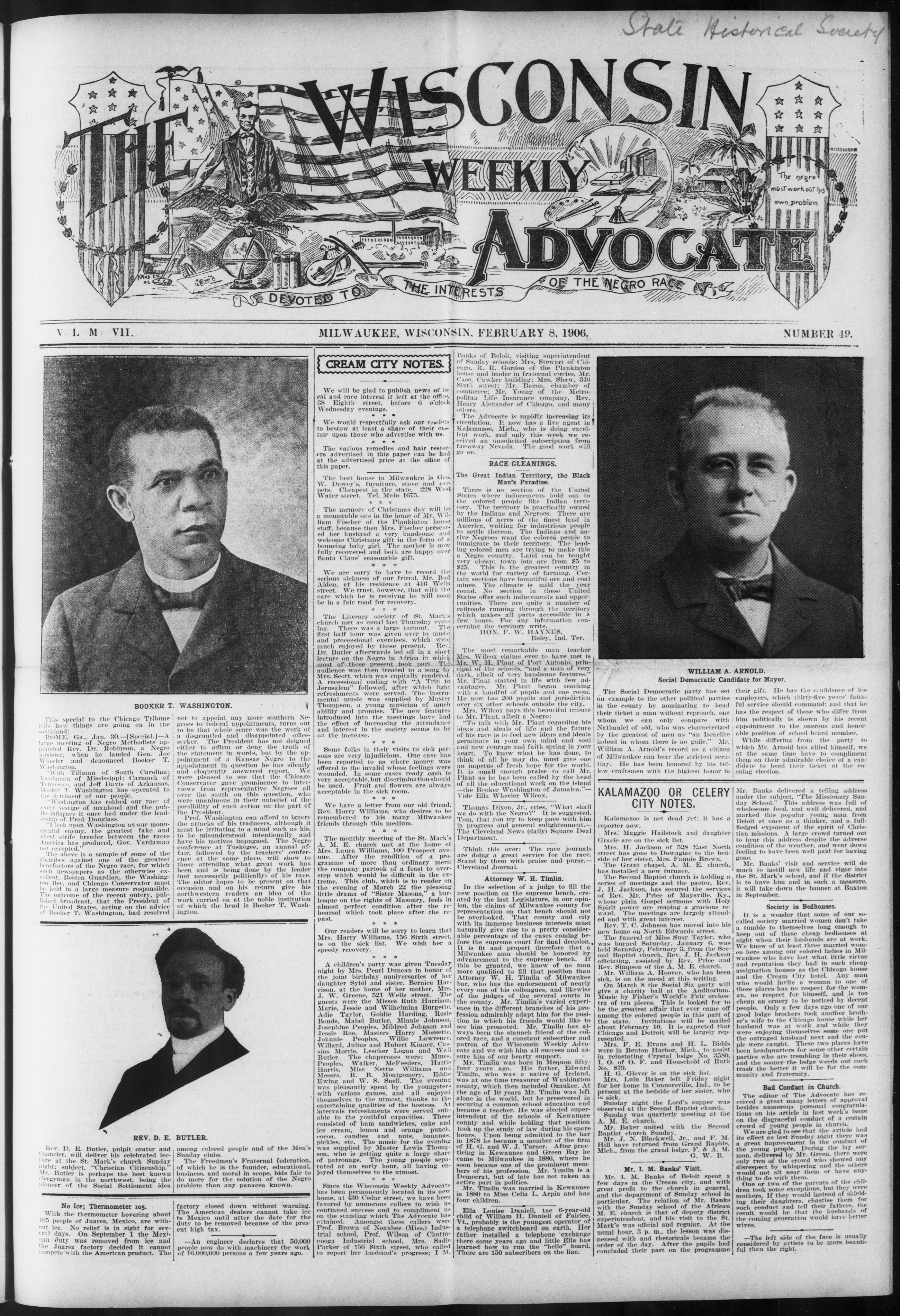
Page text (machine-generated)
State Historical Society
WISCONSIN
WEEKLY
ADVOCATE
DEVOTED TO THE INTERESTS OF THE NEGRO RACE
BOOKER T
BOOKER T. WASHINGTON
This special to the Chicago Tribune tells how things are going on in the southland: ROME, Ga., Jan. 30.—[Special.]—A large meeting of Negro Methodists applauded Rev. Dr. Robinson, a Negro minister, when he lauded Gen. Joe Wheeler and denounced Booker T. Washington.
"With Tillman of South Carolina; Vardaman of Mississippi; Carmack of Tennessee, and Jeff Davis of Arkansas, Booker T. Washington has operated to the detriment of our people.
"Washington has robbed our race of every vestige of manhood and the public influence it once under the leadership of Fred Douglass.
"I look upon Washington as our monumental enemy, the greatest fake and vilest strife breeder between the races America has produced, Gov. Vardaman not excepted."
The above is a sample of some of the distribes against one of the greatest benefactors of the Negro race, for which such newspapers as the otherwise excellent, Boston Guardian, the Washington Bee, and Chicago Conservator must be held in a large measure responsible. The outcome of the recent outcry, published broadcast, that the President of the United States, acting on the advice of Booker T. Washington had resolved
REV. D. E.
REV. D. E. BUTLER.
Rev. D. E. Butler, pulpit orator and financier, will deliver his celebrated lecture at the St. Mark's church Sunday night; subject, "Christian Citizenship." Mr. Butler is perhaps the best known clergyman in the northwest, being the pioneer of the Social Settlement idea among co Sunday c The F of which business, do more problem
With the thermometer hovering about 105 people of Juarez, Mexico, are without ice. No relief is in sight for several days. On September 1 the Mexican duty was removed from ice and the Juarez factory decided it cannot compete with the American product. The
V L M VII
No Ice: Thermometer 105.
not to appoint any more southern Negroes to federal appointments, turns out to be that whole scare was the work of a disgruntled and disappointed office-seeker. The President has not designed either to affirm or deny the truth of the statement in words, but by the appointment of a Kansas Negro to the appointment in question he has silently and eloquently answered report. We were pleased to see that the Chicago Conservator gave prominence to interviews from representative Negroes all over the south on this question, who were unanimous in their unbelief of the possibility of such action on the part of the President.
Prof. Washington can afford to ignore the attacks of his traducers, although it must be irritating to a mind such as his, to be misunderstood intentionally and have his motives impugned. The Negro conference at Tuskegee, an annual affair, followed by the teachers' conference at the same place, will show to those attending what great work has been and is being done by the leader (not necessarily politically) of his race. The editor hopes to be present on that occasion and on his return give his northwestern readers an idea of the work carried on at the noble institution of which the head is Booker T. Washington.
BUTLER.
among colored people and of the Men's Sunday clubs. The Freedmen's Fraternal federation, of which he is the founder, educational, business, and moral in scope, bids fair to do more for the solution of the Negro problem than any panacea known.
factory closed down without warning. The American dealers cannot take ice to Mexico until after the date for the duty to be removed because of the present high tax.
—An engineer declares that 50,000 people now do with machinery the work of 16,000,000 persons a few years ago.
CREAM CITY NOTES.
---
We will be glad to publish news of local and race interest if left at the office, 38 Eighth street, before 6 o'clock Wednesday evenings.
We would respectfully ask our readers to bestow at least a share of their custom upon those who advertise with us.
The various remedies and hair restorers advertised in this paper can be had at the advertised price at the office of this paper.
The best house in Milwaukee is Geo. W. Dewey's, furniture, stove and carpets. Cheapest in the state. 228 West Water street. Tel. Main 1675.
* * *
The memory of Christmas day will be a memorable one in the home of Mr. William Fischer of the Plankinton house staff, because then Mrs. Fischer presented her husband a very handsome and welcome Christmas gift in the form of a bouncing baby girl. The mother is now fully recovered and both are happy over Santa Claus' seasonable gift.
* * *
We are sorry to have to record the serious sickness of our friend, Mr. Bud Alden, at his residence at 416 Wells street. We trust, however, that with the care which he is receiving he will soon be in a fair road for recovery.
```markdown
```
The Literary society of St. Mark's church met as usual last Thursday evening. There was a large turnout. The first half hour was given over to music and processional exercises, which were much enjoyed by those present. Rev. Dr. Butler afterwards led off in a short lecture on the Negro in Africa in which most of those present took part. The audience was then treated to a song by Mrs. Scott, which was capitally rendered. A recessional ending with "A Trip to Jerusalem" followed, after which light refreshments were served. The instrumental music was supplied by Master Thompson, a young musician of much ability and promise. The new features introduced into the meetings have had the effect of increasing the attendance and interest in the society seems to be on the increase.
☆ ☆ ☆
Some folks in their visits to sick persons are very injudicious. One case has been reported to us where money was offered to the invalid whose feelings were wounded. In some cases ready cash is very acceptable, but discrimination should be used. Fruit and flowers are always acceptable in the sick room.
* * *
We have a letter from our old friend, Rev. Harry Williams, who desires to be remembered to his many Milwaukee friends through this medium.
☆ ☆ ☆
The monthly meeting of the St. Mark's A. M. E. church met at the home of Mrs. Laura Williams, 100 Prospect avenue. After the rendition of a programme of more than ordinary merit the company partook of a feast to overstep which would be difficult in the extreme. This club, which is to render on the evening of March 22 the pleasing little drama of "Sister Masons," a burlesque on the rights of Masonry, feels in almost perfect condition after the rehearsal which took place after the repast.
---
Our readers will be sorry to learn that Mrs. Harry Williams, 156 Sixth street, is on the sick list. We wish her a speedy recovery.
```markdown
```
A children's party was given Tuesday night by Mrs. Pearl Duncan in honor of the joint birthday anniversaries of her daughter Sybil and sister. Bernice Harrison, at the home of her mother, Mrs. J. W. Greene, 521 Wells street. The guests were the Misses Ruth Harrison, Marie, Jessie and Wilhelmina Burgette, Adie Taylor, Goldie Harding, Rosie Bonds, Mabel Butler, Minnie Johnson, Josephine Peoples, Mildred Johnson and Jessie Roe, Masters Harry Mossette, Johnnie Peoples, Willie Lawrence, Willard, Julius and Hubert Kinner, Cassius Morris, Lescher Logan and Wall Butler. The chaperones were; Mimes, Peoples, Walker, McFeeders, Hattie Harris, Miss Nettie Williams and Messrs. R. B. Montgomery, Eddie Ewing and W. S. Snell. The evening was pleasantly spent by the youngsters with various games, and all enjoyed themselves to the utmost, thanks to the entertaining qualities of the hostess. At intervals refreshments were served suitable to the youthful capacities. These consisted of ham sandwiches, cake and ice cream, lemon and orange punch, cocoa, candies and nuts, bananas, pickles, etc. The music for the evening was supplied by Master Lewis Thompson, who is getting quite a large share of patronage. The young people separated at an early hour, all having enjoyed themselves to the utmost.
☆ ☆ ☆
Since the Wisconsin Weekly Advocate has been permanently located in its new home, at 430 Cedar street, we have been favored by numerous callers to wish us continued success and to compliment us on the standing which The Advocate has attained. Amongst these callers were Prof. Brown of Noxubee (Miss.) Industrial school, Prof. Wilson of Chattanooga Industrial school, Mrs. Sadie Parker of 156 Sixth street, who called to report her husband's progress; I M.
Banks of Beloit, visiting superintendent of Sunday schools: Mrs. Stewart of Chicago, R. R. Gordon of the Plankinton house and leader in fraternal circles, Mr. Case, Cawker building; Mrs. Shaw, 346 Sixth street; Mr. Bacon, chamber of commerce; Mr. Young of the Metropolitan Life Insurance company, Rev. Henry Alexander of Chicago, and many others.
The Advocate is rapidly increasing its circulation. It now has a live agent in Kalamazoo, Mich., who is doing excellent work, and only this week we received an unsolicited subscription from far-away Nevada. The good work will go on.
RACE GLEANINGS
The Great Indian Territory, the Black Man's Paradise.
There is no section of the United States where inducements hold out to the colored people like Indian territory. The territory is practically owned by the Indians and Negroes. There are millions of acres of the finest land in America, waiting for industrious people to settle thereon. The Indians and native Negroes want the colored people to immigrate to their territory. The leading colored men are trying to make this a Negro country. Land can be bought very cheap; town lots are from $5 to $25. This is the greatest country in the world for variety of farming. Certain sections have bountiful ore and coal mines. The climate is mild the year round. No section in these United States offer such inducements and opportunities. There are quite a number of railroads running through the territory which makes all parts accessible in a few hours. For any information concerning the territory write.
The most remarkable man teacher Mrs. Wilcox claims ever to have met is Mr. W. H. Plant of Port Antonio, principal of the schools, "and a man of very dark, albeit of very handsome features." Mr. Plant started in life with few advantages. Mr. Plant began teaching with a handful of pupils and one room. He now has 200 pupils and jurisdiction over six other schools outside the city. Mrs. Wilcox pays this beautiful tribute
Mrs. Wilcox pays this beautiful tribute to Mr. Plant albeit a Negro;
"To talk with Mr. Plant regarding his ideas and ideals of life and the future of his race is to feel new ideas and ideals germinate in your own mind and soul and new courage and faith spring in your heart. To know what he has done, to think of all he may do, must give one an impetus of fresh hope for the world. It is small enough praise to call Mr. Plant as he has been called by the head of all the educational work on the island—the Booker Washington of Jamaica."—Vide Ella Wheeler Wilcox.
Thomas Dixon, Jr., cries, "What shall we do with the Negro?" It is suggested, Tom, that you try to keep pace with him in progress and general enlightenment. The Cleveland News (daily) Square Deal Department.
Think this over: The race journals are doing a great service for the race. Stand by them with praise and purse. Cleveland Journal.
Attorney W. H. Timlin.
In the selection of a judge to fill the new position on the supreme bench, created by the last Legislature, in our opinion, the claims of Milwaukee county for representation on that bench should not be overlooked. That county and city with its immense business interests must naturally give rise to a pretty considerable percentage of the cases coming before the supreme court for final decision. It is fit and proper therefore that a Milwaukee man should be honored by advancement to the supreme bench. If this be granted, we know of no man more qualified to fill that position than Attorney W. H. Timlin of Milwaukee bar, who has the endorsement of nearly every one of his colleagues, and likewise of the judges of the several courts in the county. Mr. Timlin's varied experience in the different branches of his profession admirably adapt him for the position to which his friends would like to see him promoted. Mr. Timlin has always been the staunch friend of the colored race, and a constant subscriber and patron of the Wisconsin Weekly Advocate and we wish him all success and assure him of our hearty support.
Mr. Timlin was born in Mequon fifty-four years ago. His father, Edward Timlin, who was a native of Ireland, was at one time treasurer of Washington county, which then included Ozaukee. At the age of 10 years Mr. Timlin was left alone in the world, but he presevered in securing a common school education and became a teacher. He was elected superintendent of the schools of Kewaunee county and while holding that position took up the study of law during his spare hours. Upon being admitted to the bar in 1878 he became a member of the firm of H. G. and W. J. Turner. After practicing in Kewaunee and Green Bay he came to Milwaukee in 1886, where he soon became one of the prominent members of his profession. Mr. Timlin is a Democrat, but of late has not taken an active part in politics.
Mr. Timlin was married in Kewaunee in 1880 to Miss Celia L. Arpin and has four children.
Ella Louise Daniell, the 6-year-old child of William H. Daniell of Fairlee, Vt., probably is the youngest operator of a telephone switchboard on earth. Her father installed a telephone exchange there some years ago and little Ella has learned how to run the "hello" board. There are 150 subscribers on the line.
[Name]
WILLIAM A. ARNOLD. Social Democratic Candidate for Mayor. The Social Democratic party has set an example to the other political parties in the county by nominating to head their ticket a man without reproach, one whom we can only compare with Nathaniel of old, who was characterized by the greatest of men as "an Israelite indeed in whom there is no guile." Mr. William A. Arnold's record as a citizen of Milwaukee can bear the strictest scrutiny. He has been honored by his fellow craftsmen with the highest honor in their gift. He employs, which ful service shows the respect him politically to appointment to able position of While differer which Mr. Arne at the same time them on their a idate to head suing election.
KALAMAZOO OR CELERY CITY NOTES.
Kalamazoo is not dead yet; it has a reporter now.
Mrs. Maggie Hailstock and daughter Gracie are on the sick list.
Mrs. H. Jackson of 528 East North street has gone to Dowagiac to the bedside of her sister, Mrs. Fannie Brown.
The Grant chapel, A. M. E. church, has installed a new furnace.
The Second Baptist church is holding a series of meetings and the pastor, Rev. J. H. Jackson, has secured the services of Rev. Mr. Price of Maysville, Ky., whose plain Gospel sermons with Holy Spirit power are reaping a gracious reward. The meetings are largely attended and with great interest.
Rev. T. C. Johnson has moved into his new home on North Edwards street. The funeral of Miss Susy Taylor, who was burned Saturday, January 6, was held Saturday, February 3. from the Second Baptist church, Rev. J. H. Jackson officiating, assisted by Rev. Price and Rev. Simpson of the A. M. E. church.
Mr. William A. Hoover, who has been sick, is on the mend at this writing.
On March 8 the Social Six party will give a charity ball at the Auditorium. Music by Fisher's World's Fair orchestra of ten pieces. This is looked for to be the greatest affair that ever came off among the colored people in this part of the state. Invitations will be mailed about February 10. It is expected that Chicago and Detroit will be largely represented.
Mrs. F. E. Evans and H. L. Bidds were in Benton Harbor, Mich., to assist in reinstating Crystal lodge No. 3580, I. O. of O. F. and Household of Ruth No. 879.
H. G. Glover is on the sick list.
Mrs. Lulu Baker left Friday night for her home in Connorsville, Ind., to be present at the bedside of her sister, who is sick.
Sunday night the Lord's supper was observed at the Second Baptist church.
Sunday was quarterly meeting at the A. M. E. church.
Mr. Baker united with the Second Baptist church Sunday.
Mr. J. N. Blackwell, Jr., and F. M. Hill have returned from Grand Rapids, Mich., from the grand lodge, F. & A. M.
G. W. B.
Mr. L. M. Banks' Visit.
Mr. I. M. Banks of Beloit spent a few days in the Cream city, and with great profit to the church in general, and the department of Sunday school in particular. The relation of Mr. Banks with the Sunday school of the African M. E. church is that of deputy district superintendent, and his visit to the St. Mark's was official and regular. At the usual hour, 3 p. m., the lesson was dispensed with and rhetoricals became the order of the day. After the pupils had concluded their part on the programme
NUMBER 49.
ARNOLD.
Candidate for Mayor.
their gift. He has the confidence of his employers, which thirty-five years' faithful service should command; and that he has the respect of those who differ from him politically is shown by his recent appointment to the onerous and honorable position of school board member. While differing from the party to which Mr. Arnold has allied himself, we at the same time have to compliment them on their admirable choice of a candidate to head their ticket at the ensuing election.
Mr. Banks delivered a telling address under the subject, "The Missionary Sunday School." This address was full of wholesome food, and well delivered, and marked this popular young man from Beloit at once as a thinker, and a full-fledged exponent of the spirit of Christian missions. A large crowd turned out to hear this address despite the adverse condition of the weather, and went down feeling to have been well paid for having gone.
Mr. Banks' visit and service will do much to instill new life and vigor into the St. Mark's school, and if the district is to have him and in such a measure, it will take down the banner at Baxton in September.
Society in Bedhouses
It is a wonder that some of our so-called society married women don't take a tumble to themselves long enough to keep out of these cheap bedhouses at night when their husbands are at work. We know of at least three married women here among our colored ladies in Milwaukee who have lost what little virtue and reputation they had in such cheap assignation houses as the Chicago house and the Cream City hotel. Any man who would invite a woman to one of these places has no respect for the woman, no respect for himself, and is too cheap an ornery to be noticed by decent people. Only a few days ago one of our good lodge brothers took another brother's wife to the Chicago house while her husband was at work and while they were enjoying themselves some one put the outraged husband next and the couple were caught. These two places have been headquarters for some other certain parties who are trembling in their shoes, and the sooner the lodge weeds out such trash the better it will be for the community and fraternity.
Bad Conduct in Church.
The editor of The Advocate has received a great many letters of approval besides numerous personal congratulations on his article in last week's issue on the disgraceful conduct of a certain crowd of young people in church. We are glad to see that the article had its effect as last Sunday night there was a great improvement in the conduct of the young people. During the lay sermon, delivered by Mr. Green, there were only two of the crowd who showed any disrespect by whispering and the others would not sit near them or have anything to do with them.
One or two of the parents of the children took some exceptions, but they were mothers. If they would instead of shielding their daughters, chastise them for such conduct and tell their fathers, the result would be that the husbands of the coming generation would have better wives.
The left side of the face is usually considered by artists to be more beautiful than the right.
---
; & Tea-Table Salad. 3
Hard and Soft.
How hard we work for a soft spap!—
Life.
Seemingly Not.
“They have some china that has been
in the family for years.”
“Indeed! Haven't they any serv-
ants 7"—Judy.
In Utah.
“You look happy.”
“Lain happy: the December death rate
in my family was the lowest in years.”
—Town Topies.
His Memory System.
Whipple—Hew old is your boy?
Shapper—Well, he was born the sum-
mer after 1 got this whisky, and I have
lind that eight years.—Town Tepies.
The Truth,
A lisping old boor at Duluth
Ate fried exes with a fork of one tuth,
But he called to his wife:
“Thay! path we that knife;
1 don't like to loothe all this juth.”
Accommoeating.
“Very sorry—all my daughters are al
rendy engaged.” 3 :
“Ah. weil, never mind; I'll call again
uext tine there’s a vacancy.””-—Sphere.
Usually Ahead.
ly the by. it is alleged that there is
an Aimeriean millionaire behind — the
‘Times, If this be true it is a position
iy which ap American very seldom finds
himseif.—Puneh,
How It Happened?
“IT theught Stockson was to marry
Ethei?”
“He was: but the bottom fell out of
the stock market and the marriage fell
through.”—Town Topics.
Generous.
She—Bnt do you know I have an
uncle who is a member of Parliament?
He—Never mind, darling. I love you
tee inch to let that stand in the way.—
New York Evening Mail.
Reverence for Age.
“Yes,” said the Brooklyn men, gen-
tly, “L gtways feel better after the old
women leave the trolley car. It makes
me uncomfortable to sit and see ‘em
hanging onto the straps.”
The Best Proof.
“That surgeon, they say, has a re-
niarkable touch.”
“He has. Lf yon don't believe it, 1
show you his bill for my appendicitis
operation.”"—Baltimore American.
Tommy’s Idea of It.
Grandpa—And if you work hard you
may be President of the United States
some day.
Tommy—Gee! That'd be great. I'd
just Jove to go huntin’.—Harper’s Bazar.
Got What He Wanted.
Auctioneer — Going! Going! Gone.
Here, sir, it's yours. Great bargain, sir.
The frame alone is worth the price.”
Connoisseur (ripping out the picturey—
The frame is what I wanted.—New York
Weekly.
Wasn't Irish Either.
“Then, if you were to receive an
anonymous letter making accusations
against your wife, you would pay no
attention to it?”
“Certainly net. I wouldn't even epen
it—Le Rire.
Wanted It at Once.
“I disown you,” cried the angry par-
ent; “I shall cut you off with a shil-
ling!”
“Yes, sir,’ replied the erring son meek-
iy. “and might I have that shilling
now ?’—Life.
Business Man: “What do yeu want?”
Applicant: “I came to inquire if you
were in want of an assistant.”
Business Man: “Very sorry. I do ali
the work myseif.”
Applicant: “Ah! That would just snit
ne.” —Tit-Bits.
But She Did Tell.
Ella—Bella told me that: you told her
that seeret I told you not to tell her.
Stella—She’s a mean thing—L told her
not to tell you T told her.
Ella—Weli, I told her I wouldn't tell
you she told me—so don’t tell her I did.
—dJndge.
Didn’t Need To.
“It's too bad,” said the judge, caus-
tically, “that the defendant should have
chosen you for counsel. You know noth-
ing about law.” y
“Well, your honor.” yveplied the young
lawyer, “I don't need to in this court.”—
Philudelphia Press.
Making It Convenient.
The Creditor—When are you going to
pay me? I can’t get to your place every
day, trying to make you settle up. I've
got other things to do.”
The Debtor—Are you at liberty on
Saturday afternoons? Come every Sat-
urday.—Answers,
Modern Motherhood.
Cynie (savagely)—They say the fash-
jonable mother of today recognizes her
baby only by looking at the nurse.
Fashionable Mother (anmoved}—Ilow
extraordinarily clever when one changes
nurses so often! IT always tell ours by
the mail car—Judy.
An Eye for an Aye.
“Mr. Speaker,” said the congressman,
SF eee tried vainly to catch your eye
snd" —
“Sit down!” thundered the speaker,
“L have tried vainly to eateh your ‘aye’
several times when it was needed.”—
Philadelphia Ledger.
Automobiling for the Poor.
“Are you going to get the automobile
which the doctor ordered for your wife?”
“Can't afford it, but we have almost the
real thing. She puts on a pair of gase-
line .cleaned gloves, takes a long, long
ride on the front seat of a trolley cnr,
and walks back.”’—Life.
ee eee
Eligible.
A seuthern senator says that one of
the best and briefest of speeches that
he ever heard in the upper house of Con-
“ress was one of four words delivered |
by Senater Proctor of Vermont. This
speech, it appears, Was 2 retort to a sar-
castie fing by x colleague from Mass:
chusetts. He had said: “No man in
Vermont is allowed to vote unless he has
made $2000 trading with Massaclnsetts|
people.” ]
Whereupon Proctor arose deliberately
and observed: “And we all vote.”’—Har |
per’s Weekly.
—Electric fishes exposed to the action
ef radium have been found to lose their
electric power completely and to suffer
in health.
WY GREAT-GREAT-GRANDSIRE.
My great-great gradsire tilled the soil
‘And felled tall pines on slope and bill,
His homespun garments but the foil
‘That swathed a man of iron will.
And yet when Winter's race was run
And came the Springtime 's first caress
is nature warmed before the sun
And melted irco tenderness.
He knew the fields, he knew the woods,
For nature was his guiding star;
And sermons found in solitudes
Where only nature's teachings are.
He marked the gentian of the brooks
‘And paused where honeysuckies hunz,
And rested where in wildest nooks
The lene arbutus trailing chung,
Aud towered up the bristling head
Ot some Colossus of the pines.
Like a great stag with antlers spread
‘The monarch of a thousand tines.
And with his red or flintleck gun
Tie whipped the pools or led the chase,
Tracked the black bear till set of sun,
‘And slew Lim in his hiding place.
Aid thus he lived au outdoor life,
With sight of flower. bird and bee,
With yoke of oxen, and a wife
With children playing at her knee.
And who shall boast a bygone dine
And who shull read his pedigree?
“Tis sonl that makes the man divine,
Else lower than a beast were be.
A morrain on your coats of arms?
He did his best, as mortal can:
Wrong « rough living from the farms
‘And lived and died an honest man.
_FErnest MeGaffey-in National Magazine.
THe ONLY CROW INDIAN BATTLE.
ee ee san Pe oe a Rae aah al mee er
lof the Indian tribes with which the gov-
‘lernment has had to dea!, and trom their
ranks ave come large numbers of the
army's bravest and mo-* trusted scouts.”
Twas talking with Lient.-Col. L. W.
Cooke of the regular army about some of
|the Indian campaigns which that model
| soldier had participated in when he made
the remark quoted,
Col. Cooxe’s story of the Crows’ one
battle with Uncle Sam's soldiers should
| be told.
“The yerng Lacks at the Crow agency,
lin the Littl Vig Hern country, in sight
of the Custer mentument, where that fear-
less cavalry leader. with 300 of the Sev-
enth cavalry, fell at the hands of the
Sioux. wader the lewlership of Chief Sit-
ting Mull, in IS76, began to show signs
of a deter:nination ro leave the reserva-
tion the summer of 1887, to make the
army trouble,’ said the colonel. “An
athletic, handsome and popular young In-
dian, not more than 23, known as ‘Sword
Bearer,’ was the leading spirit.
“Sword Bearer had convinced many of
the young men that he was invisible, and
that those who followed him would also
become invisible—that the soldiers could
not sce or harm them, no matter how
many faced them in battle, or how long
they were fired upon. He also made them
believe’ that all who waged war upon
them would, at the proper time, be de-
stroyed, when that vast, beautiful coun-
try would be tueirs, to do with as they
pleased.
“Strange as it may seem, the fellow
not only secured a large following of
young bneks, but the approval of most
of the chiefs. They looked upon him as a
leader sent from an unknown world to
give them new life. with plenty for all.
“Then the ghost dance was introduced
and continued for weeks. That dance
always used to set our authorities to
thinking and planning.
“In due time soldiers were ordered to
the Crow ageney. under the eommand of
Gen. Thomas H. Ruger, now a retired
major general. The First cavalry, com-
manded by Col. N. A. M. Dudley, a bat-
talion from the Third, Fifth and Seventh
infantry, each, a squadron of the Tenth
cavalry and a troop of the Seventh cav-
alry, the latter commanded by Lieut.
Miles Moylan, were sent there from
various forts and posts.
“As soon as Sword Bearer heard that
the soldiers were eoming he called his
braves together and informed them that
he had planned to have the coming enemy
crushed by a mighty storm accompanied
by thunder, lightning and explosions.
“A frightful thunder storm did come
while one of our wagon trains was a few
miles from the agency. and one of the
teams was struck by lightning. When
news of the loss reached the Indians there
was much rejoicing, ending with a ghost
dance. When asked why the whole train
and ell of the soldiers were not struck
down, Sword Bearer told his warriors
that he had deeided to destroy the army
at a more opportune time; that he had
caused the killing of one team just to
let them know that he could have things
happen at his will,
“My company ef the Third infantry
was first to arrive at the agency. Sword
Bearer rode through our camp. the next
day, in full uniform, his head full of
feathers and war paint on his face. 1
give directions to pay no attention to
him. He made good use of our lack of
attention by telling his band: *You see
I am invisible; the soldiers did not see
me; if they had seen me they would have
been quick to salute the commander of
your army of braves. He was a cunning
young rascal. His followers took new
courage; they then believed more thor-
oughly in their ehief’s invisibility, and
their own.
“Each day the Indians drilled, in their
way, and it became apparently to all of
us that there would be a battle.
“Farly in November, eleven years after
the Custer massacre, the Indians began
to dig deep holes, similar to cyelone pits,
near the agency. They dug great num-
bers of them, and placed neay them brush
and grass. Our scouts, faithful Crows,
brought word that Sword Bearer had
given directions that when the battle
opened he would give a signal by swing-
ing a bag of white dust over his head,
and that when the old men and squaws
saw that dust they must hasten to the
holes and pull the brush and straw over
them, as his flying dust was the signal
for a mighty hail-storm that would beat
down and kill all of the soldiers, and all
Indians not in the holes, save the invisi-
ble chief and his invisible army.
“The day of the battle was as perfect
a November day as I ever saw, The
leaves of many colors on the trees and
bushes, the silvery streams, the plains,
tie dotted hills, the bright sunshine, pure
air——all combined to make a beautiful
picture—a war painting that did not de-
pict war. But the war was scon to come.
“Sword Bearer had his braves assem-
bled on 2 plain a few hundred yards from
| the agency buildings. Gen. Ruger formed
j his line of battle, cavalry, infantry and
a mountain battery. It was the most
| spectacular army scene I ever beheld.
We could look to the right and left and
see our entire line, and in front, in plain
sight. were the Crow warriors and their
false leader. |
Pretty soon the Indians began to
move, first in a hesitating manner, then
more confidently, to get up courage, ax
jis the Indian custom. Then they circled
for a time and a detachment started on
a het canter to the left flank of our line.
At the same time one of Sword Bearer’s
lieutenants started for the rear of our
right flenk.
“Our orders were to hold our fire unless
the Indians closed in upon us and it be-
came absolutely necessary to sheet to
save ourselves.
“The body of braves that went to the
left seemed in a way to make a part of
our force trouble, when 2 few shots were
fired; one Indian was hit in the arm, and
they scattered. A little later we could
see a company of squaws wrapping: red
blankets about Indians and leading them
to the holes referred to. We afterwards
learned that they were the braves who
had gone to our left. The whistling of
bullets and wounding of their comrade
had convinced them that they were not
invisibie. to any marked extent, and they
were ready to go to the holes when the
squaws gave them urgent invitation.
“The lieutenant Swerd Bearer had sent
jareund our right rode back and forth in
rear of the line several times. Finally
Col. Dudley said: ‘Adjt. Wainwright
(ater a major who died in the Philip-
pines), ride ont and see what that Indian
means by riding along our line’ Lient.
Wainwright rode toward the Indien and
when within thirty yards of him the
jbrave dismounted and from behind his
norse shot at the adjutant. Quick as
a flash Wainwright returned the fire and
another invisible warrior was winged and
made a prisoner.
“Soon after the Crow lieutenant was
wounded Sword Bearer ordered his line to
open fire. The bullets sang about us in
a lively way, but our orders would not
permit us to return the fire, much as we
wanted to. After a number of our men
had been wounded Col. Dudley rode to
Gen. Ruger and asked for permission to
strike back, and a volley was fired. At
that point we saw Sword Bearer ride to
the holes, where some of his warriors had
Leen escorte! by their wives. We saw
him swinging his arms. apparently in
great earnestness, He was begging his
Petes to return to his battle line and
help in the fight; bat they had Jost all
faith in their invisibility. and refused to
obey him. Returning to his army, firing
was resumed by his entire force, and as a
result, others of our men were killed and
wounded.
“We then had orders to make short
work of the task. Just as we opened fire
1 saw Sword Bearer swing the bag of
white dust over his head, the signal for
the premised disastrous hail-storm, and
the holes were filled with Indians. but
the storm did not. materialize.
“In a short time after we began work
in carnest, the Crow army was scattered,
a number of its members dead, others
wounded and the invisible chief and seer
among the slain. He had suffered a
broken arm right after his signal for the
big storm, and while getting a drink from
a little stream was shot in the head.
“So began, continued and ended the
only trouble between the United States
and the Crows. Ghost dances have been
unfashionable with them ever since, and
they tolerate no more prephets in their
ranks.”—Evening Wisconsin.
WISDOM OF AN EMPIRICIST.
When in doubt, hit the peacemaker.
A man who prefers a pipe to a good
cigar is a liar.
A good way to in lappy is to forget
that you are not.
The important letters “lost in ihe
mails” are seldom bills.
It is hard for even a physician to tell
cynicism from dyspepsia.
A good way to get sick is to feel your
pulse and look at your tongue.
An office seeking a man doesn’t usu-
ally have to get a search warrant.
It is not hard to avoid the appearance
of evil. It is always well disguised.
The man with an easy conscience
sleeps no better than the one with none
at all.
Maybe more people would beard if
there were no Lima beans and apple
sauce.
There are two kinds of office holders;
these who are upheld amd those who are
held up. y
About the best way yet discovered of
getting an appetite is not to eat until
you are hungry.
Most men can think of a few things
they would rather do than go shopping
with their wives.
If the colored supplements don’t. jia-
prove soon, lots of folks will begin to
go to chureh on Sunday.
The law of supply and demand as modi-
fied by corporations: “Raise the prices
nntil the consumer can’t raise the price.”
It seems impossible to commit all the
follies in one short lifetime, but men are
conscientious and optimistic and keep
trying.
ee
~ When an old smoker quits smoking it’s
a sign that he is going to be so cross for
‘two days that his family will persnade
him to begin again.—St. Louis Glohe-
Democrat.
Not for Santa Claus.
“City houses with steam-heating sire
all,very well,” said Charles Felton DPid-
gin, the statistician of Boston, in the
Chicago Chronicle, “but wien it comes
to Christmas games they are a little
lacking.
Ce eiend of mine heard “é loud. rasp-
ing noise in the parior last Christmas
eve very late.
“In great alarm he got up and hast-
ened down to the delicate and pale par-
lor, with its coloring ef white and pink
and gold, to find there, all black with
soot smears, his little white-robed son,
whom he had thought fast asleep in
bed.
“Why. why,’ he eried, ‘what does this
mean, Willie?
“The little fellow. lifting a cake of
soot out of his fuir hair, pointed ruefully
to the ornamental fireplace. wherein there
was room for abont three logs the size
of lead pencils.
“Pm playing Santa Claus.’ he said,
‘and I—I can't get up the chimney,’ ”
——_-—_____
Of Course It Was.
A wedding ceremony had come to a
close. The mother sniffed convulsively,
and the bride dabbed her pretty eyes
with « handkerchief. One of the brides-
maids was also affected to tears.
“Why do you weep?” asked a grooms-
man of the bridesmaid; “it’s not your
wedding.” The ,sitl looked at “hin
seornfully. “That's the reason, you stu-
pid!” and she sighed.—Tatler.
ENVIRONMENT.
or bull, you pawed de dus’ ontil
Hit settled on vo" back,
You bellered "cross de grassy bill,
Ea yserlin’s eYared yo’ track.
You hook’ de clayroot ‘ca‘se “t wus raid,
N’ you could n° stan’ fer dat.
you had big notions in yo" haid;
“T was spring, en you wus tat.
ut new yo" back ’s bowed, en yo" ha‘r
“S a-standin’ upon een’.
iit ’s dald grass, dald grass uvvywhar,
But not a tussick green.
you disremembers how you run
When | went atter you,
En, how I sweated in’ de sun,
En how you matehly flew.
Ob, yon kin stan’ behin’ dat stack
En nibble at de straw,
ut ‘t ain't no dus’ upon yo" back;
You do” know hew to paw.
You could n” beller now, ner rn;
You ’s giad enough to stan’.
T wus grass en water en hot sun
Wot made you sich a man.
—Charlotte Observer.
—_—_—_—_——_—_—————
ELKS IN CIRCLE DANCE. |
Remarkable Exercise in Which Bands of
the Animals Take Part.
But the grand curious amusement of
the elk, one which many hunters have
witnessed, may be called their circle
dunce. H. W. Skinner of Chicago sends
ye his observations on this performanc +:
“About 4 o'clock one afternoon late in
August, 1890, 1 was riding northeast up
a small stream flowing into one of the
‘tributaries of the Green river, near its
source in northwestern Wyowing. The
‘intense heat was only relieved by an oe-
ceosional faint breath of breeze from the
porth. My attention was atiracted by a
column of fine, dark brown dust rising
fabead of me and on the opposite side of
‘the ereek (L was on the sonth side),
"Phe column of dust looked almost as
if caused by a whirlwind. On reaching
a point as close to it as i conld get with-
out evossing the creek—I was perhaps
loo yards from it—I fonad that it was
eoused by a band of elk numbering from
tvelve to twenty who seemed to be trot-
ting quite rapidly with oceasional awk-
ward galloping plunges ina circle per-
haps thirty feet in diameter. They were
yoing in the same direction as the hands
of a wateh, in the edge of a little belt
of second growth timber, mainly, 1
think. quaking asp.
“They were moving. uot with heads up,
bur with noses oniy a foot or two from
the ground. My impression is that they
were all bulls. Owing to> ihe dense
wlonds of dust whieh occasional light
pulfs of wind blew almost toward me, I
could not see very clearly. It seemed
in me that they were ranning abont as
viniling” cattle do, except that 1 never
kuew of cattle to “mill” in such a smail
bunch. L have related this incident sev-
eral times to hunters and trappers, who
could offer no explanation of it. There
were hirge numbers of elk in that coun-
try at the time in bands of yarions
This remarkable exercise has no ob-
vious relation to the sexual instinct or to
hygiene, and marks several importaat
steps in the evolution of amusement. | If
te it we conid add a little musie we
should have the essentials of social danc-
ine.—Ernest Thompson Seton in Scrib-
ner’s Magazine.
Love of « Little Child.
Did we say a while ago that all the
stones in the building of “home” were
mode of love? Yes, but not all of moth-
ers love, for there is the love from the
child to the parents as well. While the
mother’s love is likely to be all of sery-
ice—and often, alas! service which, like
the unpolished iove stones, passes for
something not so beautiful—the love of
the little child is apt to show itself only
in words and expressions of endearment.
Of all the holy and lovely missions of
the mother in her home, none can be
greater than this, of teaching her child
how to love. Think of it, mothers—what
it means! That day by day, us you give
out your life in gentle, loving service for
the dear ones of the home, you are
“teaching them to know love.” What is
love. God is love. Then as you teach
them to know love, you teach them to
know God. Does such a thought not
hallow all your mission in the home?
How careful we should be, than, that
through our lives the children do not in-
terpret love to be stern duty, or the do-
ing of distasteful things simply because
we “have” to do them. Let us be just
as careful, too, that they do not inter-
pret love—children are very apt to do so
—as only loving words and caresses,
with no service, no sacrifice.—Mothers”
Mavazine.
He Sold the Goods.
‘The following story was told by W. VI’.
Chamberlain, the dry goods merchant of
Keene, N. H.: During 2 “special sale”
day at his stere Mr. Chamberlain had
been bothered by an unusual number of
“drummers” calling on him, taking his
time and attention from his customers.
Finally his usual good nature gave out,
and, when approached by a little Ger-
man from New York, looked sternly at
him and said: “Young man, do you see
that clock on the wall there?”
“Yes, sir,” replied the drummer,
“Well, in just ten minutes by that
clock Lam going to shoot every drummer
1 tind in this store,” said Mr. Chamber-
Jain.
“In ten minutes?’ questioned — the
drummer,
“That is what I said,” Mr. Chamber-
lain replied, sternly.
“Then [ have just time to sell yeu x
pill of goods,” the drummer quickly said.
He sold the goods.
>
Particular.
“Any man with a sense of humor,”
ence observed Frank Daniels, the come-
dian, “ean always find something to his
entertainment if he will stand near the
box-office window of ‘the opry-house’ in
suy small town and listen to the Rubes
ns they make known their wants to the
man who peddles the tickets.
“Out in Ohio one afternoon [was
standing near the box office window a
few minutes before the beginning of a
matinee given by a friend's combination,
‘A fine old boy from the eountry—one of
the kind that sees about one show in
two years—approached the window, his
roll in hand, and delivered himself of the
following:
“Say, young feller! (Ina voice loud
enough to be heard a block away).
‘Gimme a good-seat! I want it right
down the middle Jane and close up to
the exercises! "—Harper’s Weekly.
Aa ee rei ak i
A Parrot of Evil Reputation.
‘The Kea parrot of New Zealand is a
very eurious bird. For many years it
bas been charged with killing sheep by
pecking holes in their sides, and this al-
jeged fact has been recorded in many
works on ornithology and natural his-
tory. Accordingly, as the Kea is. iu
danger of extermination, an investiga-
tion was recently undertaken to determ-
ine whether this bird really deserved its
teil reputation. No evidence could be
found te warrant the statement. and it
was thought to be based entirely upon
the curiosity which it manifests in look-
ing over the carcasses of dead animals.—
Harper's Weekly.
Cea ae
Annual Cry from the Farm.
The harvest season has brought with
jt the annual complaint. From the smal}
neighboring farms to the vast grain
fields of the west on both sides of the
national boundary the cry goes up of a
searcity of labor to secure the crops.
High prices—as compared with the us-
ual farm wages—are offered, but with-
out attracting a sufficient number eve
of unskilled and only partly efficient
hands. Of really effective help, accord-
ing to reports from the harvest fields,
there is a lamentable deficiency. Yet
in the cities there are able-bodied men
without employment sufficient to meet ail
the demands of the harvest fields. Ii
is an ever-recurring condition. For a
brief season there is a serious deficiency
of labor in the country and throughout
the year a surplus in the cities, but ul)
attempts to readjust these conditions
— proved — futile—Cleveland = Phain-
aler.
—————$
Railway Bui'dine in roos.
Tn the present year 4.979 miles of new
railway tracks have been Inid_in_ the
United States, on 237 lines in +5 states
and territories. In addition, several
himdred miles hive been graded and
track is being Inid en many miles as the
year closses. These figures are not tinal,
for there are some roads whieh have
not yet furnished full reports, and it is
probable that the complete returns will
show over 5000 miies.
The new mileage of 1905 exceeds that
of 1904 by over 700 miles. For a good
many years the sonthwesiern states
bave furnished a larger pereentage of
uew mileage than any other group, but
the scene of active construction opera-
tons appeots to be shifting to the north-
west, With the Chicago, Milwaukee &
St. Panl headed for the Pacific coast,
with the new Gould line (the Western
Pacific) already under construction be-
tween Sault Lake City and San Fran-
cisco, and with many new lines planned
by the Harriman and Hill systems. the
western and northwestern states will be
the scenes of bustling activity for the
next few years.
The most noteworthy piece of coustric-
tion during the past year was the ex-
tension of the Soo faze from Thief River
Falls, Minn., to Kenmare, N. D., a dis-
tance of 297 miles. Contracts for this
work were not let until Mareh and track
laying was not begun until July, yet the
Lrond was completed ready for operation
the latter part of November. The Soo
Ine also built two branches in North
Dakota, each nineteen miles in’ length,
winking a total of 435 miles of road
built by this company. To tap the same
region the Great Nortiern has built five
branches, aggregating 12614 miles, north
from its main line. — Altogether the
Great Northern Inid 243 miles of track
on extensions in Minnesota, North Da-
kota, Nebraska and Washington. The
seeond longest line built was by the St.
Louis, Brownsville & Mexico, which
completed 171 miles of its extension
from Robstown to Houston, Tex.—Rail-
cinah idan
Boy with a Hand-Made Bone.
At the annual gathering of theyGlas-
gow University. club at Sunderland re-
cently Sir William Macewen, who was
concerned in an extraordinary operauion
npon a child over twenty years ago, in-
troduced the patient, new a full growa
man, to the medical mea present and
explained the nature of the remarkable
case,
The child was born without a bone in
the right arm, the boneless limb hang-
ing helpless by its side. The surgeons
determined to make an attempt to save
the limb.
Small sections of the bone taken from
the tibia or lower portion of the legs
of other patients who were under treat-
ment for the cure of bowleggclness were
transferred to the boneless arm, there to
continue their growth and to become
ainalgamated—in fact, eventually sup-
plying the place of the missing humerus.
Sir Willam Macewen kept in touch
with the boy. who at the age of 14
left Glasgow for Sunderland, where hé
had worked since. The young man bared
his arm to the guests present and gave
the company abundant proof of the sus-
tained serviceableness of the limb, de
spite several accidents, including a com-
ponnd fracture, which had befalien it.—
Detroit Free Press.
An Embarrassing Introduction.
A few weeks back a well known young
Scottish author gave an interesting lec-
ture in a Lanarkshire country town, un-
der the auspices of the local mutnal im-
provement society.
The lecturer acquitted himself to the
entire satisfaction of the audience. which
said a great deal for his power of self-
command, as the embarrassing introduc-
tion he got would have disconcerted the
most composed of men.
The chairman of the evening was a lo-
cal busybody, glib in speech but prolix
and shallow, who is never so happy as
when he is spouting from a public plat-
form. He introduced the lecturer in a
long and flowery speech, in which he al-
Inded at great length to the eminent
services rendered to Scottish literature
by the gentleman who was about to ad-
dress them, and whose name he might
say was “familiar in their mouths as
household words.”
“Now.” he continued, “I have great
pleasure in calling upon ———"* A pain-
ful pause, and then the occupants of the
front benches heard the stage whisper,
“By the way, what did you say your
name was ?"—Tatler.
a peat
The Many-Sided Printer.
‘The versatility of printers is aptly il-
lustrated by the following advertisement
which recently appeared in a western
paper:
WANTED—BY A PRINTER WHO. 18
capable of taking charge of a publishing
and printing plant a position as foreman.
Can give valuable advice to persons con-
templating marriage, and has obtained a
wide reputation as a trance medium.
Would accept an appointment as pastor
of a small evangelical church or as sub:
stitute preacher. Has had experience as
strike-breaker and would take work of
this character west of the Missouri river,
Would have no objection to forming &
small hut select class of young ladies te
teach them in the higher branches or to
give them information as to the cause of
the Trojan war. Can do odd jobs around
a boarding honse or would accept a posl-
tion as assayist of a mining company. To
+ dentist or a chiropodist his services
would be invaluable, and ean fill with sar
isfaction a position as bass or tenor singer
in a Methodist choir, Address, ete.
What the result of this advertisement
was IT did not learn.—W. C. Jenkins in
Lippincott’s.
ee
Whv Not?
The infant was crying lustily.
“What does Willie want?” we asked,
peering over our glasses,
“L think he, wants his milk,” replied
the nurse,
For a moment we had been filled with
an insensate fear that he wanted to be
speaker, and knowing that he would be
surprised if we thrust the position apon
him, we were glid thet we were wrong.
|) —Exchange.
| A Paying Investment.
The discovery of America cost just
about $7000—$3000 for Columbus’ fieer,
$300 for the admiral’s salary, $200 each
for the two cayenne accompanying the
expeditions, and $2.50 per month each
for the several members of the crew.
And _ yet there are folks who say that
no legitimate investment can possibly
pay more than 6 per cent.—Cent per
Cent.
—_——_.—_____
—Just after he had discovered the rich-
est vein of tungsten ore ever found in
this country George Spratley, a veteran
prospector, was killed by an explosion
of dynamite in his claim in Boulder
county. Colo.
Western Senaces Marvelous Crop
Returns.
‘The increase in the crop returns of
the Canadian West, in the past seven
years, has approached the marvelous,
and there is no reason to believe that
@ corresponding increase will not re-
sult for many years to come. The in-
crease has been particularly noticeable
in what was formerly known as the
Northwest Territories, but which, on
Sept. 1, 1905, became the provinces of
Alberta and Saskatchewan. From the
official returns we find the following
results in the acreage sown to wheat,
oats and barley, in the years mention
ed, and a more favorable showing can
not be pointed to in any other country
Aactane a MNta nawtad
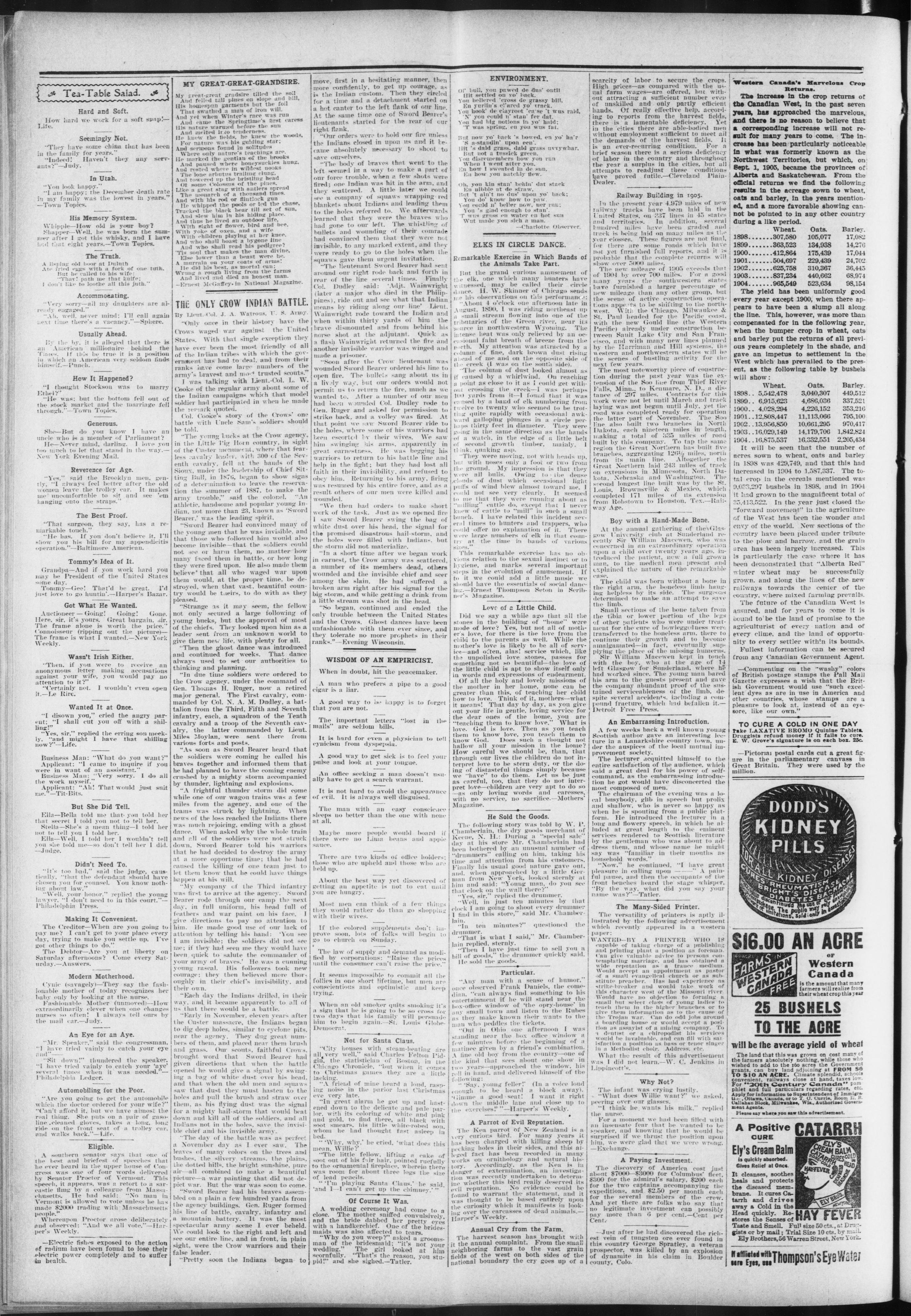
Wheat. Oats. Barley.
1898.......807,580 105,077 17,082
1899.......863,523 134,938 14,276
1900.......412,864 175,439 17,044
1901.......504,697 229,439 24,702
1902.......625,758 310,367 36,445
1903......-837,284 440,662 68,974
1904.......965,549 523,634 98,154
The yield has been uniformly good
every year except 1900, when there ap-
pears to have been a slump all along
the line. This, however, was more than
compensated for in the following year,
when the bumper crop in wheat, oats
and barley put the returns of all previ-
ous years completely in the shade, and
gave an impetus to settlement in the
West which has prevailed to the pres-
ent, as the following table by bushels
will show:
Wheat. Oats. Barley.
1898... 5,542,478 3,040,307 = 449,512
1899. . 6,915,623 4,686,036 337,521
1900.. 4,028,294 4,226,152 353,216
1901. .12,808,447 11,113,066 795,100
1902. .13,956,850 10,661,295 970,417
1903. .16,029,149 14,179,706 1,842,824
1004. .16,875,537 16,332,551 2,205,434
It will be seen that the number of
acres sown to wheat, oats and barley
in 1898 was 429,749, and that this had
increased in 1904 to 1,587,337. The to-
tal crop in the cereals mentioned was
9,095,297 bushels in 1898, and in 1904
it had grown to the magnificent total of
25,413,522. In the year just closed the
“forward movement” in the agricuiture
of the West has been the wonder and
envy of the world. New sections of the
country have been placed under tribute
to the plow and harrow, and the grain
area has been largely increased. This
is particularly the case where it has
been demonstrated that “Alberta Red”
winter wheat may be — successfully
grown, and along ihe lines of the. new
railways towards the center of the
country, where mixed farming prevails.
The future of the Canadian West is
assured, and for years to come it is
ueound to'be the land of promise to the
agriculturist of every nation and of
every clime. and the land of opportu-
nity to every settler with'n its bounds.
Fullest information can be secured
from any Canadian Government Agent.
—Commenting on the “washy” colors
of British postage stamps the Pall Mall
Gazette expresses a wish that the Brit-
ish Government would use “such exce!-
lent dyes as are in use in America and
other countries, whose stamps are a
pleasure to look at, instead of an eye-
sore, like our own.”
‘siecpdepanlelieilincintmesnian
TO CURE A COLD IN ONE DAY
Take LAXATIVE BROMO Quinine Tablets.
Druggists refund money !f it fails to cure.
E. W. Grove’s signature is on each box. 25c.
PaaS
—Pictoriai postal cards cut a great fig-
ure in the parliamentary canvass in
Great Britain. They were used by the
million.
SLD,
CES iS yy
AS DD: g
SaYN YZ
[x ; D N a Eh
iF K ime ee
ae PI ae
KG ; j KONE ae
Uys ea aa fre)
ee ay
aa
SS
h Gi cs N or
qe ern Western
$5 ape Canada
yf AN. Aa is the amount that many
G 433 farmers will realize from
their wheat crop this year
———
—————_—<—<—<——
will be the average yield of wheat
The land that this was grown on cost many cf
the farmers absolutely nothing, while those w
wished to add to the 160 acres the Government
Fo'si can buy land adjoining at FROM s6
© $10 AN ACRE. Climate splendid, sch s
convenient, railways close at hand, taxes |
For “an a Century Canada”’ r
phiet and full particulars regarding rates, et
Apply for information ae Seperseceneres of Immigre
tio: , Ottawa, Canada, orto T. U. Currie, Koom }-. !
Callahan Block, Milwaukee, Wis., Authorized Gover
ment Agents.
Please say where you saw this advertixement.
A Positive
CURE
Ely’s Cream Balm
ATARRH
SS
Sy nas
: a, J
VSENG
Gives Relief at Once.
oe soothes
and protects
the iscaed, mem-
brane. It cures Ca-
tarrh and drives
away a Cold in the
Head quickly. Re-
stores the Senses of
Taste and Smell. Full size 50 cts.,at Dru:-
gists or by mail; Trial Size 10 cts. by «i!
Ely Brothers,56 Warren Street, New York.
W afflicted with 5 P
waited Thompson's Eye Wii
- GOSSIP FOR THE LADIES.
®
Ja@DDBD®QDOOGDHOOGDOGH®OGHHODHDOGODSHODIHHHOHHOIWOSGOS
4s Others See Us.” | the condition of Ler houschole
. others honestly. are prone | so, she alone being able to
Lt? et bee Re ee ee ee en
hide;
Wwe welch their worth and see how far they
ill
b ie the things on which they stuke
their pride.
\v- wonder why they do not stop to show
fue deference to us who loom so high;
yhey pass es merely nodding as they go,
or: overluok us a8 they hurry by.
fraps when they consider you and me
thoy. too, discover blemishes that mur;
I ys 1 is our present selyes they see,
s what we might be—and suppose we
a ~S. ED Kiser in The Keader-
Housekeeping for Two.
‘Yo keep house for two people is, to
uss the words of a woman who pro-
vides for six, “nothing but play.” “Doll
housekceping” is what another heavily
purdened housewife calls it. Certainly
the woman who has only one persou
besides herself to cater for cannot call
i, drudgery. The main difficulty she ex-
perieuces is in dividing cook book recipes
aud in eutting down provisions so that
tere shall be no surplus to go to waste.
It is not only difficult to buy food in
quantities small enough for a meal for
two people, but it is very expensive.
For instance, a jar of orange marma-
lade just big enough for two is 10
cents, and one three and one-half times
ys large and contaming enough for sey-
eral meals is only 18 cents.
Hiow to use up left-overs is a problem
that must eonfront the caterer for two
persons. When purchasing meat it is a
youd plin to get enough for two meals.
Then the table will not look bare and
there will be a sufficient quantity for a
second meal. Cooking experts disagree
as to ihe amount of meat needed in such
4 case, one writer declaring that one
pouad is enough, and another two
pounds. Of course this depends entirely
on the number of dishes served with the
meat.
Fos two women a pound and a quar-
ter or a pound and a half of porterhouse
sieak has been found sufficient for two
invatis. ‘The meat was served as a steak
for dinner the first day, and the tough
end. which is always a part of this cut,
was made into croquettes, or German
beef cakes, the next day. This supply
might be amore than enough if several
vezetables were served with it, but it
was barely enough when only two vege-
tables and a simple dessert made up the
bill of fare.
A two-pound porterhouse will usually
he needed if one of the two people is a
man. The “tough end” should be re-
moved before serving, and laid aside for
beef cakes. A certain dietician allows
an average of three-fourths of a pound
of steak to a person.
It is always more economical to buy 2
roast than steak or chops, if the family
is not averse to made over dishes. A
four-pound top sirloin roast will last two
persons three meals, and sometimes
longer.
A turkey for two is out of the ques-
tion unless they are willing to live on
urkey hash for about a week. But a
chicken is desirabie, not only on account
of its simall size but because so many
delicate dishes, such as salad, croquettes
ana scalloped chicken, can be made
from the leftovers. A three-pound chick-
en is about as small as ean be had for
rousting. ‘The leftovers from the first
meal can be turned into delicious scal-
loped chicken, and the bones into a small
tireenful of soup.
In ordering a chicken it is better to
ask fora bird smaller than you really
desire, for the butcher will be sure to
seud a larger one. You will meet the
same diffieulty in ordering other meat,
especially a roast, which is cut before
being weighed. A housewife of an eco-
nomest turn of mind may purchase
round instead of porterhouse steak, and
stuff it, A woman who believes that the
attractive appearance of dishes goes a
tong way in making a meal enjoyable
stuffs a veal ecutlet. For stuffing steaks
and cutlets prepare a highly seasoned
vreadcrumb stuffing and heap it on the
steak or cutlet; then pull up the edges
over the stuffing, so that it does not show
(or roll up the meat), and tie it_with a
stont string or skewer it well. When it
comes on the table it will look like an
expensive dish, but will really cost little
mere than when merely breaded or
broiled]. When a round steak is stuffed
it should be cooked slowly, as it is a
rither tongh eut. It is delicious when
braized slowly,
There is no special economy in Ham-
burg steak as it is sold already chopped
in butcher shops. The cheapest is made
of stale meat, and the best generally
costs more than the round, an extra
price being charged for chopping.
One of the principal things that the
yonns housekeeper should remember is
fo practiee her economy on the sly—
that is, an such a way that her family
will not be rudely reminded of tight
worse strings. She should try to prepare
disies that look expensive and attractive,
yet in reality eost little. For example,
csoulloped dishes and dainty croquettes
vost noe more than hash, nevertheless
ibey ore infinitely more pleasing to the
tverage palate. Tf the accumulated
bread crumbs are used in stutting in-
stead of in bread pudding, Which always
calls for plenty of eggs and milk—a pud-
ms by the way which few people like—
there will he an aetual saviug of expense
without aay outward appearance of
es from yeasts and small pieces
ot can be used in the stoekpot, and
oe u ce gravy if there is not
ehonah for soup, Po every ponud add a
RCAC OF Hd water, and fet it boil until
it looks rich
,Muother role in regard to buying meat,
he housewife says she follows
. y to alternate the use of white
t N beef, so that there should not
me tuuch of the same kind of proteid
cousiued.—New York Tribune,
“Beauty Sleep.”
Heauty sleep.” as every woman
Snows, is that which comes before amid-
hight. so hewnen ant! See ee eee ee
Heanty sleep.” as every woman
knows, is that which comes before anid-
melt, se beware of these late hour’ in
Which city people in general and New
Yorkers, perhaps, in particular are
Prone to indulge, if you would preserve
your charms.
“It is a great pity,” said a renowned
specialist in nervous diseases, “that you
“sien will net learn and practice two
* the most important lessons in the
fealth enrriculum—when to sleep aud
how to sleep. :
“To this ignorance,” he went on, “is
‘luc fully two-thirds of the nervous pros-
‘ration cases with which I have to deal.
snd when you get right down to solid
‘cts a doctor does mighty little to re-
store a nervous patient except to nee
“dvice; she must take the ease into her
own hands and work the cure herself.”
\nd I for one understand exactly what
he meant, broad as the statement seems.
If 2 women is inelined to “nerves,”
jn most of them are, she must bring all
‘r common sense to her aid and try her
‘evel best to diagnose her own case, for
the best doctor in the world can’t know
all the conditions, exactly her tempera-
suent, what's en her mind to werry her,
the ecndition of her household, cte., ete.,
so, she alone being able to start on a
clear basis, is able to deduct a correct
line of reasoning. %
This done, then she must begin the
“simple life,” which means the consist-
ent one. If she is weak and inclined te
irritability, she must avoid those things.
ho matter how trivial they are, wine
teud to irritate her. If there is a
|squeaky chair in the room, have it oiled
or throw it in the ash heap; if the lights
are dim and uncertain. have better ones,
or sit in darkness; stop drumming with
the fingers, sit still when you do sit,
keep the body in repose as much as pos:
sible, These seem small things, but they
have great resuits.
The nervous person requires much
sleep and should rest always when there
is an inclination to do so, always an
hour or two in the middle of the day, and
always in a reom thoroughly ventilated
and with a constant, free circulation of
air.
Then on a firm, hard bed—it is scaree-
ly necessary to say in these days, “avoid
the feather bed as you would poison—
and use preferably no pillow at all, a
fixt botster it absolutely required. Lie
on the right side if it is not possible to
cultivate the habit of lying flat on the
back, which is the best position.
One should never go to bed hungry.
Morpheus prefers to be treated more
hospitably, and objects to that “gone
feeling.” A cracker or a en of hot
-boullion is a splendid antidote for sleep-
lessness.
During rest the muscles must be entire-
ly relaxed. All of the muscles. Take
notice and you will find that there is
very decided tendency to keep some of
the muscles in a state of rigidity. By
careful attention this habit may be cor-
rected and the sleep becomes at once
natural, healthful and satisfying.
As for the pillow or bolster, there is
no hygienic use for it. It serves merely
to keep the head, neck and shoulders in
an abnormal position, precluding free cir-
culation and normal breathing.
Insomnia is not always explainable,
but in a healthy individual is usually due
to some easily remedied cause.
Deep, regular inhalations are capital
sleep producers, and, by the way. very
few people do breathe regularly, the in-
halations, more frequently than not, be-
ing much longer than the exhalations,
when they should by rights be of equal
length.
Many court sleep by working out per-
plexing problems, making plans for the
future, etc., often reserving them for
this time—but it is a pernicious habit
and one not to be indulged in.
Sleep is one of the strongest founda-
tion boards of health and a magic aid to
beauty and happiness, and a little atten-
tion to the pros and cons will prove weil
worth while—New York Mail.
The Wise Mother.
the wise mother brings the best books
to her assistance, and is particular about
the company which the children keep
when they read as well as when they
play. Every day has some space in it
for reading aloud; the family gathered
about the evening lamp, the day endinys
with the provision of material for pleas-
ant dreams. When children come to
such an age that they are ready to en-
ter into the full possession of the treas-
ures of literature the’ mother finds a
great deal of excellent suggestion in the
lists of books which are put out by the
colleges to be read in preparing for the
entrance examinations in English. The
Harvard catalogue, for example, con-
tains every year several pages of such
titles, including the very best of the
prose and poetry of our language, and
comprising the books with which every
cultivated person should be acquainted
for the improvement of his mind and
the general happiness of his life.
These various demands of recreation
and of instruction call not only for ma-
ternal intelligence, in order to know
what is the right thing to do, but for
maternal cheerfulness, in order to do the
right thing in the right way. For it is
possible for the mother to defeat all her
good purposes by an excess of solemnity.
Everything depends on the good spirits
of the mother. Her smile determines
the domestic weather. Nobody can be a
good mother without being cheerful. A
sense of humor, a ready fund of laugh-
ter and a merry heart make a happy
household.
But how can these essential graces go
along with anxiety and weariness and an
aching head? Plainly, they cannot keep
company together. It is therefore the
duty of the mother to see to it that her
head does not ache—that is, in order to
be a good mother she must understand
that a great part of the care of her
children consists in the care of her own
mace intellectual and _ spiritual
health. She must be happy if they are
to be happy; and wise if they are to be
wise; and good if they are to be good,
There is_a species of self-sacrifice
which sacrifices Joy itself. The martyr
goes on working even after the work
has become a burden and a pain to hands
and heart. Sometimes this is a neces-
sity, but commonly it can be averted
by prudent management. Anyhow, in
dealing with human beings the personal
qualities are the active agents. When
in the mother or in anybody else these
ae are weakened by weariness
| there can be no good results. The tired
| mother makes her children nervous and
| fretful and disobedient. Her spirit is
| communicated to them, like a contagious
disease. <t
Accordingly, the wise mother so dis-
poses her day as to provide for the re-
lfreshment of her own spirit. If neces-
| sary she neglects some household duty
in order to do it; for this is also a house-
hold duty, one of the utmost importance.
In this quiet time she reads a pleasant
book, or says her prayers, or plays upon
an instrument of music, or takes a nap,
jer makes a call. After that she feels
| better and behaves better, and her chil-
jdren perceive the difference. Thus our
| Lord took the disciples apart into a soli-
tary place to rest a while. What He
| wished was not that they should do a
certain quantity of work, but a certain
quality.
What is the use of working when one
is getting nothing accomplished? A
lwoman must be fit and in condition to
lhe a good mother; else she is but beating
the wind or the children. Nobody can
be a useful mother without having some
sort of fun every day; something to relax
the strained nerves and to make the sun
shine in the soul. For all the domestic
discipline comes back at last to the per-
sonality of the mother. Most children
| will be good if they have a good mother.
| __LLadies’ Home Journal.
Wedding Invitations. -
“To receive an invitation to a. wed-
ding,” it has been said, “is equivalent to
having a gift demanded of you,” and the
“funny man” suggests that the invitation
should read, “the honor of your presents
is requested!” Some sensitive souls have
taken all this much to heart. One higi-
spirited old gentleman deelared, when his
daughter was married, no one should be
able to say any such things. of them,
and insisted that in each invitation
should be enclosed 2 card reading, “It is
kindly requested that no presents be
sent.” He meant well, but he offended
many people who loved his daughter and
would have taken sent in showing
‘their affection, and deprived her of much
pleasure. At the other extreme was the
calcnlating little bride of last winter
who had taypewritten lists made of the
gifts she most desired. ‘These were cl
culated among her friends (no, they were
not enclosed in each invitation; that wes
n slander!), with the articles already re,
ceived checked off in a businesslike way:
Between these two there lies a happy
medium. It is right and natural that
a young couple should be happy
in “the tokens of regard from
their friends. It. is also right
that relatives and near friends should
be given some idea of the gifts which
will prove most accepiable to the re-
eipients. We would all much rather give
some one something she really wants.
but, alas! we don't always or even ofteu
know what it is. So we start out and
vaguely decide to send “something i:
silver.” We are not sure of her taste ii
pictures; we don’t know what books slic
may already possess; bric-a-brac is 5°
perishable; and so we send “somethin
in silver; silver is always a safe thing to
send!” So it is, but sometimes it is also
crnel. To a young housekeeper start-
ing life in a very moderate way wit
one maid or none, there is something 2)-
palling in a great quantity of silver.
If she keeps it out it must be cleane .
and that means much extra work. !!
sie is nervous about burglars she is prob
ably afraid to keep it in the house, and
to pay storage for it is almost like pay
ing interest on a mortgage! Let us al!
resolve to take more pains in seiectin<
our wedding offerings, and try to have
them suited to the circumstances 0!
those who are to receive them.—Harper’<
Lazar.
Keeping—
eee eo
Things warm is the problem whic!
confronts every user of a gas stove.
Unless there is a broiling oven sep:-
rate from the baking oven—and this is
an expensive arrangement—there is 1
room in the ordinary gas range fer kee)
ing x course dinner hot. Even then the
heat is ef the kind that is death to both
) the flavor and looks of the dishes.
A way to manage a warming oven
which is perfect, besides being out of the
Way, is to get a sheet iron or tin oven
fo the kind which are made to go ou
ever coal oil or little flat gas stoves.
Get just as large a one as you ean pos-
sibly afford, as every extra’ square incl
will pay you in more ways than one.
Get a. couple of deep iron brackets \
set this vn and fasten to the wall at:
convenient height and distance from the
stove. Under it set a low box or fasten
at shelf, and upon this set one of the |it-
tle coal oil stove lamps that sell for lit
tle over a quarter. You will find that
the heat is of the mild and even kind
that keeps things perfectly. The top is
an ideal place for raising bread aud
things which require slow baking. #5
enstard or rice can be cooked in it, iv
the saving of gas.
Ina kitchen in which a coal range keeps
it place beside the gas steve the probieun
is made simple by setting the little lonp
under the warming oven of the range
while cooking by gas.
In the dining room the radiator shelf
is a means of keeping things warm that
is not often taken advantage of. It may
be made to match the woodwork and sus-
pended with brackets and have a few of
the odd dining room pieces set upon it.
and still leave room for setting the plates
and cups just before meal time. Ht is an
ideal place for the cracker bow], and if
made of a piece of marble laid flat on
the radiator it will answer as well for
a warming table as one which bas hot
“water under it.—Chicago Tribune.
American Woman and Her Voice.
If the American woman cowld only
learn to lower her voice she would cec-
tainly be infinitely more attractive.
There is nothing so unpleasant us a
sharp, penetrating voice, and. unfor-
tnately, that is what most American
womer have.
Traveling in Europe, Americans ext
always be recognized by their voices.
If by any chance an Americzn woman
is gifted with a soft, low voice, she is
mistaken for an Englishwoman.
The American voice has come to be
recognized as harsh and rasping.
But one doesn’t have to go to Europe
to realize the horrors of the American
yoice, for it is ever with us,
Above all the noises of the city—the
trolley, heavy trucks volling by, imen
vending their wares, ete., can be heard
the American woman's penetrating
voice,
It is almost impossible to get into a
stret car without hearing at least two
women discussing their more or less. pri-
vate affairs for the benefit of all the peo-
ple in the ear.
And New York, which is our noisiest
city, is not to be compared with Lon-
don. (‘The English voice, however, is
charming.
The nervous, excitable temperament
of our women is, to a large extent, re-
sponsible for the tones of their voices.
This may make it more difficult for
them to modulate their voices, but it
is by no means impossible.
There are some American women who
have charming voices, and what one has
attained we all may attain if we are
willing to strive.
Just try, for instance, speaking in a
low tone and see how much more you
will be listened to.
A low voice indicates a certain amount
of reserve force, while a shrill, penetrat-
ing one indicates nothing but nervous
energy.
Every woman with a low voice isn't
necessarily a woman of force, but she
is apt to have more ability than her
sister with a thin, querulous tene.
And though she may never remove
mountains, she will certainly charm ail!
those who come in contact with her.
Growing Young Again.
At forty -she had lost her trim,’ fine
figure. At fifty she was really old. At
sixty she was fat, pudgy, misshapen,
wrinkled. At sixty-five she was still
more so; while her appetite had become
inordinate, yet she had always prided
herself on being “‘temperate—never drank
a drop.” But at this age she began to
look into physical culture, and, being a
woman of good mind, was not long in
discovermng that for thirty years at least
she had been eating vastly too mucl.
exercising too little, and breathing in the
contracted fashion common to the aver
age person of either sex.
She began to gradually reduce her diet.
after a while dispensed with coffee, but
never quite gave up tea, was much out
of doors, learned to breathe deeply, aud
became a devotee to physical exercise.
At seventy-five she was once more trim
in form and figure without lacing, for
she dresses loosely so that her sides may
act like bellows when she takes deep
breathing, and walks with a light elastic
step. The wrinkles are still there and
her hair is gray, but thicker than_be-
fore, and is no longer falling out. Her
eye is as clear as a girl's, and her mind
thoroughly alert. She is a remarkable
old lady, in her friends’ estimation, but
she says there is nothing remarkable
about it, and now at eighty she is earn-
ing a comfortable living by teaching
women how to acquire such contro! of
body and mind as to mitigate the usual
decline of advancing years and enjoy to
the utmost old age.—Good Honsekeepiug.
Rules for Mistresses.
When engaging a servant be careful
to explain te her and let her_under-
stand that the work must be done in
your way, and not in the way of any
former mistress she may have had. And
this explanation must be made so that
it shall not reflect upon the routine of
any other household.
Try and arrange the hours so that
the servant may have an opportunity to
attend church on Sundays.
When the servants dé well encourage
‘tiem by a few words of praise. 3
Do not allow them to have. visitors
after certain hours in the evening.
Give your orders for the day as early
£8 possible.
Insist upon being informed when any-
thing is broken or lost.
See that the maid wears a clean apron
While making the beds and that she
knocks at-eack bedreom door before en-
ering.
, Order maid who opens the door not
to let visitors stand in the hall, nor to
give parcels to strangers without pre-
Yious instructions. 33
When you reprove, do so firmly and
decidedly. »
Retain your temper under all cireum-
stances,
Pay your servants’ wages promptly.
—
MY METHOD.
My wife she ever clamors for
New dresses and new things:
Although my spouse I do adore,
_I do balk at some things.
So when she comes to me to plead,
Tis thus with her I cope:
I do not talk—I only read—
The Bible 1 do ope.
I turn to Timothy—that is
Epistle First, from Paul;
I love to read those words of his;
I love this best of all:
“twill * * * that women do adorn
Themselves in modest dress,
And pearls and gold should not be worn,
(That causes her distress.)
“Nor broidered hair, nor rich array,
But goodly works instead.”
‘Tis thus I drive my wife away;
She flees when that is read.
—Town Topics.
BRIEF NOTES OF
GENERAL INTEREST
Delayed twenty years in transnission,
a_letter mailed in Richmond, Ind., April
15, 1886, to Howard Knight, who then
lived in Bloomington, IIL. was delivered
to Knight at Peoria, the other day.
A rat was kicked out of a bowling al-
ley at Youngstown, O., with such force
that it strnek Alfred KX. Robertson and
knocked him down, rendering him uncon-
scious. Robertson's injuries are serious.
| William Senke, janitor of an apart-
ment house in New. York, fell eight
stories and escaped with a fractured an-
kle and sprained back. His fall was
down a dumbwaiter shaft, which was
narrow and the falling man grabbed and
ea at the sides, thus breaking his
fall
When Rey. Balgan of the Christian
church at ‘Terre Haute, Ind., in the fu-
neral services of Charles Robbins at
Elisworth, Ind., said that the dead man
had lived a life dooming him to eternal
torture, Robbins’ coal miner friends
went to the church, took up the coffin,
and carried it out to the cemetery with-
out further services by the minister.
The anti-race suicide theory of Presi-
dent Roosevelt met a respousive chord in
the heart of George Driver, aged 70
years, at Auburn, Ind., a few days ago,
when his wife, aged GO, presented bim
with a pair of baby girls. Driver is
how the father of twenty-four children,
seventeen -by a former marriage. He is
a retired farmer, and was first married
forty-five years ago.
Mrs. W. Koerner of Deshler, O.,
played the Simon Legree act on A. B.
Smith, editor of the Deshler Flag, horse-
whipping him to a finish. The cause of
l'the trouble, as related by Mrs. Koerner,
who is socially prominent, is that she
and Smith's wife were running for an
office in the Rebecca lodge. She says
| that Smith. in order to insure the elee-
ition of his wife, circulated false stories
about her,
| George F. Bordeaux, the racetrack
man and mctor car enthusiast, was
horsewhipped until he begged for mercy
at the New Orleans fair grounds race-
track by Mrs. Bob Rogers. The trouble
was caused by Bordeaux in his automo-
bile running down Mrs. Rogers in her
surrey, as both were on their way to
the races. Mrs. Rogers, her coachman
and the pug dog were all unceremonious-
ly dumped into the dusty road and the
automobile went on.
Benjamin Hochstadter, 17, and Flor-
ence Schiff, 16, both of Chicago, always
thought a St. Joseph marriage was “just
half,” and it would not take till a rabbi
performed the other half, thus making a
whole one. Last summer they agreed to
a St. Joseph “half-marriage” and came
back with the understanding that the
matrimonial problem in fractions should
be completed later if they liked each oth-
er. There was a falling out and then
the discovery that they were “two
halves” married took them to the circuit
court to have the marriage dissolved.
Six young men, said to be senior stu-
dents at the Washington and Jefferson
college, were discovered at 1 a. m. climb-
ing into second-story windows of the
Young Ladies’ seminary at Washington,
Pa. The police say_ they recognized
them as they fled and that they must
give themselves up or be arrested. Miss
Mary McDonald, principal of the semi-
nary, having become suspicious, decided
to watch, She fell asleep, but woke with
a start at 1a. m. to find six young men
on the porch roof near the windows of
rooms occupied by her favorite pupils.
Miss McDonald turned in the fire alarm
and the burglar alarm and screamed
through the telephone to the police sta-
tion. In a minute or two after waking
she had the entire town rushing toward
the seminary. The students escaped,
not down the porch posts up which they
had come, but through the dormitory,
and it is intimated they got assistance
‘from the fair students.
Obeyed Orders.
This story was told of former Mayor
Clark of ‘Burlington, Vt., who was
known for his use of big words.
One day before starting for the city
he called John, his colored farmhand,
and said, pointing to a field strewn with
fence rails and inclosed by the same
kind of fence: “John, I'm going to the
city this morning. I want you to accu-
mulate all those rails while 1 am gone.”
John answered, “Yes, sir,” but, not
knowing what was meant by accumu-
late, he hailed a passer-by and told him
of his trouble. This stranger, knowing
Mr. Clark's peculiarities, told him his
orders meant to gather into a large pile
all the rails in sight and burn them. So
John gathered into a large pile all the
fence rails he could find. both loose and
in fences, and burned them.
aeons ee
| Chapvie Philosophises.
Algernon—I say, Cholly, did yon evah
notice the—aw—wise provision of na-
chaw in a cigawette? pi
Cholly—I never notice anything. Algy.
It’s bad fawm.
Algernon—Hang fawm. I like phil-
osophy! Now, [ have often observed
that the lawst hawff of a. cigawette is
pes so good as the first hawif. Now
just think what a fix we would be in if
‘it was the othah way, and we had to
smoke the lawst hawlf first!—TIllustrated
its.
For the Children,
The Pipe and the Soap Bubble.
“I am little,” the soap bubble said, “Jest
now}
Oh, yes, I am small, I know;
(This is What it said to the penny pipe):
“But watch and see me grow.
“Now, look! and reflected tn me you'll see
The windows, the chairs and door.
I'm a whole little world; did you ever know
Such a wonderful thing before?
“And only look at my colors brigh:.
Crimson and green and blue,
You could hardly hope such a lovely thing
Would ever stay here with you.
“And I feel so light!" the bubble cried:
“Tam going now: good-by!
I shall float and float away from here,
Out under the shining sky;
“I shall float—" But, puff! the bubble
broke.
The pipe near the nursery floor
Never looked nor spoke, but went on with
its work,
And blew a great many more.
~Katharine Pyle in St. Nicholas.
A Plantation Story.
Sere ee ee, ee eae CO oe eh ee e Tee ee
Bergen, the coachman, that he might
spend it. He returned with—of all
things, on a plantation where fat poultry
| were plenty—a lean and protesting old
speckled ben!
His mother was upstairs in her own
room; Aunt Jinsey, his colored “mam-
my,” received him on the front gallery.
| “What you got dar, honey boy?” she
asked, curiously. “What you do with dat
ol” hen?"
“L bought it with my silver quarter,”
returned Pate, stoutly. His own belief
in the suitability of the purchase was be-
ginning to weaken,
Aunt Jinsey threw up her hands and
laughed. “Oh, yah—yah—yah!" — she
shouted. “Ain't we-all got chickens
‘nough on dis Broadlands plantation,
| widout you go to. de sto” an’ buy dat of
jhen what look like she, belong to Ma-
thusalem’s grandmndder?” she inquired.
Patricia and Isabel here joined the
court of inquiry. Perhaps they had
hoped for some small treat when their
brother returned.
“But she was so cheap.” murmured
the little boy, disconsolately, as he seat-
ed himself on the gallery steps and
nursed his purchase.
Nothin’ ain't cheap what you don’t
want,” said Aunt Jinsey, conclusively.
“Suttinly not a sorry ol hen like dat,
when we-all got de finest chickens in
Miss’sippy. an’ mo’ dan we-all kin eat.”
The gloom deepened on Pate’s coun-
tenance. The old nurse saw it, and to
relieve the situation offered one of the
ready tales with which she was wont to
instruct and admonish her little brood.
“You minds me o’ young Miz. Song-Spar-
rer. Dat lady wuz what you might call
a bargain seeker. She ain't think “bont
much else. She ain't talk “bout much
else. All she kin say dest, ‘Cheap!
Cheap! Cheap!”
This sounded promising, and all three
childven settled themselves to listen.
“Mr, Song-Sparrer talk to her dest like
I been talk’ to you, little Maurse. He
beg her look at sumpin’ ‘sides de cheap-
ness when she go to market.
“De lady ain’t listen’. She fotch home
string in place o’ worms, an’ whey Mr.
Seng-Sparrer ax how he gwine eat sich
truck, she say, ‘Oh, but you must mind
hew cheap dey wuz. A body got to
serateh for worms; but I dest pick up
| des’-hyer strings for a song. Dat what 1
give fur "em—a song—yes, sir, an’ I sung
dat song myself. Dey ain't cost me
| nuffin’.”
“*An’ dey ain't wuth so much as totin®
home,’ said poor Mr. Song-Sparrer, as he
peck at de string, an’ try to make a
snack on ’em.”
Pate let his bargain slide from his
knees to the steps. Somewhow, there
was a likeness to string in the hen’s
serawny neck and legs, the latter tied
with a bit of gingham rag.
“Matters rock along with de Sparrer
family tell after de eggs been laid in de
sparrer’ nest, an’ Miz. Sparrer settin’ on
‘em all day long, so she can’t go out
an’ seek no bargains, an’ Mr. Sparrer
feedin’ her so she have her time for to
do so. Hit come to de fourth day o°
July—dat late for a sparrer to be hateh-
in’ out a brood, even when hit dé second
brood in de year. Miz. Sparrer felt dat
she ort to make dem eggs hurry up; an’
she wonder heap o’ times is dey any
cheap truck lyin’ round on de busliés dat
Mr. Sparrer might as well pick up, an’
dat he ain't a-gettin’.
“Dest at dat time de little boy what
live in de house near by de tree whar de
sparrer’ nest build, come out an’ fling
sumpin’ down in de gyarden walk. Den
he run away.
“Miz. Sparrer peek over de aidge de
nest. What de boy flung down look dest
like a nice red stick wid a string at one
eend. Miz. Sparrer ain't study "bout
what use she got for a red stick wid a
string at one eend.”
The old negress looked from the cor-
ners of her eyes at the little boy. Pate
occupied himself with the knot on the
legs of his hen.
“No,” Aunt Jinsey went on; ‘de little
sparrer lady ain’t axin’ no sich quis-
ti’ons. ‘Dest goin’ for nothin’,’ she say,
as she look at hit. ‘A body kin git dat
for dey own price.’ An’ she fly down
right quick, pick up de little red stick,
an’ pack it back to her ae an’ tuck
it un’neath her wings wid de eggs.
“De little boy what brung hit dar, he
watch. Now he holler to he mammy in
de house, “Oh, ma! De bird carry off my
firecracker—an’ hit a-burnin’! What you
reckon hit gwine to do to her?
“Nobody didn’t have long to wait to
find out what dis-hyer last cheap busi-
ness gwine to do for Miz. Sparrer. She
dest "bout got herself fixed good wid de
firecracker ‘mongst de eggs when—Bing-
ety—bang! Bim—bam—hblip!—dat _ fire-
cracker go off. De eggs de splosh all
*bout. Miz. Sparrer git her wings an’
her tail feathers singe’. Mr. Sparrer,
comin’ home wid a good fat worm for
her. dest ‘bout skeerd ont'n his wits
when he see her shott up in de air, wid
egg shells all “bout her, an’ fall down
a-hollerin’. De little boy laugh; but ‘t
ain't no laughin’ matter to de Sparrer
fainbly.
“I ‘spect dey built ‘em ‘nudder nest, 20’
dat little Miz. Sparrer lay some mo’ eges
in hit. But she larn dest what I been
tel’l little Marse—no truck hain't cheap
unless you wants hit.” : :
Pate pushed the serawny hen with bis
bare foot. “You can have it, Aunt Jin
sey,” he said, doubtfully.
‘“Thanky, little Marse. Thanky great-
ly,” said the old nurse, bowing and smil-
ing as she picked up her hen. “I's
mighty proud o” my bargain, dat I is. 1
needs a chicken down to my cabin. I
gwine git yo’ ma lef me make you #
whole pan o’ gingerbread men an beastes,
Dat suit little white ladies an’ genterman
a heap better dan a sorry ol’ lien.”
And the three children all cried to-
gether that it_woud.—Grace MacGowan
Cooke in St. Nicholas.
| Failure.
“Very frequently,” says a New York
lawyer, “there is an element of uncon-
‘scious humor in the findings of a jury.
To my mind, the best I ever heard in
this connection was the verdict brought
in by a coroner's jury in Michigan, who
‘were called upon to pass upon the case
of a sudden death of a merchant ia
Lansing.
“The finding was as follows: ‘We, the
jury, find from the physician's statement
that the dece:ised came to his denth fron:
heart failure, superinduced by. business
failure, which was caused by speculation
failure, whieh was the result of failure to
see far enough abead.’” — Harper's
Weekly.
— se
PRE-GLACIAL woop.
Dug Up in Excavation for New Unitei
States Express Building.
The Engineering News says that a
po of wood uncovered recently by the
‘oundation company in excavating for
the United States Express building, at
Rector and Greenwich streets, “un-
doubtedly formed part of a tree that
must have grown before the ice age in
geologic history.” It was lying on top of
the bed rock beneath a stratum of hard-
pan and boulders. The bed rock at this
point is about forty feet below the curb.
On top of the bed rock is a stratum
about eleven feet thick, composed of
hardpan and boulders and covered by
ordinary quicksand and muck usual in
that section. The piece of wood was
found on top of the bed rock embedded
in and covered by the stratum of h:rd-
pan. The News says:
“The rock surface of Manhattan
island, as shown by a recent United
States geological survey publication.
slopes from the north toward the south,
and passes below tide level at about
Tenth street. Below this point Manhat-
tan island is really a great sand and sili
deposit, built up on the underlying rock
by the tides and currents of recent geo-
logic times. As stated above, beneath
the more recently deposited sand and silt
and next to the rock there is a layer of
boulders, gravel and hardpan, which
were evidently deposited during tie
glacial period.
“Inspection by a member of our edi-
torial staff of the piece of wood referred
to shows it to be light brown in color and
rather punky, 2s might be expected from
its great age and long immersion. It re
tains, nevertheless, considerable — elas-
ticity. One would judge it to be of some
soft wood species. It was doubtless wa-
terlogged and immersed for a long perio
before it was finally buried in the glacial
daritt
New Point in Schutz Case.
Tn the case of the state of Wisconsin.
ex rel., Jacob Schutz vs. Orren T. Wii-
liams, circuit judge of Milwaukee coun-
ty, the plaintiff, who was defendant in
the case of the state of Wisconsin vs.
Jacob Schutz, now pending in the circuit
court here, seeks to compel Judge Wil-
liams by means of a writ of mandamus
from the supreme court to grant a
change of venue in the cireuit case eith-
er by sending it out of the county or by
calling in some other judge. The exact
point raised is a new one in this stat
and in fact in this country, as there is
not another statute iu the whole United
States in effece the same as the statute
in our state covering that point.
Schutz was first drought to trial before
Judge Brazee in the municipal court. He
there filed an affidavit of prejudice and
the case was sent to Judge Williams for
trial. Schutz was convicted of accepting
a $200 bribe from Henry Andrae on the
courthouse lighting plant and was sen-
tenced to imprisonment. He obtained 2
new trial from the supreme court aud
his case was again called for trial before
Judge Williams. He then filed an ath-
davit of prejudice against Judge Wil-
liams, asking for another change of
venue.
This Judge Williams refused to grant.
whereupon Schutz obtained a writ of
alternative mandamus from the supreme
court citing Judge Williams either to
grant a change of venue or show cause
why a change of venue should not be
granted. Judge Williams moved to quasi
this alternative writ.
‘The statutes prior to 1895 provided
that a defendant in a_ criminal case
could have a change of venue on ae
count of the prejudice of the judge, bur
must apply for it either at the term at
whieh he was arraigned, or at the first
term thereafter at which he first learned
of the prejudice of the judge, but that
he could have but one change of venue
only.
In 1895 the statutes were amended by
the following provision. Mr. McGee
contended that this amendment gave a
defendant an absolute right to a change
of venue upon his new trial, whether or
not he had already had one change of
yenue on his former trial, while Mr.
‘Titus conrended that it only gave a de-
fendant a right to a change of venne
after his trial, provided the defendant
had not already had one change of venue
thoretofore.
DROPS OF WISDOM.
An impulse often tas a sting in its
tail.
The marriage tie is too often a slip
knot.
_—_
Do high ideals always begin at the bot-
tom of the ladder?
Don’t cast your pearls before a woman
who is a natural-born kicker.
The fellow who has to play cards for
money should stick to solitaire.
| The married man doesn’t believe in
paying money to hear a lecture.
The faint heart that ne‘er won fair
lady may live to congratulate itself.
| Oratory may be a gift, but it takes
‘more than that to make a balky mule go.
Liquor will improve with age, but the
trouble is that the average man won't
let it.
. Seton ean
How He Knew.
The lady had nothing less than # sev-
ereign to offer the car conductor for his
fare. He had not sufficient change, and
it was, arranged that he should “see her
again.”
“That's a penny of the ratepayers’
hard-earned money lest.” said a wag to
the conductor when she left the cars at
Market street.
“Na, na. She'll come back and pay me
all right,” replied the conductor.
“You know her, I suppose?”
“Not me. I never saw her before: but
she las a good, honest face.”
“Ah, my bey, women's faces are dye-
ceptive. You should never trust in
them.”
“Oh, aye, but shell be back with her
penny.”
“You seem very confident. Are you a
stndent of physiognomy 2”
“I've more than her face to go by.”
said the conductor, With a smirk, and
pointing to the corner of the seat with
his thumb. “She's forgotten her gold-
S umbrella.”"— Tit-Bits.
eens
Safe
An official in the Jand office at Wasii-
ington relates how Dr. Whipple, for a
long time bishop of Minnesota, once un-
dertook to hold religious services near
an Indian village in one of the western
states.
It appears that the bishop's effects
were seattered abont the “lodge.” and.
when about to go out he asked the chief
if it were safe to leave them there while
he went to the village for the service.
“Plenty safe,” grunted the Indian; “ne
white man in a_hundred miles from
here.” —Harper’s Weekly.
THE WISCONSIN WEEKLY ADVOCATE.
R. B. MONTGOMERY, Editor and Proprietor.
The Wisconsin Weekly Advocate after three years' residence at 79 Fifth street, has moved its headquarters to 729 St. Paul Ave., where we will receive our guests and trans- act our business in future.
A Representative Journal Devoted to the Interest of All the People.
ADVERTISING RATES.
One inch, one year.....$15.00
Two inches, one year.....25.00
Three inches, one year.....35.00
Four inches, one year.....42.00
For larger space, special rates.
Locals, 10 cents per line.
TERMS OF SUBSCRIPTION.
One year ..... $2.00
Six months ..... 1.00
Three months ..... .50
Direct all communications to
R. B. MONTGOMERY.
430 Cedar Street.
HOW TO SEND MONEY.—Post Office
Under. Express Order, Draft or Registered
Letter. R. B. Montgomery will not be
responsible for loss when sent in any other
way.
TO CONTRIBUTORS:
All communications must be sent with the name and address of the sender as an evidence of good faith, but not necessarily for publication. No manuscript returned if not accepted, unless accompanied by stamps.
EDITORIAL PARAGRAPHS.
"I know of the bravery and character of the Negro soldier. He saved my life at Santiago, and I have had occasion to say so in many articles and speeches. The Rough Riders were in a bad position when the Ninth and Tenth cavalry came rushing up the hill carrying everything before them. The Negro soldier has the faculty of coming to the front when he is needed most. In the Civil war he came 400,000 strong, and I believe he saved the Union."—President Roosevelt.
Political Pot Boiling.
Of all the curses among the Negro race there is none more bitter than the "Would Be Leader Curse"—these would-be leaders are to be found in the byway, on the highway and in the hedge. Devoid of influence and representing nothing, these self-constituted oligarchs claim the ability to hand over the Negro vote. If the race can throw off these political sap suckers, whose beginning and end is a dollar and a duck, it shall then be stripped for the battle royal and make a noise that will not down. It is a good old adage
An' it is some times true
An' it is some times true
The more you do for some folks
The less they'll do for you.
Can be truthfully rendered by Negro voters in many of the northern cities today.
The campaign is hardly begun and we can hear it on all sides—"Abraham Lincoln, and I fought for you." It is enough to make a calf sick and a chicken weep—if left to the "Grand old Republican party." the Negro must die, like Christ upon the cross to pay the debt.
The Republican party belongs to that famous "Whole Damm Family," who regards the Negro as a Negro, and the sooner the Negro regards himself as a Negro, the better.
It matters not what your politics were; the day after election when you apply for a job it's "All Coons Look Alike" that is handed out to you.
Tom Dickson must have had the Milwaukee Negro in his eye when he said, "the black man can be pleased with a gattle and tickled with a straw." "What fools these mortals be."
Two thousand Negroes in Milwaukee and absolutely no representation in city or county affairs whatever. "Jasper Johnson, shame on you."
Two Negro preachers. Are their mouths bridled? They tell the story of the cross that Jesus bore, but what about the crosses that the Milwaukee Negro is bearing?
Hear my voice. Get together. Espouse the cause of men regardless of politics, and let the Negro in.
Dwellers in Glass Houses.
Our contemporary, The Broad Axe of Chicago, opens its columns to the extremists on all subjects. The last occasion in which we had to join issue with it was when its columns were opened to the advocacy of the adoption of atheism by the Negro race. And now, for the last two weeks, its leading feature has been a diatribe against the clergy of the A. M. E. church by Dr. D. A. Graham of Detroit, Mich. If we mistake not, this same Dr. Graham is one who was nurtured in that church, whose bread he ate for many years, but who, like Lucifer, aspiring for something higher, was unsuccessful, and ever since has been going about seeking whom he may devour. Could the dead be brought in evidence, this same doctor who has set himself up as an arbiter of what is right and wrong in the Negro clergy, would require to hide his diminished head in shame and confusion.
This Man Might Have Been a Preacher.
"Had he not turned to law this man might have been a preacher."
These words formed the climax to Dr. Butler's comment on Attorney William T. Green's lay sermon at the St. Mark's church Sunday night, February 4. Attorney Green would not, because of modesty, take a Bible text, but out of his admiration for the great Gentile apostle, St. Paul asked his auditors to keep in mind, while he spoke, the 24th verse of the 11th chapter of Acts: "For he was a good man, and full of the Holy Ghost."
His Subject Was Character Building.
Reviewing with great vividness and tone the religions of the ancients and contrasting the same with the teachings and influence of the man of Galilee. When Mr. Green said, "Be good, and you will do good," he preached as great
a sermon as the greatest of Savonarola or Massilon, the greatest of French divines. In reply to his own question as to when should the training of a child begin, Attorney Green said ten years before birth—a statement the force of which none can truly gainsay. Mr. Green dwelt at some length upon the rising generation of our young, "living in their golden era," said he, "but full of frolic and fun. If they would be men and women, whose influence could be felt for good, they must grow serious, and begin the laying of their foundation of character, that will stand when the rains descend, the floods beat, and the winds blow, and the foundation must be the Christ."
REVIEW.
McLirt's magazine for February contains many interesting features, and is well worthy of a careful perusal. In the first article, copied from The Outlook, Prof. Booker T. Washington treats of the progress of the Negro in the south, taking one county, that of Gloucester, (Va.) as an example. This county has been favored by having as residents and prominent factors graduates from Hampton institute. Mr. Washington argues that what has been done in Gloucester county can be duplicated elsewhere. Dr. Francis J. Grimke has a lengthy article on the centennial birthday of William Lloyd Garrison—a subject on which he is so eminently qualified to write. The editor furnishes an article on how the Negro problem can be solved, which is worth the whole price of the magazine multiplied by 1000, if only taken to heart and followed up by members of the race. An installment of the serial story, "Virginia Hart," and some very creditable short poems complete a really excellent number of this periodical.
REMAINS OF HERNAN CORTES.
Only One Man in Mexico Knows Where They Are.
In a dispatch dated Madrid, the other day, it was stated that the Spanish government had initiated negotiations with the Mexican minister at Madrid for the transfer to Spain of the remains of Hernan Cortes. Nothing is known of this mater in the department of foreign relations, but it is recognized that the mention of the subject opens up a field of highly interesting historical speculation. Where are the remains of Hernan Cortes? To remove them to Spain it would be necessary first to find them or, rather, to locate them. It is said that there is but one man in Mexico who knows the secret of the whereabouts of the remains of the conqueror and that man is the distinguished lawyer and representative in Mexico of the descendants of Cortes, Licenciado Alaman.
Moreover, to remove the bones of Cortes to Spain would be a direct and flagrant violation of his last will. He died in the peninsula in semi-disgrace with the court, and whether it was due to bitterness at that circumstance or to affection for the land with which he no doubt foresaw that his name would, for all time to come, be associated, the fact is that by the terms of his will executed at Seville in 1547 he directed that his remains should, wherever he might die, be transported to New Spain and interred in the convent of La Conception at Coyoacan.
The clause could not be carried to the fullest extent, for the property which he bequeathed for the erection of a convent of nuns at Coyoacan under the advocacy of La Conception was not sufficient for the purpose, and said convent was never built. There is a little chapel of La Conception at Coyoacan whose foundation is attributed to Cortes, and that is all.
In consequence his body was interred in the church attached to the Hospital de Jesus, in this city, also founded by him. There is remained until 1823, when, owing to the exaltation of the popular sentiment at that time against everything Spanish, engendered by the still recent war of independence, there seemed to be danger of the sepulcher being profaned. To prevent so regrettable and act, Don Lucas Alaman, the representative of the Dukes of Monteleone, descendants of Cortes, secretly removed the remains and gave it out that they had been sent to Italy and committed to the care of said descendants.
Thus only could a porject of Congress which aimed at the destruction of the sepulcher of Cortes and the scattering of his ashes to the winds be frustrated.
But it is supposed that the remains never left Maxico, but were hidden by Don Lucas. The Alaman family are still the representatives of the descendants of Cortes, and it is presumed that the worthy head of that family knows the hiding place of the bones of the Conquistador. Perhaps at no distant day a monument may be erected to Cortes in Mexico and his bones again repose in a censecrated spot in public view.—Mexican Herald.
The "Growier" Bag.
"Rushing the growler" in New York is not by any means a custom limited to the tenement house districts. The apartment houses, even some pretty high-priced ones, do a growler trade of large proportions with the corner saloon. In apartment house districts the thing now is to have a growler bag. At present these bags are made by the women of the family, but it would not be surprising even if the bag made its appearance on the counters of department stores. A growler bag is something in size and shape like the green bags lawyers used to carry their papers in, only it is cut "fuller," so as to fit the shape of the pail or pitcher it is designed to conceal. With the growler hidden in the bag it is considered perfectly proper for the women as well as the men of the family to purvey liquid refreshment from its source to the thirsty household.—New York letter.
Why He Was Happy.
He was one of the happiest "kids" in town. He stood in front of his home and grinned enthusiastically as he saw the others unwillingly wending their way toward school. "Come on, Harold," shouted several of the boys. "Not on your life," answered the rejoicing Harold. "No school for me today. I'm going to stay home."
"What's the matter? Sick?"
"No."
"Your ma sick?"
"No."
"Well, why?"
"Oh, 'cause. You see my gran'ma's come to spend the day with mamma and gran'ma, she's awful hard o' hearin'. Mamma's got a cold on her chest, and in her neck, and she can't talk loud enough for gran'ma to hear what she says, so I've got to stay home to tell gran'ma what mamma says. See!"—Indianapolis News.
Famous Beauties on Waistcoat Buttons.
"Old masters" are being pressed into service for the embellishment of men's fancy waistcoats. A London tailoring firm is selling sets of six miniature reproductions of portraits of beautiful women by Gainsborough. Grenze and Lawrence just as big as a sixpence. These are considered appropriate when posed on tartan plaids, fancy checks or knitted vests. The buttons are said to be much sought after by ladies as gifts for men friends.—London Daily Mail.
THE HONORABLE JAMES J. M'GILLIVRAY.
Has Made a Record to be Proud of and One That the People of Wisconsin Ought to Recognize.
In the state of Wisconsin it is hard to pick out any one man who has been in public life and show up his record as a worker for the state without having it said: "There are hundreds of just as good men in the state." This may be true, and we could name several who are worthy of the highest of praise, and we are willing to give praise where praise belongs.
It was often said of the late Jeremiah Rusk that he was just the man for the position of governor when he held the office, and certainly the state made no mistake in giving the reins of government to him when it did, but could he have guided the ship of state through the last few years of political life? We fear not. Yet he served the state well and received his merited praise.
It will be a long time ere another such man as Gov. La Follette will be found to fill the executive chair, and even his enemies must admit that he has made a hard fight and has won out against great odds for the cause of the people against the corporations. His mission could not have been filled by another
In the offices of the state there have been men who filled their place of trust with great credit to themselves and an honor to the state, and whether in the highest or lowest position of trust, if a man fills it well and honestly, he should have the praise due him for his work. We presume we shall be charged by some with atttempting to hoist a man for political preferment who is unworthy of the trust, and many reasons will be given why he is not the right man when we attempt to give just credit to one who has served the state faithfully and well from the Thirty-first senatorial district for the past twelve years and representative from his assembly district for four years previous to that of senator, our Hon. J. J. McGillivray of Black River Falls.
We are not, however, advancing him for any position, for should he never be called upon to take a seat in the legislative bodies of the state or nation he has done enough to place him near the hearts of the citizens of his district and of the whole state. He has been a worker for his party and for the people of the state from the time when as a young man he was picked out as one who could serve his people honestly and well. He has Scotch, English and Irish blood in his veins, but he is a full-blooded American citizen in every sense of the word.
In 1890 he was elected to the Legislature as assemblyman from Jackson county, which has been his home from young manhood. He signalized his advent into the legislative halls by introducing an anti-trust law, which, while it was defeated at that session, was passed by the next Legislature. He was elected for a second term and at this session he succeeded in getting a law passed to exempt wide tire wagons from taxation, a law that in itself would not seem to be of special import, but when the object of the law is known, that of improving the country roads, and thus benefiting the farmers of the state, it will be seen that it was of great benefit. He not only worked for the above measures, but his voice and vote were always recorded for measures that would benefit the people, regardless of political influence. And let me say right here that if his record for the past sixteen years is looked up and his vote investigated not one blot will be found on the pages and not one vote that would cause him to blush because of the stand he took, for while he might not always be with the majority and sometimes his vote might be against what the majority thought was right, yet his vote was an honest one, and if he erred it was of the head and not of the heart.
After serving two terms as assemblyman he was elected to the Senate, and as proof of the esteem in which he is held in his district we have only to turn to the fact that thrice in succession have they elected him to the same position.
We cannot stop to enumerate all the good measures he has advanced or worked for, but a few will suffice, and one of the most important was the bill providing that no building should be erected by the state at a cost greater than the appropriation by the Legislature.
He was among the first who worked for a bill that would provide for the regulation of railroad rates, and was not willing to pass a law to control the taxation without regulation of railroad rates. He was first for a rate commission and did more in a quiet way last winter to bring harmony in the Senate on the rate bill than perhaps any other senator. He also stood firmly for a 2-cent fare bill. He was an ardent supporter of the anti-pass law, one of the strongest
measures adopted by the Republican party in many years, and one that has done a great deal to clean up the politics in Wisconsin. He has been an ardent advocate for the good roads movement in the state, and at the last session a law was passed providing for county aid in building roads. The greatest fight of his life, perhaps, was in 1903, when he made a valiant effort to defeat a bill exempting mortgages and credits from taxation, for he believed that every man should pay his just share of the taxes.
Again his voice was heard in the session just closed, when the overzealous enthusiasts for a grand capitol building were attempting to place the state in debt from $15,000,000 to $20,000,000 by accepting a contractor and his plan that would have not only burdened the state with a heavy tax for years to come, but would have probably defeated the Republican party at the next election. His fearless fight against the committee's report brought anathemas from those who were in favor of a palace for a capitol, but it also brought to him the merited approval of hundreds of prominent people of all parties, all of which the writer had the pleasure of seeing with his own eyes. It was worth several million dollars to the state of Wisconsin to have James J. McGillivray in the Senate last winter.
Just at the close of the session a bill came up to buy a state printing plant for the state to do its own work. He investigated the matter and found that it was an actual fact that the state would pay much more for its printing than it now coes and would have an army of job seekers to pay for work that they would not do, and so he voted against the bill and it was killed. It was always a question with him of whether it would be for the best interests of the state and was right.
For three terms he was elected president pro tempore, and in that capacity he showed his executive ability.
His manhood no one would for a moment question. His life is an open book and the pages of his life history will reveal no dark page among them. He has a record as a man and a legislator that any man might be proud of and if he has a weakness it is trying to do too much or in saying too much for the people he represents.
He has been mentioned for higher honors. He is a good level-headed thinker and a pleasing and instructive speaker, filled with a desire to place the truth before his hearers and that will command the respect of all who hear him speak.
If true manhood, integrity of purpose, experience in handling the matters of state, and a zeal to do what is right at all times is now called for, certainly he is entitled to consideration.
A close personal relation with him for the past four years has only increased our admiration for him, and should he announce himself for the high position of governor of the state we should feel honored in supporting him as a candidate from our district and we know we voice the sentiment of many good men in the state in doing so.—Cashton Record
Butter and Oleo.
---
William Barclay Parsons, the engineering expert, was talking in Philadelphia about the various food adulterations that from time to time crop up in the most unexpected places.
"Before long," he said, laughing, "it will be necessary to take literally the butter story that used to pass as a joke.
"There was a man in a restaurant who called a waiter to him, and said:
"Waiter, look here. Isn't this a cow's hair in my butter?"
"The waiter took up the butter, examined the hair, and then replaced the plate before the patron with a nod of satisfaction.
" 'Yes, sir,' he said, 'that's a genuine cow's hair. We also serve them with our butter, sir, to show that it ain't oleo.'"—San Antonio Express.
Woman's Truthfulness
Lecoq, the detective, was thinking about getting married.
"At any rate, women are truthful," he said, solemnly. "I had that fact impressed on me last week.
"A woman's husband had disappeared, a young millionaire, and I was called in to try and find him.
"He had been missing three days when I arrived. Of course, the first thing, I questioned his wife.
"She was young and pretty. The first question I asked her was:
"What were the last words he said to you before he disappeared?"
"She turned a deep red as she an-
to you before he disappeared?
"She turned a deep red as she and
swered truthfully:
“‘His very last words were. “Oh, for heaven's sake, shut up.’’”—Exchange.
THE HOUSEHOLD
To a pound of dough add three ounces of butter, four ounces of currants, washed and dried, four ounces of sugar, two eggs and a few pieces of candied peel. Let it rise for two hours, then divide into six pieces, which should be rolled into long round strips. Roll these round in a circle, squaring by degrees, lay them on a floured baking sheet and set near the fire and raise. When they have almost doubled in size, bake in a good oven, and when nearly done brush with beaten egg and strew with confectionery sugar.
Creamed Fish.
Take the left-over fish from dinner, pick carefully to pieces, removing all skin and bone. For dressing use one quart of milk, one-half onion, salt and pepper, simmer slowly, add two tablespoonfuls of flour stirred smooth and two tablespoonfuls of butter. Strain through a hair sieve on to the beaten yolks of three eggs; beat into half the dressing of the fish, put it into a baking dish—into the other half of the dressing beat pulverized bread or cracker crumbs; sprinkle over the top a little grated cheese and make a light brown.
Carrot Croquettes.
Wash and scrape the carrots and boil until tender, then drain and mash them. To each cupful of the mashed carrots add salt and pepper, a teaspoonful of melted butter, the yolks of two raw eggs and a pinch of mace. Mix well and set away until cold and stiff. Form into very small croquettes, roll in cracker dust, then in the yolk of an egg, then again in cracker dust, and set on the ice for an hour before frying in deep, boiling lard.
Spiced Waters.
Cream together two-thirds of a cupful of butter and one and one-half cupfuls of confectioners' sugar; add one-half tablespoonful each of ground ginger and cinnamon and just a dash of ground cloves. Stir into the mixture one-half cupful of cold water and two cupfuls of flour, sifted twice. Roll to wafer thinness, cut into shapes and bake in a very moderate oven.
Cookies.
One and one-half cups of sugar, one heaping cup of butter well stirred together, one cup of currants washed and dried, two eggs well beaten, one teaspoonful of soda dissolved in three tablespoonfuls of milk, one teaspoonful of ground cloves, one teaspoonful of cinnamon. Mix a little lard with flour, roll thin, and sprinkle with white sugar before baking.
Stewed Liver.
Cut a pound of calf's liver into slices and then into small squares, put two tablespoonfuls of butter in a frying pan, add two even tablespoonfuls of flour, stir until brown; add two cups of weak stock if you have it and stir until smooth and boiling. Put the liver into the pan, add a little onion juice and simmer for an hour. Season and serve.
Sweet Potatoes an Gratln
Peel and parboil sweet potatoes. When cold, slice and cut each slice in half. Dip each triangle thus formed into beaten eggs and then cracker dust until thickly coated, lay on a platter and set on the ice until the coating stiffens. Fry to a golden-brown in deep boiling fat. Drain in a colander lined with tissue paper and serve very hot.
Potato Soup.
Ten medium sized potatoes, pared and sliced thin; boil with thin slices of ham in three pints of water; when tender mash well after draining off the water. Season with pepper, salt, one pint of milk and a tablespoonful of butter. Place potatoes again in granite soup kettle, pour over the liquid, boil up once and serve.
Cuban Beef steak.
Fry two pounds dried round steak brown; scald six red peppers from which seeds have been removed; stew for two hours with a small sliced onion; salt to taste. Chicken treated the same is equally as fine.
Short suggestions.
Prunes are greatly improved by adding a little cider to the water in which they are cooked.
In turning steak do not use a fork, as the holes which it makes in the meat cause the blood to run out.
A few drops of coal oil added to the water with which windows are to be washed will save time and labor.
Do not add vinegar to any starchy vegetable, like potato, sweet potato, macaroni, rice, chestnuts or the cereals.
A clever housekeeper has discovered that potatoes may be baked just inside the furnace door in half the time required to bake them in the over. But if the fire is very hot they need careful watching. Teacups even when carefully kept sometimes have dark stains at the bottom, caused by the action of tannin in the tea. Salt, slightly moistened, will remove these, but in the case of very fine china sometimes scratches a little.
HARVARD, TOO, PUTS BAN ON FOOTBALL.
FACULTYWOULD PROHIBIT SPORT AT CAMBRIDGE UNTIL REFORMS ARE ESTABLISHED.
Athletic Committee Gets Mandate to Stop Play During Coming Season Under Any Conditions.
CAMBRIDGE, Mass., Feb. 8.—Announcement was made today that the faculty of Harvard has expressed its opinion to the committee on the regulation of athletic sports that intercollegiate football should be prohibited to Harvard students in 1906 and until a reasonable game shall have been formulated.
This attitude of the faculty was adopted at its meeting on Tuesday, but the announcement was withheld. The faculty has sent the following to the athletic committee:
Ordered, that in the opinion of faculty, intercollegiate football should be prohibited to Harvard students in 1906 and until a reasonable game of football shall have been formulated, and fully exemplified in the practice of individual colleges.
Several weeks ago the board of overseers declared that football should be prohibited pending reformation, but did not specify that it should be stopped during the entire season of 1906. While neither the board of overseers nor the faculty now possesses the right to prohibit any form of athletics, which right has delegated to the athletic committee, it is realized that the committee will treat the communications as representing the official attitude of the university. It is now regarded as probable in athletic circles here that Harvard will play no football next season whatever may be done in succeeding years. The committee on athletics is composed of three members of the faculty, three graduates and three undergraduates.
TO DEBATE FOOTBALL QUESTION.
Beloit Freshmen Meet Lake Forrest Academy Students March 30.
WAUKEGAN, Ill., Feb. 8.—[Special.]
—A debate has been arranged for Friday evening, March 30, at Lake Forest, between the freshman classes of Lake Forest and Beloit college. The question will be: "Resolved, That American Intercollegiate Football Has Been Conducive to the Welfare of College Students in General."
HAZING JUST HORSEPLAY.
Secretary Bonaparte Recommends Pardon for Midshipman Meriwether, Involved in Fatal Fist Fight.
WASHINGTON, D. C., Feb. S.—Secretary Bonaparte has recommended to the President the pardon of Midshipman Minor Meriwether, Jr., convicted of hazing and sentenced to dismissal from the naval academy.
"The acts of hazing proved against the accused," says the secretary, "are only, as the court says, 'mild in form' but rather good natured 'horseplay' than any deliberate attempt to usurp authority over midshipmen of the fourth class to oppress or humiliate them."
A recommendation for clemency was appended by the court to its sentence of dismissal.
A conference was held at the white house today between the President and the subcommittee of the naval affairs committee of the House regarding hazing. The committee is in accord with the views of the President and Secretary Bonaparte. A measure will be drawn in accord with the President's views. ANNAPOLIS, Md., Feb. 8.—Capt. Corwin P. Rees, who has served as president of the hazing court martial, has been relieved of that duty and Capt. J. R. Murdock detailed in his place. The court will reassemble Tuesday.
An official order was received here today stating that Midshipman William T. Boyd, Jr., of Illinois, had been convicted of hazing and sentenced to dismissal but soon after a telegram was received that the order has been rescinded and that Boyd has not been dismissed. His case was not aggravated. Midshipman Paul Jones Bean of Texas was today dismissed for deficiency in conduct. He was to be graduated Monday.
WANTS OGDEN MILLIONS.
Heiress to Ogden Estate Alleges Forgeries of Documents by One of Executors Who Was Murdered.
NEW YORK, Feb. 8.—Frances S. Whitehouse, wife of William Fitzhugh Whitehouse and a niece of William B. Ogden, has begun proceedings to set aside a decree signed on November 25, 1901, by which the accounts of the executors and trustees of the Ogden estate were approved. Mrs. Whitehouse bases her application on the admissions made by a clerk in the employ of the late Andrew H. Green that he had forged certain deeds and mortgages and defrauded the estate out of about $110,000.
William B. Ogden, who was the first mayor of Chicago and once president of the Chicago, Milwaukee & St. Paul Railway company, died in 1877, leaving a large fortune, which he tied up for the lifetime of his widow, who died in September, 1904. She and Mr. Green were the surviving executors, and the property had increased under their management until it amounted to $2,727,736. Green was murdered by a negro in November, 1903.
ROOSEVELT NOT TURNED DOWN.
Confederate Veteran Denies Strenuous Opposition Was Made to President.
ATLANTA, Ga., Feb. 8.—Col. John S. Prather, commander of Camp A. Wheeler's confederate cavalry, denies the stories that a resolution was offered to elect President Roosevelt an honorary member of the camp and that it "met with spirited opposition and was voted down." He says:
"I presided at the meeting and when the resolution was offered, attention was simply called to the fact that the bylaws of our association prohibited any honorary members, and the resolution was withdrawn. It was not even debated or voted on, nor was any opposition voiced against it."
COURT OVERRULES THE KAISER
Berlin Judge Decides Col. Gaedke May Use His Title. Despite Decision.
BERLIN, Feb. 8.—A civil court decided that Col. Gaedke, the military critic of the Tageblatt, was entitled to use the title of colonel, thus overruling the Emperor's decision. Gaedke displeased the military authorities by some of his criticisms of the German army. A military court of honor declared he had forfeited the right to wear a uniform and call himself colonel. He denounced the decision.
ie American Steam. Loundry
«ur wagons Speed all over tow~,
Al] hours of every day,
jepositing and picking up
Big bundles on the way.
We've got the best machinery,
And expert i Kalees; *
ve your en isten ani
; Like sea-foam on the shore! a
We do not slight an article,
However coarse or fine;
on, everything’s immaculate
On The American Laundry Line.
4nd so we bid for patronage,
At lt Sale nol alae oad
of collars, ani
‘And rumpled underwear. aa
We set the pace and from our poi:
Our be banner shall not tall, re
We @ breeze and reach
Going higher than them all.
Laundry left before 8 a. m. can be
calted for at 6:30 p. m. same
day, Saturdaye excepted.
“6 7,
! ~ is
3 uv
We want 100 agents in every
city, town and hamlet in the
U.S. for the Wisconsin Week-
y Advocate. It will be co-
yoted to the interest of the
Negro race and will contain the
news of their sayings und
doings throughout the world.
59 Per Cent. Commission
———-AppREss———_
WISCONSIN WEEKLY ADVOGAT:
MILWAUKEE, WIS, |
aegis Stating on Your Trevels
CALL. ON
“tu, Curpougas & Sons
MANUPACTURERS OF
PREMIUM TRUNKS
‘ALISES, SAMPLE CASES, Ete.
(7s 1 26 East Water St. Milwankea
\t EERGUGK & SON
cuneral Directors
EMS i Lm ERS
CGAL! COAL! COAL!
Get Your Coal from
EB. M. GLASPY,
2609—13 State St.,
CHICAGO.
Best in the City.
CHR.RITTER FRED.RITTER
Christian Ritter & Son
UNDERTAKERS
——— AND————_
EMBALMERS
276 Fifth St. Milwaukee, Wis.
Come —be the guest of
San Antonio
this winter. Leavy the chilly
north behind you, and find health
and pleasure under the stainless
splendor of her turquoise sky.
To all neweomers, San Antonio
offers a thousand delightful sur-
prises. For the sightseer, the old
Mission Churches are still here,
the Cathedral of San Fernando,
and gray and ghostly in the daz-
zling sunlight, the historie Alamo.
Por the invalid a perfect combi-
nation of sunny winter weather,
pure, dry air, beautiful scenery
and modern accommodations.
San Antonio is, of all America,
the oddest blending of modern
utility and beauty, with romance
‘nd heroism of the mediaeval.
Come to San Antonio! The exception-
sly low rates during the Fall and Win-
ter months—the excellent train service
and accommodations via the M., K. &
T. Ry. make it a journey of but small
cost and not of a tiresome length. I
want you to read ‘The Story of San
Avtonio."” I'll send it on request. Once
ead. I'm sure you'll be more than half
Semggced, that, you should be the guest
of San Antonié this winter. A¢
W. S. ST. GEORGE,
Ceneral Passenger and Ticket Agent,
ST. LOUIS, MO,
THE FIELD OF BATTLE
INCIDENTS AND ANECDOTES OF
THE WAR.
Bursting Bombs, Bloody Battles,
Comp Fire, Festive Bugs, Etc., Ete.
“I have often wondered,” said the
Major, ‘what became of the unrea-
sonable and wantonly brutal officers
of the old volunteer army. I do not
mean the petulant, noisy, or swearing
officers who were good fighters, but
the martinets and coarse-grained men
who were gratuitously abusive, and
uniformly severe or merciless in the
administration of punishment, The
volunteers admired rather than dislik-
ed a good disciplinarian, and they did
not resent the explosive language of a
hard fighter, but they swore vengeance
'on the officers who took advantage of
| shoulder straps to treat men in the
| ranks contemptuously or brutally.
“There were not many officers of
this kind, but nearly every regiment
| had one or more. Some were light-
mene martinets, some were born
ruffians, and some were influenced by
inordinate vanity or petty resentment
to persecution of their 6wn men. They
'aped the regular officers in cultivating
aloofness, but they had nothing of
' the regular officer's soldierly quality or
his disposition to care for bis men.
The regular punished severely in the
‘interest of discipline, whereas the
ruffian or the incompetent in shoulder
straps punished in the spirit of ven-
|" geance or resentment, and failed ut-
terly in discipline and in care of his
men. A few of these officers probably
were shot by their own men during the
war, and most of them at the close
of the war, if repeated declarations
of their own men meant anything,
| were under sentence of death.
_ “But I never heard of one of them
being shot after the close of the war
by a man who served under him.
Scores of them were beaten in fist
fights by men they had abused, and
several in my field of observation
found it advisable to leave their old
home neighborhoods and settle’ in dis-
tant States, but not in a single case
was the oath of a private to kill his
| captain or lieutenant carried out.
| ‘Those seeking revenge for humilia-
tion or injury found other means of
satisfying that revenge. In one case
an unpopular officer sought admission
to the regular army some years after
the war. By that time one of his old
noncommissioned officers had been
elected to Congress.
| “He told his story to Garfield, But-
jer and others, and the applicant was
ruled out. In another case an officer
| who had been brutal toward the more
intelligent men in his company sought
a nomination for sheriff and made an
active canvass. The president of the
| convention was one of his old ser-
geants. Several of his old privates
| were delegates. He was snowed un-
| der in the interest of Private Jack, and
'he knew why. In still another case
an officer given to abuse of his men
sought an appointment at the hands of
| the governor. He met with a rebuff
that took him out of the State.”
| “The average volunteer officer,” said
the Sergeant, “eaptain, colonel, or gen-
eral, had too much rather than too
little of the milk of human kindness.
| Bluff and gruff and a rigid disciplinar-
fan he might be-and yet win the re-
spect, if not the affection, of hts
soldiers. And in all such cases the
men in the ranks won at least the
respect of their officers. The relations
of such officers and soldiers after the
war were worth study. We had in
our regiment from the first a preemp-
tory sort of a Captain of military
training. His ambition was to beat
the raw material of his company into
shape, to drill the regiment into form,
and, sternly persistent, he succeeded.
“In the last year of the war he was
promoted to colonel of one of the new
regiments and we lost sight of him.
Two years after the war I was visit-
ing a Western penitentiary with a
legislative committee. When the guard
was formed for our inspection I saw
in the ranks the old drill master of
our regiment, the Captain of our crack
company. I looked for some sign of
recognition, but there was none, and
I made no advances. But I went that
night to our old division General and
told him of my discovery. He thought
I must be mistaken, but he would in-
vestigate.
“In two days the General sent for
the warden of the prison and asked
him if he didn’t need a captain for
hig guards. The warden said he did,
but added that he could not find a
trustworthy man to take charge. The
General replied that he had among his
guards one of the most capable and
most trustworthy officers in the old
volunteer army. Why not appoint him
to the captaincy without explanation?
He warned the warden that the Col-
onel was a proud and sensitive man,
and no questions should be asked as
onel said to me at once: ‘The Major
is in trouble. I know the signs. We
must help him ag you fellows helped
me when luck was running against
me.
“We discovered that the old fellow
was in absolute want and was too
proud to let any of his old army
friends know the truth. In three days
he received an unexpected offer of
lucrative employment and accepted the
position. He never admitted that he
had been close to starvation, but when
I visited him in his last sickness he
told his family the story of how his
old boys had helped him, and that the
Colonel and myself had been leaders
in the conspiracy. In the army he
was one of the most lovable men I
knew, and yet he could be as remote
as the Arctic Ocean when occasion re
quired.”—Chicago Inter-Ocean.
Dull Uniform Due to Lee.
“General Robert H. Lee was the
first man who discovered that all
armies were improperly uniformed,”
observed a well-known army officer,
“and he was so strongly convinced
that he was right that he abolished
the blue uniforms worn by the cadets
at West Point and substituted gray,
which has been worn ever since in its
place. General Lee was in command
of the military academy at West
Pointsome years before the Civil War,
and it was here he put his ideas and
reforms into operation. He was, ac-
cording to the records, the first officer
in any army who favored inconspicu-
ous uniforms.
“The khakis, drab and blue, which
are universally used by the armies
of the world to-day as campaign uni-
forms, are the direct results of his
original thought and _ consideration.
Other officers may have thought along
the same lines with him, but he was
the first to start the reform. Of course
he met with violent opposition, for
soldier people as a rule are in favor
of as much display as possible, but he
never let up. ‘he first organization
that adopted his suggestlon was the
famous Seventh Regiment of New
York City, and which has worn gray
ever since, followed soon by the
equally famous Fifth Regiment of
Baltimore, Maryland’s National Guard.
Others soon fell into line.
“Only recently, in studying over the
reports on this subject on file in the
War Department at Washington, I
ran across the reports of the then
Major Lee. His only fault in the
matter, like those of all pioneers, was
that he was fifty years ahead of his
times, which always has been and I
presume always will be an unpardon-
able sin. In these reports Major Lee
not only urged the abolition of con-
spicuous uniforms for campaigns, but
he went even further in recommend-
ing that arms, accoutrements, cannon
and all the things used in the busi-
ness of war should be without polish
or glisten.
“His idea has been universally
adopted by all the armies of the
world, and to-day it would be a vio-
lation of all rules for a soldier in a
campaign to have anything about
him, even to a button on his cloth-
ing, which has even the slightest pol-
ish or even susceptible of polish. For
play soldiers and dress parade fancy
colors, polish and glisten will do well
enough, but for campaigns it is a
thing of the past. Had the armies of
Europe discovered this years before
they did their lists of killed and
wounded would have been consider-
ably less than what they were.
“Nine-tenths of the people of the
North and the South think that gray
had some connection with the South
on its own account, never dreaming
that gray was first worn in the North
by the cadets at West Point, where
it is still used as a dress uniform, and
by the leading military organizations
of the North, notably in New York
and Boston. General Lee when called
upon to organize the army of the
South put into practical operation the
ideas he had formed long before he
had even dreamed of the Civil War.
This explains also the reason why he
was less strict in having the soldiers
of the Confederate army wear their
pretty clothes during-the war. He
had found out by his study and ob-
servation that the less show and dis.
play meant the less casualties and he
sought the latter. The campaign
uniform of to-day the world over is
his ideal and he did all he could to
carry it into effect.”"—New Orleans
Mmasg-DNemocrat
JOSH BILLINGS’ PHILOSOPHY.
Here iz the grate difference between
a fool and a wize man—the fool iz
known most bi others, the wize man bi
himself.
Hunting for happiness iz like bunt-
ing for hens’ eggs under the barn; haft
the time they are addled after you hav
found them.
Thare iz only one kind ov. person
who iz fit to liv in solitude, and it iz
the one who iz capable ov adorning
enny posishun in sosiety.
If I was going into the hermit bizz-
ness, I would go into the heart ov a
grate city, rather than into the heart
ov a mountain. A grate city iz a grate
solitude.
The man who robs the widder and
the orphan ov their patrimony iz sim-
ply a villain; but he who undertakes
to disturb the religious faith ov others
iz a flend.
It iz the surprizes ov life that add
most to our plezzure. One man iz sur-
prized with a legacy from a rich uncle,
another that-the old speckled hen haz
just cum off from her nest with 22
chickens.
IN THE BUSINESS TO STAY!
JOHN L. SLAUGHTER
Desires to inform his friends and the pubiic generally that he sold out his interest in the |
coal and wood business on the east side to his brother and has opened a yard for the sale of
=——=COAL AND WOOD SS
(a eee nee ence aeamee —_—
in the rear of his premises, 217 WELLS STREET, where he has large and small teams to
deliver orders in any quantity promptly.
John L. Slaughter wishes to impress upon his friends that he can do all of their trade and
their friends’ trade also. So call up PHONE 1811 MAIN and order your coal and wood from |
J. L. SLAUGHTER, 217 WELLS STREET. |
FAMOUS OLD TAVERN FOR SALE.
Suter’s, Where Washington and Jefferson
Dined. Is Up at Auction.
“Will anyone give me $3000," said
Auctioneer Ratcliffe last week, standing
in front of 3101 and 3103 K street, old
fraine buildings, once, the antiquarians
say, famous Suter’s tavern. No one
would, and the property was withdrawn.
In 1791 John Suter was mine host at
the tavern, and here Gen. Washington
and Mr, Jefferson on namerous occa
sions refreshed themselves, | ‘Traditio:
says that Suter imported his whisk)
from his native Scotiand, iis rum fron.
Jamaica and his brandy from the Lon
don docks. Lhomas Jefferson, who whiic
minister to France visited the wine coun:
tries of Europe and made a selection foi
lis own cellar, is said to have declared:
“No man on the Atlantic coast could
bring out a better bottle of Madeira oi
sherry than old Suter.” The presen.
buildings do not show the original porci:
and a story tof stuccoed brick has bee.
inserted under the original house to cou
neet it with the changed grade.
Suter’s tavern is particularly noted
however, as a place where the commi:
sioners who laid out Washington cit;
met frequently. ‘Lhese commissioner
were Thomas Johnson, the chairman,
and chief justice of Maryland; Danie
Carroll of Duddington, and brother o
Archbishop _ Carroll, and Dr. Davi
ee the family physician of the Pres
ident.
Under the date of March, 1791, Gen
Washington notes in his diary: “Lef.
Bladensburg at half past 6 and break
fasted at Georgetown about 8, where
haying appointed the commissioners um
der the residence law to meet me, |
found Thomas Johnson, one of then
(and who is now chief justice of th
state), in waiting, and soon after came it
David Stuart and Daniel Carroll, Esqs.
and others, too. A few miles out o:
town I was met by the citizens of the
place and escorted in by them, dined a
Suter’s tavern, where I also lodged, hac
a public dinner given by the mayor anc
corporations, previous to which I ex
amined the survey of Mr. Ellicott, wh«
liad been sent on to lay out the distric
of ten miles square for the Iederal City
also the works of Maj. l'Enfant. wh
had been engaged to make a draft of th
grounds in the vicinity of Georgetow:
and Carrolisburg, on the Eustert
branch.”
Many a fine dinner was served a
Suter’s tavern, and there was many :
congregation there of gentlemen whuwsi
names are indelibly impressed upon th.
history of that day and whose delibera
tions resulted in the creation of wha
Washington was always pleased to cal
the Federal City, now Washington, th
capital of the greatest nation on earth.—
Washington Post.
Is It Duck or Hen.
Willimantic, Conn., people don’t know
whether Joseph Lussier has a duck or a
hen. The fowl has the head of a lusty
pullet and a few other characteristics
ot the hen family, but it has the walk,
posture and many of the bodily features
of a duck. It is eight months old, but
hasn’t laid any eggs yet. Its tail is short
id stubby and its legs and feet resem-
ble those of a duck, except that the feet
lack the web. It utters a sound that
seems to be a cross between the cackle of
2 hen and the quack of a duck. The
freak fowl eats from the ground like a
duck and is an inordinate water drinker,
int never has attempted to swim.
SS
ot different professions solic-
‘ting money in Wisconsin for
purposes unknown to any per-
-on in that state and for’use
elsewhere. Driven out of
other states they are overrun-
ting this. We think it an im-
perative duty on us as being
he only negro paper in the
tate, to protect its generous
»hilanthropists. From now
m, we shall warn the mayor
ind chief of police of every
“ty in Wisconsin againstsuch
dventurers.
‘ONON ROUTE
NORTH OR SOUTH
Always ask for tickets
via the
iONON ROUTE
THE SHORT LINE BETWEEN
-hicago,
’ Indianapolis,
Cincinnati,
Louisville
+ trains daily between Chicago and
Sto river
folders rates. ete., call a any
on ticket. office or address
FRANK J. REED,
Gen'l Fass, Agent, Chien
1VES,
+ hana Clark Ss, Dive
STATE STREET MARKET
CHOICE MEATS
POULTRY AND GAME IN SEASON
in Stock “at All Times. |
ROOMS FOR RENT
While in Chicago Stop at
MRS. THOMAS TURPIN’S
92 THIRTY-THIRD STREET
Prices Reasonable. Tel. 8281 Douglas
PEOPLE'S TAILORING CO.
Sits to order $15.00
GANS J. MUNKO
ees PRAGTIGAL SHOEMAKER
eS nte 126 2nd Street, Milwaukee.
A a ..REP AIRS NEATLY DONE...
a gE Mitesuk Orders Prompt!
<< Rubber ieee S0° “Attended
SO TE
WE CONTINUE TO WARN THE BENEVOLENT PUBLIC AGAINST
THE NUMEROUS BEGGARS FOR ALLEGED CHARITABLE INSTITU-
TIONS IN BEHALF OF THE NEGRO RACE. LOOK WELL TO THE CRE-
DENTIALS OF SUCH MENDICANTS AND INQUIRE OF SOME REPUTA-
BLE NEGRO CITIZEN REGARDING THE TRUTHFULNESS OF THEIR
STATEMENTS.
ri
ELK EXPRESS CO,
G. J. CHARLESTON, Mgr.
63 E, >:xth Street,
oT. PAUL, ° > MINN.
SPECIAL NOTICE
99
THE “TURF” CAFE
=— DINNER BILL ==
Regular Dinner 25c
Dinner 11:80 to 2 p. m. and 5 te 8 p. m.
Sliced Tomatoes, 10c. Radishes, 10c.
Cucumbers, 10c. Green Onions, 10c.
Lettuce, 10c.
BEAN SOUP.
Boiled Trout and Mint Sauce, 25c.
Boiled a of Mutton, Beg Sauce, 25c.
Roast Pork and Apple Sauce, 25c.
Short Ribs of oe Brown Pota-
Fricasseed Otzcken, 25e.
ENTREES.
String Ted and Mashed pone: cee
Apple and Lemon and Custard Pie.
Rice Tee
Coffee'and Tea and Milk.
Aorist Sil'be charged Dor eaten,
MONROE BROS., Prop’s.
194 THIRD ST.
pte et niie He e
A Generous Robber.
A masked robber entered a saloon at
Garelle, Siskiyou county. Cal.. the oth
or night, and levied contributions on the
fifteen men at the bar. After emptying
the cash register he threw $6 on the bar,
saying: “Take a drink on me. boys,” and
backed out behing his pistol.
enna
—James K. Polk, a great-great-crand-
sop of President Polk, is one of tix
chanipion whist team of Washiugiun.
GOOF OOOS 009000009000:
:
FORD’S
. :
‘
:
,
Formerly known as ]
“ ”
OZONIZED OX MARROW” ;
es so ac ‘
ne S ‘
ae En ‘es f
—— Ae 4 .
x . 3 4
—s = = :
—— e == ‘
- __= :
= =F ‘
‘
STRAIGHTENS ‘
KINKY or CURLY HAIR that it can beput «
pp in ‘any style desired consistent with its «
jength.
‘Ford’s, Hair Pomade, was formerly |
known 8 “OZONIZED OX MARROW” and is ‘
the only safe preparation known to us that ‘
makes ‘inky ‘or curly bair straight. as «
Shown above. Ite use makes the most stub- .
born, harsh, kinky or cuz hair soft, ,
Dliable aud easy to comb. Theso results |
Thay be obtained from one treatment; 2 to 4
bottles are usually sufficient for a year. ‘The '
use of Ford’s Hair Pomade (“OZONIZED
OX MARROW") removes and prevents dap-
druff, relieves Seeds invigorates the scalp. ‘
ar. the hair from falling ovutor breaking off. |
makes it grow and, by nourishing the roots.
gives it new life and vigor. Being elegantiy ‘
perfumed and harmless, it is as toilet
neceagity for ladies, gentlemen and children. |
> Ford’s Hair Pomade (“OZONIZED OX ,
MARROW”) bas been made and sold contin
money since oa. and label, “OZONIZED
OX MARROW”, was registered in the United |
States Patent Office, in 1874. In all that long {
period of time there has never been # bottle
retarned from the hundreds of thousands we .
have sold. FORD’S HAIR POMADE remains ,
sweet and effective. no matter bow long sou
ae Be sure to 1. Ford’s, as its use *
makes the hair STRAIGHT. SOFT, and '
ian Bours ‘of imitations. Remember :
that Ford’s. air Pomade (“OZONIZED |
OX MARROW”) is put up only in 50 ct. size, |
and is made only in coon? and uy, os. The
genuine has the signature, Charles Ford Prest. |
on each package. Refuse all others. Full di-
rections. with every bottle. Price only 50 cts. '
Sold by a ‘and dealers. If your drue- .
gist or fF ean not supply you. he can ,
procure it from his jobber or wholesale dealer
or send us 50 ets. for one bottle postpaid. or ‘
—— for three ane or $2.5 for - bottles, :
press paid. porsage and express
phorese io all points $8 . 5. * 3 wie order. q
mg. son ‘or express money order, an
Tintion frie paper. Write your name and |
address pisialy to 4
The Ozonized Ox Marrow Co. ;
(None genuine without my signature) |
‘
Chacles Ferhat |
76 Wabash Ave., Ghicago, Wl. ¢
> Agents wanted everywhere. 4
SOOO 090-0 $9 S08 60006 00H O90
WINTER WEAKNESS
Dr. Williams' Pink Pills the Tonic That Most People Need for Blood and Nerves.
In winter the air of the close rooms in which we spend so much of the time does not furnish enough oxygen to the lungs to burn out the foul matter in the blood. In the cold season we do not exercise as much and the skin and kidneys do not throw off the waste matter as freely as usual. The system becomes overloaded with poisonous matter, and too feeble to throw it off. Relief can be had only through the use of a remedy that will promptly and thoroughly purify and strengthen the blood, and the one best adapted for this purpose is the great blood tonic known as Dr. Williams' Pink Pills.
"They acted like magic in my case," said Mrs. Clara L. Wilde, of No. 377 Farnsworth avenue, Detroit, Mich. "I was weak and thin and could not sleep. My stomach and nerves were out of order. I can't describe how miserable I really was. I dragged through six months of feebleness, growing weaker all the time until I finally hadn't strength enough to leave my bed.
"Then a glad day came, the day when I began to take Dr. Williams' Pink Pills. They made me feel strong right away. My appetite came back, I took on flesh and the color returned to my cheeks. People wondered that these pills did for me what the doctors couldn't do. I took only six boxes and then I was perfectly well. If I had not found this wonderful remedy I surely think that I must have wasted to death. Believing firmly that these pills saved my life by the strength which they gave me at a critical moment, I unhesitatingly recommend them to others." Dr. Williams' Pink Pills contain no stimulant but give strength that lasts. They may be obtained at any drug store.
MILITARY PRISONERS' POKER.
Game as Played by Union Officers Continued in Charleston.
Maj. D. A. Carpenter of Knoxville, Tenn., was in Charleston yesterday, for the first time since August 3, 1864. When Maj. Carpenter left the city on that day, with forty-nine other federal officers, the crisis of the great war had passed, and the disaster seemed inevitable to the Confederate cause. East Tennessee was, for the most part, loyal to the Union, and so it came about that Maj. Carpenter joined the federal army and fought on that side until his capture and imprisonment. At first he spent six months at Libby prison, and later went to Macon, being confined in the prison there.
When the Union battery at Morris Island was shelling the city, the defender had fifty officers brought from Macon and placed them in the Cunningham house, at the foot of Broad street, as a means of stopping the bombardment. In retaliation the Union forces brought down fifty Confederate officers and kept them on Morris Island, threatening to place them on the Monitor when they attacked the city's defenses. This state of affairs becoming palpably absurd and inhuman, an exchange was finally effected, and the fifty men of each side were exchanged. While the Union officers, of which Maj. Carpenter was one, were confined in the Cunningham house the time dragged on slowly. They were very kindly treated, but something was needed as a diversion.
The Confederate officer in charge one day offered each Union officer a loan of sufficient money to keep them supplied with little luxuries, besides the necessities, on their notes of honor. They all accepted eagerly, and Maj. Carpenter says: "We were divided into messes, and there were four in my mess, including a Kentuckian named Cash. Cash was the crack poker player of the mess, as of the whole prison.
"I suggested that our mess back Cash against the house, and the others assented. We didn't regret it. Cash won every day, and we were soon doubling and trebling our money. Then I suggested that we use the winnings in setting up a fine dinner every day, which was done. Cash was never a loser. On Thanksgiving day we had a dinner that cost $800 in Confederate money, and that was a pretty big banquet in those days."—Charleston News-Courier.
OVER SEA HABIT.
Difference on This Side the Water.
The persistent effect upon the heart of caffeine in coffee cannot but result in the gravest conditions, in time.
Each attack of the drug (and that means each cup of coffee) weakens the organ a little more, and the end is almost a matter of mathematical demonstration. A lady writes from a Western State:
"I am of German descent, and it was natural that I should learn at a very early age to drink coffee. Until I was 23 years old I drank scarcely anything else at my meals.
"A few years ago I began to be affected by a steadily increasing nervousness, which eventually developed into a distressing heart trouble that made me very weak and miserable. Then, some three years ago, was added asthma in its worst form. My sufferings from these things can be better imagined than described.
"During all this time my husband realized more fully than I did that coffee was injurious to me, and made every effort to make me stop.
"Finally it was decided a few months ago, to quit the use of coffee absolutely, and to adopt Postum Food Coffee as our hot table drink. I had but little idea that it would help me, but consented to try it to please my husband. I prepared it very carefully, exactly according to directions, and was delighted with its delicious flavor and refreshing qualities.
"Just as soon as the poison from the coffee had time to get out of my system the nutritive properties of the Postum began to build me up, and I am now fully recovered from all my nervousness, heart trouble and asthma. I gladly acknowledge that now, for the first time in years, I enjoy perfect health, and that I owe it all to Postum." Name given by Postum Co., Battle Creek, Mich. There's a reason. Read the little book, "The Road to Wellville" in pkgs. Postum Food Coffee contains no drugs of any description whatsoever.
PAPERS BY THE PEOPLE
ELECT U. S. SENATORS BY POPULAR VOTE.
I favor the election of Senators by popular vote in their respective States.
I favor the election of popular vote in their respective States. The constitution provides two methods for its amendment. One is when two-thirds of each house of Congress submits an amendment to the people. A constitutional amendment to require the popular election of Senators will never be passed that way, for the simple reason that the Senate will never concur. The only way that it can be passed is by three-fourths of the States acting in that way, in a convention called for that purpose. Whether that
will be done or not the public is as good a judge as I.
will be done or not the public is as good In my own part of the country Ses substantially elected by the people. P held and a majority is required; if there in the first primary, another is held between candidates, so that there shall be a man elected by the majority of the people of his party, and his election acts as an Senators and the members of the House lature. A man would no sooner think of an elector would think of violating his presidential ticket.
In my own part of the country Senators are already substantially elected by the people. Party primaries are held and a majority is required; if there is only a plurality in the first primary, another is held between the two highest candidates, so that there shall be a majority, and the man elected by the majority of the people is the nominee of his party, and his election acts as an instruction to the Senators and the members of the House of the State Legislature. A man would no sooner think of violating it than an elector would think of violating his pledge for a certain presidential ticket.
RESTRICTING WOMEN'S CLOTHES.
The opera management and regulates the dress of its man is it going to do the same to Saturday night I went to the costume imposed on me by the house. I fully recognize the regulations. Evening dress is durable, prevents rivalry and the part of male leaders of the class distinctions, and gives men who are of their social position (that is, the great a sense of security and satisfaction that own choosing could confer, besides saving trouble of considering what they should visions.
But I submit that what is sauce for the goose. Every argument that apportion of the mans' dress applies equally to the woman's. At 9 o'clock a lady came very conspicously in my line of sight. So until the beginning of the last act. I do her coming late and going early; on the she had come later and gone earlier. I had very black hair, had stuck over her liable corpse of a large white bird, which if some one had killed it by stamping it then nailed it to a lady's temple, which is sufficient solidity to bear the operation. a morbidly squeamish person; but the me. I presume that if I had presented me with a dead snake round my neck, a beetles pinned to my shirt front and a g should have been refused to be allowed public outrage. Had the lady been ref she should have been, she would have a tradesman who imposed the disgusting under the false pretense that "the best things, and withdrawn her custom from root of the evil would be struck at; for woman generally allows herself to be dr
THE GOURT OF LAST RESORT.
The opera management at Covent Garden regulates the dress of its male patrons. When is it going to do the same to the women? On Saturday night I went to the opera. I wore the costume imposed on me by the regulations of the house. I fully recognize the advantage of those regulations. Evening dress is cheap, simple, durable, prevents rivalry and extravagance on the part of male leaders of fashion, annihilates class distinctions, and gives men who are poor and doubtful of their social position (that is, the great majority of men) a sense of security and satisfaction that no clothes of their own choosing could confer, besides saving a whole sex the trouble of considering what they should wear on state occasions.
But I submit that what is sauce for the gander is sauce for the goose. Every argument that applies to the regulation of the mans' dress applies equally to the regulation of the woman's. At 9 o'clock a lady came in and sat down very conspicously in my line of sight. She remained there until the beginning of the last act. I do not complain of her coming late and going early; on the contrary I wish she had come later and gone earlier. For this lady, who had very black hair, had stuck over her right ear the pit-lable corpse of a large white bird, which looked exactly as if some one had killed it by stamping on its breast, and then nailed it to a lady's temple, which was presumably of sufficient solidity to bear the operation. I am not, I hope, a morbidly squeamish person; but the spectacle sickened me. I presume that if I had presented myself at the doors with a dead snake round my neck, a collection of black beetles pinned to my shirt front and a grouse in my hair I should have been refused to be allowed to commit such a public outrage. Had the lady been refused admission, as she should have been, she would have soundly rated the tradesman who imposed the disgusting headdress on her under the false pretense that "the best people" wear such things, and withdrawn her custom from him; and thus the root of the evil would be struck at; for your fashionable woman generally allows herself to be dressed according to
THE Montreal express set me down at Whallonsville one
stormy November night. Although unusual for that train to stop, the conductor had orders from the superintendent of the railroad to let me off. The station was closed and dark. The weather was portentous of rain. Masses of clouds drifted across the sky, the moon dodging fitfully behind them. By surroundings were alternately black or gray.
I stood at the station, watching the vanishing lights of the train. My irresolution was due to doubts of finding shelter. I had before me a twenty-mile drive to the scene of a murder, for which an early morning start was imperative.
A path led into a tangle of brush; following it I emerged into the open upon a narrow foot bridge. Midway on that structure the moon disclosed like a silhouette, a man's figure leaning against the rail. His gaze was directed downward into a gorge, noisy with the roar of a mountain torrent.
Summer tourists familiar with the Au Sable region will recall "The Black Pool," into which a stream plunges over a ledge of rock. The gorge is dismally repellant, by day or night.
Approaching the spectral man, I asked to be directed to a shelter for the night. He did not at once reply, but regarded me with suspicion. Indistinct as were his features, in the gray haze, I knew him to be aged and, when he spoke, his voice proved him native to the locality.
"How'd ye git here, mister?" he finally asked.
I explained that the train had been stopped for me.
"What ye done on the keers thet they put ye off'om 'em?"
"I wasn't put off," I explained. "I travel for a living—am a newspaper correspondent."
"Oh! I thought mebby ye's like t'other feller"—a remark I did not understand; but I renewed my request to be directed to a stopping place for the night. After he had again looked me over, the native said:
"I mout tek ye meself, ef I hedn't 'm a' ready."
When I again urged the stranger to give me shelter he added: "I'll do es well es I ken by ye, 'cause no wiamin
JOHN S. WILLIAMS.
is good a judge as I.
Bury Senators are already
able. Party primaries are
there is only a plurality
and between the two high-
be a majority, and the
people is the nominee
as an instruction to the
House of the State Legis-
think of violating it than
his pledge for a certain
CHES.
By G. Barnard Shaw.
that Covent Garden male patrons. When do the women? On opera. I wore the regulations of the advantage of those is cheap, simple, and extravagance on fashion, annihilates the poor and doubtful (at majority of men) in no clothes of their different. She will be with us a few years, then leaves to get man to hire a woman when we can wages."
On the other hand, there are no livelihood that are open to women and are paid as much, if not more have learned that only a woman nervous patient, and that only the come in the sick room. For this paid high salaries, and the man nurse finds that his services are
right ear the pit- pith looked exactly as on its breast, and was presumably of I am not, I hope, spectacle sickened myself at the doors collection of black grouse in my hair I will to commit such a used admission, as soundly rated the headdress on her people" wear such him; and thus the for your fashionable pressed according to treats them with such utter lack of self or them. He who would govern himself. Calmness begets co his head cannot expect those an possession.
The leader of men knows be minds of his people by exaggeration is usually liked by all fair minded him are loyal and strive to serve either by intuition or reason st stands the power of one mind of judicious praise and is chary of justice and only when he has to pervades his staff of assistants, able to plan and really achieve gr are said to "get more work out who seem better equipped for the
folks up ter my house, 'cause my wife is dead, an' I never did have no childer. But, say, I got a man up there I pulled outen this here pool less 'an two hours ago! He's done nothin' sence but moan an' cry. I couldn't stan' him no longer, so I toddled down here. I'm kinder glad ye've come, for I hate to be alone with thet chap all night."
My prospective host led the way across the bridge and up a hillside path. As we climbed he grew more talkative.
"I was a-comin' up from the posoffiss to-night," he chattered, "was walkin' slow, fer I'm gettin' long in years an' hev pains in my legs. Jes' es I com' nigh the bridge I see a feller path down the clift an' the swirl
Vincent van Gogh
"I AM A NEWSPAPER CORRESPONDENT."
in a splash in the water below. I hev been in these 'ere mountings, boy and man, for seventy year an' knowed the path down the clift, an' the swirl in the pool—where et carries a floatin' body. Forgettin' I was more'n ten years old, I got down ther' in no time. I watched fer 'im. W'en he come nigh I pulled 'im to the ledge, where I was. Part by carryin' but more by draggin' of 'im I got the poor feller up this 'ere road to the house. Ther' I took the wet duds offen him and sot him afore the fire. He kep his eyes on the floor, an' his face in his hands. I had no stimulous to give him, bein' temperance; but, I meant to cheer him up a bit by askin' 'Why d' ye want ter die? "He didn't pay no 'tention—on'y kep' lookin' at the floor. 'Ye ain't more'n 25,' says I. 'The world's afore ye, yit.'
"He turned his face at me; an' I said 'rake-on see 'im good, for the first time. His father could.
the taste of a person whom she would not let sit down in her presence. I suggest to the Covent Garden authorities that if they feel bound to protect their subscribers against the danger of my shocking them with a blue tie, they are at least equally bound to protect me against the danger of a woman shocking me with a dead bird.
WHY WOMAN'S PAY IS LOW.
The period between the average girl's "high school days" and the time that she is old enough to take up the responsibilities of life must be filled in some way, and she therefore searches for employment. She knows what an older brother earns. In many cases she has received a better and more finished education, and believes she is better adapted to a certain line of work than he is. Picture her disappointment she learns that she will be paid but half of his long woman who returned to Chicago fresh from an college called upon a certain lawyer and applied for an as correspondent. Knowing that several men earning $25 a week for doing the same work, the applicant asked for the same amount. That is all we pay the men. If we have to pay the wages we will hire a man," exclaimed the aston-wyer. "The men who take positions here expect their life in the business, and all of the time we use in teaching them we expect to be entirely their after years of service. With a woman it is easy. She will be with us a few months, or at best a year, then leaves to get married. It does not pay us a woman when we can get a man at the same other hand, there are many means of earning a salary that are open to women where they are welcome, paid as much, if not more, than men. Physicians learned that only a woman's hand can soothe the patient, and that only the woman's voice is welcome sick room. For this reason women nurses are in salaries, and the man who ventures to become aids that his services are in little demand.
The period between the average girl's "high school days" and the time that she is old enough to take up the responsibilities of life must be filled in some way, and she therefore searches for employment. She knows what an older brother earns. In many cases she has received a better and more finished education, and believes she is better adapted to a certain line of work than he is. Picture her disappointment when she learns that she will be paid but half of his salary.
A young woman who returned to Chicago fresh from an Eastern college called upon a certain lawyer and applied for a position as correspondent. Knowing that several men were earning $25 a week for doing the same work, the woman applicant asked for the same amount.
"Why, that is all we pay the men. If we have to pay the same wages we will hire a man," exclaimed the astonished lawyer. "The men who take positions here expect to spend their life in the business, and all of the time which we use in teaching them we expect to be entirely repaid in their after years of service. With a woman it is different. She will be with us a few months, or at best a few years, then leaves to get married. It does not pay us to hire a woman when we can get a man at the same wages."
On the other hand, there are many means of earning a livelihood that are open to women where they are welcome, and are paid as much, if not more, than men. Physicians have learned that only a woman's hand can soothe the nervous patient, and that only the woman's voice is welcome in the sick room. For this reason women nurses are paid high salaries, and the man who ventures to become a nurse finds that his services are in little demand.
LACK OF SELF-CONTROL
"Clothed with a little brief authority," it is the belief of petty souls that they must show their power by blustering around and cowing their underlings. That this is a trait of a weak mind does not seem to be known to them. It is the mark of a coward and bully, taking advantage of his position to impress his servitors. No man can get the best out of his people, nor attach them to him for loyal service, when he
em with such utter lack of respect either for him-sem. He who would govern others must first con-elf. Calmness begets coolness, and he who loses cannot expect those around him to retain self-knn. Reader of men knows better than to confuse the his people by exaggerating trifles. Such a person is liked by all fair minded people, and those under loyal and strive to serve his interests. This man is intuition or reason studies psychology, under- the power of one mind over another, and bestows praise and is chary of blame, condemning with and only when he has to do so. His own coolness in his staff of assistants, and they are thus better man and really achieve greatest results. Such men to "get more work out of others" than do many in better equipped for the task.
treats them with such utter lack of respect either for himself or them. He who would govern others must first control himself. Calmness begets coolness, and he who loses his head cannot expect those around him to retain self-possession.
The leader of men knows better than to confuse the minds of his people by exaggerating trifles. Such a person is usually liked by all fair minded people, and those under him are loyal and strive to serve his interests. This man either by intuition or reason studies psychology, understands the power of one mind over another, and bestows judicious praise and is chary of blame, condemning with Justice and only when he has to do so. His own coolness pervades his staff of assistants, and they are thus better able to plan and really achieve greatest results. Such men are said to "get more work out of others" than do many who seem better equipped for the task.
eyes was holler; his cheeks so wasted an' pale I was afeered he'd die right ther.' I was jess goin' ter say somethin' comfortin' when he snarled: 'Shet up, ye ol' fool!" Say, what d'ye think of that?" Before I could reply we entered the house. In the middle of the room, seated in front of the glowing logs, was the rescued man. The hollow-eyed stranger raised his emaciated face and spoke. "Look here, my good man," he began. "You made a mistake! Why did you interfere?"
"At yer time of life, no man ought ter want to go to the other world," replied the native.
"How do you know?" was the angry retort, as the unknown got upon his feet.
"I didn't mean ter interfere with Providence," said our host, apologetically.
"Or justice?" asked the man, in a low voice.
"Certainly not!" with emphasis.
"Come here, then!" commanded he of the hollow voice. I'll state my case. You shall be a court of last resort!"
The two men drew apart and stood by a window. In tones so low that not a word was audible to me, the wretched one made his plea. The lines upon the face of the mountaineer grew rigid, as the narrative progressed.
When the stranger had finished, the native went to the chair upon which hung the man's clothing, took the steaming coat therefrom, and helped him put it on. ...ext, he handed the wanderer his hat, opened the door and said:
"Ye were right. I hedn't ought ter interfere. May God hev mercy on yer soul!"
Accepting the verdict, the lost man vanished out that door, into the realm of eternal night. And, at daylight, there was a body in the pool.—Brooklyn Eagle.
Mr. Huggard caught me in the dark hall last evening and kissed me," said Miss Passay, with affected indignation. "Oh!" remarked Miss Pepprey, "I wouldn't blame him if I were you—" "You wouldn't blame him?" "I say, 'if I were you.'"—Philadelphia Press.
The Age of Graft.
Young Mrs. Doughdust—Oh, Jack, baby spoke his first word to-day. He said 'rake-off' as distinctly as you or father could.—Puck.
mire. His pro
O
I
By Florence File.
By A. Ainsworth.
A Treat for Her.
50 YEARS OF FARM PROGRESS. "Miscellaneous Vegetables" That Were Unknown Here Half Century Ago.
The farm gardens, "market gardens" and "truck gardens" of today are the producers of a multitude of "miscellaneous vegetables" almost unknown fifty years ago. In the census of 1890 the large increase in garden products was recognized, and a systematic count of their bulk and value was made. It is possible, therefore, to make a ten-year comparison of the increase of such products, and this records the remarkable increase of from 190 per cent. to 400 per cent. in the five several divisions of the country. The north Atlantic states had a well-developed industry in "garden products" before 1890, which accounts for its relatively low increase. However, 190 per cent. in ten years, while the population increased only a trifle over 20 per cent. is amazing.
Could our great-granddaddies, who thought tomatoes poisonous, and our great-grandmothers, who grew them as ornamental plants in window pots, under the attractive name of "love apples," come back and realize that over 30,000,000 bushels of the pretty poisonous vegetables are eaten as a common and healthful food, they would surely realize that time works wonderful changes. Another interesting statement is that the lettuce crop of the south has so increased that in the spring of this year North Carolina sent twenty carloads of that vegetable in a single day.
Thirty-five years ago celery was a rarity, even on hotel tables, and was used by few families, even of wealth. Today it is a common edible, occupying thousands of acres in Michigan, Ohio and New York. One firm has celery farms in Michigan, Florida and California, and because of the variety of seasons it is engaged in shipping celery by the carload the whole year round. Twenty-two million bunches of radishes and 12,000,000 bunches of asparagus are the figures for the crops of these vegetables.—Harper's Weekly.
In the Interests of His Client
It was his first circuit, and, moderator, he had to defend his first client, who was a better-known than respected burglar. In an interval he approached a veteran member of the bar and sought for advice.
"And how long do you think I ought to make my speech to the jury, sir?" he finished up.
"I should say about an hour," said the old hand.
"An hour! Why. I thought ten minutes would be ample! Why so long?"
"Well," said his adviser, "you see, they can't sentence him till you're finished, and the longer you talk the longer he'll be out of jail!"—Illustrated Bits.
Efficacy Plus Praver.
Ethel, one of New Hampshire's 7-year-old daughters, is devoted to the birds. She was enraged at her older brother, whose keenest enjoyment seemed to be to trap them. She pleaded with him and scolded him, but all to no effect. So Ethel took a new tack.
When prayer time came the other evening her mother heard this final petition added to those which dealt directly with the spiritual and material welfare of the family: "An', dear God, please smash all Willie's nasty traps, for Jesus' sake, Amen."
"Ethel, dear," said mother, seriously, "do you really think that last is a nice
31 Boxes of Gold
For the most words made up from these letters
Y = I = O = Grape = Nuts
331 people will earn these prizes
Around the fireside or about the well-lighted family reading table during the winter evenings the children and grown-ups can play with their wits and see how many words can be made.
20 people making the greatest number of words will each receive a little box containing a $10 gold piece.
10 people will each win one box containing a $5 gold piece.
300 people will each win a box containing $1 in paper money and one person who makes the highest number of words over all contestants will receive a box containing $100 in gold.
It is really a most fascinating bit of fun to take up the list evening after evening and see how many words can be added.
A few rules are necessary for absolute fair play.
Any word authorized by Webster's dictionary will be counted, but no name of person. Both the singular and plural can be used, as for instance "grape" and "grapes."
The letters in "Y-I-O-Grape-Nuts" may be repeated in the same word.
Geographical names authorized by Webster will be counted.
Arrange the words in alphabetical classes, all those beginning with A together and those beginning with E to come under E, etc.
When you are writing down the words leave some spaces, in the A, E, and other columns to fill in later as new words come to you, for they will spring into mind every evening.
It is almost certain that some contestants will tie with others. In such cases a prize identical in value and character with that offered in that class shall be awarded to each. Each one will be requested to send with the list of words a plainly written letter describing the advantages of Grape-Nuts, but the contestant is not required to purchase a pkg. These letters are not to contain poetry, or fancy flourishes, but simple, truthful statements of fact. For illustration: A person may have experienced some incipient or chronic alis traceable to unwise selection of food that failed to give the body and brain the energy, health and power desired. Seeking better conditions a change in food is made and Grape-Nuts and cream used in place of the former diet. Suppose one quits the meat, fried potatoes, starchy, sticky messes of half-cooked oats or wheat and cuts out the coffee. Try, say, for breakfast a bit of fruit, a dish of Grape-Nuts and cream, two soft-boiled eggs, a slice of hard toast and a cup of Postum Food Coffee. Some amateur says: "A man would faint away on that," but, my dear friend, we will put dollars to your pennies
think to ask God to do? Do you expect Him to do such a thing as that?" Ethel smiled beamingly and answered: "Oh that'll be all right, muzzer. Jes' before I comed upstairs I smashed 'em all my own self."—Warwick James Price in Lippincott's.
We offer One Hundred Dollars Reward for any case of Catarrh than cannot be cured by Hall's Catarrh Cure.
F. J. CHENEY & CO., Toledo, O.
We, the undersigned, have known F. J. Cheney for the last 15 years, and believe him perfectly honorable in all business transactions and financially able to carry out any obligations made by his firm.
WALDING, KINNAN & MARVIN,
Wholesale Druggists, Toledo, O.
Hall's Catarrh Cure is taken internally, acting directly upon the blood and mucous surfaces of the system. Testimonials sent free. Price 75c per bottle. Sold by all Druggists.
Take Hall's Family Pills for constipation.
At a sale of animals from a hippodrome a tiger was being offered. The highest bid was made by a man who was a stranger, and to him it was knocked down. The owner of the animal, who had been eyeing the stranger uneasily during the bidding, then went up to him and said:
"Pardon me for asking the question, but will you tell me where you are from?"
"From the country," responded the man.
"Are you connected with any show?"
"No."
"And are you buying this animal for yourself?"
The showman shifted about for a few moments, looking alternately at the man and the tiger, evidently trying his best to reconcile the two.
"Now, young man," he finally said. "you need not take this animal unless you want to, for there are those here who will take it off your hands."
"I don't want to sell," was the quiet reply.
"What on earth are you going to do with such an ugly beast if you have no show of your own and are not buying for some one who is a showman?"
"Well, I'll tell you," said the purchaser. "My wife died about three weeks ago. We had lived together for ten years, and—and I miss her."
He paused to wipe his eyes and steady his voice, and then added:
"So I've bought the tiger."
"I understand you," said the great showman in a husky voice, as he turned to hide his emotion.—London Times.
His Lordship Climbed Down.
One of the funniest bets on record was that made at Brighton in October, 1795, by Sir John Lade, who undertook to carry Lord Cholmondeley—pronounced as if it were Chumley—on his back twice round the Steyne.
Sir John was a dwarf; his lordship was an enormous man; and the singular wager attracted a large number of ladies.
"Strip," said Sir John, when his lord-slip declared himself ready.
"But—" protested his lordship.
"Strip," said Sir John; "I engaged to carry you, but not your clothes as well. Come along! Don't disappoint the ladies."
But Lord Cholmondeley preferred to lose his bet—Illustrated Bits.
that the noon hour will find a man on our breakfast huskier and with a stronger heart-beat and clearer working brain than he ever had on the old diet.
Suppose, if you have never really made a move for absolutely clean health that pushes you along each day with a spring in your step and a reserve vigor in muscle and brain that makes the doing of things a pleasure, you join the army of "plain old common sense" and start in now. Then after you have been 2 or 3 weeks on the Grape-Nuts training you write a statement of how you used to be and how you are now. The simple facts will interest others and surprise yourself. We never publish names except on permission, but we often tell the facts in the newspapers and when requested give the names by private letter.
There is plenty of time to get personal experience with Grape-Nuts and write a sensible, truthful letter to be sent in with the list of words, as the contest does not close until April 30. 1906. So start in as soon as you like to building words, and start in using Grape-Nuts. Cut this statement out and keep the letters Y-I-O-Grape-Nuts before you and when you write your letter you will have some reason to write on the subject, "Why I Owe Grape-Nuts."
Remember 331 persons will win prizes, which will be awarded in an exact and just manner as soon as the list can be counted after April 30, 1906. Every contestant will be sent a printed list of names and addresses of winners on application, in order to have proof that the prizes are sent as agreed. The company is well known all over the world for absolute fidelity to its agreements and every single one of the 331 winners may depend on receiving the prize won.
Many persons might feel it useless to contest, but when one remembers the great number of prizes—(331)the curiosity of seeing how many words can really be made up evening after evening and the good, natural fun and education in the competition, it seems worth the trial; there is no cost, nothing to lose and a fine opportunity to win one of the many boxes of gold or greenbacks. We make the prediction that some who win a prize of gold or greenbacks will also win back health and strength worth more to them than a wagon full of money prizes.
There are no preliminaries, cut out this statement and go at it, and send in the list and letter before April 30. 1906, to Postum Cereal Co., Ltd., Battle Creek, Mich., and let your name and address be plainly written.
How's This?
He Felt Lonely.
Imported
THE LITTLE SAVOY BUFFET
Imported Wines and Liquors
Telephone South 855
GUS. C. SCHMIDT
When M
North Side
SCHMIDT
Success
139-141 Washington
SCHMIDT JOY
When Marketing Call at
North Side Meat Mark
SCHMIDT & WAAL, Prop's.
Successors to C. A. Waal.
Telephone 196
Washington St. Manist
Open Day and Night.
Oysters, Game, Fish
Delicacy th
Banquet Rooms for Dinner
NOTE—We have neither private
DINNER FE
MONROE
194 Third Street, Milw
P. CANAR.
CANA
LAUN
522 State St.
W. J.
New and
Second-Hand HOUS
Storage Fo
JANESVILLE,
The Turf Cafe
Game, Fish, Steaks, Chops
Delicacy the Seasons Afford.
Rums for Dinner Parties, Etc. Cuisine
Table D'Hote.
We neither private rooms, nor "private" people,
general public.
DINNER FROM 5:30 TO 8:00; 35c.
MONROE BROS., Prop
Street, Milwaukee, Wis.
CANAR BROS
LAUNDRY
State St. Telephone Main 357 Milw
=W. J. CANNON=
DEALER IN
and HOUSEHOLD GO
Storage For Household Goods
ILLE, - - - WISO
The Turf Cafe Oysters, Game, Fish, Steaks, Chops and Every Delicacy the Seasons Afford.
Banquet Rooms for Dinner Parties, Etc. Cuisine Par Excellent. Table D'Hote. NOTE- We have neither private rooms, nor "private" people, but cater to the general public.
P. CANAR. G. CANAR.
CANAR BROS.
LAUNDRY
522 State St. Telephone Main 357 Milwaukee.
W. J. CANNON
DEALER IN
New and
Second-Hand HOUSEHOLD GOODS
Storage For Household Goods
JANESVILLE, WISCONSIN
NOTICE
TO ALL actual settlers who during the next six mo. Lake, Chippewa county, Wis. Two head of blooded stock either in Chippewa or Gates o. States. Terms of payment for long time at 6 per cent. inter.
J. L. GATES LAND
Dated March 1, 1905.
The largest land owners in blooded Polled Angus, Herefo-
actual settlers who buy a quarter section of land during the next six months: Come to our cattle ranchopewa county, Wisconsin, and get a young cow and load of blooded stock given away with 160 acres of zippewa or Gates counties, the best clover belt or forms of payment for the land, one-quarter down at 6 per cent. interest. Address,
GATES LAND CO., Milwaukee
March 1, 1905.
Best land owners in the state. We have about used Angus, Herefords and Durhams.
TO ALL actual settlers who buy a quarter section of land from us during the next six months: Come to our cattle ranch at Long Lake, Chippewa county, Wisconsin, and get a young cow and calf free. Two head of blooded stock given away with 160 acres of choice land. either in Chippewa or Gates counties, the best clover belt of the United States. Terms of payment for the land, one-quarter down, balance on long time at 6 per cent. interest. Address,
J. L. GATES LAND CO., Milwaukee, Wis.
Dated March 1, 1905.
The largest land owners in the state. We have about 600 head of blooded Polled Angus, Herefords and Durhams.
One-Third Saving Sale
Warranted Watches, Jewelry, Silverware, Clocks, Opera Glasses, Cutlery, etc.
The Wisconsin is in a position to s for trustworthy a of both sexes,
The Wisconsin Weekly Advocate
is in a position to secure Desirable Situations for trustworthy and competent Colored Help of both sexes, in Wisconsin, Michigan, and neighboring states—more especially in the smaller cities. Many such are constantly on its list. Applications are solicited from the rural districts and smaller cities of the southern states. Address Management, 729 St. Paul Avenue, Milwaukee, Wis.
R. E. AIKENS.
```markdown
```
SAVOY BUFFETines and Liquors2634 STATE STREET
Marketing Call at
Meat Market
& WAAL, Prop's.
Reps to C. A. Waal.
Phone 196
Manistee, Mich.
For Ladies and Gentlemen.
Surf Cafe
Steaks, Chops and Every
Seasons Afford.
Turtles, Etc. Cuisine Par Excellent.
Le D'Hote.
Items, nor "private" people, but cater to the
general public.
5:30 TO 8:00; 35c.
BROS., Prop's.
Milwaukee, Wis.
G. CANAR.
R BROS.
ORY
Phone Main 357 Milwaukee.
CANNON
ALER IN
EHOLD GOODS
Household Goods
WISCONSIN
buy a quarter section of land from us
ss: Come to our cattle ranch at Long
sin, and get a young cow and calf free.
Been away with 160 acres of choice land.
ties, the best clover belt of the United
the land, one-quarter down, balance on
Address,
CO., Milwaukee, Wis.
the state. We have about 600 head of
and Durhams.
W. B. FLOWERS
CHICAGO
JOSEPH WAAL
THE POP
STRENGTH TO WIN.
By Rev. C. Q. Wright. "And the scribe said unto him, Of a truth, Master, thou hast well said. And when Jesus saw that he answered discreetly he said unto him, Thou art not far from the Kingdom of God." Mark 12: 32-34.
How quick is the Great Teacher to commend this lawyer, who had shown such religious discretion. And this action may be taken as a passing example of His distinctly benevolent attitude toward mankind, which causes Him to see the best and brightest in men and to applaud it promptly. He ever speaks in the utmost praise and cheer that the truth permits; He says the kindest things that are true—the best and most that He can, and proclaims them on the spot.
The insight of divine compassion discovers new values in us and rich possessions for us, and reveals the wealth and dignity of humanity in such brotherly sympathy as to lift up the Good Master to the position of the healer and helper of the world. What profound encouragement there is in the revelation of the Father's love, in the good conscience that is born of the pardon of sins and the lifting of the load of guilt in the assurance "I am with you always."
In the world's surging sea every disspirited toller finds Him standing on the near shore at dawn, calling solicitous inquiries and offering a helping hand. In beatitude, in parable of prodigal restored and of a stray sheep rescued; in exceeding great and precious promises, in glad doctrine by the smile of His countenance and the glory of His presence—by every manner of incitement and comforting inducement and onleading, the glorious Redeemer strives unceasingly to create a new heart and to renew a right spirit in every seeker after God and His kingdom. On His lips are constantly such words as "Be of good cheer," "Thy sins are forgiven," "Come."
Instantly he commends Mary and ennobles her with a universal and everlasting memorial. To the dying believer beside Him on the cross He made the astonishing declaration: "This day shalt thou be with Me in Paradise." And when Peter confessed His divinity He promptly exclaimed. "Blessed art thou, Simon."
I suppose that His plan is to make men desire the kingdom of heaven and willing to try to get it by revealing God in a new and attractive form—as Father of the people and sole sovereign of every honest man; to move the noble to attempt the upward way by the beauty of His own character, and to make the journey possible and inviting by the red tracks of His own feet. Hence, He calls: "Follow Me; the Son of Man came not to destroy men's lives, but to save them"; and He lays down the dual principle of divine and human love as the Magna Charta of His kingdom, and finds the text for His great teaching in the Hosean scripture, "I will have mercy and not sacrifice."
This tenderly affectioned Lord stands as a high challenge to all the brave and sincere, and His teaching makes it self-evident that we can know what we ought to know, we can do what we ought to do, and we can be what we ought to be; and if we can we will—this is the heroic voice He has set Himself to arouse in us.
His graciousness involves the cooperation of His friends, and in nothing can His disciple be more useful and Christlike than in cultivating the attitude of habitual approval and prompt commendation of the people we know—of sincere praise, of burden-lifting and the giving of a ready "Well done" among the weary and heavy laden of this world. Yes, higher still, He challenges with the second of the greatest of the commandments, "Love thy neighbor as thyself."
In the garden of life He stands with hands outstretched toward the child figure of humanity tottering timidly to its feet or in its initial precarious steps, smiling approval and calling tenderly, "Come unto Me—I'll catch you if you fall."
THE PIOUS PRODIGAL
By Henry F. Cope. "Now his elder son was in the field. * * * And he was angry and would not come in."—Luke 15:25-28. Perhaps the pulpit will always feel an obligation to berate the young man who wandered into the far country and spent his substance in riotous living, and to be silent regarding the brother who sulked and complained at the father's rejoicing when the prodigal returned. But the average man or woman cannot but feel a good deal more liking for the reckless wanderer than for the respectable stay-at-home.
This would be a mad world with nothing but prodigals of the wild, loose type in it; but it would be a sad, bleak world if filled with these elder brothers. They are the cold-blooded, steel-eyed, respectable young men, the ideals of the banker, the ambitious mother and the wise young woman. They save their money, walk
decorously, speak softly and acquire a reputation for respectability.
But somehow children will have nothing to do with that type of man. Hearts turn from him because his heart is paralyzed. This is the constant danger to this model young man, this flawless specimen of the ideal according to the cold cash world. He is as flawless as artificial ice, as correct as an automatic model. His life is but a negation, its whole object being not to do what others might disapprove.
If the one lad had wandered far away in wild lusts, the other was equally a prodigal wandering in the desert of cold greed and selfishness. The man who seems to sit at home may wander farthest from the father's heart. No matter how precisely a man may appear to conform to the external laws of religion, he is far away, lost and alone, if he has spent in selfishness or lost through disuse the power to love his brother, if in this he has departed from the essential and eternal law of religion.
Full many a man preserves his respectability at the price of his real religion. No matter how nearly ideal the life may seem to be, a man is far from the kingdom if love be not the great law of his life. And when he gets so holy that he would rather see his sin-stained brother go down in the mire than soil his immaculate hands by helping him up, he is not likely to realize that the voice which whispers approval in his ear is not that of the Most High, but of another.
The hardest sinners to reach are the ones who are enswathed in their own smug self-satisfaction, the very ones for whom the sting in the end of this parable was intended. In rapt contemplation of their own perfections they have lost all sense of others, or at best they have thought of them only as a fitting foil and background against which to display their own well-tended virtues. The way of the prodigal is dark and to be avoided; but when he came to know his sins, with broken heart he hated them, while the Pharisee cannot repent, for his heart is atrophied with self-approbation.
The man who thinks only of himself, even though his thought be the noble one of the perfection of life and character, is taking the way that leads far from perfection. The development of the most perfect life, the attaining of the highest and most worthy selfhood comes only through forgetting self in service for our fellows. They only find life who are willing to lose it; they find character who are willing to lose it if only they may do some good and help some other one.
He who in his desire for rectitude loses his interest in his fellows, his love for his wandering brother, is himself a prodigal, a wanderer from brotherhood, and therefore from his father. He is out of all sympathy with his father's longing for the return of the lost and shut out from His plans for bringing even the worst ones back to Himself. It is self that takes us away from the good, whether we wander afar or abide at home; it is love, love for the Father, for the old home where the best things and the best thoughts are, and love for one another that brings us back to the Father's face and the son's rightful place.
Light from above is for the path below.
He cannot find wisdom who will not worship.
The flowers of triumph are watered by tears.
The shepherd's crook does not make the crooked sheep.
No man climbs to the Father by treading on his brother.
Stealing sorrow is as much a sin as acquiring stolen joys.
Clothes do not make the man, though they often mark his mind.
When generosity is a surgical operation it is often fatal to the patient.
No man is brave until he has overcome the fear of being called a coward.
When some men send a dollar to heaven they want to receive the earth for a rebate.
The godly man is not likely to be good unless he believes in the goodness of his God.
The fact that a man is all puffed up with pride will not mitigate the jar when he takes his fall.
It is better to be the fool soon parted from his money than the miser whose soul is buried with it.
It is not the people who are poor, but the poor people that the church needs to be ashamed of.
The shrewd man seldom has sense enough to know that he cannot be satisfied so long as his soul is starved.
The man whose thoughts seem to be in heaven is never so far from earth as when the offering is being taken.
Many things may keep you from the other triumphs of life, but only selfishness can keep you from the victory of love.
The careful reader of a few good newspapers can learn more in a year than most scholars do in their great libraries.—F. B. Sanborn.
10¢
a day
Buys a
Buck's
Stove
10¢
a day
BUCK'S
STOVERS & MORE
It may not seem like much of a point, but it is a fact, that all Great Buck's Ranges and Cook Stoves (when so ordered) have a great, big, honest, white enameled reservoir.
Remember, We Have a Large Line of Furniture, Carpets, Stoves, Etc.
F.W.SCHNECK P.GHINNERS.
F.W.SCHNECK & CO.
HOUSE FURNISHERS.
255-259-THIRD-ST.
210 FIFTH STREET (Near Wells)
Is prepared to supply the public with coal by basket or ton,
and wood by basket or cord. Prompt delivery guaranteed.
Large Moving Vans Rapid Express
Telephone White 9341
315 Fifth St. Cash Grocer Return $10 in cash purchase checks and I will give 25c worth of goods FREE. Our rebate system is better than Trading Stamps. If we please you, tell your friends. If not, tell us. We handle ONLY McLaughlin Coffees.
WANTED 500 FAMILIES TO COME WEST
WANTED 500 FAMILIES TO COME WEST
To Illinois, Wisconsin, Minnesota, North and South Dakota, Montana, Idaho, Washington and Wyoming. By reading the Wisconsin Weekly Advocate you will find all the information needed.
We Find Homes and Employment to All Our Subscribers
Our paper has the largest circulation of any Negro Journal in the West. Address
WISCONSIN WEEKLY ADVOCATE 729 St. Paul Ave. Mi waukee, Wis.
W. T. GREEN
LAWYER
NOTARY PUBLIC
Rooms 216-217-218 Empire Building
TELEPHONE BLACK 8633
14 Grand Ave., Milwaukee, Wis.