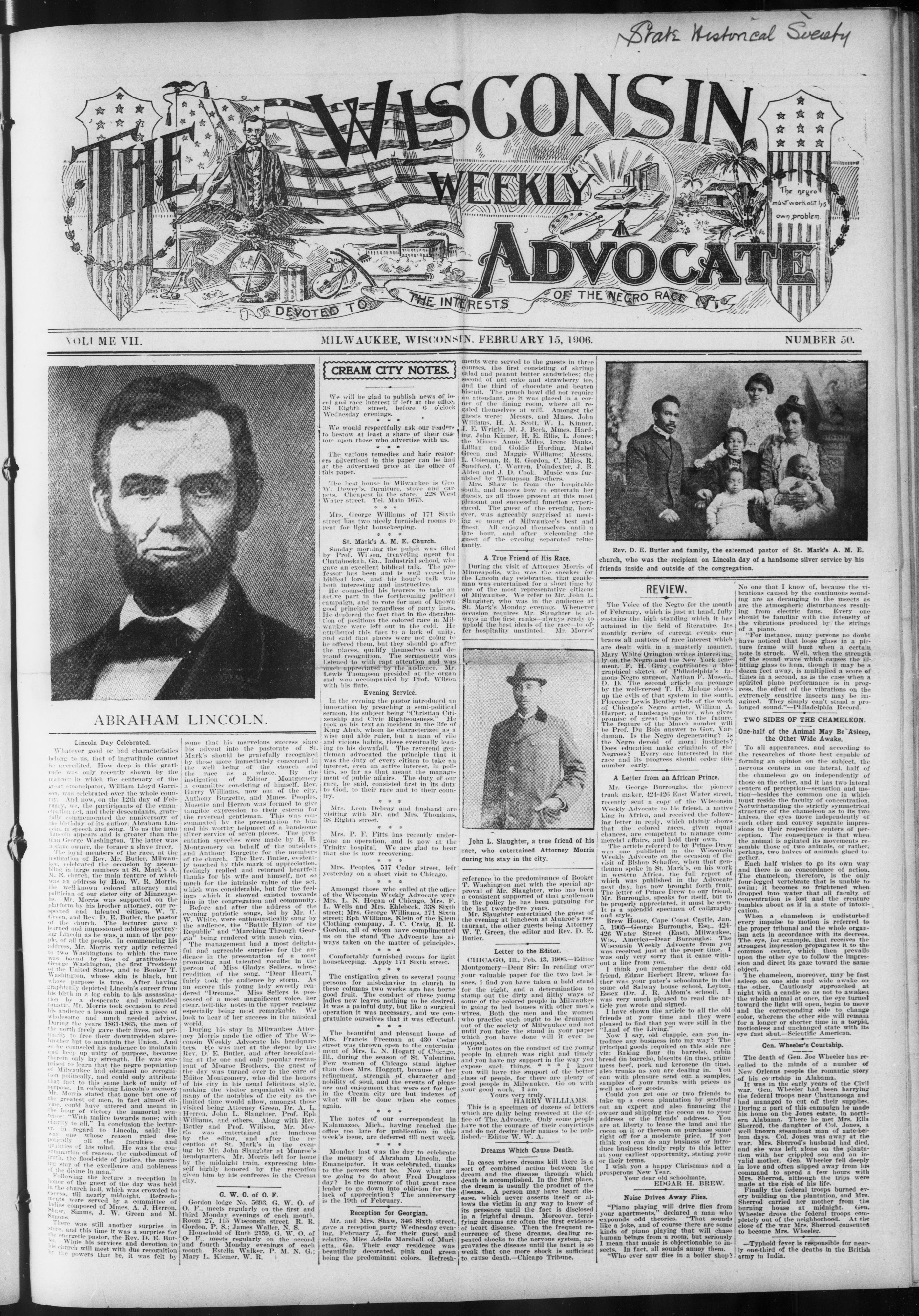
Wisconsin Weekly Advocate
Thursday, February 15, 1906
Milwaukee, Wisconsin
Page text (machine-generated)
State Historical Society
WISCONSIN
WEEKLY
ADVOCATE
DEVOTED TO THE INTERESTS OF THE WEGRO RACE
A. B.
ABRAHAM LINCOLN.
VOLUME VII.
ABRAHAM
Lincoln Dav Celebrated.
Whatever good or bad characteristics belong to us, that of ingratitude cannot be accredited. How deep is this gratitude was only recently shown by the manner in which the centenary of the great emancipator, William Lloyd Garrison, was celebrated over the whole country. And now, on the 12th day of February, we, the participants of the emancipation act, and their descendants, gratefully commemorated the anniversary of the birthday of its author, Abraham Lincoln, in speech and song. To us the man Lincoln appears and is greater than the man George Washington. The latter was a slave owner, the former a slave foe.
s slave owner, the former a slave freer.
The loyal members of the race, at the instigation of Rev. Mr. Butler, Milwaukee, celebrated the occasion by assembling in large numbers at St. Mark's A. M. E. church, the main feature of which was an address by Hon. W. R. Morris, the well-known colored attorney and politician of our sister city of Minneapolis. Mr. Morris was supported on the platform by his brother attorney, our respected and talented citizen, W. T. Green, and Rev. D. E. Butler, the pastor of the church. The lecturer gave a learned and impassioned address portraying Lincoln as he was, a man of the people, of all the people. In commencing his address, Mr. Morris very aptly referred to two Washingtonts to which the race was bound by ties of gratitude—to George Washington, the first President of the United States, and to Booker T. Washington, whose skin is black, but whose purpose is true. After having graphically depicted Lincoln's career from his birth in a log cabin to his assassination by a desperate and misguided fanatic, Mr. Morris took occasion to read his audience a lesson and give a piece of wholesome and much needed advice. During the years 1861-1865, the men of the north freely gave their lives, not primarily to free their downtrodden slavebrother but to maintain the Union. And so he counseled his audience to maintain and keep up unity of purpose, because therein only lay strength. He was surprised to learn that the negro population of Milwaukee had obtained no recognition politically, and could only attribute that fact to this same lack of unity of purpose. In eulogizing Lincoln's memory Mr. Morris stated that none but one of the greatest of men, in fact almost divine, could have uttered and meant in the hour of victory the immortal sentence: "With malice towards none; with charity to all." In conclusion the lecturer, in regard to Lincoln, said: He was one whose reason ruled despotically all the faculties and qualities of his mind. He was the consummation of reason, the embodiment of truth, the flood-tide of justice, the morning star of the excellence and nobleness of the divine in man."
Following the lecture a reception in honor of the guest of the day was held in the church hall, which was crowded to excess, till nearly midnight. Refreshments were served by a committee of ladies composed of Mmes. A. J. Herron, Shaw, Simms, J. W. Green and M. Simons.
There was still another surprise in store, and this time it was a surprise for the energetic pastor, the Rev. D. E. Butler. While his services and devotion to his church will meet with due recognition by the powers that be, it was felt by
---
some that his marvelous success since his advent into the pastorate of St. Mark's should be gratefully recognized by those more immediately concerned in the well being of the church and the race as a whole. By the instigation of Editor Montgomery a committee consisting of himself, Rev. Harry Williams, now out of the city, Anthony Burgette, and Mmes. Peoples, Mosette and Herron was formed to give tangible expression to their esteem for the reverend gentleman. This was consummated by the presentation to him and his worthy helpmeet of a handsome silver service of seven pieces. The presentation speeches were made by R. B. Montgomery on behalf of the outsiders and Anthony Burgette for the members of the church. The Rev. Butler, evidently touched by this mark of appreciation, feelingly replied and returned heartfelt thanks for his wife and himself, not so much for the intrinsic value of the set, which was considerable, but for the feelings which it showed existed towards him in the congregation and community.
Before and after the address of the evening patriotic songs, led by Mr. C. W. White, were enthusiastically sung by the audience, the "Battle Hymn of the Republic" and "Marching Through Georgia" being rendered with much vim. The management had a most delightful and agreeable surprise for the audience in the presentation of a most promising and talented vocalist in the person of Miss Gladys Sellers, whose rendition of the song, "Dear Heart," fairly took the audience by storm. As an encore this young lady sweetly rendered "Dreams." Miss Sellers is possessed of a most magnificent voice, her clear, bell-like notes in the upper register especially being most remarkable. We look to hear of her success in the musical world.
During his stay in Milwaukee Attorney Morris made the office of The Wisconsin Weekly Advocate his headquarters. He was met at the depot by the Rev. D. E. Butler, and after breakfasting at the one and only popular restaurant of Monroe Brothers, the guest of the day was turned over to the care of Editor Montgomery, who did the honors of his city in his usual felicitous style, making the visitor acquainted with as many of the notables of the city as the limited time would allow, amongst those visited being Attorney Green, Dr. A. L. Herron, John L. Slaughter, Prof. Eph Williams, and others. Along with Rev. Butler and Prof. Willson, Mr. Morris was entertained at luncheon by the editor, and after the reception at St. Mark's in the evening by Mr. John Slaughter at Munroe's headquarters. Mr. Morris left for home by the midnight train, expressing himself highly honored by the reception given him by his confreres in the Cream city.
G. W. O. of O. F.
Gordon lodge No. 5693, G. W. O. of O. F., meets regularly on the first and third Monday evenings of each month. Room 27, 115 Wisconsin street. R. R. Gordon, P. S.; James Waller, N. S. Household of Ruth 2159, G. W. O. of O. F., meets regularly on the second and fourth Monday evenings of each month. Estella Walker, P. M. N. G.; Mary L. Kiemer, W. R.
CREAM CITY NOTES.
We will be glad to publish news of local and race interest if left at the office, 38 Eighth street, before 6 o'clock Wednesday evenings.
We would respectfully ask our readers to bestow at least a share of their custom upon those who advertise with us.
The various remedies and hair restorers advertised in this paper can be had at the advertised price at the office of this paper.
The best house in Milwaukee is Geo. W. Dewey's, furniture, stove and carpets. Cheapest in the state. 228 West Water street. Tel. Main 1675.
Mrs. George Williams of 171 Sixth street has two nicely furnished rooms to rent for light housekeeping.
St. Mark's A. M. E. Church
Sunday morning the pulpit was filled by Prof. Wilson, treaveling agent for Chatahookah, Ga., Industrial school, who gave an excellent biblical talk. The professor has been and is well versed in biblical lore, and his hour's talk was both interesting and instructive.
He counselled his hearers to take an active part in the forthcoming political campaign, and to vote for men of known good principle regardless of party lines. He deplored the fact that in the distribution of positions the colored race in Milwaukee were left out in the cold. He attributed this fact to a lack of unity, and said that places were not going to be offered them, but they should go after the places, qualify themselves and demand recognition. The sermonette was listened to with rapt attention and was much appreciated by the audience. Mr. Lewis Thompson presided at the organ and was accompanied by Prof. Wilson with his flute.
Evening Service
In the evening the pastor introduced an innovation by preaching a semi-political sermon, his subject being "Christian Citizenship and Civic Righteousness." He took as his text an incident in the life of King Ahab, whom he characterized as a wise and able ruler, but a man of vile and vicious habits, these eventually leading to his downfall. The reverend gentleman advocated the principle that it was the duty of every citizen to take an interest, even an active interest, in politics, so far as that meant the management of public affairs. The duty of our race, he said, consisted first in its duty to God, to their race and to their country.
* * *
Mrs. Leon Debray and husband are visiting with Mr. and Mrs. Thomkins, 38 Eighth street.
* * *
Mrs. P. F. Fitts has recently undergone an operation, and is now at the Trinity hospital. We are glad to hear that she is now recovering.
* * *
Mrs. Peoples, 517 Cedar street, left yesterday on a short visit to Chicago.
* * *
Amongst those who called at the office of the Wisconsin Weekly Advocate were Mrs. L. N. Hogan of Chicago, Mrs. F. L. Wells and Mrs. Ehlebeck, 338 Sixth street; Mrs. George Williams, 171 Sixth street; Eph Williams, Klein of the Klein Clothing company, J. C. Craig, R. R. Gordon, all of whom have complimented us on the stand The Advocate has always taken on the matter of principles.
* * *
Comfortably furnished rooms for light housekeeping. Apply 171 Sixth street.
* * *
The castigation given to several young persons for misbehavior in church in these columns two weeks ago has borne good fruit. The conduct of these young ladies new leaves nothing to be desired. It was a painful duty, but like a surgical operation it was necessary, and we congratulate ourselves that it was effectual.
The beautiful and pleasant home of Mrs. Francis Freeman at 430 Cedar street was thrown open to the entertainment of Mrs. L. N. Hogatt of Chicago, Ill., during the season of St. Valentine. Few women of Chicago stand higher than does Mrs. Hoggatt, because of her refinement, strength of character and nobility of soul, and the events of pleasure and enjoyment that were set for her in the Cream city are but indexes of what will be done when she comes again.
* * *
The notes of our correspondent in Kalamazoo, Mich., having reached the office too late for publication in this week's issue, are deferred till next week.
* * *
Monday last was the day to celebrate the memory of Abraham Lincoln, the Emancipator. It was celebrated, thanks to the powers that be. Now what are we going to do about Fred Douglass day? Is the memory of that great race leader to go down into oblivion for the lack of appreciation? The anniversary is the 19th of February.
Reception for Georgian.
Mr. and Mrs. Shaw, 346 Sixth street, gave a reception party Wednesday evening, February 7. for their guest and relative Miss Adella Marshall of Marietta, Ga. Their cozy residence was beautifully decorated, pink and green being the predominant colors. Refresh-
ments were served to the guests in three courses, the first consisting of shrimp salad and peanut butter sandwiches; the second of nut cake and strawberry ice, and the third of chocolate and beaten biscuit. The punch bowl did not require an attendant, as it was placed in a corner of the dining room, where all regaled themselves at will. Amongst the guests were; Messrs. and Mnes. John Williams, H. A. Scott, W. L. Kiinner, J. E. Wright, M. J. Beck, Mines. Harding, John Kiinner, H. E. Ellis, L. Jones; the Misses Annie Miles, Irene Banks, Lillian and Goldie Harding, Mabel Green and Maggie Williams; Messrs. L. Coleman, R. R. Gordon, C. Miles, R. Sandford, C. Warren, Poindexter, J. B. Alden and J. D. Cook. Music was furnished by Thompson Brothers.
Mrs. Shaw is from the hospitable south, and knows how to entertain her guests, as all those present at this most pleasant and successful function experienced. The guest of the evening, however, was agreeably surprised at meeting so many of Milwaukee's best and finest. All enjoyed themselves until a late hour, and after welcoming the guest of the evening separated reluctantly.
A. True Friend of His Race.
During the visit of Attorney Morris of Minneapolis, who was the speaker for the Lincoln day celebration, that gentleman was entertained for a short time by one of the most representative citizens of Milwaukee. We refer to Mr. John L. Slaughter, who was in the audience at St. Mark's Monday evening. Whenever occasion requires Mr. Slaughter is always in the first ranks—always ready to uphold the best ideals of the race—to offer hospitality unstinted. Mr. Morris'
THE BROOKLYN BROTHERS
reference to the predominance of Booker T. Washington met with the special approval of Mr. Slaughter, who has been a consistent supported of that gentleman in the policy he has been pursuing for the last twenty-five years. Mr. Slaughter entertained the guest of the evening at luncheon at Munroe's restaurant, the other guests being Attorney W. T. Green, the editor and Rev. D. E. Butler.
Letter to the Editor.
CHICAGO, Ill., Feb. 13, 1906.—Editor Montgomery—Dear Sir: In reading over your valuable paper for the two last issues, I find you have taken a bold stand for the right, and a determination to stamp out the dirty and filthy ways of some of the colored people in Milwaukee in going to bed houses with other men's wives. Both the men and the women who practice such ought to be drunmed out of the society of Milwaukee and not until you take the stand in your paper which you have done will it ever be stopped.
Your notes on the conduct of the young people in church was right and timely and you have my support in the way you expose such things. * * * I know you will have the support of the better class of people, for there are plenty of good people in Milwaukee. Go on with your good work. I am
Yours very truly.
HARRY WILLIAMS.
This is a specimen of dozens of letters which are daily being received at the office of The Advocate. Only some people have not the courage of their convictions and do not desire their names to be published.--Editor W. W. A.
Dreams Which Cause Death.
In cases where dreams kill there is a sort of combined action between the dream and the disease through which death is accomplished. In the first place, the dream is usually the product of the disease. A person may have heart disease, which never asserts itself or allows the victim in any way to know of its presence until the fact is disclosed in a frightful dream. Moreover, terrifying dreams are often the first evidence of heart disease. Then the frequent recurrence of these dreams, dealing repeated shocks to the nervous system, agravates the disease until the heart is so weak that one more shock is sufficient to cause death.—Chicago Tribune.
M. E. H.
Rev. D. E. Butler and family, the esteemed pastor of St. Mark's A. M. E. church, who was the recipient on Lincoln day of a handsome silver service by his friends inside and outside of the congregation.
REVIEW.
The Voice of the Negro for the month of February, which is just at hand, fully sustains the high standing which it has attained in the field of literature. Its monthly review of current events embraces all matters of race interest which are dealt with in a masterly manner. Mary White Ovington writes interestingly on the Negro and the New York renement. F. H. Gray contributes a biographical sketch of Philadelphia's famous Negro surgeon, Nathan F. Mosseli, D. D. The second article on peonage by the well-versed T. H. Malone shows up the evils of that system in the south. Florence Lewis Bentley tells of the work of Chicago's Negro artist, William A. Harper, a landscape painter, who gives promise of great things in the future. The feature of the March number will be Prof. Du Bois answer to Gov. Vardaman. Is the Negro degenerating? is the Negro devoid of moral instincts? Does education make criminals of the Negroes? Every one interested in the race and its progress should order this number early.
A Letter from an African Prince.
Mr. George Burroughs, the pioneer trunk maker, 424-426 East Water street, recently sent a copy of the Wisconsin Weekly Advocate to his friend, a native king in Africa, and received the following letter in reply, which plainly shows that the colored races, given equal chances, are competent to manage commercial affairs, and hold their own.
The article referred to by Prince Drew was one published in the Wisconsin Weekly Advocate on the occasion of the visit of Bishop Schaffer, when that gentleman spoke in St. Mark's, on his work in western Africa, the full report of which was published in the Advocate next day, has now brought forth fruit. The letter of Prince Drew to our friend, Mr. Burroughs, speaks for itself, but to be properly appreciated, it must be seen. It is a splendid specimen of caligraphy and style.
Brew House, Cape Coast Castle, Jan. 5, 1905—George Burroughs, Esq., 424-426 Water Street (East), Milwaukee, Wis., America—Dear Burroughs: The Wisconsin Weekly Advocate from you was received just at the proper time. I was only very sorry that it came without a line from you.
I think you remember the dear old friend, Edgar Herbert Brew, whose father was your pater's schoolmate in the same old Salway house school, Leyton, Essex (Dr. J. R. Aldom's school). I was very much pleased to read the article you wrote and signed.
I have shown the article to all the old friends at your time and they were pleased to find that you were still in the "Land of the Living."
Now I say, old chappie, can you introduce any business into my way? The principal goods required on this side are viz: Baking flour (in barrels), cabin bread (in barrels), biscuits (in tins), prime mess beef, pork and kerosene (in tins), also trunks as you are dealing in. You can with pleasure send out a samples, samples of your trunks with prices as well as other goods.
Could you get one or two friends to take up a cocoa plantation by sending out an expert and also financing the owner and shipping the cocoa on to your address or the friends' address. You are at liberty to lease the land and the cocoa on it or thereon on purchase same right off for a moderate price. If you think you can do any business or introduce business kindly reply to this letter at your earliest opportunity, stating your or their terms.
I wish you a happy Christmas and a prosperous New Year. Your dear old schoolmate. EDGAR H. BREW.
Noise Drives Away Flies.
"Piano playing will drive flies from your apartments," declared a man who expounds odd theories. "That sounds like a joke, and of course there are some kinds of piano playing that will chase human beings from a room, but seriously I mean that music is objectionable to insects. In fact, all sounds annoy them.
"Who ever saw flies in a boiler shop?"
NUMBER 50.
seemed pastor of St. Mark's A. M. E. on day of a handsome silver service by his negation.
No one that I know of, because the vibrations caused by the continuous sounding are as deranging to the insects as are the atmospheric disturbances resulting from electric fans. Every one should be familiar with the intensity of the vibrations produced by the strings of a piano. "For instance, many persons no doubt have noticed that loose glass in a picture frame will buzz when a certain note is struck. Well, when the strength of the sound wave which causes the ill-fitting glass to hum, though it may be a dozen feet away, is multiplied a score of times in a second, as is the case when a spirited piano performance is in progress, the effect of the vibrations on the extremely sensitive insects may be imagined. They simply can't stand a prolonged sound."—Philadelphia Record.
TWO SIDES OF THE CHAMELEON.
One-half of the Animal May Be Asleep, the Other Wide Awake.
To all appearances, and according to the researches of those best capable of forming an opinion on the subject, the nervous centers in one lateral, half of the chameleon go on independently of those on the other, and it has two lateral centers of perception—sensation and motion—besides the common one in which must reside the faculty of concentration. Notwithstanding the strictly symmetrical structure of the chameleon as to its two halves, the eyes move independently of each other and convey separate impressions to their respective centers of perception. The consequence is that when the animal is agitated its movements resemble those of two animals, or rather, perhaps, two halves of animals glued together.
Each half wishes to go its own way and there is no concordance of action. The chameleon, therefore, is the only four-legged vertebrate that is unable to swim; it becomes so frightened when dropped into water that all faculty of concentration is lost and the creature tumbles about as if in a state of intoxication. When a chameleon is undisturbed every impulse to motion is referred to the proper tribunal and the whole organism acts in accordance with its decrees. The eye, for example, that receives the strongest impression propagates it to the common center, which then prevails upon the other eye to follow the impression and direct its gaze toward the same object.
The chameleon, moreover, may be fast asleep on one side and wide awake on the other. Cautiously approached at night with a candle so as not to awaken the whole animal at once, the eye turned toward the light will open, begin to move and the corresponding side to change color, whereas the other side will remain for a longer or shorter time in a torpid, motionless and unchanged state with its eye fast shut.—Scientific American.
Gen. Wheeler's Courtship.
The death of Gen. Joe Wheeler has recalled to the minds of a number of New Orleans people the romantic story of his courtship in Alabama.
It was in the early years of the Civil war. Gen. Wheeler had been harrying the federal troops near Chattanooga and had managed to cut off their supplies. During a part of this campaign he made his home on the Jones estate, in northern Alabama. There he met Mrs. Ella Sherrod, the daughter of Col. Jones, a well known steamboat man of ante-bellum days. Col. Jones was away at the war. Mrs. Sherrod's husband had died, and she was left alone on the plantation with her crippled son and an invalid mother. Gen. Wheeler fell deeply in love and often slipped away from his command to spend a few hours with Mrs. Sherrod, although the trips were made at the risk of his life.
Finally the federal troops burned every building on the plantation, and Mrs. Sherrod carried her mother from the burning house at midnight. Gen. Wheeler drove the federal troops completely out of the neighborhood. At the close of the war Mrs. Sherrod consented to become Mrs. Wheeler.
Typhoid fever is responsible for nearly one-third of the deaths in the British army in India.
Pierre Loirat, who recently became a centenarian, is the doyen of the French seamen. He went to sea at the age of 12 and was shipwrecked three times.
Charles Mulford Robinson of Rochester, N. Y., who is a civic art expert, has been invited to Denver for the purpose of making an investigation of the municipal improvements.
This country ranks first in the paper making industry. Germany is second, and Great Britain comes third. The production in America is two or three times greater than in Great Britain.
The Garter which has been conferred on the Mikado is set with diamonds and the star of the order is in diamonds, and the George, which is pendant to the collar of the order, is carried in onyx and set round with brilliants. It cost something well over $5000.
When the floor of the operating theater of the old hospital at Canterbury, England, was torn up the other day the rings were discovered through which were passed the cords for tying patients down on the operating table prior to the discovery of anaesthetics.
Owing to the advance in the price of silver many of the old mines on the Comstock lode, Virginia City, Nev., are being prepared for the resumption of operations that were suspended several years ago. A large force of men will be put to work.
A court of law is a reminiscence of the time when justice sat in the open courtyard, and the "dock" is from a German word meaning a receptacle, while the "bar" is a Welsh word, meaning a branch of a tree used to separate the lords of justice from their vassals.
The inmates of the St. George's workhouse, Southwark, London, have made 11,464 useful articles of clothing during the last twelve months, while at the same time repairing some 600 articles. The industry saved the rate-payers a substantial sum of money. The British Early Closing association admits that the early closing act, passed by Parliament after seventeen years of agitation, has proved a failure. It has been in force over sixteen months and is still practically inoperative. In no district can two-thirds of the shopkeepers be inducted to adopt it.
A movement is afoot to construct a 158-mile road for automobilists near Winnipeg, Manitoba. It will be oval in form and the expense of construction and maintenance will be met from the tolls collected from those who use it. It is proposed to run some big races on the road, which will be oiled to keep down the dust.
An old woman in Germany had been bedridden on account of paralysis for ten years until last August, when a tempest in her neighborhood shook the houses and so frightened the old paralytic that she leaped from her bed. There has been no relapse, and hers may be set down perhaps as the only case of cure by tempest.
—In an attempt to liquefy helium Prof. Olszewski recently produced the remarkably low temperature of 455 degrees below zero, Fahrenheit. It was done by suddenly expanding a mass of the gas helium which had been subjected to a pressure of about 2700 pounds to the square inch in a temperature so low that it nearly solidified hydrogen. The helium showed no sign of liquefying.
—Scotland Yard, widely known as the headquarters of the London police, is a historical place, said to have been the site of a palace where Kings of Scotland were received when they came to London. It is near the banqueting hall, Whitehall. The Scotch Kings retained possession of it from 959 till the rebellion of William of Scotland. Milton, Sir Christopher Wren and other notables lived in Scotland Yard.
MUSINGS OF A GENTLE CYNIC.
Wrinkles are the fretwork of humanity.
The shorn lamb can seldom raise the wind.
It is better to turn pale than to kick the bucket.
Good deeds do not always act as boomerangs.
The door of adversity always has the latchstring out.
Many a man has a promising future before him all his life.
Age gets more respect for its gray hairs than for its baldness.
Some weddings remind one of a match that strikes only on the box.
It may be more blessed to give than to receive, but it isn't so popular.
Even prayer may be selfish. No man prays for rain when his roof leaks.
The novelty has generally worn off the things we covet by the time we get them.
In climbing the ladder of fame even the prizefighter must begin at the first round.
The trouble about forgetting an injury is that we keep forgetting we have forgotten it.
It's all right to take a fellow of our size, but most of us don't realize how small we are.
It is cheerful to note that there are a few defaulters who have never been Sunday school superintendents.—New York Times.
Back to Heavy Caliber
The war deparement has decided to go back to the heavy caliber for army revolvers, and to adopt a cartridge proposed by the ordnance bureau carrying a bullet of 45-caliber to replace the 38-caliber now in use. The reason for the change is that it is desired to have a bullet with greater stopping power than that now in use.
Opportunity also is given for a decided innovation in the type of revolver. The ordnance bureau has invited manufacturers of pistols to enter into competition and submit types of revolvers either of the automatic kind or along the lines of those now used by the army. All weapons submitted, however, must be made for the use of the 45-caliber cartridge which has been adopted. The competition will take place some months hence.
Mountain Sheep Become Tame.
Mountain sheep in the vicinity of W. F. Givens' ranch are becoming very tame. Mr. Givens, who is a special game warden, says that nearly every morning six or eight of these animals gather around his house to be fed. There are between forty and fifty sheep in the flock, but only a few of them have become tame. This is the largest flock of these animals in the state as far as known here.—Florence Co. Denver Republican.
The first convictions of St. Louis' campaign against swearing were obtained when John Murphy and Jarvan Yegins were find $10 each for using forbidden language on the street.
Mayor Charles W. Benton of Prince ton, Ind., announced that he would not impose a fine on any habitual drunkard brought before him hereafter, providing the latter would take an oath to stop drinking for ninety days.
Warren Slater, 22 years old, a basket ball enthusiast of New Britain, Conn., lost his voice while shouting at a game in that city the other night, and has not been able to talk since. He has no pain and is well otherwise. Doctors think he will recover his speech in a few weeks.
John Dore of Martinsburg, Mo., entered the kitchen of Mrs. Louise Stephens at Edwardsville, Ill., and, seizing her child from her arms, forced her to prepare supper for him. He held the baby while he ate, and when he had finished gave it back to its mother and fled. He was arrested later.
In the room in a hotel at Kalamazoo, Mich., where the bride nursed the groom back to health, five years ago, Dr. A. B. Spinney, aged 70, and Miss Tessora Wade, aged 35, both of Belding, Mich., were married. Miss Wade is a trained nurse. Dr. Spinney is a lecturer and is at the head of sanitariums in Reed City and Belding.
A man's body, when he dies, belongs to his next of kin, and he cannot give it to another, according to a decision handed down by Judge S. W. Smith at Cincinnati. The case was brought by a sister of Dr. N. T. Tanski, who wished to prevent the cremation of her brother's body. Before his death he had directed that his body be cremated.
A strike is on among Cincinnati grave diggers, and as a result undertakers are having great difficulty in fulfilling their engagements.
The first result of the strike was in evidence at St. Joseph's cemetery. Two funeral processions arrived at the cemetery, but no graves had been dug. The funerals were delayed for hours.
Miss Alice Roosevelt's Japanese monkey, the one she brought back from the Philippines, is dead. As soon as it arrived in Washington it was placed in the care of a bird and animal fancier to be looked after until Miss Roosevelt could arrange for its accommodation in the white house. The proprietor of the store said the monkey was sick when it arrived.
Miss Una Dell Berry, daughter of Mrs. Helen M. Berry, West Lafayette, Ind., has been ordained a minister in the Christian church. From early girlhood she has taken deep interest in church work, and, possessed of a fine voice, she has led revivals. Although still in her teens, she has a remarkable knowledge of the Bible and religious teachings. She has been made assistant pastor of the First Christian church in Lafayette.
William S. Cook, the oldest initiated Odd Fellow in California, died recently, apparently in great poverty, and his lodge buried him. He was even in arrears for several months' rent for a shabby room where he had lodged for thirty years. The public administrator's search of safe deposit vaults, however, revealed that Cook was a miser, who left more than $100,000 in bonds and other securities. His only relative is a brother in Virginia.
Believing that music may have charms to soothe the nervous employee, the officials of the American Cigar company have inaugurated a novel experiment in their factory at Newark, N. J. For an hour each day piano music is lavishly dispensed through the concern's building by an expert musician hired by the company. The company employs about 300 persons and many of them are women. The experiment was undertaken in the belief that music causes them to be more attentive to their work.
Here's the meanest man in the world, according to Andrew Koodik of Chicago, who, besides dispensing schooners of beer and tumblers of whisky in his saloon, has a heart that is charitably inclined. He befriended a man giving his name as Joseph Koroski, who was hungry and homeless. He gave the forlorn one a bed in his home. When the Koodik household awoke in the morning it was found that Koroski was gone, and so was Mrs. Koodik's wedding ring. Koroski was arrested.
In an address before the Men's Sunday class of the First Congregational church at Beloit, Prof. William Porter of Beloit college, who is nearing his nineteenth year, spoke on the relation of the slave owner and the slave of the south before the war. He said that he had no apology for slavery and was against it, and always had been, but he did know that there was a side to the slave life that the world heard little about, and he saw that. He saw where there was love and devotion of the sweetest kind between the slave owner and the slave himself.
While riding cross country near his home, "Ballytoor," at Wynnewood, Pa., William J. Clothier, a well known tennis, hockey, and football player, was thrown from his horse and seriously injured. He is being nursed by Miss Anita Porter, his fiance, daughter of Judge W. W. Porter of Philadelphia. They were to have been married February 21. The wedding has been postponed. Another incident of the accident was the death of Jeffrey Powers, superintendent at the country seat of Isaac H. Clothier, father of the injured man. He was stricken with heart affection in the room to which he assisted Clothier, and died before the latter regained consciousness.
"More American babies" is the motto of Mayor Edmund Beall of Alton, Ill., who has announced his candidacy for Congress, and his emblem, instead of the eagle of his party, is the stork. When asked what he would do in Congress, he said
"I am not there yet, but I have already decided to introduce a bill to make men who refuse to accept the responsibilities of parentage leave the country. They have no place here and they ought to know it.
"The race suicide idea is more important than it may seem. It is a good subject for jest, but it is also serious. We want more babies of good American stock. The only way we can have Americans is to grow them—we can't import them."
After keeping a pledge for more than thirty years that she would not seek a divorce until her three children were married, Mrs. Mary A. Hoskins of Omaha has filed suit for divorce from Edson D. Hoskins. Ever since the birth of her first born, declares Mrs. Hoskins, her husband has treated her shamefully, contributing nothing to the support of the family. For the sake of her chil-
dren she has submitted without complaint to his brutal tactics and cuffs. By her own lancer she has reared the children, doing millinery and dressmaking, and has succeeded in saving enough to buy two houses. The youngest child was married Saturday, and today Mrs. Hoskins asked the court to relieve her from the galling bonds of matrimony and to give her absolute possession of the property she has earned.
Twice deserted at the altar within two days, and by the same man, is the fate of Miss Ella Holdaway of Springfield, Ill. The recrent wooer is John Watson, who is now supposed to be in Chicago. The time first set for the ceremony was Sunday night at the bride's residence. The bridal party gathered, but Watson did not appear at the appointed hour. Search was made for him, and it was found he had left his boarding house in the afternoon. Miss Holdaway learned his trunk had been taken to a railway station, went there and waited, with a policeman, until Watson appeared. The young man attempted to escape, but was stopped by the policeman. Watson made excuses and it was agreed the welding should take place at 3 p. m. Monday. Again he failed to appear. It was learned later that he had taken a train for Chicago.
St. Louis society is still talking about the stork party given by Mrs. Charles P. Jones to her daughter, Mrs. Maurice V. Joyce, at the palatial Jones residence last week. No function in recent years has attracted anything like the attention of this dainty luncheon which had, all told, only a dozen guests.
Mrs. Joyce and seven former schoolgirl friends were the guests of honor. All of them have been married within the last two years. Five of them are expecting a visit of the stork.
The invitations bidding the guests to luncheon were hand-painted with a large stork, but this was only a gentle hint of what was coming. In the corners of the reception room stood large storks, while wings of the mighty Dutch bird stretched from every mantel and fluttered from every hanging.
A huge rattle summoned the guests to the luncheon table. In the dining room the stork trimmings outdid everything else in the house. A cradle occupied the center of the table. In it was an imitation baby in swaddling clothes, and watching over it was a big stork. The favors were paper cribs, over which storks, with doll babies in their bills, hovered as if they were about to place them there. The napkins were folded and pinned with safetypins.
LAMP CHOP IS MANUFACTURED.
Dr. Wiley, Food Expert, Gets Bogus Meat Through Mistake.
Snugly reposing in a pasteboard box on the littered desk of Dr. Wiley, head of the chemical bureau of the agricultural department in Washington, is the best argument in favor of a pure food law which has yet come under the notice of the authorities. It was nothing more nor less than an artificial lamb chop. Photographs of this bogus chop have been made in the department of agriculture, and it is likely to become famous in governmental history.
The possession of this precious piece of evidence came about in an entirely accidental way. The young woman who attends to the marketing for the Wiley household made her usual visit to the market and jokingly insisted that the lamb chops she ordered should be especially good, because they were intended for Dr. Wiley, the food expert of the government. She picked out what she wanted.
In some way, however, the orders became mixed, which is of frequent occurrence in Washington, as every housekeeper knows, and it was the irony of fate that when Dr. Wiley himself should begin his daily meal the first thing he struck was the imitation lamb chop.
This extraordinary imitation was made up of a piece of comparatively unsalable meat, probably taken from somewhere about the neck. A bone which previously had been in use, because it showed signs of having been broiled, or boiled, at some stage, was carefully inserted in little slits in the piece of neck, and fastened over with something resembling cartillages, so that the effect at first glance was that of an ordinary lamb chop.
REJECTED SULTOR IS WHIPPED
Sends Comic Valentine for Revenge and Brother-in-Law Beats Him.
Rejected by the girl he loved Barney Haneski, of South Chicago, mailed her a "comic" valentine, in which she was depicted in a most unbecoming guise. Barney thought it was a good way to "get even," but now he is repenting his revengeful spirit in a South Chicago hospital where he is suffering from injuries sustained at the hands of George Buckland, a brother-in-law of his former sweetheart. The latter is now in the South Chicago police station. For several months Haneski and Miss Marion Saunders had been sweethearts and besides his affections Barney lavished many presents upon the girl. Then he "popped" the question and was refused. Angered at this he evolved the plot of mailing to her a comic valentine. So he sought for one which he thought would properly set forth his feelings, and Miss Saunders received it.
Having in the past been the recipient of many tender epistles from Haneski she recognized the handwriting and notified her brother-in-law—who is bulky. Buckland immediately sought out the sender of the valentine, and being strong gave him a beating. The police of the South Chicago police station were called, and after taking Haneski to a hospital arrested Buckland on a charge of disorderly conduct.
Bride Works in Mine
A Colorado honeymoon with the bride compelled by her husband to shoulder a pick and go to work at the bottom of a mining shaft. A newly made bride doing the work of a common laborer about the mouth of the mine. Digging with a shovel and driving a team. After months of such toil, enduring meanwhile alleged gross abuse, locked out of the house with the thermometer at the zero mark and compelled to seek shelter with friends. Such is the experience told in detail in a divorce complaint which has been filed by Mary A. Johnson against William J. Johnson in the Denver district court. He is said to earn $150 a month and to be worth $40,000. Mrs. Johnson wants her share of the wealth, which she says she helped to accumulate by doing a man's work in the shafts or on the dumps of her husband's mining properties.
Women Against Smoking.
A movement on the part of the women of the country to abolish smoking cars and smoking compartments in coaches on railroad trains has been taken up by the Women's Christian Temperance union of Galesburg, Ill. The local union at its last session decided that smokers were annoying, insanitary and altogether "nasty," and protested especially that tobacco fumes drifted from the smoking compartments when the car doors were opened. Committees were appointed to prepare national protests to be sent to every union in the country, with the intention of presenting a great petition to the heads of all railroads.
EXPOSES UNLILCENSED DENTISTS
Hired by Dental Association to Run Down Fake Doctors.
Miss Bella Conro of New York is employed by the New York State Dental association to run down unlicensed dentists. In doing this she has the distinction of having had her teeth examined more times than any woman in the world. She visits an average of three dental offices daily, has her teeth cleaned at least three times a week and carries a small fortune of gold in her mouth, which may be removed tomorrow and replaced the next day.
Miss Conro is 22 years old. Three years ago she owned and managed a dental office, employing licensed dentists. Her experience taught her that there are hundreds of unlicensed dentists practicing upon the poor and unsuspecting and she gave up her office to bring these men to justice. She has been so successful that she employs three assistants.
"How do I obtain evidence?" repeated Miss Conro. "In many ways. It depends. I have to adapt myself to surroundings. To disguise myself I made up as a poor Hebrew woman peddling vegetables.
"In one office the young 'dentist' treated a perfectly sound tooth and took an impression for a crown, which he told me was absolutely necessary to preserve the molar. The next office gave me an examination and told me that a filling I had just had inserted was a bad piece of work, and to save the tooth the filling would have to be extracted and the tooth refilled. When these men got through with me I had personal evidence against them, swore out warrants and succeeded in having them convicted.
"If I am working in Brooklyn or the fashionable upper west side I dress in the latest style, and when I enter a dentist's office I exhibit a bridge which I can take out and put in my mouth at will. This bridge was made for me by one of the very best dentists in the country, and yet I have been told by these 'dentists' that it is absolutely worthless.
"Sometimes I am in evening dress and rush into a suspected office, supposedly suffering from a toothache. The 'dentist' will examine my tooth, treat it and tell me that there is a bad ulceration and that the tooth must be extracted. There is where I sidestep. No extraction for me. Then can fill an alleged cavity, but I am not going to stand for having any of my teeth extracted."
"A great many offices have refused to do work for me. One man in Brooklyn who I knew did not have a license wanted to know all about me—who had sent me to him and what references I could give. When I told him that I had none he refused to take me as patient. I afterward had him arrested on evidence obtained through one of his trusted patients. From the hundreds of times my teeth have been examined and treated during the last three years I am convinced that I have the most perfect set of teeth in the world."—New York World.
PURE FOODS FILL OF POISON.
Milk and Canned Goods Cause Much Sickness and Death.
That more than a million infants had been sacrificed to the various concoctions known as soothing syrups and pain killers and over twice that number killed by impure miik, was the declaration made recently by Prof. W. H. Wiley, chief of the chemistry bureau of the department of agriculture in Washington, D. C.
"We do not know anything about the milk we have left at our homes, or the condition under which it is produced," he added. "There are a thousand and one possibilities which might have combined to make what nature intended for a food, the most virile poison that chemistry can produce.
"I have found that the foods we daily consume are so fraught with germ life of a harmful nature that I am almost afraid to go to the table. The butter is painted, there is little other to be found anywhere. Canned goods are kept years and sold for the genuine article. I speak particularly of condensed milk. If we know nothing of the fresh milk we get, surely our knowledge is more limited to the product that is put in cans. The Lord intended us to resort to cans only to tide us over one season, until green fruits could be had again, but the caneries don't know this. There is no law requiring them to put a stamp upon their goods, if they did it would kill the sale."
The Same Result
A well-known Bishop of Tennessee was taking his customary stroll through the park the other morning. He happened to sit down on one of the benches there. Now the bishop is a very great man, not only in the Methodist church, but in embonpoint as well. His weight proved too much for the bench, which collapsed, spilling him on the ground. About this time a little girl, rolling a hoop along, saw the reverend gentleman prostrate and offered her assistance. "But, my little girl," said the bishop, "do you think you could help suen a great heavy man to his feet?"
"Oh, yes," replied the little girl, "I've helped grandpa lots of times when he's been even drunker than you are."—M. B. Miller in Lippincott's.
Pretty Romance Enacted
Ensign Wade, U. S. N., who was attached to the gunboat Bennington when its boilers exploded near San Diego, killing many, is soon to marry the young woman who, according to physicians, saved his life. Ensign Wade had charge of the Bennington's engines. While in the hospital after the disaster, he was frequently visited by Miss Edith Fabregon, and after the doctors had given up hope of his recovery, the young woman stayed by him, soothing his fever, and eventually aiding in his recovery. At the subsequent inquiry into the Bennington disaster Ensign Wade was exonerated of all blame.
A One-Piece Railway Wheel.
A process for making a one-piece steel railway wheel has been devised. For a 33-inch wheel an ingot about 16 inches in diameter is used, and with steam hammer and hydraulic press the ingot is forged until the hub and web are brought to practically the finished size. It is then subjected to a process of heat treatment, so that the outer portion of the wheel is brought to a rolling heat, while the web and hub are kept at a lower red heat. The rolling process brings the wheel to its final shape.
Baltimore Fire Anniversary.
The second anniversary of the great fire, that destroyed property valued at $75,000,000 in the business heart of Baltimore on the first Sunday in February, 1904, found the area swept by the flames covered with handsome new modern fireproof buildings. The original area of ground floor space in the fire district was 2,380,000 square feet and the original floor space 9,746,000 square feet. Since the fire permits for 665 buildings, covering a ground area of 1,489,283 square feet and a floor space of 6,649,850 square feet, have been issued.
The Beginning of Henry Phipps' Fortune.
Henry Phipps, the American millionaire, was born at Philadelphia in 1839, the son of an English shoemaker, and be-
gan life at the age of 13 by earning $1.50 a week as a jeweler's errand boy. The foundation of his fortune was laid when he became partner with Andrew Carnegie's brother. Thomas Morrison Carnegie, in a small iron foundry, and in 1865 Andrew joined them. He had 40 per cent. of the stock and the other three partners each had 20 per cent. It is several years since he was able to retire from active work at the great steel mills he helped to build up.
MONSTER SEA ELEPHANT.
Killed by Whalers Off the Coast of the Falkland Islands.
A new and interesting attraction at the Berlin Zoological garden is a mounted specimen of a monster sea elephant. It can claim the distinction of being the largest sea elephant that has ever been killed. It was found some eighteen months ago by whalers off the coast of the Falkland islands. They promptly surrounded the monster, and subsequently slaughtered it—no easy task—and the hide with the raw skeleton was purchased at a high price by Mr. J. F. G. Umlauf.
Some idea of the size of the monster may be gauged from the fact that from the tip of its tail to the tip of its tusk it has a total measurement of nearly twenty-one feet. Such an animal, when alive, would weigh over 10,000 pounds, or nearly four and one-half tons. The circumference of the body at its widest part is some 18 feet. The skull alone measures 2 feet 3 inches long and 1 foot 3 inches high.
The sea elephant, or seal elephant, is in many ways an interesting creature. So far as size goes, he can give points to the walrus, but he is certainly not so ferocious looking. Except for the curious nose (whence his Greek name), he is just a big black seal, fairly agile in the sea and clumsy ashore, like all his kind. He is about the bulk of a hippopotamus, although more hirsute and with a less extensive opening of the jaws. He holds among seals the unique position of being common to both hemispheres, although from the ardor with which he has been hunted very few specimens now exist north of the equator.
Just now, however, the sea elephant is enjoying a respite, and is consequently increasing in numbers rapidly, particularly in the southern seas. He forms practically the only population on many an otherwise lonely series of barren rocks in the Antarctic ocean. His food consists chiefly, if not entirely, of cuttlefish. Formerly the animal was hunted by whalers upon all the islands of the Antarctic ocean, notably Kerguelen's Land and the South Shetland, where they abounded in immense herds. The creatures were slaughtered for their hides and blubber.
The tusks of the male reach a length of four or five inches, their external part being smooth and conical, while the part imbedded in the flesh is furrowed and slightly curved. The tusks of the males are sold—at the lower end only a slight cavity appears—while in the female they are shorter, and, moreover, almost hollow up to the point. Sailors and seal hunters are fond of using these hollow teeth of the females for pipe bowls, quils from the wings of peilcans supplying suitable stems for the pipes.—Scientific American.
Blackburn Didn't Worry.
About a decade ago Senator Blackburn of Kentucky was one of the men who did not believe in "unconditional repeal." His friends believed that it would hurt him among his constituents, and Representative Caruth and others called at his home in Washington to try to convince him that he was standing in his own light, so to speak, says the Philadelphia Public Ledger. "Joe," said Caruth, "I'm afraid you are injuring your chances for re-election by taking the position you have. Every town in your state which has held a mass meeting has passed resolutions demanding the unconditional repeal of the purchase clause of the Sherman law."
"What do I care for the resolutions of the towns?" rejoined Blackburn. "They are passed by bankers, lawyers and dry goods merchants, and no countrymen were at the meetings."
"How do you know?" asked Caruth.
"How do I know? Why, Asher, I know it darned well. Every town in Kentucky is reached by a tollgate, and the poor country people haven't money enough to pass them. That's the reason I know. Here, Jim, give these fellows a drink of Bourbon and let them go."
Big Lion Hunt in Colorado.
Crack shots and sportsmen from many sections of the country are rounding up in the vicinity of Glenwood Springs, Colo., to take part in the big hunt organized by Jack Borah, a veteran hunter and former guide of President Roosevelt. Similar hunts have been held here in previous years. Last year several thousand hunters participated and a large number of mountain lions, grizzly and brown bears, lynx and other wild animals were killed. This year the hunt has been more extensively advertised, and an even larger number of sportsmen are to participate. A large area of country is to be covered by the converging lines of sportsmen on horseback and afoot.
A Valuable Suggestion
"Peter," said a grocer to his shopman, "I owe about £300." "Yes, sir." "I have about £200 in the safe, but the shop is empty. I think it is the right time to fail." "Yes, sir," said the courteous shopman. "But I want a plausible pretext for my creditors. You have got brains, and I wish you'd think the matter over tonight." The shopman promised to think it over carefully. On entering the shop next morning the grocer found the safe open, the money gone, and in its place a note which read as follows: "I have taken the £200 and am off to America. It is the best excuse you can give your creditors."—London Tit-Bits.
"Alf" Church Vouched for Him
It is only a few years since Woonsocket missed for good the familiar face of "Alf" Church for a long time deputy sheriff and chief of police, a man who was straightforward and blunt in all his dealings.
One day a grocer went to "Alf" for information about a certain "Joe" White, who had applied for credit and a book at his store, and the following dialogue ensued:
"Good mornin', Mr. Church."
"Mornin'"
"Do you know Jo White?"
"Yes."
"What kind of a feller is he?"
"Putty fair."
"Is he honest?"
"Honest? I should say so. Been arrested twice for stealing and acquitted both times."—Boston Herald.
Yearly Loss from Pests
The United States loses no less than $350,000,000 a year from the pests which attack crops of all sorts; France suffered to the extent of $2,000,000,000 seventeen years ago—as much as her war with Germany cost her—as the result of the assaults of insects upon her vines. In England hop growers remember 1882 as the year in which they lost $7,500,000 through the voracious little aphis.
ANAEMIA CAN BE CURED
ANAEMIA CAN BE CURED
Dr. Williams' Pink Pills Make New Blood and Strike Straight at the Root of Disease. Anaemia is just the doctor's name for bloodlessness. Dr. Williams' Pink Pills actually make new blood. They cure anaemia just as food cures hunger. They cured Mrs. Thos. J. McGann, of 17 Lincoln Place, Plainfield, N.J., and they can do as much for any other pale, weak, ailing, bloodless person.
"In the spring of 1903 I did my usual house cleaning," says Mrs. McGann. "and soon afterward I began to have the most terrible headaches. My heart would beat so irregularly that it was painful and there came a morning when I could not get up. My doctor said I had anaemia and he was surprised that I had continued to live in the condition I was in. I was confined to my bed for nearly two months, the doctor coming every day for the first few weeks, but I did not improve to amount to anything.
"Altogether I was sick for nearly two years. I was as weak as a rag, had headaches, irregular heart beats, loss of appetite, cramps in the limbs and was unable to get a good night's sleep. My legs and feet were so swollen that I feared they would burst.
"One day, while I was wondering how long I could live, feeling as I did, I received a booklet telling about Dr. Williams' Pink Pills for Pale People. I read it and told my husband to get me some of the pills. Before the first box was gone I felt a change for the better. I have taken about twelve boxes and although I was as near the grave as I could be, I now feel as if I had a new lease of life. I have no more headache, the heart beats regularly, my cheeks are pink and I feel ten years younger. I feel that I have been cured very cheaply and I have recommended Dr. Williams' Pink Pills to lots of my friends."
For further information address the Dr. Williams Medicine Co., Schenectady, N. Y.
A Resourceful Bov.
The late Peter Lorillard Ronalds liked perseverance in his servants. When he told them to do a thing he expected them to do it, no matter how difficult it might be. If he sent a stableman out to buy a certain kind of whip, he expected the man not to return until the whip was secured, though he should have to visit a hundred shops to get it.
There is a story about the way Mr. Ronalds came to hire a young groom.
He was in a drug store one day, when shabby little boy entered.
The boy advanced boldly to the clerk, took a small camel's hair brush from his pocket and said:
"Smell this, an' gimme 10 cents' worth. I've forgotten the name."
The clerk smiled, smelt and took down the iodine bottle; and Mr. Ronalds engaged the ingenious and resourceful boy on the spot.
CASTORIA
For Infants and Children.
The Kind You Have Always Bought
Bears the
Signature of
Charles H. Fletcher.
MARRIED UNDER STRICT RULES.
Intends to Have a Model Husband and Lasting Affection.
Henry McFarlane, a well-to-do young man of Orangedall, Cape Breton, has married Bertha MacGregor, a pretty young woman, after signing a contract in which he agrees
To wash the supper dishes every day except on Sunday.
To darn his own socks.
To visit his mother-in-law at least three times a year.
To give up smoking.
To drink tea instead of coffee.
To drink tea instead of coffee.
To attend church meetings regularly.
To wear whiskers (if he can raise them).
To kiss his wife before and after every meal except on Sunday.
While it might be inferred from this Mrs. McFarlane is boss of the family, she is in no sense one of the so-called "new" women. She says frankly that, as she was attractive enough to marry any available man in this province, she concluded to lay down a few laws for the man whom she accepted.
She does not like to wash dishes, and thinks one-third of the labor should go to the man. She is not averse to darning socks, but believes a man will be more careful of his footwear if he mends the holes therein. Smoking she will not tolerate. As she believes coffee is harmful, she has put that under the ban and has substituted tea. As for whiskers, she says:
"A newly married man is bound to kiss his wife, and if he does not shave morning and night her complexion soon will be ruined. Most men shave every other day, hence my husband must grow a beard. "After a time men are liable to neglect their wives unless you can make them kiss you, so I have taken good care of this. There is nothing like beginning right and living up to the rules you've laid down."
A BOY'S BREAKFAST.
There's a Natural Food that Makes Its Own Way.
There's a boy up in Hoosick Falls, N. Y., who is growing into sturdy manhood on Grape-Nuts breakfasts. It might have been different with him, as his mother explains:
"My 11-year-old boy is large, well developed and active, and has been made so by his fondness for Grape-Nuts food. At 5 years he was a very nervous child and was subject to frequent attacks of indigestion which used to rob him of his strength and were very troublesome to deal with. He never seemed to care for anything for his breakfast until I tried Grape-Nuts, and I have never had to change from that. He makes his entire breakfast of Grape-Nuts food. It is always relished by him and he says that it satisfies him better than the ordinary kind of a meal.
"Better than all he is no longer troubled with indigestion or nervousness, and has got to be a splendidly developed fellow since he began to use Grape-Nuts food." Name given by Postum Company, Battle Creek, Mich. There's a reason. Read the little book, "The Road to Wellville," in pkgs.
GOSSIP FOR THE LADIES.
Hast singed thy pretty wings, poor moth?
Fret not; some moths there be
That wander all the weary night
Longing in vain to see
The light.
Hast touched the scorching flame, poor heart?
Grieve not; some hearts exist
That know not, grow not to be strong,
And weep not, having missed
The war.
The song.
-Helen A. Saxon in The Reader
How to Remove a Foreign
Substance from Baby's Throat or Eyes.
The frequency with which mothers and careless nurses leave safety pins about is greatly to be deplored. One baby managed to swallow five safety pins (one of which was open) while the nurse's back was turned for a minute only.
Often, if the object swallowed has not passed down far, it may be brought up by simply giving the child a sharp slap between the shoulders, or by turning him upside down and holding him by the feet, and then slapping his back. If this does not bring up the object, the mother should try to reach it with her finger; but when the article swallowed has reached the stomach, give the baby plenty of mush, bread and milk, or even baked potatoes, which will form a soft coating about it and help to bring it safely through the stomach and intestines. Never make the grave mistake of giving a cathartic to hurry the body through; this does far more harm than good, and may be even dangerous.
When the baby gets something in his eye, the mother should attempt to hold the lids apart, and if she can see the article, remove it with a small, damp piece of fine linen; if the child is old enough, have him blow his nose, as this may help to bring the object out, or an eyestone may be put into the eye. This will usually work around the eye, find the object, and then work its way out. Sometimes, when an eyestone cannot be had a flaxseed may be used in its place. When the foreign body is in the nose, hold one nostril, and make the child blow the other if he is old enough to understand how to do this. If not, tickle his nose with a feather, or induce a sneeze by means of a little pepper.
If the substance is in the baby's ear it should not be tampered with unless it may be easily seen at the opening of the ear. Take the child at once to a good doctor, for if the article is not soon removed, grave trouble may result.—Boston Traveler.
Won't Write Wooden Letters.
Very few people write a really good letter, or seem to have the power, when separated from their friends, of giving any idea of their daily life, or manage to infuse any personality into their letters.
A wooden letter is a shock to its recipient. One's expectations are quickened. They fancy they will see something of their friend—feel something of their presence—their nature. Instead they merely have a glimpse of environments—see not the friend, but a lot of external things in which they have no earthly interest. This is not letter writing; not what the reader craves.
A good letter should leave the recipient with the feeling that one has actually been talking with the writer, and should consist not of meager and unsatisfactory mention of events or, what is even worse, descriptions of places, but of details of the daily life of the individual and purely personal chatter.
Nothing is more annoying or disappointing on opening, with feeling of pleasant anticipation, a thick packet from abroad than to find sheet after sheet filled with guide book platitudes, which are utterly conventional and uninteresting.
One feels that, notwithstanding the writer has labored conscientiously and painfully to write a long letter, he or she has utterly failed in establishing that mysterious sympathy between parted friends, that the right sort of correspondence should evoke.
It would be well for travelers to remember that the average library has a plentiful supply of books of travel containing far better descriptions of foreign lands than they could write, books which are seldom, if ever opened; and that it is of the individual and their friends and associates, that the reader cares to know. Do not be afraid to dot your paper plentifully with capital "It's;" for that, after all, is the subject matter that will interest your friends.
Don't write a wooden letter.
Peering Into Future Unwise.
"Have you noticed how the simplest form of fortune telling unconsciously influences people?" said a bright girl the other day. "I haven't had my palm read for four years, though, following the fashion of young girls, it used to be a monthly occurrence at least, and I shall never allow any one, even an amateur parlor performer, to do it again.
"It's all very well to say that nobody believes it, but when you've seen girls almost without being aware of it shaping their care... to some foolish prediction of months before you recognize the mental grip of the thing.
"My own resolution against the practice was the result of a feeling I have always had that it was responsible for the unhappy marriage of one of my best friends.
"More than two years ago, while we were spending the summer at a fashionable resort in the Adirondack region, six of us had our palms read by a professional palmist—a woman—who charged, if I remember rightly, $3.50 for a reading. She really was exceedingly clever and the readings were so satisfactory that we all took copious notes. All the rest of the vacation I noticed that the girls were unconsciously thinking of the predictions and twisting the most trivial incidents to make them dovetail. Most of us knew our fortunes by note, especially my particular friend, whom I will call Molly.
"In Molly's fate, according to the palmist, two men were to figure—as usual. She was warned against marrying one and advised to take the other. Surely enough, two men friends did appear on the scene who could, with poetic license, answer the descriptions given.
"Before long both were in love with my friend. Any one knowing Molly's temperament and seeing even a little of the young man who was most frequently to be found hovering about her would unhesitatingly have pronounced the two most unsuited to each other in every way. Family and friends tried judiciously to discourage an engagement, but Molly, although wavering at times, persisted in her choice of Mr. Wrong, as if dominated by some mental obsession rather than one of the heart. Her marriage turned out most disastrously and within a few months there was a separation. I have always mentally laid my poor friend's unfortunate experience to the fact that Mr. Wrong so closely resembled the Mr. Right of the palmist's prophecy."
Chat with the Business Women.
Don't be too quick to make friends—nor too slow. Be courteous to everyone.
Beware of the girl who gives you all the office gossip the first day or so, and tell her nothing of your own affairs. Beware of gossips anywhere, but particularly in the office. What "he said" may be very interesting, but they are none of your affairs. Keep your standards of manners and morals firmly fixed, but don't be a prig ever, anywhere. Believe me, girls, the world has not place for prigs. From the time of the Pharisee who thanked God that he was not as other men were, down to the present day, they will do evil to the world. The new girl who has lived in a very narrow world is shocked because the pretty girl flirts and laughs with the bookkeeper. "I don't care to know such a girl," her cold, disapproving glance seems to say. Now that girl loses an opportunity. Her fellow-worker is very young and she does not know just how silly she is to flirt with the boyish bookkeeper. But she may find out just by watching the bookkeeper (who really is a sensible man) speak to the new girl with quiet civility and growing respect each day—because she is merry, yet gentle and dignified, but is not a prig.
Be honest. Of course I don't mean not to steal the money of your employer. You are not likely to do that. But don't steal his time. You are paid for your office hours. Don't cheat. Five minutes here, ten minutes there, mount up in a day, and do not imagine that these petty thefts go unnoticed. Your work may be good, even better than some girl who gets promoted at the end of the month because she doesn't try to play while she works.
Be intelligent. Take an interest in your employer's business. I have known stenographers who know nothing of the business methods of the man they serve. Their brain seems not to grasp the meaning of the words their fingers spell. On the other hand, I knew a girl once who came into an office and within two weeks she had a chance to show her intelligence. A caller came, in the absence of her employer, and this girl gave him such sensible answers in regard to his questions that it meant a good order to the firm. When the girl told of the caller at the office her employer stared at her in amazement.
"How did you know that was the price? How did you know we could not make deliveries before June?" he asked her.
"I heard you say so, sir, the other day," the girl answered.
Do you think that girl is at her typewriter now? No, she has a responsible position in the same firm, while the two other girls who were stenographers with her are still writing "Dear Sir" and "Yours truly."-Louise Chamberlayne in Household.
A Worthy Helping Hand.
My house is the average small private house in New York city, my family three adults, my circumstances moderate, so that I am compelled to manage with the help of one servant who must have a fairly good brain, and be willing to learn, says Helen Mar, in Good Housekeeping. With these two qualities, I can soon make her capable, and a few days' trial always reveals the presence or absence of these requisites.
My first talk with a maid amounts to this: "I expect my orders to be promptly obeyed always. If an order seems unjust or if you find that interruptions make it difficult to carry it out, come to me and say so." I have never yet found that a maid accepts this in the wrong spirit.
Sudden company, the non-arrival of provisions, a larger wash than usual none of these things affects us seriously, for when my maid is troubled she and I talk over the difficulty and together smooth things out.
My experience has taught me just this: Our servants are not our equals in point of education. Then let the educated mind be high in authority. No system can be strong where there is not a good leader. Let our servants feel and see that we know just as much, if not more, about their work than they do. To do this we must look into things carefully, for no woman ignorant of the ins and outs of a house can control her maid. Any mind will always respond to the superiority of knowledge. It is not necessary to parade this knowledge. But if Mary knows that by coming to her mistress she will be helped out of any difficulty she respects that mistress.
Yet, while we are above our servants in the management of our homes, the mistress and maid are equals under the laws of the land. The mistress who is wise will not pry into the private affairs of her maid. We cannot, and do not, demand all her time. A ten-hour day seems to me impracticable, for housework in its nature does not admit of a ten-hour day unless we can resolve it into specialties. That may work well where there is more than one maid, but to the average American housekeeper it would mean great deprivation.
In my family we are fond of evenings at home. My maid is free to go out whatever evenings I am at home, so that she has at least five evenings a week at her disposal, provided she is in at a seasonable hour. I never set a special hour, but make it felt that at "closing-up-time" I like my maid to be in. Then she has her regular days out, with which I seldom, if ever, let anything interfere. If a special entertainment promises late hours, she tells us freeily that she cannot be home early, and goes away with a light heart, knowing that I trust her to come into my house with her key, but knowing, too, that I shall be wakeful until I hear her step on the stairs—as when a member of my family keeps late hours.
For months I spent half an hour every evening teaching a faithful colored girl to read and write. Now, though in a little home of her own, she is still my devoted slave. Later I spent much time with a Swedish girl, helping her to read in English. With a cookbook with the recipes carefully explained, I call on her for many dishes.
The real, true, earnest spirit of leadership always counts. There is no humiliation in prompt obedience. By strength I do not mean a show of bossism, but a quiet, just, earnest spirit, that will impress others with a desire to do good work.—Philadelphia Evening Bulletin.
The Boy's School
Work and Home Work
There seems to be little doubt that school work, as it is at the present day, taxes the strength of our growing children to the limit, and sometimes beyond. The statistics of children's hospitals, for instance, show an appalling number of cases of spinal curvature, anemia, St. Vitus' dance, and defective eyesight, due to long hours at school, under conditions that are seldom healthful. If one goes oneself into the schoolroom and stays there throughout the entire morning and afternoon session, one finds the ordeal almost unendurable. The close air, the monotonous work—one child reading the same paragraph as another, all writing the spelling lesson at once, all trying to bound the states or work out an arithmetic problem on the blackboard—the uninspiring look of the room with its bare windows and its girdle of blackboarding—these things, and the constant restless movement of forty or fifty small
human bodies squirming under restraint, exhaust the visitor and send her home disinclined for another day's visit at school for at least another year. What, then, if she has to pitch right into home duties—get supper, mind the baby, set the table, light the lamps? I think any faithful mother, asking herself these questions in all honesty, will admit that she would regard such a programme, compulsory upon her for five days a week, as unduly exacting. How must it appear to the young child, who has not been idly visiting at school, but working to the full extent of his capacity at unnatural studies? Very likely he has brought home an armful of books. Can we justly expect him to spend the few brief hours that intervene between his home coming and the evening's study in work for us?
Yet if he does nothing for the family, will he not grow selfish? Are all of his duties school duties? I think it is true that the family and the home have claims upon him that ought to be pressed upon his attention every day of the week. Children are too likely to regard mother as a necessary convenience, or even a highly satisfactory piece of household furniture, warranted to withstand the severest wear, and to treat her accordingly. Some day, perhaps, she is missing; or some day she breaks down; or even if the strength of love so strengthens her body that she does withstand the wear, at least she grows old, the children drift away from home, and both have missed the sweetest joy of the sweetest relationship under the sun—the joy of reciprocal service. Nothing that school can give will, I heartily believe, atone for the loss of this experience. Neither mother nor child can afford to permit the more formal intellectual elements of education, such as the school gives, to usurp the deeper moral training given by the habit of serving in the family.
It is necessarily a difficult thing to adjust these two conflicting claims; but no one ever guaranteed, that I remember, that motherhood was an easy task, or one requiring slight wisdom. So let us take counsel together and see if we cannot find simple ways that will, nevertheless, meet the emergency. In the first place, we must clear our eyes of selfishness. No need of the child's help in our work must blind us to his needs in his own work. Of course, he does not exist for our benefit, but rather we for his. The housework, then, that we shall exact of him, must be exacted for his own sake, though he thinks it is done for ours. We can justly ask him to make his own bed and put away his own clothes before going to school, or to do some other slight, but regular, chore. After school we can ask for help with the supper dishes, or the evening's milking—some other slight but regular chore—not a hodgepodge of disagreeable little tasks and errands, saved up to greet his home-coming. On Saturday forenoons he can do more—clean the barn, help with the general sweeping, or something of that sort; but the afternoon should be his own—his invigilate holiday. By not overexacting, and yet steadfastly exacting, we shall, let us hope, keep alive in him that love of home which blossoms into cheerful service, both at home and at school.—Marion Foster Washburne, in Mothers' Magazine.
Recipes by Marijcie Webster.
Baked Sausage—For the woman who can get the real country sausage, packed in the little salt bags, here is a treat: Remove the roll of sausage from its cover and place in a small dripping pan. Dust lightly with flour and make a wall of potato around it, paring the potatoes, cutting them in half and standing the cut side against the sausage. Bake in a moderate oven until the potatoes are tender and brown and the sausage well done. If desired, use the dripping that comes from the sausage to make a cream gravy to go with the sausage and potato, or serve without. In one home where this is a favorite cold weather dish they have had a sheet iron tin made of just the right size to accommodate the sausage and potatoes and they are served on the tin. Sausage cooked in this way is delicious sliced cold and makes appetizing sandwiches.
Lady's Fingers No. 1—Separate the yolks from the whites of nine eggs and put the writes in a bowl on ice. Put eight ounces of powdered sugar and one-half gill of water in a saucepan on the fire, add the egg yolks and beat with an egg beater until the mixture is warm, but not hot. Remove the pan from the fire and beat for ten minutes, until cold; whip the whites to a stiff froth and mix lightly with the other ingredients. Then stir in ten ounces of flour without beating. Make a cornucopia of a sheet of foolscap, sewing up the side where it laps over, to make it firm, cut off the lower point to make an opening as large as one's finger, line a baking pan with buttered paper, put some of the cake mixture in the cornucopia and squeeze it out in finger lengths upon the buttered paper. Sift powdered sugar over them and bake for eight minutes.
Lady's Fingers No. 2—One cup sugar, one-half cup butter, beaten together, one egg, one-quarter of a cup of milk, one pint of flour, two teaspoonfuls of baking powder; flavor with vanilla; cut into little strips; roll in sugar and bake in a quick oven.
Lemon Pie—Take the juice and grated rind of one lemon, one cup of boiling water, one cup of sugar, one tablespoonful of flour, yolk of one egg; dissolve the flour in a little water and boil all together. Line a plate with crust and bake. When done fill with the above mixture; beat the whites to a stiff froth, add sugar to taste and spread over the pie. Set in the oven until lightly browned.
Cheesecakes—Put some curd from the dairy into the mortar, with a bit of very rich butter, a little salt, a whole egg and two yolks; rasp the peel of a lemon over some sugar and put this also into the mortar; add four macaroons and a bit of sugar; pound the whole together, and when very fine take it out of the mortar; butter any quantity of tartlet moulds according to your company, spread some puff paste over the dresser, cut with a round cutter as many pieces as you have molds, and put a spoonful of the preparation to each; bake next in a pretty hot oven, and serve up very hot with powdered sugar.
Little Cockades Garnished—Spread some puff paste on the dresser, about a quarter of an inch thick; cut it with a large fluted round cutter, about the size as for patties; cut a hole in the middle with a small, plain, round cutter; then as quickly as possible, with your finger, turn the paste, so as to put the inside on the baking dish, as the paste spreads sideways instead of rising; bake in a hot oven and glaze a good color. When done they represent exactly a cockade. Garnish with fillets of sweetmeat to form the plaits of the cockade.
Baked Apples—Place the fruit without paring in a stone jar, with a good deal of sugar, and cover with cold water. Cover tight and bake in a slow oven three hours. The skins give a good color and peculiar flavor.
Apple Tart Pie No. 1—One cup strained, stewed apple, one cup granulated sugar, one well-beaten egg, one cup sweet cream, a little nutmeg. Beat all well together and your into a tart crust and bake until "set."
Apple Tart Pie No. 2—Make a rich pie crust and build it up around the edge. Bake a delicious brown. Then fill with one cup strained, stewed apple, whites of two eggs, and one cup of granulated sugar. Beat all together until firm and pour into the crust and set in the oven
and brown; sprinkle powdered sugar over the top.
A New England Apple Pie Custard—Stew quartered apples in a very little water until they are tender; then rub them through a colander. For one pie allow one pint of cooked apples. While they are still hot stir into them a spoonful of butter, one cup of sugar, two well-beaten eggs and half a cup of cream. Line a deep pie plate with rich crust rolled thin, and fill the plate with the prepared mixture. Bake in a quick oven. A meringue may be put over the top if desired after the pie is baked.
WATCHMAN PROVED TO BE A DOG.
Canine's Name Appeared in City Directory
—He Received Letters
A Utica (N. Y.) man who was in search of a watchman for his establishment ran his eye through the city directory and struck a line which read: "Badgero, Robert, watchman, bds. 39 West st." "Perhaps I can get him," the man mused, and prepared to take a car for Corn Hill, where the house is. "Yes, Bob is in," said the woman who responded to the door bell.
"I'd like to see him," the man replied.
"See here, Bob, you're wanted," called the woman.
There was a pause, broken by the patterning of the paws of a little bull terrier as he scampered into the hall.
The stranger at the door little heeded the approach of the dog, until the woman smiled and said:
"I guess you don't know Bob. This is he," and she pointed toward the little animal.
"But I mean Robert Badgero, the watchman, I saw his name in the city directory," said the man.
"This is Robert Badgero, the watchman. He watches the house and also the street railroad."
The business man had it explained to him that there was no other Robert Badgero and he retired, not entirely disappointed because he had had the pleasure of meeting the only dog whose name is in the Utica city directory, even if he didn't find a man to guard his mill.
"Bob" is the mascot of the Utica & Mohawk Valley Railroad company, and his master, Milford Badgero, is private secretary to General Manager Allen of that road.
"You see, it happened this way," said Bob's master. "The directory man came to the house and was given the names of every one here. 'You're sure that's all?' he inquired, when the list was furnished, 'That's all,' replied the man of the house, 'Think hard now and see if there isn't someone you've forgotten,' he implored. The man of the house assured him that his list was complete, but the directory man was still unsatisfied and insisted that someone must have been forgotten. Then in a joke the man of the house told him that Robert Badgero, a watchman, lived there, and down it went.
"Yes, a good many people have mistaken Robert for a man because his name is in the directory. He frequently receives circular letters through the mail, and of course I always read them to him, although he's frisky enough to open them himself if he gets hold of them. He's been requested through the mail to go and register for election, but he isn't old enough to vote yet."
WISDOM OF AN EMPIRICIST
The ideal place is somewhere else.
Some people do good, more "do" the good.
Don't remember ever having known an optimist with a bunion.
"Diplomacy" is making highway robbery look like benevolence.
It is awfully hard to be led into temptation when you want to be.
Don't know which is the more uncomfortable; to do your duty or avoid it.
A "consensus of opinion" is where a lot of people agree to stick to a mistake.
The trouble with setting a thief to catch a thief is that they get together and divide.
From the way some people save for a "rainy day" it looks as if they expected another flood.
When a man asks you to give him a candid criticism of his work and you do, he gets mad about it.
When a woman is punctual in keeping an appointment it is a sign that it happened in a story book.
About the time a man ceases to worry about things that are going to happen, he begins to feel the twinges of remorse.
The gold standard of friendship is more solidly established than the gold standard of finance.
She is esteemed "a good conversationalist" by men who can smile as if interested at reminiscences that properly provoke a yawn.—St. Louis Globe-Democrat
Siam's Royal City.
Perhaps the queerest city in the world is that of Nang Harm, the home of the royal family of Siam. This city's peculiarity lies in the fact that it is composed of women and children alone. It is in the center of Bangkok, has high walls around it, and in its population of 9000 there is not a single man, though the King occasionally pays a visit. The name Nang Harm means "veiled women." There are shops, markets, temples, theaters, streets and avenues, parks, lakes, trees and flower gardens; a hall of justice, judges, executioner, police, generals, and soldiers; all the positions, official and otherwise, being filled by women. The only man in all Siam who can enter this city is the King. It is the home of his family and of the family of the King before him. The ruler of Siam may have as many wives as he pleases. Each wife has her own children and slaves—therefore a small city is needed to provide accommodation for them all—Tit-Bits.
A. Good Catch.
Robert—I say, Henry, what do you make of this? There was a donkey tied to a rope, and the rope was 4 feet long; 12 feet away there was a bundle of hay, and the donkey wanted to get to the hay, because he was hungry. How did he do it?
Herry (triumphantly)—Oh! I've heard that before. You want me to say "I give it up," and then you would say, "So did the other donkey."
Robert—Not at all, my dear man. Work it out; it's quite simple. Henry (after a pause)—Well, I don't know, how he did it.
Robert—He simply walked up to the hay and ate it.
Henry—But you said he was tied to a rope.
Robert—Yes, but the rope was not tied to anything. You musn't jump at conclusions like that, you know.—Illustrated Bits.
Paying the Way.
If a man smiles and looks pleased when you pay him a compliment, pay him another one. In time you may be able to borrow money from him.—Somerville Journal.
For the Children.
All the way,
Two more goosies came a-running
After Polly's goose so cunning;
Thought they saw a friend, you know
Goosies will be cheated so!
The Wishing Stick.
One day as Ben was walking in the woods he heard a noise.
He thought that it was a squirrel scampering through the leaves, and turned to watch it. From behind a tree sprang a little man. He was so small that Ben could easily have held him in one hand.
"Good morning," said the dwarf, nodding his head.
"Good morning," replied Ben.
"What is it that you want?" asked the dwarf, searching his pockets. He brought forth a tiny book and pencil. Ben looked at him in surprise. "I don't understand what you mean," he answered.
"Don't you know who I am?" asked the dwarf.
"I suppose," said Ben, slowly, "that you are a dwarf. I have read about them."
"Oh, yes, I am a dwarf," said the tiny man; "that's easily seen; and I am a messenger for the fairies, too."
He stretched to his full height as he said this.
Without waiting for Ben to reply he went on:
"It is a holiday in Fairyland today. The fairy godmothers are making presents to all the children. What shall I say you wish?
The question was asked so suddenly that Ben did not know what to say. His father had just given him a new bicycle. He wanted a pair of skates, too, but these did not seem enough to ask for.
"You don't seem to know." said the dwarf, striking the book with the pencil impatiently. "I have a great many things to do. I shall go back to Fairyland, and perhaps when I return you will have made up your mind."
Ben started to speak as the dwarf entered the trunk of a tree through a very small hole and vanished.
Ben sat down. He decided to ask for a typewriter the moment the dwarf reappeared. The dwarf was gone some time; when he stepped from the tree he was out of breath.
"It was a great bit of luck," he said.
"I should like a typewriter, please," said Ben immediately.
"Nonsense!" answered the dwarf
Then he sat down and laughed.
"Such a time as I had!" he said. "They were all sitting in a circle." "Who are they?" asked Ron.
Who are they? asked Ben.
"The fairy godmothers. They made rather a large circle, too," continued the dwarf. "They all talked at once, and almost quarreled over the presents. Two of them talked with their heads so close together that their caps fell off onto the ground." At this the dwarf laughed again. He stopped suddenly. "Just then I caught sight of the Wishing Stick in the corner. They had forgotten all about it, so I said that you asked for it. They made a great fuss about loaning it to you, but as no one else had thought to ask for it they had to loan it to you." The dwarf held up a small stick. It was made of gold and pointed at one end.
Ben put out his hand for it, but the dwarf said: "Not so fast!"
"What is the Wishing Stick?" asked Ben. "I think I should really like a type-writer."
"The Wishing Stick has the power to change things into whatever you want," said the dwarf in a whisper. "Touch any object with it, say what you wish it to change to, and your wish is granted."
The dwarf handed the stick to Ben. Ben struck a plant with it; nothing happened.
"Go home," explained the dwarf, "repeat your wish three times as you strike the object to be changed."
Ben started to walk away, when the dwarf recalled him. "There is one thing more to remember. Never strike a person with the stick, or it will disappear instantly."
Then the dwarf nodded good-bye and disappeared. Ben hurried home. He entered the garden and, selecting some stones from the path, struck them with the stick, calling his wish three times. They changed at once into marbles. Next he struck a flower pot and changed it into a pocket knife. The housemaid's dusters were hanging on the clothes line. He made them into handkerchiefs with colored borders. He picked a radish and changed it into an orange; then, not caring to eat it, turned it back again into a radish.
He went into the house and found his sister Anne in the nursery. He said to her: "You see this doll carriage with the broken wheel?" Anne nodded yes. "It's no good," declared Ben, "so I shall change it into something else. I suppose you don't believe that I can." "Of course you can't," replied Anne. "Watch!." said Ben. He leaned over the carriage and murmured his wish in a low voice. Instantly it became an iron dog. Anne thought it was a trick. She opened her eyes very wide when Ben made the dog into a carriage again. Then he walked over to the table, touched some buttons and turned them into chocolate caramels. They divided these and ate them.
Ben changed most of the things in the nursery. He let Anne take the stick. She could not change things, however. So Ben did not tell her what to say.
They went out into the garden, where Ben made some remarkable changes. He struck the flowers and made strange blossoms grow on them. The geraniums had hollyhocks for blossoms; the mignonettes had geraniums, which made them very top heavy; the poppies had phlox, and the nasturtiums had heliotrope. As it grew near tea time Ben changed them back. He feared the gardener would be angry if he left them that way. As they went toward the house Anne carried her doll, Arabella, in her arms. "Now," said Ben, as he walked behind her. "I am going to change dear Arabella into a black doll with woolly hair."
Anne cried. "No, you are not; and ran. Ben followed. He raised the Wishing Stick to Hit Arabella, but instead he struck Anne on the head. At once the Wishing Stick left his hand. He sprang after it, remembering the dwarf's words. It was too late. He couldn't reach it. It flew through the air, over the trees and housetops, back to fairyland again.—New York World.
Knit Galluses in Case.
Speaker Cannon does not intend to wear the home knit galluses which were recently presented to him by Representative Aiken of South Carolina on behalf of W. W. Russell, one of his constituents. Uncle Joe prizes the present too highly to soil and wear them out by
using them. Instead he intends to place them in a glass case and preserve them for posterity. He has written a letter to Mr. Russell acknowledging the gift, in which he says:
"In material and in name I recognize them from my familiarity with them in the early days when homespun and galluses were the order, made and knit by our mothers, and in almost universal use. I shall put the article in my cabinet, rather than wear them, because I desire to preserve them for my grandchildren, that they may see what we wore in our early days."
IN UTTER CONTENT
'Twas winter and 'twas deep into the dead o' night.
Come back, sweet cozy home, I would nor could forget.
THE MASTER VIOLINIST
Maurice Hartwell and Bruce Philips were chums. There was no doubt about this evident fact in the minds of their other college acquaintances, but nevertheless it seemed strange that the quiet senior should seek the friendship of Maurice, the jolly, rollicksome freshman, pride of his class and the slave of Philips. On this special evening the two fellows were comfortably installed in the latter's den. Bruce sat in the window-seat drawing forth unearthly strains from his treasured violin, now and then dodging the pillows thrown at his head by Maurice. Xenophon's Anabasis followed these, directed by the same masculine arm just as Bruce began the "Overture to the Poet and Peasant."
He skillfully played through to the end, now quickening his time, now making his instrument quiver plaintively like a creature in pain.
Maurice paused in his work of destruction and listened spellbound as the majestic tones vibrated round the room, and watched the player through half-closed lids.
Still his companion played on, his fair head bobbing back and forth and a pleased expression on his clear cut features. Silently like one in a trance he slid onto some favorite selections from "Tannhauser" and ended the impromptu concert with a low love song of far away Poland. Instinctively Maurice took up the air, as the piece was known by him, and as the violin sobbed softly towards the finale both men lost themselves in the spirit of the melody until with one last inspired note it ended.
Bruce was the first to shake off the spell which bound them, and fondly caressing his violin he turned his shining face to his friend, while a tear glistened on his cheek in the half light. "I learned that from an old professor of music in Vienna several years ago," said he, as Maurice looked questioningly at him. "It was a sultry afternoon in July," continued he, "and I was feeling angry with myself and the world in general when I saw a large touring car driven by a little wizened up man coming across the square. Immediately I recognized him as Prof.
"I forgot my whereabouts and stood gaping in awe at him as he came nearer and completely failed to hear the wheels of an approaching carriage until it was too late, and I fell in an unconscious state on the pavement.
"The next few days were a blank to me, but when I finally did awake the first sounds to greet my ear were the strains of this very song. Raising myself with an effort, I could see into the adjoining room, where the little professor stood playing beside the open window, so sweet and low that it almost lulled me to sleep once more.
"But as I looked a young girl of barely seventeen summers ran up to him and patted his cheeks, at the same time saying: 'You would transform the earth into Paradise with that magical fiddle, but remember our sick guest is still asleep.' "At her words the old man ran across the salon to the door of my room, where I welcomed him with as much of a smile as I could summon on the spur of the moment after catching a glimpse of the fairest maiden in all the city.
"And I'll just skip over the wearisome days that followed when I was thought to be in great danger, and pardon me if I also omit the pleasanter days of my convalescence, when with the professor's niece I played and sang as often as my strength would allow.
"But sufficient it is that I recovered, thanks to her efficient nursing and the kindly professor's music, and those halcyon days were soon only a memory.
"I came back in time for my studies here at Columbus in my freshman year, and the following two years were occasionally brightened by cheery letters from my friends in Vienna.
"The dear old man died, leaving his violins and rare music to me, and last week his niece came to live in New York with her cousin, who married John Edmund Sewall, the railroad magnate. That is why I'm going into town tomorrow night to ask a certain question of a certain young woman there. Do you wonder that I love that song?" asked Bruce as he stooped to replenish the dying fire, and his listener answered by singing
Youth and love are one,
I call thee sweetheart—come!
—Boston Post.
Too Cold for Religion.
When forty converts of the First Methodist Episcopal and Gospel Mission churches braved a snowstorm and went to White river, in Anderson, Ind., to be baptized, 2000 people followed. Rev. C. Cissell cleared a space for the baptizing in the frozen river by intentionally breaking through the ice with his own weight, each time going down into four feet of water; barchanded he shoved the ice out of the way. Hundreds of men and boys hooted and yelled when the minister broke through the ice and floundered in the icy water. The first man, Raymond Scofield, could not stand the water, broke away from the minister and ran out of the water without being immersed. Five women and three men were baptized, when it was discovered that others of the forty converts concluded to defer their baptism to some other time and fled for home.
A blinding snow storm prevailed. and Rev. Mr. Cissell was in the water thirty-five minutes.
—Preliminary arrangements for holding a British South African exhibition in London early in 1907 have been completed by Capt. Bam, a member of the Cape Parliament.
THE WISCONSIN WEEKLY ADVOCATE.
R. B. MONTGOMERY, Editor and Proprietor.
The Wisconsin Weekly Advocate after three years' residence at 79 Fifth street, has moved its headquarters to 729 St. Paul Ave., where we will receive our guests and trans- act our business in future.
A Representative Journal Devoted to the Interest of All the People.
ADVERTISING RATES.
One inch, one year.....$15.00
Two inches, one year.....25.00
Three inches, one year.....35.00
Four inches, one year.....42.00
For larger space, special rates.
Locals, 10 cents per line.
TERMS OF SUBSCRIPTION.
One year .....$>.00
Six months .....1.00
Three months ......50
Direct all communications to
R. B. MONTGOMERY
430 Cedar Street.
HOW TO SEND MONEY.—Post Office Order, Express Order, Draft or Registered Letter. R. B. Montgomery will not be responsible for loss when sent in any other way.
TO CONTRIBUTORS:
All communications must be sent with the name and address of the sender as an evidence of good faith, but not necessarily for publication. No manuscript returned if not accepted, unless accompanied by stamps.
EDITORIAL PARAGRAPHS.
"I know of the bravery and character of the Negro soldier. He saved my life at Santiago, and I have had occasion to say so in many articles and speeches. The Rough Riders were in a bad position when the Ninth and Tenth cavalry came rushing up the hill carrying everything before them. The Negro soldier has the faculty of coming to the front when he is needed most. In the Civil war he came 400,000 strong, and I believe he saved the Union."—President Roosevelt.
The Scottish societies of San Francisco will shortly present to that city a handsome Robert Burns statue, costing $30,000, which will be erected in Golden Gate park.
When Senator Blackburn of Kentucky retires from political life it will be to go to the farm of 200 acres which originally belonged to Blackburn's family and has been given to the senator by a generous friend, the noted horse owner, Mr. Harper. Mr. Blackburn's service in the Senate covers a quarter of a century and there are only eight men left there who have served without interruption during that period.
Mrs. Annetta E. McCrea of Chicago is the architect and landscape gardener of four great railroad companies centering in that city, and thus in charge of every station on these roads and their branches. Mrs. McCrea's husband was a gardener, and at his death she had two daughters to bring up and educate, and her present engagement bears witness that she can do the best work. So does Lincoln park in Chicago, which also is under her charge.
---
A gift which numismatists will regard as one of munificent generosity has just been made to the Paris Ecole des Beaux-Arts. The donor is a judge of the tribunal of the Seine—M. Du Puy—and his gift takes the form of impressions of 3000 ancient and modern seals, collected at the end of the Eighteenth century, from all the private and public collections of Europe to which access could be obtained. M. Louis du Puy, the famous philologist, was the original collector.
Prof. David Kinley, Ph. D., who has been appointed dean of the graduate school of the University of Illinois, has been a member of the faculty since 1893, and for twelve years was dean of the college of literature and arts. He is a graduate and a post-graduate of Yale and of the University of Wisconsin. Prof. Kinley was born in Dundee, Scotland, in 1861. He is a member of the American Economic association, the American Statistical association and the American Academy of Political and Social Science.
George J. Coppernoll of Carleton, Mich., has lived to attain a distinction given to few men. This is the celebration of his golden wedding with his second wife. Mr. and Mrs. Coppernoll are two of the earliest settlers in the section where they reside, and live in Exeter township, west of the village. Mr. Coppernoll is 85 years old, and has lived on the same farm for sixty-nine years. He was first married in 1845, and his wife died in 1851. In 1855 he was married to his present wife, and today both are hale and hearty.
Lord Kinnaird, who has been elected to succeed Sir George Williams as the head of the English Young Men's Christian association, is one of the most vigorous evangelicals of Great Britain, the head of a banking house and chairman of the English Cricketers' association. Lord Roberts —"Bobs," as the English soldiers affectionately call him-takes the presidency of the Soldiers' Christian association of Great Britain, succeeding Sir George Williams. Lord Roberts has been a leader in the Christian association work in the army of England and is a strong advocate for temperance.
London's Painful Problem
The announcement of Mr. Wilson, junior surgeon on the Discovery during the antarctic expedition, that ice destroys the desire for alcohol, has set London's drinkers a painful problem. They are on the horns of a dilemma. In this weather they would much prefer to ice their clay moisteners, but they do not want to run any risks.—London Globe.
THE HONORABLE JAMES J. M'GILLIVRAY.
Has Made a Record to be Proud of and One That the People of Wisconsin Ought to Recognize.
[Name]
In the state of Wisconsin it is hard to pick out any one man who has been in public life and show up his record as a worker for the state without having it said: "There are hundreds of just as good men in the state." This may be true, and we could name several who are worthy of the highest of praise, and we are willing to give praise where praise belongs.
It was often said of the late Jeremiah Rusk that he was just the man for the position of governor when he held the office, and certainly the state made no mistake in giving the reins of government to him when it did, but could he have guided the ship of state through the last few years of political life? We fear not. Yet he served the state well and received his merited praise.
It will be a long time ere another such man as Gov. La Follette will be found to fill the executive chair, and even his enemies must admit that he has made a hard fight and has won out against great odds for the cause of the people against the corporations. His mission could not have been filled by another.
In the offices of the state there have been men who filled their plac of trust with great credit to themselves and an honor to the state, and whether in the highest or lowest position of trust, if a man fills it well and honestly, he should have the praise due him for his work. We presume we shall be charged by some with attempt to hoist a man for political preferment who is unworthy of the trust, and many reasons will be given why he is not the right man when we attempt to give just credit to one who has served the state faithfully and well from the Thirty-first senatorial district for the past twelve years and representative from his assembly district for four years previous to that of senator. our Hon. J. J. McGillivray of Black River Falls.
We are not, however, advancing him for any position, for should he never be called upon to take a seat in the legislative bodies of the state or nation he has done enough to place him near the hearts of the citizens of his district and of the whole state.
He has been a worker for his party and for the people of the state from the time when as a young man he was picked out as one who could serve his people honestly and well.
He has Scotch, English and Irish blood in his veins, but he is a full-blooded American citizen in every sense of the word.
In 1890 he was elected to the Legislature as assemblyman from Jackson county, which has been his home from young manhood. He signalized his advent into the legislative halls by introducing an anti-trust law, which, while it was defeated at that session, was passed by the next Legislature. He was elected for a second term and at this session he succeeded in getting a law passed to exempt wide tire wagons from taxation, a law that in itself would not seem to be of special import, but when the object of the law is known, that of improving the country roads, and thus benefiting the farmers of the state, it will be seen that it was of great benefit. He not only worked for the above measures, but his voice and vote were always recorded for measures that would benefit the people, regardless of political influence. And let me say right here that if his record for the past sixteen years is looked up and his vote investigated not one blot will be found on the pages and not one vote that would cause him to blush because of the stand he took, for while he might not always be with the majority and sometimes his vote might be against what the majority thought was right, yet his vote was an honest one, and if he erred it was of the head and not of the heart.
Ffter serving two terms as assemblyman he was elected to the Senate, and as proof of the esteem in which he is held in his district we have only to turn to the fact that thrice in succession have they elected him to the same position.
We cannot stop to enumerate all the good measures he has advanced or worked for, but a few will suffice, and one of the most important was the bill providing that no building should be erected by the state at a cost greater than the appropriation by the Legislature.
He was among the first who worked for a bill that would provide for the regulation of railroad rates, and was not willing to pass a law to control the taxation without regulation of railroad rates. He was first for a rate commission and did more in a quiet way last winter to bring harmony in the Senate on the rate bill than perhaps any other senator. He also stood firmly for a 2-cent fare bill. He was an ardent supporter of the anti-pass law, one of the strongest
measures adopted by the Republican party in many years, and one that has done a great deal to clean up the politics in Wisconsin. He has been an ardent advocate for the good reads movement in the state, and at the last session a law was passed providing for county aid in building roads. The greatest fight of his life, perhaps, was in 1903, when he made a valiant effort to defeat a bill exempting mortgages and credits from taxation, for he believed that every man should pay his inst share of the taxes.
Again his voice was heard in the session just closed, when the overzealous enthusiasts for a grand capitol building were attempting to place the state in debt from $15,000,000 to $20,000,000 by accepting a contractor and his plan that would have not only burdened the state with a heavy tax for years to come, but would have probably defeated the Republican party at the next election. His fearless fight against the committee's report brought anathemas from those who were in favor of a palace for a capitol, but it also brought to him the merited approval of hundreds of prominent people of all parties, all of which the writer had the pleasure of seeing with his own eyes. It was worth several million dollars to the state of Wisconsin to have James J. McGillivray in the Senate last winter.
Just at the close of the session a bill came up to buy a state printing plant for the state to do its own work. He investigated the matter and found that it was an actual fact that the state would pay much more for its printing than it now does and would have an army of job seekers to pay for work that they would not do, and so he voted against the bill and it was killed. It was always a question with him of whether it would be for the best interests of the state and was right. For three terms he was elected president pro tempore, and in that capacity he showed his executive ability.
His manhood no one would for a moment question. His life is an open book and the pages of his life history will reveal no dark page among them. He has a record as a man and a legislator that any man might be proud of and if he has a weakness it is trying to do too much or in saying too much for the people he represents.
He has been mentioned for higher honors. He is a good level-headed thinker and a pleasing and instructive speaker, filled with a desire to place the truth before his hearers and that will command the respect of all who hear him speak.
If true manhood, integrity of purpose, experience in handling the matters of state, and a zeal to do what is right at al times is now called for, certainly he is entitled to consideration.
A close personal relation with him for the past four years has only increased our admiration for him, and should he announce himself for the high position of governor of the state we should feel honored in supporting him as a candidate from our district and we know we voice the sentiment of many good men in the state in doing so.-Cashton Record.
Length of Wall Paper Rolls.
"Most people have an idea that all pieces of wall paper are necessarily of one length," remarked a wall paper man.
"Sometimes when I receive orders from a distance I wonder just what the patron is figuring on. He may get enough to paper two rooms and he may get only half enough—some figure over economically and some over generously.
"Our domestic papers run eight yards to the piece. Those from France and Germany measure nine yards, while the English make rolls so lengthy that they contain quite twelve yards. Then, of course, there's the repeat. On some of the new papers with the smallest figures this is next to nothing, and on some others, notably that long-tailed bird pattern, if a bit over the figure is required for each length it means a loss of 5 feet on every strip put on the wall."—Philadelphia Record.
Facts About Alligators.
The increased use of alligators' skins for bags, boots and purses has made the killing of alligators a very busy industry, especially in Florida and Louisiana, where some of the best skins are obtained.
It is now estimated that the number of these reptiles left in these two states is 20 per cent, less than it was twenty years ago.
One curious result of this interference with the order of nature is that the cane rat—one of the items in an alligator's diet—so rapidly multiplied that its increased ravages threatened the destruction of many valuable harvests.
To remedy this serious evil it has been deemed necessary in some districts of Florida to legislate for the protection of the alligator, as the farmer's friend.
THE BATTLE-FIELDS.
OLD SOLDIERS TALK OVER ARMY EXPERIENCES.
The Blue and the Gray Review Incidents of the Late War, and in a Graphic and Interesting Manner Tell of Camp, March and Battle.
Not long before the close of the Civil War, when General Lee had his headquarters near Petersburg, a young man was sent to him with a message from his son, Gen. William H. F. Lee, whose cavalry command was then stationed at G., about forty miles distant. The message was a verbal one, to the effect that the son would join the father with his entire cavalry the next morning by 9 o'clock at Rowanta Creek, a point below Petersburg on the Weldon railroad. The young man, now long past middle life, tells the story himself.
I was little more than a boy, the youngest and last appointed on the staff of our gallant commander; and in addition to the novelty of it, there were two other reasons which made the night's ride the most exciting experience I had ever known—General Lee was my idol, and I had never seen him.
I had to ride fast, and when at last I left my dripping horse at General Lee's tent door and was ushered into his presence, I was almost overcome with fatigue and heat, though too excited to realize it. General Lee sat at a table, over some midnight work. He stopped writing for a moment and rose to receive me, while I saluted, more than realizing my boyhood's ideal in the commanding presence in which I stood at last. Almost faint, as I said, I forgot myself and my errand and seemed to see the object of my admiration through a sort of mist, like a dim picture looking out of a dark canvas. Suddenly I became conscious that General Lee was asking me my errand.
"I have been sent by your son, General William H. F. Lee," I began, mechanically, "to tell you that he will meet you with his cavalry to-morrow morning by 9 o'clock at——" and then I stopped.
"At what point will he meet me?" asked General Lee.
It was a simple question, but the cold sweat started out on my hands and face as he asked it and things grew dimmer than ever.
"I have forgotten general," I said, as soon as I could get my voice. It seemed to come from a hollow under my feet somewhere.
General Lee looked at me in surprise; then, as if to relieve my embarrassment, he took a turn across the tent. "Can't you think?" he said, as I remained silent. I tried to go over the places in the country round. I could not think of one. The general stood still again before me, trying to think himself.
"Was it Ream's Station?" he asked.
"No, general, it wasn't that," I said, beginning to take a little courage.
"Or Hatcher's run?"
"No, general."
"Was it Stony Creek?"
"No, sir." I was as blank as ever. "Maybe it was Rowanta Creek," he ventured again, after a pause. I drew a long breath, the mist faded from my eyes. "Yes, general," I said, "it was Rowanta Creek," and waited to be dismissed with the unlimited contempt I deserved. "When did you leave G.?" was the next question. "At 11 o'clock," I replied. It was then half past 3.
"You must be tired. Orderly," he called. The orderly appeared at the tent door. "Take this courier and see that he has some supper and a place to sleep." I saluted, and went out with the orderly. I had the best meal I had eaten in many a day, and dropped asleep as soon as my head touched the sheltered grass which served as my bed in the tent assigned me.
When I woke there was no tent over me. The sun was shining in my face. The field was clear. Not a vestige of the encampment but its refuse was left. On one of the forked props which had upheld the tent hung my knapsack. I examined it. It was filled with food. Tied to a tree near by was my horse, saddled and bridled, and showing a very dainty appetite for grass. I seized some of the contents of my knapsack, and eating as I rode, galloped on toward Rowanta Creek.
It is needless to say that in the struggle which followed during the next few days over the Weldon railroad I fought as I had never fought before, for the man before whom I had stood as a fool and, but for his own thoughtfulness, the possible cause of the failure of a battle, but who deemed it worth while to notice only that I was tired and hungry, and took pains to see that I and my horse had food and rest.
Saved by His Eloquence.
"Every old lawyer in the first and second circuits of Missouri was well acquainted with H. Clay Dean, the wonderfully vitriolic lawyer-statesman of Putnam County," remarked John D. Smoot, an attorney of Memphis, Mo. "Dean was an untamed 'rebel' and he lay awake nights coining sentences to convey his honest opinion of the fellows on the other side. The militia received his special and earnest attention. Of one bluecoated captain he said:
"It would require a marvelous stretch of executive clemency on the part of the devil to tolerate him for
the thousandth part of a second in hell!"
"Of another he thought the proper punishment would be 'to load him naked into a red hot cannon and shoot him through briar bushes into hell further than a crow could fly in a year!"
"Dean was intensely specific in his castigations. He gave names, places and notes with amazing candor. Nothing was left to inference. If the Putnam County militia raided a henhouse he gave the names of the parties involved and how many chickens fell to each one.
"Besides being a master of vituperation, Dean could draw pictures that would make the angels weep. His voice was well modulated, and when he wanted to thrill he knew how to play the chords as did no other platform artist I have ever heard.
"About the middle of the Civil War he visited Keokuk, Iowa. A strong militia guard was there, and the members had writhed under the eccentric Southerner's verbal lashes. They caught him shortly after dark. There was no trial. His death had been ordered many months before. They started with him to a high bluff overlooking the Mississippi. It was a moonlight night. Dean knew what he was up against, and on reaching the place took off his hat and raised his right hand.
"No speeches! Throw him over!" cried the militiamen, who did not want to risk his oratory.
"I have no speech to make, gentlemen,' Dean said, quietly; 'just a little request here of the captain.'
"Out with it, and hurry,' the captain said.
"The old man pulled out his watch.
"This, captain,' he said, brokenly, 'is for my wife; the good woman back in old Missouri who has borne her part in my many troubles and few joys. To-night she is kneeling at the heartstone praying for her old helpmeet—that God will guard him and bring him back to her. Please, captain, give—give her this for me.'
"He passed his big hand across his eyes and through his thin hair, wearily.
"'And this, lieutenant,' turning to another officer and handing him a jackknife, 'I would bequeath through your care to my boy; a sunny-haired little fellow of 6; to-morrow night he will ride his hobby horse to the gate and wonder why papa doesn't come. He always wanted that knife, comrades, to make kite sticks and pigeon boxes. We're poor—very poor, gentlemen—and—and I—I couldn't buy him ready made toys.'
"The condemned man put his hands to his face and bent his head. The militiamen released him and began moving off in the dark.
"Dean,' said the captain, who was unsentimental, 'when you and Beelzebub meet to argue it out my sympathies will be entirely with the devil. You can run along home now.'"—Des Moines Capital.
Blackberrying.
While lying in the rifle pits, one day before Port Hudson, says a writer in the Vidette, I witnessed the coolest performance I ever saw during the war. Just across the road from where I lay, behind a cotton bale, was a regular jungle of blackberries, and they were nice ones, so every nice as to tempt the appetite of a soldier, so that he was bound to have some of them at all events. So out he went for the berries; but not long was he permitted to eat undisturbed, for he was quickly spied by a rebel rifleman inside of the works, about five hundred yards away, who soon sent his compliments to Mr. Berrypicker in the shape of a ball from his rifle. Nothing daunted, however, at such a trifle as that, the fellow kept on eating berries, in the meantime keeping a close watch on the breastworks; and every time he would see a puff of smoke he would move so that by the time the ball arrived where he was he was not there. To show how good the rebel was with a rifle, the last shot he made at the berrypicker will suffice. After eating all the berries he cared to, the soldier started across the road; and there the rebel had a clear sweep at him, and just as he got to the middle of the road fired; the soldier stopped, and suddenly stepped back one step, and I saw the dust fly right in front of his foot, so if he had stood still instead of stepping back the ball would have struck right between his feet.
Bob Chiggers.
When Breckinridge was marching on Baton Rouge, he one day, unattended by any of his aides, rode up to a solitary pine woods vidette, who had just come in from St. Tammany, and was new to the etiquette of army life. The general had not the password, and the vidette had no advantage of him in this respect.
"I wish to pass," said the general.
"Well, dod durn you, pass on; who cares a cuss; I ain't stoppin' this here road, are I?"
"You don't know who I am," said the general, smiling.
"No, I don't—that's a pooty horse you're on, anyhow."
"I am General Breckinridge, the commanding officer," continued the general, much amused at the picket's idea of the duty required of him.
"You are, are you; well, I'm Bob Chiggers, an' I'm glad to see you, old feller; how are you?" replied the picket, extending a hand as large as a frying pan.
The general shook hands and galloped on, to avoid some lengthy inquiries about Mrs. Breckinridge and the family.
A guinea pig will drive away rats.
TRAFFIC DEMORALIZED.
Worst Storm of Years Ragged Throughout the State—Snow Drifted Three to Five Feet at Racine.
RACINE, Wis., Feb. 14.—Racine experienced the most severe blizzard known in thirty years. The wind blew fifty miles an hour and the snow is drifted from three to five feet. All interurban cars are tied up, the motormen stating that the snow is so deep between Racine and Milwaukee that headlights were extinguished. Local cars are practically at a standstill, all trains are behind schedule. Every street light in the entire city is out and the highways are in total darkness. Telegraph, telephone and other wires are down. Plate glass windows were broken.
Trains Use Double-Headers.
KAUKAUNA, Wis., Feb. 14.—The worst blizzard of the year has been raging since Tuesday morning, and has increased in fury during the night. Even with double-headers, trains are all late and interurban cars are operated with difficulty. Telephone and telegraph service is crippled.
Train Stalled in City.
LA CROSSE, Wis., Feb. 14.—A Burlington passenger train was stalled in a snow drift in the city and additional engines were sent for before it could be released. Trains are barely creeping out of La Crosse. A cold wave, which is expected to culminate in the coldest weather of the winter, has arrived here today. The temperature was 5 below zero and is rapidly falling. At the same time a blizzard has buried the tracks of all railway lines and trains are running from two to five hours late.
Rural Carriers Hampered.
WATERTOWN, Wis., Feb. 14.—One of the worst blizzards in years raged all day and throughout the night. The snow is drifting badly and country roads will be impassable. Rural mail carriers had a hard time.
Waupaca Car Service Abandoned.
WAUPACA, Wis., Feb. 14.—The heaviest snow storm of the season, accompanied by much wind, swept this section throughout the day and night. Country roads are impassable and trains from two to five hours late. Street car service is abandoned.
Business Practically Suspended.
BARABOO, Wis., Feb. 14.—One of the worst blizzards known for years raged here through the night. Snow is drifting badly. Business is practically suspended and traffic is delayed.
Traffic Blocked at Portage.
PORTAGE, Wis., Feb. 14.—The most terrific blizzard of the season raged here all day and through the night. Traffic on the Wisconsin Central's Portage-Stevens Point branch is blocked, and trains on the Milwaukee road from the west and south are hours late.
Beaver Dam Gets Blizzard.
BEAVER DAM, Wis., Feb. 14.—The most severe snow storm of the year has prevailed here all day and last night it was a blizzard. Business is at a standstill. All passenger trains are late in spite of being pulled by two engines.
Green Bay Traffic impeded.
GREEN BAY, Wis., Feb. 14.—The worst blizzard of the season raged all day and night and all railroad traffic is seriously impeded.
Appleton Cut Off from World.
APPLETON, Wis., Feb. 14. After snowing all day a severe north wind set in and last night the roads were so drifted that country traffic is nearly blocked. Railroad, telephone and telegraph lines are demoralized.
Rock County's Snow Heavy.
JANESVILLE, Wis., Feb. 14.—The heaviest snow of the winter fell, making trains late and demoralizing traffic and communication.
Rain Precedes Blizzard.
BELOIT, Wis., Feb. 14.—The worst blizzard of the season prevailed here, following rain earlier in the day.
Jefferson Gets Deep Snow.
JEFFERSON, Wis., Feb. 14.—The most severe storm of the winter has been raging since Tuesday noon. In many places the snow is five feet deep. Traffic on the country roads is suspended. All trains are late.
At the State Capital.
MADISON, Wis., Feb. 14.—[Special.]—Six inches of snow fell during the blizzard last night and the mercury sank to zero. It is predicted by the weather bureau that the mercury will be 6 to 8 below zero tonight.
No Coal Famine at 20 Below.
SUPERIOR, Wis., Feb. 14.—[Special.]—At 6 a. m. Superior and vicinity was in the embrace of a 20 below zero cold snap. The weather bureau reports that all indications point to several days of the same kind of weather. The threatened coal famine at the head of the lakes has failed to materialize.
Bad Drifts at Manitowoc.
MANITOWOC, Wis., Feb. 14.—[Special.]—The worst blizzard of the winter raged throughout yesterday, high winds accompanying a heavy fall of snow that drifted badly. Traffic was interrupted.
NORTHERN PACIFIC ROAD APPEALS
Tax Commissioner Haugen Replies There Can Be No "Bunched" Assessment.
MADISON, Wis., Feb. 14.—John A. Murphy of St. Paul, attorney for the Great Northern Railroad corporation, appeared before the state tax commission objecting to the preliminary assessment on his corporation and allied roads in Wisconsin. He contended that he would assess allied roads as a part of the roads to which they belonged, according to the stock ownership. To this demand Commissioner Curtis said:
"Then these roads would not be assessed at all."
"That would be the logical conclusion," replied Mr. Murphy.
Mr. Murphy cited a decision of the supreme court of Minnesota which he thought sustained his contention. Commissioner Haugen replied that the cases were not parallel.
ASK FOR GAME PROTECTION
La Crosse County Sportsmen Say Poachers Have Free Hand.
LA CROSSE, Wis., Feb. 14.—[Special.]—Sportsmen of La Crosse county are preparing a statement to Gov. Davidson, protesting against the removal of all protection for game. In La Crosse county nearly $1500 was paid for licenses during the past year. Protection is needed particularly in this county because of its exposed condition to poachers from Minnesota and Iowa.
ST. JOHN'S ALUMNI TO BUILD
"Old Boys" of Delafield Academy Start Big Movement.
DELAFIELD, Wis., Feb. 14.—The president of the Old Boys' association of St. John's military academy has started a movement for a new building on the campus known as Old Boys' building. Already a large sum of money has been subscribed.
THE LITTL
Imported
Telephone South 858
GUS. C. SCHMIDT
When
North Si
SCHMIDT
Su
139-141 Washington
THE LITTLE SAVOY BUFFET
THE LITTLE SAVOY BUFFET
Imported Wines and Liquors
South 855
SCHMIDT JOS
When Marketing Call at
North Side Meat Market
SCHMIDT & WAAL, Prop's.
Successors to C. A. Waal.
Telephone 196
Washington St. Manist
Open Day and Night.
Oysters, Game, Fish
Delicacy
Banquet Rooms for Dinne
NOTE—We have neither priv
DINNER
MONROE
194 Third Street, M
P. CANAR.
CANA
LAUN
522 State St.
W. J
New and
Second-Hand HOU
Storage
JANESVILLE,
The Turf Cafe
Game, Fish, Steaks, Chops
Delicacy the Seasons Afford.
ms for Dinner Parties, Etc. Cuisine
Table D'Hote.
ve neither private rooms, nor "private" people,
general public.
DINNER FROM 5:30 TO 8:00; 35c.
ONROE BROS., Prop
Street, Milwaukee, Wis.
AR. G.
CANAR BROS
LAUNDRY
state St. Telephone Main 357 Milwa
=W. J. CANNON=
DEALER IN
and HOUSEHOLD GO
Storage For Household Goods
VILLE, - - - WIS
Banquet Rooms for Dinner Parties, Etc. Cuisine Par Excellent. Table D'Hote. NOTE- We have neither private rooms, nor "private" people, but cater to the general public.
P. CANAR. G. CANAR.
CANAR BROS.
LAUNDRY
522 State St. Telephone Main 357 Milwaukee.
NOTICE
TO ALL actual settlers during the next six Lake, Chippewa county, W. Two head of blooded stock either in Chippewa or Gates States. Terms of payment long time at 6 per cent. in J. L. GATES LA Dated March 1, 1905. The largest land owners blooded Polled Angus, Here
actual settlers who buy a quarter section of land during the next six months: Come to our cattle ran- owewa county, Wisconsin, and get a young cow and a load of blooded stock given away with 160 acres of Shipppewa or Gates counties, the best clover belt or arms of payment for the land, one-quarter down at 6 per cent. interest. Address,
GATES LAND CO., Milwaukee
March 1, 1905.
West land owners in the state. We have about 100 Angus, Herefords and Durhams.
TO ALL actual settlers who buy a quarter section of land from us during the next six months: Come to our cattle ranch at Long Lake, Chippewa county, Wisconsin, and get a young cow and calf free. Two head of blooded stock given away with 160 acres of choice land, either in Chippewa or Gates counties, the best clover belt of the United States. Terms of payment for the land, one-quarter down, balance on long time at 6 per cent. interest. Address,
The largest land owners in the state. We have about 600 head of blooded Polled Angus, Herefords and Durhams.
One-Third Saving Sale
Warranted Watches, Jewelry, Silverware, Clocks, Opera Glasses, Cutlery, etc.
C. J. DEW
The Wiscon
is in a position to
for trustworthy
of both sexes,
C. J. DEWEY, 234 WEST WATER ST.
The Wisconsin Weekly Advocate
is in a position to secure Desirable Situations for trustworthy and competent Colored Help of both sexes, in Wisconsin, Michigan, and neighboring states—more especially in the smaller cities. Many such are constantly on its list. Applications are solicited from the rural districts and smaller cities of the southern states. Address Management, 729 St. Paul Avenue, Milwaukee, Wis.
R. E. AIKENS.
```markdown
```
SAVOY BUFFET lines and Liquors 2634 STATE STREET
Marketing Call at Meat Market
& WAAL, Prop's.
rts to C. A. Waal.
ephone 196
t. Manistee, Mich.
surf Cafe
Steaks, Chops and Every
Seasons Afford.
Parties, Etc. Cuisine Par Excellent.
Table D'Hote.
Roms, nor "private" people, but cater to the
general public.
M 5:30 TO 8:00; 35c.
BROS., Prop's.
Milwaukee, Wis.
G. CANAR.
R BROS.
DRY
Phone Main 357 Milwaukee.
CANNON
DEALER IN
EHOLD GOODS
Household Goods
WISCONSIN
buy a quarter section of land from us
as: Come to our cattle ranch at Long
sin, and get a young cow and calf free.
Even away with 160 acres of choice land,
tries, the best clover belt of the United
the land, one-quarter down, balance on
Address,
CO., Milwaukee, Wis.
the state. We have about 600 head of
and Durhams.
W. B. FLOWERS.
CHICAGO
JOSEPH WAAL
THE LIQUOR TRAFFIC
SHORT, IMPRESSIVE TEMPERANCE SERMONS.
Dangers that Lurk in the Flowing Bowl-How Bright and Influential Men Have Been Dragged Down by the Demon Drink-Suppress the Traffic. Often we hear it said: "What is the use of voting to close the saloons? The man who wants liquor will get it somewhere."
This may be true. The man who wants liquor badly enough to go to other places for it can do so. But that is not the man whom we have chiefly in mind. The man whom we are thinking of is the man who does not want liquor; the man who recognizes liquor as his deadliest tempter; the man who is trying to shake himself free from the slavery of appetite and to be a true man again.
Shall that man's way to reform be made easier or harder? That is the question. Suppose it is true that our citizens can drink themselves drunk in other places if they choose. Is that any reason for putting saloons in the way of the man who wants to avoid them? If we plant saloons so that is is impossible for a workingman to get from his shop to his home without passing them, have we done a kindness to the workingman? Is it better that the workingman's family should have the money he earns, or the saloon-keeper? Is it more important that he should have beer than that they should have bread? Is it better for th community that the man who is struggling to reform should have a fair chance, or that he should fall and become a curse to his family, and a charge upon the public treasury? Is there but one answer that a rational man can give to such questions?
The question on the ballot might well read: "Shall pitfalls be placed in the way of men who are trying to reform?" Who is going to vote yes to a question like that?—Islip Campaign Primer.
Railway Officials and Drink. At the International Anti-Alcohol Congress, held at Buda-Pesth, last autumn, the important subject of railway service and its relation to drink was exhaustively treated by Dr. Stein, the secretary of the International Union of Railways. He stated that drink was the commonest cause of breach of the regulations, both by passengers and railway servants. As the gravest danger was involved in carelessness or neglect of the intricate precautions for the safety of the traffic, it would be advisable to prohibit the men from drinking even when not on duty. An international combined action by all governments in this direction was advocated by Dr. Stein. Only total abstainers, he went on to say, ought to be appointed to the responsible offices of station master, blockhouseman, and junction master. As even a very moderate quantity of alcohol was likely seriously to interfere with the sensitiveness of the retina to color, on no account whatever should an engine driver take a glass of beer, or something similar, before starting on his way. The ideal condition would be a teetotal staff.
"Crime Is Condensed Alcohol."
A remarkably strong condemnation of the drink traffic was uttered at the Church Congress at Weymouth England, by the chaplain of Preston jail, Rev. St. G. Caulfeild. He pointed out the fallacy of the common opinion that all prisoners belonged to what is called "the criminal class". "Whereas in reality they spring from every class and profession in society—high and low, rich and poor." Mr. Caulfeild said, as to the causes:
The first is drink, this stands head and shoulders above every other, and those who say that nineteen out of every twenty convictions are caused by indulgence in alcohol are not far from the mark. Crime, is indeed, condensed alcohol.
Coming, as they do, from one whose statements are based upon ministerial experience in a large prison, these words have a weight and importance which cannot be decried.—London Christian.
Counsels Entire Abstinence. In a recent address to the students of Dundee College, Dundee, Scotland, Andrew Carnegie, who is Lord Rector of the university, dealt with the duty of individuals in relation to the drink evil. He pleaded for a sound body, for a sound mind, and hence he heartily approved of physical exercise. But he pointed out that it was foolish to "be gathering strength with one hand and scattering it with the other." That scattering took place where alcoholic drinks were used. In the struggle of life the wise policy was to avoid hindrances, and drink was a chief, and often fatal, hindrance. It would do no good to people and it was likely to do harm. Therefore, that people might not throw away any chance, he counselled entire abstience.
Temperance Notes.
Archbishop Bruchesi of the diocese of Quebec, has inaugurated a general temperance movement throughout Quebec and has appointed special preachers to travel about in behalf of practical temperance work. In Germany, during the past five years, alcohol was found to be responsible for 54 per cent of the accidents on water. Eighty-seven per cent of all persons arrested and sent to the house of correction were intoxicated at the time.
IN THE BUSINESS TO STAY!
JOHN L. SLAUGHTER
Desires to inform his friends and the public generally that he sold out his interest in the coal and wood business on the east side to his brother and has opened a yard for the sale of
in the rear of his premises, 217 WELLS STREET, where he has large and small teams to deliver orders in any quantity promptly. John L. Slaughter wishes to impress upon his friends that he can do all of their trade and their friends' trade also. So call up PHONE 1811 MAIN and order your coal and wood from J. L. SLAUGHTER, 217 WELLS STREET.
LONELY LONDON BACHELORS.
Forlorn One-Room Existence in the West End.
The somewhat lonely life led by Admiral Sir Arthur Cochrane, K. C. B., whose sudden death at Charles street, St. James, was the subject of a coroner's inquest recently, draws attention to many such solitary existences.
The district contained within the limits of the Haymarket, Pleadilly, Pall Mall and St. James street is practically monopolized by houses let out in rooms to retired naval and military men and civil servants, all bachelors, who have settled down to spend the evening of their lives within the four walls of their respective clubs. They sleep in the lodging houses which practically usurp the quadrilateral of St. James and they get their breakfast there, perhaps, and that is all. The rest of their time they spend in their clubs.
It must not be supposed that these rooms are especially cheap. None are to be had under 25 shillings a week; the average price is 30 shillings. For that one obtains a plainly furnished bedroom at the top of the house, scrupulously clean, but with out undue adornment. The attendance is included; it is usually good, provided the tenant ceases matters by occasional "tips" to the valet who keeps his wardrobe in order and brings him his bath in the morning. Lights are also included and at night the transient lodger who returns to the house at 11 o'clock will see in serried rows the candlesticks of the habitues awaiting their return from the clubs.
In the halls of many of these houses, also, one may see packed away in a corner dusty piles of hat boxes—the property of young officers scattered all over the globe in quarters where silk hats are not de rigueur.
"These lodging houses," said the secretary of a large West End club, "serve a useful purpose; but they are not places to be ill in. The rules of most clubs make it impossible for members who practically live in them to take a bedroom permanently in the club building, and these lodging houses supply the want.
"For my part I could not tolerate the loneliness. But you will find old gentlemen so wedded to their clubs that they think nothing of the few hours they spend in bed in their lodgings. They will stay up through the long vacation, though they have plenty of invitations into the country, rather than leave their clubs."—London Mail.
Unfortunate Girl Is Wonder.
Miss Helen Masow, a graduate of the California institute for the deaf, dumb and blind, who is unfortunate in having lost the sight of both eyes, is an unusual girl for one so hampered. She is well known in Berkeley (Cal.) musical circles for the beautiful voice that she possesses, and is now creating much interest in the college town through her participation in athletics. For some time she has been an ardent horsewoman, riding through the streets and lanes of Berkeley with as much ease as her most fortunate sisters, who have the gift of sight. Recently she created considerable comment by appearing at the skating rink on roller skates. At first she was rather timid and kept to the rail, but as she felt more and more accustomed to the skates she grew bolder and ventured into the middle of the floor. She got along so well that she remained in the center of the floor all evening.
Beware of Impostors
ot different professions soliciting money in Wisconsin for purposes unknown to any person in that state and for use elsewhere. Driven out of other states they are overrunning this. We think it an imperative duty on us as being the only negro paper in the state, to protect its generous philanthropists. From now on, we shall warn the mayor and chief of police of every city in Wisconsin against such adventurers.
MONON ROUTE
NORTH OR SOUTH
Always ask for tickets
via the
MONON ROUTE
THE SHORT LINE BETWEEN
Chicago,
Indianapolis,
Cincinnati,
Louisville
Six trains daily between Chicago and the Ohio river.
For folders, rates, etc., call at any Monon ticket office or address
FRANK J. REED,
Gen'l Pass. Agent, Chicago
S. B. JONES,
C. P. Agent, 282 Clark St., Chicago
STATE STREET MARKET
Telephone
8964 White
GTTO HARDICHT, Prep.
504
STATE ST.
CHOICE MEATS
POULTRY AND GAME IN SEASON
Choicest Spring Chicken
In Stock at All Times.
While in Chicago Stop at MRS. THOMAS TURPIN'S 92 THIRTY-THIRD STREET Prices Reasonable. Tel. 8281 Douglas
J. MUNKO
PRACTICAL SHOEMAKER
126 2nd Street, Milwaukee.
...REPAIRS NEATLY DONE...
Milwaukee
Rubber Heels 50c
a pair a Specialty.
Orders Promptly
Attended
ARN THE BENEVOLENT PUBLIC AGAINST
RS FOR ALLEGED CHARITABLE INSTITUTE
NEGRO RACE. LOOK WELL TO THE CRE-
NDICANTS AND INQUIRE OF SOME REPUTA-
GARDING THE TRUTHFULNESS OF THEIR
CO.
Mgr.
FORD'S
HAIR POMADE
Formerly known as
WE CONTINUE TO WARN THE BENEVOLENT PUBLIC AGAINST THE NUMEROUS BEGGARS FOR ALLEGED CHARITABLE INSTITUTIONS IN BEHALF OF THE NEGRO RACE. LOOK WELL TO THE CREDENTIALS OF SUCH MENDICANTS AND INQUIRE OF SOME REPUTABLE NEGRO CITIZEN REGARDING THE TRUTHFULNESS OF THEIR STATEMENTS.
The Ozonized Ox Marrow Co.
(None genuine without my signature)
Charlie Ford Press
76 Wabash Ave., Chicago, Ill.
Agents wanted everywhere.
M
TRADE FARE
MILWAUKEE, WIS
6 7
WE CONTINUE TO WARN THE
THE NUMEROUS BEGGARS FOR
TIONS IN BEHALF OF THE NEGRO
DENTIALS OF SUCH MENDICANT
BLE NEGRO CITIZEN REGARDING
STATEMENTS.
ELK EXPRESS CO.
G. J. CHARLESTON, Mgr.
63 E. Sixth Street,
ST. PAUL, MINN.
SPECIAL NOTICE
THE "TURF" CAFE
DINNER BILL
Regular Dinner 25c
Dinner 11:80 to 2 p. m. and 5 to 8 p. m.
Sliced Tomatoes, 10c. Radishes, 10c.
Cucumbers, 10c. Green Onions, 10c.
Lettuce, 10c.
BEAN SOUP.
Boiled Trout and Mint Sauce, 25c.
Boiled Leg of Mutton, Egg Sauce, 25c.
Roast Pork and Apple Sauce, 25c.
Short Ribs of Beef with Brown Potatoes, 25c.
Fricasseed Chicken, 25c.
ENTREES.
String Beans. Green Peas.
Boiled and Mashed Potatoes.
Apple and Lemon and Custard Pie.
Rice Pudding.
Coffee and Tea and Milk.
Anything ordered not mentioned on this bill will be charged for extra.
MONROE BROS., Prop's.
194 THIRD ST.
Modern Excursionists.
A striking indication of the change which has been brought about by improved facilities for modern excursion traffic is the fact that these trains are patronized by a class of people who a few years ago would have scouted the idea of cheap travel. Today the people who avail themselves of excursions are such as tend to raise the tone of a sort rather than to deteriorate it.—Railway Times.
"OZONIZED OX MARROW" so
up in any style desired
length.
Wired's Hair Pomade was formerly known as "OZONIZED OX MARROW" and is the only safe preparation known to us that makes kinky or curly hair straight, as shown above. Its use makes the most stubborn, harsh, kinky or curly hair soft, pliable and easy to comb. These results may be obtained from one treatment; to 4 bottles are usually sufficient for a small amount of the used hair. "OZONIZED OX MARROW" removes and prevents dandruff, relieves itching, invigorates the scalp, stops the hair from falling out or breaking off, makes it grow and, by nourishing the roots, gives it new life and vigor. Being elegantly perfumed and harmless, it is a toilet necessity for ladies, gentlemen and children. Ford's Hair Pomade is made and sold from the only since about 1880, and label, "OZONIZED OX MARROW", was registered in the United States Patent Office, in 1874. In all that long period of time there has never been a bottle returned from the hundreds of thousands we have sold. FORD'S HAIR POMADE remains sweet and effective, no matter how long you keep it. Be sure to get Ford's, as its use makes it the hair STRAIGHT, SAFET, and PLABLE. Beverage of imitation. Remember that Ford's Hair Pomade is 50 oz. and is made only in the US. The genuine has the signature, Charles Ford Prest. on each package. Refuse all others. Full directions with every bottle. Price only 50 cts. Sold by druggists and dealers. If your druggist or dealer can not supply you, he can procure it from his jobber or wholesale dealer or customer. For one point, pomade, or $1.40 for these bottles or $2.50 for six bottles, express paid. We pay postage and express charges to all points in U.S. A. When ordering send postal or express money order, and mention this paper. Write your name and address plainly to
WE'LL KEEP THE LITTLE FARM.
Well. Jane, I guess we'll keep the place,
We've lived here, you and I,
Upon this little farm so long,
Let's stay here till we die.
You know I thought I'd sell it once,
To Jones, or Deacon Brown,
And take the money we have saved
And buy a house in town.
But when the buds begin to swell,
And grass begins to grow,
Somehow it doesn't seem to me
I ought to let it go.
I love the crimson clover,
And the fields of waving corn
The quiet, balmy evening,
And the fragrant, dewy morn;
The pink and snowy blossoms
Hanging on the apple trees;
The chirping of the crickets,
And the humming of the bees.
I love the summer's honey breath,
The blushing buds of May;
The teeming autumn, rich with fruit,
The scent of new-mown hay;
The noisy babble of the brook,
And laughter of the rill;
The lowing herds upon the heath,
And flocks upon the hill.
And when I think of leaving all.
It fills me with alarm;
So, after all, I guess it's best
To keep the little farm.
J. Edgar French.
LONESOME BOY.
IT'S awful lonesome to our house since Ma went away, and my Pa, he don't want to say a word when I ask him when she's coming back. He just sighs a great big sigh and tells me, 'Sonny, don't. Your Ma would come right back here if she could, but she can't, and there isn't any one left except you and me, and we must stick together.' And then he sighs again and we both feel so awful sorry inside of us.
"And mornings when my Pa tries to dress me we have such turble times with buttons and the things 'at holds my clothes on, and my Pa says buttons is the meanest. But my Ma knew just where every button went and when she dressed me she'd kiss me in the hollow of my neck and snuggle me up close and warm and say: 'Heart's delight, I love you, 'cause you're my
B A A
"IT'S AWFUL LONESOME AT OUR HOUSE."
baby.' And then we'd laugh and romp a little and have the bestest time, and then my Ma would get something good for breakfast and tell me the nicest stories about other little boys what did the nicest things. Now the buttons bother my Pa so he can't think any stories, and he has to hurry to the store so's to make money to buy bread and bacon for Sonny, so he says.
"I'm Sonny, and there's just Pa and me at our house now. My Ma was the nicetest lady and our house was the nicetest place to live you ever saw. Now she's gone away. They took her in a great, big box and my Pa says she never can come back again. There's a woman to our house who comes to cook and sweep, but I don't like her very much. She don't care for little boys, and when I ask her things, she says to me, she does: 'Now you keep still and run away. I've got my work to do and haven't time to talk to you.'
"My Ma always had time to talk to me and she said such funny things we used to get to laughing, and just laugh and laugh until we almost broke ourselves. And my Pa would come home and find us and he'd say, like he was mad, 'What's all this foolishness a-goin' on?' And then he would catch my Ma around the waist and snuggle her like she snuggled me, and I'd hang onto Pa's hand and we'd all get to laughing together. We had awful good times to our house then. And after we'd had supper, my Pa would say, 'Let's sit down and talk awhile before we wash the dishes,' and my Ma and my Pa and me would sit down in the open door if it was summer time, and talk together and talk and talk.
"Those was the bestest times when my Pa and my Ma used to talk and talk till I fell asleep and my Ma would say, 'Goodness me, Sonny should have been in bed an hour ago!' and 'at was where she'd put me right off—smack!
"Now it's turble lonesome, and my Pa he just stares away off when I ask him where my Ma can be, and he acts like he didn't hear, and both his eyes is full of tears when we're alone, and he acts like something hurt him awful. And when I ask him why she don't come back, and cry and say I want my Ma, he starts to cry too, till I put my arms around his neck and say, 'Please don't cry so hard, is you got a pain?' And then he hugs me back and don't make a sound, and I say: 'Poor Pa, is you feeling so awful bad?'
"Onct he told me that my Ma had gone so far away she never could come back, but perhaps if we were good we might go some day to her. And I said:
A man and a child walk together in a park, surrounded by trees and fallen leaves. The man is wearing a suit and hat, while the child is dressed in a skirt and hat.
More of an unfathomable mystery today than when the child disappeared, three and one-half years ago, is the case of the missing little Wilbur Clarke, of Beverly, Mass. Since that fateful June 17, 1902, when the boy vanished almost from beneath his parents' eyes, no tangible clew has been found. The efforts of skilled detectives of the State police department, as well as the aid of local officers of all the surrounding towns, and a child-hunt made by half the population of that part of Essex County, the use of blood-hounds and the offering of large rewards at the time—all proved unavailing.
As time has passed the case has only become more inexplicable, more like the famous kidnapping of Charlie Ross a generation ago.
A startling suspicion has gained ground of late that the reason of this profound mystery and the reason why no rewards have brought any news of the boy is that the kidnapper was a wealthy summer resident who stole the boy to adopt him, and that all the resources of wealth, influence and a great family name have been used to suppress any information about the case. The kidnapping of Wilbur Clarke at the time became a newspaper sensation even greater than the Charlie Ross case. Pages upon pages of details about it were telegraphed all over the country and the reports continued for weeks. Yet all that was ever known
'Pa, let's go right off; my Ma wants us both and we're so lonesome. But he don't seem to hear me and all he says is, 'Oh, Sonny, don't, please don't.'
"I can't feel happy when we're alone, just Pa and me. There isn't any fun and we never get to laughing any more. And nights sometimes when I wake up, I'm most sure there's big black bears in the room looking for a little boy to eat, and I get scared and holler, and sometimes my Pa isn't there, only the woman 'at comes to cook and sweep and she acts cross 'cause I'm afraid and she won't leave any light to scare the bears away like my Ma used to do. And she don't know funny stories to tell to little boys and she never sings pretty songs like my Ma used to sing all around the house till I almost thought 'twas birds.
"Sometimes I most forget my Ma has gone and I think she's coming back from somewhere she's been at for just a little while, and pretty soon she'll come and put supper on the table and then we'll stand at the door a-watching for Pa to come, and pretty soon we'll hear his whistle, and my Ma's cheeks will get all pink and warm and she'll hug me in her arms and say, 'Sonny, there comes your Pa.'
"And these times when I most forget, I say to my Pa: 'Maybe my Ma will come home soon and put the supper on.' Pa's eyes look all blurry and he says he isn't hungry and 'at my Ma can't come. And then I say, I isn't hungry either, and my Pa says so low I can hardly hear him, 'it's awful hard,' and I don't quite know what he means, but I think it's cause my Ma has gone away so turble far she can't get back again. I know she didn't go a-purpose. She liked me and Pa too well to go away and stay 'less she couldn't help it.
"Nights when she don't come to put the supper on, and we say we isn't hungry, my Pa rocks me in his lap and rubs my head with his hand a'most as soft as Ma, and he asks me if I don't want to take a nap. And everything's so still with no one in the house 'cepting Pa and me, 'at in a little while I fall asleep and he just sits and rocks and rocks, but he don't never go to sleep at all. And when I wake up his eyes is looking way off somewheres I can't see the place, and I say, 'Is you trying to see where my Ma is at?'
"And we sit and rock and rock till I go to sleep again, and my Pa don't want to let me go to bed, so we sit and rock and rock, and my Pa hugs me tight and he don't go to sleep at all. He says, 'Sonny, there isn't anyone left 'cept you and me and we must stick together.'
"It's awful lonesome at our house now 'cause my Ma has gone away. I wisht so hard I could hear my Ma say, 'Heart's delight, I love you, 'cause your my baby.'"—Toledo Blade.
about it could be condensed into two paragraphs.
At 10 o'clock on June 17, 1902, Mr. Clarke closed his office, as it was a half holiday, got a carriage and took his family, consisting of Mrs. Clarke and his four boys, Walter, Wilbur, Russell and Harry, the latter a baby in arms, for a drive into the Essex County woods. By chance they came to Chebacco pond about noon and were invited to eat their lunch at the camp of Mr. Ryan, an ex-alderman of Salem, who had gone there for a day's outing. Mrs Clarke took the baby and the two other boys to the cabin, while Wilbur, four years old, remained with his father while Mr. Clarke unharnessed the horse and hitched it to a tree. When the horse was attended to Mr. Clarke look around for the boy, but he was gone.
A cry was raised and a hunt of the woods begun. In an hour or so searchers brought back from a wood road half a mile away a blue chambray tie which the mother identified as belonging to the boy. Near the spot where this was picked up the footprints of a man and boy were found. An old pair of Wilbur's shoes were found to fit exactly the small footprints in the mud.
Beyond these two bits of evidence nothing definite has ever been discovered except the very significant fact that a fashionably dressed man with Panama hat and pink striped outing shirt was seen by one of Mr. Ryan's boys half an hour previously near the path where Wilbur Clarke disappeared.
FORM ARMY OF EDUCATION.
120,000 Men and 330,000 Women Employed as Teachers.
The army of education teachers in the United States is made up of 450,000 teachers, of whom 120,000 are men and 330,000 women. The overwhelming majority of the teachers are natives of the United States, less than 30,000 having been born abroad—one in fifteen.
Most of the men teachers are between the years of 25 and 35. The majority of the women teachers are between 15 and 25.
There are 2,300 men teachers over 65. There are less than 1,500 women teachers over 65. Three times as many women as men teachers are put down as "age unknown."
There are 21,000 colored teachers in the United States, thus divided between the two sexes: 7,700 men and 13,300 women. There are 500 Indian teachers in the Indian schools of the United States—240 men and 260 women.
The average age of teachers in the United States is higher than in England and lower than in Germany. The proportion of very youthful teachers is much greater in the country than in the city districts.
The largest proportion of men teachers is to be found in West Virginia, where they number 50 per cent of the total. The largest proportion of women is to be found in Vermont, where they form 90 per cent of the whole number. The standard of education is much higher in Vermont than it is in West Virginia.
The number of teachers in the United States has increased greatly in recent years. In 1871 there were 125,000; in 1880, 225,000; in 1890, 340,000, and it is at present 450,000.
His Viewpoint.
Little Willie—Papa, what is a bigamist?
Mr. Hennypeck—A bigamist, my son, is a—shs-s-s-s! Is that your mamma coming up the street? No, I see it isn't. Well, a bigamist is a benefactor who prevents at least one of his fellow men from marrying."—Puck.
For Cross Purposes.
"Why do they call it the bridge of the nose?"
"Because, you know, objects have to pass from eye to eye."—Baltimore American.
With a dollar mark in front. Wasbington Star.
No Way to Please Him.
A man hates to see his sister get married because he knows what men are, and he despises her if she doesn't. New York Press.
HIS BILL WOULD APPLY TO WIFE BEATERS.
The introduction of the whipping post for wife beaters in the District of Columbia has been put up to Congress by Robert Adams, Jr., a representative from Philadelphia, who fathered a similar measure in the Pennsylvania Legislature twenty-two years ago. He is encouraged to revive it for application in Washington by the recommendation for corporal punishment of wife beaters in the President's last message.
The bill provides that any male person who shall be convicted of beating, bruising or mutilating his wife shall be whipped upon the back, the lashes not to exceed 30. The marshal of the District of Columbia shall wield the lash within the prison inclosure in the presence of a physician and the keeper of the prison.
Adams says the value of the bill is based upon the historical demonstration that the treatment of women by a nation is one of the best tests of its progress in civilization.
Whipping a brutal husband, he claims, does away with the objection to imprisonment—destitution of the wife and family left without support. He says that in Pennsylvania in 1904 there were 525 complaints of wife beating received by officials. Hundreds more are never reported. In nearly every case the man was under the influence of liquor. Confinement in jail, authorities say, has no terror for brutal husbands. It has been urged that wives should not inform on their husbands and expose them to the disgrace of being whipped. They would at least have the
ROBERT ADAMS JR.
chance, says Adams, while at present they dare not complain because the want of food stares them in the face if the man is behind prison bars for a long term. Besides, it will be cheaper for society to punish a brute in this way.
It is denied that corporal punishment is in violation of the constitution of the United States. The sponsor for the bill also points out that the English law recognizing whipping as a legal form of punishment, and cites a stature passed by parliament in 1863 to add flogging to the punishment for garroting. This form of highway robbery that held London in terror for several years disappeared after one or two convictions.
In 1883 the legislature of Maryland passed a bill to punish wife beaters by whipping them. Adams says the district attorney of Baltimore informs him that after the first conviction the crime ceased as if by magic in the State. The wife beating statute in Delaware is reported as having a very salutary effect.
Butterfly Farms.
Most people, when they look at a magnificent cabinet of butterflies, gleaming and glowing with a hundred iridescent hues, think that each butterfly was caught by hand—caught, after a chase of a mile or two, under a net or a hat. As a matter of fact, butterflies are raised on little farms, like chickens. There is such a steady butterfly demand that it pays men to raise them. These men, experts in the employ of museums, as a rule, know larvae as a chicken farmer knows eggs, and they have no difficulty in selling at a good profit all the butterflies they grow. The stockroom of a butterfly farmer is a rare and beautiful sight. It is a room of glass, filled with sunshine, and in the brilliant light hundreds of the loveliest butterflies flutter and float. In the profound silence their colors seem to sing, so bright are they, so splendid.
A Lively Catch.
Mrs. S.—And so you are leaving us, Bridget? And what are you going to do?
Bridget—Please, mum, I'm going to get married.
Mrs. S.—Dear me! Isn't that rather sudden? Who is the happy man?
Bridget—Do you remember, mum, me askin' you about four weeks ago to go to the funeral of a friend? Well, I do be goin' to marry the corpse's husband. Sure, he told me then I wuz the life o' the party.—Harper's Weekly.
Ambiguous.
Rimer—I showed this sonnet to Crittick and he seemed quite struck with it. He liked the idea, anyway.
Brightley (incredulously)—Is it possible?
Rimer—Yes, I told him this was my idea of a perfect sonnet and he said the idea was certainly original.—Philadelphia Press.
There is no denying that when the daughter marries and takes her piano with her, the rest of the family miss it. It was such a convenient place to put hats and gloves on.
INDIANS RETURN TO RESERVATION.
Do You Want to Know
Fifteen Stockbridges Have Novel Experiences in Milwaukee.
There is a growing sentiment in this country in favor of MEDICINES OF KNOWN COMPOSITION. It is but natural that one should have some interest in the composition of that which he or she is expected to swallow, whether it be food, drink or medicine.
Fifteen Indians from the Stockbridge reservation, who pleaded guilty before Judge Quarles Saturday afternoon to illegal timber cutting on the reservation, returned to their homes yesterday. The court expressed sympathy for the Indians and reserved passing upon their indictment until the April term of court at Green Bay. The names of the red men who were in court are: William Burr, Rhoda Church, William Rexford, Daniel Doxtader, Josephus Davide, Grady, Dorsey, Juniper, Gardiner, Howe, George and Edward Hoffman, William Quirney, Trueman Robinson, and A. Harper. Assistant District Attorney Henning expressed his belief that the violations of the timber act were committed unententionally. Saturday evening Ald. Sherburn M. Becker entertained all of the tribe at the Palm garden. The Indians created consternation at the resort, but Big Chief Becker assured the merry makers that he had the band well in hand, and returned them to jail at an early hour. One of the Indians expressed the belief that trouble would ensue when they got back to the reservation, as the Indians believe their indictment was instigated by the citizens' party bordering on the reservation lands.
Recognizing this growing disposition on the part of the public, and satisfied that the fullest publicity can only add to the well-earned reputation of his medicines, Dr. R. V. Pierce, of Buffalo, N. Y., has "taken time by the forelock" as it were, and is publishing broadcast a list of all the ingredients entering into his leading medicines, the "Golden Medical Discovery" the popular liver invigorator, stomach tonic, blood purifier and heart regulator; also of his "Favorite Prescription" for weak, over-worked, broken-down nervous and invalid women.
This bold and out-spoken movement on the part of Dr. Pierce, has, by showing exactly what his well-known medicines are composed of, completely disarmed all harping critics who have heretofore unjustly attacked them. A little pamphlet has been compiled, from the standard medical authorities of all the several schools of practice, showing the strongest endorsements by leading medical writers of the several ingredients which enter into Dr. Pierce's medicines. A copy of this little book is mailed free to any one desiring to learn more concerning the valuable, native, medicinal plants which enter into the composition of Dr. Pierce's medicines. Address Dr. Pierce as above.
Dr. Pierce's Pleasant Pellets are tiny, sugar-coated anti-billious granules. They regulate and invigorate Stemach, Liver and Bowels. Do not beget the "pill habit," but cure constipation. One or two each day for a laxative and regulator, three or four for an active cathartic. Once tried always in favor.
$50,000 GIVEN AWAY, in copies of Medical Advisor a book that sold to the ex-
Medical Adviser, a book that sold to the extent of $50,000 copies a few years ago, at $1.50 per copy. Last year we gave away $30,000 worth of these invaluable books. This year we shall give away $50,000 worth of them. Will you share in this benefit? If so, send only 21 one-cent stamps to cover cost of mailing only for book in stiff paper covers, or 31 stamps for cloth-bound. Address Dr. R. V. Pierce, Buffalo, N. Y.
THE BEST COUGH CURE
Cough syrups are all cheap enough, but if you should get a gallon of cough syrup that does not cure for the price of a small bottle of
Kemp's Balsam
the best cough cure, you would have made a bad bargain—for one small bottle of Kemp's Balsam may stop the worst cough and save a life, whereas the cough "cure" that does not cure is worse than useless.
Sold by all dealers at 25c. and 50c.
Nasal CATARRH
In all its stages.
Ely's Cream Balm cleanses, soothes and heals the diseased membrane. It cures catarrh and drives away a cold in the head quickly.
Cream Balm is placed into the nostrils, spreads over the membrane and is absorbed. Relief is immediate and a cure follows. It is not drying—does not produce sneezing. Large Size, 50 cents at Drug-gists or by mail; Trial Size, 10 cents.
ELY BROTHERS, 56 Warren Street, New York.
ENDS TO BUSINESS
goes straight to work to cure
Sprains, Bruises
by the use of
Jacobs Oil
money and gets out of misery quickly.
e Magic. Price, 25c. and 50c.
HE ATTENDS TO BUSINESS
who goes straight to work to cure
Hurts, Sprains, Bru
by the use of
St. Jacobs
and saves time, money and gets out of misery
It Acts Like Magic. Price, 25c. an
HE ATTENDS TO BUSINESS
who goes straight to work to cure
Hurts, Sprains, Bruises
by the use of
St. Jacobs Oil
and saves time, money and gets out of misery quickly.
It Acts Like Magic. Price, 25c. and 50c.
Fifty Dollars for Fifty Cents
A New York horseman writes: "Our horses was severely cut on his side a few and I feared there would be a scar and hair, which would mean a loss of at least in his selling value. I was agreeably sure for by the use of one fifty-cent can of Cole Carbolisalve the wound is healed without the hair restored as glossy black as ever.
Cole's Veterinary Carbolisalve is the for wounds, galls, sores and diseases of the and cattle.
It cures without a scar and will remain its original color.
It keeps cows teats smooth, healthy sores.
It is worth many times its cost to stock, and it's guaranteed to satisfy.
In 50c and $1.00 cans, by druggists medicine.
Write for a free sample, to J. W. Black River Falls, Wis.
ark horseman writes: "One of my black
merely cut on his side a few days since,
there would be a scar and a spot of white
would mean a loss of at least fifty dollars
value. I was agreeably surprised however,
of one fifty-cent can of Cole's Veterinary
wound is healed without a scar, and
used as glossy black as ever."
Veterinary Carbolisalve is the greatest cure
soles, sores and diseases of the feet of horses
without a scar and will renew the hair in
or.
ows teats smooth, healthy and free from
m many times its cost to every owner of
guaranteed to satisfy.
l $1.00 cans, by druggists and dealers in
a free sample, to J. W. Cole & Co.,
Mills, Wis.
A New York horseman writes: "One of my black horses was severely cut on his side a few days since, and I feared there would be a scar and a spot of white hair, which would mean a loss of at least fifty dollars in his selling value. I was agreeably surprised however, for by the use of one fifty-cent can of Cole's Veterinary Carbolisalve the wound is healed without a scar, and the hair restored as glossy black as ever." Cole's Veterinary Carbolisalve is the greatest cure for wounds, galls, sores and diseases of the feet of horses and cattle. It cures without a scar and will renew the hair in its original color.
It keeps cows teats smooth, healthy and free from sores.
It is worth many times its cost to every owner of stock, and it's guaranteed to satisfy.
In 50c and $1.00 cans, by druggists and dealers in medicine.
Write for a free sample, to J. W. Cole & Co., Black River Falls, Wis.
ANTI-GRIPINE
HAS NO EQUAL FOR HEADACHE
IS GUARANTEED TO CURE
GRIP, BAD COLD, HEADACHE AND NEURALGIA.
I won't sell Anti-Gripine to a dealer who won't Guarantee It.
Call for your MONEY BACK IF IT DOESN'T CURE.
F. W. Diemer, H.D., Manufacturer, Springfield, Mo.
---
DEATH SEEMED NEAR.
How a Chicago Woman Found Help When Hope Was Fast Fading Away.
Mrs. E. T. Gould, 914 West Lake street, Chicago, Ill., says: "Doan's Kidney Pills are all that saved me from death by Bright's Disease, that I know. I had eye trouble, backache, catches when lying abed or when bending over, was languid and often dizzy and had sick headaches and bearing down pains. The kidney secretions were too
from death by Bright's Disease, that I know. I had eye trouble, backache, catches when lying abed or when bending over, was languid and often dizzy and had sick headaches and bearing down pains. The kidney secretions were too copious and frequent, and very bad in appearance. It was in 1903 that Doan's Kidney Pills helped me so quickly and cured me of these troubles and I've been well ever since."
Sold by all dealers. 50 cents a box. Foster-Milburn Co., Buffalo, N. Y.
A Secret Fabric
The red cloth worn by the cardinals of the Roman Catholic church has for several centuries been made by a German firm at Aix-la-Chapelle. The manufacture of this material is said to be carried out in a peculiar and secret way, known only to the firm.
TO CURE A COLD IN ONE DAY
Take LAXATIVE BROMO Quinine Tablets.
Druggists refund money if it falls to cure.
E. W. Grove's signature is on each box. 25c.
An Endless Expense.
Our big new battleship Missouri already needs $18,000 for repairs. Paying $3,000,000 to $7,000,000 for a battleship is not by any means all that one costs.— St. Louis Post-Dispatch.
Strawberry Plants
At 30 to 40 cents per 100. None better, Price list free. Geo. Jorgensen, Poy Sippi, Wis.
—London saloon keepers say that they are likely to be driven out of business whenever a large Jewish population settles in their neighborhood. The Jews are reported to be much more abstemious in the use of liquors than Christians.
—When the lofty palm tree of Teilan puts forth its flowers the sheath bursts with a report like a pistol.
PRICE, 25 Cts
TO CURE THE GRIP
IN ONE DAY
ANTI-GRIPINE
HAS NO EQUAL FOR HEADACHE
People
Democracy
Democracy
Democracy
ELY'S
CREAM BALM
COTTON COLD
CATARPH
ROSE COLD
HEAD
MAY-FEVER
MARTHAS
MARTHASHEE
50 CTS.
IMPACTABLE
ELY BROS.
NEW YORK
WILD WITH ITCHING HUMOR.
Eruption Broke Out in Spots All Over
Body—Cured at Expense of Only
$1.25—Thanks Cuticura
"The Cuticura Remedies cured me of my skin disease, and I am very thankful to you. My trouble was eruption of the skin, which broke out in spots all over my body, and caused a continual itching which nearly drove me wild at times. I got medicine of a doctor, but it did not cure me, and when I saw in a paper your ad., I sent to you for the Cuticura book and studied my case in it. I then went to the drug store and bought one cake of Cuticura Soap, one box of Cuticura Ointment, and one vial of Cuticura Pills. From the first application I received relief. I used the first set and two extra cakes of Cuticura Soap, and was completely cured. I had suffered for two years, and I again thank Cuticura for my cure. Claude N. Johnson, Maple Grove Farm, R. F. D. 2, Walnut, Kan., June 15, 1905."
Villiers Street.
Villers street, whose shopkeepers complain of the loss of trade caused by the Charing-cross collapse, was built about 1674, and preserves the memory of that George Villiers, Duke of Buckingham, who furnished the "b" in the famous Cabal ministry of Charles II.—Clifford, Arlington, Buckingham, Ashley, Lauderdale. Originally Buckingham's whole name could be traced in the street nomenclature of this district. Duke, Villiers, Buckingham survive, but George street and Of alley have gone under.—London Chronicle.
Spring Millinery
The new designs of Ladies' Hats are very Parisian, chic and becoming. As the consumer is well posted through the magazines and newspapers, it will become necessary for up-to-date milliners or dealers to buy stock from houses whose facilities enable them to furnish Latest Productions. Blumenfeld, Locher & Brown Co., known as the Progressive Millinery House of Milwaukee, maintain offices in Paris and in New York. Their representatives send newest sample hats and materials di-
Co., known as the Progressive Millinery House of Milwaukee, maintain offices in Paris and in New York. Their representatives send newest sample hats and materials direct to the firm in Milwaukee, and their well equipped factory furnish the trade without loss of time, and at lower prices than Jobbers who buy from other manufacturers could sell them for. You can recognize B., L. & B. Co. Hats by the monogram on the lining or ticket of every hat. Ask your sales lady to show them to you.
Permission to Change Name.
Judge Crane, in a New York court has granted permission to Jacob Ryan, a cigarmaker, to change his name to Jacob Rhine. In his petition for the change Rhine, as he will hereafter be known, says that Ryan is Irish, and being a Hebrew by birth the name does not fit his nationality.
DODD'S
KIDNEY
PILLS
FOR ALL KIDNEY DISEASES
CURES RHEUMATISM
BRIGHT'S DISEASE
DIABETES BACKACHE
discontinued the use of any
package. The public may rely on
imitations. Spd only in excess.
When You Come to MILWAUKEE Stop at the
TERMINAL HOTEL
132 THIRD STREET
One-Half Block from Union Depot and New Terminal Station
The Newest and Neatest Hotel in Milwaukee
European and American Plan $1 and up
Fine New Cafe and Bar Meals Served at All Hours
MAX TYRON
THE GOVERNMENT OF CANADA
Absolutely Free to Every Settler One Hundred and Sixty Acres of Land in
WESTERN CANADA
Land adjoining this can be purchased from railway and land companies at from $6 to $10 per acre.
On This Land This Year Has Been Produced Upwards of Twenty-Five Bushels of Wheat to the Acre
It is also the best of grazing land, and for mixed farming it has no superior on the continent.
Splendid climate, low taxes, railways convenient, schools and churches close at hand. For "Twentieth Century Canada" and low railway rates Apply for information to Superintendent of Immigration, Ottawa, Canada, or to T. O. Currie, Room 12, B. Callahan Block, Milwaukee, Wis., Authorized Government Agents.
Please say where you saw this advertisement.
Paxtine Toilet Antiseptic
Whitens the teeth—purifies mouth and breath—cures nasal catarrh, sore throat, sore eyes, and by direct application cures all inflamed, ulcerated and catarrhal conditions caused by feminine ills.
Paxtine possesses extraordinary cleansing, healing and germicidal qualities unlike anything else. At all druggists. 50 cents
PENSION JOHN W. MORRIS,
Washington, D.C.
Successfully Prosecutes Claims.
Late Principal Examiner, U.S. Pension Bureau.
Syrs in civil war. No adducing claims, atty since
25 CTS.
PISO'S CURE FOR
CURES WHERE ALL ELSE FAILS,
Best Cough Syrup, Tastes Good. Use
in time. Sold by druggists.
25 CTS.
CONSUMPTION
A SERENADE
The winds of the South,
All fragrant with blossom.
Shall fly to your mouth
And steal to your bosom;
The day songs of meadows
Around you shall leap,
And melt in cool shadows
To soothe you to sleep.
No song of the grove,
No birdling at nest,
So sweet as your love—
So soft as your breast.
No night-moth that flies,
No honey it slips,
So soft as your eyes—
So sweet as your lips.
Dear heart, how I love you. Charles Buxton Going in the American Magazine.
FOUR PRIVATES BECAME LIEUTENANT GENERALS
By Lieut.-Col. J. A. Watrous, U. S. Army.
Today, Adna R. Chaffee is lieutenant general, on the active list, at the head of the United States army. Tomorrow he will be a lieutenant general on the retired list.
Today, John C. Bates is a major general; tomorrow he will be lieutenant general, at the head of the United States army. He will retire next April and Maj.-Gen. Henry C. Corbin will become lieutenant general. The following September Gen. Corbin will be placed on the retired list and Maj.-Gen. Arthur MacArthur will become lieutenant general.
Americans who do not know that lieutenant general and head of the United States army is an exalted station, and requires a combination of excellencies, are behind the age. At this time, when one famous general is going to the retired list and another eminent general succeeds him, it will be found interesting to look at four military chieftains as they were forty-five years ago.
Adna R. Chaffee was 19 years of age, a farmer boy, when Lincoln's first call for soldiers was made. He sought to enlist in a volunteer company, but failed. At the next call he tried again, and failed, but failure did not discourage him. In July, 1861, he left the Ohio farm, went to Pittsburg, enlisted as a private and was assigned to the Sixtn cavalry. He was so well pleased with the profession that he decided to adopt it for life. He held the various non-commissioned positions in his troop for two years when he was commissioned second lieutenant. He was distinguished for his dauntless courage in all of the cavalry engagements in the Army of the Potomac when not in the hospital recovering from wounds. Two years after the war he was a captain and remained such twenty-one years, during which time he was in the more important Indian campaign. In '88 he was a major, in '97 lieutenant colonel, and in May, '99, colonel. In the Spanish-American war he was a brigadier general and later a major general of volunteers, and upon the reorganization of the army in 1901 he became a major general of the regular army; and January 9, 1904, this farmer had of 1861 was lieutenant general and the chief officer of the army in which he began as a private in the rear rank. His services in China, in 1900, conferred lasting honor upon his country. General Chaffee will become a resident of southern California, and with him will go the best wishes of every man in the United States army and all who have known him the past forty-five years. The army has had no better soldier.
The new lieutenant general, John C. Bates, received his first commission, that of first lieutenant, in May, 1861, from President Abraham Lincoln. No one had recommended him, though his father was the attorney general in Mr Lincoln's cabinet. The President liked the appearance of the handsome, tall youngster of 18, recently from Washington university, and sent his name to the Senate. From that time to this there has not been a more faithful, painstaking, worthy soldier in the American army. He served on Gen. George G. Meade's staff from 1863 to the end of the war, and has fought in various Indian campaigns. He led a brigade in Cuba, commanded a department in the Philippines, a division in the United States, and tomorrow will be the highest officer in the army on the active list. Gen. Bates is a native of Missouri.
Forty-four years ago Henry C. Corbin, an Ohio farmer boy, enlisted and three years later was a brevet brigadier general, starting as a second lieutenant in the regular army in 1866, receiving all of the ranks up to, and including major general, by June, 1900. During the Spanish-American war he was the great military power at Washington, being adjutant general. In 1904 he went to the Philippines. He will soon return to take command of the northern division with headquarters at St. Louis.
A Milwaukee schoolboy of 16 made several efforts to get into the volunteer army in 1861, but failed. In 1862 he was adjutant of a Wisconsin regiment. Less than three years after that he returned to the state in command of that regiment, and the following year entered the regular army as a second lieutenant. Next September he will receive the highest commission that the President can give to a soldier. Such, in brief, is the military record of Maj.-Gen. Arthur MacArthur, who has served faithfully and with marked distinction. Like Gens. Chaffee and Corbin, Gen. MacArthur has served at the head of the army in the Philippines. His latest service was as the army's representative with the Japanese army. He is now on a tour of observation in India, but will return in time to assume the duties of chief of staff in April, and will become lieutenant general next September.
These four boys of 1861, now with more than national reputation, gave no more promise of future greatness and success than almost any four young men of the present day are promising. The secret of their success is their unquestioned devotion to duty, and their having taken advantage of every opportunity to the more thoroughly fit themselves for the high offices that have been bestowed upon them. Their success may well prove an inspiration to the youth of the land.—The Evening Wisconsin.
Find "Jill, the Hugger."
The entire masculine population of Cedar Rapids, Ia., is excited through the presence in the city of "Jill the Hugger," who lurks in dark places and at opportune moments jumps out, grabs some unsuspecting young man, gives him a thorough hug, and before the "victoria" can
recover from his surprise speeds away in the darkness. While the discovery has created consternation, it is intimated that every man in town has taken to walking around in dark places alone at night. The police have been unable to effect a capture, to the delight of the men and the indignation of the women. The hugger first made her appearance a week ago, and nightly since then three or four cases of hugging have occurred. The hugger is said to be a stranger and is pretty. She wears a veil, has soft hands, and dresses elegantly. Those who have met her are the envy of the town and in hopes of a future meeting refuse to give the police an accurate description of her.
Tea-Table Salad.
All that titters is not old.—Town Topics.
"Do you think he will be able to keep his head above water?"
"You may say what you like, pa; he's the goal of my affections."
"Did you ever see me kick a goal?"— Town Topics.
Jenkins—Would you trust that doctor to perform an operation?
Smithkins—I wouldn't let him cut the leaves of a magazine.—Town Topics.
Many Years Ago.
Patience—Do you remember your first kiss?
Patrice—Oh, no: I was too young.—Yonkers Statesman.
Free Again.
Hewitt—That fellow has just received a bachelor's degree.
Jewett—From what college?
Hewitt—From a divorce court.—Town Topics.
For Flat Dwellers.
"Mamma, what is the use of condensed milk?"
"Oh, it is for people who live in flats and have small kitchens."—Fliegende Blaetter.
"Whew! What, Lottie Brown engaged? That proves what I've always said, that no matter how plain and bad-tempered a girl may be, there's always a fool ready to marry her. Who's the poor man?"
"I am!"—Life.
The Way It Went.
Jones—There are some queer turns in life.
Jinks—I know it: I turned up at a girl's house tonight, got turned down and turned out and now I'm going home to turn on the gas and turn in.—Town Topics.
A Sad Thought
"Don't you think. Miss Sharp," said the clergyman. "that since marriage is such a holy thing it is singular marriages are not made in heaven?" "Perhaps, sir," replied the young woman. "it is difficult to find a clergyman there?"—Boston Transcript.
Too Good to Be True.
Moe Rose—That must be a truly angelic, heavenly, ineffably good kid of yours, Joe, from the way you tell us about her.
Joe Cose—Good! Why, that kid's got a halo big enough to roll hoop with!—Browning's Magazine.
"Now, Johnny," said the teacher, who was showing off the brilliancy of her small pupils before the visiting board, "you may give me a sentence with the word 'toward' in it."
Johnny scratched his head a moment, then said, "One day I climbed a tree and toward my trousers!"
Without Words.
Daughter—No, mamma, Harold has not proposed yet—that is, not in so many words.
Mother—Mercy me, Jane! You must not wait for words! Proposals are mostly made up of sighs, gurgles, stammers, coughs, hems, haws, and looks, you know.—Punch.
Not Even Dark.
Ethel—Is Tom Johnson really as bad as they say he is?
Edith-No, dear. I don't think so. You know that they say that the devil is not as black as he is painted. Ethel-Oh, I'm so glad that Tom isn't even dark. He's a blond, you know.—Cincinnati Commercial-Tribune.
Why?
The following advertisement appeared recently in a prominent London newspaper:
"Wanted: Experienced business woman as manageress, floor walker, supervisor. Not necessarily experienced in hair-dressing, but must be tactful, reliable, and born about September 22d."—Harper's Weekly.
The sick man had called his lawyer. "I wish to explain again to you," said he weakly, "about willing my property—"
The attorney held up his hand reassuringly. "There, there!" said he. "Leave that all to me."
The sick man sighed resignedly.
"I suppose I might as well," said he, turning upon his pillow, "you'll get it anyway."
Might Have Been Worse.
Cassidy had just been injured in a blast:
"Poor b'y!" exclaimed O'Hara, consolingly.
"Tis tough luck to have yer hand blowed off!"
"Och! Faith, it might have been worse," replied Cassidy. "Suppose Oi'd had me week's wages in it at the toime?"—Birmingham Post.
IDLE JOTTINGS.
Getting married develops the detective instinct in the most trusting of women.
The best you can do isn't going to help you very much unless it is better than some other man's best.
If a girl has on something of a bright color half the men who see her get the impression that she is well dressed.
When a man says he got up nine times with the baby six nights in succession, it means that one night he woke up and heard his wife get up.
An Atchison man has bad luck. Just as his friends are beginning to find that he is an interesting talker the doctors are about to adjudge him insane.
It is some wonder women don't give expression to what they regard their great burden by working in cardboard for wall decoration this motto: "Be Patient with Pa."—Atchison (Kan.) Globe.
—Germany has considerably more than one-half of the coal still stored in Europe.
HIGH CLASS DRUGGISTS AND - OTHERS.
The better class of druggists, everywhere, are men of scientific attainments and high integrity, who devote their lives to the welfare of their fellow men in supplying the best of remedies and purest medicinal agents of known value, in accordance with physicians' prescriptions and scientific formula. Druggists of the better class manufacture many excellent remedies, but always under original or officinal names and they never sell false brands, or imitation medicines. They are the men to deal with when in need of anything in their line, which usually includes all standard remedies and corresponding adjuncts of a first-class pharmacy and the finest and best of toilet articles and preparations and many useful accessories and remedial appliances. The earning of a fair living, with the satisfaction which arises from a knowledge of the benefits conferred upon their patrons and assistance to the medical profession, is usually their greatest reward for long years of study and many hours of daily toil. They all know that Syrup of Figs is an excellent laxative remedy and that it gives universal satisfaction, and therefore they are selling many millions of bottles annually to the well informed purchasers of the choicest remedies, and they always take pleasure in handing out the genuine article bearing the full name of the Company—California Fig Syrup Co.—printed on the front of every package. They know that in cases of colds and headaches attended by biliousness and constipation and of weakness or torpidity of the liver and bowels, arising from irregular habits, indigestion, or over-eating, that there is no other remedy so pleasant, prompt and beneficial in its effects as Syrup of Figs, and they are glad to sell it because it gives universal satisfaction.
Owing to the excellence of Syrup of Figs, the universal satisfaction which it gives and the immense demand for it, imitations have been made, tried and condemned, but there are individual druggists to be found, here and there, who do not maintain the dignity and principles of the profession and whose greed gets the better of their judgment, and who do not hesitate to recommend and try to sell the imitations in order to make a larger profit. Such preparations sometimes have the name—"Syrup of Figs"—or "Fig Syrup" and of some piratical concern, or fictitious fig syrup company, printed on the package, but they never have the full name of the Company—California Fig Syrup Co.—printed on the front of the package. The imitations should be rejected because they are injurious to the system. In order to sell the imitations they find it necessary to resort to misrepresentation or deception, and whenever a dealer passes off on a customer a preparation under the name of "Syrup of Figs" or "Fig Syrup," which does not bear the full name of the California Fig Syrup Co. printed on the front of the package, he is attempting to deceive and mislead the patron who has been so unfortunate as to enter his establishment, whether it be large or small, for if the dealer resorts to misrepresentation and and deception in one case he will do so with other medicinal agents, and in the filling of physicians' prescriptions, and should be avoided by every one who values health and happiness. Knowing that the great majority of druggists are reliable, we supply the immense demand for our excellent remedy entirely through the druggists, of whom it may be purchased everywhere, in original packages only, at the regular price of fifty cents per bottle, but as exceptions exist it is necessary to inform the public of the facts, in order that all may decline or return any imitation which may be sold to them. If it does not bear the full name of the Company—California Fig Syrup Co.—printed on the front of every package, do not hesitate to return the article and to demand the return of your money, and in future go to one of the better class of druggists who will sell you what you wish and the best of everything in his line at reasonable prices.
Recover Gen. Lee's Sword.
The sword of Gen. Robert E. Lee has been recovered from the ruins of Laburnam, the home of Joseph Bryan of Richmond, Va., which recently was burned. The sword was the one used by Lee when a captain of United States engineers in the war with Mexico. Mr. Bryan will send the relic to an armorer with instructions to restore it as nearly as possible to its original condition. The blade was badly crusted and the hilt and scabbard were ruined.
Deafness Cannot be Cured
by local applications, as they cannot reach the diseased portion of the ear. There is only one way to cure deafness, and that is by constitutional remedies. Deafness is caused by an inflamed condition of the mucous lining of the Eustachian Tube. When this tube is inflamed you have a rumbling sound or imperfect hearing, and when it is entirely closed, Deafness is the result, and unless the inflammation can be taken out and this tube restored to its normal condition, hearing will be destroyed forever; nine cases out of ten are caused by Catarrh, which is nothing but an inflamed condition of the mucous surfaces.
We will give One Hundred Dollars for any case of Deafness (caused by catarrh) that cannot be cured by Hall's Catarrh Cure. Send for circulars, free.
F. J. CHENEY & CO., Toledo, O.
Sold by Druggists, 75c.
Take Hall's Family Pills for constipation.
Take Hall's Family Pills for constipation.
Dates of Great Inventions
The air-brake was invented by Westinghouse in 1874; the torpedo, by Bushnell, 1777; watch by Peter Hele, 1477; thermometer, by Drebbel, 1609; telescope, by Lippersheim, 1608; printing by Gansfleisch, 1438; microscope by Jansen, 1590; lithography, by Senefelder, 1798; lightning rods, by Franklin, 1752; gunpowder, by Schwarz, 1320; balloon, by Montgolfler, 1783; barometer, by Torricelli, 1643.
Rich. Juicy Radishes Free
Everybody loves juicy, tender radishes. Salzer knows this, hence he offers to send you absolutely free sufficient radish seed to keep you in tender radishes all summer long and his great
SALZER'S BARGAIN SEED BOOK.
with its wonderful surprises and great bargains in seeds at bargain prices.
The enormous crops on our seed farms the past season compel us to issue this special catalogue.
SEND THIS NOTICE TO-DAY.
and receive the radishes and the wonderful Bargain Book free.
Mr. Bargh Book Tree.
Remit 4c and we add a package of Cosmos,
the most fashionable, serviceable,
beautiful annual flower.
John A. Salzer Seed Co., Lock Drawer C., La Crosse, Wis.
Love's Young Dream
An inmate of the Home for Aged Men at Nashua, N. H., 86 years old, and an inmate of the Old Ladies' home, 76 years, are engaged to be married. The trustees of both institutions approve.
A GUARANTEED CURE FOR PILES. Itching, Blind, Bleeding Protruding Piles. Druggists are authorized to refund money if PAZO OINTMENT fails to cure in 6 to 14 days. 50c.
A. Scientific Problem.
"Mamma," said Charley, "if we are made of dust, why don't we get muddy when we drink?"
Worth Knowing
that Allcock's are the original and only genuine porous plasters; all other so-called porous plasters are imitations.
The foreign trade of Philadelphia last year reached an aggregate of almost $140,000,000, an increase of about $4,000,000 in exports and $14,000,000 imports, largely materials for use in American factories.
Two bottles of Piso's Cure for Consumption cured me of a terrible cough. Fred Hermann, 209 Box avenue, Buffalo, N. Y., Sept. 4, 1901.
It is said that in Australia there is a regular traffic in lending engagement rings.
A TRAINED NURSE
Mrs
Martha
Pohlman
Lydia E. Pinkham's Vegetable Compound Succeeds Where Others Fall.
Sale Ten Million Boxes a Year.
THE FAMILY'S FAVORITE MEDICINE
ascarets
CANDY CATHARTIC
10c.
25c, 50c.
THEY WORK WHILE YOU SLEEP
AD
Draggists
BEST FOR THE BOWELS
Mrs. Martha Pohlman of 55 Chester Avenue, Newark, N. J., who is a graduate Nurse from the Blockley Training School, at Philadelphia, and for six years Chief Clinic Nurse at the Philadelphia Hospital, writes the letter printed below. She has the advantage of personal experience, besides her professional education, and what she has to say may be absolutely relied upon.
Many other women are afflicted as she was. They can regain health in the same way. It is prudent to heed such advice from such a source. Mrs. Pohlman writes: "I am firmly persuaded, after eight years of experience with Lydia E. Pinkham's Vegetable Compound, that it is the safest and best medicine for any suffering woman to use."
"Immediately after my marriage I found that my health began to fail me. I became weak and pale, with severe bearing-down pains, fearful backaches and frequent dizzy spells. The doctors prescribed for me, yet I did not improve. I would bloat after eating, and frequently become nauseated. I had
pains down through my limbs so I could hardly walk. It was as bad a case of female trouble as I have ever known. Lydia E. Pinkham's Vegetable Compound, however, cured me within four months. Since that time I have had occasion to recommend it to a number of patients suffering from all forms of female difficulties, and I find that while it is considered unprofessional to recommend a patent medicine, I can honestly recommend Lydia E. Pinkham's Vegetable Compound, for I have found that it cures female ills, where all other medicine fails. It is a grand medicine for sick women."
Money cannot buy such testimony as this—merit alone can produce such results, and the ablest specialists now agree that Lydia E. Pinkham's Vegetable Compound is the most universally successful remedy for all female diseases known to medicine.
When women are troubled with irregular, suppressed or painful periods, weakness, displacement or ulceration of the female organs, that bearing-down feeling, inflammation, backache, bloating (or flatulence), general debility, indigestion, and nervous prostration, or are beset with such symptoms as dizziness, faintness, lassitude, excita
Lydla E. Pinkham's Vegetable Comp
Sale Ten Million
THE FAMILY'S FA
CANDY CA
10c.
25c. 50c.
THEY WORK WH
BEST FOR T
Pierre Loirat, who recently became a centenarian, is the doyen of the French seamen. He went to sea at the age of 12 and was shipwrecked three times.
bility, irritability, nervousness, sleeplessness, melancholy, "all-gone" and "want-to-be-left-alone" feelings, blues and hopelessness, they should remember there is one tried and true remedy. Lydia E. Pinkham's Vegetable Compound at once removes such troubles. No other female medicine in the world has received such widespread and unqualified endorsement. The needless suffering of women from diseases peculiar to their sex is terrible to see. The money which they pay to doctors who do not help them is an enormous waste. The pain is cured and the money is saved by Lydia E. Pinkham's Vegetable Compound.
It is well for women who are ill to write Mrs. Pinkham, at Lynn, Mass. The present Mrs. Pinkham is the daughter-in-law of Lydia E. Pinkham, her assistant for many years before her decease, and for twenty-five years since her advice has been freely given to sick women. In her great experience, which covers many years, she has probably had to deal with dozens of cases just like yours. Her advice is strictly confidential.
on Boxes a Year.
FAVORITE MEDICINE
cavets
THARTIC
WHILE YOU SLEEP
AD
Druggists
THE BOWELS
WHEN WRITING TO ADVERTISERS please say you saw the Advertisement in this paper.
The American Steam Laundry
173 SECOND STREET
HELLO, MAIN 1524.
Our wagons speed all over town,
All hours of every day,
Depositing and picking up
Big bundles on the way.
We've got the best machinery,
And expert help galore;
We make your linen glisten and gleam
Like sea-foam on the shore!
We do not slight an article,
However coarse or fine;
Oh, everything's immaculate
On The American Laundry Line.
And so we bid for patronage,
At least a wholesome share
Of collarn, cuffs and shirts and gowns,
And rumpled underwear.
We set the pace and from our point
Our banner shall not fall,
We fling it to the breeze and reach
Going higher than them all.
Laundry left before 8 a. m. can be
called for at 6:30 p. m. same
day, Saturdays excepted.
WANTED--AGENTS
We want 100 agents in every city, town and hamlet in the U. S. for the Wisconsin Weekly Advocate. It will be devoted to the interest of the Negro race and will contain the news of their sayings and doings throughout the world.
50 Per Cent. Commission
ADDRESS
WISCONSIN WEEKLY ADVOCATE
MILWAUKEE, WIS.
Before Starting on Your Travels
CALL ON
Geo. Burroughs & Sons
PREMIUM TRUNKS VALISES, SAMPLE CASES, Etc. 424 Y 426 East Water St.. Milwaukee.
S. F. PEACOCK & SON
Funeral Directors
AND
EMBALMERS
431 Broadway. MILWAUKEE, WIS
COAL! COAL! COAL!
Get Your Coal from
B. M. GLASPY,
2609-13 State St.,
CHICAGO.
Best in the City.
CHR. RITTER FRED. RITTER
Christian Ritter & Son
UNDERTAKERS
AND
EMBALMERS
276 Fifth St. Milwaukee, Wis.
Telephone 1631 Main.
Come be the guest of San Antonio
this winter. Leavy the chilly north behind you, and find health and pleasure under the stainless splendor of her turquoise sky. To all newcomers, San Antonio offers a thousand delightful surprises. For the sightseer, the old Mission Churches are still here, the Cathedral of San Fernando, and gray and ghostly in the dazzling sunlight, the historic Alamo. For the invalid a perfect combination of sunny winter weather, pure, dry air, beautiful scenery and modern accommodations.
San Antonio is, of all America, the oddest blending of modern utility and beauty, with romance and heroism of the mediaeval.
Come to San Antonio! The exceptionally low rates during the Fall and Winter months—the excellent train service and accommodations via the M., K. & T. Ry. make it a journey of but small cost and not of a tiresome length. I want you to read "The Story of San Antonio." I'll send it on request. Once read, I'm sure you'll be more than half convinced that you should be the guest of San Antonio this winter. Address
W. S. ST. GEORGE,
General Passenger and Ticket Agent,
ST. LOUIS, MO.
THE
MKT
THE MKT
BUSINESS MARKETING
THE POP
TRUE MEASURE OF SUCCESS.
By Rev. Pleasant Hunter. The life is more than meat.—Luke xii., 28. This is a warning against overemphasizing the material. It is equivalent to saying that getting a life is more important than getting a living.
Material good is not to be despised. Acquired by right means and used for worthy ends it is a real good. But even under these circumstances, it is not the highest good. A mind full of useful knowledge is better than a box full of stocks and bonds. A heart full of noble principles is better than a bank full of dollars. A life full of good deeds is better than a life full of "good times."
The greatest success of life is moral success. The greatest failure of life is moral failure. It is better to live a clean life in obscurity than a soiled one in prominence. It is better to be an honest man on a small salary than a dishonest one with a large income. It is better to spend all one's days in a rented house and raise a family that does something for the world than live in a palace of one's own and raise a family with no higher aim than that of eating drinking and being merry.
The outer circumstance is always the minor consideration. It is what men are and do, not what they have, that weighs most in heaven's scales. If, by being true oitghahshrdlu z v xxxxxz by being true to a high ideal, position, fame and wealth come, we should be thankful for them and use them in a conscientious manner. But if, by being true to such an ideal they come not, we should continue sweet and trustful of spirit.
The best things of life are within reach of all. Every man who will may become a conscientious citizen, a thoughtful neighbor, a loyal friend, an honest workman, a true husband, an affectionate father, a sincere and earnest Christian. And he who becomes all this may feel that he is making a success of life, regardless of what he has or has not.
It is always right to seek an honest material reward. At the same time there should be regard for higher interests. The work of life has a moral mission. We are called to develop the things about us, because in so doing we develop ourselves.
An architect who stood admiring a great building he had planned was addressed by a friend thus:
"You think you made that, but you didn't. It made you."
There is a suggestion here as to what the work of hand and brain should do. It should make men as well as things. Any course of action which interferes with this result, which robs of time, strength or taste for the better things of life, is wrong. It is a mistake to become so absorbed in business or study or any other good thing as to get out of touch with the great world about us. Any success purchased at a sacrifice of the heart's best feelings is too costly. What though one does climb to the top if in doing so he slights that side of his being given him to bring him into fraternal relations to all mankind? What though one do build up an immense business if in doing so he neglect to build himself up in all that goes to make a true man?
One of the greatest failures of life is failure to get good from good. And one of the saddest sights of life is that of a man so intent upon getting that which he must one day leave as to have no time or taste for that which he might take with him for an eternal possession.
RELIGION AND BUSINESS.
By Rev. Henry F. Cope. Providing for honest things, not only in the sight of the Lord but in the sight of men.—II. Cor. viii., 21. The question, can a man be a Christian and succeed in business, though old, is still asked every day. There are yet a great many who regard religion and business as conflicting pursuits, and they attempt a compromise by the clear-cut division of the time into business hours and church time.
If the question means, can a man take out his backbone and succeed in business, there need be no hesitancy as to the answer. If becoming a Christian means the elimination of all virility from the character, the substitution of soft soap and sawder for strength and diligence, religion cannot be regarded as a help in business. There are too many people who think that sloth is a sign of spirituality, and that you cannot be a saint unless you have softening of the brain.
The question is either a reproach to religion or to business. It is assumed by many, with especial conviction by those who know business only by reputation, that it demands the sacrifice constantly of honor, truth, mercy, and every other virtue. The man who thinks that he is plous because he is pulseless draws a fancy picture of red-blooded men fighting, intriguing, slaying, like demons new from the pit; and that, he thinks, is modern business.
Strife is everywhere. If religion means sequestration from temptation we need to pray to be delivered from it. There is as much danger of a man's losing his character, selling his soul, in the church as in the market. The temptation to the merchant to misrepresent his goods for a larger profit is not greater than that which comes to the minister to magnify his abilities for an increase in fame.
Things honorable are the same everywhere; they are written deep within us, and by them church and mart both are judged. Every man knows that the chief business of life, whether through commerce, toll, study, recreation, or worship, is to develop the best life, to make of himself a true, full grown man, who shall render to this world a full man's service.
Business is a more effective school of character than any other we have. If some of the standards of that school have been unworthy—and who shall say they have not—it is our duty to revise them, to make them higher; not to abolish the school, not to stay away from it because it is imperfect, but to make it fit to serve its true purpose.
Business always will be immoral as long as it is an end in itself. The product is greater than the machine, the making of character greater than the mechanism by which we make a living. The serious danger comes when a man begins to lay his soul on the counter, when he reverses the course in this school of character and makes the end serve the means; sacrifices honor, truth, and the soul that business may succeed.
Only failure lies that way. No business ever became permanently great by making its people small. Success here is to be measured by the soul. No matter what a man may be doing, he must keep himself above his task. The work must serve the worker.
The question is whether we are serving business or is it serving us? If a man lives for his wage he will sacrifice everything to get it, but if he works that he may find life, then he will ever refuse to lose the things of which life is made in the pursuit of success. He knows he does not have to make money, but he does have to make manhood. That is the end both of religion and of business.
CAN GOD ANSWER PRAYER?
"This is the confidence that we have in Him, that, if we ask anything according to His will, He heareth us: and if we know that He heareth us, whatsoever we ask, we know that we have the petitions that we desired of Him."—I. John v., 14, 15.
The subject of prayer is one of never-falling interest to human-kind. For all men pray at some time or other, whether fitfully or constantly, in weakness or strength, in sorrow or in joy. Some men pray because it is their chiefest delight so to do, and some pray because necessity drives them to it; but they all pray. Prayer is a constant element, and the impulse to pray is ever present to human nature.
Some thingst are very striking about the New Testament teaching on the subject of prayer. The words of Jesus are perfectly direct, simple and emphatic. Our Lord never hesitates in His teaching about prayer. He illustrates the doing of God from the best we know of men, and when we have said all we can say upon the subject of prayer, we shall just have come back to the words of our Lord, "If ye,"—any of you that is a father—"give, then how much more your heavenly Father, from whom cometh every good and perfect gift."
There is no true prayer without its answer. Louis XI. did not pray, but that man did who said, "O God, if there be a God, save my soul, if I have a soul." He looked up, and he stood at his highest; that prayer set heaven in motion. The answer to prayer begins at the moment you begin to pray. Somebody prayed a prayer this morning that the preacher did not pray; perhaps nobody prayed it but himself; he does not want to publish what it was. It is of great importance to him, and to him only. Perhaps it was a prayer of wounded love, the cry of a broken heart. It went right to the heart of the eternal; it was worthy to go. You may have to wait a long time before you see any fruit of it, but that prayer was as the prayer of omnipotence.
Will you who are tempted, you who have been fighting a battle, who know what it is to contend against fearful odds in a world of extremes, of light and darkness, sorrow and joy, who feel as if you are being overborne in the battle of life, think of this: Every cry that goes Godward brings its immediate response to the perturbed and anxious heart. For there is always an immediate as well as a deferred answer to prayer. Some prayers are answered quickly, some slowly. All are answered more grandly than the scope of the petition itself, but there is never a failure, and if you can only learn that it is so, there will be no prayer that you will ever pray of which you will not be conscious that God has spoken in the moment of your prayer.
HOUSEHOLD TALKS
Select medium sized, smooth apples which are tart. Peel and take out the core with apple corer. Fill a plate, which fits into the steamer with one layer of apples, set over kettle of boiling water and cover closely until done; set away to cool, then carefully remove to a clean plate and prepare another plateful for steaming; make a frosting with whites of three eggs, add seven tablespoonfuls of pulverized sugar; frost before they are quite cool. This will make frosting for two plates of apples. Set in oven a few minutes, but watch closely or the frosting will get too brown.
Brown Celery Soup.
Well wash eighteen or more sticks of celery; outer sticks will do, and the better sticks will do for stewing. Boil them until soft in a quart of good stock, in which may be put one large onion and any scraps of ham or bacon that you may have. When soft, rub through a wire sieve. Melt one and a half ounces of butter in a sauce pan, carefully fry in it until brown one ounce of flour, then add the soup, and stir well over the fire until it boils. Add a very little sugar and serve with fried bread. A few nicely stewed pieces of celery cut in dice may be stirred in.
Fruit Cake.
Three-quarters of a cup of butter, one cup of sugar, one-half cup of sour milk, two eggs, three-quarters of a teaspoonful of baking soda, one and a half cups of flour, one and a half cups of raisins, one cup of currants, one cup of citron, orange and lemon peel minced and mixed (dredge the fruits with flour), three-quarters of a teaspoonful each of cinnamon, cloves and allspice; one-half teaspoonful of nutmeg, ground; a little salt, one-quarter cup of molasses. Bake in a very slow oven for three or four hours.
Pineapple Triangle.
Soak one box of gelatine one hour in a cup of cold water. Put it into a deep dish with two cupfuls sugar, one pineapple peeled and chopped finely, the juice and grated rind of a lemon. Let it all stand one hour, then pour over it three cupfuls of boiling water, then strain through a cloth, squeezing it well. Set on ice, and when it begins to harden stir into it the whites of three eggs beaten to a stiff broth.
Filling for White Cake.
Boil together three-quarters of a cup of sugar, one cup of warm water, a lump of butter the size of a walnut, the yolks of three beaten eggs, a half-tablespoonful of cornstarch, wet with a little cold water. Stir steadily while cooking. When thick, flavor with a teaspoonful of lemon extract or with lemon juice. Take from the fire, and when cool spread on the cake.
Potato Salad.
Boil and mash four potatoes, add minced onions and a dressing composed of the yolks of three hard boiled eggs mashed and mixed with three-quarters teacupful of vinegar, one teaspoonful each of mustard and melted butter, two teaspoonfuls each of salt and sugar, mix well and garnish with the whites, cut in rings, and lettuce.
Cheese and Potatoes.
Bake large smooth Irish potatoes; when done cut off one end, scoop out the potato; mash well with salt and pepper; lay slices of hard grated cheese to each potato; refill the skins and return to the oven a few minutes; then serve with a nice gravy or fresh butter.
White Cake.
Cream a half-cup of butter with one and a half cups of granulated sugar, add a cup of milk, two and a half cups of flour that have been sifted with two teaspoonfuls of baking powder; lastly, fold in the stiffened whites of three eggs. Bake in layer tins.
Short Suggestions.
Milk used instead of water makes puddings and pastry light.
When baking cakes place a layer of salt under the mold. This prevents burning.
Always heat new iron, such as ranges, very gradually at first, as this will prevent cracking.
If potatoes are soaked in cold water two or three hours after peeling they will be whiter when cooked.
When machining hard materials, such as serge or holland, oil the thread. This will prevent it constantly snapping.
Old incandescent gas mantels make a splendid polish for silverware. Crush a little on a soft duster and rub on the silver.
Lemon coffee is delicious. Rub each side of a lump of sugar on the rind of a lemon and pour the coffee in the ordinary way.
Stains in table linen are easily removed by plunging the articles in pure boiling water. The addition of soap or soda would have the effect of fixing the stain.
To clean zinc dip a piece of flannel in paraffin and with it well rub the zinc, which should then be washed with hot water and soap to remove the smell of the oil and polished with a dry cloth.
10¢
a day
Buys a
Buck's
Stove
10¢
a day
BUCK'S
STOVES&RANGERS
THE GARDEN SHOP
Just a Point
It may not seem like much of a point, but it is a fact, that all Great Buck's Ranges and Cook Stoves (when so ordered) have a great, big, honest, white enameled reservoir.
Remember, We Have a Large Line of Furniture, Carpets, Stoves, Etc.
F.W.SCHNECK. P.GHINNERS.
F.W.SCHNECK & CO.
HOUSE FURNISHERS.
255-259-THIRD-ST.
210 FIFTH STREET (Near Wells) Is prepared to supply the public with coal by basket or ton, and wood by basket or cord. Prompt delivery guaranteed. Large Moving Vans Rapid Express
Return $10 in cash purchase checks and I will give 25c worth of goods FREE. Our rebate system is better than Trading Stamps. If we please you, tell your friends. If not, tell us. We handle ONLY McLaughlin Coffees.
WANTED 500 FAMILIES TO COME WEST
To Illinois, Wisconsin, Minnesota, North and South Dakota, Montana, Idaho, Washington and Wyoming. By reading the Wisconsin Weekly Advocate you will find all the information needed.
We Find Homes and Employment to All Our Subscribers
Our paper has the largest circulation of any Negro Journal in the West. Address
WISCONSIN WEEKLY ADVOCATE 729 St. Paul Ave. Mi waukee, Wis.