Wisconsin Weekly Advocate
Thursday, March 1, 1906
Milwaukee, Wisconsin

Page text (machine-generated)
WISCONSIN
WEEKLY
ADVOCATE
DEVOTED TO THE INTERESTS OF THE NEGRO RACE
VOLUME VII.
CREAM CITY NOTES.
---
We will be glad to publish news of local and race interest if left at the office, 38 Eighth street, before 6 o'clock Wednesday evenings.
---
We would respectfully ask our readers to bestow at least a share of their custom upon those who advertise with us.
The various remedies and hair restorers advertised in this paper can be had at the advertised price at the office of this paper.
G. U. O. of O. F.
Gordon lodge No. 5693, G. U. O. of O. F. meets regularly on the first and third Monday nights of each month at room 27. 115 Wisconsin street. James Miller, N. G.; R. R. Gordon, P. S. Household of Ruth, No. 2195, meets regularly on the second and fourth Monday night of each month. Estella Walker, M. N. G.; Mary L. Kinner, W. R.
* * *
On another page will be found the ad of J. Manko, manufacturer of razor strops, shoemaker, repairer, etc. Mr. Manko is a regular subscriber to The Advocate, does excellent work, treats everybody right, and we hope our readers will give him a call. He makes a specialty of putting on rubber heels. His place is at 125 Second St.
国家税务局
Now that the spring campaign is drawing on we wonder what part the colored man will take. 'Nuff said!
* * *
Mr. Edward Davis of 683 Broadway, assisted by Mr. Herman Harris, entertained Mr. W. S. Williams of Chicago at breakfast last Friday morning. They had a very pleasant time. Mr. Williams is quite an entertainer himself and always makes it pleasant for the boys when they are in Chicago. His address is 152 East Nineteenth street.
* * *
Mr. and Mrs. John Mossette celebrated their eighteenth wedding anniversary on Friday evening, February 23, at their residence, 683 Broadway. A large number of friends called to offer congratulations and the afternoon was spent in a thoroughly enjoyable manner. Music was furnished by Messrs. Ed Davis, Ernest James and David O'Banion.
* * *
The case of the state of Wisconsin against Leonard Whitfield and Barclay Breckenridge for highway robbery came up for trial in the municipal court before Judge Brazee and a jury last Tuesday morning. Mr. Whitfield was represented by W. J. Kershaw, while W. T. Green appeared for Breckenridge. Attorney Kershaw announced that Whitfield was ready, but Mr. Green stated that he was not ready and moved for a separate trial. After some conference between the prisoners and their counsel Whitfield entered a plea of guilty and was sentenced to fourteen years at Waupun, thus ending a long career of petty crimes in the state prison. His mother, who was sworn as a witness in his behalf, was asked by the court: "You have another son in the house of correction, have you not?" "Yes, sir." "How do you account for your children's criminal records?" "They get it from their father," said the witness, and then she went on to picture poor old Whitfield as the worst ever. Now the Advocate may be mistaken, but we had always taken old man Whitfield as a pretty decent old chap. Indeed, we have heard some say he was the best in the family. Breckenridge will be tried March 3.
* * *
Letters approving our article of two weeks ago continue to pour in at our headquarters. One of the very women who was caught in one of these places called at our office and bought a paper and when she left she had the nerve to say: "None of these Milwaukee men are refined enough for me." Just think of it, 'Refined'
* * *
We believe it to be the province of a newspaper to make the people better by showing up hypocrisy, not whitewashing it.
```markdown
```
Mrs. C. C. Thompson, 223 Third street, keeps one of the swellest and most up-to-date rooming houses in the city. She was twelve fine rooms, newly and comfortably equipped, and strangers from Chicago or elsewhere are always made welcome.
☆ ☆ ☆
GRAND MUSICALE and DOLL DRILL at St. Mark's church Friday night. March 9. The friends of the sister churches are urged to come out to this grand affair and aid the young people of St. Mark's. General admission, 5 cents.
Democratic Alderman Hires Colored Stenographer.
Miss Blanche Wright has accepted a position as stenographer for A. B. Perrigo. Democratic candidate for alderman in the Second ward. As Miss Wright is well known and exceedingly popular, she will win many influential voters over to the side of Mr. Perrigo, who proposes to contest every inch of the ground between now and election day with Ald. Dixon.
We clip the above article from The Broad Axe, the great Negro Democratic paper of Chicago. What will our election-day Republican - we - freed - you friends say about this? This one act is more than the entire bunch of the Re-
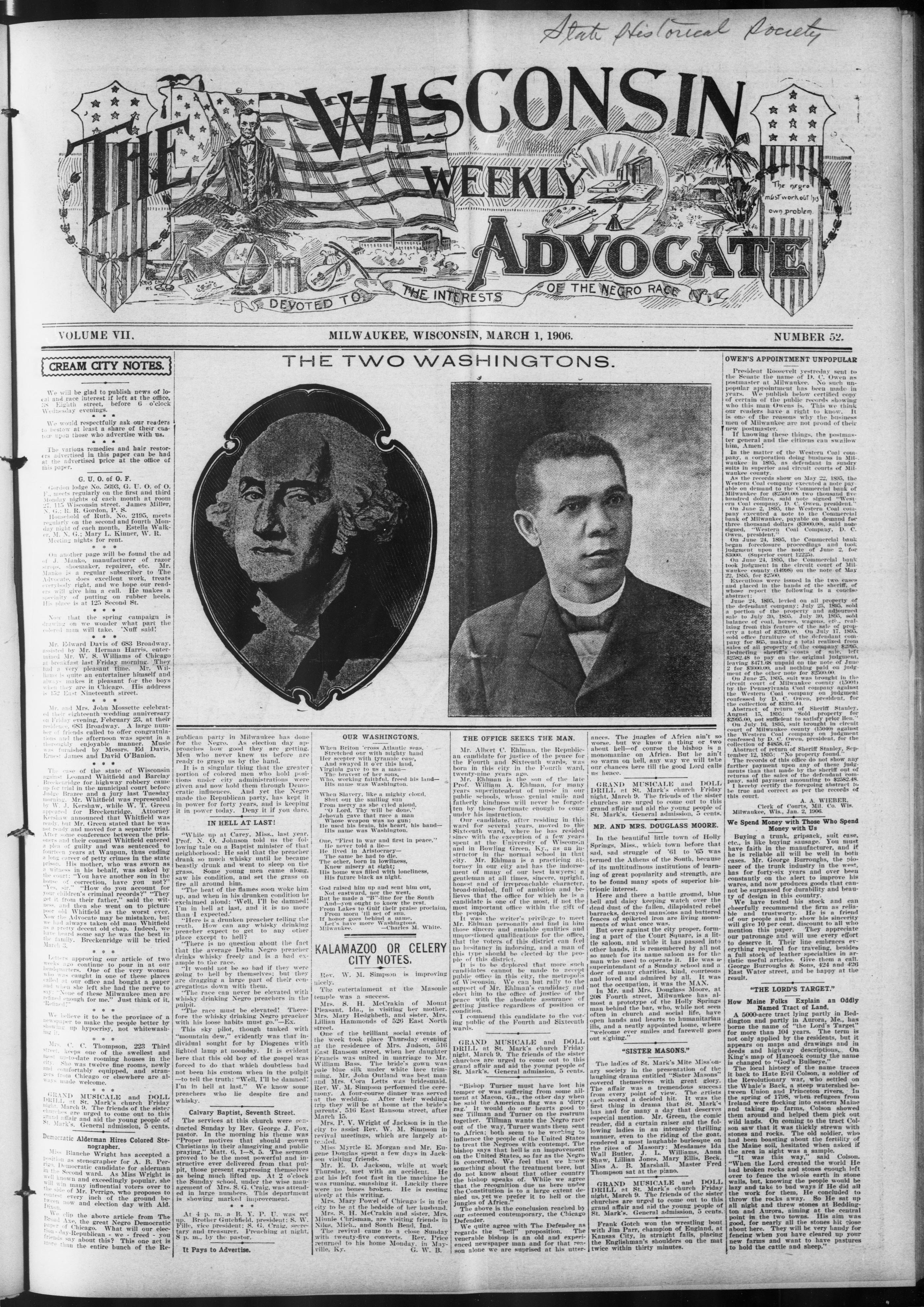
THE TWO WASHINGTONS.
Washington
publican party in Milwaukee has done for the Negro. As election day approaches how good they are getting. Men who never knew us before are ready to grasp us by the hand. It is a singular thing that the greater portion of colored men who hold positions under city administrations were given and now hold them through Democratic influences. And yet the Negro made the Republican party, has kept it in power for forty years, and is keeping it in power today. Deny it if you dare.
IN HELL AT LAST!
"While up at Carey, Miss., last year, Prof. N. O. Johnson told us the following tale on a Baptist minister of that neighborhood: He said that the preacher drank so much whisky until he became beastly drunk and went to sleep on the grass. Some young men came along, saw his condition, and set the grass on fire all around him.
"The heat of the flames soon woke him up, and when in his drunken condition he exclaimed aloud: 'Well, I'll be damned! I'm in hell at last, and it is no more than I expected.'"
"Here is a drunken preacher telling the truth. How can any whisky drinking preacher expect to get to any other place except to hell?
"There is no question about the fact that the average Delta Negro preacher drinks whisky freely and is a bad example to the race.
"It would not be so bad if they were going to hell by themselves; but they are dragging a large part of their congregations down with them.
"The race can never be elevated with whisky drinking Negro preachers in the pulpit.
"The race must be elevated! Therefore the whisky drinking Negro preacher with his loose habits must go."—Ex.
This sky pilot, though tanked with "mountain dew," evidently was that individual sought for by Diogenes with lighted lamp at noonday. It is evident here that this old boy of the gospel was forced to do that which doubtless had not been his custom when in the pulpit—to tell the truth: "Well, I'll be damned! I'm in hell at last." We know some preachers who lie despite fire and whisky.
Calvary Baptist, Seventh Street
The services at this church were conducted Sunday by Rev. George J. Fox, pastor. In the morning his theme was "Proper motives that should govern Christians in their almsgiving and public praying," Matt. 6, 1-8, 5. The sermon proved to be the most powerful and instructive ever delivered from that pulpit, those present expressing themselves as being much lifted up. At 2 o'clock the Sunday school, under the wise management of Mrs. S. G. Craig, was attended in large numbers. This department is showing marked improvement.
* * *
At 4 p. m. a B. Y. P. U. was set up. Brother Gutchfield, president; S. W. Fille, vice president; S. G. Craig, secretary and treasurer. Preaching at night, 8 p. m., by the pastor. It Pays to Advertise.
OUR WASHINGTONS.
When Briton 'cross Atlantic seas,
Stretched our with mighty hand
Her scepter with tyrannic ease,
And swayed it o'er this land,
Virginia gave to us a man—
The bravest of her sons,
Who, working faithful, freed his land-
His name was Washington.
When Slavery, like a mighty cloud,
Shut out the smiling sun
Frowned at land.
He used his brain, his heart, his hand—
His name was Washington.
One, "First in war and first in peace,"
He never told a lie—
His home was filled with loneliness,
His future black as night.
God raised him up and sent him out,
Not eastward, nor the west.
But he made a "B" line for the South
And--you ought to know the rest.
From Lakes to Gulf their praise proclaim
From morna 'til set of sun.
If honor goes behind a name.
Let's have more Washington.
Milwaukee. —Charles M. White.
KALAMAZOO OR CELERY CITY NOTES.
Rev. W. M. Simpson is improving nicely. The entertainment at the Masonic temple was a success. Mrs. S. H. McCrakin of Mount Pleasant, Ida., is visiting her mother. Mrs. Mary Hedghbeth, and sister, Mrs. Lillian Hammonds of 526 East North street.
One of the brilliant social events of the week took place Thursday evening at the residence of Mrs. Judson, 516 East Ransom street, when her daughter Francis was united in marriage to Mr. William Bass. The bride's gown was pale blue silk under white lace trimming. Mr. John Outland was best man and Mrs. Cora Letts was bridesmaid. Rev. W. M. Simpson performed the ceremony. A four-course dinner was served at the wedding. After their wedding trip they will be at home at the bride's parents', 516 East Ransom street, after March 15.
Mrs. P. V. Wright of Jackson is in the city to assist Rev. W. M. Simpson in revival meetings, which are largely attended.
Miss Myrtle E. Morgan and Mr. Eugene Douglas spent a few days in Jackson visiting friends.
Mr. E. D. Jackson, while at work Thursday, met with an accident. He got his left foot fast in the machine he was running, smashing it. Luckily there were no bones broken. He is resting nicely at this writing.
Mrs. Mary Powel of Chicago is in the city to be at the bedside of her husband.
Mrs. S. H. McCrakin and sister, Mrs. Minnie Chrisman, are visiting friends in Niles, Mich., and South Bend, Ind.
The revival came to a close Sunday with twenty-five converts. Rev. Price returned to his home Monday, in Mayville, Ky. G. W. R.
---
THE OFFICE SEEKS THE MAN
Mr. Albert C. Ehlman, the Republican candidate for justice of the peace for the Fourth and Sixteenth wards, was born in this city in the Fourth ward, twenty-nine years ago. Mr. Ehlman is the son of the late Prof. William A. Ehlman, for many years superintendent of music in our public schools, whose genial smile and fatherly kindness will never be forgotten by those fortunate enough to come under his instruction.
Our candidate, after residing in this ward for several years, moved to the Sixteenth ward, where he has resided since with the exception of a few years spent at the University of Wisconsin and in Bowling Green. Ky., as an instructor in the normal school in that city. Mr. Ehlman is a practicing attorney in our city and has the indorsement of many of our best lawyers: a gentleman at all times, sincere, upright, honest and of irreproachable character, broad-minded, full of ambition and believes that the office for which he is a candidate is one of the most, if not the most important office within the gift of the people.
It was the writer's privilege to meet Mr. Ehlman personally and find in him those sincere and amiable qualities and unquestioned qualifications for the office, that the voters of this district can feel no hesitancy in indorsing, and a man of this type should be elected by the people of this district.
It is to be deplored that more such candidates cannot be made to accept public office in this city, the metropolis of Wisconsin. We can but rally to the support of Mr. Ehlman's candidacy and elect him to the office of justice of the peace with the absolute assurance of getting justice regardless of position or condition.
I commend this candidate to the voting public of the Fourth and Sixteenth wards.
GRAND MUSICALE and DOLL DRILL at St. Mark's church Friday night, March 9. The friends of the sister churches are urged to come out to this grand affair and aid the young people of St. Mark's. General admission, 5 cents.
"Bishop Turner must have lost his temper or was suffering from some ailment at Macon, Ga., the other day when he said the American flag was a 'dirty rag.' It would do our hearts good to see Tillman and Turner on the rostrum together. Tillman wants the Negro race out of the way, Turner wants them sent to Africa; both seem to be working to influence the people of the United States to treat the Negroes with contempt. The bishop says that hell is an improvement on the United States, so far as the Negro is concerned. We feel that we know something about the treatment here, but do not know about that other country the bishop speaks of. While we agree that the recognition due us here under the Constitution is to a large extent denied us, yet we prefer it to hell or the jungles of Africa."
The above is the conclusion reached by our esteemed contemporary, the Chicago Defender. We quite agree with The Defender as regards the "hell" proposition. The venerable bishop is an old and experienced newspaper man and for that reason alone we are suprised at his utter-
ances. The jungles of Africa ain't so worse, but we know a thing or two about hell—of course the bishop is a monomaniac on Africa. But he ain't so warm on hell, any way we will take our chances here till the good Lord calls us hence.
GRAND MUSICALE and DOLL DRILL at St. Mark's church Friday night, March 9. The friends of the sister churches are urged to come out to this grand affair and aid the young people of St. Mark's. General admission, 5 cents.
MR. AND MRS. DOUGLASS MOORE.
In the beautiful little town of Holly Springs, Miss., which town before that sad, sad struggle of '61 to '65 was termed the Athens of the South, because of its multitudinous institutions of learning of great popularity and strength, are to be found many spots of superior histrionic interest. Here and there a battle ground, blue bell and daisy keeping watch over the dead dust of the fallen, dilapidated rebel barracks, decayed mansions and battered fences of spiketed iron are living monuments of what once was.
But over against the city proper, forming a part of the Court Square, is a little saloon, and while it has passed into other hands, it is remembered by all not so much for its name saloon as for the man who used to operate it. He was a superintendant of a Sunday school and a doer of many charities, kind, courteous and loved and admired by all. It was not the occupation, it was the MAN. In Mr. and Mrs. Douglass Moore, at 208 Fourth street, Milwaukee has almost a prototype of the Holly Springs man behind the bar, who, while not seen often in church and social life, have open hands and hearts to humanitarian ills, and a neatly appointed home, where "welcome ever smiles and farewell goes out sighing."
"SISTER MASONS."
The ladies of St. Mark's Mite Miss' onary society in the presentation of the laughing drama entitled "Sister Masons" covered themselves with great glory. The affair was a tremendous success from every point of view. The artists each scored a decided hit. It was the first thing in drama that St. Mark's has had for many a day that deserves especial mention. Mr. Green, the comic reader, did a curtain raiser and the following ladies in an intensely thrilling manner, even to the riding of the goat, rendered a most laughable burlesque on the rites of Masonry: Mesdames Ida Wall Butler, J. L. Williams, Anna Shaw, Lillian Jones, Mary Ellis, Beck, Miss A. B. Marshall. Master Fred Thompson sat at the piano.
GRAND MUSICALE and DOLL DRILL at St. Mark's church Friday night, March 9. The friends of the sister churches are urged to come out to this grand affair and aid the young people of St. Mark's. General admission, 5 cents. Frank Gotch won the wrestling bout with Jim Parr, champion of England, at Kansas City, in straight falls, placing the Englishman's shoulders on the mat twice within thirty minutes.
OWEN'S APPOINTMENT UNPOPULAR
President Roosevelt yestreday sent to the Senate the name of D. C. Owen as postmaster at Milwaukee. No such unpopular appointment has been made in years. We publish below certified copy of certain of the public records showing who this man Owens is. This we think our readers have a right to know. It is one of the reasons why the business men of Milwaukee are not proud of their new postmaster.
If knowing these things, the postmaster general and the citizens can swallow him, Amen!
In the matter of the Western Coal company, a corporation doing business in Milwaukee in 1895, as defendant in sundry suits in superior and circuit courts of Milwaukee county.
As the records show on May 22, 1895, the Western Coal company executed a note payable on demand to the Commercial bank of Milwaukee for ($2500.00) two thousand five hundred dollars, said note signed "Western Coal company, D. C. Owen, president." On June 2, 1895, the Western Coal company executed a note to the Commercial bank of Milwaukee, payable on demand for three thousand dollars ($3000.00), said note signed, "Western Coal Company, D. C. Owen, president." On June 2, 1895, the Commercial bank began foreclosure proceedings and took judgment upon the note of June 2, for $3000. (Superior court 12225). On June 24, 1895, the Commercial bank took judgment in the circuit court of Milwaukee county (14998) on the note of May 22, 1895, for $2500. Executions were issued in the two cases and placed in the hands of the sheriff, of whose report the following is a concise abstract:
June 24, 1895, levied on all property of the defendant company; July 23, 1895, sold a portion of the property and adjourned sale to July 30, 1895. July 30, 1895, sold balance of coal, horses, wagons, etc., realizing from this feature of the sale of property a total of $2930.00. On July 17, 1895, sold office furniture of the defendant company for $65, making a total realized from sales of all property of the company $2985. Deducting sheriff's costs of sale, left $2582.48 to pay on the original judgment, leaving $471.68 unpaid on the note of June 2 for $3000.00, and nothing paid on judgment of the other note for $2500.00.
On June 25, 1895, suit was brought in the circuit court of Milwaukee county (15001) by the Pennsylvania Coal company against the Western Coal company on judgment confessed by D. C. Owen, president, for the collection of $3193.44.
Abstract of return of Sheriff Stanley, August 15, 1895: "Sold property for $2955.00, not sufficient to satisfy prior lien." On July 16, 1895, suit brought in circuit court of Milwaukee county (15040) against the Western Coal company on judgment confessed by D. C. Owen, president, for the collection of $4858.47.
Abstract of return of Sheriff Stanley, September 12, 1895: "No property found."
The records of this office do not show any farther payment upon any of these judgments than that made by the sheriff out of returns of the sales of the defendant company, said payment amounting to $2582.48. I hereby certify the foregoing abstract to be true and correct as per the records of this court.
A. A. WIEBER,
Clerk of Courts, Mil. Co. Wis.
Milwaukee, Wis., Jan. 2, 1906.
We Spend Money with Those Who Spend Money with Us
Buying a trunk, gripsack, suit case, etc., is like buying sausage. You must have faith in the manufacturer, and if he is reliable all will be well in both cases. Mr. George Burroughs, the pioneer of the trunk industry in the west, has for forty-six years and over been constantly on the alert to improve his wares, and now produces goods that cannot be surpassed for durability and beauty of design in this country.
We have tested his stock and can cheerfully recommend the firm as reliable and trustworthy. He is a friend of our people and to show his sincerity will give 10 per cent, discount to all who mention this paper. They appreciate our patronage and will use every effort to deserve it. Their line embraces everything required for traveling, besides a full stock of leather specialties in artistic useful articles. Give them a call. George Burroughs & Sons, 424 and 426 East Water street, and be happy at the result.
"THE LORD'S TARGET."
How Maine Folks Explain an Oddly Named Tract of Land.
A 5000-acre tract lying partly in Beddington and partly in Aurora, Me., has borne the name of "the Lord's Target" for more than 104 years. The term is not only applied by the residents, but it appears on maps and drawings and in deeds and highway descriptions. On King's map of Hancock county the name is changed to "God's Bullseye."
The local history of the name traces it back to Hate Evil Colson, a soldier of the Revolutionary war, who settled on the Whale's Back, a steep watershed between Union and Princeton rivers. In the spring of 1798, when refugees from Ireland were flocking into eastern Maine and taking up farms, Colson showed them around and helped them pick out wild lands. On coming to the tract Colson saw that it was thickly strewn with stones and rocks. The old soldier, who had been boasting about the fertility of the Maine soil, hesitated when asked if the area in sight was a sample.
"It was this way," said Colson. "When the Lord created the world He bad broken rocks and stones enough left over to fence the whole earth in stone walls, but, knowing the people would be lazy and take to bad ways if He did all the work for them, He concluded to throw the rocks away. So He sat up all night and threw stones at Beddington and Aurora, aiming at the central point in the two towns. His aim was good, for nearly all the stones hit close about here. They will be very handy for fencing when you have cleared up your new farms and want to have pastures to hold the cattle and sheep."
RESCUED TATTERED OLD GLORY.
Young Woman Makes Perilous Ascent on Icv Roof for Flag.
To rescue a tattered remnant of the American flag, its colors nearly obliterated by the soot, sleet, and rain, its field alone intact and fringed with a few frayed ribbons of what was once the stripes, Miss Bertha L. Duppler, assistant secretary to Postmaster Busse of Chicago, climbed over the ice and snow clad roof of the old Chicago postoffice on Michigan avenue and took it, half yards and all, from the tottering flagstaff. Every step over the sloping roof was fraught with danger. One false step and Miss Duppler would have fallen and perhaps been dashed to death on the cement pavements around the building before help could reach her. But the plucky young woman had put that flag there herself, and she herself would rescue it. The building is to be formally turned over to the S. Krug Wrecking and Iron company by the government within a few days, and Miss Duppler was determined that the flag must not go with it. The sight of a young woman on the top of the old building immediately attracted a crowd. Policemen called to the woman to come down. Excited men and women attempted to warn her of her danger. Miss Duppler turned around, gazed at the crowd for a moment, smiled, and then started on her journey. Slowly and cautiously she went up the incline, carefully picking each step. Occasionally she turned about to reassure the crowd with a smile and then resume her labors. Once, when near to the flagstaff, she slipped back a few steps. The crowd yelled and men ran to the building to catch her if she fell off the roof. She regained her balance with some difficulty, turned again and smiled on the crowd, made a final dash for the staff and reached it. With her arms about the staff she rested for a few moments, then untied the halfyards and drew what remained of "Old Glory" down. Steadying herself against the pole, she waved the tattered emblem three or four times, while the crowd cheered in admiration of her pluck, and then picked her way back across the roof.
AWFUL PSORIASIS 35 YEARS.
Terrible Scaly Humor in Patches All Over the Body—Skin Cracked and Plasticized by Cutlery
"I was afflicted with psoriasis for thirty-five years. It was in patches all over my body. I used three cakes of Cuticura Soap, six boxes of Ointment, and two bottles of Resolvent. In thirty days I was completely cured, and I think permanently, as it was about five years ago. The psoriasis first made its appearance in red spots, generally forming a circle, leaving in the center a spot about the size of a silver dollar of sound flesh. In a short time the affected circle would form a heavy dry scale of white silvery appearance and would gradually drop off. To remove the entire scales by bathing or using oil to soften them the flesh would be perfectly raw, and a light discharge of bloody substance would ooze out. That scaly crust would form again in twenty-four hours. It was worse on my arms and limbs, although it was in spots all over my body, also on my scalp. If I let the scales remain too long without removing by bath or otherwise, the skin would crack and bleed. I suffered intense itching, worse at nights after getting warm in bed, or blood warm by exercise, when it would be almost unbearable. W. M. Chidester, Hutchinson, Kan., April 20, 1905."
NEW POLAR EXPEDITION READY.
Comrades of Baldwin-Zeigler Expedition
Seek New Northern Continent.
The expedition now being fitted out by Capt. Einar Mikkelsen of Denmark and Ernest De V. Leffingwell of the University of Chicago will seek a new continent in the polar sea. Mr. Leffingwell and Capt. Mikkelsen were comrades on the Baldwin-Zeigler expedition and at that time conceived the idea of exploring the hitherto unknown Beaufort sea. On their return from the Baldwin-Zeigler trip they immediately set about raising funds for the expedition.
Capt. Mikkelsen went to England, where he succeeded in raising a portion of the necessary funds, the Royal Geographical society of Great Britain contributing $1000 and authorizing the use of the name of the society in connection with the enterprise. In the meantime Mr. Lefflingwell, working among scientific men and others interested, succeeded in getting together several thousand dollars in this country. The two young men will set out for the frozen north shortly and expect to add a new continent or at most an archinelago to the maps of the world.
A new continent in the arctic regions, the existence of which has been suspected for more than fifty years, will be the goal of the expedition which will be sent out under the auspices of the Royal Geographical society of England, the National Geographical society of America and the American Geographical society. Members of those societies have been interested in the unknown regions north of Alaska since the unexplained mystery of the drift which caught the illfated Jeannette years ago and crushed her in the ice pack north of Wrangel island.
TRADE MARK.
St. Jacobs Oil
for many, many years has cured
and continues to cure
RHEUMATISM
NEURALGIA
LUMBAGO
BACKACHE
SCIATICA
SPRAINS
BRUISES
SORENESS
STIFFNESS
FROST-BITES
Price, 25c. and 50c.
—A school for women chemists has been opened at Dessau, Germany. Graduates can earn from $20 to $48 a month.
—Dr. Koch, the famous German scientist, is to take charge of an expedition to investigate sleeping sickness in German East Africa. The German colonial department has allocated $300,000 toward the expenses of the expedition.
—It has been decided to construct a railroad across British North Borneo, to form a continuous connection between the east and west coasts. The new road is estimated to cost $7,500,000 and will be constructed in sections.
—The youngest king in the world is Daudi Chua of Uganda, Africa, a protectorate of England. He is now about 8 and holds court seated on a scarlet throne with a leopard skin under his feet and hearing in his hand a toy gun.
-It having been proved by experiment that fish can be brought in refrigerator in good condition from Africa to Paris, a regular steamship company is to be inaugurated for supplying the capital with fish, lobsters, etc., from the western African coast. Among the presents received by Bishop O'Connell, now in Japan as the Papal envoy to the Mikado, is a deed of dedication for an 11-aere tract of land to the Pope as a site for Catholic headquarters at Oshide, seven miles from the well known tourist resort, Karuizawa. It is true that 60 per cent. of the deaths among the Sioux and Yankton Indians now are from tuberculosis, but it is also true that fifty years ago tuberculosis was unknown among the Indians, and has fastened upon them only since the coming of the white man to Dakota.
WISDOM OF AN EMPIRICIST
It's cherish delusions or cherish nothing.
Spare the strap and spoil the passenger.
Shrinking modesty sometimes conceals a lurid past.
When thieves fall out, honest men get robbed twice.
The fool saith in his heart, "This is a free country."
Some people prefer being consistent to being reasonable.
A good way to get what you want is to quit wanting it.
The early bird builds the fires for the late ones to get up by.
Poverty has its advantages. Nobody thinks of investigating it.
Experience is a good teacher, but the cost of tuition is awfully high.
No regular patron of the street cars can always be a "perfect gentleman."
It doesn't take much of a girl to make a fool of any man. Nature did so much.
You can tell when a fellow is in love by the pains he takes to seem as if he isn't.
A person of "elegant leisure" is one who has time to read the Sunday newspapers.
One of the worst forms of insomnia is a 2-year-old boy who sleeps crosswise on the bed.
What the theaters need for matinees are seats that can be reversed to face the rear.
A man may waste so much time being sorry for himself that he has lots to be sorry for.
The trouble with mistakes is that you don't know they are mistakes until you make 'em.
The modern trust idea seems to be that a politician in office is worth two statesmen out of a job.
When "all is lost save honor," it is a sign that the creditors will get about 5 cents on the dollar.
Whisky and quinine may not cure a cold, but if you take enough you don't care whether you have one or not.
It is wonderful how eminent and eloquent men can read such lessons from Lincoln's life, and fail to apply them.
When we want to do things that no other animal would be guilty of we say we are "only human." And then we call ourselves "lords of creation."
That the nation is returning to its normal. "safe and sane" basis is shown by the fact that nobody has invented a new breakfast food for a year.
People who demand company or amusement all the time are so lacking in the faculty of self-entertainment that when they are alone they listen to their microbes.—St. Louis Globe-Democrat.
Tailor's Life Saving Coat
A London tailor has invented a new lifesaving coat and gaiters, with which it is possible for a person clothed therein to maintain an upright position when immersed in the water, even if not possessing any knowledge of swimming. The coat resembles in appearance an ordinary pilot coat, but it is fitted with an air belt, which is inflated with air through a tube. The gaiters each weigh two pounds and are fitted with two brass wings or blades fastened to the back of the heel. As the wearer moves his feet in the water these wings open and shut, and not only propel the wearer along like oars, but enable him to maintain an upright position from the waist upward in the water.
A practical demonstration of the utility of the invention was recently undertaken in the River Thames by the inventor and its efficiency and lifesaving qualities clearly shown, even when moving against the tide.—Scientific American.
Heat Helps Full Beards
Do whiskers grow faster in hot weather than in cold? The correct answer to this question is, "They do." Barbers say that there is an increase of about 20 per cent. in business during the extremely hot spells and that all this increase comes from the men who habitually shave every other day instead of once a day. Although hot weather makes more business for the chin polishers, they do not particularly welcome it. Men are always more irritable and harder to shave. This, coupled with the increased speed of execution, makes the whole business unsatisfactory for both the shaver and the shavee.—Kansas City Journal.
A Vegetarian Danger.
In some respects vegetarians suffer more than meat eaters from uric acid poisoning, seeing that beans, peas, lentils and peanuts contain twice as much of the poison as meat. The natives of India suffer greatly from uric acid diseases, owing to the quantity of dahl (lentils) they eat. Other natives who avoid dahl are almost entirely free.—London Mail.
NATURE POETRY.
Mother of all the high-strung poets and singers departed.
Mother of all the grass that weaves over their graves the glory of the field. Mother of every living taing, deep-bosomed, patient, impassive.
phrore impure Silent brooder and nurse of lyrical joys and sorrows!
Out of thee, ye, surely out of the fertile depth below thy breast.
depth below thy breast,
Issued in some strange way, thou lying motionless, volceless,
tioness,
All these wonderful songs, rhythmical, pas-
merling.
coming in music from earth, but not until earth returning.
Dust are the blood-red hearts that beat in time to these measures.
Into thy bosom again, as a river is lost in the sand.
grief and love and joy
Floating from heart to heart of thy child
who above thee, thee
Long hast thou lain like a queen trans
Knowing not who thou art, til the touch of thy Lord and Lover
Moulds the man-child within thy breast, and lo, thy secret is spoken.
All thy flowers and birds and beasts and woods and waters
Are but enchanted forms that embody the life of the spirit:
Thou thyself, earth-mother, in mountain and meadow and ocean.
Holdest the poem of God, eternal thought and emotion.
Henry Van Dyke in Atlantic.
MISS WEEK'S JEALOUSY.
I am as fond of pure, unadulterated fun as anybody. I believe I have as keen an appreciation of the ludicrous and can discover the "nib" of a joke as quickly as "the next man." I glory in a good, hearty, old-fashioned guf-faw"—to me it is a tonic—it exhilarates—it braces me. But I never was fond of a practical joke, for I have always been unable to see cause for real mirth in the discomfiture of a fellow creature.
It is a singular fact that your practical joker, as a general thing, is the last one to appreciate a practical joke of which he is the victim. Some there are who will take it in good part and laugh as loudly as the rest at his own discomfiture, but such are not often found.
Caleb Weeks, who will be remembered by many old New Yorkers, and who at one time kept a public house on Long Island, is said to have been the most inveterate practical joker on record. He would go out of his way at any time to gratify his peculiar propensity, and many are the anecdotes told concerning him. But he once met his match.
One John Smith, having been victimized by Caleb, determined—to use his own expression—to "get square" with his tormentor, and, while Caleb was absent from home on one occasion, on business which was likely to detain him in New York for some days, John sought his hostelry on Long Island and desired to see Mrs. Weeks. When that lady presented herself, John gazed at her with some astonishment, and at length ventured to say:
"There must be some mistake, madam. I desired to see Mrs. Weeks—Mrs. Caleb Weeks." "Well! I am Mrs. Caleb Weeks. What is it you wish?"
"You are not the Mrs. Caleb Weeks whom I desire to see," returned John, in a positive tone; "the lady whom I am in quest of is much younger than yourself, taller, and—pardon me, madam—much finer-looking. She has large lustrous blue eyes, a wreath of golden hair, rosy cheeks, a rosebud mouth, and is in every way beautiful Besides, she was very richly dressed, and wore a profusion of diamond jewelry. One magnificent ring I noticed particularly, which she said her husband had recently presented to her as a birthday present. I am a jeweler myself, madam, and know the value of diamonds. In fact, my business here is to return to Mrs. Weeks a valuable diamond brooch which I have been resetting for her."
Now Mrs. Weeks, be it known, was terribly jealous of her husband, and her eyes snapped fire as she enjoined: "I tell you again, sir, that I am Mrs. Weeks, and there is none other. If the brooch is designed for Mrs Weeks, give it to me."
"Excuse me, madam," replied John, with much earnestness, "you are not the lady to whom Mr. Weeks introduced me as his wife, and, much as I commiserate your unhappy lot—for I perceive now plainly that Mr. Weeks is a great scoundrel—I cannot place the diamonds in your possession, since to do so would be a breach of trust. This is a most unfortunate business, and I deplore it deeply. I regret very much that I had anything to do with it. Good morning, madam. I hope Mr. Weeks will be able to explain things satisfactorily." And John Smith bowed himself out.
It may well be imagined that Mrs. Weeks was in no very amiable frame of mind when Caleb as innocent as a lamb, and all unsuspecting the stormy scene which awaited him, returned home. For three days she had been "nursing her wrath to keep it warm," and, when at length her husband entered her presence and rushed forward for his kiss of welcome, she sternly waved him off, holding her right hand behind her the while, and said, with terrible calmness:
How is Mrs. Weeks, Caleb? Why didn't you bring her home with you?" Caleb saw at once that his wife was either in dead earnest about something or had suddenly taken leave of her senses. Then it occurred to him that she might be displeased because he had remained absent so long. So he said, apologetically: "I don't know what you mean by 'how is Mrs. Weeks?'—and why didn't I bring her home?' my dear. I suppose you are in one of your good-natured jokes. I am glad to see you in such excellent humor. I was afraid you might not like it because I didn't get home sooner. But I had a good deal to look after, you know—many purchases to make, many different parties to see, and all that sort of thing. So don't be cross, but give us a kiss and say no more about it."
"Yes," rejoined Mrs. Weeks, with flashing eyes. "I know all about the parties you had to see and the purchases you had to make. I hope you didn't pay too much for the diamonds you bought."
"Diamonds, my dear! Diamonds!" exclaimed Caleb slightly bewildered; "what the deuce are you talking about? I have bought no diamonds! I believe you are taking leave of your senses!"
"She is much younger than I am." returned Mrs. Weeks, significantly, "taller better man than they are."
and better looking!" and, as she spoke, she drew from behind her a cowhide and brought it down vigorously over the shoulders of the unfortunate Caleb. "Large, lustrious black eyes!—whack! whack—a wreath of golden hair!—whack!—rosk cheeks!—whack! whack!—a rosebud mouth!—whack! whack!—richly dressed!—whack! whack!—magnificent ring for a birthday present!—whack! whack! At this point, Caleb, now thoroughly satisfied that his wife, had, through jealousy, became temporarily insane, made a break for the door, and, passing through it, rushed down the stairs, closely followed by his infuriated wife, who continued to ply the cowhide till her unfortunate husband had got safely outside.
Having at length escaped, Caleb, whose shoulders still smarted from the castigation which he had received, seated himself beneath an old elm, to cogitate as to what was best to be done under the circumstances. He had just about made up his mind to go for the family physician, when a familiar voice at a distance greeted him:
"Hello, Caleb, old boy! How's things inside? Did I make it hot for you, eh!"
Looking up, he saw the familiar countenance of John Smith and the murder was out. Nothing remained but for Caleb to make a treaty of peace with his enemy, whom he induced to accompany him into the house and explain matters to Mrs. Weeks.
The lady was mollified after a while, but the probability is that she always half believed the story which John Smith had at first told her, and attributed his explanation to a bribe on the part of her husband. It is pretty safe to say that Caleb never played another practical joke on John Smith.—New York Weekly.
MUSINGS OF A GENTLE CYNIC.
Reform is generally predigested.
No man can be selfish with his happiness.
The fortune hunter never needs a guide.
A break in the divorce court is seldom re-paired.
Many a man has tripped over his own ambition.
Perhaps is a first cousin to the If and But twins.
A ripe old age is a very beautiful thing, except in an egg.
It doesn't take a quarrelsome man to strike an attitude.
Most good resolutions consist largely of plans and specifications.
Every cloud has a silver lining, if your pocket is similarly fixed.
The only way some people can get along together is to live apart.
Give the average woman a button and she will want a dress to match it.
Some men are about as hard to deal with as a worn-out pack of cards.
We never know that some men are dead until we miss their bragging.
A man may be clothed in his own righteousness, but it doesn't always fit.
It's all right to respect gray hairs, but it isn't necessary to throw bricks at a bald head.
Lots of things look easy to manage until you try them. Automobiles and wives, for instance.
The great trouble with things we get for nothing is that we generally have to pay the freight.
Let us hope that heaven is a place where the suburbs are not in the hands of real estate speculators.
It is not until we get airships that the fellow who lives in an attic can expect his friends to look him up.
Somehow or other a woman doesn't feel flattered when some other woman falls in love with her husband.
The dollar that looked so small when you borrowed it seems as big as a Ferris wheel when you have to pay it back. New York Times.
These Explanations
Senator Foraker, at a dinner in Washington, quoted with a laugh an extravagant and incredible statement that he had read in a magazine. When someone attempted to explain, he said:
"The thing is preposterious, and all the explanations in the world won't alter its preposterousness. These explainers. They are never at a loss, are they? They remind me of old James Scarlett of Rainsboro.
"There was nothing which James Scarlett of Rainsboro could not explain.
"One winter night he was reading a volume of the Seaside Library to his family gathered about the fireside. With his spectacles on his nose he droned along like this:
"Gwendolen de Vere Hastings low-creed her limpid blue eyes and Lord Algernon Mannering took her slim white hands in his, and crushed her to him in a passionate embrace.
"At that moment, five minutes past 12 sounded from the castle belfry, and—"
"But here young Miss Scarlet interrupted.
"No clock could strike five minutes past 12,' she said.
"Certainly it could,' James snorted. 'It was five minutes slow.'"
They Were All Directors.
He was the wag of a merry party in the first-class carriage, and when the ticket collector appeared he leaned back and assumed the expression of a man who owned the line.
"Ticket, sir?"
The joker nodded.
"Ticket?"
"How long have you been stationed here, my man? Don't you know me? I'm Blank, director!"
But the ticket collector wasn't impressed.
"That's funny!!" he said. "So am I—we're all directors about here. I'll direct ye to the station master, he'll direct ye to the bobby, he'll direct ye to the magistrate, he'll direct ye to pay the fine—unless he directs ye to jail, and—"
But the joker directed his hand to his pocket and produced the ticket.—Tit-Bits.
Automobile Note.
"So you are the applicant for the position as chauffeur?" asked the gentleman, looking up from his desk.
"Yes, sir," replied the man who had just entered the room.
just entered the room.
"Are you a union man?"
"Yes, sir."
"Well, after you have worked on a machine for eight hours, and the thing won't go, what do you do?"
"Oh, well, sir, if you've got one of that kind of machines I don't want the job!"
—Modern Society.
THE TALE OF A HAND.
"Now what shall the limit be?" I said,
When ante had gone away.
"You're doing the calling"—she bent her
head—
"So you are the one to say."
"No limit," I cried, "if you'll stay in."
She answered, "I will, you bet."
I dealt, as she added, "I hope I win,
Oh, tell me, what did you get?"
"Just one more I need to make a pair."
"So do I," said she, "a knave."
"A queen for mine," said I, and there
A royal flush she gave.
"I'll open," said I, "if you don't mind."
"Were you bluffing?" she asked. "You were so abrupt." Said I, "Don't you understand That I feared a full house might interrupt, Harvard Lampoon.
PEANUT CULTURE
Superiority of the Mexicans in Growing the Nut.
Where do the peanuts in Mexico come from? This is a question that few persons can answer. Every one has noticed that the Mexican peanuts are of a superior variety and that they are very cheap, yet few persons know that the haciendados in Oaxaca make the raising of peanuts one of their principal side lines, and every year ship hundreds of bushels of them to the capital and the other cities in the republic.
In Mexico, as in the United States, the peanut is one of the most popular knickknacks. Every day dozens of peanut, vendors may be seen around the Alameda and other places where people gather. It will be found that the peanuts sold by most of these vendors are very large and perfectly roasted. It is very seldom that a peanut is found that has been burned while roasting. It will also be noticed that for a Mexican cent nearly as many peanuts can be bought as is given in the United States for 5 cents gold.
The climate and soil of the state of Oaxaca are especially adapted to the growth of peanuts. There is scarcely a plantation in the state that does not cultivate the vine. When the nuts have matured they are gathered and shipped without having been roasted. On their arrival here they are taken to the very common form of Mexican oven. The oven set apart for the roasting of peanuts has a large circular piece of fine netting in the interior. This netting is so arranged that the ends can be closed, making it look like a great corn popper. Several bushels of peanuts are placed in this net and then turned slowly over a charcoal fire. This process of roasting is a most successful one, as every nut is thoroughly roasted if the work is properly done, and there is little chance for the peanuts to be burned.
After roasting, the peanuts are sold to the venders. The venders buy them for little money, and even with the large quantity that is given when they are bought at retail they make a large profit. The profuseness of their growth makes them very cheap on the plantations where they are raised, and as they are generally shipped in carload lots, the transportation charges do not add a great deal to their cost. The roasting process is also conducted with very little expense.
Americans when they first come to Mexico seldom buy peanuts. It is something new to them to stop on the street and buy a couple of cents' worth of them and have them delivered to your pocket direct without wrapping of any kind, yet when the ice is once broken and they get used to the way they are handled in Mexico, they generally continue buying them, as the process of roasting leaves all the flavor in the kernels, and they taste much better than the peanuts do that, are generally sold in the United States, where the method of roasting so often takes away the richness of their taste.—Mexican Herald.
NEW POLAR EXPEDITION READY.
Comrades of Baldwin-Zeigler Expedition Seek New Northern Continent.
The expedition now being fitted out by Capt. Einar Mikkelsen of Denmark and Ernest De V. Leffingwell of the University of Chicago will seek a new continent in the polar sea. Mr. Leffingwell and Capt. Mikkelsen were comrades on the Baldwin-Zeigler expedition and at that time conceived the idea of exploring the hitherto unknown Beaufort sea. On their return from the Baldwin-Zeigler trip they immediately set about raising funds for the expedition.
Capt. Mikkelsen went to England, where he succeeded in raising a portion of the necessary funds, the Royal Geographical society of Great Britain contributing $1000 and authorizing the use of the name of the society in connection with the enterprise. In the meantime Mr. Leffingwell, working among scientific men and others interested, succeeded in getting together several thousand dollars in this country. The two young men will set out for the frozen north shortly and expect to add a new continent or at most an archipelago to the maps of the world.
A new continent in the arctic regions, the existence of which has been suspected for more than fifty years, will be the goal of the expedition which will be sent out under the auspices of the Royal Geographical society of England, the National Geographical society of America and the American Geographical society. Members of those societies have been interested in the unknown regions north of Alaska since the unexplained mystery of the drift which caught the illfated Jeannette years ago and crushed her in the ice pack north of Wrangel island.
Poor Spellers of Today.
Twenty words which were submitted to a spelling bee in Springfield, Mass., in 1846 were given to the high school classes at East Liverpool, O., by Supt. Rayman, and it is reported that not one in the class spelled every word correctly. Thirty seniors received a grade of 83 per cent., sixteen seniors averaged 63 per cent. and forty-five freshmen 72 per cent. The average of the 124 pupils who took the test was $73\frac{1}{2}$ per cent. The words submitted were: Accidental, accessible, baptism, chiography, characteristic, deceitful, decedent, eccentric, evanescent, fierceness, feignedly, ghastliness, gnawed, heiress, hysteries, imbecility, inconceivable, inconvenience, inefficient, irresistible. Supt. Rayman declared that the pupils of over fifty years ago were no better spellers than the school children of today.
Calls Flag Contemptible Rag
In an address before 500 delegates at a convention of negroes in Macon, Ga., to discuss race problems, Bishop H. M. Turner of the A. M. E. church declared the American flag to be "a dirty and contemptible rag," and that "hell was an improvement on the United States when the negro was involved." He said: "If a little, ignorant and stupid white man who was never heard of and never would be heard of until 10,000 years after the resurrection trumpet, wishes a little notoriety, he begins to belie and slander the negro and bounds into popularity. I challenge any one or all of them to meet me in a public discussion and I will show that the negro is a far
Stranded Cat Is Rescued.
For seven days many of the hands in several silk mills at Paterson, N. J., thought that a caterwauling spook haunted the mill-race. It was not until late Friday morning that a weaver noticed, through a crack in the floor, a cat perched on the wall skirting the race beneath the Phoenix mill. Gen. J. W. Congdon, president of the company, was informed, and he sent for Col. Spelby, to assist in rescuing the stranded feline. The colonel, general, mill superintendent and several manufacturers held a council. Finally Mike Burns, a 12-year-old boy, volunteered to lie down on a flimsy raft and grab the cat as he shot under the mill in the race. He tried, but failed. Then "Red" Sweeney, a 10-year-old lad, flung himself upon the raft. It flew like a shot out of a gun, but when it emerged on the lower side of the mill "Red" had the cat in his arms.
DODD'S
KIDNEY
PILLS
FOR ALL KIDNEY DISFASES
CURES RHEUMATISM
BRIGHT'S DISEASE
DIABETES BACKACHE
This product discontinued the use of our product
in this package. The public may rely on our
consultation of limitations, said only in harest
HAWAIIAN FIREWORKS.
Burning Brands of Wood Thrown From Top of a Cliff.
In accordance with Hawaiian tradition, the famous native fireworks were held on the north side of the island of Kauai on the night of July 23. These fireworks are set off only once in ten years, and are intended to propitiate the gods of the air, sky and waters. The present display is the first held since the annexation of the islands, and attracted widespread attention, special steamers carrying crowds to the spectacle. The pyrotechnical display took place at the top of a cliff 3000 feet high, and consisted of throwing lighted pieces of wood into space. These brands are especially prepared and are thrown by the hundred over the edge of the cliff. The wood used was the hau, which had been carefully saved for a long time, so as to be dry and light.
Only a gentle breeze is required to sustain the blazing pieces of wood, so that they descend gradually to the beach below. There is a curve in the range of the cliff, so that currents of air sometimes carry the blazing firebrands in different directions before they complete their descent. Frequently the blazing wood is shot straight outward from the edge of the cliff from where the brand was thrown by the native operator; then a current of air catches the brand and deflects it to the right or left, and as the flaming torch descends slowly another current may drive it back against the face of the cliff.
The weird gyrations performed by the aerial torches are believed by the superstitious natives to be due to supernatural agency, and they watch with awe the erratic descent of the countless numbers of lighted brands, a spectacle that is brilliant and kaleidoscopic.
On the present occasion some of the younger generation of natives departed from the faith of their fathers by openly declaring that the blazing pieces of wood were tied to birds that had been caught before in anticipation of the display.
Peculiar Punishment for Eloping.
Frederick D. Jones, 18 years of age, son of Cyrus D. Jones, a millionaire of Scranton, Pa., who was clandestinely wedded December 5 last to Miss Miriam Irish of Lake Iriel, has been told by his father that he and his young wife will have to live on his salary of $8 a week for two years, at the expiration of which time, if they are not in debt, the son is to receive $20,000 and a partnership interest in the parent's tea business. Jones has taken up a residence here and will try to carry out the conditions.
Another Warning.
"I have just been reading the account of a railway wreck in which every occupant of the smoking carriage was more or less injured, while the rest of the passengers in the train escaped without harm," said old Hodge.
"There, Ezra," cried Mrs. Hodge, triumphantly, "there is another warning against the use of tobacco."—London Tit-Bits.
FOOD AND STUDY.
A College Man's Experience. "All through my high school course and first year in college," writes an ambitious young man, "I struggled with my studies on a diet of greasy, pasty foods, being especially fond of cakes and fried things. My system got into a state of general disorder and it was difficult for me to apply myself to school work with any degree of satisfaction. I tried different medicines and food preparations but did not seem able to correct the difficulty.
"Then my attention was called to Grape-Nuts food and I sampled it. I had to do something, so I just buckled down to a rigid observance of the directions on the package, and in less than no time began to feel better. In a few weeks my strength was restored, my weight had increased, I had a clearer head and felt better in every particular. My work was simply sport to what it was formerly.
"My sister's health was badly run down and she had become so nervous that she could not attend to her music. She went on Grape-Nuts and had the same remarkable experience that I had. Then my brother, Frank, who is in the postoffice department at Washington city and had been trying to do brain work on greasy foods, cakes and all that, joined the Grape-Nuts array. I showed him what it was and could do and from a broken-down condition he has developed into a hearty and efficient man.
"Besides these I could give account of numbers of my fellow-students who have made visible improvement mentally and physically by the use of this food." Name given by Postum Co., Battle Creek, Mich. There's a reason. Read the little book, "The Road to Wellville," in pkgs.
GOSSIP FOR THE LADIES.
```markdown
```
In a Winter Wood.
Into a winter wood
At the crest of the morn I went;
The pine tree stood like a tent
Of ermine feathery soft;
The hemlock wore a hood;
And many another bole,
Towering far aloft.
Was wrapt in a Samite stole.
A gentle whispering
Seemed wafted from tree to tree
Like a broken melody
Chorded tender and low;
"We are gossiping of spring,"
Said a birch, with a friendly nod.
"Of how we will joy when the snow
Will let us look on the sod!"
Then came a truant crow
With a lusty, rusty note,
And a squirrel, sleek of coat,
With his chirrup ever glad;
So we all chimed in, and oh!
What a cheery chattering,
Frolicsome time we had
Just gossiping of spring!
—Metropolitan.
"Don'ts" from a Stove Repairer.
A few "don'ts" furnished by a stove dealer, who is frequently called upon for repairs may assist the novice.
Don't heat a sieve rapidly the first time.
Don't pile the coal above the top of the fire box, nor allow the top of the stove to get red hot. It warps and cracks the covers.
Don't let your grate get clogged. Shake often and keep tree from cinders and ashes.
Don't let ashes remain in the ashpan. They absorb the heat, cool the oven and check the draft.
Don't let clinkers remain fastened to the fire box. If the box is brick lined, drop an oyster shell in the fire occasionally, when burning briskly, and the shell will clean off the brick.
Don't "rush" the range with the oven draught open. You use too much fuel and burn out the range too fast.
Don't let the smoke draught stand open, except when fresh coal is put on. Heat that goes up the chimney is so much good money burned.
Don't burn wet garbage in the stove. Dry it first. Otherwise, steam is generated and the moisture will injure the fire box. Don't set leaky vessels or spill cold water on the range. The cold coming in contact with the heated metal will crack it. To get spots off when there has been a bad "spill over," cool the lids by changing them, or putting on coal. Clean with paper and finish with a scraper. Don't let the reservoir covers stand open, as it rusts the iron and strains the hinges. Don't let soot accumulate in the flue. Scrape off the soot that hangs to the oven bottom. Pull all soot toward you and be careful not to push it hack into the flue.—Good Housekeeping.
"Be Good—
Like any other effort that depends upon another's interest in us, it is not likely to be done unless we do it for ourselves.
The mother spends her life in planning for the health, raiment, convenience, comfort and pleasure of others.
She thinks it only natural that in turn somebody should speak up and announce the fact that she needs something new and pretty to wear, or that it would be nice for her to have some tickets to the theater, or that she needs a trip, or that somebody besides herself should offer to stay at home on the girl's day out.
Of course, they would be only naturally good, thoughtful for others, and grateful for like benefits received, if they did it all—but they don't. And the fact has to be accepted as it is. And really it isn't fair to expect it, any more than it is to put any other kind of work that you should do yourself on somebody else. "Mamma didn't go down town with us because it was too hot, and then after we had gone she gathered all the grandchildren together and made lemonade for them and gave them a party on the lawn. She made herself pretty nearly sick trotting to wait on them, and then when we got back she was in tears because 'we went off and left her with everything to do.'" This was the way a married daughter explained the grievance of her mother to the incoming company of shoppers.
The truth is that there is just one person who thinks when we ought to have a new dress—and thinks It often when we oughtn't to, dear heart—and that is the mother of whom life gives no one any duplicates. She knows when we need rest; she counts nothing loss that is our gain; she thinks nothing too good for us.
Once or twice in a lifetime it is given us to see a husband who "mothers" his wife in this way, too, but he is rare, and the woman who has him has a priceless pearl that she can wear instead of any other jewels. Sometimes in a big family there is one sister who has the dear way of looking out for the others.
But as a rule "looking out" is a service that goes undone unless one performs it for himself. Either we must go without and have only the poor consolation of nursing a grievance against those who overlook our need, or else we must choose to take the benefits that are owing to us as our right, and without demanding the added gift of having them as a loved one's suggestion.—Washington Star.
The Bachelor Girl Is Instructed.
"I wonder," said the Bachelor Girl, "why a woman is always expected to be pastmaster in the domestic arts just by virtue of being a woman."
"Is she?" asked the Bachelor Man.
"Why, yes. I remember when I was in a camp last fall, and the cook broke his arm, it was expected of every one of us women that we should do our duty by dishmops and potato knives as gracefully as if we had brandished these instruments all our lives. As a matter of fact, most of our avocations lay as far from dishmops and potato knives as that of any man in the company. Yet by some magic intuition we were looked to develop instantly into nimble-handed chefs. We had to plunge in and make a bluff at it. Not for the world would we have boldly dared to proclaim our ignorance."
"It doesn't sound womanly for a woman to say she can't cook," opined the Bachelor Man. "So I gathered in camp," remarked the Bachelor Girl. "There was a lawyer there, and a doctor, and an artist—the artist could cook, though—and some more professionals. And most of these worthy gentlemen were horrified at the suggestion that by environment and training they were just as well qualified to play cooklady as the professional and business women present."
"Girls should be taught to cook," said the Bachelor Man, severely. "Not when they go straight from school to a career," triumphed the Bachelor Girl. "There isn't time." "It ought to come handy by in-
"It ought to come handy by inheritance."
"That's what you think! We're try-
ing to forget it and learn something new." "Well, now, look here," insinuated the Bachelor Man. "Who chopped the wood up there in your camp?"
"The masculine element, of course." So I thought. Did they ever learn the woodchopper's trade? No, I guess not. And say, what would you think of me if I couldn't swing a pickaxe and shovel and dig a ditch, if necessary? Though I make bold to confess to you that I don't handle those utensils for my living, and never took lessons on 'em in my life. I'm not a carpenter, but I'll wager a month's salary I could use a hammer and saw well enough to put up a very decent-looking shanty. I'm not a stoker by profession, but I'll bet I could make a shift to run a furnace. If it came right down to dots, I think I could build some kind of a fence or lay a brick wall, though these things are far removed from my daily occupation. What's more, I believe you would despise any man who couldn't measure up to these things if he ran up against the necessity of having them done and there were no artisans handy to do them. Fancy a man sitting down on a desert island to die of thirst because he had never learned how to dig a well!"
"Oh, on a desert island!" The Bachelor Girl shrugged her shoulders and drummed on the chafing dish cover.
"You see," pursued the Bachelor Man, "a man who is half a man is supposed to have inherited gumption enough to fit into any circumstance requiring strength and skill. He may do it poorly, but he knows it's up to him, and he does the best he can. Yet you think that because a woman has gone in for business or a profession she ought to find the cookbook as unintelligible as Sanscrit, look upon the needle as a mysterious and antiquated curiosity and run from the sight of a dishmop. Seems to me you are limiting her capacities past all need."
"Did I put it that way?" asked the Bachelor Girl, brightly, "or did you misunderstand? I guess I could trim a hat fit to wear on a desert island, and I don't doubt I could cook a dinner that would match that shanty you might build. But when it comes to building a mansion or adorning a chapeau for Chestnut street, I guess both you and I would need to step aside and give the architect and milliner room."
And the Bachelor Girl snuffed out the alcohol lamp, which meant that the discussion was ended. — New Orleans Picayune.
When Metals Tarnish.
With the proper care, and absence of dampness, metal articles and trimmings alike keep their polish for a long time, without in the least beginning to do what every housekeeper dreads—perhaps most of all in her work—to tarnish. But a single damp day, if it is one of the penetrating kind, is a signal for a perceptible dullling of bright surfaces everywhere.
Brass beds, in either the bright or the antique finish, are usually made so that they don't tarnish—a coating of some sort of shellae successfully resisting attacks of dampness. But both of them are kept in better condition if they are given a daily dusting, and, every now and then, rubbed down vigorously with a dry flannel cloth. Beyond this, it is wiser to do nothing, for you run the risk of wearing through that covering and exposing the sensitive metal skin to every change of weather.
Andirons and candlesticks, and the various "extra" brasses and metals are the hardest to keep in order, as there's nothing which takes the place of frequent polishing, and a wearisome amount of labor must be expended to get—and keep—satisfactory results.
Plenty of cleaning powders and fluids are on the market for just such purposes, but if you use one which you think may contain acid in some form (a "quick" cleaner usually does), give your brasses the benefit of the doubt by cleaning quickly, and then fellowing the cleaning by a thorough washing, but without soap, and rub briskly, until every suspicion of moisture has been expelled. Or an even better way is to cover with finely powdered whiting, rubing it down carefully and seeing that the whiting gets over every bit of the surface. Somehow it counteracts the evil effect of the acids, without in any way interfering with the process of cleaning.
Salt and vinegar is one of the simplest of the acid cleaners, but every bit of it must be washed off as soon as the cleaning is done, or those ugly streaks and a sort of green mould will begin to form. For enamel, dust carefully and wash with soap and water, dampening a cloth and wringing it out either in soapy water or in plain water, following the wringing by rubbing it on a bit of pure soap. Go over the enamel with fresh water, and polish with a dry, soft flannel. The metal trimmings—nickel for the most part—which are to be found in almost every bathroom, are the easiest to keep bright, of all the many metal things about a house. Inexpensive as they are, in the first place, they require nothing more than the usual dusting and an occasional dry rub.
With old bits, don't be too particular. That dulling by age can be removed, often is, by misguided individuals, but it is part of their charm, and only wipings with a cloth wrung out of the hottest possible water, followed by a rub with dry flannels, should be given them. In polishers, almost every housewife has her favorite kind. Chamois is preferred by me, buckskin—as serviceable as it is soft, if properly cured—by another, while a third disdains both and uses nothing but dry old flannel, the kind that is as near all-wool as possible and absolutely free from the tiny bits of something so often caught in with the twisting of woolen threads, and which scratches the surface; and felt is splendid for woodwork and for the polishing of antique finished pieces.—Exchange.
Beauty While You Sleep.
We do not attach half importance enough to sleep in our endeavors to promote the beauty of our appearance. Too much sleep or too little will have a great effect on our personal appearance. Beauty sleep is supposed to be enjoyed before midnight but Sir William Jenner and other great authorities have scouted the notion, believing that good sleep be it taken when it may during the night, has the desired result. We cannot live without sound sleep, and we never look well or healthy, nor are our complexions seen at their best, save when the body has been refreshed by healthy sleep. But, like all things, this can be abused. It is quite as necessary to sleep well as to eat and drink, for during sleep the whole organization is renovating, and the nervous system is enjoying healthful repose. Rest is good, but rest without sleep, with its insensibility to all surrounding conditions, would not restore us after the labors and excitements of the day.
Nature asserts itself. When we are tired out the muscles relax, the eyes grow heavy, and the blood flows languidly through the lungs; out thoughts become confused. In a healthy subject fresh air, active exercise, and a full life make sleep come easy. But the more regular our sleep the more conducive to health and good looks. If we do not have enough, we become languid and
exhausted: if we sleep too much, our bodily and mental powers become benumber. An overdesire to sleep points to indigestion, and a doctor should be consulted or a strict diet maintained. Children and old people need more sleep, but the old edict, "six hours for a man, seven for a woman, and eight for a fool," is pretty right, if, as most of us do, we add an hour to this-seven for a man and eight for a woman. There is no doubt that enough and not too much sleep keeps the brain in good working order.
Above all things, see that the bedroom is properly ventilated. The window left open an inch at the top will do wonders toward keeping the air pure, for the foul air thus escapes. Registers should be left open in fireplaces, where the fire is not lighted, and an equable temperature maintained. Too cold a room is as bad as too hot; about 60 degrees is the right thing. Remember that digestion is slower while we sleep; the heart beats less vigorously; we breathe more deeply. If we dream too much, this renders our repose less refreshing; probably we have been eating too much at a late hour. But, on the other hand, sleeplessness is sometimes due to wanting food, and a glass of milk or a biscuit will send the restless one comfortably to sleep.
But, granted that all the conditions of healthy sleep have been ensured, and that we wake up refreshed, we should do all we can to bring our complexion and our appearance generally to its utmost perfection during those hours of rest. Having washed the face the last thing with lukewarm water, with a little oatmeal in it, rub on the face some skin food or emollient cream, and, having administered it with a little massage, rub off with a soft rag. In this way you are turning the resting hours to account and nourishing the skin. Happy are the people who have pursued this plan from early youth, for they will retain a soft skin to a green old age.
The hands, too, can be cultured by careful tending at night. They should be always washed with soft water and an absolutely pure soap, wiping them dry. Then with some of the many special creams sold purposely for the hands, cucumber cream being a very excellent one, they should be well rubbed all over, and a pair of soft gloves be worn, of a sufficiently large size not to interfere with the circulation. While balmy sleep is restoring our minds and bodies is the best possible time for striving to remove the lines and wrinkles which car hard workaday world implants there. There are bands for the forehead to extinguish these, and for the chin, and a well ventilated mask has been brought out of late. Those who are suffering from embonpoint are finding the most beneficial results from the use of belts, which appear to be made of a soft India rubber, that, no doubt, promotes perspiration without bringing undue or unhealthy pressure to bear. They meet a demand which has long been felt and never before been satisfactorily met.
One thing cannot be too strongly urged. Do not keep the mouth open during sleep. It is the cause of much bad health, and it is detrimental to the complexion. The chin strap obviates this, also nose breathing exercises. The nose is the natural organ for breathing, and in childhood especially, when it does not fulfill its proper functions the failure is apt to promote undesired growths inside, which are much more general than they have ever been. Everyone should learn simple breathing exercises. No one should take too much out of their nervous system, but this is one of the faults of the age. Therefore, it is all the more necessary to have plenty of restful sleep, and leave our best friend, nature, to recuperate us in her own way, we aiding her by all the means in our power, and laying the foundation of rest and repose, thus leaving a fair field and no favor to "Nature's sweet restorer, balmy sleep."—The Pilgrim.
Recipes by Marjorie Webster.
Sponge Cake—Two eggs, beaten two minutes; three-fourths cup of sugar beaten five minutes; one-half cup of flour into which put one-half teaspoonful baking powder (or cream of tartar), beat two minutes; one-quarter cup of water (cold), one-quarter cup more flour, one-quarter teaspoonful baking powder, beat one minute. If you use cream of tartar put the one-quarter of soda instead of baking powder and dissolve it in the water. If you wish to double the recipe use only three eggs, but double every other part.
Boiled Leg of Pork.—Pickle a leg of pork with four ounces of saltpeter, the same of sugar, half a pint of vinegar, cloves, mace and other spices, and a bay leaf and the usual quantity of salt. Place after pickling in a deep pot in cold water, add six carrots, as many turnips, a head of celery and an onion stuck with three or four cloves, and boil until done, the time depending on the size of the leg. Serve with sauerkraut, boiled cabbage or spinach.
Carrots with Allemande Sauce.—Take a dozen small carrots and turn them all to the size; parboil them in slightly salted water for about ten minutes, then drain again and lay upon a napkin. Next place the carrots in a deep stewpan with two ounces of fresh butter, an equal proportion of crushed loaf sugar and about a pint of good rich stock, cover the pan and boil gently for about half an hour, then set to boil briskly until the liquor is reduced to a glaze, roll the carrots gently around in this and then dish up so as to form a dome on a round-bottomed dish. Pour around some allemande sauce mixed with some finely chopped and parboiled parsley, pour over the glaze remaining in the pan and serve at once.
Angels on Horseback—Cut out with a cooky cutter round pieces of bread about a quarter of an inch thick and two inches in diameter, and fry in clarified butter until a golden brown. Spread over them a purée of anchovies, cover the anchovies with a slice of crisply fried bacon and top the bacon with a "bearded" oyster which has been previously warmed in the oven between two plates, then buttered and seasoned with a little chopped parsley. Dish the toast rounds in a row, with their "sides" of anchovy, bacon, oysters and parsley. Pour over all the oyster liquor and serve for a savory or breakfast dish. Toast can be used instead of the croutons.
Turnips Glazed With Sugar.—Turn about two dozen turnips into fancy shapes as rings or into pear shapes and put them into a deep sauce pan, thickly spread with fresh butter and strewn with two ounces of pounded loaf sugar; moisten with half a pint of good soup stock or consomme and set the turnips to simmer for about forty minutes over a moderate fire; when they are nearly done remove the lid and place them over a brisk fire to boil the liquid down to a glace, gently rolling the turnips in this to avoid breaking them into pieces. Dish up on a broad flat platter in a neat order and pour the glace over them.
Rice Croquettes—Wash one-half cup of rice and add to it one-half cup of boiling water. Cook in double boiler until rice has absorbed all the water, then add one cup of scalded milk and cook until rice is soft. Remove from the fire, add the yolks of two eggs, one-half tablespoonful of butter, one tablespoonful powdered sugar and a few greetings from the rind of a lemon. Spread on a plate to cool. Cut in squares, dip in crumbs, then in egg, again in crumbs, and fry in deep fat and drain on brown paper. Serve on each a cube of currant jelly.
Graham Biscuit—Stir together in a
chopping bowl a pint of graham flour and a half-pint of white flour. To this add a teaspoonful of salt, one of sugar and two rounded teaspoonfuls of baking powder. Mix thoroughly and chop into the mixture two tablespoonfuls of firm shortening. All a pint of milk and if the mixture is then too stiff to handle add enough water to make into a soft dough. Turn upon a floured board, roll out and cut into biscuits, handling as little and as lightly as possible. Bake in a steady oven.
For the Children.
The fairies danced round the flames one day,
As happy, as happy as they could be.
Ah! where are the pretty dames, sang they,
But dancing in the lanes, and, see,
The clouds have cleared from the distant sky.
The Weather's Complaint
The little boy yawned, and his mother said:
"What's the matter, Arthur?"
"I don't know, mamma," he replied;
"It must be the weather."
Soon after that Mrs. Gray went out of the room, and Arthur threw himself on the couch and fell asleep. When he awoke it was nearly dark, but he heard a strange sound, like some one moaning. He sat up and looked about. In the dim light he finally made out the figure of a beautiful young girl, draped in some strange costume. She was evidently in great trouble, for she leaned forward, her face buried in her hands, moaning most dismally.
"Who are you and what is the matter?" asked Arthur.
"My name is Weather, and I am completely discouraged," she replied, dismally.
"Why," snapped Weather, so savagely that Arthur felt the temperature go up about 50 points. "Why, indeed! I am the world's scapegoat. If any one goes crazy or commits suicide, along come a lot of statisticians and prove it's on account of the weather. Men swear at me, women and children blame me for their bad tempers and their disappointments. If I smile, no one notices me. If I frown and growl a little bit—not nearly so much as other people do—everybody runs and hides and says I'm not to be trusted. Then, if I cry at all this ill treatment, everybody gets angry with me and the women say, 'Oh, pshaw!' and the men say much worse things. And if they forget their overshoes, or wear thin dresses to the theater and catch cold, they all cry. 'It's this terrible weather.' And then I try to make it warmer for them, and then they all get dismal and say 'This isn't right; this isn't the sort of weather we ought to have.' And when they're out in company and are bored or stupid and can't think of anything to say, they yawn and say it's the weather. And then the different things they all want—it's enough to drive one mad trying to please them. If I give one little boy a bit of rain, so he won't have to go to school, it is sure to spoil another boy's picnic; and if I make it hot because one person is chilly, then some one else is sure to be too warm. And if I get up a magnificent display of lightning for the people who admire it, some one is sure to get careless and play around the thunderbolts and get killed. And if I give the children a snow storm, so they can go and play outdoors, instead of driving their mothers nearly frantic with their noise inside, then the mothers get mad at me because they can't wear high-heeled shoes to the afternoon teas. But the worst thing of all that I have to endure is the Weather Prophet. I almost hate that man. I don't know him; have never seen him. In fact, he's never been anywhere near me, and yet he pretends to everybody that he knows all about me and has the impudence to tell people just what I am going to do. It makes me so mad that the minute I find out what he says I am going to do, I make a point of doing just the opposite."
Just at this point Arthur thought he heard a clap of thunder, and sat up quickly, rubbing his eyes. But it was only his little sister coming into the room with her blocks in her apron and dropping them on the floor. Arthur looked around for Weather, but she had completely disappeared. Brooklyn Eagle.
The Reason Why.
"There are tricks in every trade," said E. R. Simmers of Shamokin. "There are tricks in broncho busting, tricks in surgery, tricks in the law."
Mr. Simmers was lunching in a Washington restaurant. He had just come from the white house, where he had been calling on the President. It was Mr. Simmers, years ago, who taught the young and inexperienced Theodore Roosevelt the cowboy's art. Hence he is today the President's warm friend.
"Yes," he resumed, "there are tricks in every trade. Take the trade of the lawyer, for instance. Did you ever wonder why lawyers make such long speeches—speeches a day long, two days long, and even three days long?
"I used to wonder about this matter myself. One night a lawyer accidentally explained it to me. We were taking a walk together and he said: "I'm tired to death. I'm simply tired to death."
to death.'
"Why are you so tired? said I.
"On account of the Smith murder case,' he said, a little impatiently. 'You knew I was conducting that case, didn't you?
"Oh, yes, I know it,' I admitted. 'But I don't see what there is in that to tire you?
"Well, you see,' he said, 'I am making the final speech for the defense. I have been speaking two days now, and tired or not, I'll have to go on all day tomorrow, and possibly half the next day."
"But why?' said I. 'Why so much talk and wind? Can't you cut it short?
"Not till the jury has had time to forget the evidence against my client,' said the lawyer."—Cincinnati Enquirer.
Roots of Plants.
Interesting experiments have been made to test the power of root penetration in various soils. An excavation was made some six feet in depth, so as to leave a vertical wall of soil. Against this a jet of water was played from a garden sprinkler, until the earth was washed away and the roots of growing plants were laid bare.
Roots thus exposed in a field of rye, and in one of beans, and in a bed of garden peas, had all the appearance of a matted felt of white fibers, which spread downward about four feet. Similar inspection of roots of wheat showed that in seven months they had reached a depth of three feet and a half.
The root fibers of both maize and clover have been traced to a depth of ten feet in a light, rich, sandy soil. Exchange.
DA YOUNGA 'MERICAN.
I, mysal', I feela strange
Eeen dees countra. I can no
Mak' mysal' agen an' change
Ento 'Merican, an' so
I am w'at you calla me,
Justa "dumb ole Dago man."
Alla same my boy ees be
Smarat' younga 'Merican.
Twaly' year ole! but alla same
He ees learna soocha lot
He can read an' write hees name—
Smart keed? I tal you w'at.
He no talk Italian:
He say: "Dat's for Dagoes speak,
I am younga 'Merican.
Dago langwidge mak' me seeck."
Eef you gona tal heem, too,
He ees gat so mad weth you
He gon' punch you een da eye,
Mebbe so you gona mak'
Fool weeth heem—an' mebbe not.
Queeck as flash he sass you back;
Smarta keed? I tall you w'at.
He ees mooch "shame" for be
Meexa weeth Italian:
He ees mooch "shame" of me—
I am dumb ole Dago man.
Eva time w'en I go out
Weetha heem I no can speak.
To som'body . "Shut your mout'",
He weel tal me pretta queeck,
"You weel geeve yoursal' away
Talkin' Dago lika dat:
Try be 'Merican," he say—
Smarta keed? I tal you w'at!
-T. A. Daly in Catholic Standard and Times.
BRIEF NOTES OF GENERAL INTEREST
James Duff, a wealthy farmer of Lakeview, O., filed a suit for divorce from his wife, Ada, alleging, among other things, that she chloroformed him while asleep in order to rifle his pockets.
G. W. White of Shell Lake is believed to be the champion wolf hunter of northern Wisconsin. Mr. White has this season killed forty-six animals, for which he will receive a total bounty of $920, $10 on each from the county and a like amount from the state.
Coroner Theodore S. Mori of London, Ky., reports that he found the body of an unknown man on the highway, and in searching it found a revolver and $26. He saw it to it that the man was fined $25, but no explanation is made as to the remaining dollar. It is not known who killed the man.
The Minneapolis water works committee has voted to set aside $100 to be put at the disposal of Prof. Shepardson of the electrical department of the state university to cover the cost of experiments to be conducted by him in purifying city water by electricity. Prof. Shepardson is convinced purification of water can be accomplished by electricity.
Over 400 applications have been made for lots in the new model town of Coleraine, Minn., which will shortly be opened by the United States Steel corporation near Bovey. All applicants must furnish references as to their reliability before they can become owners of lots. The outcome of the policy will be watched with interest, particularly in view of the determination to build a model town.
A man's corpse was delivered to William Archer of Cromwell, Ind., who went to the express office to get a prize pig which he had purchased. Archer refused to accept the coffin, and inquiry developed that the labels on the pig's box and the coffin had become exchanged. Archer got his pig on the next train, and it is presumed that the corpse was delivered at the proper place.
By the sudden death in Evanston, Ill., of Mrs. Lavinia Holladay, wife of Jesse Holladay, the estate of George W. Ewing, who died at Fort Wayne, Ind., in 1866, worth $1,000,000, is released from trust and will be divided among the heirs. Mr. Holladay is trustee, and one-third of the estate will go to his four children, as his wife was the last surviving child of Mr. Ewing.
Miss Katherine Bilas, a comely young woman, estimates $10,000 a fair compensation for being called a "monkey." She started suit in Chicago for that amount against Mrs. Katherine Leonard. She says the simian epithet was applied to her during the ides of November before a number of persons. "You have been out with my son and you are a monkey" are the words she says Mrs. Leonard used.
A. G. Gillespie, captain of last year's football team at West Point; Roy Waring and Richard Burleson are "pounding the path" in the cadet barracks quadrangle as the result of pranks they played. The hands of the clock in the big tower were removed during the night and a big moon in red paint appeared on the face with the legend, "100 days till June." The skeleton of the horse in the museum also was removed and strung up in one of the sally ports.
Eight thousand men, women and children went hungry in Chicago while listening to a wrangle between two motormen, who obstinately refused to give the right-of-way on a curve. More than 100 cars on six lines were tied up while the quarrel waged. The incident took place at 6 o'clock, at a time when the cars were crowded, and for an hour the passengers fumed and fretted over the delay pending an armistice between the quarreling motormen.
A bill introduced by Representative Nye of Pike county in the Ohio House of Representatives makes it a crime for any tenement house owner to place a ban on babies. The bill provides that it shall be unlawful for a landlord or owner of any flat, apartment house, or residence property to refuse to rent it on the ground of the possession of children by the applicant for a lease, provided that the number of children shall not exceed four under 16 years of age.
Led to the altar by William Kern of Guilford, Ill., Miss Clara Heckelsmiller of Sterling, Ill., suddenly exercised the feminine prerogative of changing her mind and refused to go on with the ceremony. There was much speculation over her change in heart until Nicholas Promenschenkel took out a license to marry the fickle Clara. It was then learned that within the week before the date set for the other wedding Kern's rival had paid such ardent court that he obtained her promise.
Is a church pew a necessity? The question arises in a lawsuit at Orono, Me., in which Rev. Father John M. Harrington of St. Mary's Roman Catholic church is trying to collect from John Laundry, $15.50 for pew rent in the church, and has attached $30 worth of Laundry's goods and chattels. In the account annexed to the writ the plaintiff avers that the writ to be "for necessaries furnished by the plaintiff to the defendant at the defendant's request." Recovery depends upon the word "necessaries."
The hand of disaster bore heavily on Mrs. Deborah Silliman of Easton, the oldest woman in Connecticut. On the
eve of her one hundred and sixth birthday, which was to have been celebrated today with a family gathering, she saw the homestead in which she was born and married destroyed by flames, and her favorite grandchild, Charles F. Silliman, carried dead from the yard of his house to the home of his brother, Frederick Silliman, where the aged woman lives. Mr. Silliman died as the result of exhausting work performed in fighting the flames.
It has developed that the woman Miss Bishop has been protecting in her house at Jacksonville, Ill., during the spectacular siege by the police is Mrs. Edward Kennedy, the wife of a brother of the captain of the night police. This captain has been in charge of the besieging force. Mrs. Kennedy was fearful of being delivered into his hands, but cold and hunger overcame her reluctancy and she emerged from the house and submitted to arrest. Miss Bishop still holds the fort, however, and it is not known whether any other persons are concealed in the house.
Because a mechanical goat, upon which he was riding while being initiated in the Modern Woodmen lodgeroom at Arrowsmith, Ill., bucked and injured him, Charles McAtee brought suit against the lodge for $2000. McAtee said that, after being blindfolded, he was lifted on top of the goat. It immediately commenced hopping about the lodgeroom, then threw him to the floor and wound up by stepping on him a few times and then falling on him. He was unconscious from the injuries and still feels the effects. The lodge denies that he was seriously hurt.
"What's this? A plumber in the bankruptcy court? There must be some mistake," and Judge Phillips in the United States district court at Kansas City, Mo., turned to George B. Strother, attorney for John S. Quinn, the plumber. "If your honor please," began Mr. Strother, "this has been a very mild winter, and there have been few pipes frozen. It has been a hard year for the plumber, and—" "Oh, I understand that," broke in the judge, "but they have made enough in former years to tide them over a mild winter. I'll have to look into this matter."
Although she has been a resident of Chicago for twenty-one years, speaks English and is able-bodied, Mrs. Henel Hartman, 874 Twentieth street, a witness in a civil suit, told Judge Heard that, although she had heard vague rumors of the existence of a place called Lake Michigan, she never had seen it.
"I have heard of it," said the woman.
"I am sure I don't know where it is."
Mrs. Hartman also expressed an ignorance of directions, being unable to distinguish between north and south.
"I live on the sunny side," she replied, when asked on what side of the street she lived on.
A thousand men, women and children surrounded the bridge abutment at Dayton, O., while 200 men and boys, waist deep in the icy water, fished with shovels and scoops under the Miami river bridge for gold and silver that had been emptied into the stream from the bridge. A negro boy made the discovery. He filled his pockets and then his hat. News of the find spread and a rush for the watery gold field began and several hundred dollars in gold and silver coin was found. A mystery attaches to the affair that no one has been able to solve. The general theory is that the money was deposited in the stream by a conscience stricken thief.
The Stamford (Conn.) police caught a "peeping Tom" on the roof of a rear extension of the residence of Mrs. Holly Scofield. When they ordered him to come down he cried:
"Look out for me; I am Texas Dan, the little sure shot of the plains. When I shoot I shoot to kill."
The police covered him with their pistols, whereupon he "shinned up" the gutter-pipe of the dwelling proper, scrambled like a monkey on all fours to the edge of the roof, and straddled it. He remained there for an hour before the police got handcuffs on him.
On his person they found 5 cents and a magazine called The Western Sportsman. He said he was David Crockett, but the officers say his name is Conroy, and that he lives here. He is 19 years old, and is believed to be insane.
In Petticoat Lane, in the heart of the shopping district of Kansas City, Mo., a woman darted out of the crowd, threw her arms around another woman and screamed: "Police! police! police! She's got my hat on. She stole it." "Let go. She's crazy," screamed back the other woman.
A crowd gathered and an officer took both women to the police station. Mrs. Elazaphan Roe, who had started the row, said she had gone into the waiting room of a store ten days ago and laid her $3 hat upon a table while she powdered her face. When she reached for her hat it was gone. Recently she saw her hat and grabbed the wearer.
Mrs. W. P. Piper, the other woman, said: "I didn't steal the hat. A lady said to me: 'Here's a hat that was left. You can have it.' I took the hat and went out."
Mrs. Roe says she will prosecute Mrs. Piper.
A Church Meeting.
The pastor had usually been granted an annual vacation of one month, but this year his friends in the church believed that he needed a two months' rest, and the matter was being considered at a church meeting, where it became evident that those who favored the extension of the time were in a large majority.
After considerable discussion, Deacon Smith rose to speak. "Brethren," he said, "you all know my feelings about this matter. Believing, as I do, in the necessity of thorough church work, I am opposed to closing our place of worship or to the interruption for any length of time of the regular routine. I would, however, suggest, as it seems to be the will of the majority that our pastor be given a vacation of two months, in order that the least harm may come from his prolonged absence, that we find out when the devil is going to take his vacation and have the pastor take his at the same time. I move that a committee be appointed to secure the necessary information."
The motion was not seconded.—Woman's Home Companion.
Steel Nail in Neck.
John Spires, of Sayre, near Wilkes-Barre, Pa., has just discovered that for twenty-six years he has carried in his neck a steel nail an inch long and weighing almost half an ounce. One day last week he felt a pain in his neck and presently it grew so severe that he went to see Chief Surgeon Ott, of the Sayre hospital. Dr. Ott found a healed scar on his neck. Spires said it was caused by a wound he received in a Fourth of July celebration in 1880 in Chemung. There was a powder explosion and Spires was knocked down and out and bruised. There was one deep cut in his neck, but it healed readily. Dr. Ott opened the old wound and found the nail. It had never given Spires any trouble until last week.
THE WISCONSIN WEEKLY ADVOCATE
R. B. MONTGOMERY, Editor and Proprietor.
The Wisconsin Weekly Advocate after three years' residence at 79 Fifth street, has moved its headquarters to 729 St. Paul Ave., where we will receive our guests and trans-act our business in future.
A Representative Journal Devoted to the Interest of All the People.
ADVERTISING RATES
One inch, one year..... $15.00
Two' inches, one year..... 25.00
Three inches, one year..... 35.00
Four inches, one year..... 42.00
For longer ones, special rates
For larger space, special rates.
Locals, 10 cents per line.
TERMS OF SUBSCRIPTION
One year ..... $2.00
Six months ..... 1.00
Three months ..... .50
Direct all communications to
R. B. MONTGOMERY.
430 Cedar Street.
HOW TO SEND MONEY.—Post Office
Order, Express Order, Draft or Registered
Letter. R. B. Montgomery will not be
responsible for loss when sent in any other
way.
TO CONTRIBUTORS:
All communications must be sent with the name and address of the sender as an evidence of good faith, but not necessarily for publication. No manuscript returned if not accepted, unless accompanied by stamps.
---
"I know of the bravery and character of the Negro soldier. He saved my life at Santiago, and I have had occasion to say so in many articles and speeches. The Rough Riders were in a bad position when the Ninth and Tenth cavalry came rushing up the hill carrying everything before them. The Negro soldier has the faculty of coming to the front when he is needed most. In the Civil war he came 400,000 strong, and I believe he saved the Union."—President Roosevelt.
DIXON IN THE DEVIL'S PULPIT.
The Rev. (?) Thomas J. Dixon, Jr., in his recent fanciful excursion in the church Epiphany, New York city, found time to say that "there is not one Negro woman on earth who knows what virtue means."
The church Epiphany in giving place to a man of Dixon's stamp has spoken in thunder tones that it has turned from God and is an agent in the hands of his satanic majesty, the devil, whom alone doth Dixon serve. The public attaches no credence to Dixon's words as regards the Negro, for to tell the truth is beyond his ability or inclination—clean things cannot come from an unclean source. Is Mr. Dixon clean?
The women of the Negro race need really no defense from this man Dixon, for no sober-minded person can feel for a moment that he has made application for and been accorded delectation to every ebony-hued princess that exists.
Mr. Dixon's remarks are too sweeping to come in for serious consideration. About the only just conclusion one could reach would be to consign this rosy-cheeked, effeminate slanderer to a chief seat in the synagogue of those who are criminals against nature. But such is not our conclusion.
Richard Randall Ferry, who ten years ago founded the New York free circulating library for the blind, died in that city, aged 71 years. He was born in Bethel, Conn. In 1894 he became blind, interested himself in books printed with raised letters, and with the assistance of a group of prominent New York men founded the library. Besides a widow he leaves two sons, Clark B., secretary of the Chicago, Milwaukee & St. Paul railroad, and Theodore Leroy, a woolen merchant of New York city.
It is pretty well known that Sir Wilfrid Lawson is the recognized poet laureate of the British Parliament. He is always on the lookout for "incidents," the little episodes that enliven the dull routine of parliamentary life and that lend themselves to utilization as a complet or a quatrain. His extemporaneous verses make a circuit of the House to an accompaniment of subdued chuckles.
---
In San Francisco the saloons sell what is known as steam beer. But the name of the product has no relation to the power by which the brewing plant is operated. If a name could be thus borrowed, Milwaukee would soon be able to drink electric beer as a result of a change in the power plant of one of the big breweries.
Queen Wilhelmina of Holland has given a long leave of absence to her secretary of state for commerce, industry, inland and marine navigation, in order that Mr. Kraus, who is a great engineer, may manage the harbor improvements of Valparaiso, Chili—a task he had accepted before the Queen made him a minister of state.
The confession of Gans, that Britt lost on a foul in his fight with him two years ago, an agreement based upon financial considerations, puts both Gans and Britt on the black list, pending explanations on the part of the latter. The "sporting fraternity" can stand almost anything but "put-up jobs."
The leading woman in the diplomatic set in Washington is Mme. Von Hengelmuller, wife of the Austro-Hungarian ambassador, acting dean of the corps. She is the ranking woman in the foreign contingent in point of residence in the capital, and personally she is the dominant power in determining the social prestige of all women in the diplomatic corps. It Pays to Advertise.
THE HONORABLE JAMES J. M'GILLIVRAY.
Has Made a Record to be Proud of and One That the People of Wisconsin Ought to Recognize.
In the state of Wisconsin it is hard to pick out any one man who has been in public life and show up his record as a worker for the state without having it said: "There are hundreds of just as good men in the state." This may be true, and we could name several who are worthy of the highest of praise, and we are willing to give praise where praise belongs.
It was often said of the late Jeremiah Rusk that he was just the man for the position of governor when he held the office, and certainly the state made no mistake in giving the reins of government to him when it did, but could he have guided the ship of state through the last few years of political life? We fear not. Yet he served the state well and received his merited praise.
It will be a long time ere another such man as Gov. La Follette will be found to fill the executive chair, and even his enemies must admit that he has made a hard fight and has won out against great odds for the cause of the people against the corporations. His mission could not have been filled by another
In the offices of the state there have been men who filled their plac of trust with great credit to themselves and an honor to the state, and whether in the highest or lowest position of trust, if a man fills it well and honestly, he should have the praise due him for his work. We presume we shall be charged by some with attempting to hoist a man for political preferment who is unworthy of the trust, and many reasons will be given why he is not the right man when we attempt to give just credit to one who has served the state faithfully and well from the Thirty-first senatorial district for the past twelve years and representative from his assembly district for four years previous to that of senator, our Hon. J. J. McGillivray of Black River Falls.
We are not, however, advancing him for any position, for should he never be called upon to take a seat in the legislative bodies of the state or nation he has done enough to place him near the hearts of the citizens of his district and of the whole state. He has been a worker for his party and for the people of the state from the time when as a young man he was picked out as one who could serve his people honestly and well. He has Scotch, English and Irish blood in his veins, but he is a full-blooded American citizen in every sense of the word.
In 1890 he was elected to the Legislature as assemblyman from Jackson county, which has been his home from young manhood. He signalized his advent into the legislative halls by introducing an anti-trust law, which, while it was defeated at that session, was passed by the next Legislature. He was elected for a second term and at this session he succeeded in getting a law passed to exempt wide tire wagons from taxation, a law that in itself would not seem to be of special import, but when the object of the law is known, that of improving the country roads, and thus benefiting the farmers of the state, it will be seen that it was of great benefit. He not only worked for the above measures, but his voice and vote were always recorded for measures that would benefit the people, regardless of political influence. And let me say right here that if his record for the past sixteen years is looked up and his vote investigated not one blot will be found on the pages and not one vote that would cause him to blush because of the stand he took, for while he might not always be with the majority and sometimes his vote might be against what the majority thought was right, yet his vote was an honest one, and if he erred it was of the head and not of the heart.
Ffter serving two terms as assemblyman he was elected to the Senate, and as proof of the esteem in which he is held in his district we have only to turn to the fact that thrice in success-
Killing Diphtheria Bacteria.
Through scientific investigation it has been ascertained that the bacteria of diphtheria adhering to eating and drinking utensils retain life up to fifteen days, and that a sufficient removal of the infection cannot be accomplished by washing the glasses and rubbing them dry with a cloth. Neither can forks and knives be freed from infection by simply rubbing them. This can, however, be accomplished within one minute by washing with a 2 per cent. solution of soda of 50 degrees. Apparently healthy persons frequently carry diphtheria germs in the mouth, thereby infecting eating and drinking utensils, and in this way they may be instrumental in spreading the disease.
sion have they elected him to the same position.
We cannot stop to enumerate all the good measures he has advanced or worked for, but a few will suffice, and one of the most important was the bill providing that no building should be erected by the state at a cost greater than the appropriation by the Legislature.
He was among the first who worked for a bill that would provide for the regulation of railroad rates, and was not willing to pass a law to control the taxation without regulation of railroad rates. He was first for a rate commission and did more in a quiet way last winter to bring harmony in the Senate on the rate bill than perhaps any other senator.
He also stood firmly for a 2-cent fare bill. He was an ardent supporter of the anti-pass law, one of the strongest measures adopted by the Republican party in many years, and one that has done a great deal to clean up the politics in Wisconsin.
He has been an ardent advocate for the good roads movement in the state and at the last session a law was passed providing for county aid in building roads.
The greatest fight of his life, perhaps, was in 1903, when he made a valiant effort to defeat a bill exempting mortgages and credits from taxation, for he believed that every man should pay his just share of the taxes.
Again his voice was heard in the session just closed, when the overzealous enthusiasts for a grand capitol building were attempting to place the state in debt from $15,000,000 to $20,000,000 by accepting a contractor and his plan that would have not only burdened the state with a heavy tax for years to come, but would have probably defeated the Republican party at the next election. His fearless fight against the committee's report brought anathemas from those who were in favor of a palace for a capitol, but it also brought to him the merited approval of hundreds of prominent people of all parties, all of which the writer had the pleasure of seeing with his own eyes. It was worth several million dollars to the state of Wisconsin to have James J. McGillivray in the Senate last winter.
Just at the close of the session a bill came up to buy a state printing plant for the state to do its own work. He investigated the matter and found that it was an actual fact that the state would pay much more for its printing than it now does and would have an army of job seekers to pay for work that they would not do, and so he voted against the bill and it was killed.
It was always a question with him of whether it would be for the best interests of the state and was right.
For three terms he was elected president pro tempore, and in that capacity he showed his executive ability.
His manhood no one would for a moment question. His life is an open book and the pages of his life history will reveal no dark page among them. He has a record as a man and a legislator that any man might be proud of and if he has a weakness it is trying to do too much or in saying too much for the people he represents.
He has been mentioned for higher honors. He is a good level-headed thinker and a pleasing and instructive speaker, filled with a desire to place the truth before his hearers and that will command the respect of all who hear him speak.
If true manhood, integrity of purpose, experience in handling the matters of state, and a zeal to do what is right at all times is now called for, certainly he is entitled to consideration.
A close personal relation with him for the past four years has only increased our admiration for him, and should he announce himself for the high position of governor of the state we should feel honored in supporting him as a candidate from our district and we know we voice the sentiment of many good men in the state in doing so.—Cashton Record.
Sold Out.
One of Nantucket's summer visitors strolled into the little shop kept by an old man, a native of the place.
In looking about she found a kind of linen cloth which she bought for fancy work. Some friends who saw and liked it, went to the shop and purchased all that remained.
In a few days the proprietor went to the "mainland" to replenish his stock, and bought more of the same goods, which, also, were soon sold.
"Well!" exclaimed Uncle Hi as the last yard went, "if any more of you folks want that stuff you can go up ter the mainland an' git it. I can't keep nothing in this here shop!"—Frances B. Phipps in Lippincott's.
SHORT TEMPERANCE
SERMONS.
A good deal of fun has been made from time to time over the Raines law sandwich, designated to comply with the requirements of law that a meal should be furnished with drinks. It appears that the Raines law sandwich, jocularly regarded at home, has been taken seriously abroad, for in the east end of London there has been opened a public house of a novel sort, says the Kansas City Journal.
In it it is not possible to purchase more than a limited quantity of ale at one time, and with that a sandwich must be taken. Moreover, the purchaser of the sandwich and the ale is allowed to remain in the bar only a sufficient time for their consumption; his further orders are refused and he may not loiter on the premises.
In other words, the eating of a sandwich is made compulsory, a condition which, if attempted in New York, would certainly lead to very serious opposition from some of the steadfast patrons of saloons on Sundays. England has recently been vying with Scandinavian countries in its efforts to restrict the evils of intemperance; and the compulsory sandwich tavern is a variation of the non-alcoholic inn project, which obtained support from many temperance advocates in England who believed that by the substitution of tea or coffee for strong drink many saloon patrons might be reclaimed from the error of their alcoholic ways.
In Norway and Sweden the Gothenburg system of making saloons as unattractive as possible and doing away with the plan of treating was tried, but the prohibitionists declare that since its adoption convictions for drunkenness in Gothenburg have increased from thirty-one per thousand to fifty-four.
Ladies' Entrance.
LADIES
ENTRANCE
BEER
It leads to the pit of whisky and wine,
It leads to the room with the little closed door,
From which there's no exit for purity more;
An hour for a song, and another for drink,
And some mother's girl is beginning to sink.
"Ladies' Entrance," of course, 'tis the side door, too,
For shame never cared to be open to view.
They slip and they trip in their haste to get in,
Lest someone might see they are sporting with sin;
The shadows are falling, there's no escort now.
Save strangers that drink to the curl on her brow.
Home, mother and honor are lost in the whirl,
And the river of vice claims some mother's girl.
"Ladies' Entrance." Ah, yes, now boldly they go
Through the little side entrance so bitter with woe.
Corrupt in their morals and deep in disgrace,
They blush not to enter, nor falter a pace.
Half dead to Life's meaning, half dead to its care,
They drift through wild pleasure right into despair.
"Ladies' Entrance." To where? Ah, finish the sign— Mark plainly the rest—to the end of the line.
To torment that plunges one into the grave.
If live ones would hear, and if dead ones could tell,
The sign would read on, "Ladies' Entrance to Hell."
Temperance Noter
The Wesleyan Conference of England has set apart the sum of £10,000 from the Twentieth Century Fund for the active propagation of the temperance reform. It is said on good authority that the consumption of spirituous liquors in England last year was one-half less than it was in 1900, and that much less beer was consumed. Her total drink bill last year was $85,000,000 less than it was five years before.
The use of intoxicating liquor may be barred from the social functions under the auspices of the Pennsylvania lodges of Masons. This action is the result of a suggestion from R. W. Grand Master George W. Kendrick, Jr., of the Grand Lodge of Pennsylvania, at its recent annual meeting. Henceforth no wine will be served at banquets in the Masonic Temple.
CHURCH-WORKER'S
FREE BOOK OF MONEY RAIISING PLANS
HOW TO RAISE MONEY
is the title of a valuable, instructive book just published, explaining many new and successful plans for raising sums of money from $8.00 to $200.00, quickly and easily without investment, for churches, schools, aid societies, charity or any other purpose.
This book is sent absolutely free, postage prepaid, to interested persons. Address Wisconsin Mfg. Co., Dep't 280. Manitowoc, Wis.
SEND FOR IT TODAY.
When writing to advertisers please mention the Wisconsin Weekly Advocate.
THEIR ANCESTRY APPEARED AT THE VERY DAWN OF HISTORY THEY OCCUPIED PERSIA.
God, According to Parsee Faith, Is the Creator, Preserver and Ruler of the Universe.
An interesting article on "The Parsees and the Towers of Silence at Bombay, India," is the leading contribution in the December issue of The National Geographic Magazine. It is from the pen of William Thomas Fee, United States consul general at Bombay, who says in a foreword that it was written during hours in the night time "at seasons when the excessive heat of India prevented Dame Nature from performing her part of the 'sweet restorer.'"
Mr. Fee says the Parsees, although few in number comparatively, occupy one of the foremost places among Indian nationalities. Their ancestry appeared at the very dawn of history and they occupied. Persia when Abraham was a nomadic wanderer. The Parsees claim that their ancestral race was the foremost Asiatic nation of their time.
Followers of Zoroaster.
In religion, the Parsees are followers of Zoroaster, the scripture of whose faith, the Parsee Bible, is the "Zend-Avesta," or "Avesta and Its Zend." God, according to the Parsee faith, is the creator, preserver and ruler of the universe, Zoroaster, the Parsee Moses, appears as a being of supernatural endowments and as receiving from the supreme divinity, by personal interviews, by questions and answers, the truths which he is to communicate to man. The doctrine of the resurrection of the body at the time of the last judgment is claimed as a genuine Zoroastrian dogma, without the slightest trace of its being borrowed from a foreign source.
When the Persian empire of Sassanides was destroyed by the Saracens in 651 A. D., the great mass of the nation was forced to adopt the faith of Islamism, the religion of their Mohammedan conquerors, but a small number clung to the old Zoroastrian faith and took refuge in the wilderness of the Persian province of Khorasan. After many wanderings and much persecution, in the Eighth century they emigrated to India and settled at Sanjan, in the neighborhood of Surat. Here they lived for some seven hundred years, in tranquillity and the full enjoyment of their religious rites. About the time of the discovery of America, the government of the Hindoo rajah under whom they lived was overthrown by a Mohammedan-Afghan conquerer. The Parsees were loyal to the Indian kings who had given their ancestors refuge, and rallied to the standard of the rajahs. But disaster was their lot, and they were compelled to seek new homes in other parts of the Guzerat. It was probably some time after this when the Parsees arrived in Bombay. As a sect in Persia they have disappeared under religious persecutions, and have sunk in ignorance and poverty.
Intermarriage Observed.
The custom of intermarriage among their own people is religiously observed by the Parsees. Tradition has it that after the exodus to India there was a paucity of females among them and consequent intermarriage with Hindoos, but this intimation of racial mixture is not acknowledged by the Parsees of today. For some 1200 years the Parsees have lived a mere handful of people among the all-absorbent Hindoos, and have not been absorbed. During the last 300 years the transmissive influence of an Anglo-Saxon civilization has been reflected upon them. Yet they remain Parsees still; they have substantially preserved and transmitted the main characteristics of their ancestral race.
Physically, the Parsees are tall and erect, having remarkably small hands and feet, with facial features resembling the Europeans. They have a quickness of action bordering on nervousness. Their hair is jet black and their eyes are dark. In their manners they are exceedingly polite, kind, and hospitable, often putting themselves to great inconvenience to accommodate a stranger. They are religiously abstemious, and are exceedingly temperate in the use of tobacco and intoxicants. Excepting, perhaps, fish, fowl and mutton, the Parsees are not a meat-eating people. Like most Oriental nations, their principal food is rice, which is served in curries and in a hundred different ways.
Women Treated Well.
The Parsees were never known to have practiced the barbarous custom of the "suttee," the burning of the widow on the funeral pyre with the corpse of her husband. They are also free from the caste system so rigidly maintained by the Hindoos. Their women are treated with respectful consideration.
As a separate community the Parsees have not only their peculiar religion, but also their own moral code, and as a civil body they are not only permitted, but also aided by the state, in enforcing their own laws of marriage and divorce. They are imbued with a spirit of toleration and are most respectful toward the religions of others.
There is now a marked desire on the part of the Parsees to adapt themselves to the manners and customs of the Europeans. The educated and influential classes have already adopted in their domestic life the comforts, conveniences, elegancies, and costliness of the European style. A great improvement has taken place among the Parsees also in the manner of taking meals. Formerly they used to squat on the ground, like the Hindoos, while eating. Now the better classes use the table and chair with
the usual accompaniments of a European dinner. The Parsees seem to have lost all their military spirit, and many follow commercial pursuits. They provide for their own poor and infirm. In point of intelligence, education, wealth, refinement, and public charity, the Parsees stand pre-eminently at the head of the races of Western India.
Adopt Hindoo Customs.
Owing to their contact with the Hindoos, the Parsees adopted a number of customs of the latter, among them the practice of infant marriage. The custom is no longer followed by the Parsees in Bombay, but instances are still said to occur in out-of-the-way places in Guzerat. The most sensible persons among them have always disapproved of the absurd custom, and it may be stated that the practice of infant marriage among the Parsees is now a custom of the past. Marriages are generally arranged by the parents of the contracting parties. As the principals are invariably young, separate accommodation is seldom allotted them after their marriage, and even when they have attained adult age they remain under the parental roof. Though a father has six or seven sons they all reside with him, with their wives and children.
Built Towers of Silence.
The Parsees build their Towers of Silence on the tops of hills, if possible, and spare no expense in the work of construction, so that the "towers" may endure and the earth may be protected against contamination. The "towers" are surrounded by about sixteen acres of ground artistically laid out and ornamented with beautiful flowers and tropical plants. They are alike in plan, but vary in size. The largest of them measures 276 feet in circumference, or about 90 feet in diameter, and is surrounded by a circular wall, 20 to 30 feet in height, built of the hardest stone, and faced with chunam or white plaster. There is an opening or door just above the ground level, through which the dead bodies are carried by the professional corpse-bearers, who have gone through certain religious ceremonies and who are alone privileged to carry the corpses into the tower. No one else can enter or touch them. When the corpse has been completely stripped of its flesh by the vultures, which is generally accomplished within an hour at the outside, and when the bones of the denuded skeleton are perfectly dried by the powerful heat of a tropical sun, they are thrown into a pit, where they crumble into dust, the rich and poor thus mingling on a common level of equality. This mode of disposing of the dead, which the Parsees have practiced for countless generations, is repulsive to the sentiment of nations accustomed to bury their dead in the ground; but it is thoroughly sanitary and solves one of the problems of sanitary reformers in cities. It is estimated that about 500 vultures make their homes in the lofty tropical palms in the gardens that surround the towers.
A gannet or Solan goose, the bird which has made the Bass Rock so famous, has been picked up in an exhausted state in a garden at Billingborough, Lancashire. It is rare that a bird so absolutely dependent on the sea for its existence is found so far inland. Fogs, it has been shown, act as a deterrent to migration, causing the moving hosts to rise above the fog level and so to pass over places they usually visit; or, overtaking them, they temporarily bar further progress. The list of British birds owes its continued increase to fogs and other adverse weather conditions. During the last year or two British ornithologists, aided by lighthouse keepers, acting with the consent of the Elder Brethren of Trinity house, have done much to clear up the mysteries of migration.
During heavy wind and rain birds fly low when crossing the sea, barely overtopping the waves, instead of, as was supposed, rising above the clouds. Where lighthouses are stationed the birds fly to the white light in boisterous weather, and the death rate in consequence is appalling, tens of thousands striking the lantern and falling into the sea.—London Daily Mail.
Lincoln as a Farm Hand.
As a man of all work Lincoln did not prove altogether satisfactory to his employers. He was too fond of mounting stumps in the field and practicing polemics on the other farmhands, and there was something uncomfortable about a ploughman who read as he followed the team, no matter how straight his furrows ran. Such practices were irritating, if not presumptuous, and there is a well known story about a farmer who found the hired man lying in a field beside the road, dressed in his not too immaculate farm clothes, with a book instead of a pitchfork in his hand.
"What are you reading?" inquired the old gentleman.
"I'm not reading; I'm studying," answered Lincoln, his wonderful eyes still on the page of his book.
"Studying what?"
"Law, sir."
The old man stared at the speaker for a moment in utter amazement.
"Great—God—Almighty!" he muttered, as he passed on shaking his head.—Century Magazine.
Sea Water for Tuberculosis.
At the May session of the Paris Academy of Medicine a treatise by Dr. Fournol recommending hypodermic injections of sea water against tuberculosis attracted much attention. Dr. Fournol, together with another physician, has prepared a sea water serum which possesses the property of increasing the blood pressure. He treated twenty-four patients at a Paris hospital with it. Some of these suffered from recent tuberculosis of the lungs, others for old tuberculosis of the bones. In all cases a distinct improvement was noticeable in the local as well as in the general condition. It is stated in German papers that the results appeared so important to the members of the academy that it was resolved to notify the tuberculosis commission, so as to make further experiments.
Birds Lost in Fog
THE LITTLE SAVOY BUFFET
Imported Wines and Liquors
SCHMIDT & WAAL, Prop's.
Successors to C. A. Waal.
Telephone 196
139-141 Washington St. Manistee, Mich.
Banquet Rooms for Dinner Parties, Etc. Cuisine Par Excellent. Table D'Hote.
NOTE- We have neither private rooms, nor "private" people, but cater to the general public.
TO ALL actual settlers who buy a quarter section of land from us during the next six months: Come to our cattle ranch at Long Lake, Chippewa county, Wisconsin, and get a young cow and calf free. Two head of blooded stock given away with 160 acres of choice land, either in Chippewa or Gates counties, the best clover belt of the United States. Terms of payment for the land, one-quarter down, balance on long time at 6 per cent. interest. Address,
J. L. GATES LAND CO., Milwaukee, Wis.
Dated March 1, 1905.
The largest land owners in the state. We have about 600 head of blooded Polled Angus, Herefords and Durhams.
One-Third Saving Sale
Warranted Watches, Jewelry, Silverware, Clocks, Opera Glasses, Cutlery, etc.
The Wisconsin Weekly Advocate
is in a position to secure Desirable Situations for trustworthy and competent Colored Help of both sexes, in Wisconsin, Michigan, and neighboring states—more especially in the smaller cities. Many such are constantly on its list. Applications are solicited from the rural districts and smaller cities of the southern states. Address Management, 729 St. Paul Avenue, Milwaukee, Wis.
R. E. AIKENS.
THE LITTLE
Imported
Telephone South 855
GUS. C. SCHMIDT
When M
North Side
SCHMIDT
Success
139-141 Washington
Open Day and Night.
Oysters, Game, Fish, Delicacy the
Banquet Rooms for Dinner
NOTE—We have neither private
DINNER FR
MONROE
194 Third Street, Milwaukee
P. CANAR.
CANA LAUN
522 State St.
W. J.
New and Second-Hand HOUS
Storage Fo
JANESVILLE,
NO
TO ALL actual settlers who during the next six mo. Lake, Chippewa county, Wisconsin. Two head of blooded stock either in Chippewa or Gates on States. Terms of payment for long time at 6 per cent. inter.
J. L. GATES LAND
Dated March 1, 1905.
The largest land owners in blooded Polled Angus, Hereford
```markdown
```
C. J. DEWE
The Wiscons
is in a position to se
for trustworthy a
of both sexes,
W. B. FLOWERS.
SAVOY BUFFET
ines and Liquors
2634 STATE STREET
CHICAGO
JOSEPH WAAL
Marketing Call at
Meat Market
& WAAL, Prop's.
rts to C. A. Waal.
phone 196
Manistee, Mich.
For Ladies and Gentlemen surf Cafe
SOLDIERS AT HOME.
THEY TELL SOME INTERESTING ANECDOTES OF THE WAR.
How the Boys of Both Armies Whiled Away Life in Camp-Foraging Experiences, Tiresome Marches-Thrilling Scenes on the Battlefield.
"I happen to know," said the Captain, "that officers of high rank who came to the volunteer army from the regular service had, after the war, a great longing for the friendship of the men who served under them. The last time General Rosecrans was in the city at an army gathering he sat next to one of his old lieutenants who had become famous as a novelist and prominent in public life. For a time the general took no notice of the lieutenant, and the latter, resentful, took no notice of the general. I saw where the trouble was and smilingly introduced them. Then Rosecrans said with that rare smile of his, 'I have been waiting for the Judge to speak to me; it was his place, you know.'
"Then the great strategist opened his heart and said that when he met so many of his old command prominent in literary, commercial, or public life he wondered how much they cared for their old commander. He was not long in doubt as the Judge, who in his turn explained that most of the old volunteers were hero worshipers and that their old generals stood on high pedestals, not to be approached without ceremony. Rosecrans laughed at this, but said that if the men of his command cared as much for their general as their general cared for them they would rush into his arms whenever they met him.
"Rosecrans went to Congress from California in 1835, and lived in Washington for several years. In that time he met many of his old soldiers. One day an old resident showing a friend from Iowa about the city said as they passed an elderly gentleman on the street, 'That was Rosecrans.' He was surprised to see his sedate and dignified friend turn and go at a full run to Rosecrans. He feared that Rosecrans would not like that sort of meeting, and he hurried forward to explain. As he approached he saw the two shake hands, and saw that Rosecrans held on to the hand of the Iowan.
"The general turned as the old resident came up to say how glad he was to meet an old comrade who, in the hour of greatest extremity at Chickamauga, had served him well. The two became great friends, although one commanded an army and the other rode a horse and carried a carbine in the cavalry. When the crash came at Chickamauga the cavalryman had ridden to the side of his general, and had stayed there until the general commanding was out of danger."
"I remember," said the major, "the surprise of General Steedman when he met one of his old soldiers under most unexpected circumstances. The general was greatly interested in a series of military sketches appearing in one of the dallies and wanted to meet the author. I introduced him, and after expressing his appreciation of the work, he said to the writer: 'You were in the army, of course, but in what division?' 'In your division,' was the reply. 'I carried a rifle in your old regiment.' 'The h—— you did,' said the general. 'And yet you write like that. That's better than being a major general.'
"As we walked away Steedman said: 'No wonder we licked them, with men like that in the ranks. But what are we coming to? I find my men in public office or successful as lawyers, or making money in business, most of them running away ahead of me, and asking no favors of anyone. I wonder if the bond of comradeship will hold together the major generals and the privates.' This was in 1872. Long before he died the general knew the bond would hold, even when one of his old privates told him that he socked him once with a snowball."
"In 1865," said the sergeant, "I unexpectedly met my old division general. The war was over, but he was still in the service, and was in uniform when we met on the street. I was doing well in business, and was counted quite a fellow in my circle. But when I came upon the general, self-poised, dignified, as sure of himself as he was at Antietam, I had something like the buck fever. I was back in the camps and my impulse to speak to him as an old friend seemed ridiculous. But he seemed to understand and turning to me, said: 'Weren't you on the bridge at Antietam? You were. I remember that you came to my side in the melee. I am glad to see you.'
"He went on to say that he was just in from the South; that he was lonesome and like a fish out of water; that he had been sent for by the governor and other men in politics and that he was just wondering whether any of his old command lived near when he came upon me. He admitted that he was hurt because I didn't seem as glad to see him as he was glad to see me. I was ashamed of myself, and I told my story. He understood it, and said so heartily. We walked together up the street, I a little shy in spite of my good resolves. Suddenly he said: 'I know that man. He was with you in the boat at the river crossing. Detail him to come here and see me.'
"I called to Tom, my chum in the old company, who came up bashfully, hat in hand, and who at first did not see the general's extended hand. Then he grabbed the hand in both of his, letting his hat fall to the ground, and murmured: 'I would rather shake
hands with you, general, than with any other man living. Do you know that Jack here and I used to take extra guard duty when you were about simply that we might have opportunity to present arms to you? There could be no finer compliment than that and the general never forgot it. He died years ago, but he still stands in the minds of at least two men who served under him as the ideal soldier and gentleman."
10¢
a day
Buys a
Buck's
Stove
10¢
a day
BUCKS
STORES&RANGERS
"While one of our great national conventions was in session here," said the colonel, "newspaper men from different cities were in my office. All were army men and most of them had served under: Sheridan in the West or the East. They all wanted to see Sheridan, but, by hokey, they wouldn't call at military headquarters. I protested against this, and in the midst of the controversy Sheridan came in. There was embarrassment on both sides. These men had known Sheridan as the master spirit in battle. They had heard him storm and swear. They had associated him with the autocratic, peremptory methods of war.
"When I introduced him and explained who the men were Sheridan spoke in that low voiced, restrained way of his, puzzling even to his intimates in Chicago, and said quietly, almost gently, that he was very glad to meet old comrades. The low voice and the quiet manner almost stunned the men, who, in the army, had seen Sheridan only in action, and who, ten minutes before he came in, had been referring to him as a stormer from away back. All were men of the world, but all were bashful as shy boys in the presence of their old commander until the ice was broken by Sheridan's easy talk."—Chicago Inter Ocean.
It may not seem like much of a point, but it is a fact, that all Great Buck's Ranges and Cook Stoves (when so ordered) have a great, big, honest, white enameled reservoir.
Remember, We Have a Large Line of Furniture, Carpets, Stoves, Etc.
A Cowboy's Lesson.
Sherman's army, in its march to the sea, devastated certain parts of Georgia for miles in its passing. Foraging parties scoured the country on each side of its path. In "The Log of a Cowboy," the author tells of his first experience as the guardian of cattle—an experience which he gained in Georgia at that time:
F.W.SCHNECK P.GHINNERS.
F.W.SCHNECK & CO.
HOUSE FURNISHERS.
255-259-THIRD-ST.
Our work stock consisted of two yoke of oxen, while our other cattle numbered three cows, and for saving them from the foragers credit must be given to my mother's generalship. There was a wild cane-brake, in which the cattle fed, several hundred acres in extent, about a mile from our farm, and it was necessary to bell them in order to locate them when wanted. But the cows were in the habit of coming up to be milked, and a soldier can hear a bell as well as any one.
WM. L. KINNER 210 FIFTH STREET (Near Wells) Is prepared to supply the public with coal by basket or ton, and wood by basket or cord. Prompt delivery guaranteed. Large Moving Vans Rapid Express Telephone White 9341.
I was a lad of eight at the time, and while my two older brothers worked our few fields, I was sent into the canebrake to herd the cattle. We had removed the bells from the oxen and cows, but one ox was belled each evening, to be unbelled again at daybreak. I always carried the bell with me, stuffed with grass, in order to have it at hand when wanted.
My vigil was trying to one of my years, for the days seemed like weeks, but the importance of hiding our cattle was thoroughly impressed upon my mind. Food was secretly brought to me, and under cover of darkness my mother and eldest brother would come and milk the cows; then we would all return home together. Before daybreak we would be in the cane, listening for the first tinkle, to find the cattle and remove the bell. And my day's work began anew.
Return $10 in cash purchase checks and I will give 25c worth of goods FREE. Our rebate system is better than Trading Stamps. If we please you, tell your friends. If not, tell us. We handle ONLY McLaughlin Coffees.
Only once did I come near betraying my trust. About the middle of the third day I grew very hungry, and as the cattle were lying down, I crept to the edge of the cane-brake to see if my dinner were not forthcoming. Soldiers were in sight, which explained everything. Concealed in the rank cane, I stood and watched them.
WANTED 500 FAMILIES TO COME WEST
Suddenly a squad of five or six turned a point of the brake and rode within fifty feet of me. I stood like a stone statue, my concealment being perfect. After they had passed I took a step forward, the better to watch them as they rode away. Just then the grass dropped out of the bell and the bell clattered. A red-whiskered soldier heard the tinkle, and wheeling his horse, rode back. I grasped the clapper and lay flat on the ground, my heart beating like a trip-hammer. He rode within twenty feet of me, peering into the thicket of cane, and not seeing anything unusual, turned and galloped after his companions.
To Illinois, Wisconsin, Minnesota, North and South Dakota, Montana, Idaho, Washington and Wyoming. By reading the Wisconsin Weekly Advocate you will find all the information needed.
We Find Homes and Employment to All Our Subscribers
Our paper has the largest circulation of any Negro Journal in the West. Address
Then the lesson, taught me by my mother, of being "faithful over a few things," flashed through my mind; and although our cattle were spared to us, I felt very guilty.
WISCONSIN WEEKLY ADVOCATE 729 St. Paul Ave. Mi waukee, Wis.
Saving His War Record. A strapping big fellow was pulled out of the Ohio river after a steamboat excursion.
W. T. GREEN
LAWYER
NOTARY PUBLIC
Rooms 216-217-218 Empire Building
TELEPHONE BLACK 8633
14 Grand Ave., Milwaukee, Wis.
"Lost much?" asked a sympathizing bystander.
"I should say so," said the dripping pilgrim; "lost all my baggage."
"Much to it?"
"Well (hesitatingly), "there was a pair of stockings and a dirty shirt." Then, brightening up, he added, "But thank God! I have saved my war record."
With this he pulled out of his breast pocket a very wet provost marshal's certificate—that he had furnished a substitute.
It has been computed by geographers that if the sea were emptied of its waters and all the rivers of the earth were to pour their present floods into the vacant space, allowing nothing for evaporation, 40,000 years would be required to bring the water of the ocean up to its present level.
RHEUMATIC PAINS
Disappear When Dr. Williams' Pink Pills Purify the Blood and Heal Inflamed Tissues.
Rheumatism is a disease of the blood caused by the failure of the body to cast off certain poisons. External applications are of use only in securing temporary relief from pain—the cure for rheumatism lies in purifying and enriching the blood.
Mrs. Frederick Brown, of 40 Sumpter street, Sandy Hill, N.Y., was a sufferer from inflammatory rheumatism from the time she was sixteen. She says: "It first appeared in my knee joints, then in my hips and waist. It became a regular thing that I would be laid up all winter. The rheumatism affected mostly my hands, hips, feet and shoulders. My hands were all puffed up and my feet became deformed. I lost my appetite, couldn't sleep and sometimes I was compelled to cry out, the pain was so intense.
"For several winters I was under the doctor's care and while his medicine relieved the pain for a little while there seemed no prospect for a permanent cure. I was confined to my bed, off and on, for weeks at a time. My limbs swelled dreadfully at times and I was reduced almost to nothing.
"In the spring of 1904, upon the advice of a friend, I began to use Dr. Williams' Pink Pills. At that time I wasn't able to do anything and could barely eat enough to keep alive. I felt a change for the better in about a month. I began to eat heartily and I suffered less pain. Of course I kept on the treatment, using care in my diet, and in about three months I was cured. I am entirely well today and do all my own work."
Dr. Williams' Pink Pills cured Mrs. Brown by driving the rheumatic poisons out of her blood. But you must get the genuine Dr. Williams' Pink Pills, sold by all druggists and by the Dr. Williams Medicine Co., Schenectady, N. Y.
BIGGEST FARM IN THE WORLD.
Terrazas' Eight Million Acres Present an Agricultural Superlative.
In a moment of vinous enthusiasm Daniel Webster put his hand in his pocket, asked how much the national debt was, and offered to pay it himself. A Mexican farmer, Don Luis Terrazas, a great friend of President Diaz, once offered to assume the Mexican national debt; and it wouldn't have kept him awake nights if his offer had been accepted. Don Luis has what you might call a tidy little farm at Chihuahua; about 8,000,000 acres. Takes the Mexican Central train more than half a day to cross it. Whew! Don Luis is thought; to own more than 1,000,000 cattle, but a bagatelle of 100,000 or so more or less never botheres him. His stable consists of some 100,000 horses; his sheepfold of 700,000 sheep. From 200,000 to 300,000 calves are branded with his brand every spring. More than 1000 cowboys and so on keep his cattle on 1000 hills. By the way, his farm includes a few mountains, for diversification. At his slaughter and packing houses near Chihuahua city, 250,000 cattle, as many sheep, and hogs innumerable are killed; and away they go in his own refrigerator cars. Some 40,000 persons dwell on his estate and are ruled by this Arabian Nights farmer, who lives in a $2,000,000 (silver) castle and is a swell and nabob such as these United States know not.—"With the Procession," Everybody's Magazine for January.
The Limit.
A Scotch minister instructed his clerk, who sat among the congregation during service, to give a low whistle if anything in his sermon appeared to be exaggerated. On hearing the minister say, "In those days there were snakes fifty feet long," the clerk gave a subdued whistle.
"I should have said thirty feet," added the minister.
Another whistle from the clerk.
"On consulting Thompson's Concordance," said the minister, in confusion, "I see the length is twenty feet."
Still another whistle; whereon the preacher leaned over and said in a stage whisper, "Ye can whistle as much as ye like, MacPherson, but I'll no take anither foot off for anybody!"—Harper's Weekly.
Girl Found Treasure Jar in Mud
A colored girl while walking along the banks of a creek, a tributary of the Potomac river, on the farm of E. Goodridge, in Westmoreland county, a few days ago discovered a jar sticking out of the mud, where the tide had receded. She pulled it up and found it contained a large quantity of Spanish silver coin said to be worth $800. The coins were of old dates, none being more recent than sixty-five years ago.—Washington Post.
Dr. Pierce's Favorite Prescription
Is a powerful, invigorating tonic, imparting health and strength in particular to the organs distinctly feminine. The local, womanly health is so intimately related to the general health that when diseases of the delicate womanly organs are cured the whole body gains in health and strength. For weak and sickly women who are "worn-out," "run-down" or debilitated, especially for women who work in store, office or schoolroom, who sit at the typewriter or sewing machine, or bear heavy household burdens, and for nursing mothers, Dr. Pierce's Favorite Prescription has proven a priceless benefit because of its health-restoring and strength-giving powers.
As a soothing and strengthening nerveine. "Favorite Prescription" is unequaled and is invaluable in allaying and subduing nervous excitability, irritability, nervous exhaustion, nervous prostration, neuralgia, hysteria, spasms, chorea, or St. Vitus's dance, and other stressing nervous symptoms commonly attendant upon functional and organic cisease of the womanly organs. It induces refreshing sleep and relieves mental anxiety and despondency. Cures obstinate cases. "Favorite Prescription" is a positive cure for the most complicated and obstinate cases of "female weakness," painful periods, irregularities, prolapsus or falling of the pelvic organs, weak back, bearing-down sensations, chronic congestion, inflammation and ulceration.
Dr. Pierce's medicines are made from harmless but efficient medical roots found growing in our American forests. The Indians knew of the marvelous curative value of some of these roots and imparted that knowledge to some of the friendlier whites, and gradually some of the more progressive physicians came to test and use them, and ever since they have grown in favor by reason of their superior curative virtues and their safe and harmless qualities. Your druggists sell the "FAVORITE PRESCRIPTION" and also that famous alternative, blood purifier and stomach tonic, the "GOLDEN MEDICAL DISCOVERY." Write to Dr. Pierce about your case. He is an experienced physician and will treat your case as confidential and without charge for correspondence. Address him at the Invalids' Hotel and Surgical Institute, Buffalo, N. Y., of which he is chief consulting physician.
CENTERPIECE THAT CONCEALED THE MAHARAJAH'S DINING TABLE RAILWAY.
```markdown
```
At the Maharajah of Gwallior's banquet to the Prince of Wales the center of the table was occupied by a sort of temple. It was decorated with flowers and electric lamps. Towards the close of the banquet this ornament was raised to the roof by pulleys, revealing a perfect model railway in the center of the table. The engine was an exact copy of the Gwallior light-railway locomotive, and the train, eight feet long, carried decanters, cigars, cigarettes, and matches. The Maharajah started the train by completing an electric circuit, and any guest could stop the train by lifting the decanter. By an ingenious system of compensating bogeys the train could turn a four-foot curve. Each truck bore one of the letters of the Maharajah's name, Scindia.
A
KING ALFONSO OF SPAIN AND HIS BRITISH BRIDE-ELECT.
ALFONSO AND HIS BRIDE
The King of Spain to Be Married to a British Maiden. While the people of the United States have been taking a deep interest in the courtship and marriage of Alice Roosevelt, daughter of our chief magistrate, to Representative Nicholas Longworth, of Ohio, the nations of Europe, more especially Spain and Great Britain, have been watching a royal courtship which is soon to result in an international marriage.
After casting his eyes over Europe and disappointing several match-making mamas of royal families, the young King of Spain has finally fallen as deeply in love as wearers of crowns ever do. His choice is Princess Ena
KING ALFONSO OF SPAIN AND
of Battenberg, niece of King Edward of Great Britain.
Alfonso XIII. will be 20 years old next May. He was born six months after the death of his father. With his first breath he was a King, but his mother ruled in his name till he was 17. Since then he has been a really, truly King.
Princess Ena's full name is Victoria Eugenie Julia Ena. She is 19 years of age and is the daughter of Queen Victoria's youngest daughter, Beatrice. Beatrice was 28 years of age when she married and her aged mother had hoped to keep her as a constant companion. When she married Henry of Battenberg her husband took up his residence in England and lived on an income provided by the British government. Their children have been reared as Britishers. Prince Henry died a victim to the Ashanti expedition to Africa in 1896. The Princess Beatrice, or Batty as the English affectionately call her, is a plump and healthy matron in middle life.
In the picture, which we present, the King of Spain and his future bride are shown side by side, while the mother of the bride-elect stands in the background.
ELECTRIC AERIAL RAILWAY.
A New Departure in Plan to Descend the Wetterhorn.
There is apparently no more attractive field for engineering than the mountains of Switzerland, and the greatest skill and ingenuity have been exercised in the various railways designed to carry tourists to the summits. Recently, says Harper's Weekly, there has been an entirely new departure from existing practice in a plan proposed for ascending the northwestern side of the Wetterhorn, which rises precipitously to an altitude of 7,700 feet above the
```markdown
```
sea level. The new scheme consists of a combination of the fundamental principles of the ordinary aerial cableway, now so much used in constructive engineering for the transport of materials, and of the elevated mono-railway, best exampled in the line between Barmen and Elberfeld, in Germany. In the latter a car is suspended from a single rail supported by a system of glrders, while in the new Swiss railway, instead of a rail, a stout steel cable will be stretched from station to station, and from this will be suspended by its running gear a car or cage for the passengers. Each car will contain ten passengers, and be of the lightest possible construction.
The line will run from the Grindel
ND HIS BRITISH BRIDE-ELECT.
wald upper glacier, at about 4,000 feet altitude, up to the Enge station in one lift, a distance of 1,300 feet. This station is of massive masonry and affords an anchorage for the cable. The gradient of the cable for this part of the line is about 80 per cent. This station affords access to a series of fine views, and there is a path along the Enge to the departure station of the second section of the line, which extends to a point at an altitude of 7,761 feet, or a lift of 2,300 feet. The motive power is to be electricity at high tension and part of the installation is already completed. The summit of the Wetterhorn is 12,150 feet above sea level, and from the present studies there is apparently no reason why access to it should not be gained by a series of such railways as the two sections already described. Only once before has the mono-rail system been used on a mountain railway, on Vesuvius in 1880, and this method was supplanted when the line was reconstructed.
A New Theory.
In an uptown school the teacher in one of the lower grades endeavored to instill a little information into her pupils on the subject of horses and their galts, and then asked each of them to prepare a brief essay embodying some of the facts they had just learned. One of the boys thereupon prepared and turned in the following lucid offering:
"Some horses is called paceters. They can run faster 'cause they are bowlegged."—Cleveland Plain Dealer.
It has been decided by the chaperons that the right place for the napkin is across the lap. But how about the men who are so fat they have no lap? Shouldn't there be a special dispensation for them?
NEW FOOD LAW
SEEK MURDERED MAN'S GOLD.
Relatives Trying to Find Lost Wealth of California Miner.
A systematic search for the wealth of John Stinson has begun. The representatives of the heirs of this rich miner who was murdered seven years ago are determined to locate the government bonds he was known to possess, to find out whether the draft for $100,000 on the Bank of England has ever been cashed and to discover the exact whereabouts of the Arizona and New Mexico mines.
Letter were sent broadcast in the hope
People now demand the right to know exactly what they eat. To be told by maker or retailer that the food is "pure" is not satisfactory. Candy may contain "pure" white clay or "pure" dyes and yet be very harmful. Syrups may contain "pure" glucose and yet be quite digestible and even beneficial. Tomato catsup may contain a small amount of salicylic or boracic acid as a necessary preservative, which may agree with one and be harmful to another.
Wheat flour may contain a portion of corn flour and really be improved. Olive oil may be made of cotton seed oil. Butter may contain beef suet and yet be nutritious.
The person who buys and eats must protect himself and family, and he has a right to, and now demands, a law under which he can make intelligent selection of food.
Many pure food bills have been introduced and some passed by State legislatures; many have been offered to Congress, but all thus far seem objectionable.
It has seemed difficult for politicians to formulate a satisfactory bill that would protect the common people and yet avoid harm to honest makers and prevent endless trouble to retailers. No government commission or officer has the right to fix "food standards" to define what the people shall and shall not eat, for what agrees with one may not agree with another and such act would deprive the common citizen of his personal liberty. The Postum Cereal Company, Ltd., perhaps the largest makers of prepared foods in the world, have naturally a close knowledge of the needs of the people and the details of the business of the purveyors (the retail grocer) and, guided by this experience have prepared a bill for submission to Congress which is intended to accomplish the desired ends, and inasmuch as a citizen of the U. S. has a right to food protection even when he enters another State it is deemed proper that the government take control of this matter and provide a national law to govern all the states. A copy of the bill is herewith reproduced.
Section 1 governs the maker whether the food is put up in small packages sealed, or in barrels, boxes or otherwise.
Sec. 2 governs the retailer who may open a barrel and sell the food in small quantities. When he puts the goods into a paper bag he must also enclose a printed copy of the statement of the maker which was affixed to the original pkg. and inasmuch as the retailer cannot undertake to guarantee the statement of ingredients he must publish the statement of the makers and add his own name and address as a guarantee of his selling the food as it is represented to him, which relieves the retailer of responsibility of the truth of the statement and throws it upon the maker, where it properly belongs. The remaining sections explain themselves.
The Postum Cereal Co., Ltd., for example, have from the beginning of its existence printed on the outside of each and every pkg. of Postum and Grape-Nuts food a truthful and exact statement of what the contents were made of in order that the consumer might know precisely what he or she was eating. A person desiring to buy, for instance, strictly pure fruit jelly and willing to pay the price has a right to expect not only an equivalent for the cost but a further right to a certainty as to what he eats. Or he may be willing to buy at less cost a jelly made part of fruit juices, sugar and a portion of glucose. But he must be supplied with truthful information of the ingredients and be permitted to use his personal liberty to select his own food accurately.
The people have allowed the slow murder of infants and adults by tricky makers of food, drink and drugs to go on about long enough. Duty to oneself, family and nation demands that every man and woman join in an organized movement to clear our people from this blight. You may not be able to go personally to Washington to impress your Congressmen, but you can, in a most effective way tell him by letter how you desire him to represent you.
Remember the Congressman is in Congress to represent the people from his district and if a goodly number of citizens express their views to him he secures a very sure guide to duty. Remember also that the safety of the people is assured by insisting that the will of the people be carried out, and not the machinations of the few for selfish interests.
This pure food legislation is a pure movement of the people for public protection. It will be opposed only by those who fatten their pockets by deceiving and injuring the people. Therefore, if your Representative in Congress evades his patriotic duty hold him to strict accountability, and if necessary demand equitable and honest service. This is a very different condition than when a faction demands class legislation of the Congressman. Several years ago the butter interests of the country demanded legislation to kill the oleomargarine industry and by power of organization forced class legislation really unworthy of a free people. Work people wanted beef suet butter because it was
of finding some, at least, of the great fortune. The first was directed to the Bank of England and was an inquiry as to the $100,000 draft. Another has hastened to the department of the treasury in an effort to find out the numbers of the $80,000 worth of bonds Stinson purchased with the profits of his mining venture in Butte. The recorders of perhaps 200 counties of Arizona, New Mexico and California were asked to search the records for the filing of Stinson's claims and the titles to his property.
According to the statements of those who knew Stinson best up to the time of his disappearance, his wealth in bonds and drafts was about $200,000. With
cheap and better than much unclean milk butter, but the dairy interests organized and forced the legislation. The law should have provided that pkgs. of oleomargarine bear the statement of ingredients and then let people who desire purchase it for just what it is, and not try to kill it by a heavy tax. Manufacturers sometimes try to force measures in their own interests, but contrary to the interests of the people and the labor trust is always active to push through bills drafted in the interest of that trust, but directly contrary to the interests of the people as a whole. Witness the anti-junction bill by which labor unions seek to tie the hands of our courts and prevent the issue of any order to restrain the members of that trust from attacking men or destroying property. Such a bill is perhaps the most infamous insult to our courts and the common people ever laid before Congress and the Representatives in Congress must be held to a strict accountability for their acts relating thereto. But when bills come before Congress that are drawn in the interest of all the people they should receive the active personal support of the people and the representatives be instructed by the citizens. The Senators also should be written to and instructed. If, therefore, you will remember your privilege and duty you will at once—now—write to your Congressman and Senator on this pure food bill. Clip and enclose the copy herewith presented and ask them to make a business of following it
TEXT OF PURE FOOD BILL.
If it meets approval cut it out, sign name and address and send to your representative in Congress. Buy two or more publications from which you cut this. Keep one for reference and send the other to one of the U. S. Senators from your State. Ask one or two friends to do the same and the chances for Pure Food will be good.
A BILL
TO REQUIRE MANUFACTURERS AND SHIPPERS OF FOODS FOR INTERSTATE SHIPMENT TO LABEL SAID FOODS AND PRINT THE INGREDIENTS CONTAINED IN SUCH FOODS ON EACH PACKAGE THEREOF.
Be it enacted by the Senate and House of Representatives of the United States of America in Congress assembled, That every person, firm or corporation engaged in the manufacture, preparation or compounding of food for human consumption, shall print in plain view on each package thereof made by or for them shipped from any State or Territory, or the District of Columbia, a complete and accurate statement of all the ingredients thereof, defined by words in common use to describe said ingredients, together with the announcement that said statement is made by the authority of, and guaranteed to be accurate by, the makers of such food, and the name and complete address of the makers shall be affixed thereto; all printed in plain type of a size not less than that known as eight point, and in the English language.
Sec. 2, That the covering of each and every package of manufactured, prepared or compounded foods shipped from any State, Territory or the District of Columbia, when the food in said package shall have been taken from a covering supplied by or for the makers and re-covered by or for the sellers, shall bear upon its face or within its enclosure an accurate copy of the statement of ingredients and name of the makers which appeared upon the package or covering of said food as supplied by or for the makers thereof, printed in like manner as the statement of the makers was printed, and such statement shall also bear the name and address of the person, firm or corporation that re-covered such food.
Sec. 3, That it shall be unlawful for any person or persons to purposely, wilfully and maliciously remove, alter, obliterate or destroy such statement of ingredients appearing on packages of food, as provided in the preceding sections, and any person or persons who shall violate this section shall be guilty of a misdemeanor, and upon conviction shall be fined not less than one hundred dollars nor more than five hundred dollars, or imprisoned not less than one month nor more than six months, or both, in the discretion of the court.
Sec. 4, That the Bureau of Chemistry of the Department of Agriculture shall procure, or cause to be procured from retail dealers, and analyze, or cause to be analyzed or examined. chemically, microscopically, or otherwise, samples of all manufactured, prepared or compounded foods offered for sale in original, unbroken packages in the District of Columbia, in any Territory, or in any State other than that in which they shall have been respectively manufactured or otherwise produced, or from a foreign country, or intended for export to a foreign country. The Secretary of Agriculture shall make necessary rules and regulations for carrying out the provisions of this Act, and is hereby authorized to employ such chemists, inspectors, clerks, laborers, and other employes, as may be necessary to carry out the provisions of this Act and to make such publication of the results of the examinations and analysis as he may deem proper. And any manufacturer, producer or dealer who shall refuse to supply, upon application and tender and full payment of the selling price samples of such articles of food to any person duly authorized by the Secretary of Agriculture to receive the same, shall be guilty of a misdemeanor, and upon conviction shall be fined not exceeding one hundred dollars, or imprisoned not exceeding one hundred days, or both.
Sec. 5, That any person, firm or corporation who shall violate sections one and two of this Act shall be guilty of a misdemeanor, and upon conviction shall be fined not exceeding two hundred dollars for the first offense and for each subsequent offense not exceeding three hundred dollars or be imprisoned not exceeding one year, or both, in the discretion of the court.
Sec. 6, That any person, firm, or corporation, who shall wilfully, purposely or maliciously change or add to the ingredients of any food, make false charges, or incorrect analysis, with the purpose of subjecting the makers of such foods to fine or imprisonment under this Act, shall be guilty of a misdemeanor and upon conviction shall be fined not exceeding one thousand dollars nor less than three hundred dollars, or imprisoned for not less than thirty days nor more than one year, or both.
Sec. 7, That it shall be the duty of every district attorney to whom the Secretary of Agriculture shall report any violation of this Act to cause proceedings to be commenced and prosecuted without delay for the fines and penalties in such case provided.
Sec. 8, That this Act shall not be construed to interfere with commerce wholly internal in any State, nor with the exercise of their police powers by the several States.
Sec. 9, That all acts or parts of acts inconsistent with this act are hereby repealed.
Sec. 10, That this Act shall be in force and effect from and after the first day of October, nineteen hundred and six.
The undersigned respectfully requests the Representatives from his district and Senators from his state to support this measure.
Signed ..... City.....State .....
his mines and stock in other properties added the total value of his fortune must have been nearly $1,000,000. Five old friends of Stinson have now identified the picture of the dead man whose body was found in Stow lake on September 6, 1898. These five men all agree in the theory that Stinson was induced to take his property out of the safety deposit box and was then lured into the trap which cost him his life. San Francisco Call.
A petition containing 630,054 names is to be presented to the British Parliament when it meets. It is against the vivisection of dogs, and it is seven miles long.
through the committee considering it. Urge its being brought to a vote and requesting that they vote for it.
Some oppressively intelligent and carping critic may say this is simply an advertisement for Postum and Grape-Nuts. It is true that these articles are spoken of here in a public manner, but they are used as illustrations of a manufacturer seeking by example, printing on each pkg. a truthful, exact statement of ingredients, to shame other makers into doing the fair thing by the common people, and establishing an era of pure food, but that procedure has not yet forced those who adulterate and deceive to change their methods, hence this effort to arouse public sentiment and show a way out of the present condition of fraud, deceit and harm.
The undersigned is paying to the publishers of America about $20,000, to print this announcement in practically all of the great papers and magazines, in the conduct of what he chooses to term, "an educational campaign," esteemed to be of greater direct value to the people than the establishment of many libraries. That is held to be a worthy method of using money for the public good. Tell the people facts, show them a way to help themselves and rely upon them to act intelligently and effectively.
The reader will be freely forgiven if he entirely forgets the reference to Postum and Grape-Nuts, if he will but join the pure food movement and do things. C. W. POST.
Backache, "The Blues"
Both Symptoms of Organic Derangement in Women-Thousands of Sufferers Find Relief.
Mrs. J. G. Holmes Emma Cotrely
Ask Mrs. Pinkham's Advice—A Woman Best Understands a Woman's Ills.
How often do we hear women say: "It seems as though my back would break," or "Don't speak to me, I am all out of sorts"? These significant remarks prove that the system requires attention.
Backache and "the blues" are direct symptoms of an inward trouble which will sooner or later declare itself. It may be caused by diseased kidneys or some derangement of the organs. Nature requires assistance and at once, and Lydia E. Pinkham'sVegetable Compound instantly asserts its curative powers in all those peculiar ailments of women. It has been the standby of intelligent American women for twenty years, and the best judges agree that it is the most universally successful remedy for woman's ills known to medicine. Read the convincing testimonials of Mrs. Holmes and Mrs. Cotrely. Mrs. J. C. Holmes, of Larimore, North Dakota, writes:
Dear Mrs. Pinkham:— "I have suffered everything with backache and female trouble—I let the trouble run on until my system was in such a condition that I was unable to be about, and then it was I commenced to use Lydia Pinkham's Vegetable Compound. If I had only known how much suffering I would have saved I should have taken it months sooner—for a few weeks' treatment made me well and strong. My backaches and headaches are all gone and I suffer no pain at my monthly periods, whereas before I took Lydia E. Pinkham's Vegetable Compound I suffered intense pain." Mrs. Emma Cotrelly, 109 East 12th Street, New York City, writes:
Dear Mrs. Pinkham:—
"I feel it my duty to tell all suffering women of the relief I have found in Lydia E. Pink-
Ask Mrs. Pinkham's Advice—A Wom
Finished.
Finished.
When a Scotsman answers a question, he settles the matter in dispute once for all.
On a certain occasion the question was asked:
"Why was Mary Queen of Scots born at Linlithgow?"
Sandy Kerr promptly answered:
"Because her mither happened to be staying there at the time," and there actually seemed to be nothing more to be said on the subject.—Illustrated Bits.
$100 Reward. $100.
The readers of this paper will be pleased to learn that there is at least one dreaded disease that science has ben able to cure in all its stages, and that is Catarrh. Hall's Catarrh Cure is the only positive cure now known to the medical fraternity. Catarrh being a constitutional disease, requires a constitutional treatment. Hall's Catarrh Cure is taken internally, acting directly upon the blood and mucous surfaces of the system, thereby destroying the foundation of the disease, and giving the patient strength by building up the constitution and assisting nature in doing its work. The proprietors have so much faith in its curative powers that they offer One Hundred Dollars for any case that it fails to cure. Send for list of testimonials.
Address F. J. CHENEY & CO., Toledo, O. Sold by Druggists, 75c.
Take Hall's Family Pills for constipation.
Credulity of Women
Chairman Shonts of the isthmian canal commission said the other day in illustration of woman's credulity:
"A young man entered the drawing room of the girl whom he was soon to marry.
"The girl came down to meet him with a severe frown on her pretty face.
"'John.' she said 'father saw you this morning going into a pawnbroker's with a large bundle.'
"John flushed. Then he said in a low voice:
"'Yes, that is true. I was taking the pawnbroker some of my old clothes. You see, he and his wife are frightfully hard up.'
"'Oh, John, forgive me!' exclaimed the young girl. 'How truly noble you are.'"—New York Tribune.
You Can Get Allen's Foot-Ease FREF.
Write to-day to Allen S. Olmsted, Le Roy,
N. Y., for a FREE sample of Allen's Foot-
Ease, a powder to shake into your shoes.
It cures tired, sweating, hot, swollen, ach-
ing feet. It makes new or tight shoes easy.
A certain cure for Corns and Bunlons. All
Druggists and Shoe stores sell it. 25c.
Before crysanthemums are exhibited
at the various shows they are curled and
frilled by specialists to make them ap-
pear to the best advantage.
THE BEST COUGH CURE
Many a lonesome and expensive trip to Florida, California or the Adirondacks has been saved by the use of
Kemp's Balsam
the best cough cure. If this great remedy will not cure the cough, no medicine will, and then all hope rests in a change of climate—but try Kemp's Balsam first.
Sold by all dealers at 25c. and 50c.
BIG PROFITS Safest possible investment. 20,000 acres improved and prairie farms, best wheat lands in WESTERN CANADA, near railroads. Prices low. Must advance. Write or wire, DENNY & PRINGLE, Kenosha, Wis.
THE LAND—A monthly journal for the Home-seeker and Landowner. 25c per year. The Land, Cottonwood Falls, Kansas.
ham's Vegetable Compound. When I commenced taking the Compound I suffered everything with backaches, headaches, and female troubles. I am completely cured and enjoy the best of health, and I owe it all to you."
When women are troubled with irregular, suppressed or painful periods, weakness, displacements or ulceration, that bearing-down feeling, inflammation of the female organs, backache, bloating (or flatulence), general debility, indigestion and nervous prostration, or are beset with such symptoms as dizziness, faintness, lassitude, excitability, irritability, nervousness, sleeplessness, melancholy, "all gone" and "want-to-be-left-alone" feelings, blues and hopelessness, they should remember there is one tried and true remedy. Lydia E. Pinkham's Vegetable Compound at once removes such troubles,
No other medicine has such a record of cures of female troubles. No other medicine in the world has received this widespread and unqualified endorsement. Refuse to buy any substitute.
FREE ADVICE TO WOMEN.
Remember, every woman is cordially invited to write to Mrs. Pinkham if there is anything about her symptoms she does not understand. Mrs. Pinkham is the daughter-in-law of Lydia E. Pinkham, her assistant before her decease, and for twenty-five years since her advice has been freely and cheerfully given to every ailing woman who asks for it. Her advice and medicine have restored to health innumerable women. Address Lynn Mass.
Cured of Boasting.
A Frenchman was boasting that he had thoroughly mastered the English language, when he was asked to write from dictation the following specimen of our choice eccentric vernacular:
"As Hugh Hughes was hewing a Yule log from a yew tree, a man dressed in garments of a dark hue came up to Hugh and said: 'Have you seen my ewes?' To which he replied: 'If you will wait until I hew this yew,' I will go with you to look for your ewes.'"
After an attempt the Frenchman admitted his mistake. He used to imagine he was used to English speaking, but he would be more careful how he used the language in future.—London Tit-Bits.
Animals Have Thick Coats.
Hard winter signs, according to predictions handed down by our forefathers, are in abundance this fall.
"Expert" woodsmen declare that the squirrel and other animals of the woods have thicker coats of fur than usual. There is an old saying handed from time immemorial to the effect that wild animals grow much thicker coats of fur when the winter is going to be hard. So taking these signs, as well as the hundreds of others, which each of the local "prophets" can give, under consideration, the farmers have been unusually active in their preparations.—Richmond Times-Dispatch.
HIS ONE WEAK SPOT.
Prominent Minnesota Merchant Cured to Stay Cured by Doau's Kidney Pills. O. C. Hayden, of O. C. Hayden & Co., dry goods merchants, of Albert Lea, Minn., says: "I was so lame that
I could hardly walk. There was an unaccountable weakness of the back, and constant pain and aching. I could find no rest and was very uncomfortable at night. As my health was good in every other way, I could not understand this
A. H.
trouble. It was just as if all the strength had gone from my back. After suffering for some time I began using Doan's Kidney Pills. The remedy acted at once upon the kidneys, and when normal action was restored, the trouble with my back disappeared. I have not had any return of it." For sale by all dealers. 50 cents a box. Foster-Milburn Company, Buffalo, N. Y.
Comes to Large Fortune.
Thomas O'Keefe, a Greentown, N. Y., farmer, has learned that he is one of the heirs to a fortune of $55,000,000, supposed to have been left by Dennis O'Keefe, his cousin, who died some years ago in Texas. The information came from a lawyer in Ireland, who had been searching for heirs in the neighborhood of Kilbush, Ireland, where Dennis O'Keefe formerly lived.
TO CURE A COLD IN ONE DAY
Take LAXATIVE BROMO Quinine Tablets.
Druggists refund money if it fails to cure.
E. W. Grove's signature is on each box. 25c.
What He Was Paid For.
"What do you make a week?" asked Mr. Dowden at the Soupbone Police court the other day of an Italian organ grinder who charged a man with breaking his instrument.
"Vour pounds, sare."
"Eh, what? Four pounds for grinding an organ?"
"No, sare, not vor grind; vor shut up and go away."—The King.
HABISCUS
Some floral fairy, fain and fond,
Has braved the weeds and mire
To work a wonder with her wand
And set the marsh on fire.
Upon the placid pool's green brink
They stand in splendor bright—
Blossoms as fair as dawn, and pink,
All trembling with delight.
A gorgeous pageant built of bloom,
Set in this lowly place
To banish all its wonted gloom
With loveliness and grace.
Nor garden, grove, nor meadow wide
Can match this royal pomp;
Marshmallow flowers—the boast and pride
And glory of the swamp!
—Frank Dempster Sherman.
HIS DEFENSE.
A Major and three Captains were sitting at a table in the club.
"See that old chap over there?" asked the Major. "He's Gen. —, retired, the most conscientious old duff I ever knew. Jove, I did see him tricked by a slick scoundrel on a court martial once."
"What's the yarn?" asked the junior captain.
"Well," began the major, "it came about this way: There was a captain in my regiment whom we may call Breck, and if ever there was a scoundrel Breck was it.
"Every C. O. he ever had tried to pinch him on one count or another, but Breek was as cute as he was crooked and mean. He always pulled out on a technicality of some sort.
"The old boy over there was in command of our department. He hated Breek. All of us hated Breek. So when Breek was finally caught red-handed, drunk and raising Ned on the public streets, we rejoiced clean through the department. It was an open and shut case.
"The prosecution had no end of witnesses. Breek said he didn't even want any counsel. He chose to defend himself.
"The court martial was ordered and convened. Breek didn't object to anybody. The members rose to take the oath. The judge advocate was just starting to swear them when Breek broke in:
"I want to call the attention of the president of the court,' he said, 'to the fact that the collar of his blouse is unhooked. Officers sitting on a court martial are supposed to be properly dressed.
"The president, a fat old colonel, of forty years' service, glared fiercely at Breek, but buttoned up his collar.
"The court was sworn. The first witness was called. His testimony began—damning for Breek. The court couldn't help feeling satisfied. Suddenly Breek started again.
"I wish to call the attention of the court to the fact that Capt. Jones is lounging on the table. A member of a court martial should maintain a military and decent position."
"Old Jones was too amazed to do more than puff and blow. The impudence of this scoundrel! It all went on the record, too. He sat up in his chair, cherry colored with suppressed fury.
"Witness after witness swore to the disreputable and drunken conduct of Breek. Breek smilingly let them go without cross-questioning them. Then the last witness for the prosecution was called."
"The reiterated testimony was too much for the patience of the members of the court, who began to let their thoughts wander aimlessly. Breck's high, cracked voice rasped out sharply:
"'The president of this court is requested to call the attention of Maj. Stafford to the fact that he is here to do his duty, not to put in an hour day dreaming.'
"A gasp of surprise ran through the room. What was the idiot up to, anyhow?
"The judge advocate wrote down the last conclusive statement of the last witness.
"'The prosecution,' he announced, 'here rests.'
"Breek looked blinkingly at the president.
" 'The defense,' he said, 'desires to call Col. Martin as a witness to character.'
"Col. Martin,' was the first question
Breek asked, 'are you my friend?'
"No, sir,' thundered the indignant colonel, smarting under the recent impudent correction.
"Do you consider me a gentleman?'
"I do not, sir.'
"Don't you think me fit to be an officer of the army and to associate with other officers of the army?'
"Not by a great deal,' spluttered the colonel honestly.
"Did you feel this way before this trial came up?'
"I always have.'
"Then please tell the court your previous personal opinion of me.'
"I considered you a miserable, impertinent, dishonorable rascal, sir.'
"That will do,' said Breek; 'please call Maj. Stafford.' "To the amazement of the court the same questions were asked of Stafford, with the same outcome. Then Capt. Jones was called, and the scene was repeated almost verbatim. A like result followed the examination of four other members. "Then Breek announced that he had a statement to submit. The dazzled court waited for it dumbly. "That statement was a masterpiece. It called the attention of the court and the department commander to the fact that in this trial a clear majority of the court had testified under oath that they had entered on their duties with bitter hostile animus toward the accused.
"They had severally admitted that before any evidence was submitted they were firmly convinced that he was unfit for the army. Under such circumstances a fair trial was impossible. He asked that as a matter of justice the findings of the court, if unfavorable to him, be disapproved.
"You never saw such a wrathy outfit as that court was. Of course they found him guilty and sentenced him to dismissal. But the old man was so afraid his own feelings might prejudice him that on reading the proceedings, when he struck the statement, he disapproved the sentence, and Greek went scot free."—New York Sun.
He Said Too Much
Tommy Mulligan of the seventh grade was absent from the classroom for one entire day. It would appear that he had played truant, for unknown to Tommy his teacher had spied him trudging homeward with pockets bulging suspiciously when she, too, was homeward bound that afternoon. But Tommy brought a note of excuse the next morning, which, of course, would prove that he had been detained at home legitimately. The writing was
hardly that of a feminine hand, and the note appeared to have been written laboriously and with much blotting; furthermore, the penmanship seemed to be strangely familiar to his teacher. The note read as follows:
"Dear Teacher; Please excuse Tomy for not coming to school lestiddw, he cudnot come. I tore my pants.—Mrs. Mulligan."—New York Tribune.
Tea-Table Salad.
Many a fellow has acquired a reputation for wisdom by always saying, "That's so."—New York Times.
The Wife—Two weeks ago you said my husband couldn't live, and now he's nearly well.
The Doctor—Madam. I can only express my regret.—Tit-Bits.
"I am told you went in for speculation on the stock exchange lately," said one tradesman to another. "Were you a bull or a bear?"
"Neither. I was an ass!"—Tit-Bits.
Araminta (exhibiting the family cherub)—Is there anything sweeter than a baby?
Young Spoonall—Why. I sometimes think a baby's 18-year-old sister is just a little—er—.—Tit-Bits.
"What became of the Cromwell relies you had on exhibition here?" asked a gentleman of the museum attendant. "Let me see," replied that resourceful worthy. "Oh, yes, they were returned to Mr. Cromwell last week."—Tit-Bits.
Not Unlikely.
Howell—Who was the fellow who went around with a lantern looking for an honest man?
Powell—I don't know, but if he were to try it today somebody would steal the lantern.—Woman's Home Companion.
"But you are not always bothered with poor light, are you?" inquired the complaint clerk at the gas office.
"Oh, no, not always," replied the quiet citizen.
"Ah, I thought so; it's only at certain times that you notice it, eh?"
"Yes; only after dark."—Tit-Bits.
Anxiety.
Tramp (outside the gate)—Does your dog bite?
Mrs. Weptenwish (on the porch)—Yes, he does, and—oh, please don't come in! We are so particular about what we feed him on!—Somerville Journal.
How She Knows Hers
Fashionable Mother (unmoved)—How extraordinarily clever when one changes nurses so often! I always tell ours by the go-cart.—Tit-Bits.
Plagiarism.
"My goodness," said Mrs. Nuritch, as they were passing through the Louvre. "What is it, ma?" asked her beautiful daughter. "It seems to me most of the paintin's in here are copied from the brewery calendars they get up over home."—Chicago Record-Herald.
Universal Habit
Lives there a man who has not said,
"Tomorrow I'll get out of bed
At six o'clock and get things done
Before the setting of the sun."
Lives there a man who has not said,
At six a. m., "How good this bed
Does feel," and snores till after eight,
Then wondered how he slept so late.
Grace G. Bostwick in Woman's Home
Companion.
Walter's Composition.
Little Walter was told to write a composition containing the word "seldom." He puzzled hard over the problem for some time, but at last he found a solution, and this is what he handed up to the teacher:
"My father owned some horses, but last week he seldom."—New York Tribune.
Did He Get Them?
"Why don't you go to work?" said a charitable lady to a tramp, before whom she placed a nicely cooked meal. "I would," replied the vagrant, "if I had the tools."
"What sort of tools do you want?" asked the hostess.
"A knife and fork," said the tramp.—Tatler.
"Mark my words," declared Mrs. Ferme, laying down the law to her long-suffering husband. "by the end of the century woman will have the rights she is fighting for."
"I don't care if she does," replied Ferme.
"Do you mean it?" cried his wife. "Have I at last brought you round to my way of thinking? Won't you really care?"
"Not a bit, my dear." returned her husband, resignedly. "I'll be dead then."—Tit-Bits.
The Human Animal.
In babyhood his mother called him a kitten.
When at college he was commonly called a calf.
In business he was referred to as a sly
fox.
In Wall street he was a bull.
In his love affairs he was a perfect
tiger.
In society he was described as a lion.
(The neighbors called him a little monkey.)
(The boys usually termed him a pup-
er.)
(But according to his enemies he was
a beast.)
(His competitors labeled him a wolf in sheep's clothing.)
(And just as frequently a bear.)
(Some said, however, a perfect donkey.)
(Varied occasionally by "that stupid ass.")—Metropolitan Magazine.
The Hall Boy
There is a boy in buttons at one of the London hotels who studies English literature in his spare moments. A few days ago he was given his wages minus a small fine deducted for some breach of the regulations. Quite indignant, he said to the manager:
"Sir, if you should ever find it within the scope of your jurisdiction to levy an assessment on my wage for some trivial act, alleged to have been committed by myself. I would suggest that you refrain from exercising that prerogative. The failure to do so would of necessity force me to tender my resignation."
The manager, tottering, reached a chair, and in gasps asked what the boy meant.
"In other words, if you fine me again I shall chuck up the job!" said the lad.—Tatler
The death mask of Heine, who detested such things, has been acquired by his student, Prof. Hans Meyer of Leipsic.
HAD CATARRH THIRTY YEARS. Congressman Meekison Gives Praise to Pe-ru-na For His Recovery.
[Illustration of a man with a mustache and a suit, facing slightly to the right.]
CONGRESSMAN MEEKISON PRAISES PE-RU-NA.
Hon David Meekison, Napoleon, Ohio, ex-member of Congress, Fifty-fifth District, writes:
"I have used several bottles of Peruna and I feel greatly benefited thereby from my catarrh of the head. I feel encouraged to believe that if I use it a short time longer I will be fully able to eradicate the disease of thirty years' standing."—David Meekison.
ANOTHER SENSATIONAL CURE: Mr. Jacob L. Davis, Galena, Stone county, Mo., writes: "I have been in bad health for thirty-seven years, and after taking twelve bottles of your Peruna I am cured."—Jacob L. Davis.
be pleased to give you his valuable advice gratis
Address Dr. Hartman, President of The Hartman Sanitarium, Columbus, Ohio.
IS GUARANTEED TO CURE GRIP, BAD COLD, HEADACHE AND NEURALGIA. I won't sell Anti-Gripine to a dealer who won't Guarantee It. Call for your MONEY BACK IF IT DOESN'T CURE. F. W. Dicmer, M.D., Manufacturer, Springfield, Mo
For the ascent of Mount Omi, on the borderland between western China and the Tibetan plateau, there is an artificial staircase consisting of 20,000 steps, cut in slippery limestone. Who made these steps is largely a matter of surmise, but they were probably formed by religious enthusiasts, to provide a means of access from the hot plains, out of which the mountain mass rises abruptly to the heights, 5000 to 11,000 feet above, at which elevation is the Buddhist abbey of Omi, which embodies some of the holiest traditions of the religion professed by its inmates.
A lawsuit which makes Jarndyce vs. Jarndyce seem like a summary proceeding is still pending in Spain, and is probably the longest suit in point of time in the history of the world. The case, which is between the Marquis de Viana and the Count Torres de Cabrera, began in 1517, and arose out of a dispute over a pension. The sum in controversy would have reached fabulous millions had not four centuries of attorneys, barristers and court officials taken considerate and effectual measures to prevent its attaining unwieldy proportions. - Law Notes.
Everybody loves lots and lots of fodder for hogs, cows, sheep and swine.
The enormous crops of our Northern Grown Pedigree Seeds on our seed farms the past year compel us to issue a special catalogue called
and receive free sufficient seed to grow 5 tons of grass on your lot or farm this summer and our great Bargain Seed Book with its wonderful surprises and great bargains in seeds at bargain prices.
Remit 4c and we add a package of Cosmos, the most fashionable, serviceable, beautiful annual flower.
John A. Salzer Seed Co., Lock Drawer C., La Crosse, Wis.
—Out of the many thousands of passengers arriving at Dover from the continent since the English aliens act has been in operation not one has failed to obtain permission to land.
A GUARANTEED CURE FOR PILES. Itching, Blind, Bleeding Protruding Piles. Druggists are authorized to refund money if PAZO OINTMENT falls to cure in 6 to 14 days. 50c.
-A collection of the heads and horns of practically every variety of big game to be found in northern Rhodesia has just been added to the British South Africa company's museum in London.
At 30 to 40 cents per 100. None better. Price list free. Geo. Jorgensen, Poy Sippi, Wis.
—The most favored man in the kingdom of Siam is an American named Strobel. He is the King's counsel, and his majesty takes no important step without consulting his attorney general.
that Allcock's are the original and only genuine porous plasters; all other so-called porous plasters are imitations. It is thought that the game of whilst was first played in the time of King Henry VIII, of England.
TO CURE THE GRIP
IN ONE DAY
ANTI-GRIPINE
HAS NO EQUAL FOR HEADACHE
The World's Longest Staircase.
The Longest Lawsuit.
5 Tons Grass Hay Free
```markdown
```
This is brim full of bargain seeds at bargain prices.
SEND THIS NOTICE TO-DAY.
Strawberry Plants
Worth Knowing
WET?
No doubt you'll need a 406
TOWER'S
FISH BRAND
SUIT or SLICKER
this season.
Make no mistake — it's the kind
that's guaranteed to keep you dry
and comfortable in the hardest
storm. Made in Black or Yellow.
Sold by all reliable dealers.
A. J. TOWER CO.,
BOSTON, U.S.A.
TOWER CANADIAN CO., Ltd.
Toronto, Can.
MIXED FARMING
FARMS IN
WESTERN
CANADA
FREE
WHEAT
RAISING
RANCHING
Three great pursuits have again shown wonderful results on the
FREE HOMESTEAD LANDS OF WESTERN CANADA
"All are bound to be more than pleased with the final results of the past season's harvests."—Extract.
Coal, water, water, hay in abundance; schoola churches, markets convenient. THIS IS THE ERA OF $1.00 WHEAT. Apply for information (to Superintendent of Immigration, Ottawa, Canada, or to T. O. Currie, Room 12, 13 Callahan Block, Milwaukee, Wisc., Authorized Government Agents.
Please say where you saw this advertisement.
ELY'S
CREAM BALM
CATARRH
HOSSE COLD
HEAD
HAY-FEVER
BEAUTY
REPAIRS
50 CTS.
MAIL BALD.
ELY BROS.
new yous
Ely's Cream Balm cleanses, soothes and heals the diseased membrane. It cures catarrh and drives away a cold in the head quickly.
Cream Balm is placed into the nostrils, spreads over the membrane and is absorbed. Relief is immediate and a cure follows. It is not drying—does not produce sneezing. Large Size, 50 cents at Druggists or by mail; Trial Size, 10 cents.
ELY BROTHERS, 56 Warren Street, New York.
Mother Gray,
Nurse in Child-
ren's Home,
New York City
A Certain Cure for Feverishness,
Constipation, Headache,
Stomach Troubles, Teething
Disorders, and Destroy
Worms. They Break up Colds
in 24 hours. At Auction Druggists, 30 cts.
Sample mailed FREE Addres-
A. S. OLMSTED, Le Roy, N. Y.
RY'S SEEDS
sure-growers. Hold
tree warrant. Write for
catalogue—FREE.
H. Gregory & Son,
arblehead, Mass.
G REGORY'S SEEDS
Safe growers—sure growers. Hold
under three warrants. Write for
our new catalogue—FREE!
J. W. Hickman
Burlington, Mass.
Marbledge, Mass.
Our wagons speed all over town,
All hours of every day,
Depositing and picking up
Big bundles on the way.
We've got the best machinery,
And expert help galore;
We make your linen glisten and gleam
Like sea-foam on the shore!
We do not slight an article,
However coarse or fine;
Oh, everything's immaculate
On The American Laundry Line.
And so we bid for patronage,
At least a wholesome share
Of collars, cuffs and shirts and gowns,
And rumpled underwear.
We set the pace and from our point Our banner shall not fall. We fling it to the breeze and reach Going higher than them all.
Laundry left before 8 a. m. can be called for at 6:30 p. m. same day, Saturdays excepted.
WANTED--AGENTS
We want 100 agents in every city, town and hamlet in the U. S. for the Wisconsin Weekly Advocate. It will be devoted to the interest of the Negro race and will contain the news of their sayings and doings throughout the world.
60 Per Cent. Commission
ADDRESS
WISCONSIN WEEKLY ADVOCATE
MILWAUKEE, WIS.
Before Starting on Your Travels
OALL ON
Geo. Burroughs & Sons
MANUFACTURERS OF
PREMIUM TRUNKS
VALISES, SAMPLE CASES, Etc.
424 V 426 East Water St.. Milwaukee.
S. F. PEACOCK & SON
Funeral Directors
AND
EMBALMERS
431 Broadway. MILWAUKEE, WIS
COAL! COAL! COAL!
Get Your Coal from
B. M. GLASPY,
?609-13 State St.,
CHICAGO.
Best in the City.
CHR. RITTER FRED. RITTER
Christian Ritter & Son
UNDERTAKERS
AND
EMBALMERS
276 Fifth St. Milwaukee, Wis.
Telephone 1631 Main.
Come —be the guest of San Antonio this winter. Leavy the chilly north behind you, and find health and pleasure under the stainless splendor of her turquoise sky.
To all newcomers, San Antonio offers a thousand delightful surprises. For the sightseer, the old Mission Churches are still here, the Cathedral of San Fernando, and gray and ghostly in the dazzling sunlight, the historic Alamo. For the invalid a perfect combination of sunny winter weather, pure, dry air, beautiful scenery and modern accommodations. San Antonio is, of all America, the oddest blending of modern utility and beauty, with romance and heroism of the mediaeval.
Come to San Antonio! The exceptionally low rates during the Fall and Winter months—the excellent train service and accommodations via the M., K. & T. Ry. make it a journey of but small cost and not of a tiresome length. I want you to read "The Story of San Antonio." I'll send it on request. Once read, I'm sure you'll be more than half convinced that you should be the guest of San Antonio this winter. Address
W. S. ST. GEORGE,
General Passenger and Ticket Agent,
ST. LOUIS, MO,
THE
MKT
THE
MKT
"GO FORWARD."
By Rev. Walter Ross Taylor, D. D.
Text—"And the Lord said unto Moses, 'Wherefore criest thou unto Me? Speak unto the children of Israel that they go forward.'" Exodus xiv:15.
Go forward—a summons to individuals and to the church, to advance in Christian character. No worthy, no abiding character can be formed without a basis of belief. But on the other hand, what avails a foundation if it is not built upon? What will it avail to say or think that we are of the root if we show none of the fruit? So the command runs: go forward, build up yourselves on your most holy faith. Stone after stone, row after row, of gracious character has to be built up with care and diligence. Add to your faith courage, and to courage knowledge, and to knowledge temperance, and to temperance patience, and to patience godliness, and to godliness brotherly kindness, and to brotherly kindness love. As in a rich and beautiful mosaic, so each tiny element of thought and temper has to be fitted into its place after the pattern of Christ. For the little acts of each day are the things that determine the feelings; these determine habits; these again make up character. And as to the individual, so to the church life the call is to go forward; forward to a fuller manifestation of the Christian spirit, the spirit of brotherhood and love.
We have had far too ample an experience of the evil of letting the spirit of strife and division take the place of the spirit of Christ within His church, and I believe the country at large is most heartily tired of it. We have had enough and more than enough of the headstrong dogmatism which makes uniformity of opinion in regard to every minor matter of more vital concern than the unity of the Body of Christ. For now nineteen centuries the world has had before it the spectacle, not of a united Divine kingdom, steadily promoting with one heart the one end for which it exists, but of so many schools of theological opinions jealously competing for popular patronage and support. It is altogether wonderful that a deafened world should have found little to attract in these sectarian wrangles? Can it be doubted that in the long course of these centuries the influence of the Man Christ Jesus would have told with immensely greater effect than at present if that influence had not been marred by the unworthy representation of it presented by His Church? And neither can it be doubted that the sooner the subjects of the Divine kingdom realize that that kingdom is no sphere for self assertion and strife and schism, but for righteousness and peace and joy in the Holy Ghost, the sooner will the world recognize that it is indeed the kingdom of heaven come down into our sin-stricken world, and as such having paramount claim to men's obedience.
RICHES AND RIGHTEOUSNESS. By Rev. Henry F. Cope.
"How hardly shall they that have riches enter the kingdom of God."—Luke 18:24.
Let no man take it, however, that this statement involves the opposite, how easily shall they that have nothing enter in. The people who have lived pulseless lives are apt to point to their poverty as the proof of their pltery. But righteousness is neither a matter of riches nor of rags. The Great Teacher glorifies neither. The qualifications for citizenship in his kingdom strike deeper than that.
His words have nothing to do with the bitter envy of the demagogue who denounces those who have earned that for which he would not labor. He measures men not by that they have but by that they are. He looks through both the fine linen and the tattered rags to the man. Money interests him only as it affects character. The question of riches and poverty is not a matter of housing and eating, but what a man does for himself and his world with that which he has.
Riches of themselves do not bar a man from heaven; but they full often eat into his heart, become of absorbing interest, and so effectually and forever blind the inner vision to the best things. It is not that heaven has shut its gates, but that the love of money, the selfishness, born of cupidity, has paralyzed those spiritual senses by which he might have found his way therein.
The possession of wealth is not a sin; to some it has come almost without effort, even against their wills; but it does constitute one of the most severe tests that can be set before a soul. It increases the difficulties of the right life, because it enlarges so greatly the responsibilities. The greater the wealth the greater the trust laid upon a man as the steward of the produce of the earth.
The principle holds of all possessions; all are tests of character. A man can love gold just as ardently when he has but a grain as when he has possessions beyond computation. A single dollar, laid on the heart, can shut out the light of heaven as effec-
tualiy as can a million. The relation between riches and righteousness is not determined by the balance in the bank, but by the balance that a man succeeds in maintaining in his heart between his own interests and the trusteeship which possession places upon him.
Money makes men as well as unmakes them. The burdens, the tests, the responsibilities it entails, the temptations it presents, all form part of life's great lesson. Out of the struggle between self and the service we owe the world, out of the keen fighting against covetousness, and the battle against the debasing tendencies of the love for gold and the greed for gain arise the giants—or fall the lost souls.
The rich young ruler came to Jesus and faced his test; the demand that he should sell all and give to the poor simply put his heart on trial; it set before him the great choices; it decided as to the things which he held first. To him the possession of things was more than the possibilities of using them in service; before the great test he fell.
It is just as easy and often fully as dangerous to set your heart on the gold you haven't got as it is to fall into the snare of the miser. Everything depends on the place you give to riches in your life. One man seeks them as a prize to be won and enjoyed for his own gratification, his own glory and fame; another seeks them only as larger avenues to usefulness, and to him riches come as tools, as servants, as possibilities in making his life count for more.
Some men die with their houses full of tools unused; they have made the fatal mistake of setting their hearts on the tools instead of on the work. Others come to their accounting possessing as many tools, but all of them shining from hard use, and counting as their treasures not the tools but the things produced, the good accomplished. Wealth is for work and the work is for the making of the man. They enter the kingdom who are kingly, whether they learned the royal lesson and acquired the heavenly character through the school of poverty or that of riches.
TWO EFFECTS OF FIRE.
Here are two effects of fire. In the first instanec is the effect of destruction. When the burning day comes it shall leave the wicked neither root nor branch. That may be called the negative action of fire. No man who is wicked can fight omnipotence and win. Why do the heathen rage? Why, do the people imagine a vain thing? Why do men kick against the pricks? Why does the ox back upon the goad and torment itself with keener agony? No man can fight almightiness and conquer. When the Lord's day of burning shall come, the great oven day spoken of by the prophet, "all the proud, yea, and all that do wickedly, shall be stubble." Who can fight fire with straw? Who will set up a wood en fence against a volcano? When all the burning is done how will the day's history total? Thus: "It shall leave them neither root nor branch," nothing to be seen above ground, nothing to be found underground. The triumph of retribution is complete.
But there is another action of fire. There is the action of healing. "But unto you that fear My name shall the Sun of Righteousness arise with healing in His wings." A terrible sun. Dead trees have a hard time of it when the sun shines. They do not understand one another. There is no point of co-operative contact. The tree that is dead is out of the solar system. It does not come into the current of its ministries. It stands in the soil, but is not rooted to the center. All day the sun fights it, mocks it, blisters it, takes out of it drop by drop any lingering juice that might be in its veins, until the process of dissection is complete. It is otherwise with the living tree. The sun kisses it into larger life, blesses it with reproductive and generous warmth, tells it messages from heaven, speaks to it of the larger trees on the other side of the river, tells the most blossoming and blooming and fruitful tree upon earth that it is only a dim emblem, a poor shadowy type of God's real trees, and promises of living true and good things that they shall be lifted up into the ideals which they now imperfectly typify. Nor do the trees complain. They say, "If we are only types, we can do God's work. If we trees are to be carried into a higher realization, so be it. God's will be done. We are thankful for what we can do now, and the future we leave to Him."
The keen eye needs the kindly heart.
Menial work may be noblest service.
There's no argument equal to a happy smile.
Imaginary evils have more than imaginary effects.
They who live off the flock are never willing to die for it.
The saddest people in this world are those who are always fighting against sorrow.
IN THE BUSINESS TO STAY! JOHN L. SLAUGHTER
Desires to inform his friends and the public generally that he sold out his interest in the coal and wood business on the east side to his brother and has opened a yard for the sale of COAL AND WOOD in the rear of his premises, 217 WELLS STREET, where he has large and small teams to deliver orders in any quantity promptly. John L. Slaughter wishes to impress upon his friends that he can do all of their trade and their friends' trade also. So call up PHONE 1811 MAIN and order your coal and wood from J. L. SLAUGHTER, 217 WELLS STREET.
Femininism in Modern Music.
Chopin's psychical delicacy need not be dwelt upon here. It is a thrice-told tale. Everything from the material envelope to his innermost nature was feminine, morbidly feminine. He stamped every bar of his mazurkas, valses and nocturnes and impromptus with this feminine seal, fiercely masculine as are many other of his matchless compositions. And the womanly element played an important role in his life, more so than with any composer except Berlioz or Wagner. While the polonaises, scherzos, ballades, the greater of the etudes and preludes, are of heroic quality, the major portion of his music may be truthfully called feminine.
Mendelssohn is another of the slender, delicate men who wrote music. Hyperrefined, wealthy, he was an aristocrat in his habits and fastidious in his compositions. The distinctively feminine note is generally there, and his music is all nerve, motion, fire—but little substance. Not so in Franz Listz, who recalls one of those chivalric figures in Hungarian history, at once a warrior and a courtier. Only that there is an overplus of ornament, showy and barbaric, in his piano music, his muse is masculine. That he could paint in tone the feminine soul is proved by his Faust Symphony, with its poetic Gretchen section, and also his Dante Symphony. And the songs—they are redolent of feminine poesy.—Harper's Bazar.
Trailing Reynard in Automobile
A Nashville (Tenn.) fox hunting enthusiast, Prof. J. F. Draughon, puts his automobile to a novel use whenever he starts out on the trail of wily Reynard. He designed and had built a trailer for carrying the dogs, and this he attaches to his motor car and bowls away to the best fox hunting grounds, some fifteen or twenty miles distant from Nashville. The trailer holds twenty dogs and has an upper deck. Tents are carried on this part, while underneath is a compartment which is used to carry cooking utensils, etc., in the event a long hunt is planned and executed. The professor hit upon the plan of attaching a trailer to his car to enable him and his friends to leave Nashville late in the afternoon and yet reach the hunting ground without worry or loss of time from his business and turn his dogs loose fresh and ready for the sport. When he arranges for a trip at some distance he sends his horses to the hunting place or some convenient rendezvous in the afternoon, and when he and his friends arrive the horses are saddled and the dogs let out of the trailer fresh and the fox is soon going. After the chase, by special signal, the dogs come in, get into the trailer and the hunting party is soon on the return trip to the city.—Motor Age.
If You Want a FURNISHED ROOM
GO TO
MRS. C. C. THOMPSON
223 Sixth Street
She has a 12-room flat, finely
furnished for roomers.
Telephone White 8375
ot different professions soliciting money in Wisconsin for purposes unknown to any person in that state and for use elsewhere. Driven out of other states they are overrunning this. We think it an imperative duty on us as being the only negro paper in the state, to protect its generous philanthropists. From now on, we shall warn the mayor and chief of police of every city in Wisconsin against such adventurers.
MONON ROUTE
NORTH OR SOUTH
Always ask for tickets
via the
MONON ROUTE
THE SHORT LINE BETWEEN
Chicago,
Indianapolis,
Cincinnati,
Louisville
Six trains daily between Chicago and the Ohio river.
For folders, rates, etc., call at any Monon ticket office or address
FRANK J. REED,
Gen'l Pass. Agent, Chicago
S. B. JONES,
C. P. Agent, 232 Clark St., Chicago
STATE STREET MARKET
Telephone
8961 White
CTTO HARBICHT, Prep.
504
STATE ST.
CHOICE MEATS
POULTRY AND GAME IN SEASON
Choicest Spring Chicken
in Stock at All Times.
ROOMS FOR RENT
While in Chicago Stop at
MRS. THOMAS TURPIN'S
92 THIRTY-THIRD STREET
Prices Reasonable. Tel. 8281 Douglas
PEOPLE'S TAILORING CO.
JOS. POLACHECK, Prop. Suits to Order $15.00 Leaders for This Week UNCALLED FOR SUITS AT HALF PRICE.
WE CONTINUE TO WARN THE BENEVOLENT PUBLIC AGAINST THE NUMEROUS BEGGARS FOR ALLEGED CHARITABLE INSTITUTIONS IN BEHALF OF THE NEGRO RACE. LOOK WELL TO THE CREDENTIALS OF SUCH MENDICANTS AND INQUIRE OF SOME REPUTABLE NEGRO CITIZEN REGARDING THE TRUTHFULNESS OF THEIR STATEMENTS.
M
TIME PARK
MINNAPULCEN
6 7
WE CONTINUE TO WARN THE THE NUMEROUS BEGGARS FOR TIONS IN BEHALF OF THE NEGRO DENTIALS OF SUCH MENDICANT BLE NEGRO CITIZEN REGARDING STATEMENTS.
ELK EXPRESS CO.
G. J. CHARLESTON, Mgr.
63 E. Sixth Street,
ST. PAUL., MINN.
SPECIAL NOTICE
THE "TURF" CAFE
DINNER BILL
Regular Dinner 25c
Dinner 11:30 to 2 p. m. and 5 to 8 p. m.
Sliced Tomatoes, 10c. Radishes, 10c.
Cucumbers, 10c. Green Onions, 10c.
Lettuce, 10c.
BEAN SOUP.
Boiled Trout and Mint Sauce, 25c.
Boiled Leg of Mutton, Egg Sauce, 25c.
Roast Pork and Apple Sauce, 25c.
Short Ribs of Beef with Brown Potatoes, 25c.
Fricasseed Chicken, 25c.
ENTREES.
String Beans. Green Peas.
Boiled and Mashed Potatoes.
Apple and Lemon and Custard Pie.
Rice Pudding.
Coffee and Tea and Milk.
Anything ordered not mentioned on this bill will be charged for extra.
MONROE BROS., Prop's.
194 THIRD ST.
Will Solve Servant Problem.
The women of La Porte, Ind., have decided to solve the servant problem if such a thing is possible. Fifty of them have organized the La Porte Pure Food Cooking club, the immediate purpose of which is to provide lessons in cooking and to detect adulterations in food supplies. Then it is intended to take up the servant problem and to establish a training school in this city for house servants.