Wisconsin Weekly Advocate
Thursday, March 8, 1906
Milwaukee, Wisconsin
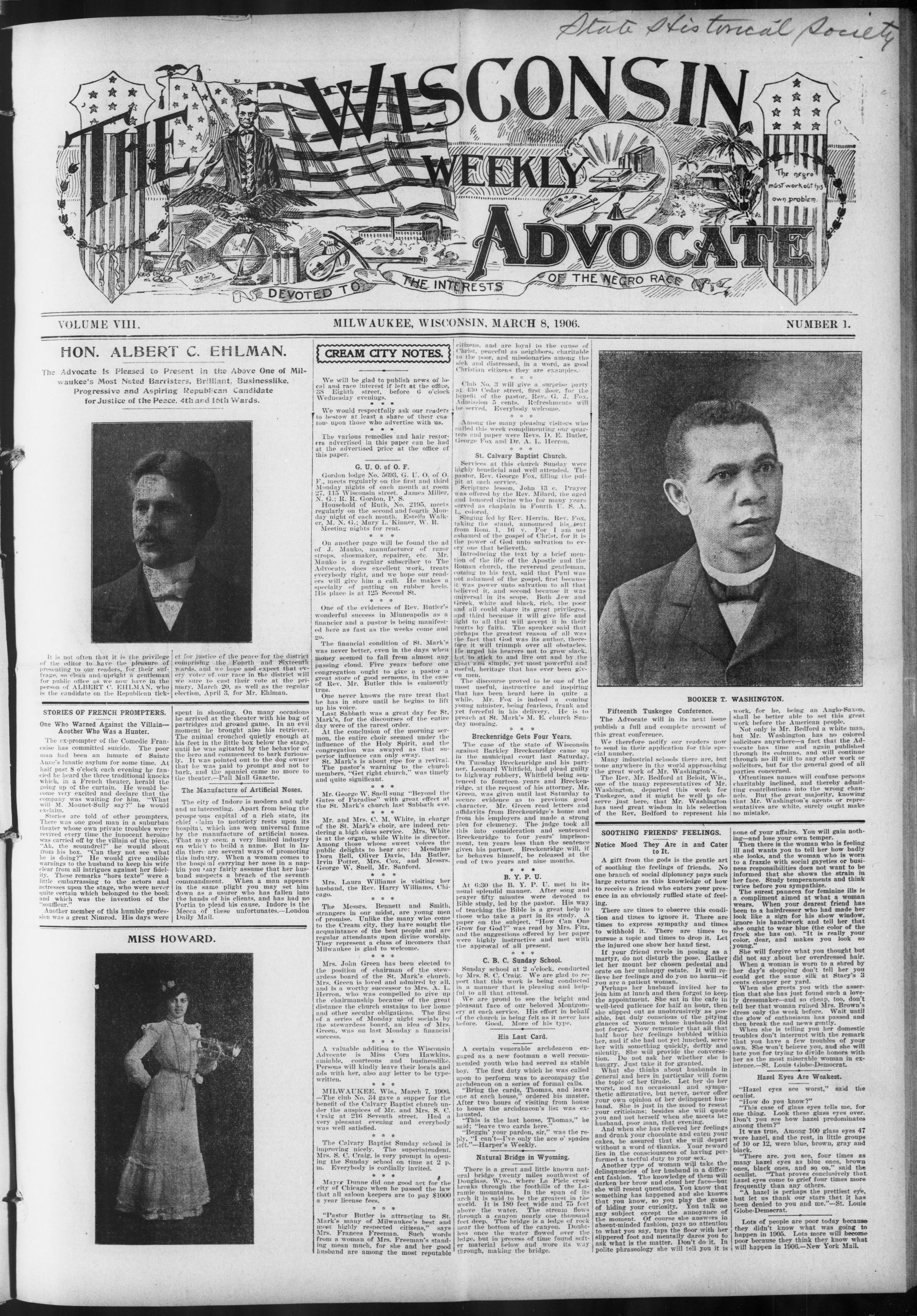
Page text (machine-generated)
State Historical Society
WISCONSIN
WEEKLY
ADVOCATE
DEVOTED TO THE INTERESTS OF THE NEGRO RACE
VOLUME VIII.
HON. ALBERT
The Advocate Is Pleased to P
waukee's Most Noted Barrie
Progressive and Aspirin
for Justice of the Peac
HON. ALBERT C. EHLMAN.
The Advocate Is Pleased to Present in the Above One of Milwaukee's Most Noted Barristers, Brilliant, Businesslike, Progressive and Aspiring Republican Candidate for Justice of the Peace, 4th and 16th Wards.
It is not often that it is the privilege of the editor to have the pleasure of presenting to our readers, for their suffrage, so clean and upright a gentleman for public office as we now have in the person of ALBERT C. EHLMAN, who is the candidate on the Republican tick-
STORIES OF FRENCH PROMPTERS.
One Who Warned Against the Villain— Another Who Was a Hunter.
The ex-prompter of the Comedie Francaise has committed suicide. The poor man had been an inmate of Sainte Anne's lunatic asylum for some time. At half past 8 o'clock each evening he fancied he heard the three traditional knocks which, in a French theater, herald the going up of the curtain. He would become very excited and declare that the company was waiting for him. "What will M. Mounet-Sully say?" he would exclaim.
Stories are told of other prompters. There was one good man in a suburban theater whose own private troubles were revived every time the innocent heroine was carried off by the villain of the piece. "Ah, the scoundrel!" he would shout from his box. "Can they not see what he is doing?" He would give audible warnings to the husband to keep his wife clear from all intrigues against her fidelity. These remarks "hors texte" were a little embarrassing to the actors and actresses upon the stage, who were never quite certain which belonged to the book and which was the invention of the "souffleur."
Another member of this humble profession was a great Nimrod. His days were
MISS H
---
ct for justice of the peace for the district comprising the Fourth and Sixteenth wards, and we hope and expect that every voter of our race in the district will we sure to cast their vote at the primary. March 20, as well as the regular election, April 3. for Mr. Ehlman.
spent in shooting. On many occasions he arrived at the theater with his bag of partridges and ground game. In an evil moment he brought also his retriever. The animal crouched quietly enough at his feet in the little box below the stage, until he was agitated by the behavior of the hero and commenced to bark furiously. It was pointed out to the dog owner that he was paid to prompt and not to bark, and the spaniel came no more to the theater—Pall Mall Gazette.
The Manufacture of Artificial Noses.
The city of Indore is modern and ugly and un interesting. Apart from being the prosperous capital of a rich state, its chief claim to notoriety rests upon its hospital, which has won universal fame by the manufacture of artificial noses. That may seem a very limited industry on which to build a name. But in India there are several ways of promoting this industry. When a woman comes to the hospital carrying her nose in a napkin you may fairly assume that her husband suspects a breach of the seventh commandment. When a man appears in the same plight you may set him down as a usurer who has fallen into the hands of his clients, and has had no Portia to plead his cause. Indore is the Mecca of these unfortunates.—London Daily Mail.
MILWAUKEE, WISCONSIN, MARCH 8, 1906.
CREAM CITY NOTES.
---
We will be glad to publish news of local and race interest if left at the office, 38 Eighth street, before 6 o'clock Wednesday evenings.
We would respectfully ask our readers to bestow at least a share of their custom upon those who advertise with us.
☆ ☆ ☆
The various remedies and hair restorers advertised in this paper can be had at the advertised price at the office of this paper.
G U Q of Q F
Gordon lodge No. 5693, G. U. O. of O. F., meets regularly on the first and third Monday nights of each month at room 27, 115 Wisconsin street. James Miller, N. G.; R. R. Gordon, P. S. Household of Ruth, No. 2195, meets regularly on the second and fourth Monday night of each month. Estella Walker, M. N. G.; Mary L. Kinner, W. R.
On another page will be found the ad of J. Manko, manufacturer of razor strops, shoemaker, repairer, etc. Mr. Manko is a regular subscriber to The Advocate, does excellent work, treats everybody right, and we hope our readers will give him a call. He makes a specialty of putting on rubber heels. His place is at 125 Second St.
```markdown
```
One of the evidences of Rev. Butler's wonderful success in Minneapolis as a financier and a pastor is being manifested here as fast as the weeks come and go.
The financial condition of St. Mark's was never better, even in the days when money seemed to fall from almost any passing cloud. Five years before one congregation ought to give a pastor a great store of good sermons, in the case of Rev. Mr. Butler this is eminently true.
One never knows the rare treat that he has in store until he begins to lift up his voice.
Last Sabbath was a great day for St. Mark's, for the discourses of the entire day were of the rarest order.
At the conclusion of the morning sermon, the entire choir seemed under the influence of the Holy Spirit, and the congregation was swayed as that superior influence can only sway.
St. Mark's is about ripe for a revival. The pastor's warning to the church members, "Get right church," was timely and quite significant.
* * *
Mr. George W. Snell sung "Beyond the Gates of Paradise" with great effect at the St. Mark's church last Sabbath eve.
* * *
Mr. and Mrs. C. M. White, in charge of the St. Mark's choir, are indeed rendering a high class service. Mrs. White is at the organ, while White is director. Among those whose sweet voices the public delights to hear are: Mesdams Dora Bell, Oliver Davis, Ida Butler, Irvin Potter, Mrs. Cox, and Messrs. George W. Snell, Mr. Sanford.
* * *
Mrs. Laura Williams is visiting her husband, the Rev. Harry Williams, Chicago.
* * *
The Messrs. Bennett and Smith, strangers in our midst, are young men of promise. Unlike the many who come to the Cream city, they have sought the acquaintance of the best people and are regular attendants upon divine worship. They represent a class of incomers that Milwaukee is glad to welcome.
* * *
Mrs. John Green has been elected to the position of chairman of the stewardess board of the St. Mark's church Mrs. Green is loved and admired by all, and is a worthy successor to Mrs. A. L. Herron, who was compelled to give up the chairmanship because of the great distance the church sustains to her home and other secular obligations. The first of a series of Monday night socials by the stewardess board, an idea of Mrs. Green, was on last Monday a financial success.
\* \* \*
A valuable addition to the Wisconsin Advocate is Miss Cora Hawkins, amiable, courteous and businesslike. Persons will kindly leave their locals and ads with her, also any letter to be typewritten.
* * *
MILWAUKEE. Wis., March 7. 1906. The club No. 34 gave a supper for the benefit of the Calvary Baptist church under the auspices of Mr. and Mrs. S. C. Craig at 216 Seventh street. Had a very pleasant evening and everybody was well satisfied.
* * *
The Calvary Baptist Sunday school is improving nicely. The superintendent. Mrs. S. C. Craig, is very prompt in opening the Sunday school on time at 2 p.m. Everybody is cordially invited.
* * *
Mayor Dunne did one good act for the city of Chicago when he passed the law that all saloon keepers are to pay $1000 a year license fees.
* * *
"Pastor Butler is attracting to St. Mark's many of Milwaukee's best and most highly respected citizens," says Mrs. Frances Freeman. Such words from a woman of Mrs. Freeman's standing mean much, for she and her good husband are among the most reputable
citizens, and are loyal to the cause of Christ, peaceful as neighbors, charitable to the poor, and missionaries among the sick and distressed, in a word, as good Christian citizens they are examples. * * *
Club No. 3 will give a surprise party at 430 Cedar street, first floor, for the benefit of the pastor, Rev. G. J. Fox. Admission 5 cents. Refreshments will be served. Everybody welcome.
```markdown
```
Among the many pleasing visitors who called this week complimenting our quarters and paper were Revs. D. E. Butler, George Fox and Dr. A. L. Herron.
* * *
St. Calvary Baptist Church
Services at this church Sunday were highly beneficial and well attended. The pastor, Rev. George Fox, filling the pulpit at each service.
Scripture lesson, John 13 c. Prayer was offered by the Rev. Milard, the aged and honored divine who for many years served as chaplain in Fourth U. S. A. I., colored.
Singing led by Rev. Herrin. Rev. Fox, taking the stand, announced his text from Rom. 1, 16 v. For I am not ashamed of the gospel of Christ, for it is the power of God unto salvation to every one that believeth.
Introducing the text by a brief mention of the life of the Apostle and the Roman church, the reverend gentleman, coming to his text, said that Paul was not ashamed of the gospel, first because it was power unto salvation to all that believed it, and second because it was universal in its scope. Both Jew and Greek, white and black, rich, the poor and all could share its great privileges, and third because it will give life and light to all that will accept it in their hearts by faith. The speaker said that perhaps the greatest reason of all was the fact that God was its author, therefore it will triumph over all obstacles. He urged his hearers not to grow slack, but to stick to and live out and by the great and simple, yet most powerful and useful, heritage that has ever been given men.
The discourse proved to be one of the most useful, instructive and inspiring that has been heard here in quite a while. Mr. Fox is indeed a coming young minister, being fearless, frank and yet forceful in his delivery. He is to preach at St. Mark's M. E. church Sunday morning.
Breckenridge Gets Four Years
The case of the state of Wisconsin against Barkley Breckenridge came up in the municipal court last Saturday. On Tuesday Breckenridge and his partner, Leonard Whitfield, had plead guilty to highway robbery. Whitfield being sentenced to fourteen years and Breckenridge, at the request of his attorney, Mr. Green, was given until last Saturday to secure evidence as to previous good character. Mr. Green read letters and affidavits from Breckenridge's home and from his 'employers and made a strong plea for clemency. The judge took all this into consideration and sentenced Breckenridge to four years' imprisonment, ten years less than the sentence given his partner. Breckenridge will, if he behaves himself, be released at the end of two years and nine months.
B. Y. P. U.
At 6:30 the B. Y. P. U. met in its usual splendid manner. After song and prayer fifty minutes were devoted to Bible study, led by the pastor. His way of teaching the Bible is a great help to those who take a part in its study. A paper on the subject, "How Can One Grow for God?" was read by Mrs. Fitz, and the suggestions offered by her paper were highly instructive and met with the approval of all present.
C. B. C. Sunday School.
Sunday school at 2 o'clock, conducted by Mrs. S. C. Craig. We are glad to report that this work is being conducted in a manner that is pleasing and helpful to all that attend.
We are proud to see the bright and pleasant face of our beloved Montgomery at each service. His effort in behalf of the church is being felt as it never has before. Good. More of his type.
His Last Card.
A certain venerable archdeacon engaged as a new footman a well recommended youth who had served as stable boy. The first duty which he was called upon to perform was to accompany the archdeacon on a series of formal calls. "Bring the cards, Thomas, and leave one at each house," ordered his master. After two hours of visiting from house to house the archdeacon's list was exhausted. "This is the last house, Thomas," he said; "leave two cards here." "Beggin' your pardon, sir," was the reply, "I can't—I've only the ace o' spades left."—Harper's Weekly.
Natural Bridge in Wyoming.
There is a great and little known natural bridge twenty miles southwest of Douglass, Wyo., where La Piele creek breaks through the foothills of the Laramie mountains. In the span of its arch it is said to be the greatest in the world. It is 180 feet wide and 75 feet above the water. The stream flows through a canyon nearly one thousand feet deep. The bridge is a ledge of rock near the bottom of the canyon. Doubtless once the water flowed over the ledge, but in process of time found softer material below and wore its way through, making the bridge.
BOOKER T. WASHINGTON
Fifteenth Tuskegee Conference.
The Advocate will in its next issue publish a full and complete account of this great conference.
We therefore notify our readers now to send in their application for this special number.
Many industrial schools there are, but none anywhere in the world approaching the great work of Mr. Washington's.
The Rev. Mr. Bedford at Beloit, Wis., one of the many representatives of Mr. Washington, departed this week for Tuskegee, and it might be well to observe just here, that Mr. Washington has used great wisdom in his selection of the Rev. Bedford to represent his
Notice Mood They Are in and Cater to It.
A gift from the gods is the gentle art of soothing the feelings of friends. No one branch of social diplomacy pays such large returns as this knowledge of how to receive a friend who enters your presence in an obviously ruffled state of feeling.
There are times to observe this condition and times to ignore it. There are times to express sympathy and times to withhold it. There are times to pursue a topic and times to drop it. Let the injured one show her hand first.
If your friend revels in posing as a martyr, do not disturb the pose. Rather let her mount her chosen pedestal and orate on her unhappy estate. It will relieve her feelings and do you no harm—if you are a patient woman.
Perhaps her husband invited her to join him at lunch and then forgot to keep the appointment. She sat in the cafe in well-bred patience for half an hour, then she slipped out as unobtrusively as possible, but duly conscious of the pitying glances of women whose husbands did not forget. Now remember that all that half hour her feelings bubbled within her, and if she had not yet lunched, serve her with something quickly, deftly and silently. She will provide the conversation. Do not ask her whether she is hungry. Just take it for granted.
What she thinks about husbands in general and hers in particular will form the topic of her tirade. Let her do her worst, nod an occasional and sympathetic affirmative, but never, never offer your own opinion of her delinquent husband. She is just in the mood to resent your criticisms; besides she will quote you and not herself when she meets her husband, poor man, that evening.
And when she has relieved her feelings and drunk your chocolate and eaten your cakes, be assured that she will depart without a word of thanks. Your reward lies in the consciousness of having performed a tactful duty to your sex.
Another type of woman will take the delinquencies of her husband in a different fashion. The knowledge of them will darken her brow and cloud her face—but she will resent questions. You know that something has happened and she knows that you know, so you play the game of hiding your curiosity. You talk on any subject except the annoyance of the moment. Of course she answers in absent-minded fashion, pays no attention to what you say, taps the floor with her slippered foot and mentally dares you to ask what is the matter. Don't do it. In polite phraseology she will tell you it is
ten you it is will happen
SOOTHING FRIENDS' FEELINGS.
NUMBER 1.
work, for he, being an Anglo-Saxon, shall be better able to set this great work before the American people. Not only is Mr. Bedford a white man, but Mr. Washington has no colored solicitors anywhere—a fact that the Advocate has time and again published through its columns, and will continue through no ill will to any other work or solicitors, but for the general good of all parties concerned. Oftentimes names will confuse persons charitably inclined, and thereby admitting contributions into the wrong channels. But the great majority, knowing that Mr. Washington's agents or representatives are white, surely ought make no mistake.
none of your affairs. You will gain nothing—and lose your own temper.
Then there is the woman who is feeling ill and wants you to tell her how badly she looks, and the woman who is worn to a frazzle with social gayeties or business responsibilities does not want to be informed that she shows the strain in her face. Study temperaments and think twice before you sympathize.
The surest panacea for feminine ills is a compliment aimed at what a woman wears. When your dearest friend has been to a hairdresser who had made her look like a sign for his show window, ignore his handiwork and tell her that she ought to wear blue (the color of the frock she has on). "It is really your color, dear, and makes you look so young."
She will forgive what you thought but did not say about her overdressed hair. When a woman is worn to a shred by her day's shopping don't tell her you could get the same silk at Stacy's 3 cents cheaper per yard. When she greets you with the assertion that she has just found such a lovely dressmaker—and so cheap, too, don't tell her that woman ruined Mrs. Brown's dress only the week before. Wait until the glow of enthusiasm has passed and then break the sad news gently. When she is telling you her domestic troubles don't interrupt with the remark that you have a few troubles of your own. She won't believe you, and she will hate you for trying to divide honors with her as the most miserable woman in existence.—St. Louis Globe-Democrat.
Hazel Eyes Are Weakest.
"Hazel eyes see worst," said the oculist.
"How do you know?"
"This case of glass eyes tells me, for one thing. Look these glass eyes over. Don't you see how hazel predominates among them?" It was true. Among 100 glass eyes 47 were hazel, and the rest, in little groups of 10 or 12, were blue, brown, gray and black. "There are. you see, four times as many hazel eyes as blue ones, brown ones, black ones, and so on," said the oculist. "That proves conclusively that hazel eyes come to grief four times more frequently than any others. "A hazel is perhaps the prettiest eye, but let us thank our stars that it has been denied to you and me."—St. Louis Globe-Democrat.
Lots of people are poor today because they didn't know what was going to happen in 1905. Lots more will become poor because they think they know what will happen in 1906.—New York Mail.
; & Tea-Table Salad. #* ;
In a Hurry.
Prospective Husband—What Marriage
ceremony do you prefer? a
Prospective Bride (the fourth time)—
Cateh as catch can.—Exchange.
‘The Retort Courteous. ~
Gothamite—New York is the pulse of
the country.
Beaneater—Maybe that is why it has
so many beats.—Baltimore American.
Critic—A wonderful artist indeed! He
painted a London fog?
Visitor—And was St realistic?
Critie—Was it? Why, every one who
looked at it had to snecze.—Columbus
Dispatch.
Sticks to Her Job.
“Miss Blank must have an agelie dis-
position; she’s sung in the same choir for
six years!” 3
“That's no sign! When tliey quarrel,
the others are always the ones to leave.”
—Detroit Free Press.
“And what’s your reason for inereas-
ing the servants’ wages, pray?’ her
friend asked.
“Because my husband complained that
my dress and millinery bills equalled the
household expenses, and 1 want to show
him they do not.”—Tit-Bits.
Considerate Daughter.
A certain young man told his best girl
the other night that if she didn’t marry
him he'd get a rope and hang himself
right in front of her house.
“Oh! please don’t do it, Harry,” she
said. “You know father has always said
he doesn’t want you hanging round
here.”—Ilustrated Bits.
“Gone, but Not Forgotten!
A Georgia man has" placed a granite
slab over the grave of a faithful mule
that died at an advanced age. The slab
bears this inscription:
“In memory of a mule that lived till it
died, a most exciting life; and that went
through the Civil war, and went in a
hurry.”"—Atlanta Constitution,
Liked Plain Language.
Grigsby—There is not a vestige of
truth in your assertion.
Snigsby (furions)—Do you mean to say
I am telling lies?
Grigsby—I do.
Snigsby Qwalking off’—Then why don’t
you say so like a man? I hate fellows
that beat about the bush.—Tit-Bits.
The Horrid Man.
Miss Elderleigh—Just think, Mr. Braisx,
I am within ten years of thirty-five!
Mr. Braix—I can't believe it.
Miss Elderleigh—That’s sweet of you—
but it’s true.
Mr. Braix—Well, if anybody else had
told me you were forty-five, I'd have saia
they were five years out, anyhow.--
Judge.
The editor of an American paper re-
cently apologized to his readers for the
Jack of news somewhat after the fol-
lowing fashion: “We expected to have
both a death and a marriage to announce
this week, but a violent storm prevented
the wedding, and the doctor himself hav-
ing been taken ill his patient recovered,
and we were accordingly cheated out of
both.”—Tit-Bits.
She—Papa believes in the pleasures of
anticipation.
He—Do you agree with him?’
She—Or, yes, indeed. In the summer
he promises to buy me a sealskin coat
the following winter if I'll give up going
to the seaside, and in the winter he
promises to send me to the seaside the
following summer if FH give ue the
sealskin coat. So, you see, | am always
happy.—Tit-Bits.
Very Unusual.
“Say. Smith, your boy is about 3 or 4
years old now, isn’t he?”
“Just 344."
“How is it that you never tell us any
of the bright things he says?”
“Never says any to tell.”
“Look here, Smith! Take great care
of that child! He is destined for great
things.”"—Baltimore American.
Didn't Make Good,
Tess—Don't you think Mr. Galley is
awfully handsome?
Jess—Huh! “Handsome is as hand-
some does.” He told me last evening
that he was going to kiss me before he
Jett.
Tess—The idea! Weren't you indig-
nant?
Jess—I should say I was. When a
man promises to do a thing he ought to
keep his word.—Philadelphia Press.
——————
His Invention Kills Him.
Warren Mitehell, a young inventor liv-
ing near Lawrenceburg, Ind., recently
invented a device tor the protection of
persons skating on weak ice. It was in-
tended to prevent a person from falling
through ice in the event of its breaking,
and consisted of a light framework fast-
ened to the skater’s waist and extending
some 3 feet on either side, so that in
the event of breaking through the frame-
work would rest on the edge of the ice
and prevent the skater from sinking.
Mitchell went out to try his invention
and in skating struck an obstruction
which precipitated him on his head on
thin ice and the upper part of his body
went under. His contrivance held him
fast under the water and he was dead
when taken out of the water. He was
18 years of age and the inventor of sev-
eral devices.
——__-—______
His Conclusion.
“You women folks must be wearin’ a
sight of birds on your hats this season,”
ventured Uncle Abner, as he carefully
removed his coat.
“Why, Abner?” asked Aunt Sophro-
nia.
“Wal. they wus a feller sot in front of
me on the train that was dressed like a
dandy—fur-lined coat, a diamond big as
a shellbark hickory nut, and a plug hat:
and I heard him tell the feller sittin’
with him thet he'd made over $10,000
this year skinnin’ jays.”"—New York
Times.
—_—_+—_—___
Famous Meteorite Sold.
The famous Willamette meteorite has
been sold to a New York scientist, who
will present it to the American Museum
of Natural History. ‘The price paid was
$20,600, which is said to be the highest
amount ever given for a meteorite. The
buge mass er ere is one of the best
meteorites ever discovered, weighing
nbout fifteen tons. It was found near
the banks of the Tualitan river in Clack-
amas ceunty, Ore. After its discoverey
it was the object of litigation amonz
those who claimed to have found it.
Four valuable race horses perished
in a fire that destroyed a barn on Car-
negie road, near Cleveland, O., owned by
Ja. T. Dewey. The horses are Sweet-
heart, trial record 2:1014: Starr, wagon
record 2:29; Ora D., 2:2914, and Mel-
ville, 2:27%. Ora D. had been in foal
to John A. McKerron. Sweetheart was
valued at $3500 and the other horses at
$1000 each.
| THE LAKE IN WINTER.
‘Thy beauty in remembrance wrings my
. eart—
Thou art more fair than eyer women were,
Though their proud fame were blazoned in
all art.
And when I think of winter's cruel hand
Laid hard upon thee, and thy beauty dim
And frozen in his grasp, where all the land
Lies pale and silent in the fear of him,
My soul rebels, and I implore for thee
A ‘miracle! That ‘midst the snow there be
‘A magic circle drawn about thy form—
‘That ull the trees upon thy lovely marge.
Be left forever green, forever fair;
That thy soft serlous waters ever bear
Beneath perpetual summer, spicy-warn,
The vision of an Orient monarch’s barge
wee floating gently through enchanted
ays.
Then | tay the timorous, frost-affrighted
eer
Steal silent to thy rim, released from fear,
To nibble at their will the celandine
And lily pads. There may the hungry fox
‘And slinddering squirrel come on thy de-
jz
Miraculous, from out the frozen night,
And in their wake may all wild creatures
roam,
That shiver by the fey birch and pine,
And come into thy summer, 1s to home,
So mast thou bless them, lovely lake of
mine!
—Louise Morgan Sill in Harper’s Weekly.
A JOKE THAT WAS NOT A JOKE
SCE, a Ue ee ee ee
her toilet, and went to the jewel casket
to take out the necklace which set off her
complexion so well. The officers at the
New York custom house had valued it at
$300,000.
Imagine the consternation of that lady
when, raising the lid of the casket, she
found the necklace gone. She at once
notified the police, and two hours later,
when Lieut. Rich arrived, he found her
nearly hysterical.
After a long and careful search, the
officer finding no clue to the robbery, ad-
vised Mrs. Vanderwart to employ a de-
tective. In the meantime he said that at
headquarters they would do their best to
discover both the thief and the rubies.
For the next week every pawn shop in
the city was searched, but without sue-
cess.
Tf one had ivilowed Mr. Vanderwart
during this time, he would have seen that
the former, instead of continuing straight
for Bermuda, landed a short distance
down the coast at a small town in New
Jersey. After resting there a few days
he returned to New York, and with him
returned the rubies which the police had
failed to tind.
‘The fact was that Mr. Vanderwart was
fond of playing jokes on his wife. Once
he had sold her favorite mare, Cleopatra,
and the man who Lought the horse was
arrested for theft. It required much ado
to explain it all to the authorities and
obtain the man’s release. Vanderwart
had never gene so far, however, as to
conceal a necklace worth more than a
quarter of a million dollars. When, there-
fore, he returned to New York, altered
by the loss of his beard, he passed un-
noticed.
That night he dined at a restaurant on
Broadway and had the pleasure of being
unrecognized by his friends while sitting
within easy reach of them.
The next morning Vanderwart ap-
peared at the police headquarters to claim
the reward of $1000 offered in the papers.
The receiving of the reward and the
credit for discovering the jewels appealed
to him as the best prank he had ever per-
petrated. Great was his surprise there-
fore to find himself arrested for the lar-
ceny of the necklace; and in the exam-
ination the officers refused to reeognize
in him the husband of Mrs. Vanderwart,
showing him a newspaper announcing his
departure for Bermuda for a vacation of
a month. They also showed him a pho-
tograph accompanying the article and
asked hin if he thought he locked like
the millionaire. ‘The pr.soner, seeing his
changed appearance, tried to explain to
the officers, bat all in vain.
Confident that- when his wife saw him
she could explain it all, he ordered the
officers to send for her and addressed a
note to her telling of his plight and beg-
| ging her to release him from prison.
Mrs. Vanderwart arrived in the after-
noon, and as the prisoner was about to
embrace her, she stepped back and looked
at him with an expression of mingled sur-
prise and anger.
“Then it’s as I thought,” said the cap-
tain; “he’s not your husband.”
“Indeed he is not,” replied Mrs. Van-
derwart, “but if he were he could not be
more familiar.”
“What!” gasped the prisoner. “Don’t
you recognize me, Alice, your own Law-
rence?”
Without deigning to look at him again
Mrs. Vanderwart took her necklace and
left the prison.
As “Lawrence” was led to his cell he
asked the officers to send for his lawyer,
Mr. Longstreet.
Meanwhile he was doomed to spend the
night in prison and he slept very little
on his unaccustomed bed. “If ever I get
out of this,” muttered. the unfortunate
gentleman, “I'll quit playing jokes.” But
wishing would not free him and there he
passed the weariest night of his life. In
the morning Mr. Longstreet came and it
did the young man’s heart good to see
him, for he at least recognized him de-
spite his altered appearance. The news
which he received was encouraging, al-
though it aroused the young fellow’s in-
dignation.
The lawyer informed him that his wife
had recognized him, even by his note, but
had been so annoyed by the innumerable
pranks he had indulged in, that she had
{determined, now that she had the oppor-
tunity, to teach him a lesson that he
would not soon forget. And this was the
reason she pretended not to recognize
him the day before. a
Vanderwart was almost. choked with
rage to learn that he had remained in
prison merely because of his wife’s whim.
| His joke had recoiled on him in a very
embarrassing manner. On his promising
to play no more jokes on her, his wife
agreed to identify him, and thereby ob-
tain his release. Although this was ex-
tremely mortifying to him, the prisoner
saw no other way out of it, and con:
sented to the proposal. Accordingly he
left the prison an hour later with a much
lighter heart, but with a mind embar-
rassed by the sudden turn of affairs. It
was with much difficulty that the story
was kept from several eager reporters
whose reputations would have been made
by presenting such a ridiculous side of
a millionaire’s life to the public.
But the story never reached the papers
and Mrs. Vanderwart was troubled no
more by the pranks of her husband. And
she confided to her brother-in-law that
she felt compensated for the worry which
the loss of the necklace had occasioned
her.
When promising that he would never
trouble her again, Mr. Vanderwart said:
“You see, Alice, that for a joke that was
not a joke my recent adventure is a
lucid example.”—Boston Post.
NEW STYLES IN STATIONERY.
Paper Is of Heavy, Coarse Grained Linen
in Delicate Tints.
Styles in stationery change with the
seasons. The very newest monogram is
stamped on a disk of mother of pearl in
silver or gold and set in an Empire
wreath to match. _
The paper used is of ueavy coarse
grained linen in very delieate pearl tints,
‘The upper left hand corner is the proper
place fer the monogram or crest just
now, and every one is running to huge
letters. They are very long and narrow
and when stamped one slightly above the
other, the most modish method, they ex-
tend fully half way down the sheet.
One thing in the new monograin’s fa-
yor is that it is easily decipherable.
Many of the out-of-date ones looked as
much like the writing on Cleopatra's nee-
dle as the initials of an American
woman.
Double envelopes are used. <A letter
from a friend in mourning is enough to
send the average person into forty dif-
ferent kinds of fits.
First the missive is put into a solid
black envelope of a tough, fine texture,
reminding one of an onion skin, and this
goes into a white enveope with a broad
band of black ground it.
Dull gray stationery stamped in biack
is used by those in light or second
mourning. It must strike mere man as
odd that modern femininity should ex-
press degrees of mourning in inanimate
things, but she does, and those who know
say that bereaved ones seem harder to
please in the matter of statiouery and
cards than their more fortunate sisters.
The double envelopes in the most ae¢-
cepted tints are very attractive. For ex-
ample, a very pale lilac has a lining of
rich plum; an opalescent pink an inner
envelope of rich rose; a delicate blue a
sapphire lining, and so on in artistic har-
mony.
All paper for country use is plainty
marked with the address, railroad sta-
tion and telegraph and telephone stations
of the owner.—New York Sun.
BIG DOG WOULD FIX JURY.
Tweed, a St. Bernard, Tries to Plea¢
Master’s Case.
Tweed, Theodore Dauphin’s big. St.
Bernard dog, seemed to be trying to
“fix” the jury in Judge Rasquin’s mu-
nicipal court, Jamaica, L. 1. But Tweed,
being a dog, is honest; he was only act-
ing as Exhibit A for his master; only
proving that he is too amiable and good-
aatured to harm a little girl intentional-
ly. When Tweed was brought into the
courtroom, he put his forepaws on the
raii in front 6f the jury box, and then,
wagging his tail. held out a paw to the
jurors to be shaken, as muci: as to say,
“See what a good dog am J.” When the
judge charged the jury, rather favor-
ably to Tweed and his owner, the St.
Bernard listened intently to the court,
now aud again turning to Mr. Dauphin,
as if to remark, “O learned judge.”
John A. Boyd of 20 Lincoln avenue,
Rockaway Beach, was suing Mr. Dau-
phin, a lawyer, his neighbor, for $500
damages for injuries alleged to have
been received by the plaintiff's child,
Annie, T years old, while playing with
Tweed. Witnesses said that Aunie and
Tweed were the best of friends until
December 16, 1905, when while they
were playing in the yard of her home.
the dog raised his great forepaws and
struck her face. It was not charged
that Tweed is vicious, that the child
had been burt other than acidentally,
but the jury gave Mr. Boyd a_ verdict
for $25.
Tweed is an actor, and formerly
turned the churn in ‘the play called
“The Dairy Farm.”
A PERFECT HAND.
How Its Appearance Became FamiI-
far to the Public.
The story of how probably the most
perfect feminine hand in America be-
came known to the people is rather in-
teresting.
As the story goes the possessor of the
hand was with some friends in a photo-
grapher's one day and while talking,
held up a piece of candy. The pose of
the hand with its perfect contour and
faultless shape attracted the attention
of the artist who proposed to photo-
graph it. The result was a beautiful
picture kept in the family until one
day, after reading a letter from some-
one inquiring as to who wrote the Pos-
tum and Grape Nuts advertisements,
Mr. Post said to his wife, “We receive
so many inquiries of this kind, that it
is evident some people are curious to
know, suppose we let the advertising
department have that picture of your
hand to print and name it “A Help-
ing Hand.” (Mrs. Post has assisted
him in preparation of some of the
most famous advertisements.)
There was a natural shrinking from
the publicity, but with an agreement
that no name would accompany the
picture its use was granted.
The case was presented in the light
of extending a welcoming hand to the
friends of Postum and Grape-Nuts, so
the picture appeared on the back cov-
ers of many of the January and Febru-
ary magazines and became known to
millions of people. ‘
Many artists have commented upon
it as probably the most perfect hand
in the world. :
The advertising department of the
Postum Co. did not seem able to resist
the temptation to enlist the curiosity
of the public, by refraining from giv-
ing the name of the owner when the
picture appeared, but stated that the
name would be given later in one of
the newspaper announcements, thus
Seeking to induce the readers to look
for and read the forthcoming advertise-
ments to learn the name of the owner.
This combination of art and com-
merce and the multitude of inquiries
furnishes an excellent illustration of
the interest the public takes in the
personal and family life of large man-
ufacturers, whose names become house-
hold words through extensive and con-
tinuous announcements in newspapers
and periodicals.
—The most active center of railroaa
work during recent years has been the
southern gulf states.
NEW NOVELTIES IN JEWELRY.
Unique Ornaments Worn Are Sometimes
Very Expensive Studded Toys.
A spiral ring evidently intended to al-
most if not quite cover one phalanx is
composed of a diamond band ornament-
ed with a good sized diamond and a
square cut emerald on either end. ‘i
A charming brooch is in the shape of
a pave diamond shell, holding a perfeet-
ly round white pearl,
“Animal heads are always popular us
searf pins, and one of the most attrac
tive is a deer’s head and antlers entirely
of diamonds.
Occasionally one sees long, slender ear-
rings worn with a smart costume and
matching, or at least harmonizing, with
the color of hat and gown, though as
dealers do not report any demand for
the very extreme siyles, such indications
uinst be taken for what they are worth.
‘The basket weave pattern is shown on
a number of gold card cases and pocket
books in rather dull finish, as distinctive
from the plain, bright gold, which ap.
pears to be much lighter in weight.
The heavy effect is seen in a small
gold mesh purse, which is handsomely
ornamented = with beautifully — chased
frame and finished at the bottom with
pendant pearls. The purse is suspended
by a heavy chain attached to a pretty
ring. which is designed to slip over the
gloved finger.
A gold spoon for the baby has the top
fof the loop handsomely chased.
Some very large stones are seen in long
chains which are connected with heavy
gold links. On the other hand, some ex
tremely light chains are: shown.
‘A unique little ornament, which i.
more or less expensive, is a diamonc
torch displaying a ruby or diamone
flame.
Very artistie and beautiful are new
desigus in the thinnest ef transiucen
enamels, which appear on the surface t
be threaded and edged with gold. Ths
rich, harmonious coioring in’ delicately
shaded effects, together with the motif:
employed, are delightfully novel in’ th
results attained. Costly corsage orna
ments exploit natural forms, sometime:
with Jeaves veined with diamond ¢enst
or perhaps a spray of leaves and flow
ers tied with diamond ribbon.
Among the motifs displayed in thi:
munner is a group of morning glories, :
bunch of bluebells and especially bel
shaped flowers, also leaves with berries
A charming berry design is simulatec
by a bunch of smooth, pink pearls de
pending from diamond veined leaves
grouped gracefully from the swaying
stems, Also in a similar style are some
very charming pendants, attached tog
neck chain formed of slender and rathe
long beads, matching the general tone of
the green lenves, and closely connectec
by links of rich, yellow gold.—Jewelers
iivunianileaakite
WISDOM OF AN EMPIRICIST.
If life were more pleasant it would be
harder to die.
Spare the switch, say the ladies, and
spoil the hair.
A really good man is an 2ecident—that
rarely happens.
It is much harder to make a “mark”
than to be one.
All the reformers I know sthoke bad
cigars or stogies.
A meritorious enterprise is benefited by
being “knocked.”
It is nbout time for somebody to “ex-
pose” the managzines,
‘Somehow one never hears of anyone's
‘Torming “good habits.”
| Wonder why they call that which is
so uncommon, “common sense'?”
The brave man gets a monument,
but the discreet man gets the offices.
“There is no fool like an old fool,” but
there are so many more young ones!
Melancholia is rarely found in con-
junction with a good balance in =
bank,
The man who invented match boxes
evidently had a grudge against the hu-
mun race.
Money will buy most everything for
the millionaire except the things he real-
ly wants.
There are lots of patriots who would
go io war for their country, but not to
the ballot box.
“Farthest hills are greenest” only
when they are far. And that is often
the only way to lend a charm to the
home hills—view them from a distance.
Civilization substitutes law for justice,
and accumulates more than it can use,
so that posterity can lapse into barbar-
ism through being freed from the neces-
sity of working for a living.—St. Louis
i tilobe Democrat.
Unknowns Commit Daring Crime.
Teu men, thought to be revolutionists
from the Baltic provinces deiegated to
risk their lives in quest of funds, com-
mitted a daring robbery at_the Russia
State bank at Helsingfors, Finland, and
escaped with $37,500 after killing the
Seuardinn. The robbery took place in
broad daylight, in one of the principal
thoroughfares of the city, and the means
used to terrify the bank force were two
jiarmiess, empty tomato cans. As they
entered the bank the bandits placed the
cans on the floor and informed the clerks
and officials that the cans were bombs,
which would be exploded if they refused
to obey the command to hold up their
‘hands and retire to a rear room. While
‘the money was being placed leisurely
into sacks the guardian rushed in and
Was shot dead. No trace of the outlaws
has been found.
Seen Sag a eee
PWerrete to Carrv Cables.
General Manager H. V. Farwell of the
Wabash Valley Telephone company. is
making an effort to obtain several fer-
rets, to be used in carrying the cables
through the conduits recently laid here
for putting the wires underground, The
ferrets have been used..with great sue-
cess elsewhere in carrying through a
string, whereby copper wire, then a rope.
and finally the cable itself are drawn
from one manhole to the next. Here-
tofore this work has been done by the
laborious process of “rodding,” the rods
being in three-foot sections, with screw
points, whereby they are coupled up as
they are pushed through the conduits,
being detached in like manner at the op-
posite end.—Paris Cor. Indianapolis
News.
$$ —___—_—_
Wichec ta Find Sons
H. A. Boushon, a farmer living near
the village of Chili, says the Marshfield
News, called at this office to enlist the
services of the paper in attempting te
jocate the whereabouts of two of his
sons, aged 14 and 16 years, who ieft
home on January 12, and except on the
following day, have not been heard from
since. On January 13 the boys called at
the home of their uncle, Fred Bouslon
of Progress, and explained that they
were away from home for the day on
a little pleasure trip. At one place the
statement was mide that they left home
vecause there were no boys in that neigh-
vorhood to play with. The family moved
here from Coimmbia county last Novem-
ber,
go ened al
Total Stock of Money.
The total stock of money, in gold, sil-
ver, and uncovered paper in the whole
world amounts, in round figures, to $12,-
000,000,000. .In the United States. the
total stock of money amounts to about
$2,000,000,000, Hence, we have in our
own purse one-sixth of all the cash «£
the globe. ‘These figures—and this is a
fact which must be emphasized—do not
represent the wealth of nations. War
from it. These figures represent merely
the available hard cash. Divide this hard
eash of the earth among the inhabitants
thereof, and each man, woman, and
child would have $10. But divide the
hard cash of the United States among
the peovle thereof and each one ef us
would have $25. And here is one re-
spect in which the people of « foreign
country would have the better of us, in-
dividually. Were each nation to divide
its cash among its own people, each liv-
ing human being in France would have
$35, or $10 more than each person in our
country under similar circumstances.
Meantime, the divided cash of Great
Britain would give each Briton only S18;
in Germany the cash per capita would
amount to only $17: Russia $8, and Ja-
pan $3, while in Cuba each person would
get only a $2 bill.
Diamonds Unmolested on Walk.
A $400 diamond necklace lay un-
molested on the sidewalk of one of Phil-
adelphia’s main streets all night. Hun-
dreds of people saw_it, but for some un-
known reason refrained from picking it
up. Mrs. Aubrey Weightman attended
the opera at the Academy of Music and
wore the necklace. With her party she
was driven home and after her arrival
missed the necklace. Mr. Weightman
telephoned to the Academy and the
building was searched. Since no trace
of the jewels was found and no answers
received to the advertisements in the
papers, Mrs. Weightman had given up
hope of ever recovering them. In the
morning, however, Joseph Ruff, the let-
ter carrier who delivers mail at the
Weightman house, stopped at the door a
little longer than usual and restored the
lost gems. Ruff found them on his first
round. ‘They were lying on the pave-
ment in front of the Weightman house,
where they had fallen as Mrs. Weight-
man alighted from her carriage the night
before. Ruff received a reward of $100.
ee eens
Appearing Green.
Senator Beveridge was talking one
afternoon in Washington to a group of
newly elected congressmen. “You boys,”
he said, “must on no account appear
green. Keep cool, go slow, think before
you speak; then you won’t give your-
selves away.”
The unripe congressmen laughed, and
Senator Beveridge continued:
“L should hate to hear that one of you
had acted as 2 new southern congress-
man once did.
“He, as soon as he reached Washing-
ton. went off to a photographer's to be
photographed.
““T want my likeness taken,” he said.
“Cabinet? the photographer asked.
“The southerner reddened and looked
pleased.
“ ‘No.’ he answered: ‘just a_ plain, ev-
ery-day congressman.’ ” — Minneapolis
Journal.
pa le GA he
Entirelv Too Finickw_
Prof. M. E. Jaffa of the University
of California is conducting at Oakland a
series of experiments with the object of
increasing the laying power of the hen.
Prof. Jaffa has already secured some
remarkable laying records. In diseuss-
ing these records he said the other day:
“Cleanliness is a prime factor. in suc-
cessful chicken farming. Keep the runs
clean, dry, cheerfyl, and your hens will
do their duty by you nobly.
“In fact. to make hens lay well, it is
almost necessary to carry neatness to
the finicky point—to be as finicky as the
old woman with the aquarium.
“This old woman did not merely keep
the aquarium neat—the glass spotless,
the stones at the bottom snowy—but it
was said of her that every Saturday
‘night she took the fish out and gave
them a bath.”"—New York Tribune.
eee cae
Bov Fires Buildine.
In the last six months the Tuscarawas
County Children’s Home in Ohio has
been the sufferer from twelves fires of
incendiary nature. ‘These culminated in
a $10,000 blaze about a week ago, and
with the aid of a colored fortune teller
the alleged perpetrator was discovered
the other day.
Jacob Nuell of Muskingum county,
aged 12, confessed to this series of
crimes on being pointed out by the ne-
gress, and is now held by the authori-
ties until disposition can be made of
him. He will likely be sent to the stute
industrial school at Lancaster.
During the last half year the youth
made use of every opportunity to start
a blaze, but it was always discovered in
time to save disaster until the school-
house was burned to the ground a short
time ago. Nuell complains that seme
man has been compelling him to follow
this course.
Sedat gees ee
Comes to Aid of Incurabies.
A bill to prohibit in New York state
even the advocacy of the sugges-
tion that persons suffering from an
incurable mental or physical __ail-
ment be put to death was introduced in
the Assembly. The measure provides
that “whosoever, by word of mouth or
by written or printed circulars, mes-
Sages, letters, documents, pamphlets,
newspaper or magazine articles, or pub-
lication of any kind made, issued, or
circulated by him or his authority, advo-
cates or teaches the duty, necessity, or
propriety of putting to death by legal
sanction or otherwise persons afflicted
with an incurable mental or physical dis-
ease because of their sad condition is
guilty of a felony.”
ig
Disappointed: Goes Insane
j. Having come all the way from Georgia
in answer to a want ad for a wife, Miss
Carrie Lee became frantic after the
county judge at Auburn, Neb., had per-
suaded her not to marry John Chuman,
who had wooed at long distance and had
secured a license for the wedding. The
girl had no funds to return to Georgia.
The county attorney invited her to spend
{oe night with his family and she se-
cepted, but during the night she became
insane and was placed in a straight jack-
et and taken to jail. The girl will be
given a ticket back to Georgia as soon
as she becomes rational.
ete aes
Drops of Wisdom.
Never undervalue yourself—the world
will do that for you.
It is within the scope of any man’s
fancy to be as big an ass as he pleases.
These fellows who ‘are eating brain
food in the hope of finding brains are
too late.
No permanent good comes ont of any
public movement that is inspired by
malice.—Exchange.
Dick Padden is getting together a good
team for St. Paul.
FEATS IN BUILDING ROADS.
New Engineering Marvels Accomplished
in the Rocky Mountains.
_ Vast eee in railroad construc-
tion 1s a feature of the Rocky mountain
states, Passes that were pronounced in-
surmountable a few years ago have been
sealed, seemingly impassable canyons
have been threaded, and mountains have
been tunneled to cut down heavy grades,
until the barrier of the Rockies have be-
come no barrier at all.
Only a generation ago engineers were
pronouncing Colorado cog from a
yeaa standpoint. Yet today there
are several railroads making daily climbs
of the fhain range in Colorado, and a
brand-new road, built out of Denver to-
ward Salt Lake City, has climbed the
barrier at a point where ten years ago
civil ape said no roadbed could be
successfully made.
This new railroad is the Denver,
Northwestern & Pacific, commonly called
the Moffat road, for the reason that it
has been projeested and built by David
H. Moffat of Denver. =
The road crosses the main range at an
altitude of 11,660 feet. This terrific
climb is made only by means of the most
tortuous windings and numerous tun-
nels. At one point, called the Bow
Knot, the train plunges through a tun-
nel, makes a sharp turn to the right and
comes back over the very tunnel it en-
tered a few minutes before.
At another point the train literally
“loops the lake.” It swings around a
tiny body of water called Yankee Doodle:
lake, in_so doing describing a complete
circle. Then it climbs up and up, makes
another curve and climbs again, enabling
an individual to stand at the lake and
count tiers of track above him.
When the Denver & Rio Grande pre-
pared to build through the Rockies engi-
neers said the canyon of the Arkansas
could never be penetrated its entire
length. There was one spot in this awe-
inspiring chasm where there was not
room for a roadbed on either side of the
stream.
The walls of the canyon came down
to the swift eurrent of the Arkansas
without foothold for a man on either
side. But an engineer suggested a hang-
| ing bridge, suspended between the walls
of the canyon. ‘The bridge was built
with supports imbedded in the solid rock
and across it the heavy trans-continental
trains flit daily, with nothing but the
slender framework between the river and
the top of the canyon, 2000 feet above.
Great iron braces, which look almost
spiderlike in the vastness of the canyon,
have been thrown across the gorge, being
anchored securely in the sheer sides.
Huge cables depend from these braces,
holding a long iron bridge.
Of course one can Le a little idea of
the railroad wonders that will be wrought
in the next generation, but it hardly
seems possible that the feats of the last
few years can be a Probabiy
the greatest work will be done in the
line of tunnels for the purpose of cutting
down existing grades——New York Trib-
une,
How's This?
We offer One Hundred Dollars Reward for
any case of Catarrh than cannot be cured
by Hall’s Catarrh Cure.
F. J. CHENEY & CO., Toledo, 0.
We, the undersigned, have known F. J.
Cheney for the last 15 years, and believe
him perfectly honorable in all business
transactions and financially able to carry
out any ee made by his firm.
WALDING, KINNAN & MARVIN,
Wholesale Druggists, Toledo, 0.
Hall's Catarrh Cure is taken internally,
acting directly upon the blood and mucous
surfaces of the system. Testimonials sent
free. Price 75c per bottle. Sold by all
Druggists. é
Take Hall's Family Pills for constipation.
Selina leer ah
Essav on the Horse.
Here is a Bombay student's essay
upon the horse:
“The horse is a yery noble quadruped,
but when he is angry he will not do so.
He is ridden on the spinal cord by the
bridle, and sadly the driver places his
foots on the stirrup, and divides his
lower limbs across the saddle, and drives
his animal to the meadow. He has a
long mouth, and his head is attached
to the trunk by_a long protuberance
ealled the neck. He has four legs; two
are in the front side and two are after-
wards. ‘hese are the weapon on which
he runs, and also defends himself by
extending those in the rear in a parallel
direction toward his foe but this fs does
only when in a vexatious mood. His
fooding is generally grasses and grains.
He is also useful to take on his back a
man or woman as well as some cargo.
He has power to run as fast as he could.
He has got no sleep at night time, and
always standing awaken. Also there
are horses of short sizes. They do the
same as the others are generally doing.
There is no animal like the horse; no
sooner they see their guardian or master
they always crying for fooding, but it
is always at the morning time. They
have got tail, but not so long as the cow
and other such like similar animals.”—
Philadelphia Ledger.
—Tea was cultivated in China 2700
years before the Christian era.
—
—In 1905 486 new national banks
were organized.
The Best Guaranty of Merit
Is Onen Publicitv.
Every bottle of Dr. Pierce’s world-
famed medicines eauing he great labo-
ratory at Buffalo, N. Y., has printed
upon its wee all the ae
oe into its composition. This fact
alone places Dr. Pierce’s Family Medi-
cines in a class all by themselves. They
cannot be classed with patent or secret
medicines becduse they are neither. This
is why so many maprelusiced physicians
prescribe them and recommend them to
their patients. They know what they
are composed of, and that the ingredieuts
are those endorsed by the most eminent
medical authorities.
_The further fact that neither Dr.
Pierce’s Golden Medical Discovery, the
— stomach tonie, liver invigorator,
eart regulator and blood purifier, nor his
"Favorite Prescription” for weak, over-
worked, broken-down, nervous women,
contains any alcohol, also entitles them
to a place all by themselves.
eg years ago, Dr. Pierce discovered
that chemically pure glycerine, of proper
strength, is a better solvent and preserv-
ative of the medicinal principles resid-
ing in our indigenous, or native, medi-
cinal plants than is alcohol; and, further-
more, that it possesses valuable medicinal
properties of its own, being demulcent,
nutritive, antiseptic, and a most efficient
antiferment.
Neither of the above medicines con-
tains alcohol, or sey harmful, habit-
forming drag, as will be seen from 7
pa. at the formula printed on each
ttle wrapper. They are safe to use and
potent to cure.
Not only do physicians prescribe the
above, non-secret medicines Jargely, but
the most intelligent people emp! a them
—people who would not think of using
iad acon eee oe meres Ss
vi ingredient entering into the com-
positon sf Dr. Pierce’s medicines has
he sirongrer kind of an endorsement
from leading medical writers of the
several schools of practice. No other
medicines put up for like purposes has
any such professional endorsement.
Dr. Pierce’s Pleasant Pellets cure con-
stipation. Mees ome is the cause of
many diseases... the cause and you
cure the disease. One." Pellet” is a Gove
area = aba ae eran es
gists se! em, nothin, us:
good.” Easy to take as eae:
GOSSIP FOR THE LADIES.
Forgive.
rue air of scented pe floats over the
stream,
rhe day iS done and shadows fall.
Cue by one the stars appear, 7
One by one, as in # dream,
Uy thorghts go baek and say
Forgive.
rhe night is Jong, the way Is steep,
ihe pathway narrow; we lose our way
In wrong o right; we plod along,
Dorhaps to laugh and oft to weep,
Verlaps to linger a little while
And say, forgive!
The soft dew falls in the eventide
on the river, field and stream,
Jest as a word from the ips of one
Who begs and pleads in a world so wide,
Yhat you may hear it somewhere,
The word, forgive.
lry some mistake, perhaps my own,
‘Some petulant word, or look, may be,
The boat went drifting to a far off isle
Where discontent and feud are sown.
Ob, if some une would tell you why
And say, forgive.
Ity some mischance or bitter word.
‘A heedless action born of strife.
Nome impulse heeded but too late.
Some rumor rankles,.a scandal heard,
Some lie repeated breaks the heart—
Forgive! Forgive.
E. L. M. Bristol.
The Difference.
She was a beautiful, beautiful lady,
in a brown Empire gown, with a dream
of a hat, and sables that must have cost
thousands,
She walked slowly, with languid grace
and 9 delicate murmur of refined under-
silks. She seemed to fill the very air
about her with glory and the faint breath
of violets. f
She was, in short, exquisite—from the
dear little curls drooping from her per
fect golden coiffure, to her dainty boots.
‘The man and the woman looked at her
as she swept languidly from picture to
picture. :
“She's the prettiest picture in sight,
isn’t she?’ whispered the woman. (‘The
woman’s hair, be it said, stood out in
straight wisps, and her hat made her
looked tired and haggard, and her fur
piece cost exactly $9, and it would be
best not to mention the age of her
gown.)
“She is certainly stunning,” observed
the man. And the woman noticed that
his eyes followed the living picture, as
did those of every other man in sight.
“What you see, though,” put in the
woman, shrewdly, “is merely the finished
product. If you knew how many hours
and how many hands it took to make
that perfect picture, you wouldn't admire
it so much.”
“Which picture,” absently inquired the
man, still gazing after the Empire frock.
“The one you are looking at,” said the
woman, tartly. “That exquisite and
faultless specimen of the masseuse’s, the
manicure’s, the hair dresser'’s, the millin-
er's and modiste’s art. Did you think
she achieved all that glory herself? Well,
she didn’t. At leasc a dozen persons
have labored today to produce her.
“Somebody brought her her breakfast,
in bed,” ran on the woman. “Someone
else prepared her bath. Some one eise
gave her a massage. Some one dressed
her. Another person came to do_ her
hands. A professional did that hair,
‘That gown and hat are each the work of
artists. Some rich man—her husband or
father—paid for those furs and jewels.
Some one drove her here. Some one else
jumped down from the back seat and
opened the door, in order se she might
not_even have to exert herself so much.
Is it any wonder she arrived here fault-
less, with not a hair out of place, a pic-
ture for men to rave over?
“While I’—and the woman laughed—
“L got up at 7; hurried through bath and
breakfast and got to the office at 8:50;
spent five hours grinding over a desk,
and hustled straight off here to meet
you. I know I don’t exactly look pretty,
old boy, but consider the difference!”
And seeing that the man took one last
look at the Empire frock, the woman
paused before a mirror, slicked back her
hair, jerked her hat straight, dabbed her
kerchief over her face and surreptitiously
flicked the office dust off her shoes.
Two Methods of “Perfect Frankness.”
Absolute sincerity is an admirable
thing. We love our friends to be “per-
fectly frank” with us.
But, oh, there is such a difference in
frankness! There are two such widely
opposite ways of being sincere.
‘There is Anna’s way.
Anna is truthful. She is too good a
friend to deceive you. If she doesn't
like your appearance, ske is too genuine
to gush and tell you how perfectly sweet
you_ look,
If you iook or do well, no one is so
eager as Anna to tell you so. She
praises with the most generous heart.
And there is some satisfaction in having
hor praise, for you can be sure Anna
won't lie to you.
If she cannot honestly praise she is
silent,
“Don't you like my new hat, Anna?”
“It is very nice,” says Anna, gently.
“But you don’t like it, Anna? I can
tell. Now be truthful.”
“If you want me to tell the truth,”
says Anna, hesitatingly, “I do not think
the color becoming to you.”
Your face clouds, for Anna is a first-
rate judge.
“But,” adds Anna, quickly, “it is a
smart enongh hat, and if you tilt it more
on the side, and put a little blue in, near
tle face, I think you can make it more
becoming.”
Anna has been frank when pressed to
be: but she has told the truth so gently
that your feelings have not — been
wonnded, even thouga she has confirmed
yeur belief that that hat was a mis-
But how different Ellen’s way.
Hilen doesn’t wait to be asked for her
opinion,
“Good heavens!” says she, sharply.
“Where did you get that horrid hat?”
“Don't you like it,” you inquire, with
» meekness that belies your real feel-
ings
“No, I don’t,” says Ellen, in a voice
like a two-edged sword. “You never do
get decent hats. If you'd take somebody
with you who knew something!”
This is Ellen's frankness. It is of the
brand that makes you_ shrink. Her
blows knock you out, and crush you, at
first. A little later you rise up defiant,
ready to hate something or somebody,
Both Anna and Ellen scorn a lie. They
both reverence truth. But one tells it
with a regard for your feelings; the
other doesn’t think to be kind.
They are both frank. One’s method
of frankness, howevere, is like a soothing.
healing lotion poured into a wound; and
freee method like a sharp, stinging
acid,
it is well to be frank. It gives our
friends confidence in our sincerity. But
if our criticism is to do good and not
harm, it is infinitely essential that we
be frank in the kindest peat way.—
Uhiladelphia Evening Bulletin.
How to Grow Ferns.
Few need to be told of the infinite
variety and beauty of form and exquisite
shades and tints which are to be found
in the fern class of plants. One cannot
here go into details as to the manage-
ment of each species, but, fortunately
the chief points of fern culture do not
differ materially.
One of the essentials is 2 good supply
of water, and, to enable the soil to with-
stand the effects of frequent watering
without being turned sour, all pots or
other receptacles should be exceptionally
well drained, and the soil itself made ex-
tremely porous.
A frequent cause of disaster to ferns
of delicate root action is overpotting
and using too deep a body of soil in the
pots. A good depth of soil may be suit-
able for some o.: strong growing
Pterises, but for ‘d@Micate Adiantums and
all ferns that spread themselves by
creeping rhizomes, it is especially wrong
to pot or plant in a big body of soil, for
with these the soil is merely a medium
| diroush which the necessary moisture is
conducted to the plants, and if too much
lis used it is soon rendered unfit to per-
form its work and the roots die out.
| ‘All potting should be carried out in
spring just as the new fronds of the
lyear are about to appear. In splitting
plants be careful that each division is weil
provided with roots and crown, so that
they will soon make a good and shapely
plant. ree f '
The soii used in potting may be haif
fiberous loam, broken up as roughly as
can be used, with leaf mould, earth and
sand in equal proportions. The whole
| should be incorporated with finely broken
brick or charcoal.
Ferns may be raised from spores, the
operation being a somewhat delicate one.
Shallow pans should be filled with rocks,
and on these should be placed a few
thin layers of lumpy soil. Press the soil
flat, watering well and then place over
the surface a few fronds which are well
supplied with ripe brown spores. The
pan should be placed in a damp and
shady corner and covered with a sheet
of glass. his may be watered by partly
immersing pan, taking eare not to let
the water rise to the level of the surface.
Rhizomatous ferns may be increased by
securing a lump of soil to the rhizome
near the end and severing this portion
when root has formed.
In spring fertilize fern at least once a
week with bone meal, the washings of
a bird cage is also good for them, ‘They
should be bathed occasionally in tepid
water. They require but little sunlight.
Treated in this way the ferns will grow
majestically.—Cleveland Plain Dealer.
The Why of It.
It is not so much what a mother does,
or how she does it, as it is why she does
it, that molds the characters of her chil-
dren. If a mother punishes a child be-
cause she is nervous, in anger, or be-
eause she is bigger and can, the child in-
stinctively recognizes the unjust motive
and rebels. The effect of the punish-
ment is lost unless the why is right.
Children are an animated question
mark, and nothing but a reasonable an-
swer to the why of life will satisfy them.
Of what use is a life based upon fear of
public opinion, or, maybe, fear of pun-
ishment? Such a life has no more sta-
bility than a house built upon the sands.
When the waves of temptation wash
against it, it will fall. The why we do
a thing, is the basis upon which we rise
or fall.
Many a mother. if she stops to con-
sider the why of a course she has laid
out for her child, will turn right about
face and go in the opposite direction. It
is not what we make our children do, or
how we make them do it, but why we
wish them to do it. It is not enough for
us to thoughtlessly say to a child, “Do
this,” or, “Don’t do that,” but we must
first ask ourselves the why of the com-
mand.
Every child must have instilled into it
a purpose—a firm grasp of why it is
alive. The child soot, jinds that punish-
ment follows swiftly on the heels of mis-
behavior, but unless he is taught the
why, he misbehayes again as soon as the
stings of the punishmenc are healed. It's
the principle underlying the action—the
why we do a thing, not the what we do,
nor the how we do it—that counts both
in this world and the next.
It_is not necessary to sermonize to a
child as*to why he is obliged to go to
school, or to do the many things that a
child has to do to develop properly, if our
own way of life is right. The child will.
almost imperceptibly, absorb the right
motive, the why, from us.
Mothers, so many of them overbur-
dened with household cares, need many,
many times a day to ask themselves the
why of their actions toward their chil-
dren; for it is the why of life that makes
the perfectly developed womanhood and
manhood that is acceptable to God.—
Mothers’ Magazine.
Society and the Wage-Earner.
Society gives cheerful recognition to
the woman who earns her own living,
but it demands from her all that it does
from any other woman.
It demands from the woman who
works exactly what it asks from the
man who works.
It requires that her manners be good,
that she knows how to dress to suit
not only the occasion and place, but
her pocketbook. Society demands of the
woman who works, like the man from
a lawyer's office, like the one in the
commercial field, like the one who is a
teacher, that she does not talk shop.
That she does not bring into social
circles her work and her implements.
That she does not discuss ‘“‘what hap-
pened at the office” at a dinner table;
that she does not speak of the early hour
that must find her at the office.
Society demands the results of the
work, but not the history of the work
itself. It demands that each member
bring a pleasant personality if she wishes
to be in it. Over all this great country
‘there is to be found good society and
it rests with the working woman her-
self whether she is in it or out of it.
The social gathering composed of
brainy men and women who have
thoughts of their own, who are doing
things in this big world, is the society
that is really worth while. 5
If one has the bad taste to prefer noisy
people, whose idea of enjoyment is
roughness, whose conception of couversa-
eon is seandai, and who really haye no
‘reason for existing, then the business
woman will not only injure herself by
her contact with such society, but she
will injure every other woman who
works.
_ People are prone to judge a great reg-
iment by one member of it.
Beauty is not a social necessity, but a
desirable personality is.
Society demands a pleasant smile and
Fs agreeable manner. It is fair in its
payments. It gives value for value re-
ceived always. The wise girl alone in
the city soon recognizes this fact, and
the soonor she recognizes it the easier
will be the path which leads to friend-
ships.—Pittsburg Leader.
-Woman’s Vitality. x
The prevalent idea that men possess
more vitality than women and suffer less
from illness, is being contradicted by
| life-tables, compiled by various insurance
companies, says a writer in Vital Cul-
ture, a litle magazine just launched in
the cause of health and happiness. These
Bee tables seem to show that on the
whole woman has a more tenacious hold
on life than man, An interesting point
in these tables is the mortality rates
‘during the early stages of the life of both
sexes, During the first year of life the
mortality among male babies is greater
than among females. While more males
are born than females, this mortality
among the males reduces their numbers
to such an extent that the numbers of
both sexes are about equal at the end of
the first year. During the first four
years of life this mortality of males in
contrast to the females is strikingly ev
dent. When the five year mark has been
reached the singular fact is made evi-
dent that the female mortality increases
above that of the male and this con-
tinues until the sixteenth year. This in-
crease in the death rate is easily ex-
plained by the fact that boys are given
free rein in their play and are allowed
in the open air from morning until night,
while the girls usually are restrained
from the activity and freedom that their
brothers are allowed to have. Especially
is this so from the age of 12 to 16 when
the death rate among girls is higher than
among boys. | If parents allowed more
outdoor romping and exercise to their
daughters at this critical period and less
corset wearing and dignity the tables
would not show this peculiar fluctuation
and increase in death rate. After the six-
teenth year and through the later years
of life women seem to possesses greater
tenacity of life than do men. If any
readers feel that they would like to com-
ment or throw additional light on this in-
teresting subject we will be pleased to
hear from them.
Aspiration S! :pes Character.
There is a school of philosophers who
assure us that we are what we deeply
long to be. They say that aspiration
shapes character, or something of that
sort. :
This may be true, but sometimes one
is almost tempted to the conclusion that
we are what we deeply desire not to
be, ard that our pet loathings are the
measures of our natures.
“It is such a common strut,” says one
woman in tones of utter disgust. “The
children are so common and the houses
are so common.”
There could be no doubt in the minds
of those who heard that woman that
she valued elegance above salvation, and
yet that she was essentially the thing
that she despised and designated as
“common.” For what is as “common”
as to go through life with eyes open al-
ways for externals, and never ooking
nee into the heart of the human drama?
he announcement, not altogether un-
usual that “people bore me,’ does not
mean that the world is full of bores,
but that the speaker is a self-centered
person who, having no interest in others,
cannot have interest for them, and so is
herself a bore.
On.the whole, it is wise not to express
the grounds of dislike too often and too
openly. One's distastes betray one’s
weaknesses too clearly.—Exchange.
The Best Punishment Is Deprivation.
There must, of course, be punishment.
Even children who are naturally good
need it, in order that they may be kept
in that state of decent subordination
which secures a quiet household. But
the best punishment is that which takes
the form of deprivation.
‘The wise mother deals with the negli-
gent or disobedient child as Nature deals
with the grown man. If the farmer dis-
regards the laws of Nature he gets poor
crops or none. Nature sends him to bed
without his supper, or gives him no but-
ter on his bread. The difference between
a natural punishment and an arbitrary
one is that one is immediately and evi-
dently related to the offense, while the
other is not. A natural punishment ap-
peals at once to the instinct of justice.
The child is to be taught that thought-
fulness, neatness, punctuality, courtesy
and obedience are associated inevitably
with appreciation and happiness, and
that the instant result of disregarding
these virtues is a corresponding loss of
privilege. If the child’s behavior is un-
suited to the serenity and good cheer of
the family table he must be swiftly con-
veyed to the howlery-growlery room,
where he properly belongs. Such de-
privation meets the requirements of just
and effective discipline; it is fair and rea-
sonable and dignified. It can be admin-
istered quietly, gently, with even voice,
and without excitement; and it arouses
no serious resentment or defiance.—La-
dies’ Home Journal.
Love Learns Slowly.
One of the most potent cnuses of dis-
turbance in an affection between sensi-
tive persons is the quickness to speak bit-
terly when wounded, In some natures a
slight rebuff, a seeming neglect, a re-
buke carelessly given, seems to engender
poison; and the venomous retort which
follows is merely the disguise with which
pride seeks to conceal a deep hurt.
We should be very careful how we
wound a sensitive nature like that,
which would so gladly be all sweetness,
if it could. But if we are ourselves the
sensitive ones, we should be doubly care-
ful to keep back the bitter shaft a hurt
pride impels us to send. We should be
silent. until the hurt and the sting has
somewhat passed. Thus we can avoid
wounding in return one who did not
mean to hurt us, and who is probably
more surprised than ourselves at the ef-
fect of his word or deed. It may be we
shall learn he was merely thoughtless;
or that we have misunderstood. But at
any rate, we shall be so much the better
by keeping the poison back.
Be patient with love. It learns slow-
ly:
For just a few brief hours
Her he forgot;
The waves of pain swam round her heart,
The tears sprang quick and hot;
And he, amazed, beheld them fall,
Love learns so slowly, after all!
Then—ah, the pity—straight
She spoke the bitter word,
That hurt as she had little dreamed
When silently he heard;
Fate holds us ever in its thrall.
And love learns slowly, after all.
The Ideal in Every-day Life.
Let us now go for a walk, during
which we will observe the people who
are pursuing their callings.. Let us note
their mood,
We shall come upon persons whom we
cannot see sweep, hammer, or dig the
earth without experiencing a desire to take
from them their broom or hammer or
spade in order to show them how they
ought to use it. This sort of worker is
to be met with quite as often in the
schools, in the chureh, in the studios of
painting and sculpture, as in the fields,
the mines and the shops. Without ideals
people are the same everywhere. When
they teach, they make us weary of learn-
ing; when they make music, they cause
us to hate music. They have no faith in
their work. All the time they have the
air of saying: “What a stupid trade I
have chosen! Be sure my children shall
not follow it.” "
Those who put the ideal into their
work produce an altogether different ef-
fect upon us, whether they be manual or
intellectual laborers. You see them at
work, performing at times unpleasant
duties, which you, perhaps, would not
choose, but, with so fanek oe good-will,
of punctuality and fidelity, and such an
appreciation of “the useful flight of
days” that they appear great to us, and
an envy seizes us to imitate them.—
Charles Wagner. in Harper's Bazar.
Sete Cee SENT?
A high fence should be built between
the words tact and policy for the benefit
“3 those who cannot see the bordering
ine.
“Oh! I have no tact,” they say with a
satisfied air. “Tact and policy are things
I know nothing about.”
And yet the two qualities are as dis-
tinct as north and south,
‘Tact comes from the heart, and policy
from the head. Policy is inspired: by
selfish interests and is a_ treacherous
quality that one might well boast the
lack of.
Tact springs within from an unwilling-
hess to hurt feelings, and it is the mark
of innate kindness that has no personal
motive. °.
Tact is no enemy to truth. It offers
truth on a salver instead of throwing it
inf the face, that’s all.
For the Children.
The Winning of “Whitefoot.”
Pee a eee ei: SEY ee a eee eee ne
men brought English horses to the Is-
land of Roanoke, in eastern North Caro-
lina. Several of these horses escaped
and began to live in a wild state. Slow-
ly but steadily they degenerated into
sinall, active, wiry ponies. Today they
frequent in great numbers the sait
marshes along the coast. They are
known familiarly as “bankers” or
“marsh ponies.” Exceedingly hardy and
easily kept, they form an important in-
dustry in the “east:” and annual “pony-
pennings” are held for the purpose of
sale and swapping. ‘This is an interest-
ing time to the boys who live on the
“banks” and is eagerly awaited from
Year to year. It is the ambition of every
youth to own at least ene pony. No
Indian or Arabian ever sat more store
by his steed.
Charlie Rane, a poor fisherman's son,
lived on the “banks.” The fisherman’s
earnings were scant and uneertain, ow-
ing to his fondness for drink. His wife
and children were frequently forced to
so hungry. In fact, the father had
pawned everything in the hut that couid
be dispensed with. Charlie’s ambition,
therefore, to own a pony of his own
seemed hopeless. Many times he had
eagerly watched the wild herds. If he
could only capture one of the shaggy
little creatures! But what could a 14-
year-old boy do with a lasso?
His desire for a pony was intensified
one morning when a neighbor's — son,
Amos Blake, 16 years old, led a spright-
ly bay pony, which he had bought at the
“penning,” directly by the drunken fish-
erman’s door.
“They are grand, Charlie; you ought to
have one,” exclaimed Amos, rubbing the
little bay’s nose. “I’m going to break
this young fellow and ride him along
the beach in search of driftwood, treas-
ures from wrecks and things.”
He proudly led the pony off, leaving
poor Charlie sad and sick at heart.
“Pa, why can’t I have a marsh pony?”
he ventured, as he entered the hut where
his parents were seated at breakfast. It
was a bold stroke for the lad.
“A marsh pony?’ the fisherman
echoed. You can have a dozen so far as
I'm concerned. They are free as birds.
Catch yourself one.’” The mother looked
pained and the smaller children were
frightened.
“Yes, catch yourself one,” he ran on.
“Yonder is a herd down by the inlet.”
He pointed through the broken window
to where, deep in the marsh-reeds and
outlined against the rolling green of the
sea, a small herd of marsh ponies were
feeding. “Take a piece of sailing rope
and learn to lasso them.”
Charlie turned from the room. He felt
that his heart would break. His sensi-
tive nature smarted beneath the cruel
jest. The most cautious and careful
herdsman could scarcely approach near
enough to the marsh ponies to throw a
lasso over their heads. The dry grass
would rattle; the salt pools would
splash; the very air, though strong with
sea smells, seldom failed to convey the
man smell to the shaggy little horses,
whose heads tiew up like magie ana
whose bright, black eyes seemed to see
everywhere, far and near.
Having nothing better, however, to
engage his time, Charlie walked slowly
toward the herd of ponies, creeping cau-
tiously from bog to bog. When he was
within about thirty yards the leader of
the ponies raised his head, snorted,
pawed the earth and led the herd in a
splashing gallop farther up the beach.
Charlie followed out of mere curiosity.
He had caught a glimpse of two or three
pony colts in the herd. It would be
fun to watch them, at any rate.
Perhaps he could manage to catch one
of them. The idea seemed to be a wild
one, but what boy does not have his
dreams? Hurrying back to the hut, he
obtained a piece of rope.
For something like an hour he ‘fol-
lowed the trail of the ponies, at times
drawing near enough to see that the
most beautiful of the colts had a milk-
white’ forefoct.
The trail led through the “Big Salt
Marsh.” Suddenly the leader of the po-
nies snorted wildly, wheeled and led the
herd away at a furious gallop. For
some reason the white-foot colt did not
join the flight.
Wondering, the boy crept forward,
and peering cautiously through a fringe
of grass, beheld a sight which made him
shiver. The colt was floundering in the
mire. On the bog a few yards distant
crouched a huge wildcat, ‘ts yellow eyes
ablaze, its stumpy tail switching back
and forth. The cat was waiting for the
moment when the colt should become
hopelessly entangled.
The boy's first impulse was to flee and
give warning; but on seeond thought he
saw that help would come | too late.
Something had to be done speedily. The
cat was fast lashing itself into fury.
The boy sought his pocket, and found
a mateh and a coil of wire. Quick as
thought, he gathered up several hand-
fuls of dry grass, and flung the blazing
ball almost in the wildcat’s face. The
creature uttered a piereing scream and
fled terror-stricken up the marsh. _
The courageous boy now turned his at-
tention to the colt. He soon discovered
that it had beeome entangled in an old
fish net which had washed ashore at
high tide. Skillfully making a halter of
his rope, he slipped it over the cold’'s
head, tied a rag over its eyes, and tri-
umphantly led his captive back to the
hut.
The colt became gentle, and soon
recognized its name, “Whitefoot.” It
grew rapidly under the boy’s constant
eare, and proved to be a splendid sad-
die animal. Its affection for the young
master was marvelous. ea
If you should ever chance to visit the
“banks,” and were to meet a handsome
young man patrolling the beach on a
beautiful black pony with a milk-white
foot, you need go no farther to find
Charlie Rane of the United States life-
saving station.—Exchange.
——
Indian May Enter West Point.
Paul Knapp, a_half-breed Indian of
Benton Harbor, Mich., whose mother
was a daughter of Chief Peter Pokagon
of the Pottawattomie tribe, has received
an appointment to enter West Point.
Knapp was formerly a student at Has-
kell institute and receives his appoint-
ment through being recommended to
President Roosevelt by Indian Commis-
sioner Leupp. Knapp is 19 years old.
BRIEF NOTES OF
GENERAL INTEREST
in India the women of three high
castes paint their teeth black.
Wire drawing was invented by Ru-
dolph_of Nuremberg in the early part of
the Fifteenth century. Wire was first
made in England in 1663.
Seven Baltimore & Ohio railroad en-
gineers and conductors were fined $t
and costs each by Justice John Boyle
at Uniontown, Pa., for violating the Sun-
day law by running trains through
Uniontown. Eleven additional warrants
are to be served.
_A new device which will greatly fa-
cilitate party line telephones has been
invented by Julius Storkerson of La
Crosse, and q patent applied for. By.
means of the invention a four” party
line can be transformed into one of eight
and two telephones can be run separate-
ly at the same time.
A few days ago “the only Greek
tramp in Chicago” was arrested. Now
Tony Hirani, a Jap, sainted distinction |
as the first man of his race to be con-
victed of burglary in Illinois. He con-
tessed to Judge Brentano that he stole
a coat from his employer, George W.
Lederer. He was sent to the brideweil.
The stork recently left a_girl baby at
the home in New Castle, Pa., of Abra-
ham Patterson, aged 64 years, an ardeni
admirer of President Roosevelt and the
executive's daughter, and the baby was
christened “Alice «Longworth Patterson.”
Mr. Patterson wrote to the Longworths,
telling them of the event and quoting
the seriptural phrase, “Go thou and do
likewise.”
To become engaged, to set the wedding
day and to be married in one day, is the
record that E. W. Kemble, a wealthy
banker and lawyer of of Carrollton, Mo.,
who has been staying at the Lankers-
heim hotel in Los Angeles, Cal., for
three months, and Miss Alba Calvin of
Pittsburg, Pa., established this week.
The bridegroom is 32 and the bride 1.
They will live in Carrollton.
William Hawley Smith, m an address
at the First Congregational church in
Peoria, IlJ., likened Alexander, Hyde,
McCall and McCurdy to the rich man
in the parable praying from hades for a
drop of water; Rockefeller to the rich
man whose life God had claimed because
of his avarice and greed; and the United
States a nation in perdition because of
the oppression of the Chinese in this
country.
Believing that a monument in Lincoln
park, Chicago, was the north pole,
Charles Nothway, a butcher, attempted
to climb it. Nothway, who was arrested
while scaling the monument, was ar-
raigned before Justice Mayer.
“The monument looked like the north
pole to me, your honor,” said Nothway,
“and I decided to climb it.”
Nothway said that he was “slightly in-
toxicated” and the justice continued his
case.
John D. Rockefeiier nas been made co-
defendent in a suit for divorce brought
by the wife of Henry Phare, carpenter
at the oil king’s summer home, Forest.
Hill, O. Phare makes $16.50 a week
and his wife asks the court to enjoin
Rockefeller from paying him his wages
and also to restrain Phare from dispos-
ing of his lot in ag Heights. Mrs.
Phare charges her husband with aceus-
ing her of unwifely conduct and other
things.
A letter was received by Postmaster
T. H. Baker of Louisville from a man
at Rutland, Vt.. asking the names of
“the unsaved men and women” in Louis-—
ville. The writer explained that he had
read in the papers of the wickedness in
this city and felt called upon to do what
he eould to redeem its people. _Post-
master Baker, in response, sent his cor-
respondent a copy of the city directory
with a letter saying he ‘did not desire
to overlook anybody.”
While walking to the village church at
Simmenthal, Switzerland, with his fian-
cee, on the way to their wedding, the
bridegroom slipped in the snow and fell.
The bride, instead of being sympathetic,
burst into laughter at his discomfiture.
White with anger the young man at
once broke off the match, and the sor-
rowful bride had to continue her way
alone and explain matters to the crowd
of relatives and friends who were wait-
ing to witness the wedding ceremony.
A remarkable restoration of lost eye-
sight occurred to Christian Morkel, a
highly respected retired farmer, just be-
fore his death at Crestline, O., Febru-
ary 26. Morkel had been blind five
years, but just before his death his eye-
sight was restored and he recognized
every member of his family. His death
whs due to the infirmities of age, and
during the five years of his affliction he
constantly, prayed that he might recog-
nize his children before death, He leaves
five sons, three of whom are prominent
merchants of Crestline.
The bottom has fallen out of the mar-
riage market and the Menominee (Mich.)
marrying justices are sitting in their
courtrooms and vainly waiting for the
approach of some couple who will kindly
volunteer to save their reputations in
this their chosen profession. Not since
February 16 has a license been issued at
the Menominee county clerk’s office, al-
though the present fine weather should
act as a stimulant in bringing the Wis-
consin people up to be married. Up to
February 16 the average of one license
each day was kept up nicely.
Leona B. Loan lost a husband beeause
she refused to tell a lie. The girl, whose
age is 16, eloped with Archibald L.
Bright, aged 24, from their homes in
Goshen, Va., to Washington, 160 miles
away. Bright learned the legal age
limit in Washington for young women
who wish to marry withont their par-
ents’ consent is 18, and endeavored to
persuade Miss Loan to give her age as
18 to the marriage license clerk. The
girl couldn’t be induced to lie, and was
obliged to return’ home without a hus-
band to face her mother’s wrath.
a at ae weed Fate. + een Se ee
feared that the victim will not recover.
John Gallacher, who dropped dead in
New York last Thursday, sent to Miss
Elizabeth TFeatherstene. a friend in
Wilkes-Barre. 2 pest card on which was
the picture of a cvitin on which be bad
written:
“Do not think 1 am dead because I
do not write. My busy hours are from
two to four.”
A telegram announcing his death ar-
rived at Wilkes-Barre before the post
card. Miss Featherstone, who, with
several other friends, returned after_at-
tending the funeral, states that he died
between 2 and 4 o'clock in the after-
noon,
Joseph W. Maxwell, attorney for the
Hobart Sheerer estate at Denver, is
about to file a curious petition in County
Judge McCall’s court in that city. Sheer-
er, upon being told he was fatally iil,
made provision for a child he expected
to be born. Sheerer died, and instead ot
one. child there were twins. The will
provided that the child, if a boy, should
have two-thirds of the estate and the
widow one-third: if a girl, she should
have one-third and the widow two-thirds.
What share will the twins, one a boy
and the other a_ girl, have, is the ques-
tion Atterney Maxwell wauts to ask
Judge McCall.
Mary Fautz of Whitehouse, O..° has
been restored mentally and physically by
a bullet which she fired into her brain
with suicidal intent. Some months ago
Mrs. Fautz, having grown morese and
melancholy, tried to die by shooting in
the head. The bullet went into it a con-
siderable distance. penetrating the brain.
Dr. Jacob of Whitehouse probed for it,
and being unable to find it sent her to
the asylum at Toledo on account of her
— unbalanced mental condition.
the was discharged from the asylum
cured. The bullet will remain where it
is in her brain, as there is no apparent
reason for removing it.
Miss Susan Bradley, reputed .to have
the smallest feet of any young woman in
Cincinnati, was married this week to
Allen E. Conkling at the home of her
mother. When it became known that
Miss Bradley was to wed, public atten-
tion was called to the tiny shoes she
wore, and it is said that seven pairs of
the miniature Zootwear are packed in
the trunk that goes with the bridal
couple on their wedding trip. Aside from
her feet the bride is of normal size, being
about 5 feet 3 inches tall and weighing
perhaps 125 pounds. At the wedding
souvenirs representing tiny slippers were
furnished by old friends of the family.
The marriage of William Nelson of
Kingfisher, O. T., and Mrs. Hettie Me-
Carty of Hennessey marks the conclu-
sion of a romance commenced in Wiscon-
sin fifty years ago.
They were schoolmates and sweet-
hearts in the Badger state, but drift-
ed apart when Nelson went to the war
in 1861. After he was mustered out
he drifted to the west, and never re-
turned to his old home. Both married
and have families of grown children.
Both of them came to Oklahoma soon
after the territory was opened to set-
tlement, but they had not met until
quite recently. Then the old flame was
renewed, and the wedding was the se-
quel.
James Osborn, aged 24, is being
‘sought by his friends in Alton, UL, who
desire to rectify a mistake which
caused him to leave St. Louis, it is said,
under the misapprehansion that he was
being sued for divorce, when he is not
married. A suit for divorce was filed in
the city court against James Osborn.
Deputy Sheriff Russell did not know that
the defendant was a negro, and as he
could find only one James Osborn in Al-
ton, he served the summons on that_one,
a white man. Afterward friends of Os-
born made him believe that he had mar-
‘ried while he was intoxicated, and that
his wife was seeking afimony. Osborn
said he was only earning $1.50 a day,
and concluded to leave the city. The
other James Osborn has been found. -
Following a courtship renewed after
seventy years, Capt. Samuel Kuhns,
aged 101 years, recently married Mrs.
Sarah Jackson Crawford, aged 100,
at Maysville, O. The wedding at-
tracted a large crowd. Capt. Kubns and
his bride sat side by side and received
congratulations. They said they expect-
ed to live for many years to come.
When Capt. Kuhns first met the pres-
ent Mrs. Kubns he was a lawyer at
Richmond, Va., and she resided at
Springfield, Il. He was devoted to her
for a long time, but when the Mexican
war began he enlisted, and on his return
found that she had married. He served
four years in the Civil war. A few
years ago the sweetheart he had lost _be-
came a widow. He heard of the fact
and renewed his courtship. He was too
old to pay visits, but he wrote many let-
ters.
Senator Minturn has introduced a bill
in the New Jersey Legislature providing
for the establishment of toll houses and
gates at intervals of ten miles on the
main highways. They shall be connect-
ed by a telephone system, and as each
automobile passes a toll house 10 cents
toll for each person riding shall be paid,
and the number of the auto and the time
shall be telephoned to the next toll sta-
tion. These tolls shall be turned over
weekly to the township collector.
‘The moneys shall be used for road re-
pairs. If any automobilist appears to be
exceeding the speed limit the toll keeper
may summon the nearest constable, and
arrest the offender, who shall be taken
before the nearest’ justice of the peace
and required to furnish bail. If on trial
he is convicted the automobilist’s lieense
shall be revoked for a year. The state
license fee for automobiles shall be $5 a
year, a share of the money to go to the
counties for road repairs.
An unusual marriage ceremony in @
circus tent was interrupted at Houston,
Tex., by force of arms. The parties to
the rite were Mrs. Mollie Bailey, aged
65, and a young man of 30, connected
with the circus. The marriage had been
secretly planned. The couple were stand-
ing in the midst of the ceremonies when
THE OUTSIDE AND THE IN.
ee
John Jones, the famous millionaire,
A splendid palace built.
‘The outside was all marble rare,
‘The inside was all gilt.
John Jones. the wretched millionaire,
In scandal to the hilt,
The outside is all debonair,
‘The inside fs all guilt!
—Town Topics.
THE WISCONSIN WEEKLY ADVOCATE.
R. B. MONTGOMERY, Editor and Proprietor.
The Wisconsin Weekly Advocate after three years' residence at 79 Fifth street, has moved its headquarters to 729 St. Paul Ave., where we will receive our guests and trans- act our business in future.
4 Representative Journal Devoted to the Interest of All the People.
ADVERTISING RATES:
One inch, one year.....$15.00
Two inches, one year.....25.00
Three inches, one year.....35.00
Four inches, one year.....42.00
For larger space, special rates.
Locals, 10 cents per line.
TERMS OF SUBSCRIPTION
One year ..... $2.00
Six months ..... 1.00
Three months ..... .50
Direct all communications to
R. B. MONTGOMERY.
430 Cedar Street.
HOW TO SEND MONEY.—Post Office
Order. Express Order. Draft or Registered
Letter. R. B. Montgomery will not be
responsible for loss when sent in any other
way.
TO CONTRIBUTORS:
All communications must be sent with the name and address of the sender as an evidence of good faith, but not necessarily for publication. No manuscript returned if not accepted, unless accompanied by stamps.
EDITORIAL PARAGRAPHS.
4
"I know of the bravery and character of the Negro soldier. He saved my life at Santiago, and I have had occasion to say so in many articles and speeches. The Rough Riders were in a bad position when the Ninth and Tenth cavalry came rushing up the hill carrying everything before them. The Negro soldier has the faculty of coming to the front when he is needed most. In the Civil war he came 400,000 strong, and I believe he saved the Union."—President Roosevelt.
Dakota's pure paint law, which has just been judicially sustained, has no bearing whatever on the character of that with which Western towns are occasionally "painted red."
The divided skirt has been suggested for the New York society women who have taken to ballooning. This is an illogical idea; the women should adhere to the conventional parachute costume.
---
An aeronaut dropped 1800 feet with an aeroplane, while making an experimental flight. This is an achievement in itself, as it shows what can be done in coming down as well as in going up, if the operator can only keep the machine right side up.
The disappearance in the Macedonian wilds of Albert Sonnichsen, the newspaper and magazine writer, will doubtless be followed by a return with lots of "good stuff" for copy. A little incident like a disappearance adds spice to future contributions.
---
Rev. Dr. Minot J. Savage, pastor of the Church of the Messiah, New York, accompanied by his wife, is on his way to California. Ill health compelled him to give up his pulpit duties and studies temporarily and to seek rest and recuperation in a milder climate.
When a translation of the Bible, which Rev. F. H. Price, a missionary in Guam, is now working on shall have been completed, the Scriptures, or portions thereof, may be read in 360 different languages. The language of the natives of Guam is called Chameere.
---
F. G. Shaffer, a Colorado millionaire mining man, has taken the guardianship of a tribe of Indians. Gratitude for services rendered his father when the latter was a mere child prompted him to look up the lingering remnant of the once powerful Pottawatomie tribe and give them a home.
---
Vice President Fairbanks, when in the Senate, always wears a long Prince Albert, dark gray trousers and a plain black silk tie. Before taking his seat he dusts his chair and he never leaves his shining top hat in the lobby, but brings it into the Senate and places it with extreme caution on the top of his desk.
---
It is said that the father of M. Failieres, the new President of France, was a man of such immense strength that he used to pick up a cask of wine, drink heartily from the bunghole and then ask: "To whom shall I pass the cup?" The President is a bibliophile and often strolls among the book shops bargaining with the dealers for some volume of worth.
---
A curious fact brought out the other day in a lecture by Sculptor Lorado Taft of Chicago, before the Municipal Art society, of Baltimore, was that the first American sculptor was a woman—Patience Wright of Bordentown, N. J., who was a modeler in wax in Revolutionary times. She was a self-made artist, but her work secured quick recognition. She ended her career in London.
Rear Admiral B. F. Lamberton, chairman of the lighthouse board, was placed on the retired list by operation of the age limit. Admiral Lamberton has seen forty-five years of active service in the navy and was Admiral Dewey's chief of staff at the battle of Manila bay. He was born in Pennsylvania and graduated from the Naval academy in 1865. He was attached to the steam sloop Susquehanna on the Brazil squadron for one year and the Wahneta from 1866 to 1867, when he went to the apprentice
---
THE HONORABLE JAMES J. M'GILLIVRAY.
Has Made a Record to be Proud of and One That the People of Wisconsin Ought to Recognize.
M.
In the state of Wisconsin it is hard to pick out any one man who has been in public life and show up his record as a worker for the state without having it said: "There are hundreds of just as good men in the state." This may be true, and we could name several who are worthy of the highest of praise, and we are willing to give praise where praise belongs.
It was often said of the late Jeremiah Rusk that he was just the man for the position of governor when he held the office, and certainly the state made no mistake in giving the reins of government to him when it did, but could he have guided the ship of state through the last few years of political life? We fear not. Yet he served the state well and received his merited praise. It will be a long time ere another such man as Gov. La Follette will be found to fill the executive chair, and even his enemies must admit that he has made a hard fight and has won out against great odds for the cause of the people against the corporations. His mission could not have been filled by another.
In the offices of the state there have been men who filled their plac of trust with great credit to themselves and an honor to the state, and whether in the highest or lowest position of trust, if a man fills it well and honestly, he should have the praise due him for his work. We presume we shall be charged by some with attempt to hoist a man for political preferment who is unworthy of the trust, and many reasons will be given why he is not the right man when we attempt to give just credit to one who has served the state faithfully and well from the Thirty-first senatorial district for the past twelve years and representative from his assembly district for four years previous to that of senator, our Hon. J. J. McGillivray of Black River Falls.
We are not, however, advancing him for any position, for should he never be called upon to take a seat in the legislative bodies of the state or nation he has done enough to place him near the hearts of the citizens of his district and of the whole state. He has been a worker for his party and for the people of the state from the time when as a young man he was picked out as one who could serve his people honestly and well. He has Scotch, English and Irish blood in his veins, but he is a full-blooded American citizen in every sense of the word.
In 1890 he was elected to the Legislature as assemblyman from Jackson county, which has been his home from young manhood. He signalized his advent into the legislative halls by introducing an anti-trust law, which, while it was defeated at that session, was passed by the next Legislature. He was elected for a second term and at this session he succeeded in getting a law passed to exempt wide tire wagons from taxation, a law that in itself would not seem to be of special import, but when the object of the law is known, that of improving the country roads, and thus benefiting the farmers of the state, it will be seen that it was of great benefit. He not only worked for the above measures, but his voice and vote were always recorded for measures that would benefit the people, regardless of political influence. And let me say right here that if his record for the past sixteen years is looked up and his vote investigated not one blot will be found on the pages and not one vote that would cause him to blush because of the stand he took, for while he might not always be with the majority and sometimes his vote might be against what the majority thought was right, yet his vote was an honest one, and if he erred it was of the head and not of the heart.
After serving two terms as assemblyman he was elected to the Senate, and as proof of the esteem in which he is held in his district we have only to turn to the fact that thrice in success- ship Saratoga, where he served until 1869. In the meantime he had been four times promoted. He was promoted to the rank of commander in 1885, and from 1888 to 1889 was commander at the Norfolk navy yard. He served as chief of the bureau of yards and docks and prior to becoming chairman of the lighthouse board he was in command of the Olympia.
Some reigning sovereigns in Europe would be able to earn a living even if deprived of their crowns. The late King of Denmark was a clever artist and could give drawing lessons. The German Emperor has several strings of that kind to his bow, and the Prince of Wales
sion have they elected him to the same position.
We cannot stop to enumerate all the good measures he has advanced or worked for, but a few will suffice, and one of the most important was the bill providing that no building should be erected by the state at a cost greater than the appropriation by the Legislature.
He was among the first who worked for a bill that would provide for the regulation of railroad rates, and was not willing to pass a law to control the taxation without regulation of railroad rates. He was first for a rate commission and did more in a quiet way last winter to bring harmony in the Senate on the rate bill than perhaps any other senator.
He also stood firmly for a 2-cent fare bill. He was an ardent supporter of the anti-pass law, one of the strongest measures adopted by the Republican party in many years, and one that has done a great deal to clean up the politics in Wisconsin.
He has been an ardent advocate for the good roads movement in the state; and at the last session a law was passed providing for county aid in building roads.
The greatest fight of his life, perhaps, was in 1903, when he made a valiant effort to defeat a bill exempting mortgages and credits from taxation, for he believed that every man should pay his just share of the taxes.
Again his voice was heard in the session just closed, when the overzealous enthusiasts for a grand capitol building were attempting to place the state in debt from $15,000,000 to $20,000,000 by accepting a contractor and his plan that would have not only burdened the state with a heavy tax for years to come, but would have probably defeated the Republican party at the next election. His fearless fight against the committee's report brought anathemas from those who were in favor of a palace for a capitol, but it also brought to him the merited approval of hundreds of prominent people of all parties, all of which the writer had the pleasure of seeing with his own eyes. It was worth several million dollars to the state of Wisconsin to have James J. McGillivray in the Senate last winter.
Just at the close of the session a bill came up to buy a state printing plant for the state to do its own work. He investigated the matter and found that it was an actual fact that the state would pay much more for its printing than it now does and would have an army of job seekers to pay for work that they would not do, and so he voted against the bill and it was killed.
It was always a question with him of whether it would be for the best interests of the state and was right.
For three terms he was elected president pro tempore, and in that capacity he showed his executive ability.
His manhood no one would for a moment question. His life is an open book and the pages of his life history will reveal no dark page among them. He has a record as a man and a legislator that any man might be proud of and if he has a weakness it is trying to do too much or in saying too much for the people he represents.
He has been mentioned for higher honors. He is a good level-headed thinker and a pleasing and instructive speaker, filled with a desire to place the truth before his hearers and that will command the respect of all who hear him speak.
If true manhood, integrity of purpose, experience in handling the matters of state, and a zeal to do what is right at all times is now called for, certainly he is entitled to consideration.
A close personal relation with him for the past four years has only increased our admiration for him, and should he announce himself for the high position of governor of the state we should feel honored in supporting him as a candidate from our district and we know we voice the sentiment of many good men in the state in doing so.—Cashton Record.
would find himself at home at the carpenter's bench. King Edward once declared with a laugh that if he found his present occupation gone he would come to this country and become a lecturer.
---
Mansfield has authorized the statement that he had formulated plans for retiring from the stage. It is Mr. Mansfield's intention to play three more seasons, ending his theatrical career in the spring of 1909. Mr. Mansfield is a comparatively young man, being less than 50 years old. It is his desire, he says, to retire before his dramatic powers wane and before the present strain on his vital and nervous energies shatters his health.
IN 1950.
While the autos dashed on their mad career With a terrible "honk, honk!" bark, And the airships zipped through the atmosphere
Marked: "Saturn to Central Park;"
While the whistles shrieked and the whole ground creaked
As the trains underneath it ran.
And policemen swore 'mid the traffic's roar,
I suddenly spied a man
Of that antiquated,
Decimated.
Hunted and hated
Clan,
The genus pedestrian.
And while I looked he murmured "Ah!"
I dodged an old airship that
Describing a neat parabola
Most affably brushed my hat.
And just as he spoke he cracked a joke
And dodged a balloon and ran
From a train of cars that was found for Mars.
The he laughed and again bean:
"You have contemplated
The sole belated.
Unextirpated
Man
Of habits pedestrian."
I stopped my electric cab and said:
"Tis better to whiz or fly.
For if you do not you'll soon be dead
And 'tisn't good form to die."
But he lifted his tile with a friendly smile
And his talking as follows ran
(While he made a dive and escaped alive
From a thundering auto van):
"Oh! I'm that very
Unsedentary,
Agile Ameri-
Can,
The final pedestrian."
—Thomas R. Ybarra in New York Times.
MR. CARROWAY'S POSITION
It is odd how the news of a girl's engagement spreads, and how she at once begins to shed old lovers for whom she has no further use as naturally and painlessly as the seed-pod sheds its outer husks. At least, that was my case.
Of all the men who had vowed always to be my friend, if ever I had need of them, they remained—by the time that my engagement had ceased to be an entirely new delight to me—only Mr. Ambie (short for Ambrose) Carroway; and he, as will presently be shown, continued to dangle merely because he was painfully ignorant of the change that had taken place in my condition. He called on me a few days after the proposal, and as I liked him well enough, in a way, I had him shown up. I must tell you that my fiance had only just left me—indeed, the two men met on the doorstep, I believe.
We exchanged the usual banalities, and he sat down.
"I say," he blurted forth suddenly, "who was that chap I met on the step? Do I know him?" "That was Basil Cosnett." I replied. "Odd-looking person," he remarked. "Where's he from?" "He is from—from all over the world," I replied, deprecatingly.
"He looked a bit all over the shop," said Ambie, tittering.
"I suppose you have never been to the far west, have you?" I asked him.
"N—not exactly," said he. "But how do you mean? Earl's Court?"
"Nor to China?" I went on.
"Well, no," said he, looking somewhat surprised.
"Nor to—let me see—Brazil?"
He stared at me with a slack mouth. "Can't say I have," he replied. "Why?"
"Mr. Cosnett has," said I. "And to heaps of other places, too."
He laughed unpleasantly. "You make me feel horribly inferior," he murmured.
"You haven't traveled much, have you?" said I.
"Oh—well—Paris, you know. And the Riviera. And so on," he said.
"Everybody goes to those places," I rejoined scornfully. And I added, "I think a man ought to travel."
A dull flush overspread his face as he forced a smile. "Shall I travel now?" he asked, rising.
"Don't be absurd," said I, picking up my palette again to paint flowers on satin. "I only meant—you don't mind if I go on working? What I meant was that a man who has traveled has always so much to talk about."
"I should have thought that was rather a fatiguing characteristic." he drawled.
"It would be—in a stupid person. But Mr. Cosnett is an exceedingly clever man." I retorted.
There was a lengthy pause. "Why don't you talk to me?" I asked, at last. "I haven't traveled," he said. "Would you like some tea?" "Thank you," said he. "Shall I ring?" "If you please," said I, and the spirit of mischief being still in me, I went on, teasingly. "Mr. Cosnett knows all about tea. Visited plantations in China and Ceylon, and saw it growing, you know." "I believe things to grow very fast in the tropics," observed Ambie. "Saw it growing, did you say?" This I ignored. "You mustn't think it odd if I seem to quote Mr. Cosnett a good deal," said I. "The fact is, I have seen so much of him lately."
"That reminds me," said he. "I am so sorry I could not get down here last Sunday."
"We got your wire," said I. "It didn't make any difference. Mr. Cosnett was here, you see. He was most entertaining. Told us all about the Maoris. Such curious people. But I'll get him to tell you about them himself."
Ambie rose in disorder and crossed over to the window. Then he came and glowered down at me. I gazed up at him with pathetic eyes.
"You are not at all—nice—today" I pouted.
"I have the misfortune to be a contrast," said he. "Compared with this Cosnett fellow—"
"I hardly think you should speak of him in that way," said I—"a man to whom you have never been introduced. I hardly expected this sort of thing from you. Mr. Carroway." "Nor I from you," he retorted savagely.
I felt a bit frightened. "You are very disagreeable today," I faltered.
"And you are—not too ingenuous, Miss Lacey."
"Now, don't let us be horrid to one another," I said brightly, and smiled my prettiest.
He sat down again. "That brings me to the object of my visit." He looked owlishly solemn.
"Am I not the object, then?" I asked lightly, contracting my brows.
"I mean," he replied, "that I called with a certain specific purpose."
"That sounds exciting, rather," said I. He eyed me in a way that made me feel slightly uncomfortable. "It is not a very pleasant thing I have to—to say to you," he went on, clearing his throat noisily. I was utterly mystified. Was he going
CHURCH-WORKER'S'
FREE BOOK OF MONEY RAISING PLANS
HOW TO RAISE MONEY
is the title of a valuable, instructive book just published, explaining many new and successful plans for raising sums of money from $8.00 to $200.00, quickly and easily without investment, for churches, schools, aid societies, charity or any other purpose.
This book is sent absolutely free, postage prepaid, to interested persons. Address Wisconsin Mfg. Co., Dep't 280. Manitowoc, Wis.
SEND FOR IT TODAY.
THE ROOSEVELT-LONG
FIDELE PO
When writing to advertisers please mention the Wisconsin Weekly Advocate.
FIDELE POUR TOUJOURS
President Roosevelt has received an illuminated copy of the combined escutcheons of Nicholas Longworth and his bride. The combinatian—"impalement" is the heraldic term for it—was made, after some research, by Alfred Rodway. F. R. H. S., an expert in heraldry of Birmingham, England. The shield, of course, exemplifies the union of two very ancient families—the Longworths, originally from Longworth, in the county of Lancaster, England, and the Roosevelts, descended from Claes Murtensen Van Roosevelt, who migrated from Holland to New Amsterdam in 1651. The motto is particularly happy at the moment. "Fidele pour toujours" "Faithful always").
The Longworth arms show on a silver shield, three black dragons' heads, "couped," cut off evenly. The Roosevelt
to propose? I wondered. "Why say it, then?" said I.
"I must. It would be unfair to both of us to keep silence any longer"
But still he found a difficulty in proceeding. "May I ask you a—a question?" he blurted forth at last.
I nodded, smiling. He bent so low over me that his breath stirred my hair and tickled the back of my neck.
"How—how would you define our—our relations?" he said, huskily.
"Our relations?" I repeated. "Yes," said he. "In what relation would you say we stood to one another now?" "I don't know what you mean," said I, laughing nervously. "What does it matter? Why?" He lowered his voice to an irritating drone. "Has it never struck you that I stand in a somewhat ambiguous position?" he said.
I looked at him in frank amazement.
"Look here," he said with an air of real desperation, "don't you think it would be better for us both if I did not call here any more?"
"Of course," said I, with creditable hauteur, "if you don't wish to come——"
"But I do," he protested.
"Then why talk of not calling any more?" said I.
"Can't you see," he said, with a helpless gesture of the hands, "that—that misconceptions may arise?"
"Misconceptions!" I repeated, in genuine perplexity now.
"Yes," he nodded eagerly. "You see, we have been a good deal together, you and J. Such familiar intercourse between a man and a woman as we have enjoyed is apt to prove fatal to the peace of mind of one—at least—of the parties concerned."
Then, indeed. I perceived the whole mean, pitiful vanity of the creature. He actually thought that I was in love with him. Any spark of compunction died in that instant. I felt I could be quite merciless.
"I understand—now," I interposed quickly. "And I can't say how sorry I am. I—I didn't think. I have been foolish—selfish—blind! I liked you, you see. It has been entirely my fault. I feel that now, absolutely."
"No, no, it was my fault," he cried, taking my bait ravenously. "I should have effaced myself sooner."
I raised my melting eyes to his. "I am glad—so glad!—you didn't," said I. "I should have missed many joyous hours if you had. Please don't think me heartless. Pleasant memories are so precious. I shall always remember our friendship kindly, for the sake of those hours." And I choked back a most artistic sob.
I lifted my head sharply, as if bewildered. "Forgive you!" I cried. "What have I to forgive?"
"You are too generous," he murmured. "You overpower me!"
"I am deeply sorry," I quavered, "if I have caused you pain. To forgive you for loving me would be too absurd. What higher honor could you pay me?"
"Believe me, I did love you sincerely," he said. "I cannot help it if I have changed. No man is master of his own heart. I——"
---
WORTH COAT OF ARMS.
TOUJOURS
arms are three red roses on a green hillock. The crest is a boar's head, "couped." holding in the mouth a sword "proper"—having its natural colors. Mr. Rodway executed for The World the arms of the late President McKinley, and Mr. McKinley utilized the expert's sketches. Mr. Rodway has been in this country. When Richard Mansfield revived "King Henry V." at the Garden theater in New York in October, 1900, Mr. Rodway came over with his wife to see that the scenery, costumes, arms and standards in the play were accurate in every heraldic detail. Mr. Rodway, besides being a Fellow of the Royal Historical Society of England, is a Fellow of the Royal Society of Northern Antiquarians of Denmark and a member of the American Historical society, the Antiquarian Society of Canada and the Royal Italian Academy of Heraldry.
I was very effectively amazed: "Do you mean," I explained, "that you—you don't care now?"
"Surely," said he, "you can't have misunderstood me. That is what I have been trying to say."
I hope I looked like Bernhardt as I replied slowly: "I did not understand that."
He rose. I bent my face close to the painted satin. I believe that he was beginning to wonder if, after all, he had gauged me quite accurately. I knew that his mind was fumbling helplessly after a solution of the enigma I presented to him. When my silence had lasted for what must have seemed to him an intolerable while, he spoke again, doubtfully.
"I knew you would forgive me," he sighed. Then I sprang up, raising radiant eyes to meet his gaze. "I am glad!" I almost shouted. "Oh, you can't tell how glad I am!" "Glad!" he stammered, foolishly. I clasped my hands. "I have been dreading so frightfully to see you," I said. "I have been miserable in anticipation of this moment. Think what a relief it is to me to find that you don't care, after all." Then I saw dull anger stirring sluggishly within him. "Don't you care, either, then?" he demanded, sullenly.
"Of course not," I cried, in a rapture. "I can say that now without fear of hurting you. Perhaps I did care—a little—once. Before I met Mr. Cosnett."
He scowled at me. "You almost gave me to understand—" he said, frowning. But I interrupted him. "And we were both mistaken all the time!" I cried. "Oh, what a good job it is—isn't it?—that it doesn't matter a bit, after all. And we can still be friends. And you can congratulate me—"
I paused. He had kicked a hassock out of the way and was mumbling unintelligibly to himself.
"Come," I said, "you should be glad, too."
"I am," he answered. "Of course I am. Still, I didn't think you were the sort of girl—" "Fie!" said I with provoking playfulness. "In our peculiar case reproaches are surely sword-blades without handles. All you can say of me I can say of you, too—and with equal justice." I think he muttered an oath as he stooped, with a flaming face, to pick up his hat. "Good-bye," I said to him heartily. "I must introduce you to Basil—Mr. Cosnett. I should like you to be—you ought to be—friends." He grinned at me spitefully, said "good-bye, Miss Lacey," as if he were cursing me, then stalked out of the room. —Edwin Pugh in Sketch
Nature Does the Rest
On the tin roof of an eight story double building occupied by a firm making a specialty of antique furniture a familiar sight is furnished to occupants of neighboring structures. Dozens of unstained rocking chairs stand on the roof. These rattan and wicker rockers gradually take on the right "antique" complexion by being exposed for several days.—New York Sun.
HELLO, MAIN 1824.
Our wagons speed all over town,
All hours of every day,
Depositing and picking up
Big bundles on the way.
We've got the best machinery,
And expert help galore;
We make your linen gilsten and gleam
Like sea-foam on the shore!
We do not alight an article,
However coarse or fine;
Oh, everything's immaculate
On The American Laundry Line.
And so we bid for patronage,
At least a wholesome share
Of collars, cuffs and shirts and gowns,
And rumpled underwear.
We set the pace and from our point Our banner shall not fall. We fling it to the breeze and reach Going higher than them all.
Laundry left before 8 a. m. can be called for at 6:30 p. m. same day, Saturdays excepted.
WANTED--AGENTS
We want 100 agents in every city, town and hamlet in the U. S. for the Wisconsin Weekly Advocate. It will be devoted to the interest of the Negro race and will contain the news of their sayings and doings throughout the world.
50 Per Cent. Commission
ADDRESS
WISCONSIN WEEKLY ADVOCATE
MILWAUKEE, WIS.
Before Starting on Your Travels
CALL ON
Geo. Burroughs & Sons MANUFACTURERS OF
PREMIUM TRUNKS
VALISES, SAMPLE CASES, Etc.
424 1 426 East Water St.. Milwaukee
S. F. PEACOCK & SON
Funeral Directors
AND
EMBALMERS
431 Broadway. MILWAUKEE, WIS. COAL! COAL! COAL! Get Your Coal from
B. M. GLASPY,
?609-13 State St.,
CHICAGO.
Best in the City.
CHR. RITTER FRED. RITTER
Christian Ritter & Son
UNDERTAKERS
AND
EMBALMERS
276 Fifth St. Milwaukee, Wis.
Telephone 1631 Main.
Come —be the guest of San Antonio this winter. Leavy the chilly north behind you, and find health and pleasure under the stainless splendor of her turquoise sky.
To all newcomers, San Antonio offers a thousand delightful surprises. For the sightseer, the old Mission Churches are still here, the Cathedral of San Fernando, and gray and ghostly in the dazzling sunlight, the historic Alamo. For the invalid a perfect combination of sunny winter weather, pure, dry air, beautiful scenery and modern accommodations. San Antonio is, of all America, the oddest blending of modern utility and beauty, with romance and heroism of the mediaeval.
Come to San Antonio! The exceptionally low rates during the Fall and Winter months—the excellent train service and accommodations via the M., K. & T. Ry. make it a journey of but small cost and not of a tiresome length. I want you to read "The Story of San Antonio." I'll send it on request. Once read, I'm sure you'll be more than half convinced that you should be the guest of San Antonio this winter. Address
W. S. ST. GEORGE,
General Passenger and Ticket Agent,
ST. LOUIS, MO.
THE
MKT
THE MKT
BUSINESS SALON & TRAINING
ENTERTAINING REMINISCENCES OF THE WAR.
Graphic Account of Stirring Scenes Witnessed on the Battlefield and in Camp-Veterans of the Rebellion Recite Experiences of Thrilling Nature.
Nothing seems to operate to reduce the number of lovers of the horse. He may not be in as common use as he was before they introduced, multiplied over and over again and brought electric railroads to their very high rate of perfection, and since the coming of the automobile and its widespread popularity among those who possess them, and their marvelous increase in number, but he still holds his place, and a warm one it is, too, in the affections of his admirers. But this is not to be an essay on the horse and his lovers. The object is to present interesting stories about horses.
In 1900, when President McKinley selected Gen. Adna R. Chaffee, then a colonel of regulars and a volunteer brigadier, now lieutenant general, to join the powers in the expedition to Pekin for the purpose of rescuing the imprisoned and endangered foreign officials on duty there when the Boxer troubles broke out, he asked the general what regiment he would like to have accompany him. He promptly replied that he would prefer his old regiment, the Sixth cavalry, which, when a boy of 18, he joined as a private, and remained with it for thirty years or more. In the shortest possible length of time that regiment, with its full equipment and its carefully selected and finely cared-for horses, was assembled at San Francisco. Two large transports had been fitted up to take the horses to China, while Gen. Chaffee and the regiment, then commanded by Lieut.-Col. Theodore J. Wint, now brigadier general and commander of the department of the Missouri, embarked on the transport Grant. Horses and men parted at the Presidio the last week in June of that year, and did not meet again until the first week in August, at Taku, China. Indeed, all but two troops of the regiment had gone to Tien Tsin before the horses were landed.
No one, who had never before witnessed such scenes, will forget what happened as those horses, that for a month had been on the water and standing still, unsteadily walked from the point of landing to where the two troops of men were stationed. Those who know what close friends the good cavalryman and his horse are can well understand that these Yankee troopers, who had parted from their four-footed friends six weeks before, scrutinized each horse as it passed along in front of them. On the other hand, the horses looked as earnestly at the soldiers as the soldiers did at them. Pretty soon there was a "Hello, Charlie, old boy." A quick response with a whinny, and soldier and horse met—the former's head and the latter's shoulder, with a pair of soldier arms about the animal's neck. I could not say that there were tears in the eyes of the horse, but I can say that there were tears in the eyes of the American cavalryman. Probably the soldier boy was thinking of the far-away home country and his dear ones when his arms twined about the neck of this good American friend. When the horses that belonged to the two troops came along there was apparently as joyous a reunion as soldiers ever participated in. Horses were talked to as though they were long absent friends, just returned, and I guess every horse belonging to the two troops was given a genuine soldier hug. Soldiers and horses looked their happiness at the glad meeting.
Societies for the prevention of cruelty to animals need waste no sympathy on cavalry horses, for the average cavalryman thinks of his horse before he thinks of himself, and is as gentle with him as if he were a brother instead of his horse.
I recently met my former comrade of the old days, Capt. Lloyd G. Harris, a private in '61 and a captain in '65, now a prominent St. Louis business man. He told me a story which he had been called upon to repeat several times by his little girl. It was about a horse in the First New Hampshire battery. Just before the campaign which ended with the second battle of Bull Run and the retreat to Washington began, an order was issued to condemn such of the horses as were disabled or too old to do full duty in the coming contests. The battery had one very old horse that was a great favorite with all of the men. A board decided that "Old Billy"—that was his name—should be condemned and left when the brigade moved. The night before the troops were to move, every man in the battery patted "Old Billy's" neck, talked to him, and bade him a sorrowful farewell. Early the next morning the brigade started for Culpepper Courthouse. After it had been on the road an hour "Old Billy" came up with the battery, and, though wearied and rather wobbly, snickered his delight at meeting his old friends. That noon, when the battery horses were fed, a little toll was taken from the rations of a dozen horses, and "Old Billy" had a good feed. One of the men was instructed to take him to a field half a mile away and leave him, but when night came "Old Billy" was in camp; he had thrown rails from the fence, made his escape, and gone on after the marching army.
Without any preconcerted action here seemed to be enacted a law on the part of the officers and men of the
battery whereby "Old Billy" could have his sweet will; he could follow on or remain behind, but if he followed on, he should have enough to eat and receive proper care. That night the rations of a dozen other horses were reduced just a little so that "Old Billy" had full rations. The old fellow seemed to renew his youth as the days passed. He was in no sense a skulker or a "coffee cooler." When the fighting began "Old Billy" was at the front with the battery. At Bull Run, when the first horse was disabled, the harness was removed and put upon "Old Billy," and he took his place and did faithful service throughout the fight, until another horse was supplied, when he was again turned out to do as he pleased. He pleased to follow the army to Washington, through the city and out into Maryland, to South Mountain and Antietam, all the time growing fatter and apparently happier. But when the army returned to Virginia, after Antietam, "Old Billy" disappeared. The boys in the battery always suspected that some one had stolen him, and always hoped that the thief would be good to him.
At that same battle of Bull Run a horse belonging to Lieut. James Stewart, of Battery B, Fourth artillery, was struck by a cannon ball which carried away his tail and gouged out many pounds of his flesh. "Tartar"—that was this war horse's name—had been with the battery a long time. He went with it to Salt Lake City in 1860, when the Mormons needed looking after by a detachment of the United States army under Gen. Johnson, and naturally was a favorite, but everybody in battery B could see that his days of usefulness were over. He was turned out, as it was supposed, to die, while the battery joined the army in a hurried retreat to Washington. While the brigade to which battery B was attached was in camp near Hall's hill, a few miles from Washington, "Tartar" marched into camp and readily found his way to his old battery. The brigade heard a lusty cheer over in Battery B. Some one wondered what general was passing. A messenger was sent over to find out. He came back with the remark: "Something better than a general caused that cheer; old 'Tartar' has joined the battery, and the boys say he shall go with them if they have to make a horse ambulance to carry him."
Veterinary surgeons were set to work to dress the sufferer's ghastly wounds and when the march through Washington occurred probably no one thing attracted more attention and caused more comment than poor old "Tartar," with his wonderfully bandaged body. No horse in the battery received more care nor had better rations than "Tartar" from that time until he had fully recovered. Though he was tailless and bore the marks of two wounds into which the fattest man in the battery could lay his arm, he was one of the sprightliest animals in Battery E from that time until the end of the war, and when he died, in the 70s, he was given honorable burial, and his loss was keenly felt by the whole command.
I am sorry to have to tell an unfavourable story about an army horse. The late Gen. John A. Kellogg, the last commander of the Iron Brigade, who led that force in Gen. Grant's closing campaign in Virginia, had a large beautiful roan of which he was very proud. But the roan proved to be a dress parade soldier. At the battle of White Oak Road and Gravelly Run, a severe engagement, the first in which Kellogg had directed the movements of the brigade, his big, handsome horse retreated without orders at the first volley. The general sawed on the bits and yelled whoa in vain. The roar fairly flew from the firing line, carrying the brigade commander away from the battle. Finding that he could not halt the animal Gen. Kellogg slide off behind just as Billy Holloway, his orderly, rode up. Taking Holloway's horse he rode back to the brigade in time to save his reputation and win promotion.
It was only necessary, after that, to mention the roan to bring forth from Gen. Kellogg an oration specked with stars and dashes that never failed to set the audience into convulsive roars
In that same battle my "Charley," as manageable and gentle in battle as the gentlest of carriage horses, was shot. I was riding from the center of the brigade to the right to give directions to change position. When the ride was nearly completed "Charley" dropped to his knees, but was up in an instant; and the next instant twenty or more men in gray were demanding my surrender, the guns or some of them being within a few feet of my body. McGowan's Confederate division had driven back the right or our brigade, giving me a chance to ride through thick underbrush into the Confederate line, then advancing. I was too young to die, or thought I was, and just as I dismounted "Charley" fell on his side, dead. He had been shot when he fell to his knees. The war correspondents spoke kindly of old "Charley," lamented his death and incidentally mentioned the death of the brigade's adjutant general, but the latter was only a prisoner.
The loss of "Charley," and my prison onership, at so inopportune a time, reduced the pleasure experienced six weeks later when the general told me that he had recommended a captain's shoulder straps in place of my first lieutenant's straps. That was nearly forty-one years ago. It may be that my admiration for "Charley" and his good conduct, that day, explain why he has never had a successor.—Lieut. Col. J. A. Watrous, U. S. A.
IN THE BUSINESS TO STAY!
JOHN L. SLAUGHTER
Desires to inform his friends and the public generally that he sold out his interest in the coal and wood business on the east side to his brother and has opened a yard for the sale of
in the rear of his premises, 217 WELLS STREET, where he has large and small teams to deliver orders in any quantity promptly.
WESTERN GRAVEYARD POETRY.
Quaint Expressions of Grief One Modern Cemetery Afforded.
A cemetery doesn't have to be a hundred years old to furnish material for the epitaph collectors. The following list of eccentricities was gathered in a single cemetery of a western town, where the earliest grave did not date back more than forty years.
Could anything, for instance, be much more striking than this, unless it were a fake epitaph, which this is not:
Daisy is gone. Where shall I lay my throbbing brow?
We haven't any Daisy now.
Three days before her spirit winged its heavenly flight
She was at school happy and bright.
Or this:
A Smile from God was Little App.
Here is one which shows a determination to preserve the rhyme at whatever cost:
Good brotners and sisters pray for me,
How desolate our home bereft of thee,
Death has no sorrow though that He-Aven cannot heal.
Here is one which could have disposed to advantage of several o's and i's: She was to good, to gentle and to fare To dwell in this cold world of pane And yet we never dared to think Her own would beckon her again. Several others are susceptible of a double interpretation, as, for instance, one which after recording that Elizabeth died at such-and-such-a-date, immediately declares "She hath done what she could." It sounds like a patronizing approval of her having consented to die. "She hath done what she could." Also this one:
And here is one which seems to mark the grave of a man whose ruling passion, strong in death, was punctuality:
And then on time he closed his eyes.
Here is an impressive one:
Twenty years old, a dutiful son, an affectionate brother, a model business man, a faithful Sunday school teacher, a devout Christian, drowned in the Mississippi river.
On one gravestone was hung a common iron horseshoe. On another was a large placard "For Sale." A board on one lot read:
These Plants Are Marked Private.
Another was carefully covered with burlap! Whether to keep the occupant warm was not quite clear. The grave of a child named Charlie was completely covered with a vine known as creeping Charlie.
One little stone was inscribed: "Mamma's Pettie." And another little mound was enclosed in the upper framework of a cradle, evidently the cradle of the child which now slept its last sleep there.
As these are not all the peculiar features of even one cemetery in a modern town, it is evident that the epitaph collectors will have material enough, even if all the inscriptions on the old stones become illegible.—New York Sun.
—Most of the houses and offices in Manila have tiny window panes made of transparent oyster shells instead of glass.
ELK EXPRESS CO.
G. J. CHARLESTON, Mgr.
63 E. Sixth Street,
ST. PAUL, MINN.
Beware of Impostors
of different professions soliciting money in Wisconsin for purposes unknown to any person in that state and for use elsewhere. Driven out of other states they are overrunning this. We think it an imperative duty on us as being the only negro paper in the state, to protect its generous philanthropists. From now on, we shall warn the mayor and chief of police of every city in Wisconsin against such adventurers.
MONON ROUTE
NORTH OR SOUTH
Always ask for tickets
via the
MONON ROUTE
THE SHORT LINE BETWEEN
Chicago,
Indianapolis,
Cincinnati,
Louisville
Six trains daily between Chicago and
the Ohio river.
For folders, rates, etc., call at any
Monon ticket office or address
FRANK J. REED,
Gen'l Pass. Agent, Chicago
S. B. JONES,
C. P. Agent, 232 Clark St., Chicago
STATE STREET MARKET
Telephone
8961 White
OTTO HARBICHT, Prop.
504
STATE ST.
CHOICE MEATS
POULTRY AND GAME IN SEASON
Cholest Spring Chicken
In Stock at All Times.
ROOMS FOR RENT
While in Chicago Stop at
MRS. THOMAS TURPIN'S
92 THIRTY-THIRD STREET
Prices Reasonable. Tel. 8281 Douglas
JOS. POLACHECK, Prop. Suits to Order $15.00 Leaders for This Week UNCALLED FOR SUITS AT HALF PRICE.
126 2nd Street, Milwaukee.
...REPAIRS NEATLY DONE...
Milwaukee Orders Promptly
Rubber Heels 50c Attended
a pair a Specialty.
ARN THE BENEVOLENT PUBLIC AGAINST
RS FOR ALLEGED CHARITABLE INSTITUTE
NEGRO RACE. LOOK WELL TO THE CRE-
NDICANTS AND INQUIRE OF SOME REPUTA-
GARDING THE TRUTHFULNESS OF THEIR
FORD'S
HAIR POMADE
Formerly known as
"OZONIZED OX MARROW"
WE CONTINUE TO WARN THE BENEVOLENT PUBLIC AGAINST THE NUMEROUS BEGGARS FOR ALLEGED CHARITABLE INSTITUTIONS IN BEHALF OF THE NEGRO RACE. LOOK WELL TO THE CREDENTIALS OF SUCH MENDICANTS AND INQUIRE OF SOME REPUTABLE NEGRO CITIZEN REGARDING THE TRUTHFULNESS OF THEIR STATEMENTS.
The Ozonized Ox Marrow Co.
(None genuine without my signature)
Charles Ford Prest
76 Wabash Ave., Chicago, Ill.
Agents wanted everywhere.
M
FRANK MARK
MINNABEEWIS
6 7
WE CONTINUE TO WARN THE
THE NUMEROUS BEGGARS FOR
TIONS IN BEHALF OF THE NEGRO
DENTIALS OF SUCH MENDICANT
BLE NEGRO CITIZEN REGARDING
STATEMENTS.
If You Want a
FURNISHED ROOM
GO TO
MRS. C. C. THOMPSON
223 Sixth Street
She has a 12-room flat, finely
furnished for roomers.
Telephone White 8575
SPECIAL NOTICE
THE "TURF" CAFE
DINNER BILL
Regular Dinner 25c
Dinner 11:30 to 2 p. m. and 5 to 8 p. m.
Sliced Tomatoes, 10c. Radishes, 10c.
Cucumbers, 10c. Green Onions, 10c.
Lettuce, 10c.
BEAN SOUP.
Boiled Trout and Mint Sauce, 25c.
Boiled Leg of Mutton, Egg Sauce, 25c.
Roast Pork and Apple Sauce, 25c.
Short Ribs of Beef with Brown Potatoes, 25c.
Fricasseed Chicken, 25c.
ENTREES.
String Beans. Green Peas.
Boiled and Mashed Potatoes.
Apple and Lemon and Custard Pie.
Rice Pudding.
Coffee and Tea and Milk.
Anything ordered not mentioned on this bill will be charged for extra.
MONROE BROS., Prop's.
104 THIRD ST.
It Pays to Advertise.
J. MUNKO PRACTICAL SHOEMAKER
OZONIZED OX MARROW
so
KINKY or CURLY HAIR that it can be put up in any style desired consistent with its length.
Ford's Hair Pomade was formerly known as "OZONIZED OX MARROW" and is an safe preparation known to us that makes kinky or curly hair straight. as shown above. Its use makes the most stubborn, harsh, kinky or curly hair soft, pliable and easy to comb. These results may be obtained from one treatment; 2 to 4 bottles are usually sufficient for a year. The use of Ford's Hair Pomade ("OZONIZED OX MARROW") removes and prevents dandruff, relieches itching, invigorates the scalp, stops the hair from falling out or breaking off, makes it soft, fastens hair, makes it new life and vigor. Be elegantly perfumed and harmless, it is a toilet necessity for ladies, gentlemen and children. Ford's Hair Pomade ("OZONIZED OX MARROW") has been made and sold continuously since about 1858, and label, "OZONIZED OX MARROW", was registered in the United States Patent Office, in 1874. In all that long period of time there has never been a bottle returned from the manufacturer we bought. The Ford's Hair Pomade remains sweet and effective, no matter how long you keep it. Be sure to get Ford's, as its use makes the hair STRAIGHT, SOFT, and PLIABLE. Beware of imitations. Remember that Ford's, Hair Pomade ("OZONIZED OX MARROW") is put up only in 50 ct. size, and is made only in Chicago and by us. The genuine has the signature, Charles Ford Presst. on each package. Refuse all others. Full directions with every bottle. Price only 50 cts. Sold by druggists and dealers. Do not use unless you can procure it from his jobber or wholesale dealer or send us 50 cts. for one bottle postpaid, or $1.40 for three bottles or $2.50 for six bottles, express paid. We pay postage and express charges to all points in U.S. A. When ordering send postal or express money order, and mention this paper. Write your name and address plainly to
ART TREASURES OF FRANCE.
Many of the Most Marvelously Beautiful Are in Churches.
According to a report issued by the French minister of fine arts, the churches of France, and not the Louvre, the Luxembourg, the Musees de Cluny and Carnavalet, contain the art treasures of the nation. The art treasures in the public galleries and museums are but a comparatively small part of the artistic wealth of France. It is estimated that if brought under the hammer the pictures, tapestries, statues, carvings and other works of art would realize the fabulous sum of six milliards of francs. The little Roman Church of Conques, lost in the mountains of Aveyron, is possessed of a treasure which was on view at the exhibition of 1900. It was of such marvelous beauty that a syndicate of art dealers offered for it the sum of 32,000,000 francs. It contains the finest enamels in the world, reliquaries given by the early kings of France and Roman statues in gold and silver. Fortunately for France the art syndicate did not buy it.
DAZED WITH PAIN.
The Sufferings of a Citizen of Olympia. Wash.
L. S. Gorham, of 516 East 4th street, Olympia, Wash., says: "Six years ago I got wet and took cold, and was soon
flat in bed, suffering tortures with my back. Every movement caused an agonizing pain, and the persistency of it exhausted me, so that for a time I was dazed and stupid. On the advice of a friend I began using Doan's Kidney Pills and soon noticed a change for the better.
A. H.
The kidney secretions had been disordered and irregular, and contained a heavy sediment, but in a week's time the urine was clear and natural again and the passages regular. Gradually the aching and soreness left my back and then the lameness. I used six boxes to make sure of a cure, and the trouble has never returned." Sold by all dealers. 50 cents a box. Foster-Milburn Co., Buffalo, N. Y.
Fresh Air in Sleeping Rooms.
The lack of fresh air in a sleeping room is responsible for many of the morning bad feelings. The close, unpleasant taste in the mouth, the uncomfortable feeling about the head, the lantouor of the whole body, are often the repoorly ventilated sleeping rooms. Ventilation is not always possible Dakota'tments. When one has a large just been with airy chambers, it is easy to bearing it properly; but in small bed that wit it is not always possible to admit air at night without someone takcasional old.
one must have fresh air in the living room. One woman who has The children occupying one of the for them of her tiny apartment always airs have rooms after the children are in bed and the last thing before she retires. She covers the children up snugly, opens the windows, and, while they are raised, shakes out the clothes that have been worn during the day and hangs them where they will air thoroughly in readiness for the morning. The air in the room is changed and freshened before she closes the windows.
This is a good plan; but, of course, it is only a poor substitute for the pure air that ought to be coming into the room all night. There is a simple arrangement by which this can be procured. A board about five inches high should be made to fit into the window, and it should be hinged in the middle that it may be the more easily taken out and in. It must be fitted into the window casing just below the bottom of the sash. The window is then closed as far as possible with the board in. This leaves a space between the upper and lower sash by which the fresh air is admitted in an indirect way.—Success Magazine.
Economical New England Wife
A truly economical woman has been discovered at Wilton, N. H. Her husband was so unfortunate as to have his hand badly mangled by contact with a buzz saw, and a portion of it was amputated by Dr. George W. Hatch. While he was under anesthetic influence his better half remembered that he had discussed having his remaining teeth extracted, preparatory to having an artificial set fitted, and inquired if her husband would remain under the influence of the ether long enough to extract the teeth, and if it would cost any more to have this done also. Receiving favorable replies, she instructed Dr. Hatch to proceed, and her husband, when he regained his senses, found that his wife had "killed two birds with one stone."—Boston Herald.
A NECESSARY EVIL.
Experience of a Minister Who Tried to Think that of Coffee.
"A descendant of the Danes, a nation of coffee drinkers, I used coffee freely till I was 20 years old," writes a clergyman from Iowa. "At that time I was a student at a Biblical Institute, and suddenly became aware of the fact that my nerves had become demoralized, my brain dull and sluggish and that insomnia was fastening its hold upon me.
"I was loath to believe that these things came from the coffee I was drinking, but at last was forced to that conclusion, and quit it.
"I was so accustomed to a hot table beverage and felt the need of it so much, that after abstaining from coffee for a time and recovering my health, I went back to it. I did this several times, but always with disastrous results. I had about made up my mind that coffee was a necessary evil.
"About this time a friend told me that I would find Postum Food Coffee very fine and in many respects away ahead of coffee. So I bought some and, making it very carefully according to the directions, we were delighted to find that he had not exaggerated in the least. From that day to this we have liked it better than the old kind of coffee or anything else in the way of a table drink.
"Its use gave me, in a very short time, an increase in strength, clearness of brain and steadiness of nerves; and sleep, restful and restoring, came back to me."
"I am thankful that we heard of Postum, and shall be glad to testify at any time to the good it has done me." Name given by Postum Co., Battle Creek, Mich. There's a reason. Read the little book, "The Road to Wellville." in pkgs.
THE FORT
LAUNCHING OF THE "DREADNAUGHT."
At Portsmouth the other day King Dreadnaught in the presence of a large in cutting the fastenings of the vessel made from timber of the Victory. The owing to the fact that the Dreadnaught largest and most powerful battle ship's first keel plate was laid only last ordinary speed. This mighty warship been gathered from expert accounts of war. The details of her construction by The Dreadnaught's displacement is by armament will be heavier than that of ten or twelve main armament guns and pedo attacks. The new warship will steam from water tube boilers. A great when on the night before the launching shifted from the chocks on the ways was lifted by means of wedges and she slid after the King had released h
At Portsmouth the other day King Edward christened his battle ship Dreadnaught in the presence of a large and distinguished company. The king in cutting the fastenings of the vessel used a chisel and a wooden mallet made from timber of the Victory. The occasion was one of special interest, owing to the fact that the Dreadnaught, when completed, will be the fastest, largest and most powerful battle ship that moves upon the waters. The vessel's first keel plate was laid only last October and has been built with extraordinary speed. This mighty warship embodies all the latest ideas that have been gathered from expert accounts of the sea fights in the Russian-Japanese war. The details of her construction have been kept secret as far as possible. The Dreadnaught's displacement is between 18,000 and 20,000 tons. Her armament will be heavier than that of any other war vessel. She will mount ten or twelve main armament guns and eighteen three-inch guns to repel torpedo attacks. The new warship will be propelled by turbine engines, taking steam from water tube boilers. A great feat of engineering was accomplished when on the night before the launching the weight of the Dreadnaught was shifted from the chocks on the ways. Her enormous weight of 7,000 tons was lifted by means of wedges and placed on the greased ways, down which she slid after the King had released her fastenings.
SEE USE FOR CORNSTALKS.
Iowans Plan to Use Waste Products for Manufacture of Paper. All Iowa is interested in the plan of turning the waste products of the cornfields of the western corn-producing States into paper, and paper of such quality that it will compare favorably with the famous Japanese vellum. W. R. Patterson, professor of economics and statistics of the State University of Iowa, investigated the process of the National Fiber and Cellulose Company while in Chicago in the interests of the commercial museum of the university.
Just common, ordinary cornstalks, 53,000,000 tons of which are allowed to rot yearly in several Western States producing the greatest amount of corn, is the material from which, experimentally, the company has already produced excellent paper at a cost ranging from $24 to $25 per ton. The cost of manufacturing paper from wood pulp or rags is estimated at from $60 to $75 per ton.
Over $100,000 has been spent in the perfection of machinery for the handling of this material. An improved thrashing machine which separates the stalk from the leaves, husks the ears, delivers the stalks bound in bundles ready for shipment and the parts of the plant valuable for stock food into the barn has only recently been patented. These bundles of cornstalks are then shipped to a depthing plant, where after passing through several operations the pith is separated from the hard fiber surrounding the stalk and rolled, making an excellent quality of paper. The hard outside fiber is used in the manufacture of boxboard.
The company has an option on a paper mill at Kankakee, Ill., where the machines have been operating successfully. Every vestige of the stalk is utilized in some manner. In preparing cellulose, guncotton, smokeless powder, varnish, artificial leather, rubber substitutes, insulating materials, electrical apparatus, linoleum and floor coverings, papier mache and interior decorations, picture frames and signs, paper coverings, lubricants, golf balls and sundry other products different parts of the stalk are said to be available. The development of this industry will mean much to the corn producer of the middle west. Its progress will be watched with intense interest.—St. Paul Pioneer Press.
WHERE WOLF SHOWS SKILL.
Wonderful Intelligence Displayed in Fluding His Enemies
The wolves now found in Jackson County are in size between the coyote of the western plains and the big wolves found in the Ozark region. In general appearance they bear a resemblance to the Scotch collie dog. They live in unfrequented places, generally in the timber or along the streams, and a favorite abode is in caves or under overhanging ledges of stone.
Scratching out a shallow hole in the ground, they line it with small sticks and dry leaves. Here the mother wolf takes care of her young while the father is scouring the country for miles around in search of food. He is rarely seen by day, and then only for an instant, for he seems to melt away like a mist into the weeds or brush, his tawny hide making it easy for him to disappear from sight.
It is said that he has an especial liking for mutton, especially young lambs, which fall an easy prey to him, and that he is most frequently found where sheep are numerous. But he will not turn his nose up at tender little pigs, and when he cannot find other things more to his liking he will not scruple to become a common chicken thief.
But his skill in eluding his enemies, especially human, is remarkable, and this is one of the most aggravating things about him. If a hunter succeeds in getting within gunshot of him the chances are ten to one that no damage will be inflicted. His hide is so thick and tough and is covered with such a heavy coat of fur that an ordinary discharge from a shotgun has little or
Edward christened his battle ship and distinguished company. The king fel used a chisel and a wooden mallet the occasion was one of special interest, that, when completed, will be the fastest, that moves upon the waters. The ves-October and has been built with extra-embodies all the latest ideas that have the sea fights in the Russian-Japanese have been kept secret as far as possible between 18,000 and 20,000 tons. Her any other war vessel. She will mount and eighteen three-inch guns to repel torbe propelled by turbine engines, taking it feat of engineering was accomplished by the weight of the Dreadnaught was. Her enormous weight of 7,000 tons faced on the greased ways, down which her fastenings.
no effect. With an ease that is exasperating he simply lopes out of danger and is soon lost in the brush.—Kansas City Star.
THE HUMAN RIBS.
Man Has Twelve Pairs and Woman Has Just the Same. A man who had been sick said he was so thin he could count his ribs.
When I heard this statement I asked, "How many did you count?" He was unable to answer. Several friends were standing by, and the query was put to them. Not a man could tell the number of his ribs. One bright chap said in all seriousness than a woman has one more rib than a man, because man lost one in the fashioning of woman. And, do you know, this belief is common? Suddenly spring the question on any acquaintance you may happen to meet in the day's journeying. Unless he be a medical man he will in all probability be unable to answer.
It is an anatomical fact that man has twelve pairs of ribs and woman the same number. The four short ribs, two on each side, are the "free" ribs, and in all probability Eve was made of one of these. A man could manage to struggle through life without his free ribs, and I have no doubt that ere long some corset manufacturer will require women to have hers removed in order to lengthen her waist and to reduce its girth. To break a few of the asternal ribs (ten altogether) is nothing; to break some of the sternal (fourteen in number) ones is far more serious. New York Press.
Kissing the Bible in Court.
Justice John M. Yirney, of New York has abolished in his court the custom of requiring a witness to kiss the Bible when he is sworn. It has never been apparent why kissing the Bible should help a witness tell the truth, and we now have Justice Yirney's statement that it has no such effect. Justice Yirney says it is a desecration tending to bring into common and contemptuous use things which ought to be held sacred. The distinction between a lie and a lie under oath, as if the latter were more depraved, has no foundation in logic or morals. To admit such a distinction is a piece of dangerous casuistry tending to corrupt the common mind. To make it the basis of the law of perjury is to confirm the popular belief that legal distinctions have nothing to do with reason and justice.—Portland Oregonian.
"Watches" on Board Ship.
"Watches" on Board Ship.
On board all ships a series of "watches" are established, so that work is shared equally among the sailors. To aid this object also the crews are divided into two divisions, starboard and port. A ship's day commences at noon and there are seven watches. The watch which is on duty in the forenoon one day has the afternoon next day, and the men who have four hours' rest one night have eight hours the next. This is the reason for having "dog watches," which are made by dividing the hours between 4 p. m. and 8 p. m. into two.
Tail of the Fish.
The tail of the fish was the first rudder, and also, it may be added, the first screw propeller. Any one watching the movements of fishes' tails while swimming will be struck with the resemblance to those of a screw propeller.
No Quitting.
Marryat—You don't believe in divorce, then? Mugley—No, sir; I've got too much sportin' blood. Marryat—What has that to do with it? Mugley—I believe in a fight to the finish. Philadelphia Press.
Contempt of Court in a Look.
The public executioner of the grand duchy of Hesse has been fined $20 for "casting a disdainful glance" at the judge of the Supreme Court of Darmstadt.
Spoken from the Heart.
"It's a great thing to be single."
"We bachelors realize that."
"But not like a married man does!"
Philadelphia Press.
IMPRESSED WITH WESTERN CANADA.
Says Our Prairies Will Be Filled Up in Ten Years.
L. A. Stockwell, of Indianapolis, a United States land man, who made an extensive tour of inspection in the West, wrote the following article, under date of Jan. 8, for an Indiana publication:
"States."—In this letter I propose to show by extracts from my note book that thousands who have come up here from the "States" have succeeded far beyond their most sanguine expectations.
Mr. N. E. Beaumunk, of Brazil, Ind., was earning $100 per month with a coal company. At about the age of 40 he had saved about $3,000. Four years ago he landed near Hanley, Sask. He now owns 450 acres of land. Last fall (1905) he threshed 4,700 bushels of wheat and 3,100 bushels of barley oats. His wheat alone brought him over $4,000, which would have paid for the acres that it grew on. He is to-day worth $15,000.
This Is Making Money Fast.
In February, 1902, J. G. Smith & Bro. were weavers in a big cotton mill in Lancashire, England. Coming here, they arrived in Wapella, Sask., with only $750 between them. They were so "green" and inexperienced that all they could earn the first summer was $6.00 per month, and the first winter they had to work for their board. The next year, 1903, they took homesteads, and by working for neighbors they got a few acres broken out, upon which the next year they raised a few hundred bushels of wheat and oats. They also bought a team and broke out about sixty acres more. In 1905 they threshed 1,700 bushels of wheat from it, and 1,300 bushels of oats. Their success being then assured, they borrowed some money, built a good house, barn and implement shed, and bought a cream separator, etc. They now have a dozen cows, some full-blooded pigs and chickens, good teams and implements to match, and are on the high road to prosperity. Here are three cases selected from my note book from among a score of others. One a mine boss, one a farmer, and one a factory operator. With each of them I took tea and listened to their story. "I hoped to better my condition," said one. "I thought in time I might make a home," said another. "I had high expectations," said the other, and all said that "I never dreamed it possible to succeed as I have."
Like Arabian Nights.
Everywhere, on the trains, at the hotels and in family, I have been told of successes that reminded me more of the stories in the Arabian Nights than of this matter-of-fact, workaday world. Yields of wheat from 35 to 53 bushels per acre, and of oats of from 60 to 100 bushels, are numerous in every locality and well authenticated. At Moose Jaw, Lethbridge, Calgary, Edmonton, Regina, Brandon, Hanley and many intermediate places I saw cattle and young horses fat as your grain-fed animals of the "States" that had never tasted grain, and whose cost to their owners was almost nothing. At Moosomin I saw a train load of 1,400 steers en route to England, that were shaky fat, raised as above stated. If the older generation of farmers in Indiana, who have spent their lives in a contest with tags and stumps, as did their fathers before them, could see these broad prairies dotted with comfortable homes, large red barns, and straw piles innumerable, and the thriving towns, with their towering elevators jammed to the roof with "No. 1 hard," and then remember that four or five years ago these plains were tenantless but for the badger and coyote, they would marvel at the transformation. Then if they followed the crowds as they emerged from the trains and hurried to the land offices, standing in line until their respective turns to be waited on came, and saw with what rapidity these lands are being taken, they would certainly catch the "disease" and want some of it too. If these lands are beautiful, in midwinter with their long stretches of yellow stubble standing high above the snow, what must they be in summer time when covered with growing or ripening grain? Speaking of winter reminds me that our Hoosier friends shrug their shoulders when they read in the Chicago and Minneapolis dallies of the temperature up here. The Canadian literature, with its pictures, half-tones and statistics, gives a good idea of her resources, but thirty or forty degrees below zero sounds dangerous to a Hoosier, who nearly freezes in a temperature of five above, especially when accompanied by a wind, as it often is; but the fact is, when it is very cold here it is still, and the air being dry the cold is not felt as it is in our lower latitudes, where there is more humidity in the atmosphere. I am 56, and I never saw a finer winter than the one I am spending up here. I arrived in Winnipeg Nov. 9, and have not had the bottoms of my overshoes wet since I entered Canada. Under a cloudless sky I have ridden in sleighs nearly a thousand miles, averaging a drive every other day. Stonemasons have not lost a week's time so far this winter. Building of all kinds goes right ahead in every city and hamlet, as though winter were never heard of.
Information concerning homestead lands in Western Canada can be had from any authorized Canadian Government Agent, whose advertisement appears elsewhere in this paper.
Bricks Made of Cork
Cork bricks are made of a paste of pulverized cork with plaster, cement, lime, magnesia or tar. The paste is subjected to pressure in rectangular moulds. The cork bricks thus formed are used as building material in arches, roofing and wherever extreme lightness is required.—Philadelphia Record.
HOUSEHOLD TALKS
Salt-Rising Bread.
Scald a teacup thoroughly, then fill nealy half full of warm water, stir in a pinch of soda and salt and thicken with graham flour or with Indian meal. Put in a warm place to rise. Do this during the forenoon. When it is light, set away in a cool place. Next morning stir together to a batter in a bowl of warm water and flour, then stir in the graham "rising." If kept warm it will rise in a short time. Put flour into the bread pan, make a hollow in the center of it, scald a little of the flour with boiling water, then cool with a little cold water, add a half-cup of sugar and a little salt and the risen batter. Mix well and set in a warm place to rise. When light mold into loaves and set in bread tins to rise again, then bake for thirty minutes.
Potato Soup.
Scrub and put into a pan twelve medium sized potatoes with just enough water to cover them, and boll gently until they are done. Pour off the water, and when they are dry, peel and pass them through a sieve. Now melt an ounce and a half of butter in a saucepan, add two onions, finely minced, a teaspoonful of chopped parsley, and a pinch of celery seed. Cover, and let the contents steam gently for fifteen minutes; add the potatoes and enough water to make a smooth firm batter, then enough milk to reduce to the consistency of cream; let it boll up once, season with pepper and salt, and serve. This is one of the most delicious, yet economical soups that come to table.
Canning Grapes.
Grapes may be canned whole without the usual process of scalding. Heat the jars very hot by steaming them over water brought gradually from tepid to boiling heat, or by placing them in the oven in several thicknesses of paper and increasing the heat gradually. Wring a towel from hot water and swathe the cans; then fill them with cold grapes, cover with boiling water, seal, and let stand ten minutes. Then take off the covers, pour off the water, and cover with boiling syrup sweetened to taste, and seal. The skins will not break and the fruit will have a very different flavor from seeded grapes.
Quince and Apple Jelly.
Prepare an equal weight of quinces and tart apples for jelly, that is wash and slice whole, being careful to see there are no wormy spots left in them. Put the quinces in the preserving kettle and boil till soft with enough water to cover them. Then add the apples, still keeping enough water over them, and boil till the whole is a pulp. Strain through a jelly bag and add a scant pound of sugar to each pint of juice. Heat the sugar in the oven and turn into glasses. The flavor of apples and quinces together is pleasanter than that of quinces alone.
Pickled Apples
Sweet apples are best for pickles. Pare, core and quarter the fruit. Take one quart of good cider vinegar, dissolve in it four and one-half pounds of sugar, boil two minutes, add cinnamon and cloves to taste; put into the vinegar as much of the prepared fruit as will cook conveniently, stew slowly until the fruit can readily be pierced by a fork, skim out the fruit and stew more, place the fruit in a jar and pour over all the boiling vinegar that remains. The fruit must be entirely covered by the liquid. Keep the jar closely covered.
Orange and Rhubarb Marmalade. Wash three pounds of tender pink skinned rhubarb and cut in pieces two inches in length. Put three pounds of oranges in the preserving kettle with plenty of cold water to cover, and simmer three hours. Drain and cut in four pieces. Put six pounds of granulated sugar in the kettle with just enough water to prevent sticking, and stir until dissolved and boiling. Add the oranges and rhubarb, stir until boiling, then move to the edge of the fire and cook gently fifteen or twenty minutes. Turn into glasses, but do not cover until cold.
Short Suggestions.
A vanilla bean kept in a box of sugar will impart a delicate flavor to the sugar.
An olive placed in each bouillon cup before pouring in the bouillon gives the liquid an added and pleasing flavor.
No excuse for fragments to lodge in corners and crevices of the refrigerator when skewers will dislodge them so quickly.
Coarse salt and vinegar will clean enameled ware that has been burned or discolored. The same will clean brass or copper.
An authority on fine laundering says that hot water should not be used in washing fine table linen or embroidered dollies. Cold water, with soap and borax, if not a borax soap, should be used instead. To clean a whitewashed ceiling mix starch and water into a paste and apply it to the ceiling with a piece of soft flannel. Leave it to dry and then brush it off lightly with a brush. The blackness will come off with the starch and the ceiling will be most satisfactorily clean.
NERVOUS DYSPEPSIA
A Desperately Serious Case Cured by Dr. Williams' Pink Pills. Brought to the very verge of starvation by the rejection of all nourishment, her vitality almost destroyed, the recovery of Mrs. J. A. Wyatt, of No. 1189 Seventh street, Des Moines, Iowa, seemed hopeless. Her physicians utterly failed to reach the seat of the difficulty and death must have resulted if she had not pursued an independent course suggested by her sister's experience.
Mrs. Wyatt says: "I had pain in the region of the heart, palpitation and shortness of breath so that I could not walk very fast. My head ached very badly and I was seized with vomiting spells whenever I took any food. A doctor was called who pronounced the trouble gastritis, but he gave me no relief. Then I tried a second doctor without benefit. By this time I had become very weak. I could not keep the most delicate broth on my stomach, and at the end of a month I was scarcely more than skin and bone and was really starving to death.
"Then I recalled how much benefit my sister had got from Dr. Williams' Pink Pills and decided to take them in place of the doctor's medicine. It proved a wise decision for they helped me as nothing else had done. Soon I could take weak tea and crackers and steadily more nourishment. In two weeks I was able to leave my bed. Dr. Williams' Pink Pills were the only thing that checked the vomiting and as soon as that was stopped my other difficulties left me. I have a vigorous appetite now and am able to attend to all the duties of my home. I praise Dr. Williams' Pink Pills for Pale People to all my friends because I am thoroughly convinced of their merit."
Dr. Williams' Pink Pills are sold by all druggists and by the Dr. Williams Medicine Co., Schenectady, N.Y.
How Bees Make Wax.
When wax is needed a certain number of self-elected citizens gorge with honey and hang up in chains or curtains, each bee clinging by her front feet to the hind feet of the one above her, like Japanese acrobats, and there they remain, sometimes for two days, until the wax scales appear pushed out from every pocket.
It is not hard to understand that, since honey is needed for the manufacture of wax, a bee after filling with the raw material would produce much more wax by keeping quiet than by using any of the gorge honey for energy in moving about and working. But the necessity of "holding hands" while this work goes on must ever remain to us another occult evidence of the close relations in the bee commune:—Country Life in America.
You Can Get Allen's Foot-Ease FREE
You Can Get Allen's Foot-Ease FREE!
Write to-day to Allen S. Olmsted, Le Roy,
N. Y., for a FREE sample of Allen's Foot-
Ease, a powder to shake into your shoes.
It cures tired, sweating, hot, swollen, aching
feet. It makes new or tight shoes easy.
A certain cure for Corns and Bunlons. All
Druggists and Shoe stores sell it. 25c.
The Largest Horse.
The largest horse I can find in the United States is Royal Prince, who was raised in Crawford county, Pa.
He is a dapple gray, stands nearly 7 feet high at the shoulder, weighs 2800 pounds when fat wears a No. 30 collar and a No. 9 shoe and is very finely proportioned.—Farm and Fireside.
TO CURE A COLD IN ONE DAY
Take LAXATIVE BROMO Quinine Tablets.
Druggists refund money if it fails to cure.
E. W. Grove's signature is on each box. 25c.
—It is estimated that 1000 different species of trees contain rubber, though it has been obtained in commercial quantities from only 40 or 50.
Japanese have been caught circulating counterfeits of gold coins in Tacoma. The molds and batteries were made at Hiroshimi, Japan.
DODD'S
KIDNEY
PILLS
FOR ALL KIDNEY DISEASES
CURES RHEUMATISM
BRIGHT'S DISEASE
DIABETES BACKACHE
discontinued the use of our products
package. The public may rely on
care of imitations. Sold only in bacestead.
WESTERN CANADA
is the amount that many farmers will realize from their wheat crop this yeat
25 BUSHELS TO THE ACRE
will be the average yield of wheat
The land that this was grown on cost many of the farmers absolutely nothing, while those who wished to add to the 100 acres the Government grants, can buy land adjoining at FROM $0 TO $10 AN ACRE. Climate splendid, schools convenient, railways close at hand, taxes low. For "20th Century Canada" pamphlet and full particulars regarding rates, etc. Apply for information to Superintendent of Immigration, Ottawa, Canada, or to T. O. Currie, Room 12. B. Callahan Block, Milwaukee, Wis., Authorized Government Agents.
Please say where you saw this advertisement.
There is no satisfaction keener
than being dry and comfortable
when out in the hardest storm.
YOU ARE SURE OF THIS
IF YOU WEAR
TOWER'S
FISH BRAND
WATERPROOF
OILED CLOTHING
BLACK OR YELLOW.
607 CM SALA EVERYWHERE.
A.J.TOWER CO. BOSTON, MASS. U.S.A.
TOWER CANADIAN CO., Limited, TORONTO, CAN.
Mayer
MARTHA WASHINGTON
COMFORT SHOES
are designed for extreme comfort and can
be worn all the year round. They fit like a
glove and feel easy on the feet. The elast-
tic at the sides stretches with every motion
of the foot, making it impossible to pinch
or squeeze. No buttons to button, no laces
to lace—They just slip on and off with-
out trouble.
Made of Vici Kid, with patent leather trim-
mings and flexible soles.
Your dealer will supply you; if not, write to us. Look for Martha
Washington name and Mayer trade-mark stamped on the sole. We
also make Western Lady shoes
FREE
Send us the name of a dealer who does not handle
Martha Washington Shoes and we will send you
free, postpaid, a beautiful picture of Martha
Washington, size 15 x 20.
F. MAYER BOOT & SHOE CO.,
MILWAUKEE, WIS.
MILWAUKEE
F.MAYER
BASCO
CUSTOM MADE
TWO OPEN LETTERS
IMPORTANT TO MARRIED WOMEN
Mrs. Mary Dimmick of Washington tells How Lydia E. Pinkham's Vegetable Compound Made Her Well.
It is with great pleasure we publish the following letters, as they convincingly prove the claim we have so many times made in our columns that Mrs.
Mrs. Mary Dimmick
Pinkham, of Lynn, Mass., is fully qualified to give helpful advice to sick women. Read Mrs. Dimmick's letters. Her first letter :
Dear Mrs. Pinkham:— "I have been a sufferer for the past eight years with a trouble which first originated from painful periods—the pains were excruciating, with inflammation and ulceration of the female organs. The doctor says I must have an operation or I cannot live. I do not want to submit to an operation if I can possibly avoid it. Please help me."—Mrs. Mary Dimmick, Washington, D. C. Her second letter :
Dear Mrs. Pinkham:—
"You will remember my condition when I last wrote you, and that the doctor said I must have an operation or I could not live. I received your kind letter and followed your advice very carefully and am now entirely well. As my case was so serious it seems a miracle that I am cured. I know that I owe not only my health but my life to Lydia E. Pinkham's Vegetable Compound and to your advice. I can walk miles without an ache or a pain, and I wish every suffering woman would read this letter and realize what you can do for them."—Mrs. Mary Dimmick, 59th and East Capitol Streets, Washington, D.C.
How easy it is for Mrs. Dimmick to write to Mrs. Pinkham at Lynn, Mass., and how little it cost her—a two-cent stamp. Yet how valuable was the reply! As Mrs. Dimmick says—it saved her life.
Mrs. Pinkham has on file thousands of just such letters as the above, and offers ailing women helpful advice.
Among the ladies no other medicine has ever had so strong a following, because, excepting pure air and exercise, it is the source of more beautiful complexions than any other agency, as
Lane's Family Medicine
the tonic-laxative. It puts pure blood in the veins, and no woman can be homely when the rich, red blood of health courses in her veins. Sold by all dealers at 25c. and 50c.
SICK HEADACHE
Positively cured by these Little Pills.
CARTER'S
LITTLE
LIVER
PILLS.
They also relieve Distress from Dyspepsia, Indigestion and Too Hearty Eating. A perfect remedy for Dizziness, Nausea, Drowsiness, Bad Taste in the Mouth, Coated Tongue, Pain in the Side. TORPID LIVER. They
CARTER'S
LITTLE
LIVER
PILLS.
Genuine Must Bear
Fac-Simile Signature
Brent Good
REFUSE SUBSTITUTES.
ELY'S CREAM BALM CATARRH ROSSE GOLD HAYFEVER CURES GOLD HEAD DEWNESS HEADDRINE
ELY BROS.
NEW YORK
HAY FEVER
is quickly absorbed. Gives Relief at Once. It cleanses, soothes heals and protects the diseased membrane. It cures Catarrh and drives away a Cold in the Head quickly. Restores the Senses of Taste and Smell. F
Taste and Smell. Full size 50 cts., at Druggists or by mail; Trial Size 10 cts. by mail. Ely Brothers, 56 Warren Street, New York.
WHEN NATURE CLEANS HOUSE.
Rainy Season in Caracas the City's Sanitary Salvation.
Just what Caracas would do without its rainy season I cannot imagine, for the city is far from being clean and sanitary. Garbage is thrown into the yards for the vultures to feed upon; dust and papers accumulate in the streets, and the visitor is about to pronounce the city the dirtiest he has ever seen, when nature suddenly decides to put things to rights. An ordinary rainfall would not suffice now; a thorough flushing is needed, and nothing short of a deluge will do it.
But somewhere up in the mountain tops the deluge is forming, and presently a great black vapor overspreads the valley. It comes slowly at first, as if to warn the people to go indoors, but when it has acquired sufficient density it falls. In a moment, almost, the streets and courtyards are flooded, the fantastic waterspouts that overhang the sidewalks pour out their streams like gigantic kettle spouts, and loud is the noise of the splashing and spattering.
Half an hour later one tiptoes along the shiny pavements, as if over a newly scrubbed floor; above him is a sky of spotless blue, while the only clouds to be seen are insignificant patches of white along the mountain sides. Yet, in an incredibly short space of time the whole process may be repeated.—St. Nicholas.
WORST FORM OF ECZEMA.
Black Splotches All Over Face-Affected Parts Now Clear as Ever-Cured
"About four years ago I was afflicted with black splotches all over my face and a few covering my body, which produced a severe itching irritation, and which caused me a great deal of annoyance and suffering, to such an extent that I was forced to call in two of the leading physicians of my town. After a thorough examination of the dreaded complaint they announced it to be skin eczema in its worst form. They treated me for the same for the length of one year, but the treatment did me no good. Finally my husband purchased a set of the Cuticura Remedies, and after using the contents of the first bottle of Cuticura Resolvent in connection with the Cuticura Soap and Ointment, the breaking out entirely stopped. I continued the use of the Cuticura Remedies for six months, and after that every splotch was entirely gone and the affected parts were left as clear as ever. The Cuticura Remedies not only cured me of that dreadful disease, eczema, but other complicated troubles as well. Lizzie E. Sledge, 540 Jones Ave., Selima, Ala., Oct. 28, 1905."
Turnverein Minus Beer. Angry.
Because the Hulboldt Turnverein of St. Louis, Mo., was prevented from tapping five barrels of beer provided for its Sunday picnic, the "lid" in St. Louis county being nailed down, an indignation meeting was held which adopted resolutions requesting Gov. Folk to return to Tennessee, his native state. The turnverein pledged itself to furnish him transportation, provided he would promise not to come back.
Rich. Juicy Radishes Free.
Everybody loves juicy, tender radishes. Salzer knows this, hence he offers to send you absolutely free sufficient radish seed to keep you in tender radishes all summer long and his great
SALZER'S BARGAIN SEED BOOK.
with its wonderful surprises and great bargains in seeds at bargain prices.
The enormous crops on our seed farms the past season compel us to issue this special catalogue.
SEND THIS NOTICE TO-DAY.
and receive the radishes and the wonderful Bargain Book free. Remit 4c and we add a package of Cosmos, the most fashionable, serviceable, beautiful annual flower.
John A. Salzer Seed Co., Lock Drawer C., La Crosse, Wis.
One of the Nine.
A clergyman who was out walking one Sunday came across some boys who were playing baseball in a vacant lot. Going up to one of them who had just been struck out, he said: "Young man, don't you know that it is very wrong to play baseball on Sunday? What would your father say if he knew about it?" "You'd better ask him," was the reply; "he's playing shortstop." — Harper's Weekly.
Worth Knowing
—that Allcock's are the original and only genuine porous plasters; all other so-called porous plasters are imitations.
—Six thousand of the million and a half inhabitants of Liberia are civilized negroes who have emigrated from the United States.
A GUARANTEED CURE FOR PILES. Itching, Blind, Bleeding Protruding Plies. Druggists are authorized to refund money if PAZO OINTMENT fails to cure in 6 to 14 days. 50c.
—California honey retails in England at 16 to 36 cents a pound.
HER CAPTAIN.
I left her in the palace grounds
Surrounded by a conquered race—
Whose tongues were keener than their
swords,
Whose love went not beyond her face.
She did not bid me go, or stay.
I met the guard below the gate,
And with her name behind my lips
Rode out to meet a kinder fate.
They brought me back at set of sun,
Upborne 'upon a couch of spears,
And laid me at her careless feet—
I heard her laughter change to tears,
I saw her stoop and touch the blade
That held her honor still so bright;
While through the door of Death my soul
Went singing out beyond the night.
—Lloyd Roberts in Everybody's Magazine.
HIS GREAT SORROW.
Andre held the envelope up to the light and regarded it critically.
"It is ze ordaire from zat Chicago house," he said, "for which I haf—Oh! w'at you say?—hostled."
Our American slang had always been a source of wonderment to him and he used it with the same enjoyment personally that it produced on his auditors.
"But the other letter, Andre?" said I, noticing that he tucked a second missive slyly aside.
He blushed like a schoolgirl as he replied: "Zat ise from my Yvonne, but I open it not tili ze fine ampulla feenished and success is mine."
Andre de Beaumont's pottery and plaster work had been the fashion ever since our women's club made him a fad by taking up both himself and his work.
An Alsatian, having come to our city a few years before after a most romantic life of adventure all over the world.
In far-off Alsace he had left a peasant sweetheart, one Yvonne St. Romier, whom he was to claim when fortune favored him! But the silver threads were showing now in Andre's dark hair and the time was not yet come.
My brother Paul conceived a great liking for Andre, from the very first and had him often at our house, where we spent many pleasant hours, entertained by Andre's playing and singing of the songs of his people.
At present he was engaged in experimenting on a marvelous green-tinted ampulla, which if a success means his fortune, and, being one of his oldest friends, I was to be the first to view the wonder, now cooling in the pottery kiln.
Together we went into the workshop where the kiln stood, and Andre began breaking down the plaster that held the brick door. At last it fell, a crumbled mass, under his steady blows, but he seemed afraid to look within; success might still be as far away as ever.
I laid my hand on his arm. "Courage, mon ami," I said.
Reaching down he drew out the vase, almost reverently, gazing speechlessly at its beauty and perfect green coloring with streaming eyes. Success was Andre's portion at last.
With a bound he was back in the front shop with Yvonne's letter in his trembling fingers.
He had read but a line when his face grew deathly white and he crushed the letter into my hand.
"Mon Dieu! ma'mseile!" he cried. "Read! Yvonne, she is dead!!" and he fell into the chair before the fire, burying his face in his hands. Poor Yvonne, her neighbor wrote, worn out with long waiting, hoping against hope, had died with Andre's name on her lips, blessing and commending him to the Blessed Virgin with her last breath. Andre arose unsteadily, seemingly grown a feeble old man in the past few moments, as he tottered toward the workshop. Pausing before the beautiful ampulla he raised his hand and would have struck it to the floor had I not grasped his arm. "Andre!" I screamed.
"Ah, mam'selle," he said gently, "w'at is zere now zat should live when Yvonne she haf gone?"
"Andre, dear friend!" I cried, kneeling beside him on the dusty floor and grasping his arm, "this great sorrow must not crush you, when at last after years of work and self-sacrifice success is on your grasp. Let it be an influence in your life for good, that its bitterness may leaven your whole future life work. If Yvonne could speak to you now I am sure she would advise you as I am doing."
I could not see his face, but his great frame shook with sobs.
"Dear Andre," I continued, "you and I are entering life's afternoon, but I loved and lost once like you. He sailed away while I awaited his return, till one Christmas eve, nearly twenty years ago. I learned, just as you have done, that he was killed far away on the other side of the world. I have never loved since or married, for my heart lies buried in far-off Japan; but my great loss taught me life's secret—to live for others' happiness, making their lives so complete that no one can fill your place, when the time comes to leave all earthly things behind."
He pressed my hand but made no reply.
"We sail for Jamaica next week, Paul and I. Come with us, cheer ami, and among new scenes and people begin your life anew."
The room was dark now except for the light of the blazing logs, and I lighted the lamp and drew the curtains across the windows. Outside the crisp winter air was full of holiday cheer, the voices of merry shoppers and clank and din of the street coming softly to our ears.
"Come tomorrow, mam'selle," he said at last, "and you shall haf my answer."
Seeing he wished to be alone I bade him good night and went away, leaving him alone with his great sorrow.
On the next day it was nearly noon before Paul and I reached Andre's shop. A light snow had fallen, making everything look cold and cheerless about the place. The curtains of the front room were tightly drawn, the lamp burned dimly on the table, while only the charred logs remained in the little fireplace. We called Andre's name, but the echo of our voices was the only reply, so we hurried into the work shop in the rear. Andre was there kneeling before the empty kiln, against which his arms rested supporting his head. Clasped in his hands were the letter of death and the little wooden crucifix, the gift of Yvonne long ago, while the beautiful ampulla, the crown of his worldly ambition, lay about him crushed into a thousand fragments.
"We sail alone, Minna," he said. "Poor Andre has gone."
It was all too true. Just as success and happiness were in his grasp, though far from home in a foreign land. Andre's spirit was wandering with Yvonne in the sunlit valleys of the beautiful Rhine.
Congenial.
Nagg—When a man and his wife think the same thing simultaneously, it is a sign that they are exceedingly congenial.
Wagg—Well, then, my wife and I are very congenial, for the other night, when she said that she wondered why I'd ever been such a fool as to marry her. I had been sitting there for half an hour quietly wondering over that very point."—Tit-Bits.
SYRUP OF FIGS
To sweeten,
To refresh,
To cleanse the system,
Effectually and Gently;
Dispels colds and headaches when bilious or constipated;
For men, women and children;
There is only one Genuine Syrup of Figs; to get its beneficial effects
Acts best on the kidneys and liver, stomach and bowels;
Always buy the genuine — Manufactured by the
CALIFORNIA FIG SYRUP CO.
Louisville, Ky.
San Francisco, Cal.
New York, N.Y.
The genuine Syrup of Figs is for sale by all first-class druggists. The full name of the company—California Fig Syrup Co.—is always printed on the front of every package. Price Fifty Cents per bottle.
WINCHESTER
REPEATING SHOTGUNS
No matter how big the bird, no matter how heavy its plumage or swift its flight, you can bring it to bag with a long, strong, straight shooting Winchester Repeating Shotgun. Results are what count. They always give the best results in field, fowl or trap shooting, and are sold within reach of everybody's pocketbook.
FREE: Send name and address on a postal card for our large illustrated catalogue.
WINCHESTER REPEATING ARMS CO., NEW HAVEN, CONN.
Sale Ten Million Boxes a Year.
THE FAMILY'S FAVORITE MEDICINE
CANDY CATHARTIC
10c.
25c, 50c.
THEY WORK WHILE YOU SLEEP
All Druggists
BEST FOR THE BOWELS
PRICE, 25 Cts
TO CURE THE GRIP IN ONE DAY
ANTI-GRIPINE
HAS NO EQUAL FOR HEADACHE
ANTI-GRIPINE
IS GUARANTEED TO CURE
GRIP, BAD COLD, HEADACHE AND NEURALGIA.
I won't sell Anti-Gripine to a dealer who won't guarantee It.
Call for your MONEY BACK IF IT DOESN'T CURE.
F. W. Diemer, M.D., Manufacturer, Springfield, Mo.
REPORT SUBMITTED TO SHAW.
Merchants' Association's Committee on Revenue Laws Wants Change. After careful work covering more than six years the New York Merchant association's committee on the revenue laws and customs service has completed a thorough revision of the customs administrative act and forwarded its report to Secretary Shaw. The committee makes two particularly important recommendations—namely, a more practical definition of foreign market value and the abandonment of the present system of "star chamber investigations" in reappraisement cases. Both of these features are, it is asserted, in direct line with the wishes of Germany and would furnish a basis for delaying the application of maximum tariff rates by Germany on merican goods.
In section 3 in the words "the actual market value or wholesale price thereof at the time of exportation to the United States" it is proposed to insert after the words "price thereof" the words "for exportation," so that it shall read: "The actual market value or wholesale price thereof for exportation at the time of exportation to the United States."
It is explained that patented articles in foreign countries as well as our own have frequently two or more distinct market values, i. e., one price for home consumption in the patented territory, another for export.
In the same section it is proposed to strike out the words "and that it is the price which the manufacturer or owner making the declaration would have received and was willing to receive for such merchandise sold in the ordinary course of trade, in the usual wholesale quantities," and insert the words, "and it is the price which the manufacturer or owner making the declaration expects to obtain and is willing to receive for the merchandise from the consignee thereor." The committee submits that no shipper or importer should be called upon to make oath or declaration as to what he "would have received" for merchandise
WINCH
REPEATING
No matter how big the bird, re-
fight, you can bring it to h
Winchester Repeating Shotgu
give the best results in field
reach of everybody's pocketboo
FREE: Send name and address
WINCHEST
Sale Ten Million
THE FAMILY'S FA
CANDY CA
10c.
25c, 50c.
THEY WORK WH
BEST FOR T
PRICE, 25 Cts
TO CURE THE GRIP
IN ONE DAY
ANTI-GRIPINE
HAS NO EQUAL FOR HEADACHE
AN
IS
GRIP, BAN
I won't sell A
Call for you
F. W. Die
It is estimated that there are about 51,000 breweries in the world, over half of which are located in Germany.
sold in the ordinary course of trade if he does not sell the same in the ordinary course of trade.
Don'ts for Good Health.
Dr. F. Brewster, in a paper read before the Homeopathic Medical society at Scranton, Pa., said people would be reasonably free from common colds, grippe, tonsilitis, rheumatism, pneumonia and appendicitis, if they observed the following ten commandments:
Don't eat:
1—Lobster (unless eaten on the coast of Maine, for evident reasons).
2—Lean pork (includes ham and sausages); fat not dangerous.
rat not dangerous.
davies, candy, and nut cakes, cocoanut, especially.
4-Baked beans (green beans and bean soup harmless).
5—Cheese (includes the Welsh variety eaten at night).
6—Bananas.
7—Popcorn (that obtained from a vender and wrinkled with age, the most deadly).
8—Raisins (raisin ple, raisin cake).
9—Figs.
10—Dates (probably the dried skins which do the mischief).
"Mind," adds Dr. Brewster, "I do not assert that every one who indulges in these things will catch cold every time, but this I do claim, that without such indulgence it is almost impossible to contract any of these and allied diseases."
Twelve Years for One Cent.
Ellsworth de France, who robbed a mail carrier in Nebraska twelve years ago and secured only 1 cent, but was given a sentence for life, has just been released after serving twelve years of his time. His imprisonment has been in the Sionx Falls penitentiary. The sentence was in accordance with a federal statute sentencing a hold-up of mail carriers for life. De France was 18 years old when he entered prison; he is 30 now. President McKinley commuted his sentence to fifteen years, and good behavior reduced it three years. De France was without friends and practically was buried until the prison chapel took up his case.
WESTER
NG SHOTGUNS
No matter how heavy its plumage or swift its
lag with a long, strong, straight shooting
n. Results are what count. They always
fowl or trap shooting, and are sold within
ink.
on a postal card for our large illustrated catalogue.
ER REPEATING ARMS CO., NEW HAVEN, CONN.
In Boxes a Year.
Favorite Medicine
Bewets
ATHARTIC
WHILE YOU SLEEP
All
Druggists
590
THE BOWELS
TI-GRIPINE
GUARANTEED TO CURE
TO COLD, HEADACHE AND NEURALGIA.
Anti-Gripine to a dealer who won't Guarantee It.
MONEY BACK IF IT DOESN'T CURE.
Miner, M.D., Manufacturer, Springfield, Mo.
In 1905 there were 955 fatal accidents in the collieries of Great Britain and Ireland.
—Nine-tenths of the peasants in Russia live in huts without floors, and too low for a tall man to stand in.
W. L. DOUGLAS
$3.50 & $3.00 SHOES FOR MEN
W. L. Douglas $4.00 Cilt Edge Line cannot be equalled at any price.
W.L.DOUGLAS
SHOES
ALL PRICES
BEST
IN
THE
WORLD
THE WORLD'S GREATEST EHOEMAKER
SOLE AGENTS FOR
W.L.DOUGLAS SHOES
ESTABLISHED
JULY 6, 1876.
CAPITAL $2,500,000
W.L.DOUGLAS MAKES & SELLS MORE
W. L. DOUGLAS MAKES & SELLS MORE
MEN'S $3.50 SHOES THAN ANY OTHER
MANUFACTURER IN THE WORLD.
$10,000 REWARD to anyone who can
disprove this statement.
If I could take you into my three large factories
at Brockton, Mass., and show you the infinite
care with which every pair of shoes is made, you
would realize why W. L. Douglas $3.50 shoes
cost more to make, why they hold their shape,
fit better, wear longer, and are of greater
intrinsic value than any other $3.50 shoe.
W. L. Douglas Strong Made Shoes for Men, $2.50, $2.00. Boys' School & Dress Shoes, $2.50, $2; $1.75, $1.50 CAUTION.—Insist upon having W.L.Douglas shoes. Take no substitute. None genuine without his name and price stamped on bottom. Fast Color Eyellets used; they will not wear brassy. Write for Illustrated Catalog. W. L. DOUGLAS, Brockton, Mase.
That Delightful Aid to Health
Paxtine
Toilet Antiseptic
Whitens the teeth—purifies mouth and breath—cures nasal catarrh, sore throat, sore eyes, and by direct application cures all inflamed, ulcerated and catarrhal conditions caused by feminine ills.
Paxtine possesses extraordinary cleansing, healing and germicidal qualities unlike anything else. At all druggists. 50 cents
LARGE TRIAL PACKAGE FREE
The R. Paxton Co., Boston, Mass.
MOTHER GRAY'S SWEET POWDERS FOR CHILDREN.
Mother Gray, Nurse in Childrens Home, New York City.
A Certain Cure for Feverishness, Constipation, Headache, Stomach Troubles, Teething Disorders, and Destroy Worms. They Break up Colds in 24 hours. At all Druggists, 29 cts. Sample mailed FREE. Address, A. S. OLMSTED. Le Roy, N.Y.
GREGORY'S SEED Catalogue of tested and warranted seeds—full of wise instruction—sent FREE.
J. J. H. Gregory & Son, Marblehead, Mass.
BIG PROFITS Safest possible investment. 20,000 acres improved and prairie farms, best wheat lands in WESTERN CANADA, near railroads. Prices low. Must advance. Write or wire, DENNY & PRINGLE, Kenosha, Wis.
M. N. U. No. 10, 1906.
WHEN WRITING TO ADVERTISERS please say you saw the Advertisement in this paper.
If afflicted with sore Eyes, use Thompson's Eye Water
TEMPEKANCE TALKS.
R. E. AIKENS. W. B. FLOWERS.
THE LITTLE SAVOY BUFFET
NE ———————————————————_————___
Imported Wines and Liquors .
2634 STATE STREET
Telephone South 855 CHICAGO
THE RUM TRAFFIC SHOULD BE
SUPPRESSED.
Dangers that Always Lurk in the
Flowing Bowl—Many Bright ana
Influential Men Have Been Drag-
ged Down by the Demon Drink.
- In rendering judgment in a recent
= the United States Supreme Court
says:
“It is urged that as the liquors are
‘used as a beverage, and the injury fol-
lowing them, if taken in excess, is
voluntarily inflicted, and is confined
to the party offending, their sale should
be without restrictions, the contention
being that what a man shall drink,
equally with what be shall eat, is not
proper matter for legislation.
“There is in this position as assump-
tion of fact which does not exist, that
when the liquors are taken in excess
the injuries are confined to the party
offending. The injury (from the use
of intoxicating liquors), it is true, first
falls upon him in his health, which
the habit undermines; in his morals,
which it weakens; and in the self-
‘abasement which it creates. But, as
‘it leads to neglect of business, and
waste of property and general demor-
‘alization it affects those who are im-
mediately connected with and de
pendent upon him,
“By the general concurrences of
opinion of every civilized and Chris-
tian community, there are few sources
of crime and misery to society equal
to the dram shop, where intoxicating
liquors, in small quantities, to be
drunk at the time, are sold indiserim-
inately to all parties applying. The
‘statistics of every state show a great-
er amount of crime and misery attri-
butable to the use of ardent spirits ob-
tained at these retail liquor saloons
than to any other source.
“The sale of such liquors in this
way has, therefore, been, at all times.
by the courts of every static, consid-
ered as the proper subject of legisla-
tive regulation. Not only mary a li-
cense be exacted from the keeper of
the saloon before a glass of his liquors
ean be thus disposed of, but restric-
tions can be imposed as to the class
of persons to whom they may be sold,
and the hours of the day and the days
of the week on which the saloons may
be opened. Their sale in that form
may be absolutely prohibited. It is a
question of public expediency and pub-
lie morality, and not a federal law.
The police power of the state is fully
competent to regulate the business—
to mitigate its evils or to suppress it
entirely.
“There is no inherent right in a
citizen to thus sell intoxicating
liquors by retail; it is not a privilege
of a citizen of the state or of a citizen
of the United States. As it is a busi-
ness attended with danger to the com-
munity, it may, as already said, be en-
tirely prohibited, or be permitted un-
der such conditions as will limit to the
utmost its evils. The manner and ex-
tent of regulation rests in the discre-
tion of the governing authority.”
GUs. C. SCHMIDT < JOSEPH WAAL
When Marketing Call at
'
North Side Meat Market
oe
eee
SCHMIDT & WAAL, Prop’s.
Successors to C. A. Waal.
Telephone 196 |
139-141 Washingion St. Manistee, Mich.
Open Shige — Nighi. For Ladies and Gentlemen,
The Turf Cafe
Oysters, Game, Fish, Steaks, Chops and Every
Delicacy the Seasons Afford,
Banquet Rooms for Dinner Parties, Etc. Cuisine Par Excefient.
Table D’Hote.
WOTE— We have-neither private rooms, nor “private” people, but cater to the
. DINNER i gaat 35C.
MONROE BROS., Prop’s.
194 Third ‘Street, Milwaukee, Wis.
Cee ee eae
CANAR BROS.
LAUNDRY % %
oe State St. a nee f
——W. J. CANNON
sane HOUSEHOLD GOODS
Storage For Household Goods
JANESVILLE, - - - WISCONSIN
Taverns Seven Hundred Years Ago.
The following description of a
drinking tavern, or groggery, is in the
seventh part of the confession of the
Waldenses and Albigenses, composed,
at least, as far back as the year 1120,
or nearly 800 years ago. it will be
seen that strong drink holds its own,
and that the fruits thereof are as
deadly and destroying now as they
were in ancient days:
“A tavern is the fountain of sin, the
school of the devil; it works wonders
fitting the place. It is the manner of
God to show his power in the church,
and to work miracles; that is to say,
to give sight to the blind, to make
the lame go, the dumb to speak, the
deaf to hear; but the devil doth quite
contrary to all this in a tavern; for
when a drunkard goeth to a tavern,
he goeth uprightly, but when he com-
eth forth he cannot go at all, and he
hath lost his sight, his hearing and his
speech. The lectures that are read in
this school of the devil are gluttonies,
oaths, perjuries, lyings, and blasphem-
ies, and divers other yvillainies; for in
a tavern are quarrels, slanders, con-
tentions, murders.’’—Selected.
ee eee ee
NOTICH
“T° ALL actual settlers who buy a quarter section of land from us
during the next six months: Come to our cattle ranch at Long
Lake, Chippewa county, Wisconsin, and get a young cow and calf free.
Two head of blooded stock given away with 160 acres of choice land,
either in Chippewa or Gates counties, the best clover belt of the United
States. Terms of payment for the land, one-quarter down, balance on
long time at 6 per cent. interest. Address,
J. L. GATES LAND CO., Milwaukee, Wis.
Dated March 1, 1905.
The largest land owners in the state. We have about 600 head of
blooded Polled Angus, Herefords and Durhams.
One-Third Saving Sale
PEG, Warranted Watches, Fewelry,
Silverware, Clocks, Opera.Glasses,
Es Cutlery, etc.
Cc. J. DEWEY, 234 WEST WATER sT.
Substitute For the Saloon.
Some time ago, a coffee club was
started in San Diego, to afford a
place of recreation and entertainment,
where no intoxicating liquors, cigars
or tobacco in any form should be sold.
It was not started by a reform ele-
ment, pledged to philanthropy, but by
a private company as a matter of le-
gitimate business. The agreement pro-
vided that the business should be ex-
tended with the profits of the first
venture, if profitable; if not profitable,
it should be closed out, like any other
non-paying business. In due time a
second club was opened in San Diego,
and later one each in Los Angeles,
Santa Clara, Bakersfield and Petalu-
ma. All are successful financially and
socially. .In Los Angeles the two
clubs are visited daily by from 1,000
to 1,500 persons. It is estimated that
the saloon business has been cut
down one-half in some of the towns
named by the club business.—Pacific
Searchlicht.
The Wisconsin Weekly Advocate
is in a position to secure Desirable Situations
for trustworthy and competent Colored Help
of both sexes, in Wisconsin, Michigan, and
neighboring states—more especially in the smaller
cities. Many such are constantly on its list.
Applications are solicited from the rural districts
and smaller cities of the southern states. Address |
Management, 729 St. Paul Avenue, Milwaukee, Wis.
i ed ee
Change.
“T’'ve noticed considerable change
about you since you stopped drinking.”
“Well, I've noticed that there’s con-
siderable more in my pocket.’—Press.
Frederick L. Powers, a theater dl-
rector at Chicago, had his tongue cut
out to remove a cancer caused by ex:
eessive smoking.
‘GROWING MUSHROOMS.
if O i Buck’s (7 10 b
Wa day) A
Wan py a a as
we Stove S#
>
Pea, 8 UY
+ hae 4 V5 y }
Wee aca A
= fe
re fi GER . = 5 y WCK.. .
: pal ae ae easy
3 et ~ i ‘thm
a ARS
= ern
just a Point
It may not seem like much of a point, but it is a fact,
that all Great Buck’s Ranges and Cook Stoves (when so
ordered) have a great, big, honest, white enameled
reservoir. E
Remember, We Have a Large Line of
Furniture, Carpets, Stoves, Etc.
| F.W.SCHNECK 3 P.GHINNERS.
FWSGHNECK § (i
*QUSE) FURNISH :
rele [ePp eben sat hS 5
; :
Woman with Small Plat of Ground Car
Earn Money—Many Mushroom
Clubs Started.
ground can earn hundreds of dollars a
year,” said a successful mushroom
grower recently. “All she needs is to
grow good mushrooms, affiliate herself
with some mushroom club and find mar-
ket for her wares.”
Something has been done near our
cities in this direction and of late many
mushroom clubs have been started in
this country for the purpose of separat-
ing the poisoncus from the edible yari-
eties. The members of the mushroom
clubs are naturally enthusiasts on the
subject and there are those who assert
that the eultivation of this fungus will
eventually have an important bearing on
the world’s food supply. It is a well.
known fact that a pound of mushrooms.
is equal to many pounds of meat, and if.
the world could only become conversant.
with the edible species they wonld form |
a more important part than now in our
diet, for we would realize more clearly
that for home consumption they are 2
healthful and grateful food, aud when
successfully grown they are often worth
double the original investment.
Their use for food is perfectly com-
patible with the preservation of excel-
lent health, and in Russia, Germany |
and Italy they furnish the peasants and
working classes with a food that takes.
the place of meat.
The French cultivate this food in cel-
lars aS well as caves, but they can be
grown in all kinds of greenhouses, and
even boxes and frames which can be ob-
tained at very little expense will hold |
enough for domestic use. Spring and |
autumn are the best seasons, and they
are usually in full bearing at the end |
of four weeks,
The cellar of a dwelling house is a
capital place for these beds and in the
case of those who wish to grow only a
few a part of the room can be partie
tioned off alongside the wall to protect
it from drafts. This has been known to.
do admirably, especially if the tempera- |
ture of the cellar varies from 50 to 60
degrees Fahrenheit. |
One producer is said to market 3000
pounds yesrly from the cellar and con-
tends success is due to absolute cleanli-
ness and coats of lime which are fre-
quently given the cellar walls. Such
beds in a dwelling house may seem un-
sanitary but when rightly handled and
thoroughly prepared before being started
they emit no odor.
No one can grow mushrooms more
successfully than the wife of the farmer,
yet strange to say she pays little atten-
tion to this branck of the business. Lit-
tle skilled labor is necessary and after
planting all the care consists in main-
taining an even temperature and gather-
ing the crops.
There is nothing arduous about it and
the spawn or brick can be obtained from
any seedsman. There used to be a mis-
taken idea that skill was required to
conduct the industry with success, but
recently this has been exploded, and the
largest growers utilize space that would
otherwise be idle. Tne mushroom clubs
are doing all in their power to encour-
age this, besides collecting every speci-
men with a view to cataloguing as many
edible varieties as possible.
The craze has even reached the flor-
ists, who have planted hundreds of
square yards under their greenhouse
benches, and in this way first utilize the
loam needed in their florist’s work.
Chicken raisers are becoming more in-
terested and see in the cultivation a
good winter business. Near San Fran-
cisco is a canning factory which is used
te put up mushrooms grown in sheds
filled with beds. All the work is done
by machinery and railroad cars are used
to haul the earth.
Still larger quantities are grown about
Buffalo, where tunnels have been util-
ized, and these, like the famous mush-
reom caves of Paris, which are inspected
yearly by the government, are at such an
even temperature that scores of the fungi
can be gathered and are marketed with
profit. What can be done here can be
accomplished in other places.
All edible mushrooms should be collect-
ed in their prime and prepared and
served as speedily as possible, lest de-
composition sets in. Another precaution
is to carefully scrutinize the cap for the
minute grubs which sometimes infest the
entire surface. A vertical cut through
the stem and cap will ascertain this ques-
tion. A good way is to cook as one
would an oyster, but as for cooking, re-
cipes can be found in all cook books. If
the mushrooms are tender from ten to
fifteen minutes is enough, but if dry and
tough thirty minutes will be required.
Large and beautifully illustrated books
are now issued describing the different
varieties and telling how to grow and
treat them. ‘Phese are so expensive that
the average person finds it wise to con-
sult these works in the public library,
but when once taken up the fad of grow-
ing these delicacies is so interesting and
profitable it is sure to be more and more
ir.
popuim some stay-at-home woman who
must earn money try it.—Pittsburg
Leader.
COAL! COAL! COAL!
CRRRRUESTES eS SSE
WM. L. KINNER
| 210 FIFTH STREET (Near Wells)
| Is prepared to supply the public with coal by basket or ton,
and wood by basket or cord. Prompt delivery guaranteed.
- Large Moving Vans Rapid Express
| Telephone White 9341.
J. B. WILSON
315 Fifth St = @ash Grocer
Return $10 in cash purchase checks and I will give 25c
worth of goods FREE. Our rebate system is better than
Trading Stamps. If we please you, tell your friends. If
not, tell us. We handle ONLY McLaughlin Coffees.
To Illinois, Wisconsin, Minnesota, North and South
Dakota, Montana, Idaho, Washington and Wyom? ag.
By reading the Wisconsin Weekly Advocate you will
find all the information needed.
We Find Homes and Employment to
Ali Gur Subscribers
Our paper has the largest circulation of any Negro
Journal in the West. Address
WISCONSIN WEEKLY ADVOCATE
729 St. Paul Ave. Mi waukee, Wis.
Furs of the Middle West.
Despite the general opinion that most
of the wild animals that inhabited the
middle west a century ago have become
extinct as a result of the march of civili-
zation, the contrary is true, and thou-
sands of muskrats, skunks, raccoons,
opossums, foxes and civet cats, with oc-
casional minks and weasels, are killed,
and their pelts sold for sums that in
the aggregate would be a great surprise
to the public not in touch with the trap-
ping trade, Not in years have the cen-
tral Ulinois trappers been so active as
this year.
One firm in Muscatine pays $3000 each
week for hides. There are many firms
seattered over Illinois which do an
equally large business, and it is prob-
ably safe to say that during the present
season trappers will be paid in Illinois
aione the sum of $100,000, while Iowa,
Indiana, and perhaps several other
states of the middle west will expend
equally large sums in this direction.
The majority of the animals trapped
in the middle west are the muskrats,
which have the least attraction for the
trapper, as the pelts bring only 12 to 15
conts. While skunks range from 50 cents
to $2.50, aceording to size and condition:
raccoon, frem 50 cents to $1.75: opos-
sum, from 25 to 7 cents; red foxes,
from $1 to $5; civet cats bring only 25
eents.—Bloomington Cor. Chicago News.
W. T. GREEN
—= LAWYER
NOTARY PUBLIC
Rooms 216-217-218 Empire Building
TELEPHONE BLACK 8633
14 Grand Ave., Milwaukee, Wis.
Curious Old Custom Revived.
‘A curious old custom has been revived
in Denmark by the death of the King of
Denmark. A mediaevai law demands
that every feudal count and baron in
the kingdom on the death of the sov-
ereign shall provide as a tribute to the
new King a good steed and a man in
steel and armor, In default he musi
pay the equivalent in gold.
‘The Danish government has already re-
minded the counts and barons that the
tax is due and they are seriously dis-
cussing the question as to how mucli a
mediaeval warrior in full armor should
be appraised at today. Many are in-
clined to think that the government's
ave of from $350 to $150 is too
high.