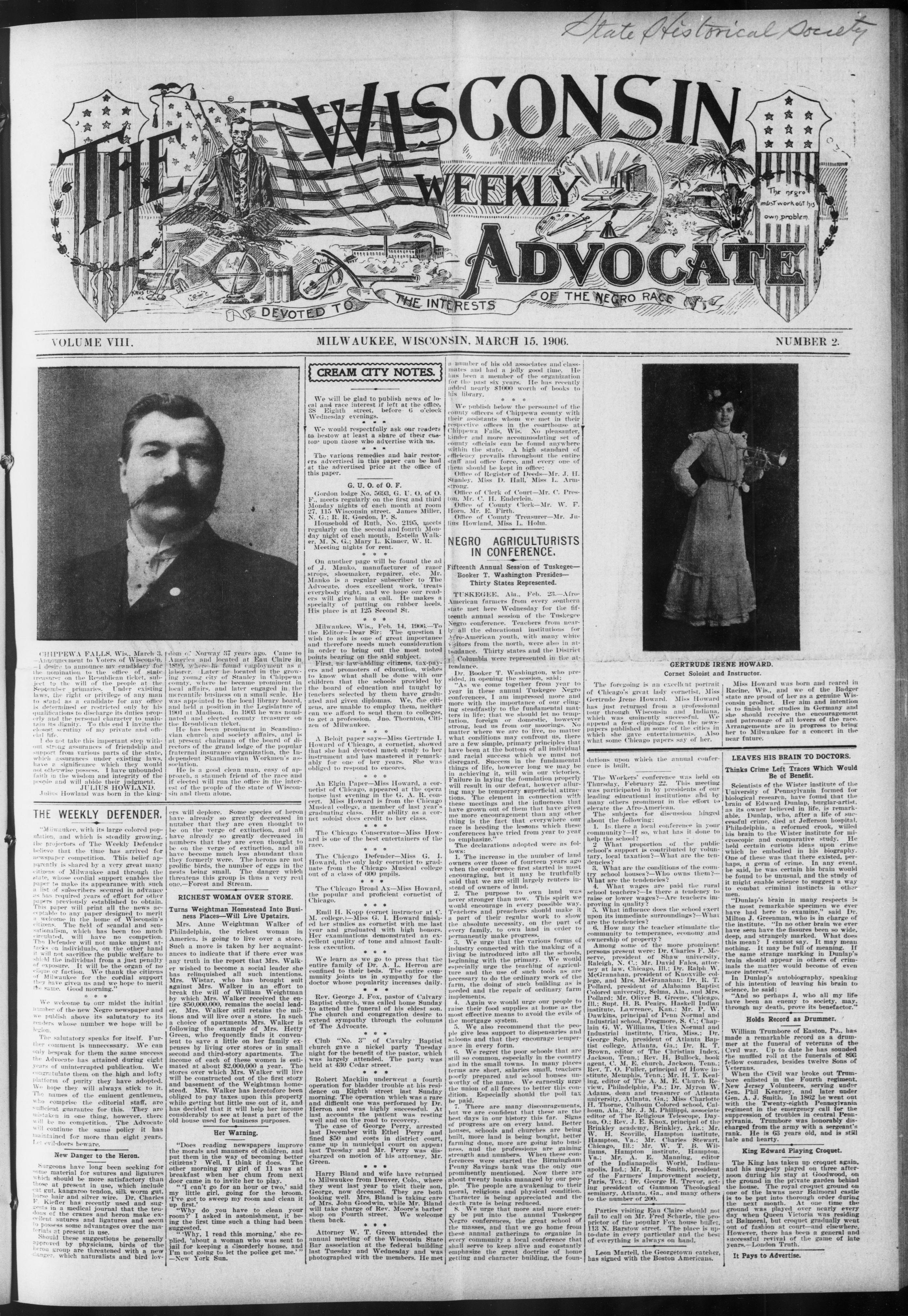
Wisconsin Weekly Advocate
Thursday, March 15, 1906
Milwaukee, Wisconsin
Page text (machine-generated)
WISCONSIN
WEEKLY
ADVOCATE
DEVOTED TO THE INTERESTS OF THE NEGRO RACE
VOLUME VIII.
[Image of a man with a mustache and a suit]
CHIPPEWA FALLS, Wis., March 3.
Announcement to Voters of Wisconsin.
I desire to announce my candidacy for the nomination to the office of state treasurer on the Republican ticket, subject to the will of the people at the September primaries. Under existing laws, the right or privilege of any man to stand as a candidate for any office is determined or restricted only by his qualifications to discharge its duties properly and the personal character to maintain its dignity. To this end I invite the closest scrutiny of my private and official life.
I do not take this important step without strong assurances of friendship and support from various parts of the state, which assurances under existing laws, have a significance which they would not otherwise possess. I have unbounded faith in the wisdom and integrity of the people and will abide their judgment. JULIUS HOWLAND. Julius Howland was born in the king-
THE WEEKLY DEFENDER.
"Milwaukee, with its large colored population, and which is steadily growing, the projectors of The Weekly Defender believe that the time has arrived for newspaper competition. This belief apparently is shared by a very great many citizens of Milwaukee and through the state, whose cordial support enables the paper to make its appearance with such a list of subscribers secured in advance as has required years of effort for other papers previously established to obtain. This paper will print all the news acceptable to any paper designed to merit a welcome in the home of Wisconsin's citizens. The field of scandal and sensationalism, which has been too much circulated, will have no competition. The Defender will not make unjust attacks on individuals, on the other hand it will not sacrifice the public welfare to shield the individual from a just penalty of exposure. It will be the organ of no clique or faction. We thank the citizens of Milwaukee for the cordial support they have given us and we hope to merit the same. Good morning."
---
We welcome to our midst the initial number of the new Negro newspaper and we publish above its salutatory to its readers whose number we hope will be legion.
The salutatory speaks for itself. Further comment is unnecessary. We can only bespeak for them the same success the Advocate has attained during eight years of uninterrupted publication. We congratulate them on the high and lofty platform of purity they have adopted. We hope they will always stick to it. The names of the eminent gentlemen, who comprise the editorial staff, are sufficient guarantee for this. They are mistaken in one thing, however, there will be no competition. The Advocate will continue the same policy it has maintained for more than eight years. Let evil-doers beware.
New Danger to the Heron.
Surgeons have long been seeking for some material for sutures and ligatures which should be more satisfactory than those at present in use, which include cat gut, kangaroo tendon, silk worm gut, horse hair and silver wire. Dr. Charles F. Kiefler has recently used and suggests in a medical journal that the tendons of the cranes and heron make excellent sutures and ligatures and seem to possess some advantages over the materials at present in use. Should these suggestions be generally approved by physicians, birds of the heron group are threatened with a new danger, which naturalists and bird lov-
---
dom of Norway 37 years ago. Came to America and located at Eau Claire in 1890, where he found employment as a laborer. Later he located in the growing young city of Stanley in Chippewa county, where he became prominent in local affairs, and later engaged in the mercantile business on a small scale. He was appointed to the local library board, and held a position in the Legislature of 1901 at Madison. In 1903 he was nominated and elected county treasurer on the Republican ticket. He has been prominent in Scandinavian church and society affairs, and is at present chairman of the board of directors of the grand lodge of the popular fraternal insurance organization, the Independent Skandinavian Workmen's association.
He is a good clean man, easy of approach, a staunch friend of the race and if elected will run the office in the interest of the people of the state of Wisconsin and them alone.
ers will deplore. Some species of heron have already so greatly decreased in number that they are even thought to be on the verge of extinction, and all have already so greatly decreased in numbers that they are even thought to be on the verge of extinction, and all have become much less abundant than they formerly were. The herons are not prolific birds, the number of eggs in the nests being small. The danger which threatens this group is thus a very real one.—Forest and Stream.
RICHEST WOMAN OVER STORE
Turns Weightman Homestead Into Business Places-Will Live Upstairs
Mrs. Anne Weightman Walker of Philadelphia, the richest woman in America, is going to live over a store. Such a move is taken by her acquaintances to indicate that if there ever was any truth in the report that Mrs. Walker wished to become a social leader she has relinquished all such intentions. Mrs. Wistar, who has brought suit against Mrs. Walker in an effort to break the will of William Weightman by which Mrs. Walker received the entire $50,000,000, remains the social leader. Mrs. Walker still retains the millions and will live over a store. In such a choice of apartments Mrs. Walker is following the example of Mrs. Hetty Green, who frequently finds it convenient to save a little on her family expenses by living over stores or in small second and third-story apartments. The income of each of these women is estimated at about $2,000,000 a year. The stores over which Mrs. Walker will live will be constructed out of the first story and basement of the Weightman homestead. Mrs. Walker has heretofore been obliged to pay taxes upon this property while getting but little use out of it, and has decided that it will help her income considerably to see at least a part of the old house used for business purposes.
Her Warning.
"Does reading newspapers improve the morals and manners of children, and put them in the way of becoming better citizens? Well, I think it does. The other morning my girl of 11 was at breakfast when her chum from next door came in to invite her to play.
"I can't go for an hour or two,' said my little girl, going for the broom. 'I've got to sweep my room and clean it up first.'
"Why do you have to clean your room?' I asked in astonishment, it being the first time such a thing had been suggested.
"Why, I read this morning,' she replied, 'about a woman who was sent to jail for keeping a disorderly house, and I'm not going to let the police get me.'"
—New York Sun.
CREAM CITY NOTES.
We will be glad to publish news of local and race interest if left at the office. 38 Eighth street, before 6 o'clock Wednesday evenings.
We would respectfully ask our readers to bestow at least a share of their custom upon those who advertise with us.
The various remedies and hair restorers advertised in this paper can be had at the advertised price at the office of this paper.
G. U. Q. of Q. F.
Gordon lodge No. 5693, G. U. O. of O. F., meets regularly on the first and third Monday nights of each month at room 27, 115 Wisconsin street. James Miller, N. G.; R. R. Gordon, P. S. Household of Ruth, No. 2195, meets regularly on the second and fourth Monday night of each month. Estella Walker, M. N. G.; Mary L. Kinner, W. R. Meeting nights for rent
***
On another page will be found the ad of J. Manko, manufacturer of razor strops, shoemaker, repairer, etc. Mr. Manko is a regular subscriber to The Advocate, does excellent work, treats everybody right, and we hope our readers will give him a call. He makes a specialty of putting on rubber heels. His place is at 125 Second St.
* * *
Milwaukee. Wis., Feb. 14, 1906.—To the Editor—Dear Sir: The question I wish to ask is one of great importance and therefore needs much consideration in order to bring out the most noted points bearing on the said subject.
First, as law-abiding citizens, tax-payers and promoters of education, wishes to know what shall be done with our children that the schools provided by the board of education and taught by teachers selected by them have graduated and given diplomas. We, the citizens, are unable to employ them, neither can we afford to send them to colleges, to get a profession. Jno. Thornton, Citizen of Milwaukee.
* * *
A Beloit paper says—Miss Gertrude I. Howard of Chicago, a cornetist, showed that she had devoted much study to her instrument and has mastered it remarkably for one of her years. She was obliged to respond to encores.
* * *
An Elgin Paper—Miss Howard, a cornetist of Chicago, appeared at the opera house last evening in the G. A. R. concert. Miss Howard is from the Chicago Musical college, a member of last year's graduating class. Her ability as a cornet soloist does credit to her class.
求 求
The Chicago Conservator—Miss Howard is one of the best entertainers of the race.
* * *
The Chicago Defender—Miss G. I. Howard, the only lady cornetist to graduate from the Chicago Musical college out of a class of 600 pupils.
***
The Chicago Broad Ax-Miss Howard, the popular and proficient cornetist of Chicago.
** **
Emil H. Kopp (cornet instructor at C. M. college.)—Miss G. I. Howard finished her studies as cornetist with me last year and graduated with high honors. Her examinations demonstrated an excellent quality of tone and almost faultless execution.
* * *
We learn as we go to press that the entire family of Dr. A. L. Herron are confined to their beds. The entire community joints us in sympathy for the doctor whose popularity increases daily.
```markdown
```
Rev. George J. Fox, pastor of Calvary Baptist church, was called home Sunday to attend the funeral of his eldest son. The church and congregation desire to extend sympathy through the columns of The Advocate.
* * *
Club "No. 3" of Cavalry Baptist church gave a nickel party Tuesday night for the benefit of the pastor, which was largely attended. The party was held at 430 Cedar street.
* * *
Robert Macklin underwent a fourth operation for bladder trouble at his residence on Eighth street last Sunday morning. The operation which was a rare and difficult one was performed by Dr. Herron and was highly successful. At last accounts the patient was resting well and on the road to recovery. The case of George Perry, arrested last December with Ethel Perry and fined $50 and costs in district court, came up in municipal court on appeal last Tuesday and Mr. Perry was discharged on motion of his attorney, Mr. Green.
```markdown
```
Harry Bland and wife have returned to Milwaukee from Denver, Colo., where they went last year to visit their son, George, now deceased. They are both looking well. Mrs. Bland is taking care of Mrs. John Goodwin, while Mr. Bland will take charge of Rev. Moore's barber shop on Fourth street. We welcome them back.
Attorney W. T. Green attended the annual meeting of the Wisconsin State Bar association at the federal building last Tuesday and Wednesday and was photographed with the members. He met
a number of his old associates and classmates and had a jolly good time. He has been a member of the organization for the past six years. He has recently added nearly $1000 worth of books to his library.
We publish below the personnel of the county officers of Chippewa county with their assistants whom we met in their respective offices in the courthouse at Chippewa Falls, Wis. No pleasanter, kinder and more accommodating set of county officials can be found anywhere within the state. A high standard of efficiency prevails throughout the entire staff and office force, and every one of them should be kept in office:
Office of Register of Deeds—Mr. J. H. Stanley, Miss D. Hall, Miss L. Armstrong.
Office of Clerk of Court—Mr. C. Preston, Mr. C. H. Enderlein.
Office of County Clerk—Mr. W. F. Horn, Mr. E. Firth.
Office of County Treasurer—Mr. Julius Howland, Miss L. Holm.
NEGRO AGRICULTURISTS IN CONFERENCE.
Fifteenth Annual Session of Tuskegee— Booker T. Washington Presides— Thirty States Represented.
TUSKEGEE. Ala., Feb. 23.—Afro-American farmers from every southern state met here Wednesday for the fifteenth annual session of the Tuskegee Negro conference. Teachers from nearly all the educational institutions for Afro-American youth, with many white visitors from the north, were also in attendance. Thirty states and the District Columbia were represented in the attendance.
Dr. Booker T. Washington, who presided, in opening the session, said:
"As we come together from year to year in these annual Tuskgeege Negro conferences, I am impressed more and more with the importance of our clinging steadfastly to the fundamental matters in life; that we should let no temptation, foreign or domestic, however strong, lead us from our moorings. No matter where we are to live, no matter what conditions may confront us, there are a few simple, primary principles that have been at the bottom of all individual and racial success which we must not disregard. Success in the fundamental things of life, however long we may be in achieving it, will win our victories. Failure in laying the foundation properly will result in our defeat, however alluring may be temporary superficial attractions. The element in connection with these meetings and the influences that have grown out of them that have given me more encouragement than any other thing is the fact that everywhere our race is heeding the lessons which these conferences have tried from year to year to emphasize."
The declarations adopted were as follows:
1. The increase in the number of land owners over those of fourteen years ago when the conference first started is most encouraging, but it may be truthfully said that we are still largely renters instead of owners of land.
2. The purpose to own land was never stronger than now. This spirit we would encourage in every possible way. Teachers and preachers should make it a part of their regular work to show the absolute necessity, on the part of every family, to own land in order to permanently make progress.
3. We urge that the various forms of industry connected with the making of a living be introduced into all the schools, beginning with the primary. We would especially urge the teaching of agriculture and the use of such tools as are necessary to do the ordinary work of the farm, the doing of such building as is needed and the repair of ordinary farm implements.
4. Again we would urge our people to raise their food supplies at home as the most effective means to avoid the evils of the mortgage system.
5. We also recommend that the people give less support to dispensaries and saloons and that they encourage tempera
6. We regret the poor schools that are still so common, especially in the country and in the small towns. In many places terms are short, salaries small, teachers poorly prepared and school houses unworthy of the name. We earnestly urge the union of all forces to better this condition. Especially should the poll tax be paid.
7. There are many discouragements, but we are confident that these are the best days in our history this far. Signs of progress are on every hand. Better houses, schools and churches are being built, more land is being bought, better farming done, more are going into business, and the professions are gaining strength and numbers. When these conferences were started the Birmingham Penny Savings bank was the only one prominently mentioned. Now there are about twenty banks managed by our people. The people are awakening to their moral, religious and physical condition. Character is being appreciated and the death rate is being reduced.
8. We urge that more and more energy be put into the annual Tuskegee Negro conferences, the great school of the masses, and that we go home from these annual gatherings to organize in every community a local conference that shall serve to keep alive and constantly emphasize the great doctrine of home getting and character building, the four-
THE TRUMPET WOMAN
GERTRUDE IRENE HOWARD
Cornet Soloist and Instructor.
The foregoing is an excellent portrait of Chicago's great lady cornetist, Miss Gertrude Irene Howard. Miss Howard has just returned from a professional tour through Wisconsin and Indiana, which was eminently successful. We append a few clippings from the newspapers published in some of the cities in which she gave entertainments. Also what some Chicago papers say of her.
Miss Howa Racine, Wis., state are proud consin produce is to finish he she should r and patronage Arrangements her to Milwaukee near future.
dations upon which the annual conference is built.
The Workers' conference was held on Thursday, February 22. This meeting was participated in by presidents of our leading educational institutions and by many others prominent in the effort to elevate the Afro-American.
The subjects for discussion hinged about the following:
1. Is there a local conference in your community?—If so, what has it done to help the school?
2. What proportion of the public school's support is contributed by voluntary, local taxation?—What are the tendencies?
3. What are the conditions of the country school houses?—Who owns them?—What are the tendencies?
4. What wages are paid the rural school teachers?—Is there a tendency to raise or lower wages?—Are teachers improving in quality?
5. What influence does the school exert upon its immediate surroundings?—What are the tendencies?
6. How may the teacher stimulate the community to temperance, economy and ownership of property?
Among some of the more prominent persons present were: Dr. Charles F. Me serve, president of Shaw university, Raleigh, N. C.; Mr. David Fales, attorney at law, Chicago, Ill.; Dr. Ralph W. McGranahan, president of Knoxville college, and Mrs. McGranahan; Dr. R. T. Pollard, president of Alabama Baptist Colored university, Selma, Ala., and Mrs. Pollard; Mr. Oliver B. Greene, Chicago, Ill.; Supt. H. B. Peairs, Haskell Indian institute, Lawrence, Kan.; Mr. P. W. Dawkins, principal of Penn Normal and Industrial school, Frogmore, S. C.; Chaplain G. W. Williams, Utica Normal and Industrial institute, Utica, Miss.; Dr. George Sale, president of Atlanta Baptist college, Atlanta, Ga.; Dr. R. T. Brown, editor of The Christian Index, Jackson, Tenn.; Rev. H. Bullock, book agent, C. M. E. church, Jackson, Tenn.; Rev. T. O. Fuller, principal of Howe institute, Memphis, Tenn.; Mr. H. T. Kealing, editor of The A. M. E. Church Review, Philadelphia, Pa.; Dr. Myron W. Adams, dean and treasurer of Atlanta university, Atlanta, Ga.; Miss Charlotte H. Thorne, Calhoun Colored school, Calhoun, Ala.; Mr. J. M. Phillippi, associate editor of The Religious Telescope, Dayton, O.; Rev. J. E. Knox, principal of the Brinkley academy, Brinkley, Ark.; Mr. W. H. Scoville, Hampton institute, Hampton, Va.; Mr. Charles Stewart, Chicago, Ill.; Mr. W. T. B. Williams, Hampton institute, Hampton, Va.; Mr. A. E. Manning, editor of the Indianapolis World, Indianapolis, Ind.; Mr. R. L. Smith, president of the Farmers' Improvement society, Paris, Tex.; Dr. George H. Trevor, acting president of Gammon Theological seminary, Atlanta, Ga., and many others to the number of 200.
Parties visiting Eau Claire should not fail to call on Mr. Fred Scharle, the proprietor of the popular Fox house buffer, 113 N. Barstow street. The place is up-to-date in every particular and the best of everything is always on hand. Leon Martell, the Georgetown catcher, has signed with the Boston Americans.
Miss Howard was born and reared in Racine, Wis., and we of the Badger state are proud of her as a genuine Wisconsin product. Her aim and intention is to finish her studies in Germany and she should receive the encouragement and patronage of all lovers of the race. Arrangements are in progress to bring her to Milwaukee for a concert in the near future.
LEAVES HIS BRAIN TO DOCTORS.
Thinks Crime Left Traces Which Would Be of Benefit.
Scientists of the Wister institute of the University of Pennsylvania formed for biological research, have found that the brain of Edward Dunlap, burglar-artist, as its owner believed in life, is remarkable. Dunlap, who, after a life of successful crime, died at Jefferson hospital, Philadelphia, a reformed crook, willed his brain to the Wister institute for microscopic and comparative study. He held certain curious ideas upon crime which he embodied in his biography. One of these was that there existed, perhaps, a germ of crime. In any event, he said, he was certain his brain would be found to be unusual, and the study of it might enable science to suggest a way to combat criminal instincts in other men.
"Dunlap's brain in many respects is the most remarkable specimen we ever have had here to examine," said Dr. Milton J. Greenman, who is in charge of the institute. "In no other brain we ever have seen have the fissures been so wide, deep, and strangely marked. What does this mean? I cannot say. It may mean nothing. It may be full of meaning. If the same strange marking in Dunlap's brain should appear in others of criminals the matter would become of even more interest."
In Dunlap's autobiography, speaking of his intention of leaving his brain to science, he said:
"And so perhaps I, who all my life have been an enemy to society, may, through my death, prove its benefactor."
Holds Record as Drummer.
William Trumbore of Easton, Pa., has made a remarkable record as a drummer at the funeral of veterans of the Civil war. Up to date he has sounded the muffled roll at the funerals of 893 fellow comrades, besides twelve Sons of Veterans. When the Civil war broke out Trumbore enlisted in the Fourth regiment, New Jersey Volunteers, serving under Gen. Phil Kearney, and later under Gen. A. J. Smith. In 1862 he went out with the Twenty-eighth Pennsylvania regiment in the emergency call for the suppression of troubles in central Pennsylvania. Trumbore was honorably discharged from the army with a sergeant's rank. He is 63 years old, and is still hale and hearty.
King Edward Playing Croquet.
The King has taken up croquet again, and his majesty played on three afternoon during his stay at Goodwood, on the ground in the private garden behind the house. The royal croquet ground on one of the lawns near Balmoral castle is to be put into thorough order during the next month. At one time the ground was played over nearly every day when Queen Victoria was residing at Balmoral, but croquet gradually went out of fashion at court—and elsewhere. However, there has been a general and successful revival of the game of late years.—London Truth.
It Pays to Advertise.
NUMBER 2.
RESTORE STRENGTH
Dr. Williams' Pink Pills Actually Make New Blood and Good Health Follows.
The evil effects that follow many diseases — particularly the grip and the wasting fevers, such as typhoid and malaria, are caused by the bad condition in which these diseases leave the blood. As a result, the flesh continues to fall away, the sufferer grows nervous and irritable, and even slight exertion causes shortness of breath. These are dangerous symptoms and indicate that the system is in a state that invites pneumonia, bronchitis or even consumption. What is needed is a new supply of rich, red blood to carry health and strength to every part of the body.
"I was all run down from the effects of the grip," says Mrs. Amelia Hall, of No. 5 High street, Norwich Conn., "and could not seem to get strength to walk; could not eat a full meal, my stomach was so weak, and I was so nervous that I could not sleep. I could only stay in bed a few minutes at a time, either night or day. The least little thing would startle me. I had difficulty in breathing and had frequent fainting spells.
"My general health was completely wrecked and I had neuralgie and rheumatic pains, dyspepsia, constipation and female weakness. My physician attended me for the grip and again for the condition that it left me in, but I got no strength from the tonics he prescribed. In fact, nothing helped me until I tried Dr. Williams' Pink Pills and they cured me.
"I grew stronger and gained flesh from the time I began taking them. I am satisfied that the pills are all that is claimed for them and I shall do all I can to make their good qualities known."
Dr. Williams' Pink Pills cure nervous disorders of every kind, check wasting diseases and build up strength. For booklet, address the Dr. Williams Medicine Co., Schenectady, N.Y.
NEW EXPERIMENT ON PIE PLANT.
Can Raise Rhubarb Pant in Dark Cellar During Winter.
An odd experiment in farming, but one which seems likely to prove of real value to housewives as well as of interest to students of agricultural questions, is in progress in Menominee county Mich. It has to do with the cultivation of pie plant, so commonly called, in a dark cellar during the cold winter months. The tests are being conducted by a market gardener named Carlson, living five miles out of Menominee on the new county road. Carlson has met with conspicuous success in his efforts, and for some time past he has been able to turn out from three to four dozen bunches of fine pie plant each week, disposing of the product to a Menominee grocery store.
The market gardener has a large root cellar especially prepared for the purpose. Here fire is kept going in a stove, and the heat therefrom is an active agent in inducing the plants to grow, which they do in most healthy manner. The body is good and the flavor excellent. Grown in the darkness, they are bleached, instead of being of the usual green color. One drawback developed by the experiment thus far, however, is the fact that the otherwise perennial root of the plant dies after one year's growth in the cellar hothouse, and new roots have to be planted each fall. This tends to make the culture rather expensive, besides increasing the amount of work necessary to conduct it.
Whistle Language of the Gomeras
They have a whistle language on Gomera island, in the Canary archipelago. They can whistle there as articulately as a Bostonian can speak.
And since they can whistle very loud and shrill, the Gomeras can converse a long way off. A Gomera hunting a mile from home can ask his wife what there is for lunch, and if the menu does not please him he can scold her and order a change as well as though he stood beside her.
The Gomeras talk in a sing-song, and their whistle language reproduces the spoken one's intonations. For instance: Children all over America have a taunting cry—
Hiss for shame, hiss for shame,
Everybody knows your name!
This cry is not sung. It is intoned. And so the Gomeras intone their guttural language.
It would be quite easy to whistle intelligibly the "Hiss for Shame" cry. So it is quite easy to whistle the Gomera's sing-song language.—Philadelphia Bulletin
Strange Injuries by Rails.
It is well known that the tendency for rails to creep on trestles is frequently very strong. A section crew of the Terminal railroad of St. Louis recently had an unfortunate experience in removing a rail from one of the elevated tracks of that company.
The rails had been creeping and were under heavy stress. One of them had buckled sidewise, and as the spikes were withdrawn it suddenly flew out of place, breaking the limbs of three of the workmen, one of whom had both legs broken just above the ankles. Still two other members of the crew were injured so seriously that they had to be taken to a hospital.
A similar accident occurred on the Union Pacific railroad some years ago. In that case the rail sprang out of place, striking the foreman and breaking his legs.—Railway and Engineering Review.
THE EDITOR
Explains How to Keep Up Mental and Physical Vigor.
"A long indulgence in improper food brought on a condition of nervous dyspepsia, nearly three years ago, so severe that I had to quit work entirely. I put myself on a strict regimen of Grape-Nuts food, with plenty of outdoor exercise, and in a few months found my stomach so far restored that the process of digestion gave me pleasure instead of distress.
"It also built up my strength so that I was able to resume my business, which is onerous, as I not only edit my own paper but also do a great deal of 'outside' writing."
"I find that the Grape-Nuts diet enables me to write with greater vigor than ever before, and without the feeling of brain-fag with which I used to be troubled. As to bodily vigor—I can and do walk miles every day without fatigue—a few squares used to weary me before I began to live on Grape-Nuts!" Name given by Postum Co., Battle Creek, Mich. There's a reason. Read the little book, "The Road to Wellyville," in pkgs.
It takes three days of experimenting in cold weather to get the furnace to burn like blazes when the warm wave strikes us.—New York Press.
Clergyman—My boy, do you know that it is wicked to fish on the Sabbath!
The Kiss and the Aim.
You should practice awhile." So he did.
Rummy Robinson—Yes, lady, once for a whole year I turned me back on liker.
Kind Lady—Ah, my noble man, what were you doing at the time?
Rummy Robinson—Driving a brewer's dray, mum.
Why He Came Earlier.
Mother—That young man comes much earlier in the evenings now than he used to in the summer, doesn't he, Laura?
Couldn't Corrupt His Horse.
Excited Traveler—Get me to the station in three minutes and I'll give you a sovereign."
Driver—Can't do it, sir. You might bribe me, but you can't corrupt my horse.—Tit-Bits.
"I kissed a college girl one day," related the tall student.
"Did she yell?" inquired his chum.
"I should say so! She gave a college yell that brought the whole class and I had to kiss 'em all before they'd let me go."—Exchange.
Dottie—Oh! Mr. Scott, I've had a perfectly delightful evening. All those magnificent roses, the box at the opera, and that delightful supper afterwards—how can I repay your kindness?"
Scotty—Well, you might lend me a car ticket to get home on, if you have one. Exchange.
Not That Kind of Dew.
Gracie—Oh, Mr. Nocoyne, how lovely of you to bring me these beautiful flowers! How sweet they are, and how fresh! I do believe there is a little dew on them yet! Nocoyne—W-well, yes, there is; but I'll pay it tomorrow—Tit-Bits.
Lazy Boy
Tommy—Wotcher goin' to be when you grow up?
Johnny—A bricklayer, I guess.
Tommy—Aw, that ain't no nice thing to be. Whadda you wanna be that for?
Johnny—There's so many days in the year bricklayers don't have to do no work—Cleveland Leader.
His Talent.
Fond Mother—Professor, what calling do you think my son has most talent for?
Phrenologist—Madam, your son is preeminently fitted for moving furniture or running baggage on a railroad.
F. M.—Why so, professor?
Phrenologist—His bump of destruction is extraordinarily large.—Dallas News.
Snubbing Hubby.
The lady was making some remarks about the kind of clothing some other ladies at church had on.
"The finest garments a woman can wear," said her husband, "is the mantle of charity."
"Yes," she snapped, "and it is about the only dress, judging by the fuss they make over the bills, that some husbands want their wives to wear."—Punch.
Excursions to Milwaukee.
The Milwaukee Association of Jobbers and Manufacturers has arranged for another spring meeting, and extend an invitation to all buyers in the territory of the Western Passenger association. Tickets at the rate of One and One-Fifth Fare for the Round Trip on sale March 17 to 24 inclusive, and good to return March 19 to April 3 inclusive. Ask your station agent for a certificate when buying your ticket. Take advantage of the low rates. It will pay you to come to Milwaukee.
Wanted One That Would Last
"There are some big families up in Tioga county," said Senator Platt recently. "Will Smythe, editor of the Owego Tines, tells a story of a man who was the father of twelve, all of whom had been rocked to sleep by the same toe and in the same cradle. The toe stood it all right, but the cradle had begun to show signs of wear toward the end of the rocking period of the twelfth.
"John,' said the wife one day, looking fondly at the quaint little old thing at her side, its rocker worn flat, so that with each impulse it heaved and turned like a ship in a heavy sea, "this old cradle has done good service, but it is about worn out. I am afraid it is nearly gone!"
"That's right," assented the husband Reaching into his pocket he pulled out $10. 'Here you are. Next time you go to Owego get a new one. Get a good one this time; one that'll last.' "I really don't know whether that one is gone or not, but I'll ask Smythe next November."
A Queen's Mistake.
The Queen of Denmark once paid a visit to the Danish colony of Iceland, where the good old bishop exerted himself to the utmost to show her everything that was worth seeing. The Queen paid many compliments to her host, and, having learned that he was a family man, graciously inquired how many children he had. It happens that the Danish word for "children" is almost identical in sound with the Icelandic word for "sheep;" so the worthy bishop—whose knowledge of Danish was not so complete as it might have been—understood her majesty to ask how many sheep he owned, and promptly answered:
"Two hundred."
"Two hundred children!" cried the Queen, astounded. "How can you possibly maintain such a number?"
"Easily enough, please your majesty," replied the prelate, with a cheerful smile. "In the summer I turn them out upon the hills to grass, and when winter comes I kill and eat them!"
Tallest Telephone Pole.
Manager H. E. Bailey of the Sunset Telephone company's offices in this city says that he has largest wood telephone pole, if not the largest pole of any kind, in the world, in his territory, which includes the Gray's harbor country. The pole was cut from a tree nearly 200 feet tall and is 116 feet in height. The telephone pole in Bailey's district is as straight as an arrow and is located on the south side of the Chehalis river, about a mile east of Aberdeen. The object in having the pole so high is so that the wire will not be caught by passing ships, as it crosses the harbor to the north side and rises above a hill covered with pretty good-sized trees on the east bank of the Chehalis. The pole was made from a fir tree.—Aberdeen correspondence Seattle Post-Intelligencer.
---
THE NAME WRIT IN WATER.
The Spirit of the Fountain speaks:
Yonder's the window my poet would sit in
While my song murmured of happier
days;
Mine is the "water" his "name" has been
"writ in."
Sure and immortal my share in his praise.
Gone are the pilgrims whose green wreaths
here hung for him—
the mung
Gone from their fellows like bubbles from
foam;
Long shall outlive them the songs have been sung for him:
been sung for him;
Mine is eternal—or Rome were not Rome.
Far on the mountain my fountain was fed for him.
Bringing soft sounds that his nature loved best:
Sighing of pines that had fain made a bed for him;
Seafaring rills, on their musical quest;
Bells of the fairies at eve, that I rang for him;
Nightingale's glee, he so well understood:
Chant of the dryads at dawn, that I sang for him;
Swish of the snake at the edge of the wood.
Little he knew 'twixt his dreaming and sleeping.
The while his sick fancy despaired of his fame.
What glory I held in my loverly keeping: Listen! my waters still whisper his name. Robert Underwood Johnson in the Century.
MAKING FRIENDS
"I have always wanted a dog," said young Pherkins.
"Won't it be fine!" cried Mrs. Pherkins, Jr.
"Dogs," remarked Mrs. Pherkins, Sr. (in a voice of finality), "are a trouble."
But nevertheless at 5 o'clock the next Saturday afternoon Pherkins left the house of a friend who lived out of town and an observer would have noticed that Pherkins's overcoat bulged in the front and that occasionally a pup put its head out between the buttons and surveyed the landscape with benignity and interest.
"We must run for the train," said Pherkins's friend. "I did not know it was so late."
They ran up and down the hills for a time.
"Say, is this right?" asked Pherkins.
(Running.)
"Is what right?"
(Running.)
"The way his head is bobbing up and down. Look." It couldn't be denied that Pherkins' motion made the pup's head bob up and down to an extent that looked alarming.
"That won't hurt him," said Pherkins's friend. "That'll shake him up and do him good." "You don't think it'll give him a headache?"
"Shucks! no"
But all the same Pherkins held the pup's head thereafter to arrest the bobbing and as Pherkins ran he tried to glide or skim, and thus reduce the jolting to a minimum.
"We must hurry." said Pherkins's friend. "If we miss that train there won't be another for an hour." They continued to run up and down the hills.
"You're sure he's a collie?" asked Pherkins, after five minutes of this.
"Thoroughbred sheep dog."
"Weight on him like a Newfoundland," said Pherkins. That was all he said, but his tone made the remark significant.
And as he skimmed over the ground, holding the pup's head, he began to make a noise when he breathed and to show signs of distress. Whereat the pup looked up at his face and cocked its ears. Pherkins was gloating over this intelligence and friendliness on the part of the pup, when he stepped into a hole that was full of water. Simultaneously he ceased to run.
"Here," said Pherkins' friend, "you must hurry up."
"I run no farther," said Pherkins with dignity. "I have no speech."
"I'll carry him," said Pherkins' friend. The transfer was made—the pup's benignity and interest abating not one whit—and in the distance an engine was heard tooting.
"Doing it for a pur-pose," he next offered.
He retired into reflection again.
"Be careful," he now said, "or you will bark your shins." This brightened his humor. "Now," said he, "I will carry him again."
Around a turn in the road the station showed itself.
"What have you been doing to him?" asked Pherkins. He was so peevish.
They trotted along.
"Doing to who?" demanded Pherkins' friend.
They trotted along.
"Doing to the pup," said Pherkins.
They trotted along.
"Why?" asked Pherkins' friend.
"He's so --- heavy," cried Pherkins. "I thought you had been tying weights to his feet." They trotted along—Pherkins' friend, Pherkins and the pup, the former looking along the railway, the second looking down at the pup and the latter looking out from between the second and third buttons of Pherkins' overcoat with benignity and interest not untinged with solemnity.
A train bowled around the curve and stopped at the station. It was pulling out when two men ran alongside, each in a state of exhaustion, but still one of them pushed the other up the steps of the baggage car (which was in the rear, as luck would have it), and when the train faded into distance Pherkins' friend, standing at the station, saw Pherkins standing on the rear platform of the train panting and trying to catch his breath, while under the overcoat was a bulge which seemed to belong to the head of a pup that gazed out from between the buttons of Pherkins' overcoat—gazed out with an interest and benignity that left a blank in the scenery when the train disappeared from sight.
Pherkins went into the baggage car and put the pup down on the floor with care. He was afraid to drop him with carelessness for fear the impact would knock a hole through the floor of the car, so heavy had the juvenile dog become to the mind of Pherkins the Exhausted. "A fine dog," said the baggageman. Pherkins gave him a cigar.
"Get him at the dog show?" asked the conductor.
"I haven't any more cigars," apologized Pherkins. The pup was worrying the handle on a valise.
"Saint Bernard?" asked he who had proclaimed the pup a thoroughbred.
"Collie," said Pherkins.
"Pshaw, yes. That's what I meant."
There followed a dissertation on dogs, and although the talk shifted often, all eyes were kept on the pup as a preacher keeps his mind on the text. When conversation halted, somebody tickled the pup. One man developed conceit because the pup showed a preference for his trousers. This man spoke of dogs with authority and from the speeches he made it was seen that the pup had
every point of breeding. Pherkins, sitting there with his legs stretched and his pipe waving in the air, was a personage.
"But," said the brakeman, "how are you going to carry him through New York? They won't let dogs on the street cars."
"I'll hide him under my coat," said Pherkins. He looked knowing as he said this, like a man who knows all the tricks if he only wishes to stop and think them out.
Consequently Pherkins boarded a Forty-second street car with a stiffness and a dignity, and (standing on the platform) he was at once engrossed with the view over the tailboard of the car. He had his nickel in his hand and handed it to the conductor over his shoulder, meanwhile counting the stories of a hotel on the corner. As for the conductor, he looked over Pherkins' shoulder.
"How old is he?" asked the conductor. He grinned as he asked this. Pherkins looked down and saw that the pup had again pushed his head between the buttons of his overcoat and was gazing at the passing scene with all the benignity of a holy man.
"Better take him inside," said the conductor, "he might catch cold out here." As Pherkins entered the car the conductor tickled the pup. Before Pherkins left the car seven others had tickled the pup. On the Ninth avenue L the ticket seller chirped at him. The chopper won Pherkins' esteem by recognizing the pup as a collie, and on the traim the guard neglected his duties in his anxiety to tell Pherkins how to train the dog.
And so it will be seen that when Pherkins finally reached home he was proud of himself and of the pup. It was late and old Ton of Bricks (as Pherkins called him) was put to bed. He slept till 4 o'clock on Sunday morning and then Pherkins had to get up and play with him. When Mrs. Pherkins, Jr., and Mrs. Pherkins, Sr., rose they were cautioned to walk on their toes and speak in whispers. It seemed that the pup was sleeping. By noon the Pherkins family had given up everything else to watch Old Bone Crusher (another of Pherkins' names). They followed every move he made and doted over him with openness. "He is so fat," laughed Pherkins, "and when he walks he looks like a cop."
We must draw a curtain over the scene. Some joys are too tender—too sacred to be mentioned in public. The pup barked and the Pherkinses' cup of happiness had filled to overflowing.
"He must have no meat," said Mrs. Pherkins, after dinner. "Nothing but bread and milk. No meat, mind. He's too young."
"Oh, of course," cried the others. But it remains that when old Pig Iron sat in his corner and looked solemn that afternoon Mrs. Pherkins, Jr., was moved to confession.
"I gave him a bit of meat," she whispered (looking at him).
"How much?" demanded Pherkins (also looking at him).
"Only about as big as the end of my finger."
"That wouldn't hurt him," said Pherkins. "Must be something else."
"I gave him a bit of meat, too," said Mrs. Pherkins, Sr. (looking at him).
"How much?" complained Pherkins.
"How much? Has he been having nothing, else but meat?"
"Oh, just a little bit. He did so like it."
And Pherkins said nothing, but when he heard an outcry in the pantry that evening he held his breath.
"Did you give him half that leg of lamb?" they shrieked. "Well," said Pherkins, "everybody else is giving him meat. I want him to like me, too. Anyhow, isn't he a little sheep dog?"—Evening Sun.
FLOUR SIFTER.
Combined with a Flour Sack Holder to Receive Open End of a Flour Sack.
A combination flour-sack holder and sifter is one of the recent patents granted to a Denver (Colo.) man. The parts are so arranged that the open end of a flour sack fills the mouth of the device, so that the sack can be left in the device in an inverted position. Below the mouth of the sack is a rotary sifter of any ordinary construction, while between the sack and the sifter is a shield, to prevent the mouth of the sack interfering with the operation of the rotary. A screen is located below the rotary, and at the bottom a drawer for holding the sifted flour. The sifter is divided into three
MINDY
SIFTS THE FLOUR
sections, a partition separating each section, the bottom of each section being covered with a semicircular screen. An axle, upon which is mounted stirring or agitating wires, is journaled in each compartment, the axle projecting beyond the side wall and terminating in a handle. A shield, composed of three wires crossing at the center, is placed above the sifters, in order to prevent the mouth of the sack from interfering with the rotary. The bottoms of each of the sifters are controlled by spring catches. A number of sacks containing different kinds of flour can be placed in the several compartments in an inverted position, the flour of the sack being open, to allow the flour to pass freely to the sifter when the latter is rotated. When a person desires to obtain from any one of the compartments, he opens the hinged bottom part and places a receptacle underneath while he turns the rotary agitator. If desirable, the device can be made into a single sifter, and an opening constructed beneath the screen for placing a drawer.
With a population of only 3,315,343 Switzerland has a foreign trade of more than $400,000,000 a year.
WELL HIS ONLY MONUMENT.
French Nobleman's Vain Boring for Oil Recalled by Fountain.
A column of water six inches in diameter ascending to a height of twelve feet in a flow that has continued for almost half a century is the monument to Marquis De Belois. This flowing well has given Fountain Point, near Traverse City, Mich., its name, and the story of the big-hearted French nobleman and his beautiful American wife is a familiar one throughout this region.
It was in the early '60s that the marquis came to this country. He believed that somewhere under the Grand Traverse region there were deposits of oil and gas, and probably coal and minerals. He bought the land where Fountain Point is now situated, on Lake Leelanau, commonly called Carp lake, and began drilling operations. Into the hole where the fountain now is he poured his wealth until his fortune could no longer stand the strain. He did not strike oil or gas, but instead a wonderful stream of water, which has supplied the well to this day.
After his unsuccessful experience with the oil well the marquis married a beautiful young girl of the region. Although she was connected with the best families, and was a cultured and refined young woman, his aristocratic family thought the affair a mesalliance and refused to meet the wife the son had wooed and won in what was then a wilderness. The marquis and his wife moved to Chicago and took up their residence in a fashionable hotel. His failure in business and the conduct of his parents preyed upon his mind. He became morose and one day walked into the bar of the hotel and shot himself through the head, dying instantly. His wife was prostrated with grief
A short time after his death, before his parents were yet aware of it, they sent an emissary here to seek their son, extend their forgiveness and have him come home with his bride, but they were too late. Afterward they met his wife, and, becoming impressed with her beauty and intelligence, took her as their daughter. She would not leave the land of her birth, and consequently is still living in Chicago or vicinity.
TABLES TURNED IN BUNKO DEAL.
City Dentist "Buys Gold Brick" from Farmer—Clever Game.
Out in Franklin county, Mo., near Pacific, there is a farmer who is not likely to buy any gold bricks when he comes to town. He gathered in the proceeds of a duck hunting dentist's long tramp through the snow and did it so easily that even the D. D. S. is forced to admit the farmer's cleverness. Some one told the dentist that during a heavy snowstorm was the very best time to hunt ducks. Fowls found in sheltered bayous of the creeks, and with such a storm as that of Monday they are helpless. Killing ducks under such circumstances may not appeal to the true sportsman, but to the amateur hunter who ordinarily comes home by the way of Union market it looked like a chance to retrieve a waning reputation as a nimrod. The dentist rode out into the country, and soon located a flock of storm-bound ducks. He blazed away until he had six of them—it looked cruel, but he had not advertised to do this thing "without pain"—and he was happy, until a farmer, attracted by the shots, came down to the creek and asked in a tone that made the roaring blizzard sound like a summer wind whispering in the maples:
What are you killin my ducks for? Profuse apologies, and all the loose change the dentist had were tendered the farmer, who carried the ducks away with him. The dentist was nearly back to town before it occurred to him that he had been bunkoed by the farmer into giving up a half dozen mallards, not to mention the change.
PROVERBS OF WALL STREET.
Blessed are the poor, for they've nothing to lose.
As an ox goeth to the slaughter, so a lamb to Wall street.
Wisdom is better than rubies, and copper stocks are not always pure water.
He that maketh haste to be rich shall not be innocent, and usually remains poor.
He that hath pity upon the poor lendeth to the Lord, but the security is non-negotiable.
Whoso diggeth a pit shall fall therein, similar is the fate of him who constructs a "corner."
A wise son maketh a glad father, unless he bucks him from the other side of the market.
The borrower is the servant of the lender, but this doesn't affect the quotations on "call loans."
Put not your trust in (merchant) princes until you have carefully studied their commercial rating.—Puck.
A good name is rather to be chosen than great riches, but fortunately for the problem of selection, "a good name" is usually good collateral.
Absurd and Perilous.
Congressman Landis desired to illustrate the absurd and perilous position of a boodle politician whose dishonesty had been exposed, says the Buffalo Enquirer. "There, before the crash came," he said, "the man stood tottering and swaying, pale and scared, and, though I pitied him, I had to laugh at him because his position was so ludicrous. "He reminded me of the Indianapolis barber who got drunk one busy Sunday afternoon. "This barber, heavy with eighteen large, cold glasses of beer, lurched into his shop at the end of the ball game, put on his white coat, seized a razor and began to shave a patron whom the apprentice had just lathered up.
As the barber shaved away he held on to the patron's nose.
"Hang it,' the patron said, 'what are you about, anyway? Let go of my nose, will you?"
"Let go?' said the barber. 'Not a bit of it. If I did I'd fall down."—Pittsburg Dispatch.
The Salesman's Card
Two salesmen who knew each other well happened to call on the same man at the same time, only to discover that his office door was locked. One of them suggested that they leave their cards sticking in the crack of the door.
"Not on your life," said the other, "and I'll tell you why. I had a good customer in the machinery line who had an office in one of the downtown buildings. One day when I called he was cut and the office was locked, so I stuck my card in the crack as you suggested just now. Not long after a rival salesman blew in and saw my card. He wrote on the face of it, just over my name: 'I have been trying to find you for two days; now you can go to hell.' All I could say never squared it with the customer, and the other fellow got the trade.
"How do I know who did it? The scoundrel had the nerve to tell me."— New York Sun.
BANKS OF CANADA GAIN; PEOPLE'S SAVINGS BIG.
Record of Financial Institutions for the Year 1905 Shows Remarkable Prosperity All Over the Dominion. Ottawa, Ontario, March 1.—The year which has just closed has been one most satisfactory and progressive with the financial institutions of Canada, and the business of the chartered banks reflects the unprecedented prosperity enjoyed throughout the country during the year 1905.
The increased demands made upon the banks of the Dominion by the commercial and agricultural expansion of the year were provided for without the monetary disturbances sometimes noted in the United States. Whatever opinions may be held as to the composition of the Canadian banking system, it is claimed that its flexible currency has many commendable features, and without which the last few months of the year must have produced a money stringency with probably disastrous results. It is felt that a wider field of credit in the Dominion is needed, and consequently the capital of many existing banking institutions has been increased and several new banks are in process of organization.
The chartered banks of Canada today enjoy the confidence of the general public to a greater extent than ever before. The total deposits of the people in these institutions last year were $522,317,000, which shows an increase of over $56,000,000 for the year. In actual money in bank probably no other country in the world, comparatively speaking, can make a better showing than Canada.
The total deposits of the Canadian people in the government savings banks, in special savings institutions, and in the chartered banks alone amounted last year to the enormous sum of $609,454,000. This represents an average credit balance of over $100 per head of the population of the Dominion, and it is stated that the only other country in the world that approaches this record is Denmark, where the average credit balance is about $96.50 per capita. The above figures, however, do not comprehend moneys deposited with private bankers, loan companies, mortgage corporations and trust companies, or what is hoarded up in secret hiding places.
The annual report of the Dominion finance department, just issued to the public, shows a surplus in the Dominion treasury for the fiscal year of $7,863,000, and refers to the remarkable increase in the public revenues during the year.
An Irying Farewell.
It is recalled that the most touching farewell scene which Sir Henry Irving had was in Cardiff. After the play had concluded the Weish enthusiasts broke out into the hymn, "God Be with You Till We Meet Again." Surely never before in the annals of the stage has an actor been greeted thus with a hymn. It was a remarkable sight, Sir Henry standing reverently on the stage listening with bowed head to the sacred song, charged as it was with affectionate regard.—Western Mail.
BABY'S TORTURING HUMOR
Ears Looked as If They Would Drop Off—Face Mass of Sores—Cured by
"I feel it my duty to parents of other poor suffering babies to tell you what Cuticura has done for my little daughter. She broke out all over her body with a humor, and we used everything recommended, but without results. I called in three doctors, they all claimed they could help her, but she continued to grow worse. Her body was a mass of sores, and her little face was being eaten away; her ears looked as if they would drop off. Neighbors advised me to get Cuticura Soap and Ointment, and before I had used half of the cake of Soap and box of Ointment the sores had all healed, and my little one's face and body were as clear as a new-born babe's. I would not be without it again if it cost five dollars, instead of seventy-five cents. Mrs. George J. Steese, 701 Coburn St., Akron, Ohio."
Switzerland's exports of machinery and implements in 1904 are valued at about $9,500,000. Electrical machinery and machines used for weaving, knitting and embroidering, were the principal items. As this little country has no iron or coal, but must import the heavy materials by railroads, the exportation of machinery speaks well for its industrial skill.
CASTORIA
For Infants and Children.
The Kind You Have Always Bought
Bears the
Signature of
Charles H. Fletcher.
THE GOVERNMENT OF CANADA
GIVES
Absolutely Free
to Every Settler
One Hundred and Sixty
— Acres of Land in
WESTERN CANADA
Land adjoining this can be purchased from railway and land companies at from $6 to $10 per acre.
On This Land This Year Has Been Produced
Upwards of Twenty-Five
Bushels of Wheat to the Acre
It is also the best of grazing land, and for mixed
farming it has no superior on the continent.
Splendid climate, low taxes, railways convenient, schools and churches close at hand. For "Twentieth Concur Canada" and low railway rates Apply for information to Superintendent of Immigration, Ottawa, Campus, or to A. O. Currie, Boon L. B. Callahan Block, Milwaukee, WI. Authorize. Government Agents.
Please say where you saw this advertisement.
GOSSIP FOR THE LADIES.
He's that boy that lives with his aunt, you know.
I'm awfully sorry for poor Jack Roe;
And he says his house is filled with gloom
Because it has got no "mother's room."
I tell you what, it is fine enough
To talk of "boudouls" and such fancy stuff,
I tell you what, it is me enough.
To talk of "boudolors" and such fancy stuff,
But the room of rooms that seems best to
me
Is mother's room, where a fellow can rest,
And talk of things his heart loves best.
What if I do get dirt about
And sometimes startle my aunt with a
shout?
It is mother's room, and if she don't mind,
To the hints of others I'm always blind,
Maybe I lose my things—what then?
In mother's room I find them again.
And I've never denied that I litter the floor
With marbles and tops and many things
more;
But I tell you, for boys with a tired head,
It is jolly to rest it on mother's bed.
Now, poor Jack Roe, when he visits me,
I take him to mother's room, you see,
Because it's the nicest place to go
When a fellow's spirits are getting low.
And mother, she's always kind and sweet,
And there's always a smile poor Jack to
greet.
And somehow the sunbeams seem to glow
More brightly in mother's room, I know,
Than anywhere else, and you'll never find
gloom
Or any old shadow in mother's room.
Alias "the New Woman."
Really, she is a dear creature, after all, the Twentieth century woman. Don't you think so?
Of course, at this stage of the game we can hardly speak of her as the "new woman." for the "new woman" is old now, or rather she is years young, so, to distinguish her from the original, suppose we say the new "new woman?"
She is a magnificent improvement on the original, by the way, and she is the rule now instead of a unique, an exception, a freak as once.
The aggressiveness of the old new woman has simmered down, and the meekness of the "clinging vine" type has strengthened until the two have met and formed a golden mean which may best be described in "self-appreciation."
Not too assertive, though she knows how to make herself seen and heard whenever and wherever she desires. Not conceit; in this she still humbly bows to the superiority of man.
Not even too independent is she, this girl of the period, for although she is perfectly capable of taking care of herself when she must, she is equally able and altogether willing to slip the yoke on to other shoulders—she's very particular whose shoulders, understand.
She knows her possibilities and her limitations, and she knows her own mind, for which latter virtue alone we should bow to her in worshipful adoration.
The new "new woman" isn't a bit the unconventional sort to whom we were first introduced. Rubbing against the world and people has "womanized" her. She originated in Boston, we believe, a stiff, straight, bespectacled dame, with a loud voice which would be heard and a long nose which would be seen, with pronounced views and no husband—that is, usually she had no husband. Anyhow, he didn't count. She wore clothes instead of gowns or frocks; ill-hanging skirts guiltless of frou-frou, severe "bunnits" and cotton gloves.
If you asked for information she gave it—like a guidepost—in a few words; if you offered suggestions, she resented them. She was entirely sufficient unto herself.
But this latter edition of the new woman. Well's she's different. She, too, is tall. Straight, graceful, athletic, wholesome. She wears stunning gowns stunningly; she fears neither wind nor weather; and she is apt to be married to a nice man whom he loves.
Jolly good companions they are, too, this nice man and the new "new woman" who has married him.
Perhaps the home life isn't modeled along Colonial lines, and we might wish there were a little more of it, and if she does seem a trifle too broad and too elastic at times, why, just let us remember the narrowness of the other type.
And then she has such a fund of good humor, such a ready laugh, and doesn't her charity take on the most delightful form?
"Why, I started out with 'one of her' last Sunday to go to church, where she was to play an obligato for Mme. S., and though the bells were already tolling, she stopped suddenly at sight of a ragged little newsboy, poor, pale little youngster, shoved the 10 cents she had in her glove into his hand, took him into a restaurant door that was nearby and waited till the coffee and sandwich were placed before him. Meanwhile madame and the fashionable audience waited, for their accompanist had to walk in lieu of having disposed of her car fare.
I slipped in the other day to a reception in her den. Such a confusion of tongues! "Suffrage" was jumbled up with a discussion of a prospective ball and champagne wafers, and the school question was chopped up between bites of dainty sandwiches and sips of hot chocolate, but they enjoyed it all, the dear things, indeed they did.
It was all very amusing and very significant, for it showed conclusively that the new "new woman" is a woman for a' that.—Cora Moore in New York Evening Mail.
A Jewel
The young woman is the only daughter of a wealthy family who has possessed everything that her heart desired. Naturally, she had to have a sweetheart. He didn't have as much money as she, it is true, but she liked him and still likes him very much. Despite the financial deficiencies, he stood first in the affections of the young woman. They were not exactly engaged, but—well, you know how it is. He called regularly three times a week, and occasionally sent flowers when his weekly stipend would allow. All of the other fellows in their set who had at any time thought seriously of the young woman finally quit the field in despair.
So when her birthday rolled around it was practically understood that the young woman should receive the engagement ring as a present. The young fellow had gone without cigarettes for a long time, eaten free lunches and done other economical deeds in order to buy the solitaire. Of course, the young woman didn't know about this. Frenzied finance had never bothered her in the least. Bright and early in the morning the young woman took up a position by the front window to watch for the coming of the messenger boy with the present. When he came slowly up the walk with a small package in his hands she ran to the door, generously tipped him and then went to her room to examine her present.
When she untied the strings and took off the wrapping paper there was disclosed to her view, not a sparkling gem, but an ordinary pair of gloves. For a moment she was speechless with anger. Then, picking up the box of gloves, she ran downstairs to the basement. The
janitor had just opened the doors of the big furnace and was throwing in coal. The young woman sped past him, and, before he knew what was happening, threw the gloves, box and all, into the roaring furnace.
When evening came the young man made his way toward the home of his fiancee. For some reason there was an unusually happy look on his face. When he arrived at the young woman's home he was ushered into the parlor by a servant. This was something unusual, as the young woman always came to the door to meet him.
After several minutes she entered the room and said "Good evening" very coldly.
"Why what's the matter?" he asked. "Didn't you like the ring I sent you?"
"Ring!" she exclaimed, sneeringly. "You may call an old pair of gloves a ring, but I don't."
"Why, my dear," he explained, "I wanted to surprise you, don't you know, so I placed the ring in the little finger of the right hand glove. It was only
But he got no further. The young woman uttered a little shriek and fell to the floor in a swoon.
When she recovered, explanations were in order, and she confessed that her temper had gone beyond control and she had thrown the gloves in the fire. Together they went down and searched through the ashes, but the jewel could not be found.
The young man left early that evening. He has not been back since. The engagement is all off, and a forlorn young woman sits in her room and cries the whole day long. Her father went to the young man to effect a reconciliation. But the young fellow says he is glad he found out his fiancee before it was too late, and that he will not return to the home where gifts are considered so lightly.—Exchange.
Housework an Aid to Beauty
When Performed in Right Way.
Housework is good for a woman's beauty. To those who have never done housework it may be necessary to give a list—a catalogue, as it were—setting forth the reasons. In the catalogue there is a tabulation of the different kinds of work and what the work will do for the skin, the features, the muscles and the figure.
Sweeping, the least beneficial of all branches of housework, is fine for the belt line. It reduces the waist and makes it round and shapely. It takes off the rolls of fat that are located around the hips and obdomen, and it is the best of all known things for the reduction of the ribs!
Along with the discovery that sweeping reduces the weight there comes the one that washing windows is good for the lungs. It broadens the shoulders and develops the muscles.
The rules for housework, so as to benefit the complexion, and figure, are these: Have the house cool in summer and warm in winter. Try to have the climate even, never too hot nor too cold. If you have no big sponge, then hang a wet towel in the breeze. The air will blow cool into the room. If the cook would insist that the kitchen be light and clean and well aired she would be more shapey. Cooks eat little, yet they are nearly always very stout. They are thirsty and they feel tired. They are always in a bad atmosphere. The kitchen ought to be ventilated. The cook would be prettier if the kitchen were not so close.
When you work be sure that the room is ventilated. Hot air makes you fat. Close air cramps your lungs. The reason why houseworkers are fat is because they work in a hot, close room. The air of the average kitchen is awful; the air of the average halls abominable; the air of the stairways and clothes presses too fearful to mention; often even the sitting room is foul. This is because the inmates do not know the value of fresh air.
The next rule concerns the complexion of the houseworker. It is one which relates to the atmosphere also. Make your house smell nice. It will make all the difference in the world in your health. If you sniff sweet odors you will be better looking than though you sniffed bad ones. The truth of this is no longer questioned.
Another rule for the houseworker—who has learned that she must work in a cool, sweet-smelling apartment—is to manage her work so that she looks up and not down. This is not always possible. But the worker can always manage to keep the shoulders back. Even when stooping she can straighten her shoulders and back. Bending over does not necessarily mean that your lungs are cramped. The houseworker must manage always to work upon something that interests her. The nervous women are those who are not interested in their work.
The houseworker must wear loose clothing and loose shoes. Her neck must not be tightly dressed and she must not wear her hair in a tight knot. Her body should be as free as possible. Then, with all things in her favor, she can do housework and be pretty. It is the greatest beautifying agent known. But, like everything else, one must understand something about it. You cannot go into it without study and expect to come out beautiful.—Brooklyn Eagle.
Freshening the Bedroom.
The months fly by in such quick rotation that before we are aware of it, the time will be here for spring cleaning. It is well to plan what changes we are going to make before this trying time comes. At this season of the year remnants of last year's wall papers may be picked up at little prices, as the new stocks are coming in from February up to April, and the shelves must be cleared to make way for the new stock. Upholstery fabrics will also come in shortly, and then the shops make way for the new materials, by closing out last spring and autumn samples, and other short lengths, often below cost price. It is never cheap to buy anything because it is cheap, unless we want it, but if we are going to need it, we might as well take advantage of these early spring sales.
The changes for curtains, bureau covers and cushions can all be thought out before the spring upheaval. The linen closet must also be gone through, and as the ready-made sheets never come long enough to tuck under the top and bottom, it behooves all good housekeepers to make up their own.
It doesn't take long with a good machine, and the extra comfort of having unrumpled sheets, is well worth the small amount of trouble in measuring off the lengths and hemming top and bottom. Why are sheets never made long enough? One would think that the makers would naturally want to increase the cost by selling more material, and I have yet to come across a sheet that is not a quarter of a yard too short.
First decide what to do to freshen up the bedrooms. Having found some charming papers, plan the color scheme for the rooms that need brightening up. Each pillow and bolster should have a muslin cover. Who does not remember the houses where one sees a thin pillow slip and the striped ticking showing through? The mattress also needs protecting, as the wire mattresses are apt to discolor the ticking. It is an easy matter to make a new muslin cover.
when it is quite an expensive outlay to have new ticking covers made for the shabby mattresses. A light-weight pad is necessary between the bed and the sheet, although some people prefer a thin blanket.
A bedroom is always more attractive when there are plenty of dainty washable curtains and valances in evidence. A simple valance on a wooden slat round a bedstead is not a harbinger of germs if it be kept free from dust and washed when soiled. We too often deprive ourselves of these little dainty accessories, which serve to make the bedroom attractive and should not be unsanitary if a housekeeper knows her business. It is essential that a bedroom should be cheerful, and what is more apt to be so than pretty curtains and hangings of chintzes of harmonious coloring. There is no end to the individual touches that we can put in our rooms.—Pittsburg Leader
From the Point of View—
Of home making, the type which we call the "little domestic woman" often looks across the hall and wonders what are the advantages of her college-bred neighbor.
She has a good chance to know that the college woman's baby, when it lifts up its voice, is just as noisy as her own, that it takes a notion just as often to cry all night, and that the college woman comes out looking just as dragged down as she does herself the morning after.
And yet there are compensations in the attitude of mind of the college woman. It is one in which worry is replaced by the straight methods of procedure in acting according to her own best judgment—"knowing when she knows" and calling in help when she does not. This is just as possible to the woman who never dreamed of higher education and frequently is seen in those exceptional women of whom we speak as being self-reliant.
It is only commoner with the college woman because she has learned to look on it as a principle to be followed.
As they appear to her little neighbor across the hall, the chief of her advantages is that she does not turn to everybody for advice as to the baby's ailments, and become a frazzle of distress in trying to follow all the ways that are told her at once. Instead, she pays no attention or calls in the doctor.
Her expenditures and economies are not run in any way according to those of her friends or her neighbors. Her pleasures are not matters of emulation and "trying to keep up," but are valued highly in themselves and put up toward the top in the essentials of her living scheme.
The number of her servant's favors and "days out" and the part which that person is allowed to play in the household expenditure are seen to proceed from some inner scheme of her own, instead of being patterned on those already appearing to be in existence. The fact that there is a new force at work in the ordering of things in which what "somebody else does" does not cut the slightest figure enters into the mind of even her own maid, who is the first to take joy in a situation in which some of the first things she receives are greater recognition and perennis.
It is the doing what somebody else does," the being influenced by what somebody else thinks, the envy of what somebody else has, with children and maid as well with mistress, which is the cause of half the domestic problems. It is the fact that the college woman as a rule eliminates this factor to the greatest possible extent in which lies the measure of emancipation that she has from the problems which confront other housekeepers.—Washington Star.
Recipes by Marjorie Webster.
Baked Pan Fish—Perch, butterfish and other small or pan fish are generally preferred fried, first covering them with fine meal or crumbs, or, if cooked in deep fat, dipping them in batter, or eggs and crumbs. Often this method is inconvenient, especially in homes where the kitchen is so connected with the other rooms that the odors of frying cannot be kept from penetrating to the remotest part of the house. And if the frying be done in salt pork fat in the ordinary spider, there is more or less of spattering of fat all over the range which cannot be well avoided. Almost the same flavor can be obtained by cooking the fish in the oven, and with much less annoyance from the disagreeable odors, and much less work in cleaning the range. Clean the fish, remove the head and tail, and if the fish be quite thick, cut gashes down to the bone on each side about one inch apart. Rub the inside with salt and cover the outside with fine cornmeal, season with salt and pepper. Shake off all the meal that will not adhere. Put several slices of fat salt pork in a shallow pan in the oven until the fat begins to try out, then lay the fish in the hot fat, return them to the oven and cook until brown, about fifteen minutes. In a gas stove put the pan on the lowest grate; the fish will brown quickly on the bottom and almost as quickly on the top: but, if not, turn them over as soon as brown underneath. Dram from the fat and serve very hot, garnish with parsley. They may not be quite so crisp as when cooked on the top of the range, but with a hot oven and longer cooking they will be cooked sufficiently, and with far less trouble than in the other way.
Browned Onions—Boil Bermuda onions tender in two waters and drain. Put the onions close together in a baking dish and pour over them a large cup of seasoned beef stock, thickened with butter and browned flour. Pour this gravy about the onions, and bake for fifteen minutes. Serve in the dish in which they are cooked. Scalloped Tomatoes—Fill a greased pudding dish with alternate layers of stewed tomatoes and bread crumbs, sprinkled with butter, salt and pepper. Have the last layer of bread crumbs. Bake twenty minutes.
Fig Cake—One and one-half cups of powdered sugar, one-half cup of butter, one and one-half cups of sweet milk, whites of eight eggs, three cups of flour, two small teaspoons of baking powder, one pound of figs cut up and used as you would citron. Beat the eggs to a stiff froth and add after the flour is in. Cut the figs up in a bowl and put a little water on them before commencing to make the cake. Flavor the cake and frosting with a very little vanilla. Bake a trial cake first to be sure it is all right. Cocoanut Maccaroons—To six ounces of desiccated cocoanut and a pound of powderen sugar add a quarter of a pound of almond paste. Stir enough partly beaten egg whites to make a soft paste and work the mixture until light. Then lay out on paper, form into small cakes and bake as directed above.
Note That Went Astray
This is a true story of a lady organist in a church not a thousand miles from Tilton, N. H.
On going into the church one morning she noticed that a new minister, a stranger, was in the pulpit. Previous to this she had had considerable trouble because the blow boy would let the wind out of the organ when she needed it most. So she wrote a note saying: "Blow, blow hard; blow all the time until I tell you to stop," and, calling the blow boy, gave it to him.
The boy, supposing the note was meant for the minister, without opening or reading it, carried it to the pulpit. The minister's surprise and the organist's confusion in consequence were about equal.—Boston Herald.
The little town is muffled all in snow:
Yet there Weihnachten* love is burning clear.
And on each door three letters† in a row
Proclaim the Three Kings' Day is drawing near.
Oh, then will Caspar, Melchior, Balthazar
Ride through the country on their horses white?
And all the people, live they far or near,
Will early rise and follow with delight.
And never will the great procession stop
Till they Christkindlein and his mother greet:
Then on their knees the turbaned kings will drop,
And fill her lap with gifts, and kiss his feet;
For they will find her, sitting still and moor.
Upon a bench, beside some stable-shed. Her soft hair brushing dear Christkindlein's cheek.
And sunshine brightness all around each head!
Then, while the old folk smile through happy tears.
Blame not the children if a shout they raise
When little Esel. $ with pointed ears.
Leans o'er the fence with puzzled, wistful gaze.
There, too, the gentle, great black ox will stand:
Folk say he knelt all night in strawy stall;
Perchance he knows these kings from Eastern land.
Eastern land.
For now he lifts his head with lowing call!
*Weihnachten—Christmas.
*Weinmachten—Christmas.
† In many parts of southern Germany it is a custom to place on the outer door the initials of the three kings—C. M. B.
† Esel—German for "donkey."
TWO HORSES THAT DIVE.
They Seem to Enjoy the Fun as Much as Their Audiences.
The intelligence displayed by many of our animals, both wild and domestic, is surprising. Dogs and horses, especially, from their long association with man, and because of their natural temperament, can be taught a great many interesting and beautiful tricks. We have all seen dogs carrying bundles, papers, or baskets along the street, and know how faithful they are to their charges, neither stopping to play with others of their kind, nor allowing anyone but their master to relieve them of their burden. Other feats that these faithful creatures often perform are: "Begging," "rolling over," walking and dancing on their hind legs, and jumping over sticks or through the arms. Horses, besides performing many feats which are taught them, often show considerable intelligence in unfastening gates or letting down bars so that they may escape from the pasture.
One of the most beautiful feats that I have ever seen performed by horses is the high diving by King and Queen. These two beautiful animals were raised on a western American farm; they are both snowy white and perfectly formed. King has dark, lustrous eyes, while his mate has light-blue ones; both have pinkish muzzles, and both are kept immaculately clean and carefully groomed, as such valuable animals should be.
It is said that they were kept in pastures on the opposite sides of a river, the bank on the side on which King was kept being high and overhanging the water. Both animals had always shown a fondness for the water, and one would often make the plunge into the river and swim across to join its mate. From watching this performance was conceived the idea of training them to exhibit in public, an idea which was carried out with the greatest success.
A "knock-down" staging was constructed, and is carried about with the horses and used at every performance, it has an incline of about 30 degrees, and the top is about 30 feet above the water; about 2 feet below the top platform is a small one, on which the horses place their feet just before making the plunge; this is so that their bodies may take a more vertical position, and that they may strike the water with the least resistance.
They require about 12 feet of water in which to make their live. They are most often shown at places where there is a natural body of water for the purpose; but frequently a pit is dug, and the bottom covered with canvas which is filled with water, and in this improvised tank they do their "stunt" twice daily—in the afternoon and evening.
The two horses are stationed at the point where they are to leave the water, and one of them, usually Queen first, is led to the foot of the incline. With a toss of her head, she quickly runs to the top of the staging, looks over to see if the course is clear, then without hesitation drops her fore feet to the small platform and makes the leap. They strike the water with their fore feet extended and the head thrown back on the shoulders, so that the shock is not unduly great. They are under water from three to six seconds; then, with a shake of the head to clear the water from the eyes, each makes for the spot where the mate is standing. King is apparently prouder and more deliberate than Queen; he goes up the incline slowly, and pauses at the top to look about at the crowd of people below, often whinnying, apparently to attract attention to himself. He makes the more graceful dive of the two, keeping his fore feet straight, while Queen has hers doubled when in the air. As soon as they come from the water they are rubbed dry, covered with blankets, and led to the stable, where they are carefully groomed.
Occasionally we find some one who thinks it is cruel to "make" horses dive from such a height; but the fact is that they do not appear to dislike it at all, and they certainly like to be in the water. How much more fortunate are they than many of their kind that have to do the hardest sort of work from morning until night, and often upon scanty or insufficient rations! These horses have the best of care, the best of food, and plenty of exercise, and apparently are in the best of health and humor. They have been exhibited from the Atlantic to the Pacific ocean and in Europe.—From Nature and Science in St. Nicholas.
Passing of an Ancient Boston Tollhouse.
For the paltry sum of $25 the old toll house, one of the many relics of by-gone days in the city of Cambridge, which during its existence has held probably many thousands of dollars, has been sold. The house stood for more than a century at the Cambridge end of the West Boston bridge, but during the past few years had been so badly in need of repairs that it was more of an eyesore than a thing to be admired as having been handed down by our forefathers.
The house had been in disuse since 1858, and from the appearance of it at the time of its demolition, one might readily believe that no repairs had been made upon it since that time. It is probable that, so great was the rejoicing when the West Boston bridge was made a "free" bridge, there was no place in the hearts of Cambridge citizens for sentiment, and none arose in the hearts of their descendants to prompt them to preserve the old landmark.
The tollhouse was first used when the
West Boston bridge, known as the "Great Bridge," was completed in 1793. No person was allowed to pass over without first visiting the tollhouse to pay the pittance which was demanded of him. In 1803 Moses Hadley was made the toll collector, and continued in that capacity until 1858, when the bridge was made a "free" bridge.—Boston Transcript.
New York Every Day.
It will astonish and possibly pain some of those matinee girls who have set up Henry Woodruff as an idol to learn that he is a tattooed man. His right arm is covered with a weird assortment of frat signs, snakes, Indians, anchors, clasped hands, true lovers' knots, etc. Mr. Woodruff is the man who didn't marry Anna Gould.
Tired of being assailed "as though he had committed some act of wickedness" by people, who, he says, have never "before been known to care for animal protection," John P. Haines of New York has resigned as president of the American Society for the Prevention of Cruelty to Animals, a position he has filled for the last seventeen years.
That an open air show and carnival will be promoted by the New York Auto Trade association this spring is now pretty well settled. The special committee, headed by Percy Owens, manager of the winter branch, is holding enthusiastic conferences daily with this end in view, and is negotiating to secure the Empire City track for May 29, 30 and 31.
New York is in the throes of two dangerous epidemics. The present year has already begun to be exceptionally bad in respect to both diphtheria and measles. Just now 14 out of every 100 cases of diphtheria are fatal. As for measles, which is dangerous because pneumonia often follows, the cases reported in February reaches the ominous total of 6310, and 1899 more cases were recorded last week.
---
The disappearance two weeks ago of John Williams, a banker and broker, from his offices at 41 Wall street, leaving no hint as to whither he had moved his business, was followed by the news that he had married Miss Mary E. McDonald, who stirred Fall River, Mass., four years ago through the settlement for $12,000 of her breach of promise suit against Patrick Kieran, superintendent of public works there. Miss McDonald is about 28 years old.
Police Commissioner Bingham continues to be an enigma for the New Yorkers. He has, and expresses, one of the most picturesque vocabularies of profane speech that ever came to the notice of New York. His latest stunt was intimating that he was on the square and And if anybody can say different he would like to hear from him. That is the way the new police commissioner works. And he gets away with it, which is a big event to the New York idea.
The magnificent Schwab palace on Riverside drive. New York, is still hovering upon the stage of near completion. About six weeks ago Mr. Schwab entertained a party of friends in the house, but at that time it was far from being ready for occupancy. The reports of Mr. Schwab's serious illness in the west are not taken seriously among his friends in New York. It is even hinted that Mr. Schwab is inclined to take slight ailments too seriously. He is not exactly a hypochondriac, but it makes him sit up and study when he reads a report that he is sick.
Geronimo, the most famous of living American Indians, has come to it at last. He is going to be a Coney Island "sight" this summer. With him will be the great Boer general, Cronje, and perhaps Santos Dumont, the balloonist. The Coney Island promoters have gone so far as to offer inducements to a certain western senator to act as "barker" for Geronimo. It will be remembered that an enterprising newspaper here once secured the services of Senator John G. Ingalls to report the prize fight between Mr. Corbett and Prof. Fitzsimmons at Carson City. Next thing we know they will be after Roosevelt to do an act with trained grizzly bears and mountain lions.
Charles C. Lynch, the Sun's famous humorous Essex Market police court reporter, the creator of the Gloistein fishin club, the Essex Market Bar association, and the friend of Pat Connolly, the mayor of Poverty Hollow, is dead. He always saw the humorous side of a court case when there was anything humorous about it, and made thousands laugh with his funny accounts of the proceedings. Many east siders who would have remained unknown to fame were lifted into prominence by his stories about them. Mr. Lynch had hundreds of friends in the city among newspaper men, politicians, office holders, etc. His stories made him famous all over the United States.
Bob McCulloch, a newspaper writer, was present at a rehearsal of "The Squaw Man" at Wallack's theater. Later at the New York Pen club he convulsed an audience by telling this yarn: "Little Evelyn Wright, who takes the part of Hal in 'The Squaw Man,' had been strangely silent during half an hour as she sat on a chair upon the stage, and when Miss Selene Johnson approached her she suddenly asked: 'Miss Johnson, what is a cross-eyed bear?' 'A cross-eyed bear?' said Miss Johnson, in surprise. 'Why, I can't say I ever saw one, Evelyn. Where did you hear of it?' 'Why, at Sunday school we had to sing a song that began: "The Consecrated Cross I'd Bear"' replied the child."
---
A real gold mine was discovered on Broadway, New York. This is not a mine that produces gold bricks and it is not in the vicinity of the sub-treasury, but a bona fide gold quartz bearing mine. In sinking a shaft for the new building of the Title Guarantee and Trust company at 146 Broadway, quartz was struck that shows a rich assay of gold, silver and iron. On the desk of President Kelsey of the Title Guarantee and Trust company there are various small bottles containing samples of the gold and silver taken from the quartz dug up from under Broadway. According to one of the employees of the construction company which has the contract for the new building, there is enough gold to make it worth while to dig for. The quartz found in the borings assays $20 to the ton.
Actors generally seem to take some satisfaction in contemplating the interest which men of great wealth and social position are now taking in the art. James Henry Smith, J. Pierpont Morgan. William K. Vanderbilt, Hamilton McK. Twombly, W. DeLancey Kountze, John Jacob Astor, George J. Gould and others equally secure are all interested in the scheme of opening a new theater of national art which will not be a national theater in the sense that it will depend upon the government for subsidies. It
is designed to construct a theater somewhere along the south edge of Central park (N. Y.) and to give the best products of the American playwrights without regard to cost. At the same time it is hoped the enterprise will be self-sustaining. It is already certain that the theater will be built and the number of subscribers is sufficiently large to insure a prosperous first year.
When A. Woodcock Howe of Brooklyn was to get married about two years ago he made arrangements with Rev. St. Clair Hestor of the Church of the Messiah, by which the ceremony should be performed in the church with a vested choir present and the chimes in working order to salute the bride. For this he agreed to pay $130, which was to include the clergyman's fee and pay two policemen at the door. The church has been trying to collect the money ever since, and in the Gates avenue municipal court Mr. Howe confessed judgment. Shortly before the date for the wedding Mr. Howe wrote to the rector saying he would send his check to the treasurer of the church before the ceremony took place. He did so, but he forgot to put his signature on it. The church tried in vain to get a signed check for $130 from him, and finally the matter was put in the hands of a law firm. Lawyer Walter B. Pate subpoenaed Howe to the court. He said he lost $6000 soon after his wedding, and had been unable to pay the debt.
Fat policemen and policemen with whiskers are becoming as rare as white blackbirds on the New York force. Although there are over 6000 men on the force there are only eighteen sets of whiskers left, and that number is constantly growing lower. The last police captain who sported chiloolahs was Chapman, and he was retired some time ago. The lip foliage still persists, but it must be trimmed down like a hedge to make it pass muster. The copper whose stomach extends over the building line is in constant fear of retirement and, therefore, the efforts to keep down obesity are heroic. The average New York cop these days weighs about 180 pounds. Members of the mounted squad average about 165. The old notion that a policeman should weigh a ton to be effective no longer prevails. The men nowadays must keep themselves looking pretty smart to escape censure. It will no longer do to appear in the squad room with a shave three days old or shoes covered with mud. The other day a copper who had been using the front of his blouse as a toboggan slide for red-hots was fined five days' pay for sloven-liness.
Chicago is called the "Windy City" and Pittsburg the "Smoky City," but New York has more smoke and wind than either. That New York is anything but free from smoke no section of the water front furnishes more convincing proof than that strip along the Hudson, from Thirty-second to Fifty-first, to take a single mile by way of illustration. Even on so clear a day as yesterday that stretch of the riverside was blurred with a yellowish brown haze that gave one the impression of looking at the scene through windows sadly in need of the cleaner's attention. If the old Munich recipe of landscape painting, which saw existence through the brown haze of a glaze of bitumen or pulverized mummy, still obtained here we're subjects made ready to hand. Unfortunately, though, this form of justification is no longer available. The changing fashion of the painter's craft now demands its skies and stretches of water front as pure and undefiled as the city's ordinances command they should be. But this last is something that the neighborhood in question seems blissfully content to ignore and the entire strip under consideration reeks with coal smoke and ill-smelling fumes and gases.
BRIDGE WHIST DON'TS.
Don't kick your partner's shins if he trumps your ace. Turn the other cheek.
Don't say bad words if your ace is trumped by your opponent. Trumps are for that purpose.
Don't chatter during a game of whist. The chances are you won't win and the game will suffer.
Don't try to pull back a two spot you have played, simply because you intended to play the ace.
Don't whack the table every time you play an honor. You are apt to break the table and hurt yourself.
Don't howl with glee when you take the seventh trick. It is apt to make your opponents peevish.
Don't ask your partner why he did certain things. Inquisitions between hands often results in injured faces.
Don't look as if you were the chief murmer at a funeral when you are getting beaten. Be a sport. Grin if it kills you.
Don't scowl at your partner for not playing a card he doesn't hold, simply because you figure he ought to. It isn't good form.
Don't inform your partner in loud tones of sweet accents that you hold seven trumps. A simpler system of nods and winks is much more polite.
Don't exclaim when you look at your cards that you haven't an honor in your hand. Your partner is thereby embarrassed and disheartened and your opponents will find it out soon enough any way.
Tallest Telephone Pole.
Manager H. E. Bailey of the Sunset Telephone company's offices in this city says that he has the largest wood telephone pole, if not the largest pole of any kind in the world, in his territory, which includes the Gray's Harbor country. The pole was cut from a tree nearly 200 feet tall, and is 116 feet in height. The telephone pole in Bailey's district is as straight as an arrow and is located on the south side of the Chehalis river about a mile east of Aberdeen. The object in having the pole so high is so that the wire will not be caught by passing ships as it crosses the harbor to the north side and rises above a hill covered with pretty good sized trees on the east bank of the Chehalis. The pole was made from fir tree.—Aberdeen Cor. Seattle Post-Intelligencer.
Ducks Have No Crops.
It will be a surprise to learn that the duck has no crop like other domestic fowls. The food passes directly from the throat into a large, roomy duet which opens directly into the gizzard. For this reason ducks need soft food, and when fed such food it is quite necessary for them to have water where they can drink when the food refuses to pass down the passage which takes the place of a crop. It is also for this reason that sand is mixed with their feed, which passes through into the gizzard and aids grinding. Ducks are fond of all kinds of green food and vegetables. They are fond of potatoes when they are prepared in such a manner that they can easily eat them. Bran forms the bulk of the feed usually employed in feeding ducks when kept in confinement.—Exchange.
THE WISCONSIN WEEKLY ADVOCATE.
R. B. MONTGOMERY, Editor and Proprietor.
The Wisconsin Weekly Advocate after three years' residence at 79 Fifth street, has moved its headquarters to 729 St. Paul Ave., where we will receive our guests and transact our business in future.
3 Representative Journal Devoted to the Interest of All the People.
ADVERTISING RATES.
One inch, one year.....$15.00
Two inches, one year.....25.00
Three inches, one year.....35.00
Four inches, one year.....42.00
For larger space, special rates.
Locals, 10 cents per line.
TERMS OF SUBSCRIPTION
One year ..... $2.00
Six months ..... 1.00
Three months ..... .50
Direct all communications to
R. B. MONTGOMERY.
430 Cedar Street.
HOW TO SEND MONEY.—Post Office
Order, Express Order, Draft or Registered
Letter. R. B. Montgomery will not be
responsible for loss when sent in any other
way.
All communications must be sent with the name and address of the sender as an evidence of good faith, but not necessarily for publication. No manuscript returned if not accepted, unless accompanied by stamps.
EDITORIAL PARAGRAPHS.
"I know of the bravery and character of the Negro soldier. He saved my life at Santiago, and I have had occasion to say so in many articles and speeches. The Rough Riders were in a bad position when the Ninth and Tenth cavalry came rushing up the hill carrying everything before them. The Negro soldier has the faculty of coming to the front when he is needed most. In the Civil war he came 400,000 strong, and I believe he saved the Union."—President Roosevelt.
Col. William H. Tibbs of Murray county, Ga., now 90 years old, is the last survivor of the Confederate Congress.
---
Caney, Kansas, is recklessly inviting an influx of hoboes from every point of the compass, by announcing that her burning gas well is daily serving her inhabitants with roast wild duck and wild goose.
---
Emperor William has appointed Prof. Ernst von Bergman a member of the upper house of Parliament for life. This is the first time that such an honer has been conferred on a member of the medical profession.
The latest report concerning the discovery of a process for the tempering of copper comes from Los Angeles. Next Copper was once tempered to the hardness of steel, but the process is now one of the "lost arts."
Gardner Mason Sherman, an archaeologist and authority on American antiquities, died at Springfield, Mass. In his private archaeological collection are 30,000 specimens, many of which were used by the prehistoric people of this country.
The New York inventor who contemplates using dynamite instead of gasoline to operate the motor of an airship is certainly toying with something that will make his balloon "go up" with suddenness under certain circumstances.
The fall to death of a captain and eight soldiers, as a result of the collapse of an Italian military balloon, is a warning to the New York Aero Club that should make prospective balloon-owners look well to the construction of the gas bags.
Luther Burbank has had to call a halt on his visitors. Last year he entertained over 6000 persons interested in his experiments and scientific work, and he says he lost too much valuable time and he has posted signs on his grounds forbidding trespassing.
What is undoubtedly the largest collection of picture post cards in the world is the property of the Prince of Wales eldest son. The collection includes cards from every country in the world, and is now growing almost too bulky for convenient handling, there being more than 10,000 cards.
---
Baron Joicey, one of the new English peers, is the largest individual producer of coal in the world. The output of the Lampton and Joicey colliery companies, which he practically owns, amounts to 5,000,000 tons per annum, and he has besides large interests in several other coal companies.
The principal of the Boys' High School of Brooklyn, New York, unwittingly convicts himself when he declares that athletics are undermining educational progress. The heads of schools hold the reins, and can keep athletes in check with scholastic requirements for membership in field teams.
Yale university has called to an assistant professorship of paleontology in the Peabody museum Dr. Richard S. Lull, associate professor of zoology at the Massachusetts State Agricultural college, Amherst. Prof. Lull will begin his work at Yale next fall. He is an American authority on vertebrate paleontology.
---
Brig. Gen. Camillo C. C. Carr, in command of the department of the Dakota, has been placed on the retired list, having reached the age limit of 64 years. Gen. Carr is a native of Virginia and entered the army as a private at the outbreak of the civil war. Following the close of the war he saw active service for a number of years in
THE HONORABLE JAMES J. M'GILLIVRAY.
In the state of Wisconsin it is hard to pick out any one man who has been in public life and show up his record as a worker for the state without having it said: "There are hundreds of just as good men in the state." This may be true, and we could name several who are worthy of the highest of praise, and we are willing to give praise where praise belongs.
It was often said of the late Jeremiah Rusk that he was just the man for the position of governor when he held the office, and certainly the state made no mistake in giving the reins of government to him when it did, but could he have guided the ship of state through the last few years of political life? We fear not. Yet he served the state well and received his merited praise.
It will be a long time ere another such man as Gov. La Follette will be found to fill the executive chair, and even his enemies must admit that he has made a hard fight and has won out against great odds for the cause of the people against the corporations. His mission could not have been filled by another.
In the offices of the state there have been men who filled their plac of trust with great credit to themselves and an honor to the state, and whether in the highest or lowest position of trust, if a man fills it well and honestly, he should have the praise due him for his work. We presume we shall be charged by some with attempting to hoist a man for political preferment who is unworthy of the trust, and many reasons will be given why he is not the right man when we attempt to give just credit to one who has served the state faithfully and well from the Thirty-first senatorial district for the past twelve years and representative from his assembly district for four years previous to that of senator. our Hon. J. J. McGillivray of Black River Falls
We are not, however, advancing him for any position, for should he never be called upon to take a seat in the legislative bodies of the state or nation he has done enough to place him near the hearts of the citizens of his district and of the whole state. He has been a worker for his party and for the people of the state from the time when as a young man he was picked out as one who could serve his people honestly and well. He has Scotch, English and Irish blood in his veins, but he is a full-blooded American citizen in every sense of the word.
In 1890 he was elected to the Legislature as assemblyman from Jackson county, which has been his home from young manhood. He signalized his advent into the legislative halls by introducing an anti-trust law, which, while it was defeated at that session, was passed by the next Legislature. He was elected for a second term and at this session he succeeded in getting a law passed to exempt wide tire wagons from taxation, a law that in itself would not seem to be of special import, but when the object of the law is known, that of improving the country roads, and thus benefiting the farmers of the state, it will be seen that it was of great benefit. He not only worked for the above measures, but his voice and vote were always recorded for measures that would benefit the people, regardless of political influence. And let me say right here that if his record for the past sixteen years is looked up and his vote investigated not one blot will be found on the pages and not one vote that would cause him to blush because of the stand he took, for while he might not always be with the majority and sometimes his vote might be against what the majority thought was right, yet his vote was an honest one, and if he erred it was of the head and not of the heart.
After serving two terms as assemblyman he was elected to the Senate, and as proof of the esteem in which he is held in his district we have only to turn to the fact that thrice in success the campaigns against the Nez Perce, Bennock, Apache and other Indian tribes in the Far West. He was promoted to the rank of brigadier general August 17, 1903, and since February of the year following he has been in command of the department of the Dakotas.
Rev. Dr. M. W. Hamma of Baltimore has conveyed by deed of gift 2000 acres of the finest agricultural lands in Johnson and Gage counties, Neb., to Wittenburg Theological seminary, Springfield, O., the institution to which Dr. Hamma and his deceased wife have already given a large sum of money. He will follow
sion have they elected him to the same position.
We cannot stop to enumerate all the good measures he has advanced or worked for, but a few will suffice, and one of the most important was the bill providing that no building should be erected by the state at a cost greater than the appropriation by the Legislature.
He was among the first who worked for a bill that would provide for the regulation of railroad rates, and was not willing to pass a law to control the taxation without regulation of railroad rates. He was first for a rate commission and did more in a quiet way last winter to bring harmony in the Senate on the rate bill than perhaps any other senator.
He also stood firmly for a 2-cent fare bill. He was an ardent supporter of the anti-pass law, one of the strongest measures adopted by the Republican party in many years, and one that has done a great deal to clean up the politics in Wisconsin.
He has been an ardent advocate for the good roads movement in the state, and at the last session a law was passed providing for county aid in building roads.
The greatest fight of his life, perhaps, was in 1903, when he made a valiant effort to defeat a bill exempting mortgages and credits from taxation, for he believed that every man should pay his just share of the taxes.
Again his voice was heard in the session just closed, when the overzealous enthusiasts for a grand capitol building were attempting to place the state in debt from $15,000,000 to $20,000,000 by accepting a contractor and his plan that would have not only burdened the state with a heavy tax for years to come, but would have probably defeated the Republican party at the next election. His fearless fight against the committee's report brought anathemas from those who were in favor of a palace for a capitol, but it also brought to him the merited approval of hundreds of prominent people of all parties, all of which the writer had the pleasure of seeing with his own eyes. It was worth several million dollars to the state of Wisconsin to have James J. McGillivray in the Senate last winter.
Just at the close of the session a bill came up to buy a state printing plant for the state to do its own work. He investigated the matter and found that it was an actual fact that the state would pay much more for its printing than it now does and would have an army of job seekers to pay for work that they would not do, and so he voted against the bill and it was killed. It was always a question with him of whether it would be for the best interests of the state and was right.
For three terms he was elected president pro tempore, and in that capacity he showed his executive ability.
His manhood no one would for a moment question. His life is an open book and the pages of his life history will reveal no dark page among them. He has a record as a man and a legislator that any man might be proud of and if he has a weakness it is trying to do too much or in saying too much for the people he represents.
He has been mentioned for higher honors. He is a good level-headed thinker and a pleasing and instructive speaker, filled with a desire to place the truth before his hearers and that will command the respect of all who hear him speak.
If true manhood, integrity of purpose, experience in handling the matters of state, and a zeal to do what is right at all times is now called for, certainly he is entitled to consideration.
A close personal relation with him for the past four years has only increased our admiration for him, and should he announce himself for the high position of governor of the state we should feel honored in supporting him as a candidate from our district and we know we voice the sentiment of many good men in the state in doing so.—Cashton Record.
this gift with an additional one of $50. 000.
The school children of Kentucky have raised over $6000 for a statue of the late Stephen C. Foster, author of "My Old Kentucky Home." The work is to be done by W. L. Roop of Louisville, who has recently obtained in Pittsburg a photograph of Mr. Foster, taken about 1858. A plaster cast of the statue is to be ready for unveiling at Louisville, next June, in connection with the celebration of "Homecoming week."
It Pays to Advertise.
CZAR SPEAKS FOR JEWS.
REFUSES WITTE'S RESIGNATION AND ORDERS HIM TO PREPARE WRIT OF FREEDOM.
ASTONISHED AT TRUTH
Learns for First Time Facts About the Oppressed People of That Race and Acts at Once.
ST. PETERSBURG, March 15.—A big scandal has developed in the ministry of marine owing to discovery that the plans for the construction of Russian submarine boats have been sold to agents of a foreign power.
Emperor Is Amazed
ST. PETERSBURG, March 15.—By the violent anti-semitic agitation of the reactionists, which enabled Premier Witte to force Interior Minister Durnovo to issue instructions to the provincial authorities to prevent massacres and prosecute the persons guilty of instigating them, the entire Jewish question has been raised in acute form and may be settled forthwith. The Emperor is said to be amazed at the revelations made by the Jewish deputation which the premier received in audience March 7 and to have informed Count Witte that it was urgently necessary to settle the question immediately.
Count Witte Would Resign.
Count Witte, who has steadily supported the plea for equal rights for the Jews, but who heretofore had contended that it was a matter for the national assembly to settle, is understood to have talked quite bluntly to his majesty regarding the innumerable difficulties which his opponents were raising on this and other questions, and he is said to have gone to the extent of requesting permission to resign the premiership. The Emperor, it is added, would not listen to it, insisting that Count Witte must remain in office and at the same time instructing him to prepare a project providing for the equality of the Jews for presentation to the national assembly. Such a bill, according the Jews equality, except ineligibility to positions in the official and military services, is now said to have been prepared
Leading Jews Feel Unsafe.
Leading Jews of the empire, like Baron Gunsburg, however, knowing full well the hostility of a large class of Russians to the Jews and fearing an adverse decision, which would only further prejudice the position of their co-religionists, are opposed to the submission of the question to the assembly.
They maintain that the manifesto of October 30 specifically declared that all subjects were equal before the law, that the question is de jure already settled and that it is the duty of the government immediately to promulgate a law providing equality and to protect the Jews in the exercise of full rights.
The efforts of a section of the Social Democratic and radical elements to produce another uprising and general strike as a protest against the repressions are not meeting with much success and seem to be doomed to failure for the present. The leaders, however, declare that if the repression continues, as they expect, it will only require some sudden, sensational development again to set the country aflame.
Describes Awful Tortures.
Prof. Courtenay, a member of the academy of sciences, in an open letter today describes the horrible tortures to which he asserts the political prisoners at Warsaw were subjected to by Chief of Police Oreun. He cites as examples two cases in which prisoners were starved and on four consecutive nights were beaten with clubs, jumped on, their hair pulled out by the roots, and the soles of their feet cut with knives until they signed statements confessing their guilt.
More Bombs Are Seized.
MOSCOW. March 15.—Gen. Ribott, the prefect of police, today issued a proclamation warning the population in view of the alarming rumors of trouble of the dispositions made to suppress energetically any attempt to disturb the peace. Forty revolutionists and a number of bombs have been seized by the police in a leading hotel here.
PASS TOWNSEND BILL
House Favors Giving More Power to Interstate Commission in the Oil Rate Investigation.
WASHINGTON, D. C., March 15. The Townsend resolution conferring additional power on the interstate commerce commission to make the special investigation authorized in the Tillman-Gillespie resolution regarding the relation between certain railroads, the coal and oil industry, was passed by the House today. The resolution was amended by striking out the $50,000 appropriation on the statement of Mr. Tawney that the commission was to submit an estimate which probably will aggregate $150,000. The resolution meets the President's suggestion in a special message on the subject.
KOSSUTH GROWS WEAKER.
Hungarian Diet Opposition Leader Suffers from Heart Trouble and Gout Condition Causes Anxiety.
BUDAPEST, Hungary, March 15. The condition of Francis Kossuth, leader of the united opposition in the Hungarian diet, is causing anxiety to his friends. He is suffering from an attack of gout. This was complicated yesterday by heart trouble, which increased during the night. The patient lost consciousness several times as a result.
GROOM SAYS SHE'S CRAZY.
St. Louis Bride Laughed at Wedding Supper and Didn't Cry.
ST. LOUIS. Mo., March 15.—The question how a bride should act at her own wedding supper occupies a good deal of space in the deposition of Miss Anna Kaplin, in the divorce case of Hary Miller against Rebecca Miller.
Miss Kaplin is a witness for Mr. Miller, who alleges that Rebecca Aker was not in her right mind when he married her, a circumstance of which, he says, he was not aware, because the negotiations had been conducted through her
Miss Kaplin, who was one of the wedding guests, deposes that the bride violated orthodox Jewish wedding customs by laughing under the wedding canopy, instead of crying, and by removing her veil while the guests were still present. She says the bride tore off her veil and flowers at the wedding supper and threw them on the floor, with the laughing observation that she could get married again if she wanted to. She also says that the bride threw her knife and fork on the floor.
CHURCH·WORKER'S
FREE BOOK OF MONEY RAISING PLANS.
"HOW TO RAISE MONEY" is the title of a valuable, instructive book just published, explaining many new and successful plans for raising sums of money from $8.00 to $200.00, quickly and easily without investment, for churches, schools, aid soe'eties, charity or any other purpose.
This book is sent absolutely free, postage prepaid, to interested persons. Address Wisconsin Mfg. Co., Dep't 280. Manitowoc, Wis.
SEND FOR IT TODAY.
When writing to advertisers please mention the Wisconsin Weekly Advocate
AN UNEXPECTED GUEST.
How to Prepare a Quick and Tasteful Repast at a Moment's Notice
The unlooked for but welcome guest seldom arrives at so early an hour as to necessitate a special breakfast. It is lunch, dinner or supper which the hostess must quickly plan for and provide with the air of unconcern and cordiality which is an assurance that she is not causing trouble in the culinary domain. Years ago, when supplies were less easily obtained and the storeroom was more commodious, provisions were purchased in bulk and sufficient cooked food was usually on hand to quickly set forth a goodly meal. Now, especially in our cities, room is at a premium, and we cannot do more than fill one shelf with such goods as will keep well and can be quickly prepared.
Heading the list should be canned goods. First-class brands should be chosen, and, if pressed for room, two or three cans of a kind will be sufficient. Some good soups, fish, such as salmon, lobster and sardines; meats-roast beef, lunch tongue, boned chicken, sliced bacon, potted or devilled ham, baked beans, peas, corn and other vegetables; fruits of various kinds. Seasonings or flavorings often improve canned goods and are indispensable in the preparation of left-over dishes, hence, a few should be there-bay leaves, curry powder, spices, Worcestershire, culinary bouquet, vanilla, etc. A package or two of crackers or the various wafers and biscuit put up in small cartons, will, in an emergency, supplement or take the place of bread. Cheese of some sort will help out a course; some kinds, such as edam or pineapple, keep well and the ordinary store cheese when very dry can be grated and bottled. Such relishes as olives and pickles are additions to a hasty lunch, while a combination of waters, bar-le-duc, marmalade or preserved ginger provides a satisfactory dessert.
In an emergency the refrigerator pantry would naturally be first visited. Careful housekeepers put aside all bits to be used at subsequent meals, and, as far as possible, do so in such wise as to best fit them for a second appearance. Cold cereals are pressed into cups or molds to be sliced and fried; cooked meats are freed from bone and fat and covered to keep them moist; vegetables which are to be used for salads are rinsed in boiling water and either drained or dropped in cold water. Salad greens are wet and kept crisp and fresh by wrapping in a thick wet cloth.
Some articles grow stale long before spoiling, and of these bread is the best example. When not too old to be sliced it makes good toast. If too stale for this it should be placed on a pan in a moderate, open oven until thoroughly dry; it can then be put through the food chopper, sifted and stored in glass jars covered with cheese cloth, which admits air and keeps the crumbs from smelling stale.
The country housekeeper finds her reserve stock of canned goods of even more value than her city sister; but she usually has the advantage of a more abundant supply of eggs, milk and cream. The latter, when thick, can be whipped and made the basis of many delightful desserts; when thin it can be used as a sauce. Rich cakes keep well and fruit or pound cake can always be utilized. For lunch or supper it may be served sliced with canned or fresh fruit. For dinner plain cake can be cut in slices, dipped in fruit juice or wine and covered with whipped cream. Fruit cake comes from a ten-minutes' repose in the steamer, as a hot plum pudding accompanied by a hard or soft sauce.
Canned goods always taste better if they are, opened, turned from the can and exposed to the air for a couple of hours before being used. In emergencies this, of course, is impracticable. Vegetables canned in water, such as peas, beans or asparagus tips, should be drained from the liquor in the can and rinsed repeatedly in cold water before draining and heating in a little butter or sauce. When canned meat or fish is to be served hot and whole cut the top off clean and stand the can in a covered saucepan containing a little water: stand over the fire until thoroughly heated, then turn out carefully on a platter and mask with a sauce or garish with greens, olives, toast points or anything on hand.
With eggs any variety of omelets can be prepared. The plain French omelet can be made and served in five minutes if there is a good fire. To each egg add one teaspoonful of cold water and beat just enough to mix. Drop about a half teaspoonful of butter in the hissing hot pan and shake until the bottom is evenly greased. Season the eggs and pour into the pan before the butter browns. Shake the pan hard over the hottest part of the fire, using a spatula or fork to lift the under part as it solidifies and so allow the uncooked portion to flow underneath. When the center is still creamy and the outer part well set roll the omelet, let it rest for a half minute, then turn out on a hot dish or plate. To transform this into a fancy omelet place in the center a few spoonfuls of chopped and seasoned meat or vegetable. For a sweet or jam omelet a teaspoonsful of sugar is beaten with the eggs, jam dropped in the center and, after folding and turning out, the omelet is dusted with sugar and, if there is time, scored with a red hot poker.
Baked eggs form a good lunch dish and are capable of many variations. A large or several individual dishes may be used. After buttering something is added to give special flavor—it may be onion juice and chopped parsley, a few drops of Worcestershire, tabasco or any sharp sauce, a few spoonfuls of tomato or any made sauce or a mixture of chopped meat and crumbs. Over this the eggs are carefully broken that the yolk sac may not be ruptured and the dish is placed in a hot oven until the whites are set.
For those who live near or on the shore oysters are invaluable. When procured on the half shell a bit of butter and a dash of seasoning may be added to each when placed on a hot pan, then they are quickly roasted in a hot oven. They may be panned, stewed, creamed
A food chopper is nowadays classed among the indispensables in kitchen utensils. One should be chosen which has coarse and fine cutters, which will chop, not mash, all sorts of things, including meats, vegetables, dried bread and nuts. Meats passed through the coarsest cutter can be added to a thick hot sauce and served garnished with greens or toast points as a ragout. When mutton is used add a spoonful of currant jelly to the sauce; should no tart jelly be on hand use lemon juice or a little vinegar. Another pleasant addition is a small teaspoonful of curry powder, or when in season a little finely diced cucumber.
When cold meat is in presentable shape and lettuce or other greens can be had cut it quickly in pieces and marinate with a French dressing. It will be improved if it can stand for a while, but if not arrange it on the salad greens and serve with mayonnaise or a second portion of the same dressing.
Possibly both fresh and canned meat is altogether lacking, but there are some cold vegetables on hand—some cauliflower, parsnips or carrots. Put on the frying kettle and make some fritter batter with one egg, one-quarter of a teaspoonful of salt, one tablespoonful of melted shortening and one teaspoonful of baking powder to each cupful of flour. When without eggs increase the amount of baking powder. Should the vegetables be small—as peas—or mashed or in such shape that they must be stirred in use sufficient milk or cold water to mix to a thick drop batter; when large, such as branches of cauliflower—make the batter thin enough to run. Add the vegetables to the thick batter with more seasoning if needed and drop by small spoonfuls into the fat, which should be smoking hot, and cook until brown, or dip each piece in the batter until coated and cooked in the fat. Slices of hard boiled egg, pieces of cold fish, raw oysters, chopped clams, these and a dozen other things may be used with this fritter batter mixture. It can also be utilized as a dessert by stirring in a spoonful of sugar and a handful of chopped fruit, seeded raisins or shelled nuts; or by dipping into the thinner batter sliced fruits or small pieces of cake. When cooked the sweet fritters are rolled in powdered sugar before serving.—Cornelia C. Bedford, in Exchange.
NEWS BULLETINS BY WIRE
Cement makers and jobbers ask President Rooseveit to have only American cement used on Panama canal work.
Attorneys for the imprisoned leaders of the Western Federation of Miners, Moyer, Haywood and Pettibone, have asked for writs of habeas corpus in the Idaho United States district court.
Among the prisoners caught in the search for the Wickliffe Indian outlaws is Rev. John B. Eamer, a full-blood Cheirokee Indian preacher.
Gov. McDonald of Denver refused the requisition from Massachusetts for Mrs. Isabel Fenwick, charged with kidnapping her niece, Reita Sully.
Ole E. Finstad and L. C. Coughener of Los Angeles were sentenced at Santa Rosila, Mex., to twelve years and six months each in the penitentiary for the murder of R. W. Rutherford of Philadelphia and C. W. McMurray of Los Angeles at the Diaz ranch in Chihuahua.
Negotiations which have been carried on secretly for more than three years are drawing to a close and Chicago at last is to have a new union passenger station at Adams and canal street. The railroads using the union station are the Pennsylvania, Pan-Handle, Alton, Burlington and the Milwaukee. The Pennsylvania owns the station. The North-Western will improve its station. Ida May Knapp, the woman accused of having six husbands, among them two Milwaukeeans, Elmer Little and Arthur Sherman, has jumped her bail and disappeared at Hamilton, O. It is believed that she is hiding in Indianapolis. The federal grand jury at New York has concluded its preliminary investigation of the charges of infraction of the Elkins law by the American Sugar company and the trunk lines. A sealed presentment was handed down and filed with Judge Holt.
Diving for Sponges Along Florida Coast
John Cororis has been so successful in his venture of diving for sponge that others are being encouraged to go and do likewise. This week a party of Greeks headed by Harolampos Carnavas and George P. Panaico have purchased a vessel to use for the same purpose. Monday they bought the President Fillmore from George Fowler and had her placed on Capt. H. F. Pent's ways at once to be put in shape for use in diving for sponge. One advantage the "divers" have over the 'hookers" is they can operate whether the water is clear or not, and, as was expected, the quality of sponge they get in deep water is unusually fine and brings the top price. It is said that some Greeks from Apalachicola are also fitting out a vessel to dive for sponge.—Tarpon Springs News.
Bath in Goldfield.
"All trouble and inconvenience growing out of the scarcity of water in the new mining camps of Nevada is rapidly disappearing," remarked Oscar J. Smith, lawyer and capitalist of Reno. "They have quite as much water in Goldfield now as will satisfy the requirements of the camp. I was down at Goldfield recently, and noticing a sign on a building which proclaimed the fact that baths were to be had there I went in and announced that I would like to get a bath. The fellow in charge handed me a ticket and took my money.
"Well, see here," said I, 'I don't want a bath ticket. I want a bath.'
a ball ticket. I want a bath.
"Oh, you'll get a bath all right,' said the bathhouse manager. 'Let me see your ticket. No. 813. There are about 812 people ahead of you. Come around in about three or four weeks."—San Francisco Chronicle.
Bull Smith and Rofhgeb signed with the Chicago Nationals Tuesday and will join Chance and his men soon at West Baden. Manager Chase said on Tuesday: "I never saw a lot of players more anxious for work than this one. I gave the young pitchers, Pfister, Beebe, Dodge and Meller, some work in the handball court, shooting the ball to catchers, and they looked good to me. Dodge has a style of delivery which I never saw before. I have no fear that we will not be strong in the pitching department this year."
The American Steam Laundry
HELLO, MAIN 1524.
Our wagons speed all over town,
All hours of every day,
Depositing and picking up
Big bundles on the way.
We've got the best machinery,
And expert help galore;
We make your linen glisten and gleam
Like sea-foam on the shore!
We do not slight an article,
However coarse or fine;
Oh, everything's immaculate
On The American Laundry Line.
And so we bid for patronage,
At least a wholesome share
Of collars, cuffs and shirts and gowns,
And rumpled underwear.
We set the pace and from our point
Our banner shall not fall,
We fling it to the breeze and reach
Going higher than them all.
Laundry left before 8 a. m. can be
called for at 6:30 p. m. same
day, Saturdays excepted.
WANTED--AGENTS
We want 100 agents in every city, town and hamlet in the U. S. for the Wisconsin Weekly Advocate. It will be devoted to the interest of the Negro race and will contain the news of their sayings and doings throughout the world.
60 Per Cent. Commission
ADDRESS
WISCONSIN WEEKLY ADVOCATE
MILWAUKEE, WIS.
Before Starting on Your Travels
CALL ON
Ceo. Burroughs & Sons
MANUFACTURERS OF
PREMIUM TRUNKS
VALISES, SAMPLE CASES, Etc.
424 Y 426 East Water St., Milwaukee.
If You Want a
FURNISHED ROOM
GO TO
MRS. C. C. THOMPSON
223 Sixth Street
She has a 12-room flat, finely
furnished for roomers.
Telephone White 8575
COAL! COAL! COAL!
Get Your Coal from
B. M. GLASPY,
?609-13 State St.,
CHICAGO.
Best in the City.
ELK EXPRESS CO.
G. J. CHARLESTON, Mgr.
63 E. Sixth Street,
ST. PAUL. MINN.
---
INCIDENTS AND ANECDOTES OF THE WAR.
The Veterans of the Rebellion Tell of Whistling Bullets, Bright Bayonets, Bursting Bombs, Bloody Battles, Camp Fire, Festive Bugs, Etc., Etc.
"I have a letter," said the Colonel, "from H. D. Laflin, of Saugerties, N. Y. He was a member of the old Chicago Light Guards and also of the Zouave Cadets. I knew the men of the Light Guards almost as well as I knew the men of our own company, the cadets. There were times when the Light Guards could not muster their full strength. On such occasions we of the Zouave Cadets would don the Light Guard uniform and march with that company. The Light Guards returned the compliment when we were short of men.
"I marched with the Light Guards and wore their uniform at the time of their last public appearance, and I suspect that Laflin did the same. At all events he writes: 'I served in the Light Guards under Captain John B. Wyman, Captain George B. McClellan, and Captain Booth. It seems strange that I should be among the few survivors of the old Light Guards as well as of the Zouaves. I remember that at the time I joined the Zouaves I was the oldest man in the company. When we made the forty-five day tour of the country, in 1860, I was the only married man in the Zouaves, and yet here I am at the age of 76, in good health, looking backward at the good times we had forty-five and more years ago.'
"There are a few old Chicagoans," continued the Colonel, "who will remember C. Dwight Laflin, Second Lieutenant of the Chicago Zouaves under Ellsworth, as the chief organizer and exploiter of the local Sons of Malta. The initiations took place in a not very pretentious building that stood where the Marshall Field retail store now stands, and there was great fun when Laflin was present. The initiated wore cabalistic letters, which read in the right way, declared, in effect, 'I have been sold.' But having been sold, they were the more anxious to involve others. I have known them to postpone an initiation when Laflin could not be present because Laflin's presence meant more fun.
"That old building on the Marshall Field lot was the center of interest on the nights when the Sons of Malta took in new members. I have thought often of the Sons of Malta who went into the service to become good disciplinarians and soldiers. Not a single case can I remember in which the grotesque horseplay of the Sons of Malta was introduced in the army. The boys liked fun and there was much practical joking, but in our immediate command there was no resort to hazing methods, even with raw recruits. The order of camp at night was against noisy frolics or mysterious gatherings, and when the enemy was in front there was serious business in hand."
"If the boys missed any fun in the army," said the Corporal, "they have made amends at their reunions since the close of the war. Most of the boys I knew appreciated the stories about chaplains, but to show you that not all soldiers liked chaplains, I want to relate an experience of my own. Some time ago there was a soldiers' reunion at Rushville, Ill. Among those present were two Methodist preachers, one of whom told this story. He said a ministerial friend of his, in making his pastoral calls, stopped at a farm house for a drink of water. The well was quite deep with water, to the depth of ten feet. It was equipped with the old-fashioned windlass and bucket.
"The preacher let the bucket down and brought it up filled with cool water. There being no cup or gourd at the well, he lifted the bucket to the windlass and leaned forward to drink, when his false teeth feel out and went with a splash to the bottom of the well. The preacher bewailed his fate in terms to attract the attention of a colored man working near. The situation was explained to the colored man, who said at once that he would get them out and without trouble. He went to the house, asked for a piece of fried chicken, tied a string to it, and lowered it into the well.
"After some maneuvering he succeeded in placing the piece of chicken near the false teeth. No sooner was this done than the teeth closed on the chicken and held fast until they were drawn out and returned to the minister. The inferences were plain and the story amused the boys greatly.
"That reminds me," said the Sergeant, "of our old chaplain. He was a strict churchman, and he had full measure of common sense and human sympathy. He always had a little spell of coughing before he entered a Sibley tent, and if a poker game was in progress cards could be whisked away. When he found that 'Why in hell' was a phrase in common use, he did not lecture, but suggested that 'Why in Sam Hill' was a better phrase. The boys good naturedly adopted it. When a man stole a chicken he generally carried a choice piece over to the chaplain, and it always was accepted.
"This convinced one of the men, Charley Webb, that the chaplain was a fraud, and he said he would tell the old fellow so to his face. The next day we had a running fight and Charley did not come into camp. Some of the boys had seen him fall, and a party was ready to start out to find him when the chaplain came staggering
through the darkness, carrying the wounded Charley pickaback fashion. Both were pretty well done up, and they were given a cheer. One of the boys asked, 'Charley, did you tell him to his face?' Charley, faint and weary, answered, 'You bet I did. And I told him that he was a trump.'"—Chicago Inter-Ocean.
"I was up in the northern part of Maine the other day and heard a story which was a little out of the ordinary line of Civil War stories I have read about," said a New York drummer whose territory is New England. "I had noticed a funeral in the town, the turnout of which indicated that the deceased must have been a prominent man in his lifetime.
"A citizen said in answer to my inquiry that the man had retired from business several years before his death. The citizen said: 'His funeral to-day is much larger than it would have been some years ago.' "I then heard the story. "When Lincoln called for troops there were few men in the State of Maine who opposed coercion of the South. This man was an exception.
"Although a New Englander from a Colonial family whose history goes back to the Colonial wars, this man was, at the call for troops, what was known in the North as a copperhead. He was an officer in the militia at the time of Lincoln's election. Every man in his command except him volunteered in answer to Lincoln's proclamation.
"He not only refused to go out, but he boldly contended that it was an outrage to oppose the secession of the Southern States. He was ostracized socially and commercially. His business dwindled away."
"During the second year of the war he left the community. Nobody seemed to care where he went.
"Two years later he returned. He was a physical wreck. The feeling in the community was not quite so bitter as in the beginning of the war. However, the man was not cordially received.
"He had not been back long when it was learned that he had been in the Confederate army and was discharged on account of his inability to do duty. This information did not tend to increase his popularity.
"He came into possession of considerable money soon after his return. Meanwhile some of the shattered remnants of Maine companies began to drift home. Most of them were broken in health and some were penniless. "This man began contributing to the relief of the needy. A majority of the beneficiaries did not know the source of their help.
"After the war was over it leaked out, little by little, that the benefactor was the man who had been ostracized. To the credit of many he was again admitted to fellowship, and his business began to thrive. He became independent.
"A few years later he was elected to office on a Republican ticket. The nomination came to him unsought. Up to that time he had never affiliated with the party that elected him.
"He served his term of office, but whenever there was a township or county election he voted the Democratic ticket. This was understood to be his right. It was never questioned.
"Before he retired from business he was on one occasion visited by a man from the South who had been the colonel of the Confederate regiment of which he was a member. The ex-Confederate was down at the heel in every way.
"No one knew what happened during his visit in Maine, but a few years ago it became known to a few people in the vicinity that the Maine man helped his old commander to recoup his fortune. That man until 1901 was a successful broker and banker in this city, and his silent partner for nearly fifteen years was the Maine Yankee who as a Democrat held a Republican office.
"I have traveled over the United States, and met all sorts of people, but I have never heard a Civil War story that was anything like this. My informant is at the head of a big industry in Maine; he told me that only a few persons knew the facts as I have stuted them."—New York Sun.
An Acting Corporal.
Col J. W. Phelps (afterward Brigadier General) at the commencement of the civil war, commanded the First Vermont Regiment. He was a West Point graduate, an excellent soldier, but very eccentric. About May 20, 1861, he was sent with his own regiment and the Fourth Massachusetts to occupy Newport News.
The new volunteers were very "fresh" and annoyed him by their ignorance of the rules of military service and especially of military etiquette. He received a communication addressed to him as acting Brigadier General instead of Colonel commanding post. A few days afterward he met a squad of men in command of a soldier who showed no badge of rank, and asked him what his rank was. The man replied that he was an acting corporal.
"Yes," said Phelps, "acting corporals, acting sergeants, acting lieutenants, acting captains, acting majors, acting lieutenant colonels, acting colonels, acting brigadier generals, and you are all acting like the devil."
He detested unnecessary display in uniforms, and meeting some soldiers of a New York regiment that had just arrived in camp, who wore a zouave uniform gorgeously decorated with scarlet cord, he exclaimed: "Hello! What part of the show are you—circus riders.—Boston Herald.
IN THE BUSINESS TO STAY! JOHN L. SLAUGHTER
Desires to inform his friends and the public generally that he sold out his interest in the coal and wood business on the east side to his brother and has opened a yard for the sale of COAL AND WOOD in the rear of his premises, 217 WELLS STREET, where he has large and small teams to deliver orders in any quantity promptly. John L. Slaughter wishes to impress upon his friends that he can do all of their trade and their friends' trade also. So call up PHONE 1811 MAIN and order your coal and wood from J. L. SLAUGHTER, 217 WELLS STREET.
English Doctor Says That Overcooking Makes It Hurtful. Dr. W. Scott Tebb, public analyst to the borough of Southwark, has been making an inquiry on behalf of the borough council into the constituents of tea, to ascertain what injurious ingredients are present, and in his report he contrasts the tea drinking records of Great Britain and other countries. In pounds per head per annum the figures are as follows:
"We drink far too much tea," concludes Dr. Tebb. He calculates that each person in Great Britain, on an average, takes a daily dose of 3.6 grains of alkaloid and 9.7 grains of tannin. This means that the average tea drinker takes half as much alkaloid and nearly as much tannin as the maximum allowed by the British pharmacopoeia for an occasional dose. And, of course, many thousands of people drink a great deal more than the average dose.
"Over infused" tea is the chief danger. Dr. Tebb points out that the question has been raised in Ireland whether the excessive drinking of strongly infused tea has not had something to do with the increase of insanity in that country. The effect of drinking tea "stewed" as it is in Ireland and made a staple article of dietary, is to produce dyspepsia, which tends to states of mental depression. The reports of many doctors at Irish asylums as to the evil effects of excessive tea drinking are most alarming.—Reynolds' Newspaper.
The Case of Adam and Eve.
Rev. E. T. Mount, the Oregon clergyman and author, lived some years ago in Colorado, and one day, in talking about Colorado, he said:
"In a certain church in Colorado Springs there used to be a queer old crusty character, a Scot who was noted for his profound knowledge of the Scriptures. I lectured in that church one evening, and after the lecture the Scot and I and some few others fell into conversation.
"I was urged to put the old man's Scriptural knowledge to the test. I was urged to question him and to let him question me. He would ge the better of me—that, every one said, was certain—but I had my doubts, and, turning to the Scot, said confidently:
"I will try you, my friend, with the grand, leading, insurmountable question. How long did Adam remain in a state of innocence?"
"The Scot answered:
"Till he got a wife."
"Then, with a grim chuckle, he went on:
"But can you tell me, sir, how long he remained after?" The New York Socialist Labor party met in protest against imprisonment of Western Federation miners in the Steuenberg case.
SPECIAL NOTICE
THE "TURF" CAFE
DINNER BILL
Regular Dinner 25c
Dinner 11:30 to 2 p. m. and 5 to 8 p. m.
Sliced Tomatoes, 10c. Radishes, 10c.
Cucumbers, 10c. Green Onions, 10c.
Lettuce, 10c.
BEAN SOUP.
Boiled Trout and Mint Sauce, 25c.
Boiled Leg of Mutton, Egg Sauce, 25c.
Boast Pork and Apple Sauce, 25c.
Short Ribs of Beef with Brown Potatoes, 25c.
Fricasseed Chicken, 25c.
ENTREES.
String Beans. Green Peas.
Boiled and Mashed Potatoes.
Apple and Lemon and Custard Pie.
Rice Pudding.
Anything ordered not mentioned on this bill will be charged for extra. MONROE BROS., Prop's. 194 THIRD ST.
S. F. PEACOCK & SON
Funeral Directors
AND
EMBALMERS
431 Broadway. MILWAUKEE, WIS
CHR. RITTER FRED. RITTER
Christian Ritter & Son
UNDERTAKERS
AND
EMBALMERS
276 Fifth St. Milwaukee, Wis.
Telephone 1631 Main.
---
STATE STREET MARKET
Telephone
8961 White
OTTO HARBICHT, Prop.
504
STATE ST.
CHOICE MEATS
POULTRY AND GAME IN SEASON
Cholcest Spring Chicken
in Stock at All Times.
MRS. THOMAS TURPIN'S
92 THIRY-THIRD STREET
Prices Reasonable. Tel. 8281 Douglas
M
TRADE MARK
MILWAUKEE, WIS
6 7
J. MUNKO
PRACTICAL SHOEMAKER
125 2nd Street, Milwaukee.
...REPAIRS NEATLY DONE...
Milwaukee
Rubber Heels 50c
a pair a Specialty.
Orders Promptly
Attended
RUE TO WARN THE BENEVOLENT R
S BEGGARS FOR ALLEGED CHARI
LF OF THE NEGRO RACE. LOOK W
SUCH MENDICANTS AND INQUIRE O
TIZEN REGARDING THE TRUTHFUL
IN EAU CLAIRE S
E FOX HOU
ARN THE BENEVOLENT PUBLIC AGAINST
RS FOR ALLEGED CHARITABLE INSTITU-
TE NEGRO RACE. LOOK WELL TO THE CRE-
NDICANTS AND INQUIRE OF SOME REPUTA-
GARDING THE TRUTHFULNESS OF THEIR
EAU CLAIRE STOP AT
FOX HOUSE
WE CONTINUE TO WARN THE
THE NUMEROUS BEGGARS FOR
TIONS IN BEHALF OF THE NEGRO
DENTIALS OF SUCH MENDICANT
BLE NEGRO CITIZEN REGARDING
STATEMENTS.
WHEN IN EAU
THE FOX
WE CONTINUE TO WARN THE BENEVOLENT PUBLIC AGAINST THE NUMEROUS BEGGARS FOR ALLEGED CHARITABLE INSTITUTIONS IN BEHALF OF THE NEGRO RACE. LOOK WELL TO THE CREDENTIALS OF SUCH MENDICANTS AND INQUIRE OF SOME REPUTABLE NEGRO CITIZEN REGARDING THE TRUTHFULNESS OF THEIR STATEMENTS.
MRS. POLLARD, Prop.
All modern improvem
heat, baths, electric li
MONON ROUTE
NORTH OR SOUTH
Always ask for tickets
via the
MONON ROUTE
THE SHORT LINE BETWEEN
Chicago,
Indianapolis,
Cincinnati,
Louisville
Six trains daily between Chicago and
the Ohio river.
For folders, rates, etc., call at any
Monon ticket office or address
FRANK J. REED,
Gen'l Pass. Agent, Chicago
S. B. JONES,
O. P. Agent. 282 Clark St., Chicago
n improvements, include lights, electric lights in every
rovements, including steam tric lights in every room.
All modern improvements, including steam heat, baths, electric lights in every room.
Charities for seamen in New York and Boston will receive $250,000 out of a bequest of $1,250,000 in the will of Lord Inverclyde, president of the Cunard lining.
---
---
---
Beware of Impostors
of different professions soliciting money in Wisconsin for purposes unknown to any person in that state and for use elsewhere. Driven out of other states they are overrunning this. We think it an imperative duty on us as being the only negro paper in the state, to protect its generous philanthropists. From now on, we shall warn the mayor and chief of police of every city in Wisconsin against such adventurers.
The Iowa House passed the Gilliland resolution calling upon Gov. Cummins to make good his charges that railway influence was used to defeat the primary election bill.
Laughing Hinders Success.
"Laugh and grow fat" has a rival. It is the new proverb, "Don't laugh and grow rich."
"It is my profound conviction that a sense of humor is a bidiadrance to practical success in life," said Dr. John Watson, the distinguished English author, who is better known as "Ian Maclaren," and who was speaking at Burnley recently.
"Young men can congratulate themselves if they lack this dangerous quality. If they possess it they should hide it behind a sustained and impenetrable solemnity until they have achieved a competence.
"A sense of humor should be kept as a luxury for foolish old age."
About Ladies' Hats.
The manufacturing of Millinery Goods is classed among the leading industries of Milwaukee and that thriving city now takes front rank in the United States in this branch of merchandise. This is largely due to the push and aggressive business methods of the firm of Blumenfeld, Locher & Brown Co., known to the trade as The Progressive Millinery House of Milwaukee. The hats produced by this firm are recognized for their artistic workmanship, elegant design and dependable quality, and because they can be sold at reasonable prices. Ask your saleslady to show you hats with the B. L. & B. Co. Label.
Better Never Than Late.
A gentleman who usually dined at home had occasion to stay in town to dinner; so he went into a restaurant, and noticing that the menu mentioned soup as a special dish, ordered a plate.
After a long wait the waiter brought it in and placed it before the diner. After examining it he said to the waiter:
"What do you call this stuff?"
"Bean soup, sir," replied the waiter.
"Yes, I know it's been soup, but what is it now?"—Tit-Bits.
Don't be discouraged, no matter how long or how severely you may have suffered from nasal catarrh. Ely's Cream Balm will cure you. It is an honest remedy of thirty years' standing, free from cocaine and mercury. Unlike the snuffs and powders so widely and falsely advertised as cures for catarrh, Ely's Cream Balm does not feel the sufferer by deadening his nerves and drying up the secretions in the nasal passages. It liberates the secretions and clears the passages, soothes the sore membranes and brings them back to health. Nasal catarrh must be treated by direct application to the inflamed tissues, not by doses taken into the stomach. A stubborn case is not conquered in a day, but a mass of testimony shows that Ely's Cream Balm relieves at once, and in a short time completely cures the disease. And unlike the snuffs and powders it contains no cocaine, no mercury, nor other injurious drugs. All druggists, 50c. Mailed by Ely Bros., 56 Warren Street, New York
After being missing for two weeks a cat belonging to a family in Wiltshire, England, was found clinging to the side of a well thirty-five feet from the surface and just above the water. She was apparently none the worse for her experience when she was brought to the top.
A GUARANTEED CURE FOR PILES. Itching, Blind, Bleeding Protruding Piles. Druggists are authorized to refund money if PAZO OINTMENT falls to cure in 6 to 14 days. 50c.
Fine specimens of cotton fabrics are often found in Peruvian tombs dating back to the time of the Incas.
They Stand Alone.
Standing out in bold relief, all alone, and as a conspicuous example of open, frank and honest dealing with the sick and afflicted, are Dr. Pierce's Favorite Prescription for weak, over-worked, debilitated, nervous, "run-down" pain-tracked women, and Dr. Pierce's Golden Medical Discovery, the famous remedy for weak stomach, indigestion, or dyspepsia, torpid liver, or biliousness, all catarral affections whether of the stomach, bowels, kidneys, bladder, nasal passages, throat, bronchia, or other mucous passages, also as an effective remedy for all diseases arising from thin, watery or impure blood, as scrofulous and skin affections.
Each bottle of the above medicines bears upon its wrapper a badge of honesty in the full list of ingredients composing it—printed in plain English. This frank and open publicity places these medicines in a class all by themselves, and is the best guaranty of their merits. They cannot be classed as patent nor secret medicines for they are neither—bring of known composition.
Dr. Pierce feels that he can afford to take the afflicted into his full confidence and lay all the ingredients of his medicines freely before them because these ingredients are such as are endorsed and most strongly praised by scores of the most eminent medical writers as cures for the diseases for which these medicines are recommended. Therefore, the afflicted do not have to rely alone upon Dr. Pierce's recommendation as to the curative value of his medicines for certain easily recognized diseases.
A glance at the printed formula on each bottle will show that no alcohol and no harmful or habit-forming drugs enter into Dr. Pierce's medicines, they being wholly compounded of glyceric extracts of the roots of native, American forest plants. These are best and safest for the cure of most lingering, chronic diseases. Dr. R. V. Pierce can be consulted FREE, by addressing him at Buffalo, N. Y., and all communications are regarded as sacredly confidential.
It is as easy to be well as ill—and much more comfortable. Constipation is the cause of many forms of illness. Dr. Pierce's Pleasant Pellets cure constipation. They are tiny, sugar-coated granules. One little "Pellet" is a gentle laxative, two a mild cathartic. All dealers in medicines sell them.
costs no more than any other kind. Remember, too, the kind that cures is the only kind worth anything. Every year thousands are saved from a consumptive's grave by taking Kemp's Balsam in time. Is it worth while to experiment with anything else?
Sold by all dealers at 25c. and 50c.
BIG PROFITS Safest possible investment. 20, 000 acres improved and prairie farms, best wheat lands in WESTERN CANADA, near railroads. Prices low. Must advance. Write or wire, DENNY & PRINGLE, Kenosha, Wis.
A TRYST.
I will not break the tryst, my dear,
That we have kept so long,
Though winter and its snows are here,
And I've no heart for song.
Sometimes I think that you would speak
If still you held me dear;
But space is vast, and I am weak—
Perchance I do not hear.
Surely, howe'er remote the star
Your wandering feet may tread,
When I shall pass the sundering bar
Our souls must still be wed.
—Century.
Why the Gurtain Went Down
IT was an awful thing to do, but I simply couldn't help it. My feelings ran away with my judgment. But I must go back and start from the beginning.
From dallying in amateur theatricals I grew to be absorbed in them, and when I happened to cross the ocean on the same steamer with Frazer, the big manager, my fate was sealed. He told me I would just suit a small part in a play he was bringing over from England, and offered me the chance to play it. To be sure, it was a small part, but I didn't hesitate a minute.
For six months we toured the country. Wild horses could not drag me off the stage after the taste of it, and I had my reward. Late in June Mr. Frazer summoned me to his office.
"Bates," he said, "how would you like to play with Miss Allen?" I gasped. Helen Allen was the star of the Frazer constellation. Her plays were always the pick of the bunch and she invariably stayed for half the season in New York. "I should like it above all things, Mr. Frazer," I managed to say. "Very well," he went on. "I have purchased the American rights of a
A
new play. Miss Allen will play the leading part and you will be the lover." I gasped again. Hitherto I had been allowed to make love only to soubrettes. "Is—is—it—do you mean for me to play the lead?" I stammered out. "Well, in a way it is the lead," he made answer, "but I am bringing over an Englishman to do the heavy business. He'll be the other lover, but you are one Evelyn will prefer," and a smile lurked in the corner of his mouth.
When the parts were given out I realized with a blush why Mr. Frazer had picked me for the part of Will Carleton. He was just the sort of fellow my mirror reported me to be. It seemed that my histrionic abilities had not been the sole test of my future, after all.
Never mind, though. I told myself that I would prove to them that I could do more than look the role.
When we began to rehearse I found it hard to stick to my resolution. Will Carleton was an awful cad. In the fourth act Evelyn goes down on her knees to him; he turns from her, picks up his hat and walks out of the house and out of the play. The situation gave Miss Allen a magnificent opportunity for strong acting in making her plea of innocence, and, of course, I could see that I was a mere "feeler."
She made a rousing hit in that scene the first night, and the play was a success. But the thing went terribly against the grain with me. Miss Allen seemed to understand my feelings perfectly and used to say consoling things to me when she came off after her triple calls at the end.
One memorable Sunday I was invited to her apartments to tea. I realized that this was no common honor. The next night I found it harder than ever to go through with my role. As she stood there before me, making her plea, Evelyn of the play seemed wholly merged in Helen Allen of the pretty little home I had visited the afternoon before.
"As God is my witness, Will," she was saying, "I am as worthy of your love to-day as the night you placed this ring on my finger."
This was my cue to take her hand, hold it firmly in mine for an instant. Then, with a sudden movement, I was to wrench the ring off and fling it to the floor. But this night I did nothing of the sort. Gazing into those clear blue eyes I lost sight of everything but the purity that was mirrored there. With a sudden movement I dropped her hand.
BAN A.
loon. (D) Dining saloon. (E) Second class state rooms. (F) Third class accommodations. The "third class accommodations" "correspond with the "steerage" quarters of former days and are as comfortable as the first class accommodations of twenty years ago.
"Well," said he, "when I brought the stove up the river I lost most of the stovepipe overboard, and we had to set the stove up there so as to have the pipe reach through the roof."
"Well, ma'am," replied the cook lady, "I'll not complain so long as ye do yer best."—Philadephia Press.
This sectional view of the Cunard Line steamship Carmania shows the wonderful arrangement for utilizing space in the modern ocean steamer. The Carmania is the largest turbine vessel in the world. She is 675 feet long and 97 feet high from the keel to the foot of the smokestack. She has eight decks, six of which are above the water line and for the accommodation of passengers, the other two for provisions. Below them are the boiler and engine rooms and coal bunkers. The first or upper six decks from A to F are as follows: (A) Promenades and lounge. (B) Promenades, drawing room and state room en suite. (C) Promenades, state rooms and dome of saloon. (D) Dining saloon. (E) Second
opened my arms and folded her into them.
Then, like a dash of ice cold water, it came over me what I had done. I had of course diverted the whole trend of the play. Miss Allen would be deprived of her great pantomime scene. What was I to do next? How was I to get off the stage, and what was Miss Allen to do when I did get off? My veins seemed filled with ice when I thought of her opinion of the awful deed I had done.
All these things darted through my brain in the fraction of a second, while I stood there with my arms about her, If only the curtain would fall!
But what was this that came to my ears? A perfect salvo of applause! Usually at this point there was a deathly silence in the audience, and I knew the people out front used to say to themselves, "What a hound that Carlton is."
"It's all right; leave it to me, Harry." Miss Allen whispered.
And all at once the ice in my veins turned to hot blood again. She had never called me by my first name before. And she was not angry.
The applause finally died away. She withdrew herself from my embrace, lifted her face and said: "Come, Will, my love; let us walk in the garden. The walls are so confining."
And with my arm about her, we slowly walked up stage and out the center door.
"Curtain, quick!" she called to the first stage hand we passed, and promptly fainted.
Helen told Frazer the truth the night she announced our engagement. "So, after this, governor," she said, "see that you cast us for lovers all the way through; it will be safer." Which he has done ever since.—Boston Post.
The Guide's Reason.
When the party of three, which included two college professors, entered the hunting camp in the Maine woods, their attention was attracted to the unusual position of the stove. It was sets says a contributor to the Boston Herald, on posts about four feet high. One of the professors began immediately to comment upon the knowledge woodsmen gained by observation.
"Now," said he, "this man has discovered that the heat radiating from the stove strikes the roof, and the circulation is so quickened that the ca is warmed in much less time than would be required if the stove was in its regular place on the floor."
The other professor was of the opinion that the stove was elevated to be above the window in order that cool and pure air could be had at night.
The host being of a practical turn, thought that the stove was set high in order that a good supply of green wood could be placed beneath it to dry.
After considerable argument they called the guide and asked him why the stove was in such a position.
Marriage in Korea.
There is not much difficulty in marrying off a daughter in Korea. Where there are defects, such as feeble health, paralysis, deformities, etc., an expert intermediary who knows how to conceal them is employed. It is her business to make the girl presentable to the parents of the suitor. As the bridegroom does not see the bride until the day of marriage, when it is too late to recoil, he is obliged to make the best of the situation. In marrying Korean girls are not exempt from contributing to the support of the family. This applies to the grande dame as well as the humblest peasant. Ladies of rank who have become impoverished and are obliged to support themselves may earn a livelihood by knitting or rearing silkworms.
Considerate.
"I have come to tell you, Bridget," said the mistress, "that I find you very hard to get along with."
SEAWEED CROP OF NORWAY.
It Furnishes Profitable Employment for Many Persons.
Consul Rasmussen, of Stavenger, writes of the gathering of seaweed in Norway, which has become one of the leading local industries and furnishes profitable employment for a large number of farmers, according to the New York Post. Along the shores of Jarderen, on the southwest coast of Norway, the seaweed grows in vertitable forests; not the common grass variety, but actual trees from five to six feet in height, with stems like ropes and leaves as tough as leather. It begins to sprout in March and April and gradually covers the ocean bed with a dense, impenetrable brush. In the fall the stems become tender, the roots release their suction-like grip on the rocky bottom and the autumn winds wash it ashore in such great quantities that it looks like a huge brown wall along the entire coast. The fall crop is of comparatively small value. The only use that can be made of it is for fertilizing purposes, because it is only in the spring that it can be successfully burned and at this time there is such a demand for it that every stalk and leaf is gathered as if it were pure cohn.
The weed-burning season is the busiest of the year and every member of the household is drafted to assist in gathering, drying and burning. At the close of each clear day the whole coast seems to be a flame from the thousands of bonfires that are kept burning far into the night. This is one of the many natural resources that are unexpectedly developed in Norway and no one ever dreamed twenty years ago that this seemingly worthless weed would in a few years, as a source of income, surpass the fisheries, which have been the mainstay of the people for ages, nor rival that of agriculture in one of the leading agricultural districts in Norway. Yet such is the case to-day and those who are fortunate enough to own land abutting the seashore can reap the most profitable crop of the year. Owners of farms located where the weed seems to have a predilection to drift can burn as much as 3,000 kilos a year.
A Dinner Promoter.
A gentleman with long experience in attending public dinners declares that a new business is open to some able young man—that of dinner promoter. Says he: "There is a whole lot of business about getting up a public dinner, and a whole lot of fooling, too. The committee in charge has not only to raise speakers, see that they come, pick decorations and plan novel features, but in nine societies out of ten they have almost to beg members to come to the banquet and help make it a success.
"Now, a professional could handle all that. Having his time, he could pursue the members more systematically than the amateurs. The right kind o. a man would handle all the details except the mere choice of speakers."—New York Sun.
Tale of a Tub.
Diogenes approached his home with haste. Anger sate upon his brow.
"Where's my tub?" he demanded of the servant girl.
Affrighted, she assured him that it was in its usual place by the ash barrel.
"That's all right," he said. "I just happened to notice a tub in the list of White House presents and feared your mistress, essaying the social climb, had got gay with mine."—Philadelphia Ledger.
Pr亲绰和 Clothes
The ladies of Lamu surpass those of all other nations in retiring modesty, for they not only hide their faces, but walk about under a small tent, which requires the assistance of a servant to carry it. It is not surprising to hear that they have a very bad reputation for propriety, for in Africa female respectability is in inverse ratio to the quality of clothes worn.—Eliot's "East Africa."
Some men can argue a point for half a day without offering one good reason.
Like many another New England housewife, Mrs. Greene was familiar enough with the old-fashioned "One-Two-Three-Four Cake," the arithmetically progressive recipe for which calls for one cup of butter, two of sugar, three of flour, and four eggs. Her daughter Grace, who married several years ago and went to San Francisco to live, has recently come back with her children for a visit. When the tiniest of her grandsons one day begged for "One-Two-Three-Five" Cake for supper. Mrs. Greene laughed the delighted laugh of the grandmother.
"Bless the boy!" she cried. "Just hear him trying to count!"
'Oh, Billy can count, mother,' said Grace. "But that's what we call that cake now, ever since my Chinese cook began to make it.
"The children are very fond of this particular cake, so after Lee's arrival I undertook to teach him to make it. I had learned by that time that it is useless to tell him how to do anything; but I had only to make a dish before him, and then he could make it exactly as well as I.
"So I measured out the butter, sugar and flour, and began to break the eggs. I broke three, one by one, and turned them into the bowl for beating; but as the fourth seemed the least bit 'doubtful.' I stepped to the door and threw it into the pail, and coming back to the table, I broke another egg, which proved to be good.
"Shortly afterward I happened to be in the kitchen when Lee was making this cake. He broke three eggs into the bowl, as I had done, and then stepped to the door and threw out the next egg—which was perfectly good.
"When I protested, he said, 'I makee cake samee Missee.' And when I looked into his expressionless eyes, somehow I knew there was no use in combating the centuries of the Chinese Empire. I gave up, and just changed the name of the cake. It was easier than to make Lee over!"
HOW THE CHEF IS TRAINED.
It Takes Him Ten Years to Acquire Art of Cooking. The chef, whose salary is $8,000 a year, tipped the cabman handsomely and entered his club, says the Philadelphia Bulletin. "How one becomes a chef?" he said. "You want to know how one learns to be a chef, eh? Well, the answer is, by hard work-nine or ten years of hard work."
"The chef," he said, "begins as a boy, as apprentice to a master. For several years he works under the vegetable cook. He learns how to make mashed potatoes that look like white roses, how to cook and arrange all the vegetables, from the truffle down, in a hundred fine and beautiful ways. He gets no salary. He only gets his board.
"Now for a year he studies raw meats. He learns how to select them and how to cut them up. He can tell at a glance, for instance, the genuine salt-meadow mutton from the false. Along with this raw meat course also goes a study of fish and of game and of poultry—how to stuff, dress, lard, truss and so on. Next for a year, at a small salary, he stands before the range, learning how to broil, fry, roast and bake.
"He now reaches the foundation of his art and is admitted into the presence of the chef himself—only assistants have taught him so far. The chef teaches him how to make soups, pastries, ices and the more complicated puddings and souffles. Three or four years is none too long a time to study here.
"Ten years of hard work should turn a quick apprentice into a good chef. Such a chef without difficulty earns from $25 a week up to $150. If he gave half as much time to the bar, the church, or medicine, he would earn thrice as much."
TALKS ON ADVERTISING
A new idea has been advanced by a newspaper man in the adjoining state regarding the mail order business. The newspaper man saw a farmer friend of his receiving a set of harness from the freight office, the assignment coming from a Chicago mail order house, and remonstrating with him, attempting to prove that he was making a mistake as many of the local dealers would furnish him with the same or better goods just as cheap, and keep the profits at home. "But this is the first time I have heard there was a harness shop in this town. I have taken your paper for five years and have never seen a line of advertising in it about such an institution in all the time I have been a subscriber. But you see the Chicago house has kept me posted all the time." And there is more truth in the statement than the average merchant dreams of, who fails to let the public know he is in business.
It is possible for a woman to be such a particular housekeeper that she doesn't enjoy going out of town on a visit through thinking that some one at home is hanging the dishpan in the wrong place.
CLIPPING THE HORSE
RECOMMENDED BY LEADING VETERINARIANS.
Clipping Improves the Health of the Horse, Makes Him Feel Better, Work Better, and Increases His Value.
"A horse is a valuable asset, and should receive the best care possible. He should be well fed, comfortably stabled, carefully groomed and clipped in the early spring. If he receives these attentions he will work well and improve in value. A horse lives under artificial conditions. In his wild state he required none of these attentions, for he was able to look out for himself. The domesticated animal, being worked under conditions that are in themselves artificial, must be kept in condition for such work.
The clipping of a horse in the early spring is now conceded by all the leading veterinarians to be as essential to a horse's well being as shoeing him or giving him a comfortable bed to lie on. Farmers in England and France have been clipping their horses for many years, and American farmers are not slow to realize its advantages. A clipped horse dries out rapidly after a hard day's work, and will rest comfortably and be refreshed for the work the following day. An unclipped horse is liable to catch the heaves, pneumonia and all sorts of colds, rheumatism, etc. More especially is this so in the early spring, when his hair is long and he is "soft." If worked hard he will perspire freely and the moisture will be held by his long hair, and the food that should go to nourish him will be used to replenish the heat that is being constantly taken from his body by the mass of cold wet hair. If clipped, the perspiration will evaporate almost as soon as secreted, and when put in the stable he rests comfortably and his food does him good.
Some years ago a Buffalo street car company tested the value of clipping in the following manner: They owned 500 horses, and 250 of these were clipped early in the spring and 250 were not clipped. A careful record was kept of results, and it was found that of the 250 unclipped horses 153 were afflicted with coughs and pneumonia, while of the 250 clipped not one case of sickness was reported.
A man would not expect to enjoy very good health if he did hard manual work clothed with heavy underwear, a heavy suit and a fur overcoat, and after perspiring freely, as he naturally would, go to sleep without removing same. It is just as ridiculous to expect a horse to be in perfect health if worked under the same conditions. If you would get the best returns from your investment in your horse, treat him right, and be sure and clip him in the early spring.
A first-class horse-clipping machine can be bought at nearly any hardware store for less than $7.00."—Horse Review.
As He Understood the Invitation.
"Down in Princess Anne, on the eastern shore, where I have spent a great part of my life," said Howland Doerer. "we used to have a violin player, Richard Smith, who, though generally hired to play at the dances and other functions where music was required, nevertheless always demanded a formal invitation to these affairs.
"Some new folks came to town in the summer, and as they needed music and had heard of Richard they sent him an invitation, and also another note requesting his services at his own price. Richard read the note and was considering the request with pleasure, when he opened the invitation. It, too, read all right, but down there in the right hand corner were the letters 'R. S. V. P.' and he stopped short and stared at them.
"‘R. S. V. P.’ he said slowly to himself. 'Richard Smith, Violin Player,' is what that means. Well, if those city folks are so stuck up that they have to designate against a man because of his profession, why I guess I can afford to stay away from their affair,' and he did."—Baltimore Herald.
Man vs. Beef.
The lunch counter man walked in airily, took his usual place, and gave his customary order. "Fine day, gentlemen," he said gaily. "I've got a poser for you today. See who'll guess first. Why is a man like beef?" "Always wanted," panted the waiter, slapping down the portion before him. "And wanted worst when it can't be had at all," added a young man who had several maiden aunts, and whose recollections of the strike menu were vivid. "Generally tough," growled a man with his elbows in the air as he struggled valiantly with a refractory stew.
"Variable in price," offered the politician.
"Greatly improved by a good roast." laughed a stout farmer who was rapidly disposing of a huge red slice.
"Very ingenious, gentlemen, all of your answers, but not quite right. My answer is, a good one—roast, steak or man—is very rare."—Miss M. C. Kittredge in Lippincott's.
—The railroads of India have recently adopted a standard time, which is five and a half hours ahead of Greenwich.
DODD'S
KIDNEY
PILLS
FOR ALL KIDNEY DISEASES
CURES RHEUMATISM
BRIGHT'S DISEASE
DIABETES BACKACHE
discontinued the use of curcumin
package. The public may rely on
recourse to imitations. Sold only in boxes.
WHO SHE WAS
SKETCH OF THE LIFE OF LYDIA E. PINKHAM
And a True Story of How the Vegetable Compound
Had Its Birth and How the “Panic of *73’’ Caused
it to be Offered for Public Sale in Drug Stores.
This remarkable woman, whose
maiden name was Estes, was born in
Lynn, Mass., February 9th, 1819, com-
ing from a good old Quaker family.
For some years she taught school, and
became known as @ woman of an alert
Fai Die Rte
p ES)
AM 6 NES
a PP EY “3
& aS Ce;
5
' 3 y e
A ie A?
Ve se F
A\ SASS -)
A a Cg Peo yes
>) q ta“y/r
i> oy ‘ “LE ¢ .. cS C
CFE
and investigating mind, an earnest
secker after knowledge, and above
all, possessed of a wonderfuliy sympa-
thetic nature.
In 1943 she married Isaac Pinkham.
a builder and real estate operator, and
their early married life was marked by
prosperity and happiness. They had
four children, three sons and a
caughter.
In those good old fashioned days it
was common for mothers to make
their own home medicines from roots
and herbs,. nature's own remedies—
calling in a physician only in specially
urgent cases. By tradition and ex-
perience many of them gained a won-
derful knowledge of the curative prop-
erties of the various roots and herbs.
Mrs. Pinkham took a great interest
in the study of roots and herbs, their
characteristics and power over disease.
She maintained that just as nature so
bountifully provides in the harvest-
fields and orchards vegetable foods of
all kinds; so, if we but take the pains
to find them, in the roots and eae
of the field there are remedies ex-
pressly designed to evre the various
ills and weaknesses of the body, and
it was her pleasure to search these out,
and prepare simple and effective medi-
cines for her own family and friends.
Chief of these was a rare combina-
tion of the choicest medicinal roots
and herbs found best adapted for the
cure of the ills and weaknesses pecu-
liar to the female sex, and Lydia E. Pink-
ham’s friends ard neighbors learned
that her eempound relieved and cured
and it became quite popular among
them.
All this so far wasdone freely, with-
out money and without price, as a
labor of love.
But in 1873 the financial crisis struck
Lynn. Its length and severity were too
much for the large real estate interests
of the Pinkham family, as this class
of business suffered most from
fearful depression, so when the Centen-
nial year dawned it found their prop-
erty swept away. Some other source
of income had to be found,
_At this point Lydia E. Pinkhar’s
Vegetable Compound was made known
to the world, .
‘the three sons and the daughter,
with their mother, combined forces to
eee a
Land consider |
_d ce, POMMEL
¢ BRanD.SLICKER
oF BAIS LIKE ALL
i A TOWERS f
: ee WATERPROOF
BS ee CLOTHING. §
a CP ismade cf the best
: melerials,in black or yellow
4 ) i pone
a oe
Peau Te, cont LG OF THE FISH
cb “TORONTO, CAN. EesTon, MASS ALAA. pp
That Delightful Aid to Health
2 { |
& Toilet Antiseptic
ty Whitens the teeth— purifies
Re mouth and breath —cures nasal
fa catarrh, sore throat, sore eyes,
fe 2nd by direct application cures
Hg all inflamed, ulcerated and
catarrhal conditions caused by
ty teminine ills.
fj !axtine possesses extraordinary
cleansing, healing and germi-
ue cidal qualities unlike anything
pe cise. Atalldruggists. soceuts
Hy LARGE TRIAL PACKAGE FREE
_ The R. Paxton Co., Boston, Mass.
MOTHER GRAY’S
SWEET POWDERS
FOR CHILDREN,
for a
SP Geen sia Seas
Mother Gray, Worms, ficy Breall up pegide
NazeinChitd- in 24 hours, at ow,
Bee York i, SS ¥.
It pays to sdeeition © 0 oo a
restore the family fortune. They
argued that the medicine which was
so good for their woman friends and
neighbors was equally good for the
women of the whole world.
The Pinkhams had no money, and
little credit. Their first laboratory
was the kitchen, where roots and
herbs were steeped on the stove,
gradually filling a gross of bottles.
Then came the question of- selling
it, for always before they had given
it away freely. They hired a job
printer to run off some pamphlets
setting forth the merits of the medi-
cine, now called Lydia E. Pinkham’s
Vegetable Compound, and these were
distributed by the Pinkham sons in
Boston, New York, and Brooklyn.
The wonderful curative properties of
the medicine were, to a great extent,
self-advertising, for whoever used it
recommended it to others, and the de-
mand gradually increased.
In 1877, by combined efforts the fam-
ily had saved enough money to com-
mence newspaper advertising and from
that time the growth and success of
the enterprise were assured, until to-
day Lydia B. Pinkham and her Vege-
table Compound have become house-
hold words everywhere, and many
tons of roots and herbs are used annu-
ally in its manufacture.
Lydia E, Pinkham herself did not
live to see the great success of this
work, She passed to her reward years
ago, but not till she had provided
means for continuing her work as
effectively as she could have done it
herself.
During her long and eventful expe-
rience she was ever methodical in her
work and she was always careful topre-
serve a record of every case that came to
her attention. he case of every sick
woman who applied to her for advice—
and there were thousands—received
careful study, and the details, includ-
ing symptoms, treatment and results
were recorded for future reference, and
to-day these records, together with
hundreds of thousands made since, are
available to sick women the world
over, and represent a vast collabora-
tion of information regarding the
treatment of woman's ills, which for
authenticity and accuracy can hardly
be equaled in any library in the
world.
With Lydia E. Pinkham worked her
daughter-in-law, the present Mrs.
Pinkham, She wasvarefully instructed
in all her hard-won knowledge, and
for years she assisted her in her vast
correspondence.
To her hands naturally fell the
direction of the work when its origina-
tor passed away. For nearly twenty-
five years she has continued it, and
nothing in the work shows when the
first Lydia E. Pinkham dropped her
pen, and the present Mrs. Pinkham,
now the mother of a large family, took
itup. With women assistants, some as
capable as herself, the present Mrs.
Pinkham continues this great work,and
probably from the office of no other
person have so many women been ad-
vised how to regain health. Sick wo-
men, this advice is ‘Yours for Health”
freely given if you only write to ask
for it.
Such is the history of Lydia E. Pink-
ham’s Vegetable Comround; made
from simple roots and herbs; the one
great medicine for women’s ailments,
and the fitting monument to the noble
woman whose name it bears.
Form Prisoners’ Brotherhood.
A brotherhood of former prisoners,
banded together for mutual help, bound
by solemn oath to high ideas, strict
moral requirements, and common sense
thrift, has for almost three months ex-
isted in Cleveland, and is daily making
2 practical solution of the problem of
the workhouse parole.
In a roomy, convenient downtown
apartment house twenty-three men, every
one a former workhouse prisoner and
all of whom have been confined again
und again for one misdemeanor or an-
other, are gathered together in a real
home, where each of the big family
bears his part and helps to make him-
self and his brothers honest, hard work-
ing, thrifty, active, Christian citizens,
Although the organization has been in
operation but a short time, the results
are such as to astound students of socio-
logical problems.
Probation Officer Herbert D. Crane is
the originator of the plan, and he has
been assisted by Director of Charities
Cooley and his seeretary, J. B. Vining.
pe age dees
SD Tons Grass Hav Free.
Everybody loves lots and lots of fodder
for hogs, cows, sheep and swine.
gr eae
DYCULG, ei
The enormous grees of our Northern
Grown Pedigree Seeds on our seed farms
the past year compel us to issue a spe-
cial catalogue called .
SALZER'S BARGAIN SEED LOOK.
This is brim full of bargain seeds at bar-
gain prices.
SEND THIS NOTICE TO-DAY.
and receive free sufficient seed to grow 5
tons of grass on your lot or farm_this
summer and our ees Bargain Seed Book
with its wonderful surprises and great
bargains in seeds at bargain prices.
Remit 4c and we add « package of Cos-
mos, the most fashionable, serviceable,
beautiful annual flower.
John A. Salzer Seed Co., Lock Draw-
er C., La Crosse, Wis.
When the Prince and Princess of
Wales desired the other day to inspect
the Golden Temple at Amritsir, in_the
Punjab, the Sikhs declined to allow
‘them to enter the main gate because
they were not Sikhs, but said they could
enter by a side door. The offer was
declined. -
HIS LINE.
Ten little margin points, eins on a line;
Congress passed a railroad bill,
Then there were nine.
Nine ang margin points, feeling quite
elate;
Miners threatened they would strike,
Then there were eight.
Eight little margin points wished to rise to
heaven
Winter wheat reported killed,
Then there were seven,
Seven little margin points in a pretty fx;
Big men went on pleasure trips,
‘Then there were six.
Six little margin points, feeling quite alive;
Presidential message came,
Then there were five.
Five little margin points, very, very sore;
Boston operator yawped,
Then there were four.
Four little margin points, somewhat up 4
tree;
Kaiser made a mailed fist speech;
Then there were three.
Three little margin points knew not what
to do;
Bank reserves fell off a cent,
Then there were two.
Two little margin points melting in the sun:
Great investigation made,
Then there was one.
One lttle margin point, torn ‘twixt fear
and trust;
Some oae cornered cat and dog,
Then he was bust.
—McLandburgh Wilson in New York Sun.
NOT GOOD FOR SAMOANS.
Civilized Clothing Responsible for Much
Pneumonia and Pleurisy.
“The natives of Samoa,” says Surgeon
Spear of the navy in a recent report,
“are beginning to wear white men’s
clothes, much to the detriment of their
health. ‘fhe climate is essentially a wet
one. In former times a native wouid
rub a little cocoanut oil on his skin and
go out into the rain, and when he
reached sheltcr there was nothing to dry
but his ‘lava-lava,’ or breech cloth. ‘The
same native now goes out into the rain,
his modern clothes soon become wet,
and, before he realizes it, he is chilied
through, for the rain in Samoa is al-
ways from 6 degrees to 10 degrees colder
than the atmosphere. Pulmonary affec-
tions, such as pneumonia, brouchitis and
tuberculosis, naturally follow, The pres-
ent law prohibits the sale of alcoholic
beverages to the natives. As a matter
of fact, the natives care very little for
aleohol; they prefer their native drink,
‘kava.” ‘The restriction is a-wise one
and should be continued.
“The Sumoans are very superstitious,
and when taken sick they imagine devils
are inside them. Almost every eld won-
;an and man has a sure cure for driving
out these devils. This is accomplished
by ‘Iomi lomi’ (massaging) and by inter-
nal administration and external applica-
tion of various decoctions made from
leaves. If a cure results, the devils have
been driven out; if, on the other hand,
death follows, the devils are victorious.
“The traders sell the natives a patent
‘pain killer,’ which can be used internally
| as medicine and externally as a liniment.
ane medicine is very highly thought of
and the natives will tell you they have
| great ‘confidence’ in it; sometimes they
name their children after it. A sick Sa-
moan thinks that he must walk when
sick, his theory being that he must move
about to regaim strength. If he cannot
walk he will bury himself under clothes,
,and it is wonderful at times how they ob-
tain enough air to breathe.
“The usual treatment instituted in a
ease of pneumonia by the natives is
about as follows: The man sits up al-
most continually; he is stuffed with all
sorts of food and decoctions to drive out
the devils, the number of devils being
estimated by the amount of pain. If
much pleurisy exists, there are at least
eight devils in the chest, and it requires
energetic treatment..to drive them out.
The man gets up. walks about as long
as he can, and when he can no longer
walk he lies down and his head is cov-
ered up carefully so as to exclude all
fresh air. If the man survives the or-
deal his attendants consider themselves
experts in treating that particular dis-
ence.
PERVERTED PROVERBS.
To the grafter belong the spoils.
One touch for money galls the. Jender’s
skin.
Truth is green, So is the truthful
man,
| Mammon is god, and Mazuina is his
prophet.
Honesty is the best policy, except in
the Equitable.
If habit is second nature, most men
are nituratists.
Money is the root of all evil. Most
(i enjoy digging.
| Money makes the mare go, but usual-
jy it’s the wrong mare.
Charity begins at home, but most of
it is too weak to escape.
Virtue serves as an anchor, but most
menu are dragging bottom.
Man proposes and God disposes—some-
times; more often it’s woman.
Trath will prevail, but most of us will
be dead before the time comes.
One swallow doesn’t make spring, but
one candidate usually makes an election.
If every knock is a boost, some men
always are stretching forth a helping
hand.
Cast your bread upon the waters and
it will return; but not in the form of
angel cake.
A word to the wise is sufficient.
though the average man demands a
whole dictionary.
Marriages are made in heaven, ac-
cording to the popular conception of
bachelors; but then. they’re_bachelors.—
H. R. Hoyt in the Evening Wisconsin.
| DON'TS FOR THEATERGOERS.
Don't fail to roast the show. But be
sure to do it audibly so that others wil
be unable to enjoy it.
Don’t waste any aoe words ow
the box office man. f course he’s lying
and it’s your duty to tell him so.
Don’t applaud. It looks as though
you were easily amused. Look bored an¢
the crowd will think you’re more intel.
leetual than they are.
Don’t reach the theater before the cur.
tain rises. You can make much mor¢
of an impression if you will arrive late
This rule applies especially to those whe
have not aisle seats.
Don’t fail to hum all the songs. Noth:
ing pleases.those near you more than, te
have you sing. They didn’t have to pay
for that and, of course, everybody love:
something for nothing.
————_——__
It Pays to Advertise.
POO Oe oO OOOO SOO PO OTT TC TCV VVWwYYyy yyw.
THE EXTERNAL USE OF :
S bs Oil |
i
‘
t. JacoDs O11
is the short, sure, easy cure for
C2 It penetrates to the seat ‘
Rheumatism of torture, and relief i
and x promptly follows. :
P
Neuralgia Price, 25c. and 50c. |
‘
4
STRAW HATS SOLD IN WINTER.
For Wear in Florida, Where the Straw
Hat Season Has Already Opened.
“We always carry a good stock of
straw hats in winter,” said a New. York
hatter, “and the severer the winter the
more straw hats we sell. The simple
reason for this is that in such a season
more people go south, and it is to people
going well south that we sell straw hats
here in winter,
“They are wearing straw hats in Flor-
ida now, south of St. Augustine. You
would find some straw hats worn in that
city, but at Ormond,’ Palm Beach and
Miami and elsewhere throughout the
Florida peninsula south of St. Augustine
straw hats are now commonly worn and
are required for comfort.
“The straw hat stocks that we carry
in winter here and at our agencies in
Florida are not of Lats left over from
the stocks of the preceding season here,
bat advance supplies of new, fresh goods
from stocks made up for the succeeding
season. The straw hat season in this
country really opens in Florida in win-
ter, and the hats we are now selling for
wear there are of the styles of 1906,
suci 48 will become famiiiar here later,
when, in due time, the straw season
shall have opened in New York.”
“We begin making straw hats for the
next year’s trade on August 15,” said a
straw hat manufacturer, “and this work
goes ON actively all through the fall and
winter, When people here in New York
are going around in heavy overcoats and
furs We are selling straw hats for future
delivery, and the distribution of straw
hats to more distant southern points be-
gins in winter, so that the jobbers and
retailers at these points may have their
stocks ready for the opening of the sea-
son.
“The straw hat season opens in Flor-
ida, not only for the tourists, but for
dwellers in the state, about February 1.
In New Orleans and Mobile and along
the gulf, they begin to wear straw hats
about April 1, and so with the advanc-
ing season straw hats begin to blossom
further and further north, until we get
the opening of the straw hat season here
in New York about the last of May.”—
New York Sun.
HERITAGE OF CIVIL WAR.
Thousands of Soldiers Contracted
Chronic Kidney Trouble While in
the Service.
The experience of Captain John L.
Ely, of Company E, Seventeenth Ohio,
now living at 500 East 2d street, New-
ton, Kan., will inter-
ST est the thousands of
ch veterans who came
soa, | back from the Civil
wre i, War suffering tortures
ft with kidney com-
aa plaint. Captain Ely
sien i says: “I contracted
dik J kidney trouble during
Hi ee the Civil War, and the
Y A wees occasional attacks
finally developed into
TOR, Ban., WHE ILer™
ASE est the thousands of
{a veterans who came
ho iil back from the Civil
or ae i, War suffering tortures
RY with kidney com-
ao PRA plaint. Captain Ely
Dee Reo says: “I contracted
dik J kidney trouble during
jj Pegemepe the Civil War, and the
Y y. femee occasional attacks
finally developed into
a chronic case. At one time I had to
use a crutch and cane to get about.
My back was Jame and weak, and be-
sides the aching, there was a distress-
ing retention of the kidney secretions.
I was in a bad way when I began
using Doan’s Kidney Pills in 1901, but
the remedy cured me, and I have been
well ever since.”
Sold by all dealers. 50 cents a box.
Foster-Milburn Co., Buffalo. N. Y,
Dropped His Work.
Representative MeNary of Boston and
Representative Madden of Lllinois were
discussing the traits of character of the
Irish. “I went to call on a constituent
of mine,” said Mr. Madden, “to see a
new baby. 1 found the youngster all
battered up, black and blue in spots.
‘What's the matter with him? I asked.
“‘Oh, nothing,’ answered his mother.
‘You see he was christened yesterday
and while his daddy was holding him the
% o'clock whistle blew.’ ”
ieee
Deafness Cannot be Cured
by local applications, as they cannot reach
the diseased portion of the ear. There is
only one way to cure deafness, and that is
by constitutional remedies. Deafness is
caused by an inflamed. condition of the mu-
cous lining of the Eustachian Tube. When
this tube is inflamed you have a rumbling
sound or imperfect hearing, aud when It is
entirely closed, Deafness is the result, and
unless the inflammation can be taken out
and this tube restored to its normal condl-
tion, hearing will be destroyed forever; nine
cases out of ten are caused by Catarrh,
which is nothing but an inflamed condition
of the mucous surfaces.
We will give One Hundred Dollars for
any case of Deafness (caused by catarrn)
that cannot be cured by Hall's Catarrh
Cure. Send for circulars free.
F. J. CHENEY & CO., Toledo, 0.
Sold by Brogeitt T5e.
Take Hall's Family Pills for constipation.
—___-_____
—Norway makes 2 good thing ont of
her winter climate. She exports about
700,000 tons of best lake ice yearly to
the other European countries. One com-
pany can send away 2000 tons a day.
ele
You Can Get Allen’s Foot-Ease FRET!.
_. Write toxiay. to Allen S. Olmsted, Le Roy,
N. Y., for a FREE sample of Allen's Foot-
Ease, a powder to shake into your shoes.
It cures tired, sweating, hot, swollen, ach-
ing feet. It makes new or tight shoes easy.
A certain cure for Corns and Bunions. All
Druggists and Shoe stores sell it. 25c,
Cell sagan
—The average locomotive will pull 300
tons of goods a mil every three min-
ntes. ‘Ken times as long would be re-
quired by a man and his team to haul
a single ton one mile. .
TO CURE A COLD IN ONE DAY
Take LAXATIVE BROMO Quinine Tableta
Druggists refund money if it fails to cure.
E. W. Grove's signature is on each box. 25c.
eatepimalienensnar
—Gesture language still exists in parts
of Australasia. Some tribes possess so
excellent a code that it is almost as efli-
cient as a spoken language.
es
Worth Knowing
—that Alleock’s are the original and
only genuine porous plasters; all other
so-called porous plasters are imitations.
—Mrs. Harvey of Marvel, Isle of
Wight, died recently. She was 100 years
old, and, as a girl, kuew the Duke of
Wellington.
SED SD COMMON IN WINTER
BY TAKING PE-RU-NA.
a
, iv. s
‘ a ‘s td ezests aE scars that
mn\we- never felt 2 wound.
an 4 \\ My ‘ ~Stakespeare
| = PN or feeling one
Y= AY —
( pe \\. fas used.
= VS \\ Wit
: iY py" >
= Saaaes 2 3
ee I8 7 }\
Keep 1 V
handy. ©
Rev. E. E. Clough, D. D., well known in Wisconsin and South Dakota, writes:
“We began using Cole's Carbolisalve in 1874, before it had become so universally
known. We use it still. and continue to recommend it to others who may need # rem-
edy for general family use. I have found it to be the best remedy for ss
cuts. and for weak and sore eyes. More than twenty-five years constant use for
— that a large family needs an ointment for ought togive us a knowledge of its
merits, and our appreciation of it increases with the years.”
The merits of Cole’s Carbolisalve is attested by usersin all parts of the world
and it is universally a household favorite, because
It quickly stops the pain of burns and cuts.
It always heals without scars.
It is a perfect cure for piles.
It is the best on earth for hurts and sores of ail kinds.
It is worth its weight in gold when you need it.
It pays to keep a box handy.
Be sure and get Cole’s—See that the label is black. with green letters.
Price 25c and S0c.. Sold by druggists and dealers in medicines.
Writé for a free sample to J. W. Cole & Co., Black River Falls, Wis.
Sale Ten Million Boxes a Year.
THE FAMILY’S FAVORITE MEDICINE |
CANDY. CATHARTIC
Be oe RRO roasts
BEST FOR THE BOWELS
Sore Throat Develops Into Bronchitis.
Mrs. Addie Harding, 121 W. Brighton
Ave., Syracuse, N. ¥., writes: “I have
been a user of Peruna for the past
twelve years. With me it is a sure pre-
ventive of colds ‘and many other ills.
pace
'g : =.
i a
] —
i a = i
: = es 5
fe a
Lasalle 8 Ae ee
Mrs, Addie Harding.
“Two or three times a year I am
troubled with my throat, a kind of raw
feeling, turning to bronchitis. I have
had the services of my physician in each
case. Two years ago, when I felt a
spell coming I tried Peruna to check
it, and to my delight was not troubled
with the smothered and chaking feeling
and never have been since. I can check
it every time with Peruna.”
| Nasal Sts
CATARRH se
In all its stagea. he oe ‘*
$ FEVER
Ely's Cream Balm © Yes
cleanses, soothes and heals
the diseased membrane. our
} It curescatarrh and drives apo?
away a cold In the head PS oN
quickly.
Cream Balm is placed into the nostrils, spreads
over the membrane and is absorbed. Relief is im-
| mediate and acure follows. Itisnot drying—does
not produce sneezing. Large Size, 50 cents at Drug-
| pote or by mail; ‘Trial Size, 10 cent.
ELY BROTHERS, 56 Warren Street, New York.
Mc We NBs rs a 3s. oc ee Sig SO
| =, WHEN WRITING TO ADVERTISERS
please say you saw the Advertisement
in this paper.
—A hippopotamus weighing 90 pounds
has been born at the Paris “Zoo.”
.
lf oe N
é a en 5: \\
= os
ee Sy
\ SF HH a3 |
: see 5 Ss uw (|
Soe [Bo
Chronic Catarrh of throat and Lungs
| Mrs. Virginia Caviana, room 32, Cam-
bridge Block, Portland, Ore., writes:
“I was a sufferer with catarrh of the
throat and lungs for a long time before
Peruna was recommended to me. I gave
it a trial, although I thought at the time
it would be just like other medicines
and do me no good. I was pleased to
find that my improvement began in less
than two weeks and continued until I
was entirely well. I gained nearly 15
pounds, have @ splendid appetite and am
grateful for what your medicine has done
for me.”
W.L. Douctas
$3598 $3:°°° SHOESE.
W.L. Douglas $4.00 Cilt Edge Line
cannot be equalled at any price.
ol) }
=0/C-)
Ee i
AS N Ney /
| 4 LY ction :
£ | ima LD)
) a |i
/ a) |
CLIOU
| Pa cece ral
/ ——
SI crm cso
W. L. DOUGLAS MAKES &
a PUsEse er
$1 0 000 REWARD to anyone whe can
9 disprove this statement.
HI could take you into m: See
at Brockton, Mass., and show you the infinite
care with which every pair of sbiocs Ismade, you
would realize why W. L. Douglas $3.50 shoes
cost more to make, why they their shape,
fit better, wear longer, and are of greater
ee ee ee asty ee
Brose Shows, 62-00, $2.81. Ta fioe
CAUTION insist uyon having W: E
las shoes. % no substitute. Nome genuine
without his name and price stamped om bottom.
Fast Color Eyelets used ; they will not wear brassy.
Write for fitustraved Catalog.
‘W. L. DOUGLAS, Brockton, Mass.
Imported
THE LITTLE SAVOY BUFFET
THE LITTLE SAVOY BUFFET
Imported Wines and Liquors
GUS. C. SCHMIDT
When M
North Si
SCHMIDT JOSH
When Marketing Call at
North Side Meat Market
SCHMIDT & WAAL, Prop's.
Successors to C. A. Waal.
Telephone 196
139-141 Washington
Open Day and Night.
The T
Oysters, Game, Fish
Delicacy t
Banquet Rooms for Dinner
NOTE—We have neither private
Washington St. Manistee
The Turf Cafe
Game, Fish, Steaks, Chops
Delicacy the Seasons Afford.
Rums for Dinner Parties, Etc. Cuisine H
Table D'Hote.
ne neither private rooms, nor "private" people,
general public.
Banquet Rooms for Dinner Parties, Etc. Cuisine Par Excellent. Table D'Hote. NOTE-We have neither private rooms, nor "private" people, but cater to the general public.
DINNER FROM 5:30 TO 8:00; 35c.
MONROE
194 Third Street, Mil
P. CANAR.
CANA LAUN
522 State St.
W. J.
New and
Second-Hand HOUS
Storage F
JANESVILLE,
MONROE BROS., Prop
Street, Milwaukee, Wis.
R. G.
CANAR BROS
LAUNDRY
State St. Telephone Main 357 Milwa
=W. J. CANNON=
DEALER IN
and HOUSEHOLD GO
Storage For Household Goods
ILLE, WISO
P. CANAR. G. CANAR.
CANAR BROS.
LAUNDRY
522 State St. Telephone Main 357 Milwaukee.
NOTICE
TO ALL actual settlers w
during the next six m
Lake, Chippewa county, Wis.
Two head of blooded stock
either in Chippewa or Gates
States. Terms of payment
long time at 6 per cent. int
J. L. GATES LA
Dated March 1, 1905.
The largest land owners
blooded Polled Angus, Heref
a actual settlers who buy a quarter section of land for the next six months: Come to our cattle ranch in Siwewa county, Wisconsin, and get a young cow and a load of blooded stock given away with 160 acres of Siwewa or Gates counties, the best clover belt on terms of payment for the land, one-quarter down at 6 per cent. interest. Address,
STATES LAND CO., Milwaukee
March 1, 1905.
Best land owners in the state. We have about 100 Angus, Herefords and Durhams.
TO ALL actual settlers who buy a quarter section of land from us during the next six months: Come to our cattle ranch at Long Lake, Chippewa county, Wisconsin, and get a young cow and calf free.
J. L. GATES LAND CO., Milwaukee, Wis. Dated March 1, 1905. The largest land owners in the state. We have about 600 head of blooded Polled Angus, Herefords and Durhams.
One-Third Saving Sale
One-Third Saving Sale
Warranted Watches, Jewelry, Silverware, Clocks, Opera Glasses, Cutlery, etc.
C. J. DEW
The Wiscons
is in a position to
for trustworthy
of both sexes,
C. J. DEWEY, 234 WEST WATER ST.
The Wisconsin Weekly Advocate
is in a position to secure Desirable Situations for trustworthy and competent Colored Help of both sexes, in Wisconsin, Michigan, and neighboring states—more especially in the smaller cities. Many such are constantly on its list. Applications are solicited from the rural districts and smaller cities of the southern states. Address Management, 729 St. Paul Avenue, Milwaukee, Wis.
R. E. AIKENS.
SAVOY BUFFET
ines and Liquors
2634 STATE STREET
JOSEPH WAAL
marketing Call at
Meat Market
Manistee, Mich. For Ladies and Gentlemen
urf Cafe
Steaks, Chops and Every
Seasons Afford.
Parties, Etc. Cuisine Par Excellent.
Le D'Hote.
oms, nor "private" people, but cater to the
general public.
BROS., Prop's.
Milwaukee, Wis.
G. CANAR.
R BROS.
DRY
phone Main 357 Milwaukee.
CANNON
ALER IN
EHOLD GOODS
Household Goods
WISCONSIN
buy a quarter section of land from us
as: Come to our cattle ranch at Long
sin, and get a young cow and calf free.
even away with 160 acres of choice land.
ties, the best clover belt of the United
the land, one-quarter down, balance on
Address,
CO., Milwaukee, Wis.
the state. We have about 600 head of
and Durhams.
W. B. FLOWERS.
CHICAGO
THE LIQUOR TRAFFIC
SHORT, IMPRESSIVE TEMPERANCE SERMONS.
Many Dangers Lurk in the Flowing Bowl—Bright and Influential Men Have Been Dragged Down by the Demon Drink.
In an address delivered at Bradford, England, Dr. William Handcock, President of the Medico-Chirurgical Society, made the following remarks regarding the demerits of alcohol in medical treatment.
"For nearly seven years I have not found it necessary to prescribe or allow alcohol as a therapeutic agent.
"The idea is pretty general among the laity that brandy should always be at hand in case of emergency; this idea must surely have been fostered originally by medical men of bygone generations. When seriously thought of now few emergencies call for brandy, and of these few what a large proportion could be much more efficiently treated by other drugs, or other means than drugs.
"How great is the number of so-called emergencies in which great mischief results from the injudicious administration of alcohol. I think I may say that we are rarely called to cases of unconsciousness in which brandy has not been given before we arrive and probably in ninety-nine per cent it was absolutely contra-indicated.
"In surgical cases I think I may claim to have a fairly large experience for a general practitioner. I have in my mind prolonged operations for perforating appendicitis, intestinal obstruction, scirrhus of breast, perforating gastric ulcers, etc., but none have been treated at any stage with alcohol, nor do I see any reason why they should have been so treated. It does not appeal to me that giving stimulants as merely routine treatment in any condition is scientific.
"Judging not only from one's own personal experience, but from what one has seen and read of the methods of others, I think I am justified in asserting that the more carefully medical men look for real indications for the use of alcohol as a medicine, the less frequently will they find it advisable to prescribe it.
"In conclusion, to compress the chief aim of this paper into a single sentence, may I suggest that alcohol, as a medicine, should be classed with arsenic or opium or any other powerful drug, and should not be prescribed unless the patient exhibits some very definite indication for its use."
Which?
I passed to-night in the uptown row
A first-class saloon with its trappings and
show:
Pictures and hangings in the gaslight
aglow
A most fashionable place in the uptown
row.
And I thought as I gazed, good neighbor
mine.
Ah! which shall it be, my son, or thine.
To be lured by the music and poisoned
with wine?
Canst answer me not, good neighbor
mine?
We voted for license, you and I.
But to-night, I feel troubled, I can't say
why.
As I thought on the boys I breathed a deep sigh—
But we voted for license, you and I.
Which shall it be in the years to come.
Shall be ragged and wretched and ruined with rum,
Body diseased and brain power numb
Oh, which shall it be in the years to come?
You smile and say, "Neither." O neighbor, so kind,
"Tis the reckless young fellow of unstable mind,
With no kind of home training, in there that you'll find."
Yes, and I'm glad you say "Neither," oh, neighbor, so kind.
And yet, I am thinking, he's somebody's son.
Some mother'll be wretched before it is done
By the course this same reckless young fellow's begun.
Yes, neighbor, I tell you, he's somebody's son.
To-night I'm so bothered I can't settle it so;
Do just what I will, I feel we don't know
Which one of our boys will be snared by the show
Of that elegant place in the uptown row.
Neighbor, I say, you can't settle it so.
Talk as you please, you must feel you don't know
Which boys in this town the down path may go.
It seems most a pity we didn't say "No."
—Bessie O. Cushing.
Run the Next Mill by Water.
A popular temperance advocate told a pointed story the other day. A minister met an acquaintance, who was formerly a prosperous young business man, but whose habits of drinking resulted in ruin, though he has reformed and is trying to do better.
"How are you?" said the minister.
"Pretty well, thank you; but I've just been to a doctor to have him look at my throat."
"What's the matter?"
"Well, the doctor couldn't give any encouragement; at least, he couldn't find what I wanted him to find."
"What did you expect him to find?"
"I asked him to look down my throat for the sawmill and farm that had gone down there."
"And did he see anything of them?"
"No. But he advised me, if I ever get another mill, to run it by water."
HOUSEHOLD
DEPARTMENT
Tomato Souffle.
A delicious tomato souffle is made as follows: Take half a pine of tomato pulp that has been rubbed through a sieve, an ounce of butter, two ounces of grated cheese, an ounce and a half of boiled macaroni, an ounce of stale bread crumbs and a teaspoonful of made mustard; mix all together in a saucepan, and stir over the fire until boiling; take from the fire, let cool; add first the yolks of two eggs, and then the whites of three, with salt and pepper. Turn into a buttered dish, and set into the oven to bake quickly. Dust over with grated Parmesan.
Prune Roll
Wash and stew slowly one pound of prunes until soft enough to remove the stones. Chop and add a little sugar if they do not seem to be a sweet variety of prune. Make a rich biscuit dough, roll out as thin as a pie crust, spread the prunes on it and roll up as you would a jelly roll. Cut in slices of about three inches thick, lay them in a baking pan and bake in a comfortably quick oven for about twenty minutes. Serve with cream.
Raisin Bread
Scald a pint of milk and beat into it a teaspoonful of melted butter and one of salt. When the mixture is lukewarm add half a yeast cake, dissolved in a half cup of warm water and beat in enough flour to make a good batter. Set in a warm room to rise for eight hours. Beat hard, add a cup of flour and work in a cup of halved and seeded ralsins, plentifully dredged with flour. Set to rise until light, then bake.
Apple Butter.
Cover peeled and sliced apples with cider and cook, stirring often to prevent scorching. When boiled soft, lift put the apples with a perforated ladle. Put more apples into the cider and boil in the same way. Repeat this until the cider is too much reduced in quantity to cover any more apples, then put all over the fire together and boil down to one-half the original quantity. Spice to taste and keep in stone jars.
Soft Gingerbread.
Cream one-half cup of butter with one-half cup of sugar, add one-half cup of molasses, one beaten egg and one and one-half cups of flour sifted with a level teaspoon each of ginger and cinnamon. Mix with a cup of sour milk and a level teaspoon of soda dissolved in a tablespoon of hot water. As sour milk and molasses both differ in consistency at times, a tablespoon more of flour may be needed.
Cocoa Pudding.
Make a custard with three eggs, two cups of milk, three rounding tablespoons of sugar, three level tablespoons of cocoa and one-half teaspoon of vanilla. Butter small molds or cups and fill two-thirds with fine bread crumbs, then pour in enough of the custard to fill the cups. Set in a pan of hot water and bake in a moderate oven until firm.
Filled Eggs
Boil the eggs until very hard, take off the shell, cut in half, take out the yolks, do not break the whites; rub yolks to a cream with melted butter, season with chopped pickles, pepper and salt, with a little mustard; put the mixture into the whites, cut a slice from the bottom of the egg so that they will stand on a platter; decorate with lettuce leaves or watercress.
Cheese Pudding.
Dry one cupful of breadcrumbs in the oven, then soak them in one cupful of milk. Beat lightly three eggs, and add the milk and crumbs; grate in one-half pound of cheese, season well with cayenne and salt, beat in two dessertspoonfuls of soda, a saltspoonful of salt; then whip up well; pour into a buttered pan and bake for thirty minutes in a hot oven. Serve immediately.
Excaloped Onions.
Slice and boil a dozen onions until tender. Place a layer in a baking pan, cover it with bread crumbs and bits of butter; season with salt and pepper. Treat additional layers of onions in the same way until all are placed. Almost cover with milk. Bake for half an hour.
Short Suggestions.
It is said that a small piece of gum camphor dropped into the bowl of a kerosene lamp will make the flame brighter.
For cleansing glass water bottles save your coffee grounds, add soapy water and let stand awhile, then shake thoroughly, wash and rinse.
In serving tea, if orange pekoe is used a clove placed in the tea ball will give a plquant flavor that will not be recognized, but that will be most enjoyable.
Until the plumber can come a leak can be temporarily stopped with a mixture of yellow soap, whiting and a very little water.
Add a little washing soda to the boiling water in which greasy dishes are washed and they never will have a streaky appearance.
In paring fruit for preserving use silver-plated knives and drop each piece as soon as pared into a bowl of cold water, which has been made acid by the addition of lemon juice; it prevents the fruit from turning dark.
10¢
a day
Buys a
Buck's
Stove
10¢
a day
BUCKS
STORES&BROTHERS
Just a Point
It may not seem like much of a point, but it is a fact, that all Great Buck's Ranges and Cook Stoves (when so ordered) have a great, big, honest, white enameled reservoir.
Remember, We Have a Large Line of Furniture, Carpets, Stoves, Etc.
F.W.SCHNECK P.G.HINNERS.
F.W.SCHNECK & CO.
HOUSE FURNISHERS.
255-259-THIRD-ST.
210 FIFTH STREET (Near Wells)
Is prepared to supply the public with coal by basket or ton,
and wood by basket or cord. Prompt delivery guaranteed.
Large Moving Vans Rapid Express
Telephone White 9341
J. B. WILSON
Return $10 in cash purchase checks and I will give 25c worth of goods FREE. Our rebate system is better than Trading Stamps. If we please you, tell your friends. If not, tell us. We handle ONLY McLaughlin Coffees.
WANTED 500 FAMILIES TO COME WEST
To Illinois, Wisconsin, Minnesota, North and South Dakota, Montana, Idaho, Washington and Wyoming. By reading the Wisconsin Weekly Advocate you will find all the information needed.
We Find Homes and Employment to All Our Subscribers
Our paper has the largest circulation of any Negro Journal in the West. Address
WISCONSIN WEEKLY ADVOCATE 729 St. Paul Ave. Mi waukee, Wis.
315 Fifth St.
Just a Point