Wisconsin Weekly Advocate
Thursday, March 22, 1906
Milwaukee, Wisconsin
Page text (machine-generated)
State A Historical Society
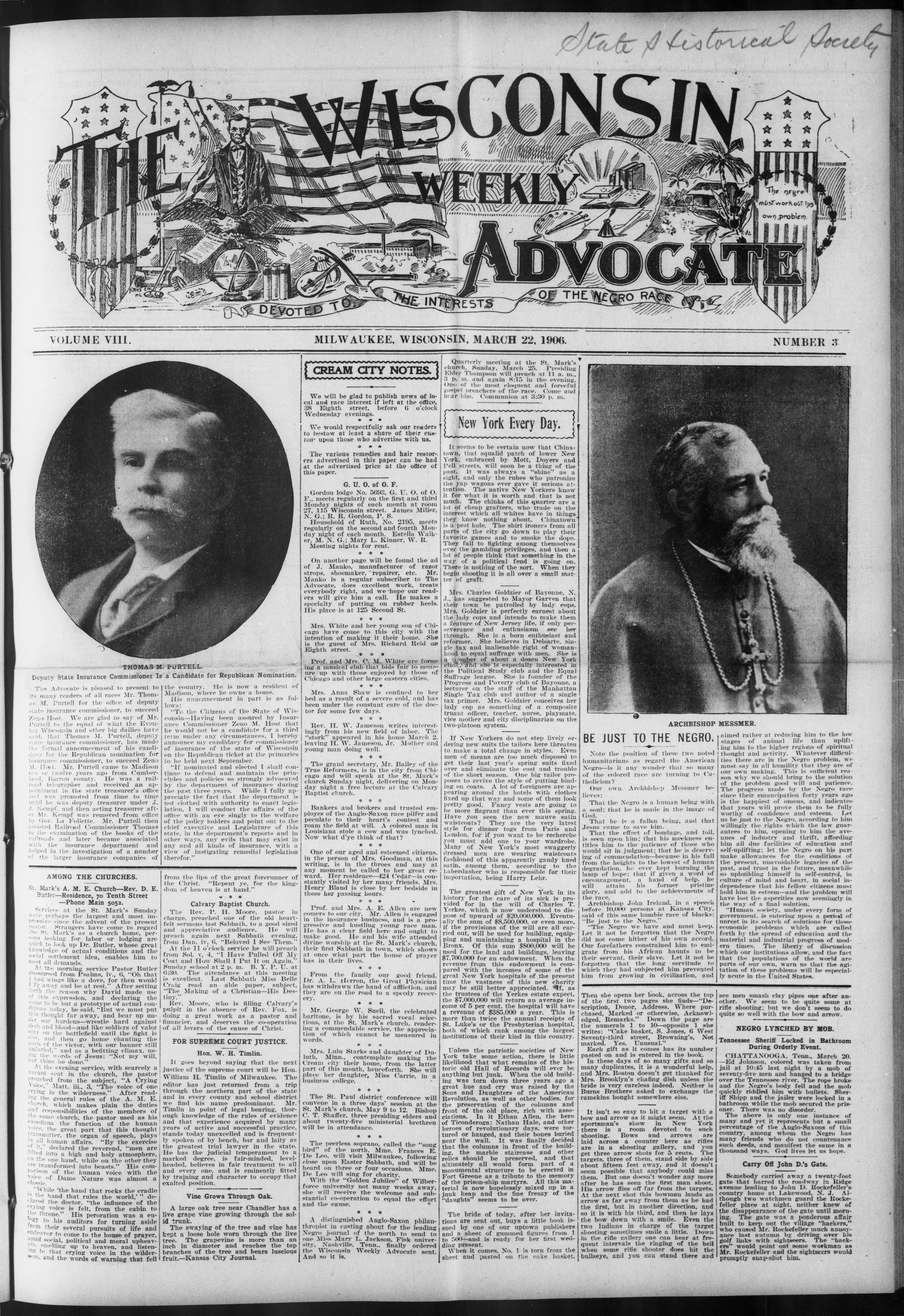
WISCONSIN
WEEKLY
ADVOCATE
DEVOTED TO THE INTERESTS OF THE NEGRO RACE
THOMAS M. RUDDELL
Dewey State Insurance Commissioner Is a Candidate for Republican Nomination.
VOLUME VIII.
THOMAS
Deputy State Insurance Commissioner
The Advocate is pleased to present to its many readers of all races Mr. Thomas M. Purtell for the office of deputy state insurance commissioner, to succeed Zeno Host. We are glad to say of Mr. Purtell to the equal of what the Evening Wisconsin and other big dailies have said, that Thomas M. Purtell, deputy state insurance commissioner, has made the formal announcement of his candidacy for the Republican nomination for insurance commissioner, to succeed Zeno M. Host. Mr. Purtell came to Madison ten or twelve years ago from Cumberland, Barron county. He was a railroad telegrapher and received an appointment in the state treasurer's office and was promoted from time to time until he was deputy treasurer under J. J. Kempf, and then acting treasurer after Mr. Kempf was removed from office by Gov. La Follette. Mr. Purtell then assisted Railroad Commissioner Thomas in the examination of the books of the railroads and later became associated with the insurance department and helped in the investigation of a number of the larger insurance companies of
AMONG THE CHURCHES
St. Mark's A. M. E. Church—Rev. D. E. Butler—Residence, 70 Tenth Street Phone Main 5052. Services at the St. Mark's Sunday were perhaps the largest and most impressive since the advent of the present pastor. Strangers have come to regard the St. Mark's as a church home, persons looking for labor or lodging are quick to look up Dr. Butler, whose great knowledge of actual conditions and the social settlement idea, enables him to meet all demands.
At the morning service Pastor Butler discoursed from Psalms, lv., 6, "Oh that I had wings like a dove, for then would fly away and be at rest." After setting forth the reason why David made use of this expression, and declaring the same to be but a prototype of actual conditions today, he said, "But we must put this thought far away, and bear up under our burdens—wrestle hard against flesh and blood—and like soldiers of valor stay on the battlefield until the fight is over, and then go home chanting the paen of the victor, with our banner still unfurled," and as a befitting climax, using the words of Jesus: "Not my will, but thine be done."
At the evening service, with scarcely a vacant seat in the church, the pastor preached from the subject, "A Crying Voice," Matt. iii., 3, "The voice of one crying in the wilderness." After reading the general rules of the A. M. E. church, which makes plain the duties and responsibilities of the members of the same church, the pastor used as his exordium the function of the human voice, the great part that this thought transmitter, the organ of speech, plays in all human affairs. "By the exercise of it," declared the reverend, "men are lifted into a high and holy atmosphere, on the one hand, while on the other they are transformed into beasts." His comparison of the human voice with the voice of Dame Nature was almost a classic.
"While 'the hand that rocks the cradle is the hand that rules the world,'" declared the doctor, "the influence of the crying voice is felt, from the cabin to the throne." His peroration was a eulogy to his auditors for turning aside from their several pursuits of life and endeavor to come to the house of prayer, amid social, political and moral upheavals, smelling up to heaven, and listening to that crying voice in the wilderness, and the words of warning that fell
the country. He is now a resident of Madison, where he owns a home.
His announcement in part is as follows:
"To the Citizens of the State of Wisconsin—Having been assured by Insurance Commissioner Zeno M. Host that he would not be a candidate for a third term under any circumstances, I hereby announce my candidacy for commissioner of insurance of the state of Wisconsin on the Republican ticket at the primaries to be held next September.
"If nominated and elected I shall continue to defend and maintain the principles and policies so strongly advocated by the department of insurance during the past three years. While I fully appreciate the fact that the department is not clothed with authority to enact legislation, I will conduct the affairs of the office with an eye singly to the welfare of the policy holders and point out to the chief executive and Legislature of this state, in the department's reports and in other ways, any evils that may exist in any and all kinds of insurance, with a view of instigating remedial legislation therefor."
from the lips of the great forerunner of the Christ. "Repent ye, for the kingdom of heaven is at hand."
Calvary Baptist Church.
The Rev. P. H. Moore, pastor in charge, preached one of the old heartfelt sermons last Sabbath, to a good sized and appreciative audience. He will preach again next Sabbath evening, from Dan, iv, 6, "Beloved I See Them." At the 11 o'clock service he will preach from Sol. v, 4, "I Have Pulled Off My Coat and How Shall I Put It on Again." Sunday school at 2 p. m. B. Y. P. U. at 6:30. The attendance at this meeting is excellent. Last Sabbath Miss Belle Craig read an able paper, subject, "The Making of a Christian—His Destiny." Rev. Moore, who is filling Calvary's pulpit in the absence of Rev. Fox, is doing a great work as a pastor and financier, and deserves the co-operation of all lovers of the cause of Christ.
FOR SUPREME COURT JUSTICE.
Hon, W. H. Timlin.
It goes beyond saying that the next justice of the supreme court will be Hon. William H. Timlin of Milwaukee. The editor has just returned from a trip through the northern part of the state and in every county and school district we find his name predominant. Mr. Timlin in point of legal bearing, thorough knowledge of the rules of evidence and that experience acquired by many years of active and successful practice, stands today unexcelled and is frequently spoken of by bench, bar and laity as the greatest trial lawyer in the state. He has the judicial temperament to a marked degree, is fair-minded, level-headed, believes in fair treatment to all and every one, and is eminently fitted by training and character to occupy that exalted position.
Vine Grows Through Oak.
A large oak tree near Chandler has a live grape vine growing through the solid trunk. The swaying of the tree and vine has kept a loose hole worn through the live tree. The grapevine is more than an inch in diameter and reaches the top branches of the tree and bears luscious fruit—Kansas City Journal.
CREAM CITY NOTES.
We will be glad to publish news of local and race interest if left at the office, 38 Eighth street, before 6 o'clock Wednesday evenings.
We would respectfully ask our readers to bestow at least a share of their custom upon those who advertise with us.
The various remedies and hair restorers advertised in this paper can be had at the advertised price at the office of this paper.
G. U. Q. of Q. F.
Gordon lodge No. 5693, G. U. O. of O. F., meets regularly on the first and third Monday nights of each month at room 27, 115 Wisconsin street. James Miller, N. G.; R. R. Gordon, P. S.
Household of Ruth, No. 2195, meets regularly on the second and fourth Monday night of each month. Estella Walker, M. N. G.; Mary L. Kinner, W. R.
* * *
On another page will be found the ad of J. Manko, manufacturer of razor strops, shoemaker, repairer, etc. Mr. Manko is a regular subscriber to The Advocate, does excellent work, treats everybody right, and we hope our readers will give him a call. He makes a specialty of putting on rubber heels. His place is at 125 Second St.
* * *
Mrs. White and her young son of Chicago have come to this city with the intention of making it their home. She is the guest of Mrs. Richard Reid on Eighth street.
Prof. and Mrs. C. M. White are forming a musical club that bids fair to measure up with those enjoyed by those of Chicago and other large eastern cities.
* * *
Mrs. Anna Shaw is confined to her bed as a result of a severe cold, and has been under the constant care of the doctor for some few days.
* * *
Rev. H. W. Jameson writes interestingly from his new field of labor. The "stork" appeared in his home March 2, leaving H. W. Jameson, Jr. Mother and young man doing well.
* * *
The grand secretary, Mr. Bailey of the True Reformers, is in the city from Chicago and will speak at the St. Mark's church Sunday night, delivering on Monday night a free lecture at the Calvary Baptist church.
***
Bankers and brokers and trusted employees of the Anglo-Saxon race pilfer and peculate to their heart's contest and roam the field at will. A colored man in Louisiana stole a cow and was lynched. Now what d'veve think of that?
* * *
One of our aged and esteemed citizens, in the person of Mrs. Goodman, at this writing, is in the throes and may at any moment be called to her great reward. Her residence—424 Cedar—is constantly visited by her many friends. Mrs. Henry Bland is close by her bedside in these her passing hours.
* * *
Prof. and Mrs. A. E. Allen are new comers to our city. Mr. Allen is engaged in the insurance business, and is a progressive and hustling young race man. He has a clear field here and ought to make good. He and his wife attended divine worship at the St. Mark's church, their first Sabbath in town, which shows at once what part the house of prayer has in their lives.
* * *
From the family our good friend. Dr. A. L. Herron, the Great Physician has withdrawn the hand of affliction, and they are on the road to a speedy recovery.
* * *
Mr. George W. Snell, the celebrated baritone, is by his sacred vocal selections, at the St. Mark's church, rendering a commendable service, the appreciation of which cannot be measured in words.
茶 恋 恋
Mrs. Lulu Starks and daughter of Duluth, Minn., contemplate making the Cream city their home, from the latter part of this month, henceforth. She will place her daughter, Miss Carrie, in a business college.
* * *
The St. Paul district conference will convene in a three days' session at the St. Mark's church, May 9 to 12. Bishop C. T. Shaffer, three presiding elders and about twenty-five ministerial brethren will be in attendance.
\* \* \*
The peerless soprano, called the "song bird" of the north, Mme. Frances E. De Leo. will visit Milwaukee, following close upon Easter Sabbath, and will be heard on three or four occasions. Mme. De Leo will sing for charity. With the "Golden Jubilee" of Wilberforce university not many weeks away, she will receive the welcome and substantial co-operation to equal the effort and the cause.
***
A distinguished Anglo-Saxon philanthropist in casting about for the leading Negro journal of the north to send to one Miss Mary L. Jackson, Fisk university, Nashville, Tenn., finally ordered the Wisconsin Weekly Advocate sent. And so it is.
Quarterly meeting at the St. Mark's church, Sunday, March 25. Presiding Elder Thompson will preach at 11 a. m., 3 p. m. and again 8:15 in the evening. One of the most eloquent and forceful gospel preachers of the race. Come and hear him. Communion at 3:30 p. m.
New York Every Day.
---
It seems to be certain now that Chinatown, that squallid patch of lower New York, embraced by Mott, Doyers and Pell streets, will soon be a thing of the past. It was always a "shine" as a sight, and only the rubes who patronize the yap wagons ever gave it serious attention. The native New Yorkers know it for what it is worth and that is not much. The chinks of this quarter are a lot of cheap grafters, who trade on the interest which all whites have in things they know nothing about. Chinatown is a pest hole. The shirt ironers from all parts of the city go down to play their favorite games and to smoke the dope. They fall to fighting among themselves over the gambling privileges, and then a lot of people think that something in the way of a political feud is going on. There is nothing of the sort. When they begin shooting it is all over a small matter of graft.
Mrs. Charles Goldzier of Bayonne, N. J., has suggested to Mayor Garven that their town be patrolled by lady cops. Mrs. Goldzier is perfectly earnest about the lady cops and intends to make them a feature of New Jersey life, if only perseverance and enthusiasm see her through. She is a born enthusiast and reformer. She believes in Delsarte, single tax and inalienable right of womanhood to equal suffrage with men. She is a number of about a dozen New York club, and she is especially interested in the Political Study club and the Equal Suffrage league. She is founder of the Progress and Poverty club of Bayonne, a lecturer on the staff of the Manhattan Single Tax club and author of a single tax primer. Mrs. Goldzier conceives her lady cop as something of a composite truant officer, teacher, nurse, playmate, vice mother and city disciplinarian on the two-platoon system.
If New Yorkers do not step lively ordering new suits the tailors here threaten to make a total change in styles. Even men of means are too much disposed to get their last year's spring suits fixed over and eliminate the cost and trouble of the short season. One big tailor proposes to revive the style of putting binding on coats. A lot of foreigners are appearing around the hotels with clothes fixed up that way and some of them look pretty good. Fancy vests are going to be more flagrant than ever this spring. Have you seen the new mauve satin waistcoats? They are the very latest style for dinner togs from Paris and London, for if you want to be recherche you must add one to your wardrobe. Many of New York's most swaggerly dressed men are wearing waistcoats fashioned of this apparently gaudy hued satin, among them, according to the haberdasher who is responsible for their importation, being Harry Lehr.
---
The greatest gift of New York in its history for the care of its sick is provided for in the will of Charles T. Yerkes, which is now understood to dispose of upward of $20,000,000. Eventually the sum of $8,500,000, or even more, if the provisions of the will are all carried out, will be used for building, equipping and maintaining a hospital in the Bronx. Of this sum $800,000 will be used for the land and buildings, leaving $7,700,000 for an endowment. When the revenue from this endowment is compared with the incomes of some of the great New York hospitals of the present time the vastness of this new charity may be still better appreciated. If, as the trustees of the Yerkes estate expect, the $7,000,000 will return an average income of 5 per cent. the hospital will have a revenue of $385,000 a year. This is more than twice the annual receipts of St. Luke's or the Presbyterian hospital, both of which rank among the largest institutions of their kind in this country.
Unless the patriotic societies of New York take some action, there is little likelihood that what remains of the historic old Hall of Records will ever be anything but junk. When the old building was torn down three years ago a great hue and cry was raised by the Sons and Daughters of the American Revolution, as well as other bodies, for the preservation of the columns and front of the old place, rich with associations. In it Ethan Allen, the hero of Ticonderoga; Nathan Hale, and other heroes of revolutionary days; were tortured or hanged, and their bones buried near the wall. It was finally decided that the columns in front of the building, the marble staircase and other relics should be preserved, and that ultimately all would form part of a monumental structure to be erected in Fort Greene as a tribute to the memory of the prison-ship martyrs. All this material is now hopelessly mixed up in a junk heap and the fine frenzy of the "daughters" seems to be over.
The bride of today, after her invitations are sent out, buys a little book issued by one of our uptown publishers and a sheet of gummed figures from 1 to 500—and is ready for her first wedding present. When it comes, No. 1 is torn from the sheet and pasted on the cake basket.
P.
ARCHBISHOP MESSMER
BE JUST TO THE NEGRO.
Note the position of these two noted humanitarians as regard the American Negro—is it any wonder that so many of the colored race are turning to Catholicism?
Our own Archbishop Messmer believes:
That the Negro is a human being with a soul; that he is made in the image of God.
That he is a fallen being, and that Jesus came to save him.
That the effect of bondage, and toil, is seen upon him; that his meekness entitles him to the patience of those who would sit in judgment; that he is deserving of commendation—because in his fall from the heights to the lowest of human degradation, he ever kept burning the lamp of hope; that if given a word of encouragement, a hand of help, he will attain his former pristine glory, and add to the achievements of the race.
Archbishop John Ireland, in a speech before 10,000 persons at Kansas City, said of this same humble race of blacks: "Be just to the Negro."
"The Negro we have and must keep. Let it not be forgotten that the Negro did not come hither of his own accord. Our forefathers constrained him to emigrate from his African haunts to be their servant, their slave. Let it not be forgotten that the long servitude to which they had subjected him prevented him from growing in civilization, and
Then she opens her book, across the top of the first two pages she finds—"Description, Donor, Address, Where purchased, Marked or otherwise, Acknowledged, Remarks." Down the page are the numerals 1 to 10—opposite 1 she writes: "Cake basket, S. Jones, 6 West Seventy-third street, Browning's, Not marked. Yes. Unusual." Each gift as it comes has its number pasted on and is entered in the book. In these days of so many gifts and so many duplicates, it is a wonderful help, and Mrs. Boston doesn't get thanked for Mrs. Brooklyn's chafing dish unless the bride is very careless indeed. Neither is Burns Brothers asked to exchange the ramekins bought somewhere else.
It isn't so easy to hit a target with a bow and arrow as it might seem. At the sportsman's show in New York there is a room devoted to such shooting. Bows and arrows are laid across a counter here as rifles are in a shooting gallery, and you get three arrow shots for 5 cents. The targets, three of them, stand side by side about fifteen feet away, and it doesn't seem possible that anybody could miss them. But one doesn't wonder any more after he has seen the first man shoot. His arrow flies off far from the targets. At the next shot this bowman lands an arrow as far away from them as he had the first, but in another direction, and so it is with his third, and then he lays the bow down with a smile. Even the two Indians in charge of the target shooting sometimes smile a little. Down in the rifle gallery one can hear at frequent intervals the ringing of the bell when some rifle shooter does hit the bullseye, and you can stand there and
一
MESSMER.
aimed rather at reducing him to the low stages of animal life than uplifting him to the higher regions of spiritual thought and activity. Whatever difficulties there are in the Negro problem, we must say in all humility that they are of our own making. This is sufficient reason why we should bring to the solution of the problem good will and patience. The progress made by the Negro race since their emancipation forty years ago is the happiest of omens, and indicates that years will prove them to be fully worthy of confidence and esteem. Let us be just to the Negro, according to him willingly the rights which the law guarantees to him, opening to him the avenues of industry and thrift, affording him all due facilities of education and self-uplifting; let the Negro on his part make allowances for the conditions of the present, unavoidable legacies of the past, and trust in the future, meanwhile so upbuilding himself in self-control, in culture of mind and heart, in social independence that his fellow citizens must hold him in esteem—and the problem will have lost the asperities now seemingly in the way of a final solution.
"Human society, under every form of government, is entering upon a period of unrest in its search of solutions for those economic problems which are called forth by the spread of education and the material and industrial progress of modern times. The liberty of discussion which our institutions allow, and the fact that the populations of the world are parts of our own, warn us that the agitation of these problems will be especially acute in the United States.
see men smash clay pipes one after another. We seem to be quite some at rifle shooting; but we don't seem to do quite so well with the bow and arrow.
NEGRO LYNCHED BY MOB.
Tennessee Sheriff Locked in Bathroom During Orderly Event.
CHATTANOOGA, Tenn., March 20. -Ed Johnson, colored was taken from jail at 10:45 last night by a mob of seventy-five men and hanged to a bridge over the Tennessee river. The rope broke and the Negro's body fell and the mob quickly riddled him with bullets. Sheriff Shipp and the jailer were locked in a bathroom while the mob secured the prison. There was no disorder. The above is only one instance of many and yet it represents but a small percentage of the Anglo-Saxons of this country, among whom the Negro has many friends who do not countenance such deeds, and manifest the same in a thousand ways. God lives let us hope.
Somebody carried away a twenty-foot gate that barred the roadway in Ridge avenue leading to John D. Rockefeller's country home at Lakewood, N. J. Although two watchmen guard the Rockefeller place at night, neither knew of the disappearance of the gate until morning. The gate was a ponderous affair built to keep out the village "hackers," who caused Mr. Rockefeller much annoyance last autumn by driving over his golf links with sightseers. The "hackers" would point out some workman as Mr. Rockefeller and the sightseers would promptly snap-shot him.
---
NUMBER 3
Carry Off John D.'s Gate.
—Mrs. Theodore Roosevelt has accepted the office of honorary vice president of the State Mothers' assembly of New York.
—King Edward of England has a peculiar habit of passing his finger backward and forward under his chin when in meditation.
—Oysters are so plentiful in the Inland sea of Japan that they are sold in the restaurants of that country for 5 cents per dozen.
—Magnetic compasses are to be supplied in future to all British and native cavalry regiments in India at the rate of four a squadron.
—Pet dogs in sunbonnets and blue glass spectacles may be seen following their owners through the streets of Berlin in hot weather.
—Congressman Olmsted of Pennsylvania expressed this opinion: "It takes a man about four terms to familiarize himself with his office."
—Dr. William Henry Drummond, the poet of the French Canadians, has given up his medical practice and gone into copper mining in the dominion.
—The Japanese imperial library at Tokio has on its shelves something like 2000 written and printed mathematical works, extending as far back as 1595.
—It has been decided by the municipal authorities of Berlin to establish public "sun and light baths" at which first, second and third class fees will be charged.
-According to La Tribuna di Roma one of the gaiters worn by Garibaldi when he was wounded in the battle of Aspromonte, August 28, 1862, has been presented to the mayor of Rome.
-Chinese students in Japan now number more than 3000, engaged in all the studies available at American high schools, colleges, universities, professional, technical and trade schools.
-The tallest building in the world is being erected in New York by a life insurance company. It will be 560 feet high, or five feet higher than the Washington monument and 88 feet higher than
-An amateur society has been formed for the "diffusion of the cult of the bagpipe," not only in Scotland, but in England. A set of pipes costs from $25 to $250, according to finish and embellishments.
Queen Aanarolo of Madagascar has recently realized a long cherished ambition by paying a visit to Paris. While there she enjoyed the felicity of having her allowance increased from $6000 to $10,000.
The largest industry in Japan is textile, there being some 4537 factories of various sizes engaged in this trade, the majority being centered in and around Osaka. These are mostly worked by steam power.
There is a horse that catches rats and mice in Manchester, England. If a rat or mouse runs across his manager, he will grab at it and, if successful in getting it, will drop it into the bucket of water, which is always left with him.
The Japanese jinrikishas were established in Shanghai as public vehicles less than two years ago, and their introduction in various other parts of China is being pushed with characteristic Japanese energy.
According to information supplied by the Institute of Tropical Research, recently founded in connection with Liverpool university, Ceylon has, in the last season, shipped 100,000 pounds of rubber, all produced from the island plantations.
The coffee crop of Sumatra has become almost equal to that of Java. The latter island is smaller but much more populous and it had a long start in coffee before the plantations in Sumatra began to cut any figure in the world's supply.
Northern California has lost its principal antique. The oldest house in that part of the state, built by Mayor T. B. Reading in the remote period of 1844, and known therefore as a "historical structure," has been destroyed by wind and flood.
The British committee on naval designs has recommended that no more small protected cruisers be built. The war fleet of the future is to consist of battleships and armored cruisers, the torpedo flotillas and submarines forming separate self-contained forces.
DREDGING FOR HUSBANDS.
Raking the Social Gravel for Matrimonial Nuggets of Value.
Dredging for a husband is a development of the times which causes much amusement to the observant, says Truth. A girl who occupies a good position in "society" and is intelligent soon discovers that the number of rich bachelors of her own standing in life is very limited, that most of them are almost captured already, and that many of them will have little to do with her.
She then commences to "dredge" the bed of the social stream. Buried in the gravel of this are many rich men, the sons of still obscure financiers, manufacturers or merchants, and careful dredging often brings some of them to the surface. Then the connections are generally cast back into the water, and only the valuable elder son retained for use.
"Dredging parties" have recently become the rage. An expert "dredger" spends the winter in gathering the necessary material in hotels on the Continent and in other directions, and in the spring and summer gives a series of at homes to West End "customers," charging a commission on each completed transaction. Thus a "customer" captivates a "dredged" bachelor, and becomes engaged to him. If his income is £10,000 a year, the percentage is capitalized, and the amount is paid to the "dredger" on the wedding eve by the parents of the girl.
The "dredgers" have hitherto mostly been the divorced wives of widows of knights or baronets, but as the business is so remunerative many of the best known women in London are adopting it, for it is obvious that a duchess would be able to rake the "social" deep much more effectively than can even a lady who has made one reputation in "society" by losing another in the divorce court.
Cost of Protecting Patents.
"Patents cost too much," said an inventor. "It should be as cheap to patient an invention as to copyright a book. It should cost but a dollar.
"As it is, many a man hits on a good invention and then is afraid to risk his money patenting it. No wonder, either. Do you know what it costs really to protect an invention to protect it all over the world?
"It costs $2500, and it requires the taking out of no less than sixty-seven different patents."—New Orleans Times-Democrat.
Boy Stretched Two Inches
Among those successfully passing the mental examination for admission to the naval academy at Annapolis, Md., was Luther Welsh of Kansas City, who, finding during his preparatory work that he was too short to meet the requirements, which demand that those entering the academy must be at least 5 feet 2 inches in height, underwent a stretching process in which a specially devised machine figured. Welsh gained the needed 2 inches
HUNTLEY OF THE CASTINE.
Not on the quarterdeck alone
Are the battle's bravest heroes known;
Not by the man behind the gun
Are the glorious victories always won;
Valor hideth a blade as keen
Out of sight of the sanguine scene.
Where are doughty deeds of daring done
Like Huntley's—Huntley of the Castine!
When the little gunboat darted at dawn,
With her fluttering starry flag at peak,
Under the walls of San Juan—
San Juan of Porto Rique—
She seemed like a living, conscious thing
With the battle passion quivering;
At fullest speed, with her screws a-spin,
And her batteries roaring, she hurried in.
Leaping—the baby of all the fleet—
Her furnaces glowing with nery heat.
Suddenly down in the deepest hold,
There in the vessel's throbbing heart,
Rose a sound to test the soul of the bold,
To make the bravest blanch and start—
Not the noise of a dream, but the hiss of
steam,
A socket bolt sprung loose in a seam!
"Quick! Bank the fire! Quick! Bank the
fire!"
Cries fearless Huntley, man of the hour.
He will save from destruction dire.
Save if it lies within mortal power.
The stokers heave with laboring breath
In a desperate fight with a demon death.
Into that reeking pit he dares,
Huntley—Huntley of the Castine;
(O for a waft of God's fresh sweet airs
And the sea and the heavens clear and
clean!)
Pass the minutes—one—two—and three:
To him and his comrades each seems to be
A separate eternity.
The while 'mid the heat and the stifling fume
He tightens the bolt that is threatening doom;
Then forth they hale him to see him lie
Prone before them with lidded eye—
Nay, nay; but he did not die!
Of the sky they bore him with reverent men
And he roused and gazed on the flag that flow
O'er the blare and blaze of the battle scene. He did not die, and when up to the blue And smiled, how they cheered him, that valiant crew!
Shall we not join in the cheering, too. For Huntley—the hero of the Castine? Clinton Scollard
THE CROWN PRINCE.
The Crown Prince Georgio of Bergia was eccentric.
Georgio, eldest son of Peter I., differed from his father, the King, as radically as only two generations of semi-Papan royalty may.
King Peter was a slow-witted, genial man with religious if not moral scruples who took ever the line of the least resistance which exigency and a near-sighted comprehension disclosed to him. He offended many but made few bitter enemies.
Georgio was quick-tempered, headstrong and acute. Without the first two attributes he might have been, also, astute, for his mind was subtle and capable of penetration. Lacking self-possession, however, Georgio was demoniac and recently saint-like by turns. In the former state optimists said: "Soon he will be very good," and in the latter, pessimists cried, forebodingly: "Look out! He is preparing for some deviltry." And both were usually right.
Once Georgio struck a court servant viciously, with the flat of his sword and might have killed him but for prompt interference. The servant's fault lay in not getting out of his royal master's way with sufficient rapidity. He was paid a month's salary and sent away. Once Georgio's younger brother, Alex, used the former's American bicycle and was felled to the ground by a whip. He was sent to Vienna, where a commission was secured for him. Once Georgio, coveting a horse, seized it and flung the owner a purse. When the latter demurred Georgio ordered his servants to beat him. Upon their refusal, he turned upon the man himself, and, meeting defense, shot his opponent through the up-raised arm. The man was a foreigner, and international complications threatened until the horse was restored with a cash indemnity of sufficient magnitude. Such acts represented the phase of Georgio's nature which corresponded to "Mr. Hyde." That the "Dr. Jekyll" element was also present, other diametrically different acts bore testimony. There was a day when, riding on the outskirts of his estate, he found a dying peasant woman crying for her son, at work in a distant field. It was then that Georgio dismounted, cheered the woman as best he might, rode himself for the absent one and sent the court physician, reluctantly, to the sufferer's aid. Once, also, he had risked his life to save a child from drowning, and once again, released a beggar, imprisoned for a theft of food from the royal kitchen, and showered him with doubloons.
Thus the Crown Prince Georgio of Bergia, when Anselma Darchouky, a Hungarian actress, came to the Bergian capital and played with her companions in histrionic art, at the Imperial theater. Georgio, during the play, was seen to lean over the edge of his box, like one enchanted, while the actress trod the boards, to toss a signet ring upon the stage at the climax and to sing back listlessly, with the final curtain. Crown Prince Georgio, for the first time in life, was in love with someone besides himself. His attendance at the theater became a matter for national speculation. His gifts to the actress taxed even his liberal allowance and the time he spent in her company was productive of open scandal.
In Bergia the moral code was a very elastic one, even for common folk. For royalty it was limitless. Many princes of the kingdom, in the years agone, had amused themselves with actresses, and little had been said. But Georgio was not amusing himself. He found being in love a very serious matter, and one that presented to his intensely earnest nature but one logical, or, rather, illogical, conclusion—marriage.
With the first whisper of this contemplated madness—for such a natural desire is always styled by royalty's maturer years—King Peter sent a court official to the theater and Anselma was persuaded to depart at once. An interview between father and son which followed proved one of the most violent in the history of a palace that had never been a stranger to the words of angry passion. Georgio, confined to his quarters under arrest, stormed, futilely, for several days and nights, and then sank into coma, utterly exhausted. His strength and rage spent, Georgio began to plot, when consciousness returned. One night a peasant had walked unobtrusively, past palace guards to the railway station and entered a second-class compartment of the night express. Next morning servants found an effigy upon the Prince's bed, an open window giving on the courtyard and a rope made from torn strips of priceless tapestry still dangling from the sill. A quiet but futile search was made by court detectives. In public it was given out that Prince Georgio had journeyed to Vienna for a visit to his brother and would soon return. And no one, in the secret, guessed how near the truth this statement was.
At Vienna the following morning Geogio rehabilitated himself in the garb of a better class citizen, exciting the suspicion of the clothier by a display of coin drawn
from the peasant's frock and his utter disregard for prices. Emerging, he made his way to the theater at which Anselma had told him she would play upon leaving Bergia.
The doorkeeper paid him scant attention till a coin was pressed into his palm. Then he vouchsafed the information that Mlle. Darchouky was most likely to be found at her apartments, adding the address. Thitner Georgio journed in most eager haste, to be informed that mademoiselle had gone driving with "her military friend."
Fires of jealousy coursed through his veins like molten lead. He took a step to go and then returned.
"Permit me to wait in her apartments," he said to the woman. "I am her brother. Say nothing. I wish to surprise her with my presence."
After some hesitation, which melted away before a generous "pour boire," the woman consented. Georgio crossed the threshold of her chamber reverently. It seemed redolent of her charming presence. Within it lingered the subtle perfume which pervaded everything she wore or used or touched. Georgio sat down to dream. He would renounce his rights and make this woman his. They would go abroad, somewhere, and live like common folk, in happiness and peace. What was a kingdom or a throne compared to joy like this? As for rivals, his royal arrogance dismissed all competition with his reflections when he heard approaching footfalls on the stair, and bid himself with haste behind a screen.
A man and a woman entered. Something in the man's voice made him start and crouch behind his hiding place. A tiny hole in the screen permitted him to see what passed without. The man's back was turned. He was bending over Anselma, removing her cloak. As he did so, their hands touched and the man's pent love flamed forth. He kissed her, murmuring:
"I love you. I love you. I love you." She gazed at him startled, for a moment; then flung her arms about his neck in a glad surrender.
"My love. My life. My king," she breathed.
"Listen," said the man. "We will marry at once and go away. Your good name is very sweet to me. No one will care. I am a younger son. A steamer leaves for America tomorrow. We can catch the light express for Bremen. Will you go?"
"To the end of the world—with you," she answered.
All this Georgio saw and overheard behind the screen.
As the man turned Georgio stifled a cry. It was his brother Axela.
cry. It was his brother, Axela.
For a moment his face worked, convulsively, aflame with anger, jealousy and wounded pride. Instinctively his hand sought the sword-hilt that it did not find. Several times he made a move to spring upon them, strike them down, avenge himself, but always some force held him back. And, after a while another spell of coma came upon him and he lay there as one dead.
Two days later Georgio returned to Bergia, silently, unostentationally as he had gone—except that there was this difference: He had gone a boy, aflame with love and the fire of life. He returned a man upon whose heart earth's burdens seemed to weigh and those who knew him in the later years said that he never smiled again. When the news of his brother's flight came to the court, he said little. When King Peter died he took the throne and made, to everyone's astonishment, a just and noble ruler. It was not until a grievous illness came upon him, suddenly, and the court physician made examination of his heart that a faded picture of Anselma was discovered there, upon his breast. He had worn it there, throughout the years, in secret, though her name had never passed his lips.—Brooklyn Citizens.
CURATIVE APPARATUS
For Use in Connection with Animals Especially Horses.
An efficient mode of treating bruised, irritated and sometimes diseased limbs of animals—as, for instance, the leg of a horse—is by pouring a stream of water upon the limb at the point affected. Heretofore it has been universally customary for the person in charge of the animal to hold the end of a hose at the point desired and pour the stream of water upon it for such length of time as might be deemed necessary. This mode
A
DIRECTS THE STEAM
of holding the stream is more or less defective, in that the stream of water could not be poured upon the exact spot for any great length of time on account of the person holding the hose becoming tired and unable to direct it uniformly. In order to obviate these difficulties and to produce an apparatus not requiring continuous attention, the device here illustrated was produced. It consists of a strap having padding within it and adapted to be passed around the leg or other portion of the animal. To the strap is rigidly fastened a standard trough which passes a rod, the rod being adjustable on the standard and is clamped by means of a set screw. Upon the rod is fastened the clamping device, consisting of a plate or bar, held to the rod by adjustable means, such as a pair of set screws. The end of the rod is bowed or hollowed and the clamping plate of corresponding form, so that between the two parts of the clamp the nozzle of the hose can be fastened in order to direct the stream of water upon the part to be treated.
Water in Which Razor is Ground
"People often wonder why German hollow ground is the boast of American razor makers." said a cutlery salesman
razor makers, said a cutlery salesman. "They want to know why we can't grind our own razors here. We have the men and the implements and we can grind as keen an edge, but we can't get the white, silvery color of the German grinding. There is no trade secret about it.
"It is just some peculiar quality in the water used to wet the stones that gives the blade its clean whiteness. In a real German hollow ground razor that whiteness lasts as long as the blade. When you see the blue shade coming after a razor has been in use for some time you can be certain that the blade was never ground in Germany."—Kansas City Times.
GENERAL INTEREST
A horse belonging to Dr. B. R. Rose of Evansville, Ind., and valued at $500 apparently committed suicide by plunging against a sharp post, impaling itself.
Edward Coke, who was the leading man for two years in a dramatic presentation of "Ten Nights in a Barroom," was granted a liquor license at Kingfisher, Okla.
Refusing to take a dare, pretty Jeanette Dougherty, a high school girl at Evansville, Ind., climbed to the top of a smokestack, 222 feet high, and standing there threw a kiss to the people below who had gathered to witness her feat.
W. A. Bailey, one of the express messengers who was hurt in the wreck at Festoria, O., pasted up his scalp wound which reached to the skull, with postage stamps, tied a handkerchief about his head and did what he could for others. He is rapidly recovering.
Miss Helen Lamponz, a member of "The Isle of Spice" chorus, has received a cable dispatch from Venice, Italy, telling of the death of her grandfather, and the discovery that he had willed his fortune of $700,000 to her. Miss Lamponz declared that in spite of the money she would not give up her position.
Miss Anna Newell of Wanetta and James Smith, an Oklahoma City merchant, eloped to Shawnee, Okla., and were married by Rev. E. S. Stockwell. The ceremony was performed on the street curb, in front of the preacher's residence, the bridal couple remaining in a cab while the knot was tied.
Mrs. Darrius Sewell. Pawpaw county. Ind., is alive because she wished to be a good looking corpse. She attempted to commit suicide by shooting herself in the back of the head. When revived she said she thought of shooting herself in the forehead, but did not do so "because it would have disfigured her as a corpse."
Chief of Police Will Harles of Charleston, Ill., was arrested and fined for violating the city ordinance against spitting on the sidewalks. A short time ago for this offense Harles caused the arrest of the son of Fountain Turner, and when the boy's father caught the chief in the same act he swore out a warrant against him.
While talking by phone with his fiancee, Miss Elizabeth Buchanan, at her home in Indianapolis, Dr. Ellis Dixon, a dentist of Frankfort, Ind., committed suicide by shooting. Miss Buchanan, hearing the shot over the wire and being able to get no response from Dr. Dixon, became alarmed, called up another friend here and learned of her fiance's deed.
Joseph Edward Cox, auditor of the Richmond, Fredericksburg & Potomac railroad, and Stonewall Jackson Doswell, of Hanover county, Va., confirmed bachelors, who had confided to each other their intention of remaining such until the end of life, accidentally discovered each other in a Richmond jewelry store on the same mission—the purchase of a wedding ring.
In his suit against the United States Gypsum company Clyde Begg of Toledo, O., says that a pair of apron strings were responsible for the loss of his eye. He says he was forced to wear an apron with long strings furnished by the company. One morning he started across the factory and, passing a loose belt dragging on the floor, the belt switched the strings into a small stone which put his eye out.
When William Richardson and his wife accompanied their daughter, Miss Renelar, to the marriage license office at Pittsburg, Pa., to get a license for her to wed Jacob Morning they both wept at the thought of losing their daughter. The clerk consoled them and then discovered that they had twenty-one other children. Still they did not want to part with the twenty-second, who is their "baby." President Roosevelt will be notified.
The housekeepers of Maine will have a new source of trouble when the new scrubwomen's union, the first lodge of which was organized in Brunswick, gets its organization completed throughout the state. The scrubwomen of Brunswick elected Mrs. Delia Nelson president and Mrs. Cyrus Cobb secretary and treasurer and adopted a uniform scale of 20 cents an hour, instead of 12 to 15 cents, the price heretofore. They will address the scrubwomen of Portland and a state organization will soon be effected.
Parker Wilson and his bride, who left their home in Montgomery county, Ill., to make a tour of the southwest following their marriage, are missing. They were wedded in December and went first to St. Louis and then to Mexico, Mo., en route to Kansas and other western points. They have not been heard from since their arrival in Mexico, and their relatives are greatly alarmed over their long-continued and remarkable silence. The groom took $200 with him. Relatives fear that the couple were robbed and murdered.
There is a fearful row on in the Mary Brown Memorial Methodist Episcopal church at Pittsburg. Miss Martha Lewis, who was remembered by the late Capt. S. S. Brown in his will, has been asked to resign as superintendent of the Mary Brown Sunday school, the trustees alleging that the young woman holds $30,000 worth of bonds in the Pittsburg Brewing company, left her by Brown. At a church meeting Miss Lewis refused to resign. Charges were preferred against her and given to a committee to investigate.
After she had forbidden her husband's hired man, William Mahen, to marry her daughter, Mrs. William Connelley, living near Galena Junction, Mo., eloped with the hired man. She took with her $100, received during the day by her husband for a load of hogs. Mahen was in love with Bertha, the 15-year-old daughter of Mrs. Connelley. The husband followed the elopers as far as Clinton, Ia., and then gave up the chase. She left him with five children, including the girl whom she had forbidden to marry the hired man.
A remarkable love affair between children was brought out at the Four courts in St. Louis when Thomas Exton, aged 11 years, told how he had run away from home with "Bessie," and how he and she had lived in a room in an alley until she proved faithless and deserted him. The boy and the girl, who is 17 years old, ran away from Madison, Ill., a month ago, coming to St. Louis together. When the boy returned to their room after selling newspapers all day Monday he found it empty. He then applied to the police for protection. He will be returned to his parents.
Pitcher Frank Ferguson has finally notified the Cincinnati club that he has decided not to play professional ball but to take up the work of civil engineering with his father.
Same Old Story.
The honeymoon is over now. And to their flat they take. Where Nick tells Alice of the bread His mother used to make.
With a Janitor for Ruier.
Mr. Kaller—Taking music lessons, are you, Willie? Well, do you know what a flat is?
Willie Harlumm—Yes, sir; three rooms and a bath.
Rational Explanation
"I see that the only woman attorney in the county married her only client." I suppose she was afraid she might never get another."—Cleveland Plain Dealer.
No Reason to Quit
Biggs—Well, judging from the price of coal, there's no reason why they should. H. R. H.
Sharpe—Come out to our china closet. I want to show you a collection of souvenirs.
Whealton—Why, every piece of china is broken and numbered?
Sharpe—"Yes, they are souvenirs of our different cooks."—Exchange.
Horrible Dictu!
A young man residing at Ghent, is
Said to have indulged in a bent his
Friends viewed with regrets,
For he smoked cigarettes,
Until he was "non compos mentis."
—Harlowe R. Hoyt
Premature.
Cleverly—What made Gotrox dishinherit his whole family?
Beverly—Well, when he got his life insured and had made his will in their favor, they wanted to Oslerize him.—H. R. H.
Moved His Audience.
Barnstormer—Yes, sir, the audience was distinctly moved by my performance of Hamlet.
Hamphat—I understood that half of the people left before it was through.—H. B. H.
"Kube" Roots.
Kubelik, the famous violinist, who is now jarring New York with his fiddle and his freaks, has his fingers insured for $50,000, and, as a further precaution, Kube roots out danger by wearing a muff—when he isn't playing, of course. Florida Times-Union.
As Usual.
Jinks—Too bad about Plunger, isn't it?
Binks—What's he done now?
Jinks—Speculated in Amalgamated.
Binks—Didn't stocks go up?
Jinks—No, but Plunger did.—H. R. H.
The other day a small boy with a fish pole passed the printing office on his way home. The devil, who is rather an inquisitive fellow, failing to see any fish in the lad's possession yelled out: "Hello, Kid! What'd you catch?" The lad promptly answered, "Don't know. Hain't been home yet."—Exchange.
Soporific.
"My dear Mrs. Sharp," said Rev. Pondrus-Tawker, "why do you not induce your husband to come to church with you?" "O! my gracious! It would never do in the world. He snores terribly."—Catholic Standard and Times.
In Ancient Rome.
Magister—What's the charge against the prisoner?
Prosecutor—Impersonating a lietor. Magister—What did he do? Prosecutor—He obtained fifteen sestertii hush money from a Jewish bookmaker at the Coliseum.-H. R. H.
Not Unlikely.
Magistrate—You say you didn't steal the watch. Then where did you get it? Prisoner—Bought it, your worship.
Magistrate—What did it cost?
Prisoner—Really, your worship, I quite forgot to ask.—Tit-Bits.
A Great Idea.
"My new play is sure to make a hit," said the great actress; "it gives me an opportunity to display twenty new gowns."
"Gracious!" exclaimed her friend.
"How many acts?"
"Only four, but in one of them the scene's at a dressmaker's."—Philadelphia Press.
Safe from the Agent.
Church-That man Hughes, who is conducting the insurance investigation, is a lucky man. Gotham-Why so? Church-He won't be bothered with insurance agents calling at his office and telling him the advantages of insuring in their companies for a long time!-Yonkers Statesman.
Father's Forgotten Classics.
William had just returned from college to spend his spring vacation. One of the things most noticed by the young man was Fanny, the daughter of Si Perkis, a near neighbor, who had during his absence changed from a tomboyish schoolgirl into a very beautiful young woman. It seems his father had also noticed the change, and remarked to his son:
"William, have nou noticed how old Si Perkins' daughter Fanny has shot up? Seems to me she's gettin' to be a jolly handsome young critter!"
"She certainly is, father," said William, enthusiastically. "Fanny is as beautiful as Hebe!"
"Where's your eyes, boy?" objected the father. "She's a durn sight purter than he be! Old Si is as homely as Bill Jones' bull pup."—Harper's Weekly.
Gets Black Bear on Fish Hook.
C. O'Flynn and Marshal Alworth of Duluth have returned from Isle Royale with a young black bear which they say was captured in a novel manner. The men were fishing near the mouth of Big Siskiwit river and Alworth sent a leader down stream, to which was attached a hook baited with a good-sized shiner. The line was carried around a sharp bend by the current, and the baby bear, which seems to have been fishing also, caught the shiner and was himself caught, the hook fastening firmly in the lips.
Too Much for the Old Man.
The North Atchison boys tell a story on Joe Henderson. Joe is the father of Jess Henderson, the athlete, who used to be rated as the strongest man in town. When Jess was about 15 years old, and after he had taken boxing lessons several months, Joe attempted to box his ears. After trying his best Joe couldn't hit Jess. Jess was too "scienced;" so Father Joe went into the house and said to his wife: "Mamma, what's the matter with our Jesse? He needs a whipping, but I can't hit him."—Atchison Globe.
---
CROSSED OCEAN THREE TIMES.
Was Deported and Had to Return Again to Husband.
Among the arrivals reaching Hancock, Mich., a short time ago was Mrs. J. Salsky, who, in order to reach that place, had to cross the Atlantic ocean three times. Mrs. Salsky is the wife of a Russian Jew who has been a resident of Hancock for three years, coming to the city directly upon his arrival from his native land, where he had left his wite until such time as he could send her funds. This he did this winter. His brother came out with her, and for purposes of economy they bought a ticket as man and wife. The steamer landed them at Baltimore, and there the immigration officials discovered the irregularity in the ticket. In spite of every effort the woman and her brother-in-law were ordered deported. Mrs. Salsky, was landed at Bremen, and she took passage there for New York as soon as possible. The brother-in-law did not make the trip with her this time, he returning to Russia, and she came through without mishap. She arrived in Hancock without her husband's knowledge. He was not certain of the date of her coming, and was out of town on business when she reached the city. He returned the next day, and husband and wife are now reunited after three years of separation.
COULD NOT KEEP UP.
Broken Down, Like Many Another Woman, with Exhausting Kidney Troubles. Mrs. A. Taylor, of Wharton, N. J., says: "I had kidney trouble in its most painful and severe form, and the torture I went through now seems to have been almost unbearable. I had backache, pains in the side and loins, dizzy spells and hot, feverish headaches. There were bearing-down pains, and the kidney secretions passed too frequent-
MARY B.
ly, and with a burning sensation. They showed sediment. I became discouraged, weak, languid and depressed, so sick and weak that I could not keep up. As doctors did not cure me, I decided to try Doan's Kidney Pills, and with such success that my troubles were all gone after using eight boxes, and my strength, ambition and general health is fine." Sold by all dealers. 50 cents a box. Foster-Milburn Co., Buffalo, N. Y.
The Unexpected
"Did you hear the story about the old Plympton farm with the mortgage on it down Hardscrabble way?"
"No."
"Well, the old farm has been in the Plympton family more than ninety years, and they worked it for all there was in it. Old Eben Plympton put a mortgage on it and handed it down to his son Silas. And Silas died and left the mortgage to his widow. The widow got the note renewal from time to time, and struggled along year after year. Her son Jack ran away from home when he was sixteen and then the widow struggled along alone. Finally the holder of the mortgage wouldn't renew again. But the widow had no money, and finally the day the note fell due came round. Then what do you suppose happened?"
"The widow's son came home, of
"The widow's son came home, of course, and paid off the debt."
"No, he didn't. The holder of the mortgage came round and asked for his money. The widow sighed and said: 'You'll have to take the farm.' The man shuddered. He knew the farm. 'No, you don't!' he yelled. 'I'd sooner burn the blamed mortgage than take the measly old farm for a gift, by gum.'"
"Did he burn it?"
"He did."—Cleveland Plain Dealer.
DR. R. V. PIERCE GETS VERDICT.
Jury Vindicates "Favorite Prescription" from Attack of Ladies' Home Journal. The trial of the first libel suit growing out of the attacks on "patent" medicines has resulted in a verdict for the plaintiff. The first case to come to trial was that of the Dr. Pierce company against the Ladies' Home Journal, and the jury found the Ladies' Home Journal guilty of libel and fixed $16,000 as the damages it should pay. A motion was immediately made by the Dr. Pierce company to have this verdict set aside and the case retried, the grounds being that the verdict was insufficient. This motion is yet to be argued.
The article on which the suit was based was printed in the Ladies' Home Journal, and was to the effect that the Pierce medicines contained alcohol, digitalis and opium. It was shown that they contain none of these drugs, and Mr. Bok admitted, on the stand, that after the article was printed he had caused analysis to be made by three chemists and none could find a trace of the drugs mentioned.
Cat Caught Mumps from Boy.
A few weeks ago the little 6-year-old son of Mrs. Bettie Woodring, who lives on the Vine Grove road, about five or six miles out from town, had a severe case of mumps, and while the fever was high took up in his arms a pet cat and playfully blew his breath into its nostrils.
In less than two weeks the cat had a weil developed case of genuine mumps, with jaws and throat swollen so badly it could scarcely eat. In due course the disease wore off and the cat recovered and is now fat and sleek as ever.—Elizabethtown News.
French Marriage Restrictions.
It sounds almost incredible, but is none the less a fact, that a Frenchman under 25 years of age, whose parents are dead and whose grandfather or grandmother is alive, cannot enter the married state without the written authority of both or either of them.—Paris Letter to London Post.
DODD'S
KIDNEY
PILLS
FOR ALL KIDNEY DISEASES
CURES RHEUMATISM
BRIGHT'S DISEASE
DIABETES BACKACHE
We are discontinued the use of our products
in this package. The public may rely on other
sources of imitations. Sold only in boxes.
GOSSIP FOR THE LADIES.
A Song.
I shall not pass this way again,
But far beyond earth's Where and When
May I look back along a road
Where on both sides good seed I sowed.
I shall not pass this way again,
May Wisdom guide my tongue and pen,
And Love be mine that so I may
Plant roses all along the way.
I shall not pass this way again,
May I be courteous to men,
Faithful to friends, true to my God,
A fragrance on the path I trod.
-Clarence Urmy in Harper's Bazar.
Bon Voyage—
Tokens have become in these days of ever increasing ocean travel, almost as standard as Christmas gifts.
To the person who has never taken a sea voyage the choice is sometimes difficult, for it is emphatically a case which experience is fruitful in suggestion. A small bottle of oil of lavender sent by an understanding friend was a joy to a recent feminine voyager. A few drops in a cup of hot water distilled a fresh fragrance in the stateroom that proved most grateful during the shut-in-hours of storms and sea sickness. Toilet waters, soaps, and powders; all sorts and conditions of bags, from a fairly capacious pouch of the single pocketbook variety through the list known as steamer, dressing, and shoe bags; notebooks, a fountain pen, a lap writing book, traveling ink well, package of note paper for foreign use; all these offer acceptable choices.
A safety bag for money and letter of credit is a good gift, but should not be duplicated. A compact medicine case is indispensable to many, or its substitute, a package of selected necessities in the way of remedies chosen by one who has been abroad. Books, fruit, flowers, and candy are always received with pleasure, the last perfectly taking the form of lime or other fruit drops or candied fruit. A boy of 14 took great pleasure and incidentally added to the gayety of the other passengers by flying a large red Japanese box kite that was sent him as a parting gift. Every bright day it floated from the stern bridge, an effective flash of color against the neutral grays and blues of sky and ocean.
The Japanese hand stoves, with a good package of fuses for each, are of value not only en voyage, but as well during the European jaunt; and compact alcohol heaters are gratefully received if one be not provided with them. One trip across suffices to prove that the cost of the steamer gift by no means furnishes an index to its usefulness and delights.—Chicago Tribune.
Women Who Work for Wages.
"No one will marry you, my dears!" says the alarmist to the young women of business. If they are young enough, they answer, in their hearts, "Nonsense!"—whatever their lips may say; as they grow older, the inner repudiation may become tempered with a faint doubt. It is certainly true that the modern man—of the educated world—marries less early and often than did his grandfather, and any grandmother can give you the reason. But, in spite of the increased cost of living, in spite of the turn given by sport to energies that once knew no outlet but love-making, and in spite of the comforts of clubs and bachelor apartments, still many men do marry. I wish I could say that the modern preference is clearly for the alert, self-helpful woman of affairs, the girl who has mastered a profession or the one whose trained mind can put through a real estate transfer or a deal in May wheat; in time I believe that this may be true; but, as yet, a limited personal experience says otherwise. We have traveled a long way since the odious Dr. Maginn made his sneering comment, "We like to hear a few words of sense from a woman as we do from a parrot, because they are so unexpected;" but the level head is still outrivaled by the curly head, whether we like the admission or not. Statistics may prove the contrary; but it has seemed to me that the women who work and who are thrown with men in daily practical contact are less apt to marry than those who meet men only by lamp and candle light. Vanity suggests that this is the woman's choice, but I do not believe it. I believe that nearly all single women past 30, no matter how brilliantly successful their lives may be, are secretly crying in the wilderness; they want love and children, and the want can not be stilled or satisfied with anything else.
To the frank this would seem like an argument against going to work, but there is an argument for it so vastly greater that it overwhelms this—which is, after all, only a general tendency and need not apply to the particular case. On the other side lies the splendid fact that the woman with a trade of her own does not need to marry. She may wait until love comes, with no anxious thought of "chances," no compromise with her heart or head; she may keep the door open for the best thing of all, instead of shutting it on a possible half best. If she misses altogether, she is not an economic hanger-on, a maiden aunt to be passed about among relatives, but an independent factor in the world's processes. When hope goes, she still has dignity and a purpose; she still has her independent personal importance. Whatever the risk, the sum of the argument is all on the side of work.—Juliet Wilbor Tompkins in Success Magazine.
Old Problem of Wife's Allowance.
"It will be a long time before marriage settlements are made upon married women in this country," said a speaker at a recent club meeting. "But some arrangement for a definite income should be made for every married woman until husbands understand that the matter should be voluntary. It has taken me a long time to discover that there are other women who dislike to ask for money as much as I do, but now I know that that is one of the causes for what is called 'lack of domesticity in women.'
"For myself; I have always been fortunate in having a certain income of my own, so that if my husband did not give me money I had something always to draw upon. I have had nothing to complain of personally in money matters except that I am always placed in the attitude of a suppliant. If I were to ask for money I should always receive it. But I will never ask, and I have been married long enough now to have grown children. My husband wrote me the other day when I was away from home:
"You have not asked for money; don't you need some?"
I did not answer that question
"I did not answer that question.
"I have woman friends who are in business. One, for instance, is a broker. She makes more money than her husband. So does another who is a writer. It was to the latter that her husband said one day:
"How is it you wear handsome clothes, you have expensive cut flowers around the house and yet you never ask me for money?"
"No.' she answered, 'I earn it myself.' And she explained.
"There it was again: 'You never ask me for money.'
"Now I believe that of all the various businesses of life there is none as difficult as that of being a mother. It taxes
every energy of brain and body. The wife in her home earns as much as the husband does in his profession outside. She is giving her best efforts for him. Why is she not entitled to half of the money he earns and why must she beg for it?
"I am not speaking now of the niggardly husbands who ask their wives what they have done with the 'last quarter' that was given them. That is one kind of a husband that is to be found. I am talking of the so-called generous husband, whose wife must ask for what she receives, for what she really earns. There is no more reason for this state of things than for the man who is employed by a business firm being obliged to ask each week for his salary, and it is as unjust.
"People say that women of today lack domesticity, and they wonder that a woman with a comfortable home should now and then go outside to earn money. But no one who has not experienced it knows the penury and discomfort of not having a penny that one honestly call one's own and that one can always be sure of."
Happiness in Obedience.
Military rule in the household—obedience at the word? Whoever heard of such a thing? It has a harsh sound, but to train a child early, before he has habits and too much experience, to obey at the first telling, is really only a kindness. Let's see; when a child is in great danger from an approaching carriage or automobile, or some falling object, when he must take medicine, when certain inevitable routine things are to be done, as dressing, eating, going to bed; when he is away from home, or in the presence of guests—isn't it "nice" to have him obey at once, and so overcome danger or have no unseemly "fuss?"
Did you ever notice how many unhappy hours a child spends, how he really suffers in habitually disobeying and being nagged at, perhaps being punished before he can be made to do something that it is positively necessary for him to do? What a nerve strain it is on the mother and on other members of the family! Had the child moved at the word, without trying to take upon himself the burden of deciding what he would do, how much more time he would have had for play or for being quiet and happy! What a splendid habit of serenity for meeting the real "musts" of life he would have been forming! He who can do what he must do without friction is a happy mortal. The writer saw the beauty and smoothness of prompt obedience so admirably illustrated in one family that she never forgot it. There was a large brood; they were lively and played vigorously. The father wasted few words. His commands were imperative. The children, when called to do anything, continued their frolic, as they danced to obey, with as much glee as if they had been in the midst of a game. They did their tasks with smiling faces, and were ready for play when liberty came.
"This all means that a parent must learn to take the long look ahead, to be very wise, to be firm at the right time, to say only what is best for the child to do?" Yes, but what are parents for, if not to be wise and to bring their children up in the way they should go, to be firmer and wiser than the child?
There is a deeper, even further-reaching significance in training a child to ready obedience to some things, in making him accept some inevitables. The unbridled will of the child never subjected to law and order in the house, does not easily and comfortably yield obedience to the time-approved dictates of society and of the state. Such a child grown up is always bumping up against trouble, wastes time and energy, meets keen disapointments in trying to disobey. The ability to obey wisely is a rich heritage for every child. It is his ladder to power over men, for only he who knows how to obey knows how rightly to command and keep the disorderly in order.—Jeannette N. Phillips in Mothers' Magazine.
Has Politeness Gone Out of Fashion?
A long while ago, as long ago, in fact, as when we were children, we learned a little rhyme which went like this:
Politness is to do and say
The kindest thing in the kindest way.
And we used to think about it sometimes, and try to be polite, but we've forgotten all about it now, and if the sentence hasn't been stricken from our memories by this it has taken in such a different construction that no one would think of calling it synonymous with its original meaning.
"Times are changed," and we have to rush along at such a rate to keep up that if we were to be polite and kind as we went along some one would pass us and reach the goal first.
We've all grown independent, and the Twentieth century woman's creed says, "Look out for yourselves." So if we jostle our neighbor in the mad rush, what of it? She'll give a jolt sometimes, so why should we waste time in apologizing?
Civility does not cost anything. Perhaps that accounts for its unfashionableness. This is an extravagant age, and the good things of life come high.
Some day somebody of importance will get a corner on "politeness;" then it will prove a marketable commodity and the "milk of human kindness" will be heard of again.
Aside from the thousand and one little acts of politeness, the "beg pardon," "please," the all too infrequent or half-hearted "thank you," there are many little acts of courtesy which have fallen into disuse which ought to be written in gold and put over every woman's mirror, where she would be sure to see the writing whenever she sees herself.
There is, for instance, laxness about the keeping of engagements that seems so little and means so much. Break an appointment if we must, but let us be considerate about it, and wherever and whenever possible send the word of warning. In these days of telephones, telegraphs and post boxes there is seldom an excuse for not making known any change in arrangements, and yet we all know the time wasted in fruitless waiting.
Another "unwritten law:" If the friend upon whom we are calling has another whom we have reason to believe should have preference, be generous and take your departure. You will be more welcome for it next time. A girl, who was in her first year at art school, working her way through, was overjoyed to receive one evening a call from an old family friend who had, for many years, been a prominent artist among art workers, and who was prepared, she knew, to give her some useful suggestions and advice.
Hardly had they got beyond the conventional questions and answers when a knock on the door announced the girl across the hall, one of the students whom she saw every day and nearly all day, and she remained the whole evening, and when the visitor, finally abandoning hope, took his departure, exclaimed: "Well, I thought he'd never go. He was here first and it was his place to go, not mine; and I do want to tell you about the spread last night." Then there is the matter of writing notes. If we realized how easy it is through the medium of pen and paper to
do little kindnesses I am sure we should make more of the practice. Cordial sympathetic little notes to the friend to whom some good fortune has come; helpful, sympathetic little notes of cheer to the one to whom a sorrow has come—each will treasure it, and incidentally in writing you have taken a little step onward and upward yourself.
It is the custom of a certain few girls whose circumstances do not permit the giving of presents even among some of their best friends to write little notes or letters in lieu thereof, and I am quite certain that one of these recipients voiced the sentiments of the others when she declared that "Not even Jack's beautiful, huge bunch of violets pleased her more." Oh, yes, plenty of dainty, crested note paper always on hand is the purest economy.
And then—but there are so many "thens," so many little social observances which make and help to keep friends for us, and which go so much further than we think in making the way along life easier and pleasanter.
We may not all have money to lavish on others, not all of us have beauty with which to please, but we may all cultivate "that fine sense which men call courtesy," which "transmutes aliens into trusting friends and gives its owner passport around the globe."—Cora Moore in New York Mail.
Recipes by Marjorie Webster.
A Savory Left-Over—Look over the carcass of a roast turkey or chicken, or any kind of game. You will perhaps find a cupful of bits of meat, but even if there be but one-fourth of a cup it will be worth saving, for it will make a savory luncheon dish for one or two. You may find some bits of cold boiled ham, which may be used either alone or with chicken. To one cup of the finely minced meat add one-third of a cup of soft bread crumbs and moisten the mixture with cream or hot milk, add seasoning of paprika, celery salt or anything suitable for the kind of meat you may have. Ham would not require salt, but mustard would be acceptable. Put the mixture in the saucepan over hot water and let it become quite hot while you prepare some egg toast. The number of slices proportioned to the amount of meat you have or the number to be served. One cup of milk mixed with one beaten egg and six slices of bread will be sufficient for one cup of meat. Soak the bread in the custard and if the bread does not take up all the custard stir it into the meat mixture. Brown the bread in hot butter, and when done put a portion of the meat mixture on the top of each slice. Make it into a little mound, or, if you wish to make the dish more substantial, spread it over the bread, making a little depression in the middle, and put on each slice a boiled or dropped egg. If the eggs are liked firm enough to keep their shape they may be cut in halves lengthwise and a bit of parsley butter laid on each. Parsley butter is made by rubbing butter to a cream and mixing with it enough very fine minced parsley to color it.
Sago, Cream and Beef Extract—Wash two ounces of sago until the water poured from it is quite clear. Then stew in half a pint of water until tender and thick, and mix with half a pint of cream and the yolks of four eggs. Add a quart of boiling beef tea and serve. This can be warmed over and is useful in cases of lingering convalescence.
Panada—Take the white parts of the breast and wings of chicken, either roasted or boiled, and free them from skin. Pound them in a mortar with an equal quantity of stale bread and add either the water in which the chicken was boiled or beef tea until the whole forms a fluid paste. Boil for ten minutes, stirring all the time. Cold sirloin or roasted leg of mutton may be used instead of chicken. Panada is also made by taking two ounces of pearl barley or rice and cooking it in a saucepan with half a pound of veal or mutton cut in small pieces and half a pint of water. Simmer very gently for two hours or set it in the oven over night. Then pound it in a mortar and rub it through a fine sieve. Add a little cream to thin it, if desired, with seasoning to taste, and serve hot or cold.
Beef Rolls—Mince cold roast or boiled beef fine, taking only a small amount of the fat; add a seasoning of pepper and salt and chopped parsley; put the mixture into a roll of puff paste and bake half an hour.
Hashed Mutton—Cut the cold mutton into slices as uniform in size as possible; flour them; pepper and salt them; put them into a stewpan with some gravy made of an onion stewed with whole pepper and toasted bread, in a pint of water, to which a little walnut ketchup has been added. This gravy should be stewed two hours before using; do not let the hash boil. When it is done add a little thickening of butter, flour and water, if required, and serve up with the slices of toasted bread.
Ham Omlet—Break four fresh eggs into a bowl, beat all together thoroughly, add four tablespoonfuls milk to the beaten egg, and beat again; salt slightly. Have the frying-pan hot enough to brown the omelet, but not burn; drop in a small piece of butter, which should melt quickly but not brown; then pour in the egg and cook slowly till light. While the egg is cooking sprinkle over it one-half cup of finely chopped ham. Then fold over and prepare to turn out on a warm platter and serve at once.
Wheat Bread—The question is often asked, what is the difference between whole-wheat bread and entire wheat? There is none. It is the same, although there may be different grades. This is not only the most nourishing and wholesome of all the breads, but the easiest to make, as it requires so little handling. It is also quicker to make, owing to its smaller proportion of starch. It should always be set in the morning, on account of its rising so quickly. Scald one cupful of milk (milk used in bread should always be scalded, because the slow heating is apt to sour it) and one teaspoonful of butter, one of salt, one cup of water and tablespoonful of sugar. When lukewarm add half a compressed yeast cake, dissolved in a little water, and enough wheat flour to make a thin batter. Beat vigorously until smooth, and let it rise until very light. Add whole wheat flour, beating all the time, until you have added as much as you can beat in with a spoon. The dough should be too soft to knead, and the flour must be added gradually, or the texture of the loaf will be coarse. Pour into greased tins, let it rise until light again, and bake one hour in a moderate oven.
Reason She Left.
Aunt Emeline is the best loved woman in Saymouth, for her charity is alike of hand and heart. Like many other excellent persons, Aunt Emeline is not a church member, but she is a regular attendant at the village church, which is so near her cottage as to seem under the same roof.
When, at the close of a recent sermon, the minister requested all those present who had never united with the church to retire at the end of service, everybody was surprised to see Aunt Emeline start down the aisle.
"Aunt Emeline," the minister called, softly, "that does not apply to you."
sorry, that does not apply to you.
"That isn't why I'm going," Aunt Emeline responded, serenely. "I smell my dinner burning up."—Youth's Companion.
YOUNG FOLKS' COLUMN.
```markdown
```
PRINCESS YESINDEEDE.
Once upon a time there reigned in the fair land of Asiavale a great King named Ironwill. His character well bore out his name, for he was so strongminded, determined and altogether dominant that whatever came into his head he did at once, in spite of anything and everything. He had gathered about him at court just the strongest-minded lot of statesmen, courtiers and soldiers one could find anywhere in the world, and the result was that the court of Asiavale very much resembled in character, if not in actual looks, a tin pan, beneath which a lot of firecrackers are going off, for the conflict of wills between all these stongminded persons, caused continual explosions of tempers, and had it not been that King Ironwill was stronger minded than all the rest, the soldiers, statesmen and courtiers would soon have torn each other all to pieces. However, the King managed to keep some sort of order and prevented his strongminded subjects from actually coming to blows. The most prided possession of King Ironwill was his beautiful little daughter. Although she was but an infant, indeed, too young to talk, she had a will that brooked no restraint, not even from her father, of whom she had not the slightest fear. She knew exactly what she wanted, and that she would have, and nothing else. The King, her father, was delighted at each fresh instance of her strength of character.
One day the little princess toddled to her father with a picture book grasped in her tiny fist. She showed him a picture of a cat and indicated that she wanted a pet like that. The King at once had several cats brought to her, but she would have none of them. She produced the picture again and made plain that she wanted a cat like the one shown there. The picture was of a blue cat! Far from dismaying King Ironwill, this determination of the little princess pleased him ever so much, and he gave orders that his couriers go out and get a blue cat for the princess. The couriers searched for several days and then reported that there was no such thing as a blue cat in all Asiavale.
"Stuff and nonsense!" roared King Ironwill. "No blue cats, indeed; I'll show you! Go out at once all of you and don't return until you have a blue cat. If you do, off come your heads!" The couriers were gone a week this time, but at last came back in triumph, one of them bearing a large bag which he said contained a fine sky-blue cat.
The couriers opened the bag, and out sprang a fine large sky-blue cat! The little princess uttered a cry of delight and ran forward to seize the treasure, but just then the cat changed, in the twinkling of an eye, into a tall old woman, so angry that she looked as if she would bite and scratch just like a cat.
"What is the meaning of this outrage?" she cried. "I am the great Witch Wonderbelle! If you think you can have me grabbed by the scruff of the neck and popped into a bag just because I happen to be amusing myself by taking the form of a blue cat you are very much mistaken. I am greatly inclined to place a spell on the lot of you and turn half of you into stale mince pies and the other half into mice."
"See here, madam," said the King firmly. "While I rule this country I intend to be obeyed. My daughter wants a blue cat and she intends to have it. She is a very strong-minded small person and it looks to me as if you will have to turn yourself back again into a blue cat, for there are no others of that color in the country."
Oh! Then the witch was angry! Yes siree! "Do you mean to say—" she cried, but her anger choked her.
"Of course, I do," said the King. "I mean to say it, and I say it to mean it, too. If you are not a blue cat, arching your blue back, switching a blue tail and purring blue purrs inside of three minutes, off comes your head! I tell you the little princess is a very strongminded girl: she knows what she wants and her old father sees that she gets it!"
"Oh! she does, does she?" cried the witch in a perfect fury. "She knows what she wants, does she? Well, that is likely to get her into lots of trouble, so we had better fix it at once. People so strongminded as she is have very stormy lives. I will make things a little easier for her future." She waved one hand at the courier who had carried the bag. He at once turned into a dark navy blue cat. Then the witch waved her hand at the princess, and every one expected to see something frightful happen. But no, the little maiden was as sweet as ever, even sweeter, if possible. Her chin seemed to be of a softer roundness rather than to incline toward squareness as before; her eyes seemed even brighter, and brimful of fun; her smile was even sweeter. Every one looked back at the witch, but she had vanished completely, leaving no trace except the big bag and the dark navy blue cat, which a few minutes before had been a courier.
It was a year or more before any change was noticed in the princess except by her nurses. She had been a sore trial to them, being so self-willed and bent upon having things which are bad for little girls. Now she was just the opposite. She was so sweet and gentle that they all loved her dearly; she obeyed perfectly, and never insisted when an older person forbade her to do something she should not do. But while the nurses were delighted beyond words at this change, the King was furious.
"To think that a child of mine should be so weak of will!" he stormed. "Why, she agrees with every one whether they are right or wrong! She was ten times as strong minded when she was a baby! Right up to the time that blue cat witch appeared. I believe the witch laid a spell upon my little girl!" and so, indeed, it was. The wave of the witch's hand had bewitched the princess and now she had no mind of her own; no independence, no strength of will, no firmness of character. As she grew older her lack of mental force became more marked and every one called her Princess Yesindeede, for the words "yes indeed" were so often on her lips as she agreed with everything every one said!
One day King Ironwill was talking to the great Duke of Inse, who had been sent by a neighboring monarch to form a treaty with the country of Asiavale. Up came the princess, all smiles, to listen to their conversation, which was sure to be interesting. King Ironwill cocked an anxious eye at his daughter, but went on talking to the duke.
"Now, see here, my lord duke," he said. "That last argument of yours is such a veiled statement that I do not know what I am talking about."
"As I was about to say—" said the duke.
"Well, you would better not say it, that's all!" said King Ironwill in a loud voice. "If I don't know more about this matter than you do, I will eat my throne!"
"Yes, indeed, father." cried the princess. "Of course you know more about it than he does. He does not look as though he knew very much, does he?
Now I get a good look at him, I would not be surprised if he were a regular known nothing."
"Hey?" cried the duke, scarcely believing his cars.
"There's no use pressing that point farther," said the King. "Once my mind is made up I am as obstinate as a mule."
"Yes, indeed!" cried the princess; "at least as obstinate as a mule; in fact, I don't know any ten mules who are as obstinate as you are, father dear. You grow more mule-like every day. You are even growing to look like a mule. Don't you think he looks like a mule, my lord duke?"
"Far be it from me to contradict a lady," replied the duke.
lady. Replied the duke. "Oh! Is that so?" roared the King in a great rage. "Well, if you think I look like a mule you don't object if I act like a mule!" and he gave the poor nobleman a fearful kick which would have done justice to any mule in Asiavale, and which sent the duke flying several feet in the air. Of course that was a deadly insult, and the duke hastened back to his native land and persuaded his King to declare war on Asiavale.
All sorts of princes came journeying to the court of King Ironwill at the monarch's invitation. Some were young, some were old, some handsome, some ugly, some of great lands, some of small estate, but all were completely enraptured by the beauty of the Princess Yesindee. The very first one to arrive at the court of Asiavale was the greatest prince of them all, Derrick of Dardary, one of the greatest and richest countries known at that day. He was a middle aged man of tremendous dignity and of a pretty turn of speech on which he greatly prided himself. He bowed low before the princess, who in return made him a low courtesy.
"Ah, my princess!" said he. "How like a flower you look! You are Spring in person. It is presumption, forsooth, for me to kneel at your feet. Never have I seen face like unto yours, my princess, not in all my years and, indeed, they are not few."
"Yes, indeed!" cried the princess instantly. "Why, you poor old thing! You are almost baldheaded! It must be an awful bore for you to talk to young persons like me. Why don't you run along over to the terrace yonder and have a chat with grandmother? You would find each other greatly interesting, I'm sure."
That was enough for the Prince of Dardary. He flew
By the time five or six other visiting princes had interviewed the Princess Yesindeede with the same result, the kingdom of Asiavale was on the verge of war with as many nations, and the remaining princes had cautiously decided that they would have none of a princess of this sort who might unbalance the peace of nations and bring disaster to whatever court she graced. They made all sorts of excuses to King Ironwill and started for home, all but one, Prince Roderic of Rombardy, the youngest of them all. He had seen the princess and he determined that it would take more than a mere report to scare him away. You see, he was himself a very strong minded young man, quite as much as as King Ironwill. He had been presented to Princess Yesindeede at a court function and so when, one day, he found her strolling on the great marble roof of the royal conservatories overlooking the royal gardens, he at once went to her side, sweeping the white pavement with the rich plumes of his hat in a low bow as he came. The princess gaily waved a hand to him, and together they gazed down upon the clustering roses beneath.
"There lies the loveliest garden in all the world, but it lacks the one loveliest of the world's flowers," said the prince.
of the world's flowers," said the prince.
"Yes, indeed!" said the princess at once. "It ought to have some tulips, don't you think?"
"And some squidge flowers," said the prince.
"Yes, so it ought," replied the princess, a little doubtfully. She had never heard of squidge flowers.
"If I only had some night-flowering onions!" exclaimed the prince enthusiastically.
"Yes, indeed," murmured the princess absently.
"Exactly." said the prince, with confidence. "I thought you would agree with me. You are fond of onions, are you not? You look like a girl who might be fond of onions."
For the first time in years the princess did not feel quite so much like agreeing. She hesitated for a moment, and then said that she supposed onions were not half bad.
"Oh, yes! I knew you must be fond of onions," insisted the prince. "Whenever I see a girl with a No. 9 shoe, I know that she likes onions. You wear No. 9 shoes, don't you? Or is it nine and a half?" "Oh, dear!" said the princess, faintly. "The man sold them to me for ones. I always thought they were ones, but perhaps you are right!" "Of course, I am right. I am always right," said the prince. "It is queer, when one thinks of it, is it not? Big feet and big hands go together. Now, your hands are fine large ones, large just like your feet. Have you ever noticed the feet and hands of the ladies in waiting? I'll bet they all, every one, have smaller feet and hands than your hand!"
The princess opened her big blue eyes very wide and looked straight at the prince. Then she stamped her little foot and struck her little hands together. For the first time in years the Princess Yesindeede was in a furious temper. "It's no such thing!" she cried. "You know it is not true. I have smaller feet and hands than any girl in Asiavale! So, there!" At last the Princess Yesindeede had contradicted someone!
Then a strange thing happened. A major domo came running to tell the princess that her blue cat, which for years had been kept in a cage as a curiosity, had suddenly changed into a man who said that he was a courier of King Ironwill. They hurried down to the courtyard of the palace where the king and all his court had assembled to see this wonderful sight. A cat changed into a man! Who had ever heard of such a thing! They found a great crowd grouped around the man who had been released from the cage and was loudly demanding twelve years' back salary.
"What!" The king was raging. "Do you expect me to pay you twelve years man salary when you have been nothing but a cat all this time, and a blue cat at that? You will be lucky if you get twelve years cat salary, for you have not caught a single mouse, and I have been giving you free board all the time!" "Now, father dear." said the princess, "I hate to contradict you, but this time you must really do as I ask. Remember the blue cat was my pet, and as it amused me very well for years, the sum the man asks is not at all too much. Give him an order on the royal treasury at once, please."
The king looked at the princess in amazement. Never before had she failed to agree with him. Then he looked back at the blue cat courier, and all at once he remembered about the catching of the witch. Then he knew that the princess had been under a spell all these years and that it was now broken. Prince Roderic stepped to his side and whispered in his ear the burden of his recent
conversation with the princess, and as he finished the king was overjoyed. "My daughter," he said, turning to the princess, "it is the royal will that you wed this gallant youth, Prince Roderic of Bombardy. But, perhaps you don't want to?" he added with a smile. "I don't see why not," said the princess, squaring her chin and looking the king straight in the eye. "He's a nice prince, isn't he? He isn't an old, bald-headed person, is he? He hasn't any broken nose or split ear, has he? No. And besides, I intend to make the royal treasurer look sick as soon as I can get to the stores to buy my bridal things."
Then indeed every one realized that she was released from the spell. The princess and the prince were wed the very next day amid great rejoicing throughout all Asiavale, and they all lived happily ever after.—Exchange.
THE CYNIC PHILOSOPHER.
Fame is a matter of judicious advertising.
Lent is the season that makes men fast and furious.
The leap year girl don't have to lie about her age.
It's strange that tongue-tied women find any pleasure in life.
The man who marries for looks usually gets a shop-worn article.
After all, genius is mainly a matter of long hair and eccentricities.
It isn't what a man is, but what his wife thinks he is, that counts.
A woman who marries a title mustn't expect to have a man thrown in.
If every year were leap year, what a job the divorce courts would have.
No girl is really happy until she cherishes at least one unrequited love.
No man is so dishonest but what he considers his next door neighbor more so.
Every woman would talk in her sleep if she didn't stay awake to listen to her husband.
The thing that puzzles a bachelor is why women wear peek-a-boo stockings on a rainy day.
Lots of women are old maids because they weren't satisfied with one man until it was too late.
Being a father of a baby is like owning a dog; a man doesn't appreciate either unless it belongs to him.
They made a mistake when they selected the eagle for the national bird; they should have chosen the stork.
There is one recompense for the woman who is obliged to live in a flat; she can get a fine line on her neighbors.
There are more men than women in the world, still some girls kick at their choice. Some people never are satisfied.
Had Washington chopped down all the cherry trees, the country never would have been dignified with a national drink.
—H. R. Hoyt in the Evening Wisconsin.
PERVERTED PROVERBS.
Must is a woman's word.
War makes thieves; so does politics.
Everything's fair in love and politics.
By others faults, wise men gain fortunes.
Know thyself, but don't let other people.
A word before marriage is worth two afterwards.
Little pitchers have big ears; also strong lungs.
A fool and his grandfather's money are soon parted.
Marriage is a failure only when courtship is a success.
If cleanliness is next to godliness, some people are pagans.
Don't take two bites of a cherry; order another cocktail.
Children should be seen and not heard, but the rule is purely theoretical.
Neither praise nor dispraise thyself—let thy press agent do that for thee.
Mice care not to play with kittens, but lambs like to gambol with bears.
Every man is the architect of his own fortune; that's why so many are poor.
The child is father to the man, but some are bald enough to be grandfathers.
Marriages may be made in heaven, but divorces are manufactured in Kansas.
Some poets are born, but more are made by a foot rule and a rhyming dictionary.—Harlowe R. Hoyt in the Evening Wisconsin.
Elephant Electric Motors.
A correspondent in India has sent us a copy of the following inquiry that has been received from a native public works department: "We have a number of elephants in the state. I propose to utilize them in working dynamos for six hours every day and generating electricity, to store it in batteries and use it at night for lighting streets. I shall feel obliged if you will please give me the information required in the statement accompanying: 1. How many electrical units will an elephant of ordinary strength, working six hours, produce? 2. Cost of dynamos required. 3. Cost of gear required to work it by elephants. 4. Cost of battery to store electricity."
The mechanical equivalent of the power of an elephant is probably known in India, but we have not been able to find it in textbooks published here. Probably, as compared with that of a horse, it varies as their respective weights. A central station containing a score of elephants walking round like mill horses, or climbing ramps that slipped away under their feet, would be rather a painful spectacle. Apart from this, however, we see no way in which the enterprising department in question could utilize the source of power at their disposal. We do not suppose elephants could be trained to raise water in their trunks and spurt it on a Pelton wheel; and as we have no means of calculating the force of a jet of this kind, we are not able to recommend this means.—Engineering.
---
THE WISCONSIN WEEKLY ADVOCATE.
R. B. MONTGOMERY. Editor and Proprietor.
The Wisconsin Weekly Advocate after three years' residence at 79 Fifth street, has moved its headquarters to 729 St. Paul Ave., where we will receive our guests and trans-act our business in future.
1 Representative Journal Devoted to the Interest of All the People.
One inch, one year.....$15.00
Two inches, one year.....25.00
Three inches, one year.....35.00
Four inches, one year.....42.00
For larger space, special rates.
Locals, 10 cents per line.
TERMS OF SUBSCRIPTION.
One year ..... $2.00
Six months ..... 1.00
Three months ..... .50
Direct all communications to
R. B. MONTGOMERY
430 Cedar Street.
HOW TO SEND MONEY.—Post Office
Order, Express Order, Draft or Registered
Letter. R. B. Montgomery will not be
responsible for loss when sent in any other
way.
TO CONTRIBUTORS:
All communications must be sent with the name and address of the sender as an evidence of good faith, but not necessarily for publication. No manuscript returned if not accepted, unless accompanied by stamps.
EDITORIAL PARAGRAPHS.
---
"I know of the bravery and character of the Negro soldier. He saved my life at Santiago, and I have had occasion to say so in many articles and speeches. The Rough Riders were in a bad position when the Ninth and Tenth cavalry came rushing up the hill carrying everything before them. The Negro soldier has the faculty of coming to the front when he is needed most. In the Civil war he came 400,000 strong, and I believe he saved the Union."—President Roosevelt.
Although it requires money merely to "take a smile." Andrew Carnegie says "millionaires who laugh are rare."
Paderewski is trying flower and vegetable culture on his estate near Lausanne, having abandoned the raising of hair.
By its suppression of thirty-five comic papers, the Russian government may create the impression that the situation is growing more serious.
The editor of Gil Blas, Paris, who declares that American energy is going to degeneracy through the cocktail habit, is evidently "seein' things" through his absinthe.
By the death of the late Phebe Gates Strawn of Jacksonville, Ill., the Jacksonville Female college receives her residence, valued at $75,000, for the purposes of an art gallery.
---
The promise of travel at the rate of a hundred miles an hour, from an automobile enthusiast, is of no interest to those who value their necks above the enjoyment of spinal thrills during moments of recklessness.
---
The members of the International Medical Congress who are to make an experimental trip on the Bay of Biscay for the study of seasickness, may get to the bottom of the subject by jettisoning the intervening cargo.
Anent the reported sand cure for dyspepsia, it can be said that the average dyspeptic needs "sand" more than medicine—grit enough to taboo favorite viands and eat only such foods as his weak stomach can digest.
Mattie M. Marshall, a grandniece of former Chief Justice Marshall of the United States supreme court, is one of the three women rural mail carriers in America. She is connected with the Granite City (Ill.) postoffice.
It is announced unofficially that Princeton university has been made residual legatee of the estate of Mrs. J. Thompson Swan, who died in Princeton recently. This is said to be worth about $300,000, and is to be devoted to the development of the graduate school.
---
The refusal of the athletic representatives of the western universities known as the "Big Nine" to sanction playing for money on professional ball teams during vacation shuts off a possible source of revenue for some students, but safeguards university baseball against corruption.
The mooted balloon race at Pittsfield, Massachusetts, was postponed because of a high wind, that afterwards developed into a gale during which both balloons were torn from their anchorages and destroyed. The aeronauts were lucky, but the balloons could not have made faster time toward destruction had the race been started.
Col. John M. Clem has been made chief quartermaster of the department of California. John M. Clem, now 54 years old, was 11 when he saw his first service during the Civil war as the "drummer boy of Shiloh." He was with the Twenty-second Michigan infantry, and at 12 years of age was promoted by Gen. Rosecrans to the rank of sergeant. Col. Clem has been soldiering ever since.
M. Fallieres, the new President of France, is a capital billiard player, having succumbed to the fascination of the game long ago. He is the first President to abjure tobacco, but he has a fine taste for music, which Loubet, Faure, Grevy, MacMahon and Thiers, who were all
THE HONORABLE JAMES J. M'GILLIVRAY.
Has Made a Record to be Proud of and One That the People of Wisconsin Ought to Recognize.
In the state of Wisconsin it is hard to pick out any one man who has been in public life and show up his record as a worker for the state without having it said: "There are hundreds of just as good men in the state." This may be true, and we could name several who are worthy of the highest of praise, and we are willing to give praise where praise belongs.
It was often said of the late Jeremiah Rusk that he was just the man for the position of governor when he held the office, and certainly the state made no mistake in giving the reins of government to him when it did, but could he have guided the ship of state through the last few years of political life? We fear not. Yet he served the state well and received his merited praise.
It will be a long time ere another such man as Gov. La Follette will be found to fill the executive chair, and even his enemies must admit that he has made a hard fight and has won out against great odds for the cause of the people against the corporations. His mission could not have been filled by another.
In the offices of the state there have been men who filled their plac of trust with great credit to themselves and an honor to the state, and whether in the highest or lowest position of trust, if a man fills it well and honestly, he should have the praise due him for his work. We presume we shall be charged by some with attempting to hoist a man for political preferment who is unworthy of the trust, and many reasons will be given why he is not the right man when we attempt to give just credit to one who has served the state faithfully and well from the Thirty-first senatorial district for the past twelve years and representative from his assembly district for four years previous to that of senator our Hon. J. J. McGillivray of Blacci River Falls.
We are not, however, advancing him for any position, for should he never be called upon to take a seat in the legislature bodies of the state or nation he has done enough to place him near the heart of the citizens of his district and of the whole state. He has been a worker for his party and for the people of the state from the time when as a young man he was picked out as one who could serve his people honestly and well. He has Scotch, English and Irish blood in his veins, but he is a full-blooded American citizen in every sense of the word.
In 1890 he was elected to the Legislature as assemblyman from Jackson county, which has been his home from young manhood. He signalized his advent into the legislative halls by introducing an anti-trust law, which, while it was defeated at that session, was passed by the next Legislature. He was elected for a second term and at this session he succeeded in getting a law passed to exempt wide tire wagons from taxation, a law that in itself would not seem to be of special import, but when the object of the law is known, that of improving the country roads, and thus benefiting the farmers of the state, it will be seen that it was of great benefit. He not only worked for the above measures, but his voice and vote were always recorded for measures that would benefit the people, regardless of political influence. And let me say right here that if his record for the past sixteen years is looked up and his vote investigated not one blot will be found on the pages and not one vote that would cause him to blush because of the stand he took, for while he might not always be with the majority and sometimes his vote might be against what the majority thought was right, yet his vote was an honest one, and if he erred it was of the head and not of the heart.
Ffter serving two terms as assemblyman he was elected to the Senate, and as proof of the esteem in which he is held in his district we have only to turn to the fact that thrice in succes-
smokers, notably lacked. President Fallieres shares M. Loubet's enthusiasm for shooting, and is a better shot than President Carnot, who once at a shooting party in Rambouillet severely "peppered" Gen. Brugere.
Baroness Marie Salzgeber, a wealthy Austrian widow, is about to tour this country for the purpose of studying charitable work. The baroness is president of the Empress Elizabeth home of Vienna, whose purpose is to give instructions in music and high art to women forced to make their own way in the world. This home, run under the especial patronage of Emperor Francis Jo-
sion have they elected him to the same position. We cannot stop to enumerate all the good measures he has advanced or worked for, but a few will suffice, and one of the most important was the bill providing that no building should be erected by the state at a cost greater than the appropriation by the Legislature. He was among the first who worked for a bill that would provide for the regulation of railroad rates, and was not willing to pass a law to control the taxation without regulation of railroad rates. He was first for a rate commission and did more in a quiet way last winter to bring harmony in the Senate on the rate bill than perhaps any other senator.
He also stood firmly for a 2-cent fare bill. He was an ardent supporter of the anti-pass law, one of the strongest measures adopted by the Republican party in many years, and one that has done a great deal to clean up the politics in Wisconsin.
He has been an ardent advocate for the good roads movement in the state, and at the last session a law was passed providing for county aid in building roads.
The greatest fight of his life, perhaps, was in 1903, when he made a valiant effort to defeat a bill exempting mortgages and credits from taxation, for he believed that every man should pay his inst share of the taxes.
Again his voice was heard in the session just closed, when the overzealous enthusiasts for a grand capitol building were attempting to place the state in debt from $15,000,000 to $20,000,000 by accepting a contractor and his plan that would have not only burdened the state with a heavy tax for years to come, but would have probably defeated the Republican party at the next election. His fearless fight against the committee's report brought anathemas from those who were in favor of a palace for a capitol, but it also brought to him the merited approval of hundreds of prominent people of all parties, all of which the writer had the pleasure of seeing with his own eyes. It was worth several million dollars to the state of Wisconsin to have James J. McGillivray in the Senate last winter.
Just at the close of the session a bill came up to buy a state printing plant for the state to do its own work. He investigated the matter and found that it was an actual fact that the state would pay much more for its printing than it now coes and would have an army of job seekers to pay for work that they would not do, and so he voted against the bill and it was killed. It was always a question with him of whether it would be for the best interests of the state and was right.
His manhood no one would for a moment question. His life is an open book and the pages of his life history will reveal no dark page among them. He has a record as a man and a legislator that any man might be proud of and if he has a weakness it is trying to do too much or in saying too much for the people he represents.
He has been mentioned for higher honors. He is a good level-headed thinker and a pleasing and instructive speaker, filled with a desire to place the truth before his hearers and that will command the respect of all who hear him speak.
If true manhood, integrity of purpose, experience in handling the matters of state, and a zeal to do what is right at all times is now called for, certainly he is entitled to consideration.
A close personal relation with him for the past four years has only increased our admiration for him, and should he announce himself for the high position of governor of the state we should feel honored in supporting him as a candidate from our district and we know we voice the sentiment of many good men in the state in doing so.—Cashton Record.
seph and named after his late Empress, has in its six years' existence sprung rapidly to fame. In the last few years a large number of American women have entered and now the institution has become taxed to its capacity. Since the death of her husband, who was an Austrian statesman, the baroness has given large sums yearly to charity work. At a special meeting of the faculty council at Minnesota university drastic measures were adopted against Dr. Henry L. Williams, for five years director of athletics at Minnesota. As a result the famous coach will have his yearly salary reduced $1000, making it only $2500.
VILLAGE IS WIPED OUT
VILLAGE IS WIPED OUT
BIG VENEERING PLANT AND MILLS AT BIRCHWOOD BURN.
Principal Industries of Little Town to Be Rebuilt at Once—Loss of $50,000 Insured One-half.
RICE LAKE. Wis., March 22.—[Special.]—The village of Birchwood, sixteen miles north of this city, suffered a disastrous fire last night and the loss is now estimated at $50,000, one-half of which is covered by insurance.
The Ahnapee Veneer and Seating company is the heaviest loser. The big sawmill and veneer plant are a total loss. It is not known how the blaze originated.
The entire force of workmen was immediately started to clear the site in preparation for building new factories. The village is young, and these are its chief industries.
GRAFT SENSATION STIRS GREEN BAY.
District Attorney Cady Will Now Prosecute Twenty-six Alleged Felonies.
GREEN BAY, Wis., March 22.—[Special.]—District Attorney Samuel H. Cady exploded one of the greatest sensations of recent years in this city this morning when he appeared before the county board and applied for the appointment of a special assistant to work with him in prosecuting a total of twenty-six alleged felonies he says he has uncovered in municipal grafting not touched by grand jury investigation of several years ago.
Many Cases Uncovered.
Many other cases were uncovered in which the district attorney has not sufficient evidence to warrant prosecutions. Indications are that the grand jury graft investigation and subsequent prosecutions will be merely a sideshow compared to those about to be started. First on the list was the arrest of Charles M. Carpenter, the Barber Asphalt company's Wisconsin agent, for alleged payment of a $400 bribe to Ald. Henry Porch in 1901. Briberies involving amounts from $100 upwards, with only two for less than $50, are alleged in forthcoming prosecutions.
Schwartz Lifts Off Lid.
This information in possession of the district attorney was secured largely through detailed confession of former Ald. George J. Schwartz, awaiting sentence on conviction for subnation of perjury, and that Schwartz's sentence to be suspended because of the confession.
The grand jury several years ago returned thirty-seven indictments, but there were only two convictions. Two defendants pleaded guilty and the other cases were abandoned. Half a dozen are still pending.
IMMIGRANT SOON DIES.
Young Russian Succumbs to Meningitis After Being in Kenosha a Week- More Deaths at Newport.
KENOSHA, Wis. March 22.—[Special]—Simon Yniuskes, a Russian, 25 years old, who arrived in Kenosha a week ago, died from meningitis at the Kenosha hospital, this morning.
NEWPORT, R. L., March 22.—Seaman R. D. Holly of Plymouth, Ind., died at the naval training station here today of spinal meningitis, making the eighteenth death since the outbreak of the disease.
No funds were available to send the body home and the necessary amount was made up by the other classmen.
CHICAGO, ill. March 22.—Edward Jasper, a victim of smallpox, was today intercepted by health department officers as he was walking through the crowd in one of the depots just after alighting from a transcontinental passenger train. He was on his way to Cincinnati, accompanied by Mrs. Jasper, to attend the funeral of her father. Mrs. Jasper and W. H. Bentley, the conductor, were taken to the isolation hospital with him.
PROTECTS ICE EMPLOYES.
State Demands That Pay Checks Be Made Out So That Saloon Rake-Off Is Avoided.
MADISON, Wis., March 22.—[Special.]—The department of labor and statistics today took steps to make ice companies and contractors in general obey the law relative to time checks. Complaint comes to the office that the Knickerbocker, Jefferson and Esch companies, who are employing about 250 men at the end of Lake Monona, were issuing time checks payable at no particular place and that the men had to cash them at saloons where often a rake-off must be paid. Deputy Commissioner W. J. Hagenah informed the ice foremen of the law requiring that such checks be made payable at some bank in the county where the work is done and gave them three days in which to change their system.
SAYS VOTES ARE BURNED.
Defeated Kenosna Candidate for Mayoralty Nomination Makes Protest—Claims Destroyed Ballots.
KENOSHA. Wis., March 22.—[Special.]—Matthias J. Scholey, defeated by James Gorman in the primaries for the Democratic nomination for mayor, started a move to protest the nomination of Gorman this morning. The protest is based on the claim that a number of defective ballots were burned in one of the wards of the city and Scholey claims that he will be able to show that the votes alleged to have been destroyed were intended for him.
REFRIGERATOR HIS TRAP.
St. Paul Man of 62 Almost Dead as Result of Attempt to Reach Chicago in Freight Car.
LA CROSSE. Wis., March 22.—[Special.]—Siverene Tettmayer, aged 62, of St. Paul, was found in a refrigerator car in the North La Crosse yards today nearly dead from starvation and exposure. Tettmayer, who was beating his way to Chicago, had been locked in a car by a brakeman at St. Paul, and remained there three days without being able to attract attention through the thick walls of the car. He was cared or by the police department here and assisted on his way.
CHURCH-WORKER'S
FREE BOOK OF MONEY RAISING PLANS
HOW TO RAISE MONEY
is the title of a valuable, instructive book just published, explaining many new and successful plans for raising sums of money from $8.00 to $200.00, quickly and easily without investment, for churches, schools, aid societies, charity or any other purpose.
This book is sent absolutely free, postage prepaid, to interested persons. Address Wisconsin Mtg. Co., Dep't 280. Manituwoc, Wis.
SEND FOR IT TODAY.
When writing to advertisers please mention the Wisconsin Weekly Advocate
THE SPICE OF LIFE.
The Beautiful Land o' Dreams.
Sleep, little Rose-bud, sleep sweet in your nest—
Canopied trundle-bed, cosy and white—
Mother is waiting your slightest request.
Patiently watching throughout the long night
Cuddle down softly—the Sandman is near. Holding his course on the pallid moon-beams. Over that pathway he'll take you, my dear, To the beautiful Land o' Dreams.
What do you see in that mystical land. Little Rose-bud on your pillow of white? Who do you find in that wavering band Of dim dream children that gather each night?
Little Boy Blue with his trumpet of tin? Pensive Bo-Peep, who disconsolate seems Over her loss? Pray, who else wander in To the beautiful Land o' Dreams?
sight greets:
Kris Kringle's kingdom, the Country of Toys.
Gingerbread Land, the Dominion of Sweets, Visited only by good girls and boys?
Ken you the land where the sugar-plum grows?
Mayhap you go where the Christmas tree gleams?
Subtle the pleasures that you only know
In the beautiful Land o' Dreams.
Ah, the dull longing that I, too, might gaze
On those gay wonders in silent surprise.
Wandering on through the magical maze—
Time has sand-blinded my dull grown-up eyes.
And the old Sandman no longer by night
Takes me where fancied imagery teems;
Long since, alas! did I forfeit that right
To the beautiful Land o' Dreams.
—Harlowe R. Hoyt in the Evening Wisconsin.
Tommy's Acts of Kindness
Gov. Folk of Missouri was talking about reform. "We all believe in it," he said. "but we want to see it brought about at other folks' expense. We are like, too like, a certain Kansas City boy. "This boy's mother said to him on her return from a long day's shopping in the Thanksgiving season;
"Now, I hope my little Tommy has taken to heart mamma's talk of last night about charity and unselfishness. Since he has few troubles of his own, I hope he has thought of others' troubles all day long. Since he has many causes for thanksgiving himself, I hope he has tried to give cause for thanksgiving to others. What is my Tommy's report for the day? How many acts of kindness has he done? How much woe has he lightened? How many hearts has my Tommy made grateful and glad?
"In this rather mushy way spoke the good young mother. And her Tommy replied:
"I've done a whole lot of good, ma. I gave your new hat to a beggar woman, and I gave the cook's shoes to a little girl in busted rubbers what I seen on the street, and I gave a poor lame shoestring seller pa's evening suit—the open front one that he hardly ever wears."—Kansas City Journal.
The Wrong Inference.
Prof. Barrett Wendell of Harvard lightened with an anecdote an English lecture.
"There was a certain instructor," he said, "who was always impressing upon his students the need of perspicuity.
"A young man came to him one day to get back an essay that had been submitted.
"‘A very good essay,’ said the instructor, as he returned the paper. 'but, Mr. Smith, you should write always so that the most ignorant person can understand every word you say.'
"The young man looked up anxiously.
"‘What part of my essay was not clear to you, professor?' he asked—New York Tribune.
IN SEARCH OF THIS BOY
THE POLICE IS.
HE'S SO FAT THAT HIS
PANTS HAVE NO
CREASES!
HIS SHADOW
ONCE FELL
ON A COACH,
AND
OH! WELL
IT SMASHD
THE.
VEHICLE
TO
PIECES!!
A barrister once pleaded with great ability the cause of his client for nearly an hour. When he had finished, his learned friend on the other side, with a supercilious sneer, remarked that he did not understand a word the other had said.
"I believe it, for I was expounding law!" said the first speaker.—Tit-Bits.
Had Time to Snare
A long-haired man met a little boy who asked him the time. He replied, "Ten minutes to nine."
The lad said, "Well, at 9 o'clock, get your hair cut," and bolted off.
The long-haired man, completely mystified, pursued the boy, and ran into a policeman.
"You see that urchin, policeman," he ejaculated. 'He asked me the time, and I told him, "Ten minutes to nine," and he said, 'At 9 o'clock, get your hair cut.'"
"Well," answered the stolid constable.
"what are you running for? You've got eight minutes yet!"-Tit-Bits.
Interesting Scenery
"Been across the continent. eh! And what sort of scenery did you like the best?"
"The kind we had from St. Louis to Denver. Violet eyes, brown hair, and a stunning tailor-made gown."—Pittsburg Post.
Snatching Victory from Defeat
They were married about the 1st of November, had just got back from the honeymoon and settled down in their new house in Germantown. The new cook was about as green as the lady of the house. The latter said, as she went out for a visit on the day before Thanksgiving: "Now, Emma, go to work on the turkey and prepare it just as you would chicken." Emma did so. She cut the turkey into a dozen big pieces and was about to fry them like spring chicken when the lady came in and saw the havoc that had been played with the royal bird. A good cry relieved her feelings and then the husband suggested that they sew the pieces into place, pack in the stuffing to support the fabric, and make the best out of the dilemma. This was done and the guests at dinner next day never once suspected that anything was wrong. But hubby got a reproachful glance from the lower end of the table as he cast a solemn look at his wife and said as he wielded the carving knife: "Our turkey is certainly nicely basted, dear."—Philadelphia Record.
What Father Thought
A New York teacher of instrumental music was one day telling the father of a pupil, a lad of ten years, of the progress made by the boy in his studies. "I think he is improving a great deal," said the professor. "He will certainly learn to play the piano."
"Is that so?" asked the father, much gratified. "I didn't know whether he was really improving, or whether I was merely getting used to it."—Harper's Weekly.
He Heard Too Much.
The public is invited to sympathize with a quiet and retiring citizen who occupied a seat near the door of a crowded Green Lake car last night when a masterful, stout woman entered.
Having no newspaper behind which to hide, he was fixed and subjugated by her glittering eye. He rose and offered his place to her. Seating herself—without thanking him—she exclaimed in tones that reached to the furthest end of the car:
"What do you want to stand up there for? Come here and sit on my lap."
"Madam," gasped the man, as his face became scarlet. "I—I fear I am not deserving of such an honor."
"What do you mean?" shrieked the woman. "You know very well I was speaking to my niece there behind you."
—Seattle Post-Intelligencer.
Sam—Well, lawsee! ef de man ain't gou hes trousers on backwuds. Whaf's de idee ob dat, Gawge?
Gawge—De idee ob dat is dat I use a goin' to a weddin' reception dis ebennin. Sam, an' I wants to get de bulge out of de knees.—Exchange.
There is no doubt that the tying; of a piece of string round the finger is a really good aid to a poor memory; but there is a well authenticated case of a man who tied a piece of cotton around his finger in the morning to remind him to get his hair cut. On the way home to dinner that evening he noticed the piece of cotton.
"Ah, yes, I remember! he said. And, smiling proudly, he entered the accustomed shop, and sat down before the accustomed artist.
"Er—yes, sir?" said the artist puzzled inquiry in his tones.
"Eh?—oh, yes; cut my hair, please." commanded the absent-minded one curtly.
"Why, certainly, sir, if you wish it," said the artist. "But you won't mind my mentioning the fact that I cut it this morning, will you?"—Ladies' World.
Employment Bureau Clerk—Married
Applicant—Yes.
Clerk—American or European plan?
The return of the Pirate.
Jim was 10 years of age, and of an adventurous spirit. Instead of going to school, he started out to join a band of buccaneers, leaving a letter of farewell for his mother. He had gone pretty far afield when he was caught in the rain. Growing miserable and hungry, the young adventurer then gave up his idea of a piratical career and came home very late at night. He met with a chilling reception. The clock ticked, his father's newspaper crackled, and his sister did not look up from her book. Even his mother did not seem to care whether he had returned or not. The cat, however, not being in the conspiracy of silence, came and rubbed against his leg. Jim stopped and petted it, and then in a desperate attempt to open up the conversation, he remarked plaintively, "Is this the same old cat that you had when I went away?"—Tatler.
"Is Scribber's late book up-to-date?"
"Up-to-date? Weil, I should say so. Why, he had an appendix to it and the publisher cut it out."
James Irsfield won the first round in his libel suit against Collier's Weekly at St. Paul. Judge Brown of the district court denied the motion of P. F. Collier & Son for a dismissal in garnishment proceedings brought by Irsfield to tie up certain funds in the Twin city banks.
Oh. Memory!
In Kansas.
In Stvie.
BUCKS
STORES & RANKS
THE PARK BANKING
Just a Point
It may not seem like much of a point, but it is a fact, that all Great Buck's Ranges and Cook Stoves (when so ordered) have a great, big, honest, white enameled reservoir.
Remember, We Have a Large Line of Furniture, Carpets, Stoves, Etc.
F.W.SCHNECK P.CHINNERS
F.W.SCHNECK & CO.
HOUSE FURNISHERS.
255-259-THIRD-ST.
210 FIFTH STREET (Near Wells) Is prepared to supply the public with coal by basket or ton, and wood by basket or cord. Prompt delivery guaranteed. Large Moving Vans Rapid Express
Return $10 in cash purchase checks and I will give 25c worth of goods FREE. Our rebate system is better than Trading Stamps. If we please you, tell your friends. If not, tell us. We handle ONLY McLaughlin Coffees.
WANTED 500 FAMILIES TO COME WEST
To Illinois, Wisconsin, Minnesota, North and South Dakota, Montana, Idaho, Washington and Wyoming. By reading the Wisconsin Weekly Advocate you will find all the information needed.
Our paper has the largest circulation of any Negro Journal in the West. Address
WISCONSIN WEEKLY ADVOCATE
729 St. Paul Ave. Mi waukee, Wis.
TRUE HAPPINESS NOT IN GOLD.
By Rev. J. Falk Vidaver.
And the Lord said unto Aaron: In their land shalt thou have no inheritance, and no portion shalt thou have among them. I am they portion and thy inheritance among the children of Israel.—Numbers 18:20.
Signs, emblems, symbols, examples, illustrations and pictures are the best, the most effective means of instruction. The ardent Biblical prophets received and delivered divine messages by signs and symbols. The power, the influence of religious instruction by signs and symbols, is unspeakably great.
The idea of imparting religious lessons by signs and symbols was first conceived by the Prophet Moses. He was unquestionably the most practical pedagogue that the world has ever produced. He undertook to educate religiously 600,000 ignorant slaves without the assistance of teachers and without the aid of text-books, but merely by signs and symbols.
He also appointed his brother as high priest, who, by his mode of living and by his apparel, should serve his people as a model and living example. His white linen garments should teach them a lesson of purity, cleanliness and neatness. His mode of living, again, should enable them to attain true happiness.
"In their land shalt thou have no inheritance and no portion," etc. "I am thy portion and thy inheritance," etc. From these words we plainly see that the high priest was strictly prohibited from owning any property, from possessing earthly goods.
It seems to me that in our present day and more especially in this country, an office like that of the high priest of old could not so easily be filled because it would debar its incumbent from the acquisition of riches.
In this country it is generally conceded that a life without ambition to be wealthy is not worth living. But in order fully to appreciate the wisdom contained in our text we must ascertain the meaning of the word riches as understood by the great men of all ages. In common parlance, the term riches expresses an abundance of valuable properties and a large bank account. The lack of all these is called poverty.
In the estimation of the great men of the Biblical and post-Biblical history riches consisted in spiritual treasures, in the possession of a fertile imagination, a clean conscience, a pure mind, a noble character and a heart overflowing with righteousness. These heaven-born qualities are productive of true happiness; with them the poorest man is rich; without them the richest man is poor.
Hence the Lord said to the high priest in the words of our text, "I am thy portion and thy inheritance." These words suggested to Aaron that godliness, holiness and idealism are superior to all earthly possessions.
King Midas, who was so happy and overjoyed in the realization of his wish to see everything he touched transformed into gold, and whose happiness soon was marred when discovering also that his food which he would eat and water and wine which he would drink turned to lumps of gold, may be looked upon as a prototype of innumerable individuals who in their greed for riches render their lives unhappy and miserable. In vain, therefore, may we ask for true happiness in the mansions of millionaires, in the palaces of kings and sovereigns.
There is, however, in the human body a little organ, the size of an orange, which everyone wears in his bosom. I mean the heart—wherein true happiness sometimes dwells. If the heart is faithful, devotional, God-loving; if the heart is free from selfishness, envy, jealousy, and discontent, then it becomes an abode of true happiness.
THE LAW OF FORGIVENESS.
By Rev. Henry E. Cope.
Forgive and ye shall be forgiven.
Luke vl.. 37.
A silly interpretation often leads to the utter rejection of a law. Sentimentalists have caused men of sense to pronounce this an impractical rule. Yet we indorse it every time we utter the Lord's prayer, and still we hope to be forgiven whether we find it possible to forgive or not. If this law means the soft minded flabbiness that sends bouquets to bloody criminals and petitions the pardon of murderers and the release of the foes of humanity, we must reject it as the utterance of one unacquainted with the rugged facts of life.
But forgiveness and pardon are two different things; forgiveness is between man and man; pardon is a matter of executive power. You can forgive a child and still punish him. The forgiveness that does away with consequences would make this an immoral world. No greater wrong can be done to a man than to protect him from the deserts of his evil deeds. This is as unjust as to withhold the rewards of the right.
The difference between the law of an
eye for an eye and a tooth for a tooth and the law of the Great Teacher lies largely in the spirit of dealing with the offenses. The old spirit was that of getting even with the wrongdoer. His act was largely regarded from the personal standpoint; a crime was individual and not social. Revenge followed wrongdoing.
But Jesus says it is better to lift a man up than to get even with him. It is better to help men to the right than to satisfy your desire for revenge. Forgiveness is more than saying, "Go without punishment;" rather it says, "Come learn a better way; live without sin." Forgiveness takes malice from the mind of the offended; it substitutes for it the motive of friendship for the offender.
Revenge says, "I will make it worse for you than you have made it for me." Sentimentalism says: "Let the poor victim of circumstances go; send him a rosewater spray and an embroidered text and he won't do it again." But love, she of the clear eye and the steady hold, takes him by the hand in silence, lifts him up, and leads him, perhaps by paths of pain, to his better self. Love puts his sins behind her back and teaches him to face her way. Love lets the wrong teach its own lesson, bear its own fruit. And in her labor for him she forgets her own pain and loss caused by his offense.
The best way to forgive a burglar would not be to let him out of jail, but to teach him the laws of property, to train him in the self-respect that would lead to industry, to make him a brother and a fellow worker among men instead of an outcast and a social parasite. The test of any forgiveness is its helpfulness, the manner in which it wipes out the enmity of the victim and turns the guilty into better ways.
Many say, I can forgive, but I cannot forget. No one asks you to forget; but you cannot fully forgive unless you will forego the feeling of enmity and the desire for revenge. You cannot make anyone forget that which they have once known; but you can substitute helpfulness for hatred and restoration for revenge. True love simply discounts the past as a ground for present action; it refuses to determine its personal bearing and deeds into-day by the other's ill deeds of yesterday.
So far from forgiveness being the weakness of the thoughtless, it is the helpfulness of the strong and the wise. To forgive a man will not mean to escape from the trouble of securing his punishment; it will not mean the weak complaisance of indolent tolerance. It will mean thought for his weakness, taking up his burden, doing the brother's part for him, the endeavor to do for him what we would like to have the Father of us all do for us all.
MESSAGE TO THE TOILERS.
By Rev. A. C. Dixon, D. D.
Text—"Come unto me, all ye that labor and are heavy laden, and I will give you rest. Take my yoke upon you, and learn of me, for I am meek and lowly in heart, and ye shall find rest unto your souls, for my yoke is easy and my burden is light." Matthew xi: 28-30.
Jesus Christ can rest His people while they work. When He said, "Come unto me, all ye that labor and are heavy laden, and I will give you rest," He did not mean that He would relieve us of labor or remove our burdens, but rest us in the toil and under the load. There are five words translated rest in the New Testament. One of them means rest upon, as in the text, "Labor to enter into that rest, lest any man should fall after the same example of unbelief." Again, it means to rest from, as in the text, "Blessed are the dead who die in the Lord from henceforth. Yet, they shall rest from their labors." And the same meaning is in the promise, "There remaineth now a Sabbath rest to the people of God." It means in the Acts of the Apostles peace, that is, rest after conflict. In II. Thessalonians the word means rest in the midst of confusion: "To us who are troubled, rest with you, when he shall come in flaming fire." A picture in a Neapolitan art gallery represents a storm at sea, with black clouds, high waves and forked lightning, and on the leeward side of a great rock is a dove on its nest. The dove, in perfect repose, seems to be unconscious of the storm raging about it. It has rest in the midst of unrest and danger. Such is the thought of this text.
Christ leaves us to choose the way of rest. He will not force it upon us. The invitation "Come unto me" has in it a tenderness and earnestness of unfalling love. There is in it entreaty rather than authority. Love begs the privilege of resting all toilers when they toll. The entreaty is urgent. "Come unto me." Come unto Jesus for salvation from sin, and come under the yoke with Jesus for rest in service. You can come to Jesus in the time of a heart-beat. The moment you accept Him as Savior you have come. Then your walk with Him will take all the heart-beats of time and eternity. Get right with God through the Lamb on Calvary, and then your walk with God in holy service will be restful. The first experience is instantaneous. The second, blessed be God, is everlasting. The rest of heart which comes to us through the crucified Jesus continues forever under the yoke of service with the glorified Christ.
Imported
THE LITTLE SAVOY BUFFET
Imported Wines and Liquors
GUS. C. SCHMIDT
When M
North Si
SCHMIDT JOS
When Marketing Call at
North Side Meat Mark
SCHMIDT & WAAL, Prop's.
Successors to C. A. Waal.
Telephone 196
Open Day and Night.
The T
Oysters, Game, Fish
Delicacy t
Banquet Rooms for Dinner
NOTE—We have neither private
DINNER F
MONROE
194 Third Street, Mil
P. CANAR.
CANA
LAUN
522 State St.
W. J.
New and
Second-Hand HOU
Storage F
JANESVILLE,
Washington St. Manistee
The Turf Cafe
Game, Fish, Steaks, Chops
Delicacy the Seasons Afford.
ns for Dinner Parties, Etc. Cuisine
Table D'Hote.
ne neither private rooms, nor "private" people,
general public.
DINNER FROM 5:30 TO 8:00; 35c.
MONROE BROS., Prop
Street, Milwaukee, Wis.
R. G.
CANAR BROS
LAUNDRY
ate St. Telephone Main 357 Milwa
=W. J. CANNON
DEALER IN
and HOUSEHOLD GO
Storage For Household Goods
ILLE, - - - WIS
Banquet Rooms for Dinner Parties, Etc. Cuisine Par Excellent. Table D'Hote.
MONROE BROS., Prop's. 194 Third Street, Milwaukee, Wis.
P. CANAR. G. CANAR.
CANAR BROS.
LAUNDRY
522 State St. Telephone Main 357 Milwaukee.
W. J. CANNON
DEALER IN
New and
Second-Hand HOUSEHOLD GOODS
Storage For Household Goods
JANESVILLE, WISCONSIN
NOTICE
TO ALL actual settlers w during the next six m Lake, Chippewa county, Wit Two head of blooded stock either in Chippewa or Gates States. Terms of payment long time at 6 per cent. into J. L. GATES LAI Dated March 1, 1905. The largest land owners blooded Polled Angus, Heref
One-Thir
actual settlers who buy a quarter section of land for the next six months: Come to our cattle ran in Siwewa county, Wisconsin, and get a young cow and a load of blooded stock given away with 160 acres of Sipewa or Gates counties, the best clover belt on terms of payment for the land, one-quarter down at 6 per cent. interest. Address,
BATES LAND CO., Milwaukee
March 1, 1905.
Best land owners in the state. We have about 100 Angus, Herefords and Durhams.
TO ALL actual settlers who buy a quarter section of land from us during the next six months: Come to our cattle ranch at Long Lake, Chippewa county, Wisconsin, and get a young cow and calf free. Two head of blooded stock given away with 160 acres of choice land, either in Chippewa or Gates counties, the best clover belt of the United States. Terms of payment for the land, one-quarter down, balance on long time at 6 per cent. interest. Address,
The largest land owners in the state. We have about 600 head of blooded Polled Angus, Herefords and Durhams.
One-Third Saving Sale
Warranted Watches, Jewelry, Silverware, Clocks, Opera Glasses, Cutlery, etc.
C. J. DEW
The Wiscons
is in a position to s
for trustworthy a
of both sexes,
The Wisconsin Weekly Advocate
is in a position to secure Desirable Situations for trustworthy and competent Colored Help of both sexes, in Wisconsin, Michigan, and neighboring states—more especially in the smaller cities. Many such are constantly on its list. Applications are solicited from the rural districts and smaller cities of the southern states. Address Management, 729 St. Paul Avenue, Milwaukee, Wis.
R. E. AIKENS.
SAVOY BUFFET
ines and Liquors
2634 STATE STREET
JOSEPH WAAL
marketing Call at
Meat Market
Manistee, Mich. For Ladies and Gentlemen
Surf Cafe
Steaks, Chops and Every
Seasons Afford.
Parties, Etc. Cuisine Par Excellent.
Le D'Hote.
oms, nor "private" people, but cater to the
general public.
15:30 TO 8:00; 35c.
BROS., Prop's.
Milwaukee, Wis.
G. CANAR.
R BROS.
DRY
Phone Main 357 Milwaukee.
CANNON
ALER IN
EHOLD GOODS
Household Goods
WISCONSIN
buy a quarter section of land from us this: Come to our cattle ranch at Long, Lincoln, and get a young cow and calf free. Even away with 160 acres of choice land, counties, the best clover belt of the United the land, one-quarter down, balance on it. Address,
CO., Milwaukee, Wis.
the state. We have about 600 head of and Durhams.
W. B. FLOWERS.
CHICAGO
PAPERS BY THE PEOPLE
When President Monroe, coming to the aid of struggling Spanish America, made the audacious and gallant declaration that no part of the American continents must be deemed subject to colonization by any European power, he affirmed the proposition that all the American republics are competent to maintain throughout their territories governments answering to the demands of civilization, preserving doing justice and performing all in-
ELIBU ROOT. demands of civilization, preserving order, enforcing law, doing justice and performing all international obligations.
and committed. Its move in its support is forward step in the public is a cause of the sisterhood of faith and strength. May rights of the least publicly with the rights our share toward the good public opinion anywhere, upon both of peace, of order public.
Marriage is being stantly and greatly without fortunes so girls expect to be the more to sustain so earn. The inordinated pediment to marriage
The domestic life
To that proposition all of us stand committed. Its truth we all maintain. Every evidence in its support is a source of satisfaction to us. Every forward step in the path of progress by an American republic is a cause of joy to all of us. May every one of the sisterhood of American republics grow in prosperity and strength. May the independence, the freedom of the rights of the least and weakest be ever represented equally with the rights of the strongest, and may we all do our share toward the building up of a sound and enlightened public opinion of the Americans, which shall everywhere, upon both continents, mightily promote the reign of peace, of order and of justice in every American republic.
By Governor Charles S. Dencen We are all aware that in recent years American diplomacy and American arms have secured for us a new position in the world. Toward the precise spot where the fortunes of war have given us a foothold the older nations have for many years been looking with longing eyes as to the Mecca of commercial enterprise—the markets of the East. In an effort to secure control of those mar
published by European in the development of a racial and a large measure
in recent years, off the lethargy of the same arena with myself is awakening open her doors to land with her 400. near future the development. England, been impressed with her commerce which Oriental countries these countries have then their position to participate in its her customary com- long line of what strategy, leading the Snez Canal to is a movement on the opening of the
Women in most fond of decoration They have a manly their ears, on they are the better. T oration. They wee of a modern tiara, come possessors of mals' teeth. Women and occupations m oring, but her incl we hear of the o the product of the we are one in that bargain hunting as races.
kets much had already been accomplished by European nations while we were still engaged in the development of our internal resources, but barriers of a racial and political character have hitherto in a large measure neutralized their efforts.
A change has come over the scene in recent years, and now not only has Japan thrown off the lethargy of ages and sprung full armed into the same arena with the Western nations, but China herself is awakening from her long sleep and bids fair to open her doors to the products of the Western world and with her 400,000 inhabitants to furnish in the near future the greatest market still awaiting development. England, Germany, France, Russia, have all been impressed with the magnitude of the opportunity for commerce which is to come with the opening of the Oriental countries to the trade of the Occident. These countries have spared no pains to extend and strengthen their position along the lines which enable them to participate in its benefits. England especially, with her customary commercial foresight, has established a long line of what we may call points of commercial strategy, leading through the Mediterranean Sea and the Suez Canal to this new commercial El Dorado.
The opening of the Panama Canal is a movement on this continent the counterpart of the opening of the
Just then somebody knocked, and there entered a tall man who was very young and very good looking. I thought he flushed when Betty admitted him, and I know he scowled a little at me.
"George," she said, "this is Mr. Proctor."
We shook hands. I looked at Betty. There was more color in her cheeks than usual.
"How many lumps?" she questioned Proctor.
"One." And he nodded. "You want two?" said Betty to me. "Two." And I smiled. It was the first time Betty had ever done me the honor to remember about the lumps. She always pretended to forget. "You see. I've been making tea for George for a long time," she explained. What we talked about is not important. Betty talked a great deal, and her voice had for me the caress of rose leaves. It seemed scarcely fair to Mr. Proctor. At last she said: "George and I were going walking when you came, and now we will all go together."
Proctor plended another engagement. "Really!" said Betty with her eyebrows up. "Of course it is with Miss Barry, and of course we really haven't any right to take you away from her. Well, if you will run off——" She began putting pins through her hat.
"George," she said suddenly, "please
A woman and a man sit at a table, each holding a vase of flowers.
button my glove; I can't get it buttoned myself." She put her hand in mine. I saw Practor's lips tighten as I achieved the font.
Then we all went out together. At the corner Practor left us.
"You need not scold," said Betty, suddenly. "I had no idea he would go so far."
"You always like to play with fire," said I.
"But I didn't. I really didn't. He would come. And I had no idea. I'm so sorry; but it will be all right now. He will make it up."
"After the glove," I answered.
"It was hard, really," said Betty: "that it was better to be careful and trip lit in the land."
STRENGTH OF AMERICAN REPUBLICS.
A. B.
VALUE OF THE PANAMA CANAL
```markdown
```
THE VALIANT LOVER
Shall I brood, and shall I grieve,
Wear my heart upon my sleeve,
At the ironies of Love?
Storm, and mourn the sweets thereof,
Since the bitter fates decree
Heart's ease bourgeons not for me?
Nay: although we may not press,
She and I, in long caress
Lip to lip, not hand in hand
Rove the summer-billed hand,
Still shall faith uplift my soul
High above the depths of dole!
Faith in her white constancy.
Though leagues part us like the sea;
Faith in ways that now diverge
In Love's time shall met and merge;
Faith that life shall one day seem
Like a paradoxical dream!
Women's Home Companion.
BETTY sat by the window, looking across at me; I sat by the other window, looking across at her.
"Tell me what you have been doing," said I.
"Nothing," said Betty; "it has been very drunk."
"Do you know Ethel Barry?" I ventured.
"Do how to," said Betty.
"It is a queer world," I announced. "Didel Barry has done something very ordinary?" questioned Betty. "I heard that she was engaged to a fellow named Proctor—"
"A nice boy," interrupted Betty, "but a trifle—or—quick tempered."
"And that she has broken it," I finished.
Betty leaned toward me with wide eyes.
"I don't believe it."
"Her cousin, Charlie Robertson, told me."
"What has she done that for?" demanded Betty, offendedly.
"Who shall say? But he thinks——"
"What?"
"Some other woman——"
"Who?"
"How should I know? But it is a silly, because she was very much in love with him."
"She is a silly thing," said Betty.
"I thought you didn't know her."
"Any girl who breaks her engagement for a little thing is silly."
"How do you know it was a little thing?" I protested.
"She is the sort of person who would," said Henry. "Shall I make you some tea?"
Suez Canal in the old world. There the interposition of Africa formed a barrier to speedy communication between Western Europe, the British Isles and India and the East, just as South America interposes a barrier here. The removal of this barrier will give us command of the Pacific and make us masters commercially of that ocean, which is to become in the not distant future the theater of the greatest commerce in the world.
APPALLING STATE OF DOMESTIC LIFE.
Of the decline of marriages, there can be no doubt. There are to-day about 4,000,000 men in the United States past 30 years who are not married, and the number is constantly on the increase.
young men, even in good positions, are low, good salaries running from $12 to $25 a week. How can a man support a wife on present-day salary?
Marriage is being effectually discouraged by the constantly and greatly increasing cost of living. Parents without fortunes support their daughters in luxury, and girls expect to be thus cared for after marriage. It costs more to sustain such a girl than the average man can earn. The inordinate passion for dress is a terrific impediment to marriage.
The domestic life in this country is in an appalling condition. Many a man has given up all the ambition for study, for self-denying service of his fellow-men, stifled the voice of his conscience when it demanded sacrifice and devoted himself to the one subject of gaining the wherewithal to keep sunshine in his home by unlimited indulgence of a fashion-pampered woman.
WOMEN AS BARGAIN HUNTERS.
"There are two things vitally interesting to a woman," said a wise Englishwoman the other day. "One is a bargain and the other is love. A woman can't get along without hunting for bargains. It is not only in Bond street that women hunt for lovely hats, in Rue de la Paix for handsome jewels, and in State street for stunning frocks and hats. I've been all over the world and I've still to find the woman to take interest in a bargain.
Women in most primitive countries are exceedingly fond of decoration. Take the Dinka women in Africa. They have a mania for iron rings. They wear them in their ears, on their arms and legs. The heavier they are the better. The Zulus are equally devoted to decoration. They wear a beadaddress that puts one in mind of a modern tiara, and almost starve themselves to become possessors of elaborate decorations, made of animals' teeth. Woman is woman the world over. Climate and occupations may change her interests and her coloring, but her inclinations are always the same. Much we hear of the civilized woman, the cultured woman, the product of this age and generation. For all that we are one in that, we are devoted to dress and enjoy bargain hunting as much as most men do betting on the races.
#
I
4. SHOW MANY DIMENSIONS?
By Delia Austrian
"Better not to have sown the seed," said I.
"I hate people who preach," said Betty; "but I am sorry. I will hunt her up and be nice to her."
It was something like two weeks later. Betty was making tea.
"I see the cards are out for the Proctor-Barry wedding," said I. "Isn't it rather sudden?"
"Oh, they have been engaged a long time," laughed Betty. "I am to help dress the bride. How many bumps? You know I never can remember."
I looked at her. "It was cleverly done," said I.
"Let us go and watch the sunset," she answered, as she got up and began pulling pins out of her hat. Finally she turned from the mirror and smiled at me.
"Let me button your glove," I suggested.
"Thank you," she said, "they go on quite easily. I always button my gloves myself."—F. M. Smith, in Pittsburg Dispatch.
MUCH LACE MADE IN MALTA
Most of the Women on the Island
Dominated in its Manufacture
"If there is one thing that Malta is famed for it is its lace," reports Consul Grant of Valletta. "For a great many years it has been in demand in most countries, and to-day so great are the requirements that a large portion of the native girls and women are engaged in its manufacture. In Malta there are no machines for manufacturing laces, as it has always been made by hand. Recently, however, limitations of Maltese lace have been spread broadcast over the continent of Europe and England. Owing to its having been made by machine, the dealers have been able to dispose of it at much less than the genuine article.
"Samples of the machine made article have been sent to Malta for criticism, and I am informed by good judges who have seen it that the imitation is far inferior in every way to the genuine article, not only in the materials used but also in workmanship and design. I am informed on good authority that much of this imitation face is sold as genuine Maltese lace. Germany is given as the place of manufacture. Maltese dealers are considering the visibility of taking such steps as will at least protect and keep pure the local market. Thus far no Maltese dealer has consented to deal in the imitation article."
বিশ্বের একটি স্থানের জন্য বিশ্বব্যাপী স্থানের জন্য
"Aren't you afraid that horse will run away with somebody?"
"Friend," said Francesco Bob. "It ain't motion in Crimson gritch for a hoss to run away with a man. It's when a man tries to run away with a hoss that there's danger."—Washington Star.
THE
HOUSEHOLD
Prevention of Cooking Odors. Odors from cooking, the careful housewife may be glad to know, can be prevented by tying up in a linen bag a lump of bread about the size of a billiard ball and placing it in the pot with the boiling greens, hams, etc. This will absorb the gases which oftentimes send such an effluvium to the regions above. A few red peppers or pieces of charcoal put into the pot are also said to stop the unpleasant odor which generally fills the house when green vegetables are boiled.
Tomato Confections.
Scald and skin small tomatoes. To eight pounds of fruit allow three pounds of brown sugar. Cook without water until the sugar has penetrated them, and they look clear. Spread on plates in the sun, adding a little of the syrup while they are drying. Pack in layers in small jars or boxes, sprinkling powdered sugar between the layers. Put down in this way they will keep indefinitely, and are almost equal to figs, which they greatly resemble.
Rice Waffles.
One and three-fourths cups of flour, two-thirds of a cup of of cold boiled rice, one and one-fourth cups of milk, two tablespoons of sugar, one egg, two and one-half teaspoons of baking powder, one-fourth of a teaspoon of baking powder, one-fourth of a teaspoon of salt, one tablespoon of melted butter. Sift dry ingredients, work in rice, add milk, yolk of egg well beaten, and butter, then beaten white. Bake in waffle irons.
Egg Blucults.
Sift a pint and a half of flour, add a teaspoon of salt, a tablespoon of sugar, two beaten eggs, a tablespoon of lard and a half a pint of sweet milk to which has been added a teaspoon of cream tartar and half a teaspoon of soda. Work to a smooth dough, roll half an inch thick, cut out in large biscuits, rub over with sweet milk, lay on buttered tins and bake brown in a quick oven.
Creamed Grapes.
Boil a gill of water and a pound of sugar to a sirup. Do not stir. When a little is brittle in iced water take from the fire and set in the inner vessel of a double boiler, having boiled water in the outer vessel. Add to the sirup a tablespoonful of lemon juice. Run a stiff straw or a wire through each grape and dip each into the sirup, then lay on waxed paper to dry.
English Toast.
A pretty way of serving eggs for ten is to cut bread into square pieces and toast. Take eggs out of the shell, keeping the yolks whole. Beat the whites to a stiff froft; lay the beaten white around nicely on the toast, drop yolks in center of white ring, salt and put in hot oven to bake a few minutes. When taken out of the oven pour a little melted butter over the toast.
Cranberry Rolls.
Five pounds of cranberries, washed, and picked over, three pounds of seeded raisins and the peel of five large oranges are put through a meat chopper and cut fine. Add the juice of the oranges and three pounds of granulated sugar. Mix well and let it boil up quickly, then set to simmer for three hours.
POPCORN BALLS
Make an old-fashioned molasses candy. Just before taking from the fire stir in enough thoroughly popped corn to thicken the mixture. As soon as the candy can be handled take it by the greatspoonful and lay it on a board thickly covered with popcorn and roll into ball shapes. Set aside to harden.
December Pickles
Use small cucumbers from two to three inches long; soak in cold water for two hours until thoroughly chilled, in running water if possible. Pack in crocks or jars. Cover to the brim with the following mixture: One gallon of pure cider vinegar, one and a half cups of course salt, two ounces of dry mustard.
Cobhure Bolith
Shave one good head of cabbage as fine as possible. Take one tablespoonful of grated horseradish to a quart of the cabbage, and also a pint of cider vinegar; let this come to a boil, then heat three eggs well and stir them into the vinegar until cooked, and pour over the cabbage. Set it away to get cool.
Cynthia Repp.
Bake in the oven slices of bacon till they are brown and crisp; put them on a hot platter; add to the fat in the pan a tablespoonful or more of flour; stir till smooth, add gradually a sweetful and a half of milk and cook two minutes.
Brown Brown Brown.
One cup of sour milk, one-half cup of New Orleans molasses, one egg, butter size of walnut, one teaspoon of sofin in the milk, and enough gheum flour to thicken like cake. Steam three hours; start over cold water.
Cook one quart of cranberries until they are soft. Add one full pint of sugar and cook until the juice thickens. Wet a dish or mold in cold water and fill it with cranberries. When cold they will turn out nice and firm.
Irrigation.
"American irrigation was old when Rome was in the glory of its youth," says C. J. Blanchard in "The National Geographic Magazine." "The ancient aqueducts and subterranean canals of South America, extending for thousands of miles, once supplied great cities and irrigated immense areas. Centuries before the venturous Norsemen landed upon the bleak and inhospitable shores of New England a large population dwelt in the hot valleys of the far southwest. From the solid rock, with primitive tools of stone, they cut ditches and hewed the blocks for many chambered palaces, which they erected in the desert or on the limestone ledges of deep river canyons. These voiceless ruins, older than the memory of many centuries, tell the story of a thrifty, home loving and sent-cultured people, concerning whose fate history brings us no word. In these palaces and in many miles of canals we may almost read the story of another Egypt—a people tolling under the burning sun of the desert, weary and patiently executing the commands of an American Pharaoh."
In the last quarter of a century a crop, producing area of 10,000,000 acres, equal in size to the State of Massachusetts, has been wrested from the desert. Irrigation canals long enough to span the earth twice and representing an outlay of $90,000,000 have been built. Every year this area returns a harvest valued at nearly twice the cost of the irrigation canals. The United States is to-day the largest owner of the great American desert—no doubt as Mr. Blanchard explains, because it was not considered worth stealing. For many years the sentiment has been growing that the government should make this vast empire habitable and this sentiment crystallized into the reclamation law, signed by President Roosevelt on June 17, 1902.
The first of the great irrigation works to be undertaken by the government is in Nevada. In the bed of ancient Lake Labontan and embracing what was long known as Forty, Mile desert, the most desolate and arid spot on this continent except Death Valley, the engineers completed the plans for an extensive irrigation work involving some rather novel engineering features, the greatest and most important of which is that of lifting the waters of the Truckee River into the great canal, which will carry them over into the Carson River reservoir, whence they are diverted into laterals and carried out upon the desert. When completed the Truckee-Carson works will cost more than $9,000,000 and render productive more than 400,000 acres now absolutely worthless, but which, when irrigated, will sell readily for $30,000,000, it is estimated.
People Who Eat City.
Clay eaters are found in the West Indies, Honduras and some of the regions round the Orinoco. They are not necessarily of any particular tribe, for even whites have fallen victims to this degrading and fatal habit. The habit is contracted at as early an age as 12 years, and the craving once acquired appears to be irresistible. Confirmed clay eaters will be down and kick the earth where the edible clay is found.
They suffer from chronic dyspepsia and emaciation; but, in spite of the pain and weakness, they cannot do without the clay any more than the confirmed drunkard can do without his alcohol. In some localities this clay is whitish gray, sometimes yellowish pink. There appears to be time in it, and also the remains of minute organisms. It is sometimes eaten baked and sometimes raw.
A confirmed clay enter will take four five, or even six pounds a day. Water is drunk with it. At length the bubbit seems to give an aversion not only to other kinds of food, but also to alcoholic drinks. As soon as this stage is reached the eating of clay invariably causes death.
Smoke on the Gas Meter.
Arch Davenport, a Fort Scott joker, turned a large smoke loose in his cellar under his house. The gas meter was also in the cellar, and for six months his snakehip forced the gas company to give Davenport a flat rate on his gas bill. The young man who reads the meter never got nearer to it than the door. Last week the smoke was found dead and the reading of the meter showed that Davenport had paid for only half the gas he had used. He was compelled to put up the balance due.—Kansas City Journal.
Wich Stars
Sunfish—Seems that all food one buys is adulterated these days.
Pike—Sure. I never think of buying any canned preserves or anything like that—my wife makes all such stuff as that. Why, last summer she put up forty gallons of jelly fish. Finest jelly fish that ever went down the pike, tom.
—Kansas City Times.
And Silence Fell
Bookkeeper—Gee! Those stenographers are chattering so that I can't do any work. I wish I knew how to shint 'em up.
Cashier—Ask which one of them is the oldest.—Cleveland Lender.
Success comes to the man who can admit himself quickly to unexpected conditions.
HAD HEART PAINS
A Critical Case of Rheumatism Cured By Dr.Williams' Pink Pills.
While Mr. W. S. Geisel, of No. 135 East Coates street, Moberly, Mo., was steadily working at his trade in a foundry at that place, he became the victim of an attack of rheumatism, and his experience is that of thousands who are compelled to work in similar surroundings. He describes his situation as follows:
"I had been at work for a long time in a foundry where I was exposed to dampness. First my feet began to hurt and to swell, then my knees and my shoulder joints began to be affected in the same way. Finally I could not walk without great difficulty and suffering and had to stop work altogether. My appetite was feeble and I grew very pale and weak. I began to have pains about my heart and it fluttered a great deal. I became greatly alarmed about my condition. My mother knew about the virtues of Dr. Williams' Pink Pills, as they had given her back her health when she was nearly wasting to death, and when she found that they were good for rheumatism too, she began to give them to me about a month after I was attacked. That was in the early part of March, 1905, and by June they had driven away the pains and swelling and had restored my appetite and color. Then I felt strong enough to take up a line of outdoor work and now, in October, I regard myself as entirely well and I am about to go into a foundry again at St. Louis."
Dr. Williams' Pink Pills also cure other diseases springing from impure blood or disordered nerves, such as sciatica, locomotor ataxia, partial paralysis and all forms of weakness in male or female. They may be had at all druggists or directly from the Dr. Williams Medicine Company, Ethenetady, N. Y.
CROP VALUES
Five Principal Cereals and Hay Worth
$362,000.00.
New York prices for cereals and other farm products differ materially, of course, from the farm values, but interest nevertheless attaches to the money value of the crops as based on present quotations in this city. Taking the five principal cereal crops and the hay crop it is found that they show an aggregate money value of $3,034,228,900—this without reference to the cotton crop and numerous farm products not included in the following table. As a matter of comparison it is interesting to note that the value of these crops for one year is equal to about one-quarter of the par value of all the securities listed on the New York Stock exchange, which two years ago were estimated to amount to $15,000,000,000, including those in the unlisted department.
The following tabulation by the New York Times shows the crop values, the hay crop figures being those of last year
Chap.
Bushkirk, Putnam, Money Value
Wilbert ..... 700,751,000 87 4617,965,000
Clem ..... 2,098,116,000 60 1,618,860,000
Onts ..... 940,695,000 32 302,962,000
Rye ..... 40,676,000 57 17,485,100
Burley ..... 141,252,000 40 56,560,800
May ..... *60,000,000 $17 1,020,000,000
Total ..... $2,634,228,000
*Tons.
Ringer and Winif.
Making a "ringer" in the pitching of quots must have been a part of the training which made the English longbowmen so terrible in siege that, in gauging distances and "taking the lay of the wind," they could send up a deadly volley at the exact angle to drop their arrows with destructive force into the heart of a behengened city, seizing "the lay of the wind" is the first thing to be learned in the noble art of pitching horseshoes. If the wind be contrary, the nicest calculations as to everything else will be in vain. It is only a supreme master of the game, a dazzling genius in its mathematics, who can play against the wind; that is to say, one who, if the wind be from the east, can, by throwing it exactly that degree of an oblique angle needed to make it meet the wind full at the point opposite the goal, may hope to leave it carried to the right spot.—St. Louis Globe-Democrat.
College Girls Have Lack
Wellesley college girls who are touring the west are having a many link with Democrites just now. They advertised in all the local papers for husbands and were besieged by applicants, whom they admitted to their pursors and tensed unmendibly until the would-be husbands were gird of a chance to escape. The young women also received many answers by mail and most of the suitors sent along photographs.
GRAND TO LIVE.
And the Last Laugh is Always the
"Six months ago I would have laughed at the idea that there could be anything better for a table beverage than coffee," writes an Ohio woman—"now I laugh to know there is."
"Since childhood I drank coffee as freely as any other member of the family. The result was a piny, sickly girl, and as I grew into womanhood I did not gain in health, but was afflicted with heart trouble, a weak and disordered stomach, wrecked nerves and a general breaking down, till last winter at the age of 38 I seemed to be on the verge of consumption. My friends greeted me with 'How bad you look! What a terrible color.' and this was not very comforting.
The doctors and patent medicines did me absolutely no good. I was thoroughly discouraged.
"Then I gave up coffee and commenced Postum Food Coffee. At first I didn't like it, but after a few trials and following the directions exactly, it was grand. It was refreshing and satisfying. In a couple of weeks I noticed a great change. I became stronger, my brain grew cleaner, I was not troubled with forgetfulness as in coffee times, my power of endurance was more than doubled. The heart tremble and indigestion disappeared and my nerves became steady and strong.
"I began to take an interest in bliss about me. Housework and home-making became a pleasure. My friends have marveled at the change and they inquire what brought it about. Answer 'Postum Food Coffee,' and noting else in the world." Name given by Postum Co., Battle Creek, MI. There's a reason. Read the little book "The Road to Welville." in pigs.
— =
mem ( DOUELE
POWER(
ni uN
ny
ial y.
a
Viiv $1,000 Reward
i ] H for He ote, 1h te wheels
) QE AMEE work on same pinion; sec-
aga ceosvant =
i pe [jis A Governor that Governs~”
Ans {nal winds. Develops 10 full
iy i b. p. in 23 mile wind. All
Ai pores needed Sor farm, ston,
i \ Se Ask about our
NIU SSicct lirrer also, Armaater
t Husker, Ask for book OO
, i DOUBLE POWER MILL.CO.
(| Appleton, Wis.
0 Ty
Ae aN to the Acre
ai 51 E pf means a productive
ance capacity in dollars of
Clgia Over $16 Per Acre
This on land, which has cost the farmer
nothing but the price of tilling it, tells its
own story. The Canadian Government gives
Absolutely Free to Every Settler
160 Acres of Such Land
Lands adjoining can be purchased at from $6 ta
gro per acre from railroad and other corporations.
‘ready 175,000 FARMERS from the United States
ie nade their homes in Canada. For pamphlet
“Twentieth Century Canada” and all information
Apply for information to Superintendent of Tmmigre
dPPlotawa, Cannda, or to 1. O. Carrie, Boom 12, B.
Pivkhau Block, Miwwukee, Wis., Authorized Govern-
bent Agents,
Please say where you saw this advertisement.
C A RTE RS Rosine ee piiee
| ‘They also relieve Dis-
IT TLE. |stgesson and too Hearty
PVER |civictpizinees Nonsee,
PILLS. (oer Sours cried
‘Tongue, Pain in the Side,
requiate the Bowels. pide: vue =
SMALL PILL, SMALL DOSE, SMALL PRICE.
Genuine Must Bear
CARTERS Fac-Simile Signature
' WER) (Lee C0TL
REFUSE SUBSTITUTES.
‘When you buy
WET. Ds
WEATHER vt] eo s
CLOTHING _-+_4}
you want ‘1g 4.
complete fn
protection ,
and long iy W ¢
service. ATA }j
These and Tie
th 'd point:
cre combneain TF
TOWER'S
FISH BRAND
oiLED CloTeaNs
fo buy any other y
OWERS
is! aayyte
wees Ques in
W.L. DoucLas
50 :00 FOR
$322% *322 SHOES
W.L. Douglas $4.00 Cilt Edge Line
cannot be equalied atany price.
DOUG, |
noes oh) V S|
ALL Ss f F
paices ea Be \ i,
} YY e Fa) \I
Ni FE: Vy
tke
A |
TORE
"ll SY warty |
\ int | [A OBS |
f Vim 1c
I Laban fap
SHogs
= ff SSS
ES = S| _SULY 6, 1876
RSS SSS] |II]|Carrtar $2,500000
W. L. DOUGLAS MAKES & SELLS MORE
MEN'S $32.50 SHOES THAN ANY OTHER
MANUFACTURER IN THE WORLD.
$10,000 PE¥A82 t2 anyone whe can
11 could take pots late aie ato ieee Sictaner
at Brockton, Mass., and show you the intinite
care with which every pair of shoes is made, you
would realize why w! L. Doses $3.50 shoes
cost more to make, why they hold their —-
fit better, wear longer, and are of greater
W.£- Douglas Strong Made Shoes fo
- £. Dougsa: jade Ln
ete cejeee SEs Hee Fates
SS fs le B
, CAUTION, — insist upon having W-L.Dong-
las shoes. Take no substitute. None genuine
Without his name and price stamped on bottom.
Fast Color Eyelets used; they will not wear brassy.
Write for Mlnstrated Catalog. >
W. L. DOUGLAS, Brockton, Mase.
That Delightful Aid to Health
43 { |
4 Toilet Antiseptic
j Whitens the teeth— purifies
mouth and breath—cures nasal
f catarrh, sore throat, sore eyes,
By and by direct application cures
all inflamed, aleeraee and
FS catarrhal conditions caused by
f@ feminine ills.
Paxtine possesses extraordinary
& cleansing, healing and germi-
& cidal qualities unlike anything
mm clse. Atalldruggists. socents
LARGE TRIAL PACKAGE FREE
The R. Paxton Co., Boston, Mass.
31.00 EACH FOR NAMES
;{people having CANCER, This man got #3 on our plan
fcrsnames. “Received money for names. Was well
fiaced. | Willsend more names.” Wx. Urwouse, Mil-
‘station, Pa, We refer to this paper or any bank
S-n4 names Of all people who have CANCER to
SEPTLCLDE €O., 902 Fourth St., Milwaukee, Wis
6 "Safest possible investment. 20,-
BIG PROFITS Sasest posainte insects toi
Apne, best ee lands eae
We near railroads. Prices low. just a Pe
Wa “ Sire. DENNY & PRINGLE, Kenosha,
TEMPERANCE IN ENGLAND.
Americans Setting the Fashion with Iced
Drinks.
—
The remarkable wave of temperance
which is at present sreedion all over
the country is said to be due in the first
ee to economic conditions and second-
to the grat enaege in public taste.
“One of the chief reasons of the de-
crease in the national drink bill,” said
John T. Rae, secretary of the National
Temperance league, “is the striking con-
demnation of the use of alcohol by some
= the most influential medical authori-
es.
“Another important factor in the de-
creased consumption of wines and spirits
is the fashion set by the large number
of American visitors, who show a re-
markable preference for iced temperance
drinks. :
“The total abstinence of the majority
of the labor leaders is also beginning to
tell on the laboring classes and members
of trade unions, many of whom are now
beginning to realize that teetotalism is
an important stepping stone to their fu-
ture progress.”
“There is no doubt,” the manager of
one of the largest firms of wine mer-
chants told an Express representative,
“that. the decrease in wine and_ spirit
drinking is due to the present tightness
of money and the high rate of the in-
come tax. In consequence of this the
public are only spending about half as
much on wines as they were formerly in
the habit of doing.”
The following list of government re-
turns on home consumption of wines and
spirits speaks for itself:
Wines. Spirits.
Year. Gallons. Gallons.
SYD .......24-2--. 16,661,000 44,413,918
1900 2 ..2-eeeeeeeee 15,880,000 45,889,768
1901 .......4.44+-4 15,280,600 45,209,484
1902 .........202-- 15,348,242 44,076,998,
IDO ........-0222- 18,942,000 41,884,052.
1904 .....0-2-e0--5 11,990,000 40,806,176
During the recent heat wave the
change in the national habits of drinking
has been especially noticeable. Compar-
atively little business has been done by
the bars, while the sellers of iced drinks,
soda, ete., have been kept at full pres-
sure.—London Express.
eo
State of Ohio, City of Toledo, Lucas Coun-
ty, s88.:
Frank J. Cheney makes oath that he ts
senior partner of tie firm of F. J. Cheney &
Co., doing business in the City of Toledo,
County and State aforesaid, and that said
firm will pay the sum of ONE HUNDRED
DOLLARS for each and every case of Ca-
tarrh that cannot be cured by the use of
Hall's Catarrh Cure.
FRANK J, CHENEY.
Sworn to before me and subscribed in my
presence, this 6th day of December, A. D.
886. A. W._GLEASON,
(Seal.) Notary Public.
Hall's Catarrh Core {s taken internally,
and acts directly on the blood and mucous
surfaces of the system. Send for testimo-
nials free. F. J. CHENEY & CO.,
Toledo, 0.
Sold by all Droggists, 75c,
Take Hall's Family Pills for constipation.
sss wigue rs aaa SS
A Shocking Confession.
Benedict is a New Haven man who
has been eight times the father of a
bouncing bounder. In the outskirts of
the university city is a little town
among the hills named Prospect, and
last year four of the children were sent
there for the summer.
One day Benedict and his wife en-
tertained at dinner a new acquaintance,
Prof. B. ‘The professor is a bachelor,
and, like many scholarly men, rather ill
at ease in society.
“What a fine little family of children
you have,” he began with an admiring
glance at the four stay-at-homes.
“Yes, indeed,” replied Benedict proud-
ly, “and we have four more in Pros-
pect.”
The professor blushed his astonish-
ment.—Lippincott's.
—_-—____—_
Humane Freaks to Wed.
Miss Leila Romer, weight 318 pounds,
and Lawrence Scott, weight 101 pounds,
have anncunced their engagement and
that their marriage will take place Tues-
day, May 29, of the present year. Miss
Romer and Mr. Scott are respectively
the fat woman and the living skeleton
of “A Yankee Circus on Mars,” now
playing at the Auditorium in Chicago.
A GUARANTEED CURE FOR PILES,
Itching, Blind, Bleeding Protruding “Piles.
Druggists are authorzed to refund money if
PAZO OINTMENT falls to cure in t to 14
days. 50c.
occa cea eat
—Only about one pineapple in every
20,000 has seeds in it, and it is from
these seeds that new varieties are pro-
duced.
A Trite Sayine.
It is a trite saying that no man fs
stronger than his stomach. Dr. Pierce’s
Golden Medical eee strengthens
the stomach—puts it in shape to make
Eats rich blood—helps the liver and
idneys to expel the poisons from the
body and thus cures both liver and kid-
ney troubles. If you take this natural
blood purifier and tonic, you will assist
your system in manufacturing each day
a pint of rich, red blood, that is ne
rating to the brain and nerves. The
weak, nervous, run-down, debilitated
condition which so many people suffer
from, is usually the effect of poe in
the blood; it is often indicated by sens
or boils Sp pcan on the skin, the face
becomes thin and the feelings “blue.”
Dr. Pierce’s “Discovery ” cures all blood
humors as well as being a tonic that
makes one vigorous, strong and forceful.
It is the only medicine put up for sale
snrouge arnagists for like purposes that
contains neither alcohol nor harmful
habit-forming ue and the only one,
every ingredient of which has the profes-
sional endorsement of the leading medical
writers of this country. Some of theso
endorsements are published in a little
book of extracts from standard medical
works and will be sent to any address
(bee on ate of sere therefor by
letter or postal card, addressed to Dr. R.
V. Pierce, Buffalo, N. Y. It tells just
what Dr. Pierce’s medicines are made of.
The * Words of Praise” for the several
ingredients of which Dr. Pierce’s medi-
cines are See yr by leaders in ail the
several schools of medical practice, and
recommending them for the cure of the
diseases for which the “Golden Medical
Discovery” is advised, should have far
more weight with the sick and afflicted
than any amount of the so-called “testi-
monials” so conspicuously flaunted before
the piste by those who are afraid to let
the ingredients of which their medicines
are composed be known. Bear in mind
that the "Golden Medical Discovery” has
THE BADGE OF HONESTY onevery bottle
wrapper, in a full list of its ingredients.
Dr. Pierce’s Pleasant Pellets cure con-
stipation, invigorate the liver and regu-
late stomach and bowels,
Dr. Pierce’s great thousand-page illus-
trated Common Sense Medical Adviser
will be sent free, paper-bound, for 21 one-
cent stamps, or cloth-bound for 31 stamps.
Address Dr. Pierce as above.
MOTHER GRAY’S
SWEET POWDERS
ee ae
soustipations, MWegdache:
SO es
arse bn Se hear. Av atl Druggiets, sects
Pee ra oe
Waiticted wih T hompson’s Eye Water
Measurements.
Says I to Susan Simpkins,
Tn a friendly sort of way,
As we jogged along the turnpike
One pleasant summer day:
“I have thought the matter over
And as far as I can see,
I guess you are the woman |
‘That 8 just the size for ine.”
1 was rich and Susan wasn't,
For I owned a farm and more,
1 owned a tract of timberland,
A sawmill and a store;
While Susan earned her living
As a hired girl, and did
Ile: duty by her mother
‘And a litile orphan kid.
But Susan, she was thrifty,
And so plump and fresh’ and fair,
‘That certainly there wasn't
Any finer anywhere.
Of eourse she wa'n’t my equal,
And her station wasn't mine,
But as Mrs. Hiram Higgins
She would have a chance to shine.
Then Susan Simpkins halted,
And she looked into my eyes,
Withgut a sign of thankfulness
Or hatural surprise:
“un sorry, Mr. Higgins, sir;
Indeed I am,” says she,
“But when it comes to sizes
You are one too small for me.”
—W. J. Lampton in New York Sun.
THE REVELATION
Or MISS STONE.
lcording to report, hard and unrelenting
as her name.
When we moved into our new heme
on Greenwood Heights, we found a tiny
zottage at its side, which we learned was
tenanted by Miss Stone.
“My dear,” fluttered little Mrs. Brown,
“she’s quite unapproachable, I assure
you. Don’t think of attempting to make
up with her; it would only be a waste of
time,”
Miss Stone was tall and straight. Her
face was lined, her lips thin and scorn-
ful, her expression detiantly stern. And
yet when | saw her watching a bevy of
little girls playing in the street, and her
eyes grew soft and wistful, and the stern
lines of her face relaxed, and a smile
tinged her lips, I wondered if the much
reputed grutiness were not largely ex-
ternal. I couldn't believe it came from
the heart.
It was not long until, on a slight ex-
cuse, I gained access to Miss Stone’s lit-
tle home. I found she was _a woman
of refinement, and by her soft drawing
speech, a daughter of the south. We
chatted for an hour or more, and when I
slipped over into my own little nest, my
brain was busy planning a certain course
of “home missionary” work.
I pitted that lonely woman from the
bottom of my heart. I endeavored to
show her that I felt a friendly interest
in her, She was very sensitive. She re-
sented the overtures of strangers, be-
cause she imagined they were prompted
by curiosity. Consequently she was dit:
cult to draw out of her stolid demeanor.
After a while, though, I think she un-
derstcod me; and when I brought her
over into our pretty home, interested her
in my library, played and sang in the
twilight, and coaxed her to stay to tea
with Dick and me, it was good to see
her face light up and her eyes sparkle.
Of Dick she was shy, and she shrank
from strangers, but her trust and confi-
dence in me was touching. I felt grati-
fied and happy. and more than repaid
for the little I had done.
I surmised there was a story hidden
away somewhere in her life, and one
day she told it to me. We were up in
the attic room, where oaken. chests care-
fully guarded treasures of two decades
ago, treasures in which were woven, in-
termingled, the threads of joy and sor-
row. She permitted me to examine them
all, paint heirlooms, pictures, jewels and
gowns.
It was the story of the care-free life
of a young girl on a southern plantation,
of a fortune swept away by the Civil
war, of a shattered ideal, a man who
won a woman’s heart to cast it aside, a
broken-hearted woman wro could not
forget, 2 woman who shunned the world
in bitterness of spirit.
And as I listened, under the spell of
the soft, drawing voice, the dusty attic
room faded away, and I was down
among the magnolias in Dixieland. The
moon shed its silvery light over the old
plantation; the air was heavy with the
fragrance of jessamine.
A youth and a maid strolled along arm
in arm. A question low and tender; an
answer so faint that only the ears of a
lover might hear. Though the story is
old it will always be sweet to the chil-
dren of men. So was it sweet to the
youth and the maid, for there in the
moonlight he sealed her lips with the
kiss of betrothal.
But, alas! Time, with his fleeting
wings, dims even the memory of a beau:
teous southern night and its whispered
love vows. Unfortunately, the day
dawns too soon, the day that brings for-
getfulness to one, awakening to the
other.
‘The Stone fortune was swept away at
a bound. Of proudest lineage, the name
they bore had, through generations, been
kept stainless, Her father vowed he
would not be the one to mar its fame.
Every debt was a debt of honor; every
debt was naid. The old home came into
the hands of a stranger. They were
forced to go, She was left the support
of her aged parents.- She obtained a
position as governess at a home where
she had often been a feted guest. Her
pride forbade her leaving her father and
mother dependent on another's bounty,
and to her lover's entreaty to become the
bride came the answer: “I cannot leave
the old folks just now, Tom; we'd better
wait awhile.”
He grew impatient; later indifferent, and
though he knew her heart was in_ his
eee he courted and married another.
The girl was young; she bore up be-
neath the blow; but the poor old par-
ents were broken hearted for their dar-
ling. It was not long until the father
passed into the great beyond. The moth-
er followed him before a year had
ela pat
The scenes which had been most dear
now held only anguish for her, and the
orphaned girl left the land of her birth
never to return.
Years have passed and she is old and
gray and friendjess. With her nimble
fingers she manages to eke out an exist-
ence.
And now, some months later, I smile
to myself as little Mrs. Brown flatters’ in
on her way from Miss Stone’s and tells
me over and over again: “My dear, she’s
a revelation to me, simply a revelation.”
—Boston Post.
CHANCE FOR TIGER HUNTERS.
So Many of Man Eaters in South China
That Natives Want Them Killed.
Never have there been more deaths
caused by tigers than during the last six
months. In one village alone in Hoipu
region not far from No Ma, which can be
reached by the niyo 4 Nanking every
two or three days from Macao, there is a
small village which has lost ten persons
on account of tigers, while in the same
region some twenty more persons have
paid the penalty of their lives on account
of these ferocious animals.
Why cannot some of the Nimrods of
Hong Kong inaugurate a great hunt and
thus clear out these monsters which have
become a menace to the Chinese? Inno-
cent women and laughing children would
be forever thankful to anyone who would
deliver them from this curse, which they
dread so much.
‘The Chinese seem to have no skill ip
exterminating or catching these wily
beasts. or perhaps they fear to molest
them, lest the tiger spirits may injure
their persons in the future: Be that as it
may, it is a great shame that not more
than 100 to 120 miles from Hong Kong,
within easy reach, these wild beasts are
permitted to carry on their depredations.
Let those who delight to shoot the inno-
cent and harmless birds onee try a good-
sized tiger for a target and the Chinese
will rise up and call them blessed and im-
mortalize their name and deed in yerse.—
Hong Kong Telegraph,
———_—-—___..
ICE SHAVER.
Handy Implement for Quickly Making a
Cold Drink at Home.
An ice shaver is one of the small but,
nevertheless, necessary implements to
have about the house, and they are
handy when it is desirable to make a
cold drink quickly. A Minnesota man
is the patentee of the simple ice shaver
shown in the iliustration. The shaving
blade has the lower portion corrugated
to form the cutters, while the upper por-
tion is flat. Screwed or otherwise se-
eured to the flat portion is a shank hav-
ing a socket at its upper end to receive
a wooden handle, The lower end of the
ee
_ of f |
8 ye 9
| wea As
BEER | A
\F \B\P N/ /' UN)
\ \
SHAVES TUE ICE.
shank is spread, and covers the flat por-
tion of the blade to strengthen the latter.
The corrugated portion of the blade is
made of vertieal angular ribs, the con-
strnetion being such that the sides of
each rib incline upwardly to form an
edge, the latter extending from the shank
to the lower edge of the blade. Each rib
terminates in a point. The blade is
made from a flat sheet of steel, the ribs
or corrugations being formed by press-
ing them up in the well-known manner.
The points are made by either indenting
one end of the sheet of steel before it is
pressed in such shape as to produce the
points, or by leaving the plate straight
and cutting or grinding the end of the
blade at an angle. This permits the
points to be easily and quickly ground
io sharp cutting edges.
Seed ssn ca
WISDOM OF AN EMPIRICIST.
Varnish covers a multitude of sins.
A day’s work cannot be measured py
the clock.
‘Temptations that are really nice are
awfully searce.
When you get what you want, it usual-
ly disagrees with you.
Misery loves company, and forgets that
the feeling is not reciprocated.
Most people seem to regard the Ten
Commandments as a challenge.
People who journey through life by
“lightning express” soon find the journey
over.
If we could see ourselves as others see
us there would be an epidemic of sui-
cides.
What is needed more than a “rubber
neck” is a rubber leg, that pulling will
not injure.
Flattery may be the “food of fools,”
but it is often seen on the wise man’s
bill of fare.
Lots of people think they are serving
the Lord when they merely refrain from
serving the devil.
Fewer people cry over spilled milk
than over milk that they are afraid is
going to be spilled.
As to the policeman, he has so many
troubles of his own that he has no time
to listen to others. .
When a doctor tells you that you will
not live a year, it is a sign that you
need another doctor. 4
The man with a safety razor seems to
think that somehow he is a sort of
Hague peace conference.
Never mind. if you can't afford an
automobile you can at least buy a box of
tacks and strew them in the road.
A husband who has his own way all
the time must be awfully miserable in
having to blame himself for the mis-
takes.
A merciful Providence made a man’s
toes to point forward so that he could
not kick himself to death when he felt
like it.
The great men of today have no de-
sire to leave footprints on the sands of
time. Atleast they earnestly try to
cover up their tracks.—St. Louis Globe-
Democrat.
Pearls Cost More Now.
It was two years ago that a generous
husband after a successful transaction in
business gave his wife a pear! necklace.
He paid the Fifth avenue dealer $5000.
It seemed as large as any necklace she
would ever want until, after another
transaction which had yielded him a
profit, the thought of a larger one en-
tered the husband’s mind. He took the
pearls baek to have them changed.
“Cost $5000. I remember.” the clerk
said, “I sold it to you myself. It's
changed in value since you bought it,
however. Leave it here, and L will es-
timate the present value and let you
know.”
Two days later there came the com-
forting answer that the present value of
the pearls was $2200 more than it had
been two years before—New York Sun.
neha:
Ropes of Human Hair.
The egg gatherers of St. Kilda con-
sider themselves rich if their prospective
brides can give them a rope of human
hair.
The ropes vary in length, a really good
one of forty or fifty feet being oem
prized. -To manufacture such a rope |
the work of years, but the St. Kilda girl
saves her hair combings religiously.
‘A curiosity collector who visited the
island wished to buy a fine ee of
hair rope, but the sum of. offered
was refused.—Lisburn Standard.
Kf ty TS yf 4 Ver) \
ERTS Ss y
fe Ni \ == ‘
Ra. Res | - \
“ |
, A» HONOCRBIL \
\ feiss) » \
; \
Wie W\ Shoes for Mer. \j
ye Arey These elegant, stylish and up-to-date
{ A Falta i A shoes are made of the nnest leather. eae
eis i They are built over ‘‘foot form’? NY
Ae eee lasts that insure a perfect fit and |
Kyl De cater, are guaranteed to wear betfer than
Cl aay, WA i most shoes sold at higher prices.
a im Every piece of material used is lonbe:
ae) I) if The workmanship is perfect; style correct. WWW
5 pi 9 i They are built on honor. \"
iF sare EAs Let your next pair of shoes be “Honorbill.” Your \
lie ae shoe dealer will supply you. If he refuses write tous. WN
eA See that the name “Henorbilf™ and Mayer trade-mark NY
4 aaa mw appear on the sole. Sf is a guarantee of quality. \
[3 re \ We make the "Western Lady" and the” Martha Washington
VME Comfort Shoes.”
LS N
eS me F. MAYER BOOT & SHOE CO., ,
aed EZ MILWAUXEE, WIS (eal isa i
Ce Ba ZG SI]
a 2 GR HYeP& = 2
cC‘hMc——S=ae— SES
Sale Ten Million Boxes a Year.
; THE FABILY’S FAVORITE MEDICINE,
CANDY. CATHARTIC %
2 so URC eR accerns
BEST FOR THE BOWELS
MOTHER OF PEARL WORKERS.
Crude Methods Used by People of Beth-
lehem._
The chief industry of Bethlehem in
Judea is that of the mother of pearl
workers. The shells are brought from
the Red sea and _in the hands of native
artisans are Yeon and carved, the
larger into elaborate designs; the smaller
are cut up for rosaries and crosses.
‘The work is all done by hand, and the
methods are amazingly primitive to a
ps Bian from the home of steam and
lectric power. But the results are ex-
traordinary.
The largest shell we saw was carved
in scenes from the birth of Christ, the
Agony in the Garden and the Crucifix-
ion, and had the general effect of delicate
frostwork. Under the magnifying glass
every detail was seen to be perfect in
outline and in finish. It was executed
to order for an American and was to
cost $160.
About 150 persons make a living by
this industry, which is 500 years old.
In the shops the workmen sit =poe the
floor, their benches in front of them;
the air is full of whitish dust, and the
light, admitted by the single window and
the open door, so dim that the exquisite
tracery of the wrought shells is a mys-
tery even before the visitor notes how
few, simple and crude are the instru-
ments employed.—Lippincott’s Magazine.
NO REST NIGHT OR DAY.
BOGS LO 24h VE vee eee
sult from Cuticura Remedies.
“About the latter part of July my
whole body began to itch. I did not
take much notice of it at first, but it
began to get worse all the time, and
then I began to get uneasy and tried
all kinds of baths and other remedies
that were recommended for skin hu-
mors; but I became worse all the time.
My hair began to fall out and my scalp
itched all the time. Especially at
night, just as soon as I would get in
bed and get warm, my whole body
would begin to itch, and my finger
nails would keep it irritated, and it
was not long before I could not rest
night or day. <A friend asked me to
try the Cuticura Remedies, and I did,
and the first application helped me
wonderfully. For about four weeks I
would take a hot bath every night and
then apply the Cuticura Ointment to
my whole body; and I kept getting bet-
ter, and by the time I used four boxes
of Cuticura I was entirely cured, and
my hair stopped falling out. D. E.
Blankenship, 319 N. Del. St., Indianap-
olis, Ind. Oct. 27, 1905.”
Stranger Frightens Young Woman.
“Wouldn't you like to be squeezed,
madame?” is the polite salutation of a
well-dressed stranger who has frightened
a dozen young women, including four
school teachers, at Great Barrington,
Mass. While the police were searching
for him last he tapped on a window at
the home of Mrs. John Gibbons, who
attacked him with a snow shovel. The
shovel broke, and he escaped.
You Can Get Allen’s Foot-Ease FREI.
Write to-day to Allen S. Olmsted, Le Roy,
N. ¥., for a FREE sample of Alien’s Fooi-
Ease, a powder to shake into your shoes.
It cures tired, sweating, hot, swollen, ach-
ing feet. It makes new or tight shoes easy.
A certain cure for Corns and Bunions. All
_ Druggists and Shoe stores seli it. 25¢.
a ene ee
Flying Squirrel Came Down Chimney.
A flying squirrel recently came down
the chimney, a la Santa Claus, at Wil-
liam C. Leavitt's home in Norway. He
got into the soot on bis passage down
and got out through the flue into the
room. He looked black, and at first was
called a black squirrel. He was a rare
looking animal. He did not appear to
be much_ frightened and was easily
caught.—Kennebee Journal.
se
Worth Knowing
—that Allcock’s are the original and
enly genuine porous plasters; all other
so-called porous plasters are imitations.
ae ees
—Australia 1s emulating the United
States in wholesale and wanton destruc-
tion of animal and bird life. Pot hnn-
ters are exterminating the famous black
swan.
Scenes
TO CURE A COLD IN ONE DAY
Take LAXATIVE BROMO Quinine Tableta
Druggists refund money If it fails to cure,
EB We Grove’s signature is on each box. 25e
——
—Only one pair of eyes in every fif-
teen is perfect, says a well known ocu-
list.
MAJORITY OF PATIENTS WOMEN
Mrs, Pinkham’s Advice Saves Many
From this Sad and Costly Experience.
LEST DS It is asad but
D: gapeihee “era certain fact that
a a INE every year
ee TT p79 brings an in-
a S é{ :
ae Ful crease in the
Ese » fe \ numberofopera-
ps =: 4 tions performed
Pf Upon women in
peity ie Mo your hospitals.
OE = ji More than three-
ce a SS fourths of the
PAssLuclla Adams My patients lying
Jon those snowe
Ss Ke
| Bei
‘tate
white beds are women and girls who
are awaiting or recovering from opera-
tions made necessary by neglect.
Every one of these tients had
plenty of warning inthat Ceraiers.
feeling, pain at the left or right of the
abdomen, nervous exhaustion, pain in
the small of the back, pelvic catarrh,
dizziness, flatulency, displacements or
irregularities. All of these je gad
are indications of ‘an unhealthy con-
dition of the female organs, and if not
heeded the trouble may make headway
until the penalty has to be paid bya
dangerous operation, and a lifetime of
impaired usefulness at best, while in
many cases the results are fatal.
Miss Luella Adams, of Seattle, Wash.,
writes:
Dear Mrs. Pinkham :—
“About two years Iwas a great suf-
ferer from a savers female trouble, pains and
headaches. The doctor prescribed for me and
finally told me that I had a tumor and must
undergo an operation if I wanted to get well.
Tfelt that this was my death warrant, but I
spent hundreds of dalars for medical help,
but the tumor = ee a, t
corresponded wit an aunt in New. mi
a te eet tas totake Lydia
jam's Vegetable Compound, as it was
said to cure tumors. nile ete eeny
to improve in and I was enti
coat ee comes r disappea ease ice,
out an operation. 7 wish every suffering
‘woman would try this great preparation.”
Just as surely as Miss Adams was
cured of the troubles enumerated in
her letter, just so surely will Lydia E.
Pinkham’s Vegetable Compound cure
other women who suffer from fe-
male troubles, inflammation, kidney
‘troubles, nervous excitability or ner-
vous prostration.
| Mrs. Pinkham invites all young
women who are ill to write her for free
advice. She is daughter-in-law of
Lydia E. Pinkham and for twenty-five
years has been advising sick women
free of charge. Address, Lynn, Mass,
Relief that comes from the use of
pilis or other cathartics is better
than suffering from the results of
constipation, but relief and cure
combined may be had at the same
price and more promptly, for
>,
Lane’s Family
is a.cure for constipation, and the
headache, backache, sideache and
general debility that come from
constipation stop when the bowels
do their proper work.
Sold by ail dealers at 25¢. and soc.
CURE
Ely’s Cream Balm
Me ...No. 12, 1906.
page WHEN WRITING TO ADVERTISERS
BR iease say you saw the Advertisement
in this paper.
The American Steam Laundry
173 SECOND STREET
HELLO, MAIN 1524.
Our wagons speed all over town,
All hours of every day,
Depositing and picking up
Big bundles on the way.
We've got the best machinery,
And expert help galore;
We make your linen glisten and gleam
Like sea-foam on the shore!
We do not slight an article,
However coarse or fine;
Oh, everything's immaculate
On The American Laundry Line.
And so we bid for patronage,
At least a wholesome share
Of collars, cuffs and shirts and gowns,
And rumpled underwear.
We set the pace and from our point
Our banner shall not fall,
We fling it to the breeze and reach
Going higher than them all.
Laundry left before 8 a. m. can be
called for at 6:30 p. m. oame
day, Saturdays excepted.
WANTED--AGENTS
We want 100 agents in every city, town and hamlet in the U. S. for the Wisconsin Weekly Advocate. It will be devoted to the interest of the Negro race and will contain the news of their sayings and doings throughout the world.
50 Per Cent. Commission
ADDRESS
WISCONSIN WEEKLY ADVOCATE
MILWAUKEE, WIS.
Before Starling on Your Travels
CALL ON
Geo. Burroughs & Sons
MANUFACTURERS OF
PREMIUM TRUNKS
YALISES, SAMPLE CASES, Etc.
424 Y 426 East Water St., Milwaukee
If You Want a FURNISHED ROOM GO TO MRS. C. C. THOMPSON 223 Sixth Street She has a 12-room flat, finely furnished for roomers. Telephone White 8575
COAL! COAL! COAL!
Get Your Coal from
B. M. GLASPY,
?609-13 State St.,
CHICAGO.
Best in the City.
ELK EXPRESS CO.
G. J. CHARLESTON, Mgr. 63 E. Sixth Street,
FORD'S
HAIR POMADE
Formerly known as
"OZONIZED OX MARROW"
SO
STRAIGHTENS
KINKY or CURLY HAIR that it can be put
up in any style desired consistent with its
length.
The Ozonized Ox Marrow Co.
(None genuine without my signature)
Charles Ford Press
76 Wabash Ave., Chicago, Ill.
Agents wanted everywhere.
MEMORIES
OF THE
WAR
"The panic over yellow fever," said the Doctor, "reminds me of a panic we had in our brigade on account of yellow fever at New Orleans. The brigade, composed of the Forty-second Illinois, the Twenty-first Kentucky, and two others regiments, was at Nashville in June, 1865, expecting discharge. On the 15th, the Forty-second went by rail from Nashville to Johnsonville, on the Tennessee River, where it was joined by the other regiments of the brigade. All were placed on a large steamer and started down the Tennessee under orders to report to Sheridan in New Orleans for duty in Texas.
"When the order was promulgated there was consternation in the ranks. The boys regarded the war as over. Most of the Illinois and Kentucky regiments had been mustered out and had gone home. It was reported that the yellow fever was raging in New Orleans and that the climate of Texas was hard on Northerners. Therefore the men of the four veteran regiments were very sore over being retained in the service after the close of the war and indignant over the thought that they were to be sent to a pestilence ridden city to do garrison duty there and in Texas.
"They held indignation meetings on the boat and declared they would not submit to such an outrage. They knew that the boat must pass Mound City, Ill., and they made a formal demand on General Conrad that he stop the boat at that place. While they waited for an answer, they interviewed the captain of the boat and intimidated the pilot by assuring him that if he didn't land them at Mound City, orders or no orders, they would shoot him as he stood at the wheel and take charge of the boat.
"The captain and pilot both believed the angry soldiers would carry out their threat and they besought the General in command to make at least a pretense of landing at Mound City. General Conrad called a council of war and asked for opinions. Most of the officers favored running by Mound City as the best means of quieting the threatened mutiny. The General, however, was in favor of compromise. He admitted that mutiny was mutiny, but contended that circumstances altered cases. Most of the men on board the steamer were veterans, some of them having served four years and all having served creditably.
"Now they were unduly excited over the reports of yellow fever in New Orleans and over the report that they were to be retained in the service indefinitely. He believed that a bloody riot would be precipitated by hasty action and he proposed to avoid an issue by stopping the boat at Mound City, stipulating, however, that every man who went ashore without leave should be reported a deserter. In a little address to the men he said the boat could only remain a short time and while there would be no objection to the men going ashore for bread or water or ice, there must be obedience to orders and no attempt to take French leave of the boat would be countenanced.
"The boat stopped at Mound City. The expected happened. The Illinois men made a rush for the shore and the whole brigade seemed ready for a stampede when the voice of the Kentucky Colonel rang out like a bugle call. He ordered his men into line with their rifles. When the regiment had been formed he ordered the men to stack arms and sit down. Every order was executed with precision, and as the men sat down they barred the way to the landing for all on that side of the steamer. The other regiments were ordered into line for roll call and the majority of those on shore hurried on board and the mutiny was at an end."
"There were over fifty absentees at roll call in the Illinois regiment, and these were marked deserters. Many of them never returned, and they stand recorded as deserters on the company rolls. A dozen of these were veterans and over thirty substitute and drafted recruits. The steamer went on its journey down the Mississippi, and in due time arrived at New Orleans, where there was no yellow fever, and where we found General Sheridan, with whom we had served at Chickamauga and Missionary Ridge.
"Among the men who left the steamer at Mound City was a young fellow in whom I had taken great interest. As he was preparing to jump ashore I urged him not to go. He was excited, however, and said he was going for ice and bread. I asked him to bring me some, and he ran up the landing. He was arrested a few hours later and with others was sent after us, a prisoner. I had forgotten him and his case until one day, while we were in camp just above New Orleans, he was led past my quarters in manacles.
"I had been on the sick list for a few days and had lost the run of camp affairs. I hailed the officer in charge and asked for information. He said the fellow had been tried on the charge of sedition, had been found guilty
on the testimony of his Colonel and Captain, and had been sentenced to imprisonment at Dry Tortugas. I asked him to remain in camp until I communicated with General Sheridan. I sent a hurried note to Sheridan and in a short time had an order placing the man in my charge for new trial in Texas.
"When we arrived at our camp in Texas a second trial was ordered, and on my testimony to the effect that I had heard him say he was going for bread and ice, and that he had promised to bring some to me, the man was acquitted. No more grateful young fellow ever lived, and while we were in the service he could not do enough for me. After the war I lost sight of him, and heard nothing from him or of him until two years ago, when he came into my office. He told me that he had been living in the West, and that his experience at Mound City had made a new man of him."
"That's the sort of a case," said the Major, "that is slurred in history. Here is another. I wonder if any of the boys remember Judge Miller of the early '60s. During the war he was frequently called to Washington and always came back to Chicago to execute some mission assigned him by President Lincoln or Republican leaders. On one occasion I remember he came home, went out to Camp Douglas and among the prisoners, and in a few days purchased a wagon load of tobacco and distributed it among the rebels, giving each prisoner who used tobacco a liberal supply to his liking.
"The tobacco incident excited much comment and there were many to intimate that Judge Miller had turned copperhead. Among the prisoners he was hailed as a sympathizer and a friend, and a Georgian said, 'You must be a Democrat. Are you?' To which Miller replied: 'Not by a darned sight. I am an Abe Lincoln Republican, and we want you to have some comforts.' After the Judge was confined to his room by a broken leg and an injured back he told me that his idea was to leave on the minds of the Southerners pleasant impressions of Northern Republicans. He succeeded, because many a Southerner now in Chicago is here because he regarded Judge Miller as a typical Chicagoan."—Chicago Inter Ocean.
All Brothers.
While General Sherman was lying idle in camp near Vicksburg, on the west bank of the Big Black, the eastern bank was watched by a division of Confederate cavalry. One day, says Mr. Robins in his biography of Sherman, a flag of truce, borne by a Louisville captain with an escort of twenty men or more, was dispatched from this division into the Union camp. Sherman, taking the part of host rather than that of the enemy, invited the captain and another Confederate officer to come into his tent nad "make themselves at home."
The captain had brought a sealed letter for Grant, which was forwarded to Vicksburg. In the evening Sherman treated the two officers to a good supper, which they doubtless appreciated, provisions not being very plentiful just then among the Southerners round Vicksburg. Of course the conversation turned upon the conflict that was raging.
"What is the use of your persevering?" asked the captain. "It is simply impossible to subdue eight millions of people, and the feeling in the South has become so embittered that a reconciliation is out of the question."
"Sitting as we now are, we appear pretty comfortable," remarked Sherman, dryly, "and surely there seems to be no trouble in our being friends." "Yes, that is very true of us," answered the Confederate, "but we are gentlemen of education, and can easily adapt ourselves to any condition of things. This, however, would not apply equally well to the common people, or to the common soldiers."
Sherman did not answer in words. He merely led the captain out to the camp-fires behind his tent, and pointed to the members of the Confederate escort, who were contentedly drinking coffee and hobnobbing with Union soldiers.
"What do you think of that?" asked the General.
"I must admit that you have the best of the argument," said the captain, very handsomely, and thus the discussion ended.—Youth's Companion.
Liked to See Him Swear Allegiance. In the early days of Kansas, Judge Strang was district judge on the bench in Dodge City. Every time he was absent the lawyers of Dodge City would elect an old ex-Confederate colonel, practicing law there, as judge pro tem. A stranger drifted into Dodge City and soon noticed that the old "rebel" was always chosen judge pro tem. He couldn't understand it. He asked an attorney how it came about. "Oh, we do it because we like to see the old sardine take the oath of allegiance to the United States," said the attorney.
Over and Over.
"Well," said Morrell, speaking of the demise of a mutual friend, "a man can die only once and—"
"I don't know about that," interrupted Wiseman: "I see by the papers that the youngest drummer boy to enter the Union service is dead again.' Philadelphia Ledger.
From Paris comes the news that the best people are taking snuff again, and giving it. A medical paper bolsters up the fad by saying that a few pinches a day will guard against influenza.
IN THE BUSINESS TO STAY!
JOHN L. SLAUGHTER
Desires to inform his friends and the public generally that he sold out his interest in the coal and wood business on the east side to his brother and has opened a yard for the sale of COAL AND WOOD in the rear of his premises, 217 WELLS STREET, where he has large and small teams to deliver orders in any quantity promptly. John L. Slaughter wishes to impress upon his friends that he can do all of their trade and their friends' trade also. So call up PHONE 1811 MAIN and order your coal and wood from J. L. SLAUGHTER, 217 WELLS STREET.
Miscellaneous Items.
-It is estimated that Henry Labouchere spent more than $1,000,000 in defending libel suits brought against him as editor of London Truth.
-The best customer of the United States in the purchase of clover seed is the United Kingdom, which takes about one-third of the total exports.
-Japanese proprietors of three large, modern apartment houses for Orientals in San Francisco have decreed that no children shall be allowed within their walls.
-Water from the artesian well at Ostend which has been wasted for fifty years has now been discovered to possess medicinal qualities similar to the waters of Vichy.
-In China metal bedsteads sell for about twice the prices they bring in the United States. They must, however, be supplied with mosquito net frames to meet the demand.
-In the Friends' burial grounds in Salem, N. J., there stands the largest oak tree in the state and possibly the largest in the United States. It is now used as the "trade mark" of the New Jersey Forestry association.
-Frederick VIII., the new King of Denmark, is said to be in the habit of inviting editors of leading political organs to attend at the castle to discuss the different political issues of the day.
Among the curios preserved in the Bank of England is a bank note that passed through the Chicago fire. The paper was consumed, but the ash held together and the printing is quite legible. it is kept carefully under glass. The bank paid the note.
The famous "tower of gold" of Seville, a huge octagon in three stages, was so called by its royal Moorish builders because of its yellow color, which is brilliant in the Andalusian sunlight and moonshine. It was used as a prison by Peter the Cruel.
During next term at the Washington State university a special course in Socialism will be given. It will include anarchism, communism, socialism in its three branches—state, agrarian and single tax—and religious or altruistic, as taught by Washington Gladden.
About the time the Galapagos islands were discovered a young turtle was born there. He died the other day in the Zoological gardens, London. He was at least 350 years old. When he was feeling well he would eat as much grass as an average cow.
A British explorer recently returned from Abyssinia says that he was for four months in a region hitherto unknown to white men. Along the tributaries of the Blue Nile he found a mining population engaged in washing gold. He reports that there is an enormous quantity of gold in this region, in which thousands of natives work.
According to the preliminary figures given out by the director of the mint, the production of gold in the United States last year was 4,178,592 fine ounces, valued at $86,337,700. This is a gain of about $6,000,000 in value over the output for the calendar year 1904. The gain comes largely in Alaska, while of the other large producers California alone shows a reduction. SPECIAL NOTICE
THE "TURF" CAFE
THE "TURF" CAFE
DINNER BILL
Regular Dinner 25c
Dinner 11:30 to 2 p. m. and 5 to 8 p. m.
Sliced Tomatoes, 10c. Radishes, 10c.
Cucumbers, 10c. Green Onions, 10c.
Lettuce, 10c.
BEAN SOUP.
Boiled Trout and Mint Sauce, 25c.
Boiled Leg of Mutton, Egg Sauce, 25c.
Roast Pork and Apple Sauce, 25c.
Short Ribs of Beef with Brown Potatoes, 25c.
Fricasseed Chicken, 25c.
ENTREES.
String Beans. Green Peas.
Boiled and Mashed Potatoes.
Apple and Lemon and Custard Pie.
Rice Pudding.
Coffee and Tea and Milk.
Anything ordered not mentioned on this bill will be charged for extra.
MONROE BROS., Prop's.
194 THIRD ST.
S. F. PEACOCK & SON
Funeral Directors
AND
EMBALMERS
431 Broadway. MILWAUKEE, WIS
CHR. RITTER FRED. RITTER
Christian Ritter & Son
UNDERTAKERS
AND
EMBALMERS
276 Fifth St. Milwaukee, Wis.
Telephone 1631 Main.
---
STATE STREET MARKET
Telephone
8961 White
OTTO HARBICHT, Prep.
504
STATE ST.
CHOICE MEATS
POULTRY AND GAME IN SEASON
Choicest Spring Chicken
in Stock at All Times.
While in Chicago Stop at MRS. THOMAS TURPIN'S 92 THIRTY-THIRD STREET Prices Reasonable. Tel. 8281 Douglas
PEOPLE'S TAILORING CO.
JOS. POLACHECK, Prop.
Suits to Order $15.00
Leaders for This Week
UNCALLED FOR SUITS AT HALF PRICE.
M
MARKET PARK
MILWAUKEE, WIS
J. MUNKO
PRACTICAL SHOEMAKER
126 2nd Street, Milwaukee.
...REPAIRS NEATLY DONE...
Milwaukee
Rubber Heels 50c
a pair a Specialty.
Orders Promptly
Attended
IN EAU CLAIRE S
E FOX HOU
AU CLAIRE STOP AT FOX HOUSE
WHEN IN EAU THE FOX
MRS. POLLARD. Prop.
All modern improvement heat, baths, electric li
WE CONTINUE TO WARN THE NUMEROUS BEGGARS FOR TIONS IN BEHALF OF THE NEGRO DENTIALS OF SUCH MENDICANT BLE NEGRO CITIZEN REGARDING STATEMENTS.
MONON ROUTE
NORTH OR SOUTH
Always ask for tickets via the
MONON ROUTE
THE SHORT LINE BETWEEN
Chicago,
Indianapolis,
Cincinnati,
Louisville
BURN improvements, includ-
lous, electric lights in every
DUE TO WARN THE BENEVOLENT H
IS BEGGARS FOR ALLEGED CHARGE
LF OF THE NEGRO RACE. LOOK W
SUCH MENDICANTS AND INQUIRIE O
CITIZEN REGARDING THE TRUTHFUL
ARN THE BENEVOLENT PUBLIC AGAINST
RIS FOR ALLEGED CHARITABLE INSTITUTE
NEGRO RACE. LOOK WELL TO THE CRE
DICANTS AND INQUIRE OF SOME REPUTA-
GARDING THE TRUTHFULNESS OF THEIR
All modern improvements, including steam heat, baths, electric lights in every room.
WE CONTINUE TO WARN THE BENEVOLENT PUBLIC AGAINST THE NUMEROUS BEGGARS FOR ALLEGED CHARITABLE INSTITUTIONS IN BEHALF OF THE NEGRO RACE. LOOK WELL TO THE CREDENTIALS OF SUCH MENDICANTS AND INQUIRE OF SOME REPUTABLE NEGRO CITIZEN REGARDING THE TRUTHFULNESS OF THEIR STATEMENTS.
Six trains daily between Chicago and the Ohio river. For folders, rates, etc., call at any Monon ticket office or address
FRANK J. REED,
Gen'l Pass. Agent, Chicago
S. B. JONES,
C. P. Agent, 232 Clark St., Chicago.
```markdown
```
---
---
Beware of Impostors
of different professions soliciting money in Wisconsin for purposes unknown to any person in that state and for use elsewhere. Driven out of other states they are overrunning this. We think it an imperative duty on us as being the only negro paper in the state, to protect its generous philanthropists. From now on, we shall warn the mayor and chief of police of every city in Wisconsin against such adventurers.