Wisconsin Weekly Advocate
Thursday, March 29, 1906
Milwaukee, Wisconsin
Page text (machine-generated)
WISCONSIN
WEEKLY
ADVOCATE
DEVOTED TO THE INTERESTS OF THE NEGRO RACE
VOLUME VIII.
1910
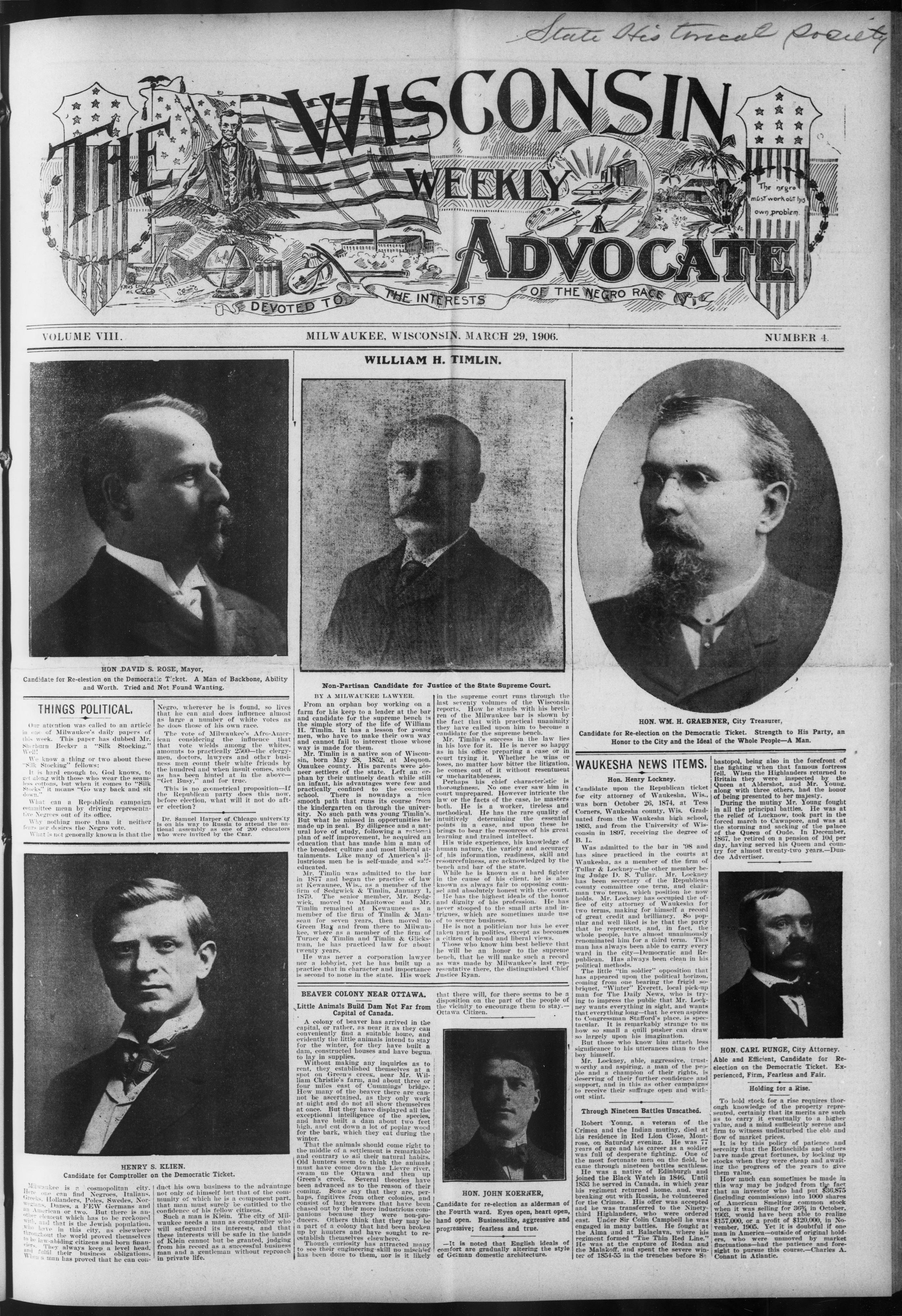
HON.DAVID S. ROSE, Mayor, Candidate for Re-election on the Democratic Ticket. A B and Worth. Tried and Not Found Wa
r Re-elestion on the Democratic Ticket. A Man of B and Worth. Tried and Not Found Wanting.
Candidate for Re-election on the Democratic Ticket. A Man of Backbone, Ability and Worth. Tried and Not Found Wanting.
THINGS POLITICAL.
Our attention was called to an article in one of Milwaukee's daily papers of this week. This paper has dubbed Mr. Sherburn Becker a "Silk Stocking." Well!
We know a thing or two about these "Silk Stocking" fellows:
It is hard enough to, God knows, to get along with those who wear the seamless cottons, but when it comes to "Silk Stocks" it means "Go way back and sit down."
What can a Republican campaign committee mean by driving representative Negroes out of its office.
Why nothing more than it neither fears nor desires the Negro vote.
What is not generally known is that the
1910
1
HENRY S. KLIEN. Candidate for Comptroller on the Democratic Ticket.
Milwaukee is a cosmopolitan city. Here one can find Negroes, Italians, Greeks, Hollanders, Poles, Swedes, Norwegians, Danes, a FEW Germans and an American or two. But there is another element which has to be reckoned with, and that is the Jewish population, who have in this city, as elsewhere throughout the world proved themselves to be law-abiding citizens and born financiers. They always keep a level head, and fulfil their business obligations. When a man has proved that he can conduct his own business not only of himself but of munity of which he is a that man must surely be confidence of his fellow man. Such a man is Klein. waukee needs a man as will safeguard its interests these interests will be set of Klein cannot but be from his record as a su- man and a gentleman in private life.
---
---
Negro, wherever he is found, so lives that he can and does influence almost as large a number of white votes as he does those of his own race.
The vote of Milwaukee's Afro-American considering the influence that that vote wields among the whites, amounts to practically 2500—the clergymen, doctors, lawyers and other business men count their white friends by the hundred and when insult comes, such as has been hinted at in the above—"Get Busy," and for true.
This is no geometrical proposition—If the Republican party does this now, before election, what will it not do after election?
Dr. Samuel Harper of Chicago university is on his way to Russia to attend the national assembly as one of 200 educators who were invited by the Czar.
14
duct his own business to the advantage not only of himself but that of the community of which he is a component part, that man must surely be entitled to the confidence of his fellow citizens. Such a man is Klein. The city of Milwaukee needs a man as comptroller who will safeguard its interests, and that these interests will be safe in the hands of Klein cannot but be granted, judging from his record as a successful business man and a gentleman without reproach in private life.
MILWAUKEE, WISCONSIN. MARCH 29, 1906.
M. H.
Non-Partisan Candidate for Justice of the State Supreme Court.
BY A MILWAUKEE LAWYER.
From an orphan boy working on a farm for his keep to a leader at the bar and candidate for the supreme bench is the simple story of the life of William H. Timlin. It has a lesson for young men, who have to make their own way and cannot fail to interest those whose way is made for them.
in the supreme court runs through last seventy volumes of the Wise reports. How he stands with his men of the Milwaukee bar is show the fact that with practical unant they have called upon him to be candidate for the supreme bench.
Mr. Timlin's success in the law in his love for it. He is never so l
Mr. Timlin is a native son of Wisconsin, born May 28, 1852, at Mequon, Ozaukee county. His parents were pioneer settlers of the state. Left an orphan by their untimely death while still an infant, his advantages were few and practically confined to the common school. There is nowadays a nice smooth path that runs its course from the kindergarten on through the university. No such path was young Timlin's. But what he missed in opportunities he made up in zeal. By diligence and a natural love of study, following a national plan of self improvement, he acquired an education that has made him a man of the broadest culture and most liberal attainments. Like many of America's illustrious men he is self-made and self-educated.
Mr. Timlin was admitted to the bar in 1877 and began the practice of law at Kewaunee, Wis., as a member of the firm of Sedgwick & Timlin, January 1, 1879. The senior member, Mr. Sedgwick, moved to Manitowoc and Mr. Timlin remained at Kewaunee as a member of the firm of Timlin & Manseau for seven years, then moved to Green Bay and from there to Milwaukee, where as a member of the firm of Turner & Timlin and Timlin & Glicksman, he has practiced law for about twenty years.
He was never a corporation lawyer nor a lobbyist, yet he has built up a practice that in character and importance is second to none in the state. His work
BEAVER COLONY NEAR OTTAWA.
Little Animals Build Dam Not Far from Capital of Canada.
A colony of beaver has arrived in the capital, or rather, as near it as they can conveniently find a suitable home, and evidently the little animals intend to stay for the winter, for they have built a dam, constructed houses and have begun to lay in supplies.
Without making any inquiries as to rent, they established themselves at a spot on Green's creek, near Mr. William Christie's farm, and about three or four miles east of Cummings' bridge. How many of the beaver there are cannot be ascertained, as they only work at night and do not all show themselves at once. But they have displayed all the exceptional intelligence of the species, and have built a dam about two feet high, and cut down a lot of poplar wood for the bark, which they eat during the winter.
That the animals should come right to the middle of a settlement is remarkable and contrary to all their natural habits. Old hunters seem to think the animals must have come down the Lievre river, swam up the Ottawa and then up Green's creek. Several theories have been advanced as to the reason of their coming. Some say that they are, perhaps, fugitives from other colonies, and consist of lazy beavers that have been chased out by their more industrious companions because they were non-producers. Others think that they may be a part of a colony that had been broken up by hunters and have sought to re-establish themselves elsewhere. Though curiosity has attracted many to see their engineering skill no mischief has been done to them, nor is it likely
in the supreme court runs through the last seventy volumes of the Wisconsin reports. How he stands with his brethren of the Milwaukee bar is shown by the fact that with practical unanimity they have called upon him to become a candidate for the supreme bench. Mr. Timlin's success in the law lies in his love for it. He is never so happy as in his office preparing a case or in court trying it. Whether he wins or loses, no matter how bitter the litigation, he comes out of it without resentment or uncharitableness.
Perhaps his chief characteristic is thoroughness. No one ever saw him in court unprepared. However intricate the law or the facts of the case, he masters both. He is a worker, tireless and methodical. He has the rare quality of intuitively determining the essential points in a case, and upon these he brings to bear the resources of his great learning and trained intellect.
His wide experience, his knowledge of human nature, the variety and accuracy of his information, readiness, skill and resourcefulness, are acknowledged by the bench and bar of the state.
While he is known as a hard fighter in the cause of his client, he is also known as always fair to opposing counsel and absolutely honest with the court.
He has the highest ideals of the honor and dignity of his profession. He has never stooped to the small arts and intrigues, which are sometimes made use of to secure business.
He is not a politician nor has he ever taken part in politics, except as becomes a citizen of broad and liberal views.
Those who know him best believe that he will be an honor to the supreme bench, that he will make such a record as was made by Milwaukee's last representative there, the distinguished Chief Justice Ryan.
that there will, for there seems to be a disposition on the part of the people of the vicinity to encourage them to stay.— Ottawa Citizen.
PETER H.
HON. JOHN KOERNER,
Candidate for re-election as alderman of the Fourth ward. Eyes open, heart open, hand open. Businesslike, aggressive and progressive; fearless and true.
-It is noted that English ideals of comfort are gradually altering the style of German domestic architecture.
[Name]
Candidate for Re-election on the Democratic Ticket. Strength to His Party, an Honor to the City and the Ideal of the Whole People-A Man.
WAUKESHA NEWS ITEMS.
Candidate upon the Republican ticket for city attorney of Waukesha, Wis., was born October 26, 1874, at Tess Corners, Waukesha county, Wis. Graduated from the Waukesha high school, 1893, and from the University of Wisconsin in 1897, receiving the degree of B. L.
Was admitted to the bar in '98 and has since practiced in the courts at Waukesha, as a member of the firm of Tullar & Lockney—the other member being Judge D. S. Tullar. Mr. Lockney has been secretary of the Republican county committee one term, and chairman two terms, which position he now holds. Mr. Lockney has occupied the office of city attorney of Waukesha for two terms, making for himself a record of great credit and brilliancy. So popular and well liked is he that the party that he represents, and, in fact, the whole people, have almost unanimously renominated him for a third term. This man has always been able to carry every ward in the city—Democratic and Republican. Has always been clean in his political methods.
The little "tin soldier" opposition that has appeared upon the political horizon, coming from one bearing the frigid sobriquet, "Winter" Everett, local pick-up man for The Daily News, who is trying to impress the public that Mr. Lockney wants everything in sight, and wants that everything long—that he even aspires to Congressman Stafford's place, is spectacular. It is remarkably strange to us how so small a quill pusher can draw so largely upon his imagination. But those who know him attach less significance to his utterances than to the boy himself.
Mr. Lockney, able, aggressive, trustworthy and aspiring, a man of the people and a champion of their rights, is deserving of their further confidence and support, and in this as other campaigns to receive their suffrage open and without stint.
Through Nineteen Battles Unscathed.
Robert Young, a veteran of the Crimea and the Indian mutiny, died at his residence in Red Lion Close, Montrose, on Saturday evening. He was 77 years of age and his career as a soldier was full of desperate fighting. One of the most fortunate men on the field, he came through nineteen battles scathless.
He was a native of Edinburgh and joined the Black Watch in 1846. Until 1853 he served in Canada, in which year his regiment returned home, and, war breaking out with Russia, he volunteered for the Crimea. His offer was accepted and he was transferred to the Ninety-third Highlanders, who were ordered east. Under Sir Colin Campbell he was engaged in many battles. He fought at the Alma and at Balaclava, where his regiment formed "The Thin Red Line." He was at the capture of Redan and the Malakoff, and spent the severe winter of 1854-55 in the trenches before Ss
NUMBER 4.
NER, City Treasurer,
Static Ticket. Strength to His Party, an
of the Whole People—A Man.
bastopol, being also in the forefront of the fighting when that famous fortress fell. When the Highlanders returned to Britain they were inspected by the Queen at Aldershot, and Mr. Young, along with three others, had the honor of being presented to her majesty. During the mutiny Mr. Young fought in all the principal battles. He was at the relief of Lucknow, took part in the forced march to Cawnpore, and was at the storming and sacking of the palace of the Queen of Oude. In December, 1867, he retired on a pension of 10d per day, having served his Queen and country for almost twenty-two years.—Dundee Advertiser.
[Picture of a man in a suit with a bow tie].
HON. CARL RUNGE, City Attorney. Able and Efficient, Candidate for Reelection on the Democratic Ticket. Experienced, Firm, Fearless and Fair.
Holding for a Rise
To hold stock for a rise requires thorough knowledge of the property represented, certainly that its merits are such as to carry it eventually to a higher value, and a mind sufficiently serene and firm to witness undisturbed the ebb and flow of market prices. It is by this policy of patience and serenity that the Rothschilds and others have made great fortunes, by locking up stocks when they were cheap and awaiting the progress of the years to give them value.
How much can sometimes be made in this way may be judged from the fact that an investor who had put $36,875 (including commissions) into 1000 shares of American Smelting common stock when it was selling for 36% in October, 1903, would have been able to realize $157,000, or a profit of $120,000, in November, 1905. Yet it is doubtful if one man in America—outside of original holders, who were unmoved by market fluctuations—had the patience and foresight to pursue this course. Charles A. Conant in Atlantic.
```markdown
```
> GOSSIP FOR THE LADIES.
§ , nossaonoeoosoesoeqnnoc@oescoseeDennsnnToee:
when the Birds Go North. material, to be used as a wa
on, every year bath its winter, pinned around the waist, an
sud every year bath its rain, is pinned to this band, start
put a day is always coming center front. In pinning the
When the birds go North again. oon band phe plaits pho.
: heart ha : ‘all naturally, even if it is fe
Ob, every heart bath ite _sorrar, sory to raise the material ir
And every heart hath its pata, n :
net # day is always coming keep the plaits from hanging t
When the birds go North again. the abdomen or hips are pr
—Ella Higginson. may be necessary to raise the
oo little more than ore a flat fig
a Previous to finishing the |
The Falsehood. loa cetee ehonid be hung up
Oe one
vach morn he lies in his trundle bed
‘And sees the great sun rise;
jie shakes the curls of his golden head,
And rubs his sleepy eyes;
Then softly steals across the floor
‘And climbs upon my knee;
~[s mudder here? he asks once more.
“Why won't she tum to me?”
1 cannot tell the little boy
She died the other day;
I brush aside a mist of tears,
Aud answer: “Gone away,”
Then off he runs for his horse and drum,
‘And shouts aloud in glee;
“Dil wide my borse and pway at war
Till mudder tums to me.”
Again, at night, when the little boy
Ascends the oaken stair,
And, kneeling, folds his baby hands,
He breathes her name in prayer;
“Dear Dod, pwease bwing my mudde
home,””
1 hear him softly pray.
“Yes, God will bring her home to you
lu the morning, deas.”’ I say.
The tears that fell for Lazarus
May fall for me today,
Aud Christ who died for human men
Will blot that lie away;
Vor, through the dark of coming years,
A day is breaking dim,
When the tender light of eternal dawn
Will bring her home to_hiin.
—RBaltimore News.
The American Girl
Vs. the English Girl.
When a foreigner asked an American
what America’s finest product was the
answer came quick and brief, “Girls.”
And it was correct.
Every country can boast of its beauti-
ful type of women, but in no country is
there anything Yo equal the beautiful,
bouny, unaffected American girl.
The men of all nations must believe
this, else why the world-wide demand for
American girls in the matrimonial mar-
ket?
Over in London just now young Wal-
dorf Astor, with his many millions, is a
great eaten.
He would have no trouble in finding an
English wife of title and wealth to anor
his fortunes, but his choice has fallen on
a beautiful young American, Mrs. Nan-
uie Langhorne Shaw.
She has no wealth to recommend her,
nothing but her pretty face and her gay,
natural charm of manner.
What is the matter with the English
girls that they let their American cou-
sins get ahead of them so often where
attention from men is concerned?
Perhaps the fault lies in their stiffness
and _self-consciousness of manner.
Here is a young man worth nearly a
hundred million dollars.
He has been brought up in England
and has associated with English girls all
his life.
‘The natural supposition would be that
he would fall in love with an English
girl.
But five minutes in the society of a
wide-awake American did more damage
to his heart than the English girls could
do in all his twenty-seven years.
There is no doubt about it—the Eng-
lish girl does not stand a chance in com-
petition with the American girl.
Englishmen are constantly falling in
love with the American girls, but how
often do you hear of an American man
falling in love with an English girl,
Very rarely, and the reason is that he
cannot stand her dullness.
He is so used to the sparkle and
charm of his own countrywomen that
the English woman seems utterly devoid
of attraction.
She has been brought up in such nar-
row, constricted surroundings that she is
a mere automaton, with but little imagi-
nation and no originality.
An American girl can enter an Eng-
lish drawing room and in ten minutes
attract every man_in the room to her
side, leaving the English girls forlorn
and cavalierless.
She has all the attractions which the
others lack.
She is' chic. which they are not, and
she is never at a loss for conversation.
So, altogether, it is not to be won-
dered at that when an attractive Amer-
ican girl eame upon the scene the Eng-
lish girls’ chances with young Astor were
null and void.
Mrs. Shaw has been seen galloping
along a country road on a polo pony, her
laugh ringing out as merrily and unaf-
fectedly as a child’s.
It must have been that natural girlish-
ness and lack of affectation that made
her so popular in London, for undoubt-
edly she has been a great belle on the
other side of the water.
The English complain that the Amer-
iran girl is allowed too much freedom.
Well, perhaps. in some cases she is,
but certainly, whatever the general meth-
od of bringing up an American girl may
be, the result as a whole is highly satis-
factory.
ier English cousins would do well to
relax somewhat and pattern themselves
more on the American girl plan.
What the English girl needs is more
vivacity and less reserve and stiffness.
‘There is no harm in being natural and
say and lively—that’s what a girl is
reant to be.
She is not supposed to be as sedate
and dignified as a woman of forty.
Chere is no charm equal to that of un-
alfected, joyous girlishness. A few years
x» Dana Gibson, Mrs. _Langhorne’s
rother-in-law, drew a pieture called
“The American Girl to the World.” It
was supposed toe represent the typical
\inerican girl challenging the world.
She stood on a hill, a beautiful, brave.
Lietic young goddess, worthy of all the
ship that could be laid at her feet,
Chat is the kind of girl that is making
\merica famous for her daughters—the
ri that is stealing the hearts of men of
all nations.
The only way to keep Englishmen’s
learts from straying across seas is for
English girls to learn the secret of the
\merican girl’s charm and emulate it.—
Philadelphia Evening Bulletin.
Helps in Making the Circular Skirt.
It has often happened that the home
dressmaker has avoided undertaking the
making of circular skirts, from fear of
their sagging, which seemed an almost
insurmountable difficulty, But with the
present improved knowledge of things
relative to dressmaking, such difficulties
aS sagging have been overcome. Plaits,
tucks, gored cirenlar Sapte ete., have
contributed to this result, and circular
skirts have become very popular styles.
Of the variations, one of the most pleas-
ing, especially for evening wear, is the
sun-plaited skirt. which is shaped in an
entire circle by No. 9087, our pattern for
the same.
After the garment is cut, the two sec-
tions are joined at the front edges and
sent to the plaiter for plaiting. After-
ward the back seam of the skirt should
he basted together and the skirt fitted in
the following manner:
A length of tape or a straight strip of
material, to be used as a waistband, is
pinned around the waist, and the skirt
is pinned te this band, starting at the
center front. In pinning the skirt on,
the band the plaits should be allowed to
fall naturally, even if it is found neces-
spry to raise the material in places to
keep the plaits from hanging twisted. If
the abdomen or hips are prominent, it
may be necessary to raise the plaiting a
little more than over a flat figure.
Previous to finishing the lower edge.
the skirt should be hung up for several
days, to determine whether the material
sags. Care should be taken to hang the
skirt up properly by fastening a tape or
cord more than half the size of the waist-
band, between two wardrobe hooks, and
far enough apart to stretch the tape
firm. The skirt band is doubled at the
center of the front and back and pinned
to the tape at short intervals so that the
skirt band may be sustained in a straight
horizontal position. If this is done the
skirt plaits will hand naturally.
After hanging severai days the skirt
length ean be marked as for any other
skirt. One way of doing this is to have
the wearer put on the skirt and then be-
ing raised on a book, or other suitable
article, have the bottom of the skirt
marked all around with a chalk at the
top of a card of the right length. An
improvement on this method is the use of
a skirt marker. When it is desired to
have the skirt in sweep length it can
be secured vy following the directions
for the same, as given in the label of the
pattern, but hanging up the skirt, as
above suggested, will be found of help
in preventing sagging.
Hems are sewed by hand or machine,
and trimmed bands of panne yelvet, silk
or the dress materials are fashionable ad-
ditions. Rows of lace insertions or lace
edgings gathered into tiny ruffles are pret-
ty trimmings for light materials—The
Delineator. |
Sleep for Children.
The real value of sleep to growing boys
and girls can scarcely be overestimated.
If parents felt the importance of a good-
ly number of hours sleep to their grow-
ing children it would mean the establish-
ment of a new habit of living in many
cases. The babies and little children in
a well regulated household generally
have their naps or sleeping time sys-
tematically arranged for them, and a
good habit is established which gives a
basis for sound nerves and wholesome
bodies; but as a child grows older his
nervous activity increases, and even
though he may feel bodily exhausted his
will together with his intense interest in
life and surroundings combine to keep
him awake. He will beg to remain with
his elders and to enjoy late hours even
when his weary head is nodding and his
tired eyes are half closed and heavy with
sleep. When a parent consents to allow
a cild to disobey nature in this way the
overburdened strength must pay the pen-
alty. In many cases irritability develope
when the tired body and strained nerves
are oyertaxed, and the child is brought
under a strict discipline and maybe se-
verely reprimanded. The result of the
punishment under such conditions merely
aggravates a bad nervous state, and a
long line of evils follow. Almost any
child is reasonable and manageable if he
is in norma] condition, and there is noth-
ing so vital, so necessary in promoting
a natural healthy state of existence for a
boy or girl as plenty of good sleep.
‘The public school of today necessarily
makes very strenuous demands upon its
pupils. A great deal is expected and de-
manded from these young minds and
bodies. Time is passing. New pupils
are coming in every year. Those who
now occupy the room must move along
to make place for others. <A certain
amount of work must be finished. San-
itary conditions are not always of the
best order in our schoolrooms. Over-
worked teachers and overcrowded rooms
all have their effect upon individual work
and individual constitutions. Each child
bears a part of the strain and feels the
evil consequences both physically and
mentally. These lesson days are not the
easiest to conquer, after all. The chil-
dren struggle and battle with probably
as great difficulties (taken proportion-
ately) as their elders find in the conflict
with life in a broader sense. Many a
tired little body succumbs to disease sim-
ply because nature has been on a_con-
stant strain for the few years of the
child’s life.
Mental and physical growth may be
retarded by forcing 2 child beyond sim-
ple natural ways. In some families the
children, after reaching 10 or 12 years of
age, are allowed to attend evening par-
ties. They become excited and interested
in dress and display; their minds are di-
verted from their everyday work. Oth-
ers are taken to places of amusement—
concerts and theaters—thereby denying
them the many needful hours of rest and
adding to their lives unnatural nervous
stimulant. These things have an_ in-
jurious effect upon the child’s health as
well as upon his mentality. Plenty of
sleep in well ventilated rooms where
fresh air prevails is more remedix! to
any constitution than any kind or
amount of drugs. When we gaze into
the tired, careworn faces of many chil-
dren who ean be seen wending their way
to school, arms loaded down with note
books, faces anemic from over-fatigue,
we cannot wonder that scarlet fever,
measles and diphtheria reap such ravish-
ing results, and that teachers occasional-
ly bemoan their fate. When children are
healthy, normal, and alert, all contract
with them, either as parent, teacher or
friend, becomes a pleasure. But when
children are pushed or urged beyond
their strength their condition becomes
such that great patience and skill are
required in dealing fairly and justly with
them. The work of development be-
comes arduous instead of pleasurable.
Oliver Wendell Holmes said that a
child upon awakening in the morning
from a healthy sleep in a bad humor
needed a spanking. He thought it very
beneficial, promoting a good circulation of
the blood; but he added that a child who
was unreasonabie and willful after a
busy day was simply tired and should
be put to bed. Nature is the genuine
healer and sleep the true restorer of all
our powers. Parents who realize this
can saye themselves many anxious mo-
ments, many heartaches, many doctor
bills and establish habits of regular liv-
ing thet will bring forth good results
through a long line of offspring and gen-
erations to come. Every child requires
at least ten hours of sleep, and it is a
good practice for him to continue sleep-
ing the full ten hours all through the
school life. Work would thus be ren-
dered easier, health would be better and
youthfulness prolonged; many nervous
‘tendencies and diseases would be wiped
font and clearer, brighter mentality would
be maintained.—Exchange.
The Symptoms of a
Man Who Has La Grippe.
These be the times that try women's
souls. La grippe is almost epidemic,
and there are few married women who
have not been called upon to nurse a
husband through an attack of it.
Now to have la grippe yourself is no
joke, but it is a mere pleasantry—a
sportive pastime for an idle day—com-
pared with the strenuous job of taking
care of a man who is down and out
with it.
Disease always takes a woman b3
surprise, no matter how much she mas
haye courted it. A man, never. He is
always expecting to be stricken down. |
It may be that having to pay. life in
surance calls keeps his mind fixed 0!
death and calamity. Anyway, in th
midst of health he begins to’ prepare
have the influenza.
He reads the remedies suggested bs
the daily papers and comes home it
|night with his pockets bulging with
drugs.
He talks it over with his friends on the
street cars and in his office and goes out
and buys something that did Smith good,
and stops on his way uptown to pur
chase a bottle of the specific that Robin-
son recommended. ;
Above all, he is strong on preventives.
He reads that you must keep warm, and
he smothers his family. in flannels, and
turns the house into a sweat box.
He is told you must keep your feet
dry, and he buys rubber overshoes thai
le wears one day and forgets the next.
Somebody informs him that you must
avoid drafts, and he becomes a kind of
domestic Sherlock Holmes, potterins
around trying to find cracks in the win-
dows and doors. He learns that some
doctor, of whom he never heard before.
recommends quinine, and pills become
the staple of his daily diet.
All signs fail to dry weather, how-
ever, and all precautions are wasted in
times of grippe, so some day he comes
home with chills playing leap frog up
and down his spine, and every bone in
his body working overtime on a new and
separate ache.
“What is the matter?” his wife asks.
“I have got it,” he answers in a sepul-
ebral tone, and then he adds, “I am a
dying man, Maria. People of my build
never get over the grippe. I knew I
should never live through it if I caught
it, and that is the reason I took so
many precautions to avoid it. Send for
a doctor and two trained nurses, bui
mark my words, Maria, I'm a doomed
man.”
“Oh. nonsense,” says Maria, who has
seen him sick before. “You have just
got a bad cold, and I'll make you a hot
punch and put you to bed, and by to-
morrow——"”
“Cold!” he echoes hollowly, with an air
of one stabbed to the heart. “Great Je-
hoshephat, woman, did you ever know
me to give in for a little thing like a
cold? I tell you I have a combination of
grip, rheumatism and heart failure that
would kill a wooden man.”
Maria assists him to bed and he re-
marks moanfully, “that she will find his
will in the safety deposit box and that
his insurance is paid up, and that he has
tried to be 2 good husband to her, and
he hopes she and the children will ty
not to forget him,”
Then he braces up and takes about
four fingers of whisky and calls for the
hot water bottle, somebody to hold his
hands, rub his head, lower the blinds, get
a mustard plaster for his back, telephone
to see why the doctor doesn’t come, and
hurry up the nurses.
The ensuing days are full of trouble
and tribulation. Maria sits by the bed
and tries to assume a proper deathbed
expression, although she knows there is
no occasion for it. The trained nurses
are worn to a frazzle.
The cook is kept on the jump from
morning until night preparing little
messes that the sick man thinks he could
eat if somebody could cook so that things
taste like they used to when he was out
camping.
Then about the time the whole house-
hold is so worn out they feel as if they
would be reconciled to his death, he gets
well, and spends the next six months de-
scribing his symptoms to every one who
will listen to him,
A clever Washington woman once said
that she always went to the inaugural
balls to keep people from describing them
to_her.
It is a safe tip. The only way in these
days to save yourself from being bored
by having to listen to the account of
other people's influenza is to have the
grip first yourself and symptoms and
remedies of your own. — Philadelphia
Evening Bulletin.
Coal Oil Cleaning.
“If more women knew how quickly
and thoroughly coal oil acts as a clean-
ing agent there would be fewer tired
backs and aching bones on cleaning
day,” said a little woman, whose apart-
ment is always as fleckless as the streets
of a certain town celebrated for its im-
‘maculate condition.
“Ever since the hint was given me by
a practical friend—a fifty years’ house-
keeper,” she continued, “I’ve been learn-
‘ing to use the oil for more and more
purposes each week. In fact, I am a
coal oil crank. I wipe up my stained
wood floors with a rag moistened with
‘the oil, and find that in addition to re-
‘moving every scrap of dust it darkens
‘the boards a little every time, which is a
desideratum in my case, as the floor is of
soft wood and wears easily.
“All the woodwork I wipe with an-
other rag, on which I sprinkle a few
drops of the oi. Anything of porce-
lain like a bathtub it cleans most beau-
tifully; also the bathroom washstand
and closet, only taking the precautions
to change your cloths. The wall_back
of my range is painted a deep red. When
it becomes greasy and dusty I find that
the oiled cloth makes a_ splendid
cleanser, although I confess I tried it
an ite first instance with fear and trem-
ling.
Sympathy Is Needed.
We must all realize that this life is
full of sorrow, and if you presonally
have had the good luck to escape your
share of it you are a very fortunate
person.
But do not, on that account, allow
yourself to grow cold-hearted and un-
sympathetic to others.
Those poor others! their lot is often
so hard—so lonely—so full of misery—
We are here to “heal the wounds 2nd
bind the broken hearts,” and the only
way we can do this is by being kind,
loving and sympathetic.
A few words of love will do more to
help a sufferer than money, sometimes.
For heart-sickness is much harder to
help than hunger aud poverty. Show in-
terest in others; try to help them, go out
of your way to lighten the burden of
the heavily laden.
Do not hesitate to whisper your kindly
thoughts in their ears. Don’t pass by
on the “other side;” if you are strong.
then be merciful.
Remember that we all look at life
from different standpoints, and what
‘might appear like a grain of mustard
seed in your path to you is an almost
insurmountable obstacle in your weaker
sister.
_ The more she shrinks the more neces-
‘sity for you to step in and help her on
‘her way with genuine sympathy and
loving, sisterly words and acts.
—In an endeavor to foster home indus-
try the Canadian government has estab-
lished a number of bounties to be paid
to manufacturers and miners which last
year aggregated $1,900,000 on iron and
steel products, $334,000 on lead, $333.-
000 on crude petroleum and $13,000 on
manila fiber. a
——_____
—High-born Siamese walk with the
elbow joint turned inward and the
thumbs out.
YOUNG FOLKS’ COLUMN.
ASKING MOTHER.
Mother, Siy. now, can't I go
‘Hunting’ inthe woods with Joe?
Willie's’ mother says he can;
Til take care; I'm most a man.
Do, please, mother, let me go
Hunting in the woods with Joe?”
So Fred begs: and would you think
At the very self-same time
In the house across the street
Willle rings the self-same chime?
“Mother, say, now, can't I go
Hunting in the woods with Joe?
Freddie's mother said he might.
Sure. We'll be home long “fore night.
Do, please, mother, let me go
Hunting in the woods with Joe?’
Joe stands waiting in the street,
Tousled hair and rough-shod feet,
‘Tight he holds his battered gun,
Hears the pleading of each one!
Stands and listens anxiously,
Thinking, thinking soberly.
“Guess their mothers think I'm rough,
Wild and reckless, like enough;
Hardly trust their boys to me;
Wish ‘they would, and tlien they'd see
Just how careful I could be. +
1 don't have to ask my mother,
For she’s dead. ‘There's none to bother
If I stay or if I go;
Wouldn't 1 be happy. though,
To hear mother tell me: *No, :
You can't yo a hunting, Joe!" hake
aa SV aa ae Saaee
MEET.
“It's time for a story, Uncle Bob,”
pleaded the children when that witching:
time between the dark and daylight had
arrived which the poet best beloved by |
the children called “fhe Children’s:
Hour.” “Please, Uncle Bob, a story, a-
song, or both.” And so Uncle Bob sang
and told this story:
It's a wonderful land, you may believe,
Where Nod and the Sandman meet,
The houses are apt to be upside down
In the middle of the street,
And they laugh at whats called impossible
Whenever each other they greet.
“Hello,” they say as each other they spy,
“Now, whit shall it be tonight?
Shall we hitch a team of pink elephants,
With wings, and go for a flight
To the place where mince pies grow on
trees
And pick « few for a bite?
“Or shall we discover a mine of gold
In the land of diamond stones,
Where the rippling brooks are of sweet per-
fume
And nought is heard but the groans
Of bushes beneath their great weight of
gems—
Groaning in musical tones?
“Where the lily pads are brown buckwheat
cakes
Afloat in a lake of honey,
And all is free for the taking, so that
No one needs any money.
Where you couldn’t feel sad should you
try to,
Everything seems so funny.”
Ob, they chuckle with joy at the very
thought,
And then they whisper to me;
“Perhaps tomorrow you may not believe
The things we'll take you to see,
But that won't prove they didn't occur;
Now, let us be off, we three.”
So once in a while I must take a trip
‘fo the land where, fancy free,
I can wander and note the happenings
Of things never known to be,
Except to people who visit that land
With Nod, the Sandman and me.
“The fact is, the last time I was there
so many things happened, and they hap-
pened so fast, that it’s hard to recall
them. Why, hardly had I started to
ask a giantess how much she weighed,
when poof! a wind blew her away as if
she had been thistledown, and I found
she had been sitting on a large bureau
instead of on a chair, as I had sup-
posed. Going up to the large, old-fash-
ioned thing, I read painted on its top:
‘Information Bureau. Ask your ques-
tion and turn knob to the right.’
“*Aha!’ I exclaimed. ‘At last I have
found it! Now I can learn a good many
things I've been wanting to know. “Mr.
Bureau,” I said, politely, ‘will you kind-
ly inform me
Why do the things I like the best
Agree with me the least?
And why are things I do not like
‘The best for man and beast?
“Receiving no reply, I was about to
get angry, when I looked at the top
again, and there in a little glass frame
was a card which read:
A man whose curiosity
Got the best of his common sense
Once asked a bull how strong he was,
And was tossed o'er the pasture fence.
Then he knew, but somehow the answer
Didn't suit his conceit immense.
When I finished reading I didn’t feel
very good natured, you may imagine;
and I was thinking about kicking the
bureau and calling it a fraud. A gentle
little voice stopped me, saying: “Now
don’t get mad; don’t get’ mad, please,”
and, turning, I saw the sweetest little
midget I had ever seen. She was
dressed as a housemaid, but was sitting
on a golden throne, which was fairly
blazing with brilliant jewels.
“Bxeuse me,” I said, very politely,
“but I don’t like to be made fun of.”
“That's too bad,” she said, sweetly,
“because you know everything here is
either made fun of or made of fun.
Now, that information bureau is made
of fun.” B:
“Indeed.” I answered, a little stiffly.
“And pray what are you made of?” _
“Oh, 1? she replied, and I fancied
there was a little giggle in her tone—
“I’m maid of all work.” : 3
“Do housemaids generally sit on jew-
eled thrones?’ I asked, rather severely,
for IL have never approved of servants
taking liberties during their mistress
absence. 3
“Not generally,” she answered. de-
murely; “that is, unless they're thrown
there.”
“Will you please explain?” T asked.
“Certainly,” she answered, sweetly.
“You see, when the wind blew the
stout lady out it blew _me in, and here
is where I landed. Don’t you’ know
where you are?” ~
“I can’t say that I do exactly,” I an-
swered. 3 ds p
“Then that explains things,” she said,
“You are where all the cireus and mu-
seum freaks and wonders come to after
the crowds have stopped wondering at
them. Here comes the two-headed song-
stress now!” And lo and behold a young
woman walked in with two heads—one
with light and the other with dark hair.
Not seeming to notice me, she cleared
her throat and sang:
Oh, sad is the lot of a two-headed maid,
With two voices to quiver and trill,
Two tongues to ask for something to eat,
- And only one stomach to fill:
Two heads brimful of two different Ideas,
The one a brunette, and one blonde;
Two sets of eyes to fall deeply in love
And only one heart to respond.
“Eonugh, enough!” I interrupted, and
I must say I felt alarmed, for if those
two sets of eyes had begun crying with
perhaps only one handkerchief between
them it might have been dreadful. Hap-
pily the forlorn two-headed maid and
the midget vanished, and instead there
appeared the educated pig.
]
“How do you do?” it asked in a fa-
miliar tone.
“TI can’t reeall ever having met you be-
fore,” I replied. rather coldiy.
“That was your mistfortune,” it re-
| marked.
“I've met some people resembling yon
and didn’t admire them,” I retorted rath-
er severely.
“No doubt, no doubt,” it replied. “You
are the kind that wants the real thing.
Imitations won't work with you.”
“I've heard of refined lard,” I ven-
tured.
“Yes, yes,” it answered, “but that
doesn’t say it was educated. I'm edu-
cated.”
“What can you do?’ I asked.
“Oh, I can spell people’s names,
among other things,” it said.
“Spell mine,” I suggested.
“With pleasure,” it replied; and at
once there appeared on the floor a lot of
cards which seemed to have letters on
them, though from where I sat I could
not tell one from another,
Carefully picking out six of them and
arranging them in order, it said with a
satistied grunt, “I guess that's all right,”
and really, there being six of them I
thought it was, too, until, going to look,
L saw that instead of spelling Robert
they spelled Donkey. Noting my indigna-
tion the pig squealed with delight.
I was about to say something very se-
vere when “Ha-ha-ha! Ho-ho-ho! Oh.
my!, Oh, my!” met my ears and the fun-
niest clown I had ever seen danced in
laughing so heartily that I couldn't help
joining him.
Seating himself astride of the pis. he
asked in a high, squeaky voice, “How do
you like my charger?”
“I wouldn't call him a charger,” I an-
swered,
“You'd call him a pretty high charger,”
he answered, “if you bought him for
ham, pork, bacon, lard, spare ribs and
bacon; that is, if you took him at his
price. As for me, 1 call him worth just
one silver dollar.”
“Why so cheap?’ I asked.
“Because he’s only four quarters with
a head and tail,” he screamed, and again
he and the pig gave an exhibition of
laughing in several different languages.
“That's good,” I said by way of en-
couragement, but before he could reply
the band struck up that old tune:
The elephant now goes round,
The band begins to play,
The boys around the monkey's cage
Had better keep out of the way.
And all the animals and queer peopl
came in dancing. The fat woman witl
the living skeleton; the giant with my
friend the midget; the wild man of Bor
neo with the albino princess; the “What
is it’ with the boneless wonder; the
two-headed girl was quarreling over
which of two partners to take, or both
and the clown was feeding the elephant
a barrel of mince pies. The Peanut boy
was giving away bags of diamonds anc
rubies and pearls; the “Queen of th
Amazons” had just asked me to be her
partner, when “Br-r-r-r-r-r-r-r_ buz-z-z-
ting-a-ling, ting-a-ling, a-ling, a-ling! My
miserable old alarm elork went off, anc
my visit to the land where Nod and th
Sandman meet was over for that time
Still I'm going again soon.”
“And will you tell us abovt it?” aske
the children,
“Won't I, though?’ said Uncle Bob.—
Ralph Wilbur in Saturday Star.
LAST OF BILLY, THE MINSTREL.
Almost Forgotten in Life, but His Coffir
Was Piled with Flowers.
“Billy” Black was buried Thursday.
Some people called him William Hart,
but to most folks he was just “Billy,”
the last of the old-time black-face come-
dians. :
He died last_ Monday morning of a
hemorrhage. He had been ill a long
time in a quiet house in Fifteenth street.
Nobody remembers the number.
You see, people had lost sight of Billy
for the last twenty-five years, and it
was only when he died that people re-
called that there had been such a man
in the old San Francisco minstrels, a
dulcet tenor contemporaneous with Billy
Birch, Raymon Moore, Hughie Dough-
erty, Willis Sweatnam and the rest.
He had no relatives left. He had
friends, but they had drifted—like all
friends on the road. They met on the
Rialto. They shook hands and said:
“You? Why, I thought you were dead
long ago. Somebody told me you were
dead, like all the rest of ’em. Good joke,
eh? Let's have a drink.”
Last week Billy Black, or Hart, was
playing with a burlesque troupe down
in Fourteenth street. He did not turn
up one afternoon—that was Monday—
and when they inquired why, old Billy
was dead.
The burlesaue company which liked
him found what was left of him in the
undertaking shop. He looked ae and
he smiled as he always had. mebody
wondered who was going to pay for the
funeral. But Frank Campbell, the un-
dertaker, had told Rev. Dr. H. M. War-
ren, the hotel chaplain, who always does
the right thing by people in Queer street.
Dr. Warren found the money.
Thursday when 9 o'clock came, when
Billy was to be buried, at least 300 of
“the profession” had dropped in and
dropped flowers on the coffin. And when
Billy Black—or Billy Hart, whichever
name was best beloved—went to Ever-
greens cemetery his coffin was piled with
wreaths and there were fourteen car-
riages. Who was in them? Nobody
knew—but Billy.—New York Times.
Prompted at 1000 Dances,
For thirty-six years Joe Place las
prompted at dances in York county. He
is known by every dancer in the
county.
Joe was born in_ Biddeford about
fifty-six years ago. When a young man
he went to work in machine shops, and
he has been employed at his trade as a
machinist all these years. He is as good
a workman as he is a prompter. He
does the prompting as a sort of diver-
sion. He works in the shop all day,
and at night goes home, changes his
clothes and proceeds to some dance
hall, where he will call off dances till
2A. M. He has done this for nearly
two score years.
: He has prompted at dances thirteen
consecutive nights and worked in the
shop every day. He says he has
prompted at 1,000 dances, large and
small, during his career. His voice is
so powerful that it carries a quarter of
a mile.—Lewiston Journal.
>
The Tudge’s First Client.
Judge James J. Banks, the well known
Denver lawyer, is a native of the south.
It was in Birmingham, Ala., that he
hung out his first shingle. For a long
while Judge Banks sat in his office and
wondered what a law client looked like.
He would read and study to pass the
long hours away. Every time he heard
footsteps in the hall he would straighten
up, assume an air of knowledge and
wait, only to be disappointed. One day
an old negro woman entered his office.
“Is yo’ de lawyah man?” she asked.
Judge Banks immediately was all atten-
ese This surely was a clieat. He an-
‘swered in the affirmative.
“Weill, sah,” said the old woman,
“Ah wants ter ax yo’ device. Now, ro’
see, Ah owes rent on ma house. Ah
kain’t pay hit em de lan‘lord say he
gwine ter put me out nex’ week ef Ah
doan’ fotch ‘round de cash. What's Ah
gwine ter do, Mistah lawyah man?”
| Judge Banks gave himself over to
deep study for a moment. Then he told
the old woman that, with due process of
law, the laadlord could be compelled to
give her a month's notice. The first cli-
ent was delighted.
“Well, now, young man!” she said,
“Ah’s mighty much erbliged ter you:
Yo" suhtinly es smaht. Good mohnin’!”
“Hold on.” came from the young law-
yer, “Haven't you forgotten something?”
“How’s dat?’ asked the old negress.
“Did Ah done drapped somethin’ ?”
“No,” said Judge Banks, “but my fee
is $5. You must pay me for that ad-
vice.”
The old negress hesitated. Then she
took hold of the doorknob.
“Mistah,” she said, “Ah doan’ want
yo’ ole device. Keep hit. Dat rent
ain't but foah dollahs.” And out she
went.”—Denver Post.
HOE ATTACHMENT.
Pe Severing Vines, Runners and Creep-
ers from Stalks of Valuable Plants.
American agricultural implements are
known the world over as the best pro-
curable, especially for saving time. This
is true both as to the large appliances
used on farms and the smaller garden
implements. A Texas farmer is the in-
ventor of a hoe attachment applicable to
hand weeding or garden hoes of various
forms and sizes. The attachment con-
sists of a cutting blade. which is de-
;
\\
a 2), seo
~“ |
aes
|
oe vo
i
webs i
ome’ 3
ne
CUTS DOWN THE WEEDS.
signed to be used in detaching clinging
vines and runners from the growing
plants. The improved device comprises
a weeding blade of the usual form, and
connected to the handle by a shank
which curves upward. Extending from
the shank isa nee blade, curved away
from the handle and shank.
In using the implement the cutting
blade is forced forward or away from the
operator by a pushing motion, and by its
peculiar form and position is very con-
venient for severing vines, runners,
creepers and similar plant life from the
stalks of the growing and valuable
plants. The implement will also be
found very convenient for chopping cot-
ton, or thinning cotton and other plants,
and will also be found very useful in
working corn and similar crops, upon
which vines and creepers are liable to
be found, and whose removal is generally
attended with much labor and annoy-
ance. The cutting blade being made in-
tegral with- the shank will not be a
cumbersome or objectionable addition to
the hoe.
——
WISDOM OF AN EMPIRICIST.
He who speculates is lost.
Being contented is a good way to cease
progressing.
The seat of conscience often seems to
be in the liver.
A man who is fired with ambition is
seldom “fired” for it.
Thick coats ot paint are not often
found on sound material.
If a woman can’t be stylish she gets
even by being awfully good.
It is more fun to be sick than to diet
and have regular habits.
Good resolutions are half the battle, all
right, but too many people care for only
halt.
‘The people who tell you to “go in and
win” are often putting their money on
the other fellow.
A good way to get to heaven—if you
have lived righteously—seems to be to
take a fast train.
“I was a stranger and ye took me in,”
doesn’t mean what it did in Bible days,
as the police department can testify.
A terrible drawback to being a newly
married couple and keeping house is that
small roasts of beef are not good to eat.
From the way some men prepare to go
to heaven they must imagine that all
they need is a letter of credit from their
bankers.
Such is their fondness for technical
evasions that it is surprising that the
multimillionaires have not caused a nee-
dle to be made with an eye big enough
for a camel te crawl through.—St. Louis
Globe Democrat.
Old-Time Fire Glories Passing.
Pittsburg will look still less like “hell
with the lid off” after the first of the
year, when the hot slag trains from the
furnaces of the Carnegie plants will be
‘iscontinued. Hereafter the slag will be
moved and dumped cold.
These slag trains are about the last of
the old-time fiery glories that made Pitts-
burg’s environs picturesque at night.
Years ago the “Canada tops” put a stop
to the great bursts of flame that used to
come from the blast furnaces when
charges were dumped into them in the
old-fashioned way, and, incidentally,
saved the heat. Then open-hearth steel
furnaces began to displace Bessemer con-
yerters with their magnificent towers of
golden flame, the open hearth furnaces
showing no fire at all. The slag trains
continued a picturesque feature of the
Monongahela river banks at night, but
now they, too, are doomed.
By the new process slag is passed un-
der a spray of water as it is poured
from the furnaces into the cars to be re-
moved. This causes it to break into
fragments and cools it so that the trains
loaded with it are no more picturesque
trains loaded with pig iron. The granu-
lated slag is used for railroad ballast
and other purposes.—Pittsburg Dispatch.
The Wisconsin Weekly Advocate after three years' residence at 79 Fifth street, has moved its headquarters to 729 St. Paul Ave., where we will receive our guests and transact our business in future.
A Representative Journal Devoted to the Interest of All the People.
ADVERTISING RATES
One inch, one year.....$15.00
Two inches, one year.....25.00
Three inches, one year.....35.00
Four inches, one year.....42.00
For larger space, special rates.
Locals, 10 cents per line.
TERMS OF SUBSCRIPTION.
One year ..... $2.00
Six months ..... 1.00
Three months ..... .50
Direct all communications to
R. B. MONTGOMERY
430 Cedar Street.
HOW TO SEND MONEY.—Post Office
Order. Express Order. Draft or Registered
Letter. R. B. Montgomery will not be
responsible for loss when sent in any other
way.
TO CONTRIBUTORS:
All communications must be sent with the name and address of the sender as an evidence of good faith, but not necessarily for publication. No manuscript returned if not accepted, unless accompanied by stamps.
EDITORIAL PARAGRAPHS.
"I know of the bravery and character of the Negro soldier. He saved my life at Santiago, and I have had occasion to say so in many articles and speeches. The Rough Riders were in a bad position when the Ninth and Tenth cavalry came rushing up the hill carrying everything before them. The Negro soldier has the faculty of coming to the front when he is needed most. In the Civil war he came 400,000 strong, and I believe he saved the Union."—President Roosevelt.
We would respectfully ask our readers to bestow at least a share of their custom upon those who advertise with us.
The various remedies and hair restorers advertised in this paper can be had at the advertised price at the office of this paper.
G. U. Q. of Q. F.
Gordon lodge No. 5693, G. U. O. of O. F., meets regularly on the first and third Monday nights of each month at room 27, 115 Wisconsin street. James Miller, N. G.; R. R. Gordon, P. S. Household of Ruth, No. 2195, meets regularly on the second and fourth Monday night of each month. Estella Walker, M. N. G.; Mary L. Kinner, W. R.
* * *
Mack Parker's Death and Funeral.
It is with extreme regret that we have to record the death of one of Milwaukee's best known young men. We refer to Ora Mackintosh Parker, who passed away at his residence, 156 Sixth street, March 21, after a lingering illness of four months' duration. Mack, by which name he was popularly known, was a native of Bloomington, Ill., where he was born March, 1872. He came to Milwaukee twelve years ago and followed his profession as a musician. He deservedly won the love of his associates and the respect of his patrons by his uprightness of character and his conspicuous ability in his chosen career.
His last days were cheered by the devoted attention of his wife and during the last three weeks of his sister, Mrs. Wilson, from St. Paul, and also by the constant visits of his comrades and many friends.
His funeral took place Sunday afternoon from St. Mark's A. M. E. church and was under the auspices of the New Port Protective association of which organization he was a charter member and one of the founders. It was one of the largest and most impressive ceremonials ever held there, every available space being occupied, and it seemed as if half of Milwaukee's colored population had assembled to pay the last tribute of respect to one who was so universally liked. Friends from the sister city of Chicago also assembled in considerable numbers.
The service was conducted by the pastor, Dr. Butler, who took for his text the words of the Psalmist as contained in Psalm 104-26, "There go the Ships." The vast audience listened with breathless attention to the preacher's eloquent words. The deceased's lodge members who assembled in great force, in all their pageantry, backed up by bouquets of flowers and music. Strong men they were, but they wept that he must go. The president of the New Port club read the obituary and conducted the ritualistic service of the club. Dr. A. L. Herron, an honorary member of the Newport club, likewise delivered an oration over the bier and in eloquent and impressive language referred to the many good qualities which the deceased brother had exhibited during his lifetime.
A quartette consisting of Al. Lawrence, Chicago; Sam Arnold, Chicago, and Henry Barclay and Frank Weaver of this city, sang appropriate selections. It was the wish of the deceased that these selections should be: "It Is Well with My Soul," "Beyond the Gates of Paradise," and "Flee as a Bird to the Mountain." The harmony of this quartette of noted musicians had a marked effect on the audience, many of whom were moved to tears.
The burial took place at Union cemetery, the cortege being a very extended one. The pallbearers, all intimate friends of the deceased, were Messrs. William Town, Will Joplin, George Hansett, William T. Price, Willis Barnes and George Byron. The floral offerings were so very numerous and chaste that we refrain from mentioning any one in particular.
Mrs. Parker, the widow of the deceased, desires through this medium to express her heartfelt thanks to the members of the Newport club for their unvarying devotion and attention during the closing weeks of the deceased's life, to Rev. Butler and Dr. A. L. Herron for their words of eulogy and sympathy, and to the many scores who sent floral offerings.
Obituary and Condolence to Brother O. M. Parker by N. P. P. A.
Milwaukee, Wis., March 21, 1906. The N. P. P. A. club meet once more to pay their last respects to the death of one Mack Parker. He departed this life March 21, 1906, at seventeen minutes of 4 o'clock. Brother O. M. Parker was loved by all the members of his organization. The members mourn the loss of
their dear brother as one of the spokes that bind us together has been broken, and we hope that his soul is resting easy. The president wishes that one copy be given to his family and the other be placed on the minutes of the club. President Charles Redd, Pallbearers William Tann, Charles Price, George Hansett, Willis Bonds, W. L. Joplin, George Bryan.
In memory of our deceased brother, O. M. Parker, who departed March 21, 1906.
Our brother is sleeping, so free from all pain.
O. wake him not, sweet spirit, to suffer again.
He slumbers so soundly. O let him sleep on. His sufferings are over, his troubles all gone.
O. think how he suffered and groaned with pain
In the long night hours as we soothed him in vain.
Till God in His mercy sent down from above
An angel that whispered a message of love.
From the New Port Protective Aid club
No.1 of Milwaukee, Wis.
Mrs. Margaret Goodwin
While the young men were bearing the remains of Mr. Parker away the funeral procession of one Mrs. Margaret Goodwin was nearing its approach to St. Mark's.
The friends of Mrs. Goodwin were many, and they, together with those who remained from Mr. Parker's funeral, filled the church to its entirety.
Dr. Butler also delivered this oration. Subject, "And There Shall Be no Night: There," Rev. 22-5.
His poetic exodium, in which all the people joined, "On Jordan's Stormy Banks I Stand," was noted for its fervor, as was his peroration, "I will Guide Thee With Mine Eye."
Mrs. Goodwin had lived a calm and a peaceful life in the community and was highly respected.
The Rev. Mr. Butler was frequently interrupted during his sermon by outbursts of spiritual enthusiasm.
Mr. L. H. Palmer, who had charge of this funeral and was little less than perfect in his arrangements, not only is deserving of great credit, but wishes to thank the many who in any point rendered assistance.
Mrs. Bland, God bless her, was her constant attendant in her passing hours, and by her godly life and frequency in prayer was the instrument through which God shined the light of eternal life into the precious soul of the beloved Margaret Goodwin.
* * *
President J. D. Walker, 628 Cedar street, was host at a champagne buffet luncheon tendered the officers of the Douglass club Thursday evening, March 22, 1906. It would be almost impossible to describe, adequately, the occasion or the spirit of the entertainment, but time
[Name]
MR. L. D. WALKER
after time the guests crowned Mr. Walker "Prince of Entertainers." The writer has had the pleasure of attending scores of dinners and luncheons of various kinds, but never was one as elaborate and expensive as this. The expression "champagne was more plentiful than water" was a reality, and convincingly pleasant.
Mr. James McFadden and Mrs. Harris of the Thresherman Quartette entertained with rare and choice selections of music, which they alone can make. The officers of the Douglass club decided to give their next ball Monday evening, April 16, at Deutscher Maenner Verein hall, Eighth and State streets. Good order, good music and a good time has always been the watchword of this progressive club and their past record bespeaks another excellent ball on Easter Monday. Those present at the buffet were Messrs. Compe, Snell, Thomas Busey, C. Kinner, McFadden, Banks, Harris and Walker.
Mr. John Peeples entertained Presiding Elder H. H. Thompson and the Rev. Butler at dinner Sunday. St. Mark's has in Mrs. Peeples one of her best members, who can always be counted on.
* * *
The musical and dramatic affair by the White Rose club at St. Mark's church Tuesday, March 27, was a grand success financially and artistically. It takes the White Rose to do things. All hail the club!
* * *
Communion was administered at the St. Mark's church Sunday at 4 p. m. by the Rev. H. H. Thompson, P. E., and again at 8:30 in the evening.
This great singing revivalist is certainly a power and Milwaukee has learned to love and admire him as in the highest as was evidenced in the services both Sunday morning and afternoon. The finances for the day at St. Mark's were $24.65.
* * *
Mrs. Lillian Johnson, daughter of Mrs. S. C. Craig, has come to this city to make it her home.
* * *
Rev. George F. Fox, pastor of the Calvary Baptist church, lost his beloved wife March 14. We wish to express words of sympathy through the column of this paper.
We are in much sympathy with Rev. George J. Fox, pastor of the Calvary Baptist church, who has recently lost his beloved wife and baby.
* * *
Mrs. Lillian Johnson, daughter of Mrs. S. C. Craig, has come to this city, intending to make this her home.
家家
Dave Bowler just arrived in our city from the south of Illinois, brimming full of life and news. We welcome him. Friends will find him at Mr. H. Jones Barber's.
Rev. Mr. Rowell of Porter. I. T., wields the sledge in his blacksmith shop on work days and attends to his ministerial duties on Sundays. He recently married Anna Gardner and Sam Acre in his blacksmith shop, not even stopping long enough to wash his face.
POLITICAL EXTRA
THE WISCONSIN WEEKLY ADVOCATE.
THE NEGRO IN
It is commonly asserted that "politic is the
If this be true, what logical reason can be
play his part, as a man, in this science—in the
nunicipal, state and national?
Selfishness, in no economy of life, has ever
in political.
The great growth and development of the
religious lines, has come as the logical sequen-
his denominational worship and devotion
The lesson drawn from this fact should be
regards politics, by every man in the race.
The Republican party is tabbed the "Part
the spirit that pervaded the Republican party
into the night, and for what logical reason?—w
If the Negro, just emerging from selfdom,
in all departments of government, from polic
ate, why is he now UNFIT—developed as he is
ity and those material parts that make for civic
On the other hand, the Negro has been th
his enemy—living in roaring opposition to his
every virtue. The Negro believed this and was
this score—to vote the Republican ticket for
It was then that the "Grand Old Party" a
reckon with the Negro further was a duty for
The Negro had been caught in the open,
styled the "Party of the Devil," and the Repu
Whether or not these two appellations were
that applied to the Democratic party to be u
north and the south, for in the south-land, had
erous and let its wheels of power roll, the mil-
less blacks, whom had been picked by bayonet
into their faces, to fall at their feet, would lo
The Republican party has played politics,
for this comes in for the greater commendation
Democracy of Milwaukee, unlike a good m
fair play, regarding not color of cuticle, but th
the man who measures up gets the job. A MA
offers nothing less.
We all know that when the iron hand of
to grab, it did not grab like the hand of Chief
and spare the WHITES, but spared and took a
THE HON. DAVID S. ROSE was city rule
the Negroes do their whole duty and keep him
Persons high up in the Republican ranks
occasions, with various complaints against sup-
cred folk, but which were in reality progress a
tormentors, and the only answer they received
was: "You just go ahead and preach your go
and I will look after mine."
THE NEGRO IN POLITICS.
It was asserted that "politic is the science of government."
What logical reason can be given why the Negro should not man, in this science—in the administration of government, mutual?
No economy of life, has ever made its subjects fat—it will not withth and development of the American Negro, along moral and become as the logical sequence to his manifest unselfishness in worship and devotion.
Down from this fact should be taken into serious consideration, as every man in the race.
The party is tabbed the "Party of Freedom"—well what!!—this, availed the Republican party forty years ago has been driven for what logical reason?—we wait for a reply.
Just emerging from selfdom, was fit or qualified for recognition of government, from police official to the United States Sen-UNFIT—developed as he is along the lines of literacy, moralial parts that make for civilization?
And, the Negro has been taught that the Democratic party is an roaring opposition to his best interests and poisonous to his Negro believed this and was glad, becoming a monomaniac on the Republican ticket for him became a trade.
At the "Grand Old Party" said, "Go spirit," feeling that to Negro further was a duty forever past.
It has been caught in the open, between the Democratic party, of the Devil," and the Republicans, "The Deep Sea."
At these two appellations were pleasing, time has at least proved the Democratic party to be unwarranted and untrue, both in the south-land, had the Democratic party been ungen-veels of power roll, the millions of poor, ignorant and defence- had been picked by bayonet from their shambles and hurled fall at their feet, would long since been ground into powder.
The party has played politics, the Democratic has played men, and for the greater commendation.
Milwaukee, unlike a good many northern cities, is noted for its not color of cuticle, but throwing open its merit books, and spares up gets the job. A MAN could ask no more, DEMOCRACY
What when the iron hand of law a few seasons ago reached out grab like the hand of Chief Collins in Chicago—the BLACKS, but spared and took alike.
David S. Rose was city ruler then, he is city ruler now—let for whole duty and keep him where he is.
Up in the Republican ranks have gone to Mayor Rose, on many serious complaints against supposed evils among Milwaukee's Col- were in reality progress and prosperity above their rivals and only answer they received from this fair minded executive be ahead and preach your gospel, and look after your business or mine."
When written
THE I
A man who was poor I've heard it from door That hovels he often he With shoeless shaggy g Yet still he fore, And when 'twe cherished "The thing it him, very "And you're not even said
The man who wrote word He let them but went "A prophet's "most ta- One time a ca- Nazarene As days went coorage he He fought the heath s- Until on Wro- banner w And the man the world—Roy Farrell
TH
"And it's only time for Patricia Grevy the wide expanse the bare bra- sign of spring. "Is Aunt asked Derrick fiance. "No, about
THE NEGRO IN POLITICS.
It is commonly asserted that "politic is the science of government."
If this be true, what logical reason can be given why the Negro should not play his part, as a man, in this science—in the administration of government, municipal, state and national?
Selfishness, in no economy of life, has ever made its subjects fat—it will not in political.
The great growth and development of the American Negro, along moral and religious lines, has come as the logical sequence to his manifest unselfishness in his denominational worship and devotion
The lesson drawn from this fact should be taken into serious consideration, as regards politics, by every man in the race.
The Republican party is tabbed the "Party of Freedom"—well what!!—this, the spirit that pervaded the Republican party forty years ago has been driven into the night, and for what logical reason?—we wait for a reply.
If the Negro, just emerging from selfdom, was fit or qualified for recognition in all departments of government, from police official to the United States Senate, why is he now UNFIT—developed as he is along the lines of literacy, morality and those material parts that make for civilization?
On the other hand, the Negro has been taught that the Democratic party is his enemy—living in roaring opposition to his best interests and poisonous to his every virtue. The Negro believed this and was glad, becoming a monomaniac on this score—to vote the Republican ticket for him became a trade.
It was then that the "Grand Old Party" said, "Go spirit," feeling that to reckon with the Negro further was a duty forever past.
The Negro had been caught in the open, between the Democratic party, styled the "Party of the Devil," and the Republicans, "The Deep Sea."
Whether or not these two appellations were pleasing, time has at least proved that applied to the Democratic party to be unwarranted and untrue, both in the north and the south, for in the south-land, had the Democratic party been ungenerous and let its wheels of power roll, the millions of poor, ignorant and defenceless blacks, whom had been picked by bayonet from their shambles and hurled into their faces, to fall at their feet, would long since been ground into powder.
The Republican party has played politics, the Democratic has played men, and for this comes in for the greater commendation.
Democracy of Milwaukee, unlike a good many northern cities, is noted for its fair play, regarding not color of cuticle, but throwing open its merit books, and the man who measures up gets the job. A MAN could ask no more, DEMOCRACY offers nothing less.
We all know that when the iron hand of law a few seasons ago reached out to grab, it did not grab like the hand of Chief Collins in Chicago—the BLACKS and spare the WHITES, but spared and took alike.
THE HON. DAVID S. ROSE was city ruler then, he is city ruler now—let the Negroes do their whole duty and keep him where he is.
Persons high up in the Republican ranks have gone to Mayor Rose, on many occasions, with various complaints against supposed evils among Milwaukee's Colored folk, but which were in reality progress and prosperity above their rivals and tormentors, and the only answer they received from this fair minded executive was: "You just go ahead and preach your gospel, and look after your business and I will look after mine."
Such is the position of a man of backbone.
In Rose.
we will vote.
M. H. GRAEBNER, the able and efficient city treasurer, needs funds. Open, frank, conscientious—generous to a fault—a philistint.
believes in this great man, regardless of race or politics.
has made his position doubly strong in the wise and manly refusal to run for mayor, telling the whole people thereby is the one man who can and will bring to them a Greater Mil-ment, Individual Libiberty, Low Taxes (which means lower tax).
static prosecutor would be of no more use to the city of Milwaukee in that same office among Democrats, and for that reason air in its demand that Mr. Carl Runge be re-elected to that position.
An experienced barrister of great brilliancy—and a prosecutor, the individual, but the cases that are brought before him; not at conclusions, but calm and deliberative—taking case after case, looking at it from every point of the legal compass that before the people as a jester with no case in hand.
in common with men of other races has suffered no reverses in man, and will stand by him for what he has been and is now.
JOHN KOERNER, alderman of the Fourth ward, has for the past decade, and so well, the interests of his ward that not one has request. No business ward in any large city in America can pro-ter paved streets than are to be found in this ward. Life in the extreme, and yet the prevalence of law and order is this is called "Milwaukee's Black Belt," and so it is. Business man, each prospering in their way, and do not scratch and fight.
are these men.
do not?
THE HON. WM. H. GRAEBNER, the able no eulogy at our hands. Open, frank, conscientian anthropist without stint.
All Milwaukee believes in this great man,
Mr. Graebner has made his position doubly stand made by his refusal to run for mayor, that David S. Rose is the one man who can an waukee, Good Government, Individual Liberty rent) and Prosperity.
A weak Democratic prosecutor would be one kee than a Republican in that same office and the public is only fair in its demand that Mr. responsible office.
Mr. Runge is an experienced barrister of g who prosecutes not the individual, but the case spasmodic, jumping at conclusions, but calm a case under consideration, looking at it from ev he may not appear before the people as a jester.
The Negro here in common with men of at the hand of this man, and will stand by his
THE HON. JOHN KOERNER, alderman of five (5) years guarded, and so well, the interest had to petition or request. No business ward in duce cleaner or better paved streets than are this ward is complex in the extreme, and yet admirable indeed. This is called "Milwaukee's and church move on, each prospering in their
Let us vote for these men.
Why should we not?
THE HON. WM. H. GRAEBNER, the able and efficient city treasurer, needs no eulogy at our hands. Open, frank, conscientious—generous to a fault—a philanthropist without stint.
All Milwaukee believes in this great man, regardless of race or politics.
Mr. Graebner has made his position doubly strong in the wise and manly stand made by his refusal to run for mayor, telling the whole people thereby that David S. Rose is the one man who can and will bring to them a Greater Milwaukee, Good Government, Individual Libiberty, Low Taxes (which means lower rent) and Prosperity.
A weak Democratic prosecutor would be of no more use to the city of Milwaukee than a Republican in that same office among Democrats, and for that reason the public is only fair in its demand that Mr. Carl Runge be re-elected to that responsible office.
Mr. Runge is an experienced barrister of great brilliancy—and a prosecutor, who prosecutes not the individual, but the cases that are brought before him; not spasmodic, jumping at conclusions, but calm and deliberative—taking case after case under consideration, looking at it from every point of the legal compass that he may not appear before the people as a jester with no case in hand.
The Negro here in common with men of other races has suffered no reverses at the hand of this man, and will stand by him for what he has been and is now. THE HON. JOHN KOERNER, alderman of the Fourth ward, has for the past five (5) years guarded, and so well, the interests of his ward that not one has had to petition or request. No business ward in any large city in America can produce cleaner or better paved streets than are to be found in this ward. Life in this ward is complex in the extreme, and yet the prevalence of law and order is admirable indeed. This is called "Milwaukee's Black Belt," and so it is. Business and church move on, each prospering in their way, and do not scratch and fight.
Let us vote for these men.
Why should we not?
Some Prominent People. Mr. Cannon not long ago received a letter from a prominent Washington hostess, who asked him to compel members of Congress to state in their official biography which appears annually in the Congressional Directory whether or not they were married. This hostess complained that she had been entertaining certain young statesmen under the impression that they were unwed in their home cities. She thought Mr. Cannon ought to be held responsible for such impostors and she suggested the remedy.
Alexander E. Orr, the new head of the New York Life, is a native of Ireland and is now in his seventy-fifth year. He inherited a fortune and has been president of the New York chamber of commerce and the produce exchange. He served on Gov. Tilden's canal commission and aided in exposing the canal ring in 1876. He was a Democratic presidential elector in 1876. He is a member of the Hamilton club, the Long Island Historical club, the Long Island Historical society and Grace Episcopal church, Brooklyn.
Senator Frye loves to visit some of his Maine friends and have a little supper, at which the piece de resistance is pickled pigs' feet, with the usual accessories. Of all the members of the President's council Mr. Root is the only epicure and sole possessor of a French chef. The secretary of state has a dainty appetite and only the most dainty food goes on his table. The other cabinet folks are satisfied with "cooks." Mr. Bonaparte has a fat, greasy looking old mammy, who weighs near 250, but the egg bread, the fried chicken and the savory omelet which she can turn out would tempt St. Anthony.
When Prof. Wiliard Fisher of Wesleyan university was suggested as a candidate for mayor of Middleton, Coun. where the university is situated, the proposal caused no little merriment. He had been elected to the city council as a Democrat, but on taking his seat announced that he was a stout Republican. He said that under the circumstances he would in a general way act with the Democrats. At the recent election he ran as a full-fledged Democrat, and much to the surprise of his political opponents was returned a winner. Indeed, it is more than hinted that he had scarcely any idea himself that he could succeed.
It is understood that Attorney General Hadley of Missouri is not altogether without a personal object in leading the investigation into Standard Oil methods. His willingness to be a candidate for governor of his state is fairly well known. At any rate this seems to be believed by the Rockefeller people, for one morning Henry H. Rogers, on meeting him said, "Good morning, governor." Mr. Hadley is only 34 years old and therefore is young enough to aspire to the position now held by Gov. Folk. His first political job was that of corporation
It Pays to Advertise.
---
For such a man we will vote.
counsel for Kansas City, to which he was elected four years ago.
When Thomas Fortune Ryan first began to show his skill as a manipulator of business enterprises he met his old parish priest while visiting his Virginia home. "Tom, my son," said the clergyman, "now that you have started out on what bids fair to be a great business career I want to give you a word of advice." "I know what it is, father," said Ryan, remembering a favorite remark of the priest. "You will tell me, 'Do right and fear not.' Isn't that it?" "No, my son," said the priest, with a twinkle in his eye. "It is 'Don't write and fear not.'" It is said that the financier has never failed to act on that advice.
Capt. Frank Frantz, the new governor of Oklanoma, is but 33 years old. He is a native of Woodford county, Ill., from which state he removed to Wellington, Kas., in 1890. He mined for several years in California, Arizona and New Mexico. In 1893 he went to Oklahoma. The Spanish-American war aroused his patriotism and he enlisted in Arizona as a private. Gov. McCord appointed him first lieutenant. He was again promoted by Col. Roosevelt for gallantry and efficiency in battle. The President made him postmaster of Enid in 1902 and later appointed him United States agent for the Osage Indians.
Not a few bachelor girls of New York support expensive establishments for their own use. Miss May Van Alen, for instance, has three private homes which cast her $60,000 a year, and Miss Evelyn Van Wart is said to pay $50,000 for a similar whim, having a fine house in New York city and two others in Europe. Miss Margaret Astor Chandler pays $30,000 a year for the support of her bachelor house in West Seventy-fourth street, New York. Miss Faith Moore and Miss Olive Trowbridge bursing nearly a like amount. Helen Gould has private establishments which represent an outlay of about $50,000 a year.
Bishop Peter J. Muldoon, whose ecclesiastical friends at the Vatican are urging his appointment as archbishop of New Orleans to succeed the late Archbishop Chapelle, has been one of the most popular priests in Chicago for many years, and one of the city's prominent men. During the last years of the late Archbishop Feehan he was auxiliary bishop and administrator of the diocese, and since the appointment of Archbishop Quigley he has been the spokesman of that eminent prelate. Bishop Muldoon is a Californian by birth, was educated in Kentucky and ordained priest in 1886. For two years he was pastor of St. Pius' church, when he was chosen chancellor of the archdiocese and secretary to the archbishop. In 1895 he gave up these duties to become pastor of St. Charles Borromeo's church at Twelfth and Cypress streets. Besides his other present duties the bishop is editor of the Living Church and the director of the St. Vincent de Paul society.
It Pays to Advertise
CHURCH-WORKER'S
FREE BOOK OF MONEY RAISING PLANS
New to raise money inQUINN, EASILY
For money for church
SEND FOR IT TODAY.
"HOW TO RAISE MONEY" is the title of a valuable, instructive book just published, explaining many new and successful plans for raising sums of money from $8.00 to $200.00, quickly and easily without investment, for churches, schools, aid societies, charity or any other purpose.
This book is sent absolutely free, postage prepaid, to interested persons in Wisconsin Mfg. Co., Dap't 230. Manitowoc, Wis.
When writing to advertisers please mention the Wisconsin Weekly Advocate.
THE FRUIT OF AN IDEA.
A man who had an idea in all save that was poor.
I've heard it said his sustenance he begged from door to door.
That hovels housed him, rags he wore, and often he appeared
With shoeless feet, with unkempt locks and shaggy growth of beard.
Yet still he kept his idea forever to the fore,
And when 'twas scorned by other folk he cherished it the more.
"The thing itself's impractical!" they told him, very frank.
"And you're a visionist!" they vowed—some even said "a crank!"
The man who had an idea spoke no defending word.
He let them think whatever they pleased but went on undeterred.
"A prophet's worth at home," he thought,
One time a carpenter was scorned, a lowly Nazarene."
As days went by with purpose firm and courage strong and true
He fought the good fight, kept the faith, 'neath stormy skies and blue.
Until on Wrong's redoubt, at last. Right's banner was unfurled.
And the man who had an idea electrified the world.
-Roy Farrell Greene in Four-Track News.
THE CUCKOO
"And it's only March 15, and not nearly time for the cuckoo to come." and Patricia Greystone looked tearfully across the wide expanse of park, where as yet the bare branches of the trees showed no sign of spring.
"Is Aunt Nannie worse, Patricia?" asked Derrick Esmond, her cousin and fiance.
"No, about the same; but you know Dr. C——gives no hope, and, oh, Derrick, if you had seen her face when she asked him if she would live till the spring! I knew what she meant. Every year, it has been the same—always the longing to see the spring flowers and to hear the cuckoo. She would just live at this window, and never seemed happy until she heard it. Derrick, I begin to hate the cuckoo; it is dreadful to see the wistful look on her face."
"Yes, I know, I've seen it; but why; Patricia? I never could quite understand."
"Nor I: she would never say; but I have an idea it is connected with her early love story. You know that Aunt Nannie had a sad love story; she was engaged, and he died in the spring, when they were to be married. Oh, Derrick, can't we do something to quiet her mind?"
"I have an idea," he cried "Let us invent a cuckoo until the real one comes along."
"Derrick!"
"I mean it; if the dear old soul won't be pacified without a cuckoo, then a cuckoo she shall have, and, Pat, you must be the cuckoo."
"Look her, Patsy," said Derrick seriously; "joking apart, I think it is dreadful for Aunt Nannie's last hours to be embittered when a little harmless, deception—"
"But is it harmless, Derrick? We shall be deceiving her when she is dying, and we've never kept a secret from her, except—well—"
"Except our engagement, Patsy, which we thought we kept from her for about two hours—"
"And she found it out, as she will find this out," cried Patricia. "Derrick, I can't do it; besides, how could it be managed?"
"Easily enough; your training as a singer should be quite sufficient to fill the woods with cuckoos," laughed Derrick. "We will go down to the copse right away from the house, and practice. Don't forget that the note of a cuckoo is not a true major third interval, but something just between. I would do it myself, but even Aunt Nannie, with her lifelong experience of cuckoos, has never heard a baritone bird.
* * * * *
"Derrick, my boy, did you hear that?" And Miss Nancy Austin turned eagerly toward the window, the next day.
"Dear Aunt Nannie, it is too early, isn't it, to hear the cuckoo?" said he deceitfully.
"I am not mistaken," declared Aunt Nannie. "Open the window—no, it will do me good. Ah, Derrick, the beautiful bird is here at last. Hark!"
And softly in the distance came the flute-like notes of spring's harbinger. Aunt Nannie listened in ecstacy.
"Where is Patrick?" she cried. "She loves the cuckoo almost as much as I do."
"Oh, Pat has gone to the village," said Derrick, unblushingly. He felt fully repaid for the morning rehearsal (Patricia made an excellent bird), as he saw Aunt Nannie's tired eyes close, and watched her as she contentedly dropped off to sleep.
And day by day the cuckoo brought content to Aunt Nannie. The two conspirators, indeed, were at times far from happy. They were guilty, conscious of deceit toward one who had been a mother to them, and yet—could it be wrong to make Aunt Nannie's hours happy?
"Derrick," Aunt Nannie said one morning, "where can Patricia be? I cannot understand her. I do so want her to hear my bird. Do you know she has not once been with me when it sings? She used to be so sympathetic. It almost seems as if she does not care."
Poor Patricia, a quarter of a mile off, making the woods resound with cuckoos! Derrick felt that it was very hard on her. Why could not the real abominable article come along?
"Dr. C—— is quite wrong, though he is a naturalist. He said the cuckoo is never known to sing so early. I told him
"Derrick!"
he was quite mistaken, for I heard it myself. He said Nature never made a mistake, and got quite excited over it until he saw that I was excited. too."
"Don't, auntie," said Patricia, gently.
"It isn't worth it; you know we heard the cuckoo."
"We haven't heard it today, pet—for the first time. I hope it hasn't forgotten me;" wistfully.
Patricia's eyes filled with tears as she bent over her aunt.
"It will come again, dear," she said, while Derrick turned away. The sands of her life were running low; Aunt Nannie was dying. Day by day the sham cuckoo had dutifully sung its spring ode, though sometimes its note was tearful. But today neither Patricia nor Derrick could leave Aunt Nannie. And yet—she wanted to hear the cuckoo once more. Would the real cuckoo never come?
Suddenly, afar off, but quite clearly, there was the cuckoo at last! Aunt Nannie heard it and smiled.
"Yes, there it is again!" she murmured. "But it has a different note; it must be another, Patricia."
Patricia could not reply. Aunt Nannie went on dreamily—
"I always loved the cuckoo, Patricia. It was my wedding bird—my wedding, which never came to pass. You and Derrick must be married when the cuckoo sings—in memory of Aunt Nannie."
And even while the cuckoo's note grew louder and more persistent, with a sigh and a smile Aunt Nannie fell asleep. Philadelphia Telegraph.
What's the Name?
A Missouri member of Congress, says the Washington correspondent of the St. Louis Globe-Democrat, was piloting one of his influential but untutored constituents about the capitol. Finally they reached the entrance to the office of the Vice President. He inquired of his rural friend whether he would like to meet the Vice President of the United States, and received a favorable reply. Together they pushed through the big mahogany doors. The tail form of the Vice President loomed straightway from behind his desk. He came forward to greet his callers with enthusiasm and interest. The Missouri member said:
"Mr. Blank, this is the Vice President of the United States."
The old man held out his hand to meet the one extended by the Vice President, and then inquired:
"Let's see; what's the name, please?" Some one at the Warner banquet had to match this story, very naturally, so the next speaker told of the experience of Senator Bailey of Texas. Right after the memorable money campaign of 1806 Senator Bailey entertained Mr. William J. Bryan at his home in Texas. Together the two distinguished Democrats were walking along the streets of Gainsville one day. They met an old ranchman in front of one of the busy stores of the place. Their passage along the street had been almost an ovation for the Democratic presidential candidate, as he was much admired in Texas in those days. Senator Bailey shook hands warmly with his friend from the ranch country and then, turning with him toward Mr. Bryan, said:
"Dad, this is William Jennings Bryan, who has come down to visit us for awhile."
The old fellow looked at Bryan cordially enough and inquired:
"Let's see, mister; what state are you from?"
Somewhat 1...xed.
The chairman of the committee was addressing a meeting at the teachers' institute.
"My friends, the schoolwork is the bulhouse of civilization; I mean—ah
The chairman here became slightly chilled.
"The bulhouse is the schoolwork of civl"
civ—"
An invisible smile began to make itself
An invisible smile began to make itself felt.
"The warkhouse is the bulschool of
He was evidently twisted.
"The schoolbul is the housewark—"
An audible snicker spread itself over the faces of the audience.
"The scowschool—"
He was getting wild. So were his hearers. He mopped perspiration. gritted his teeth, and made a fresh effort.
"The schoolhouse, my friends—"
A sigh of relief went up. A-h-h! Now he has got his feet under him again. He gazed suavely round. The light of triumphant self-confidence was enthroned upon his brow.
"Is the wulbark—"
And that was all—Tit-Bits.
Monks as Chauffeurs
The monks of the Grand St. Bernard will soon make their debut as chauffeurs. After a struggle lasting over a year they have received the permission from the Valais and Italian authorities to run a motor car service between the hospices of Grand St. Bernard and Simplon—their properties—and Domodossola and Aosta.
The chauffeurs will be chosen from the monks themselves, who will wear cowls. The cars, which are being specially constructed to climb the steep gradients, will at the beginning be employed for the transport of supplies only. Later, however, the monks intend to start a service for tourists who wish to visit their hospices in the summer season.—Geneva Cor. London Express.
Smallest Man Not Dead.
William W. Townsend, foreman of a section gang on the Michigan Central, found certificates of stock in a Cripple Creek mining company, valued at $35,600, belonging to J. C. Worthington of South Haven, Mich. Mr. Worthington was telegraphed and hastened to Ann Arbor. He offered Townsend 50 cents as a reward, but Townsend shook his head and Worthington gave him a 5-cent cigar. Townsend now has the "smoker" wrapped up and labeled "Reward for finding $35,000."
“A COSTLY CUP OF COFFEE.
Postman Suspended Twenty Days for
Stopping to Drink It.
For stopping at a house a couple of
minutes to drink a_cup of coffee while
on duty, Nicholas Flynn, a well known
Elizabeth letter carrier, who for the last
three years has been president of the
State “Letter Carriers’ association of
New Jersey. has been suspended twenty
days by Postmaster Palmer Howe Char-
lock, which entails on the postman a
joss of $50, the highest price, it is be-
lieved, ever paid for a cup of the re-
freshing beverage in the United States.
Flynn has been sixteen i in the
service of Uncle nae and this is the
first complaint, it is alleged, ever made
ape him. A woman living near the
place where he drank the coffee, who
was impatiently aust his arrival
with her mail, wrote a letter of com-
plaint to the postmaster, which brought
about the suspension. Flynn is a to-
tal abstainer, and for four — was
president of Elizabeth Branch No. 67,
National Letter Carriers’ association.
He is treasurer of St. Paul’s Episcopal
chapel and warden of St. Paul's guild.
He 1s also past chancellor in the Sane
of Pythias, past chief ranger in the F'or-
esters, a@ part sachem in the Red Men
and a past councillor in the Order of
American Mechanics.
GREAT SCOTT.
The Biggest Man of Addison County,
Vt., Tells an Interesting Story.
E. C. Scott, meat dealer, Vergennes,
Vt, Past Commander of Ethan Allen
Post, G. A. R., says: “A severe at-
tack of typhoid left
me with weak kid-
neys. Every night [
o - had to get up fre-
toy ing quently to pass the
be urine, which was
ty ropy, dark and very
CZ 2 Mm painful to void. I
ogee} fms had no appetite, but
|i ge. drank water continu-
White iy without being
Tack of typhoid iert
me with weak kid-
neys. Every night [
o - had to get up fre-
toy ing quently to pass the
Coat urine, which was
m hy ropy, dark and very
SE Mm painful to void. I
Le DT fas bad no appetite, but
bea pe drank water continu-
8 We siiy without being
able to quench my thirst. Terrible
headaches and dizzy spells oppressed
me and my back was lame, sore and
stiff. A month’s treatment with
Doan’s Kidney Pills rid me of this
trouble, and now I am strong and
healthy and weigh 230 pounds. I give
the credit to Doan’s Kidney Pills.”
Sold by all dealers. 50 cents a box.
Foster-Milburn Co., Buffalo. N. Y.
deer eee
TO FIX RACE SUICIDE BLAME.
Statistician in Massachusetts Makes
Plans for Inquiry.
re a
Chief Statistician Charles F. Pidgin
of the Massachusetts bureau of census
and statistics has decided to investigate
the race suicide question and make 2
complete report to the next legislature.
With this in view he has arranged to
send out a corps of census men to ask
questions of men of small families. The
move is an adjunct to that of gathering
the census and, although the latter has
been completed, the same men are to be
nsed as baby finders. Chief Pidgin be-
Neves that the fact that the population
dees not increase is to be blamed more
upon men who refuse to wed than upon
small families.
He says the only way to get satisfac-
tory statisties on the race suicide ques-
tion is to base them on married women
and he is acting on that theory. Hav-
ing through the census obtained the
birth period with married women of
the state he will pursue his investiga-
tions further and prove that the race
suicide charge should be laid to the
doors of those men who refuse to marry.
Se eee
DISFIGURED WITH ECZEMA.
der—Worse Under Physicians—
: Cuticura Works Wonders.
“I suffered with eczema six months.
1 bad tried three doctors, but did not
get any better. It was on my body
and on my feet so thick that I could
hardly put a pin on me without touch-
ing eczema. My face was covered,
my eyebrows came out, and then it got
in my eye. I tien went to another
doctor. He asked me what ! was tak-
ing for it, and I told him Cuticura. He
said that was a very good thing, but
that he thought my face would be
marked for life. But Cuticura did its
work, and my face is now just as clear
as it ever was. I told all my friends
about my remarkable cure. I feel so
thankful I want everybody far and
wide to know what Cuaticura can do.
It is a sure cure for eczema. Mrs.
Emma White, 641 Cherrier Place, Cam-
den, N. J., April 25, 1905.”
~The British empire needs maps. A
survey of its umsurveyed portions would
cost $15,000,000, say $750,000 a year for
20 years.
ee ene
—The Frenchman eats nearly twice as
much bread as the Britisher.
Nothing knocks out and
disables like
Lumbago and Sciatica
Nothing reaches the trouble
as quickly as
Yai}
we se
e/a
4 Zi dpe Ve
GN!
PES |
St. Jacobs Oi
t. Jacobs Oi
Known the world over as
The Master Cure
for Pains ana Aches
Price, 25ce. and 50c.
MOTHER GRAY’S
SWEET POWDERS
FOR CHILDREN.
A Certain Oure for Egrorighocss,
EN Senscre Troubles Neecking
: Bisorders. and’ Destroy
Mother Gray, Worms. the Breek up Celds
Rexsstn ud. (tio msiled VEER haacen
Now York Cas. &. S. OLMSTED. Le Roy. N ¥.
i oe ee i son ie ea Sea ae s ee:
DA DEH BY: FE 2 PL 4.
ee oe: SS Gee eZ a << ey lie ee
= Se ee oR ee es
GOVERNMENT CONTROL OF RAILROADS. | trast. Primitive women also belieye in a variety of colors,
By Philander C. Knox.
The proposition that the national
government should exercise supervis-
ory control over the tax upon trans-
portation became almost self evident
from the time that the railroads be
gan, through various devices, to con-
centrate this taxing power in the
hands of a few men. The govern:
ment’s effort to check this concentra-
tion of power under the provisions of
existing laws should be supplemented
by legislation which will prevent the
abuse of the power of taxing the
movement of persons and property under any form of con-
centration or under any circumstances whatever.
The enlarged and more effective provisions against re-
bates and unjust discriminations contained it’the legisla-
tion of the Fifty-seventh Congress affected fewer rail-
roads and met with less railway opposition than it would
have met ten years earlier, as many of the managers of
the best roads had endeavored to abolish such practices
before the law went into effect.
The railroads enjoy a complete remedy against injus-
tice which it is not proposed to take away, while the pub-
lic has no effective remedy against injustice.
More than such a remedy the public does not ask. Less
than such a remedy it never should have been without.
Vie UL MUNE ST.
By Joseph Medill Patterson.
Money is power and dominion. It is wine,
woman and song. It is art and poetry and
music. It is idleness or activity. It is warmth
in winter and coolness in summer. It ts cloth-
ing and food. It is travel and sport. It is
horses and automobiles and silks and dia-
monds. tl is books. It is education. It is
self-respect, and the respect of all others. No
one possesses it, but it possesses everybody.
A man is expected to risk his Hfe, but he is hardly ex-
pected to risk his fortune. He would give away money
before he would give away life, because if he were dead
he would have no money anyway. But he would, and
he does seriously, risk life for the sake of money.
I cannot, therefore, see why money, which is the great-
est thing in life, should not be more or less evenly dis-
tributed, just as the ballot is. The universal ballot gives
every male citizen an equal political opportunity. The
common ownership of all the means of production and
distribution would give everybody an equal chance at
music, art, power, sport, study, recreation, travel, self-
respect, and the respect of others. I for one cannot see
why those things should be concentrated more and more
in the hands of a few.
Fashion in civilized sociefy is associated
7 with change In dress, but among primitive peo-
Y ples it Is devoted to a variety of changes made
}} in the body. It is cruel fashion that keeps
/} women changing their hair from bangs to pom-
padour, and from braids to curls. A woman's
tresses are considered worth thought among
many primitive peoples, and they often dress
Ny it elaborately. The Fijian women keep their
heads closely shaved, but the men cultivate a
luxuriant growth at much time and expense. In many
parts of Africa the women eradicate the eyebrows. Spe-
cial pincers are made for the purpose.
Fasbion is most fickle when it comes to color. It is
brown one season, gray the next, and sea green for con-
he to me one evening. “He is such a
brilliant and fascinating man. I met
him at the postoffice just now,
and—oh, by the way, here's a
letter from Tom. Poor fellow, I am
concerned about him; he still clings to
the morbid fancy that his brother's
death was not accidental, although a
year’s investigation and inquiry have
brought no light. Suppose we invite
him here, Barbara, as our guest; a few
weeks up here with nature may restore
his old cheerful ways.”
“By all means,” I exclaimed eagerly.
“Let’s go over to this cosy nook and
talk it over,” as I led the way to the
farther end of the veranda, where a
lattice work covered by vines made a
delightfully secluded resting place.
A half hour later I still held in my
hand Tom’s letter, which I had been
reading, and my heart was full of sym-
pathy for him, when I observed a
stranger of striking appearance mount
. the steps of the veranda and pause for
a moment, glancing about as if in
search of some one. I had time to no-
tice his sinewy figure and faultless
attire, before Walter, looking up, called
to him:
“This way, Henderson. Come over
——S———== >...
&,. a oe
cM, Se, MBBS a
Soe Bape OS
Si Cope GR ii |
Bai? a) Ge! ea
CEEMED 3 CS
eos 8
Z ie. \ \aee)
SOA NES
“NG A te RR
=i We a, aes =
Qe I\ A =
OO faibse. UNS
Pages SS
we \ a ||
SN 04) eee
IE F a
‘ aA i
BAN { \
ie HAZ 9 RSS see
PAWL
HLS
“POM WHAT WAS YOUR BROTHER LIKE?”
here; 1 want to introduce you to my
wife.”
His eyes met mine for a moment as
he bowed low, and something in their
depths stirred within me a curious feel
ing of aversion, which I vainly tried
to shake off. As I listened to the con-
versation, I found myself striving to
catch a glimpse of his soul through
each casual glance from his eyes.
His voice, which held a note of me!
THE POWER OF MONEY
/
FASHION MOST CRUEL OF MISTRESSES.
SONG.
When darkness hides me, dearest,
And when this face, now ever in thy
sight,
Eecomes a dream to haunt the silent
night,
And vanish when the busy noon is
clearest :
Then, dear, the love I gave thee,
Which ever for thy coming lay in wait,
Exacting often the importunate,
Shall be a memory to bless and save
thee.
Some little foolish saying
Will wander back unto thee from the
past,
Like a stray rose-branch o’er thy path-
way cast,
With flowers and thorns thy careless
steps waylaying.
June roses in December,
Dream roses, yet their phantom thorns
give pain,
Somewhere, somehow, when we two meet
again,
How much must we forget, how much
remember.
A SECOND WITNESS.
LPP AL OL PAIS AI
Y husband was recovering from
IMA a fever, and his strength came
back so slowly that we decided
to go to Ferndale during the hot weath-
er. The resort itself, with its attrac-
tive hotels and picturesque cottages,
was a thing of beauty, nestling as it
did within the encircling arms of the
mountains whose unbroken green reach-
ed from foot to summit.
The place, which boasted but two
trains daily, was full of refugees from
the blistering pavements of the city,
but not a familiar face among them;
and I was content to have it so. With
a mind open to mysterious influences,
I was strangely drawn to nature. The
whisperings among the pines were real
voices, and the hush at eventide was
full of occult beauty. But Walter was
of a different temperament; he pos-
sessed a social nature and a magnetic
influence which attracted friends wher-
ever he went, and in a few days he
had quite a circle of acquaintances,
one of whom particularly appealed to
him—Mr. Asa Henderson, who board-
ed at a rival hotel. Walter was full
of his praises.
“You must know him, Barbara,” said
trast. Primitive women also belieye in a variety ef colors,
| but -since they wear so few clothes they decorate their
skins. Australian women are partial to brown, so they
cover their faces and bodies with ochre; in the south-
eastern part they decorate theniselyes with dots and lines.
The dictates in fashion often are cruel. It makes the
American girl believe she must be thin as a rail, though
she starve and walk miles to accomplish this feat. But
slim girls, Willowy as the willow, are not popular every-
where. The Kirghis of Asia estimate feminine beauty by
the amount of fat. A man, in speaking of his wife, never
forgets to mention her weight. The Somal men choose
their wives by standing the girls in a row and selecting
the fattest. A Botocudo of Brazil is shunned by good
society unless she has a piece of wood in her lip—the
heavier it is the better. It often weighs a quarter of a
pound, and a heavier pendant is attached to increase the
weight. The Chinook woman has the reputation of being
lazy unless she flatten her baby’s head between boards.
One wise man once said that fashion wears out more ap-
pare! than the man, and he ought to have added she is
more fickle than a flirtatious woman.
THE SUNDAY SCHOOL AND SOCIETY.
Ry Jahn Wanamatea
I believe that the church will get
from its men and women just what
it gives to them. Everything should
be done to enlist their services in
Sunday school work. Wealthy men,
instead of only giving their wealth
to church, Sunday school and re-
ligious work, should give them-
selves, and they should do it cheer-
fully.
The Sunday school is a religious
school by reason of its origin and
single use to inculcate the knowl-
edge of God. It does not tax the
Tee ee or ee NL oan key in Le A= a a
JOHN WANAMAKER. public, uses but one text book and
aids in building up the character. It, however, recog-
nizes the work of the schools in building up character.
In the Bible are directions for the religious training of
the child. It was a great loss when the Sunday schools
became almost entirely for the children, taught by wom-
en, excellent as they always are. It is the fault of the
elders.
Too much ts expected of the Sunday school, hampered
as it is by the low and hasty conceptions of its place and
possibilities I fear far less from the infidelity and skep-
ticlsm of the times than from the indifference and in-
competence of church officials upon whom largely rests
the responsibility of the dry chureh wells and church
machinery rusty from nonuse.
The nation at large is prosperous.
We are cutting a wide swath; there
is no doubt of that. If we get down,
however, to a closer examination, we
will readily see that the nation fs liv-
ing profligately. We are selling out
our natural resources — exploiting
them as fast as we can without build-
SR, CE a Pe ee BEE
Sees @. SL a aaa ee ee
to take their place when exhausted.
It is only a question of time till our timber is exhaust-
ed. Our public domain is all gone, and the nation can-
not longer boast that it has homes for all. Where are
the immigrants rushing to our shores to end up? Not
on the land. We have no more to offer them. They must
crowd into the cities. When this nation has 150,000,000
people they will have to do something else than exploit
natural resources to earn a living.
ody, flowed on through the valley of
commonplaces, touched the higher
plane of literature, and climbed the
rugged heights of science, while Walter
sat entranced, and still I vainly strove
to catch the elusive Something. I
leaned my head against the lattice near
me, and at once the voice seemed to
glide farther away, although it was
still present as fn a dream; while clear
and distinct there arose before me a
vision of a sheer precipice with jagged
rocks far beneath!
Along a narrow path, with the moun-
tains towering above them, came two
men; within a few feet of the brink,
they stopped and appeared to be en-
gaged in an earnest conversation. One
of them took from a note book a slip
of paper, and held it in his hand; the
other produced a pocketbook which he
slyly dropped into a side pocket, while,
quick as a flash, he snatched the paper
from his companion’s hand, and with
a grip of steel caught the surprised
man, and began pushing him toward
the edge of the precipice.
The man of heayler build swayed
this way and that, struggling to free
himself from his enemy; but the sin-
ewy arms held him.close, and Inch by
inch he shoved his victim almost to the
yerge, when a quick fling sent the help-
less man over the side. My horrified
gaze now seemed to rest for the first
time distinctly upon the face of the
murderer—the face, with a tigerish
light in the eyes, of Asa Henderson!
As I recovered myself, Walter was
saying:
“Barbara, are you il? You have
been sitting with your eyes closed, and
I certainly saw you shiver. Perhaps
you are cold; the evenings close in
early up here in tne hills.”
I rallied my strength to reply:
“I am sorry to appear so rude, but
I assure you I never lost the sound of
Mr. Henderson's voice. No, I am not
ill, but if you will promise not to miss
me, I will go in.”
Did my imagination create the look
of suspicion in his eyes? I decided
not when I heard him, in a low but
distinet voice, inquire of my husband:
“Is Mrs. Paxton a clairvoyant?”
I waited long enough to hear Walter
half-resentfulfy deny it, and as I went
in, I was for the first time glad that,
as yet, my husband knew nothing of
my knowledge of the inner mysteries.
I resolved to say nothing just now
to Walter; and for days I wandered
in a maze of conjecture from which I
was unable to extricate myself. There
was no uncertainty in my mind: I
LE
ig =i &
Ke «xr J
—~ =e
aN SF | SN
in ee
r NG , Fi i
)
By James J. Hill.
| was positive the man was guilty of the
crime; but when, and where, and why?
Who was the victim, and was I to be
the instrument of his detection? It
was like a hideous nightmare, which 1
compelled myself to throw off at the
end of a week, that I might be better
able to entertain my husband's cousin,
Thomas Hinton.
For a few days Tom tried to be his
old jolly self, Walter and I carrying
him away for long rambles among the
sweet scented pines. But one evening
I found ‘him in my favorite corner of
the veranda, looking dejected and mis-
erable.
“What is it, Tom?” said I, going
over to my accustomed seat. “Tell me
about it—about your brother, Tom;
you know I never met him.”
“It's the same old phantom, Barbara,
and I ought to be ashamed to distress
/you; but it is the awful uncertainty
that haunts me about poor Earle’s
death. We were in Scotland at the
time, you remember. Earle had been
spending a great deal of money, and
refused to tell how. I now believe
that he had loaned quite a sum to a
man for whom he had formed an im-
pulsive friendship; they were always
together, rambling through the woods
or scaling the mountains. ‘I had to
admit that the friend’s behavior was
irreproachable, but 1 always distrusted
him. He was the only witness to my
brother's death—the only witness.
“They were strolling along a narrow
path which ended in a projection over
a precipice; Earle stood too near the
edge and in peering over, lost his bal-
ance and fell. But what stirred the
doubt in my mind of the friend's story,
was the fact that when we reached my
brother, he still grasped in his hand a
scrap of paper—a portion of a prom-
issory note with the date and signa-
ture torn away.”
I caught my breath sharply as a
luminous idea took possession of me.
“Tom, what was your brother like?
Was he fair, rather heavily built, and
was his friend's name Asa Hender-
son?”
“Yes, yes! My God, Barbara, what
is it you would tell me?”
“That there is a second witness es
your brother's death!”
And then I poured forth the story of
my vision, unconscious that my hus-
band had been listening to every word,
until he grasped my arm, exclaiming:
| “Barbara, what madness is this?
Henderson, what does it mean? Why,
where is he: Only a moment ago he
stood there with me, as I listened in
-a dazed way to your conversation. I
| was too stunned to speak—why don’t
you come in, man, and defend your-
self?”
_ “ite has no defense to make, and he
| shall not escape me!” cried Tom, leap-
| ing out into the gathering dusk, closely
followed by Walter. As I listened in-
tently, with every nerve strained to its
| utmost tension, the evening train with
its shrill whistle and clang of bell
rushed by.
| Five, ten, fifteen minutes passed,
when Walter and Tom came in, a
strange look on their faces. I glanced
from one to the other expectantly, and
| Walter gravely answered my unuttered
question :
| “Yes, he has escaped. He ran in the
way of the engine just now.”—Waverly
| Magazine.
JEROME IS CALLED NARROW.
“Americans Said to Appreciate Brit-
| tish Humor Without Return.
| We have dim suspicion that Jerome
KK, Jerome does not prove himself a gen-
ius In either observation or deduction
‘When be says that so many and such
brilliant bumorists have written for
Americans that we have become jaded
| and inappreciative of our present-day
builders of the lofty Jest. He utterly
demolishes his own theory, moreover,
when he adds that our weariness and
our demand for coarser rood than sat-
isfied us in the past 1s due to the comic
supplements of the Sunday papers. Mr.
Jerome is himself a humorist, and not
of low rank in the order, but it may be
that we understand his humor better
‘than he does ours, catholicity of taste
not being a British characteristic, while
Americans have been forced to develop
it for many and good reasons. We do
not know of any American humorist
who lacks or has lacked full apprectia-
tion. Now, as always, elemental, or
“coarse,” humor is “better” only in that
it makes a narrower appeal. And cer-
tainly we have not, ana never had,
more humortsts than we wanted—more
than we were or are eager to pay with
both fame and money. It is all non-
sense to say, as Mr. Jerome does, that
England still likes a “subtle touch”
which America no longer feels. But
there! It is Mr. Jerome's business, in a
way, to talk nonesense, and heaven
forbid that he should catch us taking
serlously what he meant humorously !—
New York Times.
Plenty of Shelter at Hand.
A Swede and an Irishman were out
walking together when a Storm came
up. The rain fell violently. They took
refuge under a tree. The tree for about
fifteen minutes made a good refuge.
Then it began to leak. The cold rain-
drops began to fall down the Irish-
man’s neck and he began to complain.
“Oh, never mind,” said the Swede;
“there are plenty of trees. As soon as
this one is wet through we'll go under
another.”
———
Nataral Combinations,
Little drops of water .
Little grains grains of dirt;
Make some mighty mudholes
Where street paving doesn’t work.
—Baltimore American.
While the father’s intentions may be
good, the son usually tumbles into the
same old pitfalls.
DISAPPEARING HILL,
Strange Freak of Nature in Lapeer Coun.
ty Michigan.
A hill that is fast disappearing from
the face of the earth is a curiosity of
Hadley township, Lapeer county, Mich.
The remarkable change that is being
made by nature may be watched any
day. It will be only a few years when
the immense mound of earth will bays
been entirely obliterated.
This peculiar hill towers 300 feet abora
the farm of Thomas Kerr, three miles
south of Hadley. Two years ago it was
covered with a thick growth of trees
and bushes. Desiring to convert the
land into a pasture, Mr. Kerr felled the
trees and cleared away the underbrus}).
A heavy rainstorm struck the hill on
July 3, 1904, and the soil unprotected
by the foliage, began to wash out, leay-
ing crevices which gradually widened
with succeeding storms. It was not long
before these had been merged into one
great crevice. It extended to the four
of the hill, which is washed by the
waves of Fish lake.
The hill is composed of fine sand. 4
runway having been formed to the lake.
the sand keeps rolling down, heavy rain-
storms assisting it materially, carrying
tons of it out into the water.
The crevice of two years ago has now
assumed the. proportions of a. fissure, be
ing fifty feet deep and several hundred
feet in width, extending a distance of
fifty rods from top to bottom.
An effort was made to stop the trans-
formation by placing a large oak tree
across, but nature would not be blocked
People from miles around have visited
the hill to wateh the work which is b.-
ing carried on. The hill might be com-
pared to an immense hour glass hy
whieh other generations have measured
off the hours of the day.
EET th 7
GS aA,
Agua.
[x Z)
Z KIDNEY
4 3
Oe ieeene
ota n iY Wee a
DG eee
‘ Pa
Si : 1 ™ E pie v
KS
oy
"CARE OF HARDWOOD FLOORS.
A Lumberman’s Hints—Only One Kind of
Wood Now in a Floor.
“When you buy a house,” said Alpheus
Tucker, who represents a Chicago manu-
factory that makes hardwood floors, “ex-
amine the floors carefully; it may save
you many days of trouble. If carpen-
ters would be careful to see that bard-
wood floors arc perfectly driven tozetther
there'd be fewer worried housewives in
this land of ours. Hardwoed fieorins
should be kiln dried and the building 1
which it is laid should be thoroughly
dry, too. Too many persons iusist on
moving into houses too soon: they dou't
give the building time to dry out and (ie
result is that all the rest of life is tilled
with sorrow and complaining.
“We positively discourage the nse of
oils or maple floors, as it has a tendency
to discolor the wood aud make it joo.
dirty and greasy. If a finished floor ix
desired we suggest applying two fish:
coats of varnish. Should the gioxs o1
varnish floor not be desirable, rub the
floor lightly with a geod rubbing oi!
and pumice stone with a piece of burlap.
Then wipe dry and the gloss wil! bay:
disappeared, leaving a dull finish, which
is desired by many-
“All tloors should be ‘gone over” from
time to time and teuched up. Tn the
regular housecleaning the housekeeper
should pin a soft cloth over her broon
wetting the cloth and wringing it out so
the dust will adhere to it, but be sur
to go over the floor with a dry cloth ait
erward. In case some dirt adheres to
the floor use lukewarm water and soap.
being particular to clenuse it aff as
quickly as possibie aud wipe dry. Por
removing stains use a cloth saturated!
with turpentine or benzine. If the floor
leoks dull get. at small cost. seme fi:
reviver, saturate a cloth with it, wris<
out half dry and rub the fieer with
and you'll get the desired result.”
Mr. Tucker says the ides, once pop
Jar, of having different kinds of woo
in a floor has been superseded. The tir
est floor, he says, is that laid with one
kind of wood, highly polixhed. [tis cou
sidered “better taste."—-Kansas ily
Star.
—State Senator Ernest Ro Ackern en
of Plainfield, N. J.. who owns one of i)
largest private collections of sGanps 1
the United States, ix the first Ameren
to make an entry for the intermai«
exhibition to be held from May 25 i
June 1 in Horticultural ball, Londen
———$_.
FOOD HELPS
In Manngement of a R. KR.
Speaking of food a railread mi
says:
“My work puts me out in all kinJs
of weather, subject to irresular hou-s
for meals and compelled to eat «ll
kinds of food.
“For seven years I was constantly
troubled with indigestion. cause) °°
eating heavy, fatty, starchy, s9e°~.
poorly cooked food, such: as are west
accessible to men in my business. (-
erally each meal or lunch was follow
ed by distressing pains and burninz
Sensations in my stomach, which de
stroyed my jsleep and almost untittel
me for work. My brain was so mudly
and foggy that it was hard for me
discharge my duties properly.
“This lasted till about a year 259.
when my attention was called to Grap~
Nuts food by-a newspaper ad. and !
concluded to try it. Since then I hare
used Grape-Nuts at nearly every meu!
and sometimes between meals. +
railroad men have littie chance to pr™
pare our food in our cabooses and
“find Grape-Nuts mighty handy for it +
ready: cooked.
} “To make a long story short. Grap-
Nuts has made 2 new man of me. |
have no more burning distress in my
stomach, nor any other, symptom of 1)
Aigeston 1 ean digest anything +>
tong as Feat Grape-Nuts, and my brain
woeks as clearly and accurately as a0
engineer's wetch, and my old nervous
troubles have disappeared entirely.”
Name tiven by Postum Co.. Battie
Creek. Mich,
‘There's a reason. Read the little book,
“The Road te Wellville,” in pkss-
A Governor that Governs
in all winds. Develops 10 fall
h. p. in 25 mile wind. All
power needed for farm, shop,
irrigating, etc. Ask out our
selfish farmer governed, single
tumper--also Armsaver
Husker. Ask for book 06
DOUBLE POWER MILL CO.
Anplester, WI.
MIXED FARMING
60 ACRE IN
FARMS IN
WESTERN
CANADA
FREE
WHEAT
RAISING
RANCHING
Three great pursuits have again
shown wonderful results on the
FREE HOMESTEAD LANDS OF WESTERN CANADA
Magnificent climate. Farmers plowing in their shirt sleeves in the middle of November.
"All are bound to be more than pleased with the final results of the past season's harvest."—Extract.
Coal, wood, water, hay in abundance; schools, churches, markets convenient. THIS IS THE ERA OF $1.00 WHEAT. Applies for information to Superintendent of Immigration, Ottawa, Canada, or to T. O. Currie, Room 12, B. Callahan Block, Milwaukee, Wis., Authorized Government Agents.
Please say where you saw this advertisement.
A Positive
CURE FOR
CATARRH
Ely's Cream Balm
is quickly absorbed.
Gives Relief at Once.
It cleanses, soothes.
ELY'S
CREAM BALM
CURES COLD
IN
ROSE-COLD
HAY-FEVER
DIAPHRASS
HEADACHE
50 CTS.
TRADE MARK
ELY BROS.
NEW YORK
A Positive CURE FOR CATARRH Ely's Cream Balm
It cleanses, soothes, heals and protects
the diseased membrane. It cures Catarrh and drives away a Cold in the Head quickly. Restores the Senses of Taste and Smell. Full size 50 cts. at Druggists or by mail; Trial size 10 cts. by mail.
$3.50 & $3.00 SHOES FOR MEN
W. L. Douglas $4.00 Cilt Edge Line
cannot be equalled at any price.
W.L.DOUGLAS
SHOES
ALL
PRICES
BEST
IN
THE
WORLD
THE WORLD'S GREATEST SHOEMAKER
SOLE AGENTS FOR
W.L.DOUGLAS SHOES
ESTABLISHED
JULY 6, 1876.
CAPITAL $2,500,000.
W. L. DOUGLAS MAKES & SELLS MORE
MEN'S $3.50 SHOES THAN ANY OTHER
MANUFACTURER IN THE WORLD.
$10,000 REWARD to anyone who can
disprove this statement.
If I could take you into my three large factories
at Brockton, Mass., and show you the infinite
care with which every pair of shoes is made, you
would realize why W. L. Douglas $3.50 shoes
cost more to make, why they hold their shape,
fit better, wear longer, and are of greater
intrinsic value than any other $3.50 shoe.
W. L. Douglas Strong Made Shoes for
Men, $2.50, $2.00. Boys' School &
Dress Shoes, $2.50, $2, $1.75, $1.50
CAUTION. —Insist upon having W. L. Douglas
shoes. Take no substitute. None genuine
without his name and price stamped on bottom.
Fast Color Eyelens used; they will not wear brassy.
Write for Illustrated Catalog.
That Delightful Aid to Health
Whitens the teeth—purifies mouth and breath—cures nasal catarrh, sore throat, sore eyes, and by direct application cures all inflamed, ulcerated and catarrhal conditions caused by feminine ills. Paxtine possesses extraordinary cleansing, healing and germicidal qualities unlike anything else. At all druggists. 50 cents LARGE TRIAL PACKAGE FREE The R. Paxton Co., Boston, Mass.
908
988
CASH FOR YOUR FARM
If you want to sell,
send description to
FRANK P. CLEVELAND,
Adams Express Building, Chicago, Ill.
CASH FOR YOUR FARM
If you want to sell,
send description to
FRANK P. CLEVELAND,
Adams Express Building, Chicago, Ill.
DO YOU WANT TO SELL YOUR
FARM OR LAND CHEAP?
I have the cash and am looking
for a bargain in this county. Send me
complete description of your property
and lowest cash price. No agents or
scalpers need reply.
MORTON T. CULVER, 78 La Salle Street,
CHICAGO.
PENSION JOHN W. MORRIS Washington, D.C. Successfully Prosecutes Claims. Late Principal Examines D. U. Pension Bureau Syrs in civil war. 10 adult testing claims, atty since DROPSY NEW DISCOVERY; gives quick relief and cures worst cases. Book of testimonials and 10 Days' treatment Free. Dr. H. H. GREEN'S SONS, Box U, Atlanta, Ga
WHEN WRITING TO ADVERTISERS please say you saw the Advertisement in this paper.
GET RID OF THE GAS
GET RID OF THE GAS
Dr. Williams' Pink Pills Strengthen the Stomach and Enable it to Do Its Work.
When the stomach is feeble the food lies in it undigested, decays and throws off poisonous gases that distend the walls of the stomach and cause interference with other organs, especially with the action of the heart and lungs. These gases have other ill effects. The nerves and the brain are disturbed and discomforts such as dizziness, hot flashes, sleeplessness, irritableness and despondency originate from this source. Experience shows that these troubles vanish just as soon as the stomach is made strong enough to digest the food. In other words, it needs a tonic that will rouse it to do the work of changing the food into nourishment.
Miss Minerva C. Ladd, of Ipswich, Mass., says: "I had a weak stomach from the time I was a little child. Whenever I took hearty food it would cause terrible faintness, and I would finally vomit what I had eaten. At times there would be the most intense pains through the upper part of my body. For days in succession, I would have to lie down most of the time. The distress was often so great that I could hardly bear it, and the frequent and violent belching spells were very disagreeable, too.
"My doctor's medicines gave me little relief and it was not until I tried Dr. Williams' Pink Pills that I found a cure. Within three weeks a decided improvement was noticeable. The belching spells were less frequent, the pains through my body were not so intense, my food was retained and after taking the pills for a few weeks longer I found that I was altogether free from the miseries I had so long suffered."
Every dyspeptic should read "What to Eat and How to Eat." Write the Dr. Williams Medicine Co., Schenectady, N. Y., for a free copy.
Mirrors to Help the Driver.
Drivers who are obliged to run through heavy traffic to any extent find it of considerable advantage to affix a small bit of mirror plate to the right stanchion of the canopy just above the dash so that the following traffic may be observed without turning the head.
Such a device may be very simple and easily contrived, and serves to relieve the driver of considerable anxiety and twisting about in his seat when working through closely crowded streets.—Motor World.
A GUARANTEED CURE FOR PILES. Itching, Blind, Bleeding Protruding Piles. Druggists are authorized to refund money if PAZO OINTMENT fails to cure in 6 to 14 days. 50c.
—In Saxony no man is permitted to shoe horses unless he has passed a public examination and is properly qualified.
OPEN PUBLICITY THE BEST
GUARANTY OF NEW
When the maker of a medicine, sold through druggists for family use, takes his patients fully into his confidence by frankly and fearlessly publishing broadcast as well as on its bottle wrappers, a full list of all its ingredients in plain English, this action on his part is the best possible evidence that he is not afraid to have the search light of investigation turned full upon his formula and that it will bear the fullest scrutiny and the most thorough investigation. Dr. Pierce's Favorite Prescription for the cure of the weaknesses, periodical pains and functional derangements of the organs distinctly feminine, is the only medicine put up for sale through druggists for woman's special use, the maker of which is not afraid to take his patients into his full confidence by such open and honest publicity.
A glance at the published ingredients on each bottle wrapper, will show that it is made wholly from native, American, medicinal roots, that it contains no poisonous or habit-forming drugs, no narcotics and no alcohol—pure, triple-refined glycerine, of proper strength being used instead of the commonly employed alcohol, both for extracting and preserving the active medicinal properties found in the roots of the American forest plants employed. It is the only medicine for women's peculiar diseases, sold by druggists, that does not contain a large percentage of alcohol, which is in the long run so harmful to woman's delicate, nervous system. Now, glycerine is perfectly harmless, and serves a valuable purpose by possessing intrinsic value all its own, and besides it enhances the curative effect of the other ingredients entering into the "Favorite Prescription."
Some of the ablest medical writers and teachers endorse these views and praise all the several ingredients of which "Favorite Prescription" is composed—recommending them for the cure of the very same diseases for which this world-famed medicine is advised. No other medicine for women has any such professional endorsement—worth more than any number of ordinary testimonials. If interested, send name and address to Dr. R. V. Pierce, Buffalo, N. Y., for his little book of extracts from the works of eminent medical writers and teachers, endorsing the several ingredients and telling just what Dr. Pierce's medicines are made of. It's free for the asking.
THE BEST COUGH CURE
No cough is too trifling or too serious to be treated by the right method, and the right method is the use of the best cough cure, which is
This famous preparation cures coughs, colds, bronchitis, grip and consumption in its first stages. Irritation of the throat and bronchial tubes is immediately removed by the use of Kemp's Balsam. Sold by all dealers at 25c. and 50c.
THE SIGN OF THE FISH
TOWER'S
FISH BRAND
has stood for the BEST
during seventy years of
increasing sales.
Remember this when you want water-
proof oilled coats, suits, hats, or horse
goods for all kinds of wet work.
WE GUARANTEE EVERY GARMENT. 616
A. J. TOWER CO. BOSTON, MASS. U.S.A.
TOWER CANADIAN CO. Limited. TORONTO, CAN.
"EVERYBODY WORKS" IN BOSTON.
Everyone labors except our distinguished progenitor.
He reposes in a recumbent position within our residence throughout the day.
His pedal extremities idling upon the bronze of the steam radiator.
Serenely engaged in extracting nebulous atmosphere from a tobacco receptacle of mundane matter.
Our maternal mentor receives soiled linen for the purpose of cleansing it.
And in this connection I should include filial Ann.
Indeed, everybody is engaged in some variety of occupation in our domestic habitat.
Excluding, as primarily suggested, our distinguished progenitor.
—New York Times.
FLYING TARGET.
A Body Having Wings Which Balance the Target in Flight.
The sport of "live bird" shooting is exceedingly costly, and in many places is prohibited by law as being inhuman, and while the shooting of clay pigeons is interesting, it lacks in a degree the fascination of the sport first mentioned. The object of a recent invention of a New York man is to provide a target in close resemblance to a live bird, both in flight and in action in falling when hit. The body has wings which balance the
```markdown
```
FLYS THROUGH THE AIR. target in flight, and which, by connections, collapse when hit, the wings guilding the target in flight. The frame is formed to resemble a bird and is made of narrow metallic strips bent in an elliptical shape, to hold the body portion. The latter has a slot at each side through which the ends of the wings are inserted.
The wings are made of thin metal and of weight and character as to be susceptible of being bent into position to guide the target. The inner ends of the wings meet in the hollow body and are pivoted to a vertical pin, and are held in position with sufficient force when the target is thrown to insure the necessary flight; but should the body be twisted or moved in the frame the pin will disengage the arms, thus destroying the equilibrium and disabling the bird, causing it to fall to the ground. A head and tail complete the bird. Any suitable means for throwing the target can be adopted, more particularly an apparatus giving a straight initial movement.
BALL-BEARING HINGE.
Very Delicate Adjustment Required to Apply Such Hinges to Doors.
In applying ball-bearing hinges to doors it often happens that they are not secured in position with sufficient accuracy so that one or the other does not come to a bearing and, consequently, does not operate properly. It is a matter of very delicate adjustment applying ball-bearing hinges to a door so that each of the two or three hinges will have a perfect bearing. The object of the invention illustrated here is to construct a ball-bearing hinge which will be ca-
```markdown
```
pable of vertical adjustment so far as the ball-bearing are concerned. To accomplish this the upper and lower ball cups have extensions which fit in the knuckles of the two parts of the hinge, and in the lower knuckle is an adjusting screw by which the lower cups can be raised and lowered to bring the bearing into position. In the hinge illustrated here both the upper and lower knuckles are bored or recessed out to hold the two ball-bearing cups. The balls rest in these cups, the two sections being held together by a screw which passes between them. Flanges on the edges of the cups inclose the balls in a tight casing from which dust and dirt are excluded.
Pitied the Poor Man.
Among the visitors to a fine art exhibition were two old ladies from the country. They were engaged in examining with great interest the statue of a young Greek, underneath which were inscribed the words, "Executed in terracotta."
"Where is Terra-Cotta?" asked the elder of the two, turning to her companion.
"I haven't the least idea," replied the other.
"Ah, well," observed the first speaker, "it doesn't much signify! The poor man who was executed is not less to be pitied, wherever it may be."—Tit-Bits.
A Matter of Equilibrium
Dr. Torrey, the English evangelist who was recently conducting meetings in the west, is a man of ready wit, which he uses with effect when interrupted while speaking. On one occasion in London a bibulous fellow arose and announced, waveringly, that he did not believe everything in the Bible.
"I don't see how anybody can walk on water," he declared. "Can you do it, Dr. Torrey?"
The preacher looked grimly at the man for a moment, and then answered:
"Well, I can walk on water better than I can on rum."—Harper's Weekly
THE ONLY ONE
There is only One Genuine-Syrup of Figs,
The full name of the company, California Fig Syrup Co. is printed on the front of every package of the genuine.
The Genuine- Syrup of Figs- is for Sale, in Original Packages Only, by Reliable Druggists Everywhere Knowing the above will enable one to avoid the fraudulent imitations made by piratical concerns and sometimes offered by unreliable dealers. The imitations are known to act injuriously and should therefore be declined.
Buy the genuine always if you wish to get its beneficial effects. It cleanses the system gently yet effectually, dispels colds and headaches when bilious or constipated, prevents fevers and acts best on the kidneys, liver, stomach and bowels, when a laxative remedy is needed by men, women or children. Many millions know of its beneficial effects from actual use and of their own personal knowledge. It is the laxative remedy of the well-informed.
Always buy the Genuine- Syrup of Figs
MANUFACTURED BY THE
PUTNAM FADELESS DYES Color more goods brighter and faster colors than any other dye. One 10c package colors all fibers. They dye in cold water better than any other dye. You can dye MONROE DRUG CO., Unionville, Missouri How to Dye, Bleach and Mix Colors.
Really Dramatic Criticism.
"The best dramatic criticism I ever heard," said the theatrical press agent, "was made by a man who was in his cups. The piece, an English comedy, was dragging awfully. The curtain had been up nearly half an hour, I guess, and nothing had happened to check the yawns that were seen on the faces in the audience. At this point our slightly intoxicated friend straightened up, yawned, looked at his watch and said in a voice heard through the theater and on the stage: 'Say, what time does this show begin?'"—Kansas City Times.
Catarrh Cannot Be Cured
with LOCAL APPLICATIONS, as they cannot reach the seat of the disease. Catarrh is a blood or constitutional disease, and in order to cure it you must take internal remedies. Hall's Catarrh Cure is taken internally, and acts directly on the blood and mucous surfaces. Hall's Catarrh Cure is not a quack medicine. It was prescribed by one of the best physicians in this country for years and is a regular prescription. It is composed of the best tonics known, combined with the best blood purifiers, acting directly on the mucous surfaces. The perfect combination of the two ingredients is what produces such wonderful results in curing Catarrh. Send for testimonials free. F. J. CHENEY & CO., Props., Toledo, O. Sold by Druggists, price 75c. Take Hall's Family Pills for constipation.
Big Mounted Map.
What is probably the largest mounted map in New York is that in the office of a big express company in Broadway near Rector street. The map covers the side wall of the first floor from floor to ceiling and half the length of the building, which extends from Broadway to Trinity place. This makes it probably 18 feet high and more than 100 feet long.
Collier's Weekly Sued by the W. T. Hanson Company.
Papers have been filed in Schenectady in an action for $100,000 damages for alleged libel, brought by the W. T. Hanson Company, manufacturers of Dr. Williams' Pink Pills, against Collier's Weekly, for alleged false statements regarding the company and its preparation. The suit is the result of the attacks made by Collier's on the patent medicine business and is similar in many respects to that of Dr. Pierce, of Buffalo, against the Ladies' Home Journal, in which the doctor was awarded heavy damages.
Reformed Medical Students
Drinking and other undesirable manifestations of the flamboyancy and sparkle which are said to be wanting in the medical student of today are now generally looked upon as bad form.—British Medical Journal.
You Can Get Allen's Foot-Ease FREF.
Write to-day to Allen S. Olmsted, Le Roy, N. Y., for a FREE sample of Allen's Foot-Ease, a powder to shake into your shoes. It cures tired, sweating, hot, swollen, aching feet. It makes new or tight shoes easy. A certain cure for Corns and Bunlons. All Druggists and Shoe stores sell it. 25c.
Dogs Lost in London
There were 3464 dogs received at the Home for Lost Dogs, Battersea Park road, S. W., during the last month.
The total admissions during 1905 were 26,047, as compared with 26,197 during 1904.—London Daily Express.
TO CURE A COLD IN ONE DAY
Take LAXATIVE BROMO Quinine Tablets.
Druggists refund money if it fails to cure.
E. W. Grove's signature is on each box. 25c.
—In Persia there are no distilleries, breweries or public houses and native wine is the only intoxicating beverage used.
Worth Knowing
—that Allcock's are the original and only genuine porous plasters; all other so-called porous plasters are imitations.
—In Japanese mills the hours are from 5 a. m. to 8 p. m. and there is no Sunday off.
MIDDLE LIFE
A Time When Women Are Susceptible to Many Dread Diseases—Intelligent Women Prepare for it. Two Relate their Experiences.
Mrs. A.E.G. Hyland
```markdown
```
Sale Ten Million Boxes a Year.
THE FAMILY'S FAVORITE MEDICINE
Candarets
CANDY CATHARTIC
10c.
25c, 50c.
THEY WORK WHILE YOU SLEEP
690
All
Druggists
BEST FOR THE BOWELS
The "change of life" is the most critical period of a woman's existence, and the anxiety felt by women as it draws near is not without reason. Every woman who neglects the care of her health at this time invites disease and pain.
When her system is in a deranged condition, or she is predisposed to apoplexy, or congestion of any organ, the tendency is at this period likely to become active and with a host of nervous irritations make life a burden. At this time, also, cancers and tumors are more liable to form and begin their destructive work.
Such warning symptoms as sense of suffocation, hot flashes, headaches, backach dread of impending evil, timidity, sounds in the ears, palpitation of the heart, sparks before the eyes, irregularities, constipation, variable appetite, weakness, inquietude, and dizziness, are promptly heeded by intelligent women who are approaching the period
in life when woman's great change may be expected. Lydia E. Pinkham's Vegetable Compound was prepared to meet the needs of woman's system at this trying period of her life. It invigorates and strengthens the female organism and builds up the weakened nervous system. For special advice regarding this important period women are invited to write to Mrs. Pinkham at Lynn, Mass., and it will be furnished absolutely free of charge. The present Mrs. Pinkham is the daughter-in-law of Lydia E. Pinkham, her assistant before her decease, and for twenty-five years since her advice has been freely given to sick women.
Read what Lydia E. Pinkham's Compound did for Mrs. Hyland and Mrs. Hinkle:
Dear Mrs. Pinkham:—
"I had been suffering with displacement of the organs for years and was passing through the change of life. My abdomen was badly swollen; my stomach was sore; I had dizzy spells, sick headaches, and was very nervous.
"I wrote you for advice and commenced treatment with Lydia E. Pinkham's Vegetable Compound as you directed, and I am happy to say that all those distressing symptoms left me and I have passed safely through the change of life, a well woman. I am recommending your medicine to all my friends."—Mrs. Annie E. G. Hyland, Chestertown, Md.
Another Woman's Case
"During change of life words cannot express what I suffered. My physician said I had a cancerous condition of the female organs. One day I read some of the testimonials of women who had been cured by Lydia E. Pinkham's Vegetable Compound, and I decided to try it and to write you for advice. Your medicine made me a well woman, and all my bad symptoms soon disappeared.
"I advise every woman at this period of life to take your medicine and write you for advice."-Mrs. Lizzie Hinkle, Salem, Ind. What Lydia E. Pinkham's Vegetable Compound did for Mrs. Hyland and Mrs. Hinkle it will do for other women at this time of life. It has conquered pain, restored health, and prolonged life in cases that utterly baffled physicians. Compound Succeeds Where Others Fall.
Our wagons speed all over town,
All hours of every day,
Depositing and picking up
Big bundles on the way.
We've got the best machinery,
And expert help galore;
We make your linen glisten and gleam
Like sea-foam on the shore!
We do not slight an article,
However coarse or fine;
Oh, everything's immaculate
On The American Laundry Line.
And so we bid for patronage,
At least a wholesome share
Of collars, cuffs and shirts and gowns,
And rumpled underwear,
We set the pace and from our point Our banner shall not fall, We fling it to the breeze and reach Going higher than them all.
Laundry left before 8 a. m. can be called for at 6:30 p. m. same day. Saturdays excepted.
WANTED--AGENTS
We want 100 agents in every city, town and hamlet in the U. S. for the Wisconsin Weekly Advocate. It will be devoted to the interest of the Negro race and will contain the news of their sayings and doings throughout the world.
50 Per Cent. Commission
ADDRESS
WISCONSIN WEEKLY ADVOCATE
MILWAUKEE, WIS.
Before Starting on Your Travels
CALL ON
Ceo. Burroughs & Sons
MANUFACTURERS OF
PREMIUM TRUNKS
VALISES, SAMPLE CASES, Etc.
424 7 426 East Water St., Milwaukee
If You Want a
FURNISHED ROOM
GO TO
MRS. C. C. THOMPSON
223 Sixth Street
She has a 12-room flat, finely
furnished for roomers.
Telephone White 8575
COAL! COAL! COAL!
Get Your Coal from
B. M. GLASPY,
?609-13 State St.,
CHICAGO.
Best in the City.
ELK EXPRESS CO.
G. J. CHARLESTON, Mgr.
63 E. Sixth Street,
ST. PAUL. MINN.
FORD'S
HAIR POMADE
Formerly known as
"OZONIZED OX MARROW"
so
STRAIGHTENS
KINKY or CURLY HAIR that it can be put
up in any style desired consistent with its
Charles Ford Press
76 Wabash Ave., Chicago, Ill.
Agents wanted everywhere.
THE HONORABLE JAMES J. M'GILLIVRAY.
[Picture of a man with a mustache and a suit].
In the state of Wisconsin it is hard to pick out any one man who has been in public life and show up his record as a worker for the state without having it said: "There are hundreds of just as good men in the state." This may be true, and we could name several who are worthy of the highest of praise, and we are willing to give praise where praise belongs.
It was often said of the late Jeremiah Rusk that he was just the man for the position of governor when he held the office, and certainly the state made no mistake in giving the reins of government to him when it did, but could he have guided the ship of state through the last few years of political life? We fear not. Yet he served the state well and received his merited praise.
It will be a long time ere another such man as Gov. La Follette will be found to fill the executive chair, and even his enemies must admit that he has made a hard fight and has won out against great odds for the cause of the people against the corporations. His mission could not have been filled by another.
In the offices of the state there have been men who filled their plac of trust with great credit to themselves and an honor to the state, and whether in the highest or lowest position of trust, if a man fills it well and honestly, he should have the praise due him for his work. We presume we shall be charged by some with attempting to hoist a man for political preferment who is unworthy of the trust, and many reasons will be given why he is not the right man when we attempt to give just credit to one who has served the state faithfully and well from the Thirty-first senatorial district for the past twelve years and representative from his assembly district for four years previous to that of senator, our Hon. J. J. McGillivray of Black River Falls.
We are not, however, advancing him for any position, for should he never be called upon to take a seat in the legislative bodies of the state or nation he has done enough to place him near the hearts of the citizens of his district and of the whole state. He has been a worker for his party and for the people of the state from the time when as a young man he was picked out as one who could serve his people honestly and well. He has Scotch, English and Irish blood in his veins, but he is a full-blooded American citizen in every sense of the word.
In 1890 he was elected to the Legislature as assemblyman from Jackson county, which has been his home from young manhood. He signalized his advent into the legislative halls by introducing an anti-trust law, which, while it was defeated at that session, was passed by the next Legislature. He was elected for a second term and at this session he succeeded in getting a law passed to exempt wide tire wagons from taxation, a law that in itself would not seem to be of special import, but when the object of the law is known, that of improving the country roads, and thus benefiting the farmers of the state, it will be seen that it was of great benefit. He not only worked for the above measures, but his voice and vote were always recorded for measures that would benefit the people, regardless of political influence. And let me say right here that if his record for the past sixteen years is looked up and his vote investigated not one blot will be found on the pages and not one vote that would cause him to blush because of the stand he took, for while he might not always be with the majority and sometimes his vote might be against what the majority thought was right, yet his vote was an honest one, and if he erred it was of the head and not of the heart.
Ffter serving two terms as assemblyman he was elected to the Senate, and as proof of the esteem in which he is held in his district we have only to turn to the fact that thrice in success-
Englishmen and Ball.
The Englishman, of course, will play at ball upon anything. He plays cricket on green matting in the colonies; in the Canary isles he plays golf upon extinct volcanoes, and makes a putting green of prehistoric dust. But whether he will like to play football on a carpet that pretends to be a muddy field is another matter. All Kensington was agog on a recent morning at the sight of what claims to be the largets carpet in the world, being borne by eight or nine carts and horses along the high road to Olympia, where outdoor sports, ranging from football to "pelota," are advertised to be playable within on and after December 23. No doubt the carpet will be strewn with mud and bits of lemon peel to render it more familiar to the football
sion have they elected him to the same position.
We cannot stop to enumerate all the good measures he has advanced or worked for, but a few will suffice, and one of the most important was the bill providing that no building should be erected by the state at a cost greater than the appropriation by the Legislature. He was among the first who worked for a bill that would provide for the regulation of railroad rates, and was not willing to pass a law to control the taxation without regulation of railroad rates. He was first for a rate commission and did more in a quiet way last winter to bring harmony in the Senate on the rate bill than perhaps any other senator.
He also stood firmly for a 2-cent fare bill. He was an ardent supporter of the anti-pass law, one of the strongest measures adopted by the Republican party in many years, and one that has done a great deal to clean up the politics in Wisconsin.
He has been an ardent advocate for the good roads movement in the state, and at the last session a law was passed providing for county aid in building roads.
The greatest fight of his life, perhaps, was in 1903, when he made a valiant effort to defeat a bill exempting mortgages and credits from taxation, for he believed that every man should pay his just share of the taxes.
Again his voice was heard in the session just closed, when the overzealous enthusiasts for a grand capitol building were attempting to place the state in debt from $15,000,000 to $20,000,000 by accepting a contractor and his plan that would have not only burdened the state with a heavy tax for years to come, but would have probably defeated the Republican party at the next election. His fearless fight against the committee's report brought anathemas from those who were in favor of a palace for a capitol, but it also brought to him the merited approval of hundreds of prominent people of all parties, all of which the writer had the pleasure of seeing with his own eyes. It was worth several million dollars to the state of Wisconsin to have James J. McGillivray in the Senate last winter.
Just at the close of the session a bill came up to buy a state printing plant for the state to do its own work. He investigated the matter and found that it was an actual fact that the state would pay much more for its printing than it now does and would have an army of job seekers to pay for work that they would not do, and so he voted against the bill and it was killed. It was always a question with him of whether it would be for the best interests of the state and was right. For three terms he was elected president pro tempore, and in that capacity he showed his executive ability.
His manhood no one would for a moment question. His life is an open book and the pages of his life history will reveal no dark page among them. He has a record as a man and a legislator that any man might be proud of and if he has a weakness it is trying to do too much or in saying too much for the people he represents.
He has been mentioned for higher honors. He is a good level-headed thinker and a pleasing and instructive speaker, filled with a desire to place the truth before his hearers and that will command the respect of all who hear him speak.
If true manhood, integrity of purpose, experience in handling the matters of state, and a zeal to do what is right at all times is now called for, certainly he is entitled to consideration.
A close personal relation with him for the past four years has only increased our admiration for him, and should he announce himself for the high position of governor of the state we should feel honored in supporting him as a candidate from our district and we know we voice the sentiment of many good men in the state in doing so.—Cashton Record.
player—if he really is going to play on it. Or the same effect could easily be gained by merely asking any Saturday afternoon football or hockey team to walk across it after playing their usual game on their own ground.—London Chronicle.
George Westinghouse, Jr., graduate of Yale and the only son of George Westinghouse, the famous inventor and multimillionaire, has put his son to work as an appetrite in his own shops in Pittsburg. His father pays no more attention to him in his work than he does to the other hundreds of appetrices nor does the young man secure any privileges not given other employes. He receives 18 cents an hour, working nine to ten hours a day.
IN THE BUSINESS TO STAY! JOHN L. SLAUGHTER
Desires to inform his friends and the public generally that he sold out his interest in the coal and wood business on the east side to his brother and has opened a yard for the sale of
in the rear of his premises, 217 WELLS STREET, where he has large and small teams to deliver orders in any quantity promptly. John L. Slaughter wishes to impress upon his friends that he can do all of their trade and their friends' trade also. So call up PHONE 1811 MAIN and order your coal and wood from J. L. SLAUGHTER, 217 WELLS STREET.
HI(COUGHED FOR NINE MONTHS. Physicians Are Puzzled Over Condition of 15-Year-Old Girl. In response to a call for medical aid, fifty Philadelphia physicians saw Mary Boshotesky, a 15-year-old girl, who for nine months has been suffering from hiccups. The girl has been to nearly every hospital in Philadelphia without being able to find relief. Besides the city physicians many persons who had strange and unheard-of remedies of their own to offer went to see the girl. She was fairly deluged with "cures" of every description.
"It was kind of so many people to come and see me," she said, "but it is awfully tiring to tell the same story over and over again all day long to each person that comes."
These hiccoughs, which are puzzling the doctors, came as the result of a tragedy to which Mary was an unwilling witness nine months ago. While standing at the door of her home she saw a little child run over and horribly mangled by a trolley car. The sight sickened her and she fainted.
On recovering consciousness she was seized with a nervous hysteria, weeping piteously for the dead child for several hours, and this was succeeded by a paroxysm of hiccoughs. Little was thought of it at the moment, but at the close of the day she was still hiccoughing violently. Medical aid was summoned, but the attack, which shows no signs of ceasing, has baffled all the best efforts of physicians who have attended her.
Jimmy Fixed It.
A persevering youth had called several times at the home of a young lady, to be met each time with a "not at home." Upon one occasion he had seen her go in just before he reached the gate. His ring was answered by her small brother. "Jimmy, I'd like to see your sister," the determined young man said. "She ain't at home." Jimmy said, sur-
"She ain't at home," Jimmy said, surveying him disdainfully.
"But I just saw her come in," the youth protested.
"Can't help that. Tell you what I'll do, though," Jimmy said, condescendingly. "You give me your pack of cigarettes, an' I'll send her down." "You are too young to smoke, Jimmy."
"Do I get 'em?" Jimmy said, aggressively, half closing the door.
"Here they are!" was the conciliating reply, and the box was handed over. Leaving the visitor seated in the parlor, Jimmy disappeared, to return in a few minutes.
"She'll be down soon," he said.
"How, did you work that, Jimmy?"
She'll be down soon, he said.
"How did you work that, Jimmy?" the youth inquired.
The boy surveyed him with an amused grin.
"Aw, I told her it was the fellow she's engaged to," he said.—Harper's Weekly.
Since his marriage the German crown prince his turned over a new leaf and is settling down strenuously. He is full of plans for developing his princely estate at Oels, and has promised to double the salaries of his employees if they produce the best wheat and rye in Silesia.
SPECIAL NOTICE
THE "TURF" CAFE
DINNER BILL
Regular Dinner 25c
Dinner 11:30 to 2 p. m. and 5 to 8 p. m.
Sliced Tomatoes, 10c. Radishes, 10c.
Cucumbers, 10c. Green Onions, 10c.
Lettuce, 10c.
BEAN SOUP.
Boiled Trout and Mint Sauce, 25c.
Boiled Leg of Mutton, Egg Sauce, 25c.
Roast Pork and Apple Sauce, 25c.
Short Ribs of Beef with Brown Potatoes, 25c.
Fricasseed Chicken, 25c.
ENTREES.
String Beans. Green Peas.
Boiled and Mashed Potatoes.
Apple and Lemon and Custard Pie.
Rice Pudding.
Coffee and Tea and Milk.
Anything ordered not mentioned on this bill will be charged for extra.
MONROE BROS., Prop's.
194 THIRD ST.
S. F. PEACOCK & SON
Funeral Directors
AND
EMBALMERS
131 Broadway. MILWAUKEE, WIS.
CHR. RITTER FRED. RITTER
Christian Ritter & Son
UNDERTAKERS
AND
EMBALMERS
276 Fifth St. Milwaukee, Wis.
Telephone 1631 Main.
---
STATE STREET MARKET
Telephone 8961 White OTTO HARBICHT, Prop. 504 STATE ST.
CHOICE MEATS
POULTRY AND GAME IN SEASON
Choicest Spring Chicken
in Stock at All Times.
While in Chicago Stop at MRS. THOMAS TURPIN'S 92 THIRTY-THIRD STREET Prices Reasonable. Tel. 8281 Douglas
Suits to Order $15.00 Leaders for This Week UNCALLED FOR SUITS AT HALF PRICE.
CAN
LAU
522 State St.
WHEN IN E
THE F
MRS. POLLARD, Prop.
WE CONTINUE TO WAIT
THE NUMEROUS BEGGAR
INS IN BEHALF OF THE
MINUTIALS OF SUCH MEN
THE NEGRO CITIZEN REG
STEMENTS.
BURN improvements, including lights, electric lights in every
RUE TO WARN THE BENEVOLENT HIS BEGGARS FOR ALLEGED CHARLF OF THE NEGRO RACE. LOOK WITH SUCH MENDICANTS AND INQUIRE OF CITIZEN REGARDING THE TRUTHFUL
All modern improvements, including steam heat, baths, electric lights in every room.
WE CONTINUE TO WARN THE BENEVOLENT PUBLIC AGAINST THE NUMEROUS BEGGARS FOR ALLEGED CHARITABLE INSTITUTIONS IN BEHALF OF THE NEGRO RACE. LOOK WELL TO THE CREDENTIALS OF SUCH MENDICANTS AND INQUIRE OF SOME REPUTABLE NEGRO CITIZEN REGARDING THE TRUTHFULNESS OF THEIR STATEMENTS.
Always ask for tickets via the
ONON ROAD
THE SHORT LINE BETWEEN
icago,
Indianapolis
---
P. CANAR.
BENEVOLENT PUBLIC AGAINST
ALLEGED CHARITABLE INSTITU-
RACE. LOOK WELL TO THE CRE-
S AND INQUIRE OF SOME REPUTA-
THE TRUTHFULNESS OF THEIR
Beware of Impostors
of different professions soliciting money in Wisconsin for purposes unknown to any person in that state and for use elsewhere. Driven out of other states they are overrunning this. We think it an imperative duty on us as being the only negro paper in the state, to protect its generous philanthropists. From now on, we shall warn the mayor and chief of police of every city in Wisconsin against such adventurers.
---