Wisconsin Weekly Advocate
Thursday, April 26, 1906
Milwaukee, Wisconsin
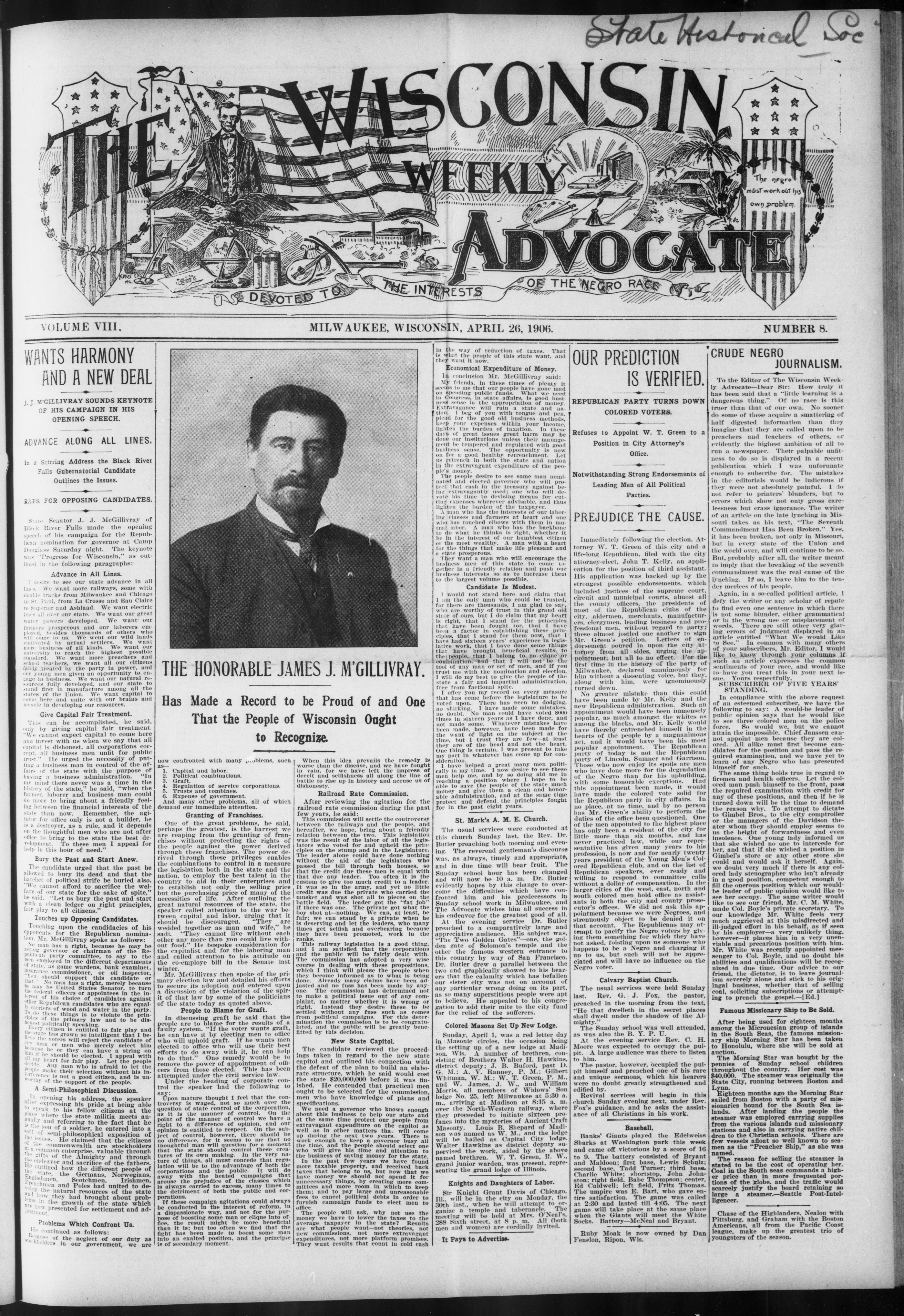
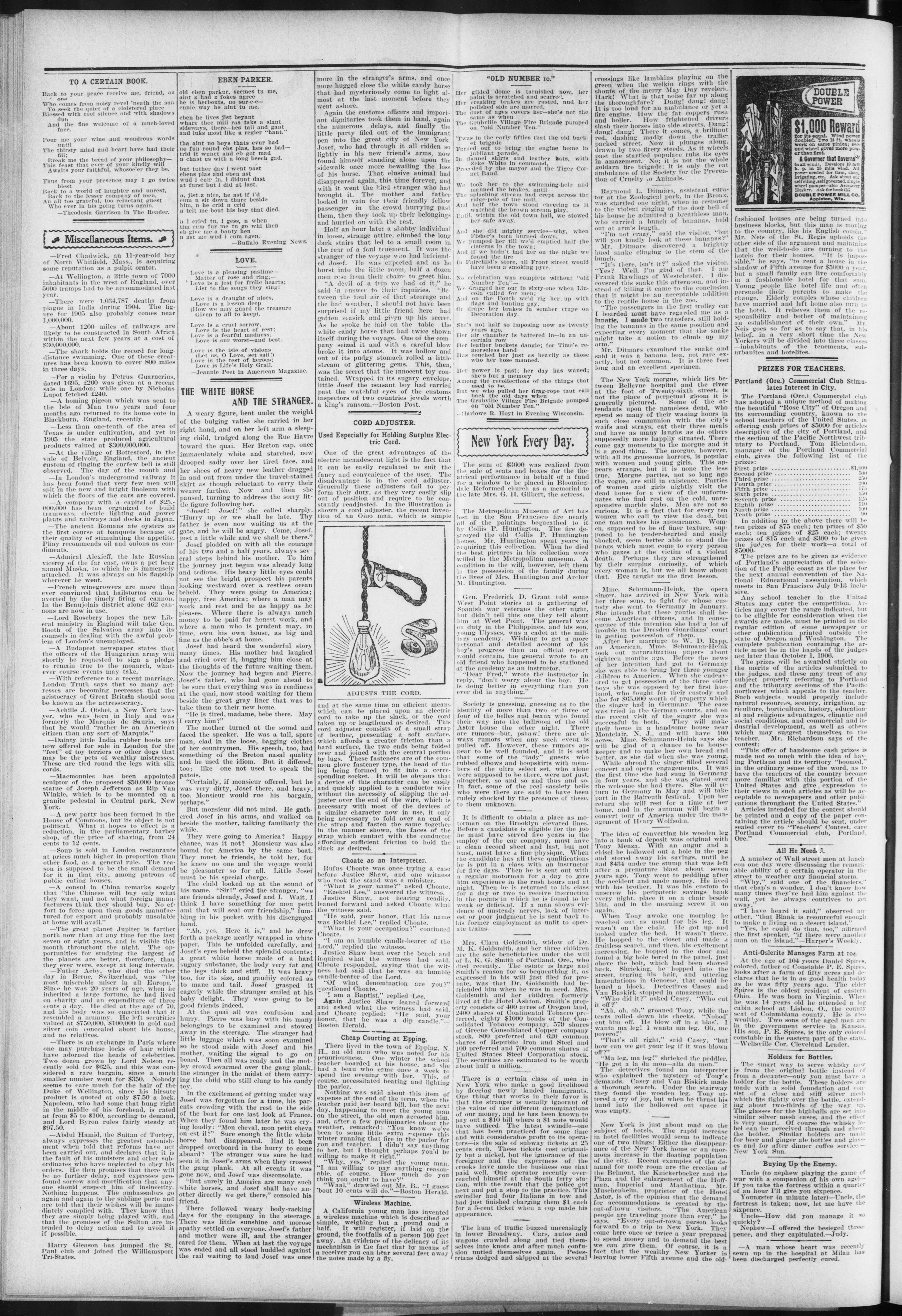
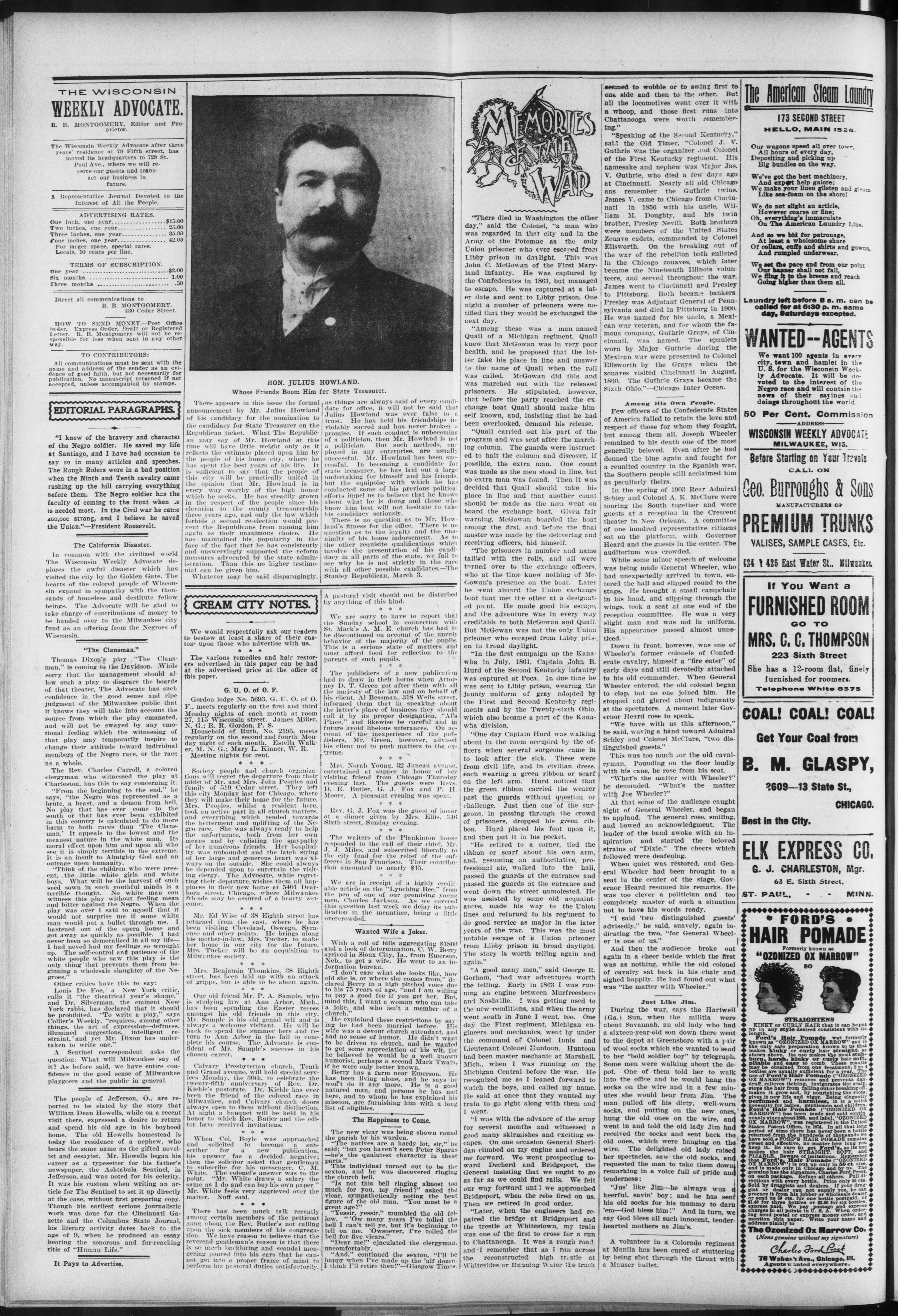
Page text (machine-generated)
State Historical Soc
WISCONSIN
WEEKLY
The negro must work out his own problem.
ADVOCATE
DEVOTED TO THE INTERESTS OF THE NEGRO RACE
VOLUME VIII.
WANTS HARMONY AND A NEW DEAL
J. J. M'GILLIVRAY SOUNDS KEYNOTE OF HIS CAMPAIGN IN HIS OPENING SPEECH.
In a Stirring Address the Black River Falls Gubernatorial Candidate Outlines the Issues.
RAPS FOR OPPOSING CANDIDATES.
State Senator J. J. McGillivray of Black River Falls made the opening speech of his campaign for the Republican nomination for governor at Camp Douglass Saturday night. The keynote was "Progress for Wisconsin," as outlined in the following paragraphs:
Advance in All Lines.
I desire to see our state advance in all lines. We want more railways, some with double tracks from Milwaukee and Chicago to St. Paul, from La Crosse and Eau Claire to Superior and Ashland. We want electric lines all over our state. We want our great water powers developed. We want our farmers prosperous and our laborers employed, besides thousands of others who will come to us. We went our wild lands cultivated by actual settlers. We want more business of all kinds. We want our university to reach the highest possible standard. We want more preachers and school teachers, we want all our citizens fairly treated by the party in power, and our young men given an opportunity to engage in business. We want our natural resources fully developed, and our state to stand first in manufacture among all the states of the Union. We want capital to come here and unite with our brains and muscle in developing our resources.
Give Capital Fair Treatment.
This can be accomplished, he said, only by giving capital fair treatment. "We cannot expect capital to come here and invest with us when we say that all capital is dishonest, all corporations corrupt, all business men unfit for public trust." He urged the necessity of putting a business man in control of the affairs of the state with the purpose of having a business administration. "In my mind there never was a time in the history of the state," he said, "when the farmer, laborer and business man could do more to bring about a friendly feeling between the financial interests of the state than now. Remember, the agitator for office only is not a builder, he is a destroyer, as a rule, and it depends on the thoughtful men who are not after office to bring to the state the best development. To these men I appeal for help in this hour of need."
Bury the Past and Start Anew.
The candidate urged that the past be allowed to bury its dead and that the hatchet of political strife be buried also. "We cannot afford to sacrifice the welfare of our state for the sake of spite," he said. "Let us bury the past and start with a clean ledger on right principles, fair play to all citizens."
Touches up Opposing Candidates
Touching upon the candidacies of his opponents for the Republican nomination. Mr. McGillivray spoke as follows: No man has a right, because he may be acting governor or chairman of the Republican party committee, to say to the men employed in the different departments of state, as game wardens, bank examiner, insurance commissioner, or oil inspector, "You should support this candidate or that." No man has a right, merely because he may be United States Senator, to turn the federal officers or appointees in the interest of his choice of candidates against other Republican candidates who are equally carriers of wood and water in the party. To do these things is to violate the principles of the primary law and to be dishonest politically speaking.
Every citizen is entitled to fair play and the state has grown so intelligent that I believe the voters will reject the candidate of any man or men who merely select him because he or they can have a string on him if he should be elected. I appeal with all my heart for fair play. Let the people decide. Any man who is afraid to let the people make their selection without his interference is not a good citizen, and is unworthy of the support of the people.
A Semi-Philosophical Discussion
In opening his address, the speaker after expressing his pride at being able to speak to his fellow citizens at the place where the state militia meets annually and referring to the fact that he is the son of a soldier, he entered into a sort of semi-philosophical exposition of the issues. He claimed that the citizens of the commonwealth are stockholders in a common enterprise, valuable through the gifts of the Almighty and through the endeavor and sacrifice of the fathers. He outlined how the different people of the state, the Germans, Norwegians, Englishmen, Scotchmen, Irishmen, Frenchmen and Poles had united to develop the natural resources of the state and how they had brought about problems in the growth of the state which are now presented for settlement and adjustment.
Problems Which Confront Us.
Because of the neglect of our duty as stockholders in our government we are
THE HONORABLE JAMES J. M'GILLIVRAY.
Has Made a Record to be Proud of and One That the People of Wisconsin Ought to Recognize.
now confronted with many problems, such as
And many other problems, all of which demand our immediate attention.
Granting of Franchises.
One of the great problems, he said, perhaps the greatest, is the harvest we are reaping from the granting of franchises without protecting the rights of the people against the power derived through these franchises. The power derived through these privileges enables the combinations to control in a measure the legislation both in the state and the nation, to employ the best talent in the country to aid in their enterprises and to establish not only the selling price but the purchasing price of many of the necessities of life. After outlining the great natural resources of the state, the speaker called attention to the war between capital and labor, urging that it should be discouraged. "They are wedded together as man and wife," he sadi. "They cannot live without each other any more than you could live without food." He bespoke consideration for the capitalist and for the laboring man and called attention to his attitude on the co-employe bill in the Senate last winter.
Mr. McGillivray then spoke of the primary election law and detailed his efforts to secure its adoption and entered upon a discussion of the violation of the spirit of that law by some of the politicians of the state today as quoted above.
People to Blame for Graft.
In discussing graft he said that the people are to blame for the results of a faulty system. "If the voter wants graft, he can have it by electing men to office who will uphold graft. If he wants men elected to office who will use their best efforts to do away with it, he can help to do that." One remedy would be to remove the power of appointment of officers from those elected. This has been attempted under the civil service law. Under the heading of corporate control the speaker had the following to say:
Upon mature thought I feel that the controversy is waged, not so much over the question of state control of the corporation, as it is the manner of control. On the point of the manner of control we have a right to a difference of opinion, and our opinion is entitled to respect. On the subject of control, however, there should be no difference, for it seems to me that no thoughtful man will question for a moment that the state should control these creatures of its own making. In the very nature of things, all must concede that regulation will be to the advantage of both the corporations and the public. It will do away with the heated campaigns that arouse the prejudice of the classes which is always carried to excess, many times to the detriment of both the public and corporations.
If these campaign agitations could always be conducted in the interest of reform, in a dispassionate way, and not for the purpose of boosting some man or clique into office, the result might be more beneficial than it is; but too often we find that the fight has been made to boost some man into an exalted position, and the principle is of secondary moment.
When this idea prevails the remedy is worse than the disease, and we have fought in vain, for we have left the impress of deceit and selfishness all along the line of battle to rise up in history and accuse us of dishonesty.
Railroad Rate Commission.
After reviewing the agitation for the railroad rate commission during the past few years, he said:
This commission will settle the controversy between the railways and the people, and hereafter, we hope, bring about a friendly relation between the two. This legislation was the result of the labor of all the legislators who voted for and upheld the principles on the stump and in the Legislature. The leader alone could have done nothing without the aid of the legislators who passed the bill through both houses, so that the credit due these men is equal with that due any leader. Too often it is the custom to give too much credit to a leader. It was so in the army, and yet no little credit was due the private who carried the musket and was shot all to pieces on the battle field. The leader got the "fat job" if there was one. The private got what the boy shot at—nothing. We can, at least, be fair; we can stand by a private when he is deserving and let the leaders, who many times get selfish and overbearing because they have been promoted, work in the ranks.
This railway legislation is a good thing, and I am satisfied that the corporations and the public will be fairly dealt with. The commission has adopted a very wise course in dealing with these propositions, which I think will please the people when they become informed as to what is being done. Already many claims have been adjusted and no fuss has been made by anyone. The commission has determined not to make a political issue out of any complaint, no matter whether it is wrong or right. Instead they desire these to be settled without any fuss such as comes from political campaigns. For this determination the commission is to be congratulated, and the public will be greatly benefitted by this decision.
New State Capitol
The candidate reviewed the proceedings taken in regard to the new state capitol and outlined his connection with the defeat of the plan to build an elaborate structure, which he said would cost the state $20,000,000 before it was finished. He contended that practical men ought to be selected for the commission, men who have knowledge of plans and specifications.
We need a governor who knows enough about this business to help our state and at the same time protect our people from extravagant expenditure on the capitol as well as in other matters tha. will come up during the next two years. There is work enough to keep a governor busy all the time, and the people should select one who will give his time and attention to the business of saving money for the state. In the past few years we have found more taxable property, and received back taxes that belong to us, but now that we have money we should not spend it for unnecessary things, by creating more committees and more room in which to keep them; and to pay large and unreasonable fees to cancel political debts in order to furnish campaign funds to elect men to office.
The people will ask, why not use the money we have to lower the taxes to the average taxpayer in the state? Results are what people want-not theories, not new commissions, not more extravagant expenditures, not more platform promises. They want results that count in cold cash
in the way of reduction of taxes. That is what the people of this state want, and they want it now.
Economical Expenditure of Money.
Economical Expenditure of Money.
In conclusion Mr. McGillivray said:
My friends, in these times of plenty it seems to me that our people have gone mad on spending public funds. What we need in Congress, in state affairs, is good business sense in the appropriation of money. Extravagance will ruin a state and nation. I beg of you with tongue and pen, plead for the good old business methods, keep your expenses within your income, lighten the burden of taxation. In these days of great issues great harm may be done our institutions unless their management be tempered and regulated with good business sense. The opportunity is now on for a good healthy retrenchment. Let us retrench in both the state and nation in the extravagant expenditure of the people's money.
The people desire to see some man nominated and elected governor who will protect that cash in the treasury against being extravagantly used; one who will devote his time to devlising means for cutting expenses wherever advisable, and thus lighten the burden of the taxpayer.
A man who has the interests of our laboring classes and farmers at heart and one who has touched elbows with them in mutual labor. A man who has the backbone to do what he thinks is right, whether it be in the interest of our humblest citizen or the most wealthy. A man with a heart for the things that make life pleasant and a state prosperous.
They want a man who will encourage the business men of this state to come together in a friendly relation and push our business interests so as to increase them to the largest volume possible.
Candidate Is Modest.
I would not stand here and claim that I am the only man who could be trusted, for there are thousands, I am glad to say, who are worthy of trust in this grand old state of ours, but I do claim that my heart is right, that I stand for the principles that have been fought for, that I have been a factor in establishing these principles, that I stand for them now, that I have had sixteen years' experience in legislative work, that I have done some things that have brought beneficial results to the people, that I belong to no clique or combination, and that I will not be the tool of any man or set of men, and if you trust me with the nomination and election, I will do my best to give the people of the state a fair and impartial administration, free from factional spite.
I offer you my record on every measure that has come before the legislature to be voted upon. There has been no dodging, no shirking. I have made some mistakes, no doubt. No man could have voted 8000 times in sixteen years as I have done, and not made some. Whatever mistakes have been made, however, have been made for the want of light on the subject at the time, but I trust they are few—at least they are of the head and not the heart. One thing is certain, I was present to take my part in whatever has come up for consideration.
I have helped a great many men politically in my time. I now desire to see these men help me, and by so doing aid me in reaching a position where I hope to be able to save the people of the state much money and give them a clean and honorable administration, and at the same time protect and defend the principles fought for in the past eight years.
St. Mark's A. M. E. Church.
The usual services were conducted at this church Sunday last, the Rev. Dr. Butler preaching both morning and evening. The reverend gentleman's discourse was, as always, timely and appropriate, and in due time will bear fruit. The Sunday school hour has been changed and will now be 10 a. m. Dr. Butler evidently hopes by this change to overcome the difficulties which have confronted him and his predecessors in Sunday school work in Milwaukee, and The Advocate wishes him all success in his endeavor for the greatest good of all. At the evening service Dr. Butler preached to a comparatively large and appreciative audience. His subject was, "The Two Golden Gates"—one, the golden gate of Solomon's temple and the other the famous western entrance to this country by way of San Francisco. Dr. Butler drew a parallel between the two and graphically showed to his hearers that the calamity which has befallen our sister city was not on account of any particular wrong doing on its part, as so many superstitious people were apt to believe. He appealed to his congregation to add their mite to the city fund for the relief of the sufferers.
Colored Masons Set Up New Lodge.
Sunday, April 1, was a red letter day in Masonic circles, the occasion being the setting up of a new lodge at Madison, Wis. A number of brethren, consisting of Brothers Walter H. Hawkins, district deputy; J. B. Buford, past D. G. M.; A. V. Ranney, P. M.; Gilbert Whitman, W. M.; W. T. Green, P. M., and W. James, J. W., and William Morris, all members of Widows' Son lodge No. 25, left Milwaukee at 5:30 a.m., arriving at Madison at 8:15 a.m. over the North-Western railway, where they proceeded to initiate sixteen profanes into the mysteries of Ancient Craft Masonry. Louis B. Shepard of Madison was named as W. M., and the lodge will be hailed as Capital City lodge. Walter Hawkins as district deputy supervised the work, aided by the above named brethren. W. T. Green, R. W., grand junior warden, was present, representing the grand lodge of Illinois.
Knights and Daughters of Labor.
Sir Knight Grant Davis of Chicago, Ill., will be in the city on Monday, the 30th inst., when he will attempt to organize a temple and tabernacle. The meeting will be held at Mrs. O'Neal's, 288 Sixth street, at 8 p. m. All (both men and women) are cordially invited.
Immediately following the election, Attorney W. T. Green of this city and a life-long Republican, filed with the city attorney-elect, John T. Kelly, an application for the position of third assistant. His application was backed up by the strongest possible endorsements, which included justices of the supreme court, circuit and municipal courts, almost all the county officers, the presidents of most of the Republican clubs of the city, aldermen, merchants, manufacturers, clergymen, leading business and professional men, without regard to party; these almost jostled one another to sign Mr. Green's petition. Letters of endorsement poured in upon the city attorney from all sides, urging the appointment, but all to no effect. For the first time in the history of the party of Milwaukee, declared unanimously for him without a dissenting voice, but they, along with him, were ignominiously turned down.
No greater mistake than this could have been made by Mr. Kelly and the new Republican administration. Such an appointment would have been immensely popular, as much amongst the whites as among the blacks, and Mr. Kelly would have thereby entrenched himself in the hearts of the people by a magnanimous act, and it would have been his most popular appointment. The Republican party of today is not the Republican party of Lincoln, Sumner and Garrison. Those who now enjoy its spoils are men who have done more for the degradation of the Negro than for his upbuilding, with some honorable exceptions. Had this appointment been made, it would have made the colored vote solid for the Republican party in city affairs. In no place, at no time, and by no person has Mr. Green's ability to perform the duties of the office been questioned. One of the men appointed to the highest place has only been a resident of the city for little more than six months, and has never practiced law, while our representative has given many years to his profession, is now and for nearly twenty years president of the Young Men's Colored Republican club, and on the list of Republican speakers, ever ready and willing to respond to committee calls without a dollar of compensation. In the larger cities of the west, east, north and south colored men hold office as assistants in both the city and county prosecutor's offices. We did not ask this appointment because we were Negroes, and strenuously object to be denied it on that account. The Republicans may attempt to pacify the Negro voters by giving them something for which they have not asked, foisting upon us someone who happens to be a Negro and charging it up to us, but such will not be appreciated and will have no influence on the Negro voter.
Calvary Baptist Church.
The usual services were held Sunday last. Rev. G. J. Fox, the pastor, preached in the morning from the text, "He that dwelleth in the secret places shall dwell under the shadow of the Almighty."
The Sunday school was well attended, as was also the B. Y. P. U.
At the evening service Rev. C. H. Moore was expected to occupy the pulpit. A large audience was there to listen to him.
The pastor, however, occupied the pulpit himself and preached one of his rare and unique sermons, which his hearers were no doubt greatly strengthened and edified by.
Revival services will begin in this church Sunday evening next, under Rev. Fox's guidance, and he asks the assistance of all Christians in his work.
Baseball.
Banks' Giants played the Edelweiss Sharks at Washington park this week and came off victorious by a score of 16 to 9. The battery consisted of Bryant and Maldoon; first base, Lewis Schulz; second base, Tadd Turner; third base. Charlie White; shortstop, John Johnston; right field, Babe Thompson; center, Ed Caldwell; left field, Fritz Thomas. The umpire was E. Bart, who gave entire satisfaction. The game was called at 2:30 and lasted till 4:05. The next game will take place at the same place when the Giants will meet the White Socks. Battery—McNeal and Bryant.
Ruby Moak is now owned by Dan Fenelon, Ripon, Wis.
NUMBER 8.
To the Editor of The Wisconsin Weekly Advocate—Dear Sir: How truly it has been said that a "little learning is a dangerous thing." Of no race is this truer than that of our own. No sooner do some of these acquire a smattering of half digested information than they imagine that they are called upon to be preachers and teachers of others, or evidently the highest ambition of all to run a newspaper. Their palpable unfitness to do so is displayed in a recent publication which I was unforunate enough to subscribe for. The mistakes in the editorials would be ludicrous if they were not absolutely painful. I do not refer to printers' blunders, but to errors which show not only gross carelessness but crass ignorance. The writer of an article on the late lynching in Missouri takes as his text, "The Seventh Commandment Has Been Broken." Yes, it has been broken, not only in Missouri, but in every state of the Union and the world over, and will continue to be so. But, probably after all, the writer meant to imply that the breaking of the seventh commandment was the real cause of the lynching. If so, I leave him to the tender merices of his people.
Again, in a so-called political article, I defy the writer or any scholar of repute to find even one sentence in which there is not some blunder, either grammatical or in the wrong use or misplacement of words. There are still other very glaring errors of judgment displayed in an article entitled "What We would Like to See." In common with many others of your subscribers, Mr. Editor, I would like to know through your columns if such an article expresses the common sentiments of your race, and would like to have you treat this in your next issue. Yours respectfully.
SUBSCRIBER OF FIVE YEARS' STANDING.
In compliance with the above request of an esteemed subscriber, we have the following to say: A would-be leader of public opinion says that he would like to see three colored men on the police force. So would we, but we cannot attain the impossible. Chief Janssen cannot appoint men because they are colored. All alike must first become candidates for the position and pass the required examination, and we have yet to learn of any Negro who has presented himself for such.
The same thing holds true in regard to firemen and health officers. Let the colored man push himself to the front, pass the required examination with credit for any of these positions, and then if he is turned down will be the time to demand the reason why. To attempt to dictate to Gimbel Bros., to the city comptroller or the managers of the Davidson theater whom they should employ seems to us the height of forwardness and even insolence. One young lady informed us that she wished no one to intercede for her, and that if she wished a position in Gimbel's store or any other store she could and would ask it herself. Again, we doubt very much if there is any colored lady stenographer who isn't already in a good position, competent enough to fill the onerous position which our would-be leader of public opinion would like to see her occupy. The same writer would like to see our friend, Mr. C. M. White, made Col. Boyle's private secretary. To our knowledge Mr. White feels very much aggrieved at this misdirected and ill-judged effort in his behalf, as if seen by his employer—a very unlikely thing, however—it places him in a very unenviable and precarious position with him. Mr. White was recently appointed messenger to Col. Boyle, and no doubt his abilities and qualifications will be recognized in due time. Our advice to our friend, the dictator, is to leave journalism severely alone and stick to his original business, whether that of selling coal, soliciting subscriptions or attempting to preach the gospel.—[Ed.]
Famous Missionary Ship to Be Sold.
After being used for eighteen months among the Micronesian group of islands in the South Seas, the famous missionary ship Morning Star has been taken to Honolulu, where she will be sold at auction. The Morning Star was bought by the pennies of Sunday school children throughout the country. Her cost was $40,000. The steamer was originally the State City, running between Boston and Lynn.
Eighteen months ago the Morning Star sailed from Boston with a party of missionaries bound for the South Sea islands. After landing the people the steamer was employed carrying supplies from the various islands and missionary stations and also in carrying native children to the Christian schools. There are few vessels afloat so well known to seamen as the "Preacher Ship," as she was named. The reason for selling the steamer is stated to be the cost of operating her. Coal in the South seas commands a higher price than in more frequented portions of the globe, and the traffic would scarcely justify the board retaining so large a steamer.—Seattle Post-Intelligencer.
Chase of the Highlanders, Nealon with Pittsburg, and Graham with the Boston Americans, all from the Pacific Coast league, make up the greatest trio of youngsters of the season.
TO A CERTAIN BOOK.
Track to your peace receive me, friend, 2s
* one
Who comes from noisy revel ‘neath the sun
To seek the quict of a cloistered place
Blessed with cool silence and ‘vith shadows
dun
And the fine welcome of a much-loved
face.
Pour a your wine and wondrous words
nnti
The on mind and heart have had their
Tireak’me the bread of your philosoph: pa
This feast that ever of your kindly will,
‘Awaits your faithful, whosoe’er they be.
tins, creas your presence may I go twice
jest
Back to a world of laughter and unrest,
Back to the lesser company of men,
An all too grateful, too reluctant guest
Who ever in his going turns again.
—Theodosia Garrison in The Reader.
# Miscellaneous Items. #*
inhabitants in the west of England, over
5000 tramps had to be accommodated last
year,
—There were 1,034,787 deaths from
plagne in India during 1904. The fig-
vre for 1905 also probably comes near
1,000,000.
—About 1200 miles of railways are
likely to be constructed in South Africa
within the next few years at a cost of
$30,000,000.
—The shark holds the record for long-
distance swimming. One of these creat-
ures has been known to cover 800 miles
in three days.
—For a violin by Petrus Guarnerius,
dated 1695, £260 was given at a recent
sale in London: while one by Nicholas
Lupot fetched £240.
—A homing pigeon which was sent to
the Isle of Man two years and four
months ago returned to its home cote in
Blackburn, England, recently.
—Less than one-tenth of the area of
Texas is under cultivation, and yet in
1905 the state produced agricultural
products valued at $300,000,000.
—At the village of Bottesford, in the
yale of Belvoir, England, the ancient
enstom of ringing the curfew bell is still
observed. The day of the month and
—In London’s underground railway it
has been found that very few men will
spit in the new and bright linoleum with
which the floors of the cars are covered.
—A company with a capital of $25.-
000,000 has been organized to build
tramways, electric lighting and power
plants and railways and docks in Japan.
—The ancient Romans ate oysters as
the first course at banquets because of
their quality of stimulating the appetite.
Pliny recommends oil and onions as con-
diments.
—Admiral Alexieff. the late Russian
viceroy of the far east, owns a pet bear
named Muska, to which he is immensely
attached. It was always on his flagship
wherever he went.
—French winegrowers are more than
ever convinced that hailstorms can be
averted by the timely firing of cannon.
In the Beanjolais district alone 462 cau-
nons are now in use.
—Lord Rosebery hopes the new Lib-
eral ministry in England will take Gen.
Booth of the Salvation army into its
counsels in dealing with the awful prob-
Jem of London's unemployed.
—A Budapest newspaper states that
the officers of the Hungarian army will
shortly be requested to sign a pledge
to remain true to the monarch, what-
ever course events may take.
—With reference to a recent marriage,
London Truth says that so many act-
resses are becoming peeresses that the
aristocracy of Great Britain should soon
be known as the actressocracy.
—Achille J. Oishei, a New York law-
yer, who was bern in Italy and was
formerly the Marquis de Sauria, says
that he would “rather be an American
citizen than any sort of Marquis.”
—Dainty little India rubber boots are
now offered for sale in London for the
“feet” of toy terriers or other dogs that
may be the pets of wealthy mistresses.
‘These are tied round the legs with silk
cords.
—Macmonnies has been appointed
sculptor of the proposed $50,000 bronze
statue of Joseph Jefferson as Rip Van
Winkle, which is to be mounted on a
granite pedestal in Central park, New
York.
—A new party has been formed in the
House of Commons, but its object is not
political. What it hopes to effect is a
reduction, in the parliamentary barber
shop, of the price of shaving, from 24+
cents to 12 cents.
—Soup is sold in London restaurants
at prices much higher in proportion than
other food, as a general rule. The rea-
son is supposed to be the small demand
for it in that city, among patrons of
public eating houses.
—A consul in China remarks sagely
that “the Chinese will buy only what
they want, and not what foreign manu-
facturers think they should buy. No ef-
fort to force upon them goods manufac-
tured for export and probably unsalable
at home will avail.”
—The great planet Jupiter is farther
north now than at any time for the last
seven or eight years, and is visible this
month throughout the night. The op-
portunities for studying the largest of
the planets are better, therefore, than
they ever were, except at long intervals.
—Father Aeby. who died the other
day in Berne. Switzerland. was “the
most miserable miser in all Europe.”
Since he was 20 years of age, when he
inherited a large fortune. he had lived
on charity and an expenditure of three
cents a day. He died at the age of 70,
and his body was so emaciated that it
resembled a mummy. He left secutities
valued at $750,000, $100,000 in gold and
silver coin concealed about his house,
and no relatives.
—There is an exchange in Paris where
one may purchase locks of hair which
have adorned the heads of celebrities.
Two dozen grown by Lord Nelson re-
cently sold for $625, and this was con-
sidered a rare bargain, since a_much
smaller number went for $350. Nobody
seems to care much for the hair of the
Duke of Wellingtoa, since his hirsute
product is quoted at only $7.50 a lock.
Napoleon, who had some that hung right
in the middle of his forehead, is rated
at from $5 to $100, according to demand,
and Lord Byron rules fairly steady at
$97.50.
—Abdul Hamid, the Suitan of Turkey,
always expresses the greatest astonish-
ment when told that reforms have net
heen carried out, and declares that it is
the fault of his ministers and other sub-
ordinates who have neglected to obey his
orders. He then promises that there will
he no further delay, and expresses pro-
found serrow and mortification that any-
one should suspect him of insincerity.
Nothing happens. The ambassadors go
again and again to the sublime porte and
are told that their wishes will be imime-
diately complied with. They know that
they are simply being played with, and
that the promises of the Sultan are in-
tended to delay action and to avoid it
if possible.
SE TEEEEEEEEEREEeiaeae”
Harry Gleason has jumped the St.
Paul elub and joined the Williamsport
‘Tri-States.
EBEN PARKER.
old eben paces seemes tu me,
aint z bad z fokes agree
he is herbouts, no sur-e-e—
ennie way be aint tu me,
eben he lives jist beyant
whare thee mill ras taks a slant
sideways, there—hes tall and gant
and luks ost like a regler “hant.””
tha aint no boys thats evur had
no fun round ébs plas, hes so bad—
trid it wunct and eb got mad
n chast us with a long beech gad.
but tuther day 1 went past
ebens plas and eben ast
wud i cur in, i didunt dast
at furst but i did at last.
a, jist.z nice, he ast if i'd
cum n sit down thare beside
him, n he crid n crid
n telt me bout his boy that died.
n 1 erfed tu, f gess, n when
tim cum fur me tu go whi then
eb give me a banty hen
n ast me wud i cum agen.
—Buffalo Evening New:
—_—————_—_—
———_—___
LOVE.
Love ts a pleasing pastime—
| Matter of rose and ring;—
Love is a fest for frolic hearts;
List to the songs they sing!
Love Is a draught of aloes,
Love is a lesson deep
(How we may guard the treasure
Given to all to keep).
Love is @ cruel sorrow,
Love is the heart of rest;
Love is a fearful madness;
Love is our worst—and best.
Love is the isle of visions
(Let us, O Love, set sail!)
Love is the test of heroes;
Love is Life’s Holy Grail.
—Jeannie Peet in American Magazine.
f—_—__}
AND THE STRANGER.
A weary figure, bent under the weight
of the bulging valise she carried in her
right hand, and on her left arm a sleep-
ing child, trudged along the Rue Havre
toward the quai. Her Breton cap, once
immaculately white and starched, now
drooped sadly over her tired face, and
her shoes of heavy new leather dragged
in and out from under the travel-stained
skirt as though reluctant to carry their
wearer farther. Now and then she
paused, turning to address the sorry lit-
tle figure following her.
“Josef! Josef!” she called sharply.
“Hurry up or we shall be late. Thy
father is even now waiting us at the
gate, and he will be angry. Come, Josef,
just a little while and we shall be there.”
Josef plodded on with all the courage
of his two and a half years, always sev-
eral steps behind his mother. To him
the journey just begun was already long
and tedious. His heavy little eyes could
not see the bright prospect his parents
looking westward over a restless ocean
beheld. They were going to America;
happy, free America; where a man may
work and rest and be as happy as he
pleases. Where there is always much
money to be paid for honest work, and
where a man who is prudent may, in
time. own his own house, as big and
fine as the abbe’s at home.
- Josef had heard the wonderful story
many times. His mother had laughed
and cried over it, hugging him close at
the thoughts of the future waiting them.
Now the journey had begun and Pierre,
Josef’s father, who had gone ahead to
be sure that everything was in readiness
at the quai, now stood waiting for them
beside the great gray liner that was to
take them to their new home.
“He is tired, madame, bebe there. May
T earry him?”
The mother turned at the sound and
faced the speaker. He was a tall, spare
man, clad in the loose, bagging clothes
of her countrymen. His speech, too, had
something of the Breton nasal quality
and he used the idiom. But it differed,
too; like one not used to speak the
patois.
“Certainly, if monsieur offered, but he
was very dirty, Josef there, and heavy,
too. Monsieur would rue his bargain,
verhaps.”
But monsieur did not mind. He gath-
ered Josef in his arms, and walked on
beside the mother, talking familiarly the
while.
They were going to America? Happy
chance, was it not? Monsieur was also
bound for America by the same boat.
They must be friends, he told her, for
he knew no one and the voyage would
be pleasanter so for all. Little Josef
must be his special charge.
The child looked up at the sound of
his name. “Sir!” cried the stranger, “we
are friends already, Josef and I. Wait, I
think I have something for mon petit
ami that will seal our friendship,” fum-
bling in his pocket with his disengaged
hand.
“Ah, yes. Here it is,” and he drew
forth a package neatly wrapped in white
paper. This he unfolded carefully, and
Josef’s eyes beheld the splendid contents;
a great white horse made of a hard
sugary substance, the body very fat and
the legs thick and stiff. “It was heavy
too, for its size, and gaudiiy colored as
to mane and tail. Josef grasped it
eagerly while the stranger smiled at his
baby delight. They were going to be
good friends indeed.
At the quai all was confusion and
hurry. Pierre was busy with his many
belongings to be examined and stowed
away in the steerage. The stranger had
little luggage which was soon examined
so he stood aside with Josef and his
mother, waiting the signal to go on
board. Then all was ready and the mot-
ley crowd swarmed over the gang plank,
the stranger in the midst of them carry-
ing the child who still clung to his candy
toy.
In the excitement of getting under way
Josef was forgotten for a time, his par-
ents crowding with the rest to the side
of the boat for one iast look at France.
When they found him later he was ery-
ing loudly: “Mon cheval, mon petit cheva
on est il?” Sure enough the little white
horse had disappeared. Had it been
dropped overboard in the hurry to come
aboard? The stranger was sure he had
seen it in Josef’s arms when they crossed
the gang plank. At all events it was
gone now, and Josef was disconsolate.
“But surely in America are many such
white horses, and Josef shall have an-
other directly we get there,” consoled his
friend.
There followed weary body-racking
days for the company in the steerage.
‘There was little sunshine and morose
apathy settled on everyone. Josef’s father
and mother were ill, and the stranger
cared for them. When at last the voyage
was ended and all stood huddled against
the rail waiting to land Josef was once
more in the stranger’s arms. and once
more hugged close tlie white candy horse
that had mysteriously come to light al-
most at the last moment before they
went ashore.
Again the customs officers and import-
ant dignitaries took them in hand, again
the numerous delays, and finally ‘the
little party filed out of the immigrant
pen into the great city of New York.
Josef, who had through it all ridden so
lightly in his new friend’s arms, now
found himself standing alone upon the
sidewalk once more bewailing the loss
of his horse. That elusive animal had
disappeared again, this time forever, and
with it went the kind stranger who had
brought it. The mother and father
looked in vain for their friendly fellow
passenger in the crowd hurrying pasi
them, then they took up their belongings
and hurried on with the rest.
Half an hour later a shabby individual
in loose, strange attire, climbed the long
dark stairs that led to a small room in
the rear of a foul tenement. It was the
stranger of the veyage wno had befriend-
ed Josef. He was expected and as he
burst into the littie room, half a dozen
men rese from their chairy to greet him.
“A devil of a trip we had of it,” he
said ‘n answer to their inquiries. “Be-
tween the foul air of that steerage and
the baé weather, L shoul: not have been
surprise’ if my little friend here had
gotten scasick and given up his secret.
As he spoke he Jaid on the table the
white candy horse that had twice shown
itself during the voyage. One of the com-
pany seized it and with a careful blow
broke it into atoms. It was hollow and
out of its pudgy stomach rolled a little
stream of glittering gems. This, then,
was the secret that the innocent toy con-
tained. Wrapped in its sugary envelope,
little Josef the peasant boy had carried
past the watchful eyes of the customs
inspectors of two countries jewels worth
a king’s ransom.—Boston Post.
CORD ADJUSTER.
Used Especially for Holding Surplus Elec
tric Cord.
One of the great advantages of the
electric incandescent light is the fact that
it can be easily regulated to suit the
fancy and convenience of the user. The
disadvantage is in the cord adjuster.
Generally these adjusters fail to per-
form their duty, as they very easily slip
out of position and require to be con-
stantly readjusted. In the illustration is
shown a cord adjuster. the recent invex-
tion of an Gino man. which is simple
\ ; es
< X\ Ss “yy <
f SS
ADJUSTS THE CORD.
and at the same time an efficient means
which can be placed upon an_ electric
cord to take up the slack, or the cord
taken up or lengthened as desired. This
cord adjuster consists of a small strap
of leather, presenting a soft surface,
which affords a greater friction than a
hard surface, the two ends being folded
over and joined with the central portion
by lugs. These fasteners are of the com-
mon glove fastener type, the head of the
ing being formed to fit into a corre-
sponding socket. It will be obvious that
a device of this character can be easily
and quickly applied to a conductor wire
without the necessity of slipping the ad-
juster over the end of the wire, which: is
necessary with most of the devices of
a similar character now in use, it only
being necessary to fold over an end of
the strap and fasten the same together
in the manner shown, the faces of the
strap which eantact with the conductor
affording sufficient friction to hold the
slack as desired.
ee hares
Choate as an Interpreter.
Rufus Choate was once trying a case
before Justice Shaw, and one witness
who took the stand was a minister.
“What is your name?’ asked Choate.
“Ezekiel Lee,” answered the witness.
Justice Shaw, not hearing readily,
leaned forward and asked Choate whai
the witness said.
“He said, your honor, that his name
was Ezekiel Lee,” replied Choate.
“What is your occupation?” continued
Choate.
“Tam an humble candle-bearer of tle
Lord,” replied the witness.
Justice Shaw bent over the bench and
inquired what the witness had said.
Choate responded, saying that the wit-
ness had said that he was an humble
candle-bearer of the Lord.
“Of what denomination are you?’
questioned Choate.
‘am a Baptist.” replied Lee.
Again Justice Shaw leaned forward
and asked what the witness had said,
and Choate replied: “He said, your
honor, that he was a dip eandle.”—
Boston Herald.
—
Cheap Courting at Epping.
There lived in the town of Epping, N.
Hi., an old man who was noted for’ hi:
penuriousness. One winter the schoo:
teacher boarded at his house, and she
had a beau who came once a week to
spend the evening with her. This, of
course, necessitated heating and lighting
the parlor.
_ Nothing was said about this item of
expense at the end of the term, when the
teacher paid her board bill, but the next
day, happening to meet the young man
on the street, the old man aecosted him,
and, after a few preliminaries about the
weather, remarked: “You know we've
been to seme little extra »xpense this
winter running that fire in the parlor for
you and teacher. I didn’t say anything
to her, but I thought perhaps you'd be
willing to make it right.”
“Why, yes,” replied the young man,
“T am willing to pay anything reasou-
able, of course. How much do you
think you ought to have?”
“Waal,” drawled out Mr. B.. “I guess
“bout 10 cents will do.”—Boston Herald.
Wireless Machine
A California young man has invented
a wireless machine which is described as
soups weighing but a pound and a
half. It will register, if laid on the
ground, the footfalls of a person 100 feet
away. An evidence of the delicacy of its
mechanism is tie fact that by means of
a receiver you can hear several feet away
the noise made by a fy.
“OLD NUMBER to.”
Mer gilded dome is tarnished now, ier
paint is scratched and scarre:,
Her creaking brakes are rusted, ‘and her
polished side are marred,
The dust of ages covers her—she's not the
Grabs ill itin Five Brigade d
The Grubville age Fire Brigade pumped
on “old Nuniber Ten.” by
“Twas in the early fifties that the old buck-
et brigade
Yeracd out to bring the engine home in
jubilant parade,
In funnel shirts and leather bats, with
Zeke White in command,
Preceded by the mayor and the Tiger Cor-
net Band.
We took her to the swimming-hele and
manned the brakes, until
‘The splashing stream had crept across the
ridge-pole of the mill,
And half’ the town stood cheering as it
watched the brown stream play,
Until. within the old town hall, we stowed
her safe away.
And she did mighty service—why, when
Fisher's barn burned down,
We pumped her till we'd emptied half the
cisterns In the town;
And if we hadn't had her on the night we
found the fire
in Fairehild’s store, all Front street would
have been a smoking pyre.
No celebration was complete without “old
Number Ten"—
We Gragged her out in sixty-one when Lin-
coin called for men:
And on the Fouth we'd rig her. up with
flags and bunting gay,
Or drape her brakes in somber crape on
Decoration day,
‘She's not half so imposing now as twenty
years ago,
‘Her air chamber is battered in—in an un-
certain row
Hier leather buckets dangle; for Time's re-
) morseless hand
Has touched her just as heavily as those
| who her hose manned.
‘Tier power is past; her day has waned;
she’s but a memory
Among the recollections of the things that
used to be.
But we who pulled her drag-rope taut call
back the old days when
The Grubyille Village Fire Brigade pumped
on “old Number Ten.”
—!larlowe R. Hoyt in Evening Wisconsin.
I i wv
j New York Every Day.
|
j The sum of $3600 was realized from
| the sale of seats and boxes for the the-
j}atrical performance in behalf of a fund
j for a window to be placed in Blooming-
|dale Reformed church as a memorial to
|the late Mrs. G, Hl. Gilbert, the itetress.
The Metropolitan Museum of Art has
Jost in the San Francisco fire nearly
all of the paintings bequeathed to it
by Collis P. Huntington. The fire de-
|stroyed the old Collis P. Huntington
| house. Mr. Huntington spent years in
;ocquiring this collection. When he died
the best pictures in his collection were
willed to the Metropolitan museum. A
condition in the will, however, left them
in the possession of the family during
the lives of Mrs. Huntington and Archer
M. Huntington.
Gen. Frederick D. Grant told some
West Point stories at a gathering of
Spanish war veterans the other night,
Int didn’t tell this one they tell about
him at West Point. The general was
en duty in the Philippines, and his son,
young Ulysses, was a cadet at the mili-
tary academy. Wishing to get a more
personal and detailed account of his
|boy’s progress than an official report
| would contain, the general wrote to an
jold friend who happened to be stationed
jat the academy as an instructor.
| “Dear Fred,” wrote the instructor in
|reply, “don’t worry about the boy. He
jis doing better in everything than you
ever did in anything.”
| Society is guessing, guessing as to the
| identity of more than two or three or
four of the belles and beaux who found
their way into the ballroom of the old
Astor house the other night. There
lare rumors—but, pshaw! there are al-
ways rumors when any such event is
pulled off. However, these rumors ap-
pear to be well founded, and it is said
that some of the “lady” guests who
rubbed elbows and hoopskirts with mem-
| bers of the ultra select set, who alone
were supposed to be there, were not just,
altogether, so and so and thus and so.
In fact, some of the real sassiety bells
who were there are said to have been
rudely shocked by the presence of tliese,
to them unknown.
It is difficult to obtain a place as mo-
torman on the Brooklyn elevated. lines.
Before a candidate is eligible for the job
he must have served five years in the
employ of the car company, must have
a clean record sheet and last, but not
least, must have a fine physique. When
the candidate has all these qualitications
[ie is put in a class with an instructor
for five days. Then he is sent out with
la regular motorman for a day to give
him experience in the rush hours and at
| night. ‘Then he is returned to his class
| for a day or two to receive instrnuetion
|in the points in whieh he is found to be
| weak or deficient. If a man shows evi-
/dence of unsteady nerves, lack of inter-
/est or poor judgment he is sent back to.
his former employment as unfit to oper-
| ate teains.
| Mrs. Clara Goldsmith, widow of Dr.
-M. KK. Goldsmith, and her three children
are the sole beneficiaries under the wiil
of L. K. G. Smith of Portland, Ore., who
died recently. The estate is large and
|Smith’s reason for so bequeathing it, as
‘expressed in his will just filed for pro-
bate, was that Dr. Goldsmith had _ be-
friended him when he was in need. Mrs.
Goldsmith and her children formerly
lived at the Hotel Ashton. Smith's prop-
erty consists of 400 acres of Oregon land,
2400 shares of Continental Tobacco pre:
ferred, eighty $1000 bonds of the Con-
solidated Tobacco company, 579 shares
of Greene Consolidated Copper company
stock, S00, preferred and 620 common
shares of Republic [ron and Steel and
100 preferred and 700 common shares of
United States Steel Corporation stock.
‘The securities are estimated to be worth
about half a million.
| There is a certain class of men in
New York who make a good livelihood
by fleecing newly lauded immigrants.
One thing that works in their favor is
‘that the stranger is usually ignorant of
the value of the different denominations
of our money, and he hus been known to
pay out a $10 bill where a $1 note would
have sufficed. The latest’ swindle—one
that has been practiced for some time
and with considerabre profit to its opera-
tors—is the sale of subway tickets at 25
cents each. These tickets cost original-
ly but a nickel, but the ignorance of the
foreigner and the expertness of the
crooks have made the business one that
paid well. One operator recently over-
reached himself at the South ferry sta-
tion, with the result that the police got
next and put a stop to the practice. This
swindler had four Italians in tow and
had just finished charging them $1 each
for a 5-cent ticket when a cop made his |
appearance.
The hum of traffic buzzed unceasingly_
in lower Broadway. Cars, autos and
wagons crawled along and tied them-
selves into knots and after much confa-
sion untied themselves again. Pedes-|
Se eR ae Com eS a) a
shouts of the merry May Day revelers.
Hark! What ig that noise far up along
the thoroughfare? Dang! dang: dang!
It is too loud for an ambulance or yet a
fire engine. How the fat coppers rusa
and holler. How frightened drivers
slash their horses into side streets. Dang!
dang! dang! There it comes, brilliant |
red, dashing madly down the traffic
packed street. Now it plunges along,
drawn by two firery steeds. As it, wheels.
past the startled populace rubs its eyes
in amazement. No; it is not the whole
goldarn fire brigade; it is only the cat
ambulance of the Society for the Preven-
tion of Cruelty .o Animals.
Reymond L. Ditmars. assistant cura-
tor at the Zoological park, in the Bronx,
was startled one night, when in response
to the violent ringing of the door bell of
his house he admitted a breathless man.
who carried a bunch of bananas, held
out at arm’s length.
“I'm not erazy.” said the visitor, “but
will you kindly look at these bananas?
Mr. Ditmars discovered a brightly
hued snake clinging to the stem of the
bunch.
“It's there, isn’t it?” asked the visitor.
“Yes? Well, I'm glad of that. Tam
Frank Rawlings of Westchester. I dis-
covered this snake this afternoon, and in-
stead of killing it came to the conchision
that it might be an acceptable addition
to the reptile house in the zoo.
“The passengers in the first trolley car
I boarded must have regarded me as 2
Innatie, I made two transfers, still hold-
ing the bananas in the same position and
expecting every moment that the snake
might take a notion to climb up my
arm.”
Mr. Ditmars examined the snake and
said it was a banana boa, not rare ex-
actly, but not common. It is three feet
long and an excellent specimen.
The New York morgue, which lies be-
tween Bellevue hospital and the river
at the foot of Twenty-sixth street, is
not the place of perpetual gloom it is
generally pictured. Some of the at-
tendants upon the nameless dead, who
spend so many of their waking hours in
such close communion with the city’s
waifs and strays, eat their three meals
and haye as many laughs as do others
supposedly more happily situated, There
come gay moments to the morgue and it
is a good thing. The morgue, however,
with all its gruesome horrors, is popular
with women and young girls. This ap-
pears strange, but it is none the less
true. Morgue parties, not so long ago
the vogue, are still in existence. Parties
of women and girls nightly visit the
dead house for a view of the unfortu-
nates who find rest on the cold, unre-
sponsive marble slabs. Men are not so
curious. It is a fact that for every ten
women who call to view the dead, but
one man makes his appearance. Wom-
en, supposed to be of finer texture, sup-
posed to be tender-hearted and easily
shocked, seem better able to stand the
pangs which must come to every person
who gazes at the victim of a violent
death. Perhaps they are strengthened
by their surplus. curiosity, of which
every woman is, but we all know about
that. Eve taught us the first lesson.
Mme. Schumann-Heink, the opera
singer. has arrived in New York with
her three sons, to fight for whose cus-
tody she went to Germany in January.
She intends that these youths shall be-
come American citizens, and in conse-_
quence of this intention she had alot of |
trouble in the Dresden Guardians’ court:
in getting possession of them.
After her marriage to W. D. Rapp.
an American, Mme. Schumann-Heinie
took out naturalization papers about
eighteen months azo. Before the news
of her intention had got to Gérmany
she was able to bring her three younger
children to America. When she endeay-
ored to get possession of the three older
boys she was opposed by. her first hus-
band, who fought for their custody and |
also for $65,000 worth of property whieh |
the singer had in Germany. The case.
was tried in the German courts, and on
the recent visit of the singer she was
successful in both. They will make
their home in a handsome house near |
Montelair, N.J., and will have 100:
acres, Mme, Schumann-Heink says she
will be glad of a chance to be house-
keeper and to make her own bread and
butter. as she did when she was young.
While abroad the singer filled several
concert and opera engagements. It was
the first time she had sung in Germany
in four years, and she was elated over
the welcome she had there. She will re-|
turn to Germany in May and will take)
‘part in the Bairenth festival. Upon her |
return she will rest for a time at her
home, and in the autumn will begin 2
concert tour of America under the man: |
agement of Henry Wolfsohn. |
The idea of converting his wooden leg
into 2 bank of deposit was original with
Tony Menza. With an augur and a
chisel he hollowed out a hole in the pex
and stored away his savings, until he
had $434 under tne stump that was left
after a premature blast about seven
years ago. ‘Tony went to peddling after
the accident and made money. He lived
with his brother. It was his custom to
unscrew his peripatetic savings bank
every night, place it on a chair beside
him, and in the morning serew it on
again,
When Tony awoke one morning he
reached out as usual for kis leg. It
wasn’t on the chair, He got up and
looked under the bed. It wasn’t there.
He hopped to the closet and made a
fruitless search, and then, his excitement
increasing, he hopped to the door and
found a big hole bored in the panel. just
above the bolt, which had been shoved
back. Shrieking. he hopped into the
street, tearing his hair, and uttering
lamentations in Genoese, that could be
heard a block. Detectives Casey and
Van Baskirk stopped in amazement.
“Who did it?” asked Casey. “Who cut
it off 7°
“Ah, oh, oh,” groaned ‘Tony, while the
tears rolled down his cheeks. “Nobod*
jcat him off. He blow off in a blas’. I
wanta ma leg! 1 wanta ma leg. Oh, me
povero!’
“That's all right,” said Casey, “but
oe we get your leg if it was blown
off?
| “Ma leg, ma leg!” shrieked the peddler.
Cin wnt he alien atin) aa nan
New York is just about mad on the
subject of hotels. The rapid increase
in hotel facilities would seem to indicate
one of two things: Either the disappear-
ance of the New York home or an enor-
mous increase in the floating population
of the city. Recent examples of the de-
mand for more room are the erection of
the Belmont, the Knickerbocker and the
Plaza and the enlargement of the Hoff-
man, Imperial and Manhattan. Mr.
Muschenheim, proprietor of the Hotel
Astor, is of the opinion that the demand
for accommodations is created by the
out-of-town visitors. “The American
people are traveling more than ever.” he
says. “Every out-of-town person looks
forward to a trip to New York. They
come here once or twiee « year prepared
to spend money and to demand the best
We can give them. Of course. it is a
fact that the wealthy New Yorker is
leaving lower Fifth avenue and the old-
Pa :
N iV eeee POWER 4
f » ae = ‘
oN Maa re | :
as ise fortes Revert
14 \ at ix AEA ae = i =
i; gn a Beet
A es a heme ts ss
14 my : oo 7
Bah ‘ cee |
Eeeesiic :
Ses :
cramer co.
fashioned houses are being turned int,
business blocks, but this man is moving
to the country, like his English cousiy.*
Mr. Neis of the St. Regis uphvids the
other side of the argument and mainiains
that the well-to-do are turning to the
hotels for their homes. “It is impos-
sible,” he says, “to rent a house in the
shadow of Fifth avenue for $5000 a ye cr,
but a small family can live comfortaliy
in a fashionable hotel for that) sun.
Young people like hotel life and ofjon
persuade their. parents to make the
change. Elderly couples whose childr:
have married and left home also turn ty
the hotel. It relieves them of the 1
sponsibility and bother of maintaining
an establishment ef their own.” Mr
Neis goes so far as to say that. in his
belief. in a very short time the New
Yorkers will be divided into three classes
—inhbabitants of the tenements, sub-
urbanites and hotelites.
es
PRIZES FOR TEACHERS.
Portland (Ore.) Commercial Club Stimu-
lates Interest in City.
The Portland (Ore.) Commercial int)
has adopted a unique method of making
the beautiful “Rose City” of Oregon aud
its surrounding country, known to the
school teachers of the United States. in
offering cash prizes of $5000 for articles
descriptive of the city of Portland, and
the section of the Pacitic Northwest trib-
utary to Portland. Tom Richardson,
manager of the Portland Commercia!
club, gives the following list of the
prizes:
First prize ......0-0.0scesesees cess. $100)
Second prize .......cceceecsesesccese. THM
hr DMEG 6) <-oanese ase Sc. 2
Fourth prize .......cesseesecsecseess- 2
PRO ioocc ieee cre eeosens-- 175
Sixth prize ......--e--eeesereeeeeeees KW
Seventh prize .........--seseeeeeeees 1
Bighth prize ..0...eecsceeeeeeeeeeeee 110
PRICING Sede Os coe ssn lks ees cose. 109
ie eee eae ee ae hay
In addition to the above there wil be
ten prizes of $75 each; ten prizes of S50
each; ten prizes of $25 each; twenty
prizes of $15 each and $300 to be given
the judzes for their work—a total of
$5000.
The prizes are to be given as evidence
of Portland’s appreciation of the selec-
tion of the Pacific coast as the place for
the next annual convention of the Na-
tional Educational association, whieli
meets in San Francisco July 9-13 inclu-
sive.
Any school teacher in the United
States may enter the competition. Ar-
ticles may cover the range indicated, but
to be eligible for consideration when the
awards are made, must be printed in the
regular edition of some newspaper or
other publication printed outside the
state of Oregon and Washington. The
complete pubheation containing the ar-
ticle must be in the hands of the judges
not later than October 1, 1906.
The prizes will be awarded strictly on
the merits of the articles submitted to
the judges, and these may treat of any
subject properly referring to Portlond
and the tributary sections of the Pacitic
northwest which appeais to the teacher.
Such subjects would properly include
natural resources, scenery, irrigation, ag-
riculture, horticulture, history, education-
al and religious advantages, climatic and
social conditions, and commercial and in-
dustrial development, as well as others
which may suggest themselves to the
teacher. Mr. Richardson says of the
contest:
“This offer of handsome cash prizes is
made not so much with the idea of hav-
ing Portland and its territory “boomed,”
in the ordinary sense of the word, as to
have the teachers of the country become
more familiar with this portion of the
United States and give expression to
their views in such articles as will be ac-
ceptable to newspapers and other publi-
cations throughout the United States.”
Articles intended for the contest should
be printed and a copy of the paper con-
taining the article should be sent. under
sealed cover to *Teachers’ Contest, care
Portland Commercial club, Portland,
Ore’
All He Need.
A number of Wall street men at Juneh
eon one day were discussing the remark
able ability of a certain operator in thc
Street to weather any financial storm.
“Why,” said one of the financiers,”
that chap’s a wonder. I don't know how
many times they've had him against the
wall, yet he always contrives to get
away.”
“I have heard it said,” observed an
other, “that Blank is resourceful enous!
to make a living on a desert island.”
“Yes, he could do that, too,” ailirmed
the first speaker, “if there were anothe:
inan on the island.”—Harper’s Week!y.
—_——_-__-__
Anti-Oslerite Manages Farm at to..
«At the age of 104 years Daniel Spires.
colored, father of Constable P. E. Spires.
looks after a farm of fifty acres and di
clares that he is in as good health today
as he was fifty years ago. The elder
Spires is the oldest resident of easters
Ohio. He was born in Virginia. When
he was 14 years old he attended a log
cabin school at Lisbon, O., the county
seat of Columbiana county. He is 2!s0
wealthy. Two sons of the aged man are
in the government service in| Kansa-=
His son, P. E. Spires, is the only colore:!
constable in the eastern part of the state.
—Wellsviile Cor, Cleveland Leader.
pate
Holders for Bottles.
The smart way to serve whisky now
is from the origina! bottle instead of
from a decapter—only you must have =
holder for the bottle. These holders are
made with a solid foundation and
sist of a close and stiff silver mes!
which fits tightly over the bottle, exten!
ing about two-thirds of the way "1.
‘The glasses for the highballs are set iv
similar silver mesh eases, and the efiect
is very smart. Of course the whisky !
bel can be perceived through and 2boy
the holder. Similar holders are me
for beer and ginger ale bottles and glis-
es and for after dinner coffee service.—
New York Sun.
ceepavieinidtiatieclge
Buying Up the Enemy.
TUnele (to nephew playing the game «!
War with a companion of his own ase)—
If you take the fortress within a quarie?
of an hour I'll give you sixpence. i
Youngster (a minute later)—Uncle, the
fortress is taken; now, let me have the
sixpence. 2
Uncle—How did you manage it °°
quickly?
Nephew—I offered the besieged thre=
pence, and they capitulated.—Judy.
—A man whose heart was recently
sewn up in the hospital at Milan les
been discharged perfectly cured.
GOSSIP FOR THE LADIES.
In the Firelight.
The fire upon the hearth is low,
And there is stillness everywhere,
While winged spirits, here and there,
Like firelight shadows muttering go,
And as the shadows round me creep,
A childish treble breaks the gloom,
A childish treble breaks the gloom,
And softly from a farther room
Comes, "Now I lay me down to sleep."
My mother's faith comes back to me—
Crouched at her side I seem to be,
And mother holds by hands again.
Oh, for an hour in that dear place!
Oh, for the peace of that dear time!
Oh, for that childish trust sublime!
Oh, for a glimpse of mother's face!
Yet, as the shadows round me creep,
I do not seem to be alone—
Sweet magic of that treble tone,
And "Now I lay me down to sleep."
—Eugene Field.
The "Common" Woman.
There is scarcely any slight which so cuts a woman of sensibility as to be called "common."
"What sort of a person is Mrs. Soand-So?"
"Oh—a nice enough woman—but rather 'common.'"
The questioner feels that Mrs. Soand-So is henceforth "impossible." She resolves to be anything herself rather than "common." Such an accusation stings more keenly than any lash.
Just what is meant by this biting and crushing term cannot fully be defined. But it may be worth while to search out a few of the main characteristics which distinguish the "common" woman. One, or even two or three, of these qualities, if combined with others that are high and noble, will not necessarily blight one with this terrible adjective. But it will probably be agreed by every reader that each of the following marks, in so far as it exists, indicates "commonness." First, the "common" woman talks and laughs loudly in public places. Many excellent women, of general refinement, do this; but it is a blot upon them.
Second, the "common" woman lacks dignity in her intercourse with others. She has an unpleasant freedom of manner upon short acquaintance, and touches and addresses others with familiarity. She asks you: "And how is Grace?" Then she may have met you but once and has really no right to call your daughter or sister by her "given" name.
Third, she uses abbreviations too much. Scholarly people sometimes talk of "wiring" and "phoning," but with strangers, or mere acquaintances, use no abbreviations. The woman who employs them in her letters, unless to members of her family, or very dear and intimate friends, stamps herself as "common." She says: "Saw Mr. Smith at Dayton. Was glad to hear the news from Boston." There is a commercial air about such abbreviations which utterly vulgarizes a social document. Fourth, the "common" woman talks too much. Loquacity is a failing of many genuine ladies, but it is one which brings upon its possessor ever and always a charge of weakness and foolishness. The power to talk well and just enough, yet not too much, is a gift granted to few.
Fifth, the "common" woman is more or less untidy as to her person, and "dowdy" as to her dress. Absolute neatness goes far toward redeeming even the worst traits in anybody. It is the next best thing to distinguished beauty or grace. In fact, who among us would not rather see a plain woman who is scrupulously neat, than a beauty who is not? Yet, many wealthy women offend by carelessly kept or crookedly worn clothing.
Even when they have maids to attend them, native depravity in this respect will "out." Few maids will live up to high standards unless they are strictly insisted upon.
Sixth, the nasal or harsh voice is a mark of "commonness." Denseness of mind regarding our own voice is a usual American characteristic. We pitch them too high; we use insincere and affected tones (generally in an attempt to show that we are not "common") which are recognized by everyone to be unnatural; and we are almost universally nasal. Faults of the voice should be corrected in childhood; they may become incurable. Our normal schools and colleges should pay special attention to this matter; but some of the worst offenders in tone and voice are graduates from our higher institutions of learning.
Seventh, the "common" woman who is prosperous is likely to over-dress. Such a woman should consult some friend of taste and judgment before preparing her wardrobe. Or, she may find some professional modiste who can advise her. She is likely to over-furnish her home likewise.
The flauting of wealth in one's apparel or one's home is the climax of vulgarity. Solidity, simplicity and quietness are the chief qualities which indicate good taste among the very rich.
Eighth, bad grammar and a slovenly pronunciation bring upon one the condemnation of "commonness."
The clipping of one's "g's." the elision of syllables, the wrong use of words which sound alike—these are done by good people; but they thus stamp themselves beyond redemption.
The celebrated lady is loved and honored who uttered the following sentence—but, alas; she is universally laughed at as "common." She said: "The first time I saw him was at a fancy dress party, and he was in the garbage of a monk." And again. "He wanted to make a bust of my hand." Mrs. Malaprop may be in many ways a charming person, but she will forever lack the "perfect round" of distinction.
Ninth, the "common" woman is alive with curiosity. She wants to know your age, your income, your family skeleton. She may even ask you openly upon first acquaintance the price of your new bonnet; or whether your husband is inclined to be stingy or quarrelsome or dissipated. This classification applies only to the fairly good women, whose small vulgarities may not shock our moral sense, but who simply grate upon a wholesome and proper refinement.—Kate Upson Clark in Philadelphia Leader.
The Girl Who Is a Welcome Guest.
The spring brings house parties and country visits in its train, and many a girl has accepted the invitation of her school friend, or perhaps a recent bride, to spend the Easter-tide beneath her roof. If she would be a welcome guest and repeat her visit, she must look to her behavior during these days.
How to be a welcome guest in a house is a much more difficult thing than most women imagine, for frequently the idea prevails that it is the hostess' duty alone to provide enjoyment for her guest and that the latter shares none of the responsibility in the matter. But never did a more mistaken notion exist, for while one guest may be a constant inspiration to her hostess, another may become such a burden that the chances are she will never be invited to the house again.
"It is such a pleasure to entertain
Bess," one young society woman was overheard to say of a young friend who had been spending several weeks with her, "for she is always enthusiastic over everything you suggest for her entertainment."
In that lies the secret of being a welcome guest in a house—to understand the art of being entertained. A happy, animated guest is a constant joy to a hostess and lifts half the burden of responsibility from her shoulders.
Of course, one of the cardinal virtues of the chance guest in a house is punctuality, for nothing is more trying to either hostess or cook than a belated guest or one who puts out the entire working schedule for her own whims. If without officiousness, one can see little ways of making one's self useful, take advantage of them by all means. Amuse the children, if there are such in the family, and they are not engaged with their studies. Take them off for a walk in the morning and allow the housekeeper opportunity of setting the house to rights, give the orders for the day and relieving herself of a hundred of the little duties which every housewife, even those with plenty of servants, have to see to.
Nothing is more discouraging to a hostess than for a guest to refuse dishes at meals with the remark. "I don't see how any one can eat that vegetable," or whatever the dish may be. One woman was entertaining a young couple at dinner recently, and at least three or four dishes were refused with some similar remarks. It was done without any intention of hurting the hostess, and while due allowance was made for this, it rankled just a little. Take something of everything, whether you care for it or not, for it delights the hostess to feel that her guests are enjoying what she has provided for them.
A good many women think because they are visitors they need be the recipients of attention only, but to avoid any such appearance it is always best to take some bit of work with one, an interesting book or some similar thing to occupy the time occasionally, so as not to give the hostess the idea that one is waiting about to be entertained.
Another splendid rule to adopt in visiting is to be blind and deaf to any jars in the household or confidences between members of the family that are not intended for one's ears. If anything unpleasant occurs, forget it, and never under the most trying provocation discuss any household affairs outside, even to members of one's own family. It is the height of bad taste and ingratitude. After one breaks bread with another, there must be no violation of this rule, not even in the slightest degree.—Boston Traveler.
Are You a Victim of Nerves?
These nerves—they are to some a blessing and to others a curse. The woman of nerves we admire and envy, the nervous woman we pity and often avoid. Yes, nerves are most excellent servants; but you cannot afford to lose control of them; for once let them get the upper hand and they will prove cruel masters indeed.
Keep a strong hand on the reins, for if you once allow your nerves to do the driving hysteria, headache, indigestion, constipation, backache, insomnia and many other evils will be apt to fall in line with amazing rapidity and life will soon cease to be filled with sunshine and even hope will grow faint as irritable, fretful, supersensitive, subject to fits of unreasonableness and stormy temper, you day by day grow less and less attractive, and sorely try the patience and love of your friends, even taxing to the uttermost the love of your long-suffering family, whose hearts grow sick with despair at their fruitless efforts to please you or win your approval.
Of course, you will feel greatly abused when you begin to notice that those who formerly sought your company, now, as naturally avoid you; and you will no doubt bitterly denounce such friends for their lack of sympathy, never once realizing that it is you who have exhausted utterly their sympathy and patience as well.
Most of us are wasting energy all the time, and the nervous woman who can spare it least wastes the most. She is never still, but in a thousand useless movements she wears herself out daily; her fingers are constantly toying with something, anything, from a napkin ring to a watch chain, a book, fan, paper cutter or even a lock of her hair, whatever comes within easy reach of those restless nervous fingers is eagerly pressed into service and frequently she drums idly on table or desk, keeping up a running accompaniment as she listens to you talk.
When she goes shopping she wastes a great deal of energy in the tight grip she maintains upon her pocketbook on umbrella, and when she retires at night, not knowing how to relax either body or brain, she again wastes more energy, even as she tries sleep with the hope of storing up a little for the morrow. Hence, she keeps on a high tension and wears herself out in time.
A sound nervous constitution is a constitution to be envied, and to be cultivated.
As for medicine, take none unless your physician prescribes it, for I believe many women are now nervous wrecks from the dosing habit so often indulged in by families in the effort to get well without a doctor and so avoid a doctor's bill. If you cannot afford a physician I advise you not to afford patent medicines; to be sure, many of the latter are excellent medicines for certain ailments and are so admitted to be by some of the regular profession, as a rule, however, they only serve to whip the nerves into seeming health, and then when the reaction sets in you are in a sadder plight than before—or worse still, possibly you may find yourself a "patent medicine victim," needing constantly an alcoholic stimulant, taking more and more, in some form, daily, till your life is a wreck.
For those who are even now suffering from disordered nerves, I urge more out-of-door life, open windows when sleeping, longer walks in the fresh air, daily exercise, ten minutes night and morning, a quick cold sponge each morning and tepid one at night; meat not more than once a day, and then never rare, but always well cooked; at least eight hours' sleep during the night, and nine, if possible; a ten-minutes' rest after each meal. You must eat slowly and make your meal as merry and happy a one as circumstances and surroundings will admit. If, perchance, you dine alone, let some merry tale keep you company; it is surely better to divert your mind thus by means of a good book than to dwell on your loneliness as you eat and by so doing lay another stone in the foundation you have been building for dyspepsia in the future.
When a nervous patient is sent to me for special work, the first thing I examine is her spine. Why? Let me tell you. The spinal column may be likened to a tall tower, with doors and windows opening to right and left down its whole length. Through this tower a great bundle of nerves run; this bundle we call the spinal cord, and it comes direct from the brain. Through every opening down the long tower or column nerves escape, dividing and subdividing as they
run till their minutest branches reach every part of the body. We must therefore strive not only to become straight of spine, but to keep straight of spine, not only for appearance sake, but in order to retain sound nerves and sound health. Let us laugh often, sing often and learn the art of relaxation and be able to snatch periods of relaxed rest frequently during the day. Plenty of water and air, plain food, slowly eaten; rest, relaxation, work, regular exercise, laughter and play; these make the best tonic for nerves, the best cosmetic for the complexion, the best elixir of life I know of.—Mary W. Butler in Cleveland Plaindealer.
Recipes by Marjorie Webster
Grilled Chicken—Select small young chickens for this purpose, split them down the back after they have been properly cleaned, and cut into joints if they are a little too large to handle nicely. Make a dressing of oil, salt, pepper, minced parsley, onion and lemon juice, pour it over the chicken and let it stand for an hour, basting frequently. Dust lightly with bread crumbs without wiping, cook on a grill and serve with jelly, melted and strained and poured over the meat.
Scalloped Mushrooms—Make a roux of one tablespoonful each of butter and flour, add two cupfuls of chicken broth or white stock and the chopped stalks of a pint of mushrooms, reduce the sauce one-half by cooking and add a tablespoonful of chopped parsley, pepper and salt. Turn this into a shallow baking dish, press into it as many mushrooms as will fit into the dish when close together and with the gills up, put a piece of butter on each, sprinkle the top with crumbs and place in the oven for five of eight minutes. Serve in the same dish.
Coddled Eggs—Have a saucepan nearly full of boiling water, drop in the eggs carefully, cover, set back where the water cannot boil, and cook six, eight or ten minutes, according to the size and freshness of the eggs. A fresh egg, full to the shell of the albumen, requires more time than an older egg that has lost something by evaporation.
Potato Salad.—Boil potatoes without paring, and remove when not quite soft. Pare, and when cool slice thin and season with salt and peppers. To one quart, allow one small onion, sliced, and double the rule for French dressing, made as follows: Mix half teaspoon salt, a few shakes of paprika with three tablespoons olive oil; add one tablespoon lemon juice or vinegar, and stir till it thickens. Potatoes vary in the amount they will absorb. Chill thoroughly, and serve with a garnish of lettuce, parsley, celery or boiled egg.
Custard Souffle.—Mix one-fourth cup of sugar, one cup flour and one cup of cold milk. Stir till it thickens, add one-fourth cup butter, cool, stir in the beaten yolks of four eggs, then the stiffly beaten whites. Turn into a buttered shallow dish, set in a pan of hot water, and bake in a moderate oven half an hour. Serve at once.
Chicken and Tapioca.—Put a pint of well-seasoned chicken liquor into a double boiler over the fire. When the liquor is hot add a quarter cup of tapioca and cook, stirring occasionally, till the tapioca is transparent. Add one cup of hot cream and one generous cup of cold baked or broiled chicken that has been chopped fine in a meat chopper. Season with a scant half teaspoon celery salt, a ash of cayenne and a half teaspoon of finely chopped parsley. Beat the mixture together thoroughly, and when it is hot add very carefully the yolks of two eggs slightly beaten. Serve in cups with sippets of well-toasted bread. The yolks of eggs may be omitted if desired. Strawberry Cottage Pudding—One cup of sugar, one-third cup of butter beaten to a cream, one egg, one-half cup of milk, one and three-quarters cups of flour, two teaspoons of baking powder. Bake in a shallow pan. Cut in squares and serve with the following sauce: Whip one-half pin of sweet cream very light, then add one pint of canned strawberries. Do not stir any more than you can help: put in sugar to taste, if the strawberries do not sweeten sufficiently. Fresh strawberries are nice, observing to sweeten very sweet before adding cream. Raspberries can also be used in the same way.
Walnut Wafers—One-half pound of brown sugar, one-half pound of walnut meats, slightly broken but not shopped, three even tablespoons of flour and one-fourth teaspoon baking powder, one-third teaspoon salt, two eggs. Beat the eggs, add the sugar, salt, flour and lastly meats. Drop small spoonfuls on buttered pans, and bake till brown. Remove from pans as soon as baked. Butternut meats are also nice.
Don't Worry.
The more we dwell on troubles the larger they grow and the more we find upon which to dwell; the more we brood over the dark things the darker and the more numerous they become. The more we have to do with care the more care we get. In the end it not only makes us morbid, but unbalanced. This is not only chit-chat, it is psychology; it is so. Solace and comfort come from turning toward the light.
The same energy that is consumed in carrying other people's troubles or our own weights of worry, if differently applied, would brighten us with a cheer which in itself would dissolve many shadows. The same nerve force that is burned in knitting crow's feet of care and wrinkles of worry, if made fuel for sunshine, would illumine our whole face with peace and gladness and quiet
We grow like what we contemplate; let us therefore contemplate the true, the beautiful and the good, Longfellow said. We grow like what we contemplate, and others, contemplating us, grow like what we contemplate. Let us therefore contemplate the happy, peaceful, strong. Let us therefore contemplate the dauntless, the hopeful, the delightful, the sweet, the refreshing. If we wish to refresh friend or stranger we must be refreshing, we must provide thoughts that are refreshing. The worst troubles are only spilled milk. We may cry our eyes out, but we cannot unspill it; we only get teary faces.
To some of us troubles appear as the refiner's fire, which purifies the gold from the dross, and are hence to be sweetly permitted because they work out a far more exceeding and eternal weight of glory. When thus conceived, troubles may bring sorrows' traces on the face, but through them ever shines patience through suffering.
To others of us troubles are neither here nor there; they are simply experiences that teach and train us; they are conditions; they are bad weather beating outside our hearts and giving them a certain nourishment they need, like the rain that feeds the flowers. But what difference does the weather make in the contentment of a cozy home? When the day is bright and fair everybody sits out on the verandas or the lawn. When it is stormy and cold they gather snugly around in the firelight, with games and music. Each is delightful.—Washington Star.
Do Today Whatever It
Is You Are Going to Do
A correspondent writes and asks me who is the author of the following inspired lines. I do not know, but for years I kept the verse pinned in a conspicuous place on my desk, as a spur to action. No truer words ever were written.
and I thank the author of them for the impetus the lines have been to me: Lose this day loitering, 'twill be the same
And days are lost lamenting o'er lost days.
Are you in earnest? Seize this very minute,
What you can do, or think you can, begin it—
Boldness has genius, power and magic in it. Only engage, and then the mind grows heated;
Begin it, and the work will be completed.
Begin it, and the work will be completed.
The world is overrun with people who are always going to do things.
Today is never the suitable time; there is a "tomorrow," when they expect to have the conditions right.
And so to the end of life they await this "tomorrow."
Each indecision brings its own delays. And days are lost lamenting o'er lost days.
When they realize they must take their stand with the failures of earth, they blame "fate" and "luck" and "chance," and talk about the "wrong environment" which hindered them from achieving success.
No man ever attained an eminence yet who did not overcome many an impulse to "wait." Occasional bursts of genius drive gifted people to do successful things spontaneously.
But it is not at all probable that Homer, Milton or Shakespeare wrote only when impelled to do so. They overcame a spirit of inaction, a desire to do nothing today, and to wait until "tomorrow," and spurred on the lagging muse.
It is the will power and perseverance back of genius which has given the world great creations in literature, music and art, as well as great achievements in other realms.
If you believe you can do anything, ever in your life, begin it.
Begin it today! Take some step toward it—take another step tomorrow.
If you are hindered the third day, take two steps the fourth.
You and Today, a soul sublime,
And this great pregnant hour of time;
With God between, to bind the twain—
Go forth, I say, attain, attain!
Go forth, I say, attain, attain:
—Ella Wheeler Wilcox in Philadelphia
Evening Bulletin.
WONDERS OF THE SAHARA.
Dwight Elmendorf's Lecture at Davidson Proves Entertaining.
A most remarkable set of pictures were those taken by Dwight Elmendorf, and used by him to illustrate his delightful lecture on "The Sahara Desert," at the Davidson theater Friday afternoon. Moving pictures are always interesting, but it is more than mere interest which is aroused when one sees the pictures taken in the heart of the big African desert, showing caravans plodding through the sand; a review of 10,000 natives in their white draperies and mounted on the finest of Arabian steeds; the arrival of President Loubet at France to inspect the restored Roman city of Timgad; the view from a car window on the trip from Thamagudi to the wonderful gorge of El Kantara; a sand storm on the desert; scenes in villages and mosques never visited by white men before; life in the interior, and finally the wonderfully beautiful picture of a palace in the center of the Sahara, and the grounds around it where flowers of brilliant hue set off the dark green of the tropical jungle on the oasis. This place Mr. Elmendorf called the "Garden of Allah," and it seemed an appropriate name.
Why She Wouldn't Pay
"I shall have to ask you for a ticket for that boy, ma'am," insisted a conductor, speaking to a quiet looking little woman seated beside a boy on a Pennsylvania train.
"I guess not," she replied with decision.
"He's too old to travel free. He occupies a whole seat, and the car's crowded. There are people standing."
"I've never paid for him yet," the woman retorted.
"You've got to begin some time," persisted the conductor. "Not this trip, anyway."
"You'll pay for that boy, ma'am, or I'll stop the train and put him off."
"All right, put him off if you think that's the way to get anything out of me."
"You ought to know what the rules of this road are, ma'am. How old is that boy?"
"I don't know. I never saw him before."—Philadelphia Ledger.
On a Bet.
Many years ago they used to imprison people in Vermont for debt. Many people used to cross the Connecticut river from the New Hampshire side to trade at Windsor, Vt. Among them was Ben Jackson, who ran up a bill for groceries, but failed to pay, so he was obliged to be a little cautious about being caught in Windsor.
One day he ventured over and the sheriff got after him. He ran down Bridge street, with the sheriff in hot pursuit. As they neared the bridge the sheriff shouted to the gatekeeper to shut down the gate. The keeper, being a little hard of hearing, didn't quite hear what the sheriff said, but had started to put down the gate, when Jackson shouted: "Put her up! Put her up! We are running on a bet." The keeper raised the gate and Jackson rushed through and was safe, as the New Hampshire line reaches to the Vermont shore.
Calling the Landlady.
A man's curiosity got the better of him in a Back Bay lodging house one day this week and he paid for it, as is usually the case. He said he hadn't seen the landlady during his stay of three months, the rents being paid to the housekeeper, and a friend to whom he made this remark said that she was around about every day—in fact he wouldn't be surprised if she was in the house then.
To test his confidence he was willing to wager the cigars that she was there, and his doubting friend considered it too easy a thing to lose so he said, "Agreed." Then the man who was certain proceeded to win easily.
Seizing a plate from the table he dropped it upon the floor, and in less than a minute the woman of the house was on the scene inquiring about the cause of the noise. The doubter was satisfied—Boston Globe.
The Young Idea.
A young woman who teaches a class in a Jersey City Sunday school was recently talking to her pupils relative to the desirability of increasing its membership. When she invited the co-operation to that end of the several members, the youngster nearest her shook his head dubiously. "I might git one boy in our neighborhood to come," he explained, "but all the rest kin lick me."—Harper's Weekly
A Permit
A schoolmistress received the following interesting letter from the mother of one of her pupils:
"Dear Miss—You writ me about whipping my sun. I hearby give you permission to beet him enytime it is nessessary to lern him lessons. He is just like his father: you have to lern him with a club. Pound nowledge into him. I want him to get it, and don't pay no attenshun to what his father says. I'll handle him"—Tatler.
For the Children.
A Little Mother.
Dolly, you've been very naughty!
Do you see that broken cup?
I must punish you severely—
In the dark I'll shut you up.
Do not answer back, now, Dolly.
I'm your mother. Do you hear?
You've been very, very careless!
You did do it, it's quite clear.
No one else was near the table—
I won't listen to you no!
—Penelope Sprague In Washington Star.
Sancho, a Brave Friend.
More than half a century ago the upper part of Manhattan island was still woodland, and the Hudson river washed the coves and points just as it had done for ages. The tide flowed in and out just as it had in the days when only red men inhabited the island, and few were the dwellings north of Canal street.
A villa or two, built by some wealthy ease-loving citizen might be seen at rare intervals on the heights above it; but silence reigned everywhere else, except when a farm wagon or traveling carriage rolled up or down the old Kingsbridge road, the only street or road of any kind leading to the city of New York.
Into this quiet and beautiful land there wandered in search of a retired home, Audubon the naturalist, one of the great men of the world. He selected a spot close to the river, where the forest trees sheltered myriads of his friends and acquaintances, the birds and animals. This estate he and his two sons named "Minniesland," in loving honor of wife and mother (Minnie is Scotch, meaning little mother), and upon it they built a large house, a gardener's house, carpenter's shop and blacksmith's forge, with all other conveniences necessary for the comfort of a family remote from others. Both of the sons married and brought their wives to this home, and in a few years children's happy voices told of a patriarchal family.
To these children the memory of that time is an enchanted one. They had few other human playmates, but they had plenty of dumb friends. The great enclosures where deer fed and buffalo ranged, and the kennels where many dogs were kept were alike delightful. Among the inmates of the poultry yard was a Museovy duck, the gift of a neighbor to Mme. Audubon. To this bird the children gave the name of the Grand Mogul; he was so fierce a biter that none of them dared venture near him, and most of the feathered tribe fled at his approach.
One morning there came by the van which conveyed luggage, provisions, etc., to and from Harlem, the nearest railway station, a huge crate. It contained a live animal. Round his neck was tied a card on which was written: "My name is Sancho," in a hand which was easily recognized by the naturalist as that of a well-beloved friend. Sancho soon became accustomed to his new surroundings, attached himself warmly to his master and made friends of all the dogs on the place except Muncho, the Spanish bloodhound.
During the long winter he enjoyed himself and he endeared himself to the children by digging them from under the snow when they played "Avalanche," and buried themselves under the deep drifts, or rolled themselves down the steep path that he might pull them up again. He was a playfellow worth having. When June came, and a tribe of bathers went daily to the beach for their swim. Sancho plunged joyously into the river and untiringly carried the little ones up and down on his back, moving so easily through the water and holding them so strongly that the anxious mothers lost all their fears and enjoyed the fun as much as the children.
In July came two young cousins from college to pass the long vacation in the hospitable home at Minniesland. They admired Sancho's wonderful strength and beauty. They guessed at his age and his career in the far-away snowland, where he was born and trained by the good monks of St. Bernard. At last, one of them got on the splendid animal's back and was urging Sancho to swim with him as he did with the little ones, when the voice of the master shouted to him to stop. Audubon seldom displayed anger, but this offender was admonished in no gentle way. Nothing which hurt an animal was ever tolerated by the naturalist.
"Get off my dog," he cried, "you are too heavy, young man. He cannot swim with you on his back."
The offender instantly obeyed. But some days afterward he said to the other young visitor: "Harry, if you will come to the Point this afternoon we will go in swimming and try Sancho where Uncle Audubon will not see us." Harry agreed, and Will, leading Sancho by the collar, for he was rather unwilling to go with them, the two conspirators walked up the shore to a long, flat rock which stretched out into the river, forming what was called "the Point."
There they undressed, and Sancho leaped with them into the cool water. They played many a prank and swam matches with each other until they were tired. Then Harry climbed upon Sancho's back and the noble animal bravely swam to the shore with his burden. Then, wagging his tail and shaking himself, he announced that he was not averse to the sport himself. The delighted comrades rode again and again on the back of the great dog, until at last he threw himself panting on the rock and refused to go into the water again.
"Just once more, Sancho," cried Will, and then we'll let you off. Rest awhile, and then you can do your great feat." "What's that?" asked Harry. "Why, swim to the shore with both of us on his back. We'll all three swim out alone to the bend, and then see if he can carry double." The obedient dog, after a slight hesitation, followed them, though swimming slowly. Just as they reached the bend a shout from the shore warned them that they were observed, and they saw Clement, the coachman, and Nicholas, the gardener, coming fast to the shore. "Stop! stop! young gentlemen!" cried Clement, "the dog can't do it. He mustn't try!" "Oh, yes, he can!" they returned, and pulled themselves upon Sancho's back
pulled themselves upon Sancho's back.
He struggled through the water manfully and actually performed the feat, but on reaching the rock he rolled over on one side and gasped.
"Run for brandy to the house, Nick," cried Clement. "Be quick or he'll die."
Nicholas sped away, while the guilty young men, half dressed, helped Clement to rub Sancho as he lay panting and helpless. When Nicholas returned, with him came Audubon and his sons, Victor and John. In vain did they try to restore animation. A few drops of blood flowed from Sancho's lips as John tenderly lifted his head, and then his spirit fled.
Audubon gave one look at his dog, turned away to the house, and was seen no more that night. Victor and John, however, were not so forbearing, and it is certain that the young cousins quite
understood that their offense had been a grievous one.
For several years Sancho's beautiful skin, carefully dressed and prepared, lay on a lounge in the painting room, and the children who had so loved him used to pat it and sigh as they told his sorrowful story in the firelight to the younger ones who had never seen splendid Sancho, the St. Bernard.—Washington Star.
HOW HEART AFFECTS WATCH.
Timepiece Is Uncertain if That Organ Is Irregular. Says a Watchmaker.
Nobody would ever think that something the matter with him would cause something to be the matter with his watch, but a watchmaker is the cause of much uneasiness in an east end family, and all because he insists that he does his best with a certain watch and that the reason it does not keep good time is because the man who carries it must have an irregular heart beat.
It came about in this wise: The head of the family has a gold watch that cost him $200 ten years ago. He has carried it ever since, but a year ago it began to act queerly. For some days it lost time, and then it began to gain time; again it would gain time mysteriously and then strangely lose a minute or two a day. It had been to the watch repairer three times in twelve months, and was still acting irregularly a week ago when the man's wife took it to the watchmaker.
"I think I know what is the matter with this watch," said the craftsman. "I don't believe that your husband's heart beats regularly. Now, don't get alarmed. It is not necessarily disease. He may be just one of those men who can't have a watch that keeps good time, simply because of their irregular heart beats.
"You see a watch has a regular rhythmic movement," said the watchmaker. "It is carried close to the human heart, which ought to have a regular rhythmic movement, too. Now, while the watch is beating away the heart is beating also. If its pulsations occur regularly, punctuating the rhythm of the watch at specific intervals, the rhythm of the watch movement is undisturbed; but let the heart pulsations occur irregularly, now pulsating with the tick of the watch, again stopping discordantly in between the ticks, the watch is bound to be affected. Leave this watch here, and let your husband carry your watch, which, we know, keeps regular time. Let him wear it a month, and see if I am not right."
So the woman handed her husband her watch to note the result. She wanted him to consult a specialist immediately upon her return from the watchmaker, but he compromised by agreeing to try the test suggested by the watchman.—Pittsburg Gazette.
Apollinaris Founder Dead.
The death is announced of Edward Steinkopff, the founder of the great Apollinaris business, and the some time proprietor of the St. James' Gazette. Mr. Steinkopff died at his residence, Lydhurst, Hayward's Heath, on Tuesday night, in his sixty-ninth year.
His career was one of the romances of industry. Born in Mecklenburg, and married in Frankfort, he joined a German house in Glasgow in the early '70s. and then opened business on his own account. He suffered a severe reverse in the catastrophe of the City of Glasgow bank, but, being a business man to the finger tips, he left his losses to mourn for themselves, and at once looked out for a new line of commercial adventure. In conjunction with the late George Smith of Smith, Elder & Co., he founded the Apollinaris business in 1814. He took the chief charge of the company, and under his bold and prudent management it grew until, in 1897, the business was sold to the late Frederick Gordon for nearly £2,000,000. Mr. Steinkopff took his own share of the purchase money, about a million sterling, in hard cash. He bought the charming estate of Lydhurst, and spent the rest of his life in retirement there, with occasional brief periods of residence at his house in Berkeley square, which at one time was the abode of the Premier Pitt.
Mr. Steinkopff's associations with journalism were interesting. He bought the St. James' Gazette from Hucks Gibbs eight years after its foundation. Although nominally in retirement, he took a keen interest in the management of the paper. The most minute points of newspaper production interested him, and he was of an inquiring turn of mind. Up to the last two or three years he gave one the impression of being a strong man in commerce. Mr. Steinkopff sold the St. James' Gazette in 1903, and it was soon afterward amalgamated with The Evening Standard.
Mr. Steinkopff belonged to the Carlton and the Conservative clubs. His wife, the daughter of a Frankfort merchant, died a few months ago. His only child is the wife of Col. Stewart Mackenzie of Seaforth, brother of Lady St. Helier and the Marchioness of Tweedale, wife of Sir W. Evans Gordon. Mr. Steinkopff was one of the most generous and appreciative patrons of art, and his house in Berkeley square is full of famous pictures. He was also a connoisseur of artistic furniture, and had a large collection of fine old English silver. In his latter years, and when his health began to fail, he devoted himself to gardening, and his place in Sussex was famous for the extraordinary variety of coniferous trees. He was a man of great natural ability and unbounding energy, and nothing gave him greater pleasure than the exercise of a generous hospitality to his many friends.—London Standard.
An Alleviating Circumstance.
It distressed Miss Willing to find how much the little girls in her Sunday school class thought about dress and outward adorning. She lost no opportunity to tell them how slight was the importance of such things.
"The reason I didn't come last Sunday was because my coat wasn't finished," said small Mary Potter one day, when questioned as to her non-appearance the week before. "My old one had spots on it that wouldn't come off and a place where the buttons had torn through."
"But, Mary, dear," said the teacher, gently, "you know it's not the outside that really matters."
"Yes'm. I know," said little Mary, "but, Miss Willing, mother had ripped the lining out, so there wasn't any inside to look at!"—Youth's Companion.
Strange Signs in New York.
There are some strange signs to be seen in New York. For instance, there is one announcing that the man inside has a mania for wearing clean shirts. His sign reads "Agency for the Promotion of the Wearing of Clean Shirts by Men." He just mentions the men. Another sign tells how one may sleep well at night. It says, "Get Busy. Sleep Well at Night. Kill the Bugs. Blank's So-and-So Kills Them Dead." Another sign was in front of an employment office in Seventh street. It reads: "Wanted—Female Laundress; Good Salary." Maybe he's the same fellow who advertised not so long ago in a Pittsburg paper for a "Female Domestic Servant Girl."
THE WISCONSIN WEEKLY ADVOCATE.
R. B. MONTGOMERY, Editor and Proprietor.
The Wisconsin Weekly Advocate after three years' residence at 79 Fifth street, has moved its headquarters to 729 St. Paul Ave., where we will receive our guests and trans-act our business in future.
Representative Journal Devoted to the Interest of All the People.
ADVERTISING RATES
One inch, one year.....$15.00
Two inches, one year.....25.00
Three inches, one year.....35.00
Four inches, one year.....42.00
For larger space, special rates.
Locals, 10 cents per line.
One year ..... $2.00
Six months ..... 1.00
Three months ..... .50
Direct all communications to
R. B. MONTGOMERY.
430 Cedar Street.
HOW TO SEND MONEY.—Post Office
Order, Express Order, Draft or Registered
Letter. R. B. Montgomery will not be re-
sponsible for loss when sent in any other
way.
TO CONTRIBUTORS:
All communications must be sent with the name and address of the sender as an evidence of good faith, but not necessarily for publication. No manuscript returned if not accepted, unless accompanied by stamps.
"I know of the bravery and character of the Negro soldier. He saved my life at Santiago, and I have had occasion to say so in many articles and speeches. The Rough Riders were in a bad position when the Ninth and Tenth cavalry came rushing up the hill carrying everything before them. The Negro soldier has the faculty of coming to the front when he is needed most. In the Civil war he came 400,000 strong, and I believe he saved the Union."—President Roosevelt.
The California Disaster
In common with the civilized world The Wisconsin Weekly Advocate deplores the awful disaster which has visited the city by the Golden Gate. The hearts of the colored people of Wisconsin expand in sympathy with the thousands of homeless and destitute fellow beings. The Advocate will be glad to take charge of contributions of money to be handed over to the Milwaukee city fund as an offering from the Negroes of Wisconsin.
"The Clansman."
Thomas Dixon's play "The Clansman," is coming to the Davidson. While sorry that the management should allow such a play to disgrace the boards of that theater, The Advocate has such confidence in the good sense and ripe judgment of the Milwaukee public that it knows they will take into account the source from which the play emanated, and will not be swayed by any emotional feeling which the witnessing of that play may temporarily inspire to change their attitude toward individual members of the Negro race, or the race as a whole.
The Rev. Charles Carroll, a colored clergyman who witnessed the play at Charleston, has this to say concerning it: "From the beginning to the end," he says, "the Negro was represented as a brute, a beast, and a demon from hell. No play that has ever come to the south or that has ever been exhibited in this country is calculated to do more harm to both races than 'The Clansman.' It appeals to the lowest and the meanest nature in the white man. Its moral effect upon him and upon all who see it is simply terrible in the extreme. It is an insult to Almighty God and an outrage upon humanity.
"Think of the children who were present, the little white girls and white boys. What will be the harvest of such seed sown in such youthful minds is a terrible thought. No white man can witness this play without feeling mean and bitter against the Negro. When the play was over I said to myself that it would not surprise me if some white man would put a bullet through me. I hastened out of the opera house and got away as quickly as possible. I had never been so demoralized in all my life—I had neved had my feelings so wrought up. The self-control and patience of the white people who saw this play is the only thing that prevents them from beginning a wholesale slaughter of the Negroes."
Other critics have this to say:
Louis De Foe, a New York critic, calls it "the theatrical year's shame," and Dr. Silverman, the eminent New York rabbi, has declared that it should be prohibited. "To write a play," says Collier's Weekly, "requires, among other things, the art of expression—deftness, illumined suggestions, intelligent restraint, and yet Mr. Dixon has undertaken to write one."
A Sentinel correspondent asks the question: What will Milwaukee say of it? As before said, we have entire confidence in the good sense of Milwaukee playgoers and the public in general.
The people of Jefferson, O., are reported to be elated by the story that William Dean Howells, while on a recent visit there, expressed a desire to return and spend his old age in his boyhood home. The old Howells homestead is today the residence of a nephew, who bears the same name as the gifted novelist and essayist. Mr. Howells began his career as a typesetter for his father's newspaper, the Ashtabula Sentinel, in Jefferson, and was noted for his celerity. It was his custom when writing an article for The Sentinel to set it up directly at the case, without first preparing copy. Though his earliest serious journalistic work was done for the Cincinnati Gazette and the Columbus State Journal, his literary activity dates back to the age of 9, when he produced an essay bearing the sonorous and far-reaching title of "Human Life."
Pays to Advertise.
It
[Name not provided]
HON. JULIUS HOWLAND. Whose Friends Boom Him for State Treasurer.
There appears in this issue the formal announcement by Mr. Julius Howland of his candidacy for the nomination to the candidacy for State Treasurer on the Republican ticket. What The Republican may say of Mr. Howland at this time will have little weight only as it reflects the estimate placed upon him by the people of his home city, where he has spent the best years of his life. It is sufficient to say that the people of this city will be practically united in the opinion that Mr. Howland is in every way worthy of the high honor which he seeks. He has steadily grown in the respect of the people since his elevation to the county treasurership three years ago, and only the law which forbids a second re-election would prevent the Republicans from naming him again as their unanimous choice. He has maintained his popularity in the face of the fact that he has consistently and unswervingly supported the reform measures advocated by the state administration. Than this no higher testimonial can be given him.
Whatever may be said disparagingly,
CREAM CITY NOTES.
We would respectfully ask our readers to bestow at least a share of their custom upon those who advertise with us.
The various remedies and hair restorers advertised in this paper can be had at the advertised price at the office of this paper.
G. U. O. of O. F.
Gordon lodge No. 5693, G. U. O. of O. F., meets regularly on the first and third Monday nights of each month at room 27, 115 Wisconsin street. James Miller, N. G.; R. R. Gordon, P. S. Household of Ruth, No. 2195, meets regularly on the second and fourth Monday night of each month. Estella Walker, M. N. G.; Mary L. Kinner, W. R.
```markdown
```
Society people and church organizations will regret the departure from their midst of Mr. and Mrs. John Peoples and family of 519 Cedar street. They left this city Monday last for Chicago, where they will make their home for the future. Mrs. Peoples, whilst a resident here, took an active part in all church matters, and everything which tended towards the betterment and uplifting of the Negro race. She was always ready to help the unfortunate, both from her own means and by enlisting the smypathy of her numerous friends. Her hospitality was unbounded and the latch string of her large and generous heart was always on the outside. She could always be depended upon to entertain the visiting clergy. The Advocate, while regretting their departure, wishes them all happiness in their new home at 5401 Dearborn street, Chicago, where Milwaukee friends may be assured of a hearty welcome.
Mr. Ed Wise of 38 Eighth street has returned from the east, where he has been visiting Cleveland, Oswego, Syracuse and other points. He brings along his mother-in-law, Mrs. Tucker, to make her home in our city for the future. Mrs. Tucker will be an acquisition to Milwaukee society.
Mrs. Benjamin Thomkins, 38 Eighth street, has been laid up with an attack of grippe, but is able to be about again.
Our old friend Mr. P. A. Sample, who is studying law at Ann Arbor, Mich., has been spending the Easter recess amongst his old friends in this city. Mr. Sample is his old genial self and is always a welcome visitant. He will be back to spend the summer here and return to Ann Arbor in the fall to complete his course. The Advocate is confident of Mr. Sample's success in his chosen career.
Calvary Presbyterian church. Tenth and Grand avenue, will hold special services Monday, the 30th, to celebrate the twenty-fifth anniversary of Rev. Dr. Kiehle's pastorate. Dr. Kiehle has ever been the friend of the colored race in Milwaukee, and Calvary church doors always open to them without distinction. At night a banquet will be held in his honor to which Rev. Butler and the editor have received invitations.
When Col. Boyle was approached and solicited to become a subscriber for a new publication, his answer fas a decided negative; then the solicitor asked that gentleman to subscribe for his messenger, C. M. White. The colonel's answer was to the point. "Mr. White draws a salary the same as I do and can buy his own paper." Mr. White feels very aggrieved over the matter. Nuff said.
There has been much talk recently among certain members of the petticoat gang about the Rev. Butler's not calling upon the sick members of his congregation. We have reason to believe that the reverend gentleman's reason is that there is so much backbiting and scandal mongering poured into his ears that he cannot get into a proper frame of mind to perform his pastoral duties satisfactorily.
\* \* \*
☆ ☆ ★
* * *
* * *
* * *
as things are always said of every candidate for office, it will not be said that Julius Howland was ever false to a trust. He has held his friendships violably sacred and has never broken a promise. If such conduct is unbecoming of a politician, then Mr. Howland is not a politician. But such methods, employed in any enterprise, are usually successful. Mr. Howland has been successful. In becoming a candidate for state treasurer, he has laid out a large undertaking for himself and his friends, but the equipoise with which he has conducted some of his previous political efforts impel us to believe that he knows about what he is doing and those who know him best will not hesitate to take his candidacy seriously.
There is no question as to Mr. Howland's fitness for the office. There is no question as to the loyalty and the unanimity of his home indorsement. As to the other requisite qualifications which involve the presentation of his candidacy in all parts of the state, we fail to see why he is not strictly in the race with all other possible candidates.—The Stanley Republican, March 3.
A pastoral visit should not be disturbed by anything of this kind.
* * *
We are sorry to have to report that the Sunday school in connection with St. Mark's A. M. E. church has had to be discontinued on account of the unruly behavior of the majority of the pupils. This is a serious state of matters and must afford food for reflection to the parents of such pupils.
The publishers of a new publication had to draw in their horns when Attorney D. T. Green got after them with all the majesty of the law and on behalf of his client, Al Bessman, 318 Wells street, informed them that in speaking about the latter's place of business they should call it by its proper designation, "Al's Place," and likewise be careful and in future avoid libelous utterances. On account of the inexperience of the publishers. Mr. Green, however, advised his client not to push matters to the extreme.
Mrs. Norah Young, 32 Juneau avenue, entertained at supper in honor of her visiting friend from Chicago Thursday evening last. The guests were Revs. D. E. Butler, G. J. Fox and P. H. Moore. A pleasant evening was spent.
* * *
Rev. G. J. Fox was the guest of honor at a dinner given by Mrs. Ellis, 346 Sixth street, Sunday evening.
* * *
The waiters of the Plankinton house responded to the call of their chief, Mr. J. J. Miles, and subscribed liberally to the city fund for the relief of the sufferers in San Francisco. Their contribution amounted to nearly $15.
We are in receipt of a highly creditable article on the "Lynching Bee," from the pen of one of our promising young men, Charles Jackson. As we covered this question last week we delay its publication in the meantime, being a little overcrowded.
Wanted Wife a Joker.
With a roll of bills aggregating $1800 and a look of determination, C. W. Berry arrived in Sioux City, Ia., from Emerson, Neb., to get a wife. He went to an information bureau.
"I don't care what she looks like, how old she is, or where she comes from," declared Berry in a high pitched voice due to his 75 years of age, "and I am willing to pay a good fee if you get her. But, mind this, I want a woman who can take a joke, and who isn't a member of a church."
He explained these restrictions by saying he had been married before. His wife was a devout church attendant, and had no sense of humor. He didn't want to be driven to church, and he wanted to get some appreciation of his wit, for he believed he would be a well known humorist, perhaps a second Mark Twain, if he were only better known.
Berry has a farm near Emerson. He has been living alone, and he says he won't do it any more. He is a good natured man, and persons he has met here, and to whom he has explained his mission, are furnishing him with a long list of eligibles.
The Happiness to Come
The new vicar was being shown round the parish by his warden.
"The natives are a hardy lot, sir," he said; "but you haven't seen Peter Sparks—he's the quaintest character in these parts."
This individual turned out to be the sexton, and he was discovered ringing the church bell.
"Is not this bell ringing almost too much for you, my friend?" asked the vicar, sympathetically noting the bent figure of the old man. "You must be a great age?"
"Yessir, yessir," mumbled the old fellow. "'Ow many years I've tolled the bell I can't tell ye, but it's beginning to tell on me. 'Owsoever, I've tolled the bell for five vicars."
"Dear me!" ejaculated the clergyman, uncomfortably.
"And." continued the sexton, "I'll be happy when I've made up the 'alf dozen. I think I'll retire then'"—Glasgow Times.
MEMORIES
OF THE
WAR
"There died in Washington the other day," said the Colonel, "a man who was regarded in that city and in the Army of the Potomac as the only Union prisoner who ever escaped from Libby prison in daylight. This was John C. McGowan of the First Maryland infantry. He was captured by the Confederates in 1861, but managed to escape. He was captured at a later date and sent to Libby prison. One night a number of prisoners were notified that they would be exchanged the next day.
"Among these was a man named Quall of a Michigan regiment. Quall knew that McGowan was in very poor health, and he proposed that the latter take his place in line and answer to the name of Quall when the roll was called. McGowan did this and was marched out with the released prisoners. He stipulated, however, that before the party reached the exchange boat Quall should make himself known, and, insisting that he had been overlooked, demand his release.
"Quail carried out his part of the program and was sent after the marching column. The guards were instructed to halt the column and discover, if possible, the extra man. One count was made as the men stood in line, but no extra man was found. Then it was decided that Quail should take his place in line and that another count should be made as the men went on board the exchange boat. Given fair warning, McGowan boarded the boat among the first, and before the final muster was made by the delivering and receiving officers, hid himself.
"The prisoners in number and name tallied with the rolls, and all were turned over to the exchange officers, who at the time knew nothing of McGowan's presence on the boat. Later he went aboard the Union exchange boat that met the other at a designated point. He made good his escape, and the adventure was in every way creditable to both McGowan and Quall. But McGowan was not the only Union prisoner who escaped from Libby prison in broad daylight.
"In the first campaign up the Kanawha in July, 1861, Captain John B. Hurd of the Second Kentucky infantry was captured at Poca. In due time he was sent to Libby prison, wearing the jaunty uniform of gray adopted by the First and Second Kentucky regiments and by the Twenty-sixth Ohio, which also became a part of the Kanawha division.
"One day Captain Hurd was walking about in the room occupied by the officers when several surgeons came in to look after the sick. These were from civil life, and in civilian dress, each wearing a green ribbon or scarf on the left arm. Hurd noticed that the green ribbon carried the wearer past the guards without question or challenge. Just then one of the surgeons, in passing through the crowd of prisoners, dropped his green ribbon. Hurd placed his foot upon it, and then put it in his pocket.
"He retired to a corner, tied the ribbon or scarf about his own arm, and, assuming an authoritative, professional air, walked into the hall, passed the guards at the entrance and passed the guards at the entrance and went down the street unmolested. He was assisted by some old acquaintances, made his way to the Union lines and returned to his regiment to do good service as major in the later years of the war. This was the most notable escape of a Union prisoner from Libby prison in broad daylight. The story is worth telling again and again."
"A good many men," said George R. Gorham, "had war adventures worth the telling. Early in 1863 I was running an engine between Murfreesboro and Nashville. I was getting used to the new conditions, and when the army went south in June I went, too. One day the First regiment, Michigan engineers and mechanics, went by under the command of Colonel Innis and Lieutenant Colonei Huntoon. Huntoon had been master mechanic at Marshall. Mich., when I was running on the Michigan Central before the war. He recognized me as I leaned forward to watch the boys, and called my name. He said at once that they wanted my train to go right along with them and I went.
"I was with the advance of the army for several months and witnessed a good many skirmishes and exciting escapes. On one occasion General Sheridan climbed on my engine and ordered me forward. We went prospecting toward Decherd and Bridgeport, the General insisting that we ought to go as far as we could find rails. We felt our way forward until we approached Bridgeport, when the rebs fired on us. Then we retired in good order.
"Later, when the engineers had repaired the bridge at Bridgeport and the trestle at Whitestown, my train was one of the first to cross for a run to Chattanooga. It was a rough road. and I remember that as I ran across the reconstructed high trestle at Whitesides or Running Water the track
seemed to wobble or to swing first to one side and then to the other. But all the locomotives went over it with a whoop, and those first runs into Chattanooga were worth remembering."
"Speaking of the Second Kentucky," said the Old Timer, "Colonel J. V. Guthrie was the organizer and Colonel of the First Kentucky regiment. His namesake and nephew was Major Jas. V. Guthrie, who died a few days ago at Cincinnati. Nearly all old Chicago ans remember the Guthrie twins. James V. came to Chicago from Cincinnati in 1856 with his uncle, William M. Doughty, and his twin brother, Presley Nevill. Both brothers were members of the United States Zouave cadets, commanded by Colonel Ellsworth. On the breaking out of the war of the rebellion both enlisted in the Chicago zouaves, which later became the Nineteenth Illinois volunteers, and served throughout the war. James went to Cincinnati and Presley to Pittsburg. Both became bankers. Presley was Adjutant General of Pennsylvania and died in Pittsburg in 1900. He was named for his uncle, a Mexican war veteran, and for whom the famous company, Guthrie Grays, of Cincinnati, was named. The epaulets worn by Major Guthrie during the Mexican war were presented to Colonel Ellsworth by the Grays when the zouaves visited Cincinnati in August, 1860. The Guthrie Grays became the Sixth Ohio."—Chicago Inter Ocean.
Among His Own People.
Few officers of the Confederate States of America failed to retain the love and respect of those for whom they fought, but among them all, Joseph Wheeler remained to his death one of the most generally beloved. Even after he had donned the blue again and fought for a reunited country in the Spanish war, the Southern people still acclaimed him as peculiarly theirs.
In the spring of 1903 Rear Admiral Schley and Colonel A. K. McClure were touring the South together and were guests at a reception in the Crescent theater in New Orleans. A committee of one hundred representative citizens sat on the platform, with Governor Heard and the guests in the center. The auditorium was crowded.
While some minor speech of welcome was being made General Wheeler, who had unexpectedly arrived in town, entered the hall and slipped round to the stage. He brought a small campchair in his hand, and slipping through the wings, took a seat at one end of the reception committee. He was a very slight man and was not in uniform. His appearance passed almost unnoticed.
Down in front, however, was one of Wheeler's former colonels of Confederate cavalry, himself a "fire eater" of early days and still devotedly attached to his old commander. When General Wheeler entered, the old colonel began to clap, but no one joined him. He stopped and glared about indignantly at the spectators. A moment later Governor Heard rose to speak.
"We have with us this afternoon," he said, waving a hand toward Admiral Schley and Colonel McClure, "two distinguished guests."
This was too much for the old cavalryman. Pounding on the floor loudly with his cane, he rose from his seat. "What's the matter with Wheeler?" he demanded. "What's the matter with Joe Wheeler?" At that some of the audience caught sight of General Wheeler, and began to applaud. The general rose, smiling, and bowed an acknowledgment. The leader of the band awoke with an inspiration and started the beloved strains of "Dixie." The cheers which followed were deafening.
When quiet was restored, and General Wheeler had been brought to a seat in the center of the stage, Governor Heard resumed his remarks. He was too clever a politician and too completely master of such a situation not to have his words ready.
"I said 'two distinguished guests' advisedly," he said, suavely, again indicating the two, "for General Wheeler is one of us."
And then the audience broke out again in a cheer beside which the first was as nothing, while the old colonel of cavalry sat back in his chair and sighed happily. He had found out what was "the matter with Wheeler."
Just Like Jim
During the war, says the Hartwell (Ga.) Sun, when the militia were about Savannah, an old lady who had a sixteen-year-old son down there went to the depot at Greensboro with a pair of wool socks which she wanted to send to her "bold soldier boy" by telegraph. Some men were walking about the depot. One of them told her to walk into the office and he would hang the socks on the wire and in a few minutes she would hear from Jim. The man pulled off his dirty, well-worn socks, and putting on the new ones, hung the old ones on the wire, and went in and told the old lady Jim had received the socks and sent back the old ones, which were hanging on the wire. The delighted old lady raised her spectacles, saw the old socks, and requested the man to take them down, remarking in a voice full of pride and tenderness:
"Jus' like Jim—he always wuz a keerful, savin' boy; and he has sent his old socks for his mammy to darn 'em—God bless him!" And in turn, we say God bless all such innocent, tender-hearted mothers as Jim's.
A volunteer in a Colorado regiment at Manila has been cured of stuttering by being shot through the throat with a Mauser bullet.
Our wagons speed all over town,
All hours of every day,
Depositing and picking up
Big bundles on the way.
We've got the best machinery,
And export help galore;
We make your linen gilsten and gleam
Like sea-foam on the shore!
We do not allight an article,
However coarse or fine;
Oh, everything's immaculate
On The American Laundry Line.
And so we bid for patronage,
At least a wholesome share
Of collars, cuffs and shirts and gowns,
And rumpled underwear.
We set the pace and from our point Our banner shall not fall. We fling it to the breeze and reach Going higher than them all.
Laundry left before 8 a. m. can be called for at 6:30 p. m. same day, Saturdays excepted.
WANTED--AGENTS
We want 100 agents in every city, town and hamlet in the U. S. for the Wisconsin Weekly Advocate. It will be devoted to the interest of the Negro race and will contain the news of their sayings and doings throughout the world.
WISCONSIN WEEKLY ADVOCATE
MILWAUKEE, WIS.
Before Starting on Your Travels
CALL ON
Geo. Burroughs & Sons
MANUFACTURERS OF
PREMIUM TRUNKS
VALISES, SAMPLE CASES, Etc.
424 1 426 East Water St.. Milwaukee
If You Want a
FURNISHED ROOM
GO TO
MRS. C. C. THOMPSON
223 Sixth Street
She has a 12-room flat, finely
furnished for roomers.
Telephone White 8375
COAL! COAL! COAL! Get Your Coal from
B. M. GLASPY,
?609-13 State St.,
CHICAGO.
Best in the City.
ELK EXPRESS CO.
G. J. CHARLESTON, Mgr.
63 E. Sixth Street,
ST. PAUL, MINN.
FORD'S
HAIR POMADE
Formerly known as
"OZONIZED OX MARROW"
so
KINKY or CURLY HAIR that it can be put up in any style desired consistent with its length.
Ford's Hair Pomade was formerly known as "OZONIZED OX MARROW" and is the only safe preparation known to us that makes kinky or curly hair straight, as shown above. Its use makes the most comfortable hair, and it provides a soft, pliable and easy to comb. These results may be obtained from one treatment; 2 to 4 bottles are usually sufficient for a year. The use of Ford's Hair Pomade ("OZONIZED OX MARROW") removes and prevents dandruff, relieves itching, invigorates the scalp, stops the hair from falling out or breaking off, makes it grow and, by nourishing the roots, gives it new life and vigor. Being elegantly perfumed and harmless, it is a toilet necessity for ladies, gentlemen and children.
Ford's Hair Pomade ("OZONIZED OX MARROW") has been made and sold continually since about 1888, and label, "OZONIZED OX MARROW", was registered in the United States Patent Office, in 1874. In all that long period of time there has never been a bottle returned from one hundred of thousands. Ford's Hair Pomade remains sweet and effective, and it better hair long you keep it. Be sure to get Ford's, as its use makes the hair STRAIGHT, SOFT, and PLIABLE, Beware of imitations. Remember that Ford's, Hair Pomade ("OZONIZED OX MARROW") is put up only in 50 ct. size, and is made only in Chicago and by us. The genuine has the signature, Charles Ford. Presst. on each package. Refuse all others. Full directions with every bottle. Price only 50 cts. Sold by druggists and dealers. If your drugist or dealer can not supply you, he can procure it from his jobber or wholesale dealer or send us 50 cts. for one bottle postpaid, or $1.49 for three bottles or $2.50 for six bottles, express paid. We pay postage and express charges to all points in U. S. A. When ordering metal or express money order, mention this paper. Write your name and address plainly to
The Ozonized Ox Marrow Co.
(None genuine without my signature)
Charles Ford Presid
76 Wabash Ave., Chicago, I!!.
Agents wanted everywhere.
§ ; ee 7
7 alae 28) O OPUTLVAIR
f L A
3d. Beak Seater Cae 3
eee) (PULP
1 aes Pan J
i y Heh diet 6 Ss em momen oe
ei is i Ui Tea —
if 4 fi RAY |. J much as this as they sit back with |
‘ei iil oh SS W comfortable feeling that they have
4) : i an abet themselves in their right place in |
roo thie erst: by universe, that the Almighty will
ge delighted with their indorsement.
be Mies One of the most dangerous hypocri
eS is the easy going, thoughtless be’!
who fancies that the indorsement o:
NEED FOR MOBAL UPLIPTING. 3} ante te aanitcetont tn the Anine af
By Rev. James E. Freeman.
Stand ye in the old ways and see
and ask for the old paths.—Jeremiah
vi, 16.
Every renaissance and reformation,
every epochal movement that has to do
with the upward development of human
life is marked by a return to old ways,
strong, Wholesome, clean, that have
long been neglected. Life's great moral
principles, the highways over which it
comes to its highest and truest devel-
opment, are not susceptible to change.
Conditions and environments change
with kaleidoscopic rapidity, but those
things that have to do with the moral
well-being, with character in its Jar-
gest enrichment and development, do
not change.
Honesty is the best policy today, as
it has ever been, and no new made law
of commercial life can ever change it.
Purity and decency and moral respec-
tubility are not amenable to any new
conditions of modern life. Life's con-
fusions, Its persistent and insistent de-
mands require us to look up now and
again these old guide maps by which
we shaped our course in the earlier
days.
We instance three departments of
life In which there is an urgent need
for this return to the old paths, name-
ly, the commercial, the social and the
religious.
If anyone wishes to seek for the evi-
dences of the need for a return to the
old ways of commercial integrity, let
him but note the colessal moral fail-
ures that have marked this so-called
period of commercial development. The
youth that are entering the several
callings and vocations need to be re-
minded that there are ways that are
honest and clean and wholesome and
that they are the only ways of per-
manence and satisfaction. What we
find here we disclose again in our so-
cial life. There is a certain puerility
and sterility, a certain lack of reality
and wholesomeness about much that
iasgquerades as social life. Impurity
and intemperance of life, whether they
wear broadcloth or homespun, are as
repugnant to the sense of decency to-
day as they were when our fathers, and
mothers danced the minuet.
There is a peculiar revival of inter-
est in the old furnishings of a former
generation. If we would revive their
environments let us seek to bring back
something of their character, some-
thing of that splendid simplicity and
genuineness that marked the finer life
of our colonial days. It is needless to
say that here, as in our commercial
life, there are saving remnants; that
there are homes where the spirit of
true chivalry among men and true no-
bility and grace among women keep
pure and strong the currents of social
intercourse. What we contend against
is that spurious thing that, for cer-
tains reasons of wealth or so-called
social prestige, exhibits no restraint
and practices no temperance in con-
duct.
Again the religious life of the twen-
tieth century has been described as in
a “transition state” and we are dis-
posed to think that this is largely so.
But what is to be the transition?
Where are we tending?
There is an almost pathetic and trag-
ic appeal today for the old paths and
ways of religious experience. Much as
the later expositors of holy writ have
done, and it is much, to give greater
clearness to the interpretation of the
Bible, there is a persistent cry, that
must be heeded if the church is to pre-
vail, for those old familiar and funda-
mental truths that have to do with life
and death and immortality.
THE REAL FOUNDATION
By Rev. Henry F. Cope.
SS ey Se eee ee oy >
Therefore whosoever heareth these
sayings of mine and doeth them, I will
liken him unto a wise man which built
Bis house upon the rock.—Matt. vil., 24.
A good many thousand sermons have
been preached on this text, probably
nearly all of them with the intent to
prove that the way to build the life on
a rock foundation is to pass through
the experience known as conversion,
obtain saving faith and join the church.
This is typical of a popular way of
interpreting the scriptures: First, de-
termine what you wish them to mean
and then make them mean that. The
purpose being to persuade people to
join the church, then by hook or crook
that duty must be discovered in every
divine precept.
But this ts simply to ignore the plain
words of the great teacher. It would
be impossible to clarify His statement ;
If any man hears and does the things
I have been teaching he is like one who
builds on a rock. One thing marks the
rock founded life, the doing of Christly
eeds. The course of e-nduct, the kind
of character He has just outlined in
the sermon on the mount gives the es-
tablished, staple character.
The enduring life is not built on
dreams, Many people think that their
lives are rock founded because they
have a nebulous admiration for the
moral teachings of Jesus. On the whole
they admire the sermon en the mount;
luving taken the trouble to say as
much as this as they sit back with the
comfortable feeling that they have set
themselves in their right place in the
universe, that the Almighty will be
delighted with their indorsement.
One of the most dangerous hypocrites
is the easy going, thoughtless being
who fancies that the indorsement of a
duty is equivalent to the doing of it.
He evaporates his convictions into com-
pliments instead of crystallizing them
into conduct. So far from being built
on a rock he floats around like a wisp
of hay in a high wind. A butterfly
might better hope to drill and quarry
out a foundation than he. Besides this,
his hypocritical praise of right pre-
cepts makes them on offensive sto
those who desire to practice them.
Others imagine that an intellectual
assent to certain statements concern-
ing the church or the Bible or Jesus
is sufficient to fix the life in stability.
But the Great Teacher does not place
the emphasis so much on what men
may think of His character or mission,
nor even on their honest opinions on
the theories of the past and the future,
which have delighted mental gymnasts
since the world was young, to Him the
great differentiating fact touches those
dynamic convictions that are determin-
ing your conduct this day.
He places conduct before creed. He
long ago took that method of teaching
which modern pedagogy approves. He
taught religion by the manual method.
Instead of saying, as theologians do,
first comprehend these doctrines and
then you will be able to do them, He
says, first do these things, practice my
precepts, and they will ere long become
plain to you. Men learn religion by
deing. Begin to do the right and you
will get the reason ; get the rule through
the example. Deeds are the solvents
of doctrines.
The house of life is built differently
from any other; we get the plans by
erecting the structure. In the realm
of character it is houses rather than
architecture we need. Build but one
hour’s conduct squarely on the plain,
cogent teachings of the Man of Naza-
reth and you will serve the world bet-
ter than if you gave a lifetime to the
explanation of His words.
Doctrines are but teachings intended
to be done into deeds. Doing them
you gain a larger peace of mind and
sense of stability of life than in any
other way. If you want the equilibri-
um of faith you will find it by simply
Maying life’s daily details on the plain
foundations of His principles. Nothing
could be plainer; there are no hair-
splitting metaphysics, no subtle queés-
tions of policy here; do these things
and the heart finds calm, the life certi-
tude, the soul satisfaction.
CURRENT OPINION IN THEOLOGY.
By Rev. President Patton, D. D.
Text—“To wit, that God was in
Christ reconciling the world unto Him-
self.” II. Corinthians v :19.
Among the many ways of looking at
the Christian religion there are these
two: The way in which Christianity
makes an impression upon us in its to-
tality—its general features, and its
general effects upon human life; and
the way in which its specific doctrines
affect us. In other words, these are
the apologetic and dogmatic aspects of
Christianity. There are common ways
of looking at various things. The im-
pression made upon you by a friend, in
the genera! outline of his character and
by his influence upon you, is one; the
anatomist and psychologist view him
in a different light.
Now, when you ask me my reason
for holding the Bible as the word of
God, you lead at once to the subject
of inspiration. Some men argue in
this way: they say the Bible is in-
spired because the Bible says it is. But,
of course, that is no proof. A man
many say he is the king of China, but
that doesn’t make him so. To get at
the real-proof of inspiration you must
go to the material of which the Bible
is formed. You take up the book and
you examine its texture, and you say
this is Divine; it has one purpose from
first to last; the whole mosaic Is stamp-
ed with the cross of Christ. It is the
organic structure of Scripture that
demonstrates its inspiration. Now, if I
found this in English literature I
should say the same. If the whole
stream and volume of English litera-
ture, from Chaucer downwards, were
directed to one purpose and governed
by one idea, I should say at once that
that looked exceedingly like inspira-
tion. It is precisely this that you find
in the collection of books which consti-
tute the Bible; they were written at
widely different periods of time, and
yet they are bound together by an or-
ganic unity of thought, and purpose.
If it be true that Christ is the Son
of God, and that He became Incarnate,
and lived and died as sacred history
represents, that leads you to the ques-
tion, Why did Christ come? and imme-
diately you are in contact with the
doctrine of sin. In this way you are
forced step by step to climb the hill
until the whole field of doc:rine in-
cluded under the terms Creation, Provi-
dence and Grace stretches out before
you. Intellect will force you step by
step on this journey through dogmat-
jes.
SHORT METER SERMONS.
The hill of pride is icy all the year
round.
To be rich one must learn to profit
by losses,
ae
Oferta
Rr ee Ta, eee RE TL es ee ee ce
An excellent idea for pantry shelve:
is to give them two coats of ordinary
white paint, and then a third finishing
coat of white enamel. as soon af
the enamel dries, wash it over wit!
cold water, and then it will harder
quickly. Do not cover these shelve
with oilcloth or paper, but leave ther
bare and notice the improvement. A’
there are no covers under whic!
crumbs, ete., can collect, there is noth
ing to encourage mice, and the enamine
is easuy wiped clean with a damy
cloth. With enameled shelves it is nev
er necessary to clean out the wholk
pantry at once, for it keeps clean al
the time.
Revolving Cellar Shelf.
A handy cellar shelf that will save
the housekeeper many steps may be
arranged at the side of the cellar stairs,
within easy reach upon descending a
few steps. The shelf is contrived from
an old axle and wheel. The axle is
Se
See
a | PS !..
SEZ
Ns
HANDY SHELF.
fastened to hang from the nearest beam
to the stairway. The wheel is covered
with thin, smoothly planed boards and
the axle is kept well oiled, so the wheel
will revolve readily, bringing all parts
of the shelf within reach at need.
Method for Testing Eggs:
A simple method for testing egzs,
which comes from Germany, is based
upon the fact that the air chamber in
the flat end of an egg increases with
age. If the egg is placed in a solution
ef common salt it will show an increas
ing inclination to float with the long
axis vertical. By watching this ten-
dency the age of the egg can be deter-
mined almost to a day. A fresh egg
lies in a horizontal position at the bot-
tom of the vessel; an egg from three
to five days old shows an elevation at
the flat end, so that its long axis forms
an angle of 20 degrees, and an egg 4
month old floats vertically upon the
pointed end.
An Easily Made Filter.
Take a new wooden pail and bore
holes all over the bottom. Procure some
fine, clean sand, and having thoroughly
washed {t in many waters place it in
a bag of some strong cotton material,
just the shape of the bottom of the
pail, but slightly larger, and about two
inches thick. Place the bag in the bot-
tom of the pail, place the pail over an-
other, and pour water in. If the sand
is fine and pure it is remarkable what
excellent filtration can be obtained from
this simple contrivance, which costs but
a trifling sum.
Gthtes Gaan.
Method: Well wash four sets of duck
giblets; cut the gizzards into smal!
pieces, and put them in the stewpa!
with enough water to cover them. Skin
well, add a bunch of herbs, lemon
thyme, marjoram, cloves, parsley, six
teen berries of allspice and pepper
stew gently for two hours. Take ou
the pieces cf meat and keep then
warm, thicken the soup with-fiour, anc
season with a tablespoonful of ketchu;
and a little salt. Boil up, and pou!
over the giblets.
Sardines and Creese.
Ingredients: Sardines, pepper, salt,
lemon juice, a little flour, the yolk of
an egg, and grated cheese. Method:
Warm some sardines in the oil from
the tin, add pepper, salt and squeeze
of lemon. When hot, lay the sardines
on a hot dish, sprinkle grated cheese
over them; thicken the sauce with a
little flour and the yolk of an egg, and
mask the sardines with it; garnish the
dish with fried croutons.
How to Treat Linoleum.
To preserve the charms of new lino-
leum and renew the youth of old pro:
ceed thus: Take an ounce of fine glue
size and pour over it a pint of hot
water. Stir with a stick till the glue
is melted. Wash over the linoleum
with a damp flannel, then apply the
mixture with a good clean piece of
flannel. Do not step upon the floor
until it is quite dry.
Short Suggestions.
Equal parts of turpentine, linseed o!
and vinegar make a splendid polish fo:
furniture, ete.
To turn out a cake from a tin with
out breaking wrap it round with :
damp cloth for a few minutes.
Porridge meal if soaked over nigh!
in water requires but half the time t
cook for breakfast, a point worthy 0!
notice.
To render stained water bottles beau
tifully clean and bright, put in salt anc
pour on vinegar; stand a few hours
then shake.
Bananas fried in the fat remainin;
in the pan in which sausages have bee!
fried make a very appetizing dish t:
serve with the sausages.
To remove iodine stains soak th:
stain in cold water for half an hour
then cover thickly with common sod
and the stain will disappear.
:
IN THE BUSINESS TO STAY!
wo
RRR OOIIIOPIOPIOOOPODOOOOOD OOOO
JOHN L. SLAUGHTER
Desires to inform his friends and the pubiic generally that he sold out his interest in the
coal and wood business on the east side to his brother and has opened a yard for the sale of
in the rear of his premises, 217 WELLS STREET, where he has large and small teams to
deliver orders in any quantity promptly.
John L. Slaughter wishes to impress upon his friends that he can do all of their trade and |
their friends’ trade also. So call up PHONE 1811 MAIN and order your coal and wood from
J. L. SLAUGHTER, 217 WELLS STREET. |
ILLUMINATION IN OLDEN TIMES.
How Startling Effect Was Produced Be-
fore Davs of Gas and Electric Light.
In these days of electric lights, with
all their capabilities for brilliant illumi-
nation, it is amusing to read what the
subjects of George II. considered a daz-
vling effect. A Frenchman, visiting in
London at the time of the coronation cf
that monarch in 1727, writes enthusias-
tically in praise of the lighting of the
city, as well as of a banquet display.
“Most of the streets,” writes Monsieur
Saussure, “are wonderfully well lighted.
In front of each house hangs a lantern,
or large globe of glass, inside of which
is placed a lamp which burns all night.
Large houses have two of these, sus-
pended outside the doors by iron sup-
ports. Some even have four.”
How one are light would have dazzled
the good people of that day!
“When the coronation procession en-
tered Westminster hall,” the writer con-
tinues, “tke light of day was beginning
to fade. Forty chandeliers, in shape
like a crown, hung from the ceiling, each
having thirty-six wax candles.
“On the King’s appearance all sudden-
ly lighted, and everyone in the room was
filled with astonishment at the wonderful
and unexpected illumination. Little cords
of cotton wool, imperceptible to the eye,
saturated with sulphur of _ saltpeter.
spirits of wine and other ingredients, had
been prepared and arranged so as to ear-
ry the flame rapidly from one candle to
another. The arrangement had been se
skillfully prepared that scarcely a can-
dle failed to take fire.”"—Youth’s Com
panion.
Two Better.
During the Civil war the late Col.
Gabe Bouck organized a regiment, whicli
he controlled as a dictator. While the
army was resting after Col. Bouck’s first
campaign, an itinerant evangelist wan-
dered into camp and, approaching the
colonel, asked if he was the command-
ing officer. “Ugh!” snorted “Old Gabe,”
“what do you want?’ “I am only a
servant of the Lord endeavoring to save
the souls of the unfortunate. I have just
left the camp of the ——th Massachu-
setts, where I was instrumental in lead-
ing eight men into paths of righteous-
ness.” “Adjutant,” thundered Col.
Bouck, “detail ten men for baptism. Ne
Massachusetts regiment shall beat mine
for piety.”.—The Argonaut.
J. W. GREENE!
THE PROPRIETOR OF THE ‘
Elite Tonsorial Parlors ;
534 EAST WATER ST. 4
Phone 7411 Black. ‘
In Connection Manicuring, Massage <
and Chiropody Done by MISS PEAKL ¢
DUNCAN. Will call te any part of ¢
the city —all work guaranteed. ‘
| Give her a call. ‘
SPECIAL NOTICE
99
THE “TURF” CAFE
a See ee ee ee eee,
Regular Dinner 25c
Dinner 11:80 to 2 p. m. and 5 to 8 p. m.
Sliced Tomatoes, 10c. Radishes, 10c
Cucumbers, 10c. Green Onions, 10c.
Lettuce, 10c.
BEAN SOUP.
Boiled eran Mit Sane. ae
Boiled utton, wu ic.
ed eg oe and a pole anes, ie.
Short Ribs of Beef oe Brown Pota-
Fricasseed Obicken, 25e.
ENTREES.
gies oe Green Peas.
led and Mashed Potatoes.
Apple and Lemon and Custard Pie.
Rice Pudding.
Coffee and Tea aud Milk.
sande ordered not mentioned on this
will be charged for extra.
MONROE BROS., Prop’s.
194 THIRD ST.
CHR.RITTER FRED.RITTER
Christian Ritter & Son
UNDERTAKERS
EMBALMERS
276 Fifth St. Milwaukee, Wis.
‘Telephone 1631 Main.
©. E PEACOCK & SON
Funcral Directors
EMBALMERS
t31 Broadway. “ULWAUXES. W's
CHURCH-WORKER|S’
FREE Boge Lad
oF (es
kf S)
MONEYRA
(Pais <O7 4 is the title of a valu-
Mi P” Jihae able, instructive book
Prat _ ,potlianen, ex-
ee ani. in} man: new
, WY Ee maseemial. plans
ag for raising sums of
MPA MS mon ‘rom LO
CESSES $200.00, quickly and
WE UNKS = easily without investment,
\ a for churches, schools, aid
Wa sosleties, charity or any
SS iter purpose.
SEND * his book is sent absolu oly
free, postage prepaid, to in-
FOR IT teres pesons.. Ad rest
TODAY. “Sf Yeo. tanitowss, ws."
When writing to advertisers please men-tion the Wisconsin Weekly Advocate.
ROOMS FOR RENT
While in Chicago Stop at
MRS. THOMAS TURPIN’S
92 THIRTY-THIRD STREET
Prices Reasonable. Tel. 8281 Douglas
PEOPLE’S TAILORING CO.
Suits to Order $15.00
Bone —tecaman. |
CANAR BROS.
| LAUNDRY % |
. State St. eS tt eee
WHEN IN EAU CLAIRE STOP +
[MRS. POLLARD, Prop.
All modern improvements, including steam
heat, baths, electric lights in every room.
WE CONTINUE TO WARN THE BENEVOLENT PUBLIC AGAINST
THE NUMEROUS BEGGARS FOR ALLEGED CHARITABLE INSTITU-
TIONS IN BEHALF OF THE NEGRO RACE. LOOK WELL TO THE CRE-
DENTIALS OF SUCH MENDICANTS AND INQUIRE OF SOME REPUTA-
BLE NEGRO CITIZEN REGARDING THE TRUTHFULNESS OF THEIR
STATEMENTS.
MONON ROUTE
NORTH OR SOUTH
Always ask for tickets
via the
MONON ROUTE
THE SHORT LINE BETWEEN
Chicago,
Indianapolis,
Cincinnati,
Louisville
Six trains daily betwoen Chicago and
tive Ohio river.
Dor folders, rates, etc., call a any
Monon ticket office or address
FRANK J. REED,
Gen’l Pass. Agent. Chica:
=. B. JONES,
. 4. P. Avent, 222 Clark St., Chicss:
DeWOTE CT IMDOSIOS
of different professions solic-
iting money in Wisconsin for
purposes unknown to any per-
son in that state and for use
elsewhere. Driven out of
other states they are overrun-
ning this. We think it an im-
perative duty on us as being
the only negro paper in the
viate, to protect its generous
>hilanthropists. From now
vn. we shail warn the mayor
cat cnet of police of every
-+e in Wisconsin againstsuch
aoe Rite SS,
CANAL LOCKS IN CHINA.
Crude Appliances on the Oldest Canal in the World.
Some of the primitive methods in use in China are entertainingly described in an article, "The Grand Canal of China," in the Technical World Magazine;
The contrivance for locks along the canal are very simple-stout boards, with ropes at each end of them, being let down edgewise over each other through grooves in the stone piers. Boats are dragged through and up the sluices by means of ropes communicating with large windlasses worked on the bank, which haul them safely but very slowly. Artificial basins were hollowed out in the banks of the canal at these locks, where boats might anchor securely. The sluices which keep the necessary level are of rude construction. Soldiers and workmen are constantly in attendance at these sluices, and the danger to boats is diminished by coils of rope hung down all the sides to break the force of possible blows.
DODD'S
KIDNEY
PILLS
FOR ALL KIDNEY. DISEASES
CURSES RHEUMATISM
BRIGHT'S DISEASE
DIABETES BACKACHE
discontinued the use of our product
in our package. The public may rely on
more of limitations, sold only in dores.
HOPES THIS HOUSE WON'T BURN.
Newest Thing in Dwellings for Folks Who Are Afraid of Fire.
A house which is described as "the most remarkable dwelling in central New York and probably the most indestructible" has been built recently by John H. Osborn of Auburn.
It appears that Mr. Osborn has been burned out twice and doesn't pine to add a third experience of the sort, so he has put up a re-enforced concrete house for which the boast is made that it "could not be burned up, nor probably blown up by anything but a very exceptional charge."
The upper walls consist of four inches of brick on the exterior, then eight inches of concrete building blocks, then a four-inch air space—heated in winter by a line of steam pipe—and a four-inch interior brick wall. The whole interior structure is supported on the concrete columns that rise from cellar to roof, supporting the floor platforms.
Each concrete column has its spinal core of twisted steel. Of the floors, not only the main beams and lateral cross beams are of steel concrete but the floor areas themselves. Shafts three feet square carry steam, water and lighting pipes and various wires from cellar to attic. The only combustible material consists of wooden window and door frames and the wainscoting of the dining room and lower floors.New York Sun.
STORIES OF PLACES.
One Swineherd to a Village in Servia—Drying Milk in Australia.
In any Servian village there is only one swineherd, and he leads all the pigs of the community. In the morning he goes through the streets blowing his horn and the pigs come out of their own accord and fall in behind him and follow him to the pasture. At night he brings them home and they disperse to their sties in the same orderly way as they pass the houses to which they belong. They require no attention and no singling out.
Australia has adopted the system of drying milk. The milk is dried between steam rollers and sold as a powder, from which nothing but water has been extracted and to which nothing but water requires to be added to make wholesome, clean and sterile milk. A leading medical officer is reported to have said that the adoption of dried milk at some of the asylums for consumptive patients and in general hospitals has proved a success.
This winter the Norwegians have varied the excitement of ski running by yoking the runner to a motor cycle by a long leather strap, which he grasps with his left hand. The speed attained is enormous and great skill is required to avoid being pulled over, as the body is apt to outrun the feet. The pastime is growing very popular.—Chicago Daily News
A BUSY WOMAN
Can Do the Work of 3 or 4 if Well Fed.
An energetic young woman living just outside of New York writes:
"I am at present doing all the housework of a dairy farm, caring for 2 children, a vegetable and flower garden, a large number of fowls, besides managing an extensive exchange business through the mails and pursuing my regular avocation as a writer for several newspapers and magazines (designing fancy work for the latter) and all the energy and ability to do this I owe to Grape-Nuts food.
"It was not always so, and a year ago when the shock of my nursing baby's death utterly prostrated me and deranged my stomach and nerves so that I could not assimilate as much as a mouthful of solid food, and was in even worse condition mentally, he would have been a rash prophet who would have predicted that it ever would be so.
"Prior to this great grief I had suffered for years with impaired digestion, insomnia, agonizing cramps in the stomach, pain in the side, constipation, and other bowel derangements, all these were familiar to my daily life. Medicines gave me no relief—nothing did, until a few months ago, at a friend's suggestion, I began to use Grape-Nuts food, and subsequently gave up coffee entirely and adopted Postum Food Coffee at all my meals.
"To-day I am free from all the troubles I have enumerated. My digestion is simply perfect, I assimilate my food without the least distress, enjoy sweet, restful sleep, and have a buoyant feeling of pleasure in my varied duties. In fact, I am a new woman, entirely made over, and I repeat, I owe it all to Grape-Nuts and Postum Coffee." Name given by Postum Co., Battle Creek, Mich. There's a reason. Read the little book, "The Road to Wellville," in pkgs.
PAPERS BY THE PEOPLE
INFLUENCE OF THE PREDATORY RICH. By Rev. Washington Gladden, D. D.
With respect to predatory wealth the function of the moral teachers is clear. It is their business to testify against it, to arouse the conscience of the nation to resist its encroachments. Has this function been fulfilled? Very imperfectly. This is proved by the fact that this particular kind of wealth has been growing of late much faster than any other form of wealth. When we seek for the reason we are at once confronted with the fact that relations
A. B.
of great friendliness have been gra-
tween a number of this class of rich
should have the leadership of the m
amounts of money have been given by
tory class to the churches and collec-
seminaries.
The relations thus formed have a
the case is not so bad as it appears
class of the predatory rich has been
and moral status was not at first wee
those moral teachers who have com-
dependence upon them did not at the b
prehend the nature of the snare in
being entangled. But the case is beco-
is not any longer possible to deny tha-
between wealth of this sort and the
the moral order is what the old pr
bluntly termed libelous.
ROMANCE DEAD: WORLD HATES
of great friendliness have been gradually forming between a number of this class of rich men and those who should have the leadership of the moral forces. Large amounts of money have been given by men of the predatory class to the churches and colleges and theological seminaries.
The relations thus formed have a suspicious look, but the case is not so bad as it appears. The rise of this class of the predatory rich has been rapid; their social and moral status was not at first well defined; many of those moral teachers who have come into relations of dependence upon them did not at the beginning fully comprehend the nature of the snare in which they were being entangled. But the case is becoming very clear. It is not any longer possible to deny that any close relation between wealth of this sort and the men who stand for the moral order is what the old prophets would have bluntly termed libelous.
ROMANCE DEAD: WORLD HATES OLD THINGS. By Andrew Lang
The up to date, like the world according to Wordsworth, "is too much with us." We have but the past, the present, and the future to enjoy, and we are, for the most part, simply imbrued in the present. One finds that between living people and the books of the past there is some mysterious, inexplicable barrier which they cannot easily explain, even to themselves. A person spoke to me lately about an author only
a century old, concerning whom I had a of giving the antediluvian novelist—fact—another chance. The speaker we have been entertained by what I have great enchantress, the author of "The gested that "The Italian" might be my own sake, but this, it seems, was a few past which could not even be content. It was possible to read something ww Mrs. Radciiffe, but not to open her ow To be sure the books are not in so gilded effort at decoration, but in fu not precisely of the present sort, and low. Even in a modern reprint, with disadvantages just described, a book sealed book to the majority of manh
SONG.
a century old, concerning whom I had written in the hope of giving the antediluvian novelist—Mrs. Radcliffe, in fact—another chance. The speaker was kind enough to have been entertained by what I had said about that great enchantress, the author of "The Italian." I suggested that "The Italian" might be read in and for its own sake, but this, it seems, was a feat of return to the past which could not even be contemplated as possible. It was possible to read something written to-day about Mrs. Radcliffe, but not to open her own pages.
To be sure the books are not in scarlet cloth with a gilded effort at decoration, but in full calf; the type is not precisely of the present sort, and the pages are sallow. Even in a modern reprint, with none of the cruel disadvantages just described, a book a century old is a sealed book to the majority of mankind. The repelled
You watch my true Love's glances
You whisper as you gaze,
And vow through old romances
No fairer presence strays;
In silence mid your rapture
I list with hidden glee,
For all the while,
Her sweetest smile
My darling keeps for me.
You say her voice's brightness,
In tender strains afloat,
Excels in plaintive lightness
The wild bird's haunting note.
But, ah, what were your praises—
What would your wonder be,
If you could hear,
When none are near,
The songs she sings to me!
Boston Transcript.
WINNIE'S TRIUMPH.
E was known as "Thoughtful Tomkins" among his acquaint-
ances; his intimates called him "T. T." Thus does friendship assist to longevity. And, because the sobriquet was not inappropriate, he felt embarrassingly out of place at the suburban ball, where he first met her. She seemed most bewilderingly beautiful to the tall, shy youth, as he leaned against a pillar, his moist hands clasped behind him. That night Cupid was in form; no second shaft was needed.
After weeks of fruitless searching he met her again. With a patience worthy of the best of causes he had tried to find her unaided. But he only knew her as the most beautiful girl in London; so his quest was a trifle difficult. At length, with many blushes, he turned to the friend who had first introduced them and promptly secured a clue. "Oh, she's in a teashop somewhere in the city."
Then he began a course of teas and lunches extending over a wide area. Faint, yet pursuing, he sat down on a spring evening at one of the familiar species of marble-topped tables, and from behind him there approached the white-capped vestal who served that particular altar.
Yes, it was she; and he could only gasp and stammer:
"Oh, Miss Bell! How delighted I am to see you again! I've been wondering if I ever should. In fact, I've been looking for you everywhere!"
"Yes, that's just how I feel. Good heavens, I think you look better in black than anything!".
"Don't be silly! Shall I get you some tea?"
"Tea? Oh, yes! I hadn't thought of that. Of course, tea and toast."
Thus began an evolution in intimacy
men and those who
oral forces. Large
men of the preda-
ges and theological
insuspicious look, but
. The rise of this
rapid; their social
defined; many of
into relations of
beginning fully com-
which they were
nining very clear. It
at any close relation
men who stand for
ophets would have
OLD THINGS.
By Andrew Lang.
written in the hope of Mrs. Radcliffe, in was kind enough to said about that the Italian." I sug- lead in and for its hat of return to the implated as possible. Written to-day about own pages. Carlet cloth with a calf; the type is the pages are sal- none of the cruel a century old is a kind. The repelled
Some strong men is an evidence of v suggestion and cor- than strength, and told from weakness. The wise man in amendment in his se- fection, but it affore the capacity of the
The way to over is to begin compa- ments with those o wonders with the ery that one with forcing his own id rather than deeds.
that was both swift and interesting to the onlookers, and of deep importance to at least one of those concerned. Every evening he came and each time stayed longer. But always and only to tea. "Why don't you come to lunch?" she asked him one day.
"Oh, I can't very well."
"But it isn't far from your office?"
"Oh, no, qulte near! About five minutes' walk."
"I suppose you like somewhere else better? Tiger's is only good enough for tea? I see."
"Really, no; it's not that at all."
"Well, come here. We have very nice joints and things, and this table isn't always full. That is, of course, if you care for me to wait on you."
Poor Tomkins! That look and a piece of muffin nearly finished him. He had to clasp her hand before he could reply.
"Winnie, you know it's not that."
"Well, why don't you come?"
And her smile defied him to give a sensible reason.
"Look here," he answered, "you come off early to-morrow night, don't you?" "Yes."
"Meet me at the corner of Chancery Lane and let us go for a walk to-
gether? Do, Winnie," he continued in a whisper; "then I'll tell you why I don't come to lunch."
She had never been to Hampstead Heath before, and it had been specially arranged for her to get a good impression of it that evening. Who would dream she was a waltress, thought Tomkins as he stepped proudly along at her side, trembling every time their elbows touched? She seemed to his imagination a goddess in modern garb, escaped from the fragrant wood that loomed before them in the spring twilight.
"I promised to tell you——"
"To tell you—about—why, I mean, I don't come to lunch!"
"Don't if you had rather not, you know. It doesn't matter in the least."
"But I want to: Shall we sit down?"
The kindly shadows veiled their resting place and only the spring breeze heard.
"I've always been a queer fellow. I believe," he began, "serious and shy;
modern cannot analyze the sentiment that frightens her away from things not of the moment and free from the delicious fragrance exuded by motors. She cannot explain this horror of the past, and I can only attest that it is a fact in our actual psychology, like the horror of rural solitude. In a boat on a Highland loch a steam launch passed us, burning bad coal. A fair companion sniffed the tainted breeze and rapturously exclaimed: "How nice! It smells like London!" I did not think it "nice" at all, and would rather have seen the galley of Donald Dubh stealing out from behind an island and heard the march of the Glen Orchy men from the distant chanters. Romance is as dead as a doornail except in the bosoms of the aged.
THINK ENOUGH OF YOURSELF
For every conceited person in the world there is one who does not think enough of himself. This sounds like a large estimate, for a good opinion of one's self seems to be the rule rather than the exception. But it becomes reasonable when it is translated into action, which is the only test of opinion.
Q
The man who thinks he has a good opinion of himself and will not put that opinion to the doing something that calls for criticism is alto- to common. There are those who expect to be bad before they show at their best—they lack self-Those who insist upon doing better than they are after their work has been scorned are the have the real self-conceit—the kind that counts. The former, and he sinks back into mediocrity; the latter, and he jumps out of the indistinguish- and takes on individuality.
As one is at home and in school it is of com- very little consequence whether he arrives at re-ough being praised into them or blamed into the main thing, in an environment of kindliness interestedness, is to produce the results. But the man sometimes ghastly when the outer world is with advancing years and responsibilities. A correction, instead of bringing about a sincere intention to avoid such an error in the future some-ings on a feeling of hatred for the corrector or management in doing one's duties.
Strong men think that submission to correction evidence of weakness. But the inability to accept it and correction is a proof of weakness rather length, and strength uncontrolled is hardly to be seen weakness—neither produces the best results. The man invites suggestions of betterment and not in his work. It not only makes toward per- it affords an excellent standard for measuring quality of the critics.
Easy to overcome too poor an opinion of one's self in comparing your own work and accomplish- those of your neighbors. It will often work with the humble-minded, especially the discov- one with a reputation has it solely through his own idea of his value upon others by words an deeds.
The man who thinks he has a good opinion of himself and will not put that opinion to the proof by doing something that calls for criticism is altogether too common. There are those who expect to be encouraged before they show at their best—they lack self-conceit. Those who insist upon doing better than they have done after their work has been scorned are the ones who have the real self-conceit—the kind that counts. Blame the former, and he sinks back into mediocrity; blame the latter, and he jumps out of the indistinguishable mass and takes on individuality.
As long as one is at home and in school it is of comparatively little consequence whether he arrives at results through being praised into them or blamed into them. The main thing, in an environment of kindliness and disinterestedness, is to produce the results. But the change is sometimes ghastly when the outer world is reached, with advancing years and responsibilities. A word of correction, instead of bringing about a sincere determination to avoid such an error in the future sometimes brings on a feeling of hatred for the corrector or of discouragement in doing one's duties.
Some strong men think that submission to correction is an evidence of weakness. But the inability to accept suggestion and correction is a proof of weakness rather than strength, and strength uncontrolled is hardly to be told from weakness—neither produces the best results. The wise man invites suggestions of betterment and amendment in his work. It not only makes toward perfection, but it affords an excellent standard for measuring the capacity of the critics.
The way to overcome too poor an opinion of one's self is to begin comparing your own work and accomplishments with those of your neighbors. It will often work wonders with the humble-minded, especially the discovery that one with a reputation has it solely through forcing his own idea of his value upon others by words rather than deeds.
THE INTRODUCTION.
and say,
what some chaps call 'goody-goody;'
I'm not really, you know. I'm very
fond of sport and do a lot of cycling."
"I love cycling!" she interrupted.
"I'm what they call a fellow with
notions. I suppose it's because I read
a good deal. And I believe we don't
feed properly."
"What do you mean?"
"That is—I mean—we ought to eat
more fruit and nuts and that sort of
thing. In fact, I'm a vegetarian,
and——"
But her silvery laugh cut short his
explanation.
"Oh, Jack, you silly boy! Is that all? What rubbish! But I am glad! I was afraid——"
"What? What were you afraid of, Winnie?"
"I was afraid—it was somone else."
"Oh, Winnie! Someone else? Never!"
His arm stole around her waist and drew her toward him. Their hands were tightly clasped. And—yes, her lips were perfect.
Next day she triumphantly placed before him a full man's portion of "roast beef and Yorkshire." The cherished theory was exploded. Adam had succumbed.—London Opinion.
A man in the east end advertised for a cook. He is one of those fussy men who think their way is the right way only. Besides, his wife has been ill and he decided to take the bother on himself. He asked the applicants to call at 9 in the morning and then stayed home to meet them. Only one came.
"Are you sober and industrious?" he asked her.
"Yes, sir."
"Do you attend church?"
"Yes, sir."
"How long were you at your last place?"
"Three years, sir."
"We pay a girl $5 a week and give her two afternoons off. Is that satisfactory?"
"Yes, sir."
That night when the man came home his wife met him at the door.
"How's the new cook?" he smilingly asked.
"She's gone. George. There was one thing you forgot to ask her."
"Eh. What's that?"
"You forgot to ask her if she could cook."—Cleveland Plain Dealer.
Art Dealer—Here is a lovely little woodland scene for only $2,250.
Oil Magnate—That? Nonsense! I know where that was painted. Why, I could buy the whole farm for $1,500.— Somerville Journal.
A Fair Presumption.
He—I go to bed at night with gloves on to keep my hands soft.
She—And do you wear your hat, too?—Illustrated Bits.
Mules have one admirable trait—they refuse to respond to flattery.
By Wallace Rice.
His Oversight.
HE ATTENDS TO BUSINESS
who goes straight to work to cure
Hurts, Sprains, Bruises
by the use of
St. Jacobs Oil
and saves time, money and gets out of misery quickly.
It Acts Like Magic. Price, 25c. and 50c.
RED ANTS USED AS PEPPER.
Experiences of a Couple Who Spent Their Honeymoon in Guatemala. The Sunday bull fight, held in a large Place de Toro (bull ring) outside the town, was the principal amusement. I cannot say much for this sort of entertainment. The so-called bulls were worn-out cows, who deserved a better fate than to be goaded into some sort of fury by the dashing picadors, who stuck picadilloes into them. In most cases they had dropped, refusing to move, and the audience became furious.
At the end the toreador (especially imported for the day) came forward to the presidential box, where we were sitting, writes a woman correspondent of The Boudoir in describing a honeymoon in Guatemala, and after a florid speech, of which I understood little, he handed me, with a profuse bow executed in true grandee fashion, hand on heart, the begored and flower encircled picadilloes as a memento of the august occasion. To refuse to accept them would have been the greatest insult, and my husband was obliged to carry them home for me, much to his disgust.
Some Spanish ladies asked me afterward how I felt when the great matador singled me out for this high honor. When I told them that I was rather annoyed by his drawing the attention of the crowd to me in this theatrical fashion they were furious at my ungratefulness, and told me "it would have been the day of their lives." and they would have had proposals galore.
In the course of a scrambling expedition into the country over rough mountain roads we were obliged to camp out on hard boulders, with only a mackintosh to keep out the cold. During the night I was frightened almost out of my wits—I felt a hand tugging my hair, and calling out to my husband, we saw a big monkey leaning down from the branches of a tree above us, pulling away at my hair. His horrible claws had gripped such a lot that, when he finally let go, after being belabored with the stock of a revolver, he had nearly half of it in his hand.
On arriving at a very rough and ready inn the landlady set before us poached eggs, swimming in water and plentifully besprinkled with small red ants! At first I tried to pick out these additions, and seeing the woman eyeing me furiously I called her and tried to tell her in my best Spanish that I was not accustomed to eat ants—and that I wished she had been careful not to let them drop into the dish.
Her indignation was immense. With flashing eyes and gesticulating wildly she told me in excited language that it had taken her a long time to catch those ants, and that it was "so good." "Do try it, senora," she said, and dipping her dirty fingers into the bowl, she fished them out and showed me how much she, at all events, enjoyed eating them as a sort of savory to the eggs, and trying to encourage me by her example.
ATTACKED THE HEART
ATTACKED THE HEART
Awful Neuralgia Case Cured to Stay Cured by Dr. Williams' Pink Pills. Neuralgia in any form is painful but when it attacks the heart it is frequently fatal. Complicated with indigestion of a form that affected the vital organ it threatened serious consequences in an instance just reported. The case is that of Mr. F. L. Graves, of Pleasanthill, La., who tells of his trouble and cure as follows:
"I traveled considerably, was exposed to all kinds of weather and was irregular in my sleeping and eating. I suppose this was the cause of my sickness, at any rate, in May, 1905, I had got so bad that I was compelled to quit work and take to my bed. I had a good doctor and took his medicine faithfully but grew worse. I gave up hope of getting better and my neighbors thought I was surely going to die.
"I had smothering spells that it is awful to recall. My heart fluttered and then seemed to cease beating. I could not lie on my left side at all. My hands and feet swelled and so did my face. After reading about Dr. Williams' Pink Pills in a newspaper I decided to try them and they suited my case exactly. Before long I could see an improvement and after taking a few boxes I was entirely cured. I am glad to make this statement and wish it could cause every sufferer to try Dr. Williams' Pink Pills."
Dr. Williams' Pink Pills do not simply deaden pain; they cure the trouble which causes the pain. They are guaranteed to contain no narcotic, stimulant or opiate. Those who take them run no danger of forming any drug habit. They act directly on the blood and it is only through the blood that any medicine can reach the nerves. Dr. Williams' Pink Pills are sold by all druggists or will be sent, postpaid, on receipt of price, 50 cents per box, six boxes for $2.50, by the Dr. Williams Medicine Co., Schenectady, N.Y.
His Part.
The flames were leaping mountains high, as the young reporters say, and Tommy was an interested and fascinated spectator for some time. Then he joined in an animated discussion which was being carried on between certain of his companions as to the merits and demerits of a certain make of fire engine. He was emphatic on the point.
"Get away!" said one unbelieving auditor. "What do you know about it? It ain't your engine"
"Ain't it, though!" said the youngster, firing up immediately. "Well, s'posing it ain't? It's our fire!"—The Tattler.
Ask Your Dealer for Allen's Foot-Ease A powder to shake into your shoes. It rests the feet, Cures Corns, Bunions, Swollen, Sore, Hot, Callous, Aching, Sweating feet and Ingrowing Nails. Allen's Foot-Ease makes new or tight shoes easy. Sold by all Druggists and Shoe Stores, 25c. Sample mailed FREE. Address Allen S. Olmsted, Le Roy, N. Y.
The distance between New York and San Francisco via Cape Horn is about 14.840 miles. The Panama canal will reduce this to something less than 5000.
Crime to E.: Too Much.
An edict of Charles IX. of France, dated 1563, made it a civil offense to offer a guest more than three courses at one meal. If a fourth appeared, the provider of the feast was liable to a fine of 200 francs; while the guests who partook of it could be called upon to pay the authorities 40 francs each.
Woman's Trials.
The bitter trail in a woman's life is to be childless. Who can tell how hard the struggle may have been ere she learnt to resign herself to her lonely lot? The absence of this link to bind marital life together, the absence of this one pledge to mutual affection is a common disappointment. Many unfortunate couples become estranged thereby. Even if they do not drift apart, one may read the whole extent of their disappointment in the eyes of such a childless couple when they rest on the children of others. To them the largest family does not seem too numerous.
In many cases of barrenness or childlessness the obstacle to child-bearing is easily removed by the cure of weakness on the part of the woman. Dr. Pierce's Favorite Prescription has been the means of restoring health and fruitfulness to many a barren woman, to the great joy of the household. In other, but rare cases, the obstruction to the bearing of children has been found to be of a surgical character, but easily removable by painless operative treatment at the Invalids' Hotel and Surgical Institute, Buffalo, N. Y.. over which Dr. Pierce of the "Favorite Prescription" fame presides. In all cases where children are desired and are absent, an effort should be made to find out the real cause, since it is generally so easily removed by proper treatment.
In all the various weaknesses, displacements, prolapsus, inflammation and debilitating, catarral drains and in all cases of nervousness and debility. Dr. Pierce's Favorite Prescription is the most efficient remedy that can possibly be used. It has to its credit hundreds of thousands of cures—more in fact than any other remedy put up for sale through druggists, especially for woman's use. The ingredients of which the "Favorite Prescription" is composed have received the most positive endorsement from the leading medical writers on Materia Medica of all the several schools of practice. All the ingredients are printed in plain English on the wrapper enclosing the bottle, so that any woman making use of this famous medicine may know exactly what she is taking. Dr. Pierce takes his patients into his full confidence, which he can afford to do as the formula after which the "Favorite Prescription" is made will bear the most careful examination.
Dr. Pierce's Pleasant Pellets are the best and safest laxative for women.
When offered something else instead of
stop and consider: "Am I sure to get something as good as this best cough cure? If not sure, what good reason is there for for taking chances in a matter that may have a direct bearing on my own or my family's health?" Sold by all dealers at 25c. and 50c.
Paxtine Toilet Antiseptic
Whitens the teeth—purifies mouth and breath—cures nasal catarrh, sore throat, sore eyes, and by direct application cures all inflamed, ulcerated and catarrhal conditions caused by feminine ills. Paxtine possesses extraordinary cleansing, healing and germicidal qualities unlike anything else. At all druggists. 50 cents
MIXED FARMING
COACHES IN
FARMS IN
WESTERN
CANADA
FREE
WHEAT
RAISING
RANCHING
Three great pursuits have again
shown wonderful results on the
Magnificent climate. Farmers plowing in their shirt sleeves in the middle of November.
"All are bound to be more than pleased with the final result of the past season's harvests."—Extract.
Coal, wood, water, hay in abundance; schools, churches, markets convenient. THIS IS THE ERA OF $1.00 WHEAT. Apply for information to Superintendent of Immigration, Ottawa, Canada, or to T. O. Currie, Room II, B. Gallahan Block, Milwaukee, Wia., Authorized Government Agents.
Please say where you saw this advertisement.
ELY'S
CREAM BALM
CURES COLD
CATARRH
ROSE-COLD
HEAD
HAY-FEVER
DEATHS
WEEDGLE
50 CTS.
TRADE MARK
ELY BROS.
NEW YORK
A Positive CURE FOR CATARRH Ely's Cream Balm
is quickly absorbed.
Gives Relief at Once.
It cleanses, soothes,
heals and protects
the diseased membrane. It cures Catarrh and drives away a Cold in the Head quickly. Restores the Senses of Taste and Smell Full size 50 cts. at Druggists or by mail. Trial size 10 cts. by mail.
Ely Brothers, 56 Warren Street, New York
Oe ee a SORE
b BATOn oweteaes
Ret cane
See Be NS
- SSS Ses Ses
a
So
i ee
BS S|
ss ees S
acs oe e
. oo
Pr
ee hosts Sse
fie, eee eee CN
Po oN
fee
owe ES
ee
Po ae
“PE-RU-NA WORKED
SIMPLY MARVELOUS.”
Suffered Severely
With Headaches—
Unable to Work.
Miss Luey V. MeGivney, 452 3d Ave.,
Brooklyn, N. ¥., writes:
“For many months I suffered se-
verely from headaches and pains in
the side and back, sometimes being
unable to attend to my daily work.
“1 am better, now, thanks to Pe-
runa, and am as active as ever aad
have no more headaches.
“The way Peruna worked in my
case was simply marvelous.”
We have in our files many grateful
letters from women who have suffered
with the symptoms named above. Lack
of space prevents our giving more than
one testimonial here.
It is impossible to even approximate
the great amount ef suffering which Pe-
runa has relieved, or the number of
women who have been restored to health
and strength by its faithful use...
There is no satisfaction keener
peg yy ay many
\\\YOUARE SURE OF THS
WW ws IF YOU WEAR
\ 4 é e,
WS ee,
‘a AN gfi@e=i
SUR 25a ae
ey Ny x ‘WATERPROOF _
iy Noa
ARIOWPRCo eSFONL MASSA
GLASS HOUSES.
Unique Structures of Glass Being Built
in Des Moines.
Frank C. Perkins, in his article,
“Modern American Glass Houses,” in
the Technical World Magazine, makes
the following statement in regard to the
structural characteristics of these odd
edifices:
“A glass wall is of very light weight
compared with one of masonry. Fire
damage would be loeal and easily re-
paired, experience showing that the wire
glass prevents the spread of fire; though
the glass itself is shattered, With this
coustruction, however, replacing mate-
rial is easier than would be the reglaz-
ing of a window of the same size. The
expense of a glass wall is some less than
that of a brick wall, and lacks all the
disadvantages of the latter, bene much
lighter in weight, allowing a soft light
to penetrate through, and having a sur-
face which is sel cleanin in wet weath-
er, and which, in the ease of tall "build-
ings in cities, reflects light to the lower
portions at the sidewalk.”
a
CAN'T STRAIGHTEN UP.
Kidney Trouble Causes Weak Backs
and a Multitude of Pains and
Achen,
..S 1. R. S. Harrison, Deputy Marshal,
“16 Common St. Lake Charles, La.,
Says: “A kick from a horse first weak-
E ened my back and
fh affected my kid-
a age EY neys. I became very
pa bad, and had to go
oi “aN about on crutches.
‘ si The doctors told me
tua) 6dT chad a case of
4 ) F sf) chronic rheumatism,
Ce but I could not be-
Gag (| lieve them, and
ed e. finally began using
al | ees Doan’s Kidney Pills
Gaw mo Lidnavs
fh affected my kid-
a age EY neys. I became very
irae YY bad, and had to go
dN about on crutches.
a) The doctors told me
ues) 6 chad a case of
4 ) F sf) chronic rheumatism,
Ce but I could not be-
Gag ~ (| lieve them, and
ed e. finally began using
al | ees Doan’s Kidney Pills
for my _ kidneys.
: rst the kidney secretions came more
freely, then the pain left my back. I
went and got another box, and that
coupleted a eure. I have been well for
two years.”
_Sold by all dealers. 50 cents a box.
Foster-Milburn Co., Buffalo, N. ¥.
eens,
How He Discovered the Thief.
-\n English country. clergyman detect-
el a thief in the following astute man-
her: A laborer had informed him that
4 sack of potatoes had been stolen from
tis garden.
“Well, well,” said the minister, “Ill
See to it after service.”
He preached on the eighth Command-
ment, and ended thus: “And now I have
a sad tale to tell. One of our neigh-
lors has missed a sack of potatoes frem
his garden, and the thief is even now
Sitting among you. Has he a feather
on his head?
At once a man in the congregation was
seen to put his hand surreptitiously to
re of his head.—Philadelphia Public
wedger,
eg
Natural Weathercocks.
Birds, when perched on trees or bush-
®s. are natural weathercocks, as they in-
pees roost with their heads to the
4 & Ilea-iabdle oalad. 3
She—There isn’t a bit of life in this
paper, It’s too dull for anything.
He—Weil, what do you expect as long
as it employs stereotyped forms?
Miss Eldon—There are so many fast
young men nowadays. &
Miss Youngly—H’m—yes; you do seem
to have difficulty in catching one.—Tit-
Bits.
Merchant (meditatively, as he discovers
that his safe has been robbed)—And |
had arranged such a pretty little bank-
ruptcy.—Translated for Tales from Sim-
plicissimus.
“They say that alcohol will clean sil-
ver nicely,’ remarked the man who ac-
quires facts. “It will,” agreed the red-
nosed individual; “it cleaned up all my
silver.”"—Tatler.
Miss Naive—But why did you refuse
young Shydust?
Mrs. Tertius Grazewidow—I was afraid
he wouldn't be able to pay sufficient aii-
mony when I divorced him.
He (sighing—May I not hope that
some day you will be mine?
She (coyly)—Oh, yes, hope as much
as you like—I can’t forbid that.—Trans-
lated for Tales from “El Diario.”
“You should make your story end hap-
pily!” suggested the publisher.
“Oh, Ul fix that,” replied the author.
“ll simply have my hero and_ heroine
divorced in the last chapter!”’—Tatler.
2 A Hero.
Ho. sound the timbrel and the drum,
And bring a wreath of bay,
And crown the man who lives at home
On spring house-cleaning day!
ga. Rh. H.
City Editor—Did you learn anything
more about that woman who was found
starving in the streets?
Reporter—Yes, it seems that she had
just been to an afternoon tea.—Town
Topics.
Artist (to landlord)—I can’t pay my
rent, but I can give you a lot of can-
vases as security.
Landlord—All right; I'll take them if
you have not painted on_them.—Trans-
lated for Tales from Familie-Journal.
Poet (to editor)—The poem I wish to
submit to you was the product of a sleep-
less night.
Editor—Yes, night is no man’s friend.—
Translated for Tales from Fliegende
Blaetter.
Scrivner—There’s no money in the law.
Look at young Barrister. He makes a
very precarious living.
Winder—I understand he lives by hook
or_by crook.
Scrivner—By crook, most likely.
Madge—Does the young clergyman
she’s engaged to sermonize much in his
love-making?
Marjorie—Well, when he kisses her
goodnight she says he does it firstly,
secondly, thirdly, and so on.—Tit-Bits.
Mr. B. (joyously)—My friend Bullion
has lent us his opera box for tonight.
Mrs. B.—Horrors! You haven't a
thing fit to wear.
Mr. B.—Have you?
Mrs. B.—Oh! I don’t need much, you
know.—Tit-Bits.
Pa Twaddles—I wish you'd put Tom-
my to bed.
Ma Twaddles—What’s the matter?
Pa Twaddles—Oh, he’s pestering the
life out of me to find out what relation
a cousin German is to a Dutch uncle.—
Cleveland Leader.
Clerk—I should like to ask, sir, if my
pay would be deducted if 1 took a day
off to get married?
Employer—Of course. Five shillings
would be deducted.
Clerk—Very well, that settles it. I'll
remain single.—Judy.
The teacher had been talking about a
hen sitting on eggs, says English Coun-
try Life, and, with the incubator in mind,
asked if eggs could be hatched in any
other way.
“Yes, sir.” said an experienced person
of 9. “Put ‘em under a duck.”
Grandfather (entivusiasticaliy)—i1 say,
Willie, don’t you want to go through 2
toy shop with me this afternoon and see
all the pretty things?
Twentieth Century Child (indifferently)
—"m willing to, grandfather, if you
will get any pleasure out of it.—Tit-Bits.
Patient—The examination seems to
have delighted you, doctor. I judge from
your happy countenance that you can
save my hfe.
| Dr. Sawbones—I cannot promise you
that; but we must perform a number of
‘most interesting operations on you.—Tit-
‘Bits.
| a
“Here!” roared the old lawyer to his
‘son, studying law with him, “you told
‘me you had read this work on Evidence,
and yet the leaves are not cut.”
- “Used X-rays,” yawned the versatile
son; and the father chuckled with de-
light as he thought what a lawyer the
boy would make.—Punch.
Tedd—How your friend Shipton has
changed! He used to be so communica-
tive, you know.
Greene—Isn’t he yet?
“No: why he draws himself right into
his shell now when you're trying to ques-
tion him.”
“He's turned turtle, has he?’—Yon-
kers Statesman.
Old Lady (to chemist)—I want a bos
of canine pills.”
Chemist—What’s the matter with the
dog?
Old Lady (indignantly)—I want you te
know, sir, that my husband is a gentle
man.”
Chemist puts up some quinine pills in
profound silence—Pick-Me-Up.
“Pop!”
“Yes, my son.”
“What is a tragedian?’
“Why, a tragedian is an actor who is
supposed to kill people.”
“Well, the actor who lives on the next
block is a tragedian, then, isn’t he?”
“No, my boy, he’s a comedian.”
“Well, he’s got an automobile.”—Yonk-
ers Statesman.
A cavalryman was one day engaged in
laboriously “cleaning down” his rather
raw-boned steed. An infantryman saun-
tered up, and, with his hands behind
his back, leisurely inspected the opera-
tion.
“ETalloa. John!” seid the cavalryman.
“Think you'd like to be in the ae
“Oh, yes,” said the infantryman; “but
only as a horse!’”—Exchange.
House Agent—Yes, sir, I've got the
very thing that will suit you—beautiful
house and fine situation.
Client—Fine situation, eh?
House Agent—Splendid situation, sir.
“Healthy place?”
“Healthy! I should think so. Why.
sir, in that district sickness is practical-
ly unknown.”
“Ah, well, then the house won't suit
me, You see, I'm a medical man.”—
‘Life.
| _He—How different are the customs in
different parts of our country!
— She—Yes, I believe so.
“I have just returned from Dakota,
and ove day in the hotel I heard a bell
ring out. ‘Some one is going to be
happy: the merry wedding bells, I sup-
pose? said E to the clerk.”
“Well, somebody is to be made
happy,’ he replied, ‘but not from being
married. That is the courthouse bell,
and somebody is about to get a di-
voree.’ "—Yonkers Statesman.
LAWN TENNIS MARKER.
Marks Out the Court in Narrow but
Heavy White Lines.
No branch of sport has inereased in
popularity more than lawn tennis, which
is at last receiving the recognition that it
deserves. ‘To play the game properly it
is necessary that the ground should be
level and well rolled and the lines mark-
ing the boundaries clear and distinct.
Tapes, which are often used, are a nui-
sance and are not to be compared to lines
marked with lime directly upon the
gravel or grass. One of the latest ma-
chines devised for marking out tennis
= EA,
We aS oS
> I
Ce el
# = Zi ig
a7 fe
Peg ad
3 oO ce
BUTS Bi
antes a
MARKS THE LINES.
courts is shown in the illustration. It
consists of a easing made of tin or other
light metal and has a hinged lid, through
which it can be filled with powdered lime
with which the lines are made. The sides
and ends of the casing extend slightly
below the bottom, forming tanges.
These flanges travel near the ground,
their object being to prevent the wind
from blowing away or scattering the lime
as it is laid out by the marker, A wheel
is journaled within the casing and ex-
tends through an opening in the bottom
of the casing. The rim of the wheel is
corrugated obliquely and fits closely in
the opening. In descending the corruga-
tions on the wheel carry small charges
of powder out through the opening. The
corrugations being oblique, any lumbs or
obstructions in the powder will be de-
flected to one side. After the casing has
been filled with powdered lime, the han-
dle is grasped and the machine carried to
the point of use. Thereafter the marker
is pushed along over a string or toward
a given object, if the user’s eye be true,
and the result will be that a narrow but
heavy white line will be formed on the
ground, As the marker progresses, con-
tact with the ground causes the wheel to
rotate, the corrugations drawing out the
powder.
ADJUSTS THE SHEARS
Blades Are Held Firmly Against Each
Other, Insuring Uniform Cutting.
An Ohio inventor has patented a ten-
sioning devise which can be attached to
scissors or shears, whereby the cutting
edges of the ‘blades are held firmly
against each other to insure at all times
an even and uniform cutting. It is well
known that the blades of scissors or
shears must always be kept firmly to-
gether. When they become separated
5 ie: :
oe
ee ago
TIGHTENS THE BLADES.
they will not cut evenly, and when such
is the case their value is nii. The de-
vice shown bere is so constructed that
the tension of the blades can be regulat-
ed and adjusted to insure a perfect cut.
A pivotal screw connects the upper with
the lower blade, the opening in the up-
per blade not being threaded as is the
ease in other scissors, but is slightly
larged than the body of the pivotal
screw, in order to permit the free pas-
sage of the latter. A curved plate bears
upon the upper blade at one end and
rests upon the pivotal screw at the
other. When it is desired to increase the
tension of the scissors, a set screw on the
eurved plate is turned down, forcing the
plate against the under side of the head
of the pivotal screw. This forces the
edges of the blades together, the tension
being regulated to suit the uses of the
operator.
Sages
A Little Mite More.
Fifty years ago there lived in Wood-
stock, N. H., a man by the name of
Thomas Booise (or Boise), who was
noted for his ready wit.
At one time he was called as a wit-
ness in a case in court in Plymouth, N.
H. After the lawyer had fired all sorts
of questions at him without getting much
satisfaction, the judge took him in hand.
“Mr. Booise,” said the judge, “have
you_told the whole truth in this matter?”
“Yes. sir; yes, sir, I have, and I guess
just a little mite more.”
WOMAN STALKED BY LIONS.
Followed by Six of the Brutes in East
Africa and Still Living.
F ae
| Mrs. L. Hinde, whose husband is sub-
commissioner of the British east Africa
protectorate, has had the remarkable ex-
perience of being stalked by lions, and
‘the stil more remarkable fortune of liv-
ing to ‘cif the tale. It was on the Ugan-
da Tailway, in a spot historic for the
ravarrs of man-esting ljons, that Mrs.
Hinde :net with the thrilling adventure
which she relates.
Camping out, the party in which Mrs.
‘Hinde was could hear with horrid reg-
ularity the screams of the wretched vie-
tims us they were carried off for the
mDal-cater’s nightly repasts,
The camp was seventy miles from the
nearest connecting link with the outside
world, and communications had to. be
kept up daily by native mail ranners. It
was the habit of the lions to keep pace
in the long grass with the runners on the
track and, having selected the most ap-
peng member of the party, to pounce
upon him and carry him off into the bush.
On one oceasion when out mapmaking,
Mr. and Mrs. Hinde came upon a party
of 4 dozen lions, possibly the man-eating
troop. Mr. Hinde fired twice, dropping
two of the beasts. He then suggested
that Mrs, Hinde should ride back to camp
while he approached the two lions, whe
ange be denyeroae, even though mor-
tally hit.
After riding for half an hour Mrs
Hinde looked back and saw six of the
lions following her. The two native gun
bearers ran away, leaving her unarmed
alone with her sais, an hour from camp
She set off at a fast gallop, the sais
running by her side. In their path aros
an angry rhinoceros, which fled frow
them on to the lions.
Mrs. Hinde reached camp in safety
while Mr. Hinde was held up by the
rhinoceros, on which he did not venturs
to fire for fear of turning it on Mrs
- Hinde,—Blackwood’s Magazine.
RUNNING SORES ON LIMBS.
—Mother Says: “Cuticura Rem-
edies a Household Standby.”
“Last year, after having my little
girl treated by a very prominent physi-
cian for an obstinate case of eczema, I
resorted to the Cuticura Remedies, and
was so well pleased with the almost
instantaneous relief afforded that we
discarded the physician’s prescription
and relied entirely on the Cuticura
Soap, Cuticura Ointment, and Cuticura
Pills. When we commenced with the
Cuticura Remedies her feet and limbs
were covered with running sores. In
about six weeks we had her complete-
ly well, and there has been no recur-
rence of the trouble. We find that the
Cuticura’ Remedies are a valuable
household standby, living as we do
twelve miles from a doctor, and where
it costs from twenty to twenty-five
dollars to come up on the mountain.
Mrs. Lizzie Vincent Thomas, Fair-
mount, Walden's Ridge, Tenn., Oct. 13,
1905.”
Woman County Clerk in Texas
Mrs. Emma _ L. Wooten, county and
district clerk of Chambers county is per-
a the only woman legally elected and
holding a_county office of like nature in
Texas. Her husband was the occupant
of the office until his death, which oc-
curred two years ago. No public official
in any county of Texas is perhaps more
successful in the discharge of the duties
of the office than Mrs. Wooten, and
when the present term shall have ex-
pired there is no doubt in the minds of
the people that if the lady wants the
office again she can get it—Houston
Post.
i a a a
Beware of Ointments tor Catarrh
that Contain Mercury,
as mercury will surely destroy the sense of
sme!] and completely derange the whole
system when entering it through the mu-
cous surfaces. Such articles should never
be used except on prescriptions from reputa-
ble physicians jas the damage they will do
is tenfold to the good you can possibly
derive from them. Hall's Catarrh Cure,
manufactured by F. J. Cheney & Co., To-
ledo, O., contains no mercury, and is taken
internally, acting directly upon the blood
and mucous surfaces of the system. In buy-
ing Hall's Catarrh Cure be sure you get the
genuine. It is taken internally and made
in Toledo, Ohio, by F. J. Cheney & Co.
‘Testimonials free.
Sold by Druggists. Price, 75c per bottle.
Take Hall's Family Pills for constipaticn.
eee
—Miss Lizzie Johnson, the “shut-in”
who lives in Casey, Ill, is reported to
have earned over $11,000 for missions by
the sale of bookmarks which she has
made.
Ve PINT ah i 10 LULA aT
(Cre Uo 5
i= es iBegin
| ac cs ga I A rs a
ee =| ee ao iY ‘
|) AVegetable Preparation for As-
similating the Food pee
l| ting the Stomachs and Bowels of
I
} INFANTS CHILDREN
| Pee aera
| Promotes Digestion. Cheerful-
|| ness and Rest.Contains neither
|| Opium,Morphine nor Mineral.
|) Nor NARCOTIC.
Tiecipe af Old Dr SAMUEL PITCHER
Pamphin Seod~
AixSenne *
Rochalle Salts ~
ise Sead + |
iS 7
Sead —
|| Aperfect Remedy for Consb,a-
come tear Stomach, Diarriwes
Worms Convulsions Feverish-
ness and Loss OF SLEEP.
Fac Simile Signature of
|_NEW_YORK.
Ato inontks old
135 Dosrs — 350) NIS
POD) Maes atee sos 2) beers
EXAST COPY OF WRAPPER.
rAd = laa
Their Hard Struggle Made Easier—Iinteresting States
ments by a Young Lady in Boston
and One in Nashville, Tenn.
A See ¢ ' |
pene ee (*« LQ
4 Se | a GaSe: \
A : jee .
\ | N eA
RX SGN “Ay r
¥ Ly LNB 2
Mss Frankie Orser Cy 49) Miss Pearl Ackers
Lydia E. Pinkham's Vegetable Compound Succeeds Where Others Fall
Sale Ten Million Boxes a Year.
THE FAMILY’S FAVORITE MEDICINE ;
- CANDY. CATHARTIC
Bi. 0 et
BEST FOR THE BOWELS
All women work; some in their
homes, some in church, and some in
the whirl of society. And in stores,
mills and shops tens of thousands are
on the never-ceasing treadmill, earning
their daily bread.
Allare subject to the same physical
laws; all suffer alike from the same
physical disturbance, and the nature of
their duties, in many cases, quickly
drifts them into the horrors of all
kinds of female complaints, tumors,
ulceration, falling and _ displace-
ments or perhaps irregularity or
suppression, causing backache, ner-
vousness, irritability and lassitude,
They especially require an invigorat-
ing, sustaining medicine which will
strengthen the female organism and
enable them to bear easily the fatigues
of the day, to sleep well at night, and
to rise refreshed and cheerful.
How distressing to see a woman
struggling to earn a livelihood or per-
form her household duties when her
back and head are aching, she is so
tired she can hardly drag about or
stand up, and every movement causes
pain, the origin of which is due to
some derangement of the female or-
ganism.
Miss F. Orser, of 14 Warrenton Street.
Boston, tells women how to avoid such
suffering ; she writes: x
Dear Mrs. Pinkham:—
“T suffered misery for several years with
female irregularities. My back ached; I had
bearing-down pains, and frequent headaches;
| iil tals il a all tae
MOTHER GRAY’'S
SWEET POWDERS
FOR CHILDREN.
MY See swat Senin
Mother Gray, jones my Frealt up Colds
omen. oe. ae, Sage Soe
Nonteess,, B.S. OLMSTED. Le Roy. N Y.
DENS Oiecwass san
'"O es rv:
Te eae Re tela eS Sor
CASTORIA
The Kind You Have
Aiways Bought
Bears the
Signature
of a
f In
: Use
For Over
Thirty Years
CASTORIA
I could not a could hardly drag
around. I consulted two physicians without
relief, and as a last resort, I tried Lydia E.
Pinkham’s Vegetable Compound, and to my
surprise, every ache and pain left me.
gained ten pounds and am in perfect health.”
Miss Pearl Ackers, of 327 North Sum-
mer Street, Nashville, Tenn., writes: |
Dear Mrs. Pinkham:—
“I suffered with painful periods, severe
backache, bearing-down pains, pains across
the abdomen; was very nervous and irrita-
ble, and my trouble grew worse every month,
““My physician failed to help me and I
decided to try Lydia E. Pinkham’s Vegetable
Compound. I soon found it was doing me
good. All my pains and aches disappeared,
and I no longer fear my monthly periods.”
Lydia E, Pinkham’s Vegetable Com-
pound is the unfailing cure for all these
troubles, It strengthens the proper
muscles, and displacement with all its
horrors will no more crush you.
Backache, dizziness, fainting, bear-
ing-down pains, disordered stomach,
moodiness, dislike of friends and sc ee
—all symptoms of the one cause—wi af
be quickly dispelled, and it will make
you strong and well.
You can tell the story of your suf-
ferings toa woman, and receive help-
ful advice free of cost. Address Mrs.
Pinkham, Lynn, Mass. The present
Mrs. Pinkham is the daughter-in-law
of Lydia E, Pinkham and for twenty-
five years she has, under her direction
and since her decease, been advising
sick women free of charge.
w_und Surrerde Where Gthere Fall.
[esos V |
| eis EF ‘ yi
Sy Sal |
C |
Melt Si“
od (|) De
;
7 lice
LO g
f me eae |
L0U GATS Foe
if
bf EH “fo ESTABUSHED
ES ‘ = Ses JULY 6, 1878 |
SSF SS SSSI III! |Caprrat $2,500000
MEN'S $3.50 SHOES THAN ANY OTHER
MANUFAGTURER IN THE WORLD.
$10,000 "M8" anyone we ces
A disprove this statement.
HI could take you into pp Senigee large factories
at Brockton, Mass., and show you the infinite
care with which vee pair of shoes is made, you
would realize why W. L. panne $3.50 shoes
cost more to make, why they hold their s!
fit better, wear ionger, and are of f
WL: Douglas Strong Made Shoes f
fe jas or
Men, $2.50, $2.00, Boys’ School &
BRET OD indies kaving Wir tooe.
painter etom-
ee eee eckciime. Nine ‘genuine
without his name and price stamped on bottom.
Fast Color Eyelets used; they will not wear brasay.
Write for fiiustraved wee
~ W. L. DOUGLAS, Brockton, Masa.
CASHFOR YOUR FARM
If you want to sell,
FRANK P-CLEVELAND,
Sad Adeus Uaprevs Ballaiag, Chicees. IL
CASHFOR YOUR FARM
' If you want to sell,
send description to
| FRANK P. CLEVELAND,
968 Adams Express Building, Chicago, IL
| 0 YOU WANT CASH FOR YOUR
} FARM OR LANDS?
I have the cash and am looking
for a bargain in this county. Send me
complete description of your property
/and lowest cash price. No agents or
en need reply.
78 La Salle Sti
| MORTON T. CULVER, 7° ‘enckco"**
NEW DISCOVERY: cires quick
DROPSY 2 ees
testimonials and 20 Daye treatment
Free. Dr.I.M. GREEN'S SONS, Box U, Atlanta Go
“ HOMESEEKERS Get price st of rich stock,
frait and timber lands tn famous White Salmon
Valley. R. FIELD, White Salmon, Washington.
MN. Uz...-------+--+----No. 17, 1906,
Oe REN WRITING TO ADVERTISERS
please say you saw the Advertisement
fa this papers ‘
STATE STREET MARKET
Telephone 8961 White OTTO HARBICHT, Prop. 504 STATE ST.
CHOICE MEATS
POULTRY AND GAME IN SEASON
Choicest Spring Chicken
in Stock at All Times.
SAVOY BUFFET
THE LITTLE SAVOY
Imported Wines and
2634 STA
THE LITTLE SAVOY BUFFET
2634 STATE STREET
GUS. C. SCHMIDT When Marketing Ca North Side Meat
NMIDT JOS
When Marketing Call at
North Side Meat Mark
When Marketing Call at
High Side Meat Market
SCHMIDT & WAAL, Prop's.
Successors to C. A. Waal.
Telephone 196
139-141 Washington St.
Open Day and Night.
urf Cafe
Steaks, Chops and Every
Seasons Afford.
Parties, Etc. Cuisine Par Excellent.
Le D'Hote.
oms, nor "private" people, but cater to the
general public.
The Turf
Oysters, Game, Fish, Steaks,
Delicacy the Seasons
Banquet Rooms for Dinner Parties, Etc.
Table D'Hote.
NOTE- We have neither private rooms, nor "priv
general public.
The Turf Cafe
Game, Fish, Steaks, Chops
Delicacy the Seasons Afford.
ns for Dinner Parties, Etc. Cuisine H
Table D'Hote.
e neither private rooms, nor "private" people,
general public.
Banquet Rooms for Dinner Parties, Etc. Cuisine Par Excellent. Table D'Hote.
NOTE- We have neither private rooms, nor "private" people, but cater to the general public.
DINNER FROM 5:30 TO 8:00; 35c.
194 Third Street, Milwaukee, Wis.
W. J. CANN
DEALER IN
New and
Second-Hand HOUSEHOLD
Storage For Household
JANESVILLE,
W. J. CANNON
DEALER IN
and HOUSEHOLD GO
Storage For Household Goods
ILLE, WISO
CANNON
ALER IN
EHOLD GOODS
Household Goods
WISCONSIN
W. J. CANNON
DEALER IN
New and
Second-Hand HOUSEHOLD GOODS
Storage For Household Goods
JANESVILLE, WISCONSIN
NOTICE
TO ALL actual settlers who buy a quarter during the next six months: Come to our Lake, Chippewa county, Wisconsin, and get a yea. Two head of blooded stock given away with either in Chippewa or Gates counties, the best of States. Terms of payment for the land, one-quarter long time at 6 per cent. interest. Address,
J. L. GATES LAND CO., M.
Dated March 1, 1905.
The largest land owners in the state. We blooded Polled Angus, Herefords and Durhams.
One-Third Sav ON
actual settlers who buy a quarter section of land, the next six months: Come to our cattle ran. Siwewa county, Wisconsin, and get a young cow and of blooded stock given away with 160 acres of Sipewa or Gates counties, the best clover belt on terms of payment for the land, one-quarter down at 6 per cent. interest. Address,
GATES LAND CO., Milwaukee
March 1, 1905.
Best land owners in the state. We have about 100 Angus, Herefords and Durhams.
buy a quarter section of land from us as: Come to our cattle ranch at Long sin, and get a young cow and calf free. Even away with 160 acres of choice land, cities, the best clover belt of the United the land, one-quarter down, balance on Address,
O CO., Milwaukee, Wis.
the state. We have about 600 head of land and Durhams.
TO ALL actual settlers who buy a quarter section of land from us during the next six months: Come to our cattle ranch at Long Lake, Chippewa county, Wisconsin, and get a young cow and calf free. Two head of blooded stock given away with 160 acres of choice land, either in Chippewa or Gates counties, the best clover belt of the United States. Terms of payment for the land, one-quarter down, balance on long time at 6 per cent. interest. Address,
J. L. GATES LAND CO., Milwaukee, Wis.
Dated March 1, 1905.
The largest land owners in the state. We have about 600 head of blooded Polled Angus, Herefords and Durhams.
One-Third Saving Sale
Warranted Watches, Jewelry, Silverware, Clocks, Opera Glasses, Cutlery, etc.
C. J. DEWEY, 234
The Wisconsin Weekly
is in a position to secure Desira for trustworthy and competen
C. J. DEWEY, 234 WEST WATER ST.
The Wisconsin Weekly Advocate
is in a position to secure Desirable Situations for trustworthy and competent Colored Help of both sexes, in Wisconsin, Michigan, and neighboring states—more especially in the smaller cities. Many such are constantly on its list. Applications are solicited from the rural districts and smaller cities of the southern states. Address Management, 729 St. Paul Avenue, Milwaukee, Wis.
R. E. AIKENS.
```markdown
```
Manistee, Mich.
For Ladies and Gentlemen.
W. B. FLOWERS
CHICAGO
JOSEPH WAAL
THE PO
By Rabbi Emil G. Hirsch. The philosophy of Rousseau, Montesqieu and Diderot that all men are created equal, which was made the
basis of the declaration of independence and many other documents, is not accurate and has been proved untrue. We know that all men are not equal. This has been proved, and out of this has come the doctrine, prevalent today, that the strong have the
A.
right to use the weak. This has built up the system as we now have it, so that those who can make gold elastic can make the law elastic. And if there is confession of law violation on the part of the powerful they can through the services of clever lawyers get an "immunity bath" by reason of their confession.
There is coming to be a change of sentiment that the vast resources of capital should not be used as personal caprice dictated. This but acknowledges the ominous feeling of discontent which is rising and to which it would be the grossest folly to be blind.
This type of civilization is unsafe. It is like building in the shadow of Vesuvius. The smoke wreaths curling skyward are thin, maybe, but they are like the frown of the mountain, which, deepening, suddenly breaks forth in wrath and destruction as if to punish man for his temerity in building his vineyards on its sides, in raising his palace in fancied security in the continual presence of danger. So with the popular displeasure, first smoldering and unnoticed and then finally the popular passion breaks out as does the wrath of the volcano. This is not the civilization which we in this country wish to cultivate.
To prevent this we want an awakening to the fact that men are men—not things. Men, like ourselves, not things to be used to the limit for our benefit and then cast aside when worn out. Men in power should realize this and use their power as a thing held in trust for society. Then there will be no objection to a man's having power.
THE HOPE THAT SUSTAINS.
By Rev. John Edwin Triplett. I know whom I have believed and am persuaded that he is able to keep that which I have committed unto him against that day.—II. Tim. 1:12.
If Paul had been a millionaire, these words would not appeal to the great mass of Christian people. The average Christian earns his bread by toiling amid privations and temptations. In this fierce struggle for existence he is often crucified on unseen crosses and caused to fight many a silent battle. Hence the faith of the average Christian is often temporarily eclipsed by his trials, and then it is hard for him to say: "I know whom I have believed."
Now, Paul was a penniless, hardworking Christian, and he uttered these words under the most trying circumstances. After enduring the hardships of these missionary journeys he was now in a dismal Roman dungeon awaiting his execution. If he had been like many brethren of to-day, we would find him complaining about the unjustness of his lot, and this comforting text would not have been. But Paul forgot his sufferings in his sympathy for Timothy. He wrote the last letter of his life to comfort a sorrowful heart. Such was the faith of Paul—he trusted Christ until that day when the sea shall give up its dead and every man shall receive his reward.
But Timothy was like many Christians of the past and present. For instance, the prophet Ellijah, after fleeing eight miles to escape the wrath of Jezebel, flung himself beneath a juniper and sobbed to God to let him die. Then John the Baptist, while languishing in the prison of Herod, began to wonder why God should treat him so. Had his ministry been false? And so he sent his disciples to the Master to ask: "Art thou the Messiah that was to come or do we look for another?" And these dark days of doubt and uncertainty are common to every Christian. Sometimes temptations entice us; we fall and with bitterness we cry: "The good that I would do I do not; and the evil I would not do that I do."
Now the anguish and doubt suffered by so many Christians is occasioned by falling to distinguish between the questions, "Are you saved?" and "Are you free from hardships?"
"Are you sinless?" and "Are you as good as Paul (or some one else)?" Once a man said to me: "Well, I can't believe that if I were a Christian that God would treat me so"—he had lost his wife and only child.
I replied: "Don't you know that these trials are necessary to develop the Christian graces? Is it not the night—the dark night—that brings out the
stars? Now, how could you manifest that sweet grace of forgiveness unless the Lord first permitted an enemy to do you some injustice?" Hence, it is self-evident that the question, "Are you a Christian?" does not mean, "Are you free from hardships?" for God gives every Christian some cross to bear. That is the Father's way of conforming the Christian to the image of His son—"by following in His steps."
Nor does the question "Are you a Christian?" mean "Are you sinless?" For Paul sinned and all have sinned and come short of the glory of God.
"None are righteous—no, not one." To be saved from the guilt and power of sin does not mean to be proof against sinning.
And lastly, "Are you a Christian?" does not mean "Are you as good as some one else?" Salvation is not sanctionation. One is an act, the other is a process. We are saved from the guilt of sin as soon as we put our trust in Christ, but it requires a lifetime to become sanctified—that is, to become holy, to get the badness out and the goodness in us. In other words, becoming "good" is a development, a slow gradual, imperceptible process like a brook gradually becoming a mighty Hudson, a grain of corn bringing forth a full ear at harvest or the lump or leaven that gradually permeates the whole bowl of meal. Therefore Christians should not mourn because they are not as good as some one else. God is not through with them yet.
Hence when Christians like Elijah John the Baptist and Timothy lack the assurance that they are God's children the fault is not with God, but with them. They lost sight of his promises as they grope among life's tribulations They look down when they ought to look up!
SERMONETTES
Domestic Life.—The true woman be lieves in marriage; in motherhood, in family life and happiness. She finds in this circle of interest her noblesse calling and her greatest joy.—Rev. J K. Smith, Presbyterian, Louisville, Ky The Early Morning.—If you lose the morning you lose the best part of the twenty-four hours. Good argument have been used for using the midnight lamp but those who use it are helping to burn out their existence. You must seize and save the sunlight hours. Rev. T. L. Cuyler, Presbyterian, Brooklyn.
The Laws of Reason.—Every man in under sacred obligations to bring to the solution of the profound problems about him all of those mental faculties with which he has been endowed by the Almighty. Christianity is sanity and who ever transgresses the plain laws of reason, basing the processes of reason upon known and knowable and self-evident facts, is to be spurned and rejected.—Rev. W. L. Davidson, Methodist. Brooklyn.
The Pulpit's Danger.—The church that has a temporizing minister is to be pitied. By a temporizing minister I mean one who seeks applause, who is afraid of offending some influential member of his congregation instead of being fearful of offending God: who rolls with the sinful tide of amusement and who trims his preaching to the wishes of the world—it is he whose pulpit is a damaging one to the church.—Rev. R. S. Rowe, Methodist, Kenneyville, Md.
Cause and Results.—If we harmonize our lives here with the material things around us we shall endear those things to ourselves, but we will dwarf the spiritual things and lessen our capability of grasping them. We shall have only the ability to grasp the carnal things, but those things shall vanish and we will have nothing. The life which gives itself wholly only to pleasure and unholy ambition cannot expect to reap the fruits of righteousness and holiness in the world to come—Rev. G. F. Miller, Episcopalian Brooklyn.
You never find truth by losing the temper.
Straight lacing will not cure crooked living.
Delight is never found in flight from duty.
Fruits of faith come from roots in character.
There are no riches where the heart can find no rest.
Only through personal character comes permanent civilization.
He cannot control the output of his life who does not guard its inlets.
A man is often best known for the things he thinks he keeps to himself.
There is no virtue in the good turn that you hope to turn into a good trade.
An imperfect deed of right is better than the most complete analysis of it.
10¢
a day
Buys a
Buck's
Stove
10¢
a day
BUCK'S
STOVE SERVICES
Just a Point
It may not seem like much of a point, but it is a fact, that all Great Buck's Ranges and Cook Stoves (when so ordered) have a great, big, honest, white enameled reservoir.
Remember, We Have a Large Line of Furniture, Carpets, Stoves, Etc.
F.W.SCHNECK P.G.HINNERS.
F.W.SCHNECK & CO.
HOUSE FURNISHERS.
255-259-THIRD-ST.
210 FIFTH STREET (Near Wells) Is prepared to supply the public with coal by basket or ton, and wood by basket or cord. Prompt delivery guaranteed. Large Moving Vans Rapid Express
Return $10 in cash purchase checks and I will give 25c worth of goods FREE. Our rebate system is better than Trading Stamps. If we please you, tell your friends. If not, tell us. We handle ONLY McLaughlin Coffees.
WANTED 500 FAMILIES TO COME WEST
WANTED 500 FAMILIES TO COME WEST
To Illinois, Wisconsin, Minnesota, North and South Dakota, Montana, Idaho, Washington and Wyoming. By reading the Wisconsin Weekly Advocate you will find all the information needed. We Find Homes and Employment to All Our Subscribers Our paper has the largest circulation of any Negro Journal in the West. Address
WISCONSIN WEEKLY ADVOCATE 729 St. Paul Ave. Mi waukee, Wis.
W. T. GREEN
LAWYER
NOTARY PUBLIC
Rooms 216-217-218 Empire Building
TELEPHONE BLACK 8633
14 Grand Ave., Milwaukee, Wis.