Wisconsin Weekly Advocate
Thursday, May 3, 1906
Milwaukee, Wisconsin
Page text (machine-generated)
WISCONSIN
WEEKLY
ADVOCATE
DEVOTED TO THE INTERESTS OF THE NEGRO RACE
VOLUME VIII.
[Name]
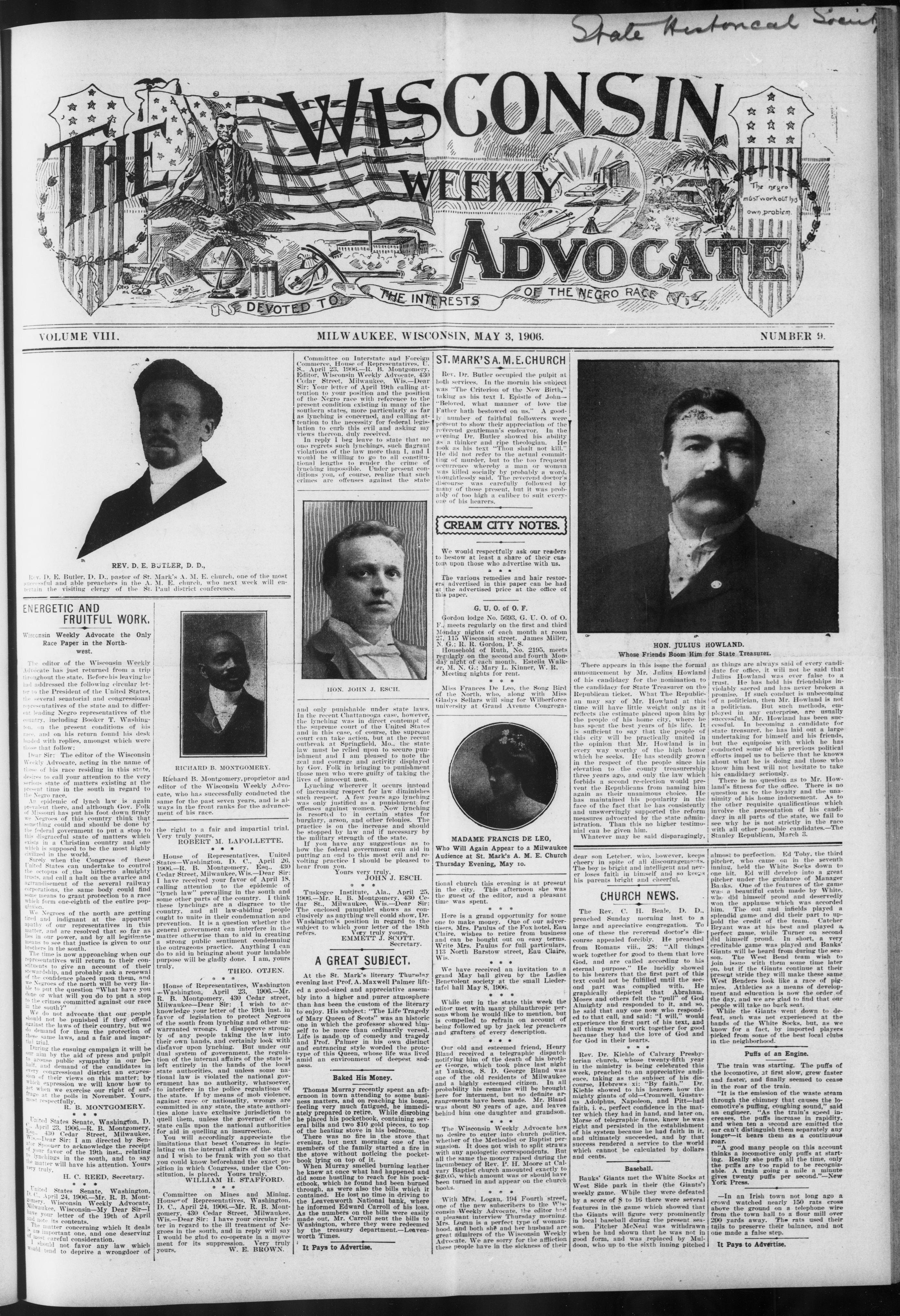
REV. D. E. BUTLER, D. D., Rev. D. E. Butler, D. D., pastor of St. Mark's A. M. E. church, one of the most successful and able preachers in the A. M. E. church, who next week will entertain the visiting clergy of the St. Paul district conference.
ENERGETIC AND FRUITFUL WORK.
Wisconsin Weekly Advocate the Only Race Paper in the Northwest.
The editor of the Wisconsin Weekly Advocate has just returned from a trip throughout the state. Before his leaving he had addressed the following circular letter to the President of the United States, the several senatorial and congressional representatives of the state and to different leading Negro representatives of the country, including Booker T. Washington, on the present conditions of his race, and on his return found his desk loaded with replies, amongst which were those that follow:
Dear Sir: The editor of the Wisconsin Weekly Advocate, acting in the name of those of his race residing in this state, desires to call your attention to the very serious state of matters existing at the present time in the south in regard to the Negro race. An epidemic of lynch law is again prevalent there, and although Gov. Folk of Missouri has put his foot down firmly we Negroes of this country think that something could and should be done by the federal government to put a stop to this disgraceful state of matters which exists in a Christian country and one which is supposed to be the most highly civilized in the world.
Surely when the Congress of these United States can undertake to control the octopus of the hitherto almighty trusts, and call a halt on the avarice and arrandisement of the several railway corporations, the same body could find some means to grant protection to a race which form one-eighth of the entire population.
We Negroes of the north are getting tired and indignant at the apparent apathy of our representatives in this matter, and are resolved that so far as lies in our power, and by all legitimate means to see that justice is given to our brothers in the south.
The time is now approaching when our representatives will return to their constituents to give an account of their stewardship, and probably ask a renewal of the confidence placed upon them, and we Negroes of the north will be very liable to put the question "What have you done or what will you do to put a stop to the crimes committed against our race in the south?" We do not advocate that our people should not be punished if they offend against the laws of their country, but we do demand for them the protection of these same laws, and a fair and impartial trial.
During the ensuing campaign it will be our aim by the aid of press and pulpit to arouse public sympathy in our behalf, and demand of the candidates in every congressional district an expression of their views on this matter; by which expression we will know how to act when we exercise our right of suffrage at the poils in November. Yours, most respectfully.
United States Senate, Washington, D. C. April 23, 1906.—R. B. Montgomery, Esq. 430 Cedar Street, Milwaukee, Wis.—Dear Sir: I am directed by Senator Spooner to acknowledge the receipt of your favor of the 19th inst., relating to lynchings in the south, and to say the matter will have his attention. Yours very truly.
United States Senate, Washington, D.C. April 24, 1906.—Mr. R. B. Montgomery. Wisconsin Weekly Advocate, Milwaukee. Wisconsin—My Dear Sir—I have your letter of the 19th of April and note its contents. The matter concerning which it deals is an important one, and one deserving of most careful consideration.
I should not favor any law which would tend to deprive a wrongdoer of
* * *
A. B.
RICHARD B. MONTGOMERY. Richard B. Montgomery, proprietor and editor of the Wisconsin Weekly Advocate, who has successfully conducted the same for the past seven years, and is always in the front ranks for the advancement of his race.
the right to a fair and impartial trial Very truly yours.
House of Representatives, United States—Washington, D. C., April 26, 1906,—R. B. Montgomery, Esq., 430 Cedar Street, Milwaukee, Wis.—Dear Sir: I have received your favor of April 18, calling attention to the epidemic of "lynch law" prevailing in the south and some other parts of the country. I think these lynchings are a disgrace to the country, and all law-abiding people ought to unite in their condemnation and prevention. It is a question whether the general government can interfere in the matter otherwise than to aid in creating a strong public sentiment condemning the outrageous practice. Anything I can do to aid in bringing about your laudable purpose will be gladly done. I am, yours truly.
House of Representatives, Washington—Washington, April 23, 1906.—Mr. R. B. Montgomery, 430 Cedar street, Milwaukee—Dear Sir: I wish to acknowledge your letter of the 19th inst. in favor of legislation to protect Negroes of the south from lynching and other unwarranted wrongs. I disapprove strongly of any people taking the law into their own hands, and certainly look with disfavor upon lynching. But under our dual system of government, the regulation of the internal affairs of the state is left entirely in the hands of the local state authorities, and unless some national law is violated the national government has no authority, whatsoever, to interfere in the police regulations of the state. If by means of mob violence, against race or nationality, wrongs are committed in any state, the state authorities alone have exclusive jurisdiction to quell them, unless the governor of the state calls upon the national authorities for aid in quelling an insurrection.
You will accordingly appreciate the limitations that beset Congress in legislating on the internal affairs of the state, and I wish to be frank with you so that you could know beforehand the exact position in which Congress, under the Constitution, is placed. Yours truly.
Committee on Mines and Mining, House of Representatives, Washington, D.C., April 24, 1906.-Mr. R. B. Montgomery, 430 Cedar Street, Milwaukee, Wis.-Dear Sir: I have your circular letter in regard to the ill treatment of Negroes in the south, and in reply will say I would be glad to co-operate in a movement for its suppression. Very truly yours, W. E. BROWN.
***
```markdown
```
☆ ☆ ☆
Committee on Interstate and Foreign Commerce, House of Representatives, U. S., April 23, 1906.—R. B. Montgomery, Editor, Wisconsin Weekly Advocate, 430 Codar Street, Milwaukee, Wis.—Dear Sir: Your letter of April 19th calling attention to your position and the position of the Negro race with reference to the present condition existing in many of the southern states, more particularly as far as lynching is concerned, and calling attention to the necessity for federal legislation to curb this evil and asking my views thereon, duly received.
In reply I beg leave to state that no one regrets such lynchings, such flagrant violations of the law more than I, and I would be willing to go to all constitutional lengths to render the crime of lynching impossible. Under present conditions you, of course, realize that such crimes are offenses against the state
M.
HON JOHN J. ESCH
and only punishable under state laws. In the recent Chattanooga case, however, the lynching was in direct contempt of the supreme court of the United States and in this case, of course, the supreme court can take action, but at the recent outbreak at Springfield, Mo., the state law must be relied upon to secure punishment and I am pleased to note the zeal and courage and activity displayed by Gov. Folk in bringing to punishment those men who were guilty of taking the lives of innocent men.
Lynching wherever it occurs instead of increasing respect for law diminishes such respect. A few years ago lynching was only justified as a punishment for offenses against women. Now lynching is resorted to in certain states for burglary, arson, and other felonies. The practice is on the increase and should be stopped by law and if necessary by the military strength of the state. If you have any suggestions as to how the federal government can aid in putting an end to this most evil and revolting practice I should be pleased to hear from you.
Tuskegee Institute, Ala., April 25, 1906.—Mr. R. B. Montgomery, 430 Cedar St., Milwaukee, Wis.,—Dear Sir. The enclosed pamphlet shows as conclusively as anything well could show, Dr. Washington's position in regard to the subject to which your letter of the 18th refers. Very truly yours. EMMETT J. SCOTT. Secretary
A GREAT SUBJECT.
At the St. Mark's literary Thursday evening last Prof. A. Maxwell Palmer lifted a good-sized and appreciative assembly into a higher and purer atmosphere than has been the custom of the literary to enjoy. His subject: "The Life Tragedy of Mary Queen of Scots" was an historic one in which the professor showed himself to be more than ordinarily versed. Life is made up of comedy and tragedy and Prof. Palmer in his own distinct and entrancing style worded the prototype of this Queen, whose life was lived amid an environment of deepest sadness.
Baked His Money.
Thomas Murray recently spent an afternoon in town attending to some business matters, and on reaching his home, feeling very much fatigued, he immediately prepared to retire. While disobbing he placed his pocketbook, containing several bills and two $10 gold pieces, to top of the heating stove in his bedroom. There was no fire in the stove that evening, but next morning one of the members of the family started a fire in the stove without noticing the pocketbook lying on top of it.
When Murray smelled burning leather he knew at once what had happened and did some hustling to reach for his pocketbook, which he found had been burned through, as were also the bills which it contained. He lost no time in driving to the Leavenworth National bank, where he informed Edward Carroll of his loss. As the numbers on the bills were easily made out, Mr. Carroll sent the bills to Washington, where they were redeemed by the treasury department.—Leavenworth Times.
It Pays to Advertise.
ST. MARK'S A. M. E. CHURCH
Rev, Dr. Butler occupied the pulpit at both services. In the mornin his subject was "The Criterion of the New Birth," taking as his text I. Epistle of John—"Beloved, what manner of love the Father hath bestowed on us." A goodly number of faithful followers were present to show their appreciation of the reverend gentleman's endeavor. In the evening Dr. Butler showed his ability as a thinker and ripe theologian. He took as his text "Thou shalt not kill." He did not refer to the actual committing of murder, but to the too frequent occurrence whereby a man or woman was killed socially by probably a word, thoughtlessly said. The reverend doctor's discourse was carefully followed by many of those present, but it was probably of too high a caliber to suit everyone of his hearers.
CREAM CITY NOTES.
We would respectfully ask our readers to bestow at least a share of their custom upon those who advertise with us.
The various remedies and hair restorers advertised in this paper can be had at the advertised price at the office of this paper.
G. U. O. of O. F.
Gordon lodge No. 5693, G. U. O. of O. F., meets regularly on the first and third Monday nights of each month at room 27, 115 Wisconsin street. James Miller, N. G.; R. R. Gordon, P. S. Household of Ruth, No. 2195, meets regularly on the second and fourth Monday night of each month. Estella Walker, M. N. G.; Mary L. Kinner, W. R.
Miss Frances De Leo, the Song Bird of the North, who, along with Miss Gladys Sellars will sing for Wilberforce university at Grand Avenue Congrega-
MADAME FRANCIS DE LEQ.
Who Will Again Appear to a Milwaukee Audience at St. Mark's A. M. E. Church Thursday Evening, May 10.
tional church this evening is at present in the city. This afternoon she was the guest of the editor, and a pleasant time was spent.
***
Here is a grand opportunity for some one to make mouey. One of our advertisers, Mrs. Paulus of the Fox hotel, Eau Claire, wishes to retire from business and can be bought out on easy terms. Write Mrs. Paulus for full particulars, 113 North Barstow street, Eau Claire, Wis.
* * *
We have received an invitation to a grand May ball given by the Ladies Benevolent society at the small Liedertafe hall May 8, 1906.
***
While out in the state this week the editor met with many philanthropic persons whom he would like to mention, but is compelled to refrain on account of being followed up by jack leg preachers and grafters of every description.
***
Our old and esteemed friend, Henry Bland received a telegraphic dispatch notifying him of the death of his brother George, which took place last night at Yankton, S. D. George Bland was one of the old residents of Milwaukee and a highly esteemed citizen. In all probability his remains will be brought here for interment, but no definite arrangements have been made. Mr. Bland was about 80 years of age, and leaves behind him one daughter and grandson.
☆ ☆ ☆
The Wisconsin Weekly Advocate has no desire to enter into church politics, whether of the Methodist or Baptist persuasion. It does not wish to split straws with any apologetic correspondents. But all the same the money raised during the incumbency of Rev. P. H. Moore at Calvary Baptist church amounted exactly to $69.05, which amount was or should have been turned in and appear on the church books.
With Mrs. Logan, 194 Fourth street, one of the new subscribers to the Wisconsin Weekly Advocate, the editor had a pleasant interview Thursday morning. Mrs. Logan is a perfect type of womanhood, and both she and her husband are great admirers of the Wisconsin Weekly Advocate. We are sorry for the affliction these people have in the sickness of their
[Name not visible in the image]
There appears in this issue the formal announcement by Mr. Julius Howland of his candidacy for the nomination to the candidacy for State Treasurer on the Republican ticket. What The Republican may say of Mr. Howland at this time will have little weight only as it reflects the estimate placed upon him by the people of his home city, where he has spent the best years of his life. It is sufficient to say that the people of this city will be practically united in the opinion that Mr. Howland is in every way worthy of the high honor which he seeks. He has steadily grown in the respect of the people since his elevation to the county treasurership three years ago, and only the law which forbids a second re-election would prevent the Republicans from naming him again as their unanimous choice. He has maintained his popularity in the face of the fact that he has consistently and unswervingly supported the reform measures advocated by the state administration. Than this no higher testimonial can be given him.
Whatever may be said disparagingly
dear son Letcher, who, however, keeps cheery in spite of all discouragements. The boy is bright and intelligent and never loses faith in himself and so keeps his parents bright and cheerful.
CHURCH NEWS.
The Rev. C. H. Beale, D. D., preached Sunday morning last to a large and appreciative congregation. To one of these the reverend doctor's discourse appealed forcibly. He preached from Romans viii., 28: "All things work together for good to them that love God, and are called according to his eternal purpose." He lucidly showed to his hearers that the first part of this text could not be fulfilled until the second part was complied with. He graphically depicted that Abraham, Moses and others felt the "pull" of God Almighty and responded to it, and so, he said that any one now who responded to that call, and said: "I will," would experience the first part of his text, and all things would work together for good because they had the love of God and for God in their hearts.
Rev. Dr. Kiehle of Calvary Presbyterian church, whose twenty-fifth year in the ministry is being celebrated this week, preached to an appreciative audience, taking as the subject of his discourse, Hebrews xi: "By faith." Dr. Kiehle showed to his hearers how the mighty giants of old—Cromwell, Gustavus Adolphus, Napoleon, and Pitt—had faith, i. e., perfect confidence in the matter which they had in hand, and later on, Morse of telegraphic fame, knew he was right and persisted in the establishment of his system because he had faith in it, and ultimately succeeded, and by that success rendered a service to the world which cannot be calculated by dollars and cents.
Baseball.
Banks' Giants met the White Socks at West Side park in their (the Giants') weekly game. While they were defeated by a score of 8 to 16 there were several features in the game which showed that the Giants will figure very prominently in local baseball during the present season. Pitcher McNeal was withdrawn when he had shown that he was not in good form, and was replaced by Muldoon, who up to the sixth inning pitched
NUMBER 9.
HOWLAND.
For State Treasurer.
as things are always said of every candidate for office, it will not be said that Julius Howland was ever false to a trust. He has held his friendships violably sacred and has never broken a promise. If such conduct is unbecoming of a politician, then Mr. Howland is not a politician. But such methods, employed in any enterprise, are usually successful. Mr. Howland has been successful. In becoming a candidate for state treasurer, he has laid out a large undertaking for himself and his friends, but the equipoise with which he has conducted some of his previous political efforts impel us to believe that he knows about what he is doing and those who know him best will not hesitate to take his candidacy seriously.
There is no question as to Mr. Howland's fitness for the office. There is no question as to the loyalty and the unanimity of his home indorsement. As to the other requisite qualifications which involve the presentation of his candidacy in all parts of the state, we fail to see why he is not strictly in the race with all other possible candidates.-The Stanley Republican, March 3.
almost to perfection. Ed Toby, the third pitcher, who came on in the seventh inning, held the White Socks down to one hit. Ed will develop into a great pitcher under the guidance of Manager Banks. One of the features of the game was a beautiful catch made by White, who did himself proud and deservedly won the applause which was accorded him. The out and infields played a splendid game and did their part to uphold the credit of the team. Catcher Bryant was at his best and played a perfect game, while Turner on second did himself proud. In short, a very creditable game was played and Banks' Giants will be heard from during the season. The West Bend team wish to join issue with them some time later on, but if the Giants continue at their present stride they will make these same West Benders look like a race of pigmies. Athletics as a means of development and education is now the order of the day, and we are glad to find that our people will take no back seat.
While the Giants went down to defeat, such was not experienced at the hands of the White Socks, but, as we know for a fact, by imported players picked from some of the best local clubs in the neighborhood.
Puffs of an Engine.
The train was starting. The puffs of the locomotive, at first slow, grew faster and faster, and finally seemed to cease in the roar of the train.
"It is the emission of the waste steam through the chimney that causes the locomotive's puffing, coughing sound," said an engineer. "As the train's speed increases, the puffs increase in rapidity, and when ten a second are emitted the ear can't distinguish them separately any longer—it hears them as a continuous roar.
"A good many people on this account thinks a locomotive only puffs at starting. Really she puffs all the time, only the puffs are too rapid to be recognizable. A train going a mile a minute gives twenty puffs per second."—New York Press.
In an Irish town not long ago a crowd watched nearly 150 rats cross above the ground on a telephone wire from the town hall to a flour mill over 200 yards away. The rats used their tails to preserve their balance, and not one made a false step.
It Pays to Advertise.
GOSSIP FOR THE LADIES.
The Girl-Child.
Dassent ever pop th' question even though she's lost in love—
But we've kind o' got a notion that we'll keep it, anyway.
'Course 'twas dtreful disapp'intin' that she couldn't been a boy,
An' th' tears we shed—er swalleried—wa'n't no sparklin' tears o' joy;
As is clambers up th' porch-posts on a piece o' cotton twine.
She do'no' but what she's welcome as th' flowers is in May;
So we've somehow got th' notion that we'll keep 'er, anyway.
Then ag'in I thought o' mother—she was onct a baby-girl;
Ain't no tellin' jest which eyster is th' one that holds th' pearl.
Who could tell when she was little that she'd grow t' be so great
An' would make my dear old daddy such a stiddy runnin' mate?
Would my life be worth th' livin' if it
hadn't been been her?
I'd be pin'k' helpless as this
—Strickland W. Gillilan in The Reader.
Vexing Social Problems Solved.
A young girl who is to become a bride in a short time has asked me to give the list of articles contained in a silver chest, also a list of silver articles of all kinds used in setting the breakfast, luncheon and dinner table. My young correspondent has not set me an easy task, for one may get along with only a few simple pieces of silver or may spend an almost unlimited sum of money on the many bewitching accessories to the table which we see these days in the shops where such articles are made a specialty.
An ordinary case of silver contains one dozen table forks, one dozen dessert forks, one dozen tablespoons, one dozen dessert spoons, one dozen teaspoons, one dozen table knives and one dozen dessert knives. These cost anywhere from $150 to $225
Cases containing combination sets have the same number of forks, spoons and knives as given above, with the addition of one dozen oyster forks, one dozen terrapin forks, one dozen pastry forks, one dozen butter spreaders, one dozen orange knives, one dozen coffee spoons, one dozen ice cream spoons, one dozen orange spoons, one dozen bouillon spoons and one dozen soup spoons. A set of carvers for beef and one for poultry and also a steel. A berry spoon, soup ladle, salad fork and spoon. sugar spoon, butter knife, sugar tongs, fish knife and fork, asparagus fork, mayonaise ladle, pickle and olive forks, spoons and knives are frequently sent a bride instead of those containing only one dozen of each kind, but combination sets are not usually given as separate sets of coffee spoons, orange spoons, ice cream spoons, etc., as well as individual spoons, forks and knives for various uses are usually received as separate gifts from the various friends of the bride and bridegroom.
The old-fashioned silver chest was usually large enough to contain the silver service; tea pot, coffee pot or urn, sugar bowl and cream pitcher, as well as the several dozen spoons, forks and knives, and a few separate pieces of silver to be used on the table. But nowadays one must have a chest made of the required size or else keep the silver in separate boxes in a large ordinary wooden chest or in a safe purchased for this purpose.
The silver tea service consists of a teapot, coffee pot, sugar bowl and cream pitcher; a hot water kettle is always a very useful addition, but is not a necessity. In fact, one can use odd pieces for the entire service and still have it most attractive. For instance, many use brass or copper coffee pots, also brass or copper water kettles, and at present a Brown Betty teapot of dark blue, green or brown earthenware, with applied silver monogram and scroll work, is all the rage. Little sugars and creams come to match the teapot. These sets are used very extensively in serving the afternoon tea.
After dinner coffee sets are always dainty and attractive, but not necessary for the young housekeeper, as the maid may serve the coffee already poured in the cups. These sets can be bought separately or on trays of silver or inlaid wood with silver gallery. The design of all of the tea and coffee sets and of the trays is principally colonial. The flat chasing is the newest finish, though many still prefer the perfectly plain style and some the old fashioned repousse. Round inlaid wooden trays with silver galleries are used for serving cocktails, etc.
For those who can afford it there are solid silver dessert plates and ice cream saucers and for others there are the beautiful bread plates, baskets, vases, bowls and compotiers of all sizes, made of the solid silver with flat chasing in the center and openwork edges on which the design in the chasing is carried out. The designs of all of these pieces are particularly graceful and the bride who finds even a few pieces of silver like this amongst her wedding presents, will indeed be fortunate, as they will add much to the beauty of her dining table.—Elizabeth Biddle in Pittsburg Leader.
"Father Does It"
He was 10 years old and it was his first offense. He had been kept in the house by the influenza, while his brother with the nurse had gone to the park to play, and he was lonely, for his mother had told him not to disturb her. Thus did temptation overtake him. He smoked one of his father's cigars—proudly, happily at first; less so after a time; and pretty soon he was—yes, he was going to die! With this awful consciousness stirring in his stomach, in his soul surged the no less awful certainty that, dying so, he could not hope to go to heaven. He was a religious little boy on Sundays; and at Sunday school and church did not the teacher and the preacher set forth precisely where all those who die in sin must go?
He wiped the cold sweat from about his mouth, got down on his knees and prayed. He felt that he was even then passing away—passing away in what agonyl—and he prayed hard:
"Dear God, please don't let me die and I'll be good; I'll never smoke again. Please don't let me die." Then in the blackness of the loathsome night that, spreading from a center within his stomach, was enveloping his whole being, the thought came to him to go and die outside the door of his mother's room.
No, he would not disturb her; he would just die there—die as he had lived, obedient except for that one awful thing that was killing him. It was very sad—his sufferings, his situation, and what was to come after. He began to sob. When his mother, attracted by a queer noise, opened the door—it was nothing; he was just dying because— Oh! would she please forgive him? He had smoked one of father's cigars.
After he was feeling better, mother thought that the opportunity should not go neglected; she should impress upon him the evils of smoking, while within his being he was experiencing real conviction of the truth. So she spoke to him very solemnly, very eloquently—very well, indeed; the speech would have earned her loud applause in any mothers' club. And in conclusion she said, "Now, my dear little boy, you have learned what a vile and wretched thing it is to smoke, and I hope you will never, never do it in all your life again."
"That's so, but"—still white and very feeble, he pulled himself up bravely—"I s'pose I'll have to get used to it; father does it!"
There behold the one clear gauge of the boy's endeavor—what father does. Mothers' clubs may make motions divine in wisdom and in goodness; mothers' congresses may form all elements of virtue into laws; mothers individually in the home may talk, work, struggle, to make her sons models by which to shape a new heaven and a new earth. But the boy's world is the man who is his father, and the boy believes that, whatever may be right on Sundays or at prayer time, the things that are really good, that really count in life, are what father does. Moreover it is what father does which defines the means with which the boy shall work, the sphere wherein his efforts shall be shaped. In a word, what father does is the beginning as it is the end of the boy's achievements.—Harper's Bazar.
Handsome Men a Mistake
An aggrieved woman has gone upon the record as asserting that the handsome man is a mistake. She has been investigating him in various roles and declares that as a lover he is unsatisfactory, as a husband a failure, and as a brother a nuisance. The fiancee of a good-looking man has to pay dearly for her capture of an Adonis. She lives in a state of perpetual siege against a host of fair rivals and has to run the gauntlet of such remarks as: "I wonder what that handsome Mr. Jones can see in that Enid Smith?" and "Isn't it funny how good-looking men always marry such plain wives?"
Her troubles are all augmented when she becomes a young matron. She has to stoically endure her husband's flirtations with other women—who will flatter him if she will not—and to smile amiably when Mrs. Robinson praises Jack and Muriel. "such pretty children; so like their father!" Last, but not least, she must skimp her wardrobe, while her attractive husband spends on his ties and socks what the ugly man would have concentrated cheerfully on his wife's fur coat, says the Philadelphia Inquirer.
As a brother the handsome man is certainly not an unmixed blessing. From the first moment he opens his "beautiful" eyes he is the idol of an adoring mother, who displays to his moral shortcomings a more than beetlelike obtuseness. As he grows older and palliates his love for pleasure and his disinclination for work by the excuse: "Jack is so good-looking he is sure to marry an heiress if he goes into society."
The sister of the handsome man is only asked to parties where the hostess dare not ask him without her, and she is ordered to be civil to all sorts of persons who detest her but admire "Jack." Then the handsome brother is generally a woman's man, which means that Jack will not bring men friends home to smoke and play ping-pong and fall in love with his sister. If the modern girl could have her choice in such a matter she would plump unreservedly for a plain, good-natured, ordinary brother, who would contentedly accept the back seat allotted by Twentieth century women to the "mere man."
Troublesome though the handsome man undoubtedly is, it is probable that, in spite of all her protestations, her royal highness, woman, will continue to admire and marry him. The handsome man of today certainly compares favorably with the "pretty" man of fifty years ago. That popular hero was narrow-chested, puny and pink-and-white while black whiskers inevitably "adorned" his thin cheeks.
Today the handsome man is stalwart, well set up and muscular, for mere beauty of feature will count for very little. He may not be industrious, but he is wise enough to play football and golf, and is, by the way, almost as conceived of his prowess in these directions as of his classic nose and chin and "beautiful" eyes.—New Orleans Picayune.
How to Secure the Best Sleep.
Though much has been said on the subject of ventilation it is surprising to know how many women sleep with the windows of their room closed or open the very least little bit. This is ruinous to our wage-earner's looks. At night she can regulate her supply of air to suit herself, and these cannot be too much of it. Put on plenty of covers, and have the bed warmed with a hot-water bottle, but open the windows. Now and then in waking up in the morning one will feel one's throat to be thoroughly parched and dried. This is a sure sign that one has been sleeping with open mouth, inhaling through the nostrils. Many devices have been invented and exploited to keep the mouth shut during sleep. The simplest way is to bend the head down silently, closing the jaws so that they cannot fall. When the neck is stretched and the entire body relaxed in sleep the jaw falls open. It usually does this when the subject sleeps on her back. The correct sleeping position to lie in is on the left side with arm thrown behind. Sleeping on the right side stretches the muscles about the heart, and increases any trouble one may have with that organ. Sleeping on the stomach hinders digestion and renders breathing difficult.
A woman should have eight hours' sleep; less than this amount will, if long continued, destroy both health and looks. One of the wage-earning woman's greatest difficulties lies in the fact that she cannot get her mind off her work, and carries her daily worries and anxieties even into the realm of her dreams. Restful and helpful sleep can only be had when the brain is at rest. No one can teach another to let go of her worries; each person must find the way for herself, but often a few pages of some helpful or amusing book read just before going to bed will change the thought current and soothe the active brain into readiness for quiet slumber. Many women of nervous temperament have a tendency to insomnia. As the nervous woman generally does not eat enough, a glass of warm milk taken just before retiring will often quiet the nerves and induce sleep. Chopped onions are a wonderful soporific should one choose to indulge in them, and they are healthful as well. The unpleasant odor of the onion can be counteracted by chewing a bit of Canada
snakeroot and the breath perfumed by a bit of orris root held in the mouth. A busy and successful man once told me that the reason professional women's nerves gave out so often was simply a question of slighted or slight lunches. Selected.
The Household Inventory
How many households have at hand a carefully compiled inventory of household goods? Not one in a hundred. Yet such an inventory protects the householder in settlements with insurance companies and helps the adjuster to make a fair settlement. A residence inventory may be worth hundreds or thousands of dollars to the insured.
The compiling or an inventory is by just right the duty of the man of the house; yet if accurate records are to be kept it will be advisable for the women to attend to the matter. In large towns and cities it is customary for furniture dealers to supply their customers with printed inventory blanks bound in booklet form. These little books usually contain valuable suggestions and instructions regarding fire and burglary insurance, lists of articles commonly used in a house or apartment, and a resume for totals. There are pages in the book for a complete record of articles in reception hall, front and back partors, library, dining room and butler's closet, kitchen and pantry, guest room, three bedrooms, servant's room, bathroom, laundry, garret and basement, barn and carriage house. Special pages are provided for an inventory of books, bric-a-brac, glassware, china, jewelry, silverware, pictures, linen and clothing, and a full page for miscellaneous articles. Columns are provided on each page for the number and names of the articles, date of purchase, cost and description.
Where these specially printed inventory books are not obtainable it will be easy from the description given above to make such a book. Purchase a blank book with thirty ruled lines on a page, or better still, buy a loose leaf booklet, which will allow for frequent revision of the inventory and thus keey it always up-to-date. Then in case of fire a complete inventory of the property destroyed or damaged can easily and readily be made. It is always advisable to keep inventory with insurance policies together in a safe place.—W. W. Hircox in Good Housekeeping.
A Nerveless Woman.
"What a rest and delight she must be to that nervous family of hers!" someone remarked of a calm-faced little woman, whose nerves seemed conspicuous by their absence. "$ have never seen her flurried or worried."
"Such people can be very restful and soothing," remarked a listener, judicially, "or they may be, as I have found some of them, the exact opposite. Now, I don't know this Mrs. Blackwood at all, but I do know another woman who has no nerves of her own, but whose husband and son and daughter are plentifully supplied with them, and she would drive me to the verge of distraction if I had to live with her. She is so ostentatiously calm. She has such quick, amused eyes for the nervous haste and excitability of others. 'Don't worry.' she will say with a smile dancing in her eyes, when some nervous friend has missed a car, after making a frantic effort to catch it; 'there'll be another along in two minutes. I never let such trifles worry me. I make it a point never to run for a car.'
"I can testify to that; she made me miss one once by a piece of exasperating slowness, when I was pressed for time, and we were late to a lecture in consequence. But, 'I never let anything like that worry me,' she said.
"I have seen her husband come home harassed by some unpleasant event of the day, and I know she could smooth some of the wrinkles out of his forehead if she would listen sympathetically—if she would only mix that cheerful, unfailing optimism with some evident sympathy for his anxiety. But no, she doesn't do that way. She reminds him facetiously that care killed a cat, or that it isn't her way to take life so hard, and he goes off with the nervous lines deeper than ever. She is the same way with her children, and they are much more apt to confide their anxieties and perplexities to some woman with a larger share of nerves and quicker sympathies."—Bertha Gerneaux Woods, in Observer.
Hints on Kitchen Work.
Clean up as you go.
Don't scatter in the kitchen.
Don't scatter in the kitchen.
Be sure to put scalding water in each saucepan or stewpan as you finish using it.
Keep your spice box always replenished, and take care to let your mistress know if you are out of anything likely to be required, that its place may at once be supplied.
Take care of your copper utensile that the tin does not become worn off. If so, have them instantly replaced. Dry your saucepans before you put them away. Pudding bags and jelly cloths require care; wash and hang them to dry directly after using them. Air them well before you put them away or they will smell musty. Keep them in a warm, dry place. After washing up your dishes and cleaning the dishpan, scald out the sink and sink brush. Be careful not to throw anything but water down the sink lest you clog it up.
water down the sink lest you clog it up. Never have sticky, greasy plates and dishes. The way to avoid this is to use soap, hot water and clean, dry towels. Change the water often. Perfectly clean plates and dishes are one proof of the cook being a good servant. Be particular in washing vegetables, Lay cauliflower and cabbage in salt and water for an hour or more to get out the insects. If a dinner party is in prospect, ask for a bill of fare and get ready all you can the day before, to ease worry and hurry on the day fixed. Take notice of all orders that require time in the preparation of a dinner and hurry nothing.
Wear plain cotton dresses and large aprons. Be sure to keep your hair neat and smooth. Be careful of fuel. It is a great recommendation to a cook to use only the necessary amount of coal. Have an eye to your mistresses' interests, not permitting waste of any kind; a cook who is just and honest and does as she would be done by is worthy of the greatest respect and may be sure of being successful and happy.
When the morning's work is done, she should carefully wash her hands and visit the larder. Here she should look to everything. See if the hanging meat or game requires cooking. Wipe out and air the bread box. Clean and scrub the larder at least twice a week. Receive her mistress' orders attentively, and if she cannot trust her memory, write them on a slate. She should examine the meat sent by the butcher, and if it is not right, refuse to accept it. She should also weigh the meat and ask the butcher for a paper of weight.—Washington Star.
Oueer Graves in Connecticut.
Congressman Higgins of Connecticut says the queerest sight he ever saw is in a graveyard near New London, his state. It consists of four graves, one at each point of the compass, and in the center another grave. On the tombstones at the four sides are these inscriptions: "My I. Wife." "My II. Wife." "My III. Wife." "My IV." The inscription on the headstone of the grave in the center reads: "Our Husband."
THE SCAPEGOAT.
Now when anything goes wrong
Blame your wife.
If the butter is too strong,
Blame your wife.
If the coffee is too weak,
If the bathtub springs a leak,
Blame it on your patient, meek
Little wife.
If you suffer from the gout,
Blame your wife.
If you're getting down and out,
Blame your wife.
Sure for anything that's bad
She's the one at fault, egad!
Blame it all upon your sad
Little wife. —Pittsburg Post.
A TRYST
I will not break the tryst, my dear,
That we have kept so long,
hTrough winter and its snows are here,
And I've no heart for song.
You went into the voiceless night;
Your path led far away.
Did you forget me, Heart's Delight,
As night forgets the day?
Sometimes I think that you would speak
If still you held me dear;
But space is vast, and I am weak—
Perchance I do not hear.
Our souls must still be wed.
—Louise Chandler Moulton in the Century.
LOVE AT FIRST SIGHT.
The easiest way to fall in love is to fall in love at first sight.
It is the natural way; it is the most beautiful way; it is the way Dante set about it. And what was good enough for Dante ought to be good enough for you, says a writer in the Bystander.
Look how many people do it!
Look at the number of young men who flock to the theaters and fall in love immediately with Maude, or Birdie, or Ellalinette.
Directly that girl shows her twinkling feet in the back row of the chorus, Augustus' heart goes pit-apat, and he knows that he has found his doom—he calls it his fate. And when her ruby lips open and show her pearly teeth he begins to wonder how his father will take the news. He searches down the programme in order to identify her. But she is only one (though the most beautiful) of the ten Gibson girls, or one though the most elegant, of the twelve daughters of the Duchess of Marylebone. They all have beautiful names, Trixie and Babs and Camille, but he knows instinctively that, when he does learn it, his little girl's will be the sweetest of them all.
This is a case of love at first sight.
Her face, her sparkling eyes, her peaches-and-cream complexion are burnt into his brain. In the watches of the night he will see naught but her. He goes down to the stage door to see her come forth.
First come the orchestra, then the scene-shifters, then the actors, and then the women. Chattering and laughing they come, and he looks under each hat for that never-to-be-forgotten face. The stream of women thins, and at last he sees from the pavement the stage-door keeper close his rabbit-hutch; the lights are put out, the stage door closes, and the weary old man, muttering to himself, crawls off toward the "running footman."
Then it is that Augustus realizes that he does not know his love-at-first-sight by sight.
This is a terrible awakening!
And yet even the sanest man who falls in love at first sight does not show very much more intelligence than is exhibited by Augustus.
You may be introduced to the Lady Angela McQuisker at the dear Duchess'. You being, let us assume, a peer of the realm, are in a position to marry the lady. You, therefore, are perfectly justified in telling your love.
You know nothing about her, except that she is beautiful. Of her intellect, of her heart, you are ignorant, and the mere fact that it should beat for you will prove, at any rate, that she is not a girl of sound judgment. (That is, it will prove it to any one else, but it won't prove it to you.) If you heard that a girl had fallen in love at her first meeting with your bosom friend, Lord Robert, with your highly esteemed executor, Mr. Lumley Freshfield, would you not consider that hers was a rash and probably ill-omened act?
Why, it took you years before you found out that you could confide your innermost thoughts to Lord Robert! You made diligent inquiries before appointing Mr. Lumley Freshfield to the proud position of your executor. And yet a mere girl, with no knowledge of the world, decides on the spur of the moment to spend the rest of her natural life with one of these two gentlemen! Absurd. Of course, you will justify your love ta first sight by using the word "instinct." The miracle of love is upon you, and what should have been the work of, at the very least, a couple of dances, and a theater party has in your case been accomplished in a lightning flash.
You think it would be almost irreligious in you to seek the advice of any one on the suitability of your prospective bride.
And you are quite right, because no man whose advice is worth taking will ever believe that you will take it.
So there is no bother and no fuss; no weighing of character; no consideration of pro and con.
That is the secret of love at first sight.
It is the easiest way of falling in love.
Also, it is the cheapest.
In addition, it is the most disastrous.
When There Was No Geography.
When There Was No Geography.
A newspaper man who recently returned from a southern trip tells this story: "I happened to spend a Sunday in a little town way down south, and in the morning went to a colored church to listen to the sermon of a colored preacher who was a character in the community. He had for his text the escape of the Israelites from Egypt, and when I came in he spoke something like this: 'And the Lord froze the Red sea into a solid cake of ice and de Israelites crossed safely over to de odder side. Then the 'Gyptians followed them over the ice, but when they got into the middle de Lord sent down a heavy thaw, which melted the ice and percipitated the 'Gyptians into the water and they were all drowned.' The congregation was still for about a minute. Then a tall, thin
colored man arose and said: 'Mister Preacher, I begs to disagree with that last statement of yours. According to the geography the Red sea is in the tropics, close to the equator, and the water there never freezes.' The minister listened attentively, then in a loud, angry voice replied: 'I thought there would be one of those smart niggers in this here congregation to contradict me. But he is not so smart as he thinks he is. In the days when the Israelites ran away from Egypt, long, long ago, there was no such thing as jography or an equator, neither.'"—Philadelphia Record.
Ouida dresses in white both winter and summer.
Mark Twain collects obituary poetry. He has 3000 specimens.
The young King of Spain is several inches shorter than his fiancee.
A government expert estimates that the expenditure for advertising in 1905 was $125,000,000.
Harrison Higgs, an aged farmer near Utica, Ky., was shot and killed by his 17-year-old son because he had reprimanded him. The lad was arrested.
Gold is one of the most difficult metals to vaporize, but by the use of the electric furnace it can readily be set boiling at the temperature of about 4,400 degrees Fahrenheit.
Mrs. Nellie Montgomery, a pretty young married woman of Princeton, Ind., has sued Stephen A. Douglas, a wealthy citizen, for $3000, claiming that he hugged her against her will.
Inmates of the city of Sheboygan, (Wis.) aimshouse have protested to the board of aldermen against being served with olcomargarine. They demand pure butter from the poor farm creamery.
To keep his joke with some young boys, Charles Wiggins of Shell Lake, Wis., has lived on a diet of brown sugar and water for eight days. He is much emaciated and has lost in strength. Mr. Wiggins is about 70 years old and lives near Barronette.
The extension of the Orange and North-Western railroad has just been completed from Buna to Newton, Texas, a distance of about thirty miles. It is a Yoakum line and is destined to become a part of the Colorado Southern, New Orleans and Pacific system.
The American Hawaiian Steamship company announces that in connection with the National Railroad of Tehuantepec it will establish a thirty days' freight service between New York and Portland, Ore. The steamships will call at the principal Pacific ports of Mexico. The largest shop building in the United States is planned by the Pennsylvania Railroad company to be erected at Altoona. It will be 800 feet long, 120 feet wide and four stories high and will be occupied by the wheel, tin, boiler, lathe and other departments of construction and repair work.
Newspapers published in the United States at the close of 1905: Weeklies, 14,455; semi-weeklies, 499; tri-weeklies, 54; dailies, 2215; total newspapers, 17,223. Periodicals published in the United States at the close of 1903: Monthlies, 2710; all other periodicals, 552; total periodicals, 3262; total newspapers and periodicals 20,485.
A preliminary statement on the production of hydraulic cement in the United States during the calendar year 1905 has just been issued by the United States geological survey. It shows the total production was 40,894,328 barrels, valued at $36,012,189. This was an increase of nearly 10,000,000 barrels over the production of the preceding year.
Andrew J. Harlan of Savannah, Mo., is the last survivor of the Thirty-first Congress, having represented the Eleventh Indiana district. Although 91 years old, he is still hale and hearty. Among the members in this Congress were such men as Daniel Webster, John C. Calhoun, William H. Seward, Stephen A. Douglas, Jefferson Davis and John J. Crittenden.
---
As a dramatic instructor Harry Green was so successful that Judge McEwen of Chicago gave him a divorce. Green, who is an actor, testified that he taught Philip Keeler to play the part of lover in a production in which Mrs. Beatrice Green also had a part. So fond did Keeler and Mrs. Green become of their parts, Green said, that they continued to act them in real life off the stage.
A. J. Vinje, judge of the Seventh Wisconsin circuit court, has filed a statement of his nomination and election expenses, as required by law. They were less than $1, the exact sum is 98 cents. Eighty cents went for postage for sending out nomination papers, 10 cents went for postage in sending the petitions to the secretary of state and 8 cents went for registering the mailed packages of papers.
Decently dressed always and cheerful in manner, John S. Robinson of San Francisco, veteran of the Mexican war and formerly a millionaire, allowed none of his friends to know for two years that he was living on his pension of $12 a month, and had no other resources. But finanly he had to give up the struggle, and now he is dying in St. Luke's hospital, surrounded, too late, with every possible comfort.
Years ago Bernard Shaw furnished a biographical sketch of himself to an English newspaper. It is said to be still correct except as to his bachelorhood and it runs thus: "I am a bachelor, an Irishman, a vegetarian, an atheist, a teetotaler, a fanatic, a humorist, a fluent liar, a social democrat, a lecturer and debater, a lover of music, a fierce opponent of the present status of women and an insister on the serious of art."
James A. Wikel of Montpelier, Ind., and Mrs. Eliza Rogers, Muskegon, Mich., both past the 60 year milestone, and former playmates, were married at Big Rapids, Mich. Wikel desired a wife and engaged a matrimonial bureau in his quest. Correspondence brought him in touch with his former playmate, but he didn't know about her until he had procured the marriage license. He found her making butter, introduced himself, and marriage followed.
Gov. Higgins of New York well knows what it is to be pestered with the political officeseeker and in alluding to this class of persons during a recent interview he came out with this mouthful of wisdom: "There are two periods when the political carpetbagger is beyond human understanding. One is before he is elected to office and the other is after. There are also, I may say, various breeds of politicians, just as there are various breeds of pigeons—tumblers, fantails and pouters."
Instead of having her desk and typewriter returned to her, as she requested, Miss Fanny Horan, the stenographer in the office of the corporation counsel of
Chicago, who is fighting to retain her place, learned that the desk has been removed to the mayor's office and will not be returned to its old place. Miss Horan still remains seated in a chair in the center of the room reading a book to while away the hours, as she will not accept her discharge and claims the protection of the civil service commission.
Harry Ives did not write a piece about his wedding for the paper of which he is editor at St. Hilaire, Minn. This is why: An elaborate function had been arranged and the bride, Miss Alice Smith, was ready when Ives adjourned to his wedding rament. He had procured an elaborate outfit. While he was trying on his clothes, friends broke into his apartments, stripped him of all his finery, and locked him in. Later they graciously provided him with a suit of bright blue underclothes and a pair of overalls. In this garb he was compelled to go to church and be married in the presence of all his friends.
"I never worked and never will work," said Frank James of Buffalo, N. Y., as he left his cell in the Outagamie county workhouse at Appleton, Wis., after he had lived on a bread and water diet for twelve days. Supt. Brill was determined to make the man join his fellowmen on the county's stone pile. "You can lead me to the stone pile, but you can't make me work," said James the first day he was taken out to work. Brill then threatened him with solitary confinement and told him of the bread and water diet, thinking that that might scare the fellow into working. "Me to the solitary confinement and bread and water before I'll work," was James' reply. His sentence expired Monday and he was released.
ASH SIFTER.
Effectually Prevents the Dust and Ashes from Flying About.
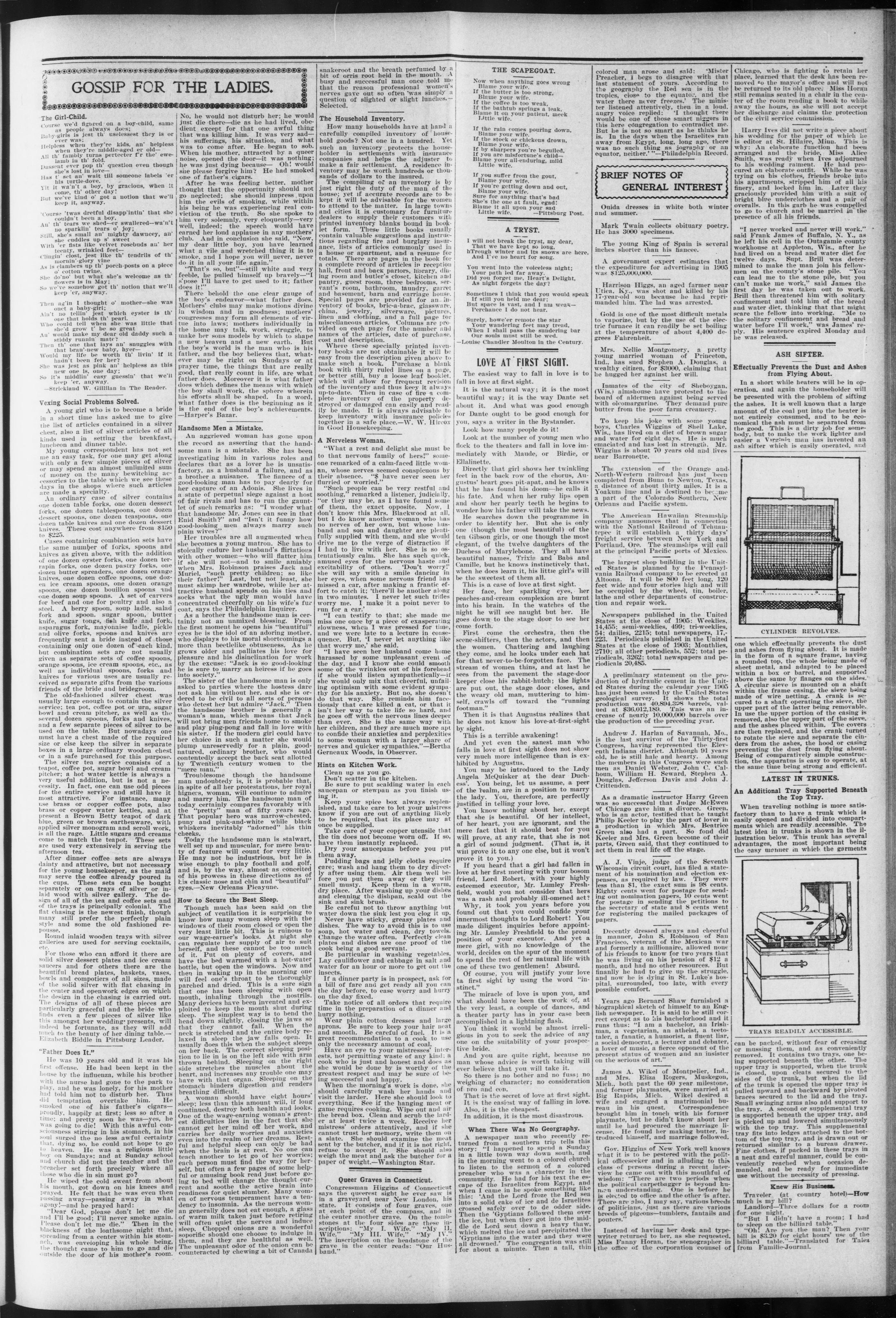
In a short while heaters will be in operation, and again the householder will be presented with the problem of sifting the ashes. It is well known that a large amount of the coal put into the heater is not entirely consumed, and to be economical the ash must be separated from the good. This is a dirty job for somebody, but to make the work lighter and easier a Virginia man has invented an ash sifter which is easily operated, and
```markdown
```
CYLINDER REVOLVES.
one which effectually prevents the dust and ashes from flying about. It is made in the form of a square frame, having a rounded top, the whole being made of sheet metal, and adapted to be placed within a box or barrel, and supported above the same by flanges on the sides. A circular sieve is mounted on a shaft within the frame casing, the sieve being made of wire netting. A crank is secured to a shaft operating the sieve, the upper part of the latter being removable. In use the upper portion of the casing is removed, also the upper part of the sieve, and the ashes placed within. The covers are then replaced, and the crank turned to rotate the sieve and separate theinders from the ashes, the hood or casing preventing the dust from flying about. Being of comparatively simple construction, the apparatus is easy to operate, at the same time being strong and efficient.
LATEST IN TRUNKS.
An Additional Tray Supported Beneath the Top Tray.
When traveling nothing is more satisfactory than to have a trunk which is easily opened and divided into compartments which are readily accessible. The latest idea in trunks is shown in the illustration below. This trunk has several advantages, the most important being the easy manner in which the garments
```markdown
```
TRAYS READILY ACCESSIBLE.
can be packed, without fear of creasing or mussing them, and as conveniently removed. It contains two trays, one being supported beneath the other. The upper tray is supported, when the trunk is closed, upon cleats secured to the sides of the trunk, but when the lid of the trunk is opened the upper tray is pulled upward and backward by pivoted braces secured to the lid and the tray. Small swinging arms also add support to the tray. A second or supplemental tray is supported beneath the upper tray, and is picked up and lowered simultaneously with the top tray. This supplemental tray fits into ledges attached to the bottom of the top tray, and is drawn out or returned similar to a bureau drawer. Fine clothes, if packed in these trays in a neat and careful manner, could be conveniently reached when occasion demanded, and be ready for immediate use without the necessity of pressing.
Knew His Business.
Traveler (at country hotel)—How much is my bill?
Landlord—Three dollars for a room for one night.
"But I didn't have a room; I had to sleep on the billiard table."
"Oh! Are you the man? Then your bill is $3.20 for eight hours' use of the billiard table."—Translated for Tales from Familie-Journal.
THE WISCONSIN WEEKLY ADVOCATE.
R. B. MONTGOMERY, Editor and Proprietor.
The Wisconsin Weekly Advocate after three years' residence at 79 Fifth street, has moved its headquarters to 729 St. Paul Ave., where we will receive our guests and transact our business in future.
A Representative Journal Devoted to the Interest of All the People.
One inch, one year.....$15.00
Two inches, one year.....25.00
Three inches, one year.....35.00
Four inches, one year.....42.00
For larger space, special rates.
Locals, 10 cents per line.
TERMS OF SUBSCRIPTION.
One year ..... $2.00
Six months ..... 1.00
Three months ..... .50
Direct all communications to
R. B. MONTGOMERY
430 Cedar Street.
HOW TO SEND MONEY.—Post Office
Order. Express Order. Draft or Registered
Letter. R. B. Montgomery will not be
responsible for loss when sent in any other
way.
TO CONTRIBUTORS:
All communications must be sent with the
name and address of the sender as an evidence
of good faith, but not necessarily for
publication. No manuscript returned if not
accepted, unless accompanied by stamps.
EDITORIAL PARAGRAPHS.
"I know of the bravery and character of the Negro soldier. He saved my life at Santiago, and I have had occasion to say so in many articles and speeches. The Rough Riders were in a bad position when the Ninth and Tenth cavalry came rushing up the hill carrying everything before them. The Negro soldier has the faculty of coming to the front when he is needed most. In the Civil war he came 400,000 strong, and I believe he saved the Union."—President Roosevelt.
The report that the crater of Vesuvius is now nearly a mide wide is evidence that the volcano in its rage virtually blew its own head off.
The people of Matanzas, Cuba, will honor the memory of Jose Marti, the Cuban patriot, by the erection of a monument in that city.
Archie Hahn, the Milwaukee sprinter, won a place in the final race at Athens, by sliding along as though the soil of Greece were greasy.
A new director of the Vatican astronomical observatory has just been named by the Pope in the person of Father Tagen of the Jesuit order.
Although Vice-President Fairbanks is the tallest man in the Senate, his third son Frederick, who is his private secretary, now overtops him by half an inch.
---
James Ferry, of Hartford, Conn., has presented to the Connecticut Historical society many very valuable pre-revolutionary documents, including papers relating to the French and Indian war.
The only negro officer of the army who is a West Pointer is Charles Young, at present on duty as military attache at Port au Prince, Haiti. Capt. Young entered the military academy in 1884, and was graduated in 1889.
M. Fallieres, the new French president, gets up between 7 and 8 and does his hardest work directly after his morning walk. He devours all manner of books—historical, philosophical and literary, and his favorite authors are Tolstoy and Vigny.
Mrs. Margaret Yale of Nowatta, I. T., was admitted to the bar before Judge Gill of the federal court. She is the first woman admitted to the bar in Indian territory. She is a graduate of the law department of Michigan university and a postgraduate of the University of Chicago.
---
King Edward VII. is the uncle of the Emperor of Germany, will soon be the uncle of the Queen of Spain, is already the uncle of the Crown Prince of Roumania, the Czarina, the Crown Princess of Greece, and the Crown Princess of Sweden, and is the father of the Queen of Norway.
Lord Avebury, otherwise Sir John Lubbock, was the first person in England to have his photograph taken. M. Daguerre, the inventor of the art, came to London to patent his discovery and paid an early visit to Lord Avebury's father. The son was playing in the garden and was successfully photographed.
Prof. C. R. Lanman of Harvard university, has been elected an honorary member of the Societe Asiatique of Paris. The society was founded in 1821, and since that time only twenty-nine men have been put on its honorary list. Prof. Lannan has also been made a member of the Royal Society of Sciences of Gottingen.
Successful novelists are great travelers in these latter days. Justus Miles Forman is about starting on an extended trip to the antipodes. His itinerary includes Australia, New Zealand and the South Sea islands, and is undertaken, he says, not to gain new literary material, but solely because he wants to "play" a little.
---
The Duc D'Orleans has a splendid collection of sporting, trophies, numbering some 3000 stuffed wild animals, birds and reptiles, together with costumes, arms, and curiosities gathered from all parts of the earth, and a great array of heads and horns from Central and South Africa, represeting the spoils of many a hunting expedition.
THE FIELD OF BATTLE
INCIDENTS AND ANECDOTES OF THE WAR. The Veterans of the Rebellion Tell of Whistling Bullets, Bright Bayonets, Bursting Bombs, Bloody Battles, Camp Fire, Festive Bugs, Etc., Etc.
Of the five battlefields of the war which have been set apart for memorial purposes—Antietam, Gettysburg, Chickamauga, Shiloh and Vicksburg—the first named has certain interesting features not possessed by all. The increase of population and the march of material progress have not disturbed Antietam. It is in the rugged and picturesque mountain country of western Maryland, which today looks about as it did in 1862. The farmhouses are scattered at about the same intervals of space as on the day of the battle. Not a mile of "pike" exists today which was not here then. Burnside's bridge over Antietam creek is the same structure that saw the terrible slaughter forty-four years ago, and the Dunker church, around which the sharpest of the conflict raged, is still the place of worship of the little society of German brethren.
This makes the battle maps clearly intelligible, besides giving the visitor the charm of seeing real things, instead of being obliged to interpret all objects as "standing where something else stood," or occupying the space where so-and-so could once have been observed. For the historical student, therefore, it is fortunate that there has been no rush of population to the poor farm country of western Maryland. Even the little grist mills which abound in this region of quick mountain streams are generally deserted and are falling to pieces. Fate has decreed that Antietam shall remain as on the one day which made the name memorable in all the world. In only a single respect has the face of nature changed, and that the battlefield commission purposes to set back as soon as they have the means. The woods have been considerably cut off, and many acres are now cleared that were well forested in 1862. But the farmers are raising the same crops and everything in nature looks just as it did then.
Antietam is sufficiently near Washington to make it a convenient place for leisurely tourists to visit. Keelysville, on the Hagerstown branch of the Baltimore & Ohio Railroad, about sixty miles northwest of Washington, is the most accessible station, although the Norfolk & Western road comes nearer the field at a station formerly called Sharpsburg, but now named Antietam. Between the villages of Sharpsburg and Keedysville lies the battlefield. Sharpsburg is on the Potomac, ten miles north of Harper's Ferry, the village being about a mile from the river; while Keedysville is five miles inland to the north. The country is about as mountainous as the southern part of New Hampshire or the most rugged regions of Vermont. Capland, where the war correspondents' memorial has been erected, is only a few miles away, and along the same Hagerstown branch; while the clustered spires of Frederick, made famous by Whittier's verses, and thriving city of Hagerstown are distant but a few hours' drive. Gettysburg is perhaps forty miles to the northeast. It should be recalled that "Antietam" is not the name of a town, but of a small mountain creek which empties into the Potomac above Harper's Ferry. The neighboring town is Sharpsburg, by which Southern historians designate the battle. But it was along the stream, particularly at the Burnside bridge, that some of the sharpest fighting occurred.
Near the village of Sharpsburg—four miles from the Keedysville station, are the national cemetery and the observation tower beside the Bloody lane. About a mile to the north are the Dunkers' chapel and the Massachusetts monument, while Burnside bridge lies a mile south of the village, and the most picturesque scenery of the field is there found. All the main roads, as throughout rural Maryland and West Virginia, are turnpikes on which the traveler who is able to ride pays a toll of 5 cents. There is a tollgate just outside of Keedysville and one near the Dunker church. In addition the government has built six miles of narrow "avenues" following important battlelines, the object being to make a drive by the iron tablets, which state the position of the various corps and other facts of historical interest. These markers begin as soon as the visitor leaves Keedysville. The first one is in a farmer's cowyard and points to a rough lane with these words: "U. S. A. route of the Twelfth Corps to the crossing of the Antietam." But the tablets are most plentiful along the battleline, especially about Piper's cornfield and the Bloody lane on the north side of it. They are painted black, with white raised letters, and rest aslant on a low iron post. In some places as many as nine of these are in a row, but the full inscription is interesting to the student of military meneuvers rather than to the general visitor.
The Dunker church is a little old-fashioned affair, which looks exactly like a one-story, gable-roofed country dwelling. Like many of the structures in the locality, it is built of brick and whitewashed. It now bears this inscription:
"The Dunker Church, erected in 1853, by German Baptist brethren. During the battle the wounded of both armies sought and found sanctuary within its walls. The building was repaired and
divine worship resumed in the summer of 1864."
This quaint little church was on the edge of the woods in 1862, but now is in the midst of open country. The conventional wartime picture of the battle of Antietam shows this building with the woods forming a background. There are now two beautiful monuments only a short distance away. One is a tall, slender stone erected to the "Philadelphia Brigade," as Senator Baker's regiment, the Sixty-ninth, Seventy-first, Seventy-second and One-hundred-and-sixth Pennsylvania, which had in part seen service at Ball's Bluff, was called.
The Massachusetts monument is a conspicuous work of art. The site selected is on neutral ground, as between the many Massachusetts regiments that participated in the bloody battle, but on the highest land of the whole field. It bears this inscription:
"Erected by the Commonwealth of Massachusetts to mark the positions held by her troops at the battle of Antietam. Sept. 17, 1862."
The seal of the state, encircled by a wreath, completes the story. Massachusetts was represented in the battle by twenty-one organization of infantry, artillery and cavalry, and they were actively engaged. At the Burnside bridge there are other Massachusetts memorials. One of the abutments bears on one side the inscription: "Erected by Lieut. Albert A. Pope, as a memorial of his dead comrades." And on another face: "The Thirty-fifth Regiment of Massachusetts Volunteers crossed this bridge with Ferrero's Brigade, Ninth Army Corps, at noon, Sept. 17, 1862, and moved to the right up the hill, where, at the lane, 214 of their officers and men were killed or wounded. Gloria est pro patria mori." The other abutment of the bridge was erected by the Twenty-first Regiment, Massachusetts Infantry Association, and upon one side are the names of its members who were killed near the bridge.
There are few more delightful spots than the Antietam creek at this old bridge. The stream, about thirty feet wide, flows almost silently on its way, beneath the old willow trees, and with high bluffs a half hundred feet away. The scene is one of absolute quiet, disturbed only by the rippling of the waters. It had been still here for ages and on just one day this quiet was disturbed by the horrible din of war; but that one day has given the little spot a place on the map of the world.
In the National Cemetery near Sharpsburg villege, 4,671 soldiers, according to the old guidebook, are buried. There is a stone lodgehouse for the "keeper" and a beautiful emblematical monument surmounted by a heroic figure of the Union soldier, faces the entrance. The views on all sides from the cemetery are of surpassing beauty. Within its enclosure is a small mass of limestone, upon which it is said Lee stood to direct the battle. To the east, at a distance of about two miles, a large brick building may be seen. This is known as Fry's house, around which the tents of McClellan's headquarters were pitched before and during the battle. This cemetery is in the concave of the Confederate battle line when the fighting began. In the distance may be seen the spurs of Maryland Heights and the stately South mountain range. Practically the whole battlefield is visible from this point, and with Palfrey's "Antietam" of the "Campaigns of the Civil War" series in hand, the whole contest is as readily understood as a football game.
The story of the battle is familiar. It was Lee's first invasion of the North. His second was stopped at Gettysburg, and, like it, Antietam was substantially a drawn game, except that for invaders such a balance of honors amounts to a defeat and for defenders a victory. The Union army doubtless slightly outnumbered its opponent, but this advantage McClellan lost through his disposition to await a condition of ideal completeness in the way of preparation before doing anything. The Union attack was successive, not massed, and many regiments available were not brought into actual battle. Then the military critics say it was fought one day or perhaps two days too late, and it was one of the bloodiest battles of all the war. It will be recalled that President Lincoln, in obedience to a predetermination, when he heard that the rebel march had been checked at Antietam, resolved to issue his emancipation proclamation. Thus Antietam holds a unique place among the battles of the rebellion. It was fought among people essentially Unionist in their sympathies. "Mountaineers are always freemen," and the western Maryland had had no use for slavery. The institution although legal, was practically nonexistant in this region when the war broke out. That is why Lee's invasions of western Maryland failed to stampede the people of the state to his support, as he had hoped and apparently expected.—New York Evening Post.
The time required for a journey round the earth by a man walking day and night, without resting, would be 428 days; an express train, forty days; sound, at a medium temperature, 321/2 hours; a cannon ball, 21% hours; light, a little over one-tenth of a second; and electricity, passing over a copper wire, a little under one-tenth of a second.
Dancing in India is held in the highest esteem, and dates back many centuries. The girls never dance with the men, but with one another, performing all sorts of grotesque figures.
The best evidence of merit is the cordial recognition of it whenever and wherever it may be found.—Bovee.
IN THE BUSINESS TO STAY! JOHN L. SLAUGHTER
Desires to inform his friends and the public generally that he sold out his interest in the coal and wood business on the east side to his brother and has opened a yard for the sale of
in the rear of his premises, 217 WELLS STREET, where he has large and small teams to deliver orders in any quantity promptly. John L. Slaughter wishes to impress upon his friends that he can do all of their trade and their friends' trade also. So call up PHONE 1811 MAIN and order your coal and wood from J. L. SLAUGHTER, 217 WELLS STREET.
At Roumanian weddings it is the custom at the wedding feast for the groom to receive his bride over a bridge of silver.
Coins are placed in a double row across the table, and over this the bride daintily steps to her husband's waiting arms.
The ceremony of laying the bridge is one of the interesting events of the wedding feast following the religious ceremony.
When the guests are brought to a proper spirit of festivity by the good cheer at the board a space at the head of the table is cleared and from a bag are drawn silver coins procured for the purpose, the proper provision being the production of coins fresh from the mint.
These are laid in a double row across the table, and when all is ready the father of the groom makes a speech to his son, admonishing him to see that his bride's way through life is always paved with silver.
A proper response is made and, mounting a chair, the elder man swings the bride lightly to the table. Carefully avoiding the displacing of a coin (for that would mean bad luck) the girl makes her way across the short silver pathway and leaps into the arms of her spouse.—New York Herald.
Woodchucks Fought for Bottle.
Bert Pratt of Phillips caught in a box trap three young woodchucks from one hole. Two of them were black and the other one was red. The red one died and he brought up the other two on a bottle.
They had a hole in the yard and when he would whistle for them to come out and take their noonday lunch they would come with a great rush and would fight to see which one would get the bottle.— Maine Woods.
Park Board Awards Contracts.
Contracts have been awarded by the park commission as follows: New deer paddock at zoo, Northern Construction company, $1614; iron fence around deer yard, Hennecke company, $1550; new bridge at Riverside park, American Bridge company, $5638. Superintendent Carpenter was instructed to advertise for bids for children's playground apparatus. The board will inspect property offered for a north side park next Friday.
J. W. GREENE
THE PROPRIETOR OF THE Elite Tonsorial Parlors 534 EAST WATER ST. Phone 7411 Black. In Connection Manicuring, Massage and Chiropody Done by MISS PEARL DUNCAN. Will call to any part of the city — all work guaranteed. Give her a call.
SPECIAL NOTICE
THE "TURF" CAFE
Regular Dinner 25c
Dinner 11:30 to 2 p. m. and 5 to 8 p. m.
Sliced Tomatoes, 10c. Radishes, 10c.
Cucumbers, 10c. Green Onions, 10c.
Lettuce, 10c.
BEAN SOUP.
Boiled Trout and Mint Sauce, 25c.
Boiled Leg of Mutton, Egg Sauce, 25c.
Roast Pork and Apple Sauce, 25c.
Short Ribs of Beef with Brown Potatoes, 25c.
Fricasseed Chicken, 25c.
ENTREES.
String Beans. Green Peas.
Boiled and Mashed Potatoes.
Apple and Lemon and Custard Pie.
Rice Pudding.
Coffee and Tea and Milk.
Anything ordered not mentioned on this bill will be charged for extra.
MONROE BROS., Prop's. 194 THIRD ST.
CHR. RITTER FRED. RITTER
Christian Ritter & Son
UNDERTAKERS
AND
EMBALMERS
276 Fifth St. Milwaukee, Wis.
Telephone 1631 Main.
S. F. PEACOCK & SON
Funeral Directors
AND
EMBALMERS
131 Broadway. MILWAUKEE, WIS
---
CHURCH-WORKER'S
FREE BOOK OF MONEY RAISING PLANS
HOW TO RAISE MONEY
ADDITIONAL CASH
FOR YOUR
SEND FOR IT TODAY.
"HOW TO RAISE MONEY" is the title of a valuable, instructive book just published, explaining many new and successful plans for raising sums of money from $8.00 to $200.00, quickly and easily without investment, for churches, schools, aid societies, charity or any other purpose.
This book is sent absolutely free, postage prepaid, to interested persons. Adress Wisconsin Mfg. Co., Dep't 280, Manitowoc, Wis.
ROOMS F
While in Ch
MRS. THOM
92 THIRTY-T
Prices Reasonable.
PEOPLE'S TA
JOS. POLAC
Suits to Order
Leaders for This Week
UNCALLED FOR SU
P. CANAR.
CANAR
LAUND
522 State St. Telepho
WHEN IN EAU
THE FOX
MRS. POLI
All modern improvem
heat, baths, electric li
WE CONTINUE TO WARN TH
THE NUMEROUS BEGGARS FOR
TIONS IN BEHALF OF THE NEGR
DENTIALS OF SUCH MENDICAN
BLE NEGRO CITIZEN REGARDIN
STATEMENTS.
MONON ROUTE
NORTH OR SOUTH
Always ask for tickets
via the
MONON ROUTE
ROMS FOR R
While in Chicago Stop at
RS. THOMAS TURNE
92 THIRTY-THIRD STREET
Reasonable. Tel. 8
PLE'S TAILORING
JOS. POLACHECK, Prop.
to Order $1
ers for This Week
CLED FOR SUITS AT HAL
R.
CANAR BRO
LAUNDRY
State St. Telephone Main 357
IN EAU CLAIRE S
HE FOX HOU
MRS. POLLARD, Prop.
modern improvements, includ
aths, electric lights in every
CONTINUE TO WARN THE BENEVOLENT
ROUS BEGGARS FOR ALLEGED CHAR
HALF OF THE NEGRO RACE. LOOK W
F SUCH MENDICANTS AND INQUIRE O
CITIZEN REGARDING THE TRUTHFU
S.
ROOMS FOR RENT
While in Chicago Stop at MRS. THOMAS TURPIN'S 92 THIRTY-THIRD STREET Prices Reasonable. Tel. 8281 Douglas
PEOPLE'S TAILORING CO.
Suits to Order $15.00 Leaders for This Week UNCALLED FOR SUITS AT HALF PRICE.
P. CANAR. G. CANAR.
CANAR BROS.
LAUNDRY
522 State St. Telephone Main 357 Milwaukee.
All modern improvements, including steam heat, baths, electric lights in every room.
WE CONTINUE TO WARN THE BENEVOLENT PUBLIC AGAINST THE NUMEROUS BEGGARS FOR ALLEGED CHARITABLE INSTITUTIONS IN BEHALF OF THE NEGRO RACE. LOOK WELL TO THE CREDENTIALS OF SUCH MENDICANTS AND INQUIRE OF SOME REPUTABLE NEGRO CITIZEN REGARDING THE TRUTHFULNESS OF THEIR STATEMENTS.
THE SHORT LINE BETWEEN Chicago, Indianapolis, Cincinnati, Louisville
Six trains daily between Chicago and the Ohio river.
For folders, rates, etc., call at any Monon ticket office or address
FRANK J. REED,
Gen'l Pass. Agent, Chicago.
S. B. JONES,
C. P. Agent, 232 Clark St., Chicago.
---
FOR RENT
Chicago Stop at
AS TURPIN'S
THIRD STREET
Tel. 8281 Douglas
TAILORING CO.
CHECK, Prop.
er $15.00
ek
MITS AT HALF PRICE.
G. CANAR.
BROS.
RY
Main 357 Milwaukee.
CLAIRE STOP AT
K HOUSE
ARD, Prop.
ents, including steam
ghts in every room.
BENEVOLENT PUBLIC AGAINST
ALLEGED CHARITABLE INSTITU-
RACE. LOOK WELL TO THE CRE-
S AND INQUIRE OF SOME REPUTA-
THE TRUTHFULNESS OF THEIR
Beware of Impostors
of different professions soliciting money in Wisconsin for purposes unknown to any person in that state and for use elsewhere. Driven out of other states they are overrunning this. We think it an imperative duty on us as being the only negro paper in the state, to protect its generous philanthropists. From now on, we shall warn the mayor and chief of police of every city in Wisconsin against such adventurers.
---
THE HONORABLE JAMES J. M'GILLIVRAY.
Has Made a Record to be Proud of and One That the People of Wisconsin Ought to Recognize.
In the state of Wisconsin it is hard to pick out any one man who has been in public life and show up his record as a worker for the state without having it said: "There are hundreds of just as good men in the state." This may be true, and we could name several who are worthy of the highest of praise, and we are willing to give praise where praise belongs.
It was often said of the late Jeremiah Rusk that he was just the man for the position of governor when he held the office, and certainly the state made no mistake in giving the reins of government to him when it did, but could he have guided the ship of state through the last few years of political life? We fear not. Yet he served the state well and received his merited praise.
It will be a long time ere another such man as Gov. La Follette will be found to fill the executive chair, and even his enemies must admit that he has made a hard fight and has won out against great odds for the cause of the people against the corporations. His mission could not have been filled by another
In the offices of the state there have been men who filled their plac of trust with great credit to themselves and an honor to the state, and whether in the highest or lowest position of trust, if a man fills it well and honestly, he should have the praise due him for his work. We presume we shall be charged by some with attempting to hoist a man for political preferment who is unworthy of the trust, and many reasons will be given why he is not the right man when we attempt to give just credit to one who has served the state faithfully and well from the Thirty-first senatorial district for the past twelve years and representative from his assembly district for four years previous to that of senator. our Hon. J. J. McGillivray of Black River Falls.
We are not, however, advancing him for any position, for should he never be called upon to take a seat in the legislative bodies of the state or nation he has done enough to place him near the hearts of the citizens of his district and of the whole state.
He has been a worker for his party and for the people of the state from the time when as a young man he was picked out as one who could serve his people honestly and well.
He has Scotch, English and Irish blood in his veins, but he is a full-blooded American citizen in every sense of the word.
In 1890 he was elected to the Legislature as assemblyman from Jackson county, which has been his home from young manhood. He signalized his advent into the legislative halls by introducing an anti-trust law, which, while it was defeated at that session, was passed by the next Legislature. He was elected for a second term and at this session he succeeded in getting a law passed to exempt wide tire wagons from taxation, a law that in itself would not seem to be of special import, but when the object of the law is known, that of improving the country roads, and thus benefiting the farmers of the state, it will be seen that it was of great benefit. He not only worked for the above measures, but his voice and vote were always recorded for measures that would benefit the people, regardless of political influence. And let me say right here that if his record for the past sixteen years is looked up and his vote investigated not one blot will be found on the pages and not one vote that would cause him to blush because of the stand he took, for while he might not always be with the majority and sometimes his vote might be against what the majority thought was right, yet his vote was an honest one, and if he erred it was of the head and not of the heart.
After serving two terms as assemblyman he was elected to the Senate, and as proof of the esteem in which he is held in his district we have only to turn to the fact that thrice in succession have they elected him to the same position.
We cannot stop to enumerate all the good measures he has advanced or worked for, but a few will suffice, and one of the most important was the bill providing that no building should be erected by the state at a cost greater than the appropriation by the Legislature.
He was among the first who worked for a bill that would provide for the regulation of railroad rates, and was not willing to pass a law to control the taxation without regulation of railroad rates. He was first for a rate commission and did more in a quiet way last winter to bring harmony in the Senate on the rate bill than perhaps any other senator. He also stood firmly for a 2-cent fare bill. He was an ardent supporter of
the anti-pass law, one of the strongest measures adopted by the Republican party in many years, and one that has done a great deal to clean up the politics in Wisconsin.
He has been an ardent advocate for the good roads movement in the state, and at the last session a law was passed providing for county aid in building roads.
The greatest fight of his life, perhaps, was in 1903, when he made a valiant effort to defeat a bill exempting mortgages and credits from taxation, for he believed that every man should pay his just share of the taxes.
Again his voice was heard in the session just closed, when the overzealous enthusiasts for a grand capitol building were attempting to place the state in debt from $15,000,000 to $20,000,000 by accepting a contractor and his plan that would have not only burdened the state with a heavy tax for years to come, but would have probably defeated the Republican party at the next election. His fearless fight against the committee's report brought anathemas from those who were in favor of a palace for a capitol, but it also brought to him the merited approval of hundreds of prominent people of all parties, all of which the writer had the pleasure of seeing with his own eyes. It was worth several million dollars to the state of Wisconsin to have James J. McGillivray in the Senate last winter.
Just at the close of the session a bill came up to buy a state printing plant for the state to do its own work. He investigated the matter and found that it was an actual fact that the state would pay much more for its printing than it now does and would have an army of job seekers to pay for work that they would not do, and so he voted against the bill and it was killed.
It was always a question with him of whether it would be for the best interests of the state and was right.
ests of the state and was right.
For three terms he was elected president pro tempore, and in that capacity he showed his executive ability.
His manhood no one would for a moment question. His life is an open book and the pages of his life history will reveal no dark page among them. He has a record as a man and a legislator that any man might be proud of and if he has a weakness it is trying to do too much or in saying too much for the people he represents.
He has been mentioned for higher honors. He is a good level-headed thinker and a pleasing and instructive speaker, filled with a desire to place the truth before his hearers and that will command the respect of all who hear him speak.
If true manhood, integrity of purpose, experience in handling the matters of state, and a zeal to do what is right at al times is now called for, certainly he is entitled to consideration.
A close personal relation with him for the past four years has only increased our admiration for him, and should he announce himself for the high position of governor of the state we should feel honored in supporting him as a candidate from our district and we know we voice the sentiment of many good men in the state in doing so.—Cashton Rec
Whale's Sense of Hearing.
It seems perfectly evident that whales must hear when in the water. This inference is confirmed by the comparatively small development of the other sense organs. The eye, for instance, is very small, and can be of little use even at the comparatively small depths to which whales are now believed to descend.
Again, the sense of smell, judging from the rudimentary conditions of the olfactory organs, must be in abeyance; and whales have no sense organs comparable to the lateral line system of fishes. Consequently, it would seem that when below the surface of the water they must depend chiefly upon the sense of hearing. Probably this sense is so highly developed as to enable the animals, in the midst of the vibrations made by the screw like movements of the tail, or flukes, to distinguish the sound (or the vibrations) made by the impact of water against rocks, even in a dead calm, and, in the case of piscivorous species, to recognize by the pulse in the water the presence of a shoal of fish.
Failing this explanation, it is difficult to imagine how whales can find their way about in the semi-darkness and avoid collisions with rocks and rock-bound coasts.—London Field.
—Brazilian ants make little gardens in the tree tops and sow them with pineapple and other seeds. The gardens are found of all sizes, from a single sprouting seed surrounded by a little earth to a densely overgrown ball as large as a man's head.
It Pays to Advertise.
HOUSEHOLD DEPARTMENT
Into a large kettle put a large cup of coarse salt, a half cup of brown sugar and a gallon of water. Bring to a boil, then add a level teaspoonful of saltpetre. When the liquid comes to a boil skim off any froth that arises, and dip the beef (this should be in solid pieces) into the boiling mixture just long enough to close the blood cells. Lay the meat on platters to cool, let the brine get perfectly cold, then lay the meat in a vessel and pour the brine over it. In a day or two it is ready to use. Be careful not to set the beef and brine away until both are really cold, or they will sour. Be sure also to have the meat entirely covered with the brine. After the meat is boiled, serve hot or cold.
Currants in Cakes.
When currants fall to the bottom of cakes you may be quite sure that the difficulty is due to not having the oven sufficiently hot when the cake is first put in. A great many faults are due to want of care in this respect. Before mixing your cake, see that the oven is in good condition for baking. After you put the cake in do not open the oven door for twenty minutes; by that time the cake will have so far set that the currants will not fall to the bottom.
Stuffed Potatoes.
Cut portions across from the tops of hot, well-baked potatoes. Scoop out with a teaspoon all the interior, put into a hot bowl, add butter, hot milk and seasoning of salt and pepper, as directed for mashed potatoes. Refill the skins, lightly piling up the mixture quite a little above the opening in a fluffy mass. Brush the top lightly with butter and place back in the oven until well browned on top. Serve standing.
Vegetable Soup Without Meat. Into two quarts of cold water put one small cup, each, of finely chopped potatoes, carrots, onions, cabbage and turnips. Simmer for two hours, adding salt and pepper to taste, then add one pint of tomatoes, one tablespoonful of raw rice and a good-sized piece of butter. Cook one and a half or two hours longer. Add water as needed so that when done there will be three or four quarts of soup.
Baked Beans.
Wash the beans in several waters, drain and put them into a gallon bean pot. Add a quarter of a teaspoonful of saleratus and a piece of salt pork. Fill the crock with cold water and set aside over night. Put into the oven just as they are and bake, adding more water as it is needed. Bake for at least six hours and as much longer as desired.
Apple Custard Pie.
Take some good tart apples, stew till soft, and mash till you have three-quarters of a pint. Take four eggs and one pint of milk, a strip of lemon peel, a pinch of salt, and sugar to taste. Beat all together, line a pie-dish with good, thin, short paste, fill the apple custard, and bake in a steady oven till the custard is set and the pastry done.
Cream Pie
Make a puff paste crust, and line a pie-plate with this, then pour in a mixture made of a tablespoonful of butter and a half cup of sugar, creamed, two well-beaten eggs, two cups of milk, a little vanilla and two tablespoonfuls of flour—all well-mixed. Grate a little nutmeg on top of the pie and bake.
Coffee Custard.
Allow a rich boiled custard to cool until a little more than blood warm, then beat into it a pint of clear, black coffee. Whip until thick and creamy, fill glasses with the mixture, put a spoonful of whipped cream on each and set in the ice-chest until very cold.
Ironing Hints:
When ironing lace lay a clean piece of muslin over it. Heavy lace, such as crochet, Irish or Russian, should not be ironed at all, but pinned on to a flat surface until dry, pulling it gently with the fingers if it seems stiff after drying.
Short & suggestions
To boil eggs, without the risk of cracking, hold them in a spoonful of boiling water before immersing them. A gas stove can be kept nice and clean by wiping each time after using, and once a week washing with turpentine. To turn out a pudding boiled in a mold hold it for a few moments in cold water, this will prevent it sticking to the cloth.
Lemons will remain good for months if placed in a tight jar and covered with water. The jar should be kept in a cool place and the water changed every two or three days. In wall coverings for the kitchen and bathroom paper with an oil finish is now preferred to the familiar varnish. It looks better and withstands the effect of moisture just as well.
Fried oysters, fried sausages, thin slices of boiled ham, forcemeat balls, chestnut puree, stuffed onions, sliced oranges, lemon wedges, glazed chestnuts, rice croquets and parsley are used to garnish roast turkey.
TEMPERANCE TALKS.
TEMPERANCE TALKS.
THE RUM TRAFFIC SHOULD BE SUPPRESSED.
Dangers that Always Lurk in the Flowing Bowl—Many Bright and Influential Men Have Been Dragged Down by the Demon Drink.
Following is a copy of poster, calling attention to the danger of habitual drinking, which the city council of Liverpool, England, has had placarded throughout the city:
The city council desires most urgently to call the attention of the citizens to the following facts:
The government a short time ago appointed a committee to consider questions concerning the health and physique of the people, and to indicate generally the cause of such physical deterioration as does exist in certain classes, and to point out the means by which it can be most effectually diminished. This report was completed in 1904, and was presented to both houses of Parliament by order of his majesty. The committee found that the abuse of alcoholic stimulants is a most potent and deadly agent in the production of physical deterioration.
Alcohol is not a food, nor is it a source of muscular strength. On the contrary, it lessens the strength, and impairs the power for work either of mind or body. Every one knows that all persons training for football or other athletics avoid alcohol. Rum or other spirits in the early morning are most injurious.
Beer, wine or spirits should never be given to children or infants. The continued use of alcohol, whether in the form of beer, wine or spirits, even though not to extent of producing drunkenness, results in chronic poisoning. This use of it shortens the life of the person using it. That is why insurance companies put a higher premium on people who make use of alcohol and refuse to insure the lives of drunkards.
The habit of drinking to excess leads to the ruin of families, the neglect of social duties, disgust for work, misery, theft and crime. The records of every legal tribunal prove this. It leads to the hospital and lunatic asylum, paves the way to consumption, and aggravates all forms of disease.
The effects of parental intemperance on children are deplorable. Thousands of instances of cruelty to children occur annually in this city from the neglect and brutality of drunken parents. These children, in fact, would be without clothes and without food but for the action of the charitable. The children of drunkards are as a rule physically and mentally weak. The death rate amongst the infants of drunken mothers is far in excess of the ordinary infant death rate, and the amount of drinking amongst women is leading to an appalling state of affairs.
Prohibitive Legislation.
The crusade against drink is not the novel thing that many imagine who observe only its late revival among ourselves, says Dr. George Adam Smith in his work on "The Book of Isaiah." In ancient times there was scarcely a state in which prohibitive legislation of the most stringent kind was not attempted, and generally carried out with a thoroughness more possible under despots than where, as with us, the slow consent of public opinion is necessary. A horror of strong drink has in every age possessed those who from their position as magistrates or prophets have been able to follow for any distance the drifts of social life. Isaiah exposes as powerfully as ever any of them did in what the peculiar fatality of drinking lies. Wine is a mocker by nothing more than by the moral credulity which it produces, enabling men to hide from themselves the spiritual material effect of overindulgence in it. No one who has to do with persons slowly falling from moderate to immoderate drinking can mistake Isaiah's meaning when he says, "They regard not the work of the Lord; neither have they considered the operation of His hands." Nothing kills the conscience like excess, and religion, even while the conscience is alive, acts on it only as an opiate.
Progress In Tennessee.
As a result of the four-mile law, of Tennessee, originally passed in 1877 and amended in 1887, saloons were driven out of the country districts. Under the act of 1880, extending the provisions of the four-mile law to towns of 2,000 inhabitants, they were driven out of twenty-eight towns in which they then existed. Since the passage of the Adams law in 1903 they have been driven out of forty other towns, leaving them now in only seventeen cities and towns in the State-eight over 5,000 inhabitants which do not come under provisions of the law, and nine under 5,000, which have not yet taken advantage of it—and leaving them in only twelve counties out of the ninety-six.
The Illinois Appellate Court, in a decision handed down, holds that saloonkeepers are liable for the death of their patrons who meet death while under the influence of liquor sold them by the defendants. The case was that of Kate Algood, who was awarded $3,-000 damages against William Botwinis, a saloonkeeper of Springfield, for the death of her husband, George Algood, who had been drinking in the saloon of Botwinis, and who, while on his way home in an intoxicated condition, fell from his buggy and received injuries which resulted fatally.
THE HOUSEHOLD
New York Ginger Bread
Cream, one cupful of butter, add one cupful of brown sugar and beat until very light and creamy. Dissolve two teaspoonfuls of soda in a little warm water and add to one cupful of sour cream. Mix the cream with one cupful of molasses. Beat the yolks of four eggs light, the whites to a stiff, dry froth. Then beat the yolks and whites together. Mix one teaspoonful of salt and the mixed spice with four cupfuls of flour. Add the eggs to the sugar and butter, then the molasses and milk. Mix as quickly as possible with the flour, beating until smooth; turn into a greased tin and bake thirty minutes in a moderate oven. All the spices but the ginger can be omitted if desired. Spice—Mix one teaspoonful of cloves and same of yellow ginger, with onehalf teaspoonful of cinnamon.
Chocolate Layer Cake.
Beat the whites and yolks of four eggs separately, adding to the yolks two cups of salt. When the mixture is lukewarm add the whites and two cups of prepared flour. Bake in layer tins and when cold spread with the following mixture: Boil together a cup of granulated sugar and a third of a cup of water, without stirring until it threads. Add a pinch of cream of tartar to the beaten white of an egg and pour the boiled mixture slowly upon this, beating steadily, adding gradually two heaping tablespoonfuls of grated chocolate, two tablespoonfuls of cream, a half teaspoonful of butter and a teaspoonful of vanilla.
Quick Rice Pudding.
From a quart of milk put into a bowl four tablespoonfuls; cook a teacupful and a half of raisins in the remainder twenty minutes; beat the yolks of four eggs with the milk in the bowl; add six teacupfuls of boiled rice to the milk and raisins; cook five minutes, stirring constantly; stir in the eggs and milk, two teaspoonfuls of salt, a teacupful and a half of sugar, and a little grated nutmeg or cinnamon. Stir till the pudding reaches the boiling point and let it boil three minutes. Cover the top with a meringue of the whites of eggs and two tablespoonfuls of white sugar and brown in the oven.
German Coffee Cake.
One-half cup, each, of butter, lard and sugar, a teaspoonful of salt, two beaten eggs, one and a half cups of milk, one compressed yeast cake and four cups of flour. Stir butter, lard and sugar to a cream, add salt and eggs, lastly the milk and yeast cake, which has been previously dissolved in warm water, then the flour. The batter must be quite stiff. Beat hard and set away to rise overnight. In the morning roll out to an inch in thickness and put into pie tins. Let it rise again, cover with melted butter, sprinkle with sugar and cinnamon and bake for twenty minutes.
Oyster Macaroni.
A delicious way of preparing oysters with macaroni is to first boil the macaroni; then, in a buttered baking dish, place a layer of macaroni and then a layer of oysters until the dish is full. Pour over it half a cupful of milk and oyster juice. Put small pieces of butter on top and cover with bread crumbs. Bake in oven and serve garnished with sliced hard-bolled eggs and parsley.
When Burning Garbage.
It is a mistake to put waste cabbage leaves, potato parings, etc., direct on the fire. Put at the back of the fire, where it will dry without burning. It may afterward be raked on to the embers and burned rapidly without smell. Potato parings dried in the oven or under the grate during the night are useful for fire kindling in the morning.
Turnip Soup.
Boil six small turnips until soft enough to rub through a sieve. Fry an onion until it is cooked, but not brown, in a trifle of butter. Put the turnips, onion, pepper and salt in a saucepan and add a quart of milk. Stir thoroughly and when smooth serve with a little grated cheese on top.
Short Suggestions.
Use the tiny sprigs of celery tops for salads and cold meats.
Pickled onions, gherkins or capers for boiled meats, stews, etc.
Currant jelly for game and also for custards and bread puddings.
Red beets cut in ornamental shapes for cold meat and boiled beef.
Mint, either with or without parsley, for roast lamb, both hot and cold.
Never use salt on steak while broiling, as it extracts the juice in cooking.
Sliced eggs showing both the white and yellow parts are nice for chicken salad.
Parsley is the garnish most universally used for all kinds of cold meats, fish, cheese, etc.
Spots of black pepper alternating with red on the fat side of a boiled ham, which should be uppermost.
A musty cellar may be sweetened by getting pans of very hot charcoal about the floor, especially in the dark corners.
The American Steam Laundry
173 SECOND STREET
HELLO, MAIN 1524.
Our wagons speed all over town,
All hours of every day,
Depositing and picking up
Big bundles on the way.
We've got the best machinery,
And expert help galore;
We make your linen glisten and gleam
Like sea-foam on the shore!
We do not slight an article,
However coarse or fine;
Oh, everything's immaculate
On The American Laundry Line.
And so we bid for patronage,
At least a wholesome share
Of collars, cuffs and shirts and gowns,
And rumpled underwear.
We set the pace and from our point
Our banner shall not fall,
We fling it to the breeze and reach
Goling higher than them all.
Laundry left before 8 a. m. can be called for at 6:30 p. m. same day, Saturdays excepted.
WANTED--AGENTS
We want 100 agents in every city, town and hamlet in the U. S. for the Wisconsin Weekly Advocate. It will be devoted to the interest of the Negro race and will contain the news of their sayings and doings throughout the world.
50 Per Cent. Commission ADDRESS
WISCONSIN WEEKLY ADVOCATE
MILWAUKEE, WIS.
Before Starting on Your Travels
CALL ON
Geo. Burroughs & Sons
MANUFACTURERS OF
PREMIUM TRUNKS
VALISES, SAMPLE CASES, Etc.
424 7 426 East Water St.. Milwaukee.
If You Want a
FURNISHED ROOM
GO TO
MRS. C. C. THOMPSON
223 Sixth Street
She has a 12-room flat, finely
furnished for roomers.
Telephone White 8575
COAL! COAL! COAL! Get Your Coal from
B. M. GLASPY,
?609-13 State St.,
CHICAGO.
Best in the City.
ELK EXPRESS CO.
G. J. CHARLESTON, Mgr. 63 E. Sixth Street, ST. PAUL. MINN.
FORD'S
HAIR POMADE
Formerly known as
"OZONIZED OX MARROW"
SO
STRAIGHTENS
up in any style desired consistent with its length.
Ford's Hair Pomade was formerly known as "OZONIZED OX MARROW" and is the only safe preparation known to us that makes kinky early hair straight, as shown above. Its use makes the most stubbliable and easy to comb. These results may be obtained from one treatment; 2 to 4 bottles are usually sufficient for a year. The use of Ford's Hair Pomade ("OZONIZED OX MARROW") removes and prevents dandruff, relieves itching, invigorates the scalp, stops the hair from falling out or breaking off, makes it grow and, by nourishing the roots, gives it new life and vigor. Being elegantly perfumed and harmless, it is a toilet necessity for ladies, gentlemen and children.
Ford's Hair Pomade ("OZONIZED OX MARROW") has been made and sold since 1888, and OZONIZED OX MARROW" is registered in the United States Patent Office, in 1874. In all that long period of time there has never been a bottle returned from the hundreds of thousands we have sold. FORD'S HAIR POMADE remains sweet and effective, no matter how long you keep it. Be sure to get Ford's, as its use makes the hair STRAIGHT, SOFT, and PLIABLE. Beware of imitations. Remember that Ford's, Hair Pomade ("OZONIZED OX MARROW") is put up only in 50 ct. size, and is made only in Chicago and by us. The genuine has the signature, Charles Ford. On each package. Refuse all packaging. Full direct delivery. Prices only 50 cts. Sold by druggists and dealers. If your drugist or dealer can not supply you, he can procure it from his jobber or wholesale dealer or send us 50 cts. for one bottle postpaid, or $1.40 for three bottles or $2.50 for six bottles, express paid. We pay postage and express charges to all points in U. S. A. When ordering send postal or express money order, and mention this paper. Write your name and address plainly to
The Ozonized Ox Marrow Co.
(None genuine without my signature)
Charles Ford Press
76 Wabash Ave., Chicago, Ill.
Agents wanted everywhere.
WAS WEAK AND DIZZY
Dr. Williams' Pink Pills Restored the Patient to Perfect Health And Strength.
Mrs. Mary Gagner, of No. 576 South Summer street, Holyoke, Mass., has passed through an experience which proves that some of the greatest blessings of life may lie within easy reach and yet be found only by mere chance. A few years ago while she was employed in the mills she was suddenly seized with dizziness and great weakness. "I was so weak at times," she says, "that I could hardly stand, and my head became so dizzy that it seemed as if the floor was moving around.
"My condition at last became so bad that I was obliged to give up work in the mill, and later still I became so feebly that I could not even attend to me household duties. After the slightest exertion I had to lie down and rest until I regained strength.
"A friend who had used Dr. Williams' Pink Pills for Pale People urged me to try them. I bought a box and began to take them. The benefit was so positive and so quickly evident that I continued to use the pills until I had taken altogether six boxes. By that time I was entirely cured, and for two years I have had no return of my trouble. I am now in the best of health and able to attend to all my duties. I am glad to acknowledge the benefit I received and I hope that my statement may be the means of inducing others who may suffer in this way to try this wonderful medicine."
The secret of the power of Dr. Williams' Pink Pills in cases of debility, such as Mrs. Gagner's lies in the fact that they make new blood, and every organ and even every tiny nerve in the body feels the stir of a new tide of strength. Dr. Williams' Pink Pills are sold by all druggists or will be sent, postpaid, on receipt of price, 50 cents per box, six boxes for $2.50, by the Dr. Williams Medicine Company, Schenectady, N. Y.
CANDIED FRAGRANT FLOWERS.
Demand in England for Sugared Rose Petals and Candied Violets.
One of the latest developments of luxury is said to be the candying of fragrant flowers. The notion is not altogether new, for violets have been made into confections for the palate, as well as into bouquets for the olfactory organs, from time to time for a long period.
At any rate, it seems that the fashion has got a new impetus of late, and a candied violet is coming to be regarded as an acceptable "bonne bouche" to be presented to a lady. There is also, we are told, a demand for sugared rose petals, which is being catered for by some enterprising artists in sugar. It can hardly be pretended that flowers made into "sweets" are of a medicinal efficacy, though damask rose leaves have long held a recognized place in the materia medica.
Whether the violet has any therapeutic qualities does not appear, though the leaves (not the flower) have just now some reputation—outside the medical faculty—as a cure for cancer. The best that can be hoped for, if flowers are to be eaten as well as to be seen and smelled, is that they may in all cases prove to be innocuous. It is a nice question whether the perfume is always a safe guide.
Perhaps the modern craze is, after all, only a form of luxury. A candied violet or a dish of rose leaves could not possibly enter into the category of cheap sweets for the million.—London Giobe.
AWFUL SUFFERING
From Dreadful Pains from Wound on Foot—System All Run Down—
Words cannot speak highly enough for the Cuticura Remedies. I am now seventy-two years of age. My system had been all run down. My blood was so bad that blood poisoning had set in. I had several doctors attending me, so finally I went to the hospital, where I was laid up for two months. My foot and ankle were almost beyond recognition. Dark blood flowed out of wounds in many places, and I was so disheartened that I thought surely my last chance was slowly leaving me. As the foot did not improve, you can readily imagine how I felt. I was simply disgusted and tired of life. I stood this pain, which was dreadful, for six months, and during this time I was not able to wear a shoe and not able to work. Some one spoke to me about Cuticura. The consequences were I bought a set of the Cuticura Remedies of one of my friends who was a druggist, and the praise that I gave after the second application is beyond description; it seemed a miracle, for the Cuticura Remedies took effect immediately. I washed the foot with the Cuticura Soap before applying the Ointment, and I took the Resolvent at the same time. After two weeks' treatment my foot was healed completely. People who had seen my foot during my illness and who have seen it since the cure, can hardly believe their own eyes. Robert Schoenhauer, Newburgh N. Y. Aug. 21, 1905."
The rhinoceros is the thickest skinned quadruped, its hide being tough enough to resist the claws of a lion or tiger, the blows of a sword or the balls of an old-fashioned musket or an ordinary rifle.
MRS. WINSLOW SOOTHING SYRUP for Children teething; softens the gums, reduces inflammation, allays pain, cures wind colic. 25 cents a bottle.
British Government Owns Camels.
The British government owns more than 25,000 camels.
PURIFIES as well as beautifies the skin. No other cosmetic will do it.
Removes Freckles Rash, au
PAPERS BY THE PEOPLE
MANUFACTURING METHODS COMPARED.
You get some idea of the difference in practical ideals of Germany and the United States in conversing with manufacturers. The American expresses his success, his leadership, in immensity of output. The German dwells upon the unapproachable quality of his work. The American is apt to boast that he produces, say, five locomotives a day. The German would rather boast that he produced one locomotive a day, but the best
C. M. SCHWAB. one locomotive a day, but the best locomotive in the world
locomotive in the world.
We are now face to face with the question of Germany, with her scientific spirit and technical We have the best supply of raw materials in the We have the most energetic and intelligent pro in the world. There is no reason why we should address ourselves to the question of the highest standards in everything. We can overcome co in two ways: One is by selling cheaper and it is by making better. There is no reason why we not lead the world in both.
We are now face to face with the question raised by Germany, with her scientific spirit and technical schools. We have the best supply of raw materials in the world. We have the most energetic and intelligent population in the world. There is no reason why we should not now address ourselves to the question of the highest world standards in everything. We can overcome competition in two ways: One is by selling cheaper and the other is by making better. There is no reason why we should not lead the world in both.
THE HOUSE CLEANING MANIA
By Juliet V. Strauss. The incipient pangs of the house-cleaning fever doesn't develop malignant symptoms immediately. It generally takes the form of a sudden desire to quit keeping house. The wife abruptly makes such proposals as "Let's sell this house and get another one," or "Let's try boarding a while." She also shows symptoms of insanity. She makes remarks upon the general uselessness of everything, and incidentally throws out hints that she has slaved her life away and received no
thanks. She spends hours in silent brooding or wrongs. If she talks at all it is only to insinuate one time to die is as good as another, and perhaps better. If anybody tells her she is cross she on him a glance of quiet reproach, and says sign "Very well, it will not be long." He dosn't know she means, but hopes profoundly that it will not notice. Now all of this is merely the inward stirring of house-cleaning mania, the microbe, as it were, but to gnaw. I doubt if a man, foreseeing, as a woman the wretchedness by which the revolution of spring must be accomplished, would face it as here she does. I believe he would not long endure ning and cogitation which occupy the wee smile when all of the family is peacefully sleeping mother, who is a little troubled with insomnia she tries to arrange the various carpets so they wend and decide which room really needs paper work she wonders which to do without, her own man or new curtains for the parlor (and finally does both). A man, I say, would set fire to the house lently steal away before he would be so at his wrist. The woman who has kept house on makeshift life really gets very little credit. She makes curtains of dotted swiss, because they look so dainty (to cause good lace ones are out of her reach). She
thanks. She spends hours in silent brooding over her wrongs. If she talks at all it is only to insinuate that one time to die is as good as another, and perhaps a little better. If anybody tells her she is cross she only gives him a glance of quiet reproach, and says significantly, "Very well, it will not be long." He doesn't know what she means, but hopes profoundly that it will not.
Now all of this is merely the inward stirrings of the house-cleaning mania, the microbe, as it were, beginning to gnaw. I doubt if a man, foreseeing, as a woman does, the wretchedness by which the revolution of spring cleaning must be accomplished, would face it as heroically as she does. I believe he would not long endure the planning and cogitation which occupy the wee sma' hours when all of the family is peacefully sleeping except mother, who is a little troubled with insomnia. How she tries to arrange the various carpets so they will "do," and decide which room really needs paper worst. How she wonders which to do without, her own new dress or new curtains for the parlor (and finally does without both). A man, I say, would set fire to the house and silently steal away before he would be so at his wits' end.
The woman who has kept house on makeshifts all her life really gets very little credit. She makes curtains out of dotted swiss, because they look so dainty (really because good lace ones are out of her reach). She covers
RAIN ON THE PRAIRIES.
Oh, the dear, sweet, summer rain! Hear it falling, falling, falling. Through the darkness softly calling, "Waken, flowers! Lift up each chalice Drooping from the rude wind's malice; Lift your buds, so shy and tender, I will kiss them into splendor! Humble grasses, creeping slowly, Beautiful and meek and lowly, Emerald spear and red-cheeked clover, Drink my fullness, brimming over.
Stately trees, with arms up-reaching,
For my bounty long beseeching,
Let each bough, wind-bent and shaken,
With new life and beauty waken.
Patient grain, grow strong and stronger-
You shall faint and droop no longer!
All things growing, all things living,
Greet my coming with thanksgiving."
So we hear it softly calling,
Through the darkness gently falling,
Tree and bud and blossom blessing,
All the waiting earth caressing—
Oh, the dear, sweet, summer rain!
—New York Sun.
THE MASTER MAN.
"MARGUERITE, I love you!" The words floated softly from no visible source. She looked around, above, evidently awakened at last from the absorbing "House of Mirth."
"Dick, you silly. Where are you?"
The sound of a cautious jump, footsteps, retreating behind the high garden wall, and presently a gray clad figure strolled through the entrance toward the bamboo retreat. She became again oblivious to everything external.
Flinging himself at her feet, he addressed his remarks to the tip of the dainty shoes just visible beneath the fluff of summer skirts.
"Two years I've been asking, beseeching, and this is my reward. Total indifference!"
The book moved a trifle higher, hiding a tell-tale face.
He rolled lazily over, his bright, excited eyes belying his careless movements, and watched the figure of a short fat man emerge from the piazza of the low bungalow and, laboriously mounting the waiting horse, ride away.
With a quick movement he turned and caught the little high-heeled shoes, his eyes dancing up at her mischievously.
"Marguerite, I will make you listen. It is time to be serious."
The book dropped at last and indignant blue eyes flashed into the brown. He released her feet, giving them a little shake, and appropriated the seat by her side.
"You have nothing to do, Midge. "At t
C. M. SCHWAR.
JULIET V. STRAUSS.
question raised by all technical schools. trials in the world. intelligent population we should not now the highest world overcome competition per and the other on why we should
ing not to the amo tion, but rather acco t to spend in keeping a large, handsome servants. It is abs worn out all the time.
When a woman p plate glass and Ven puts up a life wor day after day, there bing, polishing and stand for two or window shutters an afford to hire the w
doesn't know what it will not.
And stirrings of the suit were, beginning as a woman does, son of spring clean-it as heroically as endure the plan-e wee sma' hours by sleeping except in insomnia. How so they will "do," paper worst. How own new dress finally does without to the house and so at his wits' end. makeshifts all her makes curtains out dalnity (really be-ach). She covers put it in his desk he was free to deter would or would not.
That power is made by the constitution, conferred upon him it is a power which under the constitutions and diplomatic public necessity the pocket a treaty, notate thought he ought. Because as the Presisters, consuls and exploring sources of business to know of the Senate acted up for the public interest changed. And he is ratifications, if upon public interest so t
Come with me for a spin!" His quick changes and masterful assurance always left her rather breathless; now she could only laugh in exasperation as usual.
"My dear Dick, I play tennis with Don Carlos at 5."
"Oh, Carlos," in tones of disgust. "It's too hot for that. Come," and allowing herself to be persuaded they were soon speeding over the broad Cuban road.
As he guided the huge motor, intent upon the growing speed, she became aware of his unwonted silence and face set with determined purpose. The wind whistled past their ears, the high palm trees lined upon either side flashed by in a continuous blur; and the hard, white road sprang up to meet them. An adept with the machine, she knew they were far beyond the usual speed limit, and fear wholly new sprang up against this happy-go-lucky friend of her childhood days. The long silence was unbearable.
She touched him lightly on the arm. "Dick, what is the matter?"
He smiled, but did not answer until the more frequent plantations denoted the nearing approach to Havana. Glancing at his watch and slackening speed a trifle he tore off the disfiguring goggles and turned toward her.
"The Bremen sails for New York at 6. It now lacks an hour of 6. I think we will be just in time."
"Dick Shepley! Are you mad?"
"Marguerite Maguire, certainly not!"
"DICK SHEPLEY! ARE YOU MAD?"
But you are going to New York and start tonight—with me."
She snatched frantically at the steering guage, but a strong arm held her down.
"You mustn't. There's nothing to fear. Think a moment. Remember three weeks ago telling me you would never marry anyone who could not dare everything, even your displeasure if necessary, to gain you? And doubly sealed it by saying your marriage must be original or not at all? It is to be all this. I lost time persuading you to come, so we've had to rush. Don't struggle—it's dangerous."
"At the pier Very Rev. Mr. Blackie,
the window seat with cretonne because it can be taken off and washed and seems so "fresh" (really because she can't afford a heavier material). She carpets the bedrooms with straw mattings because they are so clean and cool (really because she hasn't the money to put in hard wood floors). She paints the old chairs white, they look so unique, and sticks to the old square piano because it has such a good tone. Her husband, but nobody else, is deceived into the belief that she has everything any reasonable woman ought to desire. But here he is making a terrible mistake.
I think I have learned one thing about home keeping that would teach me, if I were building a house, to use a little common sense. A house should be built according not to the amount one has to spend in its construction, but rather according to the amount one can continue to spend in keeping it up. No family should ever build a large, handsome house unless they can keep plenty of servants. It is absurd to own a beautiful home and be worn out all the time in the care of it.
When a woman puts a lot of hard wood and grill work, plate glass and Venetian blinds into her house, she simply puts up a life work for somebody. Week after week, day after day, there is the same tiresome routine of rubbing, polishing and dusting to do. What fun is it to stand for two or three hours wiping the dust out of window shutters and wood grill work? If people cannot afford to hire the work done they would much better live in a smaller, simpler home. The people in a house are so vastly more important than the house itself that it is the height of stupidity to wear one's life away cleaning up a big, senseless house.
GREAT POWER OF THE PRESIDENT
The President is so supreme under the constitution in the matter of treaties, excluding only the Senate's ratification, that he may negotiate a treaty, he may send it to the Senate, it may receive by way of "advice and consent" the unanimous judgment of the Senate that it is in the highest degree for the public interest, and yet the President is as free when it is sent back to the White House with resolution of ratification attached to put it in his desk never again to see the light of day as he was free to determine in the first instance whether he would or would not negotiate it.
That power is not expressly given to the President by the constitution, but it inheres in the executive power conferred upon him to conduct our foreign relations, and it is a power which inheres in him as the sole organ under the constitution through whom our foreign relations and diplomatic intercourse are conducted. Out of public necessity the President should be permitted to pocket a treaty, no matter if every member of the Senate thought he ought to exchange the ratification. Why? Because as the President, through the ambassadors, ministers, consuls and all of the agencies of the government, exploring sources of information everywhere, it is his business to know whether anything has occurred since the Senate acted upon the treaty which would render it for the public interest that the ratifications be not exchanged. And he is empowered to withhold exchange of ratifications, if upon later knowledge he deems it for the public interest so to do.
By John C. Spooner. The President is so supreme under the constitution in the matter of treaties, excluding only the Senate's ratification, that he may negotiate a treaty, he may send it to the Senate, it may receive by way of "advice and consent" the unanimous judgment of the Senate that it is in the highest degree for the public interest, and yet the President is as free when it is sent back to the White House with resolution of ratification attached to
never again to see the light of day as determine in the first instance whether he not negotiate it.
not expressly given to the President, but it inheres in the executive power in to conduct our foreign relations, and such inheres in him as the sole organization through whom our foreign relative intercourse are conducted. Out of the President should be permitted to do matter if every member of the Senate to exchange the ratification. Why? President, through the ambassadors, minall of the agencies of the government, of information everywhere, it is his whether anything has occurred since upon the treaty which would render it interest that the ratifications be not exist empowered to withhold exchange of on later knowledge he deems it for the to do.
staying with the Chapmans, you know, is waiting with all the friends we have and haven't met. Unique? It should satisfy." Exhausted, she sank against the prisoning arm, helplessly staring into the set face. He was breathing heavily, grimly determined. "Please let me go, Dick."
The corners of his mobile lips flashed into little smiles. His whole face seemed to hold unexpected places for laughter and tenderness; and suddenly she knew the day was his, as she had known it from the first.
"Midge, for the last two years you have given me every encouragement. Yes, you know you have!" Then, with a change of tone: "I am not going to let you go. You can cry and struggle; scream if you wish—no one can catch us at this speed—but it will be all to no purpose. You are mine! You have been mine from the first days of my courtship when I used to play knight to your queen in the high court walls of the nursery, 'way back, ages ago. Come—we're entering the town—accept the inevitable!"
Unexpectedly she burst into low, delicious laughter.
"Oh, Dick, oh, Dick! You are always so ridiculous! What will uncle say? What will your mother say?" He glanced down in frowning scorn, delighted at the swift change, but withal a trifle suspicious. "You know your uncle would not be surprised at anything you did—and mother—well—she knows!" "What?" "Yes, you'll find her waiting with everything you need at present. There. Hear that band? Oh!" joyously. "They've done everything 'cording to orders, sure thing."
The auto was now running smoothly and moderately into the main street of the town, and snatches of inspiring music came down to them from the harbor entrance. Crowds of gayly dressed Spaniards and natives lined the street; groups of Americans in carriages, autos, on the balcony; and as their car rolled into view these broke into laughing cheers and followed after, a steady procession, to the steamer landing.
In sudden fear Dick glanced at the girl, grown so calmly quiet, rearranging the long, fluttering veil; and the monstrous thing about to be done—perhaps against her will—came home to him for the first time in all its appalling truth. Her head was bent and he could not see her face.
He leaned down—speaking loud above the deafening noise:
"Midge—forgive me! You needn't do it—I didn't really realize—I—" He was becoming desperately incoherent and shaky. She caught at his hand,
---
and he saw her eyes were full of tears.
"Dick—I've been thinking. I've always intended to say yes—but I could not. Now I'm glad you have taken it out of my hands, you and you mother, even like this. It was the only way."
In the realization of what had seemed a moment ago he could hardly guide the car upon the crowded pier and up to the large flower canopied booth. The rest of the proceedings passed off as in a dream. His mother's anxious face, the would-be calm tones of the nervous little reverend in front of the improvised pulpit and his own voice playing unexpected tricks with the vital answers.
Not until they were standing together upon the rice-strewn deck of the big liner, watching the shore slowly recede and the water widen between, did he turn toward her for the final confirmation of the truth.
And to the list and swing of the fainting music his question found answer in her eyes.—Boston Post.
THE APPLES EXPLODED.
Being Dried and Wet by Rain, They Burst Their Barrel. "Boiler explosion, by hickey." exclaimed an old riverman who was sitting in the scalehouse on the landing this morning, says the Memphis News-Scimitar. There had just come to his ear a dull report, followed by the sound of rending wood. He ran out on the levee and pointed toward the center of attraction, as everybody else did. It was a good 100 yards from the scales, and there was at least a score of people around a grewsome looking object when he reached it.
"All that's left of some poor devil," said one, pointing to a white, quivering mass upon the cobblestones. There were bits of the stuff in every direction, and everybody avoided stepping on them.
"Yep, somebody murdered, put in a trunk with an infernal machine, time set, thing goes off, no chance to identify victim or trace place trunk came from," said a quick-speaking individual, whose shaggy brows alone would have won him a part as villain in any melodrama.
"Too bad, too bad," murmured a sympathetic man.
"Ought to tell the police," suggested some one. "Tell the police nothing," said the rivermen, with a laugh, wheih levity plainly shocked all within hearing. "Go down to the Oregon or the Oleander and tell 'em some dumb fool is out a good barrel of dried apples. They got wet somehow, swelled up and busted the barrel all to flinders.
It was the truth. When the barrel burst it was blown to pieces with such force that not an entire save could be found, and thus far no one has been able to learn the name of the consigner or consignee. On the Charles H. Organ no trace of such a shipment could be found and it is thought the apples were left for the United States lighthouse tender Oleander, which starts on her regular cruise Friday.
"SPIRIT" PHOTOGRAPHY EASY.
Any Amateur Can Get the Hazy Effect that Is Necessary. In the course of a controversy in this city over a series of alleged "spirit" photographs a local artist named Carpenter denounced the productions of a so-called spiritualist photographer as "fakes," says the New York Herald at Spokane, Wash. "Any photographer who knows anything about the business can make as many of them as he chooses.
"The work is for the most part simply a double printing process, which all photographers have amused themselves with at times. A man who would palm off such a palpable fake as that on simple minded people ought to be sent to jail.
"The cleverest of these pictures are made by copying a number of faces and grouping them together. Then a negative is made of the group and from this negative is printed the group until the facts show in the hazy way in which you see them in this photograph
—that is, only partly print the picture. Then take the same piece of paper and upon it print a distinct picture of the living person you want on the photograph. The faces can be grouped about the distinct face in any way that you choose. While the distinct face is being printed the hazy faces must be covered by cotton to keep them from printing up distinctly. Or the faces could be put in one at a time, several prints being made on the same piec of sensitized paper. To do this a hole is cut in a piece of cardboard through which light passes, while the rest of the plate is covered by the cardboard. This work is called vignetting or blending, and any competent photographer can do it if he cares to take the time."
A Favored Instrument.
The story is told of a newly rich woman who on the occasion of her daughter's wedding gave a large reception, for which music was furnished by extra of twelve pieces.
The leader of this orchestra was a violinist who had achieved a social as well as a professional success, and the rich woman evidently wished to recognize this fact and make clear her knowledge of it.
When the evening was half over, the butler approached the musicians, who were having a short intermission, and in his loftiest manner he said, after referring to a paper in his hand:
"The violin eats in the dining-room; the rest of the instruments eats in the pantry."
Good intentions rarely survive the headache that actuates them.
Physical Culture.
A rational system of physical culture should insure to every man and woman who adopts it a perfectly erect, poised figure, a straight spine, a broad, deep and capacious chest, uplifted and flexible, and harmonious development of all the muscles. He or she should be easy and graceful in every movement, possessed of marked muscular power and endurance, splendid health and a voice of notable equality and power.
So much would the rational system of physical development do for those who followed it. And any method which will not accomplish all of these things, even for its least promising students, is insomuch incomplete and false. The object of physical culture methods is to render the body a more perfect instrument, more strong, more enduring, more obedient to the commands of the will.—Outing Magazine.
DODD'S
KIDNEY
PILLS
FOR ALL KIDNEY DISEASES
CURES RHEUMATISM
BRIGHT'S DISEASE
DIABETES BACKACHE
We discontinued the use of our product
in any form or package. The public may rely on our
work of imitations. Sold only in boxes.
Shellfish Make Silk.
Silk is obtained from a species of shellfish known as the pinna, found in the Mediterranean. The shellfish has the power of spinning a silk which the Sicilians make into a very handsome fabric. The silk is spun by the shellfish in the first instance for the purpose of attaching itself to the rocks. It is able to guide the delicate filaments to the proper place and there glue them fast, and, if they are cut away, it can reproduce them. The material, when gathered (which is done at low tide), is washed in soap and water, dried, straightened and carded, one pound of the coarse filament yielding about three ounces of fine thread, which, when spun, is a lovely golden brown in color.
In a Pinch, Use Allen's Foot-Ease. A powder to shake into your shoes. It rests the feet, Cures Corns, Bunions, Swolien, Sore, Hot, Callous, Aching, Sweating feet and Ingrowing Nails. Allen's Foot-Ease makes new or tight shoes easy. Sold by all Druggists and Shoe Stores, 25c. Sample malled FREE. Address Allen S. Olmsted, Le Roy, N. Y.
His Nuggets Were Safe.
"I'm Black Jack," he said, as he flung himself into the Palace hotel early yesterday morning, "and I want to sleep here. I'm just down from Alaska," he added, as he scrawled his name across the page of the hotel register. Then he slammed a poke of nuggets in front of the clerk and admonished the latter to take care of them, after which the bellboy escorted him to his room. Last evening "Black Jack" was shaky and also anxious about his nuggets, and approaching the clerk said in a whisper: "Say, have you seen any rocks around this dump? I've lost some somewhere, and am worrying a little."
"Is this what you are looking for?" answered the clerk, dragging the poke from the safe and placing it before Jack's hungry eyes.
"It is," said Jack, as he seized the poke. "Let's go and have a drink." The poke is now reposing in a bank, and "Black Jack" feels safer.—Seattle Post-Intelligencer.
Football in Darkest Africa.
A woman explorer, Miss Hall, has recently returned from the heart of Africa. She struck northwest to Lake Nyassa and waited six weeks for a boat to carry her across Lake Tanganyika. Then she traveled to Lake Victoria Nyanza, and only twice did she meet white men. Two German soldiers and a number of servants accompanied her. When at last Miss Hall reached Uganda she saw a sight which must have brought cheer to her heart, an indication that civilization had indeed penetrated the dark country, for the King of Uganda and his men were playing football. Miss Hall gave a wonderfully interesting account of her travels and of her interview with this enlightened monarch. She cannot speak too highly of the courtesy and kindness which she everywhere met.—Kansas City Star.
Buried alive in snow for at least six days, resurrected and taken to a neighboring ranch and restored to their normal condition, is the history of ten head of valuable bucks belonging to the LU Sheep company. The animals were found by searchers for the body of Pete Brotherson, who perished in the recent storm. The sheep were huddled under a sheltering rim rock, over which the snow had drifted, completely covering them. The herders who discovered the animals aver they must have been completely buried under several feet of snow for at least six days.—Wyoming Tribune.
FOUND OUT.
A Trained Nurse Discovered Its Effect
No one is in better position to know the value of food and drink than a trained nurse.
Speaking of coffee a nurse of Wilkes Barre, Pa., writes: "I used to drink strong coffee myself and suffered greatly from headaches and indigestion. While on a visit to my brothers I had a good chance to try Postum Food Coffee, for they drank it altogether in place of ordinary coffee. In two weeks, after using Postum, I found I was much benefited and finally my headaches disappeared and also the indigestion.
"Naturally I have since used Postum among my patients, and have noticed a marked benefit where coffee has been left off and Postum used.
"I observed a curious fact about Postum used among mothers. It greatly helps the flow of milk in cases where coffee is inclined to dry it up, and where tea causes nervousness.
"I find trouble in getting servants to make Postum properly. They most always serve it before it has been boiled long enough. It should be boiled 15 or 20 minutes and served with cream, when it is certainly a delicious beverage."
"There's a reason" for Postum.
Doctor Brigham Says
WKY PHYSICIANS PRESCRIBE
byte ee
fhe wonderful power of Lydia E.
Pinkham’s Vegetable comecuns over
the diseases of womankind is not be-
cause it is @ stimulant, not because it
jsa palliative, but simply because it is
the most wonderful tonic and recon-
structor ever discovered to act directly
upon the generative organs, positively
curing disease and restoring health and
vigor.
{Tarvelous cures are reported from
al] parts of the on women who
have been cured, trained nurses who
have witnessed cures and physicians
who have recognized the virtue of
Lydia E. Pinkham’s Vegetable Com-
pound, and are fair enough to give
credit where it is due.
If physicians dared to be frank and
open, hundreds of them would acknow!]-
eige that they constantly prescribe
Lydia E. Pinkham's wepcetis Com-
pound in severe cases of female ills, as
they know by experience it can be re-
lied upon to effect a cure. The follow-
ing letter proves it.
Dr. S. C. Brigham, of 4 Brigham
Park, Fitchburg, Mass., writes: x
“It gives me t pleasure to say that I
nectifind Lydia E. Pinkham's Vegetable
Compound very efficacious, and often pre-
scribe it in my ese for female difficulties.
“My oldest daughter found it very benefi-
cial fora femaletrouble aoa ee andmy
Cunvest daughter is now taking it for a fe-
male a and is surely gaining in health
nd strenj .
ans cely advocate it as. most reliable spe-
cific in all diseases to which women are sub-
ject, and give it honest endorsement,”
Women who are troubled with pain-
ful or irregular periods, bloating (or
flatulency), weakness ef organs, dis-
placements, inflammation orulceration,
can be restored to perfect health and
strength by taking Lydia E. Pinkham’s
Vegetable Compound. If advice is
needed write to Mrs. Pinkham, at
Lynn. Mass. She is daughter-in-law
of Lydia E. Pinkham and for twenty-
five years has been advising sick
women free of charge. No other living
person has had the benefit of a
wider experience in treating female
ills. She has guided thousands to
health. Every suffering woman should
ask for and follow her advice if she
wants to be strong and weil.
CURES CONSTIPATION
| It is just about impossible to be |
sick when the bowels are right and
not posssible to be well when they
| arewrong. ‘Through its action on
the bowels,
9,
Lane’s Family
Medicine
cleans the body inside and leaves
no lodging place for disease. If for
- once you wish to know howit feels
to be thoroughly well, give this
famous laxative tea a trial.
| Sold by all dealers at 25c, and 50c.
a
HOLD UP!
and consider
- THE, POMMEL
Va BRAND SLICKER
0 ALF LIKE ALL
SES TOWERS &
Vitse WATERPROOF
A CLOTHING.
ei ee a
malerials, in| oryel
a) rel eae
Ween \ SIGN OF THE FISH
4 a na Tore, carpe canon Perera a
Liye By hd or
ree eRN Western
25 ape Canada
W N. EE is the amount that many
G As farmers will realize from
their wheat crop this year
———ee—
—
will be the average yield of wheat
The land that this was grown on sont many of
the farmers absolutely nothing, while those who
wished to add to the 160 acres the Government
fants, can buy land adjoining at FROM $6
TO $10 AN ACRE. Climate splendid, schools
convenient, railways close at hand, taxes low.
For “20th Century Canada’ pam
bh et and full Particulars Feerdink aber etc,
1 lOtawa, Caundes of toe Os Gurties Boves Ea Bc
eh yan Milwaukee, Wis., Authorized Goverm
Flesse say where you saw this advertisement.
T atflicted wi 3 i
nie st" Thompson's Eye Wate
7" ill
REED NOTES.
Deep in the leaves’ concealing green
A wood-thrush flutes,
The first thrush seen
Or heard this spring; and straight, meseems,
Its notes take on the attributes
Of mythic fancies and of dreams—
A Faun goes piping o'er the roots
And mosses; gliding through dim gleams
And glooms; and while he glides he flutes,
Though still unseen.
‘Mid thorny berry and wiid bean.
Come, let us forth and homage her,
Clothed on with warmth and musk and
myrrh,
‘The indescribable odor wild that clings
Around her like a garment: let us sing
Songs, to her, glad as grass and all the
things
Exulting in her presence—greening things
And airy that have gotten them new wiugs:
Come let us forth, and give our praise to
Spring.
The smell of tannin in the ozoned air,
Under the oaks when the woods are green,
And the scent of the soil and moisture
where
The young leaves dangle and make a
sereen,—
ees tind hiding Wood Nymph combs her
hair,—
Will breathe us full of the faun again,
Making us kin to the wind and rain.
—Madison Cawein in the Atlantic.
LITTLE JOHNNY.
felt that he would like to drag that im-
pulsive, troublesome tongue of his out
by the roots,
It was the first time he had spoken so
erossly to his pretty, troubled girl-wife;
but he was sadly irritated and annoyed.
“Yes, 1 suppose I have,” said the wom-
an duly. “But you know, dear, that
when”—her lips trembled—“when Johnny
died I declared that were i ever so poor
I would never deny anyone who came to
me in want.”
“My dearest,” he said, huskily, every
vestige of temper gone from his face. “I
am sorry—really and truly sorry that I
spoke harshly to you. Kiss, and make
up.”
“Of course,” she said quietly. “But
you know, Horace, it was so cold and
minerable outside; and he looked so
wretched and old, I hadn’t the heart to
turn him away. And really, J didn’t
want what 1 gave him.”
“But, my genercus little woman, yoa
know the doctor said you must have
good, nourishing things, and as matters
stand with us I—I really am not able to
buy them twice over.”
“You must not think of doing so,” she
said quietly. “I would really mitch
rather go without. I suppose the doctor
is right. but when J think of the way our
little Jolinnie must have suffered, I feel
that bis mother ought to suffer too——”
She stopped in a flood of tears.
“Don’t be morbid, precious,” he whis-
pered. “Johnny wouldn’t like that, you
know.”
And he kissed away her tears, and in
comforting her forgot for the time that,
so far as he was concerned, the outlook
was very black indeed. For truly the
fates were terribly unkind to Horace
Wethersby just then. Johnny had been a
tragedy in himself. A few months before
the sunny little Jad had wandered away
from a careless nurse girl, and for a week
his distracted parents could find no trace
of him. When he was discovered, he was
a pitiful little emaciated wreck, and it
was plain from his childish babbling that
he had begged for food during his ab-
sence, that it had been denied him, and
that the drunken fiend who had thought
to make use of him for begging purposes
had thrashed him for that he had asked.
From the time he was found there was
no hope of the rescued little one, al-
though the fact was carefully kept from
his mother. Naturally delicate, and al-
ways petted and indulged on that ac-
count, the week’s torture he had experi-
enced had had the most serious effects
on-his constitution, and although he
lingered on a bed of pain for some time,
kind heaven at last released him.
Sunny-haired Johnny died—foully mur-
dered by a villain who, too lazy to work,
wished to excite public sympathy and ex-
tort alms by dragging about a starving,
beaten child.
That awful time marked a transforma-
tion in the erstwhile cheery Horace
Wethersby. He grew morose, careless
and insolent, with the result that his em-
ployers—a limited company, who made
no allowances for broken hearts and
agonized parents—had dispensed with his
services. And so it came about that they
were reduced to their last few shillings.
His last hope—an appeal to an eccen-
trie, but well-off unele—had met with
frigid silence; and so, perhaps, it was
natural that he should be irritated by the
discovery that his wife had given away
the nourishing food of which the doctor
had said she stood in need to a beggar
at the door.
But these two loved each other, so far
as husband and wife were concerned, the
shadow soon passed away, and, in spite
of the dreary present, they were soon
talking hopefully of the future. It was
as though the little one in heaven had
smiled down on them.
And he may have smiled upon the ec-
centric and well-off uncle, too, for next
morning a letter came for Horace from
which a £5 note fluttered to the ground
as he opened it. And the letter which
accompanied it read as follows:
“Dear Nephew: Tell Mrs. Wethersby
that beef tea was excellent, and that a
kind heart is far above rubies. I shall
visit you tomorrow, with particulars of
an appointment, which, I think, will suit
you; but not in the clothes I wore to-
night.”
“And I bullied the little woman!” mut-
tered Horace, crushing the letter in his
hand. “Jove, what a cad I was!”
‘The peculiar manner in which his uncle
had chosen to make his welcome contribu-
tions to his sadly depleted funds did not
surprise Horace. The old fellow was a
well-known eccentric, and it was not the
first oeeasion on which he had _ been
known to play the part of a more or less
amiable modern Harom al Raschid.
“Emmeline,” he shouted to his wife
upstairs, “you entertained an angel un-
aware last night! That beef tea and stuff
you gav> away last night is likely to
prove the best investment you ever made
in your life!”
And, leaving her to puzzle out what on
earth he could mean, he forthwith rushed
out, and startled the shopkeepers of the
poverty stricken neighborhood by insist-
ing in’ being supplied immediately with
vast quantities of new-laid eggs, port
wine, chickens, and beef extract, and on
being informed how it was that among a
community of respectables and presum-
ably substantial tradesmen not one of
them had change for a £5 note.
“Don’t like em!” said a grievous green-
grocer. “Been bit. Last one I took was
a wrong *un!” ¥
_ “And do you mean to insinuate, my
charming friend, that this is a bad note?”
“Don’t insinuate nothing!” snuffled the
man. “But I don’t take it, neither.”
The greengrocer’s words caused a sink-
ing feeling at his heart.
But his fears were groundless, After
much searching, he discovered a bank,
where a severe and _ influenza-stricken
youth cashed it without comment.
When he arrived home, laden with his
purchase, it was to find his uncle, beam-
ing and benign, awaiting him. When the
old gentleman made up his mind to well
doing, he did not let the grass grow un-
der his feet.
“The great danger of the age,” he was
saying to Emmeline, “is that the milk of
human kindness seems as if it had almost
dried up. Be suspicious of your fellow-
‘man is what all our moral and spiritual
advisers tel!s us,. apparently forgetting
that there is no surer way of making a
ree a criminal than to suspect him.
Everyone condemns promiscuous aims-
giving. The hungry man or woman who
asks you for anything is an imposter and
a fraud. The only persons we may give
‘to are sleek parsons and blackeoated rep-
resentatives of organized charity. I am
of opinion that there is as much humbug
about these latter gents as there was
about me last night; and so, my dear”—
he patted Emmeline on the shoulder—
“holding the views I do, I was delighted
to find that I had a niece-in-law who did
not turn the seemingly starving and
wretched man from her door, but gave of
her best.”
And, after a little tirade, he kissed Em-
meline, and.turned to talk business with
Horace.
The results of that interview are still
extant, in coat Horace is prosperous and
his wife happy.
Horace puts down the cause of these
pleasing facts to the natural kindness of
his wife’s heart, but Emmeline’s eyes
grow dim when the subject comes up.
“The reason we were helped in the hour
of our dire need,” she says simply, “was
because little Johnny smiled in heaven.
No one could ever resist his smile.”
You see, she was his mother.—London
Answers,
WISDOM OF AN EMPIRICIST.
God also helps those who help others.
So many people look for their duty
next door,
Be sure you are going ahead and you
will be right.
People who live on volcanoes should
not build homes,
A character is never whitewashed
When it doesn’t need it.
The man “with an eye to the fitness of
things” seldom looks in the mirror.
Perhaps we are all better off in not
knowing what people really think of us.
Many _ people scatter sunshine, but
mighty few scatter coal where it is need-
ed.—St. Louis Globe-Democrat.
Almost every failure believes thet there
has been some sort of conspiring against
him.
When you are “let in on the ground
floor’ it is a sign that there is no roof
over it.
Still. there’s\no law compelling a man
to wear those ridiculous long sack coats
and dinky college hats.—St. Louis Globe
From ,the way it affects some people,
it would seem that being good makes it
impossible to be cheerful.
Most people sem to think of heaven as
avsort of poorhouse, where the paupers
have nothing to do but eat and sing.—
The reason that there is so much room
at the top is that it is so slippery that
nearly everybody who gets there falls
off.
When a person takes to feeling his
pulse and looking at his tongue, it is a
sign that he will not live long if he
doesn't quit it.
FROM FOREIGN LANDS.
The total length of railways in Japan
is now over 4500 miles. The gauge is
3 feet 6 inches.
Travelers in Africa cross some rivers
in small round boats made of hide. The
boats are pushed across by negroes.
The Angora goat furnishes most of
the hair which adorns ordinary dolls.
This produce is valued at $40,000,000 a
year.
Italy is about to begin the construction
of a telephone service in Alpine altitudes
for the use of climbers who need assist-
ance.
The canaries of Germany excel all
other canaries as singers. One has been
recorded to continue a single thrill for
one and gue quene minutes, with twen-
ty changes of note.
Sir John Sinclair, a Scottish baronet.
has presented gramophones and records
to 300 asylums and other institutions, on
condition that they are played to the in-
mates for half an hour every. day.
At the annual meeting of the Cancer
hospital, London, the chairman of the
Medical committee stated that as a re-
sult of a visit to Paris by members of
the surgical and pathological staffs, on
invitation of Dr. Doyen, it could be stat-
ed that his serum was ineffective for the
cure of cancer. -
Icelanders have a strange but effective
plan for preventing horses from stray-
ing away. They tie the head of one
horse to the tail of another, and the head
of this to the tail of the former. In
this state it is impossible for the horses
to move on, either backward or forward.
If disposed to move at all, it will be only
in a circle, and even then there must be
mutual agreement to turn their heads the
same way.
Vegetable Medicines.
Lettuce for tired nerves.
Turnips, onions, cabbage, cauliflower,
watercress and horseradish contain sul-
phur.
Potatoes, salts of potash.
French beans and lentils give iron.
Watreress, oil, iodine, phosphate and
other salts.
Cabbage, cauliflower and spinach are
beneficial to anemic people.
Tomatoes stimulate the healthy action
of the liver.
Spinach, salts of potassium and iron.
Food specialists rate this the most
precious of vegetables.
Parsley, mustard, cowslip, horseradish,
dock. dandelion and beet tops clear the
blood, regulate the system and remove
that tired feeling peculiar to spring.—
Chicago Tribune.
oe
—It is stated that there are about 225,-
000 miles of cable in all at the bottom
of the sea. Each mile costs about
$1,000 to lay.
SHOT EAGLES FROM A TRAIN.
fhe Train Was Moving and the Feat Was
Done with a Rifle. Honest.
ce eg tn a ae. ee
When the Missouri Pacifie passenger
train Was speeding on its way westward
recently, Tom Kinney, a baggageman,
saw An eagle perehed on the cross arm of
a telegraph pole some distance east of
Kingman and made the remark to him-
self: “I'll get that fellow this evening.”
He informed the train crew of the pros-
pect alead, and the engineer and fireman
agreed to be on the lookout on the return
trip in the evening, and if it should prove
that Mr. Eagle in question was still there
a little of the air pressure would be ap-
plied and the train brought down to
about fifteen miles an hour, so as to give
Tom the tip of the bird’s presence as
well as a fairly good chance to see what
he could do with a rifle.
When the train arrived near the place
mentioned in the evening not only the
eagle of the morning was in sight but its
mate lad also come and taken up a po-
sition at the other end of the.te legraph
ps cross bar. Tom was given the tip
yy the steam being applied and he made
ready for action. The boys say that
when Tom fired the two shots it sounded
almost like one, so quick did they fol-
low in succession, and the result was
that both birds descended to mother
earth, each pierced by a bullet. ‘They
were taken on board the train and Tom
was the hero of the hour. Aud a feat in
shooting of this kind is certainly worth
mentioning. The writer saw the two
victims of Tom’s deadly aim in the bag-
gace car the next day and they were fine
specimens of the species known as “gold-
en,” and the largest measured 10 feet
from tip to tip of the wings. Tom is go-
ing to have them mounted and keep them
as Souvenirs of his prowess.—Stafford,
Kan., Republican. p
SEVEN YEARS OF SUFFERING
Ended at Last Through Using Doan’s
Kidney Pills.
Mrs. Selina Jones, of 200 Main St.,
Ansonia, Conn., says: “If it had not
been for Doan’s Kidney Pills I would
= not be alive to-day.
PRL. Seven years ago I
ee was so bad with
Se ee pain in the back,
(Brae Se? and so weak that I
: fe had to keep to my
od ry room, and was in
ys bed sometimes six
Sse we weeks at a_ spell.
NSM ita Beginning with
WAR Ns i Doan’s Kidney
RUAN Sh Pills, the kidney
Se. seniningin enim’ anam
<u a ae eS
Gi Seven years ago I
@ | was so bad with
ae Py) pain in the back,
aes SP and so weak that I
od y i” had to keep to my
a4 room, and was in
Re) b bed sometimes six
Re AY weeks at a_ spell.
NSN RN Beginning with
ve ALND Ns Doan’s Kidney
RUT NS i Pills, the kidney
weakness was soon
corrected, and inside a week all the
pain was gone. I was also relieved
of all headaches, dizzy spells, soreness
and feelings of languor. I strongly rec-
ommend Doan’s Kidney Pills.
Sold by all dealers. 50 cents a box.
Foster-Milburn Co., Buffalo, N. Y.
Seep
No Owl Cars in London.
’Buses and cars cease pee: in Lon-
don at 12:30 a. m., and one of the’ rea-
sons why the labor men in the House
of Commons want earlier sittings is that
they have no autos or broughams and
cannot afford cabs, so would hare to
walk home in all weathers if the House
sat late,
a
How’s This?
We offer One Hundred Dollars Reward for
any case of Catarrh than cannot be cured
by Hall’s Catarrb Cure.
F. J. CHENEY & CO., Toledo, O.
We, the undersigned, have known F, J.
Cheney for the last 15 years, and believe
him perfectly honorable in all business
transactions and financially able to carry
out any oreatons made PL his firm.
WALDING, KINNAN MARVIN,
Wholesale Druggists, Toledo, O.
Hall's Catarrh Cure is taken internally.
acting directly upon the blood and mucous
surfaces of the system. Testimonials sent
free. Price 75c per bottle. Sold by all
Druggists.
Take Hall's Family Pills for constipation,
——$———
—Peter Koch is said to have decided to
apply the Nobel prize recently awarded
to him to the publication of a complete
edition of his scientific writings.
INGENIOUS COOKERY FRAUDS.
Substitute for Breast of Uicken.
It has almost passed into a proverb
that many of the dishes served up in
cheap restaurants where nothing is wast-
ed are, to put it mildly, mysteries. But
on the other hand, most people who
patronize fashionable and more ambitious
restaurants are generally content to ac
cept the menu for what it is said to be.
The blind trust is, however, in many
such restaurants somewhat abused, and
the amount of “faking” which goes on
today in some of the well-to-do establish-
ments would probably surprise those who
are uninitiated in the higher branches
of the culinary art.
For instance, says the London _Tit-
Bits, by the addition of vegetable juice
just before being dished up, cod cutlets
are, at seasons when salmon is very
dear, set before customers as salmon cut-
lets, and are, needless to say, charged
accordingly. This “deception,” according
to an ex-chef, is widely practised not
only in better class restaurants, but also
on some of the great liners.
Another popular trick as practised by
the restaurateur is to serve as veal beef
done up over night in salted bandages,
while a skillful chef has very little dif-
ficulty in palming off whiting for sole
on epicures who pride themselves on the
soundness of their judgment of cooking.
A few weeks ago a dinner for seventy-
five people was ordered at a well-knowo
fashionable restaurant. A large con-
signment of salmon had been previously
ordered, but to the consternation of tue
chef the dinner hour slowly approached
and still no salmon arrived.
In despair the chef—a Irenchman—de-
cided to “take the bull by the aorns” and
procure another fish to do duty for the
coveted salmon. Accordingly. he set to
work to turn cod cutlets into salmon cut-
lets, and this rapid transformation was
soon effected by an addition of vegetable
juice. The waiters, who naturally were
aware of this wholesale deception, were
given express orders to report any com-
plaints to the chef at once However, to
the intense delight of the chef, all passed
of well, and on hearing that his subter-
fuge had not been detected he gleefully
exclaimed, ‘Ah, a cod and a French cook
can work miracles.”
Green peas at certain seasons of the
year are naturally a luxury quite beyond
the reach of the man of average means,
while even caterers for fashionable ho-
tels themselves frequently have the great-
est difficulty in getting a suffieiently large
quantity to meet the demand. However,
to fake peas does not offer ay great
difficulty in times of stress, and by add-
ing vegetable coloring matter yellow peas
ate qaite commonly served up as green
peas along with the duck and flavorless
new potato, which more often than not
comes from. abroad.
Roast veal served with a thick white
sauce makes, says a well-known chef, a
most satisfactiry substitute for the breast
of aa therefore it does not
come alt er as a surprise to learn
Sale Ten Million Boxes a Year.
THE FAMILY’S FAVORITE MEDICINE
CANDY. CATHARTIC
252 50 ROE ascent
BEST FOR THE BOWELS
Habit-forming Medicines.
Whatever mee be the fact as to many
of the so-call parent medicines con-
ne iajurious Sree as broadly
pe ed in some journals of more or
less influence, this publicity has seseenety
been of great benefit in arousing need
attention to this subject, It has, in a
considerable measure, resulted in the
most intelligent people avoiding such
foods and medicines as may be ines. sus-
bs sae of ee the injurious are
fents complained of. Recognizing this
fact some time ago, Dr. Pierce, of Buffalo,
N. Y., “took time by the forelock,” as It
were. and published broadcast all the
ingredients of which his popular medi-
cines are Someeae ‘Thus he has com-
pletely forestalled all harping critics and
all Sppee that apes otherwise be
urged against his medicines, because they
are now OF KNOWN COMPOSITION. Fur-
thermore, from the formula printed on
every bottle wrapper, it will be seen that
these medicines contain no alcohol or
other habit-forming arege. Neither do
they contain any narcotics or injurious
agents, their ingredients being purely
vegetable, extracted from the roots of
medicinal plants found growing in the
sents of our American forests and of
well recognized curative virtues.
Instead of alcohol, which even in small
portions long continued, as in obstinate
cases of diseases, becemes highly objec-
tionable from its tendenc: Soe a
craving for stimulants, Dr. ierce em-
ploys chemically pure, triple-refined
glycerine, which of itself is a valuable
remedy in sane cases of chronic diseases,
see J a superior demulcent, antiseptic,
antiferment and supporting nutritive.
It enhances the curative action of the
Golden Seal root, Stone root, Black
Cherrybark and Bloodroot, contained in
"Golden Medical Discovery,” in all bron-
chial, throat and lung affections attended
with severe coughs. As will be seen from
the writings of the eminent Drs. Grover
Coe, of New York; Bartholow, of Jeffer-
son Medical College, Phila.; Scudder, of
Cincinnati; Ellingwood, of Chicago;
Hale, of Chicago, and others, who stand
as leaders in their several schools of
practice, the foregoing agents are the
cory best ingredient that Dr. Pierce
could have chosen to make up his fa-
mous “Discovery” for the cure of not
only bronchial, throat and long: affec-
tions, but also of chronic catarrh in all
its various forms wherever located.
ATARRH
ees
HAY FEVER
Il size 50 cts., at Drug.
al Size 10 cts. by mail.
srren Street, New York,
A Positive
CURE
3
Ely’s Cream Balm
is quickly absorbed.
Gives Relief at Once.
It cleanses, soothes
heals and protects
the diemact mem-
brane. It cures Ca-
tarrh and drives
away # Cold in the
Head quickly. Re-
stores the Senses of
Taste and Smell. F
gists or by mail; Tr
Ely Brothers, 56 W
MOTHER GRAY’S
SWEET POWDERS
FOR CHILDREN,
A in Oure for verishn:
Pe Gettin qasvinss
Mater ore, Wertae., he weat ah side
Mer Heay, geeiied WEEE haar
that the breast of one “chicken” has
been known to satisfy twelve hungry
diners.
“The staff takes good care of the
breast of a chicken,” was the comment
of a waiter who was being for the first
time initiated into the mystery of how to
feed a dozen people off one chicken.—
New York Sun.
eee
| INJURY TO WATCH FROM FALL.
Se en ge ee ee ae ee Are er ee,
of a Spring.
“Do many persons allow their watches
to fall?’ recently asked a customer of a
well known jeweler.
“Half of those brought in for repair
have suffered in that way,” was the re-
ply; “it is the most frequent accident.
Accidents of this kind happen most fre-
quently to men, on account of their hay-
ing the watch attached to a fob. The
number of watches injured by falls in-
creases when this fashion comes in, and
it declines when the mode of attaching
watches is in vogue. But there are
py other ways of allowing watches to
all.”
“Who handle their watches most care-
fully, men or women?”
“J cannot say, but women are more ac-
customed to attach their watches to their
clothing or to a chain worn around the
neck, so that they are in less danger of
falling.”
“How is it with children?”
“Girls are more careful than boys, and
their watches fall less frequently. Some
boys will allow a watch to fall three or
four times a day; others seem to play
with it as with a football.”
- “Does a fall always harm a watch?”
“Most assuredly, and a little fall may
be as injurious as a great one. Moisture
is fe bad for a watch; at times it pene-
trates where it could scarcely be expect-
ed. More than once a caressing father,
who has allowed his child to ob with
his watch, finds that it begins to rust.
‘The breath of the child has affected it, or
perhaps it has been taken into the mouth
A frequent cause for repair is the break-
ing of the spring, which will happen to
the _most careful person.”—Horological
artndir.
Chrome Nickel Steel.
From the practical manufacturer’s
viewpoint there is probably no better
judge of automobile materials than Aj-
bert E. Schaaf of Toledo. His article on
“American Cars for American People”
in the February issue of the Illustrated
American Magazine has attracted wide
attention because of the philosophical
analysis of the past and present condi-
tion of the trade in the United States.
This contribution to automobile litera-
ture supplements in a forceful and orig-
inal BS good deal that was said by
Frank Munsey in his two articles on
“The Automobile in France and Amer-
ica.’
Mr. Schaaf, in a recent interview, stat-
0 Ne Ok, Ae ee ee eee
carte blanche in the matter of us-
ing Chrome Nickel steel in the construc-
W.L.'DoucLas
$32=°&*3 °° SHOESE.
W.L. Douglas $4.00 Cilt Edge Line
cannot be equalled at any price.
4 r
| W Shoes ) é BS
prices ey 2
| r NY Ts Fe
qa & ml ) |
1 }
c Co
Sheer]
PS \ || Neg Fy
) 1 <e caares soe
: Fa |
(6A Bip |
| ocr ae |
Fi “Lag Sbrs
206, 45> FOR
y Ta
Ba} Ses
SS Sl “uw cere
Sag Sl cin “25000
Mews oo 0G SHOES THAN ANY OTHER
MANUFACTURER IN THE
$1 0,000 P27 to anyone whe can
fi disprove this statement.
HI could take you into ae ieee
at Brockton, Mass., and show you infinite
care with which every pair of stioes is made, you
would realize why W. L. Douglas $3.50 shoes
cost more to make, why they their
fit better, wear jonger, and are of ‘oes
intrinsic value than any other $3.50.shoe
Mone S280, $2.00, Boys’ School &
Dense Shove, $2.50, $2, 7 Be 98-80
CAUTIQN .—insist upon baving W:L-Dong-
las shoes. 2 no substitute. None genuine
without his name and price stamped on bottom.
Fast Color Eyelets used ; they will not wear brasay.
Write for Illustrated ee.
~ W.L. DOUGLAS, Brockton, Mass.
That Delightful Aid to Health
2p f
Toilet Antiseptic
Whitens the teeth—purifies
mouth and breath—cures nasal
catarrh, sore throat, sore eyes,
and by direct application cures
all inflamed, nicerated and
catarrhal conditions caused by
feminine ills.
Paxtine possesses extraordina:
cleansing, healing and eae:
cidal qualities unlike anything
else. Atall druggists. socents
LARGE TRIAL PACKAGE FREB
The R. Paxton Co., Boston, Mass.
© YOU WANT CASH FOR YOUR
FARM OR LANDS?
I have the cash and am looking
for a bargain in this county. Send me
complete description of your property
and lowest cash price. No agents or
scalpers need reply.
MORTON T. CULVER, 7° .n¢Xco"**
MW ai. SB,
ie WRITING TO ADVERTISERS
please say you saw tho Advertisement
to this paper.
tion of automobiles, because he believes
in the use of the very best materials ot-
tainable as a thorough business economy.
It satisfies customers and makes trade
‘permanent.
- The interesting points in Chrome
Nickel steel are numerous. With a smali
percentage of carbon one can secure a
good tensile strength and a practical
freedom from crystallization and conse-
quent breakage. With a higher per-
centage of carbon and specially treated
a tensile strength of 225.000 pounds to
the square inch can be obtained. This
particular alloy is available for use in
parts where crystallization is of second-
ary consideration and tensile and tor-
sional strength of vital importance. The
matching of Chrome Nickel steel is ex-
ceedingly expensive and the first cost of
the material is several times that of the
next best grade of steel, but the results
so far attained demonstrate the extra
value in running and lasting qualities.
Some parts of the car are naturally
‘subject to sudden and severe deflecting
strains and shocks, while other parts
meet only tensile and torsional work.
This makes the study of materials for
specific use both interesting and of vital
importance to the life of the amechaniam.
The bureau of construction of the United
States navy has made an exhaastive
study of steels and can be applied to for
information on this important subject.
The Fight for Youth.
I have very little regard for the fight
against time which spends itself on a
strife with gray hair and wrinkles. There
used to be a picture published as an ad-
vertisement in which an elderly woman
had one side of her face all ironed out
smoothly while the other was wrinkied
and worn. The wrinkled side was the
more pleasing. As we grow older every
line in the countenance should tell a
story of loving deeds. We are making
for ourselves in youth the masques we
shall wear to the very end. Every fret-
ful, discontented, dissatisfied mgr ee ger
writes itself upon the face, so t the
sweetest and ripest natures will have
the rarest loveliness when they grow old.
A _woman is as old as she looks and as
old as she feels. A — of our increased
health and vitality y is found in the
fact that a woman of fifty looks about
as old as a woman formerly looked at
thirty-five, and many an active woman
of eighty has the vigor that was former-
ly common at sixty. The milestoues
need frighten nobody. Older people are
no longer put in a corner, nor are ae
expected to hug the chimney corner. It
is a woman’s obligation to be charming
to her latest day.—Woman’s Home Com-
panion.
Oak Pierced by a Vine.
A large oak tree near Chandler. Mo.,
has a live grape vine growing through
the solid trunk.
‘The swaying of the tree and vine has
kept a loose hole worn through the live
tree. The grape vine is more than an
inch in diameter and reaches the top
branches of the tree and bears luscous
fruit—Kansas City Journal.
STATE STREET MARKET
CHOICE MEATS
POULTRY AND GAME IN SEASON:
Se oe
me AIENS Se ae W. B. FLOWERS.
THE LITTLE SAVOY BUFFET
OO
Imported Wines and Liquors ©
2634 STATE STREET
Telephone South 855 CHICAGO
GUS. C. SCHMIDT JOSEPH WAAL
When Marketing Call at '
North Side Meat Market
SCHMIDT & WAAL, Prop’s.
Successors to C. A. Waal.
Tetephone 196
139-141 Washington St. Manistee, Mich.
iene thse Night 3 For Ladies and Gentlemen,
The Turf Cafe
Oysters, Game, Fish, Steaks, Chops and Every
Delicacy the Seasons Afford,
Banquet Rooms for Dinner Parties, Etc. Cuisine Par Excellent.
Table D’Hote.
NOTE— We have neither private rooms, nor “private” people, but cater to the
q@poeral public.
MONROE BROS., Prop’s.
194 Third Street, Milwaukee, Wis.
simian HOUSEHOLD GOODS
Storage For Household Goods
JANESVILLE, - - - WISCONSIN |
NOTICE |
—E- ALL actual settlers who buy a quarter section of iand from us
during the next six months: Come to our cattle ranch at Long
Lake, Chippewa county, Wisconsin, and get a young cow and calf free.
Two head of blooded stock given away with 160 acres of choice lgnd.
either in Chippewa or Gates counties, the best clover belt of the United
States. Terms of payment for the land, one-quarter down, balance on
| long time at 6 per cent. interest. Address,
J. L. GATES LAND CO., Milwaukee, Wis.
Dated March 1, 1905.
The largest land owners in the state. We have about 600 head of
blooded Polled Angus, Herefords and Durhams.
One-Third Saving Sale
—————————e—O0—O78£8—_ OO
' Warranted Watches, Fewelry,
Silverware, Clocks, Opera Glasses,
oe Cutlery, ete.
Cc. J. DEWEY, 234 WEST WATER sT.
The Wisconsin Weekly Advocate
is in a position to secure Desirable Situations
for trustworthy and competent Colored Help
of both sexes, in Wisconsin, Michigan, and
neighboring states—more especially in the smaller
cities. Many such are constantly on its list
Applications are solicited from the rural districts
and smaller cities of the southern states. Address
Management, 729 St. Paul Avenue, Milwaukee, Wis. .
Af eae 25:1 © XO) PAUTLVALR
5 |
; ~
<
no es ey : U) L |
i eees Vere I : I ;
Hy Ag al i \
F fi a fer we,
ee 4a r H ty stroyed cities of Sodom, Gomorrs
€ y A) Bh Ninevah, Babylon, Pompeli and Herc
4 i} Bb); ‘ | laneum with others.
ee tle |
eS | LESSON OF THE CALAMITY.
ie | By Dr. Emil G. Hirscl
‘ecpeiseptemcaree’ | When any great calamity overtak
SE = Retin <email a Mies ae tee la
stroyed cities of Sodom, Gomorrah,
Ninevah, Babylon, Pompeli and Hercu-
laneum with others.
LESSON OF THE CALAMITY.
By Dr. Emil G. Hirsch.
When any great calamity overtakes
a large body of human beings the les-
son which is driven home to our con-
sciousness at the first shock of the news
is that life-is full of vicissitudes and
that man is ever drifting helplessly on
a sea of unknown conditions. I speak
with the bitterest scorn of those whe
in moments of self-exalted righteous-
ness assert that every great misfortune
is a direct visitation of God’s retribu-
tive vengeance for the sins of the vic-
tims and declare that the story of So-
dom and Gomorrah, which those self-
righeous employ to bear them out in
ir theory, has no relevance to the
i. ent earthquake. -
No grander lesson of the great com-
mon heart of humanity which dom!-
nates all our lives in spite of all our
petty greed and envy has ever been
driven home to our understanding than
that which we see manifested through-
out the nation in the gerenous giving
to those who have recently suffered the
horrors of a ruined city. All the sel-
fish considerations which have seemed
to be ever uppermost in our mags are
® rgotten the minute the cry for help
awakens in us that one touch of nature
which makes the whole world kin. Mer-
ey annihilates distances more sum-
marily than the agencies of telegraph
and steam can ever do. The sympathy
for a fellow in need which all man-
kind feel for one another is now sing-
ing a grander diapason in the acts of
charity in which all the organized
forces of society are joining than any
vocal chorus could intone.
In this manifestation of the human
heart consists man’s greatness; in -his
helplessness before the forces of na-
ture In her angry moods is shown his
weakness. Mankind has been boasting
of his triumphs over nature’s forces
and points in his pride to his conquests
through steam and electricity and in
his triumphs {fn plant life But let na-
ture but frown as she did at San Fran-
cisco and man’s only greatness is in his
heart, not in his hands or intellect.
Too much prosperity weakens the
moral fiber of man as it produces a
sort of dry rot which is only dispelled
by the invigorating atmosphere of
struggle and adversity. It is only by
sorrow and suffering that we are
brought to a sudden realization of our
real selves and our purpose in life,
which is that of uplifting and alleviat-
ing the sufferings of humanity. Pro-
perity divides men by erecting more
insuperable barriers than any other
agency. It is our great privilege and
should be a source of greatest joy to
be allowed the opportunity to show our
better natures by lending generous as-
sistance to our brothers in this hour
of woe.
FAITH.
—e (fre ae ee
“This is the victory that overcometh
the world, even our faith.”—I. John
vy. & ‘
You cannot believe little things and
Go great ones; you cannot believe in
half successes and accomplish whole
ones. A man’s faith sets the boundar-
fes of his work. He will do what he
believes and accomplish what he be-
lieves can be accomplished. Mountains
are not subdued by men who stand dis-
couraged at a molehill. A man must
conquer the fatigues of the way in his
own heart or he will never set out on
the road.
Back of all free action lies some
creed, some conviction. All great bat-
tles have been fought and either lost
or won in the heart. The simple or
stubborn confidence that leads to all-
conquering effort, this is faith; the vis-
fon that vitalizes. The eye of faith
sees the prize at the end long before
it is reached; the eye of fear looks
80 closely at the difficulties and dan-
gers of the course that the prize is not
seen at all.
There is a good deal of fatalism seek-
ing to pass as faith. People say we
must have faith in God; let things
take their course and they will come
out all right. The church long com-
mended the slothful who let things
drift, and called their laziness resigna-
tion. But fajth feels the certitude of
a harvest because it has first diligently
plowed and sown and because of the
goodness that has ever brought the
seedtime and the harvest.
Superstitious credulity is not faith.
It is more than the foresight that feeds
on visions of a future heaven; it Is
the clear eye that looks keenly at the
things of today. No truth is the better
for being taken on trust; it cannot be
possessed until it is known, not on
the authority of another but on your
own experience. No man ever became
a martyr for a truth he received at
second hand.
Only a first hand faith !s a force
in the world. It is born of life; it de-
termines life. Your faith forms you.
If you do not believe men, how can
you be a man? If you do not believe
in things better, nobler, purer, how can
you move toward them? If at the bot-
tom your faith is in things mean, sor-
did, sensual, base, then thither turns
your life, and no extraneous efforts, no
badges, buttons or creeds can change
its course.
You can measure a man’s weight in
this world by the strength and clear-
ness of his convictions. Poor you may
be, friendless, alone, weak, unlearned,
but all this-can be overcome if bright
in the heart there burns the unquench-
able flame of some great passion, some
high faith. Given this fire within them,
all the tools shall be found, but with-
out it the finest endowment of brain
and body is valueless.
Given but some great principle, some
purpose that becomes a holy passion,
something that leads you, like one of
long ago who “steadfastly set his face
to go up to Jerusalem,” then all power
is yours. The man who has faith to
remove mountains always finds the
picks and steam shovels somewhere.
He takes the tools he has, though they
may seem but toys beside his task, and
lo! some morning when the dreamers
awake the mountain {s no longer there.
Faith has her perfect work.
No worthier word was ever said of
the divine man than that which spoke
of him as the leader and completer of
faith. So great a work was possible
only with sublime confidence in the glo-
rious possibilities of mankind, only
with unshakable assurance that all
that was good and true in the universe
was working with him for the! good.
of all. ,With him faith was an eye that
saw man’s hidden good, a hand that
grasped the infinite might moving for |
Short Meter Sermons.
Piety does not prove itself by petu-
lance.
It takes more than rust to win rev-
erence.
The way to duplicate a fool Is to ar-
gue with him.
Wrong rather enjoys the blows it
gets from blowers.
For every real sorrow there are a
hundred shadows.
No man ever became wise who fear-
ed to be called a fool.
A man’s imagination reveals more
than the imaginary man.
Master your tools and your treasure
will take care of itself.
Hard is the exit from Easy street
and many there be that find it.
Some people think they have peace
when they are only petrified.
It’s never hard to find a good argu-
ment to back up an inclination.
Most men are willing to pray for
their enemies to get the worst of it.
A gentleman would rather be taken
for a servant than fail to be of serv-
ice.
It will take more than an eight hour
day to make the twenty-four hours di-
vine.
‘The man who always has the sins of
others before him puts his own in his
pocket.
It's hard keeping the heart healthy
when you put your treasure into un-
clean places.
You cannot lead men to their possi-
ble good unless you have some faith
in their present good.
The things you can help need your
work and those you cannot will get
along without your worry.
He who carries a cup of cold water
to a thirsty world finds his way lead-
ing beside the still waters.
Many a man thinks that the elimina-
tion of the evil and the slaughter of
his personal enemies ts the same thing.
Plenty of people do not look where
they are going; but there are mighty
few who will not some day go where
they are looking.
Perhaps some of us may join the
heavenly choir as a reward for what
we have suffered from the earthly ones.
A good many churches would be a
good deal more prosperous if they had
shorter prayers in the pulpit and longer
‘ones In the plate.
TEACHES LIFE’S UNCERTAINTY.
By Rev. Frank C. Bruner.
CGhieads tha aastts A244. waste awe sha
“And the earth did quake and the
rocks rent.” Matthew xxvil, 51.
The earthquake is no stranger to
earth's inhabitants. In the centuries
they have been of common occurrence.
The bible has foretold their coming
when it says, “There shall be earth-
quakes In diverse places.”
When Frisco was crumbled amid the
rocking of the hills and the groaning
of the earth and moaning of the sea,
it is an epoch in earthquake history
that teaches nothing out of the ordi-
nary, but the same old lesson of uncer-
tainty as to life. To say that such
destruction comes directly from the
Father of all good without a moment’s
warning is to make him a monster of
most appalling destruction. The law
of all evil in the universe may have
Its relation to a divine purpose, but
the author of such a horror as that at
San Francisco is the result .of the
broken law of God by the human race.
Not that the voluptuousness and aug-
mented sinfulness of the coast city at
the present time brought on them the
earthquake, but the origin of this
wrongdoing which had its trail of
death stretching far back. through the
ages to the distant doomed and de
™ Buysa “or
G10") Buck’s (10 )
s hi) bY 7
awZy Stove Sa
ae Z
TM
en eV
ae v7 Lp) peg
S77 S (| al ey
oT od 4 | ||
me ice = ae Y eo
“lees FAS 2
Si ea Po Cee 4 Lee : ay
eee
«i $% a a
= gure
| just a Point
It may not seem like much of a point, but it is a fact,
that all Great Buck’s Ranges and Cook Stoves (when so
ordered) have a great, big, honest, white enameled
reservolr.
Remember, We Have a Large Line of
Furniture, Carpets, Stoves, Etc.
am ed vA a: P.GHINNERS.
| * QouSE) FURNISH & (0,
NAfD yattiers oF
COAL! COAL! COAL!
QE SELLE eee URS ee
WM. L. KINNER
210 FIFTH STREET (Near Wells)
Is prepared to supply the public with coal by basket or ton,
| and wood by basket or cord. Prompt delivery guaranteed.
Large Moving Vans Rapid Express
| Telephone White 9341. :
J. B. WILSON
315 Fifth St —s @ash Grocer
Return $10 in cash purchase checks and I will give 25c
worth of goods FREE. Our rebate system is better than
Trading Stamps. If we please you, tell your friends. If
not, tellus. We handle ONLY McLaughlin Coffees.
To Illinois, Wisconsin, Minnesota, North and South
Dakota, Montana, Idaho, Washington and Wyom‘ ag.
By reading the Wisconsin Weekly Advocate you will
find all the information needed.
We Find Homes and Employment to
All Our Subscribers
Our paper has the largest circulation of any Negro
Journal in the West. Address
WISCONSIN WEEKLY ADVOCATE
729 St. Paul Ave. Mi waukee, Wis.
W. I; G RE E N
== LAWYER=
NOTARY PUBLIC
Rooms 216-217-218 Empire Building
TELEPHONE BLACK 8633
14 Grand Ave., Milwaukee, Wis.