Wisconsin Weekly Advocate
Thursday, May 10, 1906
Milwaukee, Wisconsin
Page text (machine-generated)
State Historical Society
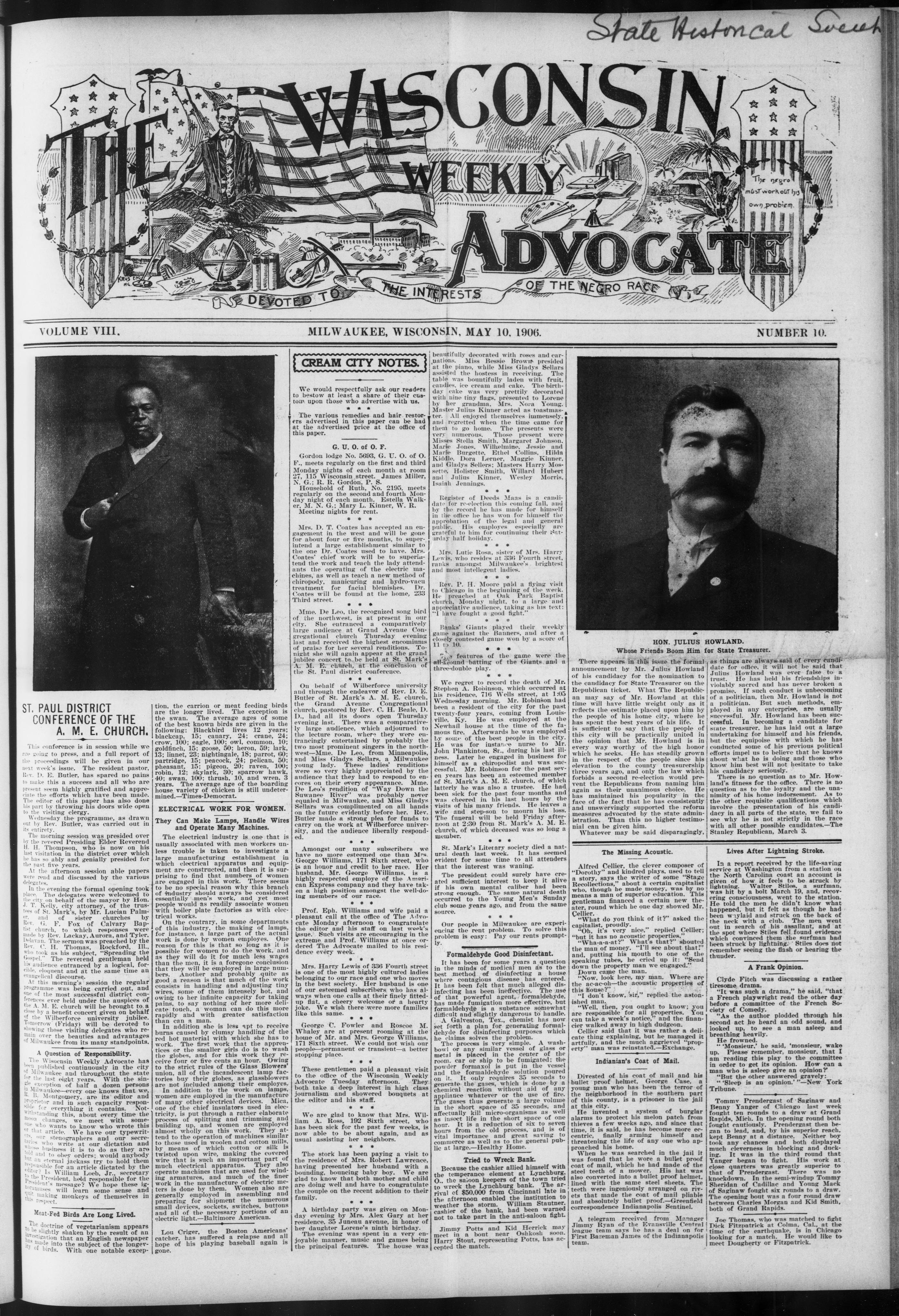
WISCONSIN
WEEKLY
Advocate
DEVOTED TO THE INTERESTS OF THE NEGRO RACE
[Portrait of a man in formal attire, standing with a hand on his hip.]
VOLUME VIII.
[Image of a man in a dark coat, standing with his hand on his hip.]
ST. PAUL DISTRICT CONFERENCE OF THE A. M. E. CHURCH.
This conference is in session while we are going to press, and a full report of the proceedings will be given in our next week's issue. The resident pastor, Rev. D. E. Butler, has spared no pains to make this a success and all who are present seem highly gratified and appreciate the efforts which have been made. The editor of this paper has also done his part by throwing his doors wide open to the visiting clergy. Wednesday the programme, as drawn out by Rev. Butler, was carried out in its entirety. The morning session was presided over by the revered Presiding Elder Reverend H. H. Thompson, who is now on his last visitation in the district over which he has so ably and genially presided for the past five years.
At the afternoon session able papers were read and discussed by the various delegates. In the evening the formal opening took place. The delegates were welcomed to the city on behalf of the mayor by Hon. J. T. Kelly, city attorney, of the trustees of St. Mark's, by Mr. Lucian Palmer, and of sister churches by Rev. G. F. Fox of Calvary Baptist church, to which responses were made by Rev. Lackay, Aurora, and Tyler, Delavan. The sermon was preached by the Rev. C. H. Thomas, Rockford, Ill., who took as his subject, "Spreading the Gospel." The reverend gentleman held his audience entranced by a logical, forcible, eloquent and at the same time an evangelical discourse.
At this morning's session the regular programme was being carried out, and one of the most successful district conferences ever held under the auspices of the A.M.E. church will be brought to a close by a benefit concert given on behalf of the Wilberforce university jubilee. Tomorrow (Friday) will be devoted to showing those visiting delegates who remain over the beauties and advantages of Milwaukee from its many standpoints,
A Question of Responsibility.
The Wisocnsin Weekly Advocate has been published continuously in the city of Milwaukee and throughout the state for the last eight years. With the single exception of half a dozen persons in Milwaukee—every one knows that we, K. B. Montgomery, are its editor and proprietor and in such capacity responsible for everything it contains. Notwithstanding this, about every time the moon changes, we meet with someone who wants to know who wrote this or that article. We have our typewriters, our stenographers and our secretaries who write at our dictation and whose business it is to do as they are told and to obey orders; would anybody but an eternal jackass try to hold them responsible for an article dictated by the editor? Is William Loeb, Jr., secretary to the President, hold responsible for the President's message? We hope these ignorantuses will learn some sense and quit making monkeys of themselves in this respect.
Meat-Fed Birds Are Long Lived.
The doctrine of vegetarianism appears to be slightly shaken by the result of an investigation that an English newspaper has made into the subject of the longevity of birds. With one notable excep-
tion, the carrion or meat feeding birds are the longer lived. The exception is the swan. The average ages of some of the best known birds are given in the following: Blackbird lives 12 years; blackcap, 15; canary, 24; crane, 24; crow, 100; eagle, 100; owl, common, 10; goldfinch, 15; goose, 50; heron, 59; lark, 13; linnet, 23; nightingale, 18; parrot, 60; partridge, 15; peacock, 24; pelican, 50; pheasant, 15; pigeon, 20; raven, 100; robin, 12; skylark, 30; sparrow hawk, 40; swan, 100; thrush, 10, and wren, 3 years. The average age of the boarding house variety of chicken is still undetermined.-Times-Democrat.
ELECTRICAL WORK FOR WOMEN.
They Can Make Lamps, Handle Wires and Operate Many Machines.
The electrical industry is one that is usually associated with men workers unless trouble is taken to investigate a large manufacturing establishment in which electrical apparatus and equipment are constructed, and then it is surprising to find that numbers of women are engaged in this work. There seems to be no special reason why this branch of industry should always be considered essentially men's work, and yet most people would as readily associate women with boiler plate factories as with electrical works.
On the contrary, in some departments of this industry, the making of lamps, for instance, a large part of the actual work is done by women employes. One reason for this is that so long as it is possible for women to do the work, and as they will do it for much less wages than the men, it is a foregone conclusion that they will be employed in large numbers. Another and probably quite as good a reason is that much of the work consists in handling and adjusting tiny wires, some of them intensely hot, and owing to her infinite capacity for taking pains, to say nothing of her more delicate touch, a woman can do this more rapidly and with greater satisfaction than can a man.
In addition she is less apt to receive burns caused by clumsy handling of the red hot material with which she has to work. The first work that the apprentices or the smaller girls do is to wash the globes, and for this work they receive four or five cents an hour. Owing to the strict rules of the Glass Blowers' union, all of the incandescent lamp factories buy their globes, as glassblowers are not included among their employees.
In addition to the work on lamps, women are employed in the manufacture of many other electrical devices. Mica, one of the chief insulators used in electricity, is put through a rather elaborate process of splitting and trimming and building up, and women are employed almost wholly on this work. They attend to the operation of machines similar to those used in woolen and cotton mills, by means of which cotton or silk is twisted upon wire, making the covered wire that is such an important part of much electrical apparatus. They also operate machines that are used for winding armatures, and much of the finer work in the manufacture of electric meters is done by them. Women also are generally employed in assembling and preparing for shipment the numerous small devices, sockets, switches, buttons and all of the necessary portions of an electric light.-Baltimore American.
Lou Criger, the Boston Americans' catcher, has suffered a relapse and all hope of his playing baseball again is gone.
CREAM CITY NOTES.
We would respectfully ask our readers to bestow at least a share of their custom upon those who advertise with us.
The various remedies and hair restorers advertised in this paper can be had at the advertised price at the office of this paper.
G. U. O. of O. F.
Gordon lodge No. 5693, G. U. O. of O. F., meets regularly on the first and third Monday nights of each month at room 27, 115 Wisconsin street. James Miller, N. G.; R. R. Gordon, P. S. Household of Ruth, No. 2195, meets regularly on the second and fourth Monday night of each month. Estella Walker, M. N. G.; Mary L. Kinner, W. R.
***
Mrs. D. T. Coates has accepted an engagement in the west and will be gone for about four or five months, to superintend a large establishment similar to the one Dr. Coates used to have. Mrs. Coates' chief work will be to superintend the work and teach the lady attendants the operating of the electric machines, as well as teach a new method of chiropody, manicuring and hydro-vacu treatment for facial blemishes. Dr. Coates will be found at the home, 233 Third street.
Mme. De Leo, the recognized song bird of the northwest, is at present in our city. She entranced a comparatively large audience at Grand Avenue Congregational church Thursday evening last and received the highest encomiums of praise for her several renditions. Tonight she will again appear at the grand jubilee concert to be held at St. Mark's A. M. E. church, at the conclusion of the St. Paul district conference.
* * *
On behalf of Wilberforce university and through the endeavor of Rev. D. E. Butler of St. Mark's A. M. E. church, the Grand Avenue Congregational church, pastored by Rev. C. H. Beale, D. D., had all its doors open Thursday evening last. There was a comparatively large audience, which adjourned to the lecture room, where they were entrancingly entertained by probably the two most prominent singers in the northwest—Mme. De Leo, from Minneapolis, and Miss Gladys Sellars, a Milwaukee young lady. These ladies' renditions were so very highly appreciated by the audience that they had to respond to encores on their every appearance. Mme. De Leo's rendition of "Way Down the Suwanee River" was probably never equaled in Milwaukee, and Miss Gladys Sellars was complimented on all hands on the future evidently before her. Rev. Butler made a strong plea for funds to carry on the work at Wilberforce university, and the audience liberally responded.
求 求 求
Amongst our many subscribers we have no more esteemed one than Mrs. George Williams, 171 Sixth street, who is an honor and credit to her race. Her husband, Mr. George Williams, is a highly respected employee of the American Express company and they have taken a high position amongst the well-doing members of our race.
* * *
Prof. Eph. Williams and wife paid a pleasant call at the office of The Advocate Monday afternoon to congratulate the editor and his staff on last week's issue. Such visits are encouraging in the extreme and Prof. Williams at once ordered The Advocate mailed to his residence every week.
****
Mrs. Harry Lewis of 336 Fourth street is one of the most highly cultured ladies belonging to our race and one who moves in the best society. Her husband is one of our esteemed subscribers who has always when one calls at their finely fitted up flat, a cheery welcome or a hearty joke. We wish there were more families like this same.
***
George C. Fowler and Roscoe M. Whaley are at present rooming at the home of Mr. and Mrs. George Williams, 171 Sixth street. We could not wish our people-permanent or transient-a better stopping place.
* * *
These gentlemen paid a pleasant visit to the office of the Wisconsin Weekly Advocate Tuesday afternoon. They both take a deep interest in high class journalism and showered bouquets at the editor and his staff.
* * *
We are glad to know that Mrs. William A. Ross, 192 Sixth street, who has been sick for the past few weeks, is now able to be about again, and as usual assisting her neighbors.
\* \* \*
The stork has been paying a visit to the residence of Mrs. Robert Lawrence, having presented her husband with a bounding, bouncing baby boy. We are glad to know that both mother and child are doing well and have to congratulate the couple on the recent addition to their family.
* * *
A birthday party was given on Monday evening by Mrs. Alex Gary at her residence, 35 Juneau avenue, in honor of her daughter Lorene's ninth birthday. The evening was spent in a very enjoyable manner, music and games being the principal features. The house was
beautifully decorated with roses and carvations. Miss Bessie Brown presided at the piano, while Miss Gladys Sellars assisted the hostess in receiving. The table was bountifully laden with fruit, candies, ice cream and cake. The birthday cake was very prettily decorated with nine tiny flags, presented to Lorene by her grandma, Mrs. Nora Young. Master Julius Kinner acted as toastmaster. All enjoyed themselves immensely, and regretted when the time came for them to go home. The presents were very numerous. Those present were Misses Stella Smith, Margaret Johnson, Marie Jones, Wilhelmine, Jessie and Marie Burgette, Ethel Collins, Hilda Kiddle, Dora Lerner, Maggie Kinner, and Gladys Sellers; Masters Harry Mosette, Holister Smith, Willard Hubert and Julius Kinner, Wesley Morris, Isaiah Jennings.
* * *
Register of Deeds Maas is a candidate for re-election this coming fall, and by the record he has made for himself in the office he has won for himself the approbation of the legal and general public. His employees especially are grateful to him for continuing their Saturday half holiday.
* * *
Mrs. Lutie Rosa, sister of Mrs. Harry Lewis, who resides at 336 Fourth street, ranks amongst Milwaukee's brightest and most intelligent ladies.
* * *
Rev. P. H. Moore paid a flying visit to Chicago in the beginning of the week. He preached at Oak Park Baptist church, Monday night, to a large and appreciative audience, taking as his text: "I have fought a good fight."
☆ ☆ ☆
Banks' Giants played their weekly game against the Banners, and after a closely contested game won by a score of 11 to 10.
The features of the game were the all-around batting of the Giants and a three-double play.
\* \* \*
We regret to record the death of Mr. Stephen A. Robinson, which occurred at his residence, 716 Wells street, at 1:05 Wednesday morning. Mr. Robinson had been a resident of the city for the past twenty-four years, coming from Louisville, Ky. He was employed at the Newhall house at the time of the famous fire. Afterwards he was employed by some of the best people in the city. He was for instance nurse to Mr. John Plankinton, Sr., during his last illness. Later he engaged in business for himself as a chiropodist and was successful. Mr. Robinson for the past seven years has been an esteemed member of St. Mark's A. M. E. church, of which latterly he was also a trustee. He had been sick for the past four months and was cheered in his last hours by the visits of his many friends. He leaves a wife and step-son to mourn his loss. The funeral will be held Friday afternoon at 2:30 from St. Mark's A. M. E. church, of which deceased was so long a member.
* * *
St. Mark's Literary society died a natural death last week. It has seemed evident for some time to all attenders that the interest was waning. The president could surely have created sufficient interest to keep it alive if his own mental caliber had been strong enough. The same natural death occurred to the Young Men's Sunday club some years ago, and from the same source.
* * *
Our people in Milwaukee are experiencing the rent problem. To solve this problem is easy: Pay our rents promptly.
Formaldehyde Good Disinfectant.
It has been for some years a question in the minds of medical men as to the best method of disinfecting a house where contagious disease has entered. It has been felt that much alleged disinfecting has been ineffective. The use of that powerful agent, formaldehyde, has made fumigation more effective, but formaldehyde is a substance somewhat difficult and slightly dangerous to handle. A Galveston, Tex., chemist has now set forth a plan for generating formaldehyde for disinfecting purposes which he claims solves the problem.
The process is very simple. A washbowl or any similar vessel of glass or metal is placed in the center of the room, car or ship to be fumigated; the powder formaxol is put in the vessel and the formaldehyde solution poured on it. It only requires 35 seconds to generate the gases, which is done by a chemical reaction without aid of any appliance whatever or the use of fire. The gases thus generate a large volume in the short space of 35 seconds, and affectually kill micro-organisms as well as insect life in the short space of one hour. It is a reduction of six to seven hours from the old process, and is of vital importance and great saving to commerce as well as to the general public at large.—Healthy Home.
Tried to Wreck Bank.
Because the cashier allied himself with the temperance element at Lynchburg, O.. the saloon keepers of the town tried to wreck the Lynchburg bank. The arrival of $50,000 from Cincinnati late in the afternoon enabled the institution to weather the storm. William Stautner, cashier of the bank, had been warned not to take part in the anti-saloon fight.
Jimmy Potts and Kid Herrick may meet in a bout near Oshkosh soon. Harry Stout, representing Potts, has accepted the match.
M. B.
HON. JULIUS HOWLAND. Whose Friends Boom Him for State Treasurer.
There appears in this issue the formal announcement by Mr. Julius Howland of his candidacy for the nomination to the candidacy for State Treasurer on the Republican ticket. What The Republican may say of Mr. Howland at this time will have little weight only as it reflects the estimate placed upon him by the people of his home city, where he has spent the best years of his life. It is sufficient to say that the people of this city will be practically united in the opinion that Mr. Howland is in every way worthy of the high honor which he seeks. He has steadily grown in the respect of the people since his elevation to the county treasurership three years ago, and only the law which forbids a second re-election would prevent the Republicans from naming him again as their unanimous choice. He has maintained his popularity in the face of the fact that he has consistently and unswervingly supported the reform measures advocated by the state administration. Than this no higher testimonial can be given him.
Whatever may be said disparagingly.
The Missing Acoustic
Alfred Cellier, the clever composer of "Dorothy" and kindred plays, used to tell a story, says the writer of some "Stage Recollections," about a certain capitalist who, though he made money, was by no means a man of superior education. This gentleman financed a certain new theater, round which he one day showed Mr. Cellier.
"What do you think of it?" asked the capitalist, proudly.
"Oh, it's very nice," replied Cellier; "but it has no acoustic properties."
"Wha-a-a-at?" What's that?" shouted the man of money. "I'll see about that!" and, putting his mouth to one of the speaking tubes, he cried up it: "Send down the property man we engaged."
Down came the man.
"Now, look here, my man. Where are the ac-ac-oh—the acoustic properties of this house?"
"I don't know, sir," replied the astonished man.
"Well, then, you ought to know; you are responsible for all properties. You can take a week's notice," and the financier walked away in high dudgeon.
Cellier said that it was rather a delicate thing explaining, but he managed it artfully, and the much aggrieved "property" man was reinstated—Exchange.
Indianian's Coat of Mail
Divested of his coat of mail and his bullet proof helmet. George Case, a young man who has been the terror of the neighborhood in the southern part of this county, is a prisoner in the jail at this city.
He invented a system of burglar alarms to protect his melon patch from thieves a few weeks ago, and since that time, it is said, he has become more eccentric, finally arming himself and threatening the life of any one who approached his home.
When he was searched in the jail it was found that he wore a bullet proof coat of mail, which he had made of the steel teeth of a mower. His hat was also converted into a bullet proof helmet, lined with the same steel sheets. The teeth were ingeniously arranged on rivets that made the coat of mail pliable and absolutely bullet proof.—Greenfield correspondence Indianapolis Sentinel.
A telegram received from Manager Jimmy Ryan of the Evansville Central league team says he has a deal on for First Bazeman James of the Indianapolis team.
[Name]
as things are always said of every candidate for office, it will not be said that Julius Howland was ever false to a trust. He has held his friendships inviolably sacred and has never broken a promise. If such conduct is unbecoming of a politician, then Mr. Howland is not a politician. But such methods, employed in any enterprise, are usually successful. Mr. Howland has been successful. In becoming a candidate for state treasurer, he has laid out a large undertaking for himself and his friends, but the equipoise with which he has conducted some of his previous political efforts impel us to believe that he knows about what he is doing and those who know him best will not hesitate to take his candidacy seriously.
There is no question as to Mr. Howland's fitness for the office. There is no question as to the loyalty and the unanimity of his home indorsement. As to the other requisite qualifications which involve the presentation of his candidacy in all parts of the state, we fail to see why he is not strictly in the race with all other possible candidates.-The Stanley Republican, March 3.
Lives After Lightning Stroke.
In a report received by the life-saving service at Washington from a station on the North Carolina coast an account is given of how it feels to be struck by lightning. Walter Stiles, a surfman, was hit by a bolt March 19, and, recovering consciousness, went to the station. He told the men he didn't know what happened, but it felt as though he had been waylaid and struck on the back of the neck with a club. The men went out in search of his assallant, and at the spot where Stiles fell found evidence which convinced them the surfman had been struck by lightning. Stiles does not remember seeing the flash or hearing the thunder.
Clyde Fitch was discussing a rather tiresome drama.
"It was such a drama," he said, "that a French playwright read the other day before a committee of the French Society of Comedy.
"As the author plodded through his second act he heard an odd sound, and looked up, to see a man asleep and breathing heavily.
He frowned.
"Monsieur,' he said, 'monsieur, wake up. Please remember, monsieur, that I am reading this play to the committee in order to get its opinion. How can a man who is asleep give an opinion?
"But the other answered gravely:
"Sleep is an opinion.'"—New York Tribune.
Tommy Prendergast of Saginaw and Benny Yanger of Chicago last week fought ten rounds to a draw at Grand Rapids, Mich. In the opening round both fought cautiously. Prendergast then began to lead, and, by his superior reach, kept Benny at a distance. Neither boy took any chances and both displayed much cleverness in blocking and ducking. It was in the third round that Yanger began to fight. His work at close quarters was greatly superior to that of Prendergast. There was no knockdown. In the semi-windup Tommy Sheridan of Cadillac and Young Mack of Saginaw fought six rounds to a draw. The opening bout was a four round draw between Charles Morgan and Kid Smith, both of Grand Rapids.
Joe Thomas, who was matched to fight Dick Fitzpatrick at Colma, Cal., at the time of the earthquake, is in Chicago looking for a match. He would like to meet Dougherty or Fitzpatrick.
NUMBER 10.
A Frank Opinion.
TO A LATE-COMER.
Why didst thou come into my life so late?
If it were morning I could welcome thee
With glad all-halls, and bid each to be
The willing servitor of thine estate.
Julia C. K. Dorr in the Atlantic.
—Cincinnati, through the civic improvement department of her Woman's club, started the first playground in Ohio.
—Twenty-three hundred million bushels of wheat are required annually by the 517,000,000 breadeaters of the world.
—Representing about thirty schools, nearly 4000 public school volunteers were engaged the other day at Aldershot, England, in field operations.
—Visiting cards of iron are popular on the continent of Europe, the name being printed in silver. The thickness of the cards is one four-hundredth of an inch.
—A soldier stationed at Constantine, Algeria, who had stolen three belts from his comrades, threw himself over a 200-foot precipice to escape military punishment.
The last surviving member of the family of Mozart, the composer, earns his living by drawing beer in a railway station restaurant at Augsburg, Germany.
"The gods are getting a bath" is the comment reported by Dr. Brown when the Chinese governor cleansed a temple in Paoting Fu and threw the idols in the river.
The name of California first appeared in an anonymous Spanish romance published in 1510. It told of an Amazon queen, Calafia, whose realm was called California.
Sir Patrick Keith Murray has presented to the British nation an old cushion on which the crown of Scotland rested, and it has been placed in the jewel room in Edinburgh castle.
—Miss Florence I. Nicholson, secretary of a London children's dinner fund, said the other day: "It is a common thing in the slums of Bethnal Green to see a baby sucking a whelk steeped in gin."
—Jacquard, the inventor of the famous loom, might have become a millionaire. This unselfish Frenchman, though, gave his invention to the government, and all he got in return was a pension of $1000 a year.
—Three German battalions at Metz are to experiment with gray and gray-green uniforms, the metal parts being of dull brown. The Kaiser is not yet satisfied as to the comparative invisibility of the two shades.
—In Australian gold mines it is considered that ventilation becomes bad when the proportion of oxygen falls below 20 per cent. or less than 70 cubic feet of air a minute is supplied for every man working in a mine.
—The discovery has been made that recent great bush fires in New South Wales and Victoria were caused by phosphorus paste laid out to kill rabbits. As soon as the mixture dried the sun's rays set fire to it.
—On the beach of Norwich, England, the children enjoy one of the finest sports possible—tobogganing down a steep sand hill. The sand bluff is 130 feet high, of soft sand, and the coasters slide down by hundreds.
Samuel L. Clemens (Mark Twain) has purchased a summer home in Redding, Conn. Deeds have been passed conveying to Mr. Clemens the Noah Bouton farm of 85 acres on the west side of the town, close to the homes of several well-known literary men who spend their summers there.
Fifty members are already enrolled in the Pocahontas society, recently formed in Washington. Members must prove their descent from the Indian maiden and her English husband. There is to be a "Pocahontas day" at the Jamestown exposition, when the society will hold first place.
The Emperor Menelik of Abyssinia is the Empress' fifth husband. No. 1 was a general under King Theodore, who put him in prison, where he disappeared; No. 2 got a divorce; No. 3 was also imprisoned by Menelik's predecessor; No. 4 was in possession when the lady took Menelik's fancy, but when "all obstacles had been removed," Menelik married her.
A novelty in Easter eggs is one of glass that is electrically lighted. Such eggs are made in white, of frosted glass and in various colors, to glow when the light is turned on in them. They are lighted by means of a flexible conductor which may be attached to any electric light fixture and which is made long enough to permit placing them wherever it may be desired.
—Will Crooks, Labor member of the British Parliament, is the victim of a curious device practiced by certain writers. He says that from time to time he receives articles on various subjects with a request that he sign his name to them, the idea being that his signature will make the work salable, and that Mr. Crooks will be sufficiently rewarded for the use of his name by the fame which the articles will bring to him.
This Custom Is Now General.
It has now become a general and also a safe rule to demand brands of goods that are well known and have a reputation for quality and reliability. Nowadays the manufacturers of good goods inform consumers of this fact and point out that safety lies in buying the brands that bear their names and trademarks.
In this respect the Mayer brands of shoes are deserving of special mention. Our readers have no doubt become familiar with these shoes and know of their excellent wearing quality by actual use. The Mayer factory turns out shoes suitable for every member of the family and for all uses. Sunday shoes and every day shoes, and they are known throughout the broad expanse of our land as the shoes of style and quality.
The "Honorbilt" are very popular fine shoes for men and "Western Lady" shoes embody the fit and style demanded by well dressed ladies. For extreme comfort "Martha Washington" shoes are highly recommended. Please bear this in mind when next buying shoes.
Hat Is Size of Peck Measure.
"Big Louie" Meilanen, the young giant at the Franklin mine and Michigan's biggest and sturdiest son, has purchased a new hat, possibly the largest ever made for actual wear. It is size $ \mathrm{S} _ {1 / 2} $ and measures eighteen inches through its great diameter. It is nine inches high from rim to crown, about the size of a peck measure.
THE COMING OF THE DAFFODILS.
"Awake, awake! for the Springtime's sake, March daffodils, too long dreaming! The lark is high in the spacious sky, And the celandine stars are gleaming. The gorse is ablaze, and the woodland sprays Are as crimson as August heather, The buds they unfurl, and mavis and merle Are singing duets together.
The thrush never stops in the hazel copse,
Till with music the world seems ringing,
And the milkmaid hale, as she swings her
pail,
Comes out from the dairy singing.
"The madeap lambs round their staider
dams
Soon the tale of the nest invaded.
The swain and his sweet in the love-lanes meet.
And fondle and face each other.
Till he folds her charms in his world-wide arms,
With kisses that blind and smother."
Then the daffodils came, aflame, aflame,
In orchard, and garth, and cover;
And out April leapt, and first smiled, then went.
And longed for her Mayday lover.
—Alfred Austin, Poet Laureate of England.
A TORTOISE OF SENTIMENT.
Seton Keywood had decided to spend the summer in a little Hampshire cottage. With the egotism of temporary proprietorship he had arrogantly ignored the fact that another cottage lay side by side with his own. But that was before his installation within the rural abode had made it clear that for a neighbor he had a girl who dressed in white and wore ravishingly broad, shady hats. It was then that he discovered that he was living next to a place of importance.
There are times when the presence of a hedge becomes almost insupportable. The systematic laying of a white cloth upon an afternoon tea table beneath a chestnut tree is a preliminary to poor sport—if it be on the wrong side of the hedge. Keywood's stare grew more hungry each day until the maid servant in impotent resentment was wont to shake out the tablecloth with a violence that sent bees and insects humming affrightedly from the scene. There was an elderly lady, too, who came out from the house at rare intervals—happy in the possession of reflected glamour. Beyond that she did not count.
Keywood was walking slowly upon his side of the hedge. He was wondering how long it was to last, this isolation of his. Then he stopped suddenly, his eyes attracted by the sight of a small variegated dome that lay beneath a mass of flowering stock. As he lifted it a snake-like head wagged in protest ere it withdrew within the shell. It was a motionless tortoise that he held.
Such a creature is not wont to travel abroad in wanton recklessness, nor was it sufficiently etherial to have dropped from the skies. Keywood was lost in idle wonder when a light footstep sounded upon the other side of the hedge. The girl in white was almost abreast of where he stoon. He moved hastily forward, his hat in one hand, the tortoise outstretched in the other.
"I beg your pardon," he began, "but—I think this is yours."
The gray eyes upon the other side of the hedge opened wide.
"Oh, no," protested the girl, "I have never kept a tortoise in my life."
"Neither have I," retorted Keywood.
There was an awkward pause.
"Might it not have arrived from somewhere else?" suggested the girl at length.
Keywood scowled at the thing in his hand.
"I suppose so," he admitted, regretfully. Then for the second time he became inspired.
"Would you like it?" he asked.
It was with intense eagerness that he watched the blush that mantled upon the girl's embarrassed face. Heavens! She was going to accept! At all events astonishment had deprived her of the means of refusal.
Snatching a gigantic rhubarb leaf from its stalk he wrapped the reptile within it. A second later it lay within the girl's unwilling hand.
Keywood returned to the house filled with a variety of emotions. He had seen a schoolboy present a pig-tailed girl with a peppermint—and he had laughed. He wondered why.
The next day he walked through the bed of stocks in a reminiscent mood. To his surprise he found the tortoise there once more. He remained by its side until he saw the flutter of a white dress.
"Your tortoise," he said as he handed it back.
He ventured some comment upon the habit of the creatures. He was glad to see her smile.
The following day he returned to the spot where the stocks bloomed. He knew that he had little right to expect it to be there, yet its absence filled him with a curious sense of disappointment.
In a restless mood he was walking by the hedge that separated his neighbor's garden from a meadow when without the slightest warning he came upon the reptile. It was crawling among the long grass. Keywood's forehead grew wrinkled. The hedge was quickset and impenetrable, and a tortoise cannot jump. He embraced the first opportunity of restoring the creature to its owner.
"Thank you, so much," said the girl.
"I found it in the meadow," said Keywood.
It seems to him that her eyes fell before his. Harassed by deepening doubt Keywood installed himself at a creeper-clad window that commanded the neighboring garden. It was long ere his patience was rewarded, but the girl emerged at length. She cast a quick glance in his direction that sent Keywood's head in haste behind the pleasant shelter of the creeper. He noticed that within her hand was a small bag whose soft material bulged. He watched her graceful figure as it glided through a gate at the bottom of the garden and disappeared within a copse at the further end of the meadow. A little later she returned. The bag she held hung limp and attenuated.
That evening Keywood searched the copse from north to south and from east to west. When in the end he sighted the tortoise at the base of a young nut tree the discovery did not altogether surprise him. Ere the sun had set he was waiting by the hedge for the second time. But upon this occasion he projected his shoulders on the further side in added boldness. When the time came for him to act he signaled with the reptile regard-
less of any giddiness that may have manifested itself within the shell. "Your tortoise—strayed again!" he exclaimed.
The face of the advancing girl showed open incredulity.
"Oh, no," she cried, "this is an altogether different one."
"I assure you," protested Keywood, "that it is the same."
"But how can you tell?"
For a moment Keywood felt nonplussed. Then he drew a bow at a venture.
"Because," he said, "there is no other creature of the kind within a radius of miles."
The girl flashed a quick glance at him. Then she laughed. He decided that he had never before heard such a silvery ripple of a laugh.
"And my own. You had forgotten that."
He stared at her in astonishment.
"You have not lost your own?"
She blushed a little beneath his gaze. It seemed to him that she hesitated for an instant. "Lost it?" she replied. "Certainly I have not lost it."
Keywood recovered his wits.
"Then," he said, "you refuse to accept this as a companion to the other. It will feel less lonely."
On the next day it was necessary for Keywood to journey to the neighboring towns. On such occasions the carrier's cart served as an efficient if loitering omnibus. As he sat within the vehicle his trend of thought fell from more sentimental matters to the habits of creeping things. The sudden realization that he had been gazing absent-mindedly upon an object that was strangely in keeping with his thoughts awoke him abruptly from his musing. Through the broadly perforated holes that honeycombed a small box he could discern the shell of a tortoise. The case was directed to an address in the Shetland isles.
Keywood's suspicions were confirmed by Jim Preston, the carrier. It was at his neighbor's hands that the box had been received.
An argument ensued between the pair. The carrier's views upon honesty and the retention of situations were altered in the end by a sovereign and a solemn guarantee against evil to come.
That afternoon Keywood deliberately leaped the hedge. The girl was reading beneath the walnut tree. At the sight of her visitor and of that which he bore her book fell to the ground.
"Oh!" she cried, "not another—surely not another one!"
Keywood handed it to her in unimpaired gravity.
"You will now have three, he said. .She turned a pair of puzzled eyes upon him.
"Confess," she said, "that you have other means of obtaining these things. To find three, one after the other—"
"But I did," he interrupted. "I found it really and truly—in Preston's cart."
The girl's face flamed suddenly.
"Oh!" she cried, "in Preston's cart. But how dared you?"
"I suppose that you could get Preston six months?" mused Keywood. "I should probably get rather more—as the instigator; but you would not trouble to do that unless the tortoise belonged to you."
The color was still in the girl's face, but she was laughing.
"I detest tortoises," she said. "I may as well tell you that I tried to lose this one, but I did not succeed, for there was only one—in different places—do you see?"
"I knew that quite well," replied Keywood.
"So you took the credit for three presents when there was only one?"
Keywood grew desperate.
"But I had received nothing in return you see," he protested, "not even an invitation to tea."
For a moment as he sought her eyes he feared impending disaster; but just then appeared one of those benevolent factors which go toward the easing of a strained situation. In this case it was the maid with the tea cloth. The girl in the white dress laughed again.
"I will forgive both Preston and you upon one condition," she said, "and that is that you promise never to give me a tortoise again."
"There will be no necessity for that now," Keywood assured her.
A little later they were seated in company at the tea table, which, of course, was the beginning of the end.—W. H. Koebel in The Tattler.
The Fault of the Styles
A pretty milliner, fashionably attired, walked into a local jeweler's establishment recently and, laying aside her coat and gloves, asked to be shown something in the way of diamonds.
The proprietor, who happened to be in the store, waited on the milliner. While they were discussing the jewels a man came in to make a purchase. After fifteen minutes' careful inspection of the stock of scarf pins he bought one from the clerk and started out of the store.
The proprietor noticed that the man was without his overcoat and about two minutes after he had gone the jeweler seemed to have something important suddenly revealed to him.
"He's gone and left his overcoat here," cried the jeweler, and catching up the garment that lay near by he started out of the door as if he were bent on catching a thief. Evidently the man he sought had disappeared somewhere, for he was gone ten minutes. When he returned he still had the garment and was clutching it tightly. "I couldn't find him," he observed to the people in the store, "but I suppose he'll call for his coat."
The good natured jeweler did not notice the wrathful countenance of his milliner customer.
"I'll trouble you for my coat," she said in icy tones. Taking the garment from the jeweler she strode from the store with hands deep in the coat's side pockets.
"Well. I'll be darned," the jeweler quietly observed. "What kind of garments will these women be wearing next?"—Indianapolis Morning Star.
At Last.
"Eureka. I have found it," the young inventor cried.
The populace waited with breathless interest for the details of the discovery.
invent for the future of the discovery.
"You know we have," he began, "the wireless telegraph, the horseless carriage, and so on?"
"Yes, yes," they shouted. "Continue."
"Well, I propose to give you," the inventor announced proudly, "a presidentless insurance company."
Zambesi Drying Up.
For some months past considerable inconvenience has been caused to planters Africa by the precarious condition of the
Zambesi waterway, which is gradually drying up at many parts. Some ten years ago it was possible for the flotilla of steamers which ply between Chinde, at the mouth of the river, and Katungas, on the Shire tributary, to maintain communication for upward of eight months of the year. Even though heavy rains have fallen throughout the Shire highlands, and Lake Nyasa has risen several inches, many steamers and barges are at present lying high and dry on sandbanks in the river at various points.
The distance from Chinde to Blantyre the capital of the protectorate-it but 375 miles, but many hundreds of tons of goods for the interior have taken as long as three months to reach the latter center for distribution.-Blantyre Cor. London Express.
A BATCH OF QUEER TRADES
Fly and Flea Catchers—Lion Hunters— Human Incubator.
A request was recently sent out by an English paper for suggestions of novel ways of earning money. Some of the replies have novelty enough and to spare. Here are a few "professions" which were proposed: A professional flea catcher, a custodian for safety pins, a collector of dried flies for hens' food, purveyor of fads to the leisure classes, a lion hunting agency for society's use, a motor car library to call at out of the way places with the newest books, a maker up of minds, a grievance abater, a manners teacher. Evidently dried flies are in demand, for the suggestion of a dried fly merchant came from two quarters. As for the maker up of minds and an equivalent of the motor car library, they exist in New York at the present time.
So also does the umbrella and waterproof exchange recommended by another person. Among the queer occupations described as already followed is that of artistically painting with harmless pigments, fictitious, if scanty, hair on bald heads.
"A man I know," says one answer, "makes his living out of funerals and weddings. He attends a funeral, gets a list of the wreaths from the undertaker (on reciprocal terms), takes a shorthand note of the minister's address, draws up a souvenir report of the whole thing and offers it to the survivors.
"Bereaved people are an easy prey. Not infrequently he receives encouragement also from the printer or typist if he can persuade them to have it put in type.
"His tactics are similar in regard to weddings; but there, as he suffers severely from the competition of the newspapers, his great source of profit is acting as agent for the loan of wedding presents. It is said that at the second wedding of a well known politician at Birmingham the presents were valued at £60,000, and two-thirds of them were hired. Commission on £40,000 worth of business is not to be despised."
Another case is that of a busy farmer's wife in Australia, who had the misfortune to have a paralytic son who was bed ridden. She was a notable manager, and, considering the great cost of the invalid and the loss of his services on the farm, she persuaded him to allow clutches of eggs to be placed with proper precautions in the bed, that the equal and continual warmth might hatch them. This was accordingly done, and the paralyzed youth was as proud of the broods as possible, and thoroughly earned his living, besides gaining an interest in his life.
IN THE LABOR WORLD.
Talk of closer union between the four principal organizations of railway mer. the engineers, firemen, conductors and trainmen, has been revived.
The Commercial Telegraphers' union are keeping up a vigorous warfare on the "fake" schools of telegraphy which have sprung up in great number throughout the country in late years.
The date for the annual convention of the New York State Association of Letter Carriers has been changed from May 29 and 30 to July 4 and 5. The convention will be held at Oswego.
The eighth annual convention of the Illinois State Association of Letter Carriers will be held at Elgin on Memorial day, and from all indications it will be the largest in point of attendance ever held by the organization in that state.
Paris is looking forward to a general strike on May 1 for the eight-hour day. It is said the government is apprehensive of an outbreak of violence, owing to a determination of reactionaries to seize the opportunity afforded by a strike for violent demonstrations against the administration. A new labor political party has been formed in Montreal to advocate municipal and government ownership of public utilities, the eight-hour workday for government employees, the prohibition of child labor, the abolition of contract prison labor, compulsory education, and the prohibition of pauper immigration.
According to the labor press the trades most affected by contract prison labor in the United States are the shoe-workers, iron molders, garment workers, reed and rattan workers and broom-workers. A total of nearly 5000 convicts are said to be employed in the manufacture of boots and shoes alone.
In accordance with its declared intention of entering actively into politics the American Federation of Labor has sent circular letters to all unions in the United States giving directions as to the policy to be pursued. In the coming congressional campaigns all candidates are to be questioned by the labor unions as to the position they will take in the event of election. Men who have consistently opposed the labor organizations in the past are to be displaced by men who have pledged themselves to the support of all projects demanded by organized labor.
REFLECTIONS OF A BACHELOR.
A girl can be jealous about a man even when she doesn't like him.
People who aren't married have very optimistic views about wedded bliss.
A woman can have an awful nice cry thinking how hard it would be on her children if she weren't such a good mother to them.
It would be a good investment to have so much money that people who borrow from you would be too afraid of you not to pay you back.
A man has to lose a good deal of money on the races to feel as bad about it as he does when he gets stung for a small subscription to a charity.—New York Express.
"The Modern Reader's Bible"
Shortly after little Margaret, aged 4, had been taken to see "Peter Pan," in which Maude Adams plays the title role, her 6-year-old brother undertook to tell her the story of the creation.
"And then, Margaret," said he, "after the Lord had made all the rest of the things. He made a man and called him Adam, and by and by Adam got tired of being all alone, and the Lord took one of Adam's ribs from him when he was asleep and made a wife for him as a surprise, and her name was—"
"Oh, I know, I know!" exclaimed little Margaret, quickly, "her name was Maude Adams."—Weekly Exchange.
There's always something doing in our cozy little flat.
And we're never down with ennui, you can bet your life on that.
Of course, it's kind of quiet in the little hours of night.
But when the daylight comes it's loud enough all right, all right.
Tis then the doors begin to slam and the kids begin to yell.
And there ain't much chance of sleeping, and I feel like saying—well!
And just about the time I turn for one more snooze
I hear the man that lives downstairs a-wrestling with his shoes.
A big, hoarse gong goes off before it's light enough to see.
And soon I hear a voice next door a-hollering: "Marie!"
The kids begin to holler and the doors begin to slam.
And there ain't much chance of sleeping, and I feel like saying—fudge!
Sometimes they get so mixed that I can hardly tell.
If it's the pesky kids that slam or the pesky doors that yell.
There's just a howling hodge-podge of a dozen kinds of noise.
A wild old whooping jamboree of Marie and doors and boys.
There's always something doing in our cozy little flat.
And we're never down with ennui, you can bet your life on that.
—Maurice Smiley in the American Magazine.
As boss of the circus, George O. Starr has come into the place made vacant after the death of James A. Bailey. Mr. Starr's title will be chairman and managing director. He was second in command and his promotion was the natural selection of all the surviving stockholders. Starr discovered and engaged many of the attractions, notably the "dip of death." He will travel with the circus from now on.
One thousand poor, deluded foreigners who have gone to the expense of coming to this great and glorious country to get a job are going to get a free trip home. They can't come in. They can't even get ashore to see the great statue of Liberty or the Subway. They must go back home and go on tilling the soil or cutting throats—whatever their vocations were before they started for "the land of freedom." Most of the unfortunates, or fortunates, which ever you please, are contract laborers. They represent many races, and all have been convicted of a heinous offense—they came here to work. Just think of it! More than 1000 of them came here to get jobs. Immigration Commissioner Watchorn is satisfied that the whole caboodle of them are contract laborers. His sieuths at Ellis island have held the newcomers up in bunches. The foreigner, unsuspecting and not up in the ways of the world, nine times out of ten will admit that he has come to take a job already promised him. Then he's up against it. It is then that the immigration officials earn the salaries paid by Uncle Sam. They have earned them last week, for during that period there has been an unprecedented rush of would-be American citizens to our shores. It has been discovered that many thousands of those who made the scamper during the last couple of weeks came in answer to advertisements circulated throughout Greece, Bulgaria, Serbia and Montenegro, offering $2.50 a day for certain kinds of labor in America. The government officials have not yet fixed the responsibility for the advertisements. But recently there were hundreds of immigrants sent back and there will be more hundreds. The Prince line brought most of them over and the Prince line will take them back. And this government will not pay the expense, either.
One would hardly expect to find an author at work in a graveyard. Yet every bright day of the past week a young, demure-looking little woman has made her way amid the ruined tombstones in old Trinity's cemetery and selecting the same seat every day has plied her pencil with a vigor that causes one to wonder whether she draws inspiration from her morbid surroundings. There are scores of people who walk daily through this moss-grown city of the dead; there are many who sit on the crumbling tombstones to rest. But the young woman in question, armed with book and pencil, sits hour after hour writing away for dear life. The stares of the curious do not seem to affect her, nor do the questions of the more-than-curious, for she pays no attention to either.
This is the heyday of the cat. Every dog has had his day, but now the cat has come into hers. No longer is she a despised creature at which to throw boot-jacks and cuss-words. Cat raising has become a money-making business in New York, and one in which women are peculiarly successful. Miss Laura Gold Hopkins says she is making lots of money raising pussies. Se gets from $100 to $200 each for Persian cats and from $10 to $20 each for the ordinary backyard variety. She began with one cat about four years ago and now she declares her "cattery" is worth several thousand dollars. However, she says there is not much money in the common feline—society has the fad and, as usual, it is willing to pay high for what it wants. So Persians have the call—that is, for pets. But the poor, neglected midnight serenaders are not scorned as once they were. No. They are eagerly sought. Some butchers openly and above board are advertising cat meat. Honest. P. S.—But it is meat for the cats to eat.
At the close of the third act of "The Optimist" at Daly's at its last night, Sidney Rosenfeld, the author of the piece, made a speech in which he poked mild fun at managers and newspapers.
"I suppose," he said, "the critics have been too kind to my former plays for me to rail at them because they don't like this one. Whatever may be the matter with the piece, I am satisfied with the company. I believe in writing a good many plays that are sure to make money in order to be able to produce one now and then according to my own taste with a company of my own choosing.
"When I took 'The Optimist' around to the managers, I am thankful to say, several refused it. One manager said the title was too professional. I asked him to explain. He gave a vague answer.
"Why," I said, "I don't believe you know the difference between an optimist and a pessimist."
"Well, I do,' he said. 'An optimist takes care of the eyes and a pessimist looks after the feet."
"When I was producing my earlier pieces," said Mr. Rosenfeld, "a certain critic here in New York spoke indulgently of the progress they showed, and wound up with the remarks that according to current indications he should be on the lookout for me about 1912.
"Well," said Mr. Rosenfeld emphatically. "1912 will soon be here."
"The Optimist" closed at Daly's after only a week's visit.
M. Bartholdi's maid of liberty holds a hum torch in her mitt these nights. The feeble rays that emanate from her heaven thrust flambeau are of a puerility compared to which Romer shoals light would cause Phaeton's steed to do the
moth and the flame act on the first lap. The statue in the daytime is an admirable work of art and during the last few years nature has added to this master work a glorious bronze tint; but one's impression upon beholding all this at night is rather unfortunate. Of late, Liberty's glimmer is worse than useless.
Justice Burr annulled in the supreme court. Brooklyn. the marriage of Luke L. McGlynn and Mary McGlynn. Mrs. McGlynn is the daughter of Erward E. Moore of the New York and New Jersey Transportation company.
She met McGlynn in the fall of 1900, and was married to him on January 1, 1901, at St. Augustine's Roman Catholic church. The bridegroom had represented himself as a rising lawyer, but at the wedding breakfast at the residence of the bride her uncle, who had arrived too late for the ceremony, told a different story. He called the bride aside and informed her that he recognized McGlynn as a man who had been obliged to leave Stamford, Conn., because the police were after him. The bride taxed McGlynn with the matter then and there, and he left the house immediately. Since then he has not been seen.
For over twenty years the man who takes tickets at the door of the Empire theater in New York has not seen a show. He has been at the Empire for ten years, and previous to that time was with other Broadway theaters for a similar period. Selten it ever does he give out a door check. He just remembers the faces of those who go out between the acts and he is never fooled.
Oscar Hammerstein has made another invention. It is not a cigar machine nor a grand opera house this time, but a contrivance to take power from the motion of the sea. The idea came to him on his last trip home from Europe, while he was sitting in the saloon one stormy day watching a rocking chair dance around the room, illustrating the force that lies unharnessed in the tossing sea. It would not be fair, of course, to describe particularly Mr. Hammerstein's invention, which he says works perfectly in model, but which may, he admits, develop some hitch in actual experiment. Oscar's latest contribution to the opera situation was made as he stood in front of his theater. "I'm not really qualified to give opera yet," he said, opening his coat and showing a front unadorned save for a scarfpin and a watch chain. "I have no decorations. But I have heard of a shop on the Bowery where I can buy some. I'm going there to get them tomorrow. Then I shall be recognized as a real rival in the operatic field."
Hats off to Uncle Sam! So every man who comes in the steerage and lands at the immigrant station on Ellis island must carry his lid in his hand from the moment he enters the building until he is permitted to depart from it, a free and independent embryo of citizenship. No matter how many bundles and boxes and bags he may have to carry—and he is usually laden like a pack mule—he must find a way to get his hat off and tote it in his hand, notwithstanding every officer and attendant who welcomes him (not) wears his own cap or hat all the time. One of the officers at Ellis island, being asked what class of immigrants gave the most trouble, replied promptly, "The Irish." "But aren't the Irish usually good natured?" was asked. "Yes," he answered, "they are. That's one of the difficulties we have with them. They want to stop and visit with us, and when we ask them a simple question about where they are from they want to tell us their whole family history for the last 200 years. Now, you take a German, and he'll grunt a single word in answer to a question. Then you can give him a push down the right aisle and he'll go, straight ahead until somebody yanks him into the right pen; or, take an Italian; he'll answer you with a flow of language like a millrace, but he doesn't expect you to listen. But an Irishman, when he has something to say, demands that you stand right still and hear him to the end. If you undertake to push him along you've a fight on your hands. If you try to run away before he's completed his story he will pursue you and force you to listen."
Greater New York presents many interesting extremes in the way of urban progress, none of them so striking, however, as its transportation facilities, which, beginning with the archaic horse car, runs the gamut of more advanced methods of passenger transportation—cable, underground trolley, overhead trolley, storage battery, third rail and the like. It remains for the annexed district north of the Harlem to contribute a transit service which was old, you might say, when old Wouter Van Twiller passed judgment on the erring burghers of New Amsterdam. It is a horse car line running from Bartow to City Island, a distance of about three miles, winding its dreary, dreamy way along hedge lines, lanes, dusty highways and meadows green. The cars—of which there are two in every day service—are not more than 12 feet long and not 6 feet wide. They are so old that they bulge like baskets when the seats are filled, and when it rains hard the passengers usually leave the car and walk, the drops of water being preferred to the miniature deluges which each quirk and turn of the car precipitates inward. Two mild and fully tame horses are attached to each car, and if they do not sleep throughout their ploddings appearances are deceitful. The fare is 10 cents.
A stiff poker game aboard the steamship Celtic was reported to have taken place in the smoking room during the voyage. E. A. Colvin of Pittsburg, one of the players, told about it.
"E. A. Cudahy, Jr., of Omaha, myself, and several Englishmen were in the game," said Colvin. "It was a no-limit affair and we trimmed the Englishmen proper."
The Cudahy mentioned was said to be a son of the Omaha millionaire. The young man was said to have been kidnapped by Pat Crowe several years ago.
The mystery of "The Girl in the Red Domino" has been cleared. For weeks New York has been greatly excited by the clever dancer who has fascinated everyone by her wonderful grace, but who has always worn a red mask. Clever advertising has made her famous. Some said she was a foreign princess, others that she was a Russian countess who had run away to go on the stage. The other night at Joe Weber's theater she cast aside her disguise and was found to be a Miss Dazie, a pretty dancer. Much disappointment was felt when the stories of royalty in disguise were inventions of bright press agents.
Sir Robert Dashwood, Bart., kissed all the pretty girls who had come over with him on the Celtic, and they joined with the men in singing "For He's a Jolly Good Fellow." Sir Robert cut up "like the dickens" on shipboard and rehearsed his Romeo and Juliet scene, planned for the concert, with every girl aboard. Sir Robert, clad in a yellow bathrobe, a Scotch cap, red slippers, and blue stockings, enlivened the concert by reciting "My Name Is Norval."
Stubbs, the clever Minnesota varsity hurdler, has been barred from athletics for the rest of the season. Trouble in his class work was the cause. The loss of Stubbs materially lessens Minnesota's strength in the conference meet.
GOSSIP FOR THE LADIES.
In the Firelight.
When the wind walls round frosty eaves
Like some unhappy soul that grieves—
When snow-flakes fall and fields lie deep
Beneath white counterpanes asleep—
What mirth around the fire prevails
When the wind walls.
One dear blonde head and one of brown
Against my knee are nestled down,
While dancing shade and flickering flame
Play through the dusk an elfin game,
And shimmering fairy lights are shed
On each dear head.
Too brief this hour, when childhood's iore
Is woven in wondrous webs once more,
And all sweet hearth-side spirits bring
Or happy thoughts their offering:
No storms that cry, no clouds that lower,
Can mar this hour!
—Elizabeth Roberts MacDonald in The
Craftsman.
What Are a Girl's Truest Friendship. The term "man's girl" usually means a girl who is all smiles and sweetness when in men's society, and who is bored to death by the society of her own sex. The right kind of girl is equally popular with both sexes. The girl who thinks she can afford to dispense with the friendship of other girls makes a great mistake. The habit of striking up a heart-to-heart friendship with every new girl you meet is a bad one. There is nothing in such friendships; they usually end disastrously, and the dear friends evolve into bitter enemies. That comes from being too confidential with each other.
What a girl needs is two or three stanch friends on whom she can absolutely rely—friends who will stand by her in good report and ill.
The girl who only cares for men will not take the trouble to be pleasant to other girls. She is not far-sighted enough to realize that a girl can make no more dangerous enemies than those of her own sex.
It stands to reason that girls will have no love for the girl who snubs them and openly shows that she prefers men's society to theirs.
The girls you have grown up with are apt to prove the most true friends. They understand your ways and can best make allowances for any little frailties of temper, etc.; they know the best and the worst side of you.
When you find the right kind of a friend be true to her; don't let petty misunderstandings come between you.
There ever is a time when it is important to come to a full stop, it is when you are in a hurry. When everything in the menage gets behind and tied up to that point when it seems as if you had to urge everybody, from the children down to the little maid, to "hurry;" when you feel as if you had to hurry so yourself that you haven't time even to stop and take a drink of water, if you want it, and when your load of responsibility seems as great as if there were a whole boarding house with thirty people instead of three or four depending upon you for dinner, the proper thing to do is to come to a dead full stop. Resolve that you won't hurry. Begin instead and take it a good deal more easily than you did in starting out earlier in the morning.
It may seem like madness, but it isn't. It is the only thing that is going to save the day.
It may be that you are in the same boat or a worse one than the woman in the boarding house. It is your husband's birthday, and you have invited the whist club to supper first, and you have everything to do yourself. It is getting on toward 5 o'clock and the table isn't finished yet, and the flowers are not taken out of the box, and you've got to get the filling ready for the plates, and arrange the salad, and mix the mayonnaise, and cut the cake, and measure the coffee, and do all the little things in the kitchen that the imported aid-decamp doesn't know how to do as daintily as you do yourself. And you've still got to dress, and wave your hair, and get your husband's things laid out for him.
It is still time to stop hurrying. In fact, it is positively necessary to begin right now to go with ease and deliberateness. This is the critical moment. In business it is the moment in which great successes and failures often tremble in the balance. Men count it as one of their chief points of superiority over women that at times like this they know how to make that kind of speed which comes from taking on less haste. A man in this place says that if it can be done at all the only way it can be done is without being flustered or worried. If it can't be done there is nothing any worse can happen than the worst. He takes the one chance there is of doing it by beginning to proceed coolly.
This is what you must do if you want to bring the birthday party to a successful finish. This is what you must do if the situation is even more critical than this. And this is the habit to get into every time you feel flurried and hurried if you want to keep happy and unwrinkled, and keep out of the detention hospital for nervous prostration.—Washington Star.
Girls' Summer Camps.
At last there are camps for girls. For a good many years a camp has been regarded as the inalienable right of a boy, but nothing of the sort was supposed to be concealed among the heaven given privileges of a girl. Girls had to be starched up to summer hotel standards of clothes and behavior, and there maintained inexorably.
Of course there was some excuse. Boys could be packed off to a camp, where they were looked after mentally, morally and physically, and where they fell in love with life all over again every single day. But girls—well, girls couldn't be put in the storage warehouse and they couldn't be done up in linen, and left in charge of the caretaker.
They couldn't be stored, like the furs, or sent to the cleaner's, like the carpets, or even put in the safety deposit vault, like some of the other family jewels. There was a plain need for something to be done.
A camp on the shore of Lake Winnepesaukee is an example of what has come to fill this need. It consists of a lodge in which are the kitchen, the dining and living rooms and some sleeping rooms. In a semicircle facing the lodge are the girls' tents.
The camp is under the charge of a college graduate with competent assistants, and the girls simply live out of doors. The consequence is that not one of them has had a day's illness while at the camp, which has been open three seasons.
The director was asked if the girls were hard to take care of. Not a bit of it! No fussing? None! The free open air life kept them too well and happy for nerves or what our grandmothers used to call vapors. "What class of girls go to these camps?" she was asked.
"Daughters of well-to-do city people. It isn't a cheap vacation. The camps
are open in July and August and the rates are $100 for each girl. That covers all expenses except laundry and tutoring or music, both of which advantages are provided if desired. Last year our girls were from 11 to 18 years of age. We don't take young children who would need a nurse to look after them." "But why don't these girls go with their parents?" "Well, a good many parents don't want that sort of summer for themselves, but are sensible enough to know that it is the best thing in the world for their children. Life at a fashionable summer hotel isn't the best thing in the world for a young girl.
"Sometimes, too, the parents are going abroad, but don't want to take their young daughter with them. And then there are the physicians who cannot leave the city for the entire summer, but who want their children to get away.
"And there are the daughters of invalids, too. Oh, there are plenty of girls who fit right into the camp idea.
"And how they do revel in it! They take to outdoor life just as enthusiastically as boys do. All our girls learned to swim up at camp.
"They play tennis and basketball. We have a fine open field behind the house, where they have games. We have boating and walking; and twice a week we take special walks for nature study.
"Of course, the daily programme varies a good deal, but it is planned, in general, about like this: The horn blows at 7 a. m. At 7:30 deep breathing exercises on the campus. At 7:45 breakfast at the lodge. At 8:30, make up cots, etc.
"From 9 to 10, piano practice or tutoring for those who desire it. From 10 to 11:30 sports—boating, tennis and other games. At 11:30, swimming. Dinner at 1 p. m., followed by a rest until 3 o'clock, when there are sports until 5:30.
"After supper games on campus until 8 p. m. Selected reading, prayers. Good night horn, 8:30. Quiet horn, 9 o'clock."
—Kansas City Journal.
Value of Punctuality.
If not you will never amount to anything.
Not only does the unpunctual person live in a state of turmoil and discomfort herself—she also keeps every one else disturbed and inconvenienced.
She is late for every engagement and lives in a constant state of flurry and hurry.
She begins the day by being late for breakfast and never makes up for the time lost.
The time wasted during the year by an unpunctual person is deplorable.
Lack of system is the root of the trouble.
Nothing is in its place, and there is no regular time for performing any duty.
If you are in business and want to succeed you must be punctual to the minute.
The hours your employer pays you for belong to him, and if you are late you are stealing his time.
When you are late in keeping an appointment you not only waste your own time, but that of the person waiting for you also. It is a double offense.
When you have an engagement to keep begin to get ready in good time; don't start dressing at the moment you should be leaving the house.
Nothing is more annoying to a punctual person than having to wait for one who is unpunctual.
If you are invited out to dinner and arrive half an hour late you entirely spoil the dinner and the pleasure of your hostess in seeing you.
Begin the day by being on time for breakfast. Get up early enough to allow yourself sufficient time to dress.
And all through the day order your work so as to be able to punctually meet all your engagements.
It simplifies things wonderfully if they are done at the right time.
But if you leave everything half finished because you have not allowed yourself proper time to do it in, you will be in a sad muddle by the end of the day.
Don't think you can save time by doing things in a slipshod, slovenly manner. Half the time the work has to be done over again, and there is great loss of time and energy.
A proper appreciation of time and its value will help you wonderfully with your day's work.
As far as you are able have a stated time for every duty.
Be prompt in keeping engagements; have some regard for other people's time if you have none for your own. If you have any ambition to make a success of yourself remember that you positively must be punctual in everything.—Exchange.
Life's True Object in Self-Development.
Whenever and wherever I travel, I am always impressed with a growing conviction of the small part which money plays in human happiness. Some of the most unhappy people I have ever encountered were dowered with every earthly boon.
During this season there has been a man, worth millions, possessed of bright children and gentle-faced wife; yet the man's disposition ruined his own life and that of his family.
His face looked like the envelope of a forwarded letter. It was marked all over with the stamp of ill-temper and discontent. His wife's face expressed disappointment, weariness and fear, and his daughter was a pessimist and a cynic at 20.
They had traveled the world over, yet found nothing of interest anywhere, and for people they had but little criticism: even for one another. No day laborer's family could be more unhappy, surely. A woman of wealth and of marked physical beauty, with a young, handsome and gifted daughter, is forever seeking happiness, she tells me, and never finding it. The daughter is restless, with ambition, and her face expresses irritability and discontent. Both mother and daughter are looking out, never in, for happiness. Happiness is like a woman, and so long as the human heart is like a pursuing lover, she turns her face away.
Whenever the lover ceases to pursue, and busies himself in other ways, happiness looks and smiles. The object of life is not personal happiness—it is self-development, self completion.
Keep that in mind, oh, you who seek joy! no matter whether you are rich or poor, the idle tourist or the day laborer; the spender of unearned inheritance or the wage earner. The object of life is the development-of the best in you.
Once you realize this, happiness will be possible to you. The very realization brings it nearer.
Until you do realize, believe and know it to be true, nothing can give you happiness. You will seek, and seek vainly, for lasting pleasure. As fast as you attain some desired object, its value will depart; as soon as a joy is seized, it will perish. But once you understand that life is given you as a season for self-development, the Great Searchlight of the Soul will fall on the way to Happiness, and you will know that you are on the road. It is useless to say that in order to
develop your best self you must have money and a change of environment. That is not true. It is not substantiated by the history of great souls. The most noble, the most successful, the most admirable, the most beautiful lives in the world's galaxy were not those who from youth to maturity found the conditions by which they were surrounded to their liking. Every great soul makes its environment serve its purpose of development. And once a man does this, he begins the mastery of circumstance. He begins to create his own environment; he begins to understand what the word "Happiness" means. He knows it is independent of money, place, or position; it is within.
I have met such souls among the world's toilers more frequently than among the idle rich. Yet, I have, too, encountered the enlightened and illuminated beings in halls of fashion; but wealth, or fashion, or poverty, or labor, can only serve the purpose, and can not hinder or harm the soul that finds the true meaning of life, its purpose and object—self-perfection.—Ella Wheeler Wilcox in Philadelphia Bulletin.
Recipes by Marjorie Webster.
A French Entree—Cut two pounds of beefsteak into pieces about the size of the hand and about one-third of an inch thick. Chop one pound of sausage meat with a few sprigs of parsley and place two tablespoonfuls of this mixture on each piece of meat and roll them in the shape of a small cylinder and tie both ends with a fine thread. Let them brown in butter in a shallow stewpan and then add the juice of one lemon, two cupfuls of brown stock, two carrots and two onions sliced, and salt and pepper to taste. Cover the pan and cook for about two hours. When ready to serve place the meat rolls on a warm dish, cut and remove the thread (the pieces will remain rolled), pass the juice through a sieve and pour over the meat. Serve with mashed potatoes and a good salad.
Garnish of Red Cabbage.—Shred a head of red cabbage as you would to make pickled cabbage; put about four ounces of butter in a stewpan and add the shredded cabbage, seasoning with salt and pepper and half a gill of wine vinegar; cover the pan and set it over a slow fire to stew gently, stirring occasionally with a wooden spoon. When the cabbage has been reduced to half its original quantity add a cupful of hot stock to nourish the cabbage, and allow it to simmer for an hour longer; then drain on a sieve, afterwards press in a napkin to extract the butter and the cabbage is ready for use.
Barnaise Sauce--This sauce can be used either hot or cold with meats and fish. It is a delicious accompaniment to beefsteak. Beat the yolks of four eggs and four tablespoons of salad oil and one tablespoonful of hot water, and stand the dish in boiling water to cook. Stir until the eggs thicken, remove and add one half teaspoonful of tarragon vinegar and beat until creamy and of the consistency of mayonnaise. A few chopped capers olives and gherkins added to this mixture make it a good tartar sauce, and a little tomato purée will make it a red mayonnaise to use with cold boiled fish.
Orange Jelly—Soak one-half a box of gelatine in one-quarter cup of cold water until soft; then add one-half cupful of boiling water, the juice of half a lemon, one-half a cupful of powdered sugar and one cupful of orange juice: stir all together, strain and put away to harden.
Broiled Mackerel — Broiled Spanish mackerel is appetizing served cold with the following sauce: Split open, pare and remove the bones of eight or nine anchovies. Wipe dry and pound to a paste in a small mortar. All two egg yolks, beat in slowly and carefully one cupful olive oil, then two tablespoonfuls lemon juice or vinegar. Lastly add a grating of nutmeg, pepper and chopped parsley. Mix well and serve very cold.
Cold Water Cake-One and one-half cups of sugar, one-quarter cup of butter, two and one-half cups of flour, two eggs, one cup of water, two teaspoons of baking powder. Flavor with vanilla or lemon.
Petit Panier de Chocolat—A chocolate basket is an acceptable novelty for the sweet course at a luncheon. To make the baskets cut good paste to fit the outside of small deep tins turned upside down on a pan or tin sheet; bake carefully in a hot oven, turn each over, take out the tin and set the shell aside. Cut some strips of pastry and lay over a small round tin spice box or whatever round tin will give a curve to the handle to fit the basket, which should be a little less than 3 inches in diameter. Bake the handle and remove carefully as the crisp pastry will break easily. Make the filling from one and one-half squares of chocolate, one and one-half cups of milk, the yolks of two eggs, one-half cup of sugar, two teaspoonfuls of cornstarch and one teaspoon of vanilla. Mix the cornstarch smooth with a little of the milk and stir into the remainder, which has been heated. Beat the yolks of the eggs and the sugar together, melt the chocolate in a cup set in boiling water. When the milk and cornstarch have cooked add the eggs and sugar, and when smooth take from the fire and add the chocolate and vanilla. Cool before using. Fill the baskets, slip the handles into the inside, and when ready to serve lay a small spoonful of whipped cream on the top of the chocolate.
How the Kaffir Smokes.
"The Kaffir smokes on his stomach," said a tobacconist, "using the earth for a pipe.
"This benighted savage, when the tobacco hunger seizes him, selects a piece of clayey soil about a foot square, and puts a curved twig therein, so that both ends of the twig stick out. Then he builds a fire over the place, and when the fire has sufficiently hardened the clay, he draws out the twig, and a channel, a kind of pipe stem, is left.
"One end of the channel he hollows into a bowl. The other end is his mouthpiece. He puts his tobacco in the bowl, drops a live coal on top, and, lying down, falls to."
"The Kaffir sucks away vigorously, and very black and strong are the fumes that enter his large mouth. He will not use an ordinary pipe. He likes his own way of smoking best. He is, I suppose, the only smoker whose pipe is the earth." —St. Louis Globe-Democrat.
May Have Valuable Bonds.
William Lincoln, proprietor of the old Paxton inn of Paxton, Mass., is wondering whether or not he can consider himself a plutocrat. He has read the story of Herbert F. Morgan, the Clinton hotel keeper, who has a $20 government bond of 1780, now worth $12,086. Lincoln, to use his own words, has "enough of them to paper a room." He never thought them of any value, but thinks differently now. Mr. Morgan is to send his bond to the subtreasury at Boston. Lincoln says he will do the same when he sees how Morgan comes out. Lincoln's bonds have been in the possession of his father's family for several generations.
Bakers of France
Bakers in France are subject to certain unusual rules and regulations. In large fortified towns, for instance, they must always have a certain stock in hand in case of war. Not only this, but everywhere they have to deposit a sum of money in the hands of the municipal authorities as a surety of good conduct, and the law, not content with merely looking after their weights and measures, actually decides the price at which bread is sold.
For the Children.
A Castle in the Air.
Each was as happy as queen or king,
Without a care about anything;
When the mother bird a worm would bring,
Each birdling had a share.
If a bee came by with a flip and a fling,
They welcomed him gaily, nor feared his
sting;
And they cheerily chirped as they sat in
a ring.
While the bee flew here and there.
Then closer together the birds would cling.
And merrily chirrup a ting-a-ling-ling.
For the gladness everywhere.
—Edwina Robbins in St. Nicholas.
Mrs. Prairie Dog's Boarders
Texas is a nearby land to the dwellers in the southern states. Many of the poorer white people go there to mend their fortunes; and not a few of them come back from its plains, homesick for the mountains, with these fortunes unmended. Daddy Laban, the half-breed, son of an Indian father and a negro mother, who sometimes visited Broadlands plantation, had been a wanderer; and his travels had carried him as far afield as the plains of southwestern Texas. The Randolph children liked, almost better than any others, the stories he brought home from these extensive travels.
"De prairie dog a mighty cur'ous somebody," he began one day, when they asked him for a tale. "Hit lives in de ground, more samer dan a groundhog. But dey ain't come out for wood nor water; an' some folks thinks dey goes plumb down to de springs what feeds wells. I has knowed dem what say dey go fur enough down to find a place to warm dey hands—but dat ain't de tale I'm tellin'.
"A long time ago, dey was a prairie dog what was left a widder, an' she had a big fambly to keep up. 'Oh, landy!' she say to dem dat come to visit her in her fiction, 'what I gwine do to feed my chillen?'
"D most o' de varmints tell Miz. Prairie Dog dat de onliest way for her to git along was to keep boarders. 'You got a good home, an' you is a good manager.' dey say; 'you bound to do well wid a boardin'-house.' "Well. Miz. Prairie-Dog done sent out de runners to run, de fliers to fly, de crawlers to crawl, an' tell each an' every dat she sot up a boardin'-house. She say she got room for one crawler and one flier, an' dat she could take in a whole passel o' runners.
"Well, now you knows a flier's a bird—or bit might be a bat. Ef you was lookin' for little folks, hit mought be a butterfly. Miz. Prairie-Dog ain't find no fliers what wants to live un'neath de ground. But crawlers—bugs an' worms an' sich—dey mostly does live un'neath de ground, anyhow, an' de fust pusson what come seekin' house-room with Miz. Prairie-Dog was Brother Rattlesnake.
"I dest been flooded out o' my own house.' Mr. Rattlesnake say; 'an' I like to look at your rooms an' see ef dey suits me."
"I show you de rooms,' Miz. Prairie-Dog tell 'im. 'I bound you gwine to like 'em. I got room for one crawler, an' you could be him; but—"
"Mis. Prairie-Dog look at her chillen. She ain't say no more—des look at dem prairie-dog gals an' boys, an' say no more.
"Mr. Rattlesnake ain't like bein' called a crawler so very well; but he looks at dem rooms, an' low he'll take 'em. Miz. Prairie-Dog got somethin' on her mind, an' fore de snake get away dat somethin' come out. 'T's shore an' certain dat you an' me can git along,' she say, 'ef—ef you vow an' promish not to bite my chillen. I'll have yo' meals reg'lar, so dat you won't be tempted.'
"Old Mr. Rattlesnake's powerful high-tempered—yas, law, he sno' a mighty quick somebody on de trigger. Zip! he go off, dest like dat—zip! Br-r-r 'Tempted!" he hiss at de prairie dog woman. He look at dem prairie dog boys an' gals what been makin' mud cakes all mornin' (an' dest about as dirty as you-all is after you do de same). 'Tempted,' he say. 'I should hope not.' "For, mind you, Brother Rattlesnake is a genterman, an' belongs to de quality. He feels hisself a heap too biggity to bite prairie dogs. So dat turned out all right. "De next day what come to Miz Prairie Dog was a flier."
"A bird?" asked Patricia Randolph.
"Yes, little mistis," returned the old Indian. "One dese-hyer little, round, brown, squinch-owls, what allers quakes an' quivers in dey speech an' walk. 'I gits so dizzy—izzy—wizzy' up in de top o' de trees,' de little brown owl say, as she swivel an' shake. 'An' I wanted to git me a home down on de ground, so dat I could be sure, an' double sure, dat I wouldn't fall. But dey is dem dat say ef I was down on de ground I might fall down a hole. Dat make me want to live in yo' house. Hit's down in de ground, ain't hit? Ef I git down in yo' house dey hain't no place for me to fall off of, an' fall down to, is dey?' she ax.
"Miz. Prairie-Dog been in de way o' fallin' down stairs all her life; dat de onliest way she ever go inter her house—she fling up her hands an' laugh as you pass her by, and she drap back in de hole. But she tell de little brown owl dat dey ain't no place you could fall ef you go to de bottom eend o 'her house. So, what wid a flier an' a crawler, and de oldest prairie-dog boy workin' out, she manage to make tongue and buckle meet. I is went by a many a prairie-dog hole an' seen de owl an' de rattlesnake what boards wid Miz. Prairie-Dog. Ef you was to go to Texas you'd see de same. But nobody in dat neck o' woods ever knowed how dese folks come to live in one house."
"Who told you, Daddy Laban?" asked Pate Randolph.
"My Injun gran-mammy," returned the old man. "She told me a many a tale, when I lived wid my daddy's people on de Cherokee. Resivation. Some time I gwine tell you 'bout de little fawn what her daddy ketched for her when she's a little gal. But run home now, honey chillens, or yo' mammy done think Daddy Laban stole you an' carried you plumb away."—Grace MacGowan Cooke in St. Nicholas.
Dunrobin
Mr. Briefem, the most famous K. C. of his day, had retired from practice for good and all, and most people were content that it should be so. He bought a fine plot of land and had a magnificent house built upon it. But now came an important point. What should he call the house? It was a very puzzling question, and though he pondered it night and day a successful solution evaded him.
As a last resort he wrote to a brother lawyer begging a suggestion for a suitable name. In due course the reply came: "Dear Briefem," it ran, "what is wrong with 'Dunrobin'?"—Liverpool contributor in English Magazine.
Floral Scarf Worn in Paris.
The new floral scarf—long and supple as a length of softest crape or chiffon—is the novelty of the hour in Paris.
These charming items of feminine attire are becoming very popular with theatergoers, and, writes a French correspondent, I have seen really lovely specimens made of pure white violets and of tiny dog roses. At the opera one night last week I saw the still popular marabout combined with small flowers in a scarf, and the effect was excellent. There were three straight lines of palest gray marabout with long lengths of heliotropes between and the flowers were arranged in such a skillful manner that they were quite supple and the harmony of color was charming.—London Tribune.
BALLADE OF THE INFANT ON MY KNEE
Time was, when in my boyhood's home
I dreamed both day and night (none knew)
Of long, straight roads where I should
roam
Free as the warm South wind that blew
Meadow and orchard idly through.
Other designs had Fate for me,
More to my taste, as time proved true:
Witness the infant on my knee.
II.
Later I felt I was foreordained
(Touched by a Fairy at my first cry)—
The world well lost for a true love gained—
In red men's forays to fight or fly,
There mate and marry, there live and die.
Fate smiled behind her fan at me,
Never an Indian maid knew I:
Witness the infant on my knee.
Dreams and visions alike forgot,
Fame was the lure that led me long,
Wealth passed by and I knew it not;
Lotalked my all on a raquent song.
Witness the infant on my knee.
ENVOY
Prince, happy is he whom Fate befriends,
Or low or high though his lot may be:
When she at the last her best gift sends:
Witness the infant on my knee.
—Frank Putnam in National Magazine.
BRIEF NOTES OF
GENERAL INTEREST
Mrs. John Disston of Grand View, Ill., has given birth to a second pair of twins within eleven months. All four are living. The father is a young farmer.
Herman Johnston, the 3-year-old son of Gustav Johnston, of Des Moines, Ia., found a sack of peanuts and two packages of gum. He promptly ate them and died a few hours later, the mess having clogged his stomach.
Wild beasts that escaped from some circus have been frightening Rootstown, O., people for three days. One large leopard and a smaller one have been seen and shot at. A hunt will be organized to capture or kill the animals.
一
"Take a dose of Paris green and it will put an end to your troubles," said a stranger whom Christ Schuster of Cleveland, O., told a few days ago of his suffering from rheumatism. Schuster followed the advice of the stranger. He died.
Fred A. Clark, a somnambulist, mistook a fourth story window in a John street apartment house in Springfield, Mass., for a door. He was probably instantly killed in the fall, which broke his neck. He had been addicted to walking in his sleep since childhood.
Owen Gorman, a Blue Island negro, who is 85 years old, set a new Cook county (Ill.) record, when he applied for a marriage license. He secured a permit to wed Annie Searles, who is twenty-six years his junior. Up to date the oldest applicant for a license was 80 years old.
Four young women of Manitowoc. Wis., on a wager, went in bathing in Lake Michigan. The quartette found the water too cold for a plunge and confined their efforts to wading. They collected their money, however. The water water was at the freezing point.
Mayor Tom L. Johnson of Cleveland, O., is alleged to have in the cellar of his house an embryo motor which has been tested already to a speed of six miles a minute. The mayor refuses to discuss the subject. Ex-Councilman Patrick Gallagher, his friend, says he has seen it work and that after a while it will be perfected.
Just as workmen had finished erecting the equestrian statue of Joliet in O'Fallon park, at St. Louis, after removing it from the world's fair grounds at a cost of $2000, it crumbled into dust without any apparent cause. Carl Bitter, the sculptor, said it would last ten years, but it did not last ten minutes after dissolution began.
During a severe rain and electrical storm at Branchville, Va., large hailstones fell, killing many fowls, small animals and two horses. Housetops were beaten off, and the Seaboard Air Line railway's sheetiron warehouse roof was ruined. Vegetation and crops were almost completely killed. The storm continued for forty-five minutes.
---
Kuno F. Keller of Appleton, Wis., the fourth oldest jeweler in Wisconsin, died suddenly the other day of heart disease. The three Badger jewelers older than Mr. Keller are German Scherzinger of Fond du Lac, Joseph Shalic of Watertown and C. E. Ryan of Baraboo. Had he lived one year longer he would have completed his semi-centennial at the watchmaker's bench.
John D. Rockefeller may become a ball player soon. His physician, H. F. Biggar of Cleveland, is playing catch these days. Every morning he gets out on his lawn and plays with his butler. Dr. Biggar has found the exercise good. Early risers stare and smile, but the physician doesn't care. "It's good for anything that ails you," he says. "I recommend it to John D."
Mrs. Mamie Maschmeyer of St. Louis wants a divorce from Frederick W. Maschmeyer because he refuses to kiss her. Mrs. Maschmeyer is an unusually pretty woman and when she told the judge the grounds for her plea he looked his incredulity. Questioning of the fair applicant brought forth the statement that her husband has a continual "groutch," gets up mad in the morning and goes to bed mad at night.
Love of money will cost Angelo Poppo, a waffle baker of Philadelphia, his life. Poppo has cooked by gasoline. The tank in the cellar of his house exploded, hurling him and a boy into the street. Despite the efforts of bystanders to prevent him, Poppo ran back into the burning house, yelling "My money," to get $900 he had concealed there. He emerged a few minutes later with his savings, but so badly burned he will die.
An Escanaba, Mich., woman, whose
---
name is unknown, became so engrossed in business matters and the care of a large number of parcels that when she boarded the passenger train on her way to Escanaba she forgot her baby and the child was left in the depot seat. When a mile north of Menoninee she suddenly remembered the baby and a panic ensued. The train was stopped and backed two miles to the Marinette depot and the baby was recovered.
The entire Columbus, O., fire department was called to St. Joseph's cathedral in response to an alarm of fire. Lines of hose were laid and the engines began to pump. Further investigation, however, disclosed that what was supposed to be a cloud of smoke issuing from the belfry was a gigantic swarm of insects. Where they came from is a mystery, and not until after they were dispersed could the spectators be convinced that there was no fire in the tower.
The Spring Valley Press, a weekly newspaper published at Spring Valley. Ill., which was bought by saloon keepers of that city from Isaac Heller six months ago, has suspended publication. Heller conducted a vigorous campaign against the saloon men, causing the arrest of those who sold liquor on Sundays. To rid themselves of this foe, the saloon men bought the paper at a high price. Lacking the support of the reform element, it failed to obtain sufficient patronage to enable the new management to maintain it.
Mrs. Nancy Slack of English, Ind., whose first husband divorced her because she sprinkled his clothing with salt and left him in the pasture while drunk to be licked by cattle, must defend herself against the charge of cruelty toward her present lord or be divorced again because she bound his arms and legs while he was drunk and blistered him with mustard and turpentine as punishment for whipping her and her child. Mrs. Slack claims she learned her superior methods from whitecappers.
A big black cat, owned by Louis Kahn, a liveryman, of New York, which answers to the name of Robinson Crusoe when Kahn's bulldog is asleep, revolted against the conditions of its existence, and, pursued by the dog, started life on a treetop. Later in the morning Agent Kischner of the Society for the Prevention of Cruelty to Animals, came along and tried to coax the cat down. The cat responded vocally, but did not budge. "It's in pain," said Kirschner. "I'll get a fire department ladder.
To a truck company near by he went. Just as he finished his story, an alarm came in from the street he had just left. Around rushed the truck company to find that Thomas Watson, a small boy, had turned in an alarm for the cat. Two firemen put up a ladder and started up, but Robinson Crusoe eluded them and made a bee line for Kahn's stables. There it scratched the sleeping bulldog, sprang on top of a buggy, and growled for an hour.
Tea-Table Salad.
Breaking It Gently.
She—I didn't see you at Mrs. Vannastor's ball last night.
He—I wasn't there.
She—Neither was I.—The Bohemian.
Why It Was Inadvisable.
First Physician—Did you advise an operation?
Second Physician—No, the patient's heart was strong, but his pocketbook was weak.-The Bohemian.
An Editor's Reply.
"I didn't know him, and it is our rule not to pay any attention to anonymous contributions."—The Bohemian.
Of Course She Laughed.
He—Wise men hesitate—only fools are certain.
She—Are you sure?
"I'm quite certain of it!"
Then she laughed—Judge
At the Theater.
Mrs. De Flirte (to her husband)—Jack, that man in the box hasn't taken his eyes off me for a full half hour.
De Flirte—How do you know?—Translated for Tales from Familie-Journal.
Her Legal Status.
The Dominie—Are you your mother's little darling?
Baby Ethel—Only half the time. You see the court decided that papa was to have me for six months every year.— The Wasp.
Double Entendre.
"The most serious objection I have to dying," said the Bostonian, "is that I shall have to leave Boston."
"Aw, don't worry about that," said the Chicagoan: "Boston ain't the only hot place."—The Bostonian.
Talking.
Wife—You were talking in your sleep again last night, dear. Why do you persist in doing it?
Husband—Good Lord, Maria, a man ought to be allowed to talk sometimes, oughtn't he?—The Bohemian.
A Friendly Tip.
"I don't see why you gave that waiter a tip. It was the worst dinner I ever ate."
"That's why I tipped him. I thought I'd give him something, so that he could go out and buy his own."—Judy.
She Knew.
Ann—See what a lovely diamond engagement ring Henry gave me?
Jane—Yes, it is; and it's genuine, too.
Ann—Why, what do you mean?
She Knew.
Jane—When Henry gave it to me I sent and had it tested.—Answers.
What He Was There For.
Magistrate (to stubborn prisoner)—Answer me plainly—are you guilty or not guilty?
Prisoner—What do they pay you for if you can't find that out for yourself?—Translated for Tales from Simplicissimus.
A Different Epoch
Visitor—Your youngest son doesn't seem to get along very well with the other children. Mr. Gotrox—No, he was born after we we got our box at the opera.—Translated for Tales from Meggendorfer Blaetter.
Truta Will Out.
Burke—Yes, Kirke and I had a terrible quarrel. He called me a liar and I called him another, and—Turke—That's funny: it's the first time I ever knew either of you to tell the truth.—Translated for Tales from Familie-Journal.
Waiter (to playwright who is scowling at the bill of fare)—What's the matter, sir? Is anything wrong with the menu? Playwright (bitterly)—Yes, it reminds me of my new play—all the best lines have been cut out.—Translated for. Tales from Meggendorfer Blaetter.
THE WISCONSIN WEEKLY ADVOCATE.
R. B. MONTGOMERY, Editor and Proprietor.
The Wisconsin Weekly Advocate after three years' residence at 79 Fifth street, has moved its headquarters to 430 Cedar St., where we will receive our guests and trans- act our business in future.
A Representative Journal Devoted to the Interest of All the People.
ADVERTISING RATES.
One inch, one year.....$15.00
Two inches, one year.....25.00
Three inches, one year.....35.00
Four inches, one year.....42.00
For larger space, special rates.
Locals, 10 cents per line.
TERMS OF SUBSCRIPTION.
One year .....$2.00
Six months .....1.00
Three months ......50
Direct all communications to
R. B. MONTGOMERY.
430 Cedar Street.
HOW TO SEND MONEY.-Post Office order. Express Order, Draft or Registered Letter. R. B. Montgomery will not be responsible for loss when sent in any other way.
TO CONTRIBUTORS:
All communications must be sent with the name and address of the sender as an evidence of good faith, but not necessarily for publication. No manuscript returned if not accepted, unless accompanied by stamps.
EDITORIAL PARAGRAPHS.
---
"I know of the bravery and character of the Negro soldier. He saved my life at Santiago, and I have had occasion to say so in many articles and speeches. The Rough Riders were in a bad position when the Ninth and Tenth cavalry came rushing up the hill carrying everything before them. The Negro soldier has the faculty of coming to the front when he is needed most. In the Civil war he came 400,000 strong, and I believe he saved the Union."—President Roosevelt.
Maxwell J. Smith of New York, who has been chosen to accompany the Wellman polar expedition to work the wireless apparatus, is only 26 years old.
King Alfonso is said to be a good liver because he eats five meals a day. If the count of meals is correct, the young King may soon train in the class with poor livers.
Great Britain owes $3,944,950,000, an amount so large that a few figures more in expressing increases will hardly be noticed. But the figures will all count when the creditor says "Pay, pay, pay."
Gov. Hoch is a more popular character than Gladstone Dowie, and this perhaps encourages Lieut. Hobson to risk running for Congress, notwithstanding the probability that his record as a kisser will be raked up if he does.
---
The New Jersey man who has invented a way by which codfish can be canned dry will, if his product is "all that is promised," afford much relief for the lovers of sea food who look askance at coldstorage fish of uncertain age.
Ruggiero Leoncavailo, the composer, has signed a contract to make a tour of the United States and Canada with the orchestra of the La Scala theater. Leoncavallo's own works will be the only ones performed.
Noble P. Swift, founder of the Swift family business and fortunes, and the last surviving brother of the famous family of millionaire beef packers, still lives quietly and modestly in Sagamore, down on Cape Cod, where all his life of seventy-five years has been spent.
---
Darius Cobb, the artist, has just completed a highly successful picture of Gen. Israel Putnam, the heroic patriot of the Revolution, for Col. Henry H. Adams, the New York iron and steel magnate. The portrait is to be hung in the place of honor at the Putnam cottage at Greenwich, Conn.
A statue in Wells cathedral representing "The Fruit-stealers" is almost an exact copy of the features of Right Hon. Sir Henry Campbell-Banerma. Although the title might be improved upon, the likeness certainly could not. The statue is carved on a capital in the nave of the beautiful church, and is some 600 years old.
All lovers of Dickens will be interested to learn that the supposed original "Little Dorrit" is still alive. Mrs. Cooper, who as Mary Ann Mitton was a playmate of Dickens and the sister of his school chum, has lived at Southgate for more than half a century. She is now over 90 years of age, but is still in full possession of her faculties.
---
Marchesi, the singing teacher of Paris, is one of the remarkable old women of the day. She has just celebrated her eightieth birthday; and with Manuel Garcia and Joseph Joachim gives the impression that teaching vocal music tends to longevity. Both she and Joachim are still active in their work.
The late Prof. Pierre Curie, discoverer of radium, as a boy seemed so stupid at school that his parents withdrew him and put him under a private tutor. All through his years of study, including the final preparations for the arts degree, he was hampered by the necessity of studying uncongenial subjects. It was only when he was free to follow his natural bent that his powers were manifested.
Thomas Lewis, the son of an African King, who is studying medicine at the Syracuse university, has devised characters to express the language of his tribe.
---
He proposes to translate the Bible and to introduce the Christian religion among the natives. His home is in Liberia, and upon the completion of his course he expects to become a medical missionary to his people.
Owen Wister, the author of "Lady Baltimore" and "The Virginian," was born in Philadelphia in 1860, and graduated from Harvard in 1882. He was admitted to the bar in his native city some years later; but he has devoted himself chiefly to literary work, varied by long sojourns in the far west. In addition to the two novels above mentioned he is the author of "Philosophy Four," an amusing and unpretentious skit on undergraduate life at Harvard, famous the country over among Harvard men.
```markdown
```
An interesting figure has just been removed by death, M. S. Michel, the doyen of the mayors of Paris. He had been mayor of the Fifteenth district for nearly thirty-six years, his appointment dating from the year of the Franco-German war. M. Michel kept a private middle-class school, and during the bombardment of the red days of the Commune he was often in difficulty as mayor how to perform the civil marriage ceremony without exposing all concerned to undue risk. He solved the question at last by having recourse to the crpyt of the local parish church.
---
A new industry for women has been started by Mrs. A. G. Conreid, who owns a flower ranch in California. She takes contracts for pressed flowers, and beginning with the anemones in May, she works—she had her staff of helpers—all through the long summer and way into October. This staff is made up of semi-invalids, teachers and students, who are glad to find such congenial employment for a small remuneration. Many of the cards are sold to California shops and are favorite souvenirs of the tourists. Menu cards, anniversary cards, etc., are also decorated with the pressed blossoms.
The superintendent of schools of New York city has excited considerable amusement by a proposed method of cultivating ambidexterity among the public school pupils. He has issued instructions to teachers which include the following: "Pupils should be required to carry their books on the right side on even days of the month, and on the left side on the odd days of the month." This will keep the pupils wide awake as to odd and even days, but how much it will contribute toward ambitexterity and a desired straightness of the spinal column is a matter of speculation among those who have a penchant for splitting hairs.
---
One of the fine old colonial estates of Virginia has just been sold for $50,000 to Gen. Robert G. Smith of New York city. This is the historic George Mason place in Fairfax county called Gunston hall. Mr. Mason built the mansion in 1755, and it is excellently preserved. In the library Mr. Mason undoubtedly wrote the famous Virginia bill of rights, and the house was for years headquarters for the Virginia leaders of the American Revolution. Mr. Mason himself was the foremost jurist of Virginia in his time, and his influence was very great upon the younger men, George Washington, Thomas Jefferson, James Madison and Patrick Henry.
There are two Quakers in the House of Representatives, Mr. Cocks of New York and Mr. Butler of Pennsylvania. The latter is known as the "fighting Quaker," and it is only when he gets excited that he lapses into the language of his sect. When Mr. Butler is pushed into a controversy on the floor he is very apt to say "thee" for "you." For a man of peace Mr. Butler, who only came into the House in the Fifty-fifth Congress, has had his share to do with war. He is still a man of peace, however, but has satisfied himself that the only way to maintain peace is to be so prepared for war that no other power would care to engage in a controversy with us.
---
Marquis Saionji, Japan's premier, comes of a line of premiers and ministers of state, his family being comparable with England's house of Westminster. J. Takegoshi, M. P., who has been intimately associated with Saionji, characterizes him as a politician and cultured reformer. He helped overthrow the Shogunate, studied for fifteen years in France and returned to Japan at 33, a pure Parisian. He is a liberal of the European type. He was among the first of the nobles to introduce western knowledge in Japan, has been its representative in Austria and Germany, held the portfolio of education at home, and before he became first minister to the Crown helped in the upbuilding of the radical constitutional party. His drawing room is called a salon and he is often styled "grand seigneur" by Tokio people.
Daniel C. French has completed the clay model for his statue of the late Gov. Wolcott of Massachusetts. It is to be in bronze, mounted on a white Vermont marble pedestal, and the bronze figure will be in a sitting posture, the chair being a representation of the governor's chair in the council chamber of the statehouse. The statue is to be placed on the main legislative floor, opposite the grand stairway, the entrance to the House of Representatives being on the right, and the office of the secretary of state on the left. The figure will set well out from the wall, with a background of white marble. Standing out on either side of the back panel are to be marble columns, and for these Mr. French is to design the figure of a soldier, to be in relief upon one side, and a sailor upon the other. These figures will be a little more than life-size and in a high relief, the uniforms to represent the service clothes worn by Massachusetts men in the Spanish war. Crowning the background and resting upon these columns will be a great marble bar, bearing the inscription: "To Governor Roger Wolcott and to the Massachusetts men who served in the Spanish war," together with a dedication to be written by President Eliot of Harvard. Mr. French promises that the statue shall be ready in the autumn, and the unveiling next winter will be made an occasion of much ceremony.
Has Made a Record to be Proud of and One That the People of Wisconsin Ought to Recognize.
[Name]
In the state of Wisconsin it is hard to pick out any one man who has been in public life and show up his record as a worker for the state without having it said: "There are hundreds of just as good men in the state." This may be true, and we could name several who are worthy of the highest of praise, and we are willing to give praise where praise belongs.
It was often said of the late Jeremiah Rusk that he was just the man for the position of governor when he held the office, and certainly the state made no mistake in giving the reins of government to him when it did, but could he have guided the ship of state through the last few years of political life? We fear not. Yet he served the state well and received his merited praise.
It will be a long time ere another such man as Gov. La Follette will be found to fill the executive chair, and even his enemies must admit that he has made a hard fight and has won out against great odds for the cause of the people against the corporations. His mission could not have been filled by another.
In the offices of the state there have been men who filled their plac of trust with great credit to themselves and an honor to the state, and whether in the highest or lowest position of trust, if a man fills it well and honestly, he should have the praise due him for his work. We presume we shall be charged by some with atttempting to hoist a man for political preferment who is unworthy of the trust, and many reasons will be given why he is not the right man when we attempt to give just credit to one who has served the state faithfully and well from the Thirty-first senatorial district for the past twelve years and representative from his assembly district for four years previous to that of senator our Hon. J. J. McGillivray of Black River Falls.
We are not, however, advancing him for any position, for should he never be called upon to take a seat in the legislative bodies of the state or nation he has done enough to place him near the hearts of the citizens of his district and of the whole state.
He has been a worker for his party and for the people of the state from the time when as a young man he was picked out as one who could serve his people honestly and well.
He has Scotch, English and Irish blood in his veins, but he is a full-blooded American citizen in every sense of the word.
In 1890 he was elected to the Legislature as assemblyman from Jackson county, which has been his home from young manhood. He signalized his advent into the legislative halls by introducing an anti-trust law, which, while it was defeated at that session, was passed by the next Legislature. He was elected for a second term and at this session he succeeded in getting a law passed to exempt wide tire wagons from taxation, a law that in itself would not seem to be of special import, but when the object of the law is known, that of improving the country roads, and thus benefiting the farmers of the state, it will be seen that it was of great benefit. He not only worked for the above measures, but his voice and vote were always recorded for measures that would benefit the people, regardless of political influence. And let me say right here that if his record for the past sixteen years is looked up and his vote investigated not one blot will be found on the pages and not one vote that would cause him to blush because of the stand he took, for while he might not always be with the majority and sometimes his vote might be against what the majority thought was right, yet his vote was an honest one, and if he erred it was of the head and not of the heart.
After serving two terms as assemblyman he was elected to the Senate, and as proof of the esteem in which he is held in his district we have only to turn to the fact that thrice in succession have they elected him to the same position.
We cannot stop to enumerate all the good measures he has advanced or worked for, but a few will suffice, and one of the most important was the bill providing that no building should be erected by the state at a cost greater than the appropriation by the Legislature.
He was among the first who worked for a bill that would provide for the regulation of railroad rates, and was not willing to pass a law to control the taxation without regulation of railroad rates. He was first for a rate commission and did more in a quiet way last winter to bring harmony in the Senate on the rate bill than perhaps any other senator. He also stood firmly for a 2-cent fare bill. He was an ardent supporter of
the anti-pass law, one of the strongest measures adopted by the Republician party in many years, and one that has done a great deal to clean up the politics in Wisconsin.
He has been an ardent advocate for the good roads movement in the state, and at the last session a law was passed providing for county aid in building roads.
The greatest fight of his life, perhaps, was in 1903, when he made a valiant effort to defeat a bill exempting mortgages and credits from taxation, for he believed that every man should pay his just share of the taxes.
Again his voice was heard in the session just closed, when the overzealous enthusiasts for a grand capitol building were attempting to place the state in debt from $15,000,000 to $20,000,000 by accepting a contractor and his plan that would have not only burdened the state with a heavy tax for years to come, but would have probably defeated the Republican party at the next election. His fearless fight against the committee's report brought anathemas from those who were in favor of a palace for a capitol, but it also brought to him the merited approval of hundreds of prominent people of all parties, all of which the writer had the pleasure of seeing with his own eyes. It was worth several million dollars to the state of Wisconsin to have James J. McGillivray in the Senate last winter.
Just at the close of the session a bill came up to buy a state printing plant for the state to do its own work. He investigated the matter and found that it was an actual fact that the state would pay much more for its printing than it now coes and would have an army of job seekers to pay for work that they would not do, and so he voted against the bill and it was killed. It was always a question with him of whether it would be for the best interests of the state and was right. For three terms he was elected president pro tempore, and in that capacity he showed his executive ability.
His manhood no one would for a moment question. His life is an open book and the pages of his life history will reveal no dark page among them. He has a record as a man and a legislator that any man might be proud of and if he has a weakness it is trying to do too much or in saying too much for the people he represents.
He has been mentioned for higher honors. He is a good level-headed thinker and a pleasing and instructive speaker, filled with a desire to place the truth before his hearers and that will command the respect of all who hear him speak.
If true manhood, integrity of purpose, experience in handling the matters of state, and a zeal to do what is right at all times is now called for, certainly he is entitled to consideration.
A close personal relation with him for the past four years has only increased our admiration for him, and should he announce himself for the high position of governor of the state we should feel honored in supporting him as a candidate from our district and we know we voice the sentiment of many good men in the state in doing so.—Cashton Record.
Substitutes for Tobacco
Sailors on long cruises sometimes exhaust their tobacco. Thence untold misery and many ingenious efforts to create a tobacco substitute.
Tea and coffee make the best tobacco substitutes. They smoke freely in pipe or cigarette, and their taste and aroma are not unpleasant. But they burn the mouth and rack the nerves.
Rope-yarn—the untwisted parts of rope and oakum—is smoked by sailors as a last resort. Bark peeled from the hoops of salt beef and pork barrels is also smoked when the limit is reached.
These things smoke abominably, and the black fumes that they give forth from the sailors' mouths are always accompanied by oaths and imprecations. Yet many a desperate sailor has smoked them in the hope of appeasing his tobacco hunger.—Philadelphia Bulletin.
Muskrats Rob Hunter of Duck.
Mr. Elliot, foreman of the Mossman Lumber company of this place, shot a wild duck yesterday as it flew over the back water, breaking its wing. The duck plunged headlong into the water. A minute later two muskrats popped their heads above the water and started in pursuit of it. The duck swam and fluttered in a circle. One of the rats followed it directly, while the other one would cut across and head it off. Finally one of the rats made a dive and, coming up near the duck, caught it and dived out of sight. The other rat followed, and Elliot went home minus the duck.—Jasper Cor, Indianapolis News.
10¢
a day
Buys a
Buck's
Stove
10¢
a day
BUCKS
SUPPLIES & REMOVALS
It may not seem like much of a point, but it is a fact that all Great Buck's Ranges and Cook Stoves (when so ordered) have a great, big, honest, white enameled reservoir.
Remember, We Have a Large Line of Furniture, Carpets, Stoves, Etc.
F.W.SCHNECK P.G.HINNERS.
F.W.SCHNECK & CO.
HOUSE FURNISHERS.
255-259-THIRD-ST.
210 FIFTH STREET (Near Wells) Is prepared to supply the public with coal by basket or ton, and wood by basket or cord. Prompt delivery guaranteed. Large Moving Vans Rapid Express
WANTED 500 FAMILIES TO COME WEST
To Illinois, Wisconsin, Minnesota, North and South Dakota, Montana, Idaho, Washington and Wyoming. By reading the Wisconsin Weekly Advocate you will find all the information needed.
Our paper has the largest circulation of any Negro Journal in the West. Address
WISCONSIN WEEKLY ADVOCATE
729 St. Paul Ave. Mi waukee. Wis.
W. T. GREEN LAWYER NOTARY PUBLIC
Babe Is Christened Twice.
Because the doctor attending Mrs. James E. McLaughlin of Trenton, N. J., at the birth of a baby girl remarked, "It's a fine chap," the grandmother, who carried the child to church to be baptized, had the youngster named James Edward McLaughlin, Jr. The mistake was not discovered until the grandmother arrived home with the baby. As she was passing it back to the mother she said: "Here is James Edward, Jr.!" The mother screamed, saying: "Oh, mother, its' a girl." The child was taken back to the church to be rechristened, but Rev. Father McKean, who baptized the baby, said that as the first baptism had been performed according to the rules of the church, he could neither bap-
tize the child again nor change the name. The child may assume a name suitable to her sex until she is old enough to be confirmed, when she may take a confirmation name to place before her baptismal name. Little James, by act of Legislature, may have the Christian name changed. It is believed the father will have this done, embodying in the act authority for the changing of the records of the church and the return of the baptismal certificate. Pending the legal procedure necessary to correct the error, the child will be called Hazel.
Maurice Thompson, the Butte light-weight, fought a twenty-round draw with Kid Scaler at Spokane, Wash. The fight was a hard one all the way and showed Scaler to good advantage.
RECITALS OF CAMP AND BATTLE INCIDENTS.
Survivors of the Rebellion Relate Many Amusing and Startling Incidents of Marches, Camp Life, Foraging Experiences and Battle Scenes.
"The boys in the army," said the Captain, "were always talking about what they would do when the war was over and they were at home. They would never, so help them gracious, march a single mile. They would let the other fellows do the walking and they would ride. They swore by the great horn spoon that they would never wear a uniform of any sort, and they would never take orders from any man. They would fight shy of all organization and discipline and would do as they darned please for all the rest of their lives.
"Michael Higgins of our company went further than this. He knew what he would do when he got home. He would buy a farm in the rolling country and build a fine house with beds or lounges in every blessed room. He would sleep whenever he felt like it and wake up when he wanted to. He would hire a bugler and a drummer to come under his window every morning to play reveille. Just as they would get a fair start he would get out of bed, open the window, and say to their faces: 'To——wid ye, ye blatherin' spalpeens. Stop your noise and get out of this quick.' Then the drummer and the bugler would sneak away and Mike would go back to bed and rejoice that army days were over.
"This was Mike's idea of revenge on those who made a business of waking him up in the army. He would take solid comfort in being waked up that he might order the buglers and drummers to get out. We had a lieutenant who was almost as bad as Mike. He declared time and again that he would buy an island far out in the Pacific, where he could never by any chance see a soldier or a gun or hear a shot fired. He entered the regular army in 1866, worked his way to the rank of major, and was wounded on San Juan hill in 1898.
"Even the major general commanding our division declared that when peace was declared he would retire to his old college town, seek the appointment of president of some university or college, and eschew politics and military affairs. But he was elected Governor of his State before he left the army, was appointed a member of Grant's first cabinet, was later appointed president and receiver of a great railroad, was elected to Congress, and did not become president of a law college until many years had passed.
"Most of the men who swore they never would join any organization became members of the G. A. R. and kept alive their old comradeship. Many of the men who declared they never would march a mile or carry a knapsack went afoot to Iowa, Kansas and Nebraska with knapsacks on their backs. In 1865 I met scores of them tramping across the country, sleeping out of doors, as they did in the army, and too often foraging off the country as they did in war times. When I took the stage in Iowa I found four well dressed, quiet fellows in the choice seats. They apparently were unacquainted with each other, and had little to say. They impressed me as successful business man, well up in the ways of the world.
"The second night out we learned that the hotel where we expected to spend the night had been burned down, and that the only other hotel in the small town was more than full. When we asked for accommodations the worried landlord said he had from four to eight people in every bedroom, that he had given up the dining room to four ladies, that his parlor was in possession of people sleeping on the floor, and there wasn't a place for us. Thereupon one of my traveling friends said: 'What about the office floor here? Has any one rented that?' The landlord said it was at our service, if we could sleep on the bare floor.
"First one and then another and another of the travelers said as he had spent four years in the army he could sleep anywhere. The fourth man said 'The same here,' and I fell in with 'I am just out of the service.' Then, much to the surprise of the landlord, the quintet of soldiers spread newspapers on the floor, took blankets out of their packs, and were soon settled comfortably for the night. The next morning each one declared that he had sworn that he would never do such a thing as he had done that night, and that he had cut away from all army associations and habits. Each felt that he had had enough of roughing it, but in the next two weeks we did as much roughing it to the square inch as we ever did in the army.
"One night an old farmer said we might sleep in his barn if we wouldn't smoke. I said at once that I had had the honor of sleeping in Colonel Reedy's barn down at Reedyville, Tenn., and the farmer, holding out his hand, said: 'By hokey, so did I, but my barn is better than Reedy's was at that time, because it is cleaner and has more hay in it, and it won't be necessary to sleep on your rifles.' Looking at the man closely, I saw he was one of my old company, and, overjoyed at the meeting, the man who had slept in Reedy's barn made us comfortable in his own barn, bringing from his little house arm load after arm load of bed clothes. The next morning he declared at breakfast that his experiences in Nebraska
had been as tough as anything he had struck in the army. We all came to the conclusion that our experience as soldiers had prepared us to do nearly everything better than we could have done without that experience."—Chicago Inter Ocean.
The "Alabama" in Action.
From an account of "Life on the Confederate Vessel Alabama," by one of her sailors, in the Century, we quote the following: "We got everything ship shape, and left Cherbourg for our last cruise on a bright Sunday morning, June 19. We were escorted by a French armored vessel and when we got outside we could see the armored vessel Kearsarge awaiting us, about four miles away. Captain Semmes made us a short speech, which was well received, though it seemed odd to me that an American should appeal to an Englishman's love of glory to animate him to fight the speaker's own countrymen. But we cheered and the French ship leaving us, we steamed straight for the Kearsarge. There is no doubt that Semmes was flurried and commenced firing too soon. We were, I should say, nearly a mile away, and I do not think a single shot told. The enemy circled around us and did not return our fire until within seven or eight hundred yards and then she let us have it. The first shot that struck us made the ship reel and shake all over. I was serving on one of the thirty-two-pounders and my sponger was an old man-o-war's man, who remarked, after a look out of the port, 'We might as well fire butter paddens as these pop-guns; a few more biffs like that last and we may turn turtle.' He had scarcely spoken when a shell burst under our pivot gun, tilting it out of range and killing five of the crew. 'What is wrong with the rifle gun?' was asked. 'We don't seem to be doing the enemy any harm,' while with slow precision came the crash of the heavy shells of the Yankee. One missile that seemed as big as a haystack whizzed over our heads, taking a section of the port bulwarks away, fortunately missing the man that was handling shot. He only remarked that he believed the Yankee was firing 'steam bilers' at us. Another shell struck us amidships, causing the ship to list to port so that one of our guns weighing three tons raced in, pinning one poor fellow against the port sill. He died before we could get him clear. This was the missile that sunk the Alabama. 'She's going down!' was the cry, and all was confusion. Another shell struck above the water line, and the vessel reeled like a drunken man. The dead and wounded were lying about the deck, which was red with blood. Our officers did their duty and the men at once began to get up the wounded. The cutter and launch were in the water and the officers were trying to keep the men back until the wounded were all in; but certainly many of them were left, for I saw several of them on the berth deck when I went below, and the boats were then full and pushing off. When it was certain that the ship was sinking all order was at an end. I had £10 and a watch in a locker between decks and I ran below, but they were gone.
"All hands on deck—ship's going down!" was called, and I had just got on the upper step of the forward companion way when the water entering the berth deck ports forced the air up and almost carried me off my legs. I cast my eyes around for a moment. Old Gill, with his head crushed under the carriage of the eight-inch gun, was lying there, his brawny hands clutching the breast of his jumper. Just as the water came over the stern I went over the port bulwarks. I was a good swimmer and had not been in the water five minutes when a French pilot boat came running past, and a brawny fellow in petticoats and top boots dragged me out of the water."
Sherman's Narrow Escape.
When it was found that Wheeler's cavalry, covering the rear guard of Johnston's army had crossed and burned the long bridge over the Cape Fear at Fayetteville, North Carolina, and that Sherman's army, in close pursuit, had reached Rockfish Creek, only six miles distant, a citizens' meeting composed only of very old men—all others were in the army—was hurriedly called by the Mayor to consider the best means of staying General Sherman's advance.
The meeting had hardly been called to order when old Mr. Horner, dressed still in the Revolutionary style, raised himself on his cane in a very agitated manner, and in a shrill voice said:
"Mr. Mayor, we have no time to lose. I propose this: That we send at once to Mr. Hale's printing office and have him print ten thousand posters to be scattered amid the Yankee army, telling them that they enter Fayetteville at the peril of their lives!"
Not to Be Expected.
"You didn't use the verses I sent you," said the poet, "but you at least should have returned them."
"I don't recall your verses," said the editor. "What were they called?"
"Lent.'"
"Ah! it's my experience that anything lent is never returned."—Philadelphia Press.
Exeter, England, has long possessed the heaviest ringing peal of bells in the world. The tenor "Grandison," so named after a former bishop of the diocese, has been recast and its weight increased, so that it is now about three tons thirteen hundredweight, or, roughly, half a ton heavier than the tender of St. Paul's. As candy eaters and water drinkers, Americans rank first.
THE LIQUOR TRAFFIC
SHORT, IMPRESSIVE TEMPERANCE SERMONS.
Many Dangers Lurk in the Flowing Bowl—Bright and Influential Men Have Been Dragged Down by the Demon Drink.
An old sailor tells the following story of a boy who suffered much in resisting temptation:
"When ordered to drink, the lad said, 'Excuse me; I would rather not.'
"They laughed at him, but they never could get him to drink liquor. The captain said to the boy: 'You must learn to drink grog if you are to be a sailor.'
"'Please excuse me, captain, but I would rather not.'
"Take that rope,' commanded the captain to a sailor, 'and lay it on; that will teach him to obey orders.'
"The sailor took the rope and beat the boy most cruelly.
"Now, drink that grog,' said the captain.
"Please, sir, but I would rather not.'
"Then go into the foretop and stay all night.'
"The poor boy looked away up to the masthead, trembling at the thought of spending the night there, but he had to obey.
"In the morning the captain, in walking the deck, looked up, and cried: 'Helloa, up there!'
"No answer.
"Come down!"
"Still no answer.
"One of the sailors was sent up, and what do you think he found? The poor boy was nearly frozen. He had lashed himself to the mast, so that when the ship rolled he might not fall into the sea. He brought him down in his arms, and they worked upon him until he showed signs of life. Then, when he was able to sit up, the captain poured out some liquor and said:
‘Now, drink that grog!
"Please, sir, I would rather not. Let me tell you why, and do not be angry. In our home in the cottage we were so happy, but father took to drink. He had no money to get us bread, and at last we had to sell the little house we had lived in and everything we had, and it broke my poor mother's heart. In sorrow she pined away till, at last, before she died, she called me to her bedside, and said: "Jamie, you know what drink has made of your father. I want you to promise your dying mother that you will never taste drink. I want you to be free from that curse that has ruined your father." O sir,' continued the little fellow, 'would you have me break the promise I made to my dying mother? I cannot, and I will not do it.'
"These words touched the heart of the captain. Tears came into his eyes. He stooped down and, folding the boy in his arms, said: 'No, no, my little hero! Keep your promise, and if any one tries again to make you drink, come to me, and I'll protect you."
Alcohol for Soldiers.
Harrington's Practical Hygiene furnishes a significant incident from war times, on "the question of the advisability of including a spirit allowance in the ration of soldiers. He writes as follows:
"During the American Civil War a daily issue of a gill of whisky to each officer and man of the Army of the Potomac was ordered, half to be given out in the morning and half in the evening. The issue, which was to continue until further orders, was greeted with enthusiastic appreciation of the foresightedness of the authorities responsible for it. 'Until further orders' proved, however, to be exactly one month; when hot coffee was substituted for the whisky, the issue of which was ordered to be immediately discontinued. During the month the general condition of health of the troops was not only in no way improved, but became markedly worse, while drunkenness, with its attendant evils, became much more common."
Thus far writes the Harvard authority on hygiene. It is small wonder that he concludes that the expediency of supplying whisky to soldiers has been answered in all countries with practical unanimity in the negative. It is, however, singular that he, like some others, should try to turn this negative reply into an affirmative by pleading for the canteen system as favoring temperance.—National Advocate.
---
Temperance in Church Work. Senator Henry Blair says, "Temperance must become as much a part of church work as missions. If the pulpit, regardless of denominational distinctions, would unite for this great cause, would make it a part of its primary work, would regularly present it, calling for contributions to its support until it is as much a part of the church work as is the case with missionary and other causes, the future of the temperance work would be as sure as the triumph of the Gospel by the same eternal Word of God."
A Great Drink Bill.
The annual report of the Church of England Temperance Society for Great Britain contains much statistical information regarding the recent remarkable reduction in the consumption of strong drink. It is calculated that per capita expenditure in England has diminished by nearly 9 per cent. It is estimated, however, that there is still an annual expenditure in the United Kingdom of about $845,000,000 on drink, and that the drinking population numbers about 24,000,000.
IN THE BUSINESS TO STAY!
JOHN L. SLAUGHTER
Desires to inform his friends and the public generally that he sold out his interest in the coal and wood business on the east side to his brother and has opened a yard for the sale of
in the rear of his premises, 217 WELLS STREET, where he has large and small teams to deliver orders in any quantity promptly. John L. Slaughter wishes to impress upon his friends that he can do all of their trade and their friends' trade also. So call up PHONE 1811 MAIN and order your coal and wood from J. L. SLAUGHTER, 217 WELLS STREET.
LATEST FREAK BANQUETS.
Rat Carnival—Rooster Supper—Fake Dining Car Dinner.
The third annual rat carnival of the Monroe Yacht club of Monroe, Mich.. says What to Eat, was celebrated recently with a great rat feast. A delegation of Chicago yachtsmen, about thirty in all, were the guests of nonor. They sat down to a dinner of muskrats, 6000 of which were prepared for those attending the carnival. Mashed potatoes, corn, coffee and bread were on the side. Persons were there from all parts of the world. C. Oliver Iselin, well known yachtsman, headed a delegation from New York.
A rooster supper was a novelty recently enjoyed by the "Eat 'Em All club," a men's society of Paoli, Ind. The menu was artistically designed, with a rooster feather attached. The decorations contained similar emblems, and each guest was required to come with a rooster feather in h's hat. The menu consisted of:
Rooster punch. Rooster cocktail.
The "Eat 'Em All club" is composed of married men, each of whom in turn gives a dinner every two weeks, that the men may get at least one good square meal every now and then. The meals are prepared, served and eaten by the men, and no woman is permitted to have anything to do with them. Not a female member of any of the households of the club members is allowed to participate in the preparation or serving of the meals. Members of this club are firm in their conviction that women are woefully deficient in the culinary art.
With all the comforts of a railroad dining car and none of its discomforts, one hundred friends of Charles Frederick Daly, recently appointed general traffic manager of the Vanderbilt lines east of Buffalo, dined sumptuously and toasted their colleague on the eve of his departure for the east.
The dinner took place at the Auditorium, the banquet hall on the sixth floor having been transformed into an excellent imitation of a dining car, without forgetting even the view from the windows. There was the occasional toot toot and clang to remind the diners of eating at the rate of a mile a minute; but there was none of the smoke, cinders or rocking.
A First Impression.
"My first impression of you," remarked Sereno E. Payne to Secretary Wilson of the agricultural department, "was one day in the House, when you came down the aisle, with the lungs of an animal which had been afflicted with pleuro-pneumonia, and made a speech about the necessity of looking after beef animals.
"I don't know," adde dthe New York representative, laughing, "but what you were then trying to make yourself Secretary of agriculture."
"I was trying to have the bureau of animal industry established," replied Mr. Wilson, "and I did it. I don't know of any act in my congressional life of which I am more proud; for that bureau has been of great benefit to the country."—Washington Star.
SPECIAL NOTICE
THE "TURF" CAFE
DINNER BILL
Regular Dinner 25c
Dinner 11:30 to 2 p. m. and 5 to 8 p. m.
Sliced Tomatoes, 10c. Radishes, 10c.
Cucumbers, 10c. Green Onions, 10c.
Lettuce, 10c.
BEAN SOUP.
Boiled Trout and Mint Sauce, 25c.
Boiled Leg of Mutton, Egg Sauce, 25c.
Boast Pork and Apple Sauce, 25c.
Short Ribs of Beef with Brown Potatoes, 25c.
Fricasseeed Chicken, 25c.
ENTREES.
String Beans. Green Peas.
Boiled and Mashed Potatoes.
Apple and Lemon and Custard Pie.
Rice Pudding.
Coffee and Tea and Milk.
Anything ordered not mentioned on this bill will be charged for extra.
MONROE BROS., Prop's.
194 THIRD ST.
CHR. RITTER FRED. RITTER
Christian Ritter & Son
UNDERTAKERS
AND
EMBALMERS
276 Fifth St. Milwaukee, Wis.
Telephone 1631 Main.
S. F. PEACOCK & SON
Funeral Directors
AND
EMBALMERS
131 Broadway. MILWAUKEE, WIS
---
CHURCH-WORKER'S'
FREE BOOK OF MONEY RAISING PLANS
HOW TO RAISE MONEY
QUICKLY, EASY
For Your
For Your
"HOW TO RAISE MONEY" is the title of a valuable, instructive book just published, explaining many new and successful plans for raising sums of money from $8,000 to $200,000, quickly and easily without investment, for churches, schools, and societies, charity or any other purpose.
This book's sent absolutely free, postage prepaid, to in-trarested parishes. Address Wisconsin Mfg. Co., Dep't 210. Manitowoc, Wis.
ROOMS F
While in Ch
MRS. THOMA
92 THIRTY-T
Prices Reasonable.
PEOPLE'S TA
JOS. POLAC
Suits to Order
Leaders for This Week
UNCALLED FOR SU
P. CANAR.
CANAR
LAUND
522 State St. Telepho
WHEN IN EAU
THE FOX
[MRS. POLL
All modern improvem
heat, baths, electric li
WE CONTINUE TO WARN TH
THE NUMEROUS BEGGARS FOR
TIONS IN BEHALF OF THE NEGRO
DENTIALS OF SUCH MENDICANT
BLE NEGRO CITIZEN REGARDING
STATEMENTS.
MONON ROUTE
NORTH OR SOUTH
Always ask for tickets
via the
ROOMS FOR R
While in Chicago Stop at
RS. THOMAS TUR
92 THIRTY-THIRD STREET
Reasonable. Tel. 8
PLE'S TAILORING
JOS. POLACHECK, Prop
to Order $1
ers for This Week
CALLED FOR SUITS AT HALF
AR.
CANAR BRO
LAUNDRY
state St. Telephone Main 357
IN IN EAU CLAIRE S
HE FOX HOU
[MRS. POLLARD, Prop
dern improvements, includ
paths, electric lights in every
STINUE TO WARN THE BENEVOLENT
ROUS BEGGARS FOR ALLEGED CHAR
EHALF OF THE NEGRO RACE. LOOK V
OF SUCH MENDICANTS AND INQUIRE
CITIZEN REGARDING THE TRUTHFU
ES.
ROOMS FOR RENT
While in Chicago Stop at MRS. THOMAS TURPIN'S 92 THIRTY-THIRD STREET Prices Reasonable. Tel. 8281 Douglas
PEOPLE'S TAILORING CO.
Suits to Order $15.00 Leaders for This Week UNCALLED FOR SUITS AT HALF PRICE.
All modern improvements, including steam heat, baths, electric lights in every room.
WE CONTINUE TO WARN THE BENEVOLENT PUBLIC AGAINST THE NUMEROUS BEGGARS FOR ALLEGED CHARITABLE INSTITUTIONS IN BEHALF OF THE NEGRO RACE. LOOK WELL TO THE CREDENTIALS OF SUCH MENDICANTS AND INQUIRE OF SOME REPUTABLE NEGRO CITIZEN REGARDING THE TRUTHFULNESS OF THEIR STATEMENTS.
MONON ROUTE
THE SHORT LINE BETWEEN Chicago, Indianapolis, Cincinnati, Louisville
Six trains daily between Chicago and the Ohio river.
For folders, rates, etc., call at any Monon ticket office or address
FRANK J. REED,
Gen'l Pass. Agent, Chicago
S. B. JONES,
C. P. Agent, 232 Clark St., Chicago
---
FOR RENT
Chicago Stop at
AS TURPIN'S
NIRD STREET
Tel. 8281 Douglas
DILORING CO.
CHECK, Prop.
Over $15.00
TS AT HALF PRICE.
G. CANAR.
BROS.
RY
e Main 357 Milwaukee.
CLAIRE STOP AT
K HOUSE
ARD, Prop.
ents, including steam
ghts in every room.
BENEVOLENT PUBLIC AGAINST
ALLEGED CHARITABLE INSTITU-
RACE. LOOK WELL TO THE CRE-
S AND INQUIRE OF SOME REPUTA-
THE TRUTHFULNESS OF THEIR
Beware of Impostors
ot different professions soliciting money in Wisconsin for purposes unknown to any person in that state and for use elsewhere. Driven out of other states they are overrunning this. We think it an imperative duty on us as being the only negro paper in the state, to protect its generous philanthropists. From now on, we shall warn the mayor and chief of police of every city in Wisconsin against such adventurers.
---
UPAPERS "rc PEOPLE
PEOPLE CAN BE TRUSTED.
ee ee a Le Pee ee = er een
=~ w You can always trust the people.
They demand and will have a square
). deal. Their voice is going to be heard,
rs s*} and when they are interested they
5 ‘% usually vote right. Whatever is in-
1 Lite ay creased in value by the increase of
iL bass iF population of a city should belong to
Se the city. The people should not give
yy) away their franchises. Whether It is
advisabie for them to operate public
" g , f utilities {s of smuxll importance. As
ee — to the giving away of franchises a
/~ city should be in a position to take
ANDREW CARNEGIE. them back.
There is nothing so purifying as public opinion. There
will be cases of jobbery under municipal ownership, but
this must cease as a result of public opinion.
This insurance affair has made 2 profound impression
throughout Europe. It is amazing that Americans are
willing to lend their good name to financial institutions
where they cannot or do not have time to perform their
duties. The men we need are those that can lend ‘their
money and their good names, too, and guard both jeal-
ously. To control such evils we should have men in
oftice who are not money grabbers, who have retired
from business and who will conduct their public offices
as they would their own private business.
MAN WITH “SNAP” AT START SELDOM WINS.
By John A. Howland.
< One of the greatest misfortunes which may
come to the young man of average intelligence
and yet with more than the normal degree of
/{ | world ambition is to be so situated in his ear!y
iy manhood as to step easily into some position
paying him more money than ordinarily he
might have expected and at the same time fur-
N nishing him with an attractive environment.
Naturally, the associations of a pleasant gen-
eral office appeal to him. Quite as naturally, the few
dollars a week in excess of his expectations are alluring.
His work is clean, he may dress well, and his bands
may be kept smooth and white. It is out of this early
environment in the business world that a man at almost
middle age suddenly awakes to the fact that he is occu-
pying the position of a boyish young man and earning
only a young man’s salary.
General clerical work in an office. too long followed, is
demoralizing to the man, while a touch of it may be
eapita} to him for the rest of his life. How to escape
too much of it should be a question for father and son
and the son’s best friends, and a question that cannot be
answered too early. It is an almost impossible inquiry
when at 29 years old one is asked what recourse the
person may have to retrieve his lost time and concentrate
upon a lost opportunity. At such an age and after twelve
years of almost incapacitating routine, the person may
have some good cause for his lack of awakening effort
for the betterment of his condition, but the question is no
easier of answer for all that. For a man 29 years old,
There’s nothing that’s gained without
grit— .
Remember that always, my lad—
Ambition will solemnly sit,
And energy, mayhap, go mad;
Unless grit will push them along
To the goal where success reigns su-
preme,
Your life’s but a somnolent song,
Your struggle a wearisome dream.
Ah, then, if the nail you would hit,
Be sure that you do it with grit;
For, until you do,
You will find it quite true
That nothing is gained without grit,
my lad—
That nothing is gained without grit.
You struggle until you are old,
Then say, with a sigh, “Nothing won,
Oh, why didn’t some one take hold
And drive me till something was done?”
Why didn’t you know how to grasp
The value of each flitting day,
And not let old Idleness clasp
You tight in his meshes, and say:
“Ah, lad, you can’t win on your wit,
It takes lots of courage and grit—
You may conquer a place
Near the first in the race—
But nothing is gained without grit
my lad—
No, nothing {s gained without grit.”
—Success.
A QUESTION OF OWNERSHIP
eee he Sef ett dat
ANG! And the silence of the
still October woods was broken
by the flutter and hoarse cawing
of some quickly disappearing crows,
while out from behind a patch of crim-
son and gold foliage Dunstan appeared
with a smoking gun.
“You only missed them by three
feet,” cried a rather shrill girlish voice,
and there in the flecked sunshine, be.
tween two glorious oak trees, Dunstan
met his first delightful surprise in that
day of many disappointments.
The surprise smiling at him in
amusement was a pretty brown-eyed
girl, with wavy black hair In fluffy dis-
order. She, too, was carrying a gun,
and her short skirt and trim jacket
were as faultlessly correct as Dunstan's
own.
“Really, that’s encouraging,” he
found himself replying, after a_briet
second in which his startied glance
had changed to a look of admiration.
“You see, the others I shot at didn’t
even budge, so my aim must,be getting
quite dangerous when they move at
all.” Then, noticing her gun: “I trust
1 haven't disturbed your game.”
While he was talking Dunstan had
mentally conciuded that Miss Huntress,
confronting him, was one of the girls
from New York seminary on the out.
skirts of the woods. Sitice coming
the village he had heard of their Intest
eraze for hunting, and certainly, juds
/
GRIT.
By Andrew Carnegie. | ‘ents of taste, Sto
lways trust the people. pensation save as |
and will have a square | week work.
ice is going to be heard, Sete
ey are interested they not spend it half s
right.’ Whatever is in- | ti bimself togetl
ulue by the increase of Diitie et sew
a city should belong to and compensate hi
Oe a A ian Pe ae ce
ing by the specimen before him, they
themselves were game worth trying for.
“Oh, no, not at all!” Miss “Huntress”
was assuring him. “I was simply pass-
ing this way, but I was about to take
a shot at that ‘No Trespassing’ sign
there on the tree. I don’t believe your
dangerous aim could disturb that, but
possibly it might disturb you. There
are keepers about, I hear.”
The sign alluded to was a glaring
warning to all trespassers. ‘“Trespass-
ing! Great heavens!” thought Dunstan.
“She must regard me as a petty poach-
er.” Somehow the idea of appearing
ridiculous to this brown-eyed girl was
particularly disagreeable to him. A
sudden wild resolve to carry the situa-
tion with a high hand came upon him
and his line of action was decided in a
moment.
“Really, it doesn’t disturb me in the
least. You know when one is owner
of an estate signs like that don’t nec-
essarily need to worry him,” Dunstan
replied with perfect self-possession.
Miss “Huntress” gave a little start
of surprise and her merry smile com-
pletely dazzled Dunstan. “Then I
must apologize for trespassing, as I
infer from what you’ve just said that
you're the owner of the lands—sign and
all. Kindly be lenient in prosecuting
me ‘to the full extent of the law,’”
with a mischievous glance at the sign.
“for I haven't fired a single shot. May
I depart in peace before you give me
up?”
“Don't go—er—that sign doesn’t ap-
ply to you. The fact is, I've—er—al
ways intended to have an additional
Se
ae Se
eee
2 aw = 4 “gees:
wes i! feck. ~sege
3 ita re
Pes Soi = ex
Pee, Ta, Al tbe:
Ro oa mY oes) 4S
‘ ; PO te Oe
te, NS Fi
ya ba Fee 42
= 0 Mle OO" | ih
er A
SS eet ie
Se Me Mie
“THE OTHERS DIDN'T EVEN BUDGE.”
| line printed, “This doesn’t include sem-
| inary girls.’ ”
| “Oh!” said Miss “Huntress,” and
; smiled. “No doubt the seminary will
appreciate your kindness. But when
they hear of your generosity there's
likely to be such an influx that you'll
regret it. And you know how notori-
ously bad a woman's nim Is.”
“You have seen a sumple of my own
wirksmanship and Vm sure I couldn't
having intelligence, education and some of the refine-
ments of taste, $15 a week is an utterly inadequate com-
pensation save as the man has been content to do $15 a
week work.
Such a man, if he have a vacation of two weeks, could
not spend it half so well in any other way than in get-
ting himself together and sounding some of the possi
bilities of a new future that shall satisfy his ambition
and compensate him for his work.
CHILDREN DISHONEST AND DIPLOMATIC.
By Paola Lombroso.
I often ask myself in the interests of my son,
what importance should be attached to ten-
dencies to unright and to the lack of honesty in
the child, and what means are the most effi
eacious in correcting them. Wrong things are
done by nearly all children, even by those
who Iater become the most honest, the most
virtuous, and the most loyal of men. We must
see here rather a phuse in the development of
the moral sense than an inexorable Index, The indiyid-
ual psychic development before arriving at the degree
which we regard as normal! passes transitorily through
the lower forms such as lying, simulation, egoism, injus-
tice, and finally, from contact with honest persons de
velops the capacity to judge and to compare, the moral
sense is organized and strengthened, and the little chil-
dren of seven or eight become accomplished, scrupulous,
and perfectly honest men.
When children are greatly attached to some one, to
their father or to their mother, a good way to correct
them is to have them see how painfully those whom they
love are affected by thelr misdeed. But the most diffi
cult thing to teach a child and that to which we should
bend all our efforts in order to inculcate in him is that
an act can be evil in itself regardless of immunity from
punishment or the opinions of others. If we succeed in
having a child understand that it must not tell a false
hood not because it thus grieves its father but because
it is evil in itself from the viewpoint of strict probity.
we can be happy over the result, because the precious
seed of a moral sense will have been victoriously sown in
that little soul.
THERE CAN BE TOO MUCH MONEY.
By George E. Roberts, Director of the Mint.
= In so far as an enlargement of the money
supply furnishes support to growing industries
and promotes the natural and orderly develop.
f ment of the world’s resources it is a good
thing; but. after every man is at work, when
all the productive forces of society are in full
action, you cannot make the world richer by
N pouring money into it.
: You reach a point then where every addition
means dilution, for the new supplies can only find employ-
ment by decreasing the value of the old stock. When
this occurs, speculation rather than industry Is promoted,
economic waste and adventure are likely to run riot and
come to an end in a collapse which disorganizes the
whole industrial system.
/
/
By Paola Lombroso.
regret the presence of the seminary
students,” and there was true sincerity
in his tone, “for my knowledge of them,
although but lately acquired, is most
pleasing.” Then in Dunstan’s mind
eame an awful foresight of the real
owner of the land at some not far dis-
tant time ejecting the invading semin-
ary girls. “What' a brute I am,” he
muttered miserably, “but I’m too far
in it now to back out.” ~
‘The girl broke in upon his thoughts:
“I must be going, kind proprietor. You
know the seminary requires the stu-
dents to be back before sundown.”
“Does it?” said Dunstan dully. He
was mentally cursing his stupidity.
The prettiest girl he had ever met was
the one with whom he had irrevocably
placed himself in the attitude of a fool
and liar.
“I thank you for your liberality.”
she was continuing. “Good afternoon.”
“Good afternoon,” answered Dun-
stan, and hat in hand watched her dis-
appear.
Suddenly he started running in the
same direction. The thought had come
to him that his senseless lie might lead
to this girl being gruffly ordered off the
grounds by a surly owner or brutal
keeper. It was unbearable, He caught
up with her almost in front of the
stately white house he had noticed
when he came that way in the morn-
ing, and the girl turned as he stepped
just behind her.
“I beg your pardon”—Dunstan rushed
out his confession standing bareheaded
—T’'m a cad. I don’t own these lands.
i—lied to you, I haven't anything to
do with them. I was trespassing my-
self. I'm at the village for a week's
shooting. I couldn't bear to think of
you being driven off. I can't expect
your pardon—but——” he stopped 2nd
kicked the dust savagely.
“I'm very giad you came and told m°
this,” said the girl simply. “You have
proven you are a gentleman. I knew
all the while, because Mr. Lee, the
owner, is my father.” She suddenly
held out her hand and said softly. “!
shall be at home to-morrow evening.”
then crossed the lawn to the large
white house.—Boston Post.
Ne Case to Play With.
During a trip through Scotland 2
correspondent heard an anecdote of 4
big. lusty gamekeeper who was pro
trated with a serious attack of pleu-
risy.
The doctor gave earnest instructions
to apply leeches to the side of the suf-
ferer.
The next day when he called, he re
marked, “I see, Mrs. Morton, that yout
husband looks brighter. ‘I’m thinking
the leeches did guid work.”
“Leeches, did ye say? Do ye think
thae worms could help ma man Tam?
Na, ua. I put a ferret to his side.”
About the only excuse the average lit-
tle girl has for a ring is to have it
“wished on.”
NEW ZEALAND’S TURN NEXT.
World’s Fair to Be Held tn the An-
tipodes the Coming November.
The next great worid’s fair is to be
given by the colony of New Zealand, in
the South Pacific Islands of that name,
the romantic home of the ancient
Maoris, which numbers among its at-
tractions for the tourist many relics of
| that ancient people, with their descend-
ants still living according to their old-
time customs. The wonderful scenery
of the picturesque island, with its
burning geysers, its forests and moun-
tains filled with game for the sports-
| man, add an attraction to the site of
the fair which will tempt many a vis-
itor from far-off lands to make the trip
to New Zealand during the progress
of the exposition.
The fair is to be held in Hagley
Park, Christchurch, Canterbury, begin-
j ning in November next and continuing
to some date in April, 1907. This is the
summer season in New Zealand, the
time of year when her natural attrac-
tions are at their best. All nations of
the world have been invited to exhibit
at the fair. The object of the exbibi-
tion i edneational, the colonists desir-
ing to show to the worid the resources
and possibilities of the colony ss one
of the world’s food-producing factors;
to demonstrate its vast mineral re-
sources and to draw attention to pic-
turesque and unrivaled scenery, its
thermal wonders and the exceptional
opportunities offered to sportsmen. A
further object is to bring to the no-
| tice of the more industrial nations of
ie world the great field offered by
New Zealand as an outlet for enter-
prise and for the use and consumption
of all manner of up-to-date appliances
and manufactures.
The imports of New Zealand in 1905,
at least three-fourths of which are
inanufactured goods, amounted in value
to $66,000,000, Of course, Great Britain,
the home country, furnished the great
bulk of this trade. The conmonwezith
of Australasia was next in the list
and following came the United States,
which furnished goods to the value of
$8,000,000. When it is considered that
this great expenditure for foreign sup-
plies is made for the use of a colony
| with a population of but 850,000 per-
sous it can be readily seen what a rare
opportunity is offered for exploiting
New Zealand with up-to-date manu-
factures. Exporters of every land on
the face of the globe will be deeply
interested in investigating the trade
possibilities of the country, and it is
confidently anticipated that the fair
will be a success financially as well as
in bringing to the attention of the
world the advantages possessed by the
island as a trade center for the indus-
trial world.
. A POINT OF TRIBAL, HONOR.
PLLA LILI
A Choctaw Indian has broken his
word, and the whole tribe is humili-
ated, for a Choctaw’s word has for
many years been recognized as being
as good as a white man’s bond. A few
weeks ago a full-blooded Indian of that
nation was charged with murder. The
time of trial was fixed and, according
to custom, the accused allowed to go
free. When the trial day arrived he
did not appear. It is said that he is
the first man of the tribe who has ever
fled from justice.
The Choctaw’s respect for his word
is one of the characteristics of the
tribe. In a book on the Choctaws,
written fifty years ago, Mr. Morris
speaks of this trait in connection with
judicial proceedings. When that nation
first organized there was no prison in
which to confine accused persons, and
it became a matter of honor for such
to appear voluntarily im court and an-
swer the charges.
A man would have been stigmatized
as a coward if he had failed to appear,
and to a high-minded Indian cowardice
is worse than death. No full-blooded
Choctaw has, until now, been known to
abscond or to secrete himself to evade
the sentence of law.
‘To show how sacredly the Indian has
guarded this sentiment, Mr. Morris re-
lates an incident of which he had
knowledge. Two brothers were living
together, when one was charged with
crime, convicted, and sentenced to be
executed. When the time came the
condemned man manifested reluctance
to meet his sentence. His brother was
surprised and indignant.
| “My brother, you ‘fraid to die! You
no good Indian. You coward. You no
plenty brave. You live, take care of
my woman and child. I die. I no
Es much brave.”
The exchange was made, and the
|innocent was executed to save the
RRS Oe ae ay Wane eons
The Lesser Byil.
“I suppose,” began the patron, “you
don’t like to hear complaints about
your waiters.”
“Well, to tell the truth,” replied the
proprietor, “we're rather glad to hear
complaints of that sort.”
“Glad?”
“Yes, it makes the complainers for-
get to complain about the food.”—
Philadelphia Press.
"Still Worse.
Him—What makes you look so miser-
able? _Her—Why, do I look miserable?
jlim—Yes; you look as if your worst
enemy had just been happily married.
Her—Oh, it’s ever so much worse than
that. She has just been happily di-
vorced.—Chicago News.
There is no amount of fine clothes
that will make Father look so well
his daughters can imagine what Moth-
er saw in bim to marry him.
WORLD’S GREATEST SHOWMAN.
James A. Bailey, Who Has Passed
Away.
James A. Bailey, who died of erysipe-
as at Mount Vernon, N. Y., was un-
loubtedly the greatest showman of the
present day. since
the close of the
Civil War he had
been continuously
in the business, in
which he amassed
a fortune, conser-
vatively estimated
at $8,000,000, His
extensive travels
in Europe had
made his name &
household one in
the old world as
well as in the new
and to his. enter-
ky
eB 74
Oe
1h
Pe Z y
Ss
F UG ex
a Gy
a tee A. BAILEY.
orise millions of people owe many joy-
sus moments in their lives.
Mr. Bailey, whohe real name was
McGinnis, came up from the ranks of
o00r boys and early experienced the
aardships of life. Born in Detroit,
Mich., fifty-nine years ago, he set out
at the age of 11 to make his way iv
the world. He worked at first on a
farm for $3.50 a month and then be-
same a bell boy in a Pontiae hotel.
There Frederick Bailey, general agent
for the Lane & Robinson circus, became
nterested in him and gave him a place
m the advance staff of the cireus. Out
of gratitude the young man changed
ais name to Bailey. Many years later
when Frederick Bailey was old and
aeedy, his wants were tenderly cared
‘or by his former protege.
In 1864 young Bailey quit the show
yusiness and became clerk to a sutler
n the army. At the close of the war
ae rejoined the circus, then managed
oy Lake, as an agent. In 1872 he be-
‘ame equal owner with J. E. Cooper of
che Great London Show and traveled
with it all over the world, visiting the
Sandwich Islands, Australia, India and
South America. Bailey at this time
aad no serious rival besides Barnum
2nd the competition between them was
‘or several years keen. In 1881 they
anited their shows and after Barnum's
jeath Bailey purchased the interests of
che latter's heirs, becoming sole pro-
wrietor. Other shows were at different
times bought and added to the Bailey
aggregation. Bailey had almost the
whole responsibility and management
of the Barnum & Bailey combination
and it was his ideas that entered so
jeeply into its success, although Bar-
aum reaped the credit.
Therein is seen the difference be-
tween the two. Barnum courted no-
coriety ; Bailey shunned it. The latter
was unassuming and retiring—quali-
cies one does not usually associate with
‘he business.
By those who know Mr. Bailey inti-
nately, will be best remembered for his
senefactions. These, while numerous,
were secretly performed and this phase
of his life will appear new to many. By
ais employes he was beloved. He was
one of the most generous employers In
the country. He educated the children
of those who worked for him, and those
who had become aged in his service he
aever let pass therefrom. There are
men to-day about the circus who bave
ao possible work to do but to draw
cheir salaries.
He never forgot a former friend.
Once from Vienna, amid a multiplicity
of duties, he sent a check for $2,000 to
a former acquaintance, whom he had
aot seen in five years, but whom he
gad learned was in need. Often at
‘Christmas he would distribute as much
as $10,000 among his employes.
In private life Mr. Bailey was blame-
jess. His chief interest centered in his
nome, his show and his quiet philan-
thropies.
. Cheered Him Up.
| When John Sharp Williams was
fighting to get the quarantine bil!
through the House the other day the
‘Texas delegation fought it tooth and
nail, They denounced !t as a viola-
‘tion of the constitution and to a man
predicted the downfall of that vener-
able document if the bill passed. The
‘House, however, passed it. An hour
or so later Mr. Willlams bumped up
against Mr. Slayden of Texas in the
“loakroom. Slayden looked at Wil-
liams with sad reproach, but spoke
not. Williams looked back at Slay-
den apologetically. Then he placed
his hand on the Texan's shoulder.
‘Slayden,” he said, comfortingiy,
‘cheer up. To-morrow I am going to
introduce a bill to re-enact the consti-
tution.”
Underground Telegraphic Lines.
There is now underground telegrap!:.
ie communication between London and
Scotland. Germany's underground sys-
tem dates from 1870. France followed
suit in 1879, as the result of a great
si that isolated Paris in 1875. Wy
‘to date her system has cost $36,000,000
but is believed to have more than pai¢
for itself. Lines constructed in 18S¢
are still in excellent condition.
Observation,
To behold is not necessarily to ob-
serve, and the power of comparing and
rombining is only to be obtained by ed-
avation. It is much to he regretted
chat habits of exact observation are
aot cultivated in our schools. To this
Jeficiency may be traced much of the
fallacious reasoning and the false phi-
‘osophy which prevail—wW. Humbolat.
Speaking of hard tasks, how would
sou like to be a widower and have to
break the news to the children when
they are to haye a new mother?
The man who travels over the path
behind you looks wisely at Your foot-
prints, and sees where you could haye
avoided many a pit-fali.
- ALFONSO’S FIATICEE.
Tall, Fair, Good Humored—De2.), ;,
Love with Young King.
Princess Ena is described as very ;,
fair, of a round face resemblinz Z
Duke of Connaught’s when he was |...
age, and with the cheeks, chin and <.....
thing-of the mouth of Queen Vic:,-,
when young. She is good humored. 9);
inelined to hearty laughter. S
When the princess does not laugh .,.
does her best to wear the air the Qu...
preserves at drawing rooms. The oy.;
are not large or expressive, but not jy)
either, and rather agreeable. "i
It would be hard to describe the eyjo-
of her hair. Autumn foliage as it turns
from russet to pale yellow is comparatie
to it. A toison d'or, it might be callaj
if the tinge of russet were replaced jy
gold. But a Parisian hairdresser wo,\j
know how to cast sunbeams on it, a,
Auguste did on the “lively auburn” p,);
of the Empress Eugenie. E
Princess Ena is too much Queen Vie.
toria’s granddaughter not to be as much
in love (and for life) with Alfonso as je
is now with her.—New York Sun.
AN EVERY-DAY STRUGGLE.
Men and Women of Every Occupa-
tion Suffer Miserles from Kidney
Complaint.
J. C. Lightner, 703 So. Cedar st,
Abilene, Kan., is one of the thousands
who suffer from kidney troubles
brought on by daily
work. “I first no-
ticed it eight or ten
years ago,” said Mr.
Lightner. “The dull
pain in the back
fairly made me
sick. It was hard
to get up or down,
hard to straighten,
herd to do any
= work that brought
i iin nn 4k
work. “I first no-
©) ticed it eight or ten
x Ses years ago,” said Mr.
x Lightner. “The dull
Pa pain in the back
fairly made me
i; ry sick. It was hard
4 to get up or down,
hard to straighten,
f | herd to do any
7 ag = work that brought
a strain on the
back. I had frequent attacks of gravel
and the urine was passed too often and
with pain. When I used Doan’s Kid
ney Pills, however, all traces of the
trouble disappeared and have not re
turned. I am certainly grateful.”
Sold by all dealers. 50 cents a box.
Foster-Milburn Co., Buffalo, N. Y.
——_>__—_
Even Beggars Work.
Jacob Riis, at a convention of school
teachers at Atlantic City, decried cou-
tentment.
“Every man is too apt to be contented
—that is, to be conceited,” he said, “to
think himself about as fine and strong
and good and wise as anyone in the
world.
“Even beggars. Why, I know a man
who, on being accosted by a beggar, said:
“*Why don’t you go to work? Why do
you waste your time begging?
“The beggar drew himself up.
“Did you eyer beg?’ he said.
“ ‘No, of course not,” said the man.
““Then,’ said the beggar, ‘you don't
know what work is.’""—New York Trib-
une.
You Can Get Allen’s Foot-Ease FREE.
Write to-day to Allen S. Olmsted, Le Roy,
N. Y., for a FREE sample of Allen's Foot-
Ease, a powder to shake into your shoes.
It cures tired, sweating, hot, swollen, acb-
ing feet. It makes new or tight shoes easy.
A certain care for Corns and Bunions. All
Druggists and Shoe Stores sell it. 25c.
rs
A Real Renefactor
Poet (dreamily)—Do you see that man
just turning the corner? Ah, nobody
knows how much I owe him!
Friend—Is he your patron?
“No; my tailor.”—Translated for Tales
from De Todo un Poco.
SE EEEEEEEEROn
Big Price for Haytian Wood.
At Port de Paix, Hayti, a boom has
sprung up in consequence of liberal of
fers from_abroad for lignum-vitae. As
much as $48 a ton has been offered for
wood of 9 inches and over in diameter.
See tine gne Reena
—In Kensington palace, London, where
Queen Victoria was born and christened.
and where she held her first council, is
preserved the dollhouse that she played
with as a little girl.
ao
For Sick Women
To Consider
Frest.—That almost every operation
in our hospitals performed upon women
becomes necessary through neglect of
such symptoms as imekasse, irregular
and painful periods, displacements
of the female organs, pain ts the side,
burning sensation in the stomach,
bearing-down pains, nervousness, diz-
ziness and sleeplessness.
SEconD.—The medicine that holds
the record for the ae number of
absolute cures of female ills is Lydia
E. Pinkham’s Vegetable Compound
It regulates, strengthens and cures
diseases of the female organism as
nothing else can.
For thirty years it has been helping
women to be strong, curing backache.
nervousness, kidney troubles, inflam
mation of the female organs, wesk-
ness and displacements, regulating
the periods perfectly and overcoming
their pains. It has also proved itse {
invaluable in preparing women {for
childbirth and the change of life.
_ TErrp.—The great volume of uns
licited and teful testimonials on file
at the Pinkham Laboratory at Lynv.
Mass., ay of which are from time t
time published by permission, give 2)
solute evidence of the value of Lydit
E. Pinkham’s Vegetable Compound and
Mrs. Pinkham’s advice.
Mrs.Pinkham’s Standing Invitation
to Women.—Women suffering from 21
form of female weakness are invited to
promptiy communicate with Mrs. Pink
ham, at Lynn, Mass. All letters are
received, opened, read and answered
by women only. Fromsymptoms give.
your trouble may be located and the
quickest and surest way of recovery
advised. Mrs. Pinkham is daughter
in-law of Lydia E, Pinkham and for
twenty-five years under her directio®
and since her decease she has been 24;
visingsick womenfreeofcharge. 0vt%
the vast volume of rience in treat
ing female ills Mrs. Pinkham probably
has the very knowledge that wil! he'P
your case. Surely, any woman, rich 0°
poor, is very foolish if she doesnot tak¢
advantage of this generous offer of
(ITED STATES SENATOR
FROM SOUTH CAROLINA
PRAISES PE-RU-NA.
| es =
LMG ES. ;
eco ene
ZA =
Zz |
_ Bigg ay
£LEEES ||
ZL iN
74g ET
Sy l 3 lat = i i)
=z Za
SSS EF ul
SSS3$§$8ay MN ° 4
1 ey
Ex-Senater M. C. Butler. —
Dyspepsia Is Often Caused by Catarrh
of the Stomach—Peruna Relieves Ca-
tarrh of the Stomach and Is Therefore
Remedy for Dyspepsia.
r, ARs
{ jon. M. C. Butler, Ex-U. 8. Sen-
{ator from South Carolina for two
(terms, in a letter from Washington,
p. C., writes to the Peruna Medicine ¢
{ Co. as follows: ‘
“| can recommend Peruna for
‘ dyspepsia and stomach trouble. ‘
( [have been using your medicine ¢
‘ for 2 short period and I feel very ‘
(much relieved. It is indeed a {
‘ wonderful medicine, besides a <
( good tonic.” ;
(Onn ees?
+ATARRH of the stomach is the cor-
Cx name for most cases of dyspep-
sia. In order to cure catarrh of the
stomach the catarrh must be eradicated.
Only an internal» catarrh remedy,
such as Peruna, is available,
Peruna exactly meets the indications.
Se cc
, THE BEST COUGH CURE ,
5 eee
A well-known Rochester lady '
says: ‘‘I stayed in the Adirondacks,
@ away from friends and home, two
winters before I found that by
, taking ¢
‘Kemp’s Balsam ;
, Kemp
> I could subdue the cough that §
) drove me away from home and
y seemed likely to never allow me :
P to live there in winter.”
) Kemp's Balsam will cure any
y cough that can be cured by any
medicine. A
’ Sold by all dealers at 25¢c. and soc.
y
1.20 IOC IEG:
When you buy
WET. os
WEATHER Th 3 f
CLOTHING _ 2 42V,
ou want ‘QOH
complete tiff x\ |
protection »,
and long g ©) |
service. VIVE, 2
These and mi ne
thi d points fi
are combined in ‘oop
TOWER'S
FISH BRAND
oe CigERING
toby any other /
pet a.
o.
sec eeaer ey we LQ? as
Lyra 1 ents
aren Absolutely -Free
to Every Settler
W bau Alas One Hundred and Sixty
Cea FR — Acres of Land in —
Land adjoining this can be purchased from rail-
Way and land companies at from $6 to $10 per acre.
Qn This Land This Year Has Been Produced
Upwards of Twenty-Five
Bushels of Wheat to the Acre
It is also the, best of grazing land, and for mixed
‘arming it has no superior on the continent.
Splendid climate, low taxes. railways conven!-
£8. schools and churches close at hand. For
Apel for essteed 9c ecastoaeee as ate
Stick niecien wb, Neel Boma
Please say where sou sew this advertisement,
APositive gets
c R BALD
URE FO Rea cOLD
CATARRH AB oe
, 3 yu ee
Ely's Cream Balm re
i$ quickly absorbed. SO
Gives Relief at Once. y. Ee
: anses, soothes, a
eals and protects
the diseased Tener It cures Catarrh
sad drives away a Cold in the Head quickly.
Restores the Senses of Taste and Smell.
Full size 50 ets. at Draggists or by mail;
drial size 10 ets. b ail.
Ely Brothers, 56 Warren Street, New York.
Ge MOTHER GRAY’S
¢ <> SWEET POWDERS
SY FOR CHILDREN,
BY Euro peas
Bie Gy, Werte hip ater rg
reg old in 4 hours. AealliSreepie ‘ote,
Wetetts, A S SUMSTED. Le Roy. NY.
DROPSY SEr.2EccwR Te ss
me UPSY Scie eaer aaa
LOVERS’ LANE.
It goes beneath a checkered arch
Of leaf and sunlight, oak and larch;
Athwart a mead of meadow sweet,
A field of lily-bordered wheat;
Through groves of bridal birch it turns
And mossy hollows, deep in ferns;
Then up a hill and down a glen,
From Nowhere out and back again;
And many feet have worn it plain—
That errant way of Lovers’ Lane.
There, unafraid, the wood folk play;
There wanton briars dip and sway
To catch and keep whatever comes
And make much work for clumsy thumbs
Of loosing tress and lacing shoe—
Such tasks as lovers love to do.
Of tales there told with eye or tongue
I need not tell—if ye were young—
Nor yet of castles reared in Spain
By architects of Lovers’ Lane.
If Lovers’ Lane ye wander through,
That roadway's rule is “two by two,”
Although the path is wondrous straight;
For here's a hedge, and there's a gute,
A brook, a stile, a quaking moss,
The strong must help the weak to cross;
Then, deep in shade ere set of sun,
Its dells are never safe for one—
Still (must the sorry truth be known?)
in Lovers’ Lane I walk alone!
—Arthur Guiterman in Scribner's.
THE FOUNTAIN IN THE DESERT.
and the hillocks of golden sand were lost
in the blinding glitter of the distance.
The sky seemed to be enveloped in a
shimmering opal haze. Before them lay
the white line of the winding road—if it
could be called a road, this long, endless
stretch marked by the crumbling bones of
man and beast, The pilgrims left the
last halting-place with its wells far be-
hind and carried enough water to last
them two days, at the end of which they
hoped to reach an oasis with its scanty
growth. Only that morning their eyes
had been feasted by the witching sight
of shady, green groves, and deep blue
lakes. Now even this mirage had van-
ished. Everything had become deadened
under the stern gaze of the merciless sun.
The travelers swayed to and fro upon
their over-tired camels and sleepily fol-
lowed their guide.
Some one began to sing, but in the
desert even a song fills the soul with sad-
ness, and the singer soon grew silent.
Quiet—only the monotonous crunching of
the sand made by the tread of the slender
feet of the camels and the silken cur-
tains under which the tawny-skinned Be-
douin beauties were hidden from the
parching rays of the sun. Everything
was deadened, even the human heart! At
least so it seemed.
A dying Arab lay close to the road by
et the caravan was passing; near him
Jay his faithful horse, which had been
ridden to death, a white spot on the
golden sand; the horseman wrapped his
head in his white burnoose and laid it
upon the dead body of his friend. The
camels passed by apathetically. Not one
of the travelers even looked to the place
where the black eyes of the man who was
perishing in the desert followed them
keenly and longingly from under the
white silk cover, The whole caravan had
already passed when an old man who was
riding in the rear of it suddenly stopped
and dismounting bent over the dying
Arab.
“What ails thee?”
“Drink!” was all the sufferer could
utter,
The old man gazed after the caravan.
It wended its way slowly into the gleam-
ing distance. None of the travelers looked
back. The old man lifted his head, and
it seemed to him as if something was
wafted to him from on high and pene-
trated to his very soul. He took down
his skins of water. First he washed the
face and mouth of the sufferer, then he
let him swallow once, twice—and the face
of the dying man became animated with
life. .
“Thou art of the tribe of the Om-
miades ?”
“Yes,” replied the old man.
“I saw it by the mark on thy arm. I
am of the tribe of Elkomiades; we are
deadly foes.”
_ “In the desert, before the face of Allah,
we are brothers, Drink! I am old, thou
art young. Drink and live.”
The sufferer drank greedily. The old
man lifted him up and seated him upon
his camel.
“Go home.” hé said, “and tell your
tribesmen of the way we of the tribe of
Ommiades revenge curselves upon our en-
emies.” * ~
“And thou?”
“I am.old and my days are numbered.
I would not be long for this world, any-
way.”
“Let us go together.”
“Impossible! ‘The camel is too small.
It will not be able to carry the two of
us.”
The Arab hesitated. But he was young,
lite had not lost its sweetness, fame and
love were awaiting him. He silently pre-
pared to depart. Suddenly he stopped.
“Thou hast kindred, children?” he
asked.
/ “No one!” replied the old man.
“Farewell!”
- The one left behind looked after the
departing one until he was lost in the
glittering, blinding distance. He had
spoken: falsely to his foe. He had chil-
dren—but they were all grown and
famous} warriors. They needed him’ no
longer.
The caravan andthe Arab were no
longer to be seen. The sun burned—the
sky was veiled in a glittering opal haze.
The old man wrapped his head in his
white burnoose and lay down with his
face to the ground.
Several months passed.
~The same desert. The same golden
hillocks of sand. The same caravan re-
turning. As on their previous journey
the pilgrims had, at their last halting-
place xt an oasis, taken enough water. to
last them two days, and were swaying
sleepily en the backs of their tired-out
camels, when suddenly their guide halted.
“What witchcraft is that?”
He pointed into the distance. The pil-
grims who had meanwhile gathered about
him also stopped and were looking with
great wonder at the place he had pointed
out. There, among the endless sand heaps
lay a green oasis. Tall palms proudly
lifted their green, luxurious heads and a
cool fountain bubbled up among a thicket
of green bushes and shrubs. The joyful
murmur of the cool streams filled the
languid, sinister quiet of the surrounding
desert. Brightly colored, beautiful flow-
ers rejoiced the eyes of the weary trav-
eler, and their sweet odor met him as if
with a fmendly greeting.
Close to the living fountain lay the im-
perishable body of the great-hearted old
man. They lifted his body, wrapped it
in costly silks, and carried it to the oasis
of his tribe. 3
The Arabs say that the new fountain
bubbled out from the heart of the earth
at Allah’s command on the spot where a
‘few drops of water spilt out of the skins
‘of the old sheik, while he was reviving
his foe. And the Bedouins call this oasis
~The Fountain of the Great-Hearted
Foe.”—New York Evening Post.
a
| VEGETABLE CUTTER.
Neat Household ..rticle for Slicing Pota-
toes, Cabbages, Etc.
Meat cutters can seldom be used for
cutting other articles of food, and, al-
though a number of satisfactory meat-
cutters can be obtained, such is not the
case with vegetable cutters. A vegetable
cutter patented by a Buffalo inventor is
shown in the illustration below. He
claims that it will effectually slice vari-
ous kinds of vegetables, such as potatoes,
cabbages, ete., the slices being uniform in
thickness. The frame is in the form of
é
. 2
a box, open at the top and bottom. The
shaft carrying the cutter blades extends
from the front to the rear of the ma-
chine, the shaft being driven by a bey-
eled gear connected with the handle. Ex-
tending over the front portion of the ma-
chine is a hood, which is hinged at one
end and adapted to be drawn upward and
backward for giving access to the cutter
disk. At the front of the hood is an ec-
centric opening, or throat, by which the
vegetable is held in contact with the
knives. A table or shelf extends out-
ward 2 suitable distance in the front of
the machine, the inner edge close to the
knives. The cutter disk has a number of
slots into which are inserted curved
knives, the blades of the knives extend-
ing out from the cutter disk. The blades
being adjustable, they can be regulated
to cut the vegetable any thickness de
sired. Any suitable receptacle can be
placed beneath the machine to receive
the slices as they fall from the cutter-
disk.
——_—_____
SALOON KEEPER IS FRANK.
Arizona Man Advertises His Place in a
Remarkable Manner.
Tombstone, Ariz., claims to bave the
frankest saloon keeper in the United
States. He keeps the Temple Bar saloon
and advertises his business in a remark-
able manner. He has had cards printed
bearing the following words:
Friends and Neighbors: 1 am grateful
for past favors and having supplied my
store with a fine line of choice liquors al-
low me to inform you that I shall continue
ta make drunkards, paupers and beggars
for the sober, industrious, respectable part
of the.community to support. My liquors
will excite riot, robbery and bloodshed.
The will diminish your comforts, increase
your expenses and shorten life. I shall con-
fidently recommend them as sure to multi-
ply fatal accidents and incurable diseases.
They will deprive some of life, others of
reason, many of character and all of peace.
They wili make fathers fiends, wives wid-
ows, children orphans and all poor. I will
train your sons in infidelity, dissipation, ig-
norance, lewdness and every other vice. 1
will corrupt the ministers of religion, ob
struct the gospel, defile the chureh and
cause as much temporal and eternal death
as I can. I will thus “accommodate the
public’’—it may be at the loss of my never-
dying soul. But I have a family to sup-
port, the business pays and the public en-
courages it.
I have paid my license and the traffic is
lawful, and if I don't sell it somebody wih.
I know the Bible says: ‘Thou shalt not
kill, no drunkard sball enter the kingdom
of heaven,” and I do not expect the drunk-
ard maker to fare any better, but I want
an easy living and I have resolved to gath-
er the wages of iniquity and fatten on the
ruin of my species.
I shall, therefore, carry on my business
with energy and do my best to diminish the
wealth of the nation and endanger the
safety of the state. As my business flour-
ishes in proportion ‘to your sensibility and
ignorance I will do my best to prevent
moral purity and intellectual growth.
Should you doubt my ability I refer you
to the pawnshops. the poorhouse, the police
court, the hospital, the penitentiary and the
gallows, where you will find many of my
best customers have gone. A sight of them
will convince you that I do what I say.
Allow me to inform you that you are fools
and that I am an honest saloon keeper.
WORDS OF WISDOM.
Humility often exists more strongly in
the imagination than in reality.
Building easties in the (air requires
little in the way of capital investment.
Having your own way is sometimes a
victory that is useless as well as barren.
Politeness is a qualify which Produées
a stamp that is as distinct as it is pleas-
ant. 4 a ;
* Some people ask questions which call
for a great scholar’s knowledge to an-
swer.
The wrong doer foolishly hugs the
delusion that forgiveness will follow dis-
covery.
Continual fault finding creates dissat-
isfaction without bringing any satisfac-
tory result.
Make the best use of what you have
and thus-pgepare for what may possibly
come afterward. :
wes
Beauty has aeeonvincing way of mak-
ing its-influence felt withont much ef-
fort, but it is not always lasting.
Hold the head high in the midst of ad-
versity, so that others may not adyerse-
ly eriticise.—Philadelphia Bulletin.
Discharge by Purchase.
The rules governing the discharge of
enlisted men from the army by purchase
have been amended by changing the seale
of prices. Some of the figures have been
lowered and others increased. The new
schedule follows: After one year’s sery-
ice, $120; after two years’ service, $100:
after three years’ service, $90; after four
years’ service, $85: after five years’ serv-
ice, $80; after six years’ service, $65;
after seven years’ service, $60; after
eight years’ service, $55; after nine
years’ service, $40; after ten years’ serv-
ice, $35; after eleven years’ service, $80.
It also is declared it is not the policy to
permit a soldier to purchase his discharge
when there is any special reason to the
contrary.—New York Evening Post.
WORST CASE OF ECZEMA.
and Arms Had to Be Bandaged—
Marvelous Cure by Cuticura.
“My son, who is now twenty-two
years of age, when he was four months
old began to have eczema on his face,
spreading quite rapidly until he was
nearly covered. We had all the doc-
tors 2round us, and some from larger
places, but no one helped him a par-
ticle. The eczema was something ter-
rible, and the doctors said it was the
worst case they ever saw. At times
his whole body and face were cov-
ered, al! but his feet. I had to ban-
dage his limbs and arms; his scalp was
just dreadful. A friend teased me to
try Cuticura, and I began to use all
three of the Cuticura Remedies. He
was better in two months; and in six
months he was well. Mrs. R. L. Ris-
ley, Piermont. N. H.. Oet. 24. 1905.”
ee
Only Changing.
Irving G. Wadsworth of the Congre-
gational Home Missionary society of
New York was describing professional
beggars and their ways.
“There was a beggar with a wooden
leg,” he said, “who for many years plied
his trade near the Battery. The old fel-
low is dead now. He left a good bank
balance behind him,
“They sa yof this very successful
beggar that one afternoon a delivery
man, seeing him unbuckling his wooden
leg in the cheap lodging house where
they both lived, said in a reproachful
tone:
““Wot, Bill, knockin’ off work al-
ready? It’s only 2 o'clock.’
“The beggar continued the unbuckling
of his ligneous limb.
““No, ye dolt; I ain't knockin’ off;
I'm only changin’, he said. ‘Ye can’t
expect me to beg all day on the same
leg, can ye?”
een
Meeting Between Cote and Pantz.
Announcement was made today by the
management of the Augusta Social and
Athletic association that arrangements
have been completed for a meeting he-
tween Arthur Cote of Biddeford and Kid
Pantz of Chelsea, Mass., for the benefit
of the baseball fund.—Augusta Cor.
Boston Herald.
——
For Infants and Children.
‘The Kind You Have Always Bought
| Bears the
Signatare of LAY. Edu
eS eRe seeet
WHEN NEW YORK DID’T VOFE.
It Couldn’t Agree on a Candidate at the
First Presidential Election.
Indiana cast three electeral votes for
President before its formal admission
into the Union, under circumstances de-
scribed in The New York San, and it is
the only state which has done such a
thing.
New York, long recognized as the most
important state politically, took no part,
most persons will be surprised to know
in the first Presidential election: It was
the te state of the Union, as then con-
stituted, which did not.
Prior to the election of 1824 there was
no popuiur vote for President through
Presidential electors. The Legislature
of each state selected a candidate for
Presideut, and the voting for Presideni
included the vote for vice president as
well, the candidate receiving the second
highest vote for L’resident being chose
vice president.
The first choice of_a President was
made on March 4, 1789, in this city.
The New York Legislature met in Jan-
uary, but its members could not agree
upon a candidate, though popular senti-
ment pointed to George Washington as
the first President of the republic.
The two branches of the Legislature
had a deadlock, aud_as it, couldu’t be
broken before March New York was en-
tirely unrepresented in the first Presi-
dential election. On April 80. President
Washington was imaugurated in this
city, and thus New York had some
share, at least, in the election of a Presi-
dent in a contest in which it did net
cast a solitary electoral vote.
How Bees Embalm.
Bees can embalm as well as any under-
taker. All intruders on their hives are
slain and embalmed carefully.
If a worm, or a roach, or any insect
blunders into a_ hive, the bees fall upon
him and slay him with their stings. To
get the corpse out would be a ditteulty:
therefore, embalming it, they let it re-
main,
The embalming process of the bees is
simple. It consists in covering the
corpse with a hermetic coat of pure wax.
Within the airtight envelope the body re-
mains fresh. It cannot in any way con-
taminate the hive.
When a snail blunders in among the
bees they cannot kill him on account of
the protection of his shell. So they em-
balm him alive. They cover him, shell
and all, with snowy wax. He is a_pris-
ouer whom only death releases.—Minne-
apolis Journal. a
—_—_ +
REPAIRING BRAIN.
& Certain Way by Food.
Every minister, lawyer, journalist,
physician, author or business man is
forced under pressure of modern condi-
tions to the active and sometimes over-
active use of the brain.
Analysis of the exeveta thrown out
by the pores shows that brain work
breaks down the phosphate of potash,
separating it from its veavier compan-
fon, albumen, and plaig common sense
teaches that this elemental principle
must be introduced into the body anew
euch day, if we would replace the loss
and rebuild the brain tissue.
We know that the phosphate of pot-
ash, as presented in certain field grains,
bas an affinity for albumen and that is
the only way gray matter in the brain
can be built. - It will not answer to @ke
the crude phosphate of potash of the
drug shop, for nature rejects it. The
elemental mineral must be presented
through food directly from Nature's
laboratory.
These facts have been made use of In
the manufacture of Grape-Nuts, and
any brain werker can prove the value
of the proper selection of food by mak-
ing free use of Grape-Nuts for ten days
or two weeks. Sold by grocers every-
where (and in immense quantities).
Manufactured by the Postum Co., Bat-
tle Creek, Mich.
pe
Vag Loaded Black Powder Shells
ip peiee eS
Cae \) “NEW RIVAL”
Be Sey Aa Hard, Strong, Even Shooters,
3 7 son eg Always Sure Fire,
SKC Sy, 4 The Hunter’s Favorite, Because
Fs “ae They. Always Get The Game.
t ( NG! Say For Sale Everywhere.
ale ‘J
Sale Ten Million Boxes a Year.
# THE FAMILY'S FAVORITE, SEDIOINE )
i CRN ST: CATHATIS
Pimms THEY WORK WHILE YOU io Seen
BEST FOR THE BOWELS
SIGNS OF LONG LIFE.
Points Which Promise a Good Old Age to
Their Possessor.
The woman who desires long life must
have eyes round and wide rather than
long and narrow, says Modern Women.
If they are brown or hazel life will be
longer than if they were black or violet.
The brow must be ample and_ slope
back slightly from an absolute ed ev
dicular. The head must be wide behind
and over the ears.
The brow must be wide and full and
well set, and the chin square and firm.
The nose must he wide and full
through its whole length, and have open,
easy, dilating nostrils. This indicates a
good heart and good lungs. :
If the orifice of the ear is low, indicat-
ing a deeply seated brain, there is a bet-
ter chance of long life.
‘The woman who appears taller in pro-
portion when sitting down than when
standing has a good chance to live long.
If the body is long in proportion to the
limbs the heart lungs and digestive or-
gans are large.
saeeaninemnieter tae:
Frech Eoo for His Shampoo.
A hen rode to Flint, Mich., under the
seat of a farmer’s wagon, and while the
owner was shopping jumped to the pave-
ment with a great cackling noise. The
fowl was caught and taken into Gaff-
ney’s barber shop, where it was kept for
the farmer unti! his return.
Under the seat was a warm egg, which
the farmer gave the barber as a souvenir
of the hen’s visit. The egg was used in
a shampoo a few minutes later on the
head of Luke Stewart while the latter
listened to the story ‘of the circumstance
under which the barber got the egg.—
Duluth Evening Herald. :
sd
Deatness Cannot be Cured
by local applications, as they cannot reach
the diseased portion of the ear. There is
only one way to cure deafness, and that !s
by constitutional remedies. Deafness Is
caused by an inflamed condition of the mu-
cous lining of the Eustachian Tube. When
this tube is inflamed you have a rumbling
sound or Imperfect hearing, and when it fs
entirely closed, Deafness is the result, and
unless the inflammation can be taken out
and this tube restored to its normal condl-
tion, hearing will be destroyed forever;
nine cases out of ten are caused by Ca-
tarrh, which is nothing but an inflamed con-
dition of the mucous surfaces.
We will give One Hundred Dollars for
any case of Deafness (caused by catarrh)
that cannot be cured by Hall's Catarrh
Cure. Send for circulars, free.
F. J. CHENEY & CO., Toledo, O. |
Sold by Druggists, 75c.
Take Hall's Family Pills for constipation.
decal ein tagline eceek
Seventy-two Birds Make Only a Pound.
The golden-crested wren is the simall-
est, not only of British, but of all Euro-
pean birds. Its average weight is only
about 80 grains troy, so that it would
take 72 of the birds to weigh a pound.
—————-_—_—
MRS. WINSLOW'S SOOTHING SYRUP for
Children teething; softens the gums, reduces in.
flammation, allays pain, cures wind colic. 2)
cents a bottle.
—British South Africa has a popula
tion of 1,133,756 white people and 3,308,
355 negroes.
A Trite Savine.
It is a trite saying that no man is
stronger than his stomach. Dr. Pierce’s
Golden Medical Discov ee strengthens
the stomach—puts it in shape to make
Pe rich blood—helps the liver and
idneys to expel the poisons from the
body and thus cures both liver and kid-
ney troubles. If you take this natural
blood purifier and tonic, you will assist
your system in manufacturing each day
a pint of rich, red blood, that is levine:
rating to the brain and nerves. The
weak, nervous, run-down, debilitated
condition which so many people suffer
from, is usually the effect of _ in
the blood; it is often indicated by ener
or boils area e on the skin, the face
becomes thin and the feelings “blue.”
Dr. Pierce’s "Discovery ” cures all blood
humors as well as being a tonic that
makes one vigorous, strong and forceful.
It is the only medicine put up for sale
soaeat ore for like purposes that
contains neither alcohol nor harmful
habit-forming Se, and the only one,
every ingredient of which has the profes-
sional endorsement of the leading medical
writers of this conaet Some of these
endorsements are published in a little
book of extracts from standard medical
works and will be sent to any address
{% on noose of request therefor by
letter or postal card, addressed to Dr. R.
V. Pierce, Buffalo, N. Y. It tells just
what Dr. Pierce’s meuicines are made of.
The * Words of Praiso” for the several
ingredients of which Dr. Pierce’s medi-
cines are som eee by leaders in all the
several schools of medical practice, and
recommending them for the cure of the
diseases for which the "Golden Medical
Discovery” is advised, should have far
more weight with the sick and afflicted
than any amount of the so-called “testi-
monials” so conspicuously flaunted before
the public by those who are afraid to let
the Tigredients of which their medicines
are composed be known. Bear in mind
that the "Golden Medical Discovery” has
THE BADGE OF HONESTY onevery bottle
wrapper, in a full list of its Ingredients.
Dr. Pierce’s Pleasant Pellets cure con-
stipation, invigorate the liver and regu-
late stomach and bowels.
Dr. Pierce’s great thousand-page illus-
trated Common Sense Medical Adviser
will be sent free, paper-bound, for 21 one-
cent stamps, or cloth-bound for 31 stamps.
Address Dr. Pierce as above.
A Lesson Well Learned.
The following story is told of Elihu
Root, secretary of state at Washington,
and his office boy, Said Mr. Root to the
lad one day: “Who has taken my waste
paper basket?” “Mr. Riley,” said the
boy. “And who is Mr. Riley?” asked
Mr. Root. “The caretaker, sir.” “James,
who opened that window?’ Mr. Root
asked, an hour later. “Mr. Lantz, sir.”
“And who is Mr_ Lantz?” “The window
cleaner.” Mr. Root turned and looked
at the boy. “James,” he said, “we call
men by their first names here. We
don’t ‘mister’ them in this office. Do
you understand?” “Yes. sir.” Ten min-
utes afterward the door opened, and the
shrill voice of James was heard:
“There's a man as wants to see you,
Elihu.” »
Kats Baty 5
BED
Z KIDNEY 2
Nee et Bs
(Ni Reeeee
SUTIN
NSS Sty 1 of
Masten
ee ey
wade Pe al
W.L.DoucLas
#3522 #3:°° SHOES SH
W. L. Douglas $4.00 Gilt Edge Line
peste
"EAE WN
=f ; BN
ay a
Ne Yel
7 s
LIZ
ES ae
Sgeas = se]
21 ||} |Caprrat Sasa
W. L. DOUGLAS MAKES & eaUY OTHER
MEWN’S $3.50 SHOES THAN ANY OTH
MANUFACTURER IN THE WORLD.
$1 0 000 REWARD to anyone who can
P disprove this statement.
If I could take you into my three large factories
at Brockton, Mass., and show you the infinite
care with which every palr of shoes is made, you
would realize why W. L. Douglas $3.50 stioes
cost more to make, why they Fold their shape,
fit better, wear longer, and are of greater
intrinsic value than any other $3.50 shoe.
W. L. Douglas Seo Made Shoes for
Men, $2.50, $2.00. pore School &
Dress Shoes, $2.50, $2, 7 Be, $1.50
CAUTION -— Insist upon having W.L.Doug-
las shoes. Take no substitute. None genuine
without his name and price stamped on bottom.
Fast Color Eyelets used ; they will not wear brassy
Write for Ilustrated a
~ W.L. DOUGLAS, Brockton, Mass.
You CAaNNoT
all inflamed, ulcerated and catarrhal con-
ditions of the mucous membrane such as
nasal catarrh, uterine catarrh caused
by feminine ills, sore throat, sore
mouth or inflamed eyes by simply
dosing the stomach.
But you surely can cure these stubborn
affections by local treatment with
Paxtine Toilet Antiseptic
which destroys the disease germs,checks
discharges, stops pain, and heals the
inflammation and soreness.
Paxtine represents the most successful
local treatment for feminine ills ever
produced. Thousands of women testify
to this fact. so cents at druggists. .
Send for Free Trial Box
THE R. PAXTON CO., Boston, Mass,
0 YOU WANT CASH FOR YOUR
FARM OR LANDS?
1 have the cash and am looking
for a bargain in this county. Send me
complete description of your property
and lowest cash price. No agents or
scalpers need reply.
MORTON T. CULVER, 7° “aatXGo"™
M,N. Ue... 2.2. -21202++-NO. 19, 1906,
ggg WHEN WRITING TO ADVERTISERS
BRP prease cay you sau the Advertisement
ba this paper.
The American Steam Laundry
173 SECOND STREET
HELLO, MAIN 1524.
Our wagons speed all over town,
All hours of every day,
Depositing and picking up
Big bundles on the way.
We've got the best machinery,
And expert help galore;
We make your linen glisten and gleam
Like sea-foam on the shore!
We do not alight an article,
However coarse or fine;
Oh, everything's immaculate
On The American Laundry Line.
And so we bid for patronage,
At least a wholesome share
Of collars, cuffs and shirts and gowns,
And rumpled underwear.
We set the pace and from our point
Our banner shall not fall,
We fling it to the breeze and reach
Going higher than them all.
Laundry left before 8 a.m. can be called for at 6:30 p.m. same day, Saturdays excepted.
WANTED--AGENTS
We want 100 agents in every city, town and hamlet in the U. S. for the Wisconsin Weekly Advocate. It will be devoted to the interest of the Negro race and will contain the news of their sayings and doings throughout the world.
50 Per Cent. Commission
ADDRESS
WISCONSIN WEEKLY ADVOCATE
MILWAUKEE, WIS.
Before Starting on Your Travels
Geo. Burroughs & Sons MANUFACTURERS OF
PREMIUM TRUNKS
VALISES, SAMPLE CASES, Etc.
424 7 426 East Water St., Milwaukee.
If You Want a
FURNISHED ROOM
GO TO
MRS. C. C. THOMPSON
223 Sixth Street
She has a 12-room flat, finely
furnished for roomers.
Telephone White 8575
COAL! COAL! COAL!
Get Your Coal from
B. M. GLASPY,
?609-13 State St.,
CHICAGO.
Best in the City.
ELK EXPRESS CO.
G. J. CHARLESTON, Mgr.
63 E. Sixth Street,
ST. PAUL, MINN.
FORD'S
HAIR POMADE
Formerly known as
"OZONIZED OX MARROW"
SO
KINKY or CURLY HAIR that it can be put up in any style desired consistent with its length.
The Ozonized Ox Marrow Co.
(None genuine without my signature)
Charles Ford Press
76 Wabash Ave., Chicago, Ill.
Agents wanted everywhere.
POWER IN WIDE SYMPATHIES.
By Rev. Andrew F. Underhill.
"And the Lord said unto Cain, Where is Abel, thy brother? And he said, I know not; am I my brother's keeper?"
—Genesis 4: 9.
Emerson has said in one of his essays: "The power of man consists in the multitude of his affinities." And he might have added that this was the measure of a man's goodness. * * * When a man has that something which draws men to him and impels him in sympathy and comprehension toward other men, then he has within him the possibility of all that is best in life. When a man has that within him which turns him, in deliberate isolation of spirit, from those closer relationships which make for the mutual happiness of all, then he possesses the possibility of all that is worst in life.
In the story of Cain and Abel is a lesson deeper and broader of application than the mere setting forth of the facts of the first violent death at the hands of a murderous human being. The narrative bears out this interpretation. Cain and Abel bring their offerings to God. The offering of the former is rejected—not because of what it consists of, but because sin and selfishness lie at the door.
Cain's object was to use God for his selfish purposes, not to submit himself to God's purposes. His religion was a gift to God by which he might exalt himself and gain something; and when the possibility of gaining his selfish end was denied, his brother, whom he thought stood in the way, became the victim of his sordid purpose.
Thus the history of Cain is not the story solely of a single bloody incident, but the revelation of a soul's attitude toward life, the consequences which such a soul inflicts upon the world and the misery it brings upon itself. It depicts the type of man who chooses his path regardless of human affinities, determined that his power and happiness shall be attained by using God and men instead of serving them. "Where is Abel, thy brother?" And he said: "I know not; am I my brother's keeper?"
All sin and misery are the outcome of a state of mind that has by progressive steps led to them. So Christ, reading the secret of men's hearts, attempted not to give a law, but an inspiration. It is not alone the knife, or the deadly weapon, or the angry blow which lays its victims low, but it's the spirit that breathes behind these and all forms of aggression—the spirit which says: "The earth is mine and the fruit of it, the joy and the happiness of it are all mine. Let others serve me or take the consequences."
Let my brother look out for himself. Am I his keeper? What danger, think you, we are under in this era in which we live? The chief danger is the losing of our affinities. In this day of ambition and acquirement, when the work of each man becomes specialized, the possibility of losing touch in sympathy with one another is immensely heightened. Never has the world needed more of love and of close relationship than it does to-day.
We are our brother's keeper and responsible for him, as he for us. His life is a dear and precious possession for our lives. When our selfishness forgets his life and assails it, however indirectly, then if our conscience be not burdened we shall hear the voice of God whispering, "Where is thy brother?"
The crimes, the sins, the miseries of the world, are not isolated facts; they spring from the prepossessions of men's souls, their unworthy aims and aspirations. For one catastrophe nature brings there are a thousand wrought of the unsound desires of the human heart. If we mellow our hearts and are kind, if we fortify our hearts for justice, if we cease to think the world is ours only to exploit, if we believe not that our offerings to God should be preferred to other men's, if we live in the spirit of Jesus Christ, the world will know no human tragedies; the mark of Caln shall be removed from it, and the service of every soul acceptable to him who now asks the question, "Where is thy brother?"
LABOR AND CAPITAL PROBLEM.
By Rev. A. C. Dixon, D. D.
Text.—"Christ Jesus * * * in whom the whole building fitly framed together."—Ephesians 2: 20, 21.
I believe that the only way to solve the labor and capital problem is for laborer and capitalist to accept Jesus Christ as Savior and let him reign in them as sovereign Lord. They need him for a quiet mind. Sin gives unrest. There can be no peace of soul without a consciousness of forgiveness, and sin is just the same to the capitalist and the laborer. They need him as a burden bearer. Christ may not remove the burden, but he gives strength to bear it. He does not take away the responsibility, but he shares it with us and helps us to meet it. They need him as insurance against all loss. In the furnace of trial the dross will be removed, patience will
shine out. They need him as umpire of their lives. If capitalists and laborers will ask the question, "What would Jesus do?" and act only as they believe he would act under the same circumstances, all problems would be settled. The man who loves Christ with all his heart will not treat others unfairly.
This leads me to say that capitalists and laborers need Christ as arbitrator of their differences. It is no visionary scheme, but a practical thing for us to submit all our differences to Jesus for adjustment. If Jesus Christ were in sincerity placed at the head of all labor and capital organizations and sincerely looked to for guidance, we should have an ideal state of society
They need him as the enricher of their lives. Wealth does not always make men rich. Money sometimes carries with it the death of noble qualities. Nor does poverty always make men poor. Paul speaks of the poor who are rich in faith. There is a wealth of character independent of money.
They need him as the hope of the future. How poor is the man of millions when he comes to death without a hope of heaven! He cannot carry a dollar with him.
The workingman who has been a servant of Christ in his struggle for subsistence can look forward at death to higher and better service in the future. Hope beckons him onward and upward. The end of life is the beginning. Death is his graduation day. He passes now from probation into fruition. The battles he has fought are now to yield complete victory. The burdens he has borne have made solid character that abides forever. To all men, rich or poor, Jesus Christ is the hope for eternity.
WISDOM OF GOD A MYSTERY
By Rev. H. W. Bolton, D. D. Text.—"We speak the wisdom of God in a mystery, even the hidden wisdom, which God ordained before the world unto our glory."—I Cor. 2: 7.
I have often laughed at my own folly in attempting to solve a problem in algebra before I knew the multiplication table or the method of adding, subtracting, multiplying and dividing. I wonder how the angels keep their temper when they see a little, insignificant mind, who has spent his whole life in one continent of one planet in God's universe, denouncing those things he cannot comprehend, and which the angels desire to understand, after ages of study.
Many things were hidden, even from Moses, who endured as seeing the invisible, while acting as mediator between God and his people for forty years, by whom Jesus uttered the thunders of Sinai and to whom he spake face to face; nevertheless after all this, while in the Mount of God, where the rustle of wings was heard and God's messenger passed with words from Jesus, Moses cried, "I beseech thee show me thy glory"; so was it with all of the prophets; they were called on to utter prophecles they comprehended not.
Are you sure that this world would have had "Bunyan's Pilgrim's Progress" had God explained to Bunyan why he suffered him to be locked in old Bedford jail? Do you know that the most brilliant diamond ever produced has a dark spot in the center? No! Why was it hidden there I do not know; the jeweler knows why. So we are wont to ask why. Sorrow has left us a part of life's discipline, but God knows why. Paul went up to Jerusalem not knowing what awaited him. Had he known, there is a question as to whether he would have gone or not, and there is not a chapter in history that does not illustrate the wisdom of God in hiding his purposes from men.
Short Meter Sermons.
Many mistake fidelity of mind for faith.
You cannot help this world by hiding from it.
You lift no one up by looking down your nose.
When a man is puffed up he is easily blown away.
Love's sacrifices are life's most satisfying luxuries.
The man with money to burn seldom gets up any steam.
The rambling preacher seldom hits the green pastures.
Heaven is not far from him who smiles in cloudy weather.
Even the Almighty cannot use people who are born petrified.
Making wealth common will not make the ideal commonwealth.
Sin's crown is so constructed that it soon becomes Satan's collar.
The liar does not become a moral athelete by his mental gymnastics.
It will take men and women of iron will to bring in the golden age.
When you see a man who puts all his religion in a safety deposit you may know he hasn't any.
A funeral sermon may be a good oration, but it does not count for much as a prophecy unless history indorses it. You can fatten a dear, sweet sister into a saint on an amount of religious angel food that wouldn't suffice to keep a full grown man from swearing.
HOUSEHOLD TALKS
To Clean Glass Globes.
An excellent way to wash globes is by using soap and water in which a little salts of lemon have been mixed. The great difficulty in the way of getting the ground portion of the globe to look white is grease, which, setting so thoroughly in the roughness, is very difficult to remove by soap and water alone or even by the help of soda. After the globes have been carefully washed in the manner recommended, do not dry them with a cloth, but after allowing the water to run on them for a while let them drain dry.
Chicken Tamales.
Boll a fowl until tender, salting the water as it bolls. Strip the meat from the bones and season highly with garlic and cayenne pepper. Make a paste of cornmeal and boiling water. Shape the meat into little rolls the size of the middle finger and encase each in the paste. Cut the ends from the inner husks of Indian corn and wash the husks in boiling water. Wrap each of the rolls in a corn husk, put two or three peppers in the chicken liquor and cook the tamales in it for fifteen minutes. Serve very hot.
The Odor of Onions.
To remove the odor of onions after peeling them, rub the hands over with celery and then wash them in cold water. Wash the knife also in cold water by holding it under the tap and letting the water run over it. Then dry and polish in the knife machine or on the knife board. Hot water should never be used to remove onion juice, for it causes it to set on the knife or hands, and thus the disagreeable odor is retained instead of banished.
Frost Cakes.
Beat the whites of six eggs to a stiff froth, adding, a little at a time, two cupfuls of granulated sugar; when this is thoroughly whipped in, add two beaten yolks and one-third cupful of butter; then, after another thorough beating, add one cupful of finely-sifted flour in which has been sifted one teaspoonful of baking powder. Flavor with almond, bake in a long tin and when done cover with a boiled icing and cut into squares.
Molasses Taffy.
Boil a pint of molasses steadily for twenty minutes, then beat in a scant half-teaspoonful of baking soda and boil for fifteen minutes more, or until a little dropped into cold water is brittle. Stir steadily all the time it is cooking or it will scorch. When done add a teaspoonful of vinegar, pour into buttered tins and, as it begins to cool, pull to a light brown.
Cabbage Tart.
Chop fine a small head and season with salt and pepper; cook in a kettle in just enough water to keep from burning. Take half a cupful of sour milk, half a cupful of vinegar, two eggs, butter the size of an egg, beat together and pour over cooled cabbage in the kettle. Let it boll up once and serve. Can be eaten by a dyspeptic without harm.
Nougat.
Boil a pound of sugar with a gill of water until a little dropped into cold water is brittle. Cover the bottom of a shallow and greased tin with nut kernels, strips of cocoanut, bits of figs, etc. Stir into the boiling candy a tablespoonful of lemon juice and pour over the nuts and fruit in the pan. Let it get cold, then cut into squares or strips.
Potato Pudding.
Collect the cold potatoes from two or three meals and bruise them through the colander with a wooden spoon. Beat up eggs to the proportion of one egg to three ordinary sized potatoes in a cupful of milk. Beat up with the potatoes to a thick batter and add sugar to taste. Bake in a quick oven and eat with marmalade.
To Keep Meat Hot.
If cooked meat is ready for table before it is required, place it on a dish ready to be served and set this over a pan of boiling water. Put a dish over the meat and a cloth over all. The steam will keep the meat hot for a long time, and does not draw the gravy out or dry it up, as would happen if it were set in an oven.
Milk Sponge Cake.
Into two cups of sugar whip four beaten eggs, a half teaspoonful of salt, the juice and rind of half a lemon, two cups of flour sifted with two level teaspoonfuls of baking powder, and, last of all, a cup of boiling milk, added slowly. The batter is very thin, but do not add more flour.
To Color Ice Cream.
If you wish ice cream to be ornamental you may use beet juice for coloring. It will give you any shade of pink desired. Use spinach for green, or a little butter color will make it a deep cream. All are perfectly harmless.
Escalloped Onions.
Fill an earthen baking dish with layers of bread crumbs and boiled onions pulled into small bits, each seasoned with salt, butter and pepper. Fill the dish with sweet milk and bake half an hour.
POULTRY AND GAME IN SEASON Choicest Spring Chicken In Stock at All Times.
THE LITTLE
Imported
THE LITTLE SAVOY BUFFET
Imported Wines and Liquors
GUS. C. SCHMIDT
When M
North Side
SCHMIDT JOS
When Marketing Call at
North Side Meat Mark
SCHMIDT & WAAL, Prop's.
Successors to C. A. Waal.
Telephone 196
Open Day and Night.
The T
Oysters, Game, Fish
Deliacy th
Banquet Rooms for Dinner
NOTE—We have neither private
DINNER FE
MONROE
194 Third Street, Milw
W. J.
New and
Second-Hand HOUS
Storage F
JANESVILLE,
and Night. For Ladies and
The Turf Cafe
Game, Fish, Steaks, Chops
Deliacy the Seasons Afford.
Rms for Dinner Parties, Etc. Cuisine
Table D'Hote.
neither private rooms, nor "private" people,
general public.
DINNER FROM 5:30 TO 8:00; 35c.
MONROE BROS., Prop.
Street, Milwaukee, Wis.
=W. J. CANNON=
DEALER IN
and HOUSEHOLD GO
Storage For Household Goods
ILLE, - - - WISO
Oysters, Game, Fish, Steaks, Chops and Every Delicacy the Seasons Afford.
Banquet Rooms for Dinner Parties, Etc. Cuisine Par Excellent.
Table D'Hote.
NOTE- We have neither private rooms, nor "private" people, but cater to the general public.
104 Third Street, Milwaukee, Wis.
W. J. CANNON
DEALER IN
New and
Second-Hand HOUSEHOLD GOODS
Storage For Household Goods
JANESVILLE, WISCONSIN
NOTICE
TO ALL actual settlers wi during the next six m Lake, Chippewa county, Wis Two head of blooded stock either in Chippewa or Gates States. Terms of payment for long time at 6 per cent. inte J. L. GATES LAN Dated March 1, 1905. The largest land owners in blooded Polled Angus, Herefo One-Thir
an actual settlers who buy a quarter section of land, the next six months: Come to our cattle ran. Siwewa county, Wisconsin, and get a young cow and of blooded stock given away with 160 acres of Siwewa or Gates counties, the best clover belt of arms of payment for the land, one-quarter down at 6 per cent. interest. Address,
ATES LAND CO., Milwaukee
March 1, 1905.
best land owners in the state. We have about
ed Angus, Herefords and Durhams.
TO ALL actual settlers who buy a quarter section of land from us during the next six months: Come to our cattle ranch at Long Lake, Chippewa county, Wisconsin, and get a young cow and calf free. Two head of blooded stock given away with 160 acres of choice land, either in Chippewa or Gates counties, the best clover belt of the United States. Terms of payment for the land, one-quarter down, balance on long time at 6 per cent. interest. Address,
The largest land owners in the state. We have about 600 head of blooded Polled Angus, Herefords and Durhams.
One-Third Saving Sale
Warranted Watches, Jewelry, Silverware, Clocks, Opera Glasses, Cutlery, etc.
C. J. DEWE
The Wiscons
is in a position to s
for trustworthy a
C. J. DEWEY. 234 WEST WATER ST.
The Wisconsin Weekly Advocate
is in a position to secure Desirable Situations for trustworthy and competent Colored Help of both sexes, in Wisconsin, Michigan, and neighboring states—more especially in the smaller cities. Many such are constantly on its list. Applications are solicited from the rural districts and smaller cities of the southern states. Address Management, 729 St. Paul Avenue, Milwaukee, Wis.
R. E. AIKENS.
S
SAVOY BUFF
ines and Liquors
2634 STATE STREET
JOSEPH W
marketing Call at
Meat Market
For Ladies and Gentle
Surf Cafe
Steaks, Chops and Seasons Afford.
Parties, Etc. Cuisine Par Ex-
le D'Hote.
oms, nor "private" people, but cate-
ral public.
5:30 TO 8:00; 35c.
BROS., Prop's.
Milwaukee, Wis.
CANNON
ALER IN
EHOLD GOOD
Household Goods
WISCONS
buy a quarter section of land from us: Come to our cattle ranch at a busin, and get a young cow and calf from even away with 160 acres of choice. tities, the best clover belt of the U. the land, one-quarter down, balance. Address, CO., Milwaukee, W. state. We have about 600 hea and Durhams.
W. B. FLOWERS. BUFFET quors
CHICAGO