Wisconsin Weekly Advocate
Thursday, May 31, 1906
Milwaukee, Wisconsin
Page text (machine-generated)
State His torment Society
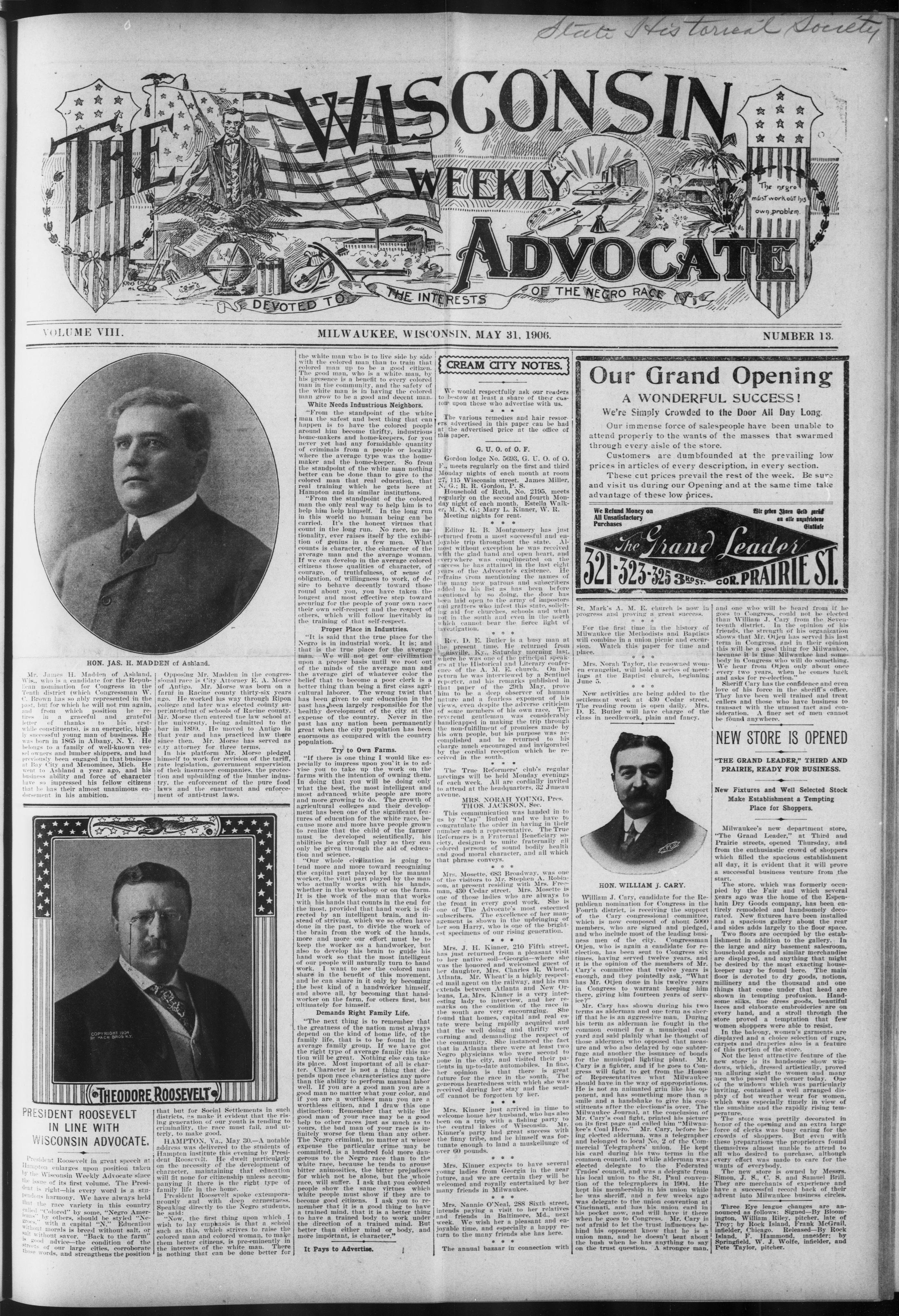
WISCONSIN
WEEKLY
Advocate
DEVOTED TO THE INTERESTS OF THE WEGRO RACE
VOLUME VIII.
[Name not provided]
M. B.
[Portrait of a man in a suit with a tie, looking slightly to the right. The background is a plain, light color. The portrait is oval-shaped with a thin border.]]
HON. JAS. H. MADDEN of Ashland.
Mr. James H. Madden of Ashland, Wis., who is a candidate for the Republican nomination for Congress in the Tenth district (which Congressman W. C. Brown has so ably represented in the past, but for which he will not run again, and from which position he retires in a graceful and grateful letter of thanks to his erstwhile constituents). is an energetic, highly successful young man of business. He was born in 1865 in Albany, N. Y. He belongs to a family of well-known vessel owners and lumber shippers, and had previously been engaged in that business at Bay City and Menominee, Mich. He went to Ashland a year ago, and his business ability and force of character have so impressed his fellow citizens that he has their almost unanimous endorsement in his ambition.
COPYRIGHT 1834
BY PACH BROS N.Y.
COPYRIGHT 1834
BY PACH BROS N.Y.
THEODORE ROOSEVELT
COPYRIGHT 1904
BY PACH BROS. N.Y.
THEODORE ROOSEVELT
PRESIDENT ROOSEVELT IN LINE WITH WISCONSIN ADVOCATE.
President Roosevelt in great speech at Hampton enlarges upon position taken by the Wisconsin Weekly Advocate since the issue of its first volume. The President is right—his every word is a stupendous harmony. We have always held that the race variety in this country called "Colored" by some, "Negro Americans" by others, should be styled "Negroes," with a capital "N." Education without morals is breed without salt, or salt without savor. "Back to the farm" is good advice—the condition of the streets of our large cities, corroborate those words, and strengthens the position
---
---
Opposing Mr. Madden in the congressional race is City Attorney E. A. Morse of Antigo. Mr. Morse was born on a farm in Racine county thirty-six years ago. He worked his way through Ripon college and later was elected county superintendent of schools of Racine county. Mr. Morse then entered the law school at the university, being admitted to the bar in 1899. He moved to Antigo in that year and has practiced law there since then. Mr. Morse has served as city attorney for three terms. In his platform Mr. Morse pledged himself to work for revision of the tariff, rate legislation, government supervision of thethe insurance companies, the protection and upbuilding of the lumber industry, the enforcement of the pure food laws and the enactment and enforcement of anti-trust laws.
ROOSEVELT
that but for Social Settlements in such districts, as make it evident that the rising generation of our youth is tending to criminality, the race must fail, and utterly, to make good.
HAMPTON, Va., May 30.—A notable address was delivered to the students of Hampton institute this evening by President Roosevelt. He dwelt particularly on the necessity of the development of character, maintaining that education will fit none for citizenship unless accompanying it there is the right type of family life in the home.
President Roosevelt spoke extemporaneously and with deep earnestness. Speaking directly to the Negro students, he said:
"Now, the first thing upon which I wish to lay emphasis is that a school such as this, which strives to raise the colored man and colored woman, to make them better citizens, is pre-eminently in the interests of the white man. There is nothing that can be done better for
the white man who is to live side by side with the colored man, than to train that colored man up to be a good citizen. The good man, who is a white man, by his presence is a benefit to every colored man in the community, and the safety of the white man is in having the colored man grow to be a good and decent man.
White Needs Industrious Neighbors.
"From the standpoint of the white man the safest and best thing that can happen is to have the colored people around him become thrifty, industrious home-makers and home-keepers, for you never yet had any formidable quantity of criminals from a people or locality where the average type was the home-maker and the home-keeper. So from the standpoint of the white man nothing better can be done than to give to the colored man that real education, that real training which he gets here at Hampton and in similar institutions.
"From the standpoint of the colored man the only real way to help him is to help him help himself. In the long run in this world no human being can be carried. It's the honest virtues that count in the long run. No race, no nationality, ever raises itself by the exhibition of genius in a few men. What counts is character, the character of the average man and the average woman. If we can develop in the average colored citizens those qualities of character, of courage, of truthfulness, of sense of obligation, of willingness to work, of desire to behave decently toward those round about you, you have taken the longest and most effective step toward securing for the people of your own race their own self-respect and the respect of others, which will follow inevitably in the training of that self-respect.
Proper Place in Industries.
"It is said that the true place for the Negro is in industrial work. It is; and that is the true place for the average man. We will not get our civilization upon a proper basis until we root out of the minds of the average man and the average girl of whatever color the belief that to become a poor clerk is a better thing than being a first class agricultural laborer. The wrong twist that has been given to our education in the past has been largely responsible for the healthy development of the city at the expense of the country. Never in the past has any nation been permanently great when the city population has been enormous as compared with the country population.
Try to Own Farms.
"If there is one thing I would like especially to impress upon you it is to advise you to take up the work on the farms with the intention of owning them. In doing that you will be doing only what the best, the most intelligent and most advanced white people are more and more growing to do. The growth of agricultural colleges and their development has been one of the significant features of education for the white race, because more and more have people grown to realize that the child of the farmer must be developed scientifically, his abilities be given full play as they can only be given through the aid of education and science.
"Our whole civilization is going to tend more and more toward recognizing the capital part played by the manual worker, the vital part played by the man who actually works with his hands, whether in the workshop or on the farm. It is the work of the man that works with his hands that counts in the end for the most, provided that hand work is directed by an intelligent brain, and instead of striving, which we so often have done in the past, to divide the work of the brain from the work of the hands, more and more our effort must be to keep the worker as a handworker, but also to develop his brain to guide his hand work so that the most intelligent of our people will naturally turn to hand work. I want to see the colored man share in the benefit of this movement, and he can share in it only by becoming the best kind of a handworker himself, and above all, by becoming that handworker on the farm, for others first, but ultimately for himself.
Demands Right Family Life.
"The next thing is to remember that the greatness of the nation must always depend on the kind of home life, of the family life, that is to be found in the average family group. If we have got the right type of average family this nation will be great. Nothing else can take its place. Most important of all is charter. Character is not a thing that depends upon race characteristics any more than the ability to perform manual labor well. If you are a good man you are a good man no matter what your color, and if you are a worthless man you are a worthless citizen, and I draw this one distinction: Remember that while the good man of your race may be a good help to other races just as much as to yours, the bad man of your race is infinitely worse for them than any other. The Negro criminal, no matter at whose expense the particular crime may be committed, is a hundred fold more dangerous to the Negro race than to the white race, because he tends to arouse bitter animosities, the bitter prejudices for which not he alone, but the whole race, will suffer. I ask that you colored people show the same virtues which white people must show if they are to become good citizens. I ask you to remember that it is a good thing to have a trained mind, that it is a better thing to have a trained body to work under the direction of a trained mind. But better than either mind or body, and more important, is character."
It Pays to Advertise.
CREAM CITY NOTES.
We would respectfully ask our readers to bestow at least a share of their custom upon those who advertise with us.
The various remedies and hair restorers advertised in this paper can be had at the advertised price at the office of this paper.
G. U. O. of O. F.
Gordon lodge No. 5693, G. U. O. of O. F., meets regularly on the first and third Monday nights of each month at room 27, 115 Wisconsin street. James Miller, N. G.; R. R. Gordon, P. S. Household of Ruth, No. 2195, meets regularly on the second and fourth Monday night of each month. Estella Walker, M. N. G.; Mary L. Kinner, W. R.
Editor R. B. Montgomery has just returned from a most successful and enjoyable trip throughout the state. Almost without exception he was received with the glad hand and open heart, and everywhere was complimented on the success he has attained in the last eight years of the Advocate's existence. He refrains from mentioning the names of the many new patrons and subscribers added to his list as has been before mentioned by so doing, the door has been laid open to the army of impostors and grafters who infest this state, soliciting aid for churches, schools and what not in the south and even in the north which cannot bear the fierce light of investigation.
Rev. D. E. Butler is a busy man at the present time. He returned from Louisville, Ky., Saturday morning last, where he was one of the principal speakers at the Historical and Literary conference of the A. M. E. church. On his return he was interviewed by a Sentinel reporter, and his remarks published in that paper of the 29th May, prove him to be a deep observer of human nature and a fearless exponent of his views, even despite the adverse criticism of some members of his own race. The reverend gentleman was considerably handicapped in making the trip through the non-fulfillment of promises made by his own people, but his purpose was accomplished and he returned to his charge much encouraged and invigorated by the cordial reception which he received in the south.
The True Reformers' club's regular meetings will be held Monday evenings of each week. All are cordially invited to attend at the headquarters, 32 Juneau avenue
MRS. NORA YOUNG, Pres. THOS. LACKSON, Sec.
This communication was handed in to us by "Cap" Buford and we have to congratulate the order in having in their number such a representative. The True Reformers is a Fraternal Beneficiary society, designed to unite fraternally all colored persons of sound bodily health and good moral character, and all which that phrase conveys.
* * *
Mrs. Mosette, 683 Broadway, was one of the visitors to Mr. Stephen A. Robinson, at present residing with Mrs. Freeman, 430 Cedar street. Mrs. Mosette is one of those ladies who are always to the front in every good work. She is one of The Advocate's most esteemed subscribers. The excellence of her management is shown in the upbringing of her son Harry, who is one of the brightest specimens of our rising generation.
* * *
Mrs. J. H. Kinner, 210 Fifth street, has just returned from a pleasant visit to her native soil—Georgia—where she was the honored and welcomed guest of her daughter, Mrs. Charles R. Wheat, Atlanta. Mr. Wheat is a highly respected mail agent on the railway, and his run extends between Atlanta and New Orleans, La. Mrs. Kinner is a very interesting lady to interview, and her remarks on the condition of the race in the south are very encouraging. She found that homes, capital and real estate were being rapidly acquired and that the well doing and thrifty were earning and demanding the respect of the community. She instanced the fact that in Atlanta there were at least two Negro physicians who were second to none in the city, and visited their patients in up-to-date automobiles. In fine, her opinion is that there is great future for the race in the south. The generous heartedness with which she was received during her stay and the send-off cannot be forgotten by her.
---
Mrs. Kinner just arrived in time to welcome home her husband, who has also been on a trip with a fishing party to the central lakes of Wisconsin. Mr. Kinner's party had great success with the finny tribe, and he himself was fortunate enough to land a muskellunge of over 60 pounds.
☆ ☆ ☆
Mrs. Kinner expects to have several young ladies from Georgia in the near future, and we are certain they will be welcomed and royally entertained by her many friends in Milwaukee.
***
Mrs. Nannie O'Neal, 288 Sixth street, intends paying a visit to her relatives and friends in Baltimore, Md., next week. We wish her a pleasant and enjoyable time, and especially a happy return to the many friends she has here.
* * *
The annual bazaar in connection with
Our Grand Opening
We're Simply Crowded to the Door All Day Long. Our immense force of salespeople have been unable to attend properly to the wants of the masses that swarmed through every aisle of the store. Customers are dumbfounded at the prevailing low prices in articles of every description, in every section. These cut prices prevail the rest of the week. Be sure and visit us during our Opening and at the same time take advantage of these low prices.
We Refund Money on
All Unsatisfactory
Purchases
Bir geben Ihnen Geld zurück
an alle unzufriedene
Glnäufe
The Grand Leader
321-323-325 3RD ST. COR. PRAIRIE ST.
St. Mark's A. M. E. church is now in progress and proving a great success.
For the first time in the history of Milwaukee the Methodists and Baptists will combine in a union picnic and excursion. Watch this paper for time and place.
Mrs. Norah Taylor, the renowned women evangelist, will hold a series of meetings at the Baptist church, beginning June 5.
New activities are being added to the settlement work at 430 Cedar street. The reading room is open daily. Mrs. D. E. Butler will have charge of the class in needlework, plain and fancy.
PEU
HON. WILLIAM J. CARY
William J. Cary, candidate for the Republican nomination for Congress in the Fourth district, is receiving the support of the Cary congressional committee, which is now composed of about 5000 members, who are signed and pledged, and who include most of the leading business men of the city. Congressman Otjen, who is again a candidate for reelection, has been sent to Congress six times, having served twelve years, and it is the opinion of the members of Mr. Cary's committee that twelve years is enough, and they pointedly ask, "What has Mr. Otjen done in his twelve years in Congress to warrant keeping him there, giving him fourteen years of service?"
Mr. Cary has shown during his two terms as alderman and one term as sheriff that he is an aggressive man. During his term as alderman he fought in the common council for a municipal coal yard and said plainly what he thought of those aldermen who opposed that measure and who also delayed by one subterfuge and another the issuance of bonds for the municipal lighting plant. Mr. Cary is a fighter, and if he goes to Congress will fight to get from the House of Representatives what Milwaukee should have in the way of appropriations. He is not an animated grin like his opponent, and has something more than a smile and a handshake to give his constituents after the elections' is over. The Milwaukee Journal, at the conclusion of Mr. Cary's coal fight, printed his picture on its first page and called him "Milwaukee's Coal Hero." Mr. Cary, before being elected alderman, was a telegrapher and belonged to local No. 2 of the Commercial Telegraphers' union. He kept his card during his two terms in the common council, and while alderman was elected delegate to the Federated Trades' council, and was a delegate from his local union to the St. Paul convention of the telegraphers in 1904. He kept his membership in his union while he was sheriff, and a few weeks ago was delegate to the union convention at Cincinnati, and has his union card in his pocket now, and will have it there when he goes to Congress. Mr. Cary is not afraid to let the trust influences behind his opponent know that he is a union man, and he doesn't beat about the bush when he has anything to say on the trust question. A stronger man.
NUMBER 13.
d Opening
SUL SUCCESS!
to the Door All Day Long.
espeople have been unable to
of the masses that swarmed
re.
unded at the prevailing low
description, in every section.
the rest of the week. Be sure
ing and at the same time take
Wir geben Jhnen Geld juruß
an alle unjufriedene
Gintäufe
Leader
COR. PRAIRIE ST.
and one who will be heard from if he goes to Congress, could not be elected than William J. Cary from the Seventeenth district. In the opinion of his friends, the strength of his organization shows that Mr. Otjen has served his last term in Congress, and in their opinion this will be a good thing for Milwaukee, because it is time Milwaukee had somebody in Congress who will do something. We hear from Otjen only about once every two years, when he comes back and asks for re-election." Sheriff Cary has the confidence and even love of his force in the sheriff's office. They have been well trained and treat callers and those who have business to transact with the utmost tact and consideration. A finer set of men cannot be found anywhere.
NEW STORE IS OPENED
"THE GRAND LEADER," THIRD AND PRAIRIE, READY FOR BUSINESS.
New Fixtures and Well Selected Stock Make Establishment a Tempting Place for Shoppers.
Milwaukee's new department store, "The Grand Leader," at Third and Prairie streets, opened Thursday, and from the enthusiastic crowd of shoppers which filled the spacious establishment all day, it is evident that it will prove a successful business venture from the start. The store, which was formerly occupied by the Fair and which several years ago was the home of the Espenhain Dry Goods company, has been entirely remodeled and handsomely decorated. New fixtures have been installed and a spacious gallery about the rear and sides adds largely to the floor space
Two floors are occupied by the establishment in addition to the gallery. In the large and airy basement salesroom, household goods and similar merchandise are displayed, and anything that might be desired by the most exacting housekeeper may be found here. The main floor is devoted to dry goods, notions, millinery and the thousand and one things that come under that head are shown in tempting profusion. Handsome silks, fine dress goods, beautiful laces and elaborate embroideries are on every hand, and a stroll through the store proved a temptation that few women shoppers were able to resist. In the balcony, women's garments are displayed and a choice selection of rugs, carpets and draperies also is a feature of this portion of the store.
Not the least attractive feature of the new store is its handsome show windows, which, dressed artistically, proved an alluring sight to women and many men who passed the corner today. One of the windows which was particularly inviting, contained a well arranged display of hot weather wear for women, which was especially timely in view of the sunshine and the rapidly rising temperature. The store was prettily decorated in honor of the opening and an extra large force of clerks was busy caring for the crowds of shoppers. But even with these preparations the proprietors found themselves almost unable to attend to all who desired to purchase, although every effort was made to care for the wants of everybody.
The new store is owned by Messrs. Simon, J. S., C. S. and Samuel Brill. They are merchants of experience and have a successful record back of their advent into Milwaukee business circles.
Three Eye league changes are announced as follows: Signed—By Bloomington, William Riley, pitcher, late of Troy; by Rock Island, Frank McGrail, infielder, Chicago. Released—By Rock Island, F. Hammond, innelder; by Springfield, W. J. Wolfe, infielder, and Pete Taylor, pitcher.
---
The Passing of an Auto-Car.
The Passing of an Auto-Car.
The Auto-crat—oh, think of that!—he went a fearful pace;
He did not smile, though all the whole he had a -mobile face.
He took no interest in man, yet sought the human race.
The Auto-crat—oh, think of that!—I never saw him laugh;
In wreckage strowed along the road he wrote his auto-graph.
A horrid smell were suited well to be his epitaph.
The Auto-crat—oh, think of that!—upon his dying day
The only word I overheard he hadn't auto say.
'Twas gasolene that brought about his sad auto-da-fe.
The Auto-crat—oh, think of that!—his end was swift and sharp,
I hope it hurt—'twas his dessert—though I don't wish to carp;
Perhaps he's in a sweeter land and plays an auto-harp.
—Burges Johnson in Harper's Weekly.
PIGEON RACES WITH TRAIN.
Bird Makes a Fifteen Mile Flight Every Morning.
The passengers on the mail train from Morehead City due here in the morning are greatly interested in the peculiar conduct of a pigeon, which is owned by a man in Wildwood, and engages the train in a race from Wildwood to Havelock every morning, a distance of fifteen miles.
The bird apparently watches for the approach of the train and flies along with it, sometimes ahead of it, but it never fails to accompany the train. It flies so near the cars that passengers can almost touch it.
When the train stops at Newport the bird perches near by and waits for it to start, when it continues its journey to Havelock, then returns to its home, evidently with the impression on its little brain that it has discharged some duty.
The pigeon is handsome, being white with a black head. No other bird seems to take this freak, nor does this one attach itself to any other train, and the wonder grows how the bird appears to prefer this train to any other. It will be sadly missed when for any reason it discontinues its regular flights.—Newbern Journal.
Might Have Borrowed a Basket
John D. Rockefeller, Jr., in an eloquent address, said that it was wrong to believe that the truest friends were those who were willing to lend money.
"Do not believe in anything of that kind," said Mr. Rockefeller. "There was never a greater mistake. If you have any friendship for people, do not spoil it by trying to borrow money from them. The practice of borrowing money is a most disastrous one. It is the surest way to cause the breaking of friendship.
"Besides, to borrow money is a selfish, mean practice. The chronic borrower reminds me of a certain little girl at an Easter feast.
"This little girl ate at the feast a great quantity of chocolate eggs, and bananas, and cakes, and peanuts, and things of that sort, and finally the time came for her to go.
"But you will have a little more cake before you go?" her hostess said, politely.
"No, thank you, ma'am. I'm full,' said the little girl.
"Then,' said the hostess, 'you'll put some nuts and candies in your pockets, won't you?"
'They're full, too,' she said."
Coon-Hunting
The officers of the English squadron prepared for their recent visit to this country by an exhaustive study of so-called American slang, that they might enjoy that "delightful American humor" over which the English have recently become so enthusiastic.
During their stay in Annapolis a cochunt was arranged for their benefit, the officer in charge explaining to them that it was a sport highly thought of and native to the southern states.
As they rode along one of the Englishmen remarked, "You hunt these econs with dogs, I think?"
His host assented and the Englishman continued: "They are found in the woods and are often caught in trees, aren't they?"
"They are" replied the American, "but how do you come to know so much about coon-hunting?"
"Oh," said the visitir, with an air of conscious pride, "I've read 'Uncle Tom's Cabin' you know and all those articles that have come out in the papers lately, but to tell the truth, I didn't think it was allowed by the authorities no matter what the nigger had done."—Lippincott's.
American Fish for New Zealand Streams
The whitefish of the Great Lakes and the red salmon of the Pacific coast have been selected by the New Zealand government from the breeds of the world as the best food fishes wherewith to stock its rivers. L. F. Ayson, commissioner and chief inspector of fisheries of New Zealand, is now in the United States to get from the bureau of fisheries a quantity of spawn of these species for transplanting.
"We have found from investigation," said Mr. Ayson last night, "that your lake whitefish and Pacific coast salmon are the ideal food fishes. Our experiments have shown that these breeds thrive in our waters; the salmon in the snow fed waters of our rivers, so much like your Pacific coast streams, and the whitefish will be at home in the lofty lakes of our intermountain regions."—Washington Post.
The Widow Comforted.
"The late John A. McCall," said a broker, "had at the end of his tongue a host of insurance stories.
"Once, in urging a man to invest in a large policy, he told a story of a Pike county girl.
"This girl married a young guide, and the day after the wedding the guide took out a policy for $1500. Then, with his wife, he started for Porter's lake with a party of sportsmen, the wife to cook and wash dishes, the man to clean fish and so on.
"Now, unfortunately, the young guide was bitten by a ratlesnake one morning, and a few days afterwards he died.
"The widow notified her family and friends of his death in a note that said:
"'Bill parst away yestidy. Loss fully covered by insurance."
The Tourists.
Many stories are told of the incongruous things said by visitors to the Eternal city; but the palm should surely be awarded to a lady who was asked the other day what she liked best of all the things she had seen in Rome, "Well," she said, reflectively, "I think the thing that interested me most was the Capitol. There is a cage there containing a wolf, which, I understand, is the original wolf that suckled Romeo and Juliet."
This forms an appropriate pendant to the absolutely authentic story of the visitor to Florence who spoke enthusiastically of the famous statue of Dante, in the Plazza Santa Croce, as "the statue of Daniel in the lion's den!"—Modern Society.
THE LEGEND OF THE RAINBOW.
Can I paint the mystic beauty
Of the changing woods in Autumn?
Not till God shall give me language
Colored like the clouds at sunset,
Brilliant with their fading glory.
Know you why the living forest.
Clad in somber green in summer,
Wears such brightness in the falltime?
Listen, then, and I will tell you.
When God made the ancient wood trees,
When the world was first created,
They were not as now we see them,
Dressed in diffring shades of greenness.
But he gave them all the crimson,
All the red, and all the yellow
That was left in the vast storehouse
Whence he built this wondrous planet.
And the forest dwelt for ages
Wearing for its crown a rainbow;
Till the race of men grew wicked.
And to punish them the flood came;
Till God said unto his people:
"I will paint a bow in Heaven
When the sudden rain descendeth,
When the thunder and the lightning,
Make ye fear another flood time;
Paint a rainbow for a promise
Never more to drown my children,
To lay waste the world with water."
Then he sent to the vast storehouse
Whence he built this great creation
For the crimson, and the yellow,
For the blue, and green, and purple,
To hang up his bow of promise
In the broad expanse of Heaven.
But he found the storehouse empty Of its crimson and its yellow. For he gave them to the forest To adorn its waving branches.
So he said unto the wood trees:
"Lend me of your radiant tinges,
Of your crimson and your yellow,
To hang up my bow of promise,
Paint my rainbow in the Heavens.
I will paint it in the summer,
When the rains are fierce and rapid,
When the thunder and the lightning
Terrify my helpless children;
In the autumn you shall have them,
In the cool days of the falitime;
Wear them till the Frost King cometh,
Till the leaves fall in the winter."
And the whispering forest murmured
With its myriad leafy voices;
"We will lend you all our brilliance,
All our colors for the rainbow."
So God took the shining tinges
From the forest trees in summer,
And he lent them of the greenness
That was left in the great storehouse
Whence he made this living planet;
But when autumn brings its cool days,
And the rainbow fades from Heaven,
They take back their radiant dresses,
Wear then till the winds of winter.
Susan F. Burbank in Boston Transcript
NOT ON THE MENU
Travers sat alone at a little table in a corner of the cafe. The continual hum and murmur of low-pitched voices, all the interminable sounds of the restaurant surrounded him, but he sat quite still, with his chin resting in his hands, staring at the empty chair opposite to him. The sight of pretty women, well-groomed men, all the bright, lively scene around him did not entice him from his reverie even for a moment. At last Travers nervously drained the cup to the last drop, and then, wearily passing his hand across his forehead, he assumed his former attitude. Dreamily he fixed his eyes on the vacant chair, and then began talking in a sort of breathless whisper, as if to some one seated therein:
"Nannie, Nannie, it's so good to see you again. Let's see, it's been three years, almost, since that last time when—but we won't think of that now, we'll just be happy. Tell me, is your life happy, is he good to you? If he isn't—Oh, if I had only cared less what people might say, if I could have forgotten my miserable pride, we'd have run off some place and been married in spite of your uncle and his money, wouldn't we? Yes, I know. I saw it in your eyes, all that last evening—that you'd have gone anywhere with me, and then, when I asked you if it was really true, do you remember what you answered? Yes, of course you do. But you were brave, and I—I was a poor coward—but it wasn't all my fault. No; there was your mother, always talking about what fine opportunities you had, now that you had been made heir to such a fortune. And then Saunders came along, with his yacht and his automobiles—and anybody could see he was awfully in love with you, and—well, I either had to stop loving you myself or go, and so I came away. But I haven't made quite a failure out of my life. No, Nannie, little girl, not quite. You see, at first, I didn't care much what happened, but then—I got to thinking how you would expect things of me, and so I took a grip on myself and pitched in, struck my gait somehow, and had luck, too—maybe you've heard of me—I wonder if you ever think of—but you must be very happy, with everything done to make you so, and every one loving you
"Travers ceased, and with a shiver buried his face in his hands. "What am I doing, what am I doing?" he moaned softly. "I must stop this, I must or I shall go mad."
After a time, Travers knew not how long, he pulled himself together and looked up. He glanced at what had been the empty chair, rubbed his eyes and looked again. A girl, in a light opera cloak smiled across at him.
"Yes, Bobbie, I'm real." Then, anxiously, as he continued rigidly staring at her, "Bobbie, don't you know me?" Travers had become very pale. He sat, tensely grasping the arms of his chair, mutely drinking in the picture before him.
"Nan, Nan," he breathed. "It's you, yes, you, my own little Nannie. I—I can hardly believe my eyes. I—"
He half rose out of his chair and, crushing both her hands in his, raised them almost to his lips, then realizing that many curious glances were being cast in their direction he released her and sank back.
"Do you know, I—" he began hesitatingly.
"Yes?" she murmured, leaning forward, her eyes never leaving his face, "you were saving?"
"Do you know, I was just thinking of you—wondering where you were, what you were doing, whether—you were happy or not; tell me, you are happy with him, are you not?" "With him! With whom?"
"Why, your—husband."
"My husband! I have no—why, Bobbie, I'm not married!"
"You're—not—married! But Saunders, what about Saunders? You know, after I left, I thought you would—"
"Yes, yes, I know you thought, you thought—oh, Bobbie, you thought too much—you had no right to think that I would marry him. You thought you would go away and let me enjoy my uncle's bounty, but you had no right to think that I wanted—"
"But Nan, I did it for the best, don't you see?"
"No. I don't see at all. You men always do everything for the best. You never think what a woman wants, how much a woman may care——"
She stopped and drew back, crimson:
ing, the tears creeping into her voice and her eyes. It was now Travers' turn to lean forward. Tremblingly he reached into his breast and pulled forth a tiny lace handkerchief, crumpled and dark with pocket grime. Unfolding it, he spread it out before her. "Do you recognize that?" he asked. "Why, it's mine," she quavered. "It's the one you stole from me at the Martin dance and then wouldn't give back."
"Yes, that's it. And I've kept it with me ever since—always. But—" a thought striking him. "Your mother?"
At this she seemed suddenly to remember her position. Stifling a sob she caught at her cloak, and, hastily rising, looked across the room. Travers reached over and gently pushed her down.
"You're not going just yet," he said quietly, "not for all the mothers in the world."
She looked at him searchingly, the trouble in her eyes slowly giving way to a look of happiness, of contentment, the sight of which brought a smile of exultation to his face.
"I don't know why I came over here, Bobbie," she murmured, nervously twisting the handkerchief around her finger. "Mr. Saunders took me to a table over there and then went out to look for mother, who was coming behind with Mr. Burdick; and when I looked around and saw you I was so glad I didn't even stop to think, but just——"
"Saunders!" he interrupted roughly, "I thought——"
"Yes," she said hurriedly, "he never seems to give up. It's impossible to make him understand that we can only be friends, and mother won't understand." Closing her eyes wearily. "Between them both I almost go crazy sometimes."
A look of ineffable longing came into Travers' eyes as he gazed at the drooping form of the girl before him, and this was quickly followed by an expression which no small number of men had learned to fear.
"Hang Saunders and his whole crowd," he choked out, grasping her hands and kissing them again and again, this time utterly oblivious to his surroundings. "I lost you once, three years ago, Nan Weatherby, but, by heaven, I'm not going to lose you now! Listen to me——"
"Oh, Bobbie," she gasped, "everybody's looking at not!"
"Never mind that," he smiled, still holding her. "The Rev. Charles McCracken lives just around the corner from here and he is a good friend of mine. Shall we call on him?"
"You said once my eyes told you I would go anywhere with you," she said, looking up at him; "what do they tell you now?"
And from the size of the tip which Travers shoved into the hands of the astonished waiter, we may safely conclude that the light in Miss Nan Weatherby's eyes illumined a pretty straight road to the abode of the Rev. Charles McCracken.—W. B. Keller, Jr., in Columbia Monthly.
MOTHER TONGUE.
Comparison of English Spoken in England and in America.
The shafts launched at Mr. Henry James yesterday during a meeting of the Modern Language Association of America at Haverford college, were barbed with wit and not a little justice. They do not, nevertheless, destroy the unfortunate vitality of the contention that the speech of Americans is inferior to that of Englishmen.
It is not a matter of the comparative merits of the differing English and American standards. In the particularities of usage our own rule is as frequently as not to be preferred. "Different from" is as good as "different to;" "in accord with" as "in accord to;" "under the circumstances" as "in the circumstances," "as soon as he came," as "directly he came." The Englishman's failure to distinguish in pronunciation between the verb and the noun "prophecy" is lamentable; his hard "genesis," and his soft "schedule" are, to our ear, an inversion of propriety, and his enmity toward the Italian u in "figure" is a national horror. We may say "vaniller;" but we couldn't possibly be guilty of "figger."
But the speech of England is immeasurably superior to that of America—gentlemen of the Modern Language association will not deny it—in this—namely that whereas Americans, even educated Americans, are careless in both grammar and pronunciation, slip-shod, easy-going, and prone to every colloquial short cut, the vast majority of Englishmen speak with precision, according to a well-established national standard.
The meat of the matter is in the fact that we of America have no pride in or care for correctness of speech. We never dream of judging a man's education or culture from the manner in which he speaks. We are not surprised to find the same verbal faults upon the lips of college presidents, men of letters or of affairs that we have heard from the untaught. There even lingers among us a suspicion of too great elegance of speech, as if heartiness and vigor could not comport with refinement. And so we go on torturing all foreign ears and wronging our own souls with the drawl, the slur, the clipped syllable, the flattened vowel, the strident voice and slovenly enunciation. We snub our labials, we torture our midsyllables and we massacre our vowels, until in our homes, streets and even lecture halls, churches and theaters, the stately tongue of Shakespeare and Milton is become inglorious, shabby, well-nigh infamous.
In England how different is the case. There his manner of speech is an index of a man's education. Of the unlettered little may be expected, but in the graduate or in the man or woman of respectable breeding a verbal fault is a social crime. Carelessness is not excused. Vigor is not held to be a thing opposed to accuracy, or power to be necessarily uncouth; on the contrary, a clear head is expected to express itself in correct sentences, cleanly enunciated. It is expected to do so, and it does so—to the pleasure of the listening ear, the delight of the answering mind and the promotion of social understanding, amiability and efficiency.
To establish the same happy conditions in America it would be necessary only for the educated to persuade themselves of the desirability of correct utterance, and in particular for all such organizations as the Modern Language association to rebuke at every opportunity such pointless pettifogging pleas as that which formed the climax of one delegate's address. "Power is more (sic) to be preferred than (sic) mere breeding."—Philadelphia Ledger.
The following changes in the Three I league are announced: Released—By Bloomington, Noah Henline and Guy Balliet; by Cedar Rapids, F. Asher. Signed—By Bloomington, P. McLaughlin and J. McShane, late of Bay City, Mich., and J. Asher; by Cedar Rapids, Arthur Owens, late of Toronto and last year with Dubuque.
New York Every Day.
New York Every Day.
Mme. Emma Eames, the grand opera singer, was among the passengers sailing on the steamer La Savoie for Havre.
James O'Neill and Mrs. O'Neill sailed for Europe on the Caronia last week, to be gone until August. Mr. O'Neill's next tour in Monte Cristo will open at McVicker's theater, Chicago, on August 18.
Adele Ritchie was voted the most popular actress in America at the contest held at the advertising show in Madison Square garden last week. She received a total vote of 1037, beating her nearest competitor, Marie Dressler, by 162 votes. The prize was a bulldog.
"I hope you passed a holy Sabbath," said an Episcopal clergyman of Brooklyn on Monday to a parishioner whose pew was vacant the day before, and who by the way is a Wall street man and a golf fiend.
"Oh, yes," the parishioner replied. "without irreverence I may say I passed an 18-hole-y Sabbath."
This fellow wants a wife—one with money—and he doesn't care who knows it. In a 'personal' now running in one of the New York newspapers he says: "I want a wife and I need mine, so I will marry the woman who, with the largest bank account, is willing to share it with me. I am young, healthy, temperate and good looking. Write me and I will call — .General Delivery."
Down in Wall street they are tearing down a building, and in accordance with the usual custom there are "danger" signs arranged on each side of the covered structure over the sidewalk. But with an eye to being particularly careful the contractor has caused the signs to read: "Why walk into danger when there is lots of room on the other side?" Of course, no one, so far as any one can see, pays the slightest attention to the signs.
"We have more than we can do in the way of manicuring," said the expert little manicurist in an up-town New York establishment, "but it is nothing to the manicuring our chiripodist is expecting to do when sandal times come around. The nails of the toes of those who wear sandals must be kept as beautiful as those of the fingers. He had a great trade last summer," she finished tranquilly, "among the girls who lived in studios. They nearly all wore sandals through the hot months."
Richard Canfield has returned from Europe. Canfield went away an ill man and his trip has done him no good. Indeed, if appearance go for anything, he is in a worse condition physically now than he was when he went away. Asked about his business, he repeated that he had retired, and said any report to the contrary was made out of whole cloth. "Of course," he added. "I still own the property at Saratoga, but don't talk to me about clubhouse or gambling. I said before I went away that I was out of the game for good. I'll never get back into it, either. I'm through."
He might have been a southerner. Dressed in drab-colored frock coat, with flowing tie and wide-brimmed hat, he boarded a subway train at Times square. There were several men standing in the car and there was a score sitting down, including one negro. A woman in search of a seat entered from the car ahead. She stopped and grasped hold of a strap. The southerner looked at the woman, then looked at the negro. Then the white man's hand went into his pocket. When it came out it held a dime. Addressing the negro the owner of the dime said: "Here's money; this lady wants you seat." The negro took the dime and the lady took the seat. Had the negro ever lived in the south?
If the board of city magistrates of New York had decided to adopt Magistrate Higginbotham's ruling, "hitting the end seat hog" would be a popular summer pastime. Magistrate Higginbotham has decided that anything short of homicide is permissible toward the beast who clings to the rail end of an open car seat. A man named Melford attempted to board a Flatbush avenue car at the Manhattan bridge terminal. He was blocked by a fat man who held fast to the end seat and refused to budge until Melford punched him. At the Brooklyn terminus the man called a policeman and had Melford arrested. Magistrate Higginbotham released him after severely reprimanding the complainant.
Oh, girls, just listen to this: There is a scarcity of hose—not of the garden variety; Oh, dear, no, but of those fine, cobwebby effects. If the hosiery manufacturers who are in convention in New York city are to be believed it will cost more to encase the nether extremity of the summer girl than heretofore. And this is due, they say, to the scarcity of mill operators. T. H. Weihenmayer of Hagerstown, Md., in an address pointed out that the only way to relieve the lack of available mill hands is to engage an employing agent in New York to act for the members of the hosiery manufacturers' association, and hire at the docks the better class of immigrant girls for the mills throughout the country.
Miss Ethel Barrymore has definitely decided not to go to Europe this summer. Since her engagement to Capt. Harry Graham of London, was announced it has been reported from time to time that she woud visit England this summer and that their marriage would be celebrated abroad before Miss Barrymore's return. But the actress' plans have been changed, and the announcement was made from the office of her manager, Charles Frohman, that she will spend the entire summer in this country. She has taken a cottage in Maine and leaves for there this week, to remain until the beginning of her season. No announcement is made as to her marriage, as Miss Barrymore is not taking even her manager into her confidence on the subject.
George Irving, the last surviving nephew of Washington Irving, marvelously hale and active at 82, is living at the Fifth Avenue hotel, New York. Mr. Irving is practically the sole remaining member of the Irving family. He is one of the best, yet most modest, story tellers of the Amen corner. He was graduated at Columbia when the university was at College place and Park place. "My, my," said Mr. Irving, recently, "I don't think you young gentlemen have the fun the young fellows had in my day, when we had sleighing in this city a month and more in the winter, and when a ride over Kissing bridge at Canal street was an event to be remembered even now—but never to be talked about, you know." Mr. Irving is preparing a history of the Irving family.
Did you ever hear a brakeman or the porter of a sleeping or parlor car cry out "New York" when the train pulls into Jersey City? Everybody who comes here is supposed to know that this is the getting off place. Of course Jersey City is not New York, but it is on the rim of this town, and it's dollars to tin tags
that did the porter or brakeman call out anything it would be New York. All along the lines of the various roads the brakemen call out the various towns. Why, they even tell you when you get to Philadelphia. When your train reaches the national capital they call out Washington, don't they? Then why don't they announce that "the next stop be New York?" It is likely owing to the fact that every person who comes to the metropolis is supposed to know when he gets there.
Those present at "The Social Whirl" performance at the Casino, New York, the last few nights, have been surprised at the finale when Adele Ritchie, mounted on the gray mare Gloria, rakes the "hedge jump," to see a glittering band around the animal's leg, midway between the knee and fetlock. The opera glasses of those in the rear quickly told their owners what the spectators in the front half of the house already realized—that Gloria was wearing a diamond bracelet. Investigation revealed that the bracelet was a birthday present from Miss Ritchie to Gloria. The mare was 5 years old Monday. The bracelet contains seventeen diamonds of large size and is valued at $3500. So far as is known Gloria is the only animal outside of Oriental stables that wears a trinket of this kind and value.
A taste for high life has hit the able seamen of New York. No longer are they content to ship before the mast on any old "wind jammer" that comes along irrespective of the pedigree of her owner or his social status. A sudden yearning for better things, for a more refined, aesthetic, and incidentally a better paid existence afloat has swept irresistibly over the deep sea sailors hereabouts, with the result that sailing masters of common every day craft, without brass rails and pillow cushions, are having a hard time getting crews. The whole trouble is that in the spring a sailor's fancy lightly turns to thoughts of yachts. The pay is higher, the work easier and the food better. After the hard winter montiss spent on some little coastwise schooner the charms of an easy berth aboard some millionaire's yacht are irresistible.
They were talking about the income of Fraulein Krupp of Essen, Germany, who is about to wed and whose income is said to be something like $14 a minute, when they came to a side door of a concert hall uptown in New York. There was a crowd of perhaps 150 well dressed women and men standing on the sidewalk looking intently at a door. "What is the trouble?" said one of the men. "Why, we are waiting to see come out that woman who gets $10 a minute for singing," was the response. The woman is a well known vaudeville performer, whose press agent has not neglected to play up the salary dodge.
"I wonder if Fraulein Krupp could attract such a crowd by merely walking out of the door without a press agent to boom her?" was the question one of the pedestrians asked.
Every weekday morning, just before 9 c'clock, there is admitted through the grim iron gateway of the Tombs, in New York, an earnest, pleasant mannered man, who goes directly to the second tier of the boys' prison. There he takes his stand in an alcove lighted from a barred window that looks out on Center street, and furnished with a bookcase, desk and fourteen benches. The man is Joseph C. Graveur, the schoolmaster of the Tombs, otherwise chief probationary officer. His pupils are the young men and boys in the prison awaiting trial charged with various offenses. For seven years Mr. Graveur has presided over this unique school and has exerted an influence for good upon thousands of boys. There is not such another school in the world. The schoolmaster lets the boys ask him whatever they want to know. There is no set form of study. One question leads to another and the Tombs school takes more the form of a general information bureau than anything else.
If you noticed undue excitement along the docks in New York, don't put it down to any seismic disturbance. It was only Frank Daniels and his family going to Europe. Mr. Daniels has a step-son and a step-daughter. He loves them very much and they love him, but at times they have the strangest manner of showing their affection. The girl, being a girl, is the more tractable of the two, and a glance from the stern eye of Mr. Daniels--occasionally even the funny eye of such a comedian as Frank Daniels can bluff itself into sternness--will bring her to her senses and her equilibrium. The boy is harder to manage. He has the habit of being sent home from school during the session, of tearing around in his father's automobile and of doing other things which are not criminal, but which show that animal spirits may at times become troublesome and annoying. Anyway, the Daniels, big and little, got off for Europe and Rye, N. Y., will breathe evenly and temperately for some weeks to come. Mr. Daniels will make a tour of the continent with his little brood in an automobile, weather and machine and step-son permitting.
There is no more lid in New York. It is off; it is lost; and en passant it might be relavant to the subject to whisper that there are no efforts being made to ascertain the whereabouts of the aforesaid lid—there have been no rewards offered for its recovery. Never since the days of Bill Devery has New York been so wide open as it is now. The Jerome-Dowling gambling act, which was not only to close all the gambling houses in the city, but also to keep them closed, is a dead letter. There are as many poolrooms as there are churches, and almost as many handbooks as there are saloons. It is a dull night when a sport cannot attend a prize fight; and any gent who wants to try his luck at roulette or faro can find a "steerer" in almost any one of the whiteway resorts. More crooks can be found in the vicinity of Broadway and Forty-second street than were gathered there when former Police Commissioner McAdoc was led to declare that was the worst corner in all New York. The men "higher up" seem to have hynotized the officials, and the latter have taken to the simple life. The big and little grafters are coming into their own once more. If students of conditions are rightly informed, the big grafters are getting a large share than they did in times agone. Probably that is due to a new rule in the police department which practically makes it unwise for a captain or district inspector to do any important work toward the suppression of vice unless the people in command at 300 Mulberry street tell him to do so.
A Foolometer.
Some visitors who were being shown over a pauper lunatic asylum inquired of their guide what method was employed to discover when the inmates were sufficiently recovered to leave.
"Well." replied he, "you see, it's this way. We have a big trough of water, and we turns on the tap. We leave it running, and tells 'em to bail out the water with pails until they've emptied the trough."
"How does that prove it?" asked one of the visitors.
"Well," said the guide, "them as ain't diots turns off the tap."—Harper's Weekly.
There Are Certain Times When It Finds a Very Strange Mark.
One of the most useful and necessary articles among the findings of a well found ship is the hand lead, writes a sailor to The Independent.
It is a 16-pound lead attached by a leather thong to a small but stout manila line, and we use it to learn what depth we are sailing in when we don't know anything else.
The lead line up to twenty fathoms is divided and subdivided into nine marks and eleven deeps. A deep is any fathom which is not marked.
One is a deep because it goes furthest down; two, three and five are marked by strips of leather of varying shapes; the intermediate marks are shown by strips of cloth of different colors and textures.
Thirteen and fifteen are marks, red, white or blue. Eighteen and nineteen are deeps, and twenty fathoms is indicated by a small cord irrevocably spliced in between the lays of the line and bearing a double knot.
When we are drifting about a lee shore or driving along a strange coast in thick weather an able seaman is always lashed in the chains to keep the hand lead alive and let us know what soundings we are in.
To throw the lead properly requires a good deal of practice. The seaman gets a good swing on the lead by waving it back and forth a few times just above the water line; then he pays out and whirls the lump of lead in a two fathom circle around his head and lets go as far forward as possible to keep up with the momentum of the driving ship. Then he hauls in the slack of the line and calls out to the officer of the watch, in a long drawn, singsong tone, what depth he has found, and casts his lead again.
In the daytime the marks are easily discernible; but in the darkness of night we cannot distinguish them by color, and therefore we must go by touch.
It is easy to tell by feel whether you are testing a cotton rag, a woolen clout or a strip of bunting.
But it often happens that our fingers become so benumbed by frost and cold that there is no longer any feeling in them. Then we clutch the dripping line and kiss the nearest mark, and the sensitive lips will instantly tell what depth we are in.
Home-made Plaster Plagues
A unique yet artistic gift that even a busy woman can "manufacture" is the plaster plaque. The most tedious part of the process is the cutting out of the picture, but with fine, sharp scissors, several can be prepared in an evening. The variety of subjects has even more possibilities than the shaping of the plaque, and while the black and white prints are the easiest to procure, still photographs, etchings, and steel engravings may be utilized. It is well for the novice to use second choice pictures for the first experiments for, as in everything else, practice makes perfect. Plaster of Paris should be mixed with water till of the consistency of cream, and be used as soon as stirred smoothly. Only a small amount should be used at a time—at least by the novice. The plaques are molded in sauce-citches, small platters, vegetable dishes or any earthen receptacle of the desired shape and size. Those illustrated vary from four and one-half inches, diameter circles, to ovals five by eight, and six and one-quarter by eight and three-quarters inches. The rectangular shape is four and one-quarter by seven inches, and the larger round plaque six and one-half inches in diameter.
The picture is dipped into water and laid face downward on the dish to be used as a mold. With a slightly dampened cloth pat the picture very smooth, to be sure no bubble of air is underneath, and lightly moisten the dish at the same time. Pour the plaster of Paris on the picture and quickly even it across the bottom of the dish, having it not over a quarter of an inch in thickness. Tap the bottom of the dish occasionally to prevent any air bubbles, and smooth the plaster with a cake turner or putty knife. When it is thoroughly dried paste a backing of rather thick linen paper on and one or two "hangers" such as are used in passepartout work.—Pilgrim.
The Flight of Time
Mr. Justice Brewer of the United States supreme court, in lecturing to his law class at the George Washington university, told the following story:
"I knew of a case once where two darkies swapped mules. One of them was an old hand at the business, and in making the trade he represented his mule to be 7 years old, and told of many good traits the animal had not. This was in February. About two months later the other darky began to realize he had been victimized in the bargain and that the beast was fully 12 years old. So he decided to go back and tell the swindler he had lied to him about the animal. However, owing to it being the busy season of farming, he was not able to go until about the middle of June. He finally did go, and told his man what he thought of his rascally misrepresentations about the mule.
"You say," said the other fellow, "dat when you got de mule in February he was 7 years old, and now it's June and he's 12 years old?" "Yes. I do!" was the angry response. "Well, sah, time sure do fly."—American Spectator.
John Boyle's Battle Run
John A. Boyle of Newton took part in the Civil war, and liked to tell about his experiences. At a meeting one evening he told about the experience he had at the battle of Bull Run, as follows:
"I saw the men drop their guns and run, so I dropped mine and ran, too, but I was chased by one of the enemy, who had his gun in his hand. I ran the fellow a good race for two miles, and then I stumbled and fell, and was expecting him to come up and shoot me. He didn't come, so I looked around to see where he was, and to my surprise saw him sprawled out on the ground about two yards from me. I got up and looked at him, and saw that he had died from apoplexy."
Boyle's hearers asked what he did next, and he replied: "I wept for the man that I had run to death."—Boston Herald.
It Pays to Tip.
Jean Gerardy, the well known 'cellist, at a dinner in Philadelphia praised American wit.
"You are all witty," he said. "From your millionaire down to your gamin you are quick, nimble and sparkling in retort.
"Your gamins' wit is sometimes cruel. It caused a friend of mine to flush and mutter an oath one day last week in New York.
"My friend, in a hurry to catch a train, ran out of his hotel toward a cab, and a ragged little boy opened the cab door for him and handed in his valise."
"He gave the boy nothing. In his hurry, you see, he forgot.
"The disappointed urchin smiled sour-
ly and called this order to the driver:
Bird of Prey Ten Feet from Tip to Tip. The largest bird of prey in the world is the bearded vulture, which measures from wing to wing tip, as much as nine to ten feet.
GOSSIP FOR THE LADIES.
Petar's Battle Flag.
The United States flag was formally adopted by Congress, June 14, 1777. The first flag was made by Betsy Ross and presented by her to Gen. Washington.
From dusk till dawn the livelong night
She kept the tallow dips alight,
And fast her nimble fingers flew
To sew the stars upon the blue.
With weary eyes and aching head
She stitched the stripes of white and red,
And when the day came up the stair
Complete across a carven chair
Hung Betsy's battle flag.
Like shadows in the evening gray
The Continentals filed away;
With broken boots and ragged coats,
But hoarse defiance in their throats;
They bore the marks of want and cold,
And some were lame and some were old,
And some with wounds untended bled,
But toasting bravely overhead
When fell the battle's leaden rain,
The soldier hushed his moans of pain
And raised his dying head to see
King George's troopers turn and flee.
Their charging column reeled and broke,
And vanished in the rolling smoke,
Before the glory of the stars,
The snowy stripes, and scarlet bars
Of Betsy's battle flag.
The simple stone of Betsy Ross
Is covered now with mold and moss,
But still her deathless banner files,
And keeps the color of the skies.
A nation thrills, a nation bleeds,
A nation follows where it leads,
And every man is proud to yield
His life upon a crimson field!
For Betsy's battle flag!
—Minna Irving.
Woman Holds Her Admirers.
Admiring and loving are quite different things, though often confounded, for how frequently one hears a man say,
"Oh, yes, I admire her very much, but she is not the kind of woman 1 could fall in love with!"
What first attracts a man is beauty, what holds a man is charm, and a woman may be very lovely, yet possess no retentive charm. Thus it is we see a beautiful woman losing her grip on a man's affection, while a plain woman does not do so.
Why this should be is rather a vexed question, but as a general rule it will be found in such cases that there is none other than mere physical beauty, no beauty, it may be, of intelligence, feeling, or sympathy. It matters not how exquisite a woman may be in complexion and features; if there is no depth in her nature she ceases sooner or later to be attractive.
The beauty of Lady Blessington would never have fascinated such men as Thackeray, Wellington, Brougham, Landseer and Dickens had she not been brilliant intellectually. Yet even her beauty, enhanced by her intellect, had not the same hold over men that less gifted women have possessed, because, alas! she was shallow!
An Irish poet once said to the lovely Lady Morgan: "Were you a Venus I should forget you, but you are a Laura, a Leonora, an Eloisa, all in one delightful assemblage! My idea of you is very exalted indeed. This in a woman, a beautiful woman, whom I must ever esteem, what magic can be so irresistible in this world?" Rachel, the great actress, was not at all beautiful, but she commanded an admiration due to her genius, and that only, for, apart from her talents of the stage, she seemed to have little or no power to win such lasting esteem as it has been given to even very foolish women.
So it is evident that neither beauty nor intellect by itself, nor even united, have any permanent influence over men. In fact, there is but one irresistible charm that can conquer when intellect, beauty, position, money may all fail. That charm is fascination. And if there were such beings as fairies to give gifts to mortals the best gift a woman could ask for would be the gift of fascination, that strange, indefinable influence that exercises such a strong magnetic influence over everyone. So uncanny was it considered in old days that it was almost regarded as the spell of the Evil One, and certainly in those times its thraldom could not be connected with the power of education, of mind over matter.
There are two types of fascination, natural fascination and cultivated fascination, and, as in everything else, the natural charm far exceeds in beauty, depth and influence the artificial one, which often degenerates into absolute hypocrisy and a social veneer, impressing without convincing. Just as some birds with the plainest plumage have the sweetest song, so some women with the plainest faces have the greatest fascination.
I can think of one woman who, though old and almost ugly, with clumsy figure and coarse features, yet possessed the power to attract men away from even the youngest and prettiest of girls. The secret was that she made people pleased with themselves. In her presence they felt clever and bright. Her conversation was as dry as champagne, exhilarating and piquant.
The essence of attraction by sympathy, a real genuine sympathy, but some people mistake gush for sympathy, and are then repellent rather than attractive, as gush is but forced feeling, possessing no sincerity whatever.
What men especially admire in a woman is femininity, though the gentle, appealing woman who can hardly cross a road without fear and trembling, who faints at the sight of a mouse, or shrinks at the sight of a spider, is rather out of date now, and receives more sympathy before marriage than afterward, as the charm of helplessness that may be fascinating in a fiancee becomes a bore in the wife.
No, femininity without helplessness is much more lasting in its grip on a man's affection, and when united to true sympathy, tact and intelligence forms an irresistible force of fascination. Tactful, intelligent sympathy, which can comprehend another's most trivial joy and deepest pleasure, and another's slightest grief and keenest sorrow is the magnet that draws around a woman a circle of ardent friends.
To be able to descend in sympathy to the level of a fool or ascend to the heights of a genius means in more mundane matters a host of admirers for a woman, as these admirers admire her for appreciating them!
Everyone craves for sympathy, and perhaps men do so more than women, and as this craving is unconsciously selfish, a woman must be ready to give her sympathy without hope of return, and then she may perhaps one day get her reward in a lifelong friendship or love.—Philadelphia Evening Bulletin.
A woman who is performing some interesting experiments in her efforts to find a solution to the domestic service problem declares that the personal equation more than the social stigma is responsible for the present complexity of the situation. The mistress and maid are continually in contact and whatever is inharmonious in their personalities is bound to clash. The employer of a hun
dred girls in a factory does not even know their names, much less their individual characteristics. She believes after a close study of both sides that the only solution is to reconstruct domestic service along business lines, where system will take the place of confusion. She is not looking for a general houseworkers' union, but she does expect that an eight or ten hour day will be in force before long throughout the realm of the kitchen.
Some New York women who believe that housekeeping is as much of a profession as law, have already tried this scheme with great success. When their maids are off duty they are as independent as if they were living in another part of the city. They may go out, or read and sew in their own rooms, as they please, and no one calls upon them for services. Of course the amount of work varies, but the helpers understand that and on busy days perform their duties with greater dispatch. For big dinners or week-end parties extra help is always brought in. These same women do everything to encourage their domestics to take an intelligent interest in their work. The housekeeping magazines are eagerly read in the kitchen. One parlor maid is making a scrap book of clippings which bear on her work, and takes pleasure in trying the suggestions and adopting or rejecting them according to their merit. The cook in this same family has a card catalogue in which she keeps all of her recipes. She takes as much pride in filling out a new card as her mistress does in finding a new feature for a luncheon. She now boasts of a larger repertory than any of her colleagues and does her best to keep up her reputation.
This same mistress appropriates part of her housekeeping allowance to the cause of modern equipment. She says she would no more expect her cook to do good work with worn-out or old-fashioned tools than her husband would expect his stenographer to turn out good-looking letters with a disabled typewriter.
The woman who is making a study of the situation says that she finds the mistress much more difficult to deal with than the maid. Given sobriety and honesty, the domestic is generally amenable to reason. But the woman with an income of $2000 a year expects her one general houseworker to cook dinner, do the chamber work, open the door, wait on table in an immaculate cap and apron, even do the washing, in exactly the same style as the ten or a dozen servants of a large establishment—this, too, with very little supervision or assistance from herself, for she demands all the leisure and craves all the luxury of a millionaire's wife. When the mistress is given over to extravagance and refuses to apply herself to domestic matters it is no wonder that the maid proves unsatisfactory.
The student of the domestic problem says that some employment agencies by enlarging the scope of their work are meeting the situation. They insist that their maids shall have excellent and genuine references, and they keep track of their work when they are in a place. Moreover, when they become dissatisfied inquiry is made into its cause, and often the difficulties and misunderstandings are adjusted. They furnish classes in cooking and laundry, and every ambitious maid has a chance to advance in her profession. Aside from this instruction in technical matters, some of them form the girls into clubs and give them recreation in their hours off duty. New York Sun.
Saving and Spending
The American woman is pre-eminent in many things. But her best friends can hardly claim for her that she is a careful saver or a wise spender. The most intelligent woman in the world in many respects, she is not always intelligent on these two important points. She can earn money—no doubt of that. But economy is to her the dismal science, and investment a matter of speculation, literally. Only in New England has economy become a part of character, as it ought to be. For money, in any quantity, is power, and power is responsibility.
The girl who spends her allowance in candy and matinee tickets is relaxing the moral fiber of her own character. She graduates into the woman who buys a spangled lace robe, which she really could do without, because it is cheap or because she has a little extra money on hand. "The true view of economic life," insists an authority on financial questions, "requires that every expenditure be regarded as an act that involves a moral question, as indeed it does. It is a moral act if it be necessary and wise. If it be unnecessary and unwise it is immoral, for it is the misuse of so much power as the money stands for." Perhaps this may be called a counsel of perfection. But it would bring, if followed, peace and prosperity into many a household where debt and financial chaos now reign. "Why can't we have bills? Then we could put all the people off," argued a bride of a few months with her young husband, a professional man, striving to make his way on an income of $1500. She was the product of a first-rate boarding school, and the child of a family high in social position. But she was utterly uneducated in the morals of handling money.
Financial independence, for most families, can only be secured by careful, steady saving and equally careful spending. Such saving and spending mean self-control—the very root of all high character. The grocer's bill, the bargain counter, are moral tests. There is a great deal said and written nowadays about the "business woman," using the phrase to describe the women who earns money. But all women, in their relation to money, are business women. The earning of money is one branch of business; the distribution of money is another quite as important one. Both require integrity, self-control, and determination to do one's best, if the business woman is to succeed. The wife who has the spending of her husband's income can double its purchasing value if she has made a study of the art. Tried by this standard, it is hardly a credit to the American woman's intelligence to count up the households where no money is saved, where small debts accumulate, and where shopping is one of the amusements of life.—Harper's Bazar.
Little Things cf Housekeeping.
The housewife who has experienced the annoyance resulting from the shrinkage and consequent disablement of wooden pails and tubs, will be glad to know that this may be prevented by painting the articles, while still new, with one or two coats of glycerine. The care of fine tableware is much too important a matter to be delegated to inexperienced servants. Cut glass, for instance, speedily loses its brilliancy if not properly cared for, and when scratched and dull is scarcely distinguishable from the basest imitation. Hot water, softened with a little ammonia, should be used for cleaning it, the washcloth being made of two or three thicknesses of cheesecloth, quilted. For cleansing the interstices a soft brush is needed and when all dust and dirt are
removed the glass should be rinsed in clear hot water—not too hot, however; it should then be drained for a minute or two, and when almost dry polished with a piece of clean, soft chamois.
When lamps are used in the household it requires a practical mind and a watchful eye—qualifications which few servants appear to possess—to obviate the unpleasantness and dangers attending them. The burners should be boiled at least once a month, all of them being treated at the same time. To do this they should be placed all together in a tin saucepan reserved for the purpose, and covered with boiling water, to which has been added a good-sized lump of common washing soda. After fifteen minutes of rapid boiling, all grease, dust and charred remnants of wick will have been loosened. The burners should then be well rinsed with plenty of clear water, dried with a cloth and finally brushed thoroughly with a small, long handled paint brush.
No less important than this operation is the careful and regular trimming of the wick. When the lamp has been filled—care being taken that it is not filled too full—the cap of the burner should be lifted and the wick raised to the top of the cylinder which contains it. Then, with a sharp pair of scissors, the charred parts should be neatly and evenly trimmed off, the corners being rounded very slightly. Dull or smoked chimneys can be cleaned by the method suggested for cleaning cut glass; or they may be held over the steam arising from a kettle of boiling water, and afterwards polished with a piece of soft newspaper.
The shining tin and brassware with which our grandmothers' kitchen were resplendent have quite passed out of recognition, and the average housekeeper now stocks her shelves with a plentiful supply of agate or granite ware. The labor of keeping modern culinary utensils clean really amounts to very little, the only requisite being plenty of hot water, a couple of small-sized scrubbing brushes, some good soap and a package of wasling powder or a bottle of household ammonia. The latter, which disperses grease as if by magic, is especially useful. Every saucepan or stewpan should, as soon as its contents are removed, be filled with hot water—a little soda or soft soap being added—and set on one side of the stove; within twenty minutes it will need nothing more than a thorough rinsing and drying. When scouring is necessary, a mixture of silver sand and common salt is invaluable for the purpose.
The wise woman who possesses a marble slab—the relic of some discarded table or bureau—will have it set up on a stationary shelf in her pantry or a cool corner of the kitchen, and will use it for pastry and bread making. For rolling dough, cutting meat, dressing poultry, and, indeed, for most other culinary preparations, marble is the coolest and most desirable of all surfaces to work upon; and it possesses the distinct advantage of being easily cleaned and deodorized.
The far-seeing housekeeper always keeps a stock of old newspapers on hand, knowing to how many uses they may be applied. For the kitchen stove no better polisher is required, and it may be burned as soon as used, thus doing away with dirty and malodorous rags and brushes. As a floor padding, to be placed beneath the carpets, newspapers are particularly useful, precluding the entrance of the ubiquitous moth. -Pittsburg Leader.
"Every City Has Its Place of Refuge."
On a desperate day, when life was choked with disorderly detail, I met, on the crowded street of the city, a minister whom I know. His delicate face, fair with age and spirituality, the thin white hair blowing about it, had an effect, in the crowd of redder, heavier faces, like the high notes of a piccolo in an orchestra.
"My dear child!" he said, holding my hands. "You look tired."
"I want a mountain," said I, "some place of refuge, high above the swirl of things, whence I can look down and perceive them in due relationship."
"I have often longed for it," he answered.
Then as we talked on together we planned for a city which should lie at the foot of mountains, near enough to be within reach of every inhabitant, yet far enough away for healing quiet and loneliness. Later I came to know that every city has its place of refuge—it may be an ocean, or a river leading to peaceful country meadows, or a broad lake, full of clean water, over-arched with clean air, to which one's clean thoughts rise like gulls Denver, when I saw it, most nearly realized the city of that daydream. For here, bound to it by a half-dozen roads of iron and of earth, visible at the end of every street, rise the noble mountains; and to them in the heated season flock crowds of weary over-driven people, seeking respite. They leave behind them all shams, and live as you see, most simply, asking of their houses merely protection from the sudden, fierce mountain storms. The inhabitants often sleep outside and eat outside, and build big bonfires outside to sit about and for warmth on the crisp mountain evenings.
Such homes as these nestle in many wild nooks, sheltering wholesome, hearty young men and women, and renewing the youth of older ones. I wonder why, after tasting these simple and enduring joys, they ever return to varnished and decorated city homes, and artificial city lives; but I am very sure that, some time or other, this simplicity will outweigh that elaboration, and the city life brought to conform to the pattern seen in the mount—Marion Foster Washburn.
Queens Taller Than Kings
Some enterprising chronicler has been taking notes on the respective heights of the Kings and Queens of Christendom and furnishes the following data:
King Edward is quite six inches shorter than Queen Alexandra.
The Czar is overtopped a full head by the Czarina.
Kaiser Wilhelm is above medium height, but the German Empress is very tall, and that, they say, is the reason that the proud Hohenzollern will never be photographed beside his wife, unless she sits while he stands.
The King of Italy, short and squat, hardly reaches to the shoulder of the tall, athletic Queen Helena.
The King of Portugal, though he would make up amply in girth, fails of the height of his Queen.
The Prince of Wales is some four inches shorter than the princess.
The young King of Spain is topped by some inches by the English Princess Ena, and the homely but good Queen of Denmark literally towers above her lord.
Sleep.
Though much has been said on the subject of ventilation it is surprising to know how many women sleep with the windows of their room closed or open the very least little bit. This is ruinous to our wage-earner's looks. At night she can regulate her supply of air to suit herself, and there cannot be too much of it.
Put on plenty of covers, and have the bed warmed with a hot water bottle, but open the windows. Now and then in waking up in the morning one will feel one's throat to be thoroughly parched and dried. This is a sure sign that one has been sleeping with open mouth, inhaling through it instead of inhaling through the nostrils. Many devices have been invented and exploited to keep the mouth shut during sleep. The simplest way is to bend the head down slightly, closing the jaws so that they cannot fall. When the neck
is stretched and the entire body relaxed in sleep the jaw falls open. It usually does this when the subject sleeps on her back. The correct sleeping position to lie in is on the left side, with arm thrown behind.
Sleeping on the right side stretches the muscles about the heart, and increases any trouble one may have with that organ. Sleeping on the stomach hinders digestion and renders breathing difficult.
A woman should have eight hours' sleep; less than this amount will, if long continued, destroy both health and looks.
One of the wage-earning woman's greatest difficulties lies in the fact that she cannot get her mind off her work, and carries her daily worries and anxieties even into the realm of her dreams.
Restful and helpful sleep can only be had when the brain is at rest. No one can teach another to let go of her worries; each person must find the way for herself, but often a few pages of some helpful or amusing book read just before going to bed will change the thought current and sooth the active brain into readiness for quiet slumber.
Many women of nervous temperament have a tendency to insomnia. As the nervous woman generally does not eat enough, a glass of warm milk taken just before retiring will often quiet the nerves and induce sleep. Chopped onions are a wonderful soporific should one choose in indulge in them, and they are healthful as well. The unpleasant odor of the onion can be counteracted by chewing a bit of Canadian snakeroot and the breath perfumed by a bit of orris root held in the mouth. A busy and successful man once told me that the reason professional women's nerves gave out so often was simply a question of slighted and slight lunches.—Dr. Mary G. Markwell in New York World.
Don't Talk of Yourself.
The wise woman is a good listener as well as a good conversationalist. It is much more o fan art to draw out the best thoughts of other people than it is to converse well oneself. One often meets intelligent persons who never enter a room full of people without monopolizing the conversation. Their faculty for useless chatter is unlimited, and their conversation is liberally interspersed with the pronoun "I."
Well-bred people have a wholesome dislike of talking about themselves. One never knows how much they know, on what wonderful sights they have seen, unless some circumstance occurs to bring it out. It is left for the person of few ideas and narrow vision to keep up a ceaseless chatter. It is the occasional traveler who seeks to impress upon her friends the fact that she has seen something of the world. She never misses a chance of speaking about it. While this is not an unpardonable fault, it is a disagreeable one, which sometimes causes the inveterate talker to be spoken of in terms anything but complimentary.
ANIMALS LIKE A JOKE
They Pull Tails, Make Up Faces and Play Tricks.
Animals with a sense of humor, or signs of one anyway, are described by a writer in the Strand. He tells of a female baboon that delighted in teasing a certain watch dog. As soon as the dog settled himself for a doze, the baboon would steal up and give the canine a vicious tug. Of course the dog would go for her, but she would simply wait till he got close enough then leap over his head and from behind give his tail another pull.
A Siamese monkey was being brought to Europe on a steamer with several other monkeys, who, for some reason, would have nothing to do with him.
This indifference exasperated the Siamese and whenever he got a chance he would grab one of the others by the tail, drag him all over the deck and finally climb into the rigging and drop his victim with a dull thud.
Darwin tells of a female orangoutang that took hold of a dish in which her food was served and put it on her head as if it were a hat. Thus adorned she provoked roars of laughter, to her evident gratification, from the crowd around her cage.
Another naturalist saw a baboon get even with an officer who had often teased him. Seeing the officer approaching the baboon poured some water into a hole in the ground, mixing it with earth so to make mud. When his enemy came up he splashed the muddy water on the officer's uniform. For a long time after this every time the animal saw the officer he indulged in what had every appearance of being laughter.
The Rise in the River.
It is little short of astonishing to see how little water is required to float the southern river steamers, a boat loaded with perhaps 1000 bales of cotton slipping along contentedly where a boy could wade across the stream.
Not long ago, however, the Chattahoochee got too low for even her light-draught commerce, and at Gunboat Shoals a steamer grounded. As the drinking water on board needed replenishing, a deckhand was sent ashore with a couple of water buckets.
Just at this moment a northern traveler approached the captain of the boat, and asked him how long he thought they would have to stay there.
"Oh, only until that man gets back with a bucket of water to pour into the river," the captain replied. Presently the deckhand returned, and the stale water from the cooler was emptied overboard. Instantly, to the amazement of the traveler, the boat began to move.
"Well, if that don't beat thunder!" he gasped.
The fact was that the boat, touching the bottom, had acted as a dam, and there was soon backed up behind her enough water to lift her over the shoal and send her on down stream.—Harper's Weekly.
Why the Camel Wept.
A Willesden gentleman, on a visit to Egypt, decided to have his portrait painted seated on a camel, with the hoary pyramids for a background. He accordingly engaged an artist and hired a trusty Arab to attend to his camel. The appointed hour arrived, and he perched himself gingerly on the camel and tried to look as much like an Arab sheik as his modern get-up would allow.
When the ship of the desert dropped anchor at its home, some five miles or so away, the terrified tourist had just breath enough to gasp: "W-what's the matter with the brute?" "Him full ob grief, sah," replied the Arab, solemnly. "Him rec'nised his mother's hair in painter-man's brush, sah)"—Tits-Bits.
His Mood.
A member of the faculty of the University of Wisconsin tells of some amusing replies made by a pupil undergoing an examination in English. The candidate had been instructed to write out examples of the indicative, the subjunctive, the potential and the exclamatory moods. His effort resulted as follows:
"I am endeavoring to pass an English examination. If I answer twenty questions I shall pass. If I answer twelve questions I may pass. God help me!"—Harper's Weekly.
His Last Hunt.
"No, Duke, you can't go! You're too old! You can't keep up any more! Lie down now in the sun, and take a good rest while we're gone!"
The old dog looked entreatingly into the speaker's face, but he obeyed. He was not so old by five years as the master, who was still young and vigorous for the chase. Yet he must lie in the sun, now and wait—oh, so impatiently—for the young master's return from those hunts in which he had once been the life and leader. He dropped back upon the ground, and lay with his nose pointing to the hedge through which his master, with his college friend, and "Music," the new young dog, had passed, leaving Duke to doze and dream.
The sun was warm—it would be a glorious day in the woods, Duke thought. And then, for the first time, he noticed that there were woods just beyond the hedge—tall trees, with the sunlight sifting through them—and that the hedge itself was not as he had believed it, but taller and more open—a part of the forest, in fact. And from between the branches there stepped, just then, a man, young of face, and clothed all in green, like the forest.
"Up. Duke!" he cried gayly; "up, old dog! The red deer runs to the north, and who so fit as you to follow! Haste, haste brave fellow, for the hunt waits."
haste, brave fellow, for the future waits.
Who had spoken of him as being old! Duke could not remember. The blood tingled and surged through his veins. As he bounded on ahead he lifted up his voice in a deep, joyous bay. Then, all at once, they were among a gay party—men of lively dress, on horses smartly caparisoned; other men, too, in the green dress of him who had called. And there were dogs. Duke had never seen them before, but they rallied about him, and gave tongue to their new leader.
"Away! Away!" called the handsomest of the horsemen. "To the chase!"
Through the sun-bright morning woods—the scent of the red deer before, the baying of the pack and the shouts of the huntsmen behind! Slender branches leaned forward and tipped dew on him as he passed. A brown bird overhead whistled and called. A rabbit sprang out before, leaping wildly for a little way, and then disappeared in the bushes unheeded. Bright, startled eyes from everywhere amid the branches looked down as the old dog passed—the old dog that had become the new dog; and far ahead, the red deer running to the north, heard the bay of the leader of the pack coming nearer and nearer, and into his eyes came fear, and into his feet came an added swiftness that stretched his length yet closer and still closer to the ground, in a wild and frantic race for life.
The sun crept higher up the trees. The forest thinned into a wide open. The antlers of the red deer went tossing against the sky. The rest of the pack, the huntsmen—they were far behind and forgotten—Duke was alone—alone on the gray downs, with the red deer running to the north. Old dog! Had anybody ever called him that? He had dreamed it, surely. Old dog, indeed.
The sun is just overhead now, and dazzles on the sand dunes. Perhaps it blinds the red deer, for on a mound he halts an instant and, turning, snuffs the wind. For a moment he makes a brave figure against the blue, and then is off again, wildly and with long, reckless leaps. The distance between him and his pursuer is growing shorter, and he knows it. The muscles in his lithe limbs are stretched and strained and failing. And behind him comes, and still comes, the old dog—the old dog that is the new dog—eager, tireless, and with the swiftness of the winds of March.
The sun slips down the sky. There is no longer even the voice of the following pack. They are alone in the world, it would seem. Duke and the red deer running to the north. They have crossed a river—they have climbed a hill—they have plunged through brush and brake—they have leaped a wall, and always the red deer is nearer and nearer and flagging in strength, and always Duke is fresher and swifter and surer of his prey. And now there is a place of tall grass where the deer, perhaps, hoped the old dog could not follow. Old dog? Ha! With long, leaping bounds he skims the waving green on the wings of youth. And then the deer turns desperately to the struggle. But it is too late. He is fagged and done, and the "old dog" drags him down.
The sun is low in the sky. The weary pack and the shouting, bedecked horsemen come up, and the men in Lincoln green. And there, amid the grass, is Duke, guarding his fallen prey. How they rally about him! How the hand-somest horseman of all goes down beside him to praise and caress! How they cheer and throw up their hats for the hero who had followed the great red upland deer to the north, and dragged him down alone. Through the darkening woods, bearing their trophy homeward, they go, shouting and laughing and praising, until at last they reach a wide court and a great, brown firelit hall where the feast is waiting. And now others—and these are fine ladies—come out to welcome the huntsmen, and then to join them in praises and caresses and cheers for the old dog. Old dog? Old—?
"Duke, hey, Duke! See what we've brought home!" It was his master's voice, and Duke started. The lights of the great hall, the green huntsmen and gay ladies swept together, and became a pleasant hedge from which the sunlight was fading. A deep shadow had crept out from it and lay all about him. Looking down at him was the smiling face of his master, and in his hand swung three rabbits. Duke regarded him confusedly for a moment, and then gradually his looks became one of solemn indifference. Rabbits! Showing rabbits! To him!
"I don't know what has got into Duke," he heard his master saying one morning a week later. "He never wants to go with us any more, but just walks away with a superior air when he sees us getting the guns ready.
"Perhaps he's getting too old."
Duke scornfully walked over to the hedge, sniffing.
Old! Old! Yes, he was too old, indeed for the sport of rabbit chasing—he who had seen real hunting at last, and followed and dragged down alone the great red upland deer!—Albert Bigelow Paine in St. Nicholas.
Lucky Discovery of a Will.
In order to secure some token by which to remember a great-aunt to whom she had been much attached, Mlle. Bertha Chevanne, a young Frenchwoman, attended a sale of the old lady's effects. The girl was poor and most of the articles were beyond her purse.
A shabby old book—a book of devotions—was, however, put up. Nobody bid for it except Mlle. Chevanne, and she bought it for next to nothing. In turning over the leaves she came across a folded paper. It was a will bequeathing her the whole of her great-aunt's estate, valued at $80,000.—Paris Cor. London Telegraph.
Appendicitis in Water
It is a terrible thing to say, but the editor of a Paris newspaper has the nerve to say it, and that is, that appendicitis is shown by statistics to be far
more prevalent among teetotalers than among moderate users of alcohol. The result is said to be due to the weakening of the appendix by excessive mineralization. But the doctors tell us that none of us drink enough water, and they keep talking about "flushing the system." "We of the old school," says the Paris editor, "drink our bottle of claret when dining, with the result that we are gay and well, free from appendicitis." But there are worse things than appendicitis, and some of them happen to folks that drink too much claret. —Boston Globe.
The opening of Riverview park, Chicago, was marked by two unique events. The owner of the ostrich farm gave a banquet to a few invited friends, and the entire menu was of ostrich eggs, which are quoted at $300 a dozen. They are said to be appetizing.
In consequence of what is said to have been a rigid examination on the bible, freshmen of Maryville college, at Knoxville, Tenn., are charged with having circulated a handbill attacking Prof. Bassett, teacher of Latin, who prepared the questions. The faculty is making every effort to locate the guilty persons.
A horse standing calmly in the center of an ordinary sailboat as it rolled in the waves and with the white sails fluttering in its face was the peculiar sight witnessed by people on the Stephenson dock at Escanaba. The horse had been placed in the boat at the Merchants' dock and was being taken to Stonington by Smith brothers of Bay de Noc township.
In an address to the graduating class of the Baltimore hospital and training school for nurses, Dr. George Preston said that girls who trained for a nurse ought to be pretty, and if they can't be pretty they should be as pretty as they can. He said it is a great thing for a sick man to have a bright, pretty girl put soft, white hands upon his aching brow.
Her mind weakened by the use of cigarettes and determined to be freed from her imprisonment in the House of the Good Shepherd at Peorna, Ill., Hilda Trimble, 18 years old, garbed herself in trousers and made her escape. She wandered to Pekin and there was arrested. She confessed she has existed on cigarettes for weeks having smoked 240 in twenty-four hours. She will be sent to the industrial home at Geneva.
Through the mistake of a farm hand Mrs. Betty Berry, living near Lithepolis, south of Columbus, O., lost a hen which had a record of laying two eggs daily. Mrs. Berry suspected the fowls of acting queerly in the manner of producing eggs, and she locked this hen up. She learned that her suspicions were true, and when the hen was killed accidentally two fully developed eggs were discovered.
Holding that her chances of entering heaven depended upon her remaining married, Mrs. Susan Jones, a Mormon, of Omaha, is resisting the granting of a divorce to her husband. Henry Jones. When the case was under consideration Mrs. Jones' attorneys told the court that it is the belief of the Mormons that an unmarried woman can not enter Heaven, and that for the sake of her future bliss she will resist the divorce to the utmost.
Mrs. Samuel G. Elliott, weighing almost 400 pounds, was arrested at Huntington, W. V., on a warrant charging her with inhuman treatment of a stepdaughter.
"Well, I will not go to court," said Mrs. Elliott to the constable, "unless you take me by force."
As Mrs. Elliott is practically unable to walk, owing to her portliness, the officer is baffled. It is next to impossible to move her, hence the situation is puzzling.
An investigation by Dr. W. H. Abington of the Argenta (Ark.) board of health into the death of A. S. Roberts, a jewellery peddler, revealed that Roberts had tried to live on 10 cents' worth of ice cream a day and had starved to death. The man had a theory that ice cream contained more nourishment and was better for him than any other kind of food, and, clinging like a maniac to this belief, he wasted himself to a mere shadow and finally died.
Col. John Robinson of the Robinson circus may be made the defendant in a damage suit as a result of the anties of his big elephant Queen at Michigan City. As the circus train was passing Bellfast, south of here, Queen blew a trunkful of water against Charles Williamson, who was standing on the depot platform. Williamson sustained painful injuries. The elephant had secured the water from the engine tender, which was ahead of the elephant car. When discovered by the train crew the elephant had about drained the tank, and concluded by driving the engine crew from the cab by drenching them with water.
"The deadly gloom and monotony of men's dress—one of the scandals of the age—is traceable to class inequality and the scramble for wealth," said Henry Holiday, the well known artist, in a lecture on "The Influence of Social Conditions on Dress," to the members of the "05" club in London. "There was a time when sumptuary laws regulated the dress of the different classes," he continued, "but free Britons did not tolerate this, and there are now no longer any sharp distinctions between the dress of the different grades of society. We can hope for no radical change in our dress until we have altered our social system. So long as the greed for profit continues, so long will our dress be vulgar."
Dr. C. A. Crane at the People's temple, at Boston, Mass., made a violent attack on Harvard students during a speech opposing the proposed law to permit saloons to keep open until midnight. He said: "The chief among the buyers who demand it are not commercial travelers but verdant youths at Harvard who are deluded in the notion that rushing from the green rooms and questionable theaters with actresses to hotels is a mark of manliness and virility. These tender shoots, these easy marks for the saloon, furnish most of the custom for the midnight extension law issued in the name of a restrictive license."
"Marry me or I will kill you and myself," declared Rev. Edward H. Shepley, pastor of the First Congregational church at Geneva, Ill., to Edith Wilson, school teacher, according to the girl's story. While they were out driving, Miss Wilson says, the minister drew a razor and threatened her, and to save her life she consented. The girl's story has caused a flurry in the little city of Geneva that has forced the resignation of the minister. It is said other charges will follow. Shepley has disappeared and no trace of him can be found. A curious feature of the scandal is that a bolt of lightning struck the steeple of the church as Shepley was writing out his resignation in his study.
R. B. MONTGOMERY, Editor and Proprietor.
The Wisconsin Weekly Advocate after three years' residence at 79 Fifth street, has moved its headquarters to 430 Cedar St., where we will receive our guests and trans- act our business in future.
A Representative Journal Devoted to the Interest of All the People.
ADVERTISING RATES.
One inch, one year.....$15.00
Two inches, one year.....25.00
Three inches, one year.....35.00
Four inches, one year.....42.00
For larger space, special rates.
Locals, 10 cents per line.
TERMS OF SUBSCRIPTION
One year ..... $2.00
Six months ..... 1.00
Three months ..... 50
Direct all communications to
R. B. MONTGOMERY.
430 Cedar Street.
HOW TO SEND MONEY.—Post Office
Order, Express Order, Draft or Registered
Letter. R. B. Montgomery will not be
responsible for loss when sent in any other
way.
All communications must be sent with the name and address of the sender as an evidence of good faith, but not necessarily for publication. No manuscript returned if not accepted, unless accompanied by stamps.
"I know of the bravery and character of the Negro soldier. He saved my life at Santiago, and I have had occasion to say so in many articles and speeches. The Rough Riders were in a bad position when the Ninth and Tenth cavalry came rushing up the hill carrying everything before them. The Negro soldier has the faculty of coming to the front when he is needed most. In the Civil war he came 400,000 strong, and I believe he saved the Union."—President Roosevelt.
Lynchers in Contempt
There is a suggestion of the farcical in meting out the penalty of contempt of court to men guilty of the crime of murder. Yet that is the extent of the punishment to be inflicted on twenty-seven citizens of Chattanooga some or all of whom on March 18 lynched a Negro—and "lynching," said Justice Brewer. "is murder."
However, better that punishment than no punishment at all, since but for the fact that the lawless act was in flagrant contempt of the federal supreme court the twenty-seven lynchers would go scot free, for all that the state authorities are likely to do to them.
The lynching followed and was directly actuated by the supreme court's order granting the Negro an appeal on the ground that his constitutional rights had been violated during his trial. The order placed the Negro under the protection of the authority of the court, and the lynching was clearly in defiance and contempt of its decree.
The court will no doubt inflict the heaviest penalty in its power, and give these practical Anarchists a needed lesson in proper respect for federal authority. Some, perhaps all, of the accused men will be designated through the contempt proceedings as participants in the lynching, and the cue given for the state prosecutors to act upon. Will the state of Tennessee rise to the occasion, and show the resolution of a civilized community to stamp out this lynching barbarity within its borders?—Milwaukee Sentinel.
The force of these words can not have their measure taken coming from such a high and exalted source as the Milwaukee Sentinel. The opportunity for Tennessee to make herself immortal has come, bred by that just jurist, Justice Harlan of the supreme court, the only man since the days of Lincoln who has done so daringly for the right.
Booker T. Washington Is Right
"On our first page we print an article from the Chicago Post on "Our Name in Congress." In this article is a conservative letter from Dr. Washington in which he very properly shows that the American Negro prefers to be called "Negro" to other race names which a few philosophers who love sound have been seeking to fasten on the race in this country. In this Mr. Washington represents 95 per cent. of the intelligent Negroes of the country.
Moreover, Booker Washington deserves the gratitude and praise of every decent Negro in this country for stepping aside to say the word "Negro" should be spelled with a cap N. We hope this plea of Mr. Washington, as it has become a part of the Congressional Record, will have the effect to set impartial writers for magazines, etc., right on this important question."—Chicago Conservator.
Can any good come out of Nazareth? When did Brother Wilkins take a tumble to himself and at last recognize the fact that any good thing could emanate from Prof. Washington. We congratulate Brother Wilkins on his change of heart and hope it will long continue.
In regard to the matter in controversy we have always stood up for the word Negro with a capital N. and insisted upon our printers using the same.
The railway rate bill is in course of passage through the House of Representatives, and strenuous efforts are being made to include the seventh amendment which would virtually extend the Jim Crow car law at present prevailing in the southern states to those in the north and west. This amendment is the inception of Senator Tillman, the arch enemy of our race. But the game has been blocked. We are not asleep all the time, and the phraseology of words can not deceive us. The several Wisconsin representatives have been communicated with by the editor, and their serious attention called to this matter, and we have no doubt but that they will perform their duty by recording their votes for the defeat of this amendment, which reads:
"It shall be the duty of carriers engaged in interstate commerce to provide equally good service and accommodation to all persons paying the same compensation for interstate transportation of passengers."
Martin Lewis, champion middle weight wrestler of Illinois, and Charles Stone wrestled fifty-five minutes to a draw at Rockford, Ill.
CHAIRMAN CONNOR SPEAKS AT LAST
IS CANDIDATE FOR NOMINATION FOR LIEUTENANT GOV-
WILL SUPPORT GOV. DAVIDSON.
Time for Results of the Strife of Former Campaigns, Not for More Strife.
PREFERS HARMONY TO AMBITION.
W. D. Connor of Marshfield, chairman of the Republican state central committee, who for months has been keeping the politicians of the state in suspense as to his plans for the coming campaign, has spoken at last.
To Run for Second Place.
He is a candidate for the nomination for lieutenant governor and will support Gov. James O. Davidson in his campaign for the nomination for governor.
He has issued a formal announcement to this effect in which he states that he would like to be governor of the state and his personal preferences would have been to enter the contest, but that the present is not the time for strife. The result of the recent bitter campaigns, he says, has been the election of not only a state ticket but a Legislature in sympathy with the principles for which the contest was waged for so many years.
People Want Results.
People now are looking for results instead of for new struggles. They are asking if their taxes are any lower, if conditions are any better, if the primary election law is giving the opportunities that were promised? The chairman then urges cessation of strife and endorses the candidacy of Gov. Davidson and announces his own candidacy for the nomination for lieutenant governor.
Many Made Inquiries.
Mr. Connor's statement is as follows: During the past few months many people throughout the state have inquired as to my views on the present political situation and for a statement as to my personal plans. There has been no wish on my part to keep the public in a state of uncertainty or to mislead any one as to my intentions. Until now I had not fully determined what course it was my duty to pursue. In order to arrive at a reasonably intelligent conclusion many questions had to be considered. It is true I would like to be governor of the state of Wisconsin and my personal preference would have been to enter the contest, make an honorable effort for the nomination, take my chances and be satisfied with the result
Conditions, however, are peculiar. The Republican party in Wisconsin has gone through a strenuous period the past six years. Contests have been waged, with success, for principles which were so important that no man who took part need ever have regrets. As the result of the last campaign, the most intense of all the contests, not only the state offices, but for the first time the Legislature was in harmony with the party principles and enacted into laws the measures over which there had been such bitter controversy. The leaders contended that the measures were advocated because they were in the interests of the people. That being true, I believe from the enactment of those laws, instead of being thrown into another contest in the first campaign after the laws have been enacted on account of conflicting ambitions of men who have stood together in the past for the same principles.
People Demand Results.
The people today are looking for results from past struggles, rather than to engage in new ones, and today many are justly asking, "are my taxes any lower as a result of the taxation laws that have been placed on the statute books?" "Am I able to secure better results from my labor on account of lower rates of freight on the products of my farm since the railway regulation law has been enacted?" "Is the primary election law going to give me the opportunities that those who advocated it claimed for the law, the chance to express for myself, unrestricted by dictation, my choice for candidates for state and county office?" If the leaders in this great movement lose sight of the questions that are in the minds of the people in a scramble for office, possibly some may have doubts as to their sincerity of purpose.
I am only a common, every day citizen who has grown up with the country and can make no honest claims that I am the one, and the only one, who is able to enforce the laws and get results from the people from the new measures that have been placed on the statute books.
Neither can it be possible that there are not several men equally capable and equally honest who could perform that service. The success of the party in the past has not been due to the efforts of any one man. In every county men have made noble sacrifices and have had no reward or recognition for their services. In many counties men who were in the forefront of the battle, giving every possibly assistance in the last campaign, are candidates for office. I do not believe we should now encourage a bitter conflict in the state, dividing into factions those who have stood together in the past and thereby endanger the principles for which we have contended and the opportunity for these men who have been loyal helpers from securing some benefit for their many sacrifices in the past.
If we held different opinions on questions of vital interest to the people, then I would believe it my duty to stand out squarely for these principles. This, however, is not the situation in Wisconsin today. If more candidates for governor enter the race, in the personal strife certain to follow we would be encouraging those who have been opposed to our party principles and running in grave danger of furnishing them an opportunity to undo all that has been accomplished in the past.
I, for one, do not wish to be in any way responsible for bringing about such a result.
Will Support Davidson.
The Hon. James O. Davidson succeeded to the office of governor less than six months ago. Mr. Davidson was one of the first to take up the new questions in Wisconsin, and during all the years never have I heard any man question his loyalty and faithfulness to those principles. During his service as a public official there have been bitter personal feelings aroused, when men on the slightest provocation sometimes accused others of wrong-doing, yet no man has ever made such a charge against Mr. Davidson. During the short time he has been in the governor's chair his acts have been above honest criticism. Placed in a very trying position Mr. Davidson has given every attention to his office, and tried earnestly to perform his duty and carry on the great work left to him to perform.
I do not believe the people of Wisconsin will be satisfied to refuse him an indorsement and expression of confidence in order to gratify the ambition of those who are anxious for the place.
I appreciate the kindly intention of many friends throughout the state who offered me their support and urged me to become a candidate and I have not been unmindful of the many expressions from large number of counties where petitions have been circulated among those who worked with me in the last campaign, expressing their approval of my past service to the party and urging me to become a candidate for governor. Yet I believe when these loyal friends view the situation from different standpoints they will approve of the course I am taking.
When I reached the conclusion not to endanger the party by entering the field for governor many of my friends urged me to become a candidate for lieutenant-governor. In view of the fact that I am personally interested in questions that will be
1
HON. W. D. CONNOR.
important issues in the campaign, such as the regulation and control of insurance companies and other corporations and the development of the railway rate law after the experience resulting from practical trial, I have, therefore, concluded to become a candidate for ilientenant-governor, and in doing so I will ask the approval and assistance of those who worked with me during the last campaign and the support of the people who believe in simple justice and fair dealing in politics as well as anything else. W. D. CONNOR.
The letter of the chairman of the Republican central committee announces his support of the candidacy of the present governor for re-election is a masterpiece. He speaks straight from the shoulder and means what he says. He has made one of the shrewdest moves for the good of the party—sacrificing himself when he could have the highest honor of the state placed in his hands. The time will yet, we predict, come when his reward, if he desires one, will be freely tendered to him.
HORSE AND HORSELESS
Each Does the Other a Good Turn Now and Then.
A farmer in Cadiz, Ind., recently jacked up his automobile to serve in lieu of a broken engine in the shelling of corn and cutting of fodder for his live stock and horses. The latter partook of their share of the feed without showing any hard feeling toward their deadly rival, the auto.
One man who has been touring the country says that the horses have accepted the automobile more gracefully than the farmers have.
He tells the story of an automobilist who met an elderly couple driving a skittish horse which decidedly objected to passing the unknown vehicle. The driver of the car stopped to offer his aid, but the man declined it with the remark:
"If you'll lead my old woman by, I guess the hoss and I can make it all right."
Another horse and horseless yarn comes from a man in Oregon. He says:
"When I bought my car I marveled that the company could sell it for $1550. Now I marvel that they could sell it at any price. Marveling is the cheapest part of the proposition, I find.
"My particular marvel out in my barn reminds me of the man who built so much stone fence in one day that it took him two days to walk back to where he began. My car will take me—sometimes—so far from home in two hours that it takes the rest of the day for me to drive home with a providentially hired horse."—New York Sun.
NOT PAUL JONES' BODY.
Remains Found in Paris Those of Coachman.
The Cardiff Western Mail of London, which claims to have consulted the best archeologists who are familiar with the circumstances and to have made an investigation of the archives in Paris and in Wales, says that the remains recently brought from France to America and so signally honored are not the ashes of John Paul Jones, the naval hero, but are now positively identified as the remains of William Jones, a Welsh coachman.
Great fun is being poked at America by London periodicals, which generally charge that America has been "faked." One says: "America's passion for curios is well known and the professional faker takes full advantage of this eagerness to buy. The picture galleries of America are full of spurious Correggios, Titians, Van Dykes, Raphaels, and other old masters. But this is probably the first time that America has bought a faked corse."
The Cardiff Western Mail, in its story of the alleged fake, says: "Houses had been built on the site of the tomb of Paul Jones in the Protestant cemetery of Paris, where, in another part, the tomb of another Jones—William, a groom to the British envoy during the French revolution, was still intact. Anxious as he was to take home with him the body of the famous corsair, Gen. Porter decided that any remains coming from the ancient Protestant cemetery would do. The remains of William Jones, the groom to the British ambassador, were turned into those of John Paul Jones.
Diver's Work in Deep Water
Thirty fathoms, or 180 feet, is the depth at which the Japanese diver, Doumea, testified that he could work for a couple of minutes. Thirty fathoms is a sufficiently remarkable depth for diving, and Doumea was questioned a good deal about the experience of attempting to work at that depth.
"I can only stay just a couple of minutes—long enough to hitch a rope," he said. "To stay longer would cause a complete collapse. When one gets down to that depth it feels as if all the limbs were dead. The parts of the body protected by bones, such as the chest and the head, does not feel this effect, but wherever there is flesh at the surface it feels paralyzed. The limbs seem to be dead.—Hawaiian Star.
Maine's Longest Bridge.
The new bridge over the Sheepscott river, between Wiscasset and Edgecomb, is said to be the longest in Maine. There were used in its construction between 1200 and 1300 spiles, varying from 25 to 65 feet in length. All those put in deep water were of oak.
The bridge is 18 feet wide, with a total length of 3350 feet.
All of the timber and railings are of hard pine, of which 200,000 feet were used. It took about 175,000 feet of pine and hemlock planks to cover it, and about two and one-half tons of nails were used in fastening this planking in place. More than 6000 bolts, varying from 9 to 36 inches in length, were used. —Boston Globe.
IN THE BUSINESS TO STAY! JOHN L. SLAUGHTER
Desires to inform his friends and the public generally that he sold out his interest in the coal and wood business on the east side to his brother and has opened a yard for the sale of
in the rear of his premises, 217 WELLS STREET, where he has large and small teams to deliver orders in any quantity promptly.
Make Them Go Even if They Persist in Sleeping.
With the average child, it is entirely possible to present church-going as such a privilege that he will desire to go. It will be considered in the light of an honor and a treat. Many, many little ones do look upon it in this way, no matter how sleepy they grow during service. Never mind if they do. Let them slumber peacefully on, and don't stand up during the singing of hymns. Better pillow a little head on your lap there, than to have a restless child getting into mischief at home, or staying there yourself to prevent the mischief.
It is sadly surprising how soon the children grow beyond influencing in the church-going habit these days. If this is to be established in the interest of the future welfare of both church and child, the custom must be fixed in infancy. How many boys and girls over 16 do you happen to know who began of their own accord to attend church, not having fixed the habit earlier, unless they had become Christians and taken a decided turn at this age? In the formative period of childhood, while mother's will is law not to be dissented from or it should be such—the gentle exercise of authority and the way in which the church attendance can be made alluring will serve to establish a habit that should be lifelong.
The idea that a child should be allowed to choose or refuse to go to church, according to his own whim, and should never go unless he feels exactly like it, does not prevail among the best of the new-fashioned mothers any more than it did among the old-fashioned ones. A child's future turns, to a certain degree, upon that discipline and right-mindedness which recognizes authority. The authority, of course, must not be arbitrary, or unwisely exercised, but it is the child's safeguard.—Julia H. Johnston in the Mother's Magazine.
Private horse shows are a pleasant device to get rid of spare moments and superfluous cash. The Alfred G. Vanderbilts are making preparations for a house-warming they will give in the training ring at Oakland r farm, their place near Newport. The arena is 200 feet long by 100 feet wide, and is covered by glass, so that, considering it is a private place, it compares favorably with Madison Square Garden for the exhibition of horses. Friends of the Vanderbilts will come from various parts of the county to see four-in-hand driving, polo pony contests and other events like those that figure on the urban tanbark at the height of the winter season.
Full Line of Staple and Fancy
GROCERIES
Confections and Fruits
GOOD GOODS LOW PRICES
JOS. ZAITOON & SONS
Phone Grand 1327 231 5th Street.
MILWAUKEE, WIS.
SPECIAL NOTICE
THE "TURF" CAFE
DINNER BILL
Regular Dinner 25c
Dinner 11:30 to 2 p. m. and 5 to 8 p. m.
Sliced Tomatoes, 10c. Radishes, 10c.
Cucumbers, 10c. Green Onions, 10c.
Lettuce, 10c.
BEAN SOUP.
Boiled Trout and Mint Sauce, 25c.
Boiled Leg of Mutton, Egg Sauce, 25c.
Roast Pork and Apple Sauce, 25c.
Short Ribs of Beef with Brown Potatoes, 25c.
Fricasseed Chicken, 25c.
ENTREES.
String Beans. Green Peas.
Boiled and Mashed Potatoes.
Apple and Lemon and Custard Pie.
Rice Pudding.
Coffee and Tea and Milk.
Anything ordered not mentioned on this bill will be charged for extra.
MONROE BROS., Prop's.
194 THIRD ST.
CHR. RITTER FRED. RITTER
Christian Ritter & Son
UNDERTAKERS
AND
EMBALMERS
276 Fifth St. Milwaukee, Wis.
Telephone 1631 Main.
S. F. PEACOCK & SON
Funeral Directors
AND
EMBALMERS
131 Broadway. MILWAUKEE, WIS
---
FREE BOOK OF MONEY RAISEING PLANS
HOW TO RAISE MONEY
SEND FOR IT TODAY.
"HOW TO RAISE MONEY" is the title of a valuable, instructive book just published, explaining many new and successful plans for raising sums of money from $8.00 to $200.00. quickly and easily without investment, for churches, schools, aid societies, charity or any other purpose.
This book is sent absolutely free, postage prepaid, to interested persons. Address Wisconsin Mfg. Co., Dep't 220, Manitowoc, Wis.
ROOMS
While in
MRS. THOM
92 THIRTY
Prices Reasonable.
PEOPLE'S T
JOS. POLA
Suits to Or
Leadcrs for This W
UNCALLED FOR S
P. CANAR.
CANA
LAUN
522 State St. Telep
WHEN IN EAU
THE FO
ADMS FOR RE
While in Chicago Stop at
S. THOMAS TURPI
THIRTY-THIRD STREET
reasonable. Tel. 8281
LE'S TAILORING
OS. POLACHECK, Prop.
to Order $15
for This Week
ED FOR SUITS AT HALF
ANAR BROS
LAUNDRY
St. Telephone Main 357 Milw
IN EAU CLAIRE ST
E FOX HOUS
While in Chicago Stop at MRS. THOMAS TURPIN'S 92 THIRTY-THIRD STREET Prices Reasonable. Tel. 8281 Douglas
PEOPLE'S TAILORING CO.
JOS. POLACHECK, Prop. Suits to Order $15.00 Leaders for This Week UNCALLED FOR SUITS AT HALF PRICE.
P. CANAR. G. CANAR.
CANAR BROS.
LAUNDRY
522 State St. Telephone Main 357 Milwaukee.
MRS. POLLARD, Prop.
All modern improv
heat, baths, electric
WE CONTINUE TO WARN
THE NUMEROUS BEGGARS R
TIONS IN BEHALF OF THE NE
DENTIALS OF SUCH MENDIC
BLE NEGRO CITIZEN REGARD
STATEMENTS.
MONON ROUTE
NORTH OR SOUTH
Always ask for tickets
via the
MONON ROUTE
JE TO WARN THE BENEVOLENT PUBLIES BEGGARS FOR ALLEGED CHARITANL OF THE NEGRO RACE. LOOK WELL SUCH MENDICANTS AND INQUIRE OF SIZEN REGARDING THE TRUTHFULNE
All modern improvements, including steam heat, baths, electric lights in every room.
WE CONTINUE TO WARN THE BENEVOLENT PUBLIC AGAINST THE NUMEROUS BEGGARS FOR ALLEGED CHARITABLE INSTITUTIONS IN BEHALF OF THE NEGRO RACE. LOOK WELL TO THE CREDENTIALS OF SUCH MENDICANTS AND INQUIRE OF SOME REPUTABLE NEGRO CITIZEN REGARDING THE TRUTHFULNESS OF THEIR STATEMENTS.
THE SHORT LINE BETWEEN Chicago,
Indianapolis,
Cincinnati,
Louisville
Six trains daily between Chicago and the Ohio river.
For folders, rates, etc., call at a Monon ticket office or address
FRANK J. REED,
Gen'l Pass. Agent, Chica
S. B. JONES,
U. P. Agent, 222 Clark St., Chicago
1
FOR RENT
Chicago Stop at
AS TURPIN'S
HIRD STREET
Tel. 8281 Douglas
AILORING CO.
CHECK, Prop.
er $15.00
k
TS AT HALF PRICE.
G. CANAR.
BROS.
RY
e Main 357 Milwaukee.
CLAIRE STOP AT
K HOUSE
BENEVOLENT PUBLIC AGAINST
ALLEGED CHARITABLE INSTITU-
RACE. LOOK WELL TO THE CRE-
S AND INQUIRE OF SOME REPUTA-
GING THE TRUTHFULNESS OF THEIR
Beware of Impostors
of different professions soliciting money in Wisconsin for purposes unknown to any person in that state and for use elsewhere. Driven out of other states they are overrunning this. We think it an imperative duty on us as being the only negro paper in the state, to protect its generous philanthropists. From now on, we shall warn the mayor and chief of police of every city in Wisconsin against such adventurers.
---
C.
There appears in this issue the formal announcement by Mr. Julius Howland of his candidacy for the nomination to the candidacy for State Treasurer on the Republican ticket. What The Republican may say of Mr. Howland at this time will have little weight only as it renects the estimate placed upon him by the people of his home city, where he has spent the best years of his life. It is sufficient to say that the people of this city will be practically united in the opinion that Mr. Howland is in every way worthy of the high honor which he seeks. He has steadily grown in the respect of the people since his elevation to the county treasurership three years ago, and only the law which forbids a second re-election would prevent the Republicans from naming him again as their unanimous choice. He has maintained his popularity in the face of the fact that he has consistently and unswervingly supported the reform measures advocated by the state administration. Than this no higher testimonial can be given him.
Whatever may be said disparagingly.
Lily Langtry will appear in America next season in the Shubert theaters.
The state water supply commission rendered a favorable decision on the application of the city of New York to take an additional water supply from the Catskill mountains at a cost to the city, it has been estimated, of $160,000,000.
Hattie Williams ended her long engagement with Sam Bernard last week and sailed for Europe for a short vacation. Early in August she will return to this country to take up rehearsal of the new musical comedy in which she is to star next season.
An edict has gone forth from an expert corsetiere, who says that women are affecting a well-rounded, youthful figure, and no matter how large or matronly looking they are, they insist on corsets that will give there a slender waist, high rounded bust and the graceful lines of a young girl.
The Shuberts will be busy these summer months in an effort to bolster up their theatrical structure where it is the weakest—the one-night stands. In the large cities as far west as St. Louis they are fairly represented, but as yet they have not been able to make any important inroads into the smaller communities.
According to a new standard in nomenclature set by a Harlem flat owner the old term of janitor stands a fair chance of being done away with, and all the associations that hover disagreeably about that functionary's name are to be swept away also. This is shown by a sign on West One Hundredth street which reads: "Apartment for rent. Apply to the custedian."
The almost incredible total of $200,000 in poker losses is reported to have been incurred by young William Thaw, of the millionaire Pittsburg family, on the giant American-Hamburg liner Kaiser in Auguste Victoria, which reached New York the other night. This whole amount was won by two men—"Doc" Owen, the versatile ocean tourist and card connoisseur, and a confederate, whose name is only known to the other passengers as "Mac."
It is an assured fact that a notably brilliant social season is ahead for Newport. Fortunately for the gaiety of the resort, the French embassy has elected to make Newport its summer headquarters. Though the ambassador and his wife will be in France; M. Des Portes, as charge d'affaires, will establish the embassy there, and Mme. Des Portes and Mlle. Des Portes, who were abroad several months last year, will be with him. M. Des Portes was first in view here when he assisted his cousin. Count de Rougemont, at his wedding with Miss Clapp. It will be the first Newport season of his youthful and attractive daughter, who has already made her social debut in Washington.
In many lines of trade preparations are made far ahead. One Christmas season is no sooner over than preparations are begun for the manufacture of goods for the next. This holds good of many things, as, for instance, of sleds, samples of which, designed for the season of 1906-7, are already on view and have been, in fact, since January. While boys were sliding down hill last winter manufacturers were designing their styles for next season and getting out samples from which wholesalers and jobbers might select for future delivery. Some orders for next season's sleds have already been placed. Snow shovels are made in summer, straw hats in winter; the goods must be ready in advance. It is so in many trades.
Well, if Marie Dressler insists, the loss perhaps will be more hers than Joe Weber's, for the prudent midget-magnate holds up his resourceful sleeve a card in the person of Stella Mayhew. She is one of the few funny women on the stage, and she has one advantage over the present incumbent. Her methods
as things are always said of every candidate for office, it will not be said that Julius Howland was ever false to a trust. He has held his friendships violably sacred and has never broken a promise. If such conduct is unbecoming of a politician, then Mr. Howland is not a politician. But such methods, employed in any enterprise, are usually successful. Mr. Howland has been successful. In becoming a candidate for state treasurer, he has laid out a large undertaking for himself and his friends, but the equipoise with which he has conducted some of his previous political efforts impel us to believe that he knows about what he is doing and those who know him best will not hesitate to take his candidacy seriously.
There is no question as to Mr. Howland's fitness for the office. There is no question as to the loyalty and the unanimity of his home indorsement. As to the other requisite qualifications which involve the presentation of his candidacy in all parts of the state, we fail to see why he is not strictly in the race with all other possible candidates.—The Stanley Republican, March 3.
have more refinement. Her art is not of the Dressleresque anatomical variety that sometimes savors of the hoooche cooche. Like a minute man, Miss Mayhew is always within telephone call of the little music hall. Miss Dressler continues to predict her withdrawal at the end of this week, and even if her wish comes true the performances will not materially suffer. Mabel Hite, a rough and ready soubrette in miniature, also has been listening to the tones of J. Weber, siren.
Who wants a hippo? The Central Park hippos in New York are thriving mightily. They are waxing in girth and they crowd the tanks. When the celebrated beauty, Miss Murphy, fist stuck her rather prominent nose under water in the Central park tank there was room and to spare. She could waltz or pirouette without hitting the sides. It isn't so now. The baby hippos have been coming so fast that there are now six of them all told. It's a continual shoving and bumping, and something must be done. "Something" means that one of the babies must be sold. Miss Murphy has given her consent and "Big Nose Mike," her second son, has been picked on as the victim. Mike, it is asserted, blubbered like a salf, but then hippos are thick-skinned beasts at the best and he is now resigned to his fate. There is no law governing the sale of hippos to be found on the New York statute hooks, so it is likely that if some person will give the city a present of some dollars a fine, warranted -to-be-the-real-goods hipo will be sent by return freight.
Friday was coming-out day for men in New York. Clothing of all seasons could be seen uptown and downtown. There has been a lot of cogitation, hesitation and procrastination as befits a great event, in regard to coming out in a straw hat. But at least one New Yorker had the spirit of independence in a virulent form, and he put on the summer top piece. He was seen at the corner of Nassau and Wall streets when the rush of business on the street had set in. Men turned and stared in surprise. Messenger boys and over-dressed office boys, who try to look like financiers, laughed. But the hero minded them not. Overcoats were not uncommon, although it was about 70 degrees in the shade. Hamilton Fish, the banker, was one of those caught wearing a topcoat. If the temperature continues to go up the one best bet for New York is the straw hat.
John B. Haggin, wealthy horseman and copper magnate, has a white elephant on his hands. But he is rich and can stand it. About three years ago there struck his fancy the property at East Sixty-third street and Fifth avenue, New York, just above "Millionaires' Row." The place—a four-story brick structure on a lot about 200x150 feet—was occupied by a swell club, and the members at first refused to entertain an offer. Mr. Haggin wanted the place and he was bound to have it. The property probably was worth $1,500,000, but Haggin went that several better and shoved a check for something over $4,000,000 under the noses of the clubmen. That did the business—the club took the money and Haggin the property. He has had it ever since. It is shut up, and the only good it has ever done its owner it to give him opportunities to sign checks for taxes. Since the club vacated the place it has never been opened.
Joseph Wartscher, the famous German aeronaut, will attempt to make a balloon trip from New York to Europe in August. The start will be made from Luna park, and Wartscher is sure he can make the trip in four or five days.
Wartscher is a native of Tyrol. He is 28 years old, and is well known in aeronautic circles in Germany and France. He worked with Aeronaut Surcouf in Paris, and built th aeronautic observatory for the meteorological institute at Aix la Chapelle. The Aero club of America is deeply interested in his project. Wartscher has signed a contract with Thompson & Dundy, whereby he agrees to ascend in his airship from Luna park at Coney Island and sail several miles out sea, descending into the Atlantic, where he will be rescued by steam yachts which will follow his course. The feat will be performed on Wednesday, and Wartscher extends an invitation for six passengers to accompany him.
Carest thou not that we perish?—Mark iv., 38.
Danger tears away our disguises. In hours of peril the true man appears, and at such times, if ever, the man speaks the truth. Fearing the boat was sinking, these men have little thought of the dignity or the divinity of the one who lies asleep in the helmsman's place; rudely they awaken him with their indignant cries, wondering why one who had spoken such wondrous words before seems indifferent now to their danger.
Even man who has been acustomed to take God for granted has used almost the same words at some time of his life. The hour of tempest, when the uncontrollable waves of trouble and winds of adversity seemed ready to overwhelm him, when he had done all that mortal might do, then it seemed as though this God to whom he had prayed so often, of whom he had learned to think as a part of his life, was absent or indifferent.
It is the question of every soul in sorrow or testing. "Does God care anything about me?" It is more than a speculative inquiry then. Theologians may have drawn up their specifications of the most high, and, in the peaceful ways of their lifes, they may be satisfied with their handiwork. But when, even into their cloistered walks, some great sorrow or grim death has come stalking, then, with dry lips and moist brow they cry: "Master, are you asleep? Do you not care?"
What is there at the helm of this great ship of life? Is there any one or is it steered automatically, blindly holding its way and heeding neither waves nor rocks nor other craft? Has this universe a heart or only an engine at its center? The inquiry becomes pressing and pertinent, indeed, when inexplicable distress and anguish that seem all unnecessary break down all the man's strength and courage.
A man can no more content himself with a far off being, sitting in the heavens in royal state, winning reverence by remoteness, than his own children would be satisfied to know him only as a sovereign. He craves the friendship of that one; he longs for compassion, sympathy, assistance such as friend gives to friend; in a word, he looks for love. You cannot love an absentee God any more than you can love an abstraction or a theory.
But the need of one who will come close into our lives, who aids in the hour of extremity does not meet itself. The fact remains that often we seem to be left to the mercy of the tempest; the elements do their worst and no hand is lifted and no voice is heard that still the waves. Full often the storm seems to finish its work and only clinging to the wreckage or swept on the waves do we come into port.
Is there any answer to the great question, does any greater one care for our lives? If we are looking for an answer as susceptible to demonstration as a mathematical proposition we are doomed to disappointment. It is possible to believe in providence without being able either to prove or fully comprehend it. The child must become the parent before he can understand the ways of the father or mother with him; yet he can know their love before he can comprehend their ways.
Nothing could de more harm that to have the absolute assurance that an almighty friend would fly to our aid and protection in every time of danger or need. A friend whose power relieved us from the necessity of prudence or courage or endeavor would be a foe indeed. The All Wise loves man too well and too wisely to make plain always His ways of caring for him and His purposes of protection.
The furrowed faces and whitened heads of men may be the will of love as truly as the smooth ways of ease and complacency. There is one at the helm, but his concern is more for the making of strong sailors than for the securing of smooth sailing. The best evidence of the care of the Most High for all the sons of men is not in the immediate unbaring of his arm for their protection, but rather in the manner in which he causes the wind and the waves, the struggle with the tempest, the need for the nerving of the soul in the hour of peril all to work out his will, the will of great love, the bringing of the mariners to his likeness in character and soul.
FOLLOWING CHRIST.
By Rev. H. M. Wharton, D. D. Text—"Lord, I will follow Thee whithersoever Thou goest."—Luke 9:57. No one will follow Christ who does not believe in Him, and no one will fail to follow Him who does believe in Him. The best evidence of your faith is your willingness to follow. Some of you have believed in Him for many years and are willing to follow Him, but you are waiting for something to happen that will never come. You want some strange miracle or some wonderful mental earthquake. But
what is the use of it if God has already converted your soul. Delay is dangerous.
We all get in the wilderness sometimes, brethren. Wilderness of temptations, wilderness of trials; and it gets very dark, and our hearts become very heavy, but Jesus is with us in the wilderness, and we shall follow Him out. The devil can't keep you there long. God grant that when we do get out we may come as He did, in the power of the Spirit. Peter was in the wilderness when he heard the chicken crow, and he went out into the darkness to weep the bitter tears of remorse. But he was out of the wilderness when he stood yonder at Pentecost, and his words, like red-hot thunderbolts, smote the hearts of the astonished multitude. And then, by and by, we shall follow Him to the grave. He went to the grave, and we must go there, too.
Yes, and we shall follow Him out of the grave, and I have sometimes thought that when we stand upon the other side of the grave and He shall point to the little crooked path we walked while here, we shall see then, as we cannot now see, His wisdom in all our afflictions, temptations, trials and sorrows. We shall follow Him to heaven. On swift wings we will rise with Him to the mansions of the blest, and then, above all things, we shall rejoice that we followed Him while here on earth.
THE BATTLE OF LIFE.
By Rev. Madison C. Peters, D. D. Text.—"That thou mightest war a good warfare."—I Timothy 1: 18.
It has become a common thing to speak of the battle of life, and this is a tribute to the correctness of that Scripture view of our life which we are now called to consider. It shows that the representation of Paul is founded in human experience. Not that "the battle of life" is strictly a Biblical phrase, for Scripture speaks of our life rather as a warfare than as a battle. But the thought is the same—only in the modern phrase the idea is apparently intensified, and the warfare is represented as so continuous and sustained that the whole of our life is spoken of as if it were an unbroken and uninterrupted battle.
The Christian life is not mere romance, but a warfare against all forms of sin. Better the tumult of perpetual conflict than the silent quiescence of universal death. We would rather see a man struggling with the tide of his corruptions, than allowing himself quietly to drift down the stream. Any dead fish can swim with the tide. We have more hope for a man who has some difficulty in sinning than for one who sins without compunction of conscience.
We have a battle to fight. To restrain appetites, to purify our affections, to sanctify our natures, to direct the eye of our ambition to a life beyond, to invigorate the intellect, to transform and elevate pure hearts, this is our mission, to overcome the world is our duty. There may be failures in certain parts of warfare. It may not be victory at every point and every hour of the battle, but its close will assuredly be so. Rest is certain, but not here; the victory comes only on the sable wings of death, but come it shall, and then, from the scene of all conflict we shall pass to the realm of the crowned and sceptered warriors of the Lord.
SENTENCE SERMONS
Groans contribute nothing to growth.
There is no ministry like that of manhood.
The fruitful life does not soon become seedy.
Oily phrases heal none of the world's wounds.
When humanity meets trouble it reveals its divinity.
No man saves himself by running away from the lost.
People who are always crowing are often chicken-hearted.
The fact that Noah is your uncle will not keep you dry shod.
You do not need to chew the bake tins to get the bread of life.
It takes more than lumber and glue to make the tree of life.
Many a preacher measures his power by the noise of his exhaust.
This world can bear almost any sorrow if it will but kill out our selfishness.
It's the religion you wear rather than the religion you are that soon wears out.
It will take more than dreams of heaven to make this world a paradise for men.
Some folks think it an act of charity to get their old rags carried away for nothing.
There is no virtue in the elation over finding a fault that makes you forget to fix it.
A good many people think that being conscientious means being utterly uncomfortable.
The blatant liar may do no more harm than he who speaks the truth with bated breath.
It is easy for short-sighted man to see the hand of the Infinite in a calamity and to lose sight of it in perpetual daily care and comfort.
HOUSEHOLD TALKS
Care of the Refrigerator. If a dish containing a good-sized lump of unslacked lime is placed on a shelf in the refrigerator it will absorb the moisture and so help prevent mold and keep the food from spoiling.
If through carelessness butter, grease, etc., has come in contact with the zinc lining of the refrigerator and there is a musty smell which cannot be removed with washing soda, mix a quart of quick lime and apply with a paint brush to every part of the zinc lining—top as well as bottom and sides, washing it on thick like paint. If the trays cannot be made sweet by the use of strong soda water and drying in the hot sun, paint them also with the thick lime wash.
Lemon Custard
Three lemons, two cupfuls of fine white sugar, three eggs, one tablespoonful of cornstarch and one cup of rich, sweet milk. Separate the whites and yolks, and beat the latter with the sugar until very light; grate in all the colored part of the lemon and squeeze in the juice; stir the starch into the milk, then all together, and pour on a nice flaky crust. When nearly done, make a meringue of the remaining whites, and let it brown slightly. When properly made, this dessert is both ornamental and delicious.
Cherry Buns.
Two tablespoonfuls of milk, two eggs, the weight of two eggs in sugar and flour, half a teaspoonful of baking powder, three ounces crystallized cherries, one and one-half ounces butter. Cream the fat and sugar, add half the flour and one egg well beaten, then add the remainder of the flour and the other egg, mix well together, then add the milk, baking powder and cherries and beat all well together. Grease patty pans and bake in quick oven for ten minutes.
Bread Cutlets.
Take some slices of stale bread, milk, egg, seasoning of chopped parsley, herbs, lemon peel, pepper and salt, and a few bread crumbs, oil or fat for frying. Cut the slices of bread about three-quarters of an inch thick, soak them in milk, but not long enough to break. Mix the seasoning with the crumbs; beat the egg on a plate, dip each slice of bread in, then in the seasoning, and fry a nice brown in the hot fat.
Irish Stew.
Six lean chops, put into a saucepan with two onions and a teaspoonful of butter, and quickly browned. Add one pint of cold water; skim off fat; add a teaspoonful of salt, one-third of pepper; simmer very gently one and one-half hours; skim; add a teaspoonful Worcestershire sauce, one-half dozen potatoes; cover close; simmer another hour.
Pic-ca-dee.
One bowl chopped meat—various cold pieces will do—one can tomatoes, one onion, sliced fine, butter size of an egg, one egg, beaten, one cupful sweet milk, a pinch of salt, one-quarter of a green pepper or pinch of cayenne. Cook fifteen minutes before adding egg and milk; stir it in and when it boils serve with or without crackers or dry toast.
Fruit Wafers.
Mix well together a cup of chopped figs, a cup of seeded raisins, a cup of minced dates, a cup of chopped nut meats. Put all through the meat chopper twice to make fine. Strew confectioners' sugar on the pastry board, put the fruit on this, add vanilla or lemon juice and knead until well-blended. Roll out and cut, or make into little cakes.
A. Good "Left-Over" Disb.
Cut the corn from three or four ears left from dinner and add to it six or eight potatoes, cut into pieces. Put into a spider enough milk to almost cover the vegetables and when hot stir them in. Season with salt, pepper and butter. Stir constantly to prevent burning. Cook about twenty minutes, or until the milk is thick and creamy.
Beef Bissoler
Mince and season cold beef, flavor it with mushroom or walnut ketchup. Make of beef dripping a thin paste; roll it out in thin pieces about four inches square, put some of the beef in the center of each, fold the edges neatly over it and fry them in drippings to a light brown. The paste can hardly be rolled too thin.
Butter Scotch.
Wet a pound of brown sugar with a half pint of water and two tablespoonfuls of vinegar. Put into a porcelain-lined saucepan and boll for ten minutes. Add four tablespoonfuls of butter and cook until a little hardness when dropped into cold water. Pour into buttered tins, and, as it hardens, mark off into squares.
Cutlets of Cold Mutton.
Cut the remains of cold loin or neck of mutton into small cutlets, trim off some of the fat, season and dip them in a beaten egg, roll in breadcrumbs and fry in boiling lard to a nice brown. Arrange them neatly on a platter and pour around them a good gravy or hot tomato sauce.
The American Steam Laundry
173 SECOND STREET
HELLO, MAIN 1524.
Our wagons speed all over town,
All hours of every day,
Depositing and picking up
Big bundles on the way.
We've got the best machinery.
And expert help galore;
We make your linen glisten and gleam
Like sea-foam on the shore!
We do not sllight an article,
However coarse or fine;
Oh, everything's immaculate
On The American Laundry Line.
And so we bid for patronage,
At least a wholesome share
Of collars, cuffs and shirts and gowns,
And rumpled underwear.
We set the pace and from our point
Our banner shall not fall,
We filing it to the breeze and reach
Going higher than them all.
Laundry left before 8 a. m. can be called for at 6:30 p. m. same day, 8 saturdays excepted.
WANTED--AGENTS
We want 100 agents in every city, town and hamlet in the U. S. for the Wisconsin Weekly Advocate. It will be devoted to the interest of the Negro race and will contain the news of their sayings and doings throughout the world.
50 Per Cent. Commission
WISCONSIN WEEKLY ADVOCATE
MILWAUKEE, WIS.
Before Starting on Your Travels
CALL ON
Geo. Burroughs & Sons
MANUFACTURERS OF
PREMIUM TRUNKS
VALISES, SAMPLE CASES, Etc.
If You Want a FURNISHED ROOM GO TO MRS. C. C. THOMPSON
223 Sixth Street
She has a 12-room flat, finely
furnished for roomers.
Telephone White 8575
COAL! COAL! COAL!
Get Your Coal from
B. M. GLASPY,
?609-13 State St.,
CHICAGO.
Best in the City.
ELK EXPRESS CO.
G. J. CHARLESTON, Mgr.
63 E. Sixth Street,
ST. PAUL, MINN.
FORD'S
HAIR POMADE
Formerly known as
"OZONIZED OX MARROW"
80
STRAIGHTENS
up in any style desired consistent with its length.
Ford's Hair Pomade was formerly known as "OZONIZED OX MARROW" and is the only safe preparation known that has been shown above. Its hair straightness shown above. Its use makes the most stubborn, harsh, kinky or curly hair soft, pliable and easy to comb. These results may be obtained from one treatment; 2 to 4 bottles are usually sufficient for a year. The use of Ford's Hair Pomade ("OZONIZED OX MARROW") removes and prevents dandruff, relieves itching, invigorates the scalp, stops the hair from falling out or breaking off, makes it grow and, by nourishing the roots, gives it new life and vigor. Being elegantly perfumed and harmless, it is a toilet necessity for ladies, gentlemen and children. "OZONIZED OX MARROW" has been made and sold continuously since about 1858, and label, "OZONIZED OX MARROW", was registered in the United States Patent Office, in 1874. In all that long period of time there has never been a bottle returned from the hundreds of thousands we have sold. FORD'S HAIR POMADE remains sweet and effective, no matter how long you keep it. Be sure to get Ford's, as its use makes the hair STRAIGHT, SOFT, and PLIABLE. Beware of imitations. Remember that Ford's, Hair Pomade ("OZONIZED OX MARROW") is put up only in 50 cts. size, and made only in Chicago, a domicile in Chicago, Charles Ford, Prost, on each package. Refuse all others. Full directions with every bottle. Price only 50 cts. Sold by druggists and dealers. If your drugist or dealer can not supply you, he can procure it from his jobber or wholesale dealer or send us 50 cts. for one bottle postpaid, or $1.40 for three bottles or $2.50 for six bottles, express paid. We pay postage and express charges to all points in U. S. A. When ordering send postal or expense money order, and mention this paper. Write your name and address plainly to
The Ozonized Ox Marrow Co.
(None genuine without my signature)
Charles Ford Great
76 Wabash Ave., Chicago, Ill.
Agents wanted everywhere.
PAPERS BY THE PEOPLE
STANCHNESS OF AMERICAN RECTITUDE.
No people can lose hope while their courts and juries remain unblemished and administer justice fearlessly and unrelentingly. United States Senators and Representatives who, relying on the loose ideas of honesty pervading their environment, have betrayed the trust of the people find that no perverted sentiment and no disguise or dazzle of high position avails to save them from the fate of
common malefactors. The easy going disuse of privileges by honest citizens falls far short of the ness on their part to overlook or tolerate a vile votes or an abominable bartering away of the interests in places of trust. An army of teacher schools and colleges are by their lives of self-sacrifice and conscientious devotion to the cause of making unremitting protest against prevailing sland and avarice. From many thousands of pulpits out the land is ceaselessly enforced the inspiration "better is a little with righteousness than gnues without right."
It may be that directors of organizations who vited the confidence of the people and who hastily or viciously betrayed their trust will not lose caste among their fellows in the guild of riethere are millions of their countrymen who wield in measuring their conduct by the plain, simple of moral rectitude. The American character has no disabling wounds or hurts. It can be relied save our institutions, if its moral fiber is not weakened by the creeping corrosion of greed or neglect. And these cannot occur if the masses American people are watchful, faithful to the trust and in all things patriotic.
common malefactors. The easy going disuse of political privileges by honest citizens falls far short of a willingness on their part to overlook or tolerate a vile traffic in votes or an abominable bartering away of the people's interests in places of trust. An army of teachers in our schools and colleges are by their lives of self sacrificing and conscientious devotion to the cause of education making unremitting protest against prevailing selfishness and avarice. From many thousands of pulpits throughout the land is ceaselessly enforced the inspired assurance "better is a little with righteousness than great revenues without right."
It may be that directors of organizations who have invited the confidence of the people and who have negligently or viciously betrayed their trust will not thereby lose caste among their fellows in the guild of riches; but there are millions of their countrymen who will persist in measuring their conduct by the plain, simple standard of moral rectitude. The American character has received no disabling wounds or hurts. It can be relied upon to save our institutions, if its moral fiber is not further weakened by the creeping corrosion of greed or wicked neglect. And these cannot occur if the masses of the American people are watchful, faithful to their great trust and in al things patriotic.
MARRIAGE AND DIVORCE.
By Professor Felix Adler.
The stronghold of the home lies in thought of its permanency, and every granted weakens the expectation of the city. The idea of marriage as a great gift is gradually giving way to thoughts of self. The mediaeval conception of marriage to conserve the family name and the interests. In Japan one ground for disin in too great an attachment between a wife. It is there recognized that a wife owes an allegiance to the family as a whole. In one place change in modern times is to be commended by a woman asserts her independence and shows that
A SLEEPY SONG.
The stronghold of the home lies in the thought of its permanency, and every divorce granted weakens the expectation of this stability. The idea of marriage as a great social end is gradually giving way to thoughts for one's self. The mediaeval conception of marriage was to conserve the family name and the family interests. In Japan one ground for divorce lies in too great an attachment between man and wife. It is there recognized that a wife owes a certain allegiance to the family as a whole. In one phase the change in modern times is to be commended, for the woman asserts her independence and shows that her
As soon as the fire burns red and low, And the house upstairs is still, She sings me a queer little sleepy song Of sheep that go over the hill.
The good little sheep run quick and soft, Their colors are gray and white; They follow their leader nose to tail, For they must be home by night.
And one slips over and one comes next, And one runs after behind, The gray one's nose at the white one's tail The top of the hill they find.
And when they get to the top of the hill They quietly slip away; But one runs over and one comes next—Their colors are white and gray.
And over they go, and over they go, And over the top of the hill, The good little sheep run thick and fast, And the house upstairs is still.
And one slips over and one comes next, The good little, gray little sheep, I watch how the fire burns red and low, And she says that I fall asleep. —Frank H. Sweet.
JUST IN TIME.
DRESSING herself all in white, as was her custom almost every afternoon, Molly White went to sit in the hammock to read and wait the return of her husband who had gone to the next town on business. She had been reading some time, when suddenly she heard hoofbeats. Peering through the vines she saw a young scout, one of her husband's friends, come galloping up the road toward the house very much excited. She thought of her husband immediately and suspected that he was in danger. "What's the matter?" she exclaimed, seizing him by the arm.
"It's—it's Will," he answered, quite breathlessly.
"Is he hurt?" she cried, excitedly.
"No, but he's going to be," he answered softly, at the same time glancing around about to see whether or not he was telling this to more than one person.
"When? Where?" she cried, almost shouted.
"Yer know where Black Rock is, about ten miles from here, don't yer? Well, that's where they're going' to wait for him. Yer see, they found out that he'd gone to C—— and was going to bring back some cash and thought they'd give him a lift. Heard it from an old friend and thought——"
But Molly cared nothing for what he thought just then, and halling the stable man who was passing, she said in a low voice: "Jim, saddle King, mount four men and be ready to follow me in five minutes. Be sure the men are well armed." Jim hastened to execute his orders, and in five minutes he and his men were ready for further orders.
"Yer ain't goin' to try to head him off, are yer?" the scout asked Molly,
---
P.
disuse of political short of a willingrate a vile traffic in way of the people's of teachers in ours of self sacrificing cause of education daughter from a profligate son; the for we hear of the no such thing as offense might be mental relation sh mate does.
of pulpits through
the inspired assur-
ness than great reve-
nations who have in-
d who have negl-
ist will not thereby
guild of riches; but
men who will persist
in, simple standard
character has received
in be relied upon to
iber is not further
of greed or wicked
the masses of the
fhul to their great
It woe
days, how
newspaper
variety
one sees
pills, new
ments o
and woe
eyes. W
never had a day's
Higher wages,
letics have increase
would not get if ye
ordinary bread of
considerable difficu
healthy as a house
laws against adult
the first, and the
some lies in the life and every divorce relation of this stabili- ties a great social end of thoughts for one's notion of marriage was home and the family found for divorce lies it between man and wife owes a certain In one phase the recommended, for the old shows that her that it is cheaper a phoid than to have have made these they were.
Many people a can really do you a enthusiastic golf p lose an immense pence of the game in day over it. Walk believe in games, equal to any. But is fearful waste.
and not receiving an answer, continued,
"It's too late, he'll be there before you
ken ketch him."
"We'll see," said Molly, shortly.
"We'll see," said Molly, shortly. Seizinz her revolver from the table she hurried out to where her men were waiting, and bidding them follow her as rapidly as possible, she sprang into the saddle and was out in the road before anyone could remonstrate with her. The others mounted quickly and were soon following their mistress, but she was more than a match for them.
Her horse was a thoroughbred, the fastest on the ranch, and Molly thought that by urging him on to a quick run, she might yet be able to reach her husband in time to warn him of his danger. On, on she rode, now and then bending over King's neck, to whisper in his ear, and the good steed, seeming to understand, went faster and faster, until those who followed were just able to discern a white speck disappearing in front of them.
But not until the sound of horse's hoofbeats had become indistinct, did Molly realize the danger to which she had subjected herself in riding so far in advance of the others. She knew that if the highwaymen were at Black Rock first, and they probably would be, they would not let her, his wife, pass; but this thought did not cause her to lose courage nor to slacken speed. She turned around once more, and could just see four figures following at some distance, and hoped earnestly that they might not be far off when she should reach Black Rock. By this time the moon had risen,
A
lighting up the whole plain, and not a half mile off, she could see the huge rock loom up before her. She strained her eyes, and looked beyond, to see if there was a lone rider coming from that direction; but no one was in sight, and she knew then that her husband had not yet reached the spot.
As she came to within 100 yards of the place, a masked man stepped out from behind the rock, and shouted "Halt," at the same time leveling a revolver at her. But she had no thought of halting, and raising her own revolver, she fired. The man fell, and she galloped past him, but not before one of the wounded man's companions had fired and hit her with a bullet. She felt faint, and slipping the revolver into its holster, she placed her hand to her side. The palm at once grew warm with blood. She was now so weak that
---
heart must be consulted, yet there is an impiety in this attitude, inasmuch as a couple will withdraw from its society and proclaim its right to enter into bonds of matrimony regardless of any social demand.
The divorce movement is the effect of this individualism. When a couple marries solely for their own happiness one will dissolve the bond as soon as this end fails of realization. The best and truest marriages result when the parties enter into them not for personal happiness, but with a desire to reach the social end.
Parents should remain together if only for the sake of their children. In strained parental relations, why would it not be feasible to divorce a son from a father, a daughter from a mother? A father cannot cast off a profligate son; there is no such thing as disowning him, for we hear of that only in novels. Likewise, there is no such thing as disowning a wife, however grave her offense might be. She may be exiled for life, but the mental relation should never cease, even when the intimate does.
FOOD AND FADS AND THEIR EVILS.
It would be hard to forget ill health nowadays, however well one might be oneself. The newspapers are full of discussions respecting every variety of it. As one walks down a street one sees on the walls the advertisements of pills, nerve fortifiers, tonics, and cures for ailments of every kind. The affliction of men and women are kept vigorously before our eyes. We could not forget them even if we
Higher wages, better food, better houses, and athletics have increased the chances of longer existence. You would not get if you tried as bad bread to-day as was the ordinary bread of twenty years ago, and you would have considerable difficulty in finding a house which was so unhealthy as a house of that period—at the same rent. The laws against adulteration passed in 1875 have abolished the first, and the laws with regard to housing have extinguished the latter. The authorities have discovered that it is cheaper not to have smallpox, cholera, and typhoid than to have them, and they have taken steps that have made these afflictions a hundred times rarer than they were.
Many people are firmly convinced that no exercise can really do you good unless it is expensive. Most of the enthusiastic golf players I meet would, I am convinced, lose an immense part of their faith in the healthy influence of the game if they could not manage to spend $5 a day over it. Walking is too cheap for many people. I believe in games, but for a healthy exercise walking is equal to any. But one must have something. No exercise is fearful waste. You cannot afford it.
could be hard to forget ill health nowa-
weever well one might be oneself. The
urs are full of discussions respecting evi-
ety of it. As one walks down a street
on the walls the advertisements of
love fortifiers, tonics, and cures for all
every kind. The affliction of men
men are kept vigorously before our
we could not forget them even if we
willness.
In better food, better houses, and athe-
ed the chances of longer existence. You
you tried as bad bread to-day as was the
twenty years ago, and you would have
city in finding a house which was so un-
of that period—at the same rent. The
operation passed in 1875 have abolished
laws with regard to housing have exter.
The authorities have discovered
not to have smallpox, cholera, and ty-
them, and they have taken steps that
afflictions a hundred times rarer than
are firmly convinced that no exercise
good unless it is expensive. Most of the
layers I meet would, I am convinced,
part of their faith in the healthy influ-
f they could not manage to spend $5 a
king is too cheap for many people. I
but for a healthy exercise walking is
one must have something. No exercise
You cannot afford it.
she could no longer manage the reins, so King of his own accord slowed down to a trot. There was no need of hastening now, for her own men had come upon the desperadoes, and after a sharp scuffle the latter were made prisoners. Molly had not ridden far when on looking up she saw a man riding on a white horse, whom she knew to be her husband. She gave a high of relief, and tried to call out to him, but the sound was only a moan.
King, being no longer guided, stopped suddenly. The jolt caused Molly to reel in her seat, but instead of falling to the ground, she fell into a strong pair of arms. A voice was saying things she liked but could not hear, but she knew that voice only too well. She smiled, as she whispered, so low that he could scarcely hear, "Just—just in time, Will."
"In time? In time for what, dear?" he asked gently, wondering what she could mean.
But there was no answer. He turned her face to the moonlight. The quiet lips smiled still, and the beautiful face was almost as white as the dress she wore. "Molly," he cried, "Molly." But only a coyote barked from a knoll near by.—Boston Post.
Act of Spartan Mother
The wife of a well-known official in Washington holds some novel ideas with reference to the punishment of refractory children. Physical chastisement is most repugnant to this lady's mind, but she has evolved a unique system that has proved successful. On one occasion a friend was visiting her when one of the boys had surreptitiously appropriated an orange belonging to his younger brother. The misdemeanor was discovered before the culprit had disposed of his spoil; so the youngsters were summoned to the judgment seat.
"James," was the stern command of the mother, "take this seat; and you, Thomas, that one. Now, Thomas, give James the orange you have stolen from him."
When the lads had done as they were ordered, the mother added:
"James, I want you to take as long as possible to eat that orange. You, Thomas, are to sit there and watch him eat it. Under no circumstances are you to leave the room."—Harper's Weekly.
Laugh Instead of Frown
A good story is told of a Waldo County, Me., man and the autos. He was jogging along a country road when one of the "devil wagons" came up behind him. His horse took fright, and went into the ditch and across a field before he could be got under control. He had just got back into the road and was pursuing his journey when he heard another automobile coming. This time he got out and held his horse by the head and as the automobile went by he remarked: "These darned horses are a heap of trouble, ain't they." The tourists, who had no doubt expected a torrent of abuse, laughed hard and long as they whizzed by.
The woman who can argue should be man-like enough not to cry.
For the Farmer.
THE ROSE
A smile, a witching hair,
And a blush-red rose in the dusty street
A wail from her wind-tossed hair.
The dust my breath has blown away,
My lips its petals part.
And the rose from her loosened locks astray
Wood Ashes for Orchard.
Save the wood ashes; they will help any tree in the orchard, the rosebush, the strawberry, or the garden. But do not use this form of fertilizer too liberally. Wood ashes will prevent the moth laying the egg that makes the flathead borer, but do not pile too much around the trees. A small shovelful will do. Another way to use the ashes is to convert them into lye and use this as a wash for the body of the tree. This is a good antiseptic wash and a fertilizer at the same time.
Carrots and Parsnips
An excellent mode of planting carrot and parsnip seed is to drop the seed in small quantity, six inches apart in the rows, instead of scattering the seed in the row. By this method the plants will come up in stools and can be thinned out if too thick, whereas if the seed is scattered the plants may come up straggling, as the seed does not germinate very easily under adverse conditions. Extra plants taken from the rows may be planted elsewhere. The seed drills do the work well in that respect. St. Louis Globe-Democrat.
Rainfall and Tree Growth.
A report has recently been published which shows how closely the growth of trees is dependent upon rainfall, says Harper's Weekly. Not only was this seen in the case of 1 and 2-year-old trees, but in an investigation extending over a period of twelve years, during which time the annual rings of growth were carefully examined. With an annual precipitation of from 30 to 35 inches a width of ring was produced, varying from .11 to .15 inch. If, on the other hand, there was either an unusually large or small rainfall in any given year this was followed by a corresponding tree growth in the following year.
Land Redemption.
The current issue of Farming contains a story by Frederick Bonesteel of how a young lawyer redeemed from unfruitfulness a 400-acre Alabama farm that came into his hands when it was overgrown with sassafras bushes and broom sedge. The land was unsalable at $5 an acre, but after it had been sowed with cow peas and brought forth a crop that netted the planter $6000, it was sought by eager buyers, who offered $25 an acre. All worn-out lands can not be thus redeemed with cow peas, but there are hundreds of acres of land in the older sections of the country that can now be purchased at low prices that can be made valuable by scientific effort in the right direction.
Apple Scab Remedy.
The Ohio experiment station has demonstrated that the apple scab is the chief factor in the destruction of the apple crop, and that this fungus can be kept under control by spraying. Four splendid successive crops were produced on the sprayed trees at the station, while the fruit on the unsprayed trees in the same and neighboring orchards was worthless. The director, Prof. Thorne, however, calls attention to the fact that exhaustion of soil fertility, want of water and insect ravages may all co-operate with scab or other fungus growth in shortening the crop, and says: "If our orchards are again to produce the great crops of early days, we must, in so far as possible, restore the soil conditions of those days; we must avoid the waste of water in those sections where rainfall is scanty by preventing the growth under the trees of weeds and grass and by keeping the surface in such condition as to prevent rapid evaporation."—Agricultural Epitomist.
Breaking a Stall Kicker.
The chronic stable kicker, aside from being a nuisance, causes much damage and often injures other animals. To break him of the habit fill a grain sack half full of sand and swing from ceiling with rope so sack will hang where heels of horse will have good play upon it. Tie him firmly in the stall with a heavy, stout rope. At the first kick the bag will swing away, often as high as the ceiling, if kicked squarely. It will then return and give him as good as he sent. This will lead to a general mix-up between the horse and sandbag, and the sack of sand will hold its own, returning all he sends with considerable interest. He will soon find that he is up against a losing proposition, and, learning this, will be thoroughly cowed. Leave the sack behind him for a week or more and then remove. If he should at any time show any tendency to return to his old habit of kicking, arrange the sack as before and the cure will be final.—Successful Farming.
Vegetable Growing.
A soil that is warm, and which does not readily bake, excellent for producing garden vegetables; in fact, all vegetables prefer a light, sandy loam, and melons, sweet potatoes and root crops can be grown on soils that are extremely sandy; but such crops, while not partial to an excess of moisture, do not thrive in long-continued droughts, unless assisted by a light mulch. A scattering of straw around the trunks of tomatoes will materially assist in promoting growth, while the more cabbage is worked the better. It is not advisable to put in the seeds of squash, cucumbers and peppers till warm weather is well in, and lima beans and string beans will not germinate if the ground is too cold. Small fruits may be grown in the garden without requiring too much space. Raspberries, currants and grapes can be placed along the fence, and the edges of walks can be ornamented with sage, marjoram, thyme and savory. A small plot may be used for a strawberry bed, and even a few fruit trees may be allowed. If advantage be taken of following the early crops with crops that come in late, two crops may be grown on the same location during the season. For instance, potatoes may follow peas and turnips need not be sown for a late crop until kale and radish are removed. By carefully selecting seeds of early varities, and using judgment in the arrangement of the crops, the garden can be made to provide a variety of vegetables from spring until quite late in the year.—St. Louis Globe-Democrat.
Goat Farming.
Those who only know goats as miserable creatures who draw children about in carts, or as described by humorists of old, whose butts deserve the reception the goats have at times accorded, have little idea of the dignity of goat farming as practiced by some French and English women of high degree.
Mme. Lechatellier of d'Emanville.
France, and the Baroness Burdette-Coutts, the famous English woman, who married a Philadelphia, lead among the titled amateurs. These enthusiasts declare that the objectionable flavor of goats' milk is only known in the milk of mongrel goats. Better yet, that of the Swiss or Anglo-Nubians is rich and creamy, while the animals that yield it are absolutely free from tuberculosis. A good goat gives three quarts per day at least.
Those who have visited the Baroness Burdette-Coutts' goat house at Highgate, find it facing the sun, with windows rather high, and the slanting floor asphalted. Sparaxis and Heliotrope, two of her prize winners, know nothing of eating bustles, tin cans and like delicacies, but are fed with clock-like regularity on hay, corn, maize, oats, barley, oat cakes, linseed oil cake, etc., all sorts of greens and some bran. This last item goats are not over fond of, but the glucose contained in bran is full of nutritious qualities which are really good for them, and they ought to be encouraged to eat it by sprinkling it over vegetables or cut grass, of which they are very fond. Some of the best cheese and butter in the world is said to be made of goats'
Some of the best cheese and butter in the world is said to be made of goats' milk.
Care of Spring Lambs.
The markets for early lambs have not been too heavily supplied, and the demand, at good prices, seems to be increasing every year. It is not every farmer who gets the best prices for his early lambs, however, because farmers do not ship them in the best condition. The choicest lambs are not produced by turning the ewes out to forage and provide for the lambs, but the young animals are carefully watched and given ground oats as soon as they will eat it, the ewes also being provided with grain and plenty of clover hay at night, whether the pasture is good or not. What are termed "hothouse" lambs are not the very earliest always, as they are frequently stunted in growth in their first stages; but the ones that are pushed from the start and kept warm until the milder weather comes. Late lambs must be looked after, as they can be gotten into market in a condition so as to command extra prices. Lambs pay a large profit if they are given care from birth to market.
Growing Potatoes in Sawdust.
A half bushel of sawdust, a dash of chemical solution and fifteen potatoes carefully enveloped with the sawdust will enable the average householder to grow a bushel of tubers on his housetop or in his cellar within sixty days. This process, says the Chicago Record-Herald, has been discovered and elaborated. Moreover, the grower will have no potato bugs to contend with, he will have no turning over of the soil at certain intervals, and there will be no contest with grubworms. The product of this process is termed the "vineless potato," from the fact that, grown under these apparently unnatural conditions, there is no surface vegetation. Because of this each potato buried in the sawdust is enabled to produce at least twelve normal-sized tubers.
Operating on the theory that the presence of surface vegetation was only a method of securing nourishment, and in reality sapped the vitality of the tuber, the discoverer experimented more than six years, and found he could overcome this seemingly natural course on the part of the plant by supplying it artificially with its needs. By employing sawdust, peat, straw or any other earth product that would permit of the circulation of air, moisture and heat and the application of solutions of various salts, he discovered that a single potato would multiply itself by attaching to itself from twelve to sixteen other potatoes of approximately the same dimensions without throwing off any of its energy above ground.
Packed in loosely arranged bins permitting the free access of air and arranged in rows 6 inches above each other, with an allowance of one cubic foot of sawdust to the seedling, the discoverer has demonstrated the rapidity of growth and the proportions that the potatoes may attain by showing that within sixty days fifteen potatoes will produce a bushel. In the character of his experiments and the success that has attended them the discoverer has the endorsement of Luther Burbank, the eminent horticulturist and botanist.
Tyepsetting.
In one of the big football games last season a certain young giant came out of a scrimmage looking somewhat as though he had been having unfriendly doings with an automobile. Among other things, his nose had been most thoroughly broken.
"Say, let that nose alone, and bring me a telegraph blank," he commanded, while they were busy repairing the damages, and he absolutely refused to allow it to be touched for several hours, until a reply was received to his wire.
"You can go ahead now, and follow these instructions," he said, handling the yellow slip to the doctor. The message read:
"Have nose set Roman. Do not like Greek.—Nan."—Harper's Weekly.
Horse Stealing Season
Within the last ten days fifteen persons have been brought before United States Commissioner Hoyt, charged with stealing horses. A number of these cases have been referred to the grand jury now in session. One prisoner said that now is the accepted time for horse stealing. The thief can turn the animal out on the grass and incurs no expense for feed. If caught with the horse in his possession the thief can claim that the animal strayed and that he was merely holding him on grass until the owner should come along. It is also easier to steal horses at this season of the year, when horses may be found grazing along almost any country road.—Muskogee Cor. Kansas City Journal.
Plants and Men
M. J. Irons, who has been growing plants with wonderful success under an acetylene light at the Cornell department of agriculture, said recently: "Plants are like men. They adapt themselves to the conditions confronting them. If a plant can't have ten hours of sunshine it contrives to get along somehow on five hours.
"It is like mankind. A man said to his friend one day:
"‘Do you think two can live as cheap as one?’"
"‘Before my marriage I thought they could,’ the friend replied.
"‘And afterward?’"
"‘Afterward I found they had to.’"—Philadelphia Bulletin.
A bird sanctuary has been formed by Baron von Berlepsch on the greater part of his estate. Schlossgut Seebach, in the northern part of Thuringia.
He has planted his domain with such trees and bushes as are favorable for the nesting habits of the birds, then supplied boxes in which the birds can safely nest and bring up their young, and, finally, he provides the birds with the winter provender necessary in a cold and exposed region where they must otherwise perish by thousands from hunger during the severe season.
Baron von Berlepsch preserves the birds as necessary to agriculture as well as out of love of them.—Pall Mall Magazine.
Chandler of "Rube-like" Appearance, but Sharp as Whipecord. Former Senator Chandler has not a very prepossessing personality and he would never be picked out in a crowd
of men as one possessed of either strong mentality or great physical endurance. He wears a scraggy chin whisker something like Uncle Sam is pictured as wearing, except that it has the appearance of being neglected.
W. E. CHANDLER.
He is hardly more than five feet high and wears eyeglasses with a black silk string that ties them to his coat lapel. In summer time he is much given to the wearing of ill-fitting, baggy linen suits and "Rube-like" straw hats.
Let no one think that his stature indicates intellectual dry rot. He is as sharp as a whipcord and few men ever sat in the Senate who had the gift at repartee that he possesses. Only Ingalls of Kansas ever successfully coped with him, and Ingalls never relished a passage-at-arms with the New Hampshire man. Most people call him the "Wasp of the Senate," and Senator Vest of Missouri, who was not wanting in picturesque language when the occasion demanded it, once referred to him as the "Mosquito of the Senate."
Chandler has been in public life so long that he has a hardened exterior for the ordinary sensations in which his name becomes involved. He loves a fight and is always looking for it. He fights for the sake of fighting. He fought with Senator Foraker about the railroad rates and Ohio politics when it was no more his business than it was to regulate the affairs of the man in the moon. As far back as the Hayes administration he had prominent administration connections, and, after long and close association with President Hayes, broke with him in a series of letters and acrimonious correspondence that equals anything that has developed in connection with the Tillman-Roosevelt row.
The other day he said that he had first come to Washington in the Pierce administration and had known every President more or less intimately since that time. He is engaged in governmental work.—Utica Globe.
THE FAMILY DOCTOR
A felon or whitlow is an inflammation of the hand or finger, usually of the last joint of the finger. Its importance varies with the seat of it; that is to say, with the portion of the finger involved. It may affect the skin only, the tendons or sinews, or the fibrous coverings of the bone—the periosteum. A superficial whitlow, where the inflammation is confined to the skin, may be extremely painful, but otherwise it is not a very serious matter; but this cannot be said of the other two forms.
In the tendinous whitlow pus forms in the fibrous sheath surrounding the tendon; and unless the inflammation quickly subsides, or the matter is let out by the surgeon's knife, the pus may burrow down through the sheath into the palm of the hand, and result in a permanent crippling of the member.
The third variety—called by physicians the sub-periosteal—is that in which matter forms beneath the membrane which covers the bone. As this membrane is tough and inelastic, the tension due to the increasing volume of matter becomes very great, and gives rise to a throbbing, maddening pain. The relief afforded by a deep cut into this inflamed finger, right down to the bone, is magical, although the cut hurts. This is the only treatment for this form of felon, and the incision should be made early, for if it is too long delayed the bone will be killed, and a discharging sore will remain which will later necessitate a surgical operation, even if it does not result in the loss of the last joint of the finger.
The superficial whitlow does not usually call for such radical treatment. A clay poultice often affords great relief. This may be made by making a paste of clay—previously sterilized by baking in a very hot oven—and adding glycerin to prevent too rapid drying; or the clay may be obtained ready prepared in the drug store. This protects the finger from injury, keeps it cool, and if applied early enough, may prevent the formation of matter. When once pus has formed, however, no matter what the variety of the felon, the safest plan of treatment is to cut into the inflamed finger, and give exit to the confined matter and relieve the tension of the parts.—Youth's Companion.
A Home Thrust.
"I hear your newly married daughter is residing in Chicago. Does she like it?" asked Mrs. Nexdore whose daughter bangs the piano.
"No," replied Miss Pepprey, "she just hates it."
"Ah! too noisy, perhaps?"
"I guess that's it. I read in a paper the other day that there are 300,000 pianos used in Chicago."—Catholic Standard and Times.
No bedding ever hung out of a window or over a porch railing that looked attractive enough to sleep on.
TORTURED WITH ECZEMA
Tremendous Itching Over Whole Body Scratched Until Bled-Wonderful Cure by Cuticura.
"Last year I suffered with a tremendous itching on my back, which grew worse and worse, until it spread over the whole body, and only my face and hands were free. For four months or so I suffered torments, and I had to scratch, scratch, scratch, until I bled. At night when I went to bed things got worse, and I had at times to get up and scratch my body all over, until I was as sore as could be, and until I suffered excruciating pains. They told me that I was suffering from eczema. Then I made up my mind that I would use the Cuticura Remedies. I used them according to instructions, and very soon indeed I was greatly relieved. I continued until well, and now I am ready to recommend the Cuticura Remedies to any one. Mrs. Mary Metzger, Sweetwater, Okla., June 28, 1905."
—French, on bills of fare, the London Ladies' Pictorial says, will always be preferred by nine out of ten persons, because it introduces into the taking of one's meals an element of chance and adventure which is nearly always appreciated.
H. H. GREEN'S SONS, of Atlanta, Ga., are the only successful Dropsy Specialists in the world. See their liberal offer in advertisement in another column of this paper.
—There are four calcium carbide factories in Norway. Their export in 1904 was 5258 tons, valued at about £53,000. In 1905 the export reached nearly 9000 tons.
MRS. WINSLOW'S SOOTHING SYRUP for Children teething; softens the gums, reduces inflammation, allays pain, cures wind colic. 25 cents a bottle.
—It is estimated that a penny changes hands 125,000 times in its life.
NO MAN IS STRONGER THAN HIS STOMACH.
Let the greatest athlete have dyspepsia and his muscles would soon fail. Physical strength is derived from food. If a man has insufficient food he loses strength. If he has no food he dies. Food is converted into nutrition through the stomach and bowels. It depends on the strength of the stomach to what extent food eaten is digested and assimilated. People can die of starvation who have abundant food to eat, when the stomach and its associate organs of digestion and nutrition do not perform their duty.
Thus the stomach is really the vital organ of the body. If the stomach is "weak" the body will be weak also, because it is upon the stomach the body relies for its strength. And as the body, considered as a whole, is made up of its several members and organs, so the weakness of the body as a consequence of "weak" stomach will be distributed among the organs which compose the body. If the body is weak because it is ill-nourished that physical weakness will be found in all the organs—heart, liver, kidneys, etc. The liver will be torpid and inactive, giving rise to billiousness, loss of appetite, weak nerves, feeble or irregular action of heart, palpitation, dizziness, headache, backache and kindred disturbances and weaknesses.
Mr. Louis Pare, of Quebec, writes! "For years after my health began to fail, my head grew dizzy, eyes pained me, and my stomach was sore all the time, while everything I would eat would seem to lie heavy like lead on my stomach. The doctors claimed that it was sympathetic trouble due to dyspepsia, and prescribed for me, and although I took their powders regularly yet I felt no better. My wife advised me to try Dr. Pierce's Golden Medical Discovery—and stop taking the doctor's medicine. She bought me a bottle and we soon found that I began to improve, so I kept up the treatment. I took on flesh, my stomach became normal, the digestive organs worked perfectly and I soon began to look like a different person. I can never cease to be grateful for what your medicine has done for me and I certainly give it highest praise." Don't be wheedled by a penny-grabbing dealer into taking inferior substitutes for Dr. Pierce's medicines, recommended to be "just as good."
To gain knowledge of your own body—in sickness and health—send for the People's Common Sense Medical Adviser. A book of 1008 pages. Send 21 one-cent stamps for paper-covered, or 31 stamps for cloth-bound copy. Address Dr. R. V. Pierce, 663 Main Street, Buffalo, N. Y.
Among the ladies no other medicine has ever had so strong a following, because, excepting pure air and exercise, it is the source of more beautiful complexions than any other agency, as
Lane's Family Medicine
the tonic-laxative. It puts pure blood in the veins, and no woman can be homely when the rich, red blood of health courses in her veins. Sold by all dealers at 25c. and 50c.
CURE all inflamed, ulcerated and catarrhal conditions of the mucous membrane such as nasal catarrh, uterine catarrh caused by feminine ills, sore throat, sore mouth or inflamed eyes by simply dosing the stomach.
But you surely can cure these stubborn affections by local treatment with Paxtine Toilet Antiseptic which destroys the disease germs, checks discharges, stops pain, and heals the inflammation and soreness. Paxtine represents the most successful local treatment for feminine ills ever produced. Thousands of women testify to this fact. 50 cents at druggists. Send for Free Trial Box THE R. PAXTON CO., Boston, Mass.
Mother Gray,
Nurse in Child-
ran's Home,
New York City.
A Certain Cure for Feverishness,
Constipation, Headache,
Stomach Troubles, Teething
Disorders, and Destroy
Worms. They Break up Colds
in 24 hours. At all Druggers' Stocks.
Sample mailed FREE Address.
A. S. OLMSTED. Le Roy. N. Y.
Mother Gray,
Nurse in Child-
ren's Home,
New York City.
EXPLOSIONS OF DUST.
Small Particles That Have Caused Great Disasters.
Coal is the carbonized remains of tree mosses. Oddly enough, these mosses were the big forefathers of the moss we know as lycopodium, which in a powdered state is used to produce flash signals. This will help to give an idea of the intensely inflammable nature of coal dust. Some of the best coal in the world is cut from what is known as the Merthyr four-foot seam, and this seam is one of the dustiest in the world. It is a terrible fact that over 1000 men have lost their lives on this seam in the last half century.
Some years ago one of the inspectors of mines conducted a number of experiments on the explosive power of coal dust. A disused shaft 150 feet deep was chosen for the purpose. Samples of dust from different collieries were collected for the purpose. When 200 weight of dust was emptied down a shaft and a charge of gunpowder fired the result was startling. Huge tongues of flame sixty feet in height shot up from the mouth of the shaft and enormous columns of smoke rose high in the air, forming a great black pall over the scene of the explosion. On the other hand, when high explosives were used no effect at all was produced on the dust.
But colliers are not the only workers who have to dread dust dangers. Almost every kind of dust which is composed of inflammable material will explode when touched by a naked light. Maltsters are often heavy sufferers in this way, for malt dust is shockingly explosive. One of the biggest disasters of this kind in recent years was the complete destruction of the premises of the Ipswich Malting company. These were six stories high, 700 feet long and 50 wide, and they were completely gutted by a malt explosion, which set fire to them. There were 20,000 quarters of grain in the building at the time, and the damage was estimated at £50,000.
Messrs. Whitbread suffered in a similar manner. a large building near the Barbican used for grinding malt having been badly damaged. In this case the cause of the fire is said to have been the spontaneous combustion of the malt dust which was suspended in the air. The careless housemaid who uses the contents of the sugar basin to light the fire knows that nothing burns more easily than powdered sugar. Proprietors of large sweetmeat factories have learned that there is danger from this source.
In 1898 a serious sugar explosion took place in a Boston candy factory. It originated in a room where marshmallows were being made. These sweets are coated with finely pulverized sugar, and the atmosphere was hot and dry, and laden with this finely divided dust. Two girls were badly hurt and the premises fired by the explosion.
In the manufacture of linoleum no unprotected lights are allowed in the mixing department. This is on account of the great danger of exploding the cork dust floating in the air. An additional danger in linoleum making is that the mixture of cement and cork dust has the unpleasant property of spontaneously igniting if left in a warm place. It is, therefore, customary to mix the material a sackful at a time in order to reduce the risks of an explosion.—Pearson's Weekly.
CHARMS THAT BRING LUCK.
Superstitions at Bridge—Houses and Seats That Are Unlucky.
It is now obvious that the portion of society which takes its gambling seriously—it is a very large portion indeed—has become very superstitious. An instance in point is the buying of the ankh, which, as now sold in Bond street in gold and jewels, is extremely popular. The ankh is the sign of life, and consequently of good luck striving against bad; a symbol of Egyptian origin composed of a headless cross attached to a stirrup circle. Gambling has always gone hand in hand with belief in the efficacy of charms, but the fair votaries of bridge go much further, and there are endless little ceremonies which are supposed to militate for or against their chances of winning.
A charming lady, who might, without undue conceit, have styled herself "one who knows," quotes an instance:
"Whenever you cut for a fresh deal or after a rubber," she said, "the one who cuts lowest has, as you know, the choice of cards and seats, and they invariably turn the winning people out of their seats and choose the winning pack." Sometimes they elect to sit against the hinges of the table, because that is the lucky side.
As for the charms which are supposed to bring luck, their name is legion; the most favored are little dwarfs, lucky sixpences and the New Zealand greenstone.
It must not be supposed that these superstitions are confined to the ladies. Two well known card players at White's are extremely proud of possessing some pieces of a hangman's rope, and from the possession of these trophies they date their good luck. Certain houses are considered lucky to play in, though, of course, a house which is lucky for one player may be unlucky for the other. Particular clubs also are much in favor among card players.—London Daily Mail.
"Man with the Hoe" Lost.
The report that Millet's painting "The Man with the Hoe" was destroyed in the San Francisco fire is now confirmed, after having been denied. It was supposed for some time that the picture was one of those lent for exhibition at the Bohemian club and that it had been saved with other works of art in that building, but it turns out that "The Man with the Hoe" was in the residence of its owner, William Crocker, and was burned there. It is said that Mr. Crocker valued the picture at $125,-000.
Many other valuable paintings were destroyed in the fire, though "The Man with the Hoe" was the only work of the first rank in the city. The taste of San Francisco art collectors ran in the direction of the productions of the modern French school, and in the Stanford, Crocker, and Spreckels houses were some good Corots, Diazs, Daubignys, and Fortunys. Most of the paintings belonging to the Bohemian club were saved, but the property of some of the members was lost, notably a valuable collection of miscellaneous works of art belonging to E. M. Greenway. Far more serious than the loss of art objects in the estimation of San Franciscans is the loss of a large number of valuable public and private libraries.
While the Bohemian club's pictures were saved, its library, the finest belonging to a social club in the United States, was entirely destroyed. The Academy of Sciences lost not only its library but its magnificent geological collection, which included a number of unique specimens. The main building of the San Francisco Free Public Library, with 130,000 books, was a total loss, and two of the six branches were destroyed. The main library contained a complete set of California newspaper files, beginning in 1846, when the first paper was published in Monterey, and a number of extremely rare pamphlets dealing with the history of the state. Other libraries destroyed include the
Mercantile, Pioneer, San Francisco Law, and Mechanics' Institute collections.
A conservative estimate of the total value of the books lost is $3,000,000.
RUNAWAY LNGINE.
Starts from a Roundhouse "All Alone by Itself"
As though possessed of human cunning a locomotive in the Big Four roundhouse in Lafayette, Ind., left its stall while the workmen were engaged in another part of the building, steamed slowly and deliberately out of the roundhouse and into the yards only to meet with disaster when the turntable pit was reached. Several hours later the recalcitrant runaway engine was lifted out of the excavation by a "jumbo" derrick and taken back to the roundhouse for repairs.
The freakish behavior of the locomotive rivaled that of the engines around which Rudyard Kipling and Cy Warman have woven their famous stories. The engine was one used to shift cars in the Big Four gravel pit west of Lafayette. It belongs to the Lake Erie & Western railroad, but was loaned to the Big Four and stored in that company's roundhouse. The throttle of the engine began to leak and the "iron horse" was taken to the roundhouse for minor repairs.
During the afternoon the workmen happened to be employed in a remote part of the roundhouse and on their return they were astonished to find that the locomotive, which but a few minutes before had been standing still on the track was missing. They looked out into the railroad yards and there a strange sight met their gaze. The crippled engine was moving with rapidly increasing speed down the sidetrack with no hand at the throttle. Suddenly the engine disappeared from view and, running to the scene, the railroad men found the locomotive had tumbled into the turntable and lay at the bottom hissing and groaning as though in pain.
A message was sent to Indianapolis and a big wrecking derrick was brought to the city and the runaway engine was extricated from the hole. An examination revealed that the leaky throttle had caused the engine to start itself, and that this leak was responsible for the disastrous sequel. Local railroaders say it is one of the strangest cases in their experience.
Shot That Struck a Deer's Horn
"I had a chance this year of seeing what effect a bullet striking a deer's horn would have on the animal itself," said P. P. Wilder at the St. Louis.
"My path led along an old logging road, over a rolling country. I had traversed perhaps half the distance when, greatly to my surprise on looking ahead, I saw a large buck walking along the road toward me. He was about 225 yards distant. I was just coming over the brow of a hill, and as yet the animal had failed to see me. I quickly dropped back behind the rise of the ground and got in readiness to shoot, expecting the deer to come quite a lot nearer. Probably it wasn't more than fifteen seconds or possibly ten, before I cautiously raised my head over the knoll. My game had disappeared.
"I started on the run down the road, in his direction. The trail was soft, and I wore rubbers, making scarcely a sound. I had nearly reached the place where I saw him, when there was a great crashing off to the right. There was the buck, running at full speed, not more than fifty or sixty yards away. Only a little brush was between us. I got in two shots and at the second he stopped almost dead still, and then began moving forward at a snail's pace, barely being able to drag himself along. It was just as if something was holding him back. Under these conditions I was able to land the next bullet in a vital spot, and the buck dropped in his track. On examining the body I found that the second bullet had struck near the base of the horn, almost shattering it. The shock stunned the animal so that it could scarcely move."—Duluth Herald.
New Markings for Linen.
Plenty of individuality is got into the marking of linen these days. It's no more just what is the fashion, but what is the fashion according to the individual who is buying the linen and embroidering the marking.
As a rule, tablecloths are embroidered upon one side, almost at the edge of the table. But some women prefer the initials done in the very center of the cloth, and upon the prettiest cloths of all the initials are often repeated upon the opposite sides as well. Cloths are even marked at one end or in the corner, like a napkin, but the place more often chosen for marking than any other is at one side.
As with the place of marking, the style of marking varies. Just now more trousseaus (which, by the way, have a lot to do with setting the styles in linens) are being marked with three separate initials than with monograms, and the letters are more often the straight block letters than script, or German block, or the Japanese styles. These initials vary in height from two and one-half to four inches, according to the taste—or whim—of the woman they're for. Napkins are still marked in the corners nine times out of ten, an occasional—but very occasional—bride having this done in the center; the sizes varying from an inch to an inch and a half in height.—Louisville Courier-Journal.
Mexicans Study Our Ways.
The study of English is compulsory in the Mexican public schools. Every year Mexico sends to the United States a number of school teachers to study American pedagogic methods. A great many Mexican children are being educated in the schools and colleges of this country, where formerly they were sent to Europe. The number of Mexican visitors to Mexico are increasing every year. It is said that Yucatecans know New York better than the City of Mexico and that west coast Mexicans are more at home in San Francisco than in their own capital city. Thus each year the American way of living is taking deeper hold on the Mexican people.
The vice president of Mexico and announced successor of President Diaz is very much Americanized in his ideas. In fact, he might easily be mistaken for a plain, shrewd American business man from his appearance, manner and methods. He has always been exceedingly friendly toward Americans. As governor of the state of Sonora he encouraged them to invest in enterprises in his state and to settle therein. He spared no effort in seeing that their lives, property and civil rights were protected. He is well informed about the United States and is a student of English. He has three daughters in school at San Francisco, and is educating all of his children in the United States.—Review of Reviews.
Melted Coin at San Francisco Mint
A great deal of melted and otherwise mutilated coin is being received at the mint by Supt. Leach. Under the rule, this goes in as bullion, which entails a great loss upon the citizen, especially in the case of silver, where the bullion value is about one-half that of the coin. Assistant Treasurer Bantz, who was sent out to assist Treasurer Jacobs in conducting the affairs of the sub-treasury, has taken up the matter with the authorities in Washington, and an effort will be made to have the fire coin redeemed at its face value where it is in a sufficiently good state of preservation for identification.—San Francisco Chronicle.
HE WENT ON CRUTCHES
All Medicines Failed Until Dr. Williams' Pink Pills Cured His Rheumatism.
"Some years ago." says Mr. W. H. Clark, a printer, living at 612 Buchanan street, Topeka, Kans., "I had a bad attack of rheumatism and could not seem to get over it. All sorts of medicines failed to do me any good and my trouble kept getting worse. My feet were so swollen that I could not wear shoes and I had to go on crutches. The pain was terrible.
"One day I was setting the type of an article for the paper telling what Dr. Williams' Pink Pills had done for a man afflicted as I was and I was so impressed with it that I determined to give the medicine a trial. For a year my rheumatism had been growing worse, but after taking Dr. Williams' Pink Pills I began to improve. The pain and swelling all disappeared and I can truthfully say that I haven't felt better in the past twenty years than I do right now. I could name, off hand, a half-dozen people who have used Dr. Williams' Pink Pills at my suggestion and who have received good results from them."
Dr. Williams' Pink Pills are guaranteed to be safe and harmless to the most delicate constitution. They contain no morphine, opiate, narcotic, nor anything to cause a drug habit. They do not act on the bowels but they actually make new blood and strengthen the nerves. Dr. Williams' Pink Pills cure rheumatism because they make rich, red blood and no man or woman can have healthy blood and rheumatism at the same time. They have also cured many cases of anaemia, neuralgia, sciatica, partial paralysis, locomotor ataxia and other diseases that have not yielded to ordinary treatment.
All druggists sell Dr. Williams' Pink Pills or they will be sent by mail, postpaid, on receipt of price, 50 cents per box, six boxes for $2.50, by the Dr. Williams Medicine Co., Schenectady, N. Y.
THE BABY'S TEETH.
They Make Trouble for Everybody—How to Ease a Trying Time.
When the baby is teething, the digestive organs are being prepared to take the different kinds of food and unless the child be very healthy, the nervous system is liable to be more or less irritated. Owing to the conditions at this time, says Good Health, the food should be changed gradually, and the child kept in as good physical condition as possible. The drooling so commonly seen at this time is a provision of nature, and is cooling to the gums. One may expect to find the gums in an inflamed condition. Frequent swabbing of the parts with cool water, and the application of a weak solution of menthol, locally, usually reduces the fever, and leaves a cooling sensation.
When the gums become dry and white and the baby seems to be irritable, the child should be taken to a dentist or a physician and the gums lanced thoroughly, which will give relief. There is not much pain connected with the operation.
The baby teeth should be kept in repair, and allowed to remain the full length of time in order to give the right path for the permanent teeth which are to take their place.
Swedish Willow Grouse for Michigan
Another consignment of game birds from the Scandinavian peninsula has been received at Munising for the Cleveland Cliffs Iron company's game preserve on Grand Island, Lake Superior. This shipment consists of Swedish willow grouse. The flocks of other species imported last year from Sweden have apparently wintered well and during the summer are expected to increase largely in number. During times of severe storms it was the custom of some varieties of these fowls to bury themselves beneath the snow, where they would remain until the weather moderated. The game keepers on Grand Island are obliged to maintain unceasing warfare against hawks, owls, foxes and fishers in furnishing protection to game bird life.—Newberry Cor. St. Paul Dispatch.
IN CONSTANT AGONY.
A West Virginian's Awful Distress Through Kidney Troubles.
W. L. Jackson, merchant, of Parkersburg, W. Va., says: "Driving about in bad weather brought kidney troubles on me, and I suffered twenty years with sharp, cramping pains in the back and urinary disorders. I often had to get up a dozen times at night to urinate. Retention set in, and I was obliged to use the catheter. I took to my
in bad weather brought kidney troubles on me, and I suffered twenty years with sharp, cramping pains in the back and urinary disorders. I often had to get up a dozen times at night to urinate. Retention set in, and I was obliged to use the catheter. I took to my bed, and the doctors failing to help, began using Doan's Kidney Pills. The urine soon came freely again, and the pain gradually disappeared. I have been cured eight years, and though over 70 am as active as a boy."
Sold by all dealers. 50 cents a box. Foster-Milburn Co., Buffalo, N. Y.
Identity in a Street Car.
The car was crowded and there being two or three polite men left in Indianapolis one of the two or three gave her a seat in the forward end of the car. He remained on the platform to finish a cigar. She always lets him do that.
When the conductor came along the smoker presented two tickets.
"Who is this for?"
"The lady up in front."
"Yes, but there are several up there."
"Oh, well, let's see! I'm paying for the one under Eat-'Em-Quick Biscuits."
—Indianapolis News.
How's This?
We offer One Hundred Dollars Reward for any case of Catarrh than cannot be cured by Hall's Catarrh Cure.
F. J. CHENEY & CO., Toledo, O.
We, the undersigned, have known F. J. Cheney for the last 15 years, and believe him perfectly honorable in all business transactions and financially able to carry out any obligations made by his firm.
WALDING, KINNAN & MARVIN,
Wholesale Druggists, Toledo, O.
Hall's Catarrh Cure is taken internally, acting directly upon the blood and mucous surfaces of the system. Testimonials sent free. Price 75c per bottle. Sold by all Druggists.
Take Hall's Family Pills for constipation.
Great River Improvements.
About twenty-four miles below the city of Bordeaux a bed of rock that is still a menace to navigation, is being blasted out, and will be entirely removed the present year. For these channel improvements $6,000,000 was appropriated by the French government.
Sale Ten Million Boxes a Year.
THE FAMILY'S FAVORITE MEDICINE
Cascarets
CANDY CATHARTIC
10c.
25c. 50c.
THEY WORK WHILE YOU SLEEP
AB
Druggists
BEST FOR THE BOWELS
HOPE FOR BIG EATERS.
These Famous Old Men Always Indulged in Good Square Meals.
The man with a good appetite has a hard time nowadays. All the faddists are shouting that he eats too much.
If he doesn't jump at the chance of fasting forty days he is snubbed. And if he doesn't joyously cut out two of his quondam three meals a day he is scorned.
But once in a long while he does get a little comfort. A writer in Truth gave him hope recently by telling about famous old men who had been hearty eaters.
There was Victor Hugo, who, in the very stronghold of French chefs, kept an Irish cook who herself attended her master at table. She hated messes and gravies, and if she thought a dish unwholesome she refused to let him partake of it.
She had her reward in the heartiness with which he ate of her roast and boiled viands—such as a leg of mutton, rib of beef, ham, gammon of Wiltshire bacon and greens, a dish one hardly ever tastes in France.
She and Mme. Drouet, the tactful friend and secretary of Victor Hugo through the greater part of his literary career, were agreed in satisfying to the full his fondness for early spring vegetables and new potatoes. As he insisted on them being passed around the table, which was spread for many disciples, admirers, hangerson, they must have cost him a small fortune.
Asparagus, which cost 25 cents and more a stalk, was often served. Hugo always taking a generous helping and then calling for more. He arranged the stalks circularly on his plate, with the points inward like the spokes of a wheel, and placed the sauce in the middle in a round space left vacant for it. This arrangement was always symmetrical. He disliked to see a broken point, talked while eating, and ate, one might have thought, enough for two laborers.
All the sons of Louis Philippe were bonnes fourchettes, and, without being tipplers, were fond of the high class French vintages. Two of them—Nemours and Joinville—exceeded the fourscore limit of age. Aumale attained his 76th year. The Duc de Montpensier lived only to the age of 66, but his early death has been attributed to his habit of sharing the chocolate made for the duchess.
She required half a kilo of chocolate for each person at the petit dejeuner, with toast allowed to cool in a toast rack, which she buttered thickly herself.
The Princess Clementine, now the only surviving child of Louis Philippe, has all her life been a hearty eater, without, however, Bourbon excess. She is now 86.
Sultan's Gift of a Lion.
A good story is told of the late Sultan Burghash and Sir John Kirk, then consul general at Constantinople.
The Sultan had a very savage chained lion, and as a happy thought he offered it to Sir John for Queen Victoria, reminding him that the lion formed one the supporters of the royal arms above the gate of the British consulate, and that the presence of the real brute would therefore be appropriate.
Alive to the jest, Sir John quickly capped it and at the same time escaped the necessity of accepting such an unpleasant gift.
"I am sure that your highness would never make an incomplete present," he replied, "and when you are able to accompany the lion with a unicorn I shall be delighted to receive your munificent offer."—The Tatler.
DODD'S
KIDNEY
PILLS
FOR ALL KIDNEY DISEASES
CURES RHEUMATISM
BRIGHT'S DISEASE
DIABETES BACKACHE
We discontinued the use of our purity
package. The public may rely on our
more of imitations, sold only in boxes.
SICK HEADACHE
Positively cured by these Little Pills.
CARTER'S LITTLE LIVER PILLS.
They also relieve Distress from Dyspepsia, Indigestion and Too Hearty Eating. A perfect remedy for Dizziness, Nausea, Drowsiness, Bad Taste in the Mouth, Coated Tongue, Pain in the Side, TORPID LIVER. They
CARTER'S
LITTLE
LIVER
PILLS.
Genuine Must Bear
Fac-Simile Signature
Brew Good
REFUSE SUBSTITUTES.
ELY'S
CREAM BALM
CURES COLD
CATARRH
ROSE COLD
HAY FEVER
BLEMISH
BURNING
ELY BROS.
NEW YORK
HAY FEVER
Gives Relief at Once.
It cleanses, soothes
heals and protects
the diseased
membrane. It cures Catarrh and drives away a Cold in the Head quickly. Restores the Senses of Taste and Smell. Fgists or by mail; Tr
Taste and Smell. Full size 50 cts., at Druggists or by mail; Trial Size 10 cts. by mail. Elv Brothers, 56 Warren Street. New York.
A WOMAN'S ORDEAL
DREADS DOCTOR'S QUESTIONS
Thousands Write to Mrs. Pinkham, Lynn, Mass., and Receive Valuable Advice Absolutely Confidential and Free
There can be no more terrible ordeal to a delicate, sensitive, refined woman than to be obliged to answer certain questions in regard to her private ills, even when those questions are asked by her family physician, and many
Mrs T.C.Willadsen
continue to suffer rather than submit to examinations which so many physicians propose in order to intelligently treat the disease; and this is the reason why so many physicians fail to cure female disease.
This is also the reason why thousands upon thousands of women are corresponding with Mrs. Pinkham, daughter-in-law of Lydia E. Pinkham, at Lynn, Mass. To her they can confide every detail of their illness, and from her great knowledge, obtained from years of experience in treating female ills, Mrs. Pinkham can advise sick women more wisely than the local physician.
Read how Mrs. Pinkham helped Mrs. T. C. Willadsen. of Manning, Ia. She writes: Dear Mrs. Pinkham:
"I can truly say that you have saved my life, and I cannot express my gratitude in words. Before I wrote to you telling you how I felt, I had doctored for over two years steady, and spent lots of money in medicines besides, but it all failed to do me any good. I had female trouble and would daily have fainting spells, backache, bearing-down pains, and my monthly periods were very irregular and finally ceased. I wrote to you for your advice and received a letter full of instructions just what to do, and also commenced to take Lydia E. Pinkham's Vegetable Compound, and I have been restored to perfect health. Had it not been for you I would have been in my grave to-day."
Mountains of proof establish the fact that no medicine in the world equals Lydia E. Pinkham's Vegetable Compound for restoring women's health.
$3.50 & $3.00 SHOES FOR MEN
W. L. Douglas $4.00 Gilt Edge Line
cannot be equalled at any price.
W.L.DOUGLAS
SHOES
ALL
PRICES
BEST
IN
THE
WORLD
THE WORLD'S GREATEST SHOE MARKER
SOLE AGENTS FOR
W.L.DOUGLAS SHOES
ESTABLISHED
JULY 6, 1876.
CAPITAL $2,500,000
W. L. DOUGLAS MAKES & SELLS MORE
MEN'S $3.50 SHOES THAN ANY OTHER
MANUFACTURER IN THE WORLD.
$10,000 REWARD to anyone who can
disprove this statement.
If I could take you into my three large factories at Brockton, Mass., and show you the infinite care with which every pair of shoes is made, you would realize why W. L. Douglas $3.50 shoes cost more to make, why they hold their shape, fit better, wear longer, and are of greater intrinsic value than any other $3.50 shoe.
W. L. Douglas Strong Made Shoes for
Man, $2.50, $2.00, Boys' School &
Dress Shoes, $2.50, $2, $1.75, $1.60
CAUTION...Insist upon having W. L. Douglas
shoes. Take no substitute. None genuine
without his name and price stamped on bottom.
Fast Color Equelets used; they will not wear brassy.
Write for Illustrated Catalog.
PURIFIES as well as beautifies the skin. No other cosmetic will do it.
Removes Tan, Pimple, Freckles, Moth Patches, Rash, and Skin Diseases, and everyblem on beauty, and defies detection. It has stood the test of 67 years, and is so hardworn we test it to besureth is properly made. Accept no counterfeit of similar name. Dr. Sampa said to a lady of the hurtion (a patient) "As you ladies will use them, I recommend and Goods Dealers in the United States, Canada and Europe."
'Gouraud's Cream' as the least harmful of all the skin preparations." For sale by all druggists and Fancy-Goods Dealers in the United States, Canada and Europe.
FERD. T. HOPKINS, Prop., 37 Great Jones Street, New York.
NOW IS THE TIME
Write today for our latest designs in Furniture & Stoves. Our prices will interest you. WISCONSIN SUPPLY CO., Sheboygan, Wis.
DROPSY
NEW DISCOVERY; gives quiet relief and cures worst cases. Book of testimonials and 10 Days' treatment
Free. Dr. H. H. GREEN'S SONS, Box U, Atlanta, Ga
WHEN WRITING TO ADVERTISEMENT please say you saw the Advertisement in this paper.
q, THETUAEHOTEL BARBER SHOP
| ar peni Rihana acon i a
f Hot and ELIA LOGAN
( o De, Ge, Ge, Be, Ge, Ve, Vo, Vo, ©
ge Buysa 4a
HOG Buck’ HAO
vt aday-W) UCKS Waday))
“aw Stove Sx
&
Se
fre, Sh
Co A \
ae ae
ee A oh mt ee wy)
| eae ny s Nia
a ene cent ee: St ait i my
——_—— AIRS
just a Point
It may not seem like much of a point, but it is a fact,
that all Great Buck’s Ranges and Cook Stoves (when so
ordered) have a great, big, honest, white enameled
reservoir.
| Remember, We Have a Large Line of
Furniture, Carpets, Stoves, Etc.
ei Ads 1 n oo P oes
EW: CHNECK &(
.QUSE) FURNISH WW
ANAS atch ee
COAL! COAL! COAL!
GSD Dee SERRE
WM. L. KINNER |
210 FIFTH STREET (Near Wells)
Is prepared to supply the public with coal by basket or ton,
and wood by basket or cord. Prompt delivery guaranteed.
Large Moving Vans Rapid Express
Telephone White 9341.
To Jllinois, Wisconsin, Minnesota, North and South
Dakota, Montana, Idaho, Washington and Wyom‘’ ag.
By reading the Wisconsin Weekiy Advocate you will
find all the information needed. -
We Find Homes and Employment to
All Our Subscribers
Our paper has the largest circulation of any Negro
Journal in the West. Address
WISCONSIN WEEKLY ADVOCATE
729 St. Paul Ave. Mi waukee, Wis.
W. T. GREEN
=== LAWYER=—=
NOTARY PUBLIC
Rooms 216-217-218 Empire Building
TELEPHONE BLACK 8633
14 Grand Ave., Milwaukee, Wis.
THE HONORABLE JAMES J. M’GILLIVRAY,
Has Made a Record to be Proud of and One
"That the People of Wisconsin Ought
to Recognize.
.
= :
oe co Gy “
cae
the anti-pass law, one of the strongest
measures adopted by the Republican
party in many years, and one that has
| done a great deal to clean up the poli-
ties in Wisconsin.
He has been an ardent advocate for
| the good roads movement in the state,
and at the last session a law was passed
providing for covuty aid in building
roads.
The greatest fight of his life. perhaps,
was in 1905, when he made a valiant ef-
fort te defeat a bill exempting mortgages
and credits from taxation, for he be-
lieved that every man should pay his
just share of the taxes.
Again his voice was heard in the ses-
sion just closed, when the overzealous
enthusiasts for a grand capitol building
were attempting to place the state in
debt from $15,000,000 to $20,000,000 by
accepting a contractor and his plan that
would have not only burdened the state
with a heavy tax for years to come, but
would have probably defeated the Re-
publican party at the next election. His
fearless fight against the committee's re-
pert brought anathemas from those who
were in fuvor of a palace for a capitol,
bnt it also brought to him the merited
approval of hundreds of prominent peo-
ple of all parties, all of which the writer
had the pleasure of seeing with his own
eyes. It was worn several million dol-
lars to the state ox Wisconsin to have
James J. MeGillivrav in the Senate last
winter.
Just at the close of the session a bill
eume up to buy a state printing plant
for the state to do its own work. He
investigated the matter and found that
it was an actual fact that the state
would pay much more for its printing
than it uow aoes and would have an
army of job seekers to pay for work that
they would not do, and so he voted
against the bill and it was killed.
it was always a question with him of
whether it would be for the best inter-
ests of the state and was right.
For three terms ne was elected presi-
dent pro tempore, and in that capacity
le showed his executive ability.
His manhood no one would for a mo-
ment question. His life is an open book
and the pages of his life history will re-
yeal no dark page among them. He has
‘a record as a man and a legislator that
any man might be proud of and if be
has a weakness it is trying to do too
much or in sayizg too muen for the peo-
ple he represents. 5
He has been mentioned for higher
honors. He is a good level-headed think-
er and a pleasing and instructive speak-
cr, filled with a desire to place the truth
before his hearers and that will com-
mand the respect of all who hear him
speak.
If true manhood, integrity of purpose,
experience in handling the matters of
state, and a zeal to do what is right at
‘al Itimes is now called for, certainly he
is entitled to consideration.
A close personal relation with him for
the past four years has only increased
our admiration for him, and should he
announe himself for the high position of
‘governor of the state we should feel
honored in supporting him as a candi-
date from our district and we know we
yoice the sentiment of many good men
jn the state in doing so.—Cashton Ree-
ord.
Ir the state of Wisconsin it is hard
to pick out avy one man who has been
in public life and show up his record
as a worker for the state without hay
ing it said: “There are hundreds of
just as good men in the state.”
This may be true, and we could name
several who are worthy of the highest of
praise, and we are willing to give praise
where praise belongs.
It was often said of the late Jeremiah
Rusk that he was just the man for the
position of governor when he heid the
oflice, and certainly the state made no
mistake in giving the reins of govern-
ment to him when it did, but could he
have guided the ship of state through
the last few years of political life? We
fear not. Yet he served the state well
and received his merited praise.
it will be a long time ere another
such man as Goy. La Follette will be
found io fill the executive chair, and
even his enemies must admit that he has
made a hard fight and has wou out
against great odds for the cause of the
people against the corporations. His
mission could not have been filled by an-
other.
In the offices of the state there have
been men who filled their plac of trust
with great credit to themsvives and un
honor to the state, and whether in the
highest or lowest pesition of trust, it a
man fills it well and honestly, be should
have the praise due him for his work.
We presume we shall be charged by
some with atttempting to hoist a man for
political preterment who is unworthy of
the trust, and many veasons -will be giv-
en why be is sot the right man when
we actempt to give just credit to one
who has served the state faithfully and
well from the Thirty-tirst senatorial dis-
trict for the past tweive years and repre-
sentative from his assembly district tor
four years prevzous to that of senator,
our Hon. J. J. MeGillivray of Black
River Falls. 2 %
We are not, however, advancing him
for any position, for should he never be
called upon to take a seat in the legisla-
tive bodies of. the state or nation he has
done enough to place him near the hearts
of the citizens ot his district and of the
whole state.
He has been a worker for his party
and for the people of the state from the
time when as a young man he was
picked out as one who could serve his
people honestly and well.
He has Secoten, English and Irish
blood in his veins, but he is a futl-
blooded American citizen in every sense
of the word.
In 1890 he was elected to the Legis-
lature as assemblyman from Jackson
covnty, which has been his home from
young manhood. He signalized his ad-
vent into the legislative halls by intro-
ducing an anti-trust law, which, while
it was defeated at that session, was
passed by the next Legislature. He was
elected for a second term and at this ses-
sion he succeeded in getting a law passed
to exempt wide tire wagons from taxa-
tion, a Jaw that in itself wouid not seem
to be of special import, but when the ob-
ject of the law is known, that of improv-
ing the country roads, and thus beuefit-
ing the farmers of the state, it will be
seen that it was of great benefit. He
not only worked for the above measures,
but his voice and vote were always re-
corded for measures that would _benetit
the people, regardless of political in-
fluence. And let me say right here that
if his record for the past sixteen years
is looked up and his vote investigated
not one blot will be found on the pages
and not one vote that would cause him
to blush because of the stand he took,
for while he might not always be with
the majority and sometimes his vote
might be against what the majority
thought was right, yet his vote was an
honest one, and if he erred it was of the
head and not of the heart.
Ffter serving two terms as assem-
blyman he was elected to the Senate,
and as proof SS esteem in which he
is held in his district we have only to
turn to the fact that thrice in sueces-
sion have they elected him to the same
position.
We cannot stop to enumerate all the
good measures he has advanced or
worked for, but a few will suffice, and
one of the most important was the bill
providing that no building should be
erected by the state at a cost greater
ners the appropriation by the Legisla-
He was among the first who worked
for a bill that would provide for the
regulation of railroad tates, and was
not willing to pass a law to control the
taxation without regulation of railroad
rates. He was first for a rate commis-
sion and did more in a quiet way last
winter to bring harmony in the Senate
on the rate bill than perhaps any other
senator.
_He also stood firmly for a 2-cent fare
bill. He was an ardent supporter of
He Made the Bear Work.
| Bill Winters uses his wit to save his
‘strength. During a camping trip in the
“Maine woods Bill was easily the laziest
‘man in the party.
| Finally his exasperated comrades told
‘him that if he did not kill something be-
sides time they would pack him off home.
| ‘The next morning Bill borrowed a ritle
and went off up the rfountain. Twe
hours later the men in camp saw Bill
running down again as fust as he could
come, and close behind him was a bear.
The men watched the chase with ‘oaded
rifles ready. On reaching camp Bill
turned and shot the bear.
When the men could stop laughing
one of them said: “Bill, what on eart!
possessed you to run that distance, with
the bear so close, when you might have
killed him on, the hill and saved you
breath?"
Bill smiled slowly. “What's the us¢
of killing a bear in the mountains ane
lugging him in when you can run hin
cn” he asked —Boston Herald.
The latest step in the new policy of
economy and retrenchment being prac-
ticed by the Society for the Prevention
of Cruelty to Animals is the suspension
by the board of managers of Our Ani-
may Friends, a monthly publication of
the society. The magazine was estab-
lished many years ago; the last number
was issued this month. It is estimated
that the discontinuance of Our Animal
Friends will save the society $10.000
annually, which sum will be hereafter
devoted to humanitarian work among
«be animals.
STATE STREET MARKET |
ese hwhice GTTO_HABUCHT;” Prep. Stave st
CHOICE MEATS |
POULTRY AND GAME IN SEASON |
Cheiees! Spring Chicken
in Stsek at Ail Times.
aaa ial
R E. AIKENS. W. B. FLOWERS.
| THE LITTLE SAVOY BUFFET
| Imported Wines and Liquors
| 2634 STATE STREET
| Telephone South 855 CHICAGO
GUs. ©. SCHMIDT ss JOSEPH WAAL |
When Marketing Call at
North Side Meat Market
Se ——
SCHMIDT & WAAL, Prop’s.
f£uccessors to C. A. Waal.
Telephone 196
139-141 Washingion St. Manistee, Mich.
‘Open Day and Night. For Ladies and Gentlemen,
The Turf Cafe
Oysters, Game, Fish, Steaks, Chops and Every
Delicacy the Seasons Afford,
Banquet Rooms for Dinner Parties, Etc. Cuisine Par Excellent.
Table D’Hote.
WOTE— We have neither private rooms, nor “private” people, but cater to the
general public.
DINNER FROM 5:30 TO 8:00; 35¢.
MONROE BROS., Prop’s.
194 Third Street, Milwaukee, Wis.
—=—=W. J. Sn
New and arn aAnAnEe
Seon an HOUSEHOLD GO0DS
Storage For Household Goods |
JANESVILLE, - = = WISCONSIN
RO en Pte Ae nd ee At a ee
NO TIC kK
2 ALL actual settlers who buy a yuarter sectiou of land trom us
during the next six months: Come to our cattle ranch ato Lone
Lake, Chippewa county, Wisconsin, and get a young cow aud calf tre».
Two head of blooded stock given away with 160 acres of choice ly!
either in Chippewa or Gates counties, the best clover belt of the United
States. Terms of payment for the land. one-quarter down. balance ou
long time at 6 per cent. interest. Address,
J. L. GATES LAND CO., Milwaukee, Wis
Dated March 1, 1905.
The largest land owners in the state. We have about 600 hea. «!
blooded Polled Angus. Herefords and Durhames.
| 5 “ ‘
One-Third Saving Sale
oo OH OO
meppe, Warranted Watches, Fewelry,
Peres i & Silverware, Clocks, Opera Glasses,
kgs Cutlery, etc.
C. J. DEWEY, 234 WEST WATER ST.
. a
The Wisconsin Weekly Advocate
is in a position to secure Desirable Situations
for trustworthy and competent Colored Help
of both sexes, in Wisconsin, Michigan, and
neighboring states—more especially in the smaller
cities. Many such are constantly on its list.
Applications are solicited from the rural districts
and smaller cities of the southern states. Address
Management, 729 St, Pauli Avenue, Milwaukee, Wis.