Wisconsin Weekly Advocate
Thursday, June 7, 1906
Milwaukee, Wisconsin
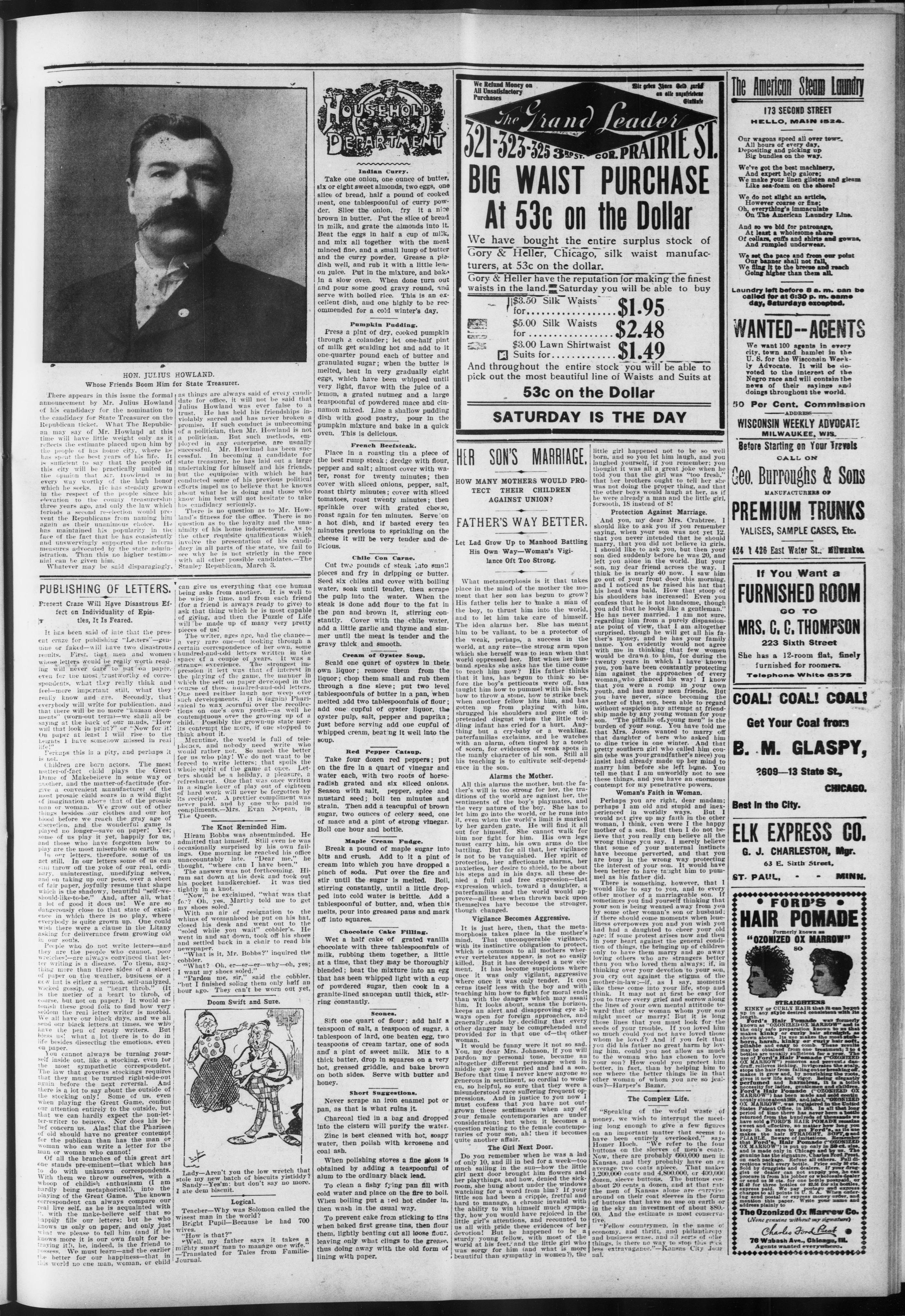
Page text (machine-generated)
State Historical Society
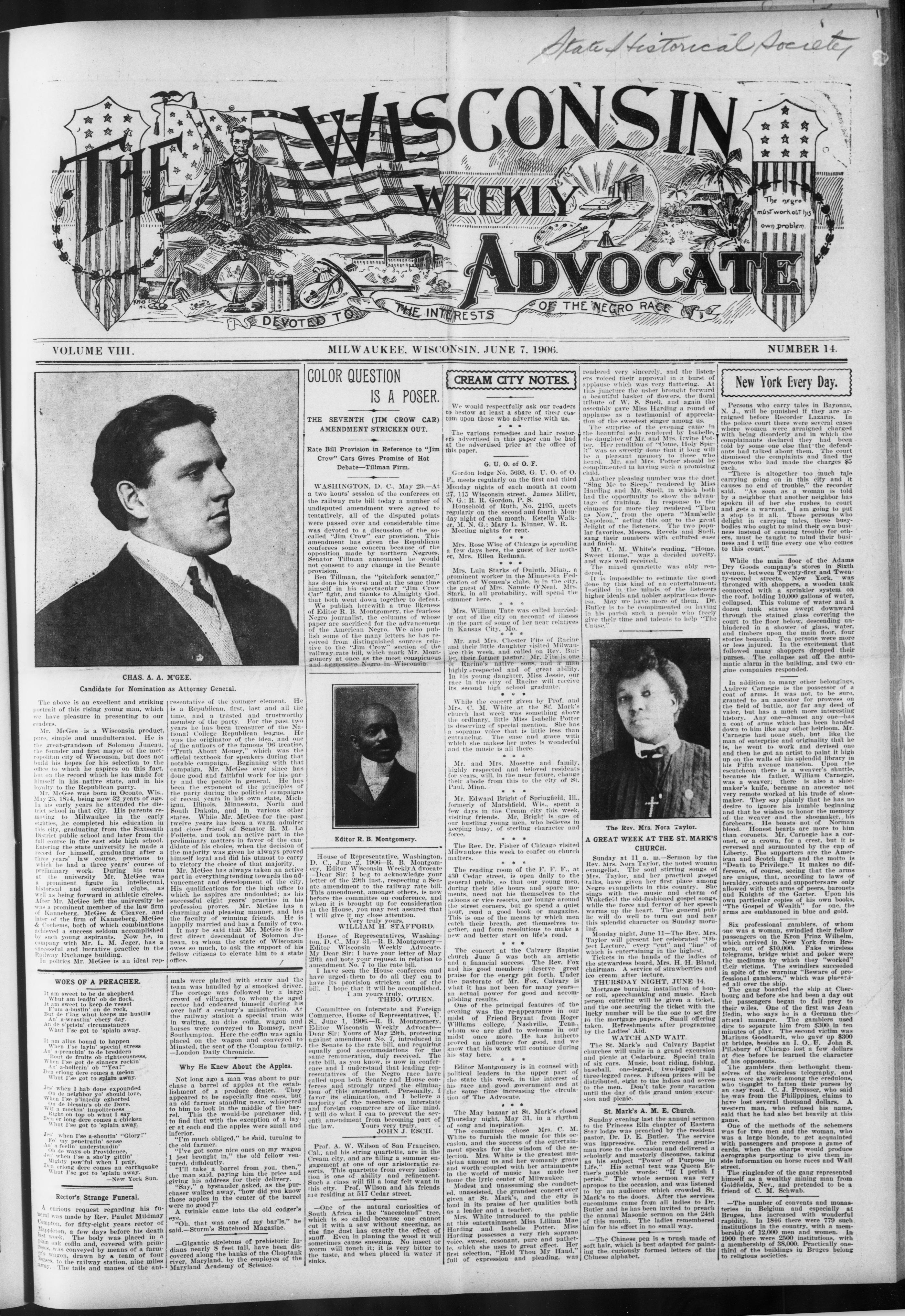
WISCONSIN
WEEKLY
The negro must work out his own problem.
ADVOCATE
DEVOTED TO THE INTERESTS OF THE WEGRO RACE
M.
VOLUME VIII.
CHAS. A. A.
Candidate for Nomination
The above is an excellent and striking portrait of this rising young man, which we have pleasure in presenting to our readers.
Mr. McGee is a Wisconsin product, pure, simple and unadulterated. He is the great-grandson of Solomon Juneau, the founder and first mayor of the metropolitan city of Wisconsin, but does not build his hopes for his selection to the office to which he aspires on this fact, but on the record which he has made for himself in his native state, and in his loyalty to the Republican party.
Mr. McGee was born in Oconto, Wis., May 25, 1874, being now 32 years of age. In his early years he attended the district school in that city. His parents removing to Milwaukee in the early eighties, he completed his education in this city, graduating from the Sixteenth District public school and later from the full course in the east side high school. Entering the state university he made a record for himself, graduating after a three years' law course, previous to which he had a three years' course of preliminary work. During his term at the university Mr. McGee was a prominent figure in intellectual, historical and oratorical clubs, as well as being forward in athletic circles. After Mr. McGee left the university he was a prominent member of the law firm of Kanneberg, McGee & Cleaver, and later of the firm of Kanneberg, McGee & Cochens, both of which combinations achieved a success seldom accomplished by such young aspirants. Now he, in company with Mr. L. M. Jeger, has a successful and lucrative practice in the Railway Exchange building.
In politics Mr. MeGee is an ideal rep
WOES OF A PREACHER.
It am sweet to be de shepherd
Whut am leadin' ob de flock,
It am sweet to keep de vessel
F'um a-bustin' on de rock,
But de t'ing whut keeps me hustlin'
An' a-wrasstiln' ebery day.
An de s'prisin' circumstances
Whut I'se got to 'splain away.
It am allus bound to happen
When I'se layin' special stress
An' a-prenachin' to de breddern'
Bout de fruits ob righteousness,
When I'se got de sinners rockin'
An' a-hollerin' ob "Yea!"
Den erlong here comes a melon
Whut I'se got to splain away.
Jes' when I hab done expounded
On de neighbor yo' should love,
When I'se p'intedly exhorted
On de blessin's ob de Dove.
Wif a mockin' impoliteness
Right on top ob whut I say
Den er long dere comes a chicken
Whut I'se got to 'splain away.
Jes' when I'se a-shoutin' "Glory!"
Fo' my penetratin' sense
Au'a feelin' understandin'
Ob de ways Providence,
Jes' when I'se a sho'ly gittin'
Mighty pow'ful when I pray,
Den erlong dere comes an earthquake
Whut I'se got to 'splain away.
—New York Sun.
Rector's Strange Funeral
A curious request regarding his funeral was made by Rev. Paulet Mildmay Compton, for fifty-eight years rector of Mappleton, a few days before his death last week. The body was placed in a plain oak coffin and, covered with primroses, was conveyed by means of a farmer's wagon, drawn by a team of four horses, to the railway station, nine miles away. The tails and manes of the ani-
resentative of the younger element. He is a Republican, first, last and all the time, and a trusted and trustworthy member of the party. For the past two years he has been treasurer of the National College Republican league. He was the originator of the idea, and one of the authors of the famous '96 treatise, "Truth About Money," which was the official textbook for speakers during that notable campaign. Beginning with that campaign, Mr. McGee ever since has done good and faithful work for his party and the people in general. He has been the exponent of the principles of the party during the political campaigns of recent years in his own state, Michigan, Illinois, Minnesota, North and South Dakota, and in various other states. While Mr. McGee for the past twelve years has been a warm admirer and close friend of Senator R. M. La Follette, and took an active part in the preliminary matters in favor of the candidate of his choice, when the decision of the majority was given he always proved himself loyal and did his utmost to carry to victory the choice of that majority.
Mr. McGee has always taken an active part in everything tending towards the advancement and development of the city. His qualifications for the high office to which he aspires are undoubted; as his successful eight years' practice in his profession proves. Mr. McGee has a charming and pleasing manner, and has the faculty of winning friends. He is happily married and has a family of two. It may be said that Mr. McGee is the first direct descendant of Solomon Juneau, to whom the state of Wisconsin owes so much, to ask the support of his fellow citizens to elevate him to a state office.
mals were plaited with straw and the team was handled by a smocked driver. The cortege was followed by a large crowd of villagers, to whom the aged rector had endeared himself during his over half a century's ministration. At the railway station a special train was in waiting, an dthe coffin, wagon and horses were conveyed to Romsey, near Southampton. Here the coffin was again placed on the wagon and conveyed to Minsted, the seat of the Compton family. London Daily Chronicle.
Why He Knew About the Apples
Not long ago a man was about to purchase a barrel of apples at the establishment of a produce dealer. They appeared to be especially fine ones, but an old farmer standing near, whispered to him to look in the middle of the barrel. This the would-be purchaser did, to find that with the exception of a layer at each end the apples were small and inferior.
"I'm much obliged," he said, turning to the old farmer. "I've got some nice ones on my wagon I jest brought in," the old fellow ventured, diffidently. "I'll take a barrel from you, then," the man said, paying him the price and giving his address for their delivery.
"Say," a bystander asked, as the purchaser walked away, "how did you know those apples in the center of the barrel were no good?"
A twinkle came into the old codger's eye. "Oh, that was one of my bar'ls," he said.—Sturm's Statehood Magazine.
—Gigantic skeletons of prehistoric Indians nearly 8 feet tall, have been discovered along the banks of the Choptank river, Maryland, by the employes of the Maryland Academy of Science.
THE SEVENTH (JIM CROW CAR) AMENDMENT STRICKEN OUT.
Rate Bill Provision in Reference to "Jim Crow" Cars Gives Promise of Hot Debate—Tillman Firm.
WASHINGTON, D. C., May 29.—At a two hours' session of the conferees on the railway rate bill today a number of undisputed amendment were agreed to tentatively, all of the disputed points were passed over and considerable time was devoted to a discussion of the so-called "Jim Crow" car provision. This amendment has given the Republican conferees some concern because of the opposition made by northern Negroes. Senator Tillman announced he would not consent to any change in the Senate provision. Ben Tillman, the "pitchfork senator," has done his worst and at the same time himself in his spectacular "Jim Crow Car" fight, and thanks to Almighty God, that both went down together to defeat.
We publish herewith a true likeness of Editor R. B. Montgomery, the fearless Negro journalist, the columns of whose paper are sacrificed for the advancement of the American Negro. We also publish some of the many letters he has received from distinguished sources relative to the "Jim Crow" section of the railway rate bill, which mark Mr. Montgomery at once as the most conspicuous and aggressive Negro in Wisconsin.
[Name not visible]
Editor R. B. Montgomery.
House of Representative, Washington, D. C., June 2, 1906—R. B. Montgomery, Editor Wisconsin WeeklyA dvocate—Dear Sir: I beg to acknowledge your letter of the 29th inst., respecting a Senate amendment to the railway rate bill. This amendment, amongst others, is now before the committee on conference, and when it is brought up for consideration in the House, you may rest assured that I will give it my close attention.
WILLIAM H. STAFFORD.
House of Representatives, Washington, D. C., May 31.—R. B. Montgomery—Editor Wisconsin Weekly Advocate. My Dear Sir: I have your letter of May 29th and note your request in relation to amendment No. 7 to the rate bill. I have seen the House conferees and have urged them to do all they can to have its provision stricken out of the bill. I hope that it will be accomplished.
THEO. OTJEN
Committee on Interstate and Foreign Commerce, House of Representatives, U. S., June 1, 1906.-R. B. Montgomery, Editor Wisconsin Weekly Advocate—Dear Sir: Yours of May 29th, protesting against amendment No. 7, introduced in the Senate to the rate bill, and requiring equally good accommodations for the same remuneration, duly received. The rate bill, as you know, is now in conference and I understand that leading representatives of the Negro race have called upon both Senate and House conferences and strongly urged the elimination of this amendment. Personally, I favor its elimination, and I believe a majority of the members on interstate and foreign commerce are of like mind. I will do what I can to prevent the seventh amendment from becoming part of the law. Yours very truly.
Prof. A. W. Wilson of San Francisco, Cal., and his string quartette, are in the Cream city, and are filling a summer engagement at one of our aristocratic resorts. This quartette from every indication is one of ability and refinement. Such a class will fill a long felt want in this city. Prof. Wilson and his friends are residing at 517 Cedar street.
One of the natural curiosities of South Africa is the "sneeezeland" tree, which is so called because one cannot cut it with a saw without sneezing, as the fine dust has exactly the effect of snuff. Even in planing the wood it will sometimes cause sneezing. No insect or worm will touch it; it is very bitter to the taste, and when placed in water it sinks.
CREAM CITY NOTES.
---
We would respectfully ask our readers to bestow at least a share of their custom upon those who advertise with us.
The various remedies and hair restorers advertised in this paper can be had at the advertised price at the office of this paper.
G. U. O. of O. F
Gordon lodge No. 5693, G. U. O. of O. F., meets regularly on the first and third Monday nights of each month at room 27, 115 Wisconsin street. James Miller, N. G.; R. R. Gordon, P. S. Household of Ruth, No. 2195, meets regularly on the second and fourth Monday night of each month. Estella Walker, M. N. G.; Mary L. Kinner, W. R.
Mrs. Rose Wise of Chicago is spending a few days here, the guest of her mother, Mrs. Ellen Redman.
---
Mrs. Lulu Starks of Duluth, Minn., a prominent worker in the Minnesota Federation of Women's clubs, is in the city, the guest of Mrs. Nannie O'Neal. Mrs. Stark, in all probability, will spend the summer here.
* * *
Mrs. William Tate was called hurriedly out of the city on account of illness on the part of some of her near relatives in Kansas City, Mo.
* * *
Mr. and Mrs. Chester Fite of Racine and their little daughter visited Milwaukee this week, and called on Rev. Butler, their former pastor. Mr. Fite is one of Racine's native sons, and a man highly respected and of great ability. In his young daughter, Miss Jessie, our race in the city of Racine will receive its second high school graduate.
```markdown
```
While the concert given by Prof. and Mrs. C. M. White at the St. Mark's church last week was something above the ordinary, little Miss Isabelle Potter is deserving of special mention. She has a soprano voice that is little less than entrancing. The ease and grace with which she makes her notes is wonderful and the music is all there.
☆ ☆ ☆
Mr. and Mrs. Mosette and family, highly respected and beloved residents for years, will, in the near future, change their abode from this to the city of St. Paul, Minn.
```markdown
```
Mr. Edward Bright of Springfield, Ill., formerly of Marshfield, Wis., spent a few days in the Cream city this week, visiting friends. Mr. Bright is one of our hustling young men, who believes in keeping busy, of sterling character and force.
☆ ☆ ☆
The Rev. Dr. Fisher of Chicago visited Milwaukee this week to confer on church matters.
未 未 未
The reading room of the F. F. F., at 430 Cedar street, is open daily to the general public, so that our young men, during their idle hours and spare moments, need not hie themselves to the saloons or vice resorts, nor lounge around the street corners, but go spend a quiet hour, read a good book or magazine. This is one of the means by which men catch their breath, get themselves together, and form resolutions to make a new and better start on life's road.
```markdown
```
The concert at the Calvary Baptist church June 5 was both an artistic and a financial success. The Rev. Fox and his good members deserve great praise for the energy put forth. Under the pastorate of Mr. Fox, Calvary is what it has not been for many years—an actual power for good and accomplishing results.
One of the principal features of the evening was the re-appearance in our midst of Friend Bryant from Roger Williams college, Nashville, Tenn., whom we are glad to welcome in our midst once more. He has hitherto proved an influence for good, and we know that his work will continue during his stay here.
☆ ☆ ☆
Editor Montgomery is in counsel with political leaders in the upper part of the state this week, in the interest of his race and good government and at the same time increasing the circulation of The Advocate.
---
The May bazaar at St. Mark's closed Thursday night, May 31, in a rhythm of song and inspiration.
The committee chose Mrs. C. M. White to furnish the music for this occasion, and the success of the entertainment speaks for the wisdom of the selection. Mrs. White is the greatest musician among us and her womanly grace and worth coupled with her attainments in the world of music has made her home the lyric center of Milwaukee. Modest and unassuming she conducted, unassisted, the grandest concert ever given at St. Mark's, and the city is loud in its praise of her qualities both on a leader and a teacher.
as a leader and to the public at this entertainment Miss Lillian Mae Harding and Isabelle Potter. Miss Harding possesses a very rich soprano voice, sweet, resonant, pure and pathetic, which she uses to great effect. Her first selection, "Hold Thou My Hand," full of expression and pleading, was
rendered very sincerely, and the listeners voiced their approval in a burst of applause which was very flattering. At this juncture the usher brought forward a beautiful basket of flowers, the floral tribute of W. S. Snell, and again the assembly gave Miss Harding a round of applause as a testimonial of appreciation of the sweetest singer among us. The surprise of the evening came in the beautiful solo rendered by Isabelle, the daughter of Mr. and Mrs. Irvine Potter. Her rendition of "Come, Holy Spirit" was so sweetly done that it long will be a pleasant memory to those who heard. Mr. and Mrs. Potter should be complimented in having such a promising child.
Another pleasing number was the duet "Sing Me to Sieep," rendered by Miss Harding and Mr. Snell, in which both had the opportunity to show the advantage of training. In response to the clamors for more they rendered "Then as Now," from the opera "Mam'selle Napoleon," acting this out to the great delight of the listeners. The two popular favorites, Messrs. Revels and Snelli, sang their numbers with cultured ease and finish.
Mr. C. M. White's reading, "Home, Sweet Home," was a decided novelty, and was well received.
The mixed quartette was ably rendered
It is impossible to estimate the good done by this kind of an entertainment. Instilled in the minds of the listeners higher ideals and nobler aspirations flourish. May we have more of them. Dr. Butler is to be complimented on having in his parish such a people who freely give their time and talents to help "The Cause."
PRIEST
The Rev. Mrs. Nora Taylor.
A GREAT WEEK AT THE ST. MARK'S CHURCH.
Sunday at 11 a. m.—Sermon by the Rev. Mrs. Nora Taylor, the noted woman evangelist. The soul stirring songs of Mrs. Taylor, and her practical gospel talks, have given her first place among Negro evangelists in this country. She sings with the music and charm of Wakefield the old-fashioned gospel songs, while the force and fervor of her speech warms up the heart. The general public will do well to turn out and hear this splendid character on Sunday morning.
Monday night, June 11—The Rev. Mrs. Taylor will present her celebrated "Object Lecture," every "cut" and "line" of which is entertaining in the highest.
Tickets in the hands of the ladies of the stewardess board, Mrs. H. H. Bland, chairman. A service of strawberries and ice cream after lecture.
THURSDAY NIGHT, JUNE 14. Mortgage burning, installation of honor roll, speechmaking and music. Each person entering will be given a ticket, and the one securing the ticket with the lucky number will be the one to set fire to the mortgage papers. Small offering taken. Refreshments after programme by the Ladies' Aid.
WATCH AND WAIT.
The St. Mark's and Calvary Baptist churches will unite in a grand excursion and picnic at Cedarburg. Special train of six cars. Music, boat riding, fishing, baseball, one-legged, two-legged and three-legged races. Fifteen prizes will be distributed, eight to the ladies and seven to the men. Don't take your vacation until the day of this grand union excursion and picnic.
St. Mark's A. M. E. Church.
Sunday evening last the annual sermon to the Princess Ella chapter of Eastern Star lodge was preached by the resident pastor, Dr. D. E. Butler. The service was impressive. The reverend gentleman rose to the occasion and delivered a scholarly and masterly discourse, taking as his subject "Power of Purpose in Life." His actual text was Queen Esther's notable words: "If I perish I perish." The whole sermon was very apropos to the occasion, and was listened to by an audience which crowded St. Mark's to the doors. After the services encomiums came from all ladies to Dr. Butler and he has been invited to preach the annual Masonic sermon on the 24th of this month. The ladies remembered him for his effort in no small way.
The Chinese pen is a brush made of soft hair, which is best adapted for painting the curiously formed letters of the Chinese alphabet.
NUMBER 14.
New York Every Day.
Persons who carry tales in Bayonne, N. J., will be punished if they are arraigned before Recorder Lazarus. In the police court there were several cases where women were arraigned charged with being disorderly and in which the complainants declared they had been told by some one else that the defendants had talked about them. The court dismissed the complaints and fined the persons who had made the charges $5 each.
"There is altogether too much tale carrying going on in this city and it causes no end of trouble," the recorder said. "As soon as a woman is told by a neighbor that another neighbor has spoken ill of her she rushes to court and gets a warrant. I am going to put a stop to it all. These persons who delight in carrying tales, these busy-bodies who ought to mind their own business instead of causing trouble for others, must be taught to mind their business and I will fine every one who comes to this court."
While the main floor of the Adams Dry Goods company's stores in Sixth avenue, between Twenty-first and Twenty-second streets, New York, was thronged with shoppers, a wooden tank connected with a sprinkler system on the roof, holding 10,000 gallons of water, collapsed. This volume of water and a dozen tank staves swept downward through the stained glass covering the court to the floor below, descending unhindered in a shower of glass, water, and timbers upon the main floor, four stories beneath. Ten persons were more or less injured. In the excitement that followed many shoppers dropped their purses. The collapse set off the automatic alarm in the building, and two engine companies responded.
In addition to many other belongings, Andrew Carnegie is the possessor of a coat of arms. It was not, to be sure, granted to an ancestor for prowess on the field of battle, nor far any deed of valor, but has a much more interesting history. Any one—almost any one—has a coat of arms which has been handed down to him like any other heirloom. Mr. Carnegie had none such, but like the man of enterprise and originality that he is, he went to work and devised one and then he got an artist to paint it high up on the walls of his splendid library in his Fifth avenue mansion. Upon the escutcheon there is a weaver's shuttle, because his father, William Carnegie, was a weaver; there is also a shoemaker's knife, because an ancestor not very remote worked at his trade of shoemaker. They say plainly that he has no desire to ignore his humble beginning and that he wishes to honor the memory of the weaver and the shoemaker, his forebears. He boasts not of Norman blood. Honest hearts are more to him than coronets. Mr. Carnegie has a coronet, or a crown, for a crest, but it is reversed and surmounted by the cap of Liberty. The supporters are the American and Scotch flags and the motto is "Death to Privilege." It makes no difference, of course, seeing that the arms are unique, that, according to laws of heraldry, coronets and supporters are only allowed with the arms of peers, baronets and Knights of the Garter. Upon his own particular copies of his own books, "The Gospel of Wealth" for one, the arms are emblazoned in blue and gold.
Six professional gamblers, of whom one was a woman, swindled their fellow passengers on the Kron Prinz Wilhelm, which arrived in New York from Bremen, out of $10,000. Fake wireless telegrams, bridge whist and poker were the mediums by which they "worked" their victims. The swindlers succeeded in spite of the warning "Beware of professional gamblers," which was placarded all over the ship.
The gang boarded the ship at Cherbourg and before she had been a day out the passengers began to fall prey to their wiles. One of the first was Jean Redin, who says he is a German theatrical manager. The gamblers used dice to separate him from $300 in ten minutes of plav. The second victim was Marinus Goodhardt, who gave up $300 at bridge, besides an I. O. U. John S. Pilsbury of Chicago lost a few dollars at dice before he learned the character of his opponents.
The gamblers then bethought themselves of the wireless telegraphy, and soon were at work among the credulous, who thought to fatten their purses by an easy road. C. J. Preusser, who said he was from the Philippines, claims to have lost several thousand dollars. A western man, who refused his name, said that he had also bet heavily at this game.
One of the methods of the schemers was for two men and the woman, who was a large blonde, to get acquainted with passengers and propose a game of cards, when the sharps would produce aerographs purporting to give them inside information on horse races and Wall street.
The ringleader of the gang represented himself as a wealthy mining man from Goldfields, Nev., and pretended to be a friend of C. M. Schwab.
The number of convents and monasteries in Belgium and especially at Bruges, has increased with wonderful rapidity. In 1846 there were 779 such institutions in the country, with a membership of 12,000 men and women. In 1900 there were 2500 institutions, with a membership of 38,000. Practically one-third of the buildings in Bruges belong to religious societies.
—Railroads of the United States bought 80,051,000 cross ties in 1905.
Mrs. Bellamy Storer, whose husband recently retired from his position as ambassador to Austria, is the originator of the famous Rookwood pottery.
Aluminum paper, which is practically a new article of production, is said to preserve the sweetness of butter that is wrapped in it for a very long time.
Sir Thomas Lipton has had models made of the three Shamrocks, which he will present to the New York Yacht club at an early date. They are now on exhibition in London.
Australia is to spend $75,000, if necessary, in scientific experiments in the infection of rabbits with diseases deadly to these pests of the Antipodes and yet harmless to other animals and to men.
- Apparently the descendants of the late Admiral William T. Sampson will be numerous in the United States navy, as two sons and a grandson are likely to be members of the class which will enter the naval academy this spring.
- The deepest lake in the world is believed to be Lake Baikal, in Siberia. Nine thousand square miles in area, or nearly as large as Lake Erie, it is 4000 to 5000 feet deep, so that it contains nearly as much water as Lake Superior.
- Spokane has a church that cares for servant girls. Swedish Congregationalist churches from all over the island empire have just held a conference followed by a dedication of the handsome new $12,000 tabernacle at Second avenue and Division street.
—Upton Sinclair says that he believes he holds the record for the number of times a manuscript has been refused. His first attempt at a book, "Prince Hagen," was rejected thirty-seven times—by fifteen magazines and twenty-two publishing houses.
—Prof. Angelo Heliprin, author of "Tower of Pelee," "Mont Pelee" and editor of "Lippincott's New Gazetteer," is just completing a series of paintings in oil to illustrate the features and phenomena of the eruption of Mont Pelee, which are to be exhibited publicly.
—An industry has been recently created in the west of France, at Surgeres, the seat of several co-operative dairies, and in the space of a few months it has grown so rapidly in importance that it deserves notice. This industry is the extraction of casein from skimmed milk.
The young King of Spain is an expert in the use of the sword. When a child he practiced with wooden swords with the young nobles of his court. His marvelous ability was even then noticeable, and he is now considered one of the most expert of the royal fencers of Europe.
In 1613 certain villages of Lorraine sued the department of forests in defense of the right to cut wood in a certain forest. After nearly three centuries of litigation the supreme court at Leipsic has just given a final decision against the department and condemned it to pay all costs.
Japan's foreign trade in 1905 broke the record, reaching more than $400,000,000, against $345,000,000 in 1904. A million men were drawn by the war from productive industry, yet those at home were able to supply army and navy and still have an increased volume of goods to export.
The famous chapel of the Sardinian ambassadors in Kingsway is to be removed to complete the London county council improvements, and will be replaced by a new church to be erected close by. The old church, which stands out distinctly as a relic of ancient times, was built in the Sixteenth century.
Denmark's Kings for 384 years have all been named Christian or Frederick. It is the law of Denmark that Christian must be succeeded by Frederick and Frederick by Christian. To attain this every Danish prince, no matter what other names he may receive, always has Christian and Frederick among them.
Commenting on Benjamin Franklin's kite experiment, which proved that lightning and electricity are the same, a scientist says: "It was one of the most brilliant examples of luck yet recorded. To attempt the extraction of lightning flashes from a lowering sky was almost suicidal. Even at this late day timid persons occasionally fly to feather beds, sit on glass-legged chairs or find refuge in rubber boots during thunderstorms. A repetition of Franklin's experiment cost his immediate imitator his life."
—Gentian root, often used as a tonic, is considered in many malarial countries a remedy against intermittent fever. Especially is this the case in Corsica in that section of the island near the town of Aleria, which is infested with malaria. The inhabitants recently protested violently against the introduction of quinine on the part of the medical authorities, declaring that they would not abandon the remedy which had been used among them for centuries, the gentian root, either powdered or simply masticated.
Novelties in Jewelry.
Some Charming Novelties. A unique little ornament for a woman's morning tie is a diamond torch displaying a ruby and diamond flame. Very artistic and beautiful are the new designs in the thinnest of translucent enamels, which appear on the surface to be threaded and edged with gold. Costly corsage ornaments are designed in natural forms, sometimes to show leaves veined with diamond dust, or perhaps a spray of leaves and flowers tied with diamond ribbon.
Vogue of Emeralds. Next to pearls, which always hold the first place, ranks the emerald, which is the favorite stone of the moment. Necklaces, pendants, rings, and corsage ornaments are made of emeralds, cut in their own peculiar fashion and combined with diamonds. A charming novelty consists of two little hairpins made of platinum, the high-rounded tops of which are powdered over with diamond dust. They are intended to fasten the veil to the edges of the hat, and lying close to the hair have a very pretty effect.
Lucky Day Stones.—Each day, we are told, has its separate stone. Sunday is the day of all days when the ruby should be worn, and the deeper the color the more propitious the gem. Moonstones are not considered the luckiest of jewels, but, notwithstanding this fact, to wear them on Monday is provocative of good fortune. On Tuesday bad luck may be thwarted by means of pink and white coral. Emeralds are favorable to Wednesday and cat's-eyes to Thursday, while on Friday the woman who elects to wear her diamonds can rest content that she has done her best to court good luck. On the last day of the week the sapphire ensures happiness and success, this beautiful stone being looked upon as a truer harbinger of prosperity than any of the others.—London Tit-Bits.
Dust Wave from the Ocean.
A strange phenomenon was observed here on Tuesday night last when a windstorm burst at sea between 9 and 10 o'clock, bringing with it on the town of Falmouth a cloud of what seemed to be smoke or dust.
Some persons say there was a smell of fire or of brimstone along with the dust and that the dust or ashes blown against their faces was hot. A number of the inhabitants with a lively remembrance of 1903 in their minds sat up dressed all night in easy chairs rather than retire to bed.—Falmouth cor. Jamaica Gleaner.
THE KING'S ROAD.
Above the sea the blue Hawaiian sky
Is flecked with clouds, white as the crystal
snow
On Mauna Kea's peak, where come and go
The dawn and darkness, as the days drift
by.
The mangoes' heavy leaves hang all unstirred;
Through the still noon the pale gardenias
Up the gray slopes, where the hot lava flowed,
Poured from the grim volcanoes, molten fires,
Beyond the alien white man's roofs and spires,
Winds through the ashen dust an ancient road.
Upward it winds to the horizon's rim.
Where the steep ridge looms black against the light.
Crosses the verge where stretch, concealed from sight. Broad fertile fields and forest cool and dim. Like watchful sentinels that waiting stand. Grow stately palms, their crowns heid high in air. All the long way, as though they waited there.
Some ghostly presence vanished from the land.
By twos long paces set apart they blend,
Stirred by the trades, and toss their
plumes and sigh:
"Here where we linger once the King
passed by:
"With song and laughter moved his regal train- Slip maidens wreathed with flowers, and
Slim maidens wreathed with flowers, and warriors brave Bearing the shield and spear—the burdened slave. Now, all are gone and we, alone, remain.
"Across the silent wastes our dim shades lie:
Naught can recall the lost for whom we yearn.
Ne'er shall the King in princely state return;
We live, while man who loves and rules must die."
—Mary H. Krout in The Reader.
ON APPEAL.
The girl looking out of the third-class compartment remarked that the train seemed a long time making up its mind to start; her friends reproached her for excessive anxiety, and she hastened to explain that she herself felt in no hurry; the remark had been prompted by a consideration for their time. The ladies assured her that the day having been broken into, as it were, by the visit to Waterloo, it could not be regarded as possessing any additional value; at any rate, they did not propose to make it of further use. Once thoroughly upset, they remarked, with pride, by anything in the nature of an outing, they were no good for housework during the next four-and-twenty hours. As for the girl's uncle (pointing to an unconsidered man on the edge of the small crowd), a day off would have little of novelty for him.
"This time tomorrow, Mary, my dear, you'll be well out on the ocean wave. Mind you wrap up."
"Send us a card soon as ever you get to Capttown. Give your married sister our love and ask after her cold. Don't seem like four years ago we saw her off, the same as we're——"
"Oh! how upset she was, to be sure; I thought she'd have cried her poor eyes out. By the by, I sent her some hairpins; you might remind her."
"You'll have plenty of company on board the boat. You won't be lonely."
"If I was you, Mary, my dear—bend down and listen I should see whether I couldn't get engaged on the journey out. I should, really. You'll have nothing else to do."
"Nice fine day you've got for the start, at any rate. Look at the sun coming through. Good omen for you. Cheer up, my girl. Don't give way at the last moment. It's all for the best."
A railway official begged them to stand back, and they pressed forward to the footboard to exchange tearful farewells. The train moved; the officials shouted. One-half of the number blew kisses to the girl as the train left the platform; the others charged themselves with the duty of calling the railway men jacks in office, and of threatening to report them.
"Poor, dear soul!" they sobbed, turning when the train had disappeared. "Hard on a young thing like that to have to set out all alone."
"Such a sweet too. Don't know when I've felt it so much parting from any one."
"She's a loss that's what she is—after you with my hand kercher. Mrs. What-is-it—the place won't seem the same without her. Always cheerful and merry and bright and singing about the house; more like a skylark than any other bird I can compare her to. No one can ever take her place. I've got her photo, but that can never be quite—" The aunt, who seemed to claim for herself the position of chief mourner, stopped and pressed her hand against her waist; others rushed forward and dragged her to a wooden seat. "Never quite the same," she moaned. "Never quite—"
Those who had seen passengers depart appeared much impressed; the party showed a certain austerity in the presence of flattering attention, explaining some of the facts with proud reserve. One red-eyed woman in leaving remarked that a certain amount of fuss she could understand, but in this, as in most matters, it was possible to overdo it. "We're not all alike," retorted the important group.
portant group. "So it seems!"
The aunt was begged to collect herself, but she made no effort to obey until the audience of outside people had gone. Then she admitted her weakness, urging, however, that in losing her favorite niece she had lost her right hand, a right hand which had been at once the flower, the helpmeet and the sunshine of her life. The others agreed, but pointed out that no rule or regulation or by-law of the railway company made it obligatory for any person visiting the station to flop about all over the place, requiring the assistance of three ladies, and what they supposed, they must refer to as a man. They went towards the barrier, wondering whether the girl had yet reached Vauxhall, and proclaiming her attractive qualities. Two consulted in an undertone, and one went to the unconsidered man of the party.
"I told him," she announced, coming back, "or rather I tried to, that the last time we came here to see any one off, the gentleman who was with us took us all in the refreshment room."
"And what did he——?"
The lady repied with tartness: "Pretended the engines made such a noise
that he couldn't hear what I was saying of." "She's at Clapham Junction by this time bless her!"
They were going out of the station by the way of the slope in the direction of York road, when the rain came down, and they had to hurry up the steps into shelter. There they bewailed the absence of umbrellas, declaring that if they had bethought themselves of bringing these, it would never have come on to pour in this manner; they expressed regret that a desire to compliment the young passenger for the Cape had induced them to put on their black. Finally, they blamed the man of the party for not having had the sense, the forethought, the intelligence to warn them of the possible occurrence of a sharp shower; his plea of inability to extract secrets from the future was derided, and he found himself told plainly that he ought to have known. Invited to give an estimate of his value in the world, he declined, recognizing, apparently, that prejudice existed.
Outside, the slope became a waterfall, and only the cab drivers looked cheerful. "She's having me laugh of us," remarked one of the women. Who's having the laugh of us?" "Young Mary is." "In what way?" "Why, because she's safe off in the dry." They appeared dispirited by this view; lips moved silently. The uncle, remarking that he wore nothing which rain could spoil, called to mind the fact that once in returning from Southend the carriage roof had proved leaky, but the women declined to be comforted. With the daring statement of opinion that it could not last forever, ne gave up the effort and went off to borrow a match.
"I don't wish the girl any harm, but the fact remains that she's got a mack-intosh and we haven't."
"Thought she seemed amused about something. She's having her sandwiches now."
"What's quite true, is," admitted the aunt, "she makes one less mouth to fill. I'm not going to say a single word against her, but she was certainly a very 'earty eater. I've seen her come twice for pudding over and over again. Any signs of it leaving off?"
News was brought that the rain was coming down worse, if anything, than ever. Some one remarked despairingly that the girl would get plenty to eat on the voyage; people had been known, in the course of a sea trip, to become quite stout from generous feeding. The enforced delay of their own meal made them groan. The man of the party came with news that at Southampton the weather was reported as brilliant, and found himself ordered to put out his pipe instantly, and to make some endeavor to remember that he was in the presence of ladies.
"I used to notice she thought a good deal of herself, Mary did. She was getting a great deal too big for her boots. I never said anything about it, being only a distant connection by marriage; but if she'd been a daughter of mine——"
"People had allowed her to do too much as she liked; that was the simple truth of the whole matter. My Ethel couldn't stand her, couldn't stand her at any price."
"She hadn't a nice disposition, I'm afraid. I never had any mis-words with the girl, but I defy anybody to say she had a nice disposition. Not at any rate, what I called a nice disposition."
"I always thought she'd got a temper." "She had got a temper," allowed the aunt. "It's no use denying it. When Mary liked to let herself go, she could be as nasty as any one of our family." "You heard about the way she treated that young gentleman who lived with his mother off the New Kent road? That showed you!" "I'm afraid she was no good to herself," said the aunt, "and she was no good to any one associated with her. That's the long and short of it. Come on; it's giving over a bit."
"Well," said the man of the party, conducting the way to York road and glancing at the clock, "she's fairly on her way now and chance it." He chuckled at the thought that, he had selected a perfectly safe comment.
"Good riddance," remarked the chorus of ladies, emphatically. "'Eaven send she don't come back home in a 'urry!"—W. Pett Ridge in London Mail.
Girl's Fight with an Owl.
Olive Lewis, 12-year-old daughter of Mr. and Mrs. Harry Lewis of near Frostburg, has no use for owls ever since one of them tried to carry off her pet lamb last spring, and when one of these birds made its appearance in the woods below the Lewis barn Olive immediately decreed its destruction. She got down the old shotgun and set out alone to find the owl. It didn't take her long to locate the object of her displeasure, and taking deliberate aim she was rewarded by seeing the feathers fly and the owl fluttering to the ground.
To make sure of the job Olive was about to take another shot at the wounded bird at close quarters when the owl suddenly flared up and seized her by the hair. The vicious bird sank its talons into the flesh of her arms and tried to scratch her eyes out. Being at such close quarters the little girl could not shoot, and in attempting to strike the owl the gun came apart at the bracech
With the rapacious bird tearing at her flesh Olive secure dthe parts of the gun and ran to the home of Mr. Lingenfelter, who lives near the place where the battle occurred, for assistance. With the help of some of the Lingenfelters the owl and the child were separated, whereupon Olive fixed the gun and put a quietus on her antagonist by shooting its head of. She bore the scars of battle bravely and carried the scalp of her victim home in triumph.—Punasutawney Spirit.
A Happy Thought.
A well-known Boston writer tells, with glee, of a neat sally on the part of his 9-year-old son, who is a pupil in a private school at the Hub.
Apropos of something or other, the teacher had quoted the line, "In the bright lexicon of youth there's no such word as 'fail.'"
At this point the lad mentioned arose and politely made known his desire to offer an observation with reference to the maxim.
"It occurs to me, sir," said he, "that if such be the case, it might be advisable to bring the omission to the attention of the publishers of the lexicon."—Harper's Weekly.
Valuable Prizes Offered
Prizes aggregating $7500 for suggested improvements in connection with railway construction and service offered by the Verein Deutscher Eisenbahnverwaltungen. The latest date for communications is July 15, 1907.
"EVERYBODY WORKS THE PUBLIC."
Everybody works the public,
It is a good, good thing;
Easy in summer and winter,
Also in fall and spring;
There's never a decent let-up.
Never a halt, begosh!
Everybody works the public,
And that's no josh.
When a man has that weary feeling,
And toll fills his breast with hate,
The public is always willing
To bite if he'll hand out bait;
Hypocrite, cheat and faker,
Each knows where to apply—
Everybody works the public,
And that's no lie.
Demagogue, crook and grafter,
Schemer and pious fraud.
Each in his own way's after
A chunk of the public's wad.
Oh, for some way to stop it.
Oh, for one hopeful gleam!
Everybody works the public,
And that's no dream!
New York Every Day.
Nellie O'Neill, the dancer, remembered for her grotesque scene with Charles Guyer in "Banes in Toyland," has been sentenced to Blackwell's island for six months. She threatened to kill her mother.
The stranger was asked what he considered the most characteristic thing about New York. "The fact," he replied, "that you have to climb to the Subway at Manhattan street and go down to the elevated at One Hundred and Sixty-eighth street."
If there is one shop window less calculated to excite mirth than another in New York it is that of an undertaker's place of business. Yet a group of people, principally children, gathered in front of a mortuary establishment on Columbus avenue, found ample cause for merriment. In a little casket lined with white satin lay at full length a yellow cat, asleep, her slumbers apparently undisturbed by nightmare. Fuss seemed alike indifferent to her surroundings and the interest she excited so long as she was left in undisturbed enjoyment of her soft bed.
The sheep aren't all sheared in Wall street. Almost any day one can witness a shearing at Central park, where the city's sheep are losing their fleeces. It is a very interesting process, this, by which a bit of live mutton is denuded of its winter overcoat. However careful the man may be with the shears the sheep often get nipped. The sheep is strapped upon a table and his fleece is taken from him by force. There is not any graft in the wool taken from the Central park flock, for its value is accounted for in the annual report of the commissioners.
Here's what a dressmaker says in confidence: "Western women of means frequently pay more in New York shops than we would dare to ask an eastern woman for the same garment. They haven't the same idea of the value of clothes that a New York woman has. Neither have they the same idea of money. Prices that a sophisticated customer would pronounce preposterous western shoppers pay without a protest, partly because they dislike haggling and partly because it enhances their social standing at home to be able to wear expensive New York clothes, the price of which can be verified by a receipted bill."
The editorial paragraphers of New York are making much of the escape of the young Italian immigrant who, wanting to reach relatives in Pittsburg, jumped into the bay when he was taken on board a vessel to be deported. One writer says: "Here's hoping that the Italian lad Giovanni, who jumped into the bay at Ellis island the other night and struck out for the Jersey shore and liberty, gets away and beats the immigrant officers. He may have something the matter with his eyes, as Commissioner Watchorn's body snatchers say, but he's got the making of a good citizen and a hot sport in him, or he would never have dared make the leap."
Rollo is sick, very sick. Rollo, who is the most popular young bear at the Bronx zoo, New York, slipped out of his cage, mounted a fense and ambled some 200 feet to the Rocking Stone restaurant. There wasn't a soul in sight. Rollo scrambled through the window and proceeded to do things. Lemon pies, custard pies, apple pies, peach pies, pound cake and other delicacies were there in piles, and Rollo gulped them down in short order, and washed the whole down with a kettle of cold coffee. The keepers were amazed when the bear was found missing, and they started out to hunt for him. An hour later they returned and found Mr. Rollo rolling in agony in his cage. Too much pie is not good for bears.
Those who say smoking among women in this country is on the increase and that smoking cars for women will not be a joke a decade hence might have found support for their views had they seen a party of horsewomen who were coming down a road not far from New York one afternoon. Every one had a cigarette in her mouth, and seemed to be enjoying herself immensely. Girls who smoke in highways or byways, however, should have eyes in the back of their heads. As this particular group looked through the foliage and over the gleaming water beyond they forgot that somebody might come up behind; so every young woman jumped as a carriage slipped past them, and the color in their cheeks was not due altogether to the sun.
A frigid proposition has hit Brooklyn—the ice cream men have raised the rates 5 cents because of the scarcity of ice. As a result of the increased tariff it is feared that the matrimonial market will fall off. This is the way they figure it out over there: Brooklyn is a place of homes. Homes are built on matrimony. To a large extent matrimony is the direct consequence of a taste for ice cream. In indulgence in ice cream be restricted through the increase in prices it follows that matrimonial records will reveal a very perceptible diminution. And with a falling off in matrimony the number of homes must decrease, which will reduce the demand for houses and apartments, and so real estate interests will suffer and many firms and individual investors "go broke."
Only a short time ago Allan Dale, the dramatic critic of New York city, published an exhaustive treatise in a magazine, in which he made the bold statement that Richard Mansfield was the worst actor in America. A day or two ago Otis Harlan, the rotund comedian of "The Vanderbilt Cup," saw Dale entering a certain chop house on Broadway, and dashed across the street to intercept him. As he ran he shouted: "Hi, Dale! you're wrong; you're wrong!" "Wrong?" and Dale stopped in astonishment. "What in blazes do you mean?" "Why, Mansfield's not the worst actor in America," panted Harlan, quite out of breath. "I've got the very worst. He's in a company I just sent down south." Then everybody breathed again.
A good many visitors are disappointed when they learn the sober truth that New York has no clubs composed exclu
sively of millionaires. It is harder still to make country folk believe that hundreds of men join the so-called swell clubs in large part from motives of economy. There are scarcely three clubs in the city that do not include a considerable number of poor men in their membership. The average income of the whole membership of the best known clubs in the city is probably nearer $10,000 a year than $50,000 a year, and almost every one of those clubs includes scores of men with incomes well below $10,000, and a good many with incomes well below $5000. There is a real democracy of New York club life. Many a man of small means regards his membership in a first rate club in the light of a profitable investment.
"I want a 15-year-old miss as secretary and matinee companion; must be pretty and possess a good figure; am a wealthy retired bachelor; splendid opportunity. Write particulars in own hand. Address Matinee, Brooklyn." This advertisement, printed in the "personal column" of a New York paper, has landed Christopher J. Burns, a prosperous insurance broker of Brooklyn, in a cell. He was arrested as he sat on the front stoop of a furnished room house at 357 Lay street.
Frank L. Folk, agent of the Society for the Prevention of Cruelty to Children, stands sponsor for the charge against Burns. It is a queerly worded one of attempted abduction by use of the mails. Burns is 40 years old, of good appearance and address. He lives with his wife in a handsome home at 475 Jefferson avenue. He has a suite of offices in the Temple Bar building.
Inwood, not being a seaside resort, there was naturally some scepticism expressed when the rumor spread along the Hudson that a sea serpent had been caught in the neighborhood. John McDonald, watchman, who captured the creature, said it was not a sea serpent, but might have been if it had been allowed at large a little longer and permitted to attain its full growth. He found it in his eel pot. It was a very proper thing to be in an eel pot, as it was unquestionably an eel. As to its size, McDonald would not commit himself, but he declared that it was the biggest eel ever caught in the Hudson. It might be a matter of six feet in length and it might be more. Perhaps if an angler had caught it off the pier it would have been ten feet long. McDonald said he hoped to sustain his family on the eel for at least a week, which indicates dimly that it was an eel big enough to be mistaken for a sea serpent if it had been seen at sea off a resort supporting a live press agent.
Miss Emily A. Mayer, daughter of John Mayer and of the beautiful Natalie Havemeyer, who met a tragic death at the Mountainside farm of Theodore A. Havemeyer at Pahwah, N. J., six years ago, has renounced the faith of her mother and grandmother, Mrs. Theodore A. Havemeyer. Last Sunday she was received into St. Peter's Episcopal church at Morristown, N. J., of which her father is a vestryman.
Miss Mayer is just 21 and is to be married shortly to Joseph C. Willis, son of Grinnell Willis of Morristown, a wealthy woolen manufacturer. Her conversion to the Episcopal faith is connected by Morristown folk with her approaching marriage with a non-Catholic.
Mrs. Mayer's death was due to a pistol shot. She was alone in her room at the time and the testimony went to show she shot herself. She had but a little while before been chatting with Clifton Page, a member of the household. After her death an effort was made to keep secret her will. When it was filed the bequest of $10,000 to Clifton Page excited comment. Page had been overseer of accounts at Mountainside farm for many years.
"Thou shalt not straighten thy hat or prink thyself in elevators." Such is the commandment that owners of New York skyscrapers would enforce in regard to vanity fair. And all because of the few seconds lost on each elevator trip when Milady pauses to give her hat a final tilt or the stray lock a wee tuck. But seconds mean much in New York, and especially in a skyscraper where thousands are daily to be transported. As a result of this agitation most of the newer tall buildings are mirrorless so far as elevators are concerned. Hotel proprietors, however, do not seem to regard the mirror proposition in the same light as do managers of office buildings. The new Hotel Astor's elevators were found to be very attractive by women when it opened a short time ago. But the real woman's paradise is the new Hotel Belmont, opposite the Grand Central station. The nine passenger elevators are entirely lined with mirrors, while the building itself is a veritable crystal maze. In all there are 16,000 square feet of mirrors. In other words, a woman could walk along Broadway and then across Forty-second street and see her hat every step for three miles in a panel mirror a foot wide.
Stephen Sharpe, who solemnly announces he is a reincarnation of Conan Doyle's Sherlock Holmes, and who advertised himself as ready to undertake as weighty problems as the English detective ever solved, talked complacently in his apartments at the Battery Park hotel, New York, of his plans and powers.
"I have always professed wonderful powers of deduction," said Mr. Sharpe.
"and railly, ye know, friends tell me I am the livin' image of Mr. Holmes, that is, if I was some seven inches taller and had my moustache trimmed off.
"I have been in the literary field until the present time, and have had an opportunity to work on out four cases. I am not rigging you when I tell you that my work was little short of the marvelous in each instance. In Johannesburg a case which had baffled the bailiffs for two months was unraveled by me in two hours. I have been in your country but a few days, but stand ready to grapple with government cases or anything important.
"I want it understood distinctly by the people of your city that I am not an ordinary detective. I do not shadow people; my specialty is deducing, and though it sounds a bit like praising one's self, I must say I know of no better deducer in the English speaking world. "My friends have always told me that Conan Doyle would be delighted to meet me, but I have never gone out of my way to see him. I am that independent."
Rev. Dr. Charles H. Parkhurst of New York has given out copies of a letter he sent to Police Commissioner Bingham. He had previously read it to the Parkhurst society executive committee.
Gen. Bingham sent word to Dr. Parkhurst that he had no reply to make to the letter. To reporters the commissioner said: "Dr. Parkhurst is a common scold. I haven't time to pay any attention to him."
The letter says:
"This is not written without an appreciation of the peculiar difficulties with which you are beset, both by the powers above you and by the powers beneath. As to the former you are tied to the city hall. You are at one end of the string and the mayor holds the other end, and it is the will of those who back the administration that you should trot along by the side of your master, and if you become frisky you cannot be his dog any longer.
"Ex-Commissioner McAdoo will tell
you all about that. So the better commissioner you are the briefer will be your official life. Not that your longevity is immediately threatened, but in case you should turn virtuous—in your official capacity we mean—virtue would have to be your only reward.
"When anybody complains, you demand of him proofs. You ought to know how to get your own proofs. It ought to make you red with shame that the people should be so heavily taxed for the support of your department and then have to put their hands into their pockets again and pay our men for doing your work of cleaning up litter after your men."
One of the sights in New York is to see the departure of an ocean steamer. The wharf is always crowded with kissing and weeping friends and everything is bustle and hustle to get the vessel away on time. Just as the liner gets in mid-stream some belated passenger comes rushing down the dock only to learn that steamers, like time, tide and railroad trains, wait for no man. Prominent among the passengers who walked up the gang plank of the Savoie one day was a long-legged man clad in a yellow suit and a silk hat. He had two truckloads of baggage, and at the end of a rope he dragged a rebellious collie dog. He hauled the animal up the slope and handed it over to the ship's butcher, one of whose perquisites is the care of dogs and other live stock. Just before the ship sailed there came a wail from her vitals and five seconds later a wild-eyed collie shot down the gang plank and hit the high spots of the pier toward the street. After him, his hat flying at the end of a tether and his yellow coat standing out behind like a board, tore the owner. The collie had a good lead and at West street he turned south. His master, reaching the corner, turned in his guilelessness and began a long race after an imaginary dog in the direction of the north pole. Bystanders captured the dog and brought him back after fifteen minutes' chase, just as his master was returning to the dock. During the chase the man in the suit went loco and tore his hair because he had been detained. The Savoie straightened out in mid-stream and started for Europe. The man sat down on a coil of rope with a maniacal stare. Then somebody suggested a tug. The man rose and yelled to a puffing rat of a tug that was hauling a coal barge, "$50 if you put me aboard that ship." There was a sudden frantic scrambling as the crew cut loose the hawkers and the craft filled her furnaces. The man and the dog leaped aboard, the tug started with a shriek and a hideous snorting. Far down the bay a man in a yellow suit raced to the side of the liner. He caught the ladder, and with the dog under his arms, wormed up the side just before the big ship put on her high speed for the long stretch across the Atlantic.
Don'ts for Wedding Tourists.
Don't go on a wedding tour at all. But, if you must:— Don't forget to leave your luggage where your fool friends can tie ribbons on it. This is a bit of humor that appeals strongly to the depraved sensibilities of many persons, and it is unkind to rob them of any pleasure which your wedding journey may bring to them. Don't swear when you discover that you have carried a few pounds of rice into the train in your umbrella and have scattered it about the floor of the Pullman. Everybody knows you are a bridal couple anyway, so don't make yourself look any more foolish than you really have to.
Don't hesitate to embrace each other occasionally. At least, don't forget to hold hands for long periods of time. Nothing relieves the tedium of a journey for the tired commercial traveler so efficaciously as the spectacle of two young things holding hands, apparently oblivious of the proximity of a red nosed drummer or any other coarse and mundane object. Don't, above all things, try to let on that you have been married a long time. You are sure to be caught at this wicked deception and the result is to make you seem sillier than you looked as a bride and groom.
Knew His Purpose.
Corporal James Tanner was talking about a grafter.
"He thinks ali men are grafters," said Corporal Tanner, "because he is one himself. So does the coward think all men share his cowardice.
"There is a story about a young recruit who, in his first engagement, lost heart. The ping-g-g of the bullets terrified him. Spying a hole in the ground, he broke from the ranks, rushed to it and threw himself within, cowering against the earth.
"An officer, disgusted, ran to the terrified recruit, clapped him on the shoulder, and said:
"Rejoin your company at once, sir."
"The lad looked up at the officer and answered:
"No, you don't. You want this hole for yourself.'"—Kansas City Journal.
Crime in Great Britain.
The principal conclusions as to the increase and decrease of crimes and offenses to be drawn from the statistics for 1904 are shortly stated thus:
1. Crimes against the person have diminished.
2. Crimes of the classes chiefly committed by habitual criminals have ceased to increase at the same rapid rate as in previous years.
3. Minor offenses of dishonesty have increased.
4. Serious frauds and breaches of trust have increased.
5. Drunkenness is stationary.
6. Offenses of the vagrancy class are growing rapidly.—London Daily Graphic.
He Was "It"
A publisher directed one of his clerks to hang out a "Boy Wanted" sign at the street entrance. The card had been swinging in the breeze only a few minutes when a red headed little tad climbed to the publisher's office with the sign under his arm.
"Say, mister," he demanded of the publisher, "did youse hang out this here 'Boy Wanted' sign?"
"I did," replied the publisher sternly. "Why did you tear it down?"
Back of his freckles the youngster was gazing in wonder at man's stupidity
gazing in wonder at man's stupidity.
"Hully gee!" he blurted. "Why, I'm
the boy!"
And he was.—New York Sun.
The Worm Turned
The village doctor whose most troublesome patient was an elderly woman practically on the free list, received a sound rating from her one day for not coming when summoned the night before.
"You can go to see your other patients at night," said she, "why can't you come when I send for you? Ain't my money as good as other people's?"
"I do not know, madam." was the reply, "I never saw any of it."—Lippincott's.
His First Haircut.
Waxhey Yahola, a full-blooded Creek Indian, 75 years of age, had his hair cut the other day at Okmulgee, Okla., the first time that scissors ever touched his locks.
It Pays to Advertise
GOSSIP FOR THE LADIES.
In the heart of the woods there is love.
I know, for I found!
There's a carpet spread down for y'r feet,
There are fragrances, Iulling and sweet,
There are posies abloom all around,
And a banuer of blue floats above.
In the heart of the woods there is song.
I know, for I heard!
In the heart of the woods there is rest. I know, to my pain!
I know, to my gain!
There's a moss-covered couch for repose,
There's a mantle, the kindly sun throws,
And a soul may be emptied of pain
At the tountain of Nature's fair breast.
The Passing of Matrimony
It is not a sordid desire for money, though the woman should earn her own money, t. be free; it is not pride, though she has a right to pride if her social service is valuable; it is not egoism; but it is the same pressure which fills the world with great work whereon we all depend, the pressure of social function demanding fulfilment.
A human creature must do human work; and all women are no more to be contented as house servants and housekeepers than all men would be.
Here is the line of change indicated to make marriage the natural status for all normal women. We need rearrangement, not in the vital principle of monogamy, which is good, but in the mechanics of the business; in the trades of domestic industry.
When women are assured of the comforts of a home without imprisonment therein; when they can have love without losing liberty; when they may be proud, glad mothers without becoming nervous wrecks in essaying complicated care and labor for which they are not adapted—then they will marry fast enough. Let the ambitious girl have her "career," the earlier the better. The sooner she establishes herself in her profession the sooner she will find that no woman's life is complete without love, marriage maternity.
There is no fear whatever that these basic necessities will ever be denied by the majority. The pity is at present that so many of the finest women should have to give them up because the call of social service is even stronger than that of sex. Let women have their full development in human relation, and their children will be the nobler citizens. Charlotte Perkins Gilman in Harper's Bazar.
Make the Best of It.
Disappointment, disillusionment and trouble are bound to come to us all. We can't get away from our share of earthly ills, but there's no sense in sitting down and crying over them. If we want to have any sort of life at all we must make the best of things. We are altogether too much given to exaggerating our troubles. So often what seems to be a mountain of trouble will settle down to nothing but a little molehill of worry. And in the meantime we will have worn ourselves to "frazzles" worrying over it. Things that seem terrible at night-time are not so bad when faced in the morning.
Of course, there are some troubles which must just be faced and accepted as our share of life's handicap. But even they will not be helped any by nursing and brooding over. It is better to tuck them away in our heart's deepest corner and only look at them when they fight their way to the front.
There is nothing so hard to fight against as heartache. It throbs and throbs, and when you think you have conquered it it awakens and throbs more fiercely than ever. But time, that blessed healer, softens it eventually, and leaves nothing but an ugly scar to remind us of the pain.
If you have a trouble or a heartache to fight, keep at it unceasingly. Don't give way to it, nor encourage it for one moment. Conquer it or it will conquer you and make you a miserable pessimist. If you conquer you will be a better man or woman for the struggle. The way is long and runs through the valley of tears, but the sun shines at the end of the journey. And it may be some comfort to know that there are thousands traveling the same weary way. If the sun shone on us all the time we would be hothouse plants, unable to stand the least breath of adversity. It takes unhappiness as well as happiness to make us strong, brave men and women
We must look for the sunshine behind the clouds and make the most of it, and when the days are "dark and cold and dreary" we must accept without complaint our share of life's bitterness. Philadelphia Evening Bulletin.
Furnishing a Summer Cottage.
It is not a difficult matter to find attractive little cottages at the shore or country, where the summer months can be enjoyably spent, but however small and modest they are, the expense of furnishing is more or less of a burden, and always exceeds the sum set aside for this purpose. It is hard enough as we all know to keep the home comfortable where most of our time is spent, and it is almost an impossibility for the house-keeper of small means to run two establishments on the same plane.
Every season pretty light furniture may be found at the stores and some of it is very inexpensive and well suited to summer furnishing, but however cheap it is when all the necessary pieces are counted up, the total invariably is larger than is expected. It is wise therefore to plan how many pieces you can do without. Most of the time is spent out of doors, and the comforts of a city home are not necessary when so few hours are spent indoors. A very great deal can be done with lumber, packing boxes and a few good tools, and the effect need not be crude, as a little stain is easily and quickly applied.
We will take a dining room for instance. However cheap a suite we price, a sideboard and extension table immediately run into a lot of money. An old fashioned, large, round walnut pedestal table is a piece of furniture frequently found in salesrooms, and as usually no one wants them at any price, they can sometimes be picked up for a dollar. These are worth looking for, as they would answer perfectly well for a dining table for the short time they will be needed. If such a piece cannot be found at a salesroom or junk shop, a couple of trestle tables could be used, which could be carried out onto the porch for meals whenever possible.
Kitchen chairs may be bought by the dozen from a factory, and if these are ordered by the dozen and plenty of time is allowed, the manufacturers will sometimes dip them in a bath of stain without extra cost. I once had two dozen chairs stained for a summer cottage, ten of which were used for the dining room and the balance in the bedrooms. They came out a lovely shade of olive green which showed the grain of the wood. They were brighter than I liked, but you cannot get things dipped by the dozen to look as artistic as a piece of
furniture stained and waxed by hand. With such chairs, a cheap table for a sideboard could be utilized, and lumber could be used for making two shelves with side supports to stand upon the table to make a dresser. Here all the dinner dishes could be placed in rows, and hooks could be screwed in front of the shelves on which to hang all the cups, the saucers being placed on the shelves themselves, while the back of the plate rack should be entirely covered with rows of plates, and here let me add that sponge or peasant china in bold, strong color effects can be bought for very little money, and for summer use leaves nothing to be desired, their rich coloring adding a decorative note to a room that is very charming.
If the plate rack will not hold all the china, a set of three shelves for the corner can be bought at any department store, or you can yourselves make corner shelves from your lumber. I need hardly say that a dining room fitted out in this way will cost less than the cheapest kind of a ready-made oak suite, and will be infinitely more attractive.
I saw in a small house the other day a clever contrivance for a serving table. A little washstand had been brought into service, the dining room being too small for any large piece of furniture against the wall. The washstand had a shelf underneath and a top drawer; being just the size of a wornout refrigerator, the lid of this old refrigerator was unscrewed and fastened to the back of the washstand. It possessed a mirror in the back, and when it was stained to match the washstand made quite a serviceable serving table.
Beds are usually the most expensive items in furnishing, and many people buy the folding cots to save expense. These may be all very well for little children, but for grown people who are heavy they are extremely uncomfortable. Good springs and good mattresses are essential for sweet, refreshing sleep, and in this direction I would never economize. The bedstead itself is a mere luxury. I am, therefore, going to suggest a means of doing without it. Order from a planing mill a set of four legs for each bed. They must be at least four inches square, and should be made of strong oak. A set of four would be needed for each bed, so that buying them by the dozen would make them very inexpensive. These could either be turned or simply left straight square blocks, which would certainly be stronger than the turned ones. Melt some wax and lay the bed springs on it, so that the impression can be taken for the grooving of the top of each leg, so that they can be made to fit the springs exactly. If necessary, casters can be adjusted and would be a distinct advantage. The legs could be made any length desired, but it might be well to have them lower than the usual beds so as to economize wood. Such a bed would be infinitely more comfortable than a cheap bedstead with an inferior mattress, and would answer every requirement.—Mabel T. Priestman in Chicago Inter-Ocean.
Training a Baby.
Begin training him as soon as he is born. Establish at once regular hours for his feeding and sleeping. For the first four weeks feed him every two hours between 6 a. m. and 6 p. m., once at 10 p. m. and once at 2 a. m. After a month he should be fed every two and a half hours between 6 a. m. and 6:30 p. m., with an additional feeding at 10 p. m.
Stick to this system though the heavens fall. A large amount of the fretfulness and moaning of infants is due to stomach disorders brought on by feedings at irregular intervals and in irregular quantities. Once thoroughly established, the system will be found to work admirably. Go into the Sloan Maternity hospital in New York city, where it is in vogue, and you will see scores of newly born infants wake up like clockwork at the hours mentioned, and where silence had reigned there will be a terrible rumpus until food is forthcoming. If your baby, however, should continue to sleep when feeding time comes round, don't hesitate to arouse him. Keep him strictly to business during his meal, but if at any time he shows a disposition to stop short of the customary allowance, let him. Babies have rights. Their little "tummies" know better than you when they need a rest.
And now as to the cry of temper and the cry of habit and indulgence. You don't have to be told, little mother, what these cries indicate. You know perfectly well they indicate you have made a false start. You know that blessed baby is crying for a light in his room, to be rocked, to be carried about, for a bottle to be sucked, or to be indulged in some other bad habit you have been the means of his acquiring. Well, the thing has got to be checked right here and now. What are you going to do? There is only one thing for you to do if you are satisfied beyond a reasonable doubt that it is the cry of temper or indulgence—don't go near the little darling.
"What! let him cry?" Exactly. "But he will go on crying!" Well, God bless his little soul! let him bawl it out, if it takes one, two, or even three hours. "You don't really mean that?" Yes, I do. "But he may hurt himself!" No, he won't. If he is a very young baby, you will see that his abdominal band is properly applied, and then there will be not the least danger of rupture. And if he is more than a year old, there will be no danger of rupture under any circumstances. "But what will happen if he goes on crying for three hours?" That's easy—he will stop. And what's more, it is ten to one that the next time he cries from temper or indulgence he will keep it up for ten or fifteen minutes, and then, seeing it's no use, he will quit for good and all.
Nothing has been found that will quite take the place of mother's milk. Therefore a mother should nurse her baby, if possible. When it is not possible, the best substitute is pure cow's milk raw, after it has been duly modified in accordance with the age of the child. Raw milk, however, is unsafe for baby during warm weather, on account of the germs that are sure to develop in it. Pasteurization, therefore, must be resorted to in summer. But don't sterilize the milk. Sterilized milk is now under a ban. It has been discovered that in the process of sterilization the bone-forming qualities in the milk are destroyed along with the germs, and that infants fed upon it for any length of time are likely, not only to have soft bones, but rickets, scurvy and the most distressing diseases of the joints. The difference between sterilized and pasteurized milk is simply in the degree of heat to which they are submitted and the length of time the heat is applied. Pasteurization consists of heating the milk to 150 or 160 degrees Fahrenheit for thirty minutes. Milk is sterilized by heating it to 212 degrees for one hour or an hour and a half.—Frank Barkley Copley in Outing Magazine.
A. Summer Breakfast.
An up-to-date formal breakfast differs from a luncheon only in the fact that it is served by 12 o'clock and that the concluding course is fruit in some comparatively simple form instead of a more elaborate dessert. This menu here given is a six-course one, but the fish course
could be omitted if desired. While coffee appears at the end of the menu it can be brought on with the second course and be served throughout the meal.
Strawberries.
Spanish Omelet. French Fried Potatoes.
Brown Bread Fingers.
Creamed Fish in Swedish Timbale Cases.
Broiled Chicken. Baked Potatoes. Souffle.
Asparagus in Bread Boxes.
Finger Rolls.
Sweetbread and Cucumber Salad.
Cheese Straws.
Stewed Rhubarb. Whipped Cream.
Coffee.
For the first course select large, perfect berries. Rince but do not hull them. On each plate stand an egg cup filled with powdered sugar and arrange about a dozen berries in a circle around it.
The potatoes for the second course are pared and cut in long strips a half inch square. Let them soak in ice water, changing until it is clear. Just before the meal dry them on cloths and fry golden brown in deep, smoking hot fat, draining on soft paper. Do not salt them or they will lose their crispness. As a dressing for the omelet take one cupful and a half of slightly thickened tomato sauce, three tablespoonfuls of chopped green pepper. Cook this together for twenty minutes, adding more pepper to season. This poured round two omelets of five eggs each is sufficient for six persons. The bread fingers are very thin brown bread and butter sandwiches cut in narrow strips.
To make Swedish timbale cases, separate the whites and yolks of two eggs, beat the yolks smooth, add a half cupful of cold water and one cupful of sifted flour. Add one tablespoonful of melted butter or olive oil, a half teaspoonful of salt and beat hard; whip the whites to a stiff froth, add to the batter, beat again and put aside in a cool place over night. Immerse the timbale iron in smoking fat until very hot. Lift up, let drain for a second, dip carefully into the batter until a thin layer adheres to it. Plunge into the fat until the batter is delicately colored. Hold over paper, tap sharply with a knife and the cup will fall off. If too thick, thin the batter slightly.
When needed stand on a papered pan and reheat in an open oven. Fill with any kind of fish heated in a thick cream sauce, seasoned with lemon juice. Put a pinch of chopped parsley on each when filled.
Allow one large potato for each person (fourth course). Scrub and bake them. When soft cut each in half, lengthwise, and scoop the inside out in a heated bowl. Beat smooth, adding for each half dozen potatoes one large tablespoonful of butter, two tablespoonfuls of hot cream, salt and pepper to taste, the yolks of two eggs and beat hard. Then stir in lightly the stiffly whipped whites of three eggs, and heap the mixture in the skins. Bake in a hot oven just long enough to make hot through and lightly colored on top.
The bread boxes for asparagus are four inch squares cut from a stale loaf, trimmed free from crust, hollowed out, brushed with beaten egg, rolled in crumbs and browned quickly in deep fat. These are filled with cooked asparagus tips mixed with a thick cream sauce. The finger rolls are quite small. The broiled chicken (half to each person) garnished with watercress.
In preparing salad for six persons cook one pair of sweetbreads in water to which is added a slice of onion and a half teaspoonful of salt. After simmering for twenty minutes drop in cold water until chilled, dry and dice with a silver knife. Pare two cucumbers, dice them and let drain. Whip one cupful of thick sweet cream to a solid froth. Gradually beat in two tablespoonfuls of lemon juice, adding salt and cayenne to season and one tablespoonful of thick mayonnaise. Mix meat, cucumbers and half of the dressing, using the remainder of the latter for garnishing. Serve in cups made of blanched lettuce leaves. Pass cheese straws with the salad.—New York Evening Mail.
Put Some of Your Money Away, Girls.
How about saving your money, girls? Are you putting away something whenever you can? It's hard when the shops are full of pretty things and you long to trick yourselves out in spring finery; but just try to deny yourselves a little bit, and some day you will be very glad you have done so. It may be that some of you are earning so very little that it is almost impossible to save, but even the tiniest amount will do to begin on. Buy a "dime" bank and carry it in your bag or pocket. Every time you can spare a dime slip it into the bank. You can't open it until there are fifty dimes in it, and there you are with five dollars saved without putting any strain on your resources.
It is very nice for a girl to have a neat little bank account when she marries. If she is wise she will not turn it over to her husband, but just keep it for her own private use. There will be dozens of times when she will find it useful.
Now is the time for you to save so as to have your bank account after you marry. And if you don't marry, all the more need of it.
You are young and strong now and work is comparatively easy. But that won't always be the case, and you must save now so as to provide against the day when work will be a burden.
And should ill health overtake you, how much better to have a little money of your own and not be dependent on others.
Don't deny yourselves nourishing food, there's no economy in that. But don't spend all your earnings on finery. Don't lend money to men. No man who amounts to anything would ask a girl for money; but there are all sorts and conditions of men and some of them are poor-spirited enough to borrow from women. You need not feel that you are stingy in refusing to lend your money.
It is hard for you to earn it and you should not fritter it away.
Don't carry it about with you, put it in the bank, that it is the only safe place for it.
It would be lovely to be able to spend your money just as you pleased, but we women who earn our daily bread must have an eye for the future.
We must save in order that we shall not want. Put away all you can.
If you save now it will teach you to be prudent, economical, wise and every man appreciates the wife who knows how to manage well.
And whether you marry or remain single, you will be independent.
So put away the dimes and pennies, and pretty soon the dollars will come to bear them company.
If you have not started to save, begin today, and may your bank account grow fat and prosperous.
A Dangerous Weapon.
Don't be elated if anybody tells you you have a quick wit and a ready tongue. Especially if you are a woman. This is about one of the saddest combinations a woman can be cursed with, it seems.
It gets her into pecks of trouble.
The nice, amiable girl, who never thinks keen, sarcastic thoughts about people, or whose tongue is too slow to frame her thoughts instantly into flashing words, is a favorite with everybody. Even if she isn't good natured (generally she is, though), she gets the credit for being so. Because she is never tempted to electrify the atmosphere with sarcastic sparks about people and things, she is universally supposed to be a creature of sunshine and sweetness, full of kindness and charity to all.
Well, sometimes she is this paragon,
and again, sometimes she is just—sluggish!
Anyhow, it isn't fair to label her opposite, the sarcastic girl, as inevitably malevolently inclined. She isn't invariably.
Her affections are just as strong and her human kindness as broad. She wouldn't willingly hurt anybody for the world. Yet an unkind nature has given her the keen, quick thought and the ready tongue—a combination as sure to go off as powder and matches.
And the worst of it is that in the explosion nobody get so badly burned as the keen-witted woman herself!
Vacation Don'ts.
Don't forget to make, while in camp, a list of forgotten, though much needed, things, and keep this list for future reference when planning another camping trip.
Don't forget your thermometer, that you may glory in the comfort of the temperature while those in the city below are sweltering in the heat.
Don't forget to suggest amusement for the children.
Don't forget your trout rod and basket, even though you outwit only enough of the speckled beauties for supper.
Don't forget several yards of mosquito netting to cover the opening into your tent.
Don't forget to cut some willows along the river bank and weave the branches into a work basket; and make a hat of newspaper cut into long strips braided, sewed into a flat shape and trimmed with wild berries and everlasting flowers.
Don't forget to have a box with wire netting door, and hang it in a cool spot away from ants.
Don't forget to set your tent facing an alluring outlook.—Selected.
A LITTLE INDIAN SCHOOL
Out on the black prairie of South Dakota, in the valley of a little stream known as Wounded Knee creek, there is a frame school house where all the pupils are Indians. In the old days, before they were confined on great bodies of land called reservations, the Indians used to hunt all over the great western country; and while none of them could read and write, yet even the small boys could follow a trail across the prairie many days after it was made, and they could tell, from looking at the pony tracks, whether the rider was a white man or Indian.
But after the last Indian war had been settled—after the braves had buried the hatchet and the "peace papers" had been signed by all the great Indian chiefs—the government built school houses in many portions of the reservations, and white teachers were sent to teach the Indians how to read and write and to become good citizens.
And the pupils are not all boys and girls, either, but there are some men and women in every school. In this particular school in the Wounded Knee valley there is one boy about 15 years old; the boy's father, who is 45 years old, and the boy's grandfather, an old man 70 years old, all going to school in the same room and all studying the same books and the same lessons; and the boy learns more easily and rapidly than his father or grandfather.
When the little Indian boys and girls first come to school they wear the picturesque clothes which the Indians wear in the half-savage state. But as soon as they are enrolled the government supplies them with clothing like that the white people wear. Lucy's father was a great warrior when he was a young man, and he was a great chief when he grew older; but he wants his little girl to learn to read and write, to sew and to cook, and to keep house, as white girls do.
Over at a school in Montana a little Indian girl one day came to school wearing a purple velvet dress covered with 2000 elk teeth. The dress was made just like a meal sack, with armholes and a hole for the head; but the elk teeth are worth about $2.50 each, so that this little girl's dress could have been sold for $5000.
The little Indians, when they first come to school, do not know how to do anything at all. They cannot even talk English, and first they have to learn a new language before they can learn to read. Yet they do this very quickly, and in a few weeks they can talk English quite well; but it takes a long time for them to learn to read. And all the time that they are learning to read and write, they are also learning to do the things which any little American boy or girl does naturally. The girls are taught to sew and to cook and to sweep; while the boys learn to cut wood, to farm, and to take care of horses, pigs and cows. The larger girls cook lunch for the little girls and the boys, and all the schools are provided with kitchens and dining rooms. There is also a little farm attached to each school and in it the boys grow all the vegetables eaten in the school.
When recess time comes, the little Indians get out and play just as the white children do. They have bows and arrows, and balls and bats, and everything of that kind, and they make just as much noise as the girls and boys at any American school make. White people used to think the Indians never smiled and never laughed; but that was because the Indians were shy and backward when white people were around. When the Indians get out by themselves, they laugh and joke and have great fun.
Every year three or four of the brightest pupils at each school are taken down to the agency, where the Indian agent lives, and are there placed in the boarding school, which is equipped by the government. At this big school there are always several hundred Indian boys and girls, and the government pays all their expenses. Here they learn many things not taught at the day schools. They have sewing societies for the girls, and a printing office and a brass band for the boys. The girls make the clothes that both the girls and boys wear, and the boys, in turn, make shoes for them all. The boys work the farm, and tend the stock, and work in the harness shop and the carpenter shop, and learn all sorts of useful things of that kind; while the girls learn to sew and to cook and to take care of a house.
But after the little Indian is through school he is still far, far behind the average white boy or girl; for he has never had an opportunity of seeing railroad trains and street cars, and electric lights and gas stoves, and sewing machines, and thousands of things with which white children are surrounded.-T. R. Porter in St. Nicholas.
Swiss Boys Mustn't Smoke.
The municipal authorities of St. Gall have passed a bylaw against smoking by minors. The penalty is 5 francs for the smokers and for any person furnishing boys with tobacco in any form. Informers are also to receive a reward of 5 francs. The object of the authorities is to stamp out smoking among schoolboys, which has recently increased to an alarming extent. Pall Mall Gazette.
NEW WAFFLE IRON.
Invented to Prevent the Formation of Imperfect Waffles.
A German inventor has devised an improved waffle iron, which he thinks worth patenting in the United States, and which should be of interest to bakers in this country. Ordinary waffle irons, as is well known, consist of two iron or steel plates hinged together at one end. The batter is poured into the bottom plate and the top plate then closed down upon it, whereupon the utensil is placed in the oven. The batter at once commences to rise, and that portion of it which finds no accommodation in the iron spurts out at the ends, which are open, only the sides being closed by the overlapping edges of the top plate. The surplus batter adheres
```markdown
```
BAKES PERFECT WAFFLES.
to the eges of the iron in the form of sticky lumps, so that they represent an essential loss to the baker. This defect is entirely overcome by means of the invention shown here. In this waffle iron the plates at the open ends are extended beyond the actual waffle baking surface, so that at either end of the latter a margin is presented. This marginal surface is separated from the central baking surface by means of a sharp ridge, rib or the like, of a height as to not touch the top plate when closed. The advantages of such an arrangement are obvious. The batter not being able to directly spurt out, is forced against the inner wall of the ridges, where it accumulates and is compelled before it can escape to properly cover the entire waffle baking surface, thus preventing the formation of imperfect waffles. Hitherto on the contrary, there has been no way of insuring a perfectly formed waffle, since by pouring on more batter a considerable amount of material is wasted. With this device, despite a relatively moderate amount of batter, a fully formed cake is obtained. Moreover, such batter as does find its way over the ridges is by no means lost, as hitherto, as it is caught by the marginal extensions and is baked also. Such baked portions can, by reason of the sharp ridge, be separated and sold as waffle scraps. The marginal extensions, which can be of any desirable breadth, are of the same design as the central baking surface. The ridges are of steel and of the form of a sharp-edged triangular rib. This device can be applied to waffle irons of all shapes and types.
GREAT LOSS IN WINDOW GLASS.
Effect of San Francisco Earthquake and Fire on Glass Industry.
Because of the destruction of a vast amount of business structures in San Fransisco and also of the entire reserve supply of window glass in that city, the window glass market of the country has assumed a new phase and probably one of the most unique in its history. The demand for window glass has been on a higher level during the last winter and spring than at any time. Just when the manufacturers were preparing to close factories for the warm weather, the San Francisco disaster came and wiped out a large reserve stock of glass and opened a great market in the refitting of thousands of windows in the stricken city. How to meet that extra demand has now become a problem.
It was estimated this week that over $1,000,000 worth of glass had been destroyed in San Francisco alone. With what damage has been done in other cities along the Pacific coast this total will be much larger. The American Window Glass company, it is expected, will operate its machine plants all summer to relieve the situation. The Belgian manufacturers, who always enter the American market when prices get above a certain figure, are said to be casting about for a chance to send forward a large amount of imported glass. This feature may keep down prices.
A meeting of the window glass jobbers and manufacturers is scheduled for next Tuesday in New York to talk over the general situation and decide some plan that will work out satisfactorily for the market during the busy year that seems to be certain to follow. The reconstruction work at San Francisco will not be ready for window glass before next fall, but it will be necessary to get the stock in hand before then. Preference will likely be given orders from the coast all sunmer.—Pittsburg Post.
Breaking News of the Lynching
"Alaska is a land, of adventure and romance," said Raymond Brumbaugh, a gold miner. "Many queer things have happened in Alaska." said Mr. Brumbaugh, smiling. "Many wretched things. Sometime it has been necessary to break sad news to mothers at home. And sometimes this news has been broken with wonderful skill.
"An Alaskan called on a woman in New Hampshire to tell her of her son's death in the Klondike.
"Yes, lady, he said to the weeping mother, 'I was with him to the end. I seen him die. And I tell ye, ma'am, as he wuz dyin' he looked jest like an angel.'
"Did he?" the mother sobbed.
"Did he? the mother sobbed.
"He certainly did, ma'am," said the Klondiker. 'Swingin' back-ards and for-ards in the air thar, ye'd 'a' thought he had wings.'"—Kansas City Journal.
An "Exclamatory" Ailment.
A colored man in the employ of Representative James D. Richardson of Tennessee was detailing to a friend the particulars of a relative's illness, when, according to the congressman, the following dialogue ensued between the two darkkeys:
"Yes, sirree!" exclaimed the negro first referred to. "Mose is sure a sick man. He's got exclamatory rheumatism."
"You mean inflammatory rheumatism," explained the better-informed colored man; "de word 'exclamatory' means to yell."
"Yes, sir, I knows it does." quickly responded the other, in a tone of decided conviction, "and dat's jest what de trouble is—de man jest yells all de time."—Success.
Out of His Jurisdiction.
Judge Johnson, a retired judge of the district court at Blackstone. Mass., was elected selectman of the town. The town appropriated money each year for
concreting a certain amount of sidewalks, the abutters to pay half the cost of the work.
One day the judge became involved in an argument with one of the abutters, and, losing his temper, told him to "go to h—"
"Say, judge, ain't you going out of your jurisdiction? I thought Worcester was as far as you could send any one," the abutter replied.
SOME VALUABLE HEALTH HINTS.
INDIGESTION—People with poor digestion should drink no water with meals but take a glassful half an hour before, and drink plentifully an hour or so after each meal.
PHYSICAL EXHAUSTION—When tired physically stop work, if only for a few minutes, and throw yourself flat on your back on a couch, bed or floor, if nothing else is handy, and rest so for five or ten minutes, every muscle relaxed, the eyes lazily closed, and the mind resting dreamily with the body. Such a rest, if taken before you are completely exhausted by your work, will send you back with fresh vigor and renewed courage, as well as a rested and refreshed body and brain.
REMEDY FOR NOSE BLEEDING If prolonged, a little powdered alum may be placed within the nostrils. As a rule nose bleeding is a natural means for getting rid of excess of blood in the head. Between the thirteenth and sixteenth years children have the blood circulation underging certain changes. Nose bleeding often prevents hysterical symptoms and bad headaches.
SALT BATHS-An article that is becoming more and more used is salt. With some, the coarsest salt possible to get—sea-salt preferably—is thrown into the bath water and used as a sort of weak brine. Another form of use is to take large handfuls of moist salt and rub the whole body and limbs with this, following the "scour" with a rinsing off in cool, clear water. This is found to be very strengthening.
CURE FOR GOUT—A remedy for gout is a raw egg in its shell put in a cup filled with vinegar. In about two days the shell will be dissolved. Mix with this a small quantity of turpentine oil, and with this liquid rub the afflicted part. If this does not alleviate the pain it will at least do no harm. In many cases it has produced excellent results.—New York Evening Mail.
HINTS ON KITCHEN WORK
Clean up as you go.
Don't scatter in the kitchen.
Be sure to put scalding water in each saucepan or stewpan as you finish using it.
Dry your saucepans before you put them away.
Be careful not to throw anything but water down the sink lest you clog it up.
Take care of your copper utensils, that the tin does not become worn off. If so, have them instantly replaced.
Be particular in washing vegetables. Lay cauliflower and cabbage in salt and water for an hour or more to get out the insects.
Keep your spicebox always replenished and know if you are out of anything likely to be required, that its place may at once be supplied.
Never have sticky, greasy plates and dishes. The way to avoid this is to use soap, hot water and clean, dry towels. Change the water often. Perfectly clean plates and dishes are one proof of the cook being a good servant.
Pudding bags and jelly cloths require care; wash and hang them to dry directly after using them. Air them well before you put them away or they will smell musty. Keep them in a warm, dry place. After washing up your dishes and cleaning the dishpan, scald out the sink and sink brush.
---
Wear plain cotton dresses and large aprons. Be sure to keep your hair neat and smooth. Be careful of fuel. It is a great recommendation to a cook to use only the necessary amount of coal.—Boston Traveller.
Selecting Bathing Suits.
For dabbling in the edge of the surf or for long-distance swims?
Where, when and for what purpose is it to be worn?
On the sand or in the sea?
Is sport, real sport to be sacrificed to the complexion?
For years and generations flannel has been considered the only proper material for bathing suits, and yet of all manufactured cloths, except perhaps, cotton, flannel is the most unsuitable. It is heavier when dry, it absorbs more water, and is soggier when wet, than any other known material. It shrinks so that after a few dips into the salty water it is absolutely shapeless and generally a fright. Last and most important of all, when it is wet it clings to the figure, revealing every curve and line.
Serge, another old-time favorite, is almost as bad for the same reason. Another very good material is a combination of silk and wool or mercerized cotton. The foregoing suggestions apply only to the bathing suits that are to be worn in the water. If the suits are to appear only on the sands, or if the summer girl who wears them intends to venture only knee deep into the white sea suds, she can allow herself greater latitudes in the material. The most charming material for her to select would be the new heavy weight cotton canvas. It comes in good solid colors and pretty mixed effects that will stand the bleaching process of the sun and the hot dry sands.
Somewhat daring combination of colors may be permitted the suits which will not be exposed much to the fading, shrinking influences of the salt water. Brilliant belts, collars, ties and cuffs may brighten even demure and conventional blue and black alpaca.—Inter-Ocean.
A Receipt for His Brain.
An Ohio politician enjoys telling of a political discussion he once overheard in a country grocery store.
In some way the argument, quite a heated one, degenerated into a dispute in which one side took the position that the others were crazy to entertain such political tenets as theirs.
At this point a solemn looking individual, who up to this time had held his peace, suddenly interjected:
"Gents, I want to say that I'm the only sane man here that has the papers to prove it"
The crowd gazed upon him in astonishment.
"It is true, gents," continued the solemn-looking individual, as he drew forth a document from the recesses of his coat, "here's my discharge from the state insane asylum."—Harper's Weekly.
It Pays to Advertise.
THE WISCONSIN WEEKLY ADVOCATE
R. B. MONTGOMERY, Editor and Proprietor.
The Wisconsin Weekly Advocate after three years' residence at 79 Fifth street, has moved its headquarters to 430 Cedar St., where we will receive our guests and trans- act our business in future.
A Representative Journal Devoted to the Interest of All the People.
ADVERTISING RATES.
One inch, one year.....$15.00
Two inches, one year.....25.00
Three inches, one year.....35.00
Four inches, one year.....42.00
For larger space, special rates.
Locals, 10 cents per line.
TERMS OF SUBSCRIPTION.
One year ..... $2.00
Six months ..... 1.00
Three months ..... 50
Direct all communications to
R. B. MONTGOMERY,
430 Cedar Street.
HOW TO SEND MONEY.—Post Office
Order, Express Order, Draft or Registered
Letter, R. B. Montgomery will not be
responsible for loss when sent in any other
way.
All communications must be sent with the name and address of the sender as an evidence of good faith, but not necessarily for publication. No manuscript returned if not accepted, unless accompanied by stamps.
EDITORIAL PARAGRAPHS.
"I know of the bravery and character of the Negro soldier. He saved my life at Santiago, and I have had occasion to say so in many articles and speeches. The Rough Riders were in a bad position when the Ninth and Tenth cavalry came rushing up the hill carrying everything before them. The Negro soldier has the faculty of coming to the front when he is needed most. In the Civil war he came 400,000 strong, and I believe he saved the Union."—President Roosevelt.
Herr Louis Kuhn, of the Deutschen Theater, Berlin, the oldest German actor, recently celebrated his 90th birthday.
Mrs. Fairbanks is a frequent occupant of the vice presidential seat in the reserved Senate gallery, being accompanied usually by several friends.
Mrs. William McKinley continues her daily drives to the tomb of her martyred husband and always carries flowers with her. She is constantly attended by nurses and few people ever see her.
An airship under trial before a board of German army officers is said to have successfully described the figure "8." Had the ship dropped to the ground with a thump it would have been "23."
In the neighborhood of his Mississippi home John Sharp Williams is always called "John Sharp." This is because the family of the congressman's mother were the Sharps—the great people of that section.
George Irving, the last surviving nephew of Washington Irving, marvelously hale and active at 82, is living at the Fifth Avenue Hotel, New York. He is engaged in writing a history of the Irving family, of which he is practically the sole surviving member.
---
There has just arrived in this country a cargo of Egyptian curios and antiquities collected by A. M. Todd, of Kalamazoo, Mich. A part of the collection will be given to the University of Michigan and a part to Kalamazoo College, the remainder to enrich his private collection.
The cult of golf is still spreading among the Wellesley college girls. Thirty-four of the younger girls have just signified their desire to golf; they are receiving instruction from Miss Randall of the faculty and a man from the Harvard Medical school. The Wellesley Golf club has placed its links at the service of these studious and athletic girls.
The historic Longfellow estate in Essex county, Massachusetts, has been disposed of at auction, having been divided into several parcels. The original homestead was built in the latter part of the Seventeenth century. William Longfellow was the first of the name to occupy it. Of his descendants five have been judges, three having been members of the highest court. Henry Wadsworth Longfellow, the poet, was a descendant, as was ex-President Grover Cleveland. The homestead is occupied by Charles Longfellow, eighth in the line of descent.
---
On the 14th of December, 1909, it will be five hundred years since the University of Leipsic was organized by the secession of several thousand German students from the University of Prague. Arrangements are being made to celebrate this semi-millennium by the publication of a massive work on the history of the city and the University of Leipsic. Professors Kammel, Hahnel, Koetzschke and Wustmann will prepare the different parts referring to the university and city, while Professor Witkowski furnishes a general survey of the whole intellectual life of this academic center.
The oldest veteran in the Civil War living in New England or elsewhere is William Welch of Mount Sunapee, N. H., 106 years old. Mr. Welch enlisted in the Fourteenth New Hampshire Regiment in August, 1862, at the age of 62 years, serving through the war and being discharged at Savannah, Ga., in July, 1865. He was especially honored by the commander of the Grand Army, and to him is given the signal privilege of being a member of two posts, the Maj. Jarvis Post of Claremont and Lincoln Post of Charlestown, N. H., of which latter organization he is an honorary member.
---
THE HONORABLE JAMES J. M'GILLIVRAY.
Has Made a Record to be Proud of and One That the People of Wisconsin Ought to Recognize.
In the state of Wisconsin it is hard to pick out any one man who has been in public life and show up his record as a worker for the state without having it said: "There are hundreds of just as good men in the state." This may be true, and we could name several who are worthy of the highest of praise, and we are willing to give praise where praise belongs.
It was often said of the late Jeremiah Rusk that he was just the man for the position of governor when he held the office, and certainly the state made no mistake in giving the reins of government to him when it did, but could he have guided the ship of state through the last few years of political life? We fear not. Yet he served the state well and received his merited praise.
It will be a long time ere another such man as Gov. La Follette will be found to fill the executive chair, and even his enemies must admit that he has made a hard fight and has won out against great odds for the cause of the people against the corporations. His mission could not have been filled by another.
In the offices of the state there have been men who filled their plac of trust with great credit to themselves and an honor to the state, and whether in the highest or lowest position of trust, if a man fills it well and honestly, he should have the praise due him for his work. We presume we shall be charged by some with attempting to hoist a man for political preferment who is unworthy of the trust, and many reasons will be given why he is not the right man when we attempt to give just credit to one who has served the state faithfully and well from the Thirty-first senatorial district for the past twelve years and representative from his assembly district for four years previous to that of senator, our Hon. J. J. McGillivray of Black River Falls.
We are not, however, advancing him for any position, for should he never be called upon to take a seat in the legislative bodies of the state or nation he has done enough to place him near the hearts of the citizens of his district and of the whole state. He has been a worker for his party and for the people of the state from the time when as a young man he was picked out as one who could serve his people honestly and well. He has Scotch, English and Irish blood in his veins, but he is a full-blooded American citizen in every sense of the word.
In 1890 he was elected to the Legislature as assemblyman from Jackson county, which has been his home from young manhood. He signalized his advent into the legislative halls by introducing an anti-trust law, which, while it was defeated at that session, was passed by the next Legislature. He was elected for a second term and at this session he succeeded in getting a law passed to exempt wide tire wagons from taxation, a law that in itself would not seem to be of special import, but when the object of the law is known, that of improving the country roads, and thus benefiting the farmers of the state, it will be seen that it was of great benefit. He not only worked for the above measures, but his voice and vote were always recorded for measures that would benefit the people, regardless of political influence. And let me say right here that if his record for the past sixteen years is looked up and his vote investigated not one blot will be found on the pages and not one vote that would cause him to blush because of the stand he took, for while he might not always be with the majority and sometimes his vote might be against what the majority thought was right, yet his vote was an honest one, and if he erred it was of the head and not of the heart.
Fter serving two terms as assemblyman he was elected to the Senate, and as proof of the esteem in which he is held in his district we have only to turn to the fact that thrice in succession have they elected him to the same position.
We cannot stop to enumerate all the good measures he has advanced or worked for, but a few will suffice, and one of the most important was the bill providing that no building should be erected by the state at a cost greater than the appropriation by the Legislature.
He was among the first who worked for a bill that would provide for the regulation of railroad rates, and was not willing to pass a law to control the taxation without regulation of railroad rates. He was first for a rate commission and did more in a quiet way last winter to bring harmony in the Senate on the rate bill than perhaps any other senator. He also stood firmly for a 2-cent fare bill. He was an ardent supporter of
the anti-pass law, one of the strongest measures adopted by the Republican party in many years, and one that has done a great deal to clean up the politics in Wisconsin. He has been an ardent advocate for the good roads movement in the state, and at the last session a law was passed providing for county aid in building roads. The greatest fight of his life, perhaps, was in 1903, when he made a valiant effort to defeat a bill exempting mortgages and credits from taxation, for he believed that every man should pay his just share of the taxes.
Again his voice was heard in the session just closed, when the overzealous enthusiasts for a grand capitol building were attempting to place the state in debt from $15,000,000 to $20,000,000 by accepting a contractor and his plan that would have not only burdened the state with a heavy tax for years to come, but would have probably defeated the Republican party at the next election. His fearless fight against the committee's report brought anathemas from those who were in favor of a palace for a capitol, but it also brought to him the merited approval of hundreds of prominent people of all parties, all of which the writer had the pleasure of seeing with his own eyes. It was worn several million dollars to the state of Wisconsin to have James J. McGillivray in the Senate last winter.
Just at the close of the session a bill came up to buy a state printing plant for the state to do its own work. He investigated the matter and found that it was an actual fact that the state would pay much more for its printing than it now does and would have an army of job seekers to pay for work that they would not do, and so he voted against the bill and it was killed. It was always a question with him of whether it would be for the best interests of the state and was right. For three terms he was elected president pro tempore, and in that capacity he showed his executive ability.
His manhood no one would for a moment question. His life is an open book and the pages of his life history will reveal no dark page among them. He has a record as a man and a legislator that any man might be proud of and if he has a weakness it is trying to do too much or in saying too much for the people he represents.
He has been mentioned for higher honors. He is a good level-headed thinker and a pleasing and instructive speaker, filled with a desire to place the truth before his hearers and that will command the respect of all who hear him speak.
If true manhood, integrity of purpose, experience in handling the matters of state, and a zeal to do what is right at all times is now called for, certainly he is entitled to consideration.
A close personal relation with him for the past four years has only increased our admiration for him, and should he announce himself for the high position of governor of the state we should feel honored in supporting him as a candidate from our district and we know we voice the sentiment of many good men in the state in doing so.—Cashton Record.
Cause of Gray Hair Discovered.
Prof. Metchnikoff's discovery of the alleged cause of gray hair is the latest scientific sensation throughout Europe. It appears that it is due to the chrome-phage, which expels the coloring pigment from the hair or drives it from the roots.
Prof. Metchnikoff's remedy is to use a hot iron. As the temperature should be 140 degrees Fahrenheit the process would seem to be painful. Hairdressers hope that the discovery will lead to good business.
The professor noticed that women who used curling tongs to wave their hair became gray later than those not using them and this caused him to make an investigation which led to his discovery.
South Dakota Women Gopher Hunting.
Gopher hunting is no longer an industry controlled by men and boys. Women are now taking part in the shooting of the flickertail, and, although to them it furnishes sport, they are making pin money from the bounty offered by the county. Many of these female Nimrods are expert with their rifles. Miss Mabel Murray recently made a quick shot and killed a gopher at fifty yards. A hunting party of women has been formed which will take the field as soon as the weather permits. Gopher shooting has reached such proportions in this vicinity that bounty records are expected to be broken before the season is closed.—Eureka Cor. St. Paul Dispatch.
IN THE BUSINESS TO STAY!
JOHN L. SLAUGHTER
Desires to inform his friends and the public generally that he sold out his interest in the coal and wood business on the east side to his brother and has opened a yard for the sale of
in the rear of his premises, 217 WELLS STREET, where he has large and small teams to deliver orders in any quantity promptly. John L. Slaughter wishes to impress upon his friends that he can do all of their trade and their friends' trade also. So call up PHONE 1811 MAIN and order your coal and wood from J. L. SLAUGHTER, 217 WELLS STREET.
The Easter Eggs.
Mme. Emma Eames Story, at a dinner in Philadelphia, told an Easter story of three children.
"Though I was born in China," she said. "I passed my childhood in Boston.
"On an Easter Monday morning in Boston two little children, a boy and a girl, came to play with me.
"The boy was a good deal bigger than us girls, and his nurse, in leaving, handed him three chocolate eggs.
"Keep the larger egg for yourself, Master Teddy," she said, 'and give the smaller ones to the little girls.'
"Then the nurse went away.
"As for the boy, he studied the eggs carefully, turning them over and over, frowning, muttering to himself."
"But suddenly his brow cleared. He took a good-sized bite out of one of the eggs, and then he took another good-sized bite out of a second, and to his sister and to me he handed the two bitten eggs.
"'Here you are,' he said. 'I had to make you smaller ones. They were all the same size before.'"
Urging Him On.
Jinks-That fellow Slick called me a liar and a scoundrel. Would you advise me to fight him?
Winks—Sure. A man should never hesitate to fight for the truth.
—The London Lancet notices the death of a woman from a scratch on the nose received while smelling a variety of primrose originally brought from Central China. The Lancet says it is not the first case of the kind.
THE "TURF" CAFE
DINNER BILL
Regular Dinner 25c
Dinner 11:80 to 2 p. m. and 5 to 8 p. m.
Sliced Tomatoes, 10c. Radishes, 10c.
Cucumbers, 10c. Green Onions, 10c.
Lettuce, 10c.
BEAN SOUP.
Boiled Trout and Mint Sauce, 25c.
Boiled Leg of Mutton, Egg Sauce, 25c.
Roast Pork and Apple Sauce, 25c.
Short Ribs of Beef with Brown Potatoes, 25c.
Fricasseeed Chicken, 25c.
ENTREES.
String Beans. Green Peas.
Boiled and Mashed Potatoes.
Apple and Lemon and Custard Pie.
Rice Pudding.
Coffee and Tea and Milk.
Anything ordered not mentioned on this bill will be charged for extra.
MONROE BROS.. Prop's.
MONROE BROS., Prop's.
194 THIRD ST.
CHR. RITTER FRED. RITTER
Christian Ritter & Son
UNDERTAKERS
AND
EMBALMERS
276 Fifth St. Milwaukee, Wis.
Telephone 1631 Main.
S. F. PEACOCK & SON Funeral Directors AND EMBALMERS
Full Line of Staple and Fancy
GROCERIES
Confections and Fruits
GOOD GOODS LOW PRICES
JOS. ZAITOON & SONS
Phone Grand 1327 231 5th Street.
MILWAUKEE, WIS.
CHURCH-WORKER'S
FREE BOOK OF MONEY RAISING PLANS
New to raise
MORGAN FAMILY
For $10.00
FOR $20.00
"HOW TO RAISE MONEY" is the title of a valuable, instructive book just published, explaining many new and successful plans for raising sums of money from $8.00 to $200.00, quickly and easily without investment, for churches, schools, aid societies, charity or any other purpose.
This book is sent absolutely free, postage prepaid, to interested persons. Address Wisconsin Mtg. Co., Dep't 230, Manitowoc, Wis.
ROOMS F
While in Ch
MRS. THOM
92 THIRTY-T
Prices Reasonable.
PEOPLE'S TA
JOS. POLAC
Suits to Order
Leaders for This Week
UNCALLED FOR SU
ADMISSIONS please mention the Wisconsin Weekly Advertisers please mention the Wisconsin Weekly
HOMS FOR REAL
While in Chicago Stop at
M. THOMAS TURPIE
THIRTY-THIRD STREET
Reasonable. Tel. 8281
LEE'S TAILORING
ROS. POLACHECK, Prop.
To Order $150
for This Week
ED FOR SUITS AT HALF
ANAR BROS
LAUNDRY
St. Telephone Main 357 Milwaukee
IN EAU CLAIRE STO
E FOX HOUSE
MRS. POLLARD, Prop.
in improvements, including
s, electric lights in every roo
E TO WARN THE BENEVOLENT PUBLI-
BEGGARS FOR ALLEGED CHARITAR
OF THE NEGRO RACE. LOOK WELL,
SUCH MENDICANTS AND INQUIRE OF SO
ZEN REGARDING THE TRUTHFULNESS
ROOMS FOR RENT
While in Chicago Stop at MRS. THOMAS TURPIN'S 92 THIRTY-THIRD STREET Prices Reasonable. Tel. 8281 Douglas
PEOPLE'S TAILORING CO.
Suits to Order $15.00 Leaders for This Week UNCALLED FOR SUITS AT HALF PRICE.
CANAR
LAUND
522 State St. Telepho
WHEN IN EAU
THE FOX
MRS. POLL
All modern improvem
heat, baths, electric li
WE CONTINUE TO WARN TH
THE NUMEROUS BEGGARS FOR
TIONS IN BEHALF OF THE NEGR
DENTIALS OF SUCH MENDICANT
BLE NEGRO CITIZEN REGARDING
STATEMENTS.
All modern improvements, including steam heat, baths, electric lights in every room.
WE CONTINUE TO WARN THE BENEVOLENT PUBLIC AGAINST THE NUMEROUS BEGGARS FOR ALLEGED CHARITABLE INSTITUTIONS IN BEHALF OF THE NEGRO RACE. LOOK WELL TO THE CREDENTIALS OF SUCH MENDICANTS AND INQUIRE OF SOME REPUTABLE NEGRO CITIZEN REGARDING THE TRUTHFULNESS OF THEIR STATEMENTS.
MONON ROUTE NORTH OR SOUTH
MONON ROUTE
THE SHORT LINE BETWEEN
Chicago,
Indianapolis,
Cincinnati,
Louisville
Six trains daily between Chicago and
the Ohio river.
For folders, rates, etc., call at any
Monon ticket office or address
FRANK J. REED,
Gen'l Pass. Agent, Chicago.
S. B. JONES,
---
P. CANAR.
FOR RENT
Chicago Stop at
BAS TURPIN'S
THIRD STREET
Tel. 8281 Douglas
TAILORING CO.
CHECK, Prop.
er
ek
$15.00
NTS AT HALF PRICE.
G. CANAR.
BROS.
RY
Main 357 Milwaukee.
CLAIRE STOP AT
K HOUSE
LARD, Prop.
ents, including steam
ghts in every room.
BENEVOLENT PUBLIC AGAINST
ALLEGED CHARITABLE INSTITU-
RACE. LOOK WELL TO THE CRE-
S AND INQUIRE OF SOME REPUTA-
THE TRUTHFULNESS OF THEIR
Beware of Impostors
Beware of Impostors
of different professions soliciting money in Wisconsin for purposes unknown to any person in that state and for use elsewhere. Driven out of other states they are overrunning this. We think it an imperative duty on us as being the only negro paper in the state, to protect its generous philanthropists. From now on, we shall warn the mayor and chief of police of every city in Wisconsin against such adventurers.
```markdown
```
C.
HON. JULIUS HOWLAND. Whose Friends Boom Him for State Treasurer.
There appears in this issue the formal announcement by Mr. Julius Howland of his candidacy for the nomination to the candidacy for State Treasurer on the Republican ticket. What The Republican may say of Mr. Howland at this time will have little weight only as it reflects the estimate placed upon him by the people of his home city, where he has spent the best years of his life. It is sufficient to say that the people of this city will be practically united in the opinion that Mr. Howland is in every way worthy of the high honor which he seeks. He has steadily grown in the respect of the people since his elevation to the county treasurership three years ago, and only the law which forbids a second re-election would prevent the Republicans from naming him again as their unanimous choice. He has maintained his popularity in the face of the fact that he has consistently and unswervingly supported the reform measures advocated by the state administration. Than this no higher testimonial can be given him.
Whatever may be said disparagingly
PUBLISHING OF LETTERS.
Present Craze Will Have Disastrous Effect on Individuality of Epistles, It Is Feared.
It has been said of late that the present eraze for publishing "Letters"—genuine or faked—will have two disastrous results. First, that men and women whose letters would be really worth reading will never dare to put on paper, even for the most trustworthy of correspondents, what they really think and feel—more important still, what they really know and are. Secondly, that everybody will write for publication, and that there will be no more "human documents" (worn-out term)—we shall all be saying at the back of our minds, "How will that look in print?" or "Now for it! On paper at least I will rise to the heights I have somehow missed in real life!"
Perhaps this is a pity, and perhaps it is not. Children are born actors. The most matter-of-fact child plays the Great Dame of Makebelieve in some way or another, and the matter-of-factitude (forgive a convenient manufacture) of the most prosaic child soars in a wild flight of imagination above that of the prosaic man or woman. We grow out of other things besides our clothes and our hot blood before we reach the gray age of discretion, and the wonderful game is played no longer—save on paper! Yes; some of us play it yet, happily for us, and those who have forgotten how to play are the most miserable on earth.
In our letters, therefore, some of us act still. In our letters some of us can sun throw off the yoke of our real, ordinary, uninteresting, unedifying selves, and on taking up our pens, over a sheet of fair paper, joyfully resume that shape which is the shadowy, beautiful "self-weshould-like-to-be." And, after all, what a lot of good it does us! We are so dangerously close to that state of existence in which there is no play, where everybody is quite grown up. One could wish there were a clause in the Litany asking for deliverance from growing old in our souls.
People who do not write letters—and they are the people who cannot, poor wretches!—are always convinced that letter writing is a disease. To them, anything more than three sides of a sheet of paper on the weather, business or a new hat is either a sermon, self-analyzed, wicked gossip, or a "heart throb." (It is the metier of a heart to throb, of course, but not on paper.) It would astonish these good folk to find how very seldom the real letter writer is morbid. We all have our black days, and we all send our black letters at times, we who have the pen of ready writers. But bless us! what a lot there is to do in life besides dissecting the emotions, even on paper.
You cannot always be turning yourself inside out, like a stocking, even for the most sympathetic correspondent. The law that governs stockings requires that they must be turned right-side-out again before the next reversal. And there is a lot to say about the outside of the stocking only! Some of us, even when playing the Great Game, confine our attention entirely to the outside, but that we can hardly expect the non-letter-writer to believe. Nor does his belief concern us. Alas! that the Pharisee of old should have no greater contempt for the publican than has the man or woman who can write a letter for the man or woman who cannot!
Of all the branches of this great art one stands pre-eminent—that which has to do with unknown correspondents. With them we throw ourselves, with a whoop of childish enthusiasm (I am hardly being metaphorical!), into the playing of the Great Game. The known correspondent can always compare our real live self, as he is acquainted with it, with the make-believe self that so happily fills our letters; but he who knows us only on paper, and only just what we please to tell him (and if he knows more it is our own fault for betraying it!), he, indeed, is the friend to possess. We must learn—and the earlier the better for our happiness—that in this world no one man, woman, or child
as things are always said of every candidate for office, it will not be said that Julius Howland was ever false to a trust. He has held his friendships inviolably sacred and has never broken a promise. If such conduct is unbecoming of a politician, then Mr. Howland is not a politician. But such methods, employed in any enterprise, are usually successful. Mr. Howland has been successful. In becoming a candidate for state treasurer, he has laid out a large undertaking for himself and his friends, but the equipoise with which he has conducted some of his previous political efforts impel us to believe that he knows about what he is doing and those who know him best will not hesitate to take his candidacy seriously.
There is no question as to Mr. Howland's fitness for the office. There is no question as to the loyalty and the unanimity of his home indorsement. As to the other requisite qualifications which involve the presentation of his candidacy in all parts, of the state, we fail to see why he is not strictly in the race with all other possible candidates.—The Stanley Republican, March 3.
can give us everything that one human being asks from another. It is well to be wise in time, and from each friend (for a friend is always ready to give) to ask that thing which he is most capable of giving, and then the Puzzle of Life will be made up of many very pretty pieces of us!
The writer, ages age, had the chance—a very rare one—of looking through a certain correspondence of her own, some hundred-and-odd letters written in the space of a couple of years. It was a strange experience. The strongest impression it left was that of interest in the playing of the game, the manner in which the self on paper developed in the course of those hundred-and-odd letters. One need neither laugh nor weep over such developments. It is (again) Pharisaical to wax scornful over the recollections on one's own youth—as well he contemptuous over the growing up of a child. Possibly the grown-up state merits contempt the more, if one stopped to think about it.
Meantime, the world is full of telephones, and nobody need write who would rather not. So much the better for us who play! We do not want to be forced to write letters; that spoils the whole spirit of the game at once. Letters should be a holiday, a pleasure, a refreshment. One that was once written in a single hour of play out of eighteen of hard work will never be forgotten by its recipient. A prettier compliment was never paid. and by one who paid no compliments.—Mrs. Evan Nepean, in The Queen.
The Knot Reminded Him.
Hiram Bobbs was absentminded. He admitted that himself. Still even he was occasionally surprised by his own failings. One morning he reached his office unaccountably late. "Dear me," he thought, "where can I have been."
The answer was not forthcoming. Hiram sat down at his desk and took out his pocket handkerchief. It was tied tightly in a knot.
"Now," he exclaimed, "what was that for? Oh, yes, Marthy told me to get my shoes soled."
With an air of resignation to the whims of womanhood he put on his hat, closed his desk and went out to the "soled while you wait" cobblers. He went in and sat down, took off his shoes and settled back in a chair to read his newspaper.
"What is it, Mr. Bobbs?" inquired the cobbler.
"What? Oh, er—er—er—why—oh, yes;
I want my shoes soled."
"Pardon me, sir," said the cobbler. "but I finished soling them only half an hour ago. They can't be worn out yet,
J.K.
Lady—Aren't you the low wretch that stole my new batch of biscuits yistiddy?
Sandy--Yes'm; but don't say no more.
Late dem biscuit.
Bright Pupil—Because he had 700 wives.
"How is that?"
"Well, my father says it takes a mighty smart man to manage one wife."
—Translated for Tales from Familie-Journal.
HOUSEHOLD
DEPARTMENT
Take one onion, one ounce of butter, six or eight sweet almonds, two eggs, one slice of bread, half a pound of cooked meat, one tablespoonful of curry powder. Slice the onion, fry it a nice brown in butter. Put the slice of bread in milk, and grate the almonds into it. Beat the eggs in half a cup of milk, and mix all together with the meat minced fine, and a small lump of butter and the curry powder. Grease a pie dish well, and rub it with a little lemon juice. Put in the mixture, and bake in a slow oven. When done turn out and pour some good gravy round, and serve with boiled rice. This is an excellent dish, and one highly to be recommended for a cold winter's day.
Pumpkin Pudding.
Press a pint of dry, cooked pumpkin through a colander; let one-half pint of milk get scalding hot and add to it one-quarter pound each of butter and granulated sugar; when the butter is melted, beat in very gradually eight eggs, which have been whipped until very light, flavor with the juice of a lemon, a grated nutmeg and a large teaspoonful of powdered mace and cinnamon mixed. Line a shallow pudding dish with good pastry, pour in the pumpkin mixture and bake in a quick oven. This is delicious.
French Beefsteak.
Place in a roasting tin a piece of the best rump steak; dredge with flour, pepper and salt; almost cover with water, roast for twenty minutes; then cover with sliced onions, pepper, salt, roast thirty minutes; cover with sliced tomatoes, roast twenty minutes; then sprinkle over with grated cheese, roast again for ten minutes. Serve on a hot dish, and if basted every ten minutes previous to sprinkling on the cheese it will be very tender and delicious.
Chile Con Carne
Cut two pounds of steak into small pieces and fry in dripping or butter. Seed six chiles and cover with boiling water, soak until tender, then scrape the pulp into the water. When the steak is done add flour to the fat in the pan and brown it, stirring constantly. Cover with the chile water, add a little garlic and thyme and simmer until the meat is tender and the gravy thick and smooth.
Cream of Oyster Soup.
Scald one quart of oysters in their own liquor; remove them from the liquor; chop them small and rub them through a fine sieve; put two level tablespoonfuls of butter in a pan, when melted add two tablespoonfuls of flour; add one cupful of oyster liquor, the oyster pulp, salt, pepper and paprika; just before serving add one cupful of whipped cream, beating it well into the soup.
Red Pepper Catsup.
Take four dozen red peppers; put on the fire in a quart of vinegar and water each, with two roots of horseradish grated and six sliced onions. Season with salt, pepper, spice and mustard seed; boil ten minutes and strain. Then add a teacupful of brown sugar, two ounces of celery seed, one of mace and a pint of strong vinegar. Boil one hour and bottle.
Maple Cream Fudge.
Break a pound of maple sugar into bits and crush. Add to it a pint of cream into which you have dropped a pinch of soda. Put over the fire and stir until the sugar is melted. Boil, stirring constantly, until a little dropped into cold water is brittle. Add a tablespoonful of butter, and, when this melts, pour into greased pans and mark off into squares.
Chocolate Cake Filling.
Wet a half cake of grated vanilla chocolate with three tablespoonfuls of milk, rubbing them together, a little at a time, that they may be thoroughly blended; heat the mixture into an egg that has been whipped light with a cup of powdered sugar, then cook in a granite-lined saucepan until thick, stirring constantly.
Scones.
Sift one quart of flour; add half a teaspoon of salt, a teaspoon of sugar, a tablespoon of lard, one beaten egg, two teaspoons of cream tartar, one of soda and a pint of sweet milk. Mix to a thick batter, drop in squares on a very hot, greased griddle, and bake brown on both sides. Serve with butter and honey.
Short Suggestions.
Never scrape an iron enamel pot or pan, as that is what ruins it.
Charcoal tied in a bag and dropped into the cistern will purify the water.
Zinc is best cleaned with hot, soapy water, then polish with kerosene and coal ash.
When polishing stoves a fine gloss is obtained by adding a teaspoonful of alum to the ordinary black lead.
To clean a fishy frying pan fill with cold water and place on the fire to boil. When boiling put a red hot cinder in, then wash in the usual way.
To prevent cake from sticking to tins when baked first grease tins, then flour them, lightly beating cut all loose flour, leaving only what clings to the grease, thus doing away with the old form of lining with paper.
BIG WAIST PURCHASE At 53c on the Dollar
We have bought the entire surplus stock of Gory & Heller, Chicago, silk waist manufacturers, at 53c on the dollar. Gory & Heller have the reputation for making the finest waists in the land. Saturday you will be able to buy
And throughout the entire stock you will be able to pick out the most beautiful line of Waists and Suits at
SATURDAY IS THE DAY
HOW MANY MOTHERS WOULD PROTECT THEIR CHILDREN AGAINST UNION?
Let Lad Grow Up to Manhood Battling His Own Way—Woman's Vigilance Oft Too Strong.
What metamorphosis is it that takes place in the mind of the mother the moment that her son has begun to grow? His father tells her to make a man of the boy, to thrust him into the world, and to let him take care of himself. The idea alarms her. She has meant him to be valiant, to be a protector of the weak, perhaps, a success in the world, at any rate—the strong arm upon which she herself was to lean when that world oppressed her. But when her husband speaks she asks has the time come to teach him now? His father thinks that it has, has begun to think so before the boy's petticoats were off, has taught him how to pummel with his fists, how to throw a stone, how to strike back when another fellow hits him, and has gotten up from playing with him, shrugged his shoulders and gone off in pretended disgust when the little toddling infant has cried for a hurt. Anything but a cry-baby or a weakling, paterfamilias exclaims, and he watches with an alarm, often tinged by a touch of scorn, for evidences of weak spots in the manly character of his son. Still all his teaching is to cultivate self-dependence in the son.
Alarms the Mother.
All this alarms the mother, but the father's will is too strong for her, the traditions of the world are against her, the sentiments of the boy's playmates, and the very nature of the boy. She has to let him go into the world, or he runs into it, even when the world's limit is marked by her garden gate. He will find it all out for himself. She cannot walk for him nor fight for him. His own legs must carry him, his own arms do the battling. But for all that, her vigilance is not to be vanquished. Her spirit of protection, her affectionate alarms, her anxieties, her desire to shield, to be about his steps and in his days. all these denied a full and free expression—that expression which, toward a daughter, a paterfamilias and the world would approve—all these when thrown back upon themselves have become the stronger, though changed.
Vigilance Becomes Aggressive.
It is just here, then, that the metamorphosis takes place in the mother's mind. That unconquerable vigilance, with its instinctive obligation to protect, which is common to all mothers wherever vertebrates appear, is not so easily killed. But it has developed a new element. It has become suspicious where once it was only vigilant, aggressive where once it was only tender. It con cerns itself less with the boy and with teaching him how to fight for moral ends than with the dangers which may assail him. It looks about, scans the horizon, keeps an alert and disapproving eye always open for foreign approaches, and generally ends by deciding that every other danger may be comprehended and provided for in that one of—the other woman.
It would be funny were it not so sad. You, my dear Mrs. Johnson, if you will pardon my personal tone, became an altogether different personage when in middle age you married and had a son. Before that time I never knew anyone so generous in sentiment, so cordial to women, so helpful, so sure that they were a misunderstood race suffering frequent oppressions. And in justice to you now I must confess that you have not outgrown these sentiments when any of your female contemporaries are under consideration; but when it becomes a question relating to the female contemporaries of your son, ah! then it becomes quite another affair.
The Girl Next Door
Do you remember when he was a lad of only 10, and ill in bed for a week—too much sailing in the sun—how the little girl next door brought him flowers and her playthings, and how, denied the sickroom, she hung about under the windows watching for a word from him? If your little son had been a cripple, fretful and hard to manage, a chronic invalid with the ability to win himself much sympathy, how you would have rejoiced in the little girl's attentions, and recounted to us all with pride these evidences of her devotion! But he happened to be a sturdy young fellow, with most of the world at his feet, and the little girl who was sorry for him (and what is more beautiful than sympathy in women?), the
little girl happened not to be so well born, and so you let him laugh, and you laughed yourself, if you remember; you thought it was all a great joke when he told you that the girl was "too fresh." that her brothers ought to tell her she was not doing the proper thing, and that the other boys would laugh at her, as if he were already a man and the little girl, forsooth, 18 instead of 8!
Protection Against Marriage.
And you, my dear Mrs. Crabtree. I should like to ask you if you remember saying, when your son was not yet 12. that you never intended that he should marry, that you did not believe in girls. I should like to ask you, but then your son died suddenly before he was 20, and left you alone in the world. But your son, my dear friend across the way. I think he is nearly 40 now. I saw him go out of your front door this morning, and I noticed as he raised his hat that his head was bald. How that stoop of his shoulders has increased! Even you confess that he is not handsome, though you add that he looks like a gentleman." He has never married. I am not sure, regarding him from a purely dispassionate point of view, that I am altogether surprised, though he will get all his father's money, and he has your family name. You evidently would not agree with me in thinking that few women would be drawn to him, for during the twenty years in which I have known you, you have been constantly protecting him against the approaches of every woman who glanced his way! I know that you were a romp in your own youth, and had many men friends. But you have never, since becoming the mother of that son, been able to regard without suspicion any attempt at friendship made by any young woman for your son. "The pitfalls of young men" is the burden of your song. You have told me that Mrs. Jones wanted to marry off that daughter of hers who asked him to dine twice in one winter. And that pretty southern girl who called him cousin (she was your grandfather's niece) you insist had already made up her mind to marry him before she left home. You tell me that I am unworldly not to see these things, and you have an enormous contempt for my penetrative powers.
Woman's Faith in Woman.
Perhaps you are right, dear madam; perhaps I am old and stupid and inexperienced in worldly ways. But I would not give up my faith in the other woman, I think, even were I the happy mother of a son. But then I do not believe that you really can believe all the wrong things you say. I merely believe that some of your maternal instincts have become perverted, and that you are busy in the wrong way protecting the interest of your son. It would have been better to have taught him to pummel as his father did.
There is something, however, that I would like to say to you, and to every other mother of a marriageable son. If sometimes you find yourself thinking that your son is being weaned away from you by some other woman's son or husband; if there should come moments when loneliness overpowers you and you wish you had had a daughter to cheer your old age; if some protest arises now and then in your heart against the general condition of things, the bringing up of children only to have them marry and go away loving others who are strangers better than you who loved them always; if, in thinking over your devotion to your son, you cry out against the stigma of the mother-in-law;—if, as I say, moments like these come into your life, stop and think. It may not at first be easy for you to trace every grief and sorrow along the lines of your own mental attitude toward that other woman whom your son might meet or marry! But it is long those lines that you must look for the seeds of your trouble. If you loved him so much could you not have loved those whom he loved? And if you felt that you did his father no great harm by loving him, could you not allow as much to the woman who has chosen to love your son? How could you protect him better, in fact, than by helping him to see where the better things lie in that other woman of whom you are so jealous?—Harper's Bazar.
The Complex Life.
"Speaking of the woful waste of money, we wish to interrupt the meeting long enough to give a few figures on an important matter that seems to have been entirely overlooked," says Homer Hoch. "We refer to the four buttons on the sleeves of men's coats. Now, there are probably 600,000 men in Kansas, and they probably have on an average two coats apiece. That makes 1,200,000 coats and 4,800,000, or 400,000 dozen, sleeve buttons. The buttons cost about 20 cents a dozen, and at that rate the men of Kansas alone are carrying around on their coat sleeves in the form of buttons that have no use on earth or in the sky an investment of about $80,000. And the estimate is most conservative.
"Fellow countrymen, in the name of economy, and thrift, and philanthropy and business sense, and all sorts of other things, is there no way to stop this week less extravagance."—Kansas City Journal
173 SECOND STREET
HELLO, MAIN 1524.
Our wagons speed all over town,
All hours of every day,
Depositing and picking up
Big bundles on the way.
We've got the best machinery,
And expert help galore;
We make your linen glisten and gleam
Like sea-foam on the shore!
We do not alight an article,
However coarse or fine;
Oh, everything's immaculate
On The American Laundry Line.
And so we bid for patronage,
At least a wholesome share
Of collars, cuffs and shirts and gowns,
And rumpled underwear.
We set the pace and from our point
Our banner shall not fall.
We fling it to the breeze and reach
Going higher than them all.
Laundry left before 8 a. m. can be
called for at 6:30 p. m. same
day, Saturdays excepted.
WANTED--AGENTS
We want 100 agents in every city, town and hamlet in the U. S. for the Wisconsin Weekly Advocate. It will be devoted to the interest of the Negro race and will contain the news of their sayings and doings throughout the world.
50 Per Cent. Commission
ADDRESS
WISCONSIN WEEKLY ADVOCATE
MILWAUKEE, WIS.
Before Starting on Your Travels
CALL ON
Geo. Burroughs & Sons
MANUFACTURERS OF
PREMIUM TRUNKS
VALISES, SAMPLE CASES, Etc.
424 1 426 East Water St., Milwaukee
If You Want a
FURNISHED ROOM
GO TO
MRS. C. C. THOMPSON
223 Sixth Street
She has a 12-room flat, finely
furnished for roomers.
Telephone White 8575
COAL! COAL! COAL!
Get Your Coal from
B. M. GLASPY,
?609-13 State St,
CHICAGO.
Best in the City.
ELK EXPRESS CO.
G. J. CHARLESTON, Mgr.
63 E. Sixth Street,
ST. PAUL, MINN.
FORD'S
HAIR POMADE
Formerly known as
"OZONIZED OX MARROW"
SO
up in any style desired consistent with its length.
Ford's Hair Pomade was formerly known as "OZONIZED OX MARROW" and is the sole safe preparation to knot that makes kinky or curly hair straight, as shown above. Its use makes the most stubborn, harsh, kinky or curly hair soft, pliable and easy to comb. These results may be obtained from one treatment; 2 to 4 bottles are usually sufficient for a year. The use of Ford's Hair Pomade ("OZONIZED OX MARROW") removes and prevents dandruff, relieves itching, invigorates the scalp, stops the itching of the child, makes hair grow, and, by nourishing the roots, gives it new life and vigor. Being elegantly perfumed and harmless, it is a toilet necessity for ladies, gentlemen and children.
Ford's Hair Pomade ("OZONIZED OX MARROW") has been made and sold continuously since about 1858, and label, "OZONIZED OX MARROW", was registered in the United States Patent Office, in 1874. In all that long period of time there has never been a bottle returned from the hundreds of thousands we have sold "FORD'S HAIR POMADE" remains sweet and effective, no matter how long you keep it. Be sure to get Ford's, as its use makes the hair STRAIGHT, SOFT, and PLIABLE. Beware of imitations that Ford's "Hair Pomade" ("OZONIZED OX MARROW") is put up only in 50 c. size, and is made only in Chicago and by us. The genuine hair of the signature, Charles Ford Prost, on each package. Refuse all others. Full directions with every bottle. Price only 50 cts. Sold by druggists and dealers. If your drugst. or dealer can not supply you, he can procure it from his jobber or wholesale dealer or send us 50 cts. for one bottle postpaid, or $1.40 for three bottles or $2.56 for six bottles, express paid. We pay postage and express charges to all points in U. S. A. When ordering send postal or express money order, and mention this paper. Write your name and address plainly to
The Ozonized Ox Marrow Co.
(None genuine without my signature)
Charles Ford Print
76 Wabash Ave., Chicago, IL.
Agents wanted everywhere.
PAPERS BY THE PEOPLE
FEDERATION OF THE CHURCHES.
It is plain why the churches can no longer succeed without federation. Instead of remaining ignorant of the facts and ignoring other factors, each church must comprehend all the facts and co-operate with all other factors. The coincidence of these two obligations determines the form of the co-operation. Each church must co-operate with other religious factors to ascertain all the facts. The foundation of all
successful federation is the co-operativeeral methods have been found successful 1,000 inhabitants the pastor of the one clo to house canvass made, its results recor rectory, the territory divided into eighte a secretary over each whose duty it was and was thus able to leave to his succes of religious conditions brought up to dat es can do the same by each taking a reporting, or they may employ one visit the whole in the name of all.
successful federation is the co-operative parish plan. Several methods have been found successful. In a village of 1,000 inhabitants the pastor of the one church had a house to house canvass made, its results recorded in a card directory, the territory divided into eighteen districts, with a secretary over each whose duty it was to report changes, and was thus able to leave to his successor a photograph of religious conditions brought up to date. Several churches can do the same by each taking a section, mutually reporting, or they may employ one visitor to look after the whole in the name of all.
MISUNDERSTANDINGS
Our attitude toward other people is so frequently mistaken. I often hear people accused of haughtiness who are quite the reverse, and it is quite the common thing for people's entire mode of living to be misinterpreted by their neighbors. Timld people often suffer the charge of hauteur. There are many people to whose lips the pleasant and familiar word they would like to speak simply will not come. It is not dignity that holds it back; it is a devil of
dumbness that lays hold upon naturally timid people. I believe that timid or backward people are nearly always misunderstood.
dumbness that lays hold upon naturally believe that timid or backward people a misunderstood. Then there is the person who suffers f edness. They are persistently misunders of coolness to their friends, of saying and making all sorts of mistakes. They forget to speak to them, they forget na answer one friend's letter and write to succession. They get to thinking about
Then there is the person who suffers from absent mindedness. They are persistently misunderstood and accused of coolness to their friends, of saying the wrong things and making all sorts of mistakes. They meet people and forget to speak to them, they forget names, they fail to answer one friend's letter and write to another twice in succession. They get to thinking about something and
CALL OF THE STREAM.
It's pretty tough to have to work
At driving nails or writing,
To be obliged to stay in town
When little fish are biting.
The man whose nerves are out of whack,
Whose brain is in a tangle.
Should polish up his fishing rod
And find a place to angle.
Work, though it modest is and light,
Is really quite appalling
If one is glued right down to it
When little fish are calling.
One feels like throwing up his hands
And taking for vocation
A job of fishing all the time
On one lifelong vacation.
When figures run around the page
And make his head grow dizzy
He wants worst way to join the gang
And with the line get busy.
And so he frets and stews around
And every hour keeps wishing
That he could chuck the blasted books
And put his time in fishing.
And so he mopes about the place
An air dejected wearing;
Quite savagely he kicks the cat
And does some quiet swearing.
If he is crossed in little things
He growls and feels like fighting,
For who could labor and keep sweet
When little fish are biting?
—Brockton Enterprise.
JIMMY THE DREAMER
RIMM'S "Goblins" began it for Jimmy Traut-Grimm's and"The Arabian Nights." Of course there were other fairy stories Jimmy got hold of where magic tinder boxes, rings, lamps and the like brought treasure and consequent happiness to their lucky possessors.
Jimmy used to dream over these delightful happenings by the hour in his childhood, and he found it a great comfort. When he was struggling with his home lessons that tangled themselves up hopelessly in his puzzled brain it was so sweet to imagine some beneficent brownie or other appearing unexpectedly to wave a wand and cause the exasperating examples to arrange themselves in neat and correct solution on the tear-blistered paper before him and to picture the subsequent surprise and flattering commendations of his teacher. Or when circus day was approaching and he was bemoaning the parsimony of his parents, face downward in the clover in a secluded corner of the orchard, then to think of a leprechaun whom he might seize and squeeze out the price of a whole row of the best reserved seats! What pots of gold Jimmy discovered at rainbows' ends; what plunder of robber bands in secret caves; what wishes he wished in series of threes! Well, we all have wished and imagined the same things. I suppose, only we get over such nonsense as we grow older. Jimmy never did.
He came to the city. He did not at all intend to stay there. He would merely remain long enough to make a fortune and then return to dazzle everybody with his splendor and munificence for the rest of his days. If Jimmy's dreams had come true poverty would have been abolished in that little village of his, I can tell you.
But the dreams didn't seem to come
I
MRS. STRAUSS.
we parish plan. Sev-
ful. In a village of
a church had a house
recorded in a card di-
teen districts, with
as to report changes,
accessor a photograph
late. Several church-
a section, mutually
visitor to look after
How little we take
our friends. How
the bone, for this
responsible.
Might we not b
our own pet idiosy-
much as may be o
DESPERATION
Wheree
to the co
"make g
By Jullet V. Strauss.
rally timid people. I he are nearly always from absent mind- understood and accused of the wrong things they meet people and names, they fail to another twice in out something and public service. In the pendence by educa- This is no time public life. Rest operation by the however questiona men who have do and let the honest with the added go deserves in the co
true. Jimmy wasn't much more than an errand boy at first and it was rather rough sledding for him. The boss didn't call him in and after telling him that he had observed with gratification the evident devotion to the business he, Jimmy, had displayed, make him a junior partner. The only time the young man was called into the sacred presence during his first year was when he was informed that the next time he took an hour and a half to go from Market street to State street and back he would be fired. He rose to his clerkship, for, in spite of his dreaming, he could and did work
JIMMY OPENED THE DOOR FOR HER.
in a way and he was liked. Nobody could help liking Jimmy. He had little to say for himself, but he had a wonderfully ready smile and an equally ready sympathy for anybody's troubles. He was careless with his money, too, it may be remarked. He didn't have a great deal, but what he had anybody could get away from him. He was what is known as an "easy mark."
In the course of a few years he had one of the great happinesses of his life. He met the princess. She was the only daughter of his employer and was young and beautiful. Jimmy opened the door for her as she came in one day and she smiled graciously at him as a princess should, and ten minutes after that Jimmy had won her blushing acknowledgment of her love for him and her father's consent to their union. The same old partnership followed, of course. Just then Tammit, the chief clerk, touched him on the shoulder and said: "If you've got those invoices ready, Mr. Traut, I'll take 'em."
For two years that happiness lasted and then the princess married Albert P. Wrenshaw of Wrenshaw & Biddles. Perhaps that ought to have cured Jimmy, but it didn't.
At last Jimmy married. If Mrs. Traut was not really the princess, she was at least a mighty capable woman and did wonders with Jimmy's small salary. It was certainly a wonder that she could make it stretch to the needs of that family, for it got to be a sizable family in time. She was rather intolerant of Jimmy's dreaming—his speculations on the convenience, for instance, of a tablecloth that whenever spread instantly covered itself with a square meal, adjusted in size to the appetites of any number of persons who should sit around it; or a carpet that would solve the question of family transportation to Michigan for the annual two weeks' vacation. It was nonsense. But for all that Jimmy feasted royally on the rare viands of the magic tablecloth and voyaged on the carpet, not only to Michigan but to all the Spice islands, distant Adens and Tom Tiddler's grounds of which he had ever heard or read; and the children feasted with him and journeyed with him.
People used to say, "Jimmy Traut
forget to talk when they have company. They trump their partner's trick at whist. They make observations upon the general workings of the universe, forgetful of the fact that such generalizations are deemed heresies by orthodox people. Then there are the nervous people who are constantly misunderstood by those who have no nerves. They are blamed for having nerves, and they are regarded as rebellious and ill-conditioned people who deliberately let their eyelids twitch, and who "give way" when it isn't necessary—as if giving way were not their disease, and if they could help giving way they would not be afflicted. How little we take into account the physical makeup of our friends. How we blame them for what is bred in the bone, for things for which their grandfathers are responsible.
Might we not better devote ourselves to living down our own pet idiosyncracies and to helping our children as much as may be out of the rut of evil heredity?
DESPERATION OF AMERICAN LIFE.
Where shall we look for emancipation if not to the college halls? The American spirit is to "make good,"to "go higher" at almost any cost—any hazard. I could almost liken it to a hundred yard dash or wealth and position. We want less of the desperation witnessed when men seek to rush through a quintennial or a decennial to some great achievement which will in the long run bring to them not only position,
I
a substantial gain. Sound character and de-
nfluence in public life on the part of any man
based on an honest and a strict accountability
to the public, but to self. What we need just at
present is a baptism of self respect, a baptism that
able men to stand high in the public respect in
the almighty dollar. We look to the men coming
universities to maintain the high quality of pub-
ice. In the universities alone men secure inde-
by education.
Is no time for indiscriminate criticism of men in
life. Rest assured that the machinery ready for
by the government will handle these matters,
questionable, in an exacting manner. Let the
to have done wrong be identified and punished.
The honest man go, his reputation unsullied and
added good will and strengthening such a man
in the confidence of the public.
but also a substantial gain. Sound character and deserving influence in public life on the part of any man must be based on an honest and a strict accountability not only to the public, but to self. What we need just at this moment is a baptism of self respect, a baptism that will enable men to stand high in the public respect in spite of the almighty dollar. We look to the men coming from our universities to maintain the high quality of public service. In the universities alone men secure independence by education.
This is no time for indiscriminate criticism of men in public life. Rest assured that the machinery ready for operation by the government will handle these matters, however questionable, in an exacting manner. Let the men who have done wrong be identified and punished. and let the honest man go, his reputation unsullied and with the added good will and strengthening such a man deserves in the confidence of the public.
---
must have a hard time of it." It did look a little that way to a superficial observer. Up in the morning early, down to the mill that ground him. Work, work! Day in and day out, rain or shine, wet or dry, and for recompense shabby clothing, scanty fare and the bare, mean shelter that he called home. And yet when the doctor told him that there wasn't any chance, Jimmy said, "I hate to go, doctor; life has been very sweet to me." A little later he said, "If I had three wishes——" and smiled.
He didn't say any more, but the smile never left his face. It was there when they tiptoed up to look at him through the little oval of glass.—Chicago Daily News.
Does Her Own Stretchin'.
After being without a girl for a week, the mistress of a Harlem apartment was showing an applicant over the flat. She had been liberal in her promises of privileges in the way of afternoons and nights off. She had even gone so far as to extend the hour of the girl's return on these nights and to agree to her using the sewing machine after her work was done. The new girl seemed pleased, and the mistress was beginning to hope. They walked back into the dining-room and the girl had actually removed one pin from her hat. Then her smile faded and a question mark appeared.
"Do you do your own stretchin'?" she demanded.
"Do we do our own what?" asked the puzzled mistress.
"Stretchin'," repeated the new glrl.
"I don't understand."
"Stretchin'," repeated the glrl for a second time. "Do you put all the stuff on the table at mealtime and stretch for it, or do I have to shuffle it around?"
The family are "stretchin'" in earnest now, and will until they get a girl who is willing to wait on the table as well as cook the meal. The matron's household vocabulary contains a new word.—New York Tribune. It 's Time Well Used.
A
"Why do most of you men in this neighborhood wear long whiskers? They're a great nuisance to the man who wears them."
"Wall, I guess they ain't. We don't have t' waste time puttin' on collars an' neckties."
"But think of the time you waste washing and dyeing them."
"Humph! When a man 'round here washes 'is whiskers that ain't time wasted."
The Professor—Give me an example of a fundamental and unchangeable truth. The Student—The price of 2-cent postage stamps is 2 cents."—Cleveland Plain Dealer.
For the Farmer.
THE HEDGE.
I live in a beautiful garden
All joyous with fountains and flowers;
I reck not of penance or pardon,
At ea e thro' the exquisite hours.
My blossoms of illies and pansies,
Pale heliotrope, rosemary, rue,
Ali lull me with delicate fancies
As shy as the dawn and the dew.
But the ghost, Gods, the ghost in the
gloaming,
How it lures me with whispers and cries,
How it speaks of the wind and the roaming,
Free, free, 'neath the Romany skies.
'Tis the hedge that is crimson with roses,
All wonderfully crimson and gold,
And caged in my beautiful closes
I know what it is to be old.
—Helen Hay Whitney in Harper's Magazine.
Weeds for Swine.
One good way to get rid of weeds on the farm is to cut or pull them up and feed them to the hogs. Kept in confinement, these animals will seldom fail to relish them, it being a part of their nature to live on green stuff and roots. Any kind of weeds, not poisonous, may be given them, and also garden sauce, such as waste cabbages, lettuce plants that have gone to seed, radishes too old for sale, culls of beets, carrots, turnips and the like, including unsalable apples and potatoes. Even tomato culls will, as a rule, be eagerly devoured. And what a lot of good it will seem to do the porkers? They certainly will be benefited thereby, and, if any part of one's farm is infested with weeds difficult to eradicate, the proper way to do is to fence the spot off and turn pigs into the lot. Kept there long enough, they will clean out the undesirable vegetation, and at the same time thoroughly pulverize and greatly enrich the ground.—Fred O. Sibley in Agricultural Epitomist.
Overfed Chicks.
In case you have overfed chicks on too much starchy foods till diarrhoea has resulted, the following ration has been found beneficial in correcting the trouble: Bran three parts by measure, meal two parts, cut clover two parts, meat meal one part. Let the birds have access to this at all times. Feed roots and cabbage, all they will eat, and one full feed of whole grain an hour before they go to roost. Let this be wheat one night, barley the next, corn the third, and then go over the list again. Give no medicine. Deep littel for exercise in getting the grain, with fresh water several times a day. When the animal supply of food has been too small the birds fill up constantly on starchy foods, overtaxing the liver and digestion. Diarrhoea and breakdown are the natural outcome of this method of feeding. Growing birds will stand high feeding, but when a bird has reached maturity more careful feeding is required.—St. Louis Globe Democrat.
Poisoned Bran for Cut-Worms and Grass hoppers.
Cut worms and grasshoppers can be destroyed with poisoned bran by placing the same in small piles on the infected areas in the afternoon or evening. These insects not only prefer the bran to vegetation, but are attracted for some distance to it. The mash is made as follows: Bran, 50 pounds, paris green, 1 pound. Thoroughly mix dry. Moisten the above mixture with sweetened water (this may be sweetened with two quarts of sweet molasses) and stir to a moist mash, but do not make it sloppy. The mash should be used fresh and not put out when sour.
For cut-worms, the piles should be placed from 2 to 3 feet apart each way. For grasshoppers the piles may be more widely scattered. Usually, it is necessary only to put the poison around the edges or along one side of the field. Do not allow the stock or the fowls to get the mash, on account of the contained poison. — Oklahoma experiment station.
When Apples Begin to Bear.
Correspondents frequently inquire at what age various fruit trees commence to bear. The matter is of some consequence to them, as it relates to the question of profit in setting out an orchard. In Thomas' Fruit Culturist is given a list of some fifty sorts of the best known apples, which were set out for the purpose of recording the age at which they commenced to bear. It is assumed that trees two or three years old were set out, and while some commenced at two years after setting, others were nine years. At two years these were: Duchess of Oldenburg, Haas and home beauty. Three years—Keswick, codlin, primate and Williams' favorite. Four years—Ben Davis, Carolina red June, early harvest, jeffries, Jersey sweetening, maiden's blush, tetofsky, wagerer and yellow transparent.
Five years—Dominie, fallawater, fameuse, king of Tompkins county, munson sweet, Rawles' janet, red astrachan, Rhode Island greening, twenty ounce, winsap and sops of wine.
Seven years—Peck's pleasant.
Seven years—Peck's pleasant.
Eight years—Baldwin, gravenstein and tallman sweet.
Nine years—Spitzenberg, fall pippin, golden russet, lady's sweet, mother, yellow, bellefleur, northern spy and sutton.
How to Raise Goslings.
After the goslings leave the nest let them remain with the mother goose two or three days, but feed them. When they appear to be strong enough to take care of themselves, separate them from the mother goose, letting them run in a pen where there is grass. They should be prevented from wandering away. At night they should be put in a box and covered up, so they will keep warm, but they must have some air or they will smother. They should never be allowed to get wet with dew or rain; therefore they should be turned out late in the morning, and after they are strong enough they may be allowed to run at large. Give them plenty of water and feed them morning and night with corn bread cooked as you would for your own eating, but it will be better if made very greasy with some cayenne pepper added to produce heat. If properly attended to as above stated they will be easily raised and will get very fat. The grease in the bread will kill the poison in the vegetation they eat, and onions and lettuce are also fine feed for them. I had thirty-six, and they began to die, one or two a day, until I lost ten, and I began to care for them as I have here stated, and none of them have died since then. I send this for publication for the benefit of those who raise geese.—B. L. White in St. Louis Globe Democrat.
Dairy Notes.
Bad air in a stable is almost wholly responsible for the tuberculosis plague, and reform in this line is one of the best cures. The modern model dairy stable, so called, is usually a model of deformity, a suffocation box, a model tuberculosis nursery. The smallest cows in the world are to be found in the Samoan islands. The average weight of the males does not exceed 200 pounds. The females usually average about 100 pounds, are very stocky built and are seldom taller than
a merino sheep. In color these cattle are nearly all alike, a reddish mouse color marked with white. They have very large heads and their horns are of exceptional length.
An ex-dairy commissioner of Ohio says he can make from $50 to $75 per cow from winter dairying easier than he can make $25 to $30 in summer. Therefore he has cows come in fresh in fall and early winter. Danish butter is firmer and not so easily melted as that of Holland and contiguous countries, and that makes it a greater favorite in the English market. The Danies feed largely upon oil meal. The richest milk is that which comes near the end of the milking. A test disclosed that the first half pint of milk at a milking contained only 1.07 per cent. of cream, while the last half pint contained 10.36 per cent. of cream.
Many devices have been suggested for preventing cows from kicking when being milked, but the fact is that a kicking cow usually has other vices and the surest way to cure her is to send her to the butchers. A cow that is not gentle, reliable and free from vices should be made to give way to one that is of good disposition.
Any kind of succulent food will assist digestion and render all other foods beneficial. Carrots do not contain much solid matter, being mostly water, but they are highly relished by all classes of stock, and the animals will prefer them to grain, instinct prompting them to accept such foods because of their dietary effect upon the system.
Cows with spectacles are to be seen on the Russian steppes. The steppes are covered with snow more than six months of the year. The cows subsist on tufts of grass which crop out above the snow and the rays of the sun are so dazzling as to cause blindness. To obviate this calamity it occurred to a kind hearted man to protect the cows' eyes in the same manner as those of human beings, and he manufactured smoke colored spectacles, which could be safely worn by cattle. These spectacles were a great success and are now worn by upwards of 40,000 cattle which no longer suffer from snow blindness.
The young dairy heifer ought to be as well fed and cared for as the milk cow, because her future usefulness depends on her condition prior to her first pregnancy. She does not need food either for milk production or for fat, but ought to be kept in strong growing condition by food that makes bone and muscle tissue and gives vigor to the constitution. The heifer should have a more active life than the cow kept for milk, but requires just as sufficient sheiter from inclement weather.—From the Epitomist.
Gleanings.
Corn is a gross feeder, and fresh manure is acceptable to it. Where the sod has been top-dressed early in the spring and the manure turned under with the vigorous growth of herbage, no better preparation can be made for this crop. Then, after harrowing, a light dressing of some active fertilizer, guano, blood, fish scrap or any of the special corn manures, may be given broadcast or in the hill. When the sod has not been previously fertilized, the manure, if coarse, may be spread upon it and plowed under, or, if fine, may be harrowed in. When the stable manure cannot be had, a liberal dressing of artificial fertilizers should be used for the corn crop.
Nitrate of soda, being a combination of nitric acid and soda, not only acts chemically on the soil, but the nitrogen therein contained enters directly into the composition of the plant, while the soda is also appropriated to a limited extent. Nitrate of soda contains about 17 per cent. of ammonia. In buying this article the farmer also gets a proportion of soda, a fertilizer of itself on some crops. It comes from Chile, and is known as Chile saltpetre. There is another saltpetre, much higher in price, known as nitrate of potash.
It is sometimes more profitable to use 1000 pounds of fertilizer per acre than a smaller quantity, but where such large amounts are used over a field of ten or twenty acres the cash outlay is considerable. The majority of farmers who use fertilizers every year apply about 200 pounds per acre, but never omit to use it during any season. In putting hay in the mow it is well to also put a layer of wheat or rye straw, of 2 inches depth, in every layer of hay 2 feet thick. The hay will cure much better, with an improved flavor that it makes the straw almost as palatable as the best quality of hay, which, as a matter of economy, is well worth the time and trouble attending it.
NATIONAL MONUMENTS.
Count not the cost of honor to the dead! The tribute that a mighty nation pays To those who loved her well in former days
days
Means more than gratitude for glories fled;
For every noble man that she hath bred,
Immortalized by art's immortal praise,
Lives in the bronze and marble that we
raise,
To lead our sons as he our fathers led.
These monuments of manhood, brave and
high,
Do more than forts or battleships to keep
Our dear-bought liberty. They fortify
The heart of youth with valor wise and
deep;
They build eternal bulwarks, and command Eternal strength to guard our native land. Henry Van Dyke in The Century.
It Was His Job.
One day last winter Representative Cushman of the state of Washington was entertaining a constituent at luncheon. A man passed whom Mr. Cushman seized by the arm and presented to his friend.
"This is the man," said Cushman, confidentially, "who has written more stupidities than any other living person."
The man from Washington was so taken back by the remark, which appeared to him to be the height of impoliteness, that he sat in open-mouthed silence. The man introduced, however, took the observation good naturedly, smiling broadly.
"Perhaps I should add," continued Cushman, "that this gentleman is one of the official stenographers of the House."
—Harper's Weekly.
Important Summons
They had been married but two months, and they still loved each other devotedly. He was in the back yard blacking his boots.
"Jack," she called at the top of her voice. "Jack, come here, quick"
He knew at once that she was in danger. He grasped a stick and rushed up two flights of stairs to the rescue. He entered the room breathlessly and found her looking out of the window.
"Look!" she said. "That's the kind of bonnet I want you to buy me."—New York World.
Man Full of Money.
A man who earned his living by swallowing coins and other articles had to be operated on at the London hospital the other day, and the surgeons found in him twenty-five pieces of cork, twenty pieces of tinfoil, a leaden bullet, a piece of string 18 inches long, 18 cents in small change, a piece of leather 9 inches long with a hook at each end, several pieces of clay pipestem and portions of a newspaper.
It Pays to Advertise
Science AND Invention
Compressing 300,000 newspapers by hydraulic machinery, an Austrian genius has constructed a yacht of the material thus obtained. It is sixteen feet long, and every part, including the masts and sails, is paper.
By means of ergograph measurements, M. Charles Ferre has found that one-tenth more work can be done standing than sitting, but that the greater intensity of effort during a long period in the standing position is followed at the end by more rapid fatigue
Fog dissipation by electric discharges has proven more effective when the fog contains dust or smoke than when it is water only, the solid particles seeming to become charged and to be then repelled, precipitating particles of vapor with which they collide. With a bundle of spikes as radiator, a space of some yards can be cleared in a few seconds.
About ten species of "vegetable sponges" are now cultivated in the warmer parts of Africa and Asia, especially in Algeria. The fruit is edible before maturity, but on ripening the pulp separates from the fibrous material, which then becomes an excellent substitute for real sponge for the toilet, bath room and many other purposes. The Algerian sponges are in large demand in Paris.
The snail, "the poor man's oyster" of France and Spain, is pronounced a very pleasing food when selected from clean feeding grounds and properly cooked. Its nutritive value is 100 per cent greater than that of the oyster, analysis showing that the solids embrace nearly 90 per cent of tissue building proteid matter, besides which are 6 per cent of fat and 4 per cent of mineral substance including phosphates.
Talking before the Institution of Electrical Engineers at Glasgow, on the unknown energy contained in the chemical elements and the prospect of making it available, F. Soddy said that the forces at our disposal compared with those exhibited when an atom suffers change are of a different and lower order of magnitude. Suppose, he said, that a way could be found in which uranium, which disintegrates to the extent of a thousand-millionth part annually, could be made to disintegrate completely in the course of a year; then from one gram of uranium 1,000,000,000 caloric could be evolved, which, converted into electric energy, would suffice to keep a 32 candle-power lamp burning continuously through the year. By the expenditure of about one ton of uranium, costing less than $5,000, more energy would be derived than is supplied by all the electric supply-stations of London put together.
Much has been said of late in favor of the extensive cultivation of the black locust, and one railroad company is reported to have planted nearly 1,500,000 trees of this species, with the view of utilizing their extraordinarily durable wood. But Charles A. White of the Smithsonian Institution points out, in the Popular Science Monthly, that the black locust possesses a mortal enemy in a longicorn beetle, which bores the wood through and through. It is a native of the same regions in which the tree flourishes, and depends upon the tree for its own existence. When population flowed to Illinois and Iowa, the black locust was taken along. It flourished luxuriantly for some years, until its insect foe followed it, and now, says Mr. White, nothing remains of the great groves of black locust in the Middle West except blasted remnants. The tree, native east of the Alleghenies, from New York to the Gulf, was also transplanted to Europe, whither its enemy has not followed it.
Eggs in Georgia.
When the traveler stopped for luncheon at a small railway eating house in Georgia, says a writer in the Atlanta Constitution, a diminutive colored boy, covered with some three feet of soiled apron, appeared and in none too gentle a tone announced that the bill of fare was ham, eggs, corn bread and coffee.
After due deliberation, the traveler said he would like some ham, eggs, corn bread and coffee.
Such a pretentious order for one person staggered the small waiter momentarily. But he soon recovered, and as he started toward the kitchen he said:
"How'll yer hab dem eggs, boss, blind or lockin' at yer?"
"Lookin' at me," replied the traveler, feeling sure that eggs that were turned over would be likely to be cooked too long to be either palatable or wholesome.
A Joke on the Speaker
The Springfield Republican tells of a joke that was played the other day on Speaker Cannon of the United States House of Representatives. When the Speaker sat down at his desk he found a slip of paper asking him to call up number so-and-so on the 'phone. He did as requested, saying, "Do you want me?"
"I don't know," came back the answer.
"Well, I haven't time to be fooling around here; do you want me?" insisted the Speaker. "Who are you, anyway?"
"This is the government hospital for the insane," was the reply; "if you think you ought to be here, why, come along."
Don't expect any man to thank you for trying to induce him to do what he doesn't want to do.
FAINTING SPELLS
Cured by Dr. Williams' Pink Pills, the Remedy Which Actually Makes New Blood. Anaemia makes the patient short of breath so that there is often a sense of suffocation, sometimes there is a cough and the sufferer seems to be going into consumption, at others there is a murmur of the heart and heart disease is feared. In the following case severe fainting spells were an alarming symptom resulting from "too little blood."
Mrs. George Forrester, of 7 Curtis street, Watertown, N.Y., says: "Some time ago I took a heavy cold and it left me in a very weak condition. I became worse and worse until finally I had anaemia. I lost flesh and appetite, had no color and was subject to fainting spells. Sometimes they would attack me suddenly and I would fall to the floor with hardly any warning.
"I had one of our best physicians, but after he had been attending me about a month without any improvement in my condition, I decided to see what Dr. Williams' Pink Pills would do.
"The pills were well known to me for, about two years before, members of my family had taken them with the best results. I soon found that the pills were just what I needed for I soon began to notice an improvement. After I had taken them a while longer I was entirely cured, and we all believe in Dr. Williams' Pink Pills and recommend them highly."
Dr. Williams' Pink Pills actually make new blood. They do that one thing and they do it well. Impoverished blood is deficient in red corpuscles. Dr. Williams' Pink Pills increase the number of these red corpuscles and in this way send health and strength to every tissue.
All druggists sell Dr. Williams' Pink Pills or they will be sent by mail, postpaid, on receipt of price, 50 cents per box, six boxes for $2.50, by the Dr. Williams Medicine Co., Schenectady, N. Y.
ARMADA RELIC FOUND.
First Clue to Treasure Believed to Be at Bottom of Tohermory Bay.
The search for Spanish gold at Tobermory, Scotland, grows more exciting and promising every day. The special find which has invigorated all concerned is the massive breach block of an armada cannon.
This breech block, which weighs fifty-six pounds and is of bronze, was found in a hole five feet below the main excavations. The breech block is cylindrical, and still contains the charge of gunpowder. It is $9\frac{1}{2}$ feet long, and the diameter at wide end $5\frac{1}{2}$ inches, tapering to $4\frac{1}{2}$ inches. The bore, which was partially choked at the mouth with ooze and rust, measures $8\frac{1}{2}$ inches in length and 2 inches in diameter, and the vent, where the match would be applied, is $1\frac{1}{2}$ inches from the wider end. The handle, which is of most comfortable dimensions, would enable a gunner to draw back the breech block for reloading. But the much desired bullion still remains in Davy Jones' locker.
The Imparcial (Madrid) suggests that if the remains of any Spanish sailors are found during the quest for the lost galleon in Tobermory bay they shall be carefully collected and accorded a national funeral.
AILING WOMEN.
Keep the Kidneys Well and the Kidneys Will Keep You Well.
Sick, suffering, languald women are learning the true cause of bad backs and how to cure them. Mrs. W. G. Davis, of Groesbeck, Texas, says: "Backaches hurt me so I could hardly stand. Spells of dizziness and sick headache were frequent and the action of the kidneys was irregular. Soon after I began
and how to cure them. Mrs. W. G. Davis, of Groesbeck, Texas, says: "Backaches hurt me so I could hardly stand. Spells of dizziness and sick headache were frequent and the action of the kidneys was irregular. Soon after I began taking Doan's Kidney Pills I passed several gravel stones. I got well and the trouble has not returned. My back is good and strong and my general health better."
Sold by all dealers. 50 cents a box. Foster-Milburn Co., Buffalo, N. Y.
"House Moss."
One day mother said to her: "Betsy, you are getting very careless about your work lately." "Hoccum?" said Betsy, bridling.
"Hocum?" said Betsy, bridging.
"Well, for one thing, about sweeping. Now look at the nursery; you just give it a lick and a promise, and the work is not half done."
"What, me, Mis Thompson? I dun sweep' dat room ebery day dis week! I sho did, Mis Thompson."
"Now, Betsy," said mother, in her most conciliatory tone, "you know you have been careless—just look at the dirt under that bed."
"Dirt," said Betsy quickly. Then stooping down and looking under the bed she broke into a broad smile. "Lor', Mis Thompson, dat ain't no dirt, honey chile, dat's jus' house moss!"—National Magazine.
—Between 800 and 900 British towns and villages have namesakes in the United States.
CURE all inflamed, ulcerated and catarrhal conditions of the mucous membrane such as nasal catarrh,uterine catarrh caused by feminine ills, sore throat, sore mouth or inflamed eyes by simply dosing the stomach.
But you surely can cure these stubborn affections by local treatment with Paxtine Toilet Antiseptic which destroys the disease germs,checks discharges, stops pain, and heals the inflammation and soreness. Paxtine represents the most successful local treatment for feminine ills ever produced. Thousands of women testify to this fact. 50 cents at druggists. Send for Free Trial Box THE R. PAXTON CO., Boston, Mass.
THE GLAD YOUNG CHAMOIS
How lightly leaps the youthful chamois
From rock to rock and never misses!
I always get all cold and chamois
When near the edge of precipises.
Confronted by some yawning chasm
He bleats not for his sire or mamois
(That is, supposing that he has'm),
But yawns himself,-the bold young
lamois.
He is a thing of beauty always;
And when he dies, a gray old ramois
Leaves us his horns to deck our hallways,
His skin cleans teaspoons, soiled or
jamois.
I shouldn't like to be a chamois,
However much I am his debtor.
I hate to run and jump; why, Damois,
Most any job would suit me bebtor!
-Burges Johnson in Harper's Magazine.
A WELL-CONDUCTED HOLD-UP.
Miss Cashly Stubbs blinked into the business end of a six-shooter. The aperture appeared to be as large as a nail-keg. Then she gazed upon the distorted features of the low-browed strong-arm artist at the other end of it. She hesitated. But contrary to all tradition, though she hesitated she was not lost. She knew perfectly well that she was on the corner of Twenty-third street and Seventh avenue. The highwayman reminded her that he was a desperate man. His eyes emitted the usual naileful gleam. "Drop that handbag and throw up your hands!" he gritted.
"I just won't do any such thing!" said Miss Stubbs, with decision. "My waist is tight at the arms, and besides, I forgot to count my money before leaving the office. I realize that I will have to submit to being robbed, but I've got to keep my books straight. I'll have to count my money before letting you take it, or how would I ever get my cash account to come out right?"
"W-wot's that?" gasped the bandit.
"I have been trained to keep a strict account of all the money I spend," she explained, "and you just give me time and I'll hand it to you in a business-like and orderly way."
The footpad moistened his lips and gazed up and down the street, while Miss Stubbs, true to her business college training, sat down on a horeblock under the street lamp and unlocked her handbag. Out of this she took a smaller handbag. She locked the satchel. Then she unlocked the small handbag, removed a reticule from it and locked it.
The bad man shifted uneasily.
"Come now, miss, get action!" he warned her, waving his gun.
"Don't be impatient," Miss Stubbs begged, sweetly.
Then she took from the reticule a purse, unsnapped it, removed a roll of bills, snapped it, put it into the reticule, unlocked the handbag, put the reticule in it, unlocked the small valise, deposited the handbag in it, locked it and began counting the bills.
"Five, six, seven, eight," she announced. "Do you take silver, too?"
"Yah! Dig out the whole works!" commanded the footpad, grabbing the bills.
The young business woman unlocked the valise, took out the handbag, took out the reticule, opened it, removed the purse, unsnapped it and emptied a pile of small coins into her lap. Then she snapped the purse and reversed the process.
"Twenty-five," she counted, "thirty-five, forty, forty-one, forty-six, forty-seven——"
Cold beads of perspiration began to form on the low brow of the desperate man.
"Forty-eight, forty-nine and five is fifty-four and one is fifty-five——"
The footpad leaned limply against the lamp-post.
"And one is fifty-six and one is fifty-seven. There! Eight dollars and fifty-seven cents. Seven dollars of that belongs to the boss. I borrowed 70 cents of Mabel, and 15 cents belong to Willie, and five——"
Then she puckered her brow in thought.
"Oh, I forgot! I had two dimes loose in my reticule. Wait a moment, please."
She unlocked the satchel, took out the handbag, locked the satchel, unlocked the handbag, took out the reticule, locked the handbag, opened the reticule.
Her ears caught the sound of unsteady footsteps retreating around the corner.
"Goodness, gracious me!" cried Miss Stubbs. "The robber has run away."
A weak voice floated back out of the darkness.
"Keep it—keep it all, kind lady! You've earned every cent of it. I'm goin' downtown to hold up a bunch of insurance grafters. They ain't so blamed businesslike. Ta-ta!"
And he faded.
"I don't care," mused Miss Cashly Stubbs, as she worked the combinations on her various receptacles. "He needn't have been so impatient. Besides, self-possession is nine points of the law."—New York Sun.
IDLE LOTTINGS
Some people have a good time demanding their rights.
If you want invitations, stand in with the women folks. Men's invitations don't count.
When a horse driven by a woman goes fast, it means that it sees a mouthful of clover a few yards ahead.
It is a good thing to remember that a majority of your friends are your friends because of much they don't know.
If it wasn't for the love that babies bring with them, how many of the little red things would be kept over night?
If a man makes a change in business against his wife's wishes, and it proves a mistake, how he does catch it for the balance of his life!
It is almost as hard to find ways of entertaining a visiting woman with a baby as it is to hit upon a pleasant day for a picnic in the rainy season.
An Atchison man always carries in his pockets a love letter his wife wrote him when they were young. When she goes through his pockets after night, and finds that letter, her conscience drags her down and she puts the letter back and seeks no farther.
They tell of a certain very sting: barkeeper who came very near treating a man. "Well," the barkeeper asked the man, "what are we going to have?" The man was about to reply that he would have beer, when the barkeeper answered his own question: "Rain or more dry weather?"—Atchison (Kas.) Globe.
Defined.
"Papa, what is savoir faire?" "Savoir faire, my son, is the ability to lie without a moment's preparation.—Princeton Tiger.
Medical Professor (to student)—Give me the best method for re-establishing the circulation.
Student—Cal a cop.—Translated for Tales from Le Rire.
A. Traveler's Tip.
A guide is too often a man who tells you what you do not want to know in a language you do not understand.—New Orleans Times-Democrat.
Then and Now.
In the old days they asked the composer of a comic opera, "How did you think of it?" Today the question is, "Where did you get it?"—Life.
Pace.
"The race is not always to the swift." "No," said Farmer Jinks, looking reminiscent, 'but the swift is 'most always to th races."—Harper's Weekly.
An Illusion.
"He married money, didn't he?" "No; he thought he was marrying money, but he merely married something else that talks."—Philadelphia Ledger.
Not Always
Sufferer—Do you extract teeth without pain?
Dentist—Not always. I sprained my wrist on one a couple of days ago, and it hurts yet.—Answers.
Definite.
Justice—Where do you live?
First Hobo—Nowheres.
Justice—And where do you live?
Second Hobo—A block an' a half west of him, on de odder side o' de street.—Cleveland Leader.
The Retort Courteous
Miss Oldwun-I've refused many, many offers of marriage.
many offers of marriage. Gayboy (absent - mindedly) — Very thoughtful and considerate of you. I'm sure.—Translated for Tales from Meggendorfer Blaetter.
The Important Thing.
Lucy (to suitor who has just been interviewing the head of the family)—Oh, Henry, what did father say?
Henry (advancing joyously) Thirty thousand dollars!"—Translated for Tales from Merggendorfer Blaetter.
Not is Doing
"He has severed his connection with your firm, I'm told."
"I think not."
"No?"
"No; I believe his connection with our firm has been severed."—Philadelphia Ledger.
How She Knew
Lady (to new maid)—You'll have to wait a little longer for your wages, Marie.
Maid—I thought as much last night when you didn't discharge me.—Translated for Tales from Meggendorfer Blaetter.
Duty First.
Her Ladyship (who is giving a servants' ball—to butler)—We shall begin with a square dance, and I shall want you, Wilkins, to be my partner.
Wilkins—Certainly, M'lady; and afterwards I presoom we may dance with 'oom we like?—Punch.
S. P. C. A.
Little Girl—Oh! Mr. Policeman, won't you please come quick! Some horrid boys over there have tied a can to a poor doggie's tail!
Policeman—Is it your dog?
"No, sir, but it's my can!"—Translated for Tales from Fliegende Blaetter.
Flatterer.
Wife—But, my dear, you've forgotten again that today is my birthday. Husband—Listen, dearie, I know I forgot it, but there isn't a thing about you to remind me that you are a day older than you were a year ago.—Translated for Tales from Le Journal pour Tous.
Just as Good.
Mrs. Dolin—Wake up, Patrick! Thr roof do he looking!
roof do be leaking.
Mr. Dolin-Be aisy, darlint! Phat wid th' rain in our faces an th' gas escaping from the stove, an' two slats broke aff th' bed, 'tis all th' delights av automobiling we do be getting-Town Topics.
Embarrassment of Riches.
An old Frenchwoman tells of the neglect of her youngest son, who has been married three times. "Paul has not been to see me in two years," she cried, and then with pathetic resignation—"but, when a man has three mothers-in-law his own mother becomes a luxury."—Lippincott's.
No Remorse
Who first called a woman "a cat"
Was neither observing nor nice;
There's a very wide difference, I'm sure,
In the views that they hold about mice.
Of course, both are purring and soft;
And alike they will scratch you, but still
A woman can't run up a tree,
Nor a cat up a milliner's bill.
—Boston Transcript.
She Called Him.
Close-fisted Husband (to extravagant wife)—My dear, that dress of yours is exquisite! I would like to see you wear it all the time.
Wife—I'm so glad you like it. I'll have my portrait painted in it, so you can hang it over your desk, and then you can see it forever.—Translated for Tales from Fliegende Blaetter.
Not That Kind of Suits.
A dilapidated person rang a West Philadelphia doorbell and asked the lady of the house, a lawyer's wife, whether she had any old suits.
"Go to see my husband at his office," she answered. "His are mostly old. He's had one of them I know for more than twenty years." The tramp looked discouraged.—Philadelphia Record.
Total Failure.
Mr. Ferguson was in a high state of indignation.
"Laura," he said, "what have you been doing to my new safety razor? It's ruined!"
"I didn't know it was a razor, George," answered Mrs. Ferguson. "Norah tried for half an hour to slice potatoes with it, and then gave it up. She says it's of no account.—Exchange.
—M. Etienne, the French minister of war, pinned upon the tunic of Lieut. Latour, who was killed at Lens, the cross of the Legion of Honor. This gives Latour's three daughters the right of admission to one of the schools of the Legion of Honor, and it is considered a great honor to have been educated in one of them.
```markdown
```
THREE TIMES THREE I; THIRTY.
When Three Tomato Plants Grow Three Months in California.
The largest tomato plants in the world are found in California. One grower has three plants which have reached a length of thirty feet.
In three months from the time the seeds were planted, says What to Eat, they had climbed to the top of a twenty-foot trellis. When they reached this remarkable height they grew backward until they attained a length of thirty feet.
They have no special care or cultivation and have had no protection from the weather; yet in spite of every disadvantage they kept on growing and fruiting in the most astonishing fashion.
The trunks are one and a half inches in diameter, the foliage thick and luxuriant. Enormous quantities of tomatoes have been picked from these three plants, and the fruit is of unusual size, possessing fine flavor.
DODD'S
KIDNEY
PILLS
FOR ALL KIDNEY DISEASES
CURES RHEUMATISM
BRIGHT'S DISEASE
DIABETES BACKACHE
The use of our product
package. The public may rely on our
care of imitations. Sold only in boxed
BAD TRICK OF A GOOD TRADE.
Lawyers Point Out Evils of Personal Injury Litigation.
"The most serious evil of modern practice." This is the significant verdict pronounced upon the present abuse of personal injury litigation.
The words are used, not by the employers who suffer through this abuse, but by the Green Bag, a magazine published by and for lawyers themselves. Practically the entire current number is devoted to this one subject.
One of the writers, in discussing the notorious runners, tells of a case in which the day after a street car collision thirty-four suits were brought from one office in favor of passengers. Drug stores and bar rooms are subsized; it is carefully noised abroad that so and so is good for twenty-five dollars if a safe case is sent him.
A case in most of our large cities, must wait at least two years before it reaches a jury. The cost of a trial is large, and since this must come out of the lawyer's pocket, unless a verdict is won, he makes the cases that he wins pay for those that he loses. Even a handsome verdict is pared down by counsel's and doctor's commissions and the cost of trial to such an extent that a plaintiff would generally fare better if he had taken the bedside settlement offered by the claim agent of the insurance company. Many an uninsured
STRANGE AND MOTLEY CRAFT.
Grand China Canal Navigated by Greatest Variety of Craft on Earth.
"The Grand Canal of China," an interesting article in the December Technical World Magazine, describes the oldest and strangest artificial waterway in the world.
"Almost twice the length of the Erie canal, or about 700 miles, the Grand canal of China is by far the longest artificial waterway in the world. It passes through one of the most thickly populated sections of the globe; and the variety of craft which navigate its waters is the most wonderful on earth. Large Chinese junks, with wide-spreading sails, alternate with little canoes sculled by a man standing in the stern; barges laden with every kind of merchandise drag their tedious journey past small slipper-shaped craft used as dispatch boats, which can go everywhere, so little water do they draw; there are boats with paddle wheels at the side turned by coolies who work within—a half dozen or so on each vessel; boats owned by beggars, who sail through the canal from one town to another, anchoring in the channel while they go ashore to ply their mendicant trade; and boats filled with lepers being transported to some colony of their kind."
KNIFED.
Coffee Knifed an Old Soldier.
An old soldier, released from coffee at 72, recovered his health and tells about it as follows:
"I stuck to coffee for years, although it knifed me again and again.
"About eight years ago (as a result of coffee-drinking, which congested my liver) I was taken with a very severe attack of malarial fever.
"I would apparently recover and start about my usual work only to suffer a relapse. After this had been repeated several times during the year I was again taken violently ill.
"The Doctor said he had carefully studied my case and it was either 'quit coffee or die,' advising me to take Postum in its place. I had always thought coffee one of my dearest friends, and especially when sick, and I was very much taken back by the Doctor's decision, for I hadn't suspected the coffee I drank could possibly cause my troubles.
"I thought it over for a few minutes and finally told the Doctor I would make the change. Postum was procured for me the same day and made according to directions; well, I liked it and stuck to it, and since then I have been a new man. The change in health began in a few days and surprised me, and now, although I am seventy-two years of age, I do lots of hard work, and for the past month have been teaming, driving sixteen miles a day besides loading and unloading the wagon. That's what Postum in the place of coffee has done for me. I now like the Postum as well as I did coffee.
"I have known people who did not care for Postum at first, but after having learned to make it properly according to directions they have come to like it as well as coffee. I never miss a chance to praise it." Name given by Postum Co., Battle Creek, Mich. Look for the little book, "The Road to Wellylle," in pkgs.
WINCHESTER
WILD BEASTS IN CALIFORNIA.
Dynamiters Drive Them from Mountains to Settlements in Valleys. Wild beasts—California lions, wildcats, lynx, etc.—are very numerous in the vicinity of French creek, and, in fact, all along the ridge. These animals are supposed to have been driven out of the nearly inaccessible canyons, where they have been practically undisturbed for ages past, by the invasion of the thousands of railroad men and the noise of the continued explosion of hundreds of tons of dynamite. They have sought shelter nearer the confines of civilization.
A few days ago one of the pack train men was confronted by a large lion who evidently intended to dispute the right-of-way with him, and he believes he would have been attacked but for the opportune explosion of a heavy blast in the canyon below, which frightened the beast. He turned and crashed into the thicket out of sight.
So bold have the animals become that residents are very much alarmed. Half grown calves and other domestic animals are carried off with impunity.
One of the laborers, on Monday evening, started for a surveyor's camp about a mile from French creek with a sack of fresh beef. Before going far he found he was being followed by a lion, which kept barely 100 yards behind him. When he would stop the lion would stop. He dared not run, although tempted to do so, for he felt sure he would then be attacked. He thought of throwing the meat away, but he reasoned if he did so the animal would devour it almost instantly, and emboldened by the taste of fresh blood would surely attack him and he would be utterly helpless, as he was unarmed.
Nearly dead with fright he managed to reach camp, and in the dusk the glaring eyes of the lion could be plainly seen peering from the underbrush. The lion is naturally cowardly, but will readily attack a man when bungry.—Oroville Cor. Sacramento Bee.
DISFIGURING SKIN HUMOR
Impossible to Get Employment, as Face and Body Were Covered with Sorcs Cured by Cuticura
"Since the year 1894 I have been troubled with a very bad case of eczema which I have spent hundreds of dollars trying to cure, and I went to the hospital, but they failed to cure me, and it was getting worse all the time. Five weeks ago my wife bought a box of Cuticura Ointment and one cake of Cuticura Soap, and I am pleased to say that I am now completely cured and well. It was impossible for me to get employment, as my face, head and body were covered with it. The eczema first appeared on the top of my head, and it had worked all the way around down the back of my neck and around to my throat, down my body and around the hips. It itched so I would be obliged to scratch it, and the flesh was raw. I am now all well, and I will be pleased to recommend the Cuticura Remedies to all persons who wish a speedy and permanent cure of skin diseases. Thomas M. Rossiter, 290 Prospect Street, East Orange, N. J. Mar. 30, 1905."
Logic.
Two Irishmen were moving some kegs of powder when one noticed that the other was smoking, and the following conversation ensued: "Look here," said one, "ain't ye got any better sense than to be smoking whilst we're handling these 'ere kegs of powder? Don't you know that there was an explosion yesterday which blew up a dozen men?" "Faith, but that cud never happen here," replied the other. "Why not?" "Bekase there's only two of us on this job."—Graphic.
Deafness Cannot be Cured
by local applications, as they cannot reach the diseased portion of the ear. There is only one way to cure deafness, and that is by constitutional remedies. Deafness is caused by an inflamed condition of the mucous lining of the Eustachian Tube. When this tube is infamed you have a rumbling sound or imperfect hearing, and when it is entirely closed, Deafness is the result, and unless the inflammation can be taken out and this tube restored to its normal condition, hearing will be destroyed forever; nine cases out of ten are caused by Catarrh, which is nothing but an inflamed condition of the mucous surfaces.
We will give One Hundred Dollars for any case of Deafness (caused by catarrh) that cannot be cured by Hall's Catarrh Cure. Send for circulars free.
F. J. CHENEY & CO., Toledo, O.
Sold by Druggists, 75c.
Take Hall's Family Pills for constipation.
Many Worship Cobra.
In many provinces of India the cobra is still worshiped, and not only worshiped, but pampered and protected.
WOLF
Pigeon's Long Memory.
A homing pigeon which was sent to the Isle of Man two years and four months ago returned to its home cote in Blackburn the other day. It is the property of Sergt. Johnson, the Blackburn coroner's officer.—London Daily Express.
Sympathetic Strike Is a Boycott.
The opinion of the circuit court of Cook county, by Mack, J., holds that the sympathetic strike is a boycott within the language of the Illinois statute and it is the duty of a court of equity in this state to enjoin such a boycott.
MRS. WINSLOW'S SOOTHING SYRUP for Children teething; softens the gums, reduces inflammation, allays pain, cures wind colic. 23 cents a bottle.
—Sir Wilfred Lawson is said to be rejoiced over the fact that 150 of the new members of the House of Commons are total abstainers.
A CRITICAL PERIOD
INTELLIGENT WOMEN PREPARE
Dangers and Pain of This Critical Period Avoided by the Use of Lydia E. Pinkham's Vegetable Compound.
How many women realize that the most critical period in a woman's existence is the change of life, and that the anxiety felt by women as this time draws near is not without reason?
Mrs A.E.G. Nyland
How many women realize that the most critical period in a woman's existence is the change of life, and that the anxiety felt by women as this time draws near is not without reason?
If her system is in a deranged condition, or she is predisposed to apoplexy or congestion of any organ, it is at this time likely to become active and, with a host of nervous irritations, make life a burden.
At this time, also, cancers and tumors are more liable to begin their destructive work. Such warning symptoms as a sense of suffocation, hot flashes, dizziness, headache, dread of impending evil, sounds in the ears, timidity, palpitation of the heart, sparks before the eyes, irregularities, constipation, variable appetite, weakness and inquietude are promptly heeded by intelligent women who are approaching the period of life when woman's great change may be expected. We believe Lydia E. Pinkham's Vegetable Compound is the world's greatest remedy for women at this trying period.
Lydia E. Pinkham's Vegetable Compound invigorates and strengthens the female organism, and builds up the weakened nervous system as no other medicine can. Mrs. A. E. G. Hyland, of Chestertown, Md., in a letter to Mrs. Pinkham, says:
Dear Mrs. Pinkham:—
"I had been suffering with a displacement for years and was passing through the change of life. I had a good deal of soreness, dizzy spells, headaches, and was very nervous. I wrote you for advice and commenced treatment with Lydia E. Pinkham's Vegetable Compound as you directed, and I am happy to say that all those distressing symptoms left me, and I have passed safely through the change of life a well woman."
For special advice regarding this important period women are invited to write to Mrs. Pinkham, Lynn, Mass She is daughter-in-law of Lydia E. Pinkham and for twenty-five years has been advising sick women free of charge. Her advice is free and always helpful to ailing women.
every home; 1 200
box lasts the entire season.
Harmless to
persons; clean, neat
and will not soil or
injure anything. Try
them once and you
will be amazed.
out them. If not kept
by dealers, sent pre-
paid for 20c. Harold
camer. 149 Dr. Kulb
A., Brooklyn, N. E
DAISY FLY KILLER
MOTHER'S SWEET PO FOR CHILD
A Certain Cure for Constipation, Stomach Trouble, Diarrhea, Worms. They R in 24 hours. At al Sample mailed FR A. S. OLMSTEI
Mother Gray, Nurse in Children's Home, New York City.
A Certain Cure for Feverishness,
Constipation, Headache,
Stomach Troubles, Teething
Disorders, and Destroy
Worms. Two Weeks Cold
in 34 hours. At all Druggists, 25 off.
Sample mailed FREE Addreses.
A. S. OLMSTED. Le Roy. N. Y.
DROPSY
NEW DISCOVERY; gives quick
relief and cures worst cases. Book of
testimonial and 10 Days' treatment
Free. Dr. H. H. GREEN'S SONS, Box U. Atlanta, Ga.
M. N. U....No. 23, 1906.
WHEN WRITING TO ADVERTISERS
please say you saw the Advertisement
in this paper.
STATE STREET MARKET
Telephone 8961 White OTTO HARBICHT, Prop. 804 STATE ST.
CHOICE MEATS
POULTRY AND GAME IN SEASON
Cholest Spring Chicken
in Stock at All Times.
Imported
THE LITTLE SAVOY BUFFET
Imported Wines and Liquors
Telephone South 855
GUS. C. SCHMIDT
When M
North Side
SCHMIDT
Succ
139-141 Washington
SCHMIDT JOS
When Marketing Call at
North Side Meat Market
SCHMIDT & WAAL, Prop's.
Successors to C. A. Waal.
Telephone 196
Washington St. Manist
SCHMIDT & WAAL, Prop's.
Successors to C. A. Waal.
Telephone 196
139-141 Washington St. Manistee, Mich.
Open Day and Night.
The T Oysters, Game, Fish Delicacy t Banquet Rooms for Dinner BOTH—We have neither private
The Turf Cafe
Game, Fish, Steaks, Chops
Delicacy the Seasons Afford.
ns for Dinner Parties, Etc. Cuisine K
Table D'Hote.
ne neither private rooms, nor "private" people,
general public.
Banquet Rooms for Dinner Parties, Etc. Cuisine Par Excellent. Table D'Hote.
NOTE—We have neither private rooms, nor "private" people, but cater to the general public.
DINNER FROM 5:30 TO 8:00; 35c.
MONROE
194 Third Street, Milw
W. J.
New and
Second-Hand HOUS
Storage F
JANESVILLE,
MONROE BROS., Prop
Street, Milwaukee, Wis.
= W. J. CANNON=
DEALER IN
and HOUSEHOLD GO
Storage For Household Goods
ILLE, - - - WIS
194 Third Street, Milwaukee, Wis.
W. J. CANNON
DEALER IN
New and
Second-Hand HOUSEHOLD GOODS
Storage For Household Goods
JANESVILLE, WISCONSIN
NOTICE
TO ALL actual settlers w
during the next six m
Lake, Chippewa county, Wis.
Two head of blooded stock
either in Chippewa or Gates
States. Terms of payment
long time at 6 per cent. int
J. L. GATES LA
Dated March 1, 1905.
The largest land owners
blooded Polled Angus, Heref
One-Thir
actual settlers who buy a quarter section of land for the next six months: Come to our cattle ranch in Siwewa county, Wisconsin, and get a young cow and a load of blooded stock given away with 160 acres of Siwewa or Gates counties, the best clover belt on terms of payment for the land, one-quarter down at 6 per cent. interest. Address,
ATES LAND CO., Milwaukee
March 1, 1905.
best land owners in the state. We have about 100 Augus, Herefords and Durhams.
TO ALL actual settlers who buy a quarter section of land from us during the next six months: Come to our cattle ranch at Long Lake, Chippewa county, Wisconsin, and get a young cow and calf free. Two head of blooded stock given away with 160 acres of choice land, either in Chippewa or Gates counties, the best clover belt of the United States. Terms of payment for the land, one-quarter down, balance on long time at 6 per cent. interest. Address,
J. L. GATES LAND CO., Milwaukee, Wis
Dated March 1, 1905.
The largest land owners in the state. We have about 600 head of blooded Polled Angus, Herefords and Durhams.
One-Third Saving Sale
Warranted Watches, Jewelry, Silverware, Clocks, Opera Glasses, Cutlery, etc.
C. J. DEWE
The Wiscons
is in a position to
for trustworthy
C. J. DEWEY, 234 WEST WATER ST.
The Wisconsin Weekly Advocate
is in a position to secure Desirable Situations for trustworthy and competent Colored Help of both sexes, in Wisconsin, Michigan, and neighboring states—more especially in the smaller cities. Many such are constantly on its list. Applications are solicited from the rural districts and smaller cities of the southern states. Address Management, 729 St. Paul Avenue, Milwaukee, Wis.
R. E. AIKENS.
533
SAVOY BUFFETines and Liquors2634 STATE STREET
Marketing Call at
Meat Market
& WAAL, Prop's.
rts to C. A. Waal.
phone 196
Manistee, Mich.
For Ladies and Gentlemen
urf Cafe
Steaks, Chops and Every
Seasons Afford.
rtles, Etc. Cuisine Par Excellent.
le D'Hote.
oms, nor "private" people, but cater to the
oral public.
BROS., Prop's.
Milwaukee, Wis.
CANNON
ALER IN
EHOLD GOODS
Household Goods
WISCONSIN
buy a quarter section of land from us
as: Come to our cattle ranch at Long
cornin, and get a young cow and calf free.
Even away with 160 acres of choice land.
duties, the best clover belt of the United
the land, one-quarter down, balance on
Address,
CO., Milwaukee, Wis
the state. We have about 600 head of
and Durhams.
W. B. FLOWERS.
CHICAGO
JOSEPH WAAL
MEMORIES
OF THE
WAR
"These stories of Vicksburg," said the Major, "reminded me of an experience of my own in that campaign. After the surrender of the city General Sherman decided to send, alternately, one-third of each brigade or regiment home on furlough until all had had a few days at home. I don't know whether the plan was carried out fully, but I know in our regiment certain officers and men started home on the old river steamer Moderator in August, 1863. Each officer was given twenty days' leave of absence, and in my case it took me exactly twenty days to go and come.
"This left me no time for a visit at all, but on the advice of my regimental commander, I remained a few days at home, hoping to give a satisfactory explanation when I returned to camp. The explanation was satisfactory, but, meantime, I was called before a court of inquiry and told a story that the members of the board plainly regarded as high grade fiction. I explained that when we left Vicksburg on the Moderator we had to put in all our spare time sparring the boat up stream, and that while engaged in this work we stuck on a bar and were detained there the full time of a journey to Cairo. In other words, that I and others spent the full limit of our furlough on that old boat coming to Cairo and on the return trip.
"That, however, was not the only remarkable thing about the river trip. When we started we supposed, of course, that there would be accommodations for those who were willing to pay for them on the boat. Therefore, the officers carried no provisions and no blankets with them. We were in sorry plight. There was not one very large table in the cabin, which would not accommodate one-tenth of the officers and men on board. As there were no other provisions aboard than the supplies of the boat, there was always a crowd about the table. The lucky ones would get seats and devour the rations of hardtack, bacon and coffee. There was nothing else, but to the hungry men crowding about the table this was enough.
"The regular practice was, when breakfast was ready, for the first comers to take seats, and it seemed to me that some of the boys sat up half the night to pre-empt chairs. Then, behind each man at the table would stand the other fellows in ranks six or eight deep, each man watching every movement made by the man in front of him. Of course, the man who stood first in the ranks would wait only ten or fifteen minutes, urging the man at the knife and fork to hurry. The second man in the ranks would wait thirty minutes, the third man forty minutes, and so on, but it was a continuous performance from breakfast until dinner time, the men in the rear ranks being ravenously hungry when their turns came.
"There was, of course, a great deal of joking and badgering, and not a little trickery. Among those on board was Captain M. W. Marble, who was one of General Sherman's spies. On this occasion, however, he wore his uniform as a Captain, and when he saw another Captain about to take his place at the table, said, with easy assurance: 'I beg your pardon, Captain, but what is the date of your commission?' The other Captain explained. Thereupon Marble stepped forward with a smile, took the other's place, and said: 'I'm sorry, but I rank you.' Now, as rank cut no figure at all in the matter of getting a seat at the table, the most of us were surprised to see the other Captain yield his place; but he did it without thinking until it was too late to reclaim his position at the table."
"It is astonishing," said the Sergeant, "how much soldiers cared for something good to eat. In 1861 most of the boys went from homes where there was plenty of well-cooked food at every meal. In fact, few people ever lived better than the well-to-do farmers of the Middle West. When the young men from the farms and villages went into the army they carried with them an appreciation of good breakfasts and dinners that caused great dissatisfaction with the food furnished in the instruction camps. In our case, the companies were formed and marched up to what was called the cookhouse, where a chunk of bread and a chunk of boiled beef and a boiled potato were put on a tin plate, and that was called a hearty meal.
"In a few days the men of our company rebelled. They complained to the Captain, and the Captain complained to the Colonel, and still things grew worse instead of better. One day, when the company was formed for dinner, and it was the same old chunk of bread, and the some old chunk of beef, and the same old dirty potato, there was noisy protest. The Captain placed himself at the head of the company, ordered the men to throw the tin plates away, and marched them toward the entrance to the camp. The gate was guarded by two sentries with bayonets crossed in the conventional way. The Captain himself, taking a gun in each hand, pushed the men aside, and, in open violation of all military rule, led the men
THE TURF HOTEL BARBER SHOP
317 WELLS STREET
Is Again Open for Business Under the Management of
ELIA LOGAN
Hot and Cold Water Baths Best of Work Guaranteed
of his company outside to a restaurant, where he paid for dinners for all. This was rank rebellion, but those men boasted of it for weeks, and the newspapers noticed it as an indication of the high spirit of the volunteers.
"Later the companies were organized into messes, each company looking after its own cooking. Conditions were better, but up to the very last the soldier craving for home cooking was as strong as at the beginning of the service. In our march northward from Wildcat mountain, after Bragg had been driven out of Kentucky, our men paid extravagant prices for ordinary corn bread or for peach and apple pies, and gorged themselves to the point of sickness. I have known first-rate fellows to snatch apples from fruit stands on the streets of Nashville. These, however, came from the hospitals, and they were simply ravenous.
10¢
a day
Buys a
Buck's
Stove
10¢
a day
BUCK'S
STOVES & RIMMER
"In 1864, when we were in Eastern Tennessee, we were scouting one day, when we came to a clean, village-like settlement, and the boys asked a woman in a well-kept brick house to prepare them a meal, for which they were willing to pay whatever was reasonable. We found four or five fellows lounging about the premises waiting for dinner to be served. The woman of the house came forward, and, after the case had been stated, the spokesman assuming that we would all be turned away, she said, with a smile, 'Yes,' she had rather expected that we would like home cooking, and was preparing dinner for us.
"This was so unexpected that the Sergeant, who was preferring the request, dropped his hat and broke out with, 'Good Lord, madam! You're very kind. What is your name?' She said, 'My name is Brownlow.' The Sergeant replied at once, 'That accounts for it. You belong to the Brownlow family. That's a good family. The men know how to fight and the women know how to cook.' And they did. For once we had as good a dinner as we would have found at home in Ohio or Indiana or Illinois."—Chicago Inter Ocean.
Stonewall Jackson at Manassas Junction.
Alleen C. Redwood, the artist, was "With Jackson's Foot Cavalry at the Second Manassas," and from his account in the Century we quote as follows: "All this time we had the vaguest notions as to our objective; at first we had expected to strike the enemy's flank, but as the march prolonged itself a theory obtained itself that we were going to the Valley. But we threaded Thoroughfare Gap, heading eastward, and in the morning of the third day (August 27th) struck a railroad running north and south—Pope's line of communication and supply. Manassas was ours!
It may not seem like much of a point, but it is a fact, that all Great Buck's Ranges and Cook Stoves (when so ordered) have a great, big, honest, white enameled reservoir.
Remember, We Have a Large Line of Furniture, Carpets, Stoves, Etc.
F.W.SCHNECK P.G.HINNERS.
F.W.SCHNECK & CO.
HOUSE FURNISHERS.
255-259-THIRD-ST.
"What a prize it was! Here were long warehouses full of stores; cars loaded with boxes of new clothing en route to General Pope, but destined to adorn the 'backs of his enemies;' camps, sutlers' shops—'no eating up' of good things. In view of the abundance it was no easy matter to determine what we should eat and drink and wherewithal we should be clothed! one was limited to his choice to only so much as he could transport, and the one thing needful in each individual case was not always readily found. However as the day wore on an equitable distribution of our wealth was effected by barter upon a crude and irregular tariff in which the rule of supply and demand was somewhat complicated by fluctuating estimates of the imminence of marching orders. A mounted man would offer large odds in shirts and blankets for a pair of spurs or a bridle; and while in anxious quest of a pair of shoes I fell heir to a case of cavalry half-boots which I would gladly have exchanged for the object of my search. For a change of underclothing and a pot of French mustard I owe grateful thanks to the major of the Twelfth Pennsylvania cavalry with regrets that I could not use his library.
210 FIFTH STREET (Near Wells) Is prepared to supply the public with coal by basket or ton, and wood by basket or cord. Prompt delivery guaranteed. Large Moving Vans Rapid Express
WANTED 500 FAMILIES TO COME WEST
WANTED 500 FAMILIES TO COME WEST
"But our brief holiday was drawing to a close for by this time General Pope had some inkling of the disaster which lurked in his rear. When some time after dark having set fire to the remnant of the stores we took the road to Centerville our mystification as to Jackson's plans was complete. Could he actually be moving on Washington with his small force or was he only seeking to escape to the mountains? The glare of our big bonfire lighted up the country for miles and was just dying out when we reached Centerville."
To Illinois, Wisconsin, Minnesota, North and South Dakota, Montana, Idaho, Washington and Wyoming. By reading the Wisconsin Weekly Advocate you will find all the information needed.
Our paper has the largest circulation of any Negro Journal in the West. Address
Major Bragg,
General Bragg was noted in the army for his faithful attendance at religious services. One Sunday when the regiment in which he was then major was encamped near that town he went with a fellow officer to church at Fredericksburg. It was the most fashionable church in town and the people did not have any great amount of love for Union officers. The sexton glanced at the blue uniforms and then started to lead the visitors upstairs.
WISCONSIN WEEKLY ADVOCATE 729 St. Paul Ave. Mi waukee, Wis.
W. T. GREEN
LAWYER
NOTARY PUBLIC
Rooms 216-217-218 Empire Building
TELEPHONE BLACK 8633
14 Grand Ave., Milwaukee, Wis.
"What are you going up there for?" inquired Bragg. "To give you seats." "That gallery is for niggers, isn't it?" "Yes." "See here; do you know where the parson's pew is?" quietly asked Bragg. "I do, sir," replied the sexton, beginning to look scared. "Then show us to it," and the order was promptly obeyed.
"The hymnals showed that we sat in the pastor's pew that Sunday," says his companion, who tells the story. "The church was well filled, but that pew contained only the two Union officers."