Wisconsin Weekly Advocate
Thursday, June 14, 1906
Milwaukee, Wisconsin
Page text (machine-generated)
State Historical Society
WISCONSIN
WEEKLY
The negro
must work out his
own problem.
ADVOCATE
DEVOTED TO
THE INTERESTS
OF THE NEGRO RACE
VOLUME VIII.
1
1
PRESIDING ELDER H. H. THOMPSON.
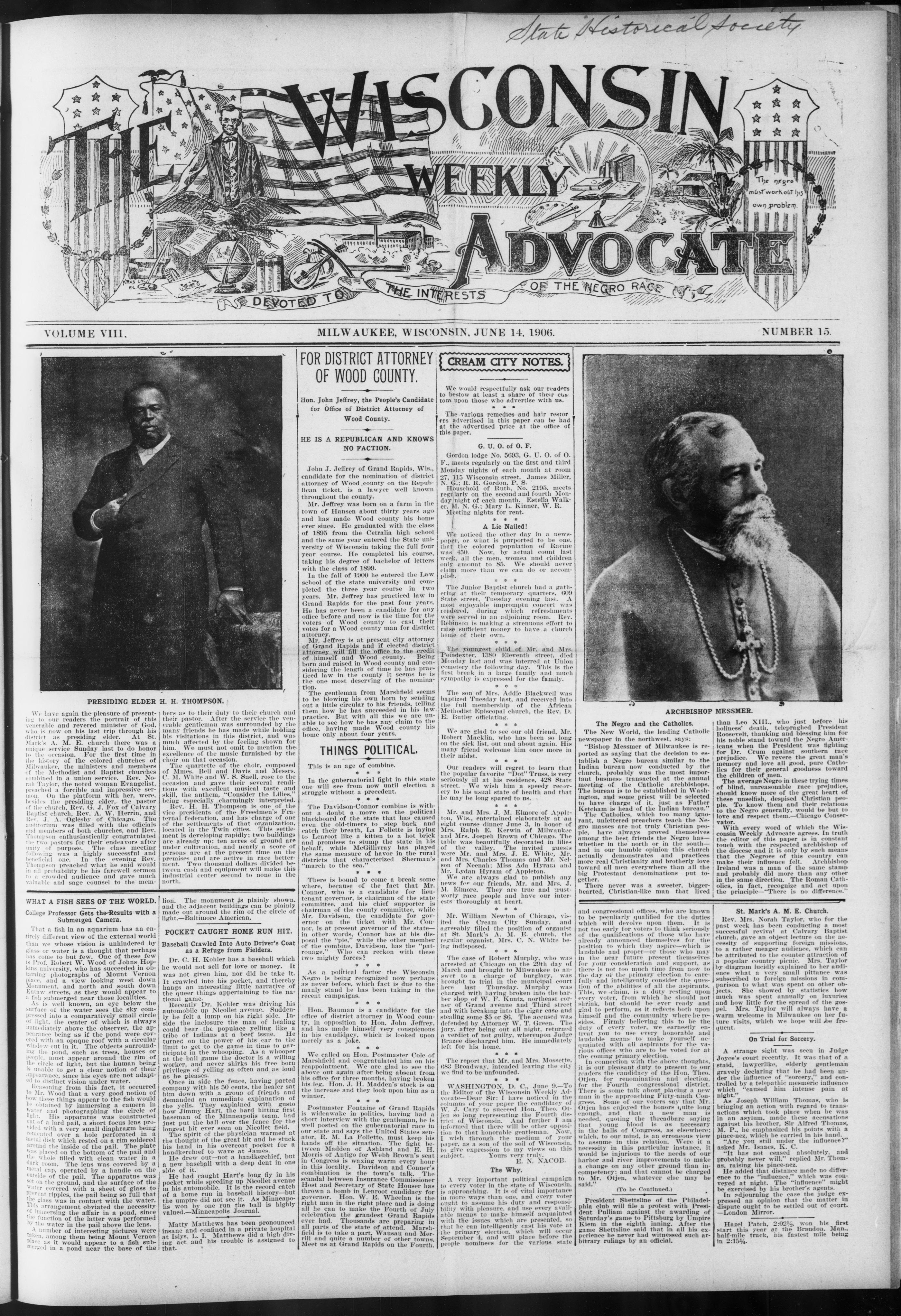
We have again the pleasure of presenting to our readers the portrait of this venerable and revered minister of God, who is now on his last trip through his district as presiding elder. At St. Mark's A. M. E. church there was a unique service Sunday last to do honor to the occasion. For the first time in the history of the colored churches of Milwaukee, the ministers and members of the Methodist and Baptist churches combined in a union service. Rev. Norah Taylor, the noted woman Evangelist, preached a forcible and impressive sermon. On the platform with her, were, besides the presiding elder, the pastor of the church, Rev. G. J. Fox of Calvary Baptist church, Rev. A. W. Herrin, and Rev. J. A. Oglesby of Chicago. The auditorium was filled with the officials and members of both churches, and Rev. Thompson enthusiastically congratulated the two pastors for their endeavors after unity of purpose. The class meeting following was a highly successful and beneficial one. In the evening Rev. Thompson preached what he said would in all probability be his farewell sermon to a crowded audience and gave much valuable and sage counsel to the mem-
WHAT A FISH SEES OF THE WORLD. College Professor Gets the Results with a Submeigen Camera.
That a fish in an aquarium has an entirely different view of the external world than we whose vision is unhindered by glass or water is a thought that perhaps has come to but few. One of these few is Prof. Robert W. Wood of Johns Hopkins university, who has succeeded in obtaining photographs of Mount Vernon place, and a view looking west down Monument, and north and south down Eutaw streets, as they would appear to a fish submerged near those localities.
As is well known, an eye below the surface of the water sees the sky compressed into a comparatively small circle of light, the center of which is always immediately above the observer, the appearance being as if the pond were covered with an opaque roof with a circular window cut in it. The objects surrounding the pond, such as trees, houses or people, must appear around the rim of the circle of light, but the human being is unable to get a clear notion of their appearance, since his eyes are not adapted to distinct vision under water.
Reasoning from this fact, it occurred to Mr. Wood that a very good notion of how these things appear to the fish would be obtained by immersing a camera in water and photographing the circle of light. His apparatus was constructed out of a lard pail, a short focus lens provided with a very small diaphragm being cemented over a hole perforated in a metal disk which rested on a rim soldered around the inside of the pail. The plate was placed on the bottom of the pail and the whole filled with clean water in a dark room. The lens was covered by a metal cap, operated by a handle on the outside of the pail. The apparatus was set on the ground, and the surface of the water covered with a sheet of glass to prevent ripples, the pail being so full that the glass was in contact with the water. This arrangement obviated the necessity of immersing the affair in a pond, since the function of the latter was performed by the water in the pail above the lens.
A number of interesting pictures were taken, among them being Mount Vernon place as it would appear to a fish submerged in a pond near the base of the
bers as to their duty to their church and their pastor. After the service the venerable gentleman was surrounded by the many friends he has made while holding his visitations in this district, and was much affected by the feeling shown for him. We must not omit to mention the excellence of the music furnished by the choir on that occasion.
The quartette of the choir, composed of Mmes. Bell and Davis and Messrs. C. M. White and W. S. Snell, rose to the occasion and gave their several renditions with excellent musical taste and skill, the anthem, "Consider the Lilies," being especially charmingly interpreted.
Rev. H. H. Thompson is one of the vice presidents of the Freedmen's Fraternal federation, and has charge of one of the settlements of that organization, located in the Twin cities. This settlement is developing rapidly; two buildings are already up; ten acres of ground are under cultivation, and nearly a score of persons are at the present time on the premises and are active in race betterment. Two thousand dollars divided between cash and equipment will make this industrial center second to none in the north.
lion. The monument is plainly shown and the adjacent buildings can be plainly made out around the rim of the circle of light—Baltimore American.
POCKET CAUGHT HOME RUN HIT.
Baseball Crawled Into Auto Driver's Coat as a Refuge from Fielders.
Dr. C. H. Kohler has a baseball which he would not sell for love or money. It was not given him, nor did he take it. It crawled into his pocket, and thereby hangs an interesting little narrative of the queer things appertaining to the national game. Recently Dr. Kohler was driving his automobile up Nicollet avenue. Suddenly he felt a lump on his right side. Inside the enclosure the man of healing could hear the populace yelling like a tribe of Indians at a beef issue. He turned on the power of his car to the limit to get to the game in time to participate in the whooping. As a whooper at the ball game the doctor is a willing worker, and never shirks his free born privilege of yelling as often and as loud as he pleases.
Once in side the fence, having parted company with his 50 cents, the healer sat him down with a group of friends and demanded an immediate explanation of the yells. They explained with gusto how Jimmy Hart, the hard hitting first baseman of the Minneapolis team, had just put the ball over the fence for the longest hit ever seen on Nicollet field. The spirit of the physician warmed at the thought of the great hit and he stuck his hand in his overcoat pocket for a handkerchief to wave at James. He drew out—not a handkerchief, but a new baseball with a deep dent in one side of it.
He had caught Hart's long fly in his pocket while speeding up Nicollet avenue in his automobile. It is the record catch of a home run in baseball history—but the umpire did not see it. As Minneapolis won by one run the ball is highly valued.—Minneapolis Journal.
Matty Matthews has been pronounced insane and confined in a private hospital at Islys, L. I. Matthews did a high diving act and his trouble is assigned to that
FOR DISTRICT ATTORNEY OF WOOD COUNTY.
Hon. John Jeffrey, the People's Candidate for Office of District Attorney of Wood County.
HE IS A REPUBLICAN AND KNOWS NO FACTION.
John J. Jeffrey of Grand Rapids, Wis., candidate for the nomination of district attorney of Wood county on the Republican ticket, is a lawyer well known throughout the county. Mr. Jeffrey was born on a farm in the town of Hansen about thirty years ago and has made Wood county his home ever since. He graduated with the class of 1895 from the Cetralia high school and the same year entered the State university of Wisconsin taking the full four year course. He completed his course, taking his degree of bachelor of letters with the class of 1899.
In the fall of 1900 he entered the Law school of the state university and completed the three year course in two years. Mr. Jeffrey has practiced law in Grand Rapids for the past four years. He has never been a candidate for any office before and now is the time for the voters of Wood county to cast their votes for a Wood county man for district attorney. Mr. Jeffrey is at present city attorney of Grand Rapids and if elected district attorney will fill the office to the credit of himself and Wood county. Being born and raised in Wood county and considering the length of time he has practiced law in the county it seems he is the one most deserving of the nomination.
The gentleman from Marshfield seems to be blowing his own horn by sending out a little circular to his friends, telling them how he has succeeded in his law practice. But with all this we are unable to see how he has any claim to the office, having made Wood county his home only about four years.
THINGS POLITICAL.
This is an age of combine.
* * *
In the gubernatorial fight in this state one will see from now until election a struggle without a precedent.
***
The Davidson-Connor combine is without a doubt a move on the political blackboard of the state that has caused even the old-timers to step back and catch their breath, La Follette is laying to Lenroot like a kitten to a hot brick and promises to stump the state in his behalf, while McGillivray has played the same measure of havoc in the rural districts that characterized Sherman's "march to the sea."
***
There is bound to come a break some where, because of the fact that Mr. Connor, who is a candidate for lieutenant governor, is chairman of the state committee, and his chief supporter is chairman of the county committee, while Mr. Davidson, the candidate for governor on the ticket with Mr. Connor, is at present governor of the state—in other words, Connor has at his disposal the "pie," while the other member of the combine, Davidson, has the "patronage." Who can reckon with these two mighty forces?
* * *
As a political factor the Wisconsin Negro is being recognized now perhaps as never before, which fact is due to the manly stand he has been taking in the recent campaigns.
* * *
Hon. Bauman is a candidate for the office of district attorney in Wood county, in opposition to Hon. John Jeffrey, and has made himself very conspicuous in his candidacy, which is looked upon merely as a joke.
***
We called on Hon. Postmaster Cole of Marshfield and congratulated him on his reappointment. We are glad to see the above out again after being absent from his office for three months, having broken his leg. Hon. J. H. Madden's stock is on the increase and they look upon him as a winner.
\* \* \*
Postmaster Fontaine of Grand Rapids is wideawake in politics, having had a short interview with the gentleman, he is well posted on the gubernatorial race in our state and says the United States senator, R. M. La Follette, must keep his hands off the situation. The fight between Madden of Ashland and E. H. Morris of Antigo for Webb Brown's seat in Congress is waxing warm every hour in this locality. Davidson and Conner's combination is the town's talk. The scandal between Insurance Commissioner Host and Secretary of State Houser has thrown a bomb in Lenroot candidacy for governor. Hon. W. E. Wheelan is the right man in the right place and is doing all he can to make the Fourth of July celebration the grandest Grand Rapids ever had. Thousands are preparing in all parts of the state of attend. Marshfield is to take a part, Wausau and Merrill and quite a number of other towns. Meet us at Grand Rapids on the Fourth.
CREAM CITY NOTES.
---
We would respectfully ask our readers to bestow at least a share of their custom upon those who advertise with us.
The various remedies and hair restorers advertised in this paper can be had at the advertised price at the office of this paper.
G. U. O. of O. F
Gordon lodge No. 5693, G. U. O. of O. F., meets regularly on the first and third Monday nights of each month at room 27, 115 Wisconsin street. James Miller, N. G.; R. R. Gordon, P. S. Household of Ruth, No. 2195, meets regularly on the second and fourth Monday night of each month. Estella Walker, M. N. G.; Mary L. Kinner, W. R. Meeting nights for rent
Meeting nights for rent.
A. Lie Nailed!
We noticed the other day in a newspaper, or what is purported to be one, that the colored population of Racine was 450. Now, by actual count last week, all the men, womea and children only amount to 85. We should never claim more than we can do or accomplish.
☆ ☆ ☆
The Junior Baptist church had a gathering at their temporary quarters, 609 State street, Tuesday evening last. A most enjoyable impromptu concert was rendered, during which refreshments were served in an adjoining room. Rev. Robinson is making a strenuous effort to raise sufficient money to have a church home of their own.
* * *
The youngest child of Mr. and Mrs. Poindexter, 1380 Eleventh street, died Monday last and was interred at Union cemetery the following day. This is the first break in a large family and much sympathy is expressed for the family.
The son of Mrs. Addie Blackwell was baptized Tuesday last, and received into the full membership of the African Methodist Episcopal church, the Rev. D. E. Butler officiating.
* * *
We are glad to see our old friend, Mr. Robert Macklin, who has been so long on the sick list, out and about again. His many friend welcome him once more in their midst.
* * *
Our readers will regret to learn that the popular favorite "Dot" Truss, is very seriously ill at his residence, 428 State street. We wish him a speedy recovery to his usual state of health and that he may be long spared to us.
\* \* \*
Mr. and Mrs. J. M. Elmore of Appleton, Wis., entertained elaborately at an eight course dinner June 3, in honor of Mrs. Ralph E. Kerwin of Milwaukee and Mrs. Jospeh Brown of Chicago. The table was beautifully decorated in lilies of the valley. The invited guests were Mr. and Mrs. J. E. White, Mr. and Mrs. Charles Thomas and Mr. Nelson of Neenah; Miss Ada Hyram and Mr. Lydan Hyram of Appleton. We are always glad to publish any news for our friends, Mr. and Mrs. J. M. Elmore. They are true and trustworthy race people and have our interests thoroughly at heart.
☆ ☆ ☆
Mr. William Newton of Chicago, visited the Cream City Sunday, and agreeably filled the position of organist at St. Mark's A. M. E. church, the regular organist, Mrs. C. N. White being indisposed.
* * *
The case of Robert Murphy, who was arrested at Chicago on the 29th day of March and brought to Milwaukee to answer to a charge of burglary, was brought to trial in the municipal court here last Thursday. Murphy was charged with having broken into the barber shop of W. F. Kuntz, northeast corner of Grand avenue and Third street and with breaking into the cigar case and stealing some $5 or $6. The accused was defended by Attorney W. T. Green. The jury, after being out all night, returned a verdict of not guilty, whereupon Judge Brazee discharged him. He immediately left for his home.
☆ ☆ ☆
The report that Mr. and Mrs. Mossette, 683 Broadway, intended leaving the city we find to be unfounded.
```markdown
```
WASHINGTON, D. C., June 9.—To the Editor of the Wisconsin Weekly Advocate—Dear Sir: I have noticed in the columns of your paper the candidacy of W. J. Cary to succeed Hon. Theo. Otjen so long representing the Fourth district of Wisconsin. And further I am informed that there will be other opposition to that honorable gentleman. Now, I wish through the medium of your paper, as a son of the soil of Wisconsin, to give expression to my views on this subject. Yours very truly.
The Whv.
A very important political campaign to every voter in the state of Wisconsin, is approaching. It is of vital importance in more ways than one, and every voter ought to assume his duty and responsibility with pleasure, and use every available means to make himself acquainted with the issues which are presented, so that he can intelligently cast his vote at the primary election, which will occur September 4, and will place before the people nominees for the various state
P.
ARCHBISHOP MESSMER.
The Negro and the Catholics.
The New World, the leading Catholic newspaper in the northwest, says: than Leo holiness'd Roosevelt, t his noble st
"Bishop Messmer of Milwaukee is reported as saying that the decision to establish a Negro bureau similar to the Indian bureau now conducted by the church, probably was the most important business transacted at the annual meeting of the Catholic archbishops. The bureau is to be established in Washington, and some priest will be selected to have charge of it, just as Father Ketcham is head of the Indian bureau." The Catholics, which too many ignorant, unlettered preachers teach the Negro masses are not truly Christian people, have always proved themselves among the best friends the Negro has—whether in the north or in the south—and in our humble opinion this church actually demonstrates and practices more real Christianity and brotherly love toward all men everywhere than all the big Protestant denominations put together.
There never was a sweeter, bigger-hearted. Christian-like man that lived
and congressional offices, who are known to be peculiarly qualified for the duties which will devolve upon them. It is not too early for voters to think seriously of the qualifications of those who have already announced themselves for the position to which they aspire—which is laudable and proper—or those who may in the near future present themselves for your consideration and support, as there is not too much time from now to the day of the primary election to carefully and intelligently consider the question of the abilities of all the aspirants. This, we claim, is a duty resting upon every voter, from which he should not shrink, but should be ever ready and glad to perform, as it reflects both upon himself and the community where he resides. Firmly believing this to be the duty of every voter, we earnestly entreat you to use every honorable and laudable means to make yourself acquainted with all aspirants for the various offices who are to be voted for at the coming primary election.
In connection with the above thoughts, it is our pleasant duty to present to our readers the candidacy of the Hon. Theo. Otjen, for renomination and election, for the Fourth congressional district. There is some talk about placing a new man in the approaching Flity-ninth Congress. Some of our voters say that Mr. Otjen has enjoyed the honors quite long enough, and that a new man is needed, quoting the threadbare saying that young blood is as necessary in the halls of Congress, as elsewhere; which, to our mind, is an erroneous view to assume in this relation. Were it a necessity in this particular instance, it would be injurious to the needs of our harbor and river improvements to make a change on any other ground than incompetency; and that cannot be charged to Mr. Otjen, whatever else may be said."
President Shettsline of the Philadelphia club will file a protest with President Pulliam against the awarding of Saturday's game to Pittsburgh by Umpire Kiem in the eighth inning. After the game Shettsline said that in all his experience he never had witnessed such arbitrary rulings by an official.
(To be Continued.)
than Leo XIII., who just before his holiness' death, telepraghed President Roosevelt, thanking and blessing him for his noble stand toward the Negro Americans when the President was fighting for Dr. Crum against southern race prejudice. We revere the great man's memory and love all good, pure Catholics for their general goodness toward the children of men.
The average Negro in these trying times of blind, unreasonable race prejudice, should know more of the great heart of these unselfish, despised Christian people. To know them and their relations to the Negro generally, would be but to love and respect them.—Chicago Conservator.
With every word of which the Wisconsin Weekly Advocate agrees. In truth the editor of this paper is in constant touch with the respected archbishop of the diocese and it is only by such means that the Negroes of this country can make their influence felt. Archbishop Ireland was a man of the same stamp and probably did more than any other in the same direction. The Roman Catholics, in fact, recognize and act upon the principle—"There is no difference."
St. Mark's A. M. E. Church.
Rev. Mrs. Norah Taylor, who for the past week has been conducting a most successful revival at Calvary Baptist church, gave an object lecture on the necessity of supporting foreign missions to a rather meager audience, which can be attributed to the counter attraction of a popular country picnic. Mrs. Taylor by diagram lucidly explained to her audience what a very small pittance was subscribed to foreign missions in comparison to what was spent on other objects. She showed by statistics how much was spent annually on luxuries and how little for the spread of the gospel. Mrs. Taylor will always have a warm welcome in Milwaukee on her future visits, which we hope will be frequent.
A strange sight was seen in Judge Joyce's court recently. It was that of a staid, lawyerlike, elderly gentleman gravely declaring that he had been under the influence of "sorcery," and controlled by a telepathic mesmeric influence which "caused him intense pain at night."
As Joseph William Thomas, who is bringing an action with regard to transactions which took place when he was in an asylum, made these accusations against his brother, Sir Alfred Thomas, M. P., he emphasized his points with a pince-nez, which he carried in his hand.
"Are you still under the influence?" asked Mr. Isaacs, K. C.
"It has not ceased absolutely, and probably never will," replied Mr. Thomas, raising his pince-nez.
He added that distance made no difference to the "influence," which was conveyed at night. The "influence" might be exercised by his brother's agents.
In adjourning the case the judge expressed an opinion that the matter in dispute ought to be settled out of court. —London Mirror.
Hazel Patch, 2:02½, won his first start this year at the Brandon, Man., half-mile track, his fastest mile being in 2:15¼.
On Trial for Sorcery.
Tea-Table Salad.
The Real Thing.
"Hi, waiter, this meat is like leather."
"Saddle or mutton you ordered; sir."—
Ally Sloper's Half-Holiday.
Gladys—Won't it be lovely when we
have plenty of airships?
Myrtle—Yes, indeed. Then the nice
young men will be asking us to fly with
them.—Town Topics.
"Have you heard the joke that is told
at Jones' expense?"
"No, but I don't believe it." "Why not?" "He's too stingy."—Town Topics.
Her Range
Mrs. Knicker—What does she talk about?
Mrs. Bocker — Bridge and Bridget.— Harper's Bazar.
An Example
"Papa, what is satire?" "Well, for example, when your mother asks me how much I've won at prayer meeting."—Life.
Defining Him
Tommy—Papa, what is a consulting physician?
Papa-He is a doctor who is called in at the last moment to share the blame. Life.
Quite Clear.
Mary—Have you written to explain?
Ann—Yes; I apologized for making him think I didn't mean it when I told him it was all a mistake about my not having changed my mind.—Browning's Magazine.
A. Health Resort.
Prospective Tenant—Is this a healthy neighborhood, landlord?
Landlord—Healthy I should say so! In the last ten years there have been only two deaths—the doctor and the druggist.—Fliegende Blaetter.
Slips of the Pen.
"Among those present, with whom his lordship shook hands very cordially, were three men, one armless."—Daily Mail. "... a deaf mute, was brought up on remand ... The prisoner did not wish to say anything, and was committed for trial."—Oxford Chronicle.
Accounted For.
Mrs. M's patience was much tried by a servant who had a habit of standing around with her mouth open. One day, as the maid waited upon table, her mouth was open as usual, and her mistress, giving her a severe look, said: "Mary, your mouth is open." "Yessum," replied Mary, "I opened it." —Everybody's Magazine.
Something Like It.
Marryat—Hello! old man, you're looking prosperous.
Munniman—So I am. I'm in the leather business now. I tell you, there's nothing like leather—
Marryat—Think so? Say, come up and take dinner with us tonight. My wife baked some pies for dessert.—Catholic Standard and Times.
Supply Too Limited
"I heard you had a cow for sale," began Subbubs, "and as I'm thinking of buying one for our little place——"
"Waal, sir," interrupted the farmer, eagerly, "thar's thet Jarsey yonder. Now, thar's one good p'int in her thet you can depend on——"
"Oh, gracious! that would never do. I'd need a quart, at least."—Catholic Standard and Times.
Only One Song
Yeast—Were you up to the oyster supper at the church, last night?
Crimsonbeak-Yes; it was a very enjoyable affair.
"You're joking."
"No. I'm not. Every one that found an oyster had to sing a song."
"Must have got tiresome."
"Not at all. We only hau one song the whole evening."—Yonkers Statesman.
Incidentals.
"This bill for your new frock is really a bit high," observes the plutocrat to his daughter. "Six thousand dollars is considerable to pay just for an auto suit." "But, papa, the suit itself really is quite inexpensive. The most of that bill is for the trimmings." "Trimmings?" "Yes. I spent $5200 for an auto of the right tint to match the suit."—Exchange.
Too Great a Risk
He desired to take out a life policy for $50,000.
Smiling eagerly, the agent drew forth the blank form and began the usual series of questions.
"Query six," he said, at length—"are you an automobilist?"
"No," was the ready rejoinder, "I am not."
"Motor cyclist, perhaps?"
"No." The agent, with a sigh, laid down his pen. "I am sorry," he said, "but we no longer insure pedestrians." Minneapolis Journal
Drinks by Number.
"Up and down, up on three and both ways on five."
It's not a roulette game, nor is it a country dance, but merely a glib little girl in a certain downtown drug store shouting her soda orders across the counter. The "jerker," without further comment, proceeds to draw a chocolate soda, a sundae of the same brand, a strawberry soda, a pineapple soda and a pineapple sundae. No other words are necessary. The well trained "jerker" knows the numbers of the flavors as well as he does their names and never makes a mistake.
To the onlooker the system presents a greater difficulty than even the phraseology of a short-order restaurant waiter. In the latter case there is some resemblance between the real names and the invented, but at the soda fountain the real names disappear, and the thirsty patron sits in wonder when he hears the order, not knowing whether he is to be served with a porterhouse steak or a couple of boiled eggs.—Indianapolis Star.
Absinthe for a Schoolboy
An amazing discovery has been made in one of the communal schools here. A class master noticed that after 10 o'clock every morning one of his pupils, a little boy of 7, seemed to become a prey to fits of delirium. He thumped his neighbors, and when reproved by the master rolled on the floor, shrieking, and groaning like one possessed.
The child was constantly in the habit of asking leave of absence for a minute or two, and the master had him watched. It was found that he carried a small bottle of absinthe in his pocket, and took a sip as often as he could escape from the classroom. It has been proved that the child's mother filled the bottle for him every morning.—Paris cor. London Daily Mail.
WHEN HEARTS WERE TRUMPS.
Once hearts were trumps, yet that was when
Then hearts were trumps. How long ago— The days are dimmed with webs of woe— Should love discard its useless pain And deal as gently once again Would hearts be trumps? —Ralph M. Thomson in The Bohemian.
THE RETREAT.
The general descending from the stage coach gave a long embrace to the dear old folks. After seven years of battle they looked the same to him, the one under his old cap with big streamers, the other wearing a headdress of a bit of black lace.
Soon they arrived at their destination. Pausing in front of the house, the soldier felt his heart beat within him. No change had taken place in this dear home, either. The garden with its same acacias, only a little more solid, and it was the same old cellar door, from which pervaded, as in former days, an order of sausages and new wine.
"It is happy home coming," said he. There were three steps as you entered. Formerly the two old people would alight them with a quick step, now with a cane the farmer felt his way. "Permit me," said the general. With arm around their waists he helped them to their room. How little they weighed. They seemed as though a slight gust of wind would blow them away.
"Ah! the brave boy! Well, come in!" cried they. "You will catch cold."
All was in readiness, and on the table with its snow white cover was a substantial repast. But before eating he looked at them attentively.
"And Mie Myon?" murmured he, since nine years that I went away. But the shrewd old lady with her hands in her pockets, and gazing over her spectacles changed the conversation.
"Hey! dear son, seems to me you bore yourself with honor in all these years. Great things have been said about you. What are you gazing at?" inquired she, as she saw him smile. "Pay no attention, dear heart, they are the same spider webs as in your time."
And the old man, as he raised his head, said: "At our age we do not sweep them away. * * We leave that for the young folks."
Then the general, seeing the spiders going to and fro, and thinking of a childish proverb, replied, "Arraignees du matin * * * Chagrin." For now he foresaw unhappiness. He believed that his fiancee, tired of waiting, had married another, and that he would never again lay eyes on her. "Well," sighed he, "as long as it is a secret, I will wait until you broach the subject first."
While they were laughing, the general kept busy, and cut them each a slice of bread, which they immediately divided into small pieces. Drop by drop they drank their wine, then after a moment, with shaky fingers, the old father would pour out the clear wine. "There, now!" and the two old folks, leaning over and looking at the general, said: "And the battles?" But the young man implored: "Be kind, Mie Myon, what of her? tell me first."
"Yes, for we know all from our neighbors. All have won your victories." The old folks were headstrong, dazzled by the uniform of their son and the large saber hanging by his side. They were anxious to listen to the tales of war and he resigned himself to the situation, but instead of commencing with these words, "There was once upon a time a poor nation called France," the general drew from his pocket a black pipe and said gravely: "Well, let it be." "By Jove!" whispered the old lady, who had never seen that expression on her son's face before.
Leaning on his arm, the general then told in brief of his departure, of his life of misery, of privations, of his first battles and the first degrees. At all this the old people looked on with astonishment. He seemed to have them with him, on horseback, galloping with the sound of the drums, into the raging battles, and now and then the two old parents would turn away their eyes as though a flash of lightning had passed. How then could they be afraid?
Through the clouds of smoke emanating from his pipe, he could see them, hand in hand, like children. Then, remembering all past events, he plunged into the thrilling description of the battles and incidents and before he knew it he was naming them one by one. Nerwinden, under Dumvariez; the Siege of Mayence; named captain by Custine, dying, Battle of Hondschoote; promoted commander of the Army of Rhine et Moselle; Fleurus gained victory; then the taking of Aix-la-Chapelle, of Maestricht, and of Cologne; a blockade at Mayence; sunstroke under Italian skies; battles of Montenotte, Dego and Castiglione. He became the friend of Napoleon and received a star decoration of Trente. From that time, dazzled with so much glory, he was sent to France. Good fortune follows him at Hoche, and he returns to his old army at Bambre-et-Meuse. Then ensued the Thabor, general of first division, another star.
What an epoch entwined in this round of victories, how to stop, where to find between two combats the time to regain the native soil? A continual overlapsing of time, all Europe to convince under the menace of the sword. And speaking of these great things his voice grew louder until it seemed to shake the very walls, then suddenly looking at his beloved parents, he grew more calm and wiped the perspiration off his brow. They had not moved. Pressed closely one next to the other, they appeared deaf to all noise. Only the quivering of the veins of their hands showed their inward emotions.
"Well," said the general, "what are you thinking about?" Then suddenly they threw themselves toward him and said: "You frightened us so!" "Arise!" cried the old lady, and hung around his
neck as though she expected to find him covered with blood stains.
"Now a little wine; it is my time to listen to you," said the general, embracing them. "I hope you are going to give me news of Mie Myon."
"Those victories! Who would have thought that when I used to patch up his trousers," murmured the dear mother, "and he such a sweet boy."
"I see," said the general, arising, "that something of importance has occurred here, since you hesitate to tell me. It is well. I need to be alone a moment. Where is my room?"
"The first floor, the same, my boy!"
"The first floor, the same, my boy:
No sooner had he regained his room than he recalled all the memories of the past. There he had sung, here he had suffered for Mie Myon. It was the same window with the flowered curtains from which he formerly saw her house with the gardens, where they had played so often—he a mere boy—she a joyful little girl. How he had loved her during the long campaign. How he loved her still, even though she had forgotten. And he sat there by the window in a reverie until evening came and a chill passed through him as a breeze came through the open window. In the angles of the wall spiders had webbed large hammocks of lace. "Arraignees du soir," murmured the soldier.
He no sooner had said the words than a sound of "hope" was heard ringing along the road. A froufrou of skirts was flitting up the stairs, and quick as a gust of wind Mie Myon, now a tall young lady, fell in the arms of the general.
"My cousin!"
After a long embrace they each knew their love had never ceased. "You terrible boy," repeated Mie Myon, still blushing. "Nine years of absence. I promenaded through France," said the soldier, cheerfully. "What a happy moment." From the half-opened door could be seen vapors of steam gushing; from the now deserted table. Near by glistened the wine.
Peace reigned.—Philadelphia Bulletin.
Summer Fashions for Men.
Dark blue ribbons worn as bands on straw hats are always in good taste, particularly if worn with blue serge suits, and colored hat ribbons are as usual being favored by the younger men, particularly college men.
Among the new wrinkles of the season is a soft flannel collar which has in front two small pearl buttons to which the ends of the tie are fastened. This does away with the need of pulling and tugging at the tie band when knotting the tie, and thus causing the soft collar to sag at the edges, heretofore a great objection to this style of collar.
The preferred materials for summer wear are serges and soft flannels, serviceable homespuns and the ever popular tweeds, while the approved colors are blue and gray.
The summer suit should be cut loose and full enough to allow perfect freedom in moving about, for the general tendency is to a "lounginess" in summer clothes that savors of long happy days in the country, whether the suit is to be worn in town or out.
For straw hats the soft pliable braids, Milans and Mackinaws so called, are most indorsed this season. So very pliable are they that they may be shaped by a pressure of the thumb and forefinger. They are particularly popular with younger men, and are more in accord with the tendency toward comfort in dress than are the hats of stiffer straw.
In order to allow ample room for the rather large knot of the cravat, waist-coats are cut quite low, so displaying a good deal of the pattern of the shirt.
White sorges and flannels will as usual be deservedly popular. Nothing could look cooler or feel more comfortable, as every man knows who has reveled in the delightful sense of cleanliness and luxury conveyed by one of these suits. They are of course without waistcoats, and the trousers are furnished with belt loops and are turned up at the bottom.
In men's clothes as well as women's everything this season must be in harmony. Scarf, shirt, handkerchief, hose, and even such minor articles as jewelry. It is considered good taste to have the scarf harmonize closely with the ground of the shirt and the scarf pin, cuff links and studs set with stones as near the same color as possible.
Green is one of the season's popular colors, and a jeweler outfit of jade stones is a popular novelty. Other colored stones made fashionable by this fad for color schemes are topaz, amethyst, tourmaline, malachite, alexandrite, with the moonstone for evening dress.New York Mail.
Washing and Ironing
If the wringer is rubbed with a cloth saturated in paraffin oil after colored clothes have been washed any color on the rollers will be removed.
For starching dark blue or black muslins or calicoes dissolve sufficient gum arabic in hot water. Dip the garments to be starched in the solution, wring out and dry. The garments will look as sheer as new.
No woman who is particular wants her clean table linen or underclothes to rub against the soiled dress of a laundress, and it is impossible for the dress not to come in contact with the clothes that are being ironed. It should be insisted upon, therefore, that the laundress at least wear a clean apron, if not a clean cotton dress.
In getting clothes ready for the wash care should be taken that towels or any articles that are at all damp should be dried before being put into the general receptacle for soiled clothes. Particularly in summer as there is danger of such articles becoming mildewed.
Bed linen and underclothes should be soaked in tepid water, to which has been added some melted soap and some soap powder.
Colored things should be soaked in salt and water or in water in which a little turpentine has been added before they are washed. A tablespoonful of vinegar in the last wrinsing water will revive the color.
Muslin curtains that have become sooty or filled with dust should be scaked in cold water, never in hot water.
To wash curtains put them to soak over night. In the morning let this water run off and wash thoroughly in hot suds. Rinse in clear water and then in
blue water, always squeezing the water out with the hands. Wring through thin boiled starch and place on the stretcher. If this convenience is not at hand pin sheets over the carpet of a room not much in use and then pin the curtains down, one over the other, carefully and evenly. Leave until dry.
Another way of drying curtains without ironing them is to turn up a broad hem top and bottom and run into each an unpainted curtain pole the width of the material. Stretch the curtain smooth, sprinkle, then hang up in some convenient place and let dry.
As the weight of the pole keeps the curtain straight, there will be no need of an iron except to press out the hems when dry. If it happens that there be spots on the muslin that have not dried smooth sprinkle and press out with the iron.
---
If it is necessary to iron the lace it should be carefully done on three or four thicknesses of flannel. This will make the edges, and the raised parts stand out quite like new.—New York Mail.
If white lace is to be washed cover a bottle with fine flannel tightly wrapped around it two or three times and sewn on, wind the lace quite smoothly around, fastening with a stitch every now and then. Make a good soap lather in a deep basin and stand the bottle n, shaking it well and pressing the lather into the lace. Rinse in the same way with clean, cold water, put bottle in the sun to dry; when nearly so, lay it in a basin of water with a small quantity of borax to stiffen it.
Good Vegetable Recipes
Cooked Lettuce—Wash well firm heads of sound, fresh lettuce and cut the stalks close to the lowest leaves. Tie each head separately with a piece of tape or soft string and lay close together in a wide saucepan. Cover with consomme and cook slowly for half an hour or until the heads may be pierced by a straw. Take out carefully and drain each head separately in a colander, taking pains not to bruise. Place on a hot platter. Keep hot while you stir a white roux into the pan gravity and boil up once. Pour over the lettuce when you have clipped and removed the strings.
Left-over Spinach—Chop cold cooked spinach fine. If creamed it will not need chopping. Add the beaten yolks of two eggs, a tablespoonful of melted butter, salt and pepper to taste. Set this mixture away to cool. When cold, beat into it half a gill of cream and the frotted whites of three eggs. Turn into a buttered pudding dish and bake quickly in a hot oven to a light brown. Serve as soon as it is removed from the oven.
Young Carrots—Boil the carrots until tender, then cut into halves lengthwise. Melt some butter in a hot pan. When the butter bubbles lay in the carrots and sprinkle with some sugar, salt, pepper and finely chopped parsley. Fry them until the edges become crisp and brown. Lyonnaise carrots are made in the same way, only cooking some finely chopped onion in the butter before adding the vegetable.
Sweet Potatoes au Gratin—Peel and parboil sweet potatoes. When cold slice and cut each slice in half. Dip each triangle thus formed into beaten eggs and then cracker dust until thickly coated, lay on a platter and set on the ice until the coating stiffens. Fry to a golden brown in deep boiling fat. Drain on a colander lined with tissue paper and serve very hot.
Broiled Tomatoes—Cut firm, ripe tomatoes in half, leaving on the skin. Dip first in oil or melted butter, then in bread crumbs and season highly with pepper and salt. Place between a well greased oyster broiler and cook until the crumbs are brown, turning often to avoid burning them.
Escalloped Onions—If old onions are used, take the smaller ones, removing the tough outside and parboiling the vegetables. Drain well and place in a baking dish in alternate layers with bread crumbs, seasoning each layer with pepper, salt and butter, and pouring over the whole rich cream or milk. Bake about twenty minutes.—New York Mail.
Hint of What She Might Do.
The old colored "mammy" who had ruled the Greenough household for more than twenty years was known to the tradesmen and the world in general as "Mrs. Washington," although she allowed the Greenoughs and their friends to address her as Aunt Euphrasia. She had a flow of language which has seldom been equalled, and delighted in it more, even, than in her skill in cooking. On one occasion Mrs. Greenough overheard Aunt Euphrasia berating a tardy grocer's boy.
"Whar yo' been, yo' triflin', lazy' destructful, owdacious, aggervatin', presumptious boy, while I's been a-waitin' and a-y'arnin' for dese y condimental spices?" demanded Aunt Euphrasia, her turbanned head threatening the delinquent, who cowered before her. "Ef I hadn't got to put dese right into my cake dat's ben kept onfinished for yo' to go dawdlin', philanderin', sojerin' round. I'd stop a minute and gib yo' some idee ob my opinions regardin' yo'?"—Youth's Companion.
Difference in Methods.
The conversation in the smoking room of the sleeping car had drifted around to the characteristics of the races. "I like your people," said a German, who had been listening. "I have been in this country for thirty years, acting as an immigration agent for my people and assisting them to settle here when they come to this country. "Now, take a party of Americans when a new territory is opened or some public land thrown open for settlement. They ride or drive in, get their land, select a place for the village, stake out the streets, and then somebody gets up on a stump, calls a meeting and nominates John Jones for mayor. In ten minutes they have a municipality and everything is going along all right.
"If a party of Germans was in the same place, what would they do? When it came time to organize their village they would stand around for three hours and then somebody would ask: 'Where is Bismarck?' "—Saturday Evening Post.
Feats of Strength by Small Plants
Strength is not a thing usually connected with maidenhair fern, yet if its roots have not sufficient room they will break the pot in which the plant grows. Blades of grass will force the curbstones between which they may spring up out of their place and in a single night a crop of small mushrooms have lifted a large stone. Indeed, plants have been known to break the hardest rocks. The island of Aldabra, to the northwest of Madagascar, is becoming smaller and smaller through the action of the mangroves that grow along the foot of the cliffs. They eat their way into the rock in all directions, and into the gaps thus formed the waves force their way. In time they will probably reduce the island to pieces.—Kansas City Journal.
And now again upon our view
Bursts forth the shirt of rainbow hue,
And where the galluses were wont
To do their daily, weekly stunt,
The glistening belt, tan hued and wide,
Buckled in front or on the side,
Appals us with some sudden thought.
And then again the eye is caught
By flaring te and naked throat—
Trouers upturned and flying coat;
And to ourselves, half pained, we say,
Behold the season! Neglige!
New York Every Day.
"I thought it would be sort of catchy to make the dinner 49 cents," said the youth who has started an Italian restaurant in New York, "but I'm not so sure now. Last night a fellow handed 50 cents to the waiter, with a careless air. 'You may keep the change,' he said."
Frederick E. Thompson and Elmer S. Dundy, founders of the New York Hippodrome, retired from the management of that enterprise. The reason given was that other amusement places under their management require too much of their time to permit them to properly care for the interests at the Hippodrome.
Klaw & Erlanger will be the new managers of the Hippodrome.
"I don't see how they can afford to give away little packages of matches with a cigar here in New York, you know," said the visiting Englishman. "It seems to me a very generous thing to do. We would never think of doing it in London, perhaps because we use wax matches nearly altogether and they are rather expensive, and in Paris matches are such a luxury it is a common thing for a stranger to stop you on the street and ask for a light from your cigar."
News from Nice says that Charles M. Schwab is causing a sensation at Monte Carlo by his high play at roulette. It is reported that Mr. Schwab puts the maximum on a number and maximums on all arres and trans-versales. On one occasion he won $10,000 by this method. When he first arrived he had a bad time. He lost so much backing the number 32 that he temporarily reduced his stakes to 5 francs. His table is now always surrounded by an interested crowd.
There was a new joke—a brand new joke—cracked at an uptown theater in New York. The perpetrators were German comedians. They were talking about departed friends. One said to the other: "Did your band play at Really's funeral?" "To be course we did," replied the other: "Vell, vat you played?" "Vell, you seen. Reilly was such an awful eater; he died of too much eatin'." "Yes; vat is the difference?" "Vell," was the reply, "instead of playin' a deadt march we played an over-chewer." Are you on?
A house that is attracting more than an ordinary amount of attention has just been put up in Park avenue, New York. The architecture is uncompromisingly Dutch. The light red brick facade is ornamented with entablatures of vivid green porcelain. Even more striking are the three terra cotta figures over the principal door. One is a lobster and the other is the head of a goat—one of those "Mr. Williams" which are familiar in bock beer signs. Between them is a figure of Father Time holding his scythe. These unusual ornaments to the facade of a private house interest spectators more than the striking contrasts in color.
"Will you please remove your ruff?" is likely to become a request as common in the New York theaters as "Will you please remove your hat?" used to be. The thin, collarless waists that women are wearing this summer make something around the neck a necessity if the evening air is a bit cool. The fashion of the hour is a wide pleated ruff of tulle or other crisp material, which my lady usually leaves on her shoulders, and which spreads out and hides the stage from the person sitting behind her quite as effectively as did the big hats in the dark days of yore. Hence the new request, which is complied with rather grudgingly.
With the papers howling about the "wide open" condition of the town and beset by reformers and would-be reformers Police Commissioner Bingham preserves a cool head and a cheery optimism that are amusing as well as interesting. On the mantelpiece of his office in addition to a caricature of Dr. Parkhurst is a miniature beer stein. It is a relie of a banquet attended by the commissioner recently and it bears the following inscription in red letters: "Cheer up; the worst is yet to come." "Yes," said the commissioner when referring to the trinket, "that little stein often makes me say to myself, 'What's the use of worrying about reform and reformers?'"
The recording of a five-year mortgage for $150,000 on the building at No. 5 East Forty-fourth street makes public the fact that Richard Canfield, the King of Gamblers, has sold his palatial house of chance. The mortgage is given by "Paul Moran," but Rodney, the old negro servant, who has been in the employ of Canfield for years, says it is a certain James Wallace who has taken over the property. Rodney says "Massa" Wallace has engaged him, in addition to certain others formerly identified with Canfield. Canfield's going from the city leaves him with only one place now. That is his club at Saratoga. Some time ago he disposed of his Newport establishment and the only property he has now at Providence is a residence.
There's a certain "hot dog" man just around the corner from the World building in Frankfort street who is going to be rich some day. And at such a cost! He sells everything from "dog" down to salmon, but at such prices! in Pittsburgh you pay 5 cents for one Frankfurter sandwich. Here this fellow sells them three for 5. You can get a large glass of milk for 2 cents, a corned beef, ham or cheese sandwich for the same price, a chocolate eclair for a cent, half a small pie for 2 cents, a cup of coffee for 2 cents, a glass of lemonade for 1 cent or a salmon sandwich for 1 cent. His place is mainly patronized by newsboys, and go there when you may—by day or by night—you will find him and his assistant as busy as it is possible for two men to be.
Business men along upper Broadway, New York, are agitated over the daily presence of surveyors who are drawing lines and marking the sidewalks with ominous hieroglyphics. Information from the men at work in the neighborhood of Nineteenth and Twentieth streets indicates an activity on the part of the subway contractors, who, it is said, wish to build the branch road from Fourteenth to Forty-second street under Broadway. Three years ago, when the subject was brought up, the merchants and property owners put up such a strong opposition to the spur that Mayor McClellan, heeding their petition, had the building of the tunnel abandoned, at least for the time being. The actions of the surveyors have again set these citizens thinking, and there is already a storm of protest in the neighborhood for fear of a repeti-
tion of Forty-second street's condition of filth and ruined business.
"If I wanted to make a mortal enemy of the man who was brought up in a small town," said the old New Yorker, "I would poke fun at his home paper. I don't know of anything that will rile him more effectually. He knows that the bombastic way in which local items are written is absurd, and he may enjoy a hearty laugh over them himself in private, but let anybody else say a word against the literary style used to describe neighborhood calls, weddings and funerals, and he gets hopping mad. I tried a little ridicule of that kind yesterday on my friend from Ohio. He flared up quick as a wink. 'You can't expect all those fellows back there in the woods to be Horace Greeleys' he said. 'In my opinion they get out a mighty good paper.' Of course that is not his opinion at all, but, like the thousands of other adopted New Yorkers who still look for the home paper every week, he wouldn't admit that there was anything the matter with it."
To escape detectives hired by unknown persons to hound herself and her father, Miss Ethel G. Rockefeller, daughter of William Rockefeller, had to steal across the Atlantic under an assumed name and surreptitiously enter New York as though she had committed some crime. Miss Rockefeller arrived on the Kaiser Wilhelm der Grosse. She was posted on the passenger list as Fraulein E. Raynor, occupied an ordinary stateroom and was accompanied by a maid. The young woman figured, however, without proper consideration for the watchful eye of the government officials. When it came to answering certain questions which both immigration and customs employees invariably put to every incoming passenger, Miss Rockefeller was obliged to admit that she was an American. This led to her revealing her identity.
The fact that the niece of John D. Rockefeller, in returning home, used a fictitious name naturally aroused great curiosity among the government employees, and she accordingly explained. She said she left her father ten days ago in Germany. They went there over sixteen months ago in the hope that Mr. Rockefeller might recover from a nervous disorder, and detectives followed them day and night all over Europe. The mystery to Miss Rockefeller and her father was. Who was paying for the work of the sleuths?
It is interesting to know what the player folk will find to interest themselves during the hot season. Mr. Frohman's stars have announced their intentions as follows: Ethel Barrymore, for the first time in years, will spend a summer in America. She has taken a house in Maine. On the conclusion of her long run in "Peter Pan" at the Empire theater Maud Adams will go to her country place in the mountains. John Drew has gone abroad. After a visit to Naples, and then to the south of France and the Riviera, he wil go to London to consult with Charles Frohman regarding the Pinero play, "His House in Order," in which he appears next season.
William Gillette is now abroad. He will return shortly for his annual cruise in his houseboat, the Aunt Polly. E. H. Sothern and Julia Marlowe will be playing at the Academy of Music until the end of June, and in consequence have not completed their vacation plans. Mr. Sothern has a country place in Jersey, and Miss Marlowe one in the Catskills. However, they may go abroad.
Edna May is said to have a big success in "The Belle of Mayfair" in London, and will no doubt play all summer. William H. Crane is now in London for a conference with Charles Frohman. He will later join Mrs. Crane in Germany. Sam Bernard is having a little rest at Mount Clemens after a solid year's work in "The Rollicking Girl." Later he will go to the Adirondacks with his family. Francis Wilson usually spends his summers at his country place, the Orchard, at New Rochelle, but this summer he has completed a new summer home in the mountains. Otis Skinner has gone to Byrn Mawr, Pa., where he has a country estate. Hattie Williams is making a quick trip to Europe, as she opens in New York in August. Fay Davis will spend part of the summer in Maine and the rest abroad. Joseph Wheelock, Jr., having recovered from an operation, will go west. William Collier and his company will play in Australia.
All nationalities have their own eating houses in New York. The Frenchman has places in almost every part of the city where he can enjoy the food, drink and customs of his native land and converse in his own language and listen to the music of his country. The Hungarian finds many places where he can find his highly flavored dishes and sip the wines of his native land, while a gypsy orchestra helps retain the atmosphere. Spanish hotels afford the Don and his friends opportunities to converse in their own language, eat their favorite omelettes, ollas, olives, figs, onion and garlic, drink their favorite wines and talk revolution. The Mexican can get his chili con carne, tamales, tortillas, frioles, poceado espagnol and revel in pulque, mescal and sweet waters, not forgetting the garlic and the chili. Greek restaurants are quite numerous, as are also Greek hotels. Japanese restaurants give the subjects of the Mikado the national dishes of the Land of the Rising Sun, with sake and tea to drink and real Japanese tobacco and pipes to smoke. The Arab can find his home among the rug sellers and curio dealers on the lower east side, munch his dates and smoke his water pipe with Turkish tobacco, drink sweet drinks and eat sweet cakes, all from or prepared according to the formulas of North Africa. The turbaned Hindu can find many places where the hot curries of India are prepared by native cooks and served with chutney, salt dried fish and the fruits of the Orient. Chinese restaurants are numerous. Some of them are chop-suey houses of the Tenderloin; others are gorgeous palaces in Chinatown. The Italian talbe d'hote is everywhere, and it is safe to say that the general public patronizes them as extensively as do the natives of Tuscany. The Hebrew who wants only the food he is permitted to eat can find eating houses where only a few Hebraic characters on the window or blended with the letters of the sign will tell him that he may enter and eat without fear, and many patronize these restaurants on the east side. With all these places of other races in his midst, where can it be said that the American has a place as distinctly his own as are the places mentioned those of the people they cater to?
A Joke on Dolliver.
Senator Dolliver tells a good story on himself in an incident which occurred while he was making a campaign tour of his state.. It having been announced that he was to speak at a certain county seat, a prisoner in the county jail, who had known Dolliver in other days, wrote a note to the sheriff and told him how much he desired to hear the speech. He mentioned the acquaintance with Dolliver and asked permission to go up to the town square, pledging himself to return as soon as Dolliver had finished. "The sheriff was a Democrat," Dolliver says, when he tells the story, "and as soon as he received the note he turned it over and wrote on the back of the paper: 'Permission granted. Rest of the sentence remitted.'"—Leslie's Weekly.
GOSSIP FOR THE LADIES.
How Does It Seem to You?
It seems to me I'd like to go
Where bells don't ring nor whistles blow.
Nor clocks don't strike, nor gongs don't
sound,
And I'd have stillness all around.
Not really stillness, but just the trees'
Low whisperings, or the hum of bees,
Or brooks' faint babbling over stones
In strangely, softly tangled tones.
Or maybe a cricket or katydid,
Or the songs of birds in the hedges hid.
Or just some such sweet sounds as these
To fill a tired heart with ease.
If 'tweren't for sight and sound and smell
I'd like a city pretty well.
But when it comes to getting rest
I like the country lots the best.
Sometimes it seems to me I must Just quit the city's din and dust, And get out where the sky is blue, And say, now, how does it seem to you? --Eugene Field.
Neighborliness.
One of the great evils of village life is gossip; one of its chief advantages is the abundance of neighborly feeling. Both of these are due to the fact that everyone knows every other one and all about every other one, and what they don't know they guess, and guess pretty nearly right. Between watching and swapping information and filling up the interstices by "suspicioning," the practiced villagers get things "down fine" on each other and on the sojourner in the midst of them.
By the same token neighborly sentiments flourish. As in the human body the same nerves supply motion and sensation, so in village life along the lines on which curiosity travels sympathy also runs, and generous helpfulness and all gracious service in times of need or distress are freely tendered. This is one of the bright aspects of village, life, and is a partial if not complete offset to the evil of village gossip. Not to be "neighborly" is a greater reproach than to be lacking in the upper story, for the latter is a dispensation of Providence, while the former is regarded as sheer grumpiness or also a fear of being "found out."
But it is all the one upward tendency which marks the social trend of the age. Some writer has said that humanity is a whole; it must rise and fall together. When a civilization goes down it carries every individual with it; when a new era dawns it elevates the whole race. After all there is little room for the pessimist in our midst; after all there is nothing satisfying but growth. And the world grows daily toward unity, is beginning to understand more and more of the higher ideals of justice, righteousness and charity.—Pilgrim.
The Daily Heroine.
A woman, known and loved in a small town, was during all her life a tower of strength to her family and friends. She cared for an invalid, and at the end a mentally incapable, mother; she took charge of a sick brother; she was always ready to nurse, to help, to cheer her neighbors and intimates. She was unfailingly and simply cheerful. When all her work was done, and the end of her own not very long life drew near, it was found that for years she had been carrying the burden of a slow, insurable cancer, of which no one knew but her physician and herself. Yet if she had been told she was a heroine, she would have protested genuinely against any such idea. Her humility was as heroic as the rest of her qualities.
What is a hero? has been answered, "A soul which rises up to face life squarely—to comfort its grievous circumstance and conquer it." With all the improved conditions that women have today, with any conditions that the race can attain, there must always be multitudes of women combating grievous circumstance. Women live so deeply in the lives of others, give themselves so unselfishly by their very nature, that fate incessantly demands from them the heroic qualities—self-command, self-effacement, courage, and sacrifice. The daughter who renounces all personal ambitions to minister to the helpless age or infirmity of father or mother; the wife who shields and strengthens an unworthy or weak husband; the mother who sacrifices herself absolutely to support and educate her orphaned children—the world is not worthy o these, and yet we have them always with us, witnesses of a diviner life than most of us know how to live.
The hero protects, rescues, fights for, and if need be dies for, others. Tried by these tests, how many daily heroines this crowded, commonplace life of ours holds. There are plenty of spoiled girls, plenty of frivolous matrons, plenty of empty, extravagant, useless lives, among women today, more's the pity. But—the heroines are there—God bless them! If they weren't, the world would have gone to pieces long ago.—Harper's Bazar.
Women. Be Intelligent.
Ignorance on the topics of the day is needless in this age of current literature, and particularly needless on the part of progressive womanhood. The time has gone by, indeed never was, when a woman was not all the more attractive because of an intelligent knowledge of the vital questions of the moment. Any woman who has learned to read may get a familiar insight into the world's happenings by the careful and wise perusal of one daily newspaper, while with the advent of the monthly magazine comes a lucid and detailed explanation and consensus of public opinion upon every phase of the world's thought. There are few women who do not read the papers and some one or two magazines, but the trouble is they read them after a fashion of their own. Watch one go through the newly arrived periodical; she scans the headlines of the political and current news, dips into the scandals and murders, reads through the items of local importance, takes an interest in the woman's departments, and loses herself in the fictioo. The editorial page, wherein the best reading matter ought to be found, and which should, if it is a first-class publication, give the best information on local and national current events, are passed over entirely or, at best, with but a mere glance. Here we have the secret of the time-worn complaint that men in talking to women—the average woman—as a rule confine their conversation to the lighter vein.
The true woman's club stands for a reform in this line as in many others. Progressive members of modern clubs are, or should be, interested in every phase of public life in which father, husband, brother, or son is interested. Women are bearing an important part in national problems, and men are feeling their influence in the business world as never before. Too many, alas, are content with bewailing the fact that they have too little time or too little brains to become acquainted with all the ins and outs of the questions that are bewildering and puzzling even the strongest minds of the land. Others lament that they have missed educational opportunities and are therefore handicapped in the intellectual race. But none of these excuses suffice for a blank indifference and totally ignorant attitude toward these important subjects. One is never too old or too unlettered to regain advantages. If you don't know, ask questions. One of the brightest women of our ac-
quaintance says that her mental brilliance is entirely due to the fact that she is eternally and forever asking questions about all manner of things. Read judiciously. Take one hour a day, even if to accomplish it you haven't quite so many frills on your own or daughter's wardrobes, or some social duty must be cut out, to deliberately and quietly read over every subject that is interesting the world at large; if you can't digest the whole, master one and master it thoroughly. Think it out for yourself to a conclusive finish. The only question for us to decided is whether we shall be content with an aimless giving way to our natural self-indulgence or to what we conceive as the inevitable, or whether we shall realize that the world is all the time growing broader and greater, that society is progressing, that this is an age of aggress:veness, and determine that to the best of our ability we will keep abreast of the times.—Exchange.
The Usage of Shoes During the Summer.
The time of walking for pleasure has come, and the young woman begins to take stock of her box of shoes, for all women who have a proper care for their feet have several pairs always on hand. For not only is it well to have shoes suited to every occasion, but it is refreshing to the feet to change the shoes at least two or three times a day; it rests the tired muscles to put on a fresh pair of shoes. It has now become so much a matter of course to have "flat foot" or "broken arches," according to whether the individual affects Boston or New York, that that matter has to be thought of and special pains be bestowed upon the shoes. Next to the "flat foot" comes "tender feet," brought on chiefly either by wearing too thin-soled shoes for walking, or those that do not fit.
The thin-soled shoe has its proper place, but it is within doors, not on the pavement or on hard or stony ground; the sole of the foot is sometimes almost blistered and sore, while both the ill-fitting and the thin-soled shoes are prolific sources of corns and bunions that are as great torments of peace as aching teeth. Too much stress cannot be laid on the necessity of changing the shoes as soon as one comes in from a walk, replacing the stout, reliable Sorosis, or whatever make one prefers, with a soft, flexible, low house shoe. The sense of relief is immediate and grateful. That, and treating tired feet to a brief hot bath, should always be done when it is possible. It follows as a matter of course that stockings should be carefully chosen—and carefully put on. Careless dressers are as apt to twist their stockings as to forget to perfectly pin waist and skirt together, or set the collar straight. Not every woman can afford to buy quite as pretty a shoe as she would like, but she equally can't afford to buy a cheap or badly-fitting one. In fact it is poor economy, for the good shoe always outwears two or three bad ones.
Taste in Household Decoration.
The great requirement in household furnishings is taste. It is, of course, thoroughly delightful to have as much money to spend on a house as one wishes to, and to be indifferent, so far as the money goes, as to how much is spent; but it is much more important, as to results, to have only good things, disposed in a good way, charming wall papers, refined ornaments, exquisite combinations. These are the elements which go to make an artistic interior, not the mere amount of money paid for them.
The price of an article is no criterion of its merit, except that high priced articles should have greater art value than low priced goods. Art, real art, is costly, because much time and effort goes into its production. The genuine artist works slowly; if he belongs to the first rank he will produce but one or two masterpieces a year, perhaps not more than one in several years. He will use costly raw materials, because he knows his use of them will result in a fine production. He will apply to his task the knowledge and experience gained by many years of effort, possibly years of unremunerative effort. And the meanwhile he has lived and must live, and he expects to be recouped for his expenses. All these things make his prices large, although his profits may be very small.
On general grounds, therefore, good art is expensive. So also is bad art. Very high prices are often charged for very bad objects, and, which is very much worse, obtained for them. The result is much more disastrous than being simply a bad purchase, for many people are fascinated by high prices, and will pay large sums for false works of art which not only have no right place in a house, but which destroy the effect of whatever symmetry and harmony and beauty may have been obtained by artistic effort.
Nothing so completely destroys the effect of any room so much as the introduction of a gaudy, conspicuous, unartistic object which has no right place in any well designed and artistically arranged home. It is bad enough when such things are given to one; it is scarcely short of a crime to deliberately purchase them under the singular notion that something of genuine art value is being obtained. It is bad in every sense. It shows that the possessor has no real taste herself, and it encourages the production of fake art objects, which would quickly disappear from the shops were there no market for them.
Any one with good taste can accomplish very much more in household decoration than one who simply has money to spend. Such a person gives thought and care to the problems presented in the household scheme. She realizes the value of every individual object, and if she starts fresh, can produce effects in beauty that the most lavish expenditure will fail to produce. And it is good taste which accomplishes this result, not money.-American Homes and Garden.
A Souvenir Luncheon.
Once Mrs. Dinadan gave a souvenir luncheon; one of those hen parties with some distinctive subject, some "clou." as the French say, for discussion to hang on. Everyone was to bring a keepsake and tell why she kept it. There was everything you can imagine, from college colors to a card admitting to an execution at a county jail. A former newspaper woman brought that, more to astonish the rest than because she actually cared for it. Of course, it had never been used. One of the men reporters in former days had given it to her as a sort of gruesome joke, and, in a way, it stood for the most active and exciting part of her career. Another guest who presented photographs of her Mediterranean trip was ruled out. We all had foreign photographs at home. We all buy them as the best reminders of some enchanting place, things that we will enjoy looking over and reviving past delights with. Well, we do enjoy looking over them and yet—and yet—it is not long before they are only brought forward when house-cleaning opens the perennial debate as to how long to store unused articles.
Properly speaking, Mrs. Dinadan's own contribution should have been ruled out, only you cannot overrule your hostess and your elder. Hers was what she called a "Mental Photograph Album." It contained a set of inquisito-
rial blanks to fill out: "What is your favorite flower? Color? Author? Occupation?" etc., etc. "Improving my mind." Mrs. Dinadan said was the King of England's answer to this last question. But that was forty years ago, when as the dissipated Prince of Wales, he enjoyed shocking the British public, and anyhow he had not written it in her book.
We talked a long time over these things: an old newspaper with black borders, containing the news of Lincoln's assassination; a dance card from a first ball; a great-grandfather's snuff box, presented to him by La Fayette; a theater programme on which Irving and Terry had put their names. Everyone confessed to hoarding programmes, even without notable autographs. Some persevering persons had the programmes of every play they had ever attended, with the names of their companions noted on the edges.
Mrs. Dinadan's little niece ran into the room for bonbons, and we asked her if she hadn't any keepsake to show us. Oh, yes, she had a perfectly elegant button string! This is a mania that attacks alternate generations of school children. In the intervening years buttons go out of style and gowns are hooked or laced up, but as soon as the whirligig of fashion brings them in again every small girl starts begging buttons from her friends. Big girls only collect army buttons.—House Beautiful.
Care of the Lamp.
People who are using lamps should know the right way to manage them. A smoky, oily, strong-smelling lamp is a nuisance, while a well-cared-for lamp is a joy and a comfort.
To begin with, every lamp owner should know that a new wick ought to be soaked or boiled in vinegar. This having been done, there will be neither smoke nor smell, while a much brighter light will be given.
Wicks are the main thing to be considered in connection with lamps. Unless a wick is well cared for a satisfactory light cannot be had.
In the first place, those who have the care of lamps should never cut the wicks; rub the charred portions off every day with a soft rag. If the wick becomes too short to carry up the kerosene do not throw it away, but fasten a piece of cotton cloth to the end below and it will prove a good feeder. Wicks should not be allowed to grow too short, however, for then they clog the burners.
No better treatment for burners can be suggested when they have become gummy and prevent the wicks from moving freely than to boil them in suds over the fire for a short time. In this way they may be kept clean, and a clean burner always works well. By boiling the burner all incrustations from the settlings of oil are removed.
Once in a while the lamps themselves become corroded and should be washed out with soapsuds and very small shot or a little sand and shaken vigorously for a few minutes.
The admonition thoroughly to dry all parts of a lamp seems hardly necessary to give, but so important is it to have the wick and the chimney perfectly dry that every one should be warned on this point.
New chimneys are often put into salt water that is allowed to come to a boil. This is said to toughen them, but a good chimney can best be cleaned by wiping it in the usual way with a soft cloth that has been dipped in methylated spirit. This will clean it better than by washing in water and it does prevent the glass from breaking so easily. Polish with chamois.
When lamps become very dirty a teaspoonful of soda to a quart of hot soap suds will cleanse them thoroughly, but the washing should be quickly done lest the soda injure the outside metal, bronze or decorated china. And the drying is as important as the washing—for if a lamp is to be safe it must be perfectly dry. Every morning a lamp should be filled when in use and the tank never filled to the top. Leave a space of at least an inch at the top—in all but the student lamps—and these should never be quite full. Never use an almost empty lamp, as it is not safe to do so. The space that is empty is sometimes self-filled with an explosive gas.
Wipe the outside the whole lamp perfectly dry with a soft cloth. Lamps sometimes smell from oil that is left on the outside. Wash glass shades every day unless they are highly decorated, and then polish with soft cloths. Do not allow dust to settle on any part of a lamp, and with ordinary care there should be neither dust nor odor, but a bright, cheerful light that will enable weak eyes to read without strain. Of course, the best kerosene is the only kind to buy, and if bought in a ten-gallon can with a faucet at the bottom a smaller can may be filled easily. Keep the large can in a cool, dark place.
By buying oil in quantities the vessel is safer and more convenient to handle, and if kept where candles and lighted matches are not allowed there will be entire safety.—Philadelphia Inquirer.
The Strong Character.
Keeps fire's object clearly in view. Knows where to be firm, and where to be pliable. Understands how to be thoroughly independent and at the same time sweetly gracious. Maintains a resolute adherence to truth and right, no matter how unpopular. Knows how to yield an unimportant point willingly, and to resign a preference cheerfully. Recognizes that a wise and manly resolution is not incompatible with genial and loving compliance.
Thinks He Will Do.
Manager H. C. Danforth of the Bijou theater in this city, says the Oshkosh Northwestern, receives many queer letters from stage struck persons asking to be given a chance to show what they can do, but one missive he received recently is the cap sheaf of them all. It was written by an aspiring copper country amateur, who was advised by Walter F. Keefe of Chicago, booking manager of the Bijou circuit, to write Mr. Danforth. The letter, just as it was written, the spelling, punctuation and capitalization being unchanged, is as follows:
"Dear Mr. Mangr.—Will you please let me no how i can get started to travel with a Bijo theather tripe. Mr. Keefe told me to, write you as president of the company. I am going to play on Petersons house next Saturday and if I take well with the public I would like to travel with a troop. I have been playing at concerts in the copper country about 5 yr and people always tell me I ought to travel. I make a musical act lasts for ten to fifteen minutes or one hour if you want it. If it lasts an hour I would have to use my partner who is a comical. I play two solos on the harmonica and it has made a great hit. After that I give a musical selection on the snare drum. I also play the bells in my head. I make a very nete appearance on the stage. If i make a success next Saturday evening i will let you know. I know several ladies in Oshkosh. I have taken prizes for being one man band. The last time I used a cornet and they all said it was the best I ever did. Send me an answer quick.
"P. S.—There is lots of smoke from the fires in the woods up here. Would write more but the smoke hurts my eyes."
YOUNG FOLKS' COLUMN.
```markdown
```
PETER AND THE DWARFS.
During the school vacation Peter visited New York for the first time. He saw some of the sights from the top of an observation car, and he also rode through the subway. He was fortunate enough to be in the Central park at the time the airship made its first ascent. As an imaginative boy, the wonderful things Peter saw filled his mind and came back to him even in his sleep. He had grown so accustomed to the frequent visits of his friends, the dwarfs, that it occasioned him no surprise to find himself sitting beside the court introducer listening to his chatter.
"Her majesty is without doubt the wisest person in the realm," said the Court Introducer, "no one but she would have thought of such a thing."
"I believe you are perfectly right in saying that," Peter replied. "The idea of an airship in the subway would not naturally occur to an ordinary person."
The two friends were discussing the queen's trip through the subway on the first train of the palace car service, and her subsequent invention of an airship to take the place of the cars.
"I wonder what made her think of such a thing?" Peter remarked, inquiringly.
"Like many other great inventions, an accident, only the accident didn't happen."
"Oh!" said Peter, not much enlightened by this lucid explanation.
"Something it seems had fallen on the track and but for the sharp lookout of the motorman a terrible accident would have happened. The officials tried to keep the news from the Queen, as they did not wish to frighten her, but when the train stopped quite a while between two stations she knew something must be wrong, and she insisted on knowing all about it.
"The president of the road, who was on board the train, was summoned to her majesty's presence and questioned about stoppage. He acknowledged that by the carelessness of some one a log of wood had fallen on the track, but it was being removed and they would start right away. Some of the court ladies became very much excited when they realized the danger they had escaped. The red—I mean the auburn-haired girl fainted away, and but for the assistance of the court poet, who is her acknowledged swain, she would have fallen. He said something to her of which I could not hear only 'lady fair' and 'golden hair', but it revived her anyhow. The Queen kept perfectly cool all through and when the president finished his yarn she said, 'Why don't you have the track on the roof and then nothing could fall on it?'
"The man, thinking her majesty was joking laughed at this, but the Queen let him understand very sharply that she meant what she said.
"It might have been a cow instead of a log of wood. I often read of cows getting on the track. Now, what would you do if a cow got on?
"The poor man was so bewildered at this unexpected question he could only stare helpless at her majesty's stern countenance.
"'I know what I would do,' said the court fool.
Well, what would you do, Sir Wisdom, if a cow got on the track?
"I would milk her,' replied the fool. 'I wish I had a glass of milk now. I'm very thirsty.' Everybody laughed at this, but the queen sharply rebuked them, and sternly ordered the president to take the train to the next station at once, as she would go no farther in such a dangerous place. "I don't like to think what might happen if we ran against a cow," she said. "The cow would certainly be killed," replied the president, who had by this time recovered his composure.
"That would be a bad job for the railway company," said Prof. Mud, who was one of the guests. "The society would prosecute every director to the extent of the law. I shall see to it that a bill is passed through the next Legislature that cows which may innocently stray on the tracks shall be fully protected. I am sure her majesty will give the society all the aid her high position can give." "I certainly shall," replied the queen, "but as I said before the tracks must be reversed and placed on the roof. It can be done and it shall be done."
All the way home her majesty spoke to no one, but remained in a brown study, and we all could see she was thinking deeply. The result of her thoughts was laid before the cabinet this morning, and a patent will soon be issued for an airship to navigate the subway.
subway.
"I thought airships were intended to
"sink in gold, Peter."
navigate the air, said Peter. "Well, isn't there air in the subway? It may not be as pure as we have it above ground, but it is air all the same. The invention is after all very simple, and easily understood. An airship rises from the ground, but in the subway it can rise no higher than the roof, so by placing wheels on top it can be made to run on a track on the roof. That is all there is to it; its' as simple as rolling off a log."
"It does look simple enough," said Peter; "the queen has made a most important invention if she can make it go."
"Make it go, Sir Reginald," exclaimed the dwarf. "You surely do not expect her majesty to put on a pair of overalls and a jumper and go into the driver's cab. It will be the business of the railway company to make it go, won't it?"
"I suppose so," said Peter, somewhat perplexed, "but perhaps none of their engineers can make it go."
gineers can make it go."
"Then they'll have to get some other engineers who can. Her majesty has done her part; there's the machine; now it is up to the company to do its part and make it go."
Just then a servant entered with a card, which he laid before the court introducer.
"Col. Inker, editor and proprietor, Fresh News," he said. "Admit him; it is wise policy to keep on good terms with the press, Sir Reginald."
A dapper little man, with somewhat of a military air, came in smiling and shook hands cordially with the court introducer
"I have just heard from a private source that her majesty has made another invention; so I hastened to get the particulars for the afternoon edition. I wouldn't trust a reporter this time."
"I see you haven't forgotten the scolding her majesty gave you for calling her game 'Wurly Purl.' said the court introducer, with a smile. "So you want to know about her latest. Well, in my humble opinion it will revolutionize the transportation problem. But first I must introduce you to Sir Reginald, the greatest genius in this country, barring, of course, her majesty, the queen."
As Peter arose to accept the proffered hand the diminutive colonel started in astonishment at his gigantic size.
"Great Goliath!" he exclaimed, "how I wish you were editor of Fresh News." "What's the matter with Slugger?" inquired the court introducer. "The last
time I saw you, you told me he was the test editor you ever had."
"Poor Slugger is in the hospital and is likely to be there for a long time to come," said the colonel mournfully.
"That's too bad, colonel; what's the matter?"
"Perhaps you know that Mud's secretary wrote a book about the Poles. He never was in Poland and he knows no more about the Poles than the man in the moon. My free lunch editor is a Pole, a North Pole at that, seeing that he came from the most northern town in Poland. None of us can spell his name or even speak it, so we call him Smith.
"Well, I asked Smith about the Esquimo and the polar bears, and he said he never saw an Esquimo in his life, and as for polar bears, the author must have meant Russian bears.
"I wrote a redhot review of the book, exposing the author's ignorance of geology, and all the other ologies. I said he was just the man to write a book about diameters, seeing that he didn't know the difference between a diameter and a hard boiled egg. That was a pretty hard hit, wasn't it?"
"I daresay it was," answered the court introducer," though I must confess I do not know the difference myself. What is the difference?"
"Why," said the editor, "the one is a hard boiled egg and the other isn't."
"A diameter," stammered the colonel, "a diameter is—is something that belongs to the earth, don't you know. You often read such phrases as "the diameter of the earth,' 'the fruits of the earth,' and so forth." "Oh, I see," said the court reporter, "it's a fruit, then. Perhaps its some kind of egg plant, in which case it is not far off a hard boiled egg. But what has ail this to do with Slugger?"
"It has everything to do with Slugger," cried the colonel, warmly. "It made the secretary mad, as I expected it would, but instead of coming himself to see me he hires the Cardiff Giant to go to Fresh News office and demand an apology. The giant comes right up to my desk and wants to know if I'm Col. Inker, so I points to Slugger, who is my substitute in such cases. But Slugger, instead of giving the fellow a civil answer, he tells him to go to the North Pole and find out, and then there was a fight, in which my name got badly handled. I rushed out for the police, but it was an ambulance that was needed most. Poor Slugger will be of no more use to me for a long time to come. If it had been our young friend here," continued the colonel, looking admiringly at Peter's sturdy limbs, "the giant would be in the hospital instead of Slugger. How would you like to be an editor, Sir Reginald?"
"I don't know, sir; I am only a school boy," said Peter, modestly. "I couldn't write stories."
"You won't be required to write anything. Your duty will be merely to occupy my private office and entertain certain visitors when I haven't time to attend to them, and fire them out if they get too saucy."
"I wouldn't like that at all, sir; I couldn't strike a fellow smaller than myself, and you are all so very much smaller."
"Col. Inker," said the court introducer, "if the queen knew you were trying to induce Sir Reginald to leave the court, she would be very angry, indeed, Take my advice and hire another slugger, or perhaps the Cardiff Giant himself."
"A good idea, if I can only coax him away from the secretary." said the colonel.
A shrill voice was heard outside inquiring for Sir Reginald. "Come in, boy," said the court introducer, opening the door, and a small messenger boy entered the room.
"A telegram for Sir Reginald," said the boy; "is he here?"
"Yes," said Peter, rising. "What is it?"
"Crickey!" gasped the boy, "he's a giant."
Peter opened the envelope and read: "Come and see me.—Soapy."
"Who is Soapy? I never heard of him."
"He is the Court Blower, and he told me to fetch you. He is down on the garden path waiting for you," replied the boy, turning to go. "Come along, please."
Peter followed the messenger, and saw the Court Blower sitting on his ladder, industriously stirring the contents of his jug.
"Oh, dear," thought Peter, feeling in his pocket for his rubber ball. "I hope they don't want me to play Purly Wurl again."
"This is kind of you to come," said the Court Blower. "The queen has ordered me to make tougher balls, as the ordinary ones always break in the players' fingers. I thought you might show me how you handle the balls so well."
"I don't think I can explain it," said Peter. "Have you been playing today?"
"Oh, no. I am inventing a new kind of soap that will make strong bubbles. I was told that leather is a tough substance, so I am inventing a leather soap."
"I see," said Peter, greatly relieved to know he was not required to play the game. "And have you succeeded?"
"Not yet, sir. I have been only a few weeks at it, and the leather has not melted yet. The Astrologer kindly offered to find out from the stars how long it will take, but I won't give up, whatever he says. I'll do it if I sit here till Christmas."
"That's right, Soapy," said Peter, encouragingly. "Perseverance is the parent of Success."
"A most profound observation," said the Court Philosopher, who came along at that moment and had overheard Peters' last remark. "I must make a note of that," and taking out his notebook he wrote: "Sir Reginald says Perseverance is the parent of Success."
"But which parent, Sir Reginald? I like to be exact, in scientific matters."
like to be exact in scientific matters. This question was rather a poser for Peter, but he saw an answer was looked for, so he boldly replied, "Both parents, I guess. And how is the new bread knife getting on?" he inquired, to change the subject.
"Famously," cried the philosopher. "My wife is in raptures over it. Now, she can suit all hands to a dot. Tom wants his bread cut half an inch thick. His mother lays on the rule, puts in the knife, and there you are. Dick, who is rather dainty, likes his slice only quarter of an inch. The rule shows where to cut and that settles dainty Dick. Then Harry, who is the greedy boy of the family, wants his slice cut seven-eighths thick. Again the rule shows where to cut and Master Harry gets his rations. And so on, all through. Oh, it's a great labor saver, and what is more, my wife says a great temper saver, for it prevents grumbling and discontent."
"No doubt of it," said Peter, "and if it only had a buttering attachment the thing would be perfect."
"A most profound observation, Sir Reginald; I never thought of that. Now how would you go about it, if you were me?" said the philosopher, coaxingly. "I think I would butter one side of the knife and see how that worked." "Eureka!" exclaimed the philosopher.
"I shall go right home and invent a buttering attachment," and the wise old gentleman trotted off at a rapid pace, almost running over the court astrologer, who was approaching the group.
"Oh," exclaimed Soapy, "have you found out anything about my invention yet?"
"Not much. I looked up the Astrologer's Guide under the words 'leather' and 'soap,' but I have not been able to connect them sufficiently close to make a prediction. May I have a word in private with you, Sir Reginald?"
"Sure," said Peter, curious to know what the little man wanted.
"Are you from the east?" he asked in a whisper.
"Yes, I am from one of the eastern states.
"Then it must mean me," cried the astrologer.
"Listen, Sir Reginald. I have a very old copy of Thomas the Rhymer's works, and in studying it I came across a very strange prophecy. It reads thus:
When a youth from the East.
Becomes greatest of men,
And marries the beautiful queen.
"What do you think of that, Sir Reginald? A great many of the Rhymer's prophecies have come to pass, and why not this one?"
"I don't know," replied Peter, who had never heard of the Rhymer, but who was shrewd enough to see what the ambitions courtier was aiming at. "It might apply to you, as well as to any one else, I should think."
"That's what I think," said the astrologer in the same low tone, "but please keep mum; say nothing, and as the fool says, 'we shall see what we shall see.'" and the little man marched off with his head in the air, as if he had already ascended to the throne.
"Oh, dear, oh, dear," said Peter to himself. "These dwarfs are all silly things, but that old graybeard is the silliest of them all. To think of the Queen marrying the likes of him," and as he looked at the vain old man strutting along in the pride of his great expectations, it put him so much in mind of a turkey gobbler bossing the barnyard, Peter laughed aloud and so awoke.—Brooklyn Eagle.
ATHOL'S COSTLY GIFT.
Lyman Jennings $7200 Ahead on His Annuity from the Town.
Atho: Mass., has just awakened to the fact that through accepting a gift thirty years ago it is much out of pocket and that it is likely to pay out a still larger amount of money if Lyman Jennings continues hale and hearty. Thirty years ago, when Mr. Jennings was 58, he had accumulated $10,500 in cash. About that time hard times in business came and work was difficult to obtain, so he thought how he could invest his money so as to make sure that he and his wife would be comfortable the rest of their days.
The town of Athol was then in debt and he offered to give the sum of $9000 to the town on condition that it should pay him an annuity of $540 during his life, and if his wife should survive him that it pay her an annuity of $180 after his decease, during her life, and that it should pay to each of his three children who should suhive him an annuity of $120 after his decease, during their lives.
The town eagerly accepted the gift and in 1876 the $9000 was turned over to it. A few friends chided Mr. Jennings for what they termed his foolishness, and others told him he had let his heart run away with his head and needed a guardian. The town meeting passed a resolution, setting forth that "Mr. Jennings will be held in Athol's lasting remembrance." Mr. Jennings smiled and said he wasn't born a Yankee for nothing.
Every year for thirty years Mr. Jennings has quietly stepped up and received $540, and at the next payment the town of Athol will have paid him $16,200, or $7200 more than he gave the town. It has been unnecessary for him to work during all these years, for he has had a comfortable income secured to him for life, and neither has he been obliged to worry over the welfare of his wife and family, knowing that the town is bound to give them a certain amount of support.
Consequently he is a very healthy, happy old man and is looking forward to living to the age of 100. If he reaches this rupee old age the town of Athol will have paid him $22,680.
Mr. Jennings considers his investment away beyond gilt edge bonds or railroad stock. The town would like to get out of its bargain, but there is no way out of it.—New York Sun.
MUSINGS OF A GENTLE CYNIC.
The devil gets up pretty early to get his due.
Most oratory is stronger of lung than of logic.
Even the doctor isn't in business for his health.
Extremes meet, but they don't always speak as they pass by.
Misery loves company, and generally makes up its mind to have it.
Any man can lie, but it requires constant practice to do it successfully.
If it wasn't for the cynic, a fellow would never know how happy he isn't.
A man never realizes how many friends he has till he doesn't need them.
Some people are as hard to please as the college graduate looking for his first job.
A man is justified in wearing chin whiskers if his wife persists in making his neckties.
No matter how bad the failure, the optimist always manages to save a few chunks of hope.
At any rate, the man who fails is more to be commended than the man who never tries.
The man who gives himself away must expect the world to take him at his own valuation.
He who is disappointed in love doesn't run so much chance of being disappointed in marriage.—New York Times.
Something to Brag About.
Mrs. Jones and Mrs. Brown were bosom friends. It was astonishing what a lot they knew about other people's business.
The conversation turned in the direction of Mrs. Tittlesay, a new arrival in the next street.
"I hear she's suffering from appendicitis" declared Mrs. Brown.
"Suffering!" echoed Mrs. Jones contemptuously.
"Why, yes; didn't you known that?" asked Mrs. Brown. "Yes, I heard she had got appendicitis," replied Mrs. Jones, "but Lor'! judging by the way they bragged about it I thought it was some sort of a piano player. What is it anyway?"—London Answers.
THE WISCONSIN WEEKLY ADVOCATE
R. B. MONTGOMERY, Editor and Proprietor.
The Wisconsin Weekly Advocate after three years' residence at 79 Fifth street, has moved its headquarters to 430 Cedar St. where we will re-
A Representative Journal Devoted to the Interest of All the People.
ADVERTISING RATES.
One inch, one year..... $15.00
Two inches, one year..... 25.00
Three inches, one year..... 35.00
Four inches, one year..... 42.00
For larger space, special rates.
Locals, 10 cents per line.
TERMS OF SUBSCRIPTION
One year ..... $2.00
Six months ..... 1.00
Three months ..... .50
Direct all communications to
R. B. MONTGOMERY,
430 Cedar Street.
HOW TO SEND MONEY.—Post Office
Order. Express Order. Draft or Registered
Letter. R. B. Montgomery will not be
responsible for loss when sent in any other
way.
TO CONTRIBUTORS:
All communications must be sent with the name and address of the sender as an evidence of good faith, but not necessarily for publication. No manuscript returned if not accepted, unless accompanied by stamps.
EDITORIAL PARAGRAPHS.
---
"I know of the bravery and character of the Negro soldier. He saved my life at Santiago, and I have had occasion to say so in many articles and speeches. The Rough Riders were in a bad position when the Ninth and Tenth cavalry came rushing up the hill carrying everything before them. The Negro soldier has the faculty of coming to the front when he is needed most. In the Civil war he came 400,000 strong, and I believe he saved the Union."—President Roosevelt.
The New Yorker who is advising people to chew lava for their health may be a dentist making a long reach for business. Dr. Don Armour, demonstrator of anatomy at the Rush Medical college, has been appointed senior assistant surgeon in the National hospital, London, England.
---
Gaillard Hunt, the chief of the passport bureau, says he never was as busy as at present, and estimates that his department this year will issue between 20,000 and 25,000 passports.
Dr. Lynn of Pana. Ill., the oldest physician in that state, recently celebrated his one hundred and first birthday. More than 1000 persons attended a reception given in his honor.
Deacon Benjamin Brown of Brooklyn, Conn., is 99 years old. Deacon Brown, who claims the distinction of being the oldest living ex-legislator in Connecticut, was born in Brooklyn, May 25, 1807.
Thomas W. Bucknell of Providence, R. I., is known as the champion "monument raiser," having started more monument funds and assisted at more monument dedications than any other man in the country.
Calumet, Michigan, is facing the prospect of having a copper mine under the cellars of her inhabitants. If the miners leave the crust thick enough this won't hurt the cellars, but if there should ever be any quaking of the earth the cellar holes may drop into the mining pits.
Rev. George W. Barker of Bridgton, Me., the sole survivor of the original members of the Christian fraternity at Phillips Exeter academy, has been invited to assist at the organization's semicentennial. He has accepted and will speak from the text of his first address to the fraternity members fifty years ago.
---
Dr. T. Mitchell Prudden, professor of pathology in the College of Physicians and Surgeons, New York, who has spent his eight summer vacations mapping out the country of the cliff dwellers in Arizona, Colorado, New Mexico and Utah has presented to Yale a collection of old potteries and textiles collected on his trips.
The Lockwood scholarships for members of the department of music at Yale have been won by George M. Sneath of New Haven, George I. Tompkins of Waterbury, Conn., and Henry Thomas Moore of St. Joseph, Mo. These are cash prizes from the income of $12,000 and are divided among the three students of highest standing each year.
The cancellation by Michigan and Chicago of their football contracts with the athletic board of the University of Wisconsin clears the way for progress under the new arrangements made by the faculty. But the weather is too warm now for football projects, and the pigskin will be permitted to perspire in the "gym," while the players try to keep cool in a double sense. The outlook does not arouse enthusiasm.
---
The oldest person in Putney, Vt., is Mrs. Ruth Allen Smith. "Aunt Ruth," as she is best known, observed her one hundred and second birthday anniversary last week. The observance was entirely informal and quiet on account of Mrs. Smith's advanced age, but a good number of neighbors and friends called and extended congratulations and presented flowers. Mrs. Smith's mind is vigorous and her general health is good, but her sight and hearing are impaired. She enjoys company and she has a cheerful disposition and takes an interest in what is going on.
THE HONORABLE JAMES J. M'GILLIVRAY.
Has Made a Record to be Proud of and One That the People of Wisconsin Ought to Recognize.
In the state of Wisconsin it is hard to pick out any one man who has been in public life and show up his record as a worker for the state without having it said: "There are hundreds of just as good men in the state." This may be true, and we could name several who are worthy of the highest of praise, and we are willing to give praise where praise belongs.
It was often said of the late Jeremiah Rusk that he was just the man for the position of governor when he held the office, and certainly the state made no mistake in giving the reins of government to him when it did, but could he have guided the ship of state through the last few years of political life? We fear not. Yet he served the state well and received his merited praise.
It will be a long time ere another such man as Gov. La Follette will be found to fill the executive chair, and even his enemies must admit that he has made a hard fight and has won out against great odds for the cause of the people against the corporations. His mission could not have been filled by another
In the offices of the state there have been men who filled their plac of trust with great credit to themselves and an honor to the state, and whether in the highest or lowest position of trust, if a man fills it well and honestly, he should have the praise due him for his work. We presume we shall be charged by some with attempting to hoist a man for political preferment who is unworthy of the trust, and many reasons will be given why he is not the right man when we attempt to give just credit to one who has served the state faithfully and well from the Thirty-first senatorial district for the past twelve years and representative from his assembly district for four years previous to that of senator, our Hon. J. J. McGillivray of Black River Falls.
We are not, however, advancing him for any position, for should he never be called upon to take a seat in the legislative bodies of the state or nation he has done enough to place him near the hearts of the citizens of his district and of the whole state. He has been a worker for his party and for the people of the state from the time when as a young man he was picked out as one who could serve his people honestly and well. He has Scotch, English and Irish blood in his veins, but he is a full-blooded American citizen in every sense of the word.
In 1890 he was elected to the Legislature as assemblyman from Jackson county, which has been his home from young manhood. He signalized his advent into the legislative halls by introducing an anti-trust law, which, while it was defeated at that session, was passed by the next Legislature. He was elected for a second term and at this session he succeeded in getting a law passed to exempt wide tire wagons from taxation, a law that in itself would not seem to be of special import, but when the object of the law is known, that of improving the country roads, and thus benefiting the farmers of the state, it will be seen that it was of great benefit. He not only worked for the above measures, but his voice and vote were always recorded for measures that would benefit the people, regardless of political influence. And let me say right here that if his record for the past sixteen years is looked up and his vote investigated not one blot will be found on the pages and not one vote that would cause him to blush because of the stand he took, for while he might not always be with the majority and sometimes his vote might be against what the majority thought was right, yet his vote was an honest one, and if he erred it was of the head and not of the heart.
After serving two terms as assemblyman he was elected to the Senate, and as proof of the esteem in which he is held in his district we have only to turn to the fact that thrice in succession have they elected him to the same position.
We cannot stop to enumerate all the good measures he has advanced or worked for, but a few will suffice, and one of the most important was the bill providing that no building should be erected by the state at a cost greater than the appropriation by the Legislature.
He was among the first who worked for a bill that would provide for the regulation of railroad rates, and was not willing to pass a law to control the taxation without regulation of railroad rates. He was first for a rate commission and did more in a quiet way last winter to bring harmony in the Senate on the rate bill than perhaps any other senator. He also stood firmly for a 2-cent fare bill. He was an ardent supporter of
the anti-pass law, one of the strongest measures adopted by the Republican party in many years, and one that has done a great deal to clean up the politics in Wisconsin.
He has been an ardent advocate for the good roads movement in the state, and at the last session a law was passed providing for county aid in building roads.
The greatest fight of his life, perhaps, was in 1903, when he made a valiant effort to defeat a bill exempting mortgages and credits from taxation, for he believed that every man should pay his just share of the taxes.
Again his voice was heard in the session just closed, when the overzealous enthusiasts for a grand capitol building were attempting to place the state in debt from $15,000,000 to $20,000,000 by accepting a contractor and his plan that would have not only burdened the state with a heavy tax for years to come, but would have probably defeated the Republican party at the next election. His fearless fight against the committee's report brought anathemas from those who were in favor of a palace for a capitol, but it also brought to him the merited approval of hundreds of prominent people of all parties, all of which the writer had the pleasure of seeing with his own eyes. It was worn several million dollars to the state of Wisconsin to have James J. McGillivray in the Senate last winter.
Just at the close of the session a bill came up to buy a state printing plant for the state to do its own work. He investigated the matter and found that it was an actual fact that the state would pay much more for its printing than it now does and would have an army of job seekers to pay for work that they would not do, and so he voted against the bill and it was killed. It was always a question with him of
It was always a question with him of whether it would be for the best interests of the state and was right.
For three terms he was elected president pro tempore, and in that capacity he showed his executive ability.
His manhood no one would for a moment question. His life is an open book and the pages of his life history will reveal no dark page among them. He has a record as a man and a legislator that any man might be proud of and if he has a weakness it is trying to do too much or in saying too much for the people he represents.
He has been mentioned for higher honors. He is a good level-headed thinker and a pleasing and instructive speaker, filled with a desire to place the truth before his hearers and that will command the respect of all who hear him speak.
If true manhood, integrity of purpose, experience in handling the matters of state, and a zeal to do what is right at al times is now called for, certainly he is entitled to consideration.
A close personal relation with him for the past four years has only increased our admiration for him, and should he announce himself for the high position of governor of the state we should feel honored in supporting him as a candidate from our district and we know we voice the sentiment of many good men in the state in doing so.—Cashton Record
Saved Himself first.
Sam Porter and Hiram Brown, both of Methuen, were out rowing on the Merrimac, when the boat capsized, spilling both men in the water. Sam was a fine swimmer, but was not very bright, while Hiram was bright enough, but could not swim a stroke.
When Sam found himself in the water he struck out lustily for the little pier on the shore, while Hiram clung to the overturned skiff.
As soon as Sam reached the shore he was about to plunge into the water again, when a young man standing on the pier said: "What are you going back into the water for? You just swam ashore."
Sam paused a moment, saying: "Walla. I hed to save myself first; now I'm going back ter fetch Hi!"
And he forthwith proceeded to bring Hiram ashore.-Boston Herald.
Gives School Old Froebel Photo.
Hilmer Schmidt of Wausau, Wis., has presented the kindergarten department of sented the kindergarten department of the Longfellow school with an old photograph of Friedrich Froebel, founder of the kindergarten system. He secured it from his native town of Oberweissbach Germany, the birthplace of Froebel (1782), and it is a valuable relic. He also presented the school with a biography of Froebel, who in 1837 established the first kindergarten in the world in Blankenburg, Thuringia. In 1851 the government prohibited Froebel's enterprise, but in 1861 the order was rescinded. His ideas are now spread all over the world.
We Refund Money on
All Unsatisfactory
Purchases
Bir geben Ihnen Geld zurück
an alle unzufriedene
Gintäufe
The Grand Leader
321-323-325 3RD ST. COR. PRAIRIE ST.
THIS SPACE
IS RESERVED FOR
The Grand Leader
Look Out for Our
Advertisements
Week by Week
NOTHING in a business letter stands out like a word
printed in red. You get such emphasis in your let-
ters if written on
The New Tri-Chrome
Smith Premier Typewriter
Simply moving a small lever in front of the machine
instantly changes the writing from black or purple to red.
This machine permits not only the use of a three-color ribbon, but also of a two-
color or single-color ribbon. No extra cost for this new model.
THE SMITH PREMIER TYPEWRITER CO.,
HIS CAREER IS NOTABLE.
HIS CAREER IS NOTABLE.
WORLD'S EYE ALWAYS TURNED ON HIM SINCE HE WAS BORN MONARCH.
MARRIAGE A LOVE MATCH.
Bride Was Favorite of Queen Victoria and Has Become Catholic Since
King Alfonso's career from his birth twenty years ago has been of especial interest, not only to his countrymen, but to all the world. Little more than a score of years ago, Alfonso XII., King of Spain, died of consumption, leaving his throne tenantless. A real Spaniard, the present King's father was popular among his subjects by virtue of a few Spanish qualities, but he did nothing to distinguish himself, and at his death left his country in a greatly disturbed state, a prey to the Carlists and revolutionists.
Alfonso a World Figure.
Then Spain waited. The supporter of Don Carlos hid away his infernal machine and the complaining republican ceased his murmurs, anxiously awaiting the event on which hinged the entire political future of Spain, the posthumous birth of Alfonso XIII. Everything turned on the sex of the child. As the day that was to decide the nation's fate drew near, the princes of Spain, nobles, grandees, cardinals, ministers and officers, gathered in an ante-room of the palace, gorgeous in their robes and trappings, eager for the earliest tidings. In the court yard gathered those of more lowly birth. They, too, were waiting.
Suddenly from one of the biggest bastions of the castle a puff of smoke, followed by a dull report, electrified the multitude and the royal standard of Spain broke from above the regal abode. The shout of joy raised echoed and reechoed through the room where the Queen mother lay. Then there came a hush as one by one the cannon shots rang out till the final one telling all Spain that the country had a King. Amid the cries of "Viva el Rey," the baby, scarce an hour old, was placed on a silver tray and born by Senor Segasta, the premier, to the room where the nobles were assembled. This was the King's birthday.
Joy Tempered by His Frailty
The joy of Spain at the infant King's birth was soon to be tempered, however, by the news that the royal babe was frail and that it had in all probability inherited taints of that dread disease which brought Alfonso XII to an early grave. It was now that the Queen Mother became the commanding figure.
Spain, least cosmopolitan of all civilized countries, still clings tenaciously to race hatred engendered by wars fought, many of them centuries ago, and it was never forgotten until recently that the Queen Regent was not a Spaniard. For years the royal mother, a descendant of the proud house of Hapsburg, was burdened not only with the care of her infant son and those of the state, but had to bear the double cross of making a place for herself in the hearts of the people whom by right of marriage she governed.
How well she has done this during the long years which preceded the ascension of Alfonso to the throne is testified to today by her popularity and the popularity of the young King, who has inherited many of his mother's traits, and who seems more German than Spanish. It was inevitable, because of the Queen mother's retiring disposition, that the education of the young King would run in un-Spanish lines.
Under the tutelage of four stern Spanish officers Alfonso soon began to breathe the atmosphere of the court of Ferdinand and Isabella, and his education as a Spaniard and a future monarch was begun. Even in his earliest years he showed an aptitude for study and soon became familiar with several languages, among them English, which he speaks as well as a native Briton. At the same time he developed a fondness for out-of-door sports and strengthened a constitution which at one time was none too strong.
WANTED 500 FAMILIES TO COME WEST
To Illinois, Wisconsin, Minnesota, North and South Dakota, Montana, Idaho, Washington and Wyoming. By reading the Wisconsin Weekly Advocate you will find all the information needed.
Since his coronation and ascension to the throne, in 1902, the boy king has grown by leaps and bounds in the affections of his people.
Has Democratic Spirit.
Democratic spirit seems to have turried despite the fact that Alfonso has often been the object of anarchistic attacks and the prospective victim of many plots. Once when he was visiting President Loubet in Paris a bomb was thrown which killed some of his escort but left the King uninjured. This is the only time on record where death was near him.
We Find Homes and Employment to All Our Subscribers Our paper has the largest circulation of any Negro Journal in the West. Address
It was on one of his tours when he visited King Edward that alfonso first saw his queen. According to general report, he went to England to court Princess Patricia of Connaught, cousin of his bride, and there met Princess Ena.
WISCONSIN WEEKLY ADVOCATE 729 St. Paul Ave. Mi waukee, Wis.
Gossip is the only authority for the statement that when the proud Patricia avoided the young monarch's suit, Ena said: "If Patty won't marry the King, I will." Many have taken this statement to mean that the young princess—she was born one year after the King—loved Spain's ruler at first sight. The courtship of the couple, begun in England, was later continued at Biarritz, Gascony, just over the Spanish border. Here, in the seclusion of the country, Alfonso and Ena spent some time in each other's society.
210 FIFTH STREET (Near Wells)
Is prepared to supply the public with coal by basket or ton,
and wood by basket or cord. Prompt delivery guaranteed.
Large Moving Vans Rapid Express
Telephone White 9341
The only cloud cast on the courtship of the two was the fact that Ena was not a Catholic, but before the betrothal ceremony, in March, she was baptized into the Roman church at San Sebastian, King Edward coming from England for the ceremony. Following the betrothal, both went to England, and there the young King remained until recently, when he returned to Madrid not to see his Queen again until the wedding.
W. T. GREEN
LAWYER
NOTARY PUBLIC
Rooms 216-217-218 Empire Building
TELEPHONE BLACK 8633
14 Grand Ave., Milwaukee, Wis.
Was Favorite of Victoria.
The Princess Ena, or to give her full name, Victoria Eugenie Julia of Battenberg, favorite grandchild of Queen Victoria, was the first royal child to be born in Scotland during a period of nearly 300 years, in fact since the year 1600, when the unfortunate Charles I. was born. Hence the Scotch folk have a natural fondness for Ena.
Like her sister, Ena is a pretty girl, tall, fair and graceful, an admirable linguist and accomplished. She can sing as well as the King of Spain can play, and has the true English girl's love of sport. It is said that one of her names was given her in honor of her godmother, the former Empress Eugenie, and that she is heir to the vast fortune of her namesake which may one day return to Spain.
Pitcher Eddie Cicotte, the sturdily-built owner of the snake shoot, or wave ball, is the latest of the Hoosiers to go: He has been sent to Des Moines for another year of seasoning. He will revert to Indianapolis at the end of the season. Des Moines will let Pitcher Disch go.
---
Shall he not with him freely give us all things?—Romans 8:31.
The earth is the Lord's and the fullness thereof.—I. Corinthians 20:31.
All things are yours.—I. Corinthians 8:21.
"How shall we amuse ourselves, sanely and in good conscience?" was the question before a recent meeting of a young men's social organization in Philadelphia. This is a question of public morals that must be considered and settled by the common council of the kingdom of God.
Says one editorial paragraph: "If you once make a rule that a man cannot be gay and at the same time godly, you will be more apt to decrease godliness than to destroy gayety."
Last Thanksgiving day I heard a prominent Presbyterian minister say in his sermon: "Religion that brings misery is not born of God. * * * Make the people happier and you will make them better." And one of the conservative religious papers recently said: "Let us never be afraid in innocent joy. * * * Ask for the spirit of joy and that genuine and religious optimism which sees in God a Father and asks no pardon for His benefits."
We need heartening up, invigorating, diverting—we need more of God's outdoors and a return to our childhood for a season—to unloose the pent stroke from our arms, the caper from our heels, the call from our lungs and the song from our hearts.
As to the moral character of sports and pastimes, it is well to remember that they have no character of any kind except that which the individual gives them. It is for every man to decide whether his amusements shall be innocent or otherwise, as he does with his tongue and hand.
Why should Satan be allowed to carry off every joyful and useful diversion, as the Philistines did the ark of God? It is for the good people to recapture them—to retake the high places and pleasant strongholds—to make a crusade to reconquer and cleanse and occupy these God-given gardens of the life that now is.
Misuse has created much of the prejudice against the expurgated pleasures. They have an acquired reputation. "Vice is perverted virtue," and the evil use of good things brings many virtuous things into disfavor.
How unfortunate that the abuse of good gifts from on high should have been allowed to give them a bad name and place them upon the social and ecclesiastical blacklist. But most unfortunate is the selfish intolerance that so multiplies "forbidden things" as to make it next to impossible to enjoy life in good conscience.
The fine humor of the Master's rebuke, "ye strain at a gnat and swallow a camel," still applies to many self-appointed misguided kill-joys who go about labeling forbidden fruit and placarding edicts against everything which they themselves do not enjoy or which gives them occupation.
The young and vigorous want recreation, the old and heavy laden want relaxation. God gave this relief to both, and his people should rejoice to allow it to them. Nor will they necessarily abuse the indulgence. The foolish, who also abuse food and raiment, will oftimes persist in the wrong use of pleasures, and in pursuing pastimes that waste mind and body; but the reasonable can be guided and trusted in all the healthful outdoor and indoor diversions.
VICIOUS VIRTUES.
By Henry F. Cope.
"If therefore the light that is in thee be darkness how great is that darkness?"—Matt. 6:23.
He who pretends to virtues he does not possess soon loses those he may have had. Professional holiness brings about the death of ordinary honesty. The most unscrupulous men in this world are those who make the noisiest parade of their scruples. It is never safe to trust your possessions to those who advertise their piety.
It is better to be honestly, avowedly bad than to attempt to acquire spiritual standing by means of padded assets. There is always the hope that the bad man may become good; his heart is soil in which good seed may germinate. But the heart of the hypocrite is crusted over; it is a rocky place, seared and scarred by habits of false living.
Professional religion spells the paralysis of religion. He who simulates emotions he does not feel, who excites himself into asserting convictions that have not gripped his heart, or who loudly proclaims virtues he does not practice, is sealing himself to the doom of all liars, that his life itself should become one dark, black lie, his soul forced to go on singing the songs of paradise while it still sinks deeper and deeper into the mire of perdition.
Let a man beware how he falls into the habit of substituting coats for character, shibboleths of holiness for the substance thereof. The love of the approbation of others, the demands of so-
ciety, the possibility of turning an honest penny out of a holy pretense, may all easily lead a man into the path of the living lie; many are the ways into it, but few there be who come out into truth again.
Self-conceit is the consequence of deceiving others, and a deadly consequence it is. A man ceases to discern the nature of his hypocrisy; his darkness seems to be light. He mistakes his simulated sanctity for that which springs from a chastened spirit and a pure love. So long has he fed himself on the husks of pretense that he has forgotten the clean and nourishing grain of reality. The simulation of emotions or of virtues benumbs the finest sensibilities and robs life of its keenest joys.
If these hypocrites be nominal religious leaders, how heavy is their responsibility, how dark the day when the lights emit darkness. Men judge religion by its fruits. If your protestations of devotion do but increase your heavy heartedness, or, worse yet, do but serve your shiftiness and double dealing, you have by your falsehood built a barrier against the entrance of truth to your neighbor's heart.
Yet few are in greater danger of paralyzing the good they have by pretending to that they do not possess than those who adopt religion as a profession. They are tempted to proclaim for others planes of living they have seen only afar off as though they were already walking on them. They are tempted to pose as martyrs, to serve the truth by living a lie.
You can never give to others the truth, the moral impetus or the soul uplift you do not have yourself. Many a sermon, though freighted with eloquence, comes empty to the heart of the hearer because it carries nothing from the heart, the secret place of life's verities. But when men find the man who, standing in the pulpit or by the wayside, tells them the things of his own life, that which he knows and feels so deeply he can no longer be silent, they listen, and no matter how rudely or inelegantly the truth be told, they feel and thrill, soul answers to soul; they hasten to obey.
If you would be a light to others let your own light shine; one little candle may lead the traveler while the gaudy painted pretense but casts a shadow on his path. The size of your virtues is of less importance than their sincerity, their clearness, and light.
The good we have is too valuable to be spoiled by turning the whole life into a lie in the effort to be credited with the good we envy. If you cannot grow great, luscious palms you may still keep fresh and beautiful your modest daisies; they are worth more to you and to a weary world that sees them from its dusty highway than the longest and most alluring vistas of painted palms.
LITTLENESS AND GREATNESS.
By Rev. J. T. Sunderland.
"When I consider thy heavens, the work of thy fingers,
The moon and the stars, which thou hast ordained,
What is man, that thou art mindful of him?
—Psalm 7:3.5.
The feeling of the insignificance of man in the presence of the greatness of nature, and especially in the presence of the vastness and splendor of the heavens above, is one that has been very common in all ages. Nor is it wanting to-day. Indeed, since the rise of modern astronomy, which makes the heavens incomparably more vast and glorious than the boldest mind dreamed in the ancient times, this sense of disproportion between the physical littleness of man and the vastness of his own environment, becomes all the more clear and strong.
If we catch a butterfly in the summer time, we shall find left upon our hand from the butterfly's wing, something which we shall be likely to call dust. Looking at it with the greatest care, we shall not be able, with our unaided eyes, to see that it is anything more than fine dust. But bring a microscope and see what that reveals to us. Now we discover that this so-called dust consists of a mass of beautifully colored and exquisitely fashioned feathers, arranged in as perfect order as the feathers of a bird, yet so minute that a single square inch of the wing contains a hundred thousand of them.
The universe is God's palace, and a marvelous palace it is. But is not a child more than any building?
So, as I go out under the sky at night, with no one near, and look up into the glorious and illimitable heavens, I hear in the silence a voice speaking from the Eternal Throne: O man, whom I have made only a little lower than myself, thou art more to me than all else. I did not create thee for my palace; I builded my palace—all this glorious palace of green earth and shining heavens—for thee. Before sun or stars were, I loved thee. Even whilst thou wast yet cradled in far away firemists, I watched over thee. Our destinies are one: nothing shall pluck thee out of my hand.
Short Meter Sermons.
People who take no risks secure no reforms. The promise about the last being first is not for the woman who always comes late to church.
TEMPERANCE TOPICS.
TEMPERANCE TOPICS.
HOMES ARE RUINED BY STRONG DRINK.
Thousands of Lives, Characters and Fortunes Are Annually Wrecked Along the Gilded Pathway, Having Its Beginning in Wine Room. Most readers are familiar with the story of the man who drank liquor in summer on account of the heat, and in winter to ward off the cold. Lieut. Gen. Miles, of the United States army, has pointed out the danger to soldiers of drinking in tropical regions like the Philippine Islands; and in a recent article in Fry's Magazine, the folly of drinking to ward off cold is described.
In Switzerland men are regularly trained as guides for tourists in the Alps, and this training is made to cover not only an intimate knowledge of the country, the dangers of snow-climbing and the means of lessening such danger, but such little matters as the proper pace to be kept up on long excursions in high altitudes, the times and places for rest, and the numerous errors into which beginners in climbing are apt to fall.
"To cite an everyday instance," says F. O. Smith, a well-known mountain climber, "most novices at climbing take with them a brandy flask, under the impression that the stimulating effect of the spirit will stave off the perils of a possible night of exposure. Now, the experienced climber knows—and the would-be guide must know it, too—that the effect of a stimulant is to increase the flow of blood to the surface of the body by accelerating the heart's action. This happens always, and in an ordinary temperature no particular harm is done, but in intense cold the blood thus forced outward is continually cooled, with the result that the work of the heart in keeping up the circulation grows more and more difficult. Deaths from this cause are not infrequent. This small fact in physics is, of course, a thing that every guide knows, but he has to get the knowledge in the first place with all the rest of his intellectual equipment, and show that he has it in his examination."
Give Free Coffee to Men.
During the last summer and winter the officials of the Baden railroads inaugurated the practice of serving hot coffee to their employes at the expense of the management of the railroads or at the expense of the government. The experiment has been attended with gratifying results. The consumption of alcoholic drinks has materially decreased as a result of the practice and the efficiency of the workmen has increased. It has been observed that the employees have performed their various duties more cheerfully and have been more faithful in the discharge of the same.
This has been especially noticeable among the workmen in the various freight departments. The powers of endurance notably increased. There were also fewer accidents to the employes, as they had better command of their faculties. In consequence of the beneficial results from the experiment the railroad officials have decided to serve hot non-alcoholic drinks to the employes on all the Baden railroads during the present winter.
The practice of serving hot coffee, tea and meat broth to the employes on the Prussian railroads has been in practice for some time in the freight department, especially where the men are obliged to make long runs. On some lines hot and cold drinks are sold to employes at the reasonable price of 2 pfenings (1/2 cent) per portion of coffee or tea or for a bottle of mineral water. On some of the lines in Germany the employes have been forbidden to take any alcoholic drinks while on duty.
As a Matter of Business.
The Indianapolis News has this suggestive bit of comment concerning the changing attitude of business corporations in regard to total abstinence from strong drink:
"The cause of temperance or total abstinence has come on as a matter of business. Large corporations especially, where rules have to be somewhat sweeping and obedience rigorous, simply decree temperance of the most temperate kind on the part of their employes, the kind that is so closely akin to total abstinence as to figure the same in the result. It is not a moral question, and (without wanting to discuss the question) it may be said that this is the right way to get at it.
"By saying it is not a moral question we mean that these prohibitions of drinking by the general business standard of the time are put on business ground, as if to say: You may drink water or wine for your dinner, but it is at your own risk. Sobriety is the rule of business." It is thus that the world is progressing along the better ways and that men are becoming better if on no higher ground than that 'honesty is the best policy'—in other words, because it pays."
Temperance Notes.
There are 8,430 retail liquor dealers' licenses paid in Michigan.
Old age has its comforts. American Medicine says that no cases of confirmed drunkenness are known where persons have abstained from the use of intoxicating liquors until forty years old.
The trades unions of France are petitioning for the prohibition of the manufacture and sale of absinthe. It is declared that the drinking of this drug kills tens of thousands every year in France.
IN THE BUSINESS TO STAY!
JOHN L. SLAUGHTER
Desires to inform his friends and the public generally that he sold out his interest in the coal and wood business on the east side to his brother and has opened a yard for the sale of
in the rear of his premises. 217 WELLS STREET, where he has large and small teams to deliver orders in any quantity promptly. John L. Slaughter wishes to impress upon his friends that he can do all of their trade and their friends' trade also. So call up PHONE 1811 MAIN and order your coal and wool from J. L. SLAUGHTER, 217 WELLS STREET.
How He Lost It.
A party of Kentuckians, including Senator Lindsay and a number of the house, were passengers on an east-bound train last fall, on their way to attend the opening of Congress.
Before the party retired for the night, the senator had permitted them to partake of the contents of a flask, which he returned with religious care to the depths of his dress suit case.
In the morning, as the train was wending its way through the Allegheny mountains, a member of the party who had risen early, perceived the senator pacing up and down the aisle, an expression of disgust and dismay on his genial countenance.
"What's the matter, Lindsay?" asked the other.
"Matter enough," was the reply, "why I've lost the better part of my baggage." "Lost or stolen?" "Neither," said Senator Lindsay, "the cork came out."—American Spectator.
Sweet Pea Festival in Montana
This city, noted for the profusion of sweet peas, which clamber over its lattices and hedges in the summer, has decided to hold a sweet pea carnival or festival, and August 11 has been chosen for the opening day.
Merchants will festoon their windows, porches of homes will be draped with them, and wherever in the city there is room for a blossom it will greet the eye of the visitor or native.
Plans for the carnival were formulated by the sugar beet committee, and will be carried out by the Civic league. The affair will be as dainty and exquisite as possible and the tumult usually a feature of street fairs will be eliminated.
There will be music and a floral parade with a carnival queen to typify the spirit of the occasion, and in the evening the maskers will hold high jinks.—Bozeman Cor. Minneapolis Journal.
Holding the Queen.
Sammy broke suddenly into the parlor one day, and came upon his Aunt Margaret sitting on Mr. Brown's knee. The surprised couple burst.
The surprised couple hastened to pull wool over the youngster's eyes.
"We are rehearsing for a little play, Sammy," explained Aunt Margaret.
"Yes, Samuel," added Mr. Brown with a touch of sentiment in his voice, "I am now holding the queen."
"You must be good at it," answered Sammy as he backed out of the room;
"I heard Uncle Jack say that you held four queens last night."
It Pays to Advertise.
SPECIAL NOTICE THE "TURF" CAFE DINNER BILL
Regular Dinner 25c
Dinner 11:30 to 2 p. m. and 5 to 8 p. m.
Sliced Tomatoes, 10c. Radishes, 10c.
Cucumbers, 10c. Green Onions, 10c.
Lettuce, 10c.
BEAN SOUP.
Boiled Trout and Mint Sauce, 25c.
Boiled Leg of Mutton, Egg Sauce, 25c.
Roast Pork and Apple Sauce, 25c.
Short Ribs of Beef with Brown Potatoes, 25c.
Fricasseed Chicken, 25c.
ENTREES.
String Beans. Green Peas.
Boiled and Mashed Potatoes.
Apple and Lemon and Custard Pie.
Rice Pudding.
Coffee and Tea and Milk.
Anything ordered not mentioned on this bill will be charged for extra.
MONROE BROS., Prop's.
194 THIRD ST.
CHR. RITTER FRED. RITTER
Christian Ritter & Son
UNDERTAKERS
AND
EMBALMERS
276 Fifth St. Milwaukee, Wis.
Telephone 1631 Main.
S. F. PEACOCK & SON
Funeral Directors
AND
EMBALMERS
131 Broadway. MILWAUKEE, WIS
Full Line of Staple and Fancy
GROCERIES
Confections and Fruits
GOOD GOODS LOW PRICES
JOS. ZAITOON & SONS
Phone Grand 1327 231 5th Street.
MILWAUKEE, WIS.
---
CHURCH·WORKER'S
FREE BOOK OF MONEY RAISED PLANS
due to raise money
QUARTY, ALLEY
HOW TO RAISE MONEY
is the title of a valuable, instructive book published, explaining many new and successful plans for raising sums of money from $8.00 to $200.00, quickly and easily without investment, for churches, school's, aid societies, charity or any other purpose.
This book is sent absolutely free, postage prepaid, to interested persons. Address Wisconsin Mtg. Co., Dep't 230, Manitowoc, Wis.
ROOMS F
While in Ch
MRS. THOM
92 THIRTY-T
Prices Reasonable.
PEOPLE'S TA
JOS. POLAC
Suits to Order
Leaders for This Week
UNCALLED FOR SU
P. CANAR.
CANAR
LAUND
522 State St. Telephon
WHEN IN EAU
THE FOX
[MRS. POLL
All modern improvem
heat, baths, electric li
WE CONTINUE TO WARN THE
THE NUMEROUS BEGGARS FOR
TIONS IN BEHALF OF THE NEGRO
DENTIALS OF SUCH MENDICANT
BLE NEGRO CITIZEN REGARDING
STATEMENTS.
MONON ROUTE
NORTH OR SOUTH
ADMS FOR RE
While in Chicago Stop at
M. THOMAS TURPLE
THIRTY-THIRD STREET
reasonable. Tel. 8281
LE'S TAILORING
JOS. POLACHECK, Prop.
to Order $150
for This Week
ED FOR SUITS AT HALF
ANAR BROS
LAUNDRY
St. Telephone Main 357 Milwaukee
IN EAU CLAIRE STO
E FOX HOUSE
MRS. POLLARD, Prop.
in improvements, including
s, electric lights in every roo
BE TO WARN THE BENEVOLENT PUBE
BEGGARS FOR ALLEGED CHARITABLE
OF THE NEGRO RACE. LOOK WELL
SUCH MENDICANTS AND INQUIRE OF SO
ZEN REGARDING THE TRUTHFULNESS
While in Chicago Stop at MRS. THOMAS TURPIN'S 92 THIRTY-THIRD STREET Prices Reasonable. Tel. 8281 Douglas
PEOPLE'S TAILORING CO.
P. CANAR. G. CANAR.
CANAR BROS.
LAUNDRY
522 State St. Telephone Main 357 Milwaukee.
All modern improvements, including steam heat, baths, electric lights in every room.
WE CONTINUE TO WARN THE BENEVOLENT PUBLIC AGAINST THE NUMEROUS BEGGARS FOR ALLEGED CHARITABLE INSTITUTIONS IN BEHALF OF THE NEGRO RACE. LOOK WELL TO THE CREDENTIALS OF SUCH MENDICANTS AND INQUIRE OF SOME REPUTABLE NEGRO CITIZEN REGARDING THE TRUTHFULNESS OF THEIR STATEMENTS.
Always ask for tickets via the
MONON ROUTE
THE SHORT LINE BETWEEN Chicago,
Indianapolis, Cincinnati,
Six trains daily between Chicago and the Ohio river.
For folders, rates, etc., call at any donor ticket office on address
FRANK J. REED,
Gen'l Pass. Agent, Chicago.
R. JONES,
U. P. Agent, 222 Clark St., Chicago.
---
FOR RENT
Chicago Stop at
TURPIN'S
THIRD STREET
Tel. 8281 Douglas
TAILORING CO.
CHECK, Prop.
Over $15.00
RENTS AT HALF PRICE.
G. CANAR
BROS.
RY
Main 357 Milwaukee.
CLAIRE STOP AT
K HOUSE
ARD, Prop.
ents, including steam
ights in every room.
BENEVOLENT PUBLIC AGAINST
ALLEGED CHARITABLE INSTITU-
RACE. LOOK WELL TO THE CRE-
S AND INQUIRE OF SOME REPUTA-
THE TRUTHFULNESS OF THEIR
Beware of Impostors
of different professions soliciting money in Wisconsin for purposes unknown to any person in that state and for use elsewhere. Driven out of other states they are overrunning this. We think it an imperative duty on us as being the only negro paper in the state, to protect its generous philanthropists. From now on, we shall warn the mayor and chief of police of every city in Wisconsin against such adventurers.
---
---
PAPERS BY THE PEOPLE
know just how a young girl longs for the roses and lilies of life; just how the swish of silk skirts and the sparkle of bright rings make her feel. Then, too, there is the woman's desire for some one to pay attention to her; to take her about. All this is simply womanly; it is innocent, but it leads straight down to the pit, and one cannot help asking why God made it so.
"BIG HEAD. LITTLE WIT" SCIENTIFICALLY TRUE. By Andrew Lang.
Popular opinion leans strongly towards the side of the belief that a big head means the possession of a brain of more than average quality. It forgets that the saying, "Big head, little wit," holds just as true. It also neglects to take into account the fact that many distinguished men have possessed small heads and brains of ordinary weight.
Men like Scott, Byron and Burns possessed heads certainly not above the average size. The explanation why brain weight, big or small, is no criterion of mental ability is a simple one. The brain of the average man weighs about forty-eight ounces. The great bulk of a brain is composed of white nerve fibers, which have no concern with brain work save to carry messages to and from the body. Weighing a brain is, therefore, a different thing from weighing so much "mind." It is really the quality of certain brain cells which determines the individual's mentality. All the rest is of little account.
CITIZEN HAS DUTIES AS WELL AS RIGHTS.
P. B.
Federal government, but rather the failure of the sovereign states to exercise their function. This danger does not come from the desire of the Federal government to grasp power not conferred by the constitution, but rather from the desire of citizens of the respective States to cast upon the Federal government the responsibility and duty that they should perform. Greater than laws, greater than written constitutions, is an intelligent and righteous public sentiment. And as we neglect our duties to the republic we pay the penalties as individual citizens.
like, stood with his back to the comforting glow, but the sunshine was gone out of his eyes, and in the cold gray light of the fog he seemed to look ten years older.
"I thought she had forgotten all about him," he said half aloud. "A worthless cur he was at best, but that's the sort of man women always seem to take to! Poor old Nell! I wish I could comfort her, but it's so deuced difficult—hang it all! it's a queer position for a fellow to be in, to have to condole wth his own wife over another man's engagement! Well, I may not be much, but she's well rid of him anyway."
There was a sound of rustling silk outside, and Helen Fairfax entered the room, apparently as if nothing had happened; at least, she tried to make it appear so, but some hurriedly dashed on powder rather accentuated the pink tip of her nose, and she smiled wanly as she looked apprehensively at her husband, and in a glance saw that he knew.
"Are you not off yet?" she faltered.
"Oh, no; there's plenty of time," he replied in what he tried to make a
A woman looks up at a painting in a room.
cheery voice. "Nobody is expected to be up to time in a fog."
There was a pause, and he cleared his throat, resolved to take the bull by the horns.
"I see Chievely is going to be married."
"Yes," answered a faint voice.
"He evidently has gone in for dollars and the House of Israel combined."
"Evidently."
"He always was a chap who ran after that sort of thing, wasn't he?"
"I suppose so."
"Well, I don't envy his wife; he'll lead her a pretty dance if that's what he's marrying her for."
"I'm sure you ought to go, James, or you'll be dreadfully late."
He took the hint, and the coldness of
POWER OF KINGS OVER PEOPLE DEAD.
By Marcel Provost.
The king no longer owns the people; he is a hereditary functionary who, like the others, renders account to the tribunal of opinion. In return the people no longer demand, as formerly, any reckoning of their king as to the sentiments of his heart.
```markdown
```
The kings probably think that they have gained in this change of customs; but the change above all has benefited the
people. First of all because the role of a land owner which they formerly played exposed them to a thousand annoyances. A child brought to the king of France provinces of Spain. It was well. Only the condition was that the provinces should let themselves be taken and that the wicked neighbors should telorate the prize being taken. And the poor people were obliged to make war, and to pay taxes, all in order to get land which apparently did not belong to them at all.
To-day the daughter of a prince who marries a king hears sounding in her ears this sage counsel: "My daughter, forget your country and the house of your father!" Family, house, religion, everything is relinquished, left behind her. She must no longer have other nationality save that of her husband. The idea of a native land is too clearly precise; despite these poetic phrases no one has the right to have two. And the native land of the royal groom acquires truly a new citizen.
PURSUIT OF PLEASURE.
By Juliet V. Strauss.
It seems to me that the world has of late gone pleasure mad. One notices it in all classes of society; everybody wants to shift the heat and burden of the day onto other people's shoulders and go and have a good time. The upper classes set the example; they live simply to amuse themselves—they seek a diversion for every passing hour, and are miserable if they do not find it. Young and ignorant girls are the most pitiful victims to rich and idle women's lives.
MRS. STRAUSS.
They grasp wildly at a phantom of fine ladyhood in the shape of big hats, gaudy parasols and lace-trimmed petticoats. They long for carriages, beaux, flowers, dancing, and they find a cheap imitation of the rife they crave in a few wild months of madness before trouble comes and all ends in misery and squalor.
Money is all that stands between the fine lady and the poor girl, whose head is dazzled by the sight of her. In the cities people are spending the precious days of their living and working for the salvation of poor girls, striving to give them glimpses of the pleasure they long for, so that they will not get it in a forbidden way. Trying to teach them the beauty of holiness and to open before them the sweetness and light that lies along the narrow path of duty. It is a blessed work.
It is useless, questioning Almighty plans and destinies, but I woner, oh I wonder, why God made women frivolous and weak, when they have such need to be sober and strong! Why did He implant in their souls the passion for finery and display? Nobody but a woman can
IN TOUCH WITH NATURE.
O, land of the still and silent,
O, land of the sheeted snow,
Grant me a share of thy solitude
AN OLD FIRE.
MS. FAIRFAX lazily turned over the pages of the morning paper on a raw, foggy morning in the month of November, when the outside world seemed to be specially uninviting. It was impossible to go shopping in such a drizzle, and buying pretty things was one of her great consolations in the "excellent marriage" she had made a few months before. "Any news?" said her husband as he looked up from the breakfast he was hastily devouring before departing to the city.
"No, there doesn't seem to be much Another of these terrible murders, a railway accident in America, and—oh!—"
Her eye had glanced down the page to the small column of personal news at the foot.
"Many people killed?" asked her better half as he helped himself to a second edition of bacon.
"Killed? oh, I don't know," and with a peculiar catch in her voice Mrs. Fairfax precipitately left the room.
"I DID LOVE HIM SO."
Her husband looked up with his knife and fork suspended. It was not customary for Helen to be so summary in her movements. He plucked up the paper from where she had thrown it, looked down to the foot of the column in which the accident was chronicled, and there read the following announcement:
"A marriage has been arranged between Guy Chesterton Chlevely, Lieutenant —th Hussars, eldest son of Ralph Chlevely, Esq., of Chesterton Hall, Devon, and Rebecca, only daughter of Reuben Isaacs, of Kiddlington, Surrey, and Lombard Street, city."
"Exidently."
Fairfax whistled softly to himseif.
"So that accounts for the milk in the cocoanut!" he remarked, rather irrelevantly.
He strode over to the fire, and, man-
A vast amount of argument and discussion has taken place regarding the relation of brain size and weight to the individual capacity. To-day the brain surface has been mapped out with a gratifying amount of exactitude The functions of certain deeper seated regions have still to be determined; but, even as regards the general functions of the central parts of the brain, we are in possession to-day of a
We sometimes forget in the individual effort the push, the hustle of the movement, that every other individual has the same right to exist that we have. In my judgment the greatest danger to the republic comes from the citizen who refuses or neglects to participate in governing the local, State, and national affairs, and seeks protection from the government to which he does not contribute according to his ability or means. The danger is not the weakening of the
JOS. G. CANNON.
her lips as she kissed him sent a chill to his heart. When he was gone, Helen Fairfax knelt down on the hearthrug. The warmth of the fire seemed to comfort her a little; it spoke of material blessings, and, after all, they were something on this miserable November morning. Still the tears would come, though she bit her lips to keep them back.
"I did love him so," she moaned feebly, "and he—if it was in him to love anybody—he loved me; but what was the good? I suppose he had to have money—there was the property and everything to think of, and I was poor; but it is hard, very hard. Still, I'm glad I married first. He'll never know I'm so silly, and perhaps he felt a little sorry when—"
There was a step in the hall. Surely, surely it was her husband's! He had come back then. She must hide her tears; she must—
"The fog is so bad I'm not going," he said as he re-entered the room.
"No?" There was a suspicious choke in her voice, and a silence which could be felt followed her monosyllable remark.
James Fairfax hesitated, then suddenly crossed the room to where his wife still knelt by the fire.
"Helen," he said in a deep, hoarse voice, "I'm awfully sorry, but it's for the best, really it is."
She looked up surprised, the tears still in her eyes.
"He wasn't worth caring for, dear. Of course, I don't know what there was between you, but he wasn't, indeed."
"There was nothing between us really, but—but—oh, James! how good you are. It is no good my trying to hide it from you. I did care for him once dreadfully, horribly, and I used to think he loved me—in a way, you know—but—"
"But he loved money better," Fairfax added rather bitterly; the irony of the situation appealed to him rather forcibly.
"You may be thankful to be rid of him," he added gently. "Some day, I feel sure, you will be, even if now it seems an impossibility."
She raised her eyes to his.
"I think I am glad, even now," she whispered. "There isn't much use in worrying over the ashes of an old fire, is there, especially—when——"
"When—what?"
"When I have you," and she smiled through her tears.—Philadelphia Telegraph.
Exchanging Honeyed Tall
Mrs. Knocks (condescendingly)—My husband has a beautiful new auto. I hope your husband will soon feel as if he could afford one.
Mrs. Rocks—I'm afraid not. He says that it is as much as he can do to own the mortgage on yours.—Minneapolis Journal.
A WONDER IN ECONOMY.
Ben Hadley a Marvel Among Miserly Millionaires.
A man is not particularly interesting because he happens to be worth $2,000,000, but when there are combined with this admittedly enviable asset the conditions which have marked the life of Benjamin Hadley, of Somerville, Mass., he becomes worth reading about. In the 89 years of his life he never joined any kind of an organization: never in-
BEN HADLEY.
sured his life; never wore custommade clothing or a silk hat; never purchased liquor; never paid a bootblack five cents for a shine; never purchased a ticket for any sort of entertainment or attended a theater, circus or entertainment of any kind; never ate a meal at the home of a relative since the death of his parents; never ate a meal in a hotel or restaurant; never married; never escorted a lady to any place of amusement or recreation.
Mr. Hadley has only once traveled beyond the confines of Greater Boston. That was more than forty years ago, when, on invitation of an employee of his brick yard, he consented to spend a few days in New Hampshire. Thirty years ago he made his first and only visit to Revere Beach. With this exception he has never seen any of the summer recreation resorts about Boston. All told, he has not spent more than $1 for car fares, and, with the exception of a one-day clam bake outing at Revere Beach and a few days in the Granite State, he has never enjoyed a holiday—and he is proud of his record for thrift, industry and remarkable economy.
He says he has not had time to vote for the past forty years. He only wears a collar and necktie on special occasions. He has worn a full beard fifty years because, he says, he did not want to bother to shave every week. He hasn't patronized a barber shop in the past seventy years. Hadley began his active career by "farming" at 12 cents a day. Later he drove an ox team for a street railroad, and his earnings went up to $8 per month. When he inherited a few thousand from his father he invested it wisely.—Utica Globe.
America's Beauties.
Have you any idea of visiting the far-famed lake regions of Italy or Switzerland? Are you aware that among the mountains of Idaho are lakes that experienced travelers tell us far excel in scenic grandeur and picturesque beauty the lakes of Europe, of whose charms poets have sung for ages? The average American traveler seems blinded by the enchantment of distance, and yearns for the far-away hills and valleys of Europe, while passing regions that are their equal, and often their superior, near at home. The Alps, the Rhine and Lucerne seem to ring in our ears with more enticing magnetism than the Rockies, the Hudson and Lake George, the Adirondacks and the Columbia, but those who are equally familiar with all are free to declare their preference for the American wonderlands. There is a greater majesty in the Rockies than in the mountains of Switzerland. The natural beauty of the Hudson far excels that of the Rhine. What would you think of the American student who studied Roman history to the neglect of the history of this country or gave his whole attention to the heroes of foreign lands? The best educated man is the man who knows his own country best. Let this be our motto—America first, the world afterward. European tourists are generally astonished that American globetrotters leave this land of superior claims to brave the sea, and, at far greater expense, search out the attractions of foreign lands. See the world if you can, but see America first. Four-Track News.
Strength of Small Plants.
Strength is not a thing usually connected with maidenhair fern, yet if its roots have not sufficient room they will break the pot in which the plant grows. Blades of grass will force the curbstones between which they may spring up out of their place and in a single night a crop of small mushrooms have lifted a large stone. Indeed, plants have been known to break the hardest rocks. The Island of Aldabra, to the northwest of Madagascar, is becoming smaller and smaller through the action of the mangroves that grow along the foot of the cliffs. They eat their way into the rock in all directions, and into the gaps thus formed the waves force their way. In time they will probably reduce the island to pieces.
An Honest Sergeant.
A military story comes from Ireland. A non-commissioned officer, entering a barrack gate in Dublin, was mistaken by the "fresh one" on sentry go, who immediately saluted him. The non-commissioned officer, unaware that his colonel was just behind, returned the salute, a thing not permissible under the circumstances. Arrived at his quarters, he was surprised to find an order for him to attend before the colonel. On presenting himself he was asked how he came to return the salute, knowing full well he was not entitled to it. Not in the least embarrassed, he promptly answered, "Sir, I always return everything I am not entitled to." The colonel, taken aback by his ready wit, laughingly dismissed him.
When a man has occasion to boast of his past he always selects a part of it that others have forgotten.
For the Farmer.
Beyond the prison cell
Release!
Beyond the stormy passage
Peace!
Beyond the starless night
The great Sun's rising—
Beyond these wilds a home
Of Death's devising.
After tumultuous years
To creep
Within a lonely room
And sleep!
After the exigence
Of human hunger.
Bread, and lodging, and wine
To need no longer!
How I have longed for this!—
And yet
How can I go content—
Forget
All that was dear in life
Entwined about you?
How can I pass Beyond
In peace without you?
—Allan Munier in The Atlantic.
Waste of Fertility.
The Ohio experiment station claims that farmers of that state are losing $15,000,000 annually by not treating their stable manure as it should be treated. About half of its value is lost by permitting it to lie all summer in the yards. Aside from this loss much of it is buried so deep in plowing that a large portion of its fertility is forced into the subsoil beyond the reach of the growing plants, and, last but not least, is the great loss sustained by uneven spreading. The claim is made that at least one-third of the use of the manure is lost as it is usually put on with a fork and that ten loads put on with a manure spreader go as far and do as much good as fifteen loads put on in the old-fashioned careless way.
Gapes in Chickens.
The gapes is a disease of the throat and windpipe of young chicks, caused by a parasite or small worm. It causes the chick to be continually gaping, as if it was choking or short of breath, hence the names gapes. The best remedy is to take a feather, dip it in coal oil or turpentine, push it down the chick's throat, giving it a twist or two, which dislodges the worms, causing them to come out with the feather. Where gapes is prevalent it is well to change the location of the poultry yard, as the parasites seem to like certain soils better than others. Certain neighborhoods are much more affected with it than others. If you have too many chicks affected with gapes to treat each one as above, try a few drops of oil of sassafras in their feed or drinking water.—Thomas Owen in St. Louis Globe-Democrat.
Using Creep for the Lambs.
After the lambs are large enough and old enough to go with the ewes in the flock, see that there is a creep hole for the lambs to get into an apartment where the ewes cannot go, and in it place a trough in which you can put some wheat bran mixed with a little fine middlings in which you have put a little white sugar, says N. A. Clapp of Michigan, in The Tribune-Farmer.
The lambs will soon learn to eat the feed and relish it. After they have got to eating, leave out the sugar and mix in some oats. Feed only about as much as they will eat each half day, and clean the trough every time before putting in a fresh supply.
Lambs are very fastidious, and will not eat where there is any dirt. Put a little good clover hay where they can pick the best of it and change what is left of it for some fresh often as once a day. Keep up this feeding as long as the ewes are kept in the barns and as long as they are brought in from the fields at night.
Such feeding can be very profitably pursued during the summer, especially if it is desired to sell the lambs early. I have seen some very remarkable gains made with this method of feeding. It is possible to get the lambs to marketable weights at three months of age.
Mortality in Early Pigs
March-farrowed pigs have been seriously decimated by mortality, says the Breeders Gazette. From all over Illinois, Iowa and Missouri come reports of the same tenor. March following a mild winter brought unseasonable weather and this is always inimical to the saving of litters. Many hog growers have in recent years adopted the practice of having pigs come late when weather is favorable and mortality can be reduced to a minimum. Last fall, however, light hogs sold to such advantage and early-farrowed pigs could be cashed in so satisfactorily that breeding for early litters with the object of repeating the performance was general.
Such mortality as is already reported will, however, have little influence on the crop as a whole, as the majority of litters will be farrowed late. But the fact must not be overlooked that for a large portion of the crop of 1906 untried gilts are being depended upon. Many of them have been run with fattening hogs all winter and corn being plentiful many of them have had too free access to it to justify expectation of large litters. Last spring serious complaint regarding small litters was heard and this practice of using gilts for breeding purposes together with free feeding of corn during and prior to the period of gestation is in the opinion of market men largely responsible for it.
The coming crop of hogs may not sell at such a high level as the one marketed this winter, but it will go into the butchers' hands at profitable prices and every pig saved will be so much added wealth in the pocket of the grower.
CAUGHT THE GIANT FISH
Monster of a Minnesota Lake Taken After Hard Fight.
The big fish which has caused so much excitement on the part of fishermen at Ely lake and which has been a prolific source of tall tales has been caught. At least William Peterson of this place believes that he has captured the monster. While fishing in the lake Peterson secured a tremendous "strike." He was almost jerked out of his boat by the first angry struggle of the big fish, but, being an expert with rod and reel, soon recovered his equilibrium and began to "play" his catch. The fish tried all of the tricks known to the finny tribe and many new ones. It would set off at tremendous speed, towing the skiff after it at a rate that made the water churn. Then suddenly the line would slacken, and Peterson could hardly reel in his line fast enough to keep it taut as the fish came near.
After three hours of hard work, at the end of which Peterson's wrist felt as if it had been kept in a vise for that length of time, he managed to get the fish alongside and run a gaff through its gills. He then took a revolver and shot it. It proved to be a seventy-five pound muskellunge, and although it was not seven feet long, as many who had seen the fish claimed it was. Peterson is satisfied that there are few fish in Ely lake its equal. —Sparta cor. St. Paul Pioneer Press.
Hazel Patch, 2:021/2, won his first start this year at the Brandon. Man... half-mile track, his fastest mile being in 2:151/2.
FOR THE SICKROOM.
A Combination Tumbler Cover and Medicine Time Indicator.
An ancient way, and one still indeed commonly enough followed in the sick-room, is to place over a tumbler containing medicine, for the protection of the contents of the glass, a piece of paper, or maybe a letter envelope, the person caring for the sick undertaking to remember how often the medicine was to be given.
There is now made for such use a contrivance of porcelain that is a combination tumbler cover and medicine time indicator. On the under side of this cover there is a flange that fits down within the rim of the glass, to keep the cover from slipping off, while upon the top of the cover is marked a dial like that on a clock face, with the spaces between the hours subdivided by marks into quarters.
Marked across the face of this dial are the words "Take next dose at," and placed over the rim of this cover is a little movable spring clamp, with a pointer on its upper inner side. With this combination tumbler cover and medicine time indicator in use, if the medicine is to be given every hour, for instance, and the medicine has been administered, say, at 11 o'clock, you then shift the pointer along to point to 12, and so continue.—New York Sun.
DODD'S
KIDNEY
PILLS
FOR ALL KIDNEY DISEASES
CURES RHEUMATISM
BRIGHT'S DISEASE
DIABETES BACKACHE
discontinued the use of our product
package. The public may rely on our
care of imitations. Sold only in boxes.
Some of Them Mere Dots, Others as Big as Separate Cities.
No large city in the world has so many islands within its municipal boundaries as New York. Some of these islands are mere dots. Others are large enough to have almost the dimensions of cities.
Governor's island, with an area of seventy acres, is the property of the federal government and is assessed at $5,600,000 by the city, which is $80,000 an acre, and as land values go within New York that figure is low.
Blackwell's island, which covers 124 acres, is valued at $12,000,000, which is at the rate of nearly $97,000 an acre. Ward's island is valued at $9,000,000 and Randall's at $5,000,000. North Brother island is valued at $220,000. Riker's island at $537,000, and Hart's island at $250,000.
The most important of the islands included within the boundaries of the Greater New York is, of course, Manhattan island, the value of which is practically incalculable. It is at least $5,000,000,000; how much more is conjctural. The borough of Brooklyn includes Coney island. The whole of the borough of Richmond is an island, an island valued by the city for tax purposes at about $50,000,000. The area of Staten island is 36,600 acres, which is almost three times the size of Manhattan.—New York Sun.
LIVE THERMOMETERS
Crickets Chirp Fast or Slow According to Temperature.
The chirping of crickets on a hot summer's night falls into a rhythmic beat, and this beat is a very accurate thermometer.
In the latitude of Boston, according to Outing, the crickets chirp about fifty times a minute when the temperature is at 50 degrees. They add four chirps a minute for every degree above that.
It is said that in other localities, while the number of chirps to the minute may not be the same as the Boston figure, there is a ratio of increase which is invariable.
—Won Lung Sam, a San Francisco Chinese, is getting rich selling ice cream in Singapore.
BUILDING FOOD.
To Bring the Babies Around.
When a little human machine (or a large one) goes wrong, nothing is so important as the selection of food to bring it around again.
"My little baby boy fifteen months old had pneumonia, then came brain fever, and no sooner had he got over these than he began to cut teeth and, being so weak, he was frequently thrown into convulsions," says a Colorado mother.
"I decided a change might help, so took him to Kansas City for a visit. When we got there he was so very weak when he would cry he would sink away and seemed like he would die.
"When I reached my sister's home she said immediately that we must feed him Grape-Nuts, and, although I had never used the food, we got some and for a few days gave him just the juice of Grape-Nuts and milk. He got stronger so quickly we were soon feeding him the Grape-Nuts itself, and in a wonderfully short time he fattened right up and became strong and well.
"That showed me something worth knowing and, when later on my girl came, I raised her on Grape-Nuts and she is a strong, healthy baby and has been. You will see from the little photograph I send you what a strong, chubby youngster the boy is now, but he didn't look anything like that before we found this nourishing food. Grape-Nuts nourished him back to strength when he was so weak he couldn't keep any other food on his stomach." Name given by Postum Co., Battle Creek, Mich.
All children can be built up to a more sturdy and healthy condition upon Grape-Nuts and cream. The food contains the elements nature demands, from which to make the soft gray filling in the nerve centers and brain. A well-fed brain and strong, sturdy nerves absolutely insure a healthy body. Look in pkgs. for the famous little book, "The Road to Wellville."
KIDNEY TROUBLE
Suffered Two Years—Relieved In Three Months.
C. B. FIZER
M R. C. B. FIZER, Mt. Sterling, Ky., writes:
"I have suffered with kidney and bladder trouble for ten years past.
bladder trouble for ten years past.
"Last March I commenced using Peruna and continued for three months. I have not used it since, nor have I felt a pain.
"I believe that I am well and I therefore give my highest commendation to the curative qualities of Peruna."
Pe-ru na for Kidney Trouble
Mrs. Geo. H. Simser, Grant, Ontario, Can., writes:
"I had not been well for about four years. I had kidney trouble, and, in fact, felt badly nearly all the time.
"This summer I got so very bad I thought I would try Peruna, so I wrote to you and began at once to take Peruna and Manalin.
"I took only two bottles of Peruna and one of Manalin, and now I feel better than I have for some time.
"I feel that Peruna and Manalin cured me and made a different woman of me altogether. I bless the day I picked up the little book and read of your Peruna." It is the Business of the kidneys to remove from the blood all poisonous materials. They must be active all the time, else the system suffers. There are times when they need a little assistance. Peruna is exactly this sort of a remedy. It has saved many people from disaster by rendering the kidneys service at a time when they were not able to bear their own burdens.
Story of Ogden Goelet.
The late Ogden Goelet, when a director in a gas company, was called upon to pass upon the making of a contract with another company. He said to his fellow directors: "Gentlemen, I happen to be a director in that company, and I never will consent to be a director in one company and pass upon the business with another company in which I am a director. I will resign first." And resign he did.
Libby's
Food
Products
enable you to enjoy your meals without
having to spend half your time between
them over a hot cook-stove.
All the cooking is done in Libby's
kitchen—a kitchen as clean and neat as
your own, and there's nothing for you
to do but enjoy the result.
Libby's Products are selected meats, cooked by cooks who know how, and only the good parts packed. For a quick and delicious lunch any time, in doors or out, try Libby's Melrose Pate—with Libby's Camp Sauce.
Libby's
Melrose Pate
CURE all inflamed, ulcerated and catarrhal conditions of the mucous membrane such as nasal catarrh,uterine catarrh caused by feminine ills, sore throat, sore mouth or inflamed eyes by simply dosing the stomach. But you surely can cure these stubborn affections by local treatment with Paxtine Toilet Antiseptic which destroys the disease germs,checks discharges, stops pain, and heals the inflammation and soreness.
Paxtine represents the most successful local treatment for feminine ills ever produced. Thousands of women testify to this fact. 50 cents at druggists. Send for Free Trial Box THE R. PAXTON CO., Boston, Mass.
SICK HEADACHE
CARTER'S
LITTLE IVER PILLS.
Positively cured by these Little Pills. They also relieve Distress from Dyspepsia, Indigestion and Too Hearty Eating. A perfect remedy for Dizziness, Nausea, Drowsiness, Bad Taste in the Mouth, Coated Tongue, Pain in the Side, TORPID LIVER. They regulate the Bowels. Purely Vegetable.
SMALL PILL. SMALL DOSE. SMALL PRICE.
CARTER'S
LITTLE IVER PILLS.
Genuine Must Bear Fac-Simile Signature
Brent Good
REFUSE SUBSTITUTES.
WINTER
WHEAT, 60 bushels per acre. Catalogue and samples FREE. Salzer Seed Co., box C, Lacrosse, Wils
DROPSY
NEW DISCOVERY; gives quick relief and cures worst cases. Book of testimonials and 10 Days' treatment Free. Dr. H. H. GREEN'S SONS, Box U, Atlanta, Ga
THE SEA WITCH.
Endlessly fell her chestnut flowers,
Faint snow throughout the honeyed dark.
The myrtle spread his boughs to drink
Deep draughts of salt from the sea's
brink.
And like a moon-dial swung her tower's
Straight shadow o'er her warded park.
From her calm coasts the galleons fled,
The fisher steered him further west.
But by her four thrushes red
And wandering swallows found their rest
The white gull and the osprey knew Her tower across the leagues of blue. The wild swan when he sought the sea Was laggard through her loveliness.
A TANGLED FAMILY.
The remarriage of Mrs. Vanstone, after a long widowhood, was the popular gossip of the season, yet no one could solve the problem and no one seemed entirely satisfied except the new husband. The Vanstone relations were vexed, the servants sulked, and the widow's son and daughter, Charley and Millie, just of age, imagined their prospects blighted.
"Oh. George, what shall I do?" said Mrs. Beverley—which was the lady's new name—ready to cry.
"Don't mind 'em, my dear!" said her husband, with a great, rolling laugh. "They're only children; they'll grow wiser as they grow older."
But the squire's determined good humor aggravated his stepchildren more than any amount of positive opposition would have done, and they made no effort to conceal their feelings.
"I never, never can call that man father!" said Millie.
"My dear, he doesn't want you to," said Mrs. Beverley.
"I can't endure the sight of him!" pouted Millie. "And Charley says exactly the same thing."
"Charley is a disobedient, ungrateful son!" sobbed Mrs. Beverley.
But here Mr. Beverley came to the rescue.
"Young people," said he, "I don't object to your making yourselves as miserable as you like, but you mustn't torment your mother. I'll have none of this."
Millie lost no time in carrying this revolutionary speech straight to her brother.
"Very well," said Charley, coolly; "we'll accept the challenge." "I'll not submit to his tyranny," said Millie. "I've got a plan."
"So have I," said Charley, "lots of 'em, only they don't seem to work when I try to put them into practice."
"I've been writing to Louise Vane," said Millie.
"It seems to me as if I had heard the name before, now that you mention it," said Charley, rumpling up his brown, curly hair. "But why should you write to her?—and what has she to do with our affairs?"
"She sympathizes so thoroughly with me," said Millie. "She considers second marriages as sinful as I do. And she has asked me to come to her and stay as long as I please. There is a nice hotel in the village, Charley; and her father is very hospitable. And there is a fine supply of trout and delightful shooting, Louise writes, and plenty of agreeable society."
"Not a bad idea," said Charley reflectively.
"Oh, George, what shall we do?" cried Mrs. Beverley, turning pale when she comprehended that her children were gone.
"Give 'em their heads," said her husband, composedly drinking his coffee. "Never drive young colts with too tight a rein. They'll be glad to come back in six weeks or less."
"But it's such a fuss about nothing," said Mrs. Beverley, half laughing, half crying.
"That's the beauty of it," said her husband. "That's precisely what they enjoy!" and the jolly fellow shook with laughter.
Louise Vane received her former schoolmate with effusion.
Her father, a stately, middle-aged gentleman, spoke a few kindly words of welcome.
"Oh, dear!" said Millie, when she was alone with her friend, "I do hope we shall not disturb Mr. Vane."
"Nothing disturbs papa," said Louise.
"He will never think of noticing such chicks as we are. Every old maid and widow in the village has tried to marry him ever since poor mamma died."
"How dare they?" said indignant Millie.
"I think the Legislature ought to pass a law against second marriages. They are wicked, sinful; an outrage on civilization!"
Of course they are," said Louise. "But don't worry, darling. Remember that you are with me now." And the two callow young doves fluttered into each other's arms, with renewed vows of eternal friendship. Three months of happiness at Vane Lodge follewed. Millie and Louise read their favorite authors together, and worked hideous screene and impossible portieres in crewels. And all this time neither she nor Charley wrote a line to Mrs. Beverley. "I am afraid they have discarded me," said the poor lady. "I fear that they never mean to forgive me," she added with a deep sigh.
"My dear, don't be a goose!" said her husband. "You don't regret our marriage, do you?"
"Never," said Mrs. Beverley, with a gleam of spirit.
"Neither do I!" said Mr. Beverley, laughing.
But one day Mr. Vane called his daughter into his study, with a serious face, and when she came out she was drowned in tears, and fled straightway to the haven of her dearest friend's room.
"Darling!" cried Millie, "what is the matter? Tell me, I beseech you."
"The worst that could possibly happen!" cried Louise tragically. "Papa is going to marry again."
Millie crimsoned to the very roots of her hair.
"He told me so himself," said Louise. "I never stopped to ask him who it was that was to desecrate our happy, happy home. I just elapsed my hands and cried, 'Papa!' and ran away, sobbing as if my heart would break. Oh, and I had so hoped that, when I was married, we could stay on here just the same; but, with a stepmother, of course, nothing will ever be the same! " You married, Louise!" cried Millie. "Didn't he tell you? But it only happened this morning. Charley has asked me to be his wife."
"But." faltered Millie, "if your step-
mother loved you very much indeed——"
"Fiddlesticks!" said Louise; "as if a stepmother could love one! Oh, I hate her already! And you, too, my poor wounded gazelle, will be driven from your refuge. If I could only offer you a home——"
"It's so good of you, darling!" whispered Millie. "But I don't really think that it will be necessary, because, because——"
"You're not engaged to be married, too?" almost shrieked Louise, struck with a certain consciousness in her friend's face.
"Yes, I am," said Millie, hanging down her head.
"And to whom, you precious little conspirator?"
"To—to your father!" said Millie. "Oh, don't blame me. Louise; indeed, I could not help it!"—Clare Jaynes in the 400.
ANENT "TALKING WOMEN."
Silence Has Soothing Effect, Says Duluth, Minn., Herald.
The soothing effect of silence is one that many women might learn to the benefit of those about them. To talk, express opinions and volunteer remarks is the privilege of almost any person, and one to which they are prone whether they should or not. But all the words of sympathy and consolation in times of illness or trouble may fail many times before the silent sympathy that expresses itself in kindly actions and does not jar the nerves by sound.
Perhaps if more voices were "soft and low" silence might not be so desirable, but sweet ones are rare in any clime, and especially so in this electric American atmosphere. As a rule they are strident or hard, high pitched at any time, going up a few keys more when nervous or excited. For a person who is tired or nervously or physically ill such a sound that also demands attention from its victim is distressing in the extreme, and where the other would fail to soothe and comfort, she may only irritate. Sometimes the kindest thing one can do for a person who needs companionship or sympathy is to give it without words. There are many other ways of expressing it, all more effectual than speech, that as a matter of fact may amount to nothing but sound.
It is difficult to realize that a person may not care to hear what one has to say, but the fact remains that a person nervously exhausted would rather have quiet than all the spoken sympathy in our person never wishes to be spoken to. Being human they require it, but it should not be long drawn out nor of a kind to excite her. A few words quietly spoken is gratifying, helpful in the extreme; it is only those persons who loudly repeat themselves (and that they are bound to do if they talk on the same subject), who are tiresome and exhausting.
The best possible sympathy for a woman who is nervous is that expressed in little acts. There are so many little things one may do for an invalid; merely getting ready a comfortable chair for her to sit in or having at hand an amusing story to read means thought on the part of the person who does it, and such thought means always love and affection. The thing itself may be trivial, but the affection that inspires it is not, and of that the ill person is perfectly aware. There never was a person who did not wish all the affection she can have from those for whom she cares, but she does not want it always flung at her thunderously.
Unostentation is a most desirable element in sympathy expressed without words. A person is not likely to wish to be made conspicuous, and to flourish what one is doing is taetless and worse than nothing. Any little attentions should be given quietly; it does not matter if the invalid herself is not aware of them at the time. She will be later, if they are genuine; and when genuine they are not for recognition but to help ease pain or suffering.
It is very easy to go make a call and say one is sorry for something that has happened to another; but to give real help day after day to one in affliction requires tact, sympathy, understanding, and words are less valuable than any other medium.—Duiuth Herald.
The Wanderer Returns.
It was Old Home week, and the returned sons and grandsons had been telling with more or less pride of the changes time had wrought for them. At last Edward Jameson spoke: "I went away from here twenty years ago a poor young man, with only one solitary dollar in my pocket. I walked the four miles from my father's farm to the station and there I begged a ride to Boston on a freight car. Last night I drove into town behind a spirited pair of horses, and my purse—guess how much my purse holds in money today, besides a large check," and Mr. Jameson looked about him with a brilliant smile. "Fifty dollars!"
Fifty dollars:
"Seventy-five!"
"A hundred!" shouted the boys, filled with admiration.
"No," said Mr. Jameson, drawing a large, flat purse from his pocket when the clamor had subsided, "none of you have guessed right. When I had paid the 25 cents to Ozzy Boggs for my refreshing drive in the coach I had, besides my trunk check (which I retained for financial reasons), exactly 4 cents. I have come back, my friends, to stay. Any little jobs of sawing and splitting will be gratefully received."—Youths' Companion.
Lawver and Witness
Sir Henry Irving was once the guest of honor at a lawyer's banquet in New York. In the course of a graceful address he said:
"I confess that I am not in sympathy with harshness in cross-examination, and whenever I hear of a witness turning on an overbearing lawyer my heart rejoices.
"My heart rejoiced last week. A young man in my company was a witness in a case of robbery. He had seen a thief snatch a young girl's pocketbook and make off.
"Well, the thief's lawyer cross-examined my young friend shamefully. He roared at him, shook his first at him, raved at him.
"And at what hour did all this happen?" the lawyer, sneering, asked toward the end of his examination.
"I think——,' my friend began, but he was at once interrupted.
"We don't care anything here about what you think!" said the lawyer, with a snort of contempt.
"Don't you want to hear what I think?' said my young friend, mildly.
"Certainly not,' the lawyer roared.
"Then,' said my friend, 'I may as well step down from the box. I'm not a lawyer. I can't talk without thinking.'"
Buffalo Inquirer
Big One Story.
Senator Clay of Georgia was once showing a constituent the sights of the national capital when the Washington monument was reached.
"What do you think of it?" carelessly asked the senator, as the constituent stood gazing in awe at the stately shaft.
"Senator," responded the Georgian gravely, "that's the darnedest highest one-story building I've ever seen."—American Spectator.
900 DROPS
CASTORIA
A Vegetable Preparation for Assimilating the Food and Regulating the Stomachs and Bowels of
INFANTS & CHILDREN
Promotes Digestion, Cheerfulness and Rest. Contains neither Opium, Morphine nor Mineral. NOT NARCOTIC.
Recipe of Old Dr. SAMUEL PITCHER
Pumpkin Seed -
Alx. Senna +
Rochelle Salts -
Anise Seed +
Peppermint -
Bit Carthonite Soda +
Worm Seed -
Clarified Sugar
Walbergreen Flavor.
A perfect Remedy for Constipation, Sour Stomach, Diarrhoea Worms, Convulsions, Feverishness and Loss of Sleep.
Fac Simile Signature of
Charles H. Flatcher
NEW YORK.
At 6 months old
35 Doses—35 CENTS
EXACT COPY OF WRAPPER.
CASTORIA
The Kind You Have Always Bought, and which has been in use for over 30 years, has borne the signatnre of and has been made under his personal supervision since its infancy. Allow no one to deceive you in this.
All Counterfeits, Imitations and "Just-as-good" are but Experiments that trifle with and endanger the health of Infants and Children—Experience against Experiment.
What is CASTORIA
Castoria is a harmless substitute for Castor Oil, Paregoric, Drops and Soothing Syrups. It is Pleasant. It contains neither Opium, Morphine nor other Narcotic substance. Its age is its guarantee. It destroys Worms and allays Feverishness. It cures Diarrhoea and Wind Colic. It relieves Teething Troubles, cures Constipation and Flatulency. It assimilates the Food, regulates the Stomach and Bowels, giving healthy and natural sleep. The Children's Panacea—The Mother's Friend.
GENUINE CASTORIA ALWAYS
Bears the Signature of
Charles H. Flatcher
The Kind You Have Always Bought
In Use For Over 30 Years
THE CENTAUR COMPANY, 77 MURRAY STREET, NEW YORK.
A Skin of Beauty is a Joy Forever.
DR. T. Felix Gouraud's Oriental Cream or Magical Beautifier.
PURIFIERS as well as beautifies the skin. No other cosmetic will do it.
Removes Tan, Pimples, Freckles, Moth Patches, Rash, and Skin Diseases, and every blemish on beauty, and defies detection. It has stood the test of 67 years, and is so harmless we taste it to besure it is properly made. Accept no counterfeit of similar name. Dr. L. A. Sayre said to a lady of the haunt (a patient) "As you ladies will use them, I recommend 'Gournud's Cream' as the least harmful of all the skin preparations." For sale by all drugrists and Fancy-Goods Dealers in the United States, Canada and Europe.
FERD. T. HOPKINS, Prop., 37 Great Jones Street, New York.
Sale Ten Million Boxes a Year.
THE FAMILY'S FAVORITE MEDICINE
Ascarnets
CANDY CATHARTIC
THEY WORK WHILE YOU SLEEP
All Druggists
BEST FOR THE BOWELS
ALLEN'S FOOT-EASE
A Certain Cure for Tired, Hot, Aching Feet.
DO NOT ACCEPT A SUBSTITUTE.
This signature
on every box.
For FREE
Trial Package,
Address, Allen
S. Olmsted,
Le Roy, N. Y.
ALMOST 9000 FIRES.
The Annual Average for New York City
—One-fifth the Country's Total
New York averages 8700 fires a year. Chicago has 4100.
The average record in this country is three theaters, three public halls, twelve churches, ten schools, two hospitals, two asylums, two colleges, six apartment houses, three department stores, two jails, twenty-six hotels, 140 flats and nearly 1600 homes burned up every week in the year.
We indulged in 45,000 fires last year, some of them wiping out many buildings. We are born gamblers, are we Americans, and seem placidly to take our chances on fire, believing, probably, that those chances are somewhat remote.
As a matter of fact, however, the country over each family has just one chance in sixty of being burned out some time during the year; not a very long shot after all.-Fireproof Magazine.
SEVEN YEARS AGO
A Rochester Chemist Found a Singularly Effective Medicine.
William A. Franklin, of the Franklin & Palmer Chemical Co., Rochester, N. Y., writes:
"Seven years ago was suffering very much through the failure of the kidneys to eliminate the uric acid from my system. My back was very lane and ached if I over-
"Seven years ago was suffering very much through the failure of the kidneys to eliminate the uric acid from my system. My back was very lame and ached if I overexerted myself in
the least degree. At times I was weighed down with a feeling of languor and depression and suffered continually from annoying irregularities of the kidney secretions. I procured a box of Doan's Kidney Pills and began using them. I found prompt relief from the aching and lameness in my back, and by the time I had taken three boxes I was cured of all irregularities."
Sold by all dealers. 50 cents a box. Foster-Milburn Co., Buffalo, N. Y.
Old Horse Cars for Consumptives
The idea of utilizing old horse tramway cars for consumptive patients has been carried into practical operation in Leith. In a field with a southern exposure near the Pilton hospital for infectious diseases four old cars have been stationed. Very little has been done to them. Merely the window glass has been knocked out on the south side, and one of the seats fitted up for two bunks. On the top of the cars the fixed seats are cleared off and garden chairs placed ready for the patients when the weather is sufficiently favorable to allow of them sitting without shelter.—London Hospital.
The Baby's Bottle
Too great care cannot be used in keeping the nursing bottle clean. As soon as it is empty, remove the nipple and put the latter to soak in a cup of pure, boiled water. Cut a potato in small pieces and drop in the bottle; fill half full of Ivory Soap suds and shake well. Empty, rinse and put to boil in cold water.
ELEANOR R. PARKER.
One of the features of the German student statistics is that men are dropping medicine while women are turning to it as a profession.
LIMB WASTED WITH ECZEMA.
Suffered Untold Agonies—Doctor Said It Was the Worst Case—Wonder-
Remedy of One Who Knew.
Julian F. Trask, now city clerk of Laconia, N. H., but formerly labor commissioner of New Hampshire and private secretary to the late Gov. Busiel, is perhaps one of the most famous stammerers in the Granite state, and naturally his peculiarity of speech attracts attention wherever he goes.
While in charge of the labor bureau at Concord he was approached one day by a well-dressed stranger, who informed him that he was a business man from the Queen city, and after some beating about the bush confessed that he had a son about 8 or 10 years of age who was commencing to stammer badly, and having talked the matter over with his wife, and knowing of Mr. Trask's infirmity, decided to come to him and solicit his advice as to what they had better do with the boy to remedy his defect in speech.
Mr. Trask reflected very briefly and as soon as he could screw his mouth into position to utter the words responded: "S-s-s-shoot him."—Boston Herald.
State of Ohio, City of Toledo, Lucas County, ss.:
Frank J. Cheney makes oath that he is senior partner of the firm of F. J. Cheney & Co., doing business in the City of Toledo, County and State aforesaid, and that said firm will pay the sum of ONE HUNDRED DOLLARS for each and every case of Catarrh that cannot be cured by the use of Hall's Catarrh Cure.
FRANK J. CHENEY.
Sworn to before me and subscribed in my presence, this 6th day of December, A. D. 1886.
A. W. GLEASON,
Hall's Catarrh Cure is taken internally, and acts directly on the blood and mucous surfaces of the system. Send for testimonials free. F. J. CHENEY & CO., Toledo, O.
Sold by all Druggists, 75c.
Take Hall's Family Pills for constipation.
The Hebrew Standard publishes a list of no fewer that nine United States Jewish chaplains who are employed in Greater New York.
MRS. WINSLOW'S SOOTHING SYRUP for Children teething; softens the gums, reduces inflammation, allays pain, cures wind colic. 23 cents a bottle.
There are 1259 rural libraries in North Carolina.
IN STRICT CONFIDENCE.
Women Obtain Mrs. Pinkham's Advice and Help.
She Has Guided Thousands to Health. How Lydia E. Pinkham's Vegetable Compound Cured Mrs. Alice Berryhill.
It is a great satisfaction for a woman to feel that she can write to another telling her the most private and confidential details about her illness, and know that her letter will be seen by a woman only.
Mrs Alice Berryhill
Many thousands of cases of female diseases come before Mrs. Pinkham every year, some personally, others by mail. Mrs. Pinkham is the daughter-in-law of Lydia E. Pinkham and for twenty-five years under her direction and since her decease she has been advising sick women free of charge.
Mrs. Pinkham never violates the confidence of women, and every testimonial letter published is done so with the written consent or request of the writer, in order that other sick women may be benefited as she has been.
Mrs. Alice Berryhill, of 313 Boyce Street, Chattanooga, Tenn., writes:
"Three years ago life looked dark to me. I had ulceration and inflammation of the female organs and was in a serious condition. "My health was completely broken down and the doctor told me that if I was not operated upon I would die within six months. I told him I would have no operation but would try Lydia E. Pinkham's Vegetable Compound. He tried to influence me against it but I sent for the medicine that same day and began to use it faithfully. Within five days I felt relief but was not entirely cured until I used it for some time. "Your medicine is certainly fine. I have induced several friends and neighbors to take it and I know more than a dozen who had female troubles and who to-day are as well and strong as I am from using your Vegetable Compound."
If you are sick write Mrs. Pinkham for advice. It is free and always helpful.
MOTHER GRAY'S SWEET POWDERS FOR CHILDREN,
A Certain Cure for Feverishness, Constipation, Headache, Stomach Troubles, Teething Disorders, and Destroy
A Certain Cure for Feverishness,
Constipation, Headache,
Stomach Troubles, Teething
Disorders, and Destroy
Worms. They Break up Colds
in 24 hours. At all Druggists, 28 ota
Sample mailed FREE Address
A. S. OLMSTED, Le Roy. N. Y.
WHEN WRITING TO ADVERTISERS please say you say the Advertisement in this paper.