Wisconsin Weekly Advocate
Thursday, June 21, 1906
Milwaukee, Wisconsin
Page text (machine-generated)
WISCONSIN
WEEKLY
ADVOCATE
DEVOTED TO THE INTERESTS OF THE NEGRO RACE
[Name]
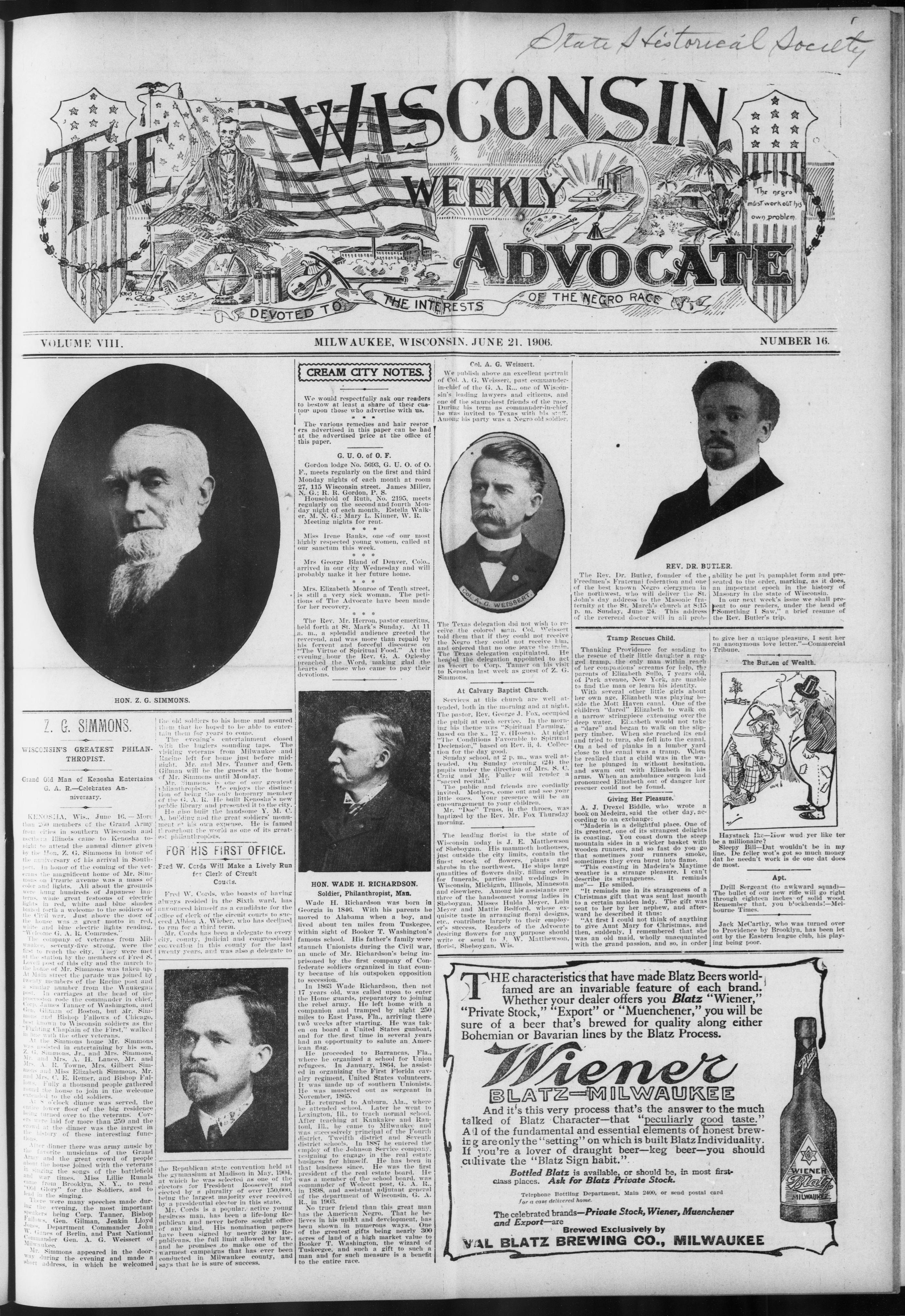
HON. Z. G. SIMMONS
Z. G. SIMMONS.
Z. G. SIMMONS.
WISCONSIN'S GREATEST PHILAN THROPIST.
Grand Old Man of Kenosha Entertains G. A. R.—Celebrates An-
KENOSHA, Wis., June 16. — More than 200 members of the Grand Army from cities in southern Wisconsin and northern Illinois came to Kenosha tonight to attend the annual dinner given by the Hon. Z. G. Simmons in honor of the anniversary of his arrival in Southport. In honor of the coming of the veterans the magnificent home of Mr. Simmons on Prairie avenue was a mass of color and lights. All about the grounds were hung hundreds of Japanese lanterns, white great festoons of electric lights in red, white and blue shades blazed forth a welcome to the soldiers of the Civil war. Just above the door of the house was a great motto in red, white and blue electric lights reading, "Welcome G. A. R. Comrades."
The company of veterans from Milwaukee, seventy-five strong, were the first to reach the city. They were met at the station by the members of Fred S. Lovell post of this city and the march to the home of Mr. Simmons was taken up. At Main street the parade was joined by twenty members of the Racine post and a similar number from the Waukegan post. In carriages at the head of the procession rode the commander in chief, Corp. James Tanner of Washington, and Gen. Gillman of Boston, but Mr. Simmons and Bishop Fallows of Chicago, best known to Wisconsin soldiers as the "Fighting Chaplain of the First," walked in line with the other veterans.
At the Simmons home Mr. Simmons was assisted in entertaining by his son, Z. G. Simmons, Jr., and Mrs. Simmons, Mr. and Mrs. A. H. Lance, Mr. and Mrs. A. R. Towne, Mrs. Gilbert Simmons and Miss Elizabeth Simmons, Mr. and Mrs. C. E. Remer, and Bishop Fallow. Fully a thousand people gathered round the house to join in the welcome extended to the old soldiers.
At 8 o'clock dinner was served, the entire lower floor of the big residence being turned over to the veterans. Covers were laid for more than 250 and the crowd at the dinner was the largest in the history of these interesting functions.
After dinner there was army music by the favorite musicians of the Grand Army and the great crowd of people about the house joined with the veterans in singing the songs of the battlefield and war times. Miss Lillie Runals came from Brooklyn, N. Y., to read "Old Glory" for the Soldiers, and to lead in the singing. There were many speeches made during the evening, the most important speakers being Corp. Tanner, Bishop Fallows, Gen. Gilman, Jenkin Lloyd Jones. Department Commander John W. Ganes of Berlin, and Past National Commander Gen. A. G. Weissert of Milwaukee. Mr. Simmons appeared in the doorway during the evening and made a short address, in which he welcomed
---
VOLUME VIII.
the old soldiers to his home and assured them that he hoped to be able to entertain them for years to come.
The evening's entertainment closed with the buglers sounding taps. The visiting veterans from Milwaukee and Racine left for home just before midnight. Mr. and Mrs. Tanner and Gen. Gilman will be the guests at the home of Mr. Simmons until Monday.
Mr. Simmons is one of our greatest philanthropists. He enjoys the distinction of being the only honorary member of the G. A. R. He built Kenosha's new public library and presented it to the city.
He also built the handsome Y. M. C. A. building and the great soldiers' monument $ ^{a+} $ his own expense. He is famed throughout the world as one of its greatest philanthropists.
FOR HIS FIRST OFFICE.
FOR HIS FIRST OFFICE.
Fred W. Cords, who boasts of having always resided in the Sixth ward, has announced himself as a candidate for the office of clerk of the circuit courts to succeed Albion A. Wieber, who has declined to run for a third term. Mr. Cords has been a delegate to every city, county, judicial and congressional convention in this county for the last twenty years, and was also a delegate to
[Name]
the Republican state convention held at the gymnasium at Madison in May, 1904, at which he was selected as one of the electors for President Roosevelt and elected by a plurality of over 150,000, being the largest majority ever received by a presidential elector in this state. Mr. Cords is a popular, active young business man, has been a life-long Republican and never before sought office of any kind. His nomination papers have been signed by nearly 3000 Republicans, the full limit allowed by law, and he promises to make one of the warmest campaigns that has ever been conducted in Milwaukee county, and says that he is sure of success.
Courts
CREAM CITY NOTES.
We would respectfully ask our readers to bestow at least a share of their custom upon those who advertise with us.
The various remedies and hair restorers advertised in this paper can be had at the advertised price at the office of this paper.
G. U. O. of O. F.
Gordon lodge No. 5693, G. U. O. of O. F., meets regularly on the first and third Monday nights of each month at room 27, 115 Wisconsin street. James Miller, N. G.; R. R. Gordon, P. S.
Household of Ruth, No. 2195, meets regularly on the second and fourth Monday night of each month. Estella Walker, M. N. G.; Mary L. Kinner, W. R.
Meeting nights for rent.
* * *
Miss Irene Banks, one of our most highly respected young women, called at our sanctum this week.
* * *
Mrs George Bland of Denver, Colo., arrived in our city Wednesday and will probably make it her future home.
Mrs. Elizabeth Monroe of Tenth street, is still a very sick woman. The petitions of The Advocate have been made for her recovery.
* * *
The Rev. Mr. Herron, pastor emeritus, held forth at St. Mark's Sunday. At 11 a. m., a splendid audience greeted the reverend, and was more than repaid by his fervent and forceful discourse on "The Virtue of Spiritual Food." At the evening hour the Rev. G. A. Oglesby preached the Word, making glad the hearts of those who came to pay their devotions.
[Name not visible]
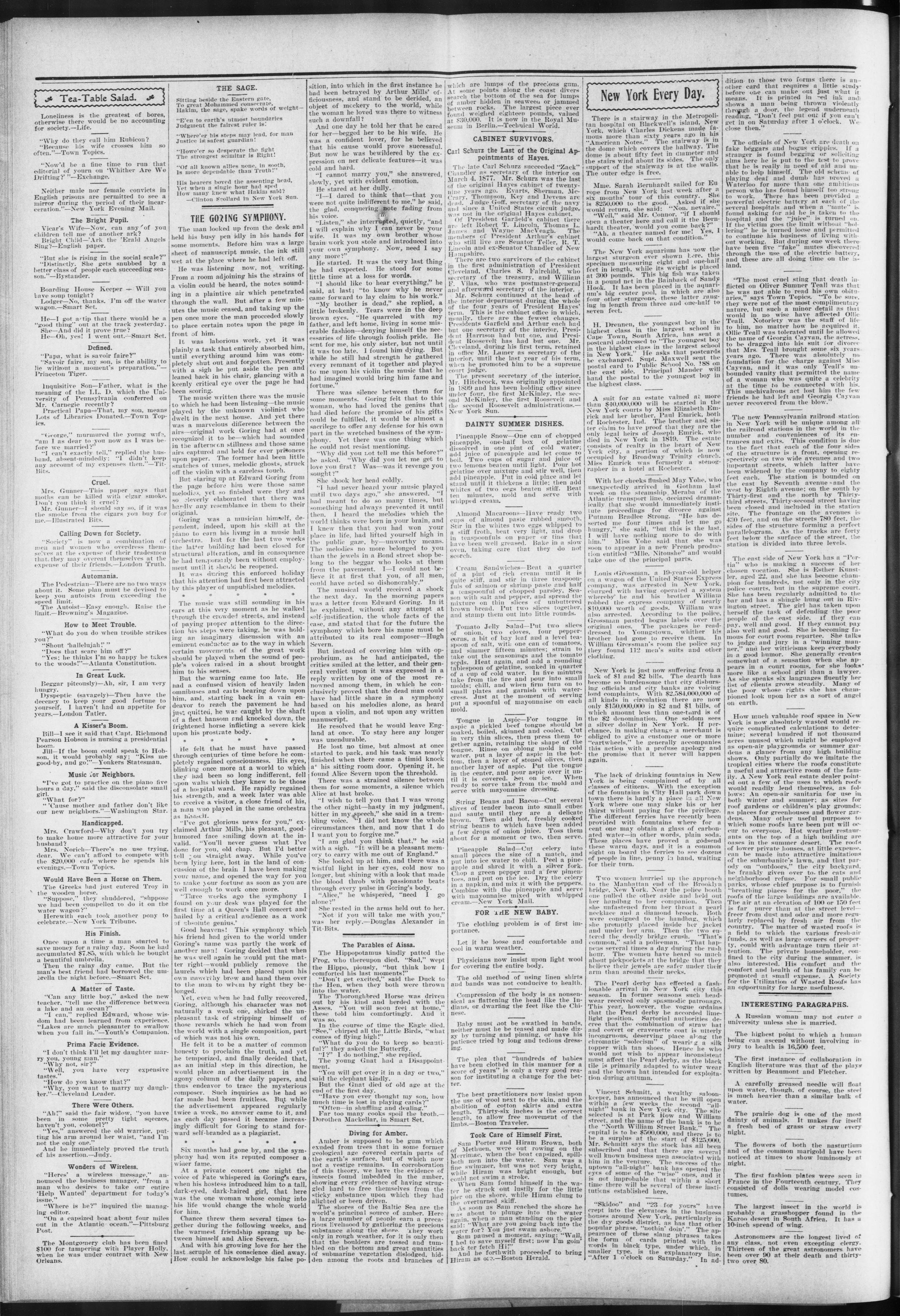
HON. WADE H. RICHARDSON. Soldier. Philanthropist. Man.
Wade H. Richardson was born in Georgia in 1846. With his parents he moved to Alabama when a boy, and lived about ten miles from Tuskegee, within sight of Booker T. Washington's famous school. His father's family were staunch Unionists during the Civil war, an uncle of Mr. Richardson's being imprisoned by the first company of Confederate soldiers organized in that county because of his outspoken opposition to secession.
In 1863 Wade Richardson, then not 17 years old, was called upon to enter the Home guards, preparatory to joining the rebel army. He left home with a companion and tramped by night 250 miles to East Pass, Fla., arriving there two weeks after starting. He was taken on board a United States gunboat, and for the first time in several years had an opportunity to salute an American flag.
He proceeded to Barrancas, Fla., where he organized a school for Union refugees. In January, 1864, he assisted in organizing the First Florida cavalry regiment, United States volunteers. It was made up of southern Unionists. He was mustered out as sergeant in November, 1865.
He returned to Auburn, Ala., where he attended school. Later he went to Lexington, Ill., to teach normal school. After teaching at Kankakee and Rantoul, Ill., he came to Milwaukee and was successively principal of the Fourth district, Twelfth district and Seventh district schools. In 1887 he entered the employ of the Johnson Service company, resigning to engage in the real estate business for himself. He has been in that business since. He was the first president of the real estate board. He was a member of the school board, was commander of Wolcott post, G. A. R., in 1898, and assistant adjutant general of the department of Wisconsin, G. A. R. in 1903.
No truer friend than this great man has the American Negro. That he believes in his uplift and development, has been shown in numerous ways. One of the greatest gifts being nearly 300 acres of land of a high market value to Booker T. Washington, the wizard of Tuskeegee, and such a gift to such a man and for such measure is a benefit to the entire race.
THE characteristics that have made Blatz Beers world-famed are an invariable feature of each brand. Whether your dealer offers you Blatz "Wiener," "Private Stock," "Export" or "Muenchener," you will be sure of a beer that's brewed for quality along either Bohemian or Bavarian lines by the Blatz Process.
Wiener
BLATZ—MILWAUKEE
And it's this very process that's the answer to the much talked of Blatz Character—that "peculiarly good taste." All of the fundamental and essential elements of honest brewing are only the "setting" on which is built Blatz Individuality. If you're a lover of draught beer—keg beer—you should cultivate the "Blatz Sign habit."
Bottled Blatz is available, or should be, in most first-class places. Ask for Blatz Private Stock.
Telephone Bottling Department, Main 2400, or send postal card for a case delivered home.
The celebrated brands—Private Stock, Wiener, Muenchener and Export—are
Brewed Exclusively by
VAL BLATZ BREWING CO., MILWAUKEE
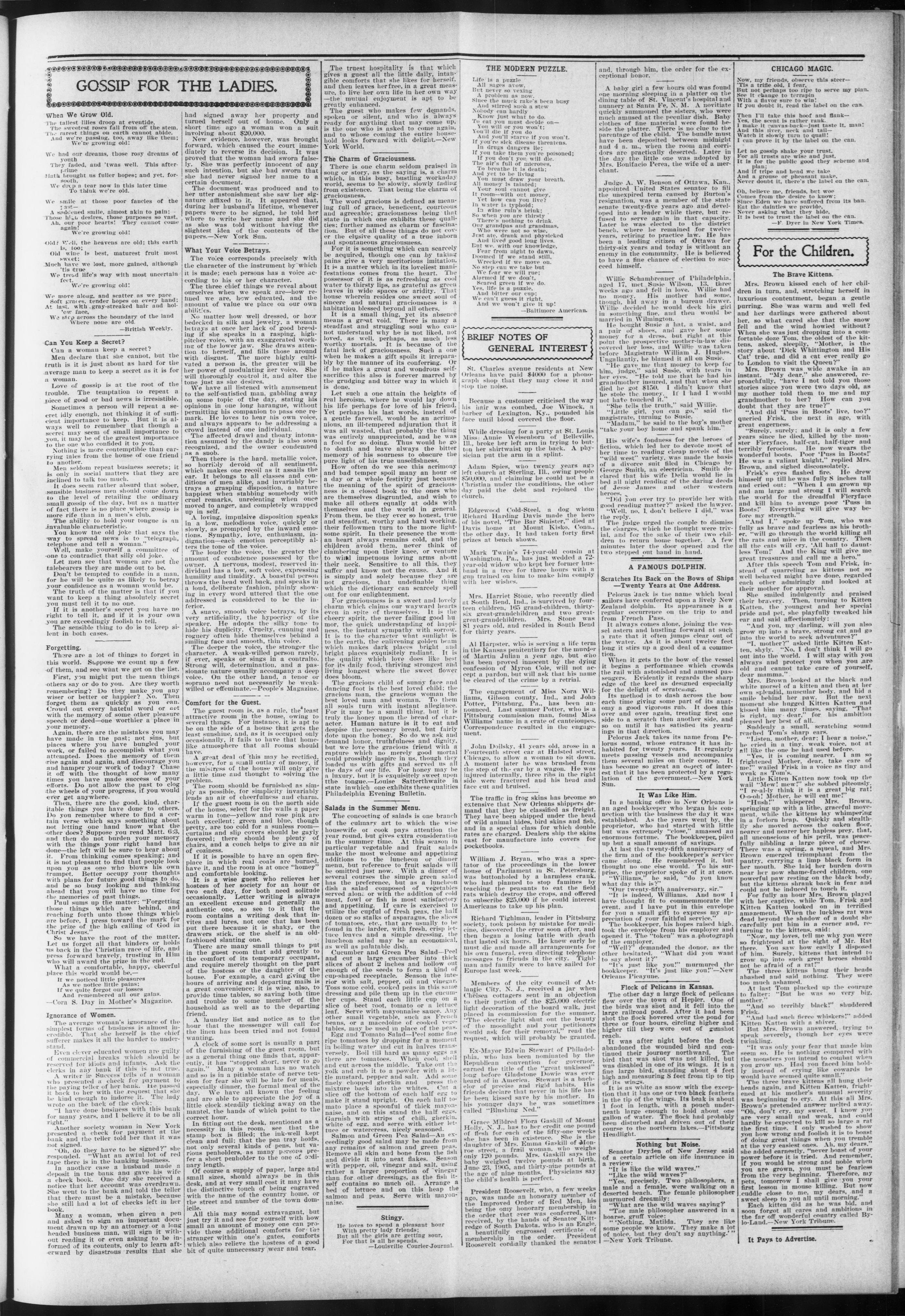
Col. A. G. Weissert.
We publish above an excellent portrait of Col. A. G. Weissert, past commander-in-chief of the G. A. R... one of Wisconsin's leading lawyers and citizens, and one of the staunchest friends of the race. During his term as commander-in-chief he was invited to Texas with his staff. Among his party was a Negro old soldier.
COL. A. D. WEISSERT.
The Texas delegation did not wish to receive the colored man. Col. Weissert told them that if they could not receive the Negro they could not receive him and ordered that no one leave the train The Texas delegation capitulated. He headed the delegation appointed to act as escort to Corp. Tanner on his visit to Kenosha last week as guest of Z. G. Simmons.
At Calvary Baptist Church.
Services at this church are well attended, both in the morning and at night. The pastor, Rev. George J. Fox, occupied the pulpit at each service. In the morning his theme was "Spiritual Farming," based on the x., 12 v. (Hosea). At night "The Conditions Favorable to Spiritual Declension," based on Rev. ii, 4. Collection for the day good.
Sunday school, at 2 p. m., was well attended. On Sunday evening (24) the pupils under the direction of Mrs. S. C. Craig and Mr. Fuller will render a "sacred recital."
The public and friends are cordially invited. Mothers, come out and see your little ones. Your presence will be an encouragement to your children.
Mr. "Doc" Truss, in the throes, was baptized by the Rev. Mr. Fox Thursday morning.
The leading florist in the state of Wisconsin today is J. E. Matthewson of Sheboygan. His mammoth hothouses, just outside the city limits, contain the finest stock of flowers, plants and shrubs in the northwest. He ships large quantities of flowers daily, filling orders for funerals, parties and weddings in Wisconsin, Michigan, Illinois, Minnesota and elsewhere. Among his assistants are three of the handsomest young ladies in Sheboygan, Misses Hulda Meyer, Lulu Meyer and Mattie Bedford, whose exquisite taste in arranging floral designs, etc., contribute largely to their employer's success. Readers of the Advocate desiring flowers for any purpose should write or send to J. W. Matthewson, florist, Sheboygan, Wis.
.
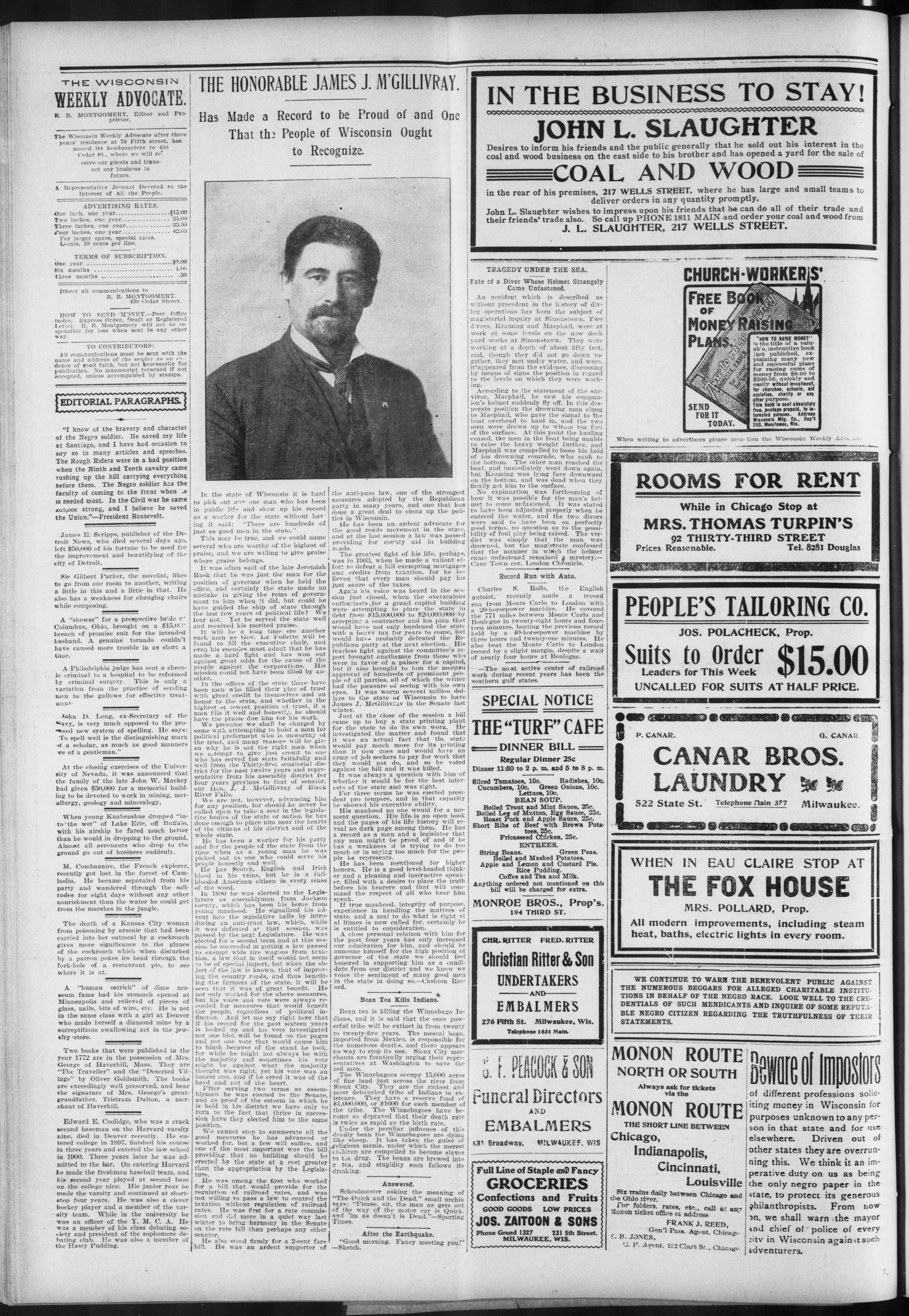
The Rev. Dr. Butler, founder of the Freedmen's Fraternal federation and one of the best known Negro clergymen in the northwest, who will deliver the St. John's day address to the Masonic fraternity at the St. March's church at 8:15 p.m. Sunday, June 24. This address of the reverend doctor will in all prob-
Tramp Rescues Child
Thanking Providence for sending to the rescue of their little daughter a ragged tramp, the only man within reach of her companions' screams for help, the parents of Elizabeth Sullo, 7 years old, of Park avenue, New York, are unable to find the man or learn his identity.
With several other little girls about her own age, Elizabeth was playing beside the Mott Haven canal. One of the children "dared" Elizabeth to walk on a narrow stringpiece extending over the deep water. Elizabeth would not take a "dare" and began to walk on the slippery timber. When she reached its end and tried to turn, she fell into the canal. On a bed of planks in a lumber yard close to the canal was a tramp. When he realized that a child was in the water he plunged in without hesitation, and swam out with Elizabeth in his arms. When an ambulance surgeon had pronounced Elizabeth out of danger her rescuer could not be found.
Giving Her Pleasure.
A. J. Drexel Biddle, who wrote a book on Medeira, said the other day, according to an exchange:
"Maderia is a delightful place. One of its greatest, one of its strangest delights is coasting. You coast down the steep mountain sides in a wicker basket with wooden runners, and so fast do you go that sometimes your runners smoke, sometimes they even burst into flame.
"This coasting in Madeira's Maytime weather is a strange pleasure. I can't describe its strangeness. It reminds me"—He smiled.
"It reminds me in its strangeness of a Christmas gift that was sent last month to a certain maiden lady. The gift was sent to her by her nephew, and afterward he described it thus:
"At first I could not think of anything to give Aunt Mary for Christmas, and then, suddenly, I remembered that she was an old maid, wholly unacquainted with the grand passion, and so, in order
NUMBER 16.
UTLER.
ability be put in pamphlet form and presented to the order, marking, as it does, an important epoch in the history of Masonry in the state of Wisconsin. In our next week's issue we shall present to our readers, under the head of "Something I Saw," a brief resume of the Rev. Butler's trip.
to give her a unique pleasure. I sent her an anonymous love letter."—Commercial Tribune.
A
Haystack Ike—How wud yer like ter be a millionaire?
Sleepy Bill—Dat wouldn't be in my line. De feller wot's got so much money dat he needn't work is de one dat does de most.
Drill Sergeant (to awkward squad)—The bullet of our new rifle will go right through eighteen inches of solid wood. Remember that, you blockheads!—Melbourne Times.
Jack McCarthy, who was turned over to Providence by Brooklyn, has been let out by the Eastern league club, his playing being poor.
eers world- ch brand. "Wiener," you will be long either
Tea-Table Salad.
Loneliness is the greatest of bores, otherwise there would be no accounting for society.—Life.
"Why do they call him Rubicon?
"Because his wife crosses him so often."—Town Topics.
"Now'd be a fine time to run that editorial of yourn on 'Whither Are We Drifting?'"—Exchange.
Neither male nor female convicts in English prisons are permitted to see a mirror during the period of their incarceration."—New York Evening Mail.
The Bright Pupil.
Vicar's Wife—Now, can any of you children tell me of another ark?
Bright Child—'Ark the 'Erald Angels Sing?—English paper.
"But she is rising in the social scale?"
"Distinctly. She gets snubbed by a better class of people each succeeding season."—Bystander.
Boarding House Keeper — Will you have soup tonight?
Lodger—No, thanks. I'm off the water wagon.—Smart Set.
He—I got a tip that there would be a "good thing" out at the track yesterday.
She—And did it prove true?
He—Oh, yes! I went out.—Smart Set.
Defined.
"Papa, what is savoir faire?"
"Savoir faire, my son, is the ability to lie without a moment's preparation."—Princeton Tiger.
Inquisitive Son—Father, what is the meaning of the LL. D. which the University of Pennsylvania conferred on Mr. Carnegie recently?
Practical Papa—That, my son, means Lots of Libraries Donated.—Town Topics.
"George," murmured the young wife, "am I as dear to you now as I was before we married?"
"I can't exactly tell," replied the husband, absent-mindedly: "I didn't keep any account of my expenses then."—Tit-Bits.
Cruel.
Mrs. Gunner—This paper says that moths can be killed with cigar smoke. Don't you think it cruel?
Mr. Gunner—I should say so, if it was the smoke from the cigars you buy for me.—Illustrated Bits.
Cruel.
Calling Down for Society.
"Society" is now a combination of men and women who overdress themselves at the expense of their tradesmen that, they may overeat themselves at the expense of their friends.—London Truth.
Automania.
The Pedestrian—There are no two ways about it. Some plan must be devised to keep you autoists from exceeding the speed limit. The Autoist—Easy enough. Raise the limit.—Browning's Magazine.
How to Meet Trouble
"What do you do when trouble strikes you?"
"Shout 'halleluiah'"
"Does that scare him off?"
"Yes; he thinks I'm so happy he takes to the woods"—Atlanta Constitution.
In Great Luck.
Beggar piteously)—Ah, sir, I am very hungry. Dyspeptie (savagely)—Then have the decency to keep your good fortune to yourself. I haven't had an appetite for years.—London Tatler.
A Kisser's Boom
Bill-I see it said that Capt. Richmond Pearson Hobson is nursing a presidential boom. Jill-If the boom could speak to Hobson, it would probably say: "Kiss me good-by, and go."-Yonkers Statesman.
Music for Neighbors.
"I've got to practice on the piano five hours a day," said the disconsolate small girl.
"What for?"
"'Cause mother and father don't like our new neighbors."—Washington Star.
Handicapped.
Mrs. Crawford—Why don't you try to make home more attractive for your husband?
Mrs. Norich—There's no use trying, dear. We can't afford to compete with the $20,000 cafe where he spends his evenings.—Town Topics.
Would Have Been a Horse on Them.
The Greeks had just entered Troy in the wooden horse.
"Suppose," they shuddered, "suppose we had been compelled to do it on the water wagon?"
Herewith each took another pony to celebrate.—New York Tribune.
His Finish.
Once upon a time a man started to save money for a rainy day. Soon he had accumulated $7.85, with which he bought a beautiful umbrella. Then the rainy day came. But the man's best friend had borrowed the umbrella the night before.—Smart Set.
A. Matter of Taste
"Can any little boy," asked the new teacher, "tell me the difference between a lake and an ocean?"
"I can," replied Edward, whose wisdom had been learned from experience. "Lakes are much pleasanter to swallow when you fall in."—Youth's Companion.
Prima Facie Evidence
"I don't think I'll let my daughter marry you, young man."
"Why not, sir?"
"Well, you have very expensive tastes."
"How do you know that?"
"Why, you want to marry my daughter."—Cleveland Leader.
There Were Others.
"Ah!" said the fair widow, "you have been in some pretty tight squeezes, haven't you, colonel?"
"Yes," answered the old warrior, putting his arm around her waist, "and I'm not the only one."
And he immediately proved the truth of his assertion.—Judy.
Wonders of Wireless.
"Heres' a wireless message," announced the business manager, "from a man who desires to take our entire 'Help Wanted' department for today's issue."
"Where is he?" inquired the managing editor.
"On a capsized boat about four miles out in the Atlantic ocean."—Pittsburg Post.
The Montgomery club has been fined $100 for tampering with Player Holly, when he was under contract with New Orleans.
---
THE SAGE.
Sitting beside the Eastern gate,
To great Mohammed consecrate,
Hakim, the sage, spake words of weight—
"E'en to earth's utmost boundaries
Judgment the fairest ruler is!
"Where'er his steps may lead, for man
Justice is safest guardian!
"Howe'er so desperate the fight
The strongest scimitar is Right!
"Of all known allies none, in sooth,
Is more dependable than Truth!"
His hearers boved the assenting head,
Yet when a single hour had sped
How many knew what Hakim said?
—Clinton Scollard in New York Sun.
THE GORING SYMPHONY.
The man looked up from the desk and held his busy pen idly in his hands for some moments. Before him was a large sheet of manuscript music, the ink still wet at the place where he had left off. He was listening now, not writing. From a room adjoining his the strains of a violin could be heard, the notes sounding in a plaintive air which penetrated through the wall. But after a few minutes the music ceased, and taking up the pen once more the man proceeded slowly to place certain notes upon the page in front of him.
It was laborious work, yet it was plainly a task that entirely absorbed him, until everything around him was completely shut out and forgotten. Presently with a sigh he put aside the pen and leaned back in his chair, glancing with a keenly critical eye over the page he had been scoring.
The music written there was the music to which he had been listening—the music played by the unknown violinist who dwelt in the next house. And yet there was a marvelous difference between the airs—original work Goring had at once recognized it to be—which had sounded in the afternoon stillness and those same airs captured and held for ever prisoners upon paper. The former had been little snatches of tunes, melodic ghosts, struck off the violin with a careless touch. But staring up at Edward Goring from the page before him were those same melodies, yet so finished were they and so cleverly elaborated that there was hardly any resemblance in them to their original.
Goring was a musician himself, dependent, indeed, upon his skill at the piano to earn his living in a music hall orchestra. But for the last two weeks the latter building had been closed for structural alteration, and in consequence he had temporarily been without employment until it should be reopened. It was during this enforced holiday that his attention had first been attracted by this player of unpublished melodies.
The music was still sounding in his ears at this very moment as he walked through the crowded streets, and instead of paying proper attention to the direction his steps were taking, he was holding an imaginary discussion with an eminent conductor as to the way in which certain movements of the great work should be played when the sound of people's voices raised in a shout brought him to his senses.
But the warning came too late. He had a confused vision of heavily laden omnibuses and carts bearing down upon him, and, starting back in a vain endeavor to reach the pavement he had just quitted, he was caught by the shaft of a fleet hansom and knocked down, the frightened horse inflicting a severe kick upon his prostate body.
He felt that he must have passed through centuries of time before he completely regained consciousness. His eyes, blinking once more at a world to which they had been so long indifferent, fell upon walls which they knew to be those of a hospital ward. He rapidly regained his strength, and a week later was able to receive a visitor, a close friend of his, a man who played in the same orchestra as himself.
"I've got glorious news for you," exclaimed Arthur Mills, his pleasant, goodhumored face smiling down at the invalid. "You'll never guess what I've done for you, old chap. But I'd better tell you straight away. While you've been lying here, lost in the land of concussion of the brain I have been making your name, and opened the way for you to make your fortune as soon as you are well enough to work once more. "Three weeks ago the symphony I found on your desk was played for the first time at a Queen's Hall concert and hailed by a critical audience as a work of absolute genius.'
Good heavens! This symphony which his friend had given to the world under Goring's name was partly the work of another man! Goring decided that when he was well again he would put the matter right—would publicly remove the laurels which had been placed upon his own unworthy brew and hand them over to the man to whom by right they belonged.
Yet, even when he had fully recovered, Goring, although his character was not naturally a weak one, shirked the unpleasant task of stripping himself of those rewards which he had won from the world with a single composition, part of which was not his own.
He felt it to be a matter of common honesty to proclaim the truth, and yet he temporized, and finally decided that, as an initial step in this direction, he would place an advertisement in the agony column of the daily papers, and thus endeavor to trace the mysterious composer. Such inquiries as he had so far made had been fruitless. But while the advertisement appeared regularly twice a week, no answer came to it, and as each day passed it became increasingly difficult for Goring to stand forward self-branded as a plagiarist.
Six months had gone by, and the symphony had won its reputed composer a winer fame.
At a private concert one night the voice of Fate whispered in Goring's ears, when his hostess introduced him to a tall, dark-eyed, dark-haired girl, that here was the one woman whose coming into his life would change the whole world for him.
Chance threw them several times together during the following weeks, and the warmest friendship sprang up between himself and Alice Severn.
And with his growing love for her the last seruple of his conscience died away. How could he acknowledge his false po-
sition, into which in the first instance he had been betrayed by Arthur Mills' officiousness, and stand to be derided, an object of mockery to the world, while the woman he loved was there to witness such a downfall?
And one day he told her that he cared for her—begged her to be his wife. He was a confident lover, for he believed that his cause would prove successful. But now he was bewildered by the expression on her delicate features—it was cold and hard.
"I cannot marry you," she answered, slowly, yet with evident emotion.
He stared at her dully.
"I—I dared to think that—that you were not quite indifferent to me," he said, the glad, conquering note fading from his voice.
"Listen," she interrupted, quietly, "and I will explain why I can never be your wife. It was my own brother whose brain work you stole and introduced into your own symphony. Now, need I say any more?"
He started. It was the very last thing he had expected. He stood for some little time at a loss for words.
"I should like to hear everything," he said, at last; "to know why he never came forward to lay claim to his work."
"My brother is dead," she replied, a little brokenly. Tears were in the deep brown eyes. "He quarreled with my father, and left home, living in some miserable fashion—denying himself the necessaries of life through foolish pride. He sent for me, his only sister, but not until it was too late. I found him dying. But while he still had strength he gathered every remnant of it together and played to me upon his violin the music that he had imagined would bring him fame and fortune."
There was silence between them for some moments. Goring felt that to this woman, who had loved the genius that had died before the promise of his gifts could be fulfilled, it would be almost a sacrilege to offer any defense for his own part in the wretched business of the symphony. Yet there was one thing which he could not resist mentioning.
"Why did you lot tell me this before?" he asked. "Why did you let me get to love you first? Was—was it revenge you sought?"
She shook her head coldly.
"I had never heard your music played until two days ago," she answered. "I had meant to do so many times, but something had always prevented it until then. I heard the melodies which the world thinks were born in your brain, and I knew then that you had won your place in life, had lifted yourself high in the public gaze, by—unworthy means. The melodies no more belonged to you than the jewels in a Bond street shop belong to the beggar who looks at them from the pavement. I—I could not believe it at first that you, of all men, could have acted so dishonorably."
The musical world received a shock the next day. In the morning papers was a letter from Edward Goring. In it he explained, without any attempt at self-justification, the whole facts of the case, and stated that for the future the symphony which bore his name must be attributed to its real composer—Hugh Severn.
But instead of covering him with opprobrium, as he had anticipated, the critics smiled at the letter, and their general verdict upon it was expressed in a reply written by one of the most renowned among them, in which he conclusively proved that the dead man could have had little share in a symphony based on his melodies alone, as heard upon a violin, and not upon any written manuscript.
He resolved that he would leave England at once. To stay here any longer was unendurable.
He lost no time, but almost at once started to pack, and his task was nearly finished when there came a timid knock a$^{4}$ his sitting room door. Opening it, he found Alice Severn upon the threshold.
There was a strained silence between them for some moments, a silence which Alice at last broke.
"I wish to tell you that I was wrong the other night—hasty in my judgment, bitter in my speech," she said in a trembling voice. "I did not know the whole circumstances then, and now that I do I want you to forgive me."
"I am glad you think that," he said with a sigh. "It will be a pleasant memory to carry with me out of England."
She looked up at him, and there was a wistful light in her eyes, cold now no longer, but shining with a look that made the blood throb with passionate beats through every pulse in Goring's body.
"Alice," he whispered, "need I go alone?"
She rested in the arms held out to her.
"Not if you will take me with you," was her reply.—Douglas Alexander in Tit-Bits.
The Parables of Aissa.
The Hippopotamus kindly patted the Frog, who thereupon died. "Sad," wept the Hippo, piously, "but think how I comforted his last moments!"
"Don't get excited," said the Duck to the Hen, when they both were thrown into the water.
The Thoroughbred Horse was driven out by his kind and herded with the Asses. "You will soon feel at home," these told him comfortingly. And it was so.
In the course of time the Eagle died. "See," chirped all the Little Birds, "what comes of flying high!"
"What do you do to keep so beautiful?" they asked the Butterfly.
"I?" I do nothing," she replied.
The young Gnat had a Disappointment.
"You will get over it in a day or two," said the elephant kindly. But the Gnat died of old age at the end of the first day.
"Have you ever thought my son, how much time is lost in playing cards?"
"Often—in shuffling and dealing."
Far too many cooks spoil the broth.—Dorothea Mackellar, in Smart Set.
Diving for Amber
Amber is supposed to be gum which exuded from trees that in some former geological age covered certain parts of the earth's surface, but of which now not a vestige remains. In corroboration of this theory, we have the evidence of insects found imbedded in the amber, showing every evidence of having struggled hard to free themselves from the sticky substance upon which they had alighted or been driven. The shores of the Baltic Sea are the world's principal source of amber. Here a large number of people earn a precarious livelihood by gathering the precious substance along the shore. They work only in rough weather, for it is only then that the boulders are tossed and tumbled on the bottom and great quantities of submarine vegetation dislodged, hidden among the roots and branches of
which are lumps of the precious gum. At some points along the coast divers search the bottom of the sea for lumps of amber hidden in seaweed or jammed between rocks. The largest piece ever found weighed eighteen pounds, valued at $30,000. It is now in the Royal Museum in Berlin.-Technical World.
CABINET SURVIVORS.
Carl Schurz the Last of the Original Appointments of Hayes
The late Carl Schurz succeeded "Zack" Chandler as secretary of the interior on March 4, 1877. Mr. Schurz was the last of the original Hayes cabinet of twenty-nine years ago. Evarts, Sherman, McCrary, Thompson, Key and Devens are dead. Judge Goff, secretary of the navy and since a United States circuit judge, was not in the original Hayes cabinet. Of President Garfield's cabinet there are left Robert T. Lincoln, Thomas L. James and Wayne MacVeagh. The members of President Arthur's cabinet who still live are Senator Teller, R. T. Lincoln and ex-Senator Chandler of New Hampshire.
There are two survivors of the cabinet in the first administration of President Cleveland, Charles S. Fairchild, who secretary of the treasury, and William F. Vilas, who was postmaster-general and afterward secretary of the interior. Mr. Schurz continued at the head of the interior department during the whole of the four years of President Hayes' term. This is the cabinet office in which, usually, there are the fewest changes. Presidents Garfield and Arthur each had but one secretary of the interior, President Harrison had but one, and President Roosevelt has had but one. Mr. Cleveland, during his first term, retained in office Mr. Lamer as secretary of the interior, until the last year of his term, when he promoted him to be a supreme court judge.
The present secretary of the interior, Mr. Hitchcock, was originally appointed in 1899 and has been holding office since under four, the first McKinley, the second McKinley, the first Roosevelt and the second Roosevelt administrations. New York Sun.
DAINTY SUMMER DISHES
Pineapple Snow—One can of chopped pineapple, one-half box of gelatine dissolved in one pint of cold water; add juice of pineapple and let come to boil. Two cups of sugar and juice of two lemons beaten until light. Pour hot gelatine over mixture and stir well, then add pineapple. Put in cold place and let stand until it thickens a little; then add whites of two eggs beaten stiff. Beaten ten minutes, mold and serve with whipped cream.
Almond Macaroons—Have ready two cups of almond paste rubbed smooth. Stir in the whites two eggs whipped to a stiff froth, beat very light, and drop in teaspoonfuls on paper or tins that have been well greased. Bake in a slow oven, taking care that they do not scorch.
Cream Sandwiches—Beat a quarter of a pint of rich cream until it is quite stiff, and stir in three teaspoonfuls of salmon or shrimp paste and half a teaspoonful of chopped parsley, Season with salt and pepper, and spread the mixture on thin slices of unbuttered brown bread. Put two slices together, and stamp them out into little rounds.
Tomato Jelly Salad—Put two slices of onion, two cloves, four pepper corns, a bit of bay leaf and a level teaspoon of salt, with one can of tomatoes, and simmer fifteen minutes; strain to take out the seasonings and the tomato seeds. Heat again, and add a rounding tablespoon of gelatine, soaked in quarter of a cup of cold water. In five minutes take from the fire and pour into small molds; chill, and when firm turn on to small plates and garnish with watercress. Just at the moment of serving put a spoonful of mayonnaise on each mold.
Tongue in Aspic-For tongue in aspic a pickled beef tongue should be soaked, boiled, skinned and cooled. Cut in very thin slices, then press them together again, retaining the shape of the tongue. Rinse on oblong mold in cold water, put a layer of aspic in the bottom, then a layer of stoned olives, then another layer of aspic. Put the tongue in the center, and pour aspic over it until it is covered. Set on ice. When ready to serve take from the mold and serve with mayonnaise dressing.
String Beans and Bacon-Cut several slives of tender bacon into small cubes and saute until they are a delicate brown. Then add hot, freshly cooked string beans to which have been added a few drops of onion juice. Toss them about for a moment or two, then serve.
Pineapple Salad—Cut celery into small pieces the size of a match, and put into ice water to chill. Peel a pineapple and shred it with a silver fork. Chop a green pepper and a few pimentoes, and put on the ice. Dry the celery in a napkin, and mix it with the peppers. Combine with the pineapple and serve with mayonnaise mixed with whipped cream.—New York Mail.
FOR THE NEW BABY.
The clothing problem is of first importance.
Let it be loose and comfortable and cool in warm weather.
Physicians now insist upon light wool for covering the entire body.
The old method of using linen shirts and bands was not conducive to health.
Compression of the body is as nonsensical as flattening the head like the Indians, or dwarfing the feet like the Chinese.
Baby must not be swathed in bands, neither must he be teased and made dizzy by turning and pinning, or have his patience tried by long and tedious dressing.
The plea that "hundreds of babies have been clothed in this manner for a score of years" is only a very good reason for instituting a change for the better.
The best practitioners now insist upon the use of wool next to the skin, and the abolition of cotton skirts and extra length. Thirty-six inches is the correct length, to allow free movement of the limbs.—Boston Traveler.
Took Care of Himself First
Sam Porter and Hiram Brown, both of Methuen, were out rowing on the Merrimac, when the boat capsized, spillboth men into the water. Sam was a fine swimmer, but was not very bright, while Hiram was bright enough, but could not swim a stroke.
When Sam found himself in the water he struck out lustily for the little pier on the shore, while Hiram clung to the overturned skiff.
As soon as Sam reached the shore he was about to plunge into the water again, when a man standing on the pier said: "What are you going back into the water for? You just swam ashore."
Sam paused a moment, saying: "Wall,
Sam paused a moment, saying: "Wall, I hed to save myself first; now I'm goin' back ter fetch Hi!" And he forthwith proceeded to bring Hiram as or3.—Boston Herald.
New York Every Day.
New York Every Day.
There is a stairway in the Metropolitan hospital on Blackwell's island, New York, which Charles Dickens made famous more than sixty years ago in his "American Notes." The stairway is in the dome which covers the hallway. The dome is about fifty feet in diameter and the stairs wind about its sides. The only support of the stairway is at the walls. The outer edge is free.
Mme. Sarah Bernhardt sailed for Europe from New York last week after a six months' tour of this country. She is $250,000 to the good. Asked if she would return, she said: "Non, nevaire." "Well," said Mr. Connor, "if I should
hardt theater, would you come back.
"Ah, a theater named for me! Yes, I would come back on that condition."
The New York aquarium has now the largest sturgeon ever shown here, this specimen measuring eight and one-half feet in length, while its weight is placed at 300 pounds. This big fish was taken in a pound net in the Bainback of Sandy Hook. It has been placed in the aquarium's big center pool, in which are also four other sturgeons, these latter ranging in length from three and one-half to seven feet.
H. Drennen, the youngest boy in the highest class in the largest school in Cape Town, South Africa, has sent a postcard addressed to "The youngest boy in the highest class in the largest school in New York." He asks that postcards be exchanged. Supt. Maxwell sent the postal card to Public School No.188 on the east side. Principal Mander will hand the postal to the youngest boy in the highest class.
A suit for an estate valued at more than $40,000,000 will be started in the New York courts by Miss Elizabeth Emrick and her brother, Paul Emrick, both of Rochester, Ind. The brother and sister claim to have proof that they are the only legal heirs of Joseph Emrick, who died in New York in 1819. The estate consists of realty in the heart of New York city, a portion of which is now occupied by Broadway Trinity church. Miss Emrick was formerly a stenographer in a hotel at Rochester.
With her cheeks flushed May Yohe, who unexpectedly arrived in Gotham last week on the steamship Meraba of the Atlantic transport line, decied dramatically that she would immediately institute proceedings for divorce against Putnam Bradlee Strong. "He has deserted me four times and let me go hungry," she said, "but this is the last. I will have nothing more to do with him." Miss Yohe said that she was soon to appear in a new French production entitled "Mlle. Nitoushe" and would take one of the principal parts.
Louis Grossman, a 19-year-old helper on a wagon of the United States Express company, was arrested in New York, charged with having operated a system whereby he and his brother William robbed the express company of nearly $10,000 worth of goods. William was also arrested. According to the police, Grossman pasted bogus labels over the original ones. The packages he read-dressed to Youngstown, whither his brother had gone to receive them. In William Grossman's room the police say they found 112 men's suits and other clothing.
New York is just now suffering from a lack of $1 and $2 bills. The dearth has become so burdensome that city disbursing officials and city banks are voicing loud complaints. With $2,584,000,000 of all kinds in circulation there are now only $150,000,000 in $2 and $1 bills, of which amount less than one-tard is of the $2 denomination. One seldom sees a silver dollar in New York. If perchance, in making change a merchant is obliged to give a customer one or more "cartwheels," he generally accompanies this action with a profuse apology and the promise that it never will happen again.
The lack of drinking fountains in New York is being complained of by all classes of citizens. With the exception of the fountains in City Hall park down town there is hardly a place in all New York where one may slake his or her thirst without paying for the privilege. The different ferries have recently been provided with fountains where for a cent one may obtain a glass of carbonated water—in other words, plain soda. These places have proved a godsend these warm days, and it is a common sight on board the ferries to see dozens of people in line, penny in hand, waiting for their turn.
Two women hurried up the approach to the Manhattan end of the Brooklyn bridge, New York. Near the police booth one pulled the other aside and held out her handbag to her companion. Then she unfastened from her throat a pearl necklace and a diamond brooch. Both were consigned to the handbag, which she promptly placed inside her jacket and under her arm. Then the two entered the deadly bridge crush. "That's common," said a policeman. "That happens several times a day during the rush hour. The women have heard so much about pickpockets at the bridge that they believe their jewels are safer under their arm than around their necks.
The Pearl derby has effected a fashionable arrival in New York city this season. In former seasons such headwear received only spasmodic patronage. This year, however, the vogue ordains that the Pearl derby be accorded lime-light position. Sartorial authorities decree that the combination of straw hat and covert or cravenette coat is utterly incongruous, deserving place along the chromatic "solecism" of wearing a silk topper with tan shoes. Hence he who would not wish to appear inconsistent must affect the Pearl derby, as the black tile is primarily adapted to winter wear and the brown hat intended for exploitation during autumn.
Vincent Schmitt, a wealthy saloon-keeper, has announced that he will open within a few weeks the second "all-night" bank in New York city. The site selected is at Park Row and William street, and the name of the bank is to be the "North William Street Bank." The capital is to be $500,000, and there is to be a surplus at the start of $125,000. Mr. Schmitt says the stock has all been subscribed and that there are several well known business men associated with him in the venture. The success of the uptown "all-night" bank has opened the eyes of some of the "wise" ones, and it is not improbable that within a short time there will be several of these institutions established here.
"Skidoo" and "23 for yours" have crept into the elevators in the business houses around New York, particularly in the dry goods district, as has that other popular phrase, "nothin' doin'." The appearance of these slang phrases takes the form of cards printed with the words in black type, under which, in smaller type, is the explanatory line. "After 1 o'clock on Saturday." In ad-
dition to those two forms there is another card that requires a little study before one can make out just what it means. It is printed in red ink and shows a man being thrown violently through a door, the legend underneath reading, "Don't feel put out if you can't get in on Saturday after 1 o'clock. We close then."
The officials of New York are death on fake bèggars and bogus cripples. If a stranger is found begging or soliciting alms here he is put to the test to prove that he is really in need of aid and unable to help himself. The old scheme of playing deaf and dumb has proved a Waterloo for more than one ambitious person who has found himself too strong to work. There has been provided a powerful electric battery at each of the several hospitals and when a "mute" is found asking for aid he is taken to the hospital and the "juice" is turned on. If the victim goes the limit without "hollering" he is turned loose and permitted to continue his business of living without working. But during one week there have been five "fake" mutes discovered through the use of the electric battery, and these are all doing time on the island.
"The most cruel sting that death inflicted on Oliver Sumner Teall was that he was not able to read his own obituaries," says Town Topics. "To be sure, they were not of the most complimentary nature, but such a minor detail as that would in no wise have affected Ollie Teall. Notoriety was the staff of life to him, no matter how he acquired it. Ollie Teall was tolerated until he allowed the name of Georgia Cayvan, the actress, to be dragged into his suit for divorce that Mrs. Teall brought some six years years ago. There was absolutely no foundation for the charge against Miss Cayvan, and it was only Teall's unbounded vanity that permitted the name of a woman who was quite a celebrity at the time to be connected with his. This unchivalrous act lost him the few friends he had left and Georgia Cayvan never recovered from the blow."
The new Pennsylvania railroad station in New York will be unique among all the railroad stations in the world in the number and conveniences of its entrances and exits. This condition is due to the fact that each of the four sides of the structure is a front, opening respectively on two wide avenues and two important streets, which latter have been widened by the company to eighty feet each. The station is bounded on the east by Seventh avenue and the west by Eighth avenue; on the south by Thirty-first and the north by Thirty-third streets. Thirty-second street having been closed and included in the station site. The frontage on the avenues is 430 feet, and on the streets 780 feet, the sides of the structure forming a perfect parallelogram. As the tracks are forty feet below the surface of the street, the station is divided into three levels.
The east side of New York has a "Portia" who is making a success of her chosen vocation. She is Esther Kunstler, aged 22, and she has become champion for hundreds, not only in the city police courts, but in the supreme court. She has been regularly admitted to the bar and has a shingle hung out in Rivington street. The girl has taken upon herself the task of defending the poor people of the east side. If they can pay, well and good. If they cannot pay also well and good. She is becoming famous for court room repartee. She talks to judge and jury in a "winning manner," and her witticisms keep everybody in a good humor. She generally creates somewhat of a sensation when she appears in a court rooms, for she looks more like a school girl than a lawyer. As she speaks six languages fluently her list of clients grows steadily. Many of the poor whose rights she has championed look upon her as a sort of angel on earth.
How much valuable roof space in New York is now absolutely wasted would require complicated calculations to determine; several hundred if not thousand acres unused which might be employed as open-air playgrounds or summer gardens a glance from any high building shows. Only partially do we imitate the tropical cities where the roofs constitute a useful and attractive room of the family. A New York real estate dealer pointed out a few of the uses to which roofs would readily lend themselves, as follows: An open-air sanitaria for use in both winter and summer; as sites for roof gardens or children's play grounds; as places for greenhouses and flower gardens. Many other useful purposes to which some roofs have been put will occur to everyone. Hot weather restaurants on the top of a high building are oases in the summer desert. The roofs of lower private houses, at little expense, can be made into attractive imitations of the suburbanite's lawn, and that parody on "outdoors," the city backyard, be frankly given over to the cats and neighborhood refuse. For small public parks, whose chief purpose is to furnish "breathing places for the poor," the roofs of the large buildings are available. The air at an elevation of 100 or 150 feet is far purer than at the street level—freer from dust and odor and more regularly replaced by fresh air from the country. The matter of wasted roofs is a field to which the various fresh-air funds, as well as large owners of property, could with advantage turn their attention. The private householder, confined to the city during the summer, is also interested. His comfort and the comfort and health of his family can be promoted at small expense. A Society for the Utilization of Wasted Roofs has an opportunity for large usefulness.
INTERESTING PARAGRAPHS
A Russian woman may not enter a university unless she is married.
The highest point to which a human being can ascend without involving injury to health is 16,500 feet.
The first instance of collaboration in English literature was that of the plays written by Beaumont and Fletcher.
A carefully greased needle will float upon water, though, of course, the steel is much heavier than a similar bulk of water.
The prairie dog is one of the most dainty of animals. It makes for itself a fresh bed of grass or straw every night.
The flowers of both the nasturtium and of the common marigold have been noticed at times to show luminously at night.
The first fashion plates were seen in France in the Fourteenth century. They consisted of dolls wearing model costumes.
The largest insect in the world is probably a grasshopper found in the Karoo desert in South Africa. It has a 10-inch spread of wing.
Astronomers are the longest lived of any class, not even excepting clergy. Thirteen of the great astronomers have been over 90 at their death and thirty-two over 80.
GOSSIP FOR THE LADIES.
When We Grow Old.
The tallest lilies droop at eventide.
The rarest roses fall from off the stem.
The sweetest things on earth cannot abide.
And we're passing, too, away like them;
We're growing old!
We had our dreams, those rosy dreams of youth
They faded, and 'twas well. This after time
Math brought us fuller hopes; and yet, forsooth,
We drop a tear now in this later time
To think we're old.
We smile at those poor fancies of the
rast—
A saddened smile, almost akin to pain;
Those high desires, those purposes so vast,
Ah, our poor hearts! They cannot come
again!
We're growing old!
Old? Well, the heavens are old; this earth
is, too;
Old wine is best, maturest fruit most sweet:
Much have we lost, more gained, although 'tis true
We tread life's way with most uncertain feet.
We're growing old!
We move along, and scatter as we pace
Soft graces, tender hopes on every hand;
At last, with gray-streaked hair and hollow face,
We stop across the boundary of the land
Where none are old.
-British Weekly.
Can You Keep a Secret?
Can a woman keep a secret?
Men declare that she cannot, but the truth is it is just about as hard for the average man to keep a secret as it is for a woman.
Love of gossip is at the root of the trouble. The temptation to repeat a piece of good or bad news is irresistible.
Sometimes a person will repeat a secret idly enough, not thinking it of sufficient importance to keep. But it is always well to remember that though a secret may seem of small importance to you, it may be of the greatest importance to the one who confided it to you.
Nothing is more contemptible than carrying tales from the house of one friend to another.
Men seldom repeat business secrets; it is only in social matters that they are inclined to talk too much. It does seem rather absurd that sober, sensible business men should come down to the level of retailing the ordinary small gossip of the day, but as a matter of fact there is no place where gossip is more rife than in a men's club. The ability to hold your tongue is an invaluable characteristic.
You know the old joke that says the way to spread news is to "telegraph, telephone and tell a woman."
carebearers they are made out to be.
Don't be tempted to confide in a man, for he will be quite as likely to betray your confidence as a woman would be.
The truth of the matter is that if you want to keep a thing absolutely secret you must tell it to no one.
If it is another's secret you have no right to tell it, and if it is your own you are exceedingly foolish to tell.
The sensible thing to do is to keep silent in both cases.
Forgetting.
There are a lot of things to forget in this world. Suppose we count up a few of them, and see what we get on the list. First, you might put the mean things others say or do to you. Are they worth remembering? Do they make you any wiser or better or happier? No. Then forget them as quickly as you can. Crowd out every hateful word or act with the memory of some other pleasure speech or deed—one worthier a place in your memory.
Again, there are the mistakes you may have made in the past; not sins, but places where you have bungled your work, or failed to accomplish what you attempted. Does the memory of them rise again and again, and discourage you and hamper your work of today? Chase it off with the thought of how many times you have made success of your efforts. Do not allow the past to clog the wheels of your progress, if you would ever get anywhere.
Then, there are the good, kind, charitable things you have done to others. Do you remember where to find a certain verse which says something about not letting one hand know what the other does? Suppose you read Matt. 6:3, and then do not burden your memory with the things your right hand has done—the left will be sure to hear about it. From thinking comes speaking; and it is not pleasant to find that people look upon you as one who blows his own trumpet. Better occupy your thoughts with plans for future good things to do, and be so busy looking and thinking ahead that you will have no time for the memories of past things.
Paul sums up the matter: "Forgetting those things which are behind, and reaching forth unto those things which are before, I press toward the mark for the prize of the high calling of God in Christ Jesus."
So we have the root of the matter. Let us forget all that hinders or holds us back in the Christian race of life, and press forward bravely, trusting in Him who will award the prize in the end.
What a comfortable, happy, cheerful place this world would be.—
If we noticed little pleasures
As we notice little pains;
If we quite forgot our losses
And remembered all our gains.
—Cora S. Day in Mother's Magazine.
Ignorance of Women.
The average woman's ignorance of the simplest forms of business is almost incredible. That she herself is the chief sufferer makes it all the harder to understand
Even clever educated women are guilty of commercial breaks which should be reserved for idiots and infants. Ask the clerks in any bank if this is not true. A writer in Success tells of a woman who presented a check for payment to the paying teller of her bank. He passed it back to her with the request that she be kind enough to indorse it. The lady wrote on the back of the check: "I have done business with this bank for many years, and I believe it to be all right." Another society woman in New York presented a check for payment at the bank and the teller told her that it was not signed. "Oh, do they have to be signed?" she responded. "What an awful lot of red tape there is in the banking business.
In another case a husband made a deposit in the bank and gave his wife a check book. One day she received a notice that her account was overdrawn. She went to the bank and told the teller that there must be a mistake, because she still had a lot of checks left in her book.
Many a woman, when given a pen and asked to sign an important document drawn up by an attorney or a long headed business man, will sign it without reading it or even asking to be informed of its contents, only to learn afterward by disastrous results that she
had signed away her property and turned herself out of home. Only a short time ago a woman won a suit involving about $20,000. New evidence, however, was brought forward, which caused the court immediately to reverse its decision. It was proved that the woman had sworn falsely. She was perfectly innocent of any such intention, but she had sworn that she had never signed her name to a certain document. The document was produced and to her utter astonishment she saw her signature affixed to it. It appeared that, during her husband's lifetime, whenever papers were to be signed, he told her where to write her name and she did as she was told without having the slightest idea of the contents of the papers.—New York Sun.
What Your Voice Betrays.
The voice corresponds precisely with the character of the instrument by which it is made; each persons has a voice according to his or her character. The three chief things we reveal about ourselves when we speak are—how refined we are, how educated, and the amount of value we place on our own abilities.
No matter how well dressed, or how bedecked in silk and jewelry, a woman betrays at once her lack of good breeding if she speaks in a rasping, high-pitcher voice, with an exaggerated working of the lower jaw. She draws attention to herself, and fills those around with disgust. The more highly cultivated a person is, the greater will be her power of modulating her voice. She will thoroughly control it, and alter the tone just as she desires.
We have all listened with amusement to the self-satisfied man, gabbling away on some topic of the day, stating his opinions in one long harangue, without permitting his companion to pass one remark. He loves to hear his own voice, and always appears to be addressing a crowd instead of one individual.
The affected drawl and thoaty intonation assumed by the dandy is also soon recognized, and the owner condemned as a snob.
Then there is the hard, metallic voice, so horribly devoid of all sentiment, which makes one recoil as it assails the ear. It belongs to all classes and conditions of men alike, and invariably betrays a grasping disposition, a nature happiest when stabbing somebody with cruel remarks, unrelenting when once moved to anger, and completely wrapped up in self.
A loving, impulsive disposition speaks in a low, melodious voice, quickly or slowly, as prompted by the inward emotions. Sympathy, love, enthusiasm, indignation—each emotion perceptibly alters the tone of the voice.
The louder the voice, the greater the amount of confidence possessed by the owner. A nervous, modest, reserved individual has a low, soft voice, expressing humility and timidity. A boastful person throws the head well back, and speaks in a loud, deliberate fashion, plainly showing in every word uttered that the one addressed is considered to be the inferior.
A suave, smooth voice betrays, by its very artificiality, the hypocrisy of the speaker. He adopts the silky tone to hide his duplicity. Cruelty, cunning and roguery often hide themselves behind a smiling face and smooth, thin voice.
The deeper the voice, the stronger the character. A weak-willed person rarely, if ever, speaks or sings in a contralto. Strong will, determination, and a passionate nature usually accompany a deep voice. On the other hand, a tenor or soprano need not necessarily be weak-willed or effeminate.—People's Magazine.
Comfort for the Guest
The guest room is, as a rule, the least attractive room in the house, owing to several things. For instance, it is apt to be on the side of a house that gets the least sunshine, and, as it is occupied only occasionally, it fails to have that home-like atmosphere that all rooms should have.
A great deal of this may be rectified, however, for a small outlay of money, if the mistress of the house will only give a little time and thought to solving the problem.
The room should be furnished as simply as possible, for simplicity invariably tends an air of cheerfulness and charm.
If the guest room is on the north side of the house, select for the walls a paper warm in tone—yellow and rose pink are both excellent; green and blue, though pretty, are too cold for a sunless room—curtains and slip covers should be gayly flowered; there should be plenty of chairs, and a couch helps to give an air of coiness.
If it is possible to have an open fireplace in which real coals are burned, have it, and the room is at once "homey" and comfortable looking.
It is a wise guest who relieves her hostess of her society for an hour or two each day, for both need solitude occasionally. Letter writing is always an excellent excuse and generally an authentic one, so see to it that the room contains a writing desk that invites and lures, not one that has been put there because it is shaky, or the drawers stick, or the shelf is an old-fashioned slanting one.
There are many small things to put in the guest room that add greatly to the comfort of its temporary occupant, and require merely thought on the part of the hostess or the daughter of the house. For example, a card giving the hours of arriving and departing mails is a great convenience; it is wise, also, to provide time tables, so saving both time and trouble to some member of the household as well as to the departing friend. A laundry list and notice as to the hour that the messenger will call for the linen has been tried and not found wanting.
A clock of some sort is usually a part of the furnishing of the guest room, but as a general thing one finds that, apparently, it has "stopped short, never to go again." Many a woman has no watch and so is in a pitiable state of nerve tension for fear she will be late for meals, especially dinner, the formal meal of the day. We have all known the feeling and are able to appreciate the joy of a little clock steadily ticking away on the mantel, the hands of which point to the correct hour.
In fitting out the desk, mentioned as a necessity in this room, see that the stamp box is filled; the ink-well kept clean and full; that the pen tray holds, not only several kinds of pens, but various penholders, as many persons prefer a short penholder to the one of ordinary length.
Of course a supply of paper, large and small sizes, should always be in this desk, and at very small cost it may have the distinctive touch of being engraved with the name of the country home, or the street and number of the town domicile
All this may sound extravagant, but just try it and see for yourself with how small an amount of money one can provide these additional comforts for the stranger within one's gates, comforts which also relieve the hostess of a good bit of quite unnecessary wear and tear.
The truest hospitality is that which gives a guest all the little daily, intangible comforts that she likes for herself, and then leaves her free, in a great measure, to live her own life in her own way—the mutual enjoyment is apt to be greatly enhanced.
The guest who makes few demands, spoken or silent, and who is always ready for anything that may come up, is the one who is asked to come again, and to whose coming the entire household looks forward with delight.—New York World.
The Charm of Graciousness.
There is one charm seldom praised in song or story, as the saying is, a charm which, in this busy, bustling workaday world, seems to be slowly, slowly fading from existence. That being the charm of graciousness. The word gracious is defined as meaning full of grace, beneficent, courteous and agreeable; graciousness being that state in which one exhibits these qualities; further named as charm or fascination. But of all these things do not cover the elusive quality of a true inborn and spontaneous graciousness.
For it is something which can scarcely be acquired, though one can by taking pains give a very meritorious imitation. It is a matter which in its loveliest manifestations comes from the heart. The possessor of it is as refreshing as cool water to thirsty lips, as grateful as green leaves in wide spaces or aridity. That house wherein resides one sweet soul of sincere and natural graciousness is a habitation blessed beyond all others.
It is a small thing, yet its absence means a great void. There is many a steadfast and struggling soul who cannot understand why he is not liked, not loved, as well, perhaps, as much less worthy mortals. It is because of the fatal lack of graciousness. Such a one when he makes a gift spoils it irreparably by the manner of its conferring. Or if he makes a great and wondrous self-sacrifice this also is forever marred by the grudging and bitter way in which it is done.
Let such a one attain the heights of real heroism, where he would lay down his life perhaps for love of his friend. Yet perhaps his last words, instead of a gentle farewell, would be an acrimonious, an ill-tempered adjuration that it was all wasted, that probably the thing was entirely unappreciated, and he was a fool for so doing. Thus would he go to death and leave always the bitter memory of his sourness to obscure the pure light of his true unselfishness.
How often do we see this acrimony and bad temper spoil many an hour or a day or a whole festivity just because the meaning of the spirit of graciousness is a closed book to the ones who are themselves disgruntled, and wish to make all others equally at odds with themselves and the world in general. From them, be they ever so honest, true and steadfast, worthy and hard working, their fellowmen turn to the more lightsome spirit. In their presence the woman heart always remains cold, and the children avoid them, never think of clambering upon their knee, or venture to wield impetuous loving arms about their neck. Sensitive to all this, they suffer and know not the cause. And it is simply and solely because they are not gracious, that undefinable thing which the dictionary can scarcely spell out for our enlightenment.
For graciousness is a sweet and lovely charm which claims our wayward hearts even in spite of themselves. It is the cheery spirit, the never failing good humor, the quick understanding of happiness, the instant sympathy with sorrow. It is to the character what sunlight is to the earth, the enlivening golden beam which makes dark places bright and bright places exquisitely radiant. It is the quality which love does like best for its daily food, thriving strongest and living longest where the sweet flower does bloom.
The gracious child of sunny face and dancing foot is the best loved child; the gracious man, the gracious woman the best loved man and woman. To them all souls turn with instant allegiance. For it may be a small thing, but it is truly the honey upon the bread of character. Human nature is it to eat and despise the necessary bread, but fairly dote upon the honey. So do we ask and demand honor, truthfulness and dignity, but we love the gracious friend with a rapture which no merely good mortal could possibly inspire in us, though they loaded us with gifts and served us all the days of our life. For honey may be a luxury, but it is exquisitely sweet upon the tongue.—Louise Satterthwaite in state in which one exhibits these qualities Philadelphia Evening Bulletin.
Salads in the Summer Menu.
The concocting of salads is one branch of the culinary art to which the wise housewife or cook pays attention the year round, but gives extra consideration in the summer time. At this season in particular vegetable and fruit salads make the most welcome and appetizing additions to the luncheon or dinner menu, but reference to fruit salads will be omitted just now. With a dinner of several courses the simple green salad has the preference, but as a luncheon dish a salad composed of vegetables served alone or with the addition of cold meat, fowl or fish is most satisfactory and appetizing. If care is exercised to utilize the cupful of fresh peas, the half dozen or so stalks of asparagus, the slices of tomatoes, etc., that are usually to be found in the larder, with fresh, crisp lettuce leaves and a simple dressing, the luncheon salad may be an economical, as well as palatable dish.
Cucumber and Green Pea Salad—Peel and cut a large cucumber into thick slices of about 2 inches and hollow out enough of the seeds to form a kind of cup-shaped receptacle. Season the interior with salt, pepper, oil and vinegar. Toss some cold, cooked peas in this same dressing and pile them up in the cucumber cups. Stand each little cup on a slice of beet root, tomato or a lettuce leaf. Serve with mayonnaise sauce. Any other small vegetable, such as French beans, or a macedoine of cooked vegetables, may be used in place of the peas.
Egg and Tomato Salad—Peel some fine ripe tomatoes by dropping for a moment in boiling water and cut in halves transversely. Boil till hard as many eggs as there are tomatoes. When cool, shell and cut across the middle. Take out the yolk and rub it to a powder with a little mustard, pepper and salt. Add some finely chopped gherkin and press the mixture back into the whites. Cut a slice off the bottom of each half egg to make it stand upright. On each half tomato place a spoonful of thick mayonnaise, and on this stand the half eggs. Garnish with strips of chili, gherkin, white of egg, and serve with either lettuce or watercress, nicely seasoned.
Salmon and Green Pea Salad-An exceedingly good salad may be made from any remains of salmon and green peas. Remove all skin and bone from the fish and divide it into neat flakes. Season with pepper, oil, vinegar and salt, using rather a larger proportion of vinegar than for other dressings, as the fish itself contains so much oil. Arrange a bed of lettuce and on this heap the salmon and peas. Serve with mayonnaise.
He loves to spend a pleasant hour
With pretty lady friends;
But all the girls are getting sour,
For that is all he spends.
—Louisville Courier-Journal
THE MODERN PUZZLE.
Life is a puzzle
All sages avow.
But never so vexing
A problem as now.
Since the muck rake's been busy
And stirred such a stew
Nobody can hardly
Know just what to do.
To eat you must decide on—
You will or you won't;
You'll die if you do
And you'll starve if you won't.
If you're sick disease threatens.
In drugs dangers lie;
If you take them you're poisoned;
If you don't you will die.
The air's full of microbes,
To breathe it is death;
And yet to be living
You must draw your breath.
All money is tainted;
Your soul cannot give
It room--with out money,
Yet how can you live?
In water is typhoid;
In wine ruin's brink;
So when you are thirsty
There's nothing to drink.
Our grandpas and grandmas,
Who were not so wise.
Just ate, drank and physicked
And lived good long lives.
But we, with our knowledge,
Fear from night to dawn.
Doomed if we stand still,
Wrecked if we move on.
No step can we take but
We fear we will rue;
Alarmed if we don't,
Scared green if we do.
Yes, life is a puzzle,
And bitter our cup;
We can't guess it right.
And we won't give it up!
—Baltimore Ameri
BRIEF NOTES OF GENERAL INTEREST
St. Charles avenue residents at New Orleans have paid $4000 for a phonograph shop that they may close it and stop the noise.
Because a customer criticised the way his hair was combed, Joe Winock, a barber of Lexington, Ky., pounded his face until blood covered the floor.
While dressing for a party at St. Louis Miss Annie Weisenborn of Belleville, Ill., broke her left arm in trying to button her shirtwaist up the back. A physician put the arm in a splint.
Adam Spies, who twenty years ago left church at Sterling, Ill., owing people $50,000, and claiming he could not be a Christian under the conditions, the other day paid the debt and rejoined the church.
Edgewood Cold-Steel, a dog whom Richard Harding Davis made the hero of his novel, "The Bar Sinister," died at Davis home at Mount Kisko, Conn., the other day. It had taken forty first prizes at bench shows.
Mark Twain's 74-year-old cousin at Washington, Pa., has just wedded a 72-year-old widow who kept her former husband in a tree for three hours with a gun trained on him to make him comply with her wishes.
Mrs. Harriet Stone, who recently died at South Bend, Ind., is survived by fourteen children, 165 grandchildren, thirty-six great-grandchildren and two great-great-grandchildren. Mrs. Stone was 81 years old, and resided in South Bend for thirty years.
---
Al Harpster, who is serving a life term in the Kansas penitentiary for the murder of Martin Julian a year ago, but who has been proved innocent by the dying confession of Myron Cole, will not accept a pardon, but will ask that his name be cleared of the crime by a retrial.
The engagement of Miss Nora Williams, Gibson county, Ind., and John Potter, Pittsburg, Pa., has been announced. Last summer Potter, who is a Pittsburg commission man, found Miss Williams' name in a crate of canteioupes. Correspondence resulted in the engagement.
John Doilsky, 41 years old, arose in a Fourteenth street car at Halsted street, Chicago, to allow a woman to sit down. A moment later he was brushed from the step of the car by a wagon. He was injured internally, three ribs in the right side were fractured and his head and face cut and bruised.
The traffic in frog skins has become so extensive that New Orleans shippers demand that they be classified as freight. They have been shipped under the head of wild animal hides, bird skins and fish, and in a special class for which double rates are charged. Dealers ship the skins east for manufacture into covers for pocketbooks.
William J. Bryan, who was a spectator of the proceedings in the lower house of Parliament in St. Petersburg, was buttonholed by a harmless crank, who had planned to stop famines by teaching the peasants to eat the field rats which destroy the crops, and offered to subscribe $25,000 if he could interest Americans to take up his plan.
Richard Tighlman, leader in Pittsburg society, took poison by mistake for medicine, discovered the error soon after, and then began a losing battle with death that lasted six hours. He knew early he must die and made all arrangements for his own funeral, even directing telephone messages to friends in the city. Tighlman and family were to have sailed for Europe last week.
Members of the city council of Atlantic City, N. J., received a jar when Chhelsea cottagers sent in an objection to their portion of the $25,000 electric light decoration of the board walk, just placed in commission for the summer. "The electric light shut out the beauty of the moonlight and your petitioners would ask for their removal." read the request, which will probably be granted.
Ex-Mayor Edwin Stewart of Philadelphia, who has been nominated by the Republican convention for governor, earned the title of the "great unkissed" long before Gladstone Dowie was ever heard of in America. Stewart is a bachelor of precise and rigid habits. His friends declare that never in his life has he been kissed save by his mother. In his younger days he was sometimes called "Blushing Ned."
Grace Mildred Flora Gaskill of Mount Holly, N. J., has to her credit one pound of flesh for each of the fifty-one weeks she has been in existence. She is the daughter of Mrs. Emma Gaskill of Monroe street, a frail woman, who weighs only 120 pounds. Mrs. Gaskill says the baby weighed twelve pounds at birth, June 23, 1905, and thirty-nine pounds at the age of nine months. Physicians say the child's health is perfect.
President Roosevelt, who, a few weeks ago, was made an honorary member of the Improved Order of Red Men, his being the only honorary membership in the order that ever was conferred, has received, by the hands of Senator Kittredge of South Dakota, who is an Eagle, a beautifully engrossed certificate of membership in the order. President Roosevelt cordially thanked the senator
and, through him, the order for the exceptional honor.
A baby girl a few hours old was found one morning sleeping in a platter on the dining table of St. Vincent's hospital and nursery at Santa Fe, N. M. A novitiate quickly summoned the sisters, who were much amused at the peculiar dish. Baby clothes of fine material were found beside the platter. There is no clue to the parentage of the child. The bundle must have been deposited between midnight and 4 a. m., when the room and corridors are practically deserted. Later in the day the little one was adopted by Mrs. Bonifacio Perea, the wife of a merchant.
Judge A. W. Benson of Ottawa, Kan., appointed United States senator to fill the unexpired term caused by Burton's resignation, was a member of the state senate twenty-five years ago and developed into a leader while there, but refused to serve again in that capacity. Later he was elected to the district bench, where he remained for twelve years, retiring to practice law. He has been a leading citizen of Ottawa for thirty-six years and today is without an enemy in the community. He is believed to have a fine chance of election to succeed himself.
Willie Schambreaner of Philadelphia, aged 17, met Susie Wilson, 13, three weeks ago and fell in love. Willie had no money. His mother had some, though, hid away in a bureau drawer. Willie decided he would deck his girl in something fine, and then would be married in Wilmington.
He bought Susie a hat, a waist, and a pair of shoes, and gave her some money for a dress, but right at this point the prospective mother-in-law discovered her loss, and Willie was taken before Magistrate William J. Hughes. Ungallantly, he blamed it all on Susie.
"He gave me that money to keep for him, judge," said Susie, with tears in her eyes. "He told me that he had his grandmother insured, and that when she died he got $150. I didn't know that he stole the money. If I had I would not have touched it."
"She tells the truth," said Willie. "Little girl, you can go," said the magistrate, turning to Susie. "Madam," he said to the boy's mother "take your boy home and spank him."
His wife's fondness for the heroes of fiction, which led her to devote most of her time to reading cheap novels of the "wild west" variety, was made the basis of a divorce suit filed in Chicago by George Smith, an electrician. Smith declared that his wife Della would lie in bed all night reading of the daring deeds of Jesse James and other western heroes.
"Did you ever try to provide her with good reading matter?" asked the lawyer. "Well, no. I don't believe I did." was the reply.
The judge urged the couple to dismiss the charges, which he thought were trivial, and for the sake of their two children to return home together. A few minutes later the door opened and the two stepped out hand in hand.
A FAMOUS DOLPHIN.
Scratches Its Back on the Bows of Ships
—Twenty Years at One Address.
Pelorus Jack is the name which local sailors have conferred upon a lively New Zealand dolphin. Its appearance is a regular occurrence on the trip to and from French Pass. It always comes alone, joining the vessel astern and hustling forward at such a rate that it often jumps clear out of the water. As it is about twelve feet long it stirs up a good deal of a commotion. When it gets to the bow of the vessel it begins a performance which crowds the rail with astonished and amused passengers. Evidently it regards the sharp edge of the keel as designed especially for the delight of scratching.
Its method is to dash across the bow each time giving some part of its anatomy a good vigorous rub. It does this over and over again, treating first one side to a scratch then another side, and so on until it has satisfied its yearnings in that direction.
Pelorus Jack takes its name from Pelorus sound, whose entrance it has inhabited for twenty years. It regularly meets passing vessels and accompanies them several miles on their course. It has become so great an object of interest that it has been protected by a regulation of the government.—New York Sun.
It Was Like Him.
In a banking office in New Orleans is an aged bookkeeper who began his connection with the business the day it was established. As the years went by, the proprietor, who had started with little but was extremely "close," amassed an enormous fortune. The bookkeeper, piled up but a small amount of savings.
At last the twenty-fifth anniversary of the firm and of the bookkeeper's service came along. He remembered it, but thought no one else would. To his surprise, the proprietor spoke of it at once.
"Williams," he said, "do you know what day this is?"
"Our twenty-fifth anniversary, sir."
"It is indeed, Williams. And now I have thought fit to commemorate the event, and I have put in this envelope for you a small gift to express my appreciation of your faithful service."
The bookkeeper, his hopes raised high, took the envelope from his employer and opened it. The "token" was a photograph of the employer.
"Well?" demanded the donor, as the other hesitated. "What did you want to say about it?"
"It's just like you!" murmured the bookkeeper. "It's just like you!"—New Orleans Picayune.
Flock of Pelicans in Kansas
The other day a large flock of pelicans flew over the town of Hepler. One of the birds was shot and it fell into the large railroad pond. After it had been shot the flock hovered over the pond for three or four hours, circling higher and higher till they were out of gunshot reach. It was after night before the flock abandoned the wounded bird and continued their journey northward. The bird that was shot was not killed, but was disabled in one of its wings. It is a fine large bird, standing about 4 feet high and measuring 8 feet from tip to tip of its wings.
It is as white as snow with the exception that it has one or two black feathers in the tip of the wings. Its beak is about 1 foot in length, with a pouch underneath large enough to hold about one gallon of water. The flock had probably been disturbed and driven out of their course to the northern lakes.—Pittsburg Headlight.
Nothing but Noise.
Senator Dryden of New Jersey said of a certain article on life insurance in a review:
"It is like the wild waves."
"Like the wild waves?"
"Yes, precisely. Two philosophers, a male and a female, were walking on a deserted beach. The female philosopher murmured dreamily:
"What are the wild waves saying?
"The male philosopher answered in a hoarse, gruff voice:
"'Nothing, Matilda. They are like some people we know. They make a lot of noise, but they don't say anything.'"
—New York Tribune.
CHICAGO MAGIC.
Now, my friends, observe this steer—
'Tis a trifle old, I fear,
But not perhaps too ripe to serve my plan.
See it change to terrapin
With a flavor sure to win!
If you doubt it, read the label on the can.
Then I'll take this hoof and flank—
Yes, the scent is rather rank.
I make it canvas-back—just taste it, man!
And this liver, neck and tail—
Watch it slowly turn to quail!
I can prove it by the label on the can.
Let no gossip shake your trust,
For all trusts are wise and just,
It is for the public good they scheme and
plan;
And if tripe and head we take
And a grouse or pheasant make,
Never doubt it, there's the label on the can.
Oh, believe me, friends, but woe
Comes from the desire to know;
Since Eden we have suffered from its ban.
Eat the dainties we provide,
Never asking what they hide,
It is best to trust the label on the can.
—F. Dyer in New York Times.
The Brave Kittens.
Mrs. Brown kissed each of her children in turn, and, stretching herself in luxurious contentment, began a gentle purring. She was warm and well fed and her darlings were gathered about her, so what cared she that the snow fell and the wind howied without? When she was just dropping into a comfortable doze Tom, the oldest of the kittens, asked, sleepily, "Mother, is the story about 'Dick Whittington and His Cat' true, and did a cat ever really go to London to visit the Queen?"
Mrs. Brown was wide awake in an instant. "My dear," she answered, reproachfully, "have I not told you those stories since you were two days old, as my mother told them to me and my grandmother to her? How can you doubt that they are true?"
"And did 'Puss in Boots' live, too?" queried Frisk, the next in age, with great eagerness. "Surely, surely; and it is only a few years since he died, killed by the monster Fieryface, half-cat, half-tiger and terribly ferocious. He now wears the wonderful boots. Poor 'Puss in Boots! He was a valiant knight,' replied Mrs. Brown, and sighed disconsolately. Frisk's eyes flashed fire. He drew himself up till he was fully 8 inches tall and cried out: "When I am grown up and am large and strong I will search the world for the dreadful Fieryface and kill him to avenge poor 'Puss in Boots.' Everything will give way before my strength."
"And I," spoke up Tom, who was fully as brave and fearless as his brother, "will go through the world killing all the rats and mice in the country. Then all the cats will cry, 'All hall to dauntless Tom!' And the King will give me great treasures and call me a hero."
After this speech Tom and Frisk, instead of quarreling as kittens not so well behaved might have done, regarded each other admiringly and looked at their mother for approval.
She smiled indulgently and praised their bravery. Then, turning to Kitten Katten, the youngest and her special pride and pet, she playfully tweaked his ear and said affectionately:
"And you, my darling, will you also grow up into a brave, strong cat and go into the world to seek adventures?"
"I. mother?" asked little Kitten Katten, shyly. "No, I don't think I will go out into the world. I will stay with you always and protect you when you are old and cannot take care of yourself, dear mamma." Mrs. Brown looked at the black and white morsel of a kitten and then at her own splendid, muscular body, and hid a smile behind her paw. But the next moment she hugged Kitten Katten and kissed him many times, saying, "That is right, my dear," for his ambition pleased her best of all.
Suddenly a small, scratching sound reached Tom's sharp ears.
"Listen, mother, dear; I hear a noise," he cried in a tiny, weak voice, not at all like the one he had used before.
"Yes, it is coming nearer. I am so frightened Mother, dear, take care of me!" wailed Frisk in a voice as tiny and weak as Tom's.
Little Kitten Katten now took up the wail "Mew! mew!" she sobbed piteously.
"I re-ally think it is a great big rat! O-ooh! Mother, he will eat me!"
"Hush!" whispered Mrs. Brown, springing up with a lithe, graceful movement, while the kittens lay whimpering in a forlorn heap. Quickly and stealthily she moved across the oaken floor, nearer and nearer her hapless prey, that, all unconscious of his peril, was peacefully nibbling a large piece of cheese. There was a spring, a squeal, and Mrs. Brown emerged triumphant from the pantry, carrying a limp black form in her mouth. She laid her burden down near her now shame-faced children, one powerful paw resting on the black body, but the kittens shrank back in fear and could not be induced to touch it.
For fully an hour Mrs. Brown played with her captive, while Tom, Frisk and Kitten Katten looked on in terrified amazement. When the luckless rat was dead beyond the shadow of a doubt she carefully put him in a corner and, returning to the kittens, said:
"Now, my loves, tell me why you were so frightened at the sight of Mr. Rat there. You saw how easily I disposed of him. Surely, kittens that intend to grow up into such great heroes should not be afraid of a rat!"
The three kittens hung their heads abashed and said nothing. They were too much ashamed.
At last Tom plucked up the courage to falter: "But he was so very big, mother."
"And so terribly black!" shuddered Frisk.
"And had such fierce whiskers!" added Kitten Katten with a shiver.
But Mrs. Brown answered, trying to speak severely, though her eyes were twinkling. "It was only your fear that made him seem so. He is nothing compared with the monsters you intend to combat when you grow up. Had you faced him boldly instead of crying like cowards he would have seemed quite small."
The three brave kittens all hung their heads again, and Kitten Katten, frightened at his mother's unusual severity was beginning to cry. At this all Mrs. Brown's pretended answer melted away. "Oh, don't cry, my sweet. I know you are very small and weak, and could hardly be expected to kill so large a rat the first time. I only wished to show you how wrong and foolish it is to boast of doing great things when you tremble at the very easiest ones. Ah, my dears," she added earnestly. "never boast of your power before it is tried. And remember, if you would be strong and noble when you are grown, you must be fearless from the very beginning. Therefore, my pets, tomorrow I shall give you your first lesson in mouse killing. But now cuddle close to me, my dears, and a sweet sleep to you all until morning."
Each kitten did as he was bid, and soon forgot all cares and ambitions in the far off wonderful country called Bylo-Land.-New York Tribune.
It Pays to Advertise
THE WISCONSIN WEEKLY ADVOCATE.
R. B. MONTGOMERY, Editor and Proprietor.
The Wisconsin Weekly Advocate after three years' residence at 79 Fifth street, has moved its headquarters to 430 Cedar St., where we will receive our guests and trans- act our business in future.
A Representative Journal Devoted to the Interest of All the People.
ADVERTISING RATES.
One inch, one year.....$15.00
Two inches, one year.....25.00
Three inches, one year.....35.00
Four inches, one year.....42.00
For larger space, special rates.
Locals, 10 cents per line.
TERMS OF SUBSCRIPTION.
One year ..... $2.00
Six months ..... 1.00
Three months ..... .50
Direct all communications to
R. B. MONTGOMERY.
430 Cedar Street.
HOW TO SEND MONEY.—Post Office
Order, Express Order, Draft or Registered
Letter. R. B. Montgomery will not be
responsible for loss when sent in any other
way.
All communications must be sent with the name and address of the sender as an evidence of good faith, but not necessarily for publication. No manuscript returned if not accepted, unless accompanied by stamps.
EDITORIAL PARAGRAPHS.
"I know of the bravery and character of the Negro soldier. He saved my life at Santiago, and I have had occasion to say so in many articles and speeches. The Rough Riders were in a bad position when the Ninth and Tenth cavalry came rushing up the hill carrying everything before them. The Negro soldier has the faculty of coming to the front when he is needed most. In the Civil war he came 400,000 strong, and I believe he saved the Union."—President Roosevelt.
James E. Scripps, publisher of the Detroit News, who died several days ago, left $50,000 of his fortune to be used for the improvement and beautifying of the city of Detroit.
Sir Gilbert Parker, the novelist, likes to go from one room to another, writing a little in this and a little in that. He also has a weakness for changing chairs while composing.
A "shower" for a prospective bride a Columbus, Ohio, brought on a $15,000 breach of promise suit for the intended husband. A genuine tornado couldn't have caused more trouble in as short a time.
---
A Philadelphia judge has sent a chronic criminal to a hospital to be reformed by criminal surgery. This is only a variation from the practice of sending men to the gallows for effective treatment.
---
John D. Long, ex-Secretary of the Navy, is very much opposed to the proposed new system of spelling. He says: To spell well is the distinguishing mark of a scholar, as much as good manners are of a gentleman."
At the closing exercises of the University of Nevada, it was announced that the family of the late John W. Mackey had given $50,000 for a memorial building to be devoted to work in mining, metallurgy, geology and mineralogy.
When young Knabenshue dropped "into the wet" of Lake Erie, off Ruffalo, with his airship he fared much better than he would in dropping to the ground. Almost all aeronauts who drop to the ground go out of business suddenly.
M. Combanaire, the French explorer, recently got lost in the forest of Cambodia. He became separated from his party and wandered through the solitudes for eight days without any other nourishment than the water he could get from the marshes in the jungle.
---
The death of a Kansas City woman from poisoning by arsenic that had been carried into her oatmeal by a cockroach gives more significance to the glance of the cockroach which when disturbed by a patron pokes its head through the fork-hole of a restaurant pie, to see where it is at.
A "human ostrich" of dime museum fame had his stomach opened at Minneapolis and relieved of pieces of glass, nails, bits of wire, etc. He is not in the same class with a girl at Denver who made herself a diamond mine by a surreptitious swallowing act in the jewelry-store.
Two books that were published in the year 1772 are in the possession of Mrs. George of Haverhill, Mass. They are "The Traveller" and the "Deserted Village" by Oliver Goldsmith. The books are exceedingly well preserved, and bear the signature of Mrs. George's great-grandfather, Tristram Dalton, a merchant of Haverhill.
---
Edward E. Coolidge, who was a crack second baseman on the Harvard varsity nine, died in Denver recently. He entered college in 1897, finished his course in three years and entered the law school in 1900. Three years later he was admitted to the bar. On entering Harvard he made the freshman baseball team, and his second year played at second base on the college nine. His junior year he made the varsity and continued at shortstop four years. He was also a clever hockey player and a member of the varsity team. While in the university he was an officer of the Y. M. C. A. He was a member of his class debating society and president of the sophomore debating club. He was also a member of the Hasty Pudding.
---
THE HONORABLE JAMES J. M'GILLIVRAY.
Has Made a Record to be Proud of and One That the People of Wisconsin Ought to Recognize.
In the state of Wisconsin it is hard to pick out any one man who has been in public life and show up his record as a worker for the state without having it said: "There are hundreds of just as good men in the state." This may be true, and we could name several who are worthy of the highest of praise, and we are willing to give praise where praise belongs.
It was often said of the late Jeremiah Rusk that he was just the man for the position of governor when he held the office, and certainly the state made no mistake in giving the reins of government to him when it did, but could he have guided the ship of state through the last few years of political life? We fear not. Yet he served the state well and received his merited praise.
It will be a long time ere another such man as Gov. La Follette will be found to fill the executive chair, and even his enemies must admit that he has made a hard fight and has won out against great odds for the cause of the people against the corporations. His mission could not have been filled by another.
In the offices of the state there have been men who filled their plac of trust with great credit to themselves and an honor to the state, and whether in the highest or lowest position of trust, if a man fills it well and honestly, he should have the praise due him for his work. We presume we shall be charged by some with attempting to hoist a man for political preferment who is unworthy of the trust, and many reasons will be given why he is not the right man when we attempt to give just credit to one who has served the state faithfully and well from the Thirty-first senatorial district for the past twelve years and representative from his assembly district for four years previous to that of senator. our Hon. J. J. McGillivray of Black River Falls.
We are not, however, advancing him for any position, for should he never be called upon to take a seat in the legislative bodies of the state or nation he has done enough to place him near the hearts of the citizens of his district and of the whole state. He has been a worker for his party and for the people of the state from the time when as a young man he was picked out as one who could serve his people honestly and well. He has Scotch, English and Irish blood in his veins, but he is a full-blooded American citizen in every sense of the word.
In 1890 he was elected to the Legislature as assemblyman from Jackson county, which has been his home from young manhood. He signalized his advent into the legislative halls by introducing an anti-trust law, which, while it was defeated at that session, was passed by the next Legislature. He was elected for a second term and at this session he succeeded in getting a law passed to exempt wide tire wagons from taxation, a law that in itself would not seem to be of special import, but when the object, of the law is known, that of improving the country roads, and thus benefiting the farmers of the state, it will be seen that it was of great benefit. He not only worked for the above measures, but his voice and vote were always recorded for measures that would benefit the people, regardless of political influence. And let me say right here that if his record for the past sixteen years is looked up and his vote investigated not one blot will be found on the pages and not one vote that would cause him to blush because of the stand he took, for while he might not always be with the majority and sometimes his vote might be against what the majority thought was right, yet his vote was an honest one, and if he erred it was of the head and not of the heart.
After serving two terms as assemblyman he was elected to the Senate, and as proof of the esteem in which he is held in his district we have only to turn to the fact that thrice in succession have they elected him to the same position.
We cannot stop to enumerate all the good measures he has advanced or worked for, but a few will suffice, and one of the most important was the bill providing that no building should be erected by the state at a cost greater than the appropriation by the Legislature.
He was among the first who worked for a bill that would provide for the regulation of railroad rates, and was not willing to pass a law to control the taxation without regulation of railroad rates. He was first for a rate commission and did more in a quiet way last winter to bring harmony in the Senate on the rate bill than perhaps any other senator. He also stood firmly for a 2-cent fare bill. He was an ardent supporter of
the anti-pass law, one of the strongest measures adopted by the Republican party in many years, and one that has done a great deal to clean up the politics in Wisconsin.
He has been an ardent advocate for the good roads movement in the state, and at the last session a law was passed providing for county aid in building roads.
The greatest fight of his life, perhaps, was in 1903, when he made a valiant effort to defeat a bill exempting mortgages and credits from taxation, for he believed that every man should pay his just share of the taxes.
Again his voice was heard in the session just closed, when the overzealous enthusiasts for a grand capitol building were attempting to place the state in debt from $15,000,000 to $20,000,000 by accepting a contractor and his plan that would have not only burdened the state with a heavy tax for years to come, but would have probably defeated the Republican party at the next election. His fearless fight against the committee's report brought anathemas from those who were in favor of a palace for a capitol, but it also brought to him the merited approval of hundreds of prominent people of all parties, all of which the writer had the pleasure of seeing with his own eyes. It was worn several million dollars to the state of Wisconsin to have James J. McGillivray in the Senate last winter.
Just at the close of the session a bill came up to buy a state printing plant for the state to do its own work. He investigated the matter and found that it was an actual fact that the state would pay much more for its printing than it now does and would have an army of job seekers to pay for work that they would not do, and so he voted against the bill and it was killed. It was always a question with him of whether it would be for the best interests of the state and was right. For three terms he was ejected president pro tempore, and in that capacity he showed his executive ability.
His manhood no one would for a moment question. His life is an open book and the pages of his life history will reveal no dark page among them. He has a record as a man and a legislator that any man might be proud of and if he has a weakness it is trying to do too much or in saying too much for the people he represents.
He has been mentioned for higher honors. He is a good level-headed thinker and a pleasing and instructive speaker, filled with a desire to place the truth before his hearers and that will command the respect of all who hear him speak.
If true manhood, integrity of purpose, experience in handling the matters of state, and a zeal to do what is right at al times is now called for, certainly he is entitled to consideration.
A close personal relation with him for the past four years has only increased our admiration for him, and should he announce himself for the high position of governor of the state we should feel honored in supporting him as a candidate from our district and we know we voice the sentiment of many good men in the state in doing so.—Cashton Record
Bean Tea Kills Indians.
Bean tea is killing the Winnebago Indians, and it is said that the once powerful tribe will be extinct in from twenty to twenty-five years. The mescal bean, imported from Mexico, is responsible for the numerous deaths, and there appears no way to stop its use. Sioux City merchants are frantically urging their representatives at Washington to save the red men. The Winnebagoes occupy 15,000 acres of fine land just across the river from Sioux City. They are the richest and most debauched tribe of Indians in existence. They have a reserve fund of $1,000,000, or $1600 for each member of the tribe. The Winnebagoes have become so depraved that their death rate is twice as rapid as the birth rate.
Under the peculiar influence of this deadly bean the Winnebagoes are dying like sheep. It has taken the guise of religious mania, under which the merest children are compelled to become slaves to the drug. The beans are brewed into a tea, and stupidity soon follows its drinking.
Answered
Schoolmaster asking the meaning of "The Quick and the Dead." small urchin says: "Please, sir, the man as gets out of the way of the motor car is Quick. and 'im as doesn't is Dead."—Sporting Times.
After the Earthquake.
"Good morning. Fancy meeting you."—Sketch.
IN THE BUSINESS TO STAY! JOHN L. SLAUGHTER
Desires to inform his friends and the public generally that he sold out his interest in the coal and wood business on the east side to his brother and has opened a yard for the sale of COAL AND WOOD in the rear of his premises, 217 WELLS STREET, where he has large and small teams to deliver orders in any quantity promptly. John L. Slaughter wishes to impress upon his friends that he can do all of their trade and their friends' trade also. So call up PHONE 1811 MAIN and order your coal and wood from J. L. SLAUGHTER, 217 WELLS STREET.
Fate of a Diver Whose Helmet Strangely Came Unfastened. An accident which is described as without precedent in the history of diving operations has been the subject of magisterial inquiry at Simonstown. Two divers, Kraming and Macphail, were at work at some levels on the new dock yard works at Simonstown. They were working at a depth of about fifty feet, and, though they did not go down together, they met under water, and were, it appeared from the evidence, discussing by means of signs the position in regard to the levels on which they were working.
According to the statement of the survivor, Macphail, he saw his companion's helmet suddenly fly off. In this desperate position the drowning man clung to Macphail, who gave the signal to the boat overhead to haul in, and the two men were drawn up to witten ten feet of the surface. At this point the hauling ceased, the men in the boat being unable to raise the heavy weight further, and Macphail was compelled to loose his hold of his drowning comrade, who sank to the bottom. The other man reached the boat, and immediately went down again, but Kraming was lying face downward on the bottom, and was dead when they finally got him to the surface.
No explanation was fortheoming of how it was possible for the man's helmet to come unfastened. It was stated to have been adjusted properly when he entered the water, and the two divers were said to have been on perfectly good terms, no question as to the possibility of foul play being raised. The verdict was simply that the man was drowned, but the magistrate confessed that the manner in which the helmet came unfastened remained a mystery.—Caeu Town cor. London Chronicle.
Record Run with Auto.
Charles S. Rolls, the English autoist, recently made a record run from Monte Carlo to London with a 20-horsepower machine. He covered the 771 miles between Monte Carlo and Boulogne in twenty-eight hours and fourteen minutes, beating the previous record held by a 40-horsepower machine by three hours and twenty-one minutes. He also beat the Monte Carlo to London record by a slight margin, despite a wait of nearly four hours at Boulogne.
The most active center of railroad work during recent years has been the southern gulf states.
SPECIAL NOTICE THE "TURF" CAFE
DINNER BILL
Regular Dinner 25c
Dinner 11:80 to 2 p. m. and 5 to 8 p. m.
Sliced Tomatoes, 10c. Radishes, 10c.
Cucumbers, 10c. Green Onions, 10c.
Lettuce, 10c.
BEAN SOUP.
Boiled Trout and Mint Sauce, 25c.
Boiled Leg of Mutton, Egg Sauce, 25c.
Roast Pork and Apple Sauce, 25c.
Short Ribs of Beef with Brown Potatoes, 25c.
Fricasseed Chicken, 25c.
ENTREES.
String Beans. Green Peas.
Boiled and Mashed Potatoes.
Apple and Lemon and Custard Ple.
Rice Pudding.
Coffee and Tea and Milk.
Anything ordered not mentioned on this bill will be charged for extra.
MONROE BROS., Prop's.
194 THIRD ST.
CHR. RITTER FRED. RITTER
Christian Ritter & Son
UNDERTAKERS
AND
EMBALMERS
276 Fifth St. Milwaukee, Wis.
Telephone 1631 Main.
S. F. PEACOCK & SON Funeral Directors AND
131 Broadway. MILW4UKEF, WIS
Full Line of Staple and Fancy
GROCERIES
Confections and Fruits
GOOD GOODS LOW PRICES
JOS. ZAITOON & SONS
Phone Grand 1327 231 5th Street.
MILWAUKEE, WIS.
FREE BOOK
OF
MONEY RAISING
PLANS
How to raise
MONEY
FOR CHURCH, EARL
FOR 1000
EUR. 200.00
SEND
FOR IT
TODAY.
"HOW TO RAISE MONEY"
is the title of a valuable, instructive book just published, explaining many new and successful plans for raising sums of money from $8.00 to $200.00, quickly and easily without investment, for churches, schools, aid societies, charity or any other purpose.
This book is sent absolutely free, postage prepaid, to interested persons. Address Wisconsin Mfg. Co., Dep't 230, Manitowoc, WIs.
ROOMS F
While in Ch
MRS. THOM
92 THIRTY-T
Prices Reasonable.
PEOPLE'S TA
JOS. POLAC
Suits to Order
Leaders for This Week
UNCALLED FOR SU
P. CANAR.
CANAR LAUND
522 State St. Telepho
WHEN IN EAU
THE FOX
ADVERTISERS please mention the Wisconsin Week
HOMS FOR RE
While in Chicago Stop at
M. THOMAS TURPI
THIRTY-THIRD STREET
reasonable. Tel. 8281
LE'S TAILORING
JOS. POLACHECK, Prop.
to Order $15
for This Week
ED FOR SUITS AT HALF
ANAR BRO
AUNDRY
e St. Telephone Main 357 Milv
IN EAU CLAIRE ST
E FOX HOUS
ROOMS FOR RENT
MRS. THOMAS TURPIN'S 92 THIRTY-THIRD STREET Prices Reasonable. Tel. 8281 Douglas
P. CANAR. G. CANAR.
CANAR BROS.
LAUNDRY
522 State St. Telephone Main 357 Milwaukee.
MRS. POLLARD, Prop.
All modern improvement heat, baths, electric li
WE CONTINUE TO WARN THE NUMEROUS BEGGARS FOR TIONS IN BEHALF OF THE NEGRO DENTIALS OF SUCH MENDICANT BLE NEGRO CITIZEN REGARDING STATEMENTS.
MONON ROUTE
NORTH OR SOUTH
Always ask for tickets
via the
NE TO WARN THE BENEVOLENT PUBLI
S BEGGARS FOR ALLEGED CHARITA
F OF THE NEGRO RACE. LOOK WELL
SUCH MENDICANTS AND INQUIRE OF S
IZEN REGARDING THE TRUTHFULNE
All modern improvements, including steam heat, baths, electric lights in every room.
WE CONTINUE TO WARN THE BENEVOLENT PUBLIC AGAINST THE NUMEROUS BEGGARS FOR ALLEGED CHARITABLE INSTITUTIONS IN BEHALF OF THE NEGRO RACE. LOOK WELL TO THE CREDENTIALS OF SUCH MENDICANTS AND INQUIRE OF SOME REPUTABLE NEGRO CITIZEN REGARDING THE TRUTHFULNESS OF THEIR STATEMENTS.
MONON ROUTE
THE SHORT LINE BETWEEN Chicago, Indianapolis, Cincinnati,
Six trains daily between Chicago and the Ohio river.
For folders, rates, etc., call at any Monon ticket office or address
FRANK J. REED,
Gen'l Pass. Agent. Chicago
S. B. JONES,
U. P. Agent, 282 Clark St., Chicago
---
FOR RENT
Chicago Stop at
AS TURPIN'S
THIRD STREET
Tel. 8281 Douglas
AILORING CO.
CHECK, Prop.
er $15.00
ek
MITS AT HALF PRICE.
G. CANAR.
R BROS.
DRY
ne Main 357 Milwaukee.
CLAIRE STOP AT
K HOUSE
BENEVOLENT PUBLIC AGAINST
ALLEGED CHARITABLE INSTITU-
RACE. LOOK WELL TO THE CRE-
S AND INQUIRE OF SOME REPUTA-
THE TRUTHFULNESS OF THEIR
Beware of Impostors
of different professions soliciting money in Wisconsin for purposes unknown to any person in that state and for use elsewhere. Driven out of other states they are overrunning this. We think it an imperative duty on us as being the only negro paper in the state, to protect its generous philanthropists. From now on, we shall warn the mayor and chief of police of every city in Wisconsin against such adventurers.
---
1.
[Name not provided]
HON. JULIUS HOWLAND. Whose Friends Boom Him for State Treasurer.
There appears in this issue the formal announcement by Mr. Julius Howland of his candidacy for the nomination to the candidacy for State Treasurer on the Republican ticket. What The Republican may say of Mr. Howland at this time will have little weight only as it reflects the estimate placed upon him by the people of his home city, where he has spent the best years of his life. It is sufficient to say that the people of this city will be practically united in the opinion that Mr. Howland is in every way worthy of the high honor which he seeks. He has steadily grown in the respect of the people since his elevation to the county treasurership three years ago, and only the law which forbids a second re-election would prevent the Republicans from naming him again as their unanimous choice. He has maintained his popularity in the face of the fact that he has consistently and unswervingly supported the reform measures advocated by the state administration. Then this no higher testimonial can be given him.
Whatever may be said disparagingly.
So much suffering and so many serious illnesses would be prevented if every one knew just the best remedies in cases of sudden illness or accident. What to do before the doctor arrives should be a branch of learning to receive careful attention in the higher grades of the public schools. We cannot all be trained nurses, but we may know the best things to do in emergency cases. Particularly is this true in the summer, when people go off into the country, where the nearest physician is often miles away. Children cooped up in the city are apt to romp too much and stay on the damp ground too long when they first arrive in the country.
A baby attacked by croup is a cause of the utmost alarm to an inexperienced mother. A doctor should be sent for, but meanwhile the mother may wring out flannels in very hot water and place them on the child's throat, changing them often, so as to keep them hot. A very small baby may be entirely wrapped up in a blanket wrung out of water as hot as it can be borne. If possible, get a kitchen kettle of boiling water, and place it so that the child may inhale the steam from it. The child's breathing will be greatly alleviated by this treatment.
Nothing is more painful than severe carache, and quick relief from this may be obtained by dropping a little warm salad oil in the ear from a spoon. Be absolutely certain that the oil is only of a milk heat, for if it is too hot it will cause intense pain and be very bad for the ear. The way to drop it into the ear is to have the child rest its head on a pillow so that the afflicted ear is uppermost, and there it should stay until the oil has had time to penetrate the suffering part.
The very best treatment for a child with convulsions is to place it in a tub of warm water. A great deal of valuable time is frequently wasted in experimenting to find out whether the water is the right temperature. Testing with the hand is not accurate, as under the stress of excitement the hands are liable to be cold. The surest test is to roll up your sleeve and dip your bare elbow into the water. If the water is too hot for your elbow it is too hot for the child.
Although an attack of nose-bleeding is not ordinarily a serious affair, it may become so if allowed to continue. In most instances it may be stopped by bathing the face and neck in cold water and syringing the nostrils with water in which a little alum has been dissolved. Lemon juice may also be used in a similar manner. This simple treatment is one of the best known remedies, and is often effectual when all other resources have failed.
Very often in cases of fainting, the attendant people become so excited that they nearly strangle the patient by holding a bottle of strong smelling salts under her nose. The smelling salts have their uses, but they should not be so violently applied. The proper method is to slowly pass the open bottle several inches below the nose. The action of strong smelling salts is violent and even dangerous to a weak heart, or even to a normally strong heart, weakened by the causes that have occasioned the swoon. The bands around the throat and waist and chest should be loosened, and at the same time every precaution taken to prevent the patient from becoming chilled.
Perhaps the lack of knowing how to stop the flow of blood in cases of severe cuts or wounds has occasioned more serious results than any other ignorance. Every one should acquaint themselves with the method of treatment in the case of accidents of this sort. It is very simple and easily carried out. Take a bandage of any piece of cloth that is convenient, a large handkerchief will sometimes answer the purpose.
The bandage should be wrapped as tightly as possible and the ends tied in a hard knot. A stick should then be run through the knot and by twisting the necessary tightness can be gained. This sort of bandage is called a tourniquet. Knowing how to apply it may enable one to save not only his own life, but frequently that of a friend.—Boston Traveler.
as things are always said of every candidate for office, it will not be said that Julius Howland was ever false to a trust. He has held his friendships inviolably sacred and has never broken a promise. If such conduct is unbecoming of a politician, then Mr. Howland is not a politician. But such methods, employed in any enterprise, are usually successful. Mr. Howland has been successful. In becoming a candidate for state treasurer, he has laid out a large undertaking for himself and his friends, but the equipoise with which he has conducted some of his previous political efforts impel us to believe that he knows about what he is doing and those who know him best will not hesitate to take his candidacy seriously.
There is no question as to Mr. Howland's fitness for the office. There is no question as to the loyalty and the unanimity of his home indorsement. As to the other requisite qualifications which involve the presentation of his candidacy in all parts of the state, we fail to see why he is not strictly in the race with all other possible candidates.—The Stanley Republican, March 3.
This One Forbids Talking Death and Sickness, Etc.
There is in Japan a custom that we wish might become fashionable in our country. The Japanese, are noted for their good manners, their politeness on every occasion. They have a great many rules of conduct which are very good, but this one particular code of action to which we refer is an exceptionally good one. They call it "Bushido."
"Bushido" forbids all talk about disease, trouble, distress, pain, grief or other depressing condition in the presence of friends and acquaintances. In the privacy of his own family one may pour forth his grief or recite his aches and pains, his troubles and discouragements. But when he goes among his friends and acquaintances, no matter if his heart is rent with grief, his mind distracted with trouble, his body suffering with physical weakness, he must hide all this from sight and present only a smiling face and cheering words in the presence of others. This is what the Japanese mean by "Bushide."
"Bushido" is the quintessence of chivalry on the part of the Japanese. It is far more than a stoical endurance of pain and anguish. He is actuated by the kind and chivalric feeling that he must protect his friends and acquaintances from anything that would cause them sorrow or pain or unpleasantness. That he must talk only of those things and do only such things as will make his fellowman happy and cheerful. So for this reason he practices "Bushido," and conceals from his friends all the unpleasant things of his own life. What a beautiful practice! We wish "Bushido" might become a fad among complaining women and grumbling men. No talking about sickness or pain or trouble or disappointment. All conversation cheerful and pleasant.
The Japanese regards his griefs and pains and troubles as too sacred to be exposed to the world. He talks them over only in the bosom of his own family. He guards them as family secrets. What would the Japanese think of the American who drags out his family skeleton to the open market and recites his tale of woe wherever he can get an audience of one or more persons? Almost everywhere he goes he can hear the talk of disease and sickness and death and trouble and unhappiness. The air is full of it, and it is contagious. Like a two-edged sword, it cuts both ways. It has a bad effect upon the one that listens and a worse effect upon the one that is telling over the gruesome details of disease and trouble.
What a clearing up in the atmosphere there would be if "Bushido" were adopted as a rule of conduct. The air, instead of being murky and dark with talk of disease and trouble, would become clear and crisp and sparkling with words of health and cheer and encouragement. And these would be contagious too.
"Bushido" may not become a universal practice, but at least every reader of Medical Talk can adopt it for himself or herself, and never talk disease and trouble and sickness and death to your friends and acquaintances. Speak only of these things in the bosom of your family or to a very near friend. They are the ones that will understand and sympathize with you, while the world at large is only harassed by your recital and will give you little if any real sympathy.-Medical Talk.
Pest of Bees in West.
There appears to be a pest of wild bees in California this season. At San Bernardino William Speed, aged 60, while running a mowing machine, was attacked by a passing swarm which settled down, bewildered, it is believed, by the noise of the machine, and both man and horses were severely stung. The team ran away and the machine was tipped over, pinning Speed beneath its weight.
At Santa Rosa a swarm of mammoth proportions settled upon a tree beside a public road and attacked every passing person or team, completely blocking traffic on that thoroughfare several hours.
Bethel church, a Baptist place of worship in the Sixth ward in Los Angeles, was taken possession of by a swarm of wild bees and the worshipers were obliged to abandon the services until they were dislodged.
THE BOOMING CANNON
RECITALS OF CAMP AND BATTLE INCIDENTS.
Survivors of the Rebellion Relate Many Amusing and Startling Incidents of Marches, Camp Life, Foraging Experiences and Battle Scenes.
"Yes," said Dan R. Anderson, "this is my first visit to Chicago in fifty years. I was here in 1856, and I came in this morning. As everybody comes to Chicago, I decided to come over and inspect the town as a regular assignment. Nearly everybody seems to be here, but, do you know, I am disappointed. I had a sneaking notion that I would meet John Folsom on the streets, recognize him, and have a long chat with him.
"John was a Reb, and I was a Yank in the great Buell-Bragg foot race from East Tennessee to Louisville in the fall of 1862. We struck up an acquaintance under the most extraordinary circumstances, and I would like to compare notes with him now. The two armies marched for a month on nearly parallel roads. Neither general wanted to fight, but each wanted to reach Louisville before the other. In the feints, bluffs and covering maneuvers there was liable to be at any time a general mix-up.
"In this particular case I hurt myself coming down Muldraugh's hill, and the next night, finding I could not keep up with my company, I dropped out and, completely prostrated, crept into a cornfield and lay down under a tree. I knew the Confederates were hanging on our flank, but I didn't care. I went to sleep and slept through the night. In the morning, when I opened my eyes, I saw not far from me a leg trousered in gray. I divined that the Confederates had passed along the road and that a straggler had shared my quarters.
"This looked serious, and I realized that my safety depended on quick action. The Reb was still asleep, with his gun alongside of him. In five seconds I was sitting astride of him and was holding his arms to the ground. I weighed over 200 then, and the Reb informed me before he opened his eyes that a horse had fallen on him. When he did open his eyes I fiercely demanded his surrender. He said there was no need of making so much fuss about it. He would surrender.
"I at once removed the pressure, assisted my prisoner to his feet, patted him into shape, introduced myself, learned that his name was John Folsom, and we proceeded to get breakfast. We felt better after that, and in friendly spirit discussed the situation. It was clear to us that, if we went toward Louisville on the road before us, we were just as liable to meet Confederates as Unionists. Therefore, we agreed that we would go forward, each one carrying his own gun. If we struck a detachment of Unionists he was my prisoner; if we came upon a Confederate picket line, I was his prisoner.
"This seemed to both of us a very good plan. But the times were out of joint, and the first man we met was a suspicious civilian hitching his horse to a light wagon. He wanted to know why in thunder we were going about together that way. I explained that the Reb was my prisoner. He wanted to know why in Sam Hill I didn't take his gun away from him. Then he ordered the Reb to take my gun away from me. He would not listen to any explanation, and we joined teams on him, tied him to a tree, and, taking his horse and wagon, cut out for Louisville.
"We made good time and had just agreed to modify our protocol so as to permit a quick journey to Louisville as joint partners in the outfit when we saw three Confederate cavalrymen guarding a bridge in front. By this time the clause in the protocol providing that in case we met Confederates I was to be John Folsom's prisoner was a dead letter. I didn't want to be captured, and John, having friends in Louisville, didn't want me to be captured.
"So we took to the woods, and making a great racket with our guns and our horse and wagon and calling out, 'Here they are, boys, at last.' We caused the cavalrymen to retreat, and went on pell mell toward Louisville. In due time we reached the Union lines near that city, where fresh trouble awaited us. The pickets were in a state of excitement, and they would not let us in. I wanted to go forward and explain, but they threatened to shoot me if I moved an inch. Finally, as luck would have it, the officer of the day, a cool headed fellow, rode out to investigate us.
"We were in the middle of the road, seated in our wagon, when the officer and a squad of cavalry rode up. They all laughed when they saw us, and the officer asked how we came to be together. I explained that Folsom was my prisoner; that we had been between the lines for two days, and had a peck of trouble, and stated the substance of our protocol. I saw that he doubted the story, and asked him to send us to General Nelson, who, I knew, was in chief command. I told him that I, Dan R. Anderson, of the First Kentucky, came direct from Buell's army and that my prisoner, John Folsom, came direct from Bragg's army, and we might have news for General Nelson.
"This struck the officer favorably, who said there was such a mix-up in front that they didn't know where either army was. But he added: 'Great Caesar, you don't know Nelson.' There is where he missed it, for I had been
in the old Ironclad division through the Nashville, Shiloh, Corinth and McMinnville campaigns, and had a personal interview with Nelson not many weeks before, in which he had expressed his views with remarkable precision and emphasis.
"We were taken before Nelson, guarded as spies. He was in a towering rage, as usual. He wanted to do all the talking, until I remarked that I came from his old Fourth division. Thereupon his whole manner changed. He asked eagerly after every brigade and regiment, asked him we had fared on the march, said he had wished we were with him a thousand times. Then he asked scores of questions as to the condition of Buell's army. When I said the boys were rull of fight, but a little shy on rations, he said, 'God bless 'em; we'll make that all right.'
"In short, I and my prisoner gave Nelson a good deal of information about the two armies—in fact, the first report in detail that he had been able to secure. He was very grateful. Folsom, at my request, was released on parole and I was practically given the freedom of the city. Two days later, when our division marched in from West Point, I was among those who gave it enthusiastic welcome. Folsom had disappeared, and I have never seen him since. Yet I feel in my bones that I will see him before I pass over, and it would be just like him to be in Chicago. If he is I want to hear from him."—Chicago Inter Ocean.
Uncle Sam's Tombstones.
Uncle Sam's Tombstones. At Lee, in Berkshire County, Mass., there are being turned out, under government supervision, 250 headstones a week to mark graves of soldiers, sailors, marines, scouts, nurses, or others who have served a regular enlistment in the military or naval service of the United States.
These tombstones are furnished free by the government, and are sent out upon the application of a relative, a member of the Grand Army of the Republic, or a citizen of the United States, who furnishes the name of the dead soldier or sailor and his regiment or ship. The military secretary's office then looks up his record and his burying place and the headstone is ordered. The government pays all transportation charges on these stones to the nearest freight office. All that then remains is for the relative or friend to have it taken from the freight office to the cemetery.
More than 500,000 of these have already been provided and are marking the graves of the nation's dead throughout the country. All of these marble slabs have been taken out of quarries operated at Lee or at Rutland, Vt. On the grounds at the Lee quarry the stone is polished, marked, and crated. Twenty men are employed the year round in polishing and marking headstones for the nation's dead. Twice a year the government receives bids from contractors, and the contract is let to the lowest bidder.
The marble is taken out of the quarry in blocks three feet square. Great iron saws are then used to cut the blocks in two, after which they are strapped together and cut in two again. The action of the saw is aided by means of wet sand, it being allowed to drip in at the sides of the saw. A government inspector carefully inspects each stone which is turned out. This inspection is very strict. If there is a blemish in the stone, however slight, it is cast aside, the government refusing to accept it.
When the finished headstone is ready for delivery to the government it measures three feet and three inches long, one foot wide, and four inches thick. Each stone weighs about 250 pounds. On each is a sunken shield or wreath, and directly under this name, the rank and regiment of the dead soldier.
The headstones are then sent to distributing points, where they remain until requisition is made for them by the War Department. No headstones have been sent to the Philippines up to this time, but applications for markers to be sent to the newly acquired islands are coming in to the government at the rate of twenty a day.
Wedded After Forty Years.
A wedding that had been delayed for more than forty years, with war, disappointment and happiness intervening to give romantic oddity to the affair, has taken place at Palatine, Ill. James Shreve, 66 years old, and Mrs. Minnie Kellogg, six years younger, had been reunited by chance a few days before, and their love, thwarted by the call to arms in '61, was renewed at sight
When the war began Shreve lived in a Pennsylvania town, whence he joined the Union army, leaving his sweetheart, Miss Minnie Nehrer, at home to await his return from the field. When the strife ended the soldier returned to find that the girl had left the State and had come to some town in Illinois, having ben informd that her lover was dead. Shreve came to Chicago and was married, but his wife died ten years ago. Miss Nehrer married a man named Kellogg, and since has lived at Palatine. After a happy wedded life, during which she became the mother of seven children, her husband died. All seven of the children live at Palatine.
At the last State convention of the Grand Army the veteran met an old comrade from Palatine, who invited him to visit at the latter's home there. He met Mrs. Kellogg. They recognized each other at once, explanations were made, and the wedding that had been delayed for more than two score of years took place.
In the United States there are 97,671 dry goods merchants.
NOTHING in a business letter stands out like a word printed in red. You get such emphasis in your letters if written on
The New Tri-Chrome Smith Premier Typewriter
Simply moving a small lever in front of the machine instantly changes the writing from black or purple to red.
This machine permits not only the use of a three-color ribbon, but also of a two-color or single-color ribbon. No extra cost for this new model.
THE SMITH PREMIER TYPEWRITER CO.,
WANTED 500 FAMILIES TO COME WEST
To Illinois, Wisconsin, Minnesota, North and South Dakota, Montana, Idaho, Washington and Wyoming. By reading the Wisconsin Weekly Advocate you will find all the information needed.
Our paper has the largest circulation of any Negro Journal in the West. Address
WISCONSIN WEEKLY ADVOCATE
729 St. Paul Ave. Mi waukee, Wis.
210 FIFTH STREET (Near Wells) Is prepared to supply the public with coal by basket or ton, and wood by basket or cord. Prompt delivery guaranteed. Large Moving Vans Rapid Express Telephone White 9341.
THE TURF HOTEL BARBER SHOP
317 WELLS STREET
Is Again Open for Business Under the Management of
ELIA LOGAN
Hot and Cold Water Baths Best of Work Guaranteed
Live High and Long.
A physician in Vienna has recently made public some statistics, the result of long years of study, which tend to show that people living in the upper stories of an apartment house are comparatively freer from certain diseases than those who select apartments much lower down. According to the physician, out of 1000 cases of typhoid fever in this city, 280 were contracted by persons inhabiting the first floor of their house; 192 by those living on the second floor; 139 by third floor tenants, and only 23 by those who lived above the third floor of their residences.
The same has been found to be the case with other illnesses, such as meningitis, influenza, scarlatina, etc. Out of 1000 cases of diphtheria, 289 cases were among first story dwellers, 218 were contracted one floor above, 147 on the third floor and only 26 on apartments located a little higher.
Dress Strange in New Jersey.
Whatever the pleasures of motoring, it is all work for the chauffeur and the deckhands in pushing the cars on and off the ferryboats. The motorists usually take the air and stretch their legs during the water trips. A group to stand in line on the back of a Staten Island boat after stepping from their car consisted of a man, a woman and four small children.
They were all clad alike, in gray silk dust coats, the collars turning over the head to form a pointed hood, making a quaint and still familiar presentment. It took a downtown youngster to give the suggestion a name. "Gee!" yelled the gamin, "Catch on ter de Esquimau family!"
An Opinion of Justice Marsball.
Once as John Marshall, chief justice, was traveling toward Raleigh, N. C., in a stick gig, his horse went off the road and ran over a sapling, so tilting the vehicle that it could move neither to the right nor to the left.
As the judge sat thinking up a way out of the dilemma an old negro came along.
"Old marster," said he, "what for you don't back your horse?"
The jurist thanked him for the suggestion, backed the horse, and promising to leave a dollar at the inn for the good advice, went on his way.
The negro called at the inn and found the dollar awaiting him. He took it, looked at it, and said:
"He was a gemman for sho'. but"— tapping his forehead significantly—"he didn't have much in here."—World's Work.
—It is estimated that the total number of books in the world is 4,000,000.
TONIC + TREATMENT
The symptoms of stomach trouble
vary. Some victims have a ravenous
appetite, others loathe the sight of food.
Often there is a feeling as of weight on
the chest, a full feeling in the throat.
Sometimes the gas presses on the heart
and leads the sufferer to think he has
heart disease. Sick headache is a fre-
quent and distressing symptom.
A weak stomach needs a digestive
tonic and that there is no better tonic
for this purpose than Dr. Williams’ Pink
Pills is shown by the statement of Mr.
A. C. Merrill, a mining man, of Oneals,
Calif., a veteran of Battalion O, Third
U. S.: Regular Infantry.
“I had never been well since I left
the army,” he says, “always having had
trouble with my stomach, which was
weak. I was run down and debilitated.
Could keep nothing on my stomach,
and at times had sick headache so bad
that I did not care whether I lived or
died. My stomach refused to retain
even liquid food and I almost despaired
of getting well as I had tried so many
kinds of medicine without relief. Then
I was bitten by a rattlesnake and that
laid me up from work entirely for a
year, six months of which I spent in bed.
«One day a fried recommended Dr.
Williams’ Pink Pills to me and I began
taking them. They cured me when all
other medicine had failed. I have
recommended the pills to a great many,
tor during my recovery every one asked
me what was helping me so and I told
them Dr. Williams’ Pink Pills. I can-
not speak too highly of them.”
If you want good health you must have
good blood. Dr. Williams’ Pink Pills
actually make new blood and restore
shattered nerves. They are sold by
all druggists or sent, postpaid, on re-
ceipt of price, 50c. per box, six boxes for
$2.50 by the Dr. Williams Medicine
Qo... Schenectady. N.Y.
AN ASTOUNDING ROCKET.
An Eyewitness Thus Describes the Shaft
of Fire from Vesuvius.
Entering Naples from Rome, I had
intended to keep my eyes open for eyv-
erything, says a writer in The Independ-
ent. but after a tremendous day of
work, tired nature gained her way and
I went sound to sleep.
I was suddenly awakened by a most
tremondous clap of what I took to be
thunder, and opened my eyes full on a
scene which few people have been priv-
ileged to witness.
On a background of piled up heaps of
yellow gray smoke, seeming great puffs
from a giant fire, rose a perfect, straight
column of burning material, without a
flaw or deviation, to what seemed thou-
sands of feet above, spreading at the top
and throwing out myriads of iridescent
globes in all directions; no simile can
be so perfect as that of a Cyclopean
rocket.
This unique rocket issued from a burn-
ing caldron in which red hot glowing
material boiled up and over, flowing
down the side of the mountain so quick-
ly that I imagined I could see it ad-
wance as I watched.
. pane :
r
'* so - Not So Poor as He Seemed.
The traveler through a part of New
Hampshire where the stones seemed to
be especially thick stopped to comment
to her driver on a man who was at work
in a field the surface of which was little
more than a mass of stones of all sizes
and shapes.
“Yes, Jake's having a hard time of it,”
said the driver, who apparently knew
every one in that region. ~“He’s been at
that field now for two years, off ’n’ on.
The wall all came out of the ground,
as you might say, and you can see
there's stil considerable material left
to work on.”
“I should think he’d be perfectly dis-
couraged, poor man, to own such a piece
of property,’ said the traveler.
“Oh, Le doesn’t own it, ma’am, Jake
doesn’t, said the driver hastily. “Jake
isn’t so poor as all that. It belongs to
Squire Farnum, and_he’s hired Jake to
clear it, that’s all.’—Youth’s Companion.
aa ees
Confided to the Press.
This notice appeared exactly as fol-
lows in an English newspaper published
in a town not far from London:
“Will the girl who helped,a lady with
a leg down a coal hole on Sunday after-
noon between 3 and 4 o'clock please call
at No. ——, —— street.”
The mere American reader, unused to
English ways, will wonder what the
“indy” wanted down the coal hole, and
where her other leg was; or did the lat-
ter belong to the other “party?” The
notice is ambiguous.—Harper’s Weekly.
ene ag agg aie
Elephants Earn Money.
The elephants in the London zoologic-
al gardens earn $4000 a year by carrying
visitors about on their backs.
a
Benares Sets India’s Time.
The sacred city of Benares now sets
the standard of time for all India.
—————
KNOWS NOW.
Doctor Was Fooled by His Own
Case for a Time.
It’s easy to understand how ordinary
people get fooled by coffee when doctors
themselves sometimes forget the facts.
A physician speaks of his own experi-
ence: .
“I had used coffee for years and real-
ly did not exactly believe it was injur-
ing me, although I bad palpitation of
the heart every day.
“Finally one day a severe and almost
fatal attack of heart trouble frightened
me and I gave up both tea and coffee,
using Postum instead, and since that
time I have had absolutely 20 heart
palpitation except on one or two occa-
sions when I tried a smal] quantity of
coffee which caused severe irritation
and proved to me I must let it alone.
“When we began using Postum it
seemed weak—that was because we did
not make it according to directions—
but now we put a little bit of butter
in the pot when boiling and allow the
Postum to boil full 15 minutes, which
gives it the proper rich flavor and the
deep brown color.
“I have advised a great many of mj
friends and patients to leave off coffee
and drink Postum; in fact, I daily give
this advice.” Name given by Postum
Co., Battle Creek, Mich.
Many thousands of physicians us
Postum in place of tea and coffee ir
their own homes and prescribe it to pa
tients. ‘“There’s a reason.”
A remarkable little book, “The Roac
to Wellville,” can be found in pkgs.
THE HILLS O’ SKYE.
There’s a ship lies off Dunvegan,
An’ she longs to spread her wings,
An’ through a’ the day she beckons,
‘An’ throngh a’ the night she sings:
“Come awa’, awa’, my darlin’,
Come awa’ wi’ me and fly
To a land that’s fairer, kinder
Than the moors and hills o’ Skye.”
Oh, my heart! My weary heart!
There’s ne'er a day goes by
But it turns hame to Dunvegan
By the storm-beat hilis 0’ Skye.
I hae wandered miles fu’ many,
I hae marked fu’ many a change,
I hae won me gear in plenty
In this land sae fair, but strange;
Yet at times a spell is on me,
I’m a boy once again—to rin
On the hills aboon Dunvegan—
An’ the kind sea shuts me in.
Oh, my heart! My weary heart!
There’s ne’er a day goes by
But it turns hame to Dunvegan
By the storm-beat hills o’ Skye.
—Harper’s Magazine.
PE OT Cr ae eae
WHITE LADY. |
ORSES rarely forget either a
Bl benefit or an unkindness. Myr.
Shurtleff had a beautiful mare,
White Lady, a high-spirited and sen-
sitive creature. Ben, her groom, had
never treated her roughly or given her
a cross word, and White Lady knew
his step and wopld whinny with de-
light when she heard it.
Mr. Shurtleff sent Ben one day to
Craigie, a lonely little railway station
in the midst of the moors, When Ben
came out of the office he was amazed
not to find White Lady where he had
left her. Gipsy Tim, a rough, dack
looking fellow, had mounted her to
try her speed over the moors. White
Lady had never been handled so rough-
ly before. She reared and plunged
with fright.
“Get off,’ said Ben, turning white
with anger. He was not more than
15 and small for his age.
Tim answered sneeringly:
“You be quiet. I’m just trying her
a bit. I’ll tame her for you.”
Ben seized him by the arm, though
he was twice as big as himself, and
(a beh a
gs MABE Ss gt ig
they oe a Ey
we 4355
aaeteeme AT GIPSY TIM.”
again told him to get off. Fortunate-
ly, a farmer, a stout, muscular man,
rode up, and, recognizing Gipsy Tim,
made him give up the mare, which he
did with reluctance.
White Lady gave him a savage little
snip as he passed her, and from that
day, if she happened to see him, even
in the distance, she would put back
her ears in displeasure and snort. |
There happened to be a country fair
held at the little town of Craigie, one
or two miles from the station, a few
months later. Mr. Shurtleff drove
some of his friends over to see it. The
inn, though small, was comfortable,
and they had made their plans to
spend the night there.
_ One of the men had a noble black
horse called Black Pilot; and Ben and
‘the boy that took charge of this horse
had become great friends.
When they left the stable at night it
was pretty to see Pilot and White
Lady rub their heads against their
friends.
Ben slept soundly, but when he
awoke it was with a fearful start.
That red glare through the window
was not the light of morning, and what
meant those trampling feet and the
dreadful cry of “Fire?”
Rushing out, he found a crowd in
front of the stable, and a cloud of
smoke and flame pouring from win-
dow and door.
There was a confusion of voices, as
everybody in the throng outside, it
seemed, had a way of his own to at-
tack the blaze. But while there was
much talk there was little action, At
any rate nobody showed any inten-
tion of plunging into the barn. This
was the situation that Ben, despite the
| excitement, immediately grasped.
| One sound tore Ben’s heart. It
| was Lady's piercing neigh, heard above
}all the din. He knew that she was
| calling him. But how could he reaci
‘her? It was impossible to get through
| the suffocating smoke.
| At this moment he caught a glimpse
| of one or two lurking forms in the
| background, and recognized them as
| Gipsies. He instantly suspected a plan
| to rob the stables.
| “Where thieves can get In, I can,”
| he thought, and calling to Robert, the
| boy who had the care of Pilot, to bring
him an ax, he ran to the back of the
| stable.
| He got in without difficulty, Evi-
dently the old door had been already
| broken open. To his amazement he
found White Lady plunging, kicking,
and striking with teeth and hoofs at
Gipsy Tim. who was trying to catch
her. The flames had not yet reached
| the rear of the building.
| At the sight of Ben the gipsy fled,
| but it was no easy matter to get Lady
| out of the stable. Pilot followed him
| Teadily enough, and so would Lady un-
| til she reached a spot near the back
| door—where Ben conjectured that Tim
had made the first spring at her to
“MY OLD KENTUCKY HOME.”
) KENTUCEE
estes SF CF Nig gee
i= SD) ——
mT eg’ <
D\\ Pri ee a
aS]? =
a, Wi) JA
lectern, [fh 41
PReSsS=_ S80 /4 LY) 2 -—————
LAMA'S
hte ceateaatag ‘al
SS
"old Kemtuckey tome, "Tis summer, the derkies = ar
ecssum and the coou On the mee-dow) the bill, end th
te aS SSS SS
yy EP
eRe ‘ i, SSS Eee Se SEETSSEE
SS ge) Sy (se SSS
EN C~ 2 1. The sun shines bright In ‘the
a fs y Hes 4. mp 2..They bunt uo more forthe
Pe a7 /7, oe
fennel Af yp 4 ——___
Bee a y Be SSS
td LN 4 a ) oe AP——$ SS
7
===
<< eA Metetece Game, “eo cemence,' 00 dtd ae a The
About the middle of January, 1864,
there was taken from the common ward
of a New York hospital to the city
morgue the body of an unknown man,
clad in the wornout garments of the
under world, thin, emaciated, evident!y
poverty stricken. All that was known
of him was that he had been taken
to the hospital from a poor room in
the American House, where, during tie
night of Jan, 10, he had fallen apov
tke broken edge of a water pitcher and
severed an artery in his neck. How
Jong he had lain there no one knew,
but when he was found he had lost so
much blood that recovery was Impos-
sible. Three days later he died in the
hospital ward. He was alone, poor,
friendless, unknown.
A statue of this man was unveltel]
in Louisville, Ky., during the festivities
of Home-coming week. It is the gift of
the city’s school children, paid for
with their pennies and erected to hon-
vr the memory of a man who did more
than any other to bring the State of
Kentucky close to the hearts of the
American people.
‘The dead body was that of Stephen
Collins Foster, author and composer of
“My Old Kentucky Home.” Millivns
of persons had thrilled at his immortal
song, yet, when he was in direst straits,
struggling in his last battle for his
poor life, there was no one there to
express to him the gratitude that Ken-
tucky has shown in the unveiling of
this monfiment.
Some one, somehow, learned of Fos-
ter’s death, and the body was claimed.
Then the wife, from whom he had been
separated, came hurrying to him, the
country by which he had been neglected
acclaimed him benefactor—but he was
dead in the tattered garments that he
had worn in his last miserable years of
poverty and suffering. They took him
to his home in Pittsburg, they gave him
a great funeral, they had a band that
played his songs—the whole country
mourned for him—and the scene in the
New York morgue was forgotten to such
an extent that very few writers of mu-
sical history mention it.
This seems like a terrible commen-
tary on the ingratitude of the country
for such a work as “My Old Kentucky
Home.” Yet it seems even worse when
one records the full measure of Fos-
ter’s gifts to his fellow men. He wrote,
besides, “Old Folks at Home” (or, as it
seize her—and here she would tremble
and snort with terror, crouch almost
to the ground and refuse to move.
Fortunately it occurred to him to tie
his handkerchief over her eyes, and by
doing this, he coaxed her almost to the
door. Just at that moment Robert
caught sight of Pilot’s black head over
Ben’s shoulder, and wild with excite
ment, began,to shout:
“Steady, Pilot! Ho, boy! Ho, boy!”
Hearing this well-known stable-call,
Pilot answered with a cheerful little
whinny, and Lady took a step forward,
and finally both were across the. thresh-
old and saved from the fire.
If the mare had not retained so viv-
id a remembrance of her old foe, Gin-
sy Tim would have had her out of the
burning stable and far away over the
moors before Ben got In, and would
never have been suspected of the theft.
As long as White Lady lived she dis-
liked and feared Gipsies, and would
not let one come near her.—Chitago
Dally News.
WONDERFUL OKLAHOMA.
Its Phenomenal Development Dur-
ing a Brief Seventeen Years.
The growth of Oklahoma in seven-
teen years has been phenomenal. It Is
‘ tu x Di
IM fy
WAL aa
i) /] ri A Hants ic
aN eee Z nt ip)
a eA 1 Jf Yn] Wh
eR Tt Lyn (if
f cea: ei
S ya's :
| bigger than all New England, as big a5
| Illinois and Ohio combined and its red
| lands teen with all the crops that any
_) State raises from the Canadian border
5 to the beginning of the sub-tropies of
|| Florida and Texas. Seven hundred
is called, “Suwanee River”), “Old
Black Joe,” “Massa’s In De Cold, Cold
Groun’,” “Old Uncle Ned,” “Oh, Susan-
na,” “Nellie Bly,” “Willie, We Have
Missed You,” “Come Where My Love
Lies Dreaming” and a hundred others
almost as well known. He practically
founded an American school of folk
music, and it Is safe to say that no oth-
er man’s works have been sung as often
by the American people as have Fos-
ter’s.
There is another side to the picture,
however, and it, to a great extent, ex-
onerates the American people of the
charge of tngratitude. All of Foster's
misery was brought upon him by him-
self. He was paid many thousands of
dollars for his songs and spent every
cent. He would write a song in the
morning, sell {t before noon to the first
bidder and at night again be penniless.
The song which causes Kentucky to
honor him was written in memory of a
yisit to his uncle, in Kentucky, Judge
John Rowan, who was also United
States Senator. How much money the
thousands of copies that were sold
‘brought to the composer is not known,
but it must have been a considerable
amount. Foster made a great deal of
money. Shortly after his name became
known, Christy, the famous negro min-
strel, asked for a song that he could
sing before its publication. Foster had
just completed “Old Folks at Home,”
and submitted it. Christy immediately
offered $500 in cash to have his name
appear on the title page of the first edi-
tion only, and the composer aecepted.
Later the song was published, and its
success was instantaneous. Foster re-
ceived from the publishers more than
$15,000 in royalties, the greatest sum
that, up to that time, any musical com-
position had ever earned in America.
Foster had all the advantages that
any man could desire. «is marriage,
in 1850, with Jane Jenny McDowell, the
daughter of one of Pittsburg’s leading
physicians, bid fair to be an ideal one,
put his habits made it impossible of en-
durance and in ten years they had sep-
arated and Foster went to New York.
He spent the last few miserable years
until the fall in his poor room in the
American House severed his thread of
life. And then In the morgue lay the
man whose songs had been sung by mil-
lions and had even figured upon the pro-
grams of such artists as Jenny Lind
and Nilsson.
thousand people are there duplicating
the life that is going on in Illinois and
Indiana. The soil they cultivate is red
and not brown. Their houses, their
towns, their schools are newer. But in
nothing else do their surroundings dif-
fer from those of their former homes
in the Middle West except that a pro-
founder beauty characterizes the scenes
they look upon.
There are no drones. Everyone is
busy. New land fs belng.broken. New
buildings are going up. New trolley
lines are starting. Thriving towns have
sprung up everywhere. Oklahoma City
has the air of a metmppolis. Lawton,
Ardmore, Shawnee, Enid, Guthrie, the
capital, and other Oklahoma towns
have their commercial clubs, their
spirit of co-operation, their hustle.
Okmulgee, South McAlester, Coalgate,
Chickasha, Tulsa, Muskogee and doz-
ens of other towns in Indian Territory
are a-quiver with industry. Many of
them did not exist five years ago, and
the largest ones have doubled their
population since then.
Oklahoma, which it is proposed to
combine with Indian Territory in a new
State, will make a magnificent com-
monwealth. There are fully 1,000,000
white inhabitants in the two Terri-
tories. Oklahoma has more than 700,-
000 whites, with fewer than 15,000 In.
dians. There are 400,000 people in In
dian Territory, of whom a quarter are
Indians. So that while the new State
will face an Indian problem, it will
not be a hard one. One may. ride
through Oklahoma, says a writer in the
World’s Work, stopping off at town
after town without ever seeing an In.
dian. In Indian Territory an Indian
shack er tepee is occasionally visible
from > railroad, with its dwellers
loafing about; but you recognize no
Indians in the towns, and the rallroad
stations. If you do see one In town,
you have to be told that he is an In
dian, for he is probably a half-breed
or quarter-breed, well-dressed and com.
petent-looking, not distinguishable from
the white men with whom he mingles.
There will always be Indians in the
State of Oklahoma, as there are In
dians in Maine, in Wisconsin, In New
York, but the State’s constitution wil!
be made by representatives of 1,000,006
white men, and {t will be a white man’s
State.
| Some writers have a fine flow of oth-
|er writers’ thoughts.
S aes CS
ee
“I’m just back from Massieville,” re-
marked the cheerful citizen. “Ever
hear of Massieville? Well, I didu't sup-
pose you had. Not many men have, un-
less they were born within’ fifteen or
twenty miles of the place. The way I
happened to hear of it was that I was
born there, right in the place, and I
lived there till I was 16.
“I was graduated from the Massie-
ville public schools in 1879—or, to be
strictly accurate, from the Massieville
public school—and last week I had a
lonesome fit for Massieville, one of
those fits that a man over 40 frequently
gets for his birthplace. I fell to think-
ing about the commencement exercises
when I was graduated, and the more I
thought of that great event the worse
I wanted to see what Massieville look-
ed like. When I recalled that it was
just about time for the class of 1906 to
be graduated from the Massieville pub-
lie school I couldn't stand it any long-
er, and the next morning I had the
unique distinction of being the only
man in the world bound for Massieville
on a railroad train. That afternoon I
left the train at a punktown station and
hired a man to drive me over to Massie-
yille, which always was and probably
always will be six miles from the rail-
road.
“Well, on the way over to Massieville
I spent every minute thinking about
that graduating class of '79. There was
‘Hump’ Gore. ‘Hump’s’ essay was a
corker—‘Altruism the Hope of a Great
Republic.’ That word ‘altruism’ was
knockout drops for the village, and if
there had ever been need of a mayor in
Massieville ‘Hump’ would have been it
wae ig Late ata
ne oe © ngs
f | (eens
for springing the word. The last I
heard of ‘Hump’ he was doing seven
years, I believe, in some Pennsylvania
or New York prison for forgery or
some kind of crooked work with a
check. Laura Timson delivered a red-
hot oration on ‘None but Live Fish
Swim Up Stream.’ Hen Campbell's sub-
ject was ‘The Weak Spots in Our Con-
stitution.’ Hen showed the signs young.
“I was next on the list, and I was
there with both feet on the ground—no
airships or cloud sweeping for me. I
spoke on ‘The Needs of Massieville,’
and I don’t mind saying right here that
if the citizens of Massieville had lis-
tened to my advice or had followed it,
Massieville would now be a city of
which any State might be proud. First
of all, I demanded a street railway. I
forgot that one day the winter before
I had stood in front of my own home,
which was In the north end of the vil-
lage, and thrown a snow ball through
the window of the last house in the
south end of the place. All I could re-
member was that Massieyille needed a
street railway.
“I demanded a sewer system, too. I
think I proved clearly that no city
could thrive unless its residents had
good health, and I showed how the con-
gested condition of Massieville was not
only endangering the tives of those
within its boundaries, but keeping other
people from locating there.
“Then I cried for a good hotel for the
accommodation of the traveling public.
I pointed out the impossibility of lur-
ing to our fair city the drummer—we
called them drummers then—who, I
declared, was the advance agent of the
commercial world. ‘How,’ I asked,
‘cun we expect any man to come from
our metropolitan centers to engage in
the erection of manufacturing plants
unless we have in our midst a hostelry
affording him the comfortable accomino-
dations of the magnificent hotels to
which he had been accustomed? Where
would a man find in our beautiful and
progressive city a place where he might
lay his head and where he might satis-
fy the prandial craving of the inner
man?
“I demanded an opera house for the
entertainment of our citizens and for
| the cultivation of their minds. But
most of all, I demanded factories; fac-
tories to give employment to the idle,
to draw the workman from the crowd-
ed cities, to put into circulation — the
money that was so bedly needed in
Massieville.
“We reached Massieville ali right,
Honestly, it hadn't changed a hair, not
one hair. Same houses, same fences,
same hitching posts, same trees, same
everything. I jumped out of the buggy
and walked into the village store—kept
by Jess Coppinger, one of my own
schoolmates. He was tickled to death
to see me, and I was just as glad to see
him. He took me in with that glorious
hospitality of the countryman whe
meets a boyhood friend, and after sup-
per we sat on the porch and smoked
and talked of old times, especially of
the class of ‘79. We talked about the
teacher, the boys and girls, what they
had been doing since school days, about
the commencement night.
“‘Jess,’ I asked, ‘what in ;
ion does Massieville need? oe
“‘Need? said Jess, ‘I .
blamed thing.’” Tee eee
—Cincinnati Post, =
BOLIVIA’S RUBBER FORESTs.
Only Small Percentage of Them Has Beez
Exploited.
Consul Mansfieid at Valparaiso stato,
that only a small percentage of 11.
rubber forests of the upper Amazon
country has been exploited, says the
New York Post. Rubber is not produce;
in Chili, but in all the country watereg
by the River Amazon, comprising |:rze
portions of Bolivia. the ports of entry
for which are in Chili, and as an indys.
try is attracting the attention of foreign
capitalists. The more elevated parts of
the Amazon region produce the kind of
rubber known as “eaucho,” while tie
lowlands flooded LP the river - produce
the. “jebe.” “Caucho” and “jebe” sre
yery similar, the only difference consi...
ing in the greater elasticity of the late;
Hence “jebe” is made to serve more (\«/\-
cate purposes and commands a higier
price in the market, the difference bein,
usually about 25 per cent. in value. 2
The two kinds of materials are extract
ed in different ways. In the case of
“jebe” incisions are made spirally along
the whole length of the tree, wheres. :5
obtain the “caucho”’ the tree is cut down
and the sap or milk. distilled is causit
in vessels specially adapted to the pur-
pane The “caucho” tree cannot st:ind
incisions in its bark, but in) twenty
years’ time after being felled a new trvg
grows up and is ready for treatment
The “caucho” tree is estimated to yield
about 65 pounds, worth from 70 cen's 1)
90 cents per pound on the spot and abont
50 per cent. more in the market. ‘The
“jebe” tree will thee about 25 pounds
a year for an indefinite time. Smaii
sections of the rubber-producing forvs:s
adjacent to the headwaters of the Ama
zon have been depleted, but the rapid
growth of the tree will soon rehabilitate
those sections, rendering them again pro-
ductive.
The development of the rubber invdys-
try in Bolivia is of special interest to
Chili and to other countries having com
mercial relations with west coast South
American republics, for the reason that
all Bolivian products exported from the
Pacific coast must reach the markets
through Chilean ports. The building of
railways through northern Chili into iso-
livia, under the treaty of peace and
amity celebrated by the two republics in
1905, will encourage the development of
the natural resources of Bolivia by at-
fording transportation facilities for mar-
keting the products. The vast tracts of
rubber-producing forests in the upper
Amazon en which produced last
year over 50, tons of rubber, valued
at over $100,000,000, and only a sinail
per cent. of which has been exploited,
offer an attractive field for the invest-
ment of American capital.
CHILD’S AWFUL SKIN HUMOR.
er ere? te ed ‘i
ily Cured by Cuticura.
“I wish to inform you that the Cuti-
cura Remedies have put a stop to
twelve years of misery 1 pussed
with my son. As an infant I
noticed on his body a red spo,
and treated same with different
remedies for about five years, but
when the spot began to get larger |
put him under the care of doctors. Un-
der their treatment the disease spread
to four different parts of his body. The
longer the doctors treated him the
worse it grew. During the day it
would get rough and form like scales.
At night it would be cracked, inflamed,
and badly swollen, with terrible burn-
ing and itching. When I think of his
suffering, it nearly breaks my heart.
His screams could be heard down
stairs. The suffering of my son made
me full of misery. I had no ambitiou
to work, to eat, nor could I sleep. One
doctor told me that my son’s eczema
was incurable, and gave it up for a
bad job. One evening I saw an arti-
cle in the paper about the wonderful
Cuticura and decided to give it a trial.
I tell you that Cuticura Ointment is
worth its weight in gold; and wheu I
had used the first box of Ointment
there was a great improvement, and
by the time I had used the second set
of Cuticura Soap, Ointment, and Re
solvent, my child was cured. He is
now twelve years old, and his skin
is as fine and smooth as silk. Michael
Steinman, 7 Sumner Avenue, Brook-
lyn, N. Y., Apri! 16. 1905.”
Rose Farm of Twelve Acres.
One of the most interesting sights in
the Pomona valley is the development
work now being done by the California
Rose a on its rose farm at the
foot of White avenue. Here may be seen
ieee acres of roses, the slips being
planted a few weeks ago, covering the
entire 12-acre tract, in rows about 3 feet
apart. J
The plants are about 6 inches in
height, and here and there over the tract
many of them are in bloom. It will bea
beautiful sight when the rose bushes are
grown to 2 or 3 feet in height, all in
blossom.
The work of irrigating and tending the
plants at this time of year requires
about twenty-five men. From Decemb<t
until April, during the shipping seaso®,
robably fifty to seventy-five people will
ie kept baer. At this season the young
plants are being pushed as rapidly as
tender care, good soil, the available
amount of sunshine and constant irrizat
ing will accomplish it—Pomona Times.
——————____—_
Coolest Place in City to Dine.
The patrons of the Hotel Phsters
Fern-room find no cooler place to dine
than the seventh floor restaurant.
It being away from the noise of the
street, one enjoys the table d’hote dinner
served there between 6 and 8:30 p. ™-
daily, $1.00 per plate.
A very attractive musical programme
is rendered by Sig. are Feis, tenor,
and Mme. Zuriga de netis, soprano,
assisted by the royal mandolinists.
Aside from this you get a delightful
breeze from the lake, making it very
comfortable for the diner.
a
Pumice Stone Made in Germany.
Even the eternal rocks are being made
to order in 1906. The Germans are i *:
ing an artificial pumice stone madv of
sand and clay which is supposed to °
cel the genuine article in durabi!'y-
‘There are five makes.
The manner of using is the same %*
for natural pumice stone. For wo!
it is first used dry, afterward mixed wit)
eil.—Chicago Tribune.
ee
Policy Against Twins.
In England a man can take out a2
insurance policy against twins.
————
—The Queen of Siam has the smallest
foot of any titled person in the wor’
She wears one and a half-inch boot=
SEES
—Great Britain, it is said, eats is 1
weeks ail the 73,000,000 bushels
wheat which it grows.
GOATS DID THE MOWING.
In Two Summers Cleared a Hillside of Brush and Briars.
A flock of Angora goats were put on a rocky hillside that it was desired to have cleared and gotten into grass, says a writer in Country Life in America. It was such a tangle of brush and briers that it was difficult to make a way through it. The goats actually ate their way in until it was penetrated with paths in all directions. After the leaves within reach were eaten they would stand on their hind feet with their forefeet in the branches and so eat the leaves higher up, or, if the brush was not too large, would throw their weight against and bend it to the ground, where others would help strip it of its foliage.
The leaves would come out again only to be eaten off, then sprouts would come from the roots to share the same fate, until at the end of the second summer everything in the shape of a bush not over six feet tall, except the pines and laurel, was completely killed, and white clover was beginning to appear.
LOST NEARLY FIFTY YEARS.
Ancient Masonic Charm Found at Orchard Lake, Mich.
Last fall a Masonic charm was found buried on the east shore of Orchard lake, Michigan. It bore the date 1790 and Masonic emblems on both sides. It was a rude affair, being a small piece of stone with amateur carving.
The charm finally came into the possession of Dr. E. Orton of Pontiac, who learned that the charm is the property of A. H. Washburn, to whose father it was presented by Col. Hezekiah Butterworth.
Col. Butterworth was wounded at the battle of Lewiston, and on his death bed gave the charm to the elder Washburn. It was carved by an American soldier on the date given, 1790.
Dr. Orton will ask Washington for Col. Butterworth's record and if possible establish the identity of the charm. The charm has been lost for forty-eight years. Washburn losing it shortly after it was given him by his father.
DODD'S
KIDNEY
PILLS
FOR ALL KIDNEY DISEASES
CURES RHEUMATISM
CURES RHEUMATISM
BRIGHT'S DISEASE
DIABETES BACKACHE
The use of our product
discontinued. The public may rely on our
package. The public may rely on our
package. Sold only in boxesserved.
MILLIONS USE
Cuticura
SOAP
MEDICINAL
AND
TOILET
PRICE 25 CENTS
THE WORLD'S FAVORITE
For Preserving, Purifying and Beautifying the Skin, Scalp, Hair, and Hands.
Cuticleur Soap combines delicate medicinal and emolient properties derived from Cuticleur, the great Skin Cure, with the purest of cleansing ingredients, and the most refreshing of flower odors. Depois: London, 27 Charterhouse Sq.; Paris, 5 Rue de la Palix; Boston, 187 Columbus Ave. Potter Drug & Chem. Corp., Sole Prope. Mailed Free. "How to Preserve, Purify, and Beautify the Skin, Scalp, Hair, and Hands."
CURE all inflamed, ulcerated and catarrhal conditions of the mucous membrane such as nasal catarrh, uterine catarrh caused by feminine ills, sore throat, sore mouth or inflamed eyes by simply dosing the stomach.
But you surely can cure these stubborn affections by local treatment with Paxtine Toilet Antiseptic which destroys the disease germs,checks discharges, stops pain, and heals the inflammation and soreness. Paxtine represents the most successful local treatment for feminine ills ever produced. Thousands of women testify to this fact. 50 cents at druggists. Send for Free Trial Box THE R. PAXTON CO., Boston, Mass.
---
THE WORD OF SUMMER.
Dropping roses from her hand
Came dear Summer down the land,
With her hair a tawny banner
By the breezes fanned.
And she looked and laughed at me,
Where I sat all mournfully
Counting over my lost labors,
Near a cypress tree.
And she said "Oh. why repine?
All these patient works of mine—
Leaves and flowers and fragrant apples
I must soon resign.
"Not one blossom will remain!
But do I, like thee, complain?
Nay, I pause and rest a season,
Then begin again."
—Elsa Barker in the Metropolitan.
MAMMA
ALFRED OF HEDENSTJERNA.
(Translated from the Swedish by Myrtle W. Baer.)
Madam Jenny Borg had enjoyed few of life's pleasures, but in spite of this her days had passed quickly. For several years she had been a widow, and although she was only 36 years old, she had a daughter just 18. A most unhappy marriage, and the subsequent death of her husband, following an accident which public opinion held to be suicide, had left gloomy, indelible impressions upon the heart and soul of Mrs. Borg; but, strange as it may seem, her face bore not a trace of them.
When one saw her and learned her story, one's thoughts involuntarily soared to those heights where the transitory masquerades as the immortal. Her large brown eyes, which had wept bitter tears during her married life, were sparkling and clear; even the pupil showed no languor. Her tender, beautiful skin was like that of a young girl, in spite of the fact that after a stormy scene with her husband one morning her cheeks had streamed with blood. She still possessed a graceful and easy carriage which gave an indescribable charm and elasticity to her shapely figure, although she often had been obliged to flee barefooted to the attic through cold corridors in order to escape the threatening hand of her raving, senseless, drunken husband.
There was scarcely an indignity which she had not suffered, and the only pleasure she had was her child.
Even her childhood was sad. Orphaned at an early age, she was reared by distant relatives in a gloomy house, lacking warmth and sunshine; and as soon as possible this poor young thing was handed over to the one who appeared to be the best possible match. Then the life and death struggle between her strange husband and herself began. The second evening after her marriage she was rudely pushed aside as she wished to restrain her husband from striking the coachman. Her struggles with him were continuous, and finally ended eleven years later, when his very spirited horse dragged him home, his face horribly mangled from the stones in the road, but his foot still in the stirrup. People said he had taken poison while riding, in order to give his death a double meaning, which perhaps was the only time that Charles Borg did anything for the sake of public opinion.
Jenny had never loved. She had been given to a husband. Her innocent soul and quiet, cold nature never sought refuge from her unhappy marriage in a sinful passion or in a secret devotion to any other man.
Jenny Borg decidedly repulsed those fortune hunters who are always ready to bestow consolation upon a beautiful, young and wealthy widow.
"The poor little thing burnt her fingers the first time," whispered the men.
Her culture and understanding made it possible for her to enjoy the most ideal pleasures, but her suffering had deprived her of all taste for them. She grasped things without feeling them, she understood things without being interested in them. It seemed as though something had died within her, except where her daughter, her little Elvira, was concerned. She was insensible to everything else. Hungry for love, she idoliezd her expecting to be repaid for all her pain; she lived and breathed in the child, and she felt were she to watch at Elvira's sickbed for life or death, the loss of the child would surmount everything which she had hitherto endured.
When Elvie had finished the "pension" and been duly confirmed, she went traveling with her mother to see what all the world sees—the Dresden gallery, the Rhine, the Donau, Vienna, Rome, Paris; the Dresden gallery, Switzerland, the Riviera, the Hartz mountains; the Dresden gallery. There are many cultured people who never get any further than the Dresden gallery. Madam Borg and her daughter had been there for the fourth time. Heaven knows how it happens, but the Dresden gallery is always bobbing up before people who are traveling on the continent.
One day, while standing in front of a picture, conjecturing and wondering about a certain point in it, the answer to their question rang out behind them in pure, clear Swedish.
On turning around, they saw a long gray coat, with one of their countrymen, tall and gaunt, looking out of it. They said, "Thank you," and he said, "I beg your pardon," and the acquaintance was begun.
When Madam Borg looked out of the hotel window the next morning the world presented a different appearance. The grass and trees seemed greener, the sky never was so blue, the people, too, looked happier, and the Dresden street urchins appeared as charming little rascals.
At the breakfast table she hummed a melody from an opera which she had heard in Vienna. Elvie, somewhat frightened, looked up. As she peered into her mother's countenance she smiled, and stretching out her hands to her, whispered: "What has happened to you today, mamma? You have never been so pretty before!"
Prof Wendel, whose acquaintance they had made the day before, spent that entire day with them as well as the day following, and then their ways parted. They accidentally met again, some time later in Rizza. On comparing their itineraries they found them identical, so they traveled leisurely together for two or three weeks.
He does not know that Madam Borg is wealthy, for in a vague way she had given him to understand the reverse, and she does not know that his name is one of great importance in the world of letters. But the trees were growing greener, the people happier and the children more beautiful the further they traveled. When they reached Malino, in the middle of August, they found the monotonous
plain of Skane artistic and interesting, and when Madame Borg reached home her few friends maintained that they hardly recognized her. She laughed and chatted, she joined two sewing societies, became a director of an orphanage and even played duets with Elvie. The warm, effervescent, long imprisoned spring deluge had finally come and washed away the snowdrifts and ice and withered straw—and the tears and the pains. This sensitive nature, which had been depressed through marriage with a brutal man, was now basking in the sunshine of pure love, and her whole being assumed a maidenly reserve.
It was a complete renaissance, and she whom sorrow had too early ripened into womanhood passed through the lost years of her maidenhood at the age of 36. When Jenny Borg compared the prospects of him whom she loved with her own merits and possessions she decided that her position was not quite hopeless. True, she was no longer young, but he was nearly 50 himself and he had distinctly evinced a marked interest for her. She looks at herself in the glass and laughs at what she sees. He can no longer be ignorant of her wealth. * * * Fie Jenny! Fie! How can one entertain such thoughts about him!
How does this man look who could change a being so completely! She did not know. She could not describe him if her life depended on it. Perhaps some people would call him ugly? Perhaps he had never fascinated a woman before? She only knew that she was his body and soul, and that he had promised "to stop and greet his charming companion on his way through Stockholm. * * *" There were flowers on all the tables. All the doors were open! There was still warmth and sunshine here. Jenny exulted inwardly, as she pictured the little wrinkles about his eyes and the hair turned gray at his temples. "Ah, beloved, my Indian summer will extend deep into the evening of your life! To be sure I am not too old for you!"
Then he grasped Jenny with one hand and Elvira with the other and looked into their eyes, blushing as shy and embarrassed as a schoolboy. Then he said: "Pardon me if I behave awkwardly! I am about to utter words which I have never spoken to a woman before, and I cannot enjoy my love until I have expressed it. Why do you look at me like that, Elvie? From the first moment our eyes met I loved you. * * * Tell me, is it possible for you to love me a little in return? Am I too old for the budding rose? Can I hope?" Raising his honest blue eyes to Jenny's he said: "May I beg you to intercede for me?"
Jenny Borg looked at her daughter as she never had looked before—feature for feature, line for me. She was an exact copy of herself, only still more beautiful! For the first time she saw her daughter as a full grown, well proportioned, graceful woman. When did she cease to be a child? Ha! She has stolen everything! The wavy hair, the beautiful eyes, the glowing cheeks and the plump, small white hand! What * * * what was it he just said? "Will you intercede for me?" Oh, there will be no need of that! Her heart, too, is like her mother's * * * she is already in his arms over there in the corner. * * *
Jenny Borg reeled as she took a few steps and then supported herself on the edge of the sofa. The two happy ones observed nothing. A few large warm drops slid down Jenny's hot cheeks.
Irof. Wendel looked up; but he who loves usually reads only the eyes of his beloved correctly; so the good professor inferred that Jenny's emotion was only an expression of tenderness overflowing from the mother's heart at sight of her daughter's great happiness.
He goes toward her, puts his long, strong arm about her neck, draws her pretty head toward him, presses his lips upon her burning cheeks and joyfully exclaims: "My young, beautiful, lovely — mamma!"
TEN COMMANDMENTS FOR SUMMER BOARDERS.
1—Don't expect too much. Paradise never takes in summer boarders.
2—Don't encourage sudden friendships. Sudden friends make gradual enemies.
3—Don't attempt to take with you everything you would have at home. There is no sense in spending half your time taking care of things you don't need.
4—Be a "moral monkey;" don't see, don't hear and don't talk of the personal affairs of others.
5—Don't have elaborate clothes made especially for the summer outing—fine feathers don't necessarily make fine birds.
6—Don't refer to the refinement or luxury or your own home. To do so is to condemn yourself at once.
7—Don't feel that because "nobody knows you" it doesn't matter what you do. That's the very reason you should be careful.
8—Don't allow every one who knows you to expect you to write to them. Take long walks and let your lungs expand—don't cramp them by leaning over your writing table when you should be in the fresh air.
9—If you can play or sing or help to entertain the other guests, do so ungrudgingly. "He gives twice who gives quickly."
10—Be punctual at meals, kindly and considerate toward those who serve you. Don't make your vacation their hardest time. Don't believe that lavish tips will make up for selfishness or rudeness.—Boston Traveler.
Wish for a Wedding Day.
Here is a wedding day wish, taken from a play written by an Englishman nearly a century ago:
May your days, like a long, stormless summer, glide away.
And peace and trust be with you. May you be the after-patterns of felicity.
That others when they wed may only wish to be as blest as you were.
May loveliness dwell round about you Like an atmosphere of our soft southern air, Where every flower in Hymen's yellow wreath may bloom and blow:
And when at last you close your gentle lives—blameless as they were blessed May you fall into the grave as softly as the leaves of two sweet roses on an autumn eye.
Beneath the small sighs of the western wind, drop to the earth together.
Free of One Danger
"So that college professor spoke favorably of our son?" said the fond mother.
"Sort of favorably." answered the father. "He said there was no danger of his growing up to be one of these pedants who never know anything except what they get in books."—Washington Star.
Recipe of Old Dr. SAMUEL PITCHER
Pumpkin Seed -
Alx. Sanna +
Roselle Salte -
Alice Seed +
Poppermine -
Bt Carbonate Salte +
Wine Seed -
Clarified Sugar
Wintergreen Flavor:
Fac Simile Signature of
Charles H. Pitcher.
NEW YORK.
At 6 months old
35 Doses - 35 CINIS
EXACT COPY OF WRAPPER.
Sale Ten Million
THE FAMILY'S FAV
CANDY CAT
10c.
25c, 50c.
THEY WORK WHI
BEST FOR T
ALLEN'S FOOT-EASE
Sale Ten Million Boxes a Year.
THE FAMILY'S FAVORITE MEDICINE
Cascarets
CANDY CATHARTIC
10c.
25c, 50c.
THEY WORK WHILE YOU SLEEP
690
All
Druggists
BEST FOR THE BOWELS
A Certain Cure for Tired, Hot, Aching Feet
DO NOT ACCEPT A SUBSTITUTE.
60 Bus. Winter Wheat Per Acre
That's the yield of SALZER'S RED CROSS HYBRID
WINTER WHEAT. Send 2 cents in stamps for Free
sample of same, as also catalogue of Winter Wheats, Eye, Bar-
ley, Clovers, Timothy, Grasses, Bulbs, Trees, etc. for fall planting
SALZER SEED CO., Box C, Lacrosse, Wisconsin
MOTHER GRAY'S
SWEET POWDERS
FOR CHILDREN,
A Certain Cure for Feverishness,
Constipation, Headache,
Stomach Troubles, Teething
Disorders, and Destroy
Worms. They Break up Colds
in 24 hours. At all Druggists, 25 cta.
Sample mailed FREE Address.
A. S. OLMSTED, Le Roy, N. Y.
DROPSY NEW DISCOVERY; gives quick relief and cures worst cases. Book of testimonials and 10 Days' treatment Free. Dr. H. H. GREEN'S SONS, Box U. Atlanta, Ga
...
WHAT JOY THEY BRING TO EVERY HOME
as with joyous hearts and smiling faces they romp and play—when in health—and how conducive to health the games in which they indulge, the outdoor life they enjoy, the cleanly, regular habits they should be taught to form and the wholesome diet of which they should partake. How tenderly their health should be preserved, not by constant medication, but by careful avoidance of every medicine of an injurious or objectionable nature, and if at any time a remedial agent is required, to assist nature, only those of known excellence should be used; remedies which are pure and wholesome and truly beneficial in effect, like the pleasant laxative remedy, Syrup of Figs, manufactured by the California Fig Syrup Co. Syrup of Figs has come into general favor in many millions of well informed families, whose estimate of its quality and excellence is based upon personal knowledge and use.
Syrup of Figs has also met with the approval of physicians generally, because they know it is wholesome, simple and gentle in its action. We inform all reputable physicians as to the medicinal principles of Syrup of Figs, obtained, by an original method, from certain plants known to them to act most beneficially and presented in an agreeable syrup in which the wholesome Californian blue figs are used to promote the pleasant taste; therefore it is not a secret remedy and hence we are free to refer to all well informed physicians, who do not approve of patent medicines and never favor indiscriminate self-medication.
Please to remember and teach your children also that the genuine Syrup of Figs always has the full name of the Company—California Fig Syrup Co.—plainly printed on the front of every package and that it is for sale in bottles of one size only. If any dealer offers any other than the regular Fifty cent size, or having printed thereon the name of any other company, do not accept it. If you fail to get the genuine you will not get its beneficial effects. Every family should always have a bottle on hand, as it is equally beneficial for the parents and the children, whenever a laxative remedy is required.
WILD GEESE ON MIGRATION.
How the Old Leader Gathers and Starts Them on Their Journey.
At the end of March or during the first week in April all the gray geese in the Outer Hebrides collect in one place before taking their departure for the nesting haunts within the Arctic circle.
To estimate their numbers is impossible, and to behold this vast concourse of geese is one of the sights of a lifetime. The vast host of birds stands packed together in a huge phalanx till the king of the graylegs starts the flight. As the old leader ascends a hundred thousand voices salute him, but none stirs till from overhead he gives the call for his subjects to follow him.
Some fifty birds rise in the air and follow him, and as they go gradually assume the wedgelike formation, with three single birds in a string at the apex of the triangle, and in a few minutes are out of sight. When they have been fairly started the king returns, and after a few minutes' rest he rises into the air again, and the same process is gone through before he leads off another batch.
Again and again he returns until all are gone but 300 old veterans, which rise to meet him in the air as he flies back to them. Then, with their sovereign at their head, these also wing their way toward the pole, not to return until the following October.—London Daily Mail.
DOES YOUR BACK ACHE?
Cure the Kidneys and the Pain Will Never Return.
Only one way to cure an aching back. Cure the cause, the kidneys.
Thousands tell of cures made by Doan's Kidney Pills. John C. Coleman, a prominent merchant of Swainsboro, Ga., says: "For several years my kidneys were affected, and my back ached day and night. I was languid, nervous and
Thousands tell of cures made by Doan's Kidney Pills. John C. Coleman, a prominent merchant of Swainsboro, Ga., says: "For several years my kidneys were affected, and my back ached day and night. I was languid, nervous and lame in the morning. Doan's Kidney Pills helped me right away, and the great relief that followed has been permanent."
Sold by all dealers. 50 cents a box. Foster-Milburn Co., Buffalo, N. Y.
A Test of Lunacy.
Some visitors were being shown over a pauper lunatic asylum. They inquired of their conductor what method was employed to discover when the inmates were sufficiently recovered to leave. "We have a big trough of water," said the conductor, "and we turns on the tap. We leaves it running and tells 'em to bale out the water with pails until they've emptied the trough." "How does that prove them?" asked one of the visitors. "Well," said the conductor, "them as ain't idiots turn off the tap."—Tatler.
Catarrh Cannot Be Cured
with LOCAL APPLICATIONS, as they cannot reach the seat of the disease. Catarrch is a blood or constitutional disease, and in order to cure it you must take internal remedies. Hall's Catarrch Cure is taken internally, and acts directly on the blood and mucous surfaces. Hall's Catarrch Cure is not a quack medicine. It was prescribed by one of the best physicians in this country for years and is a regular prescription. It is composed of the best tonics known, combined with the best blood purifiers, acting directly on the mucous surfaces. The perfect combination of the two ingredients is what produces such wonderful results in curing Catarrch. Send for testimonials free. F. J. CHENEY & CO., Props, Toledo, O. Sold by Druggists, price 75c. Take Hall's Family Pills for constipation.
Buenos Avres Banishes Musicians.
The city council of Buenos Ayres has adopted a regulation banishing itinerant musicians from the streets of the city.
MRS. WINSLOW'S SOOTHING SYRUP for Children teething; softens the gums, reduces inflammation, allays pain, cures wind colic. 23 cents a bottle.
—The Madeleine, one of Paris' famous churches, has no windows, being lighted entirely from the roof.
AVegetable Preparation for Assimilating the Food and Regulating the Stomachs and Bowels of
Promotes Digestion.Cheerfulness and Rest.Contains neither Opium,Morphine nor Mineral. NOT NARCOTIC.
Aperfect Remedy for Consti-
tion, Sour Stomach, Diarrhoea
Worms, Convulsions, Feverishness
and LOSS OF SLEEP.
MOTHER GRAY'S SWEET POWDERS FOR CHILDREN.
A Certain Ore for Feverishness,
Constipation, Headache,
Stomach Troubles, Teething
Disorders, and Destroy
Worms. They Break up Colds
in 24 hours. At all Druggists, 28 ctas
sampleailed FREE Address,
A. S. OLMSTED, Le Rov, N. Y.
The Kind You Have Always Bought
Bears the Signature of
Char. H. Flitcher.
In Use For Over Thirty Years CASTORIA
THE CENTAUR COMPANY, NEW YORK CITY.
On Boxes a Year.
FAVORITE MEDICINE
carets
ATHARTIC
WHILE YOU SLEEP
ALL Druggists
THE BOWELS
This signature
on every box.
For FREE
Trial Package,
Address, Allen
S. Olmsted,
LeRoy, N. Y.
THE DAISY FLY KILLER destroys all the flies and affords comfort to every home; 1 20c
DAISY
Fri Killers
Harmless to persons
and will not soil or
injure anything. Try
them once and you
will never be without
them. If not kept
by dealers, sent pre-
paid for 20c. Hareold
Somers. 149 De-Kalb
Ave., Brooklyn, N. E.
DENSION JOHN W. MORRIS,
Washington, D. C.
Successfully Prosecutes Claims.
Late Principal Examiner U.S. Pension Bureau.
3 vrs in civil war. 15 adjudicating claims, attv.since
WHEN WRITING TO ADVERTISERS please say you see the Advertisement in this paper.
The American Steam Laundry
173 SECOND STREET
HELLO, MAIN 1824.
Our wagons speed all over town,
All hours of every day,
Depositing and picking up
Big bundles on the way.
We've got the best machinery.
And expert help galore;
We make your linen glisten and gleam
Like sea-foam on the shore!
We do not slight an article,
However coarse or fine;
Oh, everything's immaculate
On The American Laundry Line.
And so we bid for patronage,
At least a wholesome share
Of collars, cuffs and shirts and gowns,
And rumpled underwear.
We set the pace and from our point
Our banner shall not fall.
We fling it to the breeze and reach
Going higher than them all.
Laundry left before B a. m. can be called for at 6:30 p. m. same day. Saturdays excepted,
WANTED--AGENTS
We want 100 agents in every city, town and hamlet in the U. S. for the Wisconsin Weekly Advocate. It will be devoted to the interest of the Negro race and will contain the news of their sayings and doings throughout the world.
50 Per Cent. Commission
ADDRESS
WISCONSIN WEEKLY ADVOCATE
MILWAUKEE, WIS.
Before Starting on Tour Travels
CALL ON
Geo. Burroughs & Sons
MANUFACTURERS OF
PREMIUM TRUNKS
VALISES, SAMPLE CASES, Etc.
424 1 426 East Water St., Milwaukee
If You Want a FURNISHED ROOM GO TO MRS. C. C. THOMPSON 223 Sixth Street She has a 12-room flat, finely furnished for roomers. Telephone White 8575
COAL! COAL! COAL!
Get Your Coal from
B. M. GLASPY,
?609-13 State St.,
CHICAGO.
Best in the City.
ELK EXPRESS CO.
G. J. CHARLESTON, Mgr.
63 E. Sixth Street,
ST. PAUL, MINN.
FORD'S
HAIR POMADE
Formerly known as
"OZONIZED OX MARROW"
so
STRAIGHTENS
KINKY or CURLY HAIR that it can be put up in any style desired consistent with its length.
Ford's Hair Pomade was formerly known as "OZONIZED OX MARROW" and is the only safe preparation known to us that makes kinky or curly hair straight, as shown above. Its use makes the most stubborn, harsh, kinky or curly hair soft, pliable and easy to comb. These results may be obtained from one treatment: 2 to 4 bottles are usually sufficient for a year. The use of Ford's Hair Pomade ("OZONIZED OX MARROW") removes and prevents the scalp, stops, the hair from falling out, or the skin makes it a new land, by grounding the roots,�urmed and harmless, it is a toilet necessity for ladies, gentlemen and children. Ford's Hair Pomade ("OZONIZED OX MARROW") has been made and sold continuously since about 1888, and label, "OZONIZED OX MARROW" was registered in the United States Patent Office, in 1874. In all that long period of time there has never been a bottle returned from the hundreds of thousands we have sold. "FORUS HAIR POMADE remains so well and effective, no matter how long you keep it. Be sure to get Ford's, as its use makes the hair STRAIGHT, SOFT, and PLIABLE, Beware of imitations. Remember that Ford's, Hair Pomade ("OZONIZED OX MARROW") is put up only in 50 ct. size, and is made only in Chicago and by us. The genuine has the signature, Charles Ford. Prest. on each package. Refuse all others. Full directions with every bottle. Price only 50 ct. Sold by dragists and dealers. If you'd get a gram of dealer man, supply you the can procuring it from his jobber or wholesale dealer and send us 50 ct. for one bottle postpaid, or $1.40 for three bottles or $2.50 for six bottles, express paid. We pay postage and express charges to all points in U.S.A. When ordering send postal or express money order, and mention this paper. Write your name and address plainly to
The Ozonized Ox Marrow Co.
(None genuine without my signature)
Charles Ford Prest
76 Wabash Ave., Chicago, Ill.
Agents wanted everywhere.
AGRICULTURAL
O
Prevents Mud Around Tank. To prevent a mud hole forming around a watering tank a structure like this can be built. A hole or pit is dug the size of the tank to a depth of six feet and is filled with broken stone. The tank is then mounted on whatever kind of foundation desirable which can be made of brick or stone. The overflow pipe is placed in the center of the tank instead of at the sides which is usually the manner of attaching it. When the wind blows the water instead of slopping out of the sides and making a mud hole runs over the top of the waste pipe in the center of the tank and runs down to seep away in the broken rock and porous sub-soil. The accompanying illustration will indicate how it is constructed and the manner of disposing of the overflow of water from a stock tank. It will
BAOKEN STONE
PLAN FOR THE WATER TANK.
be better to have the water line a few inches lower than the top edge of the tank so as to preclude the possibility of any water escaping and making a mud hole.
Crops Following Cow Peas:
Crops Following Cow Peas. One ought not to get the idea that a worn out piece of ground can be planted to cow peas one year and be sown to seed so as to raise a paying crop the following year. Cow peas renovate the soil and supply nitrogen, but they can not and do not entirely rebuild it in a short period. If one has a worn out strip of soil, he must expect to spend some time and energy on it to get it in proper condition. A plan somewhat after the following would work well: Sow five pecks of cow peas per acre broadcast and with them four or five hundred pounds of some good fertilizer, using a fertilizer more heavily endowed with potash and phosphoric acid than with nitrogen, although it should contain some nitrogen. About the middle of the summer plow the cow peas under, lime the soil heavily, five hundred pounds or more to the acre, harrow in and sow to a mixture of crimson clover and rape. This, plowed under the following spring, would give one a soil fairly good for some cultivated crop upon which a liberal quantity of fertilizer should be used.—Exchange.
Marker for Corn and Beans.
Marker for Corn and Beans.
The runners of this marker for corn, beans, etc., are of ash, with pieces of oak 1x4 nailed on top. The crosspieces are of spruce, 1x6. Can mark rows $ 2 \frac{1}{2}, $ 3, $ 3 \frac{1}{2} $ or 4 feet, with guide pole to swing either way. What makes this marker all the more valuable and really a short cut, are the cultivator teeth to the rear of each runner. These teeth are set one inch below the iron shoe
NEW STYLE OF MARKER.
of the runner and bolted fast to the 1x4 oak; they make a good, soft seed bed.
Care of Old Orchards.
The man who starts out with a young and vigorous orchard is quite likely to give it reasonable good care, for he believes that, in time, it will bring him good returns. On the other hand, the man with an old orchard, that is an adult orchard, so to speak, generally believes that its days of usefulness are over and gives it little or no care and, as a result, it amounts to but little. Experienced orchardists who have gone into the matter extensively think that the orchard which is not too old is well worth caring for and many of them have made them pay handsomely by the simple process of cultivation of the soil, pruning and spraying the trees.
To Kill Canada Thistles.
It may be a trifle early to discuss Canada thistles, but, if you are liable to forget, clip this out and put it where you can get it readily, and apply the remedy when the season comes:
Put half a bushel of salt in a barrel, and hot water enough to dissolve the salt; stir till dissolved. Add water
enough to nearly fill the barrel and dissolve in it one quart can of concentrated lye. Let it cool, then sprinkle freely on the thistle patch. It is claimed they will wilt and die. This ought to be effective if anything will.
Theory Not to Be Scorned.
It is safe to say that in no other profession, for farming is a profession if properly carried on, are there so few practitioners who understand the fundamental principles of their work as among farmers. We call in a physician, and feel that if he can not tell us pretty nearly what the trouble is with the patient that he does not understand his business. We give a case to a lawyer, and if he makes a mess of it we feel, and rightly, that he is not up in his profession. We of the farm have a poor crop under normal weather conditions, and guess at the cause.
If we plow and sow we hope the soil will bring a certain return. If it does not, how many of us can tell why? The truth of the matter is, we plow and sow without much regard to why we do it, and with even less regard of what our soil needs are and whether we have supplied them.
If every soil worker in the country could take a course of one year in practical soil chemistry, there would be such a change in farming operations and results as would startle the world. We read and see many agricultural successes, and in each and every case we would find, if we investigated, that the owner of the farm was well acquainted with it—as well acquainted with the case as the successful lawyer is who wins a case before the bar. Why not begin to study the farm? It surely will pay.—Indianapolis News.
Ashes Good for Fruit Trees. I think very favorably of hard wood ashes for orchard use as a dressing for the soil, says a well-known orchard owner. It appears that we get results from their use altogether out of proportion to the amount of phosphoric acid and potash they contain, and that this must be credited to the effects of the lime they contain upon the soil contents. The chemist tells us that the lime, potash, etc., contained in wood ashes are in the best possible form for plant use. I would want more phosphoric acid than the ashes contain, and would prefer to add it in the shape of steamed bone rather than acid phosphate. I have used large quantities of acid phosphate in the past, and still favor its use, but not in combination with either wood ashes or common lime.
Trap for English Sparrows.
In many localities the English sparrow has become a great nuisance. To
ENGLISH SPARROW TRAP.
poison them is dangerous. To make an effective trap, buy wire screening and make a box cage. Cover the top with thin boards; make a large, round hole in center, inserting a wire funnel just small enough for the bird to pass through at lower end. Bait well. The bird lighting on the cage and seeing bait through the funnel will readily pass in.
Heavy Draft Animals.
At a recent Missouri Association meeting, Prof. Kennedy spoke as follows about the heavy draft horse:
"The heavy draft horse weighs from 1,600 to 2,000 pounds, and is worth, at a minimum, $200. Each of the first two additions of a hundred pounds above 1,600 increases the value of the horse $25, after which every addition in weight means $50 a hundred pounds. So a draft horse of 2,000 pounds is worth $500. Light draft horses, weighing from 1,300 to 1,600 pounds, are used for express wagons, fire engines and other heavy but quick work. These bring about $125 to $200. The high-acting carriage or coach horse is worth from $200 to $2,000. The roadster or gentleman's driving horse, and the gaited saddle horse vary from $200 to $300 respectively up to $1,000. In the last ten years there has been an advance of 25 per cent in the draft horses of Iowa and Missouri.
Horse-Eating in Germany.
Germany ate 96,834 horses in 1905, which was 15,522 more than in 1904. Also 407 more dogs were eaten, not counting, the careful statistician adds, those dogs which were slaughtered privately for table uses.
There always has been, and there always will be, a good demand for first-class butter. The man who makes good butter, not necessarily butter that the groceryman calls good, but butter that the most critical trade pronounces good, will always bring remunerative prices. There is no reason why the farmer should not be able to make as good butter as any modern creamery, in fact, there are many reasons why he can make better butter. It all depends upon the individual and the facilities he has for turning out a good product.
HOUSEHOLD TALKS
Pare four quarts of ripe tomatoes. Cut six lemons in halves lengthwise and then slice them very thin. Seed one cup of raisins. Weigh out four pounds (eight cups) of granulated sugar. Put all the ingredients into a preserving kettle in layers. Heat slowly to the boiling point. Then simmer until the mixture is of the consistency of marmalade. No one flavor should be recognizable. Seal while hot. The recipe makes about two and one-half quarts.
Prune Shape.
Stew one pound of prunes until tender, drain off the juice and remove the pits, and soak one-half package of gelatine in cold water until dissolved; then put the prunes, the juice and the gelatine with one-half cupful of granulated sugar to boil; let it boil five minutes and, just before removing, add one teaspoonful of vanilla extract and pour into a mold; let stiffen and serve with whipped cream. It makes a delicious dessert.
Apple and Chestnut Salad.
Pare tart apples, core and cut them in slices. Cook the chestnuts till very tender, cool and mix them with the apple in equal quantities. Dress with the French mixture of vinegar, oil, pepper and salt, and heap on a flat dish lined with lettuce. Garnish with lettuce hearts. The salad may be varied by using equal parts of shredded celery and chestnuts and treating them in the same fashion.
Marshmallow Cake Filling:
Into a gill of cold water stir five ounces of pure gum arabic. When this is thoroughly dissolved add a half-cup of powdered sugar and boil until a little dropped into cold water can be rolled to a soft ball between the fingers. Pour this sirup upon the stiffly beaten white of an egg, whipping steadily. Flavor with vanilla and spread on the cake layers with a knife dipped in boiling water.
Orange Snow.
One small package of gelatine soaked in a half cup of cold water. When very soft scald with a scant pint of boiling water, then add the juice and grated rinds of two oranges. Set aside until the mixture begins to stiffen, then beat in the whites of three eggs, whipped to a very stiff froth, sweeten to taste, and set in a cold place to form.
Blackberry Fritters.
Make a batter of one pint of milk, one egg, one tablespoonful of sugar, one teaspoonful of baking powder, one cupful of flour and a saltspoonful of salt. Into this batter stir lightly two cupfuls of blackberries dredged with flour. Have a kettle of lard hot and drop the batter in by tablespoonful. Serve with powdered sugar.
Sultana Cakes.
Ten ounces of butter, ten ounces of sugar; beat them into a cream, adding four fresh eggs by degrees, two ounces of lemon peel, one-half pound of sultanas previously rubbed in flour, one pound of flour, into which put one teaspoonful of baking powder. Mix well with milk into batter the thickness of plum pudding. Bake in a moderate oven.
Quick Coffee Cake.
One cup of sugar, two eggs, one-half cup of butter, one pint of milk; three teaspoonfuls of baking powder sifted with enough flour to make the mixture as stiff as ordinary cake batter. Pour into well-greased pans, spread with melted butter, sprinkle with sugar and cinnamon and bake about twenty minutes.
Hermits.
Three eggs and one-half cup of sugar, one cup of butter, one-half teaspoonful of soda, a pinch of salt, nutmeg to cover a silver half dollar, one and a half cups of seeded raisins, one pound of English walnuts, both chopped, and two and a half cups of flour. Drop from spoon and bake in quick oven.
Short Suggestions.
Keep a small box filled with quicklime in pantry and cellar; it will keep the air dry and pure.
Dry salt applied with a finnel will clean an enameled bathtub which has been stained. Wash well afterward.
If you will always set the dishpan with the handles at the front and back instead of at the sides as you face it you will have fewer nicked tea sets.
Watercress salad is more attractive and tasty when radishes sliced thin with their red skins on are mixed plentifully with it.
Whiting and sweet oil mixed to a paste and rubbed on silver with a piece of flannel will brighten it. Wipe with a soft cloth and polish with chamois skin.
Keep the roots of the celery plant, dry, grate them and mix the powder with one-third as much salt. Keep in a bottle, well corked. This is delicious in soups, gravies, hashes, etc.
To clean copper take a handful of common salt, enough vinegar and flour to make a paste; mix together thoroughly. There is nothing better for cleaning copper. After using the paste wash thoroughly.
STATE STREET MARKET
Telephone 8961 White OTTO HARBIGHT, Prop. 534 STATE ST.
CHOICE MEATS
POULTRY AND GAME IN SEASON
Choices! Spring Chicken
in Stock at All Times.
Imported
THE LITTLE SAVOY BUFFET
Imported Wines and Liquors
Telephone South 855
GUS. C. SCHMIDT
When M
North Side
SCHMIDT
139-141 Washington
Open Day and Night.
The T
Oysters, Game, Fish
Delicacy t
Banquet Rooms for Dinner
NOTE—We have neither private
SCHMIDT JOB
When Marketing Call at
North Side Meat Market
SCHMIDT & WAAL, Prop's.
Successors to C. A. Waal.
Telephone 196
Washington St. Manist
The Turf Cafe
Game, Fish, Steaks, Chops
Delicacy the Seasons Afford.
ms for Dinner Parties, Etc. Cuisine
Table D'Hote.
neither private rooms, nor "private" people,
general public.
Banquet Rooms for Dinner Parties, Etc. Cuisine Par Excellent. Table D'Hote.
NOTE—We have neither private rooms, nor "private" people, but cater to the general public.
DINNER FROM 5:30 TO 8:00; 35c.
MONROE
194 Third Street, Mil
W. J.
New and
Second-Hand HOU
Storage F
JANESVILLE,
ONROE BROS., Prop
Street, Milwaukee, Wis.
=W. J. CANNON=
DEALER IN
and HOUSEHOLD GO
Storage For Household Goods
ILLE, - - - WIS
194 Third Street, Milwaukee, Wis.
W. J. CANNON
DEALER IN
New and
Second-Hand HOUSEHOLD GOODS
Storage For Household Goods
JANESVILLE, WISCONSIN
NOTICE
TO ALL actual settlers w during the next six n Lake, Chippewa county, Wis Two head of blooded stock either in Chippewa or Gates States. Terms of payment long time at 6 per cent. into J. L. GATES LAI Dated March 1, 1905. The largest land owners blooded Polled Angus. Heref
actual settlers who buy a quarter section of land the next six months: Come to our cattle ran. Iowa county, Wisconsin, and get a young cow and of blooded stock given away with 160 acres of ipppewa or Gates counties, the best clover belt or arms of payment for the land, one-quarter down at 6 per cent. interest. Address. ATES LAND CO., Milwaukee March 1, 1905. Best land owners in the state. We have about 100 Angus, Herefords and Durhams
TO ALL actual settlers who buy a quarter section of land from us during the next six months: Come to our cattle ranch at Long Lake, Chippewa county, Wisconsin, and get a young cow and calf free. Two head of blooded stock given away with 160 acres of choice land, either in Chippewa or Gates counties, the best clover belt of the United States. Terms of payment for the land, one-quarter down, balance on long time at 6 per cent. interest. Address,
J. L. GATES LAND CO., Milwaukee, Wis
Dated March 1, 1905.
The largest land owners in the state. We have about 600 head of blooded Polled Angus, Herefords and Durhams.
One-Third Saving Sale
One-Third Saving Sale
Warranted Watches, Jewelry, Silverware, Clocks, Opera Glasses, Cutlery, etc.
C. J. DEWE
The Wiscons
is in a position to s
for trustworthy a
The Wisconsin Weekly Advocate
is in a position to secure Desirable Situations for trustworthy and competent Colored Help of both sexes, in Wisconsin, Michigan, and neighboring states—more especially in the smaller cities. Many such are constantly on its list. Applications are solicited from the rural districts and smaller cities of the southern states. Address Management, 729 St. Paul Avenue, Milwaukee, Wis.
R. E. AIKENS.
SAVOY BUFFET
ines and Liquors
2634 STATE STREET
JOSEPH WAAL
marketing Call at
Meat Market
& WAAL, Prop's.
rts to C. A. Waal.
ephone 196
Manistee, Mich.
For Ladies and Gentlemen
urf Cafe Steaks, Chops and Every Seasons Afford. Parties, Etc. Cuisine Par Excellent. le D'Hote. rooms, nor "private" people, but cater to the general public.
BROS., Prop's.
ukee, Wis.
CANNON
ALER IN
EHOLD GOODS
Household Goods
WISCONSIN
buy a quarter section of land from us
us: Come to our cattle ranch at Long
sin, and get a young cow and calf free.
Even away with 160 acres of choice land.
cities, the best clover belt of the United
the land, one-quarter down, balance on
Address,
O CO., Milwaukee, Wis
the state. We have about 600 head of
and Durhams.
ON
W. B. FLOWERS.
CHICAGO