Wisconsin Weekly Advocate
Thursday, June 28, 1906
Milwaukee, Wisconsin
Page text (machine-generated)
State Historical Society
WISCONSIN
WEEKLY
ADVOCATE
DEVOTED TO THE INTERESTS OF THE NEGRO RACE
```markdown
```
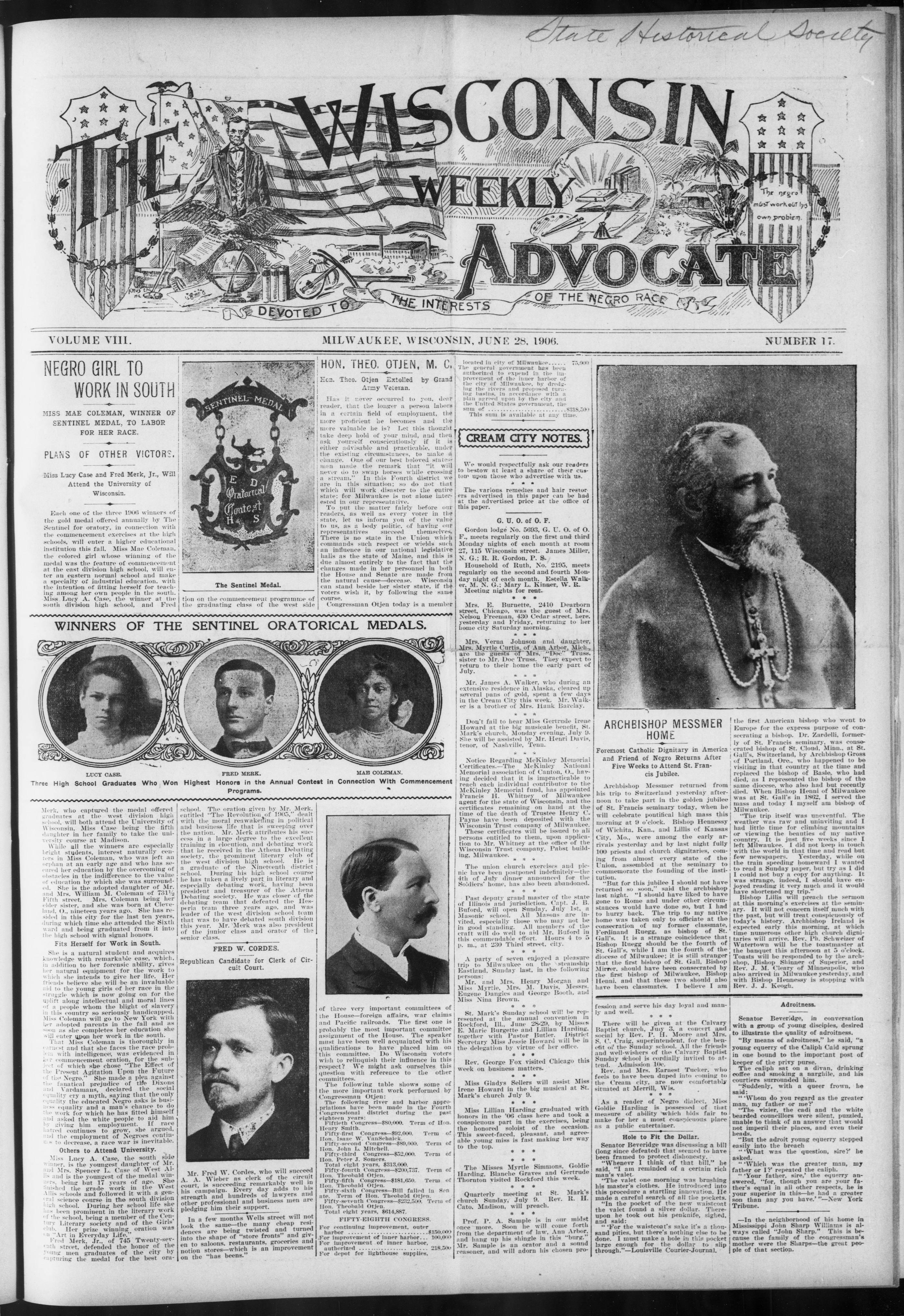
Three High School Graduates Who Won Highest Honors in the Annual Contest in Connection With Commencement Programs
VOLUME VIII.
NEGRO GIRL TO WORK IN SOUTH
MISS MAE COLEMAN, WINNER OF SENTINEL MEDAL, TO LABOR FOR HER RACE.
PLANS OF OTHER VICTORS.
Miss Lucy Case and Fred Merk, Jr., Will Attend the University of Wisconsin
Each one of the three 1906 winners of the gold medal offered annually by The Sentinel for oratory, in connection with the commencement exercises at the high schools, will enter a higher educational institution this fall. Miss Mae Coleman, the colored girl whose winning of the medal was the feature of commencement at the east division high school, will enter an eastern normal school and make a specialty of industrial education. with the intention of fitting herself for teaching among her own people in the south. Miss Lucy A. Case, the winner at the south division high school, and Fred
WINNERS OF THE
LUCY CASE.
Free High School Graduates Who Won
Merk, who captured the medal offered graduates at the west division high school, will both attend the University of Wisconsin, Miss Case being the fifth daughter in her family to take the university course at Madison.
While all the winners are especially bright students, interest naturally centers in Miss Coleman, who was left an orphan at an early age and who has secured her education by the overcoming of obstacles in the indifference to the value of education by which she was surrounded. She is the adopted daughter of Mr. and Mrs. William M. Coleman of 73115 Fifth street. Mrs. Coleman being her elder sister, and she was born at Cleveland, O., nineteen years ago. She has resided in this city for the last ten years, during which time she attended the Sixth ward and being graduated from it into the high school with signal honors.
Fits Herself for Work in South.
She is a natural student and acquires knowledge with remarkable ease, which, in addition to her forensic ability, gives her natural equipment for the work to which she intends to give her life. Her friends believe she will be an invaluable aid to the young girls of her race in the struggle which is now going on for the uplift along intellectual and moral lines of a people whom the blight of slavery in this country so seriously handicapped. Miss Coleman will go to New York with her adopted parents in the fall and as soon as she completes her education she will enter upon her work in the south.
That Miss Coleman is thoroughly in earnest and that she faces the race problem with intelligence, was evidenced in her commencement oration, for the subject of which she chose "The Effect of the Present Agitation Upon the Future of the Negro." She made a plea against the fanatical prejudice of the Dixons and Vardamans, declared the social equality cry a myth, saying that the only equality the educated Negro asks is business equality and a man's chance to do the work for which he has fitted himself and asked the white people to aid him by giving him employment. If race hatred continues to grow, she argued, and the employment of Negroes continues to decrease, a race war is inevitable.
Others to Attend University.
Miss Lucy A. Case, the south side winner, is the youngest daughter of Mr. and Mrs. Spencer L. Case of West Allis and is the youngest of the medal winners, being but 17 years of age. She finished the grade work in the West Allis schools and followed it with a general science course in the south division high school. During her school life she has been prominent in the literary work of the school, being a member of the Century Literary society and of the Girls' club. Her prize winning oration was on "Art in Everyday Life." Fred Merk, Jr., of 745 Twenty-seventh street, defended the honor of the young men graduates of the city by capturing the medal for the best ora-
---
SENTINEL-MEDAL
ED
Oratorical
Contest
H. S
tion on the commencement programme of the graduating class of the west side
THE SENTINEL ORATOR
FRED MERK.
Highest Honors in the Annual Conten-
Programs.
school. The oration given by Mr. Merk, entitled "The Revolution of 1905," dealt with the moral reawakening in political and business life that is sweeping over the nation. Mr. Merk attributes his success in a large degree to the excellent training in elocution, and debating work that he received in the Athena Debating society, the prominent literary club of the west division high school. He is a graduate of the Nineteenth district school. During his high school course he has taken a lively part in literary and especially debating work, having been president and treasurer of the Athena Debating society. He was closer of the debating team that defeated the Hesperia team three years ago, and was leader of the west division school team that was to have debated south division this year. Mr. Merk was also president of the junior class and orator of the senior class.
FRED W. CORDES.
Republican Candidate for Clerk of Circuit Court.
Mr. Fred W. Cordes, who will succeed A. A. Wieber as clerk of the circuit court, is succeeding remarkably well in his campaign. Every day adds to his strength and hundreds of lawyers and other professional and business men are pledging him their support.
In a few months Wells street will not look the same—the many cheap residences are being twisted and turned into the shape of "store fronts" and given to saloons, restaurants, groceries and notion stores—which is an improvement on the "has beens."
---
MILWAUKEE, WISCONSIN, JUNE 28. 1906
HON. THEO. OTJEN, M. C.
Hon. Theo. Otjen Extolled by Grand Army Veteran.
Has it never occurred to you, dear reader, that the longer a person labors in a certain field of employment, the more proficient he becomes and the more valuable he is? Let this thought take deep hold of your mind, and then ask yourself conscientiously if it is either advisable and practicable, under the existing circumstances, to make a change. One of our best beloved statesmen made the remark that "it will never do to swap horses while crossing a stream." In this Fourth district we are in this situation; so do not that which will work disaster to the entire state: for Milwaukee is not alone interested in our representative.
To put the matter fairly before our readers, as well as every voter in the state, let us inform you of the value to us, as a body politic, of having our representatives succeed themselves. There is no state in the Union which commands such respect or wields such an influence in our national legislative halls as the state of Maine, and this is due almost entirely to the fact that the changes made in her personnel in both the House and Senate are made from the natural cause—decease. Wisconsin can stand beside her sister state, if the voters wish it, by following the same course. Congressman Otjen today is a member
HISTORICAL MEDALS.
MAE COLEMAN.
Rest in Connection With Commencement
M.
of three very important committees of the House—foreign affairs, war claims and Pacific railroads. The first one is probably the most important committee assignment of the House. The speaker must have been well acquainted with his qualifications to have placed him on this committee. Do Wisconsin voters wish to relinquish their influence in this respect? We might ask ourselves this question with reference to the other committees. The following table shows some of the more important work performed by Congressman Otjen: The following river and harbor appropriations have been made in the Fourth Congressional district during the past eighteen years:
Fiftieth Congress—$80,000. Term of Hon.
Henry Smith.
Fifty-first Congress—$92,000. Term of
Hon. Isaac W. VanSchaick.
Fifty-second Congress—$80,000. Term of
Hon. John L. Mitchell.
Fifty-third Congress—$52,000. Term of
Hon. Peter J. Somers.
Total eight years, $313,000.
Fifty-fourth Congress—$200,737. Term of
Hon. Theobald Otjen.
Fifty-fifth Congress—$181,650. Term of
Hon. Theobald Otjen.
Fifty-sixth Congress—Bill failed in Sen-
ate. Term of Hon. Theobald Otjen.
Fifty-seventh Congress—$232,500. Term of
Hon. Theobald Otjen.
Total eight years, $614,887.
FIFTY-EIGHTH CONGRESS.
For continuing improvement, outer
For improvement of inner harbor... 100,000
For improvement of inner harbor,
authorized ..... 218,500
For depot for lighthouse supplies,
located in city of Milwaukee..... The general government has been authorized to expend in the improvement of the inner harbor of the city of Milwaukee, by dredging the rivers and proposed turning basins, in accordance with a plan agreed upon by the city and the United States government, the sum of
CREAM CITY NOTES.
We would respectfully ask our readers to bestow at least a share of their custom upon those who advertise with us.
The various remedies and hair restorers advertised in this paper can be had at the advertised price at the office of this paper.
G. U. O. of O. F.
Gordon lodge No. 5693, G. U. O. of O. F., meets regularly on the first and third Monday nights of each month at room 27, 115 Wisconsin street. James Miller, N. G.; R. R. Gordon, P. S. Household of Ruth, No. 2195, meets regularly on the second and fourth Monday night of each month. Estela Walker, M. N. G.; Mary L. Kinner, W. R. Meeting nights for rent
* * *
Mrs. E. Burnette, 2410 Dearborn street, Chicago, was the guest of Mrs. Nelson Freeman, 430 Cedar street, here, yesterday and Friday, returning to her home city Saturday morning.
Mrs. Verna Johnson and daughter, Mrs. Myrtle Curtis, of Ann Arbor, Mich., are the guests of Mrs. "Doc" Truss, sister to Mr. Doc Truss. They expect to return to their home the early part of July.
Mr. James A. Walker, who during an extensive residence in Alaska, cleared up several pans of gold, spent a few days in the Cream City this week. Mr. Walker is a brother of Mrs. Hank Barclay.
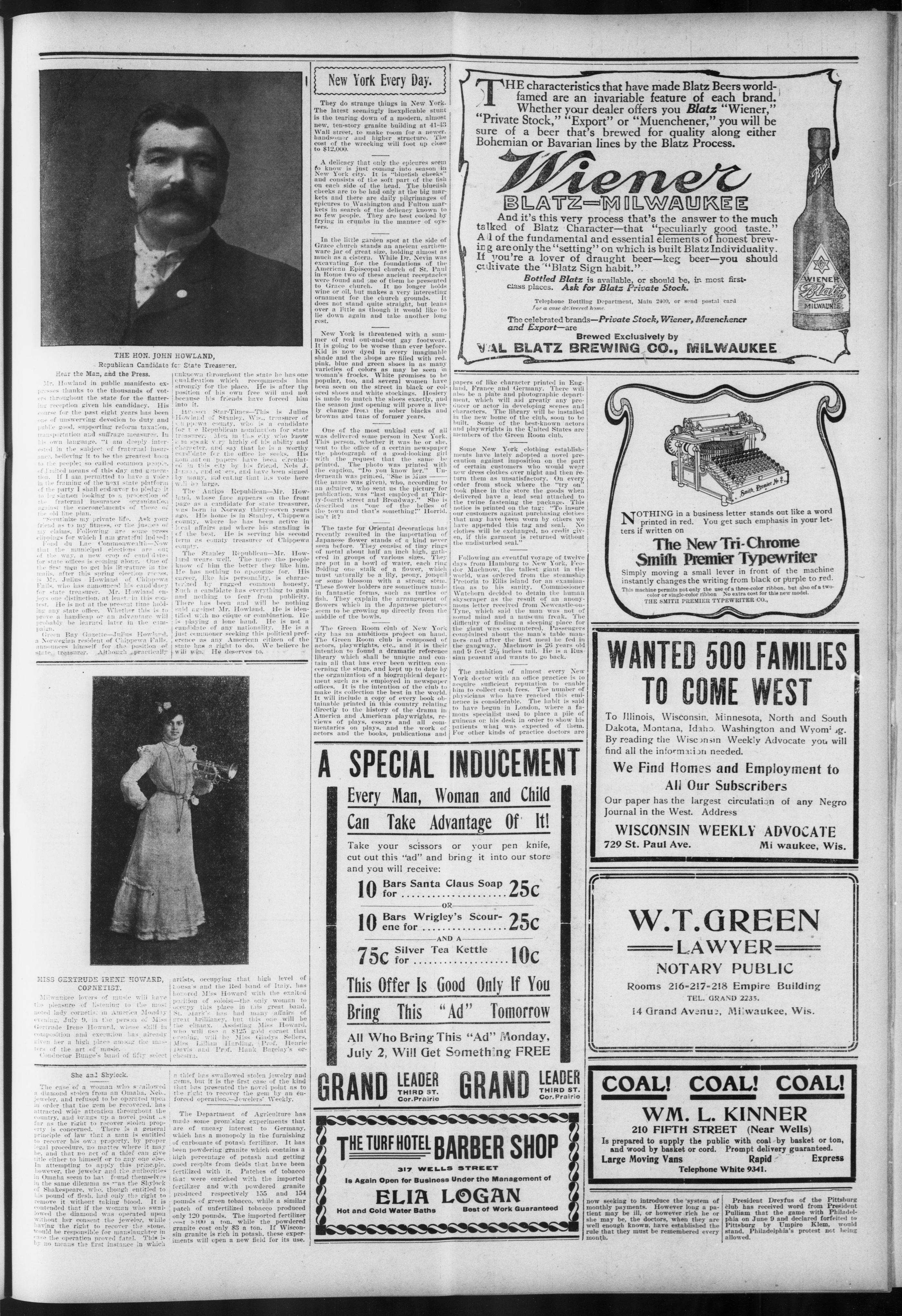
Don't fail to hear Miss Gertrude Irene Howard at the big musicale benefit, St. Mark's church, Monday evening, July 9. She will be assisted by Mr. Henri Davis, tenor, of Nashville, Tenn.
```markdown
```
Notice Regarding McKinley Memorial Certificates.—The McKinley National Memorial association of Canton, O., having decided that it is impracticable to reach each individual contributor to the McKinley Memorial fund, has appointed Francis H. Whitney of Milwaukee agent for the state of Wisconsin, and the certificates remaining on hand at the time of the death of Trustee Henry C. Payne have been deposited with the Wisconsin Trust company of Milwaukee. These certificates will be issued to all persons entitled to them, upon application to Mr. Whitney at the office of the Wisconsin Trust company, Pabst building, Milwaukee.
The union church exercises and picnic have been postponed indefinitely—the 4th of July dinner announced for the Soldiers' home, has also been abandoned.
* * *
Past deputy grand master of the state of Illinois and jurisdiction, Capt. J. B. Buford, will open Sunday, July 1st, a Masonic school. All Masons are invited, especially those who may not be in good standing. All members of the craft will do well to aid Mr. Buford in this commendable effort. Hours 4 to 5 p. m., at 230 Third street, city.
* * *
A party of seven enjoyed a pleasure trip to Milwaukee on the steamship Eastland, Sunday last, in the following persons:
Mr. and Mrs. Henry Morgan and Miss Myrtle, Mrs. M. Davis, Messrs. Eugene Dangles and George Booth, and Miss Nina Brown.
☆ ☆ ☆
St. Mark's Sunday school will be represented at the annual convention in Rockford, Ill., June 28-29, by Misses E. Marie Burgette and Lillian Harding, together with Pastor Butler. District Secretary Miss Jessie Howard will be in the delegation by virtue of her office.
* * *
Rev. George Fox visited Chicago this week on business matters.
* * *
Miss Gladys Sellers will assist Miss Irene Howard in the big musical at St. Mark's church July 9.
* * *
Miss Lillian Harding graduated with honors in the '06 class here and took a conspicuous part in the exercises, being the honored soloist of the occasion. This sweet-faced, pleasant, and agreeable young miss is fast making her way to the top
The Misses Myrtle Simmons, Goldie Harding, Blanche Graves and Gertrude Thornton visited Rockford this week.
* * *
Quarterly meeting at St. Mark's church Sunday, July 9. Rev. R. H. Cato, Madison, will preach.
* * *
Prof. P. A. Sample is in our midst once more. Soon he will come forth from the department of law, Ann Arbor, and hang up his shingle in this "burg." Mr. Sample is an orator and a sound reasoner, and will adorn his chosen pro-
---
Bishop of the Diocese of New York.
ARCHBISHOP MESSMER
HOME
ARCHBISHOP MESSMER
HOME
Foremost Catholic Dignitary in America and Friend of Negro Returns After Five Weeks to Attend St. Fran-
Archbishop Messmer returned from his trip to Switzerland yesterday afternoon to take part in the golden jubilee of St. Francis seminary today, when he will celebrate pontifical high mass this morning at 9 o'clock. Bishop Hennessy of Wichita, Kan., and Lillis of Kansas City, Mo., were among the early arrivals yesterday and by last night fully 100 priests and church dignitaries, coming from almost every state of the Union, assembled at the seminary to commemorate the founding of the institution.
"But for this jubilee I should not have returned so soon," said the archbishop last night. "I should have liked to have gone to Rome and under other circumstances would have done so, but I had to hurry back. The trip to my native home was taken only to officiate at the consecration of my former classmate, Ferdinand Ruegg, as bishop of St. Gall's. It is a strange coincidence that Bishop Ruegg should be the fourth of St. Gall's, while I am the fourth of the diocese of Milwaukee; it is still stranger that the first bishop of St. Gall, Bishop Mirrer, should have been consecrated by the first bishop of Milwaukee, Bishop Henni, and that these two should also have been classmates. I believe I am
fession and serve his day loyal and manly and well.
* * *
There will be given at the Calvary Baptist church, Jury 3, a concert and social by Rev. P. H. Moore and Mrs. S. C. Craig, superintendent, for the benefit of the Sunday school. All the friends and well-wishers of the Calvary Baptist Sunday school is cordially invited to attend. Admission 10c.
Rev. and Mrs. Earnest Tucker, who feels to have been duped into coming to the Cream city, are now comfortably situated at Merrill, Wis.
* * *
As a reader of Negro dialect, Miss Goldie Harding is possessed of that measure of ability which bids fair to make for her a most conspicuous place as a public entertainer.
Hole to Fit the Dollar
Senator Beveridge was discussing a bill (long since defeated) that seemed to have been framed to protect dishonesty.
"Whenevr I think of that bill," he said. "I am reminded of a certain rich man's valet.
"The valet one morning was brushing his master's clothes. He introduced into this procedure a startling innovation. He made a careful search of all the pockets.
"In the pocket of the new waistcoat the valet found a silver dollar. Thereupon he took out his penknife, sighed, and said:
"For the waistcoat's sake it's a thousand pites, but there's nothing else to be done. I must make a hole in this pocket large enough for the dollar to slip through."—Louisville Courier-Journal.
NUMBER 17.
POPE
the first American bishop who went to Europe for the express purpose of consecrating a bishop. Dr. Zardelli, formerly of St. Francis seminary, was consecrated bishop of St. Cloud, Minn., at St. Gall's, Switzerland, by Archbishop Gross of Portland, Ore., who happened to be visiting in that country at the time and replaced the bishop of Basle, who had died, as I represented the bishop of the same diocese, who also had but recently died. When Bishop Henni of Milwaukee was at St. Gall's in 1862, I served the mass and today I myself am bishop of Milwaukee.
"The trip itself was uneventful. The weather was raw and uninviting and I had little time for climbing mountains or viewing the beauties of my native country. It is just five weeks since I left Milwaukee. I did not keep in touch with the world in that time and read but few newspapers. Yesterday, while on the train speeding homeward I wanted to read a Sunday paper, but try as I did I could not buy a copy for anything. It was strange, indeed, I should have enjoyed reading it very much and it would have shortened my trip."
Bishop Lillis will preach the sermon at this morning's exercises at the seminary. It will not concern itself much with the past, but will treat conspicuously of today's history. Archbishop Ireland is expected early this morning, at which time numerous other high church dignitaries will arrive. Rev. Ph. Schweizer of Watertown will be the toastmaster at the banquet this afternoon at 5 o'clock. Toasts will be responded to by the archshop, Bishop Shinner of Superior, and Rev. J. M. Cleary of Minneapolis, who also arrived in Milwaukee yesterday, and with Bishop Hennessy is stopping with Rev. J. J. Keogh.
Adroitness.
Senator Beveridge, in conversation with a group of young disciples, desired to illustrate the quality of adroitness. "By means of adroitness," he said, "a young equerry of the Caliph Caid sprung in one bound to the important post of keeper of the privy purse. The caliph sat on a divan, drinking coffee and smoking a narghile, and his courtiers surrounded him.
"Suddenly, with a queer frown, he said:
"Whom do you regard as the greater man, my father or me?"
"The vizier, the cadi and the white bearded councillors were silent, puzzled, unable to think of an answer that would not imperil their places, and even their heads.
"But the adroit young equerry stepped easily into the breach
"What was the question, sire?" he asked.
"Which was the greater man, my father or I?" repeated the caliph.
"Your father, sire,' the equerry answered, "for, though you are your father's equal in all other respects, he is your superior in this—he had a greater son than any you have.'"—New York Tribune.
—In the neighborhood of his home in Mississippi John Sharp Williams is always called "John Sharp." This is because the family of the congressman's mother were the Sharps—the great people of that section.
---
Madge—Why don't you join our Audubon society?
Dolly—A bird in the hat is worth two in the bush.—Town Topics.
Great College.
When the president of a great college parts his name in the middle, he sets a bad example to the boys.—Somerville Journal.
Companionship
Tommy—Well, can I fight with him?—
Harner's Bazar.
Diamond Flashes
Members of the Philadelphia police force have formed a baseball team. Of course, the fly cops will be the fielders. Buffalo Express.
The Quaker Ouakes.
"Philadelphia has many slow people," remarked the Observer of Events and Things, "but many fast Friends."—Yonkers Statesman.
No Flowers.
De road to money am long an' hilly; yo' gottah staht early, an' yo' ain' gwine hab no time ter pick flowahs on de way. —American Spectator.
Saving Labels.
Save all your canned meat labels. They may come handy a few months from now in reminding you what all this row was about.—Denver Republican.
The First Day of Summer.
The Sun—Not many—but there are girls to burn!—Town Topics.
The Parlor Vocalist.
A lady who tried for high C,
Sang woefully off of the key,
Till the guests, with a roar,
Made a bolt for the door,
And ran away muttering: "Gee!"
—Town Topics.
Being Accurate.
He has a large family.
"Why, he hasn't anything but a wife."
"I know; but she weighs 300 pounds."
-New Orleans Times-Democrat.
Good for Bites.
Weeks—What is good for a mosquito bite?
Slick—Most any sort of human flesh, I believe, is considered good.—Judge.
A Confusion of Persons.
She—Wen't you take me for a ride in your automobile?
He—I'm sorry, but it's broke.
"Oh, are you?"—Translated for Tales from Le Rire.
A Transmigration.
Said the stork: "Amid riches and pelf,
I'm afraid I am laid on the shelf;
And with race suicide
Where the wealthy abide,
I am making a goose of myself!"
At Heaven's Gate.
St. Peter—That must be a lady's maid waiting out there; I've noticed her several times looking through the keyhole. —Translated for Tales from Meggenderfer Blaetter.
His Redeeming Trait.
"I'll say one thing for Soakleigh; he generally knows when he has had enough."
"But then he's too far gone to know anything else."—American Spectator.
Correct
The New Waiter—Shall I say "Dinner is served' or 'Dinner is ready, ma'am? Mistress—If that cook doesn't do any better, just say "Dinner is spoiled."—Harner's Bazar.
Her Solicitude.
Mrs. Gramercy—You seem to be very much attached to your little toy spaniel. Mrs. Park—I am indeed, dear. It will just break my heart when the breed goes out of fashion and I'll have to get rid of him.—Town Topics.
Roulette That Works Both Ways
"Hello! back again, eh?" said the inveterate gambler. "You haven't been well lately, I hear."
"No," replied the croupier, as he gave the roulette wheel a twirl, "but I'm having a turn for the better just now."—Philadelphia Press.
Happy Pair
"The Arnolds are a very happy couple after all these years. How do you account for it?" "Well, he can't get over the idea that he married a mighty good woman and spends some time each day to prove it to her."—American Spectator.
Nautical Notes.
Mrs. Yacht—superciliously—My husband has a beautiful yacht. I don't suppose your husband can afford such a luxury, yet?
Mrs. Nacht—No, the best he can do is to hold the mortgage on the one your husband has—The Bohemian.
A Good Joke.
"I thought you told me there was an extensive plant in the neighborhood of the lot you sold me."
"So there is."
"Why, man alive, there's nothing near the place except a cemetery."
"Tat's it."—Baltimore American.
Swimming.
The police authorities were notified recently that some boys were in swimming in the river at the foot of Rainey street. Officer Standford went down to put a stop to the swimming, but found that the boys were wearing trousers, so allowed them to continue.—Austin (Tex.) Tribune.
Always a Failure
"In the bright lexicon of youth," remarked Mr. Cityman, "there is no such word as fail."
"Wa-al." drawled Uncle Hiram Clovertop. "I don't know as I know jest what a lexicon is, but I'll bet it hain't got nothin' to do with the Delaware peach crop."—Town Topics.
Her Stage Name.
"So she's another society girl going into the theatrical world. I suppose she hopes to make a name for herself on the stage?" "Oh! yes, but she's so particular. She has looked through any number of novels for a good name, but she hasn't found one to suit her yet."—Philadelphia Ledger.
The Proper Coat.
For a Surgeon—Cutaway.
For an After-dinner Speaker—Tail.
For a Rejected Lover—Sack.
For a Retired Merchant—Pajama.
For an effeminate man—Frock.
For a Sponger—Dinner.
For a King—Rain.
For a Bargain-maker—Driving.
—Town Topics.
But Oh! the Difference.
I loved a dark haired girl last year,
I felt she was my fate.
I held that brunette very dear
(Blondes I abominate).
But, when I heard of her this year,
I really could have cried.
Exeuse a (paradox and) tear!
The girl I loved had—dyed!
—New York Sun.
A Mere Idea
Christian Scientist—How is your father, Johnnie?
Johnnie—Very sick.
"Oh, you mustn't say that. He only thinks he is."
A week later.
C. S.—How is your father today.
C. S.—How is your father today. Johnnie?
Johnnie—He thinks he's dead.—Translated for Tales from Le Rire.
Reason Enough
Benevolent Old Gentleman (rescuing one small boy from the pummeling of two others)—What are you hurting this boy for?
"Because he made so many mistakes in his arithmetric this morning."
"Why, he let us copy our answers from him."—Translated for Tales from Eliegende Blaetter.
Wisting One's Time.
"What sort of a man is Jinks?"
"William J. Jinks, the grocer?"
"That's the man."
"Son of old Gregory P. Jinks?"
"Correct. What sort of a chap is he?"
"I can't say. I don't know Jinks."—Pittsburg Post.
PARCHED POPCORN.
It's Made of Sweet Corn and Has the Good Old Fashioned Sound.
When the sweet corn commences to ripen in the garden select several fine ears having large firm grains and let these ears remain just as they are on the stalks to ripen.
When they are quite dry remove from the corn stalks without disturbing the husks, bind into bunches with a strip of muslin and hang away in the attic in a dry place. After a few weeks, according to What to Eat, the corn will be ready for parching, and then this new sort of popcorn may be enjoyed.
Place an iron spider or frying pan over the fire, and turn into it a cupful or two of the corn, which should be husked and removed from the ear just before using; the fire must not be too hot, and the corn must be stirred frequently with a long fork, or it may scorch. After a time the grains will have puffed up until they are almost round and will turn a delicate brown color, when they are done.
Turn the parched corn into a large bowl and pour over it some melted butter, stirring the corn kernels about so they will be buttered evenly, as one butters ordinary popcorn; salt the corn as soon as buttered and the corn is ready to eat. This dainty may be called "parched popcorn" to distinguish it from ordinary popcorn.
Girl Hugged by Snake.
During a snake charming exhibition in a small circus showing at Mount Pleasant, Ia., a huge anaconda crushed nearly to death Loretta, the pretty Italian charmer. She will probably die as a result of the squeeze. Some forty specimens were in the snake cage. When the enchantress entered through the small iron gate among the squirming, hissing mass, the anaconda, by far the largest of her subjects, dropped upon her shoulders from the upper bars of the cage and enveloped her in its coils.
At her screams the showmen ran to her aid. Some of them entered the cage and pounded the reptile with redhot irons while it frotted at the mouth under their attacks. The girl was finally released, and the anaconda writhed through the open door and raced across the country, preceded by a terrified, shrieking wave of women and children. It disappeared into the thick woods, carrying in its huge jaws a wildly squealing hog.
Three Women Sue Him.
Robert J. Denny of Galesburg, Ill., has been made defendant in two damage suits by three angry women, who claim he has trilled with their affections. The first suit was filed in the circuit court of Des Moines county Ia., by May Been of this city, who demanded $20,000 damages for breach of promise. The second suit for similar cause was begun in the same court for $25,000 by Mme. Etta Grice of Galesburg. A third woman, whose name the attorneys withhold, is said to be contemplating a suit.
Miss Been has been housekeeper for Denny during the six or seven years he has lived here. He is a widower. The claim of Miss Been is that he had been paying her attentions with the understanding he was to marry her. At the same time he was showering attentions on the other two women, it is claimed. The storm broke last week when Mme. Grice and Miss Been compared notes and presents and found he had been making the same declarations to both.
Skulls at Banquet.
Julius Brown, son of the war governor of Georgia, gave a dinner to celebrate his 58th birthday at Atlanta, which was remarkable for its somberness. There were twelve persons present, one of whom was Gov. Terrell. On the table was black velvet cloth. At each cover was placed a black dinner card, together with Gibson's puzzle picture. "All Is Vanity," showing a girl at a dressing table which fades into a skull when looked at in certain light. A skull was by the side of each plate, and suspended from the center of the chandelier was a huge skull of ashy white, under which on a black pedestal sat the figure of a monk draped in black. At the end of every course a candle was snuffed out. This was continued until at the close of the dinner there were no lights except those in the corner of the room.
Recovers His Speech
That Louis Mendelsohn of Chicago, for twenty-one years deprived of the power of utterance, has completely recovered his speech was made manifest when he told of his remarkable experience.
"It is over twenty-one years ago," said he in slightly halting accents, "that brain fever left me without the power of speech. I was sent to the best doctors, but without avail, and it was not until two years ago that I began to have a glimmering hope. At that time I found that I was able to make some meaningless sounds.
"I was afraid to do this in public, but at home I have labored to make these sounds stand for words. Two weeks ago I surprised myself by being able to whisper a few simple words, and on Sunday last I said several words aloud.
—The labor members of the British Parliament have resolved to begin a pro-Zulu campaign throughout the country. They hold that Natal and not the Zulu is responsible for the present rebellion.
HYMEN
Honey-bee knows;
Heart of my heart knows you!
MAB'S RIVAL
"My dear Mabel, they are all alike," said Miss Tabitha Price, shaking her head to emphasize her words. "Every man Jack of them. There is not a pin to choose between them."
"But, Aunt Tabby," said Mabel, between her sobs, "I thought Jack so—so—"
"Of course. It's the way of all you stupid girls. There is not one of them that I would trust—excepting your father, of course. And there's no knowing what he might have been had I not been near to look after him. After all, Mr. Aylmer is no worse than the rest." "But I can't marty him if—"
"No, dear; of course not. But marriage is not essential to happiness. Better remain what the world rudely calls an old maid than——"
"But I don't want to remain an old maid," said the girl, as emphatically as her sobs would allow. "Better be dead!"
"I don't think so. But are you sure you are not torturing yourself needlessly? Are you certain 'tis his writing?"
"I should know it among a thousand."
"Ah! I suppose so," said Tabitha, noding sagely. "Let me see it again."
Miss Price smoothed it out carefully and read: "Must get rid of Polly before the wedding. I am awfully fond of her, and don't like parting, but——"
Here the writing broke off, and, looking up, she said, "It is a thousand pities we have not the other portion. Did you look around?"
"Yes, aunt; you may be sure I did. As soon as I caught sight of this I knew it was Jack's writing, and picked it up. I searched all around, but could find no more."
"Well, dear, what will you do?"
"Do?" said Mabel, sobbing anew. "I shall pack up all his presents and send them back, and tell him how glad I am I found him out."
A heavy step on the gravel walk caused Miss Price to look up as a fresh-colored, clean-shaven young giant swung past the window, singing as he went. "Love was once a little boy. Heigho! heigho!"
"Yes," snapped Miss Tabitha, viciously. "Once. But he's outgrown his innocence long since. There, run away, child, and dry your eyes. Don't let Mr. Fairleigh see you like that."
Walter Fairleigh entered with the freedom of one who felt himself at home.
"Good morning, Miss Price," he said, cheerily. "Where is Queen Mab? I thought I saw her here."
"Mabel," said Miss Price, laying stress upon the name, "is not very well. She has gone to her room."
"What a beastly nuisance!" said the young fellow, dropping into a chair. "Has she heard from Jack this morning?"
"Umph!" said Miss Price, bridling. "I believe there was a letter from Mr. Aylmer."
"Did he say whether he was coming down today?"
"I really cannot inform you. Did you expect him?"
"He succeeds in getting Polly off his hands, eh?" said she, eyeing him searchingly.
"Eh? I—I beg your pardon," he stammered, flushing to the roots of his hair.
"Did you say——"
"I said Polly, sir," she answered, severely.
"Oh!" he said, with some hesitation.
"I thought Jack had kept that matter secret. I was not aware that you knew."
"Walter Fairleigh, I know all."
"Oh!" he replied, with an air of relief.
"I'm glad of that. I know Jack did intend to keep it close. In fact, he made me swear by the love I bore my best meerschaum that I'd never—never—never divulge. His idea was that the dean might disapprove."
"My brother the dean is not yet aware of the facts, Mr. Fairleigh. The knowledge at present is confined to Mabel and myself."
"Oh! You know, of course, that he is endeavoring to get rid of her?"
"Yes, sir; I am aware that such is his intention."
"Poor old Jack. He will feel parting with her awfully."
"Why? Is he so very much attached to her?"
"Rather. I never thought he cared very much for her until after she offered to run away with him."
"I should think so, indeed. And, pray, how did he meet her proposal to——"
"Bolt? Oh, pulled her up sharp, you may be sure. Jack likes to go the pace, but——"
"Is she—fond of him?"
"Follows him like a dog."
"More fool she! But there, I suppose she's some low-bred creature, and his attachment flatters her."
"Oh, she's not badly bred. She's sister to Lord Dalrymple and a beauty."
"Indeed," said Miss Tabitha, with an indignant toss of the head. "I wonder with so much beauty and breeding that Mr. Aylmer should have kept her in the background."
"Well, honestly, I don't think he ever did the fair thing by her. He never seemed to care to bring her forward."
"I should think not, indeed. Knowing the deceit he was practicing he was too much ashamed, I suppose. But perhaps, after all, there was no engagement——"
"Oh, yes, there was. But he did not quite trust her, and so he broke it off. I was awfully wild when I saw he scratched her."
"Scratched her? The monster! How dare he?"
"He said he didn't like her form."
"A pretty reason, truly!"
"Wll, I thought he was to blame. I advised him to let her go."
"Just so. And now he's anxious to be rid of her? Pray, do you know whether
the final parting has actually taken place?"
"It had not when he last wrote to me. I have a letter from him somewhere," said he, fumbling in his pockets. "Perhaps I've destroyed it," he added, finding his search fruitless. "Torn it up, most likely. I'm such a careless beggar."
Tabitha smiled grimly, but said never a word as she thought of the crumpled paper in her pocket.
"Well, I'll get off," said Fairleigh, rising. "I'm awfully sorry about Mab. By the way, Miss Price, if there should be any news of Jack's movements, you might let Jones run over to me. You see, I was thinking of running up to town to see him. But, of course, I don't want to if he's coming here."
"Well!" exclaimed Miss Price, with emphasis, as her visitor quitted the room. "Well—I never did!"
"Ah!" she exclaimed, breaking off as Rev. Timothy Price entered with Jack Aylmer.
"Timothy Price," she said, "you always were a fool!"
"why, Tabby, what are you——"
"Timothy," she snapped, "ask Mr. Aylmer the nature of this private business that detained him in town"
"Why, really, Miss Price," said the young fellow, blushing to the roots of his hair, "it is a matter that I——"
"Would rather not speak of?"
"Why, candidly, yes."
"Ah! I thought so. But, sir, we have discovered your disgraceful secret."
"Well, I am sorry——"
"That you are found out. Oh! I can believe you. And pray, sir, what of your victim?"
"What victim?" asked the dean, looking puzzled. "Jack—Tabby, what is the meaning of all this?"
"Ask him, sir. Ask him to explain, if he can, his connection with a certain Polly," said Tabitha, her voice trembling with righteous indignation.
"John," said the dean, eyeing him sternly, "is there any truth in this?"
"Well, sir," said Jack, "since Miss Price seems to know all about it, I may as well confess."
"And yet," said the dean, angrily, "you dared to speak of love to my child!"
"Why not? I admit that I ought, perhaps, to have told you. But respecting your well-known prejudice I thought it better to keep the matter to myself until I could succeed in getting rid of her."
"And pray, sir, have you succeeded?" asked Tabitha.
"Oh, yes. Perkins has taken her off my hands."
"A pretty arrangement, truly. And pray how does she take the matter?"
"Well, she may fret a bit at first. But she'll soon grow as fond of him as she was of me."
"I hope, sir, he will treat the poor thing with greater kindness than you displayed."
"Kindness?"
"Yes, sir. And that he will not scratch her, as you appear to have done, upon the slightest provocation."
"Scratch her, Tab: what are you talking of?" said the dean, with a puzzled air. "You surely do not mean that Mr. Aylmer so far forgot his manhood as to——"
"Scratched her because he didn't like her figure. I think it was 'form' Mr. Fairleigh said. But, of course, it's the same thing."
"What on earth mistake is here?" said Jack, glancing round with a look of puzzled amusement. "I certainly did scratch Polly, but——"
"By accident, of course?"
"Oh, no. I made up my mind to do it some days before."
"Disgraceful! Pray, sir, was there any serious engagement?"
"You would not have dared, you mean. Most unmanly! She may be thankful for her escape. If you cannot restrain your temper before marriage——"
"Marriage! Marriage with Polly?" cried Jack, bursting into a peal of hearty laughter. "Ha! ha! ha! We've got mixed here with a vengeance. Ha! ha! ha!"
"And pray, sir, why not?"
"Why not? Why, because—ha! ha! ha!"
"Halloa! Jack; there you are," said Fairleigh, looking in at the window. "Jones told me he saw you come up with his reverence. Sold the filly, eh?"
"Sold her? Yes. And, egad! I fancy some one has been selling Miss Price, too."
"Selling me, sir?" she said, with offended dignity.
"Confess now," he said, playfully shaking his finger at her. "Confess that you thought Polly was a woman."
"Certainly. What else should she be?"
"Why a horse, my dear madam," he reped, lightly.
"A horse!" cried the dean, with an air of relief. "Ah, Tabby, another mare's nest!"
"A horse?" she sniffed, incredulously.
"Why make such a secret of it?"
"It was a race horse, my dear madam. Knowing the de..n's prejudice against the turf, I determined to keep her existence a secret until I could place her in good hands. I was loth to part with her. But I could not allow even Polly to stand between me and Mab."
"But is it true, Jack?" whispered Mabel, who had crept into the room unobserved. "Is it reamy true?"
"True," he answered, drawing her to him, "as your own sweet self!"—J. D. Brayshaw in Tit-Bits.
Saved Only Pajamas.
Clad only in his pajamas, Rev. M. M. Want, pastor of the Methodist church at Virden, Ill., was the first to undertake the rescue of passengers from a wreck on the Iron Mountain road near St. Louis, in which one was killed and twenty-two injured. Unaided Rev. Mr. Want pulled Fireman Frank Richards from the wrecked northbound engine and laid him by the wayside. Richards soon after died. Continuing his work, the pastor threw heavy timbers off Engineer Taylor. Other passengers came to his assistance and he organized the work of succoring those who had been injured. At Iron Mountain headquarters here it was said the engine of the southbound train became unmanageable, and the engineer was powerless to stop at the siding.
More Travel on Ocean
The tide of travel is setting across the Atlantic with unprecedented strength, according to that faithful index, the number of passports issued by the state department at Washington, D. C. Last January there were issued passports aggregating 1528; in February, 1049; March, 1688; April, 2299, and May, 3028. These figures show that the applications for passports have been running about 200 per month more than the average issues of past years.
New York Every Day.
Rachel L. Kanter, the daughter of a Chicago rabbi, who sought to recover $25,000 damages from Victor C. Bell, a dentist, alleging breach of promise to marry, lost her suit in New York. Judge Haskeli granted the motion for dismissal of the complaint on the ground that the defendant incapacitated himself from marrying either the plaintiff or any other woman, and further, that there was no evidence of a promise of marriage on the dentist's part. When the decision was rendered Miss Kanter looked as if she had received a heavy blow. She was led from court by her friends.
One advertising firm on New York has evidently taken the hint from the masked dancer who caused such a furore at a local theater not so long since. This girl stands in a shop window on Broadway with a tiny black mask covering her face just around the eyes, and, of course, there is a crowd of men standing before the window all day long. The curious thing about the effect of the mask is that, while most of these young women who make their living by exhibiting themseives in this public fashion never seem to be self-conscious, this particular girl looks as though she were blushing all the time.
One of the unfinished palaces on Fifth avenue, New York city, is adorned with an unusual bit of carving. The railing of an upper balcony is formed of a design made up of the initial letter of the family name. This is surmounted with a coronet of nine points. Such heraldic decoration on European houses is common enough, but is not known in this country. The only appropriateness in this case is to be found in the fact that this particular family happens to include a duchess. It is more probable, however, that the owner knows nothing about the design, which is an inspiration of the architect's.
Dogs are wearing neckiaces now. The fashion is best illustrated on a fox terrier or some other small, smooth-haired canine. A pretty girl on Fifth avenue evolved a color scheme for her pet and herself in a manner that was effective and artistic. Her suit was of a light tan, with touches of turquoise. Her small fox terrier was snow white, with a little tan color about his head. A light harness went over the shoulders of the dog, and on one side of it was tied a white satn bow. Around his little white neck was a string of turquoise blue beads, and it is a safe bet that few women missed seeing him.
London has failed to take any interest in "The Lion and the Mouse," and the American company which presented the play there is returning to America. The notices of the play in London were, with scarcely an exception, kind; in some cases enthusiastic. The general opinion seems to have been much the same as was expressed here by th reviewers—that the play was crude and very badly written, and quite impossible if one came to analyze it, but that from a theatrical standpoint its two principal characters and acts were uncommonly effective and the theme of the play was a big one. But in spite of the reviews London has completely failed to display any interest in this essentially American play.
A group of men was talking about J. Pierpont Morgan the other day, discussing his personal tastes and habits, when one of the listeners broke into the current of the talk by asking the members of the group if any of them had ever been into his house in Madison avenue, New York. Not one of them had. "Well, I had to go to see him once," said the interrupter, "and do you know the thing that impressed me most was the thought that if I had as much money as Morgan I wouldn't let it be known to everyone who entered my hallway at that moment that I was going to have boiled codfish for dinner. The place simply reeked with the odor of that dish, about which there can be no mistake to even the least indifferent nostrils."
The constantly increasing immigration of West Indians offers a possible solution of New York's servant problem at a time when the said problem is most perplexing. These negroes with an English accent that is the envy of many people they serve have, as a rule, more education and ambition in that line than the ordinary American negro. They hold themselves rather apart from the rest of the serving class and cling to their own amusements. The other day in Pelham Park people witnessed a game of cricket, all of the players being West Indian negroes. This is their favorite pastime, and there are several crack cricket teams in New York city, the members of which have been recruited from among the hallboys and other West Indian servants.
Did you ever hear of an architectural cocktail? Instead of an alcoholic concoction try one the next time your appetite is somewhat oscitant. The ingredients are simple. First you must have access to the top floor or the roof of, sav, a twenty-story building. The greater the altitude the finer the appetizer. For half an hour inhale the ozonic rejuvenator. There must be no ingurgitation. Drink as if you were sipping the nectar of Jupiter. What purer draught can you take than that, far from the madding crowd of bacteria that hurks above the dusty surface of the streets? Half an hour a day only a few stories below the clouds will freshen you wonderfully. The stimulation of the upper air is accentuated by the panorama of the marvelous town and its environs.
Miss Rosa Lisch has been awarded $14,800 damages for breach of promise of marriage against Benjamin H. Strauss, a commercial traveler, by a jury in the city court of New York. Miss Lisch sued for $25,000. The young woman came to this country from Germany fourteen years ago to find her brother, after she had spent seven years in accumulating the money to make the search. She left New York for Chicago as the first point in her search, and while on the train was approached by Strauss. From this journey in January, 1902, there developed a friendship that ripened into love. A proposal of marriage and an engagement followed. In 1903 Strauss informed the young woman that he could not marry her.
There are some pretty big restaurants in New York, and some of them feed as many people in a day as would make up the whole population of a small town, but it is doubtful if any restaurant serves more meals the year round than that on Ellis island, which caters to everybody from the commissioner down to the poorest immigrant who, for lack of cash, is awaiting deportation. On the average 6000 meals a day are served on tables, to say nothing of the hundreds of meals packed in boxes to be carried away by immigrants going to the interior. And there are no deadheads. Every meal served except to the restaurant help is paid for. The commissioner and his chief aides have a special dining room with silver, china, glass and linen that no hotel would be ashamed of.
At last some steps are being taken to cool the heated air of the Subway in New York. This problem has caused more vexation and downright cussedness in New York than has any other during
the past couple of years. Vents for the super-heated air are being made at convenient distances and it is thought this will prove a satisfactory system of general ventilation. The introduction of pure air by pumping or otherwise, to drive out the used air, is not such an easy matter; but the solution of the problem is confidently looked forward to. Could the Interborough offer to its patrons not only less undesirable air to breathe and less oppressive temperatures, but really stimulating conditions in both directions, the Subway would at once become the pride of New York above all other transportation conveniences.
Miss Jane Morgan, daughter of Ranrall Morgan, traction magnate of Philadelphia, who already holds a license for navigating all oceans, obtained from the local board of steam vessel inspectors on New York a few days ago a license for navigating the waters of New York bay as far as Fort Washington point. She passed a nearly perfect examination. Her answers to questions cover eight pages of foolscap. Miss Morgan holds a certificate as master of her father's yacht, the Waturas, which once belonged to the Emperor Francis Joseph. She also has a license for Philadelphia waters. A letter of recommendation accompanying her application to the local board stated that she had more than once steered the Waturas through the most crowded parts of the East river. The young woman is an adept in setting signals and working the ship's telegraph. She has been a master since 1901. The only other woman who holds a pilot's license for these waters is Miss Amelia J. Jensen, who sells fresh water to vessels.
With the roses comes the trolley girl. She is the summer girl, of course, but of a special kind, and you won't find her like everywhere. She flourishes from New York to the village and back again, however, and her lack of ubiquity is due to a process of natural selection rather than to exclusiveness. Perched preferably on the front seat of a speeding juggernaut car she risks witnessing gruesome accidents blithely as any belle of the benzine buggy. Yet when the accident does happen she is far more tender-hearted than the average automobile girl. Hers the first scream that tells of the victim's fall; hers the first hands to soothe the suffering. Watch her at her best, when the public's car is shooting countryward; when her eyes dance in anticipation of park delights. And if she is a trifle too unconventional in that her waist does not always repulse the encircling arm of her hypnotized escort it is because love's young dream must hold sway when years and season and hour are contributory. And, after all, there are so many of her permitting the same encroaching endearment that possibly there's no great harm in it in car-load lots.
It is doubtful if any other large city in the world has so many islands within its municipal boundaries as has New York. Some of these islands are mere dots. Others are large enough to have almost the dimensions of cities. Governor's island, with its area of 70 acres, is the property of the federal government and is assessed at $5,600,000 by the city, which is $80,000 an acre; and as land values go in New York, that figure is low. Blackwell's island, which covers 124 acres, is valued at $12,000,000 which is at the rate of $97,000 an acre. Ward's island is valued at $9,000,000 and Randall's at $5,000,000. North Brother Island is held at $220,000. Riker's at $537,000 and Hart's island at $350,000. The most important of the islands included in the boundaries of Greater New York is, of course, Manhattan, the value of which is practically incapable. It is at least $5,000,000,000 how much more is conjectural. The borough of Brooklyn includes Coney island. The whole of the borough of Richmond is an island, valued by the city for tax purposes at about $50,000,000. The area of Staten island is 36,000 acres, which is almost three times the size of Manhattan.
---
To demonstrate to the German Emperor that there is no personal animosity in criticism of his portrait presented recently to the Brooklyn Institute of Arts and Sciences, trustees of the institution have started a movement to raise by popular subscription a large sum with which to pay for a painting of President Roosevelt to be sent to the Emperor on behalf of the citizens of Brooklyn. Bitter feeling has resulted from the Emperor's presentation to the Brooklyn institute of the portrait of himself. Prof. Hooper's criticism was made in a letter in the course of which he criticised the portrait because it was a copy of the Corcos picture and of "no value as a work of art."
The 5-year-old daughter of "Dan" Hanna of Cleveland came home from Europe with her mother the other day, declaring that Pope Pius X. is a fine playmate. During her stay in Rome Mrs. Hanna had a special audience with his holiness and took her little daughter along. At the termination of the audience Mrs. Hanna withdrew. In the ante-chamber she missed her daughter. Retracing her steps she was amazed to find the head of the Catholic church down on his hands and knees with the child in a similar position, both apparently searching for something.
Finally the Pope held up a tiny medal. "Oh, that's it!" cried little Miss Hanna. The Pope patted her head, and after expressing thanks, Mrs. Hanna led the venturesome little daughter away.
"Why, papa," she said in describing her experience on her return. "I losted my medal and went back for it. I told the nice old gentleman about it. He shook his head like he understood, and when I began to look on the floor he got down on his hands and knees and helped me. He found it first. He is a very nice man, papa; don't you think so?"
Freedom for a man who pleaded guilty to selling merchandise valued at nearly $100,000 which did not belong to him and appropriating the money, and six years in prison for another who stole 25 cents, were the portions meted out to two prisoners in New York last week. Henry Hirschman was a member of the firm of Hirschman Brothers, jobbers in men's furnishings, in 1903 and 1904. It is alleged that by deceit the firm obtained a high commercial rating on the strength of which they bought $100,000 worth of goods on credit. Action taken by the creditors forced the firm into bankruptcy. When Henry entered a plea of guilty, a representative of the creditors asked that sentence be suspended, as the prisoner and his brother had made partial payment and promised to make complete satisfaction.
The man who went to prison was John Clark, who has no home. He is 45 years old and had served two previous sentences in Sing Sing. Clark was walking up the Bowery a week ago when he saw a barber standing in front of his shop flipping a silver quarter in the air. Clark sprang upon him, seized the coin and started to run away. He had gone but a few steps when he ran into the arms of a policeman.
"I had to do this or starve," Clark told the judge.
—A good carriage horse in Australia costs $200, or four times as much as the cost fifteen years ago.
PAPERS BY THE PEOPLE
THE AMERICAN REPUBLIC.
By Senator J. P. Dolliver.
The truth is that the great and admirable epochs in the history of the United States are not to be found in the remote past. They are in the present, just behind us and all around us. It is an inexcusable disparagement of our own times to attribute to other generations what does not belong to them and to take away from our own its just claim upon the confidence and gratitude of mankind.
The history of a nation is only a statement of its preparation for its part in the progress of the world, and, while the Revolutionary era must always be cherished and the men and women who wrought its great achievements commemorated with honor and applause, it ought not to be forgotten that their work required infinite sacrifices before it grew into permanent strength and became a part of the fixed order of things, a permanent factor in the course of human events.
The history of a nation is only a st
aration for its part in the progress
while the Revolutionary era must a
and the men and women who wrought
ments commemorated with honor and
not to be forgotten that their work re
rifices before it grew into permanent a
part of the fixed order of things,
in the course of human events.
Our fathers began the work of bu
republic; they left it to their children
at least as important to live as it is
patriotic anniversary ought to be put
to spread the gospel of discouragement
public mind, as the people participate
memorial of the life and times of the
HOW EDUCATION AFFECTS HOU
Our fathers began the work of building the American republic; they left it to their children to finish it. It is at least as important to live as it is to be born, and this patriotic anniversary ought to be put to a better use than to spread the gospel of discouragement and fear in the public mind, as the people participate in this historic memorial of the life and times of their ancestors.
HOW EDUCATION AFFECTS HOUSEKEEPING
The state of life into which it has pleased God to call our daughters is plainly for the most part that which entails the duties of the housekeeper and the home maker, and for those duties the learning acquired in the schools often does much to unfit them.
The result of this unfitness in the foundation education is seen in the extravagant habits of our modern housekeeping, the ignorant waste where the young lady finds herself unable to teach and direct her servant in cases where she is not required to do the actual work herself, and, wearying of her attempts to be queen of her own household, she allows her little kingdom to live without a head. Her hus-
The result of this unfit tion education is seen in the its of our modern housekee waste where the young lady finds here and direct her servant in cases whi quired to do the actual work herself her attempts to be queen of her own lows her little kingdom to live without
A CRADLE SONG.
Sleep, O by, my little baby,
In your cradle, mother's near;
Angels watch all through the night,
With your mother, baby dear.
Sleep, O by, my little baby—
Tiny bud from heaven's throne;
Mother guards you through the shadows
Of the night. You're not alone.
Sleep, O by, my little baby;
Slumber softly, baby mine.
Gentle breezes now are blowing,
And the stars above you shine.
Sleep, O by, my little baby,
Till the sun-peep comes anew,
Angels guard my little darling—
Mother watches over you.
—Denver News.
MILKWEED MOSES.
TOO, was once a tenderfoot," said Milkweed Moses, squatting before the Dutch oven and heaping a few fresh coals on the lid. "The callous is an inch and a half thick on my soles now.
"I remember that full an' complete," he went on, seeing that he had the attention of his auditors. "I was walking along the Janeway trail, tryln' to make the White river crossin', an' headed fer the Mess Box butte, unknownin' in my tenderfoot simplicity. My cayuse had up an' died on me ten mile the other side o' Porcupline, an' I wus hoofin' it in high-heeled puncher boots that had my heels skun a plenty.
"Fin'ly I heard suthin' goin' pittity-pat, pittity-pat behind me. I turned around an' seen a feller ridin' along the trail at a pretty lively clip. He ketched up with me jest as I got to a coulee where there was a little bunch o' jack pines.
"Hello!" he says. 'Travelin', or jest goin' somewheres?
"I told him where I wus bound fer an' he laffed. 'Keep right on,' he says; 'you'll hit some place if you don't strike White river. Where are you from?"
"Buchanan, Mizzoura,' I says.
"What's your name?' he asks.
"Mose Pinckney,' I says.
"Why, sufferin' snakes!" he says. 'You must be old man Pinckney's boy—old man Pinckney of Buchanan. Well, shake!"
"I didn't like his eye, but I shook an' asked him if he had any grub. He shook his head sorrowful an' sald if he had a bite he'd give it to old man Pinckney's boy if it was the last he had on earth.
"You know my pap, then?" I says.
"Know him!" he says. 'I know him better'n—'
"He broke off an' looke dat the dim horryzon, shadin' his eyes with his hand. Seemed to me I c'd see a little dust right on the aidge of it, too.
"He wus the best friend I ever had,' says the feller, sort o' hurried, an' hoppin' off his horse. 'See here. You're tired. Take this yer horse an' light out straight along the trail your best licks. You've got ter hit the breeze, for if you let it get dark on you you'll miss the trail.'
"But——' I says.
"Ain't no "but" about it,' he says, frownin'. "Don't I tell you you're the son of my best friend? I owe your
---
J. P. DOLLIVER.
I
"But——' I says.
statement of its prep of the world, and, always be cherished the moods of a hu of the Illad.
applause, it ought
required infinite sac-
strength and became
a permanent factor
holding the American
n to finish it. It is
to be born, and this
to a better use than
ant and fear in the
state in this historic
ancestors.
SEKEEPING.
Adison C. Peters.
How a
fluences
of our life
and what
for some
pleasant
serenity
often in
unlimited
our case. After a
means so exaspera
calmer aspects of
clearness. They e
we may confident
merces. Thus unl
less in the founda-
te extravagant hab-
eping, the ignorant
self unable to teach
there she is not re-
and, wearying of
household, she al-
t a head. Her hus-
rather than enfeebel
In a word, let us n
The inevitable
lead in the two si-
take place later, be
a thing almost to
guests who are to
live charm.
dear, kind pap a heap more'n one
mangy, flea-bitten roan. You're welcome to him as the flowers in May.'
"I says, 'If you owed my pap as much as a dollar an' got out o' Buchanan alive 'thout payin' him you're a wonder.'
"You ain't got no time to talk about it if you want to eat to-night,' says my mysterus benefactor, as he ontled a slicker that bulged a considerable in the middle with what looked like a fry pan an' chuck. Glt up in that saddle an' let's see you ride. Don't you worry about me.'
"He slapped the horse with his hand and it gave a jump that mighty nigh threw me an' then lit into a lope. As soon's I got him started I looked back, an' I see my father's friend duck down into the coulee. Back farther yet a whole lot the dust was a gittin' thicker an' I c'd make out suthin' that looked like horses. Well, anyway, ridin' was a heap better than walkin' an' if pap had done a good action any time in his life there wasn't no reason, I allowed, why I shouldn't git the benefit of it.
"After a while I took the notion to look back an', sure enough, there was some folks peltin' along behind me about a mile an' a half. They was what had been the dust. I didn't think they could have gained on me that much an' it made me mad, because I'd begun to
"TRAVELIN. OR JEST GOIN' SOMEWHERES?"
take a pride in old Roany's performance. 'We'll see about this,' I says to myself, an' I give him a touch of the quirt. He made a jump or two forward an' then one side step that landed me in a bunch of sage brush.
"I tried to ketch him, but he jest walked away from me, holdin' his head sideways so he wouldn't step on the bridle. If I moved out of a walk he done the same an' he could out-trot me. If I stopped he went to feedin' again. I'd got right interested traillin' about after him an' jest nearly ketchin' him so I didn't hardly notice anything until somebody hollered to me to throw up my hands. I looked around an' seen six good-sized businesslike fellows with six entry-sized Winchesters all p'intin' right straight in my direction. Well, I throwed up my hands an' one feller with a crooked nose rode up an' dropped a rope over me.
"‘Gentlemen,’ I says, ‘I ain't got but $12 about me, but you're welcome to that if you'll jest take this yer rope off me an' give me my horse an' let me go.’ "They laffed at that. But one feller says: 'Where did you git your horse, podner?' An' then I told 'em about the feller my father'd been good to. "‘I don't believe a word of it,' says a man with a black beard, 'but if it's true I think we ought to hang him, just the same. A young fool like him is bound to be hung sooner or later.'
"Two or three others took the same view an' then I gathered for the first time that they'd done me the injustice of s'posin' I'd stole the horse I was a ridin'. The man who owned him thought so p'ticular. They argued a
band finds that the expense of married life is far greater than he had anticipated and the comfort less. As the expenditures increase he sees that his hard work on one side is only to supply the means of wastefulness on the other side and that his children are growing up with notions of life which nothing can satisfy.
I believe in the higher education of women, but let their training send them out into the world always as interested in making rooms pleasant and the food palatable as a bonnet artistic; in working a handsome daily home life as a piece of embroidery or playing a harmony of household dispositions as a symphony of Beethoven; in translating the temperament and tastes of a household as a comedy of Aristophanes and in interpreting the moods of a husband as those of one of the heroes of the Illiad.
WORK THE PANACEA FOR PESSIMISM
How are we to counteract the depressing influences which lie in wait for us every moment of our lives? Consider the evil and the good, and what do we find? It is often quite enough for some one to tell us something nice and pleasant to produce a condition of peace and serenity in our minds. More important still, often in the grip of analytical melancholy or of unlimited despair we sit down to think over
our case. After a careful examination we find it by no means so exasperating. If we continue our thinking the calmer aspects of the event stand out with reassuring clearness. They even smile at us good naturedly, and we may confidently abandon ourselves to their tender mercies. Thus unhappy impressions fade away, injurious or depressing sentiments become less acute, and just as the surface of a lake which has been disturbed by the invasion of somebody outside regains its habitual stillness, so our conscious mind regains its equilibrium.
Let us especially put ourselves under the most powerful influence of all, that of work. Let us use our minds, rather than enfeeble our bodies for want of occupation. In a word, let us not give ourselves time to grow old!
The inevitable visitation which must at some time lead in the two sisters, old age and death, will not only take place later, but what is more essential, will become a thing almost to be desired. They will be awaited like guests who are to bring us at some distant day attractive charm.
I
By Jean Flnot.
plenty about it until fin'ly one of the crowd allowed the other feller couldn't have got far if I'd been tellin' the truth an' it would waste time to hang me. 'We might shoot him,' he says. "Tie his legs an' leave him,' says another feller. An' that's what they done.
"Six mortal hours, gentlemen, I laid out there in the hot sun, rolled up in rope like a blame mummy, not able to stir hand nor foot. It wasn't all sunshine, though, because after a while the sun went down an' it got dark, and then the coyotes began to howl an' I wondered how long it'd be afore I got et.
"Fin'ly I heard a horse a-lopin' along an' pretty soon I heard the crooked-nose man's voice askin' me how I found myself.
"It took us some time,' he says, cheerful, 'but we got your friend. I reckoned I'd best come back an' uncle you. That's a good rope I've got on you an' I'd hate to lose it.'"—Chicago Daily News.
Speak English in Mexico.
It is not surprising that English should make some way southward over the boundary, so does Spanish penetrate northward, for the matter of that, but the exchange is not equal in amount, as the Mexicans emigrate less and travel less than we. There are over 4,000 resident Americans in the city of Mexico alone, to say nothing about the multitude of tourists.
If the linguistic movement southward continues to be more than the counter movement plainly the line of contact will itself gradually be moved. There is hardly a Mexican urchin selling fruits or papers along the railroads within fifty miles of the Rio Grande who does not know at least some colloquial phrases of English. This becomes less and less true, indeed, as one progresses southward., but one is never surprised to be asked by some russet-faced tatterdemallon, "You want the paper?" "You want some fruit?" and English reappears more prominently than ever at the capital.
Ask a city of Mexico policeman in simple English where some important building is and quite probably he will tell you. Walk into any large shop and ask for what you want and if the clerk does not understand "United States" he will call some one who does.—Four-Track News.
A Stayer.
The editor of this paper is here to stay. Some who are kicking against him and his methods will turn their toes up toward the blue vaults long before this editor does, and he will be here to note their removal from Stillwell.
Some of the people now in Stillwell have to get out of town, and they will before the town amounts to anything.—(Stillwell (I. T.) Sentinel.)
In 1920.
As a man approached the great college eleven pale and slender young men dressed in evening clothes and white gloves tripped across the field and slapped one another on the wrist.
"Strange!" he mused. "What is this—outdoor theatricals?"
"No," replied the dean with much pride in his tones, "this is a game of modified football."—Chicago News.
According to the eternal fitness of things the father of twins should be doubly thankful—but somehow he isn't.
President Roosevelt the other day received Mathnow, the Russian giant. Mathnow was accompanied by his wife. The president received him in Secretary Loeb's office, shaking hands with him and wishing him well.
Practical demonstration of the simultaneous use of a single wire both for telegraphing and for telephoning was given at the twenty-fifth annual convention of the Association of Railway Telegraph Superintendents in Denver.
Joseph Breininger, alderman from the Fourth ward of Easton, Pa., was found dead in his office. Breininger returned to criminal court the case of an 8-year-old boy who accused of mischievousness. The court dismissed the lad and severely scored the alderman. Breininger became greatly excited and it is thought that this caused his death.
Just before the wedding ceremony of James Monroe Stevens, a school teacher and Miss Matilda Schirmer, at Edwardsville, Ill., the minister, Rev. J. G. Hildenstein, and the groom-elect climbed a cherry tree to eat some luscious fruit. Both fell out of the tree and were picked up unconscious. In a half hour they were resuscitated and the ceremony was performed.
Love came to Miss Beulah Lyon of St. Louis while she was being cured for stammering. Gratitude toward H. Stanley Teachout, who taught her to speak without hesitation, grew into a stronger feeling as the treatment continued. Thus it came that the young woman was at home at 3553 Olive street as the wife of her former physician. They were married at St. Charles.
That a golfer's passion for his game outweighs his love of life and limb was decided judicially by Judge Martin of the Philadelphia common pleas court, who denied the Pennsylvania railroad an injunction restraining the Bala Golf club from using one of the railroad's crossing as part of its course.
"It's deadly, but it's golf," is an epitome of the judge's decision.
Just as the congregation of the Covenant Presbyterian church in Philadelphia united in silent prayer, 14 year old John McDevitt hurled a giant firecracker through the door. Women fainted, men rushed to the windows, and Rev. A. B. Collins, the pastor, fell from the pulpit. Then the worshipers started out to chase the boy. They caught him. He was placed in the house of detention.
The appellate division of the supreme court, Brooklyn, has unanimously affirmed the verdict of $25,000 recently awarded Abner J. Haydel, the architect who sued Mrs. Howard J. Gould to recover $60,000 for drawing nineteen different sets of plans for Castle Gould, at Port Washington, L. I. Howard Gould first began suit against Haydel for $30,-000 for alleged breach of contract, but withdrew his action.
James G. McGuire of Winchester, Va., foe of the kiss, has been divorced, his wife having been granted a decree on the grounds of desertion. Some months ago, when a member of the Virginia Senate, McCune gained notoriety as the father and patron of the anti-kissing bill, a measure designed to prevent flirtation among school girls. Through this he became known as the "anti-kissing statesman." He is 40 years old.
Cupid has made great inroads upon the teachers of the Cleveland public schools. Within a week more than one hundred young women have resigned, to become brides, and the board of education and Supt. Elson fear they will not be able to fill all the vacancies before the next term begins. "Never before have I ever heard of the public schools becoming a matrimonial agency on such an extensive scale. This breaks all records," said the superintendent.
Attributing his escape from death in the wreck at Corona, Cal., to his training as a football player, Dr. David Star Jordan of Stanford university had some words of praise for college athletics. He limped into the alumni banquet of Cornell at Los Angeles, with a sore shoulder, insisting on keeping his engagement. When the Santa Fe trains collided Dr. Jordan was standing in an aisle and scrambled out in true athletic style.
Acting on the Pope's initiative, a Spanish priest has persuaded Princess Elvira, daughter of Don Carlos, the Spanish pretender, to quit Count Filippo Folichi, the married artist with whom she eloped eight years ago, and to enter a convent. The princess is now in Rome, the guest of her sister, Princess Missina. At the time of her elopement her father issued a proclamation to his followers disowning her. A reconciliation will take place between father and daughter before the princess retires from the world.
Silver dollars doing frequent "slides for life" down her spinal column at the direction of her husband, brought Mary Josephine Loomis of Chicago to the divorce courts. It was not to the dollars she objected. In the morning she requested them, at noon she demanded them, and at night she got them—a whole handful of cold, clammy ones, sliding one after another down her bare back. Fred S. Loomis, son of former Judge Loomis of the county court, was the husband who invented the new system of disbursing money.
Gets Medal for Bravery.
A 12-year-old Little Chute ((Wis. lad, August Mollen, was the other day presented with a silver congressional medal for saving the life of a playmate from a watery grave on July 19, 1905. The presentation was made by United States Marshal Thomas B. Reid in behalf of Maj. W. V. Judson, the United States engineer officer stationed at Milwaukee. While the government tug Fox was leaving the locks at Little Chute last July a 10-year-old boy swam in to her wave and was seen to be going down. Young Mollen went to his rescue; at the same time Maj. Judson, who was on the fox, ordered a boat lowered. By the time the boat arrived both boys were under water. Maj. Judson reported the matter to Washington and recommended the boy be decorated for bravery.
The medal is of silver, bearing the wording, "To August Mollen for bravery in rescuing a boy July 19, 1905." The reverse side reads. "In testimony of heroism in saving life from the perils of the sea." Accompanying the medal were letters from Secretary of Treasury Shaw and Maj. Judson.
Tried to Jump in Niagara.
Amis Sweitzer, 29 years old, a shoemaker, whose home is in Toronto, Ont., was rescued from the brink of the American falls at Niagara Falls, by firemen and police officers with the aid of a forty-foot extension ladder. Among all the sensational incidents of the Niagara locality none equals this rescue. Sweitzer was discovered in the rapids at 1 o'clock in the morning. People who saw him called him back to shore. A long pole was extended to him, but he fought it off. He was carried down stream within fifteen feet of the brink and thirty-five
feet out from Prospect Point, where he stood. Kopes were cast to him, but he threw them back. Attempts were made in vain to lasso him. Then the fire truck was sent for. The men weighted the ladder at the Shore end, and Thomas Conroy and Officer Butts went out over the brink of the fall to Sweitzer. Conroy fought with him, but succeeded in bringing him to shore with Batts' aid. Sweitzer was turned over to relatives. He had escaped from a hospital. He is a victim of nervous trouble.
LEWEL IN HER STOMACH.
Shoplifter Swallowed It to Prevent Detection at Omaha.
One of the strangest cases in criminal court records is that of Miss Mae Thomas of Omaha, Neb., professional shoplifter, who has in her stomach a stolen diamond valued at $300 belonging to the jewelry firm of T. L. Combs & Co. The only way in which the jewel can be recovered is by a surgical operation. The woman fears the surgeon's knife and will not submit to an operation. It is probable she will go free, as the authorities say the laws do not cover her case. The jewelers employed counsel to try to obtain from the court an order directing the operation, but Judge Berka of the police court ruled that the owners are not entitled under the state laws to recover stolen property in this way.
The Thomas woman confesses to the theft of the diamond. She had it concealed in her mouth, she said, as she stood by the counter where a clerk was showing a trayful of unmounted gems. The stone Miss Thomas took was the largest of the lot. Detectives had followed her from another jewelry store, where she had made an unsuccessful effort to steal a diamond. When they saw her remove a stone from the tray they placed her under arrest. To avoid detection the woman swallowed the stone. A few hours later, fearing illness, she confessed. The police at first would not believe her, and it was only after putting her under the influence of morphine to keep her still long enough to take an X-ray photograph that they were convinced. The diamond was shown plainly in the photographic negative. It had lodged in the stomach.
The Thomas woman is in a cell at the county jail, held on a charge of robbery. The prosecuting attorneys say that they cannot hold her, because there is no Nebraska law to cover this offense. Robbery is "taking by force." Larceny is "taking and concealing." Neither will apply. The jewelers say they don't care about prosecuting if they get their diamond, but the only chance of this seems to be in the development of appendicitis so that the surgeons will have to operate to save the woman's life. In the meantime the prisoner refuses to sleep nights for fear that while she is senseless she will be chloroformed and operated upon.
Miss Mae Thomas, the shoplifter at Omaha, Neb., who swallowed a stolen diamond in an attempt to conceal her guilt, is suffering from severe inflammation in the neighborhood of the vermiform appendix and the physicians say an operation for appendicitis will be necessary to save her life. Miss Thomas, however, continues to refuse permission for any such action, and Jeweler Combs, from whom the stone was stolen, has accepted the advice of the lawyers that if death resulted from an attempt by him to recover his property by cutting it out of the inside of the thief he would be held for murder. It is considered, nevertheless, that an operation for appendicitis may be had if the surgeons agree that in this way only can the woman's life be saved.
TO "RENOVATE" DEPEW
"Billy" Muldoon to Make New Man Out of Senator
Chauncey M. Depew has been taken in hand by "Billy" Muldoon, who is trying to make a new man out of the United States senator on the Muldoon farm at White Plains, N. Y. Senator Depew is leading the most simple life that has been his portion since he was a barefooted boy in Peekskill. There is a good deal of strenuosity mixed in with the simplicity. Senator Depew was made to know when he got to the farm that Muldoon was the "boss" and that a millionaire senator was no better in the sight of the big wrestler and renovator of wormout bodies than anybody else. A valet and a handy man, wao composed the Depew entourage, were given the high sign and told to hasten away. "But he can't undress himself," protested the valet, aghast.
"Well, we can teach him to do that," placidly retorted Muldoon.
So the senator has been buttoning his own collars and lacing his shoes without assistance.
Since he went to White Plains the senator has been living by the clock and Muldoon. Muldoon has sent him to bed at 9 o'clock whether he wanted to go or not, and routed him out promptly at 6. He has put him on a horse and made him ride at a trot for miles, given him ice-cold shower baths and mercilessly putting him through a course of sprouts with dumb-bells, weights and a medicine ball.
The senator hasn't liked it much, but he has improved greatly. Those who have seen him say that his attire is scandalously informal for a senator, consisting of not too immaculate duck trousers, a faded sweater, loaned by Muldoon, a panama hat that is frazzled out along the edges, and shabby shoes.
Why Men Stay Away from Church
"Why Men Stay Away from Church, as Told by Themselves," was the subject of an address delivered before a meeting of ministers of the Presbyterian church by Rev. Charles E. Walker of Hartwell, O.
Rev. Walker made an extensive canvass of church absentees by mail asking why they staid away from services. Each of those who answered, he said, gave one or more of the following five excuses:
Work six days and reserve Sunday for recreation.
Church members too cold to make him feel welcome.
feel welcome.
Church members do not show a willingness to pay debts.
Preachers' sermons are ancient and uninteresting.
Ballooning on Dare.
Because she was dared to do it, Miss Maggie Dailey, a young woman of Middletown, N. Y., made a balloon ascension and parachute leap at Midway park, a summer resort near here. She went up 3000 feet, hanging to a trapeze, then took to the parachute and landed about two miles and a half from her starting point, uninjured but completely unnerved. Miss Dailey had never before made a balloon ascension. She is about 20 years old and is a daughter of Mr. and Mrs. Henry Dailey of Middletown.
Pottery Test by Touch and Smell.
In the general overhauling which the Metropolitan Museum of Art, New York, underwent through its change in management the Japanese pottery exhibits received their fair share of attention. Prof. Morse thoroughly, but rapidly, tested the catalogue identification of every piece. It is reported that in most cases the touch of his fingers tells him what he wants to know about the date of any vessel. Sometimes the sense of smell comes to his aid, as in the case of certain forgeries, whose beautiful deep tone has been produced by boiling in oil.—Pottery Gazette.
A MODERN KING.
Alfonso of Spain Evidently Intends to Earn That Title.
With youth in his favor and his interest in all forms of progress, Alfonso of Spain may yet earn the title of "most modern of kings." It will be remembered that when Edward VII. came to the British throne there was hope in many quarters that he would abolish much of the antiquated ceremony that has clung to the functions of royalty. But in this there has been disappointment. Edward, though an experienced and broad-minded prince, was past middle age at the time of his accession, and his democratic tendencies have not been powerful enough to bring about the much-needed reform. If Alfonso is determined to be a modern king, it may be his privilege to simplify the complication of court life, and do much effective work for his people, says a writer in the Cosmopolitan.
Those familiar with present conditions in European states will realize that the role of a constitutional king in Spain is difficult and ungrateful to play. The country has not yet recovered from a bad despotism, and in political life there is much to be purified. The young ruler has so far attempted no great part in the game of world politics, but he has had several opportunities of displaying his tact and strength of will at home. The downfall of the unpopular Maura ministry was brought about through his personal intervention. Senor Maura and his associates were backed by a Cortes that was very reactionary and did not fairly represent the people. The latter began to fear that their ruler would come under the influence of the unpopular and unrepresentative government. Now, a King of Spain has no politics and must give no expression of personal leaning. But Alfonso began to make frequent visits to the University of Madrid, where the professors were avowedly republicans, and this course of conduct gave great assurance to his people. Finally there arose the necessity for the appointment of the chief of staff. The ministerial candidate was distasteful to the King because another better deserved the post. Alfonso absolutely refused to sign the decree and the ministers were compelled to hand in their resignations. This act was much criticised by the politicians of Europe, but it brought vast comfort to the hearts of the Spanlards. They knew that at last they had a modern King.
In view of the fun which the German comic papers are always making about the brevity of speech of the army officers in addressing the rank and file, it may be well to explain, says a writer in the New York Tribune, that this fashion dates from the days of that most taciturn and silent of Prussian rulers, Frederick William III., great-grandfather of the present Kaiser. His utterances were of the briefest sort.
On one occasion, while staying at the Austrian baths at Teplitz in 1829, he was informed by one of his generals in attendance that there was sojourning at Teplitz a Hungarian magnate equally celebrated for his taciturnity. The king expressed the desire to see him by means of the brief command, "Bring him!" An interview was arranged without the Hungarian being informed of the identity of the elderly German officer whom he was about to meet.
The king began the conversation with the monosyllabic inquiry, "Baths?" to which the other replied, equally briefly, "Drink," meaning, of course, that he took the waters internally.
"Militaire?" continued the king, wishing to know if the Magyar was an officer in the army. To this question the other responded, shaking his head, "Magnate," that being the title given to the members of the Chamber of Peers at Budapest.
"Ah!" said the king.
"General?" inquired the magnate
General: inquired the magistrate.
"King," said Frederick William III., by way of indicating his rank.
The Hungarian nobleman doffed his bonnet, and with the word "Compliments," bowed and withdrew.
The king himself saluted, and thus brought to a close one of the most laconic interviews that have ever taken place between a sovereign and a noble.
The example thus set by the old king became the fad among the German army officers, but it cannot be said that it appeals to the present emperor, who is, perhaps, the last monarch in Christendom whom one would accuse of being disposed to brevity of speech.
Notables Cremated.
There was a fire in a West Side junk shop the other night, and after it was all over a policeman was telling the reporters about it.
"Sure, they was two wax figgers in the window was all melted and they run into one. They was figgers of two prominent persons."
"Did you get their names?" asked one reporter.
"Sure," answered the policeman. "One was Venus de Milo and the other was Apollo Belvedere."
No Such Thing as Middle Ground.
"Yes, I'd be willing to get married if I could only get a wife who was economical and——"
"My dear boy, no woman is ever economical. She's either extravagant or stingy."—Philadelphia Press.
This is the expression men use most frequently: "Something must be done!"
THE WISCONSIN
.
R. B. MONTGOMERY, Editor and Pro-
prietor.
The Wisconsin Weekly Advocate after three
years’ residence at 79 Fifth street, has
moved its headquarters to 440
Cedar St., where we will re-
cerve our guests and traus-
act our business in
future.
A Representative Jovrnal Devoted to the
interest of All the Peeple.
ADVERTISING RATES.
One Inch, one year........---0+-++- $15.0
Two inches, one year.........+2-.+-- 25.00
Yhree inches, one year.......------+. 35.00
our inches, one year.......---..+0+- 42.09
For larger space, special rates.
eocais, 10 cents per line.
YERMS OF SUBSCRIPTION.
Wne FOAL . oe sceeecee sere esee corr erences F200
Six MODthS ...cc-ceeeecees ee ere cece s LOU
Abree Months: . .-..s..ecesesecesesenee, A
Direct all communications to
R. B. MONTGOMERY
430 Cedar Street.
NOW TO SEXD MINEY.—Post Office
weer, Express Order, Draft or Registered
Lets. L. B. Montgomery will not be re-
sponsible for loss when sent Im any otber
way.
TO CONTRIBUTORS: :
All communications must be sent with the
nine and address of the sender as an e€ys-
dence of good faith, but not necessarily for
publication. No manuseript returned ff not
gecepzed, unless accompanied by stamps.
| EDITORIAL PARAGRAPHS. |
“I know of the bravery and character
oi the Negro soldier. He saved my life
at Santiago, and I have had occasion to
say so in many articles and speeches.
The Rough Riders were in a bad position
when the Ninth and Tenth cavalry came
cushing up the hill carrying everything
before them. The Negro soldier h2s the
faculty of coming to the front when .e
ts needed most. in the Civil war he came
aco,coc strong, and I believe he saved
the Unicn.”—President Roosevelt.
——
J, D, BRYANT OFF HIS NUT.
Our friend Bryant, waiter at the
Plankinton house, is again “off his nui,’
and like most Negro philosophers has
gone jumping at conclusions.
His argument in the Free Press of the
25th inst. in reply to the forceful and
lucid effort of the Rey. D. E. Butler in
the Sentinel! of May 29 showed Bryant
to have had a “constipation of idea and
» diarrhoen of words.” It was just about
what one would look for from a fifth
grade pupil in the grammar school of
our city. Everybody knows that there
ave a few “big Negroes” in the south—
there sre greater few of so-called big
ones to which chiss this waiter Bryant
belongs. He says that the Christian re-
figion end education will solve the race
problem—well = horse knows that, but
the trouble is getting these forces into
the social open of men’s lives. Rev. Mr.
Futler said that “The Negro in the south
is retarding the progress of the south,”
nnd immediately qualified by saying, “It
is not his fault; he cannot help it,”
throwing the entire burden where it
rightly belongs. upon the shoulders of
the Negro-hating southern white man.
The Rev. Mr. Butler said that the south
is 2 hundred years behind the times.
He means aesthetically and industrially
and from a standpoint ef economics. If
Bryant knows the South he knows it is
true. Mr. Bryant reaches his silly climax
by making a wholesale charge on the
Negro ministry in this city, saying they
do not preach Jesus Christ and his cruci-
fixion and that “the Milwaukee Negro
plays Sunday baseball.” Bryant should
tel his troubles to the “Becker Club”
and let it appeal to the proper municipal
authorities as to “Sunday basebali.”
What has Bryant done, anyway, for the
uplift of the Negro, since he has been in
the world almost as long as Revs. Butler
gnd Fox put tegether? Disraelli would
give Bryant's communication 2 conspicu-
ous place among his curiosities, while the
Fool-killer would stay ‘wake all night
Pea eS Hey
Love Plants-of West Indies.
“D-d you ever hear of the love plant?”
asked Capt. Atwater of the schoolship
Saratoga, who was showing several visit-
ors over the old craft the other day. “I
lave several in the cabin.”
He showed three small leaves attached
to the ceiling by strings. They were
without any soil or foundation, but were
green, and from each there sprouted a
dozen or more little leaves, greener and
fresher than the main leaf itself.
“During our last cruise in the West
Indies.” the captain continued, “I visited
a deserted English fortress, which was
grown over with shrubbery. A_ native
plucked several leaves from a vine and
told me to hang them somewhere and
write the name of my best girl on them.
‘If they die,’ he said, *sne does not love
you. If they sprout she does.’ I put
my wife’s name on one and my two
danghters names on the others. | You
see, although ‘hey have been without
nourishment for three months, all three
are sprouting well and my family’s af-
fections seem ussured.”—Philadelphia
Record.
Morning Thoughts for the Thoughtful.
Beppiness is oniy attainable through
useful effort.
The possession of wealth can never
make a man exempt from useful manuai
labor.
Be gentle and keep the voice low.
Don't be selfish, if you have something
that you do not want, and kyow of some-
one who has 2 use for it, give it to that
person.
Let's keep the windows open to the
east, be worthy, and some time we shal!
be known.
Many 2 man’s reputation would not
know his character if they met on the
street.
What think you the earth will be like
when the majority of men and women in
it learn that to be simple and honest and
true, is the part of wisdom, and that to
werk for love and beauty is the highest
good,
{t Prvs to Advertise. :
THE HONORABLE JAMES J. M'GILLIVRAY,
Has Made a Record to be Proud of and One
That th: People of Wisconsin Ought
to Recognize.
s J :
4 a PS
- In the state of Wisconsin it is hare
‘to pick out anv one man who las heen
in public life and show up his record
as a worker for the state without hav-
ing it said: ‘Phere are hundreds of
just es good men in the state.”
‘This may be true, and we could name
several who are worthy of the highest of
praise, and we are willing to give praise
where praise belongs.
It was often said of the late Jeremiah
Rusk that he was just the man for the
position of governcr when he held the
office, and certainly the state made no
mistake in giving the reins of govern-
ment to him when jt did, but could he
have guided the ship of state through
the last few years of political life? We
fear net. Yet he served the state well
and received his merited praise.
| dt will be a tung Ume ere another
rsuch man ss Gey. ba Poilette wid he
found to fill the executive chair, and
even his enemies mrust admit thar he has
Ee de a herd fight and has won out
against great odds fer the caube of the
people ayainst the corperations. its
missiou could not have been Giled by sat
other,
In the cfiices of the state there have
been men who filled their plac of trust
wifh great credit to themiscives and aii
honor to the state, and whether in the
highest ot lowest position of trast. if a
man fills it well and honest!,. he should
have the praise Gae dim for his work.
We presume we shall be charged by
some With atttempting to hoist a ian for
political preferment who is unworthy of
the trast. and many rersous will be giv
en why he is cot the vight man when
We actempt io give just credit to one
who has served the state faitutully and
weil from the Thirty-first senatorial dis-
trict for the past tweive years and repre-
sentative fror: his assembly district fer
four years previous to that of senator,
our Licu. J. J. MeGillivray of Diack
River Forts.
We are not, however, advancing hin
for any position, tor should he never be
called wou to take a seat in the legisla-
tive bodies of the state or nation he has
done enough to place him near the hearts
of the citizens of his district aud of Ube
whole state.
fie Dae heen o worker for bis party
and for the people of the state from the
time when as a young man he was
}yuened out as one why cua Serve the
| peaple honestly and well.
| He has Scoten, English and Irish
‘blood in his veins, but le is a furl
j blooded American citizen in every sense
}of the word.
| In 1880 he was elected to the Lezis
lature as assembiyinan from Jackso.
feat. whieh has heen his home frow
j soune. manhood. He signalized his ad.
yeut into the legisiative halls by intro:
[ducing an enti-trust law, which, while
jit was defeated at that session, wa:
| passed by the next Legislature. He wa:
elected for 4 second term and at this ses
sion he succeeded in getting a law passed
to exempt wide tire wagons from taxa
tion, a law that in itself would not seen
to be of special import, but when the ob
ject of the law is known, that of improv
ing the country roads, and thus benefit
ine the formers of the state. it will be
seen that it was of great benefit. He
| uot onty worked for the above measures
[bot bis voice and vote were always re
corded for measures that would beneti
the people. regardless of political in
finence. And let me say right here tha
if his record for the past sixteen year
is looked up and Ins vote investigates
not ene blot will be found on the page:
jand net one vote that would cause hin
ite blush becatse of the stand he took
for while he might not always be wit
[the majority and sometimes his vot
jmicht be against what the majorit;
j thought wes right, yet his vote was ai
| honest one, and if he erred it was of th
nr and net of the heart.
Ffter serving two terms as assem
blyman he was elected to the Senate
and as proof cf the esteem in which h
is held in his distriet we have only t
turn to the fact that thrice in succes
sion have they elected him to the sam
position,
We cannot stop to eriumerate all th
good measures he has advanced o
leon for, but a few will suftice, an:
one of the most important was the bil
providing that no building should bi
erected by the state at a cost greate
fthan che appropriation by the Legisla
ture.
He was pmong the first who worke:
for a bill that would provide for th
resulation of railroad tates, and wa:
not willing to pass a law to control th
taxation without regulation of railroad
rates. Fle was first for a rate commis
sion and did more in a quiet way la-
| winter to bring harmony in the Sena.
fen the rate bill than perhaps any othe:
| senator.
_He also stood firmly for a 2-cent far:
bil He wes an ardent supporter o:
the anti-pass law, one of the strongest
measures adopted by the Republican
party in many years, and one that has
done a great deal ww ciean up the poli-
tics in Wisconsin.
He has been an ardent advocate for
the good roads movement in the state.
aud at the last session a law was passed
providing for county aid in building
roads.
The greatest fight of his life, perhaps,
was in 1903, when he made a valiant ef-
for: to defeat a bill exempting mortgages
anc eredits from taxation, for he be-
lieves that every man should pay his
just suare of the taxes.
Agzin his voice was heard in the ses-
sion just closed, when the overzealous
enthusiasts for a grand capitol building
were uttempting to plaice the state in
debt frem $15,000,000 to $20,000,000 by
aceeptine a contractor and his plan that
would he+e not only burdened the state
with a hesvv tax for years to come, but
would have vrobably defeated the Ke-
pabhean party at the next election. His
Yearless fight against the committee’s re-
‘port brought anathemas from those who
were in favor of a palace for a capitol,
tint it also brought to him th+ merited
fapproval of hundreds of pron..aent: pec
pic of all parties. all of which the writer
had the pleasure of seeing with his own
eyes. It was worzn several million dol-
lars to the state ot Wisconsin to have
James J..MeGillivzzv in the Senate last
winter.
dust at the close of the session a bili
came up to buy a state printing plant
for the state to do its own work. He
investignted the matter and found that
it was an actual fact that the state
would pay much more for its printing
than it now goes and would have an
army of job seekers to pay for work thit
they would not do, and so he voted
against the bill and it was killed.
It was always uv question with him of
whether it would be for the best inter-
ests of the state and was right. ‘
For three terms te was elected presi-
dent pro tempore, and in that capacity
he showed his executive ability,
His manhood no one would for a mo-
ment question. His life is an open book
and the pages of his life history will re-
veal no dark page among them. He has
a record as a man and a legislator that
any man might be proud of and if he
has a weakness it is trying to do too
much or in sayizg too mucn for the peo-
ple_he represents.
He has been mentioned for higher
honors. He isa good level-headed think-
er and a pleasing and instructive speak-
er, filled with a desire to place the truth
before his hearers and that will com-
mand the respect of all who bear him
speak.
If true manhood, integrity of purpose,
experience in handling the matters of
state, and a zeal to do what is right at
al Itimes is now called for, certainly he
is entitled to consideration.
A close personal relation with him for
the past four years has only increased
our admiration for bin, and should he
annonae himself for the high position ct
governor of the state we should feel
honored in supporting him as a eandi-
date from our district and we know we
voice the sentiment of many good men
yin the state in doing so.—Cashton Ree
ford.
There appears in this issue the formal
announcement by Mr. Julius Howland
of his candidacy for the nomination to
the candidacy for State Treasurer on the
Republican ticket. What The Republic-
an may say of Mr. Howland at this
time will have little weight only as it
reflects the estimate placed upon him by
the people of his home city, where he
has spent the best years of his life. It
is sufficient to say that the people of
this city will be practically united in
the opinion that Mr. Howland is. in
every way worthy of the high honor
which he seeks. He has steadily grown
in the respect of the people since his
elevation tor the county treasurershiy
three years ago, and only the law which
forbids a second re-election would pre:
veut the Republicans from naming him
again as their unanimous choice. He
has maintained his popularity in the
face of the fact that he has consistently
and unswervingly supported the reform
measnres advocated by the state admin-
istration. Than this no higher testimo-
nial can be given him.
Whatever may be said disparagingly,
as things are always said of eveiy cuudi-
date for office, it will not be said that
Julius Howland was ever false to a
trust. He has held bis friendships in-
violably sacred and has never broken a
promise. If such conduct is unbecoming
of 2 politician, then Mr. Howland is not
a politician. But such methods, em-
ployed in any enterprise, are usually
snecessful. Mr, Howland has heen sne-
cessful. In becoming a candidate for
state treasurer, he has laid out a large
IN THE BUSINESS TO STAY!
| RROROOOEO IOP POPPER OD IOODO OOOO DOOD OOO
JOHN L. SLAUGHTER
Desires to inform his friends and the pubiic generally that he sold out his interest in the
coal and wood business on the east side to his brother and has opened a yard for the sale of
===COAL AND WOOD >>
= _————
oo =
in the rear of his premises, 217 WELLS STREET, where he has large and small teams to
deliver orders in any quantity promptly.
John L. Slaughter wishes to impress upon his friends that he can do all of their trade and
their friends’ trade also. So call up PHONE 1811 MAIN and order your coal and wood from
J. L. SLAUGHTER, 217 WELLS STREET.
undertaking for himself and his friends,
but the equipoise with which he has
conducted some of his previous political
eiforts impel us to believe that he knows
about what he is doing and those who
know him best will not hesitate to take
lis candidacy seriously.
There is no question as to Mr. How-
land's fitness for the office. There is no
question as to the loyalty and the una-
nimity of his home indorsement. As_to
the other requisite qualifications which
involve the presentation of his candi-
dacy in all parts of the state. we fail to
see why he is not. strictly in the race
with all other possible candidates.—The
Stanley Republican, March 3.
TERRIER LIVED THROUGH FIRE.
Imprisoned for Days in Wine Cellar of
San Francisco Hotel.
During the early hours of Thursday
morning, April 19, while the flames were
licking up everything inflammable within
the walls of the Hotel St. Francisca, a lit-
ule fox terrier remained locked up in the
wine ceilar of the hotel, deserted and
forgotten by the attaches of the hotel
when they were foreed at midnight to
abandon the doomed structure. When
the beautiful and costly building on
Union square became a blackened ruin
and the conflagration was fighting its
way toward the western addition, the
little fox terrier still lived, unharmed,
though terror stricken from the tortures
to which it must have been subjected.
But with the dying ouc of the flames
that consumed everything within the iour
walis of the building, save the little fox
terrier, the dog’s troubles were by no
means at_an end. James Hall, who had
charge of the wine cellar of the hotet
wis the owner of the litte animal. aud
he remembered, while the hotel was. sti]
a seething furnace, that the deg was
locked in the cellar.
Though powerless to resene it, he lost
no time in getting bacsx to the hotel after
the fire to discover the dog's fate. But
he touid not get near the wine cellar.
For days afterward the rains were so
hot thet all thought of probing aboat in
‘the rnins was out of the question. Five
‘days later ali succeeded in getting into
‘the wine cellar, and one or the first
‘things to greet his startled gaze was the
litde fox terrier crouched hensath some
‘nuchinery. ‘Phe heat in the wine cellar
must have been intense, but the little
aninin? had managed to escape the flames
aad came out of the ordeal unsinged, ab
hough nearly deed from thirst and kun-
With tender care Hail nursed the dex
back to good health and spirits. and not
many days after his rescne he was as
checrfui and lively as before the fre.—
Bey Meancicco Chronicie.
Lost in a Jungle.
The last mails received in France from
Tonquin report a striking illustration of
the hardships which an explorer is some-
times called upon to bear. Just before
the mail left M. Combanaire reached Sai-
gon after vicissitudes incurred under cu-
rious cireumstances.
He had been engaged with a party in
exploring the forests in the east of Cam-
bodia and getting separated somehow
from his party had to make his way
back to the Mekong settlements as best
he could, He wandered through the soli-
tudes absolutely alone for eight days,
without any other nourishment than the
water he could get from the marshes in
the jungle. One of the members of the
party to which he had belonged shot one
tiger and six elephants in a tortnight.—-
London Globe. ‘
——$—$—$—$—$
:
— SPECIAL NOTICE
| —_———_. ——__—_———_.
THE “TURF” CAFE
=—— DINNER BILL ——
Regular Dinner 25c
Dinner 11:80 to 2 p. m. asd 5 to 8 p. m.
Sliced Tomatoes, 10c. Radishes, 10c.
Cucumbers, 10c, Green Onions, 10c.
Lettuce, 10c.
BEAN SOUP.
Boiled Trout and Mint Sauce, 25c.
Boiled Le of Mutton, Beg Sauce, 25c.
Roast Pork and Apple Sauce, 25c.
Short Ribs of Beef with Brown Pota-
toes, 25.
Fricasseed (®icken, 25¢.
ENTREES.
String Beans. ; Green Peas.
Boiled and Mashed Potatoes.
Apple and Lemon and Custard Pie.
Rice Pudding.
Coffee and Tea and Milk.
Ane ordered not mentioned on this
bill will be charged for extra.
MONROE BROS., Prop’s.
194 THIRD ST.
et Pree y Ay
‘EDR Y Cf
Silo CSUR ti Oui
“ese Wirartare
runeral Directars
EMBALMERS
2) Sraadiuny an *
Full Line of Staple and Fancy
Confections and Fruits
GOOD GOODS LOW PRICES
JOS. ZAITOON 2 SONS
Phone Grand 1327 231 Sth Street.
MILWAUKEE, WIS.
CHURCH-WORKER|S’
a f ~
FREE Boga | A
oF (4am YY
Ai are &
PLANS 20) es 2.
Lif Sao Noi eee ae
Mie rt Se 5 Plainine many new
Ue BR ae for raising sums of
lier See aad moncy from $8.00 to
ENG eeeeaed $200.00, quickly and
ENS SAW casily vithost investment,
SOE for churehes, schools, aid
tel —— charity or any
eae ri rpose.
a This book Is seat absoiate!
SEO TT Gy caer ines
TODAY. “@] Ma°mantowt. wis:
n writing to advertisers please men-tion the Wisconsin Weekly Advy-ate
ROOMS FOR RENT
While in Chicago Stop at
MRS. THOMAS TURPIN’S
92 THIRTY-THIRD STREET
Prices Reasonable. Tel. 8281 Douglas
-PEOPLE’S TAILORING CO.
Suits to Order $15.00)
Sma
CANAR BROS. |
LAUNDRY % ¥
- oo nna : neal
WHEN IN EAU CLAIRE STOP ]
MRS. POLLARD, Prop.
All modern improvements, including steam
heat, baths, electric lights in every room.
WE CONTINUE TO WARN THE BENEVOLENT PUBLIC AGAINST
THE NUMEROUS BEGGARS FOR ALLEGED CHARITABLE INSTITU-
TIONS IN BEHALF OF THE NEGRO RACE. LOOK WELL TO THE CRE-
DENTIALS OF SUCH MENDICANTS AND INQUIRE OF SOME REPUTA-
BLE NEGRO CITIZEN REGARDING THE TRUTHFULNESS OF THEIR
STATEMENTS.
NORTH OR SOUTH
Always ask for tickets
via the
MONON ROUTE
THE SHORT LINE BETWEEN
Chicago,
Indianapolis,
Cincinnati,
Louisville
Six trains daily between Chicago and
the Ohio river.
Dor folders, rates, etc., call at any
Monon ticket office or address
FRANK J. REED,
Gen’l Pass, Agent, Chicago
£. B. JONES,
©. P. Agent, 222 Clark St » Cliicage
ne WOTe OT IMNQSIAIS
of different professions solic-
iting money in Wisconsin for
purposes unknown to any per-
son in that state and for use
elsewhere. Driven out of
other states they are overrun-
ning this. We think it an im-
perative duty on us as being
the only negro paper in the
state, to protect its generous
ghilanthropists. From now
on, we shall warn the mayor
and chief of police of every
zity in Wisconsin against such
adventurers,
[Name not provided]
THE HON. JOHN HOWLAND, Republican Candidate for State Treasurer.
Mr. Howland in public manifesto expresses thanks to the thousands of voters throughout the state for the flattering reception given his candidacy. His course for the past eight years has been one of unswerving devotion to duty and public good, supporting reform taxation, transportation and suffrage measures. In his own language, "I am deeply interested in the subject of fraternal insurance, believing it to be the greatest boon to the people; so called common people, of limited means of this day and generation. If I am permitted to have a voice in the framing of the next state platform of the party I shall endeavor to pledge it to legislation looking to a protection of the fraternal insurance organization against the encroachments of those of the old line plan.
"Scrutinize my private life. Ask your friend as to my fitness, or the justice of my claims. Following are some press clippings for which I am grateful indeed: Fond du Lac Commonwealth—Now that the municipal elections are out of the way, a new crop of candidates for state offices is coming along. One of the first men to get his literature in the mails, after this spring election recess, is Mr. Julius Howland of Chippewa Fails, who has announced his candidacy for state treasurer. Mr. Howland enjoys one distinction, at least in this contest. He is not at the present time holding any state office. Whether this is to prove a handicap or an advantage will probably be learned later in the campaign.
Green Bay Gazette-Julius Howland. a Norwegian resident of Chippewa Falls. announces himself for the position of state treasurer. Although practically
MISS GERTRUDE IRENE HOWARD,
CORNETIST.
Milwaukee lovers of music will have the pleasure of listening to the most noted lady cornetist in America Monday evening, July 9, in the person of Miss Gertrude Irene Howard, whose skill in composition and execution has already given her a high place among the masters of the art of music. Conductor Bunge's band of fifty select
She and Shylock.
The case of a woman who swallowed a diamond stolen from an Omaha, Neb., jeweler, and refused to be operated upon in order that the gem be recovered, has attracted wide attention throughout the country, and brings up a novel point as far as the right to recover stolen property is concerned. There is a general principle of law that a man is entitled to recover his own property, by proper legal procedure, no matter where it may be, and that no act of a thief can give title either to himself or to any one else. In attempting to apply this principle, however, the jeweler and the authorities in Omaha seem to have found themselves in the same dilemma as was the Shylock of Shakespeare, who, though entitled to his pound of flesh, had only the right to remove it without taking blood. It is contended that if the woman who swallowed the diamond was operated upon without her consent the jeweler, while having the right to recover the stone, would be responsible for manslaughter in case the operation proved fatal. This is by no means the first instance in which
unknown throughout the state he has one qualification which recommends him strongly for the place. He is after the position of his own free will and not because his friends have forced him into it. Heson Star-Times-This is Julius Howland of Stanley, Wis., treasurer of Chippewa county, who is a candidate for the Republican nomination for state treasurer. Men in this city who know him speak very highly of his ability and character, and say that he is a worthy candidate for the office he seeks. His nomination papers have been circulated in this city by his friend, Nels J. Jenson, and others, and have been signed by many, indicating that his vote here will be large.
The Antigo Republican—Mr. Howland, whose face appears on the front page as a candidate for state treasurer, was born in Norway thirty-seven years ago. His home is in Stanley, Chippewa county, where he has been active in local affairs and where his standing is of the best. He is serving his second term as county treasurer of Chippewa county.
The Stanley Republican—Mr. Howland wears well. The more the people know of him the better they like him. He has nothing to apologize for. His career, like his personality, is characterized by rugged common honesty. Such a candidate has everything to gain and nothing to fear from publicity. There has been and will be nothing said against Mr. Howland. He is identified with no clique or combination. He is playing a lone hand. He is not a candidate of any nationality. He is a just commoner seeking this political preference as any American citizen of the state has a right to do. We believe he will win. He deserves to.
artists, occupying that high level of housa's and the Red band of Italy, has honored Miss Howard with the exalted position of soloist—the only woman to occupy this place in this great band. St. Mark's has had many affairs of great brilliancy, but this one will be the climax. Assisting Miss Howard, who will use a $125 gold cornet that evening, will be Miss Gladys Sellers, Miss Lillian Harding, Prof. Henrie Davis and Prof. Hank Barclay's orchestra.
a thief has swallowed stolen jewelry and gems, but it is the first case of the kind that has presented the novel point as to the right to recover the gem by an enforced operation.Jewelers' Weekly.
The Department of Agriculture has made some promising experiments that are of uneasy interest to Germany, which has a monopoly in the furnishing of carbonate of potash fertilizer. It has been powdering granite which contains a high percentage of potash and getting good resplits from fields that have been fertilized with it. Patches of tobacco that were enriched with the imported fertilizer and with powdered granite produced respectively 155 and 154 pounds of green tobacco, while a similar patch of unfertilized tobacco produced only 120 pounds. The imported fertilizer cost $100 a ton, while the powdered granite cost only $3 a ton. If Wisconsin granite is rich in potash, these experiments will open a new field for its use.
A SPECIAL INDUCEMENT
Every Man, Woman and Child
Can Take Advantage Of It!
Take your scissors or your pen knife, cut out this "ad" and bring it into our store and you will receive:
10 Bars Santa Claus Soap for ... 25c
OR
10 Bars Wrigley's Scourene for ... 25c
AND A
75c Silver Tea Kettle for ... 10c
This Offer Is Good Only If You Bring This "Ad" Tomorrow
All Who Bring This "Ad" Monday, July 2, Will Get Something FREE
GRAND LEADER
THIRD ST.
Cor. Prairie
GRAND LEADER
THIRD ST.
Cor. Prairie
THE TURF HOTEL BARBER SHOP
317 WELLS STREET
Is Again Open for Business Under the Management of
ELIA LOGAN
Hot and Cold Water Baths Best of Work Guaranteed
New York Every Day.
They do strange things in New York. The latest seemingly inexplicable stunt is the tearing down of a modern, almost new, ten-story granite building at 41-43 Wall street, to make room for a newer, handsomer and higher structure. The cost of the wrecking will foot up close to $12,000.
A delicacy that only the epicures seem to know is just coming into season in New York city. It is "bluefish cheeks" and consists of the soft part of the fish on each side of the head. The bluefish cheeks are to be had only at the big markets and there are daily pilgrimages of epicures to Washington and Fulton markets in search of the delicacy known to so few people. They are best cooked by frying in crumbs in the manner of oysters.
In the little garden spot at the side of Grace church stands an ancient earthenware jar of great size, holding almost as much as a cistern. While Dr. Nevin was excavating for the foundations of the American Episcopal church of St. Paul in Rome two of these ancient receptacles were found and one of them he presented to Grace church. It no longer holds wine or oil, but makes a very interesting ornament for the church grounds. It does not stand quite straight, but leans over a little as though it would like to lie down again and take another long rest.
New York is threatened with a summer of real out-and-out gay footwear. It is going to be worse than ever before. Kid is now dyed in every imaginable shade and the shops are filled with red, pink, blue and green shoes in as many varieties of colors as may be seen in woman's frocks. White promises to be popular, too, and several women have been seen on the street in black or colored shoes and white stockings. Hosiery is made to match the shoes exactly, and the season just opening will prove a lively change from the sober blacks and browns and tans of former years.
One of the most unkind cuts of all was delivered some person in New York. This person, whether it was he or she, sent to the office of a certain newspaper the photograph of a good-looking girl with the request that the same be printed. The photo was printed with the caption, "Do you know her." Underneath was printed, "She is Miss — (the name was given), who, according to an admirer, who sent us the picture for publication, was "last employed at Thirty-fourth street and Broadway." She is described as "one of the heles of the town and that's something!" Horrid, isn't it?
The taste for Oriental decorations has recently resulted in the importation of Japanese flower stands of a kind never seen before. They consist of tiny rings of metal about half an inch high, gathered in groups of various sizes. They are put in a bowl of water, each ring folding one stalk of a flower, which must naturally be a lily, peony, jonquil or some blossom with a strong stem. These flower holders are sometimes made in fantastic forms, such as turtles or fish. They explain the arrangement of flowers which in the Japanese pictures seem to be growing up directly from the middle of the bowls.
The Green Room club of New York city has an ambitious project on hand. The Green Room club is composed of actors, playwrights, etc., and it is their intention to found a dramatic reference library which shall be unique and contain all that has ever been written concerning the stage, and kept up to date by the organization of a biographical department such as is employed in newspaper offices. It is the intention of the club to make its collection the best in the world. It will include a copy of every book obtainable printed in this country relating directly to the history of the drama in America and American playwrights, reviews of plays, essays and all commentaries on plays, and the work of actors and the books, publications and
THE characteristics that have made Blatz Beers worldfamed are an invariable feature of each brand. Whether your dealer offers you Blatz "Wiener," "Private Stock," "Export" or "Muenchener," you will be sure of a beer that's brewed for quality along either Bohemian or Bavarian lines by the Blatz Process.
And it's this very process that's the answer to the much talked of Blatz Character—that "peculiarly good taste." All of the fundamental and essential elements of honest brewing are only the "setting" on which is built Blatz Individuality. If you're a lover of draught beer—keg beer—you should cultivate the "Blatz Sign habit."
Bottled Blatz is available, or should be, in most first-class places. Ask for Blatz Private Stock.
Telephone Bottling Department, Main 2400, or send postal card for a case delivered home.
The celebrated brands—Private Stock, Wiener, Muenchener and Export—are
papers of like character printed in England, France and Germany. There will also be a plate and photographic department, which will aid greatly any producer or actor in developing scenes and characters. The library will be installed in the new home of the club, soon to be built. Some of the best-known actors and playwrights in the United States are members of the Green Room club.
Some New York clothing establishments have lately adopted a novel precaution against imposition on the part of certain customers who would wear new dress clothes over night and then return them as unsatisfactory. On every order from stock where the "try on" took place in the store the goods when delivered have a lead seal attached to the twine fastening the package. This notice is printed on the tag: "To insure our customers against purchasing clothes that may have been worn by others we have appended this tag and seal. No clothes will be exchanged, no credit given, if this garment is returned without the undisturbed seal."
Following an eventful voyage of twelve days from Hamburg to New York, Feodor Machnow, the tallest giant in the world, was ordered from the steamship Pretoria to Ellis island for an examination as to his sanity. Commissioner Watchorn decided to detain the human skyscraper as the result of an anonymous letter received from Newcastle-on-Tyne, which said the man was not of sound mind and a museum freak. The difficulty of finding a sleeping place for the giant was encountered. Passengers complained about the man's table manners and after the first meal he fed in the gangway. Machnow is 26 years old and 9 feet $2\frac{1}{2}$ inches tall. He is a Russian peasant and wants to go back.
The ambition of almost every New York doctor with an office practice is to acquire sufficient reputation to enable him to collect cash fees. The number of physicians who have reached this eminence is considerable. The habit is said to have begun in London, where a famous specialist used to place a pile of guineas or his desk in order to show his patients what was expected of them. For other kinds of practice doctors are
NOTHING in a business letter stands out like a word printed in red. You get such emphasis in your letters if written on
The New Tri-Chrome Smith Premier Typewriter
Simply moving a small lever in front of the machine instantly changes the writing from black or purple to red.
This machine permits not only the use of a three-color ribbon, but also of a two-color or single-color ribbon. No extra cost for this new model.
THE SMITH PREMIER TYPEWRITER CO.,
WANTED 500 FAMILIES TO COME WEST
WANTED 500 FAMILIES TO COME WEST
To Illinois, Wisconsin, Minnesota, North and South Dakota, Montana, Idaho. Washington and Wyoming. By reading the Wisconsin Weekly Advocate you will find all the information needed.
Our paper has the largest circulation of any Negro Journal in the West. Address
WISCONSIN WEEKLY ADVOCATE
729 St. Paul Ave. Mi waukee, Wis.
now seeking to introduce the system of monthly payments. However long a patient may be ill, or however rich he or she may be, the doctors, when they are well enough known, have established the rule that they must be remembered every month.
President Dreyfus of the Pittsburg club has received word from President Pulliam that the game with Philadelphia on June 9 and declared forfeited to Pittsburg by Umpire Klem, would stand. Philadelphia's protest not being allowed.
GOSSIP FOR THE LADIES.
Unveiled.
Deep in the stillness of a night
Whose rain had drenched the way I trod
I wakened from day's earthly dreams
And walked alone with God.
The moaning winds were hushed in rest,
The world seemed sleeping after pain,
And where the cloudy rack had gloomed
The stars shone clear again.
Each wayside puddle held a glimpse
Of heights wherein it used to dwell,
As if the rain had brought with it
Memories of whence it fell.
Rained down and drowned in dusky pools
The quiet stars lay shining through;
And earth was all so steeped in heaven
That it was heaven too.
I listened, and the voice of God
Spoke to me in that lonely place;
I raised my eyes in wondering fear,
And looked, and saw his face.
Rnd ever since, I see but God
In earth and man, in deep and height,
As one whose eyes the sun oas filled
Looks round, and sees but light.
-A. St. John Acock, Jae Academy.
Women Teachers.
A woman teacher enters her profession. says one of them, either to satisfy a yearning for employment or to support herself and those dependent on her. If she marries, both those objects are otherwise accomplished. Meantime, possession of her own means of living makes her more free in her decisions about marriage. Work that is perhaps too hard hastens her loss of alluring qualities of the mating season, and her opportunities for matrimony become less than they might be in the social world, since, as another teacher writes, men of marrying age do not frequent the reference libraries or have raround the student lamp. She, meantime, is consoled by the knowledge that the world is the better for her life and by the gifts that purpose and study bring, and usually, if she is naturally a teacher, happiness spends rather more than the average time with her. Occasionally she marries late, and then with a high prospect of being satisfied, since the man is likely to have character and appreciation of ideal things, and since also she, having dwelt upon the grand but awful logic of natural law, has not cheap illusions on which to base her faith, but sound interest in others and a calm responsibility to the world.—Collier's Weekly.
Bear It Alone.
Bear your troubles alone.
The first impulse of every human heart swept by a shock of pain and disappointment is to find relief by confiding in a friend. To utter the misery in words seems for a time to assuage its bitterness. In times like this our friends are good to us, and say what they can of sympathy and comfort.
Yet only the heart knoweth its own bitterness. No other can understand. Wise counsel, if that is what we seek, is almost impossible from one who is outside of the experience. And when all is said and done, the hurt heart knows that it is still solitary in its anguish. Moreover, the pouring forth of its woes is found to leave a curious weakness and cessation of self-respect, which in no wise helps it out of the darkened chamber of grief.
The greatest sorrows will always strike us silent. Of little woes, we may babble, if we will, in our weakness. But with a deep sorrow the wise one wrestles alone in solitude, fighting his way to the place, where peace is found, until he can go back into the world with only the sweetened smile on his lips and the depths of knowledge in his eyes. From which signs alone those who understand know the heaviness of his heart.
Every trouble prattled to the world is a stumbling block in our way to light and strength.
Whereas, there never yet was a trouble met alone and single-handed, that the dignity of silent sorrow did not descend on the sufferer's head, pointing the way to strength and peace.
Comfort for Nervous Women.
There is no destructive disease of the nervous system, and all cases, even the most severe ones, are curable. Of course, neurasthenic women can seldom cure themselves without medical assistance, but, by a clearer comprehension of the nature of their disease they can rob it of many of its terrors and reduce their sufferings to a minimum. I have often noted how frequently women who come to me dejected, tearful, and hopeless, leave me hopeful and with their recovery well under way by the truthful assurance that they are in no danger of either insanity or heart disease. If a woman once understands this, a dread is lifted from her mind which goes fat towards helping her to good health again. Insanity or loss of mind is never caused by neurasthenia, and though the heart may behave outrageously, it is not because that organ is diseased, but simply because its nervous mechanism is out of order.
The society of healthy, cheerful and entertaining people should be cultivated, and association with ill, depressed, and uncongenial people should be avoided. It is for this reason that I never advise neurathenics, unless absolutely prostrated, to go to sanatoria where they are brought into daily contact with the sick, and are obliged to listen to their tales of woe and to all the details of their diseases. An occasionall visit to the theater to see some light and amusing play may be beneficial, but going to church almost always makes a nervous person worse. The emotions aroused by a religious service are very different from those awakened at a place of amusement, and generally lead to increased nervousness.
If the simple rules just enumerated are not sufficient, even when consistently carried out, to restore good health the sufferer should without further delay seek competent medical assistance. In any event, let her not lose hope or courage. Her symptoms, though they entail great suffering, are not based upon any incurable conditions, and no matter what her age may be, or how long she has been ill, she will surely recover under proper treatment.
There are many things a neurasthenic woman can do which will mitigate the severity of her symptoms, and perhaps, if the disease is slight, she may recover without the intervention of her physician. In the first place, the original trouble, worry, or anxiety which was responsible for her nervous breakdown must be done away with, or, if this is impossible, she must school herself not to care, or else remove herself to new scenes and surroundings where her mind will not be harassed. Peace of mind will do more to restore shattered nerves than almost anything else. The next thing is to make the bodily health as good as it can be made under the existing circumstances and surroundings. Sleep and rest are absolutely essential to recovery, and the sufferer should do all she can to secure both. Narcotics, to produce sleep, are not to be thought of. They do not cure anything, and their continual use can only be productive of harm. Tranquillize the mind, banish by force of will unpleasant thoughts, and sleep alone rather than with some one else whose restlessness or deep breathing, to say nothing of snoring, might well banish sleep from
the eyes of even Morpheus himself. Sometimes a warm footbath before bed, or eating a slice of bread and butter, or drinking a glass of milk, will bring sleep to the tired eyes. If, however, these means are inadequate it is better to consult a physician. Normal sleep, and plenty of it, must be secured before recovery becomes possible.—Dr. Graeme Hammond in Harper's Bazar.
Interesting Work of the Day Nursery.
The day nursery is doing for the tenement mother for 5 cents a day what a trained nurse does for the well-to-do but inexperienced uptown mother for $25 a week.
It is getting her baby started in life with proper food and care, and showing the mother how to continue the good work.
The methods, however, are somewhat different. The trained nurse enters a home, welcomes the little stranger and devotes herself to his welfare and his mother's, launches them both into their new-found responsibilities and departs.
Not so the day nursery. Here a mother comes in, bearing with her her baby of a few weeks, begs to leave him while she finds work, telling of a husband deserted or out of work and three older children in school. "Please nurse my Tony, he is a good boy."
After a careful taking of records concerning parents and child, Tony is left and the mother departs. She probably gets a job where she earns $1 a day. Five cents goes to the nursery, for which Tony receives milk according to a doctor's prescription, prepared from a formula as accurate as that from which the private nurse works, clean clothes and the incidental bathing, a bed when he is sleepy, amusement when he is bored and a doctor if he should be sick.
This care continues until he is old enough for kindergarten. Then under the same roof he begins his education. When he has exhausted these resources he starts out on his career in the public school with seven years of good training, good feeding and good health behind him.
In spite of these manifest advantages it is often the hardest thing in the world, so the charity workers say, to persuade a mother to trust her child to the care of those unknown people. Usually as a mother who leaves her baby at first very reluctantly and walks many block at noon to see if all is right, comes to know the people who care for her child, she gains confidence and becomes willing to trust them to any extent.
The day nurseries open at 7 in the morning, when the babies come piling in. All having breakfasted, they are taken to the room where they belong, according to age, washed and buttoned into nursery aprons, and at 9 all but the very littlest go to the kindergartens. Here the older ones stay till noon, and the younger ones for the first half hour, when they are taken to play in the yard or their own room. After dinner, all sizes and ages go to sleep until 3 o'clock. Then they are washed and have their hair combed and play until supper time, at 5. The mothers begin coming for them soon after this, until at half past 7 the nursery is cleared and ready to be cleaned for the next day.
The mothers are not altogether neglected in looking after the welfare of the babies. Nearly every nursery has its mothers' club, where one evening each week they come and listen to talks on babies and housekeeping affairs, have refreshments and gossip together about many things. Many a mother has been shamed into keeping her baby clean at home by watching night after night the removal of its clean little nursery clothes and the substitution of its own little dirty ones that she provides.—Exchange.
Is It Ever Right
To Marry for Money?
Is it ever right to marry for money?
Looking at it from the viewpoint of the woman who has been shielded all her life from storm, financial and social, there is but one answer.
This kind of women glories in the statement that she will marry only the man whom she loves devotedly; that she cares not whether he has but a penny; that it would be a pleasure for her to brave poverty for his sake; and that she can afford to cast aside other friends and live for him alone.
To this woman, the very idea of marrying a man for his money is repulsive, and she would hate him before the ceremony could be performed.
She is a good woman who can weigh all the goods of this world in the balance with love and find them wanting. Here is a noble resolve, and her children should arise and call her blessed.
But how about the other woman, who has been raised in poverty, or at least in circumstances of hardship?
Perhaps she is one of the wage earners for a large family, and when she would like some little comfort or luxury for herself is continually confronted by the fact that Johnny needs a new coat, or little Mary must have a pair of shoes.
Is it any wonder, then, that the very name of poverty becomes to her hateful? And would you blame her because every thought is bent on a way to escape it? Love is all-absorbing and declared absolutely necessary to happiness. Can respect and gratitude ever take its place? The very youthful, where romance reigns supreme, hold the thought that life without what they call love would be void. There have been, however, many happy marriages founded upon respect. I have heard wives say that at the time of marriage they did not love their husbands, but the expression in their eyes as their looks followed the objects of the conversation left no doubt as to the depth of love that had developed.
A man with money has every chance to win the love of a wife even if he does not possess it when she gives her happiness into his keeping.
There is nothing so quickly wins the love of a woman as thoughtful care and attention.
A woman who had been battered against the rough corners of life for some years once said to me that she could love any good man who would be good to her and love her.
That is the secret of the tired woman who is so desolate on her lonely road that she will marry a man for his money, or, better put, for the care and comforts which his money can buy her.
Before you judge your sister, you who have a home and all that makes life worth while, try to realize what it is to make a hopeless fight alone. Then you may better be able to see that to many there may be other things besides love to be considered as we each find the little niche into which we fit.
The regard which grows out of gratitude is many times stronger and more durable than the hysterical love of others less able to appreciate the real thing.
To marry a man whom a woman could not respect, just from a vain desire for wealth, is not only unwise, but is actually sinful. But given respect, the relief that comes to the overburdened anticipating a chance to unload these same burdens in some cases goes a long way toward being real happiness.
A home, the goal of every right-minded woman since time began, can be procured with money, and nine times out of
ten this is the bribe which the woman marrying for money holds out to herself.
Shall we then condemn or pity the woman who has been so destitute of this world's goods that she gives an unloving heart in return for a home?
It is the woman who marries for money merely in order that she may satisfy social aspirations, or her vanity, who is unworthy of consideration.—Philadelphia Evening Bulletin.
Life Without Love.
Is it worth having? Well, hardly. We may not be sentimental. We may be the most matter of fact person in the world. Unless we are very crabbed and very foolish, however, we must appreciate the help love proves in all walks of life. Without love would the tired mother care to sit up and work for her little one, tend and wait on the ailing child all night? Without love would the father be always anxious to get on in the world and be helped in his daily work by looking forward to the evening at home?
Most of us know the difference love makes in the countenance of the engaged girl and man. Certainly the knowledge of it changes their outlook in every way, while love entirely alters the relations of a brother and sister. With it they are chums and take an interest in all that concerns one another. Without it they are strangers, probably, with the ordinary restrictions of good manners removed. No; even the most matter of fact among us must own that "tis love that makes the world go round," and certainly the unhappiest person in the whole community would be the one who was doomed to "life without love." were it possible to find any such.—Woman's Life.
Woman Against Woman.
Probably no woman oftener berates her own sex than does the boarding house mistress, and many an impartial onlooker will depone that her tirades are not without reason. Of course, her cook, housemaid and waitress give her more or less trouble, and would do so under any circumstances, but the average landlady is firmly fixed in the opinion that if it were not for her "lady" boarders she and her servants would live together like Dr. Watts' birds in their little nests.
"The best cook I ever had," observed a much-tried taker of boarders, "left me last spring because she had to cook fish three times a day for one of the ladies in the house, who had taken a notion to keep Lent by not eating meat. And after being the cause of my cook's leaving me, and giving me the trouble of selecting the best fish in the market for her, the woman thought I ought to charge her less at the end of the month because she hadn't eaten any meat.
"Talk about mean men! My experience is that for one mean man there are a dozen mean women. A lady boarder will go out on the street dressed like the Queen of Sheba, and say to me that, as she had luncheon outside, it ought to be deducted from her board bill. A woman will go out and spend a dollar for candy, and then come in and try to make up for it by doing all of her own washing that can be done in a hand basin, after which she will be coming into my kitchen and using my flat iron and ironing board.
"Now the cook can run children out of the kitchen faster than they come in, but she can only complain to me when a grown woman, old enough to know a great deal better, pushes in and makes herself at home in a place where she is not wanted.
"As for trying not to give any more trouble in a house than can be helped, that is what some women can't learn and don't want to learn. Time and again have I asked them not to take things out of the dining room up to their rooms, and they haven't paid any more attention to me than if I wasn't talking. Every day before setting the table for a meal my waitress has to go upstairs to collect cups and plates and spoons, and it is a job that any girl would growl about, as sometimes the folks refuse flatly to give them up, saying they need them in their rooms, and I ought to be better provided with such things. They make tea and coffee over the gas burners in their rooms, and if they sometimes set fire to my lace curtains they think it awful in me to set it down in the bill.
"They will tell me that the housemaid neglects their rooms, and she will tell me they are untidy in their habits, and so it goes."
When a landlady airs such a complicated grievance as this, who can say that she has not more than her share of life's workaday trials? And who can blame her for giving the preference as boarders to the rougher sex? Men have their faults, but there are some faults they do not possess, and on this account they are far less likely than women to stir up boarding house servants into rebellion.—New York Times.
How Married Women Often Mar Matches.
It is not too much to say that practically every woman is more or less dependent upon some other woman for her chances of matrimony. The day has not yet dawned which shall see every girl her own chaperon, and until then she is forced to reply on the kind offices of mothers, aunts, married sisters and friends.
There are a few married women, however, who are past mistresses in the art of matchmaking. Their daughters never meet any but the right men, and consequently never make regrètable or ill-advised unions. They do not even form misplaced attachments, for they are too carefully chaperoned ever to have more than a bowing acquaintance with a detrimental. These worldly wise mothers do not tell their girls to marry for money, but, with the utmost tact and discretion, they arrange for them to marry where money is. But just so surely as a wise mother or clever married friend can make a successful match for a girl, so surely can a tactless matron or jealous friend irretrievably spoil and ruin a girl's best chances.
After all, it is not only in her parents' home that a girl meets with members of the opposite sex. Frequently it is at the houses of friends that she makes new acquaintances, and the young married woman might, if she so chose, be a girl's best friend in this respect.
But does she ever so choose? Very rarely.
She likes to reign supreme in her husband's eyes and the eyes of his masculine friends, and when she has a new pink blouse she will take care that Mary, who has dropped in to tea in a new blue one, is not pressed to stay to supper and meet them. She does not invite her to come in and spend some evening, though she may know very well that her husband's great friend, Jack, is one of the best fellows going, and only longing to meet some nice girl and settle down with her as his wife.
But Jack has a charming way of returning her own and her husband's informal hospitality by all sorts of delicate attentions—a box at the theater, hothouse flowers for the table—and all these delightful courtesies would be bestowed in another quarter once he ceased to be a bachelor.
Far from being a friend to the unattended maiden, the married woman, be she young or be she old, is apt upon occasion to be a very dangerous enemy. She may notice that a certain man of her acquaintance is evidently attracted by a certain girl, whom she also knows, and is ostensibly a friend with. It might be supposed that, having a husband herself, and therefore having no matrimonial interest in any other man.
she would do her best to further a match between two persons, in both of whom she professes to take a friendly interest. Undoubtedly there are good, kind, and disinterested women who would do so, but it must be confessed there are many who, by a word here and a hint there, will immediately set about to sow discord and mar the match.
A clever, designing married woman may easily disconcert a man in the first stages of his admiration for some inexperienced girl. To begin with, he never suspects a motive in some other woman's interference, and therefore is prepared to take whatever the matchmarrer may choose to say upon trust. Should the object of his admiration have exceptional taste in dress, the mischief maker praises her taste, but drops a hint regarding extravagance. Should she possess a pretty face, it is also duly admitted, but her numerous love conquests are dwelt upon by the matchmarrer to such an extent that her listener becomes convinced he has narrowly escaped the wiles of a heartless coquette.
There is many a girl today who has to beewail the loss of an incipient lover owing to the machinations of some married woman whom she regards in the light of a friend, but whose flattery is insincerity itself.—Philadelphia Inquirer.
In the Nursery.
Weak ankles should be sponged night and morning with cold water in which a handful of coarse salt has been dissolved. Dry them, and then rub them patiently for fifteen minutes. The muscles will gain strength under this treatment. You will soon begin to see an improvement and to feel it in their increased firmness under your touch.
* * *
A waste paper basket is an important part of the nursery furniture, and the children should be taught to use it for its proper purpose. The habit may be formed of putting into it scraps of paper, cuttings and other rubbish that would otherwise litter the nursery floor. This will save the mother and nurse unnecessary work and also teach the children how to keep the nursery tidy.
***
The fewer toys children have, the plainer their ordinary food, the quieter and more regular their daily lives, the more do they enjoy the occasional treats that come to break the monotony. If unspoiled, they will look forward to a day in the woods, a children's party, a visit to little friends or relatives, an afternoon at the circus or pantomime with a wild delight unknown to the children who go everywhere, see everything and possess everything. Such a day will be anticipated for weeks and talked of for weeks when past. It is not by giving a child too much that you make him happy, but by doling out his pleasures indiciously.
* * *
Children old enough to play in the open air should have their heads well protected during the hot weather, for fear of heat stroke. The back of the neck is a specially vulnerable spot, and should always be covered. In extremely hot weather it is well to keep the children indoors or let them play in a shady court or lawn during the noonday heat, leaving them to have the bulk of their play during the morning and evening hours.
***
A little good chocolate or pure sugar candy given at bedtime, or directly after meals, will do the chicks no harm; but don't let them eat sweets at all sorts of odd times during the day besides. Pure sweets at proper times and in moderation are good for the little ones. It is the indiscriminate giving of all sorts and conditions of sweets that does harm.
Too much care cannot be taken in regard to the choice of properly fitting shoes for children. They should be neither too large nor too small, and should have low, flat heels. The latter should be immediately "righted" as soon as they begin to wear on one side. If the toes of a child's foot show a tendency to overlap—as is frequently the case when a child first begins to run about—the should be massaged with the hands once or twice a day. If this be done when the curving commences it will correct any such defect, and also keep the feet in good shape.—New York Evening Mail.
To Preserve Antiquities.
The House of Representatives has passed a Senate bill for the preservation of American antiquities. It fixes a maximum penalty of $500 fine and ninety days imprisonment for any person who shall appropriate, excavate, injure or destroy any historic or prehistoric ruin or monument or any object of antiquity situated on lands owned or controlled by the United States, without the permission of the secretary of the department of the government having jurisdiction over the lands on which said antiquities are situated.
The President is authorized by proclamation to declare historic landmarks, historic and prehistoric structures, other objects of historic or scientific interest that are situated upon such lands to be national monuments, and may reserve as a part thereof parcels of land, the limits of which in all cases shall be confined to the smallest area compatible with the proper care and management of the objects to be protected.
Permits for examination or excavation or gathering may be issued by the proper executive officer, provided they are intended for the benefit of schools, colleges, universities or other recognized educational or scientific institutions.
Followed Paige's Advice.
The late John C. Paige had at one time as a protege the son of a very particular friend, a pleasant, gentlemanly young fellow, but always ready to make a bet or to take a hand in a quiet game, and on this account it was thought best by his parents to send him to Boston on a limited income with the hope of breaking away from old associates and of getting some business energy into him.
Mr. Paige gave him some good, wholesome advice and started him along in business, particularly instructing him to "get his name before the public, to let the people know he was living," etc.
Not very long after this Boston debut Mr. Paige, very late one evening, was requested to call at a nearby police station. The young man, it appeared, had got into a very noisy game and was arrested, but not before he had been cleaned out of everything he possessed. "Well, young man." said Mr. Paige, "this is nice, isn't it?" "Well, sir, you told me to get my name before the public." "Oh, yes," Mr. Paige replied, "but I didn't tell you to have a judge and jury go with it to fix the advertising rates."—Boston Herald.
Red Hair and Blue Eyes.
Prof. Pischel, before the general meeting of the Academy of Science in Berlin, Germany, read a letter from Prof. Gruenwedel, chief of the Prussian exploring expedition in Chinese Turkestan, dated February 21, at Kumtura, near Kutscha. The writer described the archaeological discoveries made in the Cave of Temples, indicating the founders of the temples were a red-headed, blue-eyed race and wore Persian costumes. Huge iron swords were found among the remains and also important manuscripts of the Ming period, a Buddhist pantheon and ancient frescoes.
YOUNG FOLKS' COLUMN.
"
HOW HOCOPOCO WAS CAUGHT AND BROUGHT TO AMERICA.
Hocopoco was still a young monkey, but he was allowed now to go wherever he pleased, and to take care of himself. He was very proud of that, and thought he was very smart.
His good mother was dead. A great big snake had killed and eaten her; but his father was living and gave him a piece of advice now and then.
"When you see a man," he told him one day, "don't monkey with him, but run. Run as if the woods were burning, and don't stop until you get home. They look stupid sometimes, but I tell you, the cunningest cobra is not as tricky as they, and, don't you forget it."
Hocopoco said: "Thank you." but when he was alone he smiled a superior smile and said to himself: "I believe father just wants to frighten me. I know that men are not so smart as all that. They are certainly not smart enough to catch me. I know that for sure." You see, Hocopoco was just like a little boy whom I know, who also thinks sometimes he knows better than father. And now listen and see who really did know better, Hocopoco or his father. One nice Sunday morning Hoco and several of his friends were playing hide and seek high up in the trees, when they saw three men coming up from the river. Two of them carried a large box, which they put down under the trees, where the monkeys were playing.
Now, you know, they ought to have run as if the woods were burning, but do you think they did? Oh, no! They all sat down on a large branch and peeped through the leaves. They had never seen a man before and wanted to find out what they were like and what they would do.
The two men who carried the box were sailors and the third one was the captain of the bark which was anchored at the mouth of the river. The captain had promised his little daughter, Jenny, to bring her a monkey when he came home, and he had come to the woods now to catch one. He opened the lid of the box, just wide enough to let a monkey get in, and propped it up with a small stick. To the stick he fastened a string on which hung a big apple and the apple he laid on the bottom of the box. He also put in a few bananas, a doll baby and a drum, and when he had finished all three went back to their vessel. When they had disappeared one of the monkeys said: "I wonder what he put in there. Could you see what it was, Hoco?"
"No," said Hocopoco, "but I am going to find out. Come on, all of you! Here goes!" and with that he slid down the tree and ran to the box. But the other monkeys stayed where they were and called out to him not to meddle with that thing; it might be dangerous. Hocopoco, however, laughed, and cried: "Dangerous! Oh, pshaw! There is no danger about this old box!" He slapped it with his paw. "Do you see that?" he cried. "It does not bite, it will not even move. Come down, quick. Who is afraid?" But the other monkeys snook their heads and stayed where they were, for they remembered that their fathers had told them that men were very tricky.
And what did Hocopoco do? He crawled into the big box and when he found the bananas he ate them and though they were very good. Then he saw the drum and with the sticks he beat it and laughed at the nice noise it made. At last he saw the apple, and grabbed it eagerly, and when he found that it was tied he pulled at the string. Of course, the stick slipped, the top fell down, and poor Hocopoco was caught. As soon as the other little monkeys saw that they ran as if now the woods were burning, but Hocopoco had to stay where he was, for the lid was too heavy for his little strength to lift.
After a while the captain came back with his two seamen and when he peeped through a small hole and saw Hocopoco he was very glad and the two men carried the box back to the ship.
The captain had a nice cage made for the little monkey and put him in there; but Hocopoco did not like it a bit and wept many bitter tears, for the cage was narrow and he could not jump about much. The next morning the bark sailed and thus it was that Hocopoco was caught and brought to America.
During the long voyage to New York, little Hocopoco had become quite tame, and when he had found that nobody did him any harm he ate out of the captain's hand. After a while the captain had let him come out of his cage, but when Hocopoco saw the big masts he thought they were dead trees and ran up one of them like lightning. The captain called him "Joko, Joko!"—that was the name he had given him—he whistled for him, he showed him an apple, but Hocopoco would not come. Then the captain said, "All right, let him stay there. He'll come when he is hungry," and went into his cabin.
At dinner time Hocopoco was rather hungry, and he looked around for cocoanut, but he could not find any. They don't grow on masts, you know!
At supper time he could not stand it any longer, so he came down and the captain put him into his cage and gave him something to eat.
By and by Hocopoco became so used to the captain's voice that he came whenever he called him. Then Mr. Morton (that was the captain's name) did not put him in the cage any more, but allowed him to sleep on a little mat in his cabin, just at the foot of his bed.
At last they arrived in New York and when he had gotten through with his business there the captain took Hocopoco to the train and they traveled all day long until they arrived in Richmond in the beautiful state of Virginia, where Mr. Morton lived.
Jenny, the captain's little daughter, was overjoyed when she saw Hocopoco, who was sitting on her father's shoulder. After she had kissed her dear father many, many times, she sprang away to fetch an apple, and soon Jenny and Hocopoco were the best of friends.
The captain had a nice box made for Hocopoco to sleep in. Jenny kept it always full of fresh, soft hay and it stood close to her bed. Every morning she gave him an apple, and whenever she had a few cents to spare she bought him a cocoanut.
When Jenny went to school Hocopoco always went along, but, as he was not allowed to enter the school room, he climbed up a tree and waited there till school was over, and his little mistress came out to go home. Then you ought to have seen Hocopoco, how fast he came sliding down the tree and jumped and frisked about.
One day, when Hocopoco had been in America about a year, something happened which I am now going to tell you.
Jenny and her little friend had just left the house on their way to school, when they saw a dog come running down the street toward them. He was not very big, but all the people who saw him coming ran away as fast as they could, crying "A mad dog! A mad dog!" His tongue was hanging out, his open mouth was foaming, his eyes looked
wild and bloodshot and he was snapping right and left all the time.
Little Jenny was awfully frightened and tried to run back to the house, but the mad dog was close behind her and would have surely caught her if it had not been for brave little Hocopoco.
Of course, he did not know what all this to-do meant, but he saw that the vicious looking dog was after his young mistress who had always been so kind to him, and that he wanted to bite her and might perhaps kill her. Hocopoco did not like at all being bitten by a dog; he thought it would hurt right much, but he said to himself: "I will die before I see little Jenny bitten!"
So he suddenly turned about and faced the dog who was now quite near, and then he drew his bare little arms around the dog's neck and bit him in the ear.
The dog, when he was so suddenly stopped, shot a summersault, but scrambling up he fastened his teeth in Hoco-poco's shoulder and tried to shake him off. But the brave little monkey had no idea of letting go, for Jenny had not yet reached the house. He held on for dear life, although the mad dog bit him in the arms, and the breast, and the throat, until he saw that Jenny had safely reached the house. Then he let go!
At the same moment a policeman came up with a pistol and shot the mad dog dead.
The policeman knew Hocopoco very well and he picked him up and carried him gently in his arms to Mr. Morton's house. Jenny met him with big tears in her eyes, and they laid him on her own soft bed to let him rest as comfortably as possible. The captain sent for a doctor at once, but he could see himself that nothing could be done any more in this world for poor little Hocopoco.
The little monkey lay on Jenny's bed with closed eyes and breathing heavily, while Jenny sat at the foot of the bed, weeping. Suddenly Hocopoco opened his eyes wide. He grasped Jenny's hand with his little paw and looked at her with a look full of a great love. Then he sank bank, a shudder ran through his body, and, so, his faithful, brown eyes fixed on his young mistress, brave little Hocopoco died.
A. L. DROSTE.
MENU FOR CONSUMPTIVES
Outlines of Six Daily Meals, Including Milk, Eggs, Beef, Whisky.
Dr. Heinrich Stern of Philadelphia gives a sample menu for a consumptive weighing 110 pounds, whose normal weight out to be 140 pounds. He says this menu should be varied from day to day, according to the patient's condition, and directs that salt be added to all dishes. Here is the menu:
Breakfast: Two hundred and fifty cubic centimeters of skim milk, with four yolks, 30 grains of wheaten toast.
Early lunch: Cup of coffee, with two yolks.
Midday dinner: One plate of soup, with four yolks; 150 grains of very lean beef and 30 grains of wheaten toast.
4 o'clock: Two hundred and fifty cubic centimeters of skim milk, 30 cubic centimeters whisky and three yolks.
Supper: One hundred grains of farina or rice, porridge with one yolk and skim milk, 75 grains of apple sauce. Bedtime: Nightcap, composed of 90 cubic centimeters of hot water, 10 cubic centimeters of whisky, one yolk and a teaspoonful of granulated sugar. It may be explained that 50 cubic centimeters about equal 3 cubic inches. New York Sun.
Challenging the Judge.
"The late Judge J. I. Clark Hare," said a lawyer of Philadelphia, "was one day relating to me some of his odd experiences on the bench.
"He said that certain man was about to be tried in the common pleas, and showed a great disposition to challenge the jurymen.
"Evidently the prisoner knew all about the right to challenge, and evidently he felt that the more challenging he and his lawyer did the better his case would go for him.
"Finally, though, his challenging came to an end. He announced that the jury now satisfied him.
"Your challenging is all over? We can now go on? said, with a smile, the attorney for the prosecution.
"The jury is all right," said the prisoner, hurriedly and anxiously. 'but I want to challenge the judge. I've been convicted under him several times before, and it's more than likely he's prejudiced against me.'"—Boston Post.
Roses Now the Fad
The present season's fashionable rage for roses for dress and table decorations eclipses any fad that has prevailed in London for many years. Separate petals as well as complete blossome are used. Dinner tables are sprinkled with petals, which sometimes are dusted with silver powder. Women pull artificial roses to pieces ad scatter the petals on their hats.
At a forthcoming society wedding the bride's train of white tulle will be sprinkled with white velvet petals, in each of which a small brilliant will be fixed to represent a dew drop.
The bridemaids' dresses will be similarly sprinkled, one with pink, another with crimson, another with yellow petals. Bouquets all will be of choice roses.
Last Chance.
An iron-monger in a small country town recently posted the following announcement in front of his shop:
"The reason why I have hitherto been able to sell my goods so much cheaper than anybody else is that I am a bachelor and do not need to make a profit for the maintenance of wife and children. It is now my duty to inform the public that this advantage will be shortly withdrawn from them, as I am about to be married. They will, therefore, do well to make their purchases at once at the old rate."—Weekly Telegraph.
Supreme Court's Business.
A review of the business of the supreme court of the United States for the term 1905-06 which has just closed shows that 463 cases, or 61 more than in the previous term, were disposed of. Four hundred and eighty-eight cases were added during the term and 305 cases are still in the docket. For the first time in thirty-five years the court reached cases in the regular call within eleven months of the date of filing.
Horse's Wonderful Escape.
A horse belonging to the American Express company at La Crosse, Wis., was struck by a Burlington switch engine and thrown a distance of 30 feet, escaping without a scratch and with only a strap in the harness broken. The horse had become untied and wandered onto the track.
Warning.
We hear that a leading health authority is about to make a pronouncement which many persons have held to be inevitable, but which will none the less cause something of a sensation. It is to the effect that food is bad for us.—Punch.
Natural Spectacles.
Many birds are provided with natural spectacles, a transparent membrane called the third eyelid. The third eyelid when not in use lies folded in the inner corner of the eye. Two muscles work it, spreading it over the cornea, or folding it up again much more cleverly than a man can put on or take off his spectacles. But for its third eyelid the eagle could not look at the sun.
The spectacled bear belongs to Chili. Its Latin name is Ursus ornatus. It is black, and around its eyes pale rings are drawn which have exactly the appearance of a pair of goggles.—St. Louis Globe-Democrat.
How's This?
We offer One Hundred Dollars' Reward for any case of Catarrh that cannot be cured by Hall's Catarrh Cure.
F. J. CHENEY & CO., Toledo, O.
We, the undersigned, have known F. J. Cheney for the last 15 years, and believe him perfectly honorable in all business transactions and financially able to carry out any obligations made by his firm.
WALDING, KINNAN & MARVIN,
Wholesale Druggists, Toledo, O.
Hall's Catarrh Cure is taken internally, acting directly upon the blood and mucous surfaces of the system. Testimonials sent free. Price 75 cents per bottle. Sold by all Druggists.
Take Hall's Family Pills for constipation.
Play Was a Success.
Nat Goodwin, in describing an unsuccessful play, said: "Why, one night, during his company's western tour, the box office man was aroused from a nap in the middle of the first act by an odd sound. He yawned and looked out of the box, and there before him stood a little boy, weeping bitterly.
"What is the matter my little man?" he asked.
"The boy, holding up a check, said:
"I want my money back."
"Why do you want your money back?
asked the box office man in surprise.
"Because,' sobbed the boy, 'I'm afraid to sit up in the gallery all alone.'"—Philadelphia Bulletin.
—The chief labor unions of Germany collect over $4,000,000 a year in dues.
INTERESTING LETTER WRITTEN BY A NOTABLE WOMAN
Mrs. Sarah Kellogg of Denver, Color Bearer of the Woman's Relief Corps, Sends Thanks to Mrs. Pinkham.
The following letter was written by Mrs. Kellogg, of 1628 Lincoln Ave., Denver, Col., to Mrs. Pinkham, Lynn, Mass.: Dear Mrs. Pinkham;
A. B.
"For five years I was troubled with a tumor, which kept growing,causing me intense agony and
Mrs. Sarah Kellogg growing, causing me intense agony and great mental depression. I was unable to attend to my house work, and life became a burden to me. I was confined for days to my bed, lost my appetite, my courage and all hope. "I could not bear to think of an operation, and in my distress I tried every remedy which I thought would be of any use to me, and reading of the value of Lydia E. Pinkham's Vegetable Compound to sick women decided to give it a trial. I felt so discouraged that I had little hope of recovery, and when I began to feel better, after the second week, thought it only meant temporary relief; but to my great surprise I found that I kept gaining, while the tumor lessened in size.
"The Compound continued to build up my general health and the tumor seemed to be absorbed, until, in seven months, the tumor was entirely gone and I a well woman. I am so thankful for my recovery that I ask you to publish my letter in newspapers, so other women may know of the wonderful curative powers of Lydia E. Pinkham's Vegetable Compound."
When women are troubled with irregular or painful periods, weakness, displacement or ulceration of the female organs, that bearing-down feeling, inflammation, backache, flatulence, general debility, indigestion or nervous prostration, they should remember there is one tried and true remedy. Lydia E. Pinkham's Vegetable Compound at once removes such troubles.
No other medicine in the world has received such widespread and unqualified endorsement. No other medicine has such a record of cures of female ills.
Mrs. Pinkham invites all sick women to write her for advice. She is daughter-in-law of Lydia E. Pinkham and for twenty-five years under her direction and since her decease has been advising sick women free of charge. She has guided thousands to health. Address, Lynn, Mass.
Remember that it is Lydia E. Pinkham's Vegetable Compound that is curing women, and don't allow any druggist to sell you anything else in its place.
Libby's
Food
Products
enable you to enjoy your meals without
having to spend half your time between
them over a hot cook-stove.
All the cooking is done in Libby's
kitchen—a kitchen as clean and neat as
your own, and there's nothing for you
to do but enjoy the result.
Libby's Products are selected meats, cooked by cooks who know how, and only the good parts packed.
Libby's
Melrose Pate
Mother Gray,
Nurse in Child-
home
New York City.
A Certain Oure for Feverishness,
Constipation, Headache,
Stomach Troubles, Toething
Disorders, and Destroy
Worms. They Break in Cells
in 24 hours. At all Druggists, 25 oca
sample mapped FREE Address,
A. S. OLMSTED, Le Roy, N. Y.
If afflicted with sore Eyes, use Thompson's EyeWater
SOLDIERS' STORIES.
SOLDIERS' STORIES.
ENTERTAINING REMINISCENCES OF THE WAR.
Graphic Account of Stirring Scenes Witnessed on the Battlefield and in Camp-Veterans of the Rebellion Recite Experiences of Thrilling Nature.
"Forty years," said the Captain, "have brought about great changes in the observance of Decoration or Memorial day. I can remember the first decoration of the graves of Union soldiers in our old home neighborhood in 1866. This was purely a local affair. It was suggested by no one in authority, and there were no rules laid down for the ceremonies. The men and women of the township met with baskets of flowers and they covered the graves of Union soldiers with blossoms from the woods and from the home gardens.
"The celebration was not what the originators supposed it would be. The scenes in the little cemeteries or about the isolated graves were heart-rending. There was the bitterest of grieving. There were unexpected meetings of mothers who had lost sons at Andersonville; meetings of women who had worn black for five years for sons killed at Bull Run with women who had worn black only since the last year of the war, and there was so much excitement, people became so wrought up, that the committee in charge seriously considered the propriety of not having another Decoration Day.
"But when the Grand Army took up the matter in 1868, when the day became nationalized, as it were, and there were memorial observances throughout all the Northern States, the spirit of the movement changed somewhat. The old soldiers came to the front as organizers and directors, and there was more dignity, less grieving, and less bitterness, but even on Decoration Day, 1868, I can remember well there were scores of scenes that gave the cemetery at Columbus, Ohio, the aspect of a general funeral. There was then no glorifying of the living soldiers, but grieving, honest, bitter grieving, for those who had lost their lives in the service. The change from this idea of Memorial Day came slowly, and it was not entirely displaced in Chicago until after 1874.
"The change came, however, and we gravitated year by year toward the broader significance. The little girls and the young women who scattered the flowers came gradually, on their own instinct, to take a reverential attitude toward the living soldiers. So it came about that the memorial exercises took tone from the presence of men who had been in battle honoring the men who had fallen in battle. Pride succeeded bitterness, and charity took the place of hatred. After all, however, the approach of Unionists and Confederates could not be forced.
"Men on both sides were sensitive and regarded any coming toward them of their old enemies with suspicion. I remember one case in particular in the early '80s. The ex-Confederates of Chicago had decided that year to decorate the graves of their comrades at Oakwoods. They went there, a small band, a score or more, as against the thousands of men in blue honoring the men who wore the blue. Among them was James B. Cable, who had served with his brother, George W. Cable, in a Confederate cavalry regiment. He described to me afterward the loneliness of that little band of devoted Confederate soldiers standing alone in what was to them a stranger's land, inviting no sympathy, armed against any intrusion, determined to do their own honoring of their dead in their own way.
"After the ex-Confederates had said their last word and had sung their last song and stood uncovered with bowed heads, waiting for some one to dismiss them, they heard the steady, regular step of trained soldiers coming toward them. They heard the muffled tap of a drum. Raising their heads, they looked with indignant eyes at a moving column of veterans in blue coming toward them, flags flying, band ready to play. At that moment it seemed to them unwarranted intrusion upon what to them was holy ground, but they waited.
"The soldiers of the Grand Army came forward, marching in column of fours, as they had marched in war, moving steadily toward the little group of Confederates in civilian dress. Had they said one word they would have broken the spell, but, seeming to realize how the ex-Confederates felt, they halted one moment, saluted, and one man, stepping forward, dropped a cross of flowers on a Confederate grave. Then, without one word spoken, without tender of sympathy, the column moved on.
"Mr. Cable and others said that was the most touching manifestation of soldierly appreciation and respect that they had ever seen. It touched them deeply. Three of them told the story to me with tears in their eyes. The incident made a common ground for meeting. After that the men who wore the blue and the men who wore the gray came together, making no explanations, asking no favors, but expressing a soldier's respect for soldiers. That was the beginning, and out of it came other observances which made it possible for Unionist and Confederate to meet in the same cemetery and pay honor to the same dead.
"It was not many years after that that the funeral procession in honor of Grant moved through the streets of Chicago. Greatly to the surprise of most of the observers, at a certain
point a little company of men in gray wheeled into line as part of the escort of honor. They opened the flood gates, and since then Unionists and Confederates have met almost in the spirit of comradeship on the great battle fields of the war."—Chicago Inter Ocean.
Guerillas Rounded Up.
A lively cavalry raid in the vicinity of Bolivar, Tenn., in the winter of 1863, is described in a communication to the National Tribune from Comrade W. F. Mosier, Company G, Sixth Tennessee Cavalry, dated Alvord, Tenn. He says Colonel Feeling Hurse was commanding his regiment at the time, and it was in camp near Bolivar. Guerrilla bands made frequent incursions in that vicinity, and one night the post known as "mill post" was fired upon and captured. The men comprising the post were turned loose, but the rebs kept all the guns and equipments. These descents were of such frequent occurrence that Colonel Hurse determined to put a stop to them, and although it was raining, he mustered
A horse watches two men running across a field.
"BY THIS TIME I HAD SPRUNG TO THE GROUND." about 300 of his men and pursued the rebels. On the second day the Colonel and twelve of his men who were in advance of the column came to a house on the right of the road. This was near a town known as Saulsbury.
"The Colonel rode toward the house, and beckoned to the boys to come ahead. As we passed in front of the house the rebs began to run out, and we fired into them. In turning the corner of the house and going down a little hill my horse stumbled and fell. Part of the column passed over me and went to the right into the woods. I sprang up, and hearing firing on top of the hill. I seized a fine horse tied close by which belonged to the rebels, and, mounting the animal, rode to the top of the hill. Coming near to where the firing was, I found Colonel Hurse alone and two rebels on foot firing at him. I was within about forty yards of him when his horse reared and he went backward on the animal's withers. He quickly arose and drew another pistol.
"By this time I had sprung to the ground from my horse, and was trying to shoot one of the rebs. But one of them ran away and Colonel Hurse was taking aim at the other, and had clipped a wisp of hair from the left side of his head, when he surrendered. Upon examining the Colonel's pistol it was found that one of the bullets fired by the rebels had hit it in the center of the muzzle, thereby disabling it. The Colonel asked the reb why he did not shoot some more before surrendering. The reb replied because he knew if he had continued to shoot the Colonel would have killed him. We captured 38 of the gang. They said they belonged to Old Saul Street. We got as the spoils of war 27 carbines that they had captured from our picket posts at different times."
How a Battery Captured Supplies.
We knew, tells a correspondent of the Cleveland Leader, it would be night before the slow-paced baggage wagons reached Bowling Green, and perhaps morning before we could find them. The thought made the soldiers ravenous. Clearly something must be done to procure rations for supper. Far off down the road in front we could see a negro driving an ox team, making his way home, probably scared into an ague fit by the sudden appearance of the Yankees. It was the first time, the reader must remember, that the Federal troops had penetrated the South, and the ignorant people regarded them with comical terror. The negro was making what haste he could to avoid being overtaken. At this moment a wheel ran off the leading gun carriage and the first detachment hauled, drawing to one side to enable the battery to pass. In a minute or two it was re-replaced, but by this time the battery had thundered by the ox team, leaving the negro, half paralyzed with fear, sitting in his wagon by the roadside. A hurried consultation in the detachment resulted in the sergeant giving it one minute to convert the oxen into beef. We approached the team on a run, halted, and, while the negro still sat on the wagon, with staring eyes, shivering with fright, twenty men fell to the work of slaughter. They worked like wild men for fear of losing their rations. In a minute or two it was all over, eight quarters of beef adorned the caisson chests, the detachment clattered on the run to overtake the battery, and the negro still sat on his wagon, gazing alternately at the hides, heads and debris incumbering the yoke and wagon tongue, and the flying artillery disappearing down the road.
Some Polish editors have a hard time. In a parting word to his readers the retiring proprietor of the Polish paper Gornoslazak says that during the five years of the paper's existence the responsible editors have spent four and a half years in prison, while $3,750 has been paid in fines.
ALLEN S. OLMSTED WINS IN COUNT
The Foot-Ease Trade-Mark Sustained.
Buffalo, N. Y.—The Supreme Court has granted a permanent injunction with costs against Paul B. Hudson and others of New York City, restraining them from making or selling a foot powder which the court declares is an imitation and infringement on "Foot-Ease," now so largely advertised and sold over the country. The owner of the trade-mark "Foot-Ease," is Allen S. Olmsted, of Le Roy, N. Y., and the decision in this suit upholds his trade-mark and renders all parties liable who fraudulently attempt to profit by the extensive "Foot-Ease" advertising, in placing on the market the spurious and similar appearing preparation involved in the case. This the court declares was designed in imitation and infringement of the genuine "Foot-Ease." It is said that similar suits will be brought against others who are now infringing on the Foot-Ease trade-mark rights. Each package of the genuine Allen's Foot-Ease has the facsimile signature of Allen S. Olmsted on its yellow label.
Old Cannon Ball Exploded.
The explosion of a cannon ball occurred at Wackley's mill in New Kent county, a day or so ago, when one of the employees began sawing up a large log. The cannon ball had been embedded in the tree ever since the war. When the saw struck the ball the explosion followed, carrying away the top of the bill and shattering the building. The colored foreman was knocked down and the noise was heard several miles away.
Some of the Confederate veterans said today that the shell evidently had been thrown from a Federal gunboat while a battle was raging near Glendale, Va.—Quinton cor. Baltimore Sun.
A company has been formed in Berlin for the purpose of selling water from the River Jordan for the purpose of baptism. The water is to be sold at 15 marks ($3.60) a bottle, and every pastor who sells a bottle of it is to be entitled to a discount of 4 marks.
DODD'S
KIDNEY
PILLS
FOR ALL KIDNEY DISEASES
CURES RHEUMATISM
BRIGHT'S DISEASE
DIABETES BACKAGNE
have discontinued the use of our product
in this package. The public may rely on our
advice of imitations. Sold only in doxest
PLANT KNEW ITS FRIEND.
Traveler's Story of Sensitive Plant of Ceylon.
"Uncanny," said a globe trotter, "is the splendid and flourishing sensitive plant of Ceylon. This plant causes you to wonder if plants, like us, can't feel pain, and think and grieve.
"We were seated, in white linen clothes, under the palms of our host's garden beyond Colombo. We had just breakfasted, and the native servants were handing about coffee and liqueurs.
"What plant is that?" I asked.
"A mimosa, or sensitive plant," my host answered, and added, turning to his little daughter.
"Go, dear, and kiss the mimosa."
"The child obeyed. Then she came back to us gleefully. The plant had not shrunk from her fresh young touch. Not a leaf quivered.
"Now you go and kiss it," said our host to me.
"I advanced. I put out my hand. And my hand no sooner touched the mimosa than it shivered, and the leaves wilted as though frost bitten.
"The plant knows my daughter,' our host explained, 'but you are a stranger to it.'"—St. Louis Globe-Democrat.
Some One Found the Whisky.
Somebody has two barrels of whisky that belonged to T. Fitzgerald. Fitzgerald is very anxious to know who has it and to secure a replevin for the goods.
The earthquake did not affect Fitzgerald seriously, nor did the stirring events of April 18. But when the morning of April 19 rolled around and the rim of the fire line began to verge along south of Valencia street Fitzgerald hied to his place of business and dug a hole in the back yard wherein he thoughtfully embalmed two barrels of his choicest stock. When the ashes had cooled sufficiently to permit of resurrection Fitzgerald dug zealously for his barrels, but they were not there.—San Francisco Chronicle.
—The Hamburg-American company is beginning to follow the plan of having two captains for each large steamer. The extra cost is more than counterbalanced by the diminished liability to accidents, which the insurance companies recognize by granting lower rates.
THE DOCTOR'S WIFE
Agrees with Him About Food. A trained nurse says: "In the practice of my profession I have found so many points in favor of Grape-Nuts food that I unhesitatingly recommend it to all my patients.
"It is delicate and pleasing to the palate (an essential in food for the sick) and can be adapted to all ages, being softened with milk or cream for babies or the aged when deficiency of teeth renders mastication impossible. For fever patients or those on liquid diet I find Grape-Nuts and albumen water very nourishing and refreshing. This recipe is my own idea and is made as follows: Soak a teaspoonful of Grape-Nuts in a glass of water for an hour, strain and serve with the beaten white of an egg and a spoonful of fruit juice or flavoring. This affords a great deal of nourishment that even the weakest stomach can assimilate without any distress.
"My huband is a physician and he uses Grape-Nuts himself and orders it many times for his patients.
"Personally I regard a dish of Grape-Nuts with fresh or stewed fruit as the ideal breakfast for anyone—well or sick." Name given by Postum Co., Battle Creek, Mich.
In any cause of stomach trouble, nervous prostration or brain fag, a 10 days' trial of Grape-Nuts will work wonders toward nourishing and rebuilding, and in this way ending the trouble. "There's a reason" and trial proves.
Look in pkgs. for the famous little book. "The Road to Wellville."
Sale Ten Million Boxes a Year.
THE FAMILY'S FAVORITE MEDICINE
Cascarets
CANDY CATHARTIC
THEY WORK WHILE YOU SLEEP
10c
25c, 50c
All
Druggists
BEST FOR THE BOWELS
NIGHT FLIGHT OF BIRDS.
Favorite Time for Migration Up the Mississippi River.
This is the time when the birds pass in the night. They are passing this year, it is said, in greater numbers than for years. Bound for the waters and woods and the greening fields of the north, they are hurrying over St. Louis every night, myriad, many, wonderful in habit, nuerring in instinct.
Northern Missouri and the states of the upper Mississippi valley have from 250 to 325 different birds; from 200 to 275 of these migrate north between the first of April and the middle of May. Just now this migration is at its height. The geese and ducks have gone on in advance and, after many rebuffs, have driven winter headlong over the Canadian border. The song birds and all the other little feathered creatures which troop along after these bolder and stronger migrants are bringing up the main bird body and the chirruping rear. The robins and bluebirds led this songful procession.
The night is the bird's favorite time for traveling. At night hawks and other birds of prey are asleep, and the songster may venture out of the sheltering copse and cruise the high seas of the sky without fear. If you will step outside tonight and listen you may hear them passing. Their plaintive little cries are calls of encouragement to one another. If the winds are buffeting them about their shrill notes betray their distress, and you may be sure they will not long wear themselves out trying to oppose a contrary wind. Some place near they will drop into a clump of trees or a thicket, there to lie to until the conditions shall be more favorable.
Most of the birds go in flocks. The blackbirds are famous for the innumerable host which they assemble in migration. It is not uncommon to see a flock of them which cannot number less than ten or even twenty thousand birds. Unlike most of the small birds, too, the blackbirds do a great deal of traveling during the day.
Some of the night flyers are great travelers. Even blackbirds, which do too much dipping and talking to get anywhere much, can make 200 miles in a night. The swift-winged jacksnipie can do twice as much when he gets a stiff south breeze at his back. The ducks can do such wonderful feats of flying in a night that ornithologists are timid about publishing the results of their observations. It is apparently true that some of these flyers make as much as 1500 miles without stopping, and that ducks like the canvasback and the pintail cover five, six or eight hundred miles between dusk and dawn.
The larger and swifter birds usually fly higher than the little songsters. On foggy nights they are all pretty much at sea. Oftentimes a flock of birds, groping along, will get tangled in a tree top or clump of trees. Even ducks do this, and the squawking they set up on such occasions infests the night with the clamor of conmusion and terror.—St. Louis Post-Dispatch.
TERRIBLE ITCHING SCALP.
Eczema Broke OutAlso on Hands and Limbs—An Old Soldier Declares:
"At all times and to all people I am willing to testify to the merits of Cuticura. It saved me from worse than the torture of hades, about the year 1900, with itching on my scalp and temples, and afterwards it commenced to break out on my hands. Then it broke out on my limbs. I then went to a Surgeon, whose treatment did me no good, but rather aggravated the disease. I then told him I would go and see a physician in Erie. The reply was that I could go anywhere, but a case of eczema like mine could not be cured; that I was too old (80). I went to an eminent doctor in the city of Erie and treated with him for six months, with like results. I had read of the Cuticura Remedies, and so I sent for the Cuticura Soap, Ointment, and Resolvent, and continued taking the Resolvent until I had taken six bottles, stopping it to take the Pills. I was now getting better. I took two baths a day, and at night I let the lather of the Soap dry on.. I used the Ointment with great effect after washing in warm water, to stop the itching at once. I am now cured. The Cuticura treatment is a blessing, and should be used by every one who has itching of the skin. I can't say any more, and thank God that He has given the world such a curative. Wim. H. Gray, 3303 Mt. Vernon St., Philadelphia, Pa.. August 2, 1905."
Wrong Kind of License.
A story of a wedding that failed comes over from England. Bride and bridegroom were just off in the honeymoon cab when another cab came down the street, with its horse performing unwonted prodigies of speed. From within the vehicle shouted and gesticulated the registerar's clerk. The bride grew pale, the bridegroom stiffened his shoulders. The clerk arrived. "Just caught you!" he gasped. "Hurry back to the office, will you?" Then he murmured in the bridegroom's ear, "My dear sir, I'm most exceeding sorry, but there has been a slight mistake. My old guv'nor went and married you with a dog license."
The Queen of Italy has just offered an international cup to be presented to the first aeronaut who succeeds in crossing the Alps by balloon.
MRS. WINSLOW'S SOOTHING SYRUP for Children teething; softens the gums, reduces inflammation, allays pain, cures wind colic. 25 cents a bottle.
The geysers of New Zealand sympathized with the Vesuvius eruption, throwing streams of mud and boiling water hundreds of feet into the air.
Sale Ten Million
THE FAMILY'S FAV
CANDY CAT
10c
25c, 50c
THEY WORK WHI
BEST FOR TH
ALLEN'S FOOT-EASE
A Certain Cure for Tired, Hot, Aching Feet
DO NOT ACCEPT A SUBSTITUTE.
MARY OBRIEN
Miss Mary O'Brien, 306 Myrtle Ave., Brooklyn, N. Y., writes:
"Peruna cured me in five weeks of catarrh of the stomach, after suffering for four years and doctoring without effect. In common with other grateful ones who have been benefited by your discovery, I say, All hail to Peruna."
Mr. H. J. Henneman, Oakland, Neb., writes:
"I waited before writing to you about my sickness, catarrh of the stomach, which I had over a year ago.
"There were people who told me it would not stay cured, but I am sure that I am cured, for I do not feel any more ill effects, have a good appetite and am getting fat.
"So I am, and will say to all, I am cured for good.
"I thank you for your kindness.
"Peruna will be our house medicine hereafter." Catrarh of the stomach is also known in common parlance as dyspepsia, gastritis and indigestion. No medicine will be of any permanent benefit except it removes the catarrh.
A Great Tonic.
Mr. Austin M. Small, Astoria, Ore., writes: "During the hot weather of the past summer I lost my appetite. I tried Peruna, and found it pleasant to take, a splendid appetizer and a great tonic."
YOU CANNOT CURE all inflamed, ulcerated and catarrhal conditions of the mucous membrane such as nasal catarrh, uterine catarrh caused by feminine ills, sore throat, sore mouth or inflamed eyes by simply dosing the stomach. But you surely can cure these stubborn affections by local treatment with
Paxtine Toilet Antiseptic which destroys the disease germs,checks discharges, stops pain, and heals the inflammation and soreness. Paxtine represents the most successful local treatment for feminine ills ever produced. Thousands of women testify to this fact. 50 cents at druggists. Send for Free Trial Box THE R. PAXTON CO., Boston, Mass.
DR. A. PENN OR MAGICAL BEAUTIFIER.
Cream or Magical Beautifier.
FURIFIES as well as beautifies the skin. No other cosmetic will do it.
Removes Tan, Pimple, Freckles, Moth Patches, Rash, and Skin Diseases, and every blemish on beauty, and defies detection. It has stood the test of 57 years, and is no harmless we taste it to besurel it properly made. Accept no counterfeit of similar name. Dr. A. Fayre said to lady of the hau-ton (a patient):“As you ladies will use them, I recommend 'Gouraud's Cream' as the least harmful of all the skin preparations.” For sale by all drugstiffs and Fancy-Goods Dealers in the United States, Canada and Europe.
FERD. T. HOPKINS, Prop., 37 Great Jones Street, New York.
SICK HEADACHE
CARTER'S LITTLE LIVER PILLS.
Positively cured by these Little Pills. They also relieve Distress from Dyspepsia, Indigestion and Too Hearty Eating. A perfect remedy for Dizziness, Nausea, Drowsiness, Bad Taste in the Mouth, Coated Tongue, Pain in the Side, TORPID LIVER. They regulate the Bowels. Purely Vegetable.
SMALL PILL. SMALL DOSE. SMALL PRICE.
CARTERS
LITTLE
LIVER
PILLS.
Genuine Must Bear
Fac-Simile Signature
Brew Good
REFUSE SUBSTITUTES.
DROPSY NEW DISCOVERY; gives quick relief and cures worst cases. Book of testimonials and 10 Days' treatment Free. Dr. H. H. GREEN'S SONS, Box U, Atlanta, Ga.
M. N. U.....No. 26, 1906.
WHEN WRITING TO ADVERTISERS please say you see the Advertisement in this paper.
The American Steam Laundry
HELLO, MAIN 1524.
Our wagons speed all over town,
All hours of every day,
Depositing and picking up
Big bundles on the way.
We've got the best machinery,
And expert help galore;
We make your linen glisten and gleam
Like sea-foam on the shore!
We do not slight an article,
However coarse or fine;
Oh, everything's immaculate
On The American Laundry Line.
And so we bid for patronage,
At least a wholesome share
Of collars, cuffs and shirts and gowns,
And rumpled underwear.
We set the pace and from our point
Our banner shall not fall.
We fling it to the breeze and reach
Going higher than them all.
Laundry left before 8 a. m. can be
called for at 6:30 p. m. same
day, Saturdays excepted.
WANTED--AGENTS
We want 100 agents in every city, town and hamlet in the U. S. for the Wisconsin Weekly Advocate. It will be devoted to the interest of the Negro race and will contain the news of their sayings and doings throughout the world.
50 Per Cent. Commission
ADDRESS
WISCONSIN WEEKLY ADVOCATE
MILWAUKEE, WIS.
Before Starting on Your Travels
CALL ON
Geo. Burroughs & Sons
MANUFACTURERS OF
PREMIUM TRUNKS
VALISES, SAMPLE CASES, Etc.
424 Y 426 East Water St., Milwaukee
If You Want a
FURNISHED ROOM
GO TO
MRS. C. C. THOMPSON
223 Sixth Street
She has a 12-room flat, finely
furnished for roomers.
Telephone White 8575
COAL! COAL! COAL!
Get Your Coal from
B. M. GLASPY,
?609—13 State St.,
CHICAGO.
Best in the City.
ELK EXPRESS CO.
G. J. CHARLESTON, Mgr.
63 E. Sixth Street,
ST. PAUL, MINN.
FORD'S
HAIR POMADE
Formerly known as
"OZONIZED OX MARROW"
SO
KINKY or CURLY HAIR that it can be kept in any style desired consistent with its length.
Ford's Hair Pomade was formerly known as "OZONIZED OX MARROW" and is the only safe preparation known to us that makes kinky or curly hair straight, as shown above. Its use makes the most stubborn, harsh, kinky or curly hair soft, pliable and easy to comb. These results may be obtained by coated treatment; it may be obtained sufficiently for the use of Ford's Hair Pomade ("OZONIZED OX MARROW") removes and prevents dandruff, relieves itching, invigorates the scalp, stops the hair from falling out or breaking off, makes it grow and, by nourishing the roots, gives it new life and vigor. Being elegantly perfumed and harmless, it is a toilet necessity for ladies, gentlemen and children.
Ford's Hair Pomade ("OZONIZED OX MARROW") has been made and sold continuously about 1858, and label "OZONIZED OX MARROW" is not available in the States Patent Office, in 1874. In all that long period of time there has never been a bottle returned from the hundreds of thousands we have sold. FORD'S HAIR POMADE remains sweet and effective, no matter how long you keep it. Be sure to get Ford's, as its use makes the hair STRAIGHT, SOFT, and PLIABLE. Beware of imitations. Remember that Ford's, Hair Pomade ("OZONIZED OX MARROW") is put up only in 50 ct. size, and is made only in Chicago and by us. The genuine has the signature, Charles Ford Preset, on each package. Reflect all others. Full-text available on request. Only 50 cts. Sold by drugstores and dealers. If your drugstrict or dealer cannot supply you, he can procure it from his jobber or wholesale dealer or send us 50 cts. for one bottle postpaid, or $1.40 for three bottles or $2.50 for six bottles, express paid. We pay postage and express charges to all points in U. S. A. When ordering send postal or express money order, and mention this paper. Write your name and address plainly to
The Ozonized Ox Marrow Co.
(None genuine without my signature)
Charles Ford Prest
76 Wabash Ave., Chicago, Ill.
Agents wanted everywhere.
THE BROOK IN THE WAY.
By Henry F. Cope. He shall drink of the brook in the way: therefore shall he lift up the head.—Ps. cx., 7.
Nature has a prodigal way of scattering rivulets down the hillside and along the pathways, little heeding whether men walk there or not. The practical eye sees waste; these streams might have been made to turn wheels; the needs of the traveler, weary with the way, might be met by faucets at regular intervals.
It is well for us all that the power of the practical man finds its limitations, else all poetry would have gone from the world, and great and glorious as might have been our physical perfections our bodies would be but the empty habitations whence souls had long since fled. The utilitarian would have stolen from us the bliss of the deep draft from the pebbly brook.
The man who is proud of being practical tells us we are wasting time and nervous energy in stopping to think of ideal things; we must take the world as we find it, he says, forgetting how fair and poetic we once found it and how bleak and ugly we likely are to leave it. But to him trees are always lumber, grass and flowers but hay, bird songs spell poultry, wind and waters energy. Many are too busy making things ever to enjoy anything that is made.
In this steel age it may seem folly and waste to stop and think of sacrifice and courage and love, to admire and answer to the thrill of human passions; but alas for him who never sees the light of heaven in another's tear, nor hears the brush of angels' wings when men and women fly to their fellow's aid.
If you haven't time in your busy life to turn aside to drink of the brook of human affection, to look deep into the eyes of friendship, to sympathize, to comfort, to taste this strange, sweet and bitter cup of our common fellowship, then is your heart going dry and thirsty and life becoming a whitened road that knows no wells or springs.
But something there is in man that calls for drafts at yet deeper streams than these. Foolish and unlearned he may be, ignorant of the wise conclusions of philosophers who have looked into these things with their lanterns, but through the ages he has been drinking eagerly at the waters of eternity. In every man there is a thirst after the deep, immeasurable things divine; the deeper the nature of the man the greater his necessity for drinking often here.
The consciousness of the great life that embraces all life, the sense of its nearness to us all, has been a perennial refreshing to all great hearts. In some way to bring the life into touch with the infinite is to take down its limitations, break its barriers, and give it a sense of infinitude, to lift up the head in vision of the divinity of our lives and of every life. We who walk in the dust often need to be filled with the divine lest we become ourselves but dust.
This world of things is hungry for the life that is more than things, the life of the spirit; that is why so many love to sing of heaven and dream of a fair world peopled by strange and glorious celestial ones. Heaven is nearer than we think; like the brook by the way, the life of the spirit flows beside this life, happy they who drink of its waters, who already enter into eternity, who find strength for this life's way and work by the contact with the life that is life indeed.
Is it any wonder that life is a wearisome thing, a dead drag, when you are starving its very sources? You neglect the soul at the peril of all. So anxious are you to run this race that you have no time to allow him who rides in the chariot to drink of the water of life. This is not utilitarianism; this is suicide from the center out.
The most practical common sense demands that you feed the inner places of your life, the heart that has gone so long thirsty and longing for love, for things too deep for words, for things that cannot be used, cannot be quoted in dollars. Give your inner life its deep drafts of the infinite life and your outer life shall take its place and do its work in the world.
LIVING BELIGION.
By Rev. Aram S. Isaacs.
The dead praise not the Lord.—Psalms 115:17.
How many of us consider ourselves religious, although ours may be but a stagnant kind of religion, stirred once a week at public worship? A transient wave of emotionalism arouses us from our apathy, and then our religion loses life and movement again for another week, to prove at last as useless as a noxious swamp lit not by stars but by fireflies, and within whose bounds nothing sweet or inspiring can endure. Such dead souls and characters cannot praise the Lord.
Some of us, however, make our religion a living factor, which finds not its sole satisfaction in formal worship, but demands the translation of that reli-
ion into life as well, so that in our daily work we may show its influence as a motive force for good. Can it not be said of such people that their life is a religion and their religion is life—not merely a prayer, a ceremony, a bending of the knee, a folding of the hands, but a radiant, useful, consistent life, a blessing to God and man? They truly praise the Lord.
For that, after all, is the test of our religion. Does it impel us to right thought and action and help us to realize the highest ideals of manhood and womanhood? Does it make our character firm and genuine and mold into harmonious growth the hidden powers o. our inmost soul? All else is largely sentimentalism, upon which no edifice can be securely built.
Religion must not be limited to our relations to the Almighty, but it concerns as vitally our relations to our neighbor. Does it enter our home and make it more helpful and loving? Does it enter the shop, the office, the mill, the market, and promote justice and mercy between debtor and creditor, employer and employe, the humblest wage-earner and the lordliest proprietor? Does it aid in banishing trickery, dishonesty, graft? Does it help in enforcing right-ousness as a vital element in society?
If men and women would regard religion as a living force extending over the whole range of individual activity in every relation there would be nothing visionary in such a readjustment of conditions as would make the atmosphere of business as fragrant as the atmosphere of worship. Did not the monk who wrote that "To work was to pray" suggest the ideal side of our daily calling?
There is something inspiring in a living religion that appeals for breadth and symmetry, not narrowness and onesided growth, which makes the church doors swing outward and sees through the synagogue window a wider stretch of sky, which views all life as its altar and every field of human effort the seed ground for highest endeavor. How the world would sweep exaltingly into the newer day with such religion exemplified and earth be made the heaven of heavens, as justice, mercy and peace abide forever with men.
Make your religion, then, a living one. Be satisfied with no other. Let your religion have the genuine stamp. Translate your creed with your life.
ART OF HIGHER LIVING.
By Rev. Charles E. Jefferson. Blessed be the God and Father of our Lord Jesus Christ.—Eph. i., 3. The New Testament is a remarkable book because of its jubilant tone. From the beginning to the end the trumpets are sounding all the way. The men who wrote constantly give expression to exultant and triumphant emotion. This is the more remarkable because they were poor and persecuted and hated and ostracised and misunderstood. But notwithstanding their lot was filled with hardships and tribulations they filled life's music with major chords.
This is an art which multitudes of men now alive have not learned. Many men are morbid and gloomy, not a few groan and whine. Now and then we find a man who can do little but whimper and sniffle. Men who fall into this dolorous mood excuse themselves by saying that the times are hopelessly bad and there is such a monstrous condition of things that every hallelujah has died out of their hearts.
The apostles in dark days were able to rejoice because they did not begin with the visible but with the invisible, not with the seen but with the unseen, not with the temporal but with the eternal. They saw God at the beginning of all things. They saw him also at the end. Because they saw the stream of time flowing from under the throne of the Almighty they were not daunted or demoralized by any of the forms of wickedness which float like black bubbles on its surface.
There are men whose eyes see nothing but the sordidness and vileness of humanity, and, seeing nothing more, they become gloomy and discouraged. Other men see with wide open vision all the brutishness and corruption, but they are never discomfited or rendered gloomy because they see God. When men see almighty love planning in the beginning and almighty love triumphant at the ending, they cannot be conquered by any temporary darkness that lies somewhere between.
Confident that there is an eternal purpose, the apostles are fully persuaded that it is possible for every man to come into line with this purpose. A man can grow; he can co-operate with the eternal. He can pass from less to more and enlarge the scope and power of his being. He can increase the length of his being. He can increase the length of his patience and extend the width of his sympathy and lift the height of his aspiration and add to the depth of his compassion. Every virtue can be lifted to a higher pitch and every grace can be developed into a fresh intensity and loveliness.
It was because these men were advancing in the art of living that they were rejoicing constantly. The man whose own soul is advancing has faith in the progress of the race. It is only men who are stationary or slipping backward who lie down and groan over the degeneracy of the present and have no hope for the future.
TEMPERANCE TALKS.
THE RUM TRAFFIC SHOULD BE SUPPRESSED.
Dangers that Always Lurk in the Flowing Bowl—Many Bright and Influential Men Have Been Dragged Down by the Demon Drink. Edward W. Bok, editor of the Ladies' Home Journal, gives the following among other reasons for having never tasted liquor:
"Another thing which led me to make up my mind never to touch liquor was the damage which I saw wrought by it upon some of the finest minds with which it was ever my privilege to come into contact, and I concluded that what had resulted injuriously to others might prove so to me. I have seen even in my few years of professional life, some of the smartest, yea, brilliant, literary men, dethroned from splendid positions, owing to nothing else but their indulgence in wine. I have known men with salaries of thousands of dollars per year, occupying positions which hundreds would strive a life-time to obtain, come to beggary from drink. Only recently there applied to me, for any position I could offer him, one of the brilliant editorial writers in the newspaper profession—a man who two years ago readily commanded one hundred dollars for a single editorial in his special field. That man became so unreliable from drink that the editors are now afraid of his articles, and although he can to-day write as forcible editorials as at any time during his life, he sits in a cellar in one of our cities writing newspaper wrappers for one dollar per thousand."
An Irish Priest's Appeal.
An Irish Priest's Appeal.
The Rev. Father Paul, O. S. F. C., in addressing a meeting of the Society of St. Vincent de Paul in Dublin recently, after a touching reference to the poverty of the Irish poor, said that it was a thousand pities that so many of them should be degraded, debased and demoralized by the one great be-setting sin of—drink. He told his audience the astounding fact that in Dublin, where there was now such a dearth of employment, it was estimated that one million pounds a year—or almost three thousand pounds a day—was squandered on drink! "£10,000 would start a factory," said Father Paul, "and £20,000 would start a large industry. Give £100,000 to any county in Ireland to-morrow, and it would set the mill-wheels going along the rivers. A million would start industries throughout Ireland sufficient to keep all our people at home; and yet that million is squandered in one year in Dublin alone!" The degradation, demoralization and corruption which this terrific amount of drinking does is, perhaps, the great cause of the state in which the people of this city are now in. Father Paul made an eloquent appeal for the active co-operation of the society he was addressing, and said, if they could not save the parents, to at all events do their best to save the rising generation.
Significant Facts.
In the Klinischen Jahrbuch, an official Prussian publication, Professor Guttstadt, of Berlin, publishes investigations regarding the mortality of men engaged in drink trades, and compares these deaths with the mortality statistics of men engaged in legitimate occupations, and insured in the Gotha Life Insurance Company. According to these statistics a bartender has six times the chance of dying before 40 that a clergyman has. Then as to diseases. The deaths of 1,000 men over 25 years are taken as a standard. In Prussia, of every 1,000 deaths 161 are from tuberculosis. But of every 1,000 deaths among bartenders 556 are from tuberculosis; among brewery employes, 345; school teachers, 143; physicians, 113, and clergy, 76. In the statistics of accidents among the 134,753 miners in Ober-Schlesien, the sum total was 12,145, or 90 accidents to the thousand. Among the 100,904 brewers and maltsters of Germany there were 11,968 accidents, or 118.6 per thousand. This is a higher average than in any other trade, even the most perilous, and gives point, as Professor Guttstadt remarks, to the grim jest, which ascribes to these men the name of "bier leiche" (beer corpses). It is accounted for by the fact that six to eight litres of free beer daily are allowed all the hands.
Temperance Notes.
Ohio now has a population of more than 300,000 persons living in no-license districts. Out of 1,371 townships of the State, 975 are now "dry." Of the 763 municipalities of the State, 460 are now under prohibition. The use of tobacco is increasing. The revenue records show that in 1905 there was an output in the United States as follows: Cigars, 7,007,264,441; cigarrettes, 3,526,488,563; plug fine cut and snuff, 367,988,116 pounds.
Uncle Sam absolutely prohibts drinking saloons and bar rooms in Yellowstone Park. Either they should not be prohibited in Yellowstone Park if they are a good thing, or they should not be licensed in other places if they are a bad thing.
The liquor traffic is a cancer in society, eating out its vitals and threatening destruction, and all attempts to regulate it will aggravate the evil, declared Abraham Lincoln. There must be no attempt to regulate the cancer; it must be eradicated, not a root must be left behind, for until this is done all classes must continue in danger of becoming victims of strong drink.
POULTRY AND GAME IN SEASON Choleest Spring Chicken in Stock at All Times.
Imported
THE LITTLE SAVOY BUFFET
Telephone South 855
GUS. C. SCHMIDT
When M.
North Side
SCHMIDT
Sec
139-141 Washington
Open Day and Night.
The T
Oysters, Game, Fish
Delicacy t
Banquet Rooms for Dinner
NOTE—We have neither private
DINNER F
MONROE
194 Third Street, Mil
W. J.
New and
Second-Hand HOU
Storage F
JANESVILLE,
SCHMIDT JOSH
When Marketing Call at
North Side Meat Market
SCHMIDT & WAAL, Prop's.
Successors to C. A. Waal.
Telephone 196
Washington St. Manistee
The Turf Cafe
Game, Fish, Steaks, Chops
Delicacy the Seasons Afford.
isms for Dinner Parties, Etc. Cuisine K
Table D'Hote.
neither private rooms, nor "privata" people,
general public.
DINNER FROM 5:30 TO 8:00; 35c.
ONROE BROS., Prop
Street, Milwaukee, Wis.
=W. J. CANNON=
DEALER IN
and HOUSEHOLD GO
Storage For Household Goods
ILLE, - - - WISO
Banquet Rooms for Dinner Parties, Etc. Cuisine Par Excellent. Table D'Hote. NOTE-We have neither private rooms, nor "privata" people, but cater to the general public.
194 Third Street, Milwaukee, Wis.
W. J. CANNON
DEALER IN
New and
Second-Hand HOUSEHOLD GOODS
Storage For Household Goods
JANESVILLE, WISCONSIN
NOTICE
TO ALL actual settlers w during the next six m Lake, Chippewa county, Wis Two head of blooded stock either in Chippewa or Gates States. Terms of payment long time at 6 per cent. into J. L. GATES LA Dated March 1, 1905. The largest land owners blooded Polled Angus, Herefo One-Thir
actual settlers who buy a quarter section of land the next six months: Come to our cattle ran owewa county, Wisconsin, and get a young cow and of blooded stock given away with 160 acres of ipppewa or Gates counties, the best clover belt or arms of payment for the land. one-quarter down at 6 per cent. interest. Address,
ATES LAND CO., Milwaukee
March 1, 1905.
best land owners in the state. We have about
ed Angus, Herefords and Durhams.
TO ALL actual settlers who buy a quarter section of land from us during the next six months: Come to our cattle ranch at Long Lake, Chippewa county, Wisconsin, and get a young cow and calf free. Two head of blooded stock given away with 160 acres of choice land, either in Chippewa or Gates counties, the best clover belt of the United States. Terms of payment for the land, one-quarter down, balance on long time at 6 per cent. interest. Address,
The largest land owners in the state. We have about 600 head of blooded Polled Angus, Herefords and Durhams.
One-Third Saving Sale
Warranted Watches, Jewelry, Silverware, Clocks, Opera Glasses, Cutlery, etc.
C. J. DEWE
The Wiscons
is in a position to s
for trustworthy a
The Wisconsin Weekly Advocate
is in a position to secure Desirable Situations for trustworthy and competent Colored Help of both sexes, in Wisconsin, Michigan, and neighboring states—more especially in the smaller cities. Many such are constantly on its list. Applications are solicited from the rural districts and smaller cities of the southern states. Address Management, 729 St. Paul Avenue, Milwaukee, Wis.
R. E. AIKENS.
SAVOY BUFFETines and Liquors2634 STATE STREET
JOSEPH WAAL
Marketing Call at
Meat Market
R. WAAL, Prop's.
Reps to C. A. Waal.
Telephone 196
Manistee, Mich.
For Ladies and Gentlemen
urf Cafe
Steaks, Chops and Every
Seasons Afford.
Parties, Etc. Cuisine Par Excellent.
le D'Hote.
oms, nor "private" people, but cater to the
general public.
15:30 TO 8:00; 35c.
BROS., Prop's.
Maukee, Wis.
CANNON
ALER IN
EHOLD GOODS
Household Goods
WISCONSIN
buy a quarter section of land from us
iss: Come to our cattle ranch at Long
sin, and get a young cow and calf free.
even away with 160 acres of choice land.
unties, the best clover belt of the United
the land, one-quarter down, balance on
. Address,
CO., Milwaukee, Wis
the state. We have about 600 head of
and Durhams.
W. B. FLOWERS.
CHICAGO