Wisconsin Weekly Advocate
Thursday, August 16, 1906
Milwaukee, Wisconsin


Page text (machine-generated)
State Historical Society
WISCONSIN
WEEKLY
ADVOCATE
DEVOTED TO THE INTERESTS OF THE NEGRO RACE
VOLUME VIII.
WILL MEET
Booker T. Wash
be Responde
Than
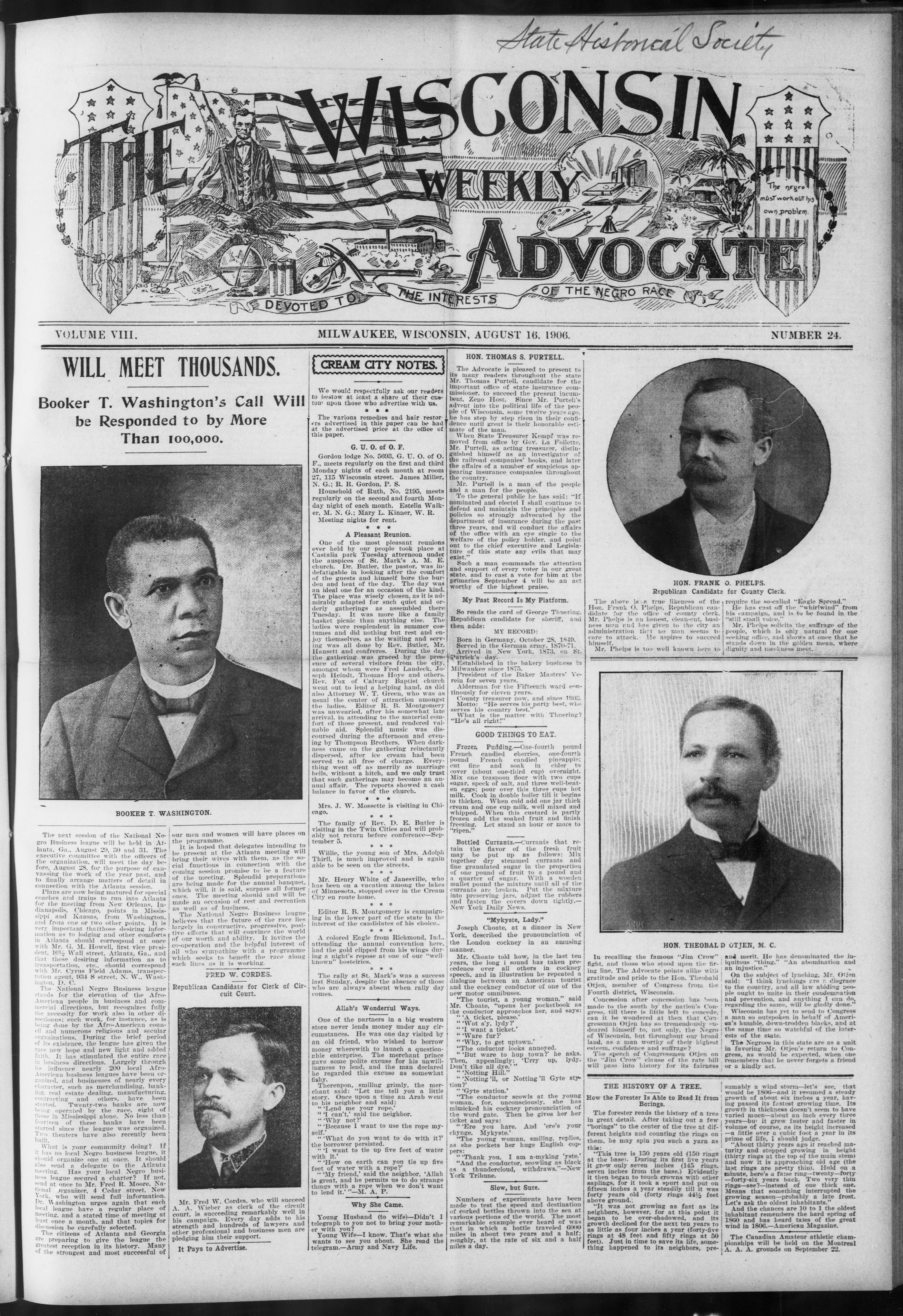
WILL MEET THOUSANDS.
Booker T. Washington's Call Will be Responded to by More Than 100,000.
BOOKER T WASHINGTON
The next session of the National Negro Business league will be held in Atlanta, Ga., August 29, 30 and 31. The executive committee with the officers of the organization, will meet the day before, August 28, for the purpose of canvassing the work of the year past, and to finally arrange matters of detail in connection with the Atlanta session.
Plans are now being matured for special coaches and trains to run into Atlanta for the meeting from New Orleans, Indianapolis, Chicago, points in Mississippi and Kansas, from Washington, and from one or two other points. It is very important that those desiring information as to lodging and other comforts in Atlanta should correspond at once with Mr. G. M. Howell, first vice president, $16\frac{1}{2}$ Wall street, Atlanta, Ga., and that those desiring information as to transportation, etc., should correspond with Mr. Cyrus Field Adams, transportation agent, 934 S street, N. W., Washington, D. C.
The National Negro Business league stands for the elevation of the Afro-American people in business and commercial directions, but recognizes fully the necessity for work also in other directionns; such work, for instance, as is being done by the Afro-American council and numerous religious and secular organizations. During the brief period of its existence, the league has given the race new hope and new light and added faith. It has stimulated the entire race in business directions. Largely through its influence nearly 200 local Afro-American business leagues have been organized, and businesses of nearly every character, such as merchandising, banking, real estate dealing, manufacturing, contracting and others, have been started. Twenty-two banks are now being operated by the race, eight of these in Mississippi alone. No less than fourteen of these banks have been started since the league was organized. Two theaters have also recently been built.
What is your community doing? If it has no local Negro business league, it should organize one at once. It should also send a delegate to the Atlanta meeting. Has your local Negro business league secured a charter? If not, send at once to Mr. Fred R. Moore, National Organizer, 4 Cedar street, New York, who will send full information. Dr. Washington urges again that each local league have a regular place of meeting, and a stated time of meeting at least once a month, and that topics for discussion be carefully selected. The citizens of Atlanta and Georgia are preparing to give the league the greatest reception in its history. Many of the strongest and most successful of
---
our men and women will have places on the programme. It is hoped that delegates intending to be present at the Atlanta meeting will bring their wives with them, as the social functions in connection with the coming session promise to be a feature of the meeting. Splendid preparations are being made for the annual banquet, which will, it is said, surpass all former ones. The meeting should and will be made an occasion of rest and recreation as well as of business.
The National Negro Business league believes that the future of the race lies largely in constructive, progressive, positive efforts that will convince the world of our worth and ability. It invites the co-operation and the helpful interest of all who sympathize with a programme which seeks to benefit the race along such lines as it is working.
Republican Candidate for Clerk of Circuit Court.
1910
Mr. Fred W. Cordes, who will succeed A. A. Wieber as clerk of the circuit court, is succeeding remarkably well in his campaign. Every day adds to his strength and hundreds of lawyers and other professional and business men are pledging him their support. It Pays to Advertise.
FRED W. CORDES.
CREAM CITY NOTES.
We would respectfully ask our readers to bestow at least a share of their custom upon those who advertise with us.
The various remedies and hair restorers advertised in this paper can be had at the advertised price at the office of this paper.
G. U. O. of Q. F
Gordon lodge No. 5693, G. U. O. of O. F., meets regularly on the first and third Monday nights of each month at room 27, 115 Wisconsin street. James Miller, N. G.; R. R. Gordon, P. S. Household of Ruth, No. 2195, meets regularly on the second and fourth Monday night of each month. Estella Walker, M. N. G.; Mary L. Kinner, W. R.
A Pleasant Reunion
One of the most pleasant reunions ever held by our people took place at Castalia park Tuesday afternoon under the auspices of St. Mark's A. M. E. church. Dr. Butler, the pastor, was indefatigable in looking after the comfort of the guests and himself bore the burden and heat of the day. The day was an ideal one for an occasion of the kind. The place was wisely chosen, as it is admirably adapted for such quiet and orderly gatherings as assembled there Tuesday. It was more like a family basket picnic than anything else. The ladies were resplendent in summer costumes and did nothing but rest and enjoy themselves, as the waiting and serving was all done by Rev. Butler, Mr. Hansett and conferres. During the day the gathering was graced by the presence of several visitors from the city, amongst whom were Fred Landeck, Joseph Heindt, Thomas Hoye and others. Rev. Fox of Calvary Baptist church went out to lend a helping hand, as did also Attorney W. T. Green, who was as usual the center of attraction amongst the ladies. Editor R. B. Montgomery was unwearied, after his somewhat late arrival, in attending to the material comfort of those present, and rendered valuable aid. Splendid music was discoursed during the afternoon and evening by Thompson Brothers. When darkness came on the gathering reluctantly dispersed, after ice cream had been served to all free of charge. Everything went off as merrily as marriage bells, without a hitch, and we only trust that such gatherings may become an annual affair. The reports showed a cash balance in favor of the church.
Mrs. J. W. Mossette is visiting in Chicago.
\*\*\*
The family of Rev. D. E. Butler is visiting in the Twin Cities and will probably not return before conference-September 5.
***
Willie, the young son of Mrs. Adolph Thirll, is much improved and is again able to be seen on the streets.
* * *
Mr. Henry White of Janesville, who has been on a vacation among the lakes of Minnesota, stopped over in the Cream City en route home.
☆ ☆ ☆
Editor R. B. Montgomery is campaigning in the lower part of the state in the interest of the candidates of his choice.
* * *
A colored Eagle from Richmond, Ind., attending the annual convention here, had the gold clipped from his wings during a night's repose at one of our "well-known" hostelries.
* * *
The rally at St. Mark's was a success last Sunday, despite the absence of those who are always absent when rally day comes.
Allah's Wonderful Ways
One of the partners in a big western store never lends money under any circumstances. He was one day visited by an old friend, who wished to borrow money wherewith to launch a questionable enterprise. The merchant prince gave some polite excuse for his unwillingness to lend, and the man declared he regarded this excuse as somewhat fishy. Thereupon, smiling grimly, the merchant said: "Let me tell you a little story. Once upon a time an Arab went to his neighbor and said:
"Lend me your rope.'
"I can't,' said the neighbor.
"Why not?"
"Because I want to use the rope myself."
"'What do you want to do with it?' the borrower persisted.
"'I want to tie up five feet of water with it.'
"'How on earth can you tie up five feet of water with a rope?'
feet of water with a rope.
"'My friend,' said the neighbor, 'Allah is great, and he permits us to do strange things with a rope when we don't want to lend it.'"—M. A. P.
Why She Came.
Young Husband (to wife)—Didn't I telegraph to you not to bring your mother with you?
Young Wife—I know. That's what she wants to see you about. She read the telegram.—Army and Navy Life.
HON. THOMAS S. PURTELL.
The Advocate is pleased to present to its many readers throughout the state Mr. Thomas Purtell, candidate for the important office of state insurance commissioner, to succeed the present incumbent, Zeno Host. Since Mr. Purtell's advent into the political life of the people of Wisconsin, some twelve years ago, he has step by step risen in their confidence until great is their honorable estimate of the man.
When State Treasurer Kempf was removed from office by Gov. La Follette, Mr. Purtell, as acting treasurer, distinguished himself as an investigator of the railroad companies' books, and later the affairs of a number of suspicious appearing insurance companies throughout the country.
Mr. Purtell is a man of the people and a man for the people.
To the general public he has said: "If nominated and electet I shall continue to defend and maintain the principles and policies so strongly advocated by the department of insurance during the past three years, and wil conduct the affairs of the office with an eye single to the welfare of the policy holder, and point out to the chief executive and Legislature of this state any evils that may exist."
Such a man commands the attention and support of every voter in our great state, and to cast a vote for him at the primaries September 4 will be an act worthy of the highest praise.
My Past Record Is My Platform
So reads the card of George Thuering. Republican candidate for sheriff, and then adds:
MY RECORD:
Born in Germany, October 28, 1849.
Served in the German army, 1870-71.
Arrived in New York, 1873, on St. Patrick's day.
Established in the bakery business in Milwaukee since 1875.
President of the Baker Masters' Verein for seven years.
Alderman for the Fifteenth ward continuously for eleven years.
thously for eleven years.
County treasurer now, and since 1903.
Motto: "He serves his party best, who
serves his country best."
What is the matter with Thuering?
"He's all right!"
GOOD THINGS TO EAT.
Frozen Pudding.—One-fourth pound French candied cherries, one-fourth pound French candied pineapple; cut fine and soak in cider to cover (about one-third cup) overnight. Mix one teaspoon flour with two cups sugar, speck of salt, and three well-beaten eggs; pour over this three cups hot milk. Cook in double boiler till it begins to thicken. When cold add one jar thick cream and one cup milk, well mixed and whipped. When this custard is partly frozen add the soaked fruit and finish freezing. Let stand an hour or more to "ripen."
Bottled Currants.—Currants that retain the flavor of the fresh fruit may be put up as follows: Mix together dry stemmed currants and fine granulated sugar in the proportion of one pound of fruit to a pound and a quarter of sugar. With a wooden mallet pound the mixture until all of the currants are broken. Put the mixture into preserving jars, adjust the rubbers and fasten the covers down tightly. New York Daily News.
"Mvkvste. Lady."
Joseph Choate, at a dinner in New York, described the pronunciation of the London cockney in an amusing manner.
Mr. Choate told how, in the last ten years, the long i sound has taken precedence over all others in cockney speech, and in illustration he repeated a dialogue between an American tourist and the cockney conductor of one of the new motor omnibuses.
"The tourist, a young woman," said Mr. Choate, "opens her pocketbook as the conductor approaches her, and says: 'A ticket, please.'
"Wot s'y, lydy?"
"I want a ticket."
"Ware fur?"
"Why, to get uptown."
"The onductor looks annoyed.
"But ware to hup town?' he asks. Then, appealingly: 'Urry up, lydy. Don't tike all dye.'"
"Notting Hill."
"Notting'll, or Notting'll Gyte sty tion?"
"Gyte station."
"The conductor scowls at the young woman, for, unconsciously, she has mimicked his cockney pronounciation of the word gate. Then he gives her her ticket and says:
"Ere you hare. And 'ere's your chynge. Mykyste."
"The young woman, smiling, replies, as she pockets her huge English coppers:
"Thank you. I am a-myking 'yste."
"And the conductor, scowling as black as a thundercloud, withdraws."—New York Tribune.
Slow, but Sure.
Numbers of experiments have been made to test the speed and destination of corked bottles thrown into the sea at various portions of the world. The most remarkable example ever heard of was that in which a bottle traveled 6000 miles in about two years and a half; roughly, at the rate of six and a half miles a day.
[Image of a man with a mustache and a suit, facing slightly to the right.]
HON. FRANK O. PHELPS.
Republican Candidate for County Clerk
The above is a true likeness of the Hon. Frank O. Phelps, Republican candidate for the office of county clerk. Mr. Phelps is an honest, clean-cut, business man and has given to the city an administration that no man seems to care to attack. He aspires to succeed himself.
Mr. Phelps is too well known here to require the so-call. He has cast off his campaign, and "still small voice." Mr. Phelps solic people, which is seeking office, and stands down in the dignity and meekn
MRDS
KRUS
HON THEOBAL D OTIEN, M. C.
In recalling the famous "Jim Crow" fight, and those who stood upon the firing line, The Advocate points alike with gratitude and pride to the Hon. Theobald Otjen, member of Congress from the Fourth district, Wisconsin.
Concession after concession has been made to the south by the nation's Congress, till there is little left to concede, can it be wondered at then that Congressman Otjen has so tremendously endeared himself to, not only, the Negro of Wisconsin, but throughout our broad land, as a man worthy of their highest esteem, confidence and suffrage?
The speech of Congressmen Otjen on the "Jim Crow" clause of the rate bill will pass into history for its fairness
THE HISTORY OF A TREE
How the Forester Is Able to Read It from Borings.
The forester reads the history of a tree in great detail. After taking out a few "borings" to the center of the tree at different heights and counting the rings on them, he may spin you such a yarn as this:
"This tree is 150 years old (150 rings at the base). During its first five years it grow only seven inches (145 rings, seven inches from the base.) Evidently it then began to touch crowns with other saplings, for it took a spurt and put on fifteen inches a year steadily till it was forty years old (forty rings $ 4 4 \frac{1}{2} $ feet above ground.
"It was not growing as fast as its neighbors, however, for at this point it began to be over-shadowed, and its growth declined for the next ten years to as little as four inches a year (forty-five rings at 48 feet and fifty rings at 50 feet). Just in time to save its life, something happened to its neighbors, pre-
```markdown
```
require the so-called "Eagle Spread." He has cast off the "whirlwind" from his campaign, and is to be found in the "still small voice." Mr. Phelps solicits the suffrage of the people, which is only natural for one seeking office, and shows at once that he stands down in the golden mean, where dignity and meekness meet.
and merit. He has denominated the iniquitous "thing," "An abomination and an injustice."
On the subject of lynching, Mr. Otjen said: "I think lynchings are a disgrace to the country, and all law abiding people ought to unite in their condemnation and prevention, and anything I can do, regarding the same, will be gladly done."
Wisconsin has yet to send to Congress a man so outspoken in behalf of America's humble, down-trodden blacks, and at the same time so watchful of the interests of the state.
The Negroes in this state are as a unit in favoring Mr. Otjen's return to Congress, as would be expected, when one remembers that he never forgets a friend or a kindly act.
sumably a wind storm—let's see, that would be 1806—and it resumed a steady growth of about six inches a year, having passed its fastest growing time. Its growth in thickness doesn't seem to have varied much—about an inch every three years—but it grew faster and faster in volume of course, as its height increased—a little over a cubic foot a year in its prime of life, I should judge.
"About thirty years ago it reached maturity and stopped growing in height (thirty rings at the top of the main stem) and now it is approaching old age (the last rings are pretty thin). Hold on a minute, here's a false ring—twenty—forty—forty-six years back. Two very thin rings—see?—instead of one thick one. Means that something interrupted the growing season—probably a late frost. Let's ask the oldest inhabitants."
And the chances are 10 to 1 the oldest inhabitant remembers the hard spring of 1860 and has heard tales of the great wind in 1806.—American Magazine.
The Canadian Amateur athletic championships will be held on the Montreal A. A. A. grounds on September 22.
NUMBER 24.
THE WISCONSIN WEEKLY ADVOCATE
MILWAUKEE, WIS.
R. B. MONTGOMERY, Editor and Proprietor.
Curious Condensations.
—In consequence of the increasing abuse of opium its sale in French harbor cities has been forbidden.
—One hundred and fifty-five people are killed by accidents in the streets of London in the course of a year.
—In Madagascar silk is the only fabric used in the manufacture of clothing. It is cheaper than linen in Ireland.
—The tea gardens of northern India extend over 500,000 acres, and they produce 190,000,000 pounds of tea per annum at a profit of about $100 an acre.
-A new fertilizer made in Norway from the nitrogen in the atmosphere is said to be very nearly as good for plants as Chili saltpeter, while its cost is lower.
-The Chinese will eat anything that comes out of the sea. All the fishes are good to their taste, and are caught with great skill. Seaweeds are used to thicken soups, gravies.
-Austria is the only empire in the world which has never had colonies, or even transmarine possessions, in any quarter of the earth. Her ambition has hitherto been continental.
-English artillery volunteers are armed with obsolete field pieces, but have done their best toward making them formidable by painting them the new greenish-gray color.
-Hotel and restaurant prices are steadily rising in German cities because of the rapid rise of prices of meats and vegetables. Cooks and waiters also demand much more than formerly.
-For many years W. Redmond, one of the leaders of the Irish party, was the "baby" of the House of Commons. He was only 22 years old when he was returned from Wexford in 1883.
-Germany is now experimenting with a new automatic repeating rifle capable of firing five shots in ten seconds. If the tests are successful its adoption by the army is considered probable.
-A tri-weekly "train de luxe" is to be placed in service over the new Simplon route for passengers between England and Italy, via Calais, Paris, Lausanne and Milan.
-Capt. Alexander Simpson of the Aberdeen liner Moravian has just completed his seventy-first voyage, having traveled 2,000,000 miles without a mishap, a feat supposed to be unparalleled in British marine circles.
A woman at Keighley, England, summoned for not sending her boy to school, explained to the bench that when she attempted to chastise him for not going he threatened to report her to the "cruelty" inspector.
Korea has matrimonial complications in high circles. No young women of the better class can be married till a consort for the crown prince has been selected. For not sending lists of eligibles as ordered three governors of prov.
Motor boats of all sort are becoming more and more numerous on the Venetian canals, threatening to displace the old-time gondola. The gondoliers are much disturbed. In a dispute between two of them and two electric launch men the latter were stabbed, one fatally.
—The King of Cambodia, who is visiting France, drank his first glass of champagne the other day at Marseilles, and through an interpreter informed the officers that he swallowed the blood of 20,000 little golden dancing devils, but would like some more.
—It is calculated that if all the bluing used by the washerwomen and laundries of the world on Monday, April 22, 1906, were to be poured into Lake Superior at the same time, white fish would be worth $1.32 a pound and blue fish 3½ cents each.—Chicago Tribune.
—Several trained Scotch collies have been used by the Germans in their southwest Africa campaign, but, according to reports received at Berlin, they proved an utter failure. Apparently the animals lose their sense of smell after they have been in the tropics for a time.
-All the efforts made by a Liverpool firm to promote the cultivation of cotton in Palestine have been fruitless, even though labor costs only 25 cents a day and land is one-tenth the price of Egyptian land. The chief cause of the failure is said to be the incapacity and laziness of the natives.
-A laborer in New Jersey, in excavating for a monument in a cemetery dug up a meteor fragment weighing 25 pounds. It seemed to be composed of fused minerals, glass, stone and steel. It also contained a mixture of various colored stones intermingled through the otherwise gray mass.
- Several trained Scotch collies have been used by the Germans in their Southwest African campaign, but, according to reports received in Berlin, the dogs have proved an utter failure. Apparently the animals lose their sense of smell after they have been in the tropics for any length of time.
- Manchuria is described by Consul General Sammons as a good farming country, to China proper a sort of American "out West," and as fertile in its extensive agricultural areas as the garden state of Iowa, supporting millions of Chinese, who have come from the overcrowded adjoining provinces.
—Recent regulations in Turkey aim to abolish completely the sale within the empire of foreign lottery tickets. Any receiver, seller, buyer or holder of a foreign lottery ticket is now liable to prosecution, incurring a fine of $4.40 to $13.20 for the first offense and $13.20 to $44 for a second conviction.
—Dr. Douglas Hyde, the famous Celtic scholar, in the course of a recent address at the University of California, claimed, on the authority of eminent German and Italian scholars, that "Ireland taught Europe the art of rhyming." He said further: "The earliest recorded rhymes in Europe are those in Latin, written by Augustine. He composed them while surrounded by a Celtic-speaking people in the south of Gaul. In the year 750 A. D., we find the Irish people making perfect and elaborate rhymes. It was not done in other countries for two centuries later."
Mere Man
Man was created before woman, so that she might always have the chance to get ahead of him.
A man is never measured until he is married.
A man's brain grows weaker the closer it grows to his mouth.
Men love themselves first.
Money makes the man go—or come, or stay, or anything.
What man has done, man can undo.
Man wants but little here below, if it is more than the other man has.
Trust no man, and no man will trust you.
Dead men are not always as white as they are painted.
Man must have some devil in him to be worth saving.—Bohemian.
VACATION.
The spirit of Life has wrought upon the world
The old-time miracle, none knoweth how:
Green fields, the hanners of the wood unfurled,
The flash of wings across the smiling moors,
The piled-up cumuli where heaven soars
All beautiful ever—it is summer now,
And I am free in God's great out of doors!
In the warm grasses as one lies alone,
And hears the message which the low wind brings—
Unsyllabled indeed but not unknown—
His very being seems to ebb and spend,
And somehow in the great world-rhythm blend—
Those deep pulsations from the heart of things
That throb, and throb, and throb, and make no end.
All things are mine; to all things I belong;
I mingle in them—heeding bounds nor bars—Float in the cloud, melt in the river's song;
In the clear wave from rock to rock I leap, Widen away, and slowly onward creep;
I stretch forth glimmering hands beneath the stars,
And lose my little murmur in the deep.
Yea, more than that: whatever I behold—Dark forest, mountain, the o'erreaching wheel!
Of heaven's solemn turning, all the old Immeasurable air and boundless sea—Yields of its life, builds life and strength in me
For tasks to come, while I but see and feel And merely am and it is joy to be.
Lo, that small spark within us is not blind To its beginning; struck from one vast Soul
Which, in the framework of the world, doth bind All parts together; small, but still agreeing With That which moulded us without our seeing:
Since God is all, and all in all—the Whole In whom we live and move and have our being. Samuel V. Cole in The Critic.
AT LAST.
Barbara Waring had practically learned and mastered the difficult art of being poor when Fate presented her whimsically with abundance. Everybody, even she, felt it to be more or less a fantastic happening.
She wondered at first what she was going to do with it all; that was before she had learned that, along with a fortune. Fate always bestows methods for its disposal—sudden and unknown acts of duty, family claims that had only been sleeping dogs until their opportunity awoke them to bark. She found out also that a great deal of money may be expended upon the getting of simple things, if such happen, moreover, not to be the simple things for which others ask.
With a sort of gasping relief she ran off to the sea, to a household of merry, affectionate, noisy creatures she had once schooled and loved. They made much of her in their own breezy fashion, quite unaffected by her change of circumstances except that it gave such an unfailing excuse for teasing. She was discovering among them that the girl in herself was not so much crushed and dead as neglected. She kept cropping up and asserting herself in the most unlooked-for daily fashion.
"You are getting prettier and younger every day, Mother Bab," one of the girls exclaimed, watching a little excitement ruffle the quietness of her gray eyes and flush her smooth cheek. "Isn't she, isn't she, Edward?" the girl cried merrily. The man's watching eyes had a sudden spark of something new and strange. Barbara drew a blind of blank forbididng over the youth in her own. Her cheeks flamed, not with the blush of mere reproof, but something fiercer. The man saw it, and began to talk instantly with much detail of something else. She thanked him for it secretly, but with that barb implanted by the careless schoolgirl hand rankling.
It was so long that a man had looked at her with that flash in his eyes, the brief admiration of the moment, as she called it to herself. She thought she could meet it calmly enough now, yet the old savage throb had leaped in response to that look.
When she was 20 she met a man obviously attracted by herself, not by any of her attributes—music, deftness, or mental quickness of perception—but by herself. For the first time her wishes were anticipated, her lightest words remembered and quoted, her tastes studied, in that old and sure fashion never to be set aside or improved upon, in the primitive pleasure of a wooer. She opened out like a flower to the sun, until the blow fell. He was not in earnest; it was a summer's amusement, no more! The realization came crashing across her life, destroying not alone her hope but some faith in herself. What really mattered was not so much the loss of a lover as the loss of her self. She emerged from the silent conflict altered only to herself. She had killed that part of her nature, she told herself somewhat grandiosely, and certainly the corpse had shown no sign of life until this afternoon, when a girl's nonsense drew that flash from a man's eye and that instinctive, cruel response from herself.
Edward Banks was an elder son of the house by another marriage. He was removed by age and a certain difference, not so much age as a change of mental outlook, from the merry, pleasure-loving throng of half-brothers and sisters, whom he secretly protected from themselves at every turn. There was nothing superior in his attitude. "Old Ted" was loked up to laughingly, yet with much earnestness underneath the fun, as mingling in himself the joint roles of an autoorat and a most susceptible chancellor of exchequer. He was inevitably the arbiter of family destinies in his quiet, conclusive way of decision.
Barbara stepped into the family attitude straightway. Oddly enough, although her years and his own tallied, she regarded him much as his young sisters did, to his own amusement at first. Lately a vague doubt crept in. It was never expressly defined, not even when his flashing eyes set her pulses dancing on the summer afternoon when they sat looking at the blue waters of the bay beyond the tamarisk bushes at the garden's end.
She escaped with only one thought—not that—not that again! A line of Browning came to her, then and later, as the situation developed:
She had
A heart—how shall I say?—too soon made glad.
Too easily impressed. It was not a comment that would have come from anybody else on this girl with the brown hair, and eyes at which few looked long enough to find the hidden light that sometimes redeemed them from insignificance to positive beauty. Edward Banks had discovered the latter, and he looked again, always to encounter that 'instant withdrawal of the vague something that tantalized him behind the soft reticence of voice and eye, that echoed in and out of the music she played to herself of an evening in the shadows of th great and, as she thought, empty drawing room.
He watched and waited. Barbara eluded more than ever. He told himself that he was too old to make experiments, he must be sure, though every day caution became harder; she felt that what had been, was returning, and would not let herself see the difference of this, the real thing, from that old youthful imitation passion.
He hid his feelings far less cleverly
than he imagined from their object. She was continually averting their slight expression, scheming against betrayal and against her own response day after day, until she felt forced to act. She dispatched a letter that would bring her a telegram and she would fly. She looked across the gay dinner table and out of th oriel window at the evening sea. The sound of the sea came like a faint song between the pauses of laughter and talk of the pleasant company, a vague, sad refrain of waves that lapped the foot of the cliff below the gardens.
Barbara thought, not of the beauty of the evening. but of how desolate she would be tomorrow night away from them all, alone! The sound of her own name broke in.
"Why! You will be all by yourselves tonight, Ba, you and Ted; I had forgotten we are all going out to this pastoral play rehearsal thing. How rude of us"—the speaker laughed without penitence. "You must entertain one another, Ba; play to him. Old Ted would like that—"
"He would," interpolated Edward.
"And if he's good he may smoke in the drawing room; he could never be happy after dinner without."
"Couldn't he?" Barbara avoided the glance direct across the dinner table. They went off in a body, bearing fiddles, mandolin, guitar and stage properties. "We shall be back at 10."
"It's really too bad to troop off and leave you—" "Good-by, good-by!" Without a word to one another the two left moved away. Barbara went upstairs to the drawing room, its many windows open to the sea, that entered like a song. She did not attempt to play for some time, but sat in the peace of the deserted room, listening, fearing a step on the stairs. None came. He was smoking, after all, downstairs in his own room. She need not imagine her music was inducement to bring him here, she told herself, yet, just for tonight, the very last night—She started. Edward was standing in the doorway. He stood watching her with that same strange flicker in his sober eyes. He crossed the room and sat opposite her, still silent and smiling.
"Shall I play? What would you like?" She did not wait for his answer, but began. The man, listening, knew that it was his presence, his obvious presence, that kept the magic out of her melody. He gave a grim attention to it for a few moments, then got up and went into the inner room. She thought he had gone, and a faint current of something mysterious crept into her music; it relieved her, soothed the unrest of her mood, flowed with a momentary healing over her jarred spirit. As she ceased a servant entered with a telegram. She was looking at it unopened when he came back. She knew escape was too late. "Come outside. You have had enough music."
"You mean you have," she corrected, trying to talk lightly.
"You sometimes make a mistake about me," he said earnestly.
There were winding steps that led from the drawing room windows to the garden. He followed her, going carefully to escape her trailing gown.
There was a sort of rampart at one end with a low sandstone bench that overlooked the sea.
The air was full of soft sounds and scents. He could only just see her face, and the soft sweep of cheek that gave distinction to her profile. A little fold of her gown trailed across the bench as they sat. He took it between his fingers. "I like your shadowy black frocks, I don't like women, as a rule, in black gowns. This is like twilight, fine and frail. Is that why you chose it, Barbara?"
For the first time he called her by her name. She was dumb. There was piercing swiftly through her distaste and fear something stronger. He tried to see her face in the gloom.
From sheer incapacity to finesse he took the one course that convinced—the direct one.
"I want you," he said. "It's not the way to put it; men don't say it bluntly like that—men who know how to woo. I never did, never tried, or wanted to before. I am too old to learn the rules of the difficult game. I only repeat I want you. Does it seem enough?"
He took her trembling hands.
"I want you to marry me. After all, it's what they come to in the end, those pretty tricks and speeches, those byways I can't learn. Let it bring me near you."
"But if I can't?"
There was an edge, half malice, half unconcealed, content, in her voice.
"You must! I'll have to try and learn the other fellows' methods if you won't come to me like this!"
She shuddered, and for an instant, in the inexplicable ebb and flow of emotion, she seemed carried from him.
"You don't know me yet," he went on; "you have taken other people's views of me. I shall be different to you—quite different, if you will let me show you myself, apart from everybody else. I have a prophetic feeling about us—I had it from the beginning. I suspect I am going to make you want me, more than you know."
Insurgence returned—was overflowing all.
"You can't make me want you more —" She broke off laughing, then suddenly timid. "Don't you see—why?"
He did, though to the latest day of their life together he could never be brought to understand how it came about.—Edith C. M. Dart in M. A. P.
A Kentuckian
Two gentleman were traveling in one of the hill counties of Kentucky not long ago, bound on exploration for pitch pine. They had been driving for two hours without encountering a human being, when they came in sight of a cabin in a clearing. It was very still. The hogs lay where they had fallen, the thin claybank mule grazed round and round in a neat circle, to save the trouble of walking, and one lean, lank man whose garments were the color of the claybank mule leaned against a tree and let time roll by.
"Wonder if he can speak?" said one traveler to the other.
"Try him," said his companion.
The two approached the man, whose yellowish eyes regarded them without apparent curiosity.
"How do you do?" said the northerner. "Howdy?" remarked the southerner languidly.
The southerner spat pensively in the dust.
dust. "Not yit," he said.—Reader Magazine.
The Price of a Treasure.
A woman who sometimes spends a few weeks in the Catskills recently got on the trail of some old blue china up in that region. The original set, consisting of more than a hundred pieces, had belonged entire to a family up to 1829: after which it had been apportioned among a number of heirs, so it was hard to trace. Madame pursued the quest for many months, by correspondence and even by railway journeys, for the heirs had moved to all points of the compass. Expense was no ooject, but have the complete set she must.
At length she acquired all but the teapot, but those who had seen it assured her it was the gem of the set, and that her prize would never be complete with-
out it. She traced it to a man down in New Orleans, but he refused to sell it. He said it had belonged to his mother and his grandmother and his great-grandmother, and he wanted to keep it just because of that association and because he liked it. The more reluctant he was to sell the more ardently the Fifth avenue matron desired the pot, and the more earnestly she besought him to name a price. Finally her urgency prevailed, and he wrote her that she could have it if she was willing to pay him for it $3.50.— New York Sun.
Thomas Wentworth Higginson, still active as an author, lecturer and reformer, will be 83 years old in December. Donald G. Mitchell is a year older.
Levi P. Morton, one of the three men now living who has served as vice president of the United States, became 82 years old last May. He was born May 16, 1824.
Another famous clerical of about the same age as Dr. Hale is Rev. Dr. Theodore L. Cuyler, who is in his eighty-fourth year. But a year his junior is that other famous pulpit orator, Rev. Dr. Robert Collyer.
Galusha A. Grow of Pennsylvania, who was speaker of the national House of Representatives during the first two years of the Civil war and who still takes an active interest in public affairs, is 82 years old.
John Bigelow, who was joint proprietor of the New York Evening Post with William Cullen Bryant a half century ago and who later represented the United States as minister to France, is enjoying good health at 88 years of age. He was born November 25, 1817.
Henry G. Davis of West Virginia, the Democratic candidate for vice president two years ago and who is still active in business, is 83 years old, having been born in 1823. More than twenty years ago he declined a re-election to the Senate, although he was by no means the senior in age in that body.
Archbishop John J. Williams, the venerable head of the Roman Catholic church in Massachusetts, is 84. He was born April 27, 1822. Three weeks his senior is probably the most famous clergyman in America—Edward Everett Hale—who demonstrated his great energy by acting as chaplain of the United States Senate the past winter.
Other prominent Americans who have attained great age, and are still young, are D. Ogden Mills, the financier; ex-President Dwight of Yale, ex-Senator Edmunds and President James B. Angell of the University of Michigan, who is nearing his fourscore mark. Since the death of Susan B. Anthony, Julia Ward Howe is probably entitled to the distinction of being called America's "Grand Old Woman." The famous author of the "Battle Hymn of the Republic" will be 88 years old her next birthday.
SEASON OF GREEN CORN.
Corn Croquettes—To one quart of grated corn add one pint of milk or cream and cook in a double boiler for twenty minutes. Add two tablespoons each of butter and grated cheese, one teaspoonful of salt, one-fourth teaspoonful of pepper and two eggs, well beaten. When cold form into squares one inch thick and two inches across. Roll in egg and bread crumbs and fry in hot fat or bake in the oven until brown.
Corn Soup—To each quart of young corn cut from the cob allow three pints of water. Put the corn and water on to boil, and as soon as the grains are tender have ready two ounces of good butter mixed with one tablespoonful of flour. Stir the butter and flour into the corn and water, and let it boil ten to fifteen minutes longer. Just before the soup is taken out of the pot beat up an egg and stir into it. Salt and pepper to taste.
Corn Fritters—Grate enough corn to make one pint, add enough sifted cracker crumbs to hold the mixture together, also a half teaspoonful of baking powder, with pepper and salt to taste. Drop the mixture from a teaspoon into hot fat, making the fritters the size of an oyster. Fry a light brown and serve on a folded napkin.
Corn Pudding—Take six ears of corn, boil and grate them, add a spoonful of sugar, a pinch of salt, a spoonful of cream, the yolks of four eggs and the whites of the same beaten light. Mix thoroughly. Pour in a buttered dish and bake for thirty minutes in a warm oven.
Succotash—Scrape, wash and cut in quarter-inch slices a quarter of a pound of salt pork. Cover with boiling water and let simmer until almost tender. Add one pint of freshly shelled lime beans and more water, if necessary. When the beans are tender add one pint of sweet corn pulp. Cook for about fifteen minutes longer, add two tablespoonsfuls of butter, salt, if necessary, and serve at once.
Richest Man in the World.
The recent death of Alfred Beit, the South African mining magnate, draws attention to the fact that he was the second richest man in the world, and was computed to be worth no less than $500,000,000. The following is a list, including Mr. Beit, of the world's twelve richest men, showing by what means they acquired their wealth:
1—J. D. Rockefeller (oil).....$1,000,000,000
2—A. Beit (diamonds).....500,000,000
3—J. B. Robinson (gold mines).....400,000,000
4—The Czar (inherited).....305,000,000
5—A. Carnegie (steel).....250,000,000
6—Waldorf Astor (land).....200,000,000
7—Prince Demidoff (inherited) 200,000,000
8—Emperor of Austria (inherited) 185,000,000
9—Wm. Vanderbilt (railways) 100,000,000
10—William Rockefeller (oil).....100,000,000
11—King Leopold (inherited).....100,000,000
12—Shah of Persia (inherited) 100,000,000
It is impossible to compute exactly the amount of money that these millionaires possess; in fact, they themselves do not know.
A Puzzling Thing.
In Brooklyn the other day a woman had her husband arrested for ill-treating and abusing her. She said she was tired of being struck by him. Magistrate Healy imposed a fine of $5 on the man. The wife paid it and took him home, where by this time she probably has been beaten some more. "This is another one of those cases where a good wife relents and intercedes for an ungrateful husband." remarked the magistrate. Such incidents have been witnessed in the recorder's office in Newburgh many a time. Woman's readiness to forgive a brute of a man because he is her husband, after he has sacrificed every right to her respect and sympathy, passes understanding.—Newburgh News.
Mount Sangay is the most active volcano in the world. It is situated in Ecuador, is 17,120 feet in height and has been in constant activity since 1728. The sounds of its eruptions are sometimes heard in Quito, 150 miles distant., and once 267 reports were counted in one hour.
I WANT TO GO A-BERRYIN'.
I want to go a-berryin'—
How strangely like a tune
Echo those words around my desk
This sultry afternoon!
The figures all to berries turn;
I can't make out a bill;
I want to go a-berryin'
On Farmer Baker's hill.
I want to go a-berryin',
There's nothin' half so sweet;
The longin' stirs my blood until
It tingles in my feet.
I see the red, red clusters in
The field above the mill;
I want to go a-berryin'
On Farmer Baker's hill.
I want to go a-berryin'—
But not to go alone.
I want to go with Mary Jane
As in the years a-flown.
Just one tin pail between us—how
Our hands would meet and thrill!
I want to go a-berryin'
On Farmer Baker's hill.
I want to go a-berryin',
What things we used to say!
Ah, Mary Jane, she always had
The sweetest sort o' way!
To hear her little laugh—oh my!
'Twould set my soul a-thrill
When we were out a-berryin'
On Farmer Baker's hill.
I want to go a-berryin',
Alas, why did I leave
The only girl I ever loved—
I wonder did she grieve!
How could I hope to find afar
Aught that her piace could fill,
Or sweeter joys than berryin'
On Farmer Baker's hill.
I want to go a-berryin'—
I want to, oh, so much,
To go I'd give just all the gold
I ever hope to touch.
But though the eyes of Mary Jane,
Like stars, are beckonin' still,
No more shall we go berryin'
On Farmer Baker's hill.
Samuel Minturn Peck in Boston Transcript.
New York Every Day.
Hearty and alert, despite his 88 years, Samuel Sloan, for three decades one of the country's most powerful railroad men, associate and intimate friend of Jay Gould and Russell Sage, declared recently that the stress of present day commercial life is no greater than it was a quarter of a century ago, and that men would not succumb to it if they observed the simple rules of life, as he has done.
"Much is required of the men who direct the affairs of the big corporations." he said, "and the responsibilities are very great, but if they take good care of the constitutions God gave them, sleep when they ought to sleep, eat good food and dispense with worry, there is no reason why they should not retain vigor and alertness until they are well past the allotted three-score and ten. The trouble with the men who are falling out of the line while they are yet young in years is that they neglect themselves—in their devotion to their business they forget that their own bodies and minds require attention. Work and play combined make the successful business man and keep him young, but the trouble with many is that they know how to work, but not how to play."
There are all kinds of philosophers on this mundane sphere, but New York has one who is deserving of the cowhide medal. Recently, in the World building, a young woman stenographer, who assumed her position a week ago, complained to her employer, an attorney, that she was ill and would like to be excused for the afternoon. "Certainly," answered the lawyer. "Nothing serious, I hope?" "Well, I am afraid it is," pouted the typist. "You see, I just came from Chicago to New York sixteen weeks ago, and of that time I spent ten weeks in Bellevue hospital." "Tut, tut!" came from the lawyer. "Why, you seem to be the embodiment of health. What was the matter?" "Appendicitis," was the reply. "On the day of my arrival here to visit relatives, and while eating a peach, I swallowed the stone. It was an unfortunate trip for me, because had I remained in Chicago I could not have bought a peach there." "No," said the employer, philosophically. "It surely was the hand of fate. But then it is hard to tell; maybe something else more serious might have happened had you stayed in Chicago. You might have swallowed a cocoanut." The girl frowned and left the office. "It's funny," said the attorney to me after she had departed, "a fellow can't say anything to a woman these days unless she flies up."
Many wealthy New York bachelors are now good husbandmen in the agricultural sense. One of the pioneer bachelors to adopt farming as a pastime was Louis Keller, secretary of the Baltusrol club. He is a young bachelor, and inherited a large tract of land near Short Hills, to which he had added from time to time. Part of his property was sold to the Baltusrol club. Some seasons ago there was only a plain farmhouse on the place, and Mr. Keller used to give delightful house parties in the early spring and summer. Today the Baltusrol club, like its rival, the Tuxedo, is one of the few private resorts near New York where there are the combined comforts of a hotel and the exclusiveness of a club. One of Mr. Keller's hobbies on the farm near the club, is the importing of fine sheep and the raising and breeding of them, and, like James J. Van Alen and Whitelaw Reid, he allows the flocks to graze on the lawns. James Hazen Hyde has one of the most valuable and productive farms on Long Island, and that of Henry Rogers Winthrop of the Equitable Life cannot be classed as secondary in importance. One of the best known bachelor farmers near Westbury is Samuel Willets. He is a member of the Quaker family which, for years, had lived on Long Island and in Winchester. The farm has brought its owner a fortune. At some of the swell clubs in New York farming is sometimes the topic for conversation. Fresh cows, heifers, and the best means of raising fruit and vegetables are points that sometimes are hotly discussed.
---
A pale-faced, smooth-shaven, white-haired man came out of the New York Stock Exchange building the other afternoon. He stopped and watched a 4-year-old youngster dragging along a little wagon in which were two apples and a discarded roll of ticker tape. The youngster intuitively realized that he was being stared at, stopped and looked at the man. "What are you doing?" asked the old fellow, interestedly. "Playin'," answered the boy. "Hah! Playing," said the man. "Playing; just so. And what are you playing with?" "With a waggin'," said the youngster. "Can't ye see?" Then, after a pause, he added: "Do you ever play?" "Me? Why, bless my heart!" exclaimed the man, meditatively. "Still," he mused. "I guess I do." "What with?" asked the youngster. "Why—er—with my fortune and with others' fortunes and with my life," said the man, speaking more to himself than to the boy. Then he hurried to a lunch room, where patrons select their food and carry it to chairs to eat it. There was a serious look on his face, while the boy's eyes evidenced how puz-
zled he was. The man was one of the richest brokers in Wall street.
There is a little apple stand on Broadway, near Cortlandt street, New York, whose stock sends a combined thrill of temptation and pleasure to the passerby. The apples take you back to the days when we scaled the orchard fence, climbed the tree and hurriedly plucked the fruit from the branches. "Apple Mary" owns the stand and she is almost as much of a landmark at the corner as the spire of Old Trinity church, in the shadow of which she stands. The apples she sells are delicious. All varieties that used to be seen in Pittsburg, but which for years have not been sold in the Pittsburg markets, are to be had. The apples, too, are protected from the rays of the sun by green branches from the trees from which they were plucked. When passing the place one feels like opening his shirt front and taking a chance on a bulldog as of yore.
Don't spoil the baby. Mothers, abandon goo-goo talk of the da-da and tootsie-wootsie kind when addressing your cherub. This is the latest edict of fashionable mothers—the kind who usually raise one kiddy, but who concentrate all their efforts in bringing him up by the latest approved methods. At an informal gathering of young wives uptown in New York the other day a young mother, whose demeanor indicated that she was the embodiment of precision, scolded a nurse maid because she told little Otto-Mobile "Dearie, 'oo musn't toss up your curlies." "There this baby talk is silly!" said the mother. "Actually do you know it spoils a child—nothing but pure ignorance upon the part of parents—and it has a tendency to make a child petulant." The other wives agreed with her, but the baby frowned when the hot air talk was denounced. Then he took a swig out of his bottle.
In this age of cash registers and advanced checking-up methods the charwoman and janitor must suffer the humiliation of a bartender. New York now has a remedy for derelict window cleaners, and if well shaken might be used to good advantage in towns where smoke and dust adhere to the panes and preclude one from taking a pike on a rainy day. In the large buildings here the tenants of offices sign a receipt when the janitor wipes off the 23's and other hints for the cleaners to get busy. The checks are filed with the superintendents of the buildings in order to show their assistants have been at work. The system has proved a success all around because, when a tenant whose liver is not flapping properly goes to the office to file a complaint about windows the records are flashed. Incidentally, it might be stated that no cases of writers' cramp have been reported since the new system was inaugurated some months ago.
There is a tall policeman stationed at the Manhattan end of the Brooklyn bridge whose presence is a great boon to strangers meditating a trip across the river. No matter how remote an address may be he is usually able, at first breath, to rattle off the best car line to take, transfer points and the street at which to get off. The other day a skeptical Brooklynite, who had heard of this man's ability, determined to put it to a test. "I say," he explained, hurrying up to the officer, "can you tell me where 22 Buckingham road is? And is the Franklin avenue or the Nostrand avenue line the best way to get there?" The officer looked at him calmly for a minute. "Nothin' doin', mister. Yer either batty or kiddin'. Move along, please."
The meanest man has been found again. This time he is Samuel Fuerst. 41 Allen street, New York, who is a prisoner in the Essex Market police court charged with taking ice from women and children after it had been given to them at the Hoyle free ice station. The ice wagon arrived at the Hoyle station at 5 o'clock Monday morning. Because of the great heat there was an unusually large crowd. Fuerst was one of the first in line, and after receiving his allotment went around the corner and lay in wait for women and children. He jostled them and made them drop their ice. Policeman Lawler happened to see Fuerst running away with a little girl's ice and arrested him.
Lawler said there are gangs of rowdies around the various distributing stations who make a practice of stealing ice in this way and disposing of it to ice cream venders for the price of a drink. Fuerst was fined $5. He had no money and went to prison.
That the honor of the United States is of more importance than the punishment of a million criminals, was the statement made by Judge Hough in the United States circuit court at New York in reserving decision in the habeas corpus proceedings on behalf of Charles C. Browne. Browne was formerly employed in the customs service in this city and was extradited in Canada, as a fugitive from justice and taken to Sing Sing prison to begin a two-years' term for conspiracy to defraud the government. Counsel W. M. K. Olcott, for Browne, denounced the action of the federal authorities for extraditing Browne for one offense and incarcerating him in prison for another as a trick beneath the dignity of the government, and in violation of the treaty with Canada.
It is a settled fact now that New York is next year to have the highest priced conductor in the world. This is Wasili Safonoff, who is to conduct the Philharmonic orchestra for the next three years and get $20,000 for his services. The Philharmonic fathers, however, are not to pay all of this salary. They are responsible for only $13,000 of this annual sum. The remaining $7000 will be paid by the National Conservatory of Music in return for M. Safonoff's services as director of the school and teacher of the piano. Even with two sources of supply there was never such compensation paid to any prima donna of the baton.
Americans buy big, red automobiles from Paris still, but not because they have to. The country exports cars just as good, thought not perhaps averaging so big and fatal. The exports in 1905 were $2,685,655, as compared with $1,897,510 in 1904 and $1,643,029 in 1903. Our best customer was the United Kingdom, to which we exported $701,405 worth of autos. Canada bought autos to the value of $437,588. France $269.703. Italy $163,978. Germany $105,457. and the rest of Europe $239,379. Last June the New York Motor club gave its first annual "orphans' day." Its second "orphans' day" is set for June 6 this year. Automobile clubs and auto owners in all the big cities might well take up this idea of giving the children one day of fresh air and happiness, based upon the wonderful auto development.
Better Food in Navy.
In the last naval appropriation act a provision was made for a change of the naval ration. It gives the United States navy a better ration than any other in the world. The advantages of the present ration are that it is more flexible. Added to the former ration are preserved and fresh fruits, fresh milk, flavoring extracts, fresh fish, sauce. The amount of tinned vegetables has been increased, while a decrease has been made in macaroni, pickles, rice, and syrup. Advertise in Your Home Paper.
GOSSIP FOR THE LADIES.
Lonesome.
No one to call me "Husband!" No loved and cherished wife, No questions to be answered— Music of married life.
No baby coo or prattle, No merry, laughing group, No cake-walk for the colic, No sudden spell of croup.
Women as Inventors.
In reply to the charge that women are lacking in mechanical ingenuity, writes Rene Bache in Technical World Magazine for August, it is asserted that many of the most valuable inventions patented by men in reality represent ideas conceived in the brains of their wives, their sisters and their daughters. Ei Whitney's famous cotton-gin is said to have been merely the application of a device first thought out by a woman—the widow of Gen. Nathaniel Greene.
The "Coston light," which is used by our lifesaving service, and by mariners all over the world, for signaling at night—it burns like red fire—is a woman's invention. So likewise is the paper bag with a satchel bottom, which was the idea of Miss M. E. Knight. The machine by which "comb foundation," as it is called, for beehives, is made, was patented by Frances A. Dunham, in 1881. It saves bees half the labor of honeycomb construction by turning out wax sheets, which, suspended in the hives, serves as a basis to build the combs upon. But the most wonderful point about the contrivance is that, the cells outlined in relief on the wax being all of "worker" size, those of them that are utilized by the insects for nursery purposes will produce only worker bees, thus avoiding the propagation of idle drones.
Writing Business Letters
Where Many, Writers, Fail
"I know," said a business man of wide experience, "how crowded with studies the schools are now, and I should be loath to recommend the introduction of any new ones; but I do wish sometimes that the boys and girls who are giving time to so many little rads could be induced to give more to the art of writing letters."
He did not refer to the mere art of writing correct Engliish or the art of writing an interesting personal letter, but to the preparation of really good business letters, in which the matter in hand should be treated not only clearly and concisely, but also courteously.
The need he mentioned is one which is felt by thousands of business men, and may well claim the attention of young people of both sexes who look forward to business life. The ability to write intelligibly is not rare, but the capacity to write in such a way as to produce a pleasant personal feeling for the house one represents is extremely rare.
Many writers fail in the matter of courtesy—either in the way of constant omission of articles and constant abbreviation, or, more commonly, in neglecting to give the other man the benefit of the doubt. In other words, the fault with most business letters is a fault of poor manners rather than of mental deficiency.
"Never, in any circumstances, allow your first letter, in case of difference, to be harsh or discourteous," said a business man to one of his clerks. "No matter how much you think the man has injured us, give him the benefit of the doubt. Assume that he has made a mistake rather than that he has misrepresented. To take the other course is to enter a blind alley. You may have to turn around to get out of it."—Youth's Companion.
Outdoor Dining and Bedrooms
Every house should have outdoor sleeping rooms and an outdoor dining room. This can be secured in many cases by building a rear extension, open at ends and at one side, using the first floor for dining room and the upper floor for one or two sleeping rooms. Let the extension be about 15x15 feet, depending upon the space and width of the house, giving a good-sized room on the first floor, connecting with the kitchen, and the floor above may be connected with the second floor of the house, where would be the dressing rooms, and it can be divided into two rooms, and by using cots or single beds would give accommodation for a number of persons if desired.
The extension should be absolutely open on three sides. The second floor and the roof supported by posts. This would furnish supports also for nettings to exclude flies and mosquitoes. Japanese shades could be used to keep out the sun if desired, or blinds could be constructed that when closed would keep out the driving storms. The expense for this can be very little, and money could be spent in no better way, or that would bring so much of comfort, health and happiness.
It is unquestionably true that food eaten out in the open air, especially with pleasant surroundings, will not only taste better from a keen appetite, but will digest better and give more of strength and vitality. Only the person who has slept in the open can appreciate the advantage to be derived from it, especially for those who are compelled through working hours to be indoors, pent up in close, stuffy workrooms or offices. Nights will then bring rest and sleep; morning find the sleeper refreshed and vigorous from the fact that pure air has been breathed. This plan should be kept up until late in the fall, until the cold becomes too severe for comfort, with a bountiful supply of blankets, and in some cases, and for some people, this will last well into and even all winter, if the room should be on the side of the house protected from cold winds. Contrast the result that will follow this course with that of sleeping in a room closed to keep out the night air. Some seem to act on the theory that if the rooms are kept closed at night the day air is being breathed and that the night air is out of doors. Rise early some morning before your neighbors and go through the streets and see how few windows you will find open, unless it will be on the very hottest nights, and then the draught bugbear has closed many of them.
Tell your builder to provide for the open rooms, even if you have to sacrifice somewhat inside. If your house is already built, provide for building this extension, making a little saving, if necessary, in other ways. Of course the back yard must be made attractive with lawn flowers, vines, etc., and not a place of refuse, as is sometimes the case now. Then it will become a pleasant place for a quiet retreat and family and friendly gatherings.—Health Culture.
If you think you have a great many
friends, just pause and measure them up by this test of old Jeremy Taylor's:
by this test of old Jeremy Taylor's:
"By friendship, I suppose you mean the greatest love, the greatest usefulness and the most open communications, and the most exemplary faithfulness and the severest truth, and the heartiest counsel, and the greatest union of minds of which brave men and women are capable."
How many have you according to that test? Also, to how many people are you a friend of that sort?
Commonly, when we think of our friends we think of their usefulness to us. But real friendship asks itself the question: "How can I serve my friend? My chief desire is to be useful to him."
So also, the greatest love which belongs to friendship is a love which seeks the friend's happiness more earnestly than it seeks its own.
It may rejoice in the companionship, and even greatly desire the society of its friend; but even more than that it desires for the friend that he shall follow those pursuits and choose those associations which make him happiest. Jealousy, or a selfish claim upon another's society, or a tendency to dictate his course, are therefore forbidden to the highest love of all, which is a part of true friendship.
The "most open communications" are largely a matter of the individual. It is not given to all to reveal themselves frankly. Nevertheless intentional concealment is abhorrent to a true friendship. In this relationship a sincere nature cannot fear to reveal itself utterly to another sincere nature. And without this sincerity—this "severest truth"—no friendship of value is possible.
Faithfulness is said to be more largely a man's characteristic than a woman's. But there are women who have the staying power of everlasting friendship. And as to that faithfulness which does not betray confidences nor admit the public into the holy of holies of another life, into which it has entered only by the sacred right of friendship, that is a matter of character, not sex—and a quality of character, it may be added, quite essential to both parties in a real relation of this kind.
It has been said that our enemies will tell us our faults. But this is the place of a true friend. The heartiest counsel," which would gently assit us to become that which we should and may become, it is the privilege of a friend to give, and of a friend to receive. Happy the man or woman with a friend who loves them well enough to desire their perfection of character!
The pride and vanity which makes us rebel against counsels of this kind bear witness to our smallness of spirit, rather than our fitness for so high a relationship.
Measured by those tests, how many friends have you?
What is more to the point, toward how many persons are you capable of maintaining a friendship of that sort? A man might count himself fortunate if he could number among his acquaintance sone or two friends of such caliber, and could find in himself the capacity to maintain such high relations with even so many.—Exchange.
c Fears of Nervous Children.
"It is all nonsense for you to humor Helen so," a lady remarked to a friend, whose little girl was pleading not to be sent to bed alone.
"I make Eddie go alone, although he takes on every night, just as Helen does. There is no use in making such babies of children. Eddie often begs to be allowed to leave the light burning but I tell him he might as well get used to the dark one time as another. I passed by his door the other night half an hour after he had gone up to bed and thought I heard him crying. But I hardened my heart and pased on. I imagine he cried himself to sleep."
A flash akin to anger came into the eye of the mother, as she took her little girl's hand in hers, saying, as she did so, "My little one never shall cry herself to sleep from fear, if I can help it. I know too well the agony which a timid child can be made to suffer by such a course of treatment. My mother thought as you do; and there is a period in my child life upon which I always look back with pain and sorrow. A soon as I had eaten my dinner I began to dread bedtime. If I went out to play with other children, the thought was ever in my mind that soon I must lie awake in the dark and see all manner of horrid things creeping by my bed, if it happened to be moonlight; or hear sounds that sent the chills up my back if the room was in total darkness.
"Once, during the delirium of brain fever, brought on, the doctor said, by an intense nervous strain, my mother, with keen remorse, heard a rehearsal of my childish fears. Never shall I forget the first night that she went up to bed with me after the doctor had pronounced me well. I had been dreading my usual bedtime experience, when mother suddenly took my hand, as I was holding Helen's, and said that she was going up to bed with me and would stay until I was asleep. The happiness of that night comes back to me now, through the mist of years; and the soft touch of mother's hand in mine as I dropped off to sleep still lingers in my memory."
There were tears in the eyes of her listener when she had finished. "Eddie never shall cry himself to sleep again, if his mother's hand can charm away his fears," she said, in a voice broken with emotion.
There are other children besides Eddie and Helen who dread the bedtime hour on account of the nervous fear which accompanies it. Not only the bedtime hour, but the lonely time when dark is creeping on, is often thus dreaded.
I have in mind a man whose boyhood days were haunted by a nervous dread of going for the cows just at dusk. The way led through a piece of woodland in which the boy's vivid imagination detected all sorts of uncanny shapes and sounds. His uncle, with whom he was staying at the time, a man of little sentiment or feeling, would have scoffed at the boy's fears, and he knew it. The dread of ridicule kept him silent; and, through that long, never-to be forgotten summer, he fought the demon of fear, as older people fight their trials, in silence and alone.
The bravado of a whistle, with which he would start off on his dreaded errand, soon died away into a faint quaver, as, with bounding leaps, he sped through the gruesome quarter of a mile of woodland solitude.
Childhood, which should be carefree and happy, is often overshadowed by this phantom fear; and many mothers, who are otherwise wise and loving, are thoughtlessly indifferent to these very real trials of their children.—Helen M. Richardson, Mothers' Magazine.
What the Woman of the Future Will be.
The modern woman, the woman who lives with us and for us, is she content with her lot, is the satisfied with the circle wherein she finds herself? No. And we ourselves, are we contented with our women? No. These lamentations of the day are the eternal refrain of human complaining. The pessimist has always mourned and always will mourn life as being too short and too full of griefs; he will not cease
to protest against men and things, against the gods and against the world. For the optimist, on the contrary, this plaint is always the germ of the coming progress; it is hope, it is faith that tomorrow will be better than today. For myself, having been born and lived an optimist, I am with the latter. Plato, who judged men and women as equals, thanked the gods for favors received. The first was that he had been born free and not a slave, the second was that he had been born a man and not a woman. Today still, after so many centuries have passed, after a cycle of civilization, in the hovel as well as the palace, from the hearts of unhappy creatures comes the cry of despair: "Why was I born a woman?"
How attain the ideal of the happy woman? Certainly not by sarcasm nor by cynicism nor by perfuming the chains which for centuries have made slaves of our gentle companions. Mirabeau, with his cold and cruel irony, affirmed that "it is we who make women what they are, and that it is why they are worth nothing." We ought to interpret the problem of woman, with a full acquaintance of its cause, by a calm and impartial study of its nature. All counsel, all reform, based upon adulation of this beautiful and noble creature is void.
In the division of the world's evils and benefits man has left to the woman too many ills and conceded her too few advantages. The greatest intelligence of the world oftenest loved beautiful women rather than those who were honest and cultivated. One of the principal reasons for this injustice of genius toward womanlike has come from the fact that their virility gave them a love of power, and the more powerful he was the more weakness in intelligence and muscle he wanted in a woman. Another reason was that superior men have too often had too little time for a close acquaintance with the finest types of women and knew only domestics and inferior characters. How many great men, after having fought to flee marriage as a slavery and an obstacle to their work, have fallen into a vulgar wedlock where their wife was only a female!
The woman of the future, in order to attain perfection, should improve physically, morally, and intellectually. These are the three adverbs which represent the great human trinity, three gods of the soul, the god of felicity, which is itself the result of the perfect equilibrium of all our energies. Woman has always been and always will be powerful, even all-powerful, by her beauty, and we can not dethrone her nor make her walk in new ways, only we ought to develop her beauty by adding to her corporal beauties those of the heart and thought.
Physically the woman of the future should be neither feeble nor neurotic. A wise, hygienic regime should render her graceful without enfeebling her, should give her agility without transforming her into a sportswoman. Morally the woman of the future should surpass the woman of today, as she now surpasses the slave or savage. She should choose her spouse with science and conscience because she will not approach the altar with eyes bandaged by ignorance and hypocrisy. In marriage she should have equality of rights, equality of duties.
The character of woman will be bettered not in making it virile, but in making it more esthetically feminine. Her inclination to do good will not take the form of an innocent compassion for the griefs of others, but it will transform itself into an ardent, wise philanthropy. Intellectually she will be able to cry with just pride. "I am sufficient unto myself." She will not be the equal of man; she will be more feminine than ever, because she will have reinforced her femininity.—Prof. Paolo Mantegazza, in The Pilgrim.
Picnic Lunches.
It is needless to state that the greater part of the preparation involved in a picnic lunch should be attended to the day before. Meats should be boiled, cooled and chopped or ground; the seasonings added and the mixture put in a cold place. When roast meats are used all gristle should be trimmed off and when cold a sharp knife should be employed to cut slices of wafer-like thinness. The meat slices should then be neatly piled one on the other and the plate on which they are laid wrapped in an old napkin wrung out of cold water, followed by a second wrapping of stout paper. So fixed, the meat will not become hard and dry as meat usually does when cut.
When a very early start is to be made it would be quite advisable to prepare the sandwiches over night, wrapping them in damp napkins until ready to pack. The bread should be at least one day old that it may be thinly sliced. As a rule, most people (especially children) prefer sandwiches made from chopped meats as they are easy to handle when forks and knives are not to be used. The ham sandwich is always a popular one, but any meat is suitable; a few made of cheese pounded to a paste with butter and seasoning will be likely to find favor, also hard boiled eggs prepared in the same manner. Do not forget to slip in a few sandwiches with a mustard pickle filling, chopped fine and blended with a little of the dressing. Sandwiches made with mayonnaise instead of butter tend to soak slightly but minced cress or nasturtium leaves sprinkled over the buttered slices will be found very spicy and good.
In making cake add a little more flour than usual and bake about five minutes longer; this will ensure a firmer texture for handling. Also it will probably be better to use patty or gem pans than loaf tins. Jelly and cream cakes are too fragile to be carried.
The wax or paraffine paper used by confectioners is the best thing to have. Wrap the sandwiches in parcels of two and fit them neatly side by side. Wrap the cakes in the same manner. When pies are included in the list they are best made turnover fashion and quite small.
Lemon and other fruit juices should be sweetened and bottled without the addition of water. Coffee and tea should be made at least double strength and be put up in the same way. When used it is very easy to dilute to the proper proportions.
There are several styles of picnic hampers in the market but it is really better to use stout paper boxes which can be destroyed when emptied. Pack the sandwiches in one, cake in another, fruits in a third and odds and ends in a fourth. Such articles as have strong odors (bananas, cheese, etc.), should be wrapped in double thicknesses of the waxed paper and be placed in a box by themselves. Paper napkins, light wooden plates, tin cups and other extras go in the last box. When the meal is over do not leave the ground littered with a miscellaneous collection of egg shells, crumpled papers, boxes, etc., but gather all together, pack in the largest empty box, tie and drop it (if in a park) in a waste can or in some place where it can be easily destroyed.
SANDWICH FILLINGS.
1. Blanch one-quarter of a pound of almonds, add the same weight each of English walnuts and seeded raisins and put through the food chopper. Moisten with grape juice till the mixture is soft enough to spread easily.
2. Chop celery very fine, add an equal amount of cream cheese and sufficient sweet cream to moisten to a paste.
3. Boil six eggs for an hour, shell them and put through the food chopper. Make a thick sauce with one tablespoon-
ful of curry powder. one-third of a cupful of milk, a pinch of salt, half the egg paste with more salt and cayenne to season well.
4. Stone and steam a half cupful of dates and the same quantity of seeded raisins. When soft beat together to a paste.
5. Stone and pound to a paste two dozen large olives. Mix with a scant half cupful of thick mayonnaise. Pimolas may be used in the same way.
6. Blend together equal quantities of pounded English walnuts and neuchatel cheese, moistening with thick mayonnaise.
7. Put one cupful of drained baked beans through the food chopper, add a teaspoonful of chopped parsley, a few drops of celery extract, one teaspoonful of onion juice and a very little made mustard.
8. From some cold roast lamb trim off all fat and put through the food chopper, then pound to a paste. Season with salt, a little curry powder and moisten with sweet cream.—Cornelia C. Bedford in Exchange.
Health and Housekeeping.
A great many bad looking complexions are the result of not keeping the skin clean. Many a woman who thinks that she is daintiness itself does not, after all, wash her face thoroughly. Cold water will not cleanse a skin exposed to smoke and dust any more than a piece of white cloth can be kept clean by washing in cold water. The sort of soap to be used must be decided by experience, because what agrees with one skin may irritate another. It is safe to say that no soap ought to be left on the skin and thorough rinsing in clean water is important. It is not necessary to use enough soap to make the face shine like a glass bottle and drive one to use powder to remedy its work.
For an oily, uncleanly looking skin try rubbing finely powdered ortis root or almond meal dry all over the face, then wash off with soap and warm water. This treatment will leave the skin like satin and prevent the coming of blackheads, which are nothing more or less than pores clogged with dirt. To prevent freckles, or at least keep them light, use rain water or water softened with a few drops of ammonia. At night sponge the face with milk and leave it dry on until morning.
Washing Gloves.—Chamois and washable kid gloves may be washed in the following manner: Make a lather with castile soap and warm water, and to one quart add a teaspoon of household ammonia. When the water is but lukewarm put the gloves in and soak them fifteen minutes. Wash by pressing with the hands and not by rubbing. Rinse in fresh cold water to which a few drops of ammonia are added and press in a dray towel: then dry in the open air.
Polishing Furniture.—When an article of furniture to be polished is much soiled wash well with warm soapy water, dry as quickly as possible, then rub thoroughly with a flannel rag dipped in two parts linseed oil and one of kerosene oil. Let stand ten or fifteen minutes, or while you rub over a second piece, then polish with a perfectly clean piece of flannel. Lotion for Burns.—Mix equal parts of linseed oil and lime water and apply by wetting a piece of linen in the mixture and binding it on the burn. Repeat the application until the burnt place ceases to smart, then cover it with clean linen until the skin has lost its sensitiveness.
Proper Bed Making.—To make a bed as a trained nurse does, tuck the under sheet under carefully and tightly at both ends. On the sides, at each corner, fold it back carefully in the same way that paper wrappings are folded at the corners of a package. Then tuck the sides in. Lay on the other sheet and the blanket and tuck in at the foot in the same way and draw tightly under at the sides.
Substitute for Scrap Book.—There is no more sure way of burying information than by pasting newspaper clippings and scraps in a book, for they can never be found when wanted. Get a number of strong Manila envelopes and put all the clippings on a single subject in one envelope. Put the envelopes in a strong pasteboard or woollen box, mark the subject on the outside, then any desired clipping can be found in a fraction of the time needed by the book method. If you want to take a scrap away you don't have to cut it out, as it is loose.
To Clean Lace.—An old rule which is worth remembering tells how to wash lace on a bottle. First baste the lace on to strips of cloth and wind tightly round a large glass bottle or a fruit jar. Make a suds with good soap and put the bottle in this to soak for several hours. If the water look very much soiled change the suds. Pat the lace frequently with the fingers and rinse the bottle in several waters; finally roll the bottle on a soft towel to take out as much of the water as possible, then dry on the bottle.
Home-Made Cold Cream.—Try out one pound of mutton fat and to one cup of the liquid fat strained add an equal amount of glycerine, then a few drops of perfume and cool in little jars. Massage the face with this at night and wash it off in the morning.
Cleaning a Garment.—Sometimes a wool garment is sponged and pressed and the spots reappear the first time the garment is worn. This is because it was not thoroughly dusted beforehand or because some of the cleansing fluid was left on the garment. The suds, ammonia and water, or whatever is used for cleansing, should be taken out as well as the dust and the grease. Do this by rubbing the place with a cloth wrung out of clear water, rinsing it often.
Vapor Baths.—To take a vapor bath in your bedroom put a pail three-quarters full of boiling water under a cane-seated chair. Have ready two bricks that have been heated in the range and slip them gently into the pail and sit down in the chair, covering one's self entirely with large blankets, which shuold also envelop the chair closely. At the end of half an hour have another warm blanket ready to wrap round the body and get into bed with it on.
Campaign Oratory.
Bourke Cockran is generally regarded as a brilliant political spellbinder, and his friends take particular delight in telling of a citizen who heard him speak during the last presidential campaign. The citizen in question is a Democratic voter, but an ardent protectionist. The next day the man in question was dilating upon the oratory of Mr. Cockran, when one of his hearers interrupted:
"Well, I hear what you say, but I don't know what you are talking about. A person has got to take one side or the other in a controversy. Which side did Cockran take?"
"Why—er—I don't know—he didn't say!" the admirer responded, and then went off by himself, with a puzzled look upon his face.—Exchange.
The Oldest Tree in the World.
The oldest tree in the world is said to be the famous dragon tree of Teneriffe, which is estimated to be from 4000 to 6000 years of age. This wonder of the plant world was 70 feet or more in height until the year 1819, when, during a terrific storm, one of the large branches was broken off. A similar storm in 1867 stripped the trunk of its remaining branches and left it standing alone.-London Graphic.
BILL TO JIM.
The letter from Bill to Jim always seemed funny to me:
Dear Jim; The crops is doing well,
The calf is big enough to sell;
I've traded off the brindle cow,
And we ain't got but one just now.
The hosses all is fat and sleek.
Except that Bob is ruther weak,
But that ain't nothing very queer;
We've had him nigh on twenty year.
I think I'll put the bottom field
In corn and oats; it oughter yield
A heavy crop; the land is rich,
And just the thing for oats and sich.
There ain't no news to speak of, Jim;
Miss Susie Jones is just as trim
As when you saw her in the fall.
The folks is well; I guess that's all—
But stop! I 'most forgot 'bout dad.
I 'expect the news will make you sad.
You know that dad was getting old;
Just sixty years had o'er him rolled,
And so, I must regret to say.
We chloroformed poor dad today.
And that is all the news until
I write again. Your brother, Bill.
For the Children.
Piggy's home was a dingy little back room in a tenement house, where a Jewish peddler lived with his wife and child, a boy of 5 years. Jacob Goldfinger had quickly learned that people liked variety, so he carried plaster figures one day, mechanical toys another, sewing materials another, and in that way made more money than many peddlers.
One evening he brought home a boxful of such queer looking objects. Small Joseph could not imagine what they were until Goldfinger took one of the shapeless things from the box and filled it with wind; then it became a squealing pig. It looked very funny standing on the table, jerking its little legs closer and closer, while its body slowly decreased in size, until finally with a despairing cry it collapsed into a shapeless heap. It made Joseph shout with glee. Goldfinger was sure he would find a ready sale for such novel toys, so he bought quite a number; and he delighted Joseph by telling him that he could help sell the pigs on the following day.
seh the pigs on the hill.
"Can't I have one to keep?" Joseph asked, examining the pig critically. "Isn't there one without a tail? You couldn't sell a poor one, could you?"
"Oh, they are all right," laughed the father; "you needn't be afraid. I looked at them all."
"Did you count them?" was the next query, given with a shrewd glance.
query, given with a shrewd gaze.
"Of course!" was the quick reply.
"Here, you can play with one, but if you spoil it you shall not go with me tomorrow."
Joseph sat down on the floor near the fire, laughing and caressing his new toy. Piggy was forced to keep up an incessant squealing to satisfy him. When he was sent to bed the pig had to go, too, though Joseph promised not to blow it out any more that night. The next morning Goldfinger and his wife were wakened by the squeals of the pig, much to Joseph's delight.
"I'm going with you today, father," he cried, nodding gaily, "'cause piggy is all right. Will you let me keep it if there is one over? I'll put this one in my pocket to keep it safe until the others are sold."
The father nodded his head and began to dress.
"It is a dark morning," he said, gazing out of the window; "if it rains the pigs will have to wait for tomorrow. It would spoil them to get wet."
It was not only that day that was rainy, but several others in succession, and during that time Joseph and his pig were inseparable.
"If it rains much longer, piggy will be worn out," said Joseph, "then the people will not buy it and I shall have it to keep."
When at last there did come a clear day, Joseph was half inclined to leave his pig at home, he was so afraid that it would be sold, but he finally decided that it would be safer in his pocket, and he followed his father, anxious to know the fate of the others.
Luck did not come their way that day, and at last Goldfinger decided to go home. Only six little pigs had changed owners, which made the peddler feel cross. Joseph was rather pleased than otherwise, though he did not express his joy for fear of annoying his father, who looked gloomy.
The next day they tried again, and this time it was Joseph who looked gloomy, because all the pigs were sold, even his. He felt very much like crying, but his father made him take the pig from his pocket when the last customer asked for three, and there was only two in the box.
"I had no trouble in selling them today, Rachel," said Goldfinger to his wife as they entered their little room: "everybody seemed to want pigs, didn't they, Joseph?"
"Yes, sir," was the quiet answer.
"Yes, sir, was the quiet answer.
"I believe the boy is tired, he has been standing too long," said the mother. "A bit of support and a good, long sleep is the best cure for that. I made coffee, because I thought you would be in directly."
The supper of hot coffee and cold potatoes was soon eaten, then the mother undressed Joseph, wondering at his quietness. She thought that something had gone wrong about which he would tell her when the father was not there. Sure enough, the next morning, after Goldfinger had started on his round, Joseph told her how his pig had to be sold.
"I kept him in my pocket," he said, "hoping father would forget, but when the lady said she would take three if father had them, he told me to hand him the one I was playing with. I wanted to keep it," he sobbed. "I know piggy liked to be with me. he squeaked better for me than he did for father."
"Yes, dear, but think how pleased you would be if you were a little sick boy with nothing to amuse you, and some kind lady brought you a nice little pig." "Do you suppose she would give it to Reuben? They took Reuben to the hospital yesterday," said Joseph, with a ring of hopefulness in his voice. "Maybe. You wouldn't mind Reuben having it, would you?" "N-no," said Joseph doubtfully. "I would rather Reuben had it than anybody else; he would let me play with it sometimes." This thought so cheered his heart that he played happily all day long in the big boarding house where his mother was working. But when the short day came to an end and the tired little boy started for home with his mother the loss of his beloved pig weighed upon his heart.
"Do you suppose father will remember my birthday tomorrow, mother?" he asked trudging wearily by her side. "I do feel so lonesome without my piggy, and maybe if father gave something I wouldn't feel so bad."
As soon as their simple supper was over, Rachel put her tired little son to bed, and whispered, as she tucked the clothes around him:
"Don't worry about your pig, Joseph; Maybe he'll find his way home. Go to sleep like a good boy."
"Really and truly, mother?" opening his big, black eyes in astonishment. Rachel kissed him, and turned round to her husband, saying in an undertone: "Can't you buy your next supply tonight, Jacob? He misses his pig so much that I wish he might find another when he wakes up tomorrow."
"Is that what makes him so quiet?" asked Goldfinger, drawing on his boots.
"Yes, poor little fellow, it seems as if he can't get over it."
"Mother! mother! he did come back!" cried Joseph, with great glee, as he discovered the pig stretched out on his pillow the next morning, and his happy little face, beaming with joy, was all the thanks that Goldfinger desired for his extra trip on the previous evening.—Washington Star.
IN THE SICK ROOM.
Have the bed a foot or two from the wall.
Use kindness but firmness toward the patient.
Keep bottles as far as possible out of sight.
Tobacco should never be used in the sick room.
Each individual disease requires a peculiar diet of its own.
Never leave medicine, drink or food uncovered in the sick room.
Plenty of ventilation, but no air directly blowing on the patient.
Everything fresh and clean, with the purest of soap and plenty of warm water.
To assuage thirst and cure feverishness apple tea is a notable sick drink. It is made by slicing raw apples into a jug, filling up the jug with boiling water, as in tea making, then sweetening to taste. When cold this apple tea will be found pleasantly tart and refreshing.
Nowadays doctors forbid gouty patients to eat any kind of sweet food, but recommend them to eat at least a dozen walnuts a day. There is no doubt that walnuts are most useful to gouty subjects, or in cases of chronic rheumatism. Swelling goes down and pain decreases.
—Philadelphia Inquirer.
THE CYNIC PHILOSOPHER
The man who says nothing doesn't always saw wood.
A man is never satisfied with his lot unless there is a lot of it.
Most marriages are prompted by the fear that some other fellow may get the girl.
It is possible for a man to have too many friends, but it takes him a long time to realize it.
Take care of the pennies, and as for the dollars, some kind friend will take care of them for you.
There are people who are never satisfied to put two and two together unless they can make it count five.
If you want to flatter a woman you must begin by telling her that you know she isn't susceptible to flattery.
When a married woman begins to complain that all men are alike she might just as wel pack up and go home to mamma.
The man who claims that he desires to do the greatest good to the greatest number, may consider the greatest number to be number one.
Live bait always catches the most fish. If you are fishing for compliments you must bait your hook with one.—New York Times.
Largest Tomato Plants
The largest tomato plants in the world are found in California, according to What to Eat. One grower has three plants which have reached a length of 30 feet. In three months from the time the seeds were planted they had climbed to the top of a 20-foot trellis. When they reached this remarkable height they grew backward until they attained a length of 30 feet. They have no special care or cultivation and have had no protection from the weather; yet in spite of every disadvantage they kept on growing and fruiting in the most astonishing fashion. The trunks are $1\frac{1}{2}$ inches in diameter, the foliage thick and luxuriant. Enormous quantities of tomatoes have been picked from these three plants and the fruit is of unusual size, possessing fine flavor.
The Only Opening.
The story is told of two Trenton men who hired a horse and trap for a little outing not long ago. Upon reaching their destination, the horse was unharnessed and permitted peacefully to graze while the men fished for an hour or two.
When they were ready to go home, a difficulty at once presented itself, inasmuch as neither of the Trentonians knew how to reharness the horse. Every effort in this direction met with dire failure, and the worst problem was properly to adjust the bit. The horse himself seemed to resent the idea of going into harness again.
Finally one of the friends, in great disgust, sat down in the road. "There's only one thing we can do, Bill," said he. "What's that?" asked Bill.
"Wait for the foolish beast to yawn!"—Harper's Weekly.
Crime in Great Britain.
The principal conclusions as to the increase and decrease of crimes and offenses to be drawn from the statistics for 1904 are shortly stated thus: 1. Crimes against the person have diminished.
2. Crimes of the classes chiefly committed by the habitual criminals have ceased to increase at the same rapid rate as in previous years.
3. Minor offenses of dishonesty have increased.
4. Serious frauds and breaches of trust have increased.
5. Drunkenness is stationary.
6. Offenses of the vagrancy class are growing rapidly.
To Obtain Good Looks.
Don't get into the habit of always smiling. It brings wrinkles round the mouth and eyes. Don't dry your face in a hurry; a quick, anyhow rub coarsens the skin and injures the beauty.
Don't eat your meals quickly; this causes indigestion and a red nose.
Don't walk five miles one day and stay at home all the next.—Boston Traveler.
Causes of Juvenile Crime
The cause of juvenile delinquency which are repeated with greatest frequency are, says the Outlook:
1. Lack of proper restraint and training.
2. The habit of truancy.
3. Lack of proper outlet for normal physical activities.
4. Social training in disregard for law and order.
THE WISCONSIN WEEKLY ADVOCATE.
R. B. MONTGOMERY, Editor and Proprietor.
The Wisconsin Weekly Advocate after three years' residence at 79 Fifth street, has moved its headquarters to 430 Cedar St., where we will receive our guests and transact our business in future.
A Representative Journal Devoted to the Interest of All the People.
One inch, one year..... $15.00
Two inches, one year..... 25.00
Three inches, one year..... 35.00
Four inches, one year..... 42.05
For larger space, special rates.
Locals, 10 cents per line.
One year $2.00
Six months 1.00
Three months .50
Direct all communications to
R. B. MONTGOMERY
430 Cedar Street.
HOW TO SEND MONEY.—Post Office
Order, Express Order, Draft or Registered
Letter. R. B. Montgomery will not be
responsible for loss when sent in any other
way.
All communications must be sent with the name and address of the sender as an evidence of good faith, but not necessarily for publication. No manuscript returned if not accepted, unless accompanied by stamps.
FREEDMEN'S FRATERNAL FEDERATION.
Headquarters, 430 Cedar Street.
Phone, Grand 3785.
Summer Activities.
Home and Field Missionary.
Reading Room.
Circulating Library.
Boys' Club.
Business League.
Plain Sewing.
Truant Committee.
Employment Bureau.
Persons wishing to speak with
Rev. G. A. Oglesby
and Rev. D. E. Butler will call up Grand 3785.
ALLIED PRINTING
TRADES UNION LABEL COUNCIL
MILWAUKEE, WIS.
This Label is a guarantee that the printing bearing it is the product of Union Labor.
EDITORIAL PARAGRAPHS.
"I know of the bravery and character of the Negro soldier. He saved my life at Santiago, and I have had occasion to say so in many articles and speeches. The Rough Riders were in a bad position when the Ninth and Tenth cavalry came rushing up the hill carrying everything before them. The Negro soldier has the faculty of coming to the front when he is needed most. In the Civil war he came 400,000 strong, and I believe he saved the Union."—President Roosevelt.
The "Prince of Prevaricators," not satisfied with pulling the wool over the eyes of old women and silly men, has found courage to go gunning for bigger game. The Pfister hotel fell back a few days ago, and the above mentioned greased pig bore down upon the apartments of Congressman Babcock for an interview (?). Failing to obtain the interview (?) proceeded to fulfill the calling of the common herd, i. e., lie as to the moral strength of the Wisconsin Weekly Advocate and its circulation.
Congressman Babcock, who has known both The Advocate and the Advocate man for more than eight years, became disgusted with his dusky visitor, who in departing removed an awful stench. The fact of the matter is, The Advocate has increased its circulation more than threefold within the past quadrenium, and as a news medium and a "watchdog" of the Negro's rights, has absolutely no competition whatever in the state, and is the equal of any Negro journal published in the great northwest.
People Living in Glass Houses. Rev. Dr. Butler's sermon Sunday evening at St. Mark's was a masterpiece.
Said the doctor, "People living in glass houses should not throw stones," taking as his subject matter the case of the nine Pharisees who brought the woman to Jesus, whom they claimed they had caught in the "very act." The law of Moses condemned her, said they, but they would know the verdict of the Christ, and this was the answer they received: "He that is without sin, let him cast a stone at her." "These men," said the reverend, "evidently failing to accomplish their ends, and secure a feast for their appetites and passions, 'got together' and trumped up this charge, and begun to whet their teeth on her.
"Supposing that she was guilty, these bold, bad men, steeped and dyed in sin and trespasses were wholly unfit to call her to time.
"These men would have stoned her, but were condemned by the words of Jesus.
"These filthy dreamers come and go with the ages, and the duty of the pulpit is, when they would throw a stone, to warn them that they are living in glass houses and can ill afford to do so."
There is so much good in the worst of us, And so much bad in the best of us, That it ill behooves any of us, To talk about the rest of us.
To talk about the rest of us,
[Name not provided]
Candidate for the Nomination of County Clerk of Milwaukee County on the Republican Ticket. Primary Election Tuesday, September 4, 1906.
The Hon. Joseph Hundt, candidate for the nomination of County Clerk, on the Republican ticket, delivered a great speech at the colored picnic and barbecue, Tuesday, August 14.
Said Mr. Hundt: "Color of skin and texture of hair has nothing to do with manhood and womanhood, what is required is a strong and well built character, and a heart upright and bubbling over with good-will toward men."
"I make a strong and earnest appeal for your suffrage in the present campaign, and under God, I promise to conduct the affairs of the office to which I aspire with the same firmness of hand, business tact and caution, that I would a concern upon which the life and comfort of my wife and children depended."
These are plain words that all men can understand, and come from a heart unbroken by malice or greed.
JUST A WORD FROM
JULIUS HOWLAND.
Candidate for State Treasurer.
To the Republican Voters of Wisconsin: The manner in which my candidacy for state treasurer has been received throughout the state has been very gratifying to me. It confirms anew my faith in the beneficent law which guarantees equality of political opportunity to all men; which guarantees to every man the opportunity for political preferment independent of alliances with wealth or combinations. The first demonstration of the law, will, in my opinion, be an emphatic refutation of the argument that it effectually bars the poor man from office.
The press of the state has been more than generous in according publicity to my candidacy and I appreciate the hesitancy to ally itself, editorially, with the political fortunes of any one of several men aspiring to the same office and all of whom may be comparatively unknown to the editor. I take the liberty of appending a few clippings, indicating, partially, the extent of the gratuitous publicity which has been so kindly accorded.
Owing to the great responsibility vested in every party nominee, under the present laws, by making him a part of the people's collective voice in framing a party platform, it is fitting that I should give expression to my attitude on certain public questions at this time. I cannot do better than invite the closest scrutiny of my personal course during the past eight years. I have unswervingly supported the reform taxation, transportation and suffrage measures in the belief that they would result in great benefits to the people and my personal efforts will henceforth be directed to aiding in their enforcement and to securing such further legislation as is needed to make them effective. I say my future efforts will be so directed, whether in a private or an official capacity.
At the risk of making myself obnoxious to certain interests, I cannot refrain from saying that I am deeply interested in the subject of fraternal insurance, believing it to be the greatest boon to the people of limited means of this day and generation, that class which someone has called the "common people." If I am permitted to have a voice in the framing of the next state platform of the Republican party I shall endeavor to pledge the party to legislation looking to a protection of the fraternal insurance organizations against the encroachments of the powerful old line organizations which have and which even now are wielding such influence in the administration of government affairs.
Finally, I invite the closest scrutiny of my private and official life. I cannot meet all the Republican voters of the state, personally, before the September primaries, but if you have a friend or acquaintance in my home county on whose judgment you rely, ask him his opinion as to my fitness or as to the
Reasons Why We Are for Mr. C. A. A.
McGee for Attorney General.
Mr. McGee is a native of Wisconsin, was educated in the public schools in Milwaukee county, the state university, and the college of laws at Madison.
He owns property, pays taxes, is married and has children.
He has always been a loyal member of the Republican party. He has spoken throughout the state in every campaign in the past twelve years. He has always consistently, strenuously and effectively opposed graft and corruption. He believes in the doctrine, equal rights to all, special favors to none. He rendered splendid service in the campaign for the primary election law, the ad valorem taxation law, the railroad rate commission law, and the law intended to give more adequate and complete protection to railroad emplores.
He is a successful lawyer, and has the endorsement of 95 per cent. of the Republican members of the Milwaukee bar. He is running his own campaign, is paying his own expenses, and resting his cause with the independent, unorganized people. If nominated and elected, he will be
"I make a strong and earnest appeal for your suffrage in the present campaign, and under God, I promise to conduct the affairs of the office to which I aspire with the same firmness of hand, business tact and caution, that I would a concern upon which the life and comfort of my wife and children depended." These are plain words that all men can understand, and come from a heart unbroken by malice or greed.
justice of my claim to your suffrages. If you have accorded me the courtesy of reading this, I thank you. Very sincerely. JULIUS HOWLAND. Stanley, Wis., June 20, '06. What the Press Saves About Him.
Fond du Lac Commonwealth—Now that the municipal elections are out of the way, a new crop of candidates for state offices is coming along. One of the first men to get his literature in the mails, after this spring election recess, is Julius Howland of Chippewa Falls, who has announced his candidacy for state treasurer. Mr. Howland enjoys one distinction, at least, in this contest. He is not at the present time holding any state office. Whether this is to prove a handicap, or an advantage, will probably be learned later in the campaign.
Green Bay Gazette-Julius Howland, a Norwegian resident of Chippewa Falls, announces himself for the position of state treasurer. Although practically unknown throughout the state he has one qualification which recommends him strongly for the place. He is after the position of his own free will and not because his friends have forced him into it.
Hudson Star-Times—This is Julius Howland of Stanley, Wis., treasurer of Chippewa county, who is a candidate for the Republican nomination for state treasurer. Men in this city who know him speak very highly of his ability and character, and say that he is a worthy candidate for the office he seeks. His nomination papers have been circulated in this city by his friend, Nels J. Jenson, and others, and have been signed by many, indicating that his vote here will be large.
The Antigo Republican—Mr. Howland, whose face appears on the front page as a candidate for state treasurer, was born in Norway thirty-seven years ago. His home is in Stanley, Chippewa county, where he has been active in local affairs, and where his standing is of the best. He is serving his second term as county treasurer of Chippewa county.
The Stanley Republican—Mr. Howland wears well. The more the people know of him the better they like him. He has nothing to apologize for. His career, like his personality, is characterized by rugged common honesty. Such a candidate has everything to gain and nothing to fear from publicity. There has been and will be nothing said against Mr. Howland. He is identified with no clique or combination. He is playing a lone hard. He is not a candidate of any nationality. He is a just commoner seeking this political preference as any American citizen of the state has a right to do. We believe he will win. He deserves to.
under obligations to no one but the people, he will serve all the people and all interests, without fear or favor, in a spirit of fairness and justice. He believes in more vigorous and strenuous enforcement of laws, referring to private corporations and insurance companies. He is opposed to laws lying dormant upon our statute books.
A Love Letter as a Will.
A love letter, which Miss Florence M. Crawford declares is equivalent to a will and should give her possession of an estate valued at $2000 left by Edwin S. Updike, Jr., a paymaster's clerk in the United States army, and to whom she declares she was engaged, was produced yesterday before Charles Irwin, deputy register of wills and was filed among the other papers in the case.
The passage in the letter upon which Miss Crawford bases her claim reads: "I and all that I have is yours to do with as you like. I am not in this half-hearted. I am wholly and absolutely yours, and I want to be."—Philadelphia Press.
Lady Sedan has been sent to Libertyville. Ill., to be bred to Grattan and Maud Schley will be bred to Lord Gentry.
IN THE BUSINESS TO STAY!
JOHN L. SLAUGHTER
Desires to inform his friends and the public generally that he sold out his interest in the coal and wood business on the east side to his brother and has opened a yard for the sale of
in the rear of his premises, 217 WELLS STREET, where he has large and small teams to deliver orders in any quantity promptly. John L. Slaughter wishes to impress upon his friends that he can do all of their trade and their friends' trade also. So call up PHONE 1811 MAIN and order your coal and wood from J. L. SLAUGHTER, 217 WELLS STREET.
THE "TURF" CAFE
DINNER BILL
Regular Dinner 25c
Dinner 11:30 to 2 p. m. and 5 to 8 p. m.
Silced Tomatoes, 10c. Radishes, 10c.
Cucumbers, 10c. Green Onions, 10c.
Lettuce, 10c.
BEAN SOUP.
Boiled Trout and Mint Sauce, 25c.
Boiled Leg of Mutton, Egg Sauce, 25c.
Roast Pork and Apple Sauce, 25c.
Short Ribs of Beef with Brown Potatoes, 25c.
Fricasseed Chicken, 25c.
ENTREES.
String Beans. Green Peas.
Boiled and Mashed Potatoes.
Apple and Lemon and Custard Pie.
Rice Pudding.
Coffee and Tea and Milk.
Anything ordered not mentioned on this bill will be charged for extra.
MONROE BROS., Prop's.
194 THIRD ST.
Beware of Impostors
ot different professions soliciting money in Wisconsin for purposes unknown to any person in that state and for use elsewhere. Driven out of other states they are overrunning this. We think it an imperative duty on us as being the only negro paper in the state, to protect its generous philanthropists. From now on, we shall warn the mayor and chief of police of every city in Wisconsin against such adventurers.
MONON ROUTE NORTH OR SOUTH Always ask for tickets via the
MONON ROUTE
THE SHORT LINE BETWEEN
Chicago,
Indianapolis,
Cincinnati,
Louisville
Six trains daily between Chicago and
the Ohio river.
For folders, rates, etc., call at any
Monon ticket office or address
FRANK J. REED,
Gen'l Pass. Agent, Chicago.
S. B. JONES,
C. P. Agent, 232 Clark St., Chicago.
S. F. PEACOCK & SON
Funeral Directors
AND
EMBALMERS
631 Broadway. MILWAUKEE
Full Line of Staple and Fancy
GROCERIES
Confections and Fruits
GOOD GOODS LOW PRICES
JOS. ZAITOON & SONS
Phone Grand 1327 231 5th Street.
MILWAUKEE, WIS.
STAEDTLER & DICK
(Successors to Wm. O'Conner Milk Depot)
MILK DEPOT
Dealers in FANCY AND CREAMERY BUTTER
STRICTLY FRESH EGGS
Marine Orders Served on Short Notice
Tel. Main 1004
516 Grand Avenue, Milwaukee, Wis.
CO-OPERATIVE EXPRESS CO.
Office 115 Sycamore St.
Office Phone Main 526
MILWAUKEE
After 6 P. M. Ring Up Residence Phone.
CHURCH-WORKER'S
FREE BOOKS OF MONEY RAISED PLANS.
"HOW TO RAISE MONEY" is the title of a valuable, instructive book just published, explaining many new and successful plans for raising sums of money from $8.00 to $200.00, quickly and easily without investment, for churches, schools, aid societies, charity or any other purpose.
This book is sent absolutely free, postage prepaid, to interested persons. Address Wisconsin Mfg. Ca., Dup't 229, Manitou, Wis.
ROOMS FOR RENT
While in Chicago Stop at MRS. THOMAS TURPIN'S 92 THIRTY-THIRD STREET Prices Reasonable. Tel. 8281 Douglas
PEOPLE'S TAILORING CO.
JOS. POLACHECK, Prop. Suits to Order $15.00 Leaders for This Week UNCALLED FOR SUITS AT HALF PRICE.
P. CANAR. G. CANAR.
CANAR BROS.
LAUNDRY
522 State St. Telephone Main 357 Milwaukee.
NOTARY PUBLIC Rooms 216-217-218 Empire Building TEL. GRAND 2235. 14 Grand Avenue, Milwaukee, Wis.
210 FIFTH STREET (Near Wells) Is prepared to supply the public with coal by basket or ton, and wood by basket or cord. Prompt delivery guaranteed. Large Moving Vans Rapid Express
WE CONTINUE TO WARN THE BENEVOLENT PUBLIC AGAINST THE NUMEROUS BEGGARS FOR ALLEGED CHARITABLE INSTITUTIONS IN BEHALF OF THE NEGRO RACE. LOOK WELL TO THE CREDENTIALS OF SUCH MENDICANTS AND INQUIRE OF SOME REPUTABLE NEGRO CITIZEN REGARDING THE TRUTHFULNESS OF THEIR STATEMENTS.
THE POP
PREVENTIVES VS. CORRECTIVES.
By Rev. W. J. Johnson.
Text—"Train up a child in the way he should go, and when he is old he will not depart from it." Proverbs xxii:6.
Our greatest weakness, perhaps, is in our knowledge of the child-soul. We have not taken time to study it. We are not sufficiently acquainted with its processes of development. We have not been careful to note when the different faculties pass from the dormant state into the active. Many parents are careless in the training of their children, regarding it as of little consequence. They look forward to the time when the child shall be put into the hands of a competent teacher who will train it aright. This is a serious mistake. The foundations of character are usually laid before the child is old enough for the kindergarten or school. The future life of many a child is determined by the first three years of its existence.
I shall not attempt to give any definite methods of training. It is a great subject. It has as many phases as there are children to train. God never made two souls alike, consequently no method will suffice for more than one child. The particular method must be evolved from a study of the particular child. However, there are certain principles of child-training that are pretty thoroughly established. This training should begin early. Prof. Felix Adler says that "moral training must be begun in the cradle." I agree with him, except that I should say that, for the moral good of a child, it ought never be put in a cradle. I also agree with that other eminent scholar who says that the training of a child should begin when it is only one day old. Perez, the eminent writer on child psychology, says that a child six months old is able to know, objectively, right from wrong. Another tells us that at the age of eighteen months the child is capable of adhering to its own will in defiance of its parents, and at the age of three years conscience shows itself.
B. M. GLASPY,
?609—13 State St.,
CHICAGO.
Best in the City.
If You Want a
FURNISHED ROOM
GO TO
MRS. C. C. THOMPSON
223 Sixth Street
says that "mo-
gue in the cra-
except that I
moral good of
be put in a c
that other en-
that the train
gin when it is
the eminent w
says that a ch
to know, object
Another tells
eighteen month
of adhering to
of its parents,
years conscien-
To "train u
should go" w
patience and
from above. I
thought. The
us, who died f
right of the Fa
for us, will li
To "train up a child in the way he should go" will require great labor, patience and prudence, and wisdom from above. But here is a comforting thought. The blessed Jesus, who loves us, who died for us, who sitteth at the right of the Father to make intercession for us, will likewise make intercession for our children; and if, perchance, because of the limitations of human knowledge and the weakness of human nature, we have made some serious mistake in the erection of a castle of character for our children, through our prayer and devotion, and faith in Him, he will correct it.
ELK EXPRESS CO.
G. J. CHARLESTON, Mgr.
63 E. Sixth Street,
ECCE HOMO.
By Henry F. Cope. Behold the man! John xix:5.
The two words contemptuously spoken by the cynical Roman governor contained the highest tribute that had been given to Jesus. How empty appear all the high sounding titles, such as king and emperor, beside this significant one of Man. How sad and self-damning the bitter railing of his enemies in the light of that serene dignity. How puerile the bickering over words and ways of worship, and all the wrangling that blinded them to the heavenly radiance of that all glorious manhood.
The wonder of Jesus is not in the deeds he did, but in the being he was. And the wonder of his being is not in that it offers elements for arguments as to a divine personality, but it is that of a simple, clear, sublimely perfect manhood. It is upon this perfection of personal character that his abiding claim to divinity must rest; it depehds not on his birth but on his being.
There is something strange about the perversity with which the church has emphasized the least attractive aspects of its master's person. The preachers have scolded men for not coming to church, and when they did come they offered them pictures of an emaciated, effeminate being for their adoration. With them the painters have conspired to set on canvas and in church window representations from the reality of which we would turn with repulsion or on which we would look with pity.
If Jesus is to be the leader of men he must go before them. He must stand in the front, not set there by artificial arguments as to his right to rule over men, but there because he belongs there, first because he is first in all that makes manhood; he is king because he can, and because he has, overcome in life's great conflict.
If he is to show us the way we should go he must walk in that way; he must be flesh of our flesh, true man, knowing the full fellowship of our lives. If he was born with a halo; if he lived on angel's fare; if somehow he belongs to another world and his perfections are not those of our nature, then, almighty as he may be as a leader for beings of another world, he has no value to us.
But men have ever set aside the weavings of minds so absorbed in the wonder of their speculations that they could not see the truth. They have seen through the dreamings of poets, painters, and preachers, who pictured
---
A grand opportunity is now open to one who wishes to go into the hotel business. First class hotel and bar fixtures, a model and up-to-date rooming house, steam heat, electric lights and bath in connection. Any one desiring any information will please communicate with
MRS. PAULUS Fox House EAU CLAIRE, WIS.
When in
GHIPPEWA FALLS
Call and See the
Bargains at the
STAR
CLOTHING STORE
13 SPRING ST.
They have the best line of
Clothing and Gents' Furnishings in the state, and are strictly up to date as they handle nothing but the best.
COAL! COAL! COAL!
Get Your Coal from
She has a 12-room flat, finely furnished for roomers. Telephone White 8575
ST. PAUL, MINN.
OLDEST BREED OF DOGS.
Egyptian Gazelle Hound, a Wedding Present to Queen of Spain.
A beautiful Egyptian gazelle hound (Slughi) was among the wedding gifts of the young Queen of Spain. The dog, which is a lovely pale cream color and named Saadan, was the gift of Hon. Florence Amherst, who is a sister of Lady William Cecil, who has been in waiting on the Queen of Spain in Madrid.
These desert hounds are among the latest of society's pets, says the London Tribune, and bid fair to outrun in popularity even the aristocratic Borzoi, which is the nearest in character to the eastern greyhound, and is probably derived from him.
The Slughis are perhaps the oldest breed in the world, not even excepting the historic spaniel of the palace of Pekin. Their form was sculptured on some of the earliest of Egyptian mural tablets, and some monuments preserve the names of favorite hounds of various Kings.
The pedigrees of noble hounds notable for their speed in the chase are current today, having been traditionally handed down among sheiks of Bedouin tribes of the deserts of Egypt and Arabia as from the days of Saladin, one of whose hounds was named Saadan, while Persian nobles claim that strains they own are older than either, and that the breed first originated in Persia.
The color of the Slughi is that of the desert over which he chases the gazelle, and varies as do the sands, from a rather deep fawn to the palest cream, which is almost white. The greyhound form is most distinctly preserved in the outline of the Slughi.-New York Sun.
Lava Plant Cured Cough.
"Prof. Riggs, I see, advises people to chew lava as a panacea for all ills," remarked a Providence woman who travels widely. "I cannot vouch for the theory that lava would be a panacea for all ills.
"But I can vouch that it possesses a plant or shrub, which grows very near or in the lava, that has a curative property in it for a cough.
"A few years since, while returning from Vesuvius to our hotel in Naples, I was annoyed and afflicted with a constant cough, which nothing seemed to relieve. The coachman, a native, in our employ, seeing the dilemma, stopped his carriage, and picking a few stems from the shrub gave it to me as a sure remedy for my cough. It certainly did prove a panacea and worked like magic. Perhaps this same plant, grown by the lava, may possess some of the constituents that Prof. Riggs claims for the lava. The hated lava may yet become a friend to the physician and a benefit to the human race."—Providence Journal.
---
only their sickly ideals. And, instead of their caricatures, men have held in their hearts a man, one of their own. And this true fellow, brother and friend, has spurred them to noble deeds and lofty living.
Perfection is seen in strength, not in weakness, in virility and not in tears, in majesty, the majesty truly of meekness, but not of a maudlin, mooning etherealism. The revelation of the perfect man cannot come in a form that a child will pity; it will be admirable from all points of view. It is the heroic rather than the esthetic we must admire.
The men who followed that one long ago did so not because they had heard arguments as to his divine claims, but because they were drawn by the heavenly power of his manhood. This it is that wins men ever, the magnetism of manhood. The force of a great life is mightier than any of the things it does. There is about this leader, Jesus, that which compels us to greatness, spurs us to strife for our better selves, strengthens to sacrifice and to service for our fellows.
It matters little whence a life like this has come; the greater question is, Where does it lead us? Childish minds spend time on the genealogical trees of the giants; the wise men follow them. The value of the life of the great teacher does not depend on our ability to comprehend it biologically or arrange it chronologically, but on our vision of its moral and manly perfections and on the power these attributes have over our lives.
This world will be little helped by the most irrefutable syllogism concerning the peculiar nature and separate exclusive divinity of its great religious teacher. But lives will be lifted everywhere in the measure that they see the man in him who taught us of God. For men need not so much a God who has come down as a man who has attained to God, not a descent, but an ascent, one who is the life and the truth because he is the way which they may tread up to the glory that is their heritage and the God who is their own.
AGE ONE OF INIQUITY.
By Rev. Orrin R. Jenks. This habitual globe is founded forever and redeemed from sin is to be the eternal abode of a pure race of immortal beings. But the age in which we live is to end and is to be followed by a sinless, deathless and eternal age.
This present age is one of prevailing iniquity. In one recent year in the United States there were 12,500 murders. That was on an average twenty-nine murders a day, or more than one for every hour in the day! Twelve nations of the earth, and all of them called Christians, make and drink no less than 3,250,000,000 gallons of beer. This would make a lake twenty feet deep and one mile square—large enough to float all the navies of the world. The drink bill of our nation is more than $1,000,000,000 a year. In standard silver dollars, piled up on top of one another, this sum would make a monument 1,700 miles high!
Sin is no permanent part of the plan of the ages. It must ultimately give way to righteousness. All who will not abandon wrongdoing must sooner or later be discovered and punished with everlasting destruction. There are strong evidences that iniquity in this age has reached its climax. Heaven may interpose any day and make an everlasting end of sin by ushering in the age of purity and peace.
Short Meter Sermons.
Self-sacrifice is but wise investment.
Love and laws rule the world.
Many of our crosses come from our crooked ways.
Some men think that grace grows by grumbling.
Most doubts would die if we did not dodge them.
Happiness rests on thoughts more than on things.
Only those who love the world can live above it.
The finnicky man always thinks he alone is faithful.
Giving with grunting may be worse than withholding.
Holiness without heart is but a hindrance to humanity.
The man who jumps at conclusions seldom lands on facts.
A man can lie with his tone while his tongue tells the truth.
The robe of righteousness is not the same as the cloth of the clergy.
Never put off to to-morrow the meanness you might as well give up to-day.
Nothing hurts the feelings of the stuffed martyr worse than letting him alone.
Too many sermons are attempts to feed the people on cook books instead of on bread.
Many a preacher thinks the world is wicked for lack of his sermons when it is only weary because of them.
There may be as much religion in a little asphalt here as in a whole lot of auriferous pavement over there.
The man who leaves his head in the office when he goes to church will be first to complain about the preacher's intellect.
THE HOUSEHOLD
The Antiquity of an Egg. A simple method of finding out the age of an egg, says the Agricultural Epitomist, is by means of the air space which is situated toward the broad end of the shell. If the egg is held up between the hands before a light in a dark room the air space can be easily discerned, and by its size the age can be determined. In a perfectly fresh egg the air space is very small, but as age increases it extends, until when the egg is three weeks old the air space occupies about a sixth of the entire contents. With practice the age can be told to within twenty-four hours.
Rhubarb Jelly
Wash the stalks and cut them into small pieces without peeling them. Cover with cold water and let them simmer or boil slowly until the pieces are soft. Then place the whole in a coarse jelly bag and let the juice drip through. Do not attempt to squeeze it, but use whatever remains for rhubarb jam. Measure the juice, and to every pint allow one pound of white granulated sugar. Put the juice on the fire, placing an asbestos mat under the kettle to prevent burning when it begins to boil; let it boil for about fifteen or twenty minutes.
Preserved Strawberries.
Cap the berries and allow a pound of sugar for each pound of fruit. Put the berries and sugar in alternate layers in the preserving kettle, and set at the side of the range until the sugar melts. Boil hard for twenty-five minutes. Take out the berries with a split spoon or a strainer, lay on platters in the hot sunshine, and boil the sirup until thick. Strain and skim. Set glass jars that have been well washed in a pan of hot water, put the berries in them, and fill to overflowing with the boiling sirup. Seal immediately.
Taploca Custard.
Soak three tablespoonfuls of pearl tapioca over night in water. In the morning put one quart of milk in a double boiler, and when it reaches the boiling point stir in the tapioca, which should be well drained. Cook about five minutes. Add yolks of three eggs beaten with one-half cupful of sugar and one-half teaspoonful salt; when it thickens, take from fire and flavor. Beat the whites of the eggs stiff with three tablespoonfuls of sugar, spread over the pudding and brown lightly in oven.
Peach Butter Pudding.
Beat one egg, add one-half cup of milk and one and one-half cups of flour sifted with a saltspoon of salt and two level teaspoonfuls of baking powder; also a level tablespoonful of melted butter. Add last one cup of thinly sliced peaches, turn the dough into a buttered mold. Cover and steam one hour. Put the mold into a kettle, with the boiling water half way up the side of the mold. Add more water as needed, but always use boiling water. Serve with a sauce.
Brown Stew.
A brown stew is made by frizzling the cut-up meat first in a frying pan with an onion, then transferring it to a kettle and stewing it slowly until it is done, after which it should be thickened with browned flour and poured over a platter of hot boiled potatoes. This appetizing dish may be made of a piece of mutton neck, the cost of which is almost nothing.
Rhubarb Tapioca.
To one pint of chopped rhubarb add two dozen cooked prunes, one-fourth cup of prune juice and one-half a cup of sugar. Boil for five or ten minutes, then add one-half cup of any quickcooking tapioca which has first been soaked for half an hour in three-fourths cup of cold water. Cook until the tapioca looks transparent and serve either hot or cold with sugar and cream.
Method of Candying Cherries.
Method of Candying Cherries. A new method of candying cherries consists of seeding, candying and coloring the cherries and stems separately, attaching the stems to the cherry afterward by shoving the thicker part of the stem within the stemhole of the cherry and allowing the flesh of the cherry to close and harden around the stem.
Mutton Pie with Tomatoes.
Spread the bottom of a baking dish with crumbs. Fill with alternate layers of cold roast mutton cut in thin slices and tomatoes peeled and sliced. Season each layer with pepper, salt and butter. The last layer should be tomatoes spread with bread crumbs. Bake forty-five minutes. Serve immediately.
Short Suggestions.
Although "hunger is the best sauce," a daintily garnished dish is the next best.
Biscuits require much more heat to bake than bread, so heat your oven accordingly.
When cold lamb is to be used up try hashing it with green peppers and frying it in butter.
Chocolate and cocoa stains can be removed by washing the fabric with soap in tepid water.
Toast is much improved if melted butter is poured over it, instead of spreading it with cold butter.
A tablespoon of paraffin added to each three gallons of water when boiling white clothes will help to remove the stains.
Imported
THE LITTLE SAVOY BUFFET
Telephone South 855
GUS. C. SCHMIDT
When M
North Side
SCHMIDT
Succ
139-141 Washington
Open Day and Night.
The T
Oysters, Game, Fish
Delicacy t
Banquet Rooms for Dinner
NOTE—We have neither private
DINNER F
MONROE
194 Third Street, Mil
W. J.
New and
Second-Hand HOU
Storage F
JANESVILLE,
SCHMIDT JOSH
When Marketing Call at
North Side Meat Market
SCHMIDT & WAAL, Prop's.
Successors to C. A. Waal.
Telephone 196
Washington St. Maniste
and Night. For Ladies and
The Turf Cafe
Game, Fish, Steaks, Chops and
Delicacy the Seasons Afford.
ns for Dinner Parties, Etc. Cuisine P
Table D'Hote.
neither private rooms, nor "private" people,
general public.
DINNER FROM 5:30 TO 8:00; 350.
ONROE BROS., Prop
Street, Milwaukee, Wis.
W. J. CANNON
DEALER IN
and HOUSEHOLD GO
Storage For Household Goods
ILLE, WISO
Banquet Rooms for Dinner Parties, Etc. Cuisine Par Excellent. Table D'Hote. NOTE-We have neither private rooms, nor "private" people, but cater to the general public.
194 Third Street, Milwaukee, Wis.
W. J. CANNON
DEALER IN
New and
Second-Hand HOUSEHOLD GOODS
Storage For Household Goods
JANESVILLE, WISCONSIN
NOTICE
TO ALL actual settlers during the next six m Lake, Chippewa county. W Two head of blooded stock either in Chippewa or Gates States. Terms of payment long time at 6 per cent. int J. L. GATES LA Dated March 1, 1905. The largest land owners blooded Polled Angus, Heref One-Thir
in actual settlers who buy a quarter section of land the next six months: Come to our cattle ran- siwa county, Wisconsin, and get a young cow and of blooded stock given away with 160 acres of sipewa or Gates counties, the best clover belt on- tions of payment for the land, one-quarter down- 6 per cent. interest. Address,
BATES LAND CO., Milwaukee
March 1, 1905.
best land owners in the state. We have about
ed Angus, Herefords and Durhams
TO ALL actual settlers who buy a quarter section of land from us during the next six months: Come to our cattle ranch at Long Lake, Chippewa county, Wisconsin, and get a young cow and calf free. Two head of blooded stock given away with 160 acres of choice land, either in Chippewa or Gates counties, the best clover belt of the United States. Terms of payment for the land, one-quarter down, balance on long time at 6 per cent. interest. Address,
J. L. GATES LAND CO., Milwaukee, Wis
Dated March 1, 1905.
The largest land owners in the state. We have about 600 head of blooded Polled Angus, Herefords and Durhams.
One-Third Saving Sale
Warranted Watches, Jewelry, Silverware, Clocks, Opera Glasses, Cutlery, etc.
C. J. DEW
PROF. GI
Corns, Bunion
EXTRACT
PROF. GEO. W. MURPHY Corns, Bunions and Ingrowing Nails EXTRACTED WITHOUT PAIN Telephone or Address Plankinton House, Time Office.
The Wisconsin Weekly Advocate
is in a position to secure Desirable Situations for trustworthy and competent Colored Help of both sexes, in Wisconsin, Michigan, and neighboring states—more especially in the smaller cities. Many such are constantly on its list. Applications are solicited from the rural districts and smaller cities of the southern states. Address Management, 729 St. Paul Avenue, Milwaukee, Wis.
R. E. AIKENS.
SAVOY BUFFines and Liquors2634 STATE STREET
JOSEPH W.
Marketing Call at
Meat Market
& WAAL, Prop's.
to C. A. Waal.
phone 196
St. Manistee, M.
For Ladies and Gentlemen
Surf Cafe
Steaks, Chops and
Seasons Afford.
Parties, Etc. Cuisine Par Ex-
tle D'Hote.
Rooms, nor "private" people, but cat-
eral public.
M 5:30 TO 8:00; 350.
BROS., Prop's.
Maukee, Wis.
CANNON
DEALER IN
SEHOLD GOOD
Household Goods
WISCONSIN
We buy a quarter section of land from
others: Come to our cattle ranch at
Cusin, and get a young cow and calf f
given away with 160 acres of choice
unities, the best clover belt of the U
or the land, one-quarter down, balance
st. Address,
D CO., Milwaukee, WI
in the state. We have about 600 ho
s and Durhams.
BUFFET
JOSEPH WAAL
at
market
annistee, Mich.
es and Gentlemen
afe
rops and Every
ord.
cine Par Excellent
people, but cater to the
Prop's.
ON
GOODS
foods
WISCONSIN
on of land from us
battle ranch at Long
cow and calf free.
acres of choice land.
belt of the United
or down, balance on
Maukee, Wis
about 600 head of
CHICAGO
A man on a horse is leading a group of people in a rural setting, with a horse-drawn carriage in the background. The scene appears to be a historical or cultural event, possibly related to a festival or a traditional ceremony.
TREK BOERS DISCUSSING THE SITUATION IN A COUNTRY STORE. The veldt on the Transvaal side of the Swaziland border is becoming rapidly congested with the flocks and herds of Boers who had intended to trek into Swaziland. The Boers are intensely interested in the recent unrest among the natives, as they see in the remission of their old severity toward the native the prospect of much trouble in the immediate future.
In the green fields an' the town
Trouble makes us bow;
Hard to sing that trouble down,
But—try it, anyhow!
Any way the weather goes
Don't you feel forlorn;
Try to sing about a rose
And forget the thorn!
Sorrow's bound to come to all—
Be it late or soon;
But the very raindrops fall
With a dancin' tune!
Atlanta Constitution.
A LITTLE THORN.
SOFTLY whistling a merry tune, he opened the front door and looked around. Where could Else be? Otherwise she was always standing in the open door awaiting his homecoming. He looked at his watch and smiled. It was half an hour earlier than usual.
In the sitting room was her embroidery and next to it an open letter in the handwriting of her mother. Mechanically he picked it up and read:
"I can hardly believe, dear Else, that you have been really married a whole month. That I often think of you, you know, but I have never confessed to you that I sometimes am a little worried, because I, after all, know so very little about Gustav's character and that only from what you have told me, and that occasionally I am a little afraid that you may not be perfectly happy. Do not misunderstand me. I do not doubt either your or Gustav's ability to make each other happy. But are you really and truly happy, my dear child? Don't you ever feel as if there were a little thorn which you would like to remove before it penetrates too deeply? Our happiness is very sensitive to such little thorns and if they are allowed to remain—"
Gustav dropped the letter on the table in amazement at what he had read. Thorns in their happiness! Were they not as happy as it was possible for two human beings to be? Oh, these mothers always are so prone to see ghosts in broad daylight.
He picked up the letter to finish reading it, but light steps were heard on the garden path and he saw his wife hurrying toward the house.
"She need not know that I have been reading her mother's letter," he thought, "Undoubtedly she will read it to me, and then we can talk it over," he thought as he put it down on the table again.
But all day he waited in vain for her to mention it. She never said a word about it until the next morning, when she said: "Oh. I forgot to tell you; I had a letter from home. Mother sends her love to you. They are all well at home. She asks me to send her some samples of worsteds."
"Yes; there was nothing else. There it was, he thought. Where was now the thorn? For that there was one he no longer doubted, or she would have mentioned her mother's foolish worries. Now he knew. Every day he examined the letters she gave him to mall until he found one addressed to her mother. How heavy it was! And she had written so much without telling him a word. When he came to his office he carefully opened the letter and read:
"You have no idea, dear mother, how often I have thought over your letter before I knew just what to answer. I will confess everything frankly so that you may perhaps help me to do everything to make Gustav happy.
"You ask me if I am happy. Indeed I am, mother, and I still believe I understand what you mean when you write of the little thorns. I often feel that piercing pain, but I am not quite certain whether it is only my vanity
which is wounded or my heart. If you will help me find where the thorn is I will do my best to remove it.
"You know that I have never known Gustav's mother. I am very sorry at this, because it would then be easier for me to talk with him about her. He very often speaks of her, and then I feel as if I shall never be able to do the things as she does them. Very often I feel as if I have fallen short of his expectations, and that he is not quite satisfied, because I manage the household affairs differently from the way his mother does. Whenever he wants to praise me he always says that I have done this or that just as his mother would have done it, and he expects that such praise shall make me feel happy. I wish it did.
"Answer my letter as soon as you can, dear mother, and have no fear that I shall not follow your advice. Gustav does not even know that I write you. I send you the worsted you asked me for—"
He read no further, but a feeling of sadness came over him. Poor, dear Else! She was quite right. He folded the letter together and put it in his pocket, determined that he himself would answer all Else's questions.
It was a beautiful summer evening. Else was sitting on the plazaza with her embroidery, as he softly closed the gate behind him, that she should not hear him come. Then he tiptoed to the large bed of roses and broke off one little thorn, which he pressed in
6
PICKED IT UP AND READ.
under, a fingernail before he walked up to the house.
"Good evening, darling."
"Good evening, dear! You are early to-day. Now I will hurry up dinner, and we will have coffee out here."
While they were sipping their coffee she noticed that Gustav did not seem quite himself.
"Are you tired, dear?" she asked.
"No, love, but I have a pain in my finger, and I do not know what causes it."
"Let me look at it. Why, of course, you have got a splinter under that nail; but I shall soon get it out."
"Oh, no, dearest! Do not trouble yourself about it. It is nothing but a little thorn that will soon work itself out."
"The idea! Give me your finger right now. Such a little thorn might cause blood poisoning if you neglect it."
"Oh, nonsense, Else! Do you really believe that such a little thing could cause any harm? Look at me, Else, and tell me do you really believe that such a trifle might be dangerous?"
She looked at him in surprise. Then she suddenly blushed.
Could he mean something else? What did he know?
"Oh, Gustav!" she sobbed, and buried her face in her hands. You know—" Instead of answering he took her into his arms. "Else! Now be my own sensible little wife and tell me frankly what you mean. Confess everything and I also will confess." "Yes, both the letters—yours and
your mother's. Forgive me that and all the rest; it was thoughtless on my part; I did not realize—" "Oh, Gustav! and now you will never feel like talking to me of your mother and I should so like to know more about her."
"I understand you, dearest, and just for that reason I will talk even more of her, but in a different way, without always drawing comparisons. Will you be satisfied then? I will endeavor always to think of myself as your husband rather than as my mother's son and I thank you so much that you have made me see how I ought to be. And now will you please remove the little thorn, or better still, I will remove it myself, and in the future we will always remove the little thorns ourselves without asking mamma's help."
"Oh, Gustav, you do not know how I love you," she said, and kissed him, passionately.—Philadelphia Bulletin.
HUDSON AND FULTON.
Great Nautical Pageant Planned to Celebrate Noted Voyages.
The tendency of the age toward combination is illustrated in the decision to combine the observance of the 300th anniversary of Henry Hudson's voyage up the Hudson with the centennial of steam navigation, says the Boston Transcript. Hudson entered New York bay on Sept. 11, 1609, as commander of the Dutch ship Half Moon. Fulton's Clermont started on its initial trip Aug. 11, 1807. As it is proposed to have the celebration in the last week in September, 1909, it will not fall upon the anniversary of either event.
It is worth noticing that Hudson was not the earliest navigator who ever entered the waters around Manhattan; neither was Fulton's the first steamboat. Verrazano, an Italian in the service of France, anchored in New York bay more than eighty years before the Half Moon's keel plowed its waves. It is probable that other explorers in the interval between Verrazano and Hudson were off the mouth of the great river. But Hudson was the first navigator to ascend the river and to make the land through which it flowed known to the world. Fulton's Clermont had several predecessors, but was the first steamboat to be a commercial success. Her trip from New York to Albany, 160 miles, under her own steam, in thirty-two hours, still remains one of the great events in the world's history. Fulton was a demonstrator rather than an inventor. The plan for the Hudson-Fulton observance includes a great nautical pageant on the Hudson. Fac simile models of the Half Moon and the Clermont are to go up the river as far as Albany, as the originals did in their time. It is a happy thought of the committee in charge of the celebration to invite Holland to contribute the model of the Half Moon. The Henry Hudson bridge and the Fulton viaduct will be permanent memories of those celebrities. We are glad to note that Hudson's name is given as Henry. Hendrik is the Dutch form, which Hudson never used. His contract with the Dutch East India Company was in existence a few years ago, and throughout the document his name was written Henry.
They Needed the Money
A freight steamer once came into Mariopul, a port on the sea of Azov, which had among its cargo 100 pieces of machinery numbered M. from 1 to 100. When the pieces were unloaded it was found that No. 87 was missing, but two pieces numbered 88 showed that there had been an error, the final tally being correct. But the custom officials did not take this view of the matter, the port being in need of funds, so they fined the ship 500 rubles for being short of cargo as per manifest, namely No. 87, and 1,000 rubles for smuggling—having two pieces numbered 88 when the manifest called for but one.—Caroline Lockhart, in Lippincott's.
After a woman knows the men real well, she regards any attempt to hold her hand as a desire to steal her rings.
A man can do a lot of work after he appears to be all in.
Farm and Garden.
To lure our steps to scenes all desolate,
Now green-clad trees their branches twine
overhead,
To hide, with pall of shade, each tempting
gate.
Dare not our footsteps. O ye sentries grim,
Nor seek our weary glances to delude;
Long have we hungered for thy vistas
dim—
Long have our hearts desired thy soltude.
So must we brave thine anger for a day And in thy dim retreats behold the joy of life.
-Lurana W. Sheldon in the Metropolitan Magazine.
Picking Geese.
It is all right to pluck old geese when their feathers are ripe and begin to molt, which will occur about this time, and if only the feathers that come easy are plucked it is beneficial and not injurious to them. It is poor policy to pick geese more than once a year and not advisable to pick the goslings at all. In plucking a goose, draw a stocking over its head to avoid being bitten. Do not pick the feathers that cover the wing butts, as it will cause the wings to drop, and means lots of trouble for the goose. Do not pick feathers growing in the back, or the down on any part of the body. It would make nice pillows, but let it be. It is enough to pick the down from those killed for market.
Overfeed of Brood Sow
Only yesterday one of my neighbors called me to the pig pen to see a brood sow that he said was sick and would not eat. I did not have to look more than a second time to see the trouble. I found at least half a oushel of raw potatoes in the pen and the trough full of feed. He stated that for the first few days she ate well, but now would not touch feed. The neighbor had been used to feeding a number of sows and when it came to feeding just one alone he did not stop to consider how much he should give her. By overfeeding her when the litter was young a fever had been set up, her udder became sore and she would lie right down, straighten out, and not allow the litter to suck. Had he given her only a little thin slop the first few days and increased the feed gradually, all would have gone well.
No mother, whether a sow, cow or mare, should be fed a full ration soon after delivering their young. Only a little grain feed should be fed until the animal gets in normal condition. The sow and litter above referred to all had a high fever and even by good care and more rational feed will get a setback that they will never entirely get over. Better keep the brood sows with young pigs on the hungry side for the first week.—Northwestern Agriculturist.
Weaning Pigs.
Weaning pigs will soon be the order of the day with the hog breeder, says a writer in Blooded Stock. Much care is necessary here not to stunt the pig or stop its growth. I have weaned pigs at every age up to where they naturally wean themselves, and have come to the conclusion that pigs will do best that are allowed to run with the sow until they naturally wean themselves.
At about three weeks of age the little fellows will begin to look around for feed. At this age a pen should be provided for them where they can be coaxed and given a little fresh milk—it takes very little at first—after they have once tasted the milk they are easy to call to their feed. Corn should be constantly kept in this little pen or yard where little pigs have free access to it all day long. Milk or swill should be fed a little at first and increased gradually daily. It is all right to give them all the fresh, clean swill they will drink up clean at each feed. Never feed little pigs anything sour or feed them so much swill that it will stand in the troughs and sour.
If the old sow is allowed to get in this pen once a day to lick out the trough and pick up the dirty corn, so much the better. Or, better yet, if you can allow piggy to get into the corn crib and help himself and scoop out the corn he has dirtied to the old hogs, thus piggy has the best of clean, sweet corn and will thrive marvelously. Feed piggie this way until you see the sow is dried up, then remove her and piggie is weaned and never knew it.
Milk Cows in the Stable.
The general farmer outside of the dairy districts follows dairying only as a side issue. He usually keeps two to four cows and the business is made entirely subsidiary to the regular farm work. There is little regularity as to time of milking. I visited a man recently who milked his cows after dark because the flies were so bad. In the morning he milked them at the early dawn for the same reason. Of course they gave nearly twice as much in the evening as in the morning. Last week I saw two women milking in a barnyard after a heavy shower where the mud and filth was about four inches deep. With skirts tucked up they sat crouched under those cows, the very picture of discomfort. Two other women were milking right out in the pasture. It was clean, but I noticed that the cows moved about a good deal and of course those women had to get up and follow.
I milk in the stable the year round. I have the stable darkened during the summer so that no matter how bad the flies are outside, after the cows have been in the stable fifteen minutes there will not be a fly on them and they won't have occasion to wag a tail from beginning to end of milking. They always find something in their mangers to entice them into the stable. I keep salt before them for one thing and during late summer they are given a few stalks of sweet corn that they consume greedily. But during fly time they really need no coaxing to go into the darkened stable. They soon learn that it is a safe retreat from the flies and will crowd in eagerly. Each takes her own stall and they are milked at regular times, twelve hours between milkings. These things may seem like small matters, but system and regularity in dairy work is important, and attention to details often means the difference between profit and loss.—Exchange.
Early Plowing and Seeding
With due regard to the fertility of the soil, it is conceded that a large yield of hay depends upon the supply of moisture, for which reason the rule with farmers is to get their grass crops as far ahead as possible before the dry weather of summer sets in. Sometimes a single shower, at a time when the ground is dry, is worth more than a prolonged period of rain early in the season. Sod land is always ready to make growth as soon as the warmth of spring begins, but when new pastures or grass crops are seeded down early in the spring the future progress of the crop will depend largely upon the manner in which the land was prepared and the amount of
plant food supplied. There is no substitute for grass in the summer season, as it provides bulky and succulent food before many other crops are ready, largely adding to the production of milk, butter and meat, and is harvested by the animals themselves while on the pasture, thus saving considerable labor in feeding, as well as providing a variety of foods that can not be secured in any other manner. The grass crop for hay should be a separate one. Clover and timothy are the standards for hay, although they do not ripen together. No hay grasses should be pastured, as the feet of the animals do considerable harm, while the field is never eaten off evenly. The pasture grasses intended for grazing purposes only should consist of as many varieties as possible, while such is not necessary for the hay crop. A variety of grass that is indigenous to the soil of the pasture lot may sooner or later crowd out all other kinds and take possession, but if such variety is relished by the stock it will probably be found better than any other kind on account of its hardiness and ability to withstand droughts.
Whether for hay or pasture, the land should be deeply plowed and well harrowed, so as to have the soil in the finest possible condition. This is essential, for the reason that the young plants will have better facilities for feeding and will rapidly increase in root growth before the warm days of July and August. The more early the growth the grass can make, the better it will be able to endure a dry spell. If manure is used it should be thoroughly decomposed in order that all seeds or weeds may be destroyed, as it is difficult to get at weeds growing on a grass plot. The safer method is to apply fertilizers. Wood ashes are excellent, but a mixture of 100 pounds of acidulated ground bone (or phosphate rock), 125 pounds sulphate of potash and 50 pounds nitrate of soda per acre, if the land is in moderate condition, will give the grass an early start and enable it to become well established before meeting with lack of moisture.
The main point in the growing of a grass crop is to get an even and uniform stand at the beginning, for any gain at the start will be of advantage at later periods of growth. While mixed grasses should be preferred on a pasture field, it is better to grow hay crops singly—unmixed—the mixing of the foods to be done at the barn when feeding the animals after harvesting the grass crops. It is better for the farmer not to depend upon a single kind of hay crop, as a prolonged drought may destroy it. Instead of growing clover and timothy only, there should be fields of cowpeas, Hungarian grass and fodder, corn, which can if necessary be seeded late and moved at any stage of growth, according to circumstances.
Pasture lands may include rye as a late fall and early spring supply, but grown separately from the grasses, while crimson clover is also another late and early crop that may be made to fill up a gap, being also an excellent green manural crop. An old sod that has furnished a crop for several years need not be plowed under because of beginning to fail. It may need only a liberal application of fertilizer to become useful again, but if the best varieties of grasses have disappeared and some undesirable kind provides the green food of the pasture it should be plowed under and cultivated in corn, so as to give the land thorough working, though the best time to do so is in the fall, using lime on the sod and plowing in a manner to bury all the sod in order to prevent it from growing the following spring. The cause of failure of pastures is largely due to close grazing and trampling on by the animals, hence it should be the rule to have a change of pastures in order to prevent cropping the grass too close to the ground. The management of a pasture depends upon its location and the kinds of animals allowed thereon. In growing a hay crop the best land on the farm is not too good if a large yield is desired, for which reason the ground should receive the best preparation possible. Philadelphia Record.
Household Hints.
Did you know That breadcrumbs cleanse silk gowns? That gloves can be cleansed at home by rubbing with gasoline?
by rubbing with gouache
A camphor bag hung up in a room
will drive away mosquitoes?
Cocoa is more nourishing than coffee
or tea and less stimulating?
That tooth powder is an excellent cleanser for fine filigree jewelry?
That corks warmed in oil make excellent substitutes for glass stoppers?
That finger marks may be rubbed from furniture with a little sweet oil?
All rugs when shaken should be handled by the center, not by the edges?
That wood ashes very finely sifted are good for scouring knives and tinware?
That a little vaseline, rubbed in once a day, will keep the hands from chafing? That milk applied once a week with a soft cloth freshens and preserves boots and shoes? That weak spots in a black silk waist may be strengthened by "sticking" court plaster underneath? Pole rings can be made to run easily by rubbing the pole with kerosene until it is thoroughly smooth? Fruit stains on white goods can be removed by pouring boiling water directly from the kettle over the spot. That a lump of camphor in your clothes press will keep steel ornaments from tarnishing?—Epitomist.
Whajemen as Discoverers
Lieut. John C. Soley, U. S. N., has been engaged in collecting some very interesting and valuable data in reference to the Gulf stream, but we do not see that he gives credit to the discoverers of this mighty flowing river of the Atlantic ocean. It was the Nantucket whalemen to whom the honor of the discovery belongs, and it was Benjamin Franklin who should have the credit of bringing to the attention of the world what the whalemen first discovered. Any one who doubts this assertion may obtain abundant proof by reading the "Works of Franklin," volume III., pages 353 and 364.
The truth is that the American whalemen have never received a tithe of the credit that belongs to them as explorers, discoverers, civilizers and even missionaries. The early whaleman was not a very scientific person, but as a navigator and a seaman he never had an equal. The whaleman opened the path which the scientific navigator and hydrographer followed and charted, but which the whale seeking navigator knew many years before the scientific man elaborated upon it.—American Lumberman.
A Legend of Kit Langdell
Some years ago the late Prof. Langdell of the Harvard law school was asked to give opinions involving deep legal technicalities in regard to a business organization then starting. For his services he got a not very large amount of the company's stock. Careless of money he put the stock in a trunk and forgot all about it. Some years later he came across it and to his great astonishment found that it was worth about $200,000.—Boston Herald.
"Greater" Kansas City.
The proposed extension of the city limits, together with the number of skyscrapers going up, suggests that Kansas City is growing, not only commercially but latitudinally, longitudinally and perpendicularly.—Kansas City Times.
Science AND Invention
A singular spring lately discovered in New Mexico discharges a saturated solution of sodium sulphate at a temperature of 110 degrees F. The weight of the liquid is 10 2-3 pounds per gallon, that of distilled water being only 3 1-3 pounds. The overflow from the spring has solidified into a perfectly level, snow-white bed of sodium salts, miles in extent.
In Brookside Park, Cleveland, a concrete bridge has just been opened to traffic which is said to possess some novel features. It is believed to be the flattest semiellipse of concrete ever constructed without a heavy re-enforcement of steel. Its elliptical form is perfect, with a major axis of 92 feet and a semiminor axis of only 9 feet. In other words, the rise of the arch is less than one-tenth of the span.
The entire stomach was first successfully removed by Schlater of Zurich in 1897. B. Vassallo, a surgeon of Argentina, reports having now performed seventeen pylorectomies and considers the gravity of these operations more apparent than real. Four months after the last complete removal of this organ the patient was in excellent health, with no inconvenience except the necessity of eating often and but little at a time.
Seasickness is proven by Dr. Charles Davison to be a common effect of earthquakes. The feeling of nausea may be produced by shocks lasting not more than eight or ten seconds, and whose vibrations have a total range of only a small fraction of an inch, and in one slight English earthquake—too small to injure any buildings—about one observer in fifty was affected. The feeling usually lasts a few minutes, though sometimes persisting an hour or more.
Prof. J. H. Poynting recently described before the Royal Society an "electric-touch" measuring machine which gives results superior to any obtainable with the usual "mechanical-touch" machines. The underlying principle is that electric contact is substituted for mechanical contact in determining, for instance, the thickness of a gage or plate. Readings with the new machine are taken with ease and certainty to one two-hundred-and-fifty thousandths of an inch, and even one-quarter of this can be obtained if desired.
It may surprise many readers to learn that ores of lead and other metals may contain sufficient water to increase very materially their weight. This fact is the basis of a decision, recently rendered by the United States general appraisers, that customs officials have no right to compel import appraisers to pay duty on moisture in ores. In the case on which the decision was based, one car of lead ore, coming from British Columbia, weighed 62,050 pounds gross, but with the moisture removed, only 60,373 pounds. The figures for another car were respectively 65,100 pounds and 63,050 pounds. The local appraisers applied to the moist ore the percentage of lead found in a dried sample, and this the general appraisers decided was wrong.
An Angel.
Virginia—Do you think I will have any difficulty in learning to float, Jack? Jack (enthusiastically)—No, indeed. With a little practice, I'm sure you could fly.
Folk's Confession.
Governor Folk had just returned to the state house, after a flying trip around the Ohio Chautauqua circuit. He was dead tired and looked travel worn.
"Governor," said Secretary Woodside.
"why do you accept all these chautauqua invitations? Is it the speeches?"
The Governor smiled a suave smile.
"My dear boy," he said, "how innocent you are. It's the introductions."—St. Louis Post-Dispatch.
Talking Behind Her Back
"Don't you know, dear," said his wife, sweetly, "that it is wrong to talk behind a person's back?"
He was trying to button her waist at the time, and really there seemed to be provocation for his remarks.—Philadelphia Public Ledger.
When a man catches a big string of fish, how he loves to carry it along the main street of the town in which he lives! All of us like to display our big catches in other lines.
Sometimes a man attempts to cover up his sins by donating a small percent of the spoils to charity.
HOW TO TAKE A MILK BATH.
Paris Recipe Includes Olive Oil, Cognac and a Raw Potato or Cucumber.
The latest recipe for the familiar treatment of the complexion by bathing in milk comes from Paris. It says that the face and neck should first be carefully cleaned with pieces of wadding soaked with a mixture of olive oil and cognac or olive oil and eau de cologne, and the skin then dried and the milk bath applied. Let the milk dry on the face and then rub with thin slices of a raw potato or a cucumber.
Women sometimes find that the milk seems to burn the face at first, but they must persevere and the good effects will soon be received. The treatment must be regular and continued for a long time if good results are wanted.
The external milk treatment ought to be accompanied by certain internal applications, including many glasses of pure milk during the day and a large glass of hot water on going to bed, and another on getting up. Take little meat; plenty of salod, but no wine, no tea and no cake.—Special Cable Dispatch to The Sun.
HERITAGE OF CIVIL WAR.
Thousands of Soldiers Contracted Chronic Kidney Trouble While in the Service. The experience of Capt. John L. Ely, of Co. E, 17th Ohio, now living at 500 East Second street, Newton, Kansas, will interest the thousands of veterans who came back from the Civil War suffering tortures with kidney complaint. Capt. Ely says: "I contracted kidney trouble during the Civil War, and the occasional attacks finally developed into
J. B.
a chronic case. At one time I had to use a crutch and cane to get about. My back was lame and weak, and besides the aching, there was a distressing retention of the kidney secretions. I was in a bad way when I began using Doan's Kidney Pills in 1901, but the remedy cured me, and I have been well ever since."
Sold by all dealers. 50 cents a box. Foster-Milburn Co., Buffalo, N. Y.
Father Healey's Wit.
A story is told of that famous Irish wit Father Healey of Bray that on one occasion he was enjoying an argument with a Protestant minister on the subject of purgatory.
The conversation had begun to flag, neither party showing a tendency to be convinced, when the Protestant minister remarked, "Well I've lived sixty years in this world and I haven't found out the difference between a good Protestant and a good Catholic yet."
"Oh, haven't you?" replied Father Healey. Well you'll not be sixty seconds in the next world before you find out."
Cuticura
SOAP
MEDICINAL
AND
TOILET
PRICE 25 CENTS
EMOLLIENT, KAVATIVE, ANTISTATIC
F RAGGING, A HEPERGYING
F CURSE, A SOAP MILKING
TMC TOILET, A TAIL MILKING
TOP S. LAVING AND SHAMP DING
Because of its Delicate Medicinal, Emollient, Sanative, and Antiseptic Properties combined with the purest of Cleansing Ingredients and most refreshing of Flower Odors.
Sold throughout the world. Culicure Soap, 25c, Ointment, 50c, Resolvent, 80c, (in form of Chocolate Coated Pills, 25c, per vial of 60). A single set of often curse Depots, London 27 Charterhouse Boug. ; Paris, 5 Thie de la Rue, 17 Columbus Ave. Potter Drug & Cham. Corp. Sole Props. Send for "How to Preserve, Purify, and Beautify the
*Send for* "How to Preserve, Purify, and Beautify the Skin, Skin, Hair, and Hands of Infants and Children."
CURE all inflamed, ulcerated and catarrhal conditions of the mucous membrane such as nasal catarrh, uterine catarrh caused by feminine ills, sore throat, sore mouth or inflamed eyes by simply dosing the stomach.
But you surely can cure these stubborn affections by local treatment with
Paxtine represents the most successful local treatment for feminine ills ever produced. Thousands of women testify to this fact. 50 cents at druggists.
Send for Free Trial Box
THE R. PAXTON CO., Boston, Mass.
REMARKS FROM THE PUP
She's taught me that I mustn't bark
At little noises after dark,
But just refrain from any fuss
Until I'm sure they're dangerous.
This would be easier, I've felt,
If noises could be seen or smelt.
She's very wise, I have no doubt,
And plans ahead what she's about,
Yet after eating, every day
She throws her nicest bones away.
If she were really less obtuse
She'd bury them for future use.
But that which makes me doubt the most
Those higher powers that humans boast,
Is not so much a fault like that,
Nor yet her fondness for the cat,
But on our pleasant country strolls
Her dull indifference to holes!
O if I once had time to spend
To reach a hole's extremest end,
I'd grab it fast, without a doubt,
And promptly pull it inside out;
Then drag it home with all my power
To chew on it in a leisure hour.
Of all the mistresses there are,
Mine is the loveliest by far,—
Fain would I wag myself apart
If I could thus reveal my heart.
But on some things, I must conclude,
Mine is the saner attitude.
—Burges Johnson in Harper's Magazine
A DAUGHTER OF THE AZTECS.
I have always contended that a 5 o'clock tea is no place for a man, and even yet I marvel that I should have been inveigled into responding to Mrs. Allerton's bit of pasteboard in person.
You always know quite well what to expect—a room so dark you stumble over things, and a confused and irritating cackle of many women talking at once, and the necessity of swallowing a lot of stuff that is a reproach to your lunch and an insult to your forthcoming dinner.
I must say Mrs. Allerton does things better than most, and it is really a precious privilege to inspect her cups, but as I opened the door a confused murmur of voices met me, and in a moment more I found myself in the thick of the hubbub, making my bow over Mrs. Gray's fat hand.
"Oh! doctor," she said, moving aside her draperies and waving me into a seat beside her, "don't you know, you are just the one person in the world I am dying to see."
"Professionally, madam?" I asked, as she tapped me on the hand with ponderous playfulness.
"No, no, you naughty thing; I was just telling these ladies about Philip Hartness marrying a cowboy, or something of that kind, out in Texas."
"But that you said it," I murmured faintly, "I wouldn't have believed it possible. Of course, we all know that the Texas law is effete and weak-kneed except in the matter of horse dealing; still——"
"Oh! you horrid creature," Mrs. Gray cried again, tapping me with her fan. "Now, do be a good boy and tell us just how it happened, for I know you were there and assisted at the orgy, or rite, or whatever they call such functions. Is she pretty, for I suppose that, after all, in this case the cowboy is a she?"
I looked hopelessly around, saw no means of escape, and then I thought of my friend and his young wife, and remembered that these women held her social destiny in their hand. Mrs. Gray herself was not unkindly, and in the faces turned toward me was one in whose deep, dark eyes I read understanding and sympathy.
"Dear madam," I said, "your requests are commands. To begin with. Dolores—it is a sad little name, isn't it?—is something more than pretty. Her mother was a Mexican. You needn't shrug your shoulders. She comes of one of the old Aztec families, and I assure you they scorn our best blood as something entirely too much of yesterday to be seriously considered, and her people raised a pretty row when Dolores' mother fell in love with an Englishman and persisted in marrying him. Poor thing, she didn't live long enough to fulfill their prophesies and regret it, but she bequeathed Dolores the finest eyes you ever saw—deep, dark, lustrous, with a tawny flash in them that makes you remember them when you have forgotten how perfect is the oval of her face and how blood red the scarlet line of her mouth. She was a sensation in Paris—"
"What, Paris?" in incredulous chorus from my audience
from my audience. "Yes," I answered quietly. "She was educated in Paris. You see, her father owns the cattle on a thousand hills, or whatever is the modern equivalent to that, and he worships Dolores. She never had what you would call good breeding. She lived alone with her father at their hacienda until one time she chanced to go with him to the city to sell the cattle. Some women looked curiously at her and made a slighting remark on her clothes, or appearance, that struck fire to the proud little heart.
"I am an Aztec!' she said, fiercely, to her father that night. 'I will not be shamed by los Americanos. Give me the education and clothes that befit my birth. Paris is the heart of the world. I will go there.' And her father, who had never thwarted her in her life, made the journey with her, and left her in a famous pension with a letter of credit that must have staggered the proprietress.
It was while Dolores was in Paris that I came to know her father. I got interested in a scheme for buying a large ranch on the Rio Grande, so went over to America, and fell in love with the life, and spent two or three years, mostly at their hacienda. It was the merest coincidence that Philip Hartness came over to visit me the summer that Dolores returned. She was already there when he arrived, and pleasant as life had always been, it took on a new charm from her presence.
"She would ride with us, all the strong, quick, joyous young life flaming in her cheeks, or at night she would sing, her grand, pure, rich voice ringing out on the clear air, and we would sit in the dark fancying how such dramatic fire and passion could sway and hold a multitude, and saying Marchese was right to predict for her a brilliant career—if only she would stretch forth her hands and pluck the laurel.
"Am I enthusiastic? Well, the fault is rare enough in these days to be easily pardoned, and you will better understand how Philip fell in love. I saw it from the first and warned him. But he stayed—the witchery of her beauty was upon him.
"At first I don't think he was altogether happy in it. I suppose it is inevitable that we cannot escape from the standard of comparison to which we are reared. You see, if one has always thought of life as a mill pond, where one may naddle about at will, it must be
startling to suddenly find one's self launched on a boundless sea with the wind filling every stitch of canvas and the bow pointing to undiscovered countries. It was like that with Philip; Dolores enthralled every sense with her beauty and fierce love, but he could not reconcile her with his traditions.
"God knows how two young and foolish creatures would have tangled the threads of life and love, but that Fate came in and ended the matter in a way that would have been melodramatic enough anywhere else but on the Rio Grande.
"One day—it was a perfect day, I remember, and the prairies were like an azure carpet of bluebells—we, Dolores and her father, and Philip and I, had been riding far, going to a distant part of the ranch to pick out some cattle for shipping. Toward evening the weather, which had been so fine, grew suddenly hot and oppressive. The white heat quivered and there seemed a suppressed excitement in the very air.
"We had come rather unexpectedly upon the bunch of cattle that we were seeking, and the cowboys looked grave, for the sultry weather presaged the storm, and they were trying to round up the cattle for fear of a stampede. Sometimes, you know, cattle become hysterical at the coming of a storm, and break away, flying anywhere away from their causeless and senseless terror, trampling down everything in their path.
"It was only too obvious that we had exposed ourselves to this danger. There was nowhere to go, and the only chance was in keeping the herd quiet, as can often be done by the knowledge of human presence. Presently there was a deep and ominous roar, the trembling herd lifted their heads and listened, a bull bellowed wild and fierce, we felt rather than saw the tremor that ran through the cattle, a blinding flash of lightning tore the heavens in two, the thunder pealed and crashed, and the stampede had begun.
"Fly, fly for your lives!" was the hoarse cry, and I had only time to see that the herd had broken in the direction of Hartness and Dolores.
"Together, side by side, they rode before the maddened cattle, Dolores with her face as pale as death. By and by Philip's horse stumbled, the first sign of failing strength in a mustang; another stumble, and Dolores drew from her breast a little revolver her father had given her; another stumble—the herd was gaining on them—and she fired; the horse and rider came down together.
"She flung herself off her own horse and pulled Philip, dazed and stunned, behind the animal, and crouched over him while the herd swept by. We found them thus. Dolores was unhurt, but Hartness' head had been struck by a hoof as the cattle went over them; and when we carried him back to the hacienda it looked as if he had come to the end of the chapter, and that his love story was to be brief after all.
"Dolores' grief and despair were maddening. I remember thinking it would be almost worth dying to be so mourned. We could not drive her away from his bedside, and so it chanced that she saved his life after all, perhaps. We could not rouse him from a stupor that seemed settling down into the insensibility of death; and, at last, in utter despair, I turned to Dolores and bade her sing. Poor child, she was too wild with grief to know what she did, and almost involuntarily she began the bugle call for 'taps'—you know it—
Ah, love, good-night; must you go
When day and night I need you so?
"He seemed going very fast toward that land where there is no lights out,' but her passionate entreaty recalled him, and he opened conscious eyes upon the world again.
'Dolores,' I heard him say, feebly, and she took his hands in hers and began covering them with kisses, and then I slipped out of the room. What followed was not for you or me to know, only, as you say, Mrs. Gray, I stayed on for the wedding."
The deep eyes I had looked to for sympathy were humid with unshed tears, and even Mrs. Gray's fat hand was not quite steady as he passed her cup back for more tea.
"You make a romance of it," she said; "but does the Mexican aloe bear transplanting to our cold England? Will your Dolores be happy among us?" "Quien sabe," I answered, with a shrug; "the mystery of love is past finding out."—Illustrated Bits.
Sixpences on a Tombstone.
Yesterday morning twenty-one old widows of the parish of St. Bartholomew. West Smithfield, attended in the churchyard at the close of the morning service to pick up the sixpences which are annually deposited on the tombstone of a parishioner who died several centuries ago.
The origin of the custom dates back to Saxon times, and it was revived some years ago by Mr. Butterwick. The little graveyard is raised several feet above the level of the pathway, and to mount to this eminence the elderly dames are assisted up a stepladder lodged against the stone coping of the wall.
The twenty-one, having scrambled up the stepladder, gathered around the gravestone, where the distribution was made.
Each of the recipients was afterward given a bun and a new shilling. Up to this year they had by the bounty of a lady received half a crown apiece in addition to the sixpence. Their benefactor has now passed away, however, and the gift has died with her.—London Daily Chronicle.
Reversible Figures.
There is a Western Senator of rather an irascible temper who, on the days when everything goes wrong, enjoys scolding the clerks employed by his committee.
On one occasion during the last session of the Senate, the Western Solon had desired one of the clerks to prepare a tabulated statement of certain trade statistics of the United States. When the statement was laid before the testy Senator, he glanced at it with an air that boded trouble. Suddenly he exclaimed:
"Look here, Robinson, this won't do. Why didn't you prepare this statement on the typewriter. These figures are disgraceful. Any office boy could do better. See that five! It looks for all the world like a three! Nobody would take it for anything else! Just look at it!"
"I beg pardon, Senator," replied the humble clerk; "the fact is, it is a three."
"A three!" roared the Senator. "You idiot! It looks like a five!"—Harper's Weekly.
Perish the Thought.
The coreless apple
Has been born,
But who would ask
For cobless corn?
—New York Sun.
WILD WITH ITCHING HUMOR.
Eruption Broke Out in Spots All Over Body—Cured at Expense of Only $1.25—Thanks Cuticura.
"The Cuticura Remedies cured me of my skin disease, and I am very thankful to you. My trouble was eruption of the skin, which broke out in spots all over my body, and caused a continual itching which nearly drove me wild at times. I got medicine of a doctor, but it did not cure me, and when I saw in a paper your ad., I sent to you for the Cuticura book and studied my case in it. I then went to the drug store and bought one cake of Cuticura Soap, one box of Cuticura Ointment, and one vial of Cuticura Pills. From the first application I received relief. I used the first set and two extra cakes of Cuticura Soap, and was completely cured. I had suffered for two years, and I again thank Cuticura for my cure. Claude N. Johnson, Maple Grove Farm, R. F. D. 2, Walnut, Kan., June 15, 1905."
A Remarkable Echo.
President Murphy, of the Chicago National League club, told at a baseball dinner a remarkable echo story.
"There was a man," he began, "who had a country house in the Catskills. He was showing a visitor over his grounds one day, and, coming to a hilly place, he said:
"There is a remarkable echo here. If you stand under the rock and shout, the echo answers four distinct times, with an interval of several minutes between each answer.
"But the visitor was not at all impressed. He said with a loud laugh:
He said, with a loud laugh.
"You ought to hear the echo at my place in Sunapee. Before getting into bed at night, I stick my head out of the window and shout, "Time to get up, William!" and the echo wakes me at 7 o'clock sharp the next morning.'"—Detroit News.
Capable women who want to be independent, self-supporting, have plenty of pocket money and secure a regular monthly income, we have the money-making plan you are looking for. You can secure an assured monthly income, in a pleasing and extremely profitable occupation. If you are ambitious and have confidence in your ability you can easily make from $3.00 to $5.00 per day. In addition to this you can obtain Wearing Apparel and personal effects of every kind and description ABSOLUTELY FREE. Address "EVERYDAY LIFE," No. 182 Main St., Buffalo, N. Y.
MOHAMMED'S BLOODY HAND.
History of the Imprint on a Pillar in the Church of St. Sophia.
In the course of our explorations in Constantinople, says a writer in the Rosary Magazine, we visited a building in an obscure and poor quarter of Stambul inhabited solely by Mohammedans. It is called the Mosque Kahrie, but it is or was a church dedicated to the Blessed Virgin. The beauty of the mosque ceiling and walls not even centuries of neglect have been able to obliterate. When we returned to the great Church of St. Sophia, now a mosque, and saw again the print of the bloody hand of Mohammed, which is pointed out high up on the wall of that once Christian church, we understood its significance better than we had at first sight.
Mohammed II., after advancing his outposts gradually and stealthily, had finally, as if in a night, crossed the Bosphorus from Asia and raised his forts on the European side of the stream. Just the day before, on a trip up the Bosphorus, we had seen the ruins of those fortifications.
The rulers of the city had protested in vain against this encroachment. When the Moslems finally attacked the city the Christians fled in terror to St. Sophia. An ancient legend, firmly believed, promised that this sanctuary was absolutely safe.
Mohammed proved the fallacy of their trust by breaking down the doors, murdering those who had sought safety there, men, women and children—so many of them that, finally, forcing his horse over the great pile of dead bodies, away up on the side of a pillar he planted his bloody hand on the clear wall in token of his victory over the Christians. That gory hand still overshadows the fairest portion of southeastern Europe.
Shellfish Silk.
Sicily supplies a curious silk which is spun by the puina, a Mediterranean shellfish which has a little tube at the end of its tongue. Out of this tube, spider fashion or silkworm fashion, it spins a silk thread, with which it fastens itself on any rock it fancies. When the puina moves on its silken cable remains behind. This cable, which is called byssus, the Sicilian fishermen gather. Byssus weaves into the softest and shiniest of fabrics, but it is very rare and expensive.—Tit-Bits.
A WINNING START.
A Perfectly Digested Breakfast Makes Nerve Force for the Day. Everything goes wrong if the breakfast lies in your stomach like a mud pie. What you eat does harm if you can't digest it—it turns to poison. A bright lady teacher found this to be true, even of an ordinary light breakfast of eggs and toast. She says: "Two years ago I contracted a very annoying form of indigestion. My stomach was in such condition that a simple breakfast of fruit, toast and egg gave me great distress.
"I was slow to believe that trouble could come from such a simple diet, but finally had to give it up, and found a great change upon a cup of hot Postum and Grape-Nuts with cream, for my morning meal. For more than a year I have held to this course and have not suffered except when injudiciously varying my diet.
"I have been a teacher for several years and find that my easily digested breakfast means a saving of nervous force for the entire day. My gain of ten pounds in weight also causes me to want to testify to the value of Grape-Nuts.
"Grape-Nuts holds first rank at our table."
Name given by Postum Co., Battle Creek, Mich.
"There's a reason." Read the little book. "The Road to Wellville," in pkgs.
900 DROPS
CASTORIA
A Vegetable Preparation for Assimilating the Food and Regulating the Stomachs and Bowels of
INFANTS & CHILDREN
Promotes Digestion, Cheerfulness and Rest. Contains neither Opium, Morphine nor Mineral.
NOT NARCOTIC.
Recipe of Old Dr. SAMUEL PITCHER
Pumpkin Seed
Alk. Sennat
Rochelle Salts
Auste Seed
Peppermint
Bitter Orange Soda
Warme Seed
Clarified Sugar
Wintergreen Flavor.
A perfect Remedy for Constipation, Sour Stomach, Diarrhoea, Worms, Convulsions, Feverishness and Loss of SLEEP.
Fac Simile Signature of
Charles H. Hitchter.
NEW YORK.
A 16 months old
35 Doses - 35 CENTS
EXACT COPY OF WRAPPER.
CASTORIA
For Infants and Children.
The Kind You Have Always Bought
Bears the Signature of
Charles H. Hitchter.
In Use
For Over Thirty Years
CASTORIA
THE CENTAUR COMPANY, NEW YORK CITY.
WHY TELEGRAPH
Your grain orders to Chicago and pay one quarter commission when you can telephone them to Milwaukee and pay only one-eighth commission.
Members
Milwaukee
Chamber of
Commerce
E. G. HADDEN CO.
Commission Merchants
Grain, Provisions, Stocks and Bonds.
LONG DISTANCE PHONE MAIN 379
14 Chamber of Commerce, - Milwaukee, Wis.
Market
Letter Free
Upon
Application
Sale Ten Million Boxes a Year.
THE FAMILY'S FAVORITE MEDICINE
Acarets
CANDY CATHARTIC
THEY WORK WHILE YOU SLEEP
All Druggists
BEST FOR THE BOWELS
AN IDEAL FOREST RETREAT.
Feely's Pike Lake Resort Near Fifield Is Becoming Popular.
Where one has looked forward for weeks and perhaps months, in contemplation of his summer outing, and then after more or less expense incurred, finds a mistake has been made in the selection of the resort, and the entire time wasted, the keenest disappointment is experienced. There is a beautiful place up in the northern part of the state, called Feely's Pike Lake Resort, where deep in the old pine woods, Mr. Feely has erected five or six log cabins and a substantial two-story hotel. These buildings are on the high bluffs overlooking Round and Pike lakes. There is no low ground or swamp near the place, and as a result there is no trouble from the mosquito plague.
Mr. Feely looks after the business end and his estimable wife sees to it that the wants of the "inner man" are well supplied. A fine vegetable farm is maintained for the benefit of the hotel tables, and there isn't a resort in the state that serves better meals. It seems as though the supply of large "muskeys" and pike will never run out in these waters, as unusually large catches are of daily occurrence, many of these fish running from twenty to twenty-seven pounds.
The Wisconsin Central railroad runs to Fifield, where comfortable conveyances may be had to Feely's resort, which is about three or four hours' ride through the spruce and hemlock forest roads, and is one of the delights of the outing, as on nearly every trip, deer, partridge and other game are seen from the wagons. One of the best recommendations any resort can have is the return year after year of the guests who have enjoyed the resort, and Mr. Feely couldn't keep his guests from returning were he to try.
Bathing the Baby.
Do not be afraid to make the baby acquainted with water, but commence at six weeks to give him a plunge bath every morning. Fold a soft towel in the bottom of a basin and place him on it, being very careful to have the water the right temperature. Use Ivory Soap in preference to any other. ELEANOR R. PARKER.
Innocents Abroad.
London tailors do not like the cut of Mr. Bryan's clothes. This seems to prove that they fit him.—Chicago News.
You Can Get Allen's Foot-Ease FREE.
Write today to Allen S. Olmsted, Le Roy, N. Y., for a FREE sample of Allen's Foot-Ease, a powder to shake into your shoes. It cures tired, sweating, hot, swollen, aching feet. It makes new or tight shoes easy. A certain cure for Corns and Bunions. All Druggists and Shoe Stores sell it. 25c.
—San Jose, Cal., recently celebrated the sixtieth anniversary of the raising of the American flag in the limits of the present city.
MRS. WINSLOW'S SOOTHING SYRUP for Children teething; softens the gums, reduces inflammation, allays pain, cures wind colle. 25 cents a bottle.
About 150,000 persons die every year of tuberculosis in France.
Sea Cow Captured by a Woman. Mrs. C. F. Latham, residing at Grant, St. Lucie county, in this state, is in the city and is staying at the Westmoreland hoted. Mrs. Latham brought with her a manatee, or sea cow, seven feet long, which she shipped today to Cincinnato, O. This sea cow weighed more than 400 pounds and was captured in the Indian river. Mrs. Latham has for several years past given especial attention to the capture of strange animals, birds, etc., in Florida, and has sent many of them to the Smithsonian Institution at Washington and zoological gardens in various cities. She has had an active out-o-door life and is said to be one of the best rifle shots in the south-Jacksonville Metropolis.
DODD'S
KIDNEY
PILLS
FOR ALL KIDNEY DISEASES
CURSES RHEUMATISM SE
BRIGHT'S DISEASE
DIABETES BACKACHE
This package discontinued the use of our pur-
pose. The public may rely on our
document of imitations, sold only in benezi
Wanted Immediately
The accomplishments of Electric Vibratory Therapeutics. The Dermatological advantages of Beauty Culture will enable us to successfully establish you wherever you may desire to locate. Established Business Guaranteed. Address SCHOOL OF THERAPEUTICS, 119 Wisconsin St., Milwaukee.
THE DAISY FLY KILLER destroys all the files and affords comfort to every home. 1 Wide
if the files and affords every home; 1 20c box sets the entire persons; clean, neat and will not soil or injure anything. Try them once and you will never be with them. If not kept paid for 20c, Harold Somers. 149 D-kalb Ave., Brooklyn, N. Y.
box lasts the entire season. Harmless to perennials, meadow and will not sell or injure anything. Try them once and you will never be without them. If not kept by dealers, sent prepaid Dwc. Hired Somers, 149 DeKalb Ave., Brooklyn, N. Y.
DENSION JOHN W. MORRIS, Washington, D.C. Successfully Prosecutes Claims. Late Principal Examiner U.S. Pension Bureau, 3 vrs in civil war. 15 adjudicating claims, attv since.
60 Bus. Winter Wheat Per Acre
That's the yield of SALZER'S RED CROSS HYBRID WINTER WHEAT. Send 2 cents in stamps for Free sample of same, as also catalogue of Winter Wheats, Rye, Barley, Clovers, Timothy, Grasses, Bulbs, Trees, etc. for fall planting SALZER SEED CO., Box C, Lacresse, Wisconsin
DROPSY NEW DISCOVERY; gives quiet relief and cures worst cases. Book of testimonials and 10 Days' treatment Free. Dr.H.H. GREEN'S SONS, Box U, Atlanta, Ga
M. N. U.....No. 33, 1906.
WHEN WRITING TO ADVERTISERS please say you saw the Advertisement in this paper.
SOLDIERS' STORIES.
ENTERTAINING REMINISCENCES OF THE WAR.
Graphic Account of Stirring Scenes Witnessed on the Battlefield and in Camp-Veterans of the Rebellion Recite Experiences of Thrilling Nature.
"I remember the draft in Chicago," said a veteran fireman, "and I know something of how substitutes were procured. When the draft was ordered in the latter part of 1864, or early in 1865, C. C. P. Holden and Alderman Daggle, of the Tenth Ward, organized a Tenth Ward club, with headquarters at the corner of Clinton and Washington streets. Each member subscribed and paid into the club treasury $25, and became an active member of the committee to see that all residents were enrolled, thereby lessening each one's chances of being drafted. If any member of the club was so unfortunate as to be drawn the club agreed to furnish a substitute, the prices of which were as high as $2,000 each, according to the supply. There was anxiety upon the part of all interested to see a square deal, and not a little finness was done by each member to keep his particular name out of the fatal box.
"When the day came for the drawing the crowd selected Captain John Gillespie, of engine No. 13, corner of Washington and Dearborn streets, to draw the names out of the box. The third name he drew was his own, which convinced the people that everything was done fairly. When the drawing was over there began the brokerage of securing substitutes. Agents haunted all the depots and pounced upon every rural arrival and hustled all possible candidates off to make a deal. When they found one who set the price up to $2,000 and over they would admit that was the ruling price a week before, but the rush had satisfied the demand, and by aid of 'confidence aiders' and 'side partners' the recruiting agents would agree upon a sum several hundred dollars below the price the agents received, and it was no unusual thing for a good agent to earn as much as $500 on one substitute between the depot and the old courthouse square, where the sub was turned over to the proper authorities and the price paid the substitute and the agent."
"When the substitutes arrived at the front," said the Colonel, "they were unmercifully hazed and badgered by the veterans, who had entered the service without any inducement in the way of bounties and who scorned the idea of a man fighting for money. It was assumed that all substitutes were of one pattern, were men who had declined to enlist as a matter of patriotism, and who entered the service only when large bounties were offered. Many of the veterans believed that the word substitute was synonymous with the bounty-jumper and coward, and acted accordingly. But in truth many old soldiers, who had seen years of service, and many high-spirited young fellows who could not leave aged parents without support, became substitutes, and were none the worse for the bounty paid.
"Our regiment, after a service of thirty-nine months, was mustered out at Newport barracks in the summer of 1864. The men declined to re-enlist as an organization because they were tired of fighting, and wanted a rest, and they scattered to their homes in different States. Before snow fell more than half of them were again in the service, many of them returning to old regiments as recruits or substitutes. In all such cases the recruit, so strong was the feeling against substitutes, concealed his re-enlistment from his old comrades, and in not a few cases the veteran played the part of a raw recruit so as to dissociate the new service from the old.
"One of our old company returned home to find his family in distress and the farm mortgaged. After trying to stem the tide of misfortune, and after trying vainly to borrow money, he sold himself, as he put it, for $2,000, and went to one of the new regiments at the front as a substitute. He pretended to know nothing of drill or soldier duty, and played the part of a stupid but well-meaning clodhopper. He bore all the jokes and persecutions with cheerful patience and made friends with other substitutes. He never forgot himself except when it came to battle, and then the change was not noticed at first. But one day, when the regiment was hard pressed, the soldier spirit asserted itself and carried the old veteran beyond the self-imposed limitations of a substitute.
"When the break came he turned as he would have turned in his old regiment and ran to the colors. There he met the sergeant who had drilled him, and the captain who had treated him contemptuously, and others who had laughed at his stupidity. Before this the men of his company had not believed that he could fire a gun effectively. Now they saw that he was familiar with all the tactical work of a resourceful man making desperate resistance. They saw that he knew what to do and how to do it, and at the end of an hour, in which the fragments of the regiment had the hardest fight in their experience as soldiers, the so-called substitute stood smiling at their hysterical rejoicing over the fact that they had done their duty. The captain next day made the veteran tell his story, and while the old vet carried the nickname of 'Sub' to the end of his second term of service, no man in the ranks of the regiment had more
considerate treatment from officers and men than he.
"In another case four brothers enlisted in three different regiments. The two older ones went first at the beginning of the war. The one next in order went in the second year. The fourth enlisted in the third year. This left at home two young fellows under 18, who could not be spared, but early in 1865 they brought their father $3,000 in money and asked him to hire men in their place, and away they went to the war. These two boys would have fared hard as substitutes had not the story of the family gone before them to the regiment to which they were assigned, and had not the rank and reputation of their brothers, long in service, opened the way to the hearts of soldiers fighting in front. But they were, in their fateful few months' service, substitutes. At the same time they were as gallant soldiers as ever carried rifles."—Chicago Inter Ocean.
Watching a Great Fight.
Watching a Great Fight. The famous fight between the Confederate ship Alabama and the United States cruiser Kearsarge, which took place off Cherbourg in 1864, was witnessed by a Mrs. Falls, author of "Foreign Courts and Foreign Homes." Her father was stationed at Cherbourg in the service of the British government. The Alabama came into port to coal and refit, and the Kearsarge soon followed. Captain Semmes, of the Alabama, was a hero in the eyes of the young woman, and he was much amused at her abuse of the Federal vessel. Captain Semmes knew that the Kearsarge had run him to ground and would fight him in any case, so he sent a challenge for a fair combat in neutral waters outside the Cherbourg breakwater. On receiving the challenge the Kearsarge put out to sea. The spectators thought it was afraid to fight, but it had only gone outside to wait.
That night the young woman was miserable. The captain was very grave and quiet. Turning to her, he said: "Little girl, you are crying."
Later she received a note from Captain Semmes, containing an inclosure, and asking her to keep it until instructions. If he were killed she was to post the letter to Paris. If he lived he would send her word what to do with it.
The day of the battle a friend of hers, who had a man-of-war boat at her command because her husband was an officer in the French army, invited the young American girl to go out to the breakwater with her to witness the engagement. On their way out they rowed as near the Alabama as possible, and stood up in the boat and cheered. The men on the Alabama cheered back and dipped its flag. At half-past 9 it steamed slowly out, going straight to where the Kearsarge waited. The Deerhound, an English yacht, kept near it.
It was a long, tedious time before they settled to fight. Finally they opened fire. When the smoke cleared away the Alabama seemed to be making for Cherbourg. Then it began to settle, and the gallant ship went down within 200 yards of the Deerhound, its colors flying. Through the powerful telescopes the ladies in the man-of-war boat could see the yacht speeding off. They did not know then that it had picked up Captain Semmes and thirty-nine men and was making straight for England.
The man-of-war boat went to render assistance, and the girls did not get off the breakwater until 5 o'clock. When they got back to Cherbourg everyone was laughing at the Deerhound for running away. "Afraid of smoke," they said. In the evening the captain of an English steamer just in asked to see the young Southern girl. He said he had passed the Deerhound in the channel, and it had run up signals saying, "Tell Miss Hammond to send the letter to the post office at Southampton." Thus she knew that Captain Semmes was safe.
Sack of Flour. $200,000.
There is no question about flour being a vital necessity to man, but $200,000 for one sack does seem a bit high. That is what a sack once brought, however, and no one had been manipulating the wheat market, either.
It is an interesting tale of an election bet and its payment, out on the Pacific slope.
R. C. Gridley, of Austin, Nev., in April, 1864, made a bet with a friend on a local election, the loser to carry a bag of flour on his shoulder for a certain distance.
Gridley lost, and on the 20th of the month paid the bet by carrying his flour sack, ornamented with ribbons and flags, while a band played "John Brown's Body," as he was a Democrat. There was a great throng present, and when the end of the journey was reached Gridley proposed that the flour be turned to account for the sanitary commission.
Somebody present suggested that it be made into cakes and sold, but Gridley declared that the whole bag should be put up at auction, with the understanding that the purchaser return it to be sold again.
Gridley himself was the first purchaser, at $300, and after that it was sold again and again to those present.
From this beginning there came a kind of rage for buying that sack of flour, and Gridley went about from one town to another selling it, until he had sent to the commission over $200,000.
Gridley kept the sack as long as he lived, and his family preserved it after his death for a long period. They were at one time reported to be in actual want, and what finally became of the sack and its possessor is a mystery.
SHORT TEMPERANCE SERMONS.
Mr. Engineer was a gray-haired, thick-set man of 50, quiet and unobtrusive, and deeply in love with his beautiful machine. He had formerly run a locomotive, and now took a stationary engine because he could get no employment on the railroads. A long talk with the superintendent of the road from which he had been removed revealed only one fault in the man's past life—he loved strong drink.
"He is," said the informant, "as well posted on steam as any man on the road; he worked up from train boy to fireman, from fireman to engineer, rendered us valuable services, has saved many lives by his quickness and bravery, but he cannot let drink alone, and for that reason we have discharged him."
In spite of this discouraging report, I hired the man. During the first we of his stay I passed through the engine-room many times a day in the course of my factory rounds, but never found aught amiss. The great machine run as smoothly and quietly as if its bearings were set in velvet; the steel crosshead and crankshaft and the brass oil cups reflected the morning sun like mirrors; no speck of dust found lodgment in the room.
In the fire room the same order prevailed; the steam gauge showed even pressure, the water gauges were always just right and our daily report showed that we were burning less coal than formerly. The most critical inspection failed to find anything about either the engine or boilers that showed the faintest symptoms of neglect or carelessness. Three weeks passed. The man who had been recommended as good for "five days' work and two days' drunk" had not swerved a hair from his duty. The gossips were beginning to notice and to comment upon the strange affair.
"I should like to speak to you a moment, sir," said he, one morning as I passed through his sanctum.
"Well, John, what now?" I said, drawing out my notebook. "Cylinder oil all gone?"
"It is about myself," he replied.
I motioned him to proceed.
"Thirty-two years ago I drank my first glass of liquor," said the engineer, "and for the past ten years, up to last month, no week has passed without its Saturday night drunk. During those ten years I was not blind to the fact that appetite was getting a frightful hold upon me. At times my struggles against the longing for stimulants were earnest. My employers once offered me a thousand dollars if I would not touch liquor for three months, but I lost it; I tried all sorts of antidotes, and all failed. My wife died praying that I might be rescued, yet my promises to her were broken within two days. I signed pledges and joined societies, but appetite was still my master. My employers reasoned with me, discharged me, forgave me, but all to no effect. I could not stop, and I knew it.
"When I came to work for you I did not expect to stay a week; I was nearly done for; but now," and the man's face lighted up with an unspeakable joy, "in this extremity, when I was ready to plunge into hell for a glass of rum, I found a sure remedy. I am saved from my appetite!"
"What is your remedy?"
The engineer took up an open Bible that lay face down on the window edge and read, "The blood of Jesus cleanseth us from all sin."—National Advocate.
"Workingmen's Exchange."
"Workmen's Exchange!" — While sober
one day, I figured out all I had bartered away,
And just what exchanges go over the bar to make us poor drunkards as low as we are.
I found for a drink I had given my purse, and for many a smile I was given a curse,
For a man with a will I was given a slave, for a frame full of vigor, one foot in the grave,
For the friends I brought in I was left all alone, for the work I had done I was given a bone.
I got the bartender his job. As for mine, I lost it while drinking his lager and wine.
"Workmen's Exchange!" Exchange? Ah, I thought, what did I have for the stuff I had bought?
He's a beer-palace prince, while I'm but a bum; his home's on the hill, and mine's in the slum.
His wife is as blithe as a robin in May, while mine drudges on through the wearisome day.
His child is well-fed and quite rosy and sweet, while my little Nellie has little to eat.
Ah, yes, we exchange—the best for the worst; a kingdom of love for a bondage of thirst;
Sweet freedom for bondage and silver for dross; a crown of success for life's failure and loss.
I've figured it out, it's not money for drink that crosses the bar when the red glasses clink.
It is Heaven for hell—but isn't it strange, that they call the saloon the "Workmen's Exchange?"
The result of the year's early closing of public houses in the Scottish cities has been so eminently satisfactory that the licensing branches have reaffirmed the arrangement. As regards Dundee, the Chief Constable has testified that the calendar of crime has not been so small since 1897 as it has been during 1905. Along with this desirable curtailment in the hours of sale of intoxicants, there has been a crusade against the so-called workmen's clubs, and a number have been closed.
THE characteristics that have made Blatz Beers world famed are an invariable feature of each brand. Whether your dealer offers you Blatz "Wiener," "Private Stock," "Export" or "Muenchener," you will be sure of a beer that's brewed for quality along either Bohemian or Bavarian lines by the Blatz Process.
Wiener BLATZ-MILWAUKEE And it's this very process that's the answer to the much talked of Blatz Character—that "peculiarly good taste." All of the fundamental and essential elements of honest brewing are only the "setting" on which is built Blatz Individuality. If you're a lover of draught beer—keg beer—you should cultivate the "Blatz Sign habit."
Bottled Blatz is available, or should be, in most first class places. Ask for Blatz Private Stock. Telephone Bottling Department, Main 2400, or send postal card for a case delivered home. The celebrated brands—Private Stock, Wiener, Muenchener and Export—are
WANTED 500 FAMILIES TO COME WEST
To Illinois, Wisconsin, Minnesota, North and South Dakota, Montana, Idaho, Washington and Wyoming. By reading the Wisconsin Weekly Advocate you will find all the information needed.
Our paper has the largest circulation of any Negro Journal in the West. Address
WISCONSIN WEEKLY ADVOCATE
729 St. Paul Ave. Mi waukee, Wis.
THE TURF HOTEL BARBER SHOP
317 WELLS STREET
Is Again Open for Business Under the Management of
ELIA LOGAN
Hot and Cold Water Baths Best of Work Guaranteed
NOTHING in a business letter stands out like a word printed in red. You get such emphasis in your letters if written on
The New Tri-Chrome Smith Premier Typewriter
Simply moving a small lever in front of the machine instantly changes the writing from black or purple to red.
This machine permits not only the use of a three-color ribbon, but also of a two-color or single-color ribbon. No extra cost for this new model.
THE SMITH PREMIER TYPEWRITER CO.,
Army Canned Vegetables
Commissary General Sharp of the army is in receipt of some important reports from officers in the Philippines and in Alaska on the value of canned potatoes and canned onions of a new type, sent out for practical experiment in the field with the idea that they would afford a suitable substitute for the desiccated vegetable, and where the fresh vegetables were not obtainable. The idea is one which was put into trial by General Sharpe shortly after he became the head of the subsistence department, and he is gratified with the generally favorable comment made by the officers who conducted the tests, and the report that the canned vegetables are palatable and will be very acceptable, especially in the Philippines. The canned potatoes were used baked, fried and boiled, and the canned onions were fried with the potatoes and also with meat, and both were used in a meat stew. The reports show that the canned vegetables are a worthy substitute for the fresh articles and will be of material benefit to the troops. There would be a saving of loss from decay, provided the canning were properly done, and the full vegetable ration, a necessity in the tropics, would be thereby insured. In Alaska the results of the tests were not so satisfactory as is indicated by the reports from the Philippines, this probably being due to the difference in the climate. But in Alaska it is realized that there may be a material saving in the
vegetable ration by the use of the canned potatoes and onions, provided, of course, the canning be done at a reasonable cost.
Birds That Eat the Boll Weevil.
Twenty-eight species of birds feed on the boll weevil, thirteen during the summer months, seventeen during the winter months, two both summer and winter.
The orioles prove to be the greatest destroyers of weevils in summer, and their near relatives, the blackbirds and meadow larks, in winter. Orioles, because of their bright plumage, have until recently been extensively used for millinery purposes, and thus their numbers have been much reduced. Thousands are slaughtered, not alone in the United States, but in Central America, where they pass the winter. In view of their great value as weevil destroyers every effort should be made to prevent their destruction for any purpose whatever. The safe suggestion applies with almost equal force to the night hawk, which is strictly insectivorous and is shown to be an enemy of the boll weevil. During the migrations the night hawk occurs in certain sections of the south in great numbers and is frequently shot wantonly or for food. The bird should everywhere and at all times be protected.—From a bulletin of the Department of Agriculture.
The American Steam Laundry
173 SECOND STREET
HELLO, MAIN 1524.
Our wagons speed all over town,
All hours of every day,
Depositing and picking up
Big bundles on the way.
We've got the best machinery,
And expert help galore;
We make your linen glisten and gleam
Like sea-foam on the shore!
We do not alight an article,
However coarse or fine;
Oh, everything's immaculate
On The American Laundry Line.
And so we bid for patronage,
At least a wholesome share
Of collars, cuffs and shirts and gowns,
And rumpled underwear.
We set the pace and from our point
Our banner shall not fall.
We fling it to the breece and reach
Going higher than them all.
Laundry left before 8 a. m. can be
called for at 6:30 p. m. same
day. Saturday excepted.
WANTED--AGENTS
We want 100 agents in every city, town and hamlet in the U. S. for the Wisconsin Weekly Advocate. It will be devoted to the interest of the Negro race and will contain the news of their sayings and doings throughout the world.
50 Per Cent. Commission
ADDRESS
WISCONSIN WEEKLY ADVOCATE
MILWAUKEE, WIS.
Before Starting on Your Travels
CALL ON
Geo. Burroughs & Sons
MANUFACTURERS OF
PREMIUM TRUNKS
VALISES, SAMPLE CASES, Etc.
424 1 426 East Water St.. Milwaukee
FORD'S
HAIR POMADE
Formerly known as
"OZONIZED OX MARROW"
so
up in any style desired consistent with its length.
Ford's Hair Pomade was formerly known as "OZONIZED OX MARROW" and is the only safe preparation known to us that makes kinky or curly hair straight, as shown above, since we use a stubborn, harsh, kinky or curly hair soft, pliable and easy to comb. These results may be obtained from one treatment; 2 to 4 bottles are usually sufficient for a year. The use of Ford's Hair Pomade ("OZONIZED OX MARROW") removes and prevents dandruff, relieves itching, invigorates the scalp, stops the hair from falling out or breaking off, makes it grow and, by nourishing the roots, gives it new life and vigor. Being elegantly patented and harmless, it is toilet necessity for ladies and children in Ford's Hair Pomade ("OZONIZED OX MARROW") has been made and sold continually since about 1858, and label, "OZONIZED OX MARROW", was registered in the United States Patent Office, in 1874. In all that long period of time there has never been a bottle returned from the hundreds of thousands we have sold. FORD'S HAIR POMADE remains sweet and effective, no matter how long you keep it. Be sure to get Ford's, as its use makes the hair STRAIGHT, SOFT, and PLIABLE. Beware of imitations. Remember that Ford's Hair Pomade ("OZONIZED OX MARROW") can only be in 50 ct. size, and is made only in China and in the genuine has the signature, Charles Ford. Prest. on each package. Refuse all others. Full directions with every bottle. Price only 50 cts. Sold by druggists and dealers. If your druggist or dealer can not supply you, he can procure it from his jobber or wholesale dealer or send us 50 cts. for one bottle postpaid, or $1.40 for three bottles or $2.50 for six bottles, express paid. We pay postage and express charges to all points in U. S. A. When ordering send postal or money order, and provision this paper. Write your name and address plainly to
The Ozonized Ox Marrow Co.
(None genuine without my signature)
Charles Ford Press
76 Wabash Ave., Chicago, Ill.
Agents wanted everywhere.