Wisconsin Weekly Advocate
Thursday, August 23, 1906
Milwaukee, Wisconsin
Page text (machine-generated)
WISCONSIN
WEEKLY
ADVOCATE
DEVOTED TO THE INTERESTS OF THE WEGRO RACE
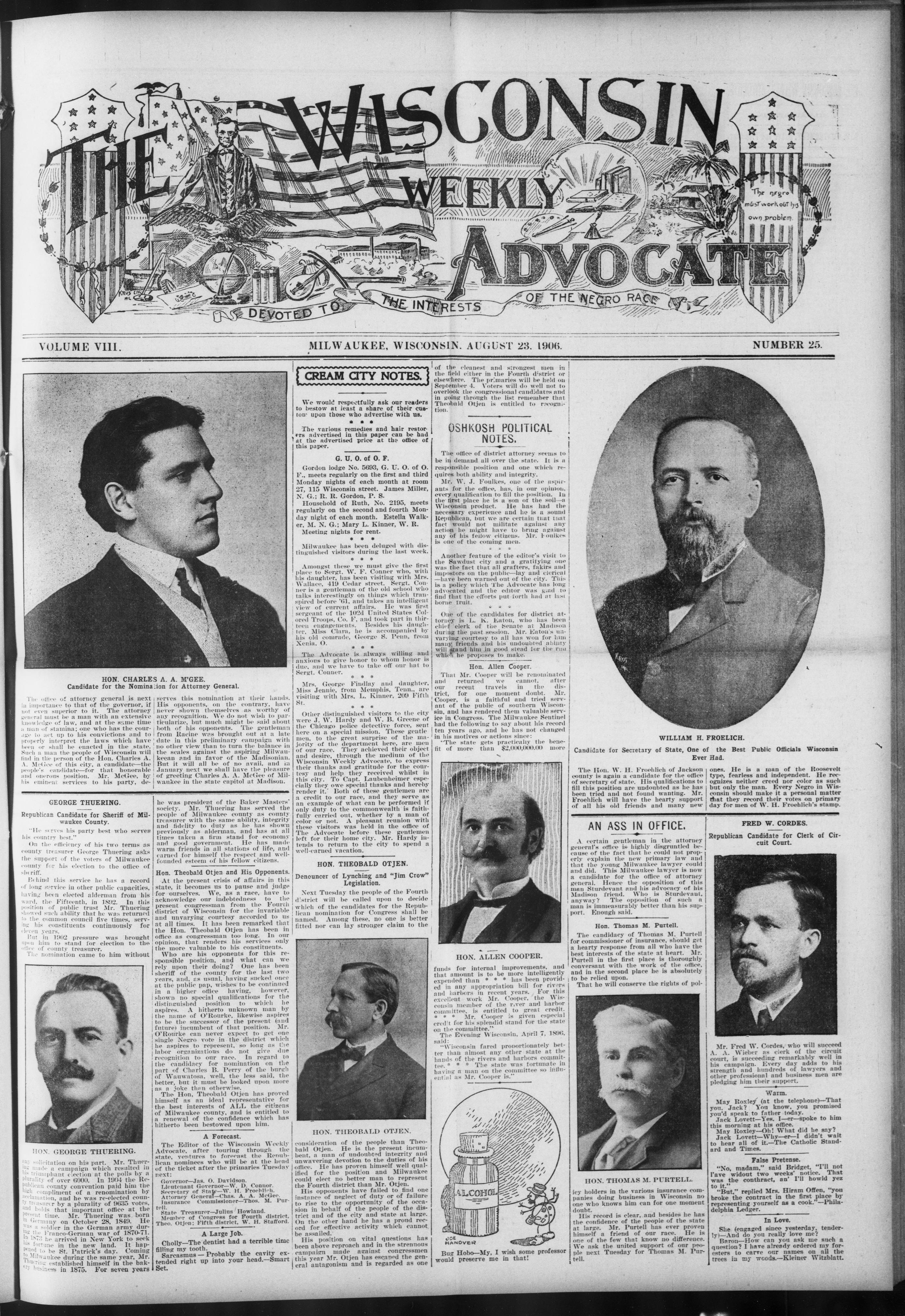
HON. CHARLES A. A. M'GEE. Candidate for the Nomination for Attorney General
The office of attorney general is next in importance to that of the governor, if not even superior to it. The attorney general must be a man with an extensive knowledge of law, and at the same time a man of stamina; one who has the courage to act up to his convictions and to properly interpret the laws which have been or shall be enacted in the state. Such a man the people of Wisconsin will find in the person of the Hon. Charles A. A. McGee of this city, a candidate—the people's candidate—for that honorable and onerous position. Mr. McGee, by his eminent services to his party, de- serves this nomination. His opponents, on the never shown themselves any recognition. We do noticularize, but much might both of his opponents, from Racine was brought date in this preliminary no other view than to turn the scales against the akean and in favor of it. But it will all be of no January next we shall have of greeting Charles A. A. waukee in the state capit-
GEORGE THUERING
"He serves his party best who serves his country best."
On the efficiency of his two terms as county treasurer George Thuering asks the support of the voters of Milwaukee county for his election to the office of sheriff.
Behind this service he has a record of long service in other public capacities, having been elected alderman from his ward, the Fifteenth, in 1892. In this position of public trust Mr. Thuering showed such ability that he was returned to the common council five times, serving his constituents continuously for eleven years.
But in 1902 pressure was brought upon him to stand for election to the office of county treasurer.
The nomination came to him without
[Picture of a man with a mustache and a suit].
HON. GEORGE THUERING. any solicitation on his part. Mr. Thuering made a campaign which resulted in his triumphant election at the polls by a plurality of over 6000. In 1904 the Republican county convention paid him the high compliment of a renomination by acclamation, and he was re-elected county treasurer by a plurality of 9635 votes, and holds that important office at the present time. Mr. Thuering was born in Germany on October 28, 1849. He was a soldier in the German army during the Franco-German war of 1870-71. In 1873 he arrived in New York to seek his fortune in the new land. It happened to be St. Patrick's day. Coming to Milwaukee during the same year, Mr. Thuering established himself in the bakery business in 1875. For seven years
serves this nomination at their hands. His opponents, on the contrary, have never shown themselves as worthy of any recognition. We do not wish to particularize, but much might be said about both of his opponents. The gentleman from Racine was brought out at a late date in this preliminary campaign with no other view than to turn the balance in the scales against the aspiring Milwaukeean and in favor of the Madisonian. But it will all be of no avail, and in January next we shall have the pleasure of greeting Charles A. A. McGee of Milwaukee in the state capitol at Madison.
he was president of the Baker Masters' society. Mr. Thuering has served the people of Milwaukee county as county treasurer with the same ability, integrity and fidelity to duty as he has shown previously as alderman, and has at all times taken a firm stand for economy and good government. He has made warm friends in all stations of life, and carned for himself the respect and well-founded esteem of his fellow citizens.
Hon. Theobald Otjen and His Opponents.
At the present crisis of affairs in this state, it becomes us to pause and judge for ourselves. We, as a race, have to acknowledge our indebtedness to the present congressman from the Fourth district of Wisconsin for the invariable and unvarying courtesy accorded to us at all times. It has been remarked that the Hon. Theobald Otjen has been in office as congressman too long. In our opinion, that renders his services only the more valuable to his constituents.
Who are his opponents for this responsible position, and what can we rely upon their doing? One has been sheriff of the county for the last two years, and, as usual, having sucked once at the public pap, wishes to be continued in a higher office having, however, shown no special qualifications for the distinguished position to which he aspires. A hitherto unknown man by the name of O'Rourke, likewise aspires to be the successor of the present (and future) incumbent of that position. Mr. O'Rourke can never expect to get one single Negro vote in the district which he aspires to represent, so long as the labor organizations do not give due recognition to our race. In regard to the candidacy for nomination on the part of Charles B. Perry of the burgh of Wauwatosa, well, the less said, the better, but it must be looked upon more as a joke than otherwise.
The Hon, Theobald Otjen has proved himself as an ideal representative for the best interests of ALL the citizens of Milwaukee county, and is entitled to a renewal of the confidence which has bitherto been bestowed upon him.
A Forecast
The Editor of the Wisconsin Weekly Advocate, after touring through the state, ventures to forecast the Republican nominees who will be at the head of the ticket after the primaries Tuesday next: Governor-Jas. O. Davidson.
Attorney General—Clinton, A. K. Moore Insurance Commissioner—Thos. M. Purtell. State Treasurer—Julius Howland. Member of Congress for Fourth district Theo. Otjen; Fifth district, W. H. Stafford
A Large Job.
Cholly—The dentist had a terrible time filling my tooth.
Sarcasmus — Probably the cavity extended right up into your head.—Smart Set.
CREAM CITY NOTES
We would respectfully ask our readers to bestow at least a share of their custom upon those who advertise with us.
The various remedies and hair restorers advertised in this paper can be had at the advertised price at the office of this paper.
G. U. O. of O. F.
Gordon lodge No. 5693, G. U. O. of O. F., meets regularly on the first and third Monday nights of each month at room 27, 115 Wisconsin street. James Miller, N. G.; R. R. Gordon, P. S. Household of Ruth, No. 2195, meets regularly on the second and fourth Monday night of each month. Estella Walker, M. N. G.; Mary L. Kinner, W. R.
Milwaukee has been deluged with distinguished visitors during the last week.
* * *
Amongst these we must give the first place to Sergt. W. F. Conner who, with his daughter, has been visiting with Mrs. Wallace, 419 Cedar street. Sergt. Conner is a gentleman of the old school who talks interestingly on things which transpired before '61, and takes an intelligent view of current affairs. He was first sergeant of the 102d United States Colored Troops, Co. F, and took part in thirteen engagements. Besides his daughter, Miss Clara, he is accompanied by his old comrade, George S. Penn, from Xenia, O.
The Advocate is always willing and anxious to give honor to whom honor is due, and we have to take off our hat to Sergt. Conner.
Mrs. George Findlay and daughter, Miss Jennie, from Memphis, Tenn., are visiting with Mrs. L. Kinner, 209 Fifth St.
\* \* \*
Other distinguished visitors to the city were J. W. Hardy and W. B. Greene of the Chicago police detective force, sent here on a special mission. These gentlemen, to the great surprise of the majority of the department here, are men of our race. They achieved their object and desire, through the medium of the Wisconsin Weekly Advocate, to express their thanks and gratitude for the courtesy and help they received whilst in this city. To Capt. Laubenheimer especially they owe special thanks and hereby render it. Both of these gentlemen are a credit to our race, and they serve as an example of what can be performed if only duty to the commonwealth is faithfully carried out, whether by a man of color or not. A pleasant reunion with these visitors was held in the office of The Advocate before these gentlemen left for their home city. Mr. Hardy intends to return to the city to spend a well-earned vacation.
HON. THEOBALD OTJEN
Denouncer of Lynching and "Jim Crow" Legislation
Next Tuesday the people of the Fourth district will be called upon to decide which of the candidates for the Republican nomination for Congress shall be named. Among these, no one is better fitted nor can lay stronger claim to the
[Name not provided]
HON. THEOBALD OTJEN. consideration of the people than Theobald Otjen. He is the present incumbent, a man of undoubted integrity and unwavering devotion to the duties of his office. He has proven himself well qualified for the position and Milwaukee could elect no better man to represent the Fourth district than Mr. Otjen. His opponents have failed to find one instance of neglect of duty or of failure to rise to the opportunity of the occasion in behalf of the people of the district and of the city and state at large. On the other hand he has a proud record for effective activity which cannot be assailed.
His position on vital questions has been above reproach and in the strenuous campaign made against congressmen this year Mr. Otjen has escaped the general antagonism and is regarded as one
of the cleanest and strongest men in the field either in the Fourth district or elsewhere. The primaries will be held on September 4. Voters will do well not to overlook the congressional candidates and in going through the list remember that Theobald Otjen is entitled to recognition.
OSHKOSH POLITICAL NOTES.
The office of district attorney seems to be in demand all over the state. It is a responsible position and one which requires both ability and integrity.
Mr. W. J. Foulkes, one of the aspirants for the office, has, in our opinion, every qualification to fill the position. In the first place he is a son of the soil—a Wisconsin product. He has had the necessary experience and he is a sound Republican, but we are certain that that fact would not militate against any action he might have to bring against any of his fellow citizens. Mr. Foulkes is one of the coming men.
Another feature of the editor's visit to the Sawdust city and a gratifying one was the fact that all grafters, fakirs and impostors on the public—lay and clerical—have been warned out of the city. This is a policy which The Advocate has long advocated and the editor was glad to find that the efforts put forth had at last borne fruit.
One of the candidates for district attorney is L. K. Eaton, who has been chief clerk of the Senate at Madison during the past session. Mr. Eaton's unvarying courtesy to all has won for him many friends and his undoubted abinity will stand him in good stead for the run which he proposes to make.
Hon. Allen Cooper.
That Mr. Cooper will be renominated and returned we cannot, after our recent travels in the district, for one moment doubt. Mr. Cooper, is a faithful and tried servant of the public of southern Wisconsin, and has rendered them valuable service in Congress. The Milwaukee Sentinel had the following to say about his record ten years ago, and he has not changed in his motives or actions since:
"The state gets practically the benefit of more than $2,000,000.00 more
[Image of a man with a mustache and a suit, looking slightly to the right. The background is a patterned wallpaper with vertical stripes.]
HON. ALLEN COOPER.
funds for internal improvements, and that amount is to be more intelligently expended than * * * has been provided in any appropriation bill for rivers and harbors in recent years. For this excellent work Mr. Cooper, the Wisconsin member of the river and harbor committee, is entitled to great credit. * * * Mr. Cooper is given especial credit for his splendid stand for the state on the committee."
The Evening Wisconsin, April 7, 1896, said:
"Wisconsin fared proportionately better than almost any other state at the hands of the rivers and harbors committee. * * * The state was fortunate in having a man on the committee so influential as Mr. Cooper is."
ALCOHOL
JOE
HANOVER
Bug Hobo—My, I wish some professor would preserve me in that!
Bug Hobo—My, I wish some professor would preserve me in that!
KROF
WILLIAM H. FROELICH.
Candidate for Secretary of State, One of the Best Public Officials Wisconsin Ever Had.
The Hon. W. H. Froehlich of Jackson county is again a candidate for the office of secretary of state. His qualifications to fill this position are undoubted as he has been tried and not found wanting. Mr. Froehlich will have the hearty support of all his old friends and many new ones. He is a man of the Roosevelt type, fearless and independent. He recognizes neither creed nor color as such but only the man. Every Negro in Wis consin should make it a personal matter that they record their votes on primary day for men of W. H. Froehlich's stamp
AN ASS IN OFFICE.
A certain gentleman in the attorney general's office is highly disgruntled because of the fact that he could not properly explain the new primary law and that the young Milwaukee lawyer could and did. This Milwaukee lawyer is now a candidate for the office of attorney general. Hence the opposition of this man Sturdevant and his advocacy of his Madison friend. Who is Sturdevant, anyway? The opposition of such a man is immeasurably better than his support. Enough said.
Hon. Thomas M. Purtell.
The candidacy of Thomas M. Purtell for commissioner of insurance, should get a hearty response from all who have the best interests of the state at heart. Mr. Purtell in the first place is thoroughly conversant with the work of the office, and in the second place he is absolutely to be relied upon. That he will conserve the rights of pol-
J. B.
HON. THOMAS M. PURTELL. icy holders in the various insurance companies doing business in Wisconsin no one who knows him can for one moment doubt. His record is clear, and besides he has the confidence of the people of the state at large. Mr. Purtell has ever proven himself a friend of our race. He is one of the few that know no difference. We ask the united support of our people next Tuesday for Thomas M. Purtell.
FROELICH.
of the Best Public Officials Wisconsin
Had.
ones. He is a man of the Roosevelt type, fearless and independent. He recognizes neither creed nor color as such but only the man. Every Negro in Wisconsin should make it a personal matter that they record their votes on primary day for men of W. H. Froehlich's stamp.
FRED W. CORDES.
Republican Candidate for Clerk of Circuit Court.
M.
Mr. Fred W. Cordes, who will succeed A. A. Wieber as clerk of the circuit court, is succeeding remarkably well in his campaign. Every day adds to his strength and hundreds of lawyers and other professional and business men are pledging him their support.
May Roxley (at the telephone)—That you. Jack? You know, you promised you'd speak to father today.
Jack Lovett—Yes. I—er-spoke to him this morning, at his office.
May Roxley—Oh! What did he say? Jack Lovett—Why—er—I didn't wait to hear all of it.—The Catholic Standard and Times.
"No, madam," said Bridget, "I'll not lave widout two weeks' notice. That was the contract, an' I'll howd yez to it."
"But," replied Mrs. Hiram Offen, "you broke the contract in the first place by representing yourself as a cook."—Philadelphia Ledger.
She (engaged since yesterday, tenderly)—And do you really love me?
Baron—How can you ask me such a question? I have already ordered my foresters to carve our names on all the trees in my woods.—Kleiner Witzblatt.
NUMBER 25.
Warm.
False Pretense.
In Love.
THE WISCONSIN WEEKLY ADVOCATE
B. B. MONTGOMERY, Editor and Proprietor.
Notes of Interest.
—The diamond, in sufficient heat, will burn like a piece of charcoal.
—A London justice a short time ago made an order for the distribution of an estate that had been in the court of chancery for 100 years, during which time it had increased in value threefold.
—Frank T. Bullen, the writer, is on a lecturing tour in Australia. It was to Australia that he made his first voyage as a boy. He remembers landing in Melbourne on the Queen's birthday, 1872.
—Bans of marriage that had been published twice were published for the third time by the parish clerk's daughter at Ellington, England, on a recent Sunday morning. The vicar was away on a holiday, and for some unknown reason no other clergyman came.
—It is said that the Czar of Russia receives from his subjects through the post no fewer than 100 petitions every day of his life. The majority of these documents before reaching the monarch's hands are examined by a confidential secretary.
—At a recent meeting of the Royal Society of British Artists, Alfred East was elected president. This is the old art society which flashed into such brilliant but brief notoriety under Whistler's presidency. Its late president was Sir Wrke Bayliss.
-Quill toothpicks come from France. The largest factory in the world is near Paris, where there is an annual product of 20,000,000 quills. The factory was started to make quill pens, but when these went out of general use it was converted into a toothpick mill.
-Lieut. George W. Kellogg has retired from the Metropolitan museum after twenty-four years of service. Appointed in 1882, he then required only two assistants. So great has been the extension of the valuable contents that nearly 100 were needed this year.
-The ever-increasing dimensions of war vessels has led the German government to conclude to widen the Kiel canal from 60 to 130 feet, and the width at the surface from 130-feet to 350 feet. The proposed improvements, it is estimated, will cost nearly $50,000,000.
The Winnipeg Commercial says that the wheat crop in the Canadian Northwest this year will be about 97,000,000 bushels, which it estimates will sell at 65 cents a bushel. The population is about 800,000, and the amount to be received from the wheat alone will be $63,000,000.
In German East Africa the natives who can indulge in the luxury of drinking soda water take it directly from the bottle instead of pouring it into a glass. The government has forbidden this practice, on pain of severe punishment, less white men may happen to get the same bottles refilled.
The city council of Birmingham, England, has increased the number of women health inspectors from four to twenty, because of the excellent results achieved in the homes of the poor and in the factories. In the same city the policemen have been taught the principles of "first aid."
A letter has just been received in Montpelier, Vt., which was posted in Ireland fifty-two years ago. The letter has been in the dead letter office at Washington all the time and the party who sent the letter has died and the addressee has died and her children have grown up, married and reared families.
According to a preliminary report of the interstate commerce commission the gross earnings of the railroads of the United States, covering approximately 219,000 miles of road, will probably show for the fiscal year ended June 30 an increase of 10 per cent. over the $2,073,000,000 earned in 1905.
—Owing to the difference in gauge between the Prussian and the Russian railways much delay has hitherto been involved in the unloading and reloading of goods for transshipment across the frontier. According to announcements in the German press an attempt is being made to meet this difficulty by —The Irish language is spoken in the Bahamas among the mixed descendants of the Hibernian patriots banished long ago by Cromwell to the West Indies. One can occasionally hear negro sailors in the East end of London who cannot speak a word of English talking Irish to the old Irish apple women who gather round the docks.
The gold output in the Rand district of South Africa has steadily increased since the end of the Boer war, and is now well above the highest volume reached before the war; nevertheless, the market price of Rand mine shares have fallen over one-half, or by some $650,-000,000. No satisfactory explanation of this anomaly has been offered.
Consul Harris of Mannheim says that thousands of American agricultural implements have been sold in Southwest Germany, and yet two-thirds of the hay and grain is harvested by hand. The superiority of American sewing machines, cash registers, typewriters, shoes, office furniture and many other articles, has helped to make their introduction all but universal.
Like Enoch Arden.
After three years spent in fighting for the south and forty years in a northern prison for killing a prison official. Anderson Pittman reached Cartersville, Ga., to find he had been regarded as dead since the battle of Chickamauga and that the wife of his youth was the widow of another man. Pittman's wife knew him instantly. Instead of being killed at Chickamauga. Pittman was captured and confined until after the close of the Civil war. When released he killed Col. Sanford for flogging him on his last day in prison. Pittman was convicted and was given a sentence of forty years in the New York prison. Pittman returned to a comfortable home, the property which he owned when he enlisted having greatly enhanced in value.
Train Love Story.
There was an excursion to Coney island Sunday, and Clifford H. Morsehead of Waterbury, Conn., and Miss Grace E. Adams of Oakville went along. Fate, in the person of a perspiring brakeman eager to assist patrons of the road, landed them in the same seat. Mr. Morsehead opened the window for Miss Adams. Miss Adams reciprocated by extracting a cinder from Mr. Morsehead's eye. Before they had reached Bridgeport their intimacy was progressing as rapidly as it does in the case of those remarkable young people whose careers are chronicled by Robert W. Chambers. At Bridgeport Mr. Morsehead got Miss Adams a sandwich. At Fairfield Miss Adams dampened Mr. Morsehead's brow with headache cologne. At Green's Farms Mr. Morsehead offered a daring suggestion. At Port Chester they left the train, drove to the residence of Rev. Mr. Worsall, rector of Christ's church, and were married.
REASSURANCE.
Now lucent splendors, amethyst and gold And clearest emerald, flood the western sky
Though, all day long, dark clouds were heaped on high
heaped on high
And angry winds went racing, ley-cold;
But calm has come with sunset, and behold,
Where late the pageantry of storm went
by,
What dream-like majesties of color lie
Across the solemn depths of space unrolled.
All beautiful things the heart of man can
dream—
Deep joy unfaltering, love fulfilled that
fears
No parting evermore nor any tears,
Youth's dear desires like beacon lights that
gleam—
gleam—
When sunset's luminous miracle appears
How close, how sure, those heights of glad
ness seem!
—Elizabeth R. MacDonald in The Crafts
man.
THE FUNERAL OF NOT-WORTH-A-DINGUS.
The knave and the fool sat together on the rail-fence over against the half-open door of Old Man Marceille's shack. There was a throbbing glow of firelight in the opening. Through a symphony of domestic noises—the jingle-jangle of cutlery, the tuneless tuneful thud of plates cast on a wooden table, and so on—ran the drone note of the kettle boiling in a hurry. Also a grandiose smell of the frying of pork cutlets, pervaded the dusk, and caused the hungry syndicate of sinners on the fence to smile sardonically with bared teeth—because not even the consciousness of wounded pride could prevent them from wrinkling their noses.
It seemed to Gash Kelly and Not-Worth-a-Dingus Basherville that all nature was as hungry as they—that the stars in the violet sky and the tall weeds by the doorway were as conscious as themselves of the apotheosis of the pig which they had refused to help kill. The door was flung wide open, and Old Man Marceille appeared on the doorstep. His white hair shone like silver in the firelight, and he would have looked like a saint in a sunlit church window—if the long trade-gun had been left out of the picture. As the gun went up to his shoulder, Gash and Not-Worth-a-Dingus abandoned the fence, dismounting on the far side. The old man drew a bead on them and spoke as follows:
"G'way, g'way off-s my farm! Tam to g'way, dirty fellers! Eat my grub an' drink my whisky blanc fifteen days, an' do not work, an' refuse madame li'lle favor of a li'lle wood chopped—an' refuse me li'lle favor help kill pig. Lazy, dirty fellers, g'way queeck! Queeck, or I pull the gun. G'way—wha' you call git! Git!"
At first it was an orderly and dignified retreat—a departure more in hunger than in anger. But when the gun was fired into the air and they heard the duck-shot pattering in a willow patch near at hand, panic smote them in the hinder parts, and they ran—ran like the arrant cowards they were known to be.
What manner of men are these? They belonged, and had for years belonged, to the class of "prairie derelicts"—the hopeless and helpless do-notings of the vast land of hope and self-help beyond the great lakes. In former days Gash Kelly had gambled for a living. But some friends whom he had met in one of the little pleasure cities on the Minnesota side of Red river—it is a prohibition country on the Dakota bank—had knocked him playfully on the head and knocked him out of the house into a snowdrift on a 20-below-zero night. The result was the loss of two fingers and a thumb by frost-bite, which compelled him to retire from his profession.
His parents came to the conclusion that there was only one country in the world where he would be certain to make his fortune—the great northwest, where men are so few that land is given away. So they enlisted him in the army of British pioneers, paid the cost of his journey to the front of humanity's warfare with the powers of the wilderness, and saw him off from the wharf at Liverpool, with fifty pounds in his pocket. Thirty-two pounds remained to him when he reached Quebec, nineteen when he left Winnipeg, eight when he arrived at the chief market town of Saskatchewan and put up at the dearest hotel. On the very first evening of his stay there he lost all his money—to Gash Kelly.
Thanks to Cash, six years passed before the west decided that the value of young Basherville was not equal to that of the wedge of wood placed between the pickets of a fence to support the heavy bottom rail—that he belonged to the order of prairie derelicts who are "not worth a dingus."
By this time Gash and Not-Worth-a-Dingus had caught back their breath.
"B'gosh," cried Gash, "Old Man was for blue murder! How'd it be to sneak back an' conflagrate his stacks? Heh?" "Wouldn't help us to a supper," groaned his companion, "and I take no hand in such a game. I aint' been jailed yet, and—"
"You're an English gentleman," said Gash, with bitter sarcasm, "an' must behave as such. Me, I'm a man as ain't too pure-blooded to like my revenge, and 'ud be proud to see shack an' barn an' the hull kiboodle going up in a flare. To grudge us a meal a'ter sunset—there's yer prairie hospitality. A disgrace to the west, sir."
"I wish you wouldn't keep calling me an English gentleman," replied Basherville, plaintively. "I've been long enough on the prairies to be reckoned a westerner; and do I look like a gentleman. Gash? What'll we do for a bite, old chap?"
"Buy it, ole pard!" cried Gash, triumphantly, pulling a crumpled paper out of his hip pocket. "Look-a-here! How did I get that $2 bill? You call to mind the little trick of a boy that came to pay the old woman for butter an' eggs—wa-al, sir, I collected that debt, as a honorarium, sir, for handlin' firewood. A pull o' the long green—first I seen for a month—which means a bellyful and a horn or two o' rye, an' bacey, an' a quarter left over for writin' truck to run a money-makin' scheme that I figured out last night while listen' to the owls. A gr-reat scheme, Bashie, and we'll run her together. Get up, boy, and let's hit the trail for the postoffice."
Ar. hour later Gash and his partner were seated by a blaze of spruce chips outside the postoffice fence. Mrs. Devey, who received $12 a year for collecting and distributing the letters (and also the gossip) of the little strung-out settlement of Halcro, had supplied them with a chunk of pork, bannock, tobacco and a bottle of pain-killer—whisky she had none—and had also lent them a campkettle and a frying pan. Now that supper was over the scheme devised by Gash was being carried out.
In the fluctuating radiance of the fire he was writing a letter on Basherville's back. At last it was finished, and his human writing desk rolled aside with a deep sigh of relief. "Let's hear what you've written, Gash," said Not-Worth-a-Dingus with a hand stretched out behind him in an appeal without words for the bottle of painkiller.
"First of all lemme expostulate," began Gash, with the air and intonation of a college professor, "the theory o' the scheme as here redooed to writin' by me, Orran G. Kelly. Whereas your poppa, Rev. Basketfield, is not a milyunaire, an' has a invalidated wife an' several gals as he must keep an' should be an oldish man—an' as whereas he gives his able-bodied son here present an' lyin' by a fire on section 23, township 7 west of the third meridian, an' outfit an' fifty pounds an' his blessin' to rustle a fortune in the gr-reat nor' west—an' whereas the said son, lyin' her an' reachin' for a bottle o' pain-killer, which ain't even got a smell left in it, has had other sums of money from the ole preacher, his poppa, since he started to rustle that fortune, an' whereas the said old poppa sent him nothin' for the last four years, an' has been so keerless o' his lawful male progenity as not to answer any of his letters for a twelvemonth, an' whereas he, the said son o' the said poppa, an'nis best friend, Orran G. Kelly, is on the spikes, sure, fur want o' cash, credit bein' chary—be it enacted on, by an' with the advice o' the said best friend, that Basketfield, Jr., spark out an' die an' hand in his checks an' be buried like a gentleman by his friend, good ole Gash Kelly—a white man all through, sir."
"It's a fine notion," said Not-Worth-a-Dingus, as the other paused to kick the fire into a blaze, "and I guess the old boy would be half relieved to think I was off his hands for good. He's terribly careful about appearances, and I know he'd hate to see me turn up in Shropshire again with a western lingo an' queer habits, and all my niceness gone. I was one of the nice boys before they expelled me from school. 'Not much in him, but a nice boy!' If the letter's correct he'll stump up the money for doctor's bill and funeral, and the rest. Mother'll fret a bit—it was she sent me the last money I had from England—two pounds in a postal order. Ah, well!"
"Was it yer momma sent us the money for our treat at Little Chicago cross the river among the Injuns? Wa'al, them silly little postal orders ain't no use to us now—they don't pay fer the trouble o' reading the long letter as comes with 'em to sour a man while daylight lasts. My letter asks for thirty-seven pounds ten shillin'—think of a wholesome like that, Bashie, an' you bet it catches the cash. Now fer the durn letter—"
Reverend Sir: Your boy, Johnny B-a-3-h-e-r-v-i-l-l-e (Thankee, Bashie!), died up here in Halcro, Alberta, after a long sickness, and was buried here today at 3 y'clock. It was a kind of low fever took him off, but he did not suffer much, I am pleased to say. Last two years has been bad crops, and Johnny was making no money to pay for a doctor or comforts, not even when he was sickening for his first attack. He fell down in the hayfield when pitching hay. That was the second attack, and I took him to my shack and put him to bed, from which he never rose up again to go out to his work. I took the liberty of paying for the doctor and for comforts. He would never allow he was dying or give me the name or address of his family. At the last he did so, sir, and said he was a failure, but sent his love to mother—
And that night (continued the reader, whose voice quivered very slightly, almost imperceptibly) he handed in his checks, as we say here. He sent no message to you, sir, I am sorry to say. But he never would talk about his relations and friends in the old country. He was often chaffed for it. I have spent thirty-seven pounds ten shillings on his case and funeral, and will have to sell cattle to pay, for which I must ask you, as he was not a particular friend of mine. Yours truly,
ORRAN G. KELLY.
P. S.—Will I order a stone for his grave?
Five or six weeks later the driver of the mail cart on the Halcro route pulled up his team suddenly at the sight of a dirty, ragged person standing at the crossroads half-way between the little settlement and the market-town known still as "The Mission."
"Two letters for you, Gash," he said, and threw them at the tramp's feet. Hastily they were torn open. At the sight of the inclosures the face of Gash flashed, and he uttered a strange sound, half sob, half chuckle. Hastily thrusting the papers into the bosom of his shirt, he began to bargain with the mail driver for a passage to town.
Next day the check was cashed, and late in the evening, when the twice-a-week train pulled out for the south, uttering its weird war-whoop, Gash Kelly, in a brand-new $10 suit, was among its passengers. A number of newly regained old friends who had tippled rye at his cost that day saw him off. Before beginning his long journey to Minnesota he posted the two letters and also the £5 note, the result of trifling economies, to his whilom partner. And, to do him justice, he was uneasy in his mind—at any rate, until Winnipeg was reached—at the absence of Not-Worth-a-Dingus, with whom he had lived through so many bad days, so few good ones.
But what of Not-Worth-a-Dingus? One sees him with the mind's eye turning over the inclosures in the envelope addressed in his friend's clumsy script. The sight of the crisp note would breed a pang of joy. Then by slow and laborious processes of thought he would arrive at a due sense of the treachery of Gash Kelly. With the mind's ear one catches a few far-off natural curses. It is impossible to guess what happened afterwards. But the chronicler met him not long ago in a corner of Shropshire at the house of the village doctor.
"That's a returned empty," said the doctor, when he was gone. "And what else could you expect? He says there's nothing but b'ars in the northwest. His palate is the underside of his skull—Nature left out the cerebrum when making him. But he's rather a nice fellow, nevertheless, and a great comfort to his poor old mother."—E. B. Osborn in the Sketch.
The Call of the Harvest
Thrust in thy sickle and reap; for the time is come for thee to reap; for the harvest of the earth is ripe.
There is a fascination in the harvest that weaves a wisp of romance into the sheaves that are bound up these long, sun-flooded days in Kansas, where the harvest of the earth is ripe. It is not alone a selfish rejoicing in the knowledge that a generous yield means an absence of want that awakens the universal interest in the sturdy army now marching against the battalions of bearded grain in the Sunflower state and will move northward gradually as the harvest of the earth ripens in regions where the sun shines less ardently. There is something inborn in even the most
urban of men that causes him to feel a thrill of joy at the sight of a great wheat field waiting for the sickle. It is not alone the hope of profit that causes the student to hasten from his books and the man to drop his accustomed vocation to join the busy toilers in the fields. Many of those who arise with the earliest lark and labor until the long shadows are lost in the dusk are not in pressing need of the wages they receive. They could find more profitable employment in less arduous work. There is some other cause that sends them among strangers for a season. There is a call of the harvest, as there is a call of the wild. The call of the harvest was learned in the days of Ruth, the Moabitess, who bound up the heart -Kansas City Star.
THE WAY OF THE WORLD
Open season for the "boat rocker."—
Members of the Bill club making duty calls.
Walk back? Or did you have a round-trip one.
Speaking of a vacation, most people spend it.
When an auto is stuck it means there's nothing doing.
Speaking of preservatives, have the berries all been put up?
Yep, August is also a great month for the peek-a-boo waist. (Save your eyes.)
There is said to be a shortage of chorus girls in New York. How about Pittsburg?
Now the packers are getting even by shoving up the price. (Rah, for us vegetarians.)
Think of it, they quieted a scandal in Pittsburg. Yea, verily, what are we coming to?
Chicago to New York in ten hours. "Wake and call me early, call me early, mother dear."
"Yawn and the world yawns with you, smother it and you—" can make the rest up for yourself. South Bend Tribune.
GOOD ICE CREAM.
Vanila Ice Cream—Get a vanila stick, pound it small and mix with half a pound of sugar. Rub it through a fine sieve and add half a pint of milk and the yolks of two eggs. Let this mixture simmer over a slow fire for ten minutes, keeping it agitated all the time with brisk stirring. When cool add one pint of cream and pinch of salt. Freeze and mould in ordinary way.
Fresh Fruit Cream—Make a rich custard by boiling it, having flavored it with vanilla or lemon, if preferred. When half frozen add pounded blanched almonds, chopped citron, peaches, raisins or other fruit. Throw in a dash of dry sherry. Have the freezer half full of the custard and fill up with the fruit. Mix thoroughly and freeze again.
Pure Ice Cream—If made of pure, sweet cream, allow the following proportions: Two quarts of cream, one pound sugar. Beat thoroughly and freeze. For flavoring any of the usual kinds may be used.
Lemon Ice Cream—Grate the yellow part of two large lemons upon half a pound of loaf sugar. Reduce to powder and strain over it the juice of one lemon. Add one quart of cream, stir until the sugar is dissolved, freeze and serve. If milk has to take the place of cream it may be made richer by adding the yolks of four eggs. It must them be stirred over the fire until boiling hot, and the juice must not be added until the mass is cool.
Some Very Costly Churches.
Trinity church in New York is valued at $12,500,000. This estimate includes the land occupied by the churchyard. It is in the most valuable part of New York, if not in the most valuable division of property in the world. St. Paul's church, in the same city, is valued at $5,500,000.
Grace church, at what was once described as the head of Broadway, New York, is valued at $950,000.
The First Presbyterian church, on Fifth avenue between Eleventh and Twelfth streets, in the Gotham, is valued at $750,000.
St. Mark's church, on Second avenue, an old landmark in that neighborhood of New York, is valued at $275,000.
The Marble Colegiate church, Fifth avenue and Twenty-ninth street, is valued at $1,000,000.
The Church of St. Paul the Apostle (the Paulist church), at Fifty-ninth street and Columbus avenue, is valued at $700,000.
The West Presbyterian church, on West Forty-second street, is valued at $450,000. St. Thomas's at $1,700,000 and the Fifth Avenue Presbyterian church, 9 and 11 West Fifty-fifth street, at $1,600,000. The valuation of the Temple Emanu- el is $1,530,000, of St. Patrick's Cathedral $6,000,000, of the B'nai Jeshurum Synagogue $300,000, of the Temple Beth- el, at the corner of Fifth avenue and Seventy-sixth street, $1,300,000; of the Broadway Tabernacle, Broadway and Fifty-sixth street, $700,000, and of the Christian Scientist church, Central Park West and Sixty-eight street, $300,000.
Put Trap in Pocket
Philip Rodney, of Centerville, Pa., a prominent business man, discovered recently that his wife had been taking spending money out of his trousers pockets while he slept. He remonstrated with her, but the wifely pilfering continued, and serious quarrels followed. The other night Rodney, determined to break up his wife's practice, put a small but strong rat trap in his money pocket, with the jaws toward the opening. He was awakened shortly after midnight by his wife's screams, and, jumping out of bed, discovered her hand tightly wedged in the jaws of the steel trap. The woman begged to be released, but Rodney allowed her to suffer for a while before freeing her. Her hand was badly lacerated. Mrs. Rodney left her husband and took up her residence with her parents. She says she will not longer live with him.
Gave Wrong Man Valise.
The mistake of Alonzo Kimberlin, a bellboy at the Terminal hotel in Union station, in St. Louis, in giving a suitcase containing $150,000 in cash and negotiable securities to the wrong man, caused William Bender, Jr., of Mankato, Minn., eighteen hours of anxiety, which ended when the suitcase was returned intact. The suitcase was intercepted by telegraph at Litchfield, Ill. Bender departed for Anderson, Ind., and he again selected Kimberlin to carry the suitcase to the train.
An uncut diamond looks very much like a bit of gum arabic.
PLEASURES OF CAMPING OUT.
Have you ever—under a tent—
Spent
A few days of unalloyed bliss?
This
Is what you'll find it out to
be!
We
Tried it this year just for a spell,
Well,
Rain fell in torrents every day.
Say,
Noah never had such a flood.
Mud
Up to our ankles; we were doused,
Soused!
And then the insects, brutes with wings,
Things
You've read about, but never seen,
Green,
Red, yeilow, black, of every hue.
Phew!
We thought our Nemesis had come!
Hum
Like fury all the day and night.
Bite,
Sting, get into your drink and food!
Good
Heav'ns! not to speak of emmets' nests,
Pests
That crawl down your neck, and a score
More
Of beastly insects—not for me!
He,
Who says this sort of thing's all right,
Might
Be reasonably on the spot
Shot!
—Exchange.
New York Every Day.
Punk parties are quite fashionable at Brighton Beach and other nearby summer resorts. Each hotel guest carries a lighted stick of punk and holds it carefully until the party is over. This is on account of the mosquitoes. Punk is the only "apparent" remedy for mosquitoes on the coast. All along the cost at the summer resorts guests of the hotels are recognized in the dusk by the small torches of punk which they always carry.
The millennium is near. The driver of a hansom was hurrying down Broadway, New York. When he reached Dey street he collided with a light truck which was going in the same direction. The driver of the hansom looked at the other jehu for a moment and then laughed. "All right" said the truck driver. "All right" rejoined the other; "I guess it's my fault, not yours." Both then drove on. "Gee whiz," said the big policeman on the crossing; "if those two Hibernians had been in the Bronx instead of on Broadway what a divil of a shindy they'd have kicked up."
Nowadays when a prominent actress is seen frequently in company of a member of the masculine sex gossipers get busy talking about matrimony, particularly if the man is a Pittsburger. The other night it was whispered at Martin's that some one at the Waldorf-Astoria said he overheard on the subway train that a waiter at Sherry's said that he heard a vague rumor that Miss May Yohe, the clever actress, likely would marry the son of a well-known retired Pittsburg manufacturer who is now living in New York. Miss Yohe, of course, denies it and the man says it's all tommy-rot.
Oscar Hammerstein is proud of the fact that he is learning something new every day about the troubles of an impressario, although it will be five months before his season at the Manhattan Opera house is to be opened. The other day he received a visit from the agent of a prima donna who would like to be enrolled among the members of the new company. "In addition to her great popularity," the eloquent agent said, "Madame will be able to sell six boxes for you. Six of her friends have promised to take them. That means $24,000. Just think of that! Why, take her for two months and her services will be velvet—won't cost you a cent!"
The monument at Fort Washington avenue and One Hundred and Twenty-third street, New York, which marks the site of the battle of Fort Washington, is most popular with the young folk of the neighborhood this season of the year. The monument is built against the side of a vertical rock and it is recessed in the central part in such a way as to leave a seat about five feet long, two feet wide and just about the height of a chair. There are no houses in the vicinity and but a few scattered gas lamps, so that the monument just suits the maidens and their lovers, who wander about the neighborhood in the cool of the evening unobserved and unobserving.
Dressmakers are improving. One prominent New York modiste is going about lecturing before dressmakers' clubs. After descanting on clothes she makes the statement that modistes must know more than other women, and she earnestly advises them to study art, music, literature and the drama. When a customer comes for a fitting, this lecturer says, she should hear in one breath of chiffon and Chaucer, shirring and Shaw, Turner and tucking. Most modistes are gifted with too much garrulity already; so it is a point of conjecture just what effect would be had by such a conversational repertoire as that mentioned. There is only one drawback to the plan: The customer may refuse to let the modiste talk at all.
The number of uses to which New York roofs can be put is daily increasing or rather someone is daily discovering a new use. The latest is for a shampoo. "If don't know what I should do without my roof!" exclaimed a former Pittsburg woman. "It saves me many dollars every year as a hair-drying parlor. I shampoo my own hair easily by a small spray attached to my bath tub and then I go directly to my roof, where I have some comfortable chairs and cushions arranged and where the sun and air can get at me. I often brush and air my hair up there in the sun-light when I do not wish to wash it, and that keeps it clean a long while. In the winter—well, you would be surprised to know how hot the sun can be on a flat tin roof even in winter."
One of New York's young matrons whose great wealth has not prevented her from following the prevailing fashion to be Socialistic and indulge in good works, is spending her summer in perfecting the plans for a reform which is to benefit her neighbors and have the modish economic tang. She is going to found, with the aid of her neighbors, a neighborhood laundry. All the families acquainted with one another and living within a certain area will be invited to join the enterprise and contribute their pro rata share toward its support. Thus will laundresses be abolished even from large establishments and the bane of the family wash be a thing of the past. The satisfactory character of the neighborhood laundry will be maintained by a relentless board of lady subscribers.
"No, I'm not going back to the stage, either vaudeville of legitimate," emphatically declared Goldie Mohr Wood, widow of Millionaire Alan W. Wood of Allentown, Pa., and former chorus girl. "The stage is far too serious for one of my disposition. It's hard work—harder than many think—and I'm not going to take anything serious hereafter. "My intention is hereafter.
I don't intend bothering the fates to hurry up things. My time I devote to the 'cello. That's lots better than using it some other ways."
She intimated that she might go to Wyoming and buy a ranch, which she said, her agents had been considering.
"But I'm her to rest now. The future isn't worrying me. I only know that I'll never, no never, go back to the stage."
The old Bull's Head hotel at Third avenue and Twenty-fourth street, New York, which is well known to horsemen, is marked for destruction. The four-story frame building is covered with the lithographs of the Third avenue melodramas and a big placard announces that the property is to lease. As a matter of fact, the property is as good as leased to a firm which will erect a big hotel on the site. Fiss, Dorr & Carroll, horse dealers, are the owners of the property. The Bull's Head hotel—it will undoubtedly be known by that name—will be headquarters for horsemen. All the neighborhood is "horsey." It has been since the days when the original Bull's Head was a road house on the Boston post road. The present building was erected in 1857, but its predecessors date back into the "good old colony days when we lived under the King."
In some of the downtown offices of referees in bankruptcy in New York young women act as managing clerks. Most of them are well equipped for their positions. A well-known referee whose offices are in the Broad Exchange building has a bankruptcy clerk who combines the qualities of an expert stenographer, a fast typist and who has the grasp of the procedure of the office which lawyers regard as somewhat remarkable. This clerk is a modest, slender girl of 20 summers. She knows more about the bankruptcy statutes than many lawyers; and when the referee is absent she is an advocate. Her undoubted talent and attractive personality are often discussed by lawyers and clients. She, like a number of other women who occupy similar positions, would have little trouble in passing her examination for admission to the bar.
The famous lace robe which was presented to Empress Eugenie by the women of Paris in 1869 to wear at the opening of the Suez canal on November 17, 1869, now is in New York and soon will be sold by the American family who have had it in their possession for several years. Ten years were spent in making this robe, which cost 100,000 francs and still is considered a unique stitching design. The Empress wore the gown only once, at the Khedival ball given in Cairo to celebrate the opening of the Suez canal. When Empress Eugenia fled from Paris at the downfall of the empire in 1871, she had no money to pay a debt she owed one of her ladies in waiting and the dress was given to meet the obligation. The historical robe remained in the family of the recipient until a few years ago, when she was forced to sell it to an American woman in Paris, who in turn, through the force of circumstances, now is about to dispose of it.
Those Bowery rounders who for years have made a living by acting as guides to the wickedness of Chinatown, pointing out opium dens to the Sunday school teachers from afar who patronize the slumming wagons, have taken alarm at the rapid disintegration of their gold mine. They say that there are only about 6000 Chinamen in Chinatown, where there used to be double that number; and that presently there won't be any public wickedness to exhibit. The dispersal is due to a combination of causes. The cheap rents in Harlem and at this end of the Williamsburg bridge have attracted some of the thrifty. About sixty Chinese are reported to have married white wives, who object to living in the fetid atmosphere of the quarter. These men have set up homes elsewhere to suit the taste of their American wives. Then, since the warring Tongs committed so many murders, the police in Chinatown have been trebled and public gambling has been done away with.
When the steamship Campania left New York three weeks ago one of its first cabin passengers was Michael Delany, 60 years old, a wealthy retired merchant of St. Louis. His heart began to trouble him as soon as the vessel was on high seas. When the Campania reached Queenstown Delany, convinced that death was at hand, remained on board, telling the ship's officers he would keep the same stateroom on a return voyage to America. Delany was greatly disappointed, as he had been dreaming of visiting Queenstown, his birthplace, ever since he left Ireland, forty years ago. On the return trip Delany constantly prayed he might live until he reached America. When the Campania was in midocean the other night he sat up till daybreak, feeling certain he would die that night. He didn't, but lived until the Campania reached quarantine, when he expired as the last sacrament was being administered by Rev. Father Andrew J. McCabe of Connellsville, Pa., a fellow passenger.
What shall be done to help the poor summer girl? This year's unusually large crop of coquettes has almost been passed up by the men at the summer resorts near Gotham and the maidens are pining for swains. The hotel keepers, too, are complaining of the dearth of the men, and some of the fashionable boarding house keepers at Asbury Park, Brighton Beach and Long island resorts are advertising for men boarders only. What has caused the dearth of men at the resorts this year no one has been able to explain. Said the proprietor of a Brighton Beach hotel to me the other day: "See the young women dressed up in their best every evening just to sit on the porch and pat their feet impatiently. There are scarcely any men to show them a good time. They complain of the grub; they say the mosquitoes are worse than ever and that the sea is sadder than ever before. Every girl who makes a catch this summer is holding on tightly and they are the envy of their sad sister who has not caught a gazabe."
"Living is cheap in this town for some folk," said the janitor of a New York apartment house. "During the summer months a goodly sized portion of New Yorkers live on the furniture vans. That lavish family that lived on the second floor front for the last four months moved out yesterday, forgetting to pay the last three months' rent. I should have yelled '23' long ago, but I certainly was slow getting next. You see, during the summer all these bobtail flush apartment houses with the gay front and gladsome hallways give every new tenant the second month's rent free to take a chance on the building not collapsing before the builder can raffle it off to some confiding person tired of losing money on Standard Oil securities and owning an ambition to turn his securities into some permanent investment. With a new building already full of tenants the investment looks to an old real estate hunter like a soft thing with a stone foundation. Well, there's any number of people take advantage of that second month's free rent and then move, and get another second month's rent free in some other place."
THE WISCONSIN
WEEKLY ADYOUATE
VALE,
R. B. MONTGOMERY. Editor and Pro-
prietor.
The Wisconsin Weekly Advocate after three
years’ residence at 79 Fifth street, has
moved its headquarters to 430
Cedar St. where we will re
ceive our guests and trans-
act our business in
future.
A Representative Jovrnal Devoted to the
Interest of All the Peeple.
ADVERTISING RATES.
One inch, one year............+-.+--$19.00
Two inches, one year.........-...-.- 25.00
Three inches, one year.............-. 35.00
@our-inches, one year......-..-.-.... 42.09
For larger space, special rates.
Locals, 10 cents per line.
TERMS OF SUBSCRIPTION.
WRG. FONE Saois cscs sas pace pan eaeocraaect em
Bix Months . ...... 000. ccee eer cces sere ee WHO |
Three Movths ........ 2... ecerseeeoee ee D
Direct all communications to
Rk. B. MONTGOMERY.
430 Cedar Street.
HOW TO SEND M®ONEY.—Post Office
Urder, “xpress Order, Draft or Registered
Letter. K. B. Montgomery will not be re-
sponsible for loss when sent in any other
way.
TO CONTRIBUTORS:
All communications must be sent with the
hame and address of the sender as an ey.-
dence of good faith, but not necessarily for
publication. No manuscript returned if not
accepted, unless accompanied by stamps.
jn
FREEBMEN’S FRATERNAL
FEDERATION.
Headquarters, 430 Cedar Street.
Phone, Grand 3785.
Summer Activities.
Home and Field Missionary.
Reading Room.
Circulating Library.
Boys’ Club.
Business League.
Plain Sewing.
Truant Committee.
Employment Bureau.
Persons wishing to speak with
Rev. G. A. Oglesby
and
Rev. b. E. Butler
will call up Grand 3785.
pe mon
See
This Label is a guarantee that the
printing bearing it is the product o:
Union Labor.
EDITORIAL PARAGRAPHS.
“I know of the bravery and character
of the Negro soldier. He saved my life
at Santiago, and I have had occasion to
say so in many articles and speeches.
The Rough Riders were in a bad position
when the Ninth and Tenth cavalry came
tushing up the hill carrying everything
before them. The Negro soldier has the
faculty of coming to the front when .e
1s needed most. in the Civil war he came
400,00c strong, and I believe he saved
the Unicn.”—President Roosevelt.
—_—_———__————
HON. THOMAS S. PURTELL.
‘The Advocate is pleased to present to
its many readers throughout the state
Mr. Thomas Purtell, candidate for the
important office of state insurance com-
missioner, to succeed the present incum-
bent, Zeno Host. Since Mr. Purteli’s
advent into the political life of the peo-
ple of Wisconsin, some twelve years ago,
he has step by step risen in their confi-
dence until great is their honorable esti-
mate of the man.
When State Treasurer Kempf was re-
moved from office by Gby. La Follette,
Mr. Purtell, as acting treasurer, distin-
guished himself as an investigator of
the railroad companies’ books, and later
the affairs of a number of suspicious ap-
pearing insurance companies throughout
the country.
Mr. Purtell is a man of the people
and a man for the people.
To the general public he has said: “If
nominated and electel I shall continue to
defend and maintain the principles and
policies so strongly advocated by the
department of insurance during the past
three years, and wil conduct the affairs
of the office with an eye single to the
welfare of the policy holder, and point
out to the chief executive and Legisla-
ture of this state any evils that may
exist.”
Such a man commands the attention
and support of every voter in our great
state, and to cast a vote for him at the
primaries September 4 will be an act
worthy of the highest praise.
My Past Record Is My Platform.
So reads the card of George Phuering,
Republican candidate for sheriff, and
then adds:
MY RECORD:
Born in Germany, October 28, 1849.
Seryed in the German army, 1870-71.
Arrived in New York, 1873, on St.
Patrick’s day. ,
Established in the bakery business in
Milwaukee since 1875.
President of the Baker Masters’ Ve-
rein for seven years.
Alderman for the Fifteenth ward con-
tinously for eleven years.
County treasurer now, and since 1903.
Motto: ‘He serves his party best, whe
serves his country best.”
What is the matter with Thuering?
“He's all right!”
Gen. Butler’s Advice.
While E. C. Carrigan was in Benja-
min F. Butler's law office, says the
Rochester Herald, a lady came in to ask
some advice. As the general was not
in, Mr. Carrigan questioned her, and
told her he would submit her case to the
general, which he did.
The general was to leave the next day
for Washington. and told Mr. Carrigan
to prepare a brief of the lady’s case and
show it to him the/next day. -
Mr. Carrigan sat up half of the night
EE EE ~
OE: ~~
Mj ge NN
bh >
hh - ee ee N
i ee z ee 4
\ 4 |
\ y
A
y
Y /
S y
. ;
XS y
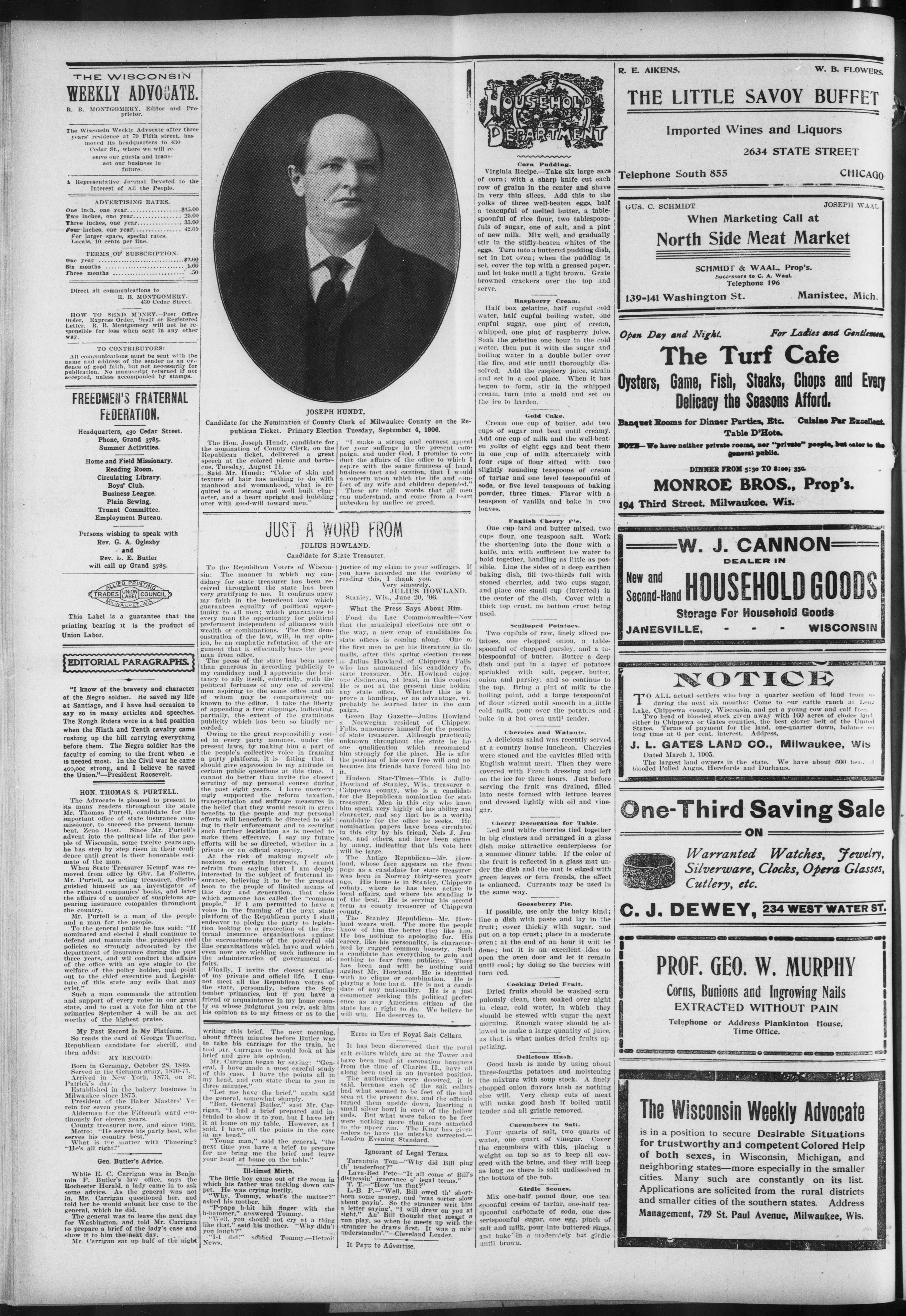
JOSEPH HUNDT,
Candidate for the Nomination of County Clerk of Milwaukee County on the Re-
publican Ticket. Primary Election Tuesday, September 4, 1906.
The Hon. Joseph Hundt, candidate for; “I make a strong and earnest appeal
the nomination of County Clerk, on the|for your suffrage in the present cam.
Republican ticket, delivered a great] paigh, and under God, I promise to con-
speech at the colored picme and barbe-| duct the affairs of the office to which 1
cue, Tuesday, August 14. aspire with the same firmness of hand.
. Said. Mr. Hundt: “Color of skin and] business tact and caution, that IT would
texture of hair has nothing to do with|a concern upon which the life and com:
manhood and womanhood, what is re-| fort of my wife and children depended.”
quired is a strong and well built char-| ‘These are plain words that all men
acter, and a heart upright and bubbling | can understand, and come from a beart
over with good-will toward men.” [unbroken by malice or greed,
JUST A WURD FROM
JULIUS HOWLAND.
Candidate for S:ate Treasurer.
| To the Republican Voters of Wiscon-
sin: The manner in which my can-
didacy for state treasurer has been re-
ceived throughout the state has been
very gratifying to me. It confirms anew
my faith in the beneficent law which
guarantees equality of political oppor-
tunity to all men; which guarantees to
every man the opportunity for political
preferment independent of alliances with
wealth or combinations. The first dem-
onstration of the law, will, in my opin-
ion, be an emphatie refutation of the ar-
gument that it effectually bars the poor
man from oilice.
The press of the state has been more
than generous in according publicity to
my candidacy and I appreciate the hesi-
tancy to ally itself, editorially, with the
political fortunes of any one of several
men aspiring to the same office and ail
of whom may be comparatively un-
known to the editor. I take the liberty
of appending a few clippings, indicating,
partially, the extent of the gratuitous
publicity which has been so kindly ac-
corded.
Owing to the great responsibility vest-
ed in every party nominee, under the
present laws, by making him a part of
the people's collective voice in framing
a party platform, it is fitting that I
should give expression to my atiitude on
certain public questions at this time. [
cannot do better than invite the closest
scrutiny of my personal course during
the past eight years. L have unswerv-
ingly supported the reform taxation,
transportation and suffrage measures in
the belief that they would resuit in greac
benefits to the people and my personal
efforts will henceforth be directed to aid-
ing in their enforcement and to securing
such further legislation as is needed to
make them effective. [ say my future
efforts will be so directed, whether in a
private or an official capacity.
At the risk of making myself ob-
noxious to certain interests, I cannot
refrain from saying that I am deeply
interested in the subject of fraternal in-
surance, believing it to be the greatest
boon to the people of limited means of
this day and generation, that class
which someone has called the “common
people.” If 1 am permitted to have a
voice in the framing of the next. state
platform of the Republican party I shall
endeavor to pledge the party to legisla-
tion looking to a protection of the fra-
ternal insurance organizations against
the encroachments of the powerful old
line organizations which haye and which
even now are wielding such influence in
the administration of government af.
fairs.
Finally, I invite the closest scrutiny
of my private and official life. I can-
not meet all the Republican voters of
the state, personally, before the Sep-
tember primaries, but if you have a
friend or acquaintance in my home coun-
ty on whose judgment you rely, ask him
his opinion as to my fitness or as to the
writing this brief. The next morning,
about fifteen minutes before Butler was
to take his carriage for the train, he
toid sir, Carrigan he would look at his
brief and give his opinion.
Mr. Carrigan began by saying: “Gen-
eral, T bave made a most careful study
of this case. I have the points all in
my head, and can state them to you in
three minutes.”
“Let me have the brief.” again said
the general, somewhat sharply.
“But. General Butler,” said Mr. Car-
rigan, “I had a brief prepared and in-
tended to show it to you, but I have left
it at home on my table. However, as I
said, I have all the points in the case
in my head.”
“Young man,” said the general, “the
next time you have a brief to prepare
for me bring me the brief and leave
your head at home on the table.”
—__
Til-timed Mirth.
The little boy came out of the reom in
which his father was tacking down car.
pet. He was crying lustily.
“Why, Tommy, what’s the matter?
asked his mother.
“P-papa h-hit hih finger with the
h-hammer,” answered Tommy.
“Vell, you should not ery at a thing
like that.” said his mother. “Why didn’
you Inugh?" .
“LI didi" sdhbed = Fommr.—Detroi:
News.
“T make a_strong and earnest appeal
for your suffrage in the present cam-
paigh, and under God, I promise to con-
duct the affairs of the office to which I
aspire with the same firmness of hand.
business tact and caution, that I would
2 coneern upon which the life and com-
fort of my wife and children depended.”
‘These are plain words that all men
can understand, and come from a beart
unbroken by malice or greed,
justice of my claim to your suffrages. Uf
you have accorded me the courtesy of
reading this, I thank you.
Very sincerely,
JULIUS HOWLAND.
Staniey, Wis., June 20, ’06.
What the Press Says About Him.
Fond du Lae Commonwealth—Now
that the municipal elections are out o
the way, a new crop of candidates foi
state offices is coming along. One 01
the first men to get his literature ii th.
mails, after this spring election recess
as Julius Howland of Chippewa Falls
who has announced his candidacy fo,
siate treasurer. Mr. Howland enjoy.
one distincdon, at least, in this contesi
He is not at the present time holdin,
any state office. Whether this is t
prove a handieap, or an advantage, wi.
probably be Jearned later in the cam
paign.
Green Bay Gazette—Julius Howland
a Norwegian resident of _Chippew.
Falls, announces himself for the positio.
of state treasurer. Although practieall;
unknown throughout the state he ha:
one qualification which recommend
him strongly for the place. He is afte
the position of his own free will and no
because his friends have forced him int
it.
Hudson Star-Times—This is Juliu
Howland of Stanley, Wis., treasurer 0
Chippewa county, who is a candidat
for the Republican nomination for stat:
‘treasurer. Men in this city who know
shim speak very highly of his ability and
character, and say that he is a worth)
gendieets for the office he seeks. His
nomination papers have been circulatec
‘in this city by his friend, Nels J. Jen-
son, and others, and have been signec
by inany, indicating that his vote here
will be iarge.
The Antigo Repubiiean—Mr. How-
lund, whose face appears on the froni
page as a candidate for state treasurer
was born in Norway thirty-seven years
ago. His home is in Stanley, Chippewe
connty, where he has been active in
local affairs, and where his standing is
of the best. He is serving his second
term as county treasurer of Chippewa
| county,
The Stanley Republiean—Mr. How-
land wears well. The more the people
know of him the better they like him.
He has nothing to apologize for. His
career, like his personality, is character-
ized by rugged common honesty. Such
a candidate has everything to gain and
nothing to fear from publicity. There
has been and will be nothing said
against Mr. Howland. He is identified
with no clique or combination. He is
playing a lone hard. He is not a eandi-
date of any nationality. He is a just
commoner seeking this political prefer-
ence as any American citizen of the
state has a right to do. We belieye he
will win. He deserves to.
Error in Use of Royal Salt Cellars.
Tt has been discovered that the royal
salt cellars which are at the Tower and
have been used at coronation banquets
from the time of Charles IL, have all
alonz been used in an inverted position.
The authorities were deceived, it is
said, because each of the salt cellars
had what seemed to be feet of the kind
seen at the present day, and the officials
turned them upside down, inserting a
small silver bowl in each of the hollow
ends. But what were taken to be feet
were nothing more than ears attached
to the upper rim. The King has giver:
orders to have the mistake corrected.—
Loudon Evening Standard.
ennai
Ignorant of Lecal Terme
Tarantuia Tom—“Why did Bill plug
th’ tenderfoot?”
Lava-Bed Pete—“It all come o’ Bill’s
distressin’ ignorance o° legal terms.”
T. T.—“How ’uz that?”
L.-B. P.—“Well, Bill owed th’ short-
horn some money, and ‘was sorter slow
about payin’. So the stranger writ him
a letter saying’, “I will draw on you at
sight.” An’ Bill thought that per a
zun play. so when he meets up with the
stranger he draws first. It was a mis-
nderstandin’.”"—Cleveland Leader.
—————____
It Peys to Advertise.
R. E. AIKENS. W. B. FLOWER,
THE LITTLE SAVOY BUFFET
OOS 00S
Imported Wines and Liquors
2634 STATE STREET
Telephone South 855 CHICAGO
Virginia Recipe.—Take six large ears
of corn; With a sharp knife cut each
row of grains in the center and shave
in yery thin slices. Add this to the
yolks of three well-beaten eggs, half
a teacupful of melted butter, a table-
spoonful of rice flour, two tablespoon-
fuls of sugar, one of salt, and a pint
of new milk. Mix well, and gradually
stir in the stiffly-beaten whites of the
eggs. Turn into a buttered pudding dish,
set in Lot oven; when the pudding is
set, cover the top with a greased paper,
and let bake until a light brown. Grate
browned crackers over the top and
serve.
Ee
GUs. C. SOHMIDT JOSEPH WAAL
When Marketing Call at
North Side Meat Market
eee,
ed
SCHMIDT & WAAL, Prop’s.
Successors to C. A. Waal.
Telephone 196
139-141 Washington St. Manistee, Mich,
Raspberry Cream.
Ifalf box gelatine, half cupful cold
water, half cupful boiling water, one
cupful sugar, one pint of cream,
whipped, one pint of raspberry juice.
Soak the gelatine one hour in the cold
water, then put it with the sugar and
boiling water in a double boiler over
the fire, and stir until thoroughly dis-
solved. Add the raspbery juice, strain
and set in a cool place. When it has
begun to form, stir in the whipped
cream, turn into a mold and set on
the ice to harden.
Open Day and Night. For Ladies and Gentlemen,
The Turf Cafe
Oysters, Game, Fish, Steaks, Chops and Every
Delicacy the Seasons Afford,
Banquet Rooms for Dinner Parties, Etc. Cuisine Par Excelleat,
Table D’Hote.
BOTB— We have neither private rooms, ner “private” people, but cater to the
genera! pablic.
MONROE BROS., Prop’s. _
194 Third Street, Milwaukee, Wis.
Gold Cake.
Cream one cup of butter, add two
cups of sugar and beat until creamy.
Add one cup of milk and the well-beat-
en yolks of eight eggs and beat them
in one cup of milk alternately with
four cups of flour sifted with two
slightly rounding teaspoons of cream
of tartar and one level teaspoonful of
soda, or five level teaspoons of baking
powder, three times. Flavor with a
teaspoon of vanilla and bake in two
loaves.
Kashish Cherry Pte.
One cup lard and butter mixed, two
cups flour, one teaspoon salt. Work
the shortening into the flour with a
knife, mix with sufficient ice water to
hold together, handling as little as pos-
sible. Line the sides of a deep earthen
baking dish, fill two-thirds full with
stoned cherries, add two cups sugar,
and place one small cup (inverted) in
the center of the dish. Cover with a
thick top crust, no bottom crust being
used.
enti ——
seomiod HOUSEHOLD GOODS
Storage For Household Goods
JANESVILLE, - - - WISCONSIN
Sealloped Potatoes.
Two cupfuls of raw, finely sliced po-
tatoes, one chopped onion, a table-
spoonful of chopped parsley, and a ta-
blespoonful of butter. Butter a deep
dish and put in a layer of potatoes
sprinkled with salt, pepper, butter,
onion and parsiey, and so continue to
the top. Bring a pint of milk to the
boiling point, add a large teaspoonful
of flour stirred until smooth in a_iittle
cold milk, pour over the potatces and
bake in a hot oven unti’ tender.
2
NWOTICH
aL ALL actual settlers whe buy a quarter section of land trom = u-~
during the next six months: Come to our cattle ranch at Len.
Lake, Chippewa county, Wisconsin, and get a young cow and calf fre».
Two head of blooded stock given away with 160 acres of choice law!
either in Chippewa or Gates counties, the best clover belt of the United
States. Terms of payment for the land, one-quarter down, balaner «+
long time at 6 per cent. interest. Address,
J. L. GATES LAND CO., Milwaukee, Wis
Dated Mareh 1, 1905.
‘The largest land owners in the state. We have about 600 tea. .1
blooded Polled Angus, Herefords and Durhams.
Cherries and Walaute.
A delicious salad was recently served
at a2 country house luncheon. Chervies
were stoned and the cavities filled with
English walnut meat. Then they were
covered with French dressing and left
on the ice for three hours. Just before
serving the fruit was drained, filled
into nests formed with lettuce leaves
and dressed lightly with oil and vine-
gar.
One-Third Saving Sale
ee OC
agaen, Warranted Watches, Fewelry,
Silverware, Clocks, Opera Glasses,
wae Cutlery, etc.
Cc. J. DEWEY, 234 WEST water ST.
Cherry Decoration for Table.
used and white cherries tied together
in big clusters and arranged in a glass
dish make attractive centerpieces for
a summer dinner table. If the color of
the fruit is reflected in a glass mat un-
der the disb and the mat is edged witb
green leaves or fern fronds, the effect
is enhanced. Currants may be used in
the same way.
Gooseberry Pie.
If possible, use only the hairy kind;
line a dish with paste and lay in the
fruit; cover thickiy with sugar, and
put on a top crust; place in a moderate
oven; at the end of an hour it wiil be
done; but it is an excellent idea to
open the oven door and let it remain
until cool; by doing so the berries will
turn red.
PROF. GEO. W. MURPHY
Corts, Bunions and Ingrowing Nails
EXTRACTED WITHOUT PAIN
Telephone or Roopa House,
Cooking Dried Fruit.
Dried fruits should be washed scru-
pulously clean, then soaked over night
in clear, cold water, in which they
should be stewed with sugar the next
morning. Enough water should be al-
lowed to make a large quantity of juice,
as that is what makes dried fruits ap-
petizing.
Delicious Hash.
Good hash is made by using about
three-fourths potatoes and moistening
the mixture with soup stock. A finely
chopped onion flavors hash as nothing
else will. Very cheap cuts of meat
will make good hash if boiled until
tender and all gristle removed.
. s
The Wisconsin Weekly Advocate
is in a position to secure Desirable Situations
for trustworthy and competent Colored Help
of both sexes, in Wisconsin, Michigan, and
neighboring states—more especially in the smaller
cities. Many such are constantly on its list.
Applications are solicited from the rural districts
and smaller cities of the southern states. Address
Management, 729 St. Paul Avenue, Milwaukee, Wis.
Cucumbers in Salt.
Four quarts of salt, two quarts of
water, one quart of vinegar. Cover
the cucumbers with this, placing a
weight on top so as to keep all coy-
ered with the brine, and they will keep
as long as there is salt undissolved in
the bottom of the tub.
Girdle Scones.
Mix one-half pound flour, one tea-
spoonful cream of tartar, one-nalf tea-
spoonful carbonate of soda, one des-
sertspoonful sugar, one egg, pinch of
salt and milk, pour into buttered rings,
and bake’ in a saodernteiy hot girdle
until brown.
Get Your Coal from
B. M. GLASPY,
?609-13 State St.,
CHICAGO.
Best in the City.
If You Want a
FURNISHED ROOM
GO TO
MRS. C. C. THOMPSON
223 Sixth Street
She has a 12-room flat, finely
furnished for roomers.
Telephone White 8575
ELK EXPRESS CO.
G. J. CHARLESTON, Mgr.
63 E. Sixth Street,
ST. PAUL, MINN.
Impromptu Matchmaking
A sea captain called at a village inn and asked the landlady, a young widow: "Do you know where I can get a mate? I have lost my mate."
"I am very sorry for you, Mr. ____," she said, smiling. "I want a mate, too, and cannot get one. As we are in the same position, I'll tell you what I'll do; if you'll be mine, I will be yours!" He closed with the bargain, and, the widow keeping her word, he is now supplied with two mates.
A doctor, who had saved the life of a woman, a personal friend, was asked his charge. He said he generally allowed his patient friends to remunerate him as they thought befitting.
"But don't you often get disappointed on these terms?" she inquired.
"I may say, noor."
"As you are so easily pleased, here," and she playfully gave him her empty hand, while in the other was concealed a check for a handsome sum. "How easily I have taken you in!" she added, producing the check.
"But you have only succeeded in drawing me out," he said, declining to relinquish her hand. "Don't insult me with a check; I am most generously rewarded."
Perhaps she understood the doctor's difficulty and wished to help him out of it. At any rate, the giving of her hand led him to offer his heart.
While in a tobaccoist's shop a gentleman asked a girl behind the counter who happened to have red hair, if she would oblige him with a match.
"With pleasure, if you will have a red-headed one," she promptly replied with such a suggestive, demure smile that she aroused his interest. Further conversation proved her to be a person worthy of regard, and eventually the red-headed match was handed over.—Tit-Bits.
Red Tape and Repairs.
This story, illustrative of the red tape that used to prevail in a certain department of the federal government at Washington, is told by an official who began his service there in the humble capacity of clerk.
"Shortly after entering upon the discharge of my duties," said the official. "I witnessed a scene in the division to which I had been assigned that astonished me to a degree. One day an elderly clerk whose desk was near mine suddenly rose from his seat, dragged his chair to a fireplace, and, seizing a poker, attacked the offending piece of furniture with what appeared to be maniacal fury. When he had broken a leg off the chair his passion seem to be exhausted. He flung the damaged chair into a corner of the room and, getting another chair, calmly resumed his work, just as if nothing had occurred.
"When the time came to leave the office that afternoon I ventured to ask a fellow clerk, who had been a witness of the scene, what it meant. 'Is that clerk,' I inquired, 'subject to attacks of that kind?'
"The clerk questioned smiled indulently. 'Oh,' he explained, 'there was nothing the matter with him. You see one of the casters had come off his chair. The department will not replace casters—it repairs nothing less serious than a broken leg. So Blank broke one of the legs, and now he will be able to get the caster put on again.'"—Success Magazine.
She Was Proficient
When western Iowa was newly settled the farmers in an isolated section banded themselves together as a school district, and proceeded to choose one of their number "committeeman." A log school house was erected, and soon a young woman came that way, seeking a chance to teach. The committeeman was designated to ascertain her fitness. When the time for the ordeal arrived the "pubile official" was at his wit's end. He had been examined himself often enough, but that was when he was attending district school, fifty years before. The very thought of conducting an examination himself, and for a teacher at that, staggered him. He could not think of a question to ask. The young woman sat waiting, and the old man teetered nervously on his tintoes.
"Well, now, Miss Burden," he said, cautiously, at last, "kin you say the alphabet back-ards?"
Miss Burden could, and did.
Miss Burden could, and did.
"Fine!" cried the committeeman. "I'll just indorse your certificate." He wrote it thus:
"Fully profeeshunt."—Youth's Companion.
Candid.
Frau A. (ironically)—It must have been very agreeable for you that I didn't come to your coffee party yesterday.
Frau B.-O. not in the least, we would have had quite enough to talk about in any case; there were two other ladies who didn't come.—Kleiner Witzblatt.
In northern China a perambulating village blacksmith goes about in the early spring making implements for the farmers. The plows differ in design in the various localities, and are only sufficient to scratch the surface of the soil.
---
MEMORIES
OF THE
WAR
Old soldiers could tell you of many cases in which men who were supposed to be brave and stout-hearted behaved like a frightened schoolgirl at the first sound of the enemy's guns. I have a story of that kind to tell you, but it is of a boy, not of a man, and you will read it with no less interest when I say that it is true.
I was a captain in the army during the Civil War, and among the members of my company was a boy of sixteen, who had obtained the consent of his parents to enlist, that being necessary on account of his youth. He was a strong, sturdy fellow, full of life and spirit, and obedient, intelligent and faithful in the performance of his duty.
I noticed him often, chiefly because he was the youngest member of the company, and also because he showed great aptitude in learning the duties of a soldier. He seemed to take a positive interest in every thing connected with camp life, and I frequently told myself that Johnny Bates, as he was called, would soon win promotion and distinction.
One night this little idol was shattered into a thousand fragments. We had been ordered to the field, but had not yet had an engagement with the enemy. A soldier's first battle is a trying episode in his life. I believe that seventy-five men out of every one hundred would turn and run at the first volley from the enemy were it not for the moral support given by the presence of their companions.
But Johnny Bates gave way before his first battle came. Our regiment was encamped well toward the front of our line, and we knew that the enemy was not far off. In fact, we were gradually approaching each other and a great battle could not be delayed much longer. About 12 o'clock one night the long roll was sounded and our regiment was roused and soon formed into line of battle, where we were to await further orders. A sentinel on one of the outposts had fired his gun and we thought the enemy was upon us.
That was my first experience of the king, too, and I shall never forget the strange feeling that came over me. There we stood in the darkness and silence, not a man daring to speak, waiting for the expected order to march to
"PRESSED HEROICALLY TO THE FRONT OF THE LINE."
the night attack. Here and there, down the line, I heard a man cough, but no other sound broke the stillness.
Suddenly, right behind me, I caught the sound of a boyish voice whimpering and crying. Amazed beyond expression I turned and saw Johnny Bates. He was crying like a baby. When I sternly ordered him to stop, he burst out worse than ever, apparently overcome by uncontrollable fear. He begged me most pitifully to allow him to leave the line, claiming that he could not possibly stay there; and that he was ill, weak, trembling like a leaf and utterly unable to perform his duty as a soldier.
It never occurred to me to pity the boy; on the contrary, I blazed out at him with all the vigor of a man fairly beside himself with indignation and anger. I told him that if he did not stop his blubbering instantly I would have him shot like a cowardly puppy. That threat, or my manner, perhaps both, had the effect of quieting him. In half an hour or so word came that the alarm was false and we were ordered back to our quarters.
The next day I sent for Bates to come to my tent. When he entered his face was full of shame and repentance. That softened me somewhat, and I determined to lead him on to a frank expression of his feelings. Let it be sufficient to say that fear of the expected battle had wholly unmanned him and turned him into a baby. He did not believe that he was a coward, but he had found it impossible to subdue his fear as he stood there in the darkness waiting for the fire of the enemy's guns.
I really felt corry for the boy, but for the sake of discipline I had to punish him and I did so in the presence of the company. I don't mean that I thrashed him as a school teacher does a refractory pupil, but I imposed a task that carried some degree of ignominy with it.
A week passed, and we had not yet had the conflict that we had been expecting. Then, one evening, between supper time and "taps," orders came for us to be ready to move against the enemy early the next morning. Well, we "moved"—and got into one of the hottest battles that were ever fought.
Before our part of the line the enemy had thrown up breastworks of earth, and from behind them they poured volley after volley into our
ranks. Suddenly the colonel of our regiment rode forward and, rising in his stirrups, cried out in tones that every man of us heard:
"Charge, men, and take those works!" His manner and his words thrilled us as if they had been charged with electricity, and we rushed forward with a yell that made the surrounding woods ring again. Just as we started, the color-bearer of our regiment was shot down, and the flag went down with him. A dozen men sprang forward to raise it again, but a slight, boyish figure was the first to reach the spot. Throwing his gun aside, he grasped the flag-staff, raised the colors once more to the breeze and pressed heroically to the front of the line.
It was our little soldier, Johnny Bates, and his gallant act sent a thrill of indescribable enthusiasm along our line. Johnny Bates was the first to scale the breastworks of the enemy, and when he planted the colors there, it was to announce our victory.—Chicago Daily News.
A Batle with the Sea.
No engagement of the Civil War was carried on with more heroism and endurance than that fought by the Fortyninth United States colored troops after hostilities were over. The Magazine of American History contains an account of the tussle in which the black soldiers bore themselves so bravely. The steamer Merrimac, loaded with cotton, left New Orleans for New York, carrying, besides her regular passengers, thirty officers and nine hundred colored privates.
For several days all went well. Then the vessel sprung a leak, fires were dampened and the alarm spread. It was found that the iron supply pipe through which the water for the condenser was taken from the sea was broken, and the place of leakage could not be reached. The passengers were panic stricken. One small, fat German went about wringing his hands and crying:
"Ach! We are at the bottom of the sea! If we gets pack to New Orleans will dey gif me pack my monish?"
The water gained fast. The only hope lay in keeping afloat until a vessel could be sighted. The colored troops were pressed into service, and proved themselves the heroes of the occasion. A line of men was established from the hold to the deck, and buckets were passed as rapidly as hands could move. On deck another line stepped back and forth with well-trained military tread.
The work below was most exhausting. The men at the bottom could not hold their position more than three minutes at a time. They were blinded and half strangled by the swashing sea water and bruised by the lumps of coal which dashed about. But no one faltered, and high above the noise rose the clear, sweet voices of the workers, now singing an army song, now a cheery negro melody. The music brought new hope to the hearts of the passengers. Hour after hour the men worked and sang, and the sea did not gain on them.
Two days passed, and the drinking water gave out. Then they could no longer sing, and their parched throats were eased only by a scanty supply of oranges and lemons. But still they worked. On the third day the lights of a steamer were seen only half a mile away. Rockets were sent up, and with great difficulty, on account of her wet ammunition, a gun was fired. To the dismay of all, the steamer passed on. Quickly the soldiers formed a line once more and the wearisome labor began again.
After sixty-five hours of bucket passing a steamer was sighted which responded to the call for help, and the water-logged Merrimac was towed into harbor. The men who had sung so cheerily in the midst of hard labor and in the face of death were thoroughly exhausted, but they had not lost their light-hearted gajety.
of Castor Beans
At Georgetown, Ga., during the armistice between Generals Johnston and Sherman, we lay on our arms and were to be furnished rations from a rebel town two miles away, with orders to stop foraging. I was at the time a real hungry soldier, and persuaded a comrade to go with me on an independent scout, contrary to orders, of course, but I was just determined to get something to eat. We found a big wild hog in a swamp, weighing nearly 200 pounds, which I killed with my gun. We each took a hunk of bristler and hastened back to camp. The next morning I thought I would go down to an old house and barn near by and see if I could find some beans to roast for coffee, something we had not indulged in for a long time. I was overjoyed to see in the cracks of the old barn floor some white beans and with my camp knife I dug out a right smart lot. I hurried back to camp, roasted and pounded them fine, and with my old tin pail and sheetiron skillet soon had fresh pork frying and coffee boiling over a brisk fire. My mouth watered for a sip of the delicious beverage, and my stomach rumbled greedily eager for the fresh pork. Soon I was comfortably seated with my plate of savory, smoking pork and a cup of steaming coffee. I took a sip as a starter, but somehow it didn't taste good; it was disagreeable, in fact, and nauseous to my taste I took another, and that was the last for I then realized that my coffee was made from castor beans, and I was indeed sick at heart and stomach for some time, and the boys made much fun at my expense.—Wm. H. Rocheile National Tribune.
THE characteristics that have made Blatz Beers worldfamed are an invariable feature of each brand. Whether your dealer offers you Blatz "Wiener," "Private Stock," "Export" or "Muenchener," you will be sure of a beer that's brewed for quality along either Bohemian or Bavarian lines by the Blatz Process.
Wiener BLATZ-MILWAUKEE And it's this very process that's the answer to the much talked of Blatz Character—that "peculiarly good taste." All of the fundamental and essential elements of honest brewing are only the "setting" on which is built Blatz Individuality. If you're a lover of draught beer—keg beer—you should cultivate the "Blatz Sign habit."
Bottled Blatz is available, or should be, in most first class places. Ask for Blatz Private Stock. Telephone Bottling Department, Main 2400, or send postal card for a case delivered home. The celebrated brands—Private Stock, Wiener, Muenchener and Export—are
The American Steam Laundry
173 SECOND STREET
HELLO, MAIN 1524.
Our wagons speed all over town,
All hours of every day,
Depositing and picking up
Big bundles on the way.
We've got the best machinery.
And expert help galore;
We make your linen glisten and gleam
Like sea-foam on the shore!
We do not slight an article,
However coarse or fine;
Oh, everything's immaculate
On The American Laundry Line.
And so we bid for patronage,
At least a wholesome share
Of collars, cuffs and shirts and gowns,
And rumpled underwear.
We set the pace and from our point
Our banner shall not fall.
We fling it to the breeze and reach
Going higher than them all.
Laundry left before 8 a. m. can be
called for at 6:30 p. m. same
day, Saturdays excepted.
WANTED--AGENTS
We want 100 agents in every city, town and hamlet in the U. S. for the Wisconsin Weekly Advocate. It will be devoted to the interest of the Negro race and will contain the news of their sayings and doings throughout the world.
50 Per Cent. Commission
ADDRESS
WISCONSIN WEEKLY ADVOCATE
MILWAUKEE, WIS.
Before Starting on Your Travels
CALL ON
Ceo. Burroughs & Sons
MANUFACTURERS OF
PREMIUM TRUNKS
VALISES, SAMPLE CASES, Etc.
424 7 426 East Water St.. Milwaukee
FORD'S
HAIR POMADE
Formerly known as
"OZONIZED OX MARROW"
so
up in any style desired consistent with its length.
Ford's Hair Pomade was formerly known as "OZONIZED OX MARROW" and is the only safe preparation known to make kinky or curly hair straight, as shown above. It makes the most stubby, kinky or curly hair soit, plibble and easy to comb. These results may be obtained from one treatment; 2 to 4 bottles are usually sufficient for a year. The use of Ford's Hair Pomade ("OZONIZED OX MARROW") removes and prevents dandruff, relieves itching, invigorates the skin, stops the hair from falling out or breaking off, makes it grow and, by nourishing the roots, gives it new life and vigor. Being elegantly perfumed and harmless, the necessity for laides, gentlemen and children OZONIZED OX MARROW" has been made and sold continually since about 1858, and label, "OZONIZED OX MARROW", was registered in the United States Patent Office, in 1874. In all that long period of time there has never been a bottle returned from the hundreds of thousands we have sold. FORD'S HAIR POMADE remains sweet and effective, no matter how long you keep it. Be sure to get Ford's, as its use makes the hair STRAIGHT, SOFT, and PLIABLE, Beware of imitations. Remember that Ford's, Hair Pomade ("OZONIZED OX MARROW") is put up only in 50 ct. size, and is made only in Chicago and by us. genuine has the signature, Charles Ford. Presst. on each package. Retuse all others. Full directions with every article. Price only 50 cts. drugstrict or dealer can not supply you, he can procure it from his jobber or wholesale dealer or send us 50 cts. for one bottle postpaid, or $1.40 for three bottles or $2.50 for six bottles, express paid. We pay postage and express charges to all points in U. S. A. When ordering send postal or express money order, and mention this paper. Write your name and address plainly to
The Ozonized Ox Marrow Co.
(None genuine without my signature)
Charles Ford Prest
76 Wabash Ave., Chicago, Ill.
Agents wanted everywhere.
WANTED 500 FAMILIES TO COME WEST
To Illinois, Wisconsin, Minnesota, North and South Dakota, Montana, Idaho, Washington and Wvoming. By reading the Wisconsin Weekly Advocate you will find all the information needed.
We Find Homes and Employment to All Our Subscribers
Our paper has the largest circulation of any Negro Journal in the West. Address
WISCONSIN WEEKLY ADVOCATE 729 St. Paul Ave. Mi waukee, Wis.
THE TURF HOTEL BARBER SHOP
317 WELLS STREET
Is Again Open for Business Under the Management of
ELIA LOGAN
Hot and Cold Water Baths Best of Work Guaranteed
NOTHING in a business letter stands out like a word printed in red. You get such emphasis in your letters if written on
The New Tri-Chrome Smith Premier Typewriter
Simply moving a small lever in front of the machine instantly changes the writing from black or purple to red.
This machine permits not only the use of a three-color ribbon, but also of a two-color or single-color ribbon. No extra cost for this new model.
THE SMITH PREMIER TYPEWRITER CO.,
Don't Miss This
A grand opportunity is now open to one who wishes to go into the hotel business. First class hotel and bar fixtures, a model and up-to-date rooming house, steam heat, electric lights and bath in connection. Any one desiring any information will please communicate with
MRS. PAULUS
Fox House EAU CLAIRE, WIS.
Woman on the Car.
Jones—Why did you give that woman on the car your seat and leave your wife standing?
Browne—Great Scott, man, that was our cook!—Judge.
When in
CHIPPEWA FALLS
Call and See the
Bargains at the
STAR
CLOTHING STORE
13 SPRING ST.
They have the best line of
Clothing and Gents' Furnishings in the state, and are strictly up to date as they handle nothing but the best.
Cooks.
The Suburbanite—I made arrangements with two cooks yesterday. His Wife (astonished)—Two cooks! "Yes. One is to come tomorrow, and the other in two weeks."—London Telegraph.
PAPERS BY THE PEOPLE
LUXURY IS WORTHLESS
By Juliet V. Strauss. If you can't have what you like, try to like what you have. There are two ways of arriving at the knowledge that what people deem as luxuries are, in reality, worthless. One is by having them, the other by not having them. Of the two evils I prefer the latter, because the really bright person who is all of his life deprived of luxuries will, by the time the evil days come, have learned to substitute something better, but woe be to the person who has been satis-
MES. STRAUSS. be to the person who has been satisfied with more things when he awakes to the question, "What is it all worth?"
fied with more things when he awakes to "What is it all worth?"
Few human beings know what are really of life, and with what divine impartiality them. Eyesight and hearing, a sense of vision for life, a healthy body, a good appetite the great blessings of life—and consider he have them. Consider also that the people consider "poor" are particularly favored with ments.
The other day I read in a collection of erbs: "The cynic is the idealist grown old me a little, lest, in old age I might develop but finally I took heart with the thought that is as good as another, and I could easily read: "The idealist is the cynic grown you
Few human beings know what are really the good gifts of life, and with what divine impartiality God bestows them. Eyesight and hearing, a sense of living and a passion for life, a healthy body, a good appetite. These are the great blessings of life—and consider how many people have them. Consider also that the people whom we consider "poor" are particularly favored with these endowments.
The other day I read in a collection of modern proverbs: "The cynic is the idealist grown old." It bothered me a little, lest, in old age I might develop into a cynic, but finally I took heart with the thought that one epigram is as good as another, and I could easily change it to read: "The idealist is the cynic grown young."
HOW WE REMEMBER AND FORGET.
By Prof. Gerald
There is no more marvelous mental equipment of man and animals than that of memory, or storing up in the mind the result impressions. Many animals possess of storing up the results of their the brain. Thus, by means of the birds make their periodical bees and ants are enabled to back to their nests.
The basis of memory is the power of the brain to perform a function in such a way that cell more liable to perform the same same way again.
As time goes on the nerve impulses tr route so often that the complicated act comes automatic because of the cell memory from the nerve processes involved we find plays strange tricks with all of us. One of memory is that we recollect a number of significant details of no use whatever to us same time find difficulty in recalling things are in constant need.
The most important thing, therefore, in l dation of a memory of a sight, sound or
There is no more marvelous faculty in the mental equipment of man and the higher animals than that of memory, or the power of storing up in the mind the results of external impressions. Many animals possess this power of storing up the results of their impression in the brain. Thus, by means of the faculty many birds make their periodical migrations, and bees and ants are enabled to find their way back to their nests.
The basis of memory is the power of a nerve cell in the brain to perform a function in such a way as renders that cell more liable to perform the same function in the same way again.
As time goes on the nerve impulses travel the same route so often that the complicated act of walking becomes automatic because of the cell memory. But apart from the nerve processes involved we find that memory plays strange tricks with all of us. One of the tricks of memory is that we recollect a number of petty and insignificant details of no use whatever to us, and at the same time find difficulty in recalling things of which we are in constant need. The most important thing, therefore, in laying the foundation of a memory of a sight, sound or idea is to pay
The garden walk is still and dim,
And faint with ghost of mignonette,
And on the worn sun-dial's rim
Gray letters tell the motto yet:
"I marke the time—butte Love doth notte,
Nor has since when the firste morne
gleamed;"
And pathos lingers round the spot
Where fair Priscilla sat and dreamed.
I see her in her beauty digit,
White-bosomed and with eyes of gray,
She looking down from girlhood's height
Far on the future's winding way.
What love-songs here her days beguiled—
What poet was the most esteemed—
When her colonial lover smiled
Here where Priscilla sat and dreamed?
Perhaps the bosom now in dust
Ached as she toyed some heliotrope,
And tears fell down as teardrops must
Where there is dearth of faith and
hope.
But coffin'd in the long ago
The heart that ached and eyes that
beamed—
And Love hath marked the time, I know,
Here where Priscilla sat and dreamed,
—Chicago Record-Herald.
HIS FIRST ATTEMPT.
HE sun was two hours high, but at the end of the corn row I believed "When it" and the old
hollered "Whoa!" and the old mule stopped short in his tracks, as he had a habit of doing whenever his long, alert ears caught the sound of the vowel o, even in the most casual conversation. I jerked the plow out of the furrow, hastily scraped the share of clinging soil with my bare foot, unhooked the trace chains and looped them over the hames; the lines I passed and tied through the bit rings and then jumped over the sharp-ridged back that quivered apprehensively at my touch and set off toward the house. My mother was at the woodpile gath-
"My land!" she exclaimed, in amazement. "What's the matter, Henry?"
I had expected that. I kicked that fool mule in the ribs, for he had stopped. "Nothin'," I answered sullenly and then "Geddup, you blame oil snoozer!"
I didn't hear the rest. I slid off at the watering trough, and, taking out the bridle bit, waited for my mule to drink. He took his time, as usual, nuzzling in the water and turning away to survey the landscape, until I jerked savagely at his head, when he returned to the trough, gulping greedily, as though he had not had water for a month. Only for a minute, though
"Well, finish tomorrow, darn you!" I said, at last, and dragged him away to the barn. There I stripped the harness from him, filled his manger with hay and walked resolutely to the house. Mother was inside now, for
```markdown
```
PRISCILLA.
“But what——”
really the good gifts
speciality God bestows
of living and a pas-
sappetite. These are
for how many people
people whom we con-
with these endow-
on of modern prov-
nion old." It bothered
develop into a cynic,
but that one epigram
easily change it to
in young."
GET.
Gerald Leighton.
ous faculty in the
and the higher ani-
tor the power of
is excepti-
wards ab
the honey,
tend that
of the kind. They
with arranging the
Or, if home is not o
a few days.
So varied is tem-
to rule us nowadays
elasticity in the dui-
could enjoy a doub-
whom a single fort-
is wearing. Let su-
days are long enou-
The month of honey
of the loveless—the
"matched, not mate
convenience? The
such as these and t
Let it be brief.
possess this power
their impression in
of the faculty many
migrations, and
to find their way
of a nerve cell in
with a way as renders
some function in the
travel the same
act of walking be-
memory. But apart
find that memory
one of the tricks of
of petty and insig-
to us, and at the
things of which we
in laying the found-
or idea is to pay
One day
mother day
out his pe
astonished
of cooking
tard could
soda will
it! For the
ultimately
camphorated oil for
or croupy. Campho
People who find n
but most people us
for a glass of milk,
the milk will digest.
If you have the
diately before nor
water. You get to
that extra dose. He
cold. Be very cau
which I was thankful, and I heard the grinding of the coffee mill. I was washing my feet in the tin washbasin when she came out again, shooing files before her.
"It ain't supper time yet, Henry," she said.
"I know it," I replied, forbiddingly.
I got up without looking at her and paddled into the kitchen, carrying the washdish with me. At the sink I secured a bar of yellow soap and a towel and, filling the basin with cistern water, carried it up to my attic bedroom and set it on a chair. Usually I made my toilet at the bench in the yard, but that seemed too public a place this particular evening.
I opened a drawer and got out the razor I had recently acquired—such a nice, bright razor! It was my first essay, but I shaved myself, and not more than three slight cuts tinged the lather with crimson.
I struggled into a stiffly starched shirt and assumed my Sabbath-day diagonals to the shirtsleeves and took from another drawer a collar of celluloid, white and glistening, smooth and flawless, and a necktie that did not have to be tled, but was by a wonder of human ingenuity so constructed as to have that appearance. I had trouble with my shoes, for they were tight at the best of times, and a day's plowing barefoot is not the best preparation in the world for wearing a. snug pair of congress galters. By this time I heard my father's voice in the kitch-
I AVOIDED THEIR EYES.
en below and the clatter of the stone-ware dishes.
The stair door opened and my mother called, "Supper, Henry."
"All right," I replied. "I'm a-comin'."
But I wasn't hungry. I waited a few minutes, then put on my coat and went creaking down, nerved for the encounter. My father was seated at the table and my mother was placing a bowl of boiled potatoes at his elbow. They looked at me, but I avoided their eyes and "set up." There was an awful silence. I felt my face smarting and hot with the yellow soap. Well, why didn't they open up?
"Ground pretty dry, Henry?" asked my father. His face was grave, but there was a twinkle in his eye.
"Yes, sir," I replied, and reached for the ham.
"Take care of your sleeve in the dish," said my mother gently.
I did not look up again until I said
close attention to it, so that the impression received may be a strong one, and not confused with a number of others at the same time. Finally, let it be noted that, like any other faculty, that of memory can be developed by suitable practice, and at the same time the faculty can be strained by overwork.
LET THE HONEYMOON BE BRIEF.
Among the numerous things that have been revised by society is the old fashioned honeymoon. It used to consist of four more or less happy weeks. Now it means anything from a couple of days to a couple of years. This last is exceptional, the tendency being rather towards abridgment. Many happy pairs snub the honeymoon even more than this. They pretend that they are going away, but do nothing of the kind. They simply go home and amuse themselves with arranging their wedding presents to their liking. Or, if home is not quite ready, they go to a big hotel for a few days.
So varied is temperament and so freely is it allowed to rule us nowadays, that there is excellent reason for elasticity in the duration of the honeymoon. While some could enjoy a double moon of bliss, there are others to whom a single fortnight of uninterrupted companionship is wearing. Let such by all means cut it short. Three days are long enough when two have dragged unduly. The month of honey was devised for happy lovers. What of the loveless—the May and December couples? The "matched. not mated?" The partners in a marriage of convenience? The tete-a-tete is but a weary business to such as these and the honeymoon is sweet in name only. Let it be brief.
THE ABUSE OF HOME REMEDIES
One day the physician is astonished that a mother dare not apply a mustard plaster without his permission, and the next day is equally astonished that she dared give a teaspoonful of cooking soda for a sour stomach; the mustard couldn't do any serious damage, and the soda will. If you have the soda habit, stop it! For though it may relieve at the time, it ultimately makes the trouble worse. Never use camphorated oil for anointing children that are hoarse or croupy. Camphor is drying—use the oil alone.
People who find milk difficult to digest add lime water, but most people use too much. Ten drops is sufficient for a glass of milk. If well beaten with the egg beater, the milk will digest easier.
If you have the hot water habit, don't drink immediately before nor after meals. Don't drink salt and water. You get too much salt in your system without that extra dose. Hot applications are usually better than cold. Be very cautious about using the latter.
casually: "You don't mind if I take the sorrel mare and buggy, do you?" "Certainly not, son," said father. Presently he coughed. "Going to a political meeting, Henry?" "Now, father!" said mother. I got up and pushed my chair back. "I was just asking," said father, coughing again. "I didn't mean any harm."
I shook my head and hurried out. The sorrel mare whinnied as I came in, but there was no corn for her now. In three minutes she was being backed into the shafts. I looked toward the house and my father was standing on the porch.
"Oh, Henry!"
I half raised the whip. Should I pretend not to hear? Better take my medicine.
"Yes, sir!"
"I don't know but I'd have took the halter off afore I put the bridle on, but please yourself."
He turned and went back into the house as, scarlet to the ear tips, I got out of the buggy. Not another word—not then. And, dear me! Here's my own boy, beginning to get notions into his head about the girls!—Chicago Dally News.
Wanted a Line of Idols.
The following is an extract from a letter actually received by a house doing business with foreign countries. The letter came from Kumbhakonam, South India:
"As natives of India are always worshipers of all gods and idols, if you can favor me with a list of idols, their prices and some sample idols, I will be able to send you a large wholesale order for these gods, which will take up exceedingly well among natives all over India; and if you can get me the sole agency from that factory for introducing their idols throughout India, I am sure to make their business a thorough success here in the event of their undertaking to give the sole agency throughout India, Burma and Ceylon, and also a fixed travelling allowance, say $25 a month, including Batta to one of my clerks to begin with, who will go throughout India and secure orders from natives, rich and poor, merchants and nobles, etc.
"If you can kindly see your way to get me the sole agency on the above lines. I can make it a great success financially for both of us, you undertaking to supply me with idols and I undertaking to sell them as fast as possible. There is no competition for this line of business here, and hence I wish to be the first in the field and natives are such a bigoted people who will sell their souls, if possible, to worship an idol of their own."—Kansas City Journal.
Little Willie—Say, pa, what is a weather prophet?
Pa—A weather profit, my son, is the kind the ice dealer makes.
How patient many people are, in spite of disagreeable burdens!
For the Farmer.
'Tis progress to have the acres bow
'To the sweep of the modern mower,
'The swaying fields to the long, keen knives
'Their plumes and lances lower;
In billowy winrows long.
The roomy old barn to ill. But oh! for the scythe's old-fashioned swath
The mowers who went a-field.
For the muscles strong as they swing along.
That their brawny arms revealed!
What though it required a month or more,
Instead of a day and day?
The hours were glad and the heart was strong.
And the Reythe's old-fashioned song,
For the rare, rich smell of the grass that
fell
In billowy winrows long.
—Frank H. Sweet, in World's Events Magazine.
Restoring Lost Fertility.
There are doubtless but few farms in this vicinity that have not a few acres of thin land on them. I should like to suggest a method of building up these thin places without the use of stable manure. Plow the ground and make a good seed bed. Sow, drill or double row with a planter, cow peas and cane together. This will make a good growth most any kind of season. Then several farmers can order together a car of Tennessee rock phosphate. Sow this on this crop with a good end-gate seeder late in the fall (before frost) and plow the crop under. There will thus be an excellent crop of green manure to act upon the phosphate, and by spring the ground ought to be decidedly improved. The cow peas and cane alone, thus turned under, will benefit the ground, for I have tried it, and the rock phosphate will benefit it much more, for our soil has been found to be deficient in phosphoric acid.—Byron McFarland in Monroe City (Mo.) Democrat.
Selecting Heifers
If you are so situated that it will not pay you to raise your own heifers, and you think it is absolutely necessary for you to buy what cows you need in the dairy, be very careful when making your selections. First you want a healthy cow; you don't want one that comes from a herd where tuberculosis exists. You ought to be positive that the cow you purchase is not tuberculous, but you can only assure yourself of this by testing her by means of the well known tuberculin test. You don't want a cow whose sire belonged to the beef breed, nor whose dam belonged to the beef breed. In other words, look into the cow's pedigree, whether she has an official pedigree or not. The matter of ancestry is of much importance, but still greater importance is the conformation of the cow herself. If she is of the dairy type and in other respects all right, buy her; if she is of the beef type let some one else buy her. Cows with a pronounced beef tendency very seldom make good performers at the pail.—St. Louis Globe-Democrat.
New Cure for Hog Cholera
Dr. M. Dorset of the bureau of animal industry, department of agriculture, has obtained a patent for a process of protecting swine from hog cholera, which patent he has given to the United States without one cent of compensation. His method is the injection of serum from the blood of an immune hog after that immune has been treated similarly with the serum from hogs afflicted with the disease. Heretofore the treatment for hog cholera has been the injection of the cholera virus directly. About 20 per cent. of the treated animals have died. Farmers throughgout the country are eager for a sure cure, on account of the great loss when an epidemic of cholera strikes their swine herds.
It is estimated that the money value of hogs that die annually from this disease is about $15,000,000, the figures for the last five years being $77,000,000. The invention of Dr. Dorset may be used by anw of the employes of the United States government or by any other person in the United States without the payment of royalty.
Bermuda Hay.
Two and one-half acres of abandoned orchard soil on the upland farm of the experiment station at Stillwater, Ok., were, planted to hardy Bermuda grass, June 29 and 30, 1905. The first cutting of hay from this planting was made September 25, 1905, yielding 2584 pounds of cured hay per acre. The rainfall from the time the grass was planted until it was cut amounted to 14.13 inches. The Bermuda grass in this field was again moved on June 12, 1906, and yielded 5658 pounds of cured hay per acre. The total rainfall from January 1 to June 12, 1906, was 14.52 inches. From April 1 to June 12, while the crop of grass was growing, it was 9.86 inches.
This total yield of 8242 pounds of cured Bermuda hay within less than twelve months from planting is an indication of what may be obtained over much of Oklahoma from this grass when properly planted on very ordinary land in a good state of cultivation. Bulletin No. 70 of the experiment station gives detailed information about hardy Bermuda grass. It will be sent free to all who request it.
Stomach Worms of Sheep.
It is during the summer months that loss from the twisted stomach worm of sheep occurs, and flock owners should early endeavor to prevent their flocks from becoming diseased. Healthy adult animals seldom become affected with this disease, and the greater part of the loss occurs among young and weak animals. However, if the conditions are favorable for the sheep to become infested with this parasite, the death rate among the mature animals is also heavy.
This disease is not as difficult to treat successfully, as is generally believed. The preventive treatment is very important. It is based on keeping the sheep in a healthy, vigorous condition, and among surroundings unfavorable for the entrance of the eggs or larvae of the parasite into the digestive tract with the feed. Drinking surface water and permanent pastures, especially if pastured close, are favorable for the production of the disease. The preventive measures that are most practical to use under the local conditions can be judged best by the person in charge of the flock, and the success of this part of the treatment will depend on the precautions that he deems necessary and the thoroughness with which they are carried out.
Sheep raisers, who have lost sheep from this cause in former years, should not wait until the disease develops in the flock before using medicinal treatment. The following mixture is recommended by Dr. Law, and has given excellent results; arsenious acid one dram, sulphate of iron five drams, powdered nux vomica
two drams, powdered areca two ounces, common salt four ounces. This mixture is sufficient for thirty sheep and can be fed with ground feed once or twice a week. In case the symptoms are already manifested, it should be fed once a day for two or three weeks. In giving this remedy in the feed, the necessary precautions should be taken, or each animal may not get the proper dose. Turpentine is largely used in the treatment of stomach worms. It is administered as an emulsion with milk (one part turpentine to sixteen parts of milk). The emulsion should be well shaken before drenching the animal. The dose is two ounces for a lamb and four ounces for an adult, and to be effective should be repeated daily for two or three days. R. A. Craig, Veterinarian, Pardue University Experiment Station.
Experiments in the Storage of Butter.
Some extensive experiments in the making and storage of butter have recently been concluded by the dairy division of the bureau on animal industry. United States department of agriculture, in an effort to solve some of the difficulties encountered in the butter trade. A bulletin containing a report of the experiments has just been issued by the department.
Last summer about 6000 pounds of butter was made in Kansas and Iowa by C. E. Gray, a dairy expert of the department of agriculture, and placed in cold storage in Chicago, where it remained until this spring. This butter was examined and scored at intervals by Prof. G. L. McKay, the head of the dairy school of the Iowa state college, and P. H. Kieffer, assistant dairy commissioner of Iowa. Some interesting things were revealed by these tests, and while some of the old ideas were sustained others were practically reversed
Some of the questions as to which of these tests were expected to give results were (1) the effort of pasteurization, (2) the amount of salt to be used, (3) temperature of storage rooms, (4) the use of cans hermetically sealed for storing butter, (5) the keeping quality of good compared with poor butter and (6) the action of air in contact with butter in storage.
The butter was made from five lots of cream, three of which were sour when received at the creamery and two sweet. From each lot of cream two lots of butter were made, one pasteurized and the other unpasteurized, and part of each lot of butter was lightly salted and part heavily salted. The butter was packed in tubs and cans, some of the cans being only partly filled, so as to test the effect of air. It was then stored at temperatures minus 10 degrees, plus 10 degrees and plus 32 degrees Fahrenheit, and at variable temperatures, part of each lot being stored at each temperature. The butter remained in storage about eight months.
The results showed that the butter containing low percentages of salt kept better than butter of the same lot containing higher percentages of salt. Butter in full cans and tubs at the lower temperatures scored about the same. At the higher temperature there was a slight difference in favor of cans. Butter in full cans kept better than that in cans only partially full. On the whole, butter held at the lowest temperature kept best, both when in storage and after removal from storage. Butter made from cream received sweet kept well while stored at the two lower temperatures, and also after removal from storage, giving results wholly satisfactory. Butter made from cream received sour also kept well at the lower temperatures, but deteriorated rapidly after removal from storage, giving, on the whole, results which were very unsatisfactory. The conclusion is that light salting and low temperatures and the use of cream received at the creamery in a sweet condition give much the best results for storage butter.
How Italians Save
Millions of dollars in American gold are being hoarded annually in the banks of Italy by temporary Italian residents of the United States. The total immigration to the states from Italy in the year 1905-6 approached the 500,000 mark. The idea of Italian emigrants, says the immigration commissioner, is to accumulate something like a fortune in the states and return with it to Italy. The Bank of Naples, which, having advertised that sort of business as its specialty, has more than 183,000 accounts opened by Italian emigrants in the United States and placed to their credit during the fiscal year just closed more than $500,000. During the same period Italians in Argentina sent to this single bank $828,000 and $425,000 came from Brazil.
The total receipts from such sources at the Naples bank were $200,000 above those of the year before. And that is only one bank among dozens in Italy.
Fish in a Keg.
While fishing in the Lehigh river near White Haven, Pa., Patrick Tully, a Lehigh Valley conductor, hooked a catfish which he could not land. After applying all the methods known to scientific anglers, he was about to give up in despair when another fisherman proffered assistance. He said there was only one thing to do—wade the stream and spear the fish.
Tully waded forth expecting to encounter a baby whale. To his surprise he found his line entered the bunghole of a beer keg that lay in five feet of water. The keg was dragged ashore with much difficulty and was found to contain a four-pound catfish. Its release required the destruction of the keg. The fish evidently had made its home in the keg and eventually grew too large to pass through the bunghole. How it procured food is a mystery.
The Private's Pride
"The late Gen. Joseph Wheeler," said a southerner, "was one of the bravest men who ever lived. He was wounded three times in the Civil war, and sixteen horses were shot dead under him.
"Yet it was not his military but his literary achievements that he took most pride in. He knew this was foolish, but he could not help it. He said once to me, apologetically, that he was not the only man whose pride was misplaced.
"He said that in a certain engagement in his youth, he once heard a private swearing and cursing most frightfully.
"Where did you learn to swear like that?"
"The private, at this question, smiled modestly.
"'Ye can't learn it,' he answered. 'It's gift.'"—New York Tribune.
Philanthropic Sparrows
For several days four or five sparrows had visited a certain place on the roof near my window. They always brought food for another little fellow, who never tried a flight from the spot. The visiting sparrows never came empty billed. They would drop tiny morsels of food near the little sparrow. When it began to eat the crumbs the others set up a great chirping and then flew away.
After watching this for a few days I went out on the roof and approached the lone bird. It did not flutter away from me, and made no resistance when I picked it up.
The sparrow was blind. Its eyes were covered with a milklike film.—Outing Magazine.
Popular Science.
Superstitious people formerly regarded with awe the turning red at long intervals of Lake Moret in Switzerland. Botanists have now shown that the phenomenon is due to a plant which propagates every tenth year, and which, though very minute, grows so rapidly that the whole lake is soon turned crimson.
While George W. Stevens, many years ago, was repairing the road in front of his house in Bolton, Vt., he hung a hoe in a tree and forgot it. A few days ago the tree was cut down and, when sawed up, the blade of the hoe, with the exception of a part of the crook and the handle, was found embedded in the body of the tree, having been covered by the wood and bark by natural growth.
The motor cultivator of Prof. T. Hudson Beare, a Scottish mechanician, is designed to do all the work of preparing the ground for seed at one operation. It can be driven at three times the speed of the ordinary plow, and each trip covers three times the breadth of the usual furrow, and well pulverizes the ground. By a simple attachment the sowing also can be done at the same time.
Of thirty accidents from electric shock in Switzerland last year, twenty-one were fatal, while Austria had but six fatalities in fifty-six cases. A fifth of the accidents were from currents of 250 volts or less, and a mason was killed by a 120-volt three-wire supply, while in another case a shock from twenty-six thousand volts did not kill. Of fifteen attempts at resuscitation, only one was successful.
A remarkable hair ball from the stomach of a young girl has been brought to notice by Prof. von Bramann of Halle. She had a habit of swallowing ends bitten from her long hair, forming in time a bulky accumulation, though felt only as a slight pressure, and when the mass was removed by an operation it was found to have shaped itself to the cavity, like a cast in a mold. Iron tonics had changed the light color to black.
Prof. Elihu Thomson says that experiment has proved that alcohol, provided it can be made cheap enough, is entirely suitable as a fuel for internal combustion engines. Although the heating value of alcohol is much less than that of gasoline, yet a gallon of alcohol will develop substantially the same power as a gallon of gasoline, because of the greater efficiency of operation. Less heat is thrown off in waste gases from the alcohol, and a mixture of alcohol vapor with air stands a much higher compression without premature explosion than does a mixture of gasoline and air. In fact, Professor Thomson says, the efficiency, or the ratio of the conversion of heat units into power, is probably higher in the alcohol engine than in engines operated with any other combustible.
The principle of the rifled gun has recently been applied to pipes for pumping oil. The crude oil of California is mostly thick, viscous, and difficult to pump through long lines. Heating cannot be successfully applied to a long pipe, and mixing with water results in an emulsion from which the oil cannot be readily separated. The latest scheme for dealing with these viscous oils comprises a pipe rifled on the inside, so that the oil, mixed with about 10 per cent of water, is caused to whirl rapidly. The water, being heavier than the oil, seeks the outside, and forms a thin film, which lubricates the pipe for the passage of the oil. The friction is thus so far reduced that the oil has been easily pumped through a line thirty-one miles long. The water and the oil come out entirely separate at the end of the line.
The Other Side.
Mr. Upmore crept out of bed, groped his way to the telephone, and called up the central office.
"Hello!" he said, in a low voice.
"Please send word to the nearest police station that there is a burglar in my house. If they will make a quick run they can catch him. My house is No. 243——"
There was a pause of half a minute, and then a gruff voice finished the message in this wise:
"Hello, central! Youse needn't call up de cops. De burglar has got de guy wot owns dis shebang covered wit' de gun, an' he'll be out o' here wit' de swag in about 'leven seconds. By, by, sls.' Home Magazine.
Too Old to Learn.
One of the students in an Eastern university, wishing to turn an honest penny during his vacation, decided to introduce a new and popular cyclopedia into the country districts. Needless to say, he had many queer and amusing experiences. At one place he found an old farmer working in the fields. "I'd like to sell you a new cyclopedia," said the agent. "Well, young feller," said the farmer, "I'd like to have one, but I'm afeerd I'm too old to ride the thing."
Translated.
"Habilliments for Infants" is a sign in a clothing store in Boston. A western visitor, seeing it, stopped in amazement.
"What does that mean?" he asked his better-acquainted fellow westerner.
"That?" said the other. "Oh, that is Boston dialect for kids' duds."
When a man is satisfied with himself, it is a sure thing that others are not satisfied with him.
MISS LEOPOLD, SEC'Y LIEDERKRANZ.
Writes: "Three Years Ago My System Was In a Run-Down Condition. I Owe to Pe-ru-na My Restoration to Health and Strength."
MISS RICKA LEOPOLD
MISS RICKA LEOPOLD, 137 Main street, Menasha, Wis., Sec'y Liederkranz, writes:
"Three years ago my system was in a terrible run-down condition and I was broken out all over my body. I began to be worried about my condition and I was glad to try anything which would relieve me.
"Peruna was recommended to me as a fine blood remedy and tonic, and I soon found that it was worthy of praise.
"A few bottles changed my condition materially and in a short time I was all over my trouble.
"I owe to Peruna my restoration to health and strength. I am glad to endorse it."
Pe-ru-na Restores Strength.
Mrs. Hettie Green, R. R. G, Iuka, Ill., writes: "I had catarrh and felt miserable. I began the use of Peruna and began to improve in every way. My head does not hurt me so much, my appetite is good and I am gaining in flesh and strength."
CLERK BOUGHT CANAL BIDS.
Identity of Samuel Byerly Becomes Known to Shaw.
The identity of Samuel Byerley of New York city, whose bid for $5,800,000 of the new United States Panama canal bonds was accepted by Secretary Shaw, has been revealed.
He proves to be a clerk in the accounting department of the American Express company. He has little or no money. But it cost him only a 2-cent postage stamp to make the bid, however, and he doesn't have to pay for the bonds for several weeks. Meantime, he can sell the bonds at 104 and clear a profit of $2850, less the 2 cent stamp.
Byerley was enabled to take the little "flyer" in the realm of finance by a little oversight on the part of Secretary Shaw, an oversight apparently which every other shrewd broker in New York overlooked.
In 1896, Abraham White, clerk in a broker's office, on his own book bid for a big block of bonds and made a profit of $100,000. As a result of his bid a rule was made by the treasury department that a cash payment must accompany all bids. This rule has obtained until this last bond issue, when it either was overlooked or suspended by Secretary Shaw. Ever since the bids for the bonds were announced last Saturday Wall street has been trying to learn something about Mr. Byerley, and has been speculating as to the interest behind his bid. Byerley was not inclined to answer any questions after he had been located. The treasurer of the American Express company said:
"This is an entirely personal matter with Mr. Byerley, who is one of our clerks. There is absolutely nothing in the rumor that he represents interests in the company."
Byerley has almost taken the breath away from some of his fellow clerks. He had a host of callers who wanted to know how he could afford to bid for $5,800,000 of government bonds, but like a real magnate he had nothing to say. He has been employed by the express company for many years at a small salary.
—The Geographic Society of Switzerland has provided Dr. Volz, instructor in zoology at the University of Bern, with the funds for exploring the interior of Liberia.
SALLOW FACES
Often Caused by Coffee Drinking.
How many persons realize that coffee so disturbs digestion that it produces a muddy, yellow complexion?
A ten days' trial of Postum Food Coffee has proven a means, in thousands of cases, of clearing up bad complexions.
A Washington young lady tells her experience:
"All of us—father, mother, sister and brother—had used tea and coffee for many years until finally we all had stomach troubles more or less.
"We were all sallow and troubled with pimples, breath bad, disagreeable taste in the mouth, and all of us simply so many bundles of nerves.
"We didn't realize that coffee was the cause of the trouble until one day we ran out of coffee and went to borrow some from a neighbor. She gave us some Postum and told us to try that.
"Although we started to make it, we all felt sure we would be sick if we missed our strong coffee, but we were forced to try Postum and were surprised to find it delicious.
"We read the statements on the pkg., got more, and in a month and a half you wouldn't have known us. We were all able to digest our food without any trouble, each one's skin became clear, tongues cleaned off and nerves in fine condition. We never use anything now but Postum. There is nothing like it." Name given by Postum Co., Battle Creek, Mich. Read the little book, "The Road to Wellville." "There's a reason."
A SONG OF DEGREES
We show in simple manner,
And with a hope to please,
The work which is expected
Of those who hold degrees.
Through four long years of study
Athletics prove the key.
With drafts on father's check book
To get a glad A. B.
Next stage, the honorary,
Is made both wide and free;
Few men who gain distinction
Escape the LL. D.
But morning, noon and evening
The hardest work we see
Is keeping daily hustling
To hold a J. O. B.
—McLandburgh-Wilson.
CLOSENESS OF SAGE.
Asked Friend for His Newspaper to Take to His Wife—Passes for Benefit.
A story illustrating Mr. Sage's closeness is told by a man for whom he was supposed to have much regard. Mr. Sage invited this man to go to a concert with him one afternoon in the following week. The man accepted the invitation, albeit much surprised at "Uncle" Russel's unwonted generosity, and wondering if he had any ulterior motive therefor.
The day before the concert the man was sent for by Mr. Sage and told by him that he was sorry he could not keep the engagement, because the committee in charge of the concert (it was for some charitable object) had only sent him two tickets and he "had to take Mrs. Sage."
Another story is as follows: Just after Mr. Sage's first illness recently a man who knew him dropped into a seat beside him as he went uptown on the elevated road.
While talking to Mr. Sage another person sitting on the other side of the financier called the latter's attention to an article in a penny paper regarding his illness and which was copiously illustrated. Mr. Sage read it, and then, turning to the owner, asked:
"May I have this to take home? Mrs. Sage would be delighted to read it."
May I have this to take home. Mrs. Sage would be delighted to read it." The owner of the paper with an involuntary grimace—he had not yet concluded reading the sheet—of course, acquiesced and "Uncle" Russell saved another penny.
Two of Mrs. Sage's nephews, both in the army, were favorites of Mr. Sage. They are Capt. Stephen L'H. Slocum of the Eighth cavalry, just ordered from Manila to join the general staff at Washington, and Maj. Herbert J. Slocum of the Second cavalry, lately at Fort Riley, Kan. Capt. Stephen Slocum was some years ago a United States military attache at Cape Town. Later he went to St. Petersburg in a similar capacity. A few days after he had been appointed military attache at St. Petersburg Mr. and Mrs. Sage were talking with an acquaintance about the appointment and Mrs. Sage asked: "Tell me, do you think that is any billet for a poor young man?" "Not much," said the acquaintance. "St. Petersburg is the most expensive court in Europe."
'How much do you think a young man in his position ought to have to be properly provided for.' "At least $10,000 a year," was the reply. "My, my!" exclaimed Mrs. Sage in the gentle way she has. "What do you think of that, father?"
"I think he better stay at hum," replied Uncle Russell sententiously.
But Capt. Slocum took the billet and kept his end up.
A newspaper man who for several years had free access to Mr. Sage's private office was enabled to observe his thriftiness on a number of occasions. Once he met Mr. Sage on Broadway. The aged millionaire was lugging a big bundle wrapped in brown paper. The reporter expressed his astonishment.
"Oh," replied Mr. Sage, "that has a nice overcoat in it. It is for an old friend of mine. He is very poor. I thought I would make him a present, and I bought it for him. I paid $12 for it. It will keep him warm. But he said it was too small. I am going to get it changed for a bigger one."
At this Mr. Sage, who had been on the move all the time he was talking, dived into one of the sporadic hand-medown clothing stores that at intervals spring up mushroom-like along Broadway. The impression left on the reporter's mind was that the bigger overcoat was going to be worn by Mr. Sage himself. This incident, at any rate, disproves the strong Wall street impression that Mr. Sage was never known to make a gift.
Daily for years Mr. Sage used to go from his Wall street office to the Western Union building to partake of the free lunch that was served to the company by its directors. The same newspaper man followed him to try to obtain an interview on an important financial matter. Mr. Sage showed that he did not want to talk about it.
He boarded a Broadway car down town and the persistent reporter, still hopeful of a talk, accompanied him. The conductor came around and asked for his fare. Mr. Sage never budged. The conductor was getting impatient, and it was evident that someone would have to pay. The reporter had fished up a nickel for himself, but he dived into his pocket again, so no one was put off the car.
Mr. Sage brightened up perceptibly, said, "Thank you," but did not offer to reimburse for the fare. The reporter got his reward, however, in the sought-for interview.
Once again this newspaper man encountered Mr. Sage at the corner of Broadway and Cortlandt street, on his way to the railroad station, homeward bound. A newsboy had proffered his evening papers and Mr. Sage had taken one. He offered a dime. The boy could not change it, and was trying to secure cents for it from near-by banana and peanut peddlers. Mr. Sage was keeping a watchful eye upon him all the time.
Said the reporter to the aged financial magnate:
"I'll treat you."
"Thank you, thank you." said Mr. Sage, and calling loudly, "Boy! Boy!" he summoned back his dime, and as smiles overspread his face the reporter handed over a cent for the paper. It used to be a standing joke of this newspaperman that he had "invested" 6 cents in Russell Sage.
Wall street teems with anecdotes of Russell Sage. His thriftiness became a byward all over the country. That Mr. Sage was thrifty there can be no gainsaying. Wall street has an old joke about Mr. Sage to the effect that hanging framed in his office was the first dollar bill he ever made, which he cherished so much that he would not part with it except on the best collateral.
—In strong contrast with the uncertainty about the population of China is the exactness of the figures given for the
population of Japan in the Japanese blue book for 1905, which has been printed in English by the Japanese government. The population of the islands constituting Japan proper is 47,812,702, and that of the Island of Formosa 3. 059,235, Japan comprises 100 main islands and nearly 500 small islands, making the name "Island Empire" peculiarly appropriate. The total area of these islands is about 161,000 square miles.
STORY OF EDGAR BROWN.
Edgar Brown, discoverer of the Mesaba and Vermilion ore ranges, who died penniless in a hospital at Sault Ste. Marie, Mich., was buried the other day at the expense of a few old friends, leaving behind him nothing but the memory of his kindness in the days of his prosperity and the story of how John D. Kockefeller deprived him of the fortune he found and developed, and gained control of the property which made the United States steel corporation possible.
Brown in his declining years never regretted a cent he had given away or been tricked out of, with the exception of the coup of the oil king. Before cancer of the stomach became so serious as to confine him to his bed he used to sit on the bank of the river, wistfully watch boat after boat of the steel corporation's fleet and tell some old friend the story of how, but for Rockefeller, he would have been the owner of that great fleet.
Dr. John N. Goltra, who attended Brown in his last illness, who stuck by him through thick and thin and in whom, more than any man on earth, Brown trusted, often listened to these stories, which follow:
Brown was born in Warren, Pa., sixty-four years ago. He had an imaginative mind, and foresaw the commanding position which iron was destined to take. When the war broke out, however, he enlisted, and before the end of the struggle had been promoted to the grade of second lieutenant for bravery. When the troops were mustered out Brown made his way to northern Michigan, where there had been rumors of iron ore deposits. He associated himself with C. C. Merritt, and the two tramped until they located what afterward proved the richest iron mines in the country.
Even after the ore was found Brown was discouraged on every hand by capitalists, but he persevered until he finally interested Rockefeller in the scheme and borrowed $1,500,000, mortgaging his mining claims as security. Then Brown set about bringing his mines out of the wilderness. He planned the Duluth & Iron Range railroad, now the greatest ore carrier in the world. Negotiations were begun with James J. Hill and several associates for the sale of the property, and a deal practically was closed for its transfer at a price which would have made Brown and Merritt millionaires several times over.
It was here that Brown made his fatal mistake. He never suspected treachery and told of the deal to a man who was closely associated with Rockefeller. He declared, over and over, that Rockefeller put the screws on Hill and his associates so that they could not get the ready money to complete their bargain. At any rate Brown's notes to Rockefeller became due, the mortgage was foreclosed and the immensely valuable ore property fell into the hands of the Standard Oil chief for a mere fraction of its value. Millions of dollars have been taken out of the mines since that time.
The loss of the fortune almost within his grasp proved too much for Merritt. He was broken-hearted, and within five weeks was carried to his grave. But Brown was made of sterner stuff, and set out bravely to seek fortune anew. He came to the Canadian Soo and opened a mining brokerage business, where he prospered moderately. But his big heart kept him from amassing a fortune. Even to the last Brown was an adventurer. Even after he was attacked by the disease which ultimately caused his death, he put what few thousands he had into an expedition to search for gold in the mineral lands north of Lake Superior. But no gold was found, and Brown returned here broken in health as well as fortune.
In his prospecting days Brown fell in with a man named Philborn, who is now said to be a steel millionaire. Philborn was stricken with tyhoid, and Brown nursed him back to life. Philborn, in his gratitude, said fervently: "Brown, if you ever want anything in years to come, call on me."
It was not until Brown was helpless in the hospital, dependent on charity, that he finally made an appeal to Philborn. The latter, it is alleged, replied, declaring that all his money was tied up in investments and that he had none to spare.
Brown is survived by his aged wife, who is left without a cent for her declining years.
Wrong Kind of Macaroni.
A young housewife on the upper west side, who has been married long enough, however, to know that the breakfast rabbit should be skinned and not plucked, told her cook yesterday to have macaroni for dinner.
"Phwreere is ut?" asked the guardian of the gas stove, who is new on the job.
"You'll find it on the second shelf of the cupboard," replied the young wife, disappearing from the kitchen.
Two hours later her lord came in after a hard day's work at managing a large body of unruly toilers, and sat down expectantly to a welcome feast.
"We have macaroni for dinner today." said the wife, smiling.
said the wife, shrugly. "Good!" he replied. "Macaroni is my long suit. Watch me."
"I thought so," spluttered the husband, "ostrich food! Take 'em back to the strawstack." But he is good natured, and the cook still lives to tell the tale.—New York Sun.
First Aid
A ludicrous incident occurred in a London church last Sunday. A young lady accidentally let her handkerchief fall. By repeatedly stooping to reach it furtively she attracted the attention of the gentleman in the pew behind, who thought she was about to faint. With the best of motives he took her gently under the arms and raised her up, greatly to her surprise. As she tried to release herself another gentleman went to her assistance, and before the lady knew what was the matter they were moving her out into the aisle and into the vestibule. The finale can be better imagined than described.—London Evening Standard.
TERRIBLE SCALY ECZEMA.
Eruptions Appeared on Chest, and
"I had an eruption appear on my chest and body and extend upwards and downwards, so that my neck and face were all broken out; also my arms and the lower limbs as far as the knees. I at first thought it was prickly heat. But soon scales or crusts formed where the breaking out was. Instead of going to a physician, I purchased a complete treatment of the Cuticura Remedies, in which I had great faith, and all was satisfactory. A year or two later the eruption appeared again, only a little lower; but before it had time to spread I procured another supply of the Cuticura Remedies, and continued their use until the cure was complete. It is now five years since the last attack, and have not seen any signs of a return. I have more faith in Cuticura Remedies for skin diseases than anything I know of. Emma E. Wilson, Liscomb, Iowa, Oct. 1, 1905."
BADGER FOUND GOLD MINE.
Strange Story of an Old Miner's Discovery in Nevada.
N. H. George, Santa Fe yardmaster, has taken a layoff of three weeks and gone to Nevada to develop a gold mining claim which he has there. There is quite a story back of his going. Mr. George grub staked an old miner who bad struck a streak of bad luck. This miner finally found some excellent surface indications in the Nevada mountains and staked his claim. The prospects were so good that Mr. George, his brother and his brother-in-law took three adjoining claims. The old grizzled miner worked away all winter on the funds supplied him by Mr. George. His developments were encouraging, but did not pan out large quantities of the yellow metal.
A short time since another old miner, in hard luck, came past this first miner's claim, carrying his kit of tools with him. Mr. George's friend was naturally lonesome and invited the stranger to take a claim, and after looking over the situation this stranger decided to do so. An evening or two later the two miners sat on a ledge of rock talking when a badger came into sight. The miners gave chase, and the badger ran into a hole on the stranger's claim.
They went to work with their picks and soon dug the badger out, and in doing so they made a remarkable discovery. His bed, in the bottom of the hole, was made on a big chunk of the very richest of gold ore. The gold in the stone on which he lay was worth $10,000. In this way they discovered a rich vein of gold bearing quartz which runs through both their mines as well as those belonging to Mr. George, his brother and his brother-in-law. Mr. George's trip to Nevada is for the purpose of fully investigating his new gold mine.—Wellmington Mail.
THE CHEESECLOTH BAR.
The Only Sure Protection from Insects in an Open Tent.
If you expect to keep your camp free from insects, says Suburban Life, you will be disappointed. Mosquito netting is a delusion and a snare. It will keep out the larger mosquitoes and flies, but the others will walk through it.
Cheesecloth is your only safety. With a bar made of this material, wider and longer than your bed and about three feet high, you are perfectly safe from the attacks of all insects at night, provided the edges of the bar are tucked under the pillow and bedding. If a cot is used, the bar may be made long enough to rest on the floor or ground.
Those who prefer to try keeping the tent clear of insects by making a smudge or burning insect powder each night to clear them out and then closing up the tent, are welcome to try it, but give me an open tent and the cheesecloth bar.
Kipling'c New Poem.
Adopting the view largely held by the British in South Africa and by many at home that the government's promised grant of a responsible government to Transvaal means retrocession of the country to the Boers, Rudyard Kipling contributed to The Standard a poem of six stanzas, depicting the colonists being shamefully and jugglingly sold into bondage, and appealing to Great Britain to prevent it. Following is a sample of the poem:
Back to the ancient bitterness
Ye ended once for all;
Back to oppression one may guess
Who have not borne its thrall;
Back to the slough of their despond,
Helots anew held fast,
By England's seal upon the bond, As helots to the last.
Another stanza reads:
Now, even now, before men learn
How near we broke our trust;
Now, even now, ere we return
Dominion to the dust;
Now, ere the gates of mercy close
Forever 'gains the line,
That sells its sons to serve the foes,
Will England make no sign?
Ladies' Hats for Fall.
The new styles of Ladies' Hats are out and will be greatly admired by the fair sex. Plain felt shapes seem to predominate, although hats made of Velvets, Siaks and Braids are extensively shown. Plain and Fancy Wings, Soft Aigrettes, Ostrich Tips and Plumes are used for trimmings. It is necessary for Dealers in even small towns to be able to supply their trade with up-to-date Millinery. The aggressive Jobbing and Manufacturing concerns recognize this fact. One of the foremost
for Dealers in even small towns to be able to supply their trade with up-to-date Millinery. The aggressive Jobbing and Manufacturing concerns recognize this fact. One of the foremost wholesale houses is the firm of Blumenfeld, Locher & Brown Co., known as the Progressive Millinery House of Milwaukee. Hats from this firm are always the latest in style, excellently made, but can be sold at prices within reach of the general public. Ask your saleslady to show you hats with the B. L. & B. Co., Monogram Label.
The Retort Churchly.
"Judging from Miss Thumperton's treatment of the organ," sarcastically remarked the choirmaster, who objected to the new organist engaged by the rector, "you prefer to buy your music by the pound."
"Well," replied the rector, quietly, "it isn't always supplied by the choir."—The Catholic Standard and Times.
Boston Bold.
The bird cocked his head meditatively. "If you refer to one of those villainous detonations wrapped in red paper and associated inevitably with a wanton youth," he replied, "I am forced to answer your courteous inquiry with a decided negative."—Philadelphia Ledger.
—In 1857 the whaling industry of New Bedford was worth more than $12,000,000. Then came the discovery of mineral oils and the whale fishery languished.
WHY TELEGRAPH
Your grain orders to Chicago and pay one quarter commission when you can telephone them to Milwaukee and pay only one-eighth commission.
Members Milwaukee Chamber of Commerce
E. G. HADDEN CO.
Commission Merchants
Grain, Provisions, Stocks and Bonds.
LONG DISTANCE PHONE MAIN 379
14 Chamber of Commerce, - Milwaukee, Wis.
Market Letter Free Upon Application
Sale Ten Million Boxes a Year.
THE FAMILY'S FAVORITE MEDICINE
CANDY CATHARTIC
THEY WORK WHILE YOU SLEEP
All Draggists
BEST FOR THE BOWELS
SLAUGHTER BY ROAD AGENTS.
Mysterious Disappearance of Miners in Early Days of Montana.
The discovery up to the fall of 1863 of no less than 110 bodies of victims of the road agents had finally aroused the feelings of the law abiding citizens to a pitch of frenzy. They felt that the mysterious disappearance of many other men whom they had known was to be traced to the bandits.
Scores of miners who had set out with large sums of money for various places had never been heard of and had never reached their destinations. Murders occurred daily, almost hourly. Had there been the most perfect system of legal procedure time would not have permitted of the orderly trial of offenders, so frequent were the crimes. Alder gulch continued to disgorge its treasure in a steady stream, and the very excess of its bounty excited the most selfish passions of men. The heart of a man possessed with the thirst for gold is like the country where gold is produced—it is wild and barren, and the flowers wither.
It must not be supposed that during these long months of sickening dread and doubt attempts had not been made to organize justice. Rude courts were established and the guilt or innocence of offenders submitted to regular chosen juries, but the swaggering outlaws would boldly force their way through the lines of spectators and into the presence of the qualified twelve men, announcing their determination to avenge upon every one connected with the case, any outcome other than acquittal.
Witnesses and jurors under these circumstances were afraid for their lives, and justice had miscarried until the outlaws, seeing the blanch of fear everywhere were supreme. In the early stages of this reign of terror some of the road agents had been tried, found guilty and condemned to death by unanimous vote, but between conviction and punishment motions to reconsider had intervened, and the vacillating mob, through fear or relenting doubt, had revoked the action of the previous hour.—McClure's Magazine.
COULD NOT KEEP UP.
Broken Down, Like Many Another Woman, with Exhausting Kidney Troubles.
Mrs. A. Taylor, of Wharton, N. J., says: "I had kidney trouble in its most painful and severe form, and the torture I went through now seems to have been almost unbearable. I had backache, pains in the side and loins, dizzy spells and hot, feverish headaches. There were bearing-down pains, and the kidney secretions passed too
M. B.
frequently, and with a burning sensation. They showed sediment. I became discouraged, weak, languid and depressed, so sick and weak that I could not keep up. As doctors did not cure me I decided to try Dqan's Kidney Pills, and with such success that my troubles were all gone after using eight boxes, and my strength, ambition and general health is fine."
Sold by all dealers. 50 cents a box. Foster-Milburn Co., Buffalo, N. Y.
When a fine ruby is found in Burmah a procession of elephants, grandees and soldiers escort it to the King's palace.
Ask Your Dealer for Allen's Foot-Ease. A powder to shake into your shoes. It rests the feet, Cures Corns, Bunlons, Swollen, Sore, Hot, Callous, Aching, Sweating feet and Ingrowing Nails. Allen's Foot-East makes new or tight shoes easy. Sold by all Druggists and Shoe Stores, 25c. Sample mailed FREE. Address Allen S. Olmsted, Le Roy, N. Y.
There seems to be graft in everything, but the motor car dealer's signature is not necessarily auto graft.
MRS. WINSLOW'S SOOTHING SYRUP for Children teething; softens the gums, reduces inflammation, allays pain, cures wind colic. 25 cents a bottle.
The carat used in estimating the weight of gems is a grain of Indian wheat.
WHY TER
Your grain orders to Ch
ter commission when you
Milwaukee and pay only
Members
Milwaukee
Chamber of
Commerce
E. G. HAD
Commission
Grain, Provisions,
LONG DISTANCE
14 Chamber of Commer
Sale Ten Million
THE FAMILY'S FA
CANDY CAT
10c.
25c, 50c.
THEY WORK WH
BEST FOR T
YOU CANNOT
CURE all inflamed, ulcerated and catarrhal conditions of the mucous membrane such as nasal catarrh,uterine catarrh caused by feminine ills, sore throat, sore mouth or inflamed eyes by simply dosing the stomach.
But you surely can cure these stubborn affections by local treatment with
which destroys the disease germs,checks discharges, stops pain, and heals the inflammation and soreness. Paxtine represents the most successful local treatment for feminine ills ever produced. Thousands of women testify to this fact. 50 cents at druggists. Send for Free Trial Box THE R. PAXTON CO., Boston, Mass. If afflicted with Thompson's Eye Water sore Eyes, use
---
The Johnson Trio.
A traveling man thus describes a family grave yard that he came upon while journeying through a sparsely settled region of West Virginia:
There were three graves side by side. The middle one was marked by a marble slab, divided into three sections and inscribed in the following fashion:
In the top division was chiselled:
THEODORE JOHNSON, A JUST MAN.
The second division bore a hand pointing to the grave on the left, and was inscribed:
FIRST WIFE.
The third division bore a hand pointing to the right, and was inscribed:
SECOND WIFE.
—Harper's Weekly.
DODD'S
KIDNEY
PILLS
FOR ALL KIDNEY DISEASES
CURES: RHEUMATISM
BRIGHT'S DISEASE
DIABETES. BACKACHE
This package discontinued the use of our product
package. The public may rely on our
ment of imitations. Sold only in boxed stock.
Libby's
Food
Products
enable you to make good meals out of "hurry" meals.
Libby's Food Products are ready to serve when you get them, yet are cooked as carefully and as well as you could do it in your own kitchen.
Ox Tongue, Dried Beef, Boned Chicken, Deviled Ham, Veal Loaf—these are but a few of the many kinds your dealer keeps.
Try for luncheon or supper tomorrow, some sliced Chicken Loaf.
Booklet, "How to Make Good Things to Eat," free if you write
Libby, McNeill & Libby, Chicago.
Liberty
Chicken Loaf
Positively cured by these Little Pills. They also relieve Distress from Dyspepsia, Indigestion and Too Hearty Eating. A perfect remedy for Dizziness, Nausea, Drowsiness, Bad Taste in the Mouth, Coated Tongue, Pain in the Side, TORPID LIVER. They Purely Vegetable.
CARTER'S LITTLE LIVER PILLS.
SMALL PILL. SMALL DOSE. SMALL PRICE.
CARTERS
LITTLE
IVER
PILLS.
Genuine Must Bear
Fac-Simile Signature
Grettwood
REFUSE SUBSTITUTES.
$60 Gilson Gasoline Engine
"GOES LIKE SIXTY"
All Sizes, Send for Catalogue.
GILSON MFG. CO.
152 Park St., Port Washington, WI.
LEGRAPH
Chicago and pay one quar-
you can telephone them to
one-eighth commission.
ODEN CO.
Merchants
Stocks and Bonds.
PHONE MAIN 379
ee, - Milwaukee, Wis.
Market
Letter Free
Upon
Application
In Boxes a Year.
Favorite Medicine
THARTIC
YOU SLEEP
All
Draggists
THE BOWELS
A Skin of Beauty is a Joy Forever.
DR. T. Felix Gouraud's Oriental
Cream or Magical Beautifier.
PURIFIES as
well as beauties
the skin. No other
commercial will do it.
Removes Tan, Pimple,
Freckles, Moth Patches,
Rash, and Skin Diseases
and everyblemish
on beauty, and defies
detection. It
has stood the test
of 57 years, and
is so harmless we
taste it to be sure it
is properly made.
Accept no counterfeit
of similar
name. Dr. K.
Sayers said to a
lady of the hau-
ton (a patient)
"As you ladies
will use them,
I recommend
'Gouraud's Cream' as the least harmful of all the skin preparations.' For sale by all druggists and Fancy-Goods Dealers in the United States, Canada and Europe.
FERD. T. HOPKINS, Prep., 37 Great Jones Street, New York.
DROPSY NEW DISCOVERY; gives quick relief and cures worst cases. Book of testimonials and 10 Days' treatment Free. Dr. H.H. GREEN'S SONS, Box U, Atlanta, Ga.
WINTER WHEAT, 60 bushels per acre. Catalogue and samples FREE. Salzer Seed Co., box C, Lacresse, Wis.
M. N. U.....No. 34, 1906.
WHEN WRITING TO ADVERTISERS
please say you saw the Advertisement
in this paper.
THE POP
THE BOOK OF WISDOM.
By Rev. A. C. Dixon, D. D.
Text: "The proverbs of Solomon,
the son of David, King of Israel."—
Proverbs i: 1.
The worldly wisdom of to-day may assume that it knows more than Solomon, but an application of his principles would improve the condition of the business world. Link with this reform the industry which Solomon recommends, and you will have thrift and universal prosperity. "Go to the ant, thou sluggard, consider her ways and be wise; which, having no guide, overseer, or ruler, provideth her meat in the summer and gathereth her food in the harvest." Infidels once laughed at this passage, because scientists declared that ants did not lay up food for the winter. But further investigation has proved the Bible to be correct, for there are ants in Syria that do lay by their winter supplies. There is no need of argument to prove the truth of the other proverb, "The hand of the diligent shall bear rule, but the slothful shall be under tribute." The lazy people of every community are always under tribute to the industrious.
"Keep thy heart with all diligence, for out of it are the issues of life." This proverb expresses the teaching of Jesus Christ. Over the archway in the old Tombs prison of New York were the words, "The way of transgressors is hard," and every criminal who passed beneath it needed no argument to prove its truth. On the walls of every store should be hung the words, "A false balance is abomination to the Lord, but a just weight is his delight." If you are tempted to surrender your convictions in order that you may further your interests, social or financial, recall the words, "Buy the truth and sell it not." They will give stiffness to your moral backbone and stamina to your character. No man can afford to hold truth for sale.
If we are tempted to hoard when we ought to give, let us remember the words: "There is that scattereth and yet increaseth, and there is that withholdeth more than is meet, and it tendeth to poverty." "The liberal soul shall be made fat, and he that watereth shall be watered also himself." To receive and keep is to make oneself a Dead Sea. And lest we may be tempted by fear of poverty, bear in mind the other proverb: "Better is a little with the fear of the Lord than great treasure and trouble therewith."
INSPIRED LOGIC
By Rev. W. W. Weeks. Text.—"If when we were enemies we were reconciled to God by the death of His Son, much more, being reconciled, we shall be saved by His life." Romans 5:10.
There are depths in the ocean which no tempest ever stirs. Far below the foaming billows of the surface there ablides a perpetual calm. And there are heights in the blue sky above us to which no cloud ever ascends, where no hurricane ever sweeps, and where peace and sunshine abide. So, too, in the life of every child of God, there are depths and heights untouched by the storms of time. Fierce waves of trouble may agitate the surface of the soul, but far below the surface is the sanctuary of the Most High, filled with "the peace of God which passeth all understanding."
In all logical arguments there are certain great underlying truths accepted without discussion. In looking into this text we find the apostle assumes that the cross of Christ was not the cause of God's love for us, but the occasion and instrument of its manifestation. This truth we need to carefully keep in mind, for we are always in danger of looking to the Son and not the Father as the great fountain of love. Christ did not die to change God's hate into love, but because God loved us, Christ died that we might know and feel its power. Long before the rocks turned back the sea waves, or the day star found his place, before the first angel form circled about God's throne, when as yet Jehovah alone filled this universe, He loved us, and His tenderness moved towards the sons of men. It was for us the worlds were made and the angels created. For us the cross was planned and the Son became a babe, and every movement of Providence is specially directed for the blessing of His children.
The upward gaze and the radiant face become the child of God. In the old dispensation when the high priest, clad in spotless white and carrying the blood of atonement, went within the veil, the congregation outside waited eagerly for his return, as the realization of their hopes, and when at last they heard the tinkling of the bells on his garments, and from behind the veil he appeared in glorious apparel, the great jubilee shout was heard. Let it be ours to wait and watch and listen for the tinkling of the bells that tell of the near approach of our great High Priest, who is now within the veil for us, knowing that when He appears He
will bring with him all that we have asked and hoped for.
THE NAME CHRISTIAN.
Text: "The disciples were called Christians first at Antioch."—Acts xi:26.
It was almost ten years after the Savior left the earth before the name Christian was given to his followers. It was needed because the converts of Antioch became numerous; they consisted of both Jews and Gentiles. It is evident that they were a separate party from the Jews; and their enemies, whether they were Greeks, or Romans, or native Syrians, needing a new name for the new sect, called them "Christians," because the name Christ was prominent in their conversation, doctrine and worship.
The name Christian is indeed very appropriate to the true disciple of Christ. It is a name in which all distinction of Jew and Gentile may be lost, and one that can embrace in its broad, significant and definite meaning all of every nation who would become converts of Christ. It is a name that should reveal to the world the life and character of those who bear it.
The Christian's manner of life should be worthy the name that he bears. "A Christian when he makes a good profession should be sure to make his profession good." There should be a visible harmony between profession and practice. The Christian is watched by the world. No hawk watched a sparrow with more intent malignity than the world does the Christian. The wicked are not surprised by the missteps of the infidel or the man of the world, but they expect something different from the Christian.
Christians have professed more than others and the world may justly expect more from them. They have promised to keep the commandments, to obey the gospel; to love one another; to be just and true and kind to all; to pity the miserable; to forgive their enemies; to live not for this world but for the world to come. They have professed to take Christ as their example—to live as he lived. They have promised all this solemnly. They have vowed it unto the Lord. That vow is as solemn as an oath. It is only by Christians doing more than others that true religion is kept alive in the world. Take away the bright examples of good men and true piety will soon die out of the world. Christians are the salt of the earth and the light of the world. If the world is ever saved it must be done by the people of God. There is no one thing that stands in the way of the conversion of men so much as a lack of confidence in the sincerity of Christian professors.
RECOGNITION IN HEAVEN.
By Rev. H. M. Wharton, D. D.
Text: "For now we see through a glass, darkly; but then face to face; now I know in part; but then shall I know even as also I am known."—I. Corinthians xiii. : 12.
We are in the habit of thinking heaven as a floating something—a baseless fabric that has no body or foundation. Heaven is a place just as much as this earth is a place, and more so, for heaven is eternal, and this world shall be destroyed. You know heaven is spoken of as the Eternal City, whose maker and builder is God. It is spoken of sometimes as a better country, and we are pilgrims, passing through a strange land on our way to that better country.
The inhabitants of heaven are people. I know there are angels there, and blessed spirits, perhaps of whom we have no account in God's word, but we are sure that among the inhabitants of heaven are people.
I think one of the strongest arguments in favor of heavenly recognition is this: Jesus Christ is the first fruits of the resurrection. Now, if he is the first fruits of the resurrection, what do you understand the other fruits to be? Some of you have lived in the country. Suppose some one came to you with a bundle of wheat and said: "This is the first fruit of my harvest," would you think the balance of the harvest was oats? No; you would expect the balance to come pretty well up to the sample.
But look at other things in the scripture. Every one of us must give an account of himself to God, and don't you suppose you will be identified when you stand out and give your account. Furthermore, he says something like this is going to happen up there. He says some of us are coming before him and he will say, "I was sick and ye visited me, thirsty and ye gave me drink;" and that we in our own proper persons will say, "Lord, when did we do these things?" and he will answer, "Inasmuch as ye did it unto one of the least of these my disciples, ye have done it unto me." Does not that look as if you would be known? My sister, I do not believe that you have ever given a cup of water to a pauper child that Jesus Christ has not treasured it up and will remember it and tell you about it that day. O, blessed thought! Who does not want to love such a Savior, and do everything they can for him, when these things are true? "I will not forget a cup of cold water given in the name of a disciple."
One of the best prayers for peace within is the restraint that waits until the apples are ripe.
SHORT, IMPRESSIVE TEMPERANCE SERMONS.
Many Dangers Lurk in the Flowing Bowl—Bright and Influential Men Have Been Dragged Down by the Demon Drink.
A well known ventriloquist and allaround entertainer tells the following strange story:
At the Kansas City depot, where I was one time waiting for a train, an Irishman sat down on a rough box that contained a coffin. A faint voice was heard within the box: "Oh, please, take me out of here, I am dying." The Irishman looked around, and seemed utterly astonished when he saw what he was sitting upon. The voice still cried: "Please get me out of here." The Irishman said: "Is this the dead speaking?" To this question he only received the faint moan: "Oh, oh!"
The Irishman called two of his friends to his assistance and proposed that they open the coffin and rescue the dead man, and as they all heard a faint groan within, it was decided to remove the lid; but as they were in the midst of their work, a middle-aged woman, in widow's weeds, put in a fierce objection. She raged with indignation. It was explained to her that the man was not dead, that he had called for help, but she said: "I know that my husband is dead, and I won't have him disturbed." But the son of Erin would not allow a mere widow to stop him in a humane work. "I heard the corpse call for help," he said, "and if there is any help to be brought to him I'm going to bring it." So while one man argued with the woman in tears—she wept, sobbed and scolded—they went right on, removed the top from the box, and while the woman shrieked and appealed to heaven, they lifted the lid from the casket, and to their utter surprise found the coffin filled with flasks of gin, whisky and other products of the Kentucky mountains.
The funeral which was supposed to be billed for a small town in Kansas did not take place that day for the want of a corpse. The supposed widow was smuggling this contraband fire water into prohibition Kansas.
Farmers and the Liquor Traffic. The National Grange has put itself nominally on record against encouragement of the liquor traffic. In resolutions it denounces the saloon, and to emphasize the declaration the secretary was instructed to notify every subordinate grange to drop from its roll without notice any member who engages in the sale of spirituous liquor as a beverage. That official is also ordered to send the name of the offender against this rule to every other grange within the borders of the State.
There is perhaps no occupation in which total abstinence is so nearly universal as in that of farming. There has been for years a strong temperance and prohibition sentiment pervading the National Grange, and it is not at all surprising that it has gone on record against the liquor traffic, the greatest business paralyzer as well as the greatest destroyer of morals this or any other nation has ever known. According to the United States census of 1900 the entire cost of materials used in the production of alcoholic liquors for the preceding year was $70,512,042, while the total value of corn, rye, barley, hops, and orchard fruits was $969,972,557. It will thus be seen that the liquor traffic uses but a very small percentage of the farmers' products while, on the other hand, if the $1,172,565,235 spent for liquors in one year were turned into the legitimate channels of trade there would be such a business boom all along the line as to bring to the farmers an unprecedented era of prosperity.—Jersey City Gazette.
Changing Sentiment.
A Chicago correspondent of the Nebraska News writes regarding the way public opinion is changing and the way sentiment is steadily gaining against the bar room. He says:
"One of the leading attorneys of the city (Chicago), who is a well known counsel for the liquor interests, and has defended scores and hundreds of saloonkeepers in the city courts, in a private interview the other day commented forcibly on the rapid change now going on in public sentiment. This attorney is himself a drinking man. 'Times have changed,' he declared. 'Once we would get anything and everything we wanted, but to-day we are glad enough to get the crumbs. And it isn't the temperance people who are to blame, but the fact that the liquor business has become so obnoxious that even its own friends will scarcely tolerate it. In two generations you won't find a saloon in America. They talk about prohibition not working in Kansas. It does work. I have lived there, and I tell you it is a relief to walk along the streets and meet crowds of men without any sign of liquor on their faces."
Lincoln's Opinion.
The real issue in this controversy, the one pressing upon every mind that gives the subject careful consideration, is that legalizing the manufacture, sale and use of intoxicating liquors as a beverage is wrong—as all history and every development of the traffic proves it to be—a moral, social and political wrong.—Abraham Lincoln.
Experience is the fool's master; reason, the wise man's.—From the German.
JOHN L. SLAUGHTER
Desires to inform his friends and the public generally that he sold out his interest in the coal and wood business on the east side to his brother and has opened a yard for the sale of
in the rear of his premises, 217 WELLS STREET, where he has large and small teams to deliver orders in any quantity promptly. John L. Slaughter wishes to impress upon his friends that he can do all of their trade and their friends' trade also. So call up PHONE 1811 MAIN and order your coal and wood from J. L. SLAUGHTER, 217 WELLS STREET.
CHURCH-WORKER'S
FREE BOOK
OF
MONEY RAISEING
PLANS
Tow To Raise Money
"HOW TO RAISE MONEY" is the title of a valuab'e, instructive book 'inst published, explaining many new and successful plans for raising sums of money from $8.00 to $200.00, quickly and easily without investment, for churches, schools, aid societies, charity or any other purpose.
This book's sent absolutely free, postage prepaid, to interested persons. Address Wisconsin Mfg. Co., Dep't 290, Manitowoc, Wis.
While in Chicago Stop at MRS. THOMAS TURPIN'S 92 THIRTY-THIRD STREET Prices Reasonable. Tel. 8281 Douglas
Suits to Order $15.00 Leaders for This Week UNCALLED FOR SUITS AT HALF PRICE.
P. CANAR. G. CANAR.
CANAR BROS.
LAUNDRY
522 State St. Telephone Main 357 Milwaukee.
NOTARY PUBLIC Rooms 216-217-218 Empire Building TEL. GRAND 2235. 14 Grand Avenue, Milwaukee, Wis.
Is prepared to supply the public with coal by basket or ton and wood by basket or cord. Prompt delivery guaranteed. Large Moving Vans Rapid Express Telephone White 9341.
WE CONTINUE TO WARN THE BENEVOLENT PUBLIC AGAINST THE NUMEROUS BEGGARS FOR ALLEGED CHARITABLE INSTITUTIONS IN BEHALF OF THE NEGRO RACE. LOOK WELL TO THE CREDENTIALS OF SUCH MENDICANTS AND INQUIRE OF SOME REPUTABLE NEGRO CITIZEN REGARDING THE TRUTHFULNESS OF THEIR STATEMENTS.
SPECIAL NOTICE
THE "TURF" CAFE
DINNER BILL
Regular Dinner 25c
Dinner 11:30 to 2 p. m. and 5 to 8 p. m.
Sliced Tomatoea, 10c. Radishes, 10c.
Cucumbers, 10c. Green Onions, 10c.
Lettuce, 10c.
BEAN SOUP.
Boiled Trout and Mint Sauce, 25c.
Boiled Leg of Mutton, Egg Sauce, 25c.
Boast Pork and Apple Sauce, 25c.
Short Ribs of Beef with Brown Potatoes, 25c.
Fricasseed Chicken, 25c.
ENTREES.
String Beans. Green Peas.
Bolled and Mashed Potatoes.
Apple and Lemon and Custard Pie.
Rice Pudding.
Coffee and Tea and Milk.
Anything ordered not mentioned on this bill will be charged for extra.
MONROE BROS., Prop's.
MONROE BROS., Prop's.
194 THIRD ST.
Beware of Impostors
ot different professions soliciting money in Wisconsin for purposes unknown to any person in that state and for use elsewhere. Driven out of other states they are overrunning this. We think it an imperative duty on us as being the only negro paper in the state, to protect its generous philanthropists. From now on, we shall warn the mayor and chief of police of every city in Wisconsin against such adventurers.
MONON ROUTE
NORTH OR SOUTH Always ask for tickets via the
MONON ROUTE
THE SHORT LINE BETWEEN Chicago, Indianapolis, Cincinnati, Louisville
Six trains daily between Chicago and the Ohio river.
For folders, rates, etc., call at any Monon ticket office or address
FRANK J. REED,
Gen'l Pass. Agent, Chicago.
S. B. JONES,
C. P. Agent, 232 Clark St., Chicago.
S. F. PEACOCK & SON
Funeral Directors
AND
EMBALMERS
131 Broadway. MILWAUKEE, IWIS
Full Line of Staple and Fancy
GROCERIES
Confections and Fruits
GOOD GOODS LOW PRICES
JOS. ZAITOON & SONS
Phone Grand 1327 231 5th Street.
MILWAUKEE, WIS.
STAEDTLER & DICK
(Successors to Wm. O'Conner Milk Depot)
MILK DEPOT
Dealers in FANCY AND CREAMERY BUTTER
STRICTLY FRESH EGGS
Marine Orders Served on Short Notice
Tel. Main 1094
516 Grand Avenue, Milwaukee, Wis.
Piano and Furniture Moving
STORAGE
Office 115 Sycamore St.
Office Phone Main 526
MILWAUKEE
After 6 P. M. Ring Up Residence Phone.