Wisconsin Weekly Advocate
Friday, August 31, 1906
Milwaukee, Wisconsin
Page text (machine-generated)
State Historical Society member
Since August
WISCONSIN
WEEKLY
ADVOCATE
DEVOTED TO THE INTERESTS OF THE NEGRO RACE
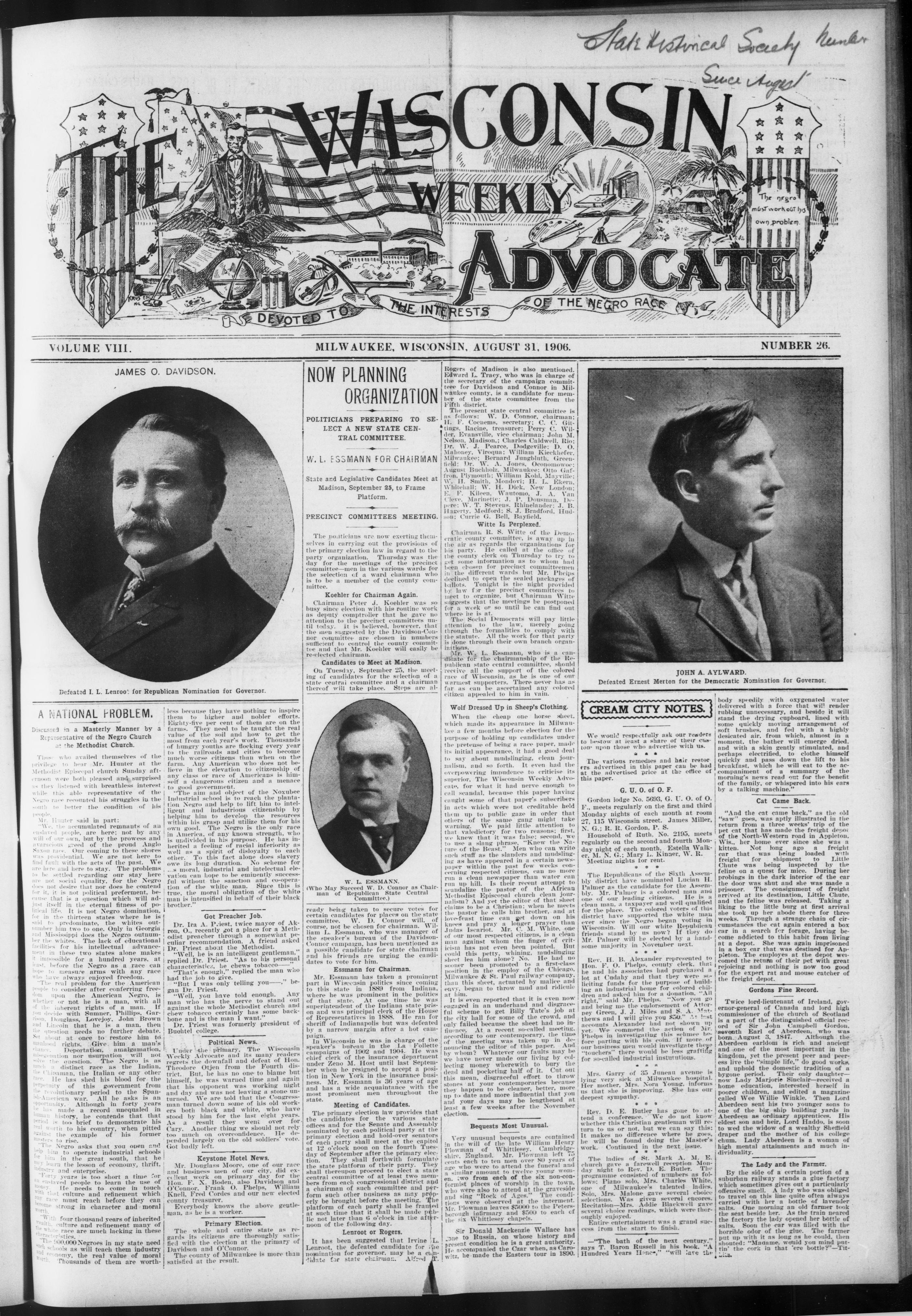
JAMES O. DAVIDSON.
Defeated L. L. Lenroo; for Republican Nomination for Governor
VOLUME VIII.
JAMES O.
Defeated I. L. Lenroot for Repu
A NATIONAL PROBLEM.
A NATIONAL PROBLEM.
Discussed in a Masterly Manner by a Representative of the Negro Church at the Methodist Church. Those who availed themselves of the privilege to hear Mr. Hunter at the Methodist Episcopal church Sunday afternoon were both pleased and surprised as they listened with breathless interest while this able representative of the Negro race recounted his struggles in the south to better the condition of his people.
Mr. Hunter said in part:
We, the accumulated remnants of an enslaved people, are here; not by any will of our own, but by the prowess and avaracious greed of the proud Anglo Saxon race. Our coming to these shores was providential. We are not here to find fault with the acts of the past. We are here and here to stay. The problems to be settled regarding our stay here are not social equality, for the Negro does not desire that nor does he contend for it, it is not political preferment, because that is a question which will adjust itself in the eternal fitness of political life. It is not Negro domination, for in the thirteen states where he is said to predominate, the whites outnumber him two to one. Only in Georgia and Mississippi does the Negro outnumber the whites. The lack of educational facilities for his intellectual advancement in these two states alone makes it impossible for a hundred years, at least, before the Negro as a race can hope to measure arms with any race who have always enjoyed freedom.
The real problem for the American people to consider after conferring freedom upon the American Negro, is whether or not he is a man, with all of the inherent rights of a man. If you decide with Sumner, Phillips, Garrison, Douglass, Lovejoy, John Brown and Lincoln that he is a man, then the question needs no further debate. Set about at once to restore him to manhood rights. Give him a man's chance. Deportation, amalgamation, misgregation nor usurpation will not solve the question. The Negro is as much a distinct race as the Indian, the Chinaman, the Italian or any other race. He has shed his blood for the perpetuity of this government from the revolutionary period to the Spanish-American war. All he asks is an opportunity. Although in forty years he has made a record unequaled in human history, he contends that that period is too brief to demonstrate his real worth to his country, when pitted against the example of his former masters to rise.
"The Negro asks that you open and help him to operate industrial schools for him in the great south, that he may learn the lesson of economy, thrift, industry and enterprise.
"Forty years is too short a time for an enslaved people to learn the use of money. He needs to come in touch with that culture and refinement which any race must reach before they can become strong in character and moral worth.
"With four thousand years of inherited wealth, culture and refinement many of the white race are much lacking in these characteristics.
"The 900,000 Negroes in my state need such schools as will teach them industry and economy, the real value of moral worth. Thousands of them are worth-
---
less because they have nothing to inspire them to higher and nobler efforts. Eighty-five per cent of them are on the farms. They need to be taught the real value of the soil and how to get the most from each year's work. Thousands of hungry youths are flocking every year to the railroads and cities to become much worse citizens than when on the farm. Any American who does not believe in the elevation to citizenship of any class or race of Americans is himself a dangerous citizen and a menace to good government.
"The aim and object of the Noxubee Industrial school is to reach the plantation Negro and help to lift him to intelligent and industrious citizenship by helping him to develop the resources within his grasp and utilize them for his own good. The Negro is the only race in America, of any known strength, who is undivided in his purpose. He has inherited a feeling of racial inferiority as well as a spirit of disloyalty to each other. To this fact alone does slavery owe its long duration. No scheme for ... moral, industrial and intellectual elevation can hope to be eminently successful without the sanction and co-operation of the white man. Since this is true, the moral obligation of the white man is intensified in behalf of their black brother."
Got Preacher Job.
Dr. Ira A. Priest, twice mayor of Akron, O., recently got a place for a Methodist preacher through a somewhat peculiar recommendation. A friend asked Dr. Priest about the Methodist.
"Well, he is an intelligent gentleman," replied Dr. Priest. "As to his personal characteristics, he chews tobacco——"
"That's enough," replied the man who had the job to give.
"But I was only telling you—," began Dr. Priest. "Well, you have told enough. Any man who has the nerve to stand out against the whole Methodist church and chew tobacco certainly has some backbone and is the man I want." Dr. Priest was formerly president of Buhtel college.
Political News.
Under the primary, The Wisconsin Weekly Advocate and its many readers regrets the downfall and defeat of Hon. Theodore Otjen from the Fourth district. But, he has no one to blame but himself, he was warned time and again that his opponent was working night and day and was not leaving a stone unturned. We are told that the Congressman turned down some of his old workers both black and white, who have stood by him for the last eight years. As a result they went over for Cary. Another thing we should not rely too much on overconfidence. He depended largely on the old soldiers' vote. Got badly left.
Keystone Hotel News
Mr. Douglass Moore, one of our race and business men of our city, did excellent work on primary day for the Hon. F. X. Boden, also Davidson and O'Connor, Frank O. Phelps, William Knell, Fred Cordes and our new elected county treasurer. Everybody knows the above gentleman, as he is a worker.
Primary Election.
The whole and entire state as regards its citizens are thoroughly satisfied with the election at the primary of Davidson and O'Connor. The county of Milwaukee is more than satisfied at the result.
MILWAUKEE, WISCONSIN, AUGUST 31, 1906.
POLITICIANS PREPARING TO SELECT A NEW STATE CENTRAL COMMITTEE.
State and Legislative Candidates Meet at Madison, September 25, to Frame Platform.
The politicians are now exerting themselves in carrying out the provisions of the primary election law in regard to the party organization. Thursday was the day for the meetings of the precinct committee—men in the various wards for the selection of a ward chairman who is to be a member of the county committee.
Koehler for Chairman Again.
Chairman Peter J. Koehler was so busy since election with his routine work as deputy comptroller that he gave no attention to the precinct committees until today. It is believed, however, that the men suggested by the Davidson-Connor committee are chosen in numbers sufficient to control the county committee and that Mr. Koehler will easily be re-elected chairman.
Candidates to Meet at Madison.
On Tuesday, September 25, the meeting of candidates for the selection of a state central committee and a chairman thereof will take place. Steps are al-
[Image of a man in a suit with a tie and a bow tie. The background is a solid black oval. The man's face is centered, and he has a serious expression. The image is in black and white.]]
(Who May Succeed W. D. Connor as Chairman of Republican State Central Committee.)
ready being taken to secure votes for certain candidates for places on the state committee. W. D. Connor will, of course, not be chosen for chairman. William L. Essmann, who was manager of the speaker's bureau of the Davidson Connor campaign, has been mentioned as a possible candidate for state chairman and his friends are urging the candidates to vote for him.
Essmann for Chairman
Mr. Essmann has taken a prominent part in Wisconsin politics since coming to this state in 1889 from Indiana, where he was prominent in the politics of that state. At one time he was superintendent of the Indiana state prison and was principal clerk of the House of Representatives in 1888. He ran for sheriff of Indianapolis but was defeated by a narrow margin after a hot campaign.
In Wisconsin he was in charge of the speaker's bureau in the La Follette campaigns of 1902 and 1904. He was chief clerk of the insurance department under Zeno M. Host until last September when he resigned to accept a position in New York in the insurance business. Mr. Essmann is 36 years of age and has a wide acquaintance with the most prominent men throughout the
Meeting of Candidates.
The primary election law provides that the candidates for the various state offices and for the Senate and Assembly nominated by each political party at the primary election and hold-over senators of each party shall meet at the capitol at 12 o'clock noon on the fourth Tuesday of September after the primary election. They shall forthwith formulate the state platform of their party. They shall thereupon proceed to elect a state central committee of at least two members from each congressional district and a chairman of such committee and perform such other business as may properly be brought before the meeting. The platform of each party shall be framed at such time that it shall be made public not later than 6 o'clock in the afternoon of the following day.
Lenroot or Rogers.
It has been suggested that Irvine L. Lenroot, the defeated candidate for the nomination for governor, may be a candidate for state chairman. Alfred J.
Rogers of Madison is also mentioned. Edward L. Tracy, who was in charge of the secretary of the campaign committee for Davidson and Connor in Milwaukee county, is a candidate for member of the state committee from the Fifth district.
The present state central committee is as follows: W. D. Connor, chairman; H. F. Cocnems, secretary; C. C. Gittings, Racine, treasurer; Perry C. Wilder, Evansville, vice chairman; John M. Nelson, Madison.; Charles Caldwell, Rio; Dr. W. J. Pearce, Dodgeville; D. O. Mahoney, Viroqua; William Kieckhefer, Milwaukee; Bernard Jungbluth, Greenfield; Dr. W. A. Jones, Oconomowoc; August Buchholz, Milwaukee; Otto Gafron, Plymouth; William Kohl, Mayville; W. H. Smith, Mondovi; H. L. Ekern, Whitehall; W. H. Dick, New London; E. F. Kileen, Wautomo, J. A. Van Cleve, Marinette; J. P. Dousman, Depere; W. T. Stevens, Rhinelander; J. B. Hagerty, Medford; S. J. Bradford, Hudson; Currie G. Bell, Bayfield.
Witte Is Perplexed
Chairman R. S. Witte of the Democratic county committee, is away up in the air as regards the organizations for his party. He called at the office of the county clerk on Thursday to try to get some information as to whom had been chosen for precinct committeeemen in the different wards but Mr. Phelips declined to open the sealed packages of ballots. Tonight is the night provided by law for the precinct committees to meet to organize, but Chairman Witte suggests that the meetings be postponed for a week or so until he can find out where he is at. The Social Democrats will pay little attention to the law, merely going through the formalities to comply with the statute. All the work for that party is done through their own branch organizations.
Mr. W. L. Essmann, who is a candidate for the chairmanship of the Republican state central committee, should receive all the support of the colored race of Wisconsin, as he is one of our warmest supporters. There never has as far as can be ascertained any colored citizen appealed to him in vain.
Wolf Dressed Up in Sheep's Clothing.
When the cheap one horse sheet, which made its appearance in Milwaukee a few months before election for the purpose of holding up candidates under the pretense of being a race paper, made its initial appearance, it had a good deal to say about mudslinging, clean journalism, and so forth. It even had the overpowering impudence to criticise its superior, The Wisconsin Weekly Advocate, for what it had nerve enough to call scandal, because this paper having caught some of that paper's subscribers in acts which were not creditable held them up to public gaze in order that others of the same gang might take warning. We paid little attention to that valedictory for two reasons; first, we knew that it was false; second, we to use a slang phrase, "Knew the Nature of the Beast." Men who can write such stuff as the slanders and mudslinging as have appeared in a certain newspaper within the past few weeks concerning respected citizens, can no more run a clean newspaper than water can run up hill. Is their recent attempt to scandalize the pastor of the African Methodist Episcopal church clean journalism? And yet the editor of that sheet claims to be a Christian; when he meets the pastor he calls him brother, and at love-feast time can get down on his knees and pray a longer prayer than Judas Iscariot. Mr. C. M. White, one of our most respected citizens, is a clean man against whom the finger of criticism has not even been pointed. But could this petty, whining, mudslinging sheet lea him alone? No. He had no sooner been promoted to a first-class position in the employ of the Chicago, Milwaukee & St. Paul railway company, than this sheet, actuated by malice and envy, began to throw mud and ridicule at him.
It is even reported that it is even now engaged in an underhand and disgraceful scheme to get Billy Tate's job at the city hall for some of the crowd, and only failed because the sheet had no influence. At a recent so-called meeting, according to our contemporary, the time of the meeting was taken up in denouncing the editor of this paper. And by whom? Whatever our faults may be we have never made our living by collecting money wherewith to bury the dead and pocketing half of it. Cut out this mean, disgraceful effort to throw stones at your contemporaries because they happen to be cleaner, better, more up to date and more influential that you and your days may be lengthened at least a few weeks after the November election.
Bequests Most Unusual.
Very unusual bequests are contained in the will of the late William Henry Plowman of Whittlesey, Cambridgeshire, England. Mr. Plowman left 75 cents each to ten men over 80 years of age who were to attend the funeral and a similar amount to twelve young women. two from each of the six non-conformist places of worship in the town, who were also to attend at the graveside and sing "Rock of Ages." The conditions were observed at the interment. Mr. Plowman leaves $5000 to the Petersborough infirmary and $500 to each of the six Whittlesey chapels.
Sir Donald Mackenzie Wallace has one to Russia, on whose history and present condition he is a great authority. He accompanied the Czar when, as Carowitz he made the Eastern tour in 1890.
JOHN A. AYLWARD.
Defeated Ernest Merton for the Democratic Nomination for Governor.
We would respectfully ask our readers to bestow at least a share of their custom upon those who advertise with us.
```markdown
```
The various remedies and hair restorers advertised in this paper can be had at the advertised price at the office of this paper.
G. U. O. of O. F.
Gordon lodge No. 5693, G. U. O. of O. F., meets regularly on the first and third Monday nights of each month at room 27, 115 Wisconsin street. James Miller, N. G.; R. R. Gordon, P. S. Household of Ruth, No. 2195, meets regularly on the second and fourth Monday night of each month. Estella Walker, M. N. G.; Mary L. Kinner, W. R.
* * *
The Republicans of the Sixth Assembly district have nominated Lucian H. Palmer as the candidate for the Assembly. Mr. Palmer is a colored man and one of our leading citizens. He is a clean man, a taxpayer and well qualified for the place. The colored voters of this district have supported the white man ever since the Negro began voting in Wisconsin. Will our white Republican friends stand by us now? If they do Mr. Palmer will be elected by a handsome majority in November next.
* * *
Rev. H. B. Alexander represented to Hon. F. O. Phelps, county clerk, that he and his associates had purchased a lot at Cudahy and that they were soliciting funds for the purpose of building an industrial home for colored children and asked him for a donation. "All right," said Mr. Phelps. "Now you go and bring me the endorsement of Attorney Green, J. J. Miles and S. A. Matthews and I will give you $50." At last accounts Alexander had not shown up yet. We commend the action of Mr. Phelps in investigating this schmee before parting with his coin. If more of our business men would investigate these "touchers" there would be less grafting for so-called industrial institutions.
六 六 六
Mrs. Garry of 35 Juneau avenue is lying very sick at Milwaukee hospital. Her mother, Mrs. Nora Young, informs us that she is improving. She has our deepest sympathy.
***
Rev. D. E. Butler has gone to attend a conference. We do not know whether this Christian gentleman will return to us or not, but we can say this: It makes no difference where he goes, he will be found doing the Master's work. Continued in the next issue.
The ladies of St. Mark A. M. E. church gave a farewell reception Monday night to Rev. D. E. Butler. The programme consisted of numbers as follows: Piano solo, Mrs. Charles White, one of Milwaukee's talented ladies, Solo, Mrs. Malone gave several choice selections. Was given several encores. Recitation—Mrs. Addie Blackwell gave several choice readings, which were thoroughly enjoyed.
Entire entertainment was a grand success from the start to finish.
— "The bath of the next century." says T. Baron Russell in his book, "A Hundred Years Hence," "will save the
NUMBER 26.
YLWARD.
Democratic Nomination for Governor.
body speedily with oxygenated water delivered with a force that will render rubbing unnecessary, and beside it will stand the drying cupboard, lined with some quickly moving arrangement of soft brushes, and fed with a highly desiccated air, from which, almost in a moment, the bather will emerge dried, and with a skin gently stimulated, and perhaps electrified, to clothe himself quickly and pass down the lift to his breakfast, which he will eat to the accompaniment of a summary of the morning's news read out for the benefit of the family, or whispered into his ears by a talking machine."
Cat Came Back
"And the cat came back," as the old "saw" goes, was aptly illustrated in the return from a three weeks' trip of the pet cat that has made the freight depot of the North-Western road in Appleton, Wis., her home ever since she was a kitten. Not long ago a freight car that was being loaded with freight for shipment to Little Chute was being inspected by the feline on a quest for mice. During her probings in the dark interior of the car the door was shut and she was made a prisoner. The consignment of freight arrived at its destination, Little Chute, and the feline was released. Taking a liking to the little burg at first arrival she took up her abode there for three weeks. Through a strange chain of circumstances the cat again entered a box car in a search for forage, having become addicted to this habit from living at a depot. She was again imprisoned in a box car that was destined for Appleton. The employes at the depot welcomed the return of their pet with great rejoicing and nothing is now too good for the expert rat and mouse catcher of the freight depot.
Gordons Fine Record
Twice lord-lieutenant of Ireland, governor-general of Canada and lord high commissioner of the church of Scotland is a part of the distinguished official record of Sir John Campbell Gordon, seventh Earl of Aberdeen, who was born August 3, 1847. Although the Aberdeen earldom is rich and ancient and one of the most important in the kingdom, yet the present peer and peeress live the "simple life," do good works, and uphold the domestic tradition of a bygone period. Their only daughter—now Lady Marjorie Sinclair—received a home education, interested herself in poorer children, and edited a magazine called Wee Willie Winkle. Then Lord Aberdeen sent his two younger sons to one of the big ship building yards in Aberdeen as ordinary apprentices. His eldest son and heir, Lord Haddo, is soon to wed the widow of a wealthy Sheffield draper and the mother of his college chum. Lady Aberdeen is a woman of high mental attainments and much individuality.
The Lady and the Farmer.
By the side of a certain portion of a suburban railway stands a glue factory which sometimes gives out a particularly offensive smell. A lady who was obliged to travel on this line quite often always carried with her a bottle of lavender salts. One morning an old farmer took the seat beside her. As the train neared the factory the lady opened her bottle of salts. Soon the car was filled with the horrible odor of the glue. The farmer put up with it as long as he could, then shouted: "Madame, would you mind puttin' the cork in that 'ere bottle?"—Titlits.
---
MILWAUKEE, WIS.
R. B. MONTGOMERY, Editor and Proprietor.
Mrs. Roper of Brooklyn Hangs Down ward, Swinging from Rope—Rescued by Performer on Trapeze.
MIDDLETOWN, N. Y., Aug. 30. Hanging head downward from a rapidly ascending balloon, Mrs. Roper of Brooklyn, a spectator of a balloon ascension at Ellenville, was carried nearly 1000 feet into the air yesterday while 10,000 horror stricken people expected to see her dashed to death every moment. The occasion was the Ulster county fair, and a large crowd had been attracted by the announcement that Miss Maggie Dailey, an amateur aeronaut of this city, would make an ascension.
The balloon was fully inflated, and Miss Dailey was sitting on the trapeze. The guy ropes were loosened. One of the ropes whirled into the crowd and the loop caught about Mrs. Roper. The balloon rose rapidly, carrying Mrs. Roper swinging head downward from the rope, and Miss Dailey sitting on the trapeze. Mrs. Roper gave one shriek of fright and then fainted.
The guy rope, which was fastened around Mrs. Roper's leg, hung from the top of the balloon, and she swung by Miss Dailey, describing great arcs in the air. Soon Miss Dailey was seen trying to grasp Mrs. Roper as the latter swung by her. She finally succeeded in getting hold of Mrs. Roper's hair. Then it was seen that the balloon was descending. Miss Dailey, still holding Mrs. Roper by the hair, leaped from the balloon with her when it was a few feet from the ground. She succeeded in throwing off the rope when the balloon again soared into the clouds and was lost to view.
AMERICANS ASK AID IN CUBA.
Insurgents Raid Estate and the State Department Receives a Protest.
WASHINGTON, D. C., Aug. 30. According to a dispatch received at the state department today from one of the American owners of the Constancia estate near Cienfuegos, Cuban insurgents raided this property four days ago taking a number of horses. The state department did not make public the name of the American who sent the dispatch. This is the first protest received from Americans against molestation of their interests.
Mr. Sleeper, the American charge at Havana, was cabled to demand of the Cuban government adequate protection for the Constancia estate and all American property similarly situated.
Several Small Battles.
HAVANA, Aug. 30. — A fight took place last night at Calabazar, Havana province, between fifty insurgents and fifteen rural guards, with the result that the latter retreated with one man wounded.
An engagement between insurgents and government troops is reported to have occurred last night near Artamisa, province of Pinar del Rio, near the Havana border. The result is not known.
Several exchanges of shots have been reported at various places westward of Guanajay, near the Havana border, in Pinar del Rio. As the place is poorly protected, reinforcements of fifty rural guards have been sent there.
A portion of Pino Guerra's force is stationed at Puerto Cortes, on the south coast, near San Juan de Martinez, which the government contemplates making a central point for sending men and supplies by water to Pinar del Rio, should communication by rail be interrupted. A train load of troops, which left Havana at 1 o'clock this morning, arrived safely at the city of Pinar del Rio. They were fired upon near Taco Taco and encountered scattered shots elsewhere, but the soldiers were unharmed.
Expects to End Insurrection.
Gov. Sobrdox, of the province of Pinar del Rio, who has just returned here from the United States, went to the provincial capital on the troop train. Previous to his departure the governor said he believed that he could enter into negotiations with the insurgents and settle matters within a week. His statement was received with incredulity.
BLOODY FIGHTS IN DOMINGO.
Revolutionists and Troops Meet in Desperate Rattles.
CAPE HAYTIEN, Aug. 30.—Advices from Santo Domingo say that after the insurgents had occupied Dajabon in the northern part of the country the government forces made an attack upon it and compelled the enemy to abandon the town, leaving Gen. Alejandro Marcadom and five men killed on the field. The government force lost eight killed. The revolutionists after leaving Dajabon marched on Jicaquita and further fighting followed, resulting in the revolutionists being defeated with severe loss. At Monte Cristi, on the north coast, Gen. Camacheo is besieged by revolutionists and is in an entrenched position and awaiting the arrival of reinforcements by sea.
FEVER AT PHILADELPHIA.
Yellow Jack on Board Vessel from Mexico—Quarantined at Quaker
PHILADELPHIA, Pa., Aug. 30. With the second mate suffering from what appears to be yellow fever, the British steamship Elswick Lodge, from Tampico, Mexico, via Norfolk, was placed in quarantine upon its arrival today at Delaware breakwater, Delaware, eighty miles below this city.
His Last Legal Opinion.
A souvenir postal card from Hudson, Mich., contains a picture of a monument in a cemetery, finished at the top with a pile of law books, and the following inscription on the face of the stone: "Fellow pilgrims, help in trouble, if you get it, comes from nature, humanity, knowledge, here on this ear—nowhere else. Think of it. L. R. Pierson, attorney-at-law, Hudson, Mich. No charges."—Case and Comment.
BANK MAY REOPEN SOON.
SUFFICIENT FUNDS PLEDGED TO PUT PHILADELPHIA TRUST COMPANY ON ITS FEET.
MAY END RECEIVERSHIP
Loans Made by President Hipple of Real Estate Trust Company Cause the Failure.
Condition of Company.
Total liabilities ..... $10,000,000
Value of quick assets..... 3,500,000
Doubtful collateral ..... 8,000,000
Total deposits ..... 7,500,000
Presbyterian church funds..... 1,000,000
City of Philadelphia..... 300,000
State deposits ..... 175,000
PHILADELPHIA, Pa., Aug. 29. At the conclusion of a protracted conference with the directors of the embarrassed Real Estate Trust company this afternoon, Receiver Earle said that in his estimation the receivership will be only temporary and that the bank will be able to resume business at an early day. He said it would take several days before he will be able to make a definite statement. He spoke optimistically and said he did not think the failure would prove to be as bad as it at first looked.
Regarding the condition of trusts in the custody of the company Mr. Earle said: "While 1 have not had an opportunity to examine the books I have every reason to believe that all trust funds are intact."
Thus far there has been no hint that securities deposited as collateral for loans were tampered with by the late President Hipple or that trust funds were misapplied. The hopeful view of Mr. Earle is shared by financial interests generally.
Bankers Raising Money.
It was reported that an effort was being made to help out the bank with the view to reopening it within forty-eight hours, but it was denied by the heads of the larger banks. Some directors, however, have not abandoned hope for accomplishing this object and have been using their personal influence with the object of rasing the required $3,500,000 to meet a similar amount subscribed by the Clearing House association yesterday and thus make up the deficiency of $7,000,000 in the bank's funds. One prominent banker subscribed $500,000 today and others are willing to advance large sums.
John H. Converse, one of the heads of the Presbyterian church and a director of the failed company is confident the
PHILADELPHIA, Pa., Aug. 29.—The wreck of the Real Estate Trust company was caused by President Hipple loaning $5,300,000 to Adolph Segal, the wizard speculator of the Quaker city. On securities worth at the most $500,000 let Segal have $5,300,000 of the bank's funds. These loans were the direct cause of the bank's failure, and, it is hinted, of Hipple's sudden death. Ater the first shock of amazement, friends of the dead president expressed the belief that Hipple was uncontrollably fascinated by Segal's schemes, some going so far as to say the promoter held some sort of hypnotic sway over the banker. On no other theory can they account for the vast loans made by Hipple on securities he must have known to be dangerously insecure.
church funds and investments are intact. Mr. Hipple was treasurer and custodian of these funds.
The bank's failure continues to be the sensation of the hour and is the general topic of discussion everywhere. A large but orderly crowd surrounds the building and except for an occasional outbreak from some excited individual is easily kept in check by the police. Receiver Earle this afternoon appeared in court and qualified as receiver. He filed a bond of $1,000,000 and immediately went to the company's office where he took charge and called the directors into conference.
Hipple Will Filed
The will of the late president, Frank K. Hipple, was filed today. The document was executed July 1, 1906, and is brief, being in Mr. Hipple's handwriting. It reads:
I, Frank K. Hipple, do hereby give, bequeath and devise all my estate, real, personal and mixed, unto my son, Frank W. Harton Hipple, his heirs and assigns, knowing that he will give one-half thereof unto his aunt Sallie, if she be living, and I hereby appoint my son to be the executor of this will.
The son qualified. The estate is valued as follows:
Personal property, $100,000 and upwards; real estate, $20,000.
Young Hipple Mobbed.
The son had a rough experience today when he emerged from the bank building. A man in the crowd saw him and shouted: "There goes the son of the rogue who said he has no faith in men who smoke cigars and chew tobacco." Immediately a mob took up the cry and made a rush for young Hipple. For a few moments it looked as though he would be roughly handled but the police succeeded in beating back the mob and rescuing the frightened man from its wrath. He was hustled into a carriage and taken away.
Banks Prepare for Runs
With the closing of the doors of the Trust company yesterday the officers and directors of banks who attended the Clearing House association meeting went to their respective institutions and took immediate steps to fortify them against any possible run which might follow the failure of the Real Estate Trust company. As a result every banking house in Philadelphia was prepared today to meet any demand made upon it. Although no institution other than the suspended company required assistance offers of aid were conveyed from bank to bank by the larger concerns. In each case they were declined although many banks wired their correspondents in other cities to forward immediately any balances due the local banks. As a consequence large sums of money arrived here today.
Young Hipple Sticks to His Desk.
A distressing feature of the disclosures regarding President Hipple was the crushing blow that fell upon F. Wharton Hipple, son of the dead man. Young Hipple is employed as clerk by the Real Estate Trust company, and all day yesterday while rumors were flying about reflecting upon his father's name he stuck manfully to his desk.
The local stock market showed some recovery at the opening today from the drop which followed the announcement of the bank's failure yesterday. Lehigh Valley railway, which fell $3 yesterday recovered a part of the loss and so did United Gas Improvement, Cambria Steel, Pennsylvania Railway and Reading railway.
CORONER ADMITS THAT RUINED PHILADELPHIA BANKER TOOK HIS OWN LIFE.
HE CONCEALED SUICIDE.
Did Not Want to Injure the Real Estate Trust Company-Wife Found Dead Man.
PHILADELPHIA, Pa., Aug. 30. The suspicion entertained that Frank K. Hipple, president of the embarrassed Real Estate Trust company, who was found dead at his home in Bryn Mawr last Friday, committed suicide, was confirmed today by Joseph N. King, coroner of Montgomery county.
Blew Out His Brains.
When he made the announcement Dr. Albert H. Read, the coroner's physician, was standing near and he added: "You can say that Mr. Hipple blew out his brains." Since the death of Mr. Hipple the family physician and the coroner maintained that he died of cerebral hemorrhage while taking a bath.
The Coroner's Statement.
The coroner today said.
"When I went to Bryn Mawr Friday morning to investigate the sudden death of Mr. Hipple I found that he was the president of a trust company and when I discovered he had committed suicide I decided to suppress the fact for a few days in order to prevent a run on the
Creditors to Take Stock.
PHILADELPHIA, Pa., Aug. 30. Receiver Earle of the failed Real Estate Trust company, said that the plan for the reorganization of the company was to ask the creditors to take preferred stock in the trust company for their claims, and appoint their own officers in the company. This, he felt assured, would give the creditors their only chance to get back their money dollar for dollar. Mr. Earle has discovered that a large asset of the trust company, which it was supposed was not very good, really was backed by names perfectly good, and which could be realized on. This asset is said to be $250,000 in value.
trust company. I thought that if there was anything wrong in Mr. Hipple's transactions the directors would have a chance to make up whatever deficits there were."
His Action Voluntary.
"Did any of the directors of the bank or members of the family request that the facts of the suicide be suppressed?" "No, siu, they did not. Any action taken by me was voluntary. "Several men prominent in legal affairs told me today that I did right in suppressing the facts until the directors of the bank had a chance to make an investigation."
Discovers the Suicide.
The coroner also stated that when he arrived at the Hipple residence last Friday he was met by the son of the deceased. The young man did not at first say that his father had committed suicide. It did not take the coroner long to discover the cause of death. Hipple had placed the muzzzzle of a 38-caliber revolver in his mouth and shot himself. The ball passed upward and lodged in his brain. The shooting took place in the bathroom.
Foun.. by His Wife
The suicide arose shortly before 6 o'clock and Mrs. Hipple was of the opinion that her husband was taking a bath. When he did not return to his room inside of half an hour. Mrs. Hipple became alarmed and made an investigation. She found her husband lying on the floor in the bath room. Mrs. Hipple was not aware that her husband had killed himself until the arrival of the family physician.
Open Hipple's Strong Box.
Now that Receiver Earle has taken charge of the Real Estate Trust company, it is expected that many matters in the affairs of the company that are not clear to the directors will soon be explained. Among the first things to be done will be the opening of the strong box which belonged to the late Mr. Hipple. No one, not even his family, it is said, knows what it contains, but it is hoped by the receiver that its contents be such as to be of some aid to the receiver in straightening out the affairs of the company. Whether Mr. Hipple carried life insurance is not known to the directors of the company, and all information on that subject is refused by the family.
Thinks Trust Funds Safe
The receiver reiterated today to many anxious inquirers that on a hurried examination of books and papers he feels quite certain that all securities and trust funds not belonging directly to the trust company itself are intact. The company had charge of trust funds and estates valued at more than $26,000,000 and the beneficiaries of many of these have been clamoring ever since the company closed its doors for positive information as to the security of these trusts. Most of them now feel assured that President Hipple did not tamper with anything other than the money belonging to the company.
May Operate Segal Properties
There is a plan to operate the numerous enterprises promoted by Adolph Segal, who borrowed more than $5,000,000 from President Hipple to carry on his operations. There is a report current that Segal has a plan to help the company and that he intends to offer what property he has to help the institution out of his difficulties. This, however, lacks confirmation. Segal will not talk on that proposition.
There is much speculation in financial circles as to the identity of the persons other than Segal who borrowed money from the Real Estate Trust company. The directors of the company refuse to make the names public for the reason that the transactions were regular and the loans amply protected. The failure was due entirely, it is said to the loans to Segal.
KILLS TWO AND SELF.
Kansas Man, After Firing at Companions, Turns Gun on Self—Quarrel Over an Estate Responsible.
LA CROSSE, Kas., Aug. 30.—As the result of a quarrel over the settlement of an estate at McCrackeu, seventeen miles west of here, last night, Omar Young shot and killed Alexander Walker, Jr., and Grant Pettyjohn. Young then started for his home at Alexander, and when two miles out of town shot himself.
POLICYHOLDERSTOSTAY
MANDAMUS DENIED IN MUTUAL LIFE CASE.
State Superintendent Cannot Remove Four Men from "Administration Ticket" of Insurance Trustees.
ALBANY, N. Y., Aug. 30.—The decision of the lower court denying the application for a mandamus compelling the state superintendent of insurance to remove from the "administration ticket" for trustees of the Mutual Life Insurance company the names of four members of the international policy holders' committee was affirmed today by the appellate division of the supreme court. The case came before the appellate division on appeal of Col. A. M. Shook of Nashville, in behalf of himself and his associates on the policy holders' committee, Judge George Gray of Delaware, Gen. B. F. Tracy of New York, and Harlow N. Higginbotham, of Chicago. An appeal will doubtless be taken
An appeal will doubtless be taken to the court of appeals.
The Equitable Life Assurance society and its directors, according to a decision by Justice Bischoff in the supreme court today, must defend the suit brought against them by State Attorney General Meyer to compel an accounting as to the management and disposition of the funds and property of the society. The suit also demands that the directors be compelled to repay any of the society's money which may have been lost or wasted by a violation of the duties of the directors. In addition the attorney general's suit also asks that any defendant now a director or officer in the society shall be removed upon proof of misconduct.
ARMY WILL SEE MANY CHANGES.
President to Take Up Matter of Filling Important Vacancies Soon
WASHINGTON, D. C., Aug. 30.—As soon as the naval maneuvers are over at Oyster Bay, it is expected that President Roosevelt will take up the matter of filling important vacancies that are to occur in the army.
Licut. Gen. Corbin will retire September 16, and it is already known that he is to be succeeded by Maj. Gen. MacArthur, now commanding the Pacific division. The vanacy in the list of major generals will be filled by the promotion of Brig. Gen. Jesse M. Lee. There has been a warm contest over the succession to the brigadier general vacancy. Capt. John J. Pershing, military attache at the American embassy in Japan is among those mentioned in this connection.
Changes in Pay Corps.
Paymaster General Dodge will retire September 11. Col. Towar, who is a senior colonel of the pay corps, will waive his place in favor of Col. Sniffin for the paymaster generalship if assured that it would not prejudice his chances for the place when Col. Sniffin reaches the retiring stage. Col. Sniffin was private secretary to President Grant, who later appointed him major in the pay corps. Other officers have friends who have urged their selection.
Train in Finger Prints.
Forty enlisted men from various army posts throughout the eastern part of the United States will be ordered to the war department in Washington in a short time for instruction in taking finger prints and in photography, preparatory to carrying out the new identification plans for the army. It is the purpose of the department to have at least one man at every post who is familiar with the finger print and photographic work. One squad of men has already been trained in the work. The men detailed to Washington will remain here about a week.
DELAY MAIL CAR IDEA.
American Federation of Labor Secures Postponement of Proposed Service for Milwaukee.
WASHINGTON, D. C., Aug. 30. The activity of the American Federation of Labor is directed toward another field of government operations. Now it is supposed that organized labor shall oppose the constant and effective delivery of United States mails during strikes. This proposition is squarely before Postmaster General Cortelyou in the form of a protest, originated by the Federated Trades council of Milwaukee, against the utilization of street cars for the carriage of the mails, unless the contract shall contain a clear and specific provision that such arrangements shall cease to be binding in the event of a strike of railway employees. This interesting proposition hit the postoffice officials hard. It may result in an indefinite postponement of the introduction of the street car mail service in Milwaukee.
FIND BOMB ON SHIP.
Infernal Machine is Discovered in Hold of Vessel at Philadelphia—Explodes When Thrown Into Water
PHILADELPHIA, Pa., Aug. 30. An infernal machine was discovered yesterday in the hold of the steamer Eagle Point as the vessel lay in the Delaware river at the Philadelphia & Reading railroad grain elevator. The steamer was saved from destruction by a fraction of a second, as the bomb exploded as it touched the water after being thrown overboard. The Eagle Point is one of the vessels of the Philadelphia Transatlantic line and plies between this city and London. It is hinted that a former member of the crew, who felt that he had a grievance against Capt. Robertson, placed the bomb on the vessel.
PROBE ROOSEVELT CLUB.
President Orders an Investigation with View to Issuance of Fraud Order Against It.
OYSTER BAY, N. Y., Aug. 30.--The Roosevelt Home club of New York city is to be investigated by the postoffice department at the express request of President Roosevelt, with a view to issuing a fraud order against it.
The object of the club as set forth in a circular issued August 14, issued by Roderick Kett, who signs himself as president of the club, is to solicit funds for the purchase of the house at 23 East Twentieth street, New York city, where President Roosevelt was born. It has been ascertained that 60 per cent. of contributions received were to go towards maintaining the club. It is on this ground that the President believes that a court order will lie.
HE WANTS TO BE BOSS.
STOLYPIN ASKS CZAR TO CONFER DICTATOR POWERS ON THE CABINET.
MUST HAVE FREE HAND.
If Russian Court Reactionary Influences Continue Monarchy Will Be Overthrown
ST. PETERSBURG, Aug. 30.—It is asserted that Premier Stolypin and his colleagues are employing the newspapers which they control to fight the court camarilla. This, it is said, is the secret of the Novoe Vremya's constant references during the last few days to the necessity for protecting the cabinet from the interference of pernicious court influences.
M. Stolypin, in conversation with friends, is said to have declared that he is continually subjected to embarrassment, adding that he was convinced that the task which he had set himself was impossible unless the Emperor gave him an absolutely free hand, in other words, conferred upon the cannot a practical dictatorship.
Dictatorship for Cabinet.
An intimation comes from a high source that the premier broached the subject last night at the first audience which he had with the Emperor since the tragedy of August 25 when the explosion of a bomb at the premier's residence caused the loss of over thirty lives. In the above mentioned conversation with friends the premier is alleged to have said that history seemed to be repeating itself, the situation closely resembles the closing days of the reign of Alexander II.
Reactionary Spirit Growing.
The reactionary spirit was growing rapidly. Nevertheless he considered it vital that the government should not take a reactionary path. If it did not do so he felt confident the measure which the cabinet projected would result in a majority of moderates being elected to Parliament as against the extremists on the left, whose aim was to overthrow the monarchy and establish a republic.
Judge Is a Revolutionist.
KIEV, Russia, Aug. 30.—A perquisition at the residence of M. Kinninko, who is an examining magistrate for political crimes here, has led to the startling discovery that he was a member of the revolutionary organization and that his residence was the headquarters for the propaganda in this vicinity.
Murderer. Not a Terrorist.
TIEN TSIN, Aug. 30.-M. Laptew, the Russian consul here, who was shot yesterday by a Russian contractor, a certain Levinsky, died at 2 o'clock this morning. The murderer is not a revolutionist.
An imperial ukase today authorizes the minister of finance to issue $25,000,-000 in 4 per cent. rates to cover the expenses of the relief of the districts affected by the failure of the crops.
Another ukase prolongs martial law, where it has already been enforced, for another year.
Mohammedan Congress Meets.
NIZNINOVGOROD, Russia, Aug. 30.—A congress of 800 representatives of the Mohammedan population of Russia, which numbers 15,000,000, opened here today under the presidency of M. Topchibasheff, who was a member of the late parliament. Many interesting questions connected with religion and education are on the programme.
To End Race War.
ERVANA, Russia, Aug. 30.—The first general conference of Armenians opened today at the Ethemiadzine monastery, which is the seat of the Armenian Catholic patriarch. The principal subject for discussion is the question of the reorganization of the schools in consequence of the restoration of the Armenian church property by the Russian government, but the most important action of the congress is likely to be in connection with measures for ending the race war between the Armenians and Tartars.
CALLS PACKERS TO TIME.
Must Repack All Lard Packages So That Public Is Not Given Short Weight.
CHICAGO, Ill., Aug. 30.—City Sealer Joseph Grein today issued an ultimatum to the packers at the stock yards, butter factories and wholesale and retail dealers in lard and butter, declaring that the public must be given full weight in all packages of lard and butter, or the city will prosecute them in hundreds of cases in which it has secured evidence against them. The ordinance calls for a fine of $100, on every package of lard or butter in which the weights are short. The dealers and makers of lard and butter will be given until next Tuesday to repack all the packages in their possession. If they are not repacked by that time he will proceed against the dealers. The firms accused by the city sealer are:
ANGLO-AMERICAN PROVISION COMPANY.
OMAHA PACKING COMPANY.
HAMMOND PACKING COMPANY.
BOYD & LUNHAM COMPANY.
SCHWARZSCHILD & SULZBERGER & CO.
AGAR PACKING COMPANY.
VETTA & ZUNKER.
ARNOLD BROTHERS.
The most surprising thing uncovered was that cans containing about four pounds of lard were sold for full five-pound cans. This sort of cheat has been going on for years and though repeated protests have been made both by the retail dealers and the consumers it has gone unchecked up to yesterday, when suits were instigated against a number of packing concerns on the ground that they gave short weight.
BUYING CANAL CEMENT.
Foreigners May Get Big Contract Unless Shipping Facilities Improve So Americans Can Compete. WASHINGTON, D. C., Aug. 30. Chief Engineer Stevens, in computing the amount of cement to be necessary for the Panama canal, said that to assemble the amount needed would require 125 carloads a day for two years. This would amount to 91,250 carloads. It is not unlikely that the greater part of this contract may be given to foreign dealers
The Association of Cement Manufacturers of the United States, however, has shown considerable activity in getting more advantageous shipping facilities to the isthmus and may therefore be prepared to compete with foreign cement. The cement can be purchased cheaper in England.
HALTS CHEAP GAS WAR
Chicago Capitalists Fail to Accept Franchise Offered by Kansas City—Negotiations Are Suspended.
KANSAS CITY, Mo., Aug. 30.—Kansas City's fight for cheap gas failed, at least temporarily, when negotiations with representatives of the Kansas City Gas company, now holding a franchise to furnish the city with artificial gas at $1.10 a thousand, ended last night.
Twenty days ago the city council granted a syndicate of Chicago capitalists a franchise to furnish the city with natural gas at 25 cents a thousand feet for domestic use and at 10 cents for manufacturing purposes. The time given the company in which to accept this franchise ended yesterday and they declined the offer.
TO BREAK CAR STRIKE.
San Francisco Company Prepares Barn to House Mcn—Union Offers a Modified Proposition.
SAN FRANCISCO, Cal., Aug. 30. President Cornelius, of the union, has issued a statement containing a proposition for settling the street railway strike by arbitration. Cornelius says that the car men will return to work with the understanding that they are to receive $3 a day and that the number of hours which shall constitute a day, and all other questions between the men and the company shall be left to a joint arbitration committee for settlement.
One thousand blankets were taken into the McAlister street-car barn yesterday and the work of preparing the principal car barns for the housing of the strike breakers, who are to reach here Saturday, is being pushed rapidly.
STANDING OF BASEBALL CLUBS.
American Association.
W. L. Pc. W. L. Pc.
Columbus .81 50.619 Kansas Cr. 64 66.492
Milwaukee .74 58.561 Louisville .62 69.473
Toledo .69 60.534 St. Paul. .58 71.450
Minn'polis .68 63.519 Ind'napolis .46 85.351
American League.
W. L. Pc. W. L. Pc.
Chicago .69 46.600 St. Louis. .62 55.50
New York .63 47.572 Detroit .54 59.478
Philadelp'a .65 49.570 Wash'gton .45 68.398
Cleveland .62 57.549 Boston .36 81.308
National League.
W. L. Pc. W. L. Pc.
Chicago .90 31.744 Cincinnati .51 69.425
Pittsburg .75 42.641 Brooklyn .45 69.355
New York .73 41.640 St. Louis. .53 77.355
Philadelp'a .53 64.453 Boston .30 81.325
LATEST MARKET REPORTS
MILWAUKEE, AUGUST 30. EGG AND DAIRY PRODUCTS.
MILWAUKEE—Eggs—Market firm. The produce board's official market is 16@17c as to quality for current receipts, at mark, cases returned; strictly fresh, candled, cases returned, 18@18½c; second and checks, 10c Butter—Market firm. Elgin price on extra creamery is 23c. Local price extra creamery, 23c; prints, 24c; firsts, 19½@20½c; seconds, 16@18½c; renovated, 17c; dairy, fancy, 18c; lines, 15@16c; packing stock, 14@15c. Cheese—Firm. American full cream twins, 11½@11½c; limburger, new, 9½@10½c fancy brick, 10½@11c; low grades, 6½@17c imported Swiss, 26c; new, block, 13¼@14c new round Swiss, 13½@14c; Sapsago, 18c daisies, 12½@12½c; Longhorns, 12½@12½c Young Americas, 12@12½c.
MILWAUKEE STOCKYARDS REPORT
HOGS—Market 5c lower; light, mixed 6.00@6.20; fair to choice medium, 6.00@6.30; heavy packers, 5.50@5.75; rough sows, 5.25@5.50; coarse stags, 5.25@5.50.
CATTLE — Market is steady; calves lower; butchers' steers, medium to good, 1050 to 1300 lbs, 4.50@5.00; fair to medium, 950 to 1050 lbs, 3.75@4.50; heifers common, 2.50@3.00; good, 3.50@4.25; cows, fair to good, 2.75@3.75; canners, 1.25@2.00; cutters, 2.25@2.50; bulls, common, 2.25@2.50; choice, 2.75@3.40; feeders, 3.00@3.50; stockers, 2.50@3.00. Veal calves, common to choice, 4.50@7.50; heavy, 3.00@4.00. Milkers and springers—Demand limited to few choice cows at 30.00@45.00; common unsaleable.
SHEEP — Market is steady: 3.00@4.00; lambs, 4.50@5.50; spring lambs, steady, 5.00@6.75.
MILWAUKEE HAY MARKET
Choice timothy hay, 14.25@14.76; No. 1 timothy hay, 13.50@14.00; No. 2 timothy hay, 10.00@11.50; clover and mixed, 8.00@10.00; choice Kansas and Nebraska prairie, 11.00@12.00; No. 1 prairie, 10.00@10.50; No. 2 prairie, 8.00@9.00; Wisconsin prairie, 7.50@8.00; packing hay, 6.50@7.00; rye straw, 6.00@6.25; oats, straw, 4.50@5.00; wheat straw, 4.50.
MARKETS BY TELEGRAPH
MILWAUKEE, Aug. 30.—Close. Wheat-
Steady; No. 1 northern, on track, 78c; No. 2
northern, on track, 77c. Corn—Higher; No. 3
on track, 50%c. Oats—Firm; standard,
31c; No. 3 white, on track, 29@30%c. Barley—Steady; standard, 54c; sample on track,
38@54c. Rye—Firm; No. 1 on track, 50%c.
Provisions—Steady; pork, 16.95; lard, 8.76.
Four quotations in carloads are: Hard
spring wheat patents, in wood, 4.00@4.20;
straight, in wood, 3.80@4.00; export patents,
in sacks, 3.40@3.50; first clear, in sacks,
3.00@3.15; rye, in wood, 3.20@3.30; country
2.70@2.85; in sacks. Kansas straights, in
wood, 3.55@3.60.
Millstuffs are quoted in carlots at 14.75 for bran, 17.00 for standard middlings and 19.50@19.75 for Milwaukee flour middlings in 100-lb sacks; red dog, 22.00; rye feed, 17.00; delivered at country points, 50c extra. CHICAGO, Ill., Aug. 30.-Close-Wheat-September, 70%c; December, 73%c. Corn-September, 43%c; December, 43%c. Oats-September, 29%c; December, 31c. Pork-September, 16.90; January, 13.45. Lard-September, 8.77%c; October, 8.87%c. Ribs-September, 8.80@8.82%c; October, 8.72%c. Rye-Cash, 57@58c; September, 55%c. Barley-Cash, 37@52c; No. 3, September, 43%c. Flax-Nothing doing. Timothy-September, 3.95@4.00.
NEW YORK, Aug. 30.-Close-Wheat-September, 78%c; December, 81%c; May, 84c. Corn-September, 56%c; December, 52%c; May, 52c.
KANSAS CITY, Mo., Aug. 30.—Close
Wheat—September, 63%c; December, 66%c;
May, 71%c; cash No. 2 hard, 66%c@68%c; No.
3, 65@66c; No. 2 red, 68c; No. 3, 65@66c
Corn—September, 42%c; December, 39%c;
May, 39%c; cash No. 2 mixed, 44%c; No. 2
white, 46%c@46%c. Oats—No. 2 white, 58%
@32c.
DULUTH, Minn., Aug. 30.—Close—Wheat
—To arrive, new No. 1 northern, 74%c; old
No. 1 northern, 77%c; No. 2 northern, 75%c;
on track. No. 1 northern, 77%c; No. 2 nor-
thern, 75%c; September, 74%c; October, 72%c
December, 72%c; May, 77%c. Flax—To ar-
rive and on track, 1.13; September, 1.12;
October, 1.10%c; December, 1.09%c. Oats
—On track, 30c; new oats, to arrive, 29c; old
oats, to arrive and August, 29c. Rye, 53c
Barley, 34@45c. Receipts—Wheat, 11,800
shipments, wheat, 131 571.
ST. LOUIS, Mo., Aug. 30.—Close—Wheat-
Futures, lower; cash steady; track. No. 2
red, cash, 70½@72c; No. 2 hard, 70@73c;
September, 68½c; December, 71½c. Corn-
Firm; No. 2 cash, 47½@48c; September,
46½c; December, 41½c; No. 2 white, 50c;
Oats—Firm; No. 2 cash, 30½c; September,
30½@30¼c; December, 31½c; No. 2 white,
32½c.
MINNEAPOLIS, Minn., Aug. 30.—Close—
Wheat—September, 71c; December, 72½
72½c; May, 76½@76½c; No. 1 hard, 76½c;
No. 1 northern, 75½c; No. 2 northern, 73½c;
No. 3 northern, 71½@72c.
KANSAS CITY, M6., Aug. 30.—Cattle-Receipts, 7000; market steady and active; native steers, 4.00@6.25; southern steers, 2.90@3.90; southern cows, 2.00@3.00; native cows and helfers, 2.00@4.83; stockers and feeders, 2.60@4.50; bulls, 2.00@3.00; calves, 3.00@6.00; western steers, 3.40@5.25; western cows, 2.00@4.00. Hogs—Receipts, 5000; market weak to 52 lower; bulk of sales, 5.90@6.20; heavy, 5.90@6.05; packers, 6.00@6.20; pigs and lights, 6.00@6.25. Sheep—Receipts, 5000; market steady; nuttows, 4.50@5.50; lambs, 6.00@7.40; range wethers, 4.90@5.60; ewes, 4.50
It is a cruel plan which shuts off the air almost entirely from the hen with a brood of chicks by placing a board in front of the coop at night; nor is such a plan necessary if one will take the trouble to build a coop or coops after the following plan. Build the coop after the usual plan, sloping the roof to the rear and covering the front with slats except at one lower corner, where a door should be arranged, so that the hen can be easily let out when desired. To solve the problem of plenty of fresh air and at the same time feredom from prowling small animals, construct a screen; make the frame large enough completely to cover the front of the coop and cover it with wire netting; at either side fasten a strap with a hole in the end, and on the sides of the coop
I
G
3
3
B
2
A
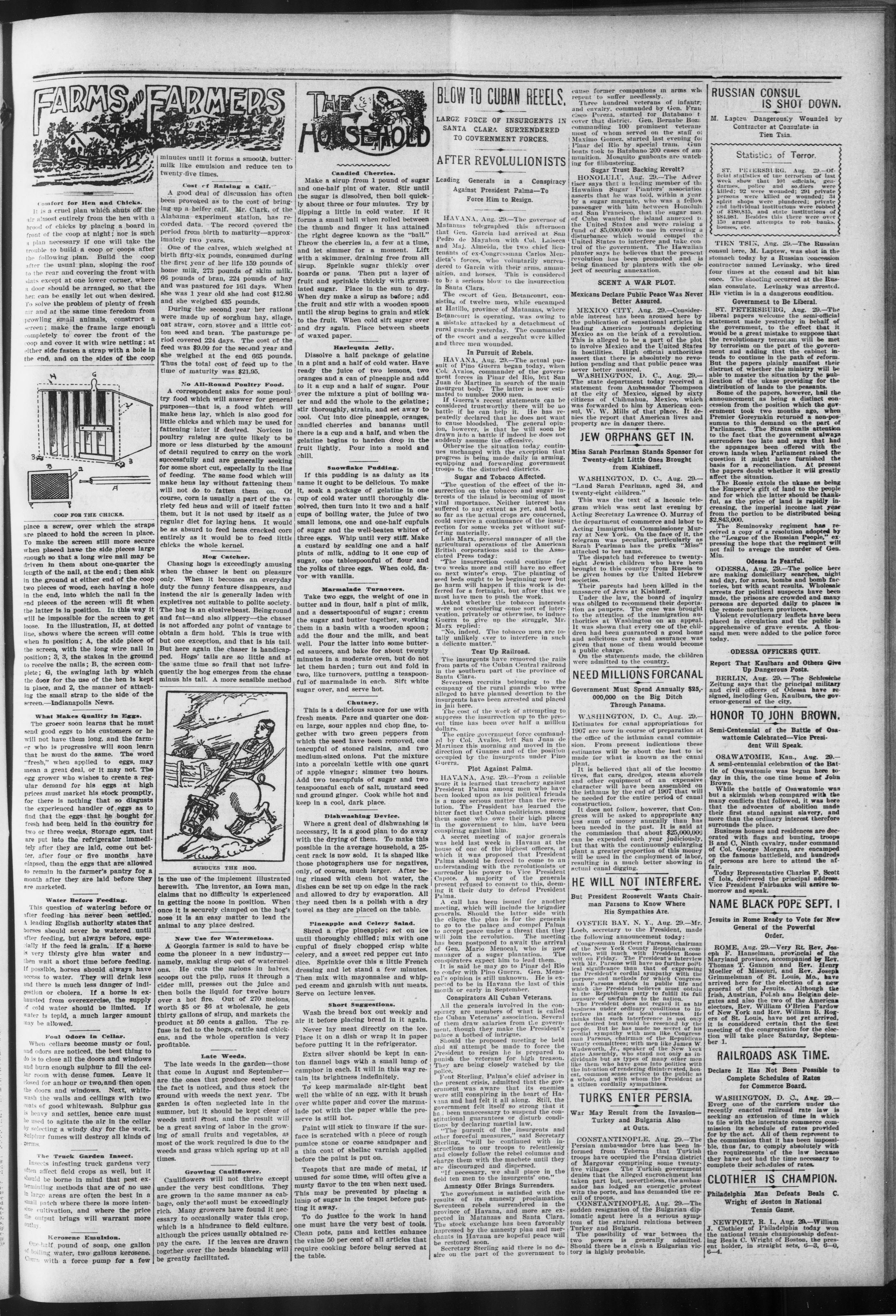
COOP FOR THE CHICKS.
place a screw, over which the straps are placed to hold the screen in place. To make the screen still more secure when placed have the side pieces large enough so that a long wire nail may be driven in them about one-quarter the length of the nail, at the end; then sink in the ground at either end of the coop two pieces of wood, each having a hole in the end, into which the nail in the end pieces of the screen will fit when the latter is in position. In this way it will be impossible for the screen to get loose. In the illustration, H, at dotted line, shows where the screen will come when in position; A, the side piece of the screen, with the long wire nail in position; 3, 3, the stakes in the ground to receive the nails; B, the screen complete; G, the swinging lath by which the door for the use of the hen is kept in place, and 2, the manner of attaching the small strap to the side of the screen.—Indianapolis News.
What Makes Quality in Eggs.
What Makes Quality in Eggs.
The grocer soon learns that he must send good eggs to his customers or he will not have them long, and the farmer who is progressive will soon learn that he must do the same. The word "fresh," when applied to eggs, may mean a great deal, or it may not. The egg grower who wishes to create a regular demand for his eggs at high prices must market his stock promptly, for there is nothing that so disgusts the experienced handler of eggs as to find that the eggs that he bought for fresh had been held in the country for two or three weeks. Storage eggs, that are put into the refrigerator immediately after they are laid, come out better, after four or five months have elapsed, than the eggs that are allowed to remain in the farmer's pantry for a month after they are laid before they are marketed.
Water Before Feeding.
This question of watering before or after feeding has never been settled. A leading English authority states that horses should never be watered until after feeding, but always before, especially if the feed is grain. If a horse is very thirsty give him water and then wait a short time before feeding. If possible, horses should always have access to water. They will drink less and there is much less danger of indigestion or cholera. If a horse is exhausted from overexercise, the supply of cold water should be limited. If water is tepid, a much larger amount may be allowed.
Foul Odors in Cellar:
When cellars become musty or foul, and odors are noticed, the best thing to do is to close all the doors and windows and burn enough sulphur to fill the cellar room with dense fumes. Leave it closed for an hour or two, and then open the doors and windows. Next, whitewash the walls and cellings with two coats of good whitewash. Sulphur gas is heavy and settles, hence care must be used to agitate the air in the cellar by selecting a windy day for the work. Sulphur fumes will destroy all kinds of germs.
The Truck Garden Insect. Insects infesting truck gardens very often affect field crops as well, but it should be borne in mind that pest extermining methods that are of no use in large areas are often the best in a small patch where there is more intensive cultivation, and where the price the output brings will warrant more outlay.
One-half pound of soap, one gallon of boiling water, two gallons kerosene. Churn with a force pump for a few
minutes until it forms a smooth, buttermilk like emulsion and reduce ten to twenty-five times.
Cost of Raising a Calf.
A good deal of discussion has often been provoked as to the cost of bringing up a heifer calf. Mr. Clark, of the Alabama experiment station, has recorded data. The record covered the period from birth to maturity—approximately two years.
One of the calves, which weighed at birth fifty-six pounds, consumed during the first year of her life 159 pounds of home milk, 273 pounds of skim milk, 66 pounds of bran, 224 pounds of hay and was pastured for 161 days. When she was 1 year old she had cost $12.86 and she weighed 435 pounds.
During the second year her rations were made up of sorghum hay, silage, oat straw, corn stover and a little cotton seed and bran. The pasturage period covered 224 days. The cost of the feed was $9.09 for the second year and she weighed at the end 665 pounds. Thus the total cost of feed up to the time of maturity was $21.95.
No All-Round Poultry Food. A correspondent asks for some poultry food which will answer for general purposes—that is, a food which will make hens lay, which is also good for little chicks and which may be used for fattening later if desired. Novices in poultry raising are quite likely to be more or less disturbed by the amount of detail required to carry on the work successfully and are generally seeking for some short cut, especially in the line of feeding. The same food which will make hens lay without fattening them will not do to fatten them on. Of course, corn is usually a part of the variety fed hens and will of itself fatten them, but it is not used by itself as a regular diet for laying hens. It would be as absurd to feed hens cracked corn entirely as it would be to feed little chicks the whole kernel.
Hog Catcher.
Chasing hogs is exceedingly amusing when the chaser is bent on pleasure only. When it becomes an everyday duty the funny feature disappears, and instead the air is generally laden with expletives not suitable to polite society. The hog is an elusive beast. Being round and fat—and also slippery—the chaser is not afforded any point of vantage to obtain a firm hold. This is true with but one exception, and that is his tail. But here again the chaser is handicapped. Hogs' tails are so little and at the same time so frail that not infrequently the hog emerges from the chase minus his tail. A more sensible method
A man riding a pig.
is the use of the implement illustrated herewith. The inventor, an Iowa man, claims that no difficulty is experienced in getting the noose in position. When once it is securely clamped on the hog's nose it is an easy matter to lead the animal to any place desired.
New Use for Watermelons.
A Georgia farmer is said to have become the pioneer in a new industry—namely, making sirup out of watermelons. He cuts the melons in halves, scoops out the pulp, runs it through a cider mill, presses out the juice and then boils the liquid for twelve hours over a hot fire. Out of 270 melons, worth $5 or $6 at wholesale, he gets thirty gallons of sirup, and markets the product at 50 cents a gallon. The refuse is fed to the hogs, cattle and chickens, and the whole operation is very profitable.
Late Weeds.
The late weeds in the garden—those that come in August and September—are the ones that produce seed before the fact is noticed, and thus stock the ground with weeds the next year. The garden is often neglected late in the summer, but it should be kept clear of weeds until frost, and the result will be a great saving of labor in the growing of small fruits and vegetables, as most of the work required is due to the weeds and grass which spring up at all times.
Growing Cauliflower.
Cauliflowers will not thrive except under the very best conditions. They are grown in the same manner as cabbage, only the soil must be exceedingly rich. Many growers have found it necessary to occasionally water this crop, which is a hindrance to field culture, although the prices usually obtained repay the care. If the leaves are drawn together over the heads blanching will be greatly facilitated.
THE HOUSEHOLD
Candied Cherries.
Make a sirup from 1 pound of sugar and one-half pint of water. Stir until the sugar is dissolved, then boil quickly about three or four minutes. Try by dipping a little in cold water. If it forms a small ball when rolled between the thumb and finger it has attained the right degree known as the "ball." Throw the cherries in, a few at a time, and let simmer for a moment. Lift with a skimmer, draining free from all sirup. Sprinkle sugar thickly over boards or pans. Then put a layer of fruit and sprinkle thickly with granulated sugar. Place in the sun to dry. When dry make a sirup as before; add the fruit and stir with a wooden spoon until the sirup begins to grain and stick to the fruit. When cold sift sugar over and dry again. Place between sheets of waxed paper.
Harlequin Jelly.
Dissolve a half package of gelatine in a pint and a half of cold water. Have ready the juice of two lemons, two oranges and a can of pineapple and add to it a cup and a half of sugar. Pour over the mixture a pint of boiling water and add the whole to the gelatine; stir thoroughly, strain, and set away to cool. Cut into dice pineapple, oranges, candled cherries and bananas until there is a cup and a half, and when the gelatine begins to harden drop in the fruit lightly. Pour into a mold and chill.
Snowflake Pudding:
If this pudding is as dainty as its name it ought to be delicious. To make it, soak a package of gelatine in one cup of cold water until thoroughly dissolved, then turn into it two and a half cups of boiling water, the juice of two small lemons, one and one-half cupfuls of sugar and the well-beaten whites of three eggs. Whip until very stiff. Make a custard by scalding one and a half plnts of milk, adding to it one cup of sugar, one tablespoonful of flour and the yolks of three eggs. When cold, flavor with vanilla.
Marmalade Turnovers.
Take two eggs, the weight of one in butter and in flour, half a pint of milk, and a dessertspoonful of sugar; cream the sugar and butter together, working them in a basin with a wooden spoon; add the flour and the milk, and beat well. Pour the latter into some buttered saucers, and bake for about twenty minutes in a moderate oven, but do not let them harden; turn out and fold in two, like turnovers, putting a teaspoonful of marmalade in each. Sift white sugar over, and serve hot.
Chutney.
This is a delicious sauce for use with fresh meats. Pare and quarter one dozen large, sour apples and chop fine, together with two green peppers from which the seed have been removed, one teacupful of stoned raisins, and two medium-sized onions. Put the mixture into a porcelain kettle with one quart of apple vinegar; simmer two hours. Add two teacupfuls of sugar and two teaspoonsful each of salt, mustard seed and ground ginger. Cook while hot and keep in a cool, dark place.
Dishwashing Device.
Where a great deal of dishwashing is necessary, it is a good plan to do away with the drying of them. To make this possible in the average household, a 25-cent rack is now sold. It is shaped like those photographers use for negatives, only, of course, much larger. After being rinsed with clean hot water, the dishes can be set up on edge in the rack and allowed to dry by evaporation. All they need then is a polish with a dry towel as they are placed on the table.
Pineapple and Celery Salad.
Shred a ripe pineapple; set on ice until thoroughly chilled; mix with one cupful of finely chopped crisp white celery, and a sweet red pepper cut into dice. Sprinkle over this a little French dressing and let stand a few minutes. Then mix with mayonnaise and whipped cream and garnish with nut meats. Serve on lecture leaves.
Short Suggestions.
Wash the bread box out weekly and air it before placing bread in it again. Never lay meat directly on the ice. Place it on a dish or wrap it in paper before putting it in the refrigerator. Extra silver should be kept in canton flannel bags with a small lump of camphor in each. It will in this way retain its brightness indefinitely. To keep marmalade air-tight beat well the white of an egg, with it brush over white paper and cover the marmalade pot with the paper while the preserve is still hot.
Paint will stick to tinware if the surface is scratched with a piece or rough pumice stone or coarse sandpaper and a thin coat of shellac varnish applied before the paint is put on.
Teapots that are made of metal, if unused for some time, will often give a musty flavor to the tea when next used. This may be prevented by placing a lunip of sugar in the teapot before putting it away.
To do justice to the work in hand one must have the very best of tools. Clean pots, pans and kettles enhance the value 50 per cent of all articles that require cooking before being served at the table.
BLOW TO CUBAN REBELS.
LARGE FORCE OF INSURGENTS IN SANTA CLARA SURRENDERED TO GOVERNMENT FORCES.
Leading Generals in a Conspiracy Against President Palma—To Force Him to Resign.
HAVANA, Aug. 29.—The governor of Matanzas telegraphed this afternoon that Gen. Garcia had arrived at San Pedro de Mayabon with Col. Laiseca and Maj. Almeida, the two chief lieutenants of ex-Congressman Carlos Mendieta's forces, who voluntarily surrendered to Garcia with their arms, ammunition, and horses. This is considered to be a serious blow to the insurrection in Santa Clara.
The escort of Gen. Betancourt, consisting of twelve men, while encamped at Hatillo, province of Matanzas, where Betancourt is operating, was owing to a mistake attacked by a detachment of rural guards yesterday. The commander of the escort and a sergeant were killed and three men wounded.
In Pursuit of Rebels.
HAVANA, Aug. 29.—The actual pursuit of Pino Guerra began today, when Col. Avalos, commander of the government forces in Pinar del Rio, leit San Juan de Martinez in search of the main insurgent body. The latter is now estimated to number 2000 men.
If Guerra's recent statements can be considered trustworthy there will be no battle if he can help it. He has repeatedly declared that he does not want to cause bloodshed. The general opinion, however, is that he will soon be drawn into a battle if indeed he does not suddenly assume the offensive.
Otherwise the situation today continues unchanged with the exception that progress is being made daily in arming, equipping and forwarding government troops to the disturbed districts.
Sugar and Tobacco Affected.
"The question of the effect of the insurrection on the tobacco and sugar interests of the island is becoming of most vital importance. Neither interest has suffered to any extent as yet, and both, so far as the actual crops are concerned, could survive a continuance of the insurrection for some weeks yet without suffering materially.
Luis Marx, general manager of all the agricultural operations of the American British corporations said to the Associated Press today:
"The insurrection could continue for two weeks more and still have no effect on next winter's crop. The planting of seed beds ought to be beginning now but no harm will happen if this work is deferred for a fortnight, but after that we must have men to push the work.
Asked whether the tobacco interests were not considering some sort of intervention, privately or otherwise, to induce Guerra to give up the struggle, Mr. Marx replied:
"No, indeed. The tobacco men are totally unlikely ever to interfere in such a delicate matter."
Tear Up Railroad.
The insurgents have removed the rails from parts of the Cuban Central railroad in the southern part of the province of Santa Clara.
Seventeen recruits belonging to the company of the rural guards who were alleged to have planned desertion to the insurgents have been arrested and placed in jail here.
The cost of the work of attempting to suppress the insurrection up to the present time has been over half a million dollars.
The entire government force commanded by Col. Avalos, left San Juan de Martinez this morning and moved in the direction of Guanes and of the position occupied by the insurgents under Pino Guerra.
Plot Against Palma.
HAVANA, Aug. 29. From a reliable source it is learned that treachery against President Palma among men who have been looked upon as his political friends is a more serious matter than the revolution. The President has learned the bitter fact that Cuban politicians, among them some who owe their high places in the government to him, have been conspiring against him. A secret meeting of major generals was held last week in Havana at the house of one of the highest officers, at which it was proposed that President Palma should be forced to come to an understanding with the revolutionists or surrender his power to Vice President Capote. A majority of the generals present refused to consent to this, deeming it their duty to defend President Palma.
A call has been issued for another meeting, which will include the brigadier generals. Should the latter side with the clique the plan is for the generals to go to the palace and compel Palma to accept peace under a threat that they will join the revolution. The meeting has been postponed to await the arrival of Gen. Mario Menocal, who is now manager of a sugar plantation. The conspirators expect him to lead them. It is said he may go to Pinar del Rio to confer with Pino Guerra. Gen. Menocal's opinion is still unknown. He is expected to be in Havana the last of this month or early in September.
Conspirators All Cuban Veterans.
All the generals involved in the conspiracy are members of what is called the Cuban Veterans' association. Several of them draw salaries from the government, though they make the President's palace a hotbed of intrigue.
Should the proposed meeting be held and an attempt be made to force the President to resign he is prepared to punish the veterans for high treason. They are being closely watched by the police.
Font Sterling, Palma's chief adviser in the present crisis, admitted that the government was aware that its enemies were still conspiring in the heart of Havana and had felt it all along. Still, the government felt itself so strong that it had been unnecessary to suspend the constitutional guarantees or disturb conditions by declaring martial law.
"The pursuit of the insurgents and other forceful measures," said Secretary Sterling, "will be continued with instructions to our troops to relentlessly and closely follow the rebel columns and charge them with the machete until they are discouraged and dispersed.
"If necessary, we shall place in the field ten men to the insurgents' one."
Amnesty Offer Brings Surrenders.
The government is satisfied with the results of its amnesty proclamation. Seventeen rebels surrendered in the province of Havana, and more are expected in Matanzas and Santa Clara. The stock exchange has been favorably impressed by the amnesty plan and merchants in Havana are hopeful peace will be restored soon.
Secretary Sterling said there is no desire on the part of the government to
cause former companions in arms who repent to suffer needlessly.
Three hundred veterans of infantry and cavalry, commanded by Gen. Francisco Pereza, started for Batabano to cover that district. Gen. Bernabe Boza commanding 100 prominent veterans most of whom served on the staff of Maximo Gomez, started last evening for Pinar del Rio by special tram. Gun boats took to Batabano 200 cases of ammunition. Mosquito gunboats are watching for 61bustering.
Sugar Trust Backing Revolt?
HONOLULU. Aug. 29.—The Advertiser says that a leading member of the Hawaiian Sugar Planters' association asserts that he was told, within a year, by a sugar magnate, who was a fellow passenger with him between Honolulu and San Francisco, that the sugar men of Cuba wanted the island annexed to the United States and were raising a fund of $5,000,000 to use in creating a disturbance which would compel the United States to interfere and take control of the government. The Hawaiian planter says he believes that the present revolution has been promoted and is being financed by planters with the object of securing annexation.
SCENT A WAR PLOT
Mexicans Declare Public Peace Was Never Better Assured.
MEXICO CITY, Aug. 29.—Considerable interest has been aroused here by the publication of sensational articles in leading American journals depicting Mexico as on the brink of a revolution. This is alleged to be a part of the plot to involve Mexico and the United States in hostilities. High official authorities assert that there is absolutely no revolution pending and that public peace was never better assured. WASHINGTON, D. C., Aug. 29.—The state department today received a statement from Ambassador Thompson at the city of Mexico, signed by sixty citizens of Chihuahua, Mexico, which was forwarded to him by American consul, W. W. Mills of that place. It denies the report that American lives and property are in danger there.
JEW ORPHANS GET IN.
Miss Sarah Pearlman Stands Sponsor for Twenty-eight Little Ones Brought from Kishineff.
WASHINGTON, D. C., Aug. 29.—"Land Sarah Pearlman, aged 34, and twenty-eight children."
This was the text of a laconic telegram which was sent last evening by Acting Secretary Lawrence O. Murray of the department of commerce and labor to Acting Immigration Commissioner Murray at New York. On the face of it, the telegram was peculiar, particularly as Sarah Pearlman has the prefix "Miss" attached to her name.
The dispatch had reference to twenty-eight Jewish children who have been brought to this country from Russia to be given homes by the United Hebrew societies.
Their parents had been killed in the massacre of Jews at Kishineff.
Under the law, the board of inquiry was obliged to recommend their deportation as paupers. The case was brought to the attention of the immigration authorities at Washington on an appeal. It was shown that every one of the children had been guaranteed a good home and solicitous care and assurance was given that none of them would become a public charge. On the statements made, the children were admitted to the country.
NEED MILLIONS FORCANAL
Government Must Spend Annually $25,-000,000 on the Big Ditch Through Panama.
WASHINGTON, D. C., Aug. 29.—Estimates for canal appropriations for 1907 are now in course of preparation at the office of the isthmian canal commission. From present indications these estimates will be about the last to be made for what is known as the canal plant.
It is believed that all of the locomotives, flat cars, dredges, steam shovels and other equipment of an expensive character will have been assembled on the isthmus by the end of 1907 that will be needed for the entire period of canal construction.
It does not follow, however, that Congress will be asked to appropriate any less sum of money annually than has been needed in the past. It is said at the commission that about $25,000,000 can be expended each year judiciously, but that with the continuously enlarging plant a greater proportion of this money will be used in the employment of labor, resulting in a much better showing in actual canal digging.
HE WILL NOT INTERFERE.
OYSTER BAY, N. Y., Aug. 29.—Mr. Loeb, secretary to the President, made the following announcement today:
Congressman Herbert Parsons, chairman of the New York County Republican committee, will lunch with President Roosevelt on Friday. The President's interview with Mr. Parsons will have no further political significance than that of expressing the President's cordial sympathy with the purpose and methods for which Congressman Parsons stands in public life and which the President believes must obtain in the Republican party to fulfill its full measure of usefulness to the nation.
The President does not regard it as his business under ordinary conditions to interfere in state or local contests. He thinks that such interference is not only not desired but would be resented by the people. But he has made no secret of his cordial sympathy with men like Congressman Parsons, chairman of the Republican county committees; with men like James W. Wadsworth, Jr., speaker of the New York state Assembly, who stand not only as individuals but as types of many other men like them who have gone into politics with the intention of rendering disinterested, honest, common sense service to the public as a whole, and with whom the President as a citizen cordially sympathizes.
TURKS ENTER PERSIA.
War May Result from the Invasion—Turkey and Bulgaria Also at Outs.
CONSTANTINOPLE, Aug. 29.—The Persian ambassador here has been informed from Teheran that Turkish troops have occupied the Persian district of Margovar comprising some twenty-five villages. The Turkish government denies that the alleged encroachment has taken part but, nevertheless, the ambassador has lodged an energetic protest with the porte, and has demanded the recall of troops.
CONSTANTINOPLE, Aug. 29.—The sudden resignation of the Bulgarian diplomatic agent here is a serious symptom of the strained relations between Turkey and Bulgaria.
The possibility of war between the two powers is generally admitted. Should there be a clash a Bulgarian victory is highly probable.
RUSSIAN CONSUL IS SHOT DOWN.
M. Laptew Dangerously Wounded by Contractor at Consulate in Tien Tsin
Statistics of Terror.
ST. PETERSBURG. Aug. 29. Official statistics of the terrorism of last week show that 101 officials, gendarmes, police and soldiers were killed; 92 were wounded; 291 private persons were killed or wounded; 34 spirit shops were plundered; private and individual institutions were robbed of $180,815, and state institutions of $84,981. Besides this there were over 150 armed attempts to rob banks, houses, etc.
TIEN TSIN, Aug. 29.—The Russian consul here, M. Laptew, was shot in the stomach today by a Russian concession contractor named Levinsky, who fired four times at the consul and hit him once. The shooting occurred at the Russian consulate. Levinsky was arrested. His victim is in a dangerous condition.
Government to Be Liberal.
ST. PETERSBURG, Aug. 29.—The liberal papers welcome the semi-official statement made yesterday in behalf of the government, to the effect that it would be a great mistake to suppose that the revolutionary terrorism will be met by terrorism on the part of the government and adding that the cabinet intends to continue in the path of reform. But the papers plainly manifest their distrust of whether the ministry will be able to master the situation by the publication of the ukase providing for the distribution of lands to the peasants.
Some of the papers, however, hail the announcement as being a distinct concession from the position which the government took two months ago, when Premier Goreymkin returned a non-possumus to this demand on the part of Parliament. The Strana calls attention to the fact that the government always surrenders too late and says that had the appanages been offered with the crown lands when Parliament raised the question it might have furnished the basis for a reconciliation. At present the papers doubt whether it will greatly affect the situation.
The Rossie extols the ukase as being the Emperor's gift of land to the people and for which the latter should be thankful, as the price of land is rapidly increasing, the imperial income last year from the portion to be distributed being $2,843,000.
The Seminovsky regiment has received a copy of a resolution adopted by the "League of the Russian People," expressing the hope that the regiment will not fail to avenge the murder of Gen. Min.
Odessa Is Fearful.
ODESSA, Aug. 29.—The police here are making domiciliary searches, night and day, for arms, bombs and bomb factories, but with scant results. Wholesale arrests for political suspects have been made, the prisons are crowded and many persons are deported daily to places in the remote northern provinces. Violent revolutionary leaflets have been placed in circulation and the public is apprehensive of grave events. A thousand men were added to the police force today.
ODESSA OFFICERS QUIT
Report That Kaulbars and Others Give Up Dangerous Posts.
BERLIN, Aug. 29. —The Schlesische Zeitung says that the principal military and civil officers of Odessa have resigned, including Gen. Kaulbars, the governor-general of the city.
HONOR TO JOHN BROWN.
Semi-Centennial of the Battle of Osawatomie Celebrated—Vice President Will Speak.
OSAWATOMIE, Kan., Aug. 29.—A semi-centennial celebration of the Battle of Osawatomie was begun here today in this, the one time home of John Brown.
While the battle of Osawatomie was but a skirmish when compared with the many conflicts that followed, it was here that the advocates of abolition made their first stand against slavery, and more than the ordinary interest therefore surrounds the place.
Business houses and residences are decorated with flags and bunting, troops B and C, Ninth cavalry, under command of Col. George Morgan, are encamped on the famous battlefield, and hundreds of persons are here to attend the affair. Today Representative Charles F. Scott of Iola, delivered the principal address. Vice President Fairbanks will arrive tomorrow and speak.
NAME BLACK POPE SEPT. I
Jesuits in Rome Ready to Vote for New General of the Powerful
ROME, Aug. 29.—Very Rt. Rev. Joseph F. Hanselman, provincial of the Maryland province, accompanied by Rev. Thomas T. Gannon and Rev. Henry Moeller of Missouri, and Rev. Joseph Grimmelsman of St. Louis, Mo., have arrived here for the election of a new general of the Jesuits. Although the Irish, Austrian, Pol. sh and Belgian delegates and also the two of the American electors, Rev. William O'Brien Pardow of New York and Rev. William B. Rogers of St. Louis, have not yet arrived, it is considered certain that the first meeting of the congregation for the election will take place Saturday, September 1.
RAILROADS ASK TIME.
Declare It Has Not Been Possible to Complete Schedules of Rates for Commerce Board.
WASHINGTON, D. C., Aug. 29.—Every one of the carriers under the recently enacted railroad rate law is seeking an extension of time in which to file with the interstate commerce commission its schedule of rates provided for by the act. All of them represent to the commission that it has been impossible, thus far, to comply absolutely with the requirements of the law because they have not had the time necessary to complete their schedules of rates.
CLOTHIER IS CHAMPION.
Philadelphia Man Defeats Beals C. Wright of Boston in National Tennis Game.
NEWPORT, R. I., Aug. 29.—William J. Clothier of Philadelphia today won the national tennis championship defeating Beals C. Wright of Boston, the present holder, in straight sets, 6-3, 6-0, 6-4.
THE WISCONSIN WEEKLY ADVOCATE
R. B. MONTGOMERY, Editor and Proprietor.
The Wisconsin Weekly Advocate after three years' residence at 79 Fifth street, has moved its headquarters to 420 Cedar St., where we will receive our guests and trans-act our business in future.
A Representative Journal Devoted to the interest of All the People.
ADVERTISING RATES.
One inch, one year.....$15.00
Two inches, one year.....25.00
Three inches, one year.....35.00
Four inches, one year.....42.00
For larger space, special rates.
Locals, 10 cents per line.
TERMS OF SUBSCRIPTION.
One year .....$2.00
Six months .....1.00
Three months .....50
Direct all communications to
R. B. MONTGOMERY
430 Cedar Street.
HOW TO SEND MONEY.—Post Office
Order. Express Order. Draft or Registered
Letter. R. B. Montgomery will not be
responsible for loss when sent in any other
way.
All communications must be sent with the name and address of the sender as an evidence of good faith, but not necessarily for publication. No manuscript returned if not accepted, unless accompanied by stamps.
FREEDMEN'S FRATERNAL FEDERATION.
Headquarters, 430 Cedar Street.
Phone, Grand 3785.
Summer Activities.
Home and Field Missionary.
Reading Room.
Circulating Library.
Boys' Club.
Business League.
Plain Sewing.
Truant Committee.
Employment Bureau.
Persons wishing to speak with
Rev. G. A. Oglesby
and
Rev. D. E. Butler
will call up Grand 3785.
ALLIED PRINTING
TRADES UNION LABEL COUNCIL
MILWAUKEE, WIS
This Label is a guarantee that the printing bearing it is the product of Union Labor.
EDITORIAL PARAGRAPHS.
"I know of the bravery and character of the Negro soldier. He saved my life at Santiago, and I have had occasion to say so in many articles and speeches. The Rough Riders were in a bad position when the Ninth and Tenth cavalry came rushing up the hill carrying everything before them. The Negro soldier has the faculty of coming to the front when it is needed most. In the Civil war he came 400,000 strong, and I believe he saved the Union."—President Roosevelt.
The "Princess" Figure.
Two years ago, when fashion's votaries began to whisper of the coming of the "princess" styles, fashionable women shook their heads. The modern figure, they said, would never stand the test of the classic "princess" outlines. But the "princess" gown made its way. All this time, however, the modiste were only paving the way for the pure and unadulterated "princess" gown, and now all the best dressed women in society are garbed "a la princess," soft, clinging folds of chiffon, velvet, trimmed with sable or chinchilla for outdoor, and pearl white satin, or even silver tissue for the evening.
If the "princess" gown is to look either smart or picturesque it demands a perfect figure, with round, full curves and lines, and curiously enough, all the wearers of the new style appear to have developed the "princess" figure.
"We make the figure as well as the gown," was the matter of fact explanation put forward by a Bond street dressmaker yesterday. And the statement is literally true.
Horsehair, neatly padded and quilted is the secret of the perfect figure under the fashionable "princess" gown. A breastplate of horsehair makes up for the thin bust. The shoulders and hips are thickly padded with the same material. Even the sleeves are moulded into beautifully rounded curves over a couple of thicknesses of wadding.—London Mail.
Valentine Is Libelous.
When Judge Staake of Philadelphia recently handed down an opinion sustaining the indictment of the grand jury charging Anna Applegate with criminal libel he did something that will be hailed with joy by many persons whose sensitive natures are tortured yearly by the receipt from their enemies of comic valentines.
Judge Staake, in his opinion, thus describes the alleged libelous valentine sent by the defendant:
"The valentine contained the picture of a scroll, a pair of scales, a book and a woman, painted in colors, with the following inscription on them:
"'To my valentine. Trouble-maker. Scandal. Lies. Other people's business. Slander. The woman with a mischievous tongue.'"
The valentine was sent by the defendant to her sister-in-law, Laura Mitchell, last February. Judge Staake holds that it is a common law offense, punishable by fine or imprisonment, to write and publish defamatory words of any living person or exhibit any picture or effigy defamatory to him or her. The penalty for conviction is a fine of not more than $500 and imprisonment of not more than one year.
Advertise in Your Home Paper
---
SOLDIERS AT HOME
THEY TELL SOME INTERESTING ANECDOTES OF THE WAR.
How the Boys of Both Armies Whiled Away Life in Camp-Foraging Experiences, Tiresome Marches-Thrilling Scenes on the Battlefield.
"General Sheridan," said the Captain, "once upon a time threw off his coat to trounce me. This was in January, 1864, after Longstreet's retreat from Knoxville, and we were operating in the vicinity of Strawberry Plains and along the French Broad river. Longstreet was supposed to be not far away, and a strict watch was kept on the crossings. Our pickets were across the river, with reserves on our own side, and boats were held on both sides for emergencies.
"Sheridan was out reconnoitering, attended by a single staff officer, and both wore the ordinary soldier overcoats, without any marks of rank. Sheridan, it appeared later, did not care to have it known that he was reconnoitering on his own hook, and wanted to cross the river incog., as it were. He sent his aid down to the river, supposing that he could secure a boat without difficulty. But the officer could find none; because we had them all at our posts. When he came to us he demanded our boat, but I told him bluntly that he could not have it, and explained that orders were very strict against anyone crossing the river.
"He climbed up the bank, and reported to Sheridan that he had found a boat, but the young man in charge would not let him have it. Thereupon Sheridan came down himself and demanded the boat. I told him he couldn't have it, unless Sheridan so ordered. He replied, testily, 'Hell, man, I am General Sheridan, and I am going to take the boat.' I retorted: 'I don't know whether you are Sheridan or not, but you can't have the boat.'
"This put him in a rage, and, tearing open his overcoat and pulling at the sleeves to get it off, he swore he would lick me, if he died the next minute. I had never seen Sheridan on foot, and not often on horseback, and it did not seem possible that this short man in an ill-fitting overcoat could be a General. But, as the overcoat came off, I saw his shoulder straps and recognized the figure, and, saluting, said: 'Never mind the licking. General, you can have the boat.'
"In a minute Sheridan was every inch a General, and explained that it was desirable that nothing be said about his presence on the other side of the river, as he had in mind a very important project. He went across the river, looked the ground over for himself, and in a few days undertook the construction of a bridge that was made entirely of army wagons. This was in midwinter, and his idea was that if a bridge could be constructed the Fourth corps could be moved to the south side of the river without exposing the men to the hardships of wading or fording.
"When Sheridan had placed his quota of wagons in the river the other divisions failed to send their wagons. Realizing the importance of finishing the bridge at once, Sheridan put into the river every available wagon in the division, but scarcely had he done so and sent one brigade across, when it was reported that Longstreet was advancing from Dandridge, and Sheridan was ordered to retire at once. He explained that as all his transportation was in the river he could not move without sacrificing his wagons, and he took the responsibility of remaining in position until every wagon was out of the river. Probably the men of his division never worked harder than on that occasion, and, after all, we reached the point of concentration as soon as the other divisions.
"All the men liked Sheridan, and particularly just about that time. We had moved up from Chattanooga short on clothing and not prepared for a winter campaign. Sheridan at once ordered up supplies of clothing for his division. General Foster, in command at Knoxville, so the story went, stopped the train and distributed the clothing pro rata among all the divisions, so that our own division got only a small part of what was intended for it. This irritated Sheridan exceedingly, but he could not dispute the fairness of the distribution. He immediately ordered another trainload of clothing from Chattanooga, and, when it was about to pass through Knoxville, he had bales of hay and forage thrown into the wagons, and his division quartermaster sneaked it through Knoxville as a forage train, and at last we got our clothing. This was talked about a good deal in the division, and Sheridan was very popular."
"It is a wonder to me," said the Sergeant, "that the campaign or siege of Knoxville is not more talked about among the boys. It was from first to last a picturesque affair, and the men who took part in the siege must have hundreds of good stories of personal adventure and odd experience. The people up on the French Broad were devoted Unionists, and we would have starved to death at Knoxville if they had not managed to float down provisions to us in all sorts of odd forms and shapes.
"Shortly after the war, when the town was filling up with ex-Confederates, I met a tall, straight fellow on the streets here in Chicago, who, after looking me over as I stood talking with a friend, walked up to me, looked down at my shoes, and said, in a jocular way, 'Will you swap?' I was about to resent the remark as an impertinence,
when something in the face brought up an old memory and recalled an incident that occurred when I was a prisoner with Longstreet's army in the retreat from Knoxville.
"It was a hard time for all of us. Many of Longstreet's men were shoeless, and it is no exaggeration to say that you could trace the line of march of the barefoot contingent by the blood left on the ground from lacerated feet. The prisoners were better shod, and this led to a good deal of discussion as to our rights to our own shoes. Finally it was reported in the division that Longstreet had said that, while he would not permit any of his men to confiscate the shoes of the prisoners, any man might swap shoes with a prisoner.
"Now, as most of the rebs had ragged shoes and others none at all, the advantages of swapping were all on one side. One morning as I was tying my own shoes and congratulating myself that I was still in good condition to march, a tall, jolly-looking reb came up, and, putting out his foot that was tied up in rough cowhide moccasins, said: 'Swap?' We discussed the question in a good-humored way, but he finally insisted that it was Longstreet's orders that I swap, and to save trouble he took my shoes and I took his clumsy moccasins. Before the day was over most of our men had been compelled to swap shoes, and the fact that they did so without protest insured us better treatment from both men and officers.
"The man who said swap to me in Chicago was the fellow that borrowed my shoes off to the east of Knoxville in December, 1863, and a short time after our meeting he told the story to some of my friends in a way to have them receive the impression that I had voluntarily done him a great favor. In a trip through the South I met another one of Longstreet's men who had been in the shoe-swapping business, and he told me the story in a way to put the credit of swapping all on our own fellows, but all the same it was very serious business to us in that mid-winter campaign."—Chicago Inter Ocean.
The Cavalry Charge.
With bray of the trumpet
And roll of the drum
And keen ring of bugle
The cavalry come.
Sharp clank the steel scabbards,
The bridle-chains ring,
And foam from red nostrils
The wild chargers fling.
Tramp! tramp! o'er the greensward
That quivers below,
Scarce held by the curb-bit
The fierce horses go!
And the grim-visaged Colonel,
With ear-rending shout,
Peals forth to the squadrons
The order—"Trot out!"
One hand on the saber
And one on the rein,
The troopers move forward
In line on the plain.
As rings the word "Gallop!"
The steel scabbards clank,
And each rowel is pressed
To a horse's hot flank;
And swift is their rush
As the wild torrent's flow
When it pours from the crag
On the valley below.
"Charge!" thunders the leader;
Like shaft from the bow
Each mad horse is hurled
On the wavering foe.
A thousand bright sabers
Are gleaming in air;
A thousand dark horses
Are dashed on the square.
Resistless and reckless
Of aught may betide,
Like demons not mortals,
The wild troopers ride.
Cut right! and cut left!—
For the parry who needs?
The bayouets shiver
Like wind-shattered reeds.
Vain, vain the red volley
That bursts from the square
The random-shot bullets
Are wasted in air.
Triumphant, remorseless
Unerring as death
No saber that's stainless
Returns to its sheath.
The wounds that are dealt
By that murderous steel
Will never yield case
For the Surgeon to heal.
Hurrah! they are broken—
Hurrah, boys, they fly—
None linger save those
Who but linger to die.
Rein up your hot horses
And call in your men—
The trumpet sounds "Rally
To color" again.
Some saddles are empty,
Some comrades are slain,
And some noble horses
Lie stark on the plain—
But war's a chance game, boys,
And weeping is vain.
—Francis A. Durivage.
What Would Early Say.
While General Wheeler was in Montgomery, an old Confederate cavalryman, who fought under General Wheeler in the Civil War, met him in the Capitol, where the governor of the State was entertaining President McKinley. The Alabamian looked General Wheeler over for a few moments, feasting his eyes on the general's new uniform. At last, scratching his head, he said slowly: "General Wheeler, what in h—I do you think Jubal Early will say when he sees you walking into heaven in a blue uniform?"
It was stated recently at a public hearing in Australia that £1,000,000 worth of rabbits were shipped to England every year; that the rabbit, as a commercial commodity, was "only in its infancy," and that the trade would probably grow to £5,000,000 a year.
A man does not break a record when he beats time on a bass drum.
A Machine That Picks Cotton
A cotton picking machine has been patented by John Hervey and Charles Hervey, his son, of this city. The principle of the machine is that of the vacuum or the pneumatic tube. The cotton bolls are sucked through the tube and loaded directly into a wagon. The tube that receives the cotton reminds one of nothing so much as the tail of a kangaroo.
The tube is a piece of large sized hose made of a fine grade of rubber covered with wire netting. There is a nozzle on the end of the tube. This nozzle is lined with a series of fins or fingers. The operator holds the nozzle within a new inches of the cotton bolls. Suction causes the boll to be drawn into the nozzle, where the fins catch and hold it for the fraction of a second until the cotton is gently pulled away from the boll. The machine is designed to be fastened to a platform on the rear end of a wagon. The machine rests on an iron stand about four feet high. It consists of a specially made vacuum fan. It can be operated by a small gasoline motor or by hand power, one man turning a crank and another directing the nozzle.
A number of successful tests have been made with the machine. Five acres of cotton were picked near Elk City, Okla., this year by one of the machines in competition with fifteen negroes picking by hand. The machine picked five acres at a cost of 63 cents an acre, against $1.69 an acre for the hand picking—Kansas City Star.
Bonfire After Camp Meeting.
A unique bonfire marked the close of the camp meeting services at South Seaville, near Ocean City, N.J. A. M. Woolston, propretor of a general store at Fishing Creek, where he is a member and official of the church, received "new light" upon the use of tobacco during the services. He sent word to his wife, who was caring for the store, to hang out the sign: "No more tobacco sold here." Then Woolston sent for the entire stock of tobacco and cigars in his store, had it piled in a heap, saturated with kerosene, and he touched it with a match. Rev. E. A. Wells of Erma led the campers in singing "The Dearest Idol of My Heart," while the lovers of the weed stood around the roaring blaze, muttering "What an awful waste."
The Grateful Magpie.
A magpie belonging to a lady in Somersetshire has been in the habit of receiving dainty mouthfuls from the mouth of his mistress, perching on her shoulder and then inserting his beak between her lips. The other day he took up his customary perch, but instead of seeking a tit-bit from his mistress, the grateful bird dropped a plump caterpillar into her mouth.—London Evening Standard and St. James Gazette.
Don't Miss This
A grand opportunity is now open to one who wishes to go into the hotel business. First class hotel and bar fixtures, a model and up-to-date rooming house, steam heat, electric lights and bath in connection. Any one desiring any information will please communicate with
MRS. PAULUS
Fox House EAU CLAIRE, WIS.
When in
CHIPPEWA FALLS
Call and See the
Bargains at the
STAR
CLOTHING STORE
13 SPRING ST.
They have the best line of
Clothing and Gents' Furnishings in the state, and are strictly up to date as they handle nothing but the best.
COAL! COAL! COAL!
Get Your Coal from
B. M. GLASPY,
?609-13 State St.,
CHICAGO.
Best in the City.
If You Want a
FURNISHED ROOM
GO TO
MRS. C. C. THOMPSON
223 Sixth Street
She has a 12-room flat, finely
furnished for roomers.
Telephone White 8575
ELK EXPRESS CO.
G. J. CHARLESTON, Mgr.
63 E. Sixth Street,
ST. PAUL, MINN.
THE LITTLE SAVOY BUFFET
THE LITTLE SAVOY BUFFET
Imported Wines and Liquors
Banquet Rooms for Dinner Parties, Etc. Cuisine Par Excellent. Table D'Hote.
W. J. CANNON
DEALER IN
New and
Second-Hand HOUSEHOLD GOODS
Storage For Household Goods
JANESVILLE, WISCONSIN
TO ALL actual settlers who buy a quarter section of land from us during the next six months: Come to our cattle ranch at Long Lake, Chippewa county, Wisconsin, and get a young cow and calf free. Two head of blooded stock given away with 160 acres of choice land either in Chippewa or Gates counties, the best clover belt of the United States. Terms of payment for the land, one-quarter down, balance on long time at 6 per cent. interest. Address,
J. L. GATES LAND CO., Milwaukee, Wis
Dated March 1, 1905.
The largest land owners in the state. We have about 600 head of blooded Polled Angus, Herefords and Durhams.
One-Third Saving Sale
PROF. GEO. W. MURPHY Corns, Bunions and Ingrowing Nails EXTRACTED WITHOUT PAIN Telephone or Address Plankinton House, Time Office.
The Wisconsin Weekly Advocate
is in a position to secure Desirable Situations for trustworthy and competent Colored Help of both sexes, in Wisconsin, Michigan, and neighboring states—more especially in the smaller cities. Many such are constantly on its list. Applications are solicited from the rural districts and smaller cities of the southern states. Address Management, 729 St. Paul Avenue, Milwaukee, Wis.
R. E. AIKENS.
THE L
Im
Telephone S
GUS. C. SCHM
Nor
139-141 Wa
Open Day and
THE
Oysters, Ga
Banquet Rooms
NOTE—We have no
MO
194 Third St
New and
Second-Hand
S
JANESVIL
TO ALL acc
during the
Lake, Chippow
Two head o
either in Chipp
States. Terms
long time at 6
J. L. GA
Dated Mar
The largest
blooded Polled
```markdown
```
C. J. D.
PRO
Cor
E
SAVOY BUFFETines and Liquors2634 STATE STREET
SCHMIDT JOSH
When Marketing Call at
North Side Meat Market
SCHMIDT & WAAL, Prop's.
Successors to C. A. Waal.
Telephone 196
Washington St. Maniste
JOSEPH WAAL
marketing Call at
Meat Market
K WAAL, Prop's.
rts to C. A. Waal.
phone 196
Manistee, Mich.
For Ladies and Gentlemen
The Turf Cafe
Game, Fish, Steaks, Chops
Delicacy the Seasons Afford.
Ins for Dinner Parties, Etc. Cuisine P
Table D'Hote.
neither private rooms, nor "private" people,
general public.
DINNER FROM 5:30 TO 8:00; 35c.
ONROE BROS., Prop
Street, Milwaukee, Wis.
=W. J. CANNON=
DEALER IN
HOUSEHOLD GO
Storage For Household Goods
ILLE, - - - WISO
urf Cafe
Steaks, Chops and Every
Seasons Afford.
Parties, Etc. Cuisine Par Excellent.
Le D'Hote.
oms, nor "private" people, but cater to the
general public.
5:30 TO 8:00; 35c.
BROS., Prop's.
Mukee, Wis.
CANNON
ALER IN
EHOLD GOODS
Household Goods
WISCONSIN
NOTICE
actual settlers who buy a quarter section of land the next six months: Come to our cattle ran Iowa county, Wisconsin, and get a young cow and of blooded stock given away with 160 acres of appwea or Gates counties, the best clover belt of payment for the land, one-quarter down, 6 per cent. interest. Address,
ATES LAND CO., Milwaukee
March 1, 1905.
best land owners in the state. We have about
ed Angus, Herefords and Durhams.
buy a quarter section of land from us: Come to our cattle ranch at Long, sin, and get a young cow and calf free. Even away with 160 acres of choice land, the best clover belt of the United land, one-quarter down, balance on Address,
CO., Milwaukee, Wis
the state. We have about 600 head of and Durhams.
Warranted Watches, Jewelry, Silverware, Clocks, Opera Glasses, Cutlery, etc.
W. B. FLOWERS.
CHICAGO
THE PO
PURSUIT OF HAPPINESS.
By Rev. E. Savell Hicks, M. A.
Text.—"All the rivers run into the sea; yet the sea is not full; unto the place from whence the rivers come, thither they return again. All things are full of labor; man cannot utter it; the eye is not satisfied with seeing nor the ear filled with hearing."
—Eccl. 1:7. 8.
As far as human nature, human passion and sin, human aspirations and disappointments, the human wrestling with problems whose solution eternally baffles the mind, are concerned "there is no new thing under the sun." And it need not astonish us to find the doleful wall of the weariness of existence echoing to us from a distant age. The writer of Ecclesiastes, which may be taken as the classic of pessimism, was struck with the unutterable monotony of life, the awful regularity and terrible sameness of things weighed heavy on his heart.
To his tired brain all is vanity; life has little joy, and death no consolation—all go into one place, all are of the dust, and all turn to dust again. "Let us eat, drink, and be merry, for to-morrow we die," is the motto he will take for his life, but it is only that he may fling away from it the next instant, with the despairing cry that this also is vanity.
The statement that life is a melancholy monotony, unutterably wearying in its endless repetition, is absolutely false. No two lives are alike, every existence is different. Existence may be rich in variety, in interest, in happiness, and in earnest purpose. It all depends on the eyes with which you look upon it. If you look out for all weariness and repetition, you will find abundance of it. "I pity the man," says Heine, "who can go from Dan to Beersheba and say that all is barren, and so it is, and so is all the world to him who will not cultivate the fruits it offers."
The men who do the world's work, who try to right the wrong, straighten the crooked, raise the fallen, and improve the world, have no time in which to indulge in the luxury of the blues. They always find too much to do in the world, and in doing something for others they find a happiness that nothing else can bestow. A selfish egoism that seems its highest gratification in the service of self defeats its own end in the very pursuit of that which it seeks, and finally engulphs itself in a veritable quagmire of despair and wretchedness.
Let us do all the good we can while we are here on earth, and then we shall not need to seek after happiness. It will come to us unsought. Dove like, it will flutter down upon us with white wings of Divine benediction, to abide in our hearts for evermore.
ANNOYANCES.
By.Rev. H. W. Bolton, D. D. Text.—"And when the fowls came upon the carcasses Abram drove them away."—Genesis 15:11.
There are a great many valuable lessons gathered into little nuggets, fossils and sentences, many of which go undisturbed for ages; then are caught up, opened and made to appear in new robes, with new gifts. The event, recorded by the words of my text, appears from out of the distance, across the sea of Time, among a cluster of names and deeds so insignificant as not to interest the casual reader; he passes by the whole story; yet it contains some of the best suggestions of Old Testament record. It is a note from the fort of universal worship. An old Greek historian once said: "In all my travels and reading, I have never found a people without priests, altars, and places for worship. I have found them without property or dwellings, literature or art, or even a knowledge of history, but even then they had some system of worship." So we find in this record a form of worship. Abraham, who had received many favors at the hand of God, sought an interview that he might give thanks for all kindnesses and on being told if he would build an altar and select birds and beasts and a place on which to offer them, God would meet him. He did as he was told and then sat down to watch his offering lest it be polluted by the carnivorous birds. In this we note our Father's interest in the details of worship; He would that all men have a place of worship- a specific place for the offering of his service, whither he may gather the children from the storm. This renders every item of service, in God's house, of sufficient importance to command the attention of all who are present. Anything worth doing is worth doing well, especially where it is of divine appointment. We recognize this law in minor details.
In church you try to forget that you promised to meet Jones at ten o'clock Monday morning for a sail or ride, but again and again you have gone over the scene, anticipating all the pleasures of the occasion. Even while the minister was praying or the choir was singing, your thought was busy about other people's business and
A MAN.
By Rev. Henry Drummond, D. D.
Text: Run ye to and fro through the streets of Jerusalem, and see now, and know, and seek in the broad places thereof, if ye can find a man, if there be any that executeth judgment, that seeketh the truth; and I will pardon it."—Jeremiah v: 1.
Two things are needed to make a man: practice and principle—principle sought out with a view to practice, practice conformed to principle, and both according to what is right and true; both are morally, mutually helpful, but are necessary. You may be as strong as a lion, fleet as a deer, brave as a bulldog, beautiful as a gazelle, clever as Satan, but unless you seek the truth and do the right first and foremost in the face of day, you have not yet come up to the mark of a man. Is that what the world says and thinks? Oh, no. Its heroes, perhaps yours, are too often not the morally good, but daring adventurers, successful soldiers, lithe athletes, quick-witted speculators, fortune-making merchants, subtle-tongued declaimers, gifted writers, skilful artists, politic statesmen, wearers of titles, and so on. These are the men that too often the world takes its praises and prizes to, heedless of character and principles.
"If you can find a man, I will pardon Jerusalem." What forbearance is there in God, how unwilling is he to destroy. You know the Greek story. It is told regarding Dlogenes that on one occasion he went through the streets of Athens in open day with a lighted lantern and flashing it into the faces of the passers by, and when he was asked what he meant, he said that he was looking for a man. That was the sneering, contemptuous conduct of an immoral sinner, who wished just in this way to show his own insolent contempt for its citizens. But the injunction here springs out of a holy, loving desire that a man might be found for whose sake calamity might be turned away from the rest.
"I sought to find a man that would make up the hedge and stand in the gap before Me for the land, that I would not destroy it, but I found none; therefore I poured out mine indignation upon them, and consumed them in the fire of My wrath; their own way have I recompensed upon their head, saith the Lord God." We must not forget that in regard to the salvation of the world, and of our own souls, we owe everything to the One Man, Christ Jesus, and that it is for His sake alone that we can obtain a blessing, and salvation, and pardon. Need I remind you that it is on His account, at the back of all, that we have any goodness and grace? O blessed be God, that once there dwelt among sinners a Man who knew all truth and fulfilled all righteousness, and of whom God said: "This is My beloved Son, in whom I am well pleased; hear ye Him."
Short Meter Sermons.
Charity for revenue is a dead loss.
The lust of money kills the love of men.
There is no gaining love without giving it.
No man can do great work who can not wait.
No man is utterly lost so long as any one loves him.
Success is sure to him who does not fear to face failure.
Patience punctures many a portentous-looking obstacle.
A merry heart kills more microbes than any medicine.
Putting pleasure first is a sure way of postponing it.
There can be no reverence where there is no respect.
The religion you can keep to yourself is not worth giving away.
A good many are trying to wash out the slums with teardrops.
Some winter is always sent to those who have a great work to do.
When a man boasts of his humility you can depend on his hypocrisy.
Sins that make you lose your head have the same effect on the heart.
Some men expect to unload their own sins by confessing those of others.
If criticism began where charity is said to it would seldom go any farther.
Heaven regards the heart that comes to the altar more than the gift it leaves there.
People who stir up strife generally tumble into it when it is fairly boiling over.
It takes more faith to face your foes than it does to pray for the help of heavenly hosts.
It will not do us much good in heaven to think of the things we had thought of doing here.
HOUSEHOLD TALKS
This makes an ornamental dish. Lard a tender piece of beef with strips of pork and raw ham, then stew it down very slowly in a richly seasoned stock for four or five hours. After taking it from the stove allow it to cool over night in its liquor. Then drain and trim it carefully before serving. The streaks of ham and pork running through it are said to add to its appearance.
There are many other cold-dressed meats that are excellent for luncheons, suppers and picnics, such as veal loaf, braized or jellied, tongues and potted meats of various kinds, for which the rules have all been printed in these columns.
Beefsteak Pie.
Cut cold beefsteak In small pieces, free it from bone, gristle, and some of the fat, cover with boiling water, add one small onion, and stew slowly until tender. Put the meat in a deep dish, and if there be but little meat, add an equal quantity of sliced potato and half as much strained tomato. Season the liquor with salt and pepper, and thicken it slightly with flour wet in cold water. Pour it over the meat. Cover with a crust made like baking powder biscuit, press it close to the edge of the dish, make a gash in the center, and bake slowly about half an hour; or cover with mashed and seasoned potato, brush with beaten egg, and bake until brown.
Canned Blueberries.
Pick over the berries with care, then put three quarts of them in a granite or porcelain kettle, with two teacupfuls of granulated sugar, and two-thirds of a cup of water to prevent burning. Let them boil from five to seven minutes, or until they have lost their berry look. This amount should fill two quart cans, but if it should fall a trifle short, hot water could be added to fill up the last can. This rule applies also to blackberries, whortleberries or raspberries. Strawberries require more sugar.
Canned Strawberries.
Canned Strawberries. Hull, and wash if necessary, nice, fresh strawberries. To every quart of the berries, take one coffeecupful of granulated sugar. Put the fruit on to boil in a granite kettle, with a tablespoonful of water; as soon as it boils, add the sugar and cook for eight minutes, stirring it gently. One quart of berries will only fill one pint can. They should be kept in a dark place, and only the best of fruit used.
Maple Syrup Substitute.
All housewives know how difficult it is to find pure maple syrup in the market. Failing the genuine Vermont article, here is a substitute that would deceive the elect: Dissolve 10 pounds of dark brown sugar in hot water. When all dissolved add one-half ounce maple essence and color with a little burnt sugar. This may be procured at any drug store.—Exchange.
Spiced Cherries.
Nine pounds of fruit, one pound of sugar, one pint of cider vinegar, one half ounce of cinnamon bark, one-half ounce of whole cloves. Let the syrup come to a boil before putting in the fruit; cook the fruit until the skins break; then take out the fruit and boil the syrup down until thick; pour over the fruit hot. Put up in jelly tumblers or glass jars.
Date Biscuits.
Make a bread sponge at night, and in the morning, when well risen, take a pint of the sponge, add to it two tablespoonfuls of sugar, and graham flour enough to make a stiff batter. Add, lastly, a cupful of dates that have been stoned. Make into small biscuits; let them rise in the pan and bake.
Ideal Tomatoes.
A dainty dish may be made of stewed tomatoes, which are often so unappetizingly served, by adding just a suspicion of dried bread crumbs to the seasoning, letting them simmer slowly twenty or thirty minutes and then whipping them with a potato masher until they are smooth.
Helpful Hint.
Bananas fried in the fat remaining in the pan after sausages have been fried make a very nice dish to serve with the sausages.
In putting away knives and other steel instruments oil them slightly and wrap them in tissue paper. This will prevent their rusting.
To remove stains from white enamel ware put a small piece of potash in the utensil, fill it with water and let it stand for a short time. Then pour out the water, wash and all the stains will disappear.
Tablecloths that have become too much worn for further use may be turned into breadcloths and silver polishers. For either purpose they are more satisfactory than anything else.
If you are ironing with the patent handle irons and using a gas range, it is a good idea to put a tin cover on top of the iron as it sits on the fire. The cover keeps the heat from escaping and your iron with its help will get hot much quicker. On a good-sized blaze two irons of this kind covered with a tin or copper cover will heat as soon as one.
THE characteristics that have made Blatz Beers worldfamed are an invariable feature of each brand. Whether your dealer offers you Blatz "Wiener," "Private Stock," "Export" or "Muenchener," you will be sure of a beer that's brewed for quality along either Bohemian or Bavarian lines by the Blatz Process.
And it's this very process that's the answer to the much talked of Blatz Character—that "peculiarly good taste." All of the fundamental and essential elements of honest brewing are only the "setting" on which is built Blatz Individuality. If you're a lover of draught beer—keg beer—you should cultivate the "Blatz Sign habit."
Bottled Blatz is available, or should be, in most first-class places. Ask for Blatz Private Stock.
Telephone Bottling Department, Main 2400, or send postal card for a case delivered home.
The celebrated brands—Private Stock, Wiener, Muenchener and Export—are
The American Steam Laundry
173 SECOND STREET
HELLO, MAIN 1524.
Our wagons speed all over town,
All hours of every day,
Depositing and picking up
Big bundles on the way.
We've got the best machinery,
And expert help galore;
We make your linen gilsten and gleam
Like sea-foam on the shore!
We do not alight an article,
However coarse or fine;
Oh, everything's immaculate
On The American Laundry Line.
And so we bid for patronage,
At least a wholesome share
Of collars, cuffs and shirts and gowns,
And rumpled underwear.
We set the pace and from our point
Our banner shall not fall.
We fling it to the breeze and reach
Going higher than them all.
Laundry left before 8 a. m. can be
called for at 6:30 p. m. same
day, Saturdays excepted.
WANTED--AGENTS
We want 100 agents in every city, town and hamlet in the U. S. for the Wisconsin Weekly Advocate. It will be devoted to the interest of the Negro race and will contain the news of their sayings and doings throughout the world.
50 Per Cent. Commission
ADDRESS
WISCONSIN WEEKLY ADVOCATE
MILWAUKEE, WIS.
Before Starting on Your Travels
CALL ON
Geo. Burroughs & Sons
MANUFACTURERS OF
PREMIUM TRUNKS
VALISES, SAMPLE CASES, Etc.
424 t 426 East Water St.. Milwaukee
FORD'S
HAIR POMADE
Formerly known as
"OZONIZED OX MARROW"
so
up in any style desired consistent with its length.
Ford's Hair Pomade was formerly known as "OZONIZED OX MARROW" and is the only safe preparation known to use that makes kinky or curly hair straight, as shown above. It uses makes the most stubborn harsh, kinky or curly hair soft, pliable and easy to comb. These results may be obtained from one treatment; 2 to 4 bottles are usually sufficient for a year. The use of Ford's Hair Pomade ("OZONIZED OX MARROW") removes and prevents dendruff, relieves itching, invigorates the scalp, stops the hair from falling out or breaking off, makes it grow and, by nourishing the roots, gives it new life and vigor. Being elegantly perfumed and harmless, it is to be necessary for ladies, gentlemen and children. Ford's hair Pomade ("OZONIZED OX MARROW") has been made and sold continously since about 1858, and label, "OZONIZED OX MARROW", was registered in the United States Patent Office, in 1874. In all that long period of time there has never been a bottle returned from the hundreds of thousands we have sold. FORD'S HAIR POMADE remains sweet and effective, no matter how long you keep it. Be sure to get Ford's, as its use makes the hair STRAIGHT, SOFT, and PLIABLE. Beware of imitations. Remember that Ford's, Hair Pomade ("OZONIZED OX MARROW") is put up only in 50 ct. size, and is made only in Chicago and by us. The genuine has the signature, Charles Ford Preston, on each package. Refuse all others. Full directions with every bottle. Prizes only 50 cts. Sold by druggists and dealers. If your druggist or dealer can supply you, he can procure it from his jobber or wholesale dealer or user. So 50 cts for one bottle postpaid, or $1.40 for three bottles or $2.50 for six bottles express paid. We pay postage and express charges to all points in U.S.A. When ordering send postal or express money order, and mention this paper. Write your name and address plainly to
The Ozonized Ox Marrow Co.
(None genuine without my signature)
Charles Ford Prest
76 Wabash Ave., Chicago, Ill.
Agents wanted everywhere.
THE KEYSTONE HOTEL
208 Fourth St., Milwaukee.
The Strangers' Home
Come and See Me
DOUGLASS MOORE, Prop.
TEL. GRAND 1434.
Choice
Wines,
Liquors
and
Cigars
WANTED 500 FAMILIES TO COME WEST
To Illinois, Wisconsin, Minnesota, North and South Dakota, Montana, Idaho. Washington and Wyoming. By reading the Wisconsin Weekly Advocate you will find all the information needed.
Our paper has the largest circulation of any Negro Journal in the West. Address
WISCONSIN WEEKLY ADVOCATE
729 St. Paul Ave. Mi waukee, Wis.
THE TURF HOTEL BARBER SHOP
NOTHING in a business letter stands out like a word printed in red. You get such emphasis in your letters if written on
The New Tri-Chrome Smith Premier Typewriter
Simply moving a small lever in front of the machine instantly changes the writing from black or purple to red.
This machine permits not only the use of a three-color ribbon, but also of a two-color or single-color ribbon. No extra cost for this new model.
THE SMITH PREMIER TYPEWRITER CO.,
The imperial kitchen of the Sultan of Turkey is more like a fortress than a place to cook meals, for it has an armor-plated door and is fitted with locks which can be opened by only one man.
-New York has more fires in a year than London and they entail greater loss. it has less shipping as a port than London, fewer clerks to the whole population employed, but more bosses or employers.
DOCTOR IS ASPHYXIATED.
WILLIAM R. CHEEVER, NOTED SUR GEON OF KENOSHA, IS KILLED BY ESCAPING GAS.
THREE OVERCOME BY GAS.
Whole House Filled with Gas from an Open Heater—Mrs. Cheever May Not Recover.
KENOSHA, Wis., Aug. 30.—[Special.]—Dr. William R. Cheever, one of the best known physicians of the city, was found asphyiated at his home on Exchange street at 8 o'clock this morning.
Mrs. Cheever, the widow, and Dr. Homer Cheever, a brother, had also been overcome by the gas. Dr. Homer Cheever has recovered from the effects but the condition of Mrs. Cheever is reported as critical.
Dr. Cheever had retired at usual hour last night and a gas heater, used for heating water tor the bathroom, had been left burning in the kitchen of the house. In some unknown manner the heat became extinguished and in a short time the house filled with gas.
Early this morning the doctor is supposed to have heard the phone ring and attempting to get out of his bed he fell to the floor and his head came in contact with the deadly lower stratum of the
Phone Saves Two Lives.
The continued ringing of the phone aroused the brother, who managed to get the doors open. He discovered the dead body of the doctor on the floor by the bedside of his wife. Physicians worked over the doctor for more than an hour in an effort to resuscitate him. Dr. Cheever was 38 years of age and had been at the head of the profession in Kenosha for several years. He was a graduate of the College of Physicians and Surgeons in Chicago and was rated as one of the finest surgeons in southern Wisconsin. He was past worshipful master of the Kenosha lodge of Masons and had taken an active part in the life of the city. The widow is the sole surviving member of the family.
TRIED TO SELL AN OFFICE.
Startling Charges Made Against Fred Kull, Who Is Managing Cooper's Campaign.
JANESVILLE, Wis., Aug. 30.—[Special.]—Another phase of the opposition to the return of Congressman H. A. Cooper to Congress developed this afternoon in Walworth county when circulars setting forth startling charges regarding the disposal of the Lake Geneva postoffice were put in circulation, including sworn statements that the office was offered for sale to one R. D. Short for 500 a month, the money to be paid to Red Kull, Congressman Cooper's campaign manager for the county. The charges have been made for months, but nothing so definite as sworn statements were presented to the public gaze until this afternoon.
From the affidavit it appears that Fred Kull, a prominent supporter of Congressman Cooper, went to R. D. Short, an aspirant for postoffice honors and told him he could have the office if he paid him, Kull, $50 a month during his tenure of office. Mr. Short makes an affidavit to this effect sworn before a notary. Mr. Kull is still acting as Cooper's campaign manager, and on a visit of Mr. Cooper to Lake Geneva, was told by Mr. Short in the presence of many others what had transpired, and made no comment upon it.
TRAIN KILLS OLD WOMAN.
Mrs. Thomas Burns of Oconomowoc Run Down While Picking Up Coal on the Track.
OCONOMOWOC, Wis., Aug. 30.—[Special.]—Mrs. Thomas Burns, one of the oldest settlers of Oconomowoc, was struck by a train this morning and killed. Her body was badly mangled.
Mrs. Burns, who was 85 years old, was picking up coal on the track, and did not hear the bell and whistle of the work train in charge of Conductor William Leslie and Engineer George Bates. She was carried a considerable distance on the pilot before the train was stopped. She is survived by three sons, Charles and Thomas of this city, and Francis of Portage. All are in the employ of the Milwaukee road. Mrs. Burns came to Oconomowoc in the early 40s and had resided here ever since.
EMIL OLBRICH DROWNS.
State University's Great Debater Loses His Life While Swimming in Lake Mendota.
MADISON, Wis., Aug. 30.—[Special.]
—Emil Olbrich, a graduate of the University of Wisconsin, in 1905, and a special clerk employed in the office of the tax commission, drowned yesterday afternoon while swimming in Lake Mendota: He was bathing with H. V. Cowles, a fellow employee.
Olbrich was prominent among students in the University of Wisconsin for over five years. This fall he was to have become an instructor in rhetoric and oratory, a position formerly filled by his brother, Michael Olbrich, now a lawyer of Madison.
Besides his brother here, he leaves a widowed mother, Mrs. Maria Olbrich, at Harvard. Ill., and four brothers. The body will be taken to Harvard for interment.
Viroqua Man Gets License and Then Goes to Jail. LA CROSSE, Wis., Aug. 30.—Presumably for the purpose of securing money with which to get married, C. M. Clawiter of Viroqua passed a fraudulent check and is now serving a term in the county jail. Clawiter secured a marriage license and immediately after passed the forged note, a number of similar ones being found in his pockets after his arrest.
RECORD OF S. H. CADY
District Attorney of Brown County Secured Many Convictions.
GREEN BAY, Wis., Aug. 30.—Over $7000 has been paid in fines by grafters convicted by District Attorney S. H. Cady since his appointment last December, as shown in the first full statement made public yesterday.
Twenty-six pleas of guilty were entered by contractors, ex-aldermen and other city officials and the cost of prosecutions has been a trifle over $1000.
Thomas W. Claridge, Postmaster of Reedsburg, and Wife Meet with Members of Family on Wedding Anniversary.
REEDSBURG. Wis., Aug. 25.—[Special.]—A notable family reunion took place here last Monday, when Mr. and Mrs. Thomas W. Claridge celebrated the fiftieth anniversary of their marriage. The celebration was also a reunion of the members of the family. Both Mr. and Mrs. Claridge are well known throughout the county, as both are pioneer resi-dents. All of the members of the family were present at the reunion. Mr. Claridge is at present postmaster of Reedsburg.
REVOLT AGAINST DANISH TONGUE.
Norway Will Adopt Old Peasant Dialect and Make It the Official Language.
HUDSON, Wis., Aug. 29.—[Special.]—Rev. N. L. Blomholm of Hudson, who has just returned from Norway, where he spent the summer, says that a law will soon be passed in that country compelling all officeholders to be able to speak the peasant dialect of Norway. For a long time there has been a struggle in the fatherland to drive out the Danish, which became the official language and the polite speech during the period preceding 1814, when Norway was under the Danish royal house. Since then most of the books published by Norwegian authors have been in the Danish language, and nearly all of the newspapers have used the same language.
Some fifty years ago Ivar Aasen, the philologist, and Aasmund Olafsen Vinje, the poet, began a movement to substitute the peasant dialect for the Danish as the literary language of the country, but their efforts were only partially successful. Ibsen, Bjornson. Jonas Lie, Alexander Kjelland, the leading writers of Norway during the last generation, clung to the Danish tongue, though Bjornson and Ibsen modified it somewhat, giving it a Norwegian flavor. The work of Aasen and Vinje in behalf of the peasant speech was continued by Arne Garborg, Peter Sivle and others of lessee note as writers, but the opposition of Ibsen and Bjornson to their programme was too strong to overcome.
Now, when Norway has become independent, when Ibsen is dead, when Kjelland is dead, when Bjornson is growing old and feeble, the tide seems to have turned, and as soon as the law is passed compelling all candidates for office to pass an examination such as Rev. Blomholm speaks of, the dialect speech will become not only the official language, but also the literary language.
PASTOR ESCAPES DEATH.
Friends of the Cloth Suspect Him for a Burglar.
SHELL LAKE, Wis., Aug. 29.—[Special.]—Rev. Kloster and Rev. Misdell, Methodist ministers of this place, were awakened the other evening by Mrs. Kloster, who said she heard some one prowling around the barn. The men dressed and quietly stole to the kitchen where they found a gun and cartridges and went out doors to catch the thief.
Rev. Kloster called "Halt!" and Rev. Misdell. "Stop, or I'll shoot."
Misden, Stop, or I'll shoot.
The man stepped to the front, before the gun, and said, "If you shoot me you'll shoot a Methodist minister."
The suspected thief was Rev. Christianson, who came to town late, found everything closed, and so he went to Rev. Kloster's barn to put up his horse, where he knew it would be safe.
WERE LOST IN THE WOODS.
Chippewa Falls Girls Found After Two Days.
CHIPPEWA FALLS, Wis., Aug. 29. Miss Emma Misfelt, 15 years old, and Miss Clara Falkenberg, 23 years old, have been found in the woods near Drywood after being lost in the woods almost two days and nights. They started out to pick berries and went too far into the woods. They had been walking in a circle most of the time.
EXPIRES AT DINNER
Elmer C. House of Delton Dies at Madison.
MADISON, Wis., Aug. 29.—[Special.]
—Elmer C. House of Delton, Wis., aged 30, died of heart disease while at dinner today at a private boarding house near the university. He was here being treated for heart trouble. He leaves a widow and child.
STEVENS POINT, Wis., Aug. 29.— [Special.]—A. G. Green's cold storage plant burned last night. The loss is $3500 and insurance $1500.
JAPAN CLINCHES GRIP.
Chinsaewan and Yong Heung Will Be Converted Into Naval Stations—Are Strategic Positions.
TOKIO, Aug. 29.—Under an agreement reached between Japan and Korea, it is understood that Chinsaewan and Yong Heung will be converted into naval stations at an early date at the expense of Japan. Chinsaewan is an important stargetic point guarding the entrance of the Sea of Japan near the Tau islands, while Yong Heung, lying northward of Wonsan, on the east coast of Korea, will be a valuable base against an attack on Korea from the north. The agreement is regarded here as being most important and is greeted with great satisfaction.
PENSION FOR DREYFUS.
PARIS, Aug. 29.—The Patrie this afternoon announced that Maj. Alfred Dreyfus will retire from the army in October on a pension. No confirmation of the report could be obtained at the war ministry.
TWENTY-THREE IS FIRST.
Lake Butte des Morts Boat Wins Class B Event on Winnebago—Only Three Finish Race.
OSHKOSH, Wis., Aug. 29.—[Special.]—In the race this morning between Class B boats in the Inland Lake Yachting association regatta, Twenty-three, of the Lake Butte des Morts Yacht club, was first, Gopher of White Bear, was second, and Terrier II. of Minnetonka third.
Rapid Water was withdrawn for Thursday's race, Pottawattomie was ruined in the sea Tuesday morning and will have to be rebuilt, Ohiyesa fouled Sylvia this morning and was ordered off the course. Sylvia suffered a bad injury in her hull in a foul and dropped out. Ohiyesa and Sylvia will be in tomorrow's races. The start was made at 10 o'clock and the finish was as follows:
Twenty-three, 11:38:49; Gopher, 11:40:27;
Terrier II., 11:41:05.
The wind was blowing off shore about ten knots.
RIVER STEAMER BURNS.
Officers and Crew of the City of Hudson Narrowly Escape—Awakened by Noise of Flames. LA CROSSE, Wis., Aug. 29.—The steamer City of Hudson, which is in the passenger business between La Crosse and Brownsville, Minn., burned to the water's edge today off the latter port. The officers and crew were asleep at the time, the boat being anchored some distance out, and were awakened by the noise of the flames. Capt. V. J. Woolsey succeeded in arousing his crew and all escaped, the flames being so close that they had no time to dress.
Mrs. Bert Neilon of Green Bay Leaps from Steamer Hart—No Known Reason for Act.
STURGEON BAY, Wis., Aug. 29. [Special.]—Capt. Joseph Corrigan of the passenger steamer Fannie C. Hart, reported here this morning, that Mrs. Bert Neilon of Green Bay, wife of the second engineer, had jumped overboard and drowned, when the boat was seven miles from Long Tail Point on her way here. No reason is assigned for the act.
WILL QUIT SERVICE.
United States Express Will Abandon West Shore Cities.
MANITOWOC, Wis., Aug. 29. Opened two months ago, the offices and service of the United States Express company, which established branches on the west shore of Lake Michigan in the city of Manitowoc, Cheboygan and Port Washington, will be discontinued after September 1. From the start, it is said, the express company was operating at a loss because its service embraced boat transportation, the National and American companies having exclusive rights on the North-Western and Central railroads.
CASHIER'S BONDSMEN PAY.
Reimburse Schultz Estate for Wrieth Defalcation. MANITOWOC, Wis., Aug. 29.—[Special.]—Bondsmen who were surety for William Wrieth, the defaulting Two Rivers bank cashier, now believed to be in South America, have paid $1400 into probate court, a shortage which Wrieth had made while serving as administrator of the estate of August Schultz, deceased. Two other estates in which Wrieth was administrator were found in good condition.
Miss Bashford Appointed
HUDSON, Wis., Aug. 29.—[Special.]
—Miss Erina M. Bashford of Hudson has been appointed instructor in elocution and oratory in the University of Wisconsin by the board of regents, and leaves this week for Madison to take up her residence. Robert M. Bashford, the Madison lawyer, is her uncle.
TROUBLE FOR PACKERS.
Will Be Sued by Chicago on a Charge of Selling Short Weight Lard.
CHICAGO, Ill., Aug. 29.—City Sealer Joseph Grein today directed that suits be instituted against Armour & Co., Nelson Morris & Co., Swift & Co., and the Anglo-American Provision company on a charge of selling short weight lard.
INDICATE TILLMAN'S DEFEAT
Returns from Primaries Show Dispensary Opponents Ahead.
COLUMBIA, S. C., Aug. 29.—Scattering returns from the Democratic primaries indicate that M. F. Ansel will lead the ticket for governor, with Richard Manning and Cole L. Please close together for second place.
For attorney general, J. Frazer Lyon has a large lead over his opponents. R. H. McCown, for secretary of state, and J. C. Boyd, for adjutant general, probably will be elected on the first ballot. J. H. Warton and J. A. Summersett probably will run over for railroad commissioners.
MAYOR IN ENCOUNTER
GORMAN OF KENOSHA HAS HIS OPONENT ARRESTED.
Executive Declares Eugene J. Huck Has Sought His Life—Both Roll About Floor of Hotel.
KENOSHA, Wis., Aug. 28.—[Special.]—James Gorman, mayor of Kenosha, and Eugene J. Huck, formerly a shoe dealer of the city and at present an employee of a department store, engaged In a fierce encounter at the Eichelman hotel here last night.
As a result Huck was arrested this morning on charges of assault and of using abusive language. The mayor appeared in court to ask that he be placed under peace bonds, alleging that Huck had repeatedly threatened his life. The relatives of Huck say that he is mentally unbalanced and that his troubles with Gorman are imaginary. Huck was in the hotel when Gorman, in company with friends from Chicago entered the place.
Without a word being spoken by the mayor, Huck, it is said, began to abuse Gorman and threw a glass of wine in his face. Gorman knocked the man down and was punishing him, when men in the hotel interfered. Huck left the building for a second, but returned with a rush and seizing Gorman about the legs threw him to the floor. The men engaged in another bitter struggle in which both were bruised.
In court, when he asked for the warrant, Gorman declared that Huck had recently armed himself and followed him home and that he had gone to his house and made threats to Mrs. Gorman.
Huck is a member of one of the best known of the pioneer families of Kenosha and was formerly a business man. He failed and later suffered a stroke of paralysis. It is claimed that ill health has affected his mind.
HOLDS THAT LABOR MEN DID CONSPIRE
Judge Fowler of Fond du Lac Hands Down a Sweeping Decision in Racine Case.
RACINE, Wis., Aug. 28.—[Special.]
—Judge Chester Fowler, of Fond du Lac., today handed down a decision in the case of Otto Schulz against Benjamin Dressen, the Racine Trades and Labor council, and about eighty others in favor of Dr. Schulz for $6000 damages.
The opinion is most sweeping. Judge Fowler assigns all of the facts as stated in the complaint proven and orders judgment against the defendants in the sum named. The judgment is against all of the defendants who took part in the alleged boycott of Mr. Schulz's business, and against the use of unfair lists in the halls of the Trades and Labor council, and other labor unions, and it finds that they are guilty of a conspiracy to ruin the business of the plaintiff.
Refused to Unionize.
Mr. Schulz is a baker and confectioner of Racine, who refused to make his a union shop and also to place the union label on his goods. His name was posted upon the unfair list in the Trades and Labor hall and a sympathetic boycott commenced against the business of Mr. Schulz. As a result the trade of Mr. Schulz dropped off.
Schulz commenced suit for $25,000, charging the defendants, Dressen, the Trades and Labor council, and others, with conspiracy to ruin his business.
Appeal to Supreme Court.
Testimony was taken before court commissioners and when an attempt was made to try the case before Judge Belden and other judges affidavits of prejudice were filed until Judge Fowler of Fond du Lac was finally decided upon and he heard the case.
The defendants say that they will appeal to the supreme court.
SET FIRE TO CATHEDRAL.
Catholic Church at Lincoln, Neb., Burns and Priest Blames Enemies of the Church.
LINCOLN, Neb., Aug. 28.—Fire today destroyed the First Christian church, at Fourteenth and K streets. Loss, $50,000. The Catholics purchased the building a year ago and were changing it into a handsome cathedral. Father Shine charged that enemies of the church set fire to the structure. Four firemen narrowly escaped death by tailing walls.
YACHT GOPHER FIRST
White Bear Lake Boat Wins Morning Race on Winnebago—Twenty-three Is Second.
OSHKOSH, Wis., Aug. 28.—[Special.]—In the yacht race this morning Gopher of White Bear won first, Twenty-three was second, and Pottawattomie was third. The start was at 10 o'clock and the finish was as follows:
Gopher, 12:15:56; Twenty-three, 12:16:33.
Pottawattomie, 12:19:52; Terrier II.
12:20:42; Onlyesa, 12:23:08; Sylvia, 12:27:52.
Rapid Water did not race.
Slight Tinge Is Felt in Vicinity of Waushara County, but No Damage Is Done.
PLAINFIELD, Wis., Aug. 28. [Special.]—There was a light frost on the lowlands last night, but no great damage was done.
Kappa Kappa Gamma Sorority Elects Officers at Madison.
MADISON, Wis., Aug. 28.—The National association of the Kappa Kappa Gamma sorority, in bienniel convention, elected these officers:
Grand president, Miss Mary Griffiths, Philadelphia; secretary, Miss Georgia Challoner, Oshkosh; treasurer, Miss Elizabeth Morls, Akron, O.; register, Miss Edith Stoner, Missouri; editor of Key, Miss Elizabeth Potter, Peabody, Kan.
BIG REVENUE FOR OHIO
Public Service Corporation to Pay $2,-
000,000 in Taxes.
COLUMBUS. O., Aug. 28.—The gross earnings of the public service companies taxed under the Cole law will reach this year the enormous sum of $200,000,000. They are taxed 1 per cent. on their gross earnings, so that the law will produce this year $2,000,000 of revenue. Last year their earnings reached only $180,000,000
BADGER RIFLE TEAM.
Gen. Boardman Issues Orders Declaring Personnel of Body Which Will Shoot in Sea Girt Competition.
MADISON, Wis., Aug. 28.-Adjt. Gen. Boardman has issued general orders declaring the personnel of the state rifle team and the alternates, resultant from the annual rifle encampment held recently at the military reservation at Camp Douglas. The following named officers and men having made the fifteen highest aggregate scores, will constitute the team and alternates representing the Wisconsin national guard at the national team match at Sea Girl, N. Y., commencing September 4:
C. F. Asmuth, sergeant Co. A, First infantry, 844; V. H. Newland, artificer Co. D, Third infantry, 834; S. J. Olsen, sergeant Co. C, First infantry, 832; O. J. Olsen, private Co. C, First infantry, 829; C. H. Wicklund, sergeant Co. K, Third infantry, 824; A. Lund, corporal Co. I, Third infantry, 824; R. A. Holdridge, private Co. A, Tenth separate battalion infantry, 822; P. J. Comer, sergeant Co. D, Third infantry, 808; R. L. Schlick, color sergeant, First infantry, 803; John Aulesbrook, corporal Co. M, First infantry, 784; G. E. Bacon, first lieutenant, First infantry, 783; F. H. Fowler, second lieutenant, Third infantry, 779.
The following alternates are named:
James Allen, sergeant Co. A, First infantry, 771; A. N. Lehne, corporal Co. A, Tenth separate battalion infantry, 770; George A. Crippen, sergeant Co. E, Second infantry, 767.
The following named men having made the twelve highest aggregate scores in the competition for places on the state team, will constitute the state rifle team for the current year:
H. O. Hamilton, corporal Co. C, First infantry, 763; O. Ringletaube, private Co. A, Second infantry, 754; A. C. Hauer, corporal Co. D, Third infantry, 742; R. V. Peterson, private Co. A, Tenth separate battalion infantry, 741; W. A. Campman, battalion sergeant major, Third infantry, 738; W. Zimmerman, private Co. C, Third infantry, 736; Frank Haberkorn, sergeant Co. E, Second infantry, 720; George F. Woessner, corporal Co. B, Third infantry, 719; A. Schwegel, sergeant Co. K, Second infantry, 718; M. J. Winters, sergeant Co. H, Third infantry, 716; E. Armstrong, private Co. D, Third infantry, 711; J. Storkerson, artificer Co. B, Third infantry, 707.
SEA GIRT, N. J., Aug. 28.—The Fourth New Jersey played its old enemy, the First New Jersey, yesterday in the Columbia trophy match, scoring 967 to the First's 939. The Fourth therefore gets the trophy presented by the District of Columbia National Guard $100 and gold medals, the First gets $75 and silver medals, and the Second regiment, which came in third, with 906, gets $50 and silver medals.
The Sixth Massachusetts handily won the honors in the company match, scoring 292, ten shots at 200 and 500 yards, Company C of the Fourth New Jersey was a close second at 289, while D of the First Maine was third at 287, and F of the Fifth Maryland, fourth at 284.
BACK WITH MOTHER.
Pearl Treichel Brought to Waukesha After Having Been Taken by Father, Now in Jail.
WAUKESHA, Wis., Aug. 28.—[Special.]—Pearl Althea Treichel, the 5-year-old girl who was taken from the home of her grandmother, Mrs. E. J. Hemmings, at Pewaukee, last March, by her father, Albert R. Treichel, is now back with her mother, Hattie May Treichel, at Pewaukee. The Treichels had parted and divorce proceedings were commenced by Mrs. Treichel. Treichel had been living at St. Louis when he suddenly, at the Hemmings home last March, took the child from her grandmother and drove to this city, subsequently proceeding to St. Louis.
A few days ago Charles Albakek of St. Louis came to the city, bringing the child with him. He went alone to the law office of C. E. Armin, who is Mrs. Treichel's attorney, and told him that he understood that if the child was returned to the mother Treichel would be released and the prosecution of him on extortion charge dropped. Mr. Armin informed him that he knew of no such arrangement, whereupon Albaek said he would return with the child to St. Louis. Before he had time to leave town he was served with habeas corpus papers returnable before Court Commissioner Dopp the following morning. Albaek became alarmed, gave up the child, and left the city, the little girl subsequently being returned to her mother by Sheriff Kunz.
THOMAS CALE DELEGATE.
Former Sheriff of Fond du Lac County Will Represent Alaska in House of Representatives.
FOND DU LAC, Wis., Aug. 28.—[Special.]—Word has been received that Thomas Cale, a former sheriff of Fond du Lac county, has been elected as congressional delegate from Alaska. He was nominated by the Miners' Administration party and made a strong campaign. He was informed of his election while at work in the shaft of one of his mines.
Summer Resorters Scour Woods for Beast, Which Turns Out to Be Escaped Asylum Inmate.
MADISON. Wis., Aug. 28.—[Special.]—An exciting bear hunt occurred Monday in the woods around Maple Bluff, the aristocratic summer resort on Lake Mendota. It was thought that a bea rhad escaped from a passing train. The men all turned out and after thrashing the woods found the supposed bear was an inmate who had escaped from Mendota hospital.
Waupaca Farmers Not Going to Sell to Merchants.
WAUPACA, Wis., Aug. 28.--[Special.]—The Northwestern Produce company of this city, composed of about 200 farmers, has purchased one of the largest warehouses here and intends to ship and market its own potatoes instead of selling them to potato merchants.
DEATH OF MRS. R. S. HYDE
Wife of Wealthy La Crosse Man Expires in Hospital.
LA CROSSE, Wis., Aug. 28.-Mrs. Robert S. Hyde, aged 25 years, wife of one of the wealthiest men in La Crosse, died at La Crosse hospital last evening while under the influence of chloroform administered prior to an operation for the removal of her tonsils.
ENGINE BREAKS A BRIDGE
Traction Crew Are Doused in River Near Friendship.
FRIENDSHIP, Wis., Aug. 28. [Special.]—A traction engine owned by A. E. Bacon broke through a bridge, falling into eight feet of water. The engineer and fireman both went in with it. No one was seriously injured.
ATTACKS WIFE'S SISTER
SERIOUS CHARGE AGAINST STEVEN STREETER OF RACINE.
Prominent Lodge Man Alleged to Have Knocked Woman Unconscious and Also Broken Her Nose.
RACINE, Wis., Aug. 27.—[Special.]—Steven Streeter of Jackson street, one of the most prominent Odd Fellows and Masons in this city is in jail on a charge of having made a vicious assault upon his sister-in-law, Ella Stenglehamer, who was taking care of his wife, by breaking her nose, opening her lip and otherwise injuring her. Streeter was taken before a court commissioner this morning on the charge of assault with intent to do great bodily harm, and his examination was adjourned until Saturday, bonds being fixed at $1000.
It appears that Mrs. Streeter has been ill for five months with tuberculosis and is in a dying condition. Her sister went to the house to take care of her. The woman becoming worse Saturday night two members of the Rebekah lodge, of which she was a member, were called in. The husband is said to have made objections. He is said to have attempted to take away a 4-year-old child, but the sick wife told her sister not to let her go. Streeter is then said to have struck his sister-in-law in the face, knocking her almost unconscious over the body of his wife.
One hour afterward the police succeeded in arresting Streeter. He claims he did not know what he was doing.
CLOUDBURST IN STATE
SEYMOUR IS FLOODED AND DAM AGE IS GREAT.
SEYMOUR, Wis., Aug. 27.—[Special.]—Just before dark on Saturday evening, Seymour and vicinity was visited by a cloudburst which flooded the city and did damage which it will take several weeks to repair.
No lives were lost but reports from the country adjacent are that many cattle perished in the severe downpour and flood. It is estimated that the number of dead stock will reach 100.
A number of people had narrow escapes, for the water in the streets reached the height of two and three feet. Railroad traffic into Seymour is suspended as the tracks leading into the city have been washed out. It is expected that traffic will be resumed soon, however.
Man Believed to Be John Bradley, Alleged Kenosha Murderer, Captured in Oklahoma.
KENOSHA, Wis., Aug. 27.—[Special.]—It is thought that John Bradley, wanted here for the murder of C. L. Smith, a railway contractor, has been captured at Enid, Oklahoma. Sheriff Vietch received a telegram from Sheriff Campbell of that county today, stating that he thought he had Bradley. The local sheriff will send deputies at once to make an effort to identify the man. Smith was shot down on a lonely road north of Kenosha the latter part of June and Bradley fled.
Warrants will be in the hands of the Oklahoma officials tomorrow.
WISCONSIN GETS TIME.
State Given Extension of Sixty Days in Which to Select Public Lands for Forestry.
WASHINGTON, D. C., Aug. 27. [Special.]—The commissioner of the general land office today granted an extension of sixty days to the state of Wisconsin in which it may make a selection of public lands in countries north of township 33 for forestry purposes.
It appears that Wisconsin was not able, for some reason, to make its selections within the ninety days fixed by the President's proclamation and the time limit for making selections by the state was today further extended sixty days.
WILL TEACH BY MAIL.
University of Wisconsin Will Open Correspondence Course—Henry Legler Heads New Department.
MADISON, Wis., Aug. 27.—Wisconsin's university has taken another step toward obtaining perfection in the educational world. A correspondence school in connection with all departments is to be instituted at once, preparations being already under way.
Henry E. Legler of the free library commission has been placed at the head of the extension proposal.
Deputy Game Warden Kleist of Kenosha Has Narrow Escape While Hiding Behind a Haystack.
KENOSHA, Wis., Aug. 27.—[Special.]—Deputy Game Warden Michael Kleist of this city narrowly escaped death on Sunday afternoon in the town of Pleasant Prairie. Kleist was hiding behind a haystack when a bullet whizzed through his hat. He arrested the men who fired the shot on a charge of violating the game laws, but insisted that the shot at him was an accident. He made no appearance against the men on any other charge.
DEATH ENDED HIS SEARCH
Harry Harley of Barron Left His Family Friday to Look for Work and Was Killed Saturday.
NEW RICHMOND, Wis., Aug. 27. [Special.]—The man killed by a Wisconsin Central train at Clarendon has been identified as Harry Harley of Barron, where his wife, one child and parents reside. He left home Friday in search of work, going to Minneapolis. He was killed Saturday night.
SHOOTS SISTER-IN-LAW.
Elmer Zimmerman Was Trying to Hit Chickens at Brodhead—Woman in Serious Condition.
BRODHEAD, Wis., Aug. 27.—[Special.]—Elmer Zimmerman accidentally shot his sister-in-law, Mrs. Clint Zimmerman, in the neck with a small rifle on Saturday afternoon. He was trying to shoot chickens. She is still alive, but in a serious condition.
AWFIL PSORIASIS 35 YEARS.
Terrible Scaly Humor in Patches All Over the Body—Skin Cracked and
"I was afflicted with psoriasis for thirty-five years. It was in patches all over my body. I used three cakes of Cuticura Soap, six boxes of Ointment, and two bottles of Resolvent. In thirty days I was completely cured, and I think permanently, as it was about five years ago. The psoriasis first made its appearance in red spots, generally forming a circle, leaving in the center a spot about the size of a silver dollar of sound flesh. In a short time the affected circle would form a heavy dry scale of white silvery appearance and would gradually drop off. To remove the entire scales by bathing or using oil to soften them the flesh would be perfectly raw, and a light discharge of bloody substance would ooze out. That scaly crust would form again in twenty-four hours. It was worse on my arms and limbs, although it was in spots all over my body, also on my scalp. If I let the scales remain too long without removing by bath or otherwise, the skin would crack and bleed. I suffered intense itching, worse at nights after getting warm in bed, or blood warm by exercise, when it would be almost unbearable. W. M. Chidester, Hutchinson, Kan., April 20, 1905."
Famous Fat Boy Dead.
Provie Henry of Arcola, Ill., known as "the Atwood fat boy,' is dead. He was 19 years of age and weighed 406 pounds. His waist measurement was 73 inches. His parents are under the usual size. as his father weighs but 145 pounds. His death was due to fatty degeneration of the heart. Band-box is really riband-box.
TUMORS CONQUERED
Unqualified Success of Lydia E. Pinkham's Vegetable Compound in the Case of Mrs. Fannie D. Fox.
One of the greatest triumphs of Lydia E. Pinkham's Vegetable Compound is the conquering of woman's dread enemy, Tumor.
The growth of a tumor is so sly that frequently its presence is not suspected until it is far advanced.
Mrs. Fannie D. Fox
So-called "wandering pains" may come from its early stages, or the presence of danger may be made manifest by profuse monthly periods, accompanied by unusual pain, from the abdomen through the groin and thighs. If you have mysterious pains, if there are indications of inflammation or displacement, secure a bottle of Lydia E. Pinkham's Vegetable Compound right away and begin its use. Mrs. Pinkham, of Lynn, Mass., will give you her advice if you will write her about yourself. She is the daughter-in-law of Lydia E Pinkham and for twenty-five years has been advising sick women free of charge.
Dear Mrs. Pinkham:
"I take the liberty to congratulate you on the success I have had with your wonderful medicine. Eighteen months ago my periods stopped. Shortly after I felt so badly that I submitted to a thorough examination by a physician and was told that I had a tumor and would have to undergo an operation.
"Soon after I read one of your advertisements and decided to give Lydia E. Pinkham's Vegetable Compound a trial. After taking five bottles as directed the tumor is entirely gone. I have been examined by a physician and he says I have no signs of a tumor now. It has also brought my periods around once more, and I am entirely well."—Fannie D. Fox, 7 Chestnut Street, Bradford, Pa.
THE BEST COUGH CURE Many a lonesome and expensive trip to Florida, California or the Adirondacks has been saved by the use of
Kemp's Balsam
the best cough cure. If this great remedy will not cure the cough, no medicine will, and then all hope rests in a change of climate-but try Kemp's Balsam first. Sold by all dealers at 25c. and 50c.
Members Milwaukee Chamber of Commerce.
E. G. HADDEN CO.
COMMISSION MERCHANTS
Grain, Provisions, Stocks and Bonds
PHONE MAIN 379
COMMISSION ON GRAIN ONE-EIGHTH
Market letter sent upon application.
14 Chamber of Commerce, MILWAUKEE, WIS.
$60
GOES LIKE SIXTY
SELLS LIKE SIXTY
SELLS FOR SIXTY
GASOLINE ENGINES
for Pumping,
CreamSeparator,
Churn, Washing Machine,
Ice Cream Freezer, etc.
Send for catalogue.
GILSON MFG. CO.
Port Washington, Wis.
152 PARK ST.
DROPSY
NEW DISCOVERY; gives quick
relief and cures worst cases. Book of
testimonials and 10 Days' treatment
Free. Dr. H. H. GREEN'S SONS, Box U, Atlanta, Ga
---
When the Jury Disagreed
"Some years ago, while I was residing at Visalla," remarked Attorney William H. Alford, "I was called to Hanford to defend a petty offender in a justice's court. The defendant had demanded a jury trial, and we put in half a day trying to get a jury, only to find out at the end of that time that we had one lone juror in the jury box.
"Well, I'm willing to try the case with one juror,' said the attorney for the prosecution.
"So am I." I declared.
"And we proceeded with the trial. The arguments were howlingly funny, for the reason that the attorney for the prosecution persisted in addressing the lone juror as 'gentlemen of the jury,' and I succeeded in swelling the jury with a feeling of pride and satisfaction by some timely comment on the self-evident honesty, intelligence and integrity of the body. I really thought I had that lone juror won. Then the constable led him out to the jury room, where he might deliberate with himself. In twenty minutes the jury returned with the announcement that no agreement could be reached.
"The jury disagrees," was the announcement, when the court asked the lone juryman if he had arrived at a verdict. 'You see, it's like this,' he went on to explain. 'When I consider the testimony of one side I want to find the defendant guilty, and when I consider the testimony of the other witnesses I want to discharge him. I can't agree with myself.' "And the jury was discharged."—San Francisco Chronicle.
The University of Notre Dame, it appears, has some features that cannot be duplicated in any other school. It is one of the old, well-established colleges, with settled traditions reaching back sixty-four years, with a distinguished staff of professors and excellent library and laboratory equipment. Its discipline is of the paternal kind—strong without being oppressive; and as it embraces in its scope the grammar school, high school, and college work, its appeal is as broad as it is potent. Perhaps the most remarkable feature of the famous Indiana University, however, is the fact that it has arrived at its present marvelous development absolutely without endowment. An announcement of the courses provided at Notre Dame appears on another page.
PANTHER HUNT IN A HOUSE.
Shooting Big Game That Was Found in a Bedroom.
An extraordinary adventure in a bedroom with a panther is told by Lieut.-Col. Rundle, the commander of the Fifth brigade of the Royal Field artillery at Jubbulpore.
One afternoon Mrs. Rundle came out of a portion of the bungalow that was seldom used and said she had seen the tail of a panther protruding from behind a large coil of matting in one of the rooms. Col. Rundle supposed that the animal was a tame panther which he knew one of his non-coms owned and sent for a brother officer to assist in dispatching it.
Opening the door enough to insert his rifle barrel, he fired and wounded the beast. The door swung open as the wounded beast bounded against it. It then sprang at Col. Rundle, missing him by about a foot, and bolted.
Col. Rundle, with Lieut. Macan, reconnoitered each room in turn. Eventually the panther was found in a spare room hiding behind a coil of matting. There was a window to this room about 14 feet from the ground, and Col. Rundle procured a ladder, but before he could get his rifle up the panther had seen him and sprang through the doorway. Lieut. Macan fired three shots, but neither proved fatal, and the panther bolted out of the house and across the tennis court into the R. A. mess compound. Here it gave chase to an inquisitive sweeper, but was too badly wounded to do more than make a clutch or two at the man's clothes.
Finally it darted into an outhouse, where it was dispatched.—Allahabad Pioneer.
To Make Ottawa a District.
There is reason to believe that the proposal to make Ottawa, as the Canadian capital, a national district similar to that of Washington is assuming a definite and serious shape, and there is strong probability that the residents of the city and the people of the Dominion will ere long be called upon to make a pronouncement on the question.—Ottawa Free Press.
Kissing His Sister.
In the story books a brother throws his arm around his sister and kisses her. In real life, he never kisses her except when she goes away on a long journey, and then it is only a frost covered peck. —Atchison Globe.
GOOD NIGHT'S SLEEP.
No Medicine So Beneficial to Brain and Nerves.
Lying awake nights makes it hard to keep awake and do things in daytime. To take "tonics and stimulants" under such circumstances is like setting the house on fire to see if you can put it out. The right kind of food promotes refreshing sleep at night and a wide awake individual during the day. A lady changed from her old way of eating to Grape-Nuts, and says:
"For about three years I had been a great sufferer from indigestion. After trying several kinds of medicine, the doctor would ask me to drop off potatoes, then meat, and so on, but in a few days that craving, gnawing feeling would start up, and I would vomit everything I ate and drank.
"When I started on Grape-Nuts, vomiting stopped, and the bloating feeling which was so distressing disappeared entirely.
"My mother was very much bothered with diarrhea before commencing the Grape-Nuts, because her stomach was so weak she could not digest her food. Since using Grape-Nuts she is well, and says she don't think she could live without it.
"It is a great brain restorer and nerve builder, for I can sleep as sound and undisturbed after a supper of Grape-Nuts as in the old days when I could not realize what they meant by a 'bad stomach.' There is no medicine so beneficial to nerves and brain as a good night's sleep, such as you can enjoy after eating Grape-Nuts."
Name given by Postum Co., Battle Creek, Mich. "There's a reason."
THEOCRITUS ON AGRADINA.
The spacious cities hummed with toil;
The monarch reared his towers to the skies;
Men delyed the fruitful soil
And studied to be wise.
Along the highway's rocky coll
The mailed legions rang;
Smiling unheeded mid the moil
The Poet sang.
The glittering cities, long are heaps;
The starry towers lie level with the plain;
The desert serpent sleeps
Where soared the marble fane.
The stealthy, bead-eyed lizard creeps
Where gleamed the Tyrant's throne,
That grandeur dark Oblivion steeps,
The song sings on.
-Thomas Nelson Page in the Atlantic.
TWO MEETING
A railway station—filled with a crowd of folk, some laughing, some crying, some pretending—some not.
Victoria—at 11 o'clock, and the boat train for Dover.
"Good-by, Jim, take care of yourself!" The tall girl gathered her worn cloak closer round her—the lady who held the door handle of the next compartment, a first class, was robed in sables. "I wish I were coming, too!"
"So do I, old lady." A handsome man bent forward on the seat of the third-class carriage, and his hand closed over her slim ungloved fingers with a tender pressure.
His blue eyes looked most suspiciously moist—but what of that? It is not every one who can afford to be callous. "It seems such a long time—three years, Jim!" the girl said again, and there was a break in her voice. "And it's such a chance, a mere—"
"A mere chance—yes," the man echoed; "but we must just trust to chance, Monica: it's the only thing to be done, dear. Keep up a good heart, because I shall be coming back in three years' time. Think of that, little one. Three years, perhaps today, this very day, you may be standing at this very station, waiting for my train to come in; and I shall dash out—I shall be hungering for the sight and feel of you, darling, and you will throw your arms around my neck—"
"Jim!" the tears so bravely withheld up till now overflowed at last, and fell on to the neat but worn cloak. The lady in the furs turned at the sound of the pain-filled tones, and her own voice grew a little husky as the trains steamed off. "Good-bye, Monica, my darling!" A moment later, Monica Ward was standing on an empty platform, with an empty, aching heart.
A hand touched her shoulder.
"Can I take oyu anywhere?" a pleasant, sympathetic voice said. It was the lady in furs. "I always think the first few moments are the worst—afterward—"
"Afterward," repeated Monica in duil tones.
"Oh! afterward one gets accustomed to it," returned the other lightly, "and one wonders why one felt so much. Come, will you let me just drop you anywhere?"
It seemed all one to Monica Ward what she did, and where she went. She nodded, and tried to smile.
"Thank you," she said, "it is very good of you to trouble yourself about a stranger—"
"After all—we are sisters," the other said a little dryly. "Come!"
And for the next half hour Monica bowled along in the lady's carriage, behind a pair of prancing chestnut horses.
She did not remember till she stood once more in the little room, which looked so deserted now that Jim had gone, that she had never found out the name of her friend in need.
And the days slipped into weeks and the weeks into months, and all the while Jim Ward, in a distant country, was trying to court the fortune which had failed to smile on him in England.
"It's due now, miss, quite due, and I don't think it's more than a few minutes late."
Monica Ward, tall and slim, with the pretty color coming and going in her soft cheeks, stood once more on the platform awaiting the train.
Suddenly there was a noise—a puffing, panting sound, and the train was in.
Monica's heart beat fast, and she was so excited that she could hardly see anything in front of her. Jim was coming home—home—
Was this Jim?—this man coming toward her with Jim's face, and yet not his face—with a rolling gait and unsteady eyes?
She shuddered; her color forsook her cheeks, her eyes looked frightened—her feet shook so that she could hardly stand.
After all, as the other woman had said, one gets acustomed to it. Better—far better—if he had stayed away altogether than return to her like this!
Involuntarily she took a step backward; the advancing man noticed it and her.
"My pretty dear!" he cried thickly—and Monica was just recoiling in horror when a man laid his arm on hers.
"Monica!" a well-known voice said.
She turned—Jim, the real Jim, was standing behind her smiling and holding out his hands.
"Monica!" he cried, "surely you haven't forgotten me?"
And then, somehow or another, she found herself in his arms—sobbing and laughing in one breath out of sheer joy and relief.
"That other man!" she cried a little incoherently, "he was so like you—that I thought it was you. Jim—"
"Monica!" returned her husband reproachfully, "and that fellow was drunk! Never mind, darling," slipping her hand through his arm, "come home—somebody has come to claim him—somebody—some poor devil of a somebody."
Monico leeked half fearfully across the platform. Not far away stood the man whom she had mistaken for Jim, standing surrounded by porters, and a small crowd of gapers—a footman was urging, imploring. By his side, bravely facing them all, stood some one whom she recollected as in a dream.
"Afterward, one gets accustomed to it."
The words cleared Monica's brain, they echoed in her ears—the bright panting engine throbbbed to the same refrain.
Ah! she remembered. It was her friend of that black day three years ago, whom she had not seen since. What chance—what irony of fate had brought them together again.
"Jim," she said, suddenly. "That man over there—he won't move—they can't do anything with him. Can't you, won't you go over and see if you can get him away from those gaping crowds? That's his wife—she was kind to me—the day you left. Ah! Jim, if it had been you!"
Jim Ward needed no second bidding. With a few steady strides he reached the little group. The lady in furs was pleading, scolding, threatening, but all to no purpose.
What she could not accomplish Jim's strong voice and steady authoritative manner did. In a few minutes he had escorted the traveler to the waiting carriage and left him there.
Monica stood just outside the door, and he linked her arm in his once more as they walked to the cab.
"How could I have thought it was you, Jim?" she said in a softly happy voice. "I'm so glad—and yet—that day that miserable day—I envied her!"
They were in the cab, and he took her in his arms and kissed her.
"But you don't, now?" he asked passionately.
"No, I don't now," she answered in tones of deep content; "I almost think it was worth letting you go—to have you back again, Jim!"
And for the moment he thought so, too.—E. C. Gidley in Black and White.
WISDOM OF AN EMPIRICIST
Rich uncles nearly always live to be nonagenarians.
It might be lots of fun to be good if it were against the law.
The man who works for a living gets it—but that is about all.
Being good would be more popular if it had more thrill in it.
Most people forget that the hammer is also useful in construction.
Swearing was invented to give force to the remarks of weak minds.
What makes life so dull is the scarcity of really attractive temptations.
Law and justice are always spoken of as two things—and usually they are.
More people would be happy if they did not worry so much because they are not.
If somebody would put the "lid" on churches, maybe we would all try to break into them.
Good luck nearly always happens to some one else. What we get is the result of our peculiar virtues.
If the marvels of the sky were only to be viewed in certain localities, humankind would make continual pilgrimages to see them.—St. Louis Globe-Democrat.
REFLECTIONS OF A BACHELOR.
You could hardly get anybody to be bad if that was the way to be a good citizen.
The best time a woman has going abroad is waving goodbye to all her envious friends.
A man's judgment is not to be mentioned with the way a woman can do things without any.
No matter what a woman weighs she feels a good deal heavier on your lap after marriage than before.—New York Press.
Bolivian Petticoats.
The prized possession of the Bolivian Indian woman and her chief pride also, whether she is pure Indian or chola, is her petticoat. Her dowry is in this garment. Like the Dutch woman of tradition, she carries her wealth about with her. These petticoats are of all colors of the rainbow and divers other hues not found therein. I first noticed them at Nazarene, and remarked the love of color, which must be inborn, for the garments were of yellow, purple, violet, fiery red, crimson, scarlet, subdued orange, glaring saffron, blue and green. They were very short, reaching barely below the knee, and no difference was observed between childhood, maidenhood, matronly middle life and wrinkled old age. Glancing from my window in Tupiza, I thought it was a parade of perambulating balloons.
These women have a habit which the bashful traveler does not at first understand. When he sees one of them calmly removing a petticoat he is apt to turn away, but he need not do so. It may be that the advancing heat of the day has caused the wearer to discard the outer skirt, but more likely it is the vanity of her sex, and the desire to make her sisters envious by showing what is beneath, for each new vesture disclosed is more brilliant than the one which overlapped it. I sat in the plaza at Tupiza and watched two Indian women try to make each other envious. The first one removed the outer petticoat, which was of purple. This divestment disclosed another garment of blazing red, and after that came a brilliant yellow. The other woman started with a green petticoat and gradually got down to a mixture of blue and yellow. By that time I had begun to fear for the consequences and made a pretence of turning my back by strolling to the hotel.—National Geographic Magazine.
A Montana Gem Mine.
The sapphire workings at Yogo Gulch, Mont., are being gradually developed into a great and permanent mining industry. Taken as a whole, the Yogo dike is perhaps the greatest gem mine in the world. It is about four miles long on the surface, and being a true igneous dike, descends to an indefinite depth. It is estimated that the entire contents of workable sapphire bearing rock would approximate 10,000,000 cubic yards.
The stones obtained are not of large size. They range from "culls," used for watch jewels and other mechanical purposes, to gems averaging, when cut, from half a carat to two or three carats and rarely up to five or six. As gems they are brilliant, free from flaws and of good color, ranging from light shades to the rich, deep blue of oriental sapphires. The Yogo crystals have an advantage for mechanical uses over East Indian stones in their form, which are largely short prismatic or rhombohedral, with flat basal terminations, and need much less cutting for such purposes as watch jewels.—Jewelers' Circular-Weekly.
Light Cure for Gray Hairs.
Prof. Bouchard, at a meeting of the Academy of Science the other day, announced that Roentgen rays annihilated white hairs. There is little doubt about it. Some doctors employed in giving X-rays to patients suffering from lupus and other complaints found their own hair reverting to its own natural color and that of the sufferer as well. It was first noticed in the case of a patient whose mustache had turned white. The part brought directly under the influence of the rays resumed its original golden hue. The question was whether his sensational discovery had a real practical application. Prof. Bouchard says: "Yes; undoubtedly—only the rays must be given by experienced practitioners."—Pall Mall Gazette.
Paganini's Proposal.
One night Paganini was going to the Paris opera house, where he was to astonish every one by playing on one string. Being late, he took a cab, and when he arrived at his destination the cabby wanted 10 francs.
"What!" he exclaimed; "you are crazy. I have only had you five minutes."
"I know it is much," said the other. "but for you, who makes a fortune by playing on one string, it must be 10 francs."
"Well," said Paganini, handing him the right fare, "when you can make your cab go on one wheel come to me and I will give you 19 francs."—La Caricaturista.
The National Baptist convention, the largest body of colored Baptists in America, has decided to establish a theological seminary of its own. It already has a large and prosperous publishing house
Sale Ten Million Boxes a Year.
THE FAMILY'S FAVORITE MEDICINE
Cascarets
CANDY CATHARTIC
10c,
25c, 50c.
THEY WORK WHILE YOU SLEEP.
AD
Druggists
BEST FOR THE BOWELS
About Ladies' Hats.
The manufacturing of Millinery Goods is classed among the leading industries of Milwaukee and that thriving city now takes front-rank in the United States in this branch of merchandise. This is largely due to the push and aggressive business methods of the firm of Blumenfeld, Locher & Brown Co., known to the trade as The Progressive Millinery House of Milwaukee. The hats produced by this firm are sent to all parts of the United States and are recognized for their artistic workmanship, elegant design and dependable quality, and also because they can be sold at reasonable prices. Ask your saleslady to show you hats with the B. L. & B. Co. Label.
Lincoln's Miracle.
A great deal of curiosity and comment was aroused by the Lincoln log cabin as it passed through the different cities of the east on its way from New York to its final resting place in Kentucky. Many curious anecdotes are told of the trip, one of which was recounted with relish at the Belvedere the other day by Capt. N. S. Bullitt of Co. A, First Kentucky infantry, who was in charge of the detail of five privates that guarded the relic on its way south.
The car on which the cabin rested stood on a railroad siding in Philadelphia, when a Quaker city man, who had exhibited great apparent interest in the cabin, approached Capt. Bullitt with a timid question.
"So that is really the Lincoln cabin?" he asked.
"The real thing," responded the captain.
"And Lincoln was born in there?"
"Right within those very walls."
"Well, well," said the questioner, as he ruminatively stroked a meager tuft of reddish beard, "and I suppose he cut those logs with his own hands."—Baltimore News.
Ancient Perfume Recipe.
Take storax, calamite and benjamin of each halfe an ounce, labdanum one ounce, musk two grains, and put them together in a faire brass morter, which you must first warme so hot in the fire that with the heat thereof and beating with a little pestell it maye work like wax, which, being thoroughly wrought, you may make it in little cakes or balls and so lay it up.
BACKACHE IS KIDNEYACHE.
Get at the Cause—Cure the Kidneys.
Don't neglect backache. It warns you of trouble in the kidneys. Avert the danger by curing the kidneys with Doan's Kidney Pills. J. A. Haywood, a well-known resident of Lufkin, Texas, says: "I wrenched my back working in a sawmill, was laid up six weeks, and from that time had pain in my back whenever I stooped or lifted. The urine was badly disordered and for a long time I had at-
A. Haywood, a well-known resident of Lufkin, Texas, says: "I wrenched my back working in a sawmill, was laid up six weeks, and from that time had pain in my back whenever I stooped or lifted. The urine was badly disordered and for a long time I had attacks of gravel. After I began using Doan's Kidney Pills the gravel passed out, and my back got well. I haven't had backache or bladder trouble since." Sold by all dealers, 50 cents a box. Foster-Milburn Co., Buffalo. N. Y.
Something to Be Thankful For.
"My dear," said the czarina, pensively, as her imperial spouse carefully put the last infernal machine which had just come through the mail into the family washtub, "I am glad our dear little Alexis is not old enough to go to school." "Why so?" he asked, as he got the machine well soused.
"Because I am sure some of those horrid terrorists or anarchists would persuade him to join a college football team."—Baltimore American.
Buvers' Excursions to Milwaukee.
The Jobbers and Manufacturers' association have arranged for another merchants' excursion to Milwaukee. Tickets will be on sale from September 1st to 9th inclusive, and good to return home September 3d to 19th. Any merchant in the northwest can get the rate of one and one-fifth fare for the round trip for himself and wife and anyone actively interested in his business. Buy tickets to Milwaukee at full fare and ask for a certificate (not a receipt) for fare paid. This will entitle you to return home for only one-fifth fare, after having certificate validated at secretary's office, 45 University building, any time within dates mentioned. Take advantage of low fare and visit Beautiful Milwaukee.
Sign of the Cherry Tree.
The enterprising landlord who advertised his house as being located "in a grove of gigantic cherry trees with a ladder for each guest," writes to say that advertising pays and none others need apply.—Buffalo Times.
In a Pinch. Use Allen's Foot-Ease.
A powder to shake into your shoes. It rests the feet, Cures Corns, Bunions, Swollen, Sore, Hot, Callous, Aching, Sweating feet and Ingrowing Nails. Allen's Foot-Ease makes new or tight shoes easy. Sold by all Druggists and Shoe Stores, 25c. Sample mailed FREE. Address Allen S. Olmsted, Le Roy, N. Y.
--John Philip Sousa, the American band leader, has been gazetted officier de l'instruction publique of France. This gives him the golden palms and rosette of the French academy.
MRS. WINSLOW'S SOOTHING SYRUP for Children teething; softens the gums, reduces inflammation, allays pain, cures wind colic. 25 cents a bottle.
In Mohammedan countries women are not admitted beyond the doorways of mosques.
PASS THE HAT IN THEATERS.
In London They Sometimes Take Up Collections Between the Acts.
London theater-goers are complaining of being held up for a charity collection between the acts.
If the custom continues, London audiences will be driven to the lobbies. The exodus will be as complete as in Paris, where only rews of empty seats would be left for the hat passer.
A visitor to the Imperial theater relates that a few nights ago a young woman came around with a plate to make a collection, leaflets descriptive of the object for which the contributions were asked having previously been handed to the audience with their programmes.
Theatrical managers know their own business best, says a writer for Truth, but I should not think that the popularity of a theafer is likely to be increased by dunning the audience for charity subscriptions between the acts.
In Denmark girls insure against becoming old maids.
DODD'S
KIDNEY
PILLS
FOR ALL KIDNEY DISEASES
CURES RHEUMATISM
BRIGHT'S DISEASE
DIABETES BACKACHE
discontinued the use of our previous
package. The public may rely on
care of limitations. Sold only in bespoke
SUMMER RASHES
I
Soothed by Baths with Cuticura SOAP
And gentle applications of Cuticura, the great Skin Cure, and purest and sweetest of emollients. For summer rashes, irritations, itchings, chafings, sunburn, bites and stings of insects, tired, aching muscles and joints, as well as for preserving, purifying, and beautifying the skin, scalp, hair, and hands, Cuticura Soap and Cuticura Ointment are Priceless. Potter Drug & Chem. Corp., Sole Props., Boston. Mailed Free, "How to Care for Skin, Scalp, & Hair."
YOU CANNOT
CURE all inflamed, ulcerated and catarrhal conditions of the mucous membrane such as nasal catarrh, uterine catarrh caused by feminine ills, sore throat, sore mouth or inflamed eyes by simply dosing the stomach.
But you surely can cure these stubborn affections by local treatment with Paxtine Toilet Antiseptic which destroys the disease germs, checks discharges, stops pain, and heals the inflammation and soreness. Paxtine represents the most successful local treatment for feminine ills ever produced. Thousands of women testify to this fact. 50 cents at druggists.
THE R. PAXTON CO., Boston, Mass.
60 Bus. Winter Wheat Per Acro That's the yield of SALZER'S IED CRO-S HYBRID WINTER WHEAT. Send 2 cents in stamps for Free acuple of same, as also catalogue of Winter Wheats, Rye, Barley, Clovers, Timothy, Grassy Bulls, Trees, etc. for fall planting SALZER SEED CO., Box C. Lacrosse. Wisconsin
M. N. U. No. 35, 1906. WHEN WRITING TO ADVERTISERS please say you see the advertisement in this paper.
INCIDENTS AND ANECDOTES OF THE WAR.
The Veterans of the Rebellion Tell of Whistling Bullets, Bright Bayonets, Bursting Bombs, Bloody Battles, Camp Fire, Festive Bugs, Etc., Etc.
"Yes,' said the Major, "I remember when George B. McClellan was elected captain of the old Chicago Light Guard. Captain J. B. Wyman, the organizer of the company, was called away from the city by business. In looking about for his successor members of the company and citizens interested in military affairs turned to George B. McClellan, who had resigned from the regular army to become chief engineer of the Illinois Central railroad.
"McClellan was at that time about 30 years of age. He was, through his visit to the Crimea and his book, published soon after his return, one of the best known of the younger officers of the regular army. The Light Guard was then the crack military company of the Northwest, and it was natural that the men should turn to the former army officer who had just located in Chicago and who carried himself like a thorough soldier.
"McClellan did not remain long enough in Chicago to leave his impress on the local companies. When the war came in 1861 the Light Guard was not in existence as a military organization, and McClellan entered the service as commander and organizer of the Ohio troops and was appointed Major General in the regular army before the real work of war had begun. Most of his old military friends in Chicago went into service early in the western regiments, Turchin going to the Nineteenth Illinois, Barker to the Twelfth Illinois cavalry, Forsyth and others to the Eighth cavalry.
"Of all the old military circle of 1857 and 1858, Captain Barker of the Chicago Dragoons was the only one to be closely associated with Captain McClellan of the Light Guard, in the early months of the Civil War. After participating in the Cairo expedition Barker, through the intervention of McClellan, took the Dragoons East to become the escort or bodyguard of 'Little Mac,' the most popular soldier of the day. After three months' service the Dragoons scattered into various regiments, several going to Farnsworth's Eighth cavalry. A score or more of the Dragoons, who served with McClellan, became commissioned officers and won distinction.
"McClellan's acquaintance in Chicago (he had been here before the Mexican war and attended the first meeting of the St. Andrew's Society) took another Chicago military company East for special service early in 1861. This was the Sturgis guards, armed and equipped as sharp shooters by Solomon Sturgis, and assigned to duty as McClellan's bodyguard in the army of the Potomac. It would be interesting to trace the influence of McClellan's military experience in Chicago on his acquaintances here. I wonder if there is any one living who can do it?"
"If Ellsworth had lived a few months longer," said the Colonel, "a good many of the Zouaves who went into Turchin's regiment would have gone East. The story of the military companies in existence in the several States in 1860 is a curious one. But in no State was the history of such organizations more highly spiced with romance than in Kentucky. During the excitement preliminary to the outbreak of hostilities in 1861 companies in many counties were organized for both armies. In Lexington John Morgan, captain of a crack company, went into the Confederate service. Sanders D. Bruce, captain of the Chasseurs, another crack company of Lexington, went into the Union service.
"Bruce was given command of the Twentieth Kentucky, and later of a brigade under Nelson. Morgan was given an important cavalry command, and made several raids in Kentucky. In 1863 he surrendered one battalion of the Twentieth Kentucky with 6,000 men, and after a stubborn fight captured it. This gratified him exceedingly, but the several Kentucky cavalry regiments galloped after him through Kentucky and Ohio, and in turn captured Morgan and his immediate command.
"I saw those Kentuckians when, after their long ride, they made their last charge on Morgan's men, and it was worth remembering. In all my war experience I never saw men so eager to make a capture as were these Kentuckians—some of them Morgan's old neighbors. They were not malevolent. In their own language, they 'simply wanted to take John in out of the wet.' But they went at it in a way to make Morgan feel that he would like to surrender to somebody else."—Chicago Inter Ocean.
Some Grant Stories.
For several years there was much said about a railroad from Galena to Janesville, the idea being, when once there, to arrange with the then Milwaukee and Mississippi, now the Chicago, Milwaukee and St. Paul, to run a line to Janesville from Milton Junction, and thus secure a Milwaukee connection. The line was built from Milton to Janesville.
A number of moneyed men of Galena had been induced to interest themselves in the project. In 1860 several of these gentlemen, including the banker, Henry Corwith, who loaned vast sums of money to Wisconsin lumbermen from thirty to forty years ago, being of the number, drove overland to Janesville
for a double purpose—to see the character of the country through which the proposed road was to run, and to consult with A. Hyatt Smith and other Janesville men concerning the contemplated enterprise. Mr. Corwith and his party were met by Mr. Smith and several others. There was a carriage ride in the afternoon. One of the Galena party had not been provided with a seat. He stood in front of the hotel watching the delegations preparing for the trip of pleasure and business. "Mr. Corwith, that gentleman is of your party, is he not?" asked Hyatt Smith.
"Yes, he came over with us."
"Yes, he came over with us. Well, well! I'll sit with the driver and he can take my place." Never mind him, Mr. Smith. Presume he does not care to go. He is our driver." It was not exactly a banquet they had that evening, after the Janesville people had shown their visitors the town and told them as much in its favor as it would bear, but it was a spread something beyond the average for the little town of two or three thousand inhabitants.
"Have you registered?" asked the landlord of a man he saw sitting near the stove soon after the visitors and their entertainers had been located in the dining room.
"No, sir."
"Going to stay with us to-night?"
"I guess so."
"Are you of the Galena party?"
"Yes, I am the teamster."
The landlord stepped into the dining room and said: "Mr. Corwith, your driver is in the bar room. Shall he come to supper now or wait?"
Some one suggested that he wait.
"No, let him come in. Yes, landlord, tell the captain to come in."
tell the captain to come in."
So it happened that Captain Grant did not have to wait and eat with the servants, even if he was the teamster.
How little anyone at the Janesville table thought that within four years the quiet "teamster" would be the first of modern military chieftains—that he would stop driving railroad delegations about the country long enough to serve eight years as President; that he would have a place in American history that well enough belongs by the side of Washington and Lincoln? For that matter, who in all the wide world had such thoughts in 1860?
What astonishing things time and opportunity will do! All the "teamster" needed was an opportunity. A cluster of hot-headed southern leaders in Congress gave him the opportunity, and God gave the Widow Washburne, of Maine, the wisdom, heart, brain and desire essential to bring up a family of boys to a type of manhood not often surpassed, one of whom saw to it that the opportunity was not wrenched from the teamster. One of the Widow Washburne's sons lived at Galena when Grant's opportunity came, and his good bringing up had taken him to Congress and made him one of the most useful and influential members of the House. Who can tell what Grant and the nation would have lost if Elihu B. Washburne had not been close to and in the confidence of another Illinois captain—a soldier in the Black Hawk war—Captain Abraham Lincoln? Washburne and Lincoln saved Grant more than once. Who from? Never mind, now.
Captain Grant used to drive through southern Wisconsin selling leather. A young German opened a shop at Lancaster. Grant called upon the German. After trying again and again in vain to make the young man understand he asked a friend to direct him to some one who could talk German. A Mrs. Cox was named. Captain Grant, enforced by Mrs. Cox, renewed the attack on the young German, and made a good customer. That is the way Grant fought it out on the Lancaster line.
Saved His Life at San Juan.
It was in the dining-room at the Chicago & Northwestern station on a Sunday. The tables were filled, when a fashionably dressed young man walked in, accompanied by a tall negro, whose clothes were ragged and old. The two sat down together, and a bountiful dinner was ordered. While they were eating the white man and the negro laughed and talked together like old comrades. Finally they got up and walked out. At the door they shook hands. "I'll meet you at 8 to-night," said the man with the black skin, as he walked away.
A friend who happened into the station at the time asked the host of the occasion how he happened to be dining with a Negro. "I'll tell you," he said. "I went to Cuba with Roosevelt's Rough Riders. In the charge up San Juan hill I was shot through the hip and was left on the field within the line of fire. The negro who just left me climbed up the hill, at the risk of his own life, and carried me to a place of safety. If it had not been for him I doubt if I would have come back from Cuba alive.
"That's all there is to it. When a man risks his own life to save mine, no matter whether his skin be white, black, brown, yellow or blue, there is nothing too good for him when I catch him in Chicago.
"You young fellows wonder at some of the friendships in the Grand Army. Try army life for a while and you'll understand why artificial distinctions cut no figure when it comes to the real test of a man."
In Germany and some other parts of Europe cherry trees are freely planted by the roadside. Any passer-by may eat the fruit of these trees, except those about which the owner has bound a wisp of straw, in token of reservation, which is always respected.
TEMPERANCE TOPICS.
HOMES ARE RUINED BY STRONG DRINK.
Thousands of Lives, Characters and Fortunes Are Annually Wrecked Along the Gilded Pathway, Having Its Beginning in Wine Room. A striking story was lately told on the platform by Evangeline Booth, commander of the Salvation Army in America. One night, while Miss Booth sat in her own room, in one of the worst parts of London, a poor woman ran in to tell of a friend near by who had just died.
"They say she died of cancer, but it ain't so," said the woman. "He's done it with his drink and his fist! He's drunk now, too. The minute she died he came an' tuk the clothes off the baby an' put 'em up the spout!"—the local slang for pawning them.
Miss Booth, following her visitor, went to a cellar, where she found near the body of the mother two children, too young to talk much, curled up together on the damp floor. She took them immediately to her own room, bathed and fed them and put them to bed.
Three nights afterward came the father, still intoxicated. His amiable plan, as he announced it, was to wring Miss Booth's neck.
Miss Booth told him firmly that he could not have his babies, but that he might look at them if he wished. She then led him to her room, and showed him his babies, their hair combed, their faces rosy and clean, curled up in bed, dressed in little white "nightlies," like two angels, or two ordinary happy little ones.
The man continued to be abusive for a time; then the words came more slowly.
Finally he stopped short, and then burst into tears—not maudlin tears of drunken men this time, but tears marking the shock of an awakening manhood.
"Are them my kiddies?" he asked, finally, in a subdued voice.
Miss Booth finished her story by the simple statement—"He never drank again."
A dispatch from Summerset, Pa., says: "The greatest coal companies of Western Pennsylvania some time ago announced that they intend to crush out the saloons in the bituminous districts under control." Upwards of 50,000 men are in the employment of these companies, and the coal lands worked by them cover several counties. The companies have already begun operations by filing a protest against licensing saloons in their district, and in this connection they say:
"Such a license injuriously affects the rights of property holders in that borough, and does irreparable damage to the coal companies, in that when the miners receive their pay, the hauling of large quantities of intoxicants from house to house by wholesale dealers causes the miners to become drunken and remain idle for long periods of time."
What is true regarding the mining industry as evilly affected by saloons is true regarding every other industrial pursuit. Everywhere and always the saloon is a menace to every legitimate industry. The dispatch further states:
"Not a doubt exists but that the action of the companies will make a thorough prohibition district of the scene of their operations."
Benefit of Temperance Instruction. A millionaire brewer, a State Senator, said to Mrs. Hunt of the Woman's Christian Temperance Union: "I shall vote for your bill providing for instruction in public schools of the physiological effects of alcohol. I have sold out my brewery and I am clean from the whole business. Let me tell you what occurred at my table. A guest was taken dangerously ill at dinner and there was a call for brandy to restore him. My little boy at once exclaimed, 'No, that is just what he doesn't need! It will paralyze the nerves and muscles of the blood vessels so they will not send back the blood to the heart!' When the liquor was poured out to give the man the lad insisted on pushing it back. 'You will kill him; he has too much blood in his head already.' 'How do you know all that?' I asked. 'Why, it is in my physiology at school.' It seems the text-books, prepared by such men as Prof. Newell Martin, F. R. S., of Johns Hopkins University, have succeeded in giving the lad some definite information which has proved useful." "Senator," said Mrs. Hunt, "are you sorry your boy learned that at school?" "Madam," the man replied, raising his hand, "I would not take $5.000 for the assurance it gives me that my boy will never be a drunkard."
An Enormous Output.
The annual production of wine in all the countries is about 4,000,000,000 gallons, or about $ 2 \frac{1}{2} $ gallons for each man, woman and child on earth. France is the greatest wine grower, and Italy comes second with 554,000,000 gallons, and Russia produces only 18,000,000, little Switzerland beating her with 26,000,000. All America turns out only 185,000,000 gallons, about one twenty-fifth of the entire product. However, we make enough beer and whisky to offset our wine shortage. Springfield (Mass.) Republican.
A Cleveland bank requires its employees to sign an agreement not to enter any place where intoxicating liquors are sold. Two employees were recently discharged because they entered a liquor-selling restaurant after the theater.
IN THE BUSINESS TO STAY!
JOHN L. SLAUGHTER
Desires to inform his friends and the public generally that he sold out his interest in the coal and wood business on the east side to his brother and has opened a yard for the sale of
in the rear of his premises, 217 WELLS STREET, where he has large and small teams to deliver orders in any quantity promptly. John L. Slaughter wishes to impress upon his friends that he can do all of their trade and their friends' trade also. So call up PHONE 1811 MAIN and order your coal and wood from J. L. SLAUGHTER, 217 WELLS STREET.
THE "TURF" CAFE
DINNER BILL
Regular Dinner 25c
Dinner 11:80 to 2 p. m. and 5 to 8 p. m.
Sliced Tomatoes, 10c. Radishes, 10c.
Cucumbers, 10c. Green Onions, 10c.
Lettuce, 10c.
BEAN SOUP.
Boiled Trout and Mint Sauce, 25c.
Boiled Leg of Mutton, Egg Sauce, 25c.
Roast Pork and Apple Sauce, 25c.
Short Ribs of Beef with Brown Potato,
toes, 25c.
Fricasseed Chicken, 25c.
ENTREES.
String Beans. Green Peas.
Boiled and Mashed Potatoes.
Apple and Lemon and Custard Pie.
Rice Pudding.
Coffee and Tea and Milk.
Anything ordered not mentioned on this
bill will be charged for extra.
MONROE BROS., Prop's. 194 THIRD ST.
Beware of Impostors
of different professions soliciting money in Wisconsin for purposes unknown to any person in that state and for use elsewhere. Driven out of other states they are overrunning this. We think it an imperative duty on us as being the only negro paper in the state, to protect its generous philanthropists. From now on, we shall warn the mayor and chief of police of every city in Wisconsin against such adventurers.
MONON ROUTE
NORTH OR SOUTH Always ask for tickets via the
MONON ROUTE
THE SHORT LINE BETWEEN Chicago,
Indianapolis,
Cincinnati,
Louisville
Six trains daily between Chicago and
the Ohio river.
For folders, rates, etc., call at any
Monon ticket office or address
FRANK J. REED,
Gen'l Pass. Agent, Chicago.
S. B. JONES,
C. P. Agent, 232 Clark St., Chicago
S. F. PEACOCK & SON
Funeral Directors
AND
EMBALMERS
431 Broadway. MILWAUKEE, WIS
Full Line of Staple and Fancy
GROCERIES
Confections and Fruits
GOOD GOODS LOW PRICES
JOS. ZAITOON & SONS
Phone Grand 1327 231 5th Street.
MILWAUKEE, WIS.
STAEDTLER & DICK
(Successors to Wm. O'Conner Milk Depot)
MILK DEPOT
Dealers in FANCY AND CREAMERY BUTTER
STRICTLY FRESH EGGS
Marine Orders Served on Short Notice
Tel. Main 1094
516 Grand Avenue, Milwaukee, Wis.
CO-OPERATIVE EXPRESS CO.
Piano and Furniture Moving
STORAGE
Office 115 Sycamore St.
Office Phone Main 526
MILWAUKEE
After 8 P. m. Ring Up Residence Phone.
CHURCH-WORKER'S
FREE BOOK OF MONEY RAISE PLANS
"HOW TO RAISE MONEY" is the title of a valuable, instructive book just published, explaining many new and successful plans for raising sums of money from $8.00 to $200.00, quickly and easily without investment, for churches, schools, aid societies, charity or any other purpose.
This book is sent absolutely free, postage propaid, to interested persons. Address Wisconsin Mfg. Co., Dep't 290, Manitowoc, Wis.
SEND FOR IT TODAY.
ROOMS FOR RENT
While in Chicago Stop at MRS. THOMAS TURPIN'S 92 THIRTY-THIRD STREET Prices Reasonable. Tel. 8281 Douglas
PEOPLE'S TAILORING CO.
Suits to Order $15.00 Leaders for This Week UNCALLED FOR SUITS AT HALF PRICE.
NOTARY PUBLIC Rooms 216-217-218 Empire Building TEL. GRAND 2235. 14 Grand Avenue, Milwaukee, Wis.
COAL! COAL! COAL!
210 FIFTH STREET (Near Wells) Is prepared to supply the public with coal by basket or ton, and wood by basket or cord. Prompt delivery guaranteed. Large Moving Vans Rapid Express
WE CONTINUE TO WARN THE BENEVOLENT PUBLIC AGAINST THE NUMEROUS BEGGARS FOR ALLEGED CHARITABLE INSTITUTIONS IN BEHALF OF THE NEGRO RACE. LOOK WELL TO THE CREDENTIALS OF SUCH MENDICANTS AND INQUIRE OF SOME REPUTABLE NEGRO CITIZEN REGARDING THE TRUTHFULNESS OF THEIR STATEMENTS.