Wisconsin Weekly Advocate
Saturday, September 8, 1906
Milwaukee, Wisconsin
Page text (machine-generated)
State Historical Society
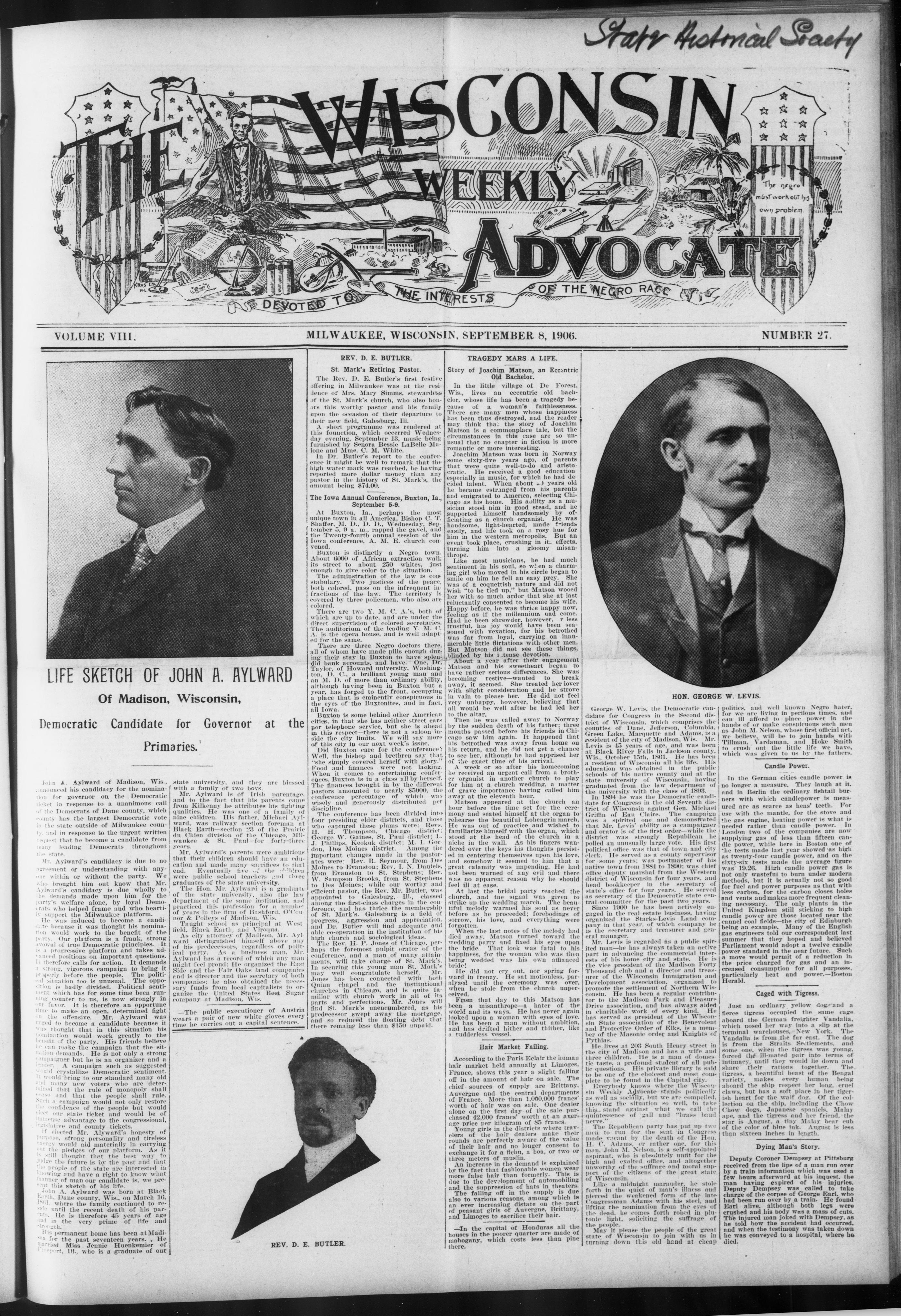
WISCONSIN
WEEKLY
ADVOCATE
DEVOTED TO THE INTERESTS OF THE NEGRO RACE
LIFE SKETCH OF JOHN A. AYLWARD Of Madison, Wisconsin,
VOLUME VIII.
LIFE SKETCH OF
Of Madison
Democratic Candidate
Prim
John A. Aylward of Madison, Wis., announced his candidacy for the nomination for governor on the Democratic ticket in response to a unanimous call of the Democrats of Dane county, which county has the largest Democratic vote in the state outside of Milwaukee county, and in response to the urgent written request that he become a candidate from many leading Democrats throughout the state.
Mr. Aylward's candidacy is due to no agreement or understanding with anyone within or without the party. We who brought him out know that Mr. Aylward's candidacy is due wholly to the demands made upon him for the party's welfare alone, by loyal Democrats who helped frame and who heartily support the Milwaukee platform.
He was induced to become a candidate because it was thought his nomination would work to the benefit of the party. Our platform is a frank, strong awoval of true Democratic principles. It is a progressive platform and takes advanced positions on important questions. It therefore calls for action. It demands a strong, vigorous campaign to bring it properly before the people. The political situation too is unusual. The opposition is badly divided. Political sentiment which has for some time been running counter to us, is now strongly in our favor. It is therefore an opportune time to make an open, determined fight on the offensive. Mr. Aylward was urged to become a candidate because it was thought that in this situation his nomination would work greatly to the benefit of the party. His friends believe he can make the campaign that the situation demands. He is not only a strong campaigner but he is an organizer and a leader. A campaign such as suggested would crystallize Democratic sentiment. It would bring to our standard many old and many new voters who are determined that the rule of monopoly shall cease and that the people shall rule. Such a campaign would not only restore the confidence of the people but would elect our state ticket and would be of immense advantage to the congressional, legislative and county tickets.
If elected Mr. Alyward's honesty of purpose, strong personality and tireless energy would aid materially in carrying out the pledges of our platform. As it is still thought that the best way to judge the future is by the past and that the people of the state are interested in knowing and have a right to know what manner of man our candidate is, we present this sketch of his life. John A. Aylward was born at Black Earth, Dane county, Wis., on March 16, 1861, where the family continued to reside until the recent death of his parents. He is therefore 45 years of age and in the very prime of life and strength. His permanent home has been at Madison for the past seventeen years. He married Miss Jennie Huenkemier of Freeport, Ill. who is a graduate of our
---
state university, and they are blessed with a family of two boys. Mr. Aylward is of Irish parentage, and to the fact that his parents came from Kilkenny he attributes his fighting qualities. He was one of a family of nine children. His father, Michael Aylward, was railway section foreman at Black Earth-section 23 of the Prairie du Chien division of the Chicago, Milwaukee & St. Paul-for forty-three years. Mr. Aylward's parents were ambitions that their children should have an education and made many sacrifices to that end. Eventually five of the children were public school teachers and three graduates of the state university.
The Hon. Mr. Aylward is a graduate of the state university, also the law department of the same institution, and practiced this profession for a number of years in the firm of Bashford, O'Connor & Polleys of Madison, Wis.
Taught school as principal at Westfield, Black Earth, and Viroqua.
As city attorney of Madison, Mr. Aylward distinguished himself above any of his predecessors, regardless of political party. As a business man, Mr. Aylward has a record of which any man might feel proud: He organized the East Side and the Fair Oaks land companies and is director and the secretary of both companies; he also obtained the necessary funds from local capitalists to organize the United States Beet Sugar company at Madison, Wis.
The public executioner of Austria wears a pair of new white gloves every time he carries out a capital sentence.
REV. D. E. BUTLER.
REV. D. E. BUTLER
MILWAUKEE, WISCONSIN, SEPTEMBER 8, 1906.
The Rev. D. E. Butler's first festive offering in Milwaukee was at the residence of Mrs. Mary Simms, stewardess of the St. Mark's church, who also honors this worthy pastor and his family upon the occasion of their departure to their new field, Galesburg, Ill.
A short programme was rendered at this founction, which occurred Wednesday evening, September 13, music being furnished by Senora Bessie LaBelle Malone and Mme. C. M. White.
In Dr. Butler's report to the conference it might be well to remark that the high water mark was reached, he having reported more dollar money than any pastor in the history of St. Mark's, the amount being $74.00.
The Iowa Annual Conference, Buxton, Ia. September, 5-9
At Buxton, Ia., perhaps the most unique town in all America, Bishop C. T. Shaffer, M. D., D. D., Wednesday, September 5, 9 a. m., rapped the gavel, and the Twenty-fourth annual session of the Iowa conference, A. M. E. church convened. Buxton is distinctly a Negro town. About 6000 of African extraction walk its street to about 250 whites, just enough to give color to the situation. The administration of the law is constabulary. Two justices of the peace, both colored, pass on the infrequent infractions of the law. The territory is covered by three policemen, who also are colored.
There are two Y. M. C. A.'s, both of which are up to date, and are under the direct supervision of colored secretaries. The auditorium of the leading Y. M. C. A. is the opera house, and is well adapted for the same.
There are three Negro doctors there, all of whom have made pills enough during their stay in Buxton to have splendid bank accounts, and have. One, Dr. Taylor, of Howard university, Washington, D. C., a brilliant young man and an M. D. of more than ordinary ability, although having been in Buxton but a year, has forged to the front, occupying a place that is eminently conspicuous in the eyes of the Buxtonites, and in fact, all Iowa.
Buxton is some behind other American cities, in that she has neither street cars nor telephone service, but she is ahead in this respect—there is not a saloon inside the city limits. We will say more of this city in our next week's issue.
Did Buxton care for the conference? Well, the bishop and brethren say that "she simply covered herself with glory." Food and finances were not lacking. When it comes to entertaining conferences, Buxton is in a class all by herself. The finances brought in by the different pastors amounted to nearly $5000, the conference percentage of which was wisely and generously distributed per discipline.
The conference has been divided into four presiding elder districts, and those who captured these plums were: Revs. H. H. Thompson, Chicago district; George W. Gaines, St. Paul district; L. J. Phillips, Keokuk district; M. I. Gordon, Des Moines district. Among the important changes made in the pastorates were: Rev. R. Seymour, from Des Moines to Evanston; Rev. I. N. Daniels, from Evanston to St. Stephens; Rev. W. Sampson Brooks, from St. Stephens to Des Moines; while our worthy and efficient pastor, the Rev. Mr. Butler, was appointed to Galesburg, Ill., classed among the first-class charges in the conference, and has thrice the membership of St. Mark's. Galesburg is a field of progress, aggression and appreciation, and Dr. Butler will find adequate and able co-operation in the institution of his high church and sociological ideas.
The Rev. H. P. Jones of Chicago, perhaps the foremost pulpit orator of the conference, and a man of many attainments, will take charge of St. Mark's. In securing this young man St. Mark's may well congratulate herself. Mr. Jones has been connected with both Quinn chapel and the institutional churches in Chicago, and is quite familiar with church work in all of its parts and perfections. Mr. Jones will find St. Mark's unencumbered, as his predecessor swept away the mortgage, and so reduced the floating debt that there remains less than $150 unpaid.
REV. D. E. BUTLER
TRAGEDY MARS A LIFE
Story of Joachim Matson, an Eccentric Old Bachelor.
In the little village of De Forest, Wis., lives an eccentric old bachelor, whose life has been a tragedy because of a woman's faithlessness. There are many men whose happiness has been thus destroyed, and the reader may think that the story of Joachim Matson is a commonplace tale, but the circumstances in this case are so unusual that no chapter in fiction is more romantic or more interesting.
Joachim Matson was born in Norway some sixty-five years ago, of parents that were quite well-to-do and aristocratic. He received a good education especially in music, for which he had decided talent. When about 20 years old he became estranged from his parents and emigrated to America, selecting Chicago as his home. His ability as a musician stood him in good stead, and he supported himself handsomely by officiating as a church organist. He was handsome, light-hearted, made friends easily, and life took on a rosy hue for him in the western metropolis. But an event took place, crushing in its effects, turning him into a gloomy misanthrone.
Like most musicians, he had much sentiment in his soul, so when a charming girl who moved in his circle began to smile on him he fell an easy prey. She was of a coquettish nature and did not wish "to be tied up," but Matson wooed her with so much ardor that she at last reluctantly consented to become his wife. Happy before, he was thrice happy now, feeling as if the millennium uad come. Had he been shrewder, however, r less trustful, his joy would have been seasoned with vexation, for his betrothed was far from loyal, carrying on innumerable little flirtations with other men. But Matson did not see these things, blinded by his i tense devotion.
About a year after their engagement Matson and his sweetheart began to have rather serious differences. She was becoming restive—wanted to break away, it seemed. She treated her lover with slight consideration and he strove in vain to please her. He did not feel very unhappy, however, believing that all would be well after he had led her to the altar.
Then he was called away to Norway by the sudden death of his father; three months passed before his friends in Chicago saw him again. It happened that his betrothed was away from home on his return, and he did not get a chance to see her, although he had apprised her of the exact time of his arrival.
A week or so after his homecoming he received an urgent call from a brother organist in another church to play for him at a church wedding, a matter of grave importance having called him away at the eleventh hour. Matson appeared at the church an hour before the time set for the ceremony and seated himself at the organ to rehearse the beautiful Lohengrin march. He was out of practice and wished to familiarize himself with the organ, which stood at the head of the church in a niche in the wall. As his fingers wandered over the keys his thoughts persisted in centering themselves upon his love, and somehow it seemed to him that a great calamity was impending. He had not been warned of any evil and there was no apparent reason why he should feel ill at ease.
At last the bridal party reached the church, and the signal was given to strike up the wedding march. The beautiful melody warmed his soul as never before as he proceeded; forebodings of sorrow, his love, and everything were forgotten.
When the last notes of the melody had died away, Matson turned toward the wedding party and fixed his eyes upon the bride. That look was fatal to his happiness, for the woman who was then being wedded was his own afflianced bride!
He did not cry out, nor spring forward in frenzy. He sat motionless, paralyzed until the ceremony was over, when he stole from the church unperceived.
From that day to this Matson has been a misanthrope—a hater of the world and its ways. He has never again looked upon a woman with eyes of love. He has been a man without ambition, and has drifted hither and thither, like a rudderless vessel.
Hair Market Failing.
According to the Paris Eclair the human hair market held annually at Limoges, France, shows this year a slight falling off in the amount of hair on sale. The chief sources of supply are Brittany, Auvergne and the central departments of France. More than 1,000,000 francs' worth of hair was on sale. One dealer alone on the first day of the sale purchased 42,000 francs' worth at an average price per kilogram of 85 francs. Young girls in the districts where travelers of the hair dealers make their rounds are perfectly aware of the value of their hair and no longer consent to exchange it for a fichu, a boa, or two or three meters of muslin.
An increase in the demand is explained by the fact that fashionable women wear more false hair than formerly. This is due to the development of automobiling and the suppression of hats in theaters. The falling off in the supply is due also to various reasons, among which is an ever increasing distate on the part of peasant girls of Auvergne, Brittany, and Limoges to sacrifice their hair.
In the capital of Honduras all the houses in the poorer quarter are made of mahogany, which costs less than pine there.
[Name not visible in the image]
HON. GEORGE W. LEVIS.
George W. Levis, the Democratic candidate for Congress in the Second district of Wisconsin, which comprises the counties of Dane, Jefferson, Columbia, Green Lake, Marquette and Adams, is a resident of the city of Madison, Wis. Mr. Levis is 45 years of age, and was born at Black River Falls in Jackson county, Wis., October 15th, 1861. He has been a resident of Wisconsin all his life. His education was obtained in the public schools of his native county and at the state university of Wisconsin, having graduated from the law department of the university with the class of 1893.
politics, and for we are can ill affer hands of or as John M. I we believe, Tillman, Va to crush out which was
In the Geo no longer a and in Berk
In 1894 he was the Democratic candidate for Congress in the old Seventh district of Wisconsin against Gen. Michael Griffin of Eau Claire. The campaign was a spirited one and demonstrated that Mr. Levis' ability as a campaigner and orator is of the first order—while the district was strongly Republican he polled an unusually large vote. His first political office was that of town and city clerk. He served as a county supervisor for some years; was postmaster of his native town from 1884 to 1890; was chief office deputy marshal from the Western district of Wisconsin for four years, and head bookkeeper in the secretary of state's office for four years. He served as secretary of the Democratic state central committee for the past two years.
Since 1900 he has been actively engaged in the real estate business, having organized the Starks-Levis Land company in that year, of which company he is the secretary and treasurer and general manager.
Mr. Levis is regarded as a public spirited man—he has always taken an active part in advancing the commercial interests of his home city and state. He is the vice president of the Madison Forty Thousand club and a director and treasurer of the Wisconsin Immigration and Development association, organized to promote the settlement of Northern Wisconsin. He has been a regular contributor to the Madison Park and Pleasure Drive association, and has always aided in charitable work of every kind. He has served as president of the Wisconsin State association of the Benevolent and Protective Order of Elks, is a member of the Masonic order and Knights of Pythias.
He lives at 203 South Henry street in the city of Madison and has a wife and three children. He is a man of domestic taste, a profound student of all public questions. His private library is said to be one of the choicest and most complete to be found in the Capital city. Everybody knows where the Wisconsin Weekly Advocate stands politically as well as socially, but we are compelled, knowing the situation so well, to take this stand against what we call the quintessence of gall and "brass band perve."
The Republican party has put up two men to run for the seat in Congress made vacant by the death of the Hon. H. C. Adams, or rather one, for this man, John M. Nelson, is a self-appointed aspirant, who is absolutely unfit for the high and exalted office, and altogether unworthy of the suffrage and moral support of the citizens of the great state of Wisconsin.
Like a midnight marauder, he stole forth in the quiet of man's illness and pierced the weakened form of the late Congressman Adams with his steel, and lifting the nomination from the eyes of the dead, he comes forth robed in plutonic light, soliciting the suffrage of the people.
May it please the people of the great state of Wisconsin to join with us in turning down this old hand at cheap
politics, and well known Negro hater, for we are living in perilous times, and can ill afford to place power in the hands of or make conspicuous such men as John M. Nelson, whose first official act, we believe, will be to join hands with Tillman, Vardaman, and Hoke Smith to crush out the little life we have, which was given to us by the fathers.
In the German cities candle power is no longer a measure. They laugh at it, and in Berlin the ordinary fisttail burners with which candlepower is measured are as scarce as hens' teeth. For use with the mantle, for the stove and the gas engine, heating power is what is needed rather than candle power. In London two of the companies are now supplying gas of less than fifteen candle power, while here in Boston one of the tests made last year showed as high as twenty-four candle power, and on the sixty-six tests made the average figure was 19.26. High candle power gas is not only wasteful to burn under modern methods, but it is actually not so good for fuel and power purposes as that with less carbon, for the carbon closes holes and vents and makes more frequent cleaning necessary. The only plants in the United Kingdom still sticking to high candle power are those located near the cannel coal fields—the city of Edinburgh being an example. Many of the English gas engineers told our correspondent last summer that they hoped and believed Parliament would adopt a twelve candle power standard in the near future. Such a move would permit of a reduction in the price charged for gas and an increased consumption for all purposes, particularly heat and power.—Boston Herald.
Just an ordinary yellow dog and a fierce tigress occupied the same cage aboard the German freighter Vandalia, which nosed her way into a slip at the terminal warehouses, New York. The Vandalia is from the far east. The dog is from the Straits Settlements, and some one, when the tigress was young, forced the ill-mated pair into terms of intimacy, until they would lie down and share their rations together. The tigress, a beautiful beast of the Bengal variety, makes every human being aboard the ship respect her long, cruel claws, but has a soft place in her tigerish heart for the waif dog. Of the collection on the ship, including the Chow Chow dogs, Japanese spaniels, Malay ape, and the tigress and her friend, the star is August, a tiny Malay bear cub of the color of blue ink. August is less than sixteen inches in length.
Deputy Coroner Dempsey at Pittsburg received from the lips of a man run over by a train information which was used a few hours afterward at his inquest, the man having expired of his injuries. Deputy Dempsey was called to take charge of the corpse of George Earl, who had been run over by a train. He found Earl alive, although both legs were crushed and his body was a mass of cuts. The injured man joked with Dempsey, as he told how the accident had occurred, and when the testimony was taken down he was conveyed to a hospital, where he died.
---
NUMBER 27.
Candle Power.
Caged with Tigress.
Dving Man's Story.
THE WISGONSIN WEEKLY ADVOCATE
MILWAUKEE, WIS.
R. B. MONTGOMERY, Editor and Proprietor.
Miscellaneous Items.
—It is stated that a locomotive engine going a mile a minute gives twenty puffs a second.
—Masons receive the highest wages paid to workmen in Berlin, receiving $1.90 to $2.14 a day for piece work.
—"Forbidden" is a familiar word abroad. In Italy it is "vietato," in Germany "verboten" or more politely "untersagt," and in France "defedu."
—The squirrel fish is a brilliant red in color, which makes it a conspicuous inhabitant of the sea as it darts here and there with alert movements. The body of the squirrel fish shows a few stripes and is well covered with sharp spines.
The late Russell Sage was a member of Congress from New York in the Thirty-third Congress, taking his seat December 5, 1853. He was a member of the committee on ways and means and chairman of the committee on invalid pensions.
A single bank in Naples receives half a million dollars a year sent out of the United States by temporary Italian residents. The same bank has received from Italians in Argentina and Brazil $828,000 and $425,000, respectively, in one year.
Both men and women in Lapland dress precisely alike. They wear tunics belted loosely at the waist, tight breeches, wrinkled leather stockings and pointed shoes; their whole appearance, in short, is identical, at least to the casual observer.
A bank note that passed through the Chicago fire is one of the curios preserved in the Bank of England. The paper was consumed, but the ashes held together and the printing is quite legible, and it is kept under glass. The bank paid the note.
Norwegians have a primitive way of breaking up old, worn-out wooden ships. They take them to exposed rocky parts of the coast, and, after anchoring them, leave the breakers of the next storm to smash them to pieces. After the storm the floating fragments are picked up and sold for firewood.
The longest bridge in the world is at Sangong, China, and is called the Lion bridge. It extended five and one-quarter miles over an arm of the Yellow sea, and is supported by 300 huge stone arches. The roadway is 7 feet above the water, and is enclosed in an iron network.
The tossing of a coin settled a controversy over the division of a large tract of land leit by the late Bart Smithson of California. The land was divided into four parts and the four heirs, with the head and tale of a half dollar made successive selections, much to the chapin of the legal fraternity.
The new Queen of Spain has been baptized three times, once as an infant when she was taken into the Presbyterian church, a second time when she was made a member of the Church of England, and lastly, a few weeks ago, when she was baptized as a member of the Roman Catholic church.
The municipal electric plant of Orillia, Canada, is a success, according to a report from Consul Wakefield. The power is developed twenty miles distant at Ragged Rapids, and is sold to the factories at $16 per horsepower per annum and 2 cents per week per 16-candlepower lamp for incandescent lights.
The statue of the Angel of the Resurrection, one of the two statues for the chapel of Our Lady, in the Cathedral of St. John the Divine, New York, that caused the world-wide religious discussion last fall about the sex of angels, toppled from its niche recently and was smashed to pieces on the ground, 50 feet below.
An artist named H. Costa, known as "The Man with the Revolving Head," has been examined at a meeting of the German Medical society at Prague. He turned his head around naturally as far as the shoulder, and then twisted it farther with his hands until he looked directly backward, with his chin above the line of the spine.
The London Commercial Intelligence reports that there are at present 9,730,209 spindles engaged in the German cotton industry, which shows an increase of 1,295,608 during the five years since 1901. There are 2,731,911 in Rhine province and Westphalia. The number of looms is at present 231,199, or 19,381 more than in 1901. On December 14, 1909, it will be 500 years since the University of Leipsic was organized by the secession of several thousand German students from the University of Prague. Arrangements are already being made to celebrate this semi-millennium by the publication of a massive work on the history of the city and the University of Leipsic.
Under the provisions of a new Belgium law Sunday labor in that country will hereafter be forbidden in all commercial and industrial enterprises except sea, canal and river transport, fishing and hawking and peddling. Only members of an employer's family living with him, or his domestics, may work more than six days per week, and the weekly day of rest is to be Sunday.
It was not long ago discovered that by means of a simple chemical treatment ordinary gelatine can be solidified. In this form it resembles celluloid, but it is not inflammable and is therefore not dangerous to handle, as celluloid is. It can be colored, spotted or streaked as desired, so as to imitate tortoise shell, coral, mother of pearl and other natural products.
A curious custom is still in force at Norwich, in virtue of which, on three days in the year, any one can claim a substantial meal for nothing. The only qualification is that the applicant shall repeat aloud in St. Giles' church a prayer for the sovereign's health. Afterward they partake of a meal of broth, beef and bread, finished off with a liberal allowance of beer.
-Educators and the public in general are showing much interest in the recent opening of the Oread School of Agriculture. Manufactures and Commerce, which occupies 4000 acres of land some 18 miles from Baltimore, Md. Its founder and head is Henry D. Perky. From each state two students will be admitted to work their way through, but the number of pay students is unlimited. All will be trained in actual cultivation and management of farms.
The value of the copper produced in the United States in 1905 was $137,. 948,727, as compared with $105,628,. 845 in 1904. The product of 1905 was much the largest ever recorded in the United States. Exports of copper to Germany, Holland and other countries continue to increase. During the month of May 11,072,320 pounds were shipped to Germany, as compared with 6,381,340 pounds in April. Exports to Holland were 14,197,120 pounds in May, an increase of over 1,000,000 pounds as compared with the preceding month. France took 6,948,480 pounds and the United Kingdom 5,125,120 pounds.
THE CLOCK WILL TICK IT AWAY.
'Mid the many tasks the years impose Come blithe and blissful times, And strewn through a world of rustic prose Are ripples of restful rhymes. But the joys we deem the dearest seem The shortest in their stay.
The shortest in their
For we never can greet a day so sweet
But the clock will tick it away,
Away,
The clock will tick it away.
But if pleasure must hurry so quickly
past
past,
Then sorrow must do the same.
And a word of praise is sure to last
As long as a word of blame.
And there's never a night so void of ligh
But it wakes to a golden day.
For we haven't a grief so broad or brief
But the clock will tick it away,
A CULTURED BEING.
"Really, Maria, it seems to me that the society is congenial."
"And, Lavinia, I am equally certain that the notice emanates from a gentleman."
Miss Maria Kirkpatrick took up the copy of the times lying on the table and read the announcement again, after which she passed it over to her sister, who perused it with a gentle frown.
It was rather a curious advertisement, and ran as follows:
A gentleman of some meaus desires for Two Months a Comfortable Home in Refined Circle. Maiden Ladies preferred. Handsome honorarium given. Must be quiet, and in a country district.—Address, Vale, 458. Piccadilly.
"I think, Maria," Lavinia said at length—"I think it would suit us."
Miss Maria heaved a gentle sigh of relief. For some time each of the ladies had been fencing round the matter, both longing to suggest such an innovation and neither daring to advance such a heresy as a lodger at Mostyn cottage. And now the fell thing was said.
That the sisters Kirkpatrick were refined goes without saying. Their late sainted mother had been the daughter of a baronet of long descent; on their father's side they were closely connected with Lord Ditton, whose illustrious ancestor had minded the goosequil with which King John signed Magna Charta at Runnymede.
But, if the ladies were extra genteel, and absolutely correct to the ends of their patrician fingers, they were also poor. The cottage where they lived was beautifully furnished, and one self-trained handmaiden gave no cause for anxiety, and yet, at the same time, the internal economy of the place was carried out on rigid lines necessary to people who have to live on £150 per annum.
The advertisement in the Times came as a dispensation of Providence, at a time when money was, in market parlance, extremely "tight." Were the sisters fortunate enough to secure the countenance and approval of the mysterious "Vale" it would be quite easy enough to account for his presence in the house. No taint of the lodger could possibly attach to a passing guest, especially as he happened to be a gentleman of some means.
"You had better write to the address in question, Maria," Lavinia said. "It may be worth £50 or £100 to us—it is impossible to tell."
A fortnight had passed since Miss Maria's missive had been dispatched to the address in Piecadilly, and much had happened in the interim. Letters had been exchanged and references given on the one side, at any rate, whilst the gentleman, who signed himself "Robert Vale," was extremely reticent as to his share of the contract. His letters were perfectly correct, but he seemed to know nobody, and, indeed, the thing would have gone off altogether but for a happy thought on the part of the mysterious gentleman himself. In his last communication he had forwarded a £50 note, that being the amount he intended to expend during his two months' visit, and hinting that that was the best kind of reference after all.
Lavinia hesitated, and was lost; the soft crumple of the bank note in her fingers made music in her soul, and her heart went out to Robert Vale on the spot.
It would be flying in the face of Providence to refuse.
A dainty high tea stood upon the table; there were flowers and fruit, the best of the Queen Anne silver and the choicest of Crown Derby ware by the teacosy.
The sisters were in their best black silks, awaiting, with some little nervousness, the advent of the visitor, who was upstairs in the best lavender-scented bedroom, removing the stains of travel from his person.
"Really, most distinguished looking," Lavinia mentally murmured, as she curtsied low and extended her hand to her visitor—"quite the gentleman." And, indeed, to do him justice, so Robert Vale was. He was tall and spare, with refined, clean-shaven features, quiet and subdued manner, and yet perfectly at ease with the sisters. He was dressed from tip to toe in black, with a perfectly fitting frock coat; he handed the things about table with a lordly grace the sisters voted charming. About 40—Miss Maria's age to a day—he looked considerably older, as if thoughtfulness and a scholarly occupation had aged him before his time.
But, although Mr. Vale's voice was sonorous and deliberate, there were times when his English left much to be desired. It was the one thorn to the rose, the fly in the amber of Miss Lavinia's approval of her guest.
"I have always been a solitary man," Mr. Vale explained, as he noticed a little uneasiness on the part of Lavinia at some faux pas of his, "and, as a boy, I was left entirely to the care of servants. Hence little peculiarities of speech, which you may have noticed, although I am hardly cognizant of them. If you ladies will correct any trifling errors of mine I shall be infinitely obliged."
Miss Lavinia remarked that she would avail herself of the opportunity, and did. She also remarked (to herself) that Mr. Vale was an exceedingly apt pupil, for at the end of the time there was nothing left to notice at all. Every angle was rubbed off, and if there remained a little artificiality it only toned the whole, as French polish adds to the brilliancy of a sideboard.
Miss Maria was probably more excited than she had ever been in her life before. As she came down to breakfast she held in her long, slim fingers a coroneted sheet of thick paper which was nothing less than an invitation from Lady Ditton to spend a month at Dittondyke, her ladyship's famous seat near to the ancient city of York.
"You had better go. Maria." Lavinia
remarked. "Most of the others have been, and we owe some respect to the head of the family. For my own part, I shall never visit Dittondyke so long as that person is there. It will be rather lonely for me, losing you and Mr. Vale at the same time." Mr. Vale glanced at Maria, and the pleasant, innocent face blushed. Alas! that it should be so, but Maria knew that she would miss Robert Vale far more than Miss Lavinia could. The handsome face and easy manner had done its fell work.
"Permit me to be your escort," he said. "I will postpone my departure another day so as to accompany you. As I said yesterday, I, too, am going north."
"I could, Robert," murmured Maria— "I could forgive you anything."
"We are nearly at York," Vale went on, as he glanced out of the carriage window, "where we must part for a time. I, too, am going to Dittondyke, but, alas! not in the capacity of a guest. Maria, I am the earl's butler."
Maria could only gasp like one in the skittes of a deadly nightmare.
"It was this way," Vale went on. "I had been there for ten years, when my lord married his present superior, highly cultured wife. She liked me and my appearance very much, but she objected to my grammar. At her suggestion, this summer, while the family were in Germany, I looked out for a refined family where I could reside for a month or two as a guest. I did not fear that anything could betray me but my English, and how that has improved you know. In self-defense, I did not know till long after I came to you that you were related to his lordship."
Vale paused, but Maria made no reply, and he resumed:
"My post is a good one; everything is conducted, especially lately, upon the most lavish scale. In ten years I have saved £3000. At the present moment I am in negotiation for one of the largest hotels in the Engadine, where I shall not be known, and where I have only to remain behind the scenes and pocket something like £1500 a year. Maria, neither your sister nor anyone else need know; we can live secluded on the continent. I can grow a beautiful beard and moustache. Will you wait for me and marry me!"
"Yes," Maria whispered. "Yes, Robert, for I love you in spite of all. I will wait for you, and marry you—when your moustache comes."
That night, with stately mien and manner grave as that of a bishop, Vale strode along behind the row of chairs in the big dining hall at Dittondyke, and as, leaning over Maria's seat, he deferentially murmured "Hock or sherry, Miss?" with the aspirate in the correct place, none of the butterflies of fashion guessed the little romance that blossomed like a (full-blown) rose in their midst.—M. B. in Illustrated Bits.
THE WAY OF THE WORLD.
Kindness either kills or cures.
Money and friends are synonymous.
No man amounts to much unless he can prove it.
A woman has less logic than a man, but more instinct.
None are so blind as those who have no object in view.
Even marriage doesn't take the conceit out of some men.
The fellow who courts trouble generally ends by marrying it.
Many a man would rather be on the level than climb upward.
Love, like a kitten, is born blind, but it soon gets its eyes opened.
Some men complain of hard times if every day doesn't bring a soft snap.
If we had our lives to live over, we would all make our mistakes easier.
Some people get religion with as little forethought as a child gets measles.
Home is what we make it, and some fellows never make it until about 4 a. m.
The Bohemian life is always alluring to those who don't have to live that way.
A fellow might as well make a fool of himself once in a while. If he doesn't, some woman will.
There wouldn't be so many sinners if people struggled to get into heaven as they do to get into society.
Even the man who feels that he was born to command would hesitate about marrying a grand opera prima donna.
The trouble about being rich is that you are apt to have a pate de fois gras appetite and one of those milk toast stomachs.—New York Times.
Big Trip in Auto.
Arrayed in goggles, visor cap and long cloak, Mrs. Elizabeth Hunt of Brooklyn Borough, N. Y., who will be 106 years old next month, is making her annual tour of New York state. The trip is being made in an automobile which travels by easy stages from one town to another. Hitherto the annual tour which Mrs. Hunt insists on making each year has been accomplished mostly by train.
"Not much like the stage coaches of my girlhood," she laughs. Owing to her rheumatism she has to be helped into the car, but she scorns cushions and pillows. She likes to sit on the front seat with the chafeur, and asks many questions about the mechanism of the car, which the driver gladly explains to her.
She often tells the chaffeur not to hold the machine in, because she says she can stand as much speed as her son, who is 35 years her junior and who also enjoys the sport.
Would Libel Motor Cars.
Having had plenty of experience of the disadvantages of barren judgments I can deeply sympathize with those who get such judgments against motorists. One way in which the effects of a judgment may be defeated is by the defendants being penniless. Such a one may have hired a motor for a day. Other methods well known to lawyers are debenture policies, bills of sale, and, above all, the ever blessed creation of chancery, the marriage settlement. Now there is an exception to this law of judgment being against the person. In the case of ships the ship is primarily liable for the accident. This is called an action in rem. Similarly, in the
case of motors I would make the vehicle itself liable for the amount of a judgment as well as the owner or hirer. In other words, a debenture policy, bill of sale, or marriage settlement would not avail, nor would the owner of a car be able to dispose of it or use it until the judgment was satisfied, unless sufficient security had been given to the satisfaction of the court.—Truth.
—In Alsace and the German part of Lorraine many families send their children over the French frontier to buy meat. They can get it for 3 or 4 cents a pound less than they are charged in Germany, and there is no duty on small quantities.
ESCAPED IN A TRUNK
How Bride Eluded Friends on Her Honeymoon.
A new Ginevra has arisen, who has revised the heroine of the trunk episode from a bride of tragedy into a comic opera queen. Miss Georgia Nye of Marion, Mass., who was married to William H. Crapo, discovering the deep-kid plot of her best friends to adorn her with confetti and other unshakable nuptial emblems as she started on her honeymoon, evaded her tormentors by making her exit in a tightly strapped trunk, supposed to contain the bridal finery, and while the guests were searching every nook and cranny for the disappearing bride, she was lying, in a doubled-up posture that did all sorts of things to her vertebrae, across the back seat of the automobile which was to carry the newly married couple to the station.
It was a thrilling moment when the machine, speeding down the road, carrying apparently only the owner, Robert Hiller, acting as chauffeur, and Carl Clifford, one of the ushers, who stood on the step, suddenly slowed up, and out from the trunk shot Mrs. Crapo, dimpled, smiling and triumphant in the very sight of the defrauded wedding guests. Groans and shouts and shrieks of laughter followed the auto as a cloud of dust swallowed it up.
The Crapos, who, with Mr. Clifford's aid, arranged their vanishing scene with much elaboration, had previous to the ceremony sent away the packed trunk, together with their hats, coats and wraps to the home of Charles Deam, on the Wareham road, where Mr. Carpo lived before his marriage. And while his wedded wife, carefully folded up, was being carried out the front door, Mr. Crapo, hatless and in his shirt sleeves, stepped with apparent carelessness out of the back entrance. One man chased him and stuffed confetti down his neck, and Mr. Carpo, shaking him off, rushed toward the corner. The pursuer finally dropped back to watch the snorting auto at the door. As Clifford hung idly on the step. Heller suddenly touched the lever. While in full flight the usher cut the straps, and, simultaneous with the severe bobbing up of the bride the groom climbed into the front seat and the auto shot around a curve. By devious ways they reached the Wareham road residence, picked up the wearing apparel, adjusted it en route and caught the Boston express at Onsett Junction. Their ultimate destination was Meredith, N. H.
Umbrella Language.
There is a language of umbrellas as of flowers. For instance, place your umbrella in a rack, and it will often indicate that it will change owners. To open it quickly in the street means that somebody's eye is going to be in danger.
To shut it quickly signifies that a hat or two will probably be knocked off.
An umbrella carried over a woman, the man getting nothing but the drippings of the rain, signifies courtship.
When a man has the umbrella, and the woman the drippings, it indicates marriage.
To punch your umbrella into a person, and then open it, means "I dislike you."
To swing your umbrella over your shoulder signifies "I am making a nuisance of myself."
To trail your umbrella along the footpath means that the man behind you is thirsting for your blood.
To carry it at right angles under your arm signifies that an eye is to be injured by the man who follows you. This is generally a woman's way of carrying her umbrella.
To open an umbrella quickly, it is said, will frighten a mad bull. To put an alpaca umorella, by the side of a silk one signifies "Exchange no robbery."
To purchase an umbrella means "I am not smart, but honest." To lend an umbrella indicates "I am a fool."
To return an umbrella means—well, never mind what it means; nobody ever does that.
To carry an umbrella in a case signifies it is a shabby one.
To press an umbrella on your friend saying: "Oh, do take it; I would much rather you would than not," signifies lying.
To give a friend half your umbrella means that both of you will get wet.
To carry it from home in the morning means "It will very likely be a fine day."
Uses of Turpentine.
There are few houses that are not familiar with some of the numerous uses of turpentine, and as its odor is clean and wholesome it has the advantage over the many remedies whose odors are offensive.
tensive. Turpentine and soap will remove ink stains from muslin. A few drops added to the water in which clothes are boiled will whiten them.
It will exterminate cockroaches if sprinkled in their haunts. Moths will leave if it is sprinkled about as they dislike it.
Pitch, wheel grease, and tar stains can be quickly removed if the spot is first covered with lard, then soaked with turpentine. Scrape off all the loose surface dirt, sponge clean with turpentine and rub gently till dry. A few drops of turpentine on a woolen cloth will clean tan shoes very nicely. Clean gilt frames with a sponge moistened with turpentine. Carpets can be cleaned and the colors restored by going over occasionally with a broom dipped into warm water in which has been added a little turpentine.
An equal mixture of turpentine and linseed oil will remove white marks on furniture caused by water. Clean out closets and bureaus with strong turpentine water. It is a good preventive against moths.
For cramps apply cloths wrung out of hot turpentine water. When threatened with pneumonia rub the lungs with turpentine and apply hot fannels.—The Housekeeper.
A. Princely Signalman.
While Prince Arthur of Connaught and his suit were recently traveling by steamer along a Canadian river a man standing on the bank began waving a pocket handkerchief on a stick, and the prince, taking his own handkerchief from his pocket, waved back again. Then, turning round to the bystanders, Prince Arthur said: "The man signaled the words 'Welcome to Canada,' and I have replied, 'Thank you.'"—New Haven Palladium.
DISILLUSION
My shallop sails along the summer streams;
H. virginianus, arges, full and ripe.
Sing merrily in morning's golden beams. But al! the dread awakening always seems As if I'd close connection with the pipe,
As if I'd close connection with For then Reality with one fell swipe, Shatters tc atoms my frail ship of dreams, And I, perforce, must join the sons of toil. The rent is due, and every day new bills Are piling up in dreadful pyramids. My troubled waters need the peaceful oil: Till pay-day I must go the pace that kills To purchase shoes and stockings for the kids. —Judge.
Humiliated by the dismissal of her father, William Curtin, from the Springfield, O., police force on a charge of being intoxicated, Miss Nellie Curtin has entered a convent in Cincinnati.
The latest small 'boys' "sport" is flipping automobiles. It seems that this "sport" will supercede flipping trains. Kasper Milbourn, aged 13, of Chicago, was killed Monday as a result of partaking in this modern pastime.
George C. Smith, aged 75, president of the Clinton (Ia.) Paper company, invited death in his automobile in order to avoid running down a child. He suddenly turned the machine to one side and it crashed into a tree. Mr. Smith sustained three broken ribs and internal injuries which may prove fatal.
Mr. and Mrs. Norton Melson, who were married at Mexico, Mo., recently spent the first night of their wedded life in the county jail at that place. The bride and groom chose this method of outwitting friends who were waiting to give them a noisy reception at their new home, and spent the night as guests of the jailer.
The fining of two prisoners in police court at Cleveland, O., revealed the humiliation of Policeman Goff, who left twelve square inches from the seat of his pants fluttering from a snag in Kingsbury run while chasing thieves. As a result he waddled home in a pickle barrel. Two officers guarded his anatomy where a stave was missing.
An odd sounding announcement has been made in "The Baltimore News" that the inlets of the storm sewers in that city are to be protected with gratings so as not to "allow even the smallest child to pass through." "The News" proceeds to add: "With such protection no child can be swept into the sewer by floods, as has too frequently been the case."
Mrs. Elizabeth Whetstone of Westville, N. J., made a heroic rescue of a dog, in the presence of 300 spectators, who gathered in the excitement attending. The animal became entangled in the string attached to a tin can tied to his tail, and the dog's cries brought out the people. In her endeavor to unfasten the can Mrs. Whetstone pulled off a part of the dog's tail.
A report that some coins left in the window of the big banking house of Tomscanyi Brothers at Homestead, Pa., had been stolen frightened the foreign population and started a run on the bank which continued for several hours. All depositors seeking their money were paid at once. The Tomscanyi bank handles most of the money of the foreign element at Homestead.
The newspaper Kysten, of Christiania, states that United States Senator Knute Nelson of Minnesota has proposed that the American government purchase the steamer Gjoa, which recently completed a voyage through the Northwest passage, in order that it may be the first vessel to go through the Panama canal and thus be the only ship that has sailed around North America.
A steamboat has made its appearance upon the Lake of Genesareth, or Sea of Galilee, which witnessed some of the miracles of our Lord. The boat is for the public service and will communicate with the various little places situated on the borders of the lake, which, by the way, is not very large, is oval in shape and about fourteen and one-half miles in length.—London Globe.
Mrs. Emma Dailey, proprietor of a lodging house at Seattle, Wash., was shot and instantly killed by a burglar trap arranged in a trunk by one of her lodgers. Mrs. Dailey remarked to a companion: "I wonder if one of my keys will open the trunk." Suiting the action to the word, the woman inserted the key, turned the lock and lifted the trunk lid. There was a report and, crying, "I'm shot," Mrs. Dailey fell dead.
For hugging Hoke Smith when he concluded his speech accepting the Democratic nomination for governor, Policeman Tom Williams of Macon, Ga., will have to face the police commission on a charge of being offensively actice in politics. The charge was preferred by two persons who were offended by the embrace. One of the rules of the police department forbids policemen taking an active interest in politics, and it is alleged Williams broke the rule by hugging the candidate.
Seized with a frenzy of fright at the dream that a robber was trying to kill her, Miss Annie Morgan, 37 years old of Columbus, O., was overcome with an attack of heart trouble and died within a few minutes. Crying out in her fright, Miss Morgan ran out of her room, shouting: "A big black man is standing over my bed trying to kill me with a knife." Then she sank to the floor unconscious and died a few minutes after a physician was summoned. Coroner Murphy said that death was due to heart disease.
Smashing down the doors of a house in which he had taken refuge, a mob of 200, mostly women, dragged Fred Kellar of Sioux City from his hiding place at Charter Oak, Ia., and rode him on a rail two miles out of that town. Kellar returned to the home of his deserted wife and attempted to induce her 15-year-old daughter to live with him. When baffled in this he began selling the woman's furniture. This aroused the women of the town and they, with the help of a few men, summarily banished him.
Mrs. Mary Ormsby, mother of quadruplets, has been evicted from her residence, at 533 West Forty-second street, Chicago, for failure to pay her rent. Well meaning neighbors smuggled her into an empty basement at 543 West Forty-second street, but the second landlord ordered her to move on. The Relief and Aid society has been asked to assist her. Mrs. Ormsby has had considerable difficulty in making a living ever since the city authorities took her and her four children out of a local dime museum.
Just before he was leaving for Freeport, Ill., where he was to have been married to Miss Vivian Weinhold, William Buskee of Rockford, Ill., received word that he need not take the trouble to go, as Miss Weinhold had been married in Dubuque to William F. Gleason, an old sweetheart. It is learned that when Miss Weinhold was in Rockford
one day last week she called at the home of her nance at 8 a. m. and found that he was still slambering. Miss Weinhold didn't think a man should be asleep at that hour, and this caused the estrangement.
Fourteen Doukhobers confined in the Regina (Man.) jail absolutely refuse to eat. The Canadian mounted police are compelled to force food through their teeth by scientific means. These men, leaders of the nude pilgrimage among several hundred of their countrymen, are confined in jail to prevent their organizing fresh marches through public streets, but the humiliation only steels their hearts. Under the care of a physician each Doukhober is laid on his back, pinned to the floor, a napkin tied under his chin, and liquid nourishment pumped into the whole outfit.
The kiss market has taken a big tumble. Police Magistrate Stanley at Baltimore, Md., charged Joseph C. Ensor $3 for three kisses he implanted on the lips of Mrs. Daisy T. Pool without her consent. Ensor is 40 years old and Mrs. Pool is a comedy matron of 30. They are "across the way" neighbors and Ensor called at Mrs. Pool's house to borrow some nails. When Mrs. Pool appeared at the door Ensor, who was somewhat under the influence of liquor, was so smitten that he could not resist, and throwing his arms about the matron, kissed her thrice. She immediately swore out a warrant.
Harry Schwind, a Cleveland, O., machinist, filed suit for divorce and alimony. He claims that for ten years he has been a henpecked husband and in addition to legal separation from his wife he believes he is entitled to money for the support of himself and two children. He alleges in his petition that his wife has kept 90 per cent of his earnings for ten years and that once when he bought a suit of clothes for himself she diminished his food supply to make up what he had spent for the clothes. The Schwinds own considerable property in the east end of Cleveland and are well to do.
Renouncing a fortune, Miss Florence Elston of New Orleans married the man of her choice. The wedding was performed aboard a tugboat in the Gulf of Mexico, this being the idea of the bride, who desired to get as far away as possible from her former surroundings. The groom is Eugene Durabb, a member of a well known family of Plaquemines Parish. Against him the grandmother of Miss Elston entertained a dislike, and in her will, made shortly before her death, several months ago, there was a provision that Miss Elston should become her sole heir only on the condition that she should not marry Durabb.
A queer suit over who shall pay for a wooden leg is in progress at Pittsburg, Pa., and the question as to whether a man who marries a girl with a wooden limb marries the limb too, will be settled in court. Dr. Clarence Gukert, a dentist, has been sued for $100, the cost of a wooden limb, by Dr. R. H. M. McKenzie here. McKenzie brought suit before Ald. Charles Anderson, alleging that the limb was furnished some years ago to a young lady, since Mrs. Gukert, and he wants the husband to pay for the limb. Gukert's defense was that a wooden limb was not part of any person, more than is a shoe or finger ring; that he should not be forced to pay for anything bought by his wife before their wedding. Ald. Anderson gave judgment for McKenzie, but Gukert has appealed the case.
Channing Pollock doesn't always keep the very good things for his plays. One of his latest is "The hypocrite is a man who prays with his fingers crossed." That's almost Shawesque.
"I don't see why they are making so much fuss about this new way of spelling," remarked Rear-Admiral Brownson in New York, after the naval review.
"No," replied Admiral Evans, thoughtfully. "It will be just as warm, probably, with one l as with two."
"Automobile Spine" is a new malady with which a number of New York auto owners are afflicted. The disease is somewhat more severe than "chauffeuritis," which was prevalent here early in the summer and is due to excessive chug-chugging. It is fair to predict that as cloud pushing has become a pastime or a profession its entnusiasts will develop some strange complaint, which the physicians will dub "aeronaut's" or "ballonists liver."
That Hart McKee and his beautiful young wife, who was Mrs. Hugh Tevis, are at outs and are to separate, is the report which has reached the friends of the couple in New York. The story comes from Paris, where the McKees have been staying for some time. Mrs. McKee is the only daughter of George W. Baxter, a Tennesseean by birth, later territorial governor of Wyoming, and now a great cattle owner in Denver. She was married to Hugh Tevis, a rich young Californian, on the eve of the date set for her wedding to another.
"I don't know who lives in that grand mansion," said a New Yorker the other day, "but there is one thing certain; whoever the owner is he is a former mayor of the city. See those two large gas lamps on the gate posts? Well, they were put there by the city and none save a mayor or an ex-mayor is entitled to the luxury. The two lights distinguish the homes of every former chief executive of the city." The speaker then pointed to the residence of Mayor McClellan on Washington square and, sure enough, there were the big lamps.
The records of the New York coroner's office for the half year disprove the oft-repeated assertion that autos are the most deadly of vehicles using the public streets. In the borough of Manhattan since the first of the year 204 persons have been run down and killed and but 16 of these have been victims of autos. Horse-propelled vehicles killed four times as many, and subway, elevated and trolley cars were responsible for five times as many deaths. This ought effectually to still the foolish clamor against motor vehicles. The auto is the rich man's plaything now. In time it will become the poor man's servant, just as the bicycle was.
The actress looked debonair, although the play had been pronounced a failure on every side.
"It's got to succeed," she explained. "and for that reason I'm not nervous. Last season I played seven new parts on Broadway, but I feel perfectly tranquil now. That's the advantage of being in a musical show. More than $40,000 is invested in costumes and scenery and they're not going to be thrown away. The piece has simply got to be made a success. If it had been a dramatic production we would have closed on Saturday night. As it is, I expect to keep the same job all winter."
—Minster-on-Sca, an English watering place, is building a pier which will be the longest on the English coast—more than 7000 feet.
GOSSIP FOR THE LADIES.
The Angels of the Fireside.
And tho' we see them not, they're ever there;
They bear sweet messages from God's own
lard.
lard,
And fill our souls with thoughts most pure and fair.
And one is known as Resignation, sweet,
Tis she who bids us yield to God's great will;
Life's cross, with fortitude, she begs us meet.
And the' the day with darkness and with dread
Encompass us as we walk on our road,
With gentle hand she smoothes the bitter bread,
And lightens for us each o'erpresing load.
And she, her sister spirit, Sacrifice,
Into our ear doth whisper soft and low:
She leads us by the hand to Caly'ry's height
And shows us how Christ, the Savior, gave his life;
She asks, is it so hard to do the right?
Why yield tho' fiercer grow the storm and strife?
With prayer she soothes the cruel stings of fate.
And shows us then, how small is ev'ry loss:
She gives us joy and love for sin and hate.
And marks how gold and pleasure turn
to dress.
Thus near us stand the faithful watchers
bright.
They never tire, as we oft' come and go;
We hear them not, their footsteps are so
light.
That when they speak to us we scarcely
know.
But through the busy day, when sun doth
shine.
At hearthstone, or in shop, or field, or
street.
Around our hearts their gentle arms entwine.
twine.
And on our way with smiles our labors greet.
When softly round our pillow night doth fall.
Then watch they, when we rest and dream in sleep;
dream in sleep:
Perhaps in visions we will hear them call.
While silent, they their loving vigils keep.
-Rixford J. Lincoln.
Shall He Strike in Self-Defense?
Not being able to think of a pertinent incident, I stopped my husband as he passed with the lawn mower, and placed the matter before him. Pointing to the ground, he said:
"See that clover and the plantain springing up close together? If you watch closely this summer you will see that the weaker of the two will be crowded out and die. Even the weakest plant must fight, or die and become food for its neighbor."
"Yes," said I, "each tries to reach up farther into the sunshine than its neighbor, but neither strikes the other."
"Not as far as we can see; but in their struggle, one will shut off the sunlight from the other, and the roots of each suck up the moisture the other needs. When one weakens, the other will absorb it. Watch the next mouse that puss catches, or watch her when a dog gets her cornered. Is the doctrine of nonresistance exemplified in any of God's creatures?"
"But the mouse tries his best to get away before he resists, and puss will not fight till she is 'cornered,' I said.
"True, they use discretion," and he started the lawn mower with such a clatter as to deprive me of woman's preerogative.
Doesn't that word "discretion," afford the key to the situation? We must defend ourselves against the encroachments of others, but we are over apt to exceed mere defense, if our strength permits. I believe that the evil feature of "the manly art of self-defense," as is the case with most of the things of this life, lies in its abuse.
By all means, I say, teach the children to defend themselves by every means in their power against injustice; but first teach them to discriminate between injustice and justice, and to stop when defense is accomplished—teach them discretion.—Mrs. W. D. G., in Mothers' Magazine.
A Boy Houseworker
I was the victim of constant change in domestic service for several years, and I suspect I should still be doing the same had not something occurred to cause a change in this regime.
My health failed somewhat, and my physician prescribed a change of climate for part of the year at least. This precluded constant housekeeping at home, and made it impractical to train maids for short periods of service. I concluded to try to do without a house girl, and substitute the help of a boy, instead. This is my second year in following this new plan and it has been very satisfactory.
The first obstacle, which seemed the most formidable, was what to do with the weekly wash. I had a decided antipathy to sending it out of the house. By using a washing machine, and managing the wash myself, one-half day out of every week answered the question, and the same time another day was given to the ironing. Then came the day to sweep and dust. At first I thought it quite impossible to teach a boy to do this. It took unwearied patience, but good results followed. Rugs were put on the line to air while the sweeping was done. Then while the dust was settling the rugs were beaten. After all furniture and bric-a-brac were dusted the rugs were put in place. A few hours were spent another morning in the "once-a-week mopping" of floors and porches. In summer I have a vegetable and flower garden tended by the boy, who performs any other necessary chores. With occasional help from my husband in what we call "light housekeeping" I have all the leisure I wish for culture along many lines, and in the words of the poet, our home life is a "thing of beauty and joy forever."
I wish I could induce my Good Housekeeping friends to follow my method long enough to find what joy is therein. Olive Mildred Pulliam in Good Housekeeping.
She Should Know How.
The wish of every bride-to-be is that she shall become a model wife, and before the eventful day arrives when she gives herself to him, "for better, for worse," she should do all she can to prepare herself for her new position, so that, as far as she is concerned, the union shall prove "for better."
When a girl promises to become a wife, the man has every right to suppose that she is competent to fill such a position, and, no matter how old she is, if she is not capable of managing a house she is not old enough to become a wife.
One of the first things to learn to manage is the money
Many girls, who happen to be the oldest or the stay-at-home daughters of the family, have gained considerable experience in housekeeping, and are quite capable in this respect, but there are
others who have no idea of laying out money to the best advantage.
It does not matter whether the home be poor or rich, in both economy should be practiced and waste avoided.
The girl who is inexperienced in household matters will do well to gain an insight into them before she takes the burden of them on her own shoulders.
She should learn to know a good piece of meat from a bad piece, and not be content just to give the order and let the butcher send what he thinks he will, which often happens to be a joint that he has not been able to sell to the customer who chooses her meat for herself.
A thorough knowledge of cooking and preparing food should be acquired, so that the bride-to-be is a capable cook.
Although she may not actually have to do the housework, it is necessary for the future bride to know how to do it. The model housewife will not think that housework is beneath her, and if it is necessary for her to undertake it she will do it with a will, so that the little house is indeed a home to the husband when he arrives home tired after perhaps a worrying day.
Girl Who Earns Money.
The girl who throws her money around carelessly, who never realizes the difference between use and abuse, who never has the courage to say that she cannot afford any pleasure, is not doing her duty. Her mind is going to be troubled and her life will be full of worry unless she mends her ways.
The girl who earns money owes a duty to herself in regard to it.
It is very delightful to buy this and that, to give here and there, and to feel that it is one's very own that is being used. Did you ever stop to think that you give so much of your life in exchange for this money? Shall you count your life's blood as nothing and waste it?
Shall you forget your duty to yourself as a natural sequence to everybody else?
The money that is earned so hardly should be spent so that it will bring the greatest comfort, so that it will be an umbrella for the rainy day.
It is the duty of the girl who earns money to be thoroughly informed not only as to her income, but to her outgo. It is the duty of the girl who works to buy clothes of good standard fabric. The girl who works is to be honored because she is a worker, but she must not put on the garb of a butterfly. The girl who works generally has some one else to care for; and that is much to her credit. Sometimes it is the people at home; sometimes it is a younger sister who is to be helped with her education; but always a helping hand is needed. The girl who works and uses her money only for nonsense is not fit to control money or to be the wife of either a rich or a poor man.
Learn the value of money. Have that knowledge, no matter whether you are a worker or an idler, whether your income be great or small.
The girl who earns money will never do her duty, will never do what is right, until she is brave enough to draw the strings of her purse against extravagance and sickly sentimentality and to open it to justice and proper generosity.—Exchange.
A Sunday Night Tea—
Is sometimes an embarrassment to the housekeeper, but it can be made one of the most delicate and savory in its cookery and one of the coziest and daintiest in its service.
Nearly all the dishes can be made partly ready in advance and easily finished at tea time. Among these dishes of larger size that the cook can prepare in advance to serve cold are chicken salad, chicken croquettes, which can be laid as soon as friend upon brown paper in a dripping pan and kept in a dry place until time to put the pan into the oven to heat just before tea time, berry or canned fruit shortcake, several fruit salads, gelatines of poultry, potted meats, fish and game.
Cold rare roast beef, cut thick, seasoned with salt and pepper, quickly broiled at a hot fire, and served with a little sweet butter, makes a good, hearty dish. Cold lamb or mutton sliced thin and warmed in its own sauce or gravy; any kind of fish heated in white sauce; smoked salmon, halibut, sturgeon, or mackerel scalded and broiled; salt fish several times heated in water, then mixed with scrambled eggs or in white sauce—these are but a few of the many little dishes for Sunday night teas.
Canned salmon should never be forgotten; this may be simply heated and seasoned with salt and pepper or heated in white sauce, or served with mayonnaise, or chopped and heated with cold mashed potatoes, or heated and served in the midst of a dish of canned peas, turned from the can, rinsed with cold water, and then heated with salt, pepper and butter or with a little white sauce.
Scalloped chicken is a delicious and dainty dish. Use equal quantities of chopped chicken, free from bones, and bread crumbs, and enough white sauce or good gravy to moisten the dish. Put the chicken in crumbs or layers in an earthen dish suitable to send to the table or in individual scallop shells season highly with salt and white pepper or cayenne; moisten with sauce and cover with bits of butter. Fifteen minutes in a hot oven will prepare the dish for the table. Serve hot.
Don'ts for the
Successful Picnic Girl
The picnic girl is the jolliest, brightest and most good-natured of all the large family of summer girls. In the first place she starts out to have a good time and to have everybody else have one, and consequently she leaves any little pet dignities she may have at home with her starched frocks and her long gloves, and forgets herself completely.
She does not worry everybody on the way by wondering if it will rain. Certainly rain is not a joyous addition to a picnic, but if it comes nobody can help it, and the party must make the best of it. The person who predicts rain and then self-righteously exclaims: "There! I knew it!" when the drops begin to fall, deserves a ducking in the pond.
Don't make the mistake of wearing your good clothes to a picnic, nor yet of wearing a frock that is soiled or sloppy, with the idea that anything will do. Wear a dress that you won't regret tearing or spoiling. Have it fresh and clean, and whatever you do, don't go in pumps and openwork stockings. The woods are swarming in August with every sort of insect that lives, and they are just waiting for a foolish summer girl and her exposed ankles. It is now a scientific fact that mosquitoes carry many kinds of disease. You can fight them off elsewhere, but it's a risky thing to leave your ankles uncovered or unsupported when you are tramping through the woods or climbing hills. Leave vanity at home and wear high shoes.
Wear any kind of a funny hat you like. It will add to the enjoyment of the oc-
ence that the acquaintance will be agreeable. I have not much sympathy with the folks who argue that the average summer resort is a disappointing place because one does not become acquainted with the folks one really wants to know until it is time to go home. Where this is true it is the fault of the people themselves. A man to have friends must show himself friendly. And incidentally, just in this connection, it may be remarked that custom is rapidly changing in this important matter.
Formerly it used to be a difficult matter to get acquainted with folks. Now, in all the best resorts of the country, it is becoming the custom to regard the roof as a sort of semi-introduction, the mere presence in the charmed circle is, other things being satisfactory, a fair guarantee of gentility and worth. It costs nothing to nod a decent good morning; indeed, it even serves to make the day brighter for the one who starts the salutation. And it is only the snob who fails to recognize the fundamental characteristic of a simple salutation which in essence only means "what a good time we are all having.—New Ocean House Reminder.
Rhubarb Pie—
According to a famous French cook, is made without a bottom crust. The fruit is skinned and cut into dice and then put into a deep oval dish. Over it is put a coffee cup of sugar, and it is set aside in order that a sirup will form. When it has stood for an hour a little more sugar should be added and the crust put on over the fruit, which should be piled high in the middle. Brush the crust with the white of an egg which has been thinned with water, and bake for forty minutes with the heat stronger below than above.
Hans von Wuesthoff Was Son of a Nobleman.
Corp. Hans von Wuesthoff, Sixth infantry, is dead. Wuesthoff was perhaps the best known enlisted man in the United States army. There was hardly a man in the regular service from bugler to lieutenant general who had not heard his romantic story. Just before the outbreak in the Spanish war Von Wuesthoff arrived in New York. He came over in a German liner, and, although he spoke English fluently, and was a man of splendid appearance, he failed to get employment. Then came the war with Spain. The young German did not hesitate a minute, and he was among the very first of the recruits enlisted for the regular establishment in this city.
The bearing of the new recruit attracted the attention of his commanding officers, who the moment they looked him over realized that he was no ordinary sort of a soldier. They questioned him and learned that he was the son of a German nobleman, and that while a student at Heidelberg he had fought a duel with another student that had resulted in his expulsion from the university. At the time of his trouble at Heidelberg his roommate was Count von Groetschen, destined to be one of the most popular officers in the Kaiser's army. Von Groetschen was among the last of the friends in the old country that Wuesthoff told good-bye, just before he started on the drift that was to land him in New York.
At the battle of Santiago Count von Groetsehen, who was one of the officers sent over by the Kaiser to watch the American soldier in action, recognized the roommate of his college days at Heidelberg. Wuesthoff was going into action at the time, and had only time to wave a greeting. After the battle, in which Von Wuesthoff distinguished himself for bravery in the face of fire, the two met again and talked over old times. Then they said good-bye a second time, and so far as is known never met again.
After the war Wuesthoff, who had been made a corporal, was sent to Fort Thomas, Ky., with the Sixth infantry. He wrote a wonderful hand, and on the arrival of the regiment at Fort Thomas the German corporal was assigned to the duty of keeping the records of the command. Today those records are said to be the most perfect to be found on file in any military post in this country. From Fort Thomas the Sixth went to Manila. In the Philippines the young German kept up his good record. Then he contracted fever, and despite all that the surgeons in the army hospital at Manila could do, died. His body was buried among the American regulars in the military cemetery at Manila.
The odor of sweet peas is so offensive to flies that it will keep them out of the sick room.
If quickly applied, the white of an egg will relieve the stinging pain from a burn and prevent inflammation.
Dirt will instantly disappear from sinks, bath tubs and wash bowls if a woolen cloth dampened in gasoline is rubbed over the places.
Add some milk to the water with which you wash palms. This causes them to shine.
To bleach faded cotton wash in boiling cream of tartar water. Piano keys, as well as all ivory articles, should be cleaned with alcohol. Clear boiling water will remove tea stains if poured through the stain. An application of ammonia on table salt will relieve insect stings. To prevent any shade of blue from fading soak two hours in a pail of water to which one ounce of sugar of lead has been added. Dry before washing and ironing. Camphor put in bureau drawers and trunks will keep away mice.
Place circles of blotting paper between china plates and squares or circles of tissue paper in sherbet glasses, finger bowls and tumblers, when it is necessary to pile them together. This precaution will prevent scratching and breaking. Oxalic acid (powder) mixed with water will clean brass.-The Housekeeper.
Immense Size of Mexican Ranches.
Ranches in Mexico are of no mean size, ex-Gov. Terrazas of Chihuahua has 17,000,000 acres. The Zuloaga family is said to hold 5,000,000. Properties of 1,000,000 and 2,000,000 acres are not uncommon. Among the Americans who have large ranches may be mentioned Fleming & Ross, the Riverside Cattle company, with 2,000,000 acres and a fine herd of Heresfords; Phoebe Hearst of California, who has a magnificent place west of Minaca; the Millers, and the three Mormon colonies. Gordon, Iron-sides & Ferriss, a Canadian company, have 1,000,000 acres; Lord Beresford, a relative of the admiral, has a large ranch where he raises fine horses; another Englishman, named Irmstead, owns a large property. Smaller places of from 40,000 acres upward are numerous. The price of land now runs from 50 to 75 cents gold per acre, with a strong tendency to rise.—Modern Mexico.
More than 5000 peasants fled from Val Vedasco, on the Swiss-Italian frontier, during a great storm on Lake Maggiore recently. The superstitious villagers declare they saw an angel in the sky pointing its finger at the valley. They consequently believed the valley was doomed and in great terror fled from their flour, ishing orchards, gardens and fields, which were deserted.
casion. It has been known to break the ice of many a difficult situation, and it may come in handy for bailing out the boat before the day is over.
The girl who is afraid to enjoy herself had better stay at home. The real picnic girl with a joyous heart will run races with the children, climb over stone walls, lie flat on the ground and drink water out of the brook when it is discovered that the cup has been left behind or broken, and will not mina if her dress is stained with grass or berry juice or her arm scratched from rescuing some child's ball from a prickly blackberry bush.
There are almost as many kinds of picnics as there are girls, but the spirit is always the same. Have consideration for other people. If you are driving through the country don't insist on stopping and getting out to pick every pretty flower you see growing along by the roadside, and don't get off by yourself or some other to climb hills or explore some unknown spot. It always makes trouble to have the party separated. Don't try to row unless you really know how, and whatever else you do, never stand up in a rowboat to change seats with somebody when you are in the middle of the lake or river. If you are not afraid yourself someone else may be
Don't take along a lot of things for some poor man to take care of, such as parasol, fan, book or sketch pad. You don't go on a picnic to read or work, and the lunch is quite enough to be carried. Other belongings will only make trouble.
If, however, you feel the necessity for printed companionship put a tiny book into your pocket. If you have a small handbag the book can go in there, and it would not be a bad idea to slip in also a tiny pair of manicure scissors and a nail file for remedying any possible damage to the hands with a little bottle of camphor, with an extra clean handkerchief for emergencies is not out of place. Better leave the wild flowers and vines growing in the woods unless you are certain of what they are, and remember that you are not called upon to eat pickles and ice cream just because both are provided. Take simple food and lots of it, but above all take a happy spirit and a determination to help along the good time.—Washington Star.
Tactful Girl
There is no knowing what a tactful girl can accomplish. She is usually successful in home, in society and business, besides being a welcome comforter in times of trouble, and one who can enter heartily into another's happiness.
To be tactful one must be utterly free from self-consciousness, and try to think only of the requirements of others.
A ready listener is always welcome in all grades of society, and the tactful girl will patiently listen to the woes and ills of other people without letting them see how uninteresting they are to her, in return, repeating her own troubles.
For some reason or other women are known to be proverbially talkative. Why they should be especially credited with this fault, it is difficult to discover, for many will agree that the opposite sex are keen rivals in this respect. Be that as it may, there are times when silence is golden, and a tactful person will know when it is best to maintain a discreet silence. What good can it do any one to divulge a family secret or failing. A tactful girl will find no interest in this kind of conversation, and will introduce a more pleasant topic. She can always keep a quiet tongue in her head when necessary, and will hesitate to spread unkind gossip.
When in the company of the opposite sex a girl will show her tactfulness by the interest which she takes in the likes and dislikes of her companions, always endeavoring to lead the conversation into the direction which she knows will be most enjoyable to him, and not by constantly wondering if she is making a good impression.
She will soon find the best way to entertain her friends by discussing his favorite sports, books, etc., instead of those in which she is most interested.
It is during business hours that a girl particularly needs to exercise her tact, and especially if she happens to be the head of those who are co-workers with her.
She is almost sure to be subjected to the jealousy and dislike that is so often felt for those occupying her position.
This, however, greatly depends on the way she treats those who are under her charge, and she will find that matters will be much pleasanter for all concerned if, instead of acting in a domineering way, she superintends matters in a more kindly but at the same time firm manner. This does not mean that advantage will be taken, but, on the contrary, the girls under her authority will be more likely to be careful over their work, and not feel like so many machines, but will take a real interest in it.
The person who seems to delight in repeating mean and unkind gossip is not likely to become a favorite with any one but a welcome will always be found for those who know how to take an interest in others' concerns, and to keep their own troubles to themselves, thereby exercising their tact.—Philadelphia Evening Bulletin.
Piazza Philosopher
on Summer Acquaintances
"This matter of making acquaintances at summer resorts," said the Piazza Philosopher, "is one of the most interesting as well as one of the most complicated incidents of summer travel. Perhaps the word of an old crank may shed a little light upon the subject. First of all it may be agreed, with not a little show of reason, that there is something to be said for the folks who do not care to make many acquaintances. It may be that they have found that every additional acquaintance means additional call upon their time or their liberty. Where you know twenty women you have twenty possible requests to fill a hand at bridge or something else and it may not be possible gracefully to decline a score of courteous invitations.
There may be, therefore, not a little embarrassment in knowing too many folks at a resort. They may seriously, if all unconsciously, interfere with the plans which you have brought with you for quiet and comfort.
But such folks, say many, are in the minority; we must admit we believe they are. Yet, as they are of sufficient numbers to be a fair and mentionable minority, their case is at least worth the stating at the outset.
Then come the folks who get acquainted by congeniality of pursuits. Perhaps the men are interested in tennis or automobiling or the women are interested in bridge or horseback riding. Any of these mutual interests will furnish the basis for an agreeable and often quite a wide range of acquaintances. But it is at the same time a somewhat narrow basis for acquaintances. The mere fact that long ago two people had some mutual interest in life is not generally much of a safe basis for agreeable acquaintance. Unless the interest is very strong and close to the surface, acquaintances based upon these things are not liable to be satisfactory. The interest, in other words, ought to be a hobby with each.
Then there is the deliberate plan of picking out the folks you want to know and getting acquainted with them. You may base your choice upon any of several reasons. Personal appearance and manner, voice and gesture, each of these is a fair means of getting your estimate of character and personality, and when all combine to charm it is a fair infer-
DEATH OF NOTED SOLDIER
Household Hints.
Feared Doom of Valley
For the Young Folks.
THE ROOM FULL OF FATHERS.
One time there was a little boy whose chief fault was his carelessness about his clothes. Give him a new suit, and in less than no time he would come in with a great hole worn in the seat of his little breeches or a ragged tear on the knee. His hats and caps he would throw about as though they cost nothing, and he often lost them. And at night, instead of folding up his clothes and placing them neatly on a chair, he would drop them on the floor anywhere, so that they soon looked old and wrinkled.
Of course, his father and mother chided him for his carelessness in such matters, but they could not seem to make him understand that clothes cost a great deal of money. The little boy kept right on, sliding down rough planks that wore out his breeches, clining trees that tore his coats, and using his caps for things that caps were never meant to be used for.
One day the little boy went out to play. He had on a brand new suit—all his others were so worn out that his mother was forced to let him wear his very best clothes, so that he would look even half way decent
"You must be very careful," she told him, as she sent him out. "These are your best clothes, and your papa has to work very hard to support us all, so that you shouldn't make it harder for him by your carelessness. Please try to be very careful."
The little boy promised and kissed his mother. But no sooner was he out doors than he forgot all about his promise, and ran to join a group of boys who were sliding down a stone railing alongside a stoop of a neighboring house. It took only two or three slides to wear a hole in the seat of his breeches, and on running up the steps for another slide he fell, making a great rent in the knee of them. But he paid little attention to such things as these.
In some way, too, he had knocked a hole in the end of one of his shoes and torn the knees of both stockings. But what did the little boy care? He was having a good time. In a little while, however, he tired of the fun, and thought he would take a walk. He started off briskly, caring nothing for the way his clothes looked, and before he realized it he found himself away downtown, among the streets where there were no houses, nothing but big office buildings and stores.
He entered one of these buildings just why he couldn't have told you; but something seemed to draw his footsteps that way. There was an elevator inside the doorway, and into it, with many tired, busy men, he got, and was taken quickly to the top of the building. There he got out, and found himself in a tremendous room crowded with men, who were all bent over work of different kinds.
Their faces seemed careworn, their hair was gray or thin on top, and they seemed anything but happy. This was the more surprising, as the little boy recognized among them the fathers of several little boys he knew. When he saw these fathers at home, in the evening, they always seemed happy and jolly. Yet here they were, looking cross and weary. Some of them were writing, writing away, covering sheet after sheet of paper. Others were figuring, figuring, figuring, covering pages of foolscap. Still more were busy building houses, or telephoning, or doing all sorts of things.
Now and then one would rest for a minute. But suddenly a telephone at the side of his table would ring, and he would listen to it with a troubled face. Instantly he would resume his work, going at it with redoubled energy. The little boy, unnoticed by any of these fathers, stood and watched them for awhile, wondering what it could all mean. Then something happened that made him understand, at least partly. One of them—Johnny Simpkins' father, stopped work and leaned back in his chair with a sigh. The man at the next table spoke to him, without looking up from his figuring, but the little boy recognized his voice as that of Tommy Johnston's father. Tommy and Johnny had both been playing with him that morning, and Johnny Simpkins had torn his trousers dreadfully.
"Quitting for awhile, Simpkins?" asked Tommy's father. "Yes," said Mr. Simpkins. "I've got a breathing spell. Generally about this time of day I'm pretty busy, for that small boy of mine is a terror on trousers. But the Careless Boy Department hasn't called me up yet, and maybe Johnny is behaving himself today. I hope so, for I'm pretty tired. I"—— Just then the telephone on Mr. Simpkins' desk rang, and as he took down the receiver to listen, the little boy was so near that he could hear what was coming over the wire. This is what he heard: "Is this No. 7659834592—Simpkins? Well, your small son has just worn a hole in the seat of his trousers, torn three buttons off his coat and lost his cap. You must replace them at once. Hurry up."
With a sigh Mr. Simpkins hung up the receiver, leaned over his desk and was at work harder than ever before, while the little boy heard him say:
"I suppose I must do it, I must do it. Another trousers hole to mend, three buttons to replace and a new cap. And I'm so tired."
Now it was all plain to the little boy. This was the great place where all the fathers worked for their little boys who wore out their shoes so carelessly. And suddenly a thought came to him—was his father among the busy crowd? It had not seemed possible, but now he wondered.
His eyes wandered over the room, and sure enough, away over in one corner sat his father. But not the same father that he knew. Not the jolly, joking father who came home at night and heard his lessons, and tried to romp with him, though he would often sink asleep on the sofa while trying to play games. No, this was a frowning, heavy-eyed father, with great lines of care marring his face. And working, oh, so hard!
The little boy stole across the room to where his father sat. He was so busy that he did not hear the little fellows approach, and went right on working. He was making, as the little boy came near him something that looked like a cap, and the little boy recognized it as one just like that which he had lost earlier in the day—his new cap, which he had promised his mother to care for.
"This is the third cap I've had to replace this week," he heard his father say to his neighbor. "And it's hard work, for I've so much important work to do—dresses for my wife, and the rent to arrange for, and the grocer's bill, and a lot of other things. But I guess this will be all I've to make for the little boy today."
How guilty his son felt as he realized that there were so many other things—the torn trousers, the stockings, the coat, the—— And at that moment his father's telephone rang
"Is this No. 569834526763459871?" came a voice. "Please supply at once a new pair of trousers a coat and a pair of stockings for your little boy who has just worn his out sliding down a stone railing. And while you're about it you might make tips for a pair of shoes. He's worn his out. Hurry."
The little boy saw the expression that
came over his father's face. It was one of utter hopelessness and he could stand it no longer. "Papa! papa!" he cried, and threw his arms around his astonished father's neck. "I'm so sorry-I don't think. I-I won't do it any more." When his father had recovered from the surprise of finding his little boy there he told him all about it. How the fathers of all little boys had come to this great place every day and work, work, work, to supply things for their families. How each bit of carelessness, each extravagant wish of a little boy made so much more work for his father. And how, when a little boy carelessly tore holes in his clothes his father had to repair the garments by some hard work.
"Little boys who wear their clothes out in the ordinary way, or outgrow them," he said, "don't cause their fathers any extra work, for all that is provided for. It's only the unnecessary things that make us work more than we should. So I hope you'll try to be careful in the future."
"Indeed I will," said the little boy. "I'll never slide down a stone railing again unless I have on my worst, torn old clothes, and as for losing my caps—well, you just see."
And from that day on, they tell me, this little boy was a perfect model in every way, and his father had less work to do than any father in all that big room.—New York World.
A NEW SWINDLE.
Handsome Woman, Doctor and Clerk Are Involved.
An amazingly audacious swindle has just been perpetrated in Madrid. The principal is a handsome, elegantly-dressed woman, who visited a specialist in mental diseases on behalf of her husband, who, she said, was a sufferer from religious mania. Having explained the case, it was arranged that she should return in about an hour with the afflicted husband. The next scene of action was a jeweler's shop in another part of the city, where she selected diamonds to the value of $5000 on the understanding that she would buy them if her husband approved. She requested that some one would accompany her home in a cab, and the money would be paid immediately. A trusted clerk was sent, and with him the lady drove back to the doctor's house. In an ante-room she took the stones "just to show them to her husband." Then, entering with sublime assurance the doctor's study, she informed the specialist that her husband was now in the ante-room and ready to be examined. Leaving a visiting card, the lady took her departure, and the doctor, bidding the supposed patient enter, proceeded at his leisure to ask professional questions. The clerk became suspicious, but the doctor interpreted his agitation as caused by his complaint, and when after two hours matters were finally explained the lady had vanished without leaving any trace.
THE GENTLE CYNIC
Peppery remarks should be taken with a grain of salt.
Ambition without talent is worse than an adder at the breast.
Matrimony is an important step. In fact, it's a whole flight.
The women who claim to be as young as they feel don't all look it.
It's the things we don't do that often give us the most unhappiness.
Patience may be a virtue, but the trouble is it is often mere laziness.
It's a wise man who knows which side his bread is oleomargarined on.
In spite of the fact that man is made of dust, he isn't satisfied. He always wants more.
The only sure way for a missionary to reach a cannibal's heart is through his stomach.
A man always talks louder when he knows he is wrong than when he realizes he is right.
No man can hope to shine in society unless he can say nothing and make it sound interesting.
Magnetism is largely the secret of a clergyman's success, and it's much the same with the bunko steerer.
In every community there is an old man with rheumatism who sneers at the weather bureau.New York Times.
A Fast Messenger Boy
"That little fifteen minutes' talk was worth a million dollars," remarked Anthony K. Vansant of Omaha, as he left a Philadelphia telephone booth after having called up his fiancee in a western city over the long distance, and asked: "What's the charge?"
"Eighteen dollars and seventy-five cents," replied the hello girl. Vansant began to search his clothing for money discovering his total capital was insufficient to meet the cost of the conversation. Manager Arthur Barney suggested that a messenger be sent to Vansant's hotel for the necessary sum. This was done, while the hello girl held Vansant a prisoner in the telephone booth. It took the messenger two hours and a half to return with a reinforcement of greenbacks. "I'm glad that kid didn't have to go to Omaha," exclaimed Vansant as he walked away.
Knowledge of Babes
The school children have been contributing to the world's stock of knowledge; "The pig is a very useful animal to a woman." "A young cow is sometimes called an ox." "One of the stomachs of the cow is shaped like the leaves of the Bible." "The cow's father is called a bullock." "Everything that lives on a farm are called cattle." "When a cow is alive it is used for to get milk, but when it is dead it is used for to get mutton." "Some cows have horns and are called bulls; the male bulls are called heifers." "The flesh of the lamb is called veal."—New York Tribune.
Where Nutriment is Lost
If meat is put into cold water first for boiling there will be a constant oozing of albumen from it. There will be found more albumen in the scum that arises than in the meat itself. Mutton, cornbeef or fish if first put into scalding water will have the pores at once plugged by the surface albumen, and thus all that is vitality previous will be retained. By putting salt in the water quick coagulation is especially aided. The nutritive quality of fish and its flavor is best obtained by roasting or baking.—Farming.
A Regular Gossip.
Village Gossip (to sister gossip)—I must tell you of the awful scandal in the village, but only on condition that you promise not to breathe a word of it to any one else.
Sister Gossip—I promise faithfully.
(Story is then related.)
First Gossip (meeting the other an hour later)—Well, what have people had to say about the news I told you?—Fliegende Blaetter.
4 aoe = Se a TS”
THE WISCONSIN
WEEKLY ADVOUATE
u .
Rk. L, MONTGOMERY. Editor’ and Pro-
i privtor.
“The Wisconsin Weekly Advocate afer Uiree
sears’ residence at 7 Fifth street, has
moved Its leadguarters io 420
Cedar St. where we wifl re
ceive our guests and trans-
act our business in :
fature.
+A Representative Josrnal Devoted to the
Interest of all the Pecple.
ADVERTISING RATES.
One Inch, one year.......-.+-+------$15.00
Two Inches, oe year. ......--.-----6 25.00
Three inches, one year........--2.-+. 30th)
four inches, one year..........------ 42.09
For larger space, special rates.
Locals, 10 cents per line,
TERMS OF SUBSCRIPTION.
Whe FERr oo. sess cece vont veces ctene tne ses $700
Gix months ......- 6... -eee eee senses ee LW
Three months ......-.--sseececeedeee MD
Direct all communtieations to
R. B. MONTGOMERY
430 Cedar Street.
How ‘TO SEND MINEY.—Post Office
‘wader. Express Order, Draft or Registered
Letter. Rk, B. ioe will not be re-
spensiite for loss when sent in any other
way.
TO CONTRIBUTORS:
All communications must be sent with the
name and address of the sender as an ¢y.-
deuce of good faith, but not necessarily for
publication. No manuscript returned If not
accepted, nniess accompanied by stamps.
cue
FREEGMEN’S FRATERNAL
FEDERATION.
Headquarters, 430 Cedar Street.
Phone, Grand 3785.
Summer Activities.
Home and Field Missionary.
Reading Room.
Circulating Library.
Boys’ Club.
Business League.
Plain Sewing.
Truant Committee.
Employment Bureau.
Persens wishing to speak with
Rev. G. A. Oglesby
and
Rev. v. E. Butier
will call up Grand 3785.
ED PRINT
CTRADES|{ Auer [COUNCIL D
LE
This Label is a guarantee that th
printing bearing it is the product ©
Union Labor.
} EDITORIAL PARAGRAPHS.
“I know of the bravery and character
of the Negro soldier. He saved my life
at Santiago, and I have had occasion to
say so in many articles and speeches.
The Rough Riders were in a bad position
when the Ninth and Tenth cavalry came
tushing up the hill carrying everything
nefore them. The Negro soldier has the
faculty of coming to the front when .e
1s needed most. In the Civil war he came
4v9,o0c strong, and I believe he saved
the Unicn.”—President Roosevelt.
_—_
Ans coward can fight a battle whea
he is sure of winning; but give me tne
man who hes the vluck to fight when
he is sure of losing.—George Eliot.
The District Attorney.
It is a habit of mind into which over-
zealous persons are apt to fall to evince
a total lack of charity for those who
cannot see things as they do. Such
people are happy so long as they have
their own way, but it never occurs to
them that one cannot reasonably expect
his own way all the time. In the muta-
tions of politics, and the clash of politi-
cal ambitions this is particularly true. It
is not possible for every man who wants
an oilice to be gratified. The candidates
are many, the places are few. In. the
strife for these positiens some are des-
tined to disappointment. Sometimes the
struggle becomes more «> less bitter, and
in such cases it is not easy to bear de-
feat with patience, but the man who can-
not do this should not be an office seek-
er. If he cannot submit to be defeat-
ed. he should never engage in a contest:
and so it has come to be 2 part of the
unwritten Iaw of politics that the un-
successful candidates shall abide the re-
sult ef the caucus, otuerwise party or.
ganization means nothing and may as
well be cast to the winds,
‘These generalizations have been called
out by the report that Mr. MeGovern’s
friends are urging him to disregard the
primaries and tae the ficid as an inde
pendent candidate for District Attorney
agaist the rezulir nominee of the party.
We do not believe Mr. McGovern will
de any such thing. If he wanted to run
as au independent candidate, he should
have so announced at the outset. This
is what Jerome did in New York. Hav-
ing gone inte the contest and submitted
his cinims to the people at the primaries,
Mr. MeGoveri: cannet afford to bolt the
ticket. Had he received a majority ot
the votes he could justly and properly
have cinimed the support of the party
orgenization. He did his best to secure
votes outside of the Republican party.
He had this right under the law. That
he did receive a great many votes not
strictly belonging to his party cannot be
denied. That his opponent received more
outside support than he was able te
command, may be true. Each did his
best undoubtedly. When the votes were
counted it was ascertained that Mr: Me-
Goyer: had failed gf the nomination.
That shoud settle it. There must be &
show of honor even in polities.
But apart from this, Mr. MeGovern
ought to realize that he owes his defeat
to himself. Neither the Third ward nor
the Fourth ward could have harmed him
if ke had not first harmed himself. On
general principles a prosecuting officer
has the sympathy ‘and good will of the
people. Particularly is this true as
agniust indicted grafters. Of his own
volition or under the dictation of others
he indicted and tried to convict a po
litien] opponent without evidence. No
matter what bis motives, thousands of
honest and Inw abiding citizens believed
and still believe the act was prompted
by polities. Mr. McGovern claims
he acted in. this manner with good
motives: but the lack of evidence to sus-
tain the charge, coupled with resolute
persistence in pressing the case for con
viction after he knew the proof was in-
sufficient, furnished very strong ground
for publie censure. But for this stu-
pendous binuder Mr. McGovern would
have wor out hands down. He has
shown excellent ability and genuine in-
terest. and zeal in prosecuting an exe-
erated class °f criminals, and might
have counted on a renomination and
election with absolute confidence but for
the unfortnaate circumstance above re-
ferred to. Mr. McGovern must be aware
of this. The barrier he now finds in his
way was created by himself.
It is possibie. of course, that he may
conclude to bolt the Republican ticket,
but this would be only another esxhi-
bition of his bad judgment. He may
think he can succeed in electing the
Democratic candidate by such course.
Possibly he can; but it is a very doubt-
ful proposition.
Mr. Boden has been fairly nominated;
he is a yenng man of unblemished char-
acter, and ample ability to make an effi-
cient prosecuting attorney. There is no
course open to him if elected but to
prosecute the offenders with all the skill
and energy at his command. It is the
necessity of the sitnation. To do any-
thing less or anything else is out of the
question. Is ke not entitled to the same
confidence as the public is accustomed
to bestow on candidates for this office?
FOREIGN COMMERCE IS GREAT.
American Exports Reach Enormous Sum
of $2.000,000.000.
A statement by the department of com-
nieree and labor says the foreign com-
merce of the United States in the fiseal
year jusi ended aggregated $2.70,000,-
wud. Tf the trade with Porto Rico and
Hawaii, which was inclnded in our for-
eign commerce prior to their annexation,
were udded, the total would materialiy
exceed — $3,000,000,000. Both imports
and exporis exceed those of any earlier
year. The total imports were $1,226,-
UO,000 and exports $1,744.000,000.
That Japan is preparing to nationalize
all the industries of the country is indi-
cated by advices received by the bureau
of manufactures. This move is one of
the greatest experiments in the world’s
history. The question of Manchurian
development bas received careful atten-
tion, and now it is proposed that a com-
pany shall be formed by the government
and private capitalists jointly for oper-
ating the railways, mines and forests
there.
A sreat guild of cotton manufacturing
companies has been formed to capture
the Manchurian trade. The government
will make the loan through ihe Yoko-
hama Specie bank, not only on cotton
textiles, but on matches, cement, beer,
marine products, lumber and other goods
to be exported to Manchuria at the rate
of 4% per cent) The government will
pursue a similar policy with regard to
korea.
CONFISCATED BY JAPS.
Historic Steamer Arab Returns to San
Francisco.
The S.S. Stanley Dollar, formerly the
Arab, which was confiscated by the Jap-
anese for blockade running, and after-
ward sold back to her former owners,
has just returned to San Francisco, Cal.
‘She brings a story of the original and es-
sentially oriental methods being pursued
by the Japanese in their efforts to resur-
rect the battleship Mikasa, the old flag-
ship of Vice Admiral Togo, mysteriously
sunk at her anchorage in the naval port
of Sasebo, after the conclusion of the
war with Russia.
Divers have been working on the
sunken derelict for months. They first
made a detailed survey, a record _ of
which they have in a form that proba-
bly only the oriental mind would con-
ceive. On one of the barges above the
submerged wreck is a model of the ex-
plosion, rent hull. It is an exact du-
plicaie, heles and all. As the subma-
rine workers complete a patch over one
of the numerous rents in the Mikasa’s
plates, a corresponding hole in the
model is plastered over. A glance at
the medel shows in an instant how the
work below is progressing.
When every rent in the model has
been covered, powerful pumps will rid
the submerged sealed shell of water and
up will come the Mikasa. She will be
drydocked and in due course of time will
be once more in commission as a serv-
jeeahble fighting machine.
Lodge Donkey Dead.
Jack, the good old donkey which has
taken part in che initiations held in the
seeret chamber of Clifton lodge, I. O. O.
F., at Winsted, Conn., for the last fif-
teen years, died recently of old age. A
number of Odd Fellows gave faithful
Jack a state burial. Jack would climb
stairs as easily as a person. He was
very fond of chewing tobacco. In the
lodge room and outside he recognized a
man wearing the three links, and would
zo up to. him and rub his nose against
the Odd Fellow’s hip pocket if he wanted
2 chew. When lodge sessions have
closed late, Jack would get tired and go
home alone. One night while on his
wry home alone he recognized his care
taker, Sheriff C. C. Middlebrooks, in a
store and walked in and asked him in
his denkey fashion for a chew of to-
bacco.
—
Orchids for Roosevelt.
President Roosevelt is to be the recipi-
ent of ore of the finest collections of
orehids ever sent to this country, the gift
of Manuel de Yriarte, a wealthy Filipino
planter. Seven thousand varieties are in-
eluded in the shipment brought to this
conntry by the army transport Thomas,
which arrived in San Francisco on Sat-
urday. When Alice Roosevelt was in
Manila she was inyited to visit the con-
servatories of the planter, who is one of
the island’s wealthiest men. The Presi-
dent’s daughter spoke of her father’s
pamiration for the orchid, and the gift
that hes heen sent to this country is the
result of the planter’s promise to present
the chief executive with a “few” speci-
mens from his hothouses. A special car
will be secured ior the trip across the
continent.
TEMPERANCE TALKS.
THE RUM TRAFFIC SHOULD BE
SUPPRESSED.
Dangers that Always Lurk in the
Flowing Bowl—Many Bright ana
Influential Men Have Been Drag-
ged Down by the Demon Driak.
A clear brain is capital. Do you ever
bear of John D. Rockefeller, J. Pier-
pont Morgan, James R. Keene, James
J. Hill or Andrew Carnegie doing
anything to befuddle the brain? The
most popular brain-befuddler is strong
drink. The clearest-headed men, plus
education and experience, are not more
than sufficient to wrestle with the fi-
nancial problems of these strenuous
times, and when a man who desires to
earn and save money permits liquor
to get a hold on his appetite, the doom
of Belshazzar is his—he is weighed in
the balances and found wanting. The
moral is for men who are ambitious to
accumulate something.
Shakespeare knew and appreciated
the value of money, of a good name,
of creditable apparel, of the esteem of
men, and of the power of place; but he
knew, too, that liquor was a deadly foe
to all of these, and meditating upon
what a wreck its use had made of
them, be said, “O thou invisible spirit
of wine, if thou hast no name to be
known by, let us call thee devil!”
Livingstone penetrated the jungles of
Africa, and spent years upon years
studying conditions of life among its
benighted people. As at home in Eng-
land, so there in darkest Africa, his
life business was to search out the
‘causes of human depravity—to diag-
nose conditions that he might wisely
apply the remedy; and his ultimate
conviction, indorsed by Sir Henry M.
Stanley, who sought him in the midst
of his labors, was that the liquor traf-
fic was the open sore of the worid.
Gladstone studied the problems of
life from every point of view. His
career brought bim into touch with
every strata of society, and his political
luties gave him access to all sorts of
information. Ife was competent to
speak and his testimony is that streng
lrink has wrought more desolation in
‘the world than war, pestilence and fam-
ine combined.
| Here, then, is the expert evidence of
three competent witnesses. It is diili-
cult enough at the best to know how to
invest time, talents and the fruits of
them, to the greatest advantage. What
hope of winning does a man have who
handicaps himself with so great a curse
as strong drink and thinks single-hand-
ed to outwit the devil at bis own game
besides, when nations have failed,
A man must at least be sober if he
hopes to win at anything that demands
a clear brain—Cent per Cent.
Rensons for Opposing the Saloon.
Tt never builds up manhood, but ters
it down,
lt never beautities the home, but of-
ten wrecks it.
It never increases one’s usefulness,
but lessens it.
It never allays the passions, but in-
flanies them.
It never stills the tongue of slander,
but loosens it.
li never promotes puriiy of thought,
but poisons it.
It never empties almshouses and pris-
ons, but fills them.
lt never protects the ballot box, but
defiles it.
It never makes happy families, but
miserable ones. ;
It never prompts to right doing in
anything, but to wrong.
It never prepares one for jieaven, but
for hell.
lt never diminishes taxes (with all
its revenue), but increases them.
It never renders the Sabbath quiet,
but desecrates it.
It never protects our property nor
personal safety, but endangers them.
It never helps one to get a goo! in-
surance policy on his life, but mili-
tates against it.
it never creates ambition and thrift,
but invites laziness, profligacy, poverty,
idleness and crime.
It never builds up the church, but
peoples the station houses, prisons and
chain gangs,
It never refines character nor pro-
metes Christian grace, but is a de-
stroyer of the soul. 2
It never reaches honesty and up-
vightness, but invites the incendiary to
apply the midnight torch.
It never protects a man, but robs hin
of his money, his family happiness, his
good name, his hopes, and all endear-
ments of life.
fs citi eek Ceei eee aaat®. Siriaas:
Although started only two years azo,
the crusade against “standing drinks”
—the so-called “semi-tectotal move-
ment”—is in a fair way to be extreme-
ly successful. It 1s finding increasing
support not only in Great Britain, but
all over the globe—many in Canada,
South Africa, India, the Bast and the
West Indies, Australia, New Zealand,
Hong Kong, and South America join-
ing hands with those in the United
Kingdom who are engaged in the at-
tempt silently to subvert the old-rooted
habit. Over 63,000 pledge forms have
been issued, but a great number of sup-
porters eschew this sort of adherence,
and prefer to work by example and
advoeacy. Men ef title and prominence
are among the supporters of the move-
nent, Lately the city of London has
shown exceptional interest in it. and
ul classes of commercial men within
the commercial mile are helping to
ugake unfashisnable the custom ef
‘standing drinks” aud treating over
margains.
R. E. AIKENS. W. B. FEOWERs.
THE LITTLE SAVOY BUFFET
Imported Wines and Liquors
2634 STATE STREET
Telephone South 855 CHICAGO
_ - WAS YOUNGEST SOLDIER.
Silinois Man Ealisted at the Age of 10
Years.
The pension office at Washiugton,
p. C., at last has established the
identity ot the youngest soldier of the
Civil war. He is an Wiinois man—
Lyston D. Howe, who now lives at 225
East Main street, Streator, La Salle
county, Ul. Howe enlisted as a musi-
cian in Co, D, Soe MMinois voiun-
teers, on June 5, 1861, at he age of 10
years 9 months and § days.. He was
discharged on October 19, 1861, on the
surgeen’s certificate of disability on ac-
count of “extreme youthfulness, being
only 10 years of age.”
But the little lad would not be con-
tent outside of the army. He deter-
mined to try again. and this time was
more suecessful. February 12, 1862, he
re-enlisted in the same company and
was mustered out on Mareh 27,
1865, having served almost continuousiy
for three years one month and fifteen
days. When he entered the service the
second time he was just 11 years 5
months and 15 days old.
“I have handled many thousands of
cases.” said Dr. Houston, medical ref-
eree, “and this man is by far the
youngest whose case has come into my
hands.” ,
Doubtiess young Howe exaggerated
his age when he enlisted the second
time, else he would aot have been ai-
lowed to enter the service again. He
went as a drummer boy.
The boy’s record shows he was ill at
Camp Shiloh on April 30. 1862. and
again from December 31, 1862, unti! the
last day of the following June. He was
reported as sick once more on October
51, 1863.
Who was the “youngest man” in the
army has been a much mooted question
ever since the war ended, and every now
und then some one has claimed to have
discovered him. The record of the pen-
ae office, however, must be taken as
final.
Commissioner Warner has taken a
personal interest in the case and has
gone to the trouble of having bis record
looked up. Col. Warner, who always
reserves the softest place in his heart
for an old soldier, remarked this morn-
ing that the pluck of the little “man”
is something to be marveled at. During
his entire service of over three years he
was never away on furlough, either on
account of sickness or for any otber rea-
son. e
GUS. C. SCHMIDT : JOSEPH WAAL
When Marketing Call at
North Side Meat Market
ee ae en ee cl
aS
SCHMIDT & WAAL, Prop’s.
Successors to C. A. Waal.
Telephone 196
139-141 Washington.St. Manistee, Mich.
Open Day aan For Ladies and Gentlemen,
The Turf Cafe
Oysters, Game, Fish, Steaks, Chops and Every
Delicacy the Seasons Afford,
Banquet Rooms for Dinner Parties, Etc. Cuisine Per Excellent.
Table D’Hote.
BOTE— We have neither private rooms, nor “private” peeple, but enter to the
genera! public.
DINNER FROM 5:30 TO 8:00; 35¢.
MONROE BROS., Prop’s.
| 194 Third Street, Milwaukee, Wis.
Unknown to History.
The worm, or cather the pig, has at
last turned. Down at Castine. Me., a
greased porker who was being chased
by a young Bostonian rounded on his
pursner and bit him badly. It was one
of those rare cases of disagreement be-
tween pork and beans.—Boston Globe.
==. —
act sa
Sterage For Household Goods
JANESVILLE, - - - WISCONSIN
« =
Gon’t Miss This
2 TT
A grand opportunity is now
open to one who wishes to
go into the hotel business.
First class hotel and bar
fixtures, a model and up-to-
date rooming house, steam
heat, electric lightsand bath
in connection. Any one de-
siring any information will
please communicate with
MRS. PAULUS
Fox House EAU CLAIRE, WiS.
ee ee ee eee ee ee Tae Ne ee
]
NOTICH
i
7° ALL actual settlers who buy a quarter section of land frem = «~
during the next six months: Come to eur cattle ranch at Lon:
Lake, Chippewa county, Wisconsin, and get a young cow and calf frev.
Two head of blooded stuck given away with 160 acres of choice Igul.
either in Chippewa or Gates counties, the best clover belt of the Unied
States. Terms of payment for the land, one-quarter down, balance on
long time at G per cent. interest. Address,
J. L. GATES LAND CO., Milwaukee, Wis
Dated March 1, 1905.
The largest land owners in the state. We have about 600 hea. «tf
blooded Polled Angus, Herefords and Durhams.
TE GE CE
fwhen in a
CHIPPEWA FALLS |
Cail and See the
f Bargains <t the |
GLOTHING STORE |
” {3 SPRING ST.
8 They have the best line of |
Clothing and Gents’ Fur-
nishings in the state, and are
. strictly up to date as they |
handle thing but the best. »
Lo e no a Site pe: ‘J
One-Third Saving Sale
—————————— CA OO
mmm, Varranted Watches, Fewelry,
Silverware, Clocks, Opera Glasses,
eRe Cutlery, etc.
Cc. J. DEWEY, 234 WEST WATER sT.
COAL! COAL! COAL!
Get Your Coal from
B. M. GLASPY,
2609—13 State St.,
CHICAGO.
Best in the City.
PROF. GEO. W. MURPHY
Corts, Bunions and Ingrowing Nails
J EXTRACTED WITHOUT PAIN
Telephone or ent te st House,
if You Want a
Go TO
MRS. C. C, THOMPSON
223 Sixth Street
She has a 12-room flat, finely
furnished for roomers.
Telephone White 6575
s .
The Wisconsin Weekly Advocate
is in a position to secure Desirable Situations
for trustworthy and competent Colored Help
of both sexes, in Wisconsin, Michigan, and
neighboring states—more especially in the smaller
cities. Many such are constantly on its list.
Applications are solicited from the rural districts
and smaller cities of the southern states. Address
Management, 729 St. Paul Avenue, Milwaukee, Wis.
ree
THE BOOMING CANNON
RECITALS OF CAMP AND BATTLE INCIDENTS.
Survivors of the Rebellion Relate Many Amusing and Startling Incidents of Marches, Camp Life, Foraging Experiences and Battle Scenes. The late Gen. John B. Gordon, the last of the corps commanders of Gen. Lee's Confederate Army of northern Virginia, gave this story to the narrator only a few months before he died, says a writer in the Los Angeles Times. A few days before Christmas, 1863, when the army of Gen. Lee was suffering the greatest privations, there was a dramatic scene in the tent of the judge-advocate general.
Edward Cooper, wearing the gray uniform of a private soldier in the Confederate army, stood before the court-martial charged with desertion. The facts had been stated by the prosecution, and the prisoner was asked to produce any witnesses he might have for his defense. He calmly replied: "I have no witnesses."
Astonished at the calmness and dignity of the soldier, and the indifference with which he seemed to have submitted to an inevitable fate, Gen. Battle said to him: "Have you no defense whatever? Is it possible that you abandoned your comrades and deserted your colors in the presence of the enemy and without reason?"
"There was a reason," replied Cooper, "but it will not avail me before a military tribunal."
"Perhaps you are mistaken," replied the general. "You are charged with the highest crime known to military law, and it is your duty to make known the cause or causes which influenced your action."
Thereupon Cooper approached the president of the court and presented a letter, saying as he did so: "There, general, is what led me to go."
The letter yas proffered as the prisoner's defense. It was in these words:
"Dear Edward: Since your connection with the Confederate army I have been prouder of you than ever before. I would not have you do anything wrong for the world; but before God, Edward, unless you come home we must die. Last night I was aroused by little Eddie crying. I called to him and said: 'What is the matter, Eddie?' He said: 'Oh, mamma, I am so hungrey.' And Lucy—your darling Lucy—she never complains, buts he is growing thinner and thinner every day. Before God, Edward, unless you come home we must die. YOUR MARY."
Turning to the prisoner Gen. Battle said: "What did no do when you received this letter?"
Cooper replied: "I made application for a furlough. It was rejected. Again I made application, and was rejected. That night I wandered around our camp, thinking of my home, the wild eyes of Lucy looking up at me and the burning words of Mary seething in my brain. I was no longer the Confederate soldier—I was the father of Lucy and the husband of Mary. If every gun in the battery had been fired at me, I would have crossed those lines. When I reached home Mary flung her arms around my neck and sobbed: 'Oh, my Edward! I am so glad you got your furlough. She must have felt me shudder, for she turned pale as death, and catching her breath at every word she said: 'Have you come without your furlough? Go back, Edward. Go back! Let me and the children go down to the grave, but for heaven's sake do not tarnish the honor of our name!'"
Every officer in that court-martial was visibly affected by the defense, but each one in turn pronounced the verdict of "guilty." The proceedings of the court were reviewed by Gen. Lee, and upon the records was written: "Headquarters A. N. V.—The finding of the court is approved. The prisoner is pardoned and will return to his company. R. E. LEE, General."
The court-martial could reach no other conclusion than to find him guilty of desertion. The commanding general could pardon him and did pardon him. Edward Cooper was afterward a brave Confederate soldier. The officers raised some money out of their slender means, and sent relief to the wife and children.
A Plucky Dash.
Gen. Ripley, whose recent death removes another well-known figure from the rapidly thinning ranks of the Civil War veterans, was one of the earliest among Vermont men to respond to the first call of President Lincoln. His company was the old Rutland Light Guard, and he afterward had a command in the First United States Sharpshooters. In "Vermont Riflemen" the general tells of a bold charge of that gallant company.
A great sovereign once addressed the general of his army thus: "I send you against the enemy with sixty thousand men." "But," protested the general, "there are only fifty thousand." "Ah, but I count you as ten thousand," was the monarch's reply.
In the same spirit each man of Company F agreed to call his comrade equal to two. So while their numbers were not large, they counted themselves a strong body, and they dared to make a brave assault on the foe at the Rappahannock.
The enemy, in strong force, was occupying rifle pits on the opposite banks, and the Union soldiers were sent out to attack them. The sharpshooters were in front, but it was soon found out the enemy could not be driven away by simple rifle work; and the regiment was ordered to make a close attack.
The skirmishers went first, followed by the sherpfooters and other warriors.
the sharpshooters and other companies. The men had to wade through the open stream, waist deep, exposed to the full, deliberate fire of the concealed foe. The lines were carefully formed, and at the sound of the bugle the regiment dashed forward into the cold, rapid water and struggled to the opposite shore.
When the bank was reached, the lines were broken and the soldiers scattered in their efforts to escape the hot fire. But the sharpshooters pressed on, passing the skirmish line. The captain of Company F, just promoted to his command, led the way until he stood on the very edge of the works, overlooking the enemy within, of whom he demanded instant and complete surrender.
He was far in advance of his men, and the enemy, at first taken aback by the very boldness of the demand, now seeing him, as they thought, unsupported, refused to surrender, but called to him to give himself up as prisoner. The captain, not at all inclined to yield his sword the very first time of its wearing, called back:
"Some of you men of Company F, with guns, come up here!"
Up rushed the undaunted sharpshooters, and the whole Confederate force of some five hundred men surrendered without delay to the little company which, from its daring, they supposed to be a host.
Two Sons of the South
After the hardest fighting at the first Battle of Manassas, where "Stonewall" Jackson was wounded in the hand, Dr. Hunter McGuire, Jackson's medical director, was bandaging the wound. The scene of the operation was the porch of a little store at the crossing of a stream. From his knowledge of the battlefield, the Hon. John S. Wise, author of "Recollections of Thirteen Presidents," thinks it must have been where the Sudley road crosses Young's Branch near the Warrentown pike. At any rate, the tide of the battle had turned in favor of the Confederates, and Jackson had taken time to have his wound dressed.
About the place was a large number of men awaiting their turn, most of them wounded, some of them stragglers, no doubt. But Jackson knew the situation thoroughly, and was not alarmed at their presence.
Just then a horseman in civilian's dress, greatly excited, dashed up, and reining up his horse in the stream, rose in his stirrups and began an impassioned appeal to the men, begging them not to give up the fight; assuring them that they were not whipped; that the enemy was in retreat, and that if they would not act like cowards and cravens victory was assured.
The horseman, having arrived upon the field and hearing of the reverses of the morning, but not of the subsequent successes of his side, had dashed forward, and, seeing this throng of apparent stragglers, was seeking to rally them and induce them to return to battle. Neither Doctor McGuire nor General Jackson had ever seen him before, and they had no idea who he was.
Upon hearing this outburst, Jackson literally flung aside the bandages Doctor McGuire was placing on his hand, and with more excitement than he was ever known to have shown before he advanced quickly toward the horseman, saying:
"What is all this fuss about? These men are not cowards. These men are not deserters. These men are not stragglers. They are my men, and are mostly wounded. We are not hard-pressed. We have whipped the Yankees and the fighting is over. Who are you, sir?"
"I am President Davis, sir. Who are you?"
"I am General Jackson, sir," said Jackson, now realizing the situation and saluting. Then he calmly returned to have his wound dressed, and Mr. Davis departed for some other part of the field. Jackson was evidently very indignant at the imputation cast upon his men, and Mr. Davis evidently did not like the language or the manner of his subordinate. Doctor McGuire said that in all their subsequent intercourse Jackson never alluded to this episode but once; but it was plain to him that the grim old Presbyterian fighter was not an admirer of Davis.
Bout of the Second Kansas.
One fine day, as the Second Kansas Regiment was marching through southern Missouri, one of the men observed a lot of bees near a farm house, and was immediately convinced of a call to forage. He was one of the reckless fellows, on such expeditions, who would go through any adventure that promised something good to eat. As if entirely unconscious of the presence of the bees, he proceeded at once to help himself by turning over a gum and knocking the head out with the butt of his musket, cutting the honey loose with his bayonet. After securing a quantity of the sweet on the point of his bayonet he fell into line—and we fell out double quick, and more, for the bees came charging us worse than the rebels ever did, and they certainly felt as if they had their bayonets fixed. The boys couldn't stand the charge of the little creatures, and soon we were the picture of an inglorious rout. At last we forced the bee-general and his army into the straggler's line, but he carried his booty safe into camp, and when we were feasting on flap-jacks and honey we felt almost like making a bee-line for another bee-route.
Japan's chrysanthemum flag is probably the oldest national banner in existence. That of Denmark is the oldest among European nations.
One of the most terrible warnings against cigarette smoking was given not long ago by a boy who died in great agony. Almost his last words were: "Let any boy who smokes cigarettes look at me now and know how much I have suffered, and he will never put another into his mouth." He was a bright boy, an exquisite singer, and had many friends. He lived with his grandmother and worked in a chandelier factory.
Here is his story as he told it to his nurse: He confessed that his trouble had originated from cigarette smoking. Some days he said he smoked twenty cigarettes. At first he kept his grandmother in ignorance of his indulgence. As he continued to smoke the appetite grew upon him with such force that he could not break it off, and it began to affect his constitution.
"Why," I asked him, "did you not stop when you saw to what it was bringing you?"
"Oh, I could not," he replied. "If I could not get cigarettes to smoke I almost went wild. I could think of nothing else. That my grandmother might not suspect me, I would work extra hours instead of spending my regular wages for cigarettes. For months I kept up this excess, although I knew it was killing me. Then I seemed to fall to pieces all at once." His disease took the form of dropsy in the legs, and was very painful.
During all his sufferings he never forgot what had brought him to this terrible condition. He kept asking his nurse to warn all boys against their use. A few days before he died he called her to his bedside and said he thought he had not lived in vain if only those boys who are still alive would profit by his sufferings and death.
There is no other form of tobacco so dangerous as cigarettes, because the nicotine in the smoke is not absorbed in the loose tobacco, smoked clear up to the end, but is taken, unfiltered and undiluted, into the lungs. It was not the poison in the paper, but the poison of the tobacco which killed Samuel Kimball, and is ruining the health of thousands of other pale-faced boys.—Sunday School Herald.
Poisons in Liquors.
In his official report Dr. B. H. Warren, food commissioner for the State of Pennsylvania, makes the following statement with regard to the adulteration of alcoholic liquors:
"Wood alcohol, causing nerve atrophy, convulsions, impaired vision, blindness and even death; salicylic acid, causing intestinal derangements, dyspepsia and kidney diseases; coal tar dyes that are active poisons and that cause diseases of the digestive tracts, sulphites that have the same effect, red pepper and other powerful irritants are some of the adulterations which lurk in many thousands of bottles and kegs of whisky, wine, beer and other intoxicants that undoubtedly will be placed on sale within the next year."
In support of his contention regarding liquors Dr. Warren enclosed an analysis made by Professor C. B. Cochran, analytical chemist for the department. Professor Cochran's opening paragraph reads:
"Under your administration I have examined about 600 samples of alcoholic liquors. Of these I reported to your department as adulterated 450 samples. Of the samples of wines, blackberry brandies and blackberry cordials taken by your agents more than 95 per cent were found to be grossly adulterated. In fact, it was an exceedingly rare thing to find a sample that came anywhere near being a true representation of the article for which it had been named.
"Salicylic acid was detected in about 20 per cent of the samples of beer examined. The majority of whiskies examined were weak in alcohol and were colored with caramel. From this evidence one is led to the conclusion that much of the whisky now offered for sale in Pennsylvania is either wholly an imitation article or heavily adulterated."
Temperance Notes.
Germany's annual liquor bill is reported at $672,588,000, while she spends on schools only $99,722,000. The C. & E. I. Railroad has issued orders to the effect that trainmen must keep away from saloons, whether they drink or not. The officials who issued the order say that men cannot spend several hours in a saloon and be in good condition, physically or mentally, to take out a train.
In Malne, it is reported, an insurance company is to be organized to protect liquor dealers from the penalties of violating the law, and the Pittsburg Dispatch remarks: "If the same company will furnish the consumer protection against the penalties of drinking the stuff the field will be pretty well covered."
A missionary of the A. B. C. F. M. reports that one of the chief obstacles to his efficiency at Beira, Portuguese East Africa, is not fever, but the liquor trade. Rum is sold to natives without conscience and without limit. A similar license exists in German Togoland, on the western coast of the continent. Imports of spirits in Togoland increased $152,000 in 1904, raising the total liquor bills of the colony to about $420,000 (1,750,000 marks). The nations permitting this infamy are both "Christian."
IN THE BUSINESS TO STAY!
JOHN L. SLAUGHTER
Desires to inform his friends and the public generally that he sold out his interest in the coal and wood business on the east side to his brother and has opened a yard for the sale of
in the rear of his premises, 217 WELLS STREET, where he has large and small teams to deliver orders in any quantity promptly. John L. Slaughter wishes to impress upon his friends that he can do all of their trade and their friends' trade also. So call up PHONE 1811 MAIN and order your coal and wood from J. L. SLAUGHTER, 217 WELLS STREET.
THE "TURF" CAFE
DINNER BILL
Regular Dinner 25c
Dinner 11:30 to 2 p. m. and 5 to 8 p. m.
Sliced Tomatoes, 10c. Radishes, 10c.
Cucumbers, 10c. Green Onions, 10c.
Lettuce, 10c.
BEAN SOUP.
Boiled Trout and Mint Sauce, 25c.
Boiled Leg of Mutton, Egg Sauce, 25c.
Roast Pork and Apple Sauce, 25c.
Short Ribs of Beef with Brown Potatoes, 25c.
Fricasseed Chicken, 25c.
ENTREES.
String Beans. Green Peas.
Boiled and Mashed Potatoes.
Apple and Lemon and Custard Pie.
Rice Pudding.
Coffee and Tea and Milk.
Anything ordered not mentioned on this bill will be charged for extra.
MONROE BROS., Prop's.
Beware of Impostors
of different professions soliciting money in Wisconsin for purposes unknown to any person in that state and for use elsewhere. Driven out of other states they are overrunning this. We think it an imperative duty on us as being the only negro paper in the state, to protect its generous philanthropists. From now on, we shall warn the mayor and chief of police of every duty in Wisconsin against such adventurers.
MONON ROUTE NORTH OR SOUTH
MONON ROUTE
THE SHORT LINE BETWEEN
Chicago,
Indianapolis,
Cincinnati,
Louisville
Six trains daily between Chicago and
the Ohio river.
For folders, rates, etc., call at any
union ticket office or address
FRANK J. REED,
Gen'l Pass. Agent, Chicago
B. JONES,
P. Agent, 222 Clark St., Chicago
S. F. PEACOCK & SON
Funeral Directors
AND
EMBALMERS
131 Broadway, MILWAUKEE, WIS
Full Line of Staple and Fancy
GROCERIES
Confections and Fruits
GOOD GOODS LOW PRICES
JOS. ZAITOON & SONS
Phone Grand 1327 231 5th Street.
MILWAUKEE, WIS.
STAEDTLER & DICK
(Successors to Wm. O'Conner Milk Depot)
MILK DEPOT
Dealers in FANCY AND CREAMERY BUTTER
STRICTLY FRESH EGGS
Marine Orders Served on Short Notice
Tel. Main 1004
510 Grand Avenue, Milwaukee, Wis.
CO-OPERATIVE EXPRESS CO. Piano and Furniture Moving STORAGE
Office 115 Sycamore St.
Office Phone Main 526
MILWAUKEE
After 6 P. M. Ring Up Residence Phone.
CHURCH-WORKER'S
FREE BOOK
OF
MONEY RAISING
PLANS
How to raise money
"HOW TO RAISE MONEY" is the title of a valuable, instructive book just published, explaining many new and successful plans for raising sums of money from $8.00 to $200.00, quickly and easily without investment, for churches, schools, aid societies, charity or any other purpose.
This book is sent absolutely free, postage prepaid, to interested persons. Address Wisconsin Mfg. Co., Dep't 230, Manilowoc, WI.
ROOMS FOR RENT
While in Chicago Stop at MRS. THOMAS TURPIN'S 92 THIRTY-THIRD STREET Prices Reasonable. Tel. 8281 Douglas
PEOPLE'S TAILORING CO.
Suits to Order $15.00 Leaders for This Week UNCALLED FOR SUITS AT HALF PRICE.
NOTARY PUBLIC Rooms 216=217=218 Empire Building TEL. GRAND 2235. 14 Grand Avenue, Milwaukee, Wis.
210 FIFTH STREET (Near Wells) Is prepared to supply the public with coal by basket or ton, and wood by basket or cord. Prompt delivery guaranteed. Large Moving Vans Rapid Express Telephone White 9341.
WE CONTINUE TO WARN THE BENEVOLENT PUBLIC AGAINST THE NUMEROUS BEGGARS FOR ALLEGED CHARITABLE INSTITUTIONS IN BEHALF OF THE NEGRO RACE. LOOK WELL TO THE CREDENTIALS OF SUCH MENDICANTS AND INQUIRE OF SOME REPUTABLE NEGRO CITIZEN REGARDING THE TRUTHFULNESS OF THEIR STATEMENTS.
SWEDISH HANDICRAFTS.
Peasants Do Much Good Hand Work- Result Is Few Factories.
Sweden is the home of the handicrafts In addition to manual training taught in schools, the most exquisite hand weaving, lace making, brass work, even pottery, is done by the peasants. Each district has its own patterns, which the peasants make and wear, deeming it unpatriotic to have aught to do with patterns of other localities.
Because of the handicrafts Sweden has not many textile factories, says The Cfartsman. although there are some where conditions of work are, for the most part, good. The people, however, are encouraged to continue hand weaving and to hold to their time honored industrial customs rather than to take the risk of a disturbed economic order due to a market glutted with shoddy trash. In all Sweden there are today only about 10,000 factories of all kinds, employing in all a little more than 265,000 workmen—not a great number out of a total population of more than 5,000,000.
DODD'S
KIDNEY
PILLS
FOR ALL KIDNEY DISEASES
CURES RHEUMATISM
BRIGHT'S DISEASE
DIABETES BACKACHE
have discontinued the use of our product
package. The public may only dine
on package of imitations. Sold only in boxes.
HOW THE SWISS MAKE AN ARMY.
337,000 Soldiers to a Population of Only Three Millions.
The Swiss army is one of the most remarkable of her political institutions. It is the ideal toward which the common people of every European country, weighed down with taxation, to support huge standing armies, turn with longing and hope.
According to the Arena, the Swiss system of militia saves millions of money to the taxpayers and gives years of freedom from military service to the soldiers.
Practically all Swiss serve from the age of 20 to 50 in the militia and reserves. The raw recruits go into schools, the infantry for forty-five days, the cavalry for eight days.
After this the cavalry serves sixteen days each year and the infantry and artillery fourteen days each every other year. The reserves serve only five or six days every four years. The officers, of course, are carefully trained in good schools for a period of years. This short service would be insufficient were it not preceded and supplemented by military training for boys in school and rifle practice every year by practically all Swiss citizens. Target shooting is the national sport, and in accordance with the law a place for target practice must be supplied by every town in the country. As an encouragement prizes of all sorts are offered by the national government.
Thus little Switzerland, with a population of less than 3,000,000 of people, has an army of 337,000 of the most martial soldiers of Europe—armed, equipped and ready to take the field at a moment's notice.
May Smash Schedules.
Orders given to the chief of police of Wilkinsburg, Pa., to arrest the engineers of all trains which pass through the borough at a speed of more than ten miles an hour threaten to disarrange the schedules of the fast trains on the Pennsylvania railroad between New York and Chicago. Unless the trouble between the railway and the borough can be patched up this order will mean a clear loss of nine minutes to through trains, as the borough is a mile and a half long. In addition there will be so much further loss in slowing down before the borough is reached and getting up speed after it is passed that an eighteen-hour train will have a hard time in keeping up to its schedule. Alleged blocking of the crossings by freight trains and disregard of other ordinances by the railway caused the passage of the drastic ordinance.
Finds Old Baseball.
While watching men excavating a cellar in Hubbard street, Winsted, Conn., James Maddrah, an old man, found a baseball which he lost twenty-five years ago while playing "one old cat" with Al Simonds, a well known fox hunter. Maddrah says the dent he made in the ball where he struck it is still plain. The local Liars' club has offered Maddrah a free membership.
HOW MANY OF US?
Fail to Select Food Nature Demands to Ward Off Ailments. A Kentucky lady, speaking about food, says: "I was accustomed to eating all kinds of ordinary food until, for some reason indigestion and nervous prostration set in. "After I had run down seriously my attention was called to the necessity of some change in my diet, and I discontinued my ordinary breakfast and began using Grape-Nuts with a good quantity of rich cream.
"In a few days my condition changed in a remarkable way, and I began to have a strength that I had never been possessed of before, a vigor of body and a poise of mind that amazed me. It was entirely new in my experience.
"My former attacks of indigestion had been accompanied by heat flashes, and many times my condition was distressing with blind spells of dizziness, rush of blood to the head and neuralgic pains in the chest.
"Since using Grape-Nuts alone for breakfast I have been free from these troubles, except at times when I have indulged in rich, greasy foods in quantity, then I would be warned by a pain under the left shoulder blade, and unless I heeded the warning the old trouble would come back, but when I finally got to know where these troubles originated I returned to my Grape-Nuts and cream and the pain and disturbance left very quickly.
"I am now in prime health as a result of my use of Grape-Nuts." Name given by Postum Co., Battle Creek, Mich.
If c-a-t spelt dog and cow
And horse and mouse and heaven.
If two plus two made six and nine
And twelve and eighty-seven.
If "see the man" was all there was
To learn inside my reader.
No boy would be as bright as I,
In school I'd be the leader.
If school took up at nine and then
Let out in an hour or less.
If half of this was singing songs
And the other half recess.
If all the days were holidays
'Cept Christmas and Thanksgiving.
I'd know what people mean who talk
About the joy of living.
—Ellis O. Jones In St. Nicholas.
Humorous Items. A woman can never love down the contempt she feels.-The Bohemian.
Sea Fruits.
No summer fruits grow in sea sands,
The naturalist declares,
Yet a seed grows there that produces crops
In plenty of bridal pears.
—Baltimore American.
Gerald—The doctor says that I have
tobacco heart.
Geraldine — Imported or domestic?—
Town Topics.
Gebberto (visiting the office of a friend)
—Can't you come out a moment and
have a drink?
Clerk—I wish I could, but my principal,
during office hours, has my boots
taken away and I have to wear slippers.
—Il Tramway.
Unless It Freezes Over.
These ice magnates
Who charge so high
Can't take their ice 'long
When they die.
A True Rustic
It is Priscilla's first visit to the country; she has heard the cackling of the hens, and connected it with the laying of the eggs; she hears the cow moo, and calls to her mother, "Mamma, come quick, the cow has laid some more milk."—Harper's Weekly.
No Diagram with This.
Mustafa Kamel has come to London. One would have thought that he could have got one more easily in Cairo.—London Paper.
Busybody's Biz
"Isn't it ridiculous to say 'everybody's business is nobody's business?' "
"Why, that's all right; you see, it means that when"——
"I don't care what it means. It's bound to be the busybody's business, at least."—Catholic Standard.
Something Good.
Angry Customer—Haven't you got anything good at this hotel?
Clerk—Well, we have a minister.—Lippincott's.
A Big Bargain.
"Did you get any good bargains this season. Mrs. Newritch?"
"Oh, dear, yes; we got a fine one. My daughter Mabel got that foreign count for only $100,000, when his first American wife had to pay half a million for him."—Baltimore American.
A Good Sign.
be very good this year."
"Yes, you can tell that by the fish stories"—Baltimore American.
Questionable.
"Have you heard the news? Count Nayhaus has been acquitted."
"What was he tried for?"
"He was accused of poisoning his mother-in-law with arsenic?"
"Well, what then? Is that a punishable offense?"—Lustige Blaetter.
Friend (leaving the office with the broker)—I say, you didn't lock your safe.
Broker—No, I never do. It cost a lot, and I don't want burglars to spoil it trying to get out what little there is in it. Floh
THE FIREMAN'S FRIEND
"Did you bet a kiss on the election with that girl you are sweet on?"
"I bet several kisses—one on the governor, one on the congressman, one on the—"
"How did you come to bet so many?"
"The one I made the bet with said she didn't believe in putting all her eggs in one basket."
The Waterfall
A mountain brook, one sunny day,
Ran off from home and lost its way;
In places never seen before
It wandered for a mile or more.
And then it found a rocky stair.
All slippery, and tumbled there;
Went down with such a mighty fall
It never could climb back at all.
May Morgan in St. Nicholas.
Fortunate.
Bettina—Lately I've had such wonderful luck! My last cook stayed with me six months and my last husband one year!"—Translated for Tales from "Meggendorfer Blaetter."
Something Wrong
Jimmy—I guess Johnny is a liar, or somethin.' Jamie—Why? Jimmy—He told me his grandfather lost a leg or a arm in every battle he fit in, an' I asked him how many battles he 'uz in, an' he said "More'n forty."—Cleveland Leader.
In Summer.
Moths have the very strangest tastes, To me it just occurs; Instead of seeking cambric waists, They now appear in furs! Town Topics.
The Maid (turning from the piano)— "How did you like that tune?"
The Man—"Was that a tune you just played?"
played
The Maid (indignantly) — “Certainly
Would you think it was?”
What did you think it was?"
The Man—"Oh, I thought perhaps it was a joke you had played on me."
No Good at That
"There's one thing about Brown—he always gives away better cigars than he smokes himself."
"But there are few men that can stand the tobacco Brown smokes."—Detroit Free Press.
In the Summertime.
Scene—A country
First Fancy Cheesemaker—This weather is terrible for exhibiting cheese. Why, they're actually walking about.
Second Fancy Cheesemaker—Don't speak of it. Why, my best cheese went up to the judges' stand yesterday to have a look at the medal that had been awarded it.
Her Wayward Ways
What wayward ways of Summer.
But—hear her bells in chime!
And, if your heart beats music
Don't a mockin'bird keep time?
—Atlanta Constitution
Swallowing His Knife.
"Sterling was telling me he saw you in a restaurant yesterday," remarked Knex.
"Yes," replied the new rich Kadley, "and I cut him dead. Did he tell you that."
"No, but he said he was afraid all the time you'd cut yourself."—Philadelphia Press.
Not quite the Same.
Mrs. Aijen — Oh, really, that's nice! And did he truly say I didn't show my age?
Mrs. Cutting—Well—er—he said you were always very careful to conceal it. Philadelphia Ledger.
The Hesitant Swain.
He—What would your father do if I told him I wanted to marry you?
She—He'd refer the matter to me.
He (hopefully)—And what would you do?
She-I'd refer the matter to the young man who proposed to me and was accepted while you were trying to make up your mind.—The Bohemian.
Up in Geography.
Piggmus—Dobson writes me that while exploring the banks of the Nile he had to shin up a palm tree to escape a crocodile. Dismukes—So he's having adventures in a foreign climb, eh?—American Spectator.
Percy Knew.
Algy—The beauty of this play, Percy, is
Percy—Oh, that second one from the end there. I'll bet.
Back at Him.
A young wit, looking out for mischief, endeavored to make fun of a professor. After badgering him for some time he asked him whether he could define the word "nothing."
The professor replied immediately: "Nothing is that which is to be found in the particular cell of your brain which should contain intelligence."—Pele-Mele.
Mary's Money.
Mary had a little lamb,
Its fleas were white as snow,
And Mary made a fortune on
A Wonder Insect Show.
The Rohemian
Disqualified.
"You would like to be a humorist, oh?"
"Got a mother-in-law "
"Yes, sir."
"You won't do; you'd never dare to write a mother-in-law joke."—Houston Post
Big Game
"I haven't noticed any mosquito netting around," remarked the visitor who was making his first trip to Swampville on-the-Sound. "No." answered Mr. Summering proudly, "we use mouse traps."—Exchange
His Limited Usefulness
Bing—Yes, she's considered a great drawing card. The vaudeville people pay her $600 a week.
Wing—And who is the funny little man I've seen walking with her? "That? That's her husband." "And is he an artist, too?" "Oh, no. She just takes him along to button the back of her waists."—Cleveland Plain Dealer.
Another Theory.
Another old Georgia darky's theory of the spots on the sun is:
"Satan lives in de sun, en w'en you sees a black spot dar it's a sho' sign de weather's too hot fer him, en he's holdin' a umbreller over his head!" — Atlanta Constitution.
A Fable.
Once there was a dog who had a reputation as a mighty hunter. And all paid tribute to his prowess.
But on a day there came a strange dog, who met up with a sagacious hound who was on to the famous canine. "And how did he attain such fame?" asked the stranger.
"He always barks furiously," answered the sage, "when some other dog catches a rabbit."
Haec fabula docet a lot of things.—Cleveland Leader.
In Belgium all cows over three months old are to be seen wearing earrings. Breeders are obliged to keep a record of all cattle raised by them, and each animal has a registered trade number, which is engraved on the ring fastened to its ear.
Advertise in Your Home Paper.
For the Farmer.
Summer Scenes in New England
I love the woodlands dark and deep;
An herd of cows; a flock of sheep;
I love the grass; I love the sky;
I love a waving field of rye.
But most of all I love the swain
Who drives the herd and sows the grain.
I love to hear his manly feet
Salute the ground with wholesome beat;
I love to hear his evening song,
As tired of toll he strolls along;
I sit with reapers 'neath the tree,
And many a joyful talk have we.
When the late sun comes up the sky,
And fresh with dew the meadows tie,
How sweetly sings the Bob-o-dink
His cheerful note with chink, chink, chink;
And every wren from out the brush,
Red Robin, Blackbird, and brown Thrush.
Welcome the rising of the sun
In notes that sparkle as they run.
How gladly then, for comely girls
In honey hoods and fairy curls,
I tread the forest and the fields
To cull the flowers that Nature yields.
To coil the howers that Nature yields.
—An Unacknowledged Poem by R. W. Emerson in F. B. Sanborn's "Concord Note Book" in The Critic.
Paris Green for Boll Weevil.
The use of Paris green as a poison against the boll weevil has gained a hold in some form in many communities where it is being employed in a practical manner. The Nacogdoches Sentinel of East Texas tells of T. K. Raynor of Decoy spraying his cotton with 1 tablespoonful of Paris green to 5 gallons of water when the infested cotton is growing, and before it begins to form squares. At that stage 5 gallons will serve three acres. This is repeated every two weeks, gradually increasing the amount applied per acre until about July 1. When warm weather comes the spraying is done after sunset so that the weevils may drink the spray. Last year Mr. Raynor used 2 pounds of green to three acres. The Sentinel's reporter declares that the crop of cotton so treated this year is free from weevil, though in an infested locality.
Weed Out the Scrub Pigs.
In almost every drove of pigs there are a few at least that never make satisfactory growths. It is not because they come later or in some way get behind the rest of the drove. While they run with those that are larger and stronger they get stunted and never pay for the feed they eat. If one has separate feeding places and pastures where they can run by themselves all well and good, if not, better sell them to some one tor what they will bring. With good care and put by themselves they will make some one money. Running with the drove they are sure to lose you money. Again, one's drove looks so much better with the runts out that one is apt to take better care of what remains. There is nothing like keeping one's pride stirred sometimes. It will often prompt him to do things that he would otherwise forget.—Northwestern Agriculturist.
Poultry Mites.
While attending to your poultry in other directions, don't forget about the pests known as mites. Hiding in perches, walls and nest boxes by day, they come forth at night to feast on blood. Just visible to the naked eye, they are more red when they have enjoyed a good meal and paler after fasting. A day-time examination frequently discloses them on sick or sitting hens, the pests seeming to realize that the latter are not going to shake them off. If very abundant, the mites will also be found between the nests and walls. The parasites are best dealt with by applying a little Persian insect powder to the top of the head and under the beak, wings and vent of each bird. Do it in the evening when the fowls are drowsy and always when you set a hen, including several times during her incubating. Being volatile. Persian insect powder should be kept tightly covered when not used and if employed in nest boxes it is of no avail unless mixed and held with oil. A good dust bath goes a long ways toward enabling hens to keep themselves free from mites.—Agricultural Epitomist.
Prune During Summer.
Some prefer the old custom of pruning in the spring; others prefer the fall. Both are out of season, and more or less injurious to the trees. I have learned by much experimenting that July and August are the only months in which trees can be successful pruned. I am supported in this assertion by the law governing the growth of a tree. The trees we prune are classed as exogens; that is, make their growth on the outside by concentric rings. In the spring the bark loosens from the outer wood, and the tree produces a viscid secretion called cambium, between the bark and the wood. This cambium reaches the maximum of accumulation in the months of July and August, according to the exurberant growth of the tree. At this time the tree has reached its greatest vitality. Now, you strip the tree of all its bark, and if you do not bruise or injure the cambium the tree will form a new bark and will continue to grow, and sometimes better than it did before, especially if an old tree. If you cut off a limb, the cambium you cut will soon bark over flush with the cut, and the next year will grow endwise to cover it up. If you cut a limb at any other time of the year, the cut will dry down more or less, and this drying down injures the life of the tree.—David D. Oliver in St. Louis Globe-Democrat.
Alfalfa for Steers.
The Kansas station has just closed an elaborate feeding test planned to test the value of alfalfa with grain against other hays, alfalfa and grain in feeding fattening steers. Every detail of the experiment was carefully looked after. There were ten steers in each pen. The alfalfa and grain pen gained most and at least cost—therefore with greatest profit. One pen of ten steers netted $59.78 the other only $21.17. The rations fed were composed of the following feeds from January 1 to May 23:
Corn, 400.7 bushels at 35c.....$143.39
Cotton seed meal, 530 lbs at $25.....6.62
Alfalfa hay, 7.74 tons at $7.....54.18
Kaffir and sorghum fodder 1.82 tons
at $2.....3.64
Ensilage, 1400 pounds at $2.....1.40
Prairie hay, 2.52 tons at $5.50.....13.86
Total cost of feed.....$223.09
Daily gain per steer 2.32 pounds.
PEN 2.
Corn 400.7 bushels at 35c.....$143.39
Cotton seen meal, 530 lbs. at $25.....6.62
Alfalfa hay 9.23 tons at $7.....64.61
Total cost of feed.....$214.62
Daily gain per steer 2.83 pounds.
From the foregoing it seems evident
that too much variety in a ration may
not only be troublesome to the feeder,
but prove very expensive, in case the
single ration is properly balanced.
James Bruce, the eighteenth century traveler and explorer, owed his discovery of the source of the Blue Nile to his ability to amaze the Abyssinians. He had some reputation as an astrologer, but his cure of smallpox was more of a feather in his cap as a medicine man. His firing of a tallow candle through a table established his fame still higher as a worker of miracles. His taming of savage horses and shooting of kites on the wing were the final maneuvers which opened the way to the river to whose discovery he had dedicated his life.
900 DROPS
CASTORIA
A Vegetable Preparation for Assimilating the Food and Regulating the Stomachs and Bowels of
INFANTS & CHILDREN
Promotes Digestion, Cheerfulness and Rest. Contains neither Opium, Morphine nor Mineral. NOT NARCOTIC.
Recipe of Old Dr. SAMUEL PITCHER
Pumpkin Seed -
Aix Senna +
Rochelle Salts -
Anise Seed +
Peppermint -
Bit Carbovale Salts +
Worm Seed -
Clarified Sugar
Wintergreen Flavor.
A perfect Remedy for Constipation, Sour Stomach, Diarrhoea Worms, Convulsions, Feverishness and LOSS OF SLEEP.
Fac Simile Signature of
Charles H. Flitcher.
NEW YORK.
At 6 months old
35 Doses - 35 CENTS
EXACT COPY OF WRAPPER.
CASTORIA
For Infants and Children.
The Kind You Have Always Bought
Bears the Signature of
Charles H. Flitcher
In Use
For Over Thirty Years
CASTORIA
THE CENTAUP COMPANY, NEW YORK CITY.
FRANCE'S NATIONAL THEATER.
After 226 Years of Continuous Existence It Is Poor but Proud.
The Comedie Francaise, the national theater of France, is the oldest institution of its kind in the world—the oldest, that is, in continuous existence.
It was founded in 1680 by Moliere, and is still conducted according to the rules he laid down. The number of associates, the division of profits according to talent, the internal government of the society, had all been admirably regulated by the founder of a house which is the glory of French dramatic art.
On the national holiday, July 14, and on certain other occasions, the theater gives performances at which all the seats are free. People stand in line for hours awaiting the opening of the doors.
During the year the number of free seats given away runs from 130,000 to 150,000, representing a sum ranging from $130,000 to $160,000. Besides this, students of rhetoric and of elocution, to the annual number of 2052, assist gratuitously at the Thursday matinees, it being considered a great privilege to receive this practical experience on the boards of the famous theater.
The Comedie receives a government subvention, but its expenses have increased so much that it is always in financial stress. Its actors and actresses put up with much smaller salaries than they would receive anywhere else. They do it partly for the honor of belonging to the Comedie, partly because it is a life engagement, for when they are finally retired they receive a pension.
STOMACH PAINS
Dr Williams' Pink Pills Brought Relief, and Cure for Splitting Headaches as Well. Dr. Williams' Pink Pills, a remedy which has been before the American people for a generation, is still accomplishing wonderful results as is evidenced by the following interview with Mrs. Rachael Gardner, of Wilsev, Kans.
"It was very strange," she says, "I never could tell what caused it and neither could anybody else. For a long time I had bad spells with my stomach. The pain would commence about my heart and was so deadly agonizing that I would have to scream aloud. Sometimes it would last several hours and I would have to take laudanum to stop it. Besides this I had a headache almost constantly, day and night, that nearly crazed me, so you see I suffered a great deal. And when I think of the agony I endured it still makes me shudder.
"Doctors,' did you say? Their medicine made me sicker. I couldn't take it and I kept growing worse until a friend advised me to take Dr. Williams' Pink Pills, and I did. I began to feel better and was soon wholly converted to this wonderful medicine. It did me more good than I had ever hoped for. I kept on with the pills and now I recommend them to all who suffer."
Dr. Williams' Pink Pills have cured severe cases of indigestion, bloodlessness, influenza, headaches, backaches, lumbago, sciatica, neuralgia, nervousness and spinal weakness. The genuine Dr. Williams' Pink Pills are guaranteed to be free from opiates or any harmful drugs and cannot injure the most delicate system. At all druggists, or from the Dr. Williams Medicine Co., Schenectady, N.Y., postpaid on receipt of price, 50 cents per box, six boxes for $2.50.
More than 200 bicycles are owned by the Sultan of Turkey, some of which have gold and silver mountings. It is said that he could earn a good salary as a trick rider.
A powder to shake into your shoes. It rests the feet, Cures Corns, Bunions, Swollen, Sore, Hot, Callous, Aching, Sweating feet and Ingrowing Nails. Allen's Foot-East makes new or tight shoes easy. Sold by all Druggists and Shoe Stores, 25c. Sample mailed FREE. Address Allen S. Olmsted, Le Roy, N. Y.
A resident of London, Thomas Tapping, began when 10 years old to collect postage stamps, and now has a collection numbering about 100,000, which is valued at a half million dollars.
MRS. WINSLOW'S SOOTHING SYRUP for Children teething; softens the gums, reduces inflammation, allays pain, cures wind colic. 25 cents a bottle.
-It is said that 7700 husbands deserted their wives in the city of New York last year.
Verdict for Dr. Pierce AGAINST THE Ladies' Home Journal.
Sending truth after a lie. It is an old maxim that "a lie will travel seven leagues while truth is getting its boots on," and no doubt hundreds of thousands of good people read the unwarranted and malicious attack upon Dr. R. V. Pierce and his "Favorite Prescription" published in the May (1904) number of the Ladies' Home Journal, with its great black display headings, who never saw the humble, groveling retraction, with its inconspicuous heading, published two months later. It was boldly charged in the slanderous and libelous article that Dr. Pierce's Favorite Prescription, for the cure of woman's weaknesses and ailments, contained alcohol and other harmful ingredients. Dr. Pierce promptly brought suit against the publishers of the Ladies' Home Journal, for $200,000,00 damages
Dr. Pierce alleged that Mr. Bok, the editor, maliciously published the article containing such false and defamatory matter with the intent of injuring his business furthermore, that no alcohol, or other injurious, or habit-forming, drugs are, or ever were, contained in his "Favorite Prescription"; that said medicine is made from native medicinal roots and contains no harmful ingredients whatever and that Mr. Bok's malicious statements were wholly and absolutely false. In the retraction printed by said Journal they were forced to acknowledge that they had obtained analyses of "Favorite Prescription," from eminent chemists all of whom certified that it did not contain alcohol or any of the alleged harmful drugs.
These facts were also proven in the trial of the action in the Supreme Court. But the business of Dr. Pierce was greatly injured by the publication of the libelous article with its great display headings, while hundreds of thousands who read the wickedly defamatory article never saw the humble groveling retraction, set in small type and made as inconspicuous as possible. The matter was, however brought before a jury in the Supreme Court of New York State which promptly rendered a verdict in the Doctor's favor. Thus his traducers came to grief and their base sandlers were refuted.
THE BEST COUGH CURE
In buying a cough medicine, remember the best cough cure,
costs no more than any other kind. Remember, too, the kind that cures is the only kind worth anything. Every year thousands are saved from a consumptive's grave by taking Kemp's Balsam in time. Is it worth while to experiment with anything else?
Sold by all dealers at 25c. and 50c.
90.000.000 BUSHELS
That's the WHEAT CROP IN Western Canada This Year
160 ACRE IN FARMS IN WESTERN CANADA FREE That's the WHEAT CRIT IN Western Canada This Year This with nearly 80,000,000 Bushels of Oats and 17,000,000 Bushels of Barley means a continuation of good times for the farmers of Western Canada.
Free Farms—Big Crops
Low Taxes, Healthy Climate, good Churches and Schools, Splendid Railway Service
The Canadian Government offers 160 acres of land FREE to every settler willing and able to comply with the Homestead Regulations. Advice and information may be obtained free from W. D. Scott, Superintendent of Immigration, Ottawa, Canada, or T. O. Currie, Room IZ, B. Gailahan Block, Milwaukee, Wis., Authorized Government Agents.
Please say where you saw this advertisement.
PENSION JOHN W. MORRIS, Washington, D.C.
Successfully Prosecutes Claims.
Late Principal Examiner U.S. Pension Bureau.
3 vrs in civil war. 15 adjudicating claims. attv since
DROPSY NEW DISCOVERY; gives quick relief and cures worst cases. Book of testimonials and 10 Days' treatment.
Free. Dr. H. H. GREEN'S SONS, Box U, Atlanta, Ga
M. N. U.....No. 37, 1906. WHEN WRITING TO ADVERTISERS please say you saw the Advertisement in this paper.
opaving used Peruna for catarrh and
ever, I ean recommend it to all
ry suitering with the above dis-
whe er ain happy to be able to say it
Oi ipod me wonderfully.”
ao —Mayme B. Smith.
a se
Bs eas : #3
RS S
RSS EB 3 oS
ee |
2 oo =.
—- =
ee ee
a | ae :
ea cee Ss ee
SS
|. =
Peet s( oc eee
a a.
.. a
PRR ERR Re ee srteas ae Bec see
MISS MAYME SMITH,
444 B. Mound Street, Columbus, Ohio.
AY FEVER is endemic catarrh. It
| is caused by some irritating sub-
stance in the atmosphere during the
late summer months. It is generally
thought that the pollen of certain weeds
and flowers is the cause of it.
Change of locality seems to be the only
rational cure. ‘The use of Peruna, how-
‘ever, stimulates the nervous system to
resist the effect of the poisonous emana-
tions and sometimes carries the victim
throngh the hay fever season without an
attack of the disease.
A large number of people rely upon
Peruna for this purpose. ‘Those who do
not find it convenient to change their loca-
tion to avoid Hay Fever, would do well
to give Peruna a trial. It has proven
of priceless yalue to many people.
MAKE EVERY DAY
ye Ss D eg uaiter. how
é fy Eze |; bad the weather:
Ke Reavy You cannot
AG IS afford to be
fNe ech without a
aN TOWER'S
FA. ’ WATERPROO
17h) |e OILED SUz>
-t1-7 COR SLICKER
Yook ior'the”
‘ SIGN OF THE FISH
A lafteoe!
ie ARB, 5 wren co scenes,
W. L. DOUGLAS
*3.50 &°3.00 Shoes
W.LDouglas $4 Gilt Edge line :
(Eiseal/ (S,
ft ig
AA Reese,
ce || A) Psa
TION NGD est
ae Ss
Try W. L. Douglas Women’s, Misses and
Children’s shoes; for style, fit and wear
they excel other makes.
li 1 could take you into my large
factories at Brockton, Mass.,and show
you how carefully W.L. Douglas shoes
are made, her would then understand
why they hold their shape, fit better,
wear longer, and are of greater value
than any other make.
Wherever you live, you can obtain W. L.
Douglas shoes, His name and price is ee
on the bottom, which protects you against high
prices and inferior shoes. Take no substis
tute. Ask your dealer for W. L. Douglas shoes
and insist upon having them.
Fast Color Eyelets weeds they will not wear brassy.
, Write for [ustrated Catalog of Fall Styles.
W. L. DOUGLAS, Dept. 14, Brockton, Mass.
You CaNNoT
all inflamed, ulcerated and catarrhal con-
ditions of the mucous membrane such as
nasalcatarrh,uterinecatarrh caused
by feminine ills, sore throat, sore
mouth or inflamed eyes by simply
dosing the stomach.
Butyou surely can cure these stubborn
affections by local treatment with
Paxtine Toilet Antiseptic
———. —«
which destroys the disease germs,cheoks
discharges, stops pain, and heals the
inflammation and soreness.
Paxtine represents the most successful
local treatment for feminise ills ever
produced. ‘Thousands of women testify
to this fact. 50 cents at druggists.
Send for Free Trial Box
THE R. PAXTON CO., Boston, Mass,
$60 s Sty GOES LIKE SIXTY
9 gms «= SELLS LIKE SUCTy
Kiem wi EL xTY
Ce fe rar Sh. GASOLINE
Seo ENGINES
cae onan, Waning Sachin
ey Nepetasend for catalogue.
“eg GILSON MFG. CO.
152 PARK ST. = Port Washington, Wis.
AT A WESTERN WINDOW.
I gaze from the western window,
Atnwart the narrowing day,
Where the sunshine and the shadows
In paras, glory play,
To violet isles enchanted
‘That sinile at the open door
As the argosies of evening
Sail through to a fairer shore.
‘The day is long behind me,
The night is coming on;
But I hear a robin singing;
The song he sang at dawn:
Now one with the morn is evening,
And one are the earth and sky,
The blossoms in the meadow
With the stars that breathe on high,
And youth is young forever,
And love is never old,
Though masks of age are breaking
Back to the primal moid.
So here, from my western window
I gaze, as the stars increase,
And the mortal and immortal
Are one in this blessed peace.
—Benj. 8. Parker in The Reader
TRUST MONEY.
| stove as to my hull, and going to pieces,
I, John Funnell, of the brig Ibis, leave to
my friends, Abel Drake, master of the
schooner Patty Clay, and Job Simpson,
mate of the same crait, the sum of £500
in gold, the same to be held in trust by
them for one year. if my wife, Mary
Funnell, mourns my death and does not
marry within that time, the money is to
go to her. If she does marry within a
year, the £500 to be divided between the
trustees. My wife to know nothing of
the trust.
(Signed.) JOHN FUNNELL.
“Ten months gone! and she’s no nearer
marryin’ than she was the day after
Funnell died,” complained Capt. Drake.
“Good looking woman, too, and a nice
bit of insurance money,” mused the mate.
“What’s the matter with the men? I'd
like to know.”
“It’s a pity we’re both married,” re-
marked the skipper; “we could fix things
then.”
“No good talking about that,” snapped
the mate. “Why don’t you take some
likely men up to her house?”
“Didn’t I take Capt Towles up there?”
asked the skipper.
“Towles!” asked the mate, scornfully.
“Who'd marry him? Now, there’s old
Pete Jobson. He’s a widower, and all
women take to widowers. Take him up
there.”
| “I did hint it to him, but he says he
hasn’t done mourning for his wife,” said
Capt. Drake.
“You take him,” insisted the mate.
“He’s ugly, but he’s awful takin’ with
women, is Pete.”
“Vl take him up this very night,” as-
sented the skipper, and the money and
document were replaced in the eaptain’s
strong box.
When the skipper returned, just before
midnight, the mate asked anxiously how
Peter had acted.
“Never had such a time,” grumbled
tue captain. “Peter and the widow sat
and talked about their dead husband and
wife and cried like two rainspouts. If
it hadn’t been for Mrs. Quigley, I’d have
foundered, sure.”
“Who’s Mrs. Quigley?” asked Mr.
Simpson.
“An aunt of Mrs. Funnell’s,” replied
the skipper, turning in.
“Things are brightening!” cried the
skipper, two days later, as he saw from
the deck of the schooner Mr. Jobson
wending his way to town. “I'll bet he’s
goin’ to call on the widow. I'll walk
up the street and see.” ~
He returned in half an hour jubilant.
“He had on his long-tailed coat, and
he furled his sails as soon as he came to
the widow’s house, and bore into the
door!” he cried. “I believe the money’s
ours, Job.”
“I told you to take Pete Jobson up,”
said the mate.
“You told me?” gasped the skipper.
“That’s good, you swab! Didn’t I nin
tion Peter?”
Regularly Peter Jobson, after work
was over, put on his long-tailed coat and
solemnly wended his way to Widow Fun-
nell’s house, while the two trustees
hugged themselves and counted over the
money.
Then one morning Peter Jobson, mas-
ter stevedore, started in to load the Pat-
ty Clay with flour and general eargo.
“I saw you last night at the Seaman’s
Bethel with Widow Funnell and her
aunt,” said Capt. Drake.
“Yes,” replied Mr. Jobson, solemnly.
“She’s a very fine Christian woman.”
“She is indeed, Peter,” asserted the
captain. “She seems very fond of you.”
Mr. Jobson shook his head bashfully.
In the-gratefulness of their hearts, the
two officers of the Patty Clay took care
that Mr. Jobson did not suffer with
thirst. In fact, the good liquor seemed
to come out of the old man’s eyes in
tears as he spoke of his departed wife.
“Never mind, Peter,” said the mate; “I
know a woman who'll make Mrs. Jobson
No. 2.” F
But Mr. Jobson only shook his head
and sighed.
Finally the hatches of the schooner
were battened down and Capt. Drake was
about to go up to the customs house to
clear her.
“Good-bye, Captain,” said Mr. Jobson,
feelingly. “I’m obleeged to you.”
“What for?” inquired the skipper.
“For takin’ me to see Widow Funnell,”
exclaimed the old man. “I read in the
Good Book that it’s not good for man to
be alone.”
“Well?” said the skipper, shuddering
with eagerness.
“[’m goin’ to marry again.”
“The widow?” gasped the delighted
skipper.
“Surely; a month from yesterday.”
Capt. Drake vaulted over the rail of
the schooner like a deer and fumbled into
the cabin.
“It’s all right, Job,” he panted.
“Peter’s going to marry the widow a
month from yesterday.”
Mr. Simpson smiled broadly.
“We'll divide the money when we get
back,” said he; “and it’ll only take about
forty days to run to Newcastle and
back.”
“My money goes into a schooner,” re-
marked the skipper.
“And mine into the bank,” said the
mate. “But we really ought to give th
couple a present.”
“Ry George! so we ought.” exclaimed
the skipper. “Come with me, and we'll
get something.
Accordingly the two trustees spent £2
for a gaudily covered sofa, which they
ordered to be sent to the bride-to-be’s
house just twenty-eight days from date
of purchase, accompanied with their
card.
Just thirty days had elapsed when the
Patty Clay passed on her return voyage
from Newcastle, and when the pilot came
on board Capt. Drake asked if Pete Job-
son was well.
“Married his second wife,” said the
pilot, grinning. “A widow, too.”
Capt. Drake chuckled.
Whén the schooner tied up at the
wharf the two trustees beheld Peter
Jobson calmly superintending the un-
loading.of a bark, and the exuberant
skipper leaped ashore.
“Congratulate you, Pete,” said he,
wringing the old stevedore’s hand.
‘Thank you and Mr. Simpson for the
furnitoor,” responded Mr. Jobson. “It
was very pretty, too. I didn’t expect it.”
“You got a good woman, Pete,” said
the skipper. “She made Funnell a good
wife.”
“Funnell!” repeated Mr. Jobson. “I
didn’t marry Mrs. Funnell. I married
her aunt, Widow Quigley.”
It was severai minutes before the
words made their way through the
parched throat of the skipper, and when
they did come they shocked the old
stevedure.
That evenmg two mariners were figur-
ing in the eabin of the Patty Clay.
“Countin’ drinks and that’ infurnal sofa,
we're £3 out,” snarled the skipper. “If
any one ever says ‘trust money’ to
me——”
The mate swore heartily.—J. C. P.
in Dlustrated Bits.
Chinese Duel.
On Sunday afternoon a Chinaman is
reported to have been killed in a house
at Talat Piu, Bangkok, as the result
of a duel with another Chinaman. They
fought with the two forefingers of each
hand, stabbing each other with these in
the region of the spleen and at the same
level on the other side of the body. A
strongly built coolie using the weight of
his body could certainly ae a nast
blow in that part of the body, even with
two fingers, and repeated blows of the
kind are said usually to prove fatal. The
men whe go in for this kind of contest
pra¢tice every morning stabbing bags of
rice or paddy with these fingers till they
ean use them like a piece of iron.—Bang-
kok Times.
SEER
SICK FOR TEN YEARS.
Constant Backache, Dropsy and
Severe Bladder Trouble.
Fred W. Harris, of Chestnut St.. Jef-
ferson, Ohio, says: “For over ten years
1 suffered from kidney disease. The
third year my _ feet
and hands — would
swell and remain puff-
ed up for days at a
time. I seemed to
have a constant back-
ache. Finally I got so
bad that I was laid
up in bed with sev-
eral doctors in attend-
ance. I thought sure-
to & etl Ate. 1
a and hands would
2 swell and remain putff-
Sf) ed up for days at a
(OG L time. I seemed to
\Z have a constant back-
},) ache. Finally I got so
bad that I was laid
up in bed with sev-
4 % eral doctors in attend-
ir ance. I thought sure-
= ly I would die. z
changed medicine and began using
Doan’s Kidney Pills when I was still in
bed. The relief I found was so great
that I kept on until I had taken about
ten boxes. The kidney secretions be-
came natural and after years of misery
I was cured. I Ii~s increased in
weight, and show no symptoms of my
former trouble.”
Sold by all dealers. 50 cents a box.
Foster-Milburn Co., Buffalo, N. Y.
Mustard Pickles.
Wipe two eee of green tomatoes
and cut in eighths. Remove the leaves
from one bunch of celery, scrape, and
cut in %-inch pieces. Wipe six green pep-
pers and cut in slices, removing the
seeds. Remove the skins from one quart
of button onions. Remove the stalks
from one head of cauliflower and soak
head down in cold water to cover, twen-
ty minutes; then separate in flowerets,
parboil in boiling salted water for five
minutes and drain. Mix the vegetables
and pour over them a brine made of two
cupfuls of salt and four quarts of water.
Cover, and let stand over night. In the
morning let the vegetables simmer in the
same brine, taking care that the vege-
tables do not get overcooked. When the
vegetables are tender, drain. Mix one
cupful of flower, eight tablespoonfuls of
mustard, and one tablesponfoul of tur-
meric, and add cold vinegar slowly, while
stirring constantly, until a smooth paste
is formed; then add one cupful of sugar,
and two quarts of vinegar. Cook the
mixture over hot water, stirring con-
stantly at first, and afterward occasion-
ally, the same as boiled custard. Heat
the vegetables thoroughly in the mixture,
then put in jars or bottles, and cover or
cork.—Fannie Merritt Farmer in Wom-
an’s Home Companion.
Revival of Needlework.
Of late years quite a little army has
sprung up of fashionable women who
make “stitchery’? a prime interest of
their leisure hours, who study old de-
signs, reproduce all sorts and kinds of
ancient needleworks, reviving old uses
for the same and finding new occasions
to use the work of their fingers.
The School of Art ‘Needlework has,
doubtless, done much to develop the
actual executive ability of dainty wom-
en's fingers, but it is a rather amusing
anomaly that this restless age should
have been the one to see such a tremen-
dous revival in the interest of beautiful
needlework, for many, women with
“hereditary possessions’ spend hours
over the intricacies of old lace stitches,
the means by which the old tints can
be reproduced with modern silks, the re-
viving of old ribbon broideries, and a
dozen other old fashioned employments
with the needle, the art of which is
quite lost to modern fingers and is_re-
vived by these enthusiasts—London Tri-
bune,
—_-—___—_.
The Cats of Venice.
A recent hailstorm in Venice is cred-
ited with results for which dwellers in
congested portions of great cities in some
other countries would be grateful. The
downpour was almost unprecedented in
violence, and the hailstones are stated
to have been as large as pigeon’s eggs.
Now, in few cities does the number of
homeless cats amount to such a veritable
lague as it does in the city of the
ores, and the large hailstones, pouring
down on the roofs like bullets, are stated
to have slain such numbers of the feline
outcasts that for a time _at least the
nuisance is at an end. Hundreds are
said to nave been killed—London Globe.
His Hair Turned White.
Peculiar injuries received in a recent
wreck on the Rock Island railroad are
causing the once jet black hair of Dan
McCarthy, a young traveling man of
Cincinnati, to turn white and his eye-
sight is failing steadily. Physicians are
unable to give him any relief. He will
begin suit for large damages against the
railroad company.
as a eee oe a
we a ore wee 4 S/o saeee ed : %-
9). te de
we ~ i in é “te ji
ate ae eee La ey Sot Qos
2 ge — 4 eT
2, oF ‘ ¢ i ; Ass 3 & 8 5 sa
malt ©) Hm SS
| . : ] : : i ie | a
é , sit
——4 THE WINNING STROKE j=
apace Set if ye EARS
If more than ordinary skill in playing brings the honors of the gz
Ge ./@ game to the winning player, so exceptional merit inaremedy §4...-se0, ao
Bieerrenoreagt rss 2T ensures the commendation of the well informed, and asarea- Bhesci-- +323 3
aes sonable amount of outdoor life and recreation is conducive to #. © “2
Bee, % the health and strength, so does a perfect laxative tend to one’s re em
me es a improvement in cases of constipation, biliousness, headaches, E A
Ec eumuify etc. It is all important, however, in selecting a laxative, to Msmnmensacssnaut
ES SEEN choose one of known quality and excellence, like the ever fe eee
ee ae pleasant Syrup of Figs, manufactured by the California Fig pO ea
E Ea 4 Syrup Co.,a laxative which sweetens and cleanses the system oS FE
Bit. W effectually, when @ laxative is needed, without any unpleasant Se cee
pene te A after effects, as it acts naturally and gently on the internal [posssesseseetaacin
ene organs, simply assisting nature when nature needs assistance, [R-: --~- ?74
ao without griping, irritating or debilitating the internal organs in aa ste
Ba R any way, as it contains nothing of an objectionable orinjurious @& ot §
Bee Jj nature. As the plants which are combined with the figs in pS a aed
ea MM the manufacture-of Syrup of Figs are known to physicians to [ije~-+.~ senigk Oa
Be pe ae B act most beneficially upon the system, the remedy has met [i ES
oh oe & with their general approval as a family laxative, a fact well #45
a 3 worth considering in making purchases. : bee
Sass pecans It is because of the fact tht SYRUP OF FIGS &% saints
gests 2M is a remedy of known quality and excellence, and approved by, bbe REA
Ber i physicians that has led to its use by so many millions of well “s5
se ¥ informed people, who would not use any remedy of uncertain ves
b ji quality or inferior reputation. Every family should have a wn’
pasecmmumte@ bottle of the genuine on hand at all times, to use when a byes cn
oe aS laxative remedy is required. Please to remember that the i eum
Boe # genuine Syrup of Figs is for sale in bottles of one size : erty
ne Ss only, by all reputable druggists, and that full name of the es
io Br q company— California Fig Syrup Co., is plainly printed on % seas aaa
the front of every package. Regular price,50c per bottle. Serer
ees = a “ee:
is. 7 @prorni Fie Syrup 07%. 2:25)
pean Sash a __San Francisco,cale ew York AY |
a 6 ee cane oe Ce eee ee a Mele 1 ere ee
and faster colors than ther dye. One 10c colors all fibers. dy %
alot more wood bigtes an fase tt eeslet Now to bye Bleak eed Wn Calne” MONROE DRUG CO. Unionville, Missoart
PENNIES FOR COLLEGE.
100,000 Workers Each Cive a Penny’ t
Ruskin Collece_
The British trade unions had not in
their origin any direct concern with edv-
cation, says the Fortnightly Review.
But it is a fact of no ordinary signif-
cance that some of the leading unions
should be taking very great interest in
the higher education of the workman.
For the last three years some 100,000
workingmen, members of the Amalga-
mated Society of Engineers, have made
three levies of 1 penny each to help on
the work of Ruskin college at Oxford.
This levy produces over £300 a year, and
by, means of it six engineers are main-
tained for a year’s course of study at
the college.
Smaller but substantial sums have
been contributed to the same institution
by the London Society of Compositors,
by, the Lanarkshire Miners’ County
union, by the Amalgamated Association
of Beamers, Twisters and Drawers, by
the Derbyshire miners and the Durham
miners, while a large number of other
societies appear among the donors and
subscribers.
—_—__-—_—___
BABY’S TORTURING HUMOR.
Ears Looked as If They Would Drop
Off—Face Mass of Sores—Cured by
Cuticura in Two Weeks for 75c.
“I feel it my duty to parents of oth-
er poor suffering babies to tell you
what Cuticura has done for my little
daughter. She broke out all over her
body with a humor, and we used ev-
erything recommended, but without re-
sults. I called in three doctors, they
all claimed they could help her, but
she continued to grow worse. Her body
was a mass of sores, and her little face
was being eaten away; her ears looked
as if they would drop off. Neighbors
advised me to get Cuticura Soap and
Ointment, and before I had used half
of the cake of Soap and box of Oint-
ment the sores had all healed, and my
little one’s face and body were as clear
as a new-born babe’s. I would not be
without it again if it cost five dollars,
instead of seventy-five cents. Mrs.
George J. Steese, 701 Coburn St., Ak-
ron. Ohia”
He Dodged.
It is said of a noted Virginia judge
that in a pinch he always came out
ahead. An incident of his childhood
might go to prove this,
“Well, Benny,” said his father when
the lad had been going to school about a
month “what did you learn today?”
“About the mouse, father.”
“Spell, mouse?’ his father asked.
After a little pause Benny answered:
“Father, L don’t believe it was a mouse
after all; it was a rat.”—Lippincott’s.
To Ladies Only.—The wish to be
beautifui is predominant in every wom-
an, and none ean say she does not care
whether she is beautiful or not. Dr. T.
Felix Gouraud’s Oriental Cream, or
Magical Beautifier elicits a clear trans-
parent complexion, free from Tan,
Freckles or Moth Patches, and so close-
ly imitating nature as to defy detection.
It has the highest medical testimony
as well as professional celebrities, and
on its own merits it has become one of
the largest and a popular specialty in
the trade. Fred T. Hopkins, Sole Pro-
-prietor, 37 Great Jones street, New
York. For sale by all druggists and
fancy goods dealers throughout the
United States, Canadas and Europe.
| —Senator Depew occupies a larger
| space in the Congressional Directory
‘than any other member, while Congress-
‘man “Tim” Sullivan has the shortest
biography in the book.
AND CONSIDER THE
i
ALL-IMPORTANT (ZZ
FACT S ab
Py te
— cy. *
Wega
Wa aL
‘ E Sah, §
That in addressing Mrs. Pinkham you a i
are confiding your private illstoawoman Week 77g
—a woman whose experience with wo- Ware Bot ae ee
men's diseases covers twenty-five years. VS 5 eae Cae
The present Mrs, Pint ham is the \SRpntasia Creel
daughter-in-law of Lydia E. Pinkham, QaRgaueneso cma
and for many years under her direction, XS a 3) Le
and since her decease, her advice has been t= »
freely given to sick women. e—
Many women sniffer in silence and drift along a!
from bad to worse, knowing full well that they “ oF \
ought to have immediate assistance, buta natural a \
modesty impels them toshrink from exposing them- $ ee
selves to the questions and probable examinations ae
of even their family physician. It is unnecessary. oe .
Without money or price you can consult a woman ws ,
whose knowledge from actual experience is great. wy i} i
Mrs. Pinkham’s Standing Invitation: fice A /
Women suffering from any form of female weak- age V3 7 rk
ness are invited to promptly communicate with Mrs. bani Af YZ
Pinkham at Lynn, Mass. All letters are received, Op Le. J
opened, read and answered by women only. A ae he aa ol
woman can freely talk of her private illness to a. (7/@iaaw ag id
woman; thus has been established the eternal Vig Ds 4
confidence between Mrs. Pinkham and the women 7, fe fil ;
of America which has never been broken. Out La, 4 ir
of the vast volume of experience which she (hes hg f ee
has to draw from, it is more than possible Ye gy 7 VELA
that she has gained the very knowledge fy, Ye =NF,
that will help your case. Sheasksnoth- JS/QOU/MU/fipe ae
ing in return except your good-will, and F/M / Uff AY
her adviee has lieved thousands. Surely 7 ff’ “/ff/// Bie :
any woman, rich or poor, is very foolish if T Sh a
she does not take advantage of this gen- ye
erous offer of assistance.—Lydia E, Pink- ; l \
ham Medicine Co., Lynn, Mass, / | t
m™ Sale Ten Million Boxes a Year.
THE GFAMILY’S FAVORITE MEDICINE | ,
7 CANDY. CATHARTIC -
3s 500 OR aces
BEST FOR THE BOWELS
a Sse
Following we publish two let-
ters from a woman who accep-
ted this invitati n. Note the
result:
| First letter.
Dear Mrs. Pinkham:—
For eight years I have suffered something
| terrible Sy month. The pains are excru-
ciating and I can hardly stand them. My
| doctor says I have a severe female trouble,
and I must go through an operation if I want
to get well. I donot want to submit to it if
Ican possibly help it. Please tell me what
to do. I hope you can relieve me.”—Mrs.
Mary Dimmick, 59th and E. Capitol Streets,
Washington, D. C.
Second letter.
Dear Mrs. Pinkham:—
“After following carefully your advice,
and taking Lydia E. Pinkham's Vegetable
Compound, I am very anxious to send you
my testimonial, that others may know their
- value and what you have done for me.
_ As you know, I wrote you that my doctor
.
said I must have an operation or I could not
live. I then wrote you, telling you my ail
ments. I followed your advice and am en-
tirely well. I can walk miles without an
ache or eae and I owe my life to you and
to Lydia E. Pinkham’s Vegetable Compound.
I wish every suffering woman would read
this testimonial and realize the value of. writ-
ing to you and your remedy 7—Mre, Mary
Dimmick, 59th auld E. Capitol Streets, Wash-
ington, D. C.
When a medicine has been successful
in restoring to health so‘many women
whose testimony is so unquestionable,
you cannot well say, without trying it,
“I do not believe it will help me.” If
you are ill, don’t hesitate cee mee
tle of Lydia E. Pinkham’s Vegetable
| Compound at once, and write Mrs Pink-
ham, Lynn. Mass., for special adviee—
it is free and always helpfal.
THE PO
LOVE'S WASTES.
By Henry F. Cope.
"To what purpose hath this waste of the ointment been made?"—Mark xiv. 4.
Love is a foolish thing to the man who has none; it is wasteful, extravagant, fruitless. Yet the riches of life spring from the wastes of love. Frigid pharisees always are ready to sit and calculate what might have been done with the money that a great, loving heart flung away. If they had fed the poor of all the orient with their pennies the deed would have been forgotten long ago; it would have borne far less fruit than the act of the woman that looked so like folly to them.
To the calm economist love makes many mistakes; but heaven sees her prodigality is but seed sowing. The harvest lasts through the ages. It is not the good we do with calculating nicety that counts for most; that is but charity. Never until love lays hold of our lives and we fling away some things that men say we should prize do we know the joy of giving.
The world forgets the wise things it has done—the things that seem wise at the time of their doing. The world remembers the foolish things, those that men despised, counted quixotic, impulsive, and wasteful. It is a good deal more likely to remember Joseph's love for his brothers than all his executive ability in storing corn in Egypt.
The day will come when we shall honor men not for their profits in the business of living—of these we may be ashamed—but for their gifts to life; when we shall know that there is no living without giving; that he alone finds life who loses it; that the measure of success is not the things of which we may die possessed, but the things of which our living has made the world to be possessed.
It is selfishness that makes a man a moral pauper. No matter how successful he may have been in acquiring riches, he goes out of this world morally destitute if he has failed to lose some of his life, to scatter some of himself as seed sown for the future. He may wax fat and arrogant now, but none shall hang his head lower when life is shown in its real values. God pity the man who has enriched his substance by impoverishing his soul.
And just there lies the secret of it all—the great advantage of love's wastes comes back to the giver. A man is impoverished not by what he gives away, but by what he withholds. He is wasting his substance in the worst way who is seeking to store it all up for himself. The flowers cast their seeds with prodigal hands; the strict economist finds waste written all over nature; he knows not that that is the secret of her wealth.
The heart grows rich by its losses; and as soon as we have learned that the heart is the true measure of the life we begin to find our wealth not in getting but in giving. Many a man has gone down to death labeled a fool by this world's wisdom because he has been too generous to accumulate anything, who yet has taken more out of life than all his critics put together.
From the viewpoint of the infinite, the wastes, the follies, and the losses of true love are more than justified. The odor of that ointment has come down through the ages. It has prompted to a thousand generous deeds; it has taught man to spurn the calculating of profits and losses when some great purpose appealed to him. It has enriched the world with an ideal, something always and eternally worth more than all things real.
Whoso feels a fine impulse, such as stirred in the woman's breast, if he be wise, will not check or deny it. It is better to do the most foolish thing in love than the wisest in calculating selfishness. The choice things of our lives, the memories we cherish, and the things that remain to cheer our often drooping hearts are the fruits of just such deeds; they are like flowers, sweet immortelles, springing from the seed lavishly scattered by love.
TELLS OF PARTING OF WAYS.
To-day we have a situation where a great many people leave Jesus forever and they walk no more with him. They part on what we may term the phenomenal element in religion. They desired and rested in that element, but Jesus desired to call them to a higher life. I do not mean to say that Jesus denied the value of what is phenomenal. He valued it, but only in proper proportion. He himself appeals to his work as evidence and the Bible attests the value of phenomena. But it may arrest spiritual development and does if it becomes the ground of hope, trust and life. Then it becomes a sedative, a panacea rather than a life force.
The life of man is not always told in the histories of the race or nations. It is a question whether the history of a people is portrayed by the historian. The fiction of literature is often more ample, more complete history than the work of the historian. Because of this
phenomenal character of history it is fiction, while fiction, which is the spirit of things, is history. The parable of Jesus entitled "The Prodigal Son" is the history of no life that ever lived, yet it is the real history of every soul. It is appropriated by each one of us as our biography.
We obtain the history of life from Balzac, Wagner, Shakespeare and Walt Whitman that we never obtain from so-called world histories, and Bunyan perhaps surpasses them all in the significance of human life. Since no government has taken up men as related to each other as neighbors and less still of man as an eternal being, history as written is merely phenomenal.
So as we read our life, the life of the race, we look into an old and wrinkled face, but there comes up through that face only the wisdom of a child. We have grown old in body through these thousands of years, but the spirit has not expanded with our years. The world goes by slow step to some progress and when the masters would have us break out into new conditions we follow them no farther. So the generations must go the way of death till a new generation is born and we carry the scars of limited growth.
PRAYERS A HELP AND SOLACE.
And Hannah prayed, and said, etc. I. Samuel 11:1.
The chapter from which the above text is taken shows clearly that Hannah's prayer was nothing but a hymn of praise. It follows, therefore, that in a Biblical sense prayer and praise are synonymous terms. Hence the writer of the Psalms finishes the second book with the words, "Here are ended the prayers of David, the son of Jesse."
Although most, if not all, of these prayers express only gratitude and thanksgiving, praise is interwoven with and implied in prayer, for both prayer and praise emanate from one source divine, namely, perfect faith and belief in God. The true believer in disclosing his heart in supplication before the Almighty proves his hope and confidence in and dependence upon Him, and thus he tacitly adores and glorifies His holy name.
The unbeliever, however, never feels the necessity of uttering words of prayer or praise. The people of Israel joined their leader, Moses, in chanting a song of praise unto God only. They firmly believed in Him, as it is said, "and they believed in the Lord," etc., "then sang Moses and the children of Israel," etc.
The only reason why so many in our present day have become callous and insensible to prayer and praise is simply because their religion is shallow and their belief superficial. God dwells not in their hearts, hence prayer never passes their lips. It is true that such people, too, sometimes resort to prayer; for instance, when they are plunged into distress; when any signal misfortune befalls them they cry out in terror and despair for help.
But what a prayer! There is no hope, no faith, no humility and no resignation in such a prayer. Its fruitless result deteriorates and degenerates them more than ever. The prayer of the believer, however, is always soothing, solacing, encouraging and elevating, even though unanswered. For the supplicator will attribute its ineffectiveness to his own unworthiness, and thus he will henceforth make efforts to improve his demeanor and sanctify his life.
We should, therefore, ever strive to foster in our hearts and in the hearts of our children true belief and the principles of true religion. Then the sweet voice of genuine prayer and praise will frequently be raised in our dwellings, as well as in our houses of worship.
ENTERTAINMENT A FAD.
By Rev. Frank C. Bruner. Religious entertainment is the fad of our times, he said. It is necessary that diversion be had. It would be better for the souls of men if it were purely irreligious. The extreme tendency to-day is to make entertainment a religion. The church frequently gives all its energies to satisfy the amusement element, which will never gratify the need of the human soul.
Only a short time ago a minister in Kansas City conceived the idea of organizing a children's church. It was a novel contrivance. It was to have childhood government. It was merely a play religion, largely entertaining. Not but what it has good in it for the childhood world, but the novelty has a tendency to mitigate the spiritual uplift of the child and feed it too much on the bread of entertainment.
The boy and girl need such entertainment, but not as religion. Men and women are merely children of a larger growth. They are inclined to drift into a kind of a play religion as of old, when God's ancient people "sat down to eat and rose up to play." The tendency of the twentieth century is to want entertaining religion. Such a condition is seen in the drift of the stage to religious drama.
Short Meter Sermons.
It's no use holding up a pint cup for a quart of blessing.
You cannot prove your faith in God by your doubts of men.
HOUSEHOLD TALKS
Numerous dishwashing machines have been devised, all of them useful for the purpose., but, being complicated, they are not appreciated for household use, being suitable only for restaurants, hotels and such places where dishes are washed by the hundreds. Any housewife would gladly welcome the one shown here, which is exceedingly simple in form, but at the
A tray of dishes
WASHES AND DRIES DISHES.
same time amply sufficient. An extended description is unnecessary, as its construction is readily apparent. The frame is made of metal, the rods being of wire and extending from two sides, and the bottom of the frame a screen of large mesh. When the articles to be cleaned are in position between the rods and the rack has been set in the kitchen sink, or where the water applied can be readily drained off, hot water is applied to the dishes through a hose attached to the faucet. A spraying nozzle at the end of the hose provides the exact distribution of the water. After standing in the rack for a few minutes the dishes will be dry from the action of the heat and the perfect drainage afforded.
Rib of Beef.
If the joint is a large one it is well to cover the top with a sheet of paper well spread with beef dripping; this will prevent the fat from burning and drying up too quickly, which spoils the appearance of the joint; sprinkle with flour, and put in a hot oven or before a brisk fire; allow one-quarter hour to each pound of meat, and one-half hour over; baste constantly; when three parts cooked, draw a little away from the fire, or let the heat of the oven go down a little; just before it is dished sprinkle with a little more flour and salt; dish on a hot dish garnished with tufts of finely scraped horseradish. To scrape the horseradish: After having washed it well, peel off the outside, then use a blunt knife to scrape with; if a sharp knife is used one is liable to cut off little shavings rather than scrape it finely.
Soda Cakes.
One pound of flour, one level teaspoonful of carbonate of soda, one-quarter a level teaspoonful of cream of tartar, sufficient buttermilk to mix. Pass the flour, soda and cream of tartar through a sieve, or mix them thoroughly together. Then mix quickly with the buttermilk to a soft dough, but not too moist. Make into little cakes, and bake on a griddle or else in the oven. If buttermilk is not to be obtained use sour milk, or, still better, sour water made thus: Take a little oatmeal and put it in a jug of water; let it stand until next day till a little sour; then use. This will be found to make good cakes, and is an excellent substitute for buttermilk when it cannot be had. This mixture may be baked in one cake, if liked, instead of small ones.
Preserved Peaches.
Take ripe, but not soft, peaches. Pour boiling water over them to take off the skins, which will pull off easily. Weigh equal quantities of fruit and sugar, and put them together in an earthen pan over night. In the morning pour off the sirup and boil a few minutes; set off the kettle and take off the scum. Put back the kettle on the fire; when the syrup boils up, put in the peaches. Boil them slowly three-quarters of an hour, take them out and put in jars. Boil the sirup fifteen minutes more and pour over them.
Brown Onion Sauce.
Peel two medium-sized onions, chop them finely (after washing them), fry them in one ounce of dripping in a stewpan until they are lightly and evenly browned. Then pour in half a pint of sauce, made from three ounces brown roux and half a pint of brown stock, and flavor with a little vinegar, pepper and salt. Simmer twenty minutes, then pass through a sieve. Add a few drops of browning if the color is not deep enough. Make very hot and serve in a hot tureen.
Currants and Raspberries.
Currants are excellent served with raspberries. Slightly mash the currants, leaving as many whole ones as are mashed, sweeten plentifully, and just before serving mix them with an equal quantity of red raspberries, fresh and whole. Currant shortcake can be made after the same recipe for cherry shortcake.
THE characteristics that have made Blatz Beers world famed are an invariable feature of each brand. Whether your dealer offers you Blatz "Wiener," "Private Stock," "Export" or "Muenchener," you will be sure of a beer that's brewed for quality along either Bohemian or Bavarian lines by the Blatz Process.
And it's this very process that's the answer to the much talked of Blatz Character—that "peculiarly good taste." All of the fundamental and essential elements of honest brewing are only the "setting" on which is built Blatz Individuality. If you're a lover of draught beer—keg beer—you should cultivate the "Blatz Sign habit."
Bottled Blatz is available, or should be, in most first-class places. Ask for Blatz Private Stock.
Telephone Bottling Department, Main 2400, or send postal card for a case delivered home.
The celebrated brands—Private Stock, Wiener, Muenchener and Export—are
The American Steam Laundry
173 SECOND STREET
Our wagons speed all over town,
All hours of every day,
Depositing and picking up
Big bundles on the way.
We've got the best machinery,
And expert help galore;
We make your linen glisten and gleam
Like sea-foam on the shore!
We do not slight an article,
However coarse or fine;
Oh, everything's immaculate
On The American Laundry Line.
And so we bid for patronage,
At least a wholesome share
Of collars, cuffs and shirts and gowns,
And rumpled underwear.
We set the pace and from our point Our banner shall not fall. We fling it to the breeze and reach Going higher than them all.
Laundry left before 8 a. m. can be called for at 6:30 p. m. same day, Saturdays excepted.
WANTED--AGENTS
We want 100 agents in every city, town and hamlet in the U. S. for the Wisconsin Weekly Advocate. It will be devoted to the interest of the Negro race and will contain the news of their sayings and doings throughout the world.
50 Per Cent. Commission
ADDRESS
WISCONSIN WEEKLY ADVOCATE
MILWAUKEE, WIS.
Before Starting on Your Travels
CALL ON
Geo. Burroughs & Sons
MANUFACTURERS OF
PREMIUM TRUNKS
VALISES, SAMPLE CASES, Etc.
424 7 426 East Water St., Milwaukee.
FORD'S
HAIR POMADE
Formerly known as
"OZONIZED OX MARROW"
SO
Ford's Hair Pomade was formerly known as "OZONIZED OX MARROW" and is the only safe preparation known to us that makes a kinky or curly hair straight, as shown above. Its use makes the most stubborn, harsh, kinky or curly hair soft, pliable and easy to comb. These results may be obtained from one treatment; 2 to 4 bottles are usually sufficient for a year. The use of Ford's Hair Pomade ("OZONIZED OX MARROW") removes and prevents d-druff, relieves itching, invigorates the scalp, stops the hair from falling out or breaking off, makes it grow and, by nourishing the roots, gives it new life and a major force. Being "elegantly performed" and "mariness" it is the mostیلک پاسختی (for ladies, gentlemen and children). Ford's Hair Pomade ("OZONIZED OX MARROW") has been made and sold continuously since about 1858, and label, "OZONIZED OX MARROW" was registered in the United States Patent Office, in 1874. In all that long period of time there has never been a bottle returned from the hundreds of thousands we have sold. FORD'S HAIR POMADE remains sweet and effective, no matter how long you keep it. Be sure to get Ford's, as its use makes the hair STRAIGHT, SOFT, and PLIABLE. Beware of imitations. In number that 1975, the "POMAD" is put up only in 50 ct. size, and is made only in Chicago and by us. The genuine has the signature, Charles Ford Preston on each package. Refuse all others. Full directions with every bottle. Price only 50 ct. Sold by druggists and dealers. If your druggist or dealer can not supply you, he can procure it from his jobber or wholesale dealer or send us 50 cts. for one bottle postpaid. or $1.40 for three bottles or $2.50 for six bottles, express paid. We pay postage and express charges to all points in U.S.A. When ordering send postal or express money order, and mention this paper. Write your name and address plainly to
The Ozonized Ox Marrow Co.
(None genuine without my signature)
Charlie Ford Press
76 Wabash Ave., Chicago, Ill.
Agents wanted everywhere.
WANTED 500 FAMILIES TO COME WEST
To Illinois, Wisconsin, Minnesota, North and South Dakota, Montana, Idaho. Washington and Wyoming. By reading the Wisconsin Weekly Advocate you will find all the information needed.
Our paper has the largest circulation of any Negro Journal in the West. Address
WISCONSIN WEEKLY ADVOCATE
729 St. Paul Ave. Mi waukee, Wis.
THE TURF HOTEL BARBER SHOP
317 WELLS STREET
Is Again Open for Business Under the Management of
ELIA LOGAN
Hot and Cold Water Baths Best of Work Guaranteed
NOTHING in a business letter stands out like a word printed in red. You get such emphasis in your letters if written on
The New Tri-Chrome Smith Premier Typewriter
Simply moving a small lever in front of the machine instantly changes the writing from black or purple to red.
This machine permits not only the use of a three-color ribbon, but also of a two-color or single-color ribbon. No extra cost for this new model.
THE SMITH PREMIER TYPEWRITER CO.,
THE KEYSTONE HOTEL
208 Fourth St., Milwaukee.
The Strangers' Home
Come and See Me
DOUGLASS MOORE, Prop.
TEL. GRAND 1434.
Choice
Wines,
Liquors
and
Cigars
—The squirrel fish is a brilliant red in color, which makes it a conspicuous inhabitant of the sea as it darts here and there with alert movements. The body of the squirrel fish shows a few stripes and is well covered with sharp spines.
-Minster-on-Sca, an English watering place, is building a pier which will be the longest on the English coast more than 7000 feet.