Wisconsin Weekly Advocate
Thursday, October 11, 1906
Milwaukee, Wisconsin
Page text (machine-generated)
State Historical Society
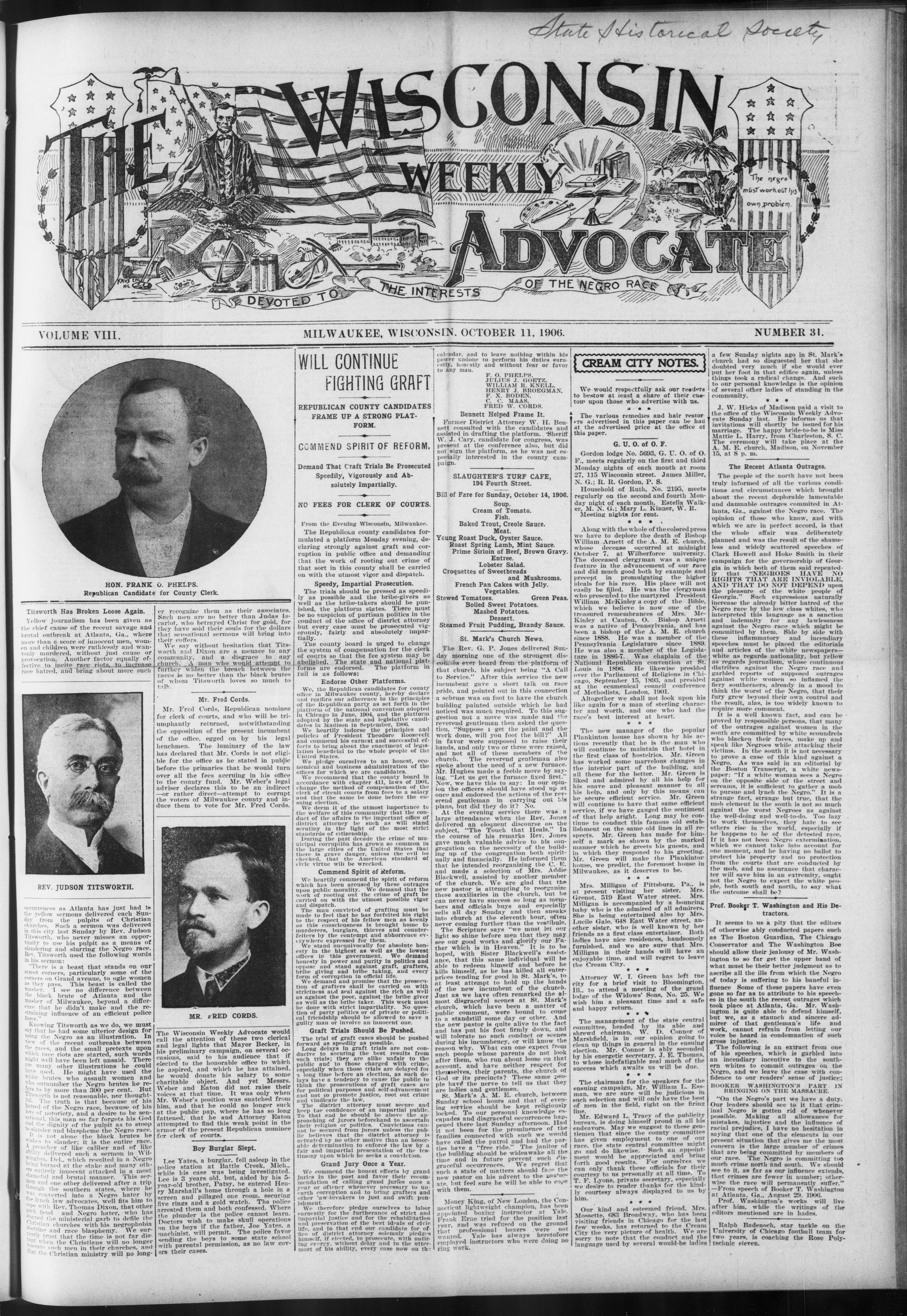
WISCONSIN
WEEKLY
ADVOCATE
DEVOTED TO THE INTERESTS OF THE NEGRO RACE
VOLUME VIII.
[Image of a man with a mustache and a suit].
[Image of a man with a mustache and a suit, facing slightly to the right.]
HON. FRANK O. PHELPS.
Republican Candidate for County Clerk.
Titsworth Has Broken Loose Again.
Yellow journalism has been given as the chief cause of the recent savage and brutal outbreak at Atlanta, Ga., where more than a score of innocent men, women and children were ruthlessly and wontly murdered, without just cause or provocation. Another factor equally effective to incite race riots, to increase race hatred, and bring about more such
[Picture of a man with a mustache and glasses. He is wearing a suit and a white shirt. The background is plain black.]]
REV. JUDSON TITSWORTH.
occurrences as Atlanta has just had is the yellow sermons delivered each Sunday from the pulpits of Christian churches. Such a sermon was delivered in this city last Sunday by Rev. Judson Titsworth, who never misses an opportunity to use his pulpit as a means of slandering and slurring the Negro race. Rev. Titsworth used the following words in his sermon:
"There is a beast that stands on our street corners, particularly some of the corners on Grand avenue, to ogle women as they pass. This beast is called the masher. I see no difference between the black brute of Atlanta and the masher of Milwaukee, beyond a difference that he didn't make and the restraining influence of an efficient police force."
Knowing Titsworth as we do, we must say that he had some ulterior design for using the Negro as an illustration. In view of the recent outbreaks between the races, and the small pretexts upon which race riots are started, such words might well have been left unsaid. There are many other illustrations he could have used. He might have used the white brutes who assault women and who outnumber the Negro brutes he refers to by more than 300 per cent. But Titsworth is not reasonable, nor thoughtful. The truth is that because of his hatred of the Negro race, because of his love of notoriety, and a desire to be sensational, this man so far forgets his God and the dignity of the pulpit as to stoop to slander and blaspheme the Negro race. It is not alone the black brutes he wishes to slander; it is the entire race. A preacher of like caliber and of like ability delivered such a sermon in Wilmington, Del., which resulted in a Negro being burned at the stake and many others entirely innocent attacked in a most shameful and brutal manner. This sermon and one other delivered after a trip through the southern states, where he was converted into a Negro hater by the lynch law advocates, well fits him to cope with Rev. Thomas Dixon, that other arch fiend and Negro hater, who has downed the ministerial garb to defile the Christian churches with his negrophobia doctrine and race blasphemy. We earnestly trust that the time is not far distant when the Christians will no longer tolerate such men in their churches, and that the Christian ministry will no long-
---
er recognize them as their associates. Such men are no better than Judas Iscariot, who betrayed Christ for gold, for they have sold their souls for the dollars that sensational sermons will bring into their coffers. We say without hesitation that Titsworth and Dixon are a menace to any community, and a disgrace to any church. A man who would attempt to further widen the breach between the races is no better than the black brutes of whom Titsworth loves so much to talk
Mr. Fred Cords, Republican nominee for clerk of courts, and who will be triumphantly returned, notwithstanding the opposition of the present incumbent of the office, egged on by his legal henchmen. The luminary of the law has declared that Mr. Cords is not eligible for the office as he stated in public before the primaries that he would turn over all the fees accruing in his office to the county fund. Mr. Weber's legal adviser declares this to be an indirect or rather direct—attempt to corrupt the voters of Milwaukee county and induce them to vote for Mr. Fred Cords.
MR. rRED CORDS.
The Wisconsin Weekly Advocate would call the attention of these two clerical and legal lights that Mayor Becker, in his preliminary campaign, on several occasions, said to his audience that if elected to the honorable office to which he aspired, and which he has attained, he would donate his salary to some charitable object. And yet Messrs. Weber and Eaton did not raise their voices at that time. It was only when Mr. Weber's position was snatched from him, and that he could no longer suck at the public pap, where he has so long fattened, that he and Attorney Eaton attempted to find this weak point in the armor of the present Republican nominee for clerk of courts.
Boy Burglar Slept.
Lee Yates, a burglar, fell asleep in the police station at Battle Creek, Mich., while his case was being investigated. Lee is 3 years old, but, aided by his 5-year-old brother, Patsy, he entered Henry Marshall's home through a hole in a screen and pillaged one room, securing five rings and a gold watch. The police arrested them and both confessed. Where the plunder is the police cannot learn. Doctors wish to make skull operations on the boys if the father, Joe Yates, a machinist, will permit. The police favor sending the boys to some state school with parental permission, as no law covers their cases.
Mr. Fred Cords.
WILL CONTINUE FIGHTING GRAFT
REPUBLICAN COUNTY CANDIDATES FRAME UP A STRONG PLATFORM.
Demand That Craft Trials Be Prosecuted Speedily, Vigorously and Absolutely Impartially.
From the Evening Wisconsin, Milwaukee. The Republican county candidates formulated a platform Monday evening, declaring strongly against graft and corruption in public office and demanding that the work of rooting out crime of that sort in this county shall be carried on with the utmost vigor and dispatch.
Speedy. Impartial Prosecution.
The trials should be pressed as speedily as possible and the bribe-givers as well as the bribe-takers should be punished, the platform states. There must be no suspicion of partisan politics in the conduct of the office of district attorney but every case must be prosecuted vigorously, fairly and absolutely impartially. The county board is urged to change the system of compensation for the clerk of courts so that the fee system may be abolished. The state and national platforms are endorsed. The platform in full is as follows:
Endorse Other Platforms.
We, the Republican candidates for county office in Milwaukee county, hereby declare and reaffirm our adherence to the principles of the Republican party as set forth in the platform of the national convention adopted in Chicago in June, 1904, and the platform adopted by the state and legislative candidates in Madison in September, 1906.
We heartily indorse the principles and policies of President Theodore Roosevelt and commend his earnest and successful efforts to bring about the enactment of legislation beneficial to the whole people of the United States.
We pledge ourselves to an honest, economical and business administration of the offices for which we are candidates.
We recommend that the county board in accordance with chapter 411, laws of 1901, change the method of compensation of the clerk of circuit courts from fees to a salary and that the same be done before the ensuing election.
We deem it of the utmost importance to the welfare of this community that the conduct of the affairs in the important office of district attorney be such as will stand scrutiny in the light of the most strict standards of citizenship.
During the past decade the crime of municipal corruption has grown so common in the large cities of the United States that there is grave danger, unless the evil be checked, that the American standard of civic virtue will be wrecked.
Commend Spirit of Reform.
We heartily commend the spirit of reform which has been aroused by these outrages upon public morality. We demand that the work of rooting out the crime of graft be carried on with the utmost possible vigor and dispatch.
The man convicted of grafting must be made to feel that he has forfeited his right to the respect of his fellow men as keenly as this consciousness is brought home to murderers, burglars, thieves and counterfeiters by the contempt and abhorrence everywhere expressed for them.
We stand unequivocally for absolute honesty in the highest as well as the lowest offices in this government. We demand honesty in power and purity in politics and oppose and stand against graft, grafters, bribe giving and bribe taking, and every form of corruption in official life.
We demand and promise that the prosecution of grafters shall be carried on with strictness and zeal against the rich as well as against the poor, against the bribe giver as well as the bribe taker. This work must be done with strict impartiality. No question of party politics or of private or political friendship should be allowed to save a guilty man or involve an innocent one.
Graft Trials Should Be Pushed.
The trial of graft cases should be pushed forward as speedily as possible.
Long delays in graft trials are not conducive to securing the best results from such trials; they are alike unfair to the public and to those charged with crime, especially when those trials are delayed for a long time before an election, as such delays have a tendency to cause the public to think the prosecutions of graft cases are for political purposes and self-advancement and not to promote justice, root out crime and vindicate the law.
The district attorney must secure and keep the confidence of an impartial public. To that end he should be above the approach of jurors beforehand to ascertain their religion or politics. Convictions cannot be secured from jurors unless the public believes that the district attorney is actuated by no other motive than an honorable determination to enforce the law by a fair and impartial presentation of the testimony upon which he seeks a conviction.
Grand Jury Once a Year.
We commend the honest efforts by grand juries in the past and favor their recommendation of calling grand juries once a year or oftener whenever necessary to unearth corruption and to bring grafters and other 'aw-breakers to just and swift punishment.
We therefore pledge ourselves to labor earnestly for the furtherance of strict and impartial justice and for the rehabilitation and preservation of the best ideals of civic life, and to that end our candidate for office of district attorney solemnly pledges himself, if elected, to prosecute, with untiring energy, without delay and to the uttermost of his ability, every case now on the
calendar, and to leave nothing within his power undone to perform his duties earnestly, honestly and without fear or favor to any man.
F. O. PHELPS.
JULIUS J. GOETZ.
WILLIAM R. KNELL.
HENRY J. BROEGMAN.
F. X. BODEN.
C. C. MAAS.
FRED W. CORDS.
Bennett Helped Frame It
Former District Attorney W. H. Bennett consulted with the candidates and assisted in drafting the platform. Sheriff W. J. Cary, candidate for congress, was present at the conference also, but did not sign the platform, as he was not especially interested in the county campaign.
SLAUGHTER'S TURF CAFE 194 Fourth Street.
Bill of Fare for Sunday, October 14, 1906.
Young Roast Duck, Oyster Sauce.
Roast Spring Lamb, Mint Sauce.
Prime Sirloin of Beef, Brown Gravy.
Entree
Steamed Fruit Pudding, Brandy Sauce.
St. Mark's Church News.
The Rev. G. P. Jones delivered Sunday morning one of the strongest discourses ever heard from the platform of that church, his subject being "A Call to Service." After this service the new incumbent gave a short talk on race pride, and pointed out in this connection a scheme was on foot to have the church building painted outside which he had noticed was much required. To this suggestion not a move was made and the reverend gentleman then asked the question. "Suppose I get the paint and the work done, will you foot the bill?" All in favor were supposed to raise their hands, and only two or three were raised, and not all of these members of the church. The reverend gentleman also spoke about the need of a new furnace. Mr. Hughes made a feeble move by saying, "Let us get the furnace fixed first." Now, we have this to say: In our opinion the officers should have stood up at once and endorsed the actions of the reverend gentleman in carrying out his plans, but did they do it? No.
At the evening service there was a large attendance when the Rev. Jones delivered an eloquent discourse on the subject, "The Touch that Heals." In the course of his remarks Rev. Jones gave much valuable advice to his congregation on the necessity of the building up of the congregation both spiritually and financially. He informed them that he intended reorganizing the C. E. and made a selection of Mrs. Addie Blackwell, assisted by another member of the church. We are glad that the new pastor is attempting to reorganize these auxiliaries in the church, but he can never have success so long as members and officials buys and especially sells all day Sunday and then sneaks into church at the eleventh hour, often coming further than the vestibule.
The Scripture says "we must let our light so shine before men that they may see our good works and glorify our Father which is in Heaven." It is to be hoped, with Sister Blackwell's assistance, that this same individual will be able to redeem himself and before he kills himself, as he has killed all enterprises tending for good in St. Mark's, to at least attempt to hold up the hands of the new incumbent of the church. Just as we have often remarked the almost disgraceful scenes at St. Mark's church, which have been a matter of public comment, were bound to come to a standstill some day or other. And the new pastor is quite alive to the fact and has put his foot firmly down, and will tolerate no such conduct or scenes during his incumbency, or will know the reason why. What can one expect from such people whose parents do not look after them, who run about loose on that account, and have neither respect for themselves, their parents, the church of God or its precincts? These same people have the nerve to tell us that they are ladies and gentlemen.
St. Mark's A. M. E. church, between Sunday school hours and that of evening service should be kept religiously locked. To our personal knowledge escapades and disgraceful occurrences happened there last Sunday afternoon. Had it not been for the prominence of the families connected with such we would have called the patrol and had the parties have a "free ride." The janitor of the building should be wideawake all the time and in future prevent such disgraceful occurrences. We regret that such a state of matters should face the new pastor on his advent to the pastorate, but feel sure he will be able to cope with them.
Money King, of New London, the Connecticut lightweight champion, has been appointed boxing instructor at Yale. Frank Erne tried for the position last year, and was refused on the ground that professional boxers were not wanted. Yale has always heretofore employed instructors who were doing no ring work.
CREAM CITY NOTES.
We would respectfully ask our readers to bestow at least a share of their custom upon those who advertise with us.
```markdown
```
The various remedies and hair restorers advertised in this paper can be had at the advertised price at the office of this paper.
G. U. O. of O. F.
Gordon lodge No. 5693, G. U. O. of O. F., meets regularly on the first and third Monday nights of each month at room 27, 115 Wisconsin street. James Miller, N. G.; R. R. Gordon, P. S. Household of Ruth, No. 2195, meets regularly on the second and fourth Monday night of each month. Estella Walker, M. N. G.; Mary L. Kinner, W. R.
*** ,
Along with the whole of the colored press we have to deplore the death of Bishop William Arnett of the A. M. E. church, whose decease occurred at midnight October 7, at Wilberforce university. The deceased clergyman was a unique feature in the advancement of our race and did much good both by example and precept in promulgating the higher ideals for his race. His place will not easily be filled. He was the clergyman who presented to the martyred President William McKinley a copy of the Bible, which we believe is now one of the treasured remembrances of Mrs. McKinley at Canton, O. Bishop Arnett was a native of Pennsylvania, and has been a bishop of the A. M. E. church since 1888. He was a member of the Pennsylvania Legislature since 1889. He was also a member of the Legislature in 1886-7. Was chaplain of the National Republican convention at St. Louis in 1896. He likewise presided over the Parliament of Religions in Chicago, September 15, 1893, and presided at the ecumenical council conference of Methodists, London, 1901.
Altogether we shall not look upon his like again for a man of sterling character and worth, and one who had the race's best interest at heart.
***
The new manager of the popular Plankinton house has shown by his actions recently that he is the man who will continue to maintain that hotel in the first class of hostelries. Mr. Green has worked some marvelous changes in the interior part of the building, and all these for the better. Mr. Green is liked and admired by all his help for his suave and pleasant manner to all his help, and only by this means can he secure efficient service. Mr. Green will continue to have that same efficient service, if we have gauged the sentiment of that help aright. Long may he continue to conduct this famous old establishment on the same old lines in all respects. Mr. Green has made for himself a mark as shown by the marked manner which he greets his guests, and in which they responded to his greeting. Mr. Green will make the Plankinton house, we predict, the foremost house in Milwaukee, as it deserves to be.
* * *
Mrs. Milligan of Pittsburg, Pa., is at present visiting her sister, Mrs. Grenot, 519 East Water street. Mrs. Milligan is accompanied by a bouncing baby who is the admired of all admirers. She is being entertained also by Mrs. Lucile Gale, 648 East Water street, another sister, who is well known by her friends as a first class entertainer. Both ladies have nice residences, handsomely furnished, and we are sure that Mrs. Milligan in their hands will have an enjoyable time, and will regret to leave the Cream City.
***
Attorney W. I. Green has left the city for a brief visit to Bloomington, Ill., to attend a meeting of the grand lodge of the Widows' Sons, No. 25. We wish him a pleasant time and a safe and happy return.
* * *
The management of the state central committee, headed by its able and shrewd chairman, W. D. Connor of Marshfield, is in our opinion going to clean up things in general in the ensuing election. Mr. Connor is ably seconded by his energetic secretary, J. E. Thomas, to whose indefatigable zeal much of the success which awaits us will be due.
***
The chairman for the speakers for the ensuing campaign, Mr. William L. Essman, we are sure will be judicious in such selection and will only have the best of men in the field, right on the firing line.
Mr. Edward L. Tracy of the publicity bureau, is doing himself proud in all his endeavors. May we suggest to these gentlemen that since the county committee has given employment to one of our race, the state central committee might go and do likewise. Such an appointment would be appreciated and bring forth good results. For ourselves we can only thank these officials for their courtesy to us personally at all time. To T. F. Lyons, private secretary, especially we desire to render thanks for the kindly courtesy always displayed to us by him.
```markdown
```
Our kind and esteemed friend, Mrs. Mossette, 683 Broadway, who has been visiting friends in Chicago for the last few weeks, has returned to the Cream City the very picture of health. We are sorry to note that the conduct and the language used by several would-be ladies
a few Sunday nights ago in St. Mark's church had so disguested her that she doubted very much if she would ever put her foot in that edifice again, unless things took a radical change. And such to our personal knowledge is the opinion of several other ladies of standing in the community.
***
J. W. Hicks of Madison paid a visit to the office of the Wisconsin Weekly Advocate Sunday last. He informs us that invitations will shortly be issued for his marriage. The happy bride-to-be is Miss Mattie L. Harry, from Charleston, S. C. The ceremony will take place at the A. M. E. church, Madison, on November 15, at 8 p. m.
The Recent Atlanta Outrages.
The people of the north have not been truly informed of all the various conditions and circumstances which brought about the recent deplorable lamentable and damnable outrages committed in Atlanta, Ga., against the Negro race. The opinion of those who know, and with which we are in perfect accord, is that the whole affair was deliberately planned and was the result of the shameless and widely scattered speeches of Clark Howell and Hoke Smith in their campaign for the governorship of Georgia in which both of them said repeatedly that "NEGROES HAVE NO RIGHTS THAT ARE INVIOLABLE, AND THAT DO NOT DEPEND upon the pleasure of the white people of Georgia." Such expressions naturally increase the already bitter hatred of the Negro race by the low class whites, who interpreted this language as a sanction and indemnity for any lawlessness against the Negro race which might be committed by them. Side by side with these inflammatory and incendiary speeches must be placed the editorials and articles of the white newspapers—white as regards nationality, but yellow as regards journalism, whose continuous diatribes against the Negro race and garbled reports of supposed outrages against white women so inflamed the fiery southerners, already in a mood to think the worst of the Negro, that their fury grew beyond their own control and the result, alas, is too widely known to require more comment.
It is a well known fact, and can be proved by responsible persons, that many of the outrages against women in the south are committed by white scoundrels who blacken their faces, make up and speak like Negroes while attacking their victims. In the south it is not necessary to prove a case of this kind against a Negro. As was said in an editorial by the Boston Transcript, a white newspaper: "If a white woman sees a Negro on the opposite side of the street and screams, it is sufficient to gather a mob to pursue and lynch the Negro." It is a strange fact, strange but true, that the mob element in the south is not so much against the worst Negroes as against the well-doing and well-to-do. Too lazy to work themselves, they hate to see others rise in the world, especially if he happens to be of the detested race. If it has not been Negro extermination, which we cannot take into account for one moment, and he having no ballot to protect his property and no protection from the courts that are conducted by the mob, and no assurance that character will save him in an extremity, ought not the Negro to expect the white people, both south and north, to say what the outcome shall be?
Prof. Booker T. Washington and His Detractors.
It seems to us a pity that the editors of otherwise ably conducted papers such as The Boston Guardian, The Chicago Conservator and The Washington Bee should allow their jealousy of Mr. Washington to so far get the upper hand of what must be their better judgment as to ascribe all the ills from which the Negro of today is suffering to his baneful influence Some of these papers have even gone so far as to attribute to his speeches in the south the recent outrages which took place at Atlanta, Ga. Mr. Washington is quite able to defend himself, but we, as a staunch and sincere admirer of that gentleman's life and work, cannot refrain from letting our voice be heard in condemnation of such gross injustice.
The following is an extract from one of his speeches, which is garbled into an incendiary incentive to the southern whites to commit outrages on the Negro, and we leave the case with confidence to our readers' sense of justice;
BOOKER WASHINGTON'S PART IN BRINGING ON THE MASSACRE.
"On the Negro's part we have a duty. Our leaders should see to it that criminal Negro is gotten rid of whenever possible. Making all allowances for mistakes, injustice and the influence of racial prejudice, I have no hesitation in saying that one of the elements in our present situation that gives me the most concern is the large number of crimes that are being committed by members of our race. The Negro is committing too much crime north and south. We should see to it, as far as our influence extends, that crimes are fewer in number; otherwise the race will permanently suffer."
—From speech of Booker T. Washington at Atlanta, Ga., August 29, 1906.
Prof. Washington's works will live after him, while the writings of the editors mentioned are in hades.
Ralph Badenoch, star tackle on the University of Chicago football team for two years, is coaching the Rose Polytechnic eleven.
THE WISCONSIN WEEKLY ADVOCATE
MILWAUKEE, WIS.
R. B. MONTGOMERY, Editor and Proprietor.
UNDER US.
They stay not in their hold
These stokers,
Stooping to hell
To feed a ship.
Below the ocean floors,
Before their awful doors
Bathed in flame.
I hear their human lives,
Drip—drip.
Through the lolling aisles of comrades
In and out of sleep,
Troops of faces.
To and fro of happy feet,
They haunt my eyes;
Their murky faces beckon me
From the spaces of the coolness of the sea.
Their tallful bodies sway against the skies.
O God—take Thou their years.
Hungers and hopes and shames
While they cast them
One by one.
The tons, the years—
With the burning Dust they've lived—
Into flames—
—Mount Tom.
Tea-Table Salad.
Possibly Exaggerated.
home last night, Fred Brosen:
Landlady—I did, indeed, the whole
night long.—Fliegende Blaetter.
A Jewel
"You entertain a great deal more than you did formerly, I notice." "Yes, indeed. This is the first really hospitable cook we ever had."—Life.
Comforting
She—Do you love me more than any girl you ever knew?
girl you ever knew:
He—Well. I love you more than any other girl who would have me.—Floh.
Overeating.
Church—I see they are crying for more missionaries over in Africa.
Gotham—Why, those cannibals must be regular gluttons.—Yonkers Statesman.
Overeating.
Human Nature
"No annexation," declared Cuba. "Not a bit of it." heartily assented the United States. "Caramba! Why not? Are we not good enough for you?"—Louisville Coorier-Journal.
Needed It to Fill.
"It was one of the loveliest spots I ever beheld."
"What was?"
"The ace that I got last night on a draw."—Boston Transcript.
Economy.
"Your wife's recent illness must have been fearfully expensive?"
"Not at all; she missed eight receptions, four balls and the opera season. Think of the saving in clothes."—Life.
An Appreciation.
"I say, old fellow," said the friend, rummaging around the studio, "can't you give me some rotten little painting of yours? Something you don't want. I'll have it framed, you know!"—Sporting times.
Too Many Risks.
"Yes, Biddleford's Russian scheme was an entire failure." "What did he go there for?" "To organize an accident insurance company."—Cleveland Plain Dealer.
A. Cure Needed.
Mrs. Nexdore-I've been thinking of having my daughter's voice cultivated. Would you?
Mrs. Knox-By all means, if you have tried every other remedy.-Philadelphia Ledger.
Just the Thing
Mrs. Crabb (on a visit with her husband to view a villa for sale)—Oh, how beautiful—how beautiful! The magnificent view makes me perfectly speechless! Mr. Crabb—Then I'll buy the villa!—London, Pits
Shrinkage Disposition
Hicks—This shirt's too small for me now. It's funny how wool shrinks. Wicks—Oh, it's not so strange. You told me it was lamb's wool, and you know what a limid creature a lamb is. Philadelphia Ledger.
One Man's Meauness.
Bilkins—My wife bought a $50 hat one day last week and had it sent to my office C. O. D.
Wilkins—Tough luck, eh?
Bilkins—Oh, no; I sent it back P. D. O.—Columbus Dispatch.
Fits.
He—I'm going to Marienbad to take the waters and thin down a bit.
She—Aren't you thin enough?
He—No. I've just had a dozen shirts made, and they all fit me too tightly round the neck.—Caricature.
The Fly Fly.
"Will you step into my parlor?"
Said the spider to the fly,
Inviting her politely to her doom;
Rut, the fly, was pretty, fl.
Looking for Trouble.
T
"No, I don't think Reggy will ever learn to run his auto."
"Why not?"
"He's always trying to roll a cigarette and guide the machine at the same time."
Mistress-I am sorry to trouble you,
Bridget, but my husband wants to break fast tomorrow at 5:30.
Cook—Oh, it won't be any trouble at all, mum, if he don't knock nothin' over whoile cookin' it an' wake me up.—Judge.
Gallant
Mav-Really, I don't feet like walking. My feet bother me a good deal.
May-Nervous Jack—Otherwise you wouldn't let such little things bother you.—Philadelphia Ledger.
He Knew Them.
Sunday School Teacher—Now, then, Willie Smart, can you tell me what a prophet is?
Willie Smart—Why, a prophet's one of these fellows that's always lookin' for a chance to say "I told you so."—Philadelphia Ledger.
Another Difficulty.
"I suppose that when you discover the north pole you will regard your labors as completed?"
"No." answered the Arctic explorer.
"The hardest part will be yet to come. We'll have to find some way of getting home again."—Washington Star.
Simple
Scott—There's only one way to become famous as an author and that is to write something worth while.
Mott—Bosh! That's an old-fashioned idea. Nowadays the only way is to do crazy things which can be worked up into literary anecdotes.—Boston Transcript.
Realism
"Do you believe that realism is a benefit to the drama?"
"Decidedly," answered Mr. Stormington Barnes. "I cannot express myself too strongly in favor of the practice which has grown up in recent years of paying actors with real money."—Washington Star.
Recompense
"Yes," said the old Indiana trapper, "we kill a painter now and then, but they're gittin' source."
"Well, I wouldn't worry, responded the tourist. "When they're all gone you can begin on the authors. I understand they're plentiful enough."—Louisville Courier-Journal.
Spirituous Euphemism.
(Dr. Josiah Oldfield said he considered beer of great value, but he preferred to call it "malt tea.")
This plan I have extended, for Champagne I call "grape lemonade." "Scotch syrups" all the whiskies are, (It doesn't matter where they're made) Gin is "white cream"—as soft as silk—While rum becomes "Jamaica milk."
Sure of It.
Friend—Could you hear what the candidate was talking about from where you sat?
Campaign Listener—No. But what he said was all right. Friend—How do you know? Campaign Listener—I've heard that speech before.—Detroit Free Press.
The Modern Way.
The young man loved the maiden fair.
"Twas dark; they both sat on one chair,
He kissed her and said then and there:
"Be my wife, little bass!"
She stroked his hair and answered, "No,
I would not care to have it so.
But you may be my husband, Joe,"
She Could Wait
The minister was shocked when the young lady declined an introduction to some of his parishioners. "Why, my dear young lady, did you ever think that perhaps you will have to mingle with these good people when you get to heaven?"
"Well," she exclaimed. "that will be soon enough."—Exchange.
Just Her Opportunity.
Just Her Opportunity.
Mr. Talke A. Lotte-In these times individual effort goes for nothing. It is foolish for a man to start out alone. Miss Needa Mann-Oh! Mr. Lotte, this is sudden.
A. Petrol Motor Fireboat.
The Rio Tinto company has large warehouses and docks at Huelva, Spain, from which its shipments of copper are made. For the protection of the company's property a small steam fireboat has been maintained for some years past, but the directors, not being satisfied with the power of this vessel, asked Col. Fox, chief officer of the London Salvage corps, to inspect and advise as to more powerful apparatus. As a result a novel petrol motor fireboat has been built. A run on a measured mile off Greenwich was made, both against and with the tide, the speed attained averaging nine miles an hour; $1\frac{1}{2}$ inch, $1\frac{3}{4}$ inch and 2 inch solid jets were thrown from one monitor ou deck, the largest stream reaching a height of about 200 feet.
The great advantages of this vessel are that it can be started instantly on an alarm of fire, there is no expense in maintaining steam ready for a call, it can easily be worked by two or three men only, and is of light draught, enabling it to get close to its work at low tide.—Engineering.
"Jim" Broder Dead
Col. "Jim" Broder, a pioneer capitalist and eccentric old citizen of Fulton, Ky., died last week. Broder two years ago had a solid rock hewn into a grave for himself, and bought a casket, in which he had lain to get a good fit. He kept a piece of meat in the rock for a year to test its preservative qualities. He was wrapped in forty yards of linen, which he had purchased some time ago for a shroud. Broder left instructions that he wanted to be buried forthwith, 'without any frills,' as he often said, so he was laid in the strange grave a few hours after the breath left his body. A bottle of old liquor was interred with the remains of "Colenel Jim," as he was known in western Kentucky.
YOU
You mean for me what birds at daybreaks sing.
When earth awakening calls to them
With little yellow daffodils, 'Tis spring!
You mean the wondrous music of the spheres.
When o'er the distant purple hills
Through soft piled clouds, the great white moon appears.
You mean what the great sea is fain to say,
When murmuring low on silver sands
It sings a lullaby at close of day.
The trees all bow their heads, they listen,
It sings a lullaby they listen. The trees all bow their heads, they listen.
The winds are telling them, dear love,
How all the world now means for me—but
you!
—Katherine Fay in Lippincott's.
INTO HIS HANDS.
The resident surgeon fingered the long lobe of his ear nervously, and frowned. He was somewhat surprised to see a man of such evident good breeding giving way to such a yulgar demonstration of emotion. Nevertheless, he was touched by its palpable sincerity and depth.
"I don't say the case is entirely without hope, and you must pardon me if I have spoken out somewhat bluntly to you as man to man," he said, his eyes wandering about his private room at the hospital. "An operation might save her if performed immediately. But it is a desperate sort of operation, and so liable to fail that I—I—well, I couldn't conscientiously advise it if there were anything else that could be done."
The younger man hesitated, turning this way and that, in the throes of anxiety and indecision. Suddenly he wheeled round and faced the surgeon.
"Will you give me your professional word of honor, and in the name of all those you hold most dear, that it is absolutely the only thing to be done?" he asked eagerly, in a hoarse voice.
"My dear sir," responded the surgeon, coldly. "I have not been playing on your affection—your natural affection for your wife. We do not say things in this hospital we do not mean. I repeat that nothing but an exceedingly dangerous operation can save the lady's life, and while it may save her. it may—not. I cannot put it more clearly and certainly than that. From a professional point of view the situation is so hopeless that it must rest entirely with you to decide whether the operation shall be attempted. But you must decide promptly, for—"
"I say yes! Yes; let us attempt anything that offers a shadow of hope!"
"I'll telephone to Mr. Brinton, then. He's probably at home at this late hour," said the surgeon, rising quickly and going to the instrument. "There'll be no difficulty about his fee, of course?"
"Brinton?" cried Waddington, starting after him as if to detain him. "Good heaven! Not Kennedy Brinton?"
"The same, sir—Kennedy Brinton; the only man who would dare to undertake this operation," answered the surgeon, too preoccupied to at once detect the other's sudden alarm.
"Impossible—oh, impossible," murmured the younger man, dropping weakly into a chair and laying his white face in his tremblind hands.
"What's impossible, my dear sir?" inquired the surgeon, turning away from the instrument while the exchange put him through to the famous young surgeon, whose wonderful daring and skill had raised him above the heads of most of his seniors.
"Ring him off!" cried Mr. Waddington desperately. "It's impossible. "She is——"
He checked himself, and his eyes seemed to look through the calm and courtly surgeon.
"Now what is it to be? Please make up your mind," said the latter as the bell rang.
"Don't mention the name of Waddington" he said sharply.
The surgeon nodded and continued speaking into the receiver. A moment later he hung it up.
"That's all right," he said, with his brisk, professional manner. "He will come down at once. Will you remain here, or call again, to see how the matter goes? Personally I should advise you not to remain—you're not equal to the strain. Come back between midnight and 1."
"Would it be possible to hide her face from him until he has operated?" asked Waddington, anxiously, speaking slowly, in a distant way.
"Hide her face?" repeated the surgeon, with a keen glance of wonder. "Fiddlesticks, my dear sir! Really, I don't know—I don't want to know—what are your reasons. Heavens, you don't think he'll trouble to fall in love with her while her very life lies at the point of his knife?" "But her life may depend on his not knowing who she is until after the operation," urged Waddington, becoming angry in despair. The surgeon looked at him coldly, calculatingly, for a moment.
"It shall be as you wish," he answered at last. "I have as little reason to refuse your request as you have to make it. I may say it is not at all unusual to cover a subject's face during an operation. You must excuse me if I leave you to find your own way out; I have to make the necessary arrangements."
"Thank you," said Waddington, faintly, as he picked up his hat. "I will return in about an hour."
II
A strong odor of antiseptics pervaded the air of the brilliantly illuminated operating room, and a low hissing sound rose from the bright metal vessel at which the white aproned dresser, with his shirt sleeves turned up above his elbows, was engaged.
As the anesthetist stepped back from the patient the resident surgeon threw a white cloth over her beautiful white face and the door opened and Kennedy Brinton entered the room.
Stopping abruptly at the foot of the operating table, he whispered a few hurried words to the dresser; then turning, smiled at the anesthetist, with his eyebrows raised questionably. It was a smile of singular sweetness and gentleness.
"Excellent," murmured the anesthetist, his fingers on the patient's pulse. "She is ready."
Brinton stepped forward and laid the point of his right index finger on the spot where he intended to make the primary incision, and compressed his lips. Then, in a clear, steady voice, which almost startled his hearers, he asked for the instrument he required.
He glanced at it as he accepted it. Then, for the first time, he looked toward the patient's face.
"Take that on," he said quickly, in a low tone, indicating the white cloth, "Take it off," he repeated, leaning over
her and holding the lancet lightly in his fingers.
As the resident surgeon obeyed, Brinton started, and the hand about the glittering instrument shook.
"Heavens!" he ejaculated softly—"Ella." He straightened himself, and turned his white face first upon the resident surgeon, then upon the anesthetist.
"A ghastly trick!" he whispered, licking his lips. He was livid, but master of his nerve again. "Who brought this woman here?"
"Her husband, I presume, a Mr. Waddington," replied the resident surgeon immediately.
The anesthetist glanced at his watch. Brinton saw the movement, and understood; but for a moment longer he hesitated, his eyes bent upon the patient's face. Then he leaned forward. The blade, half hidden in his steadied fingers, glittered as he lowered it over the exact spot he had marked for the incision, and he commenced.
The resident surgeon watched the delicate movements of the lancet with anxious eyes, while the anesthetist's gaze was riveted on his watch, by which he was checking the patient's pulse.
One word was spoken; Brinton called for another instrument. The only other sound above his own heavy breathing while he worked was a soft, stifled exclamation of approval and admiration from the resident surgeon.
As Brinton stepped back from the table and moistened his white lips nervously the dresser stepped forward to take up his task; the anesthetist laid a stethoscope to the patient's heart and listened intently; and the resident surgeon moved round noiselessly toward his distinguished confrere.
"One word with you, Haddly," said Brinton to the resident surgeon, at the same time drawing him aside. "Where is the man you mentioned—he who brought her here?"
"I imagine he is in the hospital at the present moment. He was to have returned—"
"I will go to your room," said Brinton, in a low voice. "If you find him elsewhere, send him there—alone. Tell him nothing."
They passed out together, the operating surgeon going straight to the other's room. As he opened the door a man hurried forward. Brinton entered quickly and closed the door behind him. Waddington drew back, the question of his heart dying on his lips.
"So we are to meet in singular circumstances, sir," said Brinton slowly, his eyes looking coldly into Waddington's
The other half averted his haggard face. Then suddenly he turned upon the surgeon.
Brinton folded his long arms across his chest.
"She will never be anything more to you, sir," he answered deliberately.
"You delivered her life back into my hands tonight," said the surgeon softly, "and I—I accept it."
There was a long pause. Waddington sat with his face hidden in his hands, crying gently like a heart torn woman. Brinton stood, with bent shoulders and drooping head, watching him; his face gleaming with such a look of triumph as could never illumine the face of a weaker man.
"A delicate operation, sir," said he, breaking the silence; "so delicate an operation that the deflection of the scalpel one-eighth of an inch one way or the other means death. I am not a believer in predestination, or, if I were, I should certainly imagine that I have studied the operation with particular attention that I might be the only man you could call to Ella's side tonight. Tonight circumstances offered me this—this unequaled chance to be revenged on you for the unpardonable wrong you did me while posing as my friend. You loved her—oh, I do not doubt you loved her, but I loved her, and she loved me. You could never have induced her to leave me but by your elaborate scheme for convincing her I no longer cared for her.
"And tonight! You brought her here and laid her down before me as a sacrifice to my hatred of you! You offered me her life——"
"Great heavens!" cried Waddington, rising suddenly and advancing toward him with arms upraised threateningly. "I had no choice! Would it not have been the same, you fiend, if you had not operated?"
Brinton caught him by the wrists firmly and held him in a vise.
"You have misunderstood me," he said, coldly. "I said you offered me her life tonight and I accepted it." He flung off Waddington's hands and stepped back. "It was undeniably mine tonight, and I secured it," he added. "She will live, and her life will be mine." Waddington staggered back.
The surgeon turned and walked across the room.
"You are not playing with me, Brinton?" said Waddington, a look of painful doubt in his ghastly face.
The surgeon did not answer.
"Truly, her life is yours," said Waddington, slowly. "You have snatched her from a stronger hold than mine, and Death and I must admit the justice of your claim."
His voice broke, and for a few moments he struggled silently with his emotion.
"Oh, Ken, Ken," he said, his face twitching, "as boys together we loved the same games, the same studies. As men we loved the same woman; and loving her so much can you blame me for loving more? I did not steal her from you. I swear I did not! Though I deprived you of her and hoped she might one day consent—perhaps by circumstances be driven—to come to me. I tricked her into leaving you, and so compromised her by her flight that she was rendered friendless but for me. But she never accepted my heart, and I believe her love was always wholly yours. She has never been anything else, and it is not from me you have snatched her tonight, but from Death alone."
A light knock at the door was instantly followed by the appearance of the resident surgeon. He glanced furtively at the two men and smiled.
"She has come round." he said, his smile broadening.—Answers.
Feather Beds Dangerous.
Timid people who are afraid of being killed by lightning should take refuge in statistics rather than in feather beds. The one victim of a storm which swept over Boston recently was leaning against an iron bar. Yet even in this dangerous environment his chances of being killed
were so remote that the experience might be safely repeated by somebody else thousands of times. The number of people who are actually killed by lightning is hard to ascertain, because it is so small that in most cases such deaths go into the table as "other causes" or are concealed in some other fashion. The Boston board of health, for example, uses the Bertillon registry system, and here deaths caused by lightning would be hid under "electric disturbances," which includes also executions by electricity, third-rail casualties, fatal falls from electric light poles and live wires, fatal shocks from dynamo, etc. The registry department, which classifies deaths more correctly, does not record a single instance of a person killed by lightning in Boston since 1901. In the whole state there appears to have been but three persons killed by electric shocks from the clouds in the last three years.
MEN WHO LIVE ON STILTS.
Turpentine Gatherers and Sheep Herders of Parts of France.
The people live on 16-foot stilts in the remarkable turpentine growing country of France. They don these stilts after breakfast. They do not remove them again till it is time for bed.
There are two reasons for the wearing of stilts in the turpentine country. One is the turpentine gathering. The other is the herding of the great flocks.
The turpentine comes from the maritime pine. This tree is tapped, a shingle is inserted, and from the shingle is hung a tiny bucket, into which the turpentine drips. The tapping process is like that used on the American sugar maple.
Young pine trees are tapped low, but with each year's passage the incision is made higher up, so that it is not long before most of the trees are tapped 20 or 30 feet from the ground.
Hence the huge stilts of the workmen. On these stilts they traverse the flat country, covering five or six yards with each stride, and quickly and easily collect the turpentine that overflows the little buckets hanging high up in the trees.
It is for herding also that the stilts are useful. The country is very flat, and the herdsman, unless he continually climbed a tree, would be unable to keep all the members of his huge flock in sight. But, striding about on his stilts, he commands a wide prospect; he is always, as it were, upon a hit.
The stilt wearers carry a 15-foot staff with a round, flat top like a dinner pale. When it is lunch time or when they are tired they plant upright under them the staff and sit down on its round, flat top. Then in comfort seated so dizzily high, they eat and rest and chatter—a strange sight to behold.—New Orleans Times-Democrat.
MONUMENT TO A DOG.
In Battersea, Great Britain, the AntiVivisection society of England has
erected a handsome monument to a dog. The animal died in great agony, having been vivisected by a physician in that city. The society has had a bronze likeness of the animal placed upon a beautiful stone base and inscribed on the stone is the awful story of the poor dog's death. Every detail is given, including the doctor's name, and the society has agreed to in-
Fountain
demnify the Battersea corporation to the extent of $1,500 for any possible libel action arising out of the inscription. The monument is protected from hostile attack by electric bells.
Forget Their Valuables.
Those who have visited Lucerne, Switzerland, at the height of the holiday season will hardly be surprised to learn that every year in Swiss hotels alone, articles of value of $25,000 are left behind by forgetful visitors in a hurry. Swiss railways derive an equally handsome profit from the sale of objects forgotten by travelers and never claimed.
Some extraordinary cases of forgetfulness are recorded this season. An Englishman had taken a room at a Zermatt hotel and deposited his baggage there, but coming back from a walk he could not remember the name nor the location of his hotel, and had to seek the aid of the police. At a Zurich hotel bank notes to the value or several hundred dollars were left behind some weeks ago, and no one has yet come forward to claim them. At Geneva a hotel keeper recently restored a jewel casket to an American woman, who was under the impression that she had left it in a train. A German paterfamilias, with offspring numbering eight, accidentally left one of his children behind at Lausanne without noticing its absence until he had reached his home.
THE CZAR'S GUARDIAN.
Gen. Trepoff, the the hands of Gen. Deduline, a young Russian officer noted for his courage and bravery.
Since the death of
Czar's life has been in
Gen. Deduline's special duty is to devise ways and means to baffle the open and hidden enemies and prevent assassins from striking down the ruler of Russia.
Shortly after accepting the position of commandant of the palace, Gen. Deduline received a warning from the Terrorists that he had been sentenced to death. The Terrorists claim to have killed Trepoff by poison, although his physicians say heart disease was the cause. Dozens of attempts to kill Trepoff failed.
America Produces Many Gems
Our chief gem productions in this country in 1905 were: Sapphires, $125,-
000; turquoise, $65,000; tourmalines, $50,-
000; peridots and crystal quartz, $10,-
000 each; aquamarines, $6000; kunsite.
gold quartz chrysoprase, silicicfield wood
and garnets, $5000 each; smoky quartz
and chlorastrolite, $3000 each; amethyst,
agate, pyrite, malachite and catlinite,
$2000 each; moss agate, $1500;
beryl, rose quartz, amazon stone and arrow
points, $1000 each; topaz, utahlite
and meiite, $500 each; fossil corral, $250,
and dumortierite in quartz, $100.
Municipal Ownership Fails
The failure of the municipal bakeries at Catania, Italy, is reported by Mr. Churchill, the British consul at Palermo. There was a $30,000 deficit in the balance sheet, and the request governing a loan of $80,000 was refused by a royal commission; in consequence the institution has been closed. Advertise in Your Home Paper
One of the Family.
"Are you the editor that takes in society news?" inquired the caller, an undersized man, with a tired and timid appealing look on his face.
"Yes, sir," replied the young man at the desk. "I can take in any kind of news. What have you?"
"Why, it's this way," said the caller, lowering his voice. "My wife gave a small party last night, and I am willing to pay to have this report of the affair put in the paper."
"We don't charge anything for publishing society news," observed the young man at the desk, taking the proffered manuscript and looking it over.
"That's all right," was the reply. "You don't understand. I wrote this up myself, and I put in a line or two that says, 'Mr. Halfstick assisted his distinguished wife in receiving the guests.' That's the way I want it to go in, and I don't care if it costs a dollar a word. I want my friends to know, by Georgel that I still belong to the family."—Harper's Weekly.
DODD'S
KIDNEY
PILLS
FOR ALL KIDNEY DISEASES
CURES RHEUMATISM
BRIGHT'S DISEASE
DIABETES BACKACHE
discontinued the use of our food
mattage. The public may rely on
care of limitations. Sold only in denwestland
Butterflies' Wings Used and Are Beautifully Treated.
An interesting form of insect jewelry is now made from the wings of butterflies. Those most delicate and perishable of lovely things are so treated that they retain their charm of color and design for a long time though perhaps not permanently. Most of the butterflies used for the purpose are the brilliant creatures of large size that abound in Central and South America. Much of this jewelry is manufactured in a suburb of Boston. The gaudy wings of the butterflies are cut into circles, oval and other forms with sharp and delicate instruments that do not damage their beauty. The material is handled with the utmost care, but there is a considerable percentage of loss in the work.
In order to give something like permanency to the brilliant bits they are enclosed between pieces of fine glass, such as was used in making the old-fashioned hair breastpins used as memorials. The tiny glass cases are framed in gold and in some instances incrusted with diamonds. Some of the wings are made into lockets, others into pins, brooches and fobs. Few persons seeing these things for the first time would guess the material of which they are made. They are golden, blue, purple, mottled brown and red. Many of them change and shimmer like opals. Some look like bits of the richest blue sky flecked with white cloudlets.
Still others strongly suggest miniature marine paintings, with softly clouded skies above the horizon's edge. A few dimly suggest tiny landscapes. Most of them, however, look like pieces of highly polished and richly colored minerals. The stria, or delicate lines that cross some of the bits of wing, increase this effect. Most of the lockets show different colored wings on the two faces. On one side will show a rich red or blue wing, on the other a softly mottled brown.—New York Sun.
Woman Discovere Stars.
Mrs. Paton Fleming, a native of Dundee, who has just been elected a member of the Royal Astronomical society, is not the only British woman who has succeeded in comprehending the transcendental mysteries of the heavens—perhaps the most abstract and abstruse of the sciences. Miss Henrietta Leavitt discovered twenty-five new variable stars some years ago. Lady Huggins diligently helps her husband, Sir William Huggins, in his astronomical observations. In their house in South London they possess a very finely equipped observatory, which contains the enormous telescope presented by the Royal society to Sir William in recognition of the work accomplished by Lady Huggins and himself in astro-physics.
People marvel at the mechanism of the human body with 248 bones and 60 arteries. But man is simple in this respect compared with the carp. That remarkable fish moves no fewer than 4386 bones and muscles every time it breathes. It has 4320 veins, to say nothing of its 99 muscles.
The first meerschaum pipe was made by Karol Howater in 1723. This pipe is still in the Pesth museum.
LOOSE TEETH
Made Sound by Eating Grape-Nuts. Proper food nourishes every part of the body, because Nature selects the different materials from the food we eat, to build bone, nerve, brain, muscle, teeth etc. All we need is to eat the right kind of food slowly, chewing it well—our digestive organs take it up into the blood and the blood carries it all through the body, to every little nook and corner.
If some one would ask you, "Is Grape-Nuts good for loose teeth?", you'd probably say, "No, I don't see how it could be." But a woman in Ontario writes:
"For the past two years I have used Grape-Nuts Food with most excellent results. It seems to take the place of medicine in many ways, builds up the nerves and restores the health generally.
"A little Grape-Nuts taken before retiring soothes my nerves and gives sound sleep." (Because it relieves irritability of the stomach nerves, being a predigested food.)
"Before I used Grape-Nuts my teeth were loose in the gums. They were so bad I was afraid they would some day all fall out. Since I have used Grape-Nuts I have not been bothered any more with loose teeth.
"All desire for pastry has disappeared and I have gained in health, weight and happiness since I began to use Grape-Nuts." Name given by Postum Co., Battle Creek, Mich. Get the famous little book, "The Road to Wellville," in pkgs. "There's a reason."
GOSSIP FOR THE LADIES.
The Vacant Places.
How much soever in this life's mutations We seek our shattered idols to replace, Not one in all the miraids of the nations Can ever fill another's vacant place.
Each has its own; the smallest and most durable.
With every death some love and hope must crumble
Which strive to build them up anew.
If the fair race of violets should perish
Before another springtime had its birth,
Could all the costly bloom which florists cherish
Bring back its April beauty to the earth?
Not the most gorgeous flower that leaf uncloses
Could give the olden grace to vale and plain;
Not even Persia's garden full of roses
Could ever make this world so fair again.
And so with souls we love; they pass and leave us;
Time teaches patience at a bitter cost;
Not all the new loves which the years may give us
Can fill the heart-place aching for the lost.
Happiness.
It's merely a habit.
Some people have it by nature.
It means refusing to permit your mind to dwell on anything that causes worry and sorrow.
It means resolutely swinging your thoughts to brighter things.
thoughts to brighter things.
It means to put aside the past and live
in today, with no fret about tomorrow. It means to believe in ultimate good, and trust all things to work toward this end. It means forgetting yourself and making others happy. It's just a habit! it can be cultivated; and there's no other habit so well worth while—Exchange.
Discretion
Or a sense of propriety: by either term is the virtue known, is like a perfume. It cannot be touched, seen, weighed or described, but it exists and makes its presence and its absence known and is as essential to every womanly woman, no matter what her age, intellectual accomplishments, beauty or social position, as its perfume to the rose.
The woman who has this precious gift is by it alone protected from harm as by an invisible armor of proof. She may not be safe from slander, but she is safe from any real injury. The finest armor may be splashed with mud, but mud can be washed away—only wounds leave scars.
The youngest or most friendless girl who uses her wits and heeds the warnings which she will receive from her inward sense of propriety whenever she is tempted to violate its laws never can go far wrong.
There are cases when a noble and unselfish aim will atone for breaking the laws of propriety, but they seldom occur, and even the few that do bring many evils upon the law breakers. In a good cause one must be willing to suffer. But let no one imagine that suffering of one sort or another will not follow every breach of the laws of a genius or even an artificial code of propriety.—Washington Star.
A Lively Drawing Party.
The hostess who enjoys a social affair entailing no brain fag should issue invitations for a Portrait party.
The only apparatus necessary is a quantity of blank cards or squares of pasteboard, say about 5 inches square, and pencils.
Each gentleman on arriving receives a slip of paper on which is written the name of some lady in the company, and, when the fun is in readiness the partners thus appointed must sit opposite each other and draw each other's likenesses.
At the end of ten minutes the portraits are collected by the hostess, numbered and pinned up on the wall.
The men then choose new partners and the game proceeds as before.
and the game proceeds as before. Each player before the drawing stops much draw three members of the opposite sex in rounds of ten minutes each. When the drawing is at an end the company, furnished with slips of paper and pencils, guesses or tries to guess the subjects of the different likenesses. A prize, which might be an order for pictures on some photographic establishment of the neighborhood, is awarded for the best set of guesses. Another prize could be given for the sketch pronounced cleverest by a consensus of opinion. A framed photograph of some portrait masterpieces would make a good choice.
The Mystery of Sleep.
No greater mystery than sleep exists in this mass of mystery we call life. Men who might be supposed most to need this periodic rest often require it least. Descartes slept ten hours, Kant had to be dragged from bed, and sleeping was a specialty with Montaigne, but as a rule the longest periods for recuperation are taken by those on whom the mental strain is least. As many animals take their sleep by day, darkness in eliminated as an explanation. And also, how little do we understand the processes of dreams, walking in our sleep, the sudden lapse to and from the unconscious world and those many and separate personalities which the hypnotic trance reveals!
Sleep has its own world.
And a wide realm of wild reality.
Reality, truly, but almost as unknown as the hither boundary of the grave. Although it has been praised as much as any human state, there are those to whom it is but precious moments given o'er to death, "losing half the moments of too short a life." Keats called it an imprisoned liberty, a great key to golden palaces, and some think rather of the imprisonment and some of the golden visions never seen again. Is it the happy or the wretched who love it most? It shuts us from the best and protects us from the worst. "It flies from hell and is excluded from heaven."
A Daughter's Rights.
No mother has a right to attempt to control a daughter of 25 who takes care of herself, than that daughter has to attempt to control her mother. She can counsel her. That is different.
For a mother to attempt to control her daughter by harsh words and cruel insinuations is for that mother to admit she cannot control by sweetness; that she falls short in the sacred duties of motherhood.
There is a turnkey type of parent who is at the bottom of many of the feminine discrepancies.
The daughter is chaperoned and guarded and watched and warned, and forbidden until she becomes a weakling, a narrowling; a nonentity or a petty deceiver, and usually ends up by eloping with some undesirable man.
The mother should make her daughter feel that she has faith in her judgment and discretion, and she will find that her daughter will justify that opinion. The mother has no right to give her
daughters rules and regulations to live up to. The great aim of motherhood should be to train girls so that they will live not according to rules, but so that they may nobly live without them.
The mother who construes the responsibilities of motherhood to mean criticism and correction is making a big mistake.
The secret of high living is not how much evil do we avoid, but how much good we find.
If there were more broad-minded mothers there would be fewer frivolous wives.
Less criticism and more comradeship would be a helpful maxim for mothers.
Girls in Germany
The German girl leaves school at about fifteen years of age, by which time she has learned to sew, mend, and supposedly to speak English and French. She has not learned higher mathematics, but she learned the small things which fit a girl for a housewife or companion, and that, in Germany, is woman's only sphere. However much we American girls may enjoy our college we dare not pity the German girls, for they have something which takes their place and of which we have no conception until we reside in Germany a few months.
Did you ever hear of a pension? It is one of the most enjoyable things which exists. Certain influential ladies, mostly widows or maiden aunts, make known that they are willing to take a limited number of young ladies into their families. We went to Hanover, two of us girls, with a horror and dread of a boarding school, as we heard a "pension" described. We found ourselves in a family of eight girls, all from the very best class of Germans, and all placed under Frau von H.'s care for a year or more. None of the girls had any special object in life; a few wanted to learn how to keep house, a few indulged in an hour's music lesson a week, but most of them came, as is the German custom, for the sake of becoming polished and being escorted to concerts, theaters, balls, receptions, student Kneipes, etc., opportunities not afforded in the smaller cities and even not in many cities that are larger than Hanover.
Consequently our chaperon accepted invitations for the girls, parties were given, and the great intimate family spent a year full of pleasure.—Modern Women.
Unseasonable and Unreasonable Gifts.
Ladies, beware what manner of prize you bestow upon your winning guest at the bridge party! On a stormy night last February a young woman found it her privilege to carry home a pink silk beruffled parasol with a dainty porcelain handle. To be sure, it was wrapped up, but this protection consisted of flimsy tissue paper, secured by a satin ribbon. Alas, the snow and sleet driven into the victim's face by a mighty wind soon reduced the parasol to pulp, and when the prize winner reached the subway she held but a sorry article in her benumbed hand. The covert smiles on the faces of the passengers were hard to bear, and the remark that probably the sun was shining in London, which seemed a huge joke to the crowd, did not tend to restore her peace of mind. Another unfortunate won a tall, slender vase, most difficult to carry. Although not blessed with a large portion of this world's goods, she found it necessary to send for a cab, paid an exorbitant fare, and finally broke the frail thing as she was getting out. This accident involved a still further outlay at the shop of an expensive brie-a-brac mender.
At another party a doctor's wife received a "first aid box," containing bandages, disinfectants, splints, etc. Enormous sofa cushions are not desirable when converted into parcels—but why multiply examples? Every one has experienced them. It should be a simple matter to select and offer a portable and useful trifle, and the kindness would be increased of the hostesses bear in mind the fact that all are not lucky enough to possess carriages and footmen to make the transportation of larger and more breakable gifts within their means. New York Tribune.
Best Treatment for Old Floors.
Any floor, no matter how old, can be put in fairly good condition by filling, staining and polishing. If one can afford it, this work should be done by a practical workman, who understands his business, but it is perfectly possible for a woman to do it herself, and do it well, too, if she does not mind back-breaking motion and unlimited smeariness and dirt. The first thing in doing up one of these soft wood floors—nard wood should always be treated professionally—is to see that it is perfectly smooth and clean.
If it has been already painted or varnished, remove the stains with strong liquid ammonia and a thorough scraping. The floor should be rubbed smooth with steel wool, dipped in a bucket of warm water in which soapine has been dissolved. Do a board at a time. This will cut all grease and dirt. When the floor has been gone over, remove the dust, and if there are any cracks fill them with putty. The floor is now ready for the filler. This may be purchased from any paint shop or department store, all ready to apply. It may have a little color mixed in it, or some of the stain, to imitate any wood desired, may be used. Put on carefully with a flat brush or a piece of cloth, working with the grain of the wood and doing a board at a time.
When the floor is finished close the room for at least twenty-four hours—the longer it stands the better. At the end of that time pin a piece of carpet to a long-handled, weighted brush and rub one or two boards at a time till they are smooth and shiny. If you do not use a weighted brush a heavy iron covered with carpet or cloth makes a good but somewhat back-breaking polisher. A second coat of filler and a second polishing will improve the appearance. The floor may now be polished with boiled linseed oil and one-third turpentine. Rub the mixture in well with a cloth and let it stand an hour or so to dry. Then polish with the weighted brush or iron.
Rather than this many housekeepers prefer to finish their floors with a coat of varnish or shellac or some of the prepared hard wood treatments, as it requires no further polishing. Put this on evenly and thinly with a weighted brush or old piece of carpet.
Some Good Things for Lunch Baskets
Do not make the mistake of putting into your little one's lunch basket only cakes and other sweets, because the bread when included is always left at the bottom. Prepare the little sandwiches in such a manner that they will be eaten quite so eagerly as the cookies and tarts.
The fillings for sandwiches are legion. Meat fillings are usually better, minced fine and seasoned. Exceptions are wafer thin slices of fowl or rare roast or a piece of tender, juicy steak shaved crosswise in thin slices. If the meat is minced leave neither gristle, chunks of
fat nor slivers of bone in it to discourage appetite.
Nut sandwiches are always timely, and a jar of nut butter kept on tap will prove useful many times. Any nuts may be used. The easiest way to prepare them at home is to run them through the meat chopper. Then they may be moistened with cream, olive oil (and this is specially fine for a child with any tendency to pulmonary troubles), melted butter or mayonnaise. Add salt to season and make more digestible, and spread.
Cream cheese mixed with chopped nuts makes an excellent sandwich, while a moist gingerbread sandwich with a filling of cream cheese and nuts is something to remember.
Most children have a prominent sweet tooth and a moderate amount of sugary things are good for them, especially in cold weather. To many boys especially a pudding sauce sandwich appeals very strongly. A bit of hard sauce left over from the dessert of the preceding day may be utilized, or butter and sugar creamed and flavored with currant jelly or strawberry preserve. White bread is best to use with this filling. Molasses sandwiches made of buttered brown bread with molasses spread between are not to be despised if the fingers can be washed after eating, not yet well-buttered bread spread with a thick layer of moist brown sugar. Best of all are the maple sugar sandwiches, the buttered slices holding between them a thick layer of scraped sugar.
Other sweet sandwich fillings are dates stoned and pounded to a paste, jam and marmalades of various sorts, nut and fig sandwiches made of adding chopped English walnuts to a fig paste. This paste is made of chopped figs cooked to a paste with a little water and flavored with orange or other fruit juice. There are numerous little cakes that are welcome in the school lunch basket and for these recipes are here given. If possible, bake patty pan cakes for the lunch basket. They are so easy to pack, so tempting to eat, especially when their brown sides support a lovely frosted top. And just here are some good plain cake receipts, just the very thing for patty pan cakes.—Boston Traveler.
A Halloween Party.
For more than 600 years superstition and fun have held high carnival among young people on the last night of October. The celebration of Halloween in all English speaking countries is a universal and of such ancient date as to be counted among folk customs. A Halloween party is a popular and fashionable social function with our young people. The presence of comparative strangers at such gatherings compels more or less restraint and ceremony and interferes with genuine fun and enjoyment, hence it is customary to have but a limited number of guests and those such as are on the terms of great intimacy with the hostess and her household.
Invitations to such a party are to be had from the first-class stationers or they may be original in design. Among these are a witch on a broom-stick a tiny candlestick holding a lighted taper, a branch heavy with nuts, a Scotch thistle an apple and its parings, etc. Autumn leaves, nuts and bright berries may be utilized in table decorations with baskets of fruit or diminutive horns of plenty favors; or the latter may be indicative of some of the games indulged in—as tiny candles, little pans containing melted lead in fantastic shapes, small cakes containing nuts or inexpensive trinkets, bisque figures of witches, etc.
The old-fashioned Halloween party was of the most informal nature and refreshments were likewise—roasted apples and chestnuts (often roasted before the great open fire by each one), cider, ginger cakes and some homemade candies. For a set menu the following refreshments would be very appropriate:
Nut Sandwiches.
Scalloped Oysters.
Nut Cookies.
Celery Sandwiches
Chicken Salad.
Nut Cakes.
In making sandwiches always use bread which is of light texture and preferably two days old. When a number are to be made it is easiest to trim all crust from the loaf before beginning, otherwise the crust may be cut from the finished sandwiches. They are daintier and easier to eat when the filling is reduced to a paste, hence it is best to put meats used for such purposes through the food chopper, then add seasonings, cream, melted butter or mayonnaise, beat and work all together until smooth. Almost any cooked meat may be used as the basis of a sandwich filling, providing it is nicely seasoned; ham, tongue and chicken are also favorites, but the clever hostess should improvise same special combinations of her own which will delight and puzzle her guests.
From the trimmed loaf cut and discard the outer end slice. Spread the loaf end with butter, mayonnaise or the prepared filling, cut off a thin slice with a sharp knife. Continue to spread and cut until a number of slices are ready; if only buttered add filling each, then put together in pairs. Cut into small wedges, circle or fancy shapes. When the entire number of sandwiches have been cut stack them on a platter and cover with a napkin which has been wrung out of cold water; it should be thoroughly squeezed as it is only designed to keep the sandwiches moist, drops of water would make them pasty. Cover with a heavy cloth and stand away until needed.
A nut filling needs a mixture of one-half blanched almonds, one-quarter English walnuts, one-quarter nickory nut meats. Use a nut grater or chop very fine. Butter and slice the bread. Put on it a thin layer of the chopped nuts, a dust of salt, a sprinkle of grated swiss or any mild cheese and cover with a plain buttered slice. Celery should be chopped very fine and moistened with enough mayonnaise to make a paste.
Recipes for scalloped oysters frequently call for too much moisture, resulting in a post compound. Try this method. Rinse drain and dry good sized oysters (allow sixv or eight to a person). Dip each in slightly beaten egg and roll in fine bread crumbs, with each cupful of which there has been well mixed two tablespoonfuls of melted butter. Arrange in layers in shallow baking dishes, dusting each layer with salt, pepper and a little chopped celery then adding two tablespoonfuls of good cream. Bake in a quick oven from twenty-five to forty minutes, according to depth in the dish.
A delightfully flavored spiced claret is prepared by boiling together for ten minutes a half pint of hot water, a tablespoonful of whole cloves, a two-inch stick of cinnamon and a tiny bit of mace. Strain, return to the fire with three tablespoonfuls of sugar and a pint of claret; stir until the sugar is dissolved, bring just to the boiling point, then serve at once.
An old English recipe for mulled cider calls for a quart of good cider heated quickly to the boiling point. While it is heating beat three eggs until very light, adding gradually a half cupful of sugar, more if the cider is quite acid. When the cider reaches the boiling point pour it slowly over the eggs and sugar, beating constantly. Return to the fire and stir until the liquid is almost boiling, then serve at once in glasses.—Cornelia C. Bedford in an Exchange.
Woman's Work and Place.
Woman suffrage, which seems to be internationally epidemic just now, has broken out in France to some purpose. It has led all the well known writers to
dwell on woman's work for humanity and weigh her capabilities in the scale with man's-not always to his advantage. Marcel Prevost insists that it is in poetry that woman has most distinguished herself in our days. One of the greatest living poets, he points out, is a Frenchwoman. And he dwells particularly on the influence of women on the lives of great writers. This, while it has varied in degree with the character of the woman, cannot be too highly estimated. He adds that nearly all contemporary male writers have in their wives admirable associates in their work and the truest intellectual comrades.
Jules Bois, author of "The New Eye," is of the opinion that women should make better doctors or even politicians than writers. He takes the attitude that in mental life woman is rather the reflective than the creative force. At the same time he acknowledges that the last of the metaphysicians is a woman (Clemence Royer); that the Eiffel Tower would not have existed but for the mathematical work of another woman (Sophie Germain); that the only novel of today handling the great problem of conflict between religion and atheism is by a woman (whose pseudonym is Jean Doris). After thus disproving his own contention with such an array of facts Bois concludes:
"In poetry woman seems to me incomparably more spontaneous and richer than man, who usually writes from the inspiration of books, not personal passion."
The Husband's Luncheon
A matter which has a vital interest for the American husband has come up recently in connection with a discussion in Harper's Bazar on "The Increased Cost of Living." The Bazar has invited women throughout America to explain for each other's benefit how they are meeting on fixed incomes the enormous increase in the cost of provisions, rents, and other necessary expenses. In response, hundreds of women are sending to the Bazar itemized lists of their expenditures, and on every list is the item giving the weekly cost of the husband's luncheon—in other words, the allowance made to the husband for his mid-day meal down town. This varies from 10 to 60 cents a day. The generous wife who, on an income of $1500 a year, allows her husband $15 a month for daily luncheons explains apologetically that she does so because he is delicate and needs the food to keep up his strength. By another woman—managing her home on a smaller income, it should be explained—a weekly allowance of $2 is considered sufficient for the husband's car fares and luncheons. It is an interesting question, and one cannot help but wonder where the men of America will stand at the end of the discussions by these careful housewives. Will their allowances be increased, or will they, instead, be required to refrain from eating at all during the noon hour?
An Accomplished Parliamentarian.
About twelve years ago Mrs. John Dickinson Sherman began the study of parliamentary law, five years later she began teaching small classes organized from among Chicago's progressive club women, and today she is a member of the faculty of the John Marshall Law school of Chicago. For two years she has most satisfactorily filled this position, previously filled by men of national reputation, and instructs large classes of men in parliamentary law. For several years she has conducted a department of parliamentary law in the official organ of the Daughters of the Revolution, she is parliamentarian of the Illinois State Federation of Woman's Clubs, is chairman of the legislative committee of the Chicago Woman's club, an organization of over a thousand members, and is parliamentarian of the National Federation of Women's Clubs. Despite her business ability, Mrs. Sherman is an accomplished homekeeper, and in no domestic circle one see more of a realization of the ideal life than in the cozy home which she makes so inviting for her husband and her small boy.—Pilgrim.
TRIED TO SETTLE
FAMOUS QUARREL
Prince Albrecht of Prussia, regent of Brunswick and nephew of the Emperor William I., who died at his country home
in Silesia recently, will be best remembered, outside the regency, for his patient efforts to make the peace between the present Kaiser and the late Prince Bismarck. He played a small part in the Franco-Prussian war, and his knowledge of tactics and strategy was gratefully
THE LATE PRINCE ALBRECHT.
in Shessa recently, will be best remembered, outside the regency, for his patient efforts to make the peace between the present Kaiser and the late Prince Bismarck. He played a small part in the Franco - Prussian war, and his knowledge of tactics and strategy was gratefully acknowledged by the present Kaiser.
for whom he frequently acted as umpire in the grand maneuvers. He was the only son of the youngest brother of William I. of Germany and was born in 1837.
A strict legitimist, he sympathized with the Guelph party in Brunswick, and accepted the regency in obedience to the wish of the King.
A new regent will probably be elected from among the non-sovereign princes of the reigning houses of Germany. Among the possible candidates are Prince Adolf of Schaumburg-Lippe, the hereditary prince of Hohenlohe-Langenburg, and Prince Eitel Fritz of Prussia. The Guelph party in Brunswick has issued a proclamation calling for the immediate installation of the eldest son of the Duke of Cumberland.
Wealthiest Cat Is Dead.
Pinkey, the wealthiest cat in the world, was killed in Wilkes-Barre, Pa., recently, chloroform being used because a tumor in her throat had prevented her from eating and gave her severe pain besides. Pinkey really was wealthy, for she had a life interest in the income of $40,000 set aside in the will of her master, Benjamin F. Dilley, who died eighteen months ago. This income now goes to Blackie, the companion of the deceased feline.
Dilley was a restaurantkeeper, and for years his establishment was a meeting place for some of the wealthiest of the coal operators. He accumulated a large fortune. Pinkey and Blackie were acquired about fifteen years before his death. They were devoted to their master. When his will came to be read it was found that he had not only set aside the $40,000, the income of which was to go for the maintenance of his pets for life, but he had left to them also the handsome home in which he had lived. Both cats lived in this style for eighteen months and were cared for by a nurse. They slept in the softest of beds and were washed and combed daily. Several months ago the tumor developed in Pinkey, and Wednesday it was decided by the trustees that death would be a mercy. Blackie, feeble and lonely, has now all the attention.
Dreadnaught the Ninth.
Britain's new record-breaking battle-ship, the Dreadnaught, is the ninth vessel of that name belonging to the British navy. The first was launched about 1572, and was in use as late as 1639.
For the Children.
Sand Castles
Dolly, dear, you recollect,
How with childish hand,
We, fair castles, would erect
On the level strand?
You, in saucy pinafore,
I, with urchin spade,
Wondrous castles, those of yore,
By some wave low laid.
Back that was, full twenty years
(Pardon, if you will),
But you're partial, it appears,
To the pastime still.
True, no longer have you me,
Dolly, for your mate,
But you have a vis a vis
Whom you higher rate.
For I note you sitting there
By the pleasant tide,
Charlie Rocks, or Lord de Where,
Lolling at your side;
And your costume is as short
As I ever knew;
And you're faithful to the sport
Quite the summer through.
Dear, I do not recollect.
In those days of old.
You were such an architect
As I now behold:
Castles—Yankee, English, French,
Plan you; gilded, tall!
Sure, misfortune cannot drench,
Shall not drench them all.
—Edwin L. Sabin in The Bohemian.
Billy Dick.
Billy Dick was just the nicest boy imaginable, but somehow when he was turned loose on his uncle's farm this summer he developed a fondness for teasing.
Perhaps it was because he had never before had much of a chance to see how easily most girls are teased. You know he lived with his mother and baby sister, Rosie Posie, and he was the only man his mother had when his father was away from home doing his duty in the navy.
But this summer was full of joy for his mother, for Capt. Morton was on his leave. So Rosie Posie and Billy Dick had come up to Uncle Garth's farm to be good while their mother and father went off on a beautiful vacation together.
"A second honeymoon, Billy Dick," his mother had said, as she hugged him and read the letter that told her about the trip.
If Capt. and Mrs. Morton had been with Billy Dick they certainly would have told him that any little boy who bore the name of his illustrious grandfather, Milton Montgomery Morton, even though he was called Billy Dick for short, would never lend himself to the mean trick of teasing a little girl.
As it was, Billy Dick had too many things to think of, and was so delighted with them all that he forgot it is beneath a gentleman to tease little girls till they scream and cry, and that his grandfather would certainly have blushed for the family honor had he known it.
Bessie Brummel was the girl Billy teased. She was such a sweet, curly-headed little maiden who was spending the summer, too, on Uncle Garth's farm, and she was as happy as the day is long, with Billy to play with, and Rosie Posie, to help take care of, till Billy Dick discovered that she was afraid of two things, bumblebees and hornets.
He wasn't a bit afraid himself, as he had never been stung, and he couldn't understand how Bessie could hate them. But he understands better now.
"Say, Bessie," he called, as he stood in the barn door one morning, "I've got something to show you; it's for your own, a lovely present," and he held up a shoe box to show her. "It's right here in this box—come here and I'll show you. It's something that would love to get right up your neck and run up your nice pretty curls—I've seen it going in holes on the piazza."
"Oh!" cried Bessie, delightedly, "do take off the cover and show me. I know—I'm sure it is a dear, tiny, little soft kitty that purrs and purrs—Mr. Garth said that Eureka had six somewhere in the barn, and that we could have them if we found them, and I've seen Eureka going into holes under the piazza. Hurry, do, and let me see."
"You'll think it purrs!" laughed Billy Dick, coming close to Bessie and beginning to remove the cover.
Bessie put her inquisitive nose close to the box, trusting Billy Dick, for he had never done anything worse than pull her curls—and buzz! Out whizzed a half dozen wasps and hornets, as mad as they could be. Bessie screamed and cried with fright, for they were buzzing angrily about her head, and Billy Dick, not one whit afraid, roared with laughter, and told her they wouldn't sting. But he suddenly stopped laughing and clapped his hand over his mouth. A hornet had flown in, and before he knew it, in drwing in his breath to laugh, he had swallowed it!
Then there was a circus, with Billy taking the part of all the wild animals and acrobats and clowns, for it seemed as if the hornet stung him over and over, and over, and it wasn't fun a bit, as he can tell you. The other wasps and hornets buzzed angrily about his head, and he heard them say distinctly: "His name can't be Milton Montgomery Morton! His grandfather would never have teased a little girl!" Bessie, seeing Billy Dick's pain, stopped her crying, and ran to get him a drink and Aunt Janet's help. But help was not of much use—Billy Dick had to suffer his own pain. Bessie never even told Aunt Janet how it happened, but Billy Dick confessed all.
Late that afternoon a woe-begone looking boy came from the barn, where he had spent the day alone, around to the south piazza.
"Bessie," he said, "I shall never tease again. I've hunted and hunted through the hay, and here are the six real kittens for you."
He put the six little balls of fur in Bessie's lap, much to her delight.
"And, Bessie, I'm going to let you be Milton Montgomery Morton after my grave good grandfather for a whole week, and you can call me Sally Ann to punish me."
Bessie laughed and forgave him, but for a whole week he called her by his own and his grandfather's name of which he was-so proud, and he would answer only to Sally Ann.—Washington Star.
Lost His Tail.
Because Dr. H. B. West's prize settler dog who caught his tail on the shaft of the physician's motor boat he is now minus a tail and also about $150 in value, and Dr. West bemoans the loss of a race. The physician who lives at South Norwolk, Conn., was racing with another boat, and had taken the dog, "Doc," with him as a mascot. In the excitement of the finish of the race the dog sat down on the revolving shaft and his tail was twisted and broken its entire length. The boat was stopped and Dr. West amputated the entire tail, and, incidentally, the other boat won the race.
Policemen Were Sleeping.
Two St. Louis policemen, according to charges filed, were found at 3 o'clock in the morning sleeping side by side on the porch of the Wagoner Place Methodist Episcopal church. They were James E. Fowler and William Glacken, and were found after an hour's search on the part of Sergt. Thomas J.
O'Meara. Fowler was cross. He denied that he had been sleeping. On the way to the station he became so illignant over being disturbed that he is alleged to have knocked Sergt. O'Meara down. The men were supposed to be in the vicinity of Marcus and Easton avenues and when the sergeant did not find them there, he began a search and rapped frequently on the sidewalk with his nightstick. No response came. Entering Wagoner place he walked down to the church, where he heard snores. The snores came from the slumbering policemen, he says. At the station both policemen were suspended.
A fat partridge flew through a window glass in the residence of Winslow Goodwin, at Winsted, Conn. The glass cut the bird's neck, causing his death. Mr. Goodwin's family will dine on partridge, unless the game warden seizes its body.
Sixty families of Kaput, a German community established in Illinois fifty years ago, has petitioned that their settlement's name be changed to Brandenburg, the town in Germany from which the pioneers came. Kaput is a derisive term, meaning "broke," which fastened itself on the village and for half a century the place has had no other name.
When a dozen passengers on the Detroit sleeper on the Hocking Valley road awakened in the morning they found their trousers and other apparel gone, together with watches, money, etc. Two dirty suits were found in the washroom, and it developed that two strange negroes had entered the train at Marion, O., during a stop there. The porter was asleep.
To the pluck of Miss Lamb and Miss Copman, members of the colony at Twin Lakes, Conn., Miss Lewis of Brooklyn, and Miss Segrest of New Jersey, owe their lives. They were thrown into a shallow part of the lake, where the bottom is extremely muddy, by the capsizing of their canoe.
Both were fast being swallowed up by the mud and water when Miss Lamb and Miss Copman, who had heard the cries for help, arrived in a boat. Only the girl's heads were above water, and they finally pulled to safety.
The town elections have their humorous side. Winsted, Conn., Republicans nominated H. B. Morse, a veteran, 86, for tree warden, as a jest. He defeated Felix Gallagher, the one-legged incumbent of the office, by 154 majority.
Litchfield elected W. T. Marsh, a Democrat, who went to Maine, bought a carload of potatoes and sold them for 30 cents less a bushel than the store-keepers first selectman.
In Manchester a dead man, J. D. Pickles, "served" the town on a cemetery committee for over a year and came near being elected for another term.
The pushing of a loaded wheelbarrow to the top of a steep hill was the means taken by Ald. John F. Donohue of Wilkesbarre, Pa., to solve a case in his court. Joseph Bolis sued the McGowan Construction company for wages, claiming he was promised $1.50 and paid only $1.30 a day. The company's defense was that the man was not able to do a man's work. The alderman ordered Bolis to push a wheelbarrow loaded with sand to the top of a hill. The hill is two blocks long and the grade is steep, but Bolis gained the top after considerable effort. He was thereupon awarded the full amount of his claim.
Inveighing against the non-enforcement of the Mahoney City. Pa., curfew law, which requires children under 16 years of age to be off the streets at 9 p. m., Rev. H. D. Kreidler, pastor of the Salem United Evangelical church, declared one reason 10r the presence of girls in the street at night was the gadding propensities of their parents, particularly mothers, many of whom, he said, permitted their offspring to roam about at all hours, because of their love of promenading themselves. Rev. Mr. Kreidler suggested that the curfew law be amended to keep married women off the streets after forbidden hours when not accompanied by their husbands.
Dressed as a man, a 17-year-old girl, who gave her name as Asha Mead and said her home was in Terre Haute, Ind., was arrested at the Iron Mountain depot in St. Louis, accompanied by William L. Mead, 19 years old, who, she says, is her brother. They left home with $4.15. In a pocket of the girl's trousers were found the brown tresses which she had shorn before the two left Terre Haute. They were on their way to Reed Springs, Mo., where they say Mrs. Lottie Howard, an aunt, lives. From Charleston, Ill., to East St. Louis, the girl told the police, they beat their way on freight trains. From Terre Haute to Charleston they rode first class. They had spent most of the money with which they left home.
"Friday," the 5-year-old Igorrote lad, who has become an international problem, has been sent from Rochester, N. Y., to join a band of Filipinos who are being returned from Chicago by the government immigration authorities. The boy was taken from a sideshow at Ontario Beach, and since his rescue has adapted himself to American ways and was progressing rapidly in studies at the Humane Shelter. He wished to stay in this country, but the authorities decided otherwise. So far as known, he has no parents.
Alfred B. Wolf of Bartlett, Neb., after trying in vain for twelve months to win the love of his wife, has given her up to become the bride of Henry C. Bullock of Newark, N. Y.
A year ago Mrs. Wolf confessed frankly to her husband that she had fallen in love with another man, that never before had she known what the word love meant, and that she must leave the good name which her husband had made for her and join Mr. Bullock in New York, where she had met him while on a visit to her old home. Mr. Wolf met the situation philosophically and sought to temporize.
"If after twelve months you still love the other man," he proposed, "I will get a divorce."
The wife agreed, and the remarkable courtship began. There were tong evenings spent at home, carriage rides and outing trips. Wolf did everything a faithful lover could do, but made no progress in winning the affections of his wife.
When the year elapsed Mrs. Wolf called for the fulfillment of the contract. Her husband obtained a divorce and she is now Mrs. Bullock.
What the Chinese Use
Noticeable among the foreign articles in the shops at Shasi, China, according to a British representative, were German and American clocks and watches; British, French and German medicines, provisions and wines; British and German cutlery, and everywhere the widely advertised British and American cigarettes.
THE WISCONSIN WEEKLY ADVOCATE
R. B. MONTGOMERY, Editor and Proprietor.
The Wisconsin Weekly Advocate after three years' residence at 79 Fifth street, has moved its headquarters to 430 Cedar St., where we will receive our guests and trans- act our business in future.
A Representative Journal Devoted to the Interest of All the People.
ADVERTISING RATES.
One inch, one year.....$15.00
Two inches, one year.....25.00
Three inches, one year.....35.00
Four inches, one year.....42.00
For larger space, special rates.
Locals, 10 cents per line.
TERMS OF SUBSCRIPTION.
TERMS OF SUBSCRIPTION.
One year ..... $2.00
Six months ..... 1.00
Three months ..... .50
Direct all communications to
R. B. MONTGOMERY,
430 Cedar Street.
HOW TO SEND MONEY.—Post Office
Order, Express Order, Draft or Registered
Letter. R. B. Montgomery will not be
responsible for loss when sent in any other
way.
TO CONTRIBUTORS:
All communications must be sent with the name and address of the sender as an evidence of good faith, but not necessarily for publication. No manuscript returned if not accepted, unless accompanied by stamps.
ALLIED PRINTING
TRADES UNION LABEL COUNCIL
MILWAUKEE, WIS.
This Label is a guarantee that the printing bearing it is the product of Union Labor.
"I know of the bravery and character of the Negro soldier. He saved my life at Santiago, and I have had occasion to say so in many articles and speeches. The Rough Riders were in a bad position when the Ninth and Tenth cavalry came rushing up the hill carrying everything before them. The Negro soldier has the faculty of coming to the front when he is needed most. In the Civil war he came 400,000 strong, and I believe he saved the Union."—President Roosevelt.
Sir Chentung Liang Cheng, the Chinese minister, who has been summering at Amherst, Mass., has returned to Washington.
Lady Ada Mary Milbankes, great-granddaughter of the poet Byron, becomes a peeress in her own right by the death of her father, Lord Lovelace.
The three finest diamonds worn in London society are those belonging to the Duchess of Westminster, the Countess of Dudley and the Duchess of Portland.
The Rev. F. B. Meyer of London will be 60 years old next spring, at which time he purposes to sever his connection with Christ church of that city, of which he is now pastor.
Rev. Dr. Henry Augustus Buchtel, Republican candidate for governor of Colorado, has been a Methodist preacher for a third of a century and chancellor of the University of Denver since 1900.
The Seattle seeress who predicts a tidal wave on both the Great Lakes and the oceans and an after shallowing of the water that will compel the use of light-draught boats, pictures a great future for the dredge men whose dredges survive the wave.
When in
CHIPPEWA FALLS
Call and See the
Bargains at the
STAR
CLOTHING STORE
13 SPRING ST.
They have the best line of
Clothing and Gents' Furnishings in the state, and are strictly up to date as they handle nothing but the best.
If You Want a
FURNISHED ROOM
GO TO
MRS. C. C. THOMPSON
223 Sixth Street
She has a 12-room flat, finely furnished for roomers.
Telephone White 8375
ELK EXPRESS CO.
G. J. CHARLESTON, Mgr.
63 E. Sixth Street,
ST. PAUL, MINN.
SOLDIERS AT HOME.
THEY TELL SOML INTERESTING ANECDOTES OF THE WAR.
How the Boys of Both Armies Whiled Away Life in Camp-Foraging Experiences, Tiresome Marches-Thrilling Scenes on the Battlefield.
"That story of Tulley McKinney," said Captain Lon Makepeace of the Nineteenth Indiana, "reminded me that I made several attempts to escape from rebel prisons, and that luck was against me. During the fight at Gettysburg our regiment was ordered to hold a point at any cost, but when the corps on our right gave way, and the Confederates struck our flank, every man was instructed to look out for himself. I got into the town of Gettysburg, and started down a street swept by artillery as well as by rifle fire.
"As I ran down the street I came upon a man standing in his own yard. He started to go into the house, I behind him. Just as he was in the act of opening the door a bullet struck him in the back of the neck, and he fell dead. I ran around the house and across the alley, and went into a barn, which was soon surrounded by rebels, and I was a prisoner. So it happened that I was one of 3,000 Union prisoners captured at Gettysburg prison and taken to Libby prison, which was then almost full. Just before we went inside the prison I bought seven loaves of bread from a boy standing near, and when we were taken to the east room up stairs, which we christened Gettysburg room because there were so many Gettysburg prisoners there, I climbed up near the rafters, and made a kind of shelf, on which I laid my seven loaves of bread. Satisfied with my work I went to sleep. In the morning, when I awoke, I discovered that I didn't have a single loaf of bread. Some of the older prisoners had taken the whole stock.
"But I was not the only sufferer. There was a German in the room, the son of a quartermaster in New York, and he had plenty of money. One day he bought seven hogs' heads and some bright new pans, and made what is called hogshead cheese, and put it in the pans to cool. He strolled off for a few minutes, and on his return I saw him looking around, and asked him what he was looking for. 'Oh, nothing,' he said. 'I am just looking around.' He finally found the pans some distance away, but empty. The boys didn't call this stealing, and I think they were ordinarily conscientious about taking individual property, but under the circumstances they believed it to be right to appropriate anything in the eatable line.
"One day I said to Captain Harte, 'Now, I am going to get out of here if I can.' The captain replied, 'I don't want you to go off and leave me here. I want to get out, too.' I promised that if I had a chance to escape I would not take advantage of it until I had told him. Soon after we started to dig a tunnel we heard that another tunnel had been finished. I was down in the cookroom when I heard of this completed tunnel, and I ran back upstairs to tell Harte. He said I was foolish to attempt to get out that way, and declined to go. By the time I got down again all of Straight's men and Milroy's men had heard the news, and the cookroom was packed. Of the 109 men who escaped sixty-nine were recaptured. Everybody knows the story by heart, but I might have been one of the first had I not gone upstairs to tell Harte.
"As in the case of Tulley McKinney, we were taken from Libby to Danville. From Danville we went to Salisbury, thence to Macon, practically to guard the city from the Union soldiers. The rebels placed us so as that they could say to the attacking force, 'We have a lot of your prisoners scattered through the city; fire if you want to.' There were 300 captains distributed for this purpose, and I was among them. On the way to Macon, however, I made my second attempt to escape. The train was going slowly. There was nearly always something the matter with the trains then, so I said to Harte, 'I am going to jump off.' He advised me not to, but I said that if I could get some one else to go with me I would jump.
"I went through the train, found a man who was willing to join me, and, just as the train was nearing Branchville we jumped off. The guards saw us and fired. They shot my partner through the heel, and I surrendered. I knew that I had to or be shot. While at Macon we went into the tunnel business again. We dug two tunnels, covering them up during the day, and working furiously at night. We expected to get them done by the night of July 3, and then make a Fourth of July celebration of our escape. But, on the morning of the 3d, two Confederates came up, and went straight to the mouths of the tunnels. We always thought that they had a pointer from one of our own men off on parole.
"From Mason we were sent to Columbia. One evening the guards were sent out to get wood, and I persuaded one of them to let me take his place. After we got out I dropped down in the weeds and two of my comrades did the same. The guards either didn't know how many they had or they didn't miss us. We traveled all that night aiming to strike the Saludi mills, eight or ten miles below on the river. At daylight the next morning we discovered that we had traveled in a circuit and were just where we started from. However, we finally reached the river and an old negro rowed us across and his wife fed us. A widow who lived near the negro
told an old farmer who lived near the negro that we were either deserters or Yankee prisoners. The revels were informed and came after us with blood hounds. We escaped the bloodhounds outflanked the rebels, stole their horses, rode them until daybreak, and then turned them loose.
"In the long journey northward we had a good many adventures and narrow escapes. At one time we planned to go around a town, but instead went down the main street, passed a house in which rebels were dining, and were again chased by bloodhounds. Finally, when we were about 400 miles from where we started, we got into some trouble about some geese. In the evening, as we passed the geese roosting along the road, I picked up one, wrung its neck, and thought we would have something good to eat. We went down into a ravine and built a fire. When I looked up I saw two men looking at us over the hill. They went away, but soon returned with others. They proved to be Confederates home on a furlough and we had to surrender. They said later that if they had known we were prisoners trying to get away they would not have tried to recapture us. They seemed to feel very badly about it, but they didn't let us off.
"Captain McClure, a Confederate officer, was getting up a company in the neighborhood, and we were sent with him toward the Confederate lines. We had to walk ninety-eight miles back to the railroad at Athens. All the time we were with Captain McClure we were treated splendidly. What he had to eat, we had to eat. One day I asked the guard to go with me for some corn cobs to make pipes. He said he would be glad to, and just then Mrs. McClure came out on the porch and said: 'Why, there are any number of pipes in the house. You can have all you want!' And we had clay pipes to burn. Captain McClure took a great fancy to me, and if I ever get within a hundred miles of where he lives I shall go to see him. After several months in prison I was exchanged, but only a few days before the surrender of Lee."—Chicago Inter Ocean.
The Very First Volunteers.
The Very First Volunteers. "The first company of volunteers put on duty by the national government in April, 1861," said the major, "was the Cassius M. Clay battalion, organized in Washington the day Fort Sumter was fired on. In the week preceding the call for volunteers Cassius M. Clay of Kentucky and Senator Lane of Kansas appealed to the Northern and Western men in Washington to organize as government guards. Two or three hundred men, including Congressmen from several of the Western States, responded, and were used at once as guards for public buildings and the roads leading to the city.
"The battalion was formally accepted by the government April 18, and one division was quartered for a time in the east room at the White House. The battalion remained on duty until the volunteer regiments arrived. It was disbanded April 28, and many of the men returned at once to their own States to join New Hampshire, Illinois, or Wisconsin regiments. Of course, there were many ludicrous incidents and surprising scenes in the ten days of service, but so there were at all the State capitals.
"In Ohio, for example, the young men and middle aged men simply climbed on the cars and went to Columbus. On arrival they went to the State House and took up quarters in the legislative chambers, the several offices, and in the rotunda and halls. There were in the lot college presidents, lawyers, farmers, mechanics. Governor Dennison said that if he shook up the men sleeping outside his office he didn't know whether a professor or Congressman or a banker or a preacher or a doctor would come out first.
"He had the men, but, Great Scott, what could he do with them? He sent George B. McClellan and Senator Cox down to the armory to fish out some kind of equipment. They found fifty old flint lock muskets and some mildewed cartridge boxes, and so reported. But at the very door of the Governor's room hundreds of men were clamoring for guns and demanding that they be sent immediately to Washington or South Carolina. They were a motley crowd, but some of them became distinguished officers, and most of them as fine soldiers as the world had ever seen."—Chicago Inter Ocean.
Some Unrecognized Heroes.
Some Unrecognized Heroes.
"Some fellows of war times," said an old locomotive engineer, "who were not soldiers saw hard and dangerous service. These were the engineers and firemen who ran the army or soldiers trains. There was J. T. Redmon, for example. He was an engineer on the Little Miami Railroad in 1863, when John Morgan raided through Indiana and Ohio. On the 14th of July he was in charge of a train carrying 300 recruits to Camp Dennison. The train was held at Morrowtown to await developments as to Morgan's whereabouts, but, the recruits becoming impatient Redmon volunteered to run the train through. They had gone only four miles when Morgan's cavalry fired on the train. Redmon and his fireman opened the throttle, dropped to the footboard, and the train went through the Rebel line. Obstructions on the track however, derailed the engine, killed the fireman, and crippled the engineer Neither Redmon nor any other locomotive engineer, so far as I know, ever received any recognition from the government for services in war time."—Chicago Inter Ocean.
```markdown
```
THE
HOUSEHOLD
Pour boiling water over ripe tomatoes and remove their skins, skin them and put them into a stone jar with their weight in sugar. Stand for two days, pour off the sirup and boil and skim this until the scum ceases to rise, pour over the tomatoes and stand for two days more. Boil and skim as before, then put the tomatoes into the sirup and let them stand in a cool place until a clear, dry day comes; place the tomatoes on earthen plates in the hot sun to dry. When thoroughly dry, pack in wooden boxes with fine white sugar between each layer. They will keep for years.
Peach Pudding
Chop the peaches into a bowl and add a generous quantity of sugar; then set away until a thick syrup has been drawn. To this add beaten eggs in the proportion of two eggs to a pint of fruit, preserving the whites of two eggs for meringue. Add half the quantity of milk there is of fruit, and two rolled crackers for each pint of the mixture. Mix, pour into an earthen dish and slip into a quick oven. Rapidly beat the whites with a heaping teaspoonful of soft white sugar to each, put at once on pudding and return to oven with the meringue is a delicate brown. Serve cold.
Preserved Melon Bind.
Peel the rind and cut it into squares or lengths of uniform size, lay in salted water for two hours, then drain and cover with cold water, changing this every two hours for seven hours. Drain, cover with water to which two tablespoonfuls of alum have been added and stew until tender, then drain and lay again in cold water. Boil to a thick sirup sugar and water and when the boiling point is first reached lay in the rind and cook for fifteen minutes; then remove it and pack in jars, add a little lemon juice and ginger root to the sirup, and when thick fill the jars.
Salmon Loaf.
Take salmon, remove the bones and break into flakes with a silver fork. Add four tablespoonfuls of melted butter, one cupful of breadcrumbs, one half teaspoonful of salt and four well-beaten eggs. Put in a well-greased pudding dish and steam for one hour. This may be served hot on a platter with riced potatoes and a cream gravy, or sliced cold with a garnishing of lettuce or parsley and lemon.
Apple Pandowdy.
Butter a baking dish and put in to it a layer of peeled and sliced apples; then butter, sugar and cinnamon to taste; add another layer of apples, with butter, sugar and spice, and a small cupful of warm water. Make a rich biscuit crust, cut with small biscuit cutter, and place upon the apples, not too closely; make slowly until well done, and serve either with lemon sauce or cream and sugar.
Pineapple Pie.
Peel and take out the core and little ends of one pineapple. Grate it or chip into very fine pieces. Mix together and beat one cupful of sugar and one-half cupful of butter until creamed. Add the beaten yolks of five eggs, then the pineapple and one cupful of sweet cream, and lastly add the beaten whites of the eggs, whipped in the pie mixture very lightly. Use only one pie crust, the under one.
Egg Salad.
Arrange a head of lettuce on a platter; cut six hard-boiled eggs in half crosswise; take out the yolks and pound them fine; mix with one and a half tablespoonfuls of olive oil, one even teaspoonful of mustard, pepper and salt, and enough vinegar to thin sufficiently. Cut a little of the end of each half egg to make it stand, arrange among the lettuces leaves and fill with dressing.
Clder Cake.
One cup of cider, one cup of butter, three eggs, two cups of sugar, one teaspoonful of soda dissolved in hot water, one teaspoonful of allspice, raisins and citron if desired, well dredged with flour for good batter. Bake in a loaf tin in a steady oven.
Housewif Hints.
When broiling steak try brushing it over with butter and flour to keep the juice in.
Milk changed from a cool atmosphere to a hot kitchen will sour in a very few minutes.
A few drops of lemon juice added to scrambled eggs while cooking will improve them.
Try dipping lamb chops in lemon juice just before broiling them. They are delicious.
Try sharpening the scissors by attempting to cut a large darning needle for a few minutes.
To remove fly specks from varnish surfaces use equal parts of water and skim milk warmed.
Glass which has become dusty must be thoroughly dusted off before it is cleaned in any other way.
Discolored china baking dishes can be made as clean as when new by rubbing them with whiting.
To take rust from steel, cover the steel with fresh lard or sweet oil, rubbing it well. Do not touch it for two days, then polish with unslacked lime until rust disappears.
THE TURF CAFE
J. L. SLAUGHTER
194 THIRD ST. MILWAUKEE, WIS.
'PHONE GRAND 3024
THE LITTLE
Imported
THE LITTLE SAVOY BUFFET
GUS. C. SCHMIDT
When M
North Side
SCHMIDT JOS
When Marketing Call at North Side Meat Market
SCHMIDT & WAAL, Prop's.
Successors to C. A. Waal.
Telephone 196
W. J.
New and
Second-Hand HOU
Storage F
JANESVILLE,
PROF. GE
Corns, Bunion
EXTRACT
Telephone or
W. J. CANNON
DEALER IN
and HOUSEHOLD GOODS
Storage For Household Goods
VILLE, WISCO
PROF. GEO. W. MURP
Corns, Bunions and Ingrowing Nails
EXTRACTED WITHOUT PAINT
Telephone or Address Plankinton House
Time Office.
W. J. CANNON
DEALER IN
New and
Second-Hand HOUSEHOLD GOODS
Storage For Household Goods
JANESVILLE, WISCONSIN
PROF. GEO. W. MURPHY Corns, Bunions and Ingrowing Nails EXTRACTED WITHOUT PAIN Telephone or Address Plankinton House, Time Office.
NOTICE
TO ALL actual settlers w
during the next six m
Lake, Chippewa county, Wis.
Two head of blooded stock
either in Chippewa or Gates
States. Terms of payment is
long time at 6 per cent. inte
J. L. GATES LAN
Dated March 1, 1905.
The largest land owners in
blooded Polled Angus, Herefo
actual settlers who buy a quarter section of land the next six months: Come to our cattle ran opewa county, Wisconsin, and get a young cow and of blooded stock given away with 160 acres of opewa or Gates counties, the best clover belt or terms of payment for the land, one-quarter down at 6 per cent. interest. Address, ATES LAND CO., Milwaukee March 1, 1905.
TO ALL actual settlers who buy a quarter section of land from during the next six months: Come to our cattle ranch at Long Lake, Chippewa county, Wisconsin, and get a young cow and calf free. Two head of blooded stock given away with 160 acres of choice land either in Chippewa or Gates counties, the best clover belt of the United States. Terms of payment for the land, one-quarter down, balance on long time at 6 per cent. interest. Address,
R. E. AIKENS.
W. B. FLOWERS.
BUFFET
quors
STREET
CHICAGO
```markdown
```
HELLO, MAIN 1524.
Our wagons speed all over town,
All hours of every day,
Depositing and picking up
Big bundles on the way.
We've got the best machinery,
And expert help galore;
We make your linen glisten and gleam
Like sea-foam on the shore!
We do not alight an article,
However coarse or fine;
Oh, everything's immaculate
On The American Laundry Line.
And so we bid for patronage,
At least a wholesome share
Of collars, cuffs and shirts and gowns,
And rumpled underwear.
We set the pace and from our point
Our banner shall not fall.
We fling it to the breeze and reach
Going higher than them all.
Laundry left before 8 a. m. can be
called for at 6:30 p. m. same
day, Saturdays excepted.
WANTED--AGENTS
We want 100 agents in every city, town and hamlet in the U. S. for the Wisconsin Weekly Advocate. It will be devoted to the interest of the Negro race and will contain the news of their sayings and doings throughout the world.
50 Per Cent. Commission
ADDRESS
WISCONSIN WEEKLY ADVOCATE
MILWAUKEE, WIS.
Be sure starting on Your Travels
CALL ON
Geo. Burroughs & Sons MANUFACTURERS OF
PREMIUM TRUNKS
YALISES, SAMPLE CASES, Etc.
424 Y 426 East Water St.. Milwaukee.
Don't Miss This
A grand opportunity is now open to one who wishes to go into the hotel business. First class hotel and bar fixtures, a model and up-to-date rooming house, steam heat, electric lights and bath in connection. Any one desiring any information will please communicate with
MRS. PAULUS
Fox House EAU CLAIRE, WIS.
COAL! COAL! COAL!
Get Your Coal from
B. M. GLASPY,
?609—13 State St.,
CHICAGO.
Best in the City.
FORD'S HAIR POMADE Formerly known as "OZONIZED OX MARROW"
SO
STRAIGHTENS
KINKY or CURLY HAIR that it can be put up in any style desired consistent with its length.
Ford's Hair Pomade was formerly known as "OZONIZED OX MARROW" and is the only safe preparation known to us that makes kinky or curly hair straight, as shown above. Its use makes the most stubborn, harsh, kinky or curly hair soft, pliable and easy to comb. These results may be obtained from one treatment; 2 to 4 bottles are usually sufficient for a year. The use of Ford's Hair Pomade ("OZONIZED OX MARROW") removes and prevents d-n-druff, relieves itching, invigorates the scalp, stops the hair from falling out or breaking off, makes it grow and, by nourishing the roots, gives it new life and vigor. Being elegantly perfumed and harmless, it is a toilet necessity for ladies, gentlemen and children. Ford's Hair Pomade ("OZONIZED OX MARROW") has been made and sold continuously since about 1858, and label, "OZONIZED OX MARROW", was registered in the United States Patent Office, in 1874. In all that long period of time there has never been a bottle returned from the hundreds of thousands we have sold. FORD'S HAIR POMADE remains sweet and effective, no matter how long you keep it. Be sure to get Ford's, as its use makes the hair STRAIGHT, SOFT, and PLIABLE, Beware of imitations. Remember that Ford's, Hair Pomade ("OZONIZED OX MARROW") is put up only in 50 ct. size, and is made only in Chicago and by us. The genuine has the signature, Charles Ford. Prest on each package. Refuse all others. Full directions with every bottle. Price only 50 ct. Sold by druggists and dealers. If your druggist or dealer can not supply you, he can procure it from his jobber or wholesale dealer or send us 50 ct.s. for one bottle postpaid, or $1.40 for three bottles or $2.50 for six bottles, express paid. We pay postage and express charges to all points in U.S.A. When ordering send postal or express money order, and mention this paper. Write your name and address plainly to
The Ozonized Ox Marrow Co.
(None genuine without my signature)
Charles Ford Post
76 Wabash Ave., Chicago, Ill.
Agents wanted everywhere.
---
FIRST SIGNAL OF WAR
INCEPTION OF IMPORTANT BRANCH OF SERVICE.
Gen. E. P. Alexander of Confederate Army Tells of Use of New Means of Communication at First Bull Run Battle.
In September, 1859, the writer was a second lieutenant of engineers, U. S. A., and was on duty with the corps of cadets at West Point as assistant instructor in practical engineering.
There, one Sunday morning, I became acquainted with Dr. Albert J. Myer, assistant surgeon, U. S. A., and learned from him of the system of military signals which he had devised and which he was then under orders to develop and bring into practical operation.
He had been authorized also to select some young officer to assist him in his experiments, and our accidental acquaintance resulted in his making application for me to be relieved from duty at West Point and assigned to duty with him.
This was done, and I remained on duty with Surgeon Myer from Oct. 3, 1859, until March, 1860. The first three months were spent about New York harbor experimenting and perfecting our apparatus by daily and nightly signaling between Fort Hamilton, on the Narrows, and Sandy Hook and Navesink Highlands. Then, everything be-
```markdown
```
SIGNALLING ON BULL RUN FIELD.
ing satisfactory, we went to Washington and exhibited the system to the military committees of both Houses, which resulted in the passage of a law creating a "signal corps," of which Surgeon A. J. Myer was made the head, with the rank of major. green. I arrived about 8 a. m. After the whole field with the glass upon the tion and got from some details about of the morning.
Resigns at Outbreak of War. I, at my own request, was returned to duty in my old corps, where I continued to serve until after the secession of Georgia, my native State. On May 1, 1861, I resigned, being then on duty at San Francisco, and I returned East via Panama, and arrived in Richmond on June 1.
Confederate armies were being formed at that time in West Virginia, in the Shenandoah valley, at Manassas Junction, at Yorktown, and at Norfolk. On arrival, I was promoted captain of engineers, and several applications were made for me for different positions, but President Davis had been chairman of the military committee of the Senate when Major Myer and I had appeared before it on a number of occasions exhibiting the military signals, so he refused all applications for me, and, after making me put in operation a little factory for flags, torches, etc., on July 1 I was ordered to take myself and my system of signals to the army of General Beauregard at Manassas Junction.
On June 29 General McDowell submitted to the War Department a plan for an advance upon Manassas Junction, to be begun on July 8, which had been accepted. Most fortunately for the Confederates, however, the Federal army, with all its resources, was not ready to start till July 16. Twenty miles of marching and a preliminary skirmish used up four days more, and only on July 21 was the battle delivered.
So on my arrival at Manassas, July 2, 1861, I really had much more time to install my system of signals than I expected, for "rumors of the foe's advance" now swelled upon nearly every breeze, and I lost no time. I had brought with me from Richmond all necessary flags, torches, glasses, etc., and the first thing was to select men.
About a mile east of the little village of Manassas, on the farm of a Mr. Wilcoxen, I found a high rocky point, covered with cedars, but having a good outlook over a valley to the northwest. I made this point a central station, and by cleaning it off and by clearing at some other points, I got two straight six mile ranges, northwest to a bluff over Bull Run valley on our extreme left, a short way above the stone bridge (by which the Warentown pike crossed Bull Run), and the other north to Centerville, about three miles beyond the run, opposite our center. Another station was found near the run, opposite our right center, and a fourth near our headquarters in
---
the village. This was the utmost that the topography permitted and I established them and set the men to practicing by day and by night. It is not necessary for me to refer to the operations preceding the 21st. Early that morning McDowell's turning column was approaching Sudley ford, two miles above the Confederate left at stone bridge, and after a very early breakfast Generals Beauregard and Johnston, with their united staffs, started to the front, opposite their center. They had sent orders to Ewell, on their extreme right, to advance and turn the enemy's left, but these orders miscarried in some way and were never received. Consequently there was no action in our center, which was waiting in vain for the right to begin, and ample time was allowed McDowell's turning column to complete its long march, and to make the fight upon our left.
As the rather large party, with an escort of couriers, moved down the road soon after breakfast, General Beauregard called me to him and directed me to take a courier and go to my central signal station on the hill near Wilcoxen's house, and remain there in general observation and to send him messages about anything that could be seen.
Catches First Signal Flash. By rare good luck the Wilcoxen hill had a particularly good outlook beyond the Stone bridge. From it could be seen our signal station on the bluff in the rear of Stone bridge, six miles off, and then beyond that for miles the level valley of upper Bull Run, with its fields, fences, pastures, etc., was foreshortened into one narrow band of
A
green. I arrived on Wilcoxen hill about 8 a. m. After a careful study of the whole field with the glass, I fixed the glass upon the Stone bridge station and got from the operator there some details about the developments of the morning. While I was reading the motions of his flag, the sun being low in the east and I looking toward the west, from up in the narrow band of green above the flag the faintest twinkle of light caught my eye. My eyes were always remarkably quick and good and I had long training with the glass. It was but a single flash. The color was that of brass and the shape of a horizontal line. It could be but the reflection of the morning sun from the side of a brass gun. I brought my glass very carefully to bear exactly, and presently made out a little swarm of still fainter glitters, and I knew that it was a column of bright musket barrels and bayonets.
It was about 8:45 a. m., and I had discovered McDowell's turning column, the head of which at this hour was just arriving at Sudley, eight miles away. At once appreciating how much it might mean, I thought it best to give General Evans, in command at the Stone bridge, immediate notice, even before sending word to Beauregard. So I signaled Evans quickly, "Look out for your left; you are turned." General Evans afterward told me that the picket which he had at Sudley, being driven in by the advance guard of the enemy, had sent a messenger, and the two messengers, one with my warning and one with the report of the picket, reached him simultaneously. The two reports from different sources, coming together, thoroughly impressed him with the gravity of the situation, and he acted immediately, and with excellent judgment.
Having sent Evans my brief notice of his immediate danger, I wrote a note to General Beauregard.
"I see a body of troops crossing Bull Run about two miles above the Stone bridge. The head of the column is in the woods on this side; the rear of the column is in the woods on the other side. About a half mile of its length is visible in the open between. I can see both infantry and artillery."
When I had written it, it looked very tame for notice of the great event I took it to be; but I gave it to my courier and sent him off at a gallop, with some two and a half miles to go.
General Beauregard, in his report of the battle, does not mention the receipt of this note, but says generally that I gave him "seasonable and material assistance early in the day with my system of signals."
General Johnston is more explicit. Chicago Inter Ocean.
Galvanized iron is not galvanized; it is zinc-coated.
---
THE DIME HERO
Daredevil Dick was a terrible sport.
He kept all the "boys" on the jump;
He carried a pistol that made a report
Like a gun when its trigger he'd pump.
He carried a knife in his teeth to increase
His fearful and arrogant men;
He revealed in battle and never felt peace.
Did this chap of the cheap magazine.
But the truth to relate, when she had him
at home.
Mrs. Daredevil Dick—the mild wonder—
The rolling pin used on his head for a
comb
And the woodpile soon cured his stage
thunder. —Baltimore Sun.
BRIEF NOTES OF NOTABLES.
CAPT. ALFRED T. MAHAN, the noted authority on naval matters, was born in West Point, N. Y., September 27, 1840. After serving in the United States navy for forty years he retired in 1896 to devote himself to literary work. During the Civil war Capt. Mahan was in the south Atlantic and western gulf squadrons and did good service. In 1883 he went to the Pacific ocean in command of the Wachusett. In 1885 he was made president of the naval war college and held that position until 1889, and again from 1892 to 1893. It was in this position that he developed the study of naval strategy, in which he became exceptionally proficient, so much so that his writings became famous over all the world. Capt. Mahan was a delegate to The Hague peace conference. In recent years he has had honorary degrees showered upon him by English, Canadian and American universities.
GEORGES CLEMENCEAU, the most picturesque figure in the present French cabinet, was born September 28, 1841, at Mouilleron-en-Pareds. In the politics of France M. Clemenceau is a sort of Joseph Chamberlain in that, while not being the leader, he has the more aggressive and daring intellect. He has passed through every phase of stormy political life in France. It is not improbable that he would have ended his days in America had it not been for the Franco-German war and the break-up of the empire. These events brought home many men who had fought for the empire in its days of glory and omnipotence, among them Clemenceau. He is a former senator and still a journalist. He was educated at Nantes and went to Paris in 1860. From 1865 to 1869 he resided in the United States. While residing on this side of the Atlantic he married the daughter of J. Plumber of New York, from whom he has since become separated.
MISS ANNIE RUSSELL was born September 29, 1869, in Liverpool, England, but her entire career has been identified with the American stage. Her parents came to Canada when she was about 2 years old. In order to increase the family income she sought stage employment when a mere child, making her first appearance with Rose Eytinge. The first role which made her name known throughout the country was that of Esmeralda, in Mr. Gillette and Mrs. Burnett's play of that name, produced in New York in 1881. She played the part for two years, leaving it to assume, on her nineteenth birthday, the title role in "Hazel Kirke," a part which brought her increased prominence. She remained with the Madison Square company in New York until 1889, when ill health compelled her retirement from the stage, and it was not until five years later that she reappeared as leading woman with N. C. Goodwin, remaining with the comedian for two seasons. Her real arrival as a popular star was made in 1899, at the Lyceum, in "Miss Hobbs." Since then she has scored time after time not only in this country, but in England, where one of the critics once styled her the "American Duse." Two years ago Miss Russell was married to Oswald Yorke, a popular English actor.
EARL ROBERTS, the most popular fighting man of England, was born in Cawnpore, India, September 30, 1832. He came of military stock, his father having been Gen. Sir. Abraham Roberts, while his mother was the daughter of an English army officer. Earl Roberts has served continuously in the army since 1851, and since that time has risen from the rank of second lieutenant to the loftiest post in the service, and to the peerage of the realm. A few of his military exploits may be summarized as follows: Has been commander-in-chief in India, commander of the forces in Ireland, served throughout the siege and capture of Delhi, throughout the operations connected with the relief of Lucknow and the battle of Cawnpore, was present at the capture of the city of Kabul, took part in the Abyssinian expedition in 1867. commander-in-chief in South Africa, relieved Kimberley in February, 1900, and took Commandant Cronje and his Boer army prisoners, for which he received the thanks of both houses of Parliament, and was made commander-in-chief of the British army.
JOSEPH CLAY STILES BLACKBURN, United States Senator from Kentucky, and for forty odd years prominent in political affairs of the Blue Grass state, was born in that state October 1, 1885. His father was a breeder of thoroughbreds, but Joseph took to the law. After graduating from Center college he spent two years in Chicago and returned to the south in 1860. He began his political career as a member of the state legislature. Prior to that he had been an elector on the Breckenridge and Lane ticket, had fought in the army and had spent some time in Arkansas as a cotton planter. He entered the lower house of Congress in 1875 and remained there ten years. He then served in the Senate twelve years, and lost the seat when the Democratic craft went to pieces in the silver storm. When Kentucky returned to the Democratic fold Blackburn returned to the Senate. He took his seat in 1901, and next January the Legislature will elect his successor. In 1896 Senator Blackburn was mentioned as the choice of Kentucky Democracy for the Presidency of the United States.
Dr. Shaw F. Neeley, former United States marshal of Kansas, and several times mayor of Leavenworth, died fifteen minutes before a policy of $45,000 on his life would have expired. The filing of his will in St. Louis developed that fact. Dr. Neeley had a policy for $45,000 in the Mutual Life of New York. He had allowed payments to become overdue and had taken advantage of the thirty days' grace allowed by the policy. He died at 11:45 o'clock at night. Had he lived until midnight the thirty days would have expired.
Esperanto in Navy.
Shall naval officers be taught Esperanto to, the universal language? The naval academy board is considering a letter to William Barr of Worcester, Mass., who says that with a daily lesson of one hour for a period of five months the midshipmen at Annapolis would readily acquire a complete knowledge of Esperanto and would be able to read, write and speak it fluently.
Mr. Barr suggests this to the board only as a supplementary language.
WANTED 500 FAMILIES TO COME WEST
To Illinois, Wisconsin, Minnesota, North and South Dakota, Montana, Idaho, Washington and Wyoming. By reading the Wisconsin Weekly Advocate you will find all the information needed.
Our paper has the largest circulation of any Negro Journal in the West. Address
WISCONSIN WEEKLY ADVOCATE
729 St. Paul Ave. Mi waukee, Wis.
THE TURF HOTEL BARBER SHOP
317 WELLS STREET
Is Again Open for Business Under the Management of
ELIA LOGAN
Hot and Cold Water Baths Best of Work Guaranteed
NOTHING in a business letter stands out like a word printed in red. You get such emphasis in your letters if written on
The New Tri-Chrome Smith Premier Typewriter
Simply moving a small lever in front of the machine instantly changes the writing from black or purple to red.
This machine permits not only the use of a three-color ribbon, but also of a two-color or single-color ribbon. No extra cost for this new model.
THE SMITH PREMIER TYPEWRITER CO.,
THE KEYSTONE HOTEL
208 Fourth St., Milwaukee.
The Strangers' Home
Come and See Me
DOUGLASS MOORE, Prop.
TEL. GRAND 1434.
Choice
Wines,
Liquors
and
Cigars
One-Third Saving Sale
Warranted Watches, Jewelry, Silverware, Clocks, Opera Glasses, Cutlery, etc.
禾
The Wisconsin Weekly Advocate
is in a position to secure Desirable Situations for trustworthy and competent Colored Help of both sexes, in Wisconsin, Michigan, and neighboring states—more especially in the smaller cities. Many such are constantly on its list. Applications are solicited from the rural districts and smaller cities of the southern states. Address Management, 729 St. Paul Avenue, Milwaukee, Wis.
NERVOUS DEBILITY
NERVOUS DEBILITY
A Scranton Woman Tells How Dr. Williams' Pink Pills Made Her Well and Strong.
Nervous debility is the common name for what the doctors term neurasthenia. It is characterized by mental depression, fits of the "blues," or melancholy, loss of energy and spirits. The patient's eyes become dull, the pink fades from the cheeks, the memory becomes defective so that it is difficult to recall dates and names at will. Some of these symptoms only may be present or all of them. The remedy lies in toning up the nervous system and there is no medicine better adapted for this purpose than Dr. Williams' Pink Pills.
Mrs. Jane J. Davies, of No. 814 Warren street, Scranton, Pa., says: "Some years ago I became greatly reduced in health and strength and my nervous system became so debilitated that I felt wretched. I could not rest or sleep well at night and woke up as weary and languid in the morning as I was when I went to bed. My head ached in the morning and often there was a pain in my right side which was worse when I sat down. My nerves were on edge all the time, every little noise bothered me and I was generally miserable. Then I decided to try Dr. Williams' Pink Pills for Pale People, as my husband had taken them with good results, and they did wonders for me. Now I have no more pain in my side, no more headaches, I sleep well and feel strong and able to do my work."
Dr. Williams' Pink Pills cured Mrs. Davies and they can do just as much for other weak, pale, ailing men or women who are slipping into a hopeless decline. They strike straight at the root of all common diseases caused by poor and impoverished blood. Dr. Williams' Pink Pills are sold by all druggists, or will be sent postpaid, on receipt of price, 50 cents per box, six boxes for $2.50, by the Dr. Williams' Medicine Co., Schenectady, N.Y.
HEAVILY INSURED
The Late Edward Rosewater of Omaha Carried $291,000.
The late Edward Rosewater, editor of the Omaha Bee, carried $291,000 of life insurance. He had $55,000 in the Connecticut Mutual, $50,000 in the Equitable, $25,000 in the Manhattan, $30,000 in the Massachusetts Mutual, $16,000 in the Mutual Life of New York, $20,000 in the National Life of Vermont, $15,000 in the Northwestern Mutual, $25,000 in the Penn Mutual, $25,000 in the State Mutual, $10,000 in the Washington Life, $10,000 in the Phoenix Mutual, $10,000 in the Fidelity Mutual, $5000 in the Equitable of Iowa, and $5000 in the Illinois Life.
TIRED BACKS.
The kidneys have a great work to do in keeping the blood pure. When they get out of order it causes backache, headaches, dizziness, languor and distressing urinary troubles. Keep the kidneys well and all these sufferings will be saved you. Mrs. S. A. Moore, proprietor of a restaurant at Waterville, Mo., says: "Before using Doan's Kidney Pills I suffered everything from kidney
THE NEW YORK TIMES
troubles for a year and a half. I had pain in the back and head, an almost continuous pain in the loins, and felt weary all the time. A few doses of Doan's Kidney Pills brought great relief, and I kept on taking them until in a short time I was cured. I think Doan's Kidney Pills are wonderful." For sale by all dealers. 50 cents a box. Foster-Milburn Co., Buffalo, N. Y.
Dancing for English Cadets.
Dancing is now considered a necessary adjunct to the naval cadet's education, and daily, with the exception of Saturday and, of course, Sunday, lessons of twenty minutes duration are given to cadets at Dartmouth by order of the admiralty. Dancing greatly improves the carriage, and also very beneficial to health, and it is for these reasons that the authorities in Whitehall have decided that instruction in dancing shall be a regular feature of the curriculum of the naval cadet. He is not being taught how to dance with the object of adding to his accomplishments from the social point of view. Dancing is regularly taught the cadets of the United States army at West Point academy, and it is probable that our military cadets may soon be given the same instruction.—Court Journal.
Big Tows on Mississippi.
The towboats on the Mississippi river know how to tow. The Sprague went up from Memphis the other day with sixty-two pieces in its tow—the largest ever taken up the river by a single boat in one trip. The boat had in its tow forty-six coal boats, twelve barges and four fuel flats, making the grand total of sixty-two pieces, the largest by far that was ever attempted before. It took the boat over an hour to pass Memphis, but while it paddled along slowly its movement was sure and the same slow rate of speed was maintained from the time the boat was sighted below the bridge until it was lost to view around the Mound City.—Baltimore Sun.
LUMBAGO
AND
SCIATICA
TRAD MARK
ST.
JACOBS
OIL
Penetrates to the Spot
Right on the dot.
Price 25c and 50c
EXPLORATIONS OF PIKE.
They Had Political Consequences
Not Foreseen in That Time.
General Zebulon Pike's explorations of 1806-1807 had political consequences which neither Pike nor anybody else in his day could foresee, says the Review of Reviews. Although he was well treated by the Spaniards, his capture by them intensified the desire of Americans, especially in the west, to drive Spain out of Mexico. Writtten in 1808 and published in 1810, his report pointed out the wealth of Mexico's natural resources, showed the weakness of Spain's hold on that country, and urged her expulsion by an American army if Bonaparte should seize the Spanish throne, which Bonaparte did while Pike was writing, and held it for six years.
Pike's report sent Magee, Kemper, Long, and other adventurers from our side of the line over into Texas and other parts of Mexico. More important still, it incited Moses Austin to get from Ferdinand VII.'s representatives in 1820 permission to establish a colony of Americans in Texas, which his son, Stephen F. Austin, planted there in 1822. When the Mexicans soon afterward drove Spain out the inevitable race conflict with the Americans began, which culminated in Sam Houston's victory over Santa Anna at San Jacinto in 1836, and the establishment of the Texas republic.
By the annexation of Texas in 1845 the United States inherited Texas' boundary dispute with Mexico, and this led to the war of 1846-1848, which, through conquest and purchase, placed the stars and stripes over the present New Mexico, Arizona (except that part below the Gila, which Gadsden bought in 1853), California, Nevada, Utah, and parts of Colorado and Wyoming, and pushed our territory in the southwest onward to the Pacific. While the American and Mexican commissioners were fixing up their peace pact at Guadalupe Hidalgo in the opening days of 1848, James W. Marshall made his gold discovery in the raceway of Sutter's mill, on the American fork of the Sacramento, which made California knock for admission as a state before the politiclans had time to organize it as a territory, incited the search which led to the gold and silver strikes in other parts of the West, and swung the country's center of political gravity far toward the sunset.
THE FAMILY DOCTOR
Heat Bash or Prickly Heat.
Heat Rash or Prickly Heat. This is an inflammation of the sweat glands and appears as small papules or vesicles more or less thickly set, attended by burning or prickling sensations. It appears suddenly and without fever or other general symptoms. The causes are two-fold—digestive disturbances often very slight—and heat. The treatment and management hinge upon the cause. Too active treatment may do more harm than good. If any medicine is given, it should be acid and lemon juice is one of the best. It should be well diluted with water and given at a time when it will not interfere with the food or milk. If a child is debilitated, pale and thin, tonics may be required before recovery is complete. The food should be of the proper character and its digestion rendered as perfect as possible. If there is constipation, Rochelle salts should be given at the outset.
Hay Fever.
Hay Fever.—The disorder known as hay fever, while not dangerous, is extremely uncomfortable. It resembles a violent catarrh, although it excites the eyes and tear glands rather than the nasal membrane. Some authorities attribute the trouble to hay, others to the pollen of certain flowers—notably the golden rod—a third group to tricksy nerves and a fourth to emanations from mice, rabbits or other animals. Owing to the wide diversity of opinion about the cause, there is no uniformity in the methods of treatment. Here are a few of the remedies: Local bleeding, aperients, quinine, tonics, iron, opium, mercury, digitalis, cocaine, menthol, ammonia vapors and sprays, besides special treatment for conjunctivitis, rhinitis and bronchitis. It is doubtful, however, if any lasting results are obtained with these things.
Comfort at Any Cost.
The ways of the newly rich continue to afford amusement, both to those not yet rich and those who have long been so. There is a good story, says Mrs. John Lane, in a recent essay, which is an addition to the general fund of such humor. A certain magnate was giving a dinner. After the ladies returned to the drawing-room the hostess, tinkling and glittering with diamonds, leaned back in a great tufted chair and shivered slightly. A footman went in search of her maid.
"Francoise," said the magnate's lady with languid magnificence, "I feel chilly; bring me another diamond necklace."
Bookkeeping
Secretary—Under what head shall I put down the cost of the operation performed on the baroness? Baron—General repairs.—Translated for Tales from Simplicissimus.
THE HOLY JUMPERS
DURIE PARSON
ROOMTRAIN GROUP HOUSE
WASHINGTON, WI.
Government Control of Servant Girls.
The Faithful Housewife: "Why Can't You Put That in Your Political Platforms?"
WAUKESHA'S RELIGIOUS COMMUNITY THAT DEPENDS SOLELY ON FAITH FOR MATERIAL SUPPORT AND VENTS ITS FERVOR IN ACROBATICS
---
Perhaps the most remarkable of all religious colonies that accept the Bible as their only guide has been established at Waukesha, Wis. In the mineral water belt the colonists are known as the "Holy Jumpers," legally they are incorporated as the "Metropolitan Church Association," and for everyday purposes they call themselves members of the "Holiness" band.
In a sense the colony is communistic, but its underlying principle is opposed to the standards of business. No commercial or industrial feature is interwoven in the enterprise. There are eighty acres of corn and vegetables, but this will not support the hundreds who have identified themselves with the movement. There is a printing establishment, but no profits on the books or pamphlets.
"The Lord will provide," assert the colonists, who devote all their time to religion and unmaterial matters, without providing for feeding, clothing or housing. Yet the leaders in the movement were formerly shrewd and successful business men, while the rank and file are in intelligence above the average of the kind who usually identify themselves with a religious craze.
For the time being the Holy Jumpers are a great attraction at Waukesha and a marvel to every sober-minded person who visits them. Duke M. Farson, the most extraordinary person in "religion" in the country to-day, stands at the head of the Jumpers. He amassed a fortune in the bond business in Chicago and was regarded as a millionaire. He drifted from the luxuries and extravagances of city life deeper and deeper into religious matters until finally he sold out what was left of his business and disposed of his real estate, devoting his time to spiritual matters. A Methodist with inclinations toward "shouting," he occasionally filled the pulpits of prominent churches in Chicago until they came a time when the exuberance of his joy caused him and his friends to commit disturbing excesses, and then they organized what was constituted a Metropolitan Church, into which they have put their money as well as their faith. The organization increased and as they feared police interference in Chicago, they moved to Waukesha, where they bought the old
Government Control of Servant Girls.
The Faithful Housewife: "Why cal Platforms?"
HONEYMOON WHITE HORSES.
Romantic Style in Which a Bride and Bridegroom Rode Away.
After their marriage the other day a bride and bridegroom mounted white horses and rode away from Ingleby, Arncliffe, Yorkshire, to the lake district, where their honeymoon is being spent.
Attired in a gray habit with a black velvet collar, a cutaway coat and white waistcoat, with a white straw three-cornered hat upon her head and on her hands white gauntlet gloves, the bride looked extremely picturesque. She was Miss Phoebe Johnson, daughter of Walter Johnson, of Arncliffe hall, and niece of the late Sir Lowthian Bell. The bridegroom is William Astell Kaye, of Gloucester mansions, London.
By reviving this form of honeymoon journey Mr. and Mrs. Astell Kaye add one to many picturesque modern modes of honeymoon travel. An opportunity was given also for a demonstration of good will on the part of friends, for the couple were attended through the
Can't You Put That in Your Politi-
---
Fountain Springs Hotel, an enormous stone structure containing 500 rooms besides the grand dining-room. There are about 300 persons in the colony, nearly all adults, while Farson is the leader by common consent. Another important personage is F. M. Messenger, general superintendent, who for years was general manager of the Grosvenor Cotton Mills at North Grosvenor, Conn., and who, since joining the colony, has twice refused offers of $15,000 to manage mills. He looks after the physical property. Edwin L. Harvey, vice president, has a chain of lodging houses in Chicago, which were patronized by 2,000 men every night. He gave up this business, with its large income, to join the jumpers. His wife is treasurer.
Heard and viewed from a little distance, one of the regular Sunday night church services of the Waukesha enthusiasts resembles a cross between a foot-ball rush and a red hot political convention. After the services have been opened with song it takes about one minute to develop the demonstrations which have given the colonists the name of "jumpers." It is doubtful if there is an athlete who can perform the physical feats done daily by many of the members of this congregation. No sooner is the fervor of the congregation fired by the singing than the jumping begins. The word jumping is not used figuratively. Dozens and sometimes scores of the worshipers break into a perpendicular dance, which consists of jumping straight up and down with most marvelous rapidity. The jump is not merely the raising of the jumper on his or her toes, but a clean, flat-footed jump with both feet several inches from the ground.
The whirling of fanatical Arab dervishes has stood for the climax of physical demonstration in religion. Any dervish who will learn how to stand flat-footed and lift himself by his boot straps—or sandal thongs—as do the "jumpers" at Waukesha will have an accomplishment that will surpass his old-time calling.
Divine healing is one of the most pronounced of the "jumpers'" beliefs. A distinction is made, however, between surgery and medicine. "The setting of a broken bone," explained Mr. Farson, "is a mechanical process and the first aid to nature. Still even in surgical cases we have had the most remarkable instances of the power of prayer to facilitate healing."
village by three of the bridesmaids and three cavaliers.
It will be remembered that the Marquis of Bute took his bride away from Ireland, her native land, last year to Scotland in his yacht, and the yacht was reached by a boat rowed by men in quaint historic costume. Several summer river weddings have been rendered very picturesque by the departure of the happy pair in the boat, the bridegroom at the oars and the bride at the rudder and motor boats and steam launches are in request for the same romantic purpose.
The obvious chance for a bride and bridegroom to make who desire to pioneer the latest form of locomotion is a balloon, especially as the uncertainty of the destination would lend to the journey an added zest.—Leeds Mercury.
No trouble to raise boys; but girls must have their hair combed and wear white dresses. And white dresses don't do a thing to the washing.
Ever notice that when people owe you they quit speaking to you??
WHO SHE WAS
SKETCH OF THE LIFE OF LYDIA E. PINKHAM
And a True Story of How the Vegetable Compound Had Its Birth and How the "Panic of'73" Caused it to be Offered for Public Sale in Drug Stores.
This remarkable woman, whose maiden name was Estes, was born in Lynn, Mass., February 9th, 1819, coming from a good old Quaker family. For some years she taught school, and became known as a woman of an alert
Yours for Health
Lydia E. Pinkham
and investigating mind, an earnest seeker after knowledge, and above all, possessed of a wonderfully sympathetic nature.
In 1843 she married Isaac Pinkham, a builder and real estate operator, and their early married life was marked by prosperity and happiness. They had four children, three sons and a daughter.
In those good old fashioned days it was common for mothers to make their own home medicines from roots and herbs, nature's own remedies—calling in a physician only in specially urgent cases. By tradition and experience many of them gained a wonderful knowledge of the curative properties of the various roots and herbs.
Mrs. Pinkham took a great interest in the study of roots and herbs, their characteristics and power over disease. She maintained that just as nature so bountifully provides in the harvestfields and orchards vegetable foods of all kinds; so, if we but take the pains to find them, in the roots and herbs of the field there are remedies expressly designed to cure the various ills and weaknesses of the body, and it was her pleasure to search these out, and prepare simple and effective medicines for her own family and friends.
Chief of these was a rare combination of the choicest medicinal roots and herbs found best adapted for the cure of the ills and weaknesses peculiar to the female sex, and Lydia E. Pinkham's friends and neighbors learned that her compound relieved and cured and it became quite popular among them.
All this so far was done freely, without money and without price, as a labor of love.
But in 1873 the financial crisis struck Lynn. Its length and severity were too much for the large real estate interests of the Pinkham family, as this class of business suffered most from fearful depression, so when the Centennial year dawned it found their property swept away. Some other source of income had to be found.
At this point Lydia E. Pinkham's Vegetable Compound was made known to the world.
The three sons and the daughter, with their mother, combined forces to
A Gold and Steel Engine.
A watchmaker of Ontario has made a remarkable working model of an engine. It weighs only four grains, and is made of gold and steel. It would take 120 of these almost microscopic engines to weigh an ounce, while 1920 would be required to weigh a pound, and 3,840,00 to weigh a ton. The speed and horsepower of this little model have been estimated by Prof. Chant of the University of Toronto. It makes 6000 revolutions per minute, and its working power is 1-498000 of a horsepower. The bore of its cylinder is 3-100 of an inch in diameter, and the length of its stroke 1-32 of an inch. Truly a wonderful little engine.—London Globe.
STYLISH MILLINERY
The Millinery Season is at its height and the Ladies have studied the Fashion Notes so that they know what their Fall Hat should be like to be appropriate. In former years it was almost a necessity to order millinery from a dealer in a large city, because the facilities to buy a hat that was right were very limited in the average smaller towns. This condition has changed and especially so in the Northwest, and is due to the aggressive business methods of some of the large Millinery Jobbers. One of the great and foremost houses is the firm of Blumenfeld, Locher & Brown Co
erfield, Locher & Brown Co., known as the "Progressive Millinery House of Milwaukee." Their buyers are constantly in Paris or New York buying and getting posted on desirable Millinery and in their great estab-
known as the "Progressive Millinery House of Milwaukee." Their buyers are constantly in Paris or New York buying and getting posted on desirable Millinery and in their great establishment in Milwaukee they are employing a coterie of as skilled Artists as can be found in the world. The peculiar advantage of manufacturing in Milwaukee enables this firm to offer their product at lower prices than can ordinarily be obtained by dealers, and the general consumer thereby gets the benefit. When you go shopping for your new hat ask the saleslady to show you a hat with a B. L. & B. Co. Monogram Label. It will insure you a first-class, high-grade, stylish and milliner made hat and the price will be within reach.
Practical Patriotism
The fortification of Stockholm, rendered possible by funds collected by the union for the defense of Stockholm, is now so far advanced that the armament can take place. The union has further offered to pay for modern guns for one of the forts, an offer which King Oscar has accepted with much appreciation. Engineering.
restore the family fortune. They argued that the medicine which was so good for their woman friends and neighbors was equally good for the women of the whole world. The Pinkhams had no money, and little credit. Their first laboratory was the kitchen, where roots and herbs were steeped on the stove, gradually filling a gross of bottles. Then came the question of selling it, for always before they had given it away freely. They hired a job printer to run off some pamphlets setting forth the merits of the medicine, now called Lydia E. Pinkham's Vegetable Compound, and these were distributed by the Pinkham sons in Boston, New York, and Brooklyn.
The wonderful curative properties of the medicine were, to a great extent, self-advertising, for whoever used it recommended it to others, and the demand gradually increased. In 1877, by combined efforts the family had saved enough money to commence newspaper advertising and from that time the growth and success of the enterprise were assured, until today Lydia R. Pinkham and her Vegetable Compound have become household words everywhere, and many tons of roots and herbs are used annually in its manufacture.
Lydia E. Pinkham herself did not live to see the great success of this work. She passed to her reward years ago, but not till she had provided means for continuing her work as effectively as she could have done it herself.
During her long and eventful experience she was ever methodical in her work and she was always careful to preserve a record of every case that came to her attention. The case of every sick woman who applied to her for advice and there were thousands—received careful study, and the details, including symptoms, treatment and results were recorded for future reference, and to-day these records, together with hundreds of thousands made since, are available to sick women the world over, and represent a vast collaboration of information regarding the treatment of woman's ills, which for authenticity and accuracy can hardly be equaled in any library in the world.
With Lydia E. Pinkham worked her daughter-in-law, the present Mrs. Pinkham. She was carefully instructed in all her hard-won knowledge, and for years she assisted her in her vast correspondence.
To her hands naturally fell the direction of the work when its originator passed away. For nearly twenty-five years she has continued it, and nothing in the work shows when the first Lydia E. Pinkham dropped her pen, and the present Mrs. Pinkham, now the mother of a large family, took it up. With women assistants, some as capable as herself, the present Mrs. Pinkham continues this great work, and probably from the office of no other person have so many women been advised how to regain health. Sick women, this advice is "Yours for Health" freely given if you only write to ask for it.
Such is the history of Lydia E. Pinkham's Vegetable Comround; made from simple roots and herbs; the one great medicine for women's ailments, and the fitting monument to the noble woman whose name it bears.
W. L. DOUGLAS
*3.50 & *3.00 Shoes
BEST IN THE WORLD
W.L.Douglas $4 Gilt Edge line
cannot be equalled at any price
To Shoe Dealers:
W. L. Douglas' Job-
bing House is the most
complete in this country
Send for Catalog
SHOES
ESTABLISHED
1876
CAPITAL
$2,500,000
SHOES FOR EVERYBODY AT ALL PRICES.
Men's Shoes, $5 to $1.50. Boys' Shoes, $3
to $1.25. Women's Shoes, $4.00 to $1.50.
Misses' & Children's Shoes, $2.25 to $1.00.
Try W. L. Douglas Women's, Misses and
Children's shoes; for style, fit and wear
they excel other makes.
If I could take you into my large
factories at Brockton, Mass., and show
you how carefully W. L. Douglas shoes
are made, you would then understand
why they hold their shape, fit better,
wear longer, and are of greater value
than any other make.
Wherever you live, you can obtain W. L.
Douglas shoes. His name and price is stamped
on the bottom, which protects you against high
prices and inferior shoes. Take no substi-
tute. Ask your dealer for W. L. Douglas shoe
and insist upon having them.
Fast Color Eyelens used; they will not wear brassy.
Write for illustrated Catalog of Fall Styles.
W. L. DOUGLAS, Dept. 14, Brockton, Mass.
50 CARDS AND CASE
With Name and Address. Gold Letters
on Case. Postage Prepaid. Samples.
LOUIS STEIN 104 E. 14 ST. New York, N. Y.
DROPSY NEW DISCOVERY; gives quiet
relief and aures worst cases. Book of
testimonials and 10 Days' treatment
Free. Dr. H.H. GREEN'S SONS, Box U, Atlanta, Ga.
WHEN WRITING TO ADVERTISEERS please say you saw the Advertisement in this paper.
More than 2000 persons die of measles in London every year.
SAVED BABY LYON'S LIFE.
Awful Sight from that Dreadful Complaint, Infantile Eczema—Mother
Cuticure Remedies
"Our baby had that dreadful complaint, Infantile Eczema, which afflicted him for several months, commencing at the top of his head, and at last covering his whole body. His sufferings were untold and constant misery, in fact, there was nothing we would not have done to have given him relief. We finally procured a full set of the Cuticura Remedies, and in about three or four days he began to show a brighter spirit and really laughed, for the first time in a year. In about ninety days he was fully recovered. Praise for the Cuticura Remedies has always been our greatest pleasure, and there is nothing too good that we could pay in their favor, for they certainly saved our baby's life, for he was the most awful sight I ever beheld prior to the treatment of the Cuticura Remedies. Mrs. Maebelle Lyon, 1826 Appleton Ave., Parsons, Kan., July 18, 1905."
Shakespearean Melodrama
Colton Maynard, an instructor in English at the Cheshire academy, Cheshire, Connecticut, has been in the habit for some time of asking the boys in his Shakespeare class to give appropriate titles for the scenes in different plays. The other day, after reading "The Merchant of Venice," he asked one of the boys to suggest a good title for the scene where Jessica steals away from her father's house with Lorenzo. The boy showed his familiarity with melodrama, if not with Shakespeare, by answering quickly, "No mother to guide her."—Harper's Weekly.
A Woman's Back
Has many aches and pains caused by weaknesses and falling, or other displacement, of the pelvic organs. Other symptoms of female weakness are frequent headache, dizziness, imaginary specks or dark spots floating before the eyes, gnawing sensation in stomach, dragging or bearing down in lower abdominal or pelvic region, disagreeable drains from pelvic organs, faint spells with general weakness.
If any considerable number of the above symptoms are present there is no remedy that will give quicker relief or a more permanent cure than Dr. Pierce's Favorite Prescription. It has a record of over forty years of cures. It is the most potent invigorating tonic and strengthening nervine known to medical science. It is made of the glyceric extracts of native medicinal roots found in our forests and contains not a drop of alcohol or harmful, or habit-forming drugs. Its ingredients are all printed on the bottle-wrapper and attested under oath as correct.
Every ingredient entering into "Favorite Prescription" has the written endorsement of the most eminent medical writers of all the several schools of practice—more valuable than any amount of non-professional testimonials—though the latter are not lacking, having been contributed voluntarily by grateful patients in numbers to exceed the endorsements given to any other medicine extant for the cure of woman's ills.
You cannot afford to accept any medicine of unknown composition as a substitute for this well proven remedy OF KNOWN COMPOSITION, even though the dealer may make a little more profit thereby. Your interest in regaining health is paramount to any selfish interest of his and it is an insult to your intelligence for him to try to palm off upon you a substitute. You know what you want and it is his business to supply the article called for. Dr. Pierce's Pleasant Pellets are the original "Little Liver Pills" first put up by old Dr. Pierce over forty years ago, much imitated but never equaled. Little sugar-coated granules—easy to take as candy.
Kemp's Balsam
Will stop any cough that can be stopped by any medicine and cure coughs that cannot be cured by any other medicine. It is always the best cough cure. You cannot afford to take chances on any other kind. KEMP'S BALSAM cures coughs, colds, bronchitis, grip, asthma and consumption in first stages.
He Knows
the kind of
Waterproof
Oiled Clothing
that stands the
hardest service
Do You Know?
TOWER'S
FISH BRAND
Made for all kinds
of wet work or sport
SOLD EVERYWHERE
AJ TOWER CO. BOSTON U.S.A.
TOWER CANADA CO. LTD. TORONTO, CAN
433
CURE all inflamed, ulcerated and catarrhal conditions of the mucous membrane such as nasal catarrh, uterine catarrh caused by feminine ills, sore throat, sore mouth or inflamed eyes by simply dosing the stomach.
But you surely can cure these stubborn affections by local treatment with
Paxtine represents the most successful local treatment for feminine ills ever produced. Thousands of women testify to this fact. 50 cents at druggists.
Send for Free 'Trial Box
THE R. PAXTON CO., Boston, Mass.
"LIBERTY ENLIGHTENING," ETC.
[The recent appropriation of money by the government to repair the Statue of Liberty in New York Harbor has given rise to rumors that the statue is weak and liable to collapse, owing to corrosion of both the copper shell and its supporting steel frame.]
Our Liberty is striped, streaked and stained;
Her robe is rusted with corrosion green,
And all beholders at her plight are pained.
"Tis the Bartholdi statue that I mean.)
New Frock Talk for the Autumn Season.
There is not enough change in the cut or finish detail of this season's Prince Albert coat to necessitate the ordering of a new one merely on fashion's account, but, if ordering, there are one or two points to be borne in mind. First, that dark gray Oxford is a bit smarter than black; second, that the collar is wide, the lapel large and long, with a little more suggestion of curve in the
TUXEDO
lines than for the past few years; third, that, while broad, the shoulders have a little more droop; and fourth, that the waistline is fairly low and the skirts rather long and full.
Aside from its cut there is, however, a question of the durability of the frock coat as a style this season. For the last few years it has been going more and more out of vogue, until by some it is now regarded as distinctly passe, and for every use, except, perhaps, formal weddings, the dark morning coat is undoubtedly to be preferred. This is worn with striped gray trousers, similar to those worn with the frock, which are, by the way, a trifle narrower than in the past, and the silk hat is, of course, a necessary accompaniment to the costume.
HIS TACT PREVENTED WAR.
Rear Admiral Sir Edward Chichester, admiral superintendent of Great Britain's naval works at Gibraltar, who died recently, is credited with having prevented serious trouble, perhaps a war, between the United States and Ger-
many. In 1895 he was on a China station when the Spanish-American war broke out, and was concerned in settling the trouble that arose when Commandant Dewey fired across the bows of an intrusive German warship at Manila. It was said at the time that Sir Edward Chichester's tact saved serious trouble between Berlin and Washington.
ADMIRAL CHI-
CHESTER.
The last South African war found
African war round him a transport officer at Cape Town, where he earned the high praise of Lord Roberts. From 1899 to 1902 he was naval aide-de-camp to the Queen and to the King. He was a Unionist in politics, a very keen sportsman. His son, Lieut. Edward George Chichester, who succeeds to the title, was born in 1883, and was his father's flag lieutenant at Gibraltar.
Sir Edward was the head of an old Devonshire family, and had a distinguished record of service.
Sold for Taxes.
All of the 200 acres of land comprising the site of the Lake Bluff Naval Training station at North Chicago, with the exception of about forty acres, has been sold for taxes and one of the most unusual conditions presents itself to the county and government officials.
The reason for this unusual condition was that when the taxes were made on the property, the title to the 200 acres was in the hands of Graene Stewart of Chicago, chairman of the citizens' committee which purchased the land and gave it to the government. As it was in his name, even though it was ultimately to go to the government, Assessor Timothy Howe of Lake Forest had no recourse but to assess the property as in former years. Shortly afterwards, however, the property was transferred to the government which has already started extensive improvements on the great land and in another year will have much of the big station finished. But, the property went to sale as nobody saw fit to step forward to pay the taxes.
Frau Krupp Economical.
Frau Krupp, widow of the great gunmaker of Essen, and her daughters, Bertha and Barbara, visited Berlin, Germany, recently, the object of their visit being to buy her daughters' trousseaux. Notwithstanding their immense wealth not more than $250 was spent
for each outfit. This modest outlay is in accordance with the remarkable simplicity with which the girls were brought up.
Fraulein Bertha Krupp is the richest woman in Germany, she being the principal heir in her father's will. She is engaged to marry Gustav von Bohlen und Salbach, under secretary of the Prussian legation to the vatican.
Barbara Krupp is worth $12,500,000. Her fiance is Baron Tolo von Wilowski, son of the governor of Prussian Saxony. Both bridegrooms-elect are poor young men.
PROMINENT PEOPLE.
GEN. ROBERT BURNS BROWN, the present commander-in-chief of the Grand Army of the Republic, was born at New Concord, O., October 2, 1844, and was educated in the public schools of his native county. He served in the army from the outbreak of the Civil war until its close. After studying law for three years, he abandoned the idea of becoming a lawyer and entered the profession of journalism. For many years he has been editor and manager of a newspaper in Zanesville, O. He is also a trustee of the Ohio Soldiers and Sailors' home at Sandusky, and has always been prominent in all affairs that concerned the war veterans and their organizations. At the Minneapolis encampment this summer he won out over several opponents and was chosen commander-in-chief of the G. A. R., to succeed "Corporal" James Tanner. His ancestry was Scotch-Irish, and the strength of the Scottish sentiment is evinced in the name given him at baptism, Robert Burns Brown.
JEANNETTE L. GILDER, the well known journalist and critic, was born at Flushing, N. Y., October 3, 1849. Miss Gilder was but 10 years of age when she first showed a leaning toward journalistic work. To be sure, this was merely play, but she began in earnest before she was 20 by writing regularly for the Newark Morning Register, a paper which was founded by her brother, Richard Watson Gilder. From writing for New Jersey papers Miss Gilder drifted into New York journalism, in which she has been prominent ever since. For six years she was literary editor of the New York Herald, which position she gave up to start The Critic. Miss Gilder dramatized "Quo Vadis," which had a successful run on the stage, and is also the author of several books in addition to many delightfully humorous sketches.
JOHN H. M'GRAW, a penniless Maine youth who became governor of the state of Washington, was born in Penobscot county, Me., October 4, 1850. When he was 14 years old he left home and thereafter was compelled to rely entirely on his own exertions. In 1876 he landed in Seattle, which city he has continued ever since to make his home. He reached the city pinniless, but succeeded in obtaining a position as clerk in a hotel. From this humble beginning he rose to a position among the foremost men of the Pacific northwest. After his first position as hotel clerk he became successively a policeman, sheriff, lawyer, bank president, placer miner and finally, in 1892, was elected governor of his adopted state. Mr. McGraw is now president of the First National bank and also president of the Seattle chamber of commerce.
THOMAS POWER O'CONNOR, the Irish member of Parliament and brilliant journalist, who is now paying a visit to the United States, was born in Athlone, Ireland, October 5, 1848. "Tay Pay," as Mr. O'Connor is familiarly known, is equally famous as a parliamentarian and journalist. He has been in Parliament since 1880, and is an earnest advocate of Irish home rule. He was an influential supporter of Parnell and has been president of the Irish National league. As a journalist he is known throughout the English-speaking world. He was the founder of no fewer than six daily and weekly newspapers that now exist in the British metropolis. It is said of him that he has written history, essays, fiction, political science and biography with equal fascination and charm. One fact makes "Tay Pay" of especial interest to Americans. His wife is an American. She was a Miss Bessy Pascall of Austin, Texas. Mr. O'Connor met her first at the American embassy in London in 1885, and they were married the same year. Mrs. O'Connor is a wit and beauty and has written several successful plays.
GEORGE WESTINGHOUSE, famous the world over as an engineer and an inventor. was born in Central Bridge, N. Y., October 6, 1846. His father was a manufacturer of agricultural machinery, and young Westinghouse spent much of his time in the shops. He invented a rotary engine when but 15 years old. He served with the Union forces through the Civil war and at its close entered Union college, and began his career as an inventor. His first invention of note was a railway frog, and from this his attention was turned to other railroad appliances and then to the air brake, which he invented in 1868, and which now is used on railroad trains the world over. Many inventions to perfect railroad signaling devices followed this until finally electricity occupied Mr. Westinghouse's attention, with the result that patents for alternating curren mockinery followed. Mr. Westinghouse is at the head of corporations employing 20,000 people and having an aggregate capitalization of $75,000,000.
BRONSON HOWARD, one of the most successful American playwrights, was born in Detroit, October 7, 1842. Mr. Howard's first venture as a dramatist was a dramatization of Victor Hugo's "Fantine," first presented in Detroit in Seputember, 1864. Later in the same year Mr. Howard removed to New York city to engage in journalism. His second play was a satire on society at the eastern watering places, entitled "Saratoga," and it was first produced at Daly's theater in 1870. It met with considerable success. In 1872 Mr. Howard's third play, called "Diamonds," was produced at Daly's theater, but it was not a success. On the 30th of November, 1878, at the Union Square theater. "The Banker's Daughter" was produced and proved to be the most pronounced success to Mr. Howard's credit. Two other plays that are the best known of Mr. Howard's production are "Young Mrs. Winthrop," produced in 1882, and "The Henrietta," produced by Robson and Crane in 1887; "Sbenandoah," first performed in 1889, and "Aristocracy," which was brought out in 1892.
Gentle Smoker Is Tabooed.
A new rule has just come into force on the Bavarian railway system. On the "ladies only" compartments, notices appear to the effect that smoking is strictly prohibited. It has become necessary, says an announcement issued by the minister of railways, to forbid smoking in such compartments, even with the consent of fellow-passengers, as complaints have become increasingly frequent of ladies smoking cigarettes in the compartments set apart for their use. Ladies objecting to this were in consequence compelled to seek refuge in non-smoking compartments, where they had perforce to put up with the presence of the other sex.
ITALY'S FINANCIAL STROKE.
Her Debt on a 3%4 Per Cent. Basis-A Financial Rehabilitation.
An event of first rank in the history of European public debts is the financial rehabilitation of Italy as registered in the successful conversion of her 4 and 5 per cent. rentes to a 3%4 basis. Of the total of $1,620,000,000, only $740,000 of the securities were presented for redemption, instead of conversion.
In January, 1894. Italian rentes were down to 72 on the Paris bourse and Premier Crispi had admitted that Italian finances were in pretty bad shape. Step by step, in little more than twelve years, the work of recuperation has proceeded.
A 20 per cent. tax on the interest coupons forced a considerable conversion of the 5 per cents to 4s. The budget was cut ruthlessly. A surplus began to appear and the kingdom stopped borrowing. Three years ago Italian currency reached par of gold. When a few weeks ago the conversion plan was broached German holders of Italian rentes began to sell and the purchases were made for Italian account in proportion. When the conversion went through the Italian rentes were found to be held largely in their own country. This feat of rehabilitation was accomplished at a time when European money markets were under heavy pressure.—Eclectic Magazine.
How Much People Eat.
In finding a unit for the food-consuming power of each family it was assumed as generally true that: Husbands consume a like amount of food.
The wife consumes 90 per cent. as much as the husband.
A child from eleven to fourteen years of age consumes 90 per cent. as much food as the husband.
A child from seven to ten years of age consumes 75 per cent. as much food as the husband.
A child from four to six years of age consumes 40 per cent. as much food as the husband.
A child of three years or under consumes 15 per cent. as much food as the husband.
Children of fifteen years of age and over are considered as adults so far as the consumption of food is concerned.—Con. Boston Transcript.
State of Ohio, City of Toledo, Lucas Coun
Frank J. Cheney makes oath that he is senior partner of the firm of F. J. Cheney & Co., doing business in the City of Toledo, County and State aforesaid, and that said firm will pay the sum of ONE HUNDRED DOLLARS for each and every case of Catarrh that cannot be cured by the use of Hall's Catarrh Cure.
FRANK J. CHENEY.
Sworn to before me and subscribed in my presence, this 6th day of December, A. D. 1886.
A. W. GLEASON.
(Seat.) Notary Public.
Hall's Catarrh Cure is taken internally, and acts directly on the blood and mucous surfaces of the system. Send for testimonials, free. F. J. CHENEY & CO., Toledo, O.
Sold by all Druggists, 75c.
Take Hall's Family Pills for constipation.
To Abolish Unique Custom.
A picturesque figure will vanish from Paris, owing to the decision of the municipal council to abolish the office of "organizer of funereal pomp" at funerals. His only duty was to walk in front, resplendent in a three-cornered hat, dress coat and waistcoat, knee breeches and pumps, decorated with a scarf of colors of the city, and carrying a long ebony cane.
To Wash a Carpet.
To clean an ingrain carpet that is badly soiled, rip the widths apart and shake. Have ready a tub of hot Ivory Soap suds and wash a width at a time on the machine, using several waters. Rinse and run through the wringer. Add a handful of salt to the last water to set the colors and spread on the grass to dry.
ELEANOR R. PARKER.
Motor 'Buses in Japan
The motor omnibus has already been introduced into Japan. Five are running regularly in Osaka, while an order for twenty-four more has been placed with, an American firm. Owing to the rough roads only ten passengers are carried at a time.—London Express.
MLP
900 DROPS
CASTORIA
A Vegetable Preparation for Assimilating the Food and Regulating the Stomachs and Bowels of
INFANTS & CHILDREN
Promotes Digestion, Cheerfulness and Rest. Contains neither Opium, Morphine nor Mineral.
NOT NARCOTIC.
Recipe of Old Dr. SAMUEL PITCHER
Pumpkin Seed -
Alx. Senna -
Rochelle Salts -
Anise Seed -
Peppermint -
Bitterbonsalts -
Warm Seed -
Clarified Sugar
Wintergreen Flavor.
A perfect Remedy for Constipation, Sour Stomach, Diarrhoea, Worms, Convulsions, Feverishness and Loss of Sleep.
Fac Simile Signature of
Char. H. Flitcher.
NEW YORK.
At 6 months old
35 Doses - 35 CINIS
EXACT COPY OF WRAPPER.
CASTORIA
For Infants and Children.
The Kind You Have Always Bought
Bears the Signature of
Char. H. Flitcher.
In Use
For Over Thirty Years
CASTORIA
THE CENTAUP COMPANY, NEW YORK CITY.
Sale Ten Million Boxes a Year.
THE FAMILY'S FAVORITE MEDICINE
Candys CATHARTIC
THEY WORK WHILE YOU SLEEP
10c.
25c, 50c.
AD
Druggists
BEST FOR THE BOWELS
THE LAXATIVE OF KNOWN QUALITY
There are two classes of remedies; those of known quality and which are permanently beneficial in effect, acting gently, in harmony with nature, when nature needs assistance; and another class, composed of preparations of unknown, uncertain and inferior character, acting temporarily, but injuriously, as a result of forcing the natural functions unnecessarily. One of the most exceptional of the remedies of known quality and excellence is the ever pleasant Syrup of Figs, manufactured by the California
Fig Syrup Co., which represents the active principles of plants, known to act most beneficially, in a pleasant syrup, in which the wholesome Californian blue figs are used to contribute their rich, yet delicate, fruity flavor. It is the remedy of all remedies to sweeten and refresh and cleanse the system gently and naturally, and to assist one in overcoming constipation and the many ills resulting therefrom. Its active principles and quality are known to physicians generally, and the remedy has therefore met with their approval, as well as with the favor of many millions of well informed persons who know of their own personal knowledge and from actual experience that it is a most excellent laxative remedy. We do not claim that it will cure all manner of ills, but recommend it for what it really represents, a laxative remedy of known quality and excellence, containing nothing of an objectionable or injurious character.
There are two classes of purchasers; those who are informed as to the quality of what they buy and the reasons for the excellence of articles of exceptional merit, and who do not lack courage to go elsewhere when a dealer offers an imitation of any well known article; but, unfortunately, there are some people who do not know, and who allow themselves to be imposed upon. They cannot expect its beneficial effects if they do not get the genuine remedy.
To the credit of the druggists of the United States be it said that nearly all of them value their reputation for professional integrity and the good will of their customers too highly to offer imitations of the
Genuine-Syrup of Figs
manufactured by the California Fig Syrup Co., and in order to buy the genuine article and to get its beneficial effects, one has only to note, when purchasing, the full name of the Company California Fig Syrup Co.-plainly printed on the front of every package. Price, 50c. per bottle. One size only.
-A sample of the nuts upon which the warriors of Somaliland march and fight so well has been brought to England. Twenty of the nuts are a day's rations for the Somali, who eats them boiled.
This Will Interact Mother
Mother Gray's Sweet Powders for Children, used by Mother Gray, a nurse in Children's Home, New York, cure Constipation, Feverishness, Teething Disorders, Stomach Troubles and Destroy Worms; 30,000 testimonials of cures. All druggists. 25c. Sample FREE. Address Allen S. Olmsted, Le koy, N. Y.
—Pasco, in Peru, is the highest town in the world, standing 14,275 feet above the sea level.
MRS. WINSLOW'S SOOTHING SYRUP for Children teething; softens the gums, reduces inflammation, allays pain, cures wind colic. 25 cents a bottle.
—London's population doubles in about forty-five years.
CATARRH
ELY'S
CREAM BALM
CURES
COLD
CATARRH
ROSE COLD
HEAD
HAY FEVER
DEWNESS
HELDARME
ELY BROS.
NEW YORK
HAY FEVER
A Positive CURE
Ely's Cream Balm is quickly absorbed. Gives Relief at Once. It cleanses, soothes heals and protects the diseased membrane. It cures Catarrh and drives away a Cold in the Head quickly. Restores the Sensea of Taste and Smell. F
Taste and Smell. Full size 50 cts., at Drug-
gists or by mail; Trial Size 10 cts. by mail.
Ely Brothers, 56 Warren Street, New York.
PENSION JOHN W. MOERIS,
Washington, D.C.
Successfully Prosecutes Claims.
Late Principal Examiner U.S. Pension Bureau.
3 vrs in civil war, 15 adjudicating claims, attn.
THE PO
By Rev. John P. Peters. And their words seemed to them as idle tales, and they believed them not.—Luke 24:11. It is a very difficult thing for most men to grasp spiritual realities. We touch and taste and hear and see the material. That is the thing which constantly forces itself on our physical senses. It has been very hard for men to grasp the conception of a life in which these bodies have no part.
From the outset Christian teachers opposed the physical and material conception of life here and hereafter. From the outset they taught the resurrection of the dead as a fundamental tenet of the faith—the glory of the faith in Christ. But man asked about details. How would they live? What sort of bodies should they have hereafter? If these bodies were corrupted and destroyed in the grave, how could they be raised to life? You remember St. Paul's answer in that famous fifteenth chapter of First Corinthians, which we read over the bodies of our dear ones when we consign them to the grave. The corruption and decay of these bodies shall no otherwise affect the life of your spirits than corruption and death affect the seeds which you plant in the earth.
The real thing is the idea, the thought, the spirit. The thing on which you can lay your hands, the thing which you can define with mathematical precision, the thing which you can photograph, is but the passing expression. This seems like an idle tale to men who cannot free themselves from the hampering materialism of their surroundings. Such men mournfully toss aside the realities as unreal, because they are not susceptible of that proof of the senses which they are wont to apply in their dealings with material expressions. They have not developed those higher powers of their nature which respond to the spiritual somewhat in the same way in which the senses respond to the material.
What a glory belief in the resurrection gives to life! The tasks which seem to me so irksome and sometimes so needless are a preparation for a work that My Father has prepared for me in another mansion of His great house, just as the school child's tasks are the preparation for the greater and broader work of maturer life when he shall be fit to share his father's post and his father's labor.
The pains and sorrows which befall us here and often seem so unjust, taking the joy out of our lives, are like the pains and ills of the child, which make his life unhappy for a day that they may cure him of some illness, remedy some defect in his organism or strengthen the little spirit within, making it braver and truer and purer. Our very partings lose their unutterable sadness and tend in their turn to make life more glorious when it becomes clear to us that God has taken those we love to put them in a place which He has prepared; that they are only over the threshold in the next room, busy and happy in a life full of interest and joy.
To dwell on thoughts like these, to have the seal of faith set upon the hopes and yearnings of our nature, to be told that those yearnings and those aspirations were not given to us by God in vain, but that they might in due time find their realization—this faith ennobles the very sources of our being. It has been the proud conception of man as expressed, for example, in the old Hebrew scriptures, growing stronger the more men progressed in intelligence and control over themselves and the universe about them, that we are different from the rest of creation. We are the crown of creation to which all the rest leads up. This thought takes on a new and nobler character as a result of that doctrine of immortal life which Jesus brought to men.
THE NEW CHRISTIANITY.
By Rev. Willard B. Thorp. There are a great many people today whose faces are "unveiled," who are emancipated from the old ignorance and the old fear, the old sense of guilt and shame, but they are not yet contemplating "as in a mirror the glory of the Lord," making that the atmosphere and inspiration of their lives. Devotional life has largely ceased among them. The old-fashioned devotional life they have left behind and the new devotional life, its power, its liberty, its depth and serenity, they have not yet learned.
But that new devotional life is here and there are some who are finding it and who are realizing through it an inner harmony and victory greater than they have known before. Its keynote is the practical use in daily life of the sense of the spiritual presence and power of God. It has praises that are no mere formal thanksgiving and doxologies.
It has penitences that are no distressing introspection of personal failings, no bitter and fruitless recollection of past mistakes. It has petitions that are no mere requests for God to do this or that, vain, anxious outcries with
which the soul beats its wings against the walls of a prison house. It has intercessions that are no desperate pleadings with God to save this one or help that one. One by one men are discovering that there is an inner practice of the soul which has real power, which produces results, transforming the lives of men, and even affecting the mysterious forces of destiny.
CHRIST CASTING OUT DEVILS.
By Rev. G. Tabor Thompson. Text—"Go home to thy friends, and tell them how great things the Lord hath done for thee."—Mark v:19.
I am glad that we have a Savior who has power over devils. There are people in our day who are demon possessed. Would that we had the power to cast out devils! When the Master sent the disciples out in the early days of the church to preach the Gospel everywhere, he gave them power to heal the sick and to cast out devils. The church has wandered so far from the Lord Jesus that now we have no power to cast out these demons. But Christ still has this power, yea, even to this day.
The Master wants to heal souls on the right hand and on the left, and send them, not on to the rostrum but into the home to tell their friends the wonderful things that the Lord hath done for them and what wonderful things the Lord can do for lost souls.
This devil of theft is getting a terrible hold on the American people. If you will stop for a moment to think of it, it is perfectly awful. Not a great store in Pittsburg, in Philadelphia, in New York City, in Brooklyn, in Boston, in San Francisco, or anywhere in the United States to-day, but must employ private detectives to watch these light fingers; and in nine cases out of ten, they are women. Why? Just for the reason that the devil can use the womans costume to better advantage than a man's. A woman can hide under her shawl or dolman that which a man could not get into his pocket. So the detectives are watching for those light fingers.
My friends, if you have had any desire in your life to steal, or if sometimes in your life and experience you laid hands on that which was not yours, if you have repented, if you have restored to your neighbor that which is his, if the Lord has healed you and if you have no more desire for that which is not yours, go home to your friends and tell them what great things the Lord hath done for you.
SHOULD BE GOOD SWIMMERS.
By Rev. Frank C. Bruner. A good Christian is a superb swimmer. The uneducated preacher can never teach men the use of themselves in the sacred waters to the soul's good. They use the wrong principle to instruct in religious exercise. We hear of one divine who says I am going to lead my people to be experts in swimming by teaching them the ethics of politics. When a wave of sensation rolls across the country with some meteoric flame in its train that becomes the principle of religious training, soon the whole congregation is at sea without chart or compass, that go down the third time never to rise.
What the world is longing after is to be taught by the pulpit man how to swim dexterously in the grand sacred waters of salvation until the entire household, including cradlehood, will be inhabitants of this matchless river of the skies.
Joy unsought always is first to arrive.
Self-sufficiency does not secure efficiency.
Sympathy is the master key to every soul.
When a man's head hangs loose it soon gets sore.
The intellectual blank makes the best religious bigot.
Though you are but a puddle, you may reflect heaven.
The only cloth that can claim divinity is the cloak of charity.
One does not become a saint by discovering the sins of others.
You can run a business without cash, but not without character.
It is better to have a small cooky well done than a large cake all dough.
The man who sneers at sincerity has taken a long course in the school of sin.
The burden you bear for another is the best badge you can wear as a Christian.
When a man realy has a treasure in heaven he doesn't object to paying taxes on it.
The path to heaven is paved with good intentions crystallized into worthy acts.
Some folks think they are holy because a good dinner makes them feel unhappy.
The formation of a child's character is a greater work than the reformation of many men.
It's possible to throw out your crumbs of comfort in such a way as to make them seem like cinders in the eyes of others.
SHORT TEMPERANCE SERMONS.
Is the saloon "a horrrible thing?" To a Western city, a few weeks ago, a pure country girl, 14 years old and very ignorant of city ways, came looking for work as a domestic servant to help support her father; she found her sister, who had preceded her, and got employment, for she was neat and pretty. On Sunday she took a walk and met some young men, friends of her sister, and upon invitation entered the "family entrance" of a saloon to have a glass of wine; just at daybreak she was carried out of the place drugged, debauched, insensible, insane from rum and rage and terror, and taken home to her mother to die—or worse. That saloon is doing business to-night and is as lawful as a church.
In Rahway, N. J., a young married woman, fed on whisky by a medical ignoramus to increase her capacities for motherhood, became a slave to drink, and at her own request was put by her devoted husband in a hospital for inebriates, and in due time returned home cured and almost too happy; the old grief was forgotten and the little house was heaven to the three. One morning the husband, starting to his work, tossed a little roll of bills to her to pay the rent with. She thrust it in the bosom of her dress and went on singing about the golden streets of her new Jerusalem. When the work was done she took up the baby and walked across the city to the landlord's. It was the first time her husband had trusted her alone with money. She was excited. The saloon, like the pores of damnation, sweat forever the fever of hell into her nostrils as she hurried on. The roll of bills turned to a green serpent and turned its fangs upon her faithful heart and stung it numb and dead to love and honor, and she fell down, down. At daylight the next day the searching party found her in a copse of wood in the suburbs frozen and maimed for life, and lying apart, where she had lost it in the night, the dead baby with its flossy curls frozen into the mud.
Why do you look shocked at me? I didn't do it. If I had time I would pour such stories into your ears until they drove you mad, or drove you out to hunt the saloon to the hell that conceived it, law or no law. The saloon is a lock in the stream of life that opens upward all day long and fills with human craft that have drifted from their moorings or lost their way, and at midnight empties with a rush and a hiss down stream. From address by John G. Woolley, LL, D.
Franklin and Beer Drinking.
Benjamin Franklin has left on record his experience and habits in regard to strong drink while he was employed in a London printing office. His plain, wise statement is well worthy frequent repetition. He said:
"I drank only water. The other workmen, near fifty in number, were great drinkers of beer. On one occasion I carried up and downstairs a large form of types in each hand, when others carried but one in both hands. They wondered to see that the water American, as they called me, was stronger than themselves who drank strong beer. We had an ale-house boy, who always attended in the office to supply the workmen. My companion at the press drank every day a pint before breakfast, pint between breakfast and dinner, a pint at dinner, a pint about six o'clock, and another pint when the day's work was done. I thought it a detestable custom; but he supposed it was necessary to drink strong beer that he might be strong to labor. I endeavored to convince him that that bodily strength afforded by beer could only be in proportion to the grain or flour of the barley dissolved in the water of which it was made; that there was more flour in a pennyworth of bread; and, therefore, if he could eat that with a pint of water it would give him more strength than a pint of beer. He drank on, however, and had four or five shillings to pay out of his wage every Saturday night for that vile liquor; an expense I was free from. And thus these poor devils kept themselves always under."
Results of Total Abstinence.
Iceland, about half the size of Missouri, has "no jail, no penitentiary; there is no court and only one policeman. Not a drop of alcoholic liquor is made on the island, and its 78,000 people are total abstainers since they will not permit any liquor to be imported. There is not an illiterate on the island, not a child ten years old unable to read, the system of public schools being perfect. There are special seminaries and colleges, several good newspapers, and a printing establishment which every year publishes a number of excellent books on various lines." Such is the report brought by northern travelers of this incomparable and ideal land.—Ram's Horn.
What a Bushel of Corn Yields. A Kentucky newspaper gives the following analysis of the product of a bushel of corn: The distiller gets four gallons of whisky, which retails at $16.80; the farmer gets 25 cents, the United States government gets $4.40, the railroad company gets $1, the manufacturer gets $4, the drayman gets 15 cents, the retailer gets $7, the consumer gets drunk, the wife gets hungry, the children get rags, the politician gets office.
IN THE BUSINESS TO STAY! JOHN L. SLAUGHTER
Desires to inform his friends and the public generally that he sold out his interest in the coal and wood business on the east side to his brother and has opened a yard for the sale of COAL AND WOOD in the rear of his premises, 217 WELLS STREET, where he has large and small teams to deliver orders in any quantity promptly.
MONROE BROS., Prop's.
194 THIRD ST.
Beware of Impostors
of different professions soliciting money in Wisconsin for purposes unknown to any person in that state and for use elsewhere. Driven out of other states they are overrunning this. We think it an imperative duty on us as being the only negro paper in the state, to protect its generous philanthropists. From now on, we shall warn the mayor and chief of police of every city in Wisconsin against such adventurers.
MONON ROUTE
NORTH OR SOUTH
Always ask for tickets
via the
MONON ROUTE
THE SHORT LINE BETWEEN Chicago,
Indianapolis,
Cincinnati,
Louisville
Six trains daily between Chicago and
the Ohio river.
For folders, rates, etc., call at an
tonon ticket office or address
FRANK J. REED,
Gen'l Pass. Agent, Chicag
. B. JONES,
C. P. Avent, 222 Clark St., Chic
S. F. PEACOCK & SON
Funeral Directors
AND
EMBALMERS
31 Broadway. MILWAUKEE, WI
Full Line of Staple and Fancy
GROCERIES
Confections and Fruits
GOOD GOODS LOW PRICES
JOS. ZAITOON & SONS
Phone Grand 1327 231 5th Street.
MILWAUKEE, WIS.
STAEDTLER & DICK
(Successors to Wm. O'Conner Milk Depot
MILK DEPOT
Dealers in FANCY AND CREAMERY BUTTE
STRICTLY FRESH EGGS
Marine Orders Served on Short Notice
Tel. Main 1091
516 Grand Avenue, Milwaukee, WI
CO-OPERATIVE EXPRESS CO.
Piano and Furniture Moving
STORAGE
Office 115 Sycamore St.
Office Phone Main 526
MILWAUKEE
After 8 P. M. Ring Up Residence Phone.
FREE BOOK
OF
MONEY RAISEING
PLANS
"HOW TO RAISE MONEY" is the title of a valuable, instructive book just published, explaining many new and successful plans for raising sums of money from $8.00 to $200.00, quickly and easily without investment, for churches, schools, aid societies, charity or any other purpose.
This book is sent absolutely free, postage prepaid, to interested persons. Address Wisconsin Mfg. Co., Bep't 230, Manitowoc, Wis.
SEND
FOR IT
TODAY.
ROOMS FOR RENT
While in Chicago Stop at
MRS. THOMAS TURPIN'S
92 THIRTY-THIRD STREET
Prices Reasonable. Tel. 8281 Douglas
PEOPLE'S TAILORING CO.
Suits to Order $15.00 Leaders for This Week UNCALLED FOR SUITS AT HALF PRICE.
NOTARY PUBLIC Rooms 216-217-218 Empire Building TEL. GRAND 2235. 14 Grand Avenue, Milwaukee, Wis.
210 FIFTH STREET (Near Wells)
Is prepared to supply the public with coal by basket or ton,
and wood by basket or cord. Prompt delivery guaranteed.
Large Moving Vans Rapid Express
WE CONTINUE TO WARN THE BENEVOLENT PUBLIC AGAINST THE NUMEROUS BEGGARS FOR ALLEGED CHARITABLE INSTITUTIONS IN BEHALF OF THE NEGRO RACE. LOOK WELL TO THE CREDENTIALS OF SUCH MENDICANTS AND INQUIRE OF SOME REPUTABLE NEGRO CITIZEN REGARDING THE TRUTHFULNESS OF THEIR STATEMENTS.