Wisconsin Weekly Advocate
Thursday, October 18, 1906
Milwaukee, Wisconsin
Page text (machine-generated)
State Historical Society
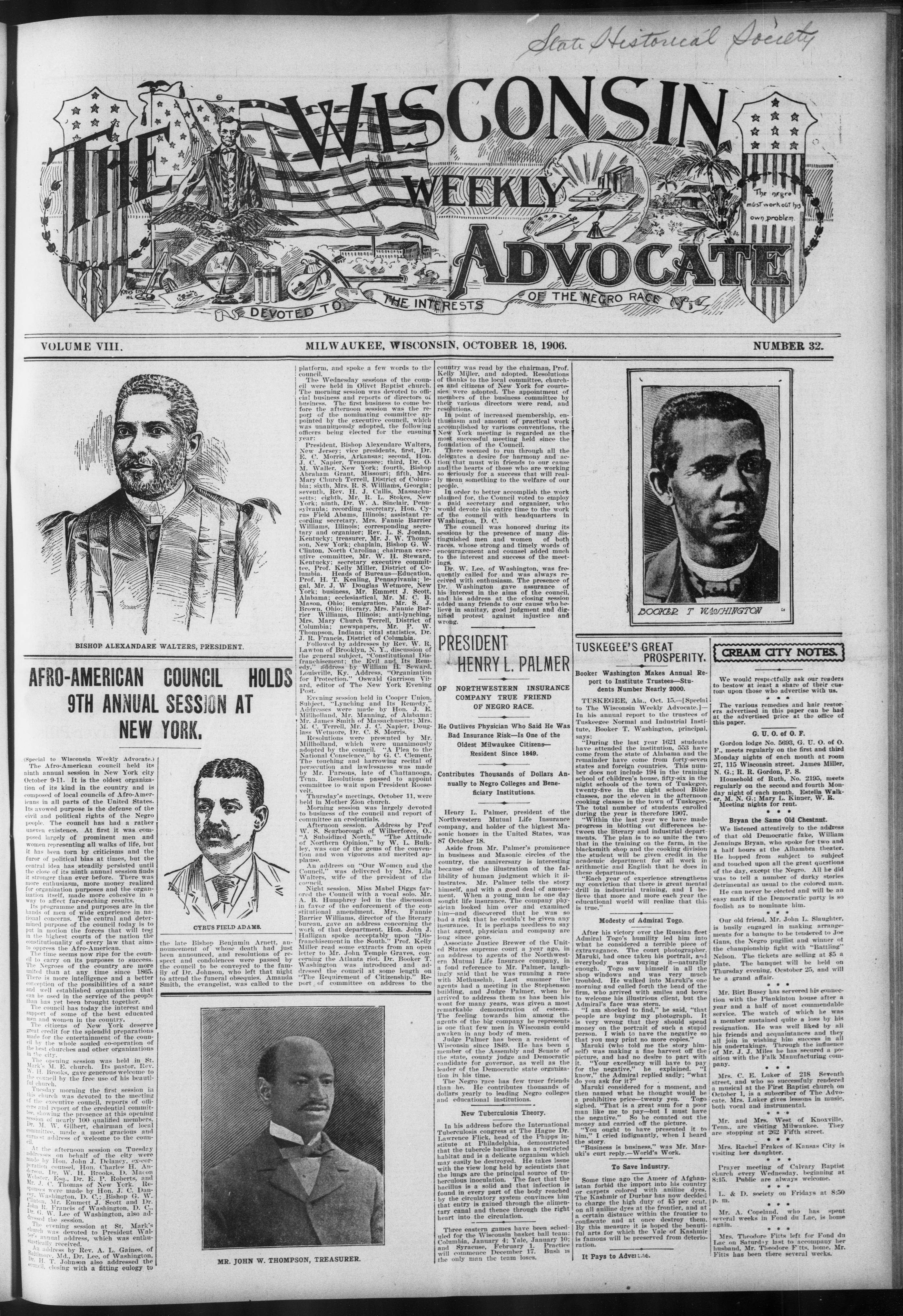
WISCONSIN
WEEKLY
ADVOCATE
DEVOTED TO THE INTERESTS OF THE NEGRO RACE
VOLUME VIII.
[Illustration of a man in a judicial robe].
P.
AFRO-AMERICAN COUNCIL 9TH ANNUAL SESSION AT NEW YORK.
AFRO-AMERICAN COUNCIL HOLDS 9TH ANNUAL SESSION AT NEW YORK.
(Special to Wisconsin Weekly Advocate.) The Afro-American council held its ninth annual session in New York city October 9-11. It is the oldest organization of its kind in the country and is composed of local councils of Afro-Americans in all parts of the United States. Its avowed purpose is the defense of the civil and political rights of the Negro people. The council has had a rather uneven existence. At first it was composed largely of prominent men and women representing all walks of life, but it has been torn by criticisms and the furor of political bias at times, but the central idea has steadily persisted until the close of its ninth annual session finds it stronger than ever before. There was more enthusiasm, more money realized for organization purposes and the organization itself, made more cohesive in a way to affect far-reaching results.
Its programme and purposes are in the hands of men of wide experience in national concerns. The central and determined purpose of the council today is to put in motion the forces that will test in the highest courts of the nation the constitutionality of every law that aims to oppress the Afro-American. The time seems now ripe for the council to carry on its purposes to success. The Negroes of the country are more united than at any time since 1865. There is more intelligence and a better conception of the possibilities of a sane and well established organization that can be used in the service of the people than has yet been brought together.
The council has today the interest and support of some of the best educated men and women in the country. The citizens of New York deserve great credit for the splendid preparations made for the entertainment of the council by the whole souled co-operation of the best churches and other organizations in the city. The opening session was held in St. Mark's M. E. church. Its pastor, Rev. W. H. Brooks, gave generous welcome to the council by the free use of his beautiful church.
Tuesday morning the first session in this church was devoted to the meeting of the executive council, reports of officers and report of the credential committee, showing the presence at this opening session of nearly 100 qualified members. Dr. M. W. Gilbert, chairman of local committee, made a most gracious and earnest address of welcome to the council.
At the afternoon session on Tuesday addresses on behalf of the city were made by Hon. John J. Delaney, ex-corporation counsel, Hon. Charles H. Anderson, Dr. W. H. Brooks, D. Macon Webster, Esq., Dr. E. P. Roberts, and Mr. J. C. Thomas of New York. Responses were made by Hon. J. C. Dancy, Washington, D. C.; Bishop G. W. Clinton, Mr. Emmett J. Scott and Dr. John R. Francis of Washington, D. C., Dr. G. W. Lee of Washington, also addressed the session. The evening session at St. Mark's church was devoted to President Walter's annual address, which was enthusiastically received. An address by Rev. A. L. Gaines, of Baltimore, Md., Dr. Lee, of Washington, Dr. H. T. Johnson also addressed the council, closing with a fitting eulogy to
---
COUNCIL HOLDS SESSION AT YORK.
J.
the late Bishop Benjamin Arnett, announcement of whose death had just been announced, and resolutions of respect and condolences were passed by the council to be conveyed to the family of Dr. Johnson, who left that night to attend the funeral obsequies. Amanda Smith, the evangelist, was called to the
Saturday the 25th of August, 1914
[Picture of a man in a suit with a bow tie].
---
MR. JOHN W. THOMPSON, TREASURER.
MILWAUKEE, WISCONSIN, OCTOBER 18, 1906.
platform, and spoke a few words to the council.
The Wednesday sessions of the council were held in Olivet Baptist church. The morning session was devoted to official business and reports of directors of business. The first business to come before the afternoon session was the report of the nominating committee appointed by the executive council, which was unanimously adopted, the following officers being elected for the ensuing year:
President, Bishop Alexendare Walters, New Jersey; vice presidents, first, Dr. E. C. Morris, Arkansas; second, Hon. J. C. Napier, Tennessee; third, Dr. O. M. Waller, New York; fourth, Bishop Abraham Grant, Missouri; fifth, Mrs. Mary Church Terrell, District of Columbia; sixth, Mrs. R. S. Williams, Georgia; seventh, Rev. H. J. Callis, Massachusetts; eighth, Mr. R. L. Stokes, New York; ninth, Dr. W. A. Sinclair, Pennsylvania; recording secretary, Hon. Cyrus Field Abams, Illinois; assistant recording secretary, Mrs. Fannie Barrier Williams, Illinois; corresponding secretary and organizer, Rev. L. S. Jordan, Kentucky; treasurer, Mr. J. W. Thompson, New York; chaplain, Bishop G. W. Clinton, North Carolina; chairman executive committee, Mr. W. H. Steward, Kentucky; secretary executive committee, Prof. Kelly Miller, District of Columbia. Heads of Bureaus—Education, Prof. H. T. Kealing, Pennsylvania; legal, Mr. J. W. Douglas Wetmore, New York; business, Mr. Emmett J. Scott, Alabama; ecclesiastical, Mr. M. C. B. Mason, Ohio; emigration, Mr. S. J. Brown, Ohio; literary, Mrs. Fannie Barrier Williams, Illinois; anti-lynching, Mrs. Mary Church Terrell, District of Columbia; newspapers, Mr. P. W. Thompson, Indiana; vital statistics, Dr. J. B. Francis, District of Columbia.
Followed by addresses by Rev. W. R. Lawton of Brooklyn, N. Y., discussion of the general subject, "Constitutional Disfranchisement; the Evil and Its Remedy," address by William H. Seward, Louisville, Ky. Address, "Organization for Protection." Oswald Garrison Vitard, editor of The New York Evening Post. Evening session held in Cooper Union. Subject, "Lynching and Its Remedy." Addresses were made by Hon. J. E. Millholland, Mr. Manning, of Alabama; Mr. James Smith of Massachusetts; Mrs. M. C. Terrell, Mr. J. C. Napier, Douglass Wetmore, Dr. C. S. Morris.
Resolutions were presented by Mr. Millholland, which were unanimously adopted by the council. "A Plea to the National Conscience." by G. C. Clement. The touching and harrowing recital of persecution and lawlessness was made by Mr. Parsons, late of Chattanooga, Tenn. Resolutions passed to appoint committee to wait upon President Roosevelt. Thursday's meetings, October 11, were held in Mother Zion church. Morning session was largely devoted to business of the council and report of committee an credentials.
Afternoon session. Address by Prof W. S. Scarborough of Wilberforce, O., "A Subsidized North." "The Attitude of Northern Opinion," by W. L. Bulkley, was one of the gems of the convention and won vigorous and merited applause. An address on "Our Women and the Council," was delivered by Mrs. Lila Walters, wife of the president of the council.
Night session. Miss Mabel Diggs favored the Council with a vocal solo. Mr. A. B. Humphrey led in the discussion in favor of the enforcement of the constitutional amendment. Mrs. Fannie Barrier Williams, director of the literary bureau, gave an address concerning the work of that department. Hon. John J. Halligan spoke acceptably upon "Disfranchisement in the South." Prof. Kelly Miller read some extracts from an open letter to Mr. John Temple Graves, concerning the Atlanta riot. Dr. Booker T. Washington was introduced and addressed the council at some length on "The Requirement of Citizenship." Report of committee on address to the
[Name]
---
country was read by the chairman, Prof. Kelly Miller, and adopted. Resolutions of thanks to the local committee, churches and citizens of New York for courtesies were adopted. The appointment of members of the business committee by their various directors were read, and resolutions. In point of increased membership, enthusiasm and amount of practical work accomplished by various conventions, the New York meeting is regarded as the most successful meeting held since the foundation of the Council. There seemed to run through all the delegates a desire for harmony and action that must win friends to our cause and the hearts of those who are working so seriously for a success that will really mean something to the welfare of our people.
In order to better accomplish the work planned for, the Council voted to employ a paid secretary and organizer, who would devote his entire time to the work of the council with headquarters in Washington, D. C. The council was honored during its sessions by the presence of many distinguished men and women of both races, whose strong and timely words of encouragement and counsel added much to the interest and success of the meetings.
Dr. W. Lee, of Washington, was frequently called for and was always received with enthusiasm. The presence of Dr. Washington gave assurance of his interest in the aims of the council, and his address at the closing session added many friends to our cause who believe in sanitay, good judgment and dignified protest against injustice and wrong.
PRESIDENT
HENRY L. PALMER
OF NORTHWESTERN INSURANCE COMPANY TRUE FRIEND OF NEGRO RACE.
He Outlives Physician Who Said He Was Bad Insurance Risk—Is One of the Oldest Milwaukee Citizens Resident Since 1849.
Contributes Thousands of Dollars Annually to Negro Colleges and Beneficiary Institutions.
Henry L. Palmer, president of the Northwestern Mutual Life Insurance company, and holder of the highest Masonic honors in the United States, was 87 October 18.
Aside from Mr. Palmer's prominence in business and Masonic circles of the country, the anniversary is interesting because of the illustration of the fallibility of human judgment which it illustrates. Mr. Palmer tells the story himself, and with a good deal of amusement. When a young man he one day sought life insurance. The company physician looked him over and examined him—and discovered that he was so bad a risk that he couldn't be given any insurance. It is perhaps needless to say that agent, physician and company are long since gone
Associate Justice Brewer of the United States supreme court a year ago, in an address to agents of the Northwestern Mutual Life Insurance company, in a fond reference to Mr. Palmer, laughingly said that he was running a race with Methuselah. Last summer the agents had a meeting in the Stephenson building, and Judge Palmer, when he arrived to address them as has been his wont for many years, was given a most remarkable demonstration of esteem. The feeling towards him among the agents of the big company he represents is one that few men in Wisconsin could awaken in any body of men.
Judge Palmer has been a resident of Wisconsin since 1849. He has been a member of the Assembly and Senate of the state, county judge and Democratic candidate for governor, as well as the leader of the Democratic state organization in his time. The Negro race has few truer friends than he. He contributes thousands of dollars yearly to leading Negro colleges and educational institutions.
New Tuberculosis Theory.
In his address before the International Tuberculosis congress at The Hague Dr. Lawrence Flick, head of the Phipps institute at Philadelphia, demonstrated that the tubercle bacillus has a restricted habitat and is a delicate organism which may easily be destroyed. He takes issue with the view long held by scientists that the lungs are the principal source of tuberculous inoculation. The fact that the bacillus is a solid and that infection is found in every part of the body reached by the circulatory system convinces him that entry is gained through the alimentary canal and thence through the right heart into the circulation.
Three eastern games have been scheduled for the Wisconsin basket ball team: Columbia, January 4; Yale, January 10; and Syracuse, February 1. Practice will commence December 17. Bush is the only man the team loses.
BOOKER T WASHINGTON
BOOKER T WASHINGTON
TUSKEGEE'S GREAT PROSPERITY.
Booker Washington Makes Annual Report to Institute Trustees-Students Number Nearly 2000. TUSKEGEE, Ala., Oct. 15.--[Special to The Wisconsin Weekly Advocate.] In his annual report to the trustees of Tuskeegee Normal and Industrial Institute, Booker T. Washington, principal, says:
"During the last year 1621 students have attended the institution, 553 have come from the state of Alabama and the remainder have come from forty-seven states and foreign countries. This number does not include 194 in the training school of children's house, fifty-six in the night schools of the town of Tuskegee, twenty-five in the night school Bible classes, nor the eleven in the afternoon cooking classes in the town of Tuskegee. The total number of students enrolled during the year is therefore 1907.
"Within the last year we have made progress in blotting out differences between the literary and industrial departments. The plan is to so unite the two that in the training on the farm, in the blacksmith shop and the cooking division the student will be given credit in the academic department for all work in arithmetic and English that he does in these departments.
"Each year of experience strengthens my conviction that there is great mental drill in industrial training, and I believe that more and more each year the educational world will realize that this is true."
Modesty of Admiral Togo.
After his victory over the Russian fleet Admiral Togo's humility led him into what he considered a terrible piece of extravagance. The court photographer, Maruki, had once taken his portrait, and everybody was buying it—naturally enough. Togo saw himself in all the shop windows and was very much troubled. He walked into Maruki's one morning and called forth the head of the firm, who arrived with smiles and bows to welcome his illustrious client, but the Admiral's face was stern.
"I am shocked to find," he said, "that people are buying my photograph. It is very wrong that they should spend money on the portrait of such a stupid person. I wish to have the negative so that you may print no more copies."
Maruki (who told me the story himself) was making a fine harvest off the picture, and had no desire to part with it. "Your excellency will have to pay for the negative," he explained. "I know," the Admiral replied sadly; "what do you ask for it?"
Maruki considered for a moment, and then named what he thought would be a prohibitive price—twenty yen. Togo sighed. "That is a great sum for a poor man like me to pay—but I must have the negative." So he counted out the money and carried off the picture.
"You ought to have presented it to him," I cried indignantly, when I heard the story.
"Business is business." was Mr. Maruki's curt reply.—World's Work.
To Save Industry.
Some time ago the Ameer of Afghanistan forbid the import into his country or carpets colored with aniline dyes. The Kashmir of Durbar has now decided to charge the high duty of 45 per cent, on all aniline dyes at the frontier, and at a certain distance within the frontier to confiscate and at once destroy them. By this measure it is hoped the beautiful arts for which the Vale of Kashmir is famous will be preserved from deterioration. It Pays to Advertise.
NUMBER 32.
CREAM CITY NOTES
We would respectfully ask our readers to bestow at least a share of their custom upon those who advertise with us.
The various remedies and hair restorers advertised in this paper can be had at the advertised price at the office of this paper.
G. U. O. of O. F.
Gordon lodge No. 5693, G. U. O. of O. F., meets regularly on the first and third Monday nights of each month at room 27, 115 Wisconsin street. James Miller, N. G.; R. R. Gordon, P. S.
Household of Ruth, No. 2195, meets regularly on the second and fourth Monday night of each month. Estella Walker, M. N. G.; Mary L. Kinner, W. R.
Bryan the Same Old Chestnut.
We listened attentively to the address of that old Democratic fake, William Jennings Bryan, who spoke for two and a half hours at the Alhambra theater. He hopped from subject to subject and touched upon all the great questions of the day, except the Negro. All he did was to tell a number of darky stories detrimental as usual to the colored man. He can never be elected and will be an easy mark if the Democratic party is so foolish as to nominate him.
Our old friend, Mr. John L. Slaughter, is busily engaged in making arrangements for a banque to be tendered to Joe Gans, the Negro pugilist and winner of the championship fight with "Battling" Nelson. The tickets are selling at $5 a plate. The banquet will be held on Thursday evening, Ocstober 25, and will be a grand affair.
Mr. Birt Busey has servered his connection with the Plankinton house after a year and a half of most commendable service. The watch of which he was a member sustained quite a loss by his resignation. He was well liked by all his friends and acquaintances and they all join in wishing him success in all his undertakings. Through the influence of Mr. J. J. Miles he has secured a position with the Falk Manufacturing company.
Mrs. C. E. Luker of 218 Seventh street, and who so successfully rendered a musical at the First Baptist church on October 1, is a subscriber of The Advocate. Mrs. Luker gives lessons in music, both vocal and instrumental.
Mr. and Mrs. West of Knoxville, Tenn., are visiting Milwaukee. They are stopping at 262 Fifth street.
Mrs. Rachel Frakes of Kansas City is visiting her daughter.
Prayer meeting of Calvary Baptist church every Wednesday, beginning at 8:15. Public are always welcome.
L. & D. society on Fridays at 8:50 p. m.
Mr. A. Copeland, who has spent several weeks in Fond du Lac, is home again.
Mrs. Theodore Fitts left for Fond du Lac on Saturday last to accompany her husband, Mr. Theodore Fitts, home. Mr. Fitts has been there several weeks.
***
***
幸福
***
THE WISGONSIN WEEKLY ADVOCATE
MILWAUKEE, WIS.
B. B. MONTGOMERY, Editor and Proprietor.
Found by Philadelphia Police in Probing Chinese Shooting.
Complete verification of the statement that members of the warring factions in Chinatown wear coats of mail to protect them from the bullets and knife thrusts of their enemies was found recently when the police, in investigating the shooting of Willie Lee York, found an armored coat in the room of Lee Pock, his alleged assailant. The coat is made after the ordinary style of a Chinaman's loose blouse and is of blue jean or heavy drilling. On the body it looks like an ordinary laundryman's working blouse, but when the police picked it up they found out differently.
The garment from hem to neck was padded with steel, in the shape of pieces about an inch and a half square. These do not lap like scales, but are brought together, edge to edge, and held with loops of wire. That the metal lined coat might conform to the body the pieces of steel were pounded and made slightly concave. Across the body of the garment, back and front, is apparently a seam, but examination showed that the coat was made of double thickness in the lower portion, and underneath the apron-like flap in front there was a long pocket-like holster.
The garment weighs all told about fifty pounds, and is about three-fourths of an inch in thickness. It was turned over to Supt. Taylor and will be taken into court as an exhibit in the case of Lee Pock, who was held at a hearing before Magistrate Gallagher to await the result of York's injuries.—Philadelphia Record.
Names on Cigar Boxes.
Of every hundred men who profess anxiety for the quality of their cigars owing to the Cuban rebellion, scarcely one could, if put to it, interpret the meaning of the various words which are stamped on the lid and sides of a cigarbox, says the London Chronicle. These are not mere fancy names, but terms actually descriptive of the cigar.
On the lid is the name of the cigar, as Pedro Murias, Villa y Villa. The front of the box describes the shape and size, as Conchas, Reina, Regalias, which state the shape, and Perfecto, Infantes, Princesses, which signify the size. These may be combined, as Conchas Especiales, Conchas Finas, to state both shape and size.
At the back of the box, where the lid turns over, is stamped the quality of the cigar—Superfina, Fina, Flor, Superior and Bueno being the terms in the descending scale. The color of the cigar is declared on the right-hand side or end of the box. Claro signifies the lightest colored, Colorado Claro rather darker, Colorado dark, Colorado Maduro darker, Maduro very dark, Oscuro extremely dark, Negro darkest.
SIX RULES FOR THE HOSTESS.
In entertaining it is better to serve a simple meal perfectly than to attempt a more elaborate one imperfectly prepared.
In waiting at table, pass dishes on the left side and hold them low enough for the person served to help himself with ease.
In passing a plate on which the food has been placed, put it on the table in front of the person for whom it is intended. Do not wait for it to be taken from the tray.
Soup is served by the hostess; fish, roasts and entrees by the host.
Be careful that hot dishes are served thoroughly hot, and on hot plates, as few things are so objectionable as food that should be hot being served luke-warm.
Everything needed for the table should be at hand so that there may be no unnecessary delay in serving. Finger bowls, extra cutlery, silver, cracked ice and an extra supply of bread can all be at hand in case they are required.
Dynamite and Business.
We have just heard of a touching case. It deals with the experience of poor Silas Wilkins. A box of dynamite kept in a hardware store exploded, and many of the articles fell upon poor Silas, who was working in an adjoining field. When the people collected him it was impossible to sort him from the tin tacks. They buried him with this inscription on his tomb:
HERE LIES.
In Joyful Hope
of a Glorious Resurrection
SILAS WILKINS.
With Him is Interred
the Greatest Part of the Stock
of James Simpson.
The Well-Known Hardware Dealer,
No. 143 Main Street.
We Make a Specialty of
Household Furnishing.
Call and See for Yourselves.
—Exchange.
About Clothes.
A woman's most becoming color is the same shade as her eyes.
Valenciennes entre deux is still the most popular of laces for the lingerie waists. One belt used to suffice a woman, now at least half a dozen are deemed a necessity. Rare necklaces of dull old jet are split in the middle and set in gold. Tiny gold links connect the jets. The latest automobile gowns are made without collars and just a finish of narrow lace about the neck. It is rather a fad this season to use artificial flowers as trimming for elaborate gowns. They are made of chiffon, silk or cloth of gold or silver.
Free Beer for the Poor.
In the records of St. Thomas' hospital, London, is an entry of the year 1570, to the effect that "in consideration of the hote tyme of the yere," the poor be allowed "every one a daye three pynnts of Bere for two months"—a quart at dinner and a pint at supper—and at the end of two months return to "there olde ordinary allowance, wyche is one quarte." The food at this ancient workhouse was to be dealt with as liberally as the drink. The almason and steward were to "bye no byffe but of the best, without bones and in special without the marybon, and none other to be bhowt."
Genius.
At the Lambs' club, one afternoon this week, someone complimenting Henry Blossom on the unprecedented hit of "The Red Mill," the new Blossom-Herbert musical comedy, with which Montgomery and Stone are crowding the Knickerbocker—Blossom's fourth success, by the way—asked the author if he believed in the existence of the quality commonly called genius.
"Genius," answered Blossom. "is a bit of beeswax, stuck fast between the seat of a chair and one's—er—overalls until his work is done!"
AT AN OPEN-AIR BAKERY.
My little man of grimy fist,
How busy you appear;
Your wondering eyes of amethyst
Widen with sudden fear
As I approach, all unaware,
Your bakeshop in the open air.
Now, shake hands, Master Oh-so-Shy,
And speak up how you sell
These earthen tarts I want to buy.
A penny ea-h? 'tis well.
A higher price would be too steep
For mud-pies must be sold dirt cheap!
Suppose tomorrow I pass by,
Should it be bright and clear
And your sun-stove glows in the sky,
Promise you will be here
To teach me how your pies are made,
And other secrets of the trade.
Gorman Wheeler in Woman's Home Companion. _____
THE LOVES OF PAOLO AND FRANCESCA.
"Do you fear, Madonna?" He caught at her hand and rained down kisses. He was as white as the foam of the sea, pale as any wandering ghost; but his eyes were lamps of love. Did she fear? Francesca smiled faintly; then pulled her cool, small hands away, for it must not be that Paolo should kiss them, Paolo, brother to her husband Giovanni, tyrant of Rimini, Paolo, who was of her own years, young, brave and beautiful. She thought of Giovanni—gray haired, stern featured, repellant, the man they had married her to for political reasons—and she sighed.
"Why do you sigh, Madonna?" His voice was deep and soft; his breast heaved.
"I wish"—she said the words with the soft simplicity of her 16 years—"that I had never left the convent, Paolo. It was so peaceful there, so quiet. The sun, slanting through the stained glass windows, gave all the color we needed; the music was so sweet, the light so dim; the outside world dazzles me—it is all so fierce and bright."
"You are unhappy." He moved closer to her, forgetting the great love he bore his brother, forgetting everything except the corn-gold color of Francesca's hair, the soft eyes that were like violets drenched in dew, and her slim body's loveliness.
"Frightened!" She trembled as she spoke, and her heart fluttered wildly under her pearl embroiderd bodice. "He is so grave—so old—this husband they have wed my youth to. When he puts his hand about my neck all my blood chills; and his voice—can he never speak low, Paolo? Is he always thinking of bloodshed and battle?"
"Francesca"—he took her hands again and pressed them passionately—last night I dreamed a dream."
"It was a tender dream," he went on softly, "but one that never must be dreamed again. You were my wife, Francesca, in that dream."
"Your wife?" The blood rushed to her face, then died away, leaving her as pale as he sad white roses, flowers of burial. "My wife." He repeated the words firmly. "And we were strolling in the meadows together; it was the springtide. Birds sang; the green carpet of grass was enameled with flowers. There was no sound of armed men or clank of swords, no gray castle, no dark tapestry. We were in the meadows; it was spring." "I have had that dream, too." She sighed a little, and cast down her eyes. "Why is one always so happy in one's dreams," she went on slowly and reflectively, "yet so sad and weary in the waking hours, so chill and cold?" She shivered and glanced over her shoulder.
She was standing in a chamber of the Rimini palace, a large tapestry hung room, furnished with a certain attempt after rude splendor, but an air of mystery and gloom hung over the whole apartment. There was nothing in common between its stately planishings and Francesca's bright youth.
"Are dreams always happy?" Paolo looked very earnestly at his brother's wife. "For I dreamed," he went on, his voice taking on an almost tragic tone, his eyes deep and reflective, "of a place other than a garden—" He paused.
"Go on." muttered Francesca breathlessly—"go on." She clasped her small white hands.
"A place of darkness," he continued, in low tones, "and yet there is always a strange red glow there—a hot and fiery red glow, Francesca. And lo, I hear the roaring of the winds, such strange, tumultuous roaring!"
"The roaring of the winds!" She repeated the words in a soft wonder.
"The roaring of all the winds in all the world, Francesca," he continued; "and I see two souls tossed by these raging winds as autumn leaves are tossed, blown about a sky whose gloomy darkness merges into flame. Oh, Francesca, what do you think of this wild dream of mine? And are you sorry for those two pale souls—the playthings of the wind and of the fire?"
"Who were they once?" She asked the question in troubled tones. Her sweet childish face had lost its look of dreamy innocence.
"A man and woman." He put his hands upon her shoulders as she spoke, and gazed with almost cruel directness into her eyes. "A man and woman—two poor, longing souls who loved and sinned."
"Who loved and sinned." She murmured the words after him. "Who loved and sinned unwillingly," he went on. "Ah, yes, Francesca, I am quite sure they sinned unwillingly. And because of that, God, being sorry for them both, ordained that they should share their punishment together—always together."
"Would it be punishment?" She asked the question with fine simplicity. "For think of it—oh! Paolo, think of it. To be alone—alone with one you love, circled with fire and veiled about with winds; whirled in mad gusto and then tossed back again, to whirl once more in frenzy round the world, blown through the ages. Call that punishment?"
"Francesca!" He held her close. "Francesca!"
She drew back, pale, shuddering, her face an ashy white, her eyes full of startled fear.
"Why did you come back to Rimini?" she asked. "Why—why? Paolo, what brought you back to Rimini?"
"He sent me back," Paolo muttered in low tones. "Your husband and my brother sent me back; made me the bearer of his fond letters to you." He bit his lip as he spoke. "I pleaded with
him to the point of discourtesy, Francesca. I made a thousand excuses; but you know Giovanni. He commanded, and I had to obey." She hung her head. It grew so dark in the chamber that neither could see the other's face, and outside a little wind was rising, a little, moaning, solitary wind.
"I know—I know," whispered Francesca. "No one can cross Giovanni in his whims, no one can stand up against him. He is indeed the tyrant of Rimini. Giovanni, who fires towns and makes fields red, turns happy wives to pale, mourning widows, and robs fond mothers of their sons. I tell you, Paolo, his hand is always resting on his sword, and in his sleep he starts, dreaming of battles." She moved away as she spoke and began to walk up and down the long dark room, wringing her hands. "Why did they take me from my convent and bring me to this great palace?" she went on. "And why did I see you, Paolo, before I saw him? Why did your brother send you to fetch his bride? It wasn't kind. It was cruel—cruel."
"Hush!" He threw his head back and stood up proud, young and resolute. "Do not let us touch on past things. Francesca, let us forget the past."
"Why did you leave Rimini?" She came close up to him as she asked the question. "Steal away from the marriage feast--fly in the night? Giovanni was wroth with you, Paolo. He said it showed discountes toward me."
"Why did I leave Rimini?" He repeated her words. "Because I dared not stay. You were too sweet and young ever to have been brought into these gloomy walls; too flushed with spring, too fragrant from the fields. I dared not stay."
"I loved you as a brother"—she whispered the words—"I loved you as a brother till you went away, Paolo; and then, when you had gone and I began to think of you, to miss you, and to long for your return—then you seemed less the brother, more the—" She paused.
"Sweet innocent!" He took her hands again. "I never was a brother to you—never. For now I think, Francesca, by God's truth, that we were lovers from the very first. I believe that in some distant age our souls held fond converse in the land of dreams. I think I loved you long before your birth, for when we met I knew your face at once, and all the hidden secrets of your eyes; and there was nothing strange, dear, in your voice. You were the dear maid I had found again, the maid who had been mine since the beginning."
"It was the same with me, Paolo—just the same." She leaned her head against his breast. "Until you came I think I was asleep, but when I saw you, then my soul woke up. I did not know I had a heart before, not till you made it beat, and sting and burn."
"Sweet love—sweet love!" He pressed his lips to her cold brow. "What have we done, Franeesca?" he went on—"we who have yielded to this fatal love? You should have torn me from your heart, my dear, bruised your poor knees upon the altar steps, prayed to the Virgin Mother night and day." His voice was full of agony. "And I—I who had the courage once to leave you, should never have returned. I should have told Giovanni the whole truth—told him I loved you, and that I must never more set foot in Rimini."
"What's that?" She started, breaking from his grasp. "I thought I heard the sound of horse's hoofs crossing the courtyard. "We must not be found here—together."
He shook his head.
"No one can enter the palace tonight save Giovanni himself. Giovanni who is miles from Rimini. The fortress gates are locked against the world. Do you see my brother's ring?" He held up his hand. "No, it is too dark," he muttered. "But I wear the tyrant's signet ring, and except by my orders no one can leave or enter Rimini tonight. Francesca, we are here—we two—alone."
"Alone!" She panted, all the woman stirring in her, beating down the girl.
"I think we were born for this night," he went on slowly. "A dark night. Not a star in all the sky; and yet we know that darkness binds his arms about the world and holds her warm and close, and she is well content and asks no more—only to breathe and love."
"I am afraid—afraid of you, Paolo, and of myself—afraid of the wild longing of my heart, and of a voice which whispers in my soul and tells me it were well to yield to love."
"Madonna!" His lips were hot on hers.
"If love meant death, would you still love—Francesca?"
She smiled.
"Life without love is death. Ah! Paolo, we did not come to this pass willingly, but having come, we will have no turning back."
She clung to him as she spoke, clung with all her strength.
"Mine—mine!" He lifted her up in his arms. "Mine, given to me by love, claimed by love, sacred to love. Mine—mine!"
Then the winds began to shriek and blow, and sweep their flapping wings round Rimini
Giovanni the Tyrant, he who had ridden many a weary mile because a sudden suspicion of the truth had come to him—a sudden fear—passed softly into his own castle of Rimini, hushing those who would have heralded his advent, and as he walked down the length of the great passage which led to his own rooms, his hands gripped his sword.
"Paolo!"
So they repeated in fine ecstasy as their naked souls rushed out into the night; so they chanted as the winds whirled them hither and thither, and they were wrapped in a haze of fire; and there was no note of regret in their voices—no fears.
The winds might dash them through the ages, and the flames encircle—they were as one.—Alice and Claude Askew, The Lady's Realm.
Plenty of Lions Left
That there is an abundance of lions in Central Africa is proved by these telegrams, said to have been sent recently by a railway station master to his division headquarters: "Please send further police protection. Men very brave, but less so when roaring begins."
Bay State Industries.
The manufactures of Massachusetts last year amounted to $1,098,751,900 which is 10.55 per cent. more than was manufactured in 1904. The Massachusetts bureau of labor statistics shows that the year 1905 was one of exceptional industrial activity in that state.
It Pavs to Advertise
DINNER AND THE DRAMA.
Oldy Fitch says Americans are unable to get the utmost enjoyment out of plays because they attend the theater too soon after eating dinner.—Theatrical note.
When you're planted in the playhouse, in a seat that cost two plunks,
And you're looking for enjoyment, not in dribbles, but in chunks,
And the op'ning act discloses that you've thrown your coin away,
For the actors, plot and dialogue are equally passe—
Just blame it on your dinner:
At home's the wretched sinner,
So hike you out, in angry mood, your tardy cook to slay.
If you think you'll hear good music, when some new thing holds the boards,
And you get a mixed collection of last season's ragtime chords,
Do not blame the poor composer, nor the
Do not blame the poor composer, nor the ones who sirz the songs—
ones who sing the songs—
They're really not responsible for all the
evening's wrongs:
You were your own undoing—
You delayed your evening chewing—
So blame your little Mary, where blame
rightfully belongs.
Best take the tip, good people, when it's
handed to you straight.
If you'll only eat your "ham and" in the early part of day.
And be sure your stomach's empty when to shows you wend your way;
But if meals you keep on bolting,
And the drama gets its jolting.
How can playwrights hope to elevate the modern stage—now say?
It is announced that the famous ruins of the abbey at Glastonbury, Somerset, England, are in the market, and that an offer for them has been received from the United States.
Miss Carrie Anna Wall of Augusta and Alexander Denham Estill of Savannan, both deaf and dumb, were married at Augusta, Ga., by Rev. O. J. Whildin of Baltimore, also a mute. The bridesmaid likewise is a mute.
When the 900 public school teachers in Schuylkill (Pa.) county meet in annual institute a resolution commending the innovation of Miss Evans, a Bank township school'mam, allowing her pupils ten minutes' nap each day, will be presented for adoption in all schools in the county.
Three of the four girls who started to accompany members of the Eleventh cavalry who were ordered to Cuba, have been taken back to Des Moines. The girls had hidden themselves in caisson wagons in one of the trains, but were discovered the day after the troops left Des Moines.
Mrs. Philip Sprouse of Waukomis, Ok., is dead from a broken neck and her baby daughter is so badly injured that she may not recover, as the result of her stumbling over her husband as he was kneeling in prayer at their home here recently. She was carrying the baby at the time.
Samuel Yehl of Easton, Pa., who suffered, according to the attending physicians, at least 1800 strokes of paralysis in two years, is dead. He was stricken two years ago while working on a railroad, and it is asserted that he was never conscious for more than twenty minutes at a time since the first stroke.
At an inquest in London into the death of an infant who had been suffocated in its parents' bed, the coroner said 2000 infants were suffocated annually in England. There were 600 such cases in London alone, he declared. He pointed out that in Germany it was illegal to have a baby under 1 year old in the same bed with its parents.
"The ideal young woman does not flirt, spoon or walk the streets." This declaration was made by Rev. H. O. P. Ritchard, pastor of the First Christian church at Shelbyville, Ind., who is preaching a series of sermons to young people. He said the young people of Shelbyville were regarded as "slow" if they did not do some spooning the second night they were together.
The lack of dynamite to eat is declared by Coroner Rollins of Denver to have caused the death of H. Rouse, who died the other day at the county hospital in that city. Rouse, it is said, had lived for months on dynamite, used chiefly as a stimulant. He was unconscious when found and taken to the hospital and therefore unable to explain his needs in the case. Rouse is said to have brothers living in Wyoming. Ill.
At the coroner's inquest over the body of Mary E. Weils, a negro servant at the home of B. Young, upper Alton, Ill., it was developed that the woman was stricken with apoplexy, caused from exhaustion while carrying a lot of plunder stolen from the home of her employer. The circumstances of her death frightened the negroes at Alton, who consider it as being a case of swift punishment for wrongdoing.
Grace Mullen, a Cleveland girl, is or the opinion that girls would make as good sailors for Uncle Sam's navy as men. She has so informed the navy department, and her letter has been acknowledged. She says that she wants to enlist, and her application is being considered. She says other Cleveland girls would join with her in seeking a place on some of the big war vessels. She asked the department to give them a little encouragement.
Mrs. W. C. Glaize of Oak Park, hid her diamonds in a shoe belonging to her husband. Next day Mr. Glaize took the shoe to S. Perlman, the village cobbler, for repairs. Sunday afternoon the Glazes prepared to go out and the diamonds were sought. Consternation? Of course. The cobbler was sought, and he could not be found till Monday. He fished out the Glaize shoe from a pile, and in the toe the jewelry was found, a diamond pin, earrings and two rings.
The Pittsburg Humane society is after G. K. Stevenson, a grocer, charging him with cruelty to animals. Stevenson had a large display in his window, in the center of which was a glass hive with live bees working, and a man who claimed to be an authority declared the bees would die if they did not have a chance to move about. The Humane society notified Stevenson he would have to send the bees to the country for exercise and he agreed.
Thomas Martindale, a Philadelphia business man and noted reformer, has given impetus to the movement in a lecture delivered to the board of trade at Hazelton, Pa. He said he makes it a practice of a daily nap at noon, and finds it breaks up the monotony of business life and strengthens him for the second half of the day.
He is convinced that the introduction of the noonday nap in public schools would be beneficial to the pupils.
The neglect of a customs official on the Canadian border to claim duty on a supposed Rubens painting in the possession of M. Wetzstein of South Bend, Ind., has led to a tempest in a teapot.
Treasury Agent Keefe of Chicago arrived, and the picture, said to be worth $10,000, was turned over to him by Mr. Wetzstein to show his good faith and willingness to pay duty. At the time of purchase it was not known that the painting was a Rubens, and only $250 was paid for it.
Judge Foster at St. Louis denied a divorce to Mrs. Carrie Fisher, who claimed that her husband went fishing every other Sunday. Judge Foster held that a man had a perfect right to go fishing every other Sunday if he did it in the proper time. Mrs. Fisher also averred that her husband said "damn it to her."
"That is no ground for divorce," said Judge Foster. "A man has the privilege of saying damn every day in the week if things go wrong."
With death near at hand, Mrs. Edward J. Mungen, the aged wife of a wealthy oil operator of Fostoria, Coio., talks daily into a phonograph so that when she shall have passed away her voice may cheer her sorrowing husband. Together the Mungens have made a tour of the world and in each place of interest they visited Mrs. Mungen has recorded upon the cylinder her impression of the sights seen. Besides, much of the conversation between herself and her husband is recorded by the phonograph.
Mayor George W. Guthrie of Pittsburg holds that a city employee who solicits aid for his church is guilty of grafting. He said so in dismissing Charles S. Wallace, a clerk in the bureau of building inspection. The mayor told Wallace he had received complaints about the city employee soliciting funds and other aid for Trinity Methodist Episcopal church. Wallace explained to the mayor that he not only solicited aid in the offices of the bureau of building inspection but worked for his church throughout the city as well.
A Chicagoan signing himself "C. Brown" has remitted $2.65 to the Louisiana Purchase Exposition company in payment of $2.50 of which he acknowledges he aided and abetted in cheating the fair on admissions for his two children. The extra 15 cents is thrown in to defray expenses in getting the money to the exposition company through the St. Louis city treasurer. Brown's letter was turned over to the exposition management by Treasurer Franciscus along with the enclosed money order. It is the first conscience money received by the exposition company.
A small wedding party called upon Judge Macon of Richmond, Va., who was to tie the knot, and as the ceremony progressed it became apparent that the bridegroom, John W. Scott, became more and more nervous. He finally burst out, "Hold on there, judge; you are marrying me to the wrong girl!" The bride-to-be was Miss Bonibelle Gary and Miss E. N. Ellett was maid of honor.
As Miss Ellett is younger than Miss Gary, the judge assumed that she was the bride, and addressed all his questions to her. The judge did not notice that Miss Ellett failed to answer, and was surprised when the bridegroom interrupted the ceremony near its conclusion to designate his bride. The marriage service was then begun all over again.
Miss Ellett was very much flustered by the incident, as rumors are rife that she is engaged to be married soon.
With the daylight hours growing shorter with each earth's cycle at this season of the year, the demand for red-haired office boys is increasing in Chicago. Dolese & Shepard are the latest to send out a cry for an office factotum who is endowed by nature with a brilliant top knot. They promise such a boy a steady job for the remainder of his natural lite or until his hair turns gray. The firm wants a boy to carry messages to its quarry and distribute them after his day's work is over. E. J. Cady, the office manager for the firm, believes that a red-headed urchin will be able to do this work after dark with greater facility than will one with a darker hued headpiece. Mr. Cady, though his own hair is black, has quite a preference for the auburn-tinted office boys, and declares that he is the originator of the "red-headed office boy" fad which has been so popular recently.
William E. Hunter, a milkman at Naugatuck. Conn., sent word to his customers that he could not furnish them with milk as usual because his herd of cows had stomach ache. A milk famine in the town resulted, and hurry calls were sent to New Haven for milk to supply the babies and children.
Hunter has a fine herd of forty cows and usually they are well behaved, recently some of the more frisky of the number leaped the pasture fence into an apple orchard on Mr. Hunter's farm, began feasting on the windfall apples and soon were suffering from pain under their belts.
The remainder of the herd, unable to withstand the temptation, tore down the fence and not only cleaned the ground of fallen apples, but ate all in reach on the trees as well. When Mr. Hunter went out to drive them to the stable all were in a sad state because of too much apple juice. The milk was unfit for use and Mr. Hunter says "it may be several days before he can resume business."
Through the inscription, "C. C. H. to M. E. W., Jan. 28, 78," engraved in a gold wedding ring, dredged up by John Peyton in the Washington channel, it has been returned to the owner, Mrs. Clement C. Hipkins. Mrs. Hipkins said:
"When my husband read in the newspapers about a ring being found, which answered the description of the one I lost, I went to police headquarters and was told that it was in the possession of Mr. Peyton. I went to his home, and had no trouble in identifying the ring and convincing Mr. Peyton that it belonged to me. It was lost ten years ago from my finger while I was on my way to River View aboard the steamer Samuel J. Pentz.
"When it dropped into the water, I notified Capt. Randall in command of the vessel. He marked the spot, and several professional divers made ineffectual attempts to recover the ring. The ring was highly prized by Mr. Hipkin, because of its association. It was used at his first wedding in 1878, and also when he married me."
State Floral Emblems
California—California poppy.
Colorado—Blue and white columbine.
Delaware—Peach blossoms.
Georgia—Cherokee rose.
Idaho—Syringa.
Kansas—Sunflower.
Maine—Pine cone and tassel.
Michigan—Apple blossom.
Minnesota—Moccasin flower.
Montana—Bitter root.
Nebraska—Golden rod.
New Hampshire—Oak leaf and acorn
Oklahoma—Mistletoe.
Oregon—Oregon grape.
Utah—Osage lily.
Vermont—Red clover.
Washington—Rhododendron.
If You Read This
It will be to learn that the leading medical writers and teachers of all the several schools of practice recommend, in the strongest terms possible, each and every ingredient entering into the composition of Dr. Pierce's Golden Medical Discovery for the cure of weak stomach, dyspepsia, catarrh of stomach, "liver complaint," torpid liver, or biliousness, chronic bowel affections, and all catarrh diseases of whatever region, name or nature. It is also a specific remedy for all such chronic or long standing cases of catarrhal affections and their resultants, as bronchial, throat and lung disease (except consumption) accompanied with severe coughs. It is not so good for acute colds and coughs, but for lingering, or chronic cases it is especially efficacious in producing perfect cures. It contains Black Cherrybark, Golden Seal root, Bloodroot, Stone root, Mandrake root and Queen's root—all of which are highly praised as remedies for all the above mentioned affections by such eminent medical writers and teachers as Prof. Bartholow, of Jefferson Med. College; Prof. Hare, of the Univ. of Pa.; Prof. Finley Blingwood, M. D., of Bennett Med. College, Chicago; Prof. John King, M. D., of Cincinnati; Prof. John M. Scudder, M. D., of Cincinnati; Prof. Edwin M. Hale, M. D., of Hahnemann Med. College, Chicago, and scores of others equally eminent in their several schools of practice.
The "Golden Medical Discovery" is the only medicine put up for sale through druggists for like purposes, that has any such professional endorsement—worth more than any number of ordinary testimonials. Open publicity of its formula is the best possible guaranty of its merits. A glance at this published formula will show that "Golden Medical Discovery" contains no poisonous, harmful or habit-forming drugs and no alcohol—chemically pure, triple-refined glycerine being used instead. Glycerine is entirely unobjectionable and besides is a most useful agent in the cure of all stomach as well as bronchial, throat and lung affections. There is the highest medical authority for its use in all such cases. The "Discovery" is a concentrated glyceric extract of native, medicinal roots and is safe and reliable. A booklet of extracts from eminent, medical authorities, endorsing its ingredients mailed free on request. Address
CURES CONSTIPATION
It is just about impossible to be sick when the bowels are right and not possssible to be well when they are wrong. Through its action on the bowels,
Lane's Family Medicine
cleans the body inside and leaves no lodging place for disease. If for once you wish to know how it feels to be thoroughly well, give this famous laxative tea a trial.
Sold by all dealers at 25c. and 50c.
ABSOLUTE SECURITY. Genuine Carter's Little Liver Pills.
Brentwood
See Fac-Simile Wrapper Below.
Very small and as easy
to take as sugar.
CARTER'S
LITTLE
LIVER
PILLS.
FOR HEADACHE.
FOR DIZZINESS.
FOR BILIOUSNESS.
FOR TORPID LIVER.
FOR CONSTIPATION.
FOR SALLOW SKIN.
FOR THE COMPLEXION
Price
26 Cents
GENUINE
MUST HAVE SIGNATURE.
Purely Vegetable.
CURE SICK HEADACHE.
DR. T. Felix Gouraud's Oriental Cream or Magical Beautifier.
PURIFY as well as beautifies the skin. No other cosmetic will do it.
Removes Tan, Pimple, Freckles, Moth Patches, Rash, and Skin Diseases, and every blemish on beauty, and defies detection. It has stood the test of 87 years, and is so harmless we taste it to be sure it is properly made. Accept no counterfeit of similar name. Dr. L. A. Sayre said to a lady of the haunt (a patient) "As you ladies will use them, I recommend
'Gouraud's Cream' as the least harmful of all the skin preparations." For sale by all druggists and Fanoy-Goods Dealers in the United States, Canada and Europe. FERD. T. HOPKINS, Prop., 37 Great Jones Street, New York.
CURE all inflamed, ulcerated and catarrhal conditions of the mucous membrane such as nasal catarrh, uterine catarrh caused by feminine ills, sore throat, sore mouth or inflamed eyes by simply dosing the stomach.
But you surely can cure these stubborn affections by local treatment with
which destroys the disease germs, checks discharges, stops pain, and heals the inflammation and soreness. Paxtine represents the most successful local treatment for feminine ills ever produced. Thousands of women testify to this fact. 50 cents at druggists.
Send for Free Trial Box
THE R. PAXTON CO., Boston, Mass.
DROPSY
NEW DISCOVERY gives quick relief and cures worst cases. Book of testimonials and 10 Days' treatment
Free. Dr. H. H. GREEN'S SONS, Box U, Atlanta, Ga.
If afflicted with Thompson's Eye Water
sore Eyes, use
---
GOSSIP FOR THE LADIES.
If you are tempted to reveal
A tale someone to you has told
About another, let it pass,
before you speak, three gates of gold.
Three narrow gates—first, "Is it true?"
Then, "Is it needful?" In your mind
Give truthful answer. And the next
Is last and narrowest, "Is it kind?"
And if. to reach your lips at last,
It passes through these gateways three,
Then you may tell the tale, nor fear
What the result of speech may be.
—Technical World Magazine.
Nocturne.
The moonlight is flooding the lake;
The hemlocks are heavy with sleep,
But the stars and the winds are awake—
Winds that are soft as the night;
They brood on the water, and creep
In wandering shimmers of light.
Now all the dark forest is still,
Save the dew, dropping softly and slow,
Or the cry of a far whippoorwill.
A bird, winging south, twitters low,
Unseen in the wonderful sky
Where the little winds, hesitant, go.
Then the ripples die out in the sedge;
Then moon swings alone in the lake,
And the hemlocks sleep on by its edge.
Charles Buxton Going in Everybody's
Magazine
An Episode.
Last year a rich American girl was spending the winter at a big hotel in Dresden. She was studying music, and had the reputation among her friends of being a fine pianist. One day she was practicing a difficult piece in the privacy of her own sitting room, when she was interrupted by a knock at the door. In answer to her feeble "Ya?" (she was not strong in German) a strange man came in and bowed profoundly. "I live upstairs," he said, "and I am the composer of that music. If you must play it at all, for heaven's sake play it right!" She was angry at first, and then she laughed. By and by they became fast friends—not, however, until she had renounced all idea of ever becoming a fine pianist!-New York Tribune.
For the Guest.
No matter how short a time a guest is to remain, there should be space provided for the keeping of his clothes and small things. Failure in this simple act of hospitality frequently causes great discomfort to a visitor. A dresser with two small drawers to hold minor articles, and one or two large drawers beneath for underwear, etc., should be given the guest who is making more than a short stay, and a closet, or part of one, should be ready for the reception of his other clothes.
In the closet there might be hangers for coats, shoe bags for shoes and a laundry bag for soiled linen; on the bureau a well-stocked pin cushion or pin tray, a receptacle for combings, hairpins, a hand glass and a nail file. Some sort of desk, or writing table supplied with paper, ink, pens of all sorts, and blotters; a table with a candlestick and candle on it, a box of matches in plain view; a work basket properly filled—all such little comforts go toward making a guest feel at home. Even a few flowers can breathe a welcome that no spoken word can give, and a remembrance of the idiosyncrasies of one's guest makes him at once a member of the family, which is what he should be while under its roof.
Not Meant for His Ears.
"Don't read that aloud!" exclaimed an old bachelor to his cousin's wife, who had just opened a letter from a mutual friend.
"Why not Harry?" she asked.
"Oh, well, it is always dangerous, and I have just been staying with those people," he replied, laughing.
"Nonsense," said pretty Mrs. A.
"What could they possibly have to say to me that you could not hear?" and she continued the letter. "Our fair weather friend," it read, "has condescended to stay with us. He left last week, and we are not grieving over his departure! If the truth be told, he talked so much of his lords and ladies that life was quite unbearable."
"She writes in riddles!" exclaimed Mrs. A.
"Who can this be?" she added, wonderingly.
Her companion was silent. She read on: "He talks also of his Pope. We wonder how long he will remain Roman Catholic. I fancy a very short time, now that his dear Countess de G. has become a Protestant. I suppose he is with you now in Carlsbad."
Then, and not till then, did Mrs. A. realize what she was doing. "Oh, Harry," she cried. "she means you!"
There was no answer, and the room was empty, but she heard an infuriated voice from the hall proclaiming that "those old frumps in Surrey would have to wait a long time before they welcomed him into their house once more!" It was a very long time, indeed, before Mrs. A. read another letter aloud.
The Professional Shopper.
A woman who has been singularly successful in her rather unusual profession gave some advice apropos of her occupation recently which showed that her choice was not such an easy existence after all. She is a professional shopper, a field which is not as yet very much crowded, perhaps because it requires more than any other that a "woman be born for it, not made."
At the head of the list of requisites, according to this special expert, is real business ability. After this come several necessary characteristics, including good taste, an unerring sense of the eternal fitness of things, ability to cater to individual preferences, and a knowledge of shopping in its broadest sense. Prices must be known, fashions carefully studied, and shops familiar where special attractions may be found.
The necessary stock in trade to begin with is an acquaintance with people who are likely to need such service, and arrangements must be made to secure the commission from the shops one intends to patronize. The woman who would make a good start must advertise well, by distributing her business cards among her friends, and by giving away plenty to be sent beyond her immediate circle of friends. The columns of local newspapers are also an important means of becoming known.
The usual plan among the few women in this profession is to charge no fee for their shopping, but to depend entirely upon the commissions from the shops for profit. But the shopper must be particular to let it be known how advantageous it is for a woman who thoroughly understands the business of the stores to perform the arduous shopping duties, which are a wear and tear on so many. She must exercise the best judgment in matching and picking out harmonious combinations; she must have wide experience in selecting Christmas gifts, and must be able to purchase satisfactory ones from the hints given by the patron for whom the presents are to be purchased. This is perhaps all she must be to qualify as a success, but the fact that so
We Must Forget. When We Forgive
We should never remember a wrong that has once been forgiven. To hold it up before our eyes in a fresh and new light is almost as bad as throwing it in the face of the person who has been pardoned.
Forgetting is the most important part of forgiving. When an injury or wrong is done to us we are often prone to ponder over it so much that we exaggerate its importance.
Then comes the time when the bitterness we felt is wined away, and softer feelings take its place, because the one who has endeavored to harm us makes the best amends possible and pleads for our forgiveness.
There are few people—particularly among the softer sex—who are so churlish as to refuse a plea of this kind, and yet how very few of them know what forgiveness really means.
They forgive with their lips—probably with their hearts, but their memory stands aloof and will not take part in the words of peace and forgiveness they utter. If this is the case those words of pardon are but empty.
Those who can afford to forgive can also afford to be generous and forget.
They will never again allow the wrong once done to them to be even thought of, nor any mention of it allowed to let slip; the forgiveness they mete out is complete; the harm and injury done them is entirely swept away: it was written on sand, and the waters of forgiveness have passed over and obliterated all traces.
Too often we only forgive with our lips, and then there comes a day when we forget and allude to the wrong done in the past, which, had our forgiveness been sincere, would never again have been mentioned.
The great question each one of us should ask ourselves before we utter words of pardon is, "Can I forever blot out of my mind all recollection of this injury?" If the answer is not an affirmative one, it is idle to promise forgiveness; the two must go together.
"Let not the sun go down upon your wrath." How often is this command disobeyed, and how often it is obeyed in the letter and not the spirit.
One of the greatest of all womanly virtues which every girl should try to possess, and one which men most reverence is forgiveness—that true and complete pardon which also forgets.
If we would write all injuries done us, all unkind words said to us, on the sands of our memory, it would not be such a difficult matter to combine forgetfulness with forgiveness.
In this life there is no time to spend in brooding over injuries—or in remembering unkind remarks—life is too short to allow us to recollect all these. What we nave to bear in mind is that when we promised to forgive we also promised to forget.—Philadelphia Evening Bulletin.
Fine Time for
Cross Country Walking.
There is no form of exercise so beneficial as cross-country walking. It is pleasure, duty, medicine and rest, all in one, and can be indulged in quite free of expense.
It is always beneficial, but just now particularly so, because most of us have been spending a great part of the last two months out of doors with plenty of exercise, and vacation days over, we are very apt to settle down to our old programme, which does not include many hours in the open. The change from physical activity to the mental is seldom accomplished without detriment to health.
So, begin today to take walks of a mile or two in length, and continue them each day, rain or shine.
Choose your walking costumes as carefully as the bicycle dress of a few years ago was planned by the nicer sort of girls. Have it made so that every motion is untrammeled; if you are away off in the wilds of creation where you can take your tramps in gymnasium bloomers, so full that they will feel like a skirt, so much the better.
Don't go without your corsets if you are in training for a figure, but see that they it easily but perfectly; above all, don't fet yourself slouch down into them, with chest sunk in and abdomen carried, even if ever so slightly, forward. Whatever pose you take on your tramps—for that is what the way you poise yourself amounts to—if you take those tramps with any degree of regularity is bound to become a habit.
Walk with a free, sweeping gait, with the leg swung from the hip, rather than from the knee, and walk rather briskly. Half the fun of cross-country tramping is the getting over obstacles—crossing a brook upon stepping-stones that require a sure foot and perfect balance by way of protection against an involuntary drenching, climbing fences and vaulting over low ones. And these very obstacles are part of the paraphernalia of nature's gymnasium.
Don't start with too long walks at first—that's the mistake so many girls make, and so discourage themselves for future walking matches. Walk every day if you can, or every day you get a chance—if your chances come often enough, you'll soon grow hardened to accepting a few extra miles with the sang froid of an old campaigner.
And walk with some definite object in view, if you want to get the most out of it. Choose some particular spot to visit—an object adds a world of pleasure to the walk, compared to wandering aimlessly about city blocks—or country roads, either, for that matter.
On Baking Day
Try One of These
The family cake box lives longer in the memory of mankind, perhaps, than any other article of the household furnishing. It held so many toothsome and coveted dainties, and was such a never-failing source of joy—that is, if it occasionally contained such cakes as these:
Cinnamon Cake—Set sponge as for bread. Take one pint of sponge, one egg, one-half cup of butter, one-half cup of granulated sugar, one cup of flour. Next mix the flour enough to make dough as for light biscuit. Roll out one inch thick, place in a pan; sprinkle it with two heaping tablespoonfuls of granulated sugar, two teaspoonfuls of cinnamon and dot with one tablespoonful of butter. Set in a warm place and when light bake in moderate oven 20 minutes.
Apple Johnnycake—Mix a pint of cornmeal with a scant half cupful of sugar, a pinch of salt and a teaspoonful of cream of tartar. Dissolve a half teaspoonful of soda in a little milk and stir into the meal, adding milk to make a batter as for pancakes—a cup and a half will be about the quantity. Add three very thinly sliced sour apples, and bake in a moderate oven 35 minutes.
Jelly roll—Three eggs, one cup of sugar, one teaspoonful of cream of tartar, one-half teaspoonful of soda, one cup of flour; pour it thin into a baking pan; bake slowly; spread jelly over it and roll it up. Wrap it in a cloth.
English Currant Loaf—When your bread has become ready for molding into loaves take sufficient dough for one loaf and knead into it a large iron spoon-
ful of butter or sweet drippings, two eggs, a small teacupful of light brown sugar, same of currants, cleaned and floured; a large pinch each of cinnamon and nutmeg. Knead wei, and if too stiff add a few drops of milk, form into a shapely loaf, let it rise until light and bake as though it were bread. A light and palatable cake. Plain Cookies—Two cupfuls of sugar, three-fourths of a cupful of butter, one cupful of sour milk, one teaspoonful of soda and flour enough to roll. If you prefer sweet milk use baking powder instead of soda and add a little cream of tartar. Be very careful that they do not burn. This recipe makes delicious little cookies.
Caraway Cookies—Make the dough of two cupfuls of sugar, one-half cupful of butter, one cupful of sweet milk, one teaspoonful of baking powder and flour enough to roll. When the dough has been rolled out ready to be cut with the glass or cookie molds sprinkle the surface with caraway seeds. This makes them quite spicy.
Banbury Tarts—These tarts require one cup of raisins, one-quarter of a pound of citron, one egg, one cup of sugar, and the juice and grated rind of one lemon. Stone the raisins and chop very fine; add the grated rind and juice of the lemon, also the sugar, and then the egg, which has been slightly beaten together with some crumbs.—Boston Traveler.
Raising Servants' Wages.
Every once in a while some essayist writes something on the many domestic problems that have been bones of contention since the meeting of the first woman's club. But it is seldom that one receives such an interesting dissertation as Isabel Wilder's article on "Women as Women's Employers" in the Home Magazine for October.
On the subject of wages she says: "The woman who raises the rate of wages in her own household compels every other employer in her neighborhood to do likewise, either absolutely or by accepting inferior service, and this result follows whether her motive in so doing was to raise a wage unjustly low or to avail herself of the efficiency acquired through some other woman's careful training, or whether it was done in pure thoughtlessness. The woman who takes into her employ, in place of a competent and well-trained cook or housemaid, an untrained and inexperienced once, at the same rate of wages, because the girl, through natural stupidity or ignorance of the ways of her adopted country, 'is not up to the tricks of girls in general,' or because the housekeeper wants to be able to 'train her from the start,' not only raises the relative rate of wages, but puts a premium on incompetency. She repudiates her obligations to her own family, for nowhere else is the employment of unskilled labor more extravagant than in domestic service, where processes are so intricate and varied, and where routine counts for so little, and unskilled experimenting can hardly produce the best conditions for bodily health and comfort. There are natural laws that govern in the economic world inexorably, without respect to sex or person, and one of them is that the nature of the supply is governed by the demand; and any employer in domestic service, as in any other occupation, who introduces into that service the unskilled or socially inferior class, pushes out of it, and into other fields of labor, the better class of workers, thereby compelling every other employer in the occupation to accept incompetency and lowering the social standing of every worker employed in it, as well as disturbing the whole industrial balance by sending the better class of workers from the employment into others, perhaps already overcrowded. It is the careless disregard of such laws and obligations on the part of the employers that has put the occupation of domestic service into the hands of the unskilled class of emigrants."
Sulks Spoil Girls
We all know the girl who goes around with a chip on her shoulder.
with a chip on her shoulder.
She is always ready to be offended; her feelings are hurt at every turn.
She is so keenly on the lookout for slights that she finds them where no one else would dream of doing so.
One can take no pleasure in her society on account of having to be so very careful to avoid hurting those hypersensitive feelings.
The girl herself is usually conscious of her weakness and makes many an attempt to conquer it, but it is a very difficult quality to get the better of.
If you are one of those easily offended people, try and remember that the fault is almost invariably on your side.
People are not trying to hurt your feelings; half the time they do not even know wherein they have offended when you go off in a fit of sulks.
The saky person is no pleasure to herself, nor any one else.
At first her friends will try to smooth things over and win her back to good temper, but they soon tire of it, and finally leave her to sulk by herself.
There is no quality in the world that the majority of people so like as cheerfulness.
Of course it is often a satisfaction to let people see that you are angry and offended, but it is a pretty miserable sort of satisfaction after all, and one that brings no lasting content.
The only thing that does bring content is the knowledge that people love you.
And people cannot love the sulk; she won't let them.
Try and like everybody, and you will find that every one will like you. Don't pick up every little offense and magnify it into an insult.
The world will take you just as it finds you. If you are cheerful, it will make much of you. If you are sulky and morose it will leave you alone. If people want to be friendly toward you, try and respond to their overtures of friendship. If you are shy and cannot respond, at least try and look as though you would like to. A bright, happy personality is wonderfully charming. Some people are born with it and it is no effort for them to be cheerful. Others have to fight unceasingly against their moroseness.
But they can win if they keep at it, and the reward is great enough to encourage them to return to the charge again and again.
The first time you find yourself inclined to indulge in a fit of the sulks just say to yourself. "The fault is mine and sulking will only make people dislike me; I won't give in to it." Before you are aware of it your ugly feelings will have disappeared.
There is another thing that should keep any girl from sulking, and that is the exceeding unbecomingness of a sulky expression.
The prettiest face in the world would be spoiled by the sulks.
So you see you positively cannot afford to ruin your looks as well as your disposition by the sulks.—Exchange.
Ameer Designs Palaces
Habibulla Khan, the Ameer of Afghanistan, has considerable architectural skill and is said to have designed his own palaces.
Good Place to Carry Guns.
Tigers appear to be on the increase in uBrma. owing to the restrictions on the possession and carrying or arms.
For the Young Folks.
Polly's Day of "Fun."
Polly Ann Smith was plainly in a bad temper. Her forehead was puckered into ugly frowns, and her eyes looked out from beneath with a cold, unloving gleam.
To begin with, Polly did not like her name, and as today was the first day of school, she had just been obliged to tell it to the new teacher. Moreover, Annabel Moore sat right across the aisle and the teacher had called Annabel "dear"—Polly thought "Annabel" the prettiest name in all the world, and "Polly" the homeliest.
When recess came, Polly marched off by herself into a corner; from there she sulkily watched her friends playing tag. Pretty soon a pair of flying feet dashed by her, and a smart tap tingled on her arm. "Tag! You're it!" exclaimed Annabel Moore, breathlessly.
"I ain't neither—I ain't playing," said Polly, sourly. Annabel laughed good-naturedly. "Oh, come, Polly," she coaxed. "Don't be so grumpy. Come—be good and play." "I don't want to be good! Good folks are stupid!" declared Polly, crossly. "Why, Polly Smith, what an idea!" exclaimed Annabel in a shocked voice. A few minutes later, recess being over, Polly sat in her seat, listlessly turning the leaves of her reader. Suddenly she started, and looked fixedly at a few words near the top of one of the pages. "The easiest way to be happy oneself is to make someone else happy," she read, and shut the book with a bang, causing the teacher to look down sharply at her.
Hard as she tried. Polly could not drive this new idea from her thoughts, and it made her restless all the afternoon. By night she had sullenly decided to "try it and see what 'twas good for, anyhow!" She made up her mind that she would begin the next morning and see if she could find anyone to make happy. She told herself that "'twouldn't work," but she went to bed that night with a queer little exultant feeling, much as though she were about to try a new game.
The first thing Polly thought of the next morning was her new plan. She jumped out of bed and ran happily to the window, but a frown quickly appeared on her forehead—it was raining, and Polly particularly disliked rain.
School time came. Then she put on her hat and coat, and, catching up her books and her lunch basket, opened her umbrella, and started for school.
Just ahead of her she spied the familiar red hair belonging to Nellie Jones, and involuntarily her steps shortened. Polly did not like Nellie Jones; in fact, none of the girls did, and the poor child was left forlorn on all occasions. Nellie had made several attempts to be friendly with Polly, but in vain, for Polly had not hesitated to snub her unmercifully, regardless of all rules of kindness or politeness.
For a minute Polly hesitated.
"Dear me!" said she to herself with a despairing sigh. "I s'pose 'twould make her happy, now, if I let her walk to school with me. Well, then, I expect I'll have to do it—but I don't see as there is anything so very happilyfying to me in this sort of doings." And she hastened her steps until she reached Nellie's side. "Do you want to walk under my umbrella?" asked Polly, a trifle ungraciously.
The supreme delight that showed at once on Nellie's plain little face sent a queer feeling into Polly's throat. By the time the schoolhouse was reached, the two little girls were chatting quite happily together; Nellie was telling Polly of a brand new place to find blackberries
At lunch time Polly opened her basket. The thin slices of bread and butter and the cold chicken looked very tempting as she spread them out on her napkin which she used as a tablecloth. The small frosted cake was Polly's favorite kind, and there was a luscious bunch of grapes for dessert. Polly's little white teeth sank happily into the bread and butter, and her thumb and forefinger had just picked up a generous piece of chicken, when her roving eyes chanced to fall upon two hard-looking biscuits and a doughnut that lay on a desk near her. Nellie Jones sat dejectedly before this unappetizing array of food, and Polly could not help noticing that Nellie's eyes were gazing longingly in the direction of her own chicken and grapes.
"Dear me," sighed Polly. "Why is it that it's always the hard thing to do that make other folks happy?" Then she beckoned Nellie to come to her.
The little girl jumpea to her feet and almost flew to Polly's side.
"You'll have to help me eat my luncheon. I guess."
By afternoon Polly had forgotten all about her new "game," as she called it—for her studies and recitations kept her very busy.
When school was dismissed she joined a little group of girls outside the school-house and helped to make joyous plans for the picnic that was to come off Saturday afternoon. As she turned to go home a little later she found the new teacher at her side.
"Well, my dear, you seem to be wearing a very smiling face. I think you must be happy over something."
Polly skipped joyously. She was thinking of the picnic.
"I am—and I've had lots of fun today, too!" she exclaimed; then she suddenly remembered, and stopped short, looking up into the teacher's face in astonishment. "Why, Miss Adams—it did work, didn't it?" "What worked, my dear? I haven't the least idea what you mean," replied Miss Adams, in mild surprise. Polly laughed, and colored a rosy red. "Oh, nothing much, but—I—I guess I'll try it again!"—Journal and Messenger.
Take Care of the Eyes
Don't read in a reclining attitude or in bed.
Don't use the eyes when they are tired or weak from illness. Don't look too steadily from a car window at objects that are constantly flying past you. Don't work longer than two hours without closing the eyes and resting them for five minutes. Don't sit facing a strong light. If possible, let the light fall on work or book from over the left shoulder. Don't fail to consult an oculist, if you find that your eyesight is growing dim, or hesitate to wear glasses if you need them. Don't have colored shades on the lamps. Use white or ground glass. If you must have a colored shade let it be green.
Predict Dire Things for 1907.
The Old Moore Almanac for 1907 has just appeared in London and, so far as prophecies go, it is as black as it can be. January is to be marked by terrible earthquakes in southern Europe, by serious disorders among the unemployed in London and by riots in Italy. February will register a great mining disaster in Cornwall and March will see serious discontent among the English army and mutinies. April will bring to the court of St. James a mysterious letter from
St. Petersburg, which will give the sign of renewed activity in the English arsenals. Terrible news will be received from Spain in June, and July of next year will be notable for a great drouth, which will ruin the crops of Europe. August will see France and Germany getting ready for war, and October will bring some further complications in the affairs of Morocco. The Russian revolution is to continue all next year, and even China will have a liberal insurrection.
IN THE FLOWER GARDEN.
Lilies for Fall Planting
In spite of the beauty of lilies and the ease with which they may be grown, few of them are seen in private gardens. This lack may be remedied by following a few simple rules. There is a vast variety of lilies and among them may be found those suitable for almost any kind of soil.
The first requisite for successful lily culture is good drainage, not only on the surface of the bed, but at its bottom as well. This may be obtained by raising the bed several inches above the surrounding level and placing broken crockery, pots or stones in the bottom, spading the bed two feet deep. The best soil is a loam enriched with thoroughly rotted manure. If the soil is heavy a liberal quantity of sand mixed well will insure better drainage and prevent decay. A little sand directly beneath each bulb insures against decay. The beds should be kept free from weeds and cultivated occasionally in dry weather. Moisture may also be saved in dry, hot weather by mulching the beds with straw or old manure.
The bulb should be planted 5 to 8 inches deep. This depth of earth will enable the plants the better to withstand the drought and cold. A covering of leaves, straw or manure should be used to protect the bulbs from the alternate freezing and thawing of the ground in winter. This mulch should be removed when the shoots appear in the spring. As the amateur gardener proceeds with lily gardening from year to year he will learn needs of each variety, but in general the foregoing instructions will suffice.
Peonies.
Peonies may be planted this fall or next spring. It is more satisfactory to plant them in the fall so the earliest warmth of the spring may start them growing. They should be planted in a rich soil; the blooms will develop better if in a slightly shady situation, though they do well when exposed to the sun. After planting they require little except a mulch of manure and plenty of water in the growing season.
The older a peony gets, the better it blooms. It is nothing unusual to see a bed that has been undisturbed for from ten to twenty-five years. This was the favorite flower of our grandfathers, and it is regaining its popularity and coming into new glory. So many different colors are now available, ranging from snow white through red, yellow, rose, purple and delicate pink, that the peony has become a rival of the rose. During its season it floods the flower markets, almost to the exclusion of other flowers.
The plant increases rapidly. It has been estimated that a vigorous plant will produce 1000 plants in ten years. Another good point is its freedom from disease. New plants are obtained by division of the roots or tubers of the old ones. They may be taken up in the fall, or in the spring before growth starts. New varities are generally produced by planting the seed of hybridized flowers, but this is a process that it is better to leave to the experts. Peony roots may be purchased at this time of the year from any florist, the older plants being most expensive.
Hardy Dutch Bulbs.
Dutch bulbs are not natives of Holland, but the soil and climate of the Netherlands is so adapted to growing them well that most of those sold here are imported. Those most generally known are the hyacinths, tulips, narcissi and crocuses. These four genera represent numerous varities of different colors, perfume and form.
Planted outdoors at this time of the year for spring flowering, or in pots for indoor blooming, they are sure to produce gorgeous blooms. For spring flowering they should be planted in the open ground before the last of October. Drainage is a prime requisite in a bulb bed. Prepare a soil of well rotted manure well spaded with earth and a small quantity of sand. Dig out the beds $1\frac{1}{2}$ to 2 feet deep and put broken pots, gravel or rocks in the bottom. Put the soil on this and raise the surface of the bed a few inches above the level of the surrounding lawn, for better drainage on the surface.
In planting place a small quantity of sand beneath each bulb to prevent decay. Before the ground freezes cover the beds with several inches of fine, well rotted manure to protect against the alternate freezing and thawing of the ground. This sometimes causes the roots to be broken and prevents the bulbs from flowering. These directions are particularly for tulips and hyacinths. Norcissi may be planted in a border without protection, although protection helps them. They are especially effective in masses.
Ladies Laced 3000 Years Ago
That women laced and even wore corsets 3000 years ago is the claim made by explorers now in Crete. They have unearthed an image of a goddess and they show it to prove their assertion.
```markdown
```
The goddess was photographed and the picture shows a lady of most slender waist. It is claimed that the style of dress of the time was probably faithfully copied by the artist who designed the goddess. The explorers have made wonderful discoveries in Crete which show that civilization 3000 years ago
was in many respects like our own.
Wish to Be Americans.
The following reasons for desiring citizenship are among those given by pupils in the evening school for the study of English conducted by the Society for Italian Immigrants at the labor camp of the Pittsburg flatiron plant: "I want to take part in public affairs."
"I want to make friends of good men."
men. "I can go to Italy and return without being met at Ellis island."
being stopped at Ellis island. "I will not live in this country like stranger, but I want stay here just the same of American people." "I want honor the laws because I love it."
Among written conceptions of the duties of citizenship are the following:
and never oppress them. "To do nothing to dishonor the good name of the United States."—World.
MUTTON AND LAMB.
The best mutton comes from animals which are fully 3 years old and well fed. They are then best interlarded with fat throughout the flesh, giving juicy, well flavored meat.
When selecting mutton see that the fat is white, clear and hard; the scarred skin on the fore quarters will be nearly red, the lean meat firm and juicy. Ram mutton has dark, coarse-grained flesh, with fat of a yellowish tinge; when cooked it is of rank taste.
Mutton is divided into sides and each side into fore and hind quarter. The fore quarter includes the shoulder, neck, rack and breast. The rack is usually cut into chops. These rib chops sometimes have all meat scraped away from the long rib bones—they are called Frenched chops.
When the ribs are not out the piece is sometimes used as a roast. The shoulder may be boiled or roasted; when for a roast it is frequently boned. The neck is used for broth. The breast makes a good stew or haricot.
The hind quarter consists of leg and loin. The loin is used whole as a roast or many be divided into chops. An English chop is cut from the loin, is nearly two inches thick, and has the stringy flank end cut off almost up to the bone. The leg is one of the most popular cuts, so commands a good price. When sliced it gives mutton cutlets. When used whole it is either boiled, braised or roasted.
The saddle comprises the two racks or ribs taken in one piece from the uncut carcass. This is always roasted, and is a special Christmas dish in some sections of the country.
Lamb is the young sheep when between 3 months and 1 year old. In color the flesh is a brownish pink, the fat very white and firm. It is divided in about the same way as mutton, but, when very young, the quarters are diminutive, and so are frequently used as roasts without subdivision.
A special roast, called a crown, consists of the two sets of ribs, nicked deeply along the backbone, bent and tied together, bones Frenched and outward, in a hollow circle. After roasting the center is filled with green peas.
In a leg of lamb the bone at the joint is serrated, while in mutton it is smooth and rounded.
Mutton is not as nutritious as beef, but it is more easily digested, so is often prescribed for convalescents in preference to other meat. Lamb, being immature, is rather hard to digest. Mutton is best when rare; lamb should always be thoroughly cooked.
Old Beheading Stone.
The beheading stone at Stirling, Scotland, was protected in 1887 by public subscription, raised at the instance of the Stirling Natural History and Archaeological society. It was then enclosed in an iron cage. There is another relic of public execution in Stirling in the Mu-
THE OBSERVATORY
seum of the Smith institute in that city. It is the bowl which the public executioner used when he went-round the market taking a measure of meal from every farmer's sack. This method of paying the executioner obtained also in France until the time of the first M. Deibler, who had a salary of 10,000 francs. The office of "M. de Paris" has just been abolished, as no district of Paris will permit the guillotine to be set up within its boundaries. M. Deibler's son may thus say, with Othello, "my occupation's gone."
WHAT COLORS TO WEAR.
The red-headed girl would wear bronze and green, black and white and all shades of gray.
The woman with the skin like a camelia and warm brown hair would be decked in warm mauve and browns.
Faded blondes who always seem to love pale blue would be encouraged to introduce touches of rose and poppy red into their costumes.
The sallow woman would eschew tan and the ghostly person with dead black hair and a parchment complexion would boycott bright greens.
---
Some women stick stubbornly to the colors they like irrespective of whether or not they are becoming. One woman whose hair, eyes and skin are three different shades of gray always wears gray. The effect is unearthly, but not beautiful. Ten years ago, when her eyes were brighter than they are today and her cheeks were rosy, her gray bonnet and gown made a charming setting for her silvery hair and darker complexion. Today she needs purple and deep, warm reds to warm her up.
Foibles of Literary Men
Keats liked red pepper on his toast. Dickens was fond of wearing jewelry. Daudet wore his eyeglasses when asleep. Joaquin Miller nailed all his chairs to the wall.
Edgar Allen Poe slept with his cat and was inordinately proud of his feet.
Alexander Dumas the younger bought a new painting every time he had a new book published.
Thackeray used to lift his hat whenever he passed the house in which he wrote "Vanity Fair." Robert Browning could not sit still. With the constant shuffling of his feet holes were worn in the carpet.
Robert Louis Stevenson's favorite recreation was playing the flute, in order, as he said, to tune up his ideas.
Oliver Wendell Holmes used to carry a horse chestnut in one pocket and a potato in another to ward off rheumatism.
Longfellow enjoyed walking only at sunrise or sunset, and he said his sublimest moods came upon him at these times.
Hawthorne always washed his hands before reading a letter from his wife. He delighted in poring over old advertisements in the newspaper files.
Darwin had no respect for books, and would cut a big volume in two for convenience in handling, or he would tear out the leaves he required for reference.
THE WISCONSIN WEEKLY ADVOCATE
R. B. MONTGOMERY, Editor and Proprietor.
The Wisconsin Weekly Advocate after three years' residence at 79 Fifth street, has moved its headquarters to 430
Representative Journal Devoted to the Interest of All the People.
ADVERTISING RATES.
One inch, one year.....$15.00
Two inches, one year.....25.00
Three inches, one year.....35.00
Four inches, one year.....42.00
For larger space, special rates.
10.00 per inch line
TERMS OF SUBSCRIPTION.
One year ..... $2.00
Six months ..... 1.00
Three months ..... .50
Direct all communications to
R. B. MONTGOMERY,
430 Cedar Street.
HOW TO SEND MONEY.—Post Office
Order. Express Order, Draft or Registered
Letter. R. B. Montgomery will not be
responsible for loss when sent in any other
way.
TO CONTRIBUTORS:
All communications must be sent with the name and address of the sender as an evidence of good faith, but not necessarily for publication. No manuscript returned if not accepted, unless accompanied by stamps.
ALLIED PRINTING
TRADES UNION LABEL COUNCIL
MILWAUKEE, WIS.
This Label is a guarantee that the printing bearing it is the product of Union Labor.
"I know of the bravery and character of the Negro soldier. He saved my life at Santiago, and I have had occasion to say so in many articles and speeches The Rough Riders were in a bad position when the Ninth and Tenth cavalry came rushing up the hill carrying everything before them. The Negro soldier has the faculty of coming to the front when he is needed most. In the Civil war he came 400,000 strong, and I believe he saved the Union."—President Roosevelt.
THE WORKING DOGS OF EUROPE.
They Are Almost as Useful as Horses and More Intelligent.
The boys and girls of the United States consider their pet dogs wonderfully "cute" and smart when they can be taught to submit to the harness, and be persuaded to draw light carts until tired of the novelty. What would you think of a dog that will patiently work all day long, drawing heavy loads in big carts over stony roads, obeying every word of his master, and never offering the slightest objection to the hardest kind of work? That is the way the "working dogs" of Europe are trained
It seems pitiful to the tourist who is unaccustomed to the sight to watch the patient, untiring work of these faithful dogs, and to realize how different is their life from that of the care-free dogs in the land of liberty and freedom. But the dogs do not seem to regret their fate. They do not know anything better. Their fathers and mothers before them spent their lives in hard work, and they submit to their lot from tiny puppyhood, when they trot beside their mothers and become accustomed to the chains and straps of their future bondage.
These dogs, which are known as "working-dogs," are of no particular breed, but they are always large and strong-looking. They are trained to do all kinds of work, and are found in many countries of Europe. In France and Belgium they are usually found in the greatest numbers on the streets, pulling the heavy pushcarts, although they are quite as frequently trained to perform certain household tasks, like churning, etc., that can be worked by machinery with the dogs to furnish the power.
In Holland the dogs are not only used to pull the carts, and for other street work, but they are also found along the canals, pulling the heavy canal boats just as the strong mules and horses do in this country. Usually there are big dogs attached to the rope of the canal boat; but I have seen a single dog on the towpath tugging with all his strength to pull a big boat, with a woman and several children on the boat, and the man walking beside the dog, keeping him up to his hard work without a thought of lending a hand. In this country the C. P. C. A.s would get after such hard-hearted masters.
Some of the dogs really seem to enjoy their work, and their eyes will sparkle and their tails wag with delight at a word of praise from their masters. The dogs that pull the numerous carts through the streets of Belgium and Holland are "geared up" in many curious ways. Some of the carts have shafts like a wagon and are intended for only one dog. When the load is extra heavy another singletree or whiffletree is attached at one side, with an extra dog hitched to this.
Not infrequently one sees a big push cart, with several heavy trunks upon it, drawn by a single dog. The master usually walks in front, and taking hold of the shafts guides the cart and holds it in position, but seldom does any of the pulling; this is done by the big dog fastened underneath, with the straps attached to the center of the cart. For the vegetable pushcarts, which are much the same as those of the United States, the dogs are also geared to the center of the cart underneath; their master, holds the handles of the cart, merely directs it.
The British Automobile Boem.
In the British automobile industry $30,000,000 is now invested and 20,000 operatives are employed. The present demand is unprecedented; so great indeed that the home factories cannot fill it, and supplement their output by importing foreign cars and parts. In the first seven months of this year more than 3000 foreign automobiles were imported, costing $5,000,000, and also $5,000,000 worth of parts of machines. In the fiscal year ended June 30, 1906, the United States sold Great Britain $948,995 worth of automobiles, but did not import any from that country.
MEMORIES
OF THE
WAR
Dear Editor: It is with the greatest modesty and diffidence that I write you an account of that brilliant and magnificent charge which I led at Missionary Ridge.
I have waited over forty-five years for history to lay before an admiring world a true account of the important affair, yet she remains as dumb as an oyster on the subject, and the great task devolves on me of enlightening the world upon the question, and handing down to posterity one of the most brilliant episodes that ever occurred in the annals of war. Ah, as distinctly as if it had been yesterday, do I remember that beautiful November evening; the sun shining with such gorgeous splendor, the sky so high and blue, the faintest tinge of Indian summer mantling the distant peaks of Point Lookout and the surrounding hills and mountains; while away on the right, about Tunnel Hill, since morning there had been a continual boom of cannon and rattle of musketry. I lay on the ridge a short distance to the right of Bragg's headquarters watching those long lines of blue, perhaps a mile distant, taking their positions for a desperate charge; while the many pieces of artillery scattered along the top of the ridge were now keeping up a pretty constant roar. About three o'clock the Yankee lines emerged from the woods on the opposite side of the valley. "They are coming! They are coming!" uttered almost every man in a low distinct voice, speaking apparently to himself, instead of addressing some one else. Every piece of artillery along that ridge now became a living volcano, discharging missiles of death with the greatest rapidity. With what fascination I watched those lines of blue advance, extending as far up and down the valley as the position which I occupied would allow the range of vision to extend. Occasionally gaps were made in those lines, but on, on they came—they crossed our old breastworks in the valley. I heard the gunners call for the canister shot. Oh! how I pitied those blue devils! I knew many of them would never go back across that valley, nor come to the top of that ridge. At length they reached the base of the ridge on which we were lying.
Our artillery ceased firing, the hill being too steep. Our infantry were ordered to rise and fire. Although we had but one slender line of battle along that portion of the ridge, yet those blue coats never came to the top, nor half way up, while we stayed there; but in a very short time—by the time I could load and fire twelve shots, they were going back through that valley in the wildest confusion. I saw a Yankee general riding a white horse trying to rally his scattered troops at our old breastworks in the valley. I raised the sights of my gun to four hundred yards and fired four shots at him, but I missed, I suppose, every time. Yanks informed after that "Fighting Joe Hooker" was the man who rode the white horse and rallied the flying Federals at the old breastworks in the valley, but their information might have been incorrect.
This was the first battle I ever witnessed. I felt elated, I felt jubilant, I felt ecstatic. I felt I could have charged right up to the mouths of a hundred pieces of artillery and captured every gun. I continued to feel this way as long as my side did all the shooting and the other side did all the getting hurt. About this time General Bragg and staff came galloping along. Cheer after cheer went up. I was thinking about asking him for twelve or fourteen men with which to go over and capture Chattanooga and bring back the commander of the Yankee army a prisoner, when we were ordered to the right at a double-quick, leaving no infantry whatever along that portion of the line. It seemed such an easy matter to repulse and drive back in confusion those heavy lines of infantry that were hurled against us, that the most distant idea had not entered my mind that the ridge had been carried anywhere.
As I was double-quicking I heard something saying: "Whee, whee, whee! Zip, zip, zip!" and, looking up, heavens! what did it all mean, anyhow? On a rise or ridge, twenty rods ahead, running back toward our rear, were hundreds of Yankee. I could hardly believe my eyes, but the awful reality thrust itself upon me, for the bullets were flying as thick as hail, and men were falling on every side. The artillery ceased thundering along the ridge; some one said: "The Yanks are coming up the hill again!" No infantry there this time to drive them back. I saw the artillerymen leaving their guns. In a few moments the enemy would be in possession of our artillery. We were trying to change position so as to face those who had first carried the ridge. Our men were falling fast, the little regiment was becoming confused, and in a moment we would be assailed in rear and flank as well as in front.
All was apparently lost.
In. supreme moments like this, when overwhelming catastrophe is suddenly and unexpectedly bursting over our heads, common minds become confused and give up everything as lost. Great
minds grasp the situation, and with the rapidity of thought evolve success out of disaster. Such was the case on this occasion. In a moment, in the twinkling of an eye, I was seized with an irrepressible desire to lead one grand charge—to the rear—back across Chickamauga river. I know there are some would-be critics who would style that movement a demoralized stampede. Shame on such critics. Know they not that thousands of brave men are living to-day, both North and South, who saved their lives by just such charges as I led that memorable November evening? But nothing of the kind was ever conceived and put in execution with greater rapidity than that brilliant charge. No need of saying: "Veterans and victors, follow me!" I had only to start and they followed without telling. Down the hill we went, helter skelter, pell-mell, heels-winding, totally oblivious as to what became of the Confederacy. We had no sooner crossed the first little ridge toward Chickamauga river than some skulking aides, with drawn pistols, ordered us to halt and form. They might as well have ordered the Niagara to halt and form. I felt that my reputation as a leader was at stake and I was not to be thwarted; moreover, the great desire which had taken possession of my mind—which permeated every fiber of my being, was to put Chickamauga river between me and the horde of howling Yankees. We halted not, but kept on and on, up hill and down, through woods and over fallen trees; we deviated neither to right nor left—we had a purpose in view which was bound to be carried out. Shortly after dark I reached the pontoon bridge across the Chickamauga, without gun or cartridge box, without knapsack or hat. I crossed over in triumph—I was safe. What became of the Yankees that night I never knew, in fact, I didn't consider that I was under any obligation to look after their welfare. I had lost all the pity that I felt for them two or three hours before—my feelings were hurt on account of their actions to us that evening, and if they wanted to come tumbling down through those woods in the dark and fall in the river and get drowned, I wasn't going to care a cent.—Corporal Flynn, Jr., in American Tribune
Hero of Thrilling Deed.
Hero of Thrilling Deed. Bloomington.—The capture of two Federal generals at one time during the civil war is the remarkable record made by Captain Jesse McNeill. Low a resident of Champaign County, Ill., but who commanded a band of twenty Confederate rangers during the great conflict of the '60s. Captain McNeill's father organized the baud, but he fell in battle, and the son, who had been a lieutenant, was advanced to captain. He did not disappoint his superiors or his own men by lack of courage or daring. He is mentioned in the memoirs of General Phil Sheridan, and reference is made to what can be classed as one of the most remarkable and unique incidents of the war in the capture of the two generals.
General Sheridan was greatly annoyed by the work of these rangers, and was successful in capturing Captain Gilmore and a number of his men of one band, due to a clever ruse. Twenty Federal soldiers were disguised in Confederate uniforms and sent toward Gilmore's camp, apparently fleeing from a band of 300 Federal cavalry. Gilmore welcomed the pursued, but was immediately made a prisoner and escorted back to the Union lines, the return being supported by the squadron of cavalry. The capture was irritating to the Confederates, and Captain McNeill determined to execute a bold coup in return.
At the head of his command of twenty he made his way to the Union lines and captured General Crook and General Kelly, both prominent commanders in the Army of the Cumberland. At that period Cumberland, Md., was thoroughly invested with Federal troops, and no danger to any one was anticipated. The surprise, therefore, was complete, and before the startled negro watchman was able to give the alarm the band was far away.
After a hot chase down the valley the captors got safely away and stopped at a hotel for refreshments and to change horses. At that hotel General Crook met the innkeeper's daughter. It was a case of love at first sight, and a few months later, when hostilities were ended, he went back and claimed her for his bride. General Crook afterward became famous as an Indian fighter. He often referred to his chagrin concerning his capture, but always added that it was, after all, the happiest incident of the war, as it brought to him a wife whom he idolized. She yet survives, although he is dead.—Chicago Record-Herald.
Worth Reading.
Carrots are good for those having a tendency to gout.
The juice of grapes is laxative, but the skin and seeds are likely to cause constipation.
Better to limp upon the right way than to ride upon the wrong.—From the German.
Sir John Herschell estimates that the very largest comets, with tails often millions of miles in length, do not weigh more than a few ounces.
Almost half of all railway travel in Germany is third-class. More passengers use fourth-class than second, and less than one in twenty rides firstclass.
```markdown
```
TEMPERANCE TALKS.
TEMPERANCE TALKS.
THE RUM TRAFFIC SHOULD BE SUPPRESSED.
Dangers that Always Lurk in the Flowing Bowl—Many Bright and Influential Men Have Been Dragged Down by the Demon Drink.
"I only take a glass of beer now and then," said a young man of my acquaintance; "it rests me, and there is no harm in it." That was four years ago, and to-day that man is fast becoming a drunkard, if he is not already one. After a while one glass did not satisfy him, so he took another, until now he is an habitual drinker.
"Only a glass of beer" four years ago, and to-day a drunkard.
How many useful lives have been wrecked, how many thousands have gone down to a drunkard's grave, how many are spending weary years inside the prison doors, and "only a glass of beer" was their first downward step!
Boys, don't touch it. If you never take the first drink you are on the safe side. Don't think you are strong enough to stand, when others stronger than you have fallen. Don't you think you can take a few drinks and then stop when you choose, for with the appetite it is sure to create and the saloons looming up on every corner, it is dangerous business, and you cannot afford to take any chances.
If you have commenced, stop at once. Don't drain the cup to its bitter dregs, for you will find nothing but sorrow and a waste of life. Take your stand against it like a boy I know, who will boldly say, "I have never drank and I never shall." This boy's father was a drunkard, and there was misery and sorrow in that home. It made a deep impression in the heart of the boy, and though he has grown up with temptation all around him and every opportunity to go astray, he has firmly stood his ground. He is never seen standing in front of the saloon. The gambling table has no charms for him. He never goes with evil companions, and if by chance he is thrown in their way he boldly looks into their faces and dares to say "No."
Mothers point to him as a model for their sons to imitate. Would to God that all men and boys were like him. There would be no saloons, with their doors wide open like the mouths of ravening wolves seeking whom they may devour. We would not have to urge the men who call themselves Christians to vote the curse out of existence.
"Only a glass of beer," yet what an outcome! Sorrow and misery all along the way, a wasted life, and finally a drunkard's eternal hell.
"Touch not, taste not, handle not," for in that alone lieth safety.—National Advocate.
Opened His Eyes.
A young man entered the barroom of a village tavern and cailed for a drink.
"No," said the landlord, "you have had too much already. You have had the delirium tremens once, and I cannot sell you any more."
He stepped aside for a couple of young men who entered, and the landlord waited upon them very politely. The other stood by, silent and sullen, and when they had finished he walked up to the landlord and addressed him as follows:
"Six years ago, at their age, I stood where these young men are. I was a man with fair prospects. Now, at the age of 28, I am a wreck, body and mind. You led me to drink. In this room I found the habit that has been my ruin.
"Now, sell me a few glasses, and your work will be done.
"I shall soon be out of the way; there is no hope for me.
"They can be saved; they may be men again. Don't sell it to them. Sell it to me and let me die, and the world will be rid of me; but for heaven's sake sell no more to them."
The landlord listened, pale and trembling. Setting down his decanter, he exclaimed: "God helping me, that is the last drop I will sell to anyone." And he kept his word.
Objections to the Barroom.
The saloon sells poison for good cash.
It impairs the health of every customer.
It weakens moral power, so undermining character.
It contributes to criminality and vice, never to virtue and happiness.
It encourages its customers to drink beyond the point of self-control, for then men more freely spend their cash. It asserts self-indulgence as its moral standard, thus obstructing the work of saving and uplifting men. It breathes out malice and slaughter against all who oppose it. It is the greatest enemy of both God and man. Therefore the saloon must go.-South Dakota Issue.
Beer Not a "Soft" Drink.
Beer Not a "Soft" Drink. The brewers have adopted a platform. Here is one plank: "Education of the people to the value of beer as a temperance drink." A temperance drink, eh? We heard ex-Judge Stubbs, of the Indianapolis police court, say that 90 percent of the drunkenness of the city was due to beer. When these gentlemen prove that fire will not burn, that a copperhead is not poisonous, or that smallpox is not contagious, we will then entertain the proposition that "beer is a soft drink." In the meantime we will continue to think otherwise.—Western Christian Advocate.
NELSON'S
Hair Dressing
MAKES
HARSH
STUBBORN
HAIR
SOFT
AND
PLIANT
REMOVES
DANDRUFF
NELSON'S
HAIR DRESSING
TRADE MARK
FOR MAKING
HARSH, STUBBORN HAIR
SOFT, GLOSSY, LUXURIOUS.
PRICE 25 CTS
PROMOTES
THE
GROWTH
OF THE
HAIR
PREVENTS
IT FROM
SPLITTING
AND
BREAKING
OFF
Not New or Experimental, but an Old, Reliable Preparation of Proven Merit.
Nelson's Hair Dressing is an ideal Hair Pomade. It contains no strong, dangerous chemicals that can in any way injure the hair. You can use it just as long as you wish, or stop it any time without any bad effects. It does not affect the color of the hair. Nelson's Hair Dressing softens harsh, stubborn, refractory hair, prevents it from becoming dry and brittle, and enables you to do it up in any style consistent with its length, at the same time giving it that rich, glossy look so much desired.
As a Hair Grower we consider Nelson's Hair Dressing the equal of anything made. It supplies the needed oil directly to the roots of the hair, softens and invigorates the scalp, thereby removing dandruff and promoting the growth of the hair. Stops the hair from falling out, breaking off and splitting at the ends, which is nearly always due to lack of natural oil in the hair.
Nelson's Hair Dressing is an excellent remedy for all kinds of Scalp Diseases such as Tetrat. Itching and Scaling of the Scalp, Dandruff, &c.
Nelson's Hair Dressing is delightfully perfumed; put up in hendsome 4-ounce square tin boxes (like one shown in cut), and sold everywhere by druggists and agents at 25 cents a box. If you cannot find it in your town, send us 30 cents in stamps and we will mail you a full size box, postage paid. Address,
WE WANT GOOD AGENTS. WRITE FOR PRICES, TERMS, ETC.
HOW INDIANS SPEND MONEY.
Fond of Gold Teeth, Flashy Jewelry and Pianos.
"The Indians' love for jewelry and ornaments is well known," said F. N. Lang of Ardmore, I. T., "but I sometimes believe members of the tribes down in our part of the country have others of the race beaten when it comes to the foolish expenditure of money for ornaments and otherwise.
"It is a great fad in the territory to have gold teeth. An Indian who hasn't from two to four gold front teeth, or plated front teeth, has no social position at all. The Indian as a rule has perfectly good teeth until he reaches a very old age, but this fact does not prevent their paying a visit to the dentist. They go to him and ask that gold teeth be placed over the others, and while some of the dentists refuse to do this others accede to the request and charge a fancy price for the job. After that the redskin smiles at every opportunity and some of them disclose to view a veritable gold mine in so doing.
"Some of the best stories of Indian extravagance come from the territory. There was the man who paid $200 for a wooden horse he saw displayed before a harness maker's shop, taking the thing home and putting it in his front yard. The purchase of pianos and organs is an ordinary occurrence. Like as not the instruments are left on the porch for all time when their owner gets them home.
"The agents having in charge the distribution of Indian funds are wise to the weaknesses of their wards, and now refuse to give out large sums at once. While I was at Ardmore a squaw by the name of Lucy came into the agency one day and asked for $15. The man in charge had been giving her money instead of her husband, because the latter used it in buying liquor instead of food. Lucy said she wanted to pay a $5 debt and that with the remainder she desired to purchase household necessities.
"The money was given her and in two or three days she was back again. The agent knew $10 worth of provisions had not been eaten up in that short time, and asked what she had done with the money. After hesitating a while she admitted that all the bill hau gone to pay the fees of a merry-go-round man. Lucy and half a dozen children had climbed on the gaily painted wooden horses and ridden round and round $10 worth and then gone home hungry, for there were no provisions in the house."—Duluth Herald.
Hanged Man Loses Life Injury
In the face of a decision by the supreme court of the United States, written by Justice Brewer, Dr. Oliver C. Hough, a condemned murderer at Dayton, O., who will shortly be hanged for his crime, has forfeited his life insurance. The papers in Ohio are agitating the question, "Will Hanging Cancel the Life Insurance?" The papers then state that Dr. Hough, condemned to die, received a letter from his wife asking him if she should pay the premium coming due on his $5000 life insurance policy, in favor of her, in the Union Central company of Cincinnati. The local agent claimed the policy would be invalid in case the holder loses his life in violation of the laws of the state.
In the case of Burt vs. the Union Central Insurance company—presumably the same company as Dr. Hough is insured in—in which the company declined to pay the policy for the reason that the holder has been hanged for murder, Justice Brewer said:
"There is an implied obligation on his (the policy-holder's) part to do nothing wrongfully to accelerate the maturity of the policy. Public policy forbids the insertion in a contract of a condition to induce crime, and as it forbids the introduction of such stipulation it also forbids the enforcement of a contract under circumstances which cannot be lawfully stipulated for."
A similar case was experienced by a Milwaukee company, in which a policy was held by a man who afterwards was convicted of murder and was hanged for his crime. The company refused to pay the insurance upon the ground that it was against public policy. No attempt has been made to compel the company to pay, and under Justice Brewer's decision, there would hardly be an object in such move.—Evening Wisconsin.
Light and Plant Life
Experiments are being actively pursued on both sides of the Atlantic to see whether it is not possible to discover some light which would have the same effect on vegetation as has the sun. Science is familiar with the composition of the solar rays to a large extent and it is not regarded as unreasonable to seek for an artificial substitute. As a matter of fact, the rays from an acetylene lamp have been found to approximate very closely to sunlight. So much is this so that fairly well-developed plants have been produced which have never known the daylight, the whole course of their existence having been spent under the influence of acetylene light.
When in
CHIPPEWA FALLS
Call and See the
Bargains at the
STAR
CLOTHING STORE
13 SPRING ST.
They have the best line of
Clothing and Gents' Furnishings in the state, and are strictly up to date as they handle nothing but the best.
THE SILENT OPINION. What Men Think of Women and Women of Men.
Most men have some silent opinions about women and most women about men. There are certain types of face, certain kinds of manner, certain methods of expression even, for which many men and women are utterly condemned in the minds of some of their brothers and sisters. A disposition to dislike certain types of face is at times so strong as to suggest a previous existence.
We do not openly say that all women with such and such eyebrows are hard hearted or that a man must be a charlatan if the color of his eyes and hair contradict each other; but we act continually upon notions hardly less unreasonable. Educated men with small vocabularies, for instance, are divided as a rule by clever women into fools by birth and self-made fools, according to whether their want of equipment be ascribed to nature or to affectation.
To the first they are indifferent; to the latter they have almost always a more or less active dislike. Such men are often able, a fact their own sex invariably recognize. The man whose words are few and ill chosen may be a man of prompt and reasoned action, who having been brought up among the silent wise or the garrulous silly deprecates the waste of pains occasioned by the game of talk. All mental athletics bore him just as physical athletics bore others.
In the same way the fact that a man pretends to know more words than a savage may be a matter of awkward though genuine humility—a fear of pretending to a culture he does not possess—or an act of superficial conformity to a passing fashion among a small set. It may have no more to do with his real mind than an ugly figure or an ill cut coat. Circumstances will sometimes convince even a clever woman of these facts so far as a given man is concerned, but she will never alter her silent opinion as to the generality.
Clever women are very hard on the men they imagine to be fools. Able men, on the other hand, are not at all hard on women they know to be stupid. Where youth and beauty are concerned the fact is easily understood; but youth and beauty by no means explain the whole of this phenomenon. Many men are inclined to think that the kind of mental power in women which we colloquially call brains exists in inverse ratio to their common sense and serves only to carry them with fatiguing rapidity through verbal fallacies to a false conclusion.—London Spectator.
Abort So Far.
A senator from a central western state sought an interview with the President, asking him to appoint to a foreign consulate an applicant to whom the senator was in some way bound, but who was heartily disliked by reason of his offensive persistence in seeking favors.
"Where do you want him sent?" the senator was asked.
At this the senator took a step or two to the center of the room, where stood a large globe. Putting one arm around it as far as he could reach, the senator said:
"I don't know what locality my finger touches, but please send him there!"—Harper's Weekly.
It Favs to Advertise.
HELLO, MAIN 1524.
Our wagons speed all over town,
All hours of every day,
Depositing and picking up
Big bundles on the way.
We've got the best machinery,
And expert help galore;
We make your linen glisten and gleam
Like sea-foam on the shore!
We do not alight an article,
However coarse or fine;
Oh, everything's immaculate
On The American Laundry Line.
And so we bid for patronage,
At least a wholesome share
Of collars, cuffs and shirts and gowns,
And rumpled underwear.
We set the pace and from our point
Our banner shall not fall.
We fling it to the breece and reach
Going higher than them all.
Laundry left before 8 a. m. can be
called for at 6:30 p. m. same
day, Saturdays excepted.
WANTED--AGENTS
We want 100 agents in every city, town and hamlet in the U. S. for the Wisconsin Weekly Advocate. It will be devoted to the interest of the Negro race and will contain the news of their sayings and doings throughout the world.
50 Per Cent. Commission
ADDRESS
WISCONSIN WEEKLY ADVOCATE
MILWAUKEE, WIS.
Before Starting on Your Travels
CALL ON
Ceo. Burroughs & Sons
PREMIUM TRUNKS
VALISES, SAMPLE CASES, Etc.
424 7 426 East Water St.. Milwaukee
Don't Miss This
A grand opportunity is now open to one who wishes to go into the hotel business. First class hotel and bar fixtures, a model and up-to-date rooming house, steam heat, electric lights and bath in connection. Any one desiring any information will please communicate with
MRS. PAULUS Fox House EAU CLAIRE, WIS.
COAL! COAL! COAL!
Get Your Coal from
B. M. GLASPY,
2609—13 State St..
CHICAGO.
Best in the City.
FORD'S
HAIR POMADE
Formerly known as
"OZONIZED OX MARROW"
so
up in any style desired consistent with its length.
Ford's Hair Pomade was formerly known as "OZONIZED OX MARROW" and is the only safe preparation known to us that makes kinky or curly hair shown above. It uses the most stubborn, kinky or curly hair soft, pliable and easy to comb. These results may be obtained from one treatment; 2 to 4 bottles are usually sufficient for a year. The use of Ford's Hair Pomade ("OZONIZED OX MARROW") removes and prevents dandruff, relieves itching, invigorates the scalp, stops the hair from falling out or breaking off, makes it grow and, by nourishing the roots, gives it new life and vigor. Being elegantly perfumed and harmless, it is a toilet necessity for ladies, gentlemen and drunk Ford's Hair Pomade ("OZONIZED OX MARROW") has been made and sold continually since 1888, and label "OZONIZED OX MARROW" was registered in the United States Patent Office, in 1874. In all that long period of time there has never been a bottle returned from the hundreds of thousands we have sold, FORD'S HAIR POMADE remains sweet and effective, no matter how long you keep it. Be sure to get Ford's, as its use makes the hair STRAIGHT, SOFT, and PLIABLE. Beware of imitations. Remember that Ford's, Hair Pomade ("OZONIZED OX MARROW") is put up only in 50 ct. size, and is made only in Chicago and by us. Genuine has the signature, Charles Ford. Prest, on each package, Refuse, Allure. Full display. Price only 50 cts. Sold by druggists and dealers. If your druggist or dealer can not supply you, he can procure it from his jobber or wholesale dealer or send us 50 cts. for one bottle postpaid, or $1.40 for three bottles or $2.50 for six bottles, express paid. We pay postage and express charges to all points in U. S. A. When ordering send postal or express money order, and mention this paper. Write your name and address plainly to
The Ozonized Ox Marrow Co.
(None genuine without my signature)
Charles Ford Prest
76 Wabash Ave., Chicago, Ill.
Agents wanted everywhere.
THE PO
GUARD THE HOME CIRCLE.
By Rev. Dr. David G. Wylie.
And Esau hated Jacob because of the blessing wherewith his father blessed him, etc., etc.—Genesis 27:41-45.
The family is the oldest institution in the world and existed before either the church or the state. It is founded in nature and is a divine institution.
Within the family circle the noblest virtues are cultivated—helpfulness, patience, forgiveness, gentleness, sympathy, brotherly love, the fear of God, true religion; indeed, all that Christianity implies.
A true family is a paradise, an Eden, a heaven on earth. It is the problem for married men and women to solve that their homes may be to them like heaven. We ought to watch night and day to keep Satan out of the household, for if ever he gets his head in he will never be content until his whole body is in.
As there is no more charming picture than a true home, so there is no sadder and darker picture than the broken family circle. We have such a home in the text and no real excuse existed for it. Jacob was a farmer, a cattleman, a herdsman, a rancher. He was a man of character and had faith enough to leave his home when he heard the voice of God. He was a man of great prosperity and possessed flocks of sheep, cattle, goats and camels.
Yet these did not contribute to his happiness and peace of mind. There was discord and so a broken family circle. The brothers were jealous one another and the father and mother were distracted.
The same was true of the family Saul. He was called from the farm to the throne and had a fine chance, but missed it. His spirit became dark. He grew jealous and threw a javelin at the head of his son-in-law. All this was unkingly and the family circle was broken.
One of the things that breaks the family circle is jealousy. It was jealousy, largely, that broke the family circle of Jacob. Parents should watch for the developing characteristics and study the temperaments of their children in order to allay jealousy. Injustice is another cause. Parents are often unwise in the treatment of their children. Men who pride themselves on being just to their neighbors ought to be just also to their children, for if they deal unjustly with their own family they may look to see the family circle broken.
Still another cause is favoritism, either on the part of the father or the mother. Often there is too much made of one child at the expense of another. Favoritism has broken up many a fine family, for the last thing in the world love can stand is to be slighted.
Divorce is one of the great sins of our times, and the cause of many broken family circles. We need a league of all good people for the protection of the family. Parents should be impartial and strictly just in their dealings with children. God expects this, and unless parents are just they must look to see the family circle broken up.
Much should be made of the home. There should be proper amusements for the children; an abundance of good papers, books and magazines, and friends welcomed to the home circle. Home life should be made pleasant, cheerful and bright. When this is done there will be little danger of broken family circles. In the home religion should be put into practice and family life hallowed by prayer. The word of God should be honored, and the name of Jesus Christ exalted. When children are taught to love and honor God they will be quite sure to love and honor their parents and the family circle will remain unbroken.
May the great God help us all to keep our homes sweet and pure and finally gather us into the greater family circle in the Father's house above.
AL ADAMS AS AN EXAMPLE.
By Rev A Arnold Ross
After a lifetime devoted to money making Al Adams ended his earthly existence by the mad act of suicide. Mammon was his master and a hard master he proved in the long run. The road he traversed was a thorny one, shutting him out from all that renders life worthy. Truly is the way of the transgressor hard.
There was a time, we may believe, when as an honest toller he found that happiness and peace which centers about the family circle gathered around the fireside after a day of honorable labor. But the devil of unholy greed entered in and happiness fled, honor was forgotten, the dear home circle broken up, and from that moment Al Adams was lost in the whirlpool of sin, which swept him with cruelly increasing force to its inevitable wages death
"The meanest criminal in New York was the character given him by the district attorney in the trial which sent the notorious gambler to the felon's cell, and we have no doubt the characterization was true to fact. But
no man can be so depraved that he does not have some good qualities. Love for his family was Al Adams' one redeeming trait. Vainly he poured out his ill-gotten gain in the effort to secure for his loved ones recognition by and entrance to the charmed circle of respectability.
Vainly he exiled himself from their association that they might not bear the curse of ostracism because of his presence. Could the recording angel have left for human perusal the thoughts that came to the wretched victim of his own folly as he sat with polsed pistol contemplating the end of it all it would have been a record which for bitterness and disappointment would have sated with glee the lowest devils in hell and moved to pity the worst wronged of the thousands of his pitiful victims.
Al Adams has passed on and into the mystery of the unseen. To the justice and mercy of the final Arbiter we must leave his fate. The ends h sought in life were not so bad as t means he adopted to secure those ends. Let his life and death teach us the wisdom of "seeking first the kingdom God and its righteousness," to the end that we may find that peace and happiness which such seeking can alone discover for us.
The time when every man shall sit under his own vine and fig tree, when all shall realize that "righteousness is not revenue," when all the nations of the earth shall co-operate, is a good theme of an autumn festival sermon.
M.
War is the outcome of land hunger. Having despoiled the soil in one locality men seek other places, take their in-
RABBI HIRSCH. take their inhabitants and make slaves of them to till the soil. It is said that war is necessary, that without it there is nothing to stir the mind of the nations to higher things than trade, luxury and the ideals of the attainment of comfort.
This is not true. Modern life is a great school. Its complex scheme gives as rigid, as perfect discipline as does the camp. The inventions which are brought out from year to year teach that the plan of co-operation, of coordination, is the plan to follow. It is not necessary to have the scourge of war, to bring forth moral power. It is shown in every day life. The affairs of peace develop it. The things that men must do, the difficulties which men must face produce the same endurance as does the battle field.
THE CALL OF THE CHURCH.
By Rev. Jenkin Lloyd Jones. The call of the church I would speak of is that which comes to the respectable men and women who begrudge time and money given to the church; who are prudential here while they are lavish elsewhere; who subordinate the claim of the church to the claims of the clubs, the school, the golf links, the theater, opera and that intangible something called "society," with its so-called social duties, its social demands, its social expenditures, ambitions and gratifications.
What is this church whose claims disturb our quiet and interfere with our accumulations and our pleasures? We need not go far for an answer. Experience, philosophy and history unite in saying that the church is now and always has been a school of ethics, an academy of morals, the training ground of character. The church is a human compact in the interest of religion and one of the fundamental quests of religion everywhere and always is righteousness.
Short Meter Sermons.
Only the hopeful can help.
All joy were but discord without sorrow.
The only way to lift life is to lay life down.
The cure for our own cares is care for others.
There is nothing heroic in a homemade heresy.
It's no use looking like a lemon when you talk of loving your neighbor.
The people who are praying to be nothing are answered before they begin.
The only way to make sure of a clean heart is to watch against the little smuts.
Most of us rather would be a lot of regulation abroad than practice a little righteousness at home.
Many think they are defending fail when they are only fighting against the necessity of thinking.
It's a wise old world that waits for the indorsement of every day honesty on the checks of extraordinary holiness.
It's no use spending Sunday praying the Lord to enter your heart when you are spending the week barricading it with bad business.
It doesn't take long to choose between a sinner who swears once in a while and a saint who makes every one swear all the while.
IN THE BUSINESS TO STAY!
JOHN L. SLAUGHTER
Desires to inform his friends and the public generally that he sold out his interest in the coal and wood business on the east side to his brother and has opened a yard for the sale of
in the rear of his premises, 217 WELLS STREET, where he has large and small teams to deliver orders in any quantity promptly. John L. Slaughter wishes to impress upon his friends that he can do all of their trade and their friends' trade also. So call up PHONE 1811 MAIN and order your coal and wood from J. L. SLAUGHTER, 217 WELLS STREET.
PEOPLE'S TAILORING CO.
Suits to Order $15.00 Leaders for This Week UNCALLED FOR SUITS AT HALF PRICE.
COAL! COAL! COAL!
210 FIFTH STREET (Near Wells)
Is prepared to supply the public with coal by basket or ton,
and wood by basket or cord. Prompt delivery guaranteed.
Large Moving Vans Rapid Express
Telephone White 9341
WE CONTINUE TO WARN THE BENEVOLENT PUBLIC AGAINST THE NUMEROUS BEGGARS FOR ALLEGED CHARITABLE INSTITUTIONS IN BEHALF OF THE NEGRO RACE. LOOK WELL TO THE CREDENTIALS OF SUCH MENDICANTS AND INQUIRE OF SOME REPUTABLE NEGRO CITIZEN REGARDING THE TRUTHFULNESS OF THEIR STATEMENTS.
Anything ordered not mentioned on this bill will be charged for extra.
MONROE BROS., Prop's.
194 THIRD ST.
Beware of Impostors
of different professions soliciting money in Wisconsin for purposes unknown to any person in that state and for use elsewhere. Driven out of other states they are overrunning this. We think it an imperative duty on us as being the only negro paper in the state, to protect its generous philanthropists. From now on, we shall warn the mayor and chief of police of every city in Wisconsin against such adventurers.
MONON ROUTE NORTH OR SOUTH Always ask for tickets via the
P. CANAR.
MONON ROUTE
THE SHORT LINE BETWEEN Chicago, Indianapolis, Cincinnati.
Louisville
Six trains daily between Chicago and the Ohio river.
For folders, rates, etc., call at any Monon ticket office or address
FRANK J. REED,
Gen'l Pass. Agent, Chicago
S. B. JONES,
O. P. Agent, 232 Clark St., Chicago
S. F. PEACOCK & SON
Funeral Directors
AND
EMBALMERS 431 Broadway. MILWAUKEE, WIS
GROCERIES
Confections and Fruits
GOOD GOODS LOW PRICES
JOS. ZAITOON & SONS
Phone Grand 1327 231 5th Street.
MILWAUKEE, WIS.
STAEDTLER & DICK
Dealers in FANCY AND CREAMERY BUTTER
STRICTLY FRESH EGGS
Marine Orders Served on Short Notice
Tel. Main 1094
516 Grand Avenue, Milwaukee, Wis.
CO-OPERATIVE EXPRESS CO.
Office 115 Sycamore St. MILWAUKEE
Office Phone Main 526
After 6 P. M. Ring Up Residence Phone.
CHURCH·WORKER'S
FREE BOOK
OF
MONEY RAISING
PLANS
HOW TO RAISE MONEY" is the title of a valuable, instructive book just published, explaining many new and successful plans for raising sums of money from $8.00 to $200.00, quickly and easily without investment, for churches, schools, aid societies, charity or any other purpose.
This book is sent absolutely free, postage prepaid, to interested persons. Address Wisconsin Mtg. Co., Dep't 280, Manitowoc, WI.
SEND
FOR IT
TODAY.
THOMS FOR RE
While in Chicago Stop at
S. THOMAS TURPI
92 THIRTY-THIRD STREET
reasonable. Tel. 8281
LE'S TAILORING
ROOMS FOR RENT
MRS. THOMAS TURPIN'S
92 THIRTY-THIRD STREET
Prices Reasonable. Tel. 8281 Douglas
JOS. POLACHECK, Prop. to Order $15 s for This Week LED FOR SUITS AT HALF
NOTARY PUBLIC Rooms 216-217-218 Empire Building TEL. GRAND 2235. 14 Grand Avenue, Milwaukee, Wis.
Employer Responsible in Case of Accidents—Poor Work, Poor Pay. The Russian coal miner is naturally careless. Time is meaningless to him. He lacks caution in his work and handles explosives as if they were as harmless as coal. The government, understanding this character.stic, largely removes responsibility from the workman and places it upon the employer by imposing high compensation in cases of accident. The employer, therefore, takes extraordinary precautions through his managers. This system is by no means a bad one, for in presupposing the ignorance and carelessness of undisciplined workmen, the chance for accident is reduced to a minimum.
The government also protects the children. No boy may be employed at manual labor, or for a full day until he has attained his fifteenth year. At the age of 13 a boy may go into an office for half days. To encourage schooling a boy who passes the third grade in the common schools is excused from sixteen months soldiering. That such wise laws as these should be found in connection with an industry where there are absurd restrictions as, for instance, the preventing of practical miners from becoming superiors, is typically Russian.
The wages of boys amount to about 20 cents per day! Boys and women are employed to pick the slate and refuse stone from the coal. In Pennsylvania the boys who do such work are called "breaker boys." Their pay is from 60 to 75 cents a day. In Russia the women receive not more than 5 cents a day more than the boys. Pony drivers in the pits earn from 40 to 50 cents a day.
During a period of four months when I worked as a coal miner in Scotland, I found that by far the most exhausting work in the mines was the work of the drawer—the man who pushes the loaded coal cars from the "face," where it is taken from the rock, to the main passages, where the cars are joined into "races," or trains, and thence by horses or machines to the shaft. In the British mines this work is acknowledged heavy and paid for accordingly, but in Russia a man doing such work receives about 60 cents per day.—Cor. Boston Transcript.
—Rev. Dr. David W. Cook of Cincinnati is making an effort to secure sufficient money to erect a monument over the grave of the late negro poet, Paul Laurence Dunbar. Mr. Cook's father was a slaveholder, but he says "the man who wrote 'When Mandy Sings' and 'When the Corn Pone is Hot' deserves a monument."
INTERESTING CONTEST.
Heavy Cost of Unpaid Postage.
One of the most curious contests ever before the public was conducted by many thousand persons under the offer of the Postum Cereal Co., Ltd., of Battle Creek, Mich., for prizes of 31 boxes of gold and 300 greenbacks to those making the most words out of the letters Y-I-O-Grape-Nuts.
The contest was started in February, 1906, and it was arranged to have the prizes awarded on April 30, 1906.
When the public announcement appeared many persons began to form the words from these letters, sometimes the whole family being occupied evenings, a combination of amusement and education.
After a while the lists began to come in to the Postum Office and before long the volume grew until it required wagons to carry the mail. Many of the contestants were thoughtless enough to send their lists with insufficient postage and for a period it cost the Company from twenty-five to fifty-eight and sixty dollars a day to pay the unpaid postage.
Young ladies, generally those who had graduated from the high school, were employed to examine these lists and count the correct words. Webster's Dictionary was the standard and each list was very carefully corrected except those which fell below 8,000, for it soon became clear that nothing below that could win. Some of the lists required the work of a young lady for a solid week on each individual list. The work was done very carefully and accurately, but the Company had no idea, at the time the offer was made, that the people would respond so generally and they were compelled to fill every available space in the offices with these young lady examiners, and notwithstanding they worked steadily, it was impossible to complete the examination until Sept. 29, over six months after the prizes should have been awarded.
This delay caused a great many inquiries and naturally created some dissatisfaction. It has been thought best to make this report in practically all of the newspapers in the United States and many of the magazines in order to make clear to the people the conditions of the contest.
Many lists contained enormous numbers of words which, under the rules, had to be eliminated "Pegger" would count "Peggers" would not. Some lists contained over 50,000 words, the great majority of which were cut out. The largest lists were checked over two and in some cases three times to insure accuracy. The $100.00 gold prize was won by L. D. Reese, 1227 15th St., Denver, Colo., with 9941 correct words. The highest $10.00 gold prize went to S. K. Fraser, Lincoln, Pa., with 9921 correct words.
A complete list of the 331 winners with their home addresses will be sent to any contestant enquiring on a postal card. Be sure and give name and address clearly. This contest has cost the Co. many thousand dollars, and probably has not been a profitable advertisement, nevertheless perhaps some who had never before tried Grape-Nuts food have been interested in the contest, and from trial of the food have been shown its wonderful rebuilding powers.
It teaches in a practical manner that scientifically gathered food elements can be selected from the field grains, which nature will use for rebuilding the nerve centers and brain in a way that is unmistakable to users of Grape-Nuts.
"There's a reason."
PAPERS BY THE PEOPLE
The general storm of protest against "graft" or favoritism and dishonesty in the public service has aroused a degree of attention from citizens even the most supine and good-natured. Adding to the impression recently made by what apologists call "muck-raking," is the present exposure of fraud, cheating and deceit in the world of industry and business.
The craze for riches has "The butcher, the baker and the cane beginning to show evidence of their uncording to the old nursery rhyme. A prophetic powers of Mother Goose. We weights and measures, everything we milk upon which the precious lives must be examined with minute care. butchers' meat, sugar, coffee, tea and pepper and ginger, all these must be careful buyer.
The stream can rise no higher than as fraud and dishonesty rule in business, in buying and selling, they will run. The evils of graft must be attacked lives and acts of men and women as sonal dealings with one another.
When you see a man who smiles ove in politics or in the public service, loo He is dishonest. He cheats and laughs his acuteness as compared with the trusting customers. Graft in political business. One cannot exist without the begins at home," says the proverb. S
"The butcher, the baker and the candlestick maker" are beginning to show evidence of their unsavory origin, according to the old nursery rhyme. Another proof of the prophetic powers of Mother Goose. We must test, with weights and measures, everything we buy for food. The milk upon which the precious lives of children depend must be examined with minute care. Bakers' bread and butchers' meat, sugar, coffee, tea and oil, vinegar, spices, pepper and ginger, all these must be looked after by the careful buyer.
The stream can rise no higher than its source. As long as fraud and dishonesty rule in business, in manufacturing, in buying and selling, they will rule in public affairs. The evils of graft must be attacked at the root, in the lives and acts of men and women as shown in their personal dealings with one another.
When you see a man who smiles over a story of graft in politics or in the public service, look out for that man. He is dishonest. He cheats and laughs in his sleeve over his acuteness as compared with the confidence of his trusting customers. Graft in politics means graft in business. One cannot exist without the other. "Charity begins at home," says the proverb. So does honesty.
A friend of mine said to me recently, speaking of another friend, that she was having her first glimpse of real society. I wondered if there could be anything real in society as it has come to be in these latter years. It is a great question whether anything has intrinsic value. Value is entirely a relative affair and I doubt if we know it when we are actually up against the real thing, if I may use the most unpardonable of our unspeakable slang.
It is rather amusing to a steady good thought considerably about the whynes what different people deem "real." I have people who considered "real" and "sweet terms. They would consider a woman suit and correct hat more real than in a blanket shawl. In my humble elemental. I should say that life was has to do with the mere necessities are closer to the genius of the univ. strenuous day's work than in the "real is. Happily for most of us we are working out the destiny of the race, to do with our hands and for this real than those idle society people we creatures, that they are "real" because enough to make them artificial.
A great many people think that life excitement—the clatter of feet upon the ling of electric car bells, the clash of
It is rather amusing to a steady going person who has thought considerably about the whyness of things to note what different people deem "real." I have actually known people who considered "real" and "swell" as synonymous terms. They would consider a woman in a tailor-made suit and correct hat more real than an honest old body in a blanket shawl. In my humble opinion the real is the elemental. I should say that life was most real when it has to do with the mere necessities. I should think we are closer to the genius of the universe when in some strenuous day's work than in the "realest" society there is. Happily for most of us we are allowed to help in working out the destiny of the race, we are given work to do with our hands and for this reason we are more real than those idle society people who think, besotted creatures, that they are "real" because they have money enough to make them artificial.
A great many people think that life means noise and excitement—the clatter of feet upon the asphalt, the ringing of electric car bells, the clash of voices, the crash
THE GRANDEES OF SPAIN.
Curious Custom of "Head Covering" When They Are Ennobled. The ceremony of "head covering" was recently performed by a number of Spanish peers, who thereby passed to the rank of grandees of Spain. The ceremony, interesting on account of its antiquity and its historical signification, is, like many Spanish customs, remarkable for its extreme simplicity.
The peers who took part in it were the Count of Cabra, the Count of Plasencia, the Marquis of Rafal, the Marquis of Malferit, the Marquis of Benaeli, the Count del Real, the Marquis of Hoyos, the Marquis de la Cenia, the Count of Bilboa, the Marquis of Viana and the Marquis of Tovar, who were each attended by a grandee as their sponsor. When they had made three customary reverences to the throne, the queen regent, in the king's name, bade them "Cover your heads and speak." The speeches which followed, justifying the right of each peer to the honor he was receiving, were for the most part interesting excursions into the past history of Spain. The first, which was also the most brief, that of the Count of Cabra, may serve as an example:
"Senora, if noblesse obliges me to receive the honor of covering my head in the presence of your majesty, I came here obliged by the merits and virtues of my forefathers, and with the desire at least to imitate them, although to do so in reality may, unfortunately, be impossible. I am called Osorio, Borbon, Ponce de Leon. Carrillo de Albornoz, Hurtado de Mendoza. Fernandez de Cordova, Gusman de Manrique de Lara, Silva, Rojas, Alvarez de Toledo, and by other names as well so illustrious that, were it possible to forget them, one would have to forget with them the history of Spain.
"Piety, heroic valor, wisdom, statesmanship, in all these my forefathers have offered examples for imitation; and, though it be not permitted to me to reach such heights except in admiration, in my love and loyalty to my country and my king I am worthy of them." The other new grandees, says the Madrid correspondent of the London Times, were far more precise, not to say discursive, in relating the histories of their families, and one, the Count of Plasencia, devoted almost the whole of his discourse to an ancient grievance—that Philip II. had cut off the head of one of his ancestors by mistake—"un funesto error."
He-I want to give Miss Sharp a calm for her parlor. What kind would you suggest?
She-Why don't you give ber a cactus plant?-Detroit Free Press.
CRAZE FOR RICHES.
Q
WHAT IS "REAL" LIFE?
A frietly, speake she was real soci be anyth come to a great o intrinsic relative it when the real unpardon
Appropriate.
of commerce, the babel of the market place. But life is a quiet thing, a deeply ruminative, steadily busy thing. One must get rid of many things commonly deemed essential, in order to be "real"
I often think that the realest people in the world are those who, if, by some stroke of fate, everybody in the world should be made penniless and houseless, would be of most use. Surely the men who can hew and plow and build would be the real people. Surely women who can cook and wash and prepare food and makeshifts for living would take precedence over the idle and useless ones. But maybe those who can do nothing would still plume themselves and sit enthroned and maybe those "good old wagons" who can work would go right ahead waiting on them and looking up to them.
If I were looking for the real people I would look for the contented ones. No matter where I might find them, in palace or hovel, I should consider them the real thing.
AMERICAN WOMEN.
"Let American parents watch their girls in Europe." The atmosphere of "smart life," as it is known on the continent, is contaminating to American girls. I sat the other night in the palm room of a fashionable Homburg hotel. It was like fairyland, with delicately shaded lights and splendid people gathered around the tables, talking, smoking and drinking. All the world
sented. There were men and women from Turia, Austria, Germany, Italy, France, England United States. My eye sought out the American that gorgeous, polyglot company. They were astonishing numbers—pure, beautiful, and faultless, contrasting magnificently with their dark-from more southerly lands. My had capitulated to every foible of the salon, the drinking of stinging, parti-colored liquors smoking of seductive cigarettes. This is a most cradle for motherhood and society. In my of all women the Americans thus far have been affected by the luxuries and vices of modern sobehooves the parents of the rising generation the security of their daughters.
was represented. There were men and women from Turkey, Russia, Austria, Germany, Italy, France, England and the United States. My eye sought out the American girls in that gorgeous, polyglot company. They were there in astonishing numbers—pure, beautiful, and faultlessly dressed, contrasting magnificently with their darker sisters from more southerly lands.
But they had capitulated to every foible of the salon, including the drinking of stinging, parti-colored liquors and the smoking of seductive cigarettes. This is a most dangerous cradle for motherhood and society. In my judgment, of all women the Americans thus far have been the least affected by the luxuries and vices of modern society. It behooves the parents of the rising generation to look to the security of their daughters.
DEEP BREATHING AND GENIUS
Genius is largely a matter of knowing how to breathe. Whenever I want to think out a great article I go into a silent room where never a sound can penetrate. Then I take a deep breath, close my eyes and mouth and concentrate my thoughts on the main point of the subject I wish to write upon, and invariably a glorious inspiration comes to me. Then, taking my pen, I write an article which, had I the art of breathing, I could never have com-
again, I want to write a beautiful hymn, so, request, I again take a deep breath and think only real things. Then, in a calm, sweet sleep, beauties come to me, and in the morning my mind is in glorious thoughts, which are afterward crysto a hymn. Everybody now realizes the extra-benefit to health which results from deep breath-h few know, as it was known to ancient East-ophers, what an important part it plays in the up of a great and noble brain.
and will buy hats and gowns unsuitable for worn by a friend on whom it looks well.
Then, again, I want to write a beautiful hymn, so, retiring to rest, I again take a deep breath and think only of beautiful things. Then, in a calm, sweet sleep, beautiful visions come to me, and in the morning my mind is filled with glorious thoughts, which are afterward crystallized into a hymn. Everybody now realizes the extraordinary benefit to health which results from deep breathing, though few know, as it was known to ancient Eastern philosophers, what an important part it plays in the building up of a great and noble brain.
Women are born imitators and will buy hats and gowns unsuitable for them merely because it is worn by a friend on whom it looks well.
years, a bottle containing a communication from the crew and passengers of the old steamer High Wind was found a day or two ago in the bottle heap at a local bottling establishment by William Clark, a 12-year-old boy. The lad was washing bottles and happened to notice a beer bottle that was corked and sealed. His curiosity was aroused and he opened it and found a piece of coarse wrapping paper on which the following was written with lead pencil, all the words but one being perfectly distinguishable:
"Whitefish Point, Mich., Aug. 17, 1874.—This bottle was thrown off the boat High Wind at the above named place. Crew and passengers: Ed Patvin, captain; Harry Brousseau, chief; Arthur Patvin, fireman. Passengers: Mrs. Ed Patvin, Brousseau and children. Whoever finds this bottle return it or let it be known."
It is supposed that the bottle was found floating in the lake by some of the fishermen who put out from Duluth and that it was sold to the bottling concern along with other bottles that had been picked up.
Inquiry was made of several of the old-timers in Duluth as to information of the steamer High Wind and her master, but if the vessel ever made this port she seems to have been forgotten. It is supposed that the boat was a small one and that she operated between points on the north shore of Michigan. Duluth Herald.
The Soubrette—You say you're not on speaking terms with the manager? The Comedian—Precisely. I always require a written contract.—Puck.
First Burglar—Did Bill git much out uv dat last burglary? Second Burglar—No; he got so little that his lawyer advised him ter plead guilty.—Judge.
```markdown
```
By Ada C. Sweet.
1
By Juliet V. Strauss.
Q
MME. HUMBERT HOPEFUL.
Penniless, She Still Insists that Mythical Millions Exist. Mme. Humbert, who has been liberated from prison, still sticks to her story of the mythical Crawford millions. Of the 111,000,000 francs which make up the dubious estate, she has in actual cash eleven francs. The mystery of her parentage with Regnier, a tailor during the Franco-
MERCANTILE
German War, is true. Half she told at the trial, the other she refused to tell because the apparition of Henry Crawford appeared in front of her and warned her, saying, "Your fortune is at stake; speak not a word." Her first hours of freedom were rather pitiable. She left Rennes with an empty purse, some linen and a handbag containing the toque worn at the trial.
Bottle Aflont 32 Years.
Buffeted about by the waves of Lake Superior for almost exactly thirty-two
By Judge Lambert Tree.
By Mrs. Ormiston Chant.
Fast.
Nothing In It.
The average woman so exaggerates her illness that she has a grievance against her doctor because when he was sent for he didn't come racing.
Mayer
HONORBILT
SHOES FOR MEN
The highest degree of style, fit and workmanship are embodied in these splendid shoes. There are none that equal them in appearance and wearing quality at the price. They are BUILT ON HONOR
That's what the name means. That's what a trial will prove. By all means wear "Honorbilt" shoes. Demand them of your dealer—INSIST. Sold everywhere. If you cannot get them write to us.
We also make the "Western Lady," and the "Martha Waskington" comfort shoes and a full line of men's, women's and children's shoes. Our trademark is stamped on every sole.
F. Mayer Boot & Shoe Co.,
Milwaukee, Wis.
GEN. GRANT'S REPLY.
An Instance of His Characteristic Brevity of Speech
Edward Young, an old resident of this city who for many years was in official life and who has had intimate acquaintance with many prominent men, told a Washington Star reporter the following story illustrating the brevity displayed in conversation by Gen. Grant, which was characteristic of the man. Said Mr. Young:
"In the summer of 1872, being then chief of the bureau of statistics, I was an official delegate from the United States to the eighth session of the international statistical congress, held at St. Petersburg, the president being the Grand Duke Constantine, brother of the Emperor Alexander. During my stay there I became intimately acquainted with Baron Andrew Rosen, grand master of the court of the Emperor, an official of great influence. My last interview with him was at a dinner in the palace of the Grand Duchess Helena, widow of an uncle of the Emperor Alexander, herself a native of Germany, and said to be the most learned lady in Europe.
"As he sat beside me at dinner he astonished me by his knowledge of political affairs in the United States, and asked me this question: 'Why is it that Mr. Greeley, a Republican, is a candidate in opposition to Gen. Grant, also a Republican?' "On my return to Washington early in November I called on the President, whom I met as he was leaving the white house, and after thanking him for my appointment to the Congress I told him of the question that Baron Rosen asked, to which I was unable to make a satisfactory reply. Removing the cigar from his mouth, he gave the reply that might have been made by me, in the following words: 'Greeley wanted the office and I didn't.' After making this long speech he replaced his cigar and walked away."
Libelous Valentines
The Philadelphia comic valentine case has reached another interesting stage. It began with the sending of the offending missive last February, and was then enlivened by the recipient's lawyer demanding that the sender be brought into court to answer to the charge of criminal libel. Both the complainant and defendant are women and related by marriage, and the proceedings show an added bitterness on this account. Several months after the charge was made the grand jury returned a bill of indictment, and then the lawyer for the defense filed a demurrer to have this indictment quashed. But the judge refused to sustain it. He declared that valentines of the character of the one under discussion, in which the recipient was alluded to as a scandal-monger, a busybody, a mischief maker, afford ample grounds for suits of the character instituted, and that when such a libelous valentine leaves the sender's possession it is clearly in circulation according to the letter of the law.
It is possible that this Philadelphia case will prove a warning and a deterrent for those persons who, under cloak of anonymity, use the so-called comic valentine as a means of venting their malice. If so, it will not be prosecuted in vain.—Cleveland Plain Dealer.
Make Mussels "Lay" Pearls.
Many attempts have been made to find an unfailling supply of pearls. The Chinese, it is said, have solved in their own way the problem of how to make a mussel "lay" pearls. Five or six small beads, made of mother-of-pearl and strung together by a thread, are dropped at the proper season into the open mouth of the shell. Two years later the mussel, when recovered, is made to disgorge the beads, now covered with a pearly crust, indistinguishable from the naturally made pearl.
H. G. Wells once wrote 7000 words in one day. He made the fact public, and ever since then, he says, his reviewers have accused him of loose and careless construction.
DODD'S
KIDNEY
PILLS
FOR ALL KIDNEY DISEASES
CURES RHEUMATISM SE
BRIGHT'S DISEASE CHE
DIABETES BACKACHE
The public may rely on this
package. The public may rely on
their own imitations, sold only in boxed sets.
A Positive CURE FOR CATARRH Ely's Cream Balm
ELY'S
CREAM BALM
CATARRH
ROSE COLD
HAY-FEVER
DEPRESS
HEADACHE
DO CTS.
TRAIN BLAIR
ELY BROS.
NEW YORK
Gives Relief at Once.
It cleanses, soothes,
heals and protects
the diseased membrane. It cures Catarrh and drives away a Cold in the Head quickly. Restores the Senses of Taste and Smell. Full size 50 cts. at Druggists or by mail; Trial size 10 cts. by mail.
Elv Brothers, 56 Warren Street, New York.
WOMEN WHO CHARM
HEALTH IS THE FIRST ESSENTIAL It Helps Women to Win and Hold Men's Admiration, Respect and Love Woman's greatest gift is the power to inspire admiration, respect, and love. There is a beauty in health which is more attractive to men than mere regularity of feature.
Mrs. Chas. F. Brown
To be a successful wife, to retain the love and admiration of her husband, should be a woman's constant study. At the first indication of ill-health, painful or irregular periods, headache or backache, secure Lydia E. Pinkham's Vegetable Compound and begin its use. Mrs. Chas. F. Brown, Vice-President Mothers' Club, 21 Cedar Terrace, Hot Springs, Ark., writes:
Dear Mrs. Pinkham:—
"For nine years I dragged through a miserable existence, suffering with inflammation and female weakness and worn out with pain and weariness. I one day noticed a statement by a woman suffering as I was, but who had been cured by Lydia E. Pinkham's Vegetable Compound, and I determined to try it. At the end of three months I was a different woman. Every one remarked about it, and my husband fell in love with me all over again. Lydia E. Pinkham's Vegetable Compound built up my entire system, cured the trouble, and I felt like a new woman. I am sure it will make every suffering woman strong, well and happy, as it has me."
Women who are troubled with painful or irregular periods, backache, bloating (or flatulence), displacements, inflammation or ulceration, that "bearing-down" feeling, dizziness, faintness, indigestion, or nervous prostration may be restored to perfect health and strength by taking Lydia E. Pinkham's Vegetable Compound.
When you buy
WET
WEATHER
CLOTHING
you want
complete
protection
and long
service.
These and many
other good points
are combined in
TOWER'S
FISH BRAND
OILED CLOTHING
You can't afford
to buy any other
TOWER'S
FISH BRAND
AJ TOWER CO. BOSTON, U.S.A.
TOWER CANADIAN CO. LTD.
TORONTO, CAN.
3.50 & 3.00 Shoes
BEST IN THE WORLD
W.L.Douglas $4 Gilt Edge line
cannot be equalled at any price
To Shoe Dealers:
W. L. Douglas' Job-
bing House is the most
complete in this country
Send for Catalog
SHOES
ESTABLISHED
1878
CAPITAL
£2,500,000
SHOES FOR EVERYBODY AT ALL PRICES. Men's Shoes, $5 to $1.50. Boys' Shoes, $3 to $1.25. Women's Shoes, $4.00 to $1.50. Misses & Children's Shoes, $2.25 to $1.00. Try W. L. Douglas Women's, Misses and Children's shoes; for style, fit and wear they excel other makes.
they excel other makes.
If I could take you into my large factories at Brockton, Mass., and show you how carefully W.L. Douglas shoes are made, you would then understand why they hold their shape, fit better, wear longer, and are of greater value than any other make.
Wherever you live, you can obtain W. L. Douglas shoes. His name and price is stamped on the bottom, which protects you against high prices and inferior shoes. Take no substitute. Ask your dealer for W. L. Douglas shoes and insist upon having them.
Fast Color Eyelens used; they will not wear brassy. Write for illustrated Catalog of Fall Styles.
W. L. DOUGLAS, Dept. 14, Brockton, Mass.
RUN DOWN FROM GRIP
Dr. Williams' Pink Pills Have Cured This Form of Debility in Hundreds of Cases.
"Four years ago," says Mrs. F. Morrison, of No. 1922 Carson street, South Side, Pittsburg, Pa., "I took a cold which turned into the grip. This trouble left me all run down. I was thin, had backache much of the time, had no appetite, my stomach was out of order and I felt nervous and unstrung.
"While I had the grip I had a doctor, but I really suffered more from the condition in which the influenza left me than I did from the disease itself. I felt generally wretched and miserable and the least exposure to cold would make me worse. I couldn't seem to get any better until I began to take Dr. Williams' Pink Pills. I very quickly noticed a benefit after I began taking them and they restored me to good health and strength. Dr. Williams' Pink Pills are a wonderfully good medicine. Thanks to them I am now in fine health and have had no return of my former trouble. I recommend the pills to everyone who is ailing and take every opportunity to let people know how good they are."
Dr. Williams Pink Pills cured Mrs. Morrison because they actually make good, red blood. When the blood is red and healthy there can be no debility. The relation between the blood and nervous system is such that the pills have a very decided action upon the nerves and they have cured many severe nervous disorders, such as partial paralysis, locomotor ataxia and St. Vitus' dance, that have not yielded to ordinary treatment. Their double action, on the blood and on the nerves, makes them an ideal tonic.
All druggists sell Dr. Williams' Pink Pills, or they will be sent by mail postpaid, on receipt of price, 50 cents per box, six boxes for $2.50, by the Dr. Williams Medicine Co., Schenectady, N.Y.
A NATION OF SALT EATERS.
A Barrel a Year for Every Three Persons Most of It of Home Production. The United States consumes 26,872,700 barrels of salt annually, or a barrel for every three persons in the land. Last year it went abroad for only 1,151,133 barrels. I n 1880 63.5 per cent. of the salt used in our country was of home production. Last year 95.7 per cent. of the product consumed was produced within the borders of this country. In 1880 the consumption in this country was only 9,384,263 barrels. Thus we see that the people of the United States are using annually three times as much salt as they used twenty-six years ago.
Only 5,961,060 barrels were produced in this country in 1880, and the consumers were forced to go abroad for 3,427,639 barrels. Last year the total production at home was 25,966,122 barrels. The tariff act of 1894 placed salt on the free list and the importations increased to nearly 560,000,000 pounds the following year. The tariff act of 1897 returned salt to the dutiable list, and salt in bags, barrels or other packages is now subject to a duty of 12 cents a hundred pounds, or 33.6 cents a barrel. The chief salt producing states are Michigan and New York. Statistics recently gathered by the government show that the combined output of these two states amounts to more than two-thirds of the total production of the United States.
No attempt has ever been made to ascertain what per cent. of the salt consumed in the United States is used for culinary purposes. The annual output is largely consumed in the industries of meat packing, fish curing, dairying and the like. The chlorination of gold ores demands a large quantity, and great quantities are used in the manufacture of soda ash, caustic soda and other salts. Salt is cheap. The average price for 1905 was a little over 23 cents a barrel, which is lower than that reported in any previous year. Dry salt, of course, brings a higher price than brine. The average price for dry salt last year was 31.51 cents a barrel—Washington Cor. Boston Transcript.
Phil May's Prompt Wit.
The late Phil May was once on his uppers in a small town in Australia. To stave off starvation he sought and found employment as waiter in a fourth-class eating-house. One day a man who had known the famous black-and-white artist in London dropped in and took a seat at one of the tables. When May went to take his order mutual recognition followed.
"Phil May!" the visitor exclaimed. "And compelled to work in a hole like this!"
"Oh, hell," retorted the artist indignantly. "I've sunk pretty low, I'll admit, but I haven't yet got so far down that I have to eat here."—"Under the Spreading Chestnut Tree," in Everybody's.
NO DAWDLING.
A Man of 70 After Finding Coffee Hurt Him, Stopped Short. When a man has lived to be 70 years old with a 40-year-old habit grown to him like a knot on a tree, chances are he'll stick to the habit till he dies. But occasionally the spirit of youth and determination remains in some men to the last day of their lives. When such men do find any habit of life has been doing them harm, they surprise the Oslerites by a degree of will power that is supposed to belong to men under 40 only.
"I had been a user of coffee until three years ago—a period of 40 years—and am now 70," writes a N. Dak. man. "I was extremely nervous and debilitated, and saw plainly that I must make a change.
"I am thankful to say I had the nerve to quit coffee at once and take on Postum without any dawdling, and experienced no ill effects. On the contrary, I commenced to gain, losing my nervousness within two months, also gaining strength and health otherwise.
"For a man of my age, I am very well and hearty. I sometimes meet persons who have not made their Postum right and don't like it. But I tell them to boil it long enough, and call their attention to my looks now, and before I used it, that seems convineing.
"Now, when I have writing to do, or long columns of figures to cast up, I feel equal to it and can get through my work without the fagged out feeling of old." Name given by Postum Co., Battle Creek, Mich. Read the book, "The Road to Wellville," in pkgs. "There's a reason."
AN INVOCATION.
Come, wind from the southland!
'Oer green meadows creep;
Rustle the vines there
And fan me to sleep!
The world is but weary—
I wake but to weep;
I would rest where the dreams are:
Come fan me to sleep!
Beneath me a pillow
Of white daisies deep;
Life is half dreaming—
Fan me to sleep!
Humorous Items.
A Woman's Exchange—A divorce colony.—Smart Set.
"Why do some husbands call their wives 'Duckie?'"
"Because they develop large bills."—Town Topics.
Experience Teaches.
Two weeks is as long as anybody ought to make a visit. Sometimes a week's too much.—Somerville Journal.
Probably.
Prisoner (on trial for murder, to his counsel)—For heaven's sake don't lose your head at the trial or I shall lose mine, too!—Fliegende Blaetter.
In Season
"Where are all the grand dukes?"
"They are out hunting."
"Hunting what?"
"Members of the Duma."—Cleveland Plain Dealer.
Rather Ambiguous.
He—I would like to visit your town some time.
She—If you ever come within a mile of our place I hope you'll stop there.—Lehigh Burr.
Prevents Burial Alive.
Three lives have been saved by means of a device invented by a Swedish woman named Lind, for preventing people from being buried alive. It was applied to 2200 supposed corpses.
The Auto Abroad
"Hey, there! It is forbidden to walk on the railway tracks."
"Do not be afraid, my good man. We have come here to escape the automobiles."—Il Mondo Umoristico.
Even Since.
GEORGE BAKER
Virginia—I suppose you and Harry have been thrown together a good deal lately?
Grace—Yes; ever since he got his new automobile.
Stuck
Acquaintance—You look as if you were up against it. Lightning Calculator—I am. Somebody has asked me to name a baby, and I can't think of a name.—Detroit Free Press.
Absent Minded.
"You have three pairs of glasses, professor?"
"Yes, I use one to read with, one to see a distance and the third to find the other two."—Translated for Tales from Fliegende Blaetter.
One Advantage.
City Man (carping)—Whew, but it's hot! I am told that the mercury frequently stands at 110 in the shade here. Farmer Summerboard (cheeringly)— Well, you don't hafter stay in the shade, we know—Comic Paper.
"After Long Years."
"I've got literary recognition at last," he said.
"You have?"
"You bet! My publisher let me hold his automobile yesterday while he went to dinner."—Atlanta Constitution.
Hallcaine
A schoolboy was recently asked in the course of a geography lesson: "What is the capital of the Isle of Man?"
He just about hit the nail on the head when he promptly answered, "The money they get from the visitors."—Tit-Bits.
Office Boy—What name, please?
Foreign Visitor—Herr Schwartselburgnausenmastergeschnattsmengosmanteutei.
Office Boy—You'll have to call again, sir. The office closes in five minutes and I shan't have time to pronounce your name before the boss is gone.—Bon Vivant.
A Missouri editor is evidently feeling desperate. "There is a difference," he writes, "between a deadbeat and a thief, but it is all in favor of the thief. I expect some of the deadbeats who read this are going to get sore, but turn about is fair play. The people they owe have been sore for years."
His Usual Stunt.
"Dear." said the melancholy wife, "if you die first you will wait for me there on that far shore, won't you?" "I guess so." replied her husband, wearily. "I've always had to wait for you everywhere I go."—Philadelphia Ledger.
The Rape of the Lock.
W. Bailey (from the smokehouse)—Dem thievin' niggers woan let 'er man keep nothin'!
Mrs. Bailey—W'at yo' miss, Bill?
W. Bailey—Las' night Ah put 'er padlock on dis doah, an' some triflin' pusson's done stole hit.—Puck.
All Provided by Harvard.
"I see it stated here that Harvard university makes its own ice."
university makes its own ice." "And I have no doubt that Harvard men occasionally furnish the abnormally developed heads to which its cooling influence is most grateful." — Cleveland Plain Dealer.
Young Wife (plaintively to husband)—
Since mamma has been here you go out every evening!
Husband—Don't you think I ought to have a chance to enjoy your mother's visit?—Translated for Tales from Meggendorfer Blaetter.
Professional.
"Are you certain you can cook well?"
"Madam, I worked two years for the great tenor Alberti. At the last dinner he gave I was applauded after each course, and at the end of the dinner I was recalled three times."—Translated for Tales from Fliegende Blaetter.
Wanted 'Em Back.
The Barber—Some hair restorer, sir? Man in Chair—Yes, if it'll restore the hairs you've just rubbed off.
Mor Muther Guz
"Teddy," "Teddy," dickshunary,
How doz reforming go,
With Brander Matthews' latest spells
And Big Sticks all in a row?
Tis hard to follow yu, indeed,
But, as yu have invited,
We guess that we will now prosede
Tu think that we're delited.
Baltimore Sun
一
In the Legard house there was a great dinner. After a while the maid was called, and the mistress said: "Serve the dinner; there is no one else to come except a relation of little importance."
Five minutes afterwards the maid announced in a loud tone:
"The relation of little importance!"—Lo Scacciapensieri.
Continuous Performance.
awaken District Attorney Jerome?" "It may, but he'll soon doze off again." "But that means the end of the world." "Oh, Lawyer Patrick will manage to secure a stay."—Louisville Courier-Journal.
Breaking It Gently.
Foreman (at the door)—Did yer husband hoy a new suit av clo'es on this mor-rnin', Mrs. O'Malley?
Mrs. O'Malley—He did.
"They're rooned entirely."
"How did ut happen?"
"He was blown up be a charge av dinnyite."—Cleveland Lender.
In the Chorus.
"Yes. They met in the dressing room just before the performance and kissed each other."
"But somebody told me they kissed and made up." "They always make up."—Cleveland Plain Dealer.
Fleeting.
He climbed down from the pay car with his month's wages still in his hand. "Sure, ye must be feelin' rich, Pat, with all ye have there," said a bystander. "And what does this signify to me?" answered Pat; "just two looks, wan whin I get it, and wan whin I give it to the ould woman."—Life.
MISSING CROWN OF ST. MICHAEL.
The famous crown of St. Michael, which was missed from the abbey of Mont St. Michael in France a few weeks ago, has not been found. The crown
```markdown
```
is richly jeweled, and is said to be worth $90,000. While it is generally believed to have been stolen, it has also been suggested that priests of the abbey have hidden the crown to keep it from falling into the hands of the French government. The crown was made in 1877, and most of the stones were contributed by pious churchmen.
Largest Monument in the World
The memorial to Victor Emmanuel II., which is in Rome, between the Forum of Trajan and the capitol, has taken twenty
VICTOR EMMANUEL MEMORIAL
years to build. It is the largest monument in the world. The architect was the late Giuseppe Secconi, who died last year, and the work has been carried on by his assistant, the sculptor Passerini. The monument will probably be inaugurated three years hence.
Density of Earth's Crust
R. S. Woodward has computed that, assuming the average density of the earth's crust to be 2.75, the density at the center is 10.74, and at 100 miles depth it is 3.03.
PUTNAM FADELESS DYES Color more goods brighter and faster colors than any other dye. One 10c package colors all fibers. They dye in cold water better than any other dye. You can dye any garment without ripping apart. Write for free booklet--How to Dye, Bleach and Max Colors. MONROE DRVG CO., Unionville, Missouri
STRANGE INDIAN REMEDIES
Virtues That Are Ascribed to Claws and Horns.
Great virtues are ascribed in India to the claws and horns of certain animals. Tiger claws are in great demand with the common people. One or two claws may be worn near the loins, but should one possess a larger number the fortunate owner makes a garland of them and wears them around his neck.
Deer's horn ground into fine paste is an excellent balm for pains and swellings. A more curious use is found for the same substance: it is sometimes made into a powder which is supposed to aid the growth of stunted women. The joints taken from the long and slender tail of the black scorpion are supposed to keep illness at arm's distance when children wear them on their waist thread.
A red or swollen eye is cured by having it touched with the bolt or chain of a door. A remedy which I have seen applied with considerable effect in more than one epileptic fit is to place a bunch of keys in the palm of the sufferer. I have heard it said that the fit passes away as readily if the keys are placed on the head. A rather quaint remedy in the case of a sprained neck is to use an iron measure for a pillow. Sore throat is cured by spitting on red hot iron—quite the simplest and least expensive cure known to the native doctor. Peacock's flesh is a good medicine for acute rheumatism.—Madras Mail.
A TERRIBLE EXPERIENCE.
How a Veteran Was Saved the Amputation of a Liph
B. Frank Doremus, veteran, of Roosevelt Ave., Indianapolis, Ind., says: "I had been showing symptoms of kidney trouble from the time I was mustered out of the army, but in all my life I never suffered as in 1897. Headaches, dizziness and sleeplessness first, and then dropsy. I was weak and helpless, having run down from 180 to 125 pounds. I was having terrible pain in the kidneys and the secre-
A. B.
tions passed almost involuntarily. My left leg swelled until it was 34 inches around, and the doctor tapped it night and morning until I could no longer stand it, and then he advised amputation. I refused, and began using Doan's Kidney Pills. The swelling subsided gradually, the urine became natural and all my pains and aches disappeared. I have been well now for nine years since using Doan's Kidney Pills. For sale by all dealers. 50 cents a box. Foster-Milburn Co., Buffalo, N. Y.
Imported English Gardens.
Up at Ophir farm the gardeners are busy fashioning an old fashioned English plot, designated after one in the Queen's private grounds at Windsor. Mrs. Reid has been in ecstasies over the English gardens, and she has dispatched many flowers, shrubs and trees to her home on the Hudson and she hopes that they will be in full beauty when she returns from her foreign sojourn. Trailing arbutus, so rare in this country, is to form the drapery for a summer house, and the English favorites, fuchsia, coral honeysuckle and hawthorne, are to make the hedges radiant, and some eighteen or twenty varieties of old fashioned flowers which Queen Alexandria especially affects. Most of these blossoms are ignored in American gardens, but are pretty, nevertheless, and Mrs. Reid hopes to make her new Windsor garden one of the loveliest spots in her beautiful home.—New York Press.
SKIN EMPTIONS 35 YEARS
Suffered Severely with Eczema All Over Body—A Thousand Thanks to Cuticura Remedies.
"For over thirty-five years I was a severe sufferer from eczema. The eruption was not confined to any one place. It was all over my body, limbs, and even on my head. I am sixty years old and an old soldier, and have been examined by the Government Board over fifteen times, and they said there was no cure for me. I have taken all kinds of medicine and have spent large sums of money for doctors, without avail. A short time ago I decided to try the Cuticura Remedies, and after using two cakes of Cuticura Soap, two boxes of Cuticura Ointment, and two bottles of Cuticura Resolvent, two treatments in all, I am now well and completely cured. A thousand thanks to Cuticura. I cannot speak too highly of the Cuticura Remedies. John T. Roach, Richmondale, Ross Co., Ohio, July 17, 1905."
Table Manners.
The antiquary took down a small, fat volume, vellum-bound, with a brass class.
"This is a 'Book of Manners,'" he said. "It was printed in 1473. Here are a few extracts."
And he read:
"Do not gnaw a bone like a dog nor suck the marrow out of a bone.
"In peeling a near begin at the stalk.
"In peeling a pear begin at the stalk, but with an apple begin at the top.
"Do not wipe the hands on the clothes, nor suck them, but use the cloth.
"Do not eat an apple all alone, but cut it in two and give a neighbor a piece.
"Wipe your nose and mouth when you have drunk, and do not cough into the cup."-Minneapolis Journal.
Beware of Ointments for Catarrh that Contain Mercury.
as mercury will surely destroy the sense of smell and completely derange the whole system when entering it through the mucous surfaces. Such articles should never be used except on prescriptions from reputable physicians, as the damage they will do is tenfold to the good you can possibly derive from them. Hall's Catarrch Cure, manufactured by F. J. Cheney & Co., Toledo, O., contains no mercury, and is taken internally, acting directly upon the blood and mucous surfaces of the system. In buying Hall's Catarrch Cure be sure you get the genuine. It is taken internally and made in Toledo, Ohio, by F. J. Cheney & Co. Testimonials free.
Sold by Druggists. Price, 75c per bottle. Take Hall's Family Pills for constipation. Capt. Sverdrup, the Arctic explorer, who recently added 100,000 square miles of ice to the King of Sweden's dominions, spent his boyhood days on a forest farm.
Have You an Extra Room to Heat?
There need not be a cold room in the house if you own a PERFECTION Oil Heater. This is an oil heater that gives satisfaction wherever used. Produces intense heat without smoke or smell because it is equipped with smokeless device—no trouble, no danger. Easily carried around from room to room. You cannot turn the wick too high or too low. As easy and simple to care for as a lamp. The
is an ornament to the home. It is made in two finishes—nickel and japan. Brass oil fount beautifully embossed. Holds 4 quarts of oil and burns 9 hours. Every heater warranted. Do not be satisfied with anything but a PERFECTION Oil Heater. If you cannot get Heater or information from your dealer write to nearest agency for descriptive circular.
The Rayo Lamp makes the home bright. Is the safest and best lamp for all-round household use. Gives a clear, steady light. Fitted with latest improved burner. Made of brass throughout and nickel plated. Every lamp warranted. Suitable for library, dining room or parlor. If not at your dealer's write to nearest agency.
STANDARD OIL COMPANY
EUREKA
Harness
Oil
Keeps the
Harness
Soft and
Strong
For
preserving
the strength
and increasing
the life of harness
Eureka Harness Oil
has no equal. Superior to other brands because free from acid and will not become rancid. Penetrates the leather and makes it weather-proof, sweat-proof, soft, strong and durable. Makes old harness look like new. Prevents rot. Gives a glossy black finish.
Boston Coach Axle Oil
makes easy running wheels. Reduces friction to an absolute minimum. Better and more economical than castor oil. Will not gum or corrode. For use on carriages, cabs, buggies.
Sold everywhere.
STANDARD
OIL CO.
```markdown
```
Sale Ten Million Boxes a Year.
THE FAMILY'S FAVORITE MEDICINE
Canders
CANDY CATHARTIC
THEY WORK WHILE YOU SLEEP
AD
Drugists
BEST FOR THE BOWELS
There are 14,600 actors who claim their homes are in New York city.
MRS. WINSLOW'S SOOTHING SYRUP for Children teething; softens the gums, reduces inflammation, allays pain, cures wind colic. 25 cents a bottle.
Most men prefer the horn of plenty to the trump of fame.—New York Times.
The Prince of Wales is an enthusiastic cultivator of white roses.
```markdown
```
For preserving the strength and increasing the life of harness Eureka Harness Oil has no equal. Superior to other brands because free from acid will not become ran-Penetrates the leather makes it weather-proof,-proof, soft, strong and safe. Makes old harness like new. Prevents rot. a glossy black finish.
Con Coach Axle Oil easy running wheels. Reduction to an absolute mini-Better and more economicalistor oil. Will not gum or. For use on carriages, buggies.
Sold everywhere.
STANDARD OIL CO.
cies at Home
on the Farm
winiment
dicine chest
c & $1.00
Horses, Cattle, Hogs & Poultry-
oan, Boston, Mass.
n Boxes a Year.
Favorite Medicine
HARTIC
LE YOU SLEEP
AD
Draggists
HE BOWELS
AVOID APPENDIGITIS by using the Bates
Coffee Settler. Price
25c. Postage 4c extra. 50 other good labor saving
kitchen articles. Jewelry, Bugs, Lace Curtains,
Musical Instruments, etc. Catalog on application.
J. J. HUGHES & SONS CO., 418 W.
54th St., N. Y. City.
50 CARDS AND CASE
With Name and Address, Gold Letters
on Case, Postage Prepaid, Samples.
LOUIS STEIN 104 E. 14 ST. New York, N. Y.
M. N. U.... No. 42, 1906.
WHEN WRITING TO ADVERTISERS
please say you say the Advertisement
in this paper.
SS DYES cold water better than any other dye. You can dye OE DRVG CO., Unionville, Missouri
Do Not Look Around!
GO TO Mrs. LAURA HAWKINS
426 WELLS STREET.
For Good, Clean, Southern Cooking
Strangers, Travelers and Home Folks
Equally Welcome.
MEALS 25c to 35c.
THE TURF CAFE
J. L. SLAUGHTER
194 THIRD ST. MILWAUKEE, WI8.
'PHONE GRAND 3024
THE LITTLE SAVOY BUFFET
Telephone South 855
GUS. C. SCHMIDT
When M
North Side
SCHMIDT
Succ
139-141 Washington
W. J.
New and
Second-Hand HOU
Storage F
JANESVILLE,
PROF. G. W.
CHIROP
S. C. SCHMIDT
JOSH
When Marketing Call at
North Side Meat Marke
SCHMIDT & WAAL, Prop's.
Successors to C. A. Waal.
Telephone 196
19-141 Washington St. Maniste
W. J. CANNON
DEALER IN
New and
Second-Hand HOUSEHOLD GO
Storage For Household Goods
MANESVILLE, WISO
PROF. G. W. MURPHEY
CHIROPODIST
W. J. CANNON
DEALER IN
New and
Second-Hand HOUSEHOLD GOODS
Storage For Household Goods
JANESVILLE, WISCONSIN
Corns, Bunions and Ingrowing Toe Nails Extracted and All Ailments of the Feet Carefully Treated.
430 CEDAR ST. MILWAUKEE, WIS.
430 CEDAR ST. MILWAUKEE, WIS.
NOTICE
TO ALL actual settlers w during the next six m Lake, Chippewa county, W. Two head of blooded stock either in Chippewa or Gates States. Terms of payment long time at 6 per cent. int J. L. GATES LA Dated March 1, 1905
TO ALL actual settlers who buy a quarter section of land during the next six months: Come to our cattle ran Lake, Chippewa county, Wisconsin, and get a young cow and Two head of blooded stock given away with 160 acres of either in Chippewa or Gates counties, the best clover belt of States. Terms of payment for the land, one-quarter down, long time at 6 per cent. interest. Address, J. L. GATES LAND CO., Milwaukee Dated March 1, 1905.
TO ALL actual settlers who buy a quarter section of land from us during the next six months: Come to our cattle ranch at Long Lake, Chippewa county, Wisconsin, and get a young cow and calf free. Two head of blooded stock given away with 160 acres of choice land, either in Chippewa or Gates counties, the best clover belt of the United States. Terms of payment for the land, one-quarter down, balance on long time at 6 per cent. interest. Address,
The largest land owners in the state. We have about 600 head of blooded Polled Angus, Herefords and Durhams.
SAVOY BUFF
ines and Liquors
2634 STATE STREET
JOSEPH W
Marketing Call at
Meat Market
& WAAL, Prop's.
rts to C. A. Waal.
phone 196
Manistee, M
CANNON
DEALER IN
EHOLD GOOD
Household Goods
WISCONS
MURPHEY
DIST
OFFICE
HOURS:
9-12 A. M.
1-4 P. M.
LWAUKEE, WIS.
buy a quarter section of land from
Ethics: Come to our cattle ranch at
Cusin, and get a young cow and calf f
given away with 160 acres of choice
entities, the best clover belt of the U
the land, one-quarter down, balan
t. Address,
O CO., Milwaukee, W
the state. We have about 600 he
s and Durhams.
W. B. FLOWERS. BUFFET quors
JOSEPH WAAL
at
market
unistee, Mich.
GOODS
goods
WISCONSIN
OFFICE
HOURS:
9-12 A. M.
1-4 P. M.
7-9 P. M.
TEL. 3785 GRAND
on of land from us
battle ranch at Long
cow and calf free.
acres of choice land.
r belt of the United
er down, balance on
aukee, Wis
about 600 head of
CHICAGO
THE BATTLE-FIELDS.
The Blue and the Gray Review Incidents of the Late War, and in a Graphic and Interesting Manner Tell of Camp, March and Battle.
It was in the spring of 1865, writes Elton Moreno in the Philadelphia Times, that the fair county of Hanover was visited by the "raiders"—a word that had often borne despair and terror throughout the country side—and the rumor of whose coming was constantly floating in the air, hanging over us like the sword of Damocles. Yet never before this had the enemy actually reached our own home. It was a pleasant day in April, a short time before the fall of Richmond. Suddenly one of the little darkies, Susannah, came flying to the house, her eyes as big as saucers, and exclaimed in terrified tones:
"Misses, de Yankees is coming dis time, sure 'nough."
We had heard false alarms so often before that we hesitated to believe that the dire calamity had really befallen us, but to be prepared for the emergency in a measure Mrs. G. rushed to the store-room and had a barrel of flour rolled out and then down a slope at the side of the house. There was no time for further precaution, for, on looking out toward the road-gate, we beheld the dense blue masses galloping boldly up the walk and over the flower-beds and grass-plots. They hastily dismounted and a number, headed by their captain, entered the house and demanded the keys to all the provisions. Mrs. G. accompanied them to the pantry and they helped themselves to all the flour there in contained. She remonstrated, telling them we had more than twenty persons dependent on us for food. So the captain very gracefully said we might have a peck of our own flour.
They filled pillow-cases they had appropriated elsewhere in the neighborhood with this flour. All this time the barrel that had been rolled down the hill was exposed to view, lying carelessly on its side. They took it for granted that it was empty, and thus, owing to this bold ruse, we were not left destitute of food. They rifled the smoke-house of its contents, elegant home-made hams and shoulders, jowls, etc., while their colored brethren and sisters looked on in dismay at this novel way of showing kindness to them. The captain kept a pistol in his hand, ready to fire if any of the helpless people he was pillaging should dare to resist. One of these braves rode up to Mr. G., an elderly gentleman, who was wearing a new hat. It had cost about twenty-five dollars and was regarded with pride if not with reverence by the family. This impious warrior leaned over and swooped the hat off with the remark:
"Come out of that hat, old gentleman; you've got no use for it!" They then insisted on searching the house upstairs and downstairs and in my lady's chamber. During the progress of this inspection they found a pair of new saddle-bags, which they seized on with avidity, and, although told they had no right to them, yet they maintained they were contraband of war and carried them off in triumph. These were the only two new things that the family possessed, and we considered it fortunate that they had neither time nor taste for our ancient possessions.
They had been repulsed at Ashland, and were retreating to their bridge of boats at White House, and wished to devastate as much of the country as possible in their hasty flight. In some previous warning of this raid we had sent our horses and mules over the river, the North Anna, to a friend's for safe keeping, but, alas! they discovered our favorite steed, "Old Bob," a large white horse of great strength and some degree of beauty, and captured him. We mourned him sincerely and hoped he was well treated by his captors, though grave doubts of his well being would haunt us. We have never had news of him since. An accident occurred to one of a party of raiders in Caroline County. At Mrs. M.'s they were dipping into preserves and pickles and emptying bottles at such a rapid rate that they had not time to examine the labels, and one, more greedy than the rest, quaffed a large draught of horse medicine from what seemed to be a whisky bottle. His dismay and consternation on swallowing the dose was so ludicrous that even in the midst of the wreck of crockery one could not but be amused. The commander of that party was a gentleman, and on being appealed to with the request to save the contents of trunks, which were about to be demolished and rifled, he entered the room and drove them out with a long whip. The family were grateful to him and wished they had learned his name, and so were we, for one of the trunks was ours, having been sent thither for safe keeping, and contained all of our silver plate and other valuables.
Our servants were faithful to our interests. Only one went off with the enemy. Those that were intrusted with the mules kept them concealed in the depths of the forst until all danger was over, and brought them back in safety to Cedar Hill.
An incident illustrative of the faithfulness of our milkmaid, Martha, deserves to be recorded. These were Sheridan's raiders, whose exploits have been mentioned. Even after the fall of Richmond struglers from Sher-
idan's army would come through our farm, intent on plunder. They had become so accustomed to pillage that it seemed second nature to them. On this occasion a most forbidding looking bluecoat marched up to our door and demanded "milk" in loud, authoritative tones. He was told there was none for him. He replied that he would wait till the milk was brought from the cow-pen and would then see whether there was any for him. He inquired the direction from which the milkmaid would come from some of the little darkies, and they, afraid to trifle with a man of his warlike appearance, gave him correct information. He stationed himself where he could intercept her approach to the house and waited long and perhaps impatiently for her coming.
WANTED 500 FAMILIES TO COME WEST
To Illinois, Wisconsin, Minnesota, North and South Dakota, Montana, Idaho, Washington and Wyoming. By reading the Wisconsin Weekly Advocate you will find all the information needed.
At length he saw her advancing through the twilight shadows, with brisk step and the perfectly erect, graceful carriage which comes from habitually bearing a pail of milk on one's head. The soldier stepped out into the road just in front of her and gave the order to halt and fill his canteen for him. What was his surprise when, with flashing eye, she refused vehemently, and, moreover, told him if he dared to "tech" that pail of milk she would dash it, every drop, into the road! And she would have done it, too, without hesitation, for she had the spirit of a feudal retainer, but he, seeing her courage and determination, qualled before them, and she went on her way rejoicing. We have often laughed when recalling the adventure and the advantage she had over him, for he knew how vain it would be to attempt to gather up "spilt milk."
Our paper has the largest circulation of any Negro Journal in the West. Address
THE TURF HOTEL BARBER SHOP
317 WELLS STREET
Is Again Open for Business Under the Management of
ELIA LOGAN
Hot and Cold Water Baths Best of Work Guaranteed
Lincoln's Mysterious Order.
Lincoln's Mysterious Order.
On the overthrow of the great rebellion I was, on the recommendation of Gen. Grant, in whose volunteer regiment I served, appointed a lieutenant in the regular army and joined my command in the great West, on the edge of the Llano Estacado, writes Maj. J. W. Wham in Harper's. Capt. Holcomb, a gallant and worthy soldier, a most interesting gentleman, with whom I served at a lonely frontier post, told me the following story on the authenticity of John L. Scrips, a brother-in-law of Holcomb, and the man who wrote Lincoln's biography for the first Lincoln campaign. Lincoln, early realizing the tremendous struggle that must ensue before the great rebellion would be subdued, saw clearly that the North must be held in line, even if it required the temporary overthrow of liberty to do so. He therefore sent for Gen. Scott and said: "General, have you an officer in the regular army who will obey orders without question—without asking the reason why?" The general thought for a moment and then said: "Yes, Martin Burke." Lincoln then said: "Please send him to me." Capt. Burke was telegraphed for and in a few days reported in much bewilderment at the White House (for no explanation had been made by Gen. Scott), looking anything but a hero as he stood in front of the tall, angular and swarthy President. His uniform, well worn and somewhat awry, his gray hair touseled, his shoulders stooped, his form bent, but behind the steady eye, his quiet and firmly set lips, there was adamant.
NOTHING in a business letter stands out like a word printed in red. You get such emphasis in your letters if written on
The New Tri-Chrome Smith Premier Typewriter
Simply moving a small lever in front of the machine instantly changes the writing from black or purple to red.
This machine permits not only the use of a three-color ribbon, but also of a two-color or single-color ribbon. No extra cost for this new model.
THE SMITH PREMIER TYPEWRITER CO.,
THE KEYSTONE HOTEL
208 Fourth St., Milwaukee.
The Strangers' Home
Come and See Me
DOUGLASS MOORE, Prop.
TEL. GRAND 1434.
Choice
Wines,
Liquors
and
Cigars
"So you are Capt. Burke?" said Lincoln, ta the same time surveying him from head to foot with his quick, penetrating eye. "Yes, sir" (saluting). "Gen. Scott tells me that you will obey orders without asking questions." "Yes, sir" (saluting). "Capt, Burke," Lincoln said, slowly and impressively, "I am going to put you in command of Fort Lafayette, which stands in the mouth of Hudson river. You are to go there and stay, never, as you will soon see, for obvious reasons, coming ashore, even for a moment, lest some sheriff or other civil officer get service on you and compel the production or release of some or all of the prisoners which I may be compelled to confine there. All prisoners sent there will be confined by my authority and released by my order, and while there must be treated with the utmost care, comfort and courtesy, but by no means allowed to escape. They will be released at once on swearing allegiance to the Union and complying with other formal matters which will be attended to through the War Department. No sheriffs or other civil officers must under any circumstances be allowed to land at the fort. Strictly obey these orders and look to me for protection."
One-Third Saving Sale
Warranted Watches, Jewelry, Silverware, Clocks, Opera Glasses, Cutlery, etc.
Fort Lafayette was, near the close of the great rebellion, abandoned and burned, or burned and abandoned, I am not certain which. When passing the old ruin, as I frequently did, in going to Sandy Hook to pay the small detachment then there, I said to myself, it is all in the purpose, the aim, the end in view. Charles V. constructed a bastile with which to subvert the liberties of men. Lincoln constructed a bastile with which to conserve the liberties of men. On the ruins of one arose the liberties of France, on the ruins of the other arose the liberties of America, stronger than ever and more enduring than the rocks that held in leash the waters of the great North river as they flow on to the "deep and dark blue ocean."
The Wisconsin Weekly Advocate
is in a position to secure Desirable Situations for trustworthy and competent Colored Help of both sexes, in Wisconsin, Michigan, and neighboring states—more especially in the smaller cities. Many such are constantly on its list. Applications are solicited from the rural districts and smaller cities of the southern states. Address Management, 729 St. Paul Avenue, Milwaukee, Wis.
The Dublin corporation has decided to have all the municipal carts lettered in Erse characters. If people could get anything for their advice they wouldn't be so free offering it to their friends. A telegraph instrument by which slight electrical shocks are communicated to the finger tips has been invented for deaf mutes.