Wisconsin Weekly Advocate
Thursday, October 25, 1906
Milwaukee, Wisconsin
Page text (machine-generated)
State Historical Society
WISCONSIN
WEEKLY
The negro must work out his own problem.
ADVOCATE
DEVOTED TO THE INTERESTS OF THE NEGRO RACE
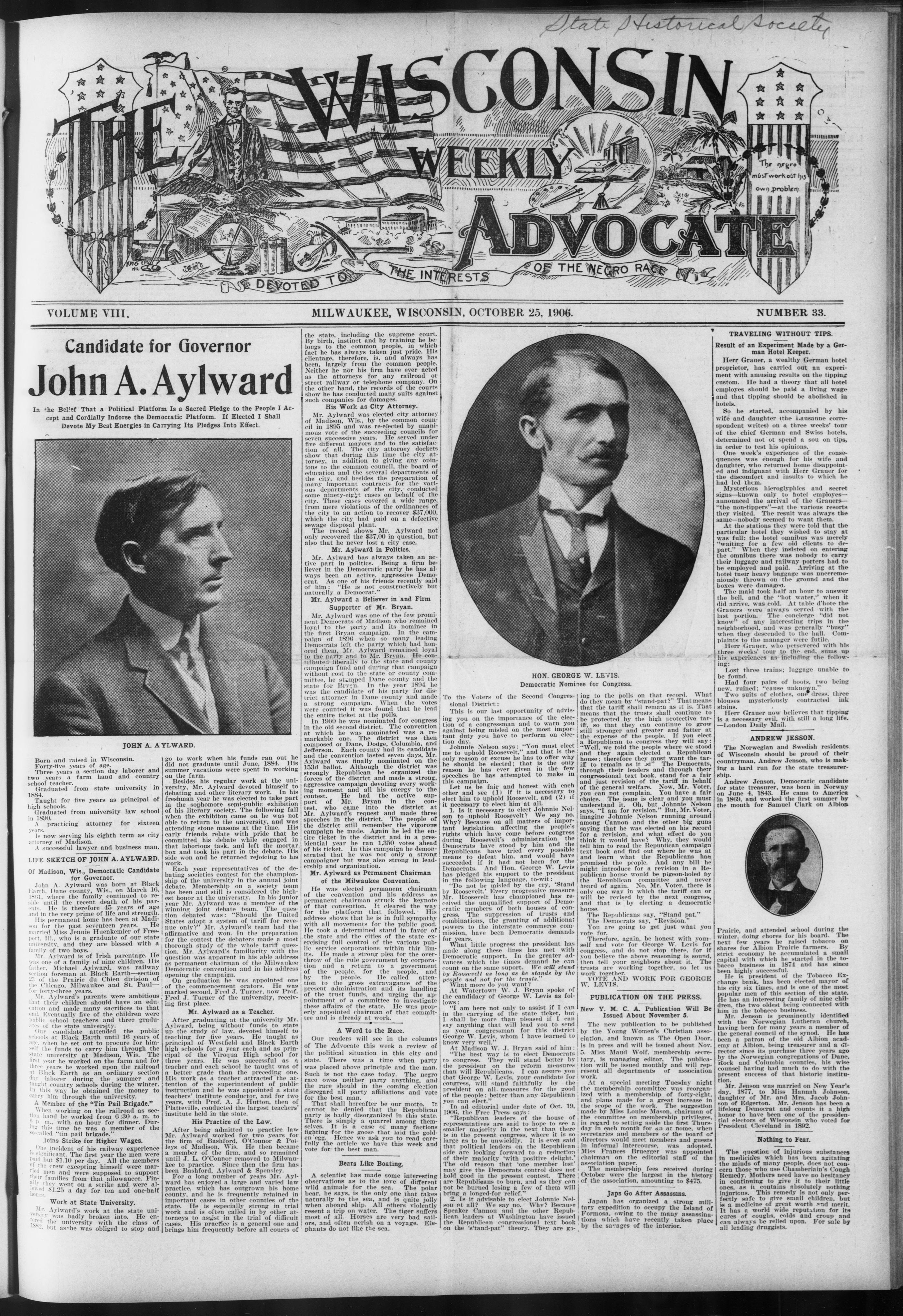
Candidate for
John A. A
In the Belief That a Political Platform
cept and Cordially Indorse the Dem
Devote My Best Energies in Ca
JOHN A. A
Candidate for Governor John A.Aylward
In the Belief That a Political Platform Is a Sacred Pledge to the People I Accept and Cordially Indorse the Democratic Platform. If Elected I Shall Devote My Best Energies in Carrying Its Pledges Into Effect.
JOHN A. AYLWARD
Three years a section day laborer and two years a farm hand and country school teacher
school teacher. Graduated from state university in 1884.
Taught for five years as principal of high schools.
Graduated from university law school in 1890.
A practicing attorney for sixteen years.
Is now serving his eighth term as city attorney of Madison.
A successful lawyer and business man.
LIFE SKETCH OF JOHN A. AYLWARD.
Of Madison, Wis., Democratic Candidate for Governor.
John A. Aylward was born at Black Earth, Dane county, Wis., on March 16, 1861, where the family continued to reside until the recent death of his parents. He is therefore 45 years of age and in the very prime of life and strength. His permanent home has been at Madison for the past seventeen years. He married Miss Jennie Huenkemier of Freeport, Ill., who is a graduate of our state university, and they are blessed with a family of two boys. Mr. Aylward is of Irish parentage. He was one of a family of nine children. His father, Michael Aylward, was railway section foreman at Black Earth—section 23 of the Prairie du Chien division of the Chicago, Milwaukee and St. Paul—for forty-three years.
Mr. Aylward's parents were ambitious that their children should have an education and made many sacrifices to that end. Eventually five of the children were public school teachers and three graduates of the state university. Our candidate attended the public schools at Black Earth until 16 years of age, when he set out to procure for himself the funds to carry him through the state university at Madison, Wis. The first year he worked on the farm and for three years he worked upon the railroad at Black Earth as an ordinary section day laborer during the summer and taught country schools during the winter. In this way he obtained the money to carry him through the university.
A Member of the "Tin Pail Brigade." When working on the railroad as section hand he worked from 6:30 a. m. to 6 p. m., with an hour for dinner. During this time he was a member of the so-called "tin pail brigade."
Joins Strike for Higher Wages.
One incident of his railway experience is significant. The first year the men were paid but $1.10 per day. All the members of the crew excepting himself were married men and were supposed to support their families from that allowance. Finally they went on a strike and were allowed $1.25 a day for ten and one-half hours.
Work at State University.
Mr. Aylward's work at the state university was badly broken into. He entered the university with the class of 1882, but as he was obliged to stop and
```markdown
```
VOLUME VIII.
Born and raised in Wisconsin. Born five years ago.
Work at State University.
go to work when his funds ran out he did not graduate until June, 1884. His summer vacations were spent in working on the farm.
Besides his regular work at the university, Mr. Aylward devoted himself to debating and other literary work. In his freshman year he was elected to take part in the sophomore semi-public exhibition of his literary society. The following fall when the exhibition came on he was not able to return to the university, and was attending stone masons at the time. His early friends relate with pride that he committed his debate while engaged in that laborious task, and left the mortar box and took his part in the debate. His side won and he returned rejoicing to his work.
Each year representatives of the debating societies contest for the championship of the university in the annual joint debate. Membership on a society team has been and still is considered the highest honor at the university. In his junior year Mr. Aylward was a member of the winning joint debate team. The question debated was: "Should the United States adopt a system of tariff for revenue only?" Mr. Aylward's team had the affirmative and won. In the preparation for the contest the debaters made a most thorough study of the whole tariff question. Mr. Aylward's familiarity with the question was apparent in his able address as permanent chairman of the Milwaukee Democratic convention and in his address opening the campaign.
On graduation he was appointed one of the commencement orators. He was marked second, Fred J. Turner, now Prof. Fred J. Turner of the university, receiving first place.
After graduating at the university Mr. Aylward, being without funds to state up the study of law, devoted himself to teaching for five years. He taught as principal of Westfield and Black Earth high schools for a year each and as principal of the Viroqua High school for three years. He was successful as a teacher and each school he taught was of a better grade than the preceding one. His work as a teacher attracted the attention of the superintendent of public instruction and he was appointed a state teachers' institute conductor, and for two years, with Prof. A. J. Hutton, then of Platteville, conducted the largest teachers' institute held in the state.
After being admitted to practice law Mr. Aylward worked for two years for the firm of Bashford, O'Connor & Poileys of Madison, Wis. He then became a member of the firm, and so remained until J. L. O'Connor removed to Milwaukee to practice. Since then the firm has been Bashford, Aylward & Spensley. For a long number of years Mr. Aylward has enjoyed a large and varied law practice, which has outgrown his home county, and he is frequently retained in important cases in other counties of the state. He is especially strong in trial work and is often called in by other attorneys to assist in the trial of difficult cases. His practice is a general one and brings him frequently before all courts of
Mr. Avlward as a Teacher
His Practice of the Law
MILWAUKEE, WISCONSIN, OCTOBER 25, 1906.
the state, including the supreme court. By birth, instinct and by training he belongs to the common people, in which fact he has always taken just pride. His clientage, therefore, is, and always has been, largely from the common people. Neither he nor his firm have ever acted as the attorneys for any railroad or street railway or telephone company. On the other hand, the records of the courts show he has conducted many suits against such companies for damages.
His Work as City Attorney.
Mr. Aylward was elected city attorney of Madison, Wis., by the common council in 1895 and was re-elected by unanimous vote of the succeeding councils for seven successive years. He served under five different mayors and to the satisfaction of all. The city attorney dockets show that during this time the city attorney, in addition to giving any opinions to the common council, the board of education and the several departments of the city, and besides the preparation of many important contracts for the various departments of the city, conducted some ninety-eight cases on behalf of the city. These cases covered a wide range, from mere violations of the ordinances of the city to an action to recover $37,000, which the city had paid on a defective sewage disposal plant.
The record shows Mr. Aylward not only recovered the $37,00 in question, but also that he never lost a city case.
Mr. Aylward in Politics.
Mr. Aylward has always taken an active part in politics. Being a firm believer in the Democratic party he has always been an active, aggressive Democrat. As one of his friends recently said of him: "He is not constructively but naturally a Democrat."
Mr. Aylward a Believer in and Firm Supporter of Mr. Bryan.
Mr. Aylward was one of the few prominent Democrats of Madison who remained loyal to the party and its nominee in the first Bryan campaign. In the campaign of 1896 when so many leading Democrats left the party which had honored them, Mr. Aylward remained loyal to the party and to Mr. Bryan. He contributed liberally to the state and county campaign fund and during that campaign without cost to the state or county committee, he stumped Dane county and the state for Bryan. In the year 1894 he was the candidate of his party for district attorney in Dane county and made a strong campaign. When the votes were counted it was found that he lead the entire ticket at the polls.
In 1900 he was nominated for congress in the old second district. The convention at which he was nominated was a remarkable one. The district was then composed of Dane, Dodge, Columbia, and Jefferson. Each county had its candidate and the convention lasted seven days, Mr. Aylward was finally nominated on the 153d ballot. Although the district was strongly Republican he organized the forces of the district and made a strong, aggressive campaign devoting every working moment and all his energy to the contest. He had the active support of Mr. Bryan in the contest, who came into the district at Mr. Aylward's request and made three speeches in the district. The people of the district still remember the vigorous campaign he made. Again he led the entire ticket in the district and in a presidential year he ran 1,350 votes ahead of his ticket. In this campaign he demonstrated that he was not only a strong campaigner but was also strong in leadership and organization.
Mr. Aylward as Permanent Chairman of the Milwaukee Convention.
He was elected permanent chairman of the convention and his address as permanent chairman struck the keynote of that convention. It cleared the way for the platform that followed. His address shows that he is in full sympathy with all movements for the public good. He took a determined stand in favor of the state and the cities of the state exercising full control of the various public service corporations within thir limits. He made a strong plea for the overthrow of the rule government by corporation and a return to a government of the people, for the people, and by the people. He called attention to the gross extravagance of the present administration and its handling of the trust funds, and urging the appointment of a committee to investigate these affairs of the state. He was properly appointed chairman of that committee and is already at work.
A Word to the Race.
Our readers will see in the columns of The Advocate this week a review of the political situation in this city and state. There was a time when party was placed above principle and the man. Such is not the case today. The negro race owes neither party anything, and the race should in the coming election disregard all party affiliations and vote for the best man. That shall hereafter be our motto. It cannot be denied that the Republican party is badly disorganized in this state. There is simply a quarrel among themselves. It is a case of many factions fighting for the goose that laid the golden egg. Hence we ask you to read carefully the article we have this week and vote for the best man.
Bears Like Boating.
A scientist has made some interesting observations as to the love of different wild animals for the sea. The polar bear, he says, is the only one that takes naturally to the sea, and is quite jolly when aboard ship. All others violently resent a trip on water. The tiger suffers most of all. Horses are very bad sailors, and often perish on a voyage. Elephants do not like the sea.
HON. GEORGE W. LEVIS. Democratic Nominee for Congress.
To the Voters of the Second Congressional District:
This is our last opportunity of advising you on the importance of the election of a congressman and to warn you against being misled on the most important duty you have to perform on election day.
Johnnie Nelson says: "You must elect me to uphold Roosevelt," and that is the only reason or excuse he has to offer why he should be elected; that is the only reason he has ever given in the few speeches he has attempted to make in this campaign.
Let us be fair and honest with each other and see (1) if it is necessary to elect him to uphold Roosevelt, and (2) if it necessary to elect him at all.
1. Is it necessary to elect Johnnie Nelson to uphold Roosevelt? We say no. Why? Because on all matters of important legislation affecting the people's rights which have come before congress during Roosevelt's administration the Democrats have stood by him and the Republicans have tried every possible means to defeat him, and would have succeeded if it had not been for the Democrats. And Hon. George W. Levis has pledged his support to the president in the following language, to-wit:
"Do not be misled by the cry, 'Stand by Roosevelt.' Every progressive measure Mr. Roosevelt has championed has received the unqualified support of Democratic members of both houses of congress. The suppression of trusts and combinations, the granting of additional powers to the interstate commerce commission, have been Democratis demands for years.
What little progress the president has made along these lines has met with Democratic support. In the greater advances which the times demand he can count on the same suport. We will stand by Roosevelt as long as he stands by the people and not for the trusts."
What more do you want?
At Watertown W. J. Bryan spoke of the candidacy of George W. Levis as follows:
"I am here not only to assist if I can in the carrying of the state ticket, but I shall be more than pleased if I can say anything that will lead you to send as your congressman for this district George W. Levis, whom I have learned to know very well."
At Madison W. J. Bryan said of him: "The best way is to elect Democrats to congress. They will stand better by the president on the reform measures than will Republicans. I can assure you that George W. Levis, your candidate for congress, will stand faithfully by the president on all measures for the good of the people: better than any Republican you can elect."
In ad editorial under date of Oct. 19, 1906, the Free Press says:
"Republican leaders of the house of representatives are said to hope to see a smaller majority in the next than there is in the present congress, where it is so large as to be unwieldly. It is even said that political leaders on the Republican side are looking forward to a reduction of their majority 'with positive delight.' The old reason that 'one member lost' may give the Democrats control does not hold good in the present contest. There are Republicans to burn, and as they can not be burned losing a few of them will bring a longed-for relief."
2. Is it advisable to elect Johnnie Nelson at all? We say no. Why? Because Speaker Cannon and the other Republican leaders at Washington have issued the Republican congressional text book on the 's'tand-pat' theory. They are go-
ing to the polls on that record. What do they mean by "stand-pat?" That means that the tariff shall remain as it is. That means that the trusts shall continue to be protected by the high protective tariff, so that they can continue to grow still stronger and greater and fatter at the expense of the people. If you elect a Republican to congress they will say: "Well, we told the people where we stood and they again elected a Republican house; therefore they must want the tariff to remain as it .si" The Democrats, through their leaders and through their congressional text book, stand for a fair and just revision of the tariff in behalf of the general welfare. Now, Mr. Voter, you can not complain. You have a fair choice. The issue is clear and you must understand it. Oh, but Johnnie Nelson says, "I am for revision." But, Mr. Voter, imagine Johnnie Nelson running around among Cannon and the other big guns saying that he was elected on his record for a revision, and what effect do you think it would have? Why, they would tell him to read the Republican campaign text book and find out where he was at and learn what the Republicans had promised the people. And any bill he might introduce for a revision in a Republican house would be pigeon-holed by the Republican committee and never heard of again. No, Mr. Voter, there is only one way in which the tariff can or will be revised by the next congress, and that is by electing a democratic house.
The Republicans say, "Stand pat." The Democrats say, "Revision." You are going to get just what you vote for. Therefore, again, be honest with yourself and vote for George W. Levis for congress, and do not stop there, for if you believe the above reasoning is sound, then tell your neighbors about it. The trusts are working together, so let us work together. NOTE AND WORK FOR GEORGE
VOTE AND WORK FOR GEORGE W. LEVIS.
PUBLICATION ON THE PRESS.
New Y. M. C. A. Publication Will Be Issued About November 5.
The new publication to be published by the Young Women's Christian association, and known as The Open Door, is in press and will be issued about Nov. 5. Miss Maud Wolf, membership secretary, is managing editor. The publication will be issued monthly and will represent all departments of association work.
At a special meeting Tuesday night the membership committee was reorganized with a membership of forty-eight, and plans made for a great increase in the scope of the work. The suggestion made by Miss Louise Mason, chairman of the committee on membership privileges, in regard to setting aside the first Thursday in each month for an at home, when secretaries and members of the board or directors would meet members and guests in informal intercourse, was adopted. Miss Frances Bruegger was appointed chairman on the editorial staff of the association paper. The membership fees received during October were the largest in the history of the association, amounting to $475.
Japs Go After Assassins.
Japan has organized a strong military expedition to occupy the Island of Formosa, owing to the many assassinations which have recently taken place by the savages of the interior.
TRAVELING WITHOUT TIPS.
Result of an Experiment Made by a German Hotel Keeper.
Herr Grauer, a wealthy German hotel proprietor, has carried out an experiment with amusing results on the tipping custom. He had a theory that all hotel employees should be paid a living wage and that tipping should be abolished in hotels.
So he started, accompanied by his wife and daughter (the Lausanne correspondent writes) on a three weeks' tour of the chief German and Swiss hotels, determined not ot spend a sou on tips, in order to test his opinions.
One week's experience of the consequences was enough for his wife and daughter, who returned home disappointed and indignant with Herr Grauer for the discomfort and insults to which he had led them.
Mysterious hieroglyphics and secret signs—known only to hotel employees—announced the arrival of the Grauers—"the non-tippers"—at the various resorts they visited. The result was always the same—nobody seemed to want them. At the stations they were told that the particular hotel they wished to stay at was full; the hotel omnibus was merely "waiting for a few old clients to depart." When they insisted on entering the omnibus there was nobody to carry their luggage and railway porters had to be employed and paid. Arriving at the hotel their heavy baggage was unceremoniously thrown on the ground and the boxes were damaged.
The maid took half an hour to answer the bell, and the "hot water," when it did arrive, was cold. At table d'hote the Grauers were always served with the last portion. The concierge "did not know" of any interesting trips in the neighborhood, and was generally "busy" when they descended to the hall. Complaints to the manager were futile.
Herr Grauer, who persevered with his three weeks' tour to the end, sums up his experiences as including the following:
Lost three trains; luggage unable to be found.
Had four pairs of boots, two being new, ruined; "cause unknown."
Two suits of clothes, one dress, three blouses mysteriously contracted ink stains. Herr Grauer now believes that tipping is a necessary evil, with still a long life. London Daily Mail.
ANDREW JESSON.
The Norwegian and Swedish residents of Wisconsin should be proud of their countryman, Andrew Jenson, who is making a hard run for the state treasurership.
Andrew Jenson, Democratic candidate for state treasurer, was born in Norway on June 4, 1843. He came to America in 1869, and worked the first summer by the month for Samuel Clark on Albion
A. H.
Prairie, and attended school during the winter, doing chores for his board. The next few years he raised tobacco on shares for Albion Prairie farmers. By strict economy he accumulated a small capital with which he started in the tobacco business in 1874 and has since been highly successful. He is president of the Tobacco Exchange bank, has been elected mayor of his city six times, and is one of the most popular men of this section of the state. He has an interesting family of nine children, the two oldest being connected with him in the tobacco business.
Mr. Jenson is prominently identified with the Norwegian Lutheran church, having been for many years a member of the general council of the synod. He has been a patron of the old Albion academy at Albion, being treasurer and a director since its purchase three years ago by the Norwegian congregations of Dane, Rock and Columbia counties, his wise counsel having had much to do with the present success of that historic institution.
Mr. Jenson was married on New Year's day, 1877, to Miss Hannah Johnson, daughter of Mr. and Mrs. Jacob Johnson of Edgerton. Mr. Jenson has been a lifelong Democrat and counts it a high honor to have been one of the presidential electors of Wisconsin who voted for President Cleveland in 1892.
Nothing to Fear
The question of injurious substances in medicines which has been agitating the minds of many people, does not concern those who use Chamberlain's Cough Remedy. Mothers need have no hesitancy in continuing to give it to their little ones, as it contains absolutely nothing injurious. This remedy is not only perfectly safe to give small children, but is a medicine of great worth and merit. It has a world wide reputation for its cures of coughs, colds and croup and can always be relied upon. For sale by all leading druggists.
THE WISCONSIN WEEKLY ADVOCATE
MILWAUKEE, WIS.
R. B. MONTGOMERY, Editor and Proprietor.
Miscellaneous Items.
Dr. Bordet, chief physician at the Brabant Pastteur institute, has informed the Belgian academy that he has positively discovered a serum to prevent whooping cough.
The trials of electric locomotives within the Simplon tunnel have given a speed of 43% miles an hour, which would reduce the passage through to about 17 minutes.
Rudyard Kipling, it is said, prefers the night hours for work, frequently sitting up until 2 or 3 o'clock. He is most elaborate in his methods, and pronounces aloud every word that he writes in order to test its fitness.
—London has five regularly built openair pulpits from which there is preaching and the results have been so good that other churches are considering the question of having such pulpits built upon the outside of their edifices.
—Women whose jewel caskets metaphorically run over with precious gems may yield to the fashion, which is reported to have caught society's fancy in Paris, of studding the heels of dainty slippers with gleaming stones.
—Rev. Thomas G. Wright, a retired Baptist clergyman, and his wife recently celebrated at Hartford, Conn., the sixtieth anniversary of their marriage. He is a graduate of Colby college in the class of 1842, and began his ministry in 1845.
The St. Bernard monks drove one of their new powerful motor cars, specially constructed to transport heavy luggage, from Martigny to the hospice on the summit of the Grand St. Bernard a few days ago, and next summer they will start a regular automobile service for tourists to the hospice.
The geological survey estimates that the output in 1905 of sheet mica in the six producing states—North Carolina, Colorado, New Hampshire, Georgia, South Dakota and New Mexico—amounts to 851,000 pounds, with a total value of $185,900. North Carolina led with two-fifths of the production.
Probably the heaviest man in Europe was the late Hans Fromm of Willenberg, in Eastern Prussia, a hotel keeper. He weighed 525 pounds. A showman in Paris once offered him a large sum, and he was willing to accept it, but he could not enter any passenger car and refused to travel in a freight car.
By his will a rich land owner named Bielau, who has died in Leonnewitz, Saxony, leaves a large property to the military authorities, which, in case of war, is to be sold and two-thirds of the money given to the soldiers who capture the first standard from the enemy, and the third part to the first soldier who captures a gun.
Three hundred British firms have contributed to an exhibit of goods which is displayed on the lower decks of a former military transport, and will be sent from London to different ports of Canada, the West Indies, South America, South Africa, India, China, Japan and Australia. The voyage is expected to last twelve months.
State monopolies are more than ever in favor in France as a means of raising revenue to the prejudice of private enterprise. A committee of the Chamber of Deputies has been appointed, with a former minister of finance as chairman to collect information on the possible working of monopolies of sugar and petroleum refining, the rectification of alcohol and insurance.
"For long it puzzled me," Sir Douglas Brooke writes in Country Life, "to know what Irish poachers did with the birds they shot in July. There is no cold storage in the north of Ireland, but they have discovered an excellent substitute. The birds are buried four or five feet deep in dry peat, and, I am told, come out perfectly fresh at the end of two or three weeks."
A new branch of science heralds its appearance in Paris. It is named Dolormety, and its function is the "measurement" of the dynamics of pain by material means. The dolormeter shows that the dynamic force of a sharp cut with an ordinary carter's whip is equal to about 285 pounds, but that a vigorous jerk at the reins puts a pressure of about 305 pounds on the horse's head.
The countenance of the Emperor of China, the Son of Heaven, is not often gazed on by Europeans. One of the favored few says he has a melancholy, frightened look. His face is pale, and though it is distinguished by refinement and quiet dignity, it has none of the force of his martial ancestors, nothing commanding or imperial, but is altogether mild, delicate and kind.
Charles Astor Bristed is the latest man of wealth to seek an elective position in the government of the town of Stockbridge, Mass. Mr. Bristed now is making a vigorous campaign for membership of the board of selectmen. The exclusive summer colony at Lennox already is represented on the board by Eustace Jaques, and upon the board of assessors by Dr. John C. Greenleaf.
The Japanese House of Representatives consists of 300 members elected by ballot, each member receiving a salary. Its House of Peers consists of members of the royal family, princes and marquises, counts viscounts and barons, elected as representatives of the several orders, and persons elected for seven years by and from the fifteen highest taxpayers in each city and prefecture.
The progress of Egypt's commercial development in the last twenty years has been most marked. The cotton crop alone in that time has more than doubled. In spite of the large reductions of taxation the revenue last year was the largest ever collected in one year. The great wealth of Egypt lies in her agricultural resources—cotton, oil seeds, sugar and other crops. These, in turn, depende upon the Nile flood. With the Nile regulated and under control by the immense system of reservoirs and dams, with a fellaheen freed from excessive taxation, and with a net work of light railways, rendering the produce of the country accessible to foreign markets, the prospect of Egypt is placed on a more solid basis than in the past. Consular Reports.
-Michand finds a steady fall in the birth rate of men of talent from New England westward. In New England out of every 100,000 births fifty-four are those of men of talent: in New York that number falls to thirty-four, in Ohio to nineteen, in Indiana to eleven, in Illinois to ten, in Missouri to six, in Kansas to two, in Colorado to one. This was learned by comparing the states by the number of persons whose names appear in a directory of those prominent in public life, the arts and sciences and literary pursuits, with the total number of persons born. The objection, of course, to these statistics is that a great many of these men—as, for instance, in New York City—are not natives and after they become famous and prosperous have broadened their field of work by moving to a larger center of activity, where opportunities are greater.
BLITHE HEART.
I face the sun and cannot see
My shadow on the grass;
The hours are all to sweet for me
To count them as they pass.
A little older day by day
I grow, but it is truth
That age has never found the way
To touch my heart's glad youth.
If I could live a thousand years
I still should be the boy
Taught early to forget the tears
And to hold fast to joy.
And if I read the world aright
While journeying along,
God put us here to find delight
In life and love and song.
The bird that sings, the bud that blows
And I alike, each one
HIS FORMER PROPOSAL.
"I just have to smile whenever I think of you and Nancy," declared Mrs. Wyvern.
"I am proud." said I politely.
"Proud!" said Mrs. Wyvern.
"Of my share in producing such an effect," I explained. She has the prettiest smile imaginable.
Mrs. Wyvern erected a warning finger.
"Is my engagement to blind my artistic eye." I protested.
"It does," I affirmed. "I don't say half I mean now."
"You'll become veracious," she mused. "You never used to mean half you said."
I refrained from debating her statement. It was as well, perhaps, she should think so. You see, I knew her before her marriage.
"Mean what I said? I queried. I don't know. I've forgotten what I said."
Mrs. Wyvern appeared somewhat annoyed. She should have been glad.
"I don't remember, either," she remarked.
"In that case," said I, "I do remember."
There is surely no danger when only one remembers.
"But why do you smile?" I inquired.
I find it advisable, when with Mrs. Wyvern, to keep Nancy in the foreground.
"Because you're both such sillies," she
"Everybody knows you're madly in love with each other," she went on.
"Such universal knowledge," I remarked, "is highly gratifying."
"And all the time," she continued, gurgling, "you think you're hiding the fact. You may be very cool to each other in public, but I know——"
"Come now," I interjected, triumphantly, "you can't possibly know, you can only imagine my manner in private."
Mrs. Wyvern stifled a laugh.
"You forget," she said; "I knew you several years ago."
"You're basing your conclusions," I stated, "on an exceptional occasion."
"How do you know what I'm basing them on?" she demanded.
"Age," said I, "has not yet affected my memory. You must remember that that day I had played golf with you in the morning, taken you on the river in the afternoon and was displaying my ignorance of astronomy in the evening.
Mr3. Wyvern blushed delightfully.
"Do you remember that?" she murmured. "I thought you had forgotten." "It chances to linger in my memory," I confessed. I looked at her critically and she smiled provokingly in return. "I'm glad Julia came out when she did," she said. "Why?" said I. "We should have lived a cat-and-dog life," she explained. I smiled triumphantly. "So," said I, "the idea was not so absurd as you said—next day." "Well, one is always wiser the day after," she pleaded.
"As to that!" I said, with a shrug. "I admit, however, one generally thinks differently the day after. Lucky is he—I beg your pardon; I mean, of course, she—to whom the day after is accorded."
"I must say," said Mrs. Wyvern, kindly, "that you have turned out better than I anticipated. Because you were—well, a little racketty then, weren't you?"
"I had not," I was compelled to admit, "then reached my present years of discretion."
Mrs. Wyvern sighed.
"Ah, well," she said. "It was all for the best."
"A pleasing and satisfying reflection," I commented.
"In my case, anyhow," she amended. She paused. "Still," she went on, "I dare say you'll be happy enough with Nancy. She's a dear girl. Of course, she has her faults." "She is but human," said I. We both glanced at each other, and sighed again, and then turned our eyes away. I don't know whether Mrs. Wyvern also smiled. "So few men realize that," said Mrs. Wyvern, presently, with a tinge of sadness in her voice. "That woman is human?" said I. "Surely! I thought that type of man had quite died out." Mrs. Wyvern shook her head sorrowfully.
"But." I persisted, "now that woman is being educated, man must realize that she has rights, and is becoming, surely if slowly, his equal."
Mrs. Wyvern sat up as if she had been stung.
"Oh!" she cried. For a moment her feelings overpowered her. "You idiot!"
"You're too modest," I said.
"Man's equal!" she gasped. "I meant that men regard women as angels."
I rubbed my chin in some confusion.
'Sorry," I murmured, feebly; "I seem to have missed your point."
"I meant that man has so high an opinion of woman that he allows her no human feelings. He places her on a pedestal; very often goes away and leaves her, and is surprised to find on his return that she's descended from the pedestal into an easy chair."
"So that's how it is," said I, enlightened.
"I was glad for Nancy's sake that you hadn't this absurd reverence for woman." she went on.
"It's absurd, isn't it?" I said, pleased we had one point of agreement.
"No, it's not," snapped Mrs. Wyvern; "it's men like you who make women what they are."
I had no wish to offend Mrs. Wyvern, so, "You credit me with too much," I
said, with a suitable expression in my eyes.
eyes.
Mrs. Wyvern blushed and laughed.
"You're too absurd," she said.
"I do pity poor Nancy," she continued.
"You'll be able to talk her into thinking you're always right."
"A very proper state of mind," I remarked.
"It's a good job, after all," I said, to effectually smooth her down, "that you did marry Wyvern."
Mrs. Wyvern unsuccessfully endeavored to conceal her chagrin.
"For me, yes," she assented.
"And for me," I persisted.
"Why?" she was unable to refrain from asking.
"Because," said I, "you're too clever to be talked round. My many imperfections would be perfectly plain to you." She did not deny this. "And my faults;" she queried. "Of course," I reflected, "marriage might alter my opinion."
It was. Mirth cannot be restrained for ever.—F. Harris Deans in the London Mail.
LET THEM FIGHT IT OUT.
Story of the Days in Missouri When Whisky Was Free.
Henry C. Chiles of Independence is one of the old timers of eastern Jackson county, and his memory is good.
"In 1850," remarked Mr. Chiles, as he smoked his "Missouri meerschaum" reflectively in the county clerk's office in Independence yesterday, "my father was selling goods in Sibley, fifteen miles northeast of this town, and I was with him in the store. That was before the days of the saloon in the present type, and more or less whisky was handled in nearly all stores, especially grocery stores.
"Our store was no exception to the rule. We kept a barrel of it open in the back room. It was free to our customers, and a glass was provided for white men to drink out of and a tin cup for negroes.
"Much business was done in Sibley in those days, and strangers came to town from various parts of the world. One Saturday, when there were many people in town, a small Englishman appeared. He was so gentlemanly in appearance and manners that the crowd of rough frontiersmen at once singled him out as a good victim for ridicule. They made all sorts of remarks to draw him out. For a while he paid no attention to them, but before long he began to see that he was in for it. A big fellow named Ray had been particularly insulting.
"Gentlemen,' said the little Englishman, 'I dont' want to fight, but it appears that that is what you are after, so I suppose I shall have to accommodate you.'
"A jeer went up from the crowd; the idea of such a little fellow fighting? The crowd had been drinking a little too much and was spoiling for a fist fight "It was customary to observe some sort of rules in fistic encounters. Accordingly each man chose a second from among the crowd and the fight began. "With a look of supreme contempt, Ray made a pass for his antagonist, but in a small fraction of a second found himself sprawling on the ground. He sprang to his feet, but was downed again and again.
"Let me at him," said Ray's second, but the second was knocked out as easily as the principal bully had been. The stranger proved to be a thoroughly trained athlete. He declared that he could whip the whole bunch. He knocked one man down and jumped on him, kicking him in the face. This was a signal for a general fight.
"My father, a peacemaker by nature, rushed out and tried to interfere, but after he had received a vicious jab in the face he was glad enough to run back into the store.
"Then Paschall Cook, the constable at Sibley, felt that it was time for the majesty of the law to assert itself. He had no hope, however, of accomplishing anything single-handed, so he grabbed up the top of a box and wrote down the names of a number of men he knew, at the same time appointing them as deputies to help him.
"No one paid the slightest attention to him. Throwing his list of deputies into the river and bawling out 'Fight and be damned' he, too, retreated to the store, leaving the excited crowd to pummel each other till it had had its fill."—Kansas City Star.
EVERY-DAY PHILOSOPHY
A dead beat always wants pay in advance.
There never was a wife so old that she didn't look better as a widow.
How people love to gossip and how they do hate to be pinned down when questioned!
Another advantage the women have over the men is that there are not slot machines at soda fountains.
What has become of the old-fashioned girl who pined away and forgot to curl her hair when love didn't go to suit her?
When a good-hearted, easy-going man dies, and his wife gets hold of his books, she soon has every one who ever owed him a cent, on the run.
If old men would talk freely, how many of them would have complaints against their daughters? Daughters seldom treat fathers as considerately as they treat mothers.
When a little girl names her doll for you it is a compliment, but when she is a grown woman and names her baby for you, there may be another motive in connection.
The good book says something about "All men being liars." The only trouble is the statement is too narrow. It should have included women and children.—Atchison (Kan.) Globe.
King Kind to Strangers
Recently some German tourists in Denmark paid a visit to Charlottenburg with the object of seeing the summer palace of King Frederick. They met a gentleman walking alone of whom they inquired whether it would be possible for them to obtain access to the gardens. "Certainly," he replied, "I happen to have a key," and for half an hour he led the party about the grounds, pointing out their beauties and entertaining the strangers with lively conversation. At last he took his leave with the words, "If you care to see the stables, just say that you have the King's permission."
It was the King himself. He shook hands with each member of the party and bade them farewell.
Ecstasy.
The shore-lark soars to his topmost flight. Sings at the height where morning springs; What though his voice be lost in the light The light comes dropping from his wings. Mount, my soul, and sing at the height Of thy clear flight in the light and the air.
Heard or unheard in the night, in the light Sing there—sing there. Duncan Campbell Scott in Smart Set.
SILK CULTURE
Its Slow Progress in the United States in spite of Bounties.
As early as 1732 French Hugenots introduced silk into Georgia, where lands were granted to settlers who would agree to plant 100 mulberry trees to every ten acres of land which they cleared. Seven years later Parliament passed an act exempting from taxation silk grown in Georgia or Carolina, and an Italian expert was sent out to establish a filature. Within a year the receipts of cocoons at this factory exceeded 10,000 pounds, while the quality of raw silk produced brought three shillings a pound in the London market. Toward the latter part of the century the culture of silk was introduced into New England. Mansfield, Conn., became the center of an important silk growing community and proved the site of the first silk factory in this country.
The Revolution, however, dealt a blow to silk culture, from which it did not recover until 1825. By that time congressional investigation had given an impetus to it, putting the industry once more on its feet. Soon the culture of silkworms became a mania. Speculation followed, and brought disaster to thousands who had invested their fortunes in what promised to become one of the great money-making enterprises of the times. The members of the industry which remained were snuffed out by the hard times of 1837 and the drought of 1844. Congress came to the rescue again in 1844 with an appropriation for investigations, which were continued from year to year until 1890. The appropriation was renewed in 1902 and has been granted each year since. In the meantime, aided by state bounties, silk had been grown with profit in Utah, and today sericulturists of that state do a paying business in the exportation of silkworm eggs to the south of Europe. In spite of our slow development of the raw material the United States five years ago passed France and became the leading silk manufacturing nation of the world. It is estimated that 500 silk mills are now in operation, distributing annually to 70,000 persons $21,000,000 in wages and producing silk goods valued at $110,000,000. China leads the world in the production of raw silk, and of the world's annual output of about 61,000,000 pounds produces more than half. Japan comes next with a production of less than a fourth of the total. India, Siam, Persia, Turkey, Greece, Italy, France, Spain, Portugal and the Balkan States follow as producers in this order. That American grown silk can compete in quality with the products of other silk growing countries is evident from the award at the St. Louis exposition of the gold medal for excellence to Louis Borris Magid for fibres grown at Tallulah Falls, Ga., where he has planted more than 200,000 mulberry trees designed for the feeding of millions of silkworms.—Boston Transcript.
WORDS OF WISDOM
Hope is boundless, and usually groundless.
Tell people the truth about what you have to sell, and they won't buy from you.
The danger of buying a man lies in the fact that he will always be for sale to the highest bidder.
We close our eyes to our own faults on the same principle that an ostrich buries his head in the sand.
Old age is a matter of clinging to the prejudices of one's youth! The man with an open mind does not grow old.
A fool can have more fun with a dollar than a rich man can have with twenty. That's one reason he's a fool.
PICKINGS FROM PUCK.
Lives of great men oft remind us of legal holidays.
All the world's a stage, but not all the men are matinee idols.
There is too much art which merely holds the mirror up to itself.
Wealth can never bring true happiness with it until we learn how to become rich without getting to think we've got to have a butler to stand behind our chair and entertain his own opinion of our table manners.—Puck.
Mrs. Craigie's Address
An amusing story of the late Mrs. Craigie the noted novelist, was told the other day at the Authors' club in New York.
"When Mrs. Craigie was in America last year," said the editor, "she was invited to make an address at a certain meeting. She accepted the invitation, but her name, through some oversight, was put far down on the programme, and worse than that, the chairman, a rather stupid person, introduced before her some speakers who were not on the programme at all.
"In short, it was close on to 11 o'clock when the chairman, with a pleasant smile, bowed and said:
"Mrs. Craigie, the eminent author of 'Some Emotions and a Moral,' will now give us her address.'
"Mrs. Craigie rose and said calmly: "My address is 56 Lancaster Gate, Hyde Park, W., London, and I now wish you all good night, for I am far from home."—New York Press.
A Test of Patience.
The Rev. Frederick B. Bridgman, the noted and successful missionary to the Zulus, was talking in Philadelphia about missionary work.
"I am very hopeful of it," he said.
"I may be a little too hopeful because I have had such good success. It is better, though, to be too hopeful than too doubtful.
"Much depends upon the character of the people one works among, and I can sympathize a little with the missionary who returned home from China in a very despondent mood.
"A Chinese convert stole this missionary's watch, and then came back to him the next morning to learn how to wind it up."—Boston Post.
To Study Depleted Forests.
Dr. Augustus Henry, whose name and work are especially familiar to botanists, has arrived from England to study those forests which are being depleted by the inroads of lumbermen and the useless destruction of valuable trees by the ranchmen of the country. He has also come to study the growth of certain trees in the west yet unknown to forestry. Dr. Henry has lately returned from a journey through Central China, taken to study its flora.
KANSAS TURKEYS.
They Are the Best Grasshopper Gatherers Exer Invented.
Machines for gathering grasshoppers have been invented and tried, but the most successful grasshopper gatherer is the turkey. It has the advantage of being a very profitable one, too. A ranchman in western Kansas raised turkeys enough last year to keep eighty acres free from drainage by this insect pest. Next year this ranchman intends raising turkeys very extensively for this purpose, and nearly all of his neighbors are planning to do the same.
If there were 100 turkeys to each quarter section in this alfalfa belt there would not be enough grasshoppers left to damage any crops. And without considering the good that turkeys do, turkey raising is a profitable industry where insects are so plentiful. After they attain the age of 3 or 4 weeks, says Country Life in America, they can obtain their whole living in the fields and cost the farmers nothing until late fall.
Turkey raising promises to become a permanent Kansas industry. The grasshopper with which the farmers have to contend there is not a migrating one, but is native, increasing from year to year. The turkeys, however, range over large fields and thrive on the hoppers. Frank V. Rider, who attempted the gaffing, could not reach the head, although the gaff pole measured six feet, and in the struggle the line parted. The next day a dead tuna, estimated to weigh 600 pounds, was seen floating at sea, and it was generally believed to be the same fish. Excursion parties at $1 a head followed this all day fight, and meals were fed to the man at the rod. Field and Stream.
KILLED A MAN IN MAINE.
Walter Marvin Lancaster has carried his secret with him to the grave. He lived for nearly forty years in Bear Valley, this country, under the name of John Lang, and nobody guessed that it was assumed until the facts came to light after his death. He blew his brains out.
The inquest developed that Lang was not the correct name of the decedent. A witness stated that a short time ago Lang told him that in case anything should happen he wanted it known that his true name was Walter Marvin Lancaster, and that he was a native of Maine. Lancaster further said that he had killed a man in Maine many years ago, but had been acquitted. Fearing that the dead man's friends would take his life, however, he said he had fled his home and changed his name to John Lang.
It was under that name that he located in Bear Valley, set out a little orchard and built him a cosy home. He was highly regarded by all his neighbors, with whom he was on very friendly terms, though of his past life none of them had the slightest inkling. For years he conducted the Culbertson toll bridge at his home, but after it went out of commission like many others he still clung to the valley and seemed content to spend his days there. He was a man of gigantic build.—Sacramento Bee.
Poetry as a Commodity.
At the Author's club, in New York. Richard Le Gallienne, the English poet, said one day of poetry:
"The poet was once the mouthpiece of the nation. Honors and wealth were showered on him. To be a poet was to be a king.
"But now the poet is nothing. He cannot earn a living. I doubt if an industrious poet, working eight hours a day, could make one-half as much as an industrious bricklayer. Were it not for advertisement poetry—"
Mr. Le Gaelliene smiled.
"The other day," he said, "meeting a poet, I asked in a low voice:
"Well how is poetry now?"
"Dull, very dull,' the poet answered gloomily. 'Breakfast food verse is only bringing a quarter a line. Patent medicine "ads" have fallen to 20 cents. Fall clothing poetry has been wabbly for a week, and canned meat verse dropped seven points yesterday in as many minutes.'"—Baltimore Sun.
In Darkest London
A Parsee, visiting London for the first time, dined one night with the bishop, who tried to convert him.
Now, the Parsees are sun worshippers, and it did not occur to the bishop when he took up his line of argument that the London winter season is one long, cold, wet fog, and that the sun never shows himself. Said the bishop:
"Here you are, my friend, a man of culture, widely traveled, generous, grave, wise, and yet you worship the sun. How can you do it? I can't understand how any sensible person should worship a created object, such as the sun."
"Ah, but you should see it once," cried the Parsee, warmly. "You have no idea what a splendid thing it is."—The Argonant
A Vegetable Hair
One of the most interesting though perhaps least known industries of Algeria is the production of vegetable hair. This hair or fibre is made from the dwarf palm which grows in large quantities along the coasts of Algeria. A few years ago this plant was looked upon as a useless weed; now it has been found to contain a most useful fibre and is largely sought after. This fibre is an excellent substitute for horsehair and is in great demand among upholsters, mattress makers, harness makers and carriage builders on the Continent for the cheaper class of goods.—London Globe
Parliament of Man
"To be or not to be, that is the question!" cried Hamlet in a loud voice, but it was destined that he should proceed no further.
"Mr. Chairman, I rise to a point of order." interrupted the Ghost, who had been sitting in one of the rear seats; "the motion to adjourn is not debatable."
Confronted thus by Roberts' Rules of Order, the Noble Dane paled, muttered incoherently and sat down. Afterward he had his speech inserted in the Congressional Record.—Woman's Home Companion.
Want Bank in Philippines
Public meetings are being held at Manila in keeping with the movement to secure an agricultural bank for the Philippines. A prominent Manila firm states that it hopes to secure a minimum capitalization of 20,000,000 pesos. They state that the shortage in the hemp production, upon which the islands are dependent, will create a bad financial condition which a government agricultural bank would greatly mitigate.
How Pettus Keeps Young
Senator Pettus of Alabama, who recently passed his eighty-fifth birthday, is reported to have offered this explanation of vitality: "I never chew less than half a pound of tobacco per day. I swear only when it is absolutely necessary; drink nothing stronger than whisky, and for years have made it a practice to go to bed only when I blank please."—St. Louis Republic
Will Have a Parliament
Prince Nicholas of Montenegro has just promulgated the decree under which the grand old race of fighting mountaineers will shortly go through, for the first time in their history, the experience of electing a parliament. The election takes place on September 27, and the deputies will be elected for four years. Every captaincy, as the districts are suggestively named, will return a member, as will each of the six towns of the principality. Every adult male of 21 is a voter, and every man of 30 paying about 13 shillings a year in taxes is eligible. The following have also seats, ex officio: The Orthodox Metropolitan, the Roman Catholic Primate, the Moslem Chief Mufti, and members of the privy council of the high court, of the court of accounts, and three generals of brigade, nominated by the ministry.—London Globe.
Deafness Cannot be Cured
by local applications, as they cannot reach the diseased portion of the ear. There is only one way to cure deafness, and that is by constitutional remedies. Deafness is caused by an inflamed condition of the mucous lining of the Eustachian Tube. When this tube is inflamed you have a rumbling sound or imperfect hearing, and when it is entirely closed, Deafness is the result, and unless the inflammation can be taken out and this tube restored to its normal condition, hearing will be destroyed forever; nine cases out of ten are caused by Catarrh, which is nothing but an inflamed condition of the mucous surfaces.
We will give One Hundred Dollars for any case of Deafness (caused by catarrh) that cannot be cured by Hall's Catarrh Cure. Send for circulars, free. F. J. CHENEY & CO., Toledo, O. Sold by Druggists, 75c. Take Hall's Family Pills for constipation.
Chinese Want More Wages.
Chinese laborers in Samoa get only $2.50 a month, besides board, lodging and medical attendance. They want $5, but the planters say that that would make farming unprofitable.
Richest Orchestra in the World
The richest orchestra in the world will be the Warsaw philharmonic, which has just received a legacy of $1,000,000 from a music-loving Pole.
Stockholm and Budapest are the towns possessing the best telephone system in existence.
BUILT UP HER HEALTH
SPEEDY CURE OF MISS GOODE
She Is Made Well by Lydia E. Pinkham's Vegetable Compound, and Writes Gratefully to Mrs. Pinkham.
For the wonderful help that she has found Miss Cora Goode, 255 E. Chicago Avenue, Chicago, Ill., believes it her duty to write the following letter for publication, in order that other women afflicted in the same way may be
Miss Cora Goode
benefited as she was. Miss Goode is president of the Bryn Mawr Lawn Tennis Club of Chicago. She writes; Dear Mrs. Pinkham:— "I tried many different remedies to build up my system, which had become run down from loss of proper rest and unreasonable hours, but nothing seemed to help me. Mother is a great advocate of Lydia E. Pinkham's Vegetable Compound for female troubles, having used it herself some years ago with great success. So I began to take it, and in less than a month I was able to be out of bed and out of doors, and in three months I was entirely well. Really I have never felt so strong and well as I have since." No other medicine has such a record of cures of female troubles as has Lydia E. Pinkham's Vegetable Compound.
Women who are troubled with painful or irregular periods, backache, bloating (or flatulence), displacement of organs, inflammation or ulceration, can be restored to perfect health and strength by taking Lydia E. Pinkham's Vegetable Compound.
Mrs. Pinkham invites all sick women to write her for advice. She has guided thousands to health. Her experience is very great, and she gives the benefit of it to all who stand in need of wise counsel. She is the daughter-in-law of Lydia E. Pinkham and for twenty-five years has been advising sick women free of charge. Address, Lynn, Mass.
If you think you have heart disease you are only one of a countless number that are deceived by indigestion into believing the heart is affected.
the tonic-laxative, will get your stomach back into good condition, and then the chances are ten to one that you will have no more symptoms of heart disease. Sold by all dealers at 25c. and 50c.
ELY'S
CREAM BALM
CURES COLD
IN HEAD
CATARRH
ROSE COLD
HAY-FEVER
DEEPTNESS
HEADACHE
SO CYS.
GRACE BLAIR
ELY BROS.
NEW YORK
is quickly absorbed. Gives Relief at Once. It cleanses, soothes, heals and protects
the diseased membrane. It cures Catarrh and drives away a Cold in the Head quickly. Restores the Senses of Taste and Smell. Full size 50 cts. at Druggists or by mail; Trial size 10 cts. by mail.
Ely Brothers, 56 Warren Street, New York.
AVOID APPENDICITIS by using the Bates Coffee Settler. Price 25c. Postage 4c extra. 50 other good labor saving kitchen articles. Jewelry, Rugs, Lace Curtains, Musical Instruments, etc. Catalog on application. J. J. HUGHES & SONS CO., 418 W. 54th St., N. Y. City.
```markdown
```
In Autumntide.
The apple seeds are black at core;
The linden leaves, like fairy ore,
Shed the effulgence of their gold,
Paving the pathways green before.
More plaintive grows the thrush's pipe;
The quince's cheek is yellow ripe;
And the smooth pallor of the pear
Reveals, like dawn, a russet stripe.
The minstrel wind behind the hill
Above its strings is never still;
Autumn through all the brooding land
Works the rich wonder of its will.
As in a necromancer's glass,
We watch the radiant pageant pass,
Wood waving banner back to wood
Across the severing seas of grass.
Forgetful what the hours presage,
We feel that we have plucked a page
From the untroubled Book of Dream
A leaf from out the Golden Age!
Breakfasting in Country Homes.
"Apropos of the remarks on punctuality at meals in country houses in the last Bazar, let me endorse the plea for a simple table and add a suggestion. Breakfast at least should be an informal meal. With many people, especially those who are at lowest ebb in the morning breakfast is the great bugbear of the day. It is torture to them to respond to cheerful chat, or even to witness the freshness and vigor of those who are differently constituted. To such it is a luxury to be served with coffee and rolls in their own rooms. In many houses the breakfast trav has done away with the breakfast table. Even the servants like it better, as the morning work of sweeping and dusting can be done before the guests appear."
If the tray service does not meet with favor, simplification of the ordinary breakfast routine may be used, as in one hospitable home where there are always guests. Breakfast invariably consists of fruit, a cereal, toast, bacon, eggs, and coffee. Everybody goes down at the hour which is most convenient for him. He may help himself to fruit or ring for the waitress if she doesn't happen to be in the room. She will bring the cereal and hear in what way he prefers to have his eggs cooked, and whether he wishes dry or buttered toast. The cereal, of course, is easily kept hot in the double boiler, the coffee can be made in a large pot or individual drip pots can be used. Bacon can be fried at intervals, and with a little care can be kept crisp and hot, and it is a simple matter to toast bread and cook eggs. This is a very satisfactory arrangement if the waitress has no other duties.
On Training Our Children.
When I was a young mother I believed, too, that I could be a Providence for my children. I believed they had been given to me to mould as I would, and the only limit of the influence I would have was the limit of my own strength and love. Then there came a time when I realized that every child on the street my child stopped to talk with had its share in bringing up my sons and daughters. One week in school was enough to upset all the training of years. They learned faster from their friends, and more willingly, than ever they did from me, and it seemed to me then that they learned the things they oughtn't to quickest of all. My well-brought-up little boys came from play talking loudly, making faces, playing the fool. The girls would come home from a visit with a trunkful of affectations and an assortment of silly ideas—how silly I knew very well, for I had had those same ideas and thrown them aside myself; why I didn't get comfort out of the fact that I had outgrown these very things, and that they too would in time inevitably outgrow them, I don't know. It's a bad moment when one realizes that the most shallow boy and girl can have an influence over your children greater than your own, and that some thoughtless ridicule from any one your sons admire is able to undo all your patient work. It was when I saw these things that I began to see that my place in my children's lives must be very much less than I had first supposed, but I only redoubled my efforts. By that time I was past the place when commands and punishments were very much used. I used all my tact and affection and diplomacy to make my children what I wanted them.
As they grew older still I found my ideals of what I wanted them modified and changed by what they were. How much I am responsible for what they are today I am at a loss to decide, but I do know that the boy next door has always a more direct and apparently a stronger influence than I ever had.—An Elderly Woman, in Harper's Bazar.
Hanging Clothes in Small Space.
The appointments of an up-to-date clothes closet or wardrobe are a long way ahead of those in the time when a man hung his coat on a nail or possibly a wooden peg driven into the wall. The first improvement on the primitive nail was when a woman saved the wooden spool from her sewing cotton and slipped it over the nail before it was driven, to save her best gown from a possible tear. Then the painted iron hooks were made of which a good proportion broke when they were being fastened up.
Ingenious people saved small barrel hoops, cut them in halves, then wound the sections with strips of cloth, tied a loop of string to the middle and sliped it over a hook or nail. This was the forerunner of the padded, sacheted clothes hanger of today and served the purpose well of holding out the shoulders of a coat or the top of a skirt.
The modern clothes hanger is a curved piece of wood with a long hook at the top. It is often covered with a strip of cotton batting wound round it and sprinkled liberally with sachet powder as it is wound. Over this is shirred a double length of soft ribbon and a perky bow is tied at the top to the hook. The housekeeper with limited closet room often envies the convenience of the shop where a dozen garments on hangers occupy little space. It is now possible to buy this arrangement of a rod to be put across the closet and upon which several hangers can be slipped. The handy man can make one at home. Even a broomhandle sawed off the right length and fastened securely and pieces of cloth-covered barrel hoops with their string loops would be far better than packing one garment on another against the wall, as nine-tenths of housekeepers are compelled to do.
The Neighborly Spirit
Now this may be called a species of independence, but it certainly is not neighborliness, and I shall always maintain that it is very requisite and very admirable to know how to be an agreeable, a valuable, a pleasant, and dependable neighbor. For my own part, I have little admiration for the snobbish and self-centered individuals who begrudge the time and effort spent in establishing pleasant relations with those next door, across the street, or down the road; or who ignore their nearest residents because of a sense of social inequality.
One way to win esteem in this world
is to devote considerable thought and care to your relations with the men, women and children who live in your vicinity, and to evince toward them the true spirit of neighborliness, whether they are Italian squatters or descendants of the Mayflower Pilgrim fathers and mothers. Demonstrated in the right way, there remains no doubt or question but that this spirit is none other than an important phase of the philosophy of real agreeability, and that the man or woman who displays it generously is sure to charm in the other social relations of life.
The truest and best spirit of neighborliness is first and foremost no respecter of persons, and is made manifest by an air of friendly interest. Your duty toward your neighbor demands that you consider him of importance because he lives near you, and realize that in friendly enthusiasm only can a community be held together. It does not make any difference whether the Jones family next door are rich, beautiful, interesting, or sympathetic, you still owe them a certain amount of consideration and kindliness, simply because they are your neighbors.
When they move into your street or apartment house, or rural locality, it is your business to do something to make them welcome. Extend the right hand of courteous greeting at once. Don't let a couple of months elapse before you get around to that duty, for there is no comfort or compliment in a delayed first call unless you have a very obvious and adequate excuse to offer.
If you are inclined to believe that the Joneses are busy setting up their household goods, and therefore would be somewhat embarrassed to receive you, follow the excellent example of a friend of mine whose conduct I can commend as that of one who is in all things the ideal neighbor. When a new family begin to set up their Lares and Penates in her vicinity, she sends to the mother of the household, by the hand of a servant, a pleasant little note. In this she presents her compliments, announces that she will assume the privilege of calling later, and expresses the hope that if in the meantime the newcomers are in need of any assistance or advice they will not fail to call upon her for aid.
The Secret of a Level Bed.
The secret of a level-made bed lies largely in a tight under sheet. This is not merely a smooth one, but a sheet stretched so tightly that it lies taut across the bed and springs a little up from the mattress. To effect this the under sheet should be much wider than it is ordinarily made. Indeed, when tucked under the sides it should meet and overlap for two inches beneath the mattress and hang down at least 10 inches over the head and foot.
With the sheet laid evenly on the bed and tucked in, the process of tightening it begins at the head. The bed-maker stands with her right side to the bed—this rule holds good with all her work. All of the bedding is laid on from this side, and, with the exception of the bottom sheet, that side should be nicely laid and tucked in before she moves to the other side, in order to save steps. Standing then at the right side the bedmaker reaches under the mattress and with the right hand grasps the opposite side of the sheet, and with the left hand the near side. She then pulls the sheet so as to bring her two hands together beneath the middle of the mattress. So she progresses to the foot, drawing the sheet together every six inches down its length. It will take all her strength to do this properly, and unless she exerts this, she will realize no result.
Having finished, the ends of the sheet remain to be attended to. Seizing the sheet at one corner, again at the opposite end corner, the sections of mattress are crowded up together. The sides of the sheet where they meet at the end are turned in roll fashion across the mattress. Then the center of the overhanging end is grasped and that and the roll below gathered into the hand. This enables the maker to turn back the end of the mattress to the middle of the bed, using the sheets as a handle. She does this with the left hand, and still holding the mattress up in this way, the overlapping upper edge of the side of the sheet that lies beneath the mattress is pulled additionally snug as far as the arm can reach. Both ends of the bed being treated thus, the lapped edge can be pulled along its whole length.—Boston Treveler.
Interscholastic Effort in Training of Cooks
The domestic science department at Pratt institute has recently enrolled some young students from Adelphi academy. This far famed department has a reputation of graduating its young women largely to cook pies and bake bread for new homes of their own, instead of sending them out into the world to instruct the young idea along the lines of domestic subjects, and now, as a result probably of so many desertions in the top ranks, the domestic subjects are being instilled into the minds of a younger set. Children from the Seventh and Eighth grades in Adelphi academy are receiving instruction in cooking at Pratt institute, in conjunction with their regular course at Adelphi.
It is the first example of co-operation of this kind in the city, the first time that one school has elected to take advantage of the facilities in another, which it lacks. It is an optional course for the young Adelphi girls, but thirty-five are on the lists of the would-be cooks now, and such enthusiasm is being shown that it is thought before long that there will be more who will decide to join the procession, which goes from Adelphi to Pratt on Wednesday and Friday afternoons. There the class, arrayed in little aprons and caps, and armed with spoons, knives, dishes, etc., is initiated into the mysteries of the important science of cooking.
"I thoroughly believe in this plan of co-operation of one private school working with another," said Dr. Edwin Broome, the superintendent of the Adelphi academy. "There ought to be more of it among the schools. Instead there is, in most cases, a tendency toward a rivalry which is small and mean, and which ought to be beneath any true educator. That would be an ideal state of affairs, if all the private schools in the city could amicably unite—sort of a trust, you know.
"And as for girls learning cooking," he continued, "they ought to, the little ones and the big ones. The college girls ought to have these lessons, too. There wouldn't be so many men with indigestion."
And so these cooking classes will be kept up during the year, and Adelphi will aid Pratt in being responsible for a few more expert chefs.
Novel Floral Schemes for Table Decorations
For the enlightenment of the hostess who is wearied of the conventional forms of floral decorations for luncheons, debutante suppers and other festive occasions, a novel suggestion comes from across the water.
The dictum of the master florist is that table decorations must be in keep-
ing with the occasion, the color scheme and arrangement of the flowers, of course, to be the most artistic. An instance was a magnificent floral design for a christening luncheon. It was a large doll's crade made wholly of flowers. The cot itself was composed of white ten-week stocks. The coverlet was made of the same flower, bearing a spray of pink carnations in one corner. On a pillow of white blossoms a wax baby doll lay fast asleep. The curtains were made of white chiffon, on which were tacked sprays of white leather, and trails of smilax gave the finishing touch.
The new form of "doll" decoration is expected to prove very fashionable this winter. One design for a wedding breakfast is a wedding procession of the bride and her maids. The bride—a pretty wax doll—is to wear a gown of lilies of the valley while her train will be composed of white rose petals. A coronet of real orange blossoms and a tulle viel with a miniature bouquet of exoties fastened to her hand will complete the realistic picture.
The bridesmaids' dresses are to be carried out in Parma violets, with hats and miniature muffs of white violets trimmed with pink rosebuds. The muffs are to be hung round the dolls' necks with pink satin ribbon.
A number of floral dolls dancing the minuet is a design arranged for a debutante's ball sapper.
The flower costumes will be different, one table being carried out in violets, another in snowdrops, while a third couple will wear a gown and suit of pink anemones. "Doll" decorations for large children's parties are suggested. The dolls can be robed in flower dresses. Little Red Riding Hood will wear a cloak of scarlet anemones; Cinderella can be radiant in white lilies trimmed with frosted silver leaves. A tiny floral shoe will lie on the table behind her. A ferocious giant doll, in a doublet of violets, will pursue Jack the Giant-killer, and in the center of the table Father Christmas will preside, dressed in holly and mistletoe.
For holiday celebrations it is predicted that the heretofore indispensable Christmas tree will find a rival in the floral doll that each little guest will carry off as a souvenir.—Brooklyn Eagle.
Corn and Fodder Crops
The value of the corn crop largely depends upon the stage of growth when it is harvested. The fodder may lose much of the nutritious matter by reason of cutting down the stalks but a few days too late. Farmers annually lose much of the value of their fodder crop by mismanagement, not only by failure to harvest it at the proper time, but also from leaving the fodder exposed in the fields during the winter, the rains, snows and winds destroying it in the shocks, some of which fall over and remain on the ground, while that which is left from destruction is leafless and the stalks frozen. The farmer contents himself by hauling this worthless fodder to the barnyard to be trampled by cattle and converted into manure, but he loses the fodder as a food and as an aid to the supply of hay. It is not as valuable for the manure heap when exposed as when cut and shredded, for when reduced it absorbs the liquids more readily and will also decompose sooner. As the fodder is equally as valuable as the grain, if properly cured and prepared, some estimate can be made of the annual loss to farmers when it is stated that the corn crop at 25 cents per bushel, is worth $500,000,000 or more, and the fodder fully as much, but more than one-half of the fodder is wasted in the fields by exposure, entailing a loss every year of $250,000,000. If converted into milk, butter and meat this waste material would bring to the farmers $500,000,000 per annum. This is an enormous sum, and is a loss that can not be afforded. It will be found cheaper to put all fodder under cover, shred it and use it at the barn, than to simply throw it into the barnyard to be trampled and used as manure.
The winter can be made a profitable season if the foods are used economically. There are periods when farmers are busy planting, cultivating and harvesting their crops, at which times all other departments of the farm are overworked in the effort to secure from the soil as much as possible. But the soil must be repaid, and something must go back to the land in order that it may continue to yield. It is of advantage to reduce the stalks to short lengths for the reason that they will then be in better condition to absorb the liquid of the stalls, and even when such work is over there will always be found more to do. Busy and progressive farmers know that their work is never done at any season of the year. The farmer of today gives more attention to the management required at the barnyard than formerly. With the improvements made in securing cheaper power, and with the aid of more efficient feed cutters, grinders and shredders, he not only effects a saving in the foods, but more easily makes manure. Remarks of implements and buildings and the shipping of produce stored over from harvest gives employment for weeks, while the care of live stock requires longer hours of labor than is given the growing crops in summer. The utilization of the whole of the corn crop may demand more labor, but it will pay because of the assistance afforded by labor saving appliances.—St. Louis Globe-Democrat.
Suggestions for an Inexpensive Little Dinner.
The hostess who wishes to give a dinner to a few friends without too great an outlay will find in the following menu a meal which costs little more than the average Sunday dinner, does not take a great deal of time to prepare, yet is both tasty and presentable, especially if the decorations and silver are in the hands of a clever housekeeper.
Cream of Pea Soup.
Fish Timbale. Sauce Allemande.
Parisian Potatoes.
Beef a la Mode. Brown Gravy.
Rice Croquettes. Spinach.
Tomato Jelly Salad. Cheese Strips.
Hamburg Cream.
Open two cans of green peas, turn the contents into a saucepan and let stand uncovered for a couple of hours to aerate. Add one pint of boiling water, one teaspoonful of salt, a dozen peppercorns, a blade of mace, a bay leaf and one small onion chopped, and cook slowly until the peas are very soft, then press through a colander, measure and return to the fire. Add sufficient boiling water to make two parts altogether. Blend three tablespoonfuls of flour with a little cold water, rub through a sieve, and stir into the simmering soup. When smoothly thickened add salt and pepper to taste, simmer for ten minutes, then set at the side of the fire until needed. This may be made early and reheated if desired. With it serve small square crackers.
For the second course free a pound of raw codfish from skin and bones, cut in pieces, pound to a pulp and rub through a sieve. From a stale loaf rub enough crumbs to make a cupful and a half. To this add three-quarters of a cupful of hot milk and stir over the fire to a smooth paste. Take off, add the fish pulp, two-thirds of a teaspoonful of salt and a dash of cayenne. Beat in lightly and gradually the whipped whites of six eggs.
Fill twelve buttered molds with the mixture, stand in a pan, pour hot water
round and cook in a moderate oven about twenty minutes. When done the centers are firm when lightly pressed. The sauce will need a cupful and a half of milk, a heaping tablespoonful each of butter and flour, salt and pepper to taste. Just before taking from the fire add two raw yolks beaten with two spoonfuls of cream.
The day before select a five-pound piece of beef from the round; it should be in a square piece and have no bones. Boil together for five minutes a cupful of vinegar, a tablespoonful of salt, one chopped onion, a half teaspoonful each of mustard, pepper corns, whole cloves and allspice. Cool this, pour it over the meat, and turn the latter every hour for the best part of the day. Make narrow, deep cuts in the meat and press in them strips of fat salt pork rolled in ground spices (same proportions as for vinegar). Bind tightly with a broad strip of muslin, and let stand over night. In the fat brown two onions and a carrot sliced fine. Put them round the meat, half cover with boiling water, cover closely and simmer until tender—about four hours. Thicken, season and strain the gravy.
The salad will require a can of tomatoes, two bay leaves, eight cloves, blade of mace, teaspoonful of salt, half teaspoonful of paprika, half teaspoonful of onion juice, all simmered together twenty minutes and run through a sieve. Repeat, add a scant package of gelatine, soaked in cold water, stir until dissolved; add four tablespoonfuls of tarragon vinegar and mold. Serve on lettuce leaves with a boiled dressing made with the egg yolks left from the fish course.
The hamburg cream will need seven eggs. Beat the yolks with three-quarters of a pound of sugar until very light and thick. Add the grated rind of three lemons and stir over the fire in a large double boiler until thick, gradually adding the juice of the lemons. When like a thick custard add the whites whipped to a stiff froth. Cut and stir for three minutes more, then heap in tall glasses. Serve very cold.—Cornelia Bedford, in New York Mail.
For the Young Folks.
---
Amy and Rudulf's Vacation.
"Addie," said Mr. Hayes, sipping his coffee, "how would you and the children like to spend your vacation at Uncle Ben's?"
"Where, papa, where?" cried Amy and Rudulf, together.
"Oh, Burt! Do you mean it?" asked Mrs. Hayes.
"I certainly do," he answered, warmly. "I have to work near there, and I shall expect you to be ready by 10:15 to-morrow. But, good-by, dear, I must go."
It did not take long that morning to straighten up the five room flat and then they began to pack.
"Holidaytown," shouted a conductor, and our friends stepped from the train. The children looked about them in delight.
"Oh, mamma," they shouted, "look at that lovely grass and not one sign on it telling people to 'Keep Off.' May we sit on it?" Mrs. Hayes smiled. She was thinking of how nice the sky looked without the smoke of the city to hide it from their gaze. But their uncle is calling to them and they climb into the carriage, for their destination is about two miles from the village.
As they drive along the scent of pine is gently wafted to them. New scenes greet them at every turn and always the beautiful mountains before their eyes. After awhile they turn down a road leading to the left and cross a bridge under which runs a brook. How Amy and Rudulf did want to wade. When they reached the house their aunt greeted them and bade them come in and rest. That night they slept but little, thinking of the good times they were to have.
Next morning, after breakfast, they began to explore. Across the whole front of the house ran a veranda commanding an exquisite view of the mountains. There was a lawn around the house, fenced off, on the left, from an orchard and a driveway on the right. Old fashioned flowers bloomed here and there and a hammock hung under the trees. Easy wicker chairs were scattered about on each side of the house ran a brook which emptied into the one I spoke of before. Amy and Rudulf would not rest until they went a little ways on the mountains. So they climbed a little ways and sat down on a log. Looking down on the ground they saw that it was red with wintergreen berries. They gathered a great many and carried them home. Everybody has heard of canning peaches and pears but how many ever heard of canning wintergreen berries. Amy opened her eyes wide when her aunt suggested such an idea, but after she had tasted them she had to admit that they were fine. Then followed days full of happiness for their were eggs to hunt and all the joys that only farms hold. When it came time to go home, Amy said:
"It seems a great pity to leave the beautiful trees and go home to bare clothespoles and paved streets." "Well, I think this is a dandy place to visit," was Rudulf's parting words.—Brooklyn Eagle.
Roosevelt "Had to Be Obstreperous"
In the beginning of the career of the President he was considered wholly without political shrewdness. As civil service commissioner he was everlasting in a row with the leaders of his party. As one of the police commissioners of New York he raised Cain all the time.
The truth is that he was a smart politician all the time. As long as he would be contented to get along as other minor officials of his party did and hold his job he would be kept at it, and no ladder permitted his party leaders around his premises for him to climb up on.
He had to attract attention. He had to do it by obstreperousness. He had to show irreverence for the leaders. The people thus began to notice him, and finally to reward him. He fought every member of prominence in his party. He overthrew Platt of New York, his native state. In fact, he continued to be rebellious till he got to the top. He has always been a shrewd politician. The only difference between him and other politicians is that he blazed out a new path and followed it.—Galveston News.
Testing Missionary's Patience.
Rev. Frederick B. Bridgman, the noted and successful missionary to the Zulus, was talking in Philadelphia about missionary work.
"I am very hopeful of it," he said. "I may be a little too hopeful because I have had such good success. It is better, though, to be too hopeful than too doubting.
"Much depends upon the character of the people one works among, and I can sympathize a little with the missionary who returned home from China in a very despondent mood.
"A Chinese convert stole this missionary's watch and then came back to him the next morning to learn how to wind it up."—Boston Globe.
Robe of the Pope.
The outward robe of the Pope is red and made from the wool of the lambs of the convent of St. Agnes, near the Porto Pia.
Sunday-a discomposing gleaming of polished collars;
A depressing serving of drinks behind closed doors of lunchless saloons;
Dust, swirling, laden with polychromatic parasites.
In the home newspaper leviathans are devoured.
The Great American Sunday Dinner sends its appalling start from the table;
Mark how it renders proud man as helpless as a toad in a fossiliferous rock!
Outside, the noisome burning of gasolene goes on;
Glaring goggles send the dust germs whirling, pirouetting.
Comes the raucous throating of the umpire balter;
Mark you, how he is perched vulturelike upon the bleachers!
Always the swirling, clutching germs, puddled by human shoulders;
Electric lights begin to blink garishly upon the cosmic multitudes.
Now comes the tired livery horse, staggering;
Driven by a troglodyte who should be pegging shoes in State prison.
Comes the shrill protest of the kitchen door hinge, as the servant girl returns.
Day, that dawned like an Old Master, you have ended like a chromo!
Sunday, you are punk!
—Denver Republican.
BRIEF NOTES OF
GENERAL INTEREST
Mrs. Samuel Bemis of Lynne, O., died the othed day. She weighed 400 pounds.
Believing that Lemuel Hill, an aged bachelor who died in Winona, Minn., seven days ago, had hidden a fortune saved during his long life as a recluse, his farm at Pleasant Hill, Minn., was seached by relatives, and under the floor of the barn personal property valued at $50,000 was found.
A queer arrangement was filed recently in the county court at Pana, Ill., between John H. Schempf and Frank A. Beyers for the disposition of a child. Schempf, guardian of Botha McDonald, aged 13 years, binds her over to Beyers to keep until she is 16 years old, when Beyers is to give Botha a new Bible, two suits of wearing apparel suitable to her station and $20 in money.
Harry S. Lewis, a leader in last year's graduating class at Yale in scholarship and literary work, has left his post-graduate studies at the university and joined Upton Sinclair's socialistic colony. Lewis says he regards it as a Brook Farm experiment. His father is a wealthy physician at Sauk Center, Minn., but his son insisted on working his way to Europe and back on a cattle steamer last summer.
The "Skidoo, 23" club was organized in McKeesport, Pa., by the Misses Gordon, Sterling and Klingensmith. The club is composed of twenty-three women, each 23 years old. The meeting night is the 23d of each month. The membership of the club will be increased every time the list of applicants reaches twenty-three. One purpose of the club is to say "23" to all marriage proposals during the school term, as all members are teachers.
Frank Tombley's plea that because one of the jurors in his trial for the murder of Sherman Hilbert in Sullivan county, Ind., winked at the prosecuting witness, a half-brother of the slain man, he should be given a new trial, was refused by the Supreme court. The court held that an exchange of salutations between jurors and witnesses could not be construed as such misconduct on the part of the jurors as to be prejudicial to the defendant. Tombley was sentenced to the penitentiary for life.
American minister to Santo Domingo T. C. Dawson represented the dignity of the United States during the last year shoeless. Mr. Dawson slapped on his first pair of shoes in twelve months Friday, just before walking down the gang-plank of the Clyde line coaster Seminole from the West Indies in New York. Minister Dawson explained that his going without shoes during the last year of his three years' incumbency in the island was not owing to any bizarre notions, but merely because his feet had swoiled so it was impossible for him to wear shoes.
The state Supreme Court has rendered a decision that solar time and not railroad or standard time must govern legal proceedings. The case was one involving a valuable tract of land. The jury had brought in a verdict three minutes past midnight as measured by standard time, or fifteen minutes before midnight by solar time. The trial judge held that the term of court expired at midnight, standard time, and refused to enter judgment. The Supreme court ordered the entering of the verdict on the ground that solar time governs the courts.
Editor Pinkerton of the Courier-Herald, Urbana, Ill., has raised a storm about his ears by declaring in his paper that all Urbana girls not only "spoon," but are willing to assist the young men who desire such entertainment. The young women hotly deny the accusation, and say that the unhappy editor will have to take it back or else there will be trouble. The Urbana Cooking club, the most prominent organization of girls there, will hold a meeting and pass resolutions condemning the statement and declaring that "spooning" is frowned on rather than encouraged.
"Dearie," a pet canary bird, belonging to Mrs. H. E. Long, who lives in Cleveland, has been taught to talk. Mrs. Long got the bird about a year ago, because of its singing qualities. She soon noticed, however, that the canary would not sing while any one was talking, but would listen attentively. One morning Mrs. Long heard some one in the next room calling "Hello," and discovered the canary repeating the word shrilly. Mrs. Long then began to teach the bird to talk. At first "Hello" was the extent of the pet's speech. After six months of patient work by Mrs. Long, the canary was able to repeat many things it heard, and now talks as freely as a trained parrot.
Dale Canfield, a 10-year-old boy, at Cleveland, O., has become a human barometer. For over a year he has been peculiarly susceptible to changes in the weather. Every time a storm approaches the boy disappears from home. He seems to fear to remain there during such disturbance. Dozens of times his disappearance has been reported to the police, and each time he has been found and returned to his home. His father, Warren Canfield, gave this explanation when he reported to the police that the boy has been missing from his home nine days. Grave fears for the lad's safety have driven his parents to the verge of distraction.
With a lurid idea of becoming proprietors of a small circus, C. J. LaRose and Edward Warren at Omaha, Neb., broke into a car of wild animals standing on a side track and made off with
three cages of lions, tigers and leopards. The men hired a wagon from a livery barn and drove to the car. They broke the seals and loaded the cages into their wagon. They then hauled their circus to the barn and returned for more animals. This time they were seen by a railroad watchman, who notified the police, and LaRose was captured after a chase of several blocks. Warren was arrested later. The animals belonged to a carnival company which was passing through Omaha.
Miss Anna Kline, a trained nurse, said at St. Louis that she believes John C. Crocker, who is said to have lured her to that place by promising to wed her, and who married her and subsequently deserted her at the Union station after obtaining $2000 from her, used "personal magnetism" to swindle her.
"He was a stout man, not tall, with light blue eyes and brown hair," Miss Kline said, in describing Crocker. "When he looked directly at me he opened his eyes wide and fastened them on mine. When he shook hands I noticed a slight tingling sensation. Afterwards he told me he had a New York friend who was a magnetic healer, and who used storage batteries concealed under his clothes to 'play the races.' I have wondered since if Mr. Crocker did not use some device of that kind."
---
There appeared before Magistrate Steinert in the Tombs police court of New York a good looking woman, who gave the name of Mrs. Augusta Brenning, 33 years old. She was charged with bigamy. She cheerfully admitted having four husbands alive, from none of whom she was divorced, and she said she took turns in living with them. She was held in $2000 bail. Mrs. Brenning said she married her various husbands to "get rid of them," as they were all so struck with her cooking that they bothered her to death. The four husbands, according to the prisoner, are: Henry Koehler of Waterbury, Conn., whom she married ten years ago; Frank Newman, a painter; Phillip Feitzenberger, an ironworker, and Otto T. Miller, 22 years of age, a gilder, all of New York. Miller and Newman were in court and when the former was asked for an opinion as to his wife's cooking, he admitted that she was a "dandy cook."
After an absence of sixty-five years Frank Bookwalter, a millionaire of Springfield, O., has returned to his old home in Attica, Ind. One of his first acts was to recover a dime he lost when he was 5 years old, just before he went away. The dime was given to him by his grandfather, and he was playing with it on the doorstep. He dropped it and it fell into a crack of the stone steps. The boy's parents were poor when they moved to Ohio. The boy had his own way to make, and soon developed a love for mechanics. As a young man he produced some inventions and now he is several times a millionaire.
Last week he came back to his boyhood home. His business and his wealth had not made him forget the lost dime and as soon as he got to the old home he offered a man a dollar to get it. A crowbar was brought, the stone steps were lifted from their foundations and the dime was recovered. One side of it was black, but the other was untarnished.
Actresses who refuse to wear tights, models who are fickle about the style of their corsets, and baseball players who are given to jumping contracts are upheld by the Iowa Supreme court in a decision handed down at Des Moines, Ia., the opinion written by Justice Weaver.
It is in the case of a corset company against Helen C. Crosby, in which $10,-000 is demanded because the pretty actress broke her contract to pose in the "curve" corsets at Sioux City, and went to wearing "straight fronts."
The case reached the higher court, which has said she was entirely right. Her objection to her contract was that the company insisted on an advance man whose reputation or character she did not know. In his opinion Justice Weaver takes occasion to lament the decision of another state, which enjoined Lillian Russell from appearing in one company because she had jumped her contract with another on the ground that the tights they required her to appear in were too cold.
Justice Weaver says that court's action was an "uncharitable conclusion." He also refers to the case of the Philadelphia baseball club against the far famed La Joie, who was compelled to bat home runs for Philadelphia though his heart was centered in the success of a rival team. The supreme court of Iowa would be inclined to give him a free pass. In writing his opinion the justice goes into a lengthy dissertation on corsets, which discloses he has made a study of the question at bar.
WISDOM OF AN EMPIRICIST
Sweet are the uses of diversity.
Everybody knows better than he does.
A trust is socialism in a close corporation.
Losts of people stumble into bogs by continually looking aloft.
It is easy enough to spend money, but awfully hard to get value for it.
A woman is awfully wise if she doesn't take time to think it over.
A paradox of civilization is that the more life costs the less it is worth.
And it often seems that the less sense a man has the bigger his automobile.
A broken heart seems to be a terrible thing until you have a boil on the neck.
Often when men get together for an interchange of ideas, both are cheated.
Brevity may be the soul of wit, but few people laugh at the witticisms of a man who is "short."
With a fat and benevolent look, and a lot of brass fixtures, almost any man can sell any kind of old stock.
It is very foolish to be a highwayman when you can rob a man so effectually and with such safety unler the law.
A man excuses himself for his worst sins on the ground that he is "only human." but will get as mad as the dickens if you call him an ass.—St. Louis Globe-Democrat.
REFLECTIONS OF $ \Delta $ BACHELOR.
A compliment is just as pleasing even if you know it isn't honest.
Fifty arguments are won by laughing to every one by getting mad.
A woman knows she has a good figure when her friends get mad about it.
The girl snuggles up to a man as if it was just because she couldn't help it with him.—New York Press.
THE WISCONSIN WEEKLY ADVOCATE
R. B. MONTGOMERY, Editor and Proprietor.
The Wisconsin Weekly Advocate after three years' residence at 79 Fifth street, has moved its headquarters to 430 Cedar St., where we will receive our guests and transact our business in future.
Representative Journal Devoted to the Interest of All the People.
ADVERTISING RATES.
One inch, one year.....$15.00
Two inches, one year.....25.00
Three inches, one year.....35.00
Four inches, one year.....42.00
For larger space, special rates.
Locals, 10 cents per line.
TERMS OF SUBSCRIPTION.
One year .....$2.00
Six months .....1.00
Three months .....50
Direct all communications to
R. B. MONTGOMERY.
430 Cedar Street.
HOW TO SEND MONEY.—Post Office Order, Express Order, Draft or Registered Letter. R. B. Montgomery will not be responsible for loss when sent in any other way.
TO CONTRIBUTORS:
All communications must be sent with the name and address of the sender as an evidence of good faith, but not necessarily for publication. No manuscript returned if not accepted, unless accompanied by stamps.
ALLIED PRINTING
TRADES UNION LABEL COUNCIL
MILWAUKEE, WIS.
This Label is a guarantee that the printing bearing it is the product of Union Labor.
EDITORIAL PARAGRAPHS.
"I know of the bravery and character of the Negro soldier. He saved my life at Santiago, and I have had occasion to say so in many articles and speeches. The Rough Riders were in a bad position when the Ninth and Tenth cavalry came rushing up the hill carrying everything before them. The Negro soldier has the faculty of coming to the front when he is needed most. In the Civil war he came 400,000 strong, and I believe he saved the Union."—President Roosevelt.
CREAM CITY NOTES.
We would respectfully ask our readers to bestow at least a share of their custom upon those who advertise with us.
The various remedies and hair restorers advertised in this paper can be had at the advertised price at the office of this paper.
G. U. O. of O. F.
Gordon lodge No. 5693, G. U. O. of O. F., meets regularly on the first and third Monday nights of each month at room 27, 115 Wisconsin street. James Miller, N. G.; R. R. Gordon, P. S. Household of Ruth, No. 2195, meets regularly on the second and fourth Monday night of each month. Estella Walker, M. N. G.; Mary L. Kinner, W. R.
***
Mr. Albert Smith of 664 North Water street lies dangerously ill at his home and would be pleased to have his friends call on him at any time.
* * *
Also before going to press we learn of the death of Mr. Taylor, an old resident of Milwaukee.
* * *
Miss Octavia Kinner, 171 Sixth street, is on the sick list.
* * *
Mrs. Toll of 519 Wells street, who has been sick for several weeks, is convalescing.
We had the pleasure of spending Sunday with Mr. and Mrs. John Onley, formerly of this city, whose home now is in Fort Atkinson, Wis. Mr. Onley is to be congratulated on having a nice situation with the Deckheimer Bros. Drug Co., and they are very well satisfied with his work. His charming wife, Mrs. Onley, has a beautiful flat, No. 3 Main street, where she has it furnished with all the luxuries of life. The above is a model housekeeper and we wish her the best success in life.
* * *
Mr. James Stover says that the negroes should show their hand and not be a tool for any one party. If the party who they have worked for plays them for their vote, try the next and so on, and if they cannot be recognized for their vote, to start a party of their own and show that one man's vote is as good as another. In time the public will see that the negro is essential to the election of any one party.
* * *
Mrs. Folkmer, a woman of great personality, who has the interest of the poor at heart, and is working with our city fathers in the interest of all our children, should have the hearty support of all either man, woman or child, throughout the eiftire city in her good work. She is a woman of untiring effort and has a way of succeeding in all her undertakings. The Advocate wishes her all success in this great work.
* * *
Calvary Baptist—Preaching at 11 a.m. last Sunday by the Rev. Hackney, district and state missionary of the N. W. R. A. of the N. W. Text: "For We Preach Not Ourselves, but Christ the Lord and Ourselves, Yours for Jesus' Sake." Attendance good. Sunday school—Sunday school as usual; Mrs. B. Craig, superintendent; Mr. A. Anderson, assistant. Services at 8 p. m. Preaching by the pastor. Theme: "The Effect the Gospel Had on the Converts on the Day of Pentecost."—Acts ii., 42-45.
* * *
The Sisters of Phebia and the Sons of Joshua will have their great bazar Nov. 6 to 9. The public cordially invited.
* * *
The city had the honor of having one of the best representatives of the English nation as their guest in the man Thomas Lipton. He is a man of wonderful character and ability, broad mind-
[Name]
We take great pleasure in handing to the readers of this paper this week the latest cut of the Hon. William H. Graebner, who knows no color line and has done more for our people than any man in his party. There is but one step higher in the city to go, and he shall have the help of the colored man in reaching that step (mayor). The above man has never been known to turn away any man who came to him in need; he is charitable, kind and benevolent, and he truly follows Christian's footsteps. they would efforts to vote for S. The latter ergetic you cratic unarm supported the rest the decent looking for uation, a have not e position, w and slande
With the county campaign drawing to a close and with practically everything possible said and done by all parties, factions and little political cliques, Chairman William H. Graeoner of the Democratic county committee is confident of success, and with good round pluralities. He bases his prediction upon returns from all parts of the city and county and upon the feeling on all sides among people who are not directly interested in the sensational contests of factionalism, that the time has come to clean out the courthouse, to put the warring factions of the Republican party out of business long enough to give them a good look at themselves, and install for the management of the county's business a set of plain, every-day citizens, who seek preferment upon their records in the community and upon the necessity for a change, as plainly set forth by the Republicans themselves. One faction says of the other that it is utterly unfit. It is believed that both factions know where of they speak. They have been political bed-fellows for years, they have had their inner circle affairs together, one outfit knows what the other did when they were all together at the public trough. Democrats and unprejudiced Republicans have a perfect right to accept the versions of these people on the history of the past, because they know it perfectly, and no matter which of the factions might win, there would only be a repetition of the doings which have disgraced the county building and cost the taxpayers thousands upon thousands of dollars.
The best proof of the weakness of the McGovern and Boden factions lies in the fact that both are straining every effort to have Democrats pull them out of the mire. McGovern representatives have made a definite proposition to the Democrats, offering to throw the entire Republican ticket in consideration of the withdrawal of Schwefel from the Democratic ticket. The Boden people are at work in the strong Democratic wards and are spending a fortune in an effort to buy up Democratic votes. Both plays now appear to be doomed to failure, but no Democrat should for a moment listen to the argument that either Boden or McGovern is the only candidate who can defeat Thiel. The fact clearly is that Boden and McGovern have killed each other, and if they were not aware of this
ed and whole souled. A man in every respect of the word. His visit to the city was a joyous one, at least so he has expressed himself to the many friends in other cities. He went sight-seeing and his visit included the following places in our beautiful city: Soldiers' home, board of trade, Athletic club, Downer college, Whitefish bay, Yacht club, and the Press club. Mr. Eye Miller and G. A. Bryon had the honor of being his valets while he was the guest of the city. The colored population had the honor of serving him in various ways, and we know to his satisfaction.
Mrs. Vallug Wulff, who resides at the Y. W. C. A., and met the editor of The Advocate on one of his busiest missions in the newspaper world, is a woman who draws no color line; a man is a man for what he is worth, and no more. She says: "The trouble with the negro is, HE IS A COWARD and will not hold his own; he must stand up for his rights and be a man. He is a man in the full sense of the word, and as a man he should do a man's work and hold a man's place. God knows no color line, and the laws of the country state that all men are equal." This from a woman in the advertising department of one of our big daily papers should be heeded. Let the colored man hold his own, be a man, and show the world that he has a place and will hold it the same as his write brethren. We wish her all success in the newspaper world.
Telephones in Theater Boxes.
To enable young married women, if they become anxious, to telephone home and inquire as to the condition of their children, telephones are fitted in every private box at the Coliseum.
It is a common thing at the opera and many west end theaters to see a queue of ladies waiting their turn at the telephone between the acts, just "to have a word with nurse."—London Opinion.
First Among Wranglers.
The first native of India to obtain a place among the Wranglers in the Cambridge Mathematical Tripos was Ananda Mahum Bose, news of whose death in Calcutta is now announced.
they would not be making such frantic efforts to break in on the Democratic votes for Schwefel. The latter is a clean, capable and energetic young man, and with the Democratic unanimity with which he is being supported untouched he surely will win.
The rest of the county ticket is what the decent voters of the county have been looking for. It fits nicely into the situation, a body of reputable men who have not even been criticised by the opposition, when criticism and villification and slander and libel are the order of the day. From "Pat" Connelly all the way down to the bottom there isn't a place at which the finger of accusation has been pointed, but every day since the ticket was placed in the field Republicans who are sick of the factional row that has disrupted their party and the disclosures it has brought forth have been turning to the Democrats for an old time square deal, for political cleanliness and for fair and square candidates, who stand upon their merits and do not seek success by dealing with this gang or that gang to secure salaries.
In this contest the colored voters of Milwaukee have a duty to perform. While their fealty to the Republican party is traditional, it should be borne in mind that an extraordinary situation calls for extraordinary action. Good citizenship calls for a reprimand of the management of the county's affairs, and the colored voters should make their efforts felt and appreciated in the movement to clean out the courthouse. Let every colored voter do his share in the cleansing process. The breaking of party lines in this campaign is a virtue, if for no other purpose than to show the political managers that the colored voters are not blind to conditions or backward in attempting to remedy them. A solid vote for the county candidates presented to the suffrages of the people by the Democratic party will give to the colored citizens the credit which such action should merit from thinking citizens generally. The Advocate has gone to the bottom of the situation and knows whereof it speaks. In making this appeal to the colored voters in particular it has not been unmindful of the care that should be exercised in taking such a step, and yet there is no room for the argument that conditions will be remedied by the very people who created them. The courthouse should be cleaned out, and the way to do it has been made plain in the foregoing. Let us stand together for what we know to be right and just and for the best interests of the community, to say nothing of branding the methods that now call for repudiation on the part of every good citizen. The management of the county's affairs is a business proposition—not a political proposition. Such being the case, let us turn over the work to business men and not narrow minded, self-seeking, unscrupulous politicians.
Blessed with a Bouncing Baby Boy.
Further joy was added to the happy married life of Mr. and Mrs. William Woods Plankinton by the arrival in their home of a handsome baby boy weighing about eight pounds, with black hair and blue eyes. The Advocate, speaking for itself and the race, send their most cordial congratulations to this happy couple. The welfare of the Plankinton family is always of deep interest to our race. The many charitable acts done by John Plankinton for our race, and continued by his heirs, crystallizes the name of that family in the memory of our people forever. It is our sincere wish that this child be possessed of that same noble trait of character so well developed in his ancestors. May every pleasure and happiness of youth accompany him in the days of his boyhood and the greatest wisdom and sagacity adorn him in his elder days.
A very small, bottle-shaped syringe, entirely made of gutta-percha, with a soft nozzle of the same material, costing about 25 or 30 cents, is one of the most useful things a dog owner can buy.
It should be filled with boracic lotion and kept standing up—such syringes are made in such a way as to stand erect—in a place free from dust. It is then handy at any moment, and directly a dog's eye is observed to be watering or partly closed the remedy is applied, and the trouble probably checked at once.
The dog's head should be held up, and a drop or two of the lotion allowed to fall from the syringe into the eye. It is true that the said optic always closes automatically the moment its owner is aware of the impending drops, but these rest on the silt between the lids, which are then very gently separated, the head still being held, and the soothing lotion flows into the eye and soon finds its way all over it.
Any person with tact, and who is accustomed to handle dogs gently, can do this little operation without the least trouble or objection on the patient's part, and it should be repeated every hour or two until a "bad eye" becomes entirely normal.—New York Evening Mail.
A Hint for Dog Owners.
TEMPERANCE TOPICS.
HOMES ARE RUINED BY STRONG DRINK.
Thousands of Lives, Characters and Fortunes Are Annually Wrecked Along the Gilded Pathway, Having Its Beginning in Wine Room.
According to figures prepared by the American Grocer, the amount expended by Americans last year on alcoholic drinks, tea, coffee and cocoa, was close to $1,549,000,000-an increase in five years of more than 11 per cent, while the population of the country during the same period advanced less than one-third of that percentage. These figures make no allowance for water, milk, soda water and other combinations of so-called "temperance drinks," an enormous quantity of which are consumed in this country. Contrasted with 1904, the figures last year show an increase in the use of malt liquors and the milder stimulants, such as tea and coffee, with a slight decrease in the use of spirituous liquors. It is estimated that the per capita expenses for stimulating beverages last year in this country was $18.63, alcoholic stimulants contributing about $16 of this amount. The per capita consumption of spirits was as high in 1883 as it is to-day. These figures are most surprising when it is remembered that a larger proportion of the people are temperate. The fact that the per capita consumption of beer is eighteen and one-half gallons per year, or more than six cases of beer for every man, woman and child in the country, becomes the more significant when allowance is made for those who drink no beer at all.
In 1905 our national drink bill was so great for alcoholic beverages alone that it would have paid the ordinary expenditures of the government, and left a balance sufficient almost to wipe out the interest-bearing indebtedness of the nation.—Zion's Herald.
What Tippling Costs Manhattan. The borough of Manhattan annually consumes about one hundred thousand barrels of whiskey, which cost the consumers $2,500,000. To this item must be added thirty thousand barrels of other spirits, sold for $500,000; two hundred thousand cases of champagne, for which $5,500,000 is paid; four million gallons of other wines and brandies, costing $27,000,000, and, last but not least important, five million barrels of beer, selling for $100,000,000. This makes a total of $135,500,000—a sum sufficient to create and maintain forever a great university like Yale on Harvard. It is a fact rather interesting to consider that, if all of this beer and liquor were put into a tank, and were allowed to run through an ordinary water tap at the rate of a gallon a minute, the receptacle would require ninety years and thirty-six days to empty itself.—Pearson's Magazine.
Society to Promote Temperance.
Society to Promote Temperance. An interesting item of information comes from Paris. A society has been formed there for the purpose of carrying on the business of painters, decorators, picture frame makers, painters of portraits and allied occupations.
The articles of association provide that no workman will be admitted to membership who has not been, for six months, a member of a temperance society, pledged to total abstinence from spirits, and only a very moderate use of wine, beer or cider. Any one breaking this rule will be severely reprimanded for first offense, and a second offense will result in expulsion from the society. Five per cent of the profits will be devoted to the promotion of temperance. The inauguration of such a society shows clearly how rapidly France is moving.
Paganini and Alcohol.
The following story is told of Paganini, the greatest violinist the world has ever known: A great artist, and friend of the player, who attended the Queen's Hall, London, when the great violinist performed, remarked to Paganini, "You have played those wonderful passages requiring the greatest finesse of touch . absolutely without fault, except on two nights this week, but on those nights you slightly blurred certain notes. Why is it?" "Ah!" replied the great violinist, "before going on to the platform on those two nights I took a glass of wine. I felt conscious myself that in the most difficult passages I had not transcribed them perfectly."
Temperance Note.
In Holland, if anyone applies for license, his name must be published so that those who have anything against him can get a chance to be heard. Liquor dealers of Virginia have sent letters to their friends, imploring them to take concerted action as the only hope of preventing the Anti-Saloon League making the entire State prohibition.
More than one thousand churches in Ireland, according to an English paper, now use fermented wine at communion, including more than half the Presbyterians and all the Methodists, with four exceptions, while a number of the Episcopal churches have also adopted the custom.
John Reeve was accosted in the Kensington road by an elderly female with a small bottle of gin in her hand. "Pray, sir, I beg your pardon, is this the way to the workhouse?" John gave her a look of clerical dignity, and, pointing to the bottle, gravely said: "No, ma'am, but that is!"
NELSON'S
Hair Dressing
MAKES
HARSH
STUBBORN
HAIR
SOFT
AND
PLIANT
REMOVES
DANDRUFF
NELSON'S
HAIR DRESSING
TRADE MARK
FOR MAKING
HARSH, STUBBORN HAIR
SOFT, GLOSSY, LUXURIOUS.
PRICE 25 CTS
PROMOTES
THE
GROWTH
OF THE
HAIR
PREVENTS
IT FROM
SPLITTING
AND
BREAKING
OFF
Not New or Experimental, but an Old, Reliable Preparation of Proven Merit.
Nelson's Hair Dressing is an ideal Hair Pomade. It contains no strong, dangerous chemicals that can in any way injure the hair. You can use it just as long as you wish, or stop it any time without any bad effects. It does not affect the color of the hair. Nelson's Hair Dressing softens harsh, stubborn, refractory hair, prevents it from becoming dry and brittle, and enables you to do it up in any style consistent with its length, at the same time giving it that rich, glossy look so much desired.
As a Hair Grower we consider Nelson's Hair Dressing the equal of anything made. It supplies the needed oil directly to the roots of the hair, softens and invigorates the scalp, thereby removing dandruff and promoting the growth of the hair. Stops the hair from falling out, breaking off and splitting at the ends, which is nearly always due to lack of natural oil in the hair.
Nelson's Hair Dressing is an excellent remedy for all kinds of Scalp Diseases such as Tetter, Itching and Scaling of the Scalp, Dandruff, &c.
Nelson's Hair Dressing is delightfully perfumed; put up in handsome 4-ounce square tin boxes (like one shown in cut), and sold everywhere by druggists and agents at 25 cents a box. If you cannot find it in your town, send us 30 cents in stamps and we will mail you a full size box, postage paid. Address,
WE WANT GOOD AGENTS. WRITE FOR PRICES, TERMS, ETC.
The Central church south, the leading Methodist church in Asheville, N. C., was told by Rev. Gilbert T. Rowe, D. D., its pastor, Tuesday, that he would not cut down his sermons to thirty minutes' duration, as the members had requested. He said he intended to suit himself in the matter and if his congregation did not like it they could get another preacher.
A chew of tobacco was the cause of a rear end collision between two cars in Allegheny, Pa. A city bound car was approaching a bridge while another car was going toward Allegheny. The motorman of the former stopped the latter car and begged a chew of tobacco. As the plug was passed over another car crashed into the rear of the first. Passengers on both cars were badly shaken up. The excuse offered by the motorman was that he was unable to run his car unless provided with a chew.
Because several hundred people signed his petition "just for a joke," the name of Andrew Townsend Hisey of Tama county, Ia., will go upon the Iowa official ballot as the "secular government candidate for governor. Hisey is a harmless crank who dresses in a grotesque manner, and with a wheelbarrow travels from town to town and expounds fantastic theories of government on the street corners. His name will necessitate an extra column on the ballot, and will, according to the official estimates, cost the state $5,000.
"Fatted calf market is cornered; will find you a job if you come home."
This was the rude awakening that came to at Denver, William R. Armstrong of Coshocton, O., in the shape of a telegram from his wealthy father, whom he had wired to hasten along funds with which to complete his honeymoon trip, begun with an elopement with Miss Sarah Marshall, resident of a town near Coshocton.
Having exhausted his cash feasting on squab and buying gasoline for the auto honeymoon, the "fatted calf" began to look good. So Armstrong pawned his big red auto and the twain started back home.
A remarkable case of a stricken conscience came to light in a letter to Mrs. W. J. Entrikin of Rushville, Ill. As she died last February, her son Fred opened the letter and read the following remarkable communication:
"Herein find a penny which I found about twenty years ago at your house when playing there and which I now believe belongs to you by right, even if I did find it. It was found on your ground. It is only a little thing, but when one feels that the little things make for life they count for much." The letter was signed "A Friend."
With $5000 worth of consecrated bells pealing and jangling right across the street, Rev. John Kershaw, pastor of the Congregationalist church at Braddock, Pa., often is unable to make his flock hear his sermon and is forced to suspend services. The bells belong to the Sacred Heart Polish Catholic church, the pride of the Poles in the Monongahela valley, for they are the most costly and loudest. In accordance with the Polish customs, the bells are rung before and after each mass. The Congregationalists appealed to Burgess J. E. Little for relief, and if he is unable to help, the Polish church will be taken into court as a nuisance.
That "goo goo talk" to babies is bosh and spanking them is barbarous is the conviction of a majority of the women attending the Iowa Mothers' congress, which is convened in annual session at Des Moines, Ia. These sentiments were embodied in a resolution to be referred to the general resolution committee. Mrs. W. R. Edwards, secretary of the congress, made a somewhat startling address. She declared that baby talk was absurd, and that under proper training children could talk like men and women at the age of 4. Mrs. Edwards further argued that ten years was none too young for mothers to teach their daughters the mysteries of the life awaiting them.
---
By striking the largest oil well the Pennsylvania field has seen in twenty-five years. Andrew Rapp of Franklin, Pa., has been transformed from a poor man to an oil producer with wealth pouring in upon him at the rate of $95 an hour. When the Standard Oil company completes its arrangements for handling the oil the output may be increased from 1700 barrels a day to 4000 barrels, and perhaps more. Mr. Rapp is almost overcome at his good fortune. He is 50 years old. He has been an oil producer in a small way for many years. Sharing his good fortune is William Witherup, an aged farmer, and his wife
ELK EXPRESS CO.
G. J. CHARLESTON, Mgr.
63 E. Sixth Street,
ST. PAUL, MINN.
When in
CHIPPEWA FALLS
Call and See the
Bargains at the
STAR
CLOTHING STORE
13 SPRING ST.
They have the best line of
Clothing and Gents' Furnishings in the state, and are strictly up to date as they handle nothing but the best.
who own the farm on which the well is located. Their one-eighth royalty now amounts to $12 an hour.
Mrs. Cora Bartlett, a devout Christian, who resides a few miles southwest of Lawton, Ok., has totally abstained from the taking of food for fifteen days in fulfillment of a pledge to fast until her husband is converted. A flaming revival of religion has been in progress in that community for some days, and her husband being a prominent man and a representative citizen, has been one of the principal marks at which the ministers and religious people have directed their prayers, entreaties, and tears. But he has remained stubborn through it all, and appears to have no conviction whatever of his sins. Mrs. Bartlett, believing that nearly all of human power had been exhausted in efforts to save her husband, finally promised the Lord and her fellow workers in her cause that until her husband had found peace in a wonderful salvation she would totally abstain from food, and she has kept her promise.
William Nash, aged 50 years, is dead at the Allegheny, (Pa.) City Home at Claremont and left behind him a record for economy which astonished the department of charities and which affords an eloquent lesson for any and all persons who seem to think they never can get ahead. The figures tabulated show that he lived for the past five years and more at a personal cost averaging less than 6 cents a day.
Nash had been employed at Marshalsea for five years and four months before his death in Claremont. His salary at Marshalsea was $25 a month, so that in five years he was paid $1,500. In that time he had saved $1,055 and had sent $100 to his family in England. His uniform and other clothes have cost him $50 a year, so that for his personal uses in that period Nash allowed himself an average of less than 6 cents a day.
Dear Jeannette: I have gone for good, so don't look for me. You told me to go and you don't need to come after me. Hoping you good. Lovingly, PETE.
Mrs. Jeanette Schmidtt, about 40 years old, living in an alley at Detroit, told Justice Stein that she found the foregoing note pinned to the wall of her home. Pete is her husband. She now has a warrant, charging nonsupport.
"My arms and body are black and blue from my husband's beatings," she told the justice. "He was our coachman and I fell in love with him after the death of my first husband, Mr. Norton, a wealthy miller in Chicago. Mr. Norton left me $20,000 and lots of diamonds and sealskins, but I haven't a cent now. I lost most of my money by bad investments."
Gulls Destroying Kansas Grasshoppers.
The great flock of sea gulls that is clearing Iuka township of grasshoppers is much appreciated by the people up there. While driving in that township Sunday we saw at some distance what seemed to be a big lot of new tin cans in great numbers stretched across a quarter section of land. Presently we discovered there was life and activity in the white objects glistening in the sunlight, and them we discovered it to be countless thousands of sea gulls stretched across the fields and catching hoppers a ndbugs. They were not wild, as one could drive within a few rods of them and not disturb them in the least.—Pratt Union.
HELLO, MAIN 1524.
Our wagons speed all over town,
All hours of every day,
Depositing and picking up
Big bundles on the way.
We've got the best machinery,
And expert help galore;
We make your linen glisten and gleam
Like sea-foam on the shore!
We do not slight an article,
However coarse or fine;
Oh, everything's immaculate
On The American Laundry Line.
And so we bid for patronage,
At least a wholesome share
Of collars, cuffs and shirts and gowns,
And rumpled underwear.
We set the pace and from our point
Our banner shall not fall.
We fling it to the breeze and reach
Going higher than them all.
Laundry left before 8 a. m. can be
called for at 6:30 p. m. same
day, Saturdays excepted.
WANTED--AGENTS
We want 100 agents in every city, town and hamlet in the U. S. for the Wisconsin Weekly Advocate. It will be devoted to the interest of the Negro race and will contain the news of their sayings and doings throughout the world.
50 Per Cent. Commission
ADDRESS
WISCONSIN WEEKLY ADVOCATE
MILWAUKEE, WIS.
Before Starting on Your Travels
CALL ON
Geo. Burroughs & Sons MANUFACTURERS OF
PREMIUM TRUNKS
YALISES, SAMPLE CASES, Etc.
424 1 426 East Water St.. Milwaukee
Don't Miss This
A grand opportunity is now open to one who wishes to go into the hotel business. First class hotel and bar fixtures, a model and up-to-date rooming house, steam heat, electric lights and bath in connection. Any one desiring any information will please communicate with
MRS. PAULUS
Fox House EAU CLAIRE, WIS.
COAL! COAL! COAL!
Get Your Coal from B. M. GLASPY, 2609-13 State St.,
Best in the City.
FORD'S
HAIR POMADE
Formerly known as
"OZONIZED OX MARROW"
SO
up in any style desired consistent with its length.
Ford's Hair Pomade was formerly known as "OZONIZED OX MARROW" and is the only safe preparation, known to us that makes kinky, very hair straight, as known. Its use makes the most stubborn, harsh, kinky or curly hair soft, pliable and easy to comb. These results may be obtained from one treatment; 2 to 4 bottles are usually sufficient for a year. The use of Ford's Hair Pomade ("OZONIZED OX MARROW") removes and prevents dandruff, relieves itching, invigorates the scalp, stops the hair from falling out or breaking off, makes it grow and, by nourishing the roots, gives it new life and vigor. Being elegantly perfumed and harmless, this hair necessity or safety gives gentlemen and children. Ford's Hair Pomade ("OZONIZED OX MARROW") has been made and sold continously since about 1888, and label, "OZONIZED OX MARROW", was registered in the United States Patent Office, in 1874. In all that long period of time there has never been a bottle returned from the hundreds of thousands we have sold. FORD'S Hair POMADE remains sweet and effective, no matter how long you keep it. Be sure to get Ford's, as its use makes the hair STRAIGHT, SOFT, and PLIABLE. Beware of imitations. Remember that Ford's, Hair Pomade ("OZONIZED OX MARROW") is put up only in 50 ct. size, and is made only in Chicago and by us. Our genuine has the signature, Charles Ford Prest, on each package. Refuse all others. Full directions with every bottle. Price is 50 cts. Not by druggists and dealers. If your drugist itakes from us, and supply you, he can procure it from his jobber or wholesale dealer or send us 50 cts. for one bottle postpaid, or $1.40 for three bottles or $2.50 for six bottles, express paid. We pay postage and express charges to all points in U. S. A. When ordering send postal or express money order, and mention this paper. Write your name and address plainly to
The Ozonized Ox Marrow Co.
(None genuine without my signature)
Charles Ford Press
76 Wabash Ave., Chicago, Ill.
Agents wanted everywhere.
INCIDENTS AND ANECDOTES OF THE WAR.
The Veterans of the Rebellion Tell of Whistling Bullets, Bright Bayonets, Bursting Bombs, Bloody Battles, Camp Fire, Festive Bugs, Etc., Etc.
R. B. Brown, of Zanesville, O., who has been elected by the Grand Army of the Republic commander in chief, was a private in the ranks at the close of the war, and is the third private to be elevated to the highest position within the gift of the Grand Army of the Republic, says the New York Tribune. This is not the first honor that his comrades have bestowed upon him. He was commander of the Department of Ohio in 1885, and it was then that he was first dubbed "General." The title has clung to him naturally ever since, for he is a born leader of commanding presence, possessing great personal magnetism and good hard sense.
Gen. Brown at the close of the war returned to his home in New Concord, O., and there learned the carpenter's trade. He became country correspondent for the Zanesville Courier, and his letters attracted the attention of the Courier's editor, Samuel Oldham. Oldham sent for Brown and offered him a position as reporter, which was accepted. He is still connected with the paper, now as manager and editor.
Gen. Brown owes much of his fame and much of his popularity to a story, a story well told. He has told this story hundreds, perhaps thousands, of times, but it never grows old. It was the night before the battle of Fredericksburg. Two great armies had encamped upon either bank of the beautiful Rappahannock. For days the army of the gray had been hurriedly intrenching itself in a position that it hoped would be impregnable. The time had been all too short, for the victorious army of the North was pressing hard toward Richmond. Night and day had the Southern leaders labored to complete their defenses against the arrival of their foes. Late on the day of which this incident is related the ranks of the blue came pouring over the distant hills into the opposite valley of the Rappahannock, and there they pitched their camp, hoping for a night of rest before they should begin the struggle of the morrow.
There had been days of weary marching for the army of the blue, and days of unrelaxing labor for the gray. Rations had been scant and the water supply irregular. Many a poor soldier, hungry, footsore and weary, looked forward to the coming battle with almost a hope that to him at least would come death and endless peace.
Night had fallen. The camp fires burned brightly among the naked trees and the soldiers gathered close, for it was December, and the frost was in the air. There was little of the boisterous merriment that so often characterized the gatherings about the camp fires. Too many soldiers were thinking of the morrow and of home. Such sounds as arose from the two camps were harsh and martial. The calls of bugles and the hoarse orders of the officers as they made their final dispositions for the night became more and more infrequent, until finally all was still.
But presently a band on the southern side of the river burst forth with stirring strains of music and instantly the tens of thousands of gray-clad veterans were rending the air with fierce shouts of defiance and wild cheers for the Confederacy, for the band was playing "Dixie." The music stopped and the cheering subsided and silence again fell over the valley.
But the echoes had scarcely died away among the distant hills when from an eminence in the Union camp a band in blue struck up the first notes of "Yankee Doodle"—and the army of the North cheered tumultuously for the cause of the Union. Answering back across the water came the sweet and plaintive notes of "Maryland, My Maryland." The Northern band responded with "Columbia, the Gem of the Ocean." Each of these soul-stirring tunes was the signal for waves of applause that billowed up and down the valley like the thunders of an ocean's surf.
Presently the music ceased, and the grim soldiers prepared to wrap themselves in their blankets and lie down upon the frozen ground to sleep. But one soldier—weary of war and its hardships, tired of the noises of battle and camp, sick of bloodshed and death and suffering, lonely amid the thousands—bethought himself of the old father and mother in the little farmhouse up in Ohio, and almost in a dementia of heart-sickness he lifted a quavering voice in song, singing "Home, Sweet Home."
Another soldier joined in the melody, and another and another. Whole companies took up the strain, and regiments and battalions and divisions, until the whole army of the blue was pouring forth its soul in the grandest hymn of home that ever was or ever will be written. And in the momentary lull that came between the stanzas could be heard the echoes of "Home, Sweet Home," as it was being sung by the soldiers of Dixie. The valley of the Rappahannock rocked with the melody, and the music welled up to the very gates of heaven. The glittering stars of the winter night looked down upon two vast armies united in heart and voice and soul in one grand hymn to mother and father and wife and
sweetheart and child, to home and heaven.
Among the hundreds who devoted themselves to the care of the sick soldiers during the Civil War, the name of "Mother" Bickerdyke stands preeminent. Galesburg, Illinois, has honored her memory by a monument. Many stories, in which the humorous and the heroic are delightfully mingled, are told of this faithful woman, to whom no service for her "boys" was too hard. Some of these anecdotes are given by Mrs. Livermore in her "Story of the War."
Mother Bickerdyke, more than any other person, assisted in reforming the badly managed hospitals of certain localities. There was nothing she would not do for her sick and the soldiers reciprocated her affection heartily. "We shall all die now," they said, dolefully, on one occasion when she left her post for another place. Every man saluted the homely figure, clad in callco and wearing a Shaker bonnet. "Mother," however, was no mild-mannered saint. She dearly loved her own way, and she usually got it. She had a sublime disregard for red tape which sometimes carried her into trouble.
At one time she was in charge of a field-hospital which was horribly cold. It was night, and wounded, half-frozen men were being brought in. Mother Bickerdyke, without consulting any one, tore down the breastworks of the post and built huge fires. This unauthorized proceeding was reported to the commander of the post. He saw its wisdom, but discipline had to be maintained, and in the morning he sought out the nurse. "Mother," he said, "you must consider yourself under arrest."
"All right, major," she replied, as she flew past him with a big bowl of hot drink. "All right. I'm arrested, but don't meddle with me until the weather moderates, for my men will freeze if you do."
A negligent surgeon who had been scolded by Mother Bickerdyke complained to General Sherman of an unjust discharge.
"Who was your accuser?" asked the general.
"That spiteful old woman, Mother Bickerdyke."
"Oh, well, if it was she I can't help you," was the reply. "She has more power than I. She outranks me." "Mother" was famous for her careful use of sanitary stores. Once, suspecting the hospital help of stealing, she "dcctored" a lot of stewed peaches with tartar emetic and left them on the kitchen table. In the night there were sounds of severe suffering. Cooks, table waiters, stewards, yard masters and even some of the surgeons were numbered among the victims.
In the midst of them, like a Nemesis, walked Mother Bickerdyke. "Peaches don't seem to agree with you," she remarked, grimly.
In later years Mother Beckerdyke attended the Soldier's Convention held at Topeka. When she entered the building a great shout greeted her. In vain order was called.
"Mother Bickerdyke is here!" crled the soldiers, crowding about her. Gray-headed men kissed her, weeping, while the tears ran down her cheeks.
The "boys" she had tended were eager to make her a gift, but the good old lady refused. "They have all they can do to make a living for themselves," she said.
As long as she lived, this old army nurse was remembered by the grateful hundreds she had cared for, and frequent letters and gifts from them cheered her old age.
Unexpected Detection.
Telegraph operators who have had long experience learn to identify each other by peculiarities of touch. Sometimes, says a writer in the New York Sun, these peculiarities are remembered with strange consequences long after the operators concerned in the recognition have ceased to work together. This was responsible for a peculiar adventure of Jim Walte, a Union telegrapher who had, during the war, penetrated the Confederate lines in Tennessee and cut in on a wire on which some important messages were being sent.
He had copled down much interesting matter, when there came an interruption. Growing over-anxious, he opened his key and clicked off "G. A. Commissary." "G. A." meant go ahead," and "commissary" had been the last word sent. To his amazement, instead of a continuance of the message, he heard ticked off, "Jim Waite, what are you doing on this line? Get out quick or there will be trouble."
He thought the clicking sounded familiar, but could not place it. Five years after the war, however, when he was working in New York, a man came to his office and asked for him. He stepped out, to face a stranger. The two looked at each other, neither with any sign of recognition.
"So you are Jim Waite," said the stranger. "I'm glad to meet you. My name is Mosely. I used to sign C. R. at Charleston."
Walte remembered him as a man who had worked the other end of a north and south wire which Waite had worked from New York before the war.
"Last I heard from you, you were out in Tennessee," said Mosely "How did you happen to cut in on my line?" And then Waite knew how he had been detected.
The highest mountain in the moon is thought to be at least 35,000 feet in height; that is 6,000 feet higher than Mount Everest.
IN THE BUSINESS TO STAY! JOHN L. SLAUGHTER
Desires to inform his friends and the public generally that he sold out his interest in the coal and wood business on the east side to his brother and has opened a yard for the sale of COAL AND WOOD in the rear of his premises, 217 WELLS STREET, where he has large and small teams to deliver orders in any quantity promptly. John L. Slaughter wishes to impress upon his friends that he can do all of their trade and their friends' trade also. So call up PHONE 1811 MAIN and order your coal and wood from J. L. SLAUGHTER, 217 WELLS STREET.
SPECIAL NOTICE
THE "TURF" CAFE
DINNER BILL
Regular Dinner 25c
Dinner 11:30 to 2 p. m. and 5 to 8 p. m.
Sliced Tomatoes, 10c. Radishes, 10c.
Cucumbers, 10c. Green Onions, 10c.
Lettuce, 10c.
BEAN SOUP.
Boiled Trout and Mint Sauce, 25c.
Boiled Leg of Mutton, Egg Sauce, 25c.
Roast Pork and Apple Sauce, 25c.
Short Ribs of Beef with Brown Potatoes, 25c.
String Beans. Green Peas.
Boiled and Mashed Potatoes.
Apple and Lemon and Custard Pie.
Rice Pudding.
Coffee and Tea and Milk.
Anything ordered not mentioned on this bill will be charged for extra.
MONROE BROS., Prop's.
194 THIRD ST.
Beware of Impostors
of different professions soliciting money in Wisconsin for purposes unknown to any person in that state and for use elsewhere. Driven out of other states they are overrunning this. We think it an imperative duty on us as being the only negro paper in the state, to protect its generous philanthropists. From now on, we shall warn the mayor and chief of police of every city in Wisconsin against such adventurers.
MONON ROUTE
NORTH OR SOUTH
Always ask for tickets
via the
MONON ROUTE
THE SHORT LINE BETWEEN
Chicago,
Indianapolis,
Cincinnati,
Louisville
Six trains daily between Chicago and the Ohio river.
For folders, rates, etc., call at any Monon ticket office or address
FRANK J. REED,
Gen'l Pass. Agent, Chicago
S. B. JONES,
C. P. Agent, 232 Clark St., Chicago
S. F. PEACOCK & SON
Funeral Directors
AND
EMBALMERS
31 Broadway. MILW4UKEF. WIS
Full Line of Staple and Fancy
GROCERIES
Confections and Fruits
GOOD GOODS LOW PRICES
JOS. ZAITOON & SONS
Phone Grand 1327 231 5th Street.
MILWAUKEE, WIS.
STAEDTLER & DICK
(Successors to Wm. O'Conner Milk Depot)
MILK DEPOT
Dealers in FANCY AND CREAMERY BUTTE
STRICTLY FRESH EGGS
Marine Orders Served on Short Notice
Tel. Main 1094
516 Grand Avenue, Milwaukee, WI
CO-OPERATIVE EXPRESS CO.
Piano and Furniture Moving
STORAGE
Office 115 Sycamore St.
Office Phone Main 526
MILWAUKEE
After 8 P. M. Ring Up Residence Phone.
CHURCH-WORKER'S
FREE BOOK OF MONEY RAISING PLANS
HOW TO RAISE MONEY
DINNER FAMILY
SEND FOR IT TODAY.
"HOW TO RAISE MONEY" is the title of a valuable, instructive book just published, explaining many new and successful plans for raising sums of money from $8.00 to $200.00. quickly and easily without investment, for churches, schools, aid societies, charity or any other purpose.
This book is sent absolutely free, postage prepaid, to interested persons. Address Wisconsin Mfg. Co., Dep't 280, Manitowoc, Wis.
advertisers please mention the Wisconsin Weekly
THOMS FOR RE
While in Chicago Stop at
S. THOMAS TURPI
12 THIRTY-THIRD STREET
reasonable. Tel. 8281
LE'S TAILORING
ROOMS FOR RENT
MRS. THOMAS TURPIN'S 92 THIRTY-THIRD STREET Prices Reasonable. Tel. 8281 Douglas
PEOPLE'S TAILORING CO.
JOS. POLACHECK, Prop. to Order $15 s for This Week LED FOR SUITS AT HALF
Suits to Order $15.00 Leaders for This Week UNCALLED FOR SUITS AT HALF PRICE.
CANAR BROS. LAUNDRY 522 State St. Telephone Main 357 Milwaukee.
NOTARY PUBLIC Rooms 216-217-218 Empire Building TEL. GRAND 2235. 14 Grand Avenue, Milwaukee, Wis.
COAL! COAL! COAL!
210 FIFTH STREET (Near Wells) Is prepared to supply the public with coal by basket or tom and wood by basket or cord. Prompt delivery guaranteed. Large Moving Vans Rapid Express
WE CONTINUE TO WARN THE BENEVOLENT PUBLIC AGAINST THE NUMEROUS BEGGARS FOR ALLEGED CHARITABLE INSTITUTIONS IN BEHALF OF THE NEGRO RACE. LOOK WELL TO THE CREDENTIALS OF SUCH MENDICANTS AND INQUIRE OF SOME REPUTABLE NEGRO CITIZEN REGARDING THE TRUTHFULNESS OF THEIR STATEMENTS.
A remarkable circumstance attended the boring of an oil well on the James T. Hitc farm, five miles south of Kansas, this week. At a depth of 350 feet the drill penetrated a tree, evidently in an upright position, as it passed through branches, trunk and roots, in the order named
Even more singular was the fact that in some of the fragments brought to the surface were found some very lively black ants, the presence of which at such a depth no one is able to explain. The truth of the story is vouched for, however, by a number of entirely credible witnesses.—Paris Cor. Indianapolis News.
A Good Record.
Out of all the external remedies on the market we doubt if there is one that has the record of that world-renowned porous plaster—Allcock's. It has now been in use for sixty years, and still continues to be as popular as ever in doing its great work of relieving our pains and aches. It is the remedy we all need when suffering from any form of ache or pain resulting from taking cold or over-strain.
Allcock's Plasters are sold by Druggists in every part of the civilized world.
Happy on Island.
The inhabitants of the island of Tristan de Cunha, 1500 miles from the Cape of Good Hope, in the Atlantic ocean, now number seventy-seven. They recently refused an offer of transportation to the Cape. They said they were happy. All they needed was a schoolmaster, who would also act as clergyman. They are Episcopalians. They also expressed a hope that a British ship of war would call for the mails "some time in 1907."
Leave 600 Purses in Cars.
Every month about 3700 articles are left in the Berlin street cars by their owners, about 600 of them being women's purses.
A Lazy Liver
May be only a tired liver, or a starved liver. It would be a stupid as well as savage thing to beat a weary or starved man because he lagged in his work. So in treating the lagging, torpid liver it is a great mistake to lash it with strong drastic drugs. A torpid liver is but an indication of an ill-nourished, enfeebled body whose organs are weary with over work. Start with the stomach and allied organs of digestion and nutrition. Put them in working order and see how quickly your liver will become active. Dr. Pierce's Golden Medical Discovery has made many marvelous cures of "liver trouble" by its wonderful control of the organs of digestion and nutrition. It restores the normal activity of the stomach, increases the secretions of the blood-making glands, cleanses the system from poisonous accumulations, and so relieves the liver of the burdens imposed upon it by the defection of other organs.
If you have bitter or bad taste in the morning, poor or variable appetite, coated tongue, foul breath, constipated or irregular bowels, feel weak, easily tired, despondent, frequent headaches, pain or distress in "small of back," gnawing or distressed feeling in stomach, perhaps nausea, bitter or sour "risings" in throat after eating, and kindred symptoms of weak stomach and torpid liver, no medicine will relieve you more promptly or cure you more permanently than Doctor Pierce's Golden Medical Discovery. Perhaps only a part of the above symptoms will be present at one time and yet point to torpid liver or billiousness and weak stomach. Avoid all hot bread and biscuits, griddle cakes and other indigestible food and take the "Golden Medical Discovery" regularly and stick to its use until you are vigorous and strong.
The "Discovery" is non-secret, non-alcoholic, is a glyceric extract of native medicinal roots with a full list of its ingredients printed on each bottle-wrapper and attested under oath. Its ingredients are endorsed and extolled by the most eminent medical writers of the age and are recommended to cure the diseases for which it is advised.
Don't accept a substitute of unknown composition for this non-secret MEDICINE OF KNOWN COMPOSITION.
A Wonderful Discovery
It has been the aim of scientists for years to find some liquid preparation which would possess anodyne, astringent and antiseptic properties and yet be of such a consistency that it would penetrate, first, through the skin, then through the muscles and finally to the very bones, exerting on its way down, healing and pain destroying properties. Max R. Zaegel, a graduate of the Philadelphia College of Pharmacy, established at Sheboygan, Wis., as a chemist for the last 23 years, has discovered this long sought secret. It
consists of a mixture of vegetable and mineral oils forming an amber colored liquid of pleasant odor and taste, which, when used as directed, restores vitality and strength and gives prompt relief to pain.
FREE
SAMPLE
Applied to cuts, sores, burns and bruises, it heals, as owing to its antiseptic properties, no pus or matter can form in any wound where this wonderful oil is used.
If you have catarrh, rheumatism, piles, or pain in back write Mr. Zaegel and he will be pleased to mail you a sample bottle free.
Address your letter to M. R. Zaegel chemist, 158 Main St., Sheboygan, Wis. It is free now, so do not fall to write to-day, stating the nature of your complaint.
z.M.O
TRADE MARK
REGISTERED.
PAPERS BY THE PEOPLE
Do you ever worry about the safety of the money you have deposited in the bank? Do you realize that such a small sum as 43 cents per annum would insure against loss $1,000 deposited in a national bank?
We approach so closely to making absolutely safe money deposited in banks and there is so much to be gained at such a comparatively small cost it seems reasonable to suppose that at no distant day the final steps will be taken and the safety of deposits made certain.
We approach so closely to making absolutely safe money deposited in banks and there is so much to be gained at such a comparatively small cost it seems reasonable to suppose that at no distant day the final steps will be taken and the safety of deposits made certain.
The moral effect of a bank failure, which reaches far beyond the financial sufferer, is to be dreaded more than the actual financial loss. The commercial disasters, which usually follow in its wake, are caused more by delay in the depositors receiving what is due them than by ultimate loss, which, as a matter of fact, is extremely small. In order to counteract the moral effect of a bank failure it sometimes becomes advisable for the clearing house association of a city to go to the assistance of a crippled bank or take over the assets and pay depositors of a failing one. In view of the facts would it not be good business to extend the above principle and the American Bankers' Association include all its members? This association now has a membership of over 8,000, including the largest financial institutions in the country, all banks and trust companies in the United States being eligible to membership.
The American Bankers' Association should act for its members and by assessment create a guaranty fund with which to meet losses through failures. Certain requirements and restrictions unquestionably would be necessary for members. The association should have its own corps of examiners, etc. Ways and means could be devised readily for the organization of a guaranty department, which would be upon the mutual plan.
making absolutelyanks and there iswith a comparativelyable to suppose thatbe taken and thewhich reaches farthreaded more thanmercial disasters. course, scarcely this It is puerile and a God, for He knoweth are dust. Better, selves, to follow o that make us feel what others may sai revently puts it, "I
The moral effect of a bank failure, which reaches far beyond the financial sufferer, is to be dreaded more than the actual financial loss. The commercial disasters, which usually follow in its wake, are caused more by delay in the depositors receiving what is due them than by ultimate loss, which, as a matter of fact, is extremely small. In order to counteract the moral effect of a bank failure it sometimes becomes advisable for the clearing house association of a city to go to the assistance of a crippled bank or take over the assets and pay depositors of a failing one. In view of the facts would it not be good business to extend the above principle and the American Bankers' Association include all its members? This association now has a membership of over 8,000, including the largest financial institutions in the country, all banks and trust companies in the United States being eligible to membership.
it is due them than
fact, is extremely
real effect of a bank
me for the clearing
the assistance of a
and pay depositors
would it not be
principle and the
me all its members?
ship of over 8,000.
tons in the country,
United States being
should act for its
guaranty fund with
Certain require-
would be necessary
have its own corps
could be devised
guaranty department,
The te
to ape c
for the
desirable
have not
not be t
and exce
breeders.
It is the
impression that the
school. On the com-
and cheer that com-
something that is i
and rowdyism are
real manhood and i
Athletic work ha
that is simply out
taken possession of
an extent that in-
judged by its athle
present on the par-
throw off the yolk
The American Bankers' Association should act for its members and by assessment create a guaranty fund with which to meet losses through failures. Certain requirements and restrictions unquestionably would be necessary for members. The association should have its own corps of examiners, etc. Ways and means could be devised readily for the organization of a guaranty department, which would be upon the mutual plan.
By Juliet V. Strauss.
I put in a good deal of time pitying people who go to church seeking the consolation of religion, and do not find it. They can't go to the fine churches, the elegance of it all scares them away; besides they are imbued with the American idea (fallacious indeed) that there is in some way an equality between man and man, so they flock to some poorer sanctuary, where, a pitiful company of God's great family, they indulge in invective against the rich and proud, and seek hearts in uncouth song and strange,
inst a person who one does. I went, mean to ask her to is sick in my care. but finally she said, or on her old face: and we live in a everybody realized as an of a "Christian take the duties of instant ones are so sinfully forget that children. Remember thought about loving only from tions of for the with all long to birth, culture or a vast sums of money which we have to any particular class. The true America a goodly washerwife leader that ever live He took it as his or it. It was the ave He couldn't rise, for sink because that
Every now and then one runs up against a person who has religion, and it is just fine when one does. I went, one day, to the home of an old woman to ask her to take care of a poor erring girl who was sick in my care. She didn't want to do it very much, but finally she said, with a look of genuine religious fervor on her old face: "Well, I will do it, for somebody must, and we live in a Christian land."
How often I have wished that everybody realized as she did his responsibility as a citizen of a "Christian land." But the trouble is, we mistake the duties of that responsibility. The most important ones are so small that we overlook them. We continually forget that our duty to God is through his children. Remember "Abou Ben Adhem," who had never thought about loving
MOBBED BY BEES.
Every now and then one runs up against a person who has religion, and it is just fine when one does. I went, one day, to the home of an old woman to ask her to take care of a poor erring girl who was sick in my care. She didn't want to do it very much, but finally she said, with a look of genuine religious fervor on her old face: "Well, I will do it, for somebody must, and we live in a Christian land."
How often I have wished that everybody realized as she did his responsibility as a citizen of a "Christian land." But the trouble is, we mistake the duties of that responsibility. The most important ones are so small that we overlook them. We continually forget that our duty to God is through his children. Remember "Alon Ben Adhem," who had never thought about loving
A TYPICAL CALCUTTA BEGGAR.
One of the most picturesque character when he is pursuing his daily ve "beggar on horseback," and doubtless the fact that his low, primitive cart dable than the back of a horse. Since the British government for the whole of India almost unbroken record of progress a beggars of the place have shared.
One of the most picturesque characters in Calcutta is the typical city beggar when he is pursuing his daily vocation. He narrowly escapes being a "beggar on horseback," and doubtless would be one in reality were it not for the fact that his low, primitive cart drawn by a steer is much more comfortable than the back of a horse. Since 1773, when Calcutta became the seat of British government for the whole of India, the city has been favored with an almost unbroken record of progress and prosperity in which the numerous beggars of the place have shared.
Southland in quite as marked degree as her famous husband now reposes. went in those days he was almost as big a figure as the President of the
Varina Howell was born in Natchez, Miss., May 7, 1826, daughter of a soldier of the war of 1812 and granddaughter of Gov. Richard Howell of New Jersey. She was educated by private teachers and at Philadelphia, and
M.
Feb. 25, 1845, married Jefferson Davis, then a widower, whose first wife was a daughter of Gen. Zachary Taylor. Soon thereafter Davis began his congressional career and from that time his wife was a notable figure in official society at the national capital. Her husband was successively Representative, Senator, Secretary of State and Senator, but above all he was leader of southern sentiment and the ideal of southern statesmanship. As politics
---
---
TO MAKE SAFE THE MONEY IN BANKS.
!
DO YOUR CHRISTIAN DUTY
MRS. STRAUSS.
to ease their sore
incoherent prayer.
Bees abound in certain parts of Abyssinia, and, as the land is almost waterless in the dry season, the insects suffer much from thirst. In "The Source of the Blue Nile" is an interesting account of the manner in which, on his journey, the author was mobbed by bees, which were after his drinking water.
Every drinking vessel was crowded with them. Our boys drank from calabashes, and when they were put upon the ground, bees clustered on the edges and crawled toward the liquor. Impatient successors thronged upon the first comers and pushed them into the water, so that in a few minutes the surface was a mass of "struggle-for-lifers." In spite of the heat we had to keep moving; for when we settled, so did the bees—all over us.
We halted for luncheon in a small ravine, and the bees did not find us till we had nearly finished the meal. We smoked them with cigarettes, cigars, and a bonfire, to no purpose. Then we shifted our quarters, but they followed. All of us were stung, and we were not quit of them till we mounted our camels and outdistanced the swarm.
They get their honey from the flowers of the mimosa-tree. We camped that night among the mimosas, thinking that we had been delivered from the plague of insects, but we were mistaken. A host of the honey-seekers thronged and crawled on one's candle, one's book, one's face and one's hands, adding insult to injury by stinging us. It was more than twenty-four hours before we were free from them.
MRS. JEFFERSON DAVIS.
Death of the Wife of the Confederacy's President.
In the plot in beautiful Hollywood cemetery, Richmond, Va., long since set aside as her last resting place, the remains of Mrs. Jefferson Davis have been laid beside those of her distinguished husband. When the South, as a final tribute to the leader of its lost cause, prepared a burial place for him at Richmond, in 1893, it did not forget the wife who had been his loyal and inspiring helpmate through many years of vicissitudes as she had been the proud companion of his years of achievement. Space was also set aside for the children and beside them the woman who had the affection of the
God. He hadn't time to think about it; he was busy loving his fellow men.
Did you ever notice in a family of children there is sure to be one who will hustle around and keep trying to attract attention? He will tell on the others and persistently show off, and boast about what he has done. But the parent holds in her heart of hearts the child who goes steadily on doing little helpful things as a matter of course, scarcely thinking it worth while to mention them.
It is puerile and silly to strive for a good standing with God, for He knoweth our frame, He remembereth that we are dust. Better, much better, to seek to please ourselves, to follow our own highest ideal to do the things that make us feel easy with our consciences, no matter what others may say, for as Elbert Hubbard somewhat irrevently puts it, "Let God shift for Himself."
ATHLETICS IN HIGH SCHOOL LIFE.
The tendency on the part of the high schools to ape college life is to be discouraged always, for the reason that most frequently the least desirable phases are copied. Secret societies have no place in the high school and should not be tolerated. Class yells and class colors and excessive class spirits are very frequently breeders of rowdyism.
Q
It is not the intention at a impression that there is to be no fun on school. On the contrary, every day should and cheer that come with doing good work something that is worth while. Class and rowdyism are neither humorous nor real manhood and womanhood.
Athletic work has assumed a place in that is simply out of all proportion to its taken possession of our colleges and unit an extent that in the student world is judged by its athletics. But there is a present on the part of some colleges and throw off the yoke. This intense attained hold of some of our high schools stances seems to be the dominant force.
However, every high school should be a good gymnasium and the boys and girls constant systematic training in physical training should be supplemented with games can be made healthful and helpful be kept secondary to the real purpose of
It is not the intention at all to convey the fact that there is to be no fun or joy in the high school the contrary, every day should be full of joy and that come with doing good work and living for that is worth while. Class "scraps," hazing myism are neither humorous nor conducive to good and womanhood.
Our work has assumed a place in the school world simply out of all proportion to its merits. It has session of our colleges and universities to such an extent that in the student world an institution is built its athletics. But there is a tendency just at the part of some colleges and universities to take the yoke. This intense athletic spirit has led of some of our high schools and in some in-terms to be the dominant force.
For every high school should be equipped with gymnasium and the boys and girls should have systematic training in physical culture. This should be supplemented with play. Interclass can be made healthful and helpful sport and can secondary to the real purpose of school life.
It is not the intention at all to convey the impression that there is to be no fun or joy in the high school. On the contrary, every day should be full of joy and cheer that come with doing good work and living for something that is worth while. Class "scraps," hazing and rowdyism are neither humorous nor conducive to real manhood and womanhood.
Athletic work has assumed a place in the school world that is simply out of all proportion to its merits. It has taken possession of our colleges and universities to such an extent that in the student world an institution is judged by its athletics. But there is a tendency just at present on the part of some colleges and universities to throw off the yoke. This intense athletic spirit has taken hold of some of our high schools and in some instances seems to be the dominant force.
However, every high school should be equipped with a good gymnasium and the boys and girls should have constant systematic training in physical culture. This training should be supplemented with play. Interclass games can be made healthful and helpful sport and can be kept secondary to the real purpose of school life.
CURSE OF TOADYING TO WEALTH.
There is a natural tendency among men of great wealth to ossify. They regard themselves as apart from the people, as great and afar off, and hold themselves as immune not only from their fellows, but from the operations of the laws that have been formulated for the protection of all. That is the result with all men who toady to money or who belong to the aristocracy that depends not upon
I
birth, culture or attainment, but upon vast sums of money. One of the great which we have to contend arises from any particular class that leads us to forg. The true American would as soon read a goodly washerwoman as that of the leader that ever lived. Franklin never a He took it as his own natural life and sa it. It was the average man from whom He couldn't rise, for he never had fallen sink because that quality wasn't in him
future or attainment, but upon the possession of
less of money. One of the greatest curses with
we have to contend arises from the adulation of
regular class that leads us to forget equality.
The American would as soon read the history of
washerwoman as that of the greatest society
that ever lived. Franklin never asserted equality.
but as his own natural life and said nothing about
the average man from whom Franklin came,
it rise, for he never had fallen, and he couldn't
use that quality wasn't in him.
birth, culture or attainment, but upon the possession of vast sums of money. One of the greatest curses with which we have to contend arises from the adulation of any particular class that leads us to forget equality.
The true American would as soon read the history of a goodly washerwoman as that of the greatest society leader that ever lived. Franklin never asserted equality. He took it as his own natural life and said nothing about it. It was the average man from whom Franklin came, He couldn't rise, for he never had fallen, and he couldn't sink because that quality wasn't in him.
A TYPICAL CALCUTTA BEGGAR.
first picturesque characters in Calcutta is the pursuing his daily vocation. He narrowly back," and doubtless would be one in reality, primitive cart drawn by a steer is made of a horse. Since 1773, when Calcutta be it for the whole of India, the city has been record of progress and prosperity in which we have shared.
que characters in Calcutta is the typical city beg-
daily vocation. He narrowly escapes being a
doubtless would be one in reality were it not for
we cart drawn by a steer is much more comfort-
. Since 1773, when Calcutta became the seat of
hole of India, the city has been favored with an
progress and prosperity in which the numerous
red.
MRS. JEFFERSON DAVFS.
---
---
went in those days he was almost as big a figure as the President of the United States and his wife shared his popularity.
When Jefferson Davis took up his residence at the Confederate capital at Montgomery, Ala., and later at Richmond his wife accompanied him as first lady of the Confederacy. After the surrender of Lee Mr. Davis started for the trans-Mississippi region, but learning that his wife was in danger he changed his course and was captured at Irwinville, Ga. During his first year's imprisonment at Fortress Monroe his wife was not allowed to be with him, but the second year she joined him and upon his release they went to England. Upon their return they located at Memphis, living there eight years, and then removed to Beaufort, Miss., where Mrs. Davis acted as her husband's amanuensis for his history of the Confederacy. Mr. Davis died in 1889. The widow was left with little property and from time to time offers were made to her by southern societies, but she declined all these and remained independent, writing for magazines and publishing a history of her husband's life. She had of late years lived in New York and Canada. Of her four children the only one to survive is Mrs. J. Addison Hayes of Colorado Springs, Colo. The other daughter, Winnie Davis, died a few years ago.
You are always fussing because people are not True to you. Are you particularly True to others?
Old maids have a lot of rules for wives.
Don't Suffer
all night long from toothache
neuralgia or rheumatism
Sloan's
Liniment
kills the pain - quiets the
nerves and induces sleep
At all dealers, Price 25c 50c & $1.00
Dr. Earl S. Sloan, Boston, Mass.U.S.A.
WEAKEISH IN BIG SCHOOLS.
Great Sport for the Fishermen Down in Clydesdale, Bay
There has been an extraordinary run of weakfish in Gravesend bay. It began some days ago, and fishermen say that it is likely to continue for several days more unless a storm comes.
One morning Louis Girard caught 111 on one tide and the next morning brought in between sixty and seventy. John Lockwood caught ninety-three in a forenoon, and there have been many other catches of from 40 to 100 in three or four hours fishing. These catches have been made near the Atlantic Yacht club anchorage, not far from the mooring known as the big fender buoy and about ten minutes pull in a skiff from Stillwell's, at the foot of Forty-eighth street. The catches have been made on hand lines and with rods.
A four ounce.sinker is used, with one leader and one hook and with bloodworms for bait. The water there is fifteen or twenty feet deep. The weakfish run fairly even in size—about two pounds—and are in fine condition.—New York Sun.
Restoring a Rubens Ceiling.
Provision has been made in next year's estimates for a sum of £2000 toward the cost of cleaning and restoring the famous Rubens ceiling in the old banqueting hall of Whitehall palace. The work, which has become urgent, is to be carried out next summer.
These valuable paintings have been retouched upon several occasions—once by Cipriani, who received exactly £2000 for his labors. Rubens, who was commissioned by Charles I. to undertake the work, received as his reward £4000, or £10 a yard. It was intended originally that Vandyke should have painted the sides of this beautiful apartment with a history of the Order of the Garter.
An interesting fact in connection with the ceiling is that Rubens' canvases are attached by leather bands, so that their removal for purposes of restoration is a matter of little or no difficulty. The subjects of the paintings are chosen to illustrate the prosperous condition of Great Britain in the reign of King James I.-London Tribune.
"Pique-Nique."
The new volume of the Oxford English Dictionary determines authoritatively the history of the word "picnic," so far as English is concerned. Toward the close of the eighteenth century the French used the word pique-nique (of obscure derivation) for a social entertainment to which each guest contributed a share. Early in the next century the English appeared to discover that this form of social co-operation was well adapted for excursions and open air repasts, so that about the middle of the century the word was dissociated from suppers and private theatricals, and so long as an entertainment was in the open air it was a picnic, whether its materials were jointly contributed or not.—The Sketch.
HAD TO USE A CANE.
Weakened Kidneys Made an Elwood,
Ind. Men's Back, Give Out,
Ind., Man's Back Give Out.
R. A. Pugh, transfer business, 2020
North B street, Elwood, Ind., says:
"Kidney trouble kept me laid up for a long time, and when I was able to be up I had to use a cane. I had terrible backaches and pain in the shoulders. The kidney secretions were dark colored. After doctoring in vain, I began using Doan's Three boxes cured me am glad to recommend
"Kidney trouble kept me laid up for a long time, and when I was able to be up I had to use a cane. I had terrible backaches and pain in the shoulders. The kidney secretions were dark colored. After doctoring in vain, I began using Doan's Kidney Pills. Three boxes cured me entirely, and I am glad to recommend them."
Sold by all dealers. 50 cents a box. Foster-Milburn Co., Buffalo, N. Y.
Picturesque Peruvian Streets.
The streets of Peru, especially on gala days or when they wear the special dress of some celebration, are said to be among the most picturesque in the world. In their narrow proportions they resemble somewhat the streets of China, and the variety and contrast of the colors used in decoration may be compared with the Chinese. There is, however, a distinct Latin character to the decoration, which lends them an atmosphere entirely their own.
To Sufferers.
An important curative discovery consisting of a union of vegetable and mineral oils has been made by Max R. Zaegel, 158 Main street, Sheboygan, Wls., a graduate of the College of Pharmacy, Philadelphia, who is sending the preparation free for a short time to sufferers from rheumatism, catarrh, etc. Wonderful results are being had from the use of this remedy. Chemist Zaegel's free offer is made to sufferers elsewhere in this paper.
Emigrants in Canada.
It is officially reported that all the emigrants sent to Western Canada by the English Salvation Army are doing well. During the coming year the army expects to send out 30,000 emigrants.
Motor Cars in London.
In London on September 4 there were 19,000 registered motor cars.
MRS. WINSLOW'S SOOTHING SYRUP for Children teething; softens the gums, reduces inflammation, allays pain, cures wind colic. 25 cents a bottle.
—Great ocean currents number twenty-five.
Cabman's "Uncontrollable Impulse"
An elderly cabman, who was charged before Paul Taylor at Marylebone with being drunk during his employment, was accused of having knocked down a little child. His defense was singular.
"The other day," he said, "I saw a little boy knocked down in the street by a van, and I took him to the hospital, and the incident made such an impression upon me that when I saw a child in the road yesterday I involuntarily ran into it. I was not drunk, but I was fairly done to the world. I only had twopence, and twopence couldn't make a man drunk, could it?"
Paul Taylor declined to discuss the point with him, but pointed out that he had been previously fined for drunkenness, and fined him 10s or seven days.—London Tribune.
DODD'S
KIDNEY
PILLS
FOR ALL KIDNEY DISEASES
CURES RHEUMATISM
BRIGHT'S DISEASE
DIABE, ES BACKACNE
discontinued the use of this product
package. The public may rely on
imitations, sold only in burest
HOLD UP!
and consider
THE POMMEL
FISH
BRAND SLICKER
LIKE ALL
TOWER'S
WATERPROOF
CLOTHING.
Is made of the best
materials, in black or yellow
fully guaranteed, and sold by
reliable dealers everywhere.
427 STICK TO THE
SIGN OF THE FISH
TOWER'S
FISH BRAND
TOWER CANADIAN CO., INSTITUTE
A.J. TOWER CO.
TORONTO, CAN.
BOSTON, MASS, U.S.A.
ABSOLUTE SECURITY.
Genuine Carter's
Little Liver Pills.
Must Bear Signature of
Aunt Food
See Fac-Simile Wrapper Below.
Very small and as easy
to take as sugar.
CARTER'S
LITTLE
LIVER
PILLS.
FOR HEADACHE.
FOR DIZZINESS.
FOR BILIOUSNESS.
FOR TORPID LIVER.
FOR CONSTIPATION.
FOR SALLOW SKIN.
FOR THE COMPLEXION
PRICE
25 Cents
GENUINE
MUST HAVE SIGNATURE.
Purely Vegetable.
160 ACRE FARMS IN WESTERN CANADA FREE Canad Gover men
Over 200,000 American farmers who have settled in Canada during the past few years testify to the fact that Canada is, beyond question, the greatest farming land in the world.
Over Ninety Million Bushels of wheat from the harvest of 1906, means good money to the farmers of Western Canada when the world has to be fed. Cattle raising, Dairying, Mixed Farming are also probable callings. Coal, wood, water in abundance; churches and schools convenient; markets easy of access. Taxes low. For advice and information address the Superintendent of Immigration, Ottawa, Canada, or the authorized Canadian Government Agent, W. D. Scott, Superintendent of Immigration, Ottawa, Canada, or T. O. Currie, Room 12, B, Callahan Block, Milwaukee, Wis., Authorized Government Agents. Please say where you saw this advertisement.
Milwaukee Newsp Union & Madison Lists.
DROPSY NEW DISCOVERY; gives quick relief and cures worst cases. Book of testimonials and 10 Days' treatment Free. Dr. H. H. GREEN'S SONS, Box U, Atlanta, Ga
Suffer from toothache rheumatism
NERVOUS COLLAPSE
NERVOUS COLLAPSE
Sinking Spells, Headaches and Rheumatism all Yield to Dr. Williams' Pink Pills.
Mrs. Lizzie Williams, of No. 416 Cedar street, Quincy, Ill., says: "Ever since I had nervous prostration, about thirteen years age, I have had periodical spells of complete exhaustion. The doctor said my nerves were shattered. Any excitement or unusual activity would throw me into a state of lifelessness. At the beginning my strength would come back in a moderate time after each attack, but the period of weakness kept lengthening until at last I would lie helpless as many as three hours at a stretch. I had dizzy feelings, palpitation of the heart, misery after eating, hot flashes, nervous headaches, rheumatic pains in the back and hips. The doctor did me so little good that I gave up his treatment, and really feared that my case was incurable
"When I began taking Dr. Williams' Pink Pills my appetite grew keen, my food no longer distressed me, my nerves were quieted to a degree that I had not experienced for years and my strength returned. The fainting spells left me entirely after I had used the third box of the pills, and my friends say that I am looking better than I have done for the past fifteen years."
Dr. Williams' Pink Pills are recommended for diseases that come from impoverished blood such as anaemia, rheumatism, debility and disorders of the nerves such as neuralgia, nervous prostration and partial paralysis. They have cured the most stubborn indigestion. Dr. Williams' Pink Pills agree with the most delicate stomach, quiet all nervousness, stir up every organ to do its proper work and give strength that lasts. Sold by all druggists, or sent postpaid, on receipt of price, 50 cents per box, six boxes for $2.50, by the Dr. Williams Medicine Co., Schenectady, N. Y.
PAINTED POST AND HORSEHEADS.
How These Two New York Towns Got Their Names.
At Horseheads an incident took place that gave the pretty village of the future its historic name. Looking on a map of New York, so peppered over with names borrowed from the classical dictionary, it is refreshing to find a few that have in them the flavor of local history, as have Painted Post and Horseheads.
Being now near the end of his toil-some journey, and having less need of pack horses, Sullivan ordered a number of the beasts in poorest condition to be shot. This was in mercy to the miserable beasts. With their backs made raw by their heavy packs, the buzzards swooped down on them to eat them alive. Several score of the horses were thus put out of pain by bullets. Within a few weeks after the event their bleaching bones and skulls lay on the old maize fields. Quickly in the wake of Sullivan's army of vengeance, sometimes even before the ashes of the American campfires were cool, followed the Indians. These once bold warriors now saw their homes and food swept off the face of the earth, and themselves paupers and beggars for British alms. At this place of skeletons the Indians collected the skulls and arranged them in lines by the side of the trail, piled them up and fastened them on trees, and otherwise made an unusual and conspicuous display of equine relics. The neighborhood thus received the name of the "valley of horseheads" even before the town was settled. Painted Post marks the spot where stood a highly decorated memorial column, reared either in honor of a dead Indian chief, son of Catherine Montour, or to serve as a news bulletin, or to stand like the column of Pasquin in old Rome. Indeed, in the primitive landscape of the Indians' world these posts or painted trees were quite common along the great trails. After the battle of Newtown our men discovered one on which were puckured twelve Indians stuck through with arrows. It announced, as clearly as an illustrated newspaper, that a battle had been fought and lost, and that at least twelve Iroquois had been slain.—Magazine of History.
AWFUL SUFFERING.
From Dreadful Pains from Wound on Foot—System All Run Down—
Miraculous Cure by Cuticura.
"Words cannot speak highly enough for the Cuticura Remedies. I am now seventy-two years of age. My system had been all run down. My blood was so bad that blood poisoning had set in. I had several doctors attending me, so finally I went to the hospital, where I was laid up for two months. My foot and ankle were almost beyond recognition. Dark blood flowed out of wounds in many places, and I was so disheartened that I thought surely my last chance was slowly leaving me. As the foot did not improve, you can readily imagine how I felt. I was simply disgusted and tired of life. I stood this pain, which was dreadful, for six months, and during this time I was not able to wear a shoe and not able to work. Some one spoke to me about Cuticura. The consequences were I bought a set of the Cuticura Remedies of one of my friends who was a druggist, and the praise that I gave after the second application is beyond description; it seemed a miracle, for the Cuticura Remedies took effect immediately. I washed the foot with the Cuticura Soap before applying the Ointment, and I took the Resolvent at the same time. After two weeks' treatment my foot was healed completely. People who had seen my foot during my illness and who have seen it since the cure, can hardly believe their own eyes. Robert Schoenhauer, Newburgh, N. Y. Aug. 21, 1905."
Innermost Nutmegia.
Our business, artistic, literary, social, religious and charitable circles move together in a happy blending of parts that makes of the whole a joyous harmony well suited to the beauty and freedom of our city life. For this reason we are slow to adopt anything "new"; the outsider, while welcome, is questioned before he is admitted.—Hartford Courant.
Great Canadian Crops.
The Canadian Bank of Commerce, Winnipeg, estimates that the farmers of the Canadian northwest will receive over $90,000,000 this year from three crops alone—wheat, oats and barley. Excursions of harvesters from England proved a great success. Many of the excursionists are likely to remain.
THE BARBER'S WEAK SIDE
CAN'T CUT HAIR ACCORDING TO INSTRUCTIONS OF PATRON IN CHAIR.
DO IT IN THEIR OWN WAY.
Men Who Want to Wear Side Locks in Front Their Ears Suffer from This Peculiarity.
After climbing into the barber's chair and settling himself for a hair cut, the square jawed, smooth shaven man with the side locks in front of his ears twisted his head about and impaled the barber with his steely eye, says the New York Sun.
"Now, just wait a minute," he said, in a somewhat peremptory tone. "Just drop everything while I am making this little speech to you. Don't merely pretend to listen, but listen: I want all of your attention. Have I got it."
"Yes, sir," meekly rephed the barber. "All right." said the man in the chair. "I've got your attention and you're listening. Now, look here. Do you see these things?" and he rested his two forefingers lightly on the square cut side locks in front of his ears. "Yes, sir, I see 'em," said the barber, smiling as if he well knew what was coming. "Very well," said the man in the chair. Now, listen to me. I—want—these—two—things—to—stick! Got that? Understand? I want 'em as they are. Now, you're dead sure you've got that, are you?' "Yes, sir; I hear you," replied the barber, apparently a bit miffed.
What Pittsburger Did.
"Now, I don't want you to take this little speech of mine on this subject to heart." went on the man in the chair, appeasingly. "I haven't made it for the purpose of hurting your feelings. I simply want these things to stick, that's all. In order to keep barbers from chopping 'em right off, I find that I'm absolutely compelled to make a speech, in set terms, before the job begins. Even after I made the same kind of talk as I'm handing you to the barber who cut my hair last—it was in Pittsburg—he calmly slashed these locks right off before my eyes with the first move of the scissors, thinking at the time, I suppose, of the batting averages of his favorites on the Pittsburg club, or of some 30 to 1 horse that he didn't manage to land on. You can go ahead. But I want 'em to stick."
One Barber's Experience.
When th's square jawed customer left the shop half an hour or so later he carried his side locks with him all right, and the boss barber grinned.
"We get a lot of these speech making side lockers nowadays," he observed.
"Of course, there's some reason behind the care they take to make this point stick.
"For a long time after these side locks came into vogue, something more than a year ago, a great many barbers thoughtlessly cut them off. They'd cut 'em off even if when getting into the chair the customer with the side locks casually mentioned that he wanted the things to remain as they were.
"The truth of the thing is that the great majority of barbers cut hair the way they want to do it, not according to the instructions given them about the job by the owners of the hair. The pigheaded barber used to get by all right in the days when the only instructions men gave about their haircuts were as to whether they wanted a long or short cut, but in these days, when every man has got his own ideas about the way he wants his locks removed, the barber who insists upon doing the job after his own ideas won't do at all.
"I've got one barber in the shop who was mighty stubborn in his way of handling customers until one of them showed him up a few months ago.
Ham Actor Effect
"This customer was a grouch, all right, but he was privileged to have his tresses dressed according to his own plans and specifications so long as he paid the price. But my pigheaded barber wouldn't give it to him.
"The customer told the barber at considerable length before the job began that he didn't want his hair cut round in the back.
"Don't give me that ham actor effect,' he said to the barber when the apron was being fastened on him. 'I don't want it bushed up in the back and chopped even around the neck and my neck shaved. I'm not in the pretty boy class and am not trying to give folks the impression that I'm a leading juvenile in a hum society play.
"That was all right, and I was sore when I overheard the barber saying to the customer:
"But I should think you'd like it cut round in the back. It'd sure look better that way.
"You think so, would you?' growled the grouch, very properly. Well' I'm doing the thinking part here, understand. You cut it the way I tell you and you can do all the thinking on the side that you want to.
"So what did he do but go right ahead, in spite of the instructions he had got, and stake that man to just the kind of haircut he didn't want.
"When the grouch found out what was coming off he was just about the hottest man I ever saw in a barber shop. He jumped out of the chair, swearing a blue streak, combed his own hair with about four swipes of the brush, tossed his money on the pay-off counter and stormed out of the shop with storm signals flying from all over him and leaving a trail of sulphurous language behind him that I can almost suff yet.
Only One Side Cut.
"About a month later the grouch came back. The barber with whom he had had the run in wasn't busy and the grouch deliberately picked him out. He got into that barber's chair, and when the apron was being fastened around his neck he said, in as mild a tone as you ever heard, to the barber:
"'I want just the right side of my hair cut moderately short.'
"The barber, of course, was dumb-founded. "The right side only, sir?" he inquired sort of hoarsely.
"Yep, that's what I said.' placidly re-replied the grounch. 'Just the right side. Don't touch the left side with your seissors at all. Get busy. I haven't much time.'
"The barber did the job exactly as the customer told him he wanted it done, gave the man a first rate cut on the right side of his head and left the other side completely alone.
"When he got through the grounch looked like one of those Papuans I've seen pictures of and he'd have made a hit in any dime museum. But upon completion he climbed out of the chair just as chipper and pleasant as you please, looked himself over in the glass, put on his cellar, tie and coat and then settled it with the barber.
"Here's 35 cents for the haircut,'
says he, still pleasant as a basket of grapes, 'and here's two bits for yourself. I stake you to the two bits because you've done the job the way I wanted to have it done and not the dad blamed way you wanted it, like you did the last time I was in your hands. Now, blast my eyes, I'll go down the street to that other shop and have the left side of it cut,' and away he went, turning a sardonic grin upon all of us as he flurried out. "My pigheaded barber got the laugh from everybody in the shop, customers and all, and he hasn't operated on a man's head according to his own ideas since."
A TOMATO ORCHARD.
You Can Have One in Florida with Tomato Trees Fifteen Feet High.
If you could keep the frost away from a tomato vine for a couple of years, it would get to be a fair sized tree. At least the Texas Farmer says so and claims that it actually occurs sometimes in Florida—in years when the frost king leaves that state alone.
By the same sign you can plant: tomatoes in winter in Florida and have them grow all the spring and summer and fall, and under the right conditions they become very large. The midrib of the leaf of such a tomato plant will grow to be eighteen inches long, a veritable tree limb.
As a result of having seven acres of winter tomatoes frozen out during the great freeze in Florida one grower learned something about how they stake tomatoes in Mississippi. He tried three-quarters of an acre of it in Florida, and the rows of tomato plants, hanging full of fruit, looked like a dwarf fruit orchard. It takes a lot of work, though, and time to stake and prune tomatoes, but for a kitchen garden supply, north or south, especially if space is limited, the method is ideal. Six feet is the height to which the tomatoes should be trained, and pruned to a single stem. They can be made to grow ten or fifteen feet as well, but this is an inconvenient height.
THE FIRST OF THE CHAUFFEURS.
Men to Whom the Name Was Once Applied in France.
Chauffeurs existed long before there were automobiles.
History tells us that along about the year 1795 there sprang up in France, principally in the eastern and central regions, fantastically dressed men with their faces blackened with soot and their eyes carefully concealed who gained admittance to farm houses and other isolated dwellings at night and committed all kinds of depredations and outrages.
They had an atrocious habit especially, from which they obtained the name that posterity has preserved for them. They first garroted their victims and dragged them in front of a great fire, where they burned the soles of their feet. Then they demanded of them where their money and jewels were concealed. Such interrogatories could scarcely be resisted. It is from this that is derived the appellation of chauffeur, which once so terrified old ladies, but which at present evokes in us only cheerful and pleasing thoughts of automobilism and of voyages and excursions at twenty-five and thirty miles an hour in which there is nothing but the roads and paved streets that are scorched.—Figaro.
Tribal Suicide
In consequence of the wording of a telegram, it is alleged that the Netherland troops in Bali (not Achin, this is 1700 miles away from Bali) slaughtered about 400 people, among them a majority of women and children. The death of so many human beings is sad enough, without the imputation of cruelty against the Netherland soldiers. What happened is this:
All students of Malay and Hindu history know that one of the most horrid customs in those countries is the "poopootan," what I should like to call the tribal suicide. A Bali prince, with the instincts of his warrior race, declines to surrender, but prefers death, and he with all his people seek death. The Prince of Badoeng did this. He turned a deaf ear to all suggestion of a settlement, but he and all connected with him, men, women and children, committed suicide.
Nearly the same thing happened in 1895 in Lombok, a neighboring island. The old King had surrendered, but one of his sons, a cripple, walked out with his relatives, dressed in gorgeous garments, bedecked with all their jewelry, and with their swords and lances attacked the Dutch army, only to find the death they courted. Those who were not killed in the fight were afterward found to have also killed themselves.—From a Letter to the London Times.
Judging from His Own Tip.
Judging From His Own Tip.
Closephist-While I was in Paris, it cost me three dollars and a quarter just for tips alone
Her Preference.
Physicians Recommend Castoria
CASTORIA has met with pronounced favor on the part of physicians, pharmaceutical societies and medical authorities. It is used by physicians with results most gratifying. The extended use of Castoria is unquestionably the result of three facts: First—The indisputable evidence that it is harmless: Second—That it not only allays stomach pains and quiets the nerves, but assimilates the food: Third—It is an agreeable and perfect substitute for Castor Oil. It is absolutely safe. It does not contain any Opium, Morphine, or other narcotic and does not stupefy. It is unlike Soothing Syrups, Bateman's Drops, Godfrey's Cordial, etc. This is a good deal for a Medical Journal to say. Our duty, however, is to expose danger and record the means of advancing health. The day for poisoning innocent children through greed or ignorance ought to end. To our knowledge, Castoria is a remedy which produces composure and health, by regulating the system—not by stupefying it—and our readers are entitled to the information.—Hall's Journal of Health.
Letters from Prominent Physicians addressed to Chas. H. Fletcher.
Dr. B. Halstead Scott, of Chicago, Ills., says: "I have prescribed your Castoria often for infants during my practice, and find it very satisfactory." Dr. William Belmont, of Cleveland, Ohio, says: "Your Castoria stands first in its class. In my thirty years of practice I can say I never have found anything that so filled the place." Dr. J. H. Taft, of Brooklyn, N. Y., says: "I have used your Castoria and found it an excellent remedy in my household and private practice for many years. The formula is excellent." Dr. R. J. Hamlen, of Detroit, Mich., says: "I prescribe your Castoria extensively, as I have never found anything to equal it for children's troubles. I am aware that there are imitations in the field, but I always see that my patients get Fletcher's."
Dr. Wm. J McCrann, of Omaha, Neb., says: "As the father of thirteen children I certainly know something about your great medicine, and aside from my own family experience I have in my years of practice found Castoria a popular and efficient remedy in almost every home."
Dr. J. R. Clausen, of Philadelphia, Pa., says: "The name that your Castoria has made for itself in the tens of thousands of homes blessed by the presence of children, scarcely needs to be supplemented by the endorsement of the medical profession, but I, for one, most heartily endorse it and believe it an excellent remedy."
Dr. R. M. Ward, of Kansas City, Mo., says: "Physicians generally do not prescribe proprietary preparations, but in the case of Castoria my experience, like that of many other physicians, has taught me to make an exception. I prescribe your Castoria in my practice because I have found it to be a thoroughly reliable remedy for children's complaints. Any physician who has raised a family, as I have, will join me in heartiest recommendation of Castoria."
GENUINE CASTORIA ALWAYS
Bears the Signature of
Charles H. Flitcher.
The Kind You Have Always Bought
In Use For Over 30 Years.
THE GENTAUR COMPANY, 77 MURRAY STREET, NEW YORK CITY.
PUTNAM FAD
Color more goods brighter and faster colors than any other dye. One 10c package color any garment without ripping apart. Write for free booklet--How to Dye, Bleach and Mix
PUTNAM FADELESS DYES Color more goods brighter and faster colors than any other dye. One 10c package colors all fibers. They dye in cold water better than any other dye. You can dye any garment without ripping apart. Write for free booklet--How to Dye, Bleach and Mix Colors. MONROE DRVG CO., Unionville, Missouri
No More Cold Rooms
If you only knew how much comfort can be derived from a PERFECTION Oil Heater—how simple and economical its operation, you would not be without it another day.
You can quickly make warm and cozy any cold room or hallway—no matter in what part of the house. You can heat water, and do many other things with the
PERFECTION Oil Heater
(Equipped with Smokeless Device) Turn the wick as high or low as you can-there's no Carry heater from room to room. All parts easily cleaned intense heat without smoke or smell because equipped with less device.
(with Smokeless Device) th or low as you can-there's no danger. no room. All parts easily cleaned. Gives like or smell because equipped with smoke-
Turn the wick as high or low as you can—there's no danger. Carry heater from room to room. All parts easily cleaned. Gives intense heat without smoke or smell because equipped with smoke-less device.
Made in two finishes—nickel and japan. Brass oil fount beautifully embossed. Holds 4 quarts of oil and burns 9 hours. Every heater warranted. If you cannot get heater or information from your dealer, write to nearest agency for descriptive circular.
THE Rayo Lamp cannot be equalled for its bright and steady light, simple construction and absolute safety.
Equipped with latest improved burner. Made of brass throughout and nickel plated. An ornament to any room whether library, dining-room, parlor or bedroom. Every lamp warranted. Write to nearest agency if not at your dealer's.
STANWARD OIL COMPANY
Sale Ten Million Boxes a Y
THE FAMILY'S FAVORITE MEDICINE
Cascaret
CANDY CATHARTIC
10c.
25c. 50c.
THEY WORK WHILE YOU SLEEP
500
BEST FOR THE BOWELS
Million Boxes a Year.
LY'S FAVORITE MEDICINE
carets
BY CATHARTIC
K WHILE YOU SLEEP
AD
Druggists
FOR THE BOWELS
Sale Ten Million Boxes a Year.
THE FAMILY'S FAVORITE MEDICINE
ascarets
CANDY CATHARTIC
10c.
25c. 50c.
THEY WORK WHILE YOU SLEEP
590
All
Druggists
BEST FOR THE BOWELS
If afflicted with sore Eyes, use Thompson's Eye Water 50 CARDS AND CASE With Name and Address. Gold Letters on Case. Postage Prepaid. Samples. LOUISSTEIN 104 E. 14 ST. New York, N. Y.
---
900 DROPS
CASTORIA
A Vegetable Preparation for Assimilating the Food and Regulating the Stomachs and Bowels of
INFANTS CHILDREN
Promotes Digestion, Cheerfulness and Rest. Contains neither Opium, Morphine nor Mineral.
NOT NARCOTIC.
Recipe of Old Dr. SAMUEL PITCHER
Pumpkin Seed -
Alx Sonna +
Rochelle Salts -
Anise Seed +
Peppermint -
Bt Carbonate Soda +
Warm Seed -
Clarified Sugar
Wintergreen Flavor
Aperfect Remedy for Constipation, Sour Stomach, Diarrhoea Worms, Convulsions, Feverishness and LOSS OF SLEEP.
Fac Simile Signature of
Gaston H. Pitcher.
NEW YORK.
Atb months old
35 Doses - 35 CENTS
EXACT COPY OF WRAPPER.
REPLACEMENT
COOKING STOVE
If afflicted with Thompson's Eye Water sore Eyes, use
fount beauti-
W. L. DOUGLAS
$3.50 & $3.00 Shoes
BEST IN THE WORLD
W.L.Douglas $4 Gilt Edge line
cannot be equalled at any price
To Shoe Dealers:
W. L. Douglas' Job-
bing House is the most
complete in this country
Send for Catalog
SHOES
ESTABLISHED
1876
CAPITAL
P2,500,000
SHOES FOR EVERYBODY AT ALL PRICES.
Men's Shoes, $5 to $1.50. Boys' Shoes, $3
to $1.25. Women's Shoes, $4.00 to $1.50.
Misses & Children's Shoes, $2.25 to $1.00.
Try W. L. Douglas Women's, Misses and
Children's shoes; for style, fit and wear
they excel other makes.
If I could take you into my large
factories at Brockton, Mass., and show
you how carefully W. L. Douglas shoes are made, you would then understand
why they hold their shape, fit better,
wear longer, and are of greater value
than any other make.
Wherever you live, you can obtain W. L.
Douglas shoes. His name and price is stamped
on the bottom, which protects you against high
prices and inferior shoes. Take no substi-
tute. Ask your dealer for W. L. Douglas shoes
and insist upon having them.
Fast Color Eyelenses used; they will not wear brassy.
Write for Illustrated Catalog of Fall Styles.
W. L. DOUGLAS, Dept. 14, Brockton, Mass.
YOU CANNOT CURE all inflamed, ulcerated and catarrhal conditions of the mucous membrane such as nasal catarrh,uterine catarrh caused by feminine ills, sore throat, sore mouth or inflamed eyes by simply dosing the stomach. But you surely can cure these stubborn affections by local treatment with
Paxtine Toilet Antiseptic which destroys the disease germs,checks discharges, stops pain, and heals the inflammation and soreness.
which destroys the disease germs, checks discharges, stops pain, and heals the inflammation and soreness.
Paxtine represents the most successful local treatment for feminine ills ever produced. Thousands of women testify to this fact. 50 cents at druggists.
Send for Free 'Trial Box
THE R. PAXTON CO., Boston, Mass.
M. N. U.....No. 44, 1906.
WHEN WRITING TO ADVERTISERS please say you see the Advertisement in this paper.
It pays to advertise.
WANTED 500 FAMILIES TO COME WEST
To Illinois, Wisconsin, Minnesota, North and South Dakota, Montana, Idaho, Washington and Wyoming. By reading the Wisconsin Weekly Advocate you will find all the information needed.
Our paper has the largest circulation of any Negro Journal in the West. Address
WISCONSIN WEEKLY ADVOCATE
729 St. Paul Ave. Mi waukee, Wis.
THE TURF HOTEL BARBER SHOP
317 WELLS STREET
Is Again Open for Business Under the Management of
ELIA LOGAN
Hot and Cold Water Baths Best of Work Guaranteed
NOTHING in a business letter stands out like a word printed in red. You get such emphasis in your letters if written on
The New Tri-Chrome Smith Premier Typewriter
Simply moving a small lever in front of the machine instantly changes the writing from black or purple to red.
This machine permits not only the use of a three-color ribbon, but also of a two-color or single-color ribbon. No extra cost for this new model.
THE SMITH PREMIER TYPEWRITER CO.,
DOUGLASS MOORE, Prop.
TEL. GRAND 1434.
Cigars
One-Third Saving Sale
C. J. DEWEY, 234 WEST WATER ST.
The Wisconsin Weekly Advocate
is in a position to secure Desirable Situations for trustworthy and competent Colored Help of both sexes, in Wisconsin, Michigan, and neighboring states—more especially in the smaller cities. Many such are constantly on its list. Applications are solicited from the rural districts and smaller cities of the southern states. Address Management, 729 St. Paul Avenue, Milwaukee, Wis.
One-
Choice Wines,
Liquors
and
Cigars
Come and See Me
Warranted Watches, Jewelry, Silverware, Clocks, Opera Glasses, Cutlery, etc.
HE WAS HAPPY.
---
"You look uncommonly cheerful," remarked the junior partner to the senior, as the latter threw back the cover of his desk and prepared to attack the mail.
"Do I?" asked the senior, smiling. "I didn't know it."
"You look as if somebody had left you money," pursued the junior. "You want to take care how you come into the office beaming like that or the office boy will be asking you for a raise."
The senior composed his features to an expression of gravity for a moment, but the smile came out again, broadened and broke into a laugh. "That's not so bad either, considering," he said. "But I give you my word I never thought of it before."
"Of the boy?"
"Of—ha, ha! Say, do you know things have been going wrong with me this morning? I don't know when I ever got up feeling uglier. See my chin?"
"Cut yourself, didn't you?"
"Yes, I cut myself, but that wasn't the only thing. I got up late to begin with and that nearly always makes me mad when I want to get up early for any reason. I figured on finishing raking up the leaves on the lawn and burning them in the back lot before breakfast. I worked like a nailer last evening on the job and I had quite a pile raked up. Well, when I looked out of the window I saw that the wind had come up and scattered them all over where I'd raked. That was enough to make a man mad, wasn't it?"
"Certainly," said the junior sympathetically.
"Then, when I took up my trousers the change fell out of my pockets and one coin rolled under the bed. I struck a match to see where it was and the flame caught the fringe of the counterpane and it got scorched pretty badly. It was a counterpane that my wife thought a great deal of, too. I burned my hand a little beating it out—not enough to hurt a great deal, but
The new Marischal College at Aberdeen completed, is shown in the illustration Edward during the quarter-centenary deen, of which Marischal College and new Marischal College is said to be one in the world. Practically the whole room for it, and among the houses desion in which Lord Byron and his most the poet was attending the Aberdeen g founded in 1593 by George Keith, fifth born in 1553, and who died in Dunottar the celebrated author of "The Philosoe the head of Marischal College. As a site of the school, it is suggested the granite, be erected at the new college.
NEW MARISCHAL COLLEGE AT ABERDEEN.
THE CATHEDRAL OF ST. MARY'S
The new Marischal College at Aberdeen, Scotland, which has just been completed, is shown in the illustration. It was dedicated recently by King Edward during the quarter-centenary celebrations of the University of Aberdeen, of which Marischal College and King's College now form a part. The new Marischal College is said to be one of the most beautiful college buildings in the world. Practically the whole side of one street was razed to make room for it, and among the houses demolished was the once handsome mansion in which Lord Byron and his mother spent some years of poverty while the poet was attending the Aberdeen grammar school. Marischal College was founded in 1593 by George Keith, fifth Earl Marischal of Scotland, who was born in 1553, and who died in Dunottar Castle in 1623. Dr. George Campbell, the celebrated author of "The Philosophy of Rhetoric," was at one time at the head of Marischal College. As a memento of Byron's residence on the site of the school, it is suggested that a statue of the poet, preferably in granite, be erected at the new college.
ORIGIN OF POSTAGE STAMP.
Barmald's Plot Made Its Need Plainly to be Seen.
Chicago postal officials have officially announced that the origin of the postage stamp had been definitely discovered after much investigation and turning of the leaves of ancient official folios.
The story of the origin of the modern postage stamp is the tale of a little deception practiced by a serving woman in a little inn in a remote English country many years ago.
Rowland Hill, then postmaster general of his majesty King George IV., was doing the Haroun Al Raschid act in rural postoffices. He had stopped one night at the little inn, which, in the typical manner of English inns, had its ale served by a pretty barmaid.
The postman, entering, announced a letter from Australia for the wench, and said the charge upon it amounted to a shilling. The barmaid took it in her hands, and eyed both sides of the paper, which had come half around the world, most wistfully. Then, wiping her eyes, she returned it to the postman with a sigh, saying that she was too poor to pay the charge.
Rowland Hill pitied her distress and himself advanced the shilling. The girl had said: "It is from my poor brother in Australia, whom I haven't seen for years."
When he told her she was free to open the letter, she manifested some reluctance, and no delight. Her embarrassed manner aroused the suspicions of Mr. Hill.
Before leaving the inn next morning he questioned the barmaid at length and finally drew from her the confidence that she didn't need to open the letter, since there was only
---
enough to make me feel like saylng things best left unsaid. I just caught a glimpse of the coin and I took it for a $5 gold piece. I had a couple of them in my pocket and I'd only picked up one, so I crawled under the bed after it. I'm a pretty tight fit for the space, by the way."
"You're not as slim as you used to be," said the junior. "Go on; my heart aches for you."
"I got a lock of hair tangled in the wire springs. You needn't laugh. I haven't much hair, but I had enough for that. I promptly extracted part of it and part of it I left there. Then I got my penny and backed out, knocking my head against the side rail as I did so. As I rose to my feet I saw the $5 gold piece nestling coyly against the foot of the bureau. So it's no wonder I cut myself when I shaved or that I was not exactly pleasant to my wife at the breakfast table when I blistered my throat with the coffee and she told me I usually made such a fuss if it wasn't hot.
"I don't blame you," said the junior. "But that hardly explains your pleasant humor now." "Well," said the senior partner, "I started for the train full of gall and bitterness, and with four minutes to make it. Wisner was ahead of me, You know Wisner, don't you? That pursy, dignified chump we met in the drug store last time you were down. Well, here came the train in and I was still 200 yards from the station and Wisner was a hundred yards ahead of me, when he stubbed his toe and went rolling and sprawling right into the middle of the worst puddle of mud you ever saw, his hat under him.
"I didn't stop. I made a spurt and I just got on as the train pulled out. I looked back then and saw Wisner scramble up, covered with mud. He grabbed his hat, made a short run and then, seeing it was no good, stopped and shook his fist at the train. If you could have seen him!
"I'd been having hard luck myself, but—well, I've been feeling happy ever since."—Chicago Daily News.
COLLEGE AT ABERDEEN.
It was dedicated recently by King celebrations of the University of Aberdeen King's College now form a part. The site of the most beautiful college buildings inside of one street was razed to make amolished was the once handsome manother spent some years of poverty while grammar school. Marischal College was an Earl Marischal of Scotland, who was in Castle in 1623. Dr. George Campbell,rophy of Rhetoric," was at one time at memento of Byron's residence on the at a statue of the poet, preferably in
the envelope, upon which in faint characters were notations that told all her brother had to say. Before the latter left England, the girl said, she and he had devised a system to correspond without expense. They agreed that when either received a letter, he or she was to handle it fondly, while protesting inability to pay the charge, and after reading the secret notations to return the letter to the postman.
Rowland Hill went back to London and devised the scheme to compel the payment of the postage before sending the letter in the mail. Thus from a poor girl's cheating the government of England out of a shilling was born the modern postage stamp.
Practical Girlhood.
"Whatever else may be laid at the door of the school girl of to-day, she can't be said to be impractical," said a Virginia matron who has been visiting friends in the city. "My friend has a 17-year-old daughter who has been spending a vacation with her parents. For sophistication she is ahead of anyone I know. I felt myself a child in worldly wisdom beside her.
"She is as pretty as a picture, and when she sat on the front steps in the evening admiring glances were cast in her direction every time a man passed the house.
"One young fellow was evidently hard hit. It got so he would walk half the evening and almost fall off the curbstone in his efforts to look at the girl. Finally I asked her if she had noticed him and if she knew his name.
"Know his name? Well, I should say,' she replied. 'I've found out his name and where he lives and where he borrows his money.'"—Washington Post.
---
E. J. THOMAS
Gem
LAUNDRY
254-256 FIFTH STREET
Telephone Grand 903
Do Not Look Around!
GO TO Mrs. LAURA HAWKINS
426 WELLS STREET.
For Good, Clean, Southern Cooking
Strangers, Travelers and Home Folks
Equally Welcome.
MEALS 25c to 35c.
THE TURF CAFE
J. L. SLAUGHTER
194 THIRD ST. MILWAUKEE, WIS.
'PHONE GRAND 3024
SAVOY BUFFET
THE LITTLE SAVOY BUFFET
Imported Wines and Liquors 2634 STATE STREET
GUS. C. SCHMIDT JOSEPH WAAL When Marketing Call at North Side Meat Market
Meat Market
North Side Meat Market
SCHMIDT & WAAL, Prop's.
Successors to C. A. Waal.
Telephone 196
ington St. Manistee, Mich.
---
W. J. CANNON
DEALER IN
New and
Second-Hand HOUSEHOLD GO
Storage For Household Goods
JANESVILLE, WIS
PROF. G. W. MURPHEY
CHIROPODIST
ALER IN
EHOLD GOODS
Household Goods
WISCONSIN
MURPHEY
DIST
OFFICE
HOURS:
9-12 A. M.
1-4 P. M.
Corns, Bunions and Ingrowing Toe Nails Extracted and All Ailments of the Feet Carefully Treated.
430 CEDAR ST. MILWAUKEE, WI.
WAUKEE, WIS.
NOTICE
TO ALL actual settlers who buy a quarter section of land during the next six months: Come to our cattle ran Lake, Chippewa county, Wisconsin, and get a young cow and Two head of blooded stock given away with 160 acres of either in Chippewa or Gates counties, the best clover belt of States. Terms of payment for the land, one-quarter down, long time at 6 per cent. interest. Address,
J. L. GATES LAND CO., Milwaukee
Dated March 1, 1905.
The largest land owners in the state. We have about
buy a quarter section of land from us: Come to our cattle ranch at Long
pin, and get a young cow and calf free.
Give away with 160 acres of choice land.
ties, the best clover belt of the United
the land, one-quarter down, balance on
Address,
CO., Milwaukee, Wis.
the state. We have about 600 head of
and Durhams.
TO ALL actual settlers who buy a quarter section of land from us during the next six months: Come to our cattle ranch at Long Lake, Chippewa county, Wisconsin, and get a young cow and calf free. Two head of blooded stock given away with 160 acres of choice land. either in Chippewa or Gates counties, the best clover belt of the United States. Terms of payment for the land, one-quarter down, balance on long time at 6 per cent. interest. Address,
J. L. GATES LAND CO., Milwaukee, Wis.
Dated March 1, 1905.
The largest land owners in the state. We have about 600 head of blooded Polled Angus, Herefords and Durhams
R. E. AIKENS.
Telephone South 855
GUS. C. SCHMIDT
139-141 Washington St.
W. B. FLOWERS.
CHICAGO
OFFICE
HOURS:
9-12 A. M.
1-4 P. M.
7-9 P. M.