Wisconsin Weekly Advocate
Thursday, November 8, 1906
Milwaukee, Wisconsin
Page text (machine-generated)
State Historical Society
WISCONSIN
WEEKLY
The negro must work out his own problem.
ADVOCATE
DEVOTED TO THE INTERESTS OF THE NEGRO RACE
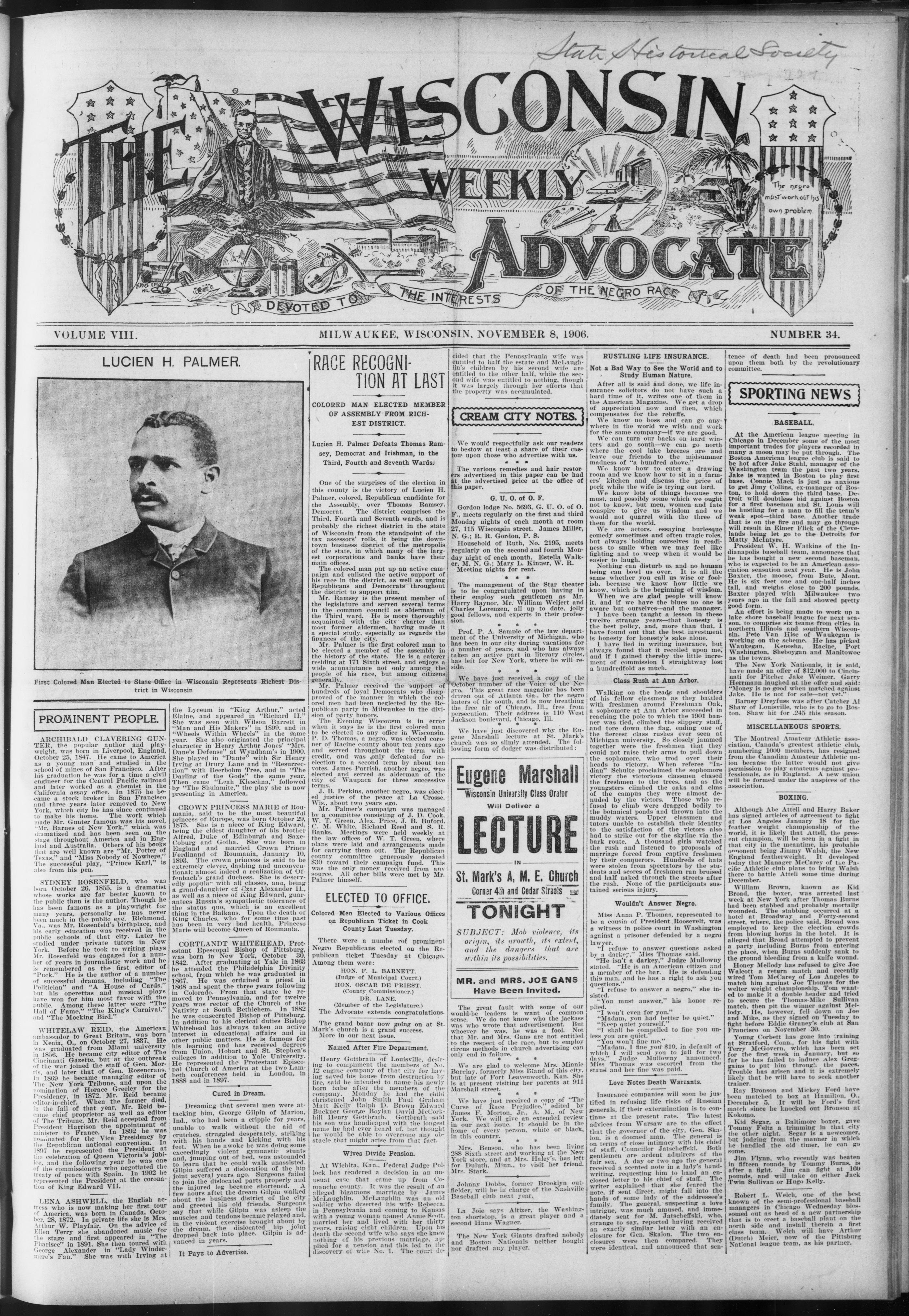
[Portrait of a man in formal attire, facing slightly to the right].
First Colored Man Elected to State Office in Wisconsin Represents Richest District in Wisconsin
VOLUME VIII.
First Colored Man Elected to State Office
trict in W
PROMINENT PEOPLE.
ARCHIBALD CLAVERING GUN- TER, the popular author and play- wright, was born in Liverpool, England, October 25, 1847. He came to America as a young man and studied in the school of mines of San Francisco. After his graduation he was for a time a civil engineer for the Central Pacific railroad and later worked as a chemist in the California assay office. In 1875 he became a stock broker in San Francisco and three years later removed to New York, which city he has since continued to make his home. The work which made Mr. Gunter famous was his novel, "Mr. Barnes of New York," which was dramatized and has been seen on the stage throughout America and in England and Australia. Others of his books that are well known are "Mr. Potter of Texas," and "Miss Nobody of Nowhere." The successful play, "Prince Karl," is also from his pen.
SYDNEY ROSENFELD, who was born October 26, 1855, is a dramatist whose works are far better known to the public than is the author. Though he has been famous as a playwright for many years, personally he has never been much in the public eye. Richmond, Va., was Mr. Rosenfeld's birthplace, and his early education was received in the public schools of that city. Later he studied under private tutors in New York. Before he took to writing plays Mr. Rosenfeld was engaged for a number of years in journalistic work and he is remembered as the first editor of "Puck." He is the author of a number of successful dramas, including "The Politician" and "A House of Cards," but his operettas and musical plays have won for him most favor with the public. Among these latter were "The Hall of Fame." "The King's Carnival," and "The Mocking Bird."
WHITELAW REID, the American ambassador to Great Britain, was born in Xenia, O., on October 27, 1837. He was graduated from Miami university in 1856. He became city editor of The Cincinnati Gazette, but at the outbreak of the war joined the staff of Gen. Morris, and later that of Gen. Rosencrans. In 1869 he became managing editor of The New York Tribune, and upon the nomination of Horace Greeley for the Presidency, in 1872, Mr. Reid became editor-in-chief. When the former died, in the fall of that year, Mr. Reid became chief proprietor as well as editor of The Tribune. Mr. Reid accepted from President Harrison the appointment of minister to France. In 1892 he was nominated for the Vice Presidency by the Republican national convention. In 1897 he represented the President at the celebration of Queen Victoria's jubilee, and the following year he was one of the commissioners who negotiated the treaty of peace with Spain. In 1902 he represented the President at the coronation of King Edward VII.
LENA ASHWELL, the English actress who is now making her first tour of America, was born in Canada, October, 28, 1872. In private life she is Mrs. Arthur W. Playfair. On the advice of Ellen Terry she abandoned music for the stage and first appeared in "The Pharisee" in 1891. She then toured with George Alexander in "Lady Windermere's Fan." She was with Irving at
the Lyceum in "King Arthur," acted Elaine, and appeared in "Richard II." She was seen with Wilson Barrett in "Man and His Makers" in 1899, and in "Wheels Within Wheels" in the same year. She also originated the principal character in Henry Arthur Jones' "Mrs. Dane's Defense" at Wyndham's in 1900. She played in "Dante" with Sir Henry Irving at Drury Lane and in "Resurrection" with Beerbohm Tree, and in "The Darling of the Gods" the same year. Then came "Leah Kleschna," followed by "The Shulamite," the play she is now presenting in America.
CROWN PRINCESS MARIE of Roumania, said to be the most beautiful princess of Europe, was born October 29, 1875. She is a niece of King Edward, being the eldest daughter of his brother Alfred, Duke of Edinburgh and Saxe-Coburg and Gotha. She was born in England and married Crown Prince Ferdinand of Roumania, January 10, 1893. The crown princess is said to be extremely clever, dashing and unconventional; almost indeed a realization of Offenbach's grand duchess. She is deservedly popular with all classes, and, being a grand-daughter of Czar Alexander 11., as well as a niece of King Edward, guarantees Russia's sympathetic tolerance of the status quo, which is an excellent thing in the Balkans. Upon the death of King Charles, who for some time past has been in very bad health, Princess Marie will become Queen of Roumania.
CORTLANDT WHITEHEAD, Protestant Episcopal Bishop of Pittsburg, was born in New York, October 30, 1842. After graduating at Yale in 1863 he attended the Philadelphia Divinity school, from which he was graduated in 1867. He was ordained a priest in 1868 and spent the three years following in Colorado. From that state he removed to Pennsylvania, and for twelve years was rector of the Church of the Nativity at South Bethlehem. In 1882 he was consecrated Bishop of Pittsburg. In addition to his clerical duties Bishop Whitehead has always taken an active interest in educational affairs and in other public matters. He is famous for his learning and has received degrees from Union, Hobart and St. Stephen's colleges in addition to Yale University. He represented the Protestant Episcopal Church of America at the two Lambeth conferences held in London, in 1888 and in 1897.
Cured in Dream.
Dreaming that several men were attacking him, George Gilpin of Marion, Ind., who had been a cripple for years, unable to walk without the aid of crutches, struggled desperately, striking with his hands and kicking with his feet. When he awoke he was doing some exceedingly violent gymnastic stunts and, jumping out of bed, was astounded to learn that he could walk unassisted. Gilpin suffered a dislocation of the hip joint several years ago. Surgeons failed to join the dislocated parts properly and the injured leg became shortened. A few hours aftert the dream Gilpin walked about the business district of the city and greeted his old friends. Surgeons say that while Gilpin was asleep the muscles and tendons became relaxed and, in the violent exercise brought about by the dream, the dislocated hip joint dropped back into place. Gilpin is advanced in years.
It Pays to Advertise.
RACE RECOGNITION AT LAST
COLORED MAN ELECTED MEMBER OF ASSEMBLY FROM RICH- EST DISTRICT.
Lucien H. Palmer Defeats Thomas Ramsey, Democrat and Irishman, in the Third, Fourth and Seventh Wards.
One of the surprises of the election in this county is the victory of Lucien H. Palmer, colored, Republican candidate for the Assembly, over Thomas Ramsey, Democrat. The district comprises the Third, Fourth and Seventh wards, and is probably the richest district in the state of Wisconsin from the standpoint of the tax assessors' rolls, it being the downtown business district of the metropolis of the state, in which many of the largest corporations and banks have their main offices. The colored man put up an active campaign and enlisted the active support of his race in the district, as well as urging Republicans and Democrats throughout the district to support him.
Mr. Ramsey is the present member of the legislature and served several terms in the common council as alderman of the Third ward. He is more thoroughly acquainted with the city charter than most former aldermen, having made it a special study, especially as regards the finances of the city.
Mr. Palmer is the first colored man to be elected a member of the assembly in the history of the state. He is a caterer residing at 171 Sixth street, and enjoys a wide acquaintance not only among the people of his race, but among citizens generally.
Mr. Palmer received the support of hundreds of loyal Democrats who disapproved of the manner in which the colored men had been neglected by the Republican party in Milwaukee in the division of party honors.
The Evening Wisconsin is in error when it says he is the first colored man to be elected to any office in Wisconsin. P. D. Thomas, a negro, was elected coroner of Racine county about ten years ago and served throughout the term with credit, and was only defeated for reelection to a second term by about ten votes. James Parrish, another negro, was elected and served as alderman of the city of Waupaca for three successive terms. J. B. Perkins, another negro, was elected justice of the peace at La Crosse, Wis., about two years ago.
Mr. Palmer's campaign was managed by a committee consisting of J. D. Cook, W. T. Green, Alex. Price, J. B. Buford, C. M. White, Richard Reed and S. R. Banks. Meetings were held weekly at the law offices of W. T. Green, where plans were laid and arrangements made for carrying them out. The Republican county committee generously donated $30 toward their campaign fund. This was the only money received from any source. All other bills were met by Mr. Palmer himself.
ELECTED TO OFFICE.
Colored Men Elected to Various Offices on Republican Ticket in Cook County Last Tuesday.
There were a numbe rof prominent Negro Republicans elected on the Republican ticket Tuesday at Chicago. Among them were:
HON. F. L. BARNETT.
(Judge of Municipal Court.)
HON. OSCAR DE PRIEST.
(County Commissioner.)
DR. LANE.
(Member of the Legislature.)
The Advocate extends congratulations.
The grand bazar now going on at St. Mark's church is a grand success. More in our next issue.
Named After Fire Department
Henry Gottbrath of Louisville, desiring to compiment the members of No.12 engine company of that city for having saved his house from destruction by fire, said he intended to name his newly born babe after the members of the company. Monday he had the child christened John Smith Paul Graham Matt Kelly Ralph D. Brown Edward Buckner George Boylan David McCorkhill Henry Gottbrath. Gottbrath said his son was handicapped with the longest name he had ever heard of, but thought he would be able to overcome any obstacle that might arise from that fact.
Wives Divide Pension.
At Wichita, Kan., Federal Judge Pollock has rendered a decision in an unusual case that came up from Comanche county. It was the result of an alleged bigamous marriage by James McLaughlin. McLaughlin was an old soldier who deserted his wife Rebecca, in Pennsylvania and coming to Kansas with a young woman named Annie Scott, married her and lived with her thirty years, raising eight children. Upon his death the second wife who says she knew nothing of his previous marriage, applied for a pension and this led to the discovery of wife No. 1. The court de-
cided that the Pennsylvania wife was entitled to half the estate and McLaughlin's children by his second wife are entitled to the other half, while the second wife was entitled to nothing, though it was largely through her efforts that the property was accumulated.
CREAM CITY NOTES.
We would respectfully ask our readers to bestow at least a share of their custom upon those who advertise with us.
The various remedies and hair restorers advertised in this paper can be had at the advertised price at the office of this paper.
G. H. Q. of Q. F.
Gordon lodge No. 5693, G. U. O. of O. F., meets regularly on the first and third Monday nights of each month at room 27, 115 Wisconsin street. James Miller, N. G.; R. R. Gordon, P. S. Household of Ruth, No. 2195, meets regularly on the second and fourth Monday night of each month. Estella Walker, M. N. G.; Mary L. Kinner, W. R. Meeting nights for rent
***
The management of the Star theater is to be congratulated upon having in their employ such gentlemen as Mr. Harry Raynor, Mr. William Weijert and Charles Lorenzen, all up to date, jolly good fellows, and experts in their profession.
Prof. P. A. Sample of the law department of the University of Michigan, who has been in our city during vacations for a number of pears, and who has always taken an active part in literary circles, has left for New York, where he will reside.
We have just received a copy of the October number of the Voice of the Negro. This great race magazine has been driven out of Atlanta Ga., by the negro haters of the south, and is now breathing the free air of Chicago, Ill., free from persecution. Their address is 110 West Jackson boulevard, Chicago, Ill.
We have just discovered why the Eugene Marshall lecture at St. Mark's church was so slimly attended. The following form of dodger was distributed:
Eugene Marshall
Wisconsin University Class Orator
Will Deliver a
LECTURE
IN
St. Mark's A, M. E. Church
Corner 4th and Cedar Siraels
TONIGHT
SUBJECT: Mob violence, its origin, its growth, its extent, and the dangers that are within its possibilities.
MR. and MRS. JOE GANS Have Been Invited.
The great fault with some of our would-be leaders is want of common sense. We do not know who the jackass was who wrote that advertisement. But whoever he was, he was a fool. Not that Mr. and Mrs. Gans are not entitled to the respect of the race, but to employ circus methods in church advertising can only end in failure.
We are glad to welcome Mrs. Minnie Barclay, formerly Miss Biand of this city, but late of Fort Leavenworth, Kan. She is at present visiting her parents at 911 Marshall street.
We have just received a copy of "The Curse of Race Prejudice," edited by James F. Morton, Jr., A. M., of New York. We will give an extended review in our next issue. It should be in the home of every person, white or black, in this country.
Mrs. Benson, who has been living 288 Sixth street and working at the New York store, and at Mrs. Haley's, has left for Duluth, Minn., to visit her friend. Mrs. Stark.
Johnny Dobbs, former Brooklyn outfielder, will be in charge of the Nashville Baseball club next year.
La Joie says Altizer, the Washington shortstop, is a great player and a second Hans Wagner.
The New York Giants drafted nobody and Boston Nationals neither bought nor drafted any player.
RUSTLING LIFE INSURANCE.
Not a Bad Way to See the World and to Study Human Nature.
After all is said and done, we life insurance solicitors do not have such a hard time of it, writes one of them in the American Magazine. We get a drop of appreciation now and then, which compensates for the rebuffs.
We know no boss and can go anywhere in the world we wish and work for the same company—if we are good.
We can turn our backs on hard winters and go south—we can go north where the cool lake breezes are and leave our friends to the midsummer madness of "a hundred above."
We know how to enter a drawing room and we know how to sit in a farmers' kitchen and discuss the price of pork while the wife is trying out lard.
We know lots of things because we must, and possibly some which we ought not to know, but men, women and fate conspire to give us wisdom and we would not quarrel with the three of them for the world.
We are actors. essaying burlesque comedy sometimes and often tragic roles, but always holding ourselves in readiness to smile when we may feel like fighting and to weep when it would be easier to laugh.
Nothing can disturb us and no human being can bowl us over. It is all the same whether you call us wise or foolish, because we know how little we know, which is the beginning of wisdom.
When we are glad people will know it, and if we have the blues no one is aware but ourselves—and the manager. I have been taught a lesson in these twelve strange years—that honesty is the best policy, and, more than that, I have found out that the best investment is honesty for honesty's sake alone. I have lied in writing insurance, but always found that it recoiled upon me, and if I gained thereby the little increment of commission I straightway lost a hundredfold as much.
Class Rush at Ann Arbor.
Walking on the heads and shoulders of his fellow classmen as they battled with freshmen around Freshman Oak, a sophomore at Ann Arbor succeeded in reaching the pole to which the 1901 banner was tied, climbed the slippery staff, and tore down the flag, ending one of the fiercest class rushes ever seen at Michigan university. So closely jammed together were the freshmen that they could not raise their arms to pull down the sophomore, who trod over their heads to victory. When referee "Indian" Schulte proclaimed the sophomore victory the victorious classmen chased the freshmen to the trees, and as the youngsters climbed the oaks and elms of the campus they were almost denuded by the victors. Those who refused to climb were dragged bodily to the botanical ponds and thrown into the muddy waters. Upper classmen and tutors unable to establish their identity to the satisfaction of the victors also had to strike out for the skyline via the bark route. A thousand girls watched the rush and listened to proposals of marriage forced from captive freshmen by their conquerors. Hundreds of hats were stolen from spectators by the students and scores of freshmen ran bruised and half naked through the streets after the rush. None of the participants sustained serious injury.
Wouldn't Answer Negro.
Miss Anna P. Thomas, represented to be a cousin of President Roosevelt, was a witness in police court in Washington against a prisoner defended by a negro lawyer. "I refuse to answer questions asked by a darker," Miss Thomas said.
"He isn't a darkey," Judge Mullowny stated. "He is an American citizen and a member of the bar. He is defending this man, and he has a right to ask you questions." "I refuse to answer a negro," she insisted.
"You must answer," his honor replied.
"I won't even for you."
"Madam, you had better be quiet."
"Keep quiet yourself."
"Let's not be rude to fine you."
"I shall be compelled to fine you unless you are quiet."
"You won't fine me."
"Madam, I fine you $10, in default of which I will send you to jail for two days," Judge Mullowny announced. Miss Thomas was escorted from the stand and her fine was paid.
Love Notes Death Warrants.
Insurance companies will soon be justified in refusing life risks of Russian generals, if their extermination is to continue at the present rate. The latest advices from Warsaw are to the effect that the governor of the city, Gen. Skalon, is a doomed man. The general is on terms of close intimacy with his chief of staff, Councillor Jatscheffski. Both gentlemen are ardent admirers of the fair sex. A day or two ago the general received a scented note in a lady's handwriting, requesting him to hand an enclosed letter to his chief of staff. The writer explained that she feared the note, if sent direct, might fall into the hands of some lady of the addressee's family. The general, suspecting a love intrigue, was much amused, and immediately sent for M. Jatscheffski, who, strange to say, reported having received an exactly similar letter with an enclosure for Gen. Skalon. The two enclosures were then compared. They were identical, and announced that sen-
ence of death had been pronounced upon them both by the revolutionary committee.
BASEBALL
At the American league meeting in Chicago in December some of the most important trades for players recorded in many a moon may be put through. The Boston American league club is said to be hot after Jake Stahl, manager of the Washington team the past two years, Jake is wanted in Boston to play first base. Connie Mack is just as anxious to get Jimy Collins, ex-manager of Boston, to hold down the third base. Detroit will doubtless bid against Boston for a first baseman and St. Louis will be hustling for a man to fill the team's weak spot—third base. Another trade that is on the fire and may go through will result in Elmer Flick of the Cleveland being let go to the Detroit's for Matty McIntyre
President W. H. Watkins of the Indianapolis baseball team, announces that he has bought a new second baseman, who is expected to be an American association sensation next year. He is John Baxter, the moose, from Bute, Mont. He is six feet one and one-half inches tall, and weighs close to 200 pounds. Baxter played with Milwaukee two years ago in the fall and showed pretty good form. An effort is being made to work up a lake shore baseball league for next season, to comprise six teams from cities in northern Illinois and southern Wisconsin. Pete Van Hise of Waukegan is working on the scheme. He has picked Waukegan, Kenosha, Racine, Port Washington, Sheboygan and Manitowoc as the towns.
The New York Nationals, it is said, have made an offer of $12,000 to Cincinnati for Pitcher Jake Weimer. Garry Herrmann laughed at the offer and said: "Money is no good when matched against Jake. He is not for sale—not yet." Barney Dreyfuss was after Catcher Al Shaw of Louisville, who is to go to Boston. Shaw hit for .245 this season.
MISCELLANEOUS SPORTS
The Montreal Amateur Athletic association, Canada's greatest athletic club, numbering 1000 members, has resigned from the Canadian Amateur Athletic union because the latter would not give permission to play amateurs against professionals, as in England. A new union will be formed under the auspices of the association.
BOXING
Although Abe Attell and Harry Baker has signed articles of agreement to fight at Los Angeles January 18 for the feather weight championship of the world, it is likely that Attell, the present champion, will be seen in a fight in that city in the meantime, his probable opponent being Jimmy Walsh, the New England featherweight. It developed today that Manager McCarey of the Pacific Athletic club plans to bring Walsh there to battle Attell some time during December.
William Brown, known as Kid Broad, the boxer, was arrested last week at New York after Thomas Burns had been stabbed and probably mortally wounded. The stabbing occurred at a hotel at Broadway and Forty-second street, where, the police said, Broad was employed to keep the election crowds from blowing horns in the hotel. It is alleged that Broad attempted to prevent a party including Burns from entering the place, when Burns suddenly sank to the ground bleeding from a knife wound.
Honey Mellody has refused to give Joe Walcott a return match and recently wired Tom McCarey of Los Angeles to match him against Joe Thomas for the welter weight championship. Tom wanted to make it a double header and tried to secure the Thomas-Mike Sullivan match, then pit the winner against Mellody. He, however, fell down on Joe and Mike, as they signed on Tuesday to fight before Eddie Graney's club at San Francisco on Noyember 30.
Young Corbett has gone into training at Stratford, Conn., for his fight with Terry McGovern, which has been set for the first week in January, but so far he has failed to induce Alex Greggains to put him through the paces. Trouble has arisen and it is extremely likely that he will have to seek another trainer.
Ray Bronson and Mickey Ford have been matched to box at Hamilton, O., December 5. It will be Ford's first match since he knocked out Bronson at Kokomo.
Kid Segar, a Baltimore boxer, gave Tommy Feltz a trimming in that city the other night. Segar is a newcomer, but judging from the manner in which he handled the old timer, he can go some.
Jim Flynn, who recently was beaten in fifteen rounds by Tommy Burns, is after a fight. Jim can fight at 160 pounds, and will take on either Jack Twin Sullivan or Hugo Kelly.
Robert L. Welch, one of the best known of the semi-professional baseball managers in Chicago Wednesday blossomed out as head of a new partnership that is to erect a baseball plant on the north side and install therein a first class team. Welch will have Arthur (Dutch) Meier, now of the Pittsburg National league team, as his partner.
THE WISGONSIN WEEKLY ADVOCATE
MILWAUKEE, WIS.
R. B. MONTGOMERY, Editor and Proprietor.
Tom is dark of fine physique,
His dark expressive eyes unto me speak,
Of the love I know he feels,
And that love to me appeals
Stronger than mere words when spoken,
And which many times are broken.
When Tom accompany's me to call,
On the ladies large and small.
He stands outside and waits for me,
If I stay long; is restless as can be.
I "draw the line" on Tom when he gets
"gay,"
And in the end most always have my way.
Tom looks just nine upon the streets,
His only weakness is for sweets,
He never buys his own, and so
I buy the kind he likes, you know.
We'll pull together up Life's hill,
And duties to each other fill.
Some look at Tom with envious eyes,
And some their envy well disguise,
Some like to ride with Tom and I,
And land his praises to the sky.
But my dear Tom I sometimes boss
The Tom I speak of is my boss.
Notes of Interest.
—Many of the younger children in Jerusalem saw snow and ice for the first time in their lives last February. One child came in with a piece of ice and said: "I have found a piece of glass, but it is very cold."
—It was stated at a spiritual seance at Zurich that £4000 recently stolen from the station lay in a guard's house, but when the money was not found the guard brought action against the Spiritualist, who was ordered to make a public apology and to pay £12 damages.
—In Italy there are cultivated every years 1,250,000 ounces of silkworm eggs, and there are produced 110,000,000 pounds of cocoons, having a total value, at today's prices, of $30,000,000. Lombardy produces a full half of this total. The Venetian provinces produce about on-fifth, and Piedmont about one-seventh.
A California ostrich farmer is about to open a branch office in London, where he will have a collection of ostrichs, and incredulous customers will be treated to feathers cut direct from the backs of the ostriches, manufactured under the customers' eyes, and sold to them across the counter "at a price they never heard of."
In Italy each regiment has its own pictorial postcards, on which are the devices of the regiment, the list of battles in which it has taken part or one of the heroic episodes in which it has figured. These are sold at moderate prices to officers and soldiers, and their use in correspondence serves to spread the prestige of the regiment.
Despite the fact that the Dominican customs produced greater revenues in 1905 than ever before, averaging more than $200,000 a month, the collections this year average one-third more than for the preceding year. It is also said that quite a number of persons have gone to the island recently and taken land for the cultivation of cocoa.
Conway England is sorely troubled over the fact that the gravestone in the churchyard which is associated with Wordsworth's poem, "We Are Seven," has been seriously damaged by the enthusiastic tripper. One bit after another has been chipped off, and if the destruction is allowed to continue nothing of the stone will soon be left.
The changing rose is a plant to the cultivation of which the Japanese devote much attention. It produces a tiny but beautifully formed flower. On being taken suddenly out a dark place into a sunny room it slowly assumes a pale pink hue, which gradually grows in intensity until it becomes of the deepest red shade. The color vanishes again at night or when the rose is replaced in a dark room.
A Dane named Knudson is credited with discovering means of producing liquid air at the cost of no more than one-sixth the usual price, and it is said that his process, which is mechanical rather than chemical, will ultimately put liquid air on the market at not more than about 2 cents a gallon. The same invention makes it possible to sell oxygen at a cent a cubic foot, which promises to bring it into rather wide industrial use.
An interesting investigation in three typical schools (says the chief inspector of schools in his report on the western division of Scotland) brought out the fact that the English vocabulary of a slum child of 5 did not extend beyond some two or three dozen words. An average child of 5 from a good middle-class home had command of or understood no fewer than 1000 English words, while bright children carried the number up to 1500 or even 2000.
—Evensong was held the other day on the site of the ancient oratory of St. Swithian, one of the many Irish saints who descended upon Cornwall in the Fifth and Sixth centuries. In a waste of sand near the Godrevy lighthouse, which marks the eastern horn of St. Ives bay, lie what are regarded as the remains of the oldest Christian building in England. The nave bulges with sand to the level of the plain and through a grass covered hillock over the demolished altar protrude a few rough stones. During a stormy night of 1828 the sand shifted and revealed the lines of a structure about 48 feet long by 12 feet wide, with a priest's doorway, a small window, traces of stone benches and an altar of masonry, now gone as the result of the building being forthwith used as a cowshed.
Has Bodyguard of Women
The King of Siam has a bodyguard of 400 female warriors. At the age of 13 they enter the royal service and remain in it until they are 25, when they pass into the reserves. Their weapon is the lance and they are splendidly trained in the use of it.
Elephant's Hide Tough
It takes six months to tan an elephant's skin.
DODD'S
KIDNEY
PILLS
FOR ALL KIDNEY DISEASES
CURES RHEUMATISM
BRIGHT'S DISEASE
DIABETES BACKACHE
discontinued the use of our pur-
pose package. The public may rely on one
of imitations. Sold only in boxsss
IN CAPTIVE CHAINS.
Like Patrick Henry, I've always said
I'd never be a slave;
I'd sooner die for Liberty
And fill a patriot's grave.
My wife, she, too, has always been
For Liberty a stickler;
The very latest brand at that,
On this point she's particlar.
I well recall when we were wed:
Would she obey? Not she!
Ne such vows she would ever make
In this age of Liberty.
Times change! For now, alas, I find,
No longer are we free;
We're both ruled by a tyrant bold—
His age is "coming three!"
- Will S. Gidley in The Bohemian.
THE MOONSHINER.
The general opinion prevailing in the village and mountains that Dan Kirkwood was a notorious moonshiner, and got his money from the proceeds of some carefully hidden distillery, where his abundant crops of corn were converted into illicit whisky, while universal, had no positive ground to go on, except that Dan was undoubtedly a rich man, and no one knew how he got his money
So rumor had it that not only was Dan captain and ringleader of a band of moonshiners, but that in his early days before he came to the mountains swinging along the high road one day, whistling a marching tune, that he had served his term in the penitentiary as well as the army, for breaking into a bank or burglarizing some rich man's residence. The latter tale was started by Bill Jones, a shifty eyed, lanky fellow, owner of a prosperous country store in the village, whose rancor against Dan was due to a summary dismissal from Dan's farmhouse, when his visits to see Miriam, Dan's handsome young daughter, a slip of a girl of 15. were resented by her father with fiery indignation.
Dalton Fenwick fell into the pleasing habit of loitering away the morning hours with Miriam on the well shaded porch, while her elderly companion, Mrs. Carter, looked after culinary matters, ever dear to her heart; or in the afternoons of those bright summer days they would stroll through the forest, sit on a rock at the foot of Glen Birnie's falls and discuss matters, ethical, social and others, to the sound of the rush of the waters; or they would drive to some distant hamlet lying in the heart of a lonely valley, coming back at nightfall when the last glory of day had fallen behind the undulating ranges and faint mists veiled the peaks.
There must have been some very special cause which absorbed and occupied Dan Kirkwood those days. His horse would be saddled and brought to the door, and after a hasty breakfast he would ride off, over the same trail through the woods, coming back late in the afternoon, jaded, but with a strange jubilation in his stern face, although he said nothing as to the cause of it, or the reason for his continued absences.
That he rode far was evident from the tired walk and drooping neck of his sorrel when he got back, nor did he visit his mill or farm, the young man in charge of both coming nightly to make his report.
Miriam was surprised, then vaguely uneasy, but was too proudly devoted to her father to have any doubts concerning him or his occupation, nor would she ask any questions, as he did not volunteer to explain.
"We are going on a grand expedition tomorrow, dad. I wish you were not so busy and could go with us," Miriam said, placing a loving hand on her father's shoulder.
"I wish I could, girlie. Where are you going? I suppose Dalton will be along?"
"Oh, yes. We intend to picnic in Black cave. Dear old Carter has gotten up a famous lunch basket. We will drive there in the four-seated trap, and Joe will come along to look after the horses."
Black cave, half way up Black mountain, is a singular and rather startling place to visit.
It runs back from the sharp declivity of a precipitous cliff, which is heavily timbered, and the entrance, small and narrow, is so hemmed in by shrubs and bushes it is only discernible to those who know it, while the towering granite boulder into which the cave runs is overgrown with a century-old forest growth of hemlock and pines.
The drive back would have been glorious only Miriam complained of a headache, and the horses being nettlesome and the road rough, Dalton's close attention was required to avoid any mishap.
It was growing toward dusk, but Dan Kirkwood had not returned.
Bill Jones slouched up the walk to the porch steps. "Not home yet? I thought not. Well, I'm sorry to bring you bad news, but you've got to hear it sooner or later and I may as well tell you," he said, sitting down on the top step with an affectation of ease badly assumed, while Miriam sprang up and looked down at him with blazing eyes.
"The revenue officers have been notified. They must have arrested Kirkwood by this time. He and his gang have a still in Black cave. They'll be caught red handed. I'm afraid Dan will have to go up. It's a penitentiary offense, you know. He has made piles of money out of it, but it's bad business to fool with the United States government. You'll be well off, even if he is in the pen."
With a hoarse cry Miriam caught up her riding whip from the hall table.
"Get out of here, you cur!" she said, pointing to the gate. "It's a lie and you know it. You are a spy and an informer. Dan will look after you when he gets back."
With a cackle intended to imply indifference, Bill retreated from the steps. "I thought you'd cut up rough. Don't like to know where Dad's money came from, do you? Guess they'll bring him home soon." He was right there, for a squad of revenue officers rode rapidly up to the house, Dan Kirkwood in their midst. With a low cry Miriam sprang toward him. "Dad! Dad! It's all a mistake. I know. Tell these men you have nothing to do with it. Send them off!" she cried, her arms around his neck. Dan's face lit up with a strange look of triumph.
"Come into the house," he said, turning to the men with an air of authority. "Officer, bring your men in, and that fellow, also," he added, pointing scornfully to Bill Jones, who had stopped when they rode up. While they were dismounting a road
cart, driven furiously, pulled up before the steps and Dalton sprang to the ground.
"I wish to speak to this gentleman on a private matter. It will take but a few moments," he said, turning to the officer in command.
"If it's got nothing to do with this business—"
"Nothing whatever"
Nothing whatever. Dalton drew Dan apart and spoke rapidly and earnestly. Dan's face, in spite of his stern self-control, showed great emotion as he wrung the young man's hand. They were grouped in a handsome room. Dan's library.
"Gentlemen," Dan said, passing his arm around Miriam, while Mrs. Carter sobbed on a sofa. "You were informed by that cur that I made illicit whisky in Black cave. That for years I have defrauded the government and grown rich on illicit whisky. You are mistaken. There is a gold mine of considerable extent running back in the mountains from Black cave. I discovered it, and I've been working it for years. I have legalized my claim. How much I have made out of it is my concern. I kept my secret, not wishing to bring into these mountains a horde of goldseekers. You may do as you please about it now. Here are my titles. I will sell out and go back to my old home with my daughter as soon as she is married.
"Have a glass of wine with me, officer"
Sorry I have no whisky in the house."
"I'm so proud of you," Miriam whispered, as they passed out on the terrace. S. Rhett Roman in the New Orleans Times-Democrat.
WORK AND EFFICIENCY.
A Simple Remedy for Every Man—How Life May Be Made Healthy.
It is the kind of work in which a man is engaged which determines for him the special meaning of the term "efficiency." The success of his efforts may depend upon the quantity of his output or it may depend upon its quality. Quality! Quantity! Upon these two hang all the laws of efficiency.
For each of us it is possible to increase the duration of his best moments and to render them more frequent. It is also possible for us to reduce the number and the length of those periods of depression and low vitality when our work miscarries and our lives lack snap and enthusiasm. If we succeed in bringabout such a change we shall have raised the whole plane of our living to something higher and more admirable. Our work will be productive of results that would otherwise have been quite beyond our reach. There are conditions for each individual under which he can do the most and the best work. It is his business to ascertain those conditions and to comply with them.
It is useless for the nervous high-strung, quickly fatigued man to try to live by the same program as his phlegmatic, even-tempered neighbor. The conditions under which the two men produce the best results are not identical. The man who can't work at his best until after a long period of warming up ought to stick to his job, when once he has got it, as long as he can keep up to the high grade level. That is the only real economy for him. On the other hand, the man who accomplishes most when he works by spurts and takes intervals of play between times ought not to feel that he is doing wrong when he gives up imitating the steady workman. System and continuous driving decrease, not increase, his efficiency. Both men can do high-grade work, but not under the same conditions.
Every man ought to discover the special conditions of his own best work, and to try to make such conditions for himself—in so far as he can. Otherwise there is a waste somewhere. Nothing is gained and much is lost through trying to run everybody through the same mold.—World's Work.
A HILLTOP BABTISM
Strange Religious Ceremony in an Old Druid Haunt.
A remarkable christening has recently taken place in a remote part of Derbyshire, Harborough Hill, in the western portion of the country, said to have been a haunt of the Druids, and apparently used both for worship and as a place of burial. Some years ago a number of human skulls, which had been compactly buried there in some distant century, were unearthed at the summit of this lofty ridge, which commands a view over six counties, terminating in the peak of Snowdon, the latter being easily visible on a clear day. The hill bristles with fantastic dolomite crags, some of which were, it is supposed, shaped by the Druids for ceremonial purposes.
A big block of limestone has been carved into a capacious chair; another rock, with a flat top, appears to have been used as an altar, and an adjacent monolith, in which a semi-circular bowl has been scooped out, looks like a rude font. It was with water from this ancient rock bowl that the child—the daughter of a farmer in the district—was lately christened. The little girl, 3 months old, was carried up to this wild, bleak spot, accompanied by numerous relatives, including, of course, the necessary godfather and godmother, and there, with the wind howling among the crags, baptism was administered by a lay reader.
There is no record of any similar rite having been celebrated on Harborough Hill, and the conditions of this picturesque baptism appear to be quite unique. —Sheffield Telegraph.
Copper as a Germ Killer.
"Copper is a marvelous preventive of disease. If we returned to the old copper drinking vessels of our forefathers typhoid epidemics would disappear."
The speaker, a filtration expert, took a copper cent from his pocket.
"Examine this cent under the microscope," he said, "and you will find it altogether free from disease germs. Examine gold and silver coins and you will find them one wriggling and contorting germ mass. Yet copper coins pass through dirtier hands than gold and silver ones—you'd think they'd be alive with micro-organisms. But no. Copper kills germs. Diphtheria and cholera cultures smeared on a copper cent die in less than two hours.
"They have many cholera epidemics in China, but certain towns are always immune. These towns keep their drinking water in great copper vessels. Travelers have tried to buy these vessels, for they are beautiful, but the villagers will not sell them. They have a superstition that their health and welfare depend on their retention. I wish all superstitions were as true and salutary as that."—Philadelphia Bulletin.
Egyptian Cure for Sunstroke
Travelers in Egypt must often have noticed a curious scar upon the foreheads of the natives, though perhaps they have not discovered its significance. It is a
sign that the man who bears it has had or has fancied that he had, sunstroke. The formula for the malady is curious and typically eastern. The victim must be laid full length upon the ground and massaged from the feet upward. The sunstroke is some form of evil genius which must be squeezed and forced into one spot. This the massage accomplishes. When the masseur has done his best to this end, and assumes that the virus of the enemy is all concentrated in the forehead of the patient, then the teeth of the operator are applied to the infected area, and a piece of the flesh or the forehead bitten out. The strange thing is that the treatment is said to be invariably efficacious. It may be faith cure, or it may be that the sunstroke itself was imaginary—the cure is sure.—London Evening Standard.
THE SPELL OF THE NORTH.
How It Holds Its Power Over Natives of Norway.
In Norway, where King Haakon VII was crowned a few weeks ago, the spirit of the old Norse navigators still lingers. The water is the Norse road; children go to school by it, wedding parties go to church over it, and the farmer goes to market upon it. Mail steamers thread the watery mazes everywhere and where they cannot come up to a pier a small boat puts out in the morning, at noon or in the twilight to send to Bergen or some faraway port tubs of butter or boxes of fish.
"Old and young are accustomed to the water. The children might as well have been born upon it," says Albert Perry Brigham, in the "Bulletin of the American Geographical society," "so much at home are they with rowing craft, and I have seen young girls with unconcern gathering berries upon the brink of a precipice."
The Norseman has never failed in his mastery of the wild nature in which he lives, and the inheritance of a stern and stormy zone seems to appear even in the slow farmer boy, who, with his yellow horse and harness of rotten cord, runs one down at breakneck speed along the edge of the cliffs, scaring one to desperation, but bringing one safe to the foot of the mountain. No doubt a cautious New England driver would break the harness, overturn the vehicle and bring one to disaster.
Railroads, Mr. Brigham thinks, are the least important factor in transportation, and they seem, even prospectively, of less account than the government highways, which are built with infinite toil, under the direction of skilled engineers, inward from every fiord head toward the capital. There are harbors everywhere, and every fiord mouth has been for ten centuries a challenge to see the world. It was inevitable, therefore, that Norsemen should breathe the ocean air and not go forth. Their errands have accorded with the stage of civilization which, century by century, they have attained. Thus they have crossed the sea for discovery, for robbery and conquest, for commerce and for new homes. They are strangers to no land where ships may come.
Thousands have made their home over the sea, but they do not forget. The separation of Norway from Sweden was observed by almost the same interest among the Norwegians of this country as on the Scandinavian peninsula. "The spell of the land," to use the words of Mr. Brigham, "is upon them—the aurora, the long summer day, the calm winter night, the frugal ways, the mountains, the waterfalls and the sounding sea; these join to turn the Norseman in wild fancy, if not in bodily presence, to the land which bore him, reared him and made him her own."
COURT RULES WEARY QUEEN
Alfonso's Bride Finds Spanish Customs Very Trving.
Before the marriage in May of King Alphonso and Queen Victoria many people prophesied that she, with her fresh, simple unconventionality, would be too much for the stiff convention of the Spanish court. More, however, considered that the conventions would be too much for her.
According to a Madrid letter the latter case appears to be coming true. The young Queen is said to be particularly annoyed at the obstacles put in the way of inviting old friends to stay with her. Some of her closest girl friends who are without the strain of royal blood which the court convention of Spain deems requisite for them, were received there as the Queen's guests. King Alfonso was at her side, but the ladies of the court remained unmoved. So the young Queen wrote to King Edward for advice, which came in the form of a recommendation to be sensible and "respect the people's stupidity when necessary and in time, if you are wise, you will have everything your own way."
Another court custom which has tried the patience of the young Queen is that she must appear at dinner every evening in full state evening dress. If she appeared at a quiet dinner in the simple evening gown which is favored by all the royal ladies of England at such domestic gatherings, the Spanish court would be dumfounded.
Pears Are Cooked in Many Ways.
These delicious recipes for pear cookery are given in the current number of What to Eat:
Pears and Rice.—Boil rice in salted water until tender; then drain and mix in while hot one teaspoonful of butter; then pour over a syrup in which pears have been boiled, a little lemon juice and preserved ginger being added. Mound up on a dish and set away to become cold. Arrange the cooked fruit about the mound and in the center of each half place a little whipped cream.
A Pear Custard.—A pear custard is delicious. To make it core and pare six very ripe, large pears, cook them in a little rich sugar syrup until perfectly tender, then drain them from the syrup and chop very fine. Turn them into a deep glass dish and pour over them $ p $ boiled custard, made with the yolks of four eggs well beaten, three cupfuls of milk, three heaping teasponfuls of granulated sugar and a scant teaspoonful of vanilla. Whip the whites of the eggs to a firm snow with four teaspoonfuls of sugar, and drop it, in large spoonfuls, into a shallow pan of boiling water. Cook a minute on each side, lift out with a skimmer, and just before serving pile it over the custard. Dot with little mounds of red currant jelly and serve very cold.
Sultan Fears Pictures
Homer Davenport, the artist and cartoonist, has returned from Arabia and Turkey. While in Turkey he had an interview with the Sultan, and drew a picture of him after leaving the palace, which he hid in a bale of hay to keep it from falling into the hands of Turkish spies. The Sultan never had a picture taken and the one in popular use today is that of his brother, taken thirty years ago.
An Odd Fig Tree.
A ripe fig grown in the state of Maine is being exhibited by Mrs. L. A. Gould of Topsham, who has a fig tree ten years old. It takes two years for figs to ripen, the fig in question being grown last year. The tree this year will yield a crop of seventy full-grown figs.
The Consequence
"It is true that Waldorf died poor?" "Yes. You see, he lost his health chasing after fortune, and then lost his fortune chasing after health."—Lippincott's.
THE FALLS OF IGUAZU.
A South American Spectacle Rivaling the Grandeur of Niagara.
In the heart of South America, at the meeting place of three republics, Brazil, Argentina and Paraguay, Nature has chosen the site for a masterpiece of scienic grandeur to be compared only to the mighty Niagara in majesty, and pronounced by some of the few travelers who have seen it to be even greater than its North American counterpart. The Falls of Iguazu occur at the junction of Iguazu river with the Upper Parana, in a territory famous as the original locality of the Jesuit missions, established in the sixteenth century, the ruins of which may still be seen by those who visit the falls.
About twelve miles above the falls the River Iguaza makes a sharp bend, almost at right angles, giving them greater extent and more varied character than those of Niagara, which to some degree they resemble. As the river makes the sharp bend already mentioned the main volume of water rushes around the inner bank and is discharged into a long, narrow gorge, at one point making a clear plunge of 210 feet. Not all the volume of the river is received at this place, however, the rest of the water running out past it into the wide elbow formed by the bend, and circling along the further shore among many rocks and islands before reaching the edge of the cliff, over which the descent is made in two great leaps of a hundred feet each, in a vast semicircle of 3000 feet. The total length of Iguazu Falls, if measured at the upper edge of the cliff, through their broken contour, including intersecting islets, is twice as great as that of Niagara, including the intersection of Goat island.
The double fall of Iguazu is the most striking feature of the cataract, the rocky shelf or platform that divides the leap being in some places more than fifty yards wide and in others only a few feet.
The scenery surrounding Iguazu Falls is in peculiar harmony with the solemn grandeur of the cataract and its varied character. The roar of the waterfall is more impressive for the solitude of the spot and the eternal silence that reigns in the dense forests that mark its border, into which the white man has scarcely penetrated. For several miles before the falls are reached the river is a mass of huge frowning boulders and whirlpools, and the first view of the great cataract is often a disapointment, from the fact that it must be seen from many different points to be appreciated in all its beauty.—National Geographic Magazine.
TOY LOCOMOTIVE FOR PRINCE.
Runs with Real Steam on a Real Track and Is Complete in Every Detail.
The first toy ever manufactured in Connecticut for a crown prince has just been finished and will be shipped from Bridgeport to Bulgaria in a new days. It is an exact replica of the engine that draws the Twentieth Century limited on the New York Central road and it is going to Crown Prince Boris, the 12-year-old son of Prince Ferdinand of Saxe-Coburg, the ruling head of the Turkish principality.
C. R. Crane of Chicago has had the costly toy made as a present to the young prince in return for a delightful visit that he enjoyed at the Bulgarian capital through the courtesy of the youngster's family.
The little Crown Prince took quite an interest in the American visitor and was especially curious about steam engines and cars, which he had never seen. Finally, crawling up on his father's knee, he said plaintively: "I'd rather have a really locomotive that ran with really steam in it on a really track than all my norses, dogs and ponies and things."
As soon as Mr. Crane got home he decided to see if he couldn't surprise his little eastern friend by gratifying his childish whim. He visited a score of places in New York and elsewhere without success. At last Mr. Crane brought the plans to this city and made arrangements with expert mechanics of the Eaton. Cole & Burnham company, of which arm he was a member, to build the toy.
The engine with its track is now ready to send away. This week the final trial was made with real steam and the mechanism was found to be perfect. Not a word has been whispered that could reach the young Crown Prince concerning the surprise that his American friend has in store for him and the first he will know of it will be when he receives the big express box in which it will be packed—New York Sun.
An Expensive Epitaph
* Here lies the bones of Sancho *
: Pedro, the only damn decent *
: Greaser I ever knew. *
: Killed by Apache Indians, 1846. *
: Gen. S. W. K., U. S. A. *
*
The letters had been burned into the pine slab with the corner of a branding iron.
A few bullets, tributes of cowboys who doubted that a Greaser could be good even when dead, had splintered the sides of the slab.
It was an unusual epitaph. The pine slab stood in a sandhill far off from the Pecos river, up near the foothills in New Mexico. The epitaph was unusual because it spoke well of a Mexican half-breed.
An old Navajo Indian who had been with Gen. Stephen W. Kearney told of Sancho Pedro. He was a hostler for Gen. Kearney, the old man said. He served the general for years and was killed in a skirmish with Apache Indians down in the Pecos valley near the foothills in 1846. The general ordered him given decent burial and burned the epitaph with his own hands on a pine slab with an old Spanish branding-iron.—Kansas City Star.
Dolphins as Food.
A curious new fishery and a still more novel source of food supply has just been submitted to the Breton folk, sorely tried by the failure of the sardines. The Prince de la Tour d'Auvergne, after taking part in the St. Malo regatta, went to the St. Cast in an automobile boat to visit the Comte de Carne-Treccson. The motor boat set up a great commotion among the blowing dolphins with which the bay swarms, and a regular battle was organized, with the result that sixty-nine of the great creatures were captured—it is believed the entire shoal. Some of them were eight feet long and weighed 300 pounds. They were distributed among the people, who ate the flesh rapidly, pronouncing it like "wild boar." Dolphins have ruined the Breton coast fishery this year. The prince took a cast of the biggest as a model for submarine construction.—London Globe.
Future geographers of the frozen deep may wonder at some pretty names which designate the islands which are scattered along Walter Wellman's route to the north pole. Wellman has planted the flag on five tiny spots of land in the land of ice and called them after his five attractive daughters. All of these young women have names beginning with "R." and are respectively Ruth, Rose, Rachel, Rita and Rebecca. Wellman has promised them a trip in his brave ship to the islands which bear their names and which they may claim as their own by right of their father's discovery.
Idle curiosity is one of the busiest things in the world.
Cures Woman's Weaknesses
We refer to that boon to weak, nervous, suffering women known as Dr. Pierce's Favorite Prescription. Dr. John Fyfe one of the Editorial Staff of THE ECLECTIC MEDICAL REVIEW says of Unicorn root (Helonias Dioica) which is one of the chief ingredients of the "Favorite Prescription" :
"A remedy which invariably acts as a uterine invigorator * * * makes for normal activity of the entire reproductive system." He continues "in Helionias we have a medicament which more fully answers the above purposes than any other drug with which I am acquainted. In the treatment of diseases peculiar to women it is seldom that a case is seen which does not present some indication for this remedial agent." Dr. Fyfe further says: "The following are among the leading indications for Helionias (Unicorn root). Pain or aching in the back, with leucorrhoea; atonic (weak) conditions of the reproductive organs of women, mental depression and irritability, associated with chronic diseases of the reproductive organs of women; constant sensation of heat in the region of the kidneys; menorrhagia (flooding), due to a weakened condition of the reproductive system; amenorrhagia (suspressed or absent monthly periods), arising from or accompanying an abnormal condition of the digestive organs and anemic (thin blood) habit; dragging sensations in the extreme lower part of the abdomen."
If more or less of the above symptoms are present, no invalid woman can do better than take Dr. Pierce's Favorite Prescription, one of the leading ingredients of which is Unicorn root, or Helonias, and the medical properties of which it most faithfully represents.
Of Golden Seal root, another prominent ingredient of "Favorite Prescription," Prof. Finley Ellingwood, M. D., of Bennett Medical College, Chicago, says:
"It is an important remedy in disorders of
"It is an important remedy in disorders of the womb. In all catarrh conditions * * and general enfeeblement, it is useful."
Prof. John M. Scudder, M. D., late of Cincinnati, says of Golden Seal root: "In relation to its general effects on the system, there is no medicine in use about which there is such general unanimity of opinion. It is universally regarded as the tonic useful in all debilitated states." Prof. R. Bartholow, M. D., of Jefferson Medical College, says of Golden Seal: "Valuable in uterine hemorrhage, menorrhagia (flooding) and congestive dysmenorrhoea (painful menstruation)." Dr. Pierce's Favorite Prescription faithfully represents all the above named ingredients and cures the diseases for which they are recommended.
A well-known Rochester lady says: "I stayed in the Adirondacks, away from friends and home, two winters before I found that by taking
Kemp's Balsam
I could subdue the cough that drove me away from home and seemed likely to never allow me to live there in winter." Kemp's Balsam will cure any cough that can be cured by any medicine. Sold by all dealers at 25c. and 50c.
BEST IN THE WORLD
W.L.Douglas $4 Gilt Edge line
cannot be equalled at any price
To Shoe Dealers:
W. L. Douglas' Job-
bing House is the most
complete in this country
Send for Catalog
SHOES
ESTABLISHED
1876
CAPITAL
$2,500,000
SHOES FOR EVERYBODY AT ALL PRICES.
Men's Shoes, $5 to $1.50. Boys' Shoes, $3
to $1.25. Women's Shoes, $4.00 to $1.50.
Misses' & Children's Shoes, $2.25 to $1.00.
Try W. L. Douglas Women's, Misses and
Children's shoes; for style, fit and wear
they excel other makes.
If I could take you into my large
factories at Brockton, Mass., and show
you how carefully W. L. Douglas shoes
are made, you would then understand
why they hold their shape, fit better,
wear longer, and are of greater value
than any other make.
Wherever you live, you can obtain W. L.
Douglas shoes. His name and price is stamped
on the bottom, which protects you against high
prices and inferior shoes. Take no substi-
tute. Ask your dealer for W. L. Douglas shoes
and insist upon having them.
Fast Color Eyelens used; they will not wear brassy.
Write for Illustrated Catalog of Fall Styles.
W. L. DOUGLAS. Dept. 14. Brockton, Mass.
There is no satisfaction keener than being dry and comfortable when out in the hardest storm
YOU ARE SURE OF THIS IF YOU WEAR
TOWER'S
FISH BRAND
WATERPROOF
OILED
CLOTHING
BLACK OR YELLOW
On sale everywhere
A.M. TOWER CO. BOSTON U.S.A.
TOWER CANADIAN CO. TORONTO, CAN.
CURE all inflamed, ulcerated and catarrhal conditions of the mucous membrane such as nasal catarrh, uterine catarrh caused by feminine ills, sore throat, sore mouth or inflamed eyes by simply dosing the stomach.
But you surely can cure these stubborn affections by local treatment with
Paxtine Toilet Antiseptic
which destroys the disease germs, checks discharges, stops pain, and heals the inflammation and soreness.
Paxtine represents the most successful local treatment for feminine ills ever produced. Thousands of women testify to this fact. 50 cents at druggists.
Send for Free Trial Box
THE R. PAXTON CO., Boston, Mass.
GOSSIP FOR THE LADIES.
```markdown
```
Shines 'mid the trees through night and rain:
The weeds are dense
Through which a fence
Sprawls out, one sees not where nor whence;
And there the spring-house, indistinct of line.
Over-roofed and tangled with a trumpet-vine.
No thing is heard,
No beast or bird,
Only the rain by which are stirred
The draining leaves,
And trickling eaves
Of crib and barn one scarce perceives;
And gardens where old-fashioned flow's
hang wet,
The phlox, the candytuft, and mignonette.
Why should I wait?
The hour is late;
She has not heard me at the gate.
Upon the roof
The rain was proof
Against my horse's hurrying hoof.
And when the old gate with its weight and
chain
Creaks, she will think it but the wind and
rain.
Within the shadowy light that flits
On face and hair, so sweetly sad and gray,
Dreaming of him she thinks is far away.
Upon my cheeks
Is it the streaks
Of rain? as now the old porch creaks
Beneath my stride;
And open wide
The door flings and she's at my side—
Dear mother! and, back from the war, her
boy
Kissed her face all streaming wet with joy.
Kisses her face all streaming wet with joy
MADISON CAWEIN.
Boy and Girl Friendships.
A boy must necessarily have some acquaintances and friends outside of the home circle, but as the wise mother will often have him bring them there, they should be chosen discreetly. He cannot afford to tarnish the whiteness of his soul by an immoral associate, nor lower the standard of his purity by a friendship with one who is profane. These evils will at first shock him, but if brought in frequent contact with them, he will gradually lose his horror and disgust of them, and in time he will find himself quite complacent with such associates.
When he grows a little older, he will have girl friends, too, modest, sweet girls, whom his mother may invite into her home, and who will give him high ideals of womankind. If early in life a boy learns to respect womankind through his mother, it will be a great incentive to a purer life. If he has no sister, the friendship of a refined girl will prove of great benefit to him. A friendship may exist for years between two young people and never ripen into love. If he forms such a friendship it should be encouraged, and not made a subject of ridicule as is too often the case. Between boys and girls Platonic love is possible, and may be cultivated with equal benefit to both.—The Pilgrim, Buffalo News.
Can You Fit a Shirtwaist?
In fitting a shirt waist begin with the front sections. and allow an overlap of at least an inch on each side of the center front. Tear off a strip of material for the waistband; make this of a double thickness of the material and half an inch in width on the straight of the goods. Pin this strip snugly around the waist, for it forms the principal foundation upon which to fit the shirtwaist. Do not fit down toward the waistband, but up from it, and give plenty of length to the shirtwaist under the arm's eye. The neckband should be half an inch high and cut on the straight of the goods, and made of the doubled material—that is, if it is a thin material; a single thickness of heavy linen is sufficient.
The unlined skirt is one of the hardest garments for the home dressmaker to handle, for much handling in the making of garments is a failing of the inexperienced workman, and much handling spoils the unlined skirt, depriving it of that smart look so desirable when finished, says the Philadelphia Press. Do not make a skirt in your lap; make it on a table, and on a good-sized table, so that the skirt will not slide off at a critical point. If you live where you cannot have a sewing room, a cutting table may be made at home by joining three or four boards together.
Compromises in Married Life
"If marriage meant the wedding of a saint and an angel there would be no problems to solve, no perfection to attain, no progress to make. This may be why there are no marriages in Heaven. On earth it is different; husband and wife are strongly human. No matter how lovingly united or how sweet their accord, they never have the same temperaments, tendencies, or tastes. Their needs are different, their manner of looking at things is not identical, and in varying ways their individualities assert themselves. At any critical moment if both express at the same time a desire to defer to the other's taste, the result is foreordained for happiness. This makes matrimony not only union, but unison and unity. The spirit of compromise does not mean a continuous performance in the way of self-surrender and self-sacrifice; it does not mean ceasing to be a voice and becoming an echo; it does not imply or justify the loss of individuality; it means simply the instinctive recognition of the best way out of a difficulty, the quickest tacking to avoid a collision, the kindly view of tolerance in the presence of weakness and errors of another, the courage to meet an explanation half way, the generosity to be first to apologize for a discord, the largeness of mind that does not fear a sacrifice of dignity in surrendering in the interests of the highest harmony of the two rather than the personal vanity of one."—From The September Delineator.
To Cure a Headache.
From the strenuous west comes a cure for headache—an active remedy, not a cold cloth and dark room prescription. Mrs. Symes of Cleveland, an expert on health and physical culture, advises gymnastics for nervous migraine, as the Newport woman calls her racking head. It is said that in attacks brought on by nervousness or continued mental activity the new remedy cannot fail of soothing effect if rightly and thoroughly taken. The logic of the modern method of headache banishing is this: Such a condition is caused by overpressure of blood in the brain; then the cure lies in drawing the blood downward and restoring it to normal circulation throughout the body. This only a system of exercise can do.
So the up-to-date headache treatment starts out with leg movements, which stirs up the circulation in the extremities. Then it progresses to chest expanding and abdominal motions to stimulate the vital organs to healthy performance of their functions. A little nourishing food taken after the body movements is also advised, and this will demand the presence of blood in the digestive and assimilative machinery. Do not overdo the exercise. Stop at
the first feeling of exhaustion. Do not make the motions too hastily. Slow, regular work will produce the best results. 1. Rise to the tiptoes slowly six to twelve times. Swing each leg forward as far as possible six to twelve times. Bending leg at knee, reach heel back and up. Repeat six to twelve times with each leg. 2. Raise the arms slowly to the shoulder level at the side, and from there up over the head; bring them down to the front, shoulder high, then to the sides again, and finally down. Repeat four to six times, making the movement continuous.
3. Repeat leg work described in No. 1.
4. Stand erect, elbows bent, hands touching shoulders. Lift the arms straight above the head. Repeat six to twelve times.
5. Holding the arms straight out in front, slowly turn the shoulders right and left. Repeat six times. Lower the body by bending the knees. Repeat six times.
6. Hold the arms straight out in front, then swing them to the sides and back as far as possible. Repeat six times.
7. Bend the head slowly backward and forward four times.
8. Repeat arm exercise in No. 2.
Rest after these exercises by lying down, with the head elevated.
The Art of Being Neat
To the average girl tidiness seems a mere matter of keeping herself looking neat and her room picked up. Therefore, it doesn't seem such an awful thing if, dressing in a hurry, she fails to put away the things that she has taken off, and leaves the place looking as if a baby cyclone had been at work. Tidiness to a young business woman may convey only a sense of a desk where all the papers and pens are where they should be, or where the "stock" is neatly arranged. Being inexperienced in the influence of system, they do not know that tidiness of habit reaches still further, affecting the character and mind, making one worth more in every way.
This is only because all our habits, no matter what kind they may be, influence us positively for strength or weakness—in other words, for good or ill—and a girl who cultivates tidiness in her dressing and room, or desk, is at the same time developing herself mentally. Tidiness or manner seems to lead directly to exactness of mind, and that in every one is desirable, more especially in a woman or business.
A girl who is slovenly about her dress is apt to be slovenly about her work, whatever sort it may be, and it is equally true that if she is neat about her dress she will be the same in her business. Her desk or "stock" case will be well arranged and not an offense to the eye, and when given an order or a message she will be able to do or repeat it correctly.
Neatness does not lead to brilliancy, and no girl can hope to develop a clever mind simply by having her belt trigly fixed and her collar well fastened, but it will help greatly toward that desirable quality, reliability, because, "having the habit," it will appear in words as in deeds, says the New York Telegram.
Tidiness, be it understood, is by no means to be confounded with "fixing up." As a matter of fact, a business girl with an exaggerated pompadour, for instance, her head further embellished by a bow rampant, is far less apt to be neat than one who dresses simply, wearing it pompadour, certainly, if she wishes, but not so as to resemble a bolster piled aloft with loose ends hanging. This type of girl, who dresses for the office as she would to go out Sunday afternoon, has not natural neatness of mind, and if she has of body it is dominated by vanity. She may be decorative of a kind, and therefore desirable in some shops or offices, but they are not apt to be those wherein it is well that she should be, and her usefulness is likely to be short lived.
The Virtue of Adaptability.
This is more than a virtue, it is a potent charm and an insurance of success when you go visiting. If you have a worthy desire to excel, study how to adapt yourself to all the varied circumstances of hospitality, and accordingly your hostess will highly esteem you.
The highest compliment you can pay your entertainer is try and accept the conditions of her home just as you find them. In my youthful career as a housekeeper, when one cottage of limited proportions, a single maid of all work, and a small income were at my disposal, I asked a school friend to visit me. Frankly I told her how I lived, and when I proudly drove my pony and wee carriage to the station, she was there to meet me, and her luggage was one big satchel.
She was an heiress, accustomed to luxuries, but she bore herself in my little home as though a cottage and one servant had been her domestic environment all her life. She fell in at once with family habits. She was up with the lark, and, excepting the making of her bed, put her own room exquisitely to rights. She came in to breakfast when the hot coffee appeared; she sat on my veranda and sewed and talked; she played with the children, took long country walks, and ate a hot midday dinner with zest, though she was accustomed to an 8 o'clock dining and a butler to serve her.
She was the ideal guest because she knew to a necety how to adapt herself, and by way of contrast I don't mind telling of another fair and equally wealthy friend of mine who came to visit me later when my financial situation was but little improved.
She arrived three trains late and with two prodigious trunks. She swept down to my modest dinner table in frocks of such stately splendor and jewels of such glory that we were dazzled. She required so much ministration at the hands of my one housemaid that I was myself obliged to turn to and make beds and dust. She breakfasted in bed, openly objected because she was asked to share a bathroom with another woman guest, and found our simple country amusements an intolerable bore. In her high-heeled slippers and flowered foulard skirts and tulle hats she could not, and would not, join us in our walks; she feared the possibility of snakes and beetles in the grass; she dreaded the effect of the sun on her complexion, and she demanded the support of toast and bot bouillon before retiring at 11 o'clock, whereat my sleepy and overworked servants threatened mutiny in a body.
I fear that I nearly wept with delight at her departure. She was in other respects a kindly, well-bred, generous hearted and liberal minded woman, but as a guest she was an intolerable nuisance.
For the Housewife
Who Can Use a Hammer.
There are many things a clever woman can evolve from a few boards, a handful of nails and a pot of good stain, but even if she possess the ideas without the faculty for carrying them out herself she can get most excellent results by having a carpenter carry out her ideas.
The modern house seldom has many closets, roomy or otherwise, while in the average apartment they are, as a general thing, most decidedly conspicuous by their absence, and even if there should be place for one, the landlord is more than likely to register an objection to having one built in, as it might disfigure the walls. This, however, need not cause the woman of ideas to despair, for there are two ways at least, of getting around this obstacle and having a portable closet built from her own plans. For a few dollars a carpenter will make a large Loxlike affair having no door that is six feet in height, any desired number of inches wide and almost thirty deep. In this case, about one foot from the top he puts a shelf and then leaves the rest to be done by the owner.
A small can of stain the color of the wookwork in the room makes the closest similar to the background, so to speak, in most unobstrusive fashion; a small brass rod and curtain complete the front, while rods for coats and skirt hangers screwed to the under side of the shelf and rows of hooks around the sides give abundance of room for clothing of all sorts, leaving the shelf for hats, while the lower part of the closet may be boxed in for shoes and slippers.
Another idea for a portable closet is much simpler, for it is nothing more nor less than a hanging shelf; secure a strong plank of the required size, attach to it several strong hooks, and suspend it on the picture molding by means of slender but strong brass chains slipped over several picture hooks, screw clothes hooks in the shelf, put a curtain in front and you have a most convenient little wardrobe.
This shelf may be made to do duty in various ways and is a boon to the occupant of the average boarding house, room or to the college student, for it is easily hung in any part of the room, holds books, bric-a-brac or the paraphernalia needed in "light housekeeping," while it may be as decorative or as unostentatious as desired.
A convenient shoe box of home manufacture may be made of the leaves of an old-fashioned extension table and bears the stamp of an heirloom; an ordinary board forms the bottom of the box, the sides are made of a leaf, sawed in two lengthwise, pieces of another form the ends and an entire leaf is used for the top, simple brass hingles are attached and the nails used are quite hidden by little wooden pegs. This box costs practically nothing, for no polishing or staining is required, the nails and hinges are not to be in the box of odds and ends, and about two hours' work is all that is necessary.
The lover of books requires more and more space as the treasured volumes accumulate, and many charming book shelves may be made by any woman who can drive a nail straight (and it is an exploded idea that this feat is quite beyond one of the feminine persuasion). These shelves, built in the angle formed by wali and chimney, fill a most unlovely spot, and give as well an appearance of cheer and comfort to the chimney corner. Built in sections, low and broad, they may be set around the room in unbroken line, and the top utilized for many things.
A satisfactory and artistic effect is given to bookshelves, on one side of the room only, if they are built in three sections, with the shelves of the middle one differing in height from those on each side, as in this way the line is broken and variety given.
A charming effect may be obtained by having a perfectly plain settle made with a high back and shelves of the same height placed at each side. This will prove a deliciously cozy and comfortable nook in which to spend a rainy afternoon.
An excellent device for the kitchen is a shelf that is placed at a convenient height over the range, on top of which may be kept cake pans, mixing bowls and all the things that can't be hung up; screw under the shelf the small brass hooks used in china closets for cups, and hang up the sauce pans where they may be easily and quickly reached; under this shelf is placed a rack to hold the many covers and tops of the cooking utensils. New York Mail.
The Card Party.
There are today probably over 70,000 card clubs in the United States which devote from two to four evenings a month to whist, euchre, hearts, or some other favorite card game. Beside these, innumerable private parties are given, varying from the most simple form to the very elaborate function. A great many card party innovations are in vogue today, and bright hostesses are constantly adding to their list. There is the color party—at which a prevailing hue is used for decorations, invitations, tally cards, and even for the edibles that form the luncheon; popular Dutch or Holland party, the debutante party, the Bohemian party, the Dickens or Shakespearean party, the grand party, the hardtimes or poverty party, and dozens of others—all containing some novel feature to make them popular.
As it has been whispered that green is the "lucky" color in cards, the "green" party is now the fad. It is popular, as well, because of the opportunity it gives for effective decoration. Palms, ferns and other foliage are always welcome, and the prevailing green is also carried out on the invitations, tally cards, favors and elsewhere wherever possible.
As a general thing the first requisite to a successful card party lies in the selection of the guests themselves. As far as practical, all should have about the same knowledge of the game to be played. A novice or two may often mar the enjoyment of the other guests. Overcrowding should be avoided. It is often better to give a series of small card parties rather than one large one.
The invitations may vary from a simple announcement written on the hostesses' calling card for an informal affair to an engraved or printed invitation for a more elaborate gathering.
For the more novel parties, the invitations may be made a part of the general novel plan. Thus, for a Washington's Birthday party, the invitatiois may be in the shape of little hatchets, or of hand-painted cherries, or for a violet party a bunch of the flowers themselves with an attached announcement on a violet colored card. Card party invitations should be accepted or declined as soon as received, so that the hostess may arrange for filling vacancies.
House decorations, while not so essential to card parties, are always pleasant accessories, and in this connection it is well to remember that the effectiveness of the decorations does not depend always on their elaborateness. Their charm more often lies in artistic arrangement than in profusion. Over-ornamentation should be avoided, and the free movements of the guests should not be interfered with.
The first requisite of any enjoyable party is a new, crisp pack of cards at each table. The cards themselves are the one detail that more than any other make or mar the affair. It is for this reason that late playing cards show such a radical departure from the old-time cards. Now, designs are obtainable to aid in almost every conceivable special function. Delft backs for Dutch or Holland parties; backs showing different national types for Bohemian parties; dainty violet and floral designs for flower parties; tinted backs to aid in color scheme; Japanese designs for Japanese parties, and so on through the entire list.
In tally cards the taste of the hostess has unlimited play. They may be varied in style, shape and color to suit the house decorations. The simplest form is a single card, or a group of them, tied with a ribbon or silk cord. On
these cards the table and position at which each guest is to begin play is marked. A fancy-shaped card may be mounted on a plain, oblong one of contrasting color—the top card hand-painted or decorated, and the plain under card used to score on. If lone hands are to be played, a third card may be made by using three oblong cards—a small red one on top, a larger white one at the center and a still larger blue one at the bottom. The top card may be decorated and contain the name of the hostesses, date, etc. Small medallion photographs of the host and hostess or guest of honor may be effectively mounted on the tally cards. When ladies and gentlemen play, the tally cards may be marked in pairs, so that the gentlemen will be compelled to hunt for their partners—thus, "Romeo" his "Juliet," "David Copperfield" his "Dora," etc. Or, one-half of a couplet or rhyme, or one-half of a hand-painted picture may be utilized, the half held by the lady and that by the gentleman making couplet or picture complete. Another novel idea is to paint pictures or flowers on the ladies' cards and write the corresponding names of these flowers on the gentleman's cards. Each gentleman must then locate his partner by the picture on her card. If the ladies are enjoined to silence, and flowers with names likely to be unfamiliar to the gentlemen are used, much merriment will ensue.
Popped corn grains on which are painted dainty little faces may be used for guiding the guests to their places one grain for the head table, two for the next, etc. The grains for the head couple are tied with one color ribbon and the side couple with another color. Flowers and various trinkets may be utilized in the same way. Candies, flowers, hand-painted peanuts, etc., strung on ribbons, may be used to indicate the number of games won. At a Dutch party, for instance, little pretzels are strung on a cord from which hangs a little wooden shoe to keep them from slipping off.
A little pouch or pocket made from coffee sacking was used for a successful poverty party, and into it was deposited a bright new penny for each game won. So a little cherry tree was utilized for a Washington's Birthday party, candy cherries being hung from it, and a Christmas tree for a Christmas party, with various little toys and nicknacks to attach. A little thought will frequently originate some new scorng device appropriate to the party and surroundings. —Kathleen Long in Men and Women.
"Oh. Don't You Know."
1. That ivory carvings that have become discolored may be restored by a very simple process? Paint them over with spirits of turpentine, and expose them to the sunshine for two or three days.
2. That to remove bloodstains from denim or cretonne pillow covers and pillow ticks, where soap and water cannot be used, make a thick paste of laundry starch and warm water and cover the soiled place with it; let it remain until perfectly dry, when it can be brushed off? If the stain has not entirely disappeared, repeat the process.
3. That; ink spots, if treated while fresh with a thick paste of skim milk and starch, and left with this on for two days, will be hardly visible when it is brushed off? Repeat if necessary.
4. That better than scrubbing your cuticle with soap is to have in every bathroom flannel bags filled with this mixture—One quart of bran, one ounce of orris root, one ounce of almond meal and one small cake of castile soap shaved in strips? Each bag should be about six inches long and four wide.
5. That tomatoes are an alternative for the liver, a sovereign remedy for dyspepsia and indigestion? Tomatoes are valuable in all conditions of the system in which the use of calomel is indicated by believers in drugs which cure one disease by substituting another.
6. That colored goods should be ironed on the wrong side?
Also, that embroidery should be ironed on the wrong side on a piece of flannel, and it should be kept long enough under the iron to dry it thoroughly?
THE PRIVATE SECRETARY
The Thanksgiving Turkey.
Cornelia C. Bedford in the Philadelphia Bulletin has the following to say regarding the Thanksgiving turkey: When purchasing have the butcher remove the leg sinews as this renders the drumsticks tender and eatable; it can be done with a fork, but it is difficult. Put two tablespoonfuls of alcohol in a saucer, light and over it singe the bird; this is better than paper, as it does not blacken the skin.
Cut off the feet below the joint; after roasting the jagged bones can be broken off, leaving the leg ends white. Cut off the head as close to the bill as possible. Slit the neck skin along the backbone as far as the shoulders. Draw it back and pull out crop and windpipe, then cut off the neck close to the body. The long flap of skin is to be folded over to the back, leaving the breast unmarred.
Make a short slit just below the end of the breast bone; insert two or more fingers and loosen all the organs from the sides of the cavity. Firmly grasp the gizzard—the largest organ—and pull steadily outward. Cut round the vent, thus removing the intestines intact. Examine the cavity, making sure that all bits of lung are removed as well as the kidneys. If properly done all that is now needed is to wipe out the cavity with a wet cloth. Cut out the oil sac just above the tail, wipe the skin well. Put a few spoonfuls of stuffing under the breast skin and fill the body cavity, drawing the edges of the latter together with a few stitches.
A trussing needle looks like a great darning needle, about twelve inches long. Have ready some fine, stout twine in yard lengths. Draw the neck flap over the back and fasten with a stitch of the threaded needle. Turn the wings so that the tips are under the fowl. Run the threaded needle straight through the wings and body, entering and coming out above the bone of the second joint; take a parallel return stitch, bringing the twine under the same bone. Pull the twine tight and tie, leaving ends three inches long hanging. Push the legs against the body; take a second stitch, going over the thigh bones; in returning run the needle under the bone. For the third stitch pass through the ends of the legs and return through the rump.
Rub the turkey over with soft butter and dust with salt and pepped. Have the oven very hot at first that the bird may be quickly seared, then cover with two or more thicknesses of heavy paper to prevent burning. For a ten-pound turkey three hours of steady cooking will be needed. Baste every fifteen minutes with butter melted in twice its measure of hot water; add a pinch of salt and keep hot at the side of the fire. During the last hour dredge with flour after each basting.
Preached in Esperanto.
During the Esperantist conference at Geneva, Switzerland, a Protestant service service was conducted in the new language and the first Protestant sermon was preached at Esperanto, in the ancient church near the Cathedral of St. Peter's in the hall where John Knox listened to Calvin's lessons.
Blind: Climbs Mountains
There is in Vienna a woman of 30 who, though blind, is passionately fond of climbing mountains. She recently ascended, with her husband, Monte Cevedale, the summit of which is about 11,000 feet above sea level.
Anna Spayd, 4 years old, of near Bloomfield, Spencer county, Ind., died from eating flower seeds which she picked from an old flower bed. The child was poisoned by the seeds and died in agony.
The missing link again has been found. According to the Melbourne correspondent of the London Chronicle, Prof. Klaatsch has discovered an aboriginal woman at Port Darwin with feet like hands. The professor regards his discovery as of tremendous importance.
Whalebone at $15,000 a ton is the prospective result of the failure of the Davis strait and Greenland whale fisheries. Dundee whalers have just returned almost empty. They report that hurricanes, which packed the narrow seas with ice, prevented them from reaching the fishing grounds.
Los Angeles business men who reside in Pasadena have petitioned the Huntington management to take the seats out of the Pasadena cars altogether in order to provide more standing room. The Pasadena car patrons, after long suffering and patient demanus for relief, have given up and are willing to stand. But they are now seeking half-way comfort while doing so.
In a violent fit of coughing, just before his death at a hospital at Portland, Ore., H. L. Mills, an Oregon pioneer of 1876 and nephew of Gen. Robert E. Lee, commander of the Confederate army, expectorated a buckshot that he had carried in his body since the Civil war. As a member of the Fifteenth New York Engineer corps he fought against the army commanded by his mother's brother.
While firemen fought a stubborn blaze in the basement of the Home of the Homeless at Jersey City recently 100 children, inmates of the institution, under the leadership of the matron, Miss Cecelia Patterson, sang hymns on the floor above. In this way a possible panic was prevented. The fire broke out while the children were at supper. The fire department confined the flames to the basement.
Woman suffrage in municipal affairs will not be recommended to the Chicago charter convention by the committee on municipal elections, appointments and tenure of offices, which has had the subject under consideration for several months. The committee defeated by a vote of 6 to 4 a resolution recommending that women be given the franchise on equal terms with men under the proposed new charter.
Mayor Johnson was motorman and A. B. Dupont conductor on the first 3-cent fare street car operated in Cleveland, the other day. The Forest City railway, amid the cheers of crowds of people, formally opened its line on the west side. Hundreds crowded about the car eager to be passengers on its first trip. This honor was reserved, however, for city officials. All had their 3 cents ready, and the fares were collected by Mr. Dupont while Mayor Johnson clanged the gong and turned on the "juice."
One of the most remarkable cases in the annals of medical science has just come to light in Russell county Ky. Herchall Grider, aged 63, who lives near Rowena, fell asleep twelve years ago and all efforts to awaken him have proved unavailing to this day. During that time he has been given liquid nourishment twice a day. The man's pulse and physical condition are said to be normal and his muscles are more supple than a man who has had exercise. Physicians are puzzled over the strange malady.
A cake, claimed to be the oldest in America, was cut last week in the home of O. E. Hopkins in Battle Creek. Mich., upon the occasion of his son Herbert reaching his majority. The cake, in accordance with a Welsh custom, was baked by Mrs. Hopkins in 1878, upon the day of her wedding, the custom being to never cut it until the first child becomes 21 years of age. During the years of waiting the cake had rusted out eight pans by its moisture, and was found as sweet as it was two score years ago.
The breath having left his body and his heart pulseless, Harry Beebe of South Millville, N. J., was revived by three physicians the other day, and was able to tell how it feels to be on the verge of death. Mr. Beebe was stricken with heart failure, and when Drs. Wade, Miller and Jones arrived life seemed to be extinct. One of the physicians noticed a slight twitch of one of the muscles of the face and they at once resorted to a hypodermic medication. Artificial respiration was produced. Slowly the man returned to life and is now on a fair road to recovery.
Senator Tillman is one of the speakers engaged for a lecture course arranged by a committee of boys and girls of the East St. Louis high school. In a prospectus the children, in the following words, assure the public that it will be safe to attend Senator Tillman's lecture: "Mr. Tillman is regarded by the public generally as eccentric, radical and even coarse and violent in speech, whence the name 'Pitchfork.' But we have been assured that his language before a mixed audience is as polished and free from offense as might be expected from a typical southern gentleman."
That she might be photographed while dying was the singular request made by Miss Rhea Gossett, aged 16, who died a few hours later of consumption at the home of her parents, Carmi Ill. Realizing that death was near she had a photographer summoned and the invalid, propped in a chair, was photographed while the shadows of death hovered over the scene. A few hours after the photographer left she was a corpse. The girl remarked to the photographer while he was adjusting the camera that she wanted the picture taken, although she realized that she would never see it.
What is claimed to be the largest lodging house in the world has just been thrown open to workingmen of Boston. It is known as the People's palace, and was erected by the Salvation army in the south end, at a cost of $240,000. It is five stories in height, contains 287 lodging rooms, reading and social rooms, a swimming pool and baggage rooms. Attached to the hotel will be a free labor bureau for the registry of the unemployed, a free legal bureau for the prosecution of petty cases for the poor, and a free dispensary, all three of which are to be open evenings.
That Adam, the first man, was a creature highly civilized and endowed with a considerable degree of intelligence, and that Eve was created from one of his ribs in strict accordance with the Biblical accounts were the theories advanced in Chicago by Rev. Luther T. Townsend, president elect of the Gammon Theological seminary of the Methodist Episcopal church. In a paper that will be read before the Bible conference of the American Bible league.
Dr. Townsend refutes the hypotheses of eminent scientists both as to the creation of the first man and the first woman, and declares the Old Testament legend regarding Eve's birth foretells the use of anaesthetics.
The passengers who landed at New York from the American liner St. Louis were wondering the other night if the weather was ever going to moderate when suddenly they were startled by a loud explosion from the saloon apartments. For a time everybody feared that something had happened to the ship. Stewards hurried to investigate, but they were unable to solve the mystery until the next morning one of the women passengers called an officer aside and told what it was that had exploded. It was a pneumatic mattress, a new style of bedding used on board the American liners. The mattresses are inflated with air and the woman passenger had forgotten herself and jammed a hairpin into it.
If the restaurant keepers of Kansas City refuse to obey the orders to clean up their establishments they will find the following notice posted on their doors:
CONDEMNED.
The kitchen in this restaurant is conducted in a dirty and unsanitary manner. Food prepared in this kitchen is dangerous to health.
BOARD OF HEALTH.
The placards will be yellow and the printing will be in bold letters, readable at a distance. Whenever the health officers find an unclean restaurant kitchen they will give the proprietor a limited time in which to clean up. If he ignores the order up goes the yellow card on the front door.
"Exhibit A" was loaded, Judge Prince of the municipal court of Eveleth, Minn., did not know this. Consequently when during the noon recess Judge Prince inca-tiously handled "Exhibit A"—which was a shotgun—Exhibit A exploded and tore a large hole in the back window of the municipal court.
No one happened to be in court at the time. Judge Prince laid the shotgun back on the evidence table and disappeared.
When Miss Sadie Murphy, court stenographer, returned from luncheon she found the Judge's note. This is what he wrote:
"Sadie: Just took the gun in my hand; took aim naturally at the window, and to h—l went the window. I was scared more than the window. Will be home at 1:30 if they want me."
Court was adjourned until the window was mended.
A curious result of the recent adoption by the United States army of the system of identification by finger prints, just reported to the war department, was the discovery in the person of a soldier at Fort Leavenworth of a British murderer for whom the Scotland Yard authorities have long been looking. The man was a prisoner in the United States penitentiary, serving a five-year sentence for a military crime. In prison he was well behaved and liked, but when the warden attempted to secure an impression of this man's digit, he met with violent resistance and an assistant was knocked down and roughly handled.
Suspecting this resistance, the warden sent copies of the prints to the police authorities in a number of cities. Within a comparatively short time Scotland Yard reported that the man had committed an atrocious murder in Morta; that he had been sentenced to life imprisonment, and had escaped to America.
An exploded football broke up the game between the Sons of Belial, composed of Yale seniors, and the Mount Carmel team at New Haven, Conn. The Sons of Belial took up an old varsity football and it had lasted fifteen minutes without any scoring by either side, when Bowen, the Belial fullback, shot out for a clear field. The giant farmer fullback of the Mount Carmel team crouched to meet him, and as they collided a loud explosion was heard. The crowd saw the Yale man fall and they yelled:
"He pulled a gun on him."
He pulled a gun on him.
The fullback gasped as he saw the crowd making for him, turned and leged it over the field, clearing fences till he made his escape from the infuriated throng in a swamp. Here he paused as he saw the enraged crowd stop and call vengefully for him to emerge. The crowd then turned their attention to the supposed victim. They found the Yale man arising with the wreck of a football in his hand. Bowen told the crowd that when he was tackled by the farmer fullback, the ball burst, causing the report. The trembling fullback was enticed back from the swamp and shook hands with Bowen, whom he feared he had somehow killed, but the game could not proceed for there was no unexploded football in Mount Carmel.
"It don't make any difference whether your expenses are paid or not, or whether or not you married the President's daughter, you'll have to come across with two bits or you don't get the flowers."
As Nicholas Longworth refused to "come across," Howard Lamb, one of the most reliable of Postal messengers, deliberately took from the lap of Alice Roosevelt Longworth a big bunch of American beauties, wrapped them up, and, as the train upon which they were leaving Toledo slowed down at Summer Crossing, swung off with the package under his arm.
The other night when the Longworths were campaigning in Toledo they changed their hotel at the last moment. Because of this, flowers sent Mrs. Longworth were missent to the Boody house. The clerk sent them to the train. When Howard Lamb handed the package to Nick, he informed him that a quarter was coming for messenger service. Longworth informed Lamb that all his expenses were paid by the Republican committee and refused to stand for the touch. Lamb said, "All right, I'll phone the office." This he did, and was instructed to collect or bring back the flowers. So again he mounted the train just as it started to pull out of the station.
Then it was that he told Longworth "where to head in," as he puts it. When the Congressman demurred Lamb deliberately took the flowers from Mrs. Longworth and reported back to the Boody. The Postal authorities bottled the messenger up until today, when the story was told by one of the train crew. It was then confirmed at headquarters.
School Music Matches.
An interscholastic singing "meet," with rivalry as keen as in track or other athletic contests, is the project being considered by Powell Jones, supervisor of high school music. His intention is to arrange within the near future either a series of contests or one big meeting at which each of the high schools of the city will compete, and at which competent judges will determine the relative merits of the chorus work of the different schools.
Jones' plan would be to bring one or more musical experts of reputation here from outside the city to judge the contest, and to have solo, quartette and chorus events. The plan has been tried in one or two other cities, and a noticeable result is said to have been the increased interest in the musical branch of the high school course. - Cleveland Plain Dealer.
THE WISCONSIN WEEKLY ADVOCATE
R. B. MONTGOMERY, Editor and Proprietor.
The Wisconsin Weekly Advocate after three years' residence at 79 Fifth street, has moved its headquarters to 430 Cedar St. where we will re-
Representative Journal Devoted to the Interest of All the People.
ADVERTISING RATES.
One inch, one year.....$15.00
Two inches, one year.....25.00
Three inches, one year.....35.00
Four inches, one year.....42.00
For larger space, special rates.
Locals, 10 cents per line.
TERMS OF SUBSCRIPTION.
One year ..... $2.00
Six months ..... 1.00
Three months ..... .50
Direct all communications to
R. B. MONTGOMERY.
430 Cedar Street.
HOW TO SEND MONEY.—Post Office
Order, Express Order, Draft or Registered
Letter. R. B. Montgomery will not be
responsible for loss when sent in any other
way.
TO CONTRIBUTORS:
All communications must be sent with the name and address of the sender as an evidence of good faith, but not necessarily for publication. No manuscript returned if not accepted, unless accompanied by stamps.
ALLIED PRINTING
TRADES UNION LABEL COUNCIL
MILWAUKEE, WIS.
This Label is a guarantee that the
printing bearing it is the product of
Union Labor.
EDITORIAL PARAGRAPHS.
---
"I know of the bravery and character of the Negro soldier. He saved my life at Santiago, and I have had occasion to say so in many articles and speeches. The Rough Riders were in a bad position when the Ninth and Tenth cavalry came rushing up the hill carrying everything before them. The Negro soldier has the faculty of coming to the front when he is needed most. In the Civil war he came 400,000 strong, and I believe he saved the Union."—President Roosevelt.
VOICE TO LIVE AFTER HER.
Wife of Wealthy Oil Operator Talks in Phonograph.
With death near at hand Mrs. Edward J. Mungen, the wife of a wealthy oil operator, talks daily into a phonograph so that when she shall have passed away her voice may cheer her sorrowing husband. Together the Mungens have made a tour of the world and in each place of interest they visited Mrs. Mungen has recorded upon the cylinder her impression of the sights seen. Besides, much of the conversation between herself and her husband is recorded by the phonograph.
When the physicians at Fostoria and Toledo pronounced the "death sentence" upon Mrs. Mungen, who is now 71 years old, they said she probably would live longer if taken to other climates. There upon the Mungens set out upon the globe encircling tour. Recently they arrived in Denver, having come from India via Victoria, Seattle, Portland and Salt Lake. If the doctor's think Mrs. Mungen's present state of health will permit, they will make a tour of Colorado do.
Upon arriving there Mrs. Mungen's first act was to repeat into the phonograph her impressions of the sights between there and Salt Lake. She has a little chest in which she keeps cylinder which contain comments her husband nor any one else has ever heard. This will be repeated to him by the machine after Mrs. Mungen dies. Mr. Mungen believes many a lonely hour will be ameliorated by the cheering word of his helpmate after she has passed away.
"It will be like making another tour of the world with Mrs. Mungen," he said. He is 88 years old, but possesses a rugged constitution, and physicians tell him he probably will live at least ten years longer than Mrs. Mungen, who is suffering from senility and tuberculosis.
Dog Swallowed Diamond
Mrs. George L. Hemingway, one of Waterbury's fashionable women, is a guest at the Granite Bay hotel, Shore Beach, Conn. So is her thoroughbred black bulldog, Congo. A valuable diamond sparkled on Mrs. Hemingway's slender hand while she was petting Congo. When her play with the bulldog ended, the diamond ring had vanished. John Speh, the hotel proprietor, and his servants searched carefully but vainly for the ring. "I believe the dog swallowed it," said Mr. Speh to Mrs. Hemingway. "Any thing that is lost in my house must be found. I will pay the dog's value gladly if you let him be sacrificed to the reputation of my hotel; if you let me kill him mercifully."
"Never!" cried Mrs. Hemingway
"What? Sacrifice Congo for a paltry
diamond? Never!"
Mr. Speh thought awhile, then asked "Does Congo like sweets?"
"He dotes on sugar plums," said Mrs Hemingway.
"Here Congo, Congo," called Mr. Spel enticingly a short time afterward. "Good doggy. Does Congo want some syrup?" and he set before the bulldog a saucer containing a good tablespoonful of syrup of ipecac.
Congo greedily licked the saucer clean. He did not know that syrup of ipecac is like yeast, or Hope, or a Good Man "you can't keep it down," in tablespoonful doses.
The ring sparkles again on Mrs. Hemingway's pink finger. She has changed Congo's name to "Kimberley," where the diamonds come from.
Salvationists Use Graphophones.
Graphophones will be used by the Cleveland (O.), Salvation army for the purpose of saving souls. The plan will be put in practice during the coming harvest festival. Big graphophones will be installed at the doors of the headquarters, and the attention of passers-by attracted by sermons and sacred songs turned out on the machines. Each graphaphone will have a guard and a contribution box.
AGRICULTURAL
M. M. M.
A. Small Greenhouse.
To speak of a greenhouse suggests the idea of an expensive building that requires much labor on the part of some person to keep in order. While it is possible to spend almost any amount, a very practical house can be made of hot-bed sash, using the south piazza as a basis for operations. Hotbed sash, all ready for use, costs from $3.25 to $3.50 each, and measures 3x6 feet; the glass in these frames measures 10x12 inches.
Buy the sash first, and then build according to the number of sash. This little greenhouse can be heated by a smokeless blue-flame oil stove without injury to the flowers. For a beginner some of the bulb family will be best. Of late years, Roman hyacinths, narcissus of various kinds, freesias and tulips have had a great sale in the winter months. When grown for cut flowers they are put
SIDE VIEW OF GREENHOUSE.
in low boxes of a convenient size for handling, at a distance apart equal to about twice their diameter, and so they will just show above the surface.
General-Purpose Horse.
The general-purpose farm horse is one that can be well utilized in ordinary farm work of all kinds and can also do the limited amount of road work needed in connection with the working of the medium-sized or small farm, says a well-known farmer. A horse called a "chunk" in market, standing 15 to 16 hands high, weighing from 1,100 to 1,400 pounds, compactly built, with good feet and legs, a tractable, lively disposition, a good, clean, rapid way of going at walk or trot, is in brief, the kind of a horse that I would call a general-purpose horse. This kind of a horse has a place on farms, and we say is the most valuable class, so far as farm work is concerned. You will note that he partakes of the qualities of both the draught and coach or heavy roadster types, in both his conformation and disposition.
Impure Maple Sirup.
Impure maple sugar and sirup is the rule rather than the exception, both in this country and in Canada. The Canadian government has been making an investigation of the matter, and out of 85 samples of sirup only 22 were found to be genuine, while 53 were adulterated. In the same way, out of 26 samples of sugar only 11 were genuine. These samples were purchased at stores in different cities and towns. Out of 319 samples of milk gathered in the same way, only 180 were genuine. Canada is as much in need of a pure food law as is the United States, and one will soon be in operation on that side of the line.
Sweet Potato Growing.
The following suggestions about sweet potato growing are from a Virginia lady: Sweet potatoes succeed best on a deep and rich sandy soil with a warm exposure. The ground should be well plowed and harrowed fine. In each hill plant two sets, covering about two inches deep, and as they grow keep drawing dirt around them. They are among the very best vegetables for table use. Select a bright, clear day for digging, let them dry a day or two, then place in boxes with paper with a small quantity of slaked lime among the potatoes. Keep during winter in a storeroom.
Corn Prices Being Maintained
Southern Planter says that the yield of corn will be a record one, probably near 2,750,000,000 bushels, and yet in the face of this prospect the price still keeps good, showing the marvelous capacity of the country to consume corn. In the South the yield will likely be a record one, and much more of it will be consumed on the farm than in the past. It is a most cheering and significant fact that more of the corn crop now goes on foot to market here than ever before. This means fertility kept on the farm and money in the pocket.
Great American Hen.
Some one has figured that the American hen each years earns enough to buy all the silver and gold dug out of the mines, all the sheep in the country and their wool, and leave a balance equal to the entire year's crop of rye.
barley, buckwheat and potatoes, says Farming. Or, as a hen enthusiast writes, "she pays the interest on all the farm mortgages, pays the entire State and county taxes of the whole Union, and then leaves a balance large enough to give every man, woman and child in the United States a dollar.
Test of Age in Fowls.
A rooster's age is determined by the size of his spurs. If they are long he is "antique." If there is a small button on the ankle where the spurs come later he is a young bird. Ducks are invariably judged by the under lip of the bill. If a dressed duck will sustain its weight by its under bill, "lay it back and try another," for there is no telling how old it is; certainly too old to be real tender. But if the bill snaps easily it is a young bird. Gobblers are told by their spurs, the same as roosters, the age of the hen turkey being determined by the length of its beard. Aside from the test applied to ducks there is one infallible rule which can be applied with safety in all cases. The back part of the breastbone can be bent easily in a young fowl. If it is sharp and hard and refuses to yield to pressure from your thumb it is an old bird.
Iowa Farmers' Phones.
For the first time a census of telephones has been taken in the State of Iowa, and this has disclosed that there are now in use 222,325 instruments. Of this number 104,524 are classed as instruments used in connection with rural lines. That is, they are used by the farmers of Iowa.
During the past few years the Government Weather Bureau in Des Moines has arranged for telephone distribution of forecasts, and a large percentage of these farmers now receive by telephone every morning the forecast of the weather for the coming thirty-six hours. This, in fact, has been one strong incentive for installation of telephones in the homes of the farmers of the State.
Build a Toolhouse
Every farmer needs a good toolhouse. It should be so convenient of access that there need be no excuse for leaving farm implements exposed to the weather when not in use. Properly cared for, many implements that now last only a few years ought to be serviceable as long as the farmer lives to need them. Besides, a tool that has not been rusted, warped and cracked by exposure will work as well the second and third year of use as the first. On many farms the tools are so much injured by being left out of doors that after the first season they cost more for repairs than they save in labor.
Profitable Apple Trees.
H. A. Squires, living near Dearborn, Mo., has 125 trees of Wealthy apples and seventeen trees of Summer Queen; there are eight trees of another early sort, making 150 trees, or three acres, of apples ripening at this season. This year Mr. Squires sold the fruit from these three acres for $1,006 net, after paying for the barrels in which the fruit was shipped. More than $300 an acre is not a bad record in a year like this. Of course, Mr. Squires had a good crop, some trees making six and seven barrels of choice apples, but prices were not as high as is often the case.
Handy Egg Turner.
When keeping eggs for hatching they should be turned frequently. The sketch shows a combination egg drawer and turner which is very effective. The EGG TURNING DEVICE.
bottom of the egg drawer is removed and the eggs rest upon a roller curtain cloth, which winds upon a rod with a small crank. Winding the roller a very short distance turns each egg and jostles it slightly. A single turn on the crank will usually be sufficient.
Medicine from Hogs.
For certain medicinal uses natural gastric juice is necessary, but the supply is very slight. Spallanzani first gathered gastric juice by means of a fine sponge attached to a silk cord; a raven swallowed the sponge, and then it was withdrawn from the stomach. Brown-Sequard, a French-American physician, tried the same experiment upon himself. This devotion to science nearly cost him his life. Now we gather gastric juice from the living hog by performing the delicate operation of inserting a glass tube. The hog seems to thrive after these operations.
One Way to Kill Rats.
Here is the method used by one farmer to clean out rats: On a large number of old shingles he put about a half teaspoonful of molasses each, and on that, with his pocketknife, he scraped a small amount of concentrated lye. He then placed the old shingles around under the stable doors and under the cribs. The next morning he found forty dead rats, and the rest left the farm for parts unknown. He has cleared many farms of the pests in the same way, and has never known it to fall.
The conclusive symptom of chronic inebriety is delirium tremens, "the horrors," says Mr. Hilburn. None but the true inebriate gets it and most inebriates get it sooner or later, though some escape the actual delirium that is its typical feature. It must not be confused with alcoholic insanity, the violent dementia brought on in some persons by amounts of alcohol often too small to cause intoxication. True delirium tremens is literally the result of soaking; it comes on when the tissues are saturated with alcohol. Usually it appears at the end of a long spree or, in the case of a steady drinker, when he has been taking more than his usual allowance. But as alcohol remains in the tissues from three to eight days the delirium may develop some time after the spree; whereupon the victim usually ascribes it to the fact that he gave up alcohol and took to water. It is a state of collapse, insomnia, trembling, acute terror and usually violent delirium, which lasts from two to five days. "Menagerie delirium," the vision of violet mice and iridescent snakes, generally supposed to prevail, is not very common, snakes being rarer than other animals.
The ordinary delirium centers about the usual occupation of the patient. Its violence can be judged by the degree to which his visions are independent of his will and by the terror they cause him. A teamster, for instance, usually drives horses in his delirium. If they obey him he will get well, but if they back against his orders or bolt he is thrown into a state of extreme terror and is certain to die. The delusions of a first attack are always terrifying, but in later recurrences the experienced drinker is often aware of his condition and watches his own hallucinations with a sort of impersonal amusement. The supposedly harmless malt liquors are slower in bringing on delirium tremens than whisky, but usually bring on uglier attacks. Contrary to general opinion, they are responsible for a considerable share of the inebriety of this country. Some years ago Dr. Charles L. Dana, at that time visiting physician to Bellevue Hospital, recorded the form of liquor used by nearly 200 inebriate patients. A third drank whisky, nearly a third beer and whisky and a quarter malt liquors altogether. The rest took anything that contained alcohol. There are virtually no wine-drinking inebriates in this country.—American Magazine.
Laugh at a Drunken Man.
How often have you seen a drunken man stagger along the street? His clothes are soiled from falling, his face is bruised, his eyes are dull. Sometimes he tries to smile, in a drunken effort to placate pitiless, childish cruelty. His body, worn out, can stand no more, and he mumbles that he is going home. The children persecute him, throw things at him, laugh at him, running ahead of aim. Grown men and women, too, often laugh with the children, nudge each other and actually find humor in the sight of a human being sunk below the lowest animal. The sight of a drunken man going home should make every other man and woman sad and sympathetic, and, horrible as the sight is, it should be useful, by inspiring, in those who see it, a determination to avoid and help others avoid that man's fate.
That reeling drunkard is going home. He is going home to children who are afraid of him, to a wife whose life he has made miserable. He is going home, taking with him the worst curse in the world—to suffer bitter remorse himself after having inflicted suffering on those whom he should protect. And as he goes home men and women, knowing what the home-coming means, laugh at him and enjoy the sight.
In the old days in the arena it occasionally happened that brothers were set to fight each other. When they refused to fight they were forced to it by red-hot irons applied to their backs.
We have progressed beyond the moral condition of human beings guilty of such brutality as that. But we cannot call ourselves civilized while our imaginations and sympathies are so dull that the reeling drunkard is thought an amusing spectacle.—Chicago American.
A. State Incbriate Hospital.
Dr. L. L. Uhls, superintendent of the State Hospital at Osawatomie, Kan., in his biennial report just published, proposes a State hospital for drunkards and drug fiends, where victims of these habits receive the treatment that will be the best for their individual cases. He suggests that the inmates be made to work, and that the pay for their labor be given to their families. The suggestion has met with much favorable comment.
Temperance Notes.
The Oregon election was a gain for temperance worth noting. Six counties at least went for prohibition. The Anti-Saloon League did yeoman's work to get the vote for no license, and it seems determined to see the law enforced.
The city of Cleveland is having a campaign for the ending of the barmaid custom. In many saloons in that city girls are employed to serve drinks. There is an ordinance forbidding this gross custom, and the city authorities are at work to secure convictions under it. In case of success, the police will entirely root out the system.
NELSON'S
Hair Dressing
MAKES
HARSH
STUBBORN
HAIR
SOFT
AND
PLIANT
REMOVES
DANDRUFF
NELSON'S
HAIR DRESSING
TRADE MARK
FOR MAKING
HARSH, STUBBORN HAIR
SOFT, GLOSSY, LUXURIOUS.
PRICE 25 GTS
PROMOTES
THE
GROWTH
OF THE
HAIR
PREVENTS
IT FROM
SPLITTING
AND
BREAKING
OFF
Nelson's Hair Dressing is an ideal Hair Pomade. It contains no strong, dangerous chemicals that can in any way injure the hair. You can use it just as long as you wish, or stop it any time without any bad effects. It does not affect the color of the hair. Nelson's Hair Dressing softens harsh, stubborn, refractory hair, prevents it from becoming dry and brittle, and enables you to do it up in any style consistent with its length, at the same time giving it that rich, glossy look so much desired.
As a Hair Grower we consider Nelson's Hair Dressing the equal of anything made. It supplies the needed oil directly to the roots of the hair, softens and invigorates the scalp, thereby removing dandruff and promoting the growth of the hair. Stops the hair from falling out, breaking off and splitting at the ends, which is nearly always due to lack of natural oil in the hair.
always due to lack of hairline Nelson's Hair Dressing is an excellent remedy for all kinds of Scalp Diseases such as Tetter, Itching and Scaling of the Scalp, Dandruff, &c.
Nelson's Hair Dressing is delightfully perfumed; put up in handsome 4-ounce square tin boxes (like one shown in cut), and sold everywhere by druggists and agents at 25 cents a box. If you cannot find it in your town, send us 30 cents in stamps and we will mail you a full size box, postage paid. Address,
WE WANT GOOD AGENTS. WRITE FOR PRICES, TERMS, ETC.
AGED 93: WORKS ON FARM.
Jesse Beaney Assists His Son, Who Is 54 Years Old. The spectacle of a 93-year-old father assisting a 54-year-old son in the arduous work of a large farm and doing his full share of the labor as much as any of the young men astonished the people of West Hill, a little hamlet in southern Connecticut, last summer.
Jesse Beaney, the aged man, started early spring work by sawing and splitting a cord of wood. Since then he has aided his son, Walter F., in all the regular farm tasks. In the heat of August he was pitching hay with never a thought that, according to precedent, his ninety-three years of activity should entitle, if not compel, him to sit in the shade and watch younger men work. But Jesse Beaney, so his friends say, has never done things according to precedent. When he was 14 years old he came to this country from England, where he was born. He has lived for sixty years at West Hill on the same farm. He outlived two wives, who were sisters, and he has four living children—Mrs. Frank Kellogg, 64 years old; Mrs. William Tuttle, 62; Brainard S., 59, and Walter F., 54.
Mr. Beaney was digging potatoes in a field when seen. He worked with the vigor of a man half a century younger. "Why, I don't feel so old," said he; "guess I'm good for a number of years yet. The work was a little hard this summer, but we were short of help and I had to pitch in. How do I account for my long life and vigorous health? Well, I've always done about as I wanted to. Never had any fads and never ate any breakfast foods. When I wanted a drink I took it, and that was all there was about it. I've always smoked when I wanted to, too."
It is related of Mr. Beaney that he was the only man in West Hill who during the great blizzard of 1888 attempted to take his milk to the railroad station. He was then about 75 years old. The old man got about three miles from home, when the deep drifts compelled him to return.
INDIAN TONGUE LIKE IAP.
Words of Crow Language Like Those of Orient Speech.
"It is not generally known that the Crow Indian language is much alike to that of the Japanese," said Col. S. C. Reynolds, government agent at the Crow Indian agency in Wyoming, who has been making arrangements for the opening of 1,500,000 acres of the Crow reservation to settlement.
"That an Indian tribe 2000 miles from the coast should have many words in common with a nation on the other side of the earth is most remarkable and opens a line of theory and research upon which ethnologists and linguists can spend much time and study.
"Over on the Crow reservation, near the Custer battlefield, lives a negro named 'Smoky.' Smoky was born on the reservation and he was adopted into the Crow tribe, so he is an Indian. He talks the Indian language better than he does English. Smoky always works around the agency and usually for the Indian agent.
"Last year I had a Japanese cook at the agency. Several days after he came to work for me three Jap section men from the Burlington railroad's gang came over one evening to see my cook. They were in the kitchen jabbering away when Smoky came in.
"A few minutes later the negro came into my library and told me the Japs were talking Crow instead of their own language. At that time I could speak Indian only in a limited way, but I went into the kitchen and asked my cook (who could speak English) about it. To my surprise I found Smoky was partially correct and that many of the Japanese words were used in the Crow language with identically the same meaning. I am not enough of an ethnologist to say where these identical words came from or whether or not the Crows and the Japanese had a common origin, but it is a curious fact that these languages are much alike."
Big Fish Story.
A sworn statement signed by State Treasurer J. W. Robbins, Dr. Goodall Wooteen and several other prominent citizens of Austin, Tex., has been received, giving an account of a desperate encounter which they and other men had with a huge fish at Arkansas Pass, Tex., a few days ago. They were dragged engheen miles to sea by it. When the big fish was first seen one of the men in a gasoline launch threw a harpoon into it. The fish at once dragged the launch out into the open sea. Efforts to sever the rope holding the harpoon failed. A signal of distress was made, and the government life saving crew went to the rescue. After a four hours' battle the fish was killed. It took thirty men to land it upon the beach. It was 25 feet long and 8 feet across, and weighed nearly 3000 pounds.
[ ]
When in
CHIPPEWA FALLS
Call and See the
Bargains at the
STAR
CLOTHING STORE
13 SPRING ST.
They have the best line of
Clothing and Gents' Furnishings in the state, and are strictly up to date as they handle nothing but the best.
ELEPHANT'S TOOTH EXTRACTED.
To the uninitiated it may have looked like a tug of war between two elephants when each end of a taut rope was in the mouth of the elephants, but, in fact, it was a plan devised by Peter Barlow, the elephant trainer, to extract an aching molar from the lower jaw of one of his elephants. Tom, the elephant that does a cake walk, shaves an elephant, beats the snare drum, and is leader of the elephant band at Luna park, New York, has been suffering from an aggravated form of ulcerated tooth for several days. In order to reduce the swelling and relieve the pain Tom has been wearing in off hours a poultice on the side of his face weighing twenty-five pounds. The poultice did not suffice, and, therefore, the only thing left to do was to pull the tooth. But who could accomplish this, and where could a pair of forceps be obtained large enough for the operation were the problems that puzzled the animal man. Barlow solved them yesterday by making one of the working elephants do the trick. Tom sat on his haunches and opened his mouth, when Barlow used a drill to bore a hole through the offending tooth, which was in the lower jaw. After this a piece of piano wire was passed through the hole and tied in a loop; a stout piece of rope was tied to the wire and the loose end given to Judy. Judy took the rope between her teeth and at the word of command pulled with all her strength and Tom leaned back to aid her, fully understanding what was being done. The tension was so great that Tom was pulled to a standing position, but the tooth came out, and he settled back with a sigh of relief. Judy is one of the working elephants that were used in the construction of Luna park. She has pulled, with her teeth two tons with ease. Judy can lift a bale of hay and carry it as easily as a boy can lift an apple.
Used All Rope in Town
If they wanted to hang a man in York, Pa., when President Roosevelt was there, enough rope wouldn't have been available for the job. United States secret service men who went up to York the other day to look over the ground, and ascertain what arrangements had been made for safeguarding the President, found that the streets were not to be roped off. They remembered that when Speaker Cannon was in York one time the people were so enthusiastic in their greeting that they broke through the police lines and nearly mobbed him. When the secret service men laid down the dictum that the streets would have to be roped off Congressman Daniel Franklin Lafean of the York district undertook to supply the necessary material. Mr. Lafean didn't do the work in any half-way manner. The route over which the President was to be taken from his train to the fair grounds, where he spoke, was several miles long and Mr. Lafean got all the rope he could buy, beg, or borrow in York and the surrounding country and had it stretched on both sides of the streets and roads for the entire distance. There wasn't a yard of rope left anywhere in the neighborhood when he got through collecting.
An Inch of Rain.
An inch of rain equals 11 1-3 inches of snow.
HELLO, MAIN 1524.
Our wagons speed all over town,
All hours of every day,
Depositing and picking up
Big bundles on the way.
We've got the best machinery,
And expert help galore;
We make your linen glisten and gleam
Like sea-foam on the shore!
We do not slight an article,
However coarse or fine;
Oh, everything's immaculate
On The American Laundry Line.
And so we bid for patronage,
At least a wholesome share
Of collars, cuffs and shirts and gowns,
And rumpled underwear.
We set the pace and from our point
Our banner shall not fall,
We filing it to the breeze and reach
Going higher than them all.
Laundry left before 8 a. m. can be
called for at 6:30 p. m. same
day, Saturdays excepted.
WANTED--AGENTS
We want 100 agents in every city, town and hamlet in the U. S. for the Wisconsin Weekly Advocate. It will be devoted to the interest of the Negro race and will contain the news of their sayings and doings throughout the world.
60 Per Cent. Commission
ADDRESS
WISCONSIN WEEKLY ADVOCATE
MILWAUKEE, WIS.
Before Starling on Your Travels
CALL ON
Ceo. Burroughs & Sons
MANUFACTURERS OF
PREMIUM TRUNKS
VALISES, SAMPLE CASES, Etc.
424 7 426 East Water St., Milwaukee.
Don't Miss This
A grand opportunity is now open to one who wishes to go into the hotel business. First class hotel and bar fixtures, a model and up-to-date rooming house, steam heat, electric lights and bath in connection. Any one desiring any information will please communicate with
MRS. PAULUS
Fox House EAU CLAIRE, WIS.
COAL! COAL! COAL!
Get Your Coal from
B. M. GLASPY,
?609—13 State St.,
CHICAGO.
Best in the City.
FORD'S
HAIR POMADE
Formerly known as
"OZONIZED OX MARROW"
so
KINKY or CURLY HAIR that it can beput up in any style desired consistent wish its length.
Ford's Hair Pomade was formerly known as "OZONIZED OX MARROW" and is the only safe preparation known to us that makes kinky or curly hair straight, as shown above. Its use makes the most stubborn, harsh, kinky or curly hair soft, pliable and easy to comb. These results may be obtained from one treatment 2 to 4 weeks, usually sufficient for a year. The use of Ford's Hair Pomade ("OZONIZED OX MARROW") removes and prevents dandruff, relieves itching, invigorates the scalp, stops the hair from falling out or breaking off, makes it grow and, by nourishing the roots, gives it new life and vigor. Being elegantly perfumed and harmless, it is a toilet necessity for ladies, gentlemen and children.
Ford's Hair Pomade ("OZONIZED OX MARROW") has been made and sold continuously since about 1888, and label "OZONIZED OX MARROW" was registered in the United States Patent Office, in 1874. In all that long period of time there has never been a bottle returned from the hundreds of thousands we have sold. FORD'S HAIR POMADE remains sweet and effective, no matter how long you keep it. Be sure to get Ford's, as its use makes the hair STRAIGHT, SOFT, and PLIABLE. Be sure of imitations. Remember that Ford's Hair Pomade ("OZONIZED OX MARROW") is put up only in 50 ct. size, and is made only in Chicago and by us. The genuine has the signature, Charles Ford. Prest. on each package. Refuse all others. Full directions with every bottle. Price only 50 cts. Sold by drugists and dealers. If your drugist or dealer can not supply you, he can procure it from his jobber or wholesale dealer or send us 50 cts. for one bottle postpaid, or $1.40 for three bottles or $2.50 for six bottles, express paid. We pay postage and express charges to all points in U.S.A. When ordering send postal or express money order, and mention this paper. Write your name and address plainly to
The Ozonized Ox Marrow Co.
(None genuine without my signature)
Charles Ford Prest
76 Wabash Ave., Chicago, Ill.
Agents wanted everywhere.
THE PO
THE BREAD OF LIFE.
By Henry F. Cope.
Man shall not live by bread alone,
but by every word that proceedeth out
of the mouth of God.—Matt. iv., 4.
There are lives that have bread in abundance and yet are starved; with barns and warehouses filled, with shelves and larders laden they are empty and hungry. No man need envy them; their feverish, restless whirl is but the search for satisfaction never to be found in things. Called rich in a world where no others are more truly, pitiably poor, having all, yet lacking all because they have neglected the things within.
The abundance of bread is the cause of many a man's deeper hunger. Having known nothing of the discipline that develops life's hidden sources of satisfaction, nothing of the struggle in which deep calls unto deep and the true life finds itself, he spends his days In seeking to satisfy his soul with furniture, houses and lands, with yachts and merchandise, seeking to feed his heart on things, a process of less promise and reason than feeding a snapping turtle on thoughts.
If the heart be empty the life cannot be filled. The flow must cease at the faucet if the foundations go dry. The prime, the elemental necessities of our being are for the life rather than the body, its house. But, alas, how often out of the marble edifice issues the poor emaciated inmate, how out of the life having many things comes that which amounts to nothing.
The essential things are not often those which most readily strike our blunt senses. We see the shell first. To the undeveloped mind the material is all there is. But looking deeper into life there comes an awakening to the fact and the significance of the spiritual, the feeling that the reason, the emotions, the joys and pains that have nothing to do with things, the ties that knit on to the infinite, all constitute the permanent elements of life.
Because man is a spirit his life never can consist wholly in things; he must come into his heritage of the soul wealth of all the ages; he must reach out, though often as in the dark, until across the void there comes voices, the sages and the seers, the prophets, and the poets speaking the language of the soul. In these he finds his food nor can his deeper hunger be assuaged until it thus is fed.
Because man is a spirit and gradually is coming into the dominant spirit life in which things shall count for less and thought and character for more, he seeks after his own kind. The deeps of life have their relationships. The spirit of man cries out after the father of spirits. By whatever name men have called the most high they ever have sought after him the eternal who would be one with them in soul, in all that is essential and abiding in being.
Every religion, every philosophy, every endeavor after character and truth is but the cry of humanity for word with God. Hearing His word on any lip the heart of man answers with joy. The words of eternal truth have been the food of the great in all ages. Fainting in the fight the message from the unseen, the echo of everlasting verities has revived their spirits; they have fought the fight that despises things and seeks truth.
Who would not exchange a mess of pottage for the benediction from a father's lips? Who is so dead he no longer finds more satisfaction in truth and love and beauty than in food or furniture? And why are we so foolish as still to seek to satisfy ourselves with things that perish, while down to the least blade of creation earth is laden with unfading riches, God is everywhere, and every open heart may hear His voice?
If we might but learn this lesson, we people of the laden hand and the empty heart, that since life is more than digestion and man more than beast or machine, since determining all is the spiritual world, they only are wise who set first things first, who use the garnered experience of the past and the opportunities of the present to the enriching of the soul, who listen among all the voices of time for the words that proceed from the lips of Him who inhabiteth eternity.
SOLACE FOR ALL ILLS.
By Rev. Dr. Falk Vidaver. It is thou who hast set up all the boundaries of the earth, summer and winter—thou thyself hast formed them. Psalms lxxiv. 17. The psalmist and all the godly men and prophets of the biblical age attained their greatness and distinction, not through scientific researches, nor through art and philosophy, like the ancient wise men of Rome and Greece, but through their childlike confidence and faith in the Almighty.
From such a faith they not only drew their inspiration, but also their moral strength and solace in gloomy hours of trouble and affliction. In all the occurrences of life—in the sum-
mer, when the sun of happiness smiled on them, and in the winter, when life seemed to them dark and dreary—they beheld the finger of God. Hence the one could not render them vain and overbearing and the other could not dishearten and render them despondent and downcast.
"For everything that emanates from Him has been calculated for man's welfare."
These holy men of old firmly believed that all natural phenomena, summer and winter, have their origin from and their existence in Him. Hence they never shirked their duties, neither amidst the torrid heat of summer, nor amidst the freezing cold of winter. Patriarch Jacob, therefore, whose vocation in his younger days was that of a shepherd, tells how conscientiously he kept Laban's sheep, saying "in the day the heat consumed me and the frost by night and my sleep departed from my eyes."
A firm and childlike confidence and faith in the fact that all the works of nature have been formed and ordained so wisely and so beautifully by the Almighty is of incalculable good. It is elevating, edifying, encouraging and idealizing. True religion and such a faith are inseparably united. One without the other is worthless and ineffective.
Had not the psalmist been imbued with such a faith he could never have enriched the world with his sacred psalms and sweet hymns. Had not the divine men and prophets of old been animated with such a faith they would have been unable to pour forth the sublime emotions and holy effusions which have been transmitted to mankind through the medium of His holy scriptures.
How much improved would mankind be collectively and individually if they adopted and fostered the psalmist's faith. "It is Thou who has set up all the boundaries of the earth, summer and winter—Thou Thyself hast formed them."
Since the all-wise Creator has called into existence the universe and all things therein, and since He in His endless grace sustains and upholds all His handiwork, it would be unreasonable to assert that man, the best workmanship of the Creator, is left uncared for and exposed to the pranks of blind chance. We should, therefore, implant in our hearts the faith of the psalmist. We should never forget that we stand under God's providence, which guides our steps and directs our path. Then we shall surely be cautious not to incur His righteous displeasure, but strive to please Him and sanctify His holy name by our noble deportment and exemplary actions.
MUST UNDERSTAND MEEKNESS. By Rev. Dr. John Rusk
It is much like the definition of Job as a patient man. Certainly he was very impatient, and he had a perfect right to be, for he was put under not only a severe test but suffered beyond endurance. So if he was patient we must define his patience differently from the ordinary conception of it. In addition to this people take it that Jesus promised that if a person could get the virtue of meekness he would somehow get rich. Jesus does not promise anything of that kind. He says that if a person is meek he shall become an heir of something, he shall be an heir of the earth—"they shall inherit the earth."
Moses is described as the meekest of men, or at least he is classed as meek He is a world-wide character, a man of the age. At certain local points in his career we find him breaking into a strike for independence, defying the king, wrathful at the people. He is the most heroic figure of Michael Angelo's marbles; he is heroic to the Jew, the Christian, the Mohammedan and the world citizen.
Jesus says of himself: "Come, learn of me, for I am meek and lowly of heart and ye shall find rest for your souls." Yet this young man in three years thrice cleansed the temple, using the words of scripture, "The zeal of thine house hath eaten me up." Its analogy would be found in some young man going into our houses of congress if there were need and driving out the members. We must take hold of a new idea here if we are to graft the thought of Jesus when He said: "Blessed are the meek, for they shall inherit the earth."
He is describing a world fact and a world character when He speaks these words. Rome was in the zenith of her power. The Roman noble was discussing with equal prominence his slave and his dog and wondering equally over them whether the slave or the dog had a soul and would the dog or the slave live again? There was certainly no world character in that sort of civilization. The soul that was thinking that kind of thought had no power to inherit anything.
The riches of the world are not with the rich but with the many; the power of the world is not with the powerful but with the many. So blessed are the meek, the men who are obedient to the call of the earth; they inherit it. This is the prophecy which since its utterance is being more and more fulfilled. It was never so much filled out as it is today.
IN THE BUSINESS TO STAY!
JOHN L. SLAUGHTER
Desires to inform his friends and the public generally that he sold out his interest in the coal and wood business on the east side to his brother and has opened a yard for the sale of
in the rear of his premises, 217 WELLS STREET, where he has large and small teams to deliver orders in any quantity promptly. John L. Slaughter wishes to impress upon his friends that he can do all of their trade and their friends' trade also. So call up PHONE 1811 MAIN and order your coal and wood from J. L. SLAUGHTER, 217 WELLS STREET.
THE "TURF" CAFE
DINNER BILL
Regular Dinner 25c
Dinner 11:30 to 2 p. m. and 5 to 8 p. m.
Sliced Tomatoes, 10c. Radishes, 10c.
Cucumbers, 10c. Green Onions, 10c.
Lettuce, 10c.
BEAN SOUP.
Boiled Trout and Mint Sauce, 25c.
Boiled Leg of Mutton, Egg Sauce, 25c.
Roast Pork and Apple Sauce, 25c.
Short Ribs of Beef with Brown Potatoes, 25c.
Fricasseed Chicken, 25c.
ENTREES.
String Beans. Green Peas,
Boiled and Mashed Potatoes.
Apple and Lemon and Custard Pie.
Rice Pudding.
Coffee and Tea and Milk.
Anything ordered not mentioned on this bill will be charged for extra.
MONROE BROS., Prop's.
Beware of Impostors
of different professions soliciting money in Wisconsin for purposes unknown to any person in that state and for use elsewhere. Driven out of other states they are overrunning this. We think it an imperative duty on us as being the only negro paper in the state, to protect its generous philanthropists. From now on, we shall warn the mayor and chief of police of every city in Wisconsin against such adventurers.
MONON ROUTE
NORTH OR SOUTH Always ask for tickets via the
MONON ROUTE
THE SHORT LINE BETWEEN Chicago, Indianapolis, Cincinnati,
Louisville
Six trains daily between Chicago and the Ohio river.
For folders, rates, etc., call at any Monon ticket office or address
FRANK J. REED,
Gen'l Pass. Agent, Chicago
S. B. JONES,
C. P. Agent, 232 Clark St., Chicago
S. F. PEACOCK & SON
Funeral Directors
AND
EMBALMERS
431 Broadway. MILWAUKEE, WIS
Full Line of Staple and Fancy
GROCERIES
Confections and Fruits
GOOD GOODS LOW PRICES
JOS. ZAITOON & SONS
Phone Grand 1327 231 5th Street.
MILWAUKEE, WIS.
STAEDTLER & DICK
(Successors to Wm. O'Connor Milk Depot)
MILK DEPOT
Dealers in FANCY AND CREAMERY BUTTER
STRICTLY FRESH EGGS
Marine Orders Served on Short Notice
Tel. Main 1094
516 Grand Avenue, Milwaukee, Wis.
CO-OPERATIVE EXPRESS CO.
Office 115 Sycamore St.
Office Phone Main 526
After 8 P. M. Ring Up Residence Phone.
CHURCH-WORKER'S'
FREE BOOK
OF
MONEY RAISING
PLANS
HOW TO RAISE MONEY"
is the title of a valuable, instructive book just published, explaining many new and successful plans for raising sums of money from $8.00 to $200.00, quickly and easily without investment, for churches, schools, aid societies, charity or any other purpose.
This book is sent absolutely free, postage prepaid, to interested persons. Address Wisconsin Mfg. Co., Dep't 280, Manilowoc, Wis.
SEND
FOR IT
TODAY.
ROOMS FOR RENT
While in Chicago Stop at MRS. THOMAS TURPIN'S 92 THIRTY-THIRD STREET Prices Reasonable. Tel. 8281 Douglas
PEOPLE'S TAILORING CO.
Suits to Order $15.00 Leaders for This Week UNCALLED FOR SUITS AT HALF PRICE.
NOTARY PUBLIC Rooms 216-217-218 Empire Building TEL. GRAND 2235. 14 Grand Avenue, Milwaukee, Wis.
COAL! COAL! COAL!
210 FIFTH STREET (Near Wells)
Is prepared to supply the public with coal by basket or ton,
and wood by basket or cord. Prompt delivery guaranteed.
Large Moving Vans Rapid Express
Telephone White 9341.
WE CONTINUE TO WARN THE BENEVOLENT PUBLIC AGAINST THE NUMEROUS BEGGARS FOR ALLEGED CHARITABLE INSTITUTIONS IN BEHALF OF THE NEGRO RACE. LOOK WELL TO THE CREDENTIALS OF SUCH MENDICANTS AND INQUIRE OF SOME REPUTABLE NEGRO CITIZEN REGARDING THE TRUTHFULNESS OF THEIR STATEMENTS.
THEY CURE RHEUMATISM
A Particularly Painful Form of This Disease Yields to Dr. Williams' Pink Pills.
Of the many forms which rheumatism takes, that which is popularly known as sciatic rheumatism probably tortures its victim more than any other. That Dr. Williams' Pink Pills have cured this stubborn as well as painful trouble is a fact proven by the following statement, and no sufferer who reads this can afford to let prejudice stand in the way of trying these blood-making pills.
Rheumatism is now generally recognized as a disease of the blood. Dr. Williams' Pink Pills make—actually make—pure blood. When the blood is pure there can be no rheumatism. Mrs. Thomas Bresnehan, of 54 Mill street, Watertown, N. Y., says:
"My trouble began with a severe cold which I took about a week before Christmas in 1904. I began to have rheumatic pains in my back and limbs and after a time I couldn't straighten up. I suffered the most awful pain for months and much of the time was unable to leave the house and I had to take hold of a chair in order to walk and sometimes I could not stand up at all.
"The disease was pronounced sciatic rheumatism and, although I had a good physician and took his medicine faithfully, I did not get any better. After some six weeks of this terrible pain and suffering I tried Dr. Williams' Pink Pills and that is the medicine that cured me. After a few boxes the pain was less intense and I could see decided improvement. I continued to take the pills until I was entirely cured and I have never had any return of the trouble."
All druggists sell Dr. Williams' Pink Pills, or the remedy will be mailed postpaid, on receipt of price, 50 cents per box, six boxes for $2.50, by the Dr. Williams Medicine Co., Schenectady, N. Y.
THIS COAST OF OURS SINKING.
Say a Foot in 100 Years—Some Day Miss Liberty May Wet Her Feet.
The time is coming, slowly, it is true, but none the less surely, when Coney island will be part of the bed of the Atlantic ocean and even the Statue of Liberty will be submerged, according to the calculations of James F. Sanborn, one of the engineers of the new board of water supply. Mr. Sanborn, in a report submitted to the commissioner on the surveys and geological examinations of the country through which the additional water supplies for this city will be brought from the Catskills, says:
The Hudson river is navigable, as everybody knows, as far up as Albany. That means that the sea stretches back inland for 150 miles, a remarkable feature, which long ago lured Hendrik Hudson onward through a fancied short cut to the Arctic seas. Why does the sea stray so far back between the mountains? Because the Atlantic coast is sinking. Indeed, some say the sea floor is sinking as well. Those who keep watch of tide gauges along shore from Boston to Key West estimate the rate of this settling at a foot in a hundred years. We feel content that it is no faster, but just as surely will Coney island be drowned out some day and the Statue of Liberty entirely submerged.
Indeed, we are led to believe that Manhattan was formerly a mountain top, at least as high as the Kaaterskill, for the coast survey has made soundings which show the Hudson river not ending at the Narrows, as the Staten Islanders all think, but extending to a submerged gorge over thirty miles from land. Strangest of all, this gorge reaches the tremendous depth of 3000 feet, cut down like a gash in the floor of the sea. The geologists say there is no doubt but that this deep place was once a stream bed on the surface of the earth and has simply been drowned in the very gradual settlement of the continental border. So the tide has backed up the Hudson and is felt inland as far as Albany.—New York Sun.
Why Sailors' Trousers Are Baggy.
A navy man has been explaining to a landsman that baggy ones are the only possible trousers for a man-o'-war's man.
"They are baggy at the bottoms," he said, "so that they will roll up above the knee conveniently and easily. Sailors are great deck washers, and in deck washing it is necessary to have the legs bare to the knees. Trousers of ordinary cut, rolled above the knees, would cramp the flesh of the upper legs and hinder the circulation, but sailors' trousers may be taken by their wide bottoms and pulled in a jiffy up to the hip. They fit the thigh like a hip boot. Sailors' trousers, in a word, have so odd a shape because they are cut from the knee down to fit the leg from the knee up."—Liverpool Post and Mercury.
Special for Drinks.
In Sweden a separate car must be provided on suburban night trains out of Stockholm for the accommodation of in-oxicated persons.
HARD TO SEE
Even When the Facts About Coffee Are Plain.
It is curious how people will refuse to believe what one can clearly see.
Tell the average man or woman that the slow but cumulative poisonous effect of caffeine—the alkaloid in tea and coffee—tends to weaken the heart, upset the nervous system and cause indigestion and they may laugh at you if they don't know the facts.
Prove it by science or by practical demonstration in the recovery of coffee drinkers from the above conditions, and a large per cent of the human family will shrug their shoulders, take some drugs and—keep on drinking coffee or tea.
"Coffee never agreed with me nor with several members of our household," writes a lady. "It enervates, depresses and creates a feeling of languor and heaviness. It was only by leaving off coffee and using Postum that we discovered the cause and cure of these ills.
"The only reason, I am sure, why Postum is not used altogether to the exclusion of ordinary coffee is, many persons do not know and do not seem willing to learn the facts and how to prepare this nutritious beverage. There's only one way—according to directions—boil it fully 15 minutes. Then it is delicious." Name given by Postum Co., Battle Creek, Mich. Read the little book, "The Road to Wellville," in pkgs. "There's a reason."
NEW YORK'S LATEST SKY-PIERCING EFFORT
THE FEDERAL MUSEUM OF ART
Fifteen years ago, when the Masonic Temple, in Chicago, was built, it was the tallest building in the world. It still holds its place as the highest business structure in Chicago, though the limit has been outdone many times in New York. Today such has been the advance in sky-scraper engineering that New York has now in course of construction a building that will be nearly twice as high as the Masonic Temple. The foundations for this newest sky-piercer, which is to be 625 feet high above the sidewalk, and has forty-one stories, are already in, and the work of piling the structure skyward has begun.
To conceive a forty-one story building, with its roof three times as high in air as the steeple of Trinity church, from which visitors formerly viewed New York, challenges the imagination. This sky-scraper "limit" is being partly remodeled from the fourteen-story Singer Building, and the eleven-story
BECOMES SISTER OF MERCY.
Countess Cassini, Chum of Alice
Roosevelt, to Retire from World
Not in a long time has Washington society been more surprised than by the report which comes from Paris that Marguerite Countess Cassini is about to retire from the world and assume the black garb of the Sisters of Mercy. The reason assigned for this remarkable act on the part of the charming and vivacious countess, aside from newlywakened religious promptings, is that she loves and is loved by a prince of royal blood who can never marry her except morganatically. Such a union could not be brooked by the proud beauty whose years of training in the United States. if nothing more, would serve
A
COUNTESS CASSINI.
a make abhorrent such a "left-hand" marriage.
Countess Cassini is the niece of Count Cassini, for years ambassador to the United States and now ambassador to Spain. She was reared in the Orthodox Greek Church and her conversion to Roman Catholicism is enough in itself to make something of a sensation. Her reign in Washington as mistress of the Russian legation and leader of the ultra-fashionable younger set will not soon be forgotten. Her beauty, her viracity, her vigorous health, her wealth, her self-confidence, her daring made her a notable figure in the society of the
Bourne office building adjoining it on Liberty street. Only the Eiffel Tower, of all structures reared by ingenious men, rises a greater height than will this forty-one-story building. But the openwork Eiffel Tower is an engineering freak, while the New York sky-scraper will be the business home of a multitude of people.
In the very block on Broadway where the workmen are beginning to rear this colossus, another equally wonderful office building is to rise, more roomy even than its companion. In the Singer building alone, an army of 100,000 men could find easy standing room on its nine and one-half acres of floor space.
The drawing reproduced herewith from the architects' working plans and designs does not convey, at first glance, an idea of the ambitious scale on which New York's sky-scraper "limit" is being erected. But everybody familiar with the downtown district of New York will recognize in the foreground, on the corner of Broadway and Liberty street, the old Benedict building. This is six stories high. Fifty years ago it was one of the tallest and finest buildings in New York.
It is only by comparing the Benedict building with the forty-one-story Singer and Bourne structures now rising skyward behind it that the immense height and capacity of the latter can be even faintly realized. Trinity church is completely dwarfed, and so, indeed, are most of the famous office buildings along Broadway, which were once referred to as sky-scrapers, but which are now beginning to present a very shrunken appearance when compared with their lofty neighbors.
Within less than a year the aspect of Broadway, from Cortlandt street down to Trinity church, will be totally changed, and the finest street vista in the world will be seen. The greatest buildings in the world will by that time be grouped on these four blocks, towering far above everything else in the city.
The necessity for such buildings in New York, or the desirability, is indicated by the fact that the Bourne-Singer building, if one-story, would cover twenty-nine of the city blocks surrounding it. These blocks, or most of them, are not large, however. Still, if one of the modern buildings requires such enormous space if built low, the excuse for extreme height in a city where the sky-scraper district is limited, as in New York, becomes apparent.
The sky-scraper is unknown in Europe, and, furthermore, is undesired. In Berlin no building may be more than one-half again as high as the street on which it is located is wide. About the same standard, subject to various minor modifications, prevails in the other large European cities. Few buildings in London or Paris are more than six or seven stories high. Farther east in Europe the standard is even lower.
capital. So dominant did her influence become at one time that it was necessary as a matter of self-preservation for the leaders of the older set to combine against her sway, and as a result there sprang up two circles—one dominated by the charming countess and the other by older and more conservative women. As the close personal friend of Alice Roosevelt she was constantly in the limelight and she managed to keep the center of the stage for several years. She was a daring horsewoman and daily was seen galloping through the streets and avenues of the capital and through the country roads and lanes of the contiguous country. She was also gifted with great histrionic ability and her amateur theatricals were a feature of Washington entertainments. Gay almost to boldness, free almost to mannishness, daring to the uttermost limit, she made Washington gasp on many an occasion.
The Innocent Immigrant Girl.
Robert Watchorn, the commissioner of immigration, has made a sympathetic and thorough study of the immigrant types that reach New York.
Discussing these types the other day, he said:
"The most naive are the Germans from the smaller and remoter states. They have the charmingly simple and quaint minds of children.
"A beautiful German girl disembarked here the other day. She was tall and strong, blue-eyed and yellow-haired. She wanted to know at once if there were any letter for her.
"The postmaster at the pler, after getting her name, said, by way of a joke:
"'Is it a business or a love letter that you expect?'
"The girl faltered.
"'A business letter.'
"'Well, there's nothing here,' said the man, after looking over the assortment.
"The girl hesitated. Then, blushing as red as a rose, she said:
"'Would you mind just looking among the love letters, sir?'"
Ever notice with what solemnity a woman tells of her great sin in Neglecting her Correspondence?
Give some people a guarantee, and they will compel you to make it good.
THE
HOUSEHOLD
A half-chicken, scraped from the bones and cut into bits; one large onion, sliced thin; a handful of mushrooms, soaked for ten minutes in water, then stemmed; a stalk of celery, cut into inch pieces; six Chinese potatoes, washed and sliced. Fry the chicken in a little shortening, add the onions and cook for three minutes, then put in the mushrooms and enough Chinese sauce to brown the ingredients. Pour in a little water and stew for ten minutes. Add the celery and potatoes and, last of all, a little floured water. When of the desired consistency serve with boiled rice.
Pork Cake.
Chop a pound of fat salt pork so small that it is like powdered suet, scald it with a half pint of boiling water, add a pound of dark-brown sugar, a cup of New Orleans molasses, a pound each of raisins and dates chopped and a quarter-pound of minced citron. Stir in enough sifted flour to make it of the consistency of cake batter and add a teaspoonful each of powdered nutmeg, cloves, allspice and cinnamon. Bake in a loaf tin in a steady oven until a straw comes out clean from the center of the loaf.
Wheat Griddle Cakes.
Sift a quart of flour and a teaspoonful of salt together and moisten with a quart of milk. Add a half yeast cake dissolved in warm water and beat for three minutes. Set in a warm place to rise over night. In the morning add a tablespoonful of mollasses rubbed to a cream with a tablespoonful of melted butter and whip in two well-beaten eggs. If the batter is too thin before adding the eggs stir in a little more flour.
Canned Lima Beans
Shell the beans, cook for fifteen minutes in slightly salted boiling water, take from the pot with a perforated spoon and pack them in jars standing in an outer vessel of boiling water. Boil up the liquor in the kettle, skim it and pour it, still boiling, into the jars, filling these to overflowing and sealing immediately.
Breakfast Relish
Slice cold roast beef thin. Make a gravy of three tablespoons of butter, one tablespoon of walnut or tomato catsup, one tablespoon of vinegar, one teaspoon of currant jelly, one teaspoon of made mustard. Put meat and all in a saucepan, cover and set in a kettle of boiling water. Steam one-half hour.
Green Pea Pancakes.
Mash a pint of boiled green peas while still hot and work into the mass a tablespoonful of butter, and salt and pepper to taste. Beat two eggs very light, add these to the peas, stir in a cup of milk and five tablespoonfuls of prepared flour. Whip to a smooth batter and fry on a hot griddle.
Damson Jam.
Stone the damsons, then weigh them. Allow a half pound of sugar for each pound of fruit. Put the damsons in a preserving kettle and stew slowly for twenty minutes before putting in the sugar. When this has been added stew about an hour more, or until thick, then put into jars.
Marshmallow Frosting:
Buy enough marshmallow candy to cover the top of the cake when set closely together. Have a boiled icing ready and pour over the candy. As the icing cools it will hold the marshmallows together. Before the candies are laid over the cake they must be set in the oven to heat and swell.
To Pare Tomatoes.
Women who are interested in the details of cooking may be glad to know that it is better to rub a silver knife all over the skin of a tomato to loosen it than to dip in hot water. The water always gives a cooked taste, while by the silver knife method the skin can be loosed just as easily.
Short Suggestions.
Clean grease or rust from plain iron or galvanized iron sinks with kerosene and wash them with boiling hot soap-suds.
Wooden breadboards should be scrubbed with sand or salt instead of soap, in order to be kept in good condition.
Stand your pans on a damp cloth immediately after taking them from the oven, and the cakes will come out without sticking.
In the case of a tiled floor, a little linseed oil rubbed in, and the tiles subsequently polished, brings up the colors wonderfully.
To produce shining results on the mirrors and windows, try rubbing them over with thin, cold starch and wiping off with a soft cloth.
Flatiron holders, if lined with a layer of soft leather, like the top of a boot, will protect your hand from heat far better than if made in the ordinary way.
Eggs covered with boiling water and allowed to stand for five minutes are more nourishing and easier digested than eggs placed in boiling water and allowed to boil furiously for three and a-half minutes.
FROM GIRLHOOD TO WOMANHOOD
MATILDA BORMAN
MYRTLE MILLS
Lydia E. Pinkham's Vegetable Compound Makes Sick Women Well.
Mayer
Western Lady
SHOES
are very stylish, serviceable and com-
fortable to wear.
They are dressy, fine looking shoes that can
be depended upon for wear and for correct style.
You will get the most for your money by
buying "Western Lady" shoes. Try
them. Your dealer will supply you,
but insist on getting the "Western Lady"
brand. Our trade-mark is stamped
on every sole.
For extreme comfort try
"Martha Washington" Com-
fort shoes. Sold everywhere.
F. Mayer Boot & Shoe Co.,
Milwankee, Wis.
Sale Ten Million Boxes a Year.
THE FAMILY'S FAVORITE MEDICINE
ASCARDS
CANDY CATHARTIC
THEY WORK WHILE YOU SLEEP
10c.
25c, 50c.
An
Draggists
BEST FOR THE BOWELS
Every mother possesses information which is of vital interest to her young daughter. Too often this is never imparted or is withheld until serious harm has resulted to the growing girl through her ignorance of nature's mysterious and wonderful laws and penalties. Girls' over-sensitiveness and modesty often puzzle their mothers and baffle physicians, as they so often withhold their confidence from their mothers and conceal the symptoms which ought to be told to their physician at this critical period.
When a girl's thoughts become sluggish, with headache, dizziness or a disposition to sleep, pains in back or lower limbs, eyes dim, desire for solitude; when she is a mystery to herself and friends, her mother should come to her aid, and remember that Lydia E. Pinkham's Vegetable Compound will at this time prepare the system for the coming change, and start this trying period in a young girl's life without pain or irregularities.
Hundreds of letters from young girls and from mothers, expressing their gratitude for what Lydia E. Pinkham's Vegetable Compound has accomplished for them, have been received by the Lydia E. Pinkham Medicine Co., at Lynn, Mass.
Miss Mills has written the two following letters to Mrs. Pinkham, which will be read with interest:
Dear Mrs. Pinkham:— (First Letter.)
"I am but fifteen years of age, am depressed.
have dizzy spells, chills, headache and back-
Lydia E. Pinkham's Vegetable Co.
are
fortable
They are
be depended
You will
buying "W
them. You
but insist on
brand. Our t
on every sole
For extra
"Martha W
fort shoes.
F. Mayer
Milwaukee
Sale Ten Million
THE FAMILY'S FA
CANDY CAND
10c
25c, 50c
THEY WORK WH
BEST FOR T
Britisher Likes Kentuckians
Writing in the London Mail in a series of articles entitled "America Revisited," Bart Kennedy says: "The Kentuckians are undoubtedly the finest people in the states. And in some respects they are the finest white people in the world. They carry about them an atmosphere of manners and breeding. And though they speak with a very long drawl, their voices have not the harshness of the voices of the Americans in the east."
There is more Catarrh in this section of the country than all other diseases put together, and until the last few years was supposed to be incurable. For a great many years doctors pronounced it a local disease and prescribed local remedies, and by constantly falling to cure with local treatment, pronounced it incurable. Science has proven catarrh to be a constitutional disease and therefore requires constitutional treatment. Hall's Catarrh Cure, manufactured by F. J. Cheney & Co., Toledo, Ohio, is the only constitutional cure on the market. tI is taken internally in doses from 10 drops to a teaspoonful. It acts directly on the blood and mucous surfaces of the system. They offer one hundred dollars for any case it fails to cure. Send for circulars and testimonials.
Address F. J. CHENEY & CO., Toledo, O.
Sold by Druggists, 75c.
Take Hall's Family Pills for consti
J. J. Astor and His Autos.
John Jacob Astor is the largest private owner of automobiles in this country. They number twenty-four; the average cost of each is about $5000, making a total of $120,000 invested in his machines.
ache, and as I have heard that you can give helpful advice to girls in my condition, I am writing you."—Myrtle Mills, Oquawka, Ill. Dear Mrs. Pinkham:— (Second Letter.)
"It is with the feeling of utmost gratitude that I write to you to tell you what your valuable medicine has done for me. When I wrote you in regard to my condition I had consulted several doctors, but they failed to understand my case and I did not receive any benefit from their treatment. I followed your advice, and took Lydia E. Pinkham's Vegetable Compound and am now healthy and well, and all the distressing symptoms which I had at that time have disappeared."—Myrtle Mills, Oquawka, Ill.
Miss Matilda Borman writes Mrs. Pinkham as follows:
Dear Mrs. Pinkham:—
"Before taking Lydia E. Pinkham's Vegetable Compound my periods were irregular and painful, and I always had such dreadful headaches.
"But since taking the Compound my headaches have entirely left me, my periods are regular, and I am getting strong and well. I am telling all my girl friends what Lydia E. Pinkham's Vegetable Compound has done for me."—Matilda Borman, Farmington, Iowa.
If you know of any young girl who is sick and needs motherly advice, ask her to address Mrs. Pinkham at Lynn, Mass., and tell her every detail of her symptoms, and to keep nothing back. She will receive advice absolutely free, from a source that has no rival in the experience of woman's ills, and it will, if followed, put her on the right road to a strong, healthy and happy womanhood.
Lydia E. Pinkham's Vegetable Compound holds the record for the greatest number of cures of female ills of any medicine that the world has ever known. Why don't you try it?
Compound Makes Sick Women Well.
Mayer
Western Lady
SHOES
very stylish, serviceable and com-
sible to wear. ♥
e dressy, fine looking shoes that can
upon for wear and for correct style.
It get the most for your money by
Western Lady" shoes. Try
your dealer will supply you,
getting the "Western Lady"
trade-mark is stamped
me comfort try
washington" Com-
Sold everywhere.
Boot & Shoe Co.,
Munkee, Wis.
In Boxes a Year.
Favorite Medicine
THARTIC
ILE YOU SLEEP
500
Draggists
THE BOWELS
160 ACRE
FARMS IN
WESTERN
CANADA
FREE
The Canadian
West is the
Best West
The testimony of tens of thousands during the past year is that the Canadian West is the best West. Year by year the agricultural returns have increased in volume and in value, and still the Canadian Government offers 160 acres free to every bona fide settler.
Some of the Advantages
the phenomenal increase in railway mileage
main lines and branches—has put almost every
portion of the country within easy reach of
churches, schools, markets, cheap fuel and every
modern convenience.
The NINETY MILLION BUSHEL WHEAT
CROP of this year means $60,000,000 to the
farmers of Western Canada, apart from the
results of other grains and cattle.
For advice and information address the
Superintendent of Immigration, Ottawa, Canada,
or the authorized Canadian Government Agent,
W. D. Scott, Superintendent of Immigration,
Ottawa, Canada, or T. O. Currie, Room 12, B.
Callahan Block, Milwaukee, Wis., Authorized
Government Agents.
Please any where you saw this advertisement.
50 CARDS AND CASE
With Name and Address. Gold Letters
on Case. Postage Prepaid. Samples.
LOUIS STEIN 104 E. 14 ST. New York, N. Y.
DROPSY NEW DISCOVERY; gives quick relief and cures worst cases. Book of testimonials and 10 Days' treatment Free. Dr.H.H. GREEN'S SONS, Box U, Atlanta, Ga
Scent Food Forty Miles.
Buzzards and vultures can scent their food at a distance of forty miles.
THE SUN DANCE.
It Has Nothing to Do with the Sun—Is More Like Ancient Bacchanal.
Dr. Dorsey, writing in the Los Angeles Herald of the native tribes of the west, remarks that what is known as the sun dance has no evidence of the sun in it.
It is instead an ancient rite continued till much of the reason for its institution has been forgotten, but what is known is that it is regular in recurring, that it is kept up eight days and illustrates the creation or rejuvenation of the world. This would seem to denote that it is a counterpart of the Bacchic rites and Adonis worship of former periods in which, under the figure of the death and resurrection of the divine being, the withering and renewed growth of vegetation were implied.
WOMEN'S WOES
WOME
Thousands of women suffer daily backache, headache, dizzy spells, languor, nervousness and a dozen other symptoms of kidney trouble, but lay it to other causes. Make no mistake. Keep the kidneys well, and these aches and troubles will disappear.
Mrs. Anthony Cadrette, 77 Mechanic St., Leominster, Mass., says: "My sight failed, I had sharp pain in my back and bearing-down pains through the hips. I was nervous, fretful and miserable. The urine was greatly disordered and I began to have the swellings of dropsy. I was running down fast when I started using Doan's Kidney Pills. A wonderful change came and after using them faithfully for a short time I was well." Sold by all dealers. 50 cents a box. Foster-Milburn Co., Buffalo, N. Y.
Setting a Good Example.
Considering how general is the use of Hungarian bitter waters, it is interesting that the proprietors of the Apenta water give assurance that the working of the Apenta springs, Budapest, Hungary, at which it is bottled, is carried out not on merely commercial lines, but under the scientific and hygienic supervision of Dr. Leo von Liebermann, professor at the Hygienic Institute of the Royal University at Budapest. The analyses of Apenta as published in the text-books on mineral water springs, show that the sulphates of soda and of magnesia, of which the latter is predominant, are the chief constituents. Apenta is best known as a still or non-efferscent water, but it can also be had carbonated, in small bottles called splits. It is said that the importation of this water has grown very considerably in recent years, and it is well known that Hungarian aperient waters have been in world-wide use for many years.
WORST CASE OF ECZEMA
Spread Rapidly Over Body-Limbs and Arms Had to Be Bandaged Marvelous Cure by Cuticura.
"My son, who is now twenty-two years of age, when he was four months old began to have eczema on his face, spreading quite rapidly until he was nearly covered. We had all the doctors around us, and some from larger places, but no one helped him a particle. The eczema was something terrible, and the doctors said it was the worst case they ever saw. At times his whole body and face were covered, all but his feet. I had to bandage his limbs and arms; his scalp was just dreadful. A friend teased me to try Cuticura, and I began to use all three of the Cuticura Remedies. He was better in two months; and in six months he was well. Mrs. R. L. Risley, Piermont, N. H.. Oct. 24, 1905."
More Kid Gloves Used.
Consul James E. Dunning of Milan reports that for the fiscal year ending June 30, 1906, the Milan consular district (Lombardy) shipped to the United States kid gloves invoiced at $317,000, an increase of $100,000 over the previous year.
RHEUMATISM
AND
NEURALGIA
ST.
JACOBS
OIL
The Proved Remedy
For Over 30 Years.
Price 25c and 50c
CATARRH
ELY'S
CREAM BALM
CATARRH
CREAM BALM
ROSE COLD
HAY FEVER
DEATNESS
HEADACHE
ELY BROS.
NEW YORK
CATARRH
It cleanses, soothes heals and protects the diseased membrane. It cures Catarr and drives away a Cold in the Head quickly. Restores the Senses of Taste and Smell.
Taste and Smell. Full size 50 cts., at Drug-
gists or by mail; Trial Size 10 cts. by mail.
Ely Brothers, 56 Warren Street, New York.
COURT LIFE IS A BORE
There are two qualifications without which no woman need hope to become a lady-in-waiting, writes one who has herself attended upon royalty. The first is the power to make herself agreeable at all times, both to her employer and to the royal household.
The second qualification, the possession of strong legs, may appear an easy matter at first sight, but, according to this confession in the Ladies' Realm, when carried into practice it is very trying. The woman who has been accustomed to seat herself whenever she feels tired of standing is apt to become nervous and strained, when she knows that she may not, except under the plea of illness, seat herself for at least a couple of hours to come. When royalty braces her muscles subjects must not dream of relaxing theirs.
Some women can stand; here are others who cannot. Among the former is Queen Alexandra. At the giving away of war medals two years ago she was observed and timed by an onlooker.
Without showing the faintest signs of fatigue she stood, with practically no change of position, for two hours and twenty-five minutes. Though her majesty now sits during a portion of the time a court is being held the ladies in waiting remain standing and this function lasts at least two hours.
The writer once asked a lady of the bed-chamber who was never robust how she had managed the standing during the late Queen's drawing rooms. Queen Victoria in her latter years always used a small chair, which supported her, yet was practically invisible to those who passed before her. The lady of the bedchamber's reply was:
"Old and roomy slippers. I always kept an old pair, two sizes too large, which did duty year after year, and were useless for anything else."
While on duty the lady-in-waiting has to be always with her mistress, unless the latter desires to be alone, which is very rare. Royalties are apt to feel dull when left to the monotony of their own thoughts and get accustomed to constant companionship.
She must not leave the precincts of the palace, as at any moment she may be summoned. Yet that summons may not come for many hours—nay, many days, if the court happens to be sojourning in the country.
There is no possibility of mapping out her day and settling to her own occupations, and no matter what the news may be from home, no matter how alarming or saddening, she must never appear ruffled or unhappy in the royal presence. It is treason to disturb the equanimity of queen or princess.
There are a variety of duties which fall to the lot of the lady-in-waiting. There are many letters to be answered, sometimes of a begging character, or sometimes accepting or rejecting appeals to open hospital wards, lay foundation stones, to open bazaars and charity fetes. Sometimes the royal lady desires to offer a visit to one of her subjects, or to accept their invitation to honor them with her presence; in such cases the lady-in-waiting has to write to the intended hostess, stating any little desires for her comfo.t and happiness which her royal highness is known to possess, the names of certain friends whom she desires to meet, which are added to the list of guests submitted for the royal approval.
Queen Victoria often disliked fires in her bedroom and in warm weather had blocks of ice placed in her apartments. All such little personal fancies must be stated by the lady-in-waiting to the hostess, that life may, for the time being, be made as agreeable as possible to so honored a guest. Sometimes the lady-in-waiting has to do some shopping of too delicate a nature to be intrusted to one of lesser standing; sometimes there are private charities to be inquired into.
Then there is frequently the dressing of the stall which her highness has signified her intention to sell at, and the remaining on after the royal patroness has left, to see that all the goods are disposed of and the profits safely transferred to the proper quarter. She must also finish any articles of needlework which her mistress has begun and tired of. She must be able to play, if not sing, and be competent to touch up any painting and drawing, possibly half execute both, abandoned by her employer.
Many royal ladies are inveterate and unwearying sightseers. Some are confirmed burners of the midnight oil. They keep their attendants with them till the early hours of the morning, either playing cards, listening to music, or plying the needle; but no fatigue must be exhibited.
Dress forms an important part in the life of the lady-in-waiting. She must be provided against all emergencies. Mourning she must always have ready to don at any moment. She requires a couple of court trains, which can be worn over different dresses. Some ladies-in-waiting, like their private sisters, borrow a court train from a friend. The writer once possessed a court train that passed through eight different hands in two years; it attended nearly every drawing room during that period.
The pay is small, but with a strict regard to economy it covers personal expenses. It is a servile position, morally considered. Still, after the glamor and gloss of court life has worn off the groan of slavery is succeeded by a hugging of the chains.
There is a morbid taste in the whole matter—a glamor which enthralls at first, satiates later, but which in time comes to be the most binding tie which can be forged.
Bass Fishing by Night.
Bass fishing by moonlight promises to become a popular sport at Lake Emily. The new fad was inaugurated by enthusiastic anglers of this place, and their success is causing all of the devotees of the sport to look interested. When the two St. Peter men tried their experiment they did not use artificial lights, but depended entirely upon their toads and flies and the rays of the moon. Only a few casts were made before the bass began striking, and in less than an hour they landed four fine specimens, the smallest weighing two and a half pounds and the largest four pounds. Night fishing has never before been attempted here and their feat is attracting great attention.—St. Peter Cor. St. Paul Dispatch.
Three Admirals and a Fool.
Here is one of the tales told by officers of Dewey's fleet at Manila, of the late Admiral Chichester, who was then captain: On one occasion Admiral Diedriehs, the German, sent out the Irene on an unrevealed errand, and without the customary notification to the commander of the blockading fleet. Admiral Dewey had suffered, he thought, sufficiently from that sort of thing, and so
he sent a vessel across the Irene's bows and notified her captain that she would not be permitted to depart without a statement as to her destination. It was not Admiral Diedrichs' mission to quarrel with both the American and the English fleets, so, on critical occasions, he sought to find out Capt. Chichester's purpose in case of a collision. Going on board Chichester's ship, he angrily exclaimed, "Did you see what Dewey did to my ship?"
"Yes." replied Chichester.
Yes, replied Chichester.
"What would you have done if it had been an English ship?"
"Well," said Chichester, conveniently assuming that the Irene's captain had sailed without orders from Diedrichs, "I'd have put my captain in arrest, and then I'd have gone on board the Olympia and apologized to Admiral Dewey for having such a fool in command of one of my ships."—Harper's Weekly.
MEN OF PROMINENCE.
NICHOLAS SENN, whose reputation as a physician and surgeon is worldwide, was born in Switzerland, October 31, 1844. When a youth he came to the United States with his parents and located in Fond du Lac county, Wis. He attended school in the city of Fond du Lac and later studied medicine at the Chicago Medical college. His education at this institution was supplemented by a course of study at the University of Munich. Returning to the United States, Dr. Senn practiced medicine for several years in Milwaukee before locating in Chicago, which city he has continued to make his home. Dr. Senn served through the Spanish war as chief surgeon of the Sixth Army Corps, and was chief of the operating staff with the American army in the field. In 1890 he was made one of the American delegates to the International Medical Congress held in Berlin. Dr. Senn is associated as a lecturer or professor with several of the big medical colleges in Chicago and is the author of several standard works treating of various branches of medicine or surgery. In 1891 Dr. Senn proposed the organization of the American Association of Military Surgeons and was its first president.
MADAME ALBANI, the famous singer who has delighted the world by her rare gifts, was born near Montreal, November 1, 1852. Her maiden name was Lajeunesse. On making her debut she adopted the name of Albani out of compliment to the city of Albany, where her singing at the cathedral when she was but thirteen years old, attracted much attention. She was sent to Paris, where she remained two years as a pupil of the celebrated master Duprez. Her professional debut was made at Messina in 1870 and she almost immediately became famous. Two years later she made her London debut at the Royal Italian Opera, where she speedily won all hearts. About this time she was married to Mr. Ernest Gye, a son of the manager of Covent Garden opera house. In later years she has toured in the United States and Canada, Australia, New Zealand and South Africa and has been heard in all the countries of Europe.
JAMES E. WATSON of Indiana, the Republican whip in the House of Representatives, was born at Winchester, Ind., November 2. 1864. He graduated from De Pauw University in 1885 and soon after was admitted to the bar. The Fourth Indiana district had been represented in Congress for years by Judge James Holman, who was the "watchdog of the treasury," when the Democrats had a majority in the lower branch of Congress. In 1895 Mr. Watson, then but thirty years of age, defeated Judge Holman for the seat. Mr. Watson is well educated and has a special gift, as a speaker and debater. He speaks fluently in German as well as English, and his German campaign speeches have contributed greatly to his success at the polls.
WALTER WELLMAN, the celebrated journalist and explorer, who twice already has made voyages to the Arctic regions and is now planning a third journey by airship, was born at Mentor, O., November 3, 1858. He was educated in a district school in Michigan, and at the age of 14 made his first journalistic venture, establishing a weekly paper at Sutton, Neb. When 21 years old he established The Cincinnati Evening Post. Since 1884 he has been a Washington correspondent for Chicago papers. In 1892 he located the landing place of Columbus on San Salvador island, and marked the spot with a monument. His first Arctic trip was in 1894, when he reached 81 degrees north latitude. In 1898-9 he led an expedition to Franz Josef Land, reaching latitude 82, and discovering many new islands. Mr. Wellman has written copiously on Arctic exploration, and has delivered addresses before the British Association for the Advancement of Science and the National Geographical society.
THOMAS M. PATTERSON, the Democratic senator from Colorado, was born in County Carlow, Ireland, November 4, 1840. He came to the United States in childhood and received his education in Indiana. After studying law he located in Denver in the early 70s, since which time his entire career has been more or less sensational. It was he who elected Rutherford B. Hayes President. He was the territorial delegate in Congress who succeeded in securing the admission of Colorado to the Union in 1876. It was the vote of the Republican electors of the new state in that year that deprived Samuel J. Tilden of a clear and undisputed majority in the electoral college. In 1892 Mr. Patterson bolted Cleveland and helped to carry Colorado for Weaver. The following year he joined the Populists. He was permanent chairman of the Populist national convention in 1900. In the industrial warfare of Colorado, Mr. Patterson has posed as the champion of the labor people as against the employers.
Scratching for Tone Poems.
In a poultry yard near Fakton is a hen that is considered to be a freak. She can play the piano.
It all happened when the hen flew into the parlor of the farm house and landed on the ivory keys of the instrument, which, of course, gave forth a few discordant notes. At first the chicken was greatly astonished, but in a little while she grew accustomed to the sounds and liked the effect.
It then became a common thing for the hen to perch on the window while the daughter of the house was taking her lessons and intently listen to the music. By and by the fowl tried a few notes herself, and finally to the surprise of all she ran the scale.
That settled it. The hen, called Bache, started out on an artistic career and to say that she has succeeded puts it mildly. She is really wonderful.
In the heavier compositions she is a failure, but in the lighter works, and especially in sprightly airs, Bache surprises. Her range of course, must be limited by the width of her claws, but even this handicap is partly overcome by the clever use of her wings in jumping from one octave to another.—Anaconda (Mont.) Standard.
Advertise in Your Home Paper.
MIR
WHAT JOY THEY BRING TO EVERY HOME
as with joyous hearts and smiling faces they romp and play—when in health—and how conducive to health the games in which they indulge, the outdoor life they enjoy, the cleanly, regular habits they should be taught to form and the wholesome diet of which they should partake. How tenderly their health should be preserved, not by constant medication, but by careful avoidance of every medicine of an injurious or objectionable nature, and if at any time a remedial agent is required, to assist nature, only those of known excellence should be used; remedies which are pure and wholesome and truly beneficial in effect, like the pleasant laxative remedy, Syrup of Figs, manufactured by the California Fig Syrup Co. Syrup of Figs has come into general favor in many millions of well informed families, whose estimate of its quality and excellence is based upon personal knowledge and use.
Syrup of Figs has also met with the approval of physicians generally, because they know it is wholesome, simple and gentle in its action. We inform all reputable physicians as to the medicinal principles of Syrup of Figs, obtained, by an original method, from certain plants known to them to act most beneficially and presented in an agreeable syrup in which the wholesome Californian blue figs are used to promote the pleasant taste; therefore it is not a secret remedy and hence we are free to refer to all well informed physicians, who do not approve of patent medicines and never favor indiscriminate self-medication.
Please to remember and teach your children also that the genuine Syrup of Figs always has the full name of the Company—California Fig Syrup Co. plainly printed on the front of every package and that it is for sale in bottles of one size only. If any dealer offers any other than the regular Fifty cent size, or having printed thereon the name of any other company, do not accept it. If you fail to get the genuine you will not get its beneficial effects. Every family should always have a bottle on hand, as it is equally beneficial for the parents and the children, whenever a laxative remedy is required.
DRINKING MORE PULOUE.
Mexico City Gets Away with 800,000 Liters Every Day.
The consumption of puque in Mexico city is rapidly increasing, and the hauling of the drink is becoming one of the principal sources of revenue on a number of lines entering the city. On nearly every railroad entering the city a special pulque train is run into the city daily, and many of the regular freight trains carry large numbers of cars containing the popular drink. During the month of June three railroads, the Hidalgo, the Mexican and the Interoceanic, carried into the city 59,861 barrels and 334 skins full of the pulque gathered within a radius of sixty miles of the city. The National, the Central and the smaller lines brought in an amount probably half as great.
Allowing that the population of Mexico city is 400,000 men, women and children, the quantity of pulque brought into the city daily is sufficient to supply almost two liters to every individual. Do you drink your share? During the month of June 14,986,290 liters of pulque were brought into the city, as in one barrel there are 250 liters and in one skin 60 liters. During each day of the month an average of 748,263 liters was brought to the city. The amount thus reckoned is exclusive of the pulque brought to the city in wagons and on muleback from the nearby haciendas.-Mexican Herald.
Very Small Armies.
Very small are the armies of some of the little governments of Europe. That of Monaco comprises 75 carabineers, the same number of guards and 20 firemen. The army of Luxemburg has 135 gendarmes, 170 volunteers and 39 musicians but the law provides that in time of war the volunteers may be temporarily increased to 250. In the republic of San Marino compulsory military service prevails, the result being that an army of 950 men and 38 officers can be summoned to the colors. One company of 60 men forms the army on a peace footing.-Chicago News.
The Ideal Family Laxative
is one that can be used by the entire family, young and old, weak and strong, without any danger of harmful effects. It should have properties which insure the same dose always having the same effect, otherwise the quantity will have to be increased and finally lose its effect altogether. These properties can be found in that old family remedy, Brandreth's Pills, because its ingredients are of the purest herbal extracts, and every pill is kept for three years before being sold, which allows them to mellow. We do not believe there is a laxative on the market that is so carefully made. Brandreth's Pills are the same fine laxative tonic pill your grandparents used. They have been in use for over a century and are sold in every drug store and medicine store, either plain or sugar-coated.
Killed Fine Game.
On Breyden Water, at Yarmouth, England, a local gunner, who took a shot at a bunch of thirteen wild fowl, brought down nine, which proved to be of the rare species of red-crested pochards, better known as whistling ducks, of which only eight are recorded for the British isles, and all had been taken on the east coast.
This Will Interest Mothers.
Mother Gray's Sweet Powders for Children, used by Mother Gray, a nurse in Children's Home, New York, cure Constipation, Feverishness, Teething Disorders, Stomach Troubles and Destroy Worms; 30,000 testimonials of cures. All druggists, 25c. Sample FREE. Address Allen S. Olmsted, Le Roy, N. Y.
—Prof. Rinaldo Lothrop Perkins, one of the most scholarly men of Boston, at the age of 80, lives a simple life in a small attic room, surrounded by his books.
MRS. WINSLOW'S SOOTHING SYRUP for Children teething; softens the gums, reduces inflammation, allays pain, cures wind colic. 25 cents a bottle.
—Mayor Ekers of Montreal is addressed personally as "your worship." and in the third person as "his worship."
900 DROPS
CASTORIA
A Vegetable Preparation for Assimilating the Food and Regulating the Stomachs and Bowels of
INFANTS & CHILDREN
Promotes Digestion, Cheerfulness and Rest. Contains neither Opium, Morphine nor Mineral.
NOT NARCOTIC.
Recipe of Old Dr. SARUEL PITCHER
Pumpkin Seed
Alx. Senna
Rochelle Salts
Anise Seed
Peppermint
Bit Carbonate Soda
Worm Seed
Clarified Sugar
Wintergreen Flavor.
A perfect Remedy for Constipation, Sour Stomach, Diarrhoea, Worms, Convulsions, Feverishness and Loss of Sleep.
Fac Simile Signature of
Charles H. Flitcher.
NEW YORK.
At 6 months old
35 Doses—35 CENTS
EXACT COPY OF WRAPPER.
CASTORIA
For Infants and Children.
The Kind You Have Always Bought
Bears the Signature of
Charles H. Flitcher.
In Use
For Over Thirty Years
CASTORIA
THE CENTAUP COMPANY. NEW YORK CITY.
For Rifles, Revolvers and Pistols.
Winchester cartridges in all calibers from .22 to .50, shoot where you aim when the trigger is pulled. They are always accurate, reliable and uniform.
Shoot Them and You'll Shoot Well.
Always Buy Winchester Make.
Bill Jones is a country storekeeper in Pennsylvania and last summer he weat to Philadelphia to purchase a stock of goods. The goods were shipped immediately and reached home before he did. When the boxes of goods were delivered at his store by the drayman his wife happened to look at the largest; she uttered a loud cry and called for a hammer. A neighbor, hearing her screams, rushed to her assistance, asking the cause of the trouble. The wife, pale and faint, pointed to an inscription on the box which read as follows: "Bill inside."—Judge's Magazine of Fun.
---
WOLF
A Plain Label.
AVOID APPENDIGITIS by using the Bates Coffee Settler. Price 25c. Postage 4c extra. 50 other good labor saving kitchen articles. Jewelry, Rugs, Lace Curtains, Musical Instruments, etc. Catalog on application. J. J. HUGHES & SONS CO., 418 W. 54th St., N. Y. City.
AGENTS make $25 to $50 per week selling our prepared GOLD WINDOW LETTERS and SIGN CARDS: write for full particulars. Mfgrs., 1227 Guaranty Bldg., Minneapolis, Minn.
M. N. U.....No. 45, 1906.
WHEN WRITING TO ADVERTISERS please say you saw the Advertisement in this paper.
It pays to advertise.
E. J. THOMAS
Gem
LAUNDRY
254-256 FIFTH STREET
Telephone Grand 903
Do Not Look Around!
GO TO Mrs. LAURA HAWKINS
426 WELLS STREET.
For Good, Clean, Southern Cooking
Strangers, Travelers and Home Folks
Equally Welcome.
MEALS 25c to 35c.
THE TURF CAFE
J. L. SLAUGHTER
194 THIRD ST. MILWAUKEE, WIS.
'PHONE GRAND 3024
R. E. AIKENS.
GUS. C. SCHM
139-141 Wa
New and
Second-Hand
JANESVIL
THE LITTLE SAVOY BUFFET
Telephone South 855
S. C. SCHMIDT JOS
North Side Meat Mark
North Side Meat Market
9-141 Washington St. Manistee
W. J. CANNON
DEALER IN
New and
Second-Hand HOUSEHOLD GO
Storage For Household Goods
JANESVILLE, WISCO
PROF. G. W. MURPHEY
CHIROPODIST
W. J. CANNON
DEALER IN
New and
Second-Hand HOUSEHOLD GOODS
Storage For Household Goods
JANESVILLE, WISCONSIN
Corns, Bunions and Ingrowing Toe Nails Extracted and All Ailments of the Feet Carefully Treated.
430 CEDAR ST. MILWAUKEE, WIS.
430 CEDAR ST. MILWAUKEE, WIS.
TO ALL actual settlers who buy a quarter section of land during the next six months: Come to our cattle ran Lake, Chippewa county, Wisconsin, and get a young cow and Two head of blooded stock given away with 160 acres of either in Chippewa or Gates counties, the best clover belt of States. Terms of payment for the land, one-quarter down long time at 6 per cent. interest. Address,
J. L. GATES LAND CO., Milwaukee
Dated March 1, 1905.
TO ALL actual settlers who buy a quarter section of land from us during the next six months: Come to our cattle ranch at Long Lake, Chippewa county, Wisconsin, and get a young cow and calf free. Two head of blooded stock given away with 160 acres of choice land. either in Chippewa or Gates counties, the best clover belt of the United States. Terms of payment for the land, one-quarter down, balance on long time at 6 per cent. interest. Address,
J. L. GATES LAND CO., Milwaukee, Wis.
Dated March 1, 1905.
The largest land owners in the state. We have about 600 head of blooded Polled Angus, Herefords and Durhams.
SAVOY BUFFET
ines and Liquors
2634 STATE STREET
CHIC
When Marketing Call at
th Side Meat Market
SCHMIDT & WAAL, Prop's.
Successors to C. A. Waal.
Telephone 196
CANNON
DEALER IN
EHOLD GOODS
Household Goods
WISCONS
MURPHEY
DIST
OFFICE
HOURS:
9-12 A. M.
1-4 P. M.
WAUKEE, WIS.
NOTICE
buy a quarter section of land from us: Come to our cattle ranch at Cresin, and get a young cow and calf from even away with 160 acres of choice counties, the best clover belt of the U.S. the land, one-quarter down, balance. Address,
O CO., Milwaukee, WI
the state. We have about 600 head and Durhams.
W. B. FLOWERS. BUFFET quors
JOSEPH WAAL
CHICAGO
THEY TELL SOML INTERESTING ANECDOTES OF THE WAR.
How the Boys of Both Armies Whiled Away Life in Camp-Foraging Experiences, Tiresome Marches-Thrilling Scenes on the Battlefield.
"Our Cavalry Division, under Gen. Wilson, was sent from in front of Petersburg by water to Washington in August, 1864," writes Comrade W. A. Rodgers, First Lieutenant and brevet Captain of Cavalry from Pittsburg, Pa., in the National Tribune, "and while at the Capital we were armed with seven-shooter carbines and marched to the Shenandoah Valley to join the army of Gen. Phil. Sheridan, composed of the Sixth and Nineteenth Corps. The purpose of this force was to checkmate the anticipated attack on Washington by the army of Gen. Jubal Early.
"We had a hot old time of it scattering Col. Mosby's guerrillas until we arrived at Winchester, Va., Aug. 17, where we found the Confederates driving our men through the Valley. We were soon trying to stem the tide, but we were in turn routed, making a final stand at Harper's Ferry. The battle of Winchester, Sept. 19, gave us some prestige, but not complete control until after Cedar Creek, Oct. 19, 1864, when Gen. Early's victory in the forenoon was turned into an ignoble defeat in the afternoon by Gen. Sheridan coming up 'from Winchester, twenty miles away.'
"Gen. Early's stupidity was manifest that day by allowing his army to break ranks and feast on the Yankee commissary supplies captured early in the morning. Sheridan's army rested on their laurels after that wonderful victory. Our base of supplies was Winchester, that quaint and historical town whose inhabitants witnessed eighty-four changes in the occupancy of the place as the Union and Confederate forces successively came and went from its precincts during the four years of the war."
Comrade Rodgers next describes how he became the beau of a pretty "Secesh" girl at Winchester by representing himself to be a Southern scout. The girl had two brothers in the rebel army. Once while paying a clandestine visit to her home he was chased by a Union provost guard, and the family secreted him in a hiding place with a real rebel Colonel who was hiding there. He was deeply in love with the young Virginia woman, and his comrades could not understand his love-sickness and called him a "dreamer." Soon, however, the scene shifted, and the Union army, to which he was attached, moved up the Shenandoah Valley.
"The second day out," he says, "while our brigade was on picket, we received an early morning attack from the enemy on Nov. 12, 1864, and after a spirited engagement near Wiseganer Mill a lot of us were captured by the Johnnies. My hope was that our captors would take us back by way of Winchester, as I would then be happy. Our captors proved to be Gen. Tom Rosser's Cavalry. Rosser was a fine, handsome, youthful and gallant soldier, but he had some rough, daredevil subordinates. A Colonel in particular we had cause to well remember, for in thunder tones he yelled, 'Line up, Yanks, and be quick about it.'
"He accelerated some of our slow movements by the expert handling of his sword. We failed to learn that Colonel's name. In fact, we were afraid to open our mouths in his presence. His early plety had evidently been sadly neglected, as he could pile up more adjectives—not Scriptural—than any soldier I have ever heard. What that big, raw-boned, cock-eyed, red-headed professor of profanity did not sting with his tongue he would slash with his big saber. He would have made a Spanish Gen. Weyler No. 2. He was not an American, either, and could not therefore lay claim to being either a Northerner or a Southerner.
"We never met him after that day when I resolved mentally if my life was spared to again take part in a cavalry charge there would be a Yankee Sergeant looking for that Colonel with two revolvers.
"Our captors promptly relieved us of our horses, also our overcoats, blankets, watches and money. The swearing Colonel rode off on the fine horse of Lieut. Blough without a word of thanks. My gray charger was appropriated by a little private whom I could have knocked out in the first round if I but dared. Mounting my horse with a grin, he said, in a drawling tone, 'Fine hoss, Sarjint.' Soon after these preliminaries and reception by the Johnnies we were lined up and ordered to 'Forward—March!' We were prisoners of war and now on our way to Richmond.
"On our way up the Shenandoah Valley toward the Confederate Capital we saw many of Col. Mosby's guerrillas, who invariably impressed us with the fact that they were never bothered with prisoners. This truth was more fully impressed upon us by knowing that farther up the Valley, in a thicket, could be seen a dead Yank hanging by the neck, while five others had been shot and were still unburied. Our first day's hard march ended between Mount Crawford and Harrisonburg and our supper consisted of fried salt pork, hardtack and water, the Confeds drinking our genuine coffee instead of 'peanut juice,' their substitute.
"Sergt. Hoover, my messmate, whispered that he intended to make a break
for liberty. I expressed my willingness to follow him. About dark, as the tired prisoners were curling up in their scant blankets about the flickering campfires, to sleep, if possible, for it was cold and damp, and while the vigilance of our guards were somewhat relaxed, two Yankee Sergeants jumped for freedom into the blackness of the night over an embankment and into a creek, and then took to their heels like bounding deer.
"Many bullets whizzed after us. Their zip-zing-ping made lively music about our ears. Misses proved to be as good as miles for us, according to the old adage, and we were not long in gaining a big woods. We continued our flight until about midnight, judging by the stars. Then we huddled together at the foot of a big tree in a dark, dreary forest. In whispers we agreed upon a code of signals in our plans for future action. Sleep was out of the question. Daybreak seemed to be a long time coming. Before it was fairly light that frosty morning, Nov. 13, 1864, Sergt. Hoover ordered an advance, and started as if on the back track toward the enemy's camp from which we had escaped. However, he was leading in the right direction, as after events proved.
"Finally we heard cannonading down the Valley, and a column of dust passed along the pike, all of which was indicative of danger."
Comrade Rodgers then describes how the two escaping Yanks discovered the cabin of a colored family, at which they were warmly received and give a steaming hot meal by Aunt 'Liza, an aged negro woman, which consisted of corn-cakes and "cracklings." The exhausted men slept in the loft of the cabin until midnight, while Aunt 'Liza and her "ole man" kept a lookout for approaching rebs. Finally, after a refreshing sleep, the soldiers continued their course according to the old darky's instructions.
"We hugged the woods," continues the narrative of Comrade Rodgers, "until midnight, when, to our surprise and fear, a sharp command rang out: 'Halt! Who comes there?'
“‘Friends,’ replied Hoover.
“‘Advance one and give the counter-sign.’
“Our hearts thumped. Could it be possible that we were walking into the nest of Confeds that chased us and came so near capturing us?
“‘Praise the Lord,’ came back in Hoover’s voice after he had advanced.
Hoover's voice after he had advanced. "I joyfully went forward in the darkness and allowed the Second New York Cavalry to capture me. We were now safe within the Union lines. The excitement following the arrival of escaped prisoners cannot be imagined. The
A woman sits on a wooden bench, looking out at a flooded field. In the background, two men are running away from the flood.
"THEY WERE WARMLY RECEIVED BY AUNT 'LIZA." kindness shown and tender care given such soldiers is only known by experience. We ate heartily and once more slept soundly.
"The next morning, Nov. 15, 1864, we located cavalry headquarters and found what remained of our gallant Eighteenth Pennsylvania Cavalry. Of our company (K) two Sergeants, one Corporal and two privates were all that were left of the original number, 103. On Nov. 17 Sergt. Kelly came limping in, barefooted, weary and hungry, making a total of six members of the company to answer roll-call, a motley group indeed, as shown by our old First Sergeant's roll-book, one of my priceless war relics. 'Killed,' 'wounded,' 'missing,' 'prisoners of war,' 'in hospital,' etc., accounted for the brave absent ones. Thirty-seven died in Confederate prisons, and doubtless the writer would have made the thirty-eighth had it not been for that courageous, cool-headed noble veteran, Sergt. Hoover. His vigilance and generalship brought us through. A braver soldier never wore stripes. He was one of the few who declined shoulder bars. Peace to his ashes, for he has been gathered to his fathers in honored old age.
"After wintering at Harper's Ferry we moved up the Valley with Sheridan's advance, Feb. 28, 1865, entering old Winchester March 2. The 'boy scout,' with bright anticipations and joyous hopes, now in the uniform of a Lieutenant, was soon in front of Jane's home. But, horrors! What had happened? Such coldness and dignity was startling, to say the least." Jane declined to receive Comrade Rodgers, and finally married the rebel Colonel who had found a hiding place in her house. Thus ended the wartime romance in which Comrade Rodgers was such a prominent actor.
Charles Dickens was fond of wearing gaudy jewelry, and the clanking of his numerous gold chains announced his coming while he was yet some distance away.
Nearly 70,000 tons of cork are needed for the bottled beer and aerated waters consumed annually in Britain
On many railways cement ties are displacing wooden ties.
WANTED 500 FAMILIES TO COME WEST
To Illinois, Wisconsin, Minnesota, North and South Dakota, Montana, Idaho, Washington and Wyoming. By reading the Wisconsin Weekly Advocate you will find all the information needed.
Our paper has the largest circulation of any Negro Journal in the West. Address
WISCONSIN WEEKLY ADVOCATE
729 St. Paul Ave. Mi waukee, Wis.
THE TURF HOTEL BARBER SHOP
317 WELLS STREET
Is Again Open for Business Under the Management of
ELIA LOGAN
Hot and Cold Water Baths Best of Work Guaranteed
NOTHING in a business letter stands out like a word printed in red. You get such emphasis in your letters if written on
The New Tri-Chrome Smith Premier Typewriter
Simply moving a small lever in front of the machine instantly changes the writing from black or purple to red.
This machine permits not only the use of a three-color ribbon, but also of a two-color or single-color ribbon. No extra cost for this new model.
THE SMITH PREMIER TYPEWRITER CO.,
THE KEYSTONE HOTEL
208 Fourth St., Milwaukee.
The Strangers' Home
Come and See Me
DOUGLASS MOORE, Prop.
TEL. GRAND 1434.
Choice
Wines,
Liquors
and
Cigars
One-Third Saving Sale
Warranted Watches, Jewelry, Silverware, Clocks, Opera Glasses, Cutlery, etc.
The Wisconsin Weekly Advocate
is in a position to secure Desirable Situations for trustworthy and competent Colored Help of both sexes, in Wisconsin, Michigan, and neighboring states—more especially in the smaller cities. Many such are constantly on its list. Applications are solicited from the rural districts and smaller cities of the southern states. Address Management, 729 St. Paul Avenue, Milwaukee, Wis.