Wisconsin Weekly Advocate
Thursday, November 15, 1906
Milwaukee, Wisconsin
Page text (machine-generated)
State Historical Society
WISCONSIN
WEEKLY
The negro must work out his own problem.
ADVOCATE
DEVOTED TO THE INTERESTS OF THE NEGRO RACE
J.
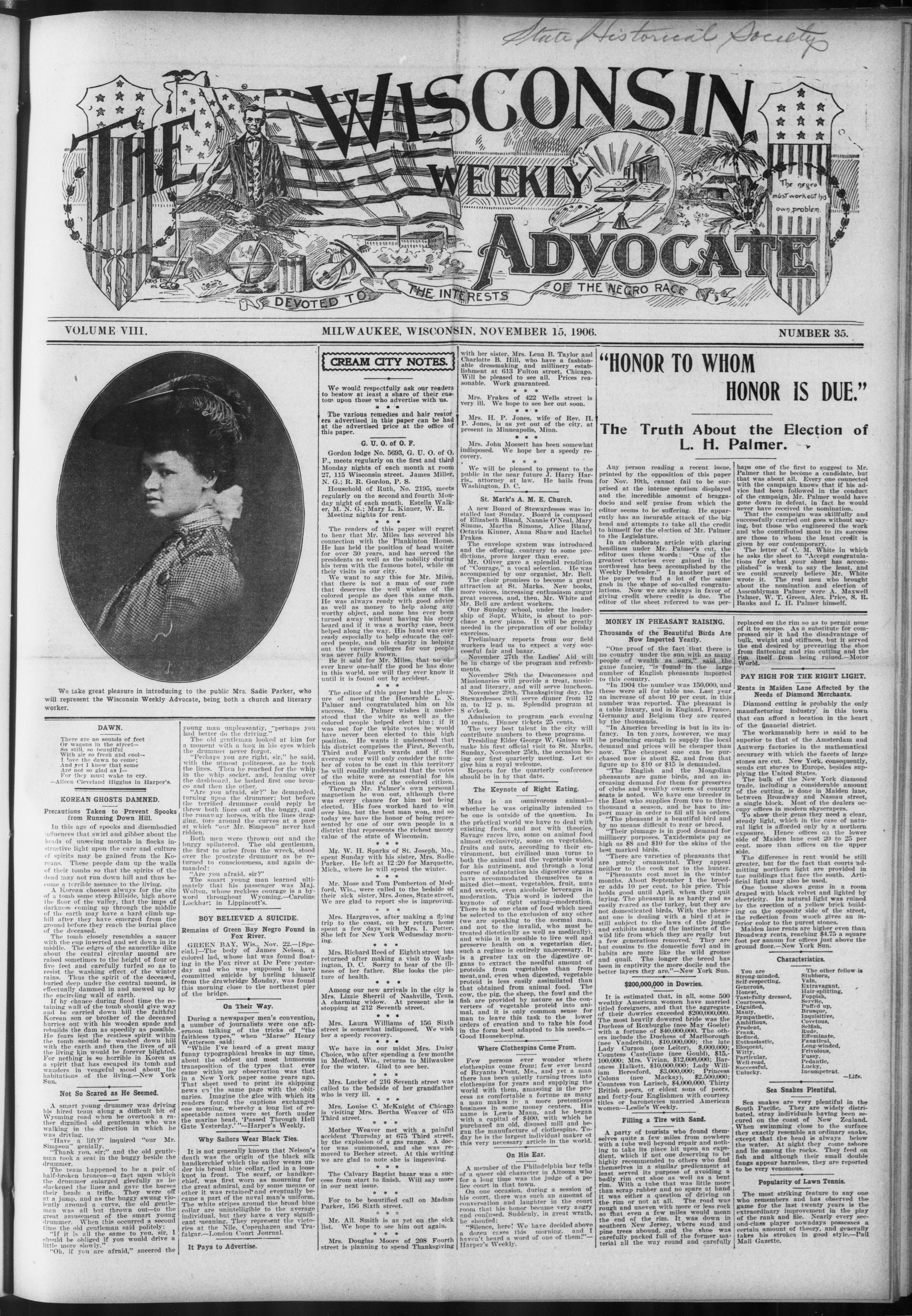
We take great pleasure in introducing to the public Mrs. Sadie Parker, who will represent the Wisconsin Weekly Advocate, being both a church and literary worker.
We take great pleasure in introducing to the public Mrs. Sadie Parker, who will represent the Wisconsin Weekly Advocate, being both a church and literary worker.
VOLUME VIII.
We take great pleasure in introducing will represent the Wisconsin Weekly Ad worker.
DAWN.
There are no sounds of feet
Or wagons in the street—
So still, so beautiful
With air so fresh and cool—
I love the dawn to come;
And yet I know that some
Are not so glad as I—
For they must wake to cry.
—Aileen Cleveland Higgins in Harper's.
KOREAN GHOSTS DAMNED
Precautions Taken to Prevent Spooks from Running Down Hill.
In this age of spooks and disembodied influences that swirl and gibber about the heads of unseeing mortals in flocks instructive light upon the care and culture of spirits may be gained from the Koreans. These people dam up the walls of their tombs so that the spirits of the dead may not run down hill and thus become a terrible menace to the living. A Korean chooses always for the site of a tomb some steep hillside, high above the floor of the valley, that the imps of darkness coming up through the middle of the earth may have a hard climb uphill after they have emerged from the ground before they reach the burial place of the deceased.
The tomb closely resembles a saucer with the cup inverted and set down in its middle. The edges of the saucerlike dike about the central circular mound are raised sometimes to the height of four or five feet and carefully turfed so as to resist the washing effect of the winter rains. Thus the spirit of the deceased, buried deep under the central mound, is effectually dammed in and mewed up by the encircling wall of earth.
If by chance during flood time the retaining wall of the tomb should give way and be carried down hill the faithful Korean son or brother of the deceased hurries out with his wooden spade and rebuilds the dam as speedily as possible. He fears lest the restless spirit within the tomb should be washed down hill with the earth and then the lives of all the living kin would be forever blighted. For nothing is so horrible in Korea as a spirit that has escaped its tomb and wanders in vengeful mood about the habitations of the living.—New York Sun.
Not So Scared as He Seemed.
A smart young drummer was driving his hired team along a difficult bit of Wyoming road when he overtook a rather dignified old gentleman who was walking in the direction in which he was driving.
"Have a lift?" inquired "our Mr. Simpson" genially.
"Thank you, sir," and the old gentleman took a seat in the buggy beside the drummer.
The team happened to be a pair of half-broken broncos—a fact upon which the drummer eniarged gleefully as he slackened the lines and gave the horses their heads a trifle. They were off at a jump, and as the buggy swung violently around a curve, the old gentleman was all but thrown out—to the great amusement of the smart young drummer. When this occurred a second time the old gentleman said politely:
"If it is all the same to you, sir, I should be obliged if you would drive a little more slowly."
"Oh, if you are afraid," sneered the
---
young man unpleasanty, "perhaps you had better do the driving."
The old gentleman looked at him for a moment with a look in his eyes which the drummer never forgot.
"Perhaps you are right, sir," he said, with the utmost politeness, as he took the lines. Then he reached for the whip in the whip socket, and, leaning over the dashboard, he lashed first one bronco and then the other.
"Are you afraid, sir?" he demanded, turning upon the drummer; but before the terrified drummer could reply he threw both lines out of the buggy, and the runaway horses, with the lines dragging, tore around the curves at a pace at which "our Mr. Simpson" never had ridden.
Both men were thrown out and the buggy splintered. The old gentleman, the first to arise from the wreck, stood over the prostrate drummer as he returned to consciousness, and again demanded:
"Are you afraid, sir?"
Are you afraid, sir?
The smart young man learned ultimately that his passenger was Maji Wolton, whose reckless courage is a byword throughout Wyoming.—Caroline Lockhart, in Lippincott's.
BOY BELIEVED A SUICIDE
Remains of Green Bay Negro Found in Fox River.
GREEN BAY, Wis., Nov. 22.—[Special.]—The body of James Nelson, a colored lad, whose hat was found floating in the Fox river at De Pere yesterday and who was supposed to have committed suicide by hurling himself from the drawbridge Monday, was found this morning close to the northeast pier of the bridge.
On Their Way.
During a newspaper men's convention, a number of journalists were one afternoon talking of the tricks of "the faithless types," when "Marse" Henry Watterson said: "While I've heard of a great many funny typographical breaks in my time, about the oddest and most humorous transposition of the types that ever came within my observation was that in a New York paper some years ago. That sheet used to print its shipping news on the same page with the obituaries. Imagine the glee with which its readers found the captions exchanged one morning, whereby a long list of respectable names were set forth under the marine head, 'Passed Through Hell Gate Yesterday.'"—Harper's Weekly.
Why Sailors Wear Black Ties.
It is not generally known that Nelson's death was the origin of the black silk handkerchief which the sailor wears under his broad blue collar, tied in a loose knot in front. The scarf, or handkerchief, was first worn as mourning for the great admiral, and by some means or other it was retained and eventually became a part of the naval man's uniform. The white stripes around the broad blue collar are unintelligible to the average individual, but they have a very significant meaning. They represent the victories at the Nile, Copenhagen and Trafalgar.—London Court Journal.
It Pays to Advertise.
MILWAUKEE, WISCONSIN, NOVEMBER 15. 1906.
CREAM CITY NOTES.
We would respectfully ask our readers to bestow at least a share of their custom upon those who advertise with us.
The various remedies and hair restorers advertised in this paper can be had at the advertised price at the office of this paper.
G. U. O. of O. F.
Gordon lodge No. 5693, G. U. O. of O. F., meets regularly on the first and third Monday nights of each month at room 27, 115 Wisconsin street. James Miller, N. G.; R. R. Gordon, P. S.
Household of Ruth, No. 2195, meets regularly on the second and fourth Monday night of each month. Estella Walker, M. N. G.; Mary L. Kinner, W. R.
* * *
The readers of this paper will regret to hear that Mr. Miles has severed his connection with the Plankinton House. He has held the position of head waiter for over 30 years, and has served the presidents as well as the nobility during his term with the famous hotel, while on their visits in our city.
We want to say this for Mr. Miles, that there is not a man of our race that deserves the well wishes of the colored people as does this same man. He was always ready with good advice as well as money to help along any worthy object, and none has ever been turned away without having his story heard and if it was a worthy case, been helped along the way. His hand was ever ready especially to help educate the colored people, and his charity in helping out the various colleges for our people was never fully known.
Be it said for Mr. Miles, that no one ever knew one-half the good he has done in this world, nor will they ever know it until it is found out by accident.
```markdown
```
The editor of this paper had the pleasure of meeting the Honorable L. N. Palmer and congratulated him on his success. Mr. Palmer wishes it understood that the white as well as the colored people helped elect him; if it was not for the white votes he would have never been elected to this high position. He wants it understood that his district comprises the First, Seventh, Third and Fourth wards and if the average voter will only consider the number of votes to be cast in this territory he will readily understand that the votes of the white were as essential for his election as that of the colored citizen.
Through Mr. Palmer's own personal magnetism he won out, although there was every chance for him not being elected. His foes worked hard to win over him, but the best man won, and so today we have the honor of being represented by one of our own people in a district that represents the richest money value of the state of Wisconsin.
***
Mr. W. H. Sparks of St. Joseph, Mo., spent Sunday with his sister, Mrs. Sadie Parker. He left at 12:20 for Marquette, Mich., where he will spend the winter.
* * *
Mr. Mose and Tom Pemberton of Medford, Wis., were called to the bedside of their sick sister, Mrs. Jones, State street, We are glad to report she is improving.
珠珠珠
Mrs. Hargraves, after making a flying trip to the coast, on her return home spent a few days with Mrs. I. Potter. She left for New York Wednesday morning.
* * *
Mrs. Richard Reed of Eighth street has returned after making a visit to Washington, D. C. Sorry to hear of the illness of her father. She looks the picture of health.
***
Among our new arrivals in the city is Mrs. Lizzie Sherril of Nashville, Tenn. A charming widow. At present she is stopping at 212 Seventh street.
宋宋宋
Mrs. Laura Williams of 156 Sixth street is somewhat indisposed. We wish her a speedy recovery.
* * *
We have in our midst Mrs. Daisy Choice, who after spending a few months in Medford, Wis., returns to Milwaukee for the winter. Glad to see her.
* * *
Mrs. Lucker of 216 Seventh street was called to the bedside of her grandfather who is very ill.
* * *
Mrs. Louise C. McKnight of Chicago is visiting Mrs. Bertha Weaver of 675 Third street.
* * *
Mother Weaver met with a painful accident Thursday at 675 Third street, by the explosion of a gas range. A doctor was summoned, and she was removed to Becher street. At this writing we are glad to note she is improving.
***
The Calvary Baptist bazar was a success from start to finish. Will say more in our next issue.
***
For to be beautified call on Madam Parker, 156 Sixth street.
Mr. All. Smith is as yet on the sick list. We hope to see him out again.
Mrs. Douglas Moore of 208 Fourth street is planning to spend Thanksgiving
with her sister, Mrs. Lena B. Taylor and Charlotte B. Hill, who have a fashionable dressmaking and millinery establishment at 613 Fulton street, Chicago. Will be pleased to see all. Prices reasonable. Work guaranteed.
* * *
Mrs. Frakes of 422 Wells street is very ill. We hope to see her out soon.
* * * *
Mrs. H. P. Jones, wife of Rev. H. P. Jones, is as yet out of the city, at present in Minneapolis, Minn.
***
Mrs. John Mossett has been somewhat indisposed. We hope her a speedy recovery.
* * *
We will be pleased to present to the public in the near future J. Harry Harris., attorney at law. He hails from Washington, D. C.
St. Mark's A. M. E. Church
A new Board of Stewardesses was installed last Sunday. Board is composed of Elizabeth Bland, Nannie O'Neal, Mary Simms, Martha Simons, Alice Bland, Octavia Kinner, Anna Shaw and Rachel Frakes.
The envelope system was introduced and the offering, contrary to some predictions, prove larger than ever.
Mr. Oliver gave a splendid rendition of "Courage," a vocal selection. He was accompanied by our organist, Mr. Bell.
The choir promises to become a great attraction at St. Marks. New books, more voices, increasing enthusiasm augur great success, and, then, Mr. White and Mr. Bell are ardent workers.
Our Sunday school, under the leadership of Supt. White, is about to purchase a new piano. It will be greatly needed in the preparation of our holiday exercises.
Preliminary reports from our field workers lead us to expect a very successful fair and bazar.
November 27th the Ladies' Aid will be in charge of the program and refreshments.
November 28th the Deaconesses and Missionaries will provide a treat, musical and literary, and will serve luncheon.
November 29th, Thanksgiving day, the Stewardesses will serve dinner from 12 m. to 12 p. m. Splendid program at 8 o'clock.
Admission to program each evening 10 cents. Dinner tickets 25 cents.
The very best talent in the city will contribute numbers to these programs.
contribute numbers to these programs. Presiding Elder George W. Gaines will make his first official visit to St. Marks, Sunday, November 25th, the occasion being our first quarterly meeting. Let us give him a royal welcome.
Reports for the quarterly conference should be in by that date.
The Keynote of Right Eating
Man is an omnivorous animal—whether he was originally intended to be one is outside of the question. In the practical world we have to deal with existing facts, and not with theories. Savage races live, some on animal food almost exclusively, some on vegetables, fruits and nuts, according to their environment, but civilized man turns to both the animal and the vegetable world for his nutriment, and through a long course of adaptation his digestive organs have accommodated themselves to a mixed diet—meat, vegetables, fruit, nuts and sweets, even alcoholic beverages in moderation. This word is indeed the keynote of right eating—moderation. There is no one class of food which need be selected to the exclusion of any other (we are speaking to the normal man, and not to the invalid, who must be treated dietetically as well as medically), and while it is possible to live well and preserve health on a vegetarian diet, such a regime is entirely unnecessary. It is a greater tax on the digestive organs to extract the needful amount of proteids from vegetables than from meat, and, even when digested, vegetable proteid is less easily assimilated than that obtained from animal food. The cow, the pig, the sheep, the fowl and the fish are provided by nature as the converters of vegetable proteid into animal, and it is only common sense for man to leave this task to the lower orders of creation and to take his food in the form best adapted to his needs. Good Housekeeping.
Where Clothespins Come From.
Few persons ever wonder where clothespins come from; few ever heard of Bryants Point, Me., and yet a man there has been quietly turning trees into clothespins for years and supplying the world with them, amassing in the process as comfortable a fortune as many a man makes in a more pretentious business in some money centers. His name is Lewis Mann, and he began with a capital of $400, with which he purchased an old, disused mill and began the manufacture of clothespins. Today he is the largest individual maker of this very necessary article in the world.
On His Ear.
A member of the Philadelphia bar tells of a queer old character in Altoona who for a long time was the judge of a police court in that town.
On one occasion, during a session of his court, there was such an amount of conversation and laughter in the court room that his honor became very angry and confused. Suddenly, in great wrath, he shouted:
"Silence, here! We have decided above a dozen cases this morning, and I haven't heard a word of one of them!"—Harper's Weekly.
"HONOR TO WHOM HONOR IS DUE."
Any person reading a recent issue, printed by the opposition of this paper for Nov. 10th, cannot fail to be surprised at the intense egotism displayed and the incredible amount of braggadocio and self praise from which the editor seems to be suffering. He apparently has an incurable attack of the big head and attempts to take all the credit to himself for the election of Mr. Palmer to the Legislature.
In an elaborate article with glaring headlines under Mr. Palmer's cut, the editor uses these words: "One of the greatest victories ever gained in the northwest has been accomplished by the Weekly Defender." In another part of the paper we find a lot of the same gush in the shape of so-called congratulations. Now we are always in favor of giving credit where credit is due. The editor of the sheet referred to was per-
MONEY IN PHEASANT RAISING
Thousands of the Beautiful Birds Are Now Imported Yearly.
"One proof of the fact that there is no country under the sun with as many people of wealth as ours" said the game fancier, "is found in the large number of English pheasants imported to this country.
"In 1904 the number was 150,000, and these were all for table use. Last year an increase of about 10 per cent. in this number was reported. The pheasant is a table luxury, and in England, France, Germany and Belgium they are reared by the thousands.
"In America breeding is but in its infancy. In ten years, however, we may be producing enough to supply the local demand and prices will be cheaper than now. The cheapest one can be purchased now is about $2, and from that figure up to $10 or $15 is demanded.
"The English and the Mongolian pheasants are game birds, and an increasing demand for them for preserves of clubs and wealthy owners of country seats is noted. We have one breeder in the East who supplies from two to three thousand a season, and he has to import many in order to fill all his orders.
"The pheasant is a beautiful bird and by no means difficult to rear or breed.
"Their plumage is in good demand for millinery purposes. Taxidermists pay as high as $8 and $10 for the skins of the best marked birds.
"There are varieties of pheasants that are purely ornamental. They appeal neither to the cook nor to the hunter."
"Pheasants cost most in the winter months. About September 1 the breeder adds 10 per cent. to his price. This holds good until April, when they quit laying. The pheasant is as hardy and as easily reared as the turkey, but they are not domesticated birds. With the pheasant one is dealing with a bird that is still subject to the laws of the jungle and exhibits many of the instincts of the wild life from which they are really but a few generations removed.' They are but cousins to the domestic fowl and in habits are more like the wild grouse and quail. The longer the breed has been in captivity the more docile and the better layers they are."—New York Sun.
$200,000,000 in Dowries.
It is estimated that, in all, some 500 wealthy American women have married titled foreigners, and that the aggregate of their dowries exceeded $200,000,000. The most heavily dowered bride was the Duchess of Roxburghe (nee May Goelet) with a fortune of $40,000,000. The others include the Duchess of Marlborough (nee Vanderbilt), $10,000,000; the late Lady Curzon (nee Leiter), $,000,000; Countess Castellane (nee Gould), $15,-100,000; Mrs. Vivian, $12,000,000; Baroness Halkett, $10,000,000; Lady William Beresford, $3,000,000; Princess Colona (nee Mackay), $2,500,000; Countess von Larisch, $4,000,000. Thirty British peers, or eldest sons of peers, and forty-four Englishmen with courtesy titles or baronetics married American women—Leslie's Weekly.
Filling a Tire with Sand.
A party of tourists who found themselves quite a few miles from nowhere with a tube well beyond repair and nothing to take its place hit upon an expedient, which if not one deserving to be highly recommended to others who find themselves in a similar predicament at least served its purpose of avoiding a badly rim cut shoe as well as a bent rim. With a tube that was little more than scrap rubber and no spare at hand it was either a question of driving on the rim or not at all. The road was rough and uneven with more or less rock so that even a few miles would mean the end of the rim. It was down in southern New Jersey, where sand and pine trees abound, and the shoe was carefully packed full of the former material all the way round and carefully
NUMBER 35.
OM HONOR IS DUE." at the Election of Palmer.
haps one of the first to suggest to Mr. Palmer that he become a candidate, but that was about all. Every one connected with the campaign knows that if his advice had been followed in the conduct of the campaign, Mr. Palmer would have gone down in defeat, in fact he would never have received the nomination. That the campaign was skillfully and successfully carried out goes without saying, but those who engineered the work and who contributed most to its success are those to whom the least credit is given by our contemporary.
The letter of C. M. White in which he asks the sheet to "Accept congratulations for your sheet has accomplished" is weak to say the least, and we could scarcely believe Mr. White wrote it. The real men who brought about the nomination and election of Assemblyman Palmer were A. Maxwell Palmer, W. T. Green, Alex. Price, S. R. Banks and L. H. Palmer himself.
replaced on the rim so as to permit none of it to escape. As a substitute for compressed air it had the disadvantage of bulk, weight and stiffness, but it served the end desired by preventing the shoe from flattening and rim cutting and the rim itself from being ruined.—Motor World.
PAY HIGH FOR THE RIGHT LIGHT.
Rents in Maiden Lane Affected by the Needs of Diamond Merchants.
Diamond cutting is probably the only manufacturing industry in this town that can afford a location in the heart of the financial district.
The workmanship here is said to be superior to that of the Amsterdam and Antwerp factories in the mathematical accuracy with which the facets of large stones are cut. New York, consequently, sends cut stores to Europe, besides supplying the United States.
The bulk of the New York diamond trade, including a considerable amount of the cutting, is done in Maiden lane, between Broadway and Nassau street, a single block. Most of the dealers occupy offices in modern skyscrapers.
To show their gems they need a clear, steady light, which in the case of natural light is afforded only by a northern exposure. Hence offices on the lower side of Maiden lane cost 20 to 25 per cent. more than offices on the upper side.
The difference in rent would be still greater, but for the fact that courts admitting northern light are provided in the buildings that face the south. Artificial light may also be used.
One house shows gems in a room draped with black velvet and lighted by electricity. Its natural light was ruined by the erection of a yellow brick building on the opposite side of the street, the reflection from which gives an inferior color to the purest stones.
Maiden lane rents are higher even than Broadway rents, reaching $4.75 a square foot per annum for offices just above the ground floor.—New York Sun. Characteristics.
You are The other fellow is Strong-minded, Stubborn, Self-respecting, Vain, Generous, Extravagant, Generous, Hair-splitting, Honest, Tastefully dressed, Foppish, Tastefully dressed, Courteous, Servie, Dignified, Puffed up, Manly, Brusque, Sympathetic, Inquisitive, Ambitious, Covetous, Prudent, Selfish, Frank, Rude, Refined, Effeminate, Enthusiastic, Fanatical, Enthusiastic, Eloquent, Long-winded, Witty, Frivolous, Particular, Fussy, Well-read, Pedantic, Successful, Lucky, Unlucky. Incompetent. -Life.
Sea Snakes Plentiful
Sea snakes are very plentiful in the South Pacific. They are widely distributed, stray individuals having been secured on the coast of New Zealand. When swimming close to the surface they exactly resemble an ordinary snake, except that the head is always below the water. At night they come ashore and lie among the rocks. They feed on fish and although their small double fangs appear harmless, they are reported to be very venomous.
Popularity of Lawn Tennis.
The most striking feature to any one who remembers and has observed the game for the last twenty years is the extraordinary improvement in the play of the rank and file. Nearly every second-class player nowadays possesses a certain amount of theory, and generally takes his strokes in good style.—Pall Mall Gazette.
THE WISCONSIN WEEKLY ADVOCATE
MILWAUKEE, WIS.
B. B. MONTGOMERY, Editor and Proprietor.
Curious Condensations.
In constructing the East river tunnels, New York city, according to the statement of the engineer in charge, fourteen men have succumbed as the result of working in the high pressure, 34 pounds to the square inch above the normal pressure of the atmosphere.
India is learning a lesson from Japan, where fish ekes out the agricultural situation. There, 10 per cent. of the population are engaged in the fisheries industry, as against 1 per cent. in India, where all the fishing is still done within six miles of the shore and in the most primitive manner.
There is almost a plague of field mice on Lincolnshire farms. It has been estimated that a single pair of field mice and its progeny would, in five seasons, amount to over 2,000,000, and it is estimated that each mouse eats from twenty-four to thirty-six pounds of green vegetable food a year.
Comparatively few people know that ringing a bell runs it. That is, a bell has a definite length of life, and after so many blows will break. A 960-pound bell, struck blows of 178 foot pounds of force, broke after 11,000 blows. A 4600-pound bell broke after 18,000 blows of 250 foot pounds force.
If the Shah of Persia were to be deprived of his income he could still make sure of being one of the richest men in the world. He would only have to sell his ornaments, gems and precious stones to become possessed of about 1,5,000,000, the sum at which the magnificent collection is valued.
The Cuban Congress, at its recent session, appropriated $1,000,000 to be used for the purpose of inducing immigrants to come to Cuba from Europe and the Canary islands. It is proposed to pay the passage of each emigrant from his home. The field hands are to be brought from Sweden, Norway, Denmark and Italy.
Rev. John Aldis, once the most prominent minister of the Baptist denomination in England, has reached the age of 98. He began life in a shoe-mazer's shop. Afterward he was sent to florent college, near Bradford, now known as Rowdon college. Later he became pastor of Maze Pond chapel, London, and in 1866 he was elected chairman of the Baptist Union.
One of the most ancient charities in connection with the church is that at St. Swithin, Worcester. In 1868 William Swift decreed "that twelves loaves of bread he given by the church wardens every Sabbath morning, and so to continue forever, unto twelve aged poor people such in his lifetime as he should appoint, and after his death according to the discretion of the church wardens and their successors."
—In consequence of the many objections urged against the time-honored practice of "kissing the Book," Temple C. Martin, the chief clerk at Lambeth police court, has given instructions that all witnesses are for the future to be given the option of being sworn in the Scottish fashion, with uplifted hand. The new method was adopted for the first time August 17, and the majority of the witnesses saviled themselves of it.
The Mexican government is seeking to develop the cultivation of bananas in that country. For several years experiments are said to have been successful, and it is intended to start two establishments on the gulf coast in Mexico for the purpose of converting the banana into a flour, and of shipping the product to the United States. As the flour is exceedingly nutritious it is anticipated that there will be no lack of demand for it.
The Czar of Russia has four separate "services" of horses and carriages the Russian, English, French and gala sets. Each set comprises at least fifty horses. The Russian set accompanies the Emperor wherever he goes, and at Gatshina it is used together with the English set. The gala and French horses and carriages are housed at St. Petersburg, in the winter palace stables. The Czar's gala turnout consists of fifty Hanoverian horses, which are perfectly white, with blue eyes.
-Sharks infect the waters of Ceylon and the pearl divers of that region are in deadly fear of these wolves of the deep. The divers are mostly Tamils and Moormen and display marvelous endurance and pluck. To protect themselves against the ever-present danger to which the presence of the sharks exposes them the divers carry charms given them by recognized "shark binders." who receive a small government fee and a dozen oysters a day from each boat. Owing to the constant noise and splashing the sharks are generally kept at a distance and accidents are rare.
"Crank," in the sense of an eccentric person, is a new word. The very first written instance of "crank" in the modern sense that could be found for Dr. Murray's dictionary was in the reports of the trial of Guiteau, President Garfield's murderer. Guiteau's reference to somebody as a "crank" gave the word a vogue that has gone on spreading. But the adjective "cranky" was known in 1787, as meaning sickly (the German "krank") and to Dickens in the sense of cross and crochety. In all its meanings it springs from the root idea of crookedness, as does "crank" in its Sixteenth century sense of a deceitful trick, as in "quips and cranks."
Opium smoking is increasing in China and is becoming more respectable at the same time. A customs report from Ichang says: "The returns show a more than tenfold increase in the native opium cultivation. The opium smoker has no longer any reason to attempt to conceal his pleasant habit or to retire for its satisfaction to the 'kuan' or diyan—now no longer patronized by the well-to-do. Every respectable house now has its 'fumoir,' and is expected to take, as well as to offer, a few whiffs in the course of an ordinary visit. Opium smoking among the Chinese has ceased to be generally regarded as a vice, and, like tea drinking in England, has definitely taken a place among the customs of the country."
The labor agitations in recent years in France are said to have had an important effect in leading to a "concentration of industries." In 1896 there were 2,344,471 independent establishments in France; in 1901 the total number of such establishments was 2,245,356, a dimunition in five years of nearly 100,000 establishments. The number now is said to be very much smaller. The small establishments are reported to have been the ones which have largely gone out of business. During the period of 1896 to 1901 no less than 102,355 small firms disappeared, while establishments employing from twenty-one to 100 workmen increased by 2535, and the number of large firms, employing more than 100 workmen each, increased from 3918 in 1896 to 4623 in 1901. The present agitation, with a demand for shorter hours and increased wages, is said to have added greatly to this concentration of business in certain lines to the large firms.
THE FLAME BERRY
Yonder it is
Bidding us still be merry
In spite of cold and the rain!
Set like a bright and windy torch
Over each empty porch
When sorrowing Summer left her palaces,
It gallantly
Hails welcome still to every passerby,
Bidding him enter and fare heartily.
Look, where the white frost is,
Yonder it glows again-
"Come hither!" it cries,
"Here will the brave heart tarry,
Here will the young heart sing
For pure joy of the wine-bright air,
Like dawn blown everywhere,
Like dawn blown overwhelm
And to love a skirt, unhidden skirts.
And none can stay.
And none can stay
Hearing the call to listen and come away
Down many a path for many and many a
day!
And glad are we and wise
Who have the summoning,
Oh, brave flame berry!
Mildred I. McNeal Sweeney in Lippincott's.
A MOTOR-CAR ELOPEMENT.
It was not a nice thing to do, but Mr. Basing of Basing's old bank, Stannithorpe, head of the London financial firm of Basing & Smart, doubtless thought he was justified, and, indeed, he had never been overscrupulous. So when his only daughter, in extricating a handkerchief from the ridiculous little bag which served her as a pocket, unwittingly drew forth an important letter, which, unperceived by her, fluttered to the carpet, he promptly placed his foot upon it.
"It's not a bit of use pleading for him," he said. "You don't marry that idle speech if I can help it."
"Frank Mayhew is not that," she replied. "You are always saying he can't do anything, but he can drive a motor car better than anybody I know; he plays football, cricket and golf splendidly, and——"
Mr. Basing interrupted with a snort. "Plays; that's just it. Your husband must know how to work."
The girl left the room without another word.
Mr. Basing smiled grimly and picked up the letter, which he had no serpule about reading. It was written in a bold hand and ran as follows:
"My darling Bessie—I have got the license, also your traveling trunk and dressing case—thanks to the porter. At 9 o'clock sharp I'll be at the corner of Dean road with the new car and the baggage. I have fixed up everything. We'll reach Northleigh by 10 and be married by half past.
"Yours ever, Frank."
Mr. Basing thought a moment, made up his mind with his usual decision, and nooked at his watch. It was 8:45. He could get to the corner of Dean road in ten minutes.
The car was there, a big twenty-horse-power, moving slowly. Mayhew saw him instantly, hesitated a moment, then drove up to the curb and stopped.
"Good morning," he said, as cheerfully as if nothing untoward had happened. "Just trying my new car. She's a beauty, isn't she?"
"Looks all right," said Mr. Basing. "but I'm no judge. No time for motor rides as a rule, but I don't mind if I have a spin this morning."
Mayhew took him aboard, remarking helplessly: "Cars are like some people—all right when you know them, but jolly dangerous when you don't."
"So I suppose. But my daughter tells me that you are a fine driver, and if that's the case the risk won't be great. It's a pity she's not going with us," Mr. Basing added, artfully.
The remark gave Mayhew an idea.
"I wish she were," he said. "But you can't go for a spin dressed like that, sir. You want a warmer overcoat, and your tall hat will be a picture before we have covered ten miles." And he moved the lever.
This coat will do well, and so will the hat," Mr. Basing rejoined.
* * * * * *
"Steady—steady, Mayhew!" he shouted. "If you are going on at this rate I'd sooner get down."
Crouched over the steering wheel, watching the road narrowly, Mayhew had been handling, or pretending to handle, the levers for at least five minutes. He took his eyes off the road for an instant.
"I told you I didn't know the car," he said, "and that it was dangerous."
"Why—what's the matter?"
"Don't talk, please. The car won't stop."
A load of hay loomed up in the road, seeming to fill it from side to side. In an instant the great machine was close upon it, swerved round it on two wheels, missing a cyclist by four inches, and careered along.
Mr. Bading groaned. "We'll both be killed!" he cried. "What's to be done? Is it safer behind? Can I climb over?"
"No, no! Sit still!" Mayhew shouted back. The rear of the car was packed with baggage—Miss Basing's big trunk, bearing her initials in four-inch letters, her dressing case, and his own largest kit bag. "There's apparently nothing for it but to let her go until all the petrol's gone." he went on. "She'll stop then, right enough. Don't do anything to distract my attention and I'll pull you through."
Presently Mayhew spoke again.
"By the way, have you any idea where we are?"
"Close to Stannithorpe, my native place." Mr. Basing answered, gloomily. But Mayhew remembered that his companion was chief proprietor of the old bank at Stannithorpe, and, thinking his revenge had gone far enough, he resolved to bring the car to a stand at the bank door. Past a few straggling houses they whizzed at thirty miles an hour, and soon entered the market street, where Mayhew made another great show of slackening speed, this time with success, for the street for full of people, excited, clamorous, surging about a big stone building, whose front bore in large gilt letters the words, "Basing's old bank."
"There's something wrong." Mr. Basing cried, as soon as he saw the crowd. "If you could only manage to pull up you might do me a great service."
Mayhew nodded and after another well simulated struggle with the levers contrived to bring the car that wouldn't stop—of its own accord—to a stand as close to the bank as the crowd would permit.
Mr. Basing sprang to the ground and almost into the arms of a venerable, but wildly excited, gentleman, who was flourishing a sheaf of telegrams.
"Thank goodness you've come, sir!" he cried, breathlessly. "I've wired your office a dozen times this morning and got no answer from you or Mr. Smart. Your chief clerk telegraphed that neither of
you was at business and he could do nothing."
"Tell me in a word what's the matter?" he asked.
"A run, sir, on the bank, sir, started, goodness knows why, as soon as the doors opened. Mr. Jones thinks it's some silly twaddle in the local papers has done it. But he can't keep on paying out more than another half hour, and he's in an awful state of mind."
Mr. Basing shouldered his way through the crowd to the door, which was guarded by the entire police force of the town, and faced the people.
"Fellow townsmen!" Basing shouted. "I am here to tell you that the bank's in no danger. You will be paid to the utmost farthing."
A hundred angry yells answered the assurance. Mr. Basing pushed past the policemen and entered the bank.
and entered the bank. "Cash balance this morning?" said Mr. Rasing by way of greeting.
Basing, by way of greeting. "Twenty-five thousand," was the answer.
"How much left?"
"About three thousand."
"How long will that last?"
"Twenty minutes, perhaps."
"You have wired the London offices and our agents?"
"Long ago. They are waiting instructions from you. If you had been at your office at the usual time, sir, we could have got sufficient cash here by the 12:20 express. We shall want $40,000 or $50,-000."
Mr. Basing wiped the perspiration from his forehead.
"Good," he said. "Pay as long as you can, then close the doors until the 3 o'clock express comes in. And he sat down to write a telegram.
The manager's face blanched. "Can't something more be done, sir?—to calm the people. I mean? You know the Stannithorpe folk. They'll tear the place stone from stone, and burn what they can't smash."
"Let them tear, smash and burn, and be hanged for the fools they are!" said Mr. Basing, angry at last. "But I'll see what I can do."
As he left the room he was met by a surge of people that almost swept him off his feet. Mr. Basing struggled to a chair and mounted it.
"The bank has sufficient assets to pay you all!" he shouted.
"Ten times over," a voice added—Mayhew's. "Clear the way here! Clear the way. I say!"
Pushing, thrusting, elbowing, shoving, as never had he done when playing Rugby for his university, and shouting all the time. Mayhew made way for the procession of policemen—the first two carrying a huge trunk, carefully guarded by two more officers, batons in hand, another policeman followed with a big kitbag, and yet another with a woman's dressing case. All entered the manager's room.
Collaring a burly butcher and flinging him into the crowd, Mayhew cleared a space and sprang upon the counter.
"Silence!" he shouted. "Listen to me. Not another penny will be paid until you come to your senses. So clear out, the lot of you, and come in two or three at a time in an orderly manner, not like a pack of wild beasts!" He turned to the cashiers: "Stop paying until this lot are outside."
Mayhew kept the door. "Two at a time!" he shouted. "Two in and two out. I'll break the head of the first man that tries to rush me. Step lively, now, two at a time, or it'll be 4 o'clock before you are all paid. Some of you might go home and get your dinners. Hurry up! Your money's waiting!"
It was wonderful. A nervous old woman, who had just heard of the trouble, passed the guardian at the portals. A farmer galloped up on a horse taken straight from the plow and entered. Those were all. The policemen trooped out. Mayhew, finding the run at an end, left his post and entered the manager's room. Mr. Basing was sitting on the big trunk, wiping his face and laughing. He got up and gripped Mayhew's hand.
"That was a clever idea, young man," he said, "and I thank you. I don't need to ask what is in the trunk, the bag and the dressing case; I've seen the initials on them. If that license you've got is good for another day don't waste it. I'll be there."—Ashmore Russan in London Lit-Bits.
GOLDEN NUGGETS
Kindness bestowed on a woman rarely ever is forgotten.
Many men speak as though it were at all times a condescension.
The woman who is not pretty does not like the fact being discussed.
A woman falls into the habit of scolding without being conscious of it.
Some men air their accomplishments so much that they stand out as faults.
When a man is honest in his intentions, but little explanation is required.
A woman will accept flattery in good faith even if she knows it to be insincere.
Take a woman at her word and she wants to know what is meant by so doing.
The man who is willing to compromise a wrong lays the foundation for a repetition of the act.
If what men term pleasure be carefully analyzed it will be found to be generally only enthusiasm.—Philadelphia Bulletin.
New Industry for Society.
How many of the motors in which we see "smart" people dashing about are really the property of those who ride in them? It is frequently said that in the more imprecunious section of the "smart set" touting for motor firms has taken the place of touting for insurance companies as the favorite way of increasing a too narrow income. A motor takes a long time to build, say six months.
A rich colonial, or some one of that kind, sees a lady whom he knows driving about in a very fine motor. "Dear me!" he says. "I like your motor very much. Mine won't be ready for six months. I suppose you couldn't be induced to sell it?" And so the lady gets a commission from the firm which had allowed her the use of the motor in order to show it off to advantage and get a good customer.—London Tribune.
The New Aladdin
A school teacher on the lower east side in New York a few years ago read the story of Aladdin's Lamp to her charges. The next day she requested them to write the story for her. Chimmie Flynn, however, had been absent the previous day, and had not heard the
story. But with the craftiness of the gamin, he did not intend to display his ignorance, and accordingly wrote the following composition:
"Aladun wuz a kid what hung out down to Baxter st. he sold wuxtras and shoted craps. his ole man wuznt no good and his ma she licked him awful. so Aladun he didnt mosey round home much. he could fite to, and one day he picked a scrap wid a dago cause the dago win all his money shootin craps. he nocked the tar outer the dago but another one come runnin up and hands him a package rite on the left surch lite. bout a our from then he had a peach of a mouse there and when his ole man sees him he says whats the matter and Aladun says I fell and hit the curb. you lie says the ole man. you bin fitin, and sumbody put out your lamp. cummere till I make it two. and thats the story of Aladun and his lamp." —Pacific Monthly.
EVERY DAY PHILOSOPHY.
Many a good man eats with his knife.
The average woman has a pretty good opinion of her own figure.
The old-fashioned cook stove looks better to a real hungry man than a chafing dish.
If a boy is quiet every one wonders what he is up to, and if he is noisy they know.
If you have a pole long enough you can still knock a railroad pass off the Christmas tree.
Reformers can always find something to be busy about. After election it will be the corset.
If you are well satisfied with yourself it is a pretty good sign you are not satisfactory to other people.
You often read of it in stories, but in real life you seldom see the heroine "sink gracefully onto a couch."
It is not recorded that any financial genius ever got his start by purchasing diamonds on the installment plan.
When a man is dead, or is a candidate for office, his friends should say the best things possible about him.
The autumn leaves are beginning to look something like a woman who is searching for an effectual hair dye.
What has become of the old-fashioned young man who said, when introduced to a new young lady, "I had a knock-down to her?"
When a funerai procession passes along the street, you can usually look at the mourners and tell who occupies the hearse.
In some families there is a strong opposition between the princess and the dog as to which does the least for the greatest returns.
There are times when we all envy a baby who can give vent to its feelings by throwing itself on its back and kicking and screaming.
How policemen are abused And did you ever know a policeman who wasn't a pretty good fellow and anxious to do his duty? We never did.
When an old maid is no longer a success on the ballroom floor, her old heart can be cheered by being asked to be a "chaperon" along the wall.
How you resent it when any one interferes in that which you consider "your business" And how often you interfere with the business of others!
It is a good thing for the old-fashioned drudge-mother to insist upon going to church. Otherwise her family will grow up without ever seeing her with a hat on.
We heard a mother say, recently, of her 13-year-old daughter: "She is the best child in the world." That is the finest compliment that will ever be paid the girl.
It pays to have people speak well of you behind your back. And in spite of all the mean things said of people they will do it, if you deserve to be well spoken of.
In a town where every home is connected with the sewer, a familiar back door scene is missing—that of a woman throwing a wash pan full of dirty water on the dog.
By the time a boy baby is 6 months old his mother is saying there is such a difference between the dispositions of boys and girls, and she is saying it with pride in the boy.
When a man writes a proposal of marriage to a woman he has written something that will last forever. A woman never destroys a letter than contains an offer of marriage.
What age should a girl be when her parents make the discovery that she would have a better time entertaining her callers if they would go off to bed and leave her alone with them?
The stories in the magazines are making the literature of childhood very dignified and intellectual in comparison. Have you read a story in a magazine in six months as interesting and instructive as "Puss in Boots."
If a doctor will look anxious when talking with a woman patient it becomes a mere matter of conscience with him how long he can string his visits out. She thinks he should keep on coming when her condition is that alarming.
The writer of this, who is somewhat timid about marriage, would marry in a week if he could find a woman who would love him as an old maid loves her sister's children. The nicest thing in the world is the admiration an old maid has for her sister's children, particularly when they are little.—Atchison (Kan.) Globe.
Rose Farm or Twelve Acres
One of the most interesting sights in the Pomona valley is the development work now being done by the California Rose company on its rose farm at the foot of White avenue. Here may be seen literally acres of roses, the slips being planted a few weeks ago, covering the entire twelve-acre tract, in rows about three feet apart. The plants are about six inches in height, and here and there over the tract many of them are in bloom. It will be a beautiful sight when the rose bushes are grown to two or three feet in height, all in blossom.
The work of irrigating and tending the plants at this time of year requires about twenty-five men. From December until April, during the shipping season, probably fifty to seventy-five people will be kept busy. At this season the young plants are being pushed as rapidly as tender care, good soil, the available amount of sunshine and constant irrigating will accomplish it.—Pomona Times.
Weight of Whale
One Greenland whale weighs as much as 88 elephants or 440 bears.
LITERARY TOPSY TURVIES.
If Howells were Jack London
And wrote of dogs and fights;
If Tarkington were Riley,
And tried poetic flights;
If Twain were Mrs. Rorer,
And wrote of grub and looks—
If all these changes happened
Would people read more books?
If Dunne were Mrs. Freeman,
And Dooley an old maid;
If Page were Owen Wister
And Cable were George Ade;
If White were C. T. Brady,
Now tell me this, gadzooks!
If all these changes happened
Would people read more books?
Would Kipling lose his gripling
If he were Henry James?
If Conan Doyle were Philipotts
Who'd play detective games?
If Conrad were Corelli
Who'd write of ropes and hooks?
If all these changes happened
Would people read more books?
—Denver Republican.
INDIAN SUMMER.
November comes like dame distressed.
With pale brow all afrown.
Her lips drawn thin and close compressed.
Her long hair tumbling down;
Francesca Di Maria Palmer in Every body's.
For the Children.
---
Silver Spear
THE DISCONTENTED FAIRY. Silver Spear was the wildest little fellow in all fairyland. He was such a little mite, and so brimful of his pranks and fun that he couldn't behave himself. He was a very willful little fairy and bound to have his own way in everything, and for this reason he was always in trouble.
He lived with his father and mother and seven sisters in the most beautiful palace imaginable. It would dazzle the eyes of any one but a fairy to take even as much as a glimpse into Silver Spear's home. The walls were covered with thousands of little golden lamps, hung with long diamond pendants that swayed back and forth with a soft, tinkling sound like sweetest music, and sparkled, glittered and reflected wonderful lights and colors impossible to describe.
There were no windows, so the sunlight never entered Silver Spear's home, and as he was never quite satisfied with anything, he grew more dissatisfied every day. His willful little heart was filled with a great longing to go out in the world and play in the sunshine, and see what there was to be seen. He had never been allowed out in the daytime, for the fairies always visit the earth in the evening, and make merry in the bright moonbeams, and safely reach their home before day break.
One night, however, they had remained longer than they thought, and the first rays of the morning's sun tipped their trembling little wings with its golden light, just as they were disappearing into a beautiful, white flower that grew in a long row of blossoms, and carefully concealed the entrance to their palace home. They were all dreadfully frightened, all except little Silver Spear, who was much excited and longed to get out into the world, and see more of the pretty sunshine.
When they attended the next dance in the moonlight little Silver Spear had fully determined what he would do, and, terrible to relate, he did it. He hid himself securely in the center of a pretty, swinging bluebell, and when the party broke up Silver Spear was nowhere to be found.
They searched through the soft, fine grass and among the little blue and white star-flowers that grew in it, never once thinking to look into the depth of the swinging bluebell; so, of course, they searched in vain, for they could not find him.
The moon had entirely disappeared, and they dared not remain longer, so they started slowly for home, followed by Silver Spear's seven weeping sisters, for, even though he tormented and teased them, he was their only brother, and they loved him.
Silver Spear lay quite still for a long time after he found himself alone. The swaying motion of the bluebell was very soothing, and he felt dreadfully tired. He had almost made up his mind to take a little nap when he heard a terrible rumbling noise directly over his head. It grew louder and louder, and poor little Silver Spear fairly shook with fright and terror. Oh, how he wished he had minded his parents, and how he longed to be in his own bright, beautiful home.
Presently a big drop of rain fell right into the bluebell, and Silver Spear was wet to the skin. One big drop followed another until Silver Spear was nearly drowned; then a whole bucketful came down at once, and this was too much for the pretty bluebell. She was bent double and pressed down into the long, soft grass, and Silver Spear never had such a shaking up before in all his little life.
The fall of the bluebell saved naughty little Silver Spear's life, for a large wild cabbage, with broad green leaves, grew right alongside of the bluebell. When Silver Spear tumbled into the soft grass he crept under the broad leaves and found it all nice and dry, for the raindrops ran in a little stream off the smooth leaves, as if it had been in reality an umbrella.
Poor, frightened little Silver Spear! He was receiving a fearful punishment for his discontentment and wilfulness
Ab, how his little heart beat and how he trembled! He did not feel at all sure what would happen next. Oh, how sorry he was and how he repented his naughtiness, which came near costing him his life.
Presently he fell asleep, curled up in a little heap under the protecting leaves of the cabbage, and when he awoke it was night again. He could not realize it, but he had slept all day. He lay quite still, and thought of home and made up his mind if he could only see his dear mother and sisters once more he would tell them how sorry he was, and never disobey his kind father again.
Hark! What was that? He sat up and rubbed his eyes and listened. There it was again, a little voice like a silver bell, calling his name. He jumped up and with all his strength he lifted up a corner of the heavy cabbage leaf and answered, "Here am I," and there he saw his father, with a lantern in his hand (there was no moon) searching for him. What a happy little fellow he was as he hurried home with his father and was kissed and forgiven by all of the family.
All this happened some time ago, and now in all fairyland there isn't a more obedient or better behaved little fairy than little Silver Spear. He was taught a lesson by his disobedience that he never forgot.—Brooklyn Eagle.
Advertise in Your Home Paper
CRYING SHELLS OF CEYLON.
Sounds They Make Like the Notes of an Aeolian Harp.
Sir J. Emerson Tennent, having heard a story about musical sounds issuing from the lake at Batticalea, in Ceylon, paid a visit to the place. The fishermen told him that the sounds, which resembled the faint sweet notes of an Aeolian harp, were heard only at night and during the dry season, were most distinct when the moon was nearest the full and proceeded, they believed, not from a fish, but from a shell called the "crying shell."
"In the evening," says Tennent, "when the moon rose I took a boat and accompanied the fishermen to the spot. We rowed about 200 yards northeast of the jetty by the fort gate; there was not a breath of wind or a ripple except those caused by the dip of our oars. On coming to the point mentioned I distinctly heard the sounds in question. They came up from the water like the gentle thrills of a musical chord, or the faint vibrations of a wineglass when its rim is rubbed by a moistened finger. It was not one sustained note, but a multitude of tiny sounds, each clear and distinct in itself; the sweetest treble mingling with the lowest bass.
"On applying the ear to the woodwork of the boat the vibration was greatly increased in volume. The sounds varied considerably at different points as we moved across the lake, as if the number of the animals from which they proceeded was greatest in particular spots, and occasionally we rowed out of hearing of them altogether, until on returning to the original locality the sounds were at once renewed. This fact seems to indicate that the causes of the sounds, whatever they may be, are stationary at several points, and this agrees with the statement of the natives that they are produced by mollusca and not by fish.
"They came evidently and sensibly from the depth of the lake, and there was nothing in the surrounding circumstances to support the conjecture that they could be the reverberation of noises made by insects on the shore conveyed along the surface of the water, for they were loudest and most distinct at points where the nature of the land and the intervention of the fort and its buildings forbade the possibility of this kind of conduction."
SALTED WHALE.
Some Say It Is Better Than Poor Salted Beef—South America Cries for It.
The preservation and exportation of whale meat is becoming a big industry in parts of the Gulf of St. Lawrence. For some time past the fishermen of Gaspe have been in the habit of salting down portions of the meat of the whale for their own use when short of other food, but now it is found that the article is eagerly consumed by some of the South American peoples and consequently it is becoming quite an article of commerce.
One company has established a large plant on an island in the region known as Seven Islands, in the north of the Gulf of St. Lawrence, and maintains a regular whaling steamer to kill and tow in the whales to the factory. Two species of whales are taken, the humped back and the sulphur bottom. They are so plentiful that there is no difficulty in killing and towing to the factory one a day, which is all that the present capacity of the factory can accommodate. Each whale is valued at about $2000, so that the business is a very lucrative one.
Formerly all the flesh went into guano, which is worth $30 to $35 a ton. Now, however, the prime meat is all salted down for food, and excellent eating it makes, too, for those who like it, many contending that it is superior to the coarser grades of beef salted in barrels, especially when used in stews and hashes, or served up as corned beef. China is said to offer an excellent market for the meat, but at present the initial company in the St. Lawrence, which is likely to be soon followed by several others, has a demand for all that it can ship to South America.
GEMS OF THOUGHT.
Love is the landlord of our castles in the air.
Borrow trouble and you will be in debt all your life.
The fellow who always agrees with you expects to be paid.
If you want things to come your way you must go after them.
A man and his wife are one, and there are no two ways about it.
Some people never stop to think, and wouldn't think if they did.
When a man loses his enthusiasm his opportunities begin to shrink.
The older a man grows the more chance he has of being found out.
A fool and his money are soon parted, and many there be who want a part.
He who yields to temptation is generally looking for the chance.—New York Herald.
Passing of Bicycles
Nine years ago, by actual observation, there were 1247 bicycles around the junction of Broadway and Seventy-second street, New York, between sunrise and sunset on a late September day, and not one automobile, while, according to a careful record made one day last week, four bicycles passed the same point and 243 automobiles.
Ice Six Years Old.
The last bargeload of ice was taken out of Schodack creek and sent on its way to New York City tonight. This cleans up the ice on the Hudson, with the exception of about four boatloads still in the Wheeler house, at Van Wic's point. The Wheeler house ice was harvested five or six years ago, and has to be dug out in irregular chunks. Albany Dispatch in New York Times.
Lord Milner Is Thanked.
Lord Milner, the former high commissioner for South Africa, has received through the Duke of Somerset an address expressing appreciation of his services in South Africa signed by 370,000.
Less than two years ago a prospector lost his way on the desert near the California line, in Nye county, Nevada, and died of thirst. On the spot where the man's body was found is now the town of Bullfrog. A waterworks plant costing $50,000 supplies an abundance of water. There are hotels with baths in many rooms and residences equipped with all the modern paraphernalia that make for comfort. Electric lights illuminate the streets where only the stars of heaven looked down on the death of the lonely miner, and within the radius of a very few miles there is now about 15,000 people.
Fac Simile of Dead Sea.
Near the Chautauqua (N. Y.) boat landing is a facsimile of the Dead sea and surrounding country. The cities of the Holy Land are marked by metal monuments.
```markdown
```
The Wayfarers.
"Oh, little maid, the way is long,
And you are young, and none too strong;
For all the brightness of your eyes.
Your lips are meek and sorrow-wise.
Your feet are slow, like pilgrim feet.
And white with dust of field and street;
Should you not say your beads!—for lo!
Lonely and strange, the road you go.
"The sun has set, and night comes down
Between us, and the far-off town
Shall you not fear a little? You,
So young and fair, may sadly rue
To be aiene with none to guard,
For hearts of evil men are hard.
And beauty works such sinful charm—
Surely you need have fear of harm."
Her face smiled through the dimness. "Nay, Shall we not wend the selfsame way? Like me, you seek the town, and so I fear not darkness as we go. Nor evil men. While you are nigh Harm cannot reach me!" * * * With a cry He caught her hand. "Good-night! I pray God shield you, dear!" and fled away.
—Madeline Bridges in Smart Set.
Ten Commandments for Married Men
First—Thou shalt not marry until thou art aweary of sidestepping, and thy hand tiring of sowing wild oats.
Second—Thou shalt not welch upon thy choice; for thou didst select thy wife thyself, and she is even as she was when thou didst pick her out.
The third commandment of the married man is this:
Thou shalt choose the kind of mother-in-law thou likest, for io, after thou art married thy house shall be her house, and her ways thy ways.
In the majority of divorce cases neither side alleges any great and unforgiveable offense against the other. It is simply a condition of friction in the household, of matrimonial bonds that have galled and chafed until things have become unendurable. Tempers have been worn to a frazzle. Conversation has degenerated to a string of criminals and recriminations. Bitter things have been said. The home has become a purgatory of bickering and strife and quarrels.
In these domestic cataclyms that leave broken hearts and wrecked lives in their trail, almost invariably the storm center is the wife's mother. If you will take the trouble to read the reports of such cases you will see that in nearly every one the husband says, "We had a happy home until my mother-in-law came to live with us," or "We got along all right until my wife's mother began to interfere."
Nor is this mere masculine prejudice against the mother-in-law.
If you will look about you you will scarcely see one harmonious couple in which the wife's mother is a member of the household, or one disgruntled married pair who live by themselves.
So undeniable a fact is this that we might almost say that the way to do away with the divorce evil would be to kill off the bride's mother at the wedding.
As this is impossible, and as it is equally impossible to cherish the fond hope that women will ever reach a state of grace in which they will have forbearance enough to keep their fingers out of their sons-in-law's pies, the only thing that is left for a man to do is to pick out a mother-in-law whose society he enjoys, whose housekeeping coincides with his own taste, and whose views in regard to latch keys, clubs, the temperance question, and the higher life are his own.
For there is no earthly way that he can escape the lady in question.
Her daughter's house, and eke her daughter's husband's house and all it contains are here, to do with as she pleases, and upset as much as she likes.
It is nothing that the poor, helpless man pays the bills, and that his wife came to him as empty-handed as poor Griselda.
Mother-in-law lets no such trivial incidents as this swerve her from her purpose of making over the young people's establishment on her own lines, and running it to suit what she conceives to be for their good, irrespective of their desires.
If she happens to be a Prohibition famic, she sets her large foot down firmly on son-in-law having wine with his meals, and a highball for a nightcap.
If she disapproves of his friends, out they go.
If she is a church-goer, she chases him to the sanctuary at the point of her tongue.
If she doesn't like his servants, she makes things so unpleasant for them that they give notice and leave. As for the man's expectations of being master in his own house, it collapses like a child's painted toy.
He is a mere figure head.
Mother-in-law runs the shop, and he eats what she chooses for him to eat, smokes where she permits, and fulfills his humble destiny by making the money to gratify her wishes.
Naturally, since men are not angels, this state of affairs gives rise to endless quarrels.
He and mother-in-law have it out, and he and wife have it out, but in the end, because there are two against one, the mother-in-law triumphs, and the man, putting on his hat, slams the door behind him with remarks that aren't fit to print, and drifts back to his old boon companions, and in his heart, as in a shroud, he all the sweet dead hopes of the home of which he has dreamed—the home that the mother-in-law has made impossible by her intermeddling.
Of course, there are a few exceptions to this rule.
There are a few women who love their daughters well enough to forgo the dear delights of interfering between them and their husbands, and who are heroic enough to concede to a son-in-law some rights in his own house, but these are few and far between, and a man has no more right to expect that he will draw one of these prizes in the matrimonial lottery than he has to suppose that he will be struck by lightning.
The ordinary man who marries may count on a future that will be mostly tinctured with mother-in-law, and he is foolish, indeed, if he does not select the flavor that will be most agreeable to his palate.
He need not think that he will escape it by taking his wife away, for there is no land so remote but to which excursion tickets are sold, and though he should flee to the uttermost ends of the earth, he would still find that what "mother says" and "mother thinks" rising up at every turn to confront him on his own hearthstone. The only way around this large and solid obstacle to domestic happiness is to embrace it with such fervor that it ceases to be an obstacle and becomes an annex to one's pleasures. For there is a choice in mothers-in-law as there is in everything else in life, and it merely requires discretion in the selection.
There are mothers-in-law of every conceivable shade of opinion, and any fairly intelligent man ought to be able to match himself with one.
In this lies his only safety, for unless he marries an orphan he shall not escape the mother-in-law or be able to contend against her.
Furthermore, as the mother-in-law is, so shall the girl he marries be at forty, and this renders it absolutely indispensable that the mother-in-law should be se-
lected with even more care than the wife.—Evening (Phil.) Bulletin.
How to Do House-
work and Retain Good Looks.
The very first injunction to be given to the girl who is going to be pretty in spite of housework is this: Wear gloves. This should be taken literally and the gloves should be worn all of the time.
It is a possible thing to work hard and still to have pretty hands. This is proven by the hands of many houseworkers, which are soft and white and beautifully shaped. But, as a general thing, the domestic woman or the home girl who essays to do her own housework speedily spoils her fingers.
The gloves should be of three kinds. These should be a big loose pair of kid gloves, at least two sizes too large. And these should be worn for dusting and such work. The gloves can have the tiniest bit of glove paste securely plastered inside, so that the hands are really bleaching while they work. Gloves of this kind benefit the hands a great deal.
For work with discoloring substances there should be a pair of very thin rubber gloves. These can be bought in most drug stores and they come as fine as silk and finer. The hands are readily seen through them and, being so thin, the gloves are not too hot. These can be used when one does one's own dyeing, when one polishes the silver and when one does wet and disagreeable work.
The third pair should be of soft wool, to be put on when the hands are exposed to the cold. Window washing and the hanging out of clothes come under this heading. These light woolen gloves should be light in color, for there is something in the color of gloves which affects the hands.
By attention to this one small point the hands of the girl worker are preserved and the work is thus rendered much less disagreeable, for the hands exert much influence upon the spirits, and the woman whose hands are in poor condition is the woman who is in poor spirits herself. This is an invariable rule. If a woman's hands are in a poor state, her spirits are poor. Strange, but true!
The real secret of doing housework so that it acts as a beneficial exercise upon the system is found in the axiom, "Have plenty of fresh air." The more open the kitchen the better.
But the woman who does her own housework and who does not want to lose her good looks while she is working must learn a number of things. And one of the most important of these is to dress for her work. She must wear clean clothing, clothing that can be easily washed.
The worst thing for the general houseworker is the uniform of dark cloth. The black skirt, with its old cloth waist, is enough to give the houseworker a fit of the blues if nothing worse. Her uniform should be something light, preferably white; and she should dress as daintily and as carefully as though she were a trained nurse going forth to her work.
The woman who works should have all things convenient to her hand. Her household implements should be made to order for her. They are her tools. The mere difference of an inch in the length of a broom handle will make all the difference in the world between comfort and discomfort. One is long enough to be handled comfortably, the other is too short for comfort.
Again in the matter of working chairs. A high stool is best when one irons. And one should have a low, comfortable seat for working at the kitchen table. Indeed, the seat should fit the table whether it be high or low.
There is a woman in New York who goes in good society, yet she manages a part of the time without a steady servant. In her magnificent apartment there is a kitchen de luxe. And, here, seated at a kitchen table, the top of which consists of a great piece of beveled glass, she makes many a pretty dish.
She has a white enameled chair, with cane seat, upon which she sits, and all her kitchen utensils, or as many of them as possible, are made of glass her rolling pin is glass, with an inner compartment into which ice may be slipped. This woman keeps her beauty in spite of her work.
When she works she wears a loose, clean white uniform. There is nothing tight around her belt or ribs. And when she finishes she takes a beauty bath. This hygienic bath will do a great deal toward the preservation of a woman's body. She takes it hot, and she massages afterward with cold cream, using as much as the skin will absorb. She bleaches her hands and arms with a good bleaching concoction, followed by good soap.
The houseworker need not grow old and ugly. There is no reason why with proper care she cannot go on being pretty and doing housework all her life. But she must be vigilant. She must wear gloves; she must restore the lost oils with powders and lotions. And she must always remember that fresh air is as necessary in the kitchen as elsewhere. If she will bear these things in mind, she is in no danger of losing her good looks through housework.—Exchange.
When Marriage Is a Failure.
People say that love is blind, and say so rightly, if they mean that love is born blind, but that sight comes with marriage, and that sight often destroys love.
Whose fault is this? Love is so beautiful that to kill it is indeed a crime. Is it one you are likely to commit?
I imagine you are an engaged girl. Your Prince Charming is devoted to you, and you live in a happy world of dreams, sunning yourself in his love. Surely that love can never die? That depends upon yourself to a very large measure. Other girls have been as greatly loved as you, and yet marriage broke the spell seemingly, for now they and their husbands are leading a cat and dog life.
You and Prince Charming would never do that! No, perhaps not; quarreling is vulgar, but still love between you may cease. You want to know why I think so? Well, just look at a certain friend of yours. Remember her as an engaged girl, and ask yourself honestly if you are better loved than she was then? You know you are not, yet a month or two of marriage quite disenchanted her husband with her, and now they are barely on speaking terms.
I think that the real fact was that her husband never loved her at all, but an ideal being for whom he mistook her. He was blind, poor fellow, and she blinded him. Unconsciously, perhaps, she showed him only one side of her character—the artificial, amiable, society side—and he had no more suspicion of the character of the natural woman beneath than he had that the soft curls on her forehead were only her own in so far as they had been paid for by her. She did not mean to deceive him, perhaps, and it may be was as much deceived by him as he by her. All the trouble arose from the fact that their courting days had been spent in a Fool's Paradise, when each had imagined the
JOHN PHILIP SOUSA, with the exception of the late Patrick Kilmore, the most noted and popular bandmaster America has ever known, was born on Nov. 6, 1856. At his offices in New York numerous messages of greeting were received from friends and admirers in many parts of the United States and Canada. Mr. Sousa, due propably to his un-American name, is generally regarded as of foreign birth. Such is not the fact, however, as he first saw the light of day in Washington, D. C., November 6, 1856. He has been a musician since his earliest childhood and was a conductor at the age of 17. For twelve years he was the leader of the famous United States Marine band, which he left in 1892 to form the band which bears his name.
JONAS LIE, the famous author, who has recently returned to his native land of Norway after spending the greater part of his life in Paris, was born November 6, 1833. He spent his childhood in the city of Tromsoe, where his father was an officer. In 1851 he received the degree of A. B. at the university, and began the study of jurisprudence. In 1860 he settled as a lawyer in the city of Kongsvinger. Here he made a great deal of money in the lumber industry and also through the practice of his profession of law. In a great financial panic that followed a few years later Herr Lie lost his entire fortune and found himself in debt to the extent of 1,000,000 kroner. After the crash he went to Christiania to make his living with his pen. For a number of years thereafter he toured Europe, with occasional intervals of residence in Norway, writing for periodicals and gradually making a name for himself. In 1181 he settled in Paris, where his home for twenty-five years has been the rendezvons for Norwegian literateurs and artists visiting in the French capital. He has written many successful novels and several plays. He is regarded as the most popular and most widely read of all the Norwegian authors, not only in Norway, but also in Denmark and Sweden.
ANDREW D. WHITE. American author, historian and diplomatist, was born in Cortland county, N. Y., November 7. 1832. He studied one year at Hobart college and passed the remainder of his collegiate course at Yale, where he was graudated in 1853. Leaving Yale he spent two years in Europe in the prosecution of historical studies. He was attached to the American legation at St. Petersburg six months. He was pro
betterment of relations between hostess and house guest, let me suggest to the latter that hospitality, like all other good things in this world, has its price. The price is a high and exquisite consideration accorded the heads of the house in which a stop is made. Return to them your honest fee in careful agreeability for all the food, shelter and kindness given to you, and they will be more than satisfied. Learn now, if you have not known it before, that it is as grievous a wrong to visit a home and there make no special efforts to render yourself especially agreeable as it is to slip away from a hotel without meeting the reckoning.
The price of hospitality exacts that you take your invitation to spend one night, a week end, or a month, in a friend's home, very seriously, indeed. Answer it with a decisive promptness that can leave no shadow of doubt in your hostess' mind as to when, how and where you will arrive, and just how long you will lay claim to the luxurious or simple protection of her roof.
I could, if I would, unfold tales of guests who answered my invitations at their leisure, and with a distracting indefiniteness that left me in doubt as to whether I could expect one or six persons over Sunday. I could also relate instances of the friend who wrote to say "I cannot come on Saturday, the tenth, but I will come instead on Wednesday, the fourteenth," without stopping to consider that I might have other plans for the fourteenth.
Be sure, therefore, that you know your hostess very intimately, and that she has given you permission, before you take upon yourself the dangerous office of altering her plans or letting her note of invitation lie half the week unanswered. When you do reply, always repeat her dates of appointment for your arrival and departure and let your yea be yea, and your nay, nay. Make nothing conditional. Do not write that you will go to her if your cold is better, or if you get back from Washington in time.
Her Room.
Every woman should, if possible, have a place in her house where she can be absolutely alone for a part of the day, at least. Preferably, this sanctum should not be invaded by other members of the family at any time save by special invitation of its owner. The housemother especially needs a place where she can rest, or read, secure from interruption; the living room does not suffice. Like the nursery, it is the common gathering place of the family and is rarely vacant. Here, of course the mother likes to be at certain times with her husband and children, but every woman needs a short time, perhaps only ten minutes a day, on a comfortable lounge, with all her special treasures around her, when she can think quietly or divert her mind from the routine of being the mainspring of the establishment.
It is better to have a separate room for this snuggery. The bedroom will suffice, but a small room next to it is more comfortable, particularly as in modern houses there is little or no space for a couch, or even a window seat, in the sleeping apartment by the time the necessary bed and bureau are placed in it.
Nor is the bed a place for daytime naps. It should be kept fresh for night in order to rest its occupant properly, nor is it really comfortable for a lounging place. No, a couch, with plenty of soft pillows, with a quarter of an hour daily devoted to its luxuries, is responsible for more quieted nerves and headache cures than its owner always appreciates.
Practical Reason for Dressing for Dinner. The bracing effect of a change of clothes is well known. The changing of clothes may even thus favorably affect nutrition—Lancet.
other an angel, and each had played the angelic role with convincing force. Beware lest you fall into the same error. You cannot go on playing the angel forever, so be yourself now. Let Prince Charming know you as you really are, and then you may hope for married happiness without a prelude of discords and misery.
For married people who discover they are mistaken in the characters of the mates they have chosen, pain is inevitable. What they have to do is to take stock of the situation and to readjust their lives to the reality, which is so different from the dream. There is room for improvement on both sides, and an honest recognition of the fact will help each to have a sympathetic appreciation of the disillusionment of the other, and will go a long way towards making possible that tactful patience and forbearance which are necessary for present peace and form the best possible foundation for future happiness
Married love is no dream and delusion, but a real fact, and the reason why so few people experience its joys is that they forget that it proceeds from a true friendship and sympathy together with a deep esteem. It does not depend on the style of a man's moustache, the cut of his coat, the weight of his purse, or any other such externals which seem to captivate the fancy of the average, thoughtless girl.—Pittsburg Leader.
Living Amicably with Others.
The vocation of living amicably with others is a vocation to which almost every one is called, and for which it is to be deplored that so many are not at all fitted. It is natural—far too much so—for brothers and sisters to indulge in frankness of speech which is sometimes little short of brutal.
To whom else would one say: "What a fright you look in that gown, and you do have the most atrocious taste in selecting your hats;" or "what a fool you made of yourself at Blank's reception."
Is it any wonder many families live in a hotbox of contention?
If we would only learn to apply the same rule in our homes which govern us with our relations in the business or social world a great many homes would be happier.
There are those who will say: "But how uncomfortable this restraint would be in one's own family. The perfect freedom of family life is its greatest charm."
We do not lose any of the charm if we put a check upon too free expression of our opinions and endeavor to make ourselves as agreeable at home as we do outside of it.
Do not laugh at your mother's peculiarities, though it is done only in the home circle, and in a kindly manner. You would not take that liberty with any one else of her age. Why do it with her?
You may say: "Oh, mother doesn't mind. She knows we just do it for a joke, and she knows how in our hearts we idolize her."
That may be true, and though she understands that you care none the less for her it cannot possibly add to her happiness. It's more probable that in many cases it has made her absolutely uncomfortable, but she is too proud to let you see or suspect it.
At the table of a large hotel a young lady recently had the misfortune to spill some coffee on an exceedingly pretty and delicate gown.
Her mother, with a frown and a tone of keen annoyance, said: "How could you be so careless?"
The daughter, laughing, said: "Mother, if the lady on your right had done the same thing, you would have turned to her and said, with sympathy expressed in every feature, 'isn't that a pity. I do hope your gown is not ruined.'"
The mother smiled, recognizing the accuracy of the picture. Cannot any one of us bring the same incident home?
Much unhappiness comes from simple thoughtlessness in home life and the freedom of speech, against which too much cannot be said.
Any one who tries the experiment suggested will be surprised to find out how many times in a day they are tempted to say: "How could you do that? What made you talk like that? I should think you were crazy to suggest such a thing."
In many family circles these remarks are as common as comments on the weather.
They certainly add nothing to the happiness of others. If the friendly relations remain undisturbed, it is in spite of this freedom of speech, not because of it.
Woman's Artistic Instincts
The woman photographer has combined artistic instincts with commercial requirements until her studio has no semblance to the public "gallery" of a decade ago. There are no ungainly light-screens, with their preposterous backgrounds, no easels, no tripods to trip the unwary, no strange smells, musty draperies, impossible chairs or mysterious corners. All is quiet, refined, orderly. The necessary appliances of her profession are disposed in artistic cupboards or behind screens that add to the furnishing of the room, and everything about the place suggests the earnestness of purpose of the controlling spirit.
There is pleasure in photography for those who merely press the button, but for those who delve into the mysteries there is inspiration and, if seriously pursued, education. This wide educative value is teaching us the picturesqueness of the commonplace—and old tree, a lane, or even a clump of weeds—the things found on the outskirts of every town. In landscape work the camera now and then does things impossible for the brush, disclosing the fact, apt to be overlooked, that the camera is a master instrument in the production of art. The increasing use of photographs in illustrating magazine and newspaper articles has led many amateurs to make a specialty of this branch of work, though many of the portraits lose the finer gradations through the halftone process. Stella Reid Crothers, in The Home Magazine.
What to Cultivate.
A good memory for faces, and facts connected with them, thus avoiding giving offense through not recognizing or bowing to people, or saying to them what had better been left unsaid.
An unaffected, sweet, distinct, and sympathetic voice. The American feminine voice is a target which has been hit hard many times, and very justly. Learn to be appreciative of the natural mellow tones possible to every woman and avoid the shrill voices that remind one of a large concourse of hens.
Cultivate the charm of making little sacrifices quite naturally, as if of no account to yourself.
Cultivate the habit of making allowowances for the opinions and feelings of others, as well as their prejudices. We can't all see things from the same angle in this world. If we did it would be a mighty dreary, monotonous old sphere.
Cultivate the art of listening without impatience to prosy talkers, and of smiling at the twice or thrice-told tale or incident. It really won't hurt you to hear it over again, and, then remember that you are never so charming as when you are making other persons think they are interesting.
The Price of Hospitality.
Now, as a leading suggestion, for the
PROMINENT PEOPLE.
M. CHARLES DUPUY, foremost among the French statesmen of the present day and several times premier of the republic, was born at Puy on November 5, 1851. After having been a pupil of the Superior normal school, a teacher of philosophy, honorary vice rector and an officer of public instruction, M. Dupuy was elected a deputy of the Haute-Loire in 1885, and was four times re-elected. He was minister of public instruction in the Ribot cabinet in 1892; premier and minister of the interior in April, 1893; president of the Chamber of Deputies in December, 1893, and again premier and minister of the interior in May, 1894, which offices he resigned in January, 1895. Again, in 1898, M. Dupuy was called upon by President Faure to form a cabinet, M. Dupuy was regarded as a strong rival of M. Casimir-Perier in the canvass for a successor to the late M. Carnot as president of the republic. His name was likewise mentioned at the time of the election of M. Fallieres to the presidency.
fessor of history and English literature in the University of Michigan from 1858
ANDREW J. WHITE.
to 1863. He served as a member of the New York state Senate from 1863 to 1867 and secured the passage of important bills dealing with the schools of the state and the public health and also a bill incorporating Cornell university, of which he was the first president. He has since served in important public capacities as commissioner to Santo Domingo to report on annexation in 1871; commissioner of the state of New York to the Paris exposition; minister to Berlin 1879-81; minister to St. Petersburg 1892-94; member of the Venezuelan commission, 1895-96, and ambassador to Germany in 1897 and through the delicate period of the Spanish-American war.
GEN. OLIVER OTIS HOWARD, the only surviving commander of the Army of the Tennessee, was born at Leeds, Mo., November 8, 1830. He graduated from Bowdoin college, and later at West Point, standing fourth in the class of 1850. He was professor of mathematics when the war broke out,
GEN. O. O. HOWARD.
which place he left to take command of a Maine regiment. He commanded a brigade at the battle of Bull Run, and in September of the same year was made a brigadier-general. He lost his arm in a charge at the battle of Fair Oaks in May, 1862. After a rest of less than three months he rejoined his brigade, and in November, 1862, was appointed a major-general. He led the Eleventh army corps at Chancellorsville and Gettysburg. His corps took part in the battle of Chattanooga and in Sherman's Atlanta campaign. When McPherson fell before Atlanta, Howard succeeded him as commander of the army and department of the Tennessee, and was appointed a brigadier in the regular army. After the war he led a campaign against the Indians. In 1866 he became a major-general, and in 1894 retired from the service.
KING EDWARD. At Sandringham, the charming little Norfolk estate where the happiest days of his life have been passed and from which neither the stateliness of Windsor castle nor the charms of Buckingham palace have been able to woo him. King Edward on November 9, celebrated his sixty-fifth birthday, surrounded by a happy family party. Congratulatory messages poured in from all parts of the world, but these, sincerely felicitous though their tone might be, did not give his majesty any more pleasure than it did to receive a little deputation of his tenants who called to congratulate him upon his anniversary.
King Edward is enjoying good health, though quite naturally he is beginning to look and feel the burden of his years. His hair and beard have noticeably whitened during the past year and there are many deep lines on his face that were not there when he came to the throne. The changes that have taken place on the thrones of Europe during the past year leave King Edward among the oldest of the prominent rulers. King Oscar of Sweden, Emperor Francis Joseph of Austria, Charles of Roumania and
T. A.
Leopold of Belgium are his seniors. All the other rulers, with the exception of those of one or two of the minor German states, are younger than King Edward. President Fallieres, the present chief executive of France, is the senior of King Edward by just three days, having been born November 6, 1841.
BRIG.-GEN. FRED FUNSTON, one of the most picturesque figures that the American army has produced in recent years, was born in Ohio, November 9, 1865. When he was but 2 years old his family removed to Kansas, and the future general received his education at the high school of Iola and the Kansas state university. He did not graduate from the last-named institution, however, but left it to take up newspaper work in Kansas City. Then began an adventurous career that took young Funston to Death Valley, to the Yukon and to other remote parts. In 1896 he joined the revolutionists in Cuba and fought eighteen months. At the outbreak of the war with Spain he returned to the United States and was commissioned colonel in
the Twentieth Kansas volunteers. It was in the Philippines, where he went after the Spanish war, that the incident occurred that won him fame and promotion to high rank in the army.
GEN. FRED FUNSTON. he has held several high commands, including that of the Department of the Pacific.
JOAQUIN MILLER, "the poet of the Sierras," was born at Wabash, Ind., November 10, 1841, and went to Oregon with his parents nine years later. He became interested in mining in California, but in 1860 he returned to Oregon, studied law and later became an editor. In 1870 he went to London, where he published his first book of poems. Afterwards he returned to Washington, where he was a newspaper man for several years. Again, however, the call of the "Great West" took him to Oakland in 1887, where he has made his home since. The past summer, however, he spent in the east with relatives and friends. He is the author of a large number of poetic writings and also several plays. "The Ship of the Desert" is from Las pen, as are also "Sons of the Sierras," "Pacific Palms," "Sons of the Sunland," "Life Among the Medocs," "The Danites of the Sierras," "The One Fair Woman," and "Shadows of Shasta."
KING VICTOR EMMANUEL of Italy on November 10 celebrater his 37th birthday.
MAUDE ADAMS, one of the most popular of America's younger players, was born in Salt Lake City, November 11, 1872. Her parents were of the profession and she herself made her first stage appearance when yet a child. Her
A
MAUDE ADAMS.
first real dramatic engagement was in Hoyt's play, "A Midnight Bell." She appeared in this play for about three seasons. It was in the performance of this play that Charles Frohman first saw the young girl. He was impressed with her evident talents and engaged her as leading woman for John Drew, at that time the head of the Empire Theater company. Her first work with Mr. Drew was in "The Masque Ball." She won such success that in 1898 Mr. Frohman advanced her to a stellar position, assigning to her the part of Babbie in Barrie's play, "The Little Minister." in this play Miss Adams quickly made a national reputation. "The Little Minister" was followed by "L'Aiglon." "Quality Street," and "Peter Pan," in which Miss Adams is starring this sea-
Brazilian Crown Found
The director of the treasury of Brazil, while hunting for some lost papers, has made an astonishing discovery. A box, which had not, apparently, been disturbed for many years, was found to contain gold, silver and diamonds to the value of at least $700,000. Among the valuables recovered are the imperial crown and scepter of Brazil, valued at $105,000, and the imperial mantle, bordered with gold. The box in which the treasure was found is believed to have been deposited in the treasury since 1836.
Victoria Falls Popular
The popularity of Victoria falls. Rhodesia, as a winter resort for English men and women is increasing to such an extent that it has been found necessary to augment the railway service and to increase the hotel accommodations.
Women as Telegraphers.
Of the 46.216 employees in the postal and telegraph service of London 7557 are women.
Mohammedans in London.
There are 2000 Mohammedans resident in London. A mosque is about to be erected in the vicinity of Hyde Park.
THE WISCONSIN WEEKLY ADVOCATE.
R. B. MONTGOMERY, Editor and Proprietor.
The Wisconsin Weekly Advocate after three years' residence at 79 Fifth street, has moved its headquarters to 430 Cedar St., where we will receive our guests and trans- act our business in future.
A Representative Journal Devoted to the Interest of All the People.
ADVERTISING RATES.
One inch, one year.....$15.00
Two inches, one year.....25.00
Three inches, one year.....35.00
Four inches, one year.....42.00
For larger space, special rates.
One year ..... $2.00
Six months ..... 1.00
Three months ..... .50
Direct all communications to
R. B. MONTGOMERY.
430 Cedar Street.
HOW TO SEND MONEY.—Post Office
Order, Express Order, Draft or Registered
Letter. R. B. Montgomery will not be
responsible for loss when sent in any other
way.
TO CONTRIBUTORS:
All communications must be sent with the name and address of the sender as an evidence of good faith, but not necessarily for publication. No manuscript returned if not accepted, unless accompanied by stamps.
ALLIED PRINTING
TRADES UNION LABEL COUNCIL
MILWAUKEE, WIS.
This Label is a guarantee that the printing bearing it is the product of Union Labor.
"I know of the bravery and character of the Negro soldier. He saved my life at Santiago, and I have had occasion to say so in many articles and speeches. The Rough Riders were in a bad position when the Ninth and Tenth cavalry came rushing up the hill carrying everything before them. The Negro soldier has the faculty of coming to the front when he is needed most. In the Civil war he came 400,000 strong, and I believe he saved the Union."—President Roosevelt.
WOKE AMONG THE DEAD.
Chicago Man Tells of Experience in Wreck.
When David Green of Chicago, who was in the wreck on the Minneapolis and St. Louis road at New Prague, Minn., recovered consciousness he found himself laid out with the dead beside the track with a cloth over his face and a letter found in his pocket addressed to him lying on his breast. Green said: "I never knew of the wreck till I woke up among the dead. I was asleep in the parlor car when the crash came and was hurled against a partition and knocked senseless. The rescuers thought me dead, for they laid me out and marked me for identification.
"I helped get people out of the wrecked smoker after I recovered consciousness. It took more than an hour to break away the wreckage. Then we had to raise the floor of the baggage car with jacks. The dead and injured were wedged in between the seats of the smoker. To get them out we had to break the seats.
"It's a curious thing," said a New York actor who had just returned from an excursion with his colleagues, "how we always try to amuse ourselves. If a lot of shoemakers get together they don't make shoes for one another, nor do tailors work at their calling for amusement when they are gathered together. But whenever actors meet it is always to begin acting after a little while. Whether we are at a dinner or on an outing we are never happy until we have begun to amuse one another by going to work just as we have to do at other times."
"Then the ride over a rough country to a hotel in town was horrible for the injured. At the hotel they improvised an operating room in the sample room."
Jaw Closed for Years.
After having carried a piece of knife blade two inches long and half an inch wide in his face, Joseph McCabbage, an employee of the Munising (Mich.) Paper company, is for the first time in five years able to open his jaw to its normal capacity and no longer has fear of starving to death. Half a decade ago, while living in Wisconsin, he was assaulted and stabbed as he slept. The principal wound inflicted was just below the left eye. For a year afterwards, McCabbage was kept on a soft food diet, and was never able to open his mouth very wide. The left side of his face has bothered him considerably. It has been particularly sore the past year, but several physicians told him he was cutting his wisdom teeth and the trouble would be over shortly. Sunday he went hunting. His jaw troubled him more than usual, and in feeling it he was surprised to find that some hard and sharp substance had protruded through the skin. This he extracted after suffering considerable pain. It proved to be the piece of knife blade. The steel, broken off without his knowledge, had entered behind the cheek bone and worked its way down into the jaw, where it found its exit.
One Secret She Kept.
Miss Mary B. Anthony, the sister of the famous Susan B. Anthony, was talking about the old, old accusation against woman that she cannot keep a secret.
"A woman," said Miss Anthony, "can keep an important secret as well as a man. The secrets she reveals are slight and harmless ones, such as any man would reveal. Where is the woman who ever tells a ssecret that reflects on her husband or her own children?
"I know a man who one day refused to tell his wife the outcome of a business transaction in which, naturally, she took a deep interest.
"No,' he sneered, 'I won't tell you. If I did, you'd repeat it. You women can never keep a secret.'
"John," said the woman, quietly, 'have I ever told the secret about the solitaire engagement ring you gave me eighteen years ago being paste?"—Kansas City Journal.
MEMORIES
OF THE
WAR
Every schoolboy knows the story of the Monitor and can tell how, built as an experiment, she made her appearance in Hampton Roads at a critical time in the civil war, saved a fleet from destruction, inspired a feeling of confidence in our national ability to cope with emergencies and practically revolutionized naval warfare.
Not many are aware that the sole surviving officer of that famous craft that is to say, the only one who, ordered to her before she was launched, remained with her until she ended her brief but glorious career by going to the bottom off Cape Hatteras—lives in New York. He is Capt. Louis N. Stodder, United States revenue cutter service, recently retired.
Capt. Stodder's hair and mustache are white, but he is as active as he was twenty years ago. He is of erect figure and has the air and voice of a strict disciplinarian, but he has a keen sense of humor and seems to enjoy life thoroughly. Owing to his great modesty, it is difficult to get him to talk of his experiences with and in the Monitor, and it was only after he had been fairly trapped the other day during one of his visits to Capt. Newcomb that he consented to become reminiscent for a brief space of time and to tell over the career of the "little cheesebox of a raft" which took so great a part in the making of history.
"I was navigating officer and sailing master on the Monitor," said Capt. Stodder, "having joined her when she was still on the stocks at Rowland's shipyard, Greenpoint, now, I think, the Continental Iron Works. I recollect when I went over to see her for the first time I talked with some of the workmen in the yard. 'You had better take a good look at her now,' they said, 'as you won't see her after she strikes the water. She's bound to go to the bottom of the East river and stick there, sure.'
"But, of course, she did no such thing. They thought she could never be launched successfully, owing to the thirty feet of overhang at the stern, which was likely as she left the ways to bury itself in the mud. But Ericsson made wooden tanks filled with holes, with just enough buoyancy to hold up her stern when she struck the water, until the tanks filled, and the launching was successful.
"Of course, most people did not believe in her. I was thrown into contact with Ericsson, who gave me many points about the craft, and I was rather confident she would give an account of herself.
"She was rather a hasty job, was the Monitor, put together and delivered in approximately ninety days, and presented some defects which might have been remedied had there been more time allowed. For instance, it was impossible to fire both her guns at one time, for the reason that the masses of iron which closed over the portholes in the turret after firing drew to the center instead of to the sides, and, the two holes being very close together, there was not room between for both covers at one time
"On her first start from the navy yard the Monitor got only as far as Fulton ferry when her steering gear became disabled and we had to put back. Our final start was made on March 6, 1862, under the tow of the tug Seth Low. This was merely to have been a trial trip, as the vessel was not paid for, and the condition of her final acceptance was to have been that she was to go down to Hampton Roads, steam up the Potomac, passing successfully the Confederate batteries along the shores of that river, and reach Washington.
Lieut. J. L. Worden was in command.
"We arrived in the mouth of the Chesapeake late in the afternoon of March 8, and heard firing when we were twenty miles distant from Hampton Roads. This we took to be the guns of Fortress Monroe at practice, and the powder boat from which we got our ammunition could give us no information. We did not realize what had happened until we got near enough to see the Congress burning.
"I was about 7:30 o'clock the next morning when the Merrimac, which had anchored the night before around Sewell's Point, showed her nose coming out of the Elizabeth river, and after we had got a look at her the crew was piped to quarters. Everybody was shut in. Lieut. Worden was in the square pilot house forward, whose peepholes, four narrow slits, one on each side, afforded the only view of what was going on outside the vessel. Lieut. Greene was in command of the turret, and I had charge of the turret machinery, which was worked by a wheel in the turret itself. In the tower, whose inside diameter was only twenty feet, were twenty men, headed by the boatswain's mate, ten men to each gun.
"When sighted the Merrimac was amout five miles away, and her crew caught sight of us at the same time we first saw them. We steamed to a position between her and the Minnesota. As the Merrimac came up she took no notice of us, but attempted to pass in order to reach the Minnesota. Then
we opened fire with one gun.
we opened fire with one gun. "She replied to our fire, and then we closed in and fought each other until after noon. Most of the time we were not more than 200 yards apart, and through the portholes as we were going to fire I caught glimpses of her crew as they loaded their guns. Finding she could not injure us with her fire, the Merrimac attempted to run us down, but in doing so she swung right alongside of us.
"I had carelessly placed my knee against the wall of the turret while leaning over for something, and when a shot struck the outside I was flung by the concussion clean over both guns to the floor of the turret. They picked me up unconscious and took me below, where it was fully an hour before I came to.
"Lieut. Worden directed all the firing from the pilot house, through the sight holes which had been made by chipping out beveled spaces between the iron logs of which the little structure was built. Our turret revolved so much we could not tell which was bow or stern. When a shell exploded outside the pilot house powder was flung through the sight holes into the commander's eyes, and this, together with the fact that the ammunition in the turret was all gone, and it was necessary to get the tower into a certain position in order to hoist more out of the hold, caused us to withdraw from action. When we were ready to go at it again the Merrimac was on her way back to Norfolk.
"She came out six weeks later while we were bombarding Sewell's Point and defied the Union fleet, which immediately scattered back for Fortress Monroe, and remained a constant source of menace until President Lincoln and Secretary Stanton came down from Washington in the old revenue cutter Miami, formerly the English yacht Lady Marchand. They went over to Lynnhaven bay and spent the day, and when they came back orders were given that no boats should leave Fortress Monroe except under orders, but that the Monitor must go up to Norfolk.
"The officers of the Monitor, some time before, had joined in a petition to the President to be allowed to find the Merrimac and destroy her, but he had replied that we had only one Monitor and could not risk her. Norfolk, however, had fallen in the meantime, and the Merrimac, thus without a base, still remained in the Elizabeth river. It was on May 9 that we got orders to proceed to Norfolk early the next morning. The Merrimac's officers, it turned out, finding that Norfolk was lost, had returned to make an effort to pass our fleet and go up the James river to Richmond, and had lightened their craft by throwing overboard all ballast, spare stores and everything movable but powder and shot.
"Just after we had gotten under way we made out the Merrimac passing Sewell's Point. Nearly everybody that could came on deck to watch her. Immediately after we had caught sight of her it seemed as if the whole vessel was suddenly lifted from the water, and, bursting apart, scattered in every direction. That was the end of the Merrimac. We captured two of her midshipmen later in the day and learned that her commander, finding that, with the westerly wind blowing, the tide would go down so that he would still be unable to get up the James river, had determined to blow her up. "We lay at Washington until December, I think it was, when we sailed under sealed orders for Hampton Roads. On Dec. 29 the steamboat Rhode Island took us in tow and we got as far as Hatteras, when I left the vessel in a considerable state of dishabille."
"How was that?"
"Well, I have seen weather just as bad in those parts many times since but it was blowing pretty hard from the southwest, and the Rhode Island, being a powerful steamship, towed us faster than our engines could keep up with, and the sea beating under our fifteen-foot overhang at the bow, ripped us apart, notwithstanding Col. William F. Church, who gives another reason for the disaster that overtook us. The Monitor's upper part was a separate structure from the tower, to which it was riveted, and the big seas body cutting a towline?" suggested Capt. Newcomb, who was present at the interview.
"Well, that was nothing," was the reply. "You see, I was pretty sure I was going down anyhow, so when Capt. Bankhead, who was in command, sang out that he wanted the towline cut I decided a minute or two wouldn't make much difference, and, picking up a hatchet, made my way forward, holding on to the rail, followed by two men. They were swept overboard and drowned, but I got up to the bow and began to hack at the line, a thirteen-inch hawser. It was not an easy job and while I was hacking at it a big sea came over the bow. It did not wrench me from my position, but it lifted an 1,800-pound cover from the anchor well and carried it back against the pilot house.
"I was on deck all the time, with nothing on but a flannel shirt and a pair of trousers, and signaled to the Rhode Island that we were sinking and to send boats. The boat that came got some of our men off, but it was flung against the Monitor, scattering the men in the water, and it was half an hour before they were all picked up. We were eventually taken off, all except sixteen, three of whom had drowned before help came, and the other thirteen of whom had taken to the top of the turret, where they could not be reached. That is all, I guess."—St. Louis Republic.
THE LIQUOR TRAFFIC
SHORT, IMPRESSIVE TEMPERANCE SERMONS.
Many Dangers Lurk in the Flowing Bowl—Bright and Influential Men Have Been Dragged Down by the Demon Drink.
Luther Burbank, the "Plant Wizard" of Santa Rosa, Cal., and probably the most famous horticulturist in the world, has some positive convictions on the rum and tobacco question. From a recent interview with Champe S. Andrews, published in the New York Times, covering a whole page of that paper, we clip the following:
"Do you think that whisky and tobacco impair the faculty for work?" I asked. He replied:
"If I answered your question simply by saying that I never use tobacco and alcohol in any form, and very rarely either coffee or tea, you might say that was a personal preference and proved nothing. But I can prove to you most conclusively that the mild use of stimulants is incompatible with work requiring accurate attention and definite concentration. To assist me in my work of building—work that is as accurate and exacting as watchmaking—I have a force of some twenty men. I discharge men from this force at the first show of incompetency. Some time ago my foreman asked me if I took pains to inquire into the personal habits of my men. On being answered in the negative, he surprised me by saying that the men I found unable to do the delicate work of budding invariably turned out to be smokers and drinkers. These men, while able to do the rough work of farming, call budding and other delicate work 'puttering,' and have to give it up owing to an inability to concentrate their nerve force. Even men who smoke one cigar a day I cannot intrust with some of my delicate work. Cigarettes are even more damaging than cigars, and their use by young boys is little short of criminal."
The Great Movement.
Tune: "Tramp, Tramp, Tramp."
There's a movement strong and grand
Spreading over all the land.
Giving joy and peace and gladness to
the world.
And our anti-saloon banner is unfurled
CHORUS.
Vote, vote, vote, the boys are marching,
Cheer up, comrades; never yield.
We are ready for the fray
And we're sure to win the day,
Then we'll drive the league of liquor
from the field.
Shall our birthright be denied?
Shall we see our laws defied
By a league of liquor dealers who demand
mand
With their scornful, bitter hate
That within our own dear State
Not a law that checks their fiendish trade shall stand?
No, the edict has gone forth
From the South, the East, the North,
From the valleys to the highest mountain domes.
With our fortunes and our lives
We'll protect our sons and wives
And defend the sacred altars of our homes.
homes.
—From "Patriotic No License Songster."
Why He Runs a Saloon.
A Western saloon keeper has told the Omaha Republican how he happened to into that business. Here is his story: "One day a man came into my store when I was a merchant and wanted some cheap socks. I showed him some that were 10 cents a pair. He asked me if I did not have something cheaper. I got down some that were 5 cents a pair. He looked at them some time, and insisted that they were too expensive, and walked out. I happened to step to the door and saw him go into a saloon, and I followed him out of curiosity. There were several persons in the saloon, and the man called them up and treated. He spent 80 cents for booze. I concluded when a man kicked on buying socks at 5 cents a pair and immediately spent 80 cents for booze, that the saloon business was the one I wanted to engage in, so I got into it as soon as possible."
Waste and Want.
Rev. Father Paul recently delivered a vigorous temperance address before the Society of St. Vincent de Paul, at Dublin, Ireland, in which he vigorously scored the liquor evil as one of the causes of poverty and lack of employment among the Irish people. Among other stirring statements, he made the following:
"In Dublin, where there is such a dearth of employment, it is estimated that £1,000,000 a year, almost £3,000 a day, is squandered in drink. Why, £10,-000 would start a factory, and £100,000 given to an Irish county to-morrow would see the mill-wheels going all along its rivers. A million sterling would keep all our people at home, and yet that sum is squandered every year in Dublin alone."
The First Teetotal Pledge.
The seventy-fourth anniversary of the signing of the first English teetotal pledge, drafted at Preston by the late Joseph Livesay, was celebrated on Sept. 1. The original has passed into the possession of John Cook, the head of the well-known tourist agency, and is still carefully preserved in a strong frame. Mr. Livesay's son William, how residing at Preston, is in his ninety-first year, and is the oldest pledged teetotaler in the world.
PHONE GRAND 685
MADAM S. PARKER
156 Sixth Street,
MILWAUKEE - WISCONSIN
Manicuring, Shampooing, Facial Massage,
Parker's Skin Foods, Parker's Lotion
NELSON'S
Hair Dressing
MAKES
HARSH
STUBBORN
HAIR
SOFT
AND
PLIANT
REMOVES
DANDRUFF
NELSON'S
HAIR DRESSING
TRUST HARD FOR MAKING
HARSH, STUBBORN HAIR
SOFT. GLOSSY- LUXURIOUS.
PRICE 25 CIS
PROMOTES
THE
GROWTH
OF THE
HAIR
PREVENTS
IT FROM
SPLITTING
AND
BREAKING
OFF
Not New or Experimental, but an Old, Reliable Preparation of Proven Merit.
Nelson's Hair Dressing is an ideal Hair Pomade. It contains no strong, dangerous chemicals that can in any way injure the hair. You can use it just as long as you wish, or stop it any time without any bad effects. It does not affect the color of the hair. Nelson's Hair Dressing softens harsh, stubborn, refractory hair, prevents it from becoming dry and brittle, and enables you to do it up in any style consistent with its length, at the same time giving it that rich, glossy look so much desired.
As a Hair Grower we consider Nelson's Hair Dressing the equal of anything made. It supplies the needed oil directly to the roots of the hair, softens and invigorates the scalp, thereby removing dandruff and promoting the growth of the hair. Stops the hair from falling out, breaking off and splitting at the ends, which is nearly always due to lack of natural oil in the hair.
always use the Johnson's Hair Dressing is an excellent remedy for all kinds of Scalp Diseases such as Tetter, Itching and Scaling of the Scalp, Dandruff, &c.
Nelson's Hair Dressing is delightfully perfumed; put up in handsome 4-ounce square tin boxes (like one shown in cut), and sold everywhere by druggists and agents at 25 cents a box. If you cannot find it in your town, send us 30 cents in stamps and we will mail you a full size box, postage paid. Address,
WE WANT GOOD AGENTS. WRITE FOR PRICES, TERMS, ETC.
Explanation of the Power in the Insect's Strong Elastic Silk Threads.
Dr. Phin describes, among other strange things, how a spider contrived to lift from the ground a snake that was, of course, many times heavier than itself. The story is of interest chiefly for the scientific explanation which is given of the way in which the thing was done.
Some years ago in a small village in New York state a spider entangled a milk snake in her threads and actually raised it some distance from the ground, in spite of the struggles of the reptile, which was alive.
By what process of engineering did the comparatively small and feeble insect succeed in lifting the snake by mechanical means? The solution is easy enough if one only gives the question a little thought. The spider is furnished with one of the most efficient mechanical implements known to engineers, namely, a strong elastic thread. There are few substances that will support a greater strain than the silk of the spider. Careful experiment has shown that for equal sizes the strength of these fibers exceeds that of common iron; but notwithstanding its strength the spider's thread would be useless as a mechanical power if it were not for its elasticity.
The spider has no blocks or pulleys, and therefore cannot cause the thread to divide up and run in different directions, but the elasticity of the thread more than makes up for this and renders possible the lifting of an animal much heavier than a snake.
Let us suppose that a child can lift a six-pound weight one foot high and can do it twenty times a minute. Furnish him with 350 rubber bands, each capable of pulling six pounds through one foot when stretched. Let these bands be attached to a wooden platform on which stand a pair of horses weighing 2100 pounds, or rather more than a ton.
If now, the child will go to work and stretch these rubber bands singly, hooking each one up as it is stretched, in less than twenty minutes he will have raised the pair of horses one foot.
The elasticity of the rubber bands enables the child to divide the weight of the horses into 350 pieces of six pounds each, and at the rate of a little less than one every three seconds, he lifts all these several pieces one foot, so that the child easily lifts this enormous weight. Each spider's thread acts like one of the elastic rubber hands. The spider would have to connect the snake with the point from which it was to be suspended by a sufficient number of threads. By pulling successively on each thread and shortening it a little, the snake might be raised to any height within the capacity of the building in which the work was done. Youth's companion.
Lawyers in Fine Row
There was little thought of contempt of court when two attorneys got into a fight in Justice Burke's court. St. Joseph, Mo., the justice seemingly being willing to do all possible to allow the belligerents to carry on the row as far as they liked, although the proceedings of the court were stopped for some time and the dignity of the tribunal was set at naught. Samuel S. Shull and John S. Boyer, who is the assistant prosecuting attorney and Republican nominee for state senator, were opposing attorneys in a case before Justice Burke, and trouble arose over the absence of a witness. Boyer is said to have accused Shull of being the cause of the absence. Shull retorted by calling his opponent a liar, and a rongn and tumble battle.
When the battle was at its height, men, women, and children were struggling to keep from the vicinity of the fighters, when Justice Burke arose in his dignity, and said:
"Gentlemen you may fight all you damn please, and if you both get killed, I won't care. I believe this world would be better off with a few less lawyers in it."
Dogs Turned Into Harness Oil.
Los Angeles interests are back of a new enterprise, which has a plant outside of the city limits where dogs are butchered and turned into harness oil
When in
CHIPPEWA FALLS
Call and See the
Bargains at the
STAR
CLOTHING STORE
13 SPRING ST.
They have the best line of
Clothing and Gents' Furnishings in the state, and are strictly up to date as they handle nothing but the best.
says the Los Angeles correspondent of the Philadelphia North American. Jim Swan, formerly a Los Angeles bootblack, is said to be manager of the plant. Shipments of dogs are received frequently from Los Angeles and its suburbs, where it is said as high as $1 per head is paid for the canines. The factory has been in operation a short time only, but from the pile of bones near the plant, which are to be used for fertilizer, the industry evidently has been very active. An investigation will be made by the local health authorities, and it is probable that the plant will be closed.
Chief of Police Shay visited the plant, having heard that shotguns were used to kill the dogs, and that frequently more than one shot was necessary. It is understood that the promoters propose soon to take municipal contracts to rid southern California towns of stray canines.
False Teeth Cost More.
As the result of a scarcity of platinum the price of false teeth is mounting at an alarming rate. Within the last thirty days the increase has amounted to over $1. per set, and the end is not in sight. Should the crop of platinum fail entirely, it is asserted that false teeth will become as scare as proverbial hen's teeth.
In view of the upward tendency of the market local dentists are obtaining supplies of near molars in order to carry out contracts already on their books. New customers will have to pay the higher prices demanded or put up with last year's styles.
Since dentistry has reached its present plane of perfection it has been almost impossible to supply the increasing demand, and without platinum there will be no teeth, that is, artificial teeth.
Vicarious Revenge.
A gymnastic instructor who had retired from the army gave boxing lessons now and then to eke out his pension. He was a good master, but it required no little fortitude to be his pupil.
A young man once arranged for a course of ten lessons. At the end of the second when he was feeling "done," the pupil said he thought he had enough.
"Enough?" said his instructor, in astonishment. "Why, you haven't learned—"
"I know," the young man interrupted. "But I'll tell you how it is. Mr. M. There's a fellow I dislike, and I arranged to come to you so as to beat him in a fight. But on second thoughts I have decided it will be just as well to send him down here to you to take the rest of the lessons."—Tit-Bits.
WANTED 500 FAMILIES TO COME WEST
To Illinois, Wisconsin, Minnesota, North and South Dakota, Montana, Idaho, Washington and Wyoming. By reading the Wisconsin Weekly Advocate you will find all the information needed.
A HARVEST AFTERMATH.
By Rev. D. F. Fox, D. D., Chicago. There are four great agencies that have for their purpose the redemption of man—the Divine, the angelic, the human and the natural. We have all heard sermons on the first three, but at this fall season I wish to speak briefly on the ministry of Nature; our own Master drew most of his illustrations from the great world of Nature. Longfellow, in his poem entitled "Aftermath," exclaims:
Our paper has the largest circulation of any Negro Journal in the West. Address
WISCONSIN WEEKLY ADVOCATE
729 St. Paul Ave. Mi waukee, Wis.
When the summer fields are mown,
When the birds are fledged and flown,
And the dry leaves strew the path;
With the cawing of the crow,
With the falling of the snow,
Once again the fields we mow
THE TURF HOTEL BARBER SHOP
317 WELLS STREET
Is Again Open for Business Under the Management of
ELIA LOGAN
Hot and Cold Water Baths Best of Work Guaranteed
NOTHING in a business letter stands out like a word printed in red. You get such emphasis in your letters if written on
The New Tri-Chrome Smith Premier Typewriter
Simply moving a small lever in front of the machine instantly changes the writing from black or purple to red.
This machine permits not only the use of a three-color ribbon, but also of a two-color or single-color ribbon. No extra cost for this new model.
THE SMITH PREMIER TYPEWRITER CO.,
That is to say, along with the crop of grain the wise man gathers a harvest of wisdom.
And first of all, let us not forget what a wonderful something this world of Nature is. Think of the power that paints us August noons and December nights. Look at the clouds, lifting moisture from the sea and carrying it over mountain and valley; and as the rain patters, children dance with glee. As the benediction of the rain falls on all the earth, the rose stands forth on the cactus in the desert, the lily whitens in the pool and harvests nod their heads in thanksgiving and praise.
Now these clouds could do their work just as well by coming and going in straight lines, and they would answer all practical purposes if they were a somber black or a dirty brown; that is the way man carries his freight across the continent. Not so, the Almighty. Behold his carriers, as in pomp and majesty they stand in grand array. See
M. B.
THE KEYSTONE HOTEL
208 Fourth St., Milwaukee.
The Strangers' Home
Come and See Me
DOUGLASS MOORE, Prop.
TEL. GRAND 1434.
Choice
Wines,
Liquors
and
Cigars
REV. D. F. FOX, D. D.
the great banks of orange splendor in the morning, the magnificence and brilliance of the noon, and the matchless array of evening sunset.
It is great to live out-of-doors, as our Master did. My ideal of the natural, sane life is to be a nursling of the mountains, to know the wild things that dwell in their recesses, the air of enchantment that haunts them. To have the wholesome blood of forest pines in your veins; to sleep all night beneath the stars; to watch the day swing into the purple bosom of the night; to see the lark come down across the morning sky sideways on the wing; to follow the brook as it wimples through the glen; to listen reverently with uncovered head to the crash of the thunder, like God's great Amen, falling down the stairway of the skies; to see the naked elm as it shivers piteously in the storm; to know the drama of the seasons, the rotation of flowers, the murmur of the trees, the solitude of the woods, the wildness of the moor, the height of the hills, the purple of the evening, the rosy touch of the dawn, the roar of the surf, the rush of the waves, the breath of the brine. In a word, to go yonder where things are seen and felt and heard; and there, with mind open, alert and responsive, to behold the whole epic of God's out-of-doors. That to me is the truly sane life.
One-Third Saving Sale
Warranted Watches, Jewelry, Silverware, Clocks, Opera Glasses, Cutlery, etc.
```markdown
```
"God made the country, man made the town." That isn't hard to believe; that is why life in the great city tends to superficiality. People who live in the city don't know much—I live in the city. It is the man who lives and works in the country who knows things. City people are always talking. They don't have time to think. The man in the country must meditate, for he often has only his thoughts for company.
C. J. DEWEY, 234 WEST WATER ST.
The Wisconsin Weekly Advocate
What is the trouble with your city boy? He lacks the power of initiative. Why does the lad from the country win? Because when he wants a thing he must whip out his jackknife and make it. That is why all leaders have grown great close to Nature's heart. In this cradle of clean, wholesome poverty the poverty of the ploneer-genius has evermore rocked her greatest children.
is in a position to secure Desirable Situations for trustworthy and competent Colored Help of both sexes, in Wisconsin, Michigan, and neighboring states—more especially in the smaller cities. Many such are constantly on its list. Applications are solicited from the rural districts and smaller cities of the southern states. Address Management, 729 St. Paul Avenue, Milwaukee, Wis.
Then again, Nature is the great restorer. If there is a scar of the battlefield left across the face of Mother Earth, she immediately begins to cover it with a strip of greenery. If a tree is torn and bleeding, Nature binds up its wounds and recovers the gash. If a stream is poisoned with the sewage of
a great city, within forty miles the poison has been eliminated, for sunshine is the great germicide. And so, the ozone comes from ocean and mountain with healing on its wings.
While walking through the woods the other day I chanced upon a daisy. Coming upon it unobserved in fancy I heard it say: "I am down here in the grass, hidden away, buried out of sight—lost." Then in my imagination I heard the flowers talk. "We are not lost," they said. "Our friends are the over-arching sky, the ocean and the sun." Then I said, "But you are rather expensive are you not, and extravagant also. Can't you get along with less?" "No, no," they all replied as in one voice, "nothing less than this will do for us. Nothing less than suns and stars and over-arching skies."
And, if God has taken the measure of the flowers and fitted up a world-house adapted to their needs, then surely He will not do less for us. Here we are to-day; children of an eternal destiny, eye longing for beauty, ear yearning for harmony, reason going forth in search of truth, and the soul thirsting for God! Surely for the perfecting of this personality He will send us mighty impulses, great motives, infinite stimulations. For He who puts the crimson blush into the heart of the cowslip will also minister to the needs of the soul; and He who notes the sparrow's fall will also be mindful of these his little ones.
THE WATER OF LIFE
By Rev. J. W. Worsnop. Text.—"And the Spirit and the bride say, Come. And let him that heareth say, Come. And let him that is athirst say, Come. And whosoever will, let him take the water of life freely."—Revelation 22:1.
The expression, "water of life," is figurative and is intended to convey to our minds the idea of salvation. He who drinks of the water of life takes salvation into his soul; salvation is divine life in the soul of man. It is the higher nature of man controlling the lower; it is the spirit keeping the body under. Many think only of salvation from hell, and if it were not for the fear of hell they would not be Christians. That is a low conception of the Christian life. There is no hell where there is no sin. Let any sin control you—dominate your life—and you have hell within you.
The water of life, however, fills the soul with the highest love. It purifies human love in every relationship in which it is manifested. The water of life is in the Christian's soul as a well of water springing up into everlasting life.
We are to drink this water of life freely. It is a free gift from God to us as the light we see and the air we breathe. It cannot be purchased with money, or obtained by proxy.
Did you ever feel soul thirst? If you do, then you are the one alluded to in the words, "Let him that is athirst come." The water of life is the only thing that can quench this thirst. It is useless to try to quench it with money, ambition, fame and pleasure. While money is useful and good as a means to an end, and, as much as we may decry it, we cannot get along without it; yet it can never quench this soul thirst. It cannot even give bodily health. It may purchase every kind of medicine prescribed, get the best hotels in the healthiest localities and all obtainable comforts, but it cannot give peace of mind where there is no peace, and ease of conscience where there is a gnawing sense of guilt. Money can bribe men, but not death.
TURN TO RELIGION OF JESUS.
By Rabbi Emil G. Hirsch With the progress of the world a new religion is evolving. This religion is not the religion of a creed;
it is the religion of humanity. It is not a religion that demands prayer or fasting but a religion that is based upon self-sacrifice and devotion to the cause of humankind.
A.
Its chief elements are three: First, the con-
RABBI HIRSCH. sclousness of a unity of man with God. Man in this religion is not placed below God. God in this religion is not elevated above man. Man is God. God is man.
The second element of developed religion is that in the relation of man to man love is the dominating influence—not hatred, not the passion of clutching everything within reach, not riches at the expense of another man's comfort, but sympathy wi. fellow men.
The third element of the new religion is the element of hope. The shades will be lifted and light of true life will flood our life. The old creeds keep constantly before your mind sin and suffering. The new religion says rejoice and live.
Weak and Unstable—Wealth is weak itself in that it is unstable. It has been said that all of the wealth of this nation passes through the Probate Courts in each thirty-five years.—Rev. B. A. Dawes, Methodist, Louisville.
E. J. THOMAS
Gem
LAUNDRY
254-256 FIFTH STREET
Telephone Grand 903
Do Not Look Around!
GO TO Mrs. LAURA HAWKINS
426 WELLS STREET.
For Good, Clean, Southern Cooking
Strangers, Travelers and Home Folks
Equally Welcome.
MEALS 25c to 35c.
THE TURF CAFE
J. L. SLAUGHTER
194 THIRD ST. MILWAUKEE, WIS.
'PHONE GRAND 3024
SAVOY BUFFines and Liquors
THE LITTLE SAVOY BUFFET
2634 STATE STREET
CHICAGO
JOSEPH W
marketing Call at
Meat Market
GUS. C. SCHMIDT JOS
When Marketing Call at
North Side Meat Mark
SCHMIDT & WAAL, Prop's.
Successors to C. A. Waal.
Telephone 196
CANNON
ALER IN
EHOLD GOODS
Household Goods
WISCONS
MURPHEY
IST
OFFICE
HOURS:
9-12 A. M.
1-4 P. M.
7-9 P. M.
W. J. CANNON
DEALER IN
New and
Second-Hand HOUSEHOLD GO
Storage For Household Goods
JANESVILLE, WISCO
PROF. G. W. MURPHEY
CHIROPODIST
W. J. CANNON
DEALER IN
New and
Second-Hand HOUSEHOLD GOODS
Storage For Household Goods
JANESVILLE, WISCONSIN
Corns, Bunions and Ingrowing Toe Nails Extracted and All Ailments of the Feet Carefully Treated.
430 GEDAR ST. MILWAUKEE, WIS.
---
NOTICE
TO ALL actual settlers who buy a quarter section of land during the next six months: Come to our cattle ran Lake, Chippewa county, Wisconsin, and get a young cow and Two head of blooded stock given away with 160 acres of either in Chippewa or Gates counties, the best clover belt on States. Terms of payment for the land, one-quarter down long time at 6 per cent. interest. Address,
J. L. GATES LAND CO., Milwaukee
Dated March 1, 1905.
Buy a quarter section of land from our states: Come to our cattle ranch at 20 min, and get a young cow and calf from seven away with 160 acres of choice cities, the best clover belt of the U.S. the land, one-quarter down, balance. Address,
CO., Milwaukee, WI
the state. We have about 600 head and Durhams.
TO ALL actual settlers who buy a quarter section of land from us during the next six months: Come to our cattle ranch at Long Lake, Chippewa county, Wisconsin, and get a young cow and calf free. Two head of blooded stock given away with 160 acres of choice land, either in Chippewa or Gates counties, the best clover belt of the United States. Terms of payment for the land, one-quarter down, balance on long time at 6 per cent interest. Address,
The largest land owners in the state. We have about 600 head of blooded Polled Angus, Herefords and Durhams.
R. E. AIKENS.
Telephone South 855
139-141 Washington St.
W. B. FLOWERS. BUFFET quors
CHICAGO
HOW DEBILITY SHOWS
And Why Dr. Williams' Pink Pills Are a Specific for Dangerous Physical Declines.
The symptoms of general debility vary according to the cause but weakness is always present, a tendency to perspire and fatigue easily, ringing in the ears, sometimes black spots passing before the eyes, weak back, vertigo, wakefulness caused by inability to stop thinking, and unrefreshing sleep. The cause of the trouble may be some drain on the system or it may be mental or physical overwork, sometimes insufficient nutrition due to digestive disturbance. In the latter case there is generally a loss of appetite and a coated tongue as well as general languor and debility.
Miss Lula M.-Metzger, a stenographer, living at 71 Mill street, Watertown, N.Y., suffered for over a year from general debility. "It was caused by overstudy," she says, "and I had no ambition, didn't want to go anywhere, my food didn't taste good, I was run down, lifeless and listless. I took medicines but they failed to help me. Finally friends recommended Dr. Williams' Pink Pills to my mother and she got some for me. I took them for some time and was entirely cured and have had no return of the trouble."
Dr. Williams' Pink Pills cure debility because they actually make new, red, rich blood, and as the blood carries nourishment to all the organs and tissues of the body, nerves as well as muscles, the new blood stimulates the organs to do the work that nature expects of them and normal health follows. Not only is this treatment sufficient to cure debility but many severe nervous disorders as well.
The pills are sold by all druggists, or will be sent postpaid, on receipt of price, 50 cents per box, six boxes $2.50, by the Dr. Williams Medicine Co., Schenectady, N. Y. Send for free diet book.
Days Get Longer.
It has been estimated that terrestrial days are lengthening at the rate of about half a second a century.
What Do They Cure?
The above question is often asked concerning Dr. Pierce's two leading medicines, "Golden Medical Discovery" and "Favorite Prescription."
The answer is that "Golden Medical Discovery" is a most potent alterative or blood-purifier, and tonic or invigorator and acts especially favorably in a curative way upon all the mucous lining surfaces, as of the nasal passages, throat, bronchial tubes, stomach, bowels and bladder, curing a large per cent. of catarhal cases whether the disease affects the nasal passages, the throat, larynx, bronchia, stomach (as catarhal dyspepsia), bowels (as mucous darrhea), bladder, uterus or other pelvic organs. Even in the chronic or ulcerative stages of these affections, it is often successful in affecting cures.
The "Favorite Prescription" is advised for the cure of one class of diseases—those peculiar weaknesses, derangements and irregularities incident to women only. It is a powerful yet gently acting invigorating tonic and nervine. For weak wormout, over-worked women—no matter what has caused the break-down, "Favorite Prescription:" will be found most effective in building up the strength, regulating the womanly functions, subduing pain and bringing about a healthy, vigorous condition of the whole system. A book of particulars wraps each bottle giving the formula of both medicines and quoting what scores of eminent medical authors, whose works are consulted by physicians of all the schools of practice as guides in prescribing, say of each ingredient entering into these medicines.
The words of praise bestowed on the several ingredients entering into Doctor Pierce's medicines by such writers should have more weight than any amount of non-professional testimonials, because such men are writing for the guidance of their medical brethren and know whereof they speak.
Both medicines are non-alcoholic, non-secret, and contain no harmful habit-forming drugs, being composed of glyceric extracts of the roots of native, American medicinal forest plants. They are both sold by dealers in medicine. You can't afford to accept as a substitute for one of these medicines of known composition, any secret nostrum.
Dr. Pierce's Pellets, small, sugar-coated, easy to take as candy, regulate and invigorate stomach, liver and bowels.
BEST IN THE WORLD
W.L.Douglas $4 Gilt Edge line
cannot be equalled at any price
To Shoe Dealers:
W. L. Douglas' Job-
bing House is the most
complete in this country
Send for Catalog
SHOES
ESTABLISHED
1876
CAPITAL
$2,500,000
SHOES FOR EVERYBODY AT ALL PRICES.
Men's Shoes, $5 to $1.50. Boy's Shoes, $3
to $1.25. Women's Shoes, $4.00 to $1.50.
Misses' & Children's Shoes, $2.25 to $1.00.
Try W. L. Douglas Women's, Misses and
Children's shoes; for style, fit and wear
they excel other makes.
If I could take you into my large
factories at Brockton, Mass., and show
you how carefully W. L. Douglas shoes
are made, you would then understand
why they hold their shape, fit better,
wear longer, and are of greater value
than any other make.
Wherever you live, you can obtain W. L.
Douglas shoes. His name and price is stamped
on the bottom, which protects you against high
prices and inferior shoes. Take no substi-
tute. Ask your dealer for W. L. Douglas shoes
and insist upon having them.
Fast Color Eyellets used; they will not wear brassy.
Write for illustrated Catalog of Fall Styles.
W. L. DOUGLAS, Dept. 14, Brockton, Mass.
ELY'S
CREAM BALM
CATARRH
ROSE COLD
HAY-FEVER
HEPWESS
HEADCARE
SO CTS.
THRASS LARDS
ELY BROS.
NEW YORK
A Positive CURE FOR CATARRH Ely's Cream Balm is quickly absorbed.
It cleanses, soothes, heals and protects the diseased membrane. It cures Catarrh and drives away a Cold in the Head quickly. Restores the Senses of Taste and Smell. Full size 50 cts. at Druggists or by mail; Trial size 10 cts. by mail.
Elv Brothers, 56 Warren Street, New York
PAPERS BY THE PEOPLE
GREAT PROBLEMS OF THE DAY.
Attention recently has been riveted upon abuses in the transportation of the products of our farms, mines and factories. In spite of all that has been said, it is true that they are transported at half or less than half the charge demanded by carriers elsewhere in the world. Perhaps the most serious complaints grow out of preferential freight rates allowed by the transportation companies to certain favored
shippers, not because the companies desired to give them, but because great shippers demanded such concessions as a condition precedent to their patronage, and went elsewhere if their demands were refused. In my judgment most, if not all, the ills complained of and which we are seeking to remedy had their initiative in the practice of allowing discriminations in favor of certain shippers. All policies, and I may say all legislation as well, that makes fish of one and fowl of another are unAmerican and destructive.
But the people of the United States, competent for self-government and never so competent as now, have always met with courage problems as they arise, and, guided by wisdom, patience and patriotism, have solved them. The problems confronting us to-day are by no means the most trying and difficult ones ever presented to the American people for solution. The achievement of our independence, the formation of the constitution, the abolition of servile labor, the preservation of the Union, the keeping of the public faith have all involved questions more difficult of solution than those we face to-day.
IMPROVE QUALITY OF IMMIGRANTS.
Immigration should be restricted for the protection of American labor as it is to-day. The men who are now employed in our mines and factories should be safeguarded against the new arrivals who are willing to step into their places for lower wages. This seems to me one of the important reasons for a reform in this branch of our national policy. I believe that the educational qualification for the admission of the immigrant should be raised. He should be able to read and write his native language reasonably well. Such a restriction would give us a
better class of immigrants than we get now and a class less likely to swell the ranks of too cheap labor. Besides demanding this educational qualification, we ought to require of these immigrants that they bring money enough to transport them to whatever section of the country offers the greatest advantages to them. I believe that a man landing on our shores should be able to follow the trade that he was engaged in at home or turn his energies in any other direction that he may naturally desire. Many immigrants would adopt this course
JUDGE GARY'S SPEECH TO THE ANARCHISTS.
The death of Judge Joseph E. Gary, who was for 43 consecutive years on the Superior Court bench in Chicago, recalls to mind the historical trial of the anarchists responsible for the Haymarket riot which occurred in May, 1886. The men were tried before Judge Gary and found guilty of murder in the first degree and it devolved on him to impose sentence. Addressing the prisoners he spoke in part as follows:
I am quite well aware that what you have said, although addressed to me, has been said to the world, yet nothing has been said which weakens the force of the proof or the conclusions therefrom upon which the verdict is based. You are all men of intelligence and know that if the verdict stands it must be executed. The reasons why it shall stand I have already sufficiently stated in deciding the motion for a new trial. I am sorry beyond any power of expression for your unhappy condition and for the terrible events that have brought it about. I shall address to you neither reproaches nor exhortation.
What I shall say shall be said in the faint hope that a few words from a place where the people of the State of Illinois have delegated the authority to declare the penalty of a violation of their laws and spoken upon an occasion so solemn and awful as this may come to the knowledge of and be heeded by the ignorant, deluded and misguided men who have listened to your counsels and followed your advice.
I say in the faint hope, for if men are persuaded that because of business differences, whether about labor or anything else, they may destroy property and assault and beat other men and kill the police if they, in the discharge of their duty, interfere to preserve the peace there is little ground to hope that they will listen to any warning.
"It is not the least among the hardships of the peaceable, frugal and laborious poor to endure the tyranny of mobs, who with lawless force dictate to them under penalty of peril to limb and life where, when and upon what terms they may earn a livelihood for themselves and their families. Any government that is worthy of the name will strenuously endeavor to secure to all within its jurisdiction freedom to follow the lawful vocations and safety for their property and their persons while obeying the law, and the law is common sense.
It holds each man responsible for the natural and probable consequences of his own acts. It holds that whoever advises murder is himself guilty of the murder that is committed pursuant to his advice, and if men band together for a forcible resistance to the execution of the law and advise murder as a means of making such resistance effectual, whether such advice be to one man to murder another or to a numerous class to murder men of another class, all who are so banded together are guilty of any murder that is committed in pursuance of such advice. The people of this country love their institutions, they love their homes, they love their property. They will never con-
JOS. G. CANNON.
JOHN MITCHELL
sent that by violence and murder those institutions shall be broken down, their homes despoiled and their property destroyed. And the people are strong enough to protect and sustain their institutions and to punish all offenders against their laws, and those who threaten danger to civil society if the law is enforced are leading to destruction whoever may attempt to execute such threats.
The existing order of society can be changed only by the will of the majority. Each man has the full right to entertain and advocate by speech and print such opinions as suit himself and the great body of people will usually care little what he says. But if he proposes murder as a means of enforcing his opinions he puts his own life at stake. And no clamor about free speech or the evils to
JOHN H. HARRIS
JUDGE JOSEPH E. GABY.
be cured or the wrongs to be redressed will shield him from the consequences of his crime. His liberty is not a license to 'destroy. The toleration that he enjoys he must extend to others and not arrogantly assume that the great majority are wrong and may rightfully be coerced by terror or removed by dynamite.
BUSY BELGIUM.
Every Creature Works There. Except Sheep and Pigs.
There is more population to the square mile in Belgium than in any other part of the earth except China and some parts of India, writes William E. Curtis in the Chicago Record-Herald. There isn't an inch of ground wasted; every drop of water in the streams is utilized, and every ounce of strength and energy is applied. Everybody works in Belgium but the sneep and the pigs. Dogs and cows have to draw heavy burdens. The dogs do the churning on the farms and draw market carts loaded with vegetables to market. Sometimes they have a woman harnessed in with them, which is a little hard on the woman, but very complimentary to the dog, and it helps him to draw the load.
Mines, factories, toy gardens, beautiful villas, immense railway stations and long blocks of brick houses are mixed up like the objects in a kaleido-
if they had enough money to wait for an opening or to pay their way to a point where they might find employment in their particular line. But so many land with just enough in their pockets to get them through the barge office that they are forced to take the first job which they can find. This is often some other man's job, and the immigrant gets it because he is willing to do the same work for lower wages.
The requirement that the immigrant bring more money with him will aid, too, in the distribution of immigrants throughout the country and prevent centralization in the vicinity of the landing points.
ON TATTLING IN SCHOOL
HERE is little or no proper feeling in most public schools in regard to the pupils tattling on one another, nor is the problem an easy one in all is bearings. It is emphatically one in which the co-operation of the teachers is necessary, and some advice from them during school hours would do much toward shaping the characters of their boys and girls in after life respecting this thing. Generally speaking, the rule is divided into two parts. In all ordinary circumstances do not tattle at all. But if the wrong done is a violation
ill law, or goes deep into moral questions, it informed on. Ordinary mischief, as long as it involve the wanton destruction of property, is sort of thing any self-respecting child should run over with. One of the best schools I ever knew of gave the tattler the punishment due to the sort of disagreeable officiousness, and tender go free.
Nothing in the nature of stealing should be told even cannot be taught respect for property rights. This is also true of all real wickedness in boys or girls. Some children are so cursed that moral lepers at an early age. Such offenses taken to the principal with promptness, before he can exert his evil influence further. In this case, should co-operate.
And backbiting, scandal and slander, have their same motives that actuate tattlers. A com- such people would be unendurable to live in. It cannot be through any school influence that our would be set in this malicious and hateful every teacher, set her face in absolute opposi-fusing to listen.
of the civil law, or goes deep into moral questions, it should be informed on. Ordinary mischief, as long as it does not involve the wanton destruction of property, is not the sort of thing any self-respecting child should run to a teacher with. One of the best schools I ever knew or heard of gave the tattler the punishment due to the offender for this sort of disagreeable officiousness, and let the offender go free.
But anything in the nature of stealing should be told on. Children cannot be taught respect for property rights too soon. This is also true of all real wickedness in either boys or girls. Some children are so cursed that they are moral lepers at an early age. Such offenses should be taken to the principal with promptness, before the offender can exert his evil influence further. In this parents, too, should co-operate.
Gossip and backbiting, scandal and slander, have their roots in the same motives that actuate tattlers. A community of such people would be unendurable to live in. It should not be through any school influence that our little ones would be set in this malicious and hateful class. Let every teacher, set her face in absolute opposition, by refusing to listen.
IS THE WORLD GOING CRAZY?
According to the statistical figures on insanity, it can be shown that before long there will be actually more lunatics in the world than sane people. The burning problem of the day is how to prevent this increase of insanity. What is the use of wasting time and energy on education when we have before us this absorbing problem, the contemplation of an insane world, to deal with?
scope as the train rushes through busy Belgium. There is always a town in sight—long, narrow streets inclosed by high brick tenements five and six stories high, with steep roofs covered with slate, and between them are little farms, like those that you see in Japan, patches of wheat, rye or barley no bigger than the straw beds in an American garden, with little strips of potatoes or other vegetables planted between. Every inch of the soil is cultivated, even up to the ballasting on the railroad tracks. There is nothing to show where the farms divide. Hedges take up too much room and fence material is too expensive. Hillsides that are too steep for farming are planted to trees and cultivated like cabbages or turnips, because every stick of timber has a value here. The waste of an American sawmill would be worth a fortune in Belgium. Apparently the women folks do most of the farming. You scarcely ever see a man in the fields as the train hurries by. This is due to the fact that the men can get better wages in the mines and mills than they can earn on the farms.
The Lighter Side of Napoleon.
The Lighter Side of Napoleon. The London Tribune relates what it says is a new anecdote illustrating the lighter side of Napoleon's character. It comes from an old lady who knew the daughters of Sir Hudson Lowe. The Misses, Lowe were young girls at the time of Napoleon's imprisonment at St. Helena, and were sometimes admitted to his presence, when he would chat pleasantly with them. On one or two occasions, when in a specially good humor, he drew his sword, and gallantly presenting it to one of the girls, said, "Now, young lady, is your chance; you have to kill the Corsican ogre!" He would then throw himself into position and defend himself with his walking stick. Whether from nervousness or sheer maladresse, no hit was ever made, and the great man would then smile and say, condescendingly, "Well, ladles you can now boast that you have fenced with the great Napoleon!"
Woman Asks Leave to Talk
Mrs. Mary Depinal, of No. 953 Fillmore street, Cincinnati, has resorted to the courts in an endeavor to talk at night. She filed suit against the Foss Schneider Brewing Company, asking for an injunction restraining the operation of the plant at night. She gives as her reason that the noise made by the operation of the plant prevents any social conversation at her house in the evening. She says she is suffering from nervous prostration as a result of her endeavors to make her neighbors hear what she says to them
o, beauti- stations uses are kaleido- When a funeral procession passes along the street, you can usually look at the mourners, and tell who occupies the hearse.
T
Q
By William Wesley.
By Dr. Forbes Winslow.
THE FAMILY DOCTOR
La Grippe.—This dangerous germ disease which is most prevalent at this time of year can be effectively nipped in the bud by using this prescription: Acetanilid, one-half dram, salol and soda salicylate each one dram. Make into twelve capsules and take one every three hours. Three or four are usually sufficient to arrest the worst case of grippe. We have used the same remedy for severe colds with fine results.
Facial Neuralgia.—Neurotic patients suffering from hemocrania or nervache of the fifth nerve should try this remedy: Lloyd's specific of aconite, twenty drops; Lloyd's specific rhus tox, twenty drops; Lloyd's specific geisemium, one dram; fluid extract of tongo, two drams and elixir aromatica sufficient to make four ounces. The dose for an adult is one dram or a teaspoonful every two hours until cured. Four or five doses are usually necessary to make the fingers tingle, when the remedy is doing its work.
The Onion Cure.—There is nothing, medicinally speaking, so useful in cases of nervous prostration as the poor and humble onion. It is almost the best nervine known and may be used in coughs, colds and influenza; in consumption, scurvy, hydrophobia, gravel and kindred diseases. White onions overcome sleeplessness, while red ones are an excellent diuretic. Eaten every day they soon have a whitening effect upon the complexion. Onions correct stomach disorders and carry off the accumulated poisons of the system. They provide a blood purifier that all may freely use. Eaten raw an onion will often check a cold in the head. One small onion eaten every night before retiring is a well-known prescription for numerous affections of the head and sleeplessness.
FIGURES ON TRADES UNIONS.
Strength of the Movement Greatest Among the Teutonic Nations.
Statistics of trades unionism show that there are more than 8,000,000 wage earners now affiliated with organizations throughout the world. Of these approximately one-quarter are in the United States. New York, with less than one-fifth of the population of France, has one-half as many trades unionists. In this State one in nineteen of the inhabitants is a member of a trade or labor union; in England, one in twenty-two; in Denmark, one in twenty-seven; in Germany, one in thirty-one; in France, one in fifty; in Austria, one in eighty; in Italy, one in 125; in Hungary, one in 230, and in Spain, one in 325. The number of trades unionists and the population in each of the countries named are shown in this table:
Unionists. Population.
United States 2,000,000 76,000,000
Great Britain 1,886,755 41,458,721
Germany 1,822,343 56,367,178
France 781,344 38,961,945
New York 383,286 7,268,894
Austria 323,099 26,150,708
Italy 260,102 32,475,253
Belgium 128,700 6,693,810
Sweden 105,000 5,293,851
Australia 100,626 3,782,943
Denmark 90,911 2,449,540
Hungary 71,173 19,254,559
Spain 56,905 18,618,086
Switzerland 48,000 3,325,023
Netherlands 37,221 5,104,137
New Zealand 27,714 772,719
Norway 16,227 2,221,477
Totals .....8,119,406 340,198,844
The strength of the unions in Teutonic countries is disclosed conspicuously in the table and the English-speaking countries show a marked pre-eminence in this field. Whether this will be retained permanently is open to question. Germany has doubled the number of its unionists in four years. Austria has had a similar experience and the unions of Italy and Hungary are the creation of the last five years. Great Britain is the native home of trades unionism and there the organized working men have won their most notable political successes.—New York Sun.
Wants New Name.
Vaughan Taylor Borgenski, of Bala, Pa., has naturally caught the simple spelling fever, so popular with President Roosevelt. Borgenski wants his last name changed to Bornet, because with his present name he is up against all sorts of perplexities.
In the first place, it is hard to spell; then it is harder to remember, and as a consequence he believes that his business as draughtsman in Philadelphia would be more profitable to him if his name were not such a "stumper."
He asserts in his petition that he is daily called many different names and that many communications intended for him are either never written or go astray because the writer is unable to remember or properly spell his name.
Game Fowls for Ornament
Dealers in pet stock say that suburban residents of Boston are adopting as the latest fad the raising of game chickens. The stately carriage and brilliant plumage of these belligerent fowl make them valuable for decorative purposes on the lawn to people who would, however, never dream of putting their combative qualities to the test. The dealers are prophesying that before long the old-time fancy of keeping gamecocks chained with silver chains on the lawns of fashionable country louses will be revived.—Boston Record
COUGHS AND COLDS
ARE
COMMON
IN
NOVEMBER
PE-RU-NA
FOR
CATARRH
OF THE
HEAD, THROAT
LUNGS, STOMACH,
KIDNEYS, BLADDER,
AND
PELVIC
ORGANS
MR. HOAR ON THE SENATORS
An Average Lot of Americans, in His Opinion.
Not everything that Senator Hoar thought of the Senate, its mechanism and its membership found its way into print. He was a free commentator, and as near as any man could be, possibly, a just critic. He was a shrewd judge of men, and being an uncompromising foe of rascals he could recognize one on sight.
Riding with a friend to Boston one day, a few years only before his death, he fell to talking about the Senate and its personnel. As the train drew into New Haven, where the station was as usual bustling with busy men going to and from the trains pursuing their customary avocations, he smiled and in a reflective sort of way said:
"Now look at those honest men out there. They are the prevailing American type. Study them individually and you will notice how generally alike they are and all apparently of about the same standard of physical strength, and, as far as we can judge by their counternances, of intellectuality.
"Now, you know, a senator is regarded as in a way a man apart and above the ordinary run of citizens, but I honestly believe that taking us as a body we would not rank higher than the average of those fellow citizens of ours out there. These men are looking out for their own private business interests and we for the interests of the public. We keep our ears closer to the ground and are more au fait, perhaps, than then, but I think they would average up even with the members of the United States Senate."—New England Magazine.
Woodcock Plentiful in Connecticut.
Connecticut hunters have not as yet been able to secure very large bags of game, owing to the thickness of the foliage. Woodcock seem to be plentiful, but partridges and quail are scarce. It is believed that this is due to the warm weather, the partridges and quail still clinging to the cool of the woods, the woodcock alone frequenting the more open country.—Hartford Times.
Jeweler Won't Steal.
A jeweler, no matter how dishonest, would not steal the jewels in a watch. for they are valueless; they cost only 10 cents apiece. In antique watches they are never worth more than $15 a gross.
IT'S THE FOOD.
The True Way to Correct Nervous Troubles.
Nervous troubles are more often caused by improper food and indigestion than most people imagine. Even doctors sometimes overlook this fact. A man says:
"Until two years ago waffles and butter with meat and gravy were the main features of my breakfast. Finally dyspepsia came on and I found myself in a bad condition, worse in the morning than any other time. I would have a full, sick feeling in my stomach, with pains in my heart, sides and head.
"At times I would have no appetite for days, then I would feel ravenous, never satisfied when I did eat and so nervous I felt like shrieking at the top of my voice. I lost flesh badly and hardly knew which way to turn until one day I bought a box of Grape-Nuts food to see if I could eat that. I tried it without telling the doctor, and liked it fine; made me feel as if I had something to eat that was satisfying and still I didn't have that heaviness that I had felt after eating any other food.
"I hadn't drank any coffee then in five weeks. I kept on with the Grape-Nuts and in a month and a half I had gained 15 pounds, could eat almost anything I wanted, didn't feel badly after eating and my nervousness was all gone. It's a pleasure to be well again."
Name given by Postum Co., Battle Creek, Mich. Read the book, "The Road to Wellville," in pkgs. There's a reason.
What Patti Received.
In reference to the statement that $4000 was the highest fee Mme. Patti ever received, Col. Mapleson writés to a London paper to say that he and his father paid the prima donna in America $5000 for each performance.
Dyspepsia of Women
Caused by Female Disorders and Cured by Lydia E. Pinkham's Vegetable Compound
A great many women suffer with a form of indigestion or dyspepsia which does not seem to yield to ordinary treatment. While the symptoms seem to be similar to those of ordinary indigestion, yet the medicines universally prescribed do not seem to restore the patient's normal condition.
Mrs. M. Wright
Mrs. Pinkham claims that there is a kind of dyspepsia that is caused by a derangement of the female organism, and which, while it causes a disturbance similar to ordinary indigestion, cannot be relieved without a medicine which not only acts as a stomach tonic, but has a peculiar tonic effect on the female organism.
As proof of this theory we call attention to the case of Mrs. Maggie Wright, Brooklyn, N. Y., who was completely cured by Lydia E. Pinkham's Vegetable Compound after everything else had failed. She writes:
"For two years I suffered with dyspepsia which so degenerated the entire system that I was unable to attend to my daily duties. I felt weak and nervous, and nothing that I ate tasted good and it caused a disturbance in my stomach. I tried different dyspepsia cures, but nothing seemed to help me. I was advised to give Lydia E. Pinkham's Vegetable Compound a trial, and was happily surprised to find that it acted like a fine tonic, and in a few days I began to enjoy and properly digest my food. My recovery was rapid, and in five weeks I was a well woman. I have recommended it to many suffering women."
No other medicine in the world has received such widespread and unqualified endorsement or has such a record of cures of female troubles, as has Lydia E. Pinkham's Vegetable Compound.
Among the ladies no other medicine has ever had so strong a following, because, excepting pure air and exercise, it is the source of more beautiful complexions than any other agency, as
the tonic-laxative. It puts pure blood in the veins, and no woman can be homely when the rich, red blood of health courses in her veins. Sold by all dealers at 25c. and 50c.
STAND FIRM
When you buy an
OILED SUIT
OR SLICKER
demand
TOWER'S
FISH BRAND
It's the easiest and
only way to get
the best
Sold everywhere
A & TOWER CO. BOSTON, MASS.
TOWER CANADIAN CO. TORONTO, CAN.
AT THE BREATH OF FALL
Leaving the shack at the birth of day,
We break a trail when the world is gray,
When the earth smells damp and the low,
white mists
Over the morns strut
When dusk has crept through the forest hall, Hidden we lie by the old windfall
And the moose by the stream forgets to feed
At the lure of our birch-bark call..
Then over the crunch of the forest floor
We seek our cabin; and comes once more
The chill, white dawn of an autumn day
Outside our lonely door.
—Douglas Roberts in Lippincott's.
William Baker, aged 48, has deserted his wife, Polly, aged 65, at Newburg, Ind, it is alleged. They were married three weeks ago and Baker was the woman's eighth husband.
James Rasmussen, an employee of a sugar factory, at Greeley, Coo., became lonesome recently and advertised for a wife. Among numerous answers he received one from Miss Eliza Morris, of New York city. They corresponded and last week were married. The bride, who is well-to-do, will build a pretty home for herself and husband.
John Tweed, aged 77, of Gladstone, Ill., and Mrs. Nancy Bush, aged 65, of Burlington, Ia., were married recently. The wedding was the outcome of a romance that started some months ago when Mrs. Bush met Tweed in a Burlington hospital, where Tweed was ill. Tweed is a pioneer preacher who has lived in this vicinity for sixty years.
The little thatched cottage at East Hampton, L. I., in which John Howard Payne, author of "Home Sweet Home," lived in his early years, and which, when he was a wanderer on the face of the globe, inspired his immortal ballad, is to be destroyed. The site on which it has stood so many years has been purchased and the structure will be torn down and a church erected in its place.
By agreeing not to wear their brown corduroy trousers to school, boys of the senior class have averted class rioting in the Richmond, Ind., high school. Matters were at a crisis over the school authorities' ban on the garments until the seniors gave in. The trousers are the boys' class insignia and they caused all sorts of class rushes. At first the seniors were inclined to rebel at their teachers' order, but finally agreed not to wear them to school.
Three hundred seniors and juniors of the University of Nebraska are in protest against a rule calling for the segregation of male and female students. Owing to the temper of the students clear-headed ones prevailed upon them to postpone action. Chancellor Andrews ordered two male students to change their room from a boarding house in which are a number of "co-eds," under penalty of expulsion from the university. The men threatened to obtain an injunction.
Fred Fish, a Southington, Conn., iceman, grew tired of his old gray mare and made a bargain with a peddler to take her for $15. When Fish hitched the mare to a portable engine she worked all right and the money was paid.
"No sooner did the peddler get into the engine," said Fish, "than old Bess dropped down dead. I know she died rather than be owned by a peddler." Fish added that he would use the $15 to erect a stone over the mare's grave, inscribed with the cause of her sadden end.
He was only a bantam weight of high school age, and had a voice like a girl—that bold, bad bandit who held up the Golden State limited of the Rock Island railroad the other night. When the train pulled into the LaSalle street station, Chicago, the women in the Pullman which the robber visited were unanimous in the opinion that he was the cutest little criminal they ever saw. The men were not so cheerful about it. This is the reason: To one of the women in the sleeper he said: "Don't be alarmed, lady. It's all right. I don't want any money from you. I'm only looking for the men."
In a dramatic manner the murder trial of William Crockett, a white man charged with the murder of Lum Henderson, a negro ended at Dothan, Ala. when Judge Henry Pearce dismissed the jury with a stinging rebuke, declaring that the jury had acquitted Crockett because he was a white man and had killed a negro.
"If the dead man had been a white citizen," said Judge Pearce, "it would not have taken you two hours to have returned a verdict of guilty, and I don't see how any member of the jury can go from this courthouse and face his fellow citizens in the street."
"Dick," a pet canary owned by Miss Florence Parkhill, of Bloomfield, N. J., deliberately committed suicide by hanging. The bird was 10 years old, and until a few months ago was possessed of as sweet a voice as one of its species ever had. It trilled from morning until darkness set in at night, and delighted all who heard it. Suddenly its tones began to waver, and its attempts to whistle were painful to behold. Finally Dick was unable to make a sound. Despondent over the loss, the bird thrust its head through the wires of its cage and swung away from the perch and thus ended its life. The remains of Dick were placed in a little box and interred in a flower bed.
The climax of a double elopment was reached in Chicago, when two young brides, sisters, asked that their marriages be annuled, and the two husbands were arrested on warrants sworn out by their father-in-law charging them with fraud and with making threats against him.
The brides are Anna Webster and Clara Huber and the bridegrooms are Willard Webster and Willard H. Huber. Neither Mrs. Webster nor her sister, according to Attorney J. G. Grosberg, are yet 18 years old. The two had known Huber and Webster for some months, and the young men were frequent callers, although it is declared the subject of matrimony was never discussed by the four until April 16 last, when the young men are said to have induced the sisters to accompany them on a "lark." The young women declare their companions induced them to drink liquor, or gave them a drug, and while in a stupor, they relate, they were taken to Justice Koehler's court after marriage licenses had been secured. They were married by the justice.
Within a happy and talkative four months, during which Miss Mary Gitting Gillette of Baltimore had only to reach from her bed to the telephone and call up Richmond, Va., she ran up a bill of $213.05, for which the Chesapeake & Potomac Telephone company has entered suit against her. The night rate
to Richmond, whither, the telephone company says, Miss Gillette sent tender messages almost nightly, is 25 cents for the first three minutes and 15 cents for each additional minute. The conversations ceased last May, when it was announced that Miss Gillette was going to New York to study for the stage. Papers in the suit state that Miss Gillette was living in the Brexton apartments when she ordered the telephone installed at her bedside. The night messages began in February, for which month the protested bill is $33.80. All the calls were for Richmond. In Maren $85.40 worth of phone talk was wafted Richmond way. In April the toll dropped off to $80.15, but there was one less night in April than in the preceding month. Up to May 16, when Miss Gillette departed, the bill was $25.20. She returned to Baltimore a few days ago, and it was announced that she had abandoned her dramatic aspirations, for a season at least.
---
RELIABLE RECIPES.
Great American Pie.
Say pie to the average man and he will beam and look politely hungry; there is hardly an hour of the day or night that he will refuse a piece of homemade pie—especially if he is a young man. At any lunch counter between the hours of 10 and midnight there is a line of boys and men sitting up eating generous slices of pie—store pie at that. But just give any one of them a bit of good, home-made pie and you have made him as happy as a small boy with a stick of candy.
Pie crust—pastry—must be made quickly and must be made on a cool board. The proper way to make it is on a marble slab, the marble being reasonably cool at all times. And iced water must be used, invariably, to make good pastry.
Apple pie is probably the most common sort, but there is no other that is so generally liked and so wholesome when the pastry is carefully made. Here is a good recipe, which should be followed in every detail:
Apple Pie.—To every pound of flour use half a pound of butter, and rub them together until they are evenly mixed. Then pour in a little iced water and salt and stir them all up with two fingers, drawing in the flour gradually. Lay some flour on the slab and pat the paste into a smooth mass on it, roll out the paste just once, fold it up and it is ready for use. Much handling spoils pie paste. Cover the pan with a layer of paste rolled thin.
Peel some apples and slice them into the pie and cover with another crust. Cut off the edges by pressing against the edge of the tin. Bake in a slack oven until the apples are done, usually from fifteen to twenty-five minutes. Some persons use a little nutmeg or cinnamon over the apples as flavoring. A little sugar dusted over the top of the pie makes it more attractive to look at.
Cream and Banana Pie.—Heat together in a basin a little granulated sugar and a lump of butter, the yolks of three eggs, a little milk and sherry and some banana thoroughly mashed. Pour the mixture into a deep dish and stir in the whites of two eggs, well beaten. Bake in and over not too hot, remove and serve.
Mince Pie.—Roll some pie paste onto a floured slab to the thickness of a full quarter inch. Line some pie tins with this paste and cover them quickly with mince meat. Then lay on another crust of the paste and trim round and moisten the edges, with iced water and press them together. Put them in a quick oven and bake for about thirty minutes. Then remove from the oven and brush over the top with the whites of eggs which have been beaten to a stiff froth. Use a small paste brush for this, and then sprinkle lightly with powdered sugar and place in the oven to glaze for two minutes. Serve very hot. It is well to arrange the pies within a folded napkin on a dish and garnish them with bits of green.
Pumpkin Pie. With Halloween so close it is well to have a reliable recipe for pumpkin pies at hand. For three pints of boiled and strained pumpkin, allow four eggs, two tablespoonfuls of flour, one pound of sugar, one tablespoonful of ground ginger, one teaspoonful of salt and two quarts of milk. Stir this all together thoroughly while the pumpkin is still hot then butter a pie dish and line it with a layer of short pie paste, thinly, put the mixture into it and bake in a medium oven for almost an hour. Serve the pie just as it comes from the oven.
Peach Pie.—This pie is good served either hot or cold. Peel the peaches, slice them and put them into a pan. Crack the stones and put in the kernels, carefully peeled, using for every pound of peaches four ounces of granulated sugar and a cupful of water. Let this soak slowly. Mash the peaches in a colander, line some buttered pie tins with pie paste and put in the mixture and bake. Rhubard Pie.—Select two bunches of fine rhubarb, pare off all the leaves and peel the stalks; cut them into pieces about three-quarters of an inch long, put them into a basin with three ounces of sugar and stir them up thoroughly. Put the mixture into a pie dish and cover with pie paste, brush the surface with beaten white of egg and bake in a quick oven for about twenty minutes.
Apple Custard Pie.—Chop up enough peeled and cored apples to make the number of pies you want, and put them in as little water as they will stand without sticking to the pan or burning. When they are done, mash them thoroughly and add to each quart of the apples one pint of milk, four well-beaten eggs, four ounces of melted butter, some nutmeg, a teaspoonful of lemon juice and a half a pound of sugar, preferably powdered. Do not add this mixture until the apples are cool, and then stir all together and bake within a pastry crust.
Cranberry Pie.—Let a quart of carefully selected cranberries stand in a pan of cold water, salted, for ten hours. Then wash them thoroughly to remove the salt, take them out and drain them and let them dry. Put the cranberries into a basin with four ounces of sugar and the juice of half a lemon and stir them well, adding a wineglassful of a light white wine for flavoring. Put the fruit into a pie dish and cover over with a pie paste, place in the oven to bake until done. This is more palatable served hot, but it is frequently eaten cold. A sprinkling of sugar after it is taken from the oven makes the pie more inviting.
Custard Pie.—Beat six eggs until they are quite light, then add to them two ounces of finely powdered sugar and a pint and a half of milk. Mix all well. Line a pie dish with crust and place the eggs in it and bake in a rather slow oven for half an hour. Grate a little nutmeg over the top, if desired, and if it is to be eaten cold, set it in a cool place immediately to keep the crust from becoming soggy from absorbing the warm filling.
Why Their Trousers Are Red.
The French soldiers wear red trousers because that government wished at one time to stimulate the growth of the madder plant in southern France in competition with artificial alizarin (the madder color), made in German factories. The latter prevailed, and those acres are now vineyards and wheat fields.--World's Work.
PUTNAM FADELESS DYES Color more goods brighter and faster colors than any other dye. One 10c package colors all fibers. They dye in cold water better than any other dye. You can dye any garment without riping apart. Write for free booklet--How to Dye, Bleach and Mix Colors. MONROE DRUG CO., Unionville, Missouri
BOY'S HEAD ONE SOLID SORE.
Hair All Came Out—Under Doctor Three Months and No Better Cuticura Works Wonders
Mr. A. C. Barnett, proprietor of a general store in Avard, Oklahoma, tells in the following grateful letter how Cuticura cured his son of a terrible eczema: "My little boy had eczema. His head was one solid sore, all over his scalp; his hair all came out, and he suffered very much. I had a physician treat him, but at the end of three months he was no better. I remembered that the Cuticura Remedies had cured me, and after giving him two bottles of Cuticura Resolvent, according to directions, and using Cuticura Soap and Ointment on him daily, his eczema left him, his hair grew again, and he has never had any eczema since. We use the Cuticura Soap and Ointment, and they keep our skin soft and healthy. I cheerfully recommend the Cuticura Remedies for all cases of eczema. A. C. Barnett, Mar. 30, 1905."
PRINTING PRESS IN TIBET
How Great Volumes of Sacred Literature Are Turned Out.
When approaching Tibet from the valley on the west a correspondent paid a visit to a monastery there far famed for its printing press.
In winter the press does no work (says the writer), probably because the ink cannot be kept from freezing and we were disappointed in our hopes of witnessing the manner in which sacred literature is manufactured in Tibet.
All around a big hall are arranged in shelves the printing blocks, which are simply rectangular pieces of wood upon which a whole page of lettering has been carved. When in action a block is held in a vise and then levered by hand upon the paper, where it leaves a facsimile of the carving on its face.
The process is simple and expeditious and several fat volumes can be printed off in a day. But the blocks, of which there are very many thousands, represent long and patient labor, their workmanship and finish being very fine. Of the usual adjuncts of a printing press there are none at Nartang Monastery, except that the unwashed condition of some of the monks and all of the attendants entitled them to rank with printers' devils—Times of India.
PUBLIC DUTY.
Monpelier, O., Man Feels Compelled to Tell His Experience. Joseph Wilgus, Montpelier, O., says: "I feel it my duty to tell others about
Doan's Kidney Pills. Exposure and driving brought kidney trouble on me, and I suffered much from irregular passages of the kidney secretions. Sometimes there was retention and at other times pas-
Doan's Kidney Pills. Exposure and driving brought kidney trouble on me, and I suffered much from irregular passages of the kidney secretions. Sometimes there was retention and at other times passages were too frequent, especially at night. There was pain and discoloration. Doan's 'Kidney Pills brought me relief from the first, and soon infused new life. I give them my endorsement." Sold by all dealers. 50 cents a box. Foster-Milburn Co., Buffalo, N. Y.
Still the Same.
Mme. Humbert has lost nothing of her mathematical skill in the seclusion of the Maison Centrale at Rennes. She had just 11 francs 70 centimes left after she had paid her first-class fare to Montparnasse on her release from prison, but this did not prevent her from driving to the best hotel on the boulevards and demanding entertainment. When she could not be taken in she ascended the Champs Elysees and rented a room at 20 francs a day. The ordinary mind might wonder how she could do it, since her relatives, including "le pauvre Frederick," will have nothing to do with her. But "la grande Therese" has no such misgivings. She knows that five blue beans make twenty-five to a financier of genius.—Pall Mall Gazette.
$100 Reward. $100.
The readers of this paper will be pleased to learn that there is at least one dreaded disease that science has ben able to cure in all its stages, and that is Catarrh. Hall's Catarrh Cure is the only positive cure now known to the medical fraternity. Catarrh being a constitutional disease, requires a constitutional treatment. Hall's Catarrh Cure is taken internally, acting directly upon the blood and mucous surfaces of the system, thereby destroying the foundation of the disease, and giving the patient strength by building up the constitution and assisting nature in doing its work. The proprietors have so much faith in its curative powers that they offer One Hundred Dollars for any case that it fails to cure. Send for list of testimonials.
Address F. J. CHENEY & CO., Toledo, O. Sold by Druggists, 75c. Take Hall's Family Pills for constipation.
Drove for Jeff Davis.
James H. Johnson of Washington, who drove the remaining members of the Davis family at the funeral of Mrs. Jefferson, in Richmond, has driven the Davis carriage at the funerals of each of the members who have gone before. He drove at the funerals of Jefferson Davis and Miss Winnie Davis. He has never missed attending a Confederate reunion since the war.
Marion Harland.
The celebrated authoress, so highly esteemed by the women of America, says on pages 103 and 445 of her popular work, "Eve's Daughters; or, Common Sense for Maid, Wife and Mother": "For the aching back—should it be slow in recovering its normal strength—an Allcock's Plaster is an excellent comforter, combining the sensation of the sustained pressure of a strong warm hand with certain tonic qualities developed in the wearing. It should be kept over the seat of uneasiness for several days—in obstinate cases, for perhaps a fortnight." "For pain in the back wear an Allcock's Plaster constantly, renewing as it wears off. This is an invaluable support when the weight on the small of the back becomes heavy and the aching incessant."
France Supplies Chalk.
There were shipped 34,611 tons of chalk from Dunkirk, France, to the United States in 1905.
MRS. WINSLOW'S SOOTHING SYRUP for Children teething: softens the gums, reduces inflammation, allays pain, cures wind colic. 25 cents a bottle.
The flying lemur of the Indian archipelago, which is only about 30 inches long, can leap fully 300 feet by the use of the membrane connecting its limbs with each other.
Doubt Solved.
There was a peculiar sound from the direction of the woods as the member of the Birdlovers' society sat in the window of her friend's country home one summer afternoon.
She quickly took her small "Bird Guide" from her ever-present bag and rapidly turned the leaves. At last she paused with a smile of satisfaction and listened, with her finger between two leaves of the little book, till the sound came again.
When it was repeated an expression of doubt flitted across her features, but still she was hopeful.
"You probably know many of the bird notes living so near the woods and in such a quiet spot," she said to her friend.
"Can you tell me what bird that is?"
"That," said her friend briefly, "is our goat. We shall have to move him further off."—Youth's Companion.
Some Facts About Eyes.
Many persons who think their sight perfect have a greater visual power in one eye than in the other. With regard to the respective power of the right and left eye a well known optician finds that a person occupied in writing all day has, as a rule, stronger vision in the left. Writing with the right hand and his left arm resting on the table, his left eye is nearer his work and its vision is more concentrated. This expert says that our race will never become so short-sighted as the German while football, tennis, hockey, etc., are encouraged in our public schools.
DODD'S
KIDNEY
PILLS
FOR ALL KIDNEY DISEASES
CURES RHEUMATISM
BRIGHT'S DISEASE
DIABETES BACKACHE
Have discontinued the use of our product
package. The public may rely on one
of imitations. Sold only in boxes.
What You Can Do
With a Perfection Oil Heater bed-room, make a sick-room chilly hallway, heat water better than can be done with what fuel it burns. The super PERFECT Oil H (Equipped with S illes in the fact that it generates inter or smell. The oil fount and the wick ca throughout, which insures durability. O cost. Fount has oil indicator and hand portable. Absolutely safe and simple—too high or too low. Operated as easily cleaned. Two finishes—nickel and warranted. If not at your dealer's w descriptive circular.
The Rayo Lamp
buy. Brass throughout and nickel p the latest improved burner. Handsome Every lamp warranted. Write to near get it from your dealer.
with a Perfection Oil Heater you
room, make a sick-room more
hallway, heat water quickly,
than can be done with any o
cel it burns. The superiority of
PERFECT
Oil Heater
(Equipped with Smoker)
fact that it generates intense heat w
e oil fount and the wick carrier are
which insures durability. Gives great
as oil indicator and handle. Heats
solutely safe and simple—wick can
so low. Operated as easily as a fai
l. Two finishes—nickel and japan.
If not at your dealer's write neat
circular.
ayo Lamp
can be used
and is the
house lamp
a clear, ste
the safest t
throughout and nickel plated. E
proved burner. Handsome—simple
warranted. Write to nearest agency
your dealer.
What You Can Do With This Oil Heater
With a Perfection Oil Heater you can heat a cold bed-room, make a sick-room more comfortable, warm a chilly hallway, heat water quickly, and do many things better than can be done with any other stove no matter what fuel it burns. The superiority of the
lies in the fact that it generates intense heat without smoke or smell. The oil fount and the wick carrier are made of brass throughout, which insures durability. Gives great heat at small cost. Fount has oil indicator and handle. Heater is light and portable. Absolutely safe and simple—wick cannot be turned too high or too low. Operated as easily as a lamp. All parts easily cleaned. Two finishes—nickel and japan. Every heater warranted. If not at your dealer's write nearest agency for descriptive circular.
buy. Brass throughout and nickel plated. Equipped with the latest improved burner. Handsome—simple—satisfactory. Every lamp warranted. Write to nearest agency if you cannot get it from your dealer.
STANDARD OIL COMPANY
RHEUMA CUR The Circu
EUMATIC CURE The Circulation
RHEUMATISM
CURED
The Circulation Stimulated
and the Muscles and Joints
lubricated by using
Sloan's
Liniment
Price 25c 50c & $1.00
Sold by all Dealers
"Sloan's Treatise On The Horse" Sent Free
Address Dr. Earl S. Sloan, Boston, Mass.
Sale Ten Million Boxes a Year.
THE FAMILY'S FAVORITE MEDICINE
ASCARDS
CANDY CATHARTIC
THEY WORK WHILE YOU SLEEP
AN
Druggists
BEST FOR THE BOWELS
160 ACRE FARMS IN WESTERN CANADA FREE
New Wheat Lands IN THE Canadian West
5000 additional miles of railway this year have opened up a largely increased territory to the progressive farmers of Western Canada, and the Government of the Dominion continues to give 160 Acres Free to Every Settler.
Coal, wood and water in abundance; churches and schools convenient; markets easy of access; taxes low; climate the best in the northern temperate zone. Law and order prevails everywhere. For advice and information address the Superintendent of Immigration, Ottawa, Canada, or the authorized Canadian Government Agent, W. D. Scott, Superintendent of Immigration, Ottawa, Canad., or T. O. Currie, Room 12, B. Callahan Block, Milwaukee, Wis., Authorized Government Agents.
Please say where you saw this advertisement.
CURE all inflamed, ulcerated and catarrhal conditions of the mucous membrane such as nasal catarrh, uterine catarrh caused by feminine ills, sore throat, sore mouth or inflamed eyes by simply dosing the stomach.
But you surely can cure these stubborn affections by local treatment with Paxtine Toilet Antiseptic which destroys the disease germs, checks discharges, stops pain, and heals the inflammation and soreness. Paxtine represents the most successful local treatment for feminine ills ever produced. Thousands of women testify to this fact. 50 cents at druggists.
Send for Free Trial Box
THE R. PAXTON CO., Boston, Mass.
M. N. U. No. 46, 1906.
WHEN WRITING TO ADVERTISERS please say you saw the Advertisement in this paper.
The Country Has No Superior
YOU CANNOT
It pays to advertise.
The American Steam Laundry
173 SECOND STREET
Our wagons speed all over town,
All hours of every day,
Depositing and picking up
Big bundles on the way.
We've got the best machinery,
And expert help galore;
We make your linen glisten and gleam
Like sea-foam on the shore!
We do not alight an article,
However coarse or fine;
Oh, everything's immaculate
On The American Laundry Line.
And so we bid for patronage,
At least a wholesome share
Of collars, cuffs and shirts and gowns,
And rumpled underwear.
We set the pace and from our point Our banner shall not fall. We fling it to the breeze and reach Going higher than them all.
Laundry left before 8 a. m. can be called for at 6:30 p. m. same day, Saturdays excepted.
WANTED--AGENTS
We want 100 agents in every city, town and hamlet in the U. S. for the Wisconsin Weekly Advocate. It will be devoted to the interest of the Negro race and will contain the news of their sayings and doings throughout the world.
50 Per Cent. Commission
ADDRESS
WISCONSIN WEEKLY ADVOCATE
MILWAUKEE, WIS.
Before Starting on Your Travels CALL ON Geo. Burroughs & Sons MANUFACTURERS OF
PREMIUM TRUNKS
VALISES, SAMPLE CASES, Etc.
424 426 East Water St.. Milwaukee
Don't Miss This
A grand opportunity is now open to one who wishes to go into the hotel business. First class hotel and bar fixtures, a model and up-to-date rooming house, steam heat, electric lights and bath in connection. Any one desiring any information will please communicate with
MRS. PAULUS
Fox House EAU CLAIRE, WIS.
COAL! COAL! COAL!
Get Your Coal from
B. M. GLASPY,
2609—13 State St.,
CHICAGO.
Best in the City.
FORD'S
HAIR POMADE
Formerly known as
"OZONIZED OX MARROW"
SO
KINKY or CURLY HAIR that it can be put up in any style desired consistent with its length.
Ford's Hair Pomade was formerly known as "OZONIZED OX MARROW" and the safe preparation known to us that makes kinky or curly hair straight, as shown above. Its use makes the most stubborn, harsh, kinky or curly hair soft, pliable and easy to comb. These results may be obtained from one treatment; 2 to 4 bottles are usually sufficient for a year. The use of Ford's Hair Pomade ("OZONIZED OX MARROW") removes and prevents dandruff, relieves itching, invigorates the scalp, stops the hair from falling out or breaking off, makes it grow and, by nourishing the roots, promotes healthy hair. It is perfumed and harmless, it is a toilet necessity for ladies, gentlemen and children.
Ford's Hair Pomade ("OZONIZED OX MARROW") has been made and sold continuously since about 1888, and label, "OZONIZED OX MARROW", was registered in the United States Patent Office, in 1874. In all that long period of time there has never been a bottle returned from the hundreds of thousands we have sold. FORD'S Hair Pomade remains sweet and effective, no matter how long you make the hair STRAIGHT, SOFT, and PLIABLE. Beware of imitations. Remember that Ford's Hair Pomade ("OZONIZED OX MARROW") is put up only in 50 ct. size, and is made only in Chicago and by us. The genuine has the signature, Charles Ford. Prest. on each package. Refuse all others. Full directions with every bottle. Price only 50 cts. Sold by druggists and dealers. If your druggist healer can supply you he can secure his job by wholesale or send us 50 cts. for one bottle postpaid, or $1.40 for three bottles or $2.50 for six bottles, express paid. We pay postage and express charges to all points in U. S. A. When ordering send postal or express money order, and mention this paper. Write your name and address plainly to
The Ozonized Ox Marrow Co.
(None genuine without my signature)
Charles Ford Prest
76 Wabash Ave., Chicago, Ill.
Agents wanted everywhere.
THE BOOMING CANNON
RECITALS OF CAMP AND BATTLE INCIDENTS.
Survivors of the Rebellion Relate Many Amusing and Startling Incidents of Marches, Camp Life, Foraging Experiences and Battle Scenes.
My account of how I was made a prisoner (said a comrade) will be a brief one. The affair was exciting enough; but it began and ended so quickly that I have hardly got over the surprise of it yet. I was a captain on the staff of General Emory, commanding the Nineteenth Army Corps. On the morning of the 19th of October, 1864, we were roused up before daylight by the heavy firing over on the left. Something was evidently wrong, and we had our horses saddled at once. We occupied, with Sheridan's staff, the stone house—the 'Hite House," I have since heard it called—in rear of our First Division. I was dispatched over to the "pike" to see what the trouble was and report. I did not reach the 'pike" immediately; there was a great deal between me and it to prevent, and as for "reporting," I never saw the Nineteenth Corps again till the next spring.
The morning was foggy, and it was impossible to see a man at that hour more than a few rods off, but I could see the flashes of the muskets of some of the regiments of our corps, and I met fugitives from the Eighth in large numbers going to the rear. A great noise of shooting, and a yell that was never made by any but Southern soldiers was heard from the left, and I saw enough, besides what these fugitives told me, to be sure that there was an attack and a panic in the Eighth. It would have been well for me if I had been satisfied with what I had thus far discovered, and had gone back to headquarters with the report. I should certainly have found "headquarters in the saddle," and they were never so near me again that morning. But I wanted to do my whole duty. I was anxious to see the whole trouble with my own eyes, that I might make a faithful report, and on I went.
To avoid the streams of fugitives, I bore well off to the left, intending to reach the pike rather below the line of their hasty retreat. I had not ridden half way to the pike when I came slap on four soldiers. The meeting was so sudden, in the obscurity of the fog, that they seemed to rise out of the ground. At a glance I saw that they wore gray, and that each of them had a musket.
I can see now that if I had acted with the greatest promptness I might have wheeled and galloped back uninjured before a fine aim could have been taken at me; and then again I might have been knocked dead off my horse trying it. I was not quick enough to take the risk. I pulled up, and their muskets quickly covered me.
They saluted me as a "Yank," ordering me to dismount, and conveying their wishes to me in explicit language. They had the controversy all their own way, and I yielded without trying to argue the question. I got down, and was taken to the pike, and up it toward Fisher's Hill, to a place where many Union prisoners had already been collected. The number was swelled to twelve hundred by night, and we were started up the valley on the long way to Richmond before Sherldan's cavalry could overtake us.
That (said another comrade) reminds me of what happened in plain sight of our picket line, off on the left, near Hatcher's Run, before that battle had been fought.
Our major was in command of that part of the line. He had come out from the reserve with a sergeant, and took the notion to go beyond the line and see what he could see. It would not have been a wise thing for a horseman to do. They were afoot, and it was positively foolish. But they went—full of big head, to tell the truth.
The country was clear in front, there being nothing but some scattering timber to break the view for perhaps three hundred yards. I was one of the pickets, and I watched the major and sergeant as they strolled along out to the front, probably suspecting no danger.
What followed I got partly from my own observation and partly from the account of the major when he came in. As he and the sergeant approached a low stone wall, being not more than twenty feet from it, three muskets were thrust over it at them and a voice shouted: "Surrender, Yanks, or we'll shoot!" The sergeant at once threw down his gun. He was captured, of course, and sent to the Libby.
I know the man pretty well, and I think I can tell what flashed through his mind on that stern hall, and the discovery of what was before him. It probably occurred to him that he was where he had no business to be; that the months of weary captivity before him would be followed by an official inquiry as to what he was doing out there, and that some severe punishment, if not cashiering awaited his exchange.
He resolved to run for it. He must have appreciated the fact that the chances were nine to one against him; but the reasons that I have stated made him desperate. I saw him whirl and rush for our line. I heard the reports of three muskets together, and they were aimed so low that one of the balls plowed the dirt in front of me.
I saw the major's hat fall from his head. I supposed it was blown off by the wind, in his flight, but I learned better a few months later.
We opened fire, of course, to cover his retreat. The Confederate scouts got off with the sergeant as a prisoner; we did not dare to leave our posts to pursue.
The major was a good deal flustered when he got in. "By mighty!" he said, "that was a close one." I think it was. The ball that knocked off his hat had passed through his ear.—American Tribune.
Only a private! his jacket of gray
Is stained by the smoke and the dust;
As Bayard, he's brave; as Rupert, he's
gay;
Reckless as Murat in the heat of the
fray,
But in God his only trust.
With knowledge enough to know that the might
Of justice and truth, and freedom of right,
In the end must crush out the wrong.
Only a private! no ribbon or star
Shall gild with false glory his name!
No honor for him in braid or in bar,
His Legion of Honor is only a scar,
And his wounds are his roll of fame.
Only a private! one more here slain
On the field lies silent and chill!
And in the far South a wife prays in vain
One clasp of the hand she may ne'en clasp again,
Only a private! there let him sleep!
He will need no tablet nor stone;
For the mosses and vines o'er his grave
For the mosses and vines o'er his grave will creep,
And at night the stars through the clouds will peep,
And watch him who lies there alone.
Only a martyr! who fought and who fell Unknown and unmarked in the strife!
But still as he lies in his lonely cell Angel and Seraph the legend shall tell—Such a death is eternal life!
The following stories are verified by Capt. Beckwith, who was Gen. Grant's secret cipher telegraph operator during the Civil War. Beckwith was known as "Grant's Shadow," and was in constant communication with the leader from first to finish.
After the surrender of Lee, Grant returned to Petersburg, where his army and staff were located. An immense camp fire was burning, about which were gathered the men, all anxiously awaiting the general, and especially awaiting to hear his first words, which presumably would concern the recent act which rang down the curtain of the great strife and spread the white curtain of peace.
The general drew near, with head bent as though with the weight of heavy thought, the solemnity of affairs and the future disposal of things. The men approached nearer. Every word which might fall from the great leader's lips would be of import worth hearing as well as worth treasuring for all time to come.
Suddenly Grant turned to one of his men and asked in that low tone of voice, that tone which all who knew him well have kept in their minds for years.
"Ingalls, remember that white mule we had down in Texas?"
"I do, perfectly well."
"I wonder what ever became of that mule?"
"I never heard, general," returned Ingalls.
"Neither did I."
And the great general walked away as if in a deep and brown study. Those were the first words from Grant's own lips addressed to his comrades after the surrender of that other great general, Lee.
If a mule was in the mind of Grant, why naturally should it not be in the mind of that other great general who was averse to wearing the insignia of his high rank?
A thin, erect man seated upon a bony, rangy horse, drew near the mule quarters of the great army.
His uniform was seedy, his slouch hat was battered out of shape and flapped low over his brow and deepset eyes. He looked like a cashiered soldier run down at the heels and disreputable to say the least. Suddenly he reined his horse, lifted his head and fastened his eyes angrily, reprovingly upon a mule driver who was beating without mercy one of the long-eared equine paradoxes. The mounted man gritted his teeth and muttered a curse under his scraggy beard. He was angry, angry away through to his marrow. When this particular general got angry things had to stir.
"Stop that, you fool!" came angrily from his lips.
"Stop what?" returned the mule driver as the whip fell again.
"Stop beating that mule——"
"Umph! Who in thunder are you?"
"General Sherman——"
"Umph! Half a dozen other old bums have said the same to-day."
There was something glittering in the depths of the general's eyes that held the cruel whip in air. The mule driver slowly dropped the instrument of torture and slunk away. This old, seedy soldier was not like the others—though he looked as dilapidated and disreputable.
After that the mules in Sherman's army received decent and humane treatment. For the word went around among the mule drivers that a certain seedy old man, who might be the general, was likely to turn up at any time, and with authority to make things unpleasant for them.—Kansas City Journal.
```markdown
```
IN THE BUSINESS TO STAY! JOHN L. SLAUGHTER
Desires to inform his friends and the public generally that he sold out his interest in the coal and wood business on the east side to his brother and has opened a yard for the sale of COAL AND WOOD in the rear of his premises, 217 WELLS STREET, where he has large and small teams to deliver orders in any quantity promptly. John L. Slaughter wishes to impress upon his friends that he can do all of their trade and their friends' trade also. So call up PHONE 1811 MAIN and order your coal and wood from J. L. SLAUGHTER, 217 WELLS STREET.
SPECIAL NOTICE
THE "TURF" CAFE
DINNER BILL
Regular Dinner 25c
Dinner 11:80 to 2 p. m. and 5 to 8 p. m.
Sliced Tomatoes, 10c. Radishes, 10c.
Cucumbers, 10c. Green Onions, 10c.
Lettuce, 10c.
BEAN SOUP.
Bolled Trout and Mint Sauce, 25c.
Bolled Leg of Mutton, Egg Sauce, 25c.
Roast Pork and Apple Sauce, 25c.
Short Ribs of Beef with Brown Potato
toes, 25c.
Fricasseed Chicken, 25c.
ENTREES.
String Beans. Green Peas.
Boiled and Mashed Potatoes.
Apple and Lemon and Custard Ple.
Rice Pudding.
Anything ordered not mentioned on this bill will be charged for extra. MONROE BROS., Prop's. 194 THIRD ST.
Beware of Impostors
of different professions soliciting money in Wisconsin for purposes unknown to any person in that state and for use elsewhere. Driven out of other states they are overrunning this. We think it an imperative duty on us as being the only negro paper in the state, to protect its generous philanthropists. From now on, we shall warn the mayor and chief of police of every city in Wisconsin against such adventurers.
MONON ROUTE NORTH OR SOUTH
MONON ROUTE
THE SHORT LINE BETWEEN Chicago, Indianapolis, Cincinnati, Louisville Six trains daily between Chicago and the Ohio river. For folders, rates, etc., call at any Monon ticket office or address
FRANK J. REED,
Gen'l Pass. Agent, Chicago.
S. B. JONES,
O. P. Agent. 232 Clark St., Chicago
S. F. PEACOCK & SON
Funeral Directors
AND
EMBALMERS
431 Broadway. MILWAUKEE, WIS
Full Line of Staple and Fancy
GROCERIES
Confections and Fruits
GOOD GOODS LOW PRICES
JOS. ZAITOON & SONS
Phone Grand 1327 231 5th Street.
MILWAUKEE, WIS.
STAEDTLER & DICK
Dealers in FANCY AND CREAMERY BUTTER
STRICTLY FRESH EGGS
Marine Orders Served on Short Notice
Tel. Main 109+
516 Grand Avenue, Milwaukee, Wis.
CO-OPERATIVE EXPRESS CO.
Office I15 Sycamore St.
Office Phone Main 526
After 6 P. M. Ring Up Residence Phone.
CHURCH-WORKER'S
FREE BOOK
OF
MONEY RAISEING
PLANS
'HOW TO RAISE MONEY'
is the title of a valuable, instructive book just published, explaining many new and successful plans for raising sums of money from $8.00 to $200.00, quickly and easily without investment, for churches, schools, and societies, charity or any other purpose.
This book is sent absolutely free, postage prepaid, to interested persons. Address Wisconsin Mfg. Co., Dep't 290, Manitowoc, WI.
advertisers please mention the Wisconsin Week
THOMS FOR RE
While in Chicago Stop at
S. THOMAS TURPI
22 THIRTY-THIRD STREET
reasonable. Tel. 8281
LE'S TAILORING
When writing to advertisers please mention the Wisconsin Weekly Advocate
ROOMS FOR RENT
MRS. THOMAS TURPIN'S 92 THIRTY-THIRD STREET Prices Reasonable. Tel. 8281 Douglas
PEOPLE'S TAILORING CO.
JOS. POLACHECK, Prop. to Order $15 s for This Week LED FOR SUITS AT HALF
Suits to Order $15.00 Leaders for This Week UNCALLED FOR SUITS AT HALF PRICE.
NOTARY PUBLIC Rooms 216-217-218 Empire Building TEL. GRAND 2235. 14 Grand Avenue, Milwaukee, Wis.
COAL! COAL! COAL!
210 FIFTH STREET (Near Wells) Is prepared to supply the public with coal by basket or ton and wood by basket or cord. Prompt delivery guaranteed. Large Moving Vans Rapid Express
WE CONTINUE TO WARN THE BENEVOLENT PUBLIC AGAINST THE NUMEROUS BEGGARS FOR ALLEGED CHARITABLE INSTITUTIONS IN BEHALF OF THE NEGRO RACE. LOOK WELL TO THE CREDENTIALS OF SUCH MENDICANTS AND INQUIRE OF SOME REPUTABLE NEGRO CITIZEN REGARDING THE TRUTHFULNESS OF THEIR STATEMENTS.